
‘Peace deal offers relief, bares PHL weak spots’
By Bless Aubrey Ogerio
it also underscores the country’s vulnerability to external shocks compared with some of its neighbors, according to the Federation of Philippine Industries (FPI).
FPI chairman Elizabeth Lee said the easing of tensions in the Gulf region provides businesses with an opportunity to recover from weeks of uncertainty that had threatened global energy supplies and raised concerns over higher transport and logistics costs.
“This is good news—cautiously good news.
The US-Iran peace deal gives the Philippines breathing room, but it also exposed how vulner-

able we remain compared with our ASEAN neighbors,” Lee said in a statement on Tuesday.
The development came after Iran last week threatened to close the Strait of Hormuz and target vessels attempting to pass through it following US military strikes.
Yet, on Monday, US President Donald Trump announced that Washington and Tehran had signed a preliminary agreement aimed at ending the conflict, although negotiations toward a lasting ceasefire are still ongoing.
According to FPI, falling global oil prices following the announcement are expected to gradually ease cost pressures that rippled through transport, logistics and cold-chain operations.
“The easing won’t be instantaneous, but the direction is clear and constructive,” Lee said.
“Diesel-linked costs will soften gradually,
giving manufacturers room to rebuild margins, stabilize production schedules, and restore predictability,” she added.
A sustained reopening of the Strait of Hormuz could also support a stronger peso, providing relief to manufacturers that rely heavily on imported raw materials, Lee said.
The Philippine peso climbed back to the 60-per-dollar level on Monday, closing at P60.48 against the US dollar—its strongest finish since May 7, according to Bankers Association of the Philippines data.
“Importers of raw materials—particularly in chemicals, metals, packaging—will feel cost relief as the peso recovers,” she said.
Despite the positive outlook, Lee noted that the recent crisis highlighted structural weaknesses in the economy, particularly its exposure
to imported fuel and external supply disruptions. According to FPI, several Asean economies were able to absorb the shock more effectively because of their deeper industrial bases and stronger economic resilience.
“Relief is coming—as long as the peace holds and supply routes stay open. This stability gives businesses the space we need to rebuild margins, restore predictability, and strengthen our footing,” Lee said. The business group also said the temporary easing of geopolitical risks could create a more favorable environment for foreign investments, but cautioned that the country must address longstanding domestic challenges to fully benefit from any improvement in investor sentiment. Among the measures cited by FPI were accel-



THE
government is eyeing the issuance of bonds to small investors in the second half of the year to secure funding for its projects and programs and to broaden participation in the debt market.
In a press chat on Tuesday, Finance Secretary Frederick D. Go told reporters that the government is closely monitoring market conditions and assessing the appropriate timing for a possible RTB issuance.
“We may be issuing retail treasury bonds in the second half of the year,” Go said.
“Any decision regarding any issuance would take into account prevailing market developments and the government’s financing requirements,” he added.
Last year, the Bureau of the Treasury issued 5-year RTBs in August and sold a total of P507.16 billion, of which P425.51 billion was raised as new money and P81.65 billion came from the bond exchange program. The
T-bonds auction

By Justine Xyrah Garcia
THE Philippines is poised to be the biggest beneficiary in Asia of lower oil prices after the United States and Iran reached a peace deal, the research arm of brokerage giant Nomura Holdings Inc.’s said.
Nomura Global Markets Research estimated that every 10-percent drop in global oil prices—if the peace agreement leads to the reopening of the Strait of Hormuz—could shave 0.5 percentage point off Philippine inflation.
This would mark the largest inflation reduction among Asian economies monitored by Nomura and exceeds the assumed regional average decline of 0.2 to 0.3 percentage point.
“[Consumer Price Index] inflation benefits will likely take two to three months to materialize. We expect the impact of lower oil prices to be most visible in
the Philippines, which has market-determined fuel prices,” the Japan-based think tank said in its new report.
Latest data from the Philippine Statistics Authority (PSA) showed that the country’s inflation slightly eased to 6.8 percent in May from the three-year high 7.2 percent recorded in April. Despite the slowdown, average inflation in the first five months of the year stood at 4.5 percent, remaining above the Bangko Sentral ng Pilipinas’s (BSP) 2- to 4-percent target range. According to Nomura, lower global oil prices would lead to a “faster inflation decline” and ease pressure on the Philippines’s current account.
Assuming an average Brent crude price of $93.9 per barrel in 2026, Nomura projects fullyear Philippine inflation to ease to 5.5 percent, while economic growth could reach 4.6 percent.
By Andrea E. San Juan
THE money sent home by Fil-
ipinos working in conflictstricken Middle East may have declined in April, but Filipino workers in Qatar took advantage of the depreciation of the Qatari Riyal, as it was the lone country in the region where migrant workers were able to send more money to their families in the Philippines amid the second full month of the conflict, an analyst pointed out.
Data from the Bangko Sentral ng Pilipinas (BSP) showed that cash remittances from Middle East countries plunged to $491.569 million in April 2026. This is 13.14 percent lower than the $565.91 million in March 2026 or in the previous month.
Among the top five remittancesending countries from the Middle East, it seems that Filipinos in Qatar were able to send more money back home while Filipinos working in the four other economies sent less.
“Unsurprisingly, monies from Saudi Arabia, the United Arab Emirates and Kuwait slowed down but the ones from Qatar were higher,” Jeremaiah Opiniano, executive director of the Institute for Migration and Development Issues (IMDI) and professor at the University of Santo Tomas told the BusinessMirror on Monday.
Data from the central bank showed that remittances from Kuwait, Oman, Saudi Arabia and United Arab Emirates declined.
The money sent home by Filipi-
nos working in Kuwait declined to $46.22 million, 0.55 percent down from the $46.48 million in the previous month.
Remittances from Filipinos working in Oman declined to $29.328 million, down 10.45 percent from the $32.750 million in March.
Money sent home by Filipinos working in Saudi Arabia saw the smallest contraction at 8 percent, as they sent $179.20 million in April compared to $194.794 million the previous month.
Meanwhile, remittances from Filipinos working in the United Arab Emirates (UAE) saw the steepest decline of 28.71 percent as they sent $117.07 million in April, compared to the $164.225 million in the previous month.
In contrast, Filipinos working in Qatar sent more money back home, which is unusual based on historical data from the central bank as these workers have been sending less amount of money back home during the March to April season since 2019.
Opiniano noted this is due to currency exchange rates dynamics.
“In general, month-on-month exchange rates in these five Middle East countries did not move much but the most visible movement was the depreciation of the Qatari Riyal to the US dollar: up 1.029 percent month on month,” he said. Meanwhile, Opiniano said the Philippine peso to the dollar experienced the most visible depreciation after the currency reached
By Reine Juvierre S. Alberto
the 60-per-dollar barrier (month on month: 1261 percent higher).
The analyst deduced that the conflict may have made Filipinos in the Middle East save some local currency income while they maximized the situation where the Philippine peso depreciated.
“Filipinos in the Middle East, no matter how the conflict has hit their safety and livelihood, will still find ways to send more incomes during an ordinary month when they are not expected more,” Opiniano underscored.
“They took advantage of the depreciation of the peso to Arab currencies. We hope that the situation will make them value the setting aside of incomes for the rainy day, and prepare them to use remittances for productive purposes,” added Opiniano.
However, Opiniano explained that whether globally or regionally or perindividual country, March-to-April cash remittances decline.
“We can say that since April is a summer period in the Philippines, and schooling expenses do not come in yet, April may be considered an ordinary month for remittance sending,” he pointed out.
Data indicated that the $491.569 million remittances from the Middle East region is equivalent to 18 percent of the $2.72 billion cash sent home by OFWs to their families in the Philippines in April 2026.
Hormuz easing a big relief for PHL farms–DA chief
By Ada Pelonia
THEPhilippine farm sector can heave a sigh of relief from the peace agreement between the United States and Iran that is expected to reopen the Strait of Hormuz, the Department of Agriculture (DA) said.
This, as the DA noted that the critical global shipping route’s closure for more than 100 days jacked up fuel, fertilizer, and freight costs, adding pressure on food production and inflation worldwide.
Agriculture Secretary Francisco Tiu Laurel Jr. expects the reopening to ease the earlier spikes in input costs amid the threats posed by El Niño on
Average yield on the 7-year securities rose by 13.6 basis points to 6.779
local plantations.
“The reopening of the Strait of Hormuz will greatly help reduce the cost of inputs in the production and transport of agricultural commodities, especially now as we prepare for a new rice planting season,” Tiu Laurel said.
“The expected cost reduction will be one concern less and will allow us to focus on El Niño,” he added.
percent from 6.643 percent in the previous auction for the same tenor last April 21.
However, this was lower by 8 basis points compared to the secondary market rate of 6.859 percent for the 7-year.
The Treasury awarded yields ranging from a low of 6.698 percent to a high of

Earlier, the DA had geared up for a worst-case scenario of a prolonged closure of the strait, warning that sustained disruptions could lead to higher production costs, lower farm output, and elevated food prices. The reopening then removes a major external risk just as the country prepares for the next planting cycle and braces for possible weather-related challenges, it said.
Meanwhile, Tiu Laurel said the reopening of the Strait of Hormuz could also facilitate trade flows between the Philippines and the Middle East, an important export destination for local agricultural and food products.
The DA explained that Philippine shipments to the Middle East are led by fresh pineapples and Cavendish bananas, alongside processed goods such as
6.825 percent.
Rizal Commercial Banking Corp. Chief Economist Michael L. Ricafort said the 7-year yield remained elevated as investors asked for higher yields for holding longer-dated debt.
Ricafort said concerns over high consumer prices, the possibility of further rate hikes by the Bangko Sentral ng Pilipinas and the recent global bond selloff also kept upward pressure on long-term borrowing costs.
Bids for the 7-year reached P91.711 billion, which was three times the initial P30-billion offering.
The high market appetite prompted the Treasury to open the tap facility and raise an additional P10 billion for the government.
This year, the government will borrow a total of P2.628 trillion, following a 77:23 mix in favor of domestic sources.
Secretary Go said there are no plans to change the borrowing mix despite the volatility in the markets.
With revenue agencies exceeding collection targets, Go said this feat is “very helpful” for the government and lessens the need to borrow.
Amro: Tax reforms palpable THE Asean+3 Macroeconomic Research Office (Amro) said in a separate report that the Philip -
canned tuna, sardines, coconut products, and snack foods.
Following the US-Iran agreement, the agency noted that Brent crude and West Texas Intermediate prices dropped over 4 percent on the news.
Traders had already begun pricing in a possible deal in recent weeks, but confirmation of an agreement accelerated the decline, it added.
The Strait of Hormuz accounts for around a fifth of the world’s oil and liquefied natural gas shipments.
For Philippine agriculture, the DA said the strait’s reopening offers more than cheaper oil.
“It restores a vital trade artery, eases pressure on food producers, and allows policymakers to focus on the next major challenge on the horizon: safeguarding food supply against El Niño.”
pines’s tax administration gains supported collections.
“Stronger tax revenue reflected intensified administration, digital transformation and efforts to curb leakages, while customs collections were supported by the Bureau of Customs’ modernization and accountability initiatives,” Amro said. However, spending pressures from policy responses to the Middle East conflict have emerged, with subsidy expenditures increasing by 19 percent due to the implementation of the government’s Emergency Energy Program.
Zooming out, Amro said firstquarter revenue outturns remained “generally robust” across the Asean+3 region.
“Asean+3 public finances remained resilient in the first quarter. However, early signs of stress are beginning to emerge,” Amro Deputy Director Abdurohman said, noting that higher energy and subsidy costs, as well as fiscal costs of recently introduced policy measures, are expected to weigh on fiscal positions.
“At the same time, tighter financing conditions are increasing downside risks to the fiscal outlook. The fiscal impact is expected to become more evident in the second-quarter fiscal outturns,” Abdurohman added.


The current account deficit is projected to settle at 4.8 percent of gross domestic product (GDP) this year, while the fiscal deficit could reach 5.1 percent of GDP. Oil prices fell to their lowest levels in more than three months on Monday, although they remained above preconflict levels, according to Reuters. Brent crude futures slipped $4.16 cents, or 4.76 percent, to $83.17 per barrel, while US West Texas Intermediate crude fell $4.13 cents, or 4.87 percent, to $80.75 per barrel.
The Department of Energy (DOE) had earlier projected a rollback in fuel prices this week, with diesel prices seen declining by P3.71 to P5.71 per liter and kerosene by P0.50 to P2.50 per liter.
Gasoline prices, meanwhile, could either decrease by as much as P0.32 per liter or increase by up to P1.68 per liter.
However, Nomura cautioned that medium-term risks to Philippines’s food inflation remain, even as lower oil and fertilizer prices are expected to help temper the cost of basic goods and commodities.
“Lower oil and fertilizer prices can also help keep the lid on food inflation, although with 2026 an El Niño year, medium-term risks to food inflation remain,” it said. Based on PSA data, food inflation eased to 5.8 percent in May from 6.1 percent in April, but remained significantly higher than the 0.7 percent recorded a year earlier.
For the bottom 30 percent of households by income, however, food inflation accelerated to 8.9 percent in May from 8.6 percent a month earlier.
erating ease-of-doing-business reforms, strengthening anti-smuggling efforts, curbing corruption, and fully implementing industrial development policies under the Tatak Pinoy Act and the CREATE MORE Act.
“The peace deal resets the global backdrop; our job is to reset the Philippine investment story,” Lee said. Recently, long-term foreign capital entering the Philippines fell 17 percent in the first quarter of 2026 amid persistent inflation, slower economic growth and global uncertainty. (See: https://businessmirror.com.ph/2026/06/10/cautious-investors-fdinet-inflows-down/)
For FPI, the current period of relative stability should be used to strengthen the economy’s capacity to withstand future disruptions.
“Our job now—as industry, as government, as a nation—is to use this window of restored stability to build an economy that can withstand the next shock,” Lee said. “History tells us there will always be a next shock. The real question is whether we learn from this one.”


Duterte, defense lawyers told: Comply with impeachment calendar
AHOUSE impeachment trial spokesperson on Tuesday urged Vice President Sara Duterte and her legal team to comply with the impeachment calendar, stressing that adherence to procedural deadlines is essential to ensure a fair and orderly trial.
House Impeachment Spokesperson and Deputy Minority Leader Rep. Renee
Co of Kabataan party-list group made the statement after the June 15 deadline for both parties to submit their pre-trial briefs, which outlines their respective positions and intended arguments in the impeachment case.
“The Vice President and her team should respect the impeachment calendar. It is important to recognize that they are expected to submit their pre-trial brief on time. Failure to do so will, once again, delay and obstruct the process,” Co said.
She explained that the pre-trial brief serves as a roadmap for the impeachment proceedings, guiding not only the parties involved but also the court and the public in understanding the issues at hand.
“The pre-trial brief serves as the ‘road map’ for everyone, not just the parties primarily involved in the trial. It clarifies the path towards accountability on the allegations of corruption. Without it, VP Sara forfeits her right to a speedy and just trial,” Co added.
She further noted that the trial proper will focus on evaluating the evidence already submitted alongside the Articles of Impeachment.
“The trial proper will only solidify the evidence that was presented together with the articles of impeachment. As proceedings move forward, the basis for accountability will become even clearer,” Co emphasized.
She also stressed that delays undermine justice and public trust in the process.
“Justice delayed is justice denied. We have seen how the vice president has responded to the allegations—shifting issues, avoiding accountability, and
THE chairman of the House Committee on Suffrage and Electoral Reforms on Tuesday pushed back against criticisms that the House-approved anti-political dynasty measure has been weakened, saying it squarely addresses the concentration of political power while safeguarding constitutional rights.
Lanao del Sur Rep. Zia Alonto Adiong said the claim that the measure is “watered down” overlooks its intent to dismantle local political monopolies.
“On the contrary, it actually addresses the very core problem of the monopoly of power exercised by one family within one locality,” Adiong said in an interview.
The House of Representatives approved House Bill 8389, or the proposed AntiPolitical Dynasty Act, on third and final reading on June 3 with a vote of 267-20, and seven abstentions.
The measure, principally authored by Speaker Faustino G. Dy III and House Majority Leader Ferdinand Alexander A. Marcos, is among the priority bills endorsed by President Marcos through the Legislative-Executive Development Advisory Council (Ledac). Under the proposal, a political dynasty is defined as the concentration of elective positions among spouses or relatives within the second degree of consanguinity or affinity. It prohibits such relatives from simultaneously running for or holding elective posts within the same jurisdiction or legislative district.
Adiong said the bill is designed to curb entrenched family control over local governments, noting that it would cover a significant number of current elective positions held by relatives.
“In fact, the proposed anti-political dynasty will already affect more than a thousand current positions occupied by families or relatives within second degree of consanguinity,” he said.
Adiong added that more than 1,700 municipal executive positions could be affected by the proposed restrictions.
He described the bill as a landmark step
creating distractions. We call on the public to remain vigilant and engaged. Let us ensure that the process is completed and that the trial proper proceeds without further delay,” Co added.
Equal access
DUTERTE’S defense team will be fully furnished with the prosecution’s pretrial brief and evidence list ahead of the June 18 impeachment court conference, assuring equal access to case materials as both sides prepare for trial, San Juan Rep. Ysabel Maria J. Zamora, one of the prosecutors, said.
She said the impeachment process ensures transparency between both camps, with each side required to exchange pretrial briefs detailing witnesses, documentary evidence, stipulations, and legal issues to be tackled before trial proper.
“Definitely, they will be informed because they will be given a copy of our pre-trial brief in the same way that they will be giving us also a copy of their pretrial brief. To your question, whether the defense will be informed—definitely yes,” Zamora clarified.
The House prosecution panel earlier submitted its pre-trial brief as part of preparations for the impeachment trial, which is set to formally open on July 6 before the Senate impeachment court. Zamora emphasized that prosecutors have refrained from discussing the merits of the case publicly since the court was convened, citing sub judice restrictions that prohibit disclosure of evidence and arguments outside the proper forum.
“We are under sub judice [rule]. We cannot present evidence or discuss the merits at this stage,” she said. She also stressed that the defense remains free to present its side before the court, noting that the impeachment process is designed to allow both parties to fully lay out their evidence and arguments in a formal setting.
See “Impeachment,” A4
toward giving life to the 1987 Constitution’s long-unimplemented ban on political dynasties.
“This is a turning point for the past four decades insofar as the public’s desire to make Section 26, Article II fully functional,” he said.
“We have supplied and provided definition to the anti-political dynasty. Compared to the status quo, where we don’t have actual implementation or policy to restrict candidates within a certain degree of civil consanguinity and affinity relationships, this is a positive development,” he added.
A t the same time, Adiong stressed that the measure must be balanced with constitutional democratic rights, including the right of citizens to vote and run for public office.
“We have to also balance it out with the constitutional provision that since we are a republican democratic state, the government power and authorities emanate from the people,” he said.
The lawmaker added that any antipolitical dynasty measure must respect the right of citizens to choose their leaders and seek public office.
“The right to elect and to be elected upon is the very core foundation and essence of a republican democratic country,” he pointed.
He added that the right to elect and be elected remains central to a democratic system, and that lawmakers also considered international instruments such as the Universal Declaration of Human Rights and the International Covenant on Civil and Political Rights in crafting the measure.
“You have to appreciate and read the Constitution as a whole. You cannot just selectively point out one particular provision and then make it as the general rule,” he said.
Adiong also noted that framers of the 1987 Constitution were themselves divided on how strictly political dynasties should be regulated, leaving Congress to define and enforce the prohibition through enabling legislation.
Watchdog calls for media coverage of VP Sara Senate trial proceedings
By Jovee Marie Dela Cruz @joveemarie

BANTAY SENADO, a citizens’ monitoring network overseeing the impeachment trial of Vice President Sara Duterte, has called on the Senate Impeachment Court to allow media coverage and public access to the June 18 pre-trial conference, stressing that transparency is a constitutional duty—not a discretionary choice.
The appeal came after the Senate Impeachment Court announced that the pre-trial proceedings would be closed to both the media and the public, citing the need to grant parties “the widest freedom and latitude” during the conference. Bantay Senado is urging the court to reverse this decision.
The group underscored that the pre-trial stage is a critical phase of the impeachment process, where procedural rules are set, evidence is marked, and witnesses are identified—decisions that will significantly shape the course of the trial.
“The impeachment trial of a sitting Vice President is not a private legal dispute between two parties. It is a constitutional process conducted in the name of the Filipino people. Every stage of that process—including the pre-trial— must be conducted transparently. The public is not an optional participant to the proceedings,” said
BBy Bless Aubrey Ogerio
USINESS leaders and civil society groups are calling for a peopledriven approach in banning political dynasties, warning that a congressional measure on the issue may instead reinforce the dominance of entrenched political families.
In a joint statement, a coalition of organizations said House Bill 8389, which has passed third and final reading in the House of Representatives, does not advance reform and should be rejected by the Senate and vetoed by the President if it reaches Malacañang.
“Political dynasties crowd out independent candidates, concentrate public resources within family networks, and have
Cleve V. Arguelles, convener and spokesperson of Bantay Senado.
While maintaining neutrality on the substance of the case and refraining from siding with either the prosecution or defense, Bantay Senado expressed support for members of the prosecution who have advocated for an open pre-trial.
The group also emphasized that public access is essential to the legitimacy of the proceedings. It warned that closing the pre-trial without compelling constitutional grounds could raise concerns about due process and the principle of open justice.
“Impeachment trials and the information they present are matters of public concern. The public has the right to such information as matters of public concern, access to which is made more imperative by the state policy of full public disclosure. Closing it to the public and media without compelling constitutional justification may
kept whole provinces in poverty across generations, while allegations of rampant corruption remain unabated,” the group said on Tuesday.
“The evidence is not disputed. What has been lacking is the political will to act on it,” it added.
Signatories to the statement include the Justice Reform Initiative, Financial Executives Institute of the Philippines, Makati Business Club, Management Association of the Philippines, Parish Pastoral Council for Responsible Voting, Philippine Institute of Arbitrators, and Shareholders’ Association of the Philippines.
The groups raised concerns over provisions in House Bill 8389 that limit restrictions on political families only to relatives within the second degree of consanguinity
Flag officers support Teodoro, scores
By Rex Anthony Naval
HE Association of General and Flag Officers
T(Agfo) on Monday condemned the recent imposition of sanctions and entry bans by the People’s Republic of China against Defense Secretary Gilberto Teodoro Jr. and his immediate family.
“We view this coercive action not as a legitimate exercise of diplomacy, but as an aggressive, unjustified, and unfriendly act aimed at intimidating leadership and undermining the Philippines’ sovereign right to defend its territorial integrity,” it added.
Likewise, Agfo stands in absolute solidarity with Teodoro noting that the DND chief’s firm stance and vocal defense of the country’s sovereign rights in the West Philippine Sea are not “irresponsible remarks” as they are the necessary and duty-bound expressions of a nation defending what is legally and rightfully its own under international law, particularly the 1982 United Nations Convention on the Law of the Sea (Unclos) and the 2016 Arbitral Award.
It also said the use of personal sanctions against the DND chief is an attempt to isolate Philippine
raise serious questions about the court’s commitment to due process and open justice. Transparency at the pre-trial stage is not incompatible with fair proceedings,” said lawyer Michael Tiu Jr., contributing legal expert to Bantay Senado and assistant professor at the University of the Philippines College of Law.
Bantay Senado reiterated its mandate to monitor the impeachment process and ensure that it is conducted openly, fairly, and in accordance with the Constitution. It called on the Senate Impeachment Court to issue a revised notice allowing media and public access to t he June 18 pre-trial conference.
More private lawyers
MORE private lawyers are expected to join the House prosecution panel ahead of the July 6 opening of the impeachment trial of Duterte, as interest continues to grow among members of the legal community willing to assist the case pro bono.
House lead prosecutor and Justice Committee Chairman Rep. Gerville Luistro of Batangas confirmed that offers of assistance from private practitioners are ongoing, describing the influx as a sign of support for the accountability process.
“Private prosecutors continue to come forward to join the impeachment team, and we are pleased about that because it serves as validation that even prominent private lawyers believe in the cause of the House of Representatives,” Luistro said.
She added that the volunteers share the panel’s position on upholding constitutional accountability mechanisms and are prepared to contribute to the
or affinity and only within the same political unit, saying these limits leave wide gaps that allow continued family dominance in public office.
They cited scenarios where multiple members of the same family could still hold key positions simultaneously across different levels of government, or where relatives could simply rotate posts once term limits are reached, while more distant relatives remain unrestricted.
“Unlimited succession, position switching, and the continued entry of relatives beyond the second degree remain possible under the framework,” the groups said, warning that the bill fails to address the core issue of political concentration.
Instead, the coalition is backing a
Chinese sanctions
leadership and weaken its national resolve.
“AGFO commends Secretary Teodoro’s steadfast refusal to be swayed by foreign pressure. We fully support his leadership, the DND, and our brave men and women in uniform who continue to patrol our waters and guard our maritime borders despite mounting external aggression,” the group added.
Earlier, China’s Foreign Ministry said that they are banning Teodoro, his wife, and son from entering the Chinese mainland, Macau and Hong Kong aside from prohibiting Chinese entities from conducting business with them.
It added that it is imposing these sanctions against Teodoro for his “irresponsible remarks” which undetermined Chinese interests and sabotaged ChinaPhilippines relationship.
“I will just keep doing my duty and uphold our nation in the face of the wickedness they are committing here and even in our seas,” Teodoro said of China’s sanctions.
Teodoro is a vocal critic of China’s aggressive actions in the West Philippine Sea and has repeatedly condemned this in local and international fora.
prosecution’s efforts.
The House team had earlier introduced an initial batch of 10 private lawyers who will assist the 11-member panel of public prosecutors. Luistro said another group may be presented within the week, with all participating private counsel expected to be formally introduced before the trial begins.
“Ideally, it should be identical to the number of the public prosecutors. Remember, we are 11,” Luistro explained. “So ideally, 11 private prosecutors. We have introduced 10 already.”
Luistro clarified that even lawyers who will not formally enter their appearance before the impeachment court may still play key roles behind the scenes, particularly in case buildup and trial preparation.
“But certainly, those who will not be entering an appearance before the impeachment court will still be part of the team because of significant preparation before trial,” Luistro pointed out. The House prosecution team is preparing for the June 18 pretrial conference, where witnesses, evidence and procedural matters will be discussed before the trial proper begins.
Luistro said the panel is guided by three main criteria in accepting private lawyers: alignment with the prosecution’s position, willingness to work on a pro bono basis, and demonstrated legal competence.
She added that those who have joined so far are highly respected members of the legal profession, capable of handling the demands of an impeachment trial, including legal research, evidence preparation, witness examination, and courtroom litigation.
separate proposal under the “Dapat Isa Lang” campaign of the People’s Initiative Coalition Against Dynasties. This seeks to limit members of the same family up to the fourth degree to one national and one local post at a time, along with restrictions on succession and seat-switching.
Further, the group said the proposal can be pursued through a people’s initiative, a constitutional mechanism that allows citizens to directly propose legislation when Congress fails to act. They urged Filipinos to support stronger reforms to curb dynastic politics, saying the country should move beyond incremental measures and address what they described as a long-standing structural issue in governance.
House starts special session
THE House of Representatives will convene a special session on Wednesday at 9:00 a.m., with lawmakers expected to immediately resume work on priority measures identified by the Executive Department, the Office of the Speaker said. Speaker Faustino G. Dy III said that the special session will largely serve as a continuation of the legislative work already underway, particularly measures focused on social protection, education, and health services. Dy noted that several bills included in the President’s proclamation have already been approved on third and final reading in the House. Dy also reported that under the Legislative-Executive Development Advisory Council (Ledac) Common Legislative Agenda, the House has acted on 26 priority measures before the sine die adjournment on June 3. These include measures that have either been enacted into law, approved on final reading, or endorsed for bicameral conference committee deliberations.
Of the 52 Ledac priority measures, Dy said the House has already acted on half, describing this as evidence of a steady legislative pipeline aimed at advancing social welfare and institutional reforms.
In Proclamation 1318, the President called for Congress to hold
Ateneo tragedy spurs calls for stricter DOT accreditation
By Ma. Stella F. Arnaldo @akosistellaBM Special to the BusinessMirror
INDUSTRY stakeholders called for the stricter implementation of tourism regulations in the wake of findings that the resort, which hosted the Ateneo men’s varsity basketball team, was not accredited with the Department of Tourism (DOT).
This includes the proper accreditation of Airbnb vacation rentals, many of which are operating illegally without the necessary government permits, said one hotelier.
Commenting on Facebook about Hermanos Leisure Farm and Resort in Dipaculao, Aurora, not being DOT-accredited, former Tourism Congress of the Philippines President Jose C. Clemente III said, “Tragic. This is why it’s vital that accommodation establishments are DOT-accredited. Proper checks are done and standards are met.” He noted, “There is a tendency for some stakeholders to overlook this process without realizing how important it is. Having business permits alone are not sufficient.”
Continued from A3
a special session starting June 17, urging lawmakers to prioritize key measures aimed at strengthening social protection systems and expanding access to basic services.
Among the priority bills identified are the National Center for Geriatric Health Act, amendments to the Government Assistance to Students and Teachers in Private Education (Gastpe) Act, the Assistance to Individuals in Crisis Situations (AICS) Act, amendments to the Universal Access to Quality Tertiary Education Act (UAQTEA), the Last Mile and Geographically Isolated and Disadvantaged and Conflict-Affected Areas (Gida) Schools Act, amendments to the Masustansyang Pagkain Para sa Batang Pilipino Act, the Anti-Political Dynasty Law, and the Presidential Merit Scholarship Program Act, among others.
Dy said the administration’s decision to call a special session reflects the need to maintain legislative momentum and avoid delays in the passage of key social protection measures.
“The work of the House does not end with the passage of bills. Our responsibility is to help ensure that these measures become law and ultimately translate into better lives, better opportunities, and a more secure future for our people,” Dy said.
House Majority Leader Ferdinand Alexander A. Marcos said the special session underscores the urgency of completing high-impact reforms, particularly those involving education, healthcare, and assistance for vulnerable sectors.
He said the House is prepared to coordinate with the Senate and the Executive branch to finalize pending legislation and sustain momentum on reforms already underway.
Jovee Marie N. dela Cruz
DOT’s regional office in Central Luzon has been promoting the province of Aurora as the “birthplace” of surfing in the Philippines, and champions local surf tourism and sporting events. However, there are only 42 accredited accommodation establishments in the province, mostly Mabuhay Accommodations (budget friendly(, of the over 150 establishments listed on the provincial government’s website. (See, “Ateneo drowning highlights gaps in DOT accreditation,” in the BusinessMirror , June 15, 2026)
Megaworld Hotels and Resorts Group Director for Business Development Patria Puyat Palanca also chimed in on the responsibilities of hotels and resorts. “This is when hospitality owners need to understand that it takes more than just opening a hotel and letting guests in. The hospitality business entails responsibility in all areas: the guests, the colleagues, [and] the community,” she underscored.
‘Airbnbs should pay taxes’ AS this developed, Amorita Resort General Manager Leeds Trompeta pointed out the need for Airbnbs to get accredited with the DOT also, as it is a requirement under Philippine laws. “[I] agree that hospitality providers should get accredited. And this should include Airbnb operators, hostels etc.”
He added, this “should pave way for them to pay taxes, get business permits, and abide with all the safety regulations of the country. Most travelers are not aware that Airbnb is not regulated in the Philippines and some may be doing shady things.”
He said the unregulated operations of Airbnbs is unfair especially for the “smaller resorts, who struggle to stay afloat and are following government regulations and of course are paying taxes.”
The DOT is hoping to have an agreement with Airbnb, similar to that of its pact with Agoda, where the latter will encourage accommodation
Environment advocates challenge DENR FOI restrictions before SC
By Jonathan L. Mayuga @jonlmayuga
ENVIRONMENT advocates have questioned Department of Environment and Natural Resources Administrative Order 2016-29 or the DENR Freedom of Information (FOI) Manual, which they argue carries major implications for public access to environmental and governance records critical for meaningful decision-making of concerned publics.
As this developed, the SC ordered Malacañang and the Department of Environment and Natural Resources (DENR) to comment on petitions challenging restrictions imposed under the said DENR order and FOI manual.
“Restricting access to environmental information undermines the public’s ability to participate meaningfully in decisions that directly affect them. Here in Palawan, this means indigenous peoples and local communities are blinded to how extractive projects like large-scale mining will affect sacred sites, farmlands, and biodiversity corridors,” Grizelda Mayo-Anda of the Environmental Legal Assistance Center (Elac), which stands as legal counsel in the latest legal challenge in the SC petition, said.
To recall, the Legal Rights and
Natural Resources Center (LRC) together with Marbel Bishop Alan Cerilo filed the first legal challenge against the DENR FOI Manual on November 18, 2025, on the basis of denied FOI requests regarding the controversial Tampakan CopperGold Mining Project, among other anomalous projects.
Subsequently, the petition filed by the Pinauntungan Et Ka Pala’wanan (PEKP), an indigenous people’s rights organization, through Elac on February 25, 2026, likewise sought to declare the DENR FOI Manual unconstitutional, pointing out that it oversteps the boundaries of rulemaking by introducing unauthorized exceptions that infringe on the fundamental constitutional right to freedom of information.
“We are the first to experience the impacts of the destruction of our environment, yet we are also the first to be denied the information related to the projects that are harming our lands,” Moharen Tambiling, PEKP’s representative in the petition, said.
The second petition stems from PEKP’s experience in Brooke’s Point in Palawan, who are affected by the mining operations of Ipilan Nickel Corporation (INC) in the municipality. The mining operations, according to the petitioners, have negatively affected the livelihood of farmers, indigenous
communities, and other residents of Brooke’s Point, noting that a flash flood in January 2023 is believed to be connected to INC’s destructive operations.
“Through this petition, we are not asking for any special preference. We simply just want to know what the impacts of these projects are on our communities, especially as we are the ones who will face the consequences in the coming years,” he added.
PEKP, through ELAC, had previously sought a copy of the Environmental Impact Statement (EIS) in 2022, which was denied by the Environmental Management Bureau-Mimaropa (Mindoro, Marinduque, Romblon, Palawan) Region, citing that the requested information falls under the “List of Exceptions” under the FOI Manual. They had appealed such decisions, and as of the filing of the petition before the Supreme Court, have yet to receive any reply from the DENR Central Office.
“Ultimately, DAO 2016-29 must be declared invalid, as it creates new categories of exceptions not based on existing laws or jurisprudence of the land. The classification of such critical information as under non-disclosure creates a chilling effect on the environmental, social, and economic rights of the people,” concluded Mayo-Anda.
Lawmaker calls on PhilHealth to expand RRT coverage
By Jovee Marie N. dela Cruz @joveemarie
A
LEGISLATOR has called on the Philippine Health Insurance Corporation

(PhilHealth) to expand its outpatient coverage for dialysis and other forms of renal replacement therapy (RRT), aiming to make life-sustaining treatments more accessible to the growing number of Filipinos with kidney disease.
Parañaque Rep. Brian Raymund Yamsuan made the appeal amid an alarming rise in chronic kidney disease (CKD) cases among younger Filipinos. Data from the Philippine Renal Disease Registry (PRDR) show that a majority of CKD patients are now between 20 and 59 years old.
To address the issue, Yamsuan filed House Bill 6310, which seeks to strengthen prevention and early detection of CKD while ensuring full PhilHealth coverage for patients without out-of-pocket expenses.
“Medical experts have long been sounding the alarm about
establishments to secure accreditation from the government agency. “We’re still drafting [the agreement with Airbnb],” said DOT Director for Office of Tourism Standards and Regulation Virgilio M. Maguidad, He told the BusinessMirror, “The MOA [memorandum of agreement] for Agoda is already signed. There had been communications sent by Agoda to their properties to list their accreditation numbers and tourism quality deal on their listings-postings [on the online travel agency].”
But will they pass the standards?
ASKED if the agreement will ensure Agoda will prioritize the listing of DOT-accredited properties, he said, “We trust that the agreement [with Agoda] will influence their business processes and algorithms on how the search listings are displayed.“
Just 15 percent of the 84,455 hotels, resorts, and other vaca -
tion rentals listed on Agoda Philippines’s site are DOT-accredited. For Airbnbs, he stressed, “Accreditation is already allowed for AirBnB/one-room accommodations under the revised Updated Accreditation System, as they have the required LGU [local government] business permits. It is important that LGUs have a proper hold on these short-term rental type of business. We are still in touch with Airbnb for information dissemination on DOT accreditation activities.” Research shows there are over 50,000 properties for lease in the Philippines on Airbnb. Maguigad, however, disclosed that “not all Airbnbs are open to get Mayor’s permits,” even as he confirmed that not all these listed properties will be able to pass DOT’s minimum standards for accreditation. “It’s the general challenge we have on the ground on accreditation for all types of tourism businesses,” he admitted.
Gatchalian pushes agri information system to shield farmers, consumers from El Niño
By Butch Fernandez @butchfBM
AS the country braces for the impact of El Niño, Senate President Pro Tempore Sherwin Gatchalian underscored the urgent need of an agricultural information system to prevent the manipulation of basic food prices and ensure data-driven interventions to protect consumers and farmers.
“To prevent price manipulation that drives up food costs during weather disturbances such as El Niño, we need an agricultural information system that provides accurate data on key commodities and helps farmers secure fair value for their produce,” said Gatchalian, author of Senate Bill 1653, or the Agriculture Information System (AIS) Act.
In the case of rice, for instance, Gatchalian said the Department of Agriculture has warned that a severe El Niño could reduce rice output by up to 700,000 metric tons, potentially leading to increased imports that could undermine local production.
Ang AIS ay magbibigay ng kailangang impormasyon para mapalakas ang farm production sa bansa para makamit natin ang food security at mapigilan ang pagtaas ng presyo ng mga pangunahing pagkain ,” he added.
Gatchalian’s proposed AIS would be a Department of Agriculture-managed online database that gathers realtime supply-and-demand data on agricultural and fisheries commodities, including production information from farmers in every barangay.
mechanism that empowers citizens to hold public officials accountable.
Continued from A3
“And in fact, to their statement that they will just release it at the court, that’s great. Because we expect them to state their case and to present their evidence if they have evidence,” Zamora said.
this silent epidemic affecting many of our working-age fellow Filipinos. Let us not wait for this to become a full-blown public health crisis. The Department of Health, all government hospitals with dialysis services and even stand-alone dialysis facilities, should work together to educate the public about the risks of CKD and the importance of kidney health so that we can all continue leading productive lives,” said Yamsuan as the country marks National Kidney Month this June.
PRDR data show that 57.44 percent of CKD patients fall within the 20 to 59 age group, surpassing senior citizens, who account for 40.82 percent. Under HB 6310, PhilHealth would be mandated to cover all CKD-related expenses, including
House trial spokesperson Rep. Zia Alonto Adiong of Lanao del Sur said the prosecution cannot be prevented from informing the public about procedural developments in the case.
“If they choose to remain silent about all of these things, that’s their business. But they cannot dictate to us not to inform the public of every development that is happening when it comes to the issue of impeachment,” Adiong maintained.
“Because the public deserves to know. They deserve clarity,” Adiong added.
The pre-trial conference is expected to determine key procedural matters before the Senate impeachment court begins the trial proper on July 6.
Represent
THE House prosecution panel also reiterated that it represents the Filipino people in the impeachment trial of Duterte, stressing that its obligation is to keep the public informed of case preparations.
Lead prosecutor Rep. Gerville Luistro of Batangas said impeachment is a constitutional
“Please understand that the House of Representatives in this impeachment trial is representing the sovereign Filipino people. Impeachment is a mechanism that was given to the Filipino people to go against the erring public official,” Luistro stressed.
“In other words, the interest which is being represented by us in this trial is not our personal interest but the interest of the Filipino people. Suffice it to say that we need to share with the people whom we represent what is going on as far as the preparation for the trial is concerned,” she added.
The House prosecution panel has been giving regular updates on its preparation for the trial, including the filing of the pretrial brief, witness list, documentary evidence and procedural concerns it intends to raise before the impeachment court.
Luistro explained that the public’s stake in the impeachment process requires prosecutors to keep the country informed without violating the limits of the proceedings.
“This is the people’s right to information. That is why we are prompted to update from time to time what is happening with regards to the preparation of the prosecutors,” Luistro pointed out.
“The people are our client here, and they need to know the things that the public prosecutors are doing in relation to this trial,” she added. Jovee Marie N. dela Cruz
A5
Cayetano’s SC petition yet another bid to disrupt the work of Congress–Lacson
By Butch Fernandez @butchfBM & Joel R. San Juan @jrsanjuan1573
FORMER Senate President Alan Peter Cayetano and his allies should have filed much earlier their petition to the Supreme Court to restore themselves to power, so the high court would have enough time to study and rule on it, Sen. Panfilo Lacson said on Tuesday.
Filing the petition on the eve of the special session called by President Ferdinand Marcos Jr. smacked of yet another desperate dirty trick by Cayetano to exercise “authority” as Senate President (SP), according to Lacson.
“Disgraced ex-SP Cayetano should have done that earlier to give the Court sufficient time to study and rule on the issue now being raised before the Court. Instead, he chose to file it at the last minute or a day before the special session called by President Ferdinand Marcos Jr., which intended
Catanduanes ARBs learn livelihood opportunity in coco jam production
AGROUP of Agrarian Reform Beneficiaries (ARBs) in Pandan, Catanduanes has recently completed training on coconut jam production from farming through value-adding and food processing.
The training, organized by the Department of Agrarian Reform (DAR) in partnership with the Department of Trade and Industry (DTI), was completed by 28 members of the Lumabao Aksyon sa Kasaganaan Asosasyon, Inc. (LAKAS).
Most of the training participants are women who learned how to process and turn coconuts into value-added products.
The participants learned through handson training in coconut selection, food safety, sanitation, and jam-making using locally available resources.
Beyond production, participants were introduced to product labeling, costing, and basic marketing concepts—ensuring that their products are not only safe and high-quality but also competitive in the marketplace.
The initiative is part of DAR’s Enterprise Development and Economic Support (EDES) program, which supports ARBs in diversifying income sources and building sustainable enterprises. By teaching farmer organizations to maximize local resources, EDES helps strengthen rural economies and improve family incomes.
Jennifer Bartolome, a mother and officer of LAKAS, emphasized the training’s impact: “This will greatly benefit our women members by giving us another way to earn income and support our organization.”
This coconut jam training marks the second product development activity conducted by DAR Catanduanes under EDES this year, following a successful salted egg production training for another ARBO in the province.
Under the leadership of DAR Secretary Conrado M. Estrella III, DAR continues to champion value-adding activities that empower agrarian reform beneficiaries to go beyond farming, strengthen their organizations, and contribute to local enterprise development. Jonathan L. Mayuga
to tackle pending priority measures and the CA [Commision on Appointments] to tackle the confirmation of AFP [Armed Forces of the Philippines] officers and DFA [Department of Foreign Affairs] officials, including a formal election of Senate President Pro Tempore and Acting Senate President Sherwin Gatchalian,” Lacson said.
“Is he trying to dig deeper in his bag of dirty tricks to create a scene tomorrow by invoking that pending action by the Supreme Court on his petition, he may still exercise his authority as Senate
President?” he added.
Lacson earlier said the majority bloc led by Gatchalian is prepared for dirty tricks that Cayetano may play at the special session of the Senate on Wednesday.
He said the Senate Sergeant-atArms may have his hands full in case Cayetano creates more trouble on Wednesday, when the Senate and the House convene separately in response to the President’s appeal to Congress for special session to tackle at least eight priority bills – and the confirmation of several military officers and diplomats that were left dangling when the 20th Congress adjourned sine die on June 3.
The former minority, including Lacson, had convened in plenary on June 3 after Cayetano and his allies in the then-majority refused to attend sessions for the third straight day, disrupting the legislative process. After getting Sen. Francis Escudero on their side, the minority, now 12, convened and declared all positions vacant. They then elected Sen. Sherwin Gatchalian as the new Senate President Pro Tempore and Acting Senate President.
“Acting SP Gatchalian and the majority bloc should not and will not allow that. The Senate Sgt-atArms may have his arms and hands
full tomorrow in case another of a series of crises is again created by Senator Alan Peter Cayetano,” Lacson said.
“That said, it is not accurate to say that Alan Peter Cayetano created this ongoing crisis. In actual fact, he is the crisis,” he added.
Meanwhile, in a Facebook post, Cayetano said he and his bloc are fighting for “principles, not power,” in filing a petition before the Supreme Court on Tuesday challenging the validity of the declaration of quorum during the June 3 “rump” session and the election of Senator Sherwin Gatchalian as Senate President Pro Tempore and subsequent designation as Acting Senate President.
Y’ung posisyon, bale-wala sa akin ‘yun. Ang pinaglalaban namin ay prinsipyo, hindi power,” Cayetano said in a Facebook livestream on June 1
‘Mob rule’
SENATOR Alan Peter Cayetano and his allies in the Senate, also known as the Cayetano bloc, has filed a petition before the Supreme Court (SC) seeking to declare as null and void the June 3 “rump” session conducted by senators belonging to Gatchalian-bloc that led to his ouster as Senate president and the reorganization of the
SRA reports sharp decline in sugar production as milling season wraps up
Tchamber’s committees.
In an 87-page petition for certiorari and prohibition, the Cayeteno bloc specifically sought the Court’s issuance of a status quo ante order that would restore the Senate structure prior to the June 3 session, including Cayetano as the Senate President, Senator Legarda as the Senate President Pro Tempore, and petitioner lawyer Jose Luis Montales as and being the Senate Secretary.
The petition also asked the Court to order the committee chairpersons under the Gatchalian bloc to cease and desist from performing their duties.
“What occurred on June 3, 2026, was effectively mob rule: the rule of twelve people who thought they understood the ruling in a case and, with reckless abandon and disregard for the Rules of the Senate, imposed their will on the deliberative institution without contemplating the implications of their decision,” the petitioners said.
“This petition is not a mere dispute over political titles or legislative hierarchy; it is a defense of the constitutional architecture of our Republic. At its core, this controversy arises from a flagrant disregard for the fundamental rules that safeguard the independence of the Legislature, particularly the Senate,” the petition read.
“By engineering the ouster of the sitting Senate President and installing a successor favored by the Executive Branch — all during a session that conspicuously lacked the requisite legal quorum — a breakaway legislative bloc has not only subverted internal parliamentary rules but has struck a dangerous blow against the institutional integrity of the Senate and the bedrock constitutional principle of separation of powers,” it added.
The Cayetano bloc argued that the acts committed by the respondents during the June 3 session were void for lack of the requisite quorum required by the Constitution.
The petitioners said the Gatchalian bloc violated Sections 16(1), 16(2), and 16(3), Article VI of the Constitution, as well as the Rules of the Senate.
The Cayetano bloc is also asking the High Tribunal to nullify the adoption of Senate Resolution No. 48, amending Rule 2 of the Rules of Procedure on Impeachment Trials to provide for the election of a presiding officer in all cases not involving the President of the Philippines.
PNP chief: Dela Rosa surrender of weapons a positive development
By rex Anthony Naval
By Ada Pelonia @adapelonia
HE country’s raw sugar output as of end-May has fallen by 8.43 percent yearon-year to 1.82 million metric tons (MMT), according to the Sugar Regulatory Administration (SRA).
Latest data from the SRA showed that raw sugar production in the current crop year 20252026 dropped from the 1.99 MMT posted in the same period in the previous crop year.
During the reference period, sugarcane milled also slid by nearly 8 percent to 22.78 MMT from the previous year’s 24.74 MMT. The current crop year, which will end on September 30, is currently at the tail end of the milling season.
Earlier, the SRA revised downward its projection for raw sugar
output in the current crop year due to pest infestation and weatherrelated shocks.
SRA Administrator Pablo Luis Azcona had told the BusinessMirror that raw sugar production could fall to as low as 1.85 MMT.
This forecast was lower than the agency’s initial projection of 1.92 MMT, which did not take into account the impact of red-striped soft-scale insects (RSSI) on yield.
If realized, the latest outlook will also be 11 percent lower than the previous crop year’s production of 2.085 MMT, which was the highest level recorded in four years.
Latest SRA report indicated that plantations in sugarcane powerhouse Negros continues to be battered by RSSI infestation.
In particular, 2,249 hectares in the Visayas have been infested with RSSI as of June 5, affecting
1,108 farmers in 195 barangays. The RSSI was first detected in the region in May 2025.
Negros Occidental was the most severely affected province, accounting for over 2,000 hectares of infestation. Of which, Bago City (406.02 ha), La Castellana (226.36 ha), Cadiz City (216.70 ha), and Murcia (193.86 ha) emerged as “major hotspots.”
It added that smaller but expanding infestations have also been reported in Negros Oriental, Iloilo, and Capiz.
“The increase in both affected farmers and barangays across locations indicates that the infestation is not only intensifying in existing areas but also spreading to new localities.”
RSSI could reportedly cause damage to sugarcanes, with high temperature as a key factor in its rapid population increase.
Probe into deaths of ADMU players to continue–Remulla
By Jonathan L. Mayuga @jonlmayuga
DEPARTMENT of the Interior and Local Government (DILG) Secretary Jonvic Remulla announced that the Philippine National Police-Criminal Investigation and Detection Group (PNP-CIDG) has begun issuing subpoenas to the top management of the Ateneo de Manila University (ADMU) men’s basketball team as part of its ongoing fact-finding investigation into the deaths of student-athletes Rene Baterbonia and Divine Adili. In a press release, Remulla disclosed that out of five officials summoned for the investigation, only University Athletics Office Director Emmanuel Fernandez and a lawyer personally appeared before the CIDG. Among those who did not appear were Coach Tab Baldwin and team manager Epok Quimbo.
“Today, we issued subpoenas to the top management of the Ateneo basketball team, headed by Coach Tab Baldwin,” Remulla said. The DILG chief emphasized that the CIDG’s
investigation is focused solely on establishing the facts surrounding the incident, stressing that no charges have been filed and no conclusions have been drawn at this stage.
“We are not here to arrest, we are not here to charge, but merely to gather the facts. Kukunin langtalagakunganoangnangyari,kungsino ang nag-authorize, kungpaanosilapumunta, kung sino ang nag-order. Lahat‘yun kukunin namin,” he emphasized.
Remulla said investigators are working to obtain a complete and accurate account of the events leading to the drowning incident in Dipaculao, Aurora on June 8, 2026. He added that other members of the team will also be invited for questioning as part of the ongoing investigation.
“It is a fact-finding mission, hindisiyafaultfinding. We will give the results later in due time, once we investigate everyone, including the players,” he added.
The DILG Secretary also announced that a second round of subpoenas will be issued on Friday to clarify remaining questions in the
investigation. “We will issue a second subpoena Friday to clarify everything. As of now, again, it is a fact-finding mission. A second absence will warrant a contempt of court.”
Republic Act No. 10973 grants the Chief of the Philippine National Police, as well as the CIDG Director and Deputy Director, the authority to issue subpoenas during investigations. The law provides that “failure to comply with subpoena and subpoena duces tecum shall authorize the filing of a case for indirect contempt under the Rules of Court with the Regional Trial Court.”
Earlier, the PNP reaffirmed its commitment to conducting a thorough and transparent investigation to ensure justice for the families of the two student-athletes.
“We are committed to ensuring full cooperation among all investigative bodies to arrive at a comprehensive and truthful account of what transpired, and to deliver justice for the families of the late student-athletes
PHILIPPINE National Police (PNP) chief Gen. Jose Melencio Nartatez Jr, on Tuesday said the voluntary turnover of 20 firearms owned by Senator Ronald “Bato” Dela Rosa is a positive development that could pave the way for the legislator’s peaceful submission to legal authorities.
In a statement, Nartatez said the PNP, through the Civil Security Group and the Regional Civil Security Unit (RCSU) in Region 11, oversaw the voluntary turnover and safekeeping of Dela Rosa’s 20 firearms on June 11 in Davao City. The firearms were surrendered through the senator’s authorized legal representative following the revocation of his License to Own and Possess Firearms (LTOPF) and firearm registrations.
Police personnel conducted an inventory, serial number verification, and physical inspection of the firearms before issuing acknowledgment receipts and transferring the weapons to the RCSU 11 office at Camp Sgt. Quintin M. Merecido in Buhangin, Davao City, for official safekeeping.
“The voluntary turnover of these 20 firearms by Senator Dela Rosa’s legal representative is a welcome step toward full compliance with the law following the revocation of his gun licenses, but it does not alter or halt our ongoing law enforcement mandates,” Nartatez said.
As this developed, the PNP chief said police units continue efforts to locate Dela Rosa, who has remained out of public view amid the implementation of an existing arrest warrant from the International Criminal Court linked to the previous administration’s drug war.
“Our operations to locate the senator under existing legal directives remain fully active, and while we appreciate this peaceful, orderly cooperation in accounting for his registered firearms, our local units and tracking teams will continue their coordinated efforts until the primary orders are completely served,” Nartatez said. He also added that they expect nothing less than full respect for the rule of law and the constitutional processes that Dela Rosa once swore to protect as a former PNP chief.
Power restored in 6 of 7 quake-hit Sarangani towns; Glan still without power
By Lorenz S. Marasigan @lorenzmarasigan
SIX of seven earthquake-affected municipalities in Sarangani province have had their power restored, with restoration efforts now focused on the remaining town of Glan, the National Electrification Administration (NEA) said. NEA Administrator Antonio Mariano Almeda said to accelerate full restoration in Glan, the NEA has deployed 25 Task Force Kapatid teams comprising 179 personnel to reinforce crews from the South Cotabato
II Electric Cooperative Inc. (SOCOTECO II), which leads power restoration efforts in the province.
“All the 25 contingents of the Task Force Kapatid ay hindi uuwi hanggang hindi 100 percent [energized] ang Glan,” he said. One of the key challenges to full restoration is a 69-kilovolt (kV) sub-transmission line situated within a landslide-affected area.

House prosecutors back new legal theory that redefines two-thirds majority for VP Sara trial
By Jovee Marie N. Dela Cruz @joveemarie
LAWMAKERS on Tuesday backed emerging legal interpretations suggesting that the two-thirds voting threshold for conviction in the impeachment trial of Vice President Sara Duterte may be computed based on senators who are actually able to participate in the proceedings.
The discussion comes as questions arise over how to apply the Constitution’s requirement that conviction in an impeachment case must have the concurrence of two-thirds of all members of the Senate. With 24 senators in the chamber, the traditional interpretation places the threshold at 16 votes.
However, the issue has been revisited amid circumstances involving senators who are currently unable to take part in Senate functions.
Sen. Ronald“Bato”dela Rosa has reportedly been in hiding following the issuance of an arrest warrant by the International Criminal Court, while Sen. Jinggoy Estrada remains detained pending plunder charges.
House trial spokesperson and Lanao del Sur Rep. Zia Alonto Adiong said some constitutional scholars argue that the computation should be based not on the full membership of the Senate but on those who are physically and functionally able to participate in the trial.
“There’s a fresh outlook by constitutional expert and scholar Prof. Carlo Cruz, who says that the constitutional requirement of twothirds of all members of the Senate should also be interpreted as the members who can vote,” Adiong said in an interview.
He said the threshold should reflect senators who are present and capable of evaluating evidence before rendering judgement.
“[It] should be based on the actual number of senators who can participate physically during the trial and who can render judgement based on the evidence that will be presented,” Adiong said.
Under this interpretation, the required number for conviction would be adjusted downward depending on how many senators are actually able to take part in the proceedings, instead of being fixed at 16.
Adiong cited the Supreme Court ruling in Avelino v. Cuenco, which upheld the idea that legislative bodies may continue to function despite the absence of members who are beyond their control or coercive reach. He said the argument could extend to other Senate actions requiring supermajority votes, including treaty concurrence.
“These legal opinions are just mere opinions, and we subscribe to the opinion of the former Senior Associate Justice Carpio. We also subscribe to the opinion of the law professor and scholar Carlo Cruz,” he said.
He added that the matter ultimately involves constitutional interpretation, since Article VI provides that the Senate is composed of 24 members, making the debate a question of whether “all members” means the full roster or those effectively able to participate. He said the issue may eventually need to be resolved by the Supreme Court.
“This is actually an emerging request or proposal from the legal community. This is a developing issue,” Adiong said, while clarifying that the House prosecution panel is not seeking a formal ruling from the Senate impeachment court on the matter.
Adiong noted that lead House prosecutor and Justice Committee Chairperson Rep. Gerville Luistro has indicated that prosecutors will not formally ask the Senate to alter the voting threshold, even as the discussion continues in legal circles.
Deputy Speaker Ortega, meanwhile, expressed support for a similar adjustment, saying the threshold could drop to 15 votes if only 22 senators are deemed capable of participating in the trial.
“Maybe they need to take a closer look that the required vote should be 16, not 16 anymore, but instead 15, because it’s really just simple math if you look at it from the outside,” Ortega said.
He said the debate centers on whether senators who are detained, in hiding, or otherwise unable to perform their duties should still be counted in determining the working membership of the Senate.
Ortega acknowledged that the interpretation raises a serious constitutional question and may require judicial clarification.
Ortega urged the Senate impeachment court to settle the question of the applicable voting threshold before reaching the stage where senators would vote on the Articles of Impeachment, stressing the need for clarity to avoid procedural disputes.
25 to 57
THE House prosecution panel has increased its list of potential witnesses in the upcoming impeachment trial of Vice President Duterte from 25 to 57, aiming to ensure that all relevant evidence is properly presented before the Senate impeachment court, lead prosecutor and House Committee on Justice Chairperson Rep. Gerville Luistro said on Tuesday.
Luistro said the expansion reflects the prosecution’s effort to comply strictly with impeachment rules requiring that all witnesses and documentary exhibits be identified and marked during pre-trial proceedings.
“We became very conscious about the rule that witnesses and exhibits which are not marked or presented during pre-trial cannot be presented during trial. That means, we made sure of it,” Luistro said in an interview.
She said the prosecution team included all possible witnesses and supporting documents relevant to the four Articles of Impeachment in its pre-trial brief submitted on Monday.
Luistro confirmed that the list of witnesses has now been finalized at 57, although earlier preparations indicated around 25 witnesses.
“As to the number of witnesses, the final number is 57,” Luistro said.
According to her, the list expanded after prosecutors decided to include all individuals and pieces of evidence that may have relevance to the case.
“So we included every piece of evidence that we know has any relevance whatsoever to this impeachment, the Articles of Impeachment,” she said.
Luistro stressed that impeachment procedures prohibit the presentation of “surprise witnesses” or evidence not identified during pre-trial.
“Not allowed. Surprise witnesses are prohibited. That is why all evidence must be marked during pre-trial,” Luistro said.
“Otherwise, if you did not have it marked, if you did not include the name, if you made no reservation for it, they will not be allowed to be presented during the trial.”
Despite the expanded list, Luistro said the prosecution has not yet determined how many of the 57 witnesses will actually be called to testify once trial proceedings begin on July 6.
“But of course, it is the prosecution’s discretion whether all of those 57 will be presented during the trial. The discretion rests with us,” she said.
She added that the Article concerning the alleged misuse of confidential funds has the most number of witnesses due to the volume of supporting documents that must be formally identified in testimony.
Luistro also emphasized that all evidence intended for presentation during the trial should already be reflected in the prosecution’s pre-trial brief, noting that the document will eventually form part of the public impeachment record.
The House prosecution panel submitted its 57-page pre-trial brief, including the witness list and documentary evidence, to the Senate impeachment court on Monday ahead of the June 18 pre-trial conference. House prosecutors have said they are prepared to present evidence supporting all four Articles of Impeachment against Duterte, which include allegations of misuse of confidential funds, unexplained wealth, bribery, and threats against top government officials.
Sandiganbayan imposes 90-day preventive suspension vs Estrada
By Joel R. San Juan @jrsanjuan1573
THE Sandiganbayan Second Division has ordered a 90-day preventive suspension on Senator Jinggoy Estrada in connection with the graft case filed against him for allegedly receiving kickbacks from project allocations in the 2025 budget.
The anti-graft court’s order came after it required both the prosecution and the defense team to submit their respective positions on whether Estrada should be
preventively suspended from his post as senator based on the provision of Republic Act 3019 or the Anti-Graft and Corrupt Practices Act and the Plunder Law.
Section 13 of R.A. 2019 states: “Any incumbent public officer against whom any criminal prosecution under a valid information under this Act or under the Revised Penal Code or for any offense involving fraud upon government or public funds or property whether as a simple or as a complex offense and in whatever stage of execution and mode of participation, is pending in court, shall be suspended from office.”
The suspension will take effect upon the finality of the resolution.
The Second Division has entered a not guilty plea for Estrada after the senator refused to submit a plea for his graft charge.
Aside from the graft charge before the Second Division, Estrada along with former Department of Public Works and Highways (DPWH) Secretary Manuel Bonoan and several former DPWH-National Capital Regional officers are facing a separate complaint for plunder and graft before the anti-graft court’s Fifth Division.
The plunder and graft cases stemmed from alleged illegal budgetary insertions and project allocations within the DPWH infrastructure portfolio for fiscal year 2025.
The Ombudsman said based on investigation, public funds were deliberately funneled into designated infrastructure projects in exchange for predetermined commission fees or kickbacks. The illegal scheme, according to the Ombudsman, would amount to over P573 million which were “systematically delivered” to Estrada.
Marcos endorses Germany as Asean sectoral dialogue partner during Steinmeier visit
By Samuel P. Medenilla @sam_medenilla
PRESIDENT Ferdinand Marcos Jr. endorsed Germany as Asean’s new Sectoral Dialogue Partner during German President Frank-Walter Steinmeier’s state visit this week, stating that the move is expected to elevate bilateral ties to a new milestone.
This, as Steinmeier disclosed Germany is eyeing to expand its footprint in Asia, including the Philippines, to help “defend rule-based global order” and foster greater exchange between Europe and Indo-Pacific at a time the United States is reviewing its ties with the European Union.
“I also conveyed the Philippines’ support for Germany’s application to be a Sectoral Dialogue Partner with ASEAN,” Marcos said during his joint press conference with Steinmeier in Malacañang last Tuesday.
ASEAN currently has three classifications for external parties it interacts with. The development partner, which is the lowest, followed by sectoral dialogue partnership, and dialogue partners. Germany, as a development partner, currently provides targeted technical aid, development cooperation, and capacity building to ASEAN. The other development partners of the regional bloc are Chile, France, Italy, Netherlands, and Peru.
By becoming a sectoral dialogue partner, it will be able to expand its intervention in ASEAN through mutual interests such as energy, education or technology.
Based on its website, ASEAN’s sectoral dialogue partners are Brazil, Denmark, Morrocoys, Norway, Pakistan, South Africa, Switzerland, Turkiye, and the United Arab Emirates.
The top partners of ASEAN are its dialogue partners, which includes Australia, Canada, China, European Union, India, Japan, New Zealand, Republic of Korea, Russian Federation, United Kingdom, and the United States, which gives them prominence during the regional bloc’s regular summits.
Reliable partner
MARCOS , who serves as chair of ASEAN, said he considers Germany a reliable partner of the regional bloc when it comes to its communitybuilding efforts in the European country’s decade-long role.
Berlin, Steinmeier said, is eyeing more cooperation with the regional bloc when it comes to economic integration, fighting the impact of climate change, and migration of skilled labor.
The German president also backed the initiatives of Marcos as chair of ASEAN to push for its Code of Conduct for the South China Sea as well as ending the civil war in Myanmar.
During the bilateral meeting of both
leaders at the Palace last Tuesday, they discussed peace and development, defense, maritime cooperation, economic cooperation, climate change, renewable energy, and labor.
Enhanced trade
MARCOS thanked Berlin for supporting development cooperation initiatives such as the peace and development efforts in Mindanao and its support for the conclusion of the free trade agreement (FTA) between the Philippines and the European Union, which is expected to boost trade between the two parties.
“Germany has also been supporting the swift conclusion of the Free Trade Agreement between the Philippines and the European Union, with the sixth round of negotiations held on 18 to 22 May 2026 in Manila,” he said.
The Department of Foreign Affairs (DFA) said the FTA is expected to be finalized by the second half of the year, which will further boost trade between the two parties which was at US$5.5 billion and net foreign direct investments amounting to US$10.26 million in 2025.
Marcos said he hopes it will further boost trade between the Philippines and Germany.
Before their joint press briefing, Marcos and Steinmeier witnessed the signing of a lease agreement among the Bases Conversion and Development Authority, Luzon International
Premier Airport Development Corporation, and Lufthansa Technik Philippines. The lease agreement provides for the use and development of a 157,000 square meter support, maintenance, repair, and overhaul facility within the Clark International Airport.
Enhanced defense agreement ALSO part of the bilateral talks were on the defense cooperation between Manila and Berlin, with the latter participating as an observer in the Balikatan exercises for 2024.
Marcos said he is open to enhancing the country’s defense cooperation with Germany into a Visiting Forces Agreement (VFA), but he said it will still take some time to achieve such a level of partnership.
“We are actually increasing our engagements, especially in the military and in the defense and the security areas. And perhaps when the time comes, certainly that would be something that the Philippines would be very, very open to. I cannot see any disadvantage to that,” he said. Currently, the country has Visiting Forces deals with Australia, Canada, France, Japan and New Zealand.
The additional VFAs will help ensure the country’s security amid volatile geopolitics.
“With the volatility that is happening in the geopolitical world right now, the best path to stability is to have partnerships, is to have a wide base of alliances,” Marcos said.
Editor: Angel R. Calso
Israeli leaders unite in fury over Iran deal; all blame points to Netanyahu
By Julia Frankel The Associated Press
JERUSALEM—Israelis from across the political spectrum reacted angrily Monday to the news of an initial deal between the US and Iran, calling it a disaster for Israel and directing their fury at one man: Prime Minister Benjamin Netanyahu.
The Israeli leader said at a news conference Monday that “with an agreement, without an agreement,” he would continue fighting to prevent Iran from obtaining nuclear weapons, which Tehran has long maintained it isn’t trying to do, saying its nuclear program is for civilian purposes.
“As long as I am the prime minister of Israel, it will not happen,” Netanyahu said, emphasizing that the deal was struck by the United States, not Israel, and that he didn’t budge on Iran’s request that Israel’s withdrawal from Lebanon be part of the pact.
“Iran wanted us to withdraw from there, but that did not happen. Do you know why it didn’t happen, among other reasons? Because I stood very, very firm,” he said.
But other Israeli government officials, rivals, politicians and commentators were quick to criticize the preliminary deal, marking a sort of informal referendum on the premier’s tenure ahead of elections this fall and underscoring his deepening isolation at home, in the region and, increasingly, from the United States.
Critics say Netanyahu led President Donald Trump into the war with Iran while overpromising what it could achieve, and Trump now might be dragging Israel out of the conflict before it feels ready. They say the prime minister misjudged Trump’s appetite for a protracted conflict, was outflanked by Iran in negotiations and grew increasingly sidelined by the region’s other major players.
“Israel is paying the price of Netanyahu’s hubris and blindness, and the price of the manipulations that he tried to pull on Trump,” former Prime Minister and Netanyahu rival Ehud Barak said in an interview with Israel’s public broadcaster Monday. “Iran emerged
stronger; Israel emerged weaker. That is Netanyahu’s strategic responsibility. He failed.”
Yair Lapid, who will challenge Netanyahu in the upcoming elections, wrote Sunday that the deal, which would extend the tenuous ceasefire between the US and Iran and lead to the reopening of the Strait of Hormuz, was shaping up to be “one of the most shocking failures in Israel’s foreign and security policy ... entirely registered in Netanyahu’s name.”
“It can be fixed, it must be fixed,” he wrote. “Netanyahu can no longer fix it, we will do it.” Iran deal could hamper Israel’s operation in Lebanon EVEN though Israel isn’t party to the deal, it finds itself in something of a quagmire, in part because it invaded southern Lebanon after Iran-backed Hezbollah fired missiles at northern Israeli towns during the first week of the war.
Since negotiations began, Iran has insisted that any deal to wind down the US-Iran front include a cessation of Israeli hostilities in Lebanon. But on Monday, Defense Minister Israel Katz vowed to keep troops in Lebanon.
As negotiations progressed and Trump increasingly sought a way out of war, he grew furious over Israel’s strikes in Beirut, warning they could jeopardize an agreement. In the end, the president decided to end the Iran conflict, even if it curtailed Israel’s options in Lebanon.
That has left Netanyahu in a precarious situation. His relationship with Trump may require downscaling a military campaign in Lebanon that is widely popular in Israel.
“All Hezbollah has to do is get one rocket across into an Israeli town in northern Israel, and then the pressure on Netanyahu—which he’s already hearing from his own base and from the opposition ... will ramp up,” said Daniel Shapiro, former US Ambassador to Israel and a Distinguished Fellow at the Atlantic Council.
“It’s going to be very hard to resist that,” Shapiro said. “And that gives a lot of power to control this dynamic to Hezbollah, and essentially to Iran.”
Indeed, some of the more hawkish members of
Netanyahu’s ruling coalition have slammed the new deal and urged the prime minister to continue the Lebanon campaign, even if it upsets the US and risks scuttling the agreement.
“We must not compromise on anything less than the dismantling of Hezbollah,” Israel’s ultranationalist national security minister, Itamar BenGvir, wrote on X.
Israelis say Netanyahu did not meet his war goals in Iran IN Lebanon, the deal left the future of Israel’s campaign uncertain. But in Iran, the deal tied Netanyahu’s hands before he met his war goals.
Netanyahu and the US launched the war on Feb. 28 with the aim of destroying Iran’s nuclear ambitions. But nearly four months later, after Iran withstood a withering aerial campaign, Tehran is in a much stronger position, analysts and critics say. It’s proxy network survives and is still able to fire missiles into Israel.
Tehran has been able to exert control over the Strait of Hormuz, one of the world’s most important waterways, choking global trade and driving up prices for basic needs worldwide. It is also unclear how much damage was done to Iran’s nuclear infrastructure and ballistic missile program.
“Israel believes that the war delayed the Iranian nuclear program, but did not change its objectives,” political commentator Anna Barsky wrote for Ma’ariv, a major Hebrew daily newspaper. She said Israeli officials are also worried that under its deal with the US, Iran could receive a major influx of cash.
According to three regional officials who spoke on the condition of anonymity because of the sensitivity of the negotiations, the agreement is expected to include the phased lifting of sanctions and a release of frozen Iranian assets.
“Trump signs an agreement that funnels billions to the Ayatollahs’ regime, leaves the nuclear infrastructure intact, preserves the ballistic threat as is, and throws a lifeline to the murderous regime in Tehran,” Yair Golan, center-left party leader and former general, posted on X.
Trump’s Iran deal faces Capitol Hill hurdle as GOP calls for review vote
By Mary Clare Jalonick, Lisa Mascaro & Joey Cappelletti The Associated Press
ASHINGTON—
WRepublicans on Capitol Hill said Monday they need more information about the agreement between the United States and Iran announced by President Donald Trump, and some are expressing skepticism as they ask the White House for details.
The agreement announced Sunday to end the war in Iran, set for a ceremonial signing Friday in Geneva, is centered around reopening the Strait of Hormuz and lifting the United States’ naval blockade in the region, along with financial incentives for Iran if it meets certain benchmarks. But Senate Republicans and Democrats who returned to Washington on Monday said there were still many unanswered questions about the deal and they need thorough briefings before it is finalized.
“I just don’t know enough about
it,” Senate Majority Leader John Thune, R-S.D., told reporters in the Capitol.
“Even the people who follow this stuff closely up here don’t know that much about it.”
Congressional leaders and intelligence committees generally receive higher-level intelligence briefings before rank-and-file members, and they are notified of major developments before they are announced. But Thune said he had not been personally briefed on the deal.
“I think that my understanding of what it entails—and, again, not having seen anything—it would require, I think the issues are going to be compliance, and how are you going to enforce that,” Thune said.
Thune’s concerns were echoed by several other GOP senators.
“If it’s a secret deal then how can I take it seriously?” asked Republican Sen. Thom Tillis of North Carolina. Vice President JD Vance told ABC News on Monday that the White House would release the text this week, “and what everybody will see is that Iran doesn’t get a dime of money unless they perform their obligations.”
Senators have questions about details
TRUMP has not yet explained how his agreement will address Iran’s nuclear program, including who will be in charge of verifying that Iran is in compliance and who will destroy or remove highly enriched uranium believed to be buried under nuclear sites that were badly damaged by US strikes last summer.
A memorandum of understanding also includes the possibility of releasing Iran’s frozen funds, sanctions relief and a $300 billion fund to help rebuild Iran if Tehran meets certain benchmarks, senior US officials told reporters Monday. But the document has not been released. Thune said he wants to know more about the conditions on the financial incentives for Iran. He said the deal would be a “good one” if the incentives are conditioned upon Iran winding down its nuclear program and
A14 Wednesday, June 17, 2026
G7 leaders open summit talks on Ukraine, Middle East as Zelenskyy joins in France
By Sylvie Corbet & Samuel Petrequin The Associated Press
EVIAN-LES-BAINS, France—
Leaders at the Group of Seven summit of major industrialized nations face a packed agenda on their first full day Tuesday, including challenging discussions on ending Russia’s war in Ukraine and addressing the Middle East crisis. Ukrainian President Volodymyr Zelenskyy will be in attendance at the invitation of host France.
The Ukraine talks come on the heels of US President Donald Trump’s announcement of an agreement to end the 3 1/2-month-old US war against Iran. In recent weeks, the Iran conflict has overshadowed the war in Ukraine that Russian President Vladimir Putin launched more than four years ago.
Trump said he had good conversations on Sunday with both Zelenskyy and Putin. “Now that this (Iran) is finished, we’re going to be focusing on that,” he said, speaking during a bilateral meeting Monday with French President Emmanuel Macron.
Macron said he’ll seek to persuade Trump to continue supporting Ukraine and increase pressure on Russia to help reach a peace agreement. Hours before the start of the G7 summit, Russia fired hundreds of drones and dozens of missiles at Ukraine’s biggest cities in a barrage that killed 11 people and set fire to a religious landmark.
Tuesday’s discussions in the French spa town of Evian-les-Bains also include a work session focused on “ending crises and ensuring stability in the Middle East.” Leaders of Egypt, Qatar and the United Arab Emirates are to join the talks.
Trump has been frustrated by a lack of movement toward UkraineRussia resolution
The attacks on Ukraine’s biggest cities came after Zelenskyy and Putin spoke separately by phone with Trump on Sunday, the US leader’s 80th birthday. The exchange suggests Washington hasn’t given up on its diplomatic efforts to stop the fighting that followed Moscow’s all-out invasion of its neighbor in 2022.
“The right negotiation is one in which Ukraine and Russia are at the table, but with Europeans and Americans present as well,” Macron said on French television.
While campaigning for a return to the White House, Trump claimed he could end the RussiaUkraine war within 24 hours of taking office. He has since acknowledged it has proved much harder than he initially thought it would be.
Ukraine on Monday officially started European Union membership negotiations, launching a process that will require its government to commit to years of political reforms even as it fights a Russian invasion.
Ukraine sees EU membership as a security guarantee for a stable future once the war ends. Its best guarantee would be membership in the NATO military alliance, but the Trump administration insists that cannot happen, and others are wary of it joining while the war continues.

Iran war has been a flashpoint between Trump and European leaders
IN recent months, Trump has had sharp disagreements with Macron, British Prime Minister Keir Starmer, German Chancellor Friedrich Merz and Italian Prime Minister Giorgia Meloni over his failure to consult them before the decision to go to war in Iran. Trump has threatened reprisals, including drawing down US troops in all four countries, all members of the NATO military alliance, for their lack of support.
Despite those disagreements, the tone in Evian should be rather measured, as US allies seek rapid progress that could ease the eco -
nomic impact of rising oil prices caused by the blockade of the Strait of Hormuz.
“I think a lot of great things are going to happen in the Middle East right now, and very importantly the oil is plummeting down and the stock market is shooting up like a rocket today,” Trump said.
Ahead of their meeting at the G7, the leaders of France, Germany, Italy and the United Kingdom issued a joint statement congratulating the United States, the Iranian government and the mediators on what they called a “diplomatic breakthrough.” Canada also signed the statement. The leaders said it was vital for detailed negotiations to take place and for the deal to be
6.7 magnitude earthquake shakes part of Indonesia, causing

quickly implemented so the Strait of Hormuz can be reopened to tanker traffic.
Macron later said France and other Western partners are “ready to take action very quickly” to help reopen the strait peacefully. France and Britain have championed a mission to restore maritime security in the strait as soon as conditions allow.
Trump, however, appeared to downplay the need for a large international military deployment. “I don’t think we’re gonna need much help,” he said during his meeting with Macron. “But I don’t think it’s a bad idea to have a ship or two up here from a few countries. You’d be a great country to do it.”
What’s next on the agenda ON Tuesday, in addition to a working session that includes Zelenskyy, Trump will participate in meetings that include sit-downs with the emir of Qatar and the president of the UAE before attending a cultural performance and a dinner with the other G7 leaders.
The G7 includes France, the United States, Canada, Germany, Italy, Japan and the United Kingdom. Other guest nations at this summit including Brazil, India, Kenya and South Korea were invited to participate in some discussions as partner countries alongside G7 members.
Petrequin reported from London.
scattered damage
By Mohammad Taufan The Associated Press
The strong shaking sent people fleeing into open areas in and around Palu, a city of about 400,000 people and the capital of Central Sulawesi province. Several hospitals evacuated patients, some with IV drips, outdoors as a safety measure. Images from the area showed heavily damaged structures with partially collapsed roofs, shattered walls and debris scattered
See “Quake,” A15
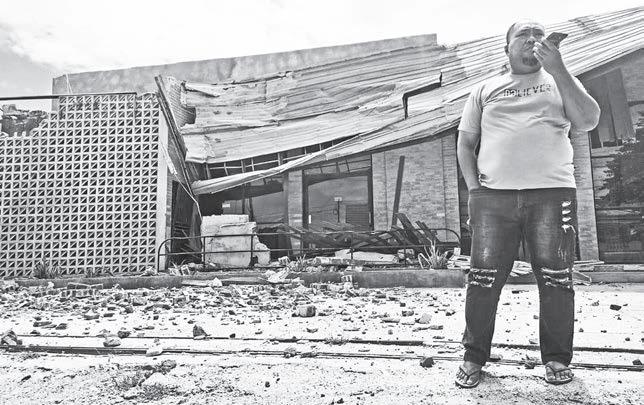

EMMANUEL MACRON, President of France, left, greets US President Donald Trump during the G7 summit in Evian-les-Bains, France, Monday, June 15, 2026. CHRISTOPHER KATSAROV/THE CANADIAN PRESS VIA AP
Stocks leap worldwide, oil prices drop after US and Iran reach deal to extend ceasefire
By Stan Choe Ap Business Writer
NEW YORK—Stock markets rallied worldwide Monday, and oil prices eased after the United States and Iran reached a tentative deal to extend their ceasefire and reopen the Strait of Hormuz to get the global flow of crude going again.
The S&P 500 rose 1.7% on hopes that this time, the announcement of an Iran-US agreement will mean a long-term fix to a conflict that has worsened inflation around the world. The Dow Jones Industrial Average climbed 468 points, or 0.9%, to a record, and the Nasdaq composite jumped 3.1%.
Stocks got a lift after the price for a barrel of Brent crude oil fell 4.8% to $83.17, back to where it was in early March. While that’s still above its price of roughly $70 from before the war, it’s lower than the $100 plus it cost just a few weeks ago. The hope is that lower oil prices will take pressure off households and businesses, which have had to pay higher prices for everything from food to fuel to fertilizer because of the war with Iran.
Iran confirmed the deal, but it does not include a final agreement on issues like Iran’s nuclear program. Negotiations on that are expected to continue over the next
60 days, which leaves opportunity for hiccups that could derail the agreement. And even if the Strait of Hormuz does fully reopen on Friday as expected, it will likely take months for the energy industry to get back to full speed. For now, though, relief swept through financial markets worldwide.
On Wall Street, stocks of companies with big fuel bills were instant winners. United Airlines flew 3.9% higher, and cruise operator Royal Caribbean Group rose 6.6%.
Stocks of companies enmeshed in the artificial-intelligence industry also jumped. These stocks have yo-yoed in recent weeks, going from roaring to records to suddenly turning lower. The concern is whether such stocks shot too high, too fast because of AI mania, and their careening moves have sometimes reversed direction by the hour.
Micron Technology rallied

10.8%, and Advanced Micro Devices rose 7%. Nvidia’s climb of 3.5% was the strongest force pushing the S&P 500 upward because the AI chip company is Wall Street’s most valuable company, giving it more weight on the index than any other.
SpaceX, Elon Musk’s rocket company that also owns the AI company xAI, rose 19.6% in its second day of trading on Wall Street. Its successful debut on the Nasdaq suggested plenty of demand still exists among investors for AI. The market has given SpaceX a total value of more than $2.1 trillion, making it bigger than Exxon Mobil, Bank of America and Coca-Cola combined.
In the bond market, Treasury yields eased on hopes that lower oil prices will remove pressure on central banks to raise interest rates.
The yield on the 10-year Trea -
sury slipped to 4.47% from 4.48% late Friday.
Europe’s central bank last week became the first major one in the world to raise interest rates because of the war with Iran. High interest rates can keep a lid on inflation, but they also slow economies and undercut prices for all kinds of investments, including stocks and cryptocurrencies. They hit investments seen as the most expensive in particular, and some critics are calling the AI industry a bubble where investment inflated too far.
The Fed will announce its latest decision on interest rates later this week, which will be the first under its new chair, Kevin Warsh. Traders see it as a near certainty that the Fed will leave its main interest rate steady after its two-day meeting ends Wednesday.
Traders had been raising bets
Higher gas and groceries prices will outlast Iran war, experts say
By Mae Anderson AP Business Writer
NEW YORK—A tentative deal to end the Iran war makes it reasonable to ask how soon prices will drop for gasoline, groceries, airline tickets and other items that got more expensive during the conflict.
Not so fast, experts say. Even after oil starts flowing again from the Middle East, it could take a while for consumers to see a difference at local fuel pumps, supermarkets and other places they shop, according to economists and industry analysts.
Fighting over the Strait of Hormuz disrupted not only supplies of crude and refined fuel but also the supply chains for fertilizer, food and even footwear. Businesses expect higher costs to linger, which means their customers might need to prepare for that too.
“It is not clear, despite three months of war, that anything has been achieved that makes the American consumer better off,” Brett House, an economist who teaches at Columbia Business School, said. “In fact, by almost any measure, not just the American consumer, but the world, is worse off as a result of this attack.”
If the deal between the US and Iran holds, here’s how experts see the war’s effects receding—or not—in the weeks ahead:
US motorists can expect some gas price relief
FOLLOWING news of the tentative agreement, oil prices fell Monday to about $80 for a barrel of US benchmark crude. That compares to $67-per-barrel before the war and the price of over $120 a barrel reached earlier in the conflict.
Refineries typically pay for crude oil a month or more in advance, so even after oil prices drop, they won’t immediately be processing cheaper products.
“The tendency of gasoline prices to fall slowly is partly because the raw material takes weeks to work through the system until it’s delivered to consumers,” said Michael Lynch, a distinguished fellow at the nonpartisan Energy Policy Research Foundation.
In places without enough refining capacity to meet their needs, such as the West Coast of the US, gas prices will take longer to drop, said Mark Barteau, a professor of chemical engineering and chemistry at Texas A&M University.
In some Asian and African countries that rely more on oil from the Middle East, the supply shock led to school and government office closures and instructions to work from home, according to the International Energy Agency.
“The bottom line is that getting back to ‘normal’ will be a lengthy process involving many parties and countries,” Barteau said. “Getting an agreement between the US and Iran to open the strait is just the beginning.”
Flights won’t get cheaper right away
INDUSTRY experts have spent months warning that even if the war ended, travelers should not expect airfares to go down immediately.
Airlines typically buy fuel in advance, adjust their schedules gradually and price tickets based heavily on demand, meaning lower oil and jet fuel prices can take weeks or months to get factored into the cost of commercial flights.
“I think it’s unlikely that we’re going to see a retreat or reduction in the cost of flying at any point this summer,” Columbia’s House said.
Fuel surcharges that some airlines outside the US added are one of the first areas where passengers might get a reprieve, said Gordon Ho, a professor at the University of Southern California’s business school.
“Consumers are going to say, ‘Wait a minute, why are you still charging me a fuel surcharge?’” Ho said.
Pressure on grocery prices will likely continue
REOPENING the strait is unlikely to deliver instant relief at the grocery store, according to David Ortega, a professor of food economics and policy at Michigan State University.
Fuel accounts for roughly 15% to 30% of the total cost of food, according to the
Independent Grocers Alliance, a grouping of 7,500 global supermarkets.
But it can take months for an energy shock like the one caused by the Iran war to wind through the food supply chain and raise grocery prices. And once prices go up, it takes them a long time to come back down, especially when the future is unpredictable, Ortega said.
“We’re likely still looking at inflationary pressure on food in the coming months,” Ortega said. “There’s still a good deal of uncertainty about how the reopening will unfold, and it will take time for fuel, diesel and retail fertilizer prices to come back down.”
Rabobank, which is based in the Netherlands, said it expected war-related food price inflation to peak sometime next year in Europe. In the US, grocery prices are expected to rise 3.2% this year, which compares to a historical average of 2.6%, according to the US Department of Agriculture.
Farmers remain strapped for fertilizer
REOPENING the Strait of Hormuz would also be a welcome change for farmers and the production of food globally. Roughly 30% of the world’s fertilizer passed through the waterway before the war began. Prices soared as the supply was effectively cut off, and
that the Fed may have to raise interest rates this year because of how much inflation has accelerated and how solid the US job market remains. But the tentative deal between the United States and Iran means traders are now betting on only a 57% chance of a hike this year, down from 71% a week ago, according to data from CME Group.
Elsewhere on Wall Street, Roku fell 1.9% after the company announced that Fox Corp. is buying the streaming pioneer in a cashand-stock deal valued at approximately $22 billion.
Roku’s stock had already soared 20% Friday, when media reports emerged about a deal, which will give Fox access to the Roku channel, first-party data and more than 100 million global streaming households. Fox’s stock fell 16.8%.
All told, the S&P 500 rose 122.83 points to 7,554.29. The
Dow Jones Industrial Average climbed 468.77 to 51,671.03, and the Nasdaq composite jumped 795.10 to 26,683.94. In stock markets abroad, indexes climbed in Asia and Europe. Japan’s Nikkei 225 leaped 5% for one of the world’s biggest gains and finished at a record.
“This is great news,” said Takashi Hiroki, chief strategist at Monex. “Buying by foreign investors is leading the market with expectations of easing tensions around the situation in the Middle East.”
South Korea’s Kospi soared even more, 5.2%, thanks in part to continued rallies for AI winners like Samsung Electronics. London’s FTSE 100 was an outlier and slipped 0.4%.
AP Business Writers Matt Ott and Elaine Kurtenbach and Senior Producer Mayuko Ono contributed to this report.
and earthquakes and volcanic activity are common. Many Sulawesi residents are haunted
by the magnitude 7.5 earthquake that devastated Palu in 2018, setting of 3-meter (10-foot) high tsunami and a phenomenon called liquefaction in which soil collapses into itself. More than 4,000 people were killed, including many who were buried when whole neighborhoods were swallowed in the falling ground.
In January 2021, a magnitude 6.2 earthquake near the city of Mamuju on Sulawesi Island left at least 100 people dead, with thousands sleeping outdoors for days

A16 Wednesday, June 17, 2026
China Shock 2.0: Surging Chinese exports threaten Europe’s economy, raising concern at G7 summit
other manufactured goods.
By Paul Wiseman, Elaine Kurtenbach & David Mchugh Ap Business Writers
WASHINGTON—For eight years, the United States has waged economic war on China, slapping big taxes on Chinese products before they enter America. But the campaign hasn’t dented China’s industrial prowess.
The world’s second biggest economy is exporting more products than ever. It’s just redirecting them away from the US tariff wall and toward more open markets in Europe and elsewhere in Asia.
The shift in Chinese trade risks creat -
ing a European sequel to the China Shock that wiped out hundreds of thousands of factory jobs in the American heartland in the 2000s and contributed to the political upheaval that put Donald Trump in the White House twice.
Despite US sanctions, China last year notched a record global trade surplus—an astonishing $1.2 trillion.
Earlier this year, French President Emmanuel Macron warned that Chinese exports are “literally killing a large part of the European industry’’ and admitted that Europe was “slow to see that.’’
The Europeans are clear-eyed now. China’s trade practices will be near the top of the agenda this week as leaders of the G7 rich democracies gather in Évian-
les-Bains, France. In briefings last week, French officials indicated that they hope to come out of the summit with a plan to tackle the China threat.
One possibility is that the European Union and others will build a higher tariff wall of their own against Chinese imports. Currently, the EU imposes relatively low tariffs on China under World Trade Organization rules—though it hits specific Chinese products with higher ones (up to 35% on electric vehicles, for example).
“China’s export surge, unless its leaders rein it in, will provoke a protectionist wave against Chinese imports worldwide,’’ said Maurice Obstfeld, senior fellow at the Peterson Institute for International Economics and former chief economist at the International Monetary Fund. “All the more so if the current disruptions around the Iran war persist and cause a sharper global slowdown.’’
Economist Taylor Wang at HSBC warned this month that a China-EU trade dispute could threaten Chinese exports; Europe accounted for a big share of China’s exports of electric vehicles, solar panels and lithiumion batteries.
The Europeans also hope to persuade Trump to stop targeting US allies like the European Union and Canada with punitive tariffs and to start working with them instead to counter China.
China Shock 2.0 is different— and more disruptive
THE first China Shock started around 2001 when the Chinese joined the World Trade Organization and gained low-tariff access to the lucrative markets of the United States and Europe. In the United States, many factories couldn’t compete with low-cost Chinese textiles, furniture, electronics and
Economists David Autor of the Massachusetts Institute of Technology, David Dorn of the University of Zurich and Gordon Hanson, now at Harvard, found that competition from China had led to the loss of 2.4 million American jobs.
China Shock 2.0, as it’s come to be known, is playing out differently.
The first time around China was still emerging as a major player in global commerce. Now it dominates world trade and manufacturing.
China accounted for just 4% of global goods exports in 2000. Now its share is 16%—the highest in the world—making Beijing’s trade policies far more consequential.
China has also upped its game, exporting sophisticated products like EVs and batteries, advanced machinery, software, scientific instruments and putting it in direct competition with the richest countries in the world. For example, Chinese exports now compete with nearly 58% of the exports from the 21 European countries that share the euro currency, up from 46% in 2000, according to a paper last month by researchers at the Federal Reserve and the Federal Reserve Bank of St. Louis. “The second China shock is characterized by its companies running the board on manufacturing exports—from low-tech, low-wage to high-tech high value-added industries,” said economist Eswar Prasad of Cornell University. “This is directly hitting advanced economies where it now hurts the most”—high tech industries such as EVs and high-end robotics that many countries “had been counting on for a manufacturing revival.’’
See “G7,” A17
Why can’t we cash in on high-value crops?
AS the global population continues to expand and as tastes for various items, including food, evolve with the arrival of new consumers, it would seem that the Philippines is trapped in the past when it comes to its agricultural and export priorities. Changes in consumer preferences have led to exponential increases in demand for certain high value crops, and yet the Philippines could not capitalize on it, unlike its Southeast Asian neighbors. Despite the availability of land and planting materials, the Philippines is still biased for a few cash crops like rice and corn.
While it is true that rice and corn are the staple food of Filipinos and are planted in many areas in the country, the Philippines is capable of producing other crops that could bring in much needed dollars to purchase oil and fertilizer. Aside from coconut, local planters are able to cultivate durian, jackfruit, root crops as well as cutflower and ornamental plants. Durian, for one, is in high demand in Asian countries like China, but the Philippines is not able to supply the volume requirements of customers due to a number of factors, such as weather shocks (See, “PHL durian exports plunge on supply crunch,” in the BusinessMirror , May 25, 2026).
The inability of the Philippines to bring in more earnings from highvalue crops is unfortunate considering the fact that there is an existing law that mandates the promotion the production, processing, marketing and distribution of these agricultural items. Republic Act 7900, also known as the High-Value Development Act of 1995, was signed into law by former President Fidel V. Ramos in February 1995. RA 7900 is a consolidation of House Bill No. 9288 and Senate Bill No. 1311 and was passed under the leadership of House Speaker Jose De Venecia Jr. and Senate President Edgardo J. Angara.
A copy of RA 7900 available on the website of the Supreme Court of the Philippines indicated that the state should “develop high-value crops as export crops that will significantly augment the foreign exchange earnings of the country, through an all-out promotion of the production, processing, marketing, and distribution of high-value crops in suitable areas of the country.” The law mandated the establishment of the High-Value Crops Development Fund (HVCDF), which aims to bankroll the requirements of the production, marketing, and processing of highvalue crops, and the establishment of low-cost credit to qualified project proponents. It also directed the Department of Agrarian Reform and the Department of Agriculture, in coordination with the Department of Environment and Natural Resources, and the municipal government concerned to identify the broad areas suitable for high-value crops production, within six months after the effectivity of this act.
More than two decades after RA 7900 took effect, the Philippines has yet to see significant earnings from its high-value crops. The country still relies on traditional dollar earners, such as electronics products, and has not been able to diversify its export offerings. In contrast, Thailand, regarded as the “Kitchen of the World,” continues to earn from various food products—export receipts from food reached more than $39 billion in 2023, according to a report by news website The Nation.
The law offers various incentives that would have allowed high-value crops to flourish, including the duty-free importation of high-quality seeds and planting materials. RA 7900 has given the state the necessary framework that will allow these high-value crops to flourish; its faithful implementation may be the missing ingredient that will finally unlock the potential of these crops as sources of dollar earnings.

Rebuilding Mindanao

TMark Villar
THE BUILDER
HE magnitude 7.8 earthquake that struck parts of Mindanao on June 8 is a tragedy that we wish would not have happened. We commiserate with the families who have lost their loved ones and those who were injured.
Recovering from a disaster of this magnitude is not easy. We are dealing here with lost lives, injured persons, destroyed properties and disrupted livelihoods that may take a while to resume.
Our young generation is also suffering from this natural disaster. Thousands of schools and learning centers in Mindanao either collapsed or were rendered inoperable by the strong earthquake.
The earthquake, one of the strongest to hit Mindanao in recent years, caused widespread destruction across several provinces, damaging homes, government buildings, schools, hospitals, roads and commercial establishments.
It triggered landslides, disrupted power and water services and prompted tsunami warnings that were later lifted.
The state, of course, is the first


Cresponder to this tragedy. President Ferdinand Marcos Jr. immediately flew to General Santos City, one of the hardest-hit areas. All six regions of Mindanao were affected by the earthquake, with Region 12 — made up of South Cotabato, Cotabato, Sultan Kudarat, Sarangani and General Santos City — being the hardest hit.
President Marcos bared that the government was providing P50,000 in financial assistance to the families of each person who died in the disaster.
He also announced the release of P100 million from the Local Government Support Fund to repair the damaged General Santos City Hall.
“All families who lost a loved one in the earthquake will receive P50,000 in assistance,” says President Marcos, adding that additional funding would be provided through the same fund for the rehabilitation
HINA’S consumer spending and investment slumped to levels unseen since the pandemic, exposing risks still facing the economy even as it benefits from a de-escalation in tensions around Iran while exports boom.
Retail sales declined 0.6 percent last month from a year ago, posting a worse-than-forecast drop that was their first fall since the reopening from Covid lockdowns in late 2022. Fixed-asset investment also shrank far more than expected, retreating 4.1 percent in the first five months from a year ago, according to data released by the National Bureau of Statistics on Tuesday.
In contrast to weakness on the demand side, industrial production climbed 4.5 percent, up from 4.1% in April and slightly better than forecast. The surveyed urban jobless rate eased to 5.1 percent. With exports resilient despite the upheaval in shipping and energy markets, China’s gross domestic product probably fared better in May than in April, according to Yu Song, chief China economist at UBS Securities. Some analysts estimated growth at near 4 percent in April,
tracking below the government’s official full-year target of 4.5 percent to 5 percent.
“Second-quarter GDP data looks to be weak, but not quite as weak as one would expect from April data,” Song told Bloomberg Television. Hobbled by the housing crisis and fragility in the jobs market, domestic consumption is nowhere near a turnaround after lagging growth among manufacturers and exporters. And without stronger demand at home, the economy is at risk of a deeper slowdown even as the USIran deal to reopen the Strait of Hormuz holds out the promise of stabilizing global shipping and energy markets.
Despite the economy’s overall stability, “the external environment has become increasingly complex and volatile, and the domestic imbalance of strong supply and weak demand remains pronounced,” the
of damaged infrastructure in Sarangani and South Cotabato, areas heavily affected by the earthquake.
The Department of Labor and Employment (DOLE), in addition, is extending up to P15,000 to workers affected by the earthquake, while the families of workers who died in the disaster may receive an additional P30,000 funeral benefit.
The earthquake, however, leaves a lasting damage on infrastructure that will require more time to rehabilitate. The earthquake, like strong typhoons, ruins or weakens infrastructure facilities like roads, bridges, schools, hospitals and other concrete buildings.
Roads, in particular, may be impassable until they are repaired or rebuilt. Damaged roads hinder relief operations that are badly needed. Road accessibility was one factor why the Department of Social Welfare and Development (DSWD) in Region 11 had a hard time delivering food packs to the affected families in Davao Region and other areas hit by the earthquake.
Meanwhile, over 1,100 schools across Mindanao were damaged and classes remain suspended in around 8,000 schools. Education Secretary Sonny Angara said the situation may last several months until they are fully repaired.
Hospital structures, too, took the brunt of the earthquake. President Marcos inspected St. Elizabeth
Hospital in General Santos City and ordered government agencies to prioritize structural assessments of hospitals and other health facilities damaged by the earthquake. Restoring healthcare services quickly is critical in the aftermath of the disaster to ensure the safety of patients, medical personnel and the public. Government engineers are currently assessing damaged schools, hospitals, and public buildings to determine whether they can still be safely used, require major repairs, or should be slated for demolition. The Philippines is prone to disasters like earthquake and volcanic eruptions as it sits directly within the Pacific “Ring of Fire” zone that traces the edges of the Pacific Ocean, where tectonic plates constantly collide. As such, it has to build more resilient and sustainable infrastructure that can withstand earthquakes. The government must immediately enforce a strict steel and construction safety standard to minimize structural risks in case of another powerful earthquake. A resilient infrastructure is our best defense to natural disasters. It is an available weapon that can reduce disaster risks and make our towns and cities sustainable.
For feedback e-mail to senatormarkvillar@ gmail.com or visit
muz holds out the promise of stabilizing global shipping and
NBS said in a statement. “Some enterprises face significant operational pressure.”
In a sign the figures disappointed investors, the yuan weakened in offshore trading after the data release, a day after reaching its strongest level since early 2023. The Hang Seng China Enterprises Index extended losses, falling about 1.4 percent as of 10:30 a.m.
in Hong Kong.
A breakdown of the industrial output data showed a widening di-
vergence between advanced manufacturing and the rest.
High-tech manufacturing soared 15 percent in terms of value added in May from a year ago, accelerating from 13 percent in April. The electronics industry saw a 17 percent jump in output, thanks to booming demand for AI-related products and equipment.
The spurt of export growth this year has still been sufficient to keep China’s economy from cooling off too much. A global investment supercycle in artificial intelligence is driving up prices and demand for hardware made by the world’s manufacturing powerhouse.
Outbound shipments soared in May at their fastest pace in three months. Chips and computers contributed to about half the growth in both exports and imports, with overseas sales of semiconductors soaring 111 percent. Stabilizing trade ties with the US, reinforced by President Donald Trump’s visit to Beijing, further bolster the outlook.
Policymakers have appeared to See “Chinese,” A19
UK seeks one of world’s strictest social media bans for kids
By Alex Wickham, Julian Harris & Mark Bergen
PRIME Minister Keir Starmer announced what he described as a “full ban” on children using social media, going beyond limits imposed by Australia last year to create one of the strictest online crackdowns in the democratic world.
“It will make our children safer. It will make our children happier, it will give them more time, more security, more freedom to grow up, more opportunity,” Starmer said in a press briefing on Monday morning. In a hint he proceeded with one eye on his own threatened legacy, he added: “That, at the end of the day, is what this government is about.” Starmer is seeking to place his country at the leading edge of a global rush to legislate against the harms of social media, which psychologists have linked to mental health risks. The move sets his government up for a clash with global technology companies, who’ve chafed against comparable legislation elsewhere.
The prime minister said children under 16 would be prevented from using all major social media platforms, as well as other measures including what he called “world-leading action” to prevent them from speaking to strangers on gaming services and live-streaming platforms without supervision.
But other details of enforcement were sparse, with No. 10 Downing Street saying it would provide further details next month. Results of Australia’s own efforts have been mixed, with the regulator reporting in March that about 70% of parents who said their child had social media accounts before the ban still had them.
Starmer’s government says its new range of restrictions will be tougher than Australia’s limits. Legislation will be passed by the end of the year and the ban will be implemented in spring 2027, the prime minister said. Age verification technology will be used to enforce the restrictions. There will be exemptions for some content, including YouTube Kids and Google Classroom.
“This is not something I do lightly and I will not present it as cost-free,” he added. He warned that social media is “designed to be addictive,” criticizing “features like infinite scroll” which he said “stops children doing their homework, reading, playing with friends outside and going to bed at a decent time.”
Spokespeople for both Snapchat and Google’s YouTube told Bloomberg that blanket bans risk pushing children away from curated services toward ones which are less safe.
“We share the goal of keeping teens safe online,” said a spokesperson for Meta, adding: “Like others, we don’t think bans will achieve this goal.”
Asked if he was worried President Donald Trump and US technology companies would be critical of the policy, Starmer said pursuing advances in tech and artificial intelligence and protecting children online were not incompatible. “This is about fighting for what we think is right.
I’m a fan of tech and AI,” he said. There will be exemptions for some content, including Google Classroom and YouTube Kids, an app designed for children of eight and below.
Starmer’s announcement begins
be taking a wait-and-see approach in responding China’s two-speed growth, after efforts to coax consumers into spending delivered gains that proved fleeting. Purchases of home appliances and furniture as well as cars—products that used to be buoyed by government subsidies—are slumping.
“May’s activity data underscore a widening two-speed economy. The supply side remains robust,
Deductibility of expenses attributable to passive income

IStarmer is seeking to place his country at the leading edge of a global rush to legislate against the harms of social media, which psychologists have linked to mental health risks. The move sets his government up for a clash with global technology companies, who’ve chafed against comparable legislation elsewhere.
a crucial week for his premiership. He heads to the Group of Seven summit at Évian-les-Bains, France on Monday, where he faces awkward questions following last week’s resignation of his defense secretary and uncertainty around the UK’s military budget.
Starmer was criticized at the weekend by the father of a teenage girl who took her life in 2017 after being exposed to harmful online content. Ian Russell told the BBC it would be “deplorable” if the prime minister had rushed out the ban as part of a policy blitz before he faces a likely leadership challenge.
A public consultation on how to protect young people closed less than three weeks ago and some of Starmer’s cabinet colleagues believe the government’s decision to go with a full social media ban for U16s was rushed ahead of Thursday’s by-election, according to a person familiar with the situation.
The opposition Liberal Democrats accused the Labour leadership of “rushing through a half-baked policy just to secure a political legacy.”
Starmer’s primary rival Andy Burnham is expected to win a parliamentary seat at Thursday’s special election in Makerfield, northwest England. If Burnham defeats Nigel Farage’s populist Reform UK party, he is likely to challenge Starmer, raising the prospect of a summer contest for the keys to No. 10 Downing Street.
Starmer’s team is trying to regroup following the resignations of secretary of state John Healey, junior defense minister Al Carns and two ministerial aides last week. Healey said Starmer had failed to secure enough of a spending boost for the military, in light of heightened threats from Russia and other adversaries.
However, Lisa Nandy, the UK’s culture secretary, said Sunday that the government had “not finished” trying to find savings from other departments in order to bulk up Britain’s defenses.
“Negotiation is happening as we speak,” Nandy told the BBC, suggesting that Starmer had decided to look for more money. A larger budget increase would help Starmer meet promises he made to Britain’s allies, but—coming after Healey’s resignation—risks exposing the premier to accusations of another U-turn. With assistance from Joe Mayes, Ellen Milligan and Gian Volpicelli/Bloomberg
driven by faster-than-expected expansion in exports and AI tech sectors. The demand side has faltered, with consumption and private nontech investment plummeting,” said Bloomberg economists Chang Shu and Eric Zhu. The government dialed back public spending in March and April as bond sales decelerated. Authorities likely felt comfortable with the economy’s first-quarter performance, though economists also pointed to a potential lack of eligible projects. With assistance from Josh Xiao, Iris Ouyang and Jiyeun Lee/Bloomberg
Fulvio D. Dawilan
TAX LAW FOR BUSINESS
N September of 2025, the Bureau of Internal Revenue (BIR) issued Revenue Memorandum Circular No. 81-2025 (RMC 81-25), providing specific criteria and guidelines for the deductibility of expenses incurred in business. While the circular recognizes the usual conditions for these expenses to be allowed as deductions in arriving at the net taxable income, it added guidelines that modified the requirements for deductibility.
Presenting these as clarifications to the existing rules, the circular distinguishes the expenses incurred in relation to the conduct of active trade or business from expenses related to generating passive income. Based on these clarifications, expenses directly tied to the development, management, operation or conduct of active trade or business can be deducted as they meet the criteria of being ordinary and necessary. But expenses related to managing investments that generate passive income, such as fees for financial advice, interest from loan to finance investments, or brokerage services, and other related expenses, may not qualify as they do not relate directly to the taxpayer’s active business operations. Following the same reason, the circular requires the segregation of expenses that are attributable to active business operations from those related to passive income generation.
Simply put, the circular requires taxpayers to identify or allocate common expenses—with deductions being limited only to expenses attributed to earning active income. Expenses related to earning passive income are to be excluded as deductions in computing net taxable in-
come subject to the regular income tax. In other words, expenses attributed to earning passive income should not be allowed as deductions.
Barely two months after the issuance of the circular, the Court of Tax Appeals promulgated a decision (CTA Case No. 10784, November 04, 2025 ), touching on the subject of deductibility of expenses related to passive income. The taxpayer involved in that case is a holding company. As a holding company, a portion of its income constitutes passive income while the others are active income. In the conduct of their examination, the revenue officers allocated the expenses incurred by the taxpayer based on the amounts of active and passive income and disallowed the portion allocated to the latter. The BIR justified its action— arguing that expenses attributable to the taxpayer’s active income must be permitted, whereas expenses imputable to the taxpayer’s passive income must be disallowed—thus the need for the allocation.
The Tax Court disagreed with the BIR, holding that the allocation and consequently, the disallowance, is wanting in legal foundation. The Court emphasized that there is no requirement in the tax law that only expenses allocable to a taxpayer’s active income would be allowed as expense deduction, whereas those expenses imputable on passive income would be disallowed as an expense deduction. The very act of allocation is not mentioned in the law. To support its decision, the Tax Court cited an earlier Supreme Court decision (GR 240163 & 240168-69, December 1, 2021), which declared that common expenses should be deductible in full against the taxpayer’s income subject to regular tax. All expenses are deducted directly and in full without any allocation or attribution between different income streams.
The Tax Court disagreed with the BIR, holding that the allocation and consequently, the disallowance, is wanting in legal foundation. The Court emphasized that there is no requirement in the tax law that only expenses allocable to a taxpayer’s active income would be allowed as expense deduction, whereas those expenses imputable on passive income would be disallowed as an expense deduction. The very act of allocation is not mentioned in the law. To support its decision, the Tax Court cited an earlier Supreme Court decision (GR 240163 & 240168-69, December 1, 2021), which declared that common expenses should be deductible in full against the taxpayer’s income subject to regular tax. All expenses are deducted directly and in full without any allocation or attribution between different income streams.
I fully agree with the reasons mentioned by the Tax Court in its decision. And while this case does not directly address the issuance of RMC 81-25 and the additional requirements for determining deductibility of expenses, there is reason to believe that for as long as the
deduction is anchored on the basis of Section 34(A)(1)(a) of the Tax Code and the conditions coined by jurisprudence that interpreted it, the deduction should be allowed. Based on jurisprudence, the deductibility of ordinary and necessary expenses simply requires compliance with four conditions, and these are: (a) the expense must be ordinary and necessary; (b) the expense must be paid or incurred within the taxable year; (c) the expense must have been paid or incurred in carrying on or which are directly attributable to, the development, management, operation and/ or conduct of the trade, business or exercise of a profession; and (d) the expense must be supported by invoices, records or other pertinent papers. Thus, for as long as the expense is properly substantiated and claimed in the proper period, it should be deductible as an expense if it is usual, normal, attributable and helpful to the conduct of trade or business of a taxpayer. No other condition should be imposed that would limit the deductibility of expenses. More importantly, the income—whether active or passive—to which the expense is related to should not affect deductibility.
The author is a managing partner of Du-Baladad and Associates Law Offices (BDB Law) (www. bdblaw.com.ph). The article is for general information only and is not intended, nor should be construed as a substitute for tax, legal, or financial advice on any specific matter. Applicability of this article to any actual or particular tax or legal issue should be supported, therefore, by a professional study or advice. If you have any comments or questions concerning the article, you may e-mail the author at fulvio.dawilan@bdblaw.com.ph or call 84032001 loc 310.
US at odds with allies over how easy it is to reopen Hormuz
By Michael Nienaber, Alberto Nardelli, Andrea Palasciano & Josh Wingrove
US President Donald Trump keeps repeating that the Strait of Hormuz—through which one fifth of the world’s oil and liquefied natural gas supplies normally flow—will reopen by Friday.
But on the sidelines of the Group of Seven summit, where Iran will dominate Monday’s dinner conversation, it’s clear that his European allies don’t share his optimism. They disagree that trade can resume by week’s end, like Trump promised, and have practical questions about what exactly was agreed before they can commit to de-mining missions and patrols.
According to one G7 official, speaking on condition of anonymity to discuss internal dynamics, there are serious difficulties in finding a common position among the group about how to deal with the situation in Iran. Few are expecting a joint communique, something that’s proved elusive during the Trump era.
Even Italian Prime Minister Giorgia Meloni, who for the most part has artfully avoided provoking Trump, said her country’s contribution is conditional on a cessation of hostilities in Lebanon, where Israel’s military has carried out strikes in recent days. She isn’t alone in questioning Trump’s accelerated timeline. It doesn’t help that even within Trump’s own administration, there are prominent figures who didn’t go as far in promising that navigation along the vital chokepoint can go back to normal at the snap of a finger.
One senior US official said traffic in the waterway would ramp up over time, and it could take as many as two weeks for shipping to significantly increase—and even longer for it to return to the levels seen before the US and Israel attacked Iran in
According to one G7 official, speaking on condition of anonymity to discuss internal dynamics, there are serious difficulties in finding a common position among the group about how to deal with the situation in Iran. Few are expecting a joint communique, something that’s proved elusive during the Trump era.
February. There are mines in the strait that still need to be cleared and shippers have different risk tolerances about navigating Hormuz, the official said.
The official said the memorandum of understanding between the US and Iran will make it explicit that the strait will be open toll-free for 60 days, and the US will expect that provision makes it into a final agreement. The fact is that free navigation, once a given, is now the subject of negotiations that haven’t even started.
Oil industry leaders have told the White House and the broader Trump administration for months that it would be untenable for the US to permit tolls being charged for safe passage through the Strait of Hormuz, according to a person familiar with those discussions, who asked not to be named because they were private. The White House knows where the industry stands, the person added.
While US and Iran both said they reached an interim agreement to reopen the strait, without an official document out in the open, they have offered different descriptions of what it says.
“The way Iran describes it, it’s awful, the way we describe it makes sense to me,” said Senator Lindsey Graham, a South Carolina Republican and close Trump ally. “Let’s look at it and see what it actually is.”
Officials are due to sign the accord in Switzerland on Friday.
US officials have offered differing timelines for when the full text will be released, with Trump saying by week’s end at the earliest and another senior US official saying within the next two days.
Vice President JD Vance is likely to represent the administration at the signing.
The G7 leaders will next decide on a framework to de-mine the waterway, including an agreement from Iran and other involved parties, Bloomberg reported earlier. European leaders are planning to seek Trump’s approval for the mission at the G7.
The problem they are facing is that Trump has played down their role and the difficulties that they would face in trying to help.
“Ships are starting to go out now, on Friday it’ll be completely opened,” Trump said Monday at the leaders’ summit in Evian.
“They’re doing a little hunting for a couple of mines that they’ve already found, but it’s—essentially ships are starting to go out now.”
Furthermore, deployments won’t start before there’s a final agreement between the US and Iran that restores full and unimpeded commercial navigation rights as well as a permissible environment for military assets in the strait, Bloomberg previously reported.
That could be a matter of weeks rather than days, German officials are warning, because any direct involvement would require an international mandate. And clearing the mines could prove complex and time-consuming.
It’s not clear how many mines are in the strait or even whether
any were placed to begin with. Iran has, at various times, said it had mined the narrow waterway. As early as mid-March, the UK said it appeared clear Iran had done so, while the US said that was not the case.
Ensuring the strait is clear will be a painstaking exercise, said Caitlin Talmadge of the Massachusetts Institute of Technology. The work will go faster if Iran provides whatever information it has about mine placement, she said.
European countries have a substantial amount of mineclearing capabilities, she added. But those vessels will be in a bad position if hostilities resume.
“Mine clearance operations are intended to be conducted in a permissive environment,” she said. “The relevant vessels and operators could be vulnerable if Iranian attacks resume, particularly dedicated mine countermeasures ships which generally lack an ability to defend themselves.” In spite of their reservations, Europeans are moving forward with their planning.
French President Emmanuel Macron and UK Prime Minister Keir Starmer have led an effort by US allies to produce a plan to help reopen the strait in the event of a final peace deal. More than 15 countries have committed equipment and personnel to the mission. As host—and this is his last G7 as leader—Macron is invested.
“It’s a very important matter for peace, for the whole world, and it will reopen Hormuz” Macron said. “It will provide peace in Lebanon. And so we are ready to take our fair share of the burden and be part of the commitment of the international community.” With assistance from Steven T.
and Iain Marlow/Bloomberg
Wednesday, June 17, 2026
2nd Front Page
BusinessMirror
ONLY 15% OF 19TH CONGRESS
LAWS VALUE TRANSPARENCY
By Mary Jade Jadormio
ONLY 55 of the 378 laws enacted by the 19th Congress contain transparency-related provisions, according to a study released by the Right to Know Right Now (R2KRN) Coalition.
The coalition said the finding highlights the uneven way transparency measures have been incorporated into legislation despite constitutional guarantees on the public’s right to information.
Of the total laws reviewed, 323 or 85 percent did not contain transparency-related provisions.
The study examined laws enacted from July 2022 to June 2025 and analyzed whether they contained provisions related to transparency, privacy and confidentiality.
Among the laws with transparency-related measures, economic legislation accounted for the largest share, while governancerelated measures comprised the biggest portion of laws enacted without such provisions.
“The pattern must be read alongside a more fundamental limitation: only a small fraction of all enacted laws contains any transparency provisions at all,” R2KRN said in its report.
The coalition identified 190 transparency-related provisions across the laws reviewed, including requirements on public disclosure,
reporting, consultations, audits and digital information systems.
Reportorial requirements emerged as the most common transparency mechanism, appearing in 33 laws.
Public disclosure provisions were found in 25 laws, while oversight and evaluation mechanisms and consultation requirements appeared in 16 measures each.
According to the study, the uneven distribution of transparency provisions varied across sectors and congressional committees.
“This uneven distribution suggests that the integration of transparency provisions is not institutionalized across committees but rather varies significantly by sector and legislative practice,” the coalition said.
R2KRN noted that while more laws are incorporating disclosure measures, transparency standards remain fragmented in the absence of a comprehensive Freedom of Information law.
“Rather than continuing the current trajectory of fragmented, sector-specific transparency, legislators should focus on enacting a strong and coherent FOI law which harmonizes existing provisions, establishes clear standards for disclosure and exceptions, and gives full effect to the Constitution’s twin mandates of access and public disclosure,” the coalition said.
ABy Bless Aubrey Ogerio @blessogerio
LTHOUGH global uncertainty continues to pose risks to investor sentiment and logistics costs, the Philippine Economic Zone Authority (Peza) said it remains on track to meet its investment approval target for the year.
Peza said that it has so far approved a little over one-third of its P300-billion investment target for 2026, even as it expressed confidence that the full-year goal can still be achieved if external and domestic conditions remain manageable.
“If these global headwinds are solved as well as some internal political problems, we will achieve the target by end-year. Currently, we are slightly above one third of the target objective,” Peza Director General Tereso Panga said in a writ-
ten response to the BusinessMirror
“I’m still confident that we will be able to meet our targets for this year based on our current assessment,” Panga added.
Tensions in the Middle East continue to weigh on global markets, particularly through volatility in oil prices and shipping routes; and while the United States and Iran have announced a preliminary agreement aimed at ending their conflict, negotiations toward a lasting ceasefire remain ongoing.
For the agency, prolonged insta-

bility in the region could lead to adjustments in global investment decisions, especially among exportoriented firms that rely heavily on predictable logistics and energy costs.
“However, if the conflict in the Middle East continues, I certainly believe that there will be global adjustments in the investment decisions of global companies. We are ready for this and we expect it before it even happens,” Panga said.
Peza noted that investors remain split between those that react quickly to geopolitical developments and those that take a longer-term view of market conditions.
“There are two kinds of investors: the first kind is the one that prepares for events like this; the other [one] wait for the results. I believe our type of investors are long-term and belong to the first kind,” the official said.
Export-oriented manufacturing firms, particularly those in electronics manufacturing services, automotive, and related industries, were listed by the agency among the most exposed to ongoing supply chain disruptions and higher fuel costs.
These sectors rely heavily on imported inputs and time-sensitive shipping networks, making them sensitive to delays and freight volatility, it said.
Agribusiness and food export operations were likewise flagged as vulnerable due to rising cold-chain and transport expenses, which are closely tied to fuel price movements.
The agency warned that sustained increases in oil prices could have a broader inflationary effect, raising production and logistics costs and ultimately affecting the global competitiveness of Philippine exporters. Industries with high energy consumption were also identified as particularly exposed to price swings in global oil markets, with both upstream input costs and downstream distribution expenses expected to adjust accordingly.
Despite these risks, Peza maintained that its investment pipeline remains stable for now, though it acknowledged that global developments in the coming months will be critical in determining whether current momentum can be sustained.
Germany backs PHL push for South China Sea code of conduct Undaunted by global jitters, Peza still bullish on ’26 goal
By Samuel P. Medenilla
CONCERNED over the pos-
sible human cost of a disruption of freedom of navigation in the South China Sea similar to the Iran blockade of the Strait of Hormuz, German Federal President Frank-Walter Steinmeier backed the push of President Ferdinand Marcos Jr. for the completion of the Code of Conduct for the important waterway in the Indo-Pacific.
Steinmeier made the statement at his joint press briefing with Marcos in Malacañang on Tuesday, where they expressed “cautious optimism” that the Strait of Hormuz will finally be reopened with the signing of the United States-Iran peace deal.
He said the potential restrictions in the passage of ships in the South China Sea is a great concern for Europe, since it can trigger similar disruptions to global trade after Iran restricted the passage of ships in the waterway, when it was attacked by US and Israel last February 28, causing a spike in global pump prices.
Beijing continues to claim most parts of the South China Sea even after its expansive claims were rejected by the Arbitral Award of 2016.
PHL back in intl capital mart at ‘opportune’ time
By Reine Juvierre S. Alberto @reine_alberto
Tthe 10-year tranche. Meanwhile, the tap of the 2051s has an initial indicative yield of 6.1 percent. The Treasury said the transaction will be priced later today during the New York trading session.
“The Republic’s return to the international capital markets comes at an opportune time, amid improving market sentiment and favorable global developments,” National Treasurer Sharon P. Almanza was quoted in a statement as saying. Finance Secretary Frederick D. Go told reporters last Tuesday that the ceasefire between the United States and Iran is “good news” as interest rates have come down and provides more borrowing options for the government. Go said officials hope that the ceasefire will
and the government can borrow at
lower interest rates.”
“This transaction reflects our prudent and proactive approach to financing, allowing us to secure funding efficiently while supporting the National Government’s priority programs and development objectives,” Almanza added.
The proceeds from the bonds are intended for general purposes, including budgetary support and the repayment of a portion of the government’s borrowings, according to Moody’s Ratings.
The global bonds were assigned “Baa2” by Moody’s and is expected to be rated “BBB+” by Standard & Poor’s and “BBB” by Fitch. The transaction is scheduled to settle on June 24, 2026. BNP Paribas, Citigroup, HSBC (B&D), JPMorgan, MUFG and Standard Chartered Bank are acting as joint lead managers and bookrunners for the transaction.
“Against the backdrop of encouraging developments in global markets, we are confident that our policy direction will continue to be well received by the international investment community,” said Go, who also heads the government’s economic team.
The latest global bond issuance follows the previous triple-tranche issuance of $2.75 billion in January 2026, a dual-currency issuance of $2.25 billion and €1 billion in January 2025, and a $2.5 billion triple-tranche offering in August 2024. The Philippines aims to raise a total of P2.682 trillion this year, following a 77:23 borrowing mix in favor of domestic sources. About $2.5 billion remains in the government’s foreign borrowing program.
As of end-April, the government’s gross borrowings reached P1.133 trillion, securing 42.24 percent of its financing program.
“If incidents occur in that part of the world, that is also cause for great concern in Europe because we in Europe have for decades now too benefited from the international law of the sea; and violations of the international law of the sea endanger the freedom of navigation, as the blockade of the Strait of Hormuz has brought home to us recently in a very drastic manner,” Steinmeier said in German through a translator.
The German leader said he will support the initiative of Marcos, who is currently the chair of the Association of Southeast Asian Nations’ (Asean), to complete the regional bloc’s Code of Conduct in the South China Sea before the end of the year and to restore peace in Myanmar, which has been plagued by internal conflict since 2021.
“I wished him every success for his term in office and at the helm of Asean and assured him of the full
support of Germany for important projects, among them the successful negotiations about a code of contract for the South China Sea and a solution for the continuing bloody civil war in Myanmar,” Steinmeier said.
Concrete actions
BOTH Steinmeier and Marcos said they are now closely monitoring further developments in the US-Iran peace deal, which was announced by US President Donald Trump on Monday.
“We both therefore hope that we will see an actual agreement, not only a signing of a document, but that we will see an ending of the fighting and an end to the blockade of the Strait of Hormuz,” Steinmeier said.
He said restrictions imposed by Iran in the Strait of Hormuz have affected thousands of people worldwide by raising the price of not only petroleum products but also fertilizers and food.
A fifth of the world’s oil supply passes through the said waterway. Marcos echoed Steinmeier’s position that the peace deal will hopefully end the conflict in the Middle East, which has caused global hardships.
“The effects on Germany and the Philippines are reflected in every country around the world. This kind of instability makes life difficult for our own people, and therefore we await with bated breath the actual finalization of that [peace] agreement. Again, it is some of the best news that we could hope for,” he said.
However, he admitted he is “cautiously optimistic” on the outcome of the peace deal since the talks between the US and Iran have collapsed on several occasions.
“We have unfortunately heard these proclamations before, and they have not come true. But we are hoping that this one is the one that will come true, and that we will start to once again bring our economies to a normal state, and be able to support our people properly, and without suffering the vagaries of price rises that come with such a petroleum crisis,” Marcos said.
“So, we hope, we pray that this is the case, that it is over, the war is over, and it will be a lasting peace,” he added.
Editor: Jennifer A. Ng
Sale of US unit streamlines operations of Cirtek—exec
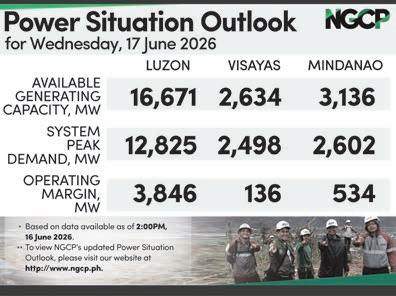

CBy VG Cabuag @villygc
IRTEK Holdings Philippines Corp. (CHPC) on Tuesday said it sold its US unit Quintel USA Inc. to John Mezzalingua Associates LLC (JMA), a recognized provider of wireless infrastructure solutions in North America.
the final determination of deductible liabilities, currently targeted within approximately four months.
The transaction reflects Cirtek’s ongoing portfolio optimization and resource alignment, the company said.
Proceeds are expected to support initiatives that improve financial flexibility, reduce obligations and reinforce shareholder value over time.
term growth and profitability. This transaction enables us to concentrate our resources on areas where we see the strongest opportunities ahead,” Antonio Callueng, Cirtek president, said.
“We are confident that this transaction will allow us to redirect our efforts toward areas where we can achieve sustainable growth.”
Cirtek said it will work together with JMA to facilitate an orderly transition of the business, customers, intellectual property and other transferred assets.
Under the terms of the agreement, JMA will acquire Quintel’s assets, including customer contracts, intellectual property, inventory, accounts receivable, product-related records and other operating assets associated with Quintel’s antenna business while JMA will assume certain liabilities associated with the business.
The financial consideration for the transaction is subject to the deduction of assumed and other agreed liabilities, the final amount of which will be confirmed following the completion of the liability resolution process, it said.
An initial payment of $3.3 million will be payable within 14 days after closing, with the remaining balance of $2 million payable after
“The sale of Quintel is an important step in streamlining our operations and focusing on businesses with the greatest potential for long-
“Following completion of the transaction, CHPC will continue to evaluate opportunities to enhance operational efficiency, strengthen liquidity, and maximize value for shareholders across its remaining business segments,” the company said.
Global One rental pool secures nod
THE Securities and Exchange Commission (SEC) has approved the rental pool program of Global One Hotel Group Inc. under the streamlined guidelines on Securing and Expanding Capital in Real Estate Non-Traditional Securities (SEC RENT).
The SEC in its en banc meeting also approved the company’s registration statement covering 6,340 certificates of participation in pool sharing agreements across its 12 condominium hotel projects.
Of the total units covered by Global One Hotel’s rental pool program, 4,277 have already been sold, while 2,063 units remain unsold. The public may invest in the program without paying a joining fee, and there is no specified offer price to participate.
A total of six projects located in Parañaque, Pasay and Cebu are already operational, while the remaining six hotels in Iloilo, Negros Occidental, Palawan, Pampanga and Pasig are in various stages of construction.


By Lorenz S. Marasigan @lorenzmarasigan

ASTICOM Holding Co. Inc. has joined the Workday Partner Program, positioning the Globe Telecom Inc. subsidiary as a local implementing partner for Workday’s Human Capital Management (HCM) and Enterprise Resource Planning (ERP) solutions in the Philippines.
Under the agreement, Asticom’s IT-BPO arm, Asti Business Services Inc. (ABSI), will serve as the implementing arm for Workday solutions, bringing the global platform’s AIpowered HR and finance tools to Philippine enterprises.
The partnership targets large organizations in the retail, finance, and business process outsourcing (BPO) sectors — industries where manual technology solutions remain common and where digital transformation can unlock significant operational gains, according to Asticom President and Chief Executive Officer Mharicar Castillo-Reyes.
“Together with Workday, and enabled by the expertise of our teams at Asticom, we are well-positioned to help bring meaningful transformation in HR and finance in the Philippines,” Castillo-Reyes said.
working age and that the median age stands at 26.
“The market opportunity is incredible — that’s why we are bullish from day one,” O’Reilly said, adding that the company sees the partnership as a contributor to the country’s 6-percent GDP growth trajectory.
Workday’s HCM platform automates routine HR processes, supports talent acquisition and workforce planning, and provides AI-driven insights across the employee lifecycle. Its finance tools are designed to help organizations streamline operations and strengthen compliance.
“As enterprises in the Philippines look to navigate a rapidly evolving digital landscape, the need for intelligent, AI-powered solutions has never been greater,” O’Reilly said. “By combining our global technology with Asticom’s local presence and the technical expertise of ABSI, we aim to help businesses unlock new levels of productivity and workforce resilience in the age of AI.”
Workday currently serves more than 11,500 customers worldwide across financial services, retail, manufacturing, technology, transportation, and energy sectors.
Under the program, the condominium units will be leased to Global One Hotel, which will then manage the units either by itself, through a subsidiary or affiliate, or through a third party, and make them available to paying guests as hotel rooms.
The rental pool deals are valid for 15 years from the date of the admission of the hotel’s first paying guests. The lease agreements shall be automatically renewed for another 15 years unless otherwise provided by Global One Hotel.
DigiPlus rises in Fortune SEA 500 list
GAMING firm DigiPlus Interactive Corp. secured a spot in this year’s Fortune Southeast Asia (SEA) 500, its third consecutive year on the list.
DigiPlus was ranked 215th, up eight places from 223rd last year, improving its standing among Southeast Asia’s largest companies by revenue.
Fortune Southeast Asia 500 recognizes and ranks the largest companies across Southeast Asia’s leading markets, including Indonesia, Thailand, Malaysia, Singapore, Vietnam, the Philippines and Cambodia, based on annual revenue.
Widely regarded as a benchmark of corporate scale, financial performance and economic impact, the ranking highlights the enterprises driving growth across one of the world’s most dynamic economic regions.
The inclusion reflects DigiPlus industry leadership and enduring momentum, following a year of resilient performance and continued business expansion, the company said.
“We are proud to once again be part of the prestigious Fortune Southeast Asia 500,” DigiPlus chairman Eusebio H. Tanco said.
“Making the list for the third straight year and moving up the ranks reflects the scale we have built and the consistency of our performance. We celebrate how far DigiPlus has come and remain committed to building a worldclass technology and entertainment company.”
In 2025, DigiPlus was able to deliver good results amid an evolving regulatory and competitive landscape for Philippine online gaming, with revenues growing 12 percent to P84.2 billion.
The company’s performance was supported by disciplined execution across its business segments and continued product innovation, including the rollout of over 500 new e-games and selfdeveloped livestreaming games across its flagship platforms.
On the global front, DigiPlus is also preparing for market entry in Brazil and South Africa. VG Cabuag
The SEC RENT simplifies the registration process for securities of real estate firms involved in selling or offering investment contracts through rental pool deals.
Rental pool agreements refer to investment contracts where a property developer sells or offers units in real estate projects, such as condominiums, hotels or resorts to the public.
Under the deals, buyers contribute the units to a rental pool managed and operated by the company or a third-party operator. The buyers are then entitled to receive a share in profits earned by renting out the units to third parties. VG Cabuag
Workday General Manager for Asean Jess O’Reilly pointed to the Philippines’s demographic profile as a key driver of the company’s confidence in the market, noting that 65 percent of the population falls within
Asticom, a wholly owned subsidiary of Globe and part of the Ayala Group, serves more than 200 clients and employs over 4,000 professionals nationwide. Its portfolio spans talent solutions, HR, customer experience, IT, finance and accounting, and engineering services.
PHOTO FROM WWW.ASTICOM.COM.PH
PHOTO FROM WWW.GLOBALONEHOTEL.COM
Entrepreneur
BusinessMirror
More than a store: Prutasan ni Adan creates market opportunities for farmers and SMEs
By Carmel Pedroza
CEBU CITY—What started as a modest banana distribution venture has grown into one of Cebu’s most recognizable specialty fruit and healthy food retailers, and now, founder Bobby Adan is using that growth to create opportunities for fellow farmers and small and medium enterprises (SMEs).
Prutasan ni Adan recently opened its third branch at Banilad Town Center in Cebu City, marking another milestone for a business that began with a simple goal: supplying fresh bananas to company canteens.
For Adan, however, expansion has never been solely about increasing sales. It is also about creating a platform where local producers can showcase their products to a wider market.
“We listen to what our customers are looking for,” Adan shared.
“Many of them wanted healthier choices and products that were not readily available elsewhere. At the same time, we wanted to support local food makers and farming communities,” he added.
The new Banilad Town Center branch offers a carefully curated selection of premium and health-fo -
cused products, including imported granola, specialty grocery items, fresh produce, and homemade food products.
Unlike the company’s other stores, some of these offerings are exclusive to the Banilad location, which was designed to cater to customers seeking premium and wellness-oriented options.
Today, Prutasan ni Adan carries products from more than 20 SMEs, many of which operate without the resources and market access enjoyed by larger brands. The company also works closely with partner at least 50 farming communities, helping bring locally produced goods directly to consumers.
Humble beginnings
LONG before opening storefronts, Adan worked as an accounting staff
member inside the Mactan Economic Zone.
While employed full-time, he began distributing bananas—primarily Lakatan and Cardava varieties— to company canteens with a capital of P5,000 before reporting to his regular job at past 7am.
As demand steadily increased, he saw the potential of the fruit business and faced a pivotal decision.
In 2016, Adan left his regular job to focus entirely on fruit trading and distribution. He expanded his customer base to include canteens, hotels, and institutional clients across Cebu.
A year later, he established the first Prutasan ni Adan store along Airport Road in Lapu-Lapu City and launched the brand’s social media presence through Facebook and Instagram. At the time, the business focused mainly on locally sourced fruits.
The company continued to grow as it supplied hotels, canteens, and other establishments. But like many businesses, it encountered significant challenges during the Covid-19 pandemic.
When lockdowns disrupted operations and institutional clients temporarily stopped purchasing, Adan quickly adapted. The business shifted its focus online, selling through Facebook Marketplace and other digital channels.
The move proved successful, introducing Prutasan ni Adan to a broader customer base and helping sustain operations during an uncertain period.
DTI and WomenBizPH ink 6-year pact for women entrepreneur empowerment
By Joann Villanueva
ASIX-YEAR pact that will help further empower women entrepreneurs was signed between the officials of the Department of Trade and Industry (DTI) and the WomenBizPH on Monday (June 8, 2026), ensuring financing and capacity building for micro, small and medium enterprises (MSMEs). Under the memorandum of agreement, the DTI will provide training, slots in trade exhibits and private sector women’s organizations participation in regional and international organization’s women-focused economic and business meetings, and loans through the Negosyo (Business) Centers.
WomenBizPH will, among others, establish representation in DTI regional offices, provide the DTI updates on business trends, industry developments and challenges affecting women in business, and develop and operate a mentorship hotline for women-led enterprises.
In her speech, Trade and Industry Secretary Ma. Cristina Roque underscored the need to really empower women entrepreneurs, adding that their contribution to their family provide additional income and help secure financing for the family’s needs.
“It makes a difference when two persons are earning for the family. At least if anything happens to one, another one will be able to provide for their needs. But if the two are still very strong and are earning, they will have a better life, better education, and they will have

DEPARTMENT of Trade and Industry Secretary Ma. Cristina Roque (second from left) and WomenBizPH Chairperson Rhoda Castro-Caliwara (third from left) exchange documents during the signing of the memorandum of agreement for a six-year deal aimed to further provide women entrepreneurs access to financing and opportunities. The agreement is the third between DTI and WomenBizPH, the first one of which was signed in 2017. PNA PHOTO BY JOANN SANTIAGO-VILLANUEVA
extra money,” she said.
Roque said women-led businesses and women empowerment is among the focus of the Philippines’ chairship of this year’s Asean Summit.
“So you get a lot of mileage in the Asean 2026. So, let’s take advantage of this mileage,” she added.
For her part, WomenBizPH President Rosemarie Bosch-Ong said the agreement signed during the day is a reinforcement of the two earlier agreements signed by officials of the business group and the DTI as far back as 2017.
“We all know that the backbone of our economy is the small business so we want their businesses to scale, to grow and we equip them by giving them knowledge, giving them opportunities to network and then of course access to the market not just locally but globally,” she told journalists after the MOA signing.
Opportunities via the private sector ONG said partnerships with private entities help espe -
cially small entrepreneurs leverage technology and tap into growing online markets.
“It’s very relevant. It really helps because we have to equip them. They have to adapt with the times… With all these things happening, the digital transformation, especially when you want to scale up, when you want to grow your business, you can be more efficient if you have the system,” she added.
Last week, Converge SME Solutions launched its BizFriend Rewards, an MSME loyalty and engagement program driving business success through connectivity, rewards, experiences and growth opportunities.
Dindo Marzan, Converge Senior Vice President and head of SME group, said they currently have around 80,000 SME clients and hope to hit 100,000 by end-2026, with the help of their loyalty program.
“MSMEs are very aspirational. They have lots of dreams and they need a partner who would actually help them all throughout,” he said. PNA

International partnerships
THE company’s growing online visibility eventually attracted international attention.
In 2021, representatives from the United States Department of Agriculture (USDA) reached out to Prutasan ni Adan through Facebook as part of efforts to connect with emerging online retailers capable of introducing more American agricultural products to consumers.
It was in 2022 where he flew to the United States of America to personally meet them.
At the time, imported fruits were not moving as quickly in traditional supermarkets, prompting the USDA

to look for alternative retail partners with strong online engagement and a growing customer following.
The partnership enabled Prutasan ni Adan to offer a wider range of imported fruits, including blueberries, strawberries, apples and cherry plums.
According to Adan, bringing in imported products has not posed major challenges since they complied
with the necessary permits and regulatory requirements.
Growing through customer demand
RATHER than aggressively pursuing expansion, Adan said the company’s growth has largely been driven by customer feedback.
Requests for products such as yogurt, healthy snacks, salads, and ready-to-eat meals inspired the business to broaden its offerings beyond fresh fruits.
The company eventually evolved into a neighborhood grocer that combines fresh produce with specialty food products, sushi, salads, and other convenience items aimed at health-conscious consumers.
Adan admitted that one of the major challenges in the agri-business is the shelf life of the produce he sells.
In order to minimize food waste, he turned unsold fruits into smoothies and mixed fruit cups.
As Prutasan ni Adan gained popularity, invitations to open branches in major commercial centers followed. The company carefully evaluated opportunities before deciding on strategic locations that aligned with its vision.
The opening of the Banilad Town Center branch represents the latest step in that journey.
For Adan, the store is more than just another retail outlet. It serves as a showcase for farmers, food entrepreneurs, and SMEs that need greater exposure to compete in an increasingly crowded marketplace.
The Bullet-Proof Sales Professional
IN sales, rejection and volatility are absolute certainties. Deals collapse unexpectedly, warm prospects vanish, and shifting markets rewrite business rules. Yet, elite professionals consistently perform at a high level. Their secret isn’t luck or raw talent; it is unyielding psychological resilience.
The most successful professionals develop a bulletproof mindset—the ability to withstand immense pressure, adapt instantly to adversity, and maintain forward momentum when everything goes wrong. In today’s hyper-competitive marketplace, this resilience has evolved into a hard competitive advantage. To insulate your pipeline from market storms and bullet-proof your career, you must anchor your approach in five core principles.
Develop mental resilience

able strategic guide. Clients place their trust exclusively in professionals who look past superficial features to solve real operational challenges. Remember, deep market insight is the armor that protects the bullet-proof seller from ever being blindsided.
Cultivate emotional control
SALES can be emotionally brutal, feeding you a steady diet of rejection and missed targets that erode confidence without a psychological buffer. Bullet-proof sellers protect their mindset by separating outcomes from their identity, understanding that a rejected proposal never reflects their personal worth. When a deal falls through, they refuse to spiral into self-doubt and instead treat the event strictly as objective data. Every setback is immediately reframed as feedback, and every obstacle is converted into a masterclass by asking, “What can I learn from this?” Ultimately, this ability to quickly recover your emotional baseline is what keeps you performing precisely when others throw in the towel.
Master product and market knowledge
UNSHAKABLE confidence in sales is never an accident; it is a byproduct built entirely on top of deep competence. The more deeply you master your product portfolio, industry trends, competitor vulnerabilities, and customer pain points, the more prepared you become for unexpected boardroom objections. True expertise dramatically reduces situational uncertainty, shifting your role from a transactional seller to an indispens-
PRESSURE doesn’t create character in sales—it absolutely reveals it. Whether you are navigating aggressive procurement objections or saving a tense multi-party negotiation, emotional control is one of the most profitable strategic skills you can master. Elite professionals remain entirely calm under intense pressure because they know that reactive, emotional decisions erode deal margins. Instead of letting ego dictate their actions or getting defensive, high performers stay locked onto understanding, solving, and serving the client’s core needs. Keep in mind that a calm mind uncovers better decisions, and better decisions always create better revenue.
Build a strong support system
NO sales professional ever succeeds in a strategic vacuum. Behind every elite performer is a curated network of mentors, coaches, and trusted colleagues who provide tactical guidance and radical accountability. Because this profession can easily feel deeply isolating, surrounding yourself with the right circle is a non-negotiable requirement for long-term career survival. Do not isolate yourself on an island of your own stress; instead, actively seek out individuals who will challenge your comfort zones and dissect
your losses objectively. This is a universal truth—your support system is your greatest reserve of operational strength.
Commit to continuous improvement THE modern marketplace moves faster than ever, meaning the exact moment you believe you have learned enough is the precise moment you begin your slide into irrelevance. Shifting customer expectations and emerging technologies mean yesterday’s legacy selling approaches lose their efficacy by the day. To counter this, bullet-proof sellers view themselves as lifelong students of the craft, constantly auditing their execution and seeking direct coaching. Sustained growth is a relentless daily habit, not a one-time corporate training event. If there’s one thing that you need to know about sales, it’s this—there’s always something new to learn about selling.
Final thoughts
BEING bullet-proof in sales is never about becoming invincible; it is about becoming profoundly adaptable. True elite performance requires forging the mental elasticity to maintain massive forward momentum even when the market turns entirely hostile. By combining deep mental resilience, emotional control, continuous learning, and a powerful support network, you construct a bullet-proof foundation for your career. Sustained commercial success does not belong to those who never get knocked down. It belongs entirely and exclusively to those who possess the resilience to keep getting back up.
FROM selling bananas with a P5,000 capital to opening a third branch in Cebu City, Prutasan ni Adan founder Bobby Adan (in white polo shirt) continues to grow his business while creating market opportunities for local farmers and SMEs. The newest store at Banilad Town Center showcases premium fruits, healthy food products, and locally made goods. PHOTOA BY CARMEL PEDROZA
‘US-Iran deal’s easing effect won’t lead BSP to be dovish’
By Andrea E. San Juan
ANALYSTS
believe that the US-Iran interim peace deal is inadequate to justify ending the tightening cycle of monetary authorities as inflation remains above the Bangko Sentral ng Pilipinas’s target range and still sensitive to external shocks.
Analysts are still looking at a quarter-point hike at the Monetary Board’s rate-setting meeting on Thursday despite easing geopolitical tensions. The latter is seen to gradually bring down oil prices and, eventually, of commodities.
“The US-Iran Interim peace deal helps ease upside risks to global oil prices but, for the BSP, the impact is not yet enough to justify a dovish pivot or a pause, given inflation remains above target and still sensitive to external shocks,” Union Bank of the Philippines (UBP) Chief Economist Ruben Carlo Asuncion told the BusinessMirror last Tuesday.
“A 25bp hike at the June 18 meeting remains a prudent, precautionary move to anchor expectations and support Foreign Exchange (FX) stability,” Asuncion added. That said, he emphasized that easing geopolitical tensions reduces the need for aggressive tightening, suggesting that the BSP can shift toward a “more measured, data-de -
pendent path after this move.”
“Overall, the base case is on more calibrated hike followed by a pause bias, rather than an extended tightening cycle,” Asuncion explained.
Across CBs
ASUNCION spoke to the BusinessMirror after experts from the Nomura Group said that the Philippines, alongside India, Korea, and Thailand, would stand to gain the most from lower oil prices following the announcement of the US-Iran peace deal.
According to Nomura economists and strategists, lower oil prices will reduce hawkish pressure “marginally” across central banks in Asia. However, it noted that policy paths remain “highly divergent.”
They wrote in a post on the Nomura Holdings Inc. website that every 10-percent decline in oil prices, on average, lowers Asia’s consumer price index (CPI) inflation by 0.2-percentage to 0.3-percentage point.
One of PHL’s best CFOs, Chinabank’s Cheng says bound to building trust

By VG Cabuag @villygc
THE China Banking Corp. announced last Tuesday that its chief finance officer Patrick D. Cheng has been ranked as one of the Best CFOs in the Philippines by global financial research firm Extel Insights UK Ltd. in its 2026 “Asia (ex-Japan/ANZ) Executive Team Survey.”
The top-tier ranking highlights Cheng’s effectiveness and the bank’s strong corporate governance and credibility within the international investment community, read a statement issued by the lender.
Over 5,500 investment professionals, including portfolio managers and analysts, were polled for the 2026 edition, the statement added.
“This recognition belongs to the entire Chinabank team and reflects our ongoing pursuit of financial discipline and corporate excellence,” Cheng was quoted in the statement as saying.
“We remain deeply committed
“But as pipeline price pressures continued to rise in May, CPI inflation benefits will likely take 2 to 3 months to materialise,” the Nomura executives wrote.
“We expect the impact of lower oil prices to be most visible in the Philippines, which has market-determined fuel prices. Lower oil and fertilizer prices can also help keep the lid on food inflation, although with 2026 an El Niño year, medium-term risks to food inflation remain,” they added.
Despite lower oil prices, Nomura expects rate hikes in a few economies. They expect the BSP to undertake a 75 basis-point (bp) of cumulative rate hikes (including a 25bp hike this week), as core inflation remains elevated.
‘Stay nimble’
FOR his part, Jonathan L. Ravelas, senior adviser at Reyes Tacandong & Co. said he “the current move as a reset, not a full-blown rerating yet.”
“Markets are quickly pricing out the war-risk premium—especially in PH bonds—but we’re not out of the woods” yet, Ravelas said.
He based his views on three major factors: “Inflation remains sticky, the peso is still vulnerable, and with import season underway, price and FX pressures will linger.”
“On top of that, unresolved issues like ‘Floodgate’ continue to hang over sentiment,” Ravelas said citing the flood-control funds found to have greased the pockets of government officials at the expense of public infrastructure project parameters and metrics.
In the near term, he said there’s a “tactical opportunity” as flows
return to markets belonging to the Association of Southeast Asian Nations and to oversold sectors like banks, property.
“And consumers can catch up,” Ravelas said. “But conviction will depend on what happens next.”
He noted the economy is facing “a critical week ahead” with the Bank of Japan, the US Federal Reserve and the BSP expected to signal to markets.
Ravelas added there is also the signing of a possible US-Iran peace deal.
“The BSP could still deliver an insurance hike,” he said adding that he’s still looking at 25bps hike “but likely discounted by market already.”
Moving forward, Ravelas advises to “respect the bounce, but stay nimble—buy on weakness, don’t chase strength until the macro and policy signals become clearer.”
Justified stance
THE Monetary Board, the highest policy-making body of the BSP, is set to have its third scheduled monetary policy meeting for the year on June 18.
In its April 23 meeting, the MB raised the target reverse repurchase (RRP) Rate by 25 basis points to 4.5 percent.
BSP Governor Eli M. Remolona Jr. said during the April meeting that the MB decided to raise the key interest rate as inflation outlook has “deteriorated” amid the ongoing conflict in the Middle East.
Prior to the April 23 policy meeting, the key policy rates were last increased in October 2023, when monetary authorities decided to take an off-cycle action.
DOF wants climate risks included in fiscal plans
THE Department of Finance
(DOF) has called on regional and international partners to factor climate risks into their budget and fiscal planning, as well as scale up resources to build their defenses as extreme weather events become more frequent and costly.
A statement issued last Monday read that the DOF pushed for finance-driven climate solutions during the “Asean Climate Week.”
“We must integrate climate risks directly into our treasury and fiscal planning to ensure our national budgets serve as strategic shields for our people’s future,” DOF International Finance Group Undersecretary Joven Balbosa was quoted in the statement as saying.
to building institutional trust and creating sustained stakeholder value through transparent market engagement, high governance standards, and prudent capital management,” he added.
This said milestone builds on the bank’s strong momentum from the 2025 Extel survey, when it secured leading positions in the “Best Investor Relations Program,” “Best CFO” and “Best Company Board” categories.
Extel, formerly known as Institutional Investor Research, is globally recognized as the gold standard for independent research and corporate leadership benchmarking.
The annual survey serves as a vital industry metric, gathering evaluations from thousands of buy-side analysts, portfolio managers and sell-side researchers tracking Asian capital markets.
Executives are graded on essential parameters, including financial disclosures, executive accessibility, strategic capital allocation, and market responsiveness.
For 2026, the climate-tagged budget under the General Appropriations Act (GAA) declined to P648.720 billion from P1.156 trillion in 2025. This is only equivalent to 9.54 percent of the P6.793-trillion total national budget.
As part of the discussions, DOF Climate Finance Policy Director John Adrian Narag also outlined a “whole-of-society” approach to climate finance that seeks to mobilize resources from domestic, regional and international sources.
Narag said the strategy involves linking domestic financing mechanisms, such as the People’s Survival Fund (PSF), with regional initiatives like the Southeast Asia Disaster Risk
Insurance Facility (Seadrif) and global climate finance programs.
The PSF finances climate adaptation programs and projects of local government units and accredited community organizations. So far this year, the PSF Board has approved over P127.3 million in grants.
Moreover, the Finance department led the “Virtual Knowledge Exchange on Climate Finance and Climate Modelling for Economic Planning & Finance Mobilization,” together with the United Nations Development Programme (UNDP) Philippines, UNDP Bangkok Regional Hub and the UK Foreign, Commonwealth & Development Office.
The DOF, representing the Philippines as it leads the Asean chairmanship of 2026, cited the importance of integrating climate into fiscal design and planning to usher communities toward a low-carbon economy and climate resilience.
The DOF also presented the upcoming Philippines’ Climate Finance Strategy to serve as a blueprint in managing and mobilizing resources to achieve national climate targets.
The blueprint seeks to integrate public expenditure with the national development agenda, mobilize resources for climate action initiatives, combine funding from various sources and promote climate-friendly investments and innovations from the private sector. Reine Juvierre S. Alberto
GSIS to roll out subsidy program for education
By Reine Juvierre Alberto @reine_alberto
THE Government Service Insurance System (GSIS) announced plans to roll out an educational assistance program for active members’ children who are taking up courses on science, technology, engineering and mathematics, collectively referred to as “Stem.”
The pension fund for government employees announced last Tuesday that it will launch its “Subsidy for Stem” program this June. The program will be offered to children of GSIS active members with permanent employment status, who have a Salary Grade 15 and below and have updated premium payments for the last three months.
Qualified grantees will be given P15,000 per academic year to support their educational expenses. About 1,000 slots nationwide, with 20 percent reserved for applicants from special sectors—indigenous peoples, solo parent families, persons with disabilities—have been allotted. Eligible nominees must be incom-
ing first-time college freshmen who obtained a general weighted average of at least 90 percent in senior high school and are enrolled in identified Stem degree programs, the GSIS said. A nationwide orientation will also be conducted, the pension fund added, to discuss the program guidelines, requirements, application procedures and selection process.
According to GSIS President and General Manager Jose Arnulfo A. Veloso, the pension fund manager is launching the program with the aim of helping the children of our members “achieve their dreams and become the next generation of scientists, engineers, technologists, and innovators who will contribute to the development of the Philippines.”
Recently, the GSIS has delivered technology and learning tools to remote schools across the country under its “adopt-a-school” program. The turnover is part of a broader GSIS initiative that will provide P12-million worth of technology packages and essential learning equipment to 30 public schools nationwide, read a statement the pension fund manager issued.
Winner—Selling picks and shovels

SOMETIMES I wonder where billionaires invest and what opportunities they see. I’m also curious about the investment options available in 2026.
This year, key trends include artificial intelligence (AI), healthcare innovation, digital infrastructure, alternative energy, and income-generating investments. Many investors are focusing on where these trends overlap.
This brings me to the title of this article. A timeless investing lesson is that some of the biggest winners are not those chasing an opportunity, but those supplying what everyone else needs to pursue it. As the saying goes, “During a gold rush, some of the biggest winners are often those selling the picks and shovels.”
The idea comes from the California Gold Rush of 1849. While thousands searched for gold and only a few found lasting wealth, many fortunes were made by merchants selling essential supplies such as tools, clothing, food, and tents. Their success depended on steady demand, not on finding gold.
A famous example is Levi Strauss.
Instead of mining for gold, he supplied durable clothing to miners. Growing demand for his products helped build Levi Strauss & Co. into one of the world’s most recognized clothing brands, while many miners left empty-handed.
The same principle applies today. We may not be experiencing a gold rush in the traditional sense, but we are seeing a modern-day rush driven by AI, digital transformation, renewable energy, and healthcare innovation.
While many investors are trying to find the next breakthrough company, others are focusing on the businesses that provide the infrastructure, technology, and services that make these innovations possible. In many cases, these are the modern equivalents of the merchants who sold picks and shovels during the California Gold Rush.
Examples of today’s businesses that provide AI infrastructure include manufacturers of advanced computer chips, operators of data centers, electricity providers, cybersecurity firms, cloud computing platforms, and networking equipment companies. These are the modern-day equivalents of the “picks and shovels” that support the AI revolution. Although these companies are major enterprises, they benefit from supplying the essential tools that power AI development. As demand for artificial intelligence continues to grow, these businesses are positioned to benefit regardless of which AI companies emerge as market leaders. Of course, no investment is entirely risk-free. Technological changes, market competition, and economic uncertainties can affect even the strongest companies. However, investors seeking long-term opportunities often prefer businesses that benefit from the growth of an entire
CHENG CREDIT: CHINA BANKING CORP.
THE SKILLS PEOPLE STILL PERFORM BETTER THAN AI, ACCORDING TO WORKPLACE EXPERTS
NEW YORK—Many workers fear machines will supplant them as adoption of artificial intelligence accelerates. But what if people have qualities both unmistakably human and essential to career success that AI could not easily replace them?
Some workplace experts argue that with more businesses adopting AI tools, soft skills such as empathy, critical thinking and ethical decisionmaking are worth cultivating to help employees become indispensible.
Across industries and occupations, “the skills that are most resistant to displacement by AI are the ones that are the most distinctly human,” said Maria Flynn, president and CEO of Jobs for the Future, a nonprofit focused on workforce development. “Some of those things are relationship building, conflict resolution, the ability to guide and motivate other people and ethical judgment.”
Even in job listings for technical roles such as IT support, organizations say they’re looking for candidates who communicate well and take leadership initiative, Flynn said.
“We started to use the term ‘durable skills’ and think about them as capabilities that really are durable, in that they hold their value across economic shifts and technological change and labor market disruption,” she said.
Here are five skills to cultivate based on the areas where experts say humans still hold an edge over artificial intelligence.
n Empathy—Interpreting body language and reading between the lines to decipher what wasn’t explicitly communicated are skills that many people find are best performed by humans. They also inform the ability to show empathy, and being sensitive to the feelings of others is a sought-after trait in workers.
Marco Iansiti, a professor of business administration at Harvard Business School, said he saw that firsthand during a hospital stay.
“A nurse has incredibly human impacts. Feeling, relating to the patient, the type of care that is so important,” Iansiti said.
n Nurturing relationships—Building strong personal ties with colleagues, clients and stakeholders remains a prized skill that experts say artificial intelligence models have difficulty replicating. Salespeople, for example, have files or databases with information they’ve learned about their clients from interacting face-to-face.
“You have people that have trusted you and have bought products from you for the last 10 years. That has value and that’s hard to transfer to artificial intelligence,” Iansiti said.
Interpersonal skills also are invaluable when conflicts arise. “Having that human in the loop to manage those expectations, to ease any ruffled feathers, to build the type of relationships that are needed, to expedite good work, is still going to be critical,” Flynn said.
Conflict resolution is a must-have quality for managers, said Colleen Adler, director analyst in the human resources practice at the Gartner consulting firm.
n Critical thinking—Artificial intelligence models collect information and produce responses but can generate inaccuracies, so it’s important to second-guess its output. Developing deep knowledge about your field can help you notice when the AIgenerated results on topics from your industry are incorrect, said Amalia Kaufman, course developer and instructor at the University of California, Irvine Division of Continuing Education.
“You have to have the cognition and the critical thinking and the subject matter expertise to make sense of it, and to know when it’s wrong,” Kaufman said. “You have to check your facts.”
n Having a conscience—The ability to distinguish right from wrong, or listen to one’s inner conscience, is a skill that is innately human, experts said.
Sometimes, people rely on sensations in their bodies to help guide their decision-making. “Gut feelings are something you feel in your gut,” Iansiti said. “It’s not just a pattern of information that’s going through your brain. It is actually an emotional reaction that is intrinsically different from the way that AI operates. At least this generation of AI.” n Judgement calls—Ethical questions aren’t the only ones that AI is less equipped to handle for now. The capacity to come up with creative ideas and make decisions in ambiguous situations—while mapping out strategies or developing a brand identity, for example—is another important human skill, experts said.
“We don’t believe that’s something that’s going to be replicated by artificial intelligence,” said Heather Stefanski, chief learning and development officer at management consulting firm McKinsey. “If we’re all just using the AI answer to problem-solve, how are you really going to be distinctive?”
Humans make judgment calls based on a constellation of knowledge and lived experiences, Flynn said. Artificial intelligence draws from a lot of data but doesn’t necessarily work well in gray areas, Flynn said. For now, the ability to see all angles of an issue and add context remains a form of intelligence that people possess to a greater extent than AI, she said. AP
Image
Real talk, real ties

YOU often think of strong relationships as something built on confidence, stability, and the ability to keep everything under control. Yet you may notice that the relationships you trust most are not the ones where everything feels perfect all the time. They are the ones where you feel safe enough to be honest about what you feel, even when it is uncomfortable. Vulnerability is not weakness. It is the courage to show your authentic self, letting others see you as you truly are.
While the masks you wear may protect you from judgment and rejection, they can also prevent genuine connection and create distance between you and the people you care about.
Vulnerability means allowing yourself to express your thoughts and emotions in a real and unfiltered way. It involves admitting when you are unsure, when you are hurt, or when you need support. Many people learn early in life to hide these parts of themselves because they fear rejection or criticism. However, when you constantly hide your inner world, relationships can remain polite but shallow. Trust is not created through grand gestures alone. It is built in small moments when you choose truth over silence, even when silence feels easier.
Consider a friendship where you always say you are fine even when you are struggling. Over time, the other person may believe that you never need support, so they stop offering it. Now imagine a different situation where you say that you have been feeling overwhelmed and unsure about how to cope. That simple act of honesty allows the other person to step closer to you. They may share their own struggles as well, and suddenly the relationship becomes more real and balanced.
The same principle applies in family relationships. You may feel pressure to appear strong for the sake of harmony. Yet unspoken emotions can build distance. When you gently express your feelings, such as feeling unheard or needing more understanding, you give others a chance to respond with care instead of assumptions. Vulnerability opens doors that silence keeps closed. Romantic relationships also rely heavily on emotional openness. When you share your fears, your hopes, and your insecurities, you allow your partner to understand you beyond surface level interaction. This does not mean sharing everything all at once or without boundaries. It means gradually building emotional honesty so that both people feel known and accepted. Without vulnerability, even loving relationships can feel disconnected.
You can begin practicing vulnerability in small and practical ways. Start by naming your feelings more clearly instead of minimizing them. Instead of

saying you are okay when you are not, try describing what you are actually experiencing. You can say that you feel tired, uncertain, or discouraged. This helps others understand your reality more accurately.
Another practical step is to share small truths that you usually hold back. You might express that you are nervous about a decision or that you need help understanding something. These moments may feel small, but they build emotional safety over time. The more you practice, the easier it becomes to express deeper emotions when they matter most.
Listening is also part of vulnerability. When you allow others to share without interrupting or immediately offering solutions, you show that emotional honesty is welcome. Many people rush to fix problems, but sometimes what matters more is simply being present. When you listen with patience, you create a space where trust can grow naturally.
At the same time, vulnerability does not mean exposing yourself to people who do not respect your boundaries. Healthy openness requires discernment. You can choose when and with whom to share your deeper thoughts. Strong relationships are not built on oversharing everywhere, but on sharing with care in safe environments where respect is mutual.
You may also fear that vulnerability will make you appear weak or less capable. This fear is common,
What to eat when you’re under the weather
WHEN you have a bad cold, sore throat, or the flu—common conditions that spread quickly during the rainy season—the last thing you want to do is eat. A clogged nose blocks your sense of smell, which in turn affects your ability to taste. Fever elevates your body temperature, resulting in dehydration and dry mouth. High temperatures also impede the enzymes in taste receptors from sending taste messages to the brain. And swallowing is sheer torture when your throat is severely inflamed.
Still, if there was a time to get nourishment, it’s now, says Maricar EscultoKhan, RND, MD, a medical/clinical nutrition specialist from top hospital in the Philippines Makati Medical Center (MakatiMed, www. makatimed.net.ph). “A sick person needs the calories, nutrients, and fluids to boost their immune system, prevent dehydration, reduce inflammation, increase energy, and hasten healing,” explains Esculto-Khan.
“The old wives’ advice to ‘Feed a cold, starve a fever’ should be revised to ‘Feed a cold AND a fever.’ Eating the right foods are critical to your recovery.”
Choosing highly nutritious foods like vitamin-and-mineral-rich fruits and vegetables is, of course, a given when you’re down with an infection. But specific foods can help make eating while you’re on the mend a comforting experience.
SORE THROAT: SOFT FOOD, WARM BROTH—AND ICE CREAM?
A SORE throat or pharyngitis is either a viral or bacterial infection that usually progresses
to a cold and cough. Because the tissue lining your throat is inflamed, eating and drinking are difficult and painful. But when you don’t eat and drink, you risk dehydration and calorie deficit.
“Warm chicken tinola, beef nilaga or vegetable broth, like bulanglang and law-uy or salabat with honey are soothing to a scratchy throat,” says Esculto-Khan. “Soft foods, like arroz caldo, banana, and scrambled egg are easier to swallow.”
“Contrary to the belief that cold food and drink should be avoided when you have a sore throat, ice water and popsicle or ice cream can have a numbing effect and help ease the pain. Just avoid varieties that are high in sugar, which may otherwise promote inflammation,” adds Esculto-Khan. “Cold food and drink can help soothe a dry and inflamed throat.”
COMMON COLD: CITRUSY FRUITS, SPICY SOUP
OTHERWISE known as rhinovirus, the common cold is a highly contagious upper respiratory tract infection that starts as a sore throat and eventually affects the nose, sinuses, and windpipe.
“The thick mucus we produce when we have a cold works to trap the virus, while a runny nose flushes it out,” underlines Esculto-Khan. “Notice how your mucus turns yellow or green? That indicates that your white blood cells are fighting the infection.”
“Citrusy fruits, savory broths, ginger teas, and plain water ensure you don’t get dehydrated,” assures Esculto-Khan. “If you
especially in environments that value independence and strength. However, real emotional strength is not about hiding struggle. It is about acknowledging it without shame. When you allow yourself to be honest, you often discover that others respect you more, not less, because authenticity builds trust.
Over time, vulnerability strengthens relationships because it replaces assumptions with understanding. Instead of guessing what the other person feels, you begin to know. Instead of hiding your needs, you begin to express them clearly. This leads to fewer misunderstandings and deeper emotional connection.
When you practice openness consistently, your relationships become a place where you can rest rather than perform. You no longer feel the need to constantly present a perfect version of yourself. Instead, you are accepted as you are, with strengths and struggles together. That kind of acceptance is what makes relationships resilient during difficult times.
In the end, vulnerability is not about revealing everything to everyone. It is about choosing honesty over isolation in the relationships that matter most. When you allow yourself to be seen, you give others permission to be real as well. That mutual openness is what transforms ordinary connections into strong and lasting bonds.

can tolerate it, go for a spicy soup like a tom yum to clear congested nasal passages. Lugaw [rice porridge] or oatmeal are bland but filling dishes that you can have when your sense of taste is not quite back yet.”
“Additionally, citrusy fruits are rich in vitamin C, which is beneficial in boosting the body’s immune defense.”
FLU: THE BRAT DIET
INFLUENZA, a viral respiratory infection, is the whole shebang: A high fever is typically accompanied by a cold, cough, sore throat, headache, muscle pain, and general feeling of malaise. Again, staying hydrated and ensuring you regain your strength through healthy calories are key. “A chicken, beef,
or vegetable broth, ginger or peppermint tea, coconut water, and a cooling popsicle can make you feel better while you recover,” recommends Esculto-Khan. “If food tastes bitter or metallic, the BRAT Diet—that’s bananas, rice, applesauce, toast—are bland and gentle on the tummy. For protein, try chicken or fish in small pieces.”
When you are sick, it’s only natural for your appetite to be off while your immune system fights disease.
“Consume small, frequent meals and sips of water instead of forcing yourself to eat the way you normally would,” reminds Esculto-Khan. “Once the infection has resolved, your body will know it, and you’ll be back to eating like before.”
PHOTO BY KOSTIANTYN USATENKO ON UNSPLASH
Acwa Power Philippines, Emerging Power Inc. to build 5,000 MW clean energy platform
In a ceremony witnessed by Finance Secretary
Frederick D. Go, Acwa Power Philippines signed a Joint Development Agreement (JDA) with Emerging Power Inc. (EPI) to jointly explore the development of up to 5,000 megawatts (MW) of renewable energy and gasfired generation capacity across the Philippines.
The JDA aims to provide renewable and gas-fired power generation at a national scale, to establish an immediate pathway to bid jointly into the Philippine government’s Green Energy Auction Program (GEAP), and also to serve retail electricity suppliers and distribution utilities.
Acwa Power Philippines is a subsidiary of Acwa (Saudi TADAWUL: 2082), the world’s largest private water desalination company, a leader in the energy transition, and a first mover into green hydrogen at scale. EPI is the clean energy arm of natural resources developer Nickel Asia Corporation.
Under the JDA, EPI and Acwa seek to identify new power projects nationwide and co-develop projects where their strategic objectives align.
A priority near-term track for both companies is the joint participation in the GEAP, where Acwa and EPI intend to put forward proposals in response to the Government’s call for more investments in renewable energy.
“The Philippines has set one of the most ambitious clean energy trajectories
A month of Father’s

to premium Japanese dining, steakhouse favorites, cocktails, and sweet treats. With more than 70 dining outlets across the property, families can find a fitting way to celebrate the occasion all month long. For the family table NEWPORT World Resorts signature Filipino restaurant, Casa Buenas celebrates Father’s Day on June 21, 2026, with “Hapag ni Itay,” a set menu at P3,410 nett for two. The meal begins with pika-pika favorites such as Okoy, Laing Panipuri, and Talaba, followed by Tuna Panga sa Tinola. The main course features Sous Vide Beef Steak Tagalog paired with Seafood Aligue Fried Rice, before ending on a sweet note with Banana, Muscovado, and Coconut Harmony. Lunch and dinner are available in four seatings: lunch at 11 am to 1 pm and 2 pm to 4 pm, and dinner at 5:30 pm to 7:30 pm and 8:30 pm to 10:30 pm. For reservations, contact 0917 187 0442 or rest. reservation@newportworldresorts.com.
Ginzadon is serving its Father’s Day Special Salmon Teriyaki Set until June 21 at P900 nett. The set includes grilled salmon with lemon garlic butter sauce, served with rice, sides, soup, and dessert. At Happy 8, families can gather over the Dimsum All-You-Can offer at P1,350
or P1,998

Salman Baray and EPI COO Rafael Macabiog. in Southeast Asia, and reaching it requires partners who can move at scale and at pace,”
said Dr. Samir J. Serhan, Chief Executive Officer of Acwa.
“EPI brings deep local knowledge, an operating renewables base, and a credible growth plan. We bring three decades of delivering large-scale power and water assets on time and on budget. Together, 5,000 MW is a starting point, not a limit,” he added.
“This joint development with Acwa Power Philippines actively accelerates the nation’s transition to a low-carbon economy,” said EPI Chairman and CEO Martin Antonio G. Zamora. “Together, we are building scalable, reliable, and sustainable power infrastructure that will energize Filipino communities, drive economic growth, and safeguard our generations to come.”
Salman M. Baray, Country General
Manager, Acwa Philippines, said: “This is the collaboration we’ve been building toward since we established our presence here. A collaboration that is a genuine balance that encompasses local execution capability matched with global development muscle. GEAP may be the obvious first test, but the real value is the longer pipeline we can shape together, including firm capacity where the grid needs it.”
This latest cooperation lands at a pivotal moment for the Philippine power sector. Rapid electrification, accelerating data center demand, and the government’s 35 percent renewables target for 2030 are all pulling in the same direction—demanding more capacity, cleaner sources, and firmer delivery. The combined Acwa-EPI platform is uniquely positioned to respond to each of those pressures simultaneously.
Day dining at Newport World Resorts
rest.reservation@newportworldresorts.com. Garden Wing Café’s Dad’s Sweet Side collection offers a selection of cakes, chocolates, and pastries for those bringing the celebration home. Choices include The Patriarch Reserve whole cake at P2,800 nett, The Craftsman Chocolate Collection at P2,300 nett, the After Dinner Chocolate Cigar at P1,000 nett, and the Midnight Gentleman Cupcake at P260 nett. For inquiries, contact 0917 187 0442 or rest. reservation@newportworldresorts.com.
At Yawaragi, Hotel Okura Manila’s all-day dining restaurant at Newport World Resorts, Father’s Day is marked with an elevated buffet experience, available for lunch and dinner on June 21, priced at P3,500++.
Highlights include Dijon-herbed roasted Sher wagyu A5 Japanese chuck eye roll, rice straw-smoked Sher wagyu A5 Japanese rump steak, kombucha salmon Wellington, and snapper fillet papillote. Fathers dining on the day will receive a specially crafted Father’s Day cocktail and a complimentary engraved Tamnavulin whisky glass. For reservations, contact 0917 842 9067 or visit the booking link bit.ly/ ReserveATable-Yawaragi.
The Yawaragi Pastry Boutique offers a curated Father’s Day selection from June 8 to 21, featuring the Bourbon Caramel Coffee Crunch Cake alongside Boozy Chocolate Bars in almond liqueur, rum coffee, and bourbon hazelnut flavors, with prices starting at P350 nett.
The halal-certified kitchen and dining destination, Kusina Sea Kitchens at Hilton Manila Newport World Resorts presents a Father’s Day Buffet on June 21 at P3,500 per person. Buffet highlights include Butter-Aged Ribeye Steak, Lobster Thermidor, Seafood Paella, and a Premium Seafood Dampa Medley, alongside specialty desserts such as the Baileys Timepiece Cake and Tie and Coffee Cake. Dads dining on the day also have a chance to take home a charcoal griller and an ultimate meat package through a raffle draw.
At Hua Yuan, the only Shanghainese restaurant in Newport World Resorts offering authentic Mainland Chinese cuisine, presents the Yumcha Buffet available at P1,288++ per person, with a complimentary basket of Xiao Long Bao for every four full-paying guests. For inquiries, contact 0917 851 4044 or MNLPH_FB@hilton.com.
At Oori Korean Restaurant at Sheraton Manila Hotel at Newport World Resorts, Father’s Day is celebrated with Dad’s Signature Treat, available from June 19 to 21 at P4,000 nett for two persons. The offer includes unlimited premium barbecue paired with a special soju cocktail. For reservations, call 0917 809 5181 or 02 7902 1800. Manila Marriott Hotel at Newport World Resorts joins the celebration through its month-long Dad of Steel campaign, with multiple curated experiences for Father’s Day. At the MICHELIN-recognized CRU Steakhouse, guests can enjoy premium cuts and

What nine years of Style Ana reveals about the new Filipino fashion consumer
THE success of a fashion brand today is no longer measured solely by sales or seasonal collections. Increasingly, consumers are gravitating toward brands that offer something deeper—authenticity, craftsmanship, and a sense of connection.
This shift is evident in the continued growth of Style Ana, a woman-led Filipino fashion brand that recently celebrated its ninth anniversary through a month-long pop-up at Power Plant Mall in Rockwell.
While the activation marks a milestone for founder Sheryl Ann Buenaventura, it also reflects broader changes shaping today’s retail landscape. Consumers are becoming more intentional in their purchasing decisions. They are looking beyond trends and seeking brands whose values align with their own.
In fashion, this has translated into growing appreciation for craftsmanship, local artistry, and products with meaningful stories behind them.
Style Ana has built its identity around these principles. Its anniversary pop-up features exclusive releases and limited-edition pieces inspired by the craftsmanship of weavers and embroiderers from Abra and Ilocos, bringing greater visibility to the artisans whose work influences the collections.
More importantly, the activation demonstrates how retail spaces are evolving from points of transaction into
signature steakhouse specialties in a refined dining setting with its signature open kitchen. Marriott Café marks the occasion with Brewer’s Feast, a Friday night buffet featuring beer-infused dishes, bold flavors, and international favorites for P3,499 nett per person. For inquiries, call 02 8988 9999 or visit www.manilamarriott.com.
The art of Japanese dining AT Yamazato, the MICHELIN-recognized Japanese fine dining restaurant at Hotel Okura Manila at Newport World Resorts, Father’s Day celebrations extend from June 15 to 21. Guests dining on June 21 and ordering any Father’s Day set will receive a special cocktail, a complimentary engraved Tamnavulin whisky glass, and an exclusive gift.
Menu highlights include the Father’s Day Obento Kaiseki at P4,500++, featuring chilled egg with Tanqueray gin jelly, grilled conger eel, lotus root, sea urchin, chef’s selection sashimi, and scallops in butter and soy. The Father’s Day Teppan Special starts at P7,000++, showcasing deep-fried seasonal pike conger and Kuroge Wagyu A5 sirloin with hoba miso. For a refined sushi experience, the Father’s Day Omakase Sushi at P12,000++ presents premium selections such as chu-toro, o-toro, snow crab, akauni, and eel. For reservations, contact 0917 818 9868 or visit bit.ly/ReserveATable-Yamazato.
A toast to the occasion
SHERATON Manila Hotel at Newport World Resorts offers Smoky Sips throughout June at The Lounge, available daily from 10 am to 1 am. The collection features smoked interpretations of four cocktail classics: Manhattan, Whisky Sour, Negroni, and Martini, priced at P300 nett each. At Hilton Manila Newport World Resorts, Port Bar introduces three Father’s Day cocktails for June: the Port Father’s Day with gin, cacao liqueur, lemon, and IPA foam at P450 nett; the Tagalog Sour with whisky, calamansi, and egg whites at P300 nett; and the Chili Smoked Negroni with Tarsier Khao San, Laphroaig Whisky, Campari, and sweet vermouth at P525 nett. Madison Lounge & Bar offers a different take on the celebration with its Creamy Butterscotch coffee, made with espresso, butterscotch, almond, and cheesecake foam at P375 nett, alongside the Baileys Timepiece Whole Cake at P2,600++. For Inquiries, reach out to 0917 851 4044 or email MNLPH_FB@hilton.com. For more information on Newport World Resorts, visit www.newportworldresorts.com and follow @ newportworldresorts on Facebook, Instagram, and TikTok. Join Newport World Resorts Viber Community at https://newportwr.com/nwrvibercommunity for exclusive updates. Every visit is made more rewarding with an Epic Rewards membership, download the Epic Rewards Mobile App for free at the Apple App Store and Google Play Store.
platforms for engagement. Throughout opening week, clients, creatives, and longtime supporters gathered not simply to shop, but to reconnect with a brand they have followed through the years.
“At its heart, Style Ana has always been about the women who became part of the story,” said Buenaventura.
“Seeing everyone come together during opening week felt incredibly meaningful and reminded us why we continue to create with intention and heart.”
The event highlights the growing role of community in modern brand-building.
In an era where consumers are presented with countless options, loyalty is increasingly driven by shared values and meaningful experiences. Brands that successfully foster these relationships are often better positioned for long-term relevance.
For Style Ana, the ninth anniversary celebration serves as both a reflection on its journey and a reminder of where the market is heading.
As Philippine retail continues to evolve, the brands likely to thrive will be those that combine product quality with purpose, storytelling, and genuine human connection.
The Style Ana Anniversary Pop-Up runs until June 30, 2026 at Power Plant Mall, Rockwell. For updates, visit @ styleanaph on Instagram.

THERE is a very specific kind of longing that every Filipino living abroad knows—a sudden, undeniable craving for the flavors they grew up with. This Independence Day, artisanal brand Marcelo’s Microcreamery honored that feeling with an achievement truly for the books.
In a true testament to artisanal dedication, Marcelo’s Microcreamery was honored with the 2026 Best Specialty & Gourmet Frozen Dessert of the Year at the highly esteemed Katha Awards. Administered by the Center for International Trade Expositions and Missions (CITEM) under the Department of Trade and Industry (DTI), the Katha Award represents the absolute pinnacle of Philippine product design, innovation, and craftsmanship.
Earning this seal of approval requires navigating one of the most demanding evaluation processes in the local food sector. That a newer brand could achieve this distinction alongside veteran competitors speaks volumes about their uncompromising commitment to quality. Marcelo’s Microcreamery is honored to help push the Philippines to the forefront of the global dessert conversation.
For Founder and CEO John Marcelo, this hard-won accolade is a “frozen promise” to the people, a meticulous representation of Filipino culture. That cultural reverence takes center stage in their award-winning, coconut-based flavors: Bilo-Bilo, Latik-Latik, and Mangga’t Suman.
“This isn’t just a win for me, it’s a win for Filipino Culture. Our flavors now sit at the forefront of the conversation. This is a testament that our flavors fit the competitive landscape of local and global innovation.” says Marcelo.
Everything at Marcelo’s Microcreamery was designed with the Filipino in mind. This recent award, perfectly timed with the celebration of Independence Day, serves as a powerful testament to not just honoring Filipino culture, but uplifting the hardworking people behind it.
The brand’s entire supply chain is rooted in sourcing ingredients directly from the very heart of Philippine
agriculture: our local farmers. By ethically sourcing the finest homegrown produce, Marcelo’s ensures that every scoop celebrates the rich bounty of the country. This award is a shared victory with the farmers who cultivate our heritage, proving that world-class quality starts from the local soil.
This commitment to world-class local quality recently propelled the brand onto the international stage. Serving as the sole Philippine brand featured in its category at THAIFEX Anuga Asia 2026 at the Halal & New to Market Showcase, Marcelo’s used the prestigious expo as
Standing in the photo are, from left, Acwa Global President and CEO Samir Serhan, Finance Secretary Frederick D. Go and EPI Chairman and CEO Martin Antonio G. Zamora. Seated from left are Acwa Power Philippines, Inc. CEO
Editor: Tet Andolong

Providing an immersive digital preview of Sondris Makati

By Rizal Raoul S. Reyes @brownindio
PREMIUM green developer
Arthaland is giving prospective homebuyers and partners a futuristic glimpse into sustainable luxury living with the launch of “Arthavision.”
Hosted at the Arya Plaza in Bonifacio Global City, Arthavision is the company’s first-ever fully immersive digital experience. It allows clients to step inside and experience Sondris— Arthaland’s newest premium residential development—well before its scheduled completion in April 2030.
“It’s an immersive experience that we are offering to all of our potential buyers and partners so that they can experience Sondris before it’s even being built,” explains Pamelo Go, head of marketing, Arthaland Corp., during a preview tour. “For pre-selling projects, it’s really important that we give our buyers a look ahead in terms of scale, features, and even the customization that Sondris offers, which is not readily available in other residential developments.”
An overlooking view of San Lorenzo LOCATED in Makati’s vibrant south along Arnaiz Avenue, the single-tower development boasts unobstructed, overlooking views of the exclusive San Lorenzo Village. To elevate the buying experience, Arthaland is shifting away from the rigid, cookie-cutter layouts common in standard high-end condominiums. For Sondris, Go says the developer has
pre-prepared three distinct design schemes for all unit types, allowing buyers to select preferred colored finishes for floors, walls, and cabinetry.
Go describes the interior features of Sondris as timeless and transitional; modern and industrial and formal and serene.
To elevate the 360-degree personalization strategy, Arthaland has forged a premier partnership with luxury furniture retailer CWC Interiors, known for bringing iconic global brands like Walter Knoll and Herman Miller (James Eames) to the Philippines. Under this exclusive collaboration, she says all Sondris buyers will receive special discounts from the CWC catalog.
To sweeten the pot, Go says buyers of two- and three-bedroom configurations will receive up to P2.5 million in furniture credits, giving them the freedom to curate their living spaces straight from the showroom floor.
She says the structural layouts remain highly flexible. Two-bedroom units range from 91 to 116 square meters, while the expansive three-bedroom options span 180 to 260 square meters. “Prices for the development reflect its ultra-premium positioning, averaging approximately P450,000 per square meter, with three-bedroom
Empire East Highland City takes shape as flagship future-ready township
MANILA, Philippines—Empire East
Land Holdings Inc. continues to advance the development of its flagship township, Empire East Highland City in PasigCainta area, as it builds a master-planned residential community designed to integrate modern infrastructure, sustainable living, and long-term urban growth.
During its online Annual Stockholders’ Meeting on June 9, 2026, Empire East President and CEO Atty. Anthony Charlemagne C. Yu said the township reflects the Company’s long-term vision of creating connected and future-ready communities.
“Our flagship township, Empire East Highland City, continues to take shape, with construction of its initial residential towers progressing in full swing,” Yu said.
He added that major infrastructure components have already been completed within the development, including a network of 4-lane and 6-lane roads designed to enhance internal mobility and connectivity across the estate. The township is also equipped with solar-powered street lighting, supporting more sustainable and energy-efficient community operations.


units valued between P72 million and P90 million,” Go explains.
The best of green minds
SONDRIS is a joint venture that blends Arthaland’s established legacy as the Philippines’s leading sustainable property developer with the global expertise of Japan's Mitsui Fudosan. Beyond high-end residential spaces, Mitsui Fudosan’s massive portfolio includes landmark projects such as Tokyo Disneyland and the Tokyo Dome Arena.
“We’re blending the local expertise of Arthaland in terms of sustainability with Mitsui Fudosan’s global experience when it comes to people-focused neighborhood creation,” Go notes.
As proof of Arthaland’s staunch commitment to environmental, so -
cial, and governance (ESG) standards, Go says Sondris is actively vying for top-tier local and global green certifications, including Leadership in Energy, and Engineering Design (LEED), WELL, Excellence in Design for Greater Efficiencies (EDGE), and Building for Ecologically Responsive Design Excellence (BERDE).
Go adds the building is engineered with an advanced, high-efficiency envelope facade. The specialized glass lets in an abundance of natural light while deflecting external heat, keeping interiors cool. This resource-efficient architecture translates directly to up to 40 percent in energy savings and 20 percent in water savings for residents.
Holistic wellness amenities
GO says the property’s wellness ecosystem is anchored on the 9th-floor amenity deck, headlined by an almost Olympic-sized 25-meter heated saltwater leisure and lap pool, complete with dedicated steam and sauna rooms. Indoor spaces will feature a state-of-the-art fitness center, a kids’ playroom, a function hall, and an exclusive sky area.
She says Sondris will also adopt a signature green amenity popularized by Arya Residences: the potager garden. Fully managed by Arthaland, this organic, functional garden allows residents to harvest fresh, healthy herbs and spices directly for their own culinary use.
“All of these organic, healthy features are baseline requirements of our sustainability certifications,” Go notes. “Definitely, residents will live well and live healthier when it comes to Sondris.”
Why bamboo could become one of the Philippines’ most strategic climate solutions
MIn line with its sustainability initiatives, the Company also reported the ongoing development of the Highland Forest within the township, where employee volunteers have planted native tree seedlings across multiple phases of the 1.36-hectare green space. The initiative is intended to reinforce the integration of natural environments within urban residential developments.
The Company emphasized that Empire East Highland City is designed not only as a residential project, but as a long-term community ecosystem that evolves with the needs of its residents, combining housing, infrastructure, and green spaces within a single master-planned environment.
As construction progresses, Empire East said it remains focused on disciplined execution, ensuring that infrastructure and residential components advance in parallel to support future community growth and occupancy.
“The market is becoming more selective. So are we,” Yu said. “We will continue to build where demand is real, operate with prudence and discipline, and deliver on our commitments.”
Empire East said these infrastructure elements are part of its broader approach to township development, where residential, environmental, and mobility systems are planned in an integrated manner to support long-term livability.

ANILA, PHILIPPINES—Despite its status as the world’s most renewable building material, bamboo remains virtually absent from the Philippines’ rapidly expanding urban skylines. While traditional timber takes decades to harvest, structural bamboo matures in just three to five years, regenerates without replanting, and naturally sequesters carbon. For a local property sector facing immense pressure to decarbonize, this highly resilient, native grass offers a massive, untapped market opportunity—if the industry can successfully scale it.
For a global construction sector responsible for approximately 37 percent of energy- and processrelated CO2 emissions (Global Status Report for Buildings and Construction 2024-2025), bamboo is the ultimate low-carbon, renewable solution. Yet, walk through any modern business district or residential development in the Philippines, and bamboo is stubbornly absent.
The obstacle to bamboo construction, according to Base Bahay Foundation Inc. (BASE), a Philippinebased non-profit initiated by the Hilti Foundation, has never been the material itself—it’s the lack of a supporting industrial ecosystem. As BASE General Manager Engr. Luis Felipe Lopez puts it: “We have been asking bamboo to perform inside a construction system that was never designed to support it.”
To bridge this gap and unlock bamboo’s potential for mainstream real estate and infrastructure, BASE is pioneering a complete, integrated ecosystem across three critical pillars:
1. Engineering predictability: Cement-Bamboo Frame Technology (CBFT)
ONE of the biggest challenges facing bamboo’s wider adoption is the perception that it lacks the consistency and predictability required for modern construction.
As a natural material, bamboo’s properties can vary depending on species, age, growing conditions, and treatment methods, factors that have historically made engineers, builders, and regulators cautious about its use in structural applications.
To address this challenge, BASE has spent years developing and validating a range of bamboo-based technologies that transform bamboo from a traditional material into a reliable, engineered construction resource. These innovations include CementBamboo Frame Technology (CBFT), bamboo building components, prefabricated building solutions, and other technologies designed to meet the performance requirements of modern construction. BASE has standardized rigorous selection, treat -

ment, testing, and engineering processes that enable bamboo systems to deliver consistent and verifiable performance. Through continuous research and field implementation, the organization has demonstrated how bamboo can be integrated into contemporary construction while meeting the market needs of the industry. Beyond technology development, BASE has also played a key role in advancing the standards, testing protocols, and regulatory frameworks needed for bamboo’s broader adoption. These efforts help create the technical and institutional foundations necessary for bamboo-based solutions to be recognized, certified, insured, and implemented at scale.
2. Securing the supply chain FOR developers to adopt a material, it must be “buildable”—meaning available at the right quality, quantity, and time. BASE actively partners with global enterprises to build the physical infrastructure for harvesting, treatment, and pre-fabrication. This ensures a traceable, high-quality supply chain that transitions bamboo from an agricultural product into a standardized building asset.
3. Building the talent pipeline MODERN bamboo construction behaves differently under load compared to steel and concrete. This characteristic difference has prompted Base to equip the local workforce through BASE’s Bamboo Academy, a specialized program that trains architects, engineers, and builders in bamboo processing, advanced architectural and structural design,
and connection detailing for bamboo.
A market ripe for disruption
THE business opportunity for bamboo is rapidly accelerating. As the Philippine property sector faces mounting pressure to meet Environmental, Social, and Governance (ESG) targets and reduce “embodied carbon” (the emissions generated from manufacturing and transporting building materials), bamboo offers a highly competitive edge. Globally, the bamboo industry was valued at over USD 72 billion as of 2019, proving that the agricultural scale is already there—it simply needs to be channeled into real estate.
“We are not just promoting a material; we are engineering an ecosystem,” says Luis Lopez. “The opportunity extends far beyond construction. Bamboo can drive climate action, rural development, job generation, and sustainable industry. Our goal is to build an ecosystem where bamboo’s environmental, social, and economic value can be fully realized. When that happens, adoption will follow naturally.”
As the Philippine property sector seeks next-generation green building solutions, the products Base has developed are becoming increasingly relevant to the needs of the real estate and development industries. The structures supported by BASE stand as living proof that bamboo is ready for the mainstream market, it is now up to forward-thinking developers, policymakers, and builders to adopt it. For
KASARA
SONDRIS display booth
STEP into the units via an immersive virtual reality experience
B8 Wednesday, June 17, 2026 | Editor: Jun Lomibao
ARANGAY Ginebra
BSan Miguel’s Justin Brownlee says he’s got more left in his tank and TNT Tropang 5G’s Chris McCullough stresses he’s motivation is that high going into Wednesday’s winner-take-all Game 6 for the Philippine Basketball Association Commissioner’s Cup crown at the SM Mall of Asia Arena.
I feel like I have a lot left,” Brownlee said on Tuesday. “This series is far from over and we are still greatly confident.”
As long as this series is going, I still have a lot left in the tank,” he added.
M cCullough oozes with much the same confidence.
I’m super excited, it’s another opportunity to win a championship,” he said. “My motivation is so high, the momentum is so good, and I think we can finish the job.”
The race-to-four series got tied after TNT won Game 6, 98-90, on Sunday night behind McCullough’s career-high 53 points and 22 rebounds.
O n the same night, Brownlee, playing for his 13th conference with Ginebra, made 52 points with five rebounds—posting back-to-back 50-point games from 54 points in Ginebra’s 100-95 victory in Game 5 last Friday. No doubt, the tried-and-tested reinforcements will be at the center of action in Game 7 that tips off at 7:30 p.m. at the MOA Arena.
M cCullough’s not new to the pressure of a championship series for having helped San Miguel Beer win the 2019 Commissioner’s Cup against,
World-class act come aplenty in VNL Pasig City
ASTACKED field of champions and medalists headlines the Philippine leg of the Women’s Volleyball Nations League (VNL) starting on Wednesday at Philsports Arena in Pasig.
World No. 1 and reigning VNL champion Italy banners the cast as the flagship annual international competition of volleyball’s world governing body FIVB returns to the country. Japan, VNL silver medalist in 2024, enters the Philippine leg carrying momentum with a 4-0 win-loss record. Italy, three-time champion US and world No. 13 Czechia are at 3-1. Starring skipper Mayu Ishikawa, Yoshino Sato and Yukiko Wada, Japan scored victories over France, Ukraine, Germany and Canada.
W ith Ekaterina Antropova, Merit Adigwe and Loveth Omoruyi leading the way, Italy zoomed past Bulgaria, Netherlands and Turkiye before Brazil ended their run.
No. 9 Serbia has managed one win in four matches, while 12th-ranked Dominican Republic is still seeking its first victory of the campaign.
World No. 7 USA battles the Dominican Republic in the 12 p.m. match on Wednesday, before Czechia and Italy clash at 4 p.m. Japan and Serbia face off at 8 p.m. E ach team plays 12 matches in the group stage, with the top eight advancing to the finals in Macau.
The Philippine leg features Pool 5 in Week 2 of the competition. Other hosts of pool play of the prestigious event are Canada, Brazil, China, Türkiye, Thailand, Serbia, Hong Kong and Japan. A sia has three representatives in the 18-nation field. World No. 6 China enters Week 2 with a 3-1 record, while No. 24 Thailand remains in search of its first victory after four matches.
Philippine fans get to see the Women’s VNL live for the first time in four years, while men’s matches were last hosted by the country two years ago.
JB vs C-Mac gets hotter
Game
Cup for Ginebra.
ironically, in a TNT uniform. Brownlee, on the other hand, has “been there, done that and doing this” at Ginebra, winning with the franchise six league

championships.
Head coach Tim Cone, who’s eyeing his 26th PBA crown, has as much confidence as Brownlee in their bid to win a fourth Commissioner’s
“We’re going to feel good about ourselves going into Game 7. We know we can take this and we are going to go for it,” said Cone, who expects RJ Abarrientos and Scottie Thompson to bounce back from their anemic performances in Game 6. Head coach Chot Reyes, who’s hoping to TNT is 12th title, is ready for
what Ginebra may bring but told his players to “show up and give their best performance in the 48 minutes.”
“ We have been here before and whatever happens, happens,” Reyes said. “We must fight and play the best 48 minutes of our lives after playing great in Game 6 that extended the series.”
C alvin Oftana (toe) and Brandon Rosser-Ganuelas (ankle sprain) sat out Game 6 and their situation is a game time decision, according to Reyes. Josef Ramos

MVPSF: We don’t own Blue Eagles
HE MVP Sports Foundation
T(MVPSF)—an indefatigable benefactor supporting multiple sports associations for decades now—clarified in a statement on Tuesday that it supports Ateneo de Manila’s men’s basketball program but doesn’t “own or manage” the squad.
The MVP Sports Foundation [MVPSF] has long supported the Ateneo Men’s Basketball Team, along with many other collegiate and national sports campaigns, programs, and athletes,” said the foundation headed by Al Panlilio.
“As with all of the sports programs we support, the MVPSF’s role i s limited to providing funding,” the statement added. “The foundation does not own or manage the Ateneo Men’s Basketball Team. It does not run the team’s programs’ and athletes’ management, coaching, recruitment and player development.”
The MVPSF statement came amid multi-pronged investigations on the drowning to death of Ateneo players Rene Baterbonia and Divine Adili in a Blue Eagles team building activity in Aurora Province. The MVPSF is the sports arm of the MVP Group of tycoon
Manuel V. Pangilinan. Ateneo announced on Monday that it has accepted the resignation of head coach Tab Baldwin and team manager Epok Quimpo, an employee of MVP Group-owned Smart Communications.
Mr. Epok Quimpo is an employee of Smart Communications. But we understand he has served with the Ateneo Men’s Basketball Team in his own personal capacity over the past full decade—as an alumnus of Ateneo, and as a former member of the Ateneo Men’s Basketball Team, who was invited by Ateneo to be its team manager,” the MVPSF statement said.
In that engagement, he has always been under the authority and direction of the University and its officials,” it added.
The MPVSF stands by all it has offered and provided for the development of Filipino athletes,” the statement said. “And we stand with all Filipinos not only in mourning the deaths of Divine Adili and Rene Baterbonia, but in working to surface all truths behind this t ragedy, reaching out to their families, and affirming our continuing Mission

THE newly-formed National League for Billiards Sports of the Philippines (NLBSPh) is right on cue as it tries to chart the future of the sport that is dear to Filipinos.

Let’s bring the sport back to life, win and win again and take care of the athletes, that’s our focus,” NLBSPh president Atty. Wharton Chan told Tuesday’s Philippine Sportswriters Association Forum at the Philippine Sports Commission (PSC) Media Center in Manila. C han, also the secretary-general of the Philippine Olympic Committee (POC) and Samahang Kickboxing ng Pilipinas president, said that the NLBSPh is taking over the Billiards and Snooker Congress of the Philippines, which was suspended and expelled by its Asian confederation and eventually the POC.

things are run smoothly following their formal recognition from the International Billiards and Snooker Federation and Asian Confederation of Billiards Sports and the POC headed by Abraham “Bambol” Tolentino.
“ We’ll listen to all stakeholders,” added Chan in the forum presented by San Miguel Corp., PSC, POC, Milo and ArenaPlus. L egends Efren “Bata” Reyes and Francisco “Django” Bustamante will lead the national coaching staff, according to Chan who was joined in the forum by snooker player Basil Hassan Alshajjar and coach Francisco dela Cruz.
We’re happy now and eager to train,” Alshajjar said.
A nd, yes, the delightful duel between TNT import Chris McCullough and Ginebra’s resident reinforcement Justin Brownlee could reach its crescendo tonight.
D idn’t they enthrall us in Game 6, when they engaged in a shooting contest that saw McCullough pile up 53 points to Brownlee’s 52?
Th at was close but not in the rebounding department, where McCullough routed Brownlee, 22-5, in TNT’s 98-90 Game 6 victory on Sunday. But then, McCullough is TNT’s true center and Brownlee isn’t— with Japeth Aguilar as the Ginebra center and Brownlee forward.
So we go back to Oftana (calf injury), Ganuelas-Rosser (ankle) and Castro (ankle).
W ill they be injected with pain-killers just to be able to help TNT’s title-retention cause?
Most probably, yes. That’s commonplace—almost For, without them, the Tropang 5G will need a miracle to waylay Ginebra, whose local crew anchored on Scottie Thompson, RJ Abarrientos, Japeth Aguilar and Troy Rosario are as lethal as the US