


Runners surge through EDSA during the Galaxy Manila Marathon by RunRio, copresented by SM Supermalls, highlighting the growing popularity of long-distance running and Manila's emergence as a premier marathon destination.




Runners surge through EDSA during the Galaxy Manila Marathon by RunRio, copresented by SM Supermalls, highlighting the growing popularity of long-distance running and Manila's emergence as a premier marathon destination.
as it moves to combat the rising prices of
with the looming threat of El Niño and rising fertilizer costs, coupled with second-round effects not yet kicking in.
By Malou Talosig-Bartolome
ROM Bangkok’s Baiyoke Sky Tower to the Burj Khalifa in Dubai and Man hattan’s parade route, Filipinos worldwide marked the 128th Anniversary of the Proclama tion of Philippine Independence on June 12, 2026. The commem orations highlighted the Philip pines’s expanding cultural foot print, economic influence, and diplomatic reach. The observances highlighted the Philippines’s expanding cul tural footprint, economic influ ence, and diplomatic reach. In Bangkok, the commemo ration was marked by top‑level diplomatic attendance.



Philippine Ambassador to Thailand Millicent Tinta Cruz Paredes said she was “humbled and honored” to have Thai Prime Minister Anutin Charnvirakul personally grace the celebration. In Singapore, Foreign Minis ter Vivian Balakrishnan, along with Singaporean Members of Parliament Vikram Nair and Yip Hon Weng, graced the diplomat ic reception hosted by Philippine



By Bless Aubrey Ogerio @blessogerio

THE possible disruption of shipping through the Strait of Hormuz poses risks not only to the Philippines’s energy supply but also to key industries that depend on imported fuel, natural gas and fertilizers, accord ing to the Bureau of International Trade Relations (BITR). The warning came after Iran an nounced on June 11 the closure of the Strait of Hormuz to oil tankers and commercial vessels following
recent strikes by the United States, raising concerns about potential disruptions to one of the world’s most critical trade and energy cor ridors.
BITR director Marie Sherylyn Aquia told BusinessMirror that the waterway remains highly signifi cant to the country’s trade and sup ply chains because its impact ex tends beyond crude oil shipments.
“Disruptions not only constrain oil flows but also affect critical in puts such as natural gas and fertil izers. This poses risks to industrial and agricultural production and
food security in general,” Aquia said in a Viber message on Thurs day.
Despite mounting geopolitical tensions in the Middle East, the trade bureau said available data has yet to show a significant impact on Philippine merchandise exports. Aquia noted that export perfor mance improved between February and March, following the onset of the Middle East crisis, while April data showed only a slight slow down.
Latest figures from the Philip pine Statistics Authority showed
in April, marking the
16th consecutive month
By Bless Aubrey Ogerio @blessogerio
PHILIPPINE manufacturers are shifting to a more defensive stance as rising geopolitical tensions and supply chain uncertainties continue to cloud the business outlook, according to the Federation of Philippine Industries (FPI).
FPI chairman Elizabeth Lee said companies are increasingly focused on preserving cash, managing inventories more tightly and delaying non-essential investments as concerns grow over potential disruptions to global trade flows.
“The pressure has not let up,” Lee said in a statement on Saturday. “Industries continue to be in defensive mode. Firms are tightening working capital, postponing nonessential investments, and shortening planning cycles from quarterly to monthly or even weekly.”
The latest concerns stem from escalating tensions involving Iran and the United States, including Iran’s announcement that it would close the Strait of Hormuz to oil tankers and commercial vessels.
Logistics operators and manufacturers are also adjusting supply chain strategies to mitigate potential disruptions. “Where possible, cargo is being rerouted—often at higher cost and with longer transit times—while high-value, timesensitive goods are shifted to airfreight,” she explained.
The impact is being felt differently across industries. Energy-intensive sectors such as cement manufacturing are facing higher operating costs due to rising fuel prices and transportation expenses.
Companies in chemicals, plastics and fertilizers are also monitoring potential supply disruptions involving key raw materials and feedstocks.
Export-oriented industries are confronting similar challenges. Electronics and semiconductor manufacturers, which depend heavily on efficient and reliable shipping networks, continue to face elevated logistics costs as freight rates rise.
Recent shipping data indicate growing pressure on transport costs. The June edition of the Dimerco Asia Pacific Freight Report showed outbound airfreight from the Philippines to destinations within Asia remained soft, with rates largely stable.
Routes to Europe have seen additional cargo capacity while prices held steady.
Yet, demand for shipments bound for both the US East Coast and West Coast strengthened, pushing airfreight rates higher.
Ocean freight markets have exhibited a similar trend. While vessel capacity remains available on routes within Asia,
shipping costs have begun to increase. Freight rates to Europe and the United States are also moving upward despite improving cargo space availability.
“Replenishment now depends on volatile pricing, uncertain timing, and suppliers who are themselves struggling, with some already invoking force majeure,” Lee said.
“Contracts are being revisited and renegotiated, and in the current global environment, the only thing that’s certain is uncertainty,” she added.
Continued from A1
heightened uncertainty.
Her case in point? “After the announcement of a national emergency and we had to shift the Asean 2026 meetings into virtual format. Some tourism and related activities will be affected,” she said.
Still, BITR sees opportunities in sectors less vulnerable to physical supply chain disruptions. According to Aquia, e-commerce and digitally enabled services remain bright spots, citing their resilience during the Covid-19 pandemic and their growing role in regional trade.
Nevertheless, she cautioned against complacency, saying the full economic consequences of the energy crisis have yet to emerge.
“What is apparent is that being integrated to other economies can pose a risk in itself. Hence, we must continue to diversify, derisk, de-concentrate our supply chains,” Aquia said.
Safeguards
TO help cushion the impact of potential disruptions, BITR highlighted several measures the government is pursuing to strengthen supply chain resilience and diversify sources of trade.
Among these is Executive Order 110, signed by President Ferdinand Marcos Jr. in March, which established the Unified Package for Livelihoods, Industry, Food and Transport (UPLIFT), a national mechanism designed to keep supply chains functioning during periods of crisis.
The DTI is also pursuing broader market access through trade agreements aimed at reducing dependence on a limited number of suppliers and trading routes.
So far, the government is targeting the conclusion of free trade agreement negotiations with the European Union, Chile and Canada this year, and is pursuing upgrades to its existing Asean and Asean-plus trade agreements.
Meanwhile, the country’s application to join the Comprehensive and Progressive Agreement for Trans-Pacific Partnership remains active and is awaiting a response from member economies.
“Aligning closely with trusted partners that have stable, predictable trade policies reduces exposure to sudden export bans, sanctions, helping secure critical markets and protect jobs,” Aquia explained.
The bureau is likewise advancing initiatives to improve trade efficiency through digitalization, including support for the Asean Digital Economy Framework Agreement.
According to BITR, the regional pact is expected to strengthen connectivity among Asean markets, improve transparency, and help make regional supply chains more efficient as digital trade becomes an increasingly important driver of economic activity.
Continued from A1
Ambassador Medardo Macaraig.
“The Filipino community in Singapore has long been a valued part of our society. The dedication of many Filipino healthcare workers and essential workers during the Covid-19 pandemic is a testament to the close ties and mutual support between our two countries, even during crises,” Balakrishnan said in his Facebook post.
The presence of the Thai premier and Singapore’s top envoy highlighted strong Asean ties and recognition of the Philippine diaspora in the region.
In Canada, Minister Rechie Valdez—the first Filipino - C anadian woman to serve in the Cabinet— raised the Philippine flag at Parliament Hill, and joined Filipino-Canadians in celebrating the Philippine Independence Day and Filipino Heritage Month.
Blake Richards, a Member of Parliament for Canada’s district Airdrie-Cochrane, spoke before the House of Commons and paid tribute to the Filipino Canadian diaspora’s contribution from healthcare, education, business, public service, and community leadership. Richards is married to a Filipina.
A dazzling display of colors
THE Philippine flag illuminated iconic sites across continents.
In New York State, 16 landmarks—including the One World Trade Center, Niagara Falls, and the Governor Mario M. Cuomo Bridge—were lit in coordination with Governor Kathy Hochul’s office.
In the United Arab Emirates, the Burj Khalifa in Dubai and ADNOC Headquarters Tower in Abu Dhabi honored the Filipino community’s contributions.
Philippine Ambassador to the UAE Alfonso A. Ver described the illumination of Dubai’s Burj Khalifa as “a tribute to every Filipino who has found a second home in the UAE.”
Bangkok’s Baiyoke Sky Tower greeted the Philippines with the message “Mabuhay Pilipinas,” while the national flag colors cascaded across its 88 -story façade.
Continued from A1
have not yet fully materialized, and with Super El Niño and the fertilizer shock yet to hit the country.
These analysts presented different forecasts on the Bangko Sentral ng Pilipinas’s (BSP) policy decision moving forward, uncertain if the central bank will embrace a “measured” approach or if it will become more “aggressive” in raising interest rates to overcome inflation.
ANZ Research, Nomura, Moody’s Analytics, Chinabank and Jonathan Ravelas are leaning toward the more “measured” approach that the BSP will likely undertake as it reconciles elevated inflation with a subdued economy.
On the other hand, economists from HSBC, Bank of the Philippine Islands (BPI), Rizal Commercial Banking Corporation (RCBC) and Standard Chartered see the need for the BSP to prioritize “staying ahead of the curve” by delivering a jumbo hike on June 18 to aggressively fight inflation.
Measured approach
AUSTRALIA-BASED ANZ Research said in a commentary over the weekend: “We expect the BSP to raise the overnight borrowing rate by 25bp [basis points] to 4.75 percent in the monetary policy meeting on Thursday, June 18.”
Even though May inflation was lower than the BSP’s forecast range, the Australia-based research institution said risks of inflation remaining elevated for the next several months remain “substantial.”
Festivities, new beginnings, muted celebration IN New York City, the 36th Annual Philippine Independence Day Parade drew thousands, featuring a Times Square showcase, regional attire, and a concert headlined by Ruffa Gutierrez, Kyle Echarri, and JMKO.
In Beijing, Ambassador Jaime FlorCruz underscored the value of grassroots connections by publicly honoring Mr. Chen Yuehua, a Chinese tailor who crafted his Barong Tagalog from Aklan pinya fabric. FlorCruz said Chen’s craftsmanship reflected how “ordinary acts of dedication can become extraordinary bridges of culture and trust.”
In Fiji, the newly established Philippine Embassy hosted its first Independence Day celebration, welcoming nearly 300 nationals— some of whom traveled more than four hours to attend.
Despite heightened alert from renewed bombings from Iran and Hezbollah in Israel, Ambassador Aileen S. Mendiola-Rau led a modest rooftop flag-raising and a minute of silence and prayers for peace. The observance honored victims of the recent Mindanao earthquake while reflecting the prevailing security situation in the region.
At the Library of Congress in Washington, D.C., Foreign Affairs Secretary Ma. Theresa Lazaro led the Philippine Embassy’s celebration. In her speech, she urged Filipinos abroad to safeguard freedoms: “You are our diplomats, you are our hope, and you are our future. Each year of nationhood is your success.”
Defense Secretary Gilberto C. Teodoro Jr. attended Ottawa celebrations, stressing partnerships for Indo -Pacific stability.
Migrant Workers Secretary Hans Leo J. Cacdac joined OFWs in parades and festivals in Dubai and Hong Kong, alongside OWWA Administrator Patricia Yvonne Caunan. Thousands of OFWs joined the Hong Kong “K3 Festival” (Kalayaan, Kagitingan, Kapangyawan) along Chater Road that featured traditional dances, theatrical plays, and raffles, though organizers prepared for heavy rain.
Meanwhile, in Guam, the Philippine Navy frigate BRP Miguel Malvar joined the consulate’s flag-raising, symbolizing the Navy’s role in safeguarding sovereignty.
China Banking Corporation (Chinabank), in its Policy Call, said that while it expects the BSP to raise its policy rate by 25bps next week to 4.75 percent, the pace of tightening is likely to remain “measured.”
“The inflation path could be less severe than initially projected following the surprise softening in May,” it underscored.
However, Chinabank warned against “overly aggressive” hikes, as these could weigh on an economy already reeling from “subdued” consumer and business sentiments amid domestic and external headwinds. Looking ahead, the bank noted that rising core inflation—which is pointing to broadening price pressures, particularly in services. as well as upside risks from elevated energy costs and higher food prices due to a potential El Niño and limited fertilizer supply—also warrants continued vigilance from the BSP.
For Jonathan L. Ravelas, a senior adviser at Reyes Tacandong & Co., the BSP is likely to deliver a quarter-point rate hike on June 18, “with similar moves likely at every meeting through end-2026.”
“Inflation may be easing on the surface, but underlying pressures— particularly from food, global commodities, and currency dynamics— mean the fight is far from over,” Ravelas said.
The foreign exchange analyst underscored that the Monetary Board, the highest policy-making body in the central bank, will likely be guided by three things: inflation persistence, Fed policy direction and peso stability.
ANZ Research expects inflation to remain above the BSP’s 2 to 4 percent target range for the rest of the year as oil price pressures persist and Middle East conflict remains unresolved. Further, it underscored that second-round effects on prices will likely become “increasingly pronounced” in the coming months as producers pass on the higher cost of production to end consumers.
“BSP,”
FROM one Senate Blue-Ribbon committee chairman to another: Revelations by Sen. Erwin Tulfo that he was being pressured by his peers in the former majority to not sign the partial report of the Blue-Ribbon panel on the flood-control scandal, but he had ignored their warning and endured chastisement from some of them have earned the appreciation of former BRC chief Sen. Panfilo M. Lacson.
Lacson praised Tulfo—now the new BRC chairman after the June 1 leadership change at the chamber—openly at the weekend for “upholding his duty to help disclose the truth behind the anomalies behind defective and ghost flood control projects, and for standing firm against peer pressure to tolerate wrongdoing.”
In a podcast interview, Lacson cited Tulfo’s confirmation that he signed the Senate Blue Ribbon committee’s partial report on the flood control scandal despite pressure from some fellow senators.
“Thank you Senator Erwin for speaking the truth to confirm what I had thought all along was the real reason— bakit inamag at tuluyan nang napanis ang BRC partial report. Quo vadis, Philippine Senate [Thank you Senator Erwin for speaking the truth to confirm what I had thought all along was the real reason—why the partial report was left to go stale and become spoiled. Where do you go from here, Philippine Senate]?” Lacson, who chaired the panel when it came out with the partial report, said in a post on X.
Tulfo had said in an interview with broadcast journalist Jessica Soho that some of his colleagues got angry with him for signing the report. Tulfo was the panel’s vice chairman at the time.
He recalled some of his colleagues tried to discourage him from signing the partial report because “ kasama natin kawawa [some of our colleagues would be put on the spot].”
Tulfo recalled having replied, “ Hindi ko naman pwedeng ipikitpikit [I cannot just close my eyes]” and signed the report, even if he intended to raise questions about the report’s contents in plenary.
Lacson earlier pointed out that had the report secured at least nine signatures, he would sponsor it on the floor where it can be debated upon, amended and eventually adopted.
“ Sabi ko, nakakahiya sa tao [I said it would be a shame to erstwhile Blue-Ribbon panel chairman Lacson],” Tulfo said, adding that his brother, Sen. Raffy Tulfo, along with Lacson and four other senators, also signed the report.
While the seven signatures still fell short of the nine needed for Lacson to sponsor the partial report in plenary, the contents of the partial report became part of the Senate’s official records after Lacson presented his Chairman’s Progress Report in a privilege speech on May 5. In his privilege speech, Lacson presented key evidence and policy recommendations drawn from the panel’s hearings to end the “systematic and parasitic greed” behind anomalous flood control projects.
Also, Lacson submitted all the pieces of evidence gathered in the course of the eight hearings to the Office of the Ombudsman to help its investigators in their ongoing preliminary investigation of some personalities linked to the flood control mess, now that the evidence is part of the official Senate records. Butch Fernandez
THE Philippines’ anti-espionage program, initially limited to tracing “insider threats” within the Armed Forces (AFP) and the Department of National Defense (DND), is being expanded to cover other government departments.
The military-led Insider Threat Program (ITP) is part of the government’s ongoing efforts to secure sensitive information against possible espionage.
“As we speak right now, the insider threat program is working. It has now been escalated to other government agencies, not just AFP or Department of National Defense. We are in close coordination with the Coast Guard and other government agencies,” the AFP spokesperson for the West Philippine Sea, Rear Adm. Roy Vincent Trinidad, said in a news forum in Quezon City.
Trinidad said the government is expected to release more examples of “success stories” or cases already closed in the coming days.
“The moment a case is considered closed, ibig sabihin may natuklasan tayo, napagaralan lahat, nakausap ang mga tao, they are now under AFP control. Nilalabas naman natiniyanparamagsilbingwarning [it means that we have exposed... everything has been studied, people were spoken with, and they are

By Jonathan L. Mayuga @jonlmayuga
THE death toll in the Magnitude 7.8 offshore earthquake in Maasim, Sarangani, on June 8 has reached 61 as of Sunday morning, the National Disaster Risk Reduction and Management Council (NDRRMC) reported.
The earthquake, the strongest since the 1976 Moro Gulf earthquake and tsunami, triggered coastal uplift events in Sarangani and Davao Oriental. Coastal uplift is the vertical rise of land relative to sea level along a coastline.
Based on a 6:00 a.m. summary of the situational report released by the NDRRMC, the fatalities are mostly from Region 12 (54 dead) and Region 11 (7 dead).
The NDRRMC said a total of 1,403 persons were reported injured, and 40 persons are still missing.
Meanwhile, reports coming in from various affected areas indicate a sharp increase in the number of affected population in Regions 9, 11, 12, and Bangsamoro region.
The agency reported that a total of 173,000 families or 724,000 persons were affected.
The NDRRMC said 2,000 families or 10,000 persons are temporarily sheltered in 34 different evacuation centers.
P1 billion worth of damage
THE NDRRMC said the estimated cost of damage to infrastructure is P1 billion.
now under AFP control. We normally release information about it to serve as warning],” he said. The ITP became public knowledge after the National Security Council announced on March 4 the discovery and dismantling of an alleged espionage ring and foreign-directed malign activities linked to China.
“Angnakitanatingtrenddito,angunang salvo ng mga nakuha natin ay mga Chinese nationals. Ang next na salvo natin ay mga Filipinos [Based on the trend we see here, [in] the first salvo we got Chinese nationals. The next salvo were Filipinos],” Trinidad said.
“According to one of those Filipinos, kaya iyon ang nangyari ay iyong mga handlers nila na galing abroad ay natatakot pumunta sa atin kasi nag-increase tayo ng [According to one of those Filipinos, the reason behind that is because their handlers from abroad are afraid to come here because we increased our] awareness against espionage,” he said.
Trinidad previously said the ITP came about after the AFP formally shifted its defensive strategy to the so-called Comprehensive Archipelagic Defense Concept, where the military was tasked to protect all Philippine territories, including its 200-nautical mile exclusive economic zone. PNA
Marcos entrusts PHL hopes, struggles to Our Lady of Guadalupe
RESIDENT Marcos lifted the nation’s burdens and aspirations to Our Lady
Celestial Patroness of the Philippines,” Marcos
Damaged infrastructure count as of 6:00 a.m. Sunday is 725, including roads, bridges, and government facilities.
Meanwhile, 54000 houses were reported damaged, of which 9,900 are totally destroyed and 44,100
partially damaged.
The NDRRMC said so far, 13 cities and towns are under a state of calamity.
Government assistance to affected families has so far reached P67.6 million.
Aftershocks continue
THE Philippine Institute of Volcanology and Seismology (Phivolcs), aftershocks continue to rock Southern Mindanao.
As of 9:00 a.m. Sunday, Phivolcs monitoring stations recorded a total of 5,200 aftershocks.
Government search and retrieval operations, particularly in General Santos City, continue as of this writing.
Meanwhile, Phivolcs reported a coastal uplift event as a result of the magnitude 7.8 offshore earthquake.
The agency said the “significant” coastal uplift pushed land mass in coastal areas by as much as 2 meters, causing the shoreline to retreat by roughly 200 meters
State seismologists said the coastal uplifts in barangay Pangyan in Glan, Sarangani, and the southern portions of Jose Abad Santos in Davao Occidental were the most visible, with previously submerged corals and seagrass beds now visible.
Majority, minority s Senators rush to Mindanao SENATORS from both sides of
the aisle have ramped up aid for victims of the Mindanao earthquake, even as they still have to resolve the contentious issues arising from two recent leadership changes.
Sen. Loren Legarda extended relief operations in General Santos City on June 13, reaching families hardest hit by the recent earthquake. The relief assistance was personally funded by Legarda, using her own resources and not government funds, as part of her continuing commitment to support communities in times of crisis, according to her office. The relief operations continued on June 14 in Glan, Sarangani, where food packs, drinking water, and blankets were distributed to families still reeling from the disaster.
Senators Erwin Tulfo, Joseph Victor Ejercito, and Juan Miguel Zubiri joined Senate President Protempore Erwin Gatchalian’s trip to Mindanao, which was meant to to assess the full extent of the damage caused by the recent magnitude 7.8 earthquake and ensure that immediate, targeted government intervention reaches the hardest-hit communities.
Gatchalian’s group turned over P2.5 million in cash assistance and sacks of rice to affected families in General Santos City and Sarangani Province, particularly in the municipalities of Alabel, Glan, Kiamba, Maasim, Maitum, Malapatan, and Malungon.
Earlier, the Senate majority bloc pledged to donate one month’s salary each to support relief and recovery efforts in communities devastated by the earthquake.
“The Senate majority bloc stands in solid commitment to ensure that national resources are mobilized swiftly to restore normalcy, repair vital infrastructure, and help every affected family recover as soon as possible,” Gatchalian ended.
See “Quake,” A4
By Butch Fernandez @butchfBM
DETAINED Sen. Joseph Pimentel Ejercito, alias Jinggoy Estrada, has disputed claims by the new majority and some lawyers-analysts that he can no longer participate as a senator-judge in the impeachment trial of Vice President Sara Duterte, since he cannot be physically present when the trial rolls out in a few weeks.
“I understand that the impending impeachment proceedings present complex legal questions, particularly in light of my current situation and the constitutional requirements governing the conviction or acquittal of an impeachable official.
“That is precisely why I am perplexed by the confidence with which some individuals have been making sweeping pronouncements that I can no longer sit, much less participate, as a senatorjudge in the forthcoming impeachment trial,” Estrada said in a statement issued from his detention cell at the Quezon City District Jail in Payatas. He was arrested on June 1 by the police Criminal Investigation and Detection Group on strength of a warrant issued by the Sandiganbayan where he is facing a plunder case in connection
with the flood control fund mess.
“The issue [of senators participating remotely in the trial] is far from settled,” Estrada stressed in a statement sent to the media at the weekend.
“First off, the proceedings concerning my suspension pendente lite—or suspension while litigation is pending—are still ongoing. Pursuant to the directive of the court, I have yet to file my comment and opposition and avail myself of the legal remedies available to me.
“Until a final and binding ruling is rendered, any assertion that I have been stripped of my authority to discharge my constitutional duties as a senatorjudge is premature, baseless, and undermines the integrity of the impeachment process itself. Those claiming otherwise display a troubling disregard for due process and the orderly administration of justice.”
He expressed regret “that some self-proclaimed legal experts appear more interested in shaping public opinion than in respecting the proper institutions and judicial processes tasked with resolving legal controversies.”
Besides some lawyers and analysts, Sen. Vicente Sotto III was quoted at the weekend as ruling out the participation via internet
Group urges govt to protect kids from leadladen products
ALOCAL waste and pollution watchdog on Sunday reiterated its call on the government to strictly regulate lead content in children’s products, including accessible parts, to protect children from being exposed to the harmful chemical.
EcoWaste Coalition appealed to the Food and Drug Administration (FDA) to spring into action following the discovery of backto-school essentials such as backpacks and lunch bags with lead-laden parts. In a letter sent to the FDA last June 9, the group requested the agency to come up with a policy that will regulate lead in accessible components of children’s products, including zipper teeth, sliders, and pull tabs in school bags, buttons, grommets, and accessories of childrens’ clothing, and other easily reached parts of articles marketed for children’s use. The group had earlier revealed the detection of lead in the zippers of backpacks and lunch bags purchased as part of the group’s “balik-eskwela” children’s health and safety campaign.
A portable X-Ray Fluorescence (XRF) device was used to identify and measure lead in zipper sliders and pullers made of metal. Out of 46 backpacks bought and analyzed, 17 had metallic zipper parts containing lead between 12,040 parts per million (ppm) and 30,320 ppm. Six out of the 11 lunch bags were also found laden with lead from 13,360 ppm to 25,670 ppm. The Consumer Product Safety Improvement Act of the USA limits lead in accessible components of children’s products, including zippers, to not more than 100 ppm of total lead by weight. The Consumer Product Safety Act of Canada sets 90 ppm as the total lead content limit in accessible parts of consumer products. According to the EcoWaste Coalition, “controlling lead in the zipper teeth, sliders and pulls, buttons, grommets, and accessories in products marketed for children’s use, including all types of school bags, school uniforms, kids’ apparel, and other products marketed for children’s use, will protect vulnerable children from a highly preventable source of lead poisoning.”
“Young children unknowingly expose themselves to lead when they zip up their clothes, bags, and other items if the zipper contains lead in the alloy or in the paint used,” adding “lead in metal or paint, if ingested, can harm brain development and cause other health effects.”
of certain senators like Estrada and fugitive Sen. Ronald dela Rosa, who has gone on hiding since he “escaped” at dawn of May 14 from the “protective custody” of the Alan Peter Cayetano-led Senate majority at the time.
Dela Rosa is wanted by the International Criminal Court as a key accomplice in the crimes against humanity trial of his former boss and patron, then President Rodrigo Duterte.
Sotto, a former Senate President, has had considerable experience in two impeachment trials, that of Chief Justice Renato Corona and Estrada’s father, then President Joseph Estrada.
“The rule of law demands restraint, discernment, and respect for due process—not speculation, conjecture, partisan rhetoric, or personal interpretations presented as settled legal truth,” Estrada, who is detained on plunder and graft charges for the third time, pointed out.
He vowed to always respect the authority of the courts and the processes laid down by law. But, he added, in Filipino, “I hope that certain people, especially those in the legal profession, will not try to get ahead with their own interpretations on an issue that is best resolved by competent authorities.”
“Zippers and other accessible components of children’s products need to be regulated because children may put them in their mouths,” the EcoWaste Coalition said. “It is also possible for zipper components and apparel buttons, and accessories to be detached and accidentally swallowed by a child, which can pose severe lead poisoning risks.”
To emphasize the importance of regulating lead in accessible parts of products marketed for children’s use, the group recalled an acute lead poisoning case, which led to the death of a child. In 2006, a 4-year-old boy from Minnesota, USA, accidentally swallowed a heart-shaped metallic charm attached to a bracelet that came free from the purchase of various styles of Reebok children’s footwear, causing acute lead poisoning that claimed the boy’s life. Some 300,000 units of the leaded bracelets were recalled, and Reebok paid a US$1 million civil penalty for violations of the Federal Hazardous Substances Act. Currently, the Department of Environment and Natural Resources (DENR) Administrative Order 2013-24 bans lead in the production of paints, as well as in the manufacture of toys and school supplies. Paints and similar surface coatings used on toys and related products must not exceed the maximum limit of 90 ppm. To complement the lead paint ban in toys and school supplies, the EcoWaste Coalition urged the FDA to issue a specific regulatory measure that will control total lead in accessible parts of children’s products, such as, but not limited to, zipper teeth, sliders and pull tabs, buttons, grommets, and accessories. The group also recommended man -
A4
Monday, June 15, 2026
www.businessmirror.com.ph
By Justine Xyrah Garcia
ATOTAL of 406 delegates, including representatives from the Philippines, voted to adopt the first global treaty on decent work in the platform economy last week.
The International Labor Organization (ILO) announced on June 12 the adoption of the Decent Work in the Platform Economy Convention during the 114th Internation -
al Labour Conference in Geneva.
The convention is the first international treaty specifically aimed at addressing labor conditions in the rapidly growing plat -
form economy, which includes ride-hailing, delivery, online freelancing, and other app-based work.
“Having decided upon the adoption of certain proposals related to decent work in the platform economy, which is the fifth item on the agenda of the session, and having determined that these proposals shall take the form of an international Convention, adopts this 12 June 2026 the following Convention, which may be cited as the Decent Work in the Platform Economy Convention, 2026,” the official document read.
Under the convention, member states are expected to uphold fundamental labor rights in the plat -
form economy, including freedom of association, collective bargaining, protection against discrimination, and the right to a safe and healthy working environment.
The treaty also promotes access to social security protection, safeguards workers against violence and harassment, and requires greater transparency in the use of algorithms and automated decision-making systems that affect workers’ livelihoods.
The convention also requires governments to take measures to ensure the correct classification of platform workers, guarantee timely payment of wages or remuneration, and provide workers with access to
explanations and reviews of significant decisions such as account suspensions, deactivations, or termination of engagement.
The convention applies to all digital labor platforms and digital platform workers, whether they operate in the formal or informal economy.
It defines digital platform workers as persons who provide services through digital labor platforms for remuneration or payment, regardless of their employment classification.
The convention will enter into force 12 months after it has been ratified by at least two ILO member states and will become bind -
ing on countries that subsequently ratify it.
In a separate statement, the Philippines’ Department of Labor and Employment (Dole) vowed to continue working with the ILO to promote decent work in the platform economy.
“As technology changes the way people work, our duty remains the same: to protect workers, promote fairness, and ensure that progress benefits everyone. Under the leadership of President Marcos, the Philippine Government supports international standards that place decent work at the center of innovation,” Labor Secretary Francis N. Tolentino assured.
By Carmel Pedroza
CEBU CITY—Cebu Gov. Pa -
mela Baricuatro has wel -
comed the expansion of the West Cebu Industrial Park–Special Economic Zone (WCIP-SEZ) in Balamban, describing it as a significant step toward strengthening the province’s economy through increased investments and employment opportunities.
Baricuatro said the newly approved 64.7-hectare expansion would allow the ecozone to accommodate additional investors and support broader economic activity in western Cebu.
She noted that the larger economic zone is expected to generate more revenue for the province
while creating opportunities for businesses seeking to establish operations in Cebu.
“Of course, it will generate more revenue. If we can accommodate more locators, then so much better,” Baricuatro said. She emphasize that economic development should remain environmentally responsible and sustainable.
The expansion was officially authorized through Proclamation 1288, signed by President Marcos on June 3, 2026, following the recommendation of the Philippine Economic Zone Authority (Peza). The additional land area covers two parcels located in Barangay Buanoy, Balamban. With the inclusion of the new
properties, the ecozone’s total area will grow from 540 hectares to more than 600 hectares, further strengthening its role as one of the country’s major industrial and shipbuilding centers.
Baricuatro said the added space would help address increasing demand from both existing and prospective investors looking to expand operations within the ecozone.
PEZA Director General Tereso Panga highlighted the significance of the expansion, saying it reflects growing investor confidence in the Philippines and Cebu’s rising importance as an economic hub.
“Cebu is rapidly emerging as one of the country’s key growth centers, and the expansion of the
West Cebu Industrial Park reinforces that trajectory,” Panga said in a statement.
Peza said development of the additional 64.7 hectares could support employment for as many as 11,000 workers, providing a substantial boost to local livelihoods and economic growth.
The Aboitiz-led ecozone is home to major locator Tsuneishi Heavy Industries (Cebu) Inc. (Thici), a globally recognized shipbuilding company, along with several firms that form part of its supply chain. This expansion is expected to strengthen the ecozone’s capacity to attract more manufacturing and industrial investments in the coming years.
MACTAN-CEBU International Airport ( MCIA ) has established a formal quarterly collaboration committee with Quanzhou Jinjiang International Airport in Fujian, China.
In a statement, Aboitiz InfraCapital Inc., said the partnership is aimed at deepening aviation connectivity, boosting tourism, and sharing operational best practices between the two airports.
Continued from A3
Meanwhile, Sen. Camille Villar visited displaced families in Carcon Village and Balite in barangay Lagao, General Santos City where she distributed rice, essential food items, and hundreds of 20-liter mineral water to affected residents of the recent 7.8 magnitude earthquake in Mindanao. She and her brother Sen. Mark Villar were among the first to extend assistance to the city, sending rice and drinking water through the local government. Joining Villar during the relief mission were Sen. Robinhood Padilla and General
“The relationship between the Philippines and China has long been shaped by trade, cultural exchange, and people-to-people connections,” Aboitiz InfraCapital Airports Chief Executive Officer Athanasios Titonis said.
“Even during periods of uncertainty, including rising fuel costs and other industry headwinds, we have continued to work together to sustain connectivity, support tourism, and
Santos City Mayor Lorelie Pacquiao, who met with evacuees, listened to their concerns, and expressed solidarity with families affected by the earthquake.
Cebu archbishop appeals for help CEBU CITY—The Archdiocese of Cebu has directed all parishes, chaplaincies, shrines, and mission stations under its jurisdiction to conduct a Second Collection during all Masses on June 14, 2026, in response to the devastating earthquake that struck Sarangani Province and other parts of Southern Mindanao.
In Circular 14/26 dated June 10,

create opportunities for our communities.”
The new committee—which also includes Xiamen Airlines— will meet regularly to share insights, monitor progress, and explore joint initiatives across three key areas: technological innovation, including the use of artificial intelligence to improve operations and passenger experience; commercial and route development to stimulate tourism and bilateral
2026, Cebu Archbishop Alberto S. Uy called on the faithful to extend prayers and financial assistance to affected families who have lost loved ones, homes, and sources of livelihood.
According to the circular, the initiative is rooted in gratitude for the solidarity and generosity shown to Cebu following the September 2025 earthquake that affected the archdiocese.
Archbishop Uy said the Church cannot remain indifferent to the suffering of fellow Filipinos and encouraged Catholics to live out the Gospel call to “bear one another’s burdens.”
The collection will be taken during the Eleventh Sunday in Ordinary Time and remitted through Cebu Caritas for distribution to dioceses most severely affected by the disaster.
This second collection is also in compliance with a directive from the Catholic Bishops’ Conference of the Philippines (CBCP), which has called on Catholic communities nationwide to unite in prayer and charitable action for earthquake victims.
In his message, Archbishop Uy noted that while many communities in Northern Cebu are still recovering from last year’s earthquake, their own experience of hardship should inspire them to share what they can and become
investment; and operational resilience covering safety, security, and sustainable growth.
The partnership builds on the recent resumption of Xiamen Air’s direct flights between Cebu and Quanzhou, which relaunched on March 29, and on the sister-province relationship established between Cebu and Fujian in 2018 to foster cooperation in tourism, culture, trade, and economic development. Lorenz S. Marasigan
instruments of hope for others facing a similar ordeal.
Mandaue City, Cebu province extend support
BEYOND the Church-led fundraising drive, local government units in Cebu have also pledged assistance for the earthquake-hit communities in Mindanao.
The Mandaue City Government has committed P1 million in financial assistance for the victims.
Meanwhile, the Cebu Provincial Government has earlier pledged P10 million in aid to support recovery and relief efforts in the affected areas.
In addition to its financial commitment, the Cebu Provincial Government has sent emergency relief supplies to Sarangani Province following the powerful magnitude 7.8 earthquake.
Two wing van trucks loaded with humanitarian assistance left Cebu on June 12 bound for Sarangani.
The shipment includes 500 family food packs, 500 bottles of drinking water, 500 hygiene kits, 500 sleeping kits and 432 boxes of ready-to-eat meals.
These relief goods are intended for displaced families and residents affected by the disaster as local authorities continue response and recovery operations. With Butch Fernandez and Carmel Pedroza
COLOR Your World (CYW) Foundation, the corporate social responsibility arm of online gaming platform Casino Plus, has begun distributing emergency relief to families affected by the magnitude-7.8 earthquake in Mindanao.
It has also erected a tent village in General Santos City and brought in thousands of gallons of potable water to communities where basic supplies have grown scarce.
Working in partnership with the local government, CYW Foundation on Saturday set up temporary shelters inside Purok 20 in barangay Lagao, General Santos City, where hundreds of families have been living in open-air covered courts and makeshift arrangements since the quake.
The foundation also delivered over 2,000 gallons of drinking water to evacuees and residents of Barangays Lagao and Calumpang, where damage to local water systems and road infrastructure has severely hampered access to clean water.
Volunteers conducted the distribution despite a magnitude-5.6 aftershock that rattled the area on Saturday and caused minor property damage, as well as heavy rainfall that complicated ground operations.
The tent village and water distribution are part of a broader emergency package
Continued from A3
said, expressing the Filipinos’ trust in the Virgin Mary’s maternal care and guidance.
“You know all our sufferings and our hopes. You, who have a mother’s awareness of all the struggles between good and evil, between light and darkness, which afflict the world today. Mother of our people, accept the cry, which we, deeply moved by the Holy Spirit, address directly to your heart,” he added.
Marcos sought deliverance from hatred, violence, conflicts, injustice and actions that diminish human dignity, while calling for the renewal of hearts through God’s mercy and love.
He prayed for protection, acknowledging that hatred, violence and conflicts divide and destroy the people.
“Embrace with the love of the mother and handmaid of the Lord, our people and our land, which we now entrust and consecrate to you, for we are truly concerned for the earthly and eternal destiny of every individual among us and for all our people,” he said.
Continued from A3
datory labeling of children’s products, including the full disclosure of their chemical composition, to inform and guide consumers in making sound purchasing decisions.
As stated in FDA Advisory No. 20201585, issued as a result of the EcoWaste Coalition’s discovery of high lead levels in 37 imported spray paints, “lead is a cumulative toxicant that affects multiple
the foundation has committed under “Project Bigkis,” its flagship disaster resilience program.
CYW Foundation earlier announced it would deploy over P3 million worth of relief goods, including at least 150 livable tents, nearly 1,500 hygiene and medicine kits, and over 1,000 units of solar-powered lamps across the most-affected areas in General Santos City and Sarangani Province.
Casino Plus Chief Executive Officer Evan Spytma said the company’s commitment extends beyond immediate relief.
“The need on the ground is immediate, and the reality facing many families in the evacuation centers is heartbreaking,” he said. “When you see parents worried about where their children will sleep, or families struggling to access basic necessities, it reminds you that behind every disaster are real people trying to get through each day.” Spytma added that Casino Plus, working with the Philippine Amusement and Gaming Corp. (Pagcor), intends to sustain support for the foundation beyond the emergency phase.
CYW Foundation has said it also plans to rebuild classrooms in affected areas ahead of the new academic year, and to roll out livelihood programs for the hardest-hit communities. Lorenz S. Marasigan
He prayed for the transformation of the nation’s consciousness and the triumph of merciful love over sin and evil.
“Accept, O Immaculate Mother of Christ, this cry, laden with the hopes and burdens, the sufferings of each one of us and of all our people. Let these be revealed once more, in our own history as a people, the infinite power of the redemption, the power of merciful love. May it destroy the power of sin and evil among us,” he said. First Lady Liza Araneta-Marcos also attended the Mass, which was held as part of the country’s continuing devotion to Our Lady of Guadalupe.
The replica image of Our Lady of Guadalupe will remain at the Manila Cathedral until June 18, as part of the six-month Philippine pilgrimage until December 12. The pilgrim image will journey to more than 40 cathedrals, shrines and dioceses in Luzon, the Visayas and Mindanao, including major urban centers and historic sites of Guadalupan devotion.
The nationwide pilgrimage will culminate in the image’s permanent installation at the Manila Cathedral, serving as a lasting symbol of prayer, spiritual renewal and hope for the Filipino faithful. PNA
body systems and is particularly harmful to young children and can suffer profound and permanent adverse health effects, particularly affecting the development of the brain and nervous system.”
“[Lead] also causes long-term harm in adults, including increased risk of high blood pressure and kidney damage. Exposure of pregnant women to high levels of lead can cause miscarriage, stillbirth, premature birth, and low birth weight. There is no permissible level of exposure to lead that is known to be without harmful effects,” the FDA said. Jonathan L. Mayuga

By Claudeth Mocon-Ciriaco @claudethmc3
ATOTAL of 10,789 scholarship slots will be available for the children of coconut farmers after the Commission on Higher Education (CHED) and the Philippine Coconut Authority (PCA) signed a Joint Memorandum Circular (JMC) revising the implementing guidelines of the Scholarship Program for Coconut Farmers and Their Families (CoScho).
CHED Chairperson Shirley C. Agrupis and PCA Administrator Dexter R. Buted signed the circular during CHED’s 32nd Anniversary Celebration on June 10.
Agrupis said that the program is aligned with the directive of President Marcos to prioritize agriculture modernization and strengthen agricultural scholarships.
Under the revised guidelines, CHED and PCA will evaluate applicants through a more efficient, targeted, and transparent selection process, offering improved and more responsive scholarship packages to qualified beneficiaries nationwide.
For Academic Year 2026–2027, a total of 10,789 scholarship slots will be available under the program, including those for 3,965 continuing scholars and 6,824
new beneficiaries.
“The CoScho Program is an investment in the future of Filipino farming communities. By helping the children of coconut farmers earn college degrees, we are opening pathways to economic mobility while developing future professionals who can contribute to the modernization and sustainability of the coconut industry,” said Agrupis.
A key feature of the program is its return service component, which encourages scholar-graduates to apply their knowledge and skills toward advancing the Philippine coconut industry, supporting innovation, productivity, and community development in coconutgrowing areas.
The initiative reflects the government’s commitment to making higher education more accessible to underserved sectors while aligning scholarship investments with national development priorities, particularly in agriculture and rural development.
The signing of the revised CoScho guidelines was among several major agreements and partnerships unveiled during CHED’s anniversary celebration, highlighting the agency’s continuing efforts to expand educational opportunities and empower communities through higher education.
UP prof sees revival of cotton, garments industry with Bt cotton
THE commercial cultivation of Bt cotton starting in 2027 will revive the country’s domestic cotton and garment industry, according to a professor from the University of the Philippines (UP).
Abraham Manalo, assistant professor at the UP National College of Public Administration and Governance, said the country’s cotton industry used to thrive before it collapsed owing to the infestation of bollworm, a destructive cotton plant disease that crimped yield. Despite the government approval of Bt cotton’s commercial propagation, Manalo noted that the genetically modified crop is yet to be cultivated on a largescale since these were still being acclimatized to the country’s tropical climate.
“It’s yet to be adopted on the ground, since the seeds are being acclimatized to our hybrids,” Manalo told reporters. “The Bt cotton that was developed came from China and India. While its trait is good, its hybrid background is not like that of the Philippines.”
“They said it will take two to three years, so hopefully the [commercial cultivation] could
Tstart by 2027,” he said. In 2023, the Bureau of Plant Industry (BPI) issued a biosafety permit for the commercial propagation of Bt cotton developed by the Philippine Fiber Industry Development Authority (PhilFida), which is resistant to bollworm infestation.
The initial areas for cultivation would be in Central and Northern Luzon, along with Northern Mindanao. With this, he expressed optimism that the commercial cultivation of Bt cotton would revive the domestic cotton and garment industry.
Aside from raw material, however, Manalo said the government could ramp up its support through policies that would help these industries thrive.
Citing sentiments from the garments industry, he noted the call for regulating the thrift clothing market, commonly known as ukay-ukay, which can now be seen populating online and e-commerce spaces. Manalo noted their concern that the continuous entry of second-hand clothes would clip the budding domestic garment industry’s efforts to gain a foothold in the local market.
By Ada Pelonia @adapelonia
HE Department of Agriculture (DA) wants to increase corn shipments entering the country at lower tariffs amid a potential supply crunch owing to rising input costs and weather-related shocks.
Agriculture Secretary Francisco Tiu Laurel Jr. said the agency is seeking to expand the minimum access volume (MAV) for corn to 500,000 metric tons (MT), the proposal of which has been raised to the MAV Management Committee.
The proposal was created in consultation with stakeholders from the corn, livestock, and poultry industries, according to the DA chief.
“We have endorsed the proposed increase in the corn MAV to anticipate possible supply tightness arising from weather-related risks and escalating production costs, particularly fertilizer and logistics expenses that remain vulnerable to disruptions from
the lingering conflict in the Middle East,” Tiu Laurel said.
Under the proposal, the MAV would grow more than twofold from the current 216,940 MT.
Imports within the quota are levied a tariff rate of 5 percent, while shipments beyond the allocation face a 15 percent duty.
T he DA also pointed to continuing volatility in energy markets and shipping routes around the Strait of Hormuz—a critical chokepoint for global trade— which has driven freight and fertilizer prices and increased production costs across the farm sector.
With this, the agency said the recommendation to raise the

RANIELJOSECASTANEDA/COMMONS.WIKIMEDIA.ORG
MAV allocation for corn followed mounting concerns that supply conditions could tighten even before domestic harvests come under pressure.
The DA said industry groups have warned that a stronger El Niño episode later this year, elevated fertilizer costs, and softer planting intentions among growers could dent corn output.
Despite this, the agency explained that the proposed MAV expansion is a “calibrated contingency measure” rather than a permanent policy shift, with imports to be
activated only when supply conditions warrant and without unnecessarily displacing local corn farmers.
Yellow corn is a key ingredient in animal feeds necessary to raise poultry and livestock. Any spike in feed prices will trickle into the cost of chicken, eggs, pork, and other food staples.
“Corn is a critical input for poultry and livestock. Stabilizing feed costs helps temper price pressures on essential food items and protect household purchasing power,” Tiu Laurel said.
THE country’s palay output likely rose in the second quarter, owing to the expansion in harvest area despite a drop in yield, according to the Philippine Statistics Authority (PSA).
Palay harvest from April to June could grow by 5.3 percent to 4.61 million metric tons (MMT), from the 4.38 MMT recorded in the same period of 2025, PSA said.
The latest unmilled rice output estimate, however, would post a 0.8 percent dip from the agency’s initial projection of 4.65 MMT.
The PSA said the estimated harvest area might inch up by 5.7 percent to 1.03 million hectares, from the actual
972,820 hectares in the previous year. Despite this, the yield per hectare could drop by 0.4 percent to 4.48 metric tons (MT) from last year’s 4.5 MT.
As of May 1, the PSA said some 634,910, or 61.8 percent of the 1.03 million hectares of updated harvest area of standing crop have been harvested. This yielded 2.91 MMT of paddy rice.
The agency also noted that of the total area of 621,630 hectares of standing palay as of May 1, 44.5 percent were at the maturing stage, 36.9 percent were at the vegetative stage, and 18.6 percent were at the reproductive stage.
“Of the farmer’s planting intentions for April to June 2026
at 864,010 hectares perceived area, 228,700 hectares or 26.5 percent have been actually planted.”
Corn estimates
IN the same report, the PSA said corn production in the second quarter could also inch up by 0.6 percent to 1.5 MMT from the 1.495 MMT posted in the previous year.
Its updated estimate of corn output also recorded a 4.1 percent drop from the recorded 1.57 MMT as of April 1.
The harvest area for corn is projected to increase by 3.6 percent to 417,030 hectares from 402,660 hectares in the same period of 2025, the PSA said.
The yield per hectare of corn,
however, may drop to 3.61 MT from its previous year’s same quarter record of 3.71 MT. As of May 1, around 239,230 hectares or 57.4 percent of the 417,030 hectares have been harvested, yielding 916,770 MT of corn output. Of the total area of 737,860 hectares of standing corn, 44.7 percent were at the reproductive stage, 40.5 percent were at the vegetative stage, and 14.8 percent were at the maturing stage. “As for the farmer’s planting intentions for April to June 2026, 559.78 thousand hectares or 72.5 percent of the 771.94 thousand hectares perceived area have been actually planted.”Ada Pelonia
US’s Screwworm fix is still a year away, risking more spread
By Ilena Peng
THE US’s best weapon against a deadly cattle parasite threatening the beef industry is more than a year away from showing meaningful results, raising concerns over how far the outbreak could spread before then.
When the New World screwworm reached the US earlier this month after advancing across Mexico for more than a year, federal officials were prepared to quarantine animals and distribute treatments. But the country’s key tool for suppressing the pest—a facility that breeds sterile flies to halt reproduction of the parasite—isn’t slated to begin operating until November 2027.
The screwworm is actually a fly whose larvae infest the wounds of warm-blooded animals. So far, it has been detected in six cattle in Texas, the country’s top producer.
T hat’s raising alarms at a difficult time for the cattle industry, as drought and high production costs have culled the nation’s herd to a 75-year low. The cases are the first in US livestock since an outbreak five decades ago, also in Texas. That was eradicated a decade later only with the help of sterile flies, as the US and Mexico scaled up production to as many as 500 million insects a week.
For now, the US, has only a fraction of the sterile flies needed to mount an effective response.
A facilit y in Panama is currently the only operational sterile fly production site in North America, making and dispersing 100 million insects a week, according to the US Department of Agriculture. Another plant in Metapa, Mexico, could as much as double overall output when it comes online as early as this summer.
But the biggest hopes ar e centered on a larger production facility under construction at Moore Air Base in Texas. That won’t reach its initial goal of 100 million flies a week until November 2027. Ramping up to full capacity of 300 million flies will take even longer.
Agriculture Secretary Brooke Rollins said on the sidelines of a Senate hearing Wednesday that the US is “not going to be able to eradicate it until we’ve got the couple hundred million more flies coming in, but we will be able to contain it.” She added that she doesn’t “have a good enough sense yet” of how far screwworm might spread in the meantime.
“I want to give it maybe a month and watch and see what happens,” Rollins said.
The facilities sterilize screwworm pupae with radiation to produce sterile flies, and the males are then distributed to mate with wild female flies. The resulting eggs are unfertilized, and because the females typically mate only once, the cycle prevents new screwworm flies from being born. Without intervention, a female fly could lay more
than 3,000 eggs over a lifespan of two to four weeks, according to Lee Haines, associate research professor of biological sciences at the University of Notre Dame.
The USDA has already opened a new facility in Texas solely for dispersing flies, and earlier this week said it had developed a way to double production with a new male-only strain of sterile flies. Those preemptive investments are “probably already mitigating some of that risk,” said Glynn Tonsor, a professor of agricultural economics at Kansas State University.
Yet the US will probably “be handicapped for a while in being able to disperse the number of sterile males that we need in order to truly combat this pest problem,” said Arlan Suderman, the chief commodites economist at StoneX Group. “We really need that plant in southern Texas. That takes time.”
Livestock producers, in the meantime, will face an indirect cost burden that comes with monitoring and treating animals, he said. That threatens to send cattle prices even higher and discourage the rebuilding of the US cattle herd. The prolonged supply crunch has already left beef processors operating at losses and sent consumer beef prices soaring to records.
Texas Agriculture Commissioner Sid Miller has criticized the USDA’s screwworm response, calling for the use of a targeted bait system that attracts
and kills female flies before they can reproduce, in tandem with the release of sterile flies. Miller also lik ened the current output of 100 million flies a week to “squeezing the middle of the balloon,” saying that shifting the quantity of flies toward Texas from the Mexican border only leaves a different swath uncovered.
USDA Under Secretary Scott Hutchins said earlier this month that while it is “so important that we do have a lure-and-kill type of technology,” the agency is not using the bait system that Miller suggested because it uses a “very indiscriminate attractant that brings in literally every fly within an area.” The last outbreak in Texas affected nearly 1.5 million cattle and cost the state’s economy $375 million, before sterile fly releases helped drive the screwworm out of the US and eventually down to Panama. The production facility there has been operating since then, largely holding the pest at bay until the latest outbreak in Mexico. US sena tors in a Thursday letter asked Rollins to accelerate the production of sterile flies, including by exploring the USDA’s reach under the Defense P roduction Act. They called for additional hiring and a commitment that the agency’s plans to relocate much of its workforce out of Washington won’t disrupt the screwworm response. With assistance from Cedric Sam and Elizabeth Elkin/Bloomberg
Monday, June 15, 2026
Editor: Angel R. Calso
By Munir Ahmed, Samy Magdy & Aaamer Madhani The Associated Press
Pakistan on Saturday said a deal to end the Iran war was closer than ever and US President Donald Trump asserted it would be “signed tomorrow,” while Iran made some of its most optimistic statements yet but indicated a bit more time was needed.
Trump said the Strait of Hormuz would open immediately after the signing.
Pakistani Prime Minister Shehbaz Sharif said a deal was expected to be finalized within 24 hours. Each side was expected to sign electronically. Pakistan’s foreign ministry said the signing ceremony was scheduled for Sunday but did not provide details.
Iran foreign ministry spokesperson Esmail Baghaei in statements carried by state media said the signing “will not happen tomorrow,” but “the likelihood of finalizing the memorandum of understanding in the coming days is high.”
A tenuous ceasefire has been in place since April 7. Trump has asserted multiple times in recent weeks the countries were on the cusp of a deal.
Iran has long expressed wariness in negotiations, pointing out that previous talks with the US last year and early this year ended with attacks by the US and Israel.
Trump to discuss demining the strait at G7 summit TRUMP was expected to discuss demining the Strait of Hormuz during the Group of Seven summit that starts Monday.
A senior US official, who briefed journalists on condition of anonymity under rules set by the White House, said Trump planned to meet
on the G7 sidelines with the leaders of Egypt, Qatar and United Arab Emirates to discuss efforts to wind down the war.
G7 members Britain and France have expressed interest in assisting with demining once the conflict is paused.
It was not clear how many mines are in the strait that Iran has effectively controlled since shortly after the war began, virtually shutting down oil and natural gas shipments from the Persian Gulf. The US has blockaded Iranian ports in response.
The nuclear issue remains elusive IRAN’S foreign ministry spokesperson said the memorandum of understanding under discussion was focused on ending the war and “at this stage, it has been decided that there will be no discussion of the nuclear issue.”
Iran’s nuclear program and highly enriched uranium have long been at the center of tensions with the US and Israel and an international source of concern.
Trump on social media asserted that “when all is calm,” the US would go in and “downblend and destroy” the enriched uranium in Iran or in the US.
The apparent breakthrough in negotiations came after Iran exchanged fire with the US and Israel earlier in the week, threat -
ening to rupture the ceasefire and push the Middle East back into full-scale war.
Iranian Foreign Minister Abbas Araghchi posted on X on Friday that an agreement “has never been closer.” Trump on Thursday claimed significant progress in negotiations, hours after he threatened to seize Iran’s oil industry.
Iran’s former supreme leader will be buried in July IRAN’S state-run television said funeral ceremonies for former Supreme Leader Ayatollah Ali Khamenei, killed in the war’s opening attack, will take place in July.
The funeral, burial and farewell events for Khamenei will occur between July 4 and 9 during Muharram, a traditional period of mourning in the Shiite Muslim calendar.
Khamenei is succeeded by his son, Mojtaba, who is considered less compromising and has not been seen publicly since the war began.
Funeral ceremonies are expected to begin in Tehran and move to Qom, a stronghold of many senior Shiite clerics, then to Mashhad, Khamenei’s birthplace. He’ll be buried there at the Imam Reza Shrine, considered the holiest place among Shiite devotees.
Khamenei remolded the Islamic Republic following the death in 1989 of Ayatollah Ruhollah Khomeini, the fiery, charismatic ideologue who led the overthrow of the shah and installed rule by Shiite Muslim clerics.
Khamenei ruled far longer than Khomeini. He greatly expanded the Shiite clerical class and built the paramilitary Revolutionary Guard into the most important body underpinning his rule. The Guard became a military and business behemoth, the country’s most elite force and head of its ballistic missile arsenal — a key target for Israel and the US in the war. (Magdy reported from Cairo and Madhani from Washington. Associated Press writer Michelle L. Price in Washington contributed.)
By Bassem Mroue The Associated Press
BEIRUT—The Lebanese army on Saturday withdrew its troops from a base in a southern Lebanese village after Israeli troops advanced in an area nearby, a military official said.
Israel’s military appears to be trying to make as many gains as possible in case a US-Iran agreement is reached to end the war in the region, which is likely to include Lebanon. The departure from the army barracks in Kfar Tebnit came as the Israeli military issued an evacuation warning for about 20 locations, including the southern city of Nabatiyeh and nearby villages.
Lebanon’s state-run National News Agency reported airstrikes on Saturday on different villages near Nabatiyeh, including one that killed two people in Deir al-Zahrani. It added that Nabatiyeh was subjected to artillery shelling on Saturday.
Israeli troops held the Ali Taher hill for 18 years until they withdrew from Lebanon in May 2000.
Hezbollah said in statements that its fighters carried out several attacks on Saturday including a morning one that targeted Israeli troops on the edge of Kfar Tibnit with two drones.
Hezbollah has been using fiber-optic drones since the start of the latest war inflicting casualties among Israeli troops. In late May, Israeli troops captured a nearby strategic mountain topped with the Crusaderbuilt Beaufort Castle in the deepest incursion into the country since 2000. The Lebanese army said that later Saturday an Israeli drone targeted a soldier who was traveling near a hospital in Nabatiyeh, but missed. Later, however, another drone struck the soldier as he traveled on the road linking Nabatiyeh with the nearby village of Kfar Rumman, seriously wounding him.
The push on the edge of Kfar Tebnit came a day after Pakistan’s prime minister said that the United States and Iran have agreed to wording of an agreement aimed at ending their war in the Middle East and that mediators are working with both sides to finalize a deal.
Iranian Foreign Minister Abbas Araghchi told Iranian state TV on Friday that both sides were working toward signing an initial agreement
A senior Lebanese military official told The Associated Press that the Lebanese army moved its forces from the Kfar Tebnit barracks following an incursion by Israeli forces into the area. The official, who did not elaborate, spoke on condition of anonymity in line with regulations. Israeli troops were likely trying to capture the strategic Ali Taher hill on the edge of Kfar Tebnit that overlooks large parts of Nabatiyeh and some of the roads that link the city with nearby villages.
declaring an end to the war “on all fronts, including Lebanon.”
Senior Hezbollah official Hussein Haj Hassan told Al Jazeera TV that they have been informed by Iranian officials that Lebanon will be part of a future ceasefire deal between the US and Iran.
Iran is Hezbollah’s main backer, supplying the group with different types of weapons over the past four decades as well as billions of dollars.
Attacks by Israel and Hezbollah have continued despite a ceasefire that went into effect on April 17 and was renewed several times but remains a ceasefire in name only.
Israel continues to occupy large swaths of southern Lebanon while battling Hezbollah fighters, causing civilian casualties and damage to infrastructure. Hezbollah, which is not part of the ceasefire agreement between Israel and Lebanon, has launched frequent rocket and drone attacks.
The latest Israel-Hezbollah war began on March 2, when Hezbollah fired rockets into northern Israel two days after the US and Israel began their attacks on Iran.
More than 3,700 people have been killed in Lebanon in the latest fighting, according to the Lebanese Health Ministry. Also, 30 Israeli soldiers and a defense contractor have been killed in or near southern Lebanon, and two civilians have been killed in northern Israel, according to Israeli Prime Minister Benjamin Netanyahu’s office.

Ukrainian drone attack killed one person and injured three in Russia’s southern Krasnodar region, local officials said Saturday, as part of Kyiv’s campaign of strikes on military and energy targets deep inside Russia.
Drone debris sparked a fire at a sea terminal, local Gov. Veniamin Kondratyev said. He did not give details, but Russian news outlets reported that a Black Sea export terminal transporting terminal crude oil, petroleum products and liquefied gas in the village of Volna was damaged.
Ukraine’s General Staff did not comment on the Krasnodar strike Saturday, but said that its forces had hit an oil preparation and pumping station overnight in Russia’s Volgograd region, as well as Russian-occupied areas in Ukraine’s Donetsk and Zaporizhzhia regions. The attack comes after Ukrainian President Volodymyr Zelenskyy said his country’s forces had struck several military and energy infrastructure sites deep inside Russia, including a military factory that he said supplied components for Russian drones and missiles. He said Wednesday that Ukrainian FP-5 Flamingo long-range missiles

had hit the facility in Cheboksary, in the Chuvashiya region, more than 900 kilometers (560 miles) from the front line. At the moment, he’s not scheduled to hold one-on-one talks with US President Donald Trump, who will be in Evian-les-Bains for the Group of Seven summit, according to a senior US administration official who briefed reporters on planning for the summit. The official spoke on the condition anonymity on ground rules set by the White House. Trump and Zelenskyy last met in December, when the Ukrainian leader visited Trump at his Mar-a-Lago resort in Palm Beach, Florida.
The US-Israeli war with Iran and the resulting global energy disruptions have overshadowed the conflict in Ukraine and pulled much of Trump’s attention away from the conflict in Europe that he vowed to quickly bring to an end during his 2024 White House run.
More than four years since the start of Russia’s full-scale invasion of Ukraine, the more than 1,000-kilometer (620-mile) front line has remained largely static as swarms of drones hinder advances. As a result, both sides have increasingly relied on long-range strikes.
Last week, Russian President Vladimir Putin vowed to strengthen
air defenses after Ukrainian attacks set ablaze an oil terminal in St. Petersburg and also hit a nearby naval base, casting a cloud over a showcase economic forum in his hometown.
Elsewhere, Russian attacks injured nine people in Ukraine’s Dnipropetrovsk region, setting fire to a local marketplace, regional authorities said. Russia attacked three districts of the region more than 20 times with drones and aerial bombs, according to regional head Oleksandr Hanzha in a Telegram post on Saturday. Six were hospitalized including a man in critical condition, he added.
AP writer Aamer Madhani contributed to this report from Washington
By Matt Sedensky AP National Writer
DAVID BRISCOE, a journalist for The Associated Press who chronicled the collapse of dictatorship and the rebirth of democracy during a dramatic period of upheaval in the Philippines, has died, his family said. He was 82. Briscoe died Sunday at an assisted living facility in Kapolei, Hawaii, said his wife, Leonor Briscoe. He was diagnosed in April with amyloidosis, a disorder in which protein buildup can lead to organ damage.
In a career spanning decades and continents, Briscoe brought a reporter’s curiosity to his native Utah, to Washington and to Hawaii. But it was his perch in Manila that put him at the center of his biggest story. Taking the helm as bureau chief in 1980, Briscoe charted the waning years of Ferdinand Marcos’ authoritarian regime and the turmoil unleashed by the assassination of opposition leader Benigno Aquino Jr. He and his staff fanned out across the country in chartered planes, rented jeeps and, at least once, a horse-drawn cart. They covered a relentless stretch of investigations, hearings and a presidential campaign so improbable it seemed scripted, with a reluctant widow thrust by tragedy to the forefront of a democratic movement.
That thrilling conclusion, with Corazon Aquino ascending to the presidency and Marcos dramatically driven into exile, would stay with Briscoe forever. He recalled searing images “of nuns kneeling in front of military tanks” and “soldiers and civilians crying in each other’s arms.” “I expect to witness or cover no greater event in my life,” he wrote

in AP World, an in-house magazine, in 1986, recounting his coverage of the upheaval.
A love affair with the Philippines
DAVID CHESLEY Briscoe was born July 30, 1943, in Salt Lake City, Utah, to a union steward father and a homemaker mother who raised her two sons in the Church of Jesus Christ of Latter-day Saints. He grew interested in journalism at the University of Utah, writing for the student paper and eventually getting hired at the Deseret News, where editors handed him obituary assignments and pieces on standout local students. After two years there, Briscoe signed up for the Peace Corps and was assigned to Paracale, and then Naga City, in the Philippines, where he taught English. For a young man who had scarcely left Utah in his youth, every corner seemed to be a revelation, of water buffalo shimmering from mud baths and children
running down dirt roads. He was smitten with his new home. When his Peace Corps tour ended, Briscoe bristled at the idea of leaving. He found work at a local newspaper, and while staffing an event in which Marcos was to speak, he met the former Leonor Aureus, editor of a rival paper. The two were soon walking down an aisle they lined with copies of The Naga Times and the Bicol Mail.
A dramatic revolution unfolds BRISCOE was hired by the AP in Manila in 1970, covering a deadly earthquake that rocked the capital, an assassination attempt on Pope Paul VI and the hijacking of a plane. By the next year, though, AP said he’d have to spend some time working in the US. He returned to Salt Lake, hoping fate might someday bring him back to the Philippines. In his hometown, he found ties with his faith were fraying. His wife
By Lorne Cook The Associated Press
BRUSSELS—NATO’s top military officer is weighing alternative plans to defend Europe should it come under attack from Russia, after the United States announced that it is cutting the number of aircraft and warships that it would provide in a security crisis.
The so-called NATO Force Model is Plan A for making forces from the 32 member nations available in times of peace, crisis or war. It sets out the military assets that commanders can call on in phases over the first six months of any conflict.
But last month, the Pentagon warned its NATO allies that it would be scaling down its commitment to focus on potential threats elsewhere, notably from China in the Indo-Pacific region.
The reduction in available American military assets include an aircraft carrier strike group as well as a number of submarines, fighter jets, maritime patrol aircraft, air refueling planes and drones, according to a NATO official who was not authorized to discuss the matter publicly and spoke Friday on the condition of anonymity. However, US space capabilities that help with targeting would still be available.
European countries and Canada had waited impatiently for over a year for the Trump administration to detail its plans after it warned that Europe is no longer a top US security priority. They knew cuts were coming, but not how big, fast or what kind.
US Gen. Alex Grynkewich, NATO’s supreme allied commander, said that “the United States is still committed to providing limited but critical capabilities to the alliance.”
“We need to focus on things that we can acquire quickly, that we can field quickly, and that we can scale rapidly and sustain over time, and that goes for long-range fires” as well as drones, Grynkewich said at the ILA Berlin Air Show on Thursday.
says he was disciplined by the church after discussing its exclusion of Black men from its priesthood in a class he taught. Briscoe opposed the ban. The church later lifted the restriction.
He also found himself at odds with the church over a three-part series he wrote with a colleague, Bill Beecham, examining its intricate web of business interests and tithing by its members that the reporters estimated brought in more than $1 billion a year. No Utah newspaper dared to run the stories, the pair said.
Briscoe spent nine years in Salt Lake before his bosses dangled a chance to return to Manila as bureau chief. He rushed to phone his wife with the news.
“Noree, are you sitting down?” she remembered him asking.
From Washington back to the Pacific
AFTER his six-year stint running the AP’s office in the Philippines, Briscoe moved in 1986 to Washington, where he focused on international affairs. He was bureau chief in Honolulu from 2001 until retiring in 2009.
There, dressed in aloha shirts and bathed in a tropical sun, Briscoe could again call a Pacific island home. He spoke of being “halfway back.”
To his final days, he cherished his time in the Philippines. As the end neared, his family gathered around him and prayed. He grabbed his wife’s hand, told her he loved her, and asked her to let him go.
The family plans to hire a boat and scatter Briscoe’s ashes in the waters of the Pacific, hoping the currents take his remains back to his adopted home.
“The land that David learned to love,” his wife said, “and where he met the love of his life.”
“Those sorts of things can help us mitigate the near-term risk should we find ourselves needing to deter and defend,” he added.
US calls on Europe and Canada to plug gaps
AFTER allies met on June 2-3 to assess gaps left by the US move, Grynkewich said that European allies and Canada should fill them by supplying manned and unmanned aircraft, and with naval vessels. It
should happen “now and in the near term,” he said.
The NATO official said details are still being worked out on exactly when the US assets are being reduced and when other NATO countries will step in to fill gaps. German news outlet Die Welt earlier reported some details of the cuts. Many of the military resources are in short supply in Europe, and it’s unclear where they might be found in a hurry. Still, Washington wants to know how its allies intend to backfill these assets by the time President Donald Trump and his NATO counterparts meet for a summit in Turkey on July 7-8.
Cutbacks in Kosovo ON Friday, NATO military headquarters announced that it will cut back its security force in Kosovo by withdrawing some troops and equipment. KFOR began deploying in 1999 to keep the peace between Kosovo and Serbia.
Once composed of 50,000 personnel, KFOR has been routinely scaled back over the years as tensions eased, although 1,000 additional troops were deployed there in 2023, after fresh violence erupted.
“The current conditions provide an opportunity to optimize KFOR’s size and posture further,” Grynkewich said. His team declined to say what forces might leave and whether any Americans would go.
“It’s not about numbers, it’s about optimization, and about ensuring the safety and security of all people living in Kosovo, and more broadly the region,” his spokesman said.
The United States currently has 590 troops deployed with KFOR, second only among its 31 contributing nations to Italy, with 907 personnel. US Black Hawk helicopters are also stationed at the sprawling US base there, Camp Bondsteel.
No immediate threat from Russia IN any case, Grynkewich said in Berlin that intelligence reports and Russian troop movements suggest “Russia is not looking for a conflict with NATO.” Russia is also currently bogged down in the war on Ukraine and struggling to recruit enough troops.
Governments and intelligence services in Europe have warned that Russian President Vladimir Putin could be in a position to launch an attack elsewhere on the continent within three to five years, especially if he wins in Ukraine.
Associated Press writers Ben Finley in Washington, Kirsten Grieshaber in Berlin, and Zana Cimili in Pristina, Kosovo, contributed to this report

Editor: Angel R. Calso
By Michelle Chapman AP Business Writer
THEeconomy, inflation and how those forces could impact the lives of Americans were front and center over the past week. Trips to the grocery store or gas station are more painful than they were last year, and rising costs are impacting the decisions of both households and businesses.
Here’s a snapshot of prominent economic data and news that occurred over the past week and what it potentially means for you.
Elon Musk becomes the world’s first trillionaire
THE world’s richest man has become its first trillionaire.
Shares in Elon Musk’s rocket company SpaceX soared 25% after opening for trading Friday, an auspicious start for history’s biggest initial public offering and enough to push the net worth of its founder and CEO over the trillion-dollar mark. That price gave the company a market value of $2.21 trillion. Musk, who also is a major shareholder and CEO of Tesla, is now worth an estimated $1.1 trillion, according to Forbes.
Inflation hits 3-year high RISING gas prices pushed inflation to its highest level in three years last month, a headache for the Federal Reserve and a potential political challenge for the Trump administration as midterm elections near. Consumer prices rose 4.2% in May from a year earlier, the Labor Department said Wednesday, up from 3.8% in April and the third straight increase. On a monthly basis, prices rose 0.5% last month, after big gains of 0.6% in April and
0.9% in March. Outside energy costs, price increases were not as dramatic, a sign that inflation hasn’t yet spread throughout the economy. Should the Iran war end and oil and gas prices decline, headline inflation could begin to cool. Gas prices have fallen this month.
US producer prices spike in May at fastest pace in more than 3 years US producer prices climbed last month at the fastest pace since November 2022, fueled by a surge in energy prices after the start of the Iran war.
The Labor Department reported Thursday that its producer price index—which captures inflation before it reaches consumers—jumped 6.5% from May 2025. It rose 1.1% from April, as it did the previous month. Wholesale gasoline prices surged by more than 23% from April to May, and nearly 70% from a year earlier.
Excluding volatile food and energy prices, so-called core wholesale prices rose 0.4% from April and 4.9% from May 2025.
Social Security’s retirement trust fund faces funding shortfall one year earlier than expected
SOCIAL Security’s retirement trust fund is projected to face a funding shortfall in 2032, a year earlier than

BEIJING —China said Saturday it firmly opposed the US adding several prominent Chinese businesses to its list of military companies, and that the move ignored the consensus reached during US President Donald Trump’s summit with Chinese leader Xi Jinping last month.
The Pentagon on Monday added several non-state-owned Chinese companies, including electric vehicle maker BYD, tech giants Alibaba and Baidu to its list that seeks to identify Chinese companies it deems to have ties to the Chinese military, preventing them from landing US defense contracts.
By adding these firms to the list, “the US side has ignored the consensus reached during the meeting between the heads of state of the

last year’s projections, according to an annual report released Tuesday, while Medicare’s hospital insurance trust fund will be unable to pay full benefits in 2033, which is unchanged from last year’s estimate.
Rising healthcare costs and government spending have contributed to a projected depletion date that is less than 10 years from now.
The looming challenge for the programs is a partial funding gap, not a collapse. Even after trust fund depletion, the system will continue issuing benefits, albeit at reduced amounts.
Last year, Medicare’s hospital insurance trust fund go-broke date was pushed to 2033 from 2036 the year before that, according to the report from the programs’ trustees.
Meanwhile, Social Security’s combined trust funds—which
cover old age and disability recipients—will be unable to pay full benefits beginning in 2034, unchanged from the 2025 report. After that, incoming revenue would cover about 83% of scheduled benefits.
May home sales surge to fastest pace this year
SALES of previously occupied US homes accelerated last month to their fastest pace since December, a sharp turnaround in demand after a lackluster start to the spring homebuying season.
Existing home sales rose 3.2% in May from the previous month to a seasonally adjusted annual rate of 4.17 million units, the National Association of Realtors said Tuesday. Sales also rose 3.2% compared with May last year.
Home sales increased from a
“We see headline inflation remaining broadly stable over the next 2 to 3 months before declining to around 5.1 percent by year-end, helped by moderating oil prices,” Nomuranoted.
“In my view, we are looking at a prolonged and measured tightening cycle, not a quick one. The BSP is prioritizing anchoring inflation expectations and defending macro stability, even at the cost of slower growth in the near term. For markets, the implication is clear: rates will stay higher for longer, liquidity will remain tight, and positioning should be defensive,” added Ravelas.
Moody’s Analytics’ projection MEANWHILE , New York-based data and analytics firm Moody’s Analytics Economist Sarah Tan said the firm sees a 25 basis-point hike on Thursday after the May inflation print surprisingly turned out to be lower than market expectations and even the BSP’s forecast range.
“I guess the deceleration in the May inflation means that we don’t expect any off-cycle rate hikes, or a 50 bps rate hike,” Tan said in a televised interview over the weekend.
two countries in Beijing,” a Chinese Ministry of Commerce spokesperson said Saturday in a statement. The US has “disregarded the overall interests of bilateral economic and trade relations, continuously generalized the concept of national security, and abused state power to unjustifiably suppress Chinese enterprises,” the spokesperson added. BYD, Alibaba and Baidu said earlier there’s no basis to include them in the list.
Trump in mid-May visited Beijing in a much-anticipated summit with Xi. The two leaders agreed to boost economic ties between the countries, including China’s purchase of more US agricultural products and Boeing jets, and the setting up separate boards of trade and investment. AP
Moving forward, Tan noted that a “prudent pause” is appropriate especially if inflation remains in a “deceleration path.” Still, if the firm’s forecast turns out to be wrong and inflation starts to reaccelerate, she said:
“Unfortunately, I think that it may warrant another hike.”
“But of course the BSP is in a very difficult position. It needs to balance between the rising inflationary risk as well as the slowdown in growth momentum,” added Tan.
The Philippine economy, Tan said, may have passed the peak of inflation as energy prices are starting to come down lower at the retail side.
This sentiment was echoed by Japanbased think tank Nomura: “In terms of trajectory, our new forecast implies headline inflation has already peaked after easing in May, but core inflation has not.”
In contrast, however, Nomura sees core inflation continuing to increase gradually before peaking by the fourth quarter this year, reflecting “lagged pass-through effects” from still-elevated energy prices.
“Admittedly, our forecast remains subject to high uncertainty, with the main upside risk emanating not only from a resurgence in oil prices but also the onset of the El Niño phenomenon, which could push food inflation higher,” Nomura underscored.
Despite an improving inflation outlook, it said the BSP is likely to hike its policy rate by 75 basis points this year, starting with a 25bp hike in June, before “reversing course” and cutting by 75bp in the second half of 2027.
Hawkish near-term bias
SLIGHTLY outnumbered private bank economists, on the other hand, expect BSP to deliver an outright 50-basis-point hike on June 18, given the uncertainty still stemming from the Middle East conflict alongside potential price pressures from El Niño and rising fertilizer costs.
Standard Chartered Bank Asia Economist and FX Analyst Jonathan Koh said: “We expect the BSP to hike the policy rate by 50bps to 5 percent from 4.5 percent as elevated inflation remains the key policy concern despite softer domestic growth.”
While near-term fuel price rollbacks are seen to provide some “disinflationary relief,” Koh said upside risks remain from higher energy prices amid the uncertain Middle East backdrop as well as potential food-price pressures from El Niño and elevated fertilizer costs.
“We therefore expect BSP to retain a hawkish near-term bias, with a further 25bps
year earlier in the Midwest, South and West, but fell in the Northeast, NAR said.
The latest sales figure topped the roughly 4.07 million pace economists were expecting, according to FactSet.
Home sales have been mostly hovering close to a 4 million annual pace going back to 2023, far short of the historic norm that is closer to 5.2 million.
Average US long-term mortgage rate rises to just below high for the year
THE average long-term US mortgage rate ticked up this week to just below its high for the year, the latest sign that borrowing costs on home loans remain elevated relative to where they were before the war with Iran started.
The benchmark 30-year fixed
hike likely in August, taking the policy rate to 5.25 percent by end-2026, before easing begins from Q2-2027 amid a soft domestic growth backdrop once inflation eases back to within the BSP’s 2-4-percent target range,” Koh said.
HSBC Senior Asean Economist Aris Dacanay said in an earlier commentary that the bank continues to see a jumbo 50bp policy rate hike to 5 percent still on the table at BSP’s rate-setting meeting. On top of the bank’s reasons is the core inflation breaching the central bank’s 2 to 4 percent target band. Core inflation rose to 4.1 percent in May, the fastest in over two years.
This implies, Dacanay explained, that spillover effects from the initial surge in inflation still need to be managed, more so with food inflation expected to increase. (See: https:// businessmirror.com.ph/2026/05/07/fullforce-of-food-inflation-to-spur-morerate-hikes/)
Bank of the Philippine Islands (BPI) Lead Economist Emilio S. Neri Jr., in an earlier commentary, also underscored the need for a “more forceful” policy response now given the risk of higher inflation in the second half, particularly if El Niño disrupts agricultural production and drives food prices higher.
“While the softer inflation print reduces the urgency for an off-cycle move, the BSP may still need to raise rates by at least 50 bps at its next meeting to stay ahead of future inflation pressures,” Neri said.
Second-round effects have yet to fully materialize, as the absence of fare adjustments and an official increase in the minimum wage has limited the pass-through of higher costs to consumers.
“Inflation could accelerate further once businesses begin incorporating these additional costs into their pricing,” Neri said.
Moreover, he thinks current food prices may not yet fully reflect the impact of the Middle East conflict.
rate mortgage rate rose to 6.52% from 6.48% last week, mortgage buyer Freddie Mac said Thursday. Despite the increase, the average rate remains below 6.84%, where it was a year ago.
Borrowing costs on 15-year fixedrate mortgages, often sought by borrowers refinancing a home loan, also rose this week. That average rate climbed to 5.84% from 5.79% last week. A year ago, it was at 5.97%, Freddie Mac said. When mortgage rates rise, they can add hundreds of dollars a month in costs for borrowers, reducing their purchasing power.
Unemployment claims climb modestly US applications for jobless aid rose modestly last week, but remain at a historically low level despite economic headwinds brought on by the war in Iran.
The number of Americans filing for unemployment aid for the week ending June 6 rose by 4,000 to 229,000, the Labor Department reported Thursday. That’s the most since early February, before the US and Israel launched attacks on Iran, but still considered a healthy level. It’s also more than the 216,000 new applications forecast by analysts surveyed by the data firm FactSet.
Weekly filings for unemployment benefits are considered a proxy for US layoffs and are close to a realtime indicator of the health of the job market.
Wall Street drifts as oil declines US stocks rose this week as oil prices continued to retreat.
The S&P 500 and the Dow Jones Industrial Average both rose. The Nasdaq composite was lower. Stocks got a lift from a dip for the price of Brent crude oil, deepening its loss for the week. Oil prices have come down since President Donald Trump on Thursday called off his threat to launch strikes on Iran and said a potential deal with Iran may be imminent.
Beyond higher oil prices, fertilizer costs have also risen sharply. Neri added: “The impact on food prices is likely to emerge with a lag, as these higher input costs will only be reflected in crops currently being planted and scheduled for harvest in the second half of the year.” Rizal Commercial Banking Corporation (RCBC) chief economist Michael L. Ricafort sees the need for the BSP to also deliver a jumbo 50-basis-point hike on Thursday, pointing out that the 6.8-percent inflation print in May “is still among the highest in more than three years” and is still “way above” the BSP’s 2 to 4 percent inflation target band.
“And if you are to really simulate things, if you are to simulate for the coming months, the average inflation could still be around 6-7 percent realistically. And if you are to assess the average inflation for the year, vis-a-vis the policy rate, there’s still much catching up to do to be at least following the curve, and not to be too behind the curve when it comes to managing inflation,” Ricafort said. He noted that inflation could still peak later this year, particularly around November. Before the release of the 6.8-percent May inflation print which fell below market expectations, BSP Governor Eli M. Remolona Jr. signaled that monetary authorities would have to act “aggressively” after the supply shock fed into the prices of rice and fertilizer faster than they expected.
Remolona labeled the current shock as, “A big and persistent supply shock.”
“So we have to react, and we have to react aggress vely, I think, in this kind of situation. That’s why we raised rates early. It didn’t seem to be enough, but we’re try ng to stay ahead of the curve,” added Remolona. He reacted after the country’s inflation rate climbed to 7.2 percent in April, the highest level in over three years. On June 18, the Monetary Board will hold its third scheduled monetary policy meeting for the year.
in sports must be a system, not just a promise editorial
WHEN tragedy strikes the sports community, the immediate instinct is to ask what went wrong. But the deeper, more urgent question is whether enough was done—before the event—to prevent preventable harm. The Philippine Sports Commission’s (PSC) decision to convene a multi-agency fact-finding effort after the drowning deaths of Ateneo de Manila Blue Eagles player Rene Baterbonia and Divine Adili is therefore welcome. Yet we should be clear: investigations and panels are not the finish line. They are the beginning of a much harder task—building a safety culture that holds up under pressure, misinformation, and institutional gaps.
PSC Chairman Patrick Gregorio is right to frame safety in sports as ranking “as high as achieving victories.” For years, sports governance in the country has often treated risk management as an afterthought—something handled by schools, coaches, or sports programs once a crisis becomes unavoidable. But drowning during team activities, whether described as “accidents” or otherwise, exposes a dangerous truth: sports are not only played on courts and fields. They are lived in buses, locker rooms, travel schedules, training camps, water-adjacent venues, and emergency moments where preparedness determines survival. (Read the Businessmirror story: Safety in sports a must—PSC, June 10, 2026).
The Department of Justice’s instruction to the National Bureau of Investigation (NBI) to conduct a parallel probe is an important step. A parallel investigation matters because it reduces the temptation to limit scrutiny to the immediate scene, the easiest explanation, or the most convenient conclusion. Moreover, the DOJ’s directive to determine possible liabilities of individuals or entities signals that safety failures—if proven—should not be absorbed as mere “unfortunate events.”
At the same time, the emotional weight of the mother’s public call for clearer communication cannot be dismissed. Rovelyn Baterbonia’s statement about the coaching staff’s failure to communicate “in earnest” reflects a second layer of harm: not only the loss of a young athlete, but the additional pain of uncertainty, delay, and perceived neglect at the worst possible time. In disasters, procedural readiness is not only about life-saving measures; it is also about duty of care—how families are informed, how questions are answered, and how respect is maintained when grief is immediate and total.
The PSC’s plan to push stronger safeguards—through sports governance, safety standards, risk management protocols, and emergency response measures—addresses the right priorities. However, good intentions do not prevent drowning; operational details do.
Gregorio says the panel’s future actions will rely on police conclusions. That is reasonable. But the PSC should also avoid a pattern too common in governance: waiting for findings to “recommend improvements,” then leaving implementation to individual institutions without robust enforcement mechanisms.
The P250,000 financial assistance to each family is a gesture, not justice. What the Baterbonias and the Adilis deserve is a full, transparent investigation and, where warranted, liability.
Let this tragedy force Philippine sports to grow up. Talent development cannot be separated from athlete protection. A gold medal means nothing if the path to it is paved with neglect.
The PSC has struck the right tone. Now it must strike with action—and with the courage to name failures, not just future fixes.


VERY June 19, we lay wreaths at the shrine in Calamba and remind ourselves of what Dr. José Rizal gave up for this country. Then, a couple of days later, we sit down for Father’s Day dinner and forget that the most consequential classroom in the Philippines is not in any university or government auditorium. It is the dining table. And the teacher at the head of it is Tatay
Rizal gave us the Noli and the Fili, but he was not really writing fiction. He was writing a warning: that what a society does—or fails to do—with its children determines whether it produces reformers or rebels, builders or people who have given up entirely. At the center of that formation, alongside mothers and guardians, is a father.
Rizal himself was shaped into who he became. His mother Teodora gets the legendary credit, and rightfully so. But Francisco Mercado, his father, was a man of quiet dignity. He was a tenant farmer who found the means to educate his children and showed his sons what it looked like to carry oneself with honor when the world made that difficult.
The heroes a nation produces depend on the parents who raise them. Not only in what they say, but in what they do at the table, in disagreements, in failure, and in how they treat the people around them.
A father who speaks of this country with contempt raises children who feel no obligation to it. A father who models curiosity raises children who think. But a father who resolves conflict with fists, or silence, teaches his children that power is the only language worth speaking.
T. Anthony C. Cabangon
Lourdes M. Fernandez
Jennifer A. Ng Vittorio V. Vitug
Lorenzo M. Lomibao Jr., Gerard S. Ramos
Lyn B. Resurreccion, Dennis D. Estopace Angel R. Calso, Dionisio L. Pelayo
Ruben M. Cruz Jr.
Eduardo A. Davad Nonilon G. Reyes
D. Edgard A. Cabangon Benjamin V. Ramos Aldwin Maralit Tolosa Rolando M. Manangan
BusinessMirror is published daily by the Philippine Business Daily Mirror Publishing, Inc., with offices on the 3rd floor of Dominga Building III 2113 Chino Roces Avenue corner De La Rosa Street, Makati City, Philippines. Tel. Nos. (Editorial) 817-9467; 813-0725. Fax line: 813-7025. (Advertising Sales) 893-2019; 817-1351, 817-2807. (Circulation) 893-1662; 814-0134 to 36. E-mail: news.businessmirror@gmail.com www.businessmirror.com.ph



SOMETHING profound is happening in our economic ecosystem and it may spell one great narrative for us as a people. This is the surge in investments in our country when the geopolitical crisis in the Middle East erupted that saw oil price go up and with it everything else: logistics, commodities, transport and business.
Considering that the Philippines imports more than 90 percent of its crude oil requirements, the Iran crisis could have affected us so much especially in the entry of foreign direct investment. But what happened was something for the books. What is curious is that foreign investments into the Philippines increased precisely when the world appeared to be moving in the opposite direction. The outbreak of conflict involving Iran sent tremors across global markets. Oil prices surged. Shipping routes faced uncertainty. Inflation fears returned. Businesses around the world braced for higher costs and slower growth. For an economy like the Philippines, which remains heavily dependent on imported fuel, the shock could not have come at a worse time.
And yet, amid the turbulence, foreign direct investments continued to arrive. Data from the Bangko Sentral ng Pilipinas showed that
foreign direct investments reached $611 million in March, a 26.1-percent increase from the $485 million recorded during the same period last year. More significantly, it marked the first year-on-year growth in foreign investments since December.
The capital came largely from the United States, Japan, and Singapore and flowed into manufacturing, finance, insurance, and real estate—precisely the sectors that investors typically avoid when they fear prolonged instability. Why did the investments continue?
Part of the answer may lie in how the government responded to the crisis. Rather than allowing the oil shock to spread unchecked across the economy, the Marcos administration consolidated its interventions under the Unified Package for Livelihoods, Industry, Food and Transport (UPLIFT) program. Fuel subsidies were directed toward vulnerable sectors. Assistance was extended to farmers and public
Rizal believed in reform over revolution. He wrote when others reached for bolos. He argued for education and the slow, unglamorous work of changing minds. And he paid for that conviction with his life. The father who governs his home by fear, who punishes curiosity and mistakes obedience for love, is not raising a reformist. He is raising someone who will either copy that authority or explode against it. Neither serves the nation that Rizal imagined. The reformist father is a different kind of man. He corrects without crushing. He disagrees without dismissing. He holds firm on values while keeping the door open to questions, not just because the world deserves that hope, but because his children are watching him.
Reframing risk: How the Philippines used stability narratives to attract FDI
Considering that the Philippines imports more than 90 percent of its crude oil requirements, the Iran crisis could have affected us so much especially in the entry of foreign direct investment. But what happened was something for the books. What is curious is that foreign investments into the Philippines increased precisely when the world appeared to be moving in the opposite direction.
utility vehicle drivers. Cash transfers helped cushion the impact on lower-income households.
The objective was not merely to provide relief. It was to prevent a temporary external shock from becoming a permanent economic wound.
If investments had risen during a period of global calm, nobody would have paid much attention. The significance emerged because the inflows came while the country was navigating an oil shock, geopolitical uncertainty, and slowing growth.
The numbers became evidence of something invisible. They became a proxy for trust.
The Asian Development Bank took notice. In fact, ADB prepared up to $1.75 billion in crisis support financing for implementing policies that allowed market price signals to function while directing support toward those most affected.
Such an approach, the multilateral institution noted, helps preserve
Rizal dreamed of a Philippines full of citizens who knew their rights, loved their country honestly, and dared to demand better of it. That kind of citizen does not raise herself. She is shaped, slowly, by both parents—by a father who teaches her to stand with dignity, and a mother who teaches her to love without conditions. Together at that table, they give her the first and most lasting lesson in what it means to truly love one’s country and fellow men. That is where heroism starts. And that is where it is lost too, when either of them fails to show up.
fiscal space while strengthening long-term resilience. That distinction matters.
Governments often face pressure during crises to spend indiscriminately. But excessive intervention can distort markets, weaken public finances, and create larger problems later. The challenge is to provide enough assistance to protect livelihoods without undermining economic discipline. UPLIFT appears to have attempted precisely that balance.
“Targeting fiscal support to vulnerable groups and lower income households, as much as possible on a temporary basis, does not blur price signals and helps preserve fiscal space,” the ADB said in a report in April.
It cited as examples targeted cash transfers, subsidies directed toward public transport, or energy bill rebates that are not linked to the volume of consumption—measures that the government implemented as part of UPLIFT. Even as economic volatility continues to prevail worldwide, foreign investments can help the Philippines navigate through the challenges.
But investors rarely demand perfection. What they seek is predictability. Capital can tolerate adversity. What it fears is uncertainty. Investors understand that wars happen, oil prices fluctuate, and economic cycles rise and fall. What concerns them is whether governments possess the competence and discipline to respond.
The March investment figures
By Daniel Basteiro & Flavia Rotondi
PEDRO SÁNCHEZ
is having a come-to-Jesus moment.
After eight years in office, Sánchez attended his first Roman Catholic mass as prime minister on Wednesday when Pope Leo XIV blessed the Sagrada Familia cathedral in Barcelona. Sánchez’s Socialists have traditionally had a difficult relationship with the church—but this week, with this pope, the 54-year-old premier has found that religion can work for him.
Sánchez has been having a terrible time lately with his brother on trial, his mentor hit by graft allegations and a probe into alleged dirty tricks against judges investigating his party all turning voters against his government. The pope provided a welcome distraction.
It wasn’t just that he brought a million people onto the streets of Madrid and dominated the news agenda with his weeklong trip. Leo also put the conservative opposition on the spot with barely veiled support for two of Sánchez’s most controversial positions: opposition to the US war on Iran and offering a welcome to migrants, a stance which has provoked a ferocious response from the right-wing opposition.
“Today, here, by the sea, every life that arrives asks us what remains of our humanity,” the pope said Thursday in Port of Arguineguín in the Canary Islands, the destination for tens of thousands of migrants each year who attempt the treacherous sea crossing from southern Morocco.
“Sooner or later, it will be known whether we knew how to safeguard it or whether we allowed indifference to speak for us,” the pope warned.
Sánchez’s aides had been optimistic about the pope’s visit ahead of time. Afterward they were delighted, in spite of a brief disruption to his return journey that resulted in King Felipe VI volunteering use of his private jet. A technical issue had thwarted the pope’s original flight back to Rome.
‘Life takes strange turns’ HIS address to the Spanish Parliament also hit on his two key themes—the dangerous forces pulling the world into wars and the need provide compassion for migrants. The speech won the pope acclaim from across the political spectrum, and a seven-minute standing ovation, despite the fact that it contained clear criticism of the positions advanced by the conservative People’s Party and the far-right Vox.
“He is putting his finger on the right’s sore spot,” said Pablo Simón, a political scientist at Carlos III University in Madrid.
Churchgoers in Spain have traditionally tended to vote for those parties even though, as politics in Spain and around the world have become more polarized, both the PP and Vox find themselves on the opposite side of the debate from the pope on both migration and the war in Iran.
“Life takes strange turns,” said Socialist Justice Minister Félix Bolaños, taunting the opposition. “In the end, we’ll be the ones going to heaven, and you’ll be burning in hell.” That response probably wasn’t the sort of exchange the pope was hoping to elicit. He was instead at pains to try to take the heat of the political situation. “Today, the temptation to gain popularity by fanning the flames of polarization seems to have grown rather than diminished,
and human dignity continues to be violated,” he said during comments at the Royal Palace in Madrid.
Whether the papal visit can offer a more long-term boost to the struggling prime minister is harder to say. “It probably will not move many votes tomorrow,” says Anna López Ortega, a political scientist at Valencia International University. “But it may influence how certain Catholic voters interpret issues such as immigration, solidarity or the role of the Church in politics over the coming months.”
Sánchez is facing public pushback from inside his own party as clings to power in the face of mounting opposition and governmental paralysis. His Socialist opponents say he’s putting his own political career ahead of his party’s interests.
A recent 40dB poll for El País gave the PP a lead of almost 5 percentage points over the Socialists who are down by a similar margin from their result in the 2023 election result. Since December, the prime minister’s party has lost all four regional elections held in Spain. In Andalusia, once a Socialist stronghold, it recorded its worst ever result.
Party tensions
THIS is the moment of greatest risk for the Socialist Party in the entire democratic era,” Emiliano García-Page, Socialist president of the Castilla-La Mancha region south of Madrid, said recently. “We have to put Spain’s interests above the interests of the Socialist Party.”
García-Page, one of only four Socialist regional leaders in Spain, has spent more than a year calling for a general election. But for all the noise, there’s little that he or the right-wing opposition can do to force Sánchez’s hand before elections that are due next summer.
Under the Spanish system, a noconfidence vote requires the opposition to unite around an alternative premier, an unrealistic prospect in a divided parliament, and the premier has a tight grip on his own party machinery.
When the election does come, all the data suggest that the PP and Vox should be able to improve on the 2023 result that saw them fall four seats short of the majority they’d need to oust Sánchez’s governing alliance. But Sánchez’s many opponents have learned not to underestimate a politician who has built his career on a series of unlikely comebacks.
Even now, Sánchez argues that strong economic performance, advances in social rights and Spain’s prominent international profile will eventually win voters round. His condemnation of what he describes as “genocide” in Gaza and of the US war on Iran align with the views of many Spaniards, as does his confrontation with Donald Trump. And for this week at least, he appears to have the vicar of Christ on his side too. Bloomberg

FSiegfred Bueno Mison, Esq.
OR now, the opposing factions in the Senate appear content to remain in a stalemate. Neither side seems eager to seek intervention from the Supreme Court, at least not yet. Beyond the noise generated by partisan bloggers and political fanatics who dutifully follow marching orders from their respective camps, there appears to be a genuine effort among senators to continue the business of governance.
Yet the reality remains troubling. The Senate now effectively operates with two leaders and even two Blue Ribbon Committees. “Dapat Isa Lang.” Such an arrangement may be sustainable in the short term, but the longer this division persists, the greater the advantage for the respondent in the impeachment court.
By the end of 2026, political considerations will likely overshadow whatever evidence prosecutors may present. Many observers believe that the present composition of the Senate makes an acquittal almost inevitable.
By mid-2027, political alliances and electoral calculations will be firmly in place as candidates position themselves for the 2028 elections. If current projections hold true, the respondent could very well ascend to the presidency. Should that happen, those who attempted to block that path to Malacañang may find themselves on the receiving end of political retribution.
Unfortunately, a growing dynasty would take center stage, while the ordinary Filipino continues to bear the burden of poor governance. The deeper problem, however, extends beyond the present Senate impasse. The country has long debated the need for an anti-political dynasty law. A bill that passed the scrutiny of the Lower House is often described as such, but in reality it appears more regulatory than prohibitory. It does not completely prevent succession within political families.
Under its present form, this
bill allows powerful clans such as the Abaloses of Mandaluyong, the Dutertes in Davao City, the Binays of Makati, and the Villafuertes of Camarines Sur to maintain significant influence within their respective political strongholds. The proposal, sponsored by the current House Speaker and reportedly supported by presidential son Sandro Marcos, will eventually reach the Senate for deliberation.
If enacted without substantial revisions, it may do little to address the fundamental imbalance in Philippine politics. The nation would remain divided between two classes: the powerful and the powerless, the “haves” and the “have-nots.” Political families already occupy a substantial portion of both chambers of Congress. Their interests are not always aligned with the common good, particularly when legislation threatens the very structures that sustain their influence.
Many Filipinos would therefore welcome a situation in which the Senate refuses to adopt the House version of the bill and instead proposes stronger safeguards against political concentration. Perhaps a better law may yet emerge.
But I doubt it. In my view, the persistence of poverty and corruption in the Philippines is closely linked to the continued dominance of political dynasties. As long as public office is treated as a family inheritance rather than a public trust, meaningful reform will remain elusive.
This is why the People’s Initia-
tive known as “Dapat Isa Lang” deserves serious attention. Supported by a coalition of civic, religious, and advocacy organizations including 1SAMBAYAN, Clergy for Good Governance, Simbahang Lingkod ng Bayan, Kontra Dinastiya, the Makati Business Club, the People’s Budget Coalition, and the Ateneo Human Rights Center, the initiative seeks what its proponents call a genuine anti-political dynasty law.
Volunteers have traveled across the country gathering signatures in accordance with the Constitutional provisions on direct legislation. The challenge is formidable. The Constitution requires signatures from at least 10 percent of all registered voters nationwide, with at least three percent from every legislative district. The proposal itself will definitely encounter opposition from the ruling elite. The proposal would limit political families to only one elected national official and one elected local official. More significantly, it seeks to prohibit relatives up to the fourth degree of consanguinity or affinity, including cousins, from simultaneously holding elective office.
I urge every God-fearing believer and Filipino-loving citizen to sign the petition, urge others to sign it, and spread awareness about this initiative. Friends tell me that this campaign is a half-court heave that requires a lot of moving parts to be coordinated and united against a well-oiled political machinery of the incumbent dynasties.
Difficult causes have often produced meaningful change. For a nation that proudly professes belief in God, the quest is not merely political but moral. Scripture reminds us: “I appeal to you, brothers and sisters, in the name of our Lord Jesus Christ, that all of you agree with one another in what you say and that there be no divisions among you, but that you be perfectly united in mind and thought.”
The passage speaks not only to religious communities but also to the family of Filipino believers seeking the one noble aspiration—“Dapat Isa Lang.” Filipinos can participate in this potentially transformative effort by supporting a law that helps
distribute power and authority outside a political family. What gives me hope is that this initiative has attracted support not only from civil society but also from members of the clergy and religious institutions. At a time when many have grown cynical about politics, such broad base suggests that the struggle for good governance remains politically colorblind. The composition of our legislative institutions increasingly reflects a political culture that rewards inheritance rather than merit, kinship rather than competence. Yet the responsibility ultimately rests with the electorate. Only when voters become more discerning will the country consistently produce better leaders.
Unfortunately, recent elections have shown that many voters remain vulnerable to misinformation, patronage, and vote-buying. Too often, citizens embrace the very political forces that perpetuate the conditions they lament. During elections, the temptation of immediate financial gain frequently outweighs long-term considerations of governance. Still, there is wisdom in the advice often shared by Jesuits during community immersions: “Take the money, but vote your conscience.” And whenever conscience prevails, believers and citizens alike can unite under the same Spirit (“Dapat Isa Lang”), seeking not the triumph of one family, but the flourishing of one country. If Filipinos are to build a more just and prosperous society, they must elect leaders not based on personalities or family names but in competence and principles that serve The One. “Dapat Isa Lang.”
Siegfred has a diversified set of education and experiences which has made him a game changer and a servant leader in organizations. His professional degrees came from the United States Military Academy at West Point in New York, Ateneo Law School, and University of Southern California, Los Angeles, USA. His corporate experiences include stints as general counsel for the country’s flag carrier, a food exporter with manufacturing plants in Davao and in Laguna, and a sports distributor company. Siegfred is a former soldier and a lawyer by profession, a teacher and inspirational speaker by passion, and a book author and a writer with a mission.
Estate tax amnesty: After the deadline, there is still much work to do

TO taxpayers, including the administrators of estates who availed themselves of the tax amnesty law about a year ago, you may have unfinished administrative matters to complete.
The post-amnesty stage may reveal difficult family issues. The preparation of the extrajudicial settlement can raise questions on who the rightful heirs are, what each heir is entitled to receive, and who has the authority to sign for the estate. Disputes may arise among direct heirs, such as children and the surviving spouse. There may also be claims involving surviving spouses of deceased heirs, heirs by representation, illegitimate children, and other persons who assert rights by virtue of the law. In more sensitive situations, claims may be made by persons outside the immediate family circle, including children born outside marriage or persons whose relationship with the decedent is contested. These matters should be handled with legal care and family sensitivity. A paramour, by that relationship alone, is not necessarily an heir. But an illegitimate child, if filiation is duly established, may have inheritance rights under the Civil Code. A surviving spouse may also be a compulsory heir. These rules can complicate estate settlement, especially where the family history is not simple, where records are incomplete, or where relationships were not openly acknowledged during the lifetime of the decedent.
Possession and management of the property during estate settlement can also become contentious. In many families, one child, sibling, niece, nephew,
or in-law may have been managing the property for years. One relative may be collecting rentals from a commercial property. Another may be occupying the ancestral home. A cousin may be operating a business on inherited land. A surviving spouse may be using the family residence. A relative abroad may be sending money for taxes and repairs while another relative in the Philippines physically controls the property.
These arrangements may have been tolerated while the family was still grieving or while the estate settlement was pending. But once the heirs begin formal settlement, questions naturally arise. Who should account for the rentals collected? Who paid the real property taxes? Who should be reimbursed for repairs, security, utilities, association dues, or caretaker expenses? Who has the right to continue occupying the property? Should the property be sold, leased, developed, or partitioned? Should the family create a corporation, partnership, trust arrangement, or co-ownership agreement to manage the property? These are not merely tax questions. They are governance questions. Families should document interim possession and management arrangements. If one heir or relative continues to manage the property, there should be a clear accounting of income and expenses. If one heir advances the estate taxes or documentary costs, the parties should agree whether
the amount is a loan, contribution, reimbursement item, or advance against inheritance. If the property is leased, rental collections should be deposited and accounted for. If the property is occupied by one heir, the family should agree whether the use is free, temporary, subject to rent, or deductible from that heir’s share.
The worst approach is silence. Silence allows suspicion to grow. One heir may believe another is taking advantage of the estate. The managing relative may feel unappreciated for years of work and expenses. Overseas heirs may think they are being excluded. In-laws may feel that their deceased spouse’s share is being ignored. Illegitimate children may feel that they are being denied recognition. These tensions can turn an estate settlement into a family conflict that lasts longer than the tax case itself.
The better approach is to use the post-amnesty stage as an opportunity for family order. Families should complete the tax documents, submit the settlement papers, secure the eCAR, transfer the titles, cancel unnecessary encumbrances, settle possession issues, and document management arrangements. They should also seek legal and tax advice when heirship, legitimacy, filiation, representation, or disputed possession becomes sensitive.
There remains a possibility of legislative relief. Although the estate tax amnesty period under the last enacted law has lapsed over a year ago, Congress may still revive or further extend the amnesty by amending the Tax Amnesty Act. This remains possible because a new law may prescribe a new deadline, new coverage dates, and new compliance conditions.
Several measures are already pending. House Bill No. 6614, approved by the House of Representatives on third and final reading in December 2025, seeks to extend the estate tax amnesty until December 31, 2028, and reportedly expand coverage to estates of decedents who died on or before December 31, 2024. The Department of Finance has supported the proposal, saying it would help families settle inherited property obligations, unlock idle assets, and boost productivity. Senate counterpart measures have also been filed, including Senate Bill No. 1740 by Senator Francis Pangilinan, Senate Bill No. 1865 by Senator Juan Miguel Zubiri, and Senate Bill No. 1866 by Senator Raffy Tulfo, which the Senate listed as pending in committee as of February 18, 2026. But proposed bills are not yet law. Families should not wait passively for another extension. Those who already paid under the prior amnesty should complete the documents, secure the eCAR, transfer titles, and use the inherited properties productively. Those who missed the deadline should prepare now, so that if Congress opens another window, they will be ready to enter it. The lapse of the amnesty period should therefore not lead to complacency. Those who have availed themselves must complete the requirements. Those who paid must secure the eCAR. Those who obtained the eCAR must transfer the titles. Those who transferred the titles must decide how the property will be used. Estate settlement is not finished when the tax is paid. It is
By Reine Juvierre S. Alberto
Tand Chief Executive Officer Dr. Edwin M. Mercado told the BusinessMirror in a text message that the state health insurer’s policy-making board will conduct a “wholistic” review of the 24-hour Confinement Rule and other processes.
Mercado said that previous reforms, such as the removal of the Single Period of Confinement rule and the lifting of the 45-day benefit limit, were accomplished through the same policy-making process. This comes after a social media post of a widow said her husband, who suffered a brain hematoma and had contributed to the insurer for over 25 years, was not entitled to PhilHealth benefits because he had been confined for less than 24 hours.
“When sought consideration and raised my concerns, I was repeatedly told that the policy was based on a PhilHealth circular that had to be followed or else [Manila Doctors Hospital] cannot collect from PhilHealth,” the post read.
According to PhilHealth Circular No. 2020-0007, patients must be admitted or confined in a hospital for a minimum of 24 hours to qualify for PhilHealth benefits.
While the insurer has removed the 24-hour requirement for life-threatening medical emergencies, this only allows pa-
tients treated and released immediately to qualify for outpatient emergency care benefits.
Mercado said PhilHealth will also coordinate with the Department of Health to strengthen the enforcement of the AntiHospital Deposit Law.
“This also calls for a whole-of-society approach,” Mercado told this newspaper.
“As PhilHealth expands its coverage, our partner hospitals must do their part so that no patient is turned away or made to feel that care depends on their ability to pay,” he stressed.
The widow said in her social media post that her husband was initially admitted to Manila Doctors Hospital, where an emergency surgery would cost around P4 million.
They were then advised to transfer to the University of the East Ramon Magsaysay Memorial Medical Center (UERM) to reduce the cost by nearly P2 million.
But before UERM could admit the patient, the widow said they were informed that a P1-million deposit was needed.
Due to their inability to immediately raise the amount, the widow said they had “no choice” but to wait for her husband to die.
“We are likewise coordinating with the hospitals to understand the circumstances of the situation, as part of our sustained efforts to improve PhilHealth’s responsiveness,” PhilHealth was quoted in a statement as saying.
“Please know that PhilHealth will always stand with our members, especially in their time of need,” it added.
By Reine Juvierre S. Alberto @reine_alberto
economic growth could undermine the Philippine Health Insurance Corp.’s (PhilHealth) finances by limiting contribution growth and government support just as benefit payments continue to surge, according to a state think tank.
On the sidelines of a media forum at Healthway Cancer Care Hospital on Thursday, Philippine Institute for Development Studies Senior Research Fellow Dr. Valerie Gilbert T. Ulep told the BusinessMirror that slower economic growth weakens both premium collection growth and the government’s fiscal capacity to subsidize health care.
Ulep explained that stronger economic growth expands the formal economy, increasing the number of workers paying PhilHealth premiums as direct contributors.
Faster economic growth also translates into higher government revenues, providing more fiscal space to support healthcare programs, including PhilHealth.
But after the Philippine economy grew slower-than-expected at 2.8 percent in the first quarter and is facing headwinds in the coming months, Ulep said the fiscal space will be tighter and PhilHealth would have to compete for funding among sectors such as education.
“When you are growing by 2 percent every year or in a year of stagnation, then that will have
an effect on formalization of labor,” Ulep said.
Should general macroeconomic conditions improve, Ulep said this would generate more formal jobs, raise wages and expand PhilHealth’s contribution base.
Based on PIDS estimates, annual economic growth of 7 percent could generate an additional P10 billion to P15 billion in PhilHealth contributions every year.
“But even if there is a slowing down of the economy, the government should still invest more...to give bigger [funding] for PhilHealth,” Ulep added. According to Ulep’s presentation during a forum, PhilHealth’s benefit payments are rising faster than premium collections as the state insurer expands healthcare access and coverage.
“This benefit expansion is unlikely to slow down,” Ulep said.
“It’s impossible to reduce the benefit once you’ve already imposed it.”
Better packages, surging benefit payments
PIDS’ analysis of PhilHealth’s data showed that benefit payments have increased sharply in recent years and are projected
to continue rising as the agency rolls out new benefit packages and broadens access to healthcare services.
Yet while benefit obligations continue to grow, government support has weakened, with the combined PhilHealth subsidy and Department of Health’s budget declining in the past four years.
“As a result, benefit expansion has not been matched by adequate financing,” Ulep said, noting that this also contributed to the rapid decline in PhilHealth’s net operating income in the last few years.
PhilHealth suffered a higher net operating loss of P28.030 billion in the first quarter of 2026 from P24.290 billion in the same period a year ago.
“Workers and employers are doing their part. Government must do its part as well by financing the premiums of indirect contributors,” Ulep said.
“This is not only a matter of sustainability, but also a matter of fairness, as envisioned in 1994, [in] the National Health Insurance Act,” he added. “This is a shared responsibility, which is the core pillar of the social health insurance model.”
By Francine M. Marquez
Food is more than nourishment. It is the taste of culture, history, and identity. Across the Philippines, many traditional recipes and culinary practices are quietly preserved in family kitchens, passed down through generations through memory and experience.
In this episode of “Freshly Brewed,” Clang Garcia—author, food heritage advocate, and Philippine Ambassador to the World Food Travel Association—joins BusinessMirror Wine and Dine editor Anne Ruth Dela Cruz for an enriching conversation on preserving heritage, Samarnon cuisine, and her award-winning book series, “Secret Kitchens of Samar.”
Early passion
GARCIA’S interest in food dates back to her childhood, when she was exposed to her grandmother’s cooking and spent time in the kitchen.
She would also tag along with her grandmother on trips to the palengke.
“I was so excited to see how vibrant it was. I loved the noise, the action, and how she transformed ingredients into flavorful meals,” recalled Garcia.
Garcia only got to travel when she was already a young adult. Working for Mabuhay magazine, the in-flight magazine of Philippine Airlines, she rode an airplane for the first time.
“So, I can say I’m late in appreciating the beauty of the country. And at the time,

my eyes were roving because, wow! There was such an explosion of flavors that were new to me. I was in my early 20s, and that was the only time got to taste the different flavors around the country. I had an interest in documenting them.”
During one Philippine Travel Mart fair, organized annually by the Philippine Tour Operators Association (PHILTOA), Garcia had a chance meeting with Karen Santiago Tiopes, regional director of the Department of Tourism (DOT) for Eastern Visayas (Region VIII).
Tiopes invited her to visit Samar and discover its “secret kitchens.” Garcia was instantly intrigued. “When you say secret, the more you want to discover it, right? So, I said, ‘Game.’ After so many years of documenting food, I didn’t know anything about the province or even how to get there. It didn’t seem to be part of the culinary landscape. It’s not a known cuisine.”
Little did Garcia know she would be in for a pleasant and delicious surprise.
“I went crazy because these were foods I’d never known! And the diversity of flavors and ingredients is


beautiful—the coastal cuisine and the vast amount of land that produces so many types of products.”
The Secret Kitchens of Samar is a culinary tourism program envisioned by Samar Governor Sharee Ann Tan. It was initiated to promote awareness of Samarnon cuisine while helping preserve and elevate the province’s heirloom recipes.
The initiative began during the pandemic as a food-mapping project aimed at uncovering hidden family recipes, indigenous ingredients, and traditional cooking methods from Samar’s local kitchen heroes.
“When you say ‘kitchen,’ the word is sacred to us because it means entering a private home. And for you, crossing from the sala to the kitchen is very personal. And for me to be a part of that, was so moved and honored.”
The result of the documentation is the fivevolume series “The Secret Kitchens of Samar,” authored by Garcia and published by the provincial government of Samar. It was made possible through funding from the Tourism Promotions Board Philippines and produced with technical assistance from the Department of Tourism.
Historical significance
BESIDES being a cultural landmark project, the series also validates the historical importance of Samarnon cuisine, which had already developed during the pre-colonial era.
“If you look at history, Ferdinand Magellan set sail from Spain to the Spice Islands in 1519. It was a tumultuous journey—they were being killed and attacked wherever they went, and they lacked food after traveling for almost two years,” narrated Garcia.
According to the expedition’s official chronicler, Antonio Pigafetta, in 1521, they found Samal, which is present-day Samar.
“There were nine men who approached them. In Pigafetta’s chronicles, Governor-General Ferdinand Magellan said, ‘Stop, don’t move.’ They didn’t know if they were going to be killed or helped. But the nine men ended up giving them food. They called other men to bring food to the beach.”
“So right there and then, there was an instant banquet. That was a reflection of who we are. We already have that culture of warm hospitality. Two different peoples from across the seas and continents were able to understand each other through the language of food. That shows you hospitality and humanity,” observed Garcia.
Discovering the Samarnon kitchen
IN her visits to the kitchens, Garcia was moved by the close family ties of the Samarnons, whose households often consisted of three generations living together.
She observed that they often have two kitchens in their homes. One is a traditional kitchen inside the house, while the other, called the abuhan is set outside. Here, wood-fire cooking is done every Sunday or during fiestas when there are large groups to feed.
Learning how to cook these family dishes was done mainly through observation and memory. In writing the book, the challenge for Garcia was converting ingredient measurements into standardized recipes. But she also understood that closely watching how things are done is the true teacher.
“I think what we need to celebrate is the sensibility of the Samarnons, who are not prisoners of recipes. They can taste when an ingredient is lacking or needs to be added,” she commented.
To create the recipes, Garcia sat down with each family and asked them for details about the ingredients and cooking methods. She also brought standard measuring cups and spoons to help visualize the quantities being used.
Bound by community
COOKING remains a communal affair in these kitchens, Garcia noted. Family members help one another prepare everyday meals, while neighbors pitch in during festive occasions.
The tamalos, for instance, which Garcia fondly describes as “the big mama of the Samar kitchen because of the long preparation,” are prepared collectively.
Garcia said the first day is devoted solely to preparing the ingredients. Tamalos consist of layers of thick rice flour sheets, adobo or braised pork belly, and pipian or spiced peanut sauce. The banana leaves used for wrapping the tamalos are heated and spread with pork fat before the rice sheet is placed, followed by chunks of pork adobo and, finally, the pipian. The banana leafwrapped tamalos are tied with either leaf strips or kitchen twine and then steamed.
“The cooking process takes about three days because they make a lot of it. There are many people helping with the preparations, so you also give them something afterward.”
In this fast-paced world, where many culinary traditions are being forgotten, Garcia finds it meaningful to rediscover them and help preserve regional food heritage.”
“It’s very important to preserve our cuisine because it’s not just food—it reflects our identity, who we are as a people and as a nation. By preserving that, we honor the past while enjoying the present, and that becomes our gift to future generations.”
Infused with dedication and passion IN a country blessed with diverse landscapes, the
Editor: Jennifer A. Ng
B1 Monday, June 15, 2026

By VG Cabuag @villygc
THE Lopez majority aligned with Eugenio Gabriel “Gabby” L. Lopez III has slammed their cousin Federico “Piki” R. Lopez for filing case while talking peace.
said through a statement they issued after receiving copies of the complaints against them Tuesday last week.
Piki said he hoped to see peace in the family during First Gen Corp’s annual stockholders meeting on May 28. The complaint was filed later that day.
“This is Piki double speak. He talks peace and at the same time attacks. We are keeping our options open,” the majority said.
Prime Infrastructure Capital Inc.
Piki said in his complaint that their declaration in their letters to withhold approval of management and board action about the deal if no documents are provided makes them legally exposed.
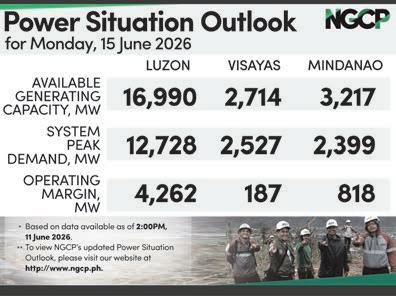
“What he says and what he does are two different things,” the majority
The majority, which owned 71 percent of the family business, said Piki welcomed peace with his cousins on the same day he filed complaints of indirect contempt against them.
The majority members individually had written First Gen to ask for documents about its hydropower deal with Enrique K. Razon Jr.’s
Piki was forced to disclose select information about the deal six months later after the majority came out with press statements about hidden poison pills that could penalize First Gen, and ultimately its shareholders, of as much as P24 billion if Piki and his designees in the company are removed.

By Lenie Lectura @llectura
THE government may award the contract to rehabilitation the Agus-Pulangi hydroelectric complex in Mindanao by year’s end, paving the way for the restoration of the power facility’s rated capacity.
“We hope to proceed by December, to award it,” Energy Undersecretary Mario C. Marasigan said adding that rehabilitation works could be concluded “likely 2028 to 2032,” since rehabilitation would be done in phases.
The Agus-Pulangi hydropower complex consists of seven run-of-river hydroelectric power plants located in southern and central Mindanao with a combined installed capacity
T HE Department of Energy (DOE) will soon present to interested bidders the improvements it made in the terms of reference (TOR) for the Semirara coal blocks.
“We are scheduled to have a pre-bid conference hopefully within the month. And then we’ll see who are interested. So that’s the final consultation for the stakeholders on the terms of reference.
It’s scheduled for June. And then after 60 days, we’ll have the submission,” said DOE Secretary Sharon Garin.
Earlier, the agency lanched a competitive bid round for coal development and production areas, including blocks in Semirara Island, under the Philippine Conventional Energy Contracting Program. The process aims to ensure a transparent a competitive contracting framework, with proponents evaluated based on their technical capability, financial capacity, work program, safety standards, and environmental safeguards.
Consunji-led Semirara Mining and Power Corp. (SMPC) currently holds coal operating contract (COC) no. 5, which is among the coal blocks in Semirara Island that will be auctioned. The COC is valid until July 14, 2027. Lenie Lectura
of 1,000 megawatts (MW). However, only up to 700MW are operational due to ageing infrastructure.
The Power Sector Assets and Liabilities Management Corp. (Psalm) is already evaluating two unsolicited proposals for the rehabilitation of the Agus-Pulangi. However, their identities remain undisclosed. Hopefully, the winning concessionaire could bring it back to capacity and able to sell that electricity.
The Psalm was created under Republic Act 9136, or the Electric Power Industry Reform Act of 2001, to lead the privatization of generation and transmission assets of the National Power Corp. (Napocor).
According to Marasigan, the Psalm Board has approved the proposed terms of reference (TOR)
for the rehabilitation of the AgusPulangi.
“The final terms of reference from the third-party consultant , which is the transaction advisor tapped by Psalm, presented the terms of reference for negotiation. So the board already approved. This will now be presented to the National Investment Council and subsequently for endorsement to the PPP [Public-Private-Partnership] Center then back to [the] Psalm,” Marasigan added.
Napocor President Jericho Jonas B. Nograles maintained that the state firm will still operate and maintain the Agus-Pulangi asset.
“That’s very important. Operations and maintenance is Napocor because it is not a privatization; it’s rehabilitation,” he said. “Basically how

it works like currently, [the] Psalm is paying Napocor for operations and maintenance. So regardless of what happens, Napocor will still be paid to operate and maintain the AgusPulangi complex,” added Nograles.
Energy Secretary Sharon S. Garin said a change in the administration will not result in any disruption of the rehabilitation and operation of the hydro asset.
“It’s not like the government is doing the project. It will be private that will lead the rehabilitation. Once there is an award that they will do the rehabilitation, there’s a contract with the government. You cannot just violate that because of change in the administration. There’s a contractual obligation. That’s the basic rule,” Garin said.
AS Wall Street races to incorporate war into its risk scenarios, the same people modeling natural catastrophes are now adapting their methodology to help investors, banks and insurers predict military conflicts.
Since 2008, the number of countries engaged in external conflicts has nearly doubled to just over 100, while the economic impact of violence now stands at almost $22 trillion, according to the Institute for Economics and Peace. That’s equivalent to more than 10 percent of the world’s gross domestic product.
Wars are upending the finance industry’s ability to predict everything from the price of oil to the cost of a mortgage, and Wall Street has had to acknowledge that some long-standing risk models may no longer be fit for purpose. Citigroup Inc. warns against relying on “rear-view mirror” models built on historical data, while Morgan Stanley says it’s time to “rethink” the status quo of geopolitical risks more broadly.
“Instead of looking back, insurers and investors increasingly want to know what might happen and where,” Sam Haynes, head of data and analytics at Verisk Maplecroft, a global risk consultancy, said in an interview. “They want a predictive forward-looking view.”
Verisk, which is best known for its work on natural catastrophe models for insurers and cat-bonds investors, has just unveiled a model it says would have helped financial professionals predict the Iran war. The firm’s Predictive War Index,
released to clients in late May, uses a machine learning algorithm to forecast the likelihood of war occurring in a country over the next 12 months. It was trained on political, economic, and social datasets from 1995-2022 and therefore doesn’t take the current Iran war into account. Even so, back-testing showed that had the model been ready in early January, it would have shown a 66 percent probability of war breaking out in Iran 1 1/2 months later, according to Verisk.
The firm’s other new model, the Geopolitical Relations Index, tracks the changing level of tension between pairs of countries. It looks at parameters such as whether they’ve had military clashes in the past, how similar their styles of government are, or whether they’re geographically close enough to project power.
A separate Verisk model, launched in October 2023, has in the period since then correctly predicted six out of seven government collapses, including the ouster of Bashar al-Assad in Syria in 2024, and the sudden removal of Venezuela’s Nicolas Maduro in January.
In the case of Maduro’s removal, “there were economic issues combined with a past history of political instability that increased the risk,” said Chris Boylan, a data science expert at Verisk Maplecroft.
A demonstrator holds an image of ousted Venezuelan President Nicolas Maduro in US custody, during a protest in Mexico City, in January.
Rand Corporation has an artificial-intelligence model that turns
complex and uncertain questions— such as regime change—into concrete probability estimates. The model draws in part on the aggregated opinions of people who aren’t subject-matter experts to forecast a future scenario. When the model was run in mid-May, it showed a 20 percent likelihood that Iran’s regime won’t survive into 2027.
“The results are designed not just to describe what might happen, but to show policymakers how specific actions—sanctions pressure, diplomatic engagement, or support for civil society— would shift those probabilities in practice,” said Anthony Vassalo, director of the RAND Forecasting Initiative.
Traditional models often stop working in the current climate because an event like a trade blockade or the imposition of economic sanctions “doesn’t behave like a standard-deviation move in a normal distribution,” said Krishan Sharma, senior vice presidentmodel risk management at Citi. “It changes the distribution entirely.”
The shipping disruption in the Strait of Hormuz has brought fresh attention to the extreme vulnerability of similar transport chokepoints around the world, requiring new risk algorithms for marine insurance and global trade. Shortly after the Iran war started on Feb. 28, Lloyds of London was quoting premiums for marine war risk in the Strait of Hormuz as high as 1 percent of a vessel’s value per voyage, compared with just a fraction of a percent before the conflict, according to Moody’s. Bloomberg
By Bless Aubrey Ogerio @blessogerio
THE Manila International Airport Authority (MIAA) has acquired ownership of the 61-hectare property occupied by the Ninoy Aquino International Airport (NAIA) Terminal 3 after reaching an agreement with the Bases Conversion and Development Authority (BCDA).
The transfer, formalized through an agreement signed on June 11, gives MIAA full control of the Pasay City property where Terminal 3 stands, ending years of negotiations over one of the country’s busiest aviation assets.
Under the agreement, the MIAA will pay BCDA P48 billion for the property. The payment includes an initial P10-billion down payment, with the balance to be settled through semiannual installments over the next 15 years, read a statement the MIAA issued on June 10.
The statement quoted government officials as saying that the transaction gives the airport authority greater flexibility to undertake long-term infrastructure investments as passenger traffic continues to grow.
The acquisition covers both the land and associated infrastructure of Terminal 3, allowing MIAA to pursue projects aimed at increasing capacity, improving passenger services, and addressing future demand.
Terminal 3 remains one of the country’s busiest gateways, with NAIA handling 27 million passengers in 2025, per the agencies.
According to MIAA General Manager Eric Jose C. Ines, the acquisition is a “significant step in strengthening the agency’s stewardship of a key national transport asset.”
“By securing ownership of the
CHINABANK SECURES AWARD
Terminal 3 property, [the] MIAA strengthens its stewardship of a strategic government asset and reinforces its ability to support the longterm development of the country’s premier gateway,” Ines said.
“This acquisition provides greater certainty for long-term planning, sound asset management, and the continued advancement of Philippine aviation,” he added. According to the BCDA, the transaction will generate funds to support its development mandate under Republic Act 7227, which directs the agency to convert former United States military reservations into centers of economic activity and growth.
The agency said proceeds from land transactions, including sales, leases, joint ventures and concession agreements, help finance national development programs.
Part of the revenue will be remitted to the national government through the Bureau of the Treasury and allocated to beneficiary agencies such as the Armed Forces of the Philippines. The remaining funds will be invested in infrastructure and development projects within BCDAmanaged economic zones.
BCDA President and CEO Joshua M. Bingcang said the agreement ensures that the property is managed by the agency best positioned to maximize its value while supporting public infrastructure and services.
“This agreement is the result of years of careful work to ensure that the Filipino people receive the greatest possible value from this public asset,” Bingcang said.
“It ensures that the property is placed in the hands of the agency best positioned to maximize its value, while generating revenues that can support public services and infrastructure,” he added.
THE China Banking Corp. announced last week that its “easy tax filing and payment solution” secured the “Excellence in Innovation in the Philippines 2026” award from United Kingdom-based financial media and intelligence platform GBAF Publications Ltd. A statement issued by the lender read that the recognition “reinforces the bank’s broader digital strategy, showcasing its commitment to delivering solutions that address real operational pain points and improve the end-to-end financial workflows of its corporate clients.” “Our focus has always been to provide solutions that empower businesses to redirect their resources toward core growth and project execution,” Chinabank Cash Management Services and Operations Group Head Domingo P. Dayro Jr. was quoted as saying in the statement. VG Cabuag
SECURITY BANK APP RECOGNIZED
KUALA Lumpur, Malaysia—Security Bank Corp. announced it has been recognized at “The Asian Banker Global Financial Technology Innovation Awards 2026” for strengthening both its digital banking experience and payments infrastructure, earning Best Mobile Banking Technology Initiative in Asia Pacific for the Security Bank App and Best Payment Technology Initiative in Asia Pacific for its partnership with ACI Worldwide. The recognitions reflect the bank’s
By Reine Juvierre Alberto @reine_alberto

THE restoration of financial support for the Philippine Health Insurance Corp. (PhilHealth) pushed national government subsidies to state-run corporations to P93.126 billion in the first four months of the year.
Subsidies extended to government-owned and -controlled corporations (GOCCs) surged by 150.79 percent as of end-April, from P37.133 billion in the same period last year, based on data from the Bureau of the Treasury.
Broken down, other state firms received P73.793 billion while major non-financial government corporations and government financial institutions acquired P18.333 billion and P1 billion, respectively.
Among the GOCCs that obtained subsidies during the four-month period, PhilHealth got the biggest chunk of subsidies.
PhilHealth accounted for about three-fifths of the total subsidies, after the government returned the state health insurer’s P60-billion reserve fund in April. (See: https://businessmirror.com. ph/2026/05/07/btr-returns-tophilhealth-funds-stripped-offby-dof/)
Recall that the Department of Finance ordered the sweeping of GOCCs’ excess funds to finance unprogrammed appropriations in
compliance with a Congressional mandate under the 2024 General Appropriations Act (GAA).
Supposedly, PhilHealth will transfer P89.9 billion, but the Supreme Court issued a temporary restraining order, resulting in only P60 billion in remittances.
To note, the state health insurer receives budgetary support from the government to fund the health insurance premiums of vulnerable and indigent members.
Following PhilHealth as the second-largest recipient was the National Irrigation Administration (NIA) with P7.843 billion, trailed by the National Food Authority (NFA) with P6.343 billion.
Other top subsidy recipients are the National Electrification Administration with P3.022 billion, the Power Sector Assets and Liabilities Management with P2.5 billion, and the Bases Conversion and Development Authority with P2.084 billion.
For the month of April alone, subsidies climbed by 355.74 percent to P66.283 billion from P14.544 billion a year ago due to the return of the P60-billion reserve fund to PhilHealth.
Aside from the state health insurer, other top recipients during the month were the NFA with P2.472 billion and the NIA with P917 million.
The government has allotted higher subsidies worth P149.654 billion for state-run corporations this year.
By Andrea E. San Juan
THE Monetary Board is set to green light a framework that seeks to expand access to credit information for authorized external users as the central bank aims to maintain an “effective” credit registry.
“In this regard, the “Open Access Framework” (OAFw) sets out the approach for granting external users access to BSP’s collected credit information while ensuring that the data are handled securely, responsibly, and efficiently,” BSP said in a draft circular.
The central bank said the framework covers borrowers who would be granted access to their own credit information upon identity verification.
It also covers BSP-supervised Financial Institutions (BSFI) that provide credit, and credit bureaus or agencies engaged primarily in the business of providing comprehensive credit and other related information. These entities shall be granted access upon accreditation with the BSP as “accessing entities” (AE) and special accessing entities” (SAE).
According to the BSP’s draft circular, credit information accessed through the central bank’s credit registry shall be used for the purpose of establishing client identity and borrower creditworthiness, and support other related credit risk assessment and client due diligence activities.
Trade dept
By Bless Aubrey Ogerio
THE Department of Trade and Industry (DTI) vowed to closely monitor cement prices and periodically review safeguard duties to ensure protection for local manufacturers does not result in unreasonable costs for consumers.
The assurance came after the agency expanded the coverage of safeguard duties on imported cement
By Justine Xyrah Garcia
WHILE Manila has long relied on remittances as a tool to keep the economy humming, the World Bank said households that need them most are the least likely to clamber out of the poverty pit.
In its latest “Poverty and Equity Assessment,” the World Bank said remittances remain an important source of income, resilience, and upward mobility for Filipino families. However, the benefits of overseas migration are increasingly concentrated among betteroff households and regions with established migration networks, limiting remittances’ potential to reduce poverty.
“Critically for the Philippines’ ability to support poverty reduction through remittances, the poorest regions are less likely to send OFWs, leading to lower remittances,” the report stated.
According to the report, remittances account for a larger share of household income in regions with relatively lower poverty rates.
The BSP explained the stance is anchored on the principle that informed lending decisions support effective credit risk management.
“Strengthened credit risk assessment fortifies individual financial institutions and contributes to the resilience of the broader financial system,” the central bank pointed out.
The BSP further noted that enabling access to comprehensive borrower data allows credit-granting entities to better serve consumers, empowering them to build reputational collateral and improve access to formal credit.
To “operationalize” the framework, the BSP would also issue guidelines for the accreditation, requirements, evaluation processes and post-approval obligations of AEs and SAEs.
“Upon approval of the accreditation, AEs and SAEs shall enter into ‘participation agreements’ (PAs), which define the contractual terms governing access to credit information in CRIMS [credit information management system],” the BSP circular noted.
As to the execution of contractual arrangements, the central bank said all accredited entities shall enter into a PA with the BSP.
“The PA sets forth the terms and conditions governing access to credit information in the CRIMS, subject to applicable data privacy laws, rules, and regulations,” the BSP said in its draft circular.
to include shipments from China and Indonesia. The DTI’s tack followed a review showing that imports from both countries had grown beyond the threshold that allows developing economies to remain exempt from the measure. (See: https://businessmirror.com.ph/2026/06/02/ china-indonesia-caught-in-cement-safeguard-net/)
A statement issued by the DTI read that its personnel continues to
For instance, remittances make up 10.5 percent of total household income in Ilocos Region, while the share reaches 8.5 percent in Central Luzon.
The World Bank said the uneven distribution of migration opportunities has allowed some regions to benefit more from overseas employment than others.
Households in poorer areas are generally less likely to send family members abroad, limiting their access to remittance income and the economic opportunities that come with it.
“A significant barrier is low liquidity in poorer regions. Migration is typically financed by family or through informal loans from relatives and neighbors, while access to certifications and trainings is more
costly in remote provinces,” the bank noted.
The trend is also reflected across income groups. Recent data cited by the World Bank showed that the country’s secure middle class receives about 60 percent of remittances.
The Washington-based lender also found that remittance receipts are more common among bettereducated households, with about 25 percent of households headed by college graduates receive remittances. These transfers account for 24 percent of their income.
In contrast, only 19 percent of households headed by individuals with secondary education or less receive remittances, and these transfers make up a smaller 21 percent share of their income.
The World Bank said one way to address the imbalance is to reduce the financial barriers that prevent residents of poorer and less-connected regions from pursuing overseas employment opportunities.
“Given the local economic benefits from remittances and the higher costs of human capital investments and migration facing individuals in poorer, less-connected regions, reducing credit constraints for training and pre-migration costs in these regions could offer a promising pathway to expanding opportunities to poorer house -
holds,” it explained.
The report also pointed to emerging models such as Global Skill Partnerships, which co-finance worker training in origin countries based on labor market needs in destination countries.
The World Bank said pilot programs in lagging regions could help determine effective ways to expand migration opportunities among poorer households. To illustrate the potential gains, the bank modeled a scenario in which regions with below-average remittance receipts gain greater access to overseas employment opportunities. Under this scenario, national remittances could increase by 7.4 percent by 2040.
The largest gains would accrue to poorer households. Remittances received by the poorest 10 percent of households could rise by 39.7 percent by 2040, while those received by the second-poorest and third-poorest deciles could increase by 30 percent and 20 percent, respectively. Even under that scenario, however, remittance inflows would remain heavily concentrated among wealthier households. By 2040, the richest 10 percent of households would still account for 43 percent of all remittances, while the poorest 10 percent would receive less than 1 percent.
Fed, BOE stay guarded after 100 days of Iran war
FOR several global central banks, the question of whether the Iran war poses more of an immediate danger to inflation or to growth is likely to remain open in the coming week.
Officials responsible for monetary policy in seven of the world’s most-traded currency jurisdictions are mostly anticipated to keep settings steady again.
A well-flagged rate hike from the Bank of Japan to continue its exit from low borrowing costs and a close call in Norway are likely exceptions, but the US Federal Reserve and its peers from the UK to Sweden are widely expected to make no changes.
The urge to wait longer to gauge the impact of a conflict whose duration just surpassed 100 days may be reinforced by US President Donald Trump’s efforts to secure a peace deal with Iran. That process will play out against the backdrop of his expected attendance at a summit of the Group of Seven in France on Monday.
But a sense of divergence within the club of advanced economies is already crystallizing after the European Central Bank on Thursday delivered its first interest-rate increase since 2023.
Peers in Norway and Australia have already raised rates, although they’re seen likely to feel no urgency to do so again. Meanwhile, the Swiss National Bank, whose policy is impacted by safe-haven flows into the franc, will probably keep its own rate at zero.
In all, more than 20 central banks accounting for upwards of 40 percent of world output between them are slated to make rate decisions, point-
conduct regular market surveillance and price monitoring nationwide to track movements in cement prices and assess the impact of trade remedies on the construction sector. Trade Secretary Ma. Cristina Roque said that safeguard measures would be reviewed to ensure they remain only at levels necessary to shield local manufacturers from import surges without causing undue price increases.
ing to how the week may largely bookend the first half of 2026. Among the highlights further afield, officials in Brazil and Russia may cut borrowing costs, while a Czech hike could also materialize.
Elsewhere, Chinese data covering sectors from retail to industry, Japanese inflation, a vote in Switzerland on a possible population cap, and a summit of European Union leaders in Brussels will be among the highlights.
THE Fed gathers on June 16-17 for the first meeting to be overseen by the new Chairman Kevin Warsh, who was previously a Fed governor from 2006 to 2011. Officials are widely expected to keep borrowing costs steady, but the outlook is less clear.
On the heels of a stronger-thanexpected jobs report, US inflation rose in May at the fastest pace in more than three years. If those price pressures persist, policymakers may have to consider raising rates.
Officials will scrutinize an array of data, including consumer spending. American shoppers have proved resilient, though with prices now rising faster than wages, they’re coming under increasing pressure.
Data out Wednesday is expected to show retail sales rose 0.5 percent in May. While the figures aren’t adjusted for inflation, such a reading would suggest consumers are holding up in the face of higher prices at the gas pump and the grocery store.
Other data on the schedule includes industrial production on Monday and housing starts on Tuesday.
In Canada, retail sales data for
The latest review covered cement import data from 2025 through the first quarter of 2026 and found notable shifts in sourcing patterns.
While Vietnam remained the country’s largest supplier, accounting for the bulk of cement imports, shipments from China and Indonesia increased enough to lose their exemption status under safeguard rules.
As a result, imports from the two countries are now subject to the safe-
April and a flash estimate for May are expected to show continued headline growth, largely driven by higher gasoline prices. The key question is whether spending in other categories also increased. Consumers in March mostly pulled back as rising energy costs absorbed a larger share of budgets.
Meanwhile, existing home sales for May are likely to remain subdued. Regional data indicate that while activity picked up in Toronto, it declined in Vancouver, Calgary and Montreal. Housing starts also likely slowed. In contrast, manufacturing and wholesale sales are expected to have continued rising in April, supported by elevated oil prices.
INVESTORS face a packed week of monetary decisions and key activity data, with attention centered on whether signs of slowing growth are becoming more evident even as inflation risks remain uneven.
The week begins with New Zealand’s services-sector performance index and electronic card spending figures for May. The same day, Pakistan’s central bank is expected to raise its key rate to 12 percent from 11.5 percent, while India publishes an employment report.
The focus shifts to China on Tuesday, when a batch of May activity indicators will provide the latest assessment of the world’s secondlargest economy.
Retail sales are expected to be flat from a year earlier, while industrial production is seen accelerating modestly. Investors will also scrutinize fixed-asset, property investment
guard duty currently imposed on covered cement products. The duty remains at P14 per 40-kilogram bag, or P349 per metric ton, during its first year of implementation.
The DTI said the measure forms part of its broader effort to address import-related pressures on the domestic cement industry while maintaining adequate supply for infrastructure and construction activities.
and residential sales data for signs of whether the prolonged downturn in the housing sector is stabilizing. Later on Tuesday, the Reserve Bank of Australia is widely expected to leave its cash rate target unchanged at 4.35 percent, the first pause of 2026 after three increases. The Bank of Japan follows hours later and is expected to raise its policy rate to 1 percent, extending a gradual normalization cycle. The decision will be watched closely for clues on how policymakers view the durability of wage growth and inflation as Japan moves further away from the ultra-loose policies that defined the previous decade.
Trade will dominate the agenda on Wednesday. Japan is expected to report another solid month of external demand. The country also releases core machinery orders, a closely watched gauge of business investment.
Elsewhere, Singapore’s non-oil domestic exports are projected to have maintained strong momentum. Taiwan’s central bank is expected to leave its benchmark rate unchanged, while New Zealand publishes current-account figures.
Thursday brings first-quarter gross domestic product data from New Zealand, where economists expect growth to accelerate to 0.9 percent quarter-on-quarter from 0.2 percent in the previous three months. Central banks in Southeast Asia also take the spotlight. The Bangko Sentral ng Pilipinas is expected to raise its overnight borrowing rate while Bank Indonesia is seen staying on hold after a surprise hike on June 9. Bloomberg
The agency emphasized that future assessments will continue to consider both industry conditions and potential effects on consumers as it evaluates the safeguard mechanism.
“[The] DTI remains committed to protecting the local market within legal boundaries while ensuring stable prices and a steady supply for consumers,” Roque was quoted as saying in the statement.

By Lou Kesten The Associated Press
WASHINGTON—In 1976’s Rocky, heavyweight champion Apollo Creed arrives for the title fight dressed as George Washington, reenacting the crossing of the Delaware as models costumed as the Statue of Liberty lead the way.
A fter entering the ring, Apollo switches into an Uncle Sam costume. “I want YOU!” he roars as he points to Rocky Balboa, the far less flamboyant palooka he’s chosen for this bicentennial bout in Philadelphia. Then the two boxers pound the daylights out of each other.
It’s as accurate a representation of the American bicentennial vibe as has ever been put on film — plenty of fireworks, but not much thought about how 200 years of independence led to this.
I was 13 years old in 1976. Kids my age — the tail end of the Baby Boom, or the vanguard of Generation X — grew up skeptical of the government. We had outlasted the Vietnam War and the Watergate scandal, with the occasional moment of joy — the moon landing, say — to break the gloom. The state of the union was intact, even if many Americans were still on edge. My family lived in Newport News, Virginia, not far from the Historic Triangle of Jamestown, Yorktown and Williamsburg. So there was plenty of buzz surrounding the bicentennial. President Gerald Ford and his wife, Betty, took a carriage ride through Colonial Wil-
liamsburg, foreign leaders came to visit, and the living museum regularly staged reenactments of the events leading up to the signing of the Declaration of Independence. Ford and plenty of other dignitaries went to New York for what the president called “the greatest Fourth of July any of us will ever see.” Operation Sail was a floating parade of 16 tall ships and more than 100 smaller vessels from around the world — including, even, the Soviet Union. It was a boon for the beleaguered Big Apple, proving that “New Yorkers could get along, even during difficult times,” according to the Gotham Center for New York History.
All aboard the Freedom Train FOR history buffs who couldn’t make the trip east, there was the American Freedom Train, a 26-car behemoth that toured all 48 contiguous states. It displayed two centuries of artifacts like George Washington’s copy of the Constitution, the original Louisiana Purchase, Judy Garland’s dress from The Wizard of Oz and a moon rock. Merle Haggard even released a song about it. I had a nifty 3D poster of the

Freedom Train on my bedroom wall. A different poster captured everyone’s eye later in 1976 — one featuring Charlie’s Angels star Farrah Fawcett-Majors. It’s patriotic in its own way. There’s Farrah, sporting big hair, a blinding white smile and a red swimsuit, posed in front of a red, white and blue blanket. The color scheme may not have been intentional, but it might as well be titled “All-American Girl” for its presentation of what much of society saw as one. There were plenty of more deliberate anniversary collectibles out there. A quick search of eBay in 2026 digs up hundreds of collectible plates, glasses, beer mugs and bumper stickers. The government unleashed special quarters, stamps and license plates. And of course Madison Avenue jumped in, selling bicentennial cereal, candy, beer and soda. You could get a different
7-Up can for each of the 50 states. Even the creator of the Pet Rock—the preposterous 1975 phenomenon that was, yes, a rock in a box—tried to get in on the act. That fad, alas, had run its course, and the Bicentennial Pet Rock flopped. You’d have been better off buying a Pez dispenser with the head of Paul Revere or Betsy Ross. Broadcast television—remember, we only had three networks—was more subdued. For kids, ABC’s beloved “Schoolhouse Rock!” spun off “America Rock.” But while that cartoon did include some history, it’s best remembered for the mournful civics lesson “I’m Just a Bill.” More prominent was CBS News’ “Bicentennial Minute.” Starting July 4, 1974, barely a month
unavoidable that sitcoms like “All in the Family” referred to it; “Saturday Night Live,” which debuted in 1975, paid tribute with a “Bisexual Minute.”
Still, all three networks pulled out the stops on July 4, 1976. Walter Cronkite led the pack with 16 hours of coverage on CBS, while “Bob Hope’s Bicentennial StarSpangled Spectacular” (“the show that took 200 years to produce”) on NBC celebrated with Sammy Davis Jr., Captain & Tennille and Donny and Marie Osmond.
The bad news bearers
CERTAINLY, not everyone was in the mood to celebrate. Richard Pryor released an influential album whose title was Bicentennial, followed by an ethnic slur. The title track is a monologue from a 200-year-old slave; it ends with “I ain’t gonna never forget it.” In the same album’s “Bicentennial Prayer,” Pryor proclaims, “We are celebrating 200 years of white folks kickin’ ass.”
Popular music wasn’t in a particularly patriotic mood either. Elton John’s 1975 hit “Philadelphia Freedom” became a de facto anthem of sorts, even though it’s barely about Philadelphia and is more about individual independence. I ndeed, the prevailing pop attitude was: Let’s forget about this mess we’ve left behind and go to the disco. So the Billboard singles charts were topped by the likes of Johnnie Taylor’s “Disco Lady,” The Sylvers’ “Boogie Fever,” The Bee Gees’ “You Should Be Dancing” and KC and the Sunshine Band’s “(Shake Shake Shake) Shake Your Booty.” On the album charts, California’s hippie culture was shaking off
its hangover with haunted LPs like the Eagles’ “Hotel California” and Jackson Browne’s “The Pretender.” Something else was breaking loose in New York, though, with aggressive debuts from the Ramones and Blondie. The Ramones’ logo included an eagle holding an olive branch and a baseball bat, and their repertoire included the future stadium anthem “Blitzkrieg Bop.” What could be more American? Speaking of America’s pastime, I’d be remiss if I didn’t bring up the year’s funniest movie, The Bad News Bears. It’s baseball the way it was meant to be played—by a bunch of foul-mouthed juvenile delinquents coached by a surly, alcoholic has-been embodied by Walter Matthau. Double 50-yearold spoiler alert: Like Rocky, the Bears don’t win in the end. But they do have fun. The same can’t be said for the characters in most of 1976’s dramatic films. Hollywood did its best to get a patriotic movie—the World War II epic Midway —in theaters in June, but it quickly fizzled. The top box office draw on July 4th was The Omen, about an angelic-looking boy who turns out to be the Antichrist. More prestigious films continued to wrestle with the paranoia of the Nixon era. All the President’s Men dramatized The Washington Post ’s investigation of the Watergate scandal. In Taxi Driver, a Vietnam War veteran plots to assassinate a presidential contender. In Network, a TV anchorman urges his viewers to open their windows and scream, “I’m mad as hell and I’m not going to take it anymore!” A ll three are undisputed classics. All three were nominated for the Best Picture Oscar. All three lost to Rocky

THIS Pride Month—be seen, be heard, be there. Resist. Rebel. Exist! Live Loud and Love Proud! n ‘1946: The Mistranslation That Shifted Culture.’ The word “homosexual” was never in the Bible...until 1946.
The groundbreaking, award-winning feature documentary, as explained in its website, “follows the story of tireless researchers who trace the origins of the anti-gay movement among Christians to a grave mistranslation of the Bible in 1946. It chronicles the discovery of never-before-seen archives at Yale University which unveil astonishing new revelations, and casts significant doubt on any biblical basis for LGBTQIA+ prejudice.”
It contains commentary from prominent scholars as well as opposing pastors, including the personal stories of the film’s creators; the film is at “once challenging, enlightening, and inspiring. The director is Sharon “Rocky” Roggio, an independent filmmaker and production designer (credits include House of Cards, Red Dawn), and is proudly LGBT.
As it stressed on Instagram: “This isn’t opinion— it’s history. This is about more than language. It’s about lives. LGBTQIA+ people have been cast out, shamed, and harmed—not by God, but by a single mistranslation that’s been weaponized for decades. “1946 uncovers the receipts. The scholarship. The truth. And once you see it, you can’t unsee it. We’ve seen the videos. We’ve heard the sermons. And once again, LGBTQIA+ people are being told that denying themselves is the path to holiness.
“Being LGBTQ is not a sin. And queer people do not need to become ‘less themselves’ to become more loved by God.”
n Amnesty International. n The human rights organization wrote: “While Pride is often perceived as a celebration, it originally began as a riot against police brutality at the Stonewall Inn in New York City.
“On 28 June 1969, the Stonewall Inn was raided by the police, as it had been on many occasions before, due to laws which required a ‘man’ or a ‘woman’ to be wearing clothing items which ‘matched’ their gender on their state-issued ID. As the LGBTI community in the Stonewall Inn, primarily led by trans women of color, fought back, police brutality increased amid six days of riots which was a galvanizing force for LGBTI activism in the USA.
“In many states around the world, Pride is still centrally and most importantly a protest which highlights, commemorates, and fights for the rights of LGBTI people.
“No matter who you are, love is a human right.”
n Love Yourself Inc. LoveYourself, the brainchild of Ten Outstanding Young Men of the Philippines (Youth Leadership) and Ten Outstanding Young Persons of the World Awardee (Humanitarian Leadership) Ronivin (Vinn) Garcia Pagtakhan, “believes that self-worth is key to building an empowered community. We exist to ignite in each one an active desire for a healthy and vibrant self-worth, especially among the youth and males who have sex with males (MSMs).”
Supported by pageant royalty like Pia Wurtzbach and Catriona Gray, the advocacy group posted on its Facebook: “Makulay ang Pag-ibig. Karapatan ng bawat isa na magmahal at mahalin nang walang takot, paghusga, o diskriminasyon. Ang pag-ibig ay para sa lahat.” n Drei Arias for Mr. Gay World Philippines 2026. The former King of the World Philippines 2025 generated excitement when he came out this Pride Month. In a video, he declared: “So let’s get this thing

Watsons

straight: I’m not. Yep, I just came out. Genderfluid pansexual. Why is it so important for me to come out?
“For years. I have struggled to be my true self. Looking over my shoulder every time I go out, every time I do something, every time I post something. And that had just been the setup for the past years and I’m done with it.
“And I just want to live a life that I will not regret. So, this time, I’m calling the shots of my life. Happy Pride, everybody. Love yourself!”
(The finals of MGWP will be on June 26, 2026, The Crossroad Center, Quezon City.)
n Black Barbie’s Wedded Bliss. Skelly Ivy Florida, from Biliran, was a heavy favorite to win Miss Universe Philippines 2020. Fans fondly called her the Black Barbie, long before Chelsea Manalo won the title in 2024. Back then, it was only Cavite’s Billie Hakenson who publicly came out as LGBT.
Skelly, though, besides being a cabin crew at Philippine Airlines, is enjoying wedded bliss to her
wife, posting on her socials: “Life has never been so beautiful. One year married to my Connierene, forever loving my Connierene. Happy First Wedding Anniversary, my Love. I love you, till my last breath.” Miss Universe Philippines-Biliran
n MisOr Pride March, June 19. The march is heavily supported by the Provincial Government of Misamis Oriental, under the leadership of Gov. Juliette T. Uy. As posted by homegrown queen, Miss InterContinental 2021 Cindy Obeñita, and Uniquely MisOr: “Let’s celebrate love, equality and inclusivity at the MisOr Pride March on June 19, 2026, at 2 pm, as we march from Pelaez Sports Center to the Provincial Capitol Grounds, Cagayan de Oro City.
“Join us as we come together to raise our voices, embrace diversity, and stand in solidarity with the LGBTQIA+ community in Misamis Oriental. This is more than just a march—it is a powerful movement that celebrates pride, courage, unity, and the freedom to be who we are.”
n Kween Con 2026 at SM North Edsa, June 20. Eleganza Extravaganza will be served on June 20, 2026, at the SM North Edsa Skydome as Filipino Drag Excellence as The Playhouse PH takes centerstage. Kween Con 2026 gathers the most sick’ning drag queens this side of the RuPaul’s Drag Race multiverse, with performances from Precious Paula Nicole, Marina Summers, Brigiding, Captivating Katkat, Eva Le Queen, Minty Fresh, Viñas Deluxe, Arizona Brandy, Hana Beshie, Bernie, Khianna, Turing, Katana, Maureen Biology, and Australian drag queen Ivory Glaze.
n Cebu Grand Pride Parade 2026, June 27. With the theme Pagkahiusa sa Sugbo, Kadaugan sa Tanan! the whole Cebu island is taking its biggest step yet in one united march for diversity, equity, inclusion and belonging.
Led by Gov. Pam Baricuatro of Cebu Province and Cebu City Mayor Nestor Archival, the parade is organized by Cebu Pride Movement, Cebu City AntiDiscrimination Commission, and Cebu City Sogiesc Pride Empowerment Council-SPEC, supported by our friends from JCI Cebu Lakan Bahaghari, One Pride Mandaue, and Pride PH.
“We march not only to celebrate who we are, but to celebrate what we are becoming: a province where every person can live with dignity, safety, respect and pride,” the parade organizers stated.
n Lovelab4n, June 27. With tremendous support from Quezon City Mayor Joy Belmonte and the University of the Philippines community, the fourth edition of Asia’s biggest Pride celebration will be hosted by LGBT icons Kaladkaren, Sassa Gurl, Esnyr, AC Soriano, Yani Hatesu, Inah Evans, Pipay Sky Quizon, Janella Salvador, and Queen Dura, among many others: “Wit, talent, and unapologetic pride—kumpleto ang rekado ng ating roster ngayong taon para panatilihing umaapaw ang energy ng pambansang movement!”
EVER Organics, the best Korean skincare brand in the Philippines, marked its birthday not with a party but with a purpose. The beloved K-beauty brand brought its team, its community and its heart to SOS Children’s Village Pilipinas, where the brand spent the day with over 30 children aged 6 to 19 in an afternoon of games, connection, and dreaming out loud.
The giveback day drew a warm crowd of volunteers, including some of the country’s most recognized skincare voices: JB Correa, Bella Gonzalez, and Jayson Lee, Korean artist and Ever Organics brand ambassador, and member of P-Pop group 1st One. Together, the volunteers served as “ates and kuyas” to the SOS kids. They lead team games, cheered on friendly competition, and ultimately gathered around the event’s most meaningful moment: each child sharing their dream.
The dreams ran the full range of childhood wonder. Some children spoke of becoming pilots, doctors, and seamen. Others wished simply for new shoes and new
brand, embodying confidence, self-expression, and Filipino excellence. Meanwhile, December Avenue continues to define the voice of OPM through heartfelt music that blends timeless Filipino sentiment with their signature sound. Maki represents the new generation of OPM, consistently drawing sold-out crowds and proving his growing impact on today’s music scene.
One of the concert highlights was Maki performing his new song “habangbuhay pansamantala” live for the very first time, making the experience even more special for fans. Excitement filled the arena as SB19, Maki, and December Avenue took the stage for a surprise collaboration performance of SB19’s hit song “Wakas,” bringing together some of today’s biggest OPM acts in one unforgettable showcase. The concert, held at the MOA Arena, is part of AS Watson Group’s 185th year celebration. Watsons Playlist is but one of the many perks of being part of the Watsons Club.
Signing up is free and can be easily done online or in-store at any Watsons branch. Once you’ve signed up, the membership lasts a lifetime with no expiration.
socks. Each dream, no matter how grand or how modest, was met with the same warmth and applause.
Jayson Lee took to the stage to share his own story. He shared that he once dreamed of becoming a flight attendant, and how his dreams have since grown to include acting, directing and producing films as he steps deeper into show
JB Correa moved the room with a message that became the afternoon’s quiet theme: that his dream for that day was for every child’s dream to come true. He urged the kids to dream specifically, to dream relentlessly, dream big, because one day, one of those dreams just might come true.

“As Ever Organics celebrates another year, we wanted to celebrate not just through beauty, but through care, kindness, and meaningful moments shared with others,” said Ever Organics brand representative Denice Sy. “Today is about creating happy memories, building connections, and contributing to SOS’s mission of making every child here feel loved, confident and special.”
Each child went home with a care package that felt very Ever Organics: an Eow plushie doll (the brand’s beloved mascot), Ever Organics Aloe Vera Soothing Gel, and Ever Organics Aloe Vera Sunscreen—two of the brand’s most sought-after Korean skincare products in the Philippines. A collection of toys was also included, making the afternoon feel like a full celebration.
HITCHED, organized by Flair Pop-Up, is a premier bridal and wedding fair in Metro Manila. It brings together top-tier wedding suppliers, lifestyle brands, and exclusive discounts for soon-to-wed couples. It will be held on June 20-21 at The Fifth at Rockwell. The Flair Pop-Up bazaar, formerly known as Row 101, was founded by Miel Villamor-Coronel in 2014.
Miel said the Hitched event will have 90 to 100 suppliers.
“We try to look for brands that are fairly new, those who haven’t joined bridal fairs. There are a lot of good talents out there and for brides, it’s a an exciting thing to discover something new.”
Miel’s goal for Hitched is for it not to be overwhelming, and for guests to have a good time and not feel confused and bewildered. We asked Miel what trend she has seen in suppliers and weddings.
“It’s carts. The younger brides love it but their moms don’t like it. It’s not just coffee carts. There are also carts for candles, flowers, etc. Every wedding I’ve been to also has a photo booth and people love it.”

offering
Architecture and Interior Design students worldwide are being invited to rethink the future of spaces, communities, and culture as the AYDA Awards officially starts its new season.
Now on its 18th year, the competition formerly known as the Asia Young Designer Awards (AYDA) returns with the theme “Converge: Embracing Hyperlocal.” The 2026 theme reflects a growing global shift in design thinking, where the world becomes increasingly interconnected. “Converge” highlights the intersection of cultures, technologies, and ideas, while “Embracing Hyperlocal” underscores the importance of grounding innovation in the unique identity of specific communities.
In rapidly urbanizing contexts such as the Philippines, hyperlocal design takes on heightened relevance. It encourages architects and interior designers to draw from indigenous materials, traditional construction techniques, and cultural narratives that are often overshadowed by modern development. From adaptive reuse of heritage structures in historic Manila districts to communitycentered housing solutions in disaster-prone areas, hyperlocal design offers a framework for creating spaces that are both functional and deeply rooted in place.
Rather than treating globalization as a force that standardizes design, AYDA 2026 positions it as an opportunity for convergence, where global ideas are reinterpreted through local lenses. This approach empowers emerging designers to respond more meaningfully to pressing challenges such as climate resilience, urban density, and cultural preservation.
Organized by Nippon Paint, the international design competition encourages Architecture and Interior design students to develop solutions rooted in local identity, cultural heritage, and community-driven innovation while addressing the evolving needs of a rapidly connected world.
At a time when ideas move globally in seconds, and design trends increasingly overlap across borders, AYDA 2026 is encouraging young creatives to rediscover the value of local wisdom, traditions, and materials.
Participants are challenged to design spaces and experiences that strengthen communities,


MOU ON ENERGY, CLIMATE POLICY RESEARCH SIGNED. Aboitiz Power Corporation (AboitizPower) and the Climate Change Commission (CCC) established a long-term framework for knowledge sharing, capacity building, and data-driven policy research on the power sector and climate change mitigation and adaptation via a Memorandum of Understanding (MOU). The strategic collaboration is aimed at accelerating the Philippines’ transition toward a climate-smart and sustainable future, helping bridge private sector operational capabilities with public sector frameworks and the strategic outcomes of the National Climate Change Action Plan. The MOU was signed by CCC Vice Chairperson and Executive Director Robert Borje (center left) and AboitizPower First Vice President for External Relations Jason Magnaye (center right), as witnessed by Mapúa University Executive Vice President Raul Victor Tan (leftmost) and CCC Deputy Executive Director Romell Antonio Cuenca (rightmost). At the same time, the MOU signing ceremony coincided with a two-day Power Systems 101 training program developed in collaboration with Mapúa University. Meant to connect ideal policy concepts with the operational realities of the Philippine power sector, it is the program’s third successful rollout since its launch in 2025.
celebrate heritage, and reimagine how local culture can shape future-ready environments.
Since launching in 2008, AYDA has grown into one of Asia’s most recognized design platforms, attracting more than 50,000 entries from over 1,300 tertiary institutions across 20 geographical locations worldwide.
Beyond the competition itself, AYDA has become a major talent development platform for emerging designers through mentorships, workshops, networking sessions, and cross-learning opportunities with leading industry professionals.
The program has also built a strong alumni network of socially conscious designers focused on combining creativity with realworld impact.
For Filipino architecture and design students, the theme resonates strongly with ongoing conversations in the local industry about sustainable urban development and culturally responsive design. With the Philippines facing increasing pressure from rapid city expansion and climate-related risks, the call for hyperlocal innovation highlights the role of young designers in shaping spaces that are not only globally competitive but also deeply responsive to Filipino communities and environments.
“Design today is no longer just about creating beautiful spaces. Young designers are being challenged to solve real problems, strengthen communities, and create environments that people can genuinely connect with,” said Chen Lee Siong, General Manager of Nippon Paint (Coatings) Philippines, Inc.
“With AYDA 2026, we want to encourage students to embrace local identity and culture while thinking boldly about the
future. Some of the most powerful design ideas come from understanding the communities around us,” he added.
One of the biggest highlights of AYDA Awards 2026 is the highly coveted “Harvard Prize,” awarded to the International Gold Winners named as the AYDA Designer of the Year for both the Architecture and Interior Design categories.
The prize includes a fully sponsored threeweek Design Discovery Program at the Harvard University Graduate School of Design (GSD) in the United States. Valued at up to US$10,000, the immersive learning experience covers tuition fees, airfare, accommodation, and visa support, giving winners direct exposure to one of the world’s leading design institutions.
The Harvard Prize serves as AYDA’s flagship international opportunity, allowing young designers to deepen their design thinking, collaborate with global peers, and gain first-hand insights into advanced spatial design practices.
Apart from the Harvard Prize, AYDA Awards 2026 will also recognize outstanding student work through multiple awards and opportunities.
Gold and Silver awardees will receive cash prizes and internship opportunities, while Honorary Mention winners and special category recipients will also receive monetary rewards.
Additional recognitions include Nippon Paint Color Award, Best Sustainable Design, and Best Design Impact.
Each special award comes with a US$ 1,000 cash prize. Mentors of winning students will also gain access to the Design Discovery Virtual (DDV) Program conducted by Harvard University’s Graduate School of Design.

IN a culture that celebrates constant movement and productivity, rest has quietly become a solitary act, something squeezed in between obligations rather than shared and celebrated. At its recent Bright Healthy Radiance event held at Longevity Labs, Cetaphil set out to change that narrative, reframing recovery not just as a physical necessity after exercise, but as an emotional and communal experience rooted in care, connection, and the spirit of being a “girl’s girl.”
Titled “Gentle Is a Girl’s Power Move,” the event brought together wellness, skincare, and community to spotlight a simple but often overlooked truth: recovery is better when it’s shared. In a world where self-care is often individualized, Cetaphil reintroduced the idea of collective rest—encouraging women to check in on one another, to pause together, and to rediscover the quiet strength in choosing gentleness.
“Today, we’re redefining what strength looks like,” said
Galderma’s Head of Marketing, Abe Mationg. “It’s about knowing when to be gentle with yourself. At Cetaphil, we believe recovery is not a pause from progress, but an essential part of it. ‘Gentle is a Girl’s Power Move’ is our way of reminding women that choosing care, consistency, and softness is actually what builds lasting strength.”
At the heart of the experience was the Biohack Buffet, an immersive recovery journey where guests explored modern wellness techniques designed to support the body post-exercise. From guided biohacking stations to red light yoga sessions, attendees experienced how intentional recovery can restore not just physical balance, but also mental clarity and emotional connection.
“Recovery is often treated as an afterthought, but it’s actually where the body does its most important work,” shared Dr. Coreen Copuyoc. “After any form of physical activity, the body enters a critical recovery phase where repair and regeneration happen. This doesn’t just apply to muscles—it includes the skin as well. Gentle, consistent care supports this process without adding stress, which is why recovery routines, including proper skincare, are key to maintaining overall skin health.”
More than just a wellness event, the experience tapped into a deeper cultural insight—the quiet loss of community in rest. Where friends once lingered after shared activities, modern routines now pull people in separate directions.
Cetaphil’s approach invites women to bring that back: to ask
a friend to slow down, to recover together, and to see rest as an act of care not just for oneself, but for each other.
“Being a ‘girl’s girl’ today means showing up not just for the highlights, but for the pauses in between,” added Rhizza Concepcion. “We wanted to bring back that sense of shared care, where recovery becomes something you experience as a community, not alone.”
Supporting this philosophy is the Cetaphil Bright Healthy Radiance Body Care Range, featuring the Brightening Bar and Brightening Lotion. Formulated with GentleBright Technology™, these clinically proven yet gentle products help reduce the appearance of dark spots and uneven skin tone while respecting the skin’s natural barrier. The Brightening Bar gently cleanses without stripping moisture, while the Brightening Lotion deeply hydrates and enhances skin radiance—making them ideal companions for post-workout recovery and everyday self-care.
Ultimately, “Gentle Is a Girl’s Power Move” is more than an event; it’s a call to action. A reminder that in choosing to slow down, to recover, and to care for one another, women aren’t falling behind; they’re building something stronger together. Because sometimes, the most powerful move you can make is to rest and to bring your best friend with you.
Cetaphil Bright Healthy Radiance is available in Watsons, Mercury Drug Stores, and all leading retail locations, and in Shopee, Lazada and TikTok Shop.
Johnson’s Baby celebrates the strong love of our mothers grounded in gentle care
JOHNSON’S Baby celebrates the strongest bond between mother and child, grounded on gentle care with #HaplosNgPagmamahal.
Mothers are natural caregivers who express their strong love through their instinctive touch. Eager to give the best for their child, moms move with such protective strength and tenderness to create a safe and loving space for their babies. Johnson’s Baby partnered with moms from Millennial Moms PH to talk about what it feels like being a mother and discovering the power of their gentle touch. Mae Francisco, an expecting mom, shared how even before her baby arrives, her choices have already changed— becoming more intentional, more gentle.
“Now that I’m soon to be a mom, I’m prioritizing all of my baby’s needs and beginning to understand the responsibilities of being a mother on a deeper level. I’ve become more intentional in the sense that I make healthier choices for the baby and me. One way I do this is through self-care, making
sure that I am in a calm state of mind so I can make the best decisions for me and my baby’s health.”
For first-time mom Artesa Lim, every day is a learning moment. From bath time to a simple touch, she’s discovering what it means to care with both confidence and tenderness.
“Being a first-time mom honestly changed me a lot. It’s beautiful, fulfilling, but also exhausting at times. I realized that motherhood doesn’t come with a manual—you really learn as you go. There are moments na mapapatanong ka if tama ba ginagawa mo, but seeing your child happy, safe, and loved makes everything worth it. I also discovered that even the simplest things like cuddling, carrying them to sleep, or just being beside them already mean so much to a child,” she shares.
Meanwhile, mom of two Monica Gregorio, raising a newborn and a toddler, spoke about how over the years she can attest to the fact that a mother’s touch goes a long way. “I’m learning that caring for my child is not just about meeting their needs. It’s also about making them feel safe, loved, heard, and supported even on difficult days. A mother’s touch holds a quiet but powerful kind of love. It soothes my baby without any words, calms their little worries, and makes them feel safe no matter what’s happening around them. In my simple embrace, I hope they always feel my love, my reassurance, and I’m always here for them. Because I believe the gentleness and softness I give them today will become the comfort they lean on and the confidence they carry as they grow,” she shares. Despite the growing number of mothers recognizing the need for gentle care, studies have shown that only 3 out of 10 households with newborns ages 0-1 years old use a baby wash while the rest cleanse their kids’ skin most likely with adult soaps. Many parents do not realize that
That is why last Mother’s Day, Johnson’s Baby made it a

Alfred Xerez-Burgos III, President and CEO of Forest Lake Development Inc., delivers his welcome remarks during the company’s 12th National Sales Convention, “THRIVE: Ani ng Tagumpay,” recognizing the dedication of Forest Lake’s nationwide sales force and celebrating the company’s record-breaking achievements in 2025.
FOREST Lake Development Inc., the Philippines’ leading memorial park developer with Total Memorial Care, gathered more than 550 guests at Okada Manila on April 21, 2026 for its 12th National Sales Convention, a celebration that honored its people, partnerships, and shared values behind the company’s continued nationwide growth and recordbreaking achievements in 2025.
Carrying the theme “THRIVE: Ani ng Tagumpay,” the convention highlighted Forest Lake’s historic P5.5 billion sales production in 2025, a significant increase from its P3.8 billion sales performance in 2024, and the company’s strongest milestone to date. The theme symbolized the harvest of success made possible through teamwork, perseverance, dedication, and the collective efforts of Forest Lake’s nationwide organization.
Serving as a tribute to the hardworking sales agents, sales leaders, sales support teams, regional sales groups, employees, executives, investors, banking partners, and stakeholders from Luzon, Visayas, and Mindanao, the convention celebrated sales achievements, and recognized the efforts that helped expand Forest Lake’s nationwide presence, strengthen customer trust, and deliver compassionate memorial care solutions to Filipino families.
“This celebration is not only about record-breaking sales–it is about the people behind those achievements,” said Alfred Xerez-Burgos III, President and CEO of Forest Lake Development Inc. “Our sales agents and leaders are the heart of Forest Lake’s success, and their dedication allows us to continue serving Filipino families with dignity, compassion, and care.”
Likewise, Forest Lake used the momentous occasion to reinforce its transformation from the Philippines’ leading memorial park developer into the Philippines’ leading memorial park developer with Total Memorial Care, highlighting its growing ecosystem of memorial care services designed to provide Filipino families with compassionate support during life’s most difficult moments.
Among Forest Lake’s enhanced services are Libre Burol or Libre Haya nationwide, Libing Anywhere, memorial chapels, cremation services, columbarium
mission to educate moms on the importance of their gentle touch for their loved ones. At the Watsons Mom & Baby Fair held last May 8 to 14, 2026 Johnson’s Baby brought this promise to life through the “Mystery Bath Challenge, ”an interactive blind test designed to let moms feel the difference between using Johnson’s Baby Milk + Rice on their skin versus common family bar soaps.
Participants dipped their hands into two identical tubs, one with regular family soap and the other with Johnson’s Baby Milk+Rice Baby Bath, without knowing which was which. The result was immediate: many moms were able to distinguish the gentler, softer feel of Johnson’s, reinforcing how important it is to choose products made for delicate baby skin.
Johnson’s Baby Milk+Rice Baby Bath offers gentler and softer care for babies because it is tested by pediatricians and formulated with certified newborn safe ingredients such as natural milk and rice extracts that gently clean, moisturize, and protect a baby’s skin. It is also pH balanced, making it 2x more moisturizing with regular use than adult/family bar soaps.
developments, interment services, and future-ready memorial innovations.
Forest Lake now has 41 accredited funeral homes nationwide supporting its Libre Burol services, making total memorial care services more accessible for families across Luzon, Visayas, and Mindanao. Additional accredited providers are also being added as the company continues to strengthen its Total Memorial Care network nationwide.
“Achieving P5.5 billion in sales reflects the trust our customers place in Forest Lake and the commitment of our teams nationwide,” Xerez-Burgos III added. “As we continue to expand our Total Memorial Care services, we remain focused on providing meaningful solutions for every Filipino family.”
The convention also showcased Forest Lake’s continued nationwide expansion and operational milestones, operating 42 memorial parks nationwide–including recently launched developments in Bacnotan, Gapan, and Rosario, which collectively generated hundreds of millions in sales within months after opening. Forest Lake also announced the Securities and Exchange Commission’s approval of its increase in authorized capital stock from P1 billion to P4 billion to support further nationwide expansion (new memorial parks and chapels), infrastructure development, and investments in technology and operational systems.
“What began as a small memorial park business has grown into a nationwide organization because of our people, our values, and our commitment to service,” said Alfred Xerez-Burgos Jr., Chairman of Forest Lake Development Inc. “The success we celebrate today belongs to every sales agent, leader, employee, and partner who believed in Forest Lake’s vision.”
“We continue to grow not only by building parks, but by building trust with the families we serve,” he added. “Through Total Memorial Care, we are creating meaningful and lasting impact in communities across the country.”
The gala evening featured performances by AZTER and a special mini-concert by Gary Valenciano, adding to the celebratory atmosphere of the convention. Forest Lake also rewarded its top-performing sellers with an all-expense-paid incentive trip to Bangkok, Thailand from April 22 to 25, 2026, an incentive which included visits to Thailand’s iconic cultural landmarks such as the Grand Palace, Wat Phra Kaew, Wat Arun, and the Floating Market, alongside cultural tours, shopping experiences, and a luxury buffet dinner cruise.
This incentive program emphasized Forest Lake’s continued investment in sales excellence, professional growth, team motivation, and long-term career opportunities for its sellers nationwide, aligned with the company’s belief that its people remain the driving force behind its continued success and evolution in compassionate memorial care.
Xerez-Burgos III shares, “Forest Lake is evolving from the Philippines’ leading memorial park developer into the Philippines’ leading memorial park developer with Total Memorial Care–and our people are the driving force behind that transformation.”
For more information on Forest Lake Memorial Parks and their services, visit their social media pages: Facebook (@ForestLakeMemorialParks), and Instagram (@forestlakememorialparks).



By Abigail L. Ho-Torres
MORE often than not, it is not the crisis itself that erodes an organization’s reputation or, in extreme cases, causes its demise. It is usually the way the crisis is handled, especially in the first 48 hours, that dictates which way things will go.
One week ago, Rene Baterbonia and Divine Adili, members of the Ateneo Blue Eagles men’s basketball team, died during a team building activity in Dipaculao, Aurora. The two young cagers— Baterbonia only 18 years old and Adili only 21—had a promising future ahead of them. All of their dreams came to an end that Monday afternoon.
After the news broke, the administration of the Ateneo de Manila University issued a statement, confirming the death of Baterbonia and Adili, expressing their condolences to the families, and asking for “privacy and space for all those grieving as they come to terms with this profound loss.”
Nobody from the school or the team—including the members of the coaching staff who were with the players during the team building activity — gave a face to those words. The statement was posted on the university’s official Facebook page.
The university issued statements again on June 9 and 11— still faceless. While more details were already included in those releases, the narratives had already gotten away from the school.
BATERBONIA’S mother Rovelyn came out in numerous interviews expressing frustration with the way Ateneo was handling the situation, including their failure to inform the parents about the kind of training their children will be subjected to. She demanded answers, as the lack of information had given rise to speculations: that the players were asked to wear weights in the water (this was later disproven) and that the activity could be more hazing rites than team building.
The owner of the resort where the team stayed, together with his staff and legal counsel, voluntarily went to the National Bureau of Investigation last Thursday to dispel speculations that they did not give the team adequate warning about the treacherous waters in the area. They also provided evidence of warning signs and infographics all over the area regarding riptides and rip currents.
So many other questions had been raised by the public, including members of the Ateneo community, that had yet to be answered directly by the school—the biggest among them being where was Coach Tab Baldwin in all of these, and why has he not come out to speak?
Coach Tab finally broke his silence on June 12, in an almost 9-minute video posted on the school’s official Facebook page. The day before that, Ateneo issued a statement defending Coach Tab’s silence as “not a personal decision made independently of the University. The University requested that Coach Baldwin refrain from making public statements to allow the official processes to proceed and the facts to be established before any public discussion of the matter.”
Faceless words
BUT that silence and the absence of a human face seemed to have backfired, judging from how the public has reacted and continues to react as of this writing. Professors, students, alumni, and
employees have even released an open letter to ADMU President Fr. Roberto Yap SJ, calling for greater accountability, transparency, and empathy on the part of the school admin.
“We appeal for sincere and humane expressions of apology, empathy, and compassion from the University leaders and coaching staff. The nameless, faceless, and sterile official social media posts have downplayed the gravity of the situation and the accountability of the University,” the educators’ open letter stated. “We appeal for the University administration to come forward— in person—with humility and acknowledgment of wrongdoing and lapses in judgment, risk mitigation, communication, and most especially, care for our students.
Carlo Figueroa, Senior Lecturer of Communication at the University of the Philippines Diliman and De La Salle University, agreed with his fellow educators.
“Why only statements, ADMU?
In my PR and Issue Management classes, I always reiterate: a statement is so impersonal. While it could suffice in the first two hours of a crisis, it cannot replace the effect of having a face or voice to communicate and expound the organization’s messages and actions,” he said.
“That talking head—either the leader of the org or a designated spokesperson—humanizes the words behind the social media card or the video graphic, and allows the grieving public and stakeholders to see a glimpse of emotion—be it sorrow, guilt, or empathy, and action, from those who bear responsibility and are expected to demonstrate accountability,” he added.
Deathly silence
IVY LISA MENDOZA , former journalist and now president of public relations firm MediaSense Inc., also weighed in on the issue of silence.
“In crisis communication, which I have done for my clients,
I always point out that one of the biggest mistakes organizations make is believing there are only two options: Say everything or say nothing. There is a third option, a sweet spot actually: Say what you know, say what you don’t know (yet), and explain what you’re doing to find out,” she explained.
“The problem with silence is that it creates a vacuum that is quickly filled by speculation, anger, rumor, and distrust. If you do not control the narrative early, someone else will snatch it from you. In the age of social media, that ‘someone else’ may be an anonymous source, a selfappointed expert, a rumor mongerer, a sawsawero [meddler], or an engagement-chasing content creator. If you do not provide information, people will look elsewhere for it—however unverified or unreliable the source may be— because people naturally seek answers when something tragic happens. Same with a “no comment” reply to a query, which all the more triggers media to look for answers elsewhere,” she further said.
She noted that you do not need to provide all the answers at once, especially when these require investigation and validation. Silence, especially when lives were lost, is not the correct route.
“You may not have all the answers immediately. Most people can accept uncertainty and are willing to wait for clarity. It is a running story, after all. But what people struggle to accept is the perception of indifference. We can forgive a lack of answers, but we rarely forgive the appearance of not caring enough to acknowledge questions and show empathy,” she said.
A delicate balance
RICHARD ARBOLEDA , President of the International Association of Business Communicators (IABC) Philippines, noted the importance of balancing empathy and accountability—which is particularly im -
portant when there are deaths involved. “We treat empathy and accountability as two stages. Sympathy first, then the search for answers. People don’t experience a tragedy that way. When something like this happens, sympathy isn’t enough. People want to see that the institution understands the weight of what happened. What is being done to establish the facts. Those get read as demands for accountability, and they are. But they are also how people gauge whether the empathy is real,” he said.
“A public statement expresses grief. It is also supposed to build confidence that the truth is being pursued seriously. You can put out something genuinely compassionate and still leave people wanting. Compassion was never the only thing they were asking for. I have never seen empathy and accountability as competing ideas. Words carry the grief, but it is the pursuit of facts that proves the grief isn’t just a public statement,” he added.
We continue to mourn the loss of Rene Baterbonia and Divine Adili. While we may not have known them personally, as human beings, we grieve the fact that these young men will never fulfill their basketball dreams and their aspirations for their families. We pray for comfort and peace for their loved ones.
PR Matters is a roundtable column by members of the local chapter of the United Kingdom-based International Public Relations Association (Ipra), the world’s premier organization for PR professionals around the world. Abigail L. Ho-Torres is the Chief Marketing Officer of Ikigai Philippines and an independent consultant and trainer, with more than two decades of experience in media, public relations, marketing, and customer experience.
We are devoting a special column each month to answer our readers’ questions about public relations. Please send your questions or comments to askipraphil@gmail.com.
By Tim Reynolds The Associated Press
SAN ANTONIO—Jalen Brunson and the Comeback Knicks did it again. And now they’re the Champion Knicks.
For the first time in 53 years, New York rules the National Basketball Association (NBA). Brunson scored 45 points, including 13 straight for New York in the fourth quarter, and the Knicks beat the San Antonio Spurs 94-90 in Game 5 of the NBA Finals on Saturday night. The Knicks won the series 4-1, rallying from double-digit deficits in all four of those victories. The deficit was 16 on Saturday night. Brunson and the Knicks were never fazed.
“I have no words,” Brunson, the NBA Finals MVP, said during the on-court celebration. “It’s everything I ever dreamed of.” Brunson, fittingly, closed with a flourish. He set a Knicks record for points in a finals game; it had been 38 by Willis Reed against the Los Angeles Lakers in Game 3 of the 1970 series. It now belongs to the left-handed point guard who changed the franchise’s fortunes when he arrived four years ago.
“ It’s surreal,” Knicks coach Mike Brown, who was hired a year ago—making him the franchise’s 24th coach since the franchise’s last championship in 1973. “I still can’t believe it’s happened.”
M ikal Bridges and Josh Hart—the other two parts of the “Nova Knicks” trio that also includes Brunson, three players who were NCAA champions at Villanova and teamed up in New York to try to do the same—combined to score 27 points. Bridges had 14, Hart 13. I don’t know what I’m feeling,” Brunson said. “I’m in awe. Whenever someone counted us out, we found a way to come back and do something about it.”
D ylan Harper scored 25 for the Spurs, who got 19 points, 14 rebounds and five blocked shots from Victor Wembanyama.
“ This is the biggest lesson of my life, the biggest learning moment,” Wembanyama said. “I can’t tell exactly what the lesson is, but we’re learning.”
The Knicks improved to 4-0 in closeout opportunities this season, winning them all on the road. It didn’t feel like the road, though—not with thousands of New York faithful having made the trip to Texas to see a moment 53 years in the making.
A nd back home, on the streets of the Big Apple, celebrations broke out everywhere. Fireworks lit up the night sky, people honked horns on jampacked streets and firefighters—from their trucks—slapped high-fives with delirious fans.
HISTORY,” New York City Mayor Zohran Mamdani wrote on social media, then added that the Knicks’

championship parade will be Thursday. Ne w York got to the brink of this title by rallying from 29 points down in Game 4 to win 107-106 on OG Anunoby›s tip-in with 1.2 seconds left on Wednesday night. It was the largest comeback in NBA Finals history and the biggest comeback in any game this season, regular season or playoffs. By comparison, then, a 16-point rally in this one seemed easy. And San Antonio had
We weren’t ready to win an NBA championship,” Spurs coach Mitch Johnson said. “The better team won. We did a lot of good things, and we didn’t finish the job. That’s what it is.”
The game followed the same script in the opening minutes as all the others in the series, with the Spurs taking a double-digit lead in the first quarter and then frittering most of it away in the second quarter.

e Spurs became the first team in the play-by-play era, which started in the 1996-
97 season, to lead five finals games by 10 points or more in first quarters.
The Knicks simply could not make a shot, missing on 16 of their first 18 tries and each of their first 11 two-point attempts. There even was a point in the second quarter when Wembanyama had more blocked shots (five) than the Knicks had made shots (four). San Antonio’s lead was as many as 10 in the first quarter, as many as 16 in the second.
O f course, none of it mattered much. As always, the Knicks came back.
that in beach volleyball, and I’m grateful that I was able to close my national team stint indoor,” added Gonzaga, gold medalist with Sisi Rondina in the Beach Pro Tour Futures Subic in 2022. Valdez held back tears as she pledged loyalty to flag and country, although she reiterated her belief that young stars such as Nina Ytang and Alyssa Solomon should now step up and carry the torch for the team.
“ I’ve also been asking myself why I made this decision for my volleyball career…I realized that the love I had for volleyball when I was a kid is still the same love I have today in representing the country.”
CBy Aldrin Quinto
ITY of Candon—It was an anticlimactic end to a campaign that started with so much hope as Alas Pilipinas bowed to Iran in straight sets on Sunday in the Asian Volleyball Confederation (AVC) Women’s Volleyball Cup at the Candon City Arena. Th e Iranians came out firing, breezing to a 25-21, 25-12, 25-21 victory as the Philippines struggled to find its groove in the battle for seventh place. Silver medalist in the AVC Women’s Nations Cup last year, the Philippines wound up with its worst finish in the meet—eighth place.
Jovelyn Gonzaga and Alyssa Valdez, grizzled spikers recalled to the national team to lead the recently-assembled squad, turned emotional as the curtains fell on the 12-team tournament presented by the Philippine Sports Commission headed by chairman Patrick Gregorio and the City of Candon headed by Mayor Eric D. Singson.
“ I’m thankful for the opportunity given to me, that for one last time, I got to play for the Philippines,” the 34-year-old Gonzaga said.
“No regrets, I’m truly happy.”
“When I was young, I was asked what my dream for the country was. All I ever wanted was to win a medal for the Philippines. I achieved
“ The results weren’t what we hoped for, but I hope for the younger players to keep the fire burning and continue to represent the country,” Valdez added.
Hope for young aces AS the veterans hinted at their swan song, neither Jovelyn Gonzaga nor Alyssa Valdez have the answer how the team will move forward after the tournament. W ith almost all of last year’s silver medal squad skipping the
AVC meet, a pool was not formed until just weeks before the opener. Problems piled up as the Philippine Sports Commission froze the funding for the national federation over breach of contractual obligations, among others, then the world governing body for volleyball suspended the PNVF over governance issues and alleged ethics violations.
“Honestly, right now, we’re just players representing the country. Outside of all the decisions being made, things remain uncertain,” Valdez said, noting that what they’re hoping for is for a sustainable program for the young players. In the closing match expected to yield fireworks, Alas Pilipinas’ lack of cohesion again showed.
A lyssa Solomon had 12 points, 11 on attacks and one ace, while Gonzaga added six points and Ytang added five for the Philippines.
The Iranians fired from all angles, but it was Elahe Poorsaleh Shahdehsari who came up with the biggest blasts, putting up 17 of the Iranians’ 42 attack points in the onehour and 10-minute match.

Elahe had eight points in a scorching opening set and the Iranians never let up.
Fatemeh Khalili Chermahini scored nine on eight attacks and an ace, while Zahra Salehi and Yasna Ahankoub Roo had eight points each.
“We planned for this and trained hard,” said Iran middle blocker Reyhane Karimi.
A las Pilipinas exited with three straight losses—two of those against eventual finalists South Korea and Chinese Taipei.
are fighting to protect their turf. The chase for berths in the girls’ 11-14 bracket also remain wide open—with No. 3 Mavis Espedido and No. 4 Aerin Chan out this week, sixth-ranked Tyra Garingalao and No. 7 Quincy Pilac are ready to go for broke. On the boys’ 11-14 side, it’s a “now or never” scenario for No. 5 Race Manhit as he realistically needs at least a second-place finish to keep his dreams alive. The pressure on Manhit is compounded by

say. Baldwin’s critics and opponents on and off the court have come out of the woodwork. Fake news has spread. People are spinning what happened into a class war. People are calling for blood. It is downright ugly.
The commentary and bile I have seen online is normally reserved for politicians. What is happening is outright terrible—something that will be hard to live down.
Granted most institutions or even our own government do not do a good job of confronting crises or even handling public relations, it is shocking to see that even after several days, Ateneo cannot seem to act in the sincerest, most apologetic, and rational manner.
W hatever they will say from hereon will be scrutinized on a petri dish because it took so long to make a proper accounting of what happened.
Even the investigations of the local police and first responders have been met with skepticism.
W hile I have heard from people who were there, I cannot believe they have not had coaches and players narrate what happened. I am told one of the coaches has a video of the walking in the calm seas before the riptide. Why hasn’t it been released early on?
The ramifications of this debacle will be felt for a long time to come. As much as it pains me to say this, in my opinion, this is the end of the Tab Baldwin era in Ateneo.
I do not see how he can return to the sidelines and work while being mercilessly booed. The outrage could possibly make things very difficult for him but also the team. How can he recruit without having to explain himself time and again? I r emember when German football coach Jurgen Klopp attended his first press conference with Liverpool Football Club, he said that it wasn’t important what people said about a person when they first arrived—what is important is what they say when he left.
S adly, for all of Baldwin’s incredible basketball triumphs not only here in the Philippines, but also abroad, this leaves a huge black stain like it did to former Penn State coach Joe Paterno (the sexual abuse scandal) as well as legendary Chinese badminton coach Li Yongbo (match fixing). This could possibly end his coaching career. Granted, in my opinion, it is an accident that could have been avoided. As much as it pains me to write this, leadership should be held accountable. I w ill not even touch on the possible legal ramifications because I am not an expert on that, but I do hope that he finds a measure of redemption somewhere, somehow. Because I think it is over for him at the Ateneo or even here in the Philippines.
TBy Josef Ramos
HE University Athletic Association of the Philippines (UAAP) reiterated that it will take into account the findings of a multi-pronged inquiry into the death of Ateneo de Manila student-athletes Rene Clert Baterbonia and Divine Adili before implementing any action on its member university. At the same time, the UAAP expressed in a statement circulated on Sunday its condolences to the families of Baterbonia and Adili, who drowned to death during an Ateneo Blue Eagles training camp in Dipaculao, Aurora, two weeks ago. Ateneo, meanwhile, withdrew from the ongoing FilOil Preseason Cup basketball tournament.
T he executive committee of the 19th Preseason Cup confirmed Ateneo’s decision to withdraw saying “upon continuous discussions and as confirmed with Ateneo athletic director Emmanuel Fernandez, it was deemed appropriate to grant their request out of compassion following the tragic incident.”
Ateneo assistant coach Louie Alas earlier told BusinessMirror that no basketball activities will be held at this point following the death of two players. We stand in solidarity with all those grieving this profound loss and join them in honoring the memory of two young lives taken too soon,” the UAAP said in the statement, adding that its decision will depend on the results of the inquiry being conducted by the National Bureau of Investigation, Philippine National Police–Criminal Investigation and Detection Group, Commission on Higher Education and Ateneo “as only limited details have been officially confirmed.”
“ We urge all concerned agencies to conduct a speedy and thorough investigation in order to put all speculations to rest,” it added.