





By Samuel P. Medenilla
ACCELERATING the momentum of his comprehensive reforms including the anti-corruption campaign of his administration, President Ferdinand Marcos Jr. delivered his fifth State of the Nation Address (Sona) on Monday with several bombshell announcements including the looming filing of charges against his cousin, former House Speaker, Leyte Representative Martin G. Romualdez, as well as massive tax relief reforms and junking of the “systems loss” in electricity bills.
Marcos flipped the order of the issues he discussed in his previous Sona by
By Andrea E. San Juan @andreasanjuan
EVEN after it slashed inflation forecasts for the majority of Asean+3 economies, a regional economic think tank warned of brewing uncertainty on inflation as it sees “continued” volatility in oil prices if a renewed tension in the Middle East would intensify, alongside the “highly uncertain” El Niño.
In its Quarterly Update of the Asean+3 Regional Economic Outlook, the Asean+3 Macroeconomic Research Office (Amro) slashed the inflation forecast for the Philippines from 6 percent to 5.7 percent this year. However, its table of forecasts show that the Philippines would post the third fastest inflation within the Asean+3 bloc, which consists of 13 economies.
“As you can see from the news headlines, the situation in the Middle East is still in a very uncertain state. I think the traffic through the Strait of Hormuz, of course, varies depending on the security situation. So I think the safe thing to say is that we’ll see continued volatility in oil prices,” Dong He, Chief Economist, Asean+3 Macroeconomic Research Office said at a virtual briefing on Monday.
For his part, Allen Ng, Lead Economist at Amro, said there is uncertainty surrounding the outlook when it comes to inflation, especially if there is a “renewed tension” in the Middle East that could actually intensify and further add to inflationary pressures.
Dong He, the chief economist of Amro, emphasized that economies such as Japan, Korea,
By Jovee Marie N. dela Cruz & Samuel P. Medenilla
PRESIDENT Ferdinand R. Marcos Jr. pushed for a sweeping tax relief package, setting up a balancing act to cushion small businesses and the middle class from the lingering effects of the Middle East crisis while narrowing its fiscal deficit.
“We have not forgotten Filipino workers, especially those in the middle class, as well as small businesses. We recognize that they, too, are bearing the burden of this crisis,” Marcos said in his fifth State of the Nation Address on Monday.
Marcos placed tax reform at the center of his economic agenda for the administration’s final two years, saying that the government would pursue policies that balance economic growth and revenue generation with a fairer distribution of the tax burden.
“To ensure the continued progress of the middle class amidst the linger-
ing effects of the crisis, we will pursue tax relief measures that promote growth, generate revenue, and advance equity toward socio-economic sustainability,” Marcos said. The President proposed three major measures: a higher personal income-tax exemption, the removal of corporate income tax for qualified small businesses, and a tax amnesty covering several types of unpaid national taxes and their corresponding penalties. Under the proposed reform, individuals earning no more than P350,000 annually would be exempted from personal income tax. This would raise the existing tax-free threshold of P250,000 by P100,000.
“We will expand the income tax exemption threshold. More workers will be exempt from paying income taxes, including those earning up to P350,000 annually, Marcos said in the vernacular.
PBy Lenie Lectura
UMP prices are on the rise again this week.
Oil firms separately announced Monday that they will raise diesel price by P7.30 per liter, gasoline by P6.80 per liter, and kerosene by P4.20 per liter. The new pump prices will take effect on Tuesday, July 28.
As of press time, the oil firms that announced their price movements are Shell, Seaoil, and Unioil. Other oil firms are expected to follow suit. Jetti, for its part, will implement a staggered price hike. On Tuesday, it will increase the price of diesel by P5 per liter and raise it again on Wednesday by P2.30 per liter. For gasoline, it will implement a P5 per liter hike followed by P1.80 per liter increase on the same days. Oil companies implement weekly price adjustments to reflect movements in the world oil market. They said that geopolitical conflicts and rising demand have tightened Asian fuel supplies, keep -
Continued from A11
and strategic investment initiatives such as Pax Silica provides a clear direction for industry, although businesses will be watching how these policies are carried out.
“Ultimately, this Sona laid down benchmarks for accountability and competitiveness. The priority now shifts to swift execution—lowering operational costs, cutting red tape, and ensuring reforms translate directly to the factory floor,” she said.
The Aurora Pacific Economic Zone and Freeport Authority (Apeco) welcomed the administration’s energy agenda, saying more reliable power will strengthen the ecozone’s ability to attract investments.
Apeco President Gil Taway IV said the agency plans to support the government’s energy initiatives by opening the ecozone to investments in renew-
able energy generation, battery energy storage, power distribution infrastructure and other emerging clean-energy technologies.
Trade, industry agenda IN his address, President Marcos underscored supply chain resilience, trade diversification and industrial upgrading as key components of the administration’s economic strategy.
He highlighted the planned Pax Silica Industrial Hub in New Clark City, describing it as an artificial intelligence-centered manufacturing and logistics ecosystem under the United States (US)-led Pax Silica Initiative and a cornerstone of the Luzon Economic Corridor. Government projections estimate the project could attract $40 billion to $70 billion in investments, create 130,000 to 190,000 direct jobs, and generate another 500,000 to 800,000 indirect and induced jobs across supporting industries and supply chains.
The chief executive also affirmed the country’s commitment to expanding trade through free trade
ing refined product prices high despite a minor drop in crude oil prices.
“Supply disruptions linked to the Iran and Ukraine wars have tightened prompt oil supply availability and have caused prices to rise this week,” an oil firm said.
The disruption of oil supplies has lifted the risk of delayed crude arrivals for Asian refiners, which supported diesel and middle distillate prices as product availability continues to tighten due to a slowing refinery output recovery, the oil firm explained. While crude oil prices settled lower on Friday following reports that China had initiated a push towards a resumption of stalled peace talks between the US and Iran, the Mean of Platts Singapore prices on diesel and gasoline have maintained their strength and closed higher this week. Last week, they hiked gasoline by P3.50 per liter, diesel by P10 per liter, and kerosene by P11 per liter.
agreements, citing the implementation of the Regional Comprehensive Economic Partnership (RCEP) and the conclusion of a Comprehensive Economic Partnership Agreement (Cepa) with the United Arab Emirates.
The Philippines now has 23 free trade agreements either in force or under negotiation, which include the recently concluded Cepa negotiations with Chile, alongside ongoing talks with the European Union, Canada and India, as well as the review of the Philippine-Japan Economic Partnership Agreement.
He also said the government’s Green Lanes initiative has facilitated more than P6 trillion worth of strategic investments over the past three years, with projects projected to create over 400,000 jobs.
Since Executive Order 18 took effect in February 2023, at least 239 strategic investment projects worth P6.32 trillion have been certified under the program, per data from the Board of Investments.
Marcos also said the government maintained adequate fuel supplies despite disruptions affecting the Strait of Hormuz by diversifying oil import sources,
Continued from A1
“We have reached the point where the Ombudsman said we are nearing the filing of case after case against the former speaker,” Marcos said in Filipino.
“While this pains me, we must do what is right. I am not the President of our family. I am not the President of my friend. I am the President of the Philippines,” he added.
He then proceeded to discuss updates in the campaign of his administration against flood control project anomalies, which yielded P25 billion seized frozen assets of those involved in such illegal activities.
“All of this [amount will be] recovered from the corrupt individuals involved and will be immediately returned to the public treasury,” Marcos said.
adding that the country has enough inventory to meet demand for nearly two months.
On manufacturing, Marcos reiterated the administration’s push to accelerate electric vehicle adoption through zero tariffs on electric vehicle (EV) imports until 2028 and a directive requiring government agencies to prioritize EVs in fleet replacement.
He also identified pharmaceuticals, advanced manufacturing, technology, logistics and luxury goods among the industries the government aims to develop further.
Continued from A11
are also covered by the new Section 301 tariffs, generally in the 10 percent to 12.5 percent range, so the Philippines is not at a major disadvantage relative to them,” Manzano said.
Despite the relatively limited tariff impact, Amro said the Philippines should work to attract and strengthen private investment to expand its productive capacity and improve infrastructure.
He said stronger investment would help raise the economy’s medium-term growth potential and make it more resilient to natural disasters and other external shocks.
Continued from A1
Thailand and the Philippines are “more exposed” to higher energy import dependence and energyintensive manufacturing while Malaysia and Indonesia may benefit from “stronger” commodity prices.
He said in the past several months, the second-round impact has been “very contained,” adding: “We haven’t really seen a broad-based second-round effect on inflation.”
Amro’s chief economist emphasized that the impact has been primarily on energy and transportation costs.
However, he is worried about food price inflation since “petrochemical prices will affect certain fertilizers and that would affect food prices.”
Still in relation to food prices, the chief economist of the regional think tank pointed out that El Niño is “highly uncertain.”
“As I mentioned, I do worry that food prices can be significantly affected by extreme weather conditions. But it’s highly uncertain,” He said.
The chief economist of Amro said: “We rely on experts’ views on the likelihood of extreme weather. It’s hard to forecast. And some experts take the view that El Niño’s impact could be more visible in 2027 rather than 2026.”
Given these factors being “quite uncertain,” He said there is an “important upside risk to food price inflation in the region.”
“And we should be very aware of that. As you know, food prices take up a significant share in the CPI basket,” added He.
pand the country’s power production. The ratification of the Association of Southeast Asian Nations (Asean) Framework Agreement on Petroleum Security for the joint stockpiling of energy asset will also help the country’s energy security amid global supply chain disruptions, according to Marcos.
Protecting the middle class TO protect the middle class from the lingering effects of the Middle East conflict, Marcos also urged Congress to pass a bill on tax relief measures. He said the proposed piece of legislation will expand the exemption for income tax to include those, which will not exceed P350,000 annually; exempting small business from the minimum corporate tax; and giving amnesty for those with unpaid tax liabilities.
Proper legal process
EFFORTS to reform the Department of Public Works and Highways (DPWH) are now under way to prevent similar irregularities, according to the President.
In a statement, Romualdez said he did not seek any assistance from Marcos, when it comes to the allegations against him, which he said he is ready to answer through the “proper legal process.”
The lawmaker maintained he was not engaged in any wrongdoing while he led the House of Representatives.
“I agree that we should do the right thing. The right thing to do is to follow the process and let the evidence speak for itself,” he said in Filipino.
“And I’m ready to prove it,” he added.
Systems loss
MARCOS also highlighted the achievements of his administration when it comes to assisting the sectors, which were affected by the Middle East crisis through the Unified Package for Livelihoods, Industry, Food, and Transport (UPLIFT) initiatives of the government under Executive Order No. 110 implementing a State of National Energy Emergency.
He reported that 12 million people already benefited from the P20 per kilo rice program of the government.
The government has allocated over P60 billion to sustain its UPLIFT initiatives until the end of the year.
The government, Marcos said, also implemented measures to help reduce the electricity bills, which rose due to the Middle East conflict, by ordering power companies to refund the excess charges from their customers, and allowing the payment of bills in tranches for some.
Aa a long-term solution to make power rates cheaper, the President called on Congress to remove system loss from the electricity bills by amending Republic Act No. 9136 or the Electric Power Industry Reform Act (Epira).
System loss is the power lost when electricity travels from power plants to homes. See related story on page A11, “Scrapping systems loss charges from bills to impact DUs, ECs.”
“It is passed on to the consumer and loaded onto the bill with valueadded tax added on top. It is not the consumer’s fault why there was a system loss. So it is not right that they should be the ones to pay for it,” Marcos said.
“Therefore, we, the people, request—no, we demand for the immediate amendment of the Epira, and to prohibit charging system loss against consumers including the value-added tax thereon,” he added.
The President also called on Congress to pass the “Sariling Kuryente Act.” which aims to make installation of rooftop solar panels and batteries to store its power easier.
He said they continue to study nuclear energy and the construction of hydrogen power plants to help ex-
Continued from A11
“Therefore, as a special measure to protect them [middle income] and allow them to derive greater benefit from their hard-earned income, I call upon Congress to pass legislation that will provide some relief regarding our tax obligations,” Marcos said.
Disaster mitigation
THE proposed legislative reforms of the President also includes updating the National Building Code to make the country’s buildings and structures more resilient to disasters such as strong earthquakes and typhoons.
“All private infrastructure should likewise meet the same high standards of quality and durability. Every building in our country must be prepared and capable of remaining stable and standing firm against any threat of disaster or calamity,” Marcos said.
Updating the 25-year-old Ecological Solid Waste Management Act, he said, will help mitigate flooding. Under the proposed bill waste management practices will be modernized through waste-to-energy and waste treatment technology.
“As we recalibrate our solid waste management systems, we can draw inspiration from the solid waste management practices being championed by the MMDA [Metropolitan Manila Development Authority] here in Metro Manila, such as waste recovery, processing, upcycling,” Marcos said.
High-tech goals
THE President also discussed the highlights of economic achievements, including expanding trade abroad by raising the country’s free trade agreements to 23, as well as the Green Lanes to fast-track the processing of businesses which want to operate in the country.
“Over the past three years, more than 6 trillion pesos in investments have been facilitated through our Green Lanes. These are estimated to create over 400,000 jobs for our fellow Filipinos,” he said.
He said the government is eyeing to attract more investments in emerging industries such as pharmaceuticals, advanced manufacturing, luxury goods, technology, and logistics. These initiatives will be augmented by the Asean Digital Economy Framework, which harmonize digital rules and enable cross-border digital transactions.
The US-led Pax Silica Initiative in New Clark City in Tarlac, which will have Artificial Intelligence firms, will not only bring high-quality jobs, but also accelerate the country’s industrial competitiveness. Such advanced industries will be crucial as the Marcos administration eyes creating the country’s first spaceport in Cagayan, which he said is “geographically and economically primed to serve as our gateway to space and host the country’s first spaceport.”
“A sounding rocket launch test is slated for next year. Yes, we are going to launch a rocket into space. This we will do in partnership with a South Korean aerospace company,” Marcos said.
In a separate development, the Philippine Resilient Electric Cooperatives and Consumers Alliance (PhilRECA) Party-List said: “We support proposals to eliminate VAT on system loss charges, as consumers should never be taxed on unutilized energy that never reached their homes. “However, we can support the complete elimination of system loss charges from electricity billing if and only if the national government directly shoulders these costs through a dedicated subsidy mechanism.”
By Rizal Raoul Reyes
SUPPORT for the Philippines’ top two officials fell below majority level in the second quarter of 2026, as President Marcos and Vice President Sara Duterte both saw notable drops in their trust and performance ratings, the latest Octa Research Tugon ng Masa survey released on Monday indicates.
Thenationwidesurvey,conducted from July 4 to 11 among 1,200 adult Filipinos through face-to-face interviews, revealed that Marcos’
trust rating slipped 5 percentage points to 49 percent from 54 percent in March, while satisfaction with his performance fell more sharply by 8
By Joel R. San Juan @jrsanjuan1573
THE Sandiganbayan Third
Division on Monday ordered the arrest of two congressmen for their alleged involvement in government public works projects, an act prohibited by the Constitution.
S eparate arrest warrants were issued against Party-list Rep. James Ang Jr. of Uswag Ilonggo, former Sultan Kudarat Rep. Arnulfo Go.
A ng is facing 14 counts of graft charges filed against him for allegedly operating a construction company while sitting in Congress.
In addition, the antigraft court issued a hold departure order (HDO) against Ang to prevent him from leaving the country pending the resolution of his case.
“Accordingly, let a warrant of arrest be ISSUED against accused James Jr. Let a Hold Departure Order [HDO] be ISSUED against the accused,” the order read.
T he Ombudsman specifically charged Ang for violation of Section 3(h) of the Antigraft and Corrupt Practices Act, which prohibits public officials from having a direct or indirect financial or pecuniary interest in any business, contract or transaction that they intervene or participate in under their official capacity.
B ased on the complaint, Ang holds a stake in a construction company that won P214 million in Department of Public Works and
THE House of Representatives-approved anti-disinformation bill will undergo further refinement during the legislative process to strengthen protections for journalists and legitimate media organizations.
HouseMajorityLeaderFerdinand
Alexander A. Marcos said the active participation of journalists and media groups would help ensure that the measure includes sufficient safeguards against its possible use to suppress legitimate reporting, criticism, or dissent.
I have always been a staunch supporter of the media. I always have been of the belief that the media is there to provide a check, to provide part of the checks and balances of government officials,” he said.
H e gave the assurance on Monday following concerns raised over the proposed Digital Media Anti-False Information Act, which is
percentage points to 47 percent from 55 percent. Both declines exceeded the survey’s margin of error, making them statistically significant.
V ice President Duterte, who is currently undergoing an impeachment trial on four core charges namely misuse of confidential funds, unexplained wealth, bribery, and making grave threats against top government officials, also registered notable declines, with her trust rating dropping 8 percentage points to 47 percent from 55 percent, while her performance rating fell five points to 45 percent from 50 percent.
Octa said the latest results mark the first time since November 2024 that both of Duterte’s trust and performance ratings simultaneously fell below the majority threshold. The pollster said these are likewise the lowest national ratings recorded
for the Vice President since it began tracking the figures. The results point to convergence in the national standing of the country’s top two officials. Neither obtained majority trust or performance ratings, and their respective scores are now within a few percentage points of each other,” Octa said.
T he survey showed differing regional trends behind the declines.
F or Marcos, the precipitous losses came from Mindanao, where trust dropped by 19 percentage points while satisfaction with his performance plunged by 25 points. In contrast, Balance Luzon posted modest gains, allowing the President to retain majority trust and performance ratings only in that area. Duterte, meanwhile, experienced her sharpest declines in the National
Capital Region and Balance Luzon. Despite the nationwide drop, she continued to enjoy overwhelming support in Mindanao, where trust remained at 89 percent and satisfaction with her performance climbed to 90 percent.
O n the national level, 32 percent of respondents said they distrusted Marcos, while 33 percent expressed dissatisfaction with his performance. For Duterte, 33 percent reported distrust and 36percent were dissatisfied with her performance.
O cta said the survey was conducted during a period marked by several major political, economic and environmental developments, including the opening of the Senate impeachment trial of Duterte, the arrest of Sen. Rodante Marcoleta, rising fuel and electricity prices, the release of the June inflation report,
and widespread flooding caused by Typhoon Inday and the enhanced southwest monsoon.
N evertheless, the research firm stressed that the survey cannot determine whether any particular event caused the observed shifts in public opinion because respondents were not asked why they rated government officials the way they did. The findings should be interpreted as a snapshot of public opinion during the survey period and not as evidence that any particular event caused the observed movements,” Octa said. The latest Tugon ng Masa survey has a ±3 percentage-point margin of error at the 95percent confidence level, while subnational estimates for NCR, Balance Luzon, Visayas and Mindanao each carry a ±6 percentage-point margin of error.
Highways (DPWH) contracts and was paid nearly P199 million for them while serving in Congress.
T he Ombudsman said Ang violated the provisions in the Constitution that prohibits members of Congress from holding any financial interest in government contracts while serving their terms.
Conflict of interest is not a gray area. It does not require proof that a deal was rigged or that cash changed hands—only that a public official profited, or stood to profit, from a government contract while in office,” Assistant Ombudsman Jose Dominic Clavano IV earlier said. “ Here, and in many cases, the clear and thick constitutional line is constantly and blatantly being crossed,” he added.
L ikewise, the anti-graft court issued a separate arrest warrant and HDO against Go and three Lebak, Sultan Kudarat, municipal officials identified as Dionesio Besana, Allan Bayani and Mario Labrador owing to alleged conflict of interest linked to government infrastructure projects.
G o and his co-accused were charged by the Ombudsman last week before the Sandiganbayan for two counts of graft for alleged violation of Section 3(e) of Republic Act 3019 and two counts of malversation of public funds under Article 217 of the Revised Penal Code. Section 3(e) penalizes officials for playing favorites or acting with reckless negligence, ultimately harming the government or giving unwarranted benefits to private individuals.
‘There are more people interested in listening to the President’s Sona’
By Samuel P. Medenilla @sam_medenilla
MALACAÑANG downplayed the decision of the Senate minority bloc to skip the fifth State of the Nation Address (Sona) of President Marcos in protest of the criminal prosecution of its members.
Several members of the Senate minority bloc including Senate Minority Leader Alan Peter S. Cayetano, Senators Pilar S. Cayetano,
By Jovee Marie N. Dela Cruz @joveemarie
SPEAKER Faustino G. Dy III on Sunday expressed confidence that the Congress can fast-track the remaining priority measures of the administration before the end of the year, even as the Senate carries out its role as an Impeachment Court.
I n a video statement, Dy said the House of Representatives is optimistic that the Senate—under the leadership of Senate President Sherwin Gatchalian—can balance its constitutional responsibilities while continuing to pass key legislation.
We are confident that the Senate has the capacity to balance its constitutional
Imelda Josefa Remedios R. Marcos, Robinhood C. Padilla, and Lorna B. Legarda did not attend the event.
S enator Marcos said they are protesting the prosecution and imprisonment of some of their members.
A mong the Senate minority bloc members, who are detained on plunder charges, are Jose Pimentel Ejercito alias Jinggoy Estrada and Rodante D. Marcoleta.
E jercito was arrested for P573-million worth of alleged
duty as an impeachment court with its role as legislators,” Dy said.
T he Speaker stressed that legislative work need not slow down, noting that both chambers can continue refining bills through bicameral conference committees and technical working groups.
The House is ready to work closely with the Senate so we can pass timely laws that respond to the needs of our people,” he added.
Dy emphasized that many of the remaining priority measures are already in advanced stages, making their approval before yearend achievable.
Many of the remaining priority bills are already in the advanced stages of our legislative process,” he said.
A mong these is the proposed
illicit payouts from flood control projects, while Marcoleta was detained on plunder charges, which involved his acceptance of P75 million campaign funds.
Sen. Ronald dela Rosa is a fugitive as he tries to avoid arrest for his pending crimes against humanity case at the International Criminal Court for his involvement in the illegal drug war of the Duterte administration.
“ There are people interested in listening to the President’s message.
As for those who have no interest – or
Cybersecurity Act, which is up for second reading, while at least eight other measures are pending action before the Committee on Appropriations or the Committee on Ways and Means.
D y appealed to senators to help ensure the swift passage of these measures.
We are appealing to our counterparts in the Senate to help ensure that these bills are enacted before the year ends,” he said.
D y also expressed optimism that the House of Representatives can pass more of the administration’s priority measures before the end of the year, noting that many are already in advanced stages of the legislative process.
perhaps simply do not wish to hear the President – their absence is not a loss,” Presidential Communications Officer Claire Castro said. C astro said even without those senators, the Sona still pushed through.
“ What matters here is the President’s report. Even if they [minority bloc senators] are absent or go on vacation, or travel abroad, the important thing is that the people will listen to the President,” Castro said. Samuel Medenilla
The Speaker said the House will continue to prioritize legislation that directly benefits ordinary Filipinos, while ensuring thorough and timely deliberations.
“ We will continue to prioritize measures that directly help our people and ensure that these are carefully and promptly acted upon,” he said.
D y also underscored the importance of close coordination with the Executive branch, particularly the Presidential Legislative Liaison Office (PLLO), noting that prompt feedback from agencies and early submission of executive versions of bills help accelerate the legislative process.
“ Our goal is to pass laws that bring real and tangible benefits to every Filipino,” he said.
expected to undergo Senate scrutiny after its approval by the House of Representatives.
T he measure seeks to address the growing spread of false information online, which lawmakers have identified as a threat to public safety, democratic institutions, and informed public discourse. At the same time, it aims to uphold constitutional guarantees of freedom of expression and freedom of the press.
Those concerns are actually very valid, and I understand that it might be misconstrued as something to do with censorship or using the bill to weaponize the media,” Marcos said.
W hile acknowledging the concerns raised by various sectors, Marcos maintained that these should be addressed by introducing stronger safeguards rather than abandoning the proposed legislation.
“ So that is not my intention at all. But I can understand how that can be interpreted,” he said.
H e encouraged journalists and media organizations to participate actively in the Senate deliberations and amendment process to ensure that adequate protections are incorporated into the bill.
I think what’s important is to have necessary media participation in order for those safeguards to at least, if not there already, at least be introduced either in the Senate version or during the period of amendments,” Marcos said.
He emphasized that the proposal is intended to confront the growing problem of false information online while respecting the indispensable role of a free and independent press.
We are not here to censor anyone,” he said.
Jovee Marie N. dela Cruz
TBy Rex Anthony Naval
HE National Police (PNP) on Monday said it will maximize the use of facial recognition technology and expediting its intelligence sharing with its Association of Southeast Asian Nations (Asean) counterparts.
G en. Jose Melencio Nartatez Jr., National Police chief, made statement following a meeting with Association of Southeast Asian Nations Chiefs of Police (Aseanapol) members last week.
L ikewise, Nartatez directed police units to maximize the use of facial recognition technology in tracking fugitives with possible cross-border links.
“ The responsible use of facial recognition technology will enable faster verification of identities, more efficient exchange of intelligence, and quicker coordination among
Asean police organizations. These advancements will help us detect, locate, and apprehend fugitives who attempt to evade justice by crossing international borders,” Nartatez said.
T his is in line with ongoing efforts to strengthen international law enforcement cooperation and intensify the campaign against transnational crime. The long-term program includes the wider use of facial recognition technology and stronger forensic cooperation to improve the identification of fugitives and suspects moving across borders.
N artatez earlier noted that regional coordination has already led to the arrest and deportation of several wanted persons, including the arrest of fugitive Master Sgt. Rizal Alih in Sabah, Malaysia.
H e also cited previous deportations of wanted persons from Japan, South Korea, Taiwan, and
China through close coordination with international law enforcement partners.
“ The PNP remains committed in ensuring that stronger regional cooperation results in faster action against fugitives and greater public safety for the Filipino people and the Asean community,” Nartatez said.
H e said the conference also highlighted the importance of sustained cooperation among law enforcement agencies in addressing crimes that extend beyond national boundaries.
We will continue working with our Aseanapol counterparts to further improve informationsharing mechanisms and operational coordination so that alerts on wanted persons can be acted upon more quickly. Timely exchange of intelligence is essential in preventing fugitives from exploiting international borders,” the PNP chief added.

By Jovee Marie N. Dela Cruz @joveemarie & Butch Fernandez @butchfBM
HOUSE Speaker Faustino “Bojie” G. Dy III on Monday called for stronger accountability in translating legislation into effective government programs, stressing that Congress’ responsibility does not end with the passage of laws.
Speaking at the opening of the Second Regular Session of the 20th Congress, Dy said legislative reforms must produce tangible improvements in the daily lives of Filipinos.
“But we know that our responsibility does not end here. Let us make sure that these laws are translated into programs that are effectively implemented so they truly improve the lives of our countrymen,” he said.
The Speaker cited the House of Representatives’ approval of 163 bills during the First Regular Session, including 26 priority measures identified by the
11 Cebu City barangays chosen as pilot areas for Balik-Bote Program
By Carmel Pedroza
CEBU CITY—Eleven barangays in Cebu City have been selected as pilot areas for the Balik-Bote Program, a waste recovery initiative launched through a partnership between the Cebu City Government and San Miguel Brewery Inc. (SMB) to encourage the collection and reuse of returnable glass bottles.
Implemented by the Cebu City Environment and Natural Resources Office (CCENRO) in collaboration with SMB, the program supports the city’s waste diversion campaign by promoting the retrieval of returnable glass bottles for reuse rather than disposal. The initiative is expected to help reduce the volume of glass waste ending up in landfills while encouraging proper solid waste management at the community level.
The pilot rollout covers the barangays of Apas, Basak San Nicolas, Luz, Carreta, Kasambagan, Mabolo, Tinago, San Jose, Inayawan, Tejero, and Kalunasan.
Under the program, SMB will buy back used returnable bottles of its bottled products, with the purchase price depending on the bottle’s size or milliliter (mL) capacity. The company also urged residents to return bottles that are clean and unbroken.
Mayor Nestor Archival led the launch alongside representatives from San Miguel Brewery Inc., City Councilor Joel Garganera, chairperson of the Committee on Environment, Natural Resources and Energy, City Councilor Harry Eran, CCENRO Head Engr. Editha Peros, and Barangay Luz Councilor Nida Cabrera.
During the event, Archival expressed his appreciation to SMB for partnering with the city government and called on residents and barangays to support the initiative.
Legislative-Executive Development Advisory Council.
These included measures strengthening the National Nutrition Program and the Pantawid Pamilyang Pilipino Program, as well as reforms expanding educational assistance, access to tertiary education, and merit-based scholarships.
Dy said the House would build on this record by prioritizing measures addressing the most pressing concerns of Filipino families.
“In our Second Regular Session, we will continue working to advance reforms that directly address the everyday problems of
our people,” he said.
Among these are the Rice Industry and Consumer Empowerment Act, which seeks to reduce rice prices while strengthening assistance to farmers; amendments to the Universal Health Care Act to improve access to affordable and quality healthcare; the CADENA Act to promote transparency in the use of public funds; and the Cybersecurity Act to protect Filipinos from digital threats.
Dy emphasized that effective governance requires not only legislation but also proper implementation, transparency, and continued engagement with the public.
He assured Filipinos that the House would listen more closely to their concerns and hold itself accountable to ensuring that legislative gains are felt beyond the halls of Congress.
“As the session resumes, you can count on our commitment to work more diligently, listen more closely and serve with accountability,” Dy said.
Senate formally opened the Second Regular Session THE Senate formally opened the Second Regular Session of the 20th Congress on Monday morn -
ing, July 27, ending a nearly eightweek legislative recess as senators resume plenary sessions, take up pending legislative measures, and continue the impeachment trial of Vice President Sara Duterte.
At Monday’s opening session, senators convened in plenary and heard the opening address of Senate President Sherwin Gatchalian, who said the 20th Senate will focus its second regular session on at least five priorities:
Topping the list are measures to address the steady rise in food prices and help families cope substantially with rising inflation by, among others, increasing their take-home pay with a slew of measures. The amendments to the rice tariffication law, a Ledac priority, is also on the agenda.
The Ginhawa bill is thus Senate priority, he said.
Under the proposal to increase the take-home pay of workers, the exemption level for income tax payers is being raised from P250,000. Those receiving P400,000 and below pay no more income tax, senators noted how the steady inroads of inflation have gouged the pocketbooks of the core of the middle class—workers who pay the bulk of individual income taxes.
BESIDES a wage hike, one way to increase the takehome pay of more Filipino workers and provide them with relief from the continued increase in the already high cost of living is an expansion in the annual income tax exemption, according to Senator Bam Aquino. Thus, he is pushing for the passage of his measure seeking to raise the annual income tax exemption threshold from P250,000 to P480,000.
Aquino’s Senate Bill No. 267 proposes an amendment to the National Internal Revenue Code that would exempt individuals earning up to P480,000 a year from paying income tax.
Filed on July 8, 2025, the measure was one of the first bills filed by Aquino following his 2025 successful senatorial campaign, where Filipinos called for afford -
able living and increase in takehome pay.
“This [income tax exemption level] has not moved for many years, so when session starts [July 27], I will have this included as priority legislation in order to provide fast relief to our people and increase their take-home pay,”Aquino said, speaking partly in Filipino.
Aquino said the current exemption level, which was set under Republic Act No. 10963, or the Tax Reform for Acceleration and Inclusion (TRAIN) Law, has become outdated as inflation continues to erode workers’ purchasing power.
Aside from easing the financial burden on Filipino families, Aquino said raising the income tax exemption threshold would allow workers to keep more of what they earn, giving them additional
resources to spend on essential needs such as food, education, and healthcare, while also helping boost consumer spending and economic activity.
Aquino has also filed several other proposed measures aimed at providing relief to Filipinos amid rising prices of goods and services, petroleum products, and electricity.
To help reduce electricity costs, he filed Senate Bill No. 266, which seeks to exempt the sale of electricity by generation, transmission, and distribution companies, as well as electric cooperatives, from the imposition of value-added tax (VAT).
He is also pushing to reduce the VAT from 12 percent to 10 percent on goods and services, including petroleum products, through Senate Bill No. 2047. Butch Fernandez
By Jonathan L. Mayuga @jonlmayuga
CONSUMER groups and backers of renewable energy (RE) has expressed alarm over the Provincial Government of Quezon’s exemption of the 1,200 MW coal-fired power plant of Atimonan One Energy (A1E) from the local government’s ordinance for coal regulation.
The exemption through an ordinance, passed on June 15 in the middle of an energy crisis, was designed to regulate ongoing coal operations and prohibit coal expansion in Quezon. However, Power 4 the People (P4P) has raised alarm over what it described as “unfortunate loopholes” embedded in the ordinance and questioned why A1E was exempted.
“Regulation to restrict coal anywhere in the country is welcome, yet the Provincial Government of Quezon exempted the A1E coalfired plant despite the project clearly being a
move to expand coal in the region,”Gerry Arances, convenor of P4P, said.
The new ordinance is patterned after an October 2025 Department of Energy (DOE) advisory on non-coverages of the national moratorium on coal, which, according to P4P, essentially amounts to a withdrawal of the moratorium.
“The government’s push to deepen coal dependence would perpetuate ordinary consumers’ vulnerabilities to high prices of electricity, unreliable electrical capacity, environmental damages, and health risks for host communities. Wasn’t it just a year ago during the 2025 State of the Nation Address [SONA] that the President himself pledged to address power woes? Yet here we have government bodies forcing more coal onto consumers and communities,” said Arances.
P4P and its allied organizations thus addressed the Provincial Government of Quezon for allowing A1E to be continued
despite community resistance and questionable compliance with environmental impact studies.
“For many years, the threat of coal is clear – it worsens the climate crisis, it emits pollutants that endanger health and the environment. Why do we still want to put up coal in Quezon? Our call to our Governor and Provincial Council – if you are truly for the environment and health, listen to the voice of your constituents. Don’t make consultation mere formalities. And if it’s true coal has no place in Quezon, prohibit A1E. The environment, health, and the future have no exemption,” Rev. Fr. Warren Puno, Regional Coordinator of the Luzon South Laudato Si Convergence, said.
“The seemingly endless pursuit of coal must be prohibited. We must do away with piecemeal resolutions during this crisis. Let A1E be an example. Prohibit the expansion of coal and all fossil fuels to protect consumers against financial, environmental, and physical dangers,” concluded Arances.
Also on the table is a proposal to remove taxes on overtime and hazard pay, among others.
The high electricity rates – reported to be the highest in Southeast Asia in June – are also a focus of the second regular session.
Another Ledac measure, Gatchalian said, is the bill strengthening the ERC bill, to allow the Energy Regulatory Commission to better keep in line the stakeholders in the power sector.
The Senate will also prioritize amendments to the Downstream Oil Industry Deregulation Act, according to Gatchalian.
Fourth, it will focus on infrastructure as, Gatchalian pointed out, boosting infra spending is the first best way to boost the economy. Fifth, lawmakers will focus on measures to ensure there are more stable and decent jobs Assistance for MSMEs will also be a priority, he said.
After suspending the morning session, senators proceeded to the Batasang Pambansa Complex for the joint session of Congress, to hear President Ferdinand Marcos Jr. deliver his fifth State of the Nation Address (SONA).
With Congress back in session, senators are expected to take up
pending bills, resolutions, committee reports, appointments, and other legislative measures before the chamber.
The Senate will also continue hearing the impeachment case against Duterte, although proceedings will resume only on Wednesday, July 29, following adjustments to the trial schedule.
Presiding Officer Francis “Chiz” Escudero said senator-judges agreed during a caucus to suspend trial proceedings on Monday, July 27, due to President Marcos’ Sona, and on Tuesday, July 28, to allow minority senators to prepare for and deliver the traditional Kontra-Sona.
Escudero said the impeachment trial will resume on Wednesday, July 29, from 10 a.m. to 3 p.m., with Senate plenary session set to begin at 4 p.m. He added that, beginning in August, impeachment proceedings will generally be held from Monday to Wednesday, 10 a.m. to 3 p.m., before the chamber convenes for its regular legislative session.
The Senate adjourned its last plenary session on June 3 for the legislative recess during which, the senators continued conducting committee hearings, oversight activities, and other legislative work.
INC to be ‘steadfast partner in nation-building’–Marcos
By Samuel P. Medenilla @sam_medenilla
PRESIDENT Ferdinand Marcos called on Iglesia Ni Cristo (INC) to remain a reliable partner of the government in nation-building as the religious group celebrated its 112th Anniversary.
“I encourage every member of the INC to remain a steadfast partner in nation-building, where faith is demonstrated through service and citizenship is expressed through genuine concern for others,” the chief executive said in a statement.
He also recognized its role in “reinforce the moral foundation of society” by practicing devotion in their daily life and helping those in need in over a century of its existence.
“As you gather in thanksgiving, may this milestone deepen your commitment to translating your beliefs into meaningful acts that uplift those in need, comfort the weary, and foster harmony wherever you serve,” Marcos said.
The President said the government will continue to support such initiatives of INC and other like-minded groups.
“Rest assured that the government stands in solidarity with organizations that strengthen families, promote peace, and expand compassion throughout our country,” Marcos said. INC is the third largest religion in the country in terms of members with over 2.8 million members as of 2020, according to the latest data from the Philippine Statistics Authority (PSA).
It is also considered influential during elections since it engages in bloc voting, wherein its members faithfully vote the candidates it endorsed.
During the 2022 polls its endorsed Marcos and his running mate, Vice President Sara Duterte.
Earlier this month, the religious group held large-scale demonstrations in Metro Manila to protest the announcement of the Office of the Ombudsman to file charges against one of its members, Senator Rodante D. Marcoleta, for receiving P75 million worth of campaign funds. Despite the said protests, the Ombudsman still pushed through filing charges against Marcoleta.
JCI search deadline nears for outstanding Filipinos
DAVAO CITY—The JCI Senate search for the outstanding Filipinos will end next week after the prestigious awards was opened early this year and after expanding the search to five regional areas.
Dino Ferdinand I. Galido, this year’s national chairman of the search, said 30 names in Mindanao alone have been submitted by nominators and expected more to fill the list as deadline nears.
“This is the first time that we have many nominations from Mindanao,” he told the BusinessMirror
He said the search has been regionalized in five areas: Dagupan City for the north Luzon; Quezon City for Metro Manila; Batangas City for south Luzon; Tacloban City for the Visayas and Davao City for Mindanao. The nomination has also expanded in this year’s search, with a landmark case of ten nominations in the Davao Region, seven from northern Mindanao and three from Surigao. There were also nominations from General Santos City.
The search for The Outstanding Filipino (TOFIL) started in 1988, with three to seven awardees making it up to the annual search, with names like Edgardo Espiritu for banking, Cecilia Munoz Palma and Emmanuel N. Pelaez for government service, Jose B. L. Reyes for human rights, Jaime Cardinal Sin for spiritual leadership and Lorenzo M. Tanada for freedom advocacy making up the first year’s awardees. Through the years, names like Supreme Court Chief Justices Marcelo Fernan and Hilario G. Davide Jr, business icons Enrique J. Zobel, Jose Ma. Salvador A. Concepcion III, David M. Consunji, Ramon S. Ang and Hans T. Sy, nationalist historian Renato M. Constantino and government and political leaders like former President Diosdado P. Macapagal, Jose Ma. Clemente S. Salceda and even the controversial Department of Public Works engineer, Ma. Catalina E. Cabral, were among the prominent awardees. JCI Senate Roberto A. Alvarez, this year’s TOFIL sponsor, said he hoped that among the current and previous crop of awardees will rise up to the challenge of providing well-meaning leadership “who will make a difference in this country.” He said that at the current political development, “we need people who will affect the change that people
A6 Tuesday, July 28, 2026
Editor: Angel R. Calso
KYIV, Ukraine—Russian ballistic missiles struck the Ukrainian capital of Kyiv early on Sunday, setting off fires and wounding at least three civilians, while attacks on other parts of the country later killed at least two people, local officials said.
The strikes came as Ukraine’s successful drone attacks have stalled the Russian army’s advances in an expanded campaign inside Russia that has been causing fuel shortages and piling pressure on Russian leader Vladimir Putin.


In Russian-occupied eastern Ukraine, Kremlin-installed authorities said a Ukrainian drone strike had killed four civilians in the city of Horlivka. According to Ivan Prikhodko, the city’s Russianappointed mayor, the city had been under fire since the early hours of Sunday.
According to Russia’s defense ministry, Russian forces overnight struck down 133 Ukrainian drones over Russia, the Black Sea and Crimea, the peninsula that Moscow forcibly annexed from Ukraine in 2014.
Russian attacks set fire to tower block near Kyiv’s center BLASTS rocked Kyiv in the early hours of Sunday, with falling debris sparking a blaze in a tower block near the historic center, according to mayor Vitali Klitschko.
Elsewhere in the city, falling debris set fire to buildings, cars and car parks, Klitschko added. He said three people had been wounded, with one needing hospital treatment.
Ukraine’s President Volodymyr Zelenskyy warned in his evening address on Friday that intelligence assessments indicated that Russia was preparing missiles for a large attack, saying there were indications that this could happen in the next 48 hours.
Russia’s defense ministry claimed on Sunday that its latest attack on Kyiv had struck sites linked to drone production.
Also Sunday, a drone strike on Kharkiv—Ukraine’s second-largest city in the east—killed one person and wounded at least six others, including two children, mayor Igor Terekhov reported.
In the southern city of Zaporizhzhia, a Russian glide bomb killed one man and wounded at least six other people, according to mayor Ivan Fedorov.
Both Kharkiv and Zaporizhzhia have been frequent targets for Russian attacks, with Zaporizhzhia—just over 20 kilometers (12.5 miles) from the front line— suffering heavy bombardment in recent months.
The war sees an escalation in tit-for-tat strikes ON Friday, a major Russian strike near Kyiv killed at least 10 people and wounded around 100 others, part of a cycle of tit-for-tat attacks that dims the potential of reaching a diplomatic end to Russia’s more than 4-year-old invasion of its neighbor.
Meanwhile, Finnish President Alexander Stubb claimed on Sunday that “Ukraine’s position is stronger than ever since the war began”.
Following a call with his Ukrainian counterpart—and appearing to allude to Kyiv’s recent drone


NEW YORK—Oil prices eased in early trading Sunday, falling further from a two-month high set last week, after the United States and Iran refrained from launching military strikes in the Persian Gulf for a second straight day.
The price for a barrel of Brent crude oil to be delivered in September dropped 4.9% to $92.02 shortly after trading resumed. The decline followed a 3.9% drop on Friday.
Brent crude, the international standard, briefly hit $102 a barrel last week. That was $30 more than the most actively traded contract in the Brent market was going for early in the month, and the highest it had been since May.
Oil prices surged this month because of increased fighting in the Middle East and worries a return to all-out war would further slow the global flow of crude.
The ability of tankers to pass safely through the Strait of Hormuz has been the central concern for the oil market since the US and Israel attacked Iran in late February. The narrow strip of water off Iran’s coast is the route through which a fifth of the world’s oil typically leaves the Persian Gulf and heads to customers worldwide, and the conflict has largely halted
shipping traffic.
Oil producers have since searched for alternative routes, but those are under pressure too. Last week, attacks hit Saudi oil tankers that were using the Red Sea to leave the region. When less oil is available for customers to buy, the price goes up and fuel prices do as well.
In the United States, the average price for a gallon of regular gasoline on Sunday was $4.11, up from $3.90 a month ago and just $3.15 a year ago, according to motor club AAA.
If oil prices stay elevated, it could lead to higher prices for every product that gets shipped, trucked or flown around the world, including groceries. Although the US economy continues to grow, the ongoing conflict with Iran has dragged consumer confidence in it lower.
The reacceleration of oil prices this month took place just as inflation had begun to slow more than economists expected. Now, traders
Raging French wildfires creep toward Bordeaux, as 250,000 forced to flee
By Mark Carlson, Emma Da Silva & John Leicester The Associated Press
LEGE-CAP FERRET, France—A raging wildfire in southwest France forced the evacuation of 55,000 people overnight Sunday, bringing the total forced out of their homes to a staggering 220,000 in one region alone, as flames crept ever closer to the wine region city of Bordeaux. Neighboring Spain oversaw its own fire evacuations on the country’s east coast.
Shifting and gusting winds, as well as arid conditions, complicated massive efforts to limit the spread of the monster blaze burning out of control since midweek in France’s Gironde region, where Bordeaux is located. Authorities issued overnight evacuation orders for five more localities southwest of the historic city.
“The situation remains very unfavorable,” French Interior Minister Laurent Nunez said after what he described as “another difficult night” for fire crews battling round-the-clock against the blaze that has burned an area four times the size of Paris.
“The fire became extremely virulent again and unpredictable, generating its own winds and advancing erratically toward the Bordeaux metropolitan area,” Nunez posted on X.
“It became calmer by the end of the night,” the minister added.
Pope calls for prayers for victims of the ‘devastating wildfires’
At the end of his Sunday Angelus prayer, Pope Leo XIV referenced “the devastating wildfires” in France and Spain and said: “I express my solidarity and invite everyone to pray for those affected and for the work of the rescue workers.”
An estimated 42,000 hectares (162 square miles) had burned in Gironde, the region’s prefecture said, much of it forests and scrubland made tinder-dry by successive heat waves. That is seven times the area of Manhattan island and four times the size of Paris.
Firefighters raced in trucks to fight flareups and planes dropping water and retardants rotated in the smoke-filled air. Farmers delivered water in tanks to fire crews so they could fight the flames without interruption.
“This allows firefighters to focus on the fire,” said Theo Hernandez, a wine grower. “It’s very strong, very virulent, it’s spreading everywhere.”
The number of firefighters mobilized
believe inflation pressures have grown enough that they’re betting on a 36% chance the Federal Reserve will hike its main interest rate at an upcoming meeting, according to data from CME Group. Higher interest rates would help keep a lid on inflation, but they could also slow the economy
by making it more expensive for all kinds of Americans and businesses to borrow.
Long-term US mortgage rates have already hit their highest levels in nearly a year, for example, chilling the housing industry. And more expensive borrowing could slow the boom in building arti -
grew to 2,500, backed by 18 planes and helicopters, including from other European nations. Soldiers have also been called in. A giant A400M military cargo aircraft dropped plumes of ochre-colored retardant.
The Gironde prefecture said 75 firefighters were treated for injuries. Hundreds of homes have been destroyed.
Blaze has created virulent firestorms
In a first for France, the blaze alarmingly developed into a self-feeding firestorm on several occasions, most recently on Saturday night, generating lightning bolts that can start new flare-ups, authorities said.
“It’s like being confronted by a hurricane,” said Gironde fire chief Marc Vermeulen.
Forecast high temperatures starting Tuesday could complicate the firefighting, Gironde prefect Sophie Brocas said. Evacuees won’t be allowed back to their towns and villages until the blaze is brought under control, she warned. She urged holiday makers not to come to the region that has popular Atlantic beaches and some of France’s largest woodlands.
Fire creeps toward Bordeaux but the city isn’t evacuating BORDEAUX Mayor Thomas Cazenave described the blaze as being “at the gates of the metropolitan area,” about 15 kilometers (9 miles) away at its closest point.
But Cazenave said an evacuation of Bordeaux is not on the cards for now. The city is home to 268,000 people. Bordeaux turned an exhibition center into an emergency shelter, providing cots and food for thousands of evacuees, including hundreds of older people evacuated from care homes.
A second fire burning farther south in the Landes region has also forced the evacuation of 36,000 people, driving the total number of displaced people in southwest France to more than 250,000.
Fire crews have also been battling a blaze in the Var region of southern France on the Mediterranean. Nearly 3,000 people have been evacuated there.
Tens of thousands of people also forced out of their homes in Spain IN Spain, wildfires burned out of control
See “Bordeaux,” A8
ficial-intelligence data centers, which have become a big engine for the US economy’s growth.
While oil prices have given back some of their big July gains, much uncertainty still remains.
The price for a barrel of benchmark US oil to be delivered in September fell 5.6% to $84.34 on Sunday. It dropped 3.1% on Friday. In the oil market, traders are buying and selling contracts for barrels of oil to be delivered many months in the future. The price for a barrel of Brent crude to be delivered in October, which is now the most actively traded part of the market, fell 4.6% to $87.48.
By Ada Pelonia @adapelonia
THE Philippines will import refined sugar next year under a new system to plug the shortfall in domestic output without denting millgate prices, according to the Department of Agriculture (DA).
Agriculture Secretary Francisco
Tiu Laurel Jr. said the government will allow the importation of refined sugar in 2027 on the back of lackluster output, particularly for bottlers’ grade, typically used by beverage makers.
This, after Tiu Laurel maintained that there would be no sugar imports until end-November
“The key challenge is ensuring that foregone revenues are offset by stronger tax administration, improved collection efficiency, expenditure prioritization, and faster economic growth,”
Asuncion told the B usiness M irror
2026, unless deemed necessary.
“For next year, let’s accept the fact that we don’t have enough bottlers’ grade sugar based on our production, so we still need to import,” he said in a recent meeting with sugar industry stakeholders.
”But our new strategy is that we will reduce the projected volume needed to import by 20 percent
He said significant revenue losses, if left unaddressed, could also make the government’s deficit targets more difficult to meet.
The DBCC recently widened its 2026 budget deficit projection to P1.658 trillion, equivalent to 5.4 percent of gross domestic product, from the P1.611 trillion, or 5.3 percent of GDP, projected last year.
The budget hole is projected to stretch
[…] we will only add more if the allowed quantity is still not enough,” he added.
Tiu Laurel, who chairs the Sugar Regulatory Administration (SRA) Board, explained that this would deviate from previous sugar import programs where importation covered the entire estimated volume of shipments, which “slightly affected” millgate prices due to an uptick in local production.
Meanwhile, the DA chief said the government would also take into account the imports of artificial sweeteners on identifying the allowable volume of sugar to import.
“Now that the data on [artificial sweetener imports] is with us, we can see the total demand. If [imports] of artificial sweetener increases, we can adjust our imports,” he said.
Under this new strategy, Tiu
until 2028—P1.695 trillion in 2027 and P1.722 trillion in 2028—before contracting in 2029 and 2030.
Without sufficient revenue offsets, Lanzona said the government would have to rely more heavily on borrowing to finance the tax relief package.
He noted that the Sona did not cite accompanying measures to broaden the tax

Laurel expressed confidence that the sector would have enhanced production in the next crop year: “I can confidently say that our next harvest will be better and our approach to importation will be more calibrated.”
The latest data from the SRA showed that as of July 5, the volume of raw sugar from mills fell by 11.11 percent to 1.847 million metric tons (MMT), from the 2.078 MMT recorded in the same period last year.
Unless the only mill that remains open for this season posts a significant increase in output, the Philippines will likely end the current crop year with 1.85 MMT of raw sugar, as projected by the SRA.
Industry sources said current lackluster demand and ample domestic stockpile does not warrant sugar imports at the moment despite the drop in output.
base, such as higher excise taxes or fewer value-added tax exemptions.
Such borrowing could postpone, rather than eliminate, the need for fiscal adjustment, Lanzona said, leaving the full cost to surface late in Marcos’s term or under the next administration.
“The fiscal reckoning likely falls either late in this term or onto the next administration, precisely the pattern where near-term political credit is banked ahead of mediumterm discipline,” he stated.
Pressure to cut spending
AVOIDING a heavier debt burden would leave the government with another difficult option: cutting expenditures.
Oplas said the administration should consider closing or restructuring underperforming government corporations and state universities and colleges, while reducing unnecessary spending across the bureaucracy.
“The government can finance its expenditures through fiscal prudence and lower spending. It should also recover the taxpayers’ money that was stolen,” she added.
Oplas acknowledged that the proposed tax relief could also be intended to attract investments by lowering the cost of doing business.
But she said “it will take time for them to come in or start investing because they will still have to study the market and discern how sincere and effective the government is.”
Economists said the SONA also left several pressing macroeconomic and fiscal issues unresolved, depriving the public of a clear picture of the economy’s direction and whether the administration’s commitments are sustainable.
The speech did not provide an explicit economic growth target, debt-to-GDP figure or discussion of recent warnings about the country’s fiscal and development outlook, even as government debt has increased by roughly P6 trillion since 2022.
“The speech substituted granular, disbursement-level accounting for aggregate fiscal exposure, which let the administration claim activity without confronting whether that activity is sustainable at current revenue effort,” he said.
Oplas said the President cited numerous program outputs without providing adequate baselines or explaining their actual effects on households.
“Numbers, especially if left with no baseline for comparison, don’t mean anything,” she said.
“The important question is: How did those programs affect people? He merely reported how many received assistance. He should have focused on the impact.”
The current graduated incometax schedule imposes no tax on annual taxable income of up to P250,000. Income above P250,000 but not exceeding P400,000 is taxed at 15 percent of the excess over P250,000, according to the Bureau of Internal Revenue.
Under the existing schedule, a person with taxable income of exactly P350,000 would owe P15,000 in annual income tax.
Raising the exemption to P350,000 could therefore provide that taxpayer with relief of up to P15,000, although the final benefit would depend on the tax brackets and computation rules eventually approved by Congress.
Marcos also proposed a corresponding reduction in the tax rates imposed on workers earning above the new exemption threshold. He did not specify the proposed rates during the portion of his address devoted to the measure.
The President characterized the reform as a way to allow working Filipinos to keep a larger share of the income they earned.
“As a concrete measure to protect them and allow them to better enjoy the fruits of their hardearned income, I call on Congress to pass legislation that will provide some relief from our tax burden,” Marcos said.
The proposal would require Congress to amend the National Internal Revenue Code because the President cannot change personal income-tax brackets through an executive order alone.
For his part, House Majority Leader Ferdinand Alexander “Sandro” A. Marcos expressed support for the proposed tax reform measures but stressed that its provisions must be carefully evaluated to ensure that the government can afford the planned tax relief measures.
Marcos said revisiting the country’s tax system would be prudent given the current economic climate.
However, he noted that Congress must first consult the Department of Finance (DOF) and the government’s economic managers before determining whether the proposed reforms are fiscally sustainable.
“Well, I think given the economic climate we live in, it would be the prudent thing to do, but we have to seek the guidance and the wisdom of the DOF and the other economic managers as to whether or not that’s actually economically feasible,” Marcos said.
“Nonetheless, I will await to see what those versions of the bill are,” he added.
Several bills seeking to amend the country’s income tax system have been filed in Congress. Among them are proposals to increase the annual tax-exempt threshold, revise the graduated tax brackets, and raise the ceiling for tax-exempt 13th-month pay and other employee benefits.
The TRAIN Law, or Republic Act No. 10963, took effect on January 1, 2018. It exempted individuals earning an annual taxable income of P250,000 or less and reduced
personal income tax rates for many workers. To compensate for the resulting revenue losses, the law imposed or increased taxes on petroleum products, automobiles, sweetened beverages and other goods.
‘Exempt small businesses from corporate income tax’
THE President also asked lawmakers to eliminate corporate income tax for qualified small enterprises.
“Small businesses will no longer be subject to corporate income tax,” he said.
Under Republic Act No. 12066, or the Create More Act, most domestic corporations are generally subject to a 25-percent incometax rate.
Qualified corporations with net taxable income not exceeding P5 million and total assets not exceeding P100 million, excluding the land on which their office, plant or equipment is located, currently enjoy a preferential rate of 20 percent.
Tax amnesty
THE third component of the President’s proposal is a tax amnesty for taxpayers with outstanding liabilities involving estate tax, income tax, donor’s tax and valueadded tax.
“To give taxpayers greater peace of mind, we will grant tax amnesty for unpaid taxes, including estate tax, income tax, donor’s tax, and value-added tax. The amnesty will also cover the penalties and surcharges associated with these unpaid tax obligations,” Marcos said. The amnesty could allow individuals and businesses to settle unpaid taxes under simplified terms while receiving relief from accumulated surcharges, interest or penalties.
The government’s previous estate-tax amnesty covered the estates of people who died on or before May 31, 2022. Its availment period ended in June 2025.
‘Progress bill’ FINANCE Secretary Frederick D. Go said earlier that a tax package, dubbed “Progress Bill,” is being crafted to adjust personal income tax and provide tax breaks for small businesses.
The proposed bill is a combination of tax breaks, revenuereducing measures and revenueenhancing measures, Go said. On the revenue-generating component, Go said this could take the form of “sin,” health or environmental taxes.
The tax package comes at a time when the government’s fiscal deficit target was adjusted, accommodating a wider gap through the end of Marcos Jr.’s administration or until 2028.
The budget hole is projected to stretch until 2028—P1.658 trillion in 2026, P1.695 trillion in 2027 and P1.722 trillion in 2028—before contracting in 2029 and 2030.
Despite this, the government projects revenue collections to continue rising. This year, the revenue target is set at P4.807 trillion and eventually hit the P6-trillion mark in 2030.
With reports from Reine Juvierre Alberto
“Kani atong gihimo karon in cooperation with San Miguel, salamat kaayo nila, together with the city government ug sa mga barangay. Usa ni sa atong diversion program. This is not that big, pero kung magsugodta,mag-anamtakadako.Naatay mgainitiativesngagihimo,akonggihangyo
www.businessmirror.com.ph
By Bless Aubrey Ogerio
BUSINESS groups largely gave President Ferdinand Marcos Jr.’s fifth State of the Nation Address (Sona) a passing grade on Monday, but said the real test begins after the applause, with execution, funding and policy follow-through now under the spotlight.
The Management Association of the Philippines (MAP) said the President touched on many of the priorities long raised by the business community, including job creation, food security, affordable energy, health care, support for micro, small and medium enterprises (MSMEs), and improved government services.
“We are encouraged that he addressed key priorities such as job creation, food security, affordable energy, health care, MSME support, and improving government services,” MAP President Donald Patrick Lim said in a statement after the Sona.
“These are the right priorities and are aligned with many of the concerns consistently raised by the business community,” he added.
Lim, however, said businesses are now looking for clear implementation timelines, policy consistency and closer collaboration between government and the private sector.
He also noted that tourism—one of the country’s major economic drivers—was absent from the President’s address.
“We hope this is complemented by a stronger emphasis on long-term economic reforms that improve the investment climate, strengthen MSMEs, accelerate infrastructure and digital transformation, and make the Philippines more competitive globally,” he said.
Lim added that Congress should promptly translate the administration’s priorities into legislation while the Executive ensures programs are
implemented efficiently and their benefits reach ordinary Filipinos.
Philippine Chamber of Commerce and Industry chairman emeritus Sergio Ortiz-Luis Jr. echoed the generally positive assessment but questioned whether the government has the fiscal capacity to deliver on the commitments outlined in the speech.
“From the business point of view, he answered almost everything we have been asking for—and even added more,” Ortiz-Luis said in a televised interview after the Sona.
However, he said he did not hear any specific plans to strengthen tourism or expand export promotion and product development.
Ortiz-Luis renewed his call for greater support for MSMEs, saying the sector remains among the most underfunded in Asia despite its significant contribution to the economy.
“I hope there is a plan to source the funding for all these programs,” he said.
Also, the Federation of Philippine Industries (FPI) said targeted assistance remains necessary for manufacturers and small businesses as inflationary pressures continue to weigh on operations.
“Sustaining MSMEs means protecting jobs and keeping local supply chains intact,” FPI chairman Elizabeth Lee said in a statement.
“By cushioning enterprises against rising costs, we can soften the blow of weakening demand while preserving employment and production capacity. The dual impact—jobs retained and supply chains stabilized—helps maintain confidence in the domestic market and shields industry from deeper contraction,” she added.
Lee also said the administration’s emphasis on ease of doing business, Green Lanes
By Justine Xyrah Garcia
THEtax relief package being pushed by President Ferdinand R. Marcos Jr. may put more money in the pockets of workers and small entrepreneurs, but economists warned that without measures to replace the foregone revenues, the government may be risking a “fiscal suicide.”
In his fifth State of the Nation Address on Monday, Marcos called on Congress to pass a package of tax relief measures for middle-class workers and small businesses.
The proposed measures include a higher personal income tax exemption, the removal of corporate income tax for qualified small businesses, and an amnesty covering several types of unpaid national taxes and the corresponding penalties.
De La Salle University economist Maria Ella C. Oplas was blunt about the possible fiscal cost of reducing revenues while the government continues to expand spending.
“I would rather call it fiscal suicide for the administration,” Oplas told the BusinessMirror. “Where will the government get the funds for its expenditures, if not through borrowing?”
Under the proposed reform, individuals earning no more than P350,000 annually would be exempted from personal income tax, raising the tax-free threshold by P100,000 from the current P250,000.
Under the existing graduated income tax schedule, annual taxable income above P250,000 but not exceeding P400,000 is taxed at 15 percent of the excess over P250,000. This means an individual with

‘US
By Justine Xyrah Garcia
THE new United States tariff imposed on Philippine goods over forced-labor concerns is unlikely to materially affect the country’s economic growth, economists said.
Asean+3 Macroeconomic Research Office (Amro) Chief Economist Dong He said economies across the region, including the Philippines, have adapted to US trade restrictions since the reciprocal tariffs took effect last year.
“The private sectors have adjusted or reconfigured their supply chains so I think the region has dealt with tariff-related uncertainties quite well. We don’t see any further change in our view on that,” He said in a virtual briefing.
In its updated economic outlook, Amro retained its growth forecast for the Philippines at 4.1 percent this year and 5.5 percent in 2027.
For inflation, the regional macroeconomic surveillance organization lowered its 2026 projection to 5.7 percent from 6 percent previously. Amro also maintained its 2027 inflation forecast at 4.1 percent.
Amro noted that the Philippines is “very much plugged” into the global artificial intelligence (AI) cycle through its semiconductor exports. According to He, this would continue to support Philippine export growth despite the higher US duties.
“I think we have reasons to be reasonably cautiously optimistic on the Philippines,” He said.
“I think the Philippine economy is benefiting from the AI cycle, but it has its own specifics in terms of its oil exposure to the Middle East [and] its probable lack of strategic reserves in terms of oil supply. That’s reflected in these numbers,” he added. Last week, the Office of the United States Trade Representative (USTR)
announced that a 12.5 percent tariff would be imposed on certain Philippine products after concluding that the country had not adequately prevented the entry of goods produced through forced labor.
The Department of Trade and Industry (DTI) said a preliminary assessment based on 2025 trade data showed that around 34.28 percent of Philippine exports to the US, valued at approximately $6.25 billion, could be covered by the new tariff.
In a separate interview with the BusinessMirror, former Tariff Commissioner George N. Manzano agreed that the new rate may not be “overly restrictive.”
“What will matter much more is whether the Philippines can continue to retain the exemptions for key exports such as semiconductors and other electronic products,” Manzano said.
Among the products excluded from the tariff are major Philip-
pine exports such as semiconductors, integrated circuits, automatic data-processing machines, printers, headphones and projectors, as well as automotive parts, aircraft components, coconut products, processed and fresh fruits, cocoa, frozen cassava, taro, pastries and biscuits.
Mineral exports, including copper, nickel and cobalt ores and concentrates, are likewise exempt.
In total, exports worth about $11.98 billion, or nearly two-thirds of the country’s shipments to the US, are exempt from the measure.
Manzano noted that semiconductors account for the bulk of Philippine exports to the US, making their continued exemption a significant cushion against the impact of the new tariffs. He added that the higher duty rate is unlikely to significantly erode the country’s competitiveness.
“Most of our major competitors
annual taxable income of exactly P350,000 currently owes P15,000 in income tax. Raising the exemption threshold to P350,000 could therefore provide that taxpayer with savings of as much as P15,000 annually, although the actual benefit would depend on the tax brackets and computation rules ultimately approved by Congress.
The proposed package would also exempt qualified small businesses from corporate income tax and grant amnesty on unpaid income, estate, donor’s and value-added taxes, including the penalties and fees attached to these liabilities.
Ateneo de Manila University economist Alvin P. Ang said the measures are useful short-term safety nets for households and businesses directly affected by the oil crisis.
However, he warned that the proposals could pose fiscal risks because it is unclear how the resulting revenue losses and its broader assistance programs would be financed.
“The challenge is how to fund all of these sustainably. Measures towards improving fiscal sustainability are missing,” Ang told the BusinessMirror
Another Ateneo economist, Leonardo A. Lanzona, said the Sona
did not clearly explain how the proposed tax relief and other spending commitments would be financed, whether through higher taxes, additional borrowing or cuts elsewhere in the budget.
“When an address defers this accounting to Congress to work out the details, it shifts the burden of unpopular tradeoffs onto legislators after the political credit for the promise has already been banked by the executive, and it leaves the public unable to judge whether the vision presented is fiscally serious or simply aspirational,” Lanzona told the BusinessMirror Revenue, deficit implications UNIONBANK of the Philippines Chief Economist Ruben Carlo O. Asuncion said the proposed tax relief package could further weaken government collections at a time when revenue targets have already been lowered.
Earlier this month, the Development Budget Coordination Committee cut the Bureau of Internal Revenue’s 2026 collection target by P38 billion to P3.393 trillion after lowering its economic growth forecast to 3.5 percent to 4.5 percent from 5 percent to 6 percent.
See “‘Fiscal suicide,’” A10
By Lenie Lectura
THE removal of systems loss charges from consumers’ electricity bills may reshape the power sector by forcing distribution utilities (DUs) and electric cooperatives (ECs) to absorb these costs which serve as a financial buffer against power theft and operational inefficiencies.
During his fifth State of the Nation Address (Sona), President Ferdinand Marcos Jr. demanded the immediate removal of systems loss charges by amending the Electric Power Industry Reform Act (Epira).
System loss accounts for electricity lost due to technical and non-technical factors. The Energy Regulatory Commission (ERC) has set a system loss cap of 6.5 percent for DUs and any losses beyond this limit cannot be passed on to consumers. This is part of the generation and transmission costs paid to generation companies and NGCP (National Grid Corporation of the Philippines).
Meralco’s system loss in the first quarter of the year stood at 5.72 percent, down from 5.85 percent year on year. Systems loss make up five percent of Meralco’s electric bill.
The numbers will be updated when Meralco releases its first half financial results on Wednesday.
“I defer making a statement yet,” said Meralco chief operating officer Ronnie Aperocho when sought for comment. He acknowledged that all DUs and even the NGCP will be affected. “Not only Meralco but the entire power industry including NGCP because there are transmission losses too. No utility will be spared,” said Aperocho in an interview.
ERC chairperson Francis Saturnino Juan said via Viber that his office will comply with the law. “We will follow what is in the law. If it already prohibits the charging of system loss or recovery of costs associated with it, we will comply. The question is, are the utilities ready? Will their operations not suffer?” Energy expert Atty. Jay Layug,
president of the Developers of Renewable Energy for Advancement, Inc. (DREAM), said that while his group supports the President’s proposal to reduce electricity rates, an in-depth and calibrated study must be undertaken before considering eliminating systems loss.
He explained that systems loss has two components: Non-technical losses due to electricity theft and illegal tapping, jumper wires; and technical losses as energy turns into heat as electricity flows through long wires and transformers.
“To eliminate the non-technical component, government—both local and national—must be vigilant and proactive in enforcing laws to avoid theft. On the technical part, any reduction will just likely result in higher per kilowatt hour price of electricity. But we should continue to consider all measures to reduce cost of electricity,” he said. The Power for People Coalition (P4P) said the elimination of system loss charges is a good step.
“Epira must not only be amended in relation to system loss—its the whole policy landscape regulatory environment for electricity that needs overhauling.
“We welcome the President’s declaration that renewables are a solution for our energy woes, with the energy crisis and our reality of frequent calamities just how critical solar-powered rooftops are for our people,” it said.
NGCP doesn’t charge THE NGCP, for its part, does not charge consumers for technical system losses, which are unavoidable, natural losses minimized through specialized equipment. “NGCP minimizes these losses by installing and maintaining equipment such as capacitor banks and statcom,” it said.
The grid operator also reiterated that non-technical losses, such as electricity theft, occur at the distribution level and are managed by distribution utilities, not NGCP.
THE Philippine Statistics Authority’s latest report revealing that the country’s ocean economy has swelled to P1.08 trillion— representing 3.8 percent of GDP and employing 2.46 million Filipinos—offers a moment for both celebration and sober reflection. While the 5.3 percent growth trajectory signals robust economic potential, it also raises urgent questions about how we can sustain this momentum without compromising the very marine ecosystems that make it possible. (Read the BusinessMirror story: “Blue economy grew 5% to P1.08T in 2025,” PSA reports).
The numbers tell a compelling story of diversification. No longer is the blue economy solely synonymous with fishing vessels and seafood exports. The explosive 31.7 percent growth in marine safety, surveillance, and resource management suggests the country is finally investing in the institutional infrastructure necessary to protect its maritime domain. Similarly, the 29.6 percent expansion in marine insurance indicates growing sophistication in risk management—a critical development for a country situated in the typhoonprone Pacific Ring of Fire.
Yet the data also reveals an uncomfortable reality: ocean fishing remains the dominant employer, accounting for 37.8 percent of maritime jobs. This concentration of livelihoods in this sector presents both an opportunity and a vulnerability. As global fish stocks face unprecedented pressure from climate change and overfishing, the Philippines must ask whether its current growth model can endure.
The coastal accommodation and food service sector—now comprising 12.1 percent of ocean economy value and 21.7 percent of employment—exemplifies the transition toward a service-oriented blue economy. Tourism, when managed responsibly, offers higher value-added opportunities than resource extraction while incentivizing conservation. However, unchecked coastal development threatens the mangrove forests and coral reefs that protect shorelines and serve as fish nurseries.
What is absent from the PSA’s account is any mention of environmental indicators. Growth metrics without ecological context tell only half the story. A trillion-peso ocean economy means little if the seas that sustain it are degraded beyond recovery. The Philippines, as an archipelagic nation with 7,641 islands and one of the world’s longest coastlines, has both the most to gain from a thriving blue economy and the most to lose from its collapse.
The 31.7 percent growth in marine resource management is encouraging, but it must be matched by tangible outcomes: reduced illegal fishing, restored mangrove cover, and protected marine biodiversity corridors. The government should leverage this economic momentum to implement stricter enforcement of marine protected areas and invest in blue carbon initiatives that position the country as a leader in ocean-based climate solutions.
Furthermore, the employment data underscores the need for workforce transition programs. As automation transforms sea-based transportation and climate impacts alter fishing patterns, the 37.8 percent of ocean economy workers dependent on fishing will need reskilling opportunities in marine tourism, aquaculture technology, and coastal restoration.
The P1.08 trillion figure represents more than economic output—it is a measure of national dependence on marine resources. The challenge for policymakers, industry leaders, and coastal communities is to ensure that next year’s growth does not come at the expense of the decades that follow. True blue economy success should be measured not merely in pesos generated, but in fish stocks maintained, ecosystems preserved, and livelihoods secured for generations of Filipinos yet unborn.
The ocean has given the Philippines its trillion-peso bounty. The question now is whether the nation has the wisdom to reinvest in its protection.
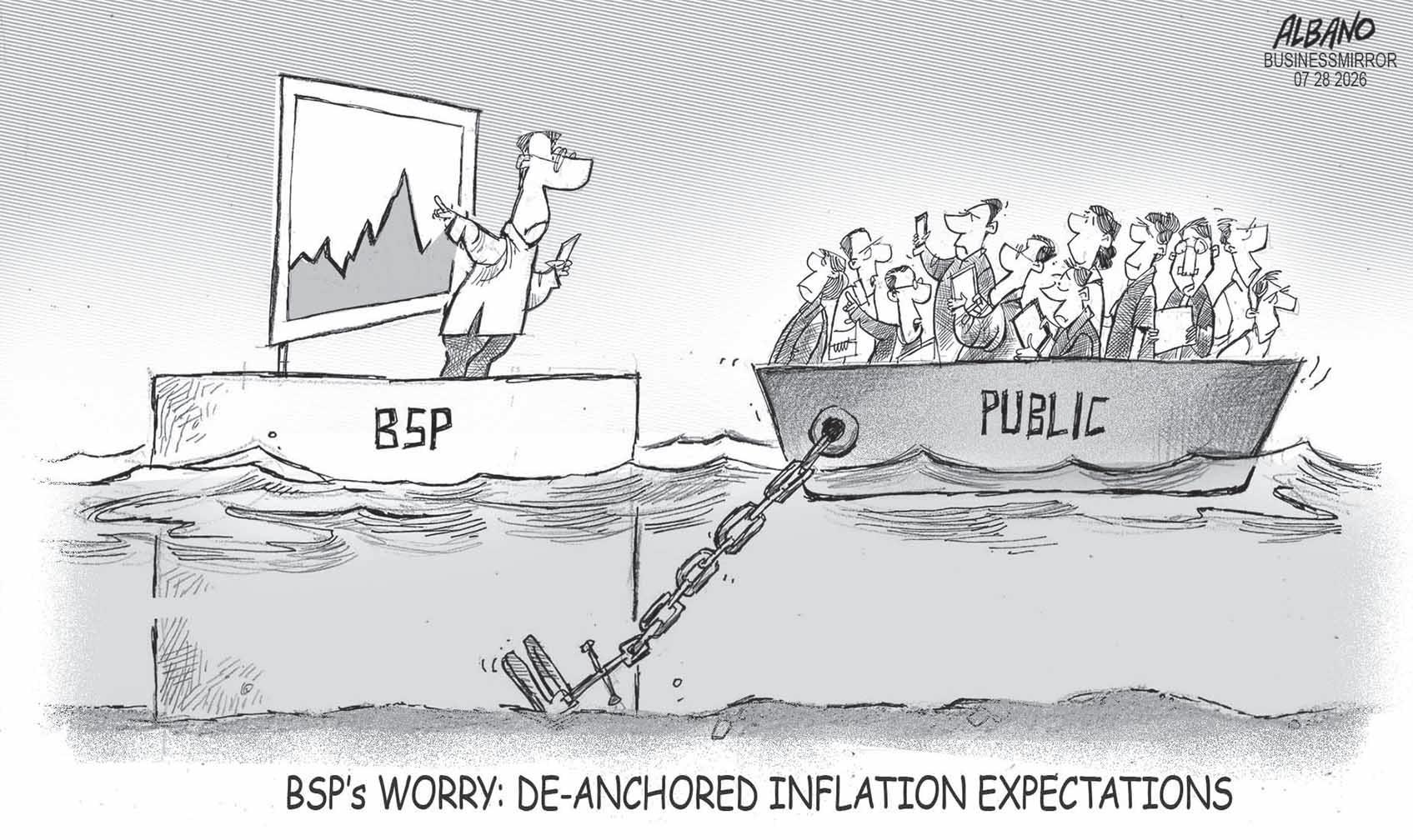

EJohn Mangun
VERY May Day, someone posts a photograph of a jeepney driver holding a hand lettered sign demanding that the government seize the oil companies, and every year the post collects several thousand likes from people who have never once totaled a fuel receipt against a day’s earnings. It is an old ritual. It changes nothing, and it costs nothing to post, which is precisely its appeal.
However, Simply Wall St calculates that during the past five years, Petron Corporation has grown its earnings at an average annual rate of 45.7 percent. Would the government taking over the oil industry be justified? History already ran that experiment, more than once, and the results were never flattering.
The 20th century’s flirtation with Communism and Marxism left, by conservative accounting, more than 65 million dead. That figure gets recited so often that it has lost its capacity to shock. The connection is not incidental. Once a government claims the obligation to decide what goods and services an economy should produce, and at what price to buy and sell, it has already claimed the authority to set everything else. That includes who eats and who does not. The same command structure that fixed the cost of bread in the Soviet Union and placed grain quo -
tas in Maoist China turned famine and purge into instruments of policy rather than accidents of history.
Someone will inevitably raise the “kind and gentle” objection: what about the safety net without the show trials, socialism with a human face. That objection misunderstands the argument. A public road is not socialism. A government hospital treating a patient who cannot pay is not socialism. Those are simply government spending on goods a market tends to underprovide, and every functioning capitalist economy does some version of it. What matters is whether a government claims the authority to decide what a private business may produce, what it may charge, and who is permitted to profit from doing it well.
Venezuela deserves particular attention, because it began the 21st century as one of Latin America’s wealthier nations. Its economy has
since contracted by roughly 80 percent, a collapse steeper than the United States endured during the Great Depression, with inflation surging past 475 percent in 2025 and nearly eight million Venezuelans leaving the country. All that happened because a command economy insisted that a handful of officials, rather than millions of buyers and sellers, decide what things are worth.
Consider the sari-sari store on any Philippine corner. Aling Puring does not consult a central committee before pricing a sachet of shampoo. She watches what her neighbors will pay, what her competitor two doors down charges, and what she has to pay for the shampoo this week. That constant, unglamorous negotiation is the price mechanism functioning as intended, and it explains why the store survives while a government run commissary typically does not. Multiply that store by millions of daily transactions and you arrive at why market economies outperform command ones. It is only arithmetic that makes it work, not ideology.
The Philippines has its own quiet evidence of this. The national poverty rate fell to 15.5 percent in 2023 from 18.1 percent in 2021, according to the Philippine Statistics Authority. This was driven largely by income growth among the poorest households, which outpaced growth at the top and outpaced the rise in the poverty threshold. Do not call it “wealth redistribution” when it is actually “wealth participation” in a market that rewarded labor and en-
terprise faster than the cost of living rose against it.
Even China and Vietnam, neither of which abandoned their political architecture, were forced by economic reality to adopt market mechanisms decades ago, because no theory survives a war with an empty store shelf indefinitely.
What should concern Filipinos is not that the Command Economy will come here in uniform, complete with flags and tribunals. The threat arrives dressed as convenience: a populist promise here, a price control there, a demand that someone else’s earnings be redirected toward a grievance that feels entirely justified. It rarely announces itself as ideology. It shows up as resentment toward whoever worked longer or started earlier, and the belief that their greater income or wealth is itself an injustice. Communism reaches the same endpoint by force, socialism by vote, and the road differs while the destination, historically, does not. The jeepney driver with the sign will post again next May. The sarisari store, meanwhile, will still be open early in the morning, pricing shampoo the old fashioned way, still run by someone who showed up. One of these arrangements has never lifted anyone out of poverty. The other keeps doing it.
E-mail me at mangun@gmail.com. Follow me on Twitter @mangunonmarkets. PSE stock-market information and technical analysis provided by AAA Southeast Equities Inc.
FL. Pelayo
Ruben M. Cruz Jr.
Eduardo A. Davad Nonilon G. Reyes
D. Edgard A. Cabangon Benjamin V. Ramos Aldwin Maralit Tolosa Rolando M. Manangan
BusinessMirror is published daily by the Philippine Business Daily Mirror Publishing,


By Jonnelle Marte & Maria Eloisa Capurro
EDERAL Reserve officials will head into their policy meeting this week confronting a resurgence in price pressures that could make their decision on whether to hold or hike interest rates a close call—and a contentious one.
Renewed tensions in the Middle East have sent oil prices soaring again, overshadowing a tamer-thanexpected reading on June consumer prices that seemed to offer officials breathing room to keep rates stable. Add to that a demand boom fueled by artificial intelligence and the Trump administration’s announcements of new tariffs, and Fed watchers see the possibility of dissents at the July 2829 meeting if officials again leave policy unchanged.
Investors in recent days have also boosted their bets the central bank could hike at this week’s meeting, putting the odds close to 40 percent at one point last week.
“Things are definitely heating up in the conflict in the Middle East and, for oil, the risk of moving significantly higher from here has increased,” said Alex Payne, a senior portfolio
manager at Vanguard. “The market is adjusting to the risk of inflation being a little bit stickier due to some of these geopolitical issues.”
Potential pushback
A GROWING number of policymakers have outlined a rationale for why they support higher rates now, or could soon.
Dallas Fed President Lorie Logan earlier this month called for modestly higher rates, citing her view inflation isn’t heading sustainably back to the Fed’s 2 percent goal. Cleveland Fed President Beth Hammack also chimed in recently, saying “there is no conflict” in the Fed’s mandates and inflation is a bigger concern than employment currently. Both will vote on this week’s interest-rate decision and could dissent if officials opt to hold steady.
Even at last month’s meeting, when officials left policy stable for a fourth consecutive time, a few policymakers already saw a case for raising rates. Minutes of that gathering also showed most officials had discussed scenarios in which inflation remained elevated due to AI-related demand, the Middle East conflict or the effects of tariffs. And almost all in that group indicated that such scenarios would likely warrant higher rates.
“It is clear listening to the Fed officials that you have a small group— like Logan, Hammack—who probably are ready to get going,” said Claudia Sahm, chief economist at New Century Advisors LLC. “And then there’s a pretty large group that wants to see more improvement— and soon.”
Even at last month’s meeting, when officials left policy stable for a fourth consecutive time, a few policymakers already saw a case for raising rates. Minutes of that gathering also showed most officials had discussed scenarios in which inflation remained elevated due to AI-related demand, the Middle East conflict or the effects of tariffs. And almost all in that group indicated that such scenarios would likely warrant higher rates. Since that meeting, the Trump administration said it would impose fresh tariffs on Canada and other trading partners, a fragile ceasefire between Iran and the US fractured and robust AI investment has shown few signs of slowing. Fed Chairman Kevin Warsh has reaffirmed the Fed’s commitment to reducing inflation, vowing on Capitol Hill this month to use the central bank’s tools to achieve price stability. But his reluctance to offer specifics on how he plans to use those tools has kept markets guessing about where rates are headed—even in the near term. At the close of last week, investors were pricing in about a 35 percent chance for a rate increase at this meeting, according to federal funds See “Fed,” A13

By Reine Juvierre Alberto @reine_alberto
TREASURY bill (T-bill) yields dipped across all tenors on Monday on strong demand despite lingering inflation risks on expectations oil prices are likely to stay elevated.
Combined tenders for the 91-, 182- and 364-day debt papers reached P134.519 billion, or 2.6 times the P50 billion offering of the
Treasury. This pushed average T-bill yields down week-on-week.
However, Jonathan A. Ravelas, senior adviser at Reyes Tacandong &
THE Sy-led BDO Unibank Inc. posted a P40.7-billion net income in the first half of 2026, slightly higher than P40.6 billion in the same period last year, driven by the “continued strength” of its core business segments.
“The bank sustained strong operating momentum, delivering mid-teens loan growth, double-digit growth in pre-provision operating profit and improved asset quality,” read a statement the lender issued last Monday.
According to the bank, provisions were increased as a “prudential measure” against “evolving risks.” The lender didn’t provide details on what these risks were.
Net interest income rose 11 percent year-on-year as gross customer loans expanded 15 percent to P3.9 trillion, supported by double-digit growth across all segments.
Meanwhile, total deposits climbed 13 percent while current and savings account (CASA) grew 4 percent. Non-interest income increased 4 percent, led by a 14 percent rise in insurance operations.
According to the bank, operating expense growth remained “contained” at a single-digit pace, resulting in a 12-percent increase in preprovision operating profit.
Asset quality continued to improve, with nonperforming loan
(NPL) ratio declining to 1.64 percent from 1.75 percent in the same period last year. NPL coverage stood at 132 percent. Credit cost increased to 67 basis points, reflecting management’s “proactive approach” to potential risks, the bank said.
Shareholders’ equity rose 8 percent, with book value per share increasing to P121.78. The bank’s common equity Tier 1 (CET1) ratio stood at 13.1 percent.
“Backed by strong business fundamentals, a healthy balance sheet, and its market leadership position, BDO remains well-positioned to navigate prevailing uncertainties and capture opportunities in an evolving business environment,” the bank noted.
BDO said it has the country’s largest distribution network, with over 2,000 consolidated operating branches and more than 7,900 teller machines nationwide. It also has 13 international offices (including full-service branches in Hong Kong and Singapore) in Asia, Europe, North America and the Middle East.
The bank said it ranked as the largest bank in terms of total assets, loans, deposits and trust funds under management based on published statements of condition as of March 31, 2026. Andrea E. San Juan
THE Union Bank of the Philippines (UBP) disclosed of having closed the first half of 2026 with a net income of P6.9 billion, up 113 percent compared to the same period last year, supported by continued strength of its core businesses.
In a statement, the bank said its net revenues reached P43.1 billion in the first half of this year, up 9 percent year-on-year, backed by expansion in consumer lending, CASA, and fee income.
UBP’s net interest income grew by 8 percent year-on-year to P33.7 billion, driven by loan expansion.
“Consumer lending remained the primary growth engine and accounted for 61 percent of the bank’s total loan portfolio,” the country’s ninth-largest lender noted.
Gross consumer loans climbed by 10 percent, led by credit cards and personal loans that collectively grew by 18 percent, .
Net interest margin improved by 40 basis points to 6.9 percent, supported by a 7 percent increase in CASA balances.
Non-interest income also grew by 12 percent to P9.4 billion yearon-year, with growth primarily driven by higher fee income from card-related fees, wealth management, bancassurance, and other everyday banking transactions,
Co., offers a caveat: “I would caution against reading this as a signal of an aggressive decline in interest rates.”
Ravelas added he sees monetary authorities could remain on their toes as “the inflation outlook remains challenging.”
He noted that geopolitical tensions could keep oil prices higher while climate-related disruptions could hurt agricultural output and push food prices higher. This situation, Ravelas said, could keep the Bangko Sentral ng Pilipinas (BSP) cautious and data-dependent, as it will decide on its key policy rates on August 27.
Inflation is expected to rise in July, ending two consecutive months
of easing in May and June, analysts at UnionBank of the Philippines said in its latest MktsFocUs report. According to the report, the inflation print reflects higher oil prices, a weaker peso that raises import costs, and firmer rice prices following the government’s higher procurement price signals.
“Markets may be expecting some easing, but there is still a credible risk that policy rates could remain elevated or even rise by 50 to 75 basis points should inflation pressures re-emerge,” Ravelas said.
“For investors, the key takeaway is to stay defensive, maintain portfolio flexibility,” he added.
Yields on the 91-day T-bills
ranged from 5.023 percent to 5.094 percent. This averaged at 5.059 percent, down by 4.5 basis points from 5.104 percent in the previous auction last week.
The 182-day T-bills had rates ranging from 5.575 percent to 5.688 percent. Its average yield fell by 1.4 basis points to 5.181 percent, versus last week’s 5.685 percent.
Meanwhile, the 364-day T-bills fetched an average rate of 5.950 percent with a yield range of 5.9 percent to 5.973 percent. This is lower by 1.6 basis points than the notes’ average yield of 5.966 percent in the Treasury’s previous tender.
The auction committee raised its full programmed amount of P50 bil-
DOCTORS, nurses and physicians belonging to 75 medical organizations pressed President Ferdinand R. Marcos Jr. to grant the P376-billion budget requested this year by the Philippine Health Insurance Corp. (PhilHealth), saying the state-run insurer remains severely underfunded despite rising benefit payouts.
In a statement issued last Monday, the groups, some of which challenged at the courts PhilHealth’s zero subsidy under the 2025 General Appropriations Act (GAA), urged Marcos and lawmakers to fully fund the state insurer’s proposed budget submitted during the technical budget hearings for the National Expenditure Program (NEP).
The groups that include the Philippine Medical Association and the Colleges of Physicians and Surgeons said the proposed 2027 NEP for PhilHealth must comply with the Philippine Constitution and the Universal Health Care (UHC) and Sin Tax Reform laws.
The call comes as Marcos Jr. is set to submit the proposed 2027 national
budget to Congress following his State of the Nation Address on July 27.
“We hope for good news—that the President and Congress will fully fund PhilHealth’s budgetary requirements,” the petitioners said, noting that the Executive branch provided one-fifth of PhilHealth’s required budget in 2025.
“Increase the national budget allocation for PhilHealth so it can meaningfully expand benefit packages–guided by transparent Health Technology Assessment—and make quality healthcare accessible to all Filipinos,” the petitioners said.
“This severe underfunding of PhilHealth persists even as projected benefit payments are set to reach P400 billion this year,” they added. “We urge the President and, subsequently, Congress to fully provide appropriations for PhilHealth’s actual funding requirements.”
In the first half of 2026, benefit claims paid by PhilHealth rose by 44.53 percent to P210.09 billion from P145.36
billion in the same period a year ago. Of the amount, P123.25 billion went to private health facilities, while government health facilities received P86.84 billion.
Moreover, the petitioners opposed attempts to introduce discriminatory or differential benefits between direct and indirect contributors.
Such a move would undermine the principle of social solidarity under the UHC law or Republic Act 11223, they said.
“The healthy support the sick, those who earn more help those who earn less, and the younger generation stands in solidarity with older fellow citizens who have contributed to society throughout their lives. Every PhilHealth member contributes to a shared pool of funds meant to protect all Filipinos equally,” the petitioners said.
According to the medical professionals, the FY 2027 budget presents an opportunity for the government to fulfill the promises of universal healthcare by ensuring sufficient funding for the

YOU promise yourself this will be the last time you borrow.
benefiting from the bank’s 19.3 million customer base.
The bank said it continued to build reserves to support sustained loan growth and reinforce balance sheet strength following ongoing portfolio reviews.
Despite this, it said credit costs declined 19 percent yearon-year to P9.4 billion, driven by continued improvements in asset quality.
“We continue to build on the actions we began in 2025 to enhance our balance sheet while sharpening our focus on the businesses that drive long-term value for the Group,” UBP Chief Financial Officer Manuel R. Lozano was quoted in the statement as saying. Lozano added that the bank’s customer franchise “remains strong, asset quality continues to improve, and we are confident that we can continue the positive profitability trajectory.”
At the same time, he said UBP is “taking deliberate steps to simplify the Group and rationalize businesses where we believe resources can be better deployed.”
“These actions are part of Unionbank’s broader strategy to sharpen focus on its core capabilities while continuing its journey to lead next-generation banking in the Philippines,” added Lozano. Andrea E. San Juan
But a few weeks later, another bill or emergency comes up, and you find yourself reaching for the credit card or asking for another loan. Debt repayment begins, but before long, new borrowing starts again.
This is the debt cycle—a pattern that traps many people, leaving them stressed, anxious, and struggling to move forward. Even when the intention to change is strong, breaking free often feels out of reach. The question is: why is it so hard to escape, and how can we finally break the cycle?
The debt cycle
THE debt cycle usually begins with a gap between income and expenses. A loan or credit card fills that gap, but repayment creates a new shortfall. To cover it, another loan is taken, or the credit card is used again. Paying only the minimum balance may feel manageable in the short term, but interest keeps growing, stretching repayment longer and longer. Over time, the cycle becomes more than financial. It turns into a source of shame, worry, and even hopelessness.
Behavioral traps DEBT is not only about numbers; it is also about behavior. Several psychological traps make it difficult to escape.
n The minimum payment mindset. Paying only what the bank requires feels like progress, but in reality, most of the payment goes to interest. The principal barely shrinks, and the debt lingers.
n Optimism bias. Many tell themselves, “Next month I’ll have extra money to pay it off.” But when next month arrives, new expenses appear, and the cycle continues.
n Present bias. Human nature favors immediate relief over future burdens. Borrowing today feels like a solution, while tomorrow’s repayment is easy to push aside.
n Shame and avoidance. Debt often carries guilt. People avoid opening statements or confronting balances, hoping the problem will resolve itself. In reality, silence makes the problem worse.
of the past
OUR relationship with debt is often shaped by early experiences. Someone who grew up in a household where borrowing was common may view debt as normal, even necessary. Others who witnessed parents struggling with loan collectors may carry deep anxiety about money but still repeat the same patterns, often unconsciously. Childhood lessons—or the lack of them—influence how we handle credit, savings, and obligations as adults. If money was scarce while growing up, spending might feel
like freedom. If money was used to show love, borrowing to provide for family can feel justified, even at personal cost. These patterns show that debt is not only about income, but also about the financial scripts we carry from the past.
The Filipino context IN the Philippines, debt is often tied to cultural and economic realities. Many rely on salary advances, credit cards, or informal loans to bridge expenses. In emergencies, people turn to “5–6” lenders or borrow from relatives.
Family expectations also add pressure. Some borrow not for themselves, but to help a parent, sibling, or extended family member. While the intention is generous, the result can be heavier debt and more stress.
For many workers, the “petsa de peligro,” the days before payday when funds run out, makes borrowing feel like survival. Debt becomes normalized, not as a choice, but as a necessity to get by.
DEBT is more than a financial burden. It is also an emotional one.
Carrying debt often means sleepless nights, constant worry, or arguments at home. Guilt and shame create silence, making it hard to ask for advice or support. The stress can spill over into health and work performance.
Paradoxically, the weight of debt sometimes leads to more spending. Retail therapy or impulse purchases provide temporary relief from stress, but they only deepen the cycle.
Practical steps
BREAKING free is possible, but it requires both practical action and a shift in mindset.
n Face the numbers. List all debts, interest rates, and minimum payments. Clarity removes the fear
state insurer.
“May the FY 2027 budget truly fulfill the promise and mandates of the UHC Act,” they said.
PhilHealth’s benefit payments rising faster than its premium collections was already flagged by Valerie Gilbert T. Ulep, senior research fellow at staterun think tank Philippine Institute for Development Studies. Ulep has said that the government must do its part in sustaining PhilHealth as slower economic growth could undermine the insurer’s finances. Weak economic growth threatens premium collection growth and the government’s fiscal capacity to subsidize healthcare, Ulep noted. According to the Asian Development Bank, “regional public goods can arise from a UMIC [upper-middle income country] strengthening its epidemiological policies and programs that improve t he health of its population.”
The Philippines was reclassified as a UMIC by the World Bank on July 1. Reine Juvierre S. Alberto
of the unknown.
n Choose a method. Use the debt snowball (start with the smallest balance to build motivation) or avalanche (tackle the highest interest first to save money). Both work if done consistently.
n Pay more than the minimum. Even small extra payments each month reduce interest and shorten repayment.
n Automate payments. Scheduling payments ensures consistency and removes the temptation to delay.
n Avoid new debt. Shift daily spending to cash or e-wallets while focusing on repayment. This prevents balances from growing.
n Build a small buffer. Even setting aside P500 to P1,000 for emergencies reduces the need to borrow again.
Shift to financial wellness
BREAKING free from debt is not only about clearing balances. It is about reshaping the habits, mindsets, and even childhood money scripts that keep us trapped. It takes courage to face the numbers, patience to build new patterns, and discipline to stay the course.
The road may feel long, but every payment is progress, and every step brings you closer to freedom. Debt does not define you; the choices you make today can rewrite your story. Financial wellness is not about being perfect with money. It is about regaining control, rebuilding confidence, and creating a future where debt no longer dictates your choices.
Janice Sabitsana is a Registered Financial Planner of RFP Philippines. The views and opinions she expressed herein do not necessarily


SET to be officially launched tomorrow, July 29, at the Uniqlo Global Flagship Store in Makati City are commemorative “monuments” in collaboration with Salcedo Auctions, reflecting the natural harmony between the cultures of the Philippines and Japan.
The initiative forms part of the global apparel retailer’s celebration of the 70th Friendship Anniversary between the two countries, while honoring its own journey toward 15 years in the Philippines. Uniqlo entered the local market in 2012 with its LifeWear philosophy of creating “simple, high-quality, and innovative clothing designed to improve everyday life.” The brand now has 81 stores nationwide.
“We wanted something physical that our customers will be able to see tangibly what our intention is, which is really celebrating the friendship between the Philippines and Japan,” said Jan Ang, Uniqlo Philippines Marketing Manager, during an interview at the recent press preview of the brand’s anniversary offerings. “The monuments also symbolize how Uniqlo has seamlessly integrated with Filipino lives and communities.”
There are three designs developed in partnership with Salcedo Auctions. According to Chairman and Chief Specialist Richie Lerma, the project reflects their growth from an auction house into a cultural enterprise. In January, the group partnered with the Department of Trade and Industry and the Philippine Embassy in Japan for a coconut exhibition at the
Tokyo Midtown Design Hub. Uniqlo took note of the project and tapped the group, given their know-how in encapsulating Japanese and Filipino values.
For the monuments, the Salcedo Auctions team began the design process with a question: “What brings the Philippines and Japan together?”
“The first thought was that both our countries are islands,” Lerma said. “The second thing was that Uniqlo is present throughout the Philippine islands, so how do we present that? It led us to create a series of art installation islands celebrating the Philippines and presented in a Japanese way.”
The result is three designs that represent the country’s major island groups. Each artwork creatively combines Philippine natural landmarks and Japanese design elements in a seamless, harmonious blend.
The Luzon installation depicts the Banaue Rice Terraces, dotted by the lotus flower in origami form, representing the connection between people, nature, and resilience. Meanwhile, the Visayas design features coconut groves, the proverbial tree of life, paired with an origami crane, a Japanese symbol of longevity and grace. The display reflects continuity and balance found in both cultures.
Lastly, the Mindanao piece highlights the region’s maritime heritage and inter-island connectivity through Siargao waves. On it rides the koi, a Japanese symbol of perseverance and movement, capturing the continuous flow and connection between communities across the archipelago.
Another focal point of the artworks is the choice of material. Japanese poplar wood presents a light and smooth texture. The set used for the monuments is FSC (Forest Sustainability Council)-certified as well, ensuring that the wood comes from forests that are always renewed. Salcedo Auctions also partnered with artisans from Nueva Ecija, who worked on the carefully crafted origami pieces of the monuments. The efforts align with Uniqlo’s growing sustainability initiatives.
Aside from the monuments, Uniqlo’s partnership with Salcedo Auctions includes a limited-time

seasonal item for Uniqlo Coffee that blends Filipino and Japanese flavors. The Ube Kome Cloud features Japan’s Koshihikari burnt rice milk topped with a lightly sweetened cream foam made from Bohol’s Ube Kinampay, a premium heirloom purple yam prized for its naturally vibrant color, rich aroma, and deep, earthy sweetness and finished with coconut nectar. Lerma said that the drink is “Japan and the Philippines in a cup.”
Uniqlo also introduced its collaboration with art director Wilson Niñofranco Limon and artisan communities across the Philippines for the exclusive RE.UNIQLO Special Artisan Patches. The partnership celebrates the country’s rich cultural heritage through handcrafted embroidery, made using traditional techniques and RE.UNIQLO fabric scraps. Each patch reflects the stories, artistry, and craftsmanship of Luzon, Visayas, and Mindanao, while promoting sustainability by giving new life to LifeWear items.
The Luzon design features Itneg Weavers of Abra, with motifs inspired by the frog, symbolizing abundance and fertility, and the Kukko pattern, representing hard work, productivity, and a deep connection to agriculture. The Visayas patch highlights the Panay Bukidnon Weavers of Iloilo, featuring symbolic patterns rooted in nature, oral traditions, and ancestral beliefs; while the Mindanao artwork showcases the T’boli Weavers of Lake Sebu, South Cotabato. It presents intricate motifs inspired by nature, mountains, wildlife, and dream imagery, reflecting the T’boli community’s daily life and spiritual traditions.
“These are art forms that shouldn’t be hidden in the mountains, but showcased to the world,” Limon said. “This collaboration translates heritage into wearable art, and it makes Filipino craftsmanship accessible without losing authenticity.”
“Part of our values is that, as a foreign brand, we want to give back to everywhere we go,” added Ang, Uniqlo Philippines marketing manager. “One way we can show respect is to pay homage to the cultures that we’re working in, and the best form of culture we believe in is art.”

LEO (July 23-Aug. 22): Listen and learn. The information you pick up will help you recognize what you want to keep in your life and what to discard. The process of elimination comes with clarity, and the results give you the time, space and wherewithal to reach your objective. Change will revive you and encourage new beginnings. There is power in being progressive. ★★★
VIRGO (Aug. 23-Sept. 22): Get moving, be present and promote what you can offer. Attending networking functions or visiting unique settings will offer insight into how to fine-tune your plans to reach your goals. Refuse to let emotional matters cloud your vision. Someone will lead you astray or get in your way. Update paperwork that’s crucial to fulfilling your dreams. ★★★
LIBRA (Sept. 23-Oct. 22): Use your imagination to discover new skills and possibilities. Explore opportunities, and find people who can add to your plans. A friendly gesture will draw in individuals who complement your skills and encourage you to expand and explore through promotional venues. A little charm will go a long way. By putting your energy where it counts, you’ll prosper. ★★★★★
SCORPIO (Oct. 23-Nov. 21): Be careful what you wish for. Looks and impressions can be deceiving. Do your research, consider background checks and make changes to your agenda that encourage you to align yourself with the best people for the job. Better opportunities will come your way. Having discipline and the energy to complete your mission will help you reach your goals. ★★★
SAGITTARIUS (Nov. 22-Dec. 21): Finish what you start. Making less of a change will have a greater impact on the outcome of what you pursue and achieve. Charisma and knowledge—alongside time, effort and cash—will help you get ahead. Refuse to let what others choose to do push you in the wrong direction. Domestic issues require discipline, foresight and patience to create opportunity. ★★★★
CAPRICORN (Dec. 22-Jan. 19): Pay attention to medical, financial and legal matters, and you’ll create greater opportunities to bring about affordable change. Don’t feel obligated to make a spur-of-the-moment decision that requires

Tuesday, July 28, 2026
TBy Jonathan L. Mayuga @jonlmayuga
HE Secretary of the of the Interior and Local Government (DILG) Juanito Victor Remulla has called on Filipinos to set aside political differences and stand united behind the country’s territory and claim over the West Philippine Sea (WPS).
In a statement, Remulla said the issue of the WPS transcends politics and requires the collective resolve of the Filipino people.
sovereignty and sovereign rights.
“Nobody wants war. Nobody wants violence. Let the National Government negotiate and talk. But now, we should show that we are Filipinos. We are not afraid of anyone and we can fight for what is ours,” he added.
Remulla underscored that issues concerning Philippine sovereignty transcend political affiliations and should serve as a unifying cause for all Filipinos.
“We may be separated by politics, we must not let politics divide us on this issue,” he said.
the 2016 Arbitral Award and reaffirmed the Philippines’ continuing commitment to assert its rights under international law.
As part of the program, officials and participants expressed their support for the collective effort to safeguard the West Philippine Sea through a Pledge of Commitment led by Undersecretary for Local Government Marlo L. Iringan and the signing of a Commitment Wall.
By Jovee Marie N. dela Cruz @joveemarie
POLITICAL controversies failed to derail the House of Representatives from advancing measures addressing the everyday needs of Filipinos, House Majority Leader Ferdinand Alexander A. Marcos said on Monday.
“I think the fact that we are ahead of schedule shows that I am satisfied with what has been happening in the House lately and with its legislative performance,” he said during an ambush interview.
“Our seas are ours. Our seas are for the Filipinos and for the Philippines,” Remulla said.
He stressed that supporting the country’s position on the WPS is not about advocating conflict, but about demonstrating national unity and an unwavering commitment to the Philippines’
During the 10th anniversary commemoration of the Philippines’ landmark arbitral victory in Lingayen, Pangasinan, on Thursday, Remulla emphasized that while the National Government remains committed to diplomacy and peaceful engagement, safeguarding the country’s sovereignty and sovereign rights requires national unity and a shared commitment to the country’s interests.
He urged national government agencies, local government units, and citizens to stand together in supporting lawful, peaceful, and rules-based efforts to uphold the country’s sovereignty and sovereign rights in the West Philippine Sea.
“We are Filipinos. The West Philippine Sea is for Filipinos. Let us fight for the Philippines. Let us unite and fight for what is ours,” Remulla said.
The commemoration highlighted the enduring significance of
Also present during the activity were DILG Assistant Secretary for International Affairs Lilian M. De Leon, National Security Council Assistant Director General Francis Jude Lauengco, Pangasinan Gov. Ramon V. Guico III, local chief executives, government officials, and representatives from various sectors.
The gathering forms part of the government’s continuing efforts to promote public awareness, strengthen national unity, and reinforce support for the peaceful and rules-based assertion of the Philippines’ sovereign rights in the West Philippine Sea.
By Bless Aubrey Ogerio
THE European Union (EU)
should pursue a persistent trade agenda in Asia, noting that a future EU-Philippines free trade agreement (FTA) will define Sweden’s commercial ties with the country, a Swedish diplomat said.
Swedish Embassy First Secretary Karolina Zurek said the EU’s approach to trade is rooted in cooperation despite growing shifts in the global trading environment.
“We are a union of 27 countries that have a common agreement about everything we do in trade relations. So I think we try to pursue a positive trade agenda,” Zurek told reporters on the sidelines of the Kyiv-Manila Strategic
Dialogues in Makati City. The Philippines and the EU are continuing negotiations for a bilateral trade agreement, although Trade Secretary Ma. Cristina Roque earlier acknowledged that discussions have reached “a bit of a deadlock” over one or two remaining issues.
Despite the remaining issues, Roque said both sides remain committed to concluding negotiations within the year and signing the agreement in 2027.
The EU was the Philippines’ fourth-largest trading partner in 2025, with bilateral goods trade reaching €17.6 billion ($20.13 billion), according to EU data. Speaking specifically about Swedish companies, Zurek said
they continue to look beyond market opportunities and place significant weight on governance and sustainability when deciding where to invest.
“I think that from the perspective of Swedish firms, the important thing that they will be looking at is transparency,” she said. “So transparent rules that are justly implemented, rule of law, but it will also be sustainability standards.”
Swedish companies also examine environmental and social standards throughout supply chains before expanding investments, she added.
“As European companies, Swedish companies need to have an ambitious agenda when working with their value chain, so they will also look at what are the environmental
and social standards in the Philippines in order to be able to conduct businesses here and do investments and feel confident with it,” Zurek explained.
Data from the 2024 Philippine Market Report showed that Sweden exported $159 million worth of goods to the Philippines and imported $64 million, with bilateral trade rising 4.2 percent as exports and imports grew 4.6 percent and 4.1 percent, respectively.
The latest Swedish-Philippine Business Climate Survey showed that Swedish firms remain optimistic about the country’s growth prospects, but corruption concerns, regulatory hurdles and infrastructure gaps continue to dampen business confidence.
THREE major water systems—the Angat-La Mesa Water System, the Laguna Lake Water System, and the Antipolo Water System—continue to provide reliable water service to its water customers in the East Zone, Manila Water Company Inc. Said.
Manila Water said company’s long-term investments in these water sources have strengthened supply reliability despite challenges brought by El Niño, declining water levels in Angat Dam, and increasing demand in its service area.
As the 20th Congress entered its Second Regular Session, Marcos highlighted the chamber’s continued action on proposals concerning education, water governance, energy, nutrition, social protection, digital payments, and land use.
Despite months of political distractions, he said the House completed action on 26 of the 52 priority measures endorsed by the Legislative-Executive Development Advisory Council (Ledac) during the First Regular Session.
Under the leadership of Speaker Faustino G. Dy III, the House approved 229 measures, comprising 66 national bills and 163 local measures. It also transmitted more than 160 measures to the Senate.
Marcos said these accomplishments showed that the chamber remained focused on legislation despite controversies competing for public and congressional attention.
Marcos said the legislative output remains the most objective basis for assessing whether the House leadership has effectively managed the chamber’s work.
“The performance of any majority leader should be measured by the legislative output of the chamber in which that official serves,” he stressed.
Marcos added that Congress should be evaluated not only by the volume of measures it processes but also by its progress in passing priority legislation that directly responds to national concerns.
“What matters is how many measures Congress has passed, particularly those identified as Ledac priorities,” he said. With half of the Ledac-endorsed measures already acted upon, Marcos said the House would carry its momentum into the Second Regular Session and focus on the remaining priorities of the Marcos administration.
“We hope to sustain the momentum we established during the First Regular Session as we move into the Second Regular Session,” Marcos said.
THE government has approved a total of 47 projects during the first year of the Enhanced Community Mortgage Program (ECMP), according to the Department of Human Settlements and Urban Development (DHSUD).
The ECMP provides financing to organized communities, particularly low-income and informal settler families, so they can legally acquire the land they have long occupied.
The latest approvals cover four homeowners’ associations in Palawan, Camarines Norte, and Isabela, extending the program’s reach to more communities outside Metro Manila. The agency, however, did not disclose their respective project costs, loan terms or number of beneficiaries.
Introduced in 2025, the ECMP is among the housing assistance modalities under the Expanded Pambansang Pabahay para sa Pilipino Program (4PH).
The Angat-La Mesa Water System remains a critical source of water for Metro Manila. To improve supply reliability, Manila Water, in partnership with the Metropolitan Waterworks and Sewerage System, invested in projects that help ensure sufficient inflows to Angat Reservoir, including the Sumag River Diversion Project and the rehabilitation of the Umiray-Angat Transbasin Project.
Complementing Angat is the Laguna Lake Water System, which taps Laguna de Bay as an additional water source. The
“As we experience the full effects of a strong El Niño and the pressures it places on traditional water sources, our diversified supply systems provide greater resilience and flexibility in meeting the needs of our customers. These strategic investments help ensure that communities across the East Zone continue to have access to safe and dependable water services today and in the years ahead,” said Dittie Galang, Manila Water Corporate Communications Group Head.
system includes the 100-million-liter-perday (MLD) Cardona Water Treatment Plant, which draws water from the central portion of the lake and serves around 800,000 customers in Rizal and nearby areas. On the eastern side of the lake, the P16.5-billion East Bay Water Supply Project is being developed. Its first phase, the 50-MLD East Bay Water Treatment Plant, is designed to serve up to 390,000 customers and currently supplies communities in eastern Rizal. The 200-MLD East Bay Phase 2 Water Treatment Plant, which is set for completion this year, will serve approximately two million customers in Pasig, Pateros, Taguig, and portions of Rizal province.
Meanwhile, the Antipolo Water System supports the growing water requirements of Rizal through the Wawa-Calawis System,
which is anchored on the recently acquired 710-MLD Upper Wawa Dam. Its 80-MLD Calawis Water Treatment Plant, designed to serve about 900,000 customers, already provides water service to communities in Antipolo City and nearby areas. The 220MLD Kaysakat Water Treatment Plant is expected to be completed later this year and will source water from Upper Wawa Dam. It will further boost water supply for approximately one million customers in Antipolo and neighboring Rizal municipalities. Together, these three major water systems form a resilient and diversified supply network that enables Manila Water to continuously deliver safe, reliable, and sustainable water services to its more than 7.9 million customers in the East Zone.
Jonathan L. Mayuga
problems
Implemented by the Social Housing Finance Corp. (SHFC), the approved projects involved more than P870.6 million in land acquisition loan assistance for more than 8,100 families nationwide.
This translates to an average of around P107,000 per beneficiary, although the actual amount may vary depending on the cost of the property and the number of families covered by each project.
While all 47 projects have been approved, the release of financing remains underway. DHSUD said 25 communities have so far received their land acquisition assistance, benefiting more than 4,000 members of homeowners’ associations.
Based on the agency’s figures, another 22 approved projects are awaiting the release of their loan proceeds.
Unlike housing projects involving the direct construction of residential units, the ECMP primarily addresses security of tenure through land acquisition. Beneficiaries may therefore still require separate financing to construct or improve their homes after acquiring the property.
Housing Secretary Jose Ramon P. Aliling said the agency and SHFC intend to expand the program to allow more organized communities to secure legal ownership of their properties.
He added that each approved project brings low-income families closer to permanent land ownership and provides communities with greater protection against displacement.
By Mary Jade Jadormio