

SCS tensions top Quad, trilateral talks in Mla
By Malou Talosig-Bartolome
HEIGHTENED frictions in the South China Sea framed back‑to‑back meetings of the Quadrilateral Se curity Dialogue (Quad) and the Japan‑US South Korea trilateral in Manila, with foreign ministers warning against destabilizing ac tions and affirming support for Asean “unity and centrality.”
The Quad Foreign Ministers— US Secretary of State Marco Ru bio, Australian Foreign Minister Penny Wong, Indian External Affairs Minister S. Jaishankar, and Japanese Foreign Minister

Toshimitsu Motegi—issued a joint press release after meeting at the sidelines of the ASEAN Post Ministerial Conference in Manila Wednesday.
“We discussed regional chal lenges and opportunities to strengthen our support for the practical implementation of the Asean Outlook on the Indo Pacific [AOIP] through our shared priori ties of maritime and transnation al security, economic prosperity and security, critical and emerg ing technologies, and humanitar ian assistance and emergency re sponse,” the four ministers said. They said they are “united in our
conviction that peace and stabil ity in the Indo Pacific maritime domain underpin the security and prosperity of the region.”
In a statement, the Japanese Foreign Ministry said Motegi voiced “strong opposition to any unilateral attempts to change the status quo by force or coercion.”
“The four ministers held candid discussions...and aligned their perspectives on the situations in the Indo Pacific and the Middle East regions, including in the East China Sea and the South China Sea,” the Japanese foreign minis try said.
Motegi also expressed grave
concerns over export restrictions, including on critical minerals. He likewise emphasized the commit ment to the complete denuclear ization of North Korea and the im portance of addressing malicious cyber activities.
Rubio said they “share a vision of a free and open Indo Pacific that is grounded in the rule of law, sovereignty, and territorial integrity.”
Wong noted that all Quad mem bers are comprehensive strategic partners of Asean.
“We respect Asean centrality and Asean led architecture and




THEBy Andrea E. San Juan @andreasanjuan
Philippine peso slumped anew to a record low of P61.75 against the dollar on Wednesday on the back of a re-escalation of tensions between the United States and Iran which led to elevated crude oil prices.
TBy Ada Pelonia @adapelonia
HE Philippine Coco nut Authority (PCA) is optimistic that ex port earnings from coconut b ased products in 2026 could surpass the record $3.57 billion last year despite the threats posed by El Niño on plantations.
PCA Head Executive As sistant Joseph Cezar Delig ero said the agency is bank ing on a raft of government interventions to prevent a plunge in productivity, which could affect coconut shipments, the country’s top farm export.
This, after coconut pro ductivity fell by around 20 percent in 2024 when the Philippines was hit by the dry spell.
“We’re hoping that [pro ductivity] won’t drop that
much this year, given the ac tivities in place based on our learnings from the previous El Niño in 2024,” Deligero told reporters.
He noted that the PCA has ventured into solar drip ir rigation programs while con tinuously working with both cooperatives and other gov ernment agencies for mitiga tion measures, among others.
“We’re still positive that we’ll be able to surpass our 2025 export [earnings],” Deligero said.
Meanwhile, he also allayed concerns on the impact of coconut scale insect (CSI) or cocolisap’s infestation on pro duction, which tends to inten sity during extreme heat.
“With the threat of the su per El Niño, we’re anticipat ing an increase in pest in festations. But our research centers and regional offices
By Mary Jade Jadormio
THE Department of Labor and Employment (DOLE) expects only limited em ployment dislocation from the im plementation of the daily minimum wage increase in Metro Manila, with around 1.1 million workers projected to benefit from the ad justment.
Government estimates indicate that about 12,000 workers could face displacement, although the overall impact of the wage order is expected to remain positive.
“There will be a slight disloca tion of around 12,000 employees. But overall, the picture provided to us was that there will be a 2.7 per cent growth because of this,” Labor
Secretary Francis N. Tolentino said during a media forum on Tuesday.
The projections were based on the general equilibrium model used by the government in evaluating wage adjustments, which takes into ac count inflation, labor costs and oth er economic indicators.
“Some employers may rotate
workers, retrench employees or re duce their workforce. But overall, the picture provided us was that there will be a 2.7 percent growth because of this,” he said. The Regional Tripartite Wages and Productivity Board National Capital Region also considered the positions of labor groups, employ ers and government agencies dur ing consultations before issuing Wage Order No. 27. Employer concerns over higher operating costs were among the factors weighed during the delib erations, although the labor chief maintained that the projected dis ruptions remain small compared with the number of workers expect ed to receive higher pay.
“The disruption is very mini mal.... The overall impact is much bigger because 1.1 million will im mediately benefit starting July 25,” Tolentino said. The labor chief also defended the regional wage s etting system, saying it helps moderate inflation by preventing labor costs from
Despite El Niño, coco export earnings seen topping 2025’s
are preparing for this,” he said, noting the agency’s integrated pest management nationwide.
“We have agriculturists and researchers on the ground who’ve done assessments to check vulnerable areas in the country and provide additional strategies to mitigate pest infestations.”
Last year, the value of coconutbased exports jumped by over a third to $3.57 billion from $2.66 billion in 2024, based on data from the Philippine Statistics Authority (PSA), which was the all-time high since its time series started in 2006.
Shipments of coconut oil accounted for the bulk of revenues, as it surged by 29.4 percent to $2.87 billion, a new record-high from the $2.22 billion recorded in 2024.
The average price of coconut oil soared by 63.27 percent to $2,480 per metric ton (MT) in 2025 from $1,519 per MT a year ago, according to the World Bank.
DepDev pushes unified natl framework on blue economy
By Justine Xyrah Garcia
THEDepartment of Economy, Planning and Development (DepDev) is pushing for a unified national framework for the blue economy as the government moves to coordinate policies governing the sustainable use of the country’s marine resources.
To advance the initiative, the agency convened a two-day Blue Economy Inter-Agency Roundtable Dialogue on July 20 and 21, bringing together more than 100 representatives from government, academia, civil society and development partners to discuss the proposed Philippine Blue Economy Framework.
Industry sources expect coconut output to rebound this year, owing to the recovery of trees and the absence of destructive typhoons in 2025. global crude oil prices posted new one-month highs lately.
DepDev Undersecretary for Legislative Affairs Glenda Rumohr said the initiative aims to improve coordination among agencies with overlapping mandates in the management and development of marine resources.
“The harder part is that we’ve each been stewarding pieces of it—a mandate here, covering a jurisdic-
Peso dips as oil prices rise on…
Continued from A1
“Global
crude oil prices posted new 1-month highs lately. Brent

tion there—without necessarily agreeing on how those pieces are supposed to fit together,” Rumohr said during the dialogue.
“We think it’s time to stop working around that, and start working through it, together, in the same room,” she added.
The proposed framework is expected to serve as a guide for government policies on sustainable ocean-based development by establishing common governance mechanisms, strategic priorities, and institutional responsibilities.
DepDev said discussions during the roundtable focused on governance, resource stewardship, and institutional coordination. Participants also identified gaps in existing policies and explored ways to improve coordination across agencies.
The initiative also supports the proposed Blue Economy Act, one
crude oil price was higher at US$92 per barrel levels [vs. US$88 since late last week], the highest since June 11, 2026, but still among 4-month lows,” added Ricafort.
For his part, John Paolo R. Rivera, Senior Research Fellow at Philippine Institute for Development Studies (PIDS) said this “largely reflects external factors, particularly the stronger US dollar, expectations of higher US interest rates, and heightened global uncertainty.”
While a weaker peso raises the cost of imports and may add to inflationary pressures, Rivera said it also benefits remittances and exports.
As such, he pointed out: “We should focus less on a single record-low level and more on whether the depreciation be -
of the priority measures under the Legislative-Executive Development Advisory Council’s common legislative agenda.
According to the agency, the framework is anchored on existing laws and policies, including the Archipelagic Doctrine, the National Marine Policy, the National Integrated Protected Areas System Act, the Fisheries Code and the Clean Water Act.
It is likewise aligned with the Philippine Development Plan 2023-2028, which identifies sustainable ocean-based development as part of the country’s long-term growth strategy.
The department said recommendations from the dialogue will be used in refining the Philippine Blue Economy Framework, which is intended to guide future policies on the sustainable use of the country’s marine and coastal resources.
comes prolonged and disorderly.”
“The country’s solid external buffers including ample international reserves and steady foreign exchange inflows from remittances, tourism, and the IT-BPM sector should help cushion excessive volatility,” added Rivera.
Last week, BMI, a Fitch Solutions unit, said it expects the Philippine peso to remain under pressure in the coming months and trade within a P61-P63 against the dollar range.
“A renewed escalation in the US-Iran conflict, US dollar firmness and seasonal peak in import demand will weigh on the peso in the near term,” added BMI. Within the trading session, the local currency’s strongest level was at P61.73 against the dollar while its weakest was at P61.75 against the greenback.
increasing nationwide at the same time.
According to Tolentino, the staggered implementation of wage orders allows regional wage boards to observe the effects on workers, enterprises and local economies before succeeding adjustments are considered.
Assistance for MSMEs TO address employer concerns over the wage increase, DOLE will tap its Adjustment Measures Program (AMP) to provide immediate assistance to affected micro, small and medium enterprises. The program may finance equipment and other productivity-enhancing measures to help smaller businesses manage higher labor costs while preserving available capital for wage adjustments.
“For example, DOLE may fund a restaurant’s cash register or pointof-sale system so that its additional capital can instead be used for wage adjustments,” Tolentino said. AMP is intended particularly for enterprises with limited capital that may struggle to absorb the full impact of the wage increase immediately.
Assistance under the program includes capacity building, business enhancement, product development, labor compliance and industrial peace-building measures aimed at strengthening the resilience of MSMEs against economic disruptions.
Qualified establishments facing difficulty in complying with the new rates may also apply for exemption certificates with DOLE within the prescribed 75-day period, subject to existing requirements and qualifications.
“The two sides underscored the importance of maintaining peace, security, and stability in the region, reducing the risk of miscalculation, and sustaining d ialogue on matters of mutual concern,” the DFA added.
The ministers also discussed broader bilateral relations, including political and security
matters, maritime and law enforcement issues, regional and international developments, and cooperation in trade, investment, agriculture, tourism, connectivity, and people - to - p eople exchanges.
The DFA said the engagement was in line with President Ferdinand R. Marcos Jr.’s directive to pursue dialogue and diplomacy with Beijing while remaining assertive in protecting Philippine national interests.
Tolentino has also encouraged MSMEs to strengthen their representation in the tripartite wagesetting process so their concerns can be more clearly raised during future wage deliberations. Through the AMP and the exemption mechanism, DOLE aims to give affected establishments pathways to adjust to the new wage order while ensuring that covered workers receive the mandated increase.
believe that Asean has a critical role, holding the center of a region that is peaceful, stable and prosperous,” she said during a press huddle.
“We are deeply invested in the region’s success and in cooperating with Asean and its member states,” she added. The Quad also aligned positions on the Middle East conflict, North Korea’s nuclear program, and cyber threats.
The Quad, a strategic partnership among the United States, Australia, India and Japan, is often viewed as viewed as a counterweight to China’s growing regional influence. Since the 2021 virtual meeting, the four countries have realigned their focus on maritime security, economic resilience, emerging technologies, and humanitarian cooperation.
Later in the day, Rubio, Motegi, and South Korean Foreign Minister Cho Hyun convened a JapanUS-ROK trilateral meeting, their
second this month. The ministers affirmed solidarity amid “an increasingly severe strategic environment,” agreeing to expand cooperation in joint military exercises, supply chain early warning systems, cutting- edge technology, and disaster relief.
They also pledged closer coordination on North Korea, including efforts against cyber activities funding Pyongyang’s weapons programs.
The Japan-US-South Korea trilateral is a three -way security and diplomatic framework that brings together Washington, Tokyo, and Seoul. It emphasizes joint military coordination, economic security, and responses to regional threats, particularly North Korea’s nuclear and cyber activities.
Both meetings sent a clear signal: regional alliances are tightening in response to maritime disputes and broader security challenges.
The Quad ministers confirmed plans for another leaders’ summit later this year, while the trilateral vowed “continuous action- oriented discussions” to deepen cooperation.
Data shows that P2P applications are processed in an average of 144.46 calendar days—significantly faster than the 270-day standard—while Capex approvals average 140.53 days against the same benchmark. Additionally, COC applications are completed in just 29.65 days, well below the prescribed 60 days. According to ERC data as of July 2026, a total of 646 applications have been filed through the EVOSS platform, covering all submissions whether approved or denied. This total includes 104 P2P applications, 68 Capex filings, 143 COC applications, and 331 Provisional Authority to Operate (PAO) requests. “Through EVOSS, we are able to speed up our processes without compromising thorough review. Our goal is to make project approvals more efficient and predictable to support a reliable and adequate power supply,” said Juan. Established under Republic Act No. 11234, the EVOSS system is a centralized, web-based platform that streamlines permitting processes for power generation, transmission, and distribution projects. Lenie Lectura
Survey shows distrust for China snowballing
By Rizal Raoul S. Reyes
THE distrust for China continues to grow after more than a year of easing, as renewed national attention on the West Philippine Sea (WPS) appears to have reinforced Filipinos’ skepticism toward Beijing, according to the latest nationwide survey conducted by OCTA Research.
In its second quarter 2026 Tugon ng Masa survey, 64 percent of adult Filipinos believe the Philippines should either “somewhat distrust” or “strongly distrust” China, up 9 percentage points from 55 percent in the first quarter.
Trust in China remained virtually unchanged at 14 percent,
while the proportion of undecided respondents declined to 21 percent, indicating that many Filipinos who had previously been ambivalent have adopted a firmer and more skeptical view of China.
The survey was conducted from July 4 to 11, coinciding with the country’s commemoration of the 10th
Ex-employees assail ‘dilatory’ tactics of bank in case at SC
AT
LEAST 200 retired employees of Philippine National Bank (PNB) on Wednesday gathered outside the Supreme Court (SC) to assail the bank for its alleged delaying tactics in connection with their 20-yearold class suit seeking to recover an estimated amount of at least P1 billion representing unpaid allowances for the period of 1989 to 1996.
L awyer Goldelio Rivera, former PNB branch manager and counsel of the retired PNP employees, lamented that they have been engaged in a legal battle against the bank since 2006 when they filed the class suit by way of a petition for mandamus.
A mong the petitioners were then 60 incumbent officers and rank and file employees and 15 former employees of PNB.
I n their petition for mandamus filed in April 2006, the petitioners argued that prior to the enactment of Republic Act 6758, otherwise known as the Salary Standardization Law, they were receiving allowances and cost of living allowance (Cola) equivalent to 40 percent of their basic salary, or P300.00, whichever is higher. H owever, after the enactment of RA 6758 and the consequent issuance of Department of Budget and Management-Corporate Compensation Circular (DBMCCC) 10, PNB, a government-owned and -controlled corporation at the time, discontinued the payment of their Cola and other allowances, despite the Supreme Court’s ruling in De Jesus v Commission on Audit that DBM-CCC 10 is ineffective and unenforceable due to its nonpublication R ivera noted that the Regional Trial Court (RTC) in Pasay City have ruled in their favor on May 15, 2008 and ordered PNB to pay the petitioners and its former and incumbent employees and officers the back pay of their Cola and special amelioration allowance of 40 percent and 10 percent respectively of their basic salary covering the period of July 1, 1989 to May 26, 1996 or up to their separation from service whichever comes first. T he trial court also directed PNB to pay petitioners and its
By Ashley J. Manabat
M
AGALANG, Pampanga—
The National Bureau of Investigation (NBI), with the Presidential Anti-Organized Crime Commission (PAOCC) and other government agencies, searched a steel manufacturing facility in Magalang, Pampanga, on Saturday for radioactive-bearing raw materials, steel products and manufacturing waste that were reportedly stored in its premises.
T he search at Chuangxing Steel
anniversary of the 2016 Permanent Court of Arbitration ruling, which invalidated China’s sweeping claims in the South China Sea. Although OCTA stressed that the survey does not establish a direct causal relationship, it said the timing of the findings is consistent with the view that heightened public awareness of developments in the West Philippine Sea contributed to the resurgence in distrust.
The findings suggest that Filipino public opinion is highly responsive to the information environment surrounding the West Philippine Sea,” the research group said in a press statement.
OCTA Research said nearly four in every 10 respondents, or 37 percent, pointed out that the Philippines should “somewhat distrust” China, while 27 percent expressed “strong distrust.” In comparison, only 15 percent expressed some degree of trust, including 4 percent who strongly trust China and 11 percent who somewhat trust the Asian superpower.
Moreover, the OCTA survey revealed that distrust toward China
remains extensive across the country regardless of geography or income class. It indicated that Balance Luzon registered the highest level of distrust among the four major island groups at 67 percent, followed by the Visayas at 63 percent, Mindanao at 62 percent, and Metro Manila at 59 percent. Throughout socioeconomic classes, distrust ranged from 63 percent to 67 percent, signifying that skepticism cuts across income groups.
R egional data, however, revealed substantial differences in the intensity of public sentiment. Mimaropa region (Mindoro [Occidental and Oriental], Marinduque, Romblon, and Palawan) posted the highest distrust rating at 94 percent, followed by Caraga at 88 percent, while the Ilocos Region and Eastern Visayas each registered 75 percent.
At the opposite end of the spectrum, Central Visayas posted the lowest distrust level at 47 percent, followed by the Cordillera Administrative Region at 52 percent. OCTA noted that lower distrust in these areas was largely due to higher levels
of uncertainty rather than stronger trust toward China.
Interestingly, the survey showed generational differences as Filipinos aged 18 to 24 registered the highest distrust at 73 percent, followed by respondents aged 65 to 74 and those aged 75 and above, both at 70 percent. Adults aged 25 to 34 were the least distrustful at 47 percent and recorded the highest level of trust at 27 percent, making them the only age group where distrust failed to reach a majority.
The latest findings also reversed a trend that had been evident since 2024. Distrust toward China peaked at a record 95 percent in 2024 before steadily declining to 85 percent in July 2025, 60 percent in December 2025, and 55 percent in March this year. The latest July survey, however, interrupted that downward trend, with distrust rising by 9 percentage points.
O CTA stressed that the earlier decline in distrust should not be interpreted as improving perceptions of China. Instead, the reduction was complemented mainly by a rise in the number of Filipinos who
were undecided, while trust levels remained consistently low. The latest survey suggests that many of those previously undecided have since shifted toward distrust, underscoring how quickly public opinion can change when developments in the West Philippine Sea dominate the national conversation.
The research group said the findings highlight the continuing importance of government transparency initiatives, civil society advocacy, and sustained media coverage in keeping maritime security and sovereignty issues at the forefront of public discourse. While no single factor can explain the shift in sentiment, OCTA said the broader information environment surrounding the West Philippine Sea continues to play a significant role in shaping Filipino perceptions of China.
T he nationwide survey interviewed 1,200 adult Filipinos through face-to-face interviews conducted from July 4 to 11. It has a ±3 percentage point margin of error at the 95-percent confidence level.
Marcoleta pleads not guilty to plunder charge
former and incumbent employees
the sum equivalent to 10 percent of the back pay of their COLA and amelioration allowance as and by way of attorney’s fees.
The lawyer added that the Pasay RTC ruling was affirmed by the Court of Appeals (CA) in a decision issued on June 16, 2016.
Th is prompted PNB to elevate the issue before the SC.
The High Tribunal, in a decision issued on March 29, 2023, affirmed the trial court and the CA rulings.
I t also castigated PNB for employing delaying tactics by filing unnecessary pleadings and asking for several postponements of the proceedings before the trial court.
The SC also said PNB’s prayer for the remand of the case to the trial court can be considered as another attempt to delay the payment of respondents’ monetary claims.
P NB has filed a motion for reconsideration of the 2023 ruling which is still pending before the High Court.
“ The retirees just wanted to express their sentiment against the delaying tactics of the Philippine National Bank. No less than the Supreme Court has ruled that PNB is engaged in delaying tactics,” Rivera said in an interview.
“O ur message to PNB is to stop its delaying tactics and I just hope that the Supreme Court will resolve PNB’s motion for reconsideration very soon,” he added.
R ivera added that around 8,000 retired and active employees of PNB stand to benefit once the SC’s judgment becomes final and executory.
M arlo DV Soria, also a former employee of PNB and one of the petitioners in the case, said petitioners are praying for the immediate resolution of the case as some of them are already old and suffering from various illnesses.
We are hoping that the resolution of the case will be expedited. Some of us urgently need money for maintenance medications and other medical expenses,” Soria said. Joel R. San Juan
NBI
EBy Joel R. San Juan @jrsanjuan1573
MBATTLED Sen. Rodante Marcoleta has pleaded not guilty before the Sandiganbayan to the charge of plunder and violation of Presidential Decree 46 which prohibits public officials from receiving gifts.
M arcoleta, through his lawyer Rodolfo Sabulao, pushed for the arraignment of the senator after moving for the withdrawal of his motion to quash the information in order to
expedite the proceedings of his case.
A ssociate Justice Karl Miranda, chairperson of the antigraft court’s Third Division, asked Marcoleta if he consented to the withdrawal of his motion which the latter confirmed and that he arrived at the decision “without forced or intimidation.”
The senator also said that his move was thoroughly discussed with the counsels of his co-accused.
Marcoleta was arraigned alongside his co-accused, businessman Joseph Espiritu, who pleaded not
guilty for violation of PD 46, which also prohibits private individuals from offering gifts to government officials.
Espiritu and other accused namely former lawmaker Michael Defensor and Aristotle Viray had previously entered not guilty pleas for plunder.
A ll the accused are currently detained at the Quezon City Jail Male Dormitory in Payatas.
The Sandiganbayan set the pretrial for the charge on August 10, 2026.
The plunder and violation of PD 46 charges stemmed from Marcoleta’s ad-
‘What China permission for Medevac?’
By Rex Anthony Naval
THERE is no truth to Chinese claims that it gave permission to the Philippines in order to allow the evacuation of two injured Filipino naval personnel aboard the BRP Sierra Madre (LS-57), in Ayungin Shoal, West Philippine Sea, on July 21, the National Task Force for the West Philippine Sea (NTF-WPS) said on Wednesday.
“ The NTF-WPS firmly rejects the China Coast Guard [CCG]’s claim that the medical evacuation [Medevac] of the injured Armed Forces [AFP] servicemen at Ayungin Shoal was conducted with China’s authorization or as an act of humanitarian goodwill. Such claims are false and seek to distort the facts,” it added.
The two Navy personnel were injured in an attack by CCG personnel in the waters near the beached BRP Sierra Madre.
N TF-WPS also said that during the Medevac operation, CCG rigid-hull inflatable boats repeatedly executed dangerous blocking maneuvers that hindered the safe transfer of the wounded servicemen to Philippine Coast Guard (PCG) vessels.
“ These actions unnecessarily increased the risks to a time-critical humanitarian mission. Despite these obstructions, Philippine authorities successfully completed the Medevac,” it stressed.
T he task force also said that China’s subsequent assertion that it “permitted” the operation is
searches Pampanga
Inc.’s plant in barangay Navaling was led by the NBI’s Chemical, Biological, Radiological, Nuclear, Explosives and Foreign Malign Influence Unit, with support from the PAOCC, Department of National Defense, Philippine Nuclear Research Institute (PNRI), Air Force (PAF) and Coast Guard (PCG). Search Warrants 32 to 35-2026, issued July 17 by Branch 26 of the
contradicted by the conduct of its own personnel on the scene.
It added that humanitarian medical evacuations are urgent, life-saving operations that should never be obstructed or exploited to advance unlawful maritime claims.
“O n the other hand, the Philippines does not require China’s permission to conduct lawful activities within its maritime domain consistent with national and international law,” NTFWPS pointed out.
L ikewise, it said Ayungin Shoal lies within the Philippines’ exclusive economic zone, where the Philippines exercises sovereign rights and jurisdiction under the 1982 United Nations Convention on the Law of the Sea (Unclos).
These rights were reaffirmed by the final and binding 2016 South China Sea Arbitral Award, which declared that China’s expansive maritime claims have no legal basis under international law.
Familiar pattern
“THIS incident reflects a familiar pattern of illegal, coercive, aggressive, and deceptive [Icad] behavior— c ombining dangerous actions at sea with disinformation designed to obscure responsibility and legitimize u nlawful conduct. False narratives cannot alter the facts, international law, or the Philippines’ lawful exercise of its sovereign rights,” the N TF-WPS stressed.
I t also maintained that the
Philippines remains committed to professionalism, restraint, and the peaceful resolution of disputes in accordance with international law.
“ We call on the People’s Republic of China to cease its illegal and coercive activities, respect humanitarian operations, and comply with its obligations under international law,” the NTF-WPS said.
I n a separate statement, the AFP also rejected China’s claims.
“ The AFP rejects the CCG claim that it permitted the recent medical evacuation near BRP Sierra Madre at Ayungin Shoal. The mission, conducted on July 21 by the AFP and the Philippine Coast Guard [PCG], was successfully conducted solely under Philippine authority in the exercise of our sovereign rights,” the military said in a statement.
These two Filipino naval personnel were injured after being attacked by CCG members whom they accosted after spotting the Chinese taking close-range photos and videos of BRP Sierra Madre at Ayungin Shoal on July 20.
The AFP also emphasized that the Philippines “does not ask for, nor does it require, the permission of any foreign nation” to conduct operations within its own exclusive economic zone (EEZ).
It also added that Ayungin Shoal lies well within the Philippines’ 200-nautical-mile EEZ, as affirmed by the 2016 Arbitral Award under the United Nations Convention on the Law of the Sea (UNCLOS). Any claim by the CCG that
steel plant for radioactive materials
Regional Trial Court in Cabanatuan City, cited alleged violations of Republic Act 12305, or the Philippine National Nuclear Energy Safety Act.
T he warrants authorized authorities to search the facility and seize suspected radioactivebearing materials, steel products, manufacturing waste, equipment and business records.
I n a statement, the PAOCC said
authorities accounted for 323 workers during the operation, including 283 Filipinos and 40 Chinese nationals.
It also said investigators found what it described as a “substantial volume” of radioactive-bearing raw materials, by-products and waste materials containing thorium isotopes. Samples, including finished steel products, have been submitted to the PNRI for laboratory
examination to determine whether additional charges may be filed.
Four individuals were arrested during the operation: Chinese nationals Honggou Wang, Lyu Yang and Lyu Jingdong, and the company’s Filipino corporate secretary, Ma. Irish Casipe. The PAOCC also said 40 Chinese employees were placed under further immigration verification after they allegedly
mission that he received campaign contributions from Defensor, Espiritu and Viray in the amount of P30 million, P25 million and P20 million, respectively, on various dates last January 2025. However, the Ombudsman noted that Marcoleta failed to declare the amount in the statement of Contributions and Expenditures (Soce) that he submitted to the Commission on Elections or in his Statement of Assets, Liabilities and Networth (SALN) that he filed when he assumed office, which is tantamount to “unjust enrichment.”
it ‘permitted’ the operation is a false narrative intended to project illegitimate authority where none exists,” the AFP said.
It also stressed that the BRP Sierra Madre is a commissioned Philippine Navy ship, and the sustainment and humanitarian care of its personnel are sovereign responsibilities.
L ikewise, the AFP said that it is the continued presence, interference, and harassment by Chinese vessels in the area that are unlawful and inconsistent with international law.
The AFP commends the PCG for its professionalism, coordination, and swift response in ensuring the success of the mission. The injured PN personnel have since received the necessary medical care,” it added.
L ikewise, AFP calls on the People’s Liberation Army Navy, CCG and its maritime militia to cease their illegal activities and respect international law. We remain steadfast in fulfilling our constitutional mandate to protect Philippine sovereignty and sovereign rights, and we will continue to conduct lawful operations throughout the WPS without seeking the approval of China or any other foreign state,” it added.
‘Violation of provisional arrangement’ CHINESE Ambassador to Manila Jing Quan accused the Philippines of “violating the spirit” of the provisional arrangement in Ayungin Shoal, West Philippine Sea, which he said led to a brief maritime scuffle and the injury of a Filipino sailor.
See “China,” A11
failed to present valid travel and work documents.
M eanwhile, Magalang Mayor Malu Lacson urged residents not to speculate while awaiting official findings from national agencies.
“ Public safety is non-negotiable. We owe our people the truth— complete, official, and supported by science. We will act on facts, not fear,” Lacson said, adding that social media claims of “confirmed nuclear waste” remain unverified.
THE government stands to save as much as P40 billion annually by eliminating duplicated technology spending across agencies, a windfall from its e-governance push that will also bankroll a fund to tap local start-ups next year.
I n an interview on Wednesday, Undersecretary for E-Government
David Almirol of the Department of Information and Communications Technology (DICT) said government agencies requested more than P200 billion for information and communications technology (ICT) projects for 2025 a lone, much of it overlapping.
When we looked at it, there was so much duplication, so many redundancies, so many repetitions. So, if you put governance to it, we estimate we can save around P30 billion to P40 billion from that,” he said on the sidelines of the eGov Hackathon event in Taguig.
A lmirol cited human resources payroll systems and asset management platforms that individual agencies seek to build separately – each easily costing hundreds of millions of pesos – when a single shared system could serve all of them for free.
Bulk procurement of blockchain and artificial intelligence (AI) subscriptions could also yield bigger discounts, he added.
The DICT has, likewise, decommissioned 60 percent of cloud services in e -government since 2023 after finding that many servers were being paid for but left unused, cutting costs further. He explained that the savings are being generated under Republic Act 12054, or the E-Governance Act, which mandates the streamlining of government digital processes and bars agencies f rom duplicating systems.
A lmirol said the agency will allocate at least P100 million next year to engage start-ups as systems integrators, developers, or research and development ( R&D) partners—not as investment recipients. They’ve already built a lot of things. Why repeat them?” he said. “Instead of engaging foreign entities that are very expensive, Filipinos are more than capable of doing it.”
The engagement will draw from a pool of 137 startups, spanning education technology, financial technology, agriculture technology, health technology, peace and order applications, and automation tools for local government units.
P riority will likely go to start-ups with integration capabilities, Almirol said, as the eGov PH super app now has some 1,300 government systems integrated, with more in the pipeline.
T he engagement will also cover cybersecurity, including white-hat hackers who can help secure the platform.
A lmirol acknowledged continued pushback from some agencies and local governments hesitant to integrate, w hich he attributed to vested interests threatened by the cost reductions.
Big savings mean smaller business for some,” he said. “The government is not a business; we’re here to help. At the end of the day, it’s taxpayers’ money being used in government.”
Lorenz S. Marasigan
Local water source enough to supply Pax Silica operation – water board
By Jonathan L. Mayuga | @jonlmayuga
THE available water sources for the operation of Pax Silica at the New Clark City in Tarlac, is sufficient and would not affect the local water requirement in the area, the National Water Resources Board (NWRB)
said.
In a statement, NWRB Executive Director Sevilla D. David Jr. confirmed that the water resources within the project area are sufficient to meet the total water demand of the proposed project without adversely affecting the local water supply. The NWRB issued the statement in response to concerns aired by
By Mary Jade Jadormio
MORE than 734,000 workers have received temporary employment under the government’s emergency jobs program as the Department of Labor and Employment (Dole) continues to prepare vulnerable sectors for the projected El Niño, officials told senators on Tuesday.
During a Senate committee briefing, Labor Undersecretary Carmelita Torres said the department has sustained t he implementation of interventions under the Dole Integrated Livelihood and Emergency Employment Program (Dileep) through its regional offices.
“ The department continues to implement its employment facilitation, livelihood, and worker protection programs n ationwide,” Torres told lawmakers.
(Related story on page B8)
T he Dileep covers the Tulong Panghanapbuhay sa Ating DisadvantagedD isplaced Workers (Tupad) and the Dole Integrated Livelihood Program (DILP), which provide temporary em -
ORE than 12 million
beneficiaries all over the country have already benefited from the P20-per-kilo rice that P resident Marcos promised during the campaign in 2022. A griculture Secretary Francisco P. Tiu Laurel Jr. said the government’s flagship “Benteng Bigas, Meron Na!” continues to expand, making P20-per-kilo rice now available in around 800 participating outlets nationwide.
T he Department of Agriculture targets to have 1,500 outlets by the end of the year to bring affordable, quality rice closer to Filipino families in more communities while strengthening support for local farmers and

environmental groups about the potential environmental and water security impact of Pax Silica’s operation in the Philippines.
The project is being planned and developed with the clear commitment that the water needs of surrounding communities will remain as the foremost priority and
will not be compromised at any stage of implementation and operation,” the NWRB chief said.
He said that all planning and development activities are being undertaken in close coordination with the Bases Conversion and Development Authority (BCDA).
In addition, the National Water Resources Board and the DENR [Department of Environment and Natural Resources] are working collaboratively to oversee the water resource allocation. The coordinated approach helps ensure that water use remains sustainable, environmentally responsible, and aligned with broader national development objectives, while safeguarding reliable, safe water access for host and neighboring communities,” he said.
P ax Silica is a US-led strategic international initiative launched in December 2025
to secure global technology supply chains for the artificial intelligence (AI) era, specifically focusing on semiconductors and critical minerals.
T he alliance brings together over a dozen nations—including the US, Japan, South Korea, Australia, Singapore, and the United Kingdom—to reduce reliance on China’s dominant tech manufacturing and rare earth processing.
The Philippines officially joined the alliance in April this year.
W ith the country’s still untapped mineral resources and the current administration’s thrust to grab a foothold in the global green metals industry targeting renewable energy development, the Philippines is poised to gain economically in terms of mining, processing, and job generation.
T he flagship project is being
planned at a 1,620-hectare Economic Security Zone in New Clark City, Tarlac.
I t is envisioned as a local “Silicon Valley,” where local minerals will be processed and where semiconductor assembly, testing, and AI infrastructure will be built. The BCDA has designated the Port of Subic Bay as the preferred maritime gateway for handling incoming high-tech inputs and outgoing components.
R ecent news reports said the Philippines and the US State Department are fast-tracking talks to sign a definitive framework agreement by August 2026, and to formally unveil the final deal during the 49th Association of Southeast Asian Nations Summit in November, coinciding with a potential visit from US President Donald Trump.
ployment and livelihood assistance to d isadvantaged, displaced and climatevulnerable workers.
F rom January to June, the department extended livelihood grants w orth P707 million to 35,037 beneficiaries under the DILP.
O ver the same period, 734,540 workers received temporary wage employment through Tupad, with assistance reaching P5.2 billion.
Marginalized farmers and fishermen continued to account for a significant share of the beneficiaries as the government seeks to cushion sectors most exposed to the effects of prolonged dry spells.
A s of July 21, the department had provided livelihood assistance totaling P218 million to 9,274 farmers a nd fisherfolk, while 162,724 others received emergency employment amounting to P1.1 billion.
B eneficiaries were assigned to labor-intensive community projects, including community gardening, tree planting and the repair of public facilities, which also support local
climate adaptation efforts.
Torres said the department is, likewise, strengthening partnerships with government agencies, local government units and other stakeholders t o ensure that assistance reaches affected communities.
“ The department, likewise, continues to strengthen its convergence i nitiatives with partner agencies, local government units, and other stakeholders to ensure that employment and livelihood assistance are d elivered promptly to communities affected by the impacts of the El Niño phenomenon,” she said.
A mong the department’s convergence initiatives is a partnership w ith the Department of Agriculture and the National Irrigation Administration that combines emergency e mployment with climate-resilient agriculture interventions, particularly the declogging and rehabilitation of s econdary irrigation canals.
T he initiative is currently being piloted in the Cordillera Administra -
tive Region, Central Luzon, Calabarzon (Cavite, Laguna, Batangas, R izal and Quezon). Mimaropa (Mindoro, Marinduque, Romblon and Palawan), Zamboanga Peninsula and Caraga.
A s of July 21, 10,683 beneficiaries had completed work under the Tupad component of the project, with 10,400 already receiving wages totaling P70 million, while another 763 beneficiaries continue to undertake work supported by P13.9 million in grant assistance.
A part from livelihood and employment assistance, Torres said Dole continues to enforce occupational safety a nd health measures by reminding employers to comply with Department Order 252, Series of 2025, including the adoption of heat stress prevention measures such as adequate ventilation, access to potable drinking water, appropriate rest periods, workplace risk a ssessments, information campaigns and, where applicable, flexible work arrangements to protect workers from heat-related illnesses.
‘Benteng Bigas Meron Na’ reaches
fishermen, Tiu Laurel said.
Ang target natin ay iyong mga lower income lalo na ang mga PWD [persons with disability], 4P beneficiaries, single parents at seniors. Target natin is 15 million households,” the agriculture chief said.
The program currently distributes around 15,000 to 20,000 metric tons of P20 rice every month, with the DA aiming to double this to 40,000 metric tons monthly by December to ensure that more Filipino families can access affordable staple food amid global and local challenges.
By Lorenz S. Marasigan @lorenzmarasigan
THE Land Transportation Franchising and Regulatory Board (LTFRB) has committed to issue a f inal resolution on pending fare increase petitions “in the soonest possible time,” after the D epartment of Transportation (DOTr) ordered it to begin public consultations on the pleas. In a statement, the regulator said it will recompute the appropriate fare adjustments based on the petitions of transport groups Manibela and Piston, upon the instructions of Transportation Secretary Giovanni Lopez.
What can be assured, however, is that instead of an interim adjustment given the price o f petroleum products, the LTFRB will come out with a final resolution in the soonest possible time,” the agency said. Piston, which lodged its plea about three months ago, is seeking a P10 increase in the
D espite the effects of El Niño, the DA assured the public that the country’s food supply remains stable, emphasizing that there is no reason for concern as the government continues to implement measures to secure the nation’s food needs.
Marami naman tayong supply, ample, walang cause for any alarm, we are food secure,” Tiu Laurel said.
B eyond making rice more affordable, the initiative also creates a reliable market for locally produced palay, a llowing farmers to earn better while ensuring consumers benefit from
minimum fare, while Manibela’s more recent petition asks for a P2 hike.
The LTFRB said the recomputation will factor in “the capacity of the riding public to absorb additional transportation costs and the overall inflationary effects of any amount of fare adjustment to the price of basic goods and services.”
A f inal ruling would settle rates that have so far moved only provisionally. The fare hikes that took effect last March 19—which raised rates across all modes of land transportation by an average of 19 percent and brought the minimum fare for traditional jeepneys to P14 from P13 and for modern jeepneys to P17 from P15—remain provisional.
L opez, for his part, said he has instructed the LTFRB to start public consultations and coordinate with its regional directors nationwide, n oting that they should balance the interests of both drivers and commuters.
He cautioned that any fare adjustment must be
lower food costs. “Masayang - masaya ang farmers.... Nakakatulong talaga sa kanilang kabuhayan,” he noted. To further strengthen the agriculture sector, the DA continues to invest in long-term interventions such as solar-powered irrigation systems, farm-to-market roads, agricultural credit through the Agricultural Credit Policy Council (ACPC), climate resilience programs for farmers and fisherfolk, and measures to prevent fish kills during extreme weather conditions.
See “Bigas,” A11
weighed carefully against its inflationary impact.
“ The complication right now is that we have to also address inflation,” he said. “I understand that there are several petitions filed before the LTFRB for this fare hike. I instructed LTFRB to start the process like public consultation and consultations with the regional directors nationwide.”
While the petitions undergo review, Lopez assured drivers that existing government support programs remain in place, including the P10-perliter fuel subsidy program. The LTFRB said the fuel discount will continue while it explores expanding coverage to reach as many public utility vehicles as possible and increasing the discount amount.
“[ LTFRB should] start the process pero tingnan ni yo rin if we can, might as well, expand itong government interventions like the fuel subsidy or fuel discount. In that way, we can manage the inflation,” he said, adding that the President is expected to take up the issue as well.
DILG projects benefit 16 million in former rebel infested barangays
SOME 16 million residents of former conflict-affected barangays are now benefiting from critical infrastructure and basic social services through the Local Government Support Fund–Support to Barangay Development Program (LGSF-SBDP), the Department of the Interior and Local Government (DILG) said. In a statement, the DILG said the LGSF-SBDP continues to address long-standing development gaps by supporting critical local infrastructure projects that promote lasting peace and inclusive development. From 2021 to 2025, the program funded 7,922 projects worth P36.82 billion.
T hese include 3,882 farm-tomarket roads, 696 school buildings, 1,403 water supply and sanitation systems, 626 health stations, and 949 rural electrification projects, bringing essential government services closer to communities that need them most. A mong the communities benefiting from the program is barangay Nato in Gubat, Sorsogon, where residents now enjoy a more reliable and sustainable water supply following the rehabilitation and improvement of their water system funded under the 2023 LGSF-SBDP. The upgraded facility has eased years of difficulty in accessing clean water, supporting household needs, sanitation, and livelihood activities that depend on a stable water source. R esidents of barangay Cogon in Bulusan, Sorsogon, on the other hand, are now served by a newly completed two-storey health station funded through the 2024 LGSF-SBDP. Replacing an aging health center damaged by successive typhoons, the new facility is better equipped to provide basic healthcare services to more than 480 beneficiaries. For 2026, the LGSF-SBDP is set to expand its reach, with 1,297 additional projects already moving through the pre-procurement and procurement stages. T hrough sustained monitoring and evaluation, the DILG continues to ensure that LGSF-SBDP projects implemented by local government units in insurgencycleared barangays are completed effectively and translated into meaningful development outcomes for communities.
Jonathan L. Mayuga
Thursday, July 23, 2026 A5
House declares full readiness for ‘simple but dignified’ 5th SONA
By Jovee Marie N. Dela Cruz @joveemarie

KEEPING the fifth State of the Nation Address (SONA) “simple but dignified,” the House of Representatives said it is fully prepared to host President Ferdinand R. Marcos Jr.’s SONA on Monday, July 27, as officials confirmed the completion of all security, logistical, and operational preparations. The event will coincide with the opening of Congress’ second regular session and the resumption of legislative work amid the ongoing impeachment trial of Vice President Sara Z. Duterte.
House Speaker Faustino “Bojie” G. Dy III on Tuesday led House officials in the final inspection of the plenary hall and other key areas of the House complex, saying the chamber is ready to welcome the President, lawmakers, and guests for the annual constitutional event.
DILG:
“It is our duty to ensure that every aspect of the SONA is orderly, safe, and befitting the significance of this occasion. This day is important not only for the government but for every Filipino, as it is an opportunity for the President to report on the state of the nation and the direction we are taking.
Make Unified 911 part of disaster preparedness
THE Department of the Interior and Local Government (DILG) urged Filipinos to make the Unified 911 Emergency Hotline part of disaster preparedness, stressing that timely reporting can save lives and prevent disasters.
In a statement, the DILG said resilience is not built through infrastructure and government response alone. It also depends on citizens knowing what to do and acting quickly during emergencies.
Through the Unified 911 Hotline, the public can immediately connect with police, fire, medical, and rescue services using a single nationwide number, reducing delays and improving coordination when every second counts.
“Preparedness begins with knowing where to call during emergencies. Unified 911 empowers every Filipino to become an active partner in saving lives and strengthening community resilience,” the DILG said.
Launched in 2025 under the directive of President Ferdinand R. Marcos Jr., Unified 911 is part of the government’s efforts to modernize emergency response and build safer, more resilient communities.
The hotline is designed to provide faster and more coordinated assistance during typhoons, fires, accidents, medical emergencies, violent incidents, and other situations requiring immediate intervention.
Since its launch, the system has accommodated almost 12 million calls nationwide, reflecting increased public awareness of the hotline and the importance of timely emergency reporting. Recent incidents have shown how
prompt calls to Unified 911 can help responders save lives and limit further harm.
In Tondo, Manila, a caller reported a fire at a commercial establishment, prompting the deployment of 14 firetrucks within six minutes. Although the blaze reached the third alarm, firefighters were able to contain the fire with no reported casualties.
In Dasmariñas City, a physical altercation escalated into a shooting incident. Authorities responded within five minutes after the incident was reported through Unified 911, apprehending the suspect and ensuring that the 60-year-old victim received immediate medical treatment.
In Aringay, La Union, first responders arrived within two minutes after a stabbing incident was reported through the hotline, preventing further escalation and providing prompt medical assistance to the victim.
The DILG said these cases demonstrate a central lesson in disaster resilience: communities become safer when citizens report emergencies immediately and responders are mobilized without delay.
The DILG emphasized that disaster resilience is a shared responsibility between government and the public. While government agencies continue to strengthen emergency response capabilities, citizens are encouraged to familiarize themselves with Unified 911, remain calm when making a report, provide accurate information, and use the hotline responsibly. Sa oras ng sakuna, gawing sandigan ang 911. Sa bawat maagap na tawag, nakatutulongtayongbumuongmaspanatag at ligtas na komunidad,” the DILG said. Jonathan L. Mayuga
Marcos vows 1st BARMM polls will push through in September
PRESIDENT Ferdinand Marcos Jr. has committed the full support of the national government in holding the first ever Bangsamoro Autonomous Region of Muslim Mindanao (BARMM) elections in September after it was postponed multiple times to sustain the peace and stability of the region. The Chief Executive made the commitment while leading the Bawat Bayan Makikinabang and the Bangsamoro Government Convergence Program at the Philippine Army Headquarters in Datu Odin Sinsuat Maguindanao Del Norte last Wednesday.
“We are determined that we will push
The House is ready for the President’s fifth State of the Nation Address,” Dy said.
The Speaker said the House and the Office of the President agreed to keep this year’s SONA “simple but dignified,” in keeping with the importance of the occasion.
The final walkthrough followed weeks of preparations and the last coordination meeting among officials from the House, the Office of the President, and the Senate to finalize remaining arrangements for the President’s address.
House Secretary General Atty. Cheloy Velicaria-Garafil earlier said that preparations were already in place, with discussions focusing on final logistical concerns, such as seating arrangements for dignitaries and viewing areas for guests who cannot be accommodated inside the plenary hall.
“We’re all set,” Garafil said. Garafil also led officials in inspecting the route Marcos will take from the rear entrance of the House complex to the plenary hall, where he will deliver his fifth SONA.
The House completed several facility improvements ahead of the event, including upgrades to the Main Building, renovated hallways and common areas, and new al fresco lounges for lawmakers and guests.
The historic plenary hall has
also been readied for the joint session of Congress.
To ensure the safety of attendees, the House has prepared emergency response measures involving around 30 medical personnel from the House Medical and Dental Service, with support from teams from St. Luke’s Medical Center, Diliman Doctors Hospital, the Philippine Heart Center, and East Avenue Medical Center.
Additional responders from the Department of Health, local government units, the Bureau of Fire Protection, and the Philippine National Police will also be deployed during the event.
The opening of the second regular session will take place on Monday morning, while the joint session of Congress for the President’s State of the Nation Address (SONA) will be held at 4 p.m. on the same day.
No conflict seen
MEANWHILE , House prosecutor and 1-RIDER Party-list Rep. Rodge Gutierrez said the resumption of Congress sessions will not disrupt the impeachment proceedings, as lawmakers are already accustomed to balancing their legislative duties and responsibilities as prosecutors.
Gutierrez said the panel has been managing both tasks even
before the congressional recess ended.
“Even before the session begins, the prosecution’s time has already been divided. We still have our constituents to serve. So I think it should be very, very manageable,” Gutierrez said during a press briefing.
Gutierrez said he expects only minimal adjustments once lawmakers return to session.
Congress is set to open its Second Regular Session on Monday, prompting the Senate impeachment court to adjust its schedule.
Trial proceedings are expected to move from the previous 2 p.m. schedule to 10 a.m. to 3 p.m. every Monday to Wednesday to accommodate House plenary sessions.
The revised schedule will take effect after the impeachment court’s scheduled meeting next Wednesday before returning to its regular trial calendar.
Gutierrez said the adjustment would only require minor changes, mainly involving lawmakers’ physical schedules.
“I think there won’t be that big adjustment. The only adjustment really would be physical adjustment,” he said.
He added the return of regular sessions could even make scheduling easier for lawmakers involved in the trial since they would no longer
need to divide as much time between impeachment proceedings and travel to their respective districts.
Gutierrez also stressed that the participation of private prosecutors would depend on the panel’s legal strategy and not on whether House members have fewer available hours due to legislative duties.
Deputy Speaker Paolo Ortega V of La Union, likewise, said lawmakers can manage their legislative responsibilities while continuing to attend impeachment proceedings, although longer working hours may be needed once Congress resumes.
“At least there is more flexibility since there is already a set schedule. It will just come down to time management. But we may see the House of Representatives extend its working hours once the session begins,” Ortega said.
Ortega said lawmakers actually faced greater scheduling difficulties during the recess because they had to balance impeachment duties with work in their districts.
“Actually, we found it more difficult during the break because we had less time to spend in our districts,” he said.
Despite the challenges, Ortega said district offices continued operating during the recess, allowing lawmakers to serve constituents even as personal visits to communities were reduced.
DSWD-7 begins UPLIFT payouts for over 230,000 households in Central Visayas
By Carmel Pedroza
CEBU CITY—More than 300,000 households in Central Visayas are expected to receive financial assistance under the national government’s Unified Package for Livelihood, Industry, Food and Transportation (UPLIFT) program as the Department of Social Welfare and Development (DSWD)-7 ramps up its payout operations across Cebu and Bohol.
The agency said these households in the region have been identified as beneficiaries under the program’s first two implementation groups, with assistance already reaching Pantawid Pamilyang Pilipino Program (4Ps), Walang Gutom Program, and poor and near-poor households identified through the
2024 Community-Based Monitoring System (CBMS).
In a press briefing on Wednesday, July 22, DSWD-7 Regional Director Shalaine Marie Lucero reported that the regional office has completed the release of assistance to all qualified 4Ps beneficiaries while continuing payouts for the remaining target groups.
“We have already achieved 100 percent payment for our Pantawid beneficiaries, while payouts for Walang Gutom beneficiaries and poor and near-poor households are ongoing. We are committed to making the implementation professional, organized, efficient, and always client-centered,” Lucero said.
Assistant Secretary Ulysses Aguilar was also in Cebu on Wednesday to oversee the implementation of the program, joined by
officials from the Social Security System (SSS), which is administering assistance for another set of beneficiaries.
Under the UPLIFT program, the National Government allocated P55 billion to provide temporary financial support to 7.5 million households across the country.
In Central Visayas, the first beneficiary group consists of 135,834 households enrolled in the 4Ps. Of these, 102,443 are from Cebu and 33,391 from Bohol.
Lucero reported that all eligible 4Ps beneficiaries in the region have already received the one-time P2,000 cash assistance through their cash cards on Tuesday, July 21.
Meanwhile, distribution continues for the 23,206 Walang Gutom Program beneficiaries in the region. Beneficiaries
PHL in worst state climate action since Covid-19–group
AS President Ferdinand Marcos Jr. delivers this year’s State of the Nation Address (SONA) and four years after naming climate action as a priority of his administration, the Philippines is in its worst state since the days of the Covid-19 pandemic, environmental group Aksyon Klima Pilipinas said.
The group criticized the Marcos administration’s failure to live up to his promises as reflected in the government’s actions—or lack of outcomes—in the past 12 months, the group said.
“After pledging in last year’s SONA for a swift and decisive execution of justice against everyone involved in the massive corruption in mismanaged flood control projects, his initiative has very little to show for it—billions of taxpayers’ money unrecovered and suspected individuals still
through with the second Monday of September —in the coming September and to finally achieve our dream, our goal of being able to say that we have a duly elected parliament in the Bangsamoro Autonomous Region in Muslim Mindanao,” Marcos said in his speech during the event. The BARMM polls are set to be held on September 14, 2026. Last Tuesday, the Commission on Elections (Comelec) announced it has spent P63 million to complete the printing of 2.3 million ballots, which will be used in said polls.
on the run. Meanwhile, millions of Filipinos remain susceptible to extreme flooding,” the group said.
Aksyon Klima said the government still subscribes to an unhealthy diet of traditional gray infrastructure projects, favoring corporate interests over the well-being of communities. What makes this worse is that many of these road and bridge projects are incorrectly tagged as climate solutions, as they have little to no contribution to reducing emissions or adapting to climate impacts, and would actually end up harming ecosystems and communities.
“We also criticize his administration’s refusal to fully commit to transitioning away from fossil fuels—from the climate negotiations to the domestic level. Despite the first six months of 2026 reminding us of the impacts of contin -
ued dependence on dirty energy on our economy and society, the course of action has been performative at best—bold statements and legislative inquiries that went nowhere,” the group said.
Despite these warning signs and precautionary tales, the administration refuses to learn lessons of the recent past and keeps implementing technocratic, bureaucratic, and elitist practices that are blind to realities on the ground, the group said. “We also demand that this Presidency reflect, in both words and actions, the need for protection and conservation of our ecosystems and natural resources, prioritizing the economic and social well-being of communities over private and political interests, and to protect the rights of its people against all threats—natural or anthropogenic, foreign or domestic.” Jonathan L. Mayuga
Food security tops EJAP forum agenda as climate risks grow
WITH an El Niño looming and global conflicts driving up farm production costs, the Economic Journalists Association of the Philippines (EJAP) will convene top government and industry leaders to discuss how the country can avert another crisis and keep prices stable.
The Food Security Forum, scheduled on July 23 at Frabelle Corporate Plaza in Makati City, will bring together Agriculture Secretary Francisco Tiu Laurel Jr., Philippine Chamber of Agriculture and Food Inc. President Danilo Fausto, and Philippine Chamber of Food Manufacturers Inc. Board Member Caitlin Punzalan to examine the country’s readiness against mounting threats to food production. The discussions come as fertilizer and fuel
prices remain under pressure amid geopolitical tensions in the Middle East.
At the same time, the Philippine Atmospheric, Geophysical and Astronomical Services Administration projects a 92-percent probability that El Niño will develop between June and August and last into early 2027.
The Department of Agriculture has already reconvened its El Niño Task Force to prepare for the expected dry spell after the farm sector suffered P57.78 billion in losses in 2024 from the combined effects of El Niño, successive typhoons, and animal diseases. The disasters pulled agricultural output down by 2.1 percent to P1.73 trillion.
“Food security is at the heart of economic stability. Every disruption in food production eventually reaches Filipino households
through higher prices and greater uncertainty. Through this forum, EJAP seeks to convene government, industry, and the media to encourage evidence-based discussions and policy ideas that will help the country build a more resilient and sustainable food system,” EJAP President Ted Cordero said. The forum will review lessons from the 2023-2024 El Niño episode, assess preparations for the expected dry spell, and discuss measures to strengthen the country’s longterm food security—one of the Marcos administration’s key priorities.
It is part of the organization’s continuing series of policy discussions for deeper public understanding of major economic issues and the challenges shaping the country’s growth outlook.
receive the P2,000 assistance during the redemption of their food commodities. As of the latest tally, 424 households had already received the cash assistance, with payouts expected to continue until the end of July and, if needed, through the second week of August.
The second group covers 152,672 poor and near-poor households, including 98,350 in Cebu and 54,322 in Bohol. These beneficiaries will receive P2,000 monthly from July to December.
During the nationwide kickoff on July 20, DSWD-7 released more than P2.1 million in assistance to 1,053 beneficiaries from selected local government units in Cebu and Bohol.
Survey: Respondents’ pessimism deepens as 41% expect economy to worsen
By Justine Xyrah Garcia
ANEW survey reveals that Filipinos are still downbeat on the economy, as a greater number expect it to deteriorate rather than recover in the coming quarter.
Results of the nationwide survey conducted by Pahayag, the corporate social responsibility initiative of Publicus Asia Inc., showed that 41 percent of respondents expect the economy to worsen in the third quarter, outnumbering the 29 percent who believe conditions will improve. The gloomy outlook comes as the economy expanded by just 2.8 percent in the first quarter of 2026, the slowest pace in five years, according to the Philippine Statistics Authority (PSA). Gross domestic product (GDP) growth has also eased for three consecutive quarters, from 3.9 percent in the third quarter of 2025 to 3 percent in the fourth quarter before slipping further in the January-toMarch period. Despite the subdued outlook for the broader economy, Pahayag noted that Filipinos remain relatively optimistic about their own finances. The survey showed that 46 percent expect their household financial condition to improve in the next quarter, although 22 percent believe it will remain unchanged.
Prosecutors: NBI testimony completes ‘chain of evidence’ in VP Sara threat case
By Jovee Marie N. Dela Cruz @joveemarie
THE House prosecution panel on Wednesday said the National Bureau of Investigation (NBI) has completed its presentation of the “chain of evidence” supporting the impeachment article against Vice President Sara Z. Duterte over alleged threats against President Ferdinand R. Marcos Jr., First Lady Liza AranetaMarcos, and former Speaker Ferdinand Martin G. Romualdez.
Atty. Benjamin “Jay” Tolosa Jr., legal spokesperson and counsel for the House prosecutors, said the testimony of NBI Director Melvin Matibag provided the institutional context behind the bureau’s assessment that Duterte’s statements had become a national security concern.
Tolosa said the NBI’s conclusion was not based solely on the viral video of Duterte’s November 23, 2024, online press conference but on the totality of circumstances gathered during its investigation.
“They were not relying on just one viral video or just one statement. They used a totality-of-the-circumstances approach in
reaching the conclusion that these remarks had transcended into the level of a national security concern since they affect no less than the Head of State, our Commander-inChief,” Tolosa said during a press briefing. He said Matibag’s testimony completed the prosecution’s institutional presentation of the NBI’s findings, following earlier testimonies from NBI Senior Agent John Mark Calilung, who authenticated the video recording, and NBI Regional Director Jeremy Lotoc, who testified on the bureau’s recommendation to file complaints for grave threats and inciting to sedition.
For his part, House prosecutor 1-RIDER

Party-list Rep. Rodge Gutierrez said Matibag’s testimony connected the previous evidence and showed how the NBI assessed the alleged threat.
“With the testimony of Director Matibag, we now have the institutional picture of how the NBI treated the statement. So I think now we have put in open court the legal implications, or how the NBI assessed the same,” Gutierrez said.
Gutierrez added that the prosecution believes it has already established the necessary elements to support the impeachment charge.
Also, Deputy Speaker Paolo Ortega V of La Union described Matibag’s testimony as the final piece that completed the prosecution’s narrative.
“Director Matibag’s testimony was a big piece of the puzzle because he was able to complete the narrative,” Ortega said.
“He painted the bigger picture by showing that the evidence was indeed comprehensive and affirmed the prosecution’s position that the threat actually took place and remains an active threat,” he added.
He said Matibag provided the broader picture showing that the alleged threat was not only documented but remained an active security concern.
Also, Tolosa highlighted Matibag’s testimony that investigators were certain Duterte had communicated with someone regarding the alleged plan and were continuing efforts to identify that person.
“His answer was that he was 100 percent sure that there was one. So again, they are pursuing leads. This is now for the purpose of identifying that person. But there is no longer any question as to whether there was indeed such a person who was contacted,”Tolosa said.
However, Tolosa stressed that only the Senate impeachment court has the authority to determine whether Duterte should

remain in office, saying the prosecution believes the evidence addresses the constitutional issues of betrayal of public trust and serious violations of the Constitution.
All doubts erased
THE House prosecution panel said the testimonies and evidence presented before the Senate impeachment court have removed doubts over the seriousness of Duterte’s alleged threats against Marcos.
Tolosa said the prosecution has a high level of confidence in the strength of its evidence for the impeachment article involving grave threats and inciting to sedition.
He said the authenticity of the video and Duterte’s statements are no longer in question after the prosecution presented evidence from the NBI.
“The reason why the NBI took this seriously has also become very clear. This was not an isolated event; it was not just a single sentence or a viral video. A pattern of violence was observed, both in actions and in words,” Tolosa said.
According to Tolosa, Duterte’s statements showed consistency, citing previous remarks, the Nov. 23, 2024 video, and her subsequent refusal to retract the statements.
He said the evidence presented before the court now allows senator-judges to determine whether such actions are consistent with the responsibilities of the country’s second-highest elected official.
Ortega said the defense failed to weaken the prosecution’s witnesses and evidence.
“The picture became even clearer. It further affirmed that there is an existing threat. It was as if it had been cemented and further strengthened,” Ortega said.
Legal action
Duterte may face a separate legal case after
Continued from A5
Lucero said the initial payout is being conducted manually while beneficiaries are simultaneously enrolled in the Governmentto-Person (G2P) digital payment system. Beginning with the succeeding payouts, the monthly assistance will be deposited directly to beneficiaries’ preferred digital wallets or Land Bank accounts.


the impeachment trial if the NBI’s continuing investigation produces evidence linking her to an alleged assassination plot against President Marcos.
House impeachment adviser and spokesperson Robert Ace Barbers said authorities would evaluate possible legal actions depending on the developments of the NBI investigation.
“But what I can say is that we will consider all possible legal actions that may happen after the impeachment trial,” Barbers said.
Barbers said the impeachment proceedings are separate from any criminal investigation being conducted by law enforcement agencies.
The NBI has formed a special task force to identify the person Duterte allegedly contacted and determine whether the alleged arrangement could result in criminal liability.
He added that any additional information uncovered by the NBI could remain valuable even after the impeachment proceedings conclude.
Own admissions
MATIBAG said Duterte’s own public statements already constituted betrayal of public trust, regardless of whether investigators eventually identify the person she allegedly contacted.
During cross-examination before the Senate impeachment court, Matibag said the alleged betrayal was already completed when Duterte publicly admitted that she had communicated with someone regarding a plan against President Marcos.
“The betrayal of public trust is the issue in the impeachment court; we don’t need to investigate even if we pinpointed the person contracted,” Matibag said.
She added that beneficiaries are encouraged to secure their Philippine Identification (PhilID), which serves as the primary identification required under the program.
The Philippine Statistics Authority has been assisting in onsite registration for those who have yet to obtain a National ID.
The third component of the Uplift program will cover low-income workers earning P20,000 or below per month and registered with the SSS. Eligible households under this category will also receive P2,000 monthly from July to
He added that such conduct would contradict the constitutional oath of a public official.
The defense moved to strike the statement from the record, arguing that Matibag gave legal conclusions.
However, Senate President and impeachment court presiding officer Francis “Chiz” Escudero denied the motion and allowed the testimony to remain. Escudero noted that Matibag was recognized not only as NBI director but also as a lawyer with extensive legal experience.
‘Words become bullets’
THE House prosecution panel defended the NBI’s continuing investigation despite the bureau’s failure so far to identify the person allegedly contacted by Duterte.
House trial spokesperson Zia Alonto Adiong of Lanao del Sur said the government could not ignore statements that investigators considered a possible security threat.
“We cannot let the government sit down and wait until words become bullets,” Adiong said.
Also, Tolosa said the prosecution does not need to prove that an assassin exists to establish grave threats, saying Duterte’s alleged statements themselves constitute the basis of the accusation.
“You do not need to show that there is actually an assassin,” Tolosa said. He added that the prosecution relied on the alleged threats, the circumstances surrounding the statements, and the response of government agencies that assessed them. Matibag earlier testified that the NBI created a special task force and was investigating persons of interest using intelligence and surveillance operations.
The NBI chief, however, did not disclose names and said the investigation remains ongoing.
December, with the assistance to be released through the SSS. Sherwin Dan Solibaga II, Senior Communication Analyst of SSS in Central Visayas Division, said the disbursement for the low-income workers is scheduled within the week. Lucero said DSWD-7 will continue coordinating with partner agencies and local government units to ensure that qualified beneficiaries receive the assistance promptly and that implementation remains transparent and orderly throughout the rollout.


Editor: Angel R. Calso
US military completes 11th night of strikes on Iran as attacks overshadow diplomacy
By Jon Gambrell & Munir Ahmed The Associated Press
DUBAI, United Arab Emirates—
The US military said it completed the 11th night of strikes on Iran early Wednesday as attacks across the Middle East overshadowed diplomatic efforts in Pakistan to salvage an interim ceasefire deal that has collapsed.
US Central Command said targets included aircraft hangars and drone storage sites. The newest barrage came after President Donald Trump telegraphed that strikes would be intensifying.
Before the latest strikes, Iranian Interior Minister Eskandar Momeni visited Pakistan, a key mediator in the conflict, seeking to revamp diplomacy.
But it was unclear what new arrangement might be reached to end the war, which lately has become a battle for control over the Strait of Hormuz, a waterway vital to world energy supplies.
Speaking from the Oval Office on Tuesday, Trump gave a dim view on possible talks, saying the US had “no interest in meeting.” He signaled that US forces could soon target an area of Iran close to one of its main sites for enriching uranium.
With negotiations and shipping
through the Strait of Hormuz largely stalled, both sides have sought to gain leverage by targeting civilian infrastructure in the region relied on by millions of people.
A barrage of US strikes hasn’t loosened Iran’s grip on the strait, through which about one-fifth of the world’s crude oil and natural gas was shipped before the war.
The US continued its airstrikes into Wednesday, with Iranian air defenses activating near the capital, Tehran. Iran’s state-run IRNA news agency reported that explosions rocked Bushehr, East Azerbaijan, Hamadan, Hormozgan, Khuzestan and Sistan and Baluchistan provinces. That came after Iran attacked a tanker in the strait Tuesday, forcing the crew to abandon the ship. Iran also kept up attacks against US allies in the region. Iran also launched attacks

against Bahrain, Jordan and Kuwait.
The escalation pushed energy prices higher. The international benchmark for crude oil traded Wednesday above $92 a barrel and regular gasoline in the US climbed to an average of $4 a gallon. With US midterm elections approaching in the fall, polls have pointed to the unpopularity of the war among Americans, who have felt the pain of pricier gas and seen new casualties in a conflict that weeks ago seemed to be winding down.
The number of wounded US personnel in the Iran war has grown to well over 500 troops, a US official told The Associated Press. The total is higher than the Pentagon’s official tally on the Defense Casualty Analysis System, which currently shows 482 wounded.
The US official, who was not authorized to discuss the matter with
the media and spoke on condition of anonymity, said the system has a significant lag in reporting injuries. The official said that was a function of its design and not intentional.
Iran-backed rebels in Yemen open a new front in the Red Sea IN the Red Sea, Iran-backed Yemen’s Houthi rebels have opened a new front against Saudi Arabia by declaring a naval blockade of the kingdom, threatening the flow of global oil supplies and trade. With the Strait of Hormuz blocked up, Saudi Arabia has been relying on a pipeline to the Red Sea to get millions of barrels of oil out to market.
A news agency in Yemen that is run by the Houthis, SABA, said Tuesday that six ships in the Red Sea were forced to reroute after they received warnings from the rebel group. The
Associated Press could not immediately confirm the claim.
Three Houthi officials said the group warned international shipping companies on Monday to avoid transiting through the Bab el-Mandeb Strait, the gateway to the Red Sea on the opposite side of the Arabian Peninsula from the Strait of Hormuz. The officials spoke on condition of anonymity, saying they weren’t authorized to speak to journalists.
Trump says US has ‘no interest’ in Iran talks
MOMENI , Iran’s interior minister, met Pakistan’s army chief Field Marshal Asim Munir, according to two officials who spoke on condition of anonymity to discuss the closed-door negotiations. Momeni later met Pakistan’s Prime Minister Shehbaz Sharif.
In a statement, Sharif expressed deep concern over the recent US-Iran escalation, and urged all sides to exercise restraint and avoid actions that could further destabilize the region.
Pakistan’s political leadership and Munir, who serves as both the chief of army staff and defense forces, played a key role in brokering last month’s interim agreement between the US and Iran. Islamabad has been working to persuade both sides to return to the negotiating table.
Trump told reporters that Iranian officials “want to desperately meet. And until they’re ready to meet in a meaningful way, we have no interest in meeting.”
He said the US would soon target the area near Pickaxe Mountain—a fortified underground site near one of Iran’s
primary nuclear enrichment facilities. Iran’s military leaders said any attack on nuclear or “other sensitive facilities” would be considered a major escalation, according to a statement reported by Iranian state media.
A deep level of mistrust persists on both sides. Iran came under a surprise attack in June 2025 and again in February while it was engaging in nuclear negotiations with the US. The interim deal unraveled when Iran resumed attacks on ships in the Strait of Hormuz, which was supposed to be reopened under the agreement.
US strikes come as ships are attacked
THE British military’s United Kingdom Maritime Trade Operations center said a tanker came under attack early Tuesday in the strait off Oman, forcing the crew to abandon the vessel. Iran’s paramilitary Revolutionary Guard claimed responsibility for the attack, as well as two other attacks on ships Monday in the waterway. The route close to Oman’s shores has been the one the US military has encouraged ships to travel to avoid Iran’s control.
To enforce the blockade in the strait, as of Tuesday US forces have redirected eight commercial vessels and disabled one, CENTCOM said on X.
Ahmed reported from Islamabad. Contributing were The Associated Press

writers Fatma Khaled in Cairo; Sally Abou AlJoud in Beirut; Collin Binkley and Konstantin Toropin in Washington; and Christopher Weber in Los Angeles.
IN this photo released by the Inter Services Public Relations, Iran’s Interior Minister Eskandar Momeni, left, shakes hand with Pakistan’s Army Chief Field Marshal Asim Munir prior to their meeting in Rawalpindi, Pakistan, Tuesday, July 21, 2026. INTER

LEGACY REIMAGINED
Rotary Club of Manila Opens Its 107th Year with Historic Rizal Monument Induction, Reaffirming
LEGACY is measured not only by the years an institution has endured, but by its willingness to evolve. On its 107th Anniversary, the Rotary Club of Manila reaffirmed its place as Asia's First Rotary Club with a historic celebration that elevated tradition, inspired leadership, and renewed its commitment to creating lasting impact for generations to come.
Few institutions in the Philippines can trace their history across three centuries. Fewer still continue to shape generations of leaders while remaining relevant in an increasingly complex and rapidly changing world.
For the Rotary Club of Manila (RCM)—Asia's First Rotary Club and the mother club of hundreds of Rotary clubs across the continent—the celebration of its 107th Anniversary on July 2 was far more than a ceremonial transition of leadership. It became a powerful reaffirmation of the organization's enduring role as one of the country's premier institutions for ethical leadership, public service, and civic engagement.
In a historic first, the Club staged its induction ceremonies at two iconic venues that reflected both its heritage and its aspirations: a solemn dawn oath-taking before the Rizal Monument at Luneta and an evening anniversary and induction celebration at the historic Manila Hotel, attended by more than 440 distinguished guests from government, business, the diplomatic community, academia, and Rotary International.
The milestone marked the formal assumption into office of Reginald T. Yu as the 107th President of the Rotary Club of Manila, ushering in a new Rotary year under the banner "Rotary T.U.R.N.: Toward a Unified Rotary Nation," while embracing Rotary International's global theme, "Create Lasting Impact."
A Historic First at the Rizal Monument
The defining image of the day unfolded shortly after sunrise. Against the silhouette of Manila Bay and under the watchful gaze of the country's national hero, the Club's Board of Directors, Officers, and Trustees of the Rotary Club of Manila Foundation formally took their oath of office before the Rizal Monument—the first ceremony of its kind in the Club's 107-year history.
For an organization whose membership has long included presidents of corporations, cabinet secretaries, ambassadors, jurists, entrepreneurs, and distinguished professionals, the venue carried profound symbolism.
R ather than beginning a new Rotary year inside a ballroom, the Club chose to begin before the monument of Dr. Jose Rizal, whose life embodied the ideals of courage, integrity, sacrifice, and service to country—values that continue to resonate deeply within Rotary's philosophy of "Service Above Self."
The ceremony was witnessed by Manila Mayor Isko Moreno Domagoso, whose presence underscored the longstanding partnership between the City of Manila
and the Rotary Club of Manila in advancing civic initiatives and community development.
W hile visually elegant, the undertaking was anything but simple.
Months of planning required extensive coordination with multiple government agencies, including the City Government of Manila, the National Parks Development Committee, the Metropolitan Manila Development Authority, the Manila Traffic and Parking Bureau, the Intramuros Administration, and numerous regulatory offices. Organizers described the project as one of the most logistically demanding undertakings ever attempted by the Club, requiring countless planning meetings, fundraising efforts, permits, security protocols, and coordination among public and private stakeholders.
More Than a Celebration of History
Founded in 1919, the Rotary Club of Manila occupies a unique place in both Philippine and Asian history. As Asia's First Rotary Club, it has served as the progenitor of hundreds of Rotary clubs throughout the region while producing generations of leaders who have left indelible marks in business, government, education, healthcare, law, and civil society.
It was precisely this legacy that organizers sought to honor—not through nostalgia, but through innovation.
W hat could have been a routine change of leadership instead became a carefully curated experience designed to remind Rotarians that institutions remain relevant only when they continue to evolve while remaining faithful to their founding ideals.
Throughout the day, every element of the program reflected that philosophy.
The Club honored Past President Domingo S. Guevara and Past Auditor Dr. Jaime C. Laya for five decades of exemplary Rotary service, paying tribute to lives defined by sustained commitment rather than fleeting accomplishment.
Immediate Past President Atty. Raoul C. Creencia received the Rotary Club of Manila Leadership Award in recognition of a transformative Rotary year that strengthened the Club's programs, governance, and public engagement.
The induction of new members likewise underscored Rotary's continuing renewal, reaffirming that the strength of any institution ultimately lies in its ability to develop future leaders.
Messages that Challenged Rotarians to Lead
The day's celebrations were distinguished by addresses from some of the country's most
civic and Rotary leaders.









respected
RCM’s newly inducted Board of Directors joins Manila Mayor Isko Moreno for a commemorative photo following the wreath-laying ceremonies at the Rizal Monument.
Twelve Rotary Club of Manila past presidents, led by PDG Vince Carlos, join President Reggie Yu in a ceremonial toast celebrating the Club’s historic 107th anniversary.
Rotarian Lance Tan delivers the

REIMAGINED
Reaffirming a Legacy of “T.U.R.N.: Toward A





Unified Rotary Nation”





Delivering the keynote address, His Eminence Pablo Virgilio Cardinal David challenged Rotarians to exercise leadership grounded not in privilege or position but in humility, moral courage, compassion, and an unwavering commitment to serve humanity.
Rotary International District 3810 Governor Bing N. Carrion reminded members that Rotary's greatest achievements have never been the work of individuals alone but of communities united by common purpose.
Rotary International DirectorElect Engr. Edna Sutter, meanwhile, encouraged members to look beyond their own clubs and projects and embrace a broader vision of creating lasting impact across generations and communities worldwide.
Collectively, the messages echoed a common theme: that leadership today demands not only competence but character, collaboration, and a willingness to place service above self.
A Gathering of Leaders
If the morning ceremony reflected solemnity and patriotism, the evening celebration at the Manila Hotel reflected the extraordinary breadth of relationships cultivated by the Rotary Club of Manila over more than a century.
More than 450 guests filled the Fiesta Pavilion, among them Rotary leaders from throughout District 3810, past district governors, past presidents, business executives, public servants, members of the diplomatic corps, university classmates, civic leaders, entrepreneurs, and representatives from numerous professional organizations.
Many attendees observed that the gathering resembled a district conference more than a traditional club induction—an indication of the stature that the Rotary Club of Manila continues to enjoy within the Rotary world and beyond.
Culture, Fellowship, and Celebration True to Rotary's tradition of fellowship, the evening seamlessly blended ceremony with culture.
The internationally acclaimed Rotary Club of Manila World Famous Music Chorale, under the leadership of Past Director Oscar A. del Rosario and Maestro Domino Marcos, once again demonstrated why it has become one of the Club's defining institutions, delivering performances that celebrated not merely music but the spirit of fellowship that has united generations of Rotarians.
Entertainment was further elevated by the award-winning vocal quartet The CompanY, whose timeless repertoire captivated the audience.
Guests were likewise treated to memorable surprise performances by international theater actress Carla Guevara Laforteza and former Senator, former Laguna Governor, and Manila Hotel President Atty. Joey Lina, whose unexpected musical performance brought warmth and spontaneity to an already memorable evening.
A Powerful Vote of Confidence
Perhaps the day's most meaningful statement required no speech at all.
In the days leading up to July 2, organizers had expressed concern that a massive public rally scheduled
in Manila would significantly affect attendance, traffic, and logistics.
Instead, guests arrived early and in remarkable numbers.
Despite anticipated disruptions, the ballroom was filled beyond expectations—a powerful demonstration of confidence in the Rotary Club of Manila and in the values it has championed for more than a century.
For many longtime members, the overwhelming turnout represented something far more significant than attendance figures. It reflected the enduring trust placed in an institution whose influence extends well beyond Rotary itself and into the broader landscape of Philippine business, governance, and civil society.
Leadership as a Collective Achievement
Behind the grandeur of the ceremonies lay months of painstaking preparation by hundreds of volunteers and organizers.
O verall Induction Chairman Past District Governor Alex Cureg led the six-month planning effort that transformed an ambitious concept into reality.
Working alongside him was Rotarian Lance Tan, whose leadership proved instrumental in staging the first-ever induction ceremony at the Rizal Monument. They were supported by the Club's Board of Directors, committee chairpersons, Foundation Trustees, Secretariat headed by Executive Secretary Lhea Lozano and Executive Secretary Emeritus Anna Kun Toledo, government partners, sponsors, performers, volunteers, and countless Rotarians who quietly contributed their time, expertise, and resources behind the scenes. Their collective efforts reflected a defining principle of Rotary: that lasting impact is never the accomplishment of a single leader, but the product of people united by shared purpose.
Looking Ahead
As President Reginald T. Yu accepted the gavel, he inherited more than the presidency of Asia's oldest Rotary club.
He assumed stewardship of a 107-year legacy shaped by generations of Rotarians who believed that ordinary citizens, working together with integrity and compassion, could create extraordinary change.
Th at legacy now enters its next chapter. Under the theme "Rotary T.U.R.N.: Toward a Unified Rotary Nation," the Club seeks to strengthen membership, deepen public engagement, undertake fewer but more transformative service projects, and reinforce Rotary's role as a catalyst for ethical leadership and nation-building.
More importantly, the events of July 2 served as a reminder that history is not merely something to commemorate—it is something to continue building.
For the Rotary Club of Manila, the ceremonies marked not the culmination of months of preparation, but the beginning of another year of service.
The applause has faded. The ceremonies have concluded. The photographs have been taken. The real work, as Rotarians often remind themselves, has only just begun.

The 107th Board of Directors, led by President Reggie Yu, takes its Oath of Office before Manila Mayor Isko Moreno at the historic Rizal Monument.
Vice President Karlo Castro warmly welcomed members, guests, and dignitaries, setting the tone for an evening celebrating Rotary’s enduring legacy and lasting impact.
Rotary International Director-Elect Edna Sutter inspired members with her vision of a younger, greener, and stronger Rotary dedicated to creating lasting impact.
Rotarians Coco Mauricio and Atty. Jop Esquivias emcee the second half of the evening’s program.
PDG Alex Cureg, Chairman of the 107th Induction Ceremonies, welcomed and acknowledged distinguished guests, dignitaries, and visiting Rotarians.
Guest of Honor Cardinal Pablo Virgilio David challenged Rotarians to embrace encounter over isolation, and service over self-interest, inspiring lives rooted in compassion, solidarity, and hope.
RCM Past Director Phillip Ong joins Hospicio de San Jose Sisters Socorro Evidente, DC and Martha Gamolo, DC, with orphan Angie at the Rotary Club of Manila’s 107th Anniversary painting exhibit.
President Reggie Yu welcomes three new members into the Rotary Club of Manila, assisted by DGN Hermie Esguerra.
District Governor Bing Carrion called on Rotarians to serve with compassion, lead with kindness, and embrace forgiveness in creating lasting impact through Rotary.
President Raoul Creencia passes the bell and gavel to President Reggie Yu, witnessed by Secretaries Anton Mauricio and Albert Alday.
PP Jujut Enriquez and Zyrene Parsad-Valencia graciously set the tone for the evening, serving
hosts for the program’s opening segment with warmth, poise, and professionalism.
A10 Thursday, July 23, 2026
Ukraine overhauls its military top brass for the fight against Russia
By Hanna Arhirova The Associated Press
KYIV, Ukraine—Ukraine pushed on with its fight against Russia’s invasion under new military leadership Wednesday, after President Volodymyr Zelenskyy bowed to public pressure and fired his commander-inchief.
Ukraine has made significant progress in the war this year, and a rift between the country’s outgoing army chief and its defense minister threatened to derail its efforts. Both men lost their jobs following Zelenskyy’s major government reshuffle last week.
The new army chief, 43-yearold Maj. Gen. Mykhailo Drapatyi, belongs to a new generation of Ukrainian generals who have come up through the ranks during the battle against Russian aggression. He became known for his daring and courage in 2014, the year that Russia seized and illegally annexed Ukraine’s Crimean Peninsula— eight years before Moscow’s allout invasion.
Zelenskyy said Drapatyi and other commanders must present an updated defense strategy, including continued reform of the corps system, faster weapon and
drone deliveries, stronger air defense against Russian strikes, and a clearer mobilization plan.
Zelenskyy met separately Tuesday with outgoing defense minister Mykhailo Fedorov, a 35-yearold tech-savvy entrepreneur credited with swiftly developing Ukraine’s drone technology that has given it a battlefield edge.
He locked horns with outgoing commander-in-chief Gen. Oleksandr Syrskyi, a 60-year-old veteran trained in the Soviet Union before Ukraine’s independence.
Street protests in Kyiv and other cities demanded Fedorov’s return, viewing him as a key military modernizer, and urged Zelenskyy to fire Syrskyi, regarded as part of the old guard.
Zelenskyy offered Fedorov what he called a respected position in the government that would unify the country’s technology sector.

It wasn’t clear if Fedorov accepted the offer—or whether the latest moves would satisfy protesters and calm the streets.
Fedorov supported Drapatyi’s appointment, calling it calling “new hope in the fight of free people for freedom and justice” and “a voice for change that could not go unheard.”
Fedorov had criticized Syrskyi publicly before his dismissal, saying the general was blocking his reform efforts and needed to be replaced for Ukraine not to fail in its resistance against Russia.
Fedorov called Syrskyi to thank him for his military triumphs, including defending the Kyiv region at the time of Russia’s February 2022
full-scale invasion, the Kharkiv counteroffensive operation later that year and other battles, calling it “already an important part of Ukraine’s history.” But he added that the country must “move even faster and write new chapters, correcting all previous mistakes.”
The political crisis began last Thursday, when Zelenskyy overhauled his wartime government, replacing his prime minister and firing Fedorov after just six months in the post.
The reshuffle immediately drew thousands of protesters into the streets of Kyiv and other cities, framing Fedorov’s removal as Zelenskyy siding with an entrenched military old guard over a reformer.
A new threat by Yemen’s Houthis could widen the Iran war and put another trade chokepoint at risk
By Fatma Khaled & Ahmed Al-Haj
The Associated Press
CAIRO—A declared blockade of Saudi Arabia by Yemen’s Houthi rebels has the potential to widen the Iran war and further disrupt global oil supplies and international trade.
The rebels say they have closed the Bab el-Mandeb Strait to Saudi-linked shipping in retaliation for the kingdom’s blockade on Yemen and a recent attack on the international airport in Yemen’s rebel-held capital, Sanaa. The Houthis claim to have forced six ships to reroute on Tuesday, but there was no independent confirmation.
Bab el-Mandeb, at the southern tip of the Arabian Peninsula, is a vital shipping chokepoint, connecting the Red Sea to the Gulf of Arabia. Around 12% of the world’s trade, including a fourth of global container traffic, passes through the narrows, moving between Europe and Asia via Egypt’s Suez Canal.
The strait has become even more vital for Saudi oil exports since the disruption of the Strait of Hormuz during the Iran war has severely limited shipping out of the Persian Gulf.
The Houthis say they will only stop vessels connected to Saudi Arabia or going in and out of its Red Sea ports. But during a similar blockade announced against Israel over the war in Gaza, the rebels attacked many vessels with little or no connection to that conflict.
The threat alone could keep international shippers from using the route.
Sporadic attacks could largely block the waterway
THE Houthis don’t control the part of Yemen’s coastline along Bab el-Mandeb—that’s in the hands of its opponents in the country’s civil war. But they hold territory less than 100 kilometers (60 miles) away.
Three Houthi officials told the AP on Tuesday that the group has planned for months how to disrupt shipping in the strait. Those plans include the use of naval mines, explosive-laden boats, drones and helicopters to allow fighters to board ships, the officials said, speaking on condition of anonymity because they were not authorized to talk to media.
They said vessels would first be warned not to cross designated boundaries in the strait. If
ships ignore the warnings, the Houthis would resort to military action.
In the Strait of Hormuz, Iran has shown that even sporadic attacks on ships can be enough to effectively close a critical waterway, by driving up risks and insurance premiums.
Global trade could be disrupted at a second chokepoint
“IF Bab el-Mandeb comes under pressure at the same time as shipping in the Gulf, you have disruption around two of the world’s most important maritime routes at once,” Clionadh Raleigh, the founder of ACLED, a conflict monitoring service, said Tuesday.
More than 7 million barrels of petroleum a day transited Bab el-Mandeb in June, compared to around 4 million before the Iran war, Allison Minor, the director of the Atlantic Council’s Project for Middle East Integration, wrote in an analysis published Monday.
Saudi Arabia has been recently exporting some 4 million barrels of oil a day through its Red Sea port of Yanbu, blunting the impact of the closure of the Strait of Hormuz, which has still rattled economies around the world.
Saudi Arabia could still get crude to market without using Bab el-Mandeb, by shipping up to 2.5 million barrels a day across the Red Sea to Egypt, whose SUMED pipeline can carry it to the Mediterranean. It could also ship 1 million barrels a day through the Suez Canal.
International shippers could also reroute, as they did at the height of the war in Gaza. But that means going the long way around the Cape of Good Hope off South Africa, adding one or two weeks to voyages—and raising costs.
Attacks could draw retaliation and reignite Yemen’s war
THE Houthis attacked over 100 vessels at the height of the war in Gaza, before a punishing U.S. and Israeli air campaign put an end to the attacks in early 2025.
US President Donald Trump brushed off the latest threat.
“So far, it hasn’t happened,” Trump told reporters in the Oval Office on Tuesday. “I think that if there is something like that, we’ll just have to take care of business.”
The Houthis also run the risk of reigniting the war with Saudi Arabia and its allies in Yemen, where major fighting ended with a truce in 2022. Saudi Arabia’s military says it will keep Bab el-Mandeb open.
“All Houthi threats against transiting vessels will be dealt with swiftly and firmly, as such threats are a blatant violation of international law and fall under acts of maritime piracy,” said Maj. Gen. Turki al-Malki, a Saudi military spokesperson.
Yemen’s civil war began in 2014 when the rebels seized the capital, Sanaa, and
much of northern Yemen, forcing the government into exile. Saudi Arabia has led an international coalition fighting the rebels and also imposed an air and sea blockade on Houthi-held parts of Yemen, which had eased in recent years.
The Houthis say Saudi Arabia struck the airport in Sanaa earlier this month in an attempt to stop a flight carrying Houthi leaders back from Iran, where they had attended the funeral of Supreme Leader Ayatollah Ali Khamenei. The plane landed safely at another airport.
The Houthis then launched missiles and drones at Saudi Arabia’s Abha International Airport in the most significant confrontation in years.
The Houthis say closing Bab el-Mandeb to Saudi traffic aims to break the coalition’s blockade.
Ahmed Nagi, a senior Yemen analyst at the International Crisis Group, said the blockade also benefits the Houthis’ ally, Iran, at a time when the US has resumed daily airstrikes.
“From Iran’s perspective, opening additional pressure points across the region gives it more leverage,”Nagi said. “The Houthis provide Tehran with influence over one of the world’s most important maritime chokepoints.”
Al-Haj reported from Aden, Yemen. Associated Press writer Collin Binkley in Washington contributed.

Trump approves nuclear agreement that may allow Saudi Arabia to enrich uranium, two AP sources say
By Aamer Madhani, Michelle L. Price & Jon Gambrell The Associated Press
ASHINGTON—President
WDonald Trump has approved an agreement with Saudi Arabia that could potentially provide the kingdom with uranium enrichment capability for its civilian nuclear program, according to two people familiar with the matter.
The people, who were not authorized to comment publicly about the yet to be formally announced decision, said the agreement is expected to be announced publicly as early as Wednesday.
The deal is expected to last 30 years and is also expected to involve US firms in developing the program. The deal could allow for the building of a uranium enrichment facility in Saudi Arabia following a joint US-Saudi study.
But the deal, which is expected to be submitted to Congress for review, could face headwinds among lawmakers who fear that helping the Saudis fulfill their long-standing desire to enrich their own uranium would open new rounds of nuclear proliferation and competition.
Saudi Arabia is a member state of the International Atomic Energy Agency, a Vienna-based agency which promotes peaceful nuclear work but also inspects nations to ensure they don’t have clandestine atomic weapons programs.
But the agreement is not expected to include the IAEA’s Additional Protocol, which would allow for more monitoring, inspections and verification, according to one of the people.
The expected announcement comes in the midst of the war against Iran launched by the U.S. and Israel, in part, to wipe out Tehran’s ability to develop a nuclear weapon. Iran has insisted its nuclear enrichment program is peaceful.
The White House and Saudi officials in Riyadh did not immediately respond to requests for comment on the decision, which was first reported by
“While there is growing optimism among Filipinos on short-term national economic prospects and individual household finances, priorities remain affected by concerns on governance, financial security, and affordability,” Pahayag said.
The survey found that corruption emerged as the top issue respondents want President Ferdinand Marcos Jr. to address, cited by 29 percent of the respondents.
The Philippine economy ranked second at 7 percent, followed by poverty, prices, and inflation at 6 percent.
Education, wages, jobs, public healthcare, and peace, and order garnered 4 percent, while illegal drugs and rising petroleum prices were cited by 3 percent.
At the household level, respondents identified witnessing corrupt practices in government offices as their biggest concern, cited by 18 percent.
This was followed by the slow recovery
from A5
Marcos issued Memorandum Order No. 48 directed the Armed Forces of the Philippines (AFP), Philippine National Police (PNP), and other law enforcement agencies and instrumentalities to help Comelec in conducting the BARMM polls.
The completion of the said upcoming polls, he said, will enable the BARMM government to implement the Supreme Court’s ruling on the territorial composition of BARMM, “while upholding the autonomy and democratic aspirations of the Bangsamoro people.”
The Wall Street Journal.
Both Trump and former President Joe Biden tried to reach a nuclear deal with the kingdom to share American technology.
But nonproliferation experts warn any spinning centrifuges within Saudi Arabia could open the door to a possible weapons program for the kingdom, something its assertive de facto leader, Crown Prince Mohammed bin Salman, has suggested he could pursue if Tehran obtains an atomic bomb.
Energy Secretary Chris Wright traveled to Saudi Arabia last year shortly before Trump visited the kingdom and discussed building out the kingdom’s commercial nuclear power industry with his Saudi counterpart. The US Department of Energy did not immediately respond to requests for comment late Tuesday.
Already, Saudi Arabia and nucleararmed Pakistan signed a mutual defense pact after Israel launched an attack on Qatar targeting Hamas officials. Pakistan’s defense minister then said his nation’s nuclear program “will be made available” to Saudi Arabia if needed, something seen as a warning for Israel, long believed to be the Middle East’s only nuclear-armed state.
Enrichment isn’t an automatic path to a nuclear weapon—a nation also must master other steps, including the use of synchronized high explosives, for instance. But it does open the door to weaponization, which has fueled the concerns of the West over Iran’s program.
The United Arab Emirates, a neighbor to Saudi Arabia, signed what is referred to as a “123 agreement” with the US to build its Barakah nuclear power plant with South Korean assistance. But the UAE did so without seeking enrichment, something nonproliferation experts have held up as the “gold standard” for nations wanting atomic power.
Price reported from Manila, Philippines, and Gambrell from Dubai, United Arab Emirates. AP writers Will Weissert and Matthew Daly contributed from Washington.
of the Philippine economy at 10 percent, the inability to purchase basic commodities due to rising prices and the inability to afford basic needs at 9 percent. Other concerns included insufficient wages and limited access to healthcare at 7 percent, as well as job loss and becoming a crime victim at 6 percent.
The survey also showed that Filipinos remain pessimistic about the country’s longer-term economic trajectory. About 63 percent of respondents said the Philippine economy is somewhat worse or much worse today than it was a decade ago.
This contrasted with respondents’ assessment of their own financial condition. The survey found that 42 percent said their household finances are better today than in 2016, while 36 percent believe their financial situation has worsened.
“In summary, corruption has become the nation’s primary public concern, surpassing all other challenges, even as daily life remains heavily influenced by different economic issues,” Pahayag stated.
It was postponed for the second time after the Supreme Court ruled that Sulu was not part of BARMM on October 13 2025. The High Court later issued a decision declaring the law reallocating the parliamentary seats for Sulu as unconstitutional resulting to the said elections to be reset on March 30 in 2026 Marcos signed Republic Act (RA) No. 12317 enacting amendments in the Bangsamoro Organic Law and resetting the BARMM polls to September this year.
“These [amendments] provide the necessary legal and administrative adjustments to ensure an orderly, credible, and inclusive electoral process,”
The BARMM parliamentary polls was originally set to be held in May 2022, it was rescheduled to May 2025 due to the pandemic.
IN this photo provided by the Ukrainian Presidential Press Office, Ukrainian President Volodymyr Zelenskyy, center, shakes hands with new commander-in-chief of Ukraine’s Armed Forces Mykhailo Drapatyi during their meeting in Kyiv, Ukraine, Monday, July 20, 2026. UKRAINIAN PRESIDENTIAL PRESS OFFICE VIA AP
FIREWORKS burst as Houthi supporters rally against the Saudi-led coalition in Sanaa, Yemen, Monday, July 20, 2026. Placards in Arabic read: “God is great, Death to America, Death to Israel, A curse on the Jews and Victory to Islam” and “boycott American and Israeli goods”.
Conflicts and energy shocks threaten progress against global hunger, UN agency head warns
By Giada Zampano & Paolo Santalucia
RThe Associated Press
OME—Conflicts and disruptions to global energy markets could push millions more people into hunger by driving up fuel, fertilizer and food costs, the head of the Rome-based International Fund for Agricultural Development warned, as a new United Nations report showed global progress against hunger remains fragile.
The U.N. food security report, released Tuesday, found global hunger has eased modestly in recent years, but projected more than 500 million people could still face chronic hunger by 2030. Africa is expected to bear the largest share of that burden.
In an interview with The Associated Press on July 10, IFAD President Alvaro Lario said geopolitical tensions and potential disruptions to shipping and energy supplies, including uncertainty surrounding the Strait of Hormuz during the Iran war, could leave an additional 9-18 million people facing hunger if the shocks persist.
“We are in a current era where we have the highest number of conflicts and are still increasing,” Lario said. “Whenever there is a conflict, also hunger, displacement, refugees increase.”
Conflict fuels food insecurity CONFLICT remains one of the biggest obstacles to reducing hunger worldwide, Lario added.
Wars and geopolitical tensions can disrupt shipping, energy supplies and agricultural inputs, increasing costs across food systems already strained by inflation. Lario stressed that hunger and conflict often reinforce one another, creating a cycle that is difficult to break without greater stability. Higher energy prices are already affect -
Bigas.
. .
ing fertilizers and agricultural production, he said. The impact is especially significant for small-scale farmers, many of whom rely on diesel fuel to pump water, harvest crops and transport goods to market. Rising fuel costs increase production expenses and can feed directly into higher food prices.
Climate shocks add pressure
THE new report identifies affordability as one of the world’s biggest food security challenges. While food production continues to grow, roughly a third of the global population still can’t afford a healthy diet. In low-income countries, that figure rises to about 77%, according to Lario.
“The biggest challenge is no longer simply producing enough food, but making healthy diets affordable,” he said.
Climate change is adding further pressure to food systems and rural livelihoods.
Lario noted that floods, prolonged droughts and extreme heat are increasingly disrupting agriculture around the world and have become a common reality for many communities.
Governments should focus on resilience and adaptation before disasters strike, rather than relying solely on emergency responses afterward, he said.
“This is just becoming the new normal,” Lario said. “We are seeing floods in many countries. We’re still seeing droughts that have been expanding for four or five years.”
The fund is increasing investments in climate-adaptation programs aimed at helping rural communities withstand floods, droughts and extreme heat, he said, arguing that support is urgently needed for the millions of small farmers who produce much of the world’s food.
UK leader Burnham gathers his Cabinet after sweeping away Starmer supporters
By Jill Lawless The Associated Press
LONDON—New U.K. Prime Minister Andy Burnham gathered his Cabinet for its first meeting on Tuesday and vowed to take a “one-team approach” despite purging allies of predecessor Keir Starmer from the government.
Burnham told his top team that he would lead a “cost-of-living government” focused on easing the economic burden felt by millions of people.
“We need to think every day, what can we do just to take that little bit of pressure off people’s shoulders, to give them that little extra sense that help is coming, so they can have that bit of hope that things are getting better,” Burnham said.
He made a small down payment on that pledge by announcing a tax cut on domestic electricity bills that will save the average household about 45 pounds ($60) a year. The cut will take effect Oct. 1, Burnham said, with the funding coming from scrapping a plan for digital ID cards announced by Starmer.
“take a really hard look at what our priorities are.”
Starmer loyalists removed from office
AFTER taking office Monday, Burnham set about remaking the government.
Starmer’s finance minister, Rachel Reeves, was ousted, replaced by John Healey, a former defense secretary who resigned in June and accused the Treasury of failing to spend enough on the military at a time of rising threats. In an interview after he quit, Healey called the Treasury “a dead hand on dynamic government” and “in denial.”
Healey has said defense spending, due to be 2.6% of GDP next year, should rise to 3% by 2030. Now he will have to find the money.

from the party that is desperate for a new leader to reverse its decline in popularity under Starmer. But there is some grumbling after Burnham removed several of Starmer’s senior ministers including ex-Deputy Prime Minister David Lammy, former Business Secretary Peter Kyle and Starmer’s chief secretary, Darren Jones.
Foreign policy challenges lie ahead
BURNHAM has little experience of foreign policy and faces a stack of challenges including wars in Ukraine and the Middle East and managing relations with US President Donald Trump, who first warmed to Starmer before souring on him.
charge of the nation’s finances “was a signal of his intent.”
In a reminder of the growing international tensions Britain faces, a Russian warship carried out a live-fire weapons exercise in the English Channel on Monday, the day Burnham took office.
The Ministry of Defense said the frigate Neustrashimy was being shadowed by the Royal Navy when it conducted the exercise in international waters about 46 miles (74 kilometers) south of the southwest England port city of Plymouth. It said the navy “continues to track the vessel’s activity closely and stands ready to protect U.K. national security.”
The department is likewise accelerating infrastructure investments through publicprivate partnerships, with a target of constructing 10,000 kilometers of farmto-market roads within two years, while also pursuing the country’s first three mega hatcheries to boost aquaculture production and improve the livelihood of fishing communities.
The DA is also pushing reforms that encourage greater investments in rice milling, drying, and storage facilities to strengthen the local rice industry, reduce dependence on imports, and create more opportunities for Filipino farmers over the long term.
China. . .
Continued from A3
Following the July 20, 2026 attack by China Coast Guard personnel on Philippine Navy sailors, Jing said Beijing may need to review the arrangement reached with Manila in 2024.
“Our people found your soldiers building some kind of barrier nets and doing construction work on the ship. So we sent two boats to check what happened,” Jing told reporters Tuesday night. He stressed that under the arrangement,
Continued from A4 NBI. . .
Continued from A3
She said the municipal government has yet to receive the NBI’s final search warrant implementation report or the official laboratory results and will act accordingly once findings are released.
In a separate statement, Chuangxing Steel said it is cooperating with the NBI and the Department of Justice and maintained that it operates with the required environmental permits and in compliance with Philippine regulations. The company also disputed the allegations involving radioactive materials, saying the matter should be determined through proper laboratory testing and legal proceedings.
As of press time, the PNRI has not released the laboratory results on the collected samples, while the NBI has yet to
For Tiu Laurel, the department’s mission extends beyond increasing production—it is about helping Filipino farmers and fisherfolk build sustainable livelihoods. Tanging hangad ko ay kumita ang ating mga farmers and fisherfolks. While in office, one of my main missions is to create the atmosphere and give them the infrastructure for them to be able to make money.”
The agriculture chief likewise encouraged stakeholders to continue working with the government in improving the country’s food systems. “Kung meron kayong gustong paratingin at mga ideas, it is very welcome and we have an open structure. Ang utos po ng Pangulo ay tutukan nang maayos ang agrikultura, hopefully ma-aayos namin lahat ng mga problema ninyo,” he said.
there should be “no new construction” and the status quo must be maintained aboard the World War IIera BRP Sierra Madre.
“We found out they’re doing something new. Then they sent boats and people to challenge us, ask us to leave, you know, to provoke or something,” Jing added.
Details of the provisional arrangement remain confidential, but it allows the Philippine government to deploy troops and send basic supplies to the grounded vessel. Since the July 2024, there has been no reported incidents of China Coast Guard spraying water canon or harassing Philippine boats on rotationing and resupply
issue its final report on the search warrant operation.
Chuangxing Steel spokesperson Ryan Solano, in an interview on Tuesday said the company “received the NBI’s team and complied with the search warrant in full.” Solano said they intend to continue cooperating with investigators while presenting its defense before the DOJ.
“We respect the legal process, and we are confident that when the evidence is examined carefully and measured against the law, it will show that the company has operated in good faith and in compliance with Philippine regulations,” the company said in a statement.
Chuangxing Steel said it is a duly registered Philippine corporation operating under an Environmental Compliance Certificate, current air pollution permits, a wastewater discharge permit, hazardous waste registration and other environmental
The former mayor of Greater Manchester entered Downing Street on Monday after replacing Starmer as leader of the governing Labour Party, becoming Britain’s seventh prime minister since 2016. Starmer resigned just two years after winning a landslide election victory, forced out by his party after missteps and U-turns.
In his first speech as prime minister, Burnham pledged to ease the cost of living, decentralize political power, revitalize industry and end street sleeping by homeless people — a tall order, especially given Britain’s sluggish economic growth in recent years.
Burnham acknowledged at the Cabinet meeting that the government would have to make difficult financial decisions and
(Rore_ missions to BRP Sierra Madre. (See related story: https://businessmirror. com.ph/2024/07/22/phl-china-agreeon-rore-to-ayungin-shoal/)
Asked if China would call for a review of the arrangement, Jing replied: “If there’s always confrontation, provoke the other side, we’ll see.”
The incident occurred just days before Chinese Foreign Minister Wang Yi’s arrival in Manila for the Association of Southeast Asian Nations ministerial meetings. On Wednesday, Wang held a bilateral meeting with Foreign Affairs Secretary Ma. Theresa Lazaro on the sidelines of the talks.
clearances required by the Department of Environment and Natural Resources. It also said it regularly submits self-monitoring reports to regulators.
Responding to allegations involving radioactive materials, Solano said the substances identified by authorities are naturally occurring radioactive materials (NORM) which are commonly found in rock, soil, and mineral materials associated with scrap-based steelmaking.
Solano said naturally occurring radioactive isotopes may be present in soil, rocks, and scrap materials but argued that the key issue is whether radiation levels exceeded limits prescribed under Philippine law.
Solano said radioactivity can be measured to determine whether it poses danger or not.
The company argued that no laboratory measurements or comparisons with regulatory limits have been publicly
Wes Streeting, whose resignation as health secretary in May helped topple Starmer, took over the defense portfolio.
Other key Cabinet appointees include Foreign Secretary Ed Miliband, Housing Secretary Angela Rayner and Business Secretary Jonathan Reynolds, who has an expanded brief that includes innovation and science.
Louise Haigh, a key Burnham ally who helped engineer his rise to the top, was named First Secretary of State and Chancellor of the Duchy of Lancaster, effectively the deputy prime minister.
Home Secretary Shabana Mahmood, who has overseen contentious rules designed to reduce immigration, kept her job.
Burnham has huge support
Jing underscored the importance of dialogue: “Currently, bilateral relations are facing very critical moments. We’re feeling more and more difficulties, problems, challenges.”
He reiterated the need to “quietly manage and control disputes and sensitive issues” while deepening cooperation and promoting peopletopeople exchanges.
“Sometimes we debate, we don’t agree with each other, but at least we should talk. We should find a way to manage those difficult issues, prevent them from becoming explosive to our relations,” he added. With Malou Talosig-Bartolome
released and said the detection of such materials alone does not establish a violation of the law.
“We welcome proper, transparent testing measured against the legal standards, and we are confident about what that testing will show,” Solano said.
Solano also acknowledged public concern over reports of radioactive materials but said authorities must still establish that any legal limits were exceeded.
“They alleged that they have found certain radioactive materials but hanggang dun lang naman. In so far as real findings that there is a violation in so far as the limits are concerned, that still has to be proven in court.”
Solano also said the company does not handle nuclear materials and maintained that its hazardous waste registration does not include radioactive waste as it does not generate such materials.
Burnham’s office said he had an “extremely warm” conversation with Trump in one of his first calls as prime minister and “underlined his commitment to defense and security.” Trump posted on social media that the men had “a very good conversation” and would be “meeting in the not-too-distant future for topics of mutual interest.”
The prime minister also spoke to Ukraine’s President Volodymyr Zelenskyy, French President Emmanuel Macron, German Chancellor Friedrich Merz and leaders of the European Union and NATO.
Burnham told NATO SecretaryGeneral Mark Rutte that putting former defense chief Healey in
Streeting, the new defense secretary, said the Russian ship’s actions were “performative and irresponsible.”
“Russia should be in no doubt about the resolve of this government and this prime minister, our resolve to stand against Russian aggression in Ukraine but also Russian aggression against all of our allies,” he said at a news conference.
Kremlin spokesperson Dmitry Peskov said Russian warships always acted “in strict accordance” with international and maritime law.
Asked whether the Russian government felt relations with the U.K. would improve under the new prime minister, Peskov said it had “no such hopes.”
BRITAIN’S Prime Minister Andy Burnham, center, attends his first cabinet meeting as prime minister at 10 Downing Street, London, Tuesday July 21, 2026. EDDIE MULHOLLAND/POOL PHOTO VIA AP
A12 www.businessmirror.com.ph
Thursday, July 23, 2026
DepEd hits 96.6% of ‘25 hiring target, fills over 19K teacher positions
By Claudeth Mocon-Ciriaco @claudethmc3
THE Department of Education (DepEd) said on Wednesday it is close to completing its 2025 recruitment goals, with 96.60 percent of teacher and administrative positions already filled.
Of the 20,000 Teacher I positions authorized under the 2025 General Appropriations Act, the DepEd said 19,320 have been hired already.
Education Secretary Juan Edgardo Angara said that DepEd is accelerating its workforce expansion, with hiring and promotions underway for newly approved school-based plantilla positions this year.
“Every teacher we hire is an investment in better learning outcomes for our children. We are committed to filling these positions as quickly and transparently as possible while ensuring that our schools have the
people they need to deliver quality education,” Angara said, adding that the hiring is helping ease teacher shortages and strengthen classroom instruction across the country—a priority of the administration of President Ferdinand R. Marcos Jr. Building on these gains , DepEd said, the hiring and deployment of 32,916 new Teacher I positions authorized under the fiscal year 2026 budget is ongoing, further expanding the country’s teaching workforce.
The 2026 workforce expansion also includes the creation of 6,000 School Principal
I positions, 11,268 Administrative Officer II positions, and 5,000 Project Development Officer I positions to strengthen school leadership, administrative support, and program implementation.
T he 10,000 School Counselor Associate I positions have been approved for creation following the approval of the qualification standards by the Civil Service Commission.
DepEd field offices are authorized to commence the hiring and appointment upon receipt of Department of Budget and Management-Notice of Organization,
Staffing, and Compensation Action. Apart from hiring, DepEd has promoted 81,929 personnel under the Expanded Career Progression System, including 79,580 teachers and 2,349 school heads. Meanwhile, the Department has trained 607,574 teaching and teaching-related personnel nationwide and streamlined its Performance Management and Evaluation System by reducing documentation requirements under the Results-Based Performance Management System, allowing teachers to devote more time to classroom instruction.
DENR highlights ‘bantay dagat’s’ vigilance in protecting marine protected areas
THE Department of Environment and Natural Resources (DENR) in the Mimaropa Region on Wednesday underscored the important role of sea rangers or “bantay dagat” in protecting the country’s rich coastal and marine biodiversity.
Citing an incident at the worldrenowned Apo Reef Natural Park (ARNP) what began as a routine patrol became another testament to the unwavering commitment of the men and women safeguarding one of the country’s most important marine protected areas.
Park rangers of the DENR-Mimaropa, through the Protected Area Management Office (PAMO) of Apo Reef Natural Park (ARNP), successfully prevented a potential threat to the country’s largest atoll-like reef by recovering suspected explosive materials during a routine seaborne patrol at Bahura 7 within the Apo Reef Natural Park, in the town of Sablayan, Occidental Mindoro.
Apo Reef is an ASEAN Heritage Site, the 61st in the ASEAN Region, and the 14th in the Philippines, and was cited for the recent declaration by UNESCO of the Matibay na Bayan ng Sablayan Biosphere Reserve.
Led by Park Ranger Efraim Z. Pagador, the Task Force Marine and Apo Reef Law Enforcement for Nature (TF MARLEN) patrol team noticed unusual floating sacks while conducting their regular monitoring activities.
Trusting their training and instincts, the rangers carefully recovered the sacks and discovered suspected explosive components, including ammonium nitrate, red copper wires, and blasting caps. The materials were immediately
Marcos.
President to support the priority projects of the LGUs of Cotabato City, Lanao del Sur; Tawi-Tawi; Maguindanao del Sur; Maguindanao del Norte; and Basilan under the BBM program.
B arangay beneficiaries of the BBM program each get P200,000 with P100,000 of that amount to be used to for educational
a school year without a student becoming pregnant,” said Maria Zaida Padullo, PTApp spokesperson in a press statement.
The question is not whether young people are learning. The question is whether they are learning from trusted adults in safe spaces. More often than not, our experience tells us the answer is no,” added Padullo, principal of a public high school in Quezon City.
T he appeal comes amid continuing public discussions on the proposed Adolescent Pregnancy Prevention bill and growing concern over child and adolescent pregnancies. Once enacted, the law would help ensure that young Filipinos receive age-appropriate information, access to support services, and stronger protection before a pregnancy occurs. Educators said the measure would also equip schools and families to guide young people in making informed and responsible decisions.
According to the Fifth Young Adult Fertility and Sexuality Study (YAFS 5), only one in eight Filipino youth has ever discussed sex at home, while 19 percent identified social media as their primary source of information about puberty.
documented, secured, and turned over to the proper authorities for investigation and appropriate disposition.
The discovery underscores the critical role of park rangers who quietly patrol protected waters day and night, often away from public attention. Beyond protecting the breathtaking coral reefs and rich marine biodiversity of Apo Reef, they serve as the first line of defense against activities that threaten the integrity of one of the Philippines’ most treasured marine ecosystems.
OIC-Protected Area Superintendent Anna Ritchelle D. Nicanor said the swift action of the park rangers reflects the importance of continuous surveillance, preparedness, and law enforcement in protecting the country’s protected areas. Their vigilance prevented what could have posed serious risks to marine life, coral reef ecosystems, and nearby communities.
The successful operation also highlighted the value of strong inter-agency collaboration. Following the recovery, the Protected Area Management Office immediately coordinated with the Philippine National Police–Special Weapons and Tactics (PNP-SWAT), Philippine Coast Guard, Sablayan Municipal Police Station, and the Bureau of Fisheries and Aquatic Resources (BFAR) for the safe handling, investigation, and turnover of the recovered materials.
Recognizing the importance of continually strengthening frontline capabilities, PNP-SWAT subsequently conducted an Awareness of Bombs that Kill Lives and Destroy Property (ABKD) session for the Apo Reef park rangers. The training further enhanced their knowledge
assistance, and the other half for key priority initiatives of the barangay. Mar cos said from April 8 to July 17, the government distributed almost P7 billion to 34,800 barangays nationwide. Moving forward, this Administration remains steadfast in pursuing reforms that enhance the quality of life of every Filipino, strengthen the foundations of our economy, and to ensure that no community is left behind,” he said. Samuel P. Medenilla
“This data is deeply concerning. It shows that many Filipino adolescents are at risk of being exposed to misinformation about sex, increasing their vulnerability to unintended pregnancies, sexually transmitted infections, sexual harassment, and abuse. As teachers, we witness these realities every day,” Padullo said.
“Families today are raising children in a world where they are constantly inundated with information that is often unfiltered and inaccurate. Schools should support parents by helping young people develop the knowledge and decision-making skills they need to protect themselves.”
YAFS 5 also found that while 70 percent of girls said they learned about puberty from their mothers, only 39 percent turn to their mothers when they have questions about sex, while 22 percent seek advice from friends. The gap is even more pronounced among boys, with nearly half saying they ask friends about sex, compared with only 12 percent who turn to their fathers and 11 percent to their mothers.
“We cannot keep responding only after a child becomes pregnant. Protection begins before a crisis occurs. Young Filipinos deserve adults who are willing to guide them before misinformation, peer pressure, or exploitation takes hold,” the group said.
in identifying explosive-related threats, observing safety protocols, and responding effectively to similar situations in the future.
Behind every safe dive, thriving coral reef, and protected marine habitat in Apo Reef are dedicated park rangers whose vigilance extends far beyond
routine patrols. Through their courage, professionalism, and unwavering commitment to conservation, DENRMimaropa continues to strengthen
marine law enforcement and ensure that Apo Reef Natural Park remains a haven for marine biodiversity and a lasting legacy for future generations. Jonathan L. Mayuga
2nd Front Page
BusinessMirror
ERC CONSULTS STAKEHOLDERS ON ELECTRICITY RESERVE MARKET
THE Energy Regulatory Commission (ERC) is so -
liciting comments from industry stakeholders to set the offer price ceiling for the electricity Reserve Market (RM) to P9 per kilowatt hour (kWh) from P25 per kWh.
The proposed adjustment is a mitigating measure to maintain a fair, transparent, and competitive trading environment. If approved, this pricing mechanism will stay in place until the market achieves enough maturity, liquidity, and competition to justify a framework review.
“The ERC shall initiate a review of the offer price cap every five years from the completion of the immediately preceding review, or at such other time as the ERC may deem necessary,” the draft resolution stated.
When sought for comment, ERC chairperson Francis Saturnino Juan said the proposed adjustment is intended to encourage greater participation in Ancillary Services Procurement Agreements (ASPAs), which provide a more stable and predictable alternative to reserve market procurement.
“A lower ceiling price narrows the gap between market exposure and long-term contracted rates, giving generators stronger incentive to enter into ASPAs.
Wider ASPA coverage, in turn,
Rubio warns Asean of Hormuz precedent
By Malou Talosig-Bartolome
US Secretary of State Marco Rubio warned Wednesday that Iran’s attempt to con trol transit through the Strait of Hormuz could set a precedent that threatens other regions, including Southeast Asia.
“If we allow Iran to dictate passage in Hor muz, we create a dangerous precedent that could spread to other regions, including here in Southeast Asia,” Rubio told Asean ministers during the opening of the Asean Post Ministerial Conference.
Rubio warned that allowing Iran to set rules in Hormuz could embolden similar actions else where, including Asia’s strategic waterways.
“Of all the regions in the world, the one I don’t need to teach about the importance of freedom of navigation in international waterways, it is this region,” he added.
Although Rubio did not directly mention them, Southeast Asia’s most critical waterways include the South China Sea and the Strait of Ma lacca, both vital to global shipping and regional security.
Asean’s call for ceasefire
HIS remarks came a day after Asean foreign min isters issued a joint statement urging both the US and Iran to implement a “complete and immedi ate ceasefire.”
Rubio justified Washington’s withdrawal from initial ceasefire talks, saying Tehran’s demand to toll or block ships in Hormuz violates internation al law and undermines freedom of navigation.
“Iran’s actions risk holding 20 percent of the world’s energy supply hostage,” Rubio said. “If they’re serious, we’re serious. If they’re not, then we will do what is necessary to protect our inter‑ ests and those of our allies.”
US military context
RUBIO’S comments coincided with US Central Command strikes on Iranian targets for the 11th consecutive night, aimed at degrading Tehran’s ability to threaten shipping. The Strait of Hormuz handles one‑fifth of the world’s oil shipments. Most Asean states import crude and refined products from the Gulf, with limited reserves and refining capacity. Rubio affirmed the US commitment to Asean, pledging long‑term partnership through strate gic investments, energy cooperation, and secu rity assistance.
“The United States stands with Asean,” he said. “We will be your reliable and durable part ner for the next 50 years and beyond.”
reduces the system’s reliance on high-priced reserve market transactions and supports more stable, lower reserve prices for consumers,” said Juan.
AS rates cover the passthrough costs of services sourced from the RM and from providers with bilateral contracts with the system operator to stabilize the grid during power supply-demand imbalances.
A public hearing is set next month.
Meanwhile, the agency has significantly reduced processing times for key permits through the Energy Virtual One-Stop Shop (EVOSS) system, supporting the government’s push to streamline approvals and accelerate energy project implementation.
During the 24th EVOSS steering committee meeting held early this month, the Department of Energy (DOE) reported that three ERC processes integrated into the portal are now completed faster than the timelines prescribed timelines under the 2020 Citizen’s Charter. These include the authority to develop and operate pointto-point (P2P) limited transmission facilities, approval of Capital Expenditures (Capex), and issuance of Certificates of Compliance (COCs).
‘Wage hike, fresh pressures to delay on-target inflation’
By Andrea E. San Juan
HE two simultaneous inflation shocks
Thounding the Philippines—the larger than expected wage hike and renewed external pressures from volatile oil markets and a weaker peso, could delay the return of inflation to target, a former deputy governor of the Bangko Sentral ng Pilipinas (BSP) warned.
“Together, these could delay the return of in flation to target, underscoring the importance of maintaining credible monetary policy and keeping inflation expectations well anchored while ad dressing the structural sources of inflation through broader government action,” Former BSP Deputy Governor Diwa Guinigundo said in a report on Wednesday.
Just as the central bank began re evaluating its inflation outlook for the next two years in light of the “unexpectedly” large minimum wage increase in the National Capital Region (NCR), Guinigundo pointed out that renewed geopolitical tensions in the Middle East presented another source of infla tionary risk: a weaker peso driven by “heightened” global uncertainty.
“Taken separately, each development would al ready warrant close monitoring,” Guinigundo said.
As these recent developments occur simultane ously, however, the former BSP deputy governor said they present the central bank with a “more complicated” policy environment, in which do mestic and external inflationary pressures could “reinforce one another and delay the return of in
Lazaro to Wang Yi: ‘Stupid
monkey’ video unacceptable

By Malou Talosig-Bartolome
DESPITE Beijing’s denial that the AI- generated video depicting a Filipino as a “stupid monkey” was government - sanctioned, Foreign Affairs Secretary Ma. Theresa P. Lazaro raised the issue directly with Chinese Foreign Minister Wang Yi during their bilateral meeting in Manila.
The meeting, held Wednesday noon on the sidelines of the Asean Ministerial Meetings at the Philippine International Convention Center, marked the first Foreign Minister -level engagement between Manila and Beijing in two years.
According to the DFA, Lazaro condemned the July 10 China Daily video as “deeply offensive, distressing, and unacceptable,” stressing that disagreements over legal and political issues do not justify resorting to demeaning imagery.
She also reiterated Manila’s “strong protest” over the July 20 violent actions of China Coast
Guard personnel against Filipino navy personnel at Ayungin Shoal, raising concerns over infringements on Philippine maritime rights and the safety of Filipino personnel and fishermen.
Lazaro pressed anew for the removal of remaining Chinese structures in another maritime feature in the West Philippine Sea-Bajo de Masinloc (Scarborough Shoal).
The Secretary cited the 2016 South China Sea Arbitral Award and the 1982 UN Convention on the Law of the Sea as the legal framework for peaceful dispute resolution, urging restraint and avoidance of actions that heighten tensions.
China has yet to issue a statement on the Wang-L azaro meeting, and the DFA did not disclose how Wang responded to Lazaro’s protests.
The DFA said both ministers highlighted progress in negotiations on the Asean- China Code of Conduct and affirmed their willingness to conclude talks this year.
flation to target.”
In an earlier interview with reporters, BSP Governor Eli M. Remolona Jr. said the recently ap proved P85 daily minimum wage hike for Metro Manila workers may have “significant” inflationary pressures.
However, he said the “sensitivities” of the re cent wage adjustment may have to be further looked into.
“Significant siya pero medyo hindi ko alam ‘yung sensitivities. Titignan pa namin. We’ll have to do the numbers. This is unusual,” the central bank chief told reporters two weeks ago.
In its latest Monetary Policy Report, the central bank said its wage increase assumption for 2026 was 6.7 percent which is way below the actual minimum wage hike or the P85 approved by the NCR wage board—equivalent to a 12.23 percent increase.
According to Guinigundo, given that the NCR accounts for the largest share of the country’s economic output and formal employment, de velopments in its labor market “inevitably” carry national macroeconomic implications.
The former BSP deputy governor also pointed out that BSP’s preliminary estimate suggests that every additional peso in minimum wage raises in flation by about 0.0047 percentage point.
“On that basis, the full P85 adjustment could add roughly 0.4 percentage points to inflation through its direct or first round effects alone,” Guinigundo pointed out.
The greater concern, however, lies beyond
these “immediate effects,” the former BSP deputy governor said.
“Wage adjustments in other regions, higher production and transport costs, and possible in creases in food and service prices could generate second round effects that become considerably more persistent,” Guinigundo stressed.
More importantly, he said if households and firms begin to expect permanently higher in flation, then wage and price adjustments may become “mutually reinforcing, creating the very wage price spiral that central banks seek to avoid.”
According to the former BSP deputy governor, these concerns arise at a time when inflation has already “become more entrenched.”
Citing actual inflation figures, he said headline inflation averaged 4.8 percent during the first half of 2026, significantly above the 1.8 percent record ed during the same period last year.
Meanwhile, inflation for the bottom 30 percent of income households averaged an even higher 5.5 percent, underscoring the “disproportionate bur den” borne by lower income families.
Both figures, he pointed out, remain well above the government’s inflation target of 3 percent, plus or minus one percentage point.
At the same time, core inflation, which excludes volatile food and energy prices, has remained elevated, suggesting that price pressures are be coming “increasingly” broad based rather than confined to a few supply driven items, Guinigundo pointed out.
On top of the larger than expected wage hike in
“The policy challenge confronting the BSP is therefore no longer confined to a single inflation source. It must now manage the interaction be tween stronger domestic cost pressures

The
zero-fee tipping
point: How the BSP is building a financial system for the
Fpeople
OR decades, our financial system was an exclusive club, locking out ordinary Filipinos who lacked the income, address, or patience for bureaucratic hurdles. The unbanked survived on cash and loan sharks. The Bangko Sentral ng Pilipinas’ Circular No. 1238—eliminating transfer fees—represents the final demolition of the walls that kept ordinary Filipinos locked outside the formal economy. (Read the BusinessMirror story: “BSP fast-tracks shift to digital payments,” July 20, 2026).
BSP Deputy Governor Mamerto Tangonan’s choice of words is telling: Filipinos must “evolve.” But evolution requires more than willpower; it requires an environment where adaptation is possible. The BSP understands this. Since 2015, the central bank has been methodically constructing the scaffolding upon which financial inclusion could actually stand—the National Retail Payment System, PESONet, InstaPay, QR Ph, and the modernization of PhilPass. These were infrastructure projects as essential as highways or power grids. The results speak volumes. Digital payments now account for 57 percent of all retail transactions—a figure that would have been unimaginable a decade ago when cash was king and digital wallets were curiosities for the tech-savvy elite. Over 1,400 local government units have adopted QR payment systems. Even jeepney and tricycle drivers—icons of informal enterprise—now scan codes instead of fumbling for change.
Circular No. 1238 recognized that cost—not capability—was the barrier to digital payment adoption. By pressuring banks and e-wallets to reduce or eliminate transfer fees, the BSP sparked a network effect: more users make the system more valuable, attracting even more participants and driving down costs. This transforms digital payments from a convenience into an essential utility.
Yet the BSP’s vision extends beyond mere transaction efficiency. Tangonan’s mention of “unmet needs”—responsible credit, insurance, savings, and investments—reveals the endgame. This isn’t about making it easier to split a restaurant bill or pay for groceries. It’s about creating the on-ramp for genuine financial empowerment.
The critics will argue that zero fees hurt bank profitability, that institutions need revenue to innovate. Tangonan counters this with a compelling rebuttal: with transfer fees mostly eliminated, providers must now compete on actual financial products and services rather than rent-seeking from basic transactions. This shifts the competitive landscape from “who can charge the most for moving money” to “who can offer the best tools for growing wealth.” That’s a win for consumers and, ultimately, for institutions capable of adapting. There are risks, of course. Cybersecurity threats grow as digital adoption expands. The digital divide—those without smartphones or reliable internet—could deepen if not addressed. And the BSP must remain vigilant that “zero fees” don’t become “hidden fees” through creative accounting. But these are manageable challenges. What the BSP has orchestrated over the past 11 years is nothing less than the transformation of Philippine society’s relationship with money. From a cash-heavy economy where the poor paid the highest costs for financial exclusion, to an interoperable digital ecosystem where a transaction between a rural cooperative and a major bank costs the same as one between two friends splitting dinner.
The evolution Tangonan speaks of isn’t optional—it’s inevitable. And for millions of Filipinos who have long been excluded from the tools of wealthbuilding, it couldn’t come soon enough. The Philippines isn’t just adopting digital payments. It’s finally building a financial system that works for the people.
BusinessMirror
T. Anthony C. Cabangon
Lourdes M. Fernandez
Jennifer A. Ng Vittorio V. Vitug
Lorenzo M. Lomibao Jr., Gerard S. Ramos Lyn B. Resurreccion, Dennis D. Estopace Angel R. Calso, Dionisio L. Pelayo
Ruben M. Cruz Jr.
Eduardo A. Davad Nonilon G. Reyes
D. Edgard A. Cabangon Benjamin V. Ramos Aldwin Maralit Tolosa Rolando M. Manangan
BusinessMirror is published daily by the Philippine Business Daily Mirror Publishing, Inc., with offices on the 3rd floor of Dominga Building III 2113 Chino Roces Avenue corner De La Rosa Street, Makati City, Philippines. Tel. Nos. (Editorial) 817-9467; 813-0725. Fax line: 813-7025.


It’s
always someone else who profits

TJohn Mangun
OUTSIDE THE BOX
HE International Monetary Fund cut its global growth forecast for 2026 to 3 percent this month, the second downgrade this year. Iran war escalation has kept energy prices elevated. Trade tensions simmered under volatile Middle East diplomacy attempts. In the same report, the Fund pointed to one bright spot: Artificial Intelligence stocks, whose valuations helped a handful of countries post better numbers than expected.
Rockets booming over the Gulf and technology share prices booming in the stock markets sat in the same paragraph of the same document, and nobody at the IMF thought this strange enough to comment on.
It is not a new arrangement. In 1348, the Black Death killed roughly a third of Europe’s population within four years. Villages emptied and grain rotted in fields with no one left to harvest it. And over decades, the merchant class members who survived became significantly wealthier than the merchant class that existed before the plague. Labor scarcity drove wages up for the peasants who remained alive.
Land ownership consolidated into fewer hands. Guilds, the trade associations that controlled who could work and at what price, became dominant. The same merchant families who buried their children commissioned the Danse Macabre frescoes that decorated churches across the continent within a generation or two. The frescoes personified Death as a skeleton
leading chained bishops and kings toward the grave. They were painted with money made possible by the very death the paintings depicted.
Catastrophe made men rich in 1348.
The year 2026 has a modern version. The dying is not villages emptied by plague, but soldiers and civilians killed in the Gulf or in Ukraine. The wealth is not more land for merchant families but more profits for Nvidia shareholders, chip company executives, the people holding stock in the handful of firms that make the hardware everyone else needs and cannot make themselves. And we should not forget the oil traders now buying a new Rolls-Royce or Bugatti.
The IMF noted that Taiwan, South Korea, Thailand and Malaysia posted better economic numbers than expected because they sit inside the AI supply chain. China grew faster than forecasted partly on high-tech manufacturing. The rest of the world, the Fund said plainly, absorbed the damage and got nothing back.
In 2026, the global ledger balances death and disruption against the staggering windfalls of technology and energy. For the Philippines, the lesson is merciless: a nation cannot forever rent out its resilience through remittances while producing nothing of its own. We pay the full price of chaos, yet collect none of the dividend. Until we build, we will only subsidize everyone else’s prosperity.
The Philippines sits in that second group. The country has no meaningful AI hardware manufacturing base, no value-added chip fabrication capacity worth mentioning, and a stock exchange with almost no exposure to the companies driving the boom.
When global energy prices rise on Gulf tension, Filipino households pay the higher prices on everything. When AI valuations rise on the same set of global conditions, no Filipino portfolio captures the gain, because the PSEi was never built with exportoriented or technology listings in mind. The country absorbs the downside of a global arrangement it has no upside position in or any potential for improvement.
That is the predictable result of decades spent building an economy around domestic consumption and remittance inflows rather than the kind of production base that would put a Filipino company inside a semiconductor supply chain instead of downstream of one.
BSP policy can manage the currency and smooth the inflation
numbers, but it cannot manufacture equity exposure. OFW remittances remain the country’s actual hedge against global disruption, arriving in dollars regardless of Nvidia’s stock price being up 75 percent in 18 months.
Remittances do their job. The failure sits elsewhere, in an industrial base the Philippines never built, the one that would let it participate in booms the way our Asean neighbors now do.
The frescoes in Europe’s churches were not subtle. They showed exactly who was profiting and who was dying. The IMF’s July report does the same thing in a table instead of a painting. Whoever is prepared and positioned or can adapt then captures the boom, and everyone else pays for the disruption that made the boom possible.
What assets made money for countries and individuals this year? Oil and petroleum products obviously. AI and tech names fueled big gains in Taiwan and South Korea. Precious metals turned in strong double-digit performance. In 2026, the global ledger balances death and disruption against the staggering windfalls of technology and energy. For the Philippines, the lesson is merciless: a nation cannot forever rent out its resilience through remittances while producing nothing of its own. We pay the full price of chaos, yet collect none of the dividend. Until we build, we will only subsidize everyone else’s prosperity.
E-mail me at mangun@gmail.com. Follow me on Twitter @mangunonmarkets. PSE stock-market information and technical analysis provided by AAA Southeast Equities Inc. Asia’s fuel importers seen
By David Stringer & Rebecca Choong Wilkins
ASIA’S reliance on fossil fuel imports will potentially keep nations exposed to global volatility in energy supplies for decades, according to a veteran observer of the region.
About 90 percent of Asia’s primary energy use still comes from oil, gas and coal. Rising demand, coupled with a lack of major new fuel discoveries, is likely to keep the region dependent on overseas supplies, Vandana Hari, founder of Singapore-based Vanda Insights, said.

“There is a growing dependency on imports, and with that comes a dependency—or a vulnerability—to geopolitics,” she said at the Bloomberg Sustainable Business Summit in
Singapore on Tuesday. “I think we are in a geopolitical flux, I think this is going to remain with us for decades, definitely years.”
Asia’s dependence on imported fossil fuels has come under renewed scrutiny after conflicts in the Middle East and the war in Ukraine exposed how geopolitical tensions can quickly disrupt energy supplies and drive up costs. That is strengthening the case for renewable energy, which can reduce reliance on imported fuels.
Asia’s dependence on imported fossil fuels has come under renewed scrutiny after conflicts in the Middle East and the war in Ukraine exposed how geopolitical tensions can quickly disrupt energy supplies and drive up costs. That is strengthening the case for renewable energy, which can reduce reliance on imported fuels.
Asian economies stand to benefit the most from shifting to renewables, BloombergNEF said in its latest annual New Energy Outlook. In Vietnam, Japan, Indonesia and India, energy imports accounted for between 3 percent and 6 per -
cent of gross domestic product in 2025. “The shift to new energy technologies can strengthen individual nations’ resilience to future price shocks,” it said.
While energy weaponization “has become unavoidable,” global trade in commodities will continue as long as there are producer nations with excess products to export, said Hari, who has monitored energy markets for at least 25 years. “So global commodity trade flow will not get fragmented as such, but we will have to manage the diplomacy network, in terms of how you create your energy security, the buffers and the diversification,” she added. “It’s going to be a difficult, challenging time, but we’ll find a way around it.” Bloomberg
For whom the bill tolls… It tolls for thee
By Atty. Laurence R. Rogero
First of eight parts
ONE of the most feared days of the month is the day the electric bill arrives.
It comes without drama: a slip of paper, a text notification, an email, a figure on an app. But few documents can change the mood of a household so quickly. One number appears, and suddenly the air-conditioner becomes a suspect, the refrigerator is placed under moral scrutiny, and every light left on in an empty room becomes evidence of family irresponsibility.
You know the amount. You know you have to pay it. What you do not always know, at least not without unusual patience and a tolerance for regulatory archaeology, is what exactly happened between the power plant and your wallet.
There is a generation charge, a transmission charge, a distribution charge, a system loss charge, taxes, subsidies, adjustments, universal charges, and other items that appear to have been named by a committee determined to prevent public understanding.
This is why the electric bill feels less like a receipt than a mystery novel: many characters, several motives, shifting suspects, and a final amount that always seems to arrive before the explanation. The result is predictable. When the bill rises, consumers blame the utility. Politicians blame greed. Regulators blame fuel prices. Industry players blame contracts, weather, foreign exchange, demand, supply, and, when necessary, each other. Everyone is partly right, which is what makes the problem so difficult — and so convenient.
Electricity prices are high for many reasons at once. A power system is not a vending machine. It is a chain of investment decisions, fuel choices, contracts, subsidies, taxes, reliability requirements, regulatory approvals, and political compromises. By the time electricity reaches the household, it has already passed through law, economics, engineering, and several opportunities for confusion.
This complexity does not excuse high prices. It explains why slogans rarely fix them.
This is the first of eight articles on why electricity costs what it costs. The purpose is not to defend the bill, or to blame one convenient villain. It is to provide a framework for understanding the price, including the policy choices we often refuse to call subsidies because they are collected through the bill instead of the budget.
A high electric bill is not just a number. It is a receipt for the way a country has chosen to organize energy. And like most receipts, it tells us not only what we paid, but what we failed to notice while paying.
A century and a half ago, Thomas Edison imagined a world in which electricity would become so cheap that only the rich would still burn candles. In the Philippines, that promise remains painfully unfinished. Electricity is not an ordinary commodity. It cannot yet be stored cheaply at scale, substituted easily, or declined without consequence. It powers homes, factories, hospitals, schools, water systems, digital work, and nearly every modern form of livelihood. When its price rises, the burden spreads beyond the monthly bill: through food, transport, wages, investment, and the cost of doing business itself. Yet for all its importance, we still debate electricity prices as though they were merely a political irritant to be blamed, capped, or temporarily relieved. They are not. Electricity prices are the visible result of an entire legal, regulatory, financial, and institutional system. If we want cheaper power, we must first understand how that system produces expensive power. That is where law and economics becomes useful—not in the abstract language of Pareto optimality and indifference curves, but in the practical sense of asking harder institutional questions: who bears the cost, who captures the benefit, who writes the rules, who enforces them, and who is protected when the system fails. Law and economics, often called the economic analysis of law, looks beyond what rules formally say and examines what they actually do. It studies how legal rules shape incentives, allocate risk, reward efficiency or inefficiency, and distribute costs across society. Applied to the Philippine electricity sector, this lens reveals a difficult truth: high prices are not accidents. They are the predictable result of rules, contracts,
Spielberg’s Disclosure Day, the Stones That Remember, and the Discipline of Listening
Sinstitutions, and legal and regulatory choices that determine, often quietly, who ultimately pays.
That system is already visible in the bill. According to the Department of Energy, the Philippines’ nationwide average electricity rate reached P12.43 per kWh in June 2026 — the highest in Southeast Asia that month, narrowly above Singapore. The ranking requires context: several neighboring governments hold prices down with subsidies paid through the national budget, while the Philippine bill carries more of its costs in plain sight.
In the Meralco franchise area, the residential rate for a typical household reached P14.83 per kWh in July 2026, up from P14.48 in June. The rise reflected higher Middle East fuel costs flowing through supply contracts, the scheduled shutdown of the Malampaya gas facility that pushed affected plants onto more expensive imported LNG, and record Luzon demand that lifted spot-market prices. The declaration of a state of national energy emergency under Executive Order No. 110 in March 2026 confirmed the underlying vulnerability: a power system whose costs remain tied to imported fuel, dollar movements, and spot-market stress. The fact of expensive electricity is no longer seriously disputed. What remains disputed— and where the policy debate almost always breaks down—is why.
The debate breaks down because blame is the wrong instrument. The consumer does not pay a generation problem, a transmission problem, a distribution problem, or a tax problem separately. The charges have many authors; the bill, like the bell, tolls for one payer. Behind the committee-named clutter, the architecture is actually simple. Generation accounts for the largest share. Transmission and distribution account for another substantial portion. Taxes, subsidies, and other governmentmandated recoveries make up the rest. Each layer has its own cost drivers. Each driver has its own policy lever. No single lever, pulled alone, will materially and durably reduce the price. Reform proposals that attack one component while leaving the rest of the system untouched miss precisely this.
The task, then, is to disaggregate the bill. The price of electricity is built in layers: generation costs shaped by fuel, foreign exchange, financing, delay, and procurement; transmission costs shaped by monopoly regulation, grid performance, and the delivery of longdelayed projects; distribution costs shaped by franchise monopolies, system losses, rate-setting, and the governance of distribution utilities and electric cooperatives; subsidies and universal charges imposed in the name of social policy but recovered from other consumers; taxes layered on top of already regulated charges; and, beneath all of these, the deeper question of whether the country can reduce its dependence on imported fuel. Each layer has its own legal architecture, economic logic, and political constituency. Each also has a different reform lever. The first place to look is generation, because that is where the bill begins—and where the largest share of consumer pain is usually found. It is also where the war abroad arrives first.
Atty. Laurence R. Rogero is an infrastructure lawyer with three decades of experience in the Philippine and international power and water sectors. He held senior positions at Mirant Philippines and Manila Water and served as President and CEO of Metro Pacific Water. He has consulted for the ADB and the World Bank. He is Lead Independent Director of Vivant Corporation, which has interests in energy and water, and lectures at the Ateneo de Manila University, where he is pursuing postgraduate studies in economics. He graduated magna cum laude from the UP School of Economics, earned his law degree from UP, and obtained an LL.M. with Distinction from Georgetown University as a Fulbright Fellow.
By Pablo S. Trillana III
TEVEN SPIELBERG’S Disclosure Day ends not with an explanation, but with a command: Listen.
That single word unlocks the film. Daniel Kellner, a hunted whistleblower, and Margaret Fairchild, a television meteorologist transformed by an encounter she scarcely understands, struggle to release evidence of a concealed nonhuman presence. The truth is finally broadcast to the world; yet the surviving visitor offers neither doctrine, threat nor technological gift. Its message, carried through Margaret, begins—and perhaps ends—with “Listen.”
Spielberg has said that the film’s deepest question is not merely whether beings exist beyond Earth, but what has become of human empathy. Disclosure Day is therefore less a prediction than a rehearsal: an imaginative preparation for the day when an immense and disruptive truth—extraterrestrial or otherwise—breaks through the walls built around it.
To listen is not to believe everything. It is not to disbelieve everything. It is the disciplined interval between claim and conclusion, where testimony is heard, evidence is weighed, error remains possible, and wonder is permitted without being crowned as proof.
That discipline is needed now. Astronomy has confirmed more than 6,000 planets beyond our solar system, while scientists believe billions more exist. The universe has become more richly populated with possible worlds, though no confirmed evidence yet shows that any carries intelligent life. UAP reports have likewise entered official hearings and scientific inquiry. Yet NASA states that there is no conclusive evidence that UAP are extraterrestrial, while the Pentagon’s All-domain Anomaly Resolution Office says it has found no verifiable evidence of alien beings, activity or technology. Many cases prove ordinary; others remain unresolved because the data are inadequate.
That tension—possibility without proof—is precisely where honest
inquiry must live.
The ancients inhabited that space long before telescopes. Epicurus taught that an infinite cosmos could contain innumerable worlds, some like ours and others unlike it. Lucretius imagined other worlds and other races of living beings. Indian and Buddhist cosmologies contemplated vast cycles and countless world-systems. These were philosophical and sacred intuitions, not modern astronomy. But they disclose an ancient humility: Earth need not exhaust creation.
The monuments of the past deepen that humility, though they must not be forced into the witness box as evidence of extraterrestrial visitation.
At Göbekli Tepe in southeastern Anatolia, present-day Türkiye, hunter-gatherers erected monumental enclosures between about 9600 and 8200 BCE—before cities, writing or metal tools. Its carved T-shaped pillars unsettled the old assumption that monumental ritual architecture arose only after agriculture and settled urban life.
At Giza in Egypt, Fourth Dynasty builders raised the great pyramids around 2600–2500 BCE with an order and scale that still command silence. At Nan Madol in Pohnpei, Micronesia, more than a hundred artificial islets edged with basalt and coral became a ceremonial center between about 1200 and 1500 CE. At Ellora in India, artisans of the seventh to tenth
Yet the monuments establish something modern arrogance repeatedly forgets: ancient peoples were not intellectually small. They observed the heavens, mastered materials, organized labor, preserved memory and joined utility to sacred meaning. Their works suggest not extraterrestrial authorship, but a human consciousness more attentive to cosmic order than our distracted age often permits.
centuries cut the Kailasa Temple downward from living basalt—as though removing the mountain to reveal the sanctuary already sleeping within it.
And in our own Cordillera, the Ifugao shaped mountain, forest, water, ritual and rice into a living cultural landscape sustained across generations. Here the monument is not a tomb for a king but a covenant between community and earth.
None of these achievements proves guidance from the stars. The phrase “we do not yet fully know” must never be quietly translated into “therefore aliens.” That is not inquiry but substitution.
Yet the monuments establish something modern arrogance repeatedly forgets: ancient peoples were not intellectually small. They observed the heavens, mastered materials, organized labor, preserved memory and joined utility to sacred meaning. Their works suggest not extraterrestrial authorship, but a human consciousness more attentive to cosmic order than our distracted age often permits.
Perhaps this is why Spielberg’s final word belongs beside the ancient stones.
Listen—to witnesses, but test their accounts.
Listen—to scientists, but do not
Modi has few good options to quell India’s ‘cockroach’ protests
By Akriti Sharma
WHAT started as a satirical online movement two months ago has turned into one of India’s biggest student protests in years, sparking scenes of violent clashes in New Delhi. And Prime Minister Narendra Modi has few good options to stop them.
Launched in May by young organizers with little political experience, the Cockroach Janta Party managed to draw crowds of students, parents and professionals into the heart of India’s capital, where they jumped police barricades and faced tear gas and baton charges in an attempt to march to the parliament on Monday. They started by demanding the resignation of India’s education minister after a series of exam scandals, but frustrations quickly morphed into broader anger at Modi’s government.
The intensity of the demonstrations has surprised even seasoned political observers. Opposition leaders and Indian celebrities have come out in support of the student protesters, and Modi’s government has been forced to engage with their leaders. While the party faces a long road to becoming a viable political force in India, its ability to mobilize thousands of angry youths presents a broader dilemma for Modi.
“Modi has no good choices, only bad and less bad ones,” said Sadanand Dhume, a senior fellow at the Council on Foreign Relations, who writes about South Asia’s political economy, foreign policy and society.
“If he goes after the protesters too hard, he risks alienating middle class opinion,” Dhume said. “At the same time, if he fails to maintain law and order in the national capital, he risks appearing weak.”
Modi has so far sought to balance both imperatives, allowing the pro -
testers to hold a sit-in in central Delhi while blocking them from marching on the nearby Parliament building on Monday. Then on Tuesday, police forcibly removed opposition leader Rahul Gandhi along with several opposition lawmakers who gathered to condemn police actions against the protesters.
The key question now is whether the young activists can turn simmering online frustration and a burst of street anger into a lasting political movement. Modi’s best option may be to wait them out.
“We are a long way away from speaking of a durable political force,” said Milan Vaishnav, director of the South Asia Program at the Carnegie Endowment for International Peace in Washington. “But the CJP has revealed an undercurrent of disaffection that has long been bubbling below the surface. The fact that it exploded into public view is the story.”
The group was launched two months ago after India’s top judge referred to some unemployed young people as “parasites” and “cockroaches.” Its founder, 30-year-old Abhijeet Dipke, is a former member of the Aam Aadmi Party, which also began as an anti-establishment movement before emerging as a mainstream political force. Dipke was looking for work after graduating from Boston University when he launched the campaign.
The spoof party spent weeks building an online following with sa-
turn present knowledge into permanent dogma.
Listen—to sceptics, whose questions protect us from credulity. Listen also to the anomalies that survive honest examination, because “unidentified” is a proper description, not a verdict. If actual disclosure ever comes, it will not be merely a press conference or a spacecraft descending before the cameras. It will be a civilizational trial. Who knew? What was concealed? Why? What becomes of religion, science, sovereignty, security and the ordinary human sense of place? Will the unknown be greeted as intelligence—or seized as specimen, weapon, property and advantage? Truth alone will not save us. Truth without empathy may become terror or domination. Empathy without discernment may become deception. What will be required is the difficult trinity Spielberg’s film quietly proposes: truth, empathy and judgment held in balance. The stones remember humanity’s first long conversation with the sky. They do not tell us that visitors built our civilizations. They tell us that our ancestors looked beyond themselves, and that their questions were larger than their tools.
Now our tools have become immense, while our listening has grown poor. So we prepare—not by deciding beforehand that we are alone, nor by declaring beforehand that we are not. We prepare by becoming worthy of the truth, whatever it may be. The stones remember. The mountains remember. The waters remember. But they speak faithfully only to those who do not force the answer. Listen.
Dr. Pablo S. Trillana III is the former chair of the National Historical Institute, which is now the National Historical Commission of the Philippines. He is a distinguished historian who has also served as the president of the Philippine Historical Association.
The intensity of the demonstrations has surprised even seasoned political observers. Opposition leaders and Indian celebrities have come out in support of the student protesters, and Modi’s government has been forced to engage with their leaders. While the party faces a long road to becoming a viable political force in India, its ability to mobilize thousands of angry youths presents a broader dilemma for Modi.
tirical posts mocking India’s political establishment. Within days, its Instagram account had amassed nearly 20 million followers, surpassing the official account of Modi’s Bharatiya Janata Party.
Yet analysts cautioned that online popularity does not necessarily translate into lasting political influence.
“The issues at play are relatively niche. The protesters represent a small subset of the wider population,” said Michael Kugelman, a senior fellow for South Asia at the Atlantic Council.
The group lacks the infrastructure that typically sustains political movements. It is not a registered political party and says it has no backing from any mainstream party.
“We are funded through donations that people make and enjoy huge support from volunteers,” the CJP’s management said in response to questions about its finances. “We reiterate that we do not have any backing from any political party.”
Even as opposition parties expressed solidarity with the protest-
ers, they are also carefully calibrating their actions.
“These parties are uncomfortable with a movement they did not create, cannot direct and may not be able to absorb,” said Nilanjan Mukhopadhyay, the author of ‘Narendra Modi: The Man, The Times,’ which explores the Indian leader’s political rise. “The movement began very spontaneously, as a satirical digital protest. Its character was not really known, and there was, and still is, skepticism about the political forces backing it.”
Whether or not the CJP develops into a lasting movement, it has already created one of the biggest political dramas of Modi’s third term. Beyond the recent exam scandals, the protests reflect youth frustrations over jobs in a rapidly changing economy. Unemployment among graduates aged 25 to 29 is about 20%, according to research from Azim Premji University in Bengaluru, while competition for jobs and spots in top universities is fierce.
The protests have drawn comparisons to other Gen-Z movements that have swept out governments in Bangladesh and Nepal. But to keep momentum going, the group will need more than a viral trend, said Ramu Manivannan, a political scientist and former head of the Department of Politics and Public Administration at the University of Madras.
“It is easier to sustain a movement online or through WhatsApp messages than to sustain it as a street battle,” he said. “To sustain it on the streets, they will have to become an organization, perhaps even a political organization.” With assistance from Aryan Gupta /Bloomberg



THE members of the Gilas Pilipinas Men’s 3x3—(from left) Jhuniel Dela Rama, Koji Buenaflor, Cabs Cabonilas, Denn Domino (physical therapirt), JJ Española (coach), Jedric Daa and Èarl Medina—are headed to the global stage. SBP PHOTO
THE men’s national team pulled off a remarkable campaign in the 2026 FIBA 3x3 Nations League Asia 2 by securing a berth in the FIBA 3x3 U23 World Cup after a dominant run in Petaling Jaya, Malaysia.
Competing against fellow Under-21 teams from Japan, New Zealand, Belarus, Singapore and Malaysia, the Gilas Pilipinas 3x3 squad reached the finals in five of the six stops, winning three en route to the first-place finish.
PHISGOC WELCOMES SCRUTINY ON 30TH SEAG
By Josef Ramos
THE Philippine Southeast Asian Games Organizing Committee (PHISGOC) on Wednesday a nnounced that a P2.08 government funding for the country’s hosting of the 30th SEA Games in 2019 has been fully liquidated.
T he PHISGOC said it has secured a certification from the Philippine Sports Commission’s Accounting Department that all fundings for the SEA Games held from November 30 to December 11, 2019, have been accounted for in response to a declaration by the National Bureau of Investigation (NBI) that it is reopening inquiries into allegations of anomalies.
A t the same time, the PHISGOC stressed that it “welcomes any and
Golden Tigresses unbeaten, bag No. 1 seed in semifinals
UNDEFEATED University of Santo Tomas (UST) secured the No. 1 seeding in the semifinals after a quick work of Australia guest team Southern Storm Melbourne, 25-20, 25-14, 25-9, in the 2026 Shakey’s Collegiate National Invitationals on Wednesday at the Ninoy Aquino Stadium.
all inquiries” about the games that genuinely united the entire country in celebration of the Filipino athletes capturing the overall championship in those Games.
P HISGOC President and Chief Operating Officer Ramon Suzara said the organization’s records have long been completed, submitted and independently examined and that it stands ready to cooperate with any legitimate inquiry.
“Although post-Games obligations and responsibilities were delayed by the pandemic, the PHISGOC expenses were fully liquidated in March 2022,” he said.
T he PSC certification read: “This is to certify that based on the records of the Accounting Division of the Philippine Sports Commission (PSC), the PHISGOC Foundation has sub
VETERAN Angge Poyos lives up to expectations for University of Santo Tomas. SSL PHOTO
mitted all (100%) of the liquidation r eports covering the financial assistance granted by the PSC in connection with the hosting of the 30th SEA G ames amounting to P2.082 billion.”
Suzara said all PHISGOC financial documents were audited by independent auditor PricewaterhouseCoopers/ Isla Lipana & Co.
The PHISGOC said the record of the hosting itself stands as the organization’s strongest testament as the Philippines dominated the Games with 149 gold, 117 silver and 121 bronze medals—a total of 387—making it the most successful SEA Games campaign in the country’s history. It was a multi-agency, multidepartment organization whose main purpose was for a successful hosting by the Philippines,” Suzara

said. “We achieved this and the entire country rejoiced.” S uzara also pointed to the New Clark City (NCC) facilities, which continue to benefit Filipino athletes and remain the country’s only internationally certified athletics (World Athletics-certified as Class 1) and aquatics (World Aquatics) venues capable of hosting competitions up to the regional level. The NCC sports facilities was a milestone project built by the Bases Conversion and Development Authority (BCDA) in
Gilas Men 3x3 clinches berth to World Cup Manila gals shine bright in U18 worlds
Gilas started their campaign with back-to-back wins, but they suffered a tight loss to Belarus in the Stop 1 Finals.
A fter missing out on a podium finish for Stop 2, Gilas bounced back big time by beating Japan to win Stop 3 and the young Filipinos made sure there was no doubt about who the best team was as they defeated New Zealand and Japan to win Stops 4 and 5 via game-winning two-point baskets.
The Philippines finished with 520 points in the tournament, 50 points clear of second-place Japan, to earn a spot in the World Cup, marking another significant milestone for Samahang Basketbol ng Pilipinas’s rapidly growing 3x3 program.
SBP Executive Director Erika Dy emphasized that the accomplishment reflects the federation’s continued investment in the 3x3 discipline and the willingness of stakeholders across Philippine basketball to work together in developing national teams.
“ Earlier this year, our Gilas Pilipinas 3x3 Women ended an eightyear drought to make it back to the FIBA 3x3 World Cup,” Dy said. “Now Gilas Pilipinas 3x3 Men will also end their own eight-year drought to make it back to the FIBA 3x3 U23 World Cup.”
I would like to extend our deepest gratitude to the schools, coaches, and team officials who supported Gilas Pilipinas 3x3 by allowing their players to represent the country,” Gilas Pilipinas 3x3 Program Director Ryan Gregorio said. G regorio thanked Far Eastern University Athletic Director Mark Molina and coach Sean Chambers, who rescheduled their team’s US training to allow Cabs Cabonilas and Jedric Daa to compete in this tournament. He also thanked San Miguel Corp. Sports Head Alfrancis Chua and coach Pido Jarencio for loaning University of Santo Tomas big man Koji Buenaflor, Adamson University head coach Nash Racela for allowing Earl Medina to join the national team and to team manager Jude Roque and coach Yuri Escueta for permitting Jhun Dela Rama to represent Gilas even while he is in residency.
The Golden Tigresses neutralized the Australians’ height advantage by beating them to the draw with fast and angled attacks to break their defensive wall on their way to a 4-0 win-loss record. It was the veteran duo of Angge Poyos and Regina Jurado who did most of the damage as UST inched closer to completing an elimination round sweep.
Poyos punched in 14 points on 13 kills and an ace while Jurado played her first game in the tournament after sitting out the first t wo and contributed eight points for the España-based squad. I’m grateful we secured this win in straight sets. The opponents were tall and in the first set, I was still trying to find my rhythm,” said Poyos, who was limited to three points in the first set.
Marga Altea also had eight points for the Tigresses, who will face Vietnam’s Ho Chi Minh City Volleyball Club on Thursday to close the e limination phase.

No player from the Aussies’ side reached double-digit scoring, with Cleo Anastasias finishing with nine points.
Morris, Fiel share MVP honors in Cebu jr netfest
TOP junior standout Matthew Morris lived up to his billing after he won the boys’ 16- and 18-and-under singles crowns in the Cebu City Juniors Age Group Tennis Championships at the Villa Aurora and Alta Vista courts last Monday.
The Dumaguete City standout survived an early scare from Naga City leg champion Madison Rago, 6-4, 6-4, in the opening round of the 16-and-under division before cruising through the rest of the draw, including a commanding 6-2,
6-0 victory over doubles partner Jhunreal Espinosa in the final. Morris carried that momentum into the more competitive 18-and-under class, dropping only two games in four matches and capping another imposing campaign with a 6-1, 6-0 dismantling of Claudwin Toñacao in the championship match.
Fresh from his impressive campaign in the Governor’s Cup in Dumaguete City last April, Morris completed his triple-title haul after joining forces with Espinosa to rout Al Jose Gairanod Jr. and Kristian Kilat, 8-2, in
Filoil EcoOil ‘pasabog’
SOMETHING
the 18-and-under doubles finals.
M a. Caroliean Fiel matched Morris’s three-title feat on the girls’ side to share MVP honors in the Group 2 tournament presented by Dunlop, the second stop of the three-stage Palawan Juniors Series Visayas. The Ormoc City ace overcame her toughest challenge in the girls’ 14-andunder semifinals, battling past Naga City leg winner and doubles partner Nadine Seno, 6-4, 4-6, 6-4, before overwhelming Niña Orlanes, 6-0, 6-0.

the Filoil EcoOil Preseason Cup is having an all-NCAA finals. It has never happened before. UAAP teams have dominated this preseason competition since its establishment in 2006. De La Salle University (DLSU) has the most Filoil EcoOil crowns (four), followed by San Beda University (SBU) and the University of the Philippines (UP) with three apiece. UP made history last year by being the first team to win the Filoil EcoOil title for three straight years, thus earning the privilege of taking home the ECJ Perpetual Trophy as a permanent keepsake. UAAP schools have accounted for 14 of the 18 championships of the Filoil tourney—2006 and 2007 De La Salle, 2008 University of the East (UE), 2009 Far Eastern University, 2011, Ateneo de Manila University, 2012 National University, 2013 UE, 2016 and 2017 DLSU, 2018 Ateneo, 2022 NU and 2022, 2023 and 2024 UP. The four other championships belong to NCAA schools San Sebastian University (2010) and San Beda (2014, 2015 and 2019).
TTEAM Manila-Philippines is back on top of the softball world with its conquest in Texas. MANILA PHOTO

EAM Manila-Philippines outclassed Texas Pride Elite Team from host Rio Grande Valley, 8- 1, to regain the 2026 Pony International World Series 18-Under Girls Softball Championship before a big crowd at the McAllen Softball Complex in McAllen City, Texas, recently. The Big City Softbelles, champions in 2023 and 2024 Pony World Series also hosted by McAllen, represented the Asia
A fter 2010, the last time an NCAA team played in the finals was in 2019 when the San Beda Red Lions defeated the De La Salle Green Archers and ended up as champs. The only other team that has reached the Filoil EcoOil finals was Arellano University in 2016.
But now, wow. NCAA schools have made this prestigious preseason tourney their exclusive turf. One by one, UAAP schools got eliminated from contention, with only University of Santo Tomas (UST), NU, DLSU and UP making the quarterfinals. The UP Fighting Maroons were the lone team in the semifinals. But when they clashed with the Red Lions in the Final Four, the Maroons were gnawed by the mighty Lions whose A Game that day showed they wanted it more.
N ow, it is the Jose Rizal University Heavy Bombers up against the Lions—a surprise dish, and a spicy one at that.
The Bombers, heartbreak kids of several seasons past challenged by player depletions, injuries and instability, have turned over a new leaf. Now with an iron clad core made up of Chris Hubilla, a former Bedan and ex-Fighting Maroon commit; Lawrence Mangubat and Sean Salvador, former Mapua Cardinals who now like to drop heavy ordnance on their opponents, the JRU boys have been as merciless as Ming. P roof positive of the Bombers’ power is the willful, authoritative way they fight their fights.
Team Manila-Philippines, which is supported by Manila Mayor Francisco “Isko Moreno” Domagoso, International Terminal Container Services Inc., San Miguel Corp. and the Philippine Sports Commission.
A ccording to Borromeo, Texas A&M University and Texas Lutheran University are keen on recruiting ace pitcher Edralyn Borrico—who starred in the championship match—from Smokey Mountain in Tondo. M ary Antoinette Sicapore, Angelica Jean Latriz, Claire Olarte and Rhea Manalo are also being eyed by the university.
Members of Team ManilaPhilippines were voted as 2012 PSA Athletes of the Year for winning for the country its first-ever championship in softball history in the 2012 Girls Big League Softball World Series in Kalamazoo, Michigan USA, as well as the 2017 and 2018 PSA Awards for being the pre-pandemic back-to-back Pony World Series Champions held in Hemet, California USA.
from
How they disposed of the Letran Knights in the semis would make any coach proud. Unfettered by a late comeback staged by Titing Manalili’s legions, JRU kept its wits about and simply flexed, crumpling the Knights’ armor, 82-73.
A nd finally, when they first stepped back in the warm glow of the finals’ spotlight for the first time since 2006 (it was JRU versus DLSU in the first Filoil finals) the Mandaluyong boys simply said “No” to the Red Lions on July 21. Ending Game 1 at 70-59, it was Mangubat who dropped the deadliest bombs, detonating
Editor: Jennifer A. Ng
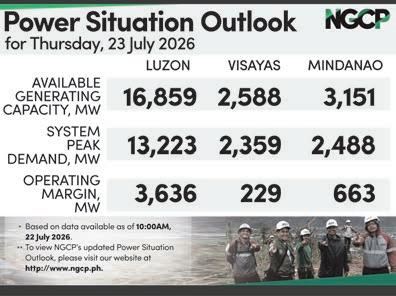
Phinma Education: 92% of first takers pass board exams
By VG Cabuag @villygc

P92-percent passing rate.
The company said it achieved the high passing rate despite 65 percent of its incoming freshmen with reading and mathematics competencies equivalent to the Grade 5 level or below, based on the school’s internal assessments. The school network, whose stu-
dents mostly come from low-income families, attributed its success to the academic interventions it undertook during the student’s learning years in the school to address significant learning gaps among freshmen.
The company said its internal assessment found varying levels of academic readiness among incoming college students, with 99 percent assessed as not yet college-ready upon enrollment. The company noted the importance of targeted academic support to help students make a successful transition into higher education.
ARANETA CITY INKS NEW POWER SUPPLY DEALS WITH FIRST GEN
ARANETA City Inc. has expanded its partnership with First Gen Corp. to power more of its 35-hectare mixed-use property development in Cubao, Quezon City with renewable energy (RE).
The 3.4 megawatts (MW) of RE will energize the 30-storey Cyberpark Tower 3 office building, the 22-storey mixed-use Aurora Tower, the former Fiesta Carnival site that is undergoing redevelopment and the remaining Fiesta Carnival Arcade. The RE will be sourced from the 648-MW Unified Leyte geothermal power plants in Leyte.
The new power supply deals are on top of the similar deals signed in October last year, for supply to three other Araneta City properties--Ali Mall, New Frontier Theater and Manhattan Gardens. Their power supply requirement, estimated at 5.4 MW, also comes from First Gen’s geothermal and hydro plants in Bicol and Nueva Ecija, respectively.
Officials from First Gen and Araneta City Inc. signed the latest power supply agreements early this month.
“We have been trying to tap renewable energy sources for the past years and we’re happy to be achieving our vision. Our BPO [business process outsourcing] locators have been asking us to source renewable energy. We look forward to growing our partnership with First Gen,” said Araneta City Senior Vice President Antonio Mardo.
“Shifting to renewable energy is not just doing good for the environment, but also a means to manage business risks. We thank the Araneta Group for growing
with us and allowing us to be their partner as they progress in their sustainability journey,” said Carlo Vega, First Gen chief customer engagement officer.
Araneta City is also among the first to adopt Department of Energy programs, such as the Retail Competition and Open Access (RCOA) and Retail Aggregation Program (RAP), which allow consumers to exercise the right to choose their electricity suppliers.
Araneta City’s October 2025 deals with First Gen under the RAP combined the power demand of more than 200 retail and service tenants in Ali Mall and New Frontier Theater, as well as over 9,000 apartments in 18 residential towers of Manhattan Gardens. The new power deals were also facilitated under the RCOA and RAP consumers’ choice programs of the DOE.
First Gen is the leading RE producer in the Philippines with over 1,700 MW of combined generating capacity from 31 geothermal, hydro, wind, and solar facilities operating around the country.
Last May, First Gen reported that its income fell by 24 percent to P3.6 billion in the first quarter from last year’s P4.8 billion last year, mainly due to the sale of its gas assets to Prime Infrastructure Capital Inc.
“The earnings reduction reflects the 60-percent stake sale in the company’s natural gas portfolio to Prime Infra last November 2025. The current period only reports First Gen’s 40 percent share of net income in the operating natural gas plants and the 20-percent stake in the Interim Offshore LNG Terminal,” it said. Lenie Lectura
‘VinFast on track to break even in Vietnam by 2027’
VIETNAMESE electric vehicle maker VinFast Auto Ltd. is on track to break even in its home market by 2027 and “shortly” after that globally, Anne Pham, the company’s deputy chief executive officer of investment, said at the Bloomberg Sustainable Business Summit in Singapore. The company’s new low-cost VF 2 model, which sells for 188 million dong ($7,139), including the battery, is expected to drive more local sales after garnering about 29,000 orders in three days after its early July launch, she said.
VinFast continues to face challenges as it strives to become a global brand and compete with giants including China’s BYD. VinFast reported wider losses in the first quarter as global expansion costs rise. The company, which has opened factories in India and Indonesia, is at risk of losing permission to build
To combat this, Phinma said it has discarded traditional academic models in favor of a system that prioritized essential skills and remediation, according to Chito Salazar, Phinma Education president and CEO.
“Our goal is to get as many of them as possible to graduate. The way we deal with it is we’ve adjusted our learning systems, because when you’re teaching students from lowincome families, you need to change the system.”
This approach includes focusing the curriculum on job-ready
skills and utilizing science-based instruction that treats the brain like a muscle that can be strengthened regardless of a student’s starting point.
It translated into strong performance in professional licensure examinations over the past year, producing 43 board topnotchers and earning recognition for 12 academic programs as among the country’s best-performing.
About eight of its programs-nursing, teacher-elementary and secondary, optometry, criminology, dentistry, medical technology and
pharmacy--performed higher than the national board passing average rate in 2025-2026.
To expand its impact, the company is fostering partnerships with government and the private sector to help address college access and completion challenges and boost employability.
Among these is the NapolcomPhinma Education Kaagapay Partnership, which provides educational opportunities for eligible dependents of National Police Commission and Philippine National Police employees who are senior
which began in 2021.
Since then, Phinma said 154 students have completed internships with the company, with 62 eventually hired as full-time employees. In 2025 alone, 25 of 35 interns were absorbed into the workforce.

‘Electric cooperatives need capital to improve services’

a delayed and downsized plant in North Carolina. The state filed a lawsuit in May alleging the company breached agreements tied to a planned manufacturing complex and seeks to reclaim the project site. Pham declined to comment on the company’s plans for its US factory, but said VinFast’s North America sales strategy remains “on course.”
VinFast is open to pursuing acquisitions and partnerships as it plans to expand into other markets, she said. Pham did not say which countries the company is eyeing next. It plans to increase the localization of manufacturing in India and Indonesia, she said. On May 27, shareholders approved VinFast’s blueprint to offload its Vietnam factories to a separate company to shed debt. The transaction would raise 13.3 trillion dong for VinFast, it said.
Continued on B2
THE Manila Electric Co. (Meralco) aims to empower electric cooperatives (ECs) via capital infusion which will enhance their power distribution services.
“We’re looking at all the other electric cooperatives in general. So, because basically this is a nationbuilding effort of Meralco…Most of the electric cooperatives are nonprofit entities and they cannot attract investment because of that structure.
Under Section 57 of Epira [Electric Power Industry Reform Act], they are allowed to convert into stock corporations to encourage infusion of private capital,” said Meralco Senior Vice President Arnel Casanova said.
Meralco said it is keen on helping Batangas II Electric Cooperative Inc. (Batelec II), South Cotabato Electric
Cooperative II (Socoteco II), and Albay Electric Cooperative (Aleco).
For Batelec II, Meralco has submitted a joint venture proposal instead of a takeover, vowing to invest to upgrade aging facilities and modernize power infrastructure.
The company said “it makes sense” for Meralco to offer its services to Batelec II since the company already serves the cities and municipalities of Sto. Tomas, Batangas City, and San Pascual.
“I think it’s very fast for us to improve the reliability of power because we have 13 substations surrounding the entire province. We could just connect them to the
Meralco existing management. This will make the power more reliable and lessen and reduce the system losses, making it much more efficient.
Definitely, the objective is really to eliminate or reduce brownouts and power interruptions,” said Casanova.
The Batelec II board of directors earlier approved a competitive selection process (CSP) to help choose its private partner.
“Based on the news, they are finalizing the terms of reference. We are waiting for that. We’ll wait for that and then we will see. We will definitely participate in the bidding,” said Casanova.
A CSP is a government-mandated bidding procedure that distribution utilities like Meralco must conduct to secure power supply agreements (PSAs). It is primarily designed to ensure transparency, promote market competition, and find the lowest-cost electricity available for consumers.
By forcing generation companies to bid against each other, the CSP helps keep electricity rates down and
protects customers from the volatile pricing of the Wholesale Electricity Spot Market.
Meralco has also submitted its formal intent to do the same with Socoteco II. “We’re also looking at the Socoteco 2 in General Santos. Hopefully, they bid it out similarly to what BATELEC has done, because it actually ensures more transparency and it’s for the best interest of the member consumers.”
He said they haven’t heard from Socoteco II after Meralco’s letter of intent was submitted. “We actually encourage them to bid it out because we know that there’s also other parties that are interested. So, to ensure that the process will be more transparent, we encourage them to actually bid it out. Well, I don’t know if they have a decision yet.”
Meralco has also set its sights on Aleco to be able to have a better service. “We are studying that and hopefully, Aleco will be welcoming enough to provide us with the necessary information so we could make a better proposal,” Casanova said.
high school graduates and incoming college students. Under the partnership, scholarships will be reserved across 12 Phinma Education schools in the Philippines. The school also collaborated with global information and analytics company Reed Elsevier Philippines,
By Lenie Lectura @llectura
Banking&Finance
BSP inks deal solidifying acts vs financial crimes
By Andrea Louise San Juan
THE quintet against financial crimes and grifters is now complete after the Bangko Sentral ng Pilipinas (BSP) inked a deal with the Department of Justice (DOJ) on Wednesday—the fourth agency the central bank has joined forces with to maintain the public’s trust in the country’s banking industry.
Last Wednesday, officials of the central bank and the country’s Justice department signed an “information-sharing agreement” to “strengthen” the investigation and prosecution of financial account scams and related offenses under the Anti-Financial Account Scamming Act (Afasa) or Republic Act (RA) 12010.
BSP General Counsel Roberto L. Figueroa said the signing of the agreement goes beyond the execution of a legal instrument.
The agreement “marks an important milestone in strengthening the institutional framework through which our government protects the public against financial account scams,” Figueroa said.
The central bank’s chief legal officer underscored the importance of signing this type of agreement against the backdrop of financial account scams, which he said “inflict damage that extends well beyond monetary loss.”
“They undermine confidence in our financial system, exploit the trust of consumers and leave countless individuals and families bearing the consequences of sophisticated criminal activity,” Figueroa added.
Moreover, he pointed out that as financial services become “increasingly” digital and transactions occur with an “unprecedented” speed, the institutions tasked with safeguarding the public must, likewise, be capable of responding with “speed, precision and close coordination.”
This, Figueroa stressed, is why Afasa is important. He explained that RA 12010 recognizes that addressing financial account scams requires more than the efforts of any single institution.
“Even the BSP cannot do it alone. We need the help of everyone, of all institutions, individuals and groups in society,” he added.
Figueroa explained that the Afasa establishes a legal framework that enables regulators, law enforcement agencies, prosecutors and covered institutions to work together while respecting the rule of law, due process and the safeguards that govern the
THE Government Service Insur-
ance System (GSIS) has allotted over half a billion pesos in emergency loans for its members in La Union and Negros Occidental, which were recently hit by separate emergencies. The state-run pension fund for government employees said on Wednesday that P520.08 million in total available loan funds has been earmarked to benefit 21,153 active members and old-age and disability pensioners residing in the two provinces.
Bagulin, La Union was declared under a state of public health emergency due to a dengue outbreak, while Negros Occidental was placed under a state of calamity following the outbreak of the red-striped soft scale insect affecting sugarcane plantations.
According to a statement issued by the GSIS, eligible members and pensioners in La Union and Negros Occidental may apply for the emergency loan until August 16 and August 14, respectively. The loan carries a fixed interest rate of 6 percent per annum and is payable over 36 monthly installments, read the statement. Active members must be working or residing in the affected areas, have no unpaid GSIS loan for more than six months and are not on unpaid leave to qualify for the loan.
handling of information. As such, he considers the agreement as giving a “practical effect” to the legal framework of the Afasa.
According to the central bank, the agreement establishes the procedures for the DOJ to request and receive financial account information from the BSP’s Consumer Account Protection Office, pursuant to the Afasa and the BSP Circular 1214.
According to the central bank, the agreement also sets out safeguards to ensure that shared information is used only for authorized purposes and protected in accordance with the law.
Figueroa added that the agreement supports the BSP’s mandate to “promote a safe, sound, stable and efficient financial system while reinforcing our efforts to protect financial consumers from financial fraud.”
“Timely, relevant and lawfully shared information strengthens the ability of prosecutors to assess evidence, build cases and pursue accountability against those who exploit financial systems for financial gain,” he added.
Meanwhile, Elmore O. Capule, the Deputy Governor for the Corporate Services Sector of the BSP, said that the number one obstacle to investigating scams is the Bank Secrecy Law or RA 1405.
“So we were very fortunate that we were able to enact the Afasa, especially the power of the BSP to look into deposits,” Capule said in his allocution during the ceremonial signing of the agreement.
He added that the agreement “sends a very strong message that the government is fighting as one to protect the Filipino public.”
Figueroa emphasized that “stronger institutional collaboration enhances our collective ability to identify organized actors who exploit the financial system, disrupt their operations and hold them accountable under the law.”
A statement distributed by the BSP read the central bank considers the agreement as promising “quicker action” against online scams.
“Competent authorities will be able to trace and identify individuals behind suspicious transactions faster and help prevent further losses due to fraud,” read the statement.
The agreement’s signing comes six months after BSP officials also signed information-sharing agreements with the National Bureau of Investigation, the Cybercrime Investigation and Coordinating Center and the Securities and Exchange Commission in February.
Benefit payments climbing faster vs PhilHealth’s take

By Reine Juvierre Alberto @reine_alberto
BENEFIT claims paid by the Philippine Health Insurance Corp. (PhilHealth) are rising faster than its premium collections, figures in the first semester of the year show.
Total benefit claims paid rose by 44.53 percent to P210.09 billion from January to June from P145.36 billion in the same period in 2025, data from the government-run health insurer showed.
Private health facilities received the bulk, or P123.25 billion, of benefit claims, which increased year-onyear by 44.35 percent from P85.38 billion in 2025. Payments to government health facilities, likewise, jumped by 44.78 percent to P86.84
billion from P59.98 billion in the same period last year.
Premium contributions of members rose by 32.41 percent to P67.733 billion in the first quarter of this year from P51.152 billion in the same period last year, data from PhilHealth also showed.
Meanwhile, benefit claims expenses were higher at P97.216 billion, up by 32.33 percent from P73.464 billion a year ago.
The fast climb of PhilHealth’s pay-
ments
Last
This
Ulep
Hedge fund stars look to quit Singapore for HK: Aima
AGROWING number of hedge fund firms and asset managers are looking to shift staff and offices from Singapore to Hong Kong or other cities that are using lower taxes to attract more investors, according to an industry body.
The Alternative Investment Management Association Ltd. (Aima), a global group that includes hedge fund managers, private equity firms and other institutions, told the Monetary Authority of Singapore in a letter this week that some of its members are having active conversations with portfolio managers and other staff that are seeking to relocate within months. It urged the city-state’s authorities to come up with a timely and strategic response to keep Singapore competitive and update its “overall value proposition” for global alternative asset managers.
“These are not isolated accounts,” the group said of the relocation discussions. It pointed to an unnamed “leading global manager” which shared anonymously that its Singapore headcount has declined in recent years while its Hong Kong presence has multiplied. That, it added, was “a reversal of the position of only a few years ago, when Singapore was its regional centre of gravity.”
While Singapore and Hong Kong
AI
They must likewise have paid at least three months’ worth of premiums within the last six months, have no pending administrative or criminal case and maintain at least P5,000 monthly take-home pay after deductions. As for pensioners, GSIS said at least 25 percent of their monthly pension must remain after loan deductions and they must not have an emergency loan overdue by more than six months. Applications may be submitted through the GSIS Touch mobile app, while loan proceeds will be credited directly to the borrower’s ATM account. “The emergency loan underscores GSIS’s continuing commitment to provide immediate financial relief to its members and pensioners in areas placed under a state of calamity, disaster, or state of public health emergency,” GSIS said. In the first quarter of 2026, GSIS’s net income jumped by 170 percent to P43.6 billion from P16.1 billion in the same period a year earlier. Claims and benefits paid by GSIS amounted to P49.5 billion during the four-month period, up by 4.73 percent from the P47.3 billion it disbursed a year ago. Its total assets reached P2 trillion as of end-March 2026, on track to cross the P2.1-trillion mark by year-end. Reine Juvierre S. Alberto
DATA center developer PolarDC Group Ltd. discovered an unlikely source of cash for its AI ambitions back in May: the Nordic highyield bond market.
In a first for Europe, the H.I.G. Capital LLC-backed firm raised a record €800 million ($913 million), uncovering a well of demand to finance the industry’s enormous appetite for capital. The deal quickly spawned imitators.
But as issuers test the Nordic bond market—a small, flexible and risk-tolerant venue better known for funding medium-sized companies than digital infrastructure—they’re finding there are limits to its appetite.
US firm Prime Data Centers LLC shelved a planned Norwegian-law bond after investors balked at the proposed terms, despite the company cutting the expected size of the offering from $600 million to $500 million. Just days later, Pure Data Centres, a UK firm backed by Oaktree Capital Management, abandoned plans for what would have been a record-breaking €1 billion bond sale in favor of bank financing.
The episodes highlight the challenges of funding ever-larger data-center projects and signs of indigestion in the Nordic bond market after just a few deals.
“I haven’t found any of these data cen-

have long been rival Asian hubs for global finance, the Chinese city was stymied by trouble from widespread protests in 2019 and years of strict Covid-19 restrictions that sparked an exodus of expatriates. Some finance executives who wanted to remain in Asia moved to Singapore during this period. Assets under management in the city-state grew 53 percent over the five years through end-2024 to S$6.1 trillion ($4.7 trillion), according to figures MAS released last July.
Hong Kong is now planning to slash an array of taxes as part of efforts to attract asset managers from around the world, threatening to upend Singapore’s recent run of success.
ter deals interesting,” said Adam Darling, a high-yield bond fund manager at Jupiter Fund Management Plc in London. He was speaking in general terms, without identifying specific issuers.
Volumes of Nordic debt have been rising, where issuers—even unrated ones—can raise cash faster than in Europe’s mainstream credit markets.
Yet data centers are finding that their grand plans may not sit well within what remains a niche market dominated by relatively small investment banks such as Pareto Securities and Arctic Securities. It’s not Wall Street, where dealers are able to place $25 billion of hyperscaler debt in one day, albeit high-grade.
Representatives for Pareto Securities and Arctic Securities declined to comment. A spokesperson for Prime DC also declined to comment.
As new and unrated borrowers flock to Nordic debt, investors are struggling to understand their businesses and their risks. High yield investors who would normally judge a borrower by weighing up its cash flow against its debt are having to wrap their heads around completely different metrics.
For example, Pure DC’s unsecured bond was being marketed both off contracted Ebitda—a gauge used in infrastructure or project financing—and
In particular, a tax break on eligible carried interest could significantly increase the compensation of successful fund managers.
Hong Kong’s total assets under management grew 20 percent in 2025 a record HK$42.2 trillion ($5.4 trillion), thanks in part to a surge in net fund inflows, according to data released earlier this month. Singapore has yet to release its 2025 asset management survey report, but MAS’s chairman said in a June speech that Singapore’s assets under management grew to S$6.7 trillion by the end of last year.
Some asset managers have recently been in talks with MAS about the
loan-to-value, a measurement more often associated with the real estate sector, according to people familiar with the deal.
The lack of AI-related revenues was also a stumbling block for some prospective investors in the deal, who pointed out that the firm’s revenues mainly accrue from its cloud business. Data center providers without AI tenants often tout potential growth from AI usage.
“When a data center comes to market, you immediately think AI compute,” said Jayadev Mishra, a portfolio manager at Bank J Safra Sarasin. “Unfortunately for a lot of these issuers, that’s not the case. They’re just riding on the AI tenant narrative.”
Pure DC’s main market has been IT service providers, telecommunications clients and financial services clients, according to its 2025 accounts. Current revenue streams are a blend of cloud and AI inferencing revenues, a spokesperson told Bloomberg, referring to revenues driven by companies that are using AI in their workload.
Pure DC had been running a parallel process for “more traditional loan structures” from the bank market that were more favorable,
implications of Hong Kong’s tax exemptions, and have offered suggestions on how Singapore could make hiring more foreign talent easier for them, people familiar with the matter said earlier.
The Aima said it has had recent engagements with MAS on the same issues. It called for Singapore to undertake sweeping changes to its incentives and taxes—citing rising costs from property rents to school fees. The group’s suggestions include lower taxes, firm-level grants and relief tied to Singapore headcount and more clarity on immigration and residency pathways.
“Individual taxation has emerged from our consultation as the decisive lever for the most mobile cohort,” it said. In addition, roles that don’t strictly require a Singapore presence now default elsewhere, and several global managers have excluded the country from consideration for new regional setups, the group said. It also encouraged the regulator to publicly share its thinking and plans, partly to help companies convince their portfolio managers to stay put in Singapore. “A directional signal now would steady managers currently weighing hiring, platform expansion and regional-headquarters decisions,” it said. Bloomberg
BUILDINGS and skyscrapers in the Wanchai district in Hong Kong, China, on December 6, 2025. PHOTOGRAPHER: PAUL YEUNG/BLOOMBERG
B4
Thursday, July 23, 2026
PHL delays fish imports as supply still stable
TBy Ada Pelonia @adapelonia
HE Philippines will allow the entry of 250,000 metric tons (MT) fish imports during the closed fishing season in the fourth quarter as domestic supply and retail prices remain steady, according to the Department of Agriculture (DA).
Agriculture Secretary Francisco Tiu Laurel Jr. said the DA will start issuing import clearances covering 250,000 MT of fish shipments around October, deviating from the initial August 1 timeline.
‘Long-term
By Jovee Marie N. Dela Cruz
H@joveemarie
“The imports will only be triggered, when necessary,” he told reporters on Wednesday, adding that prices of fish products remained stable.
Last March, the DA authorized the importation of 250,000 MT of
fish to ensure a steady supply of affordable fish and other marine products this year.
The volume was recommended by the National Fisheries and Aquatic Resources Management Council’s (NFARMC) last February.
Under a previous DA circular, the issuance of sanitary and phytosanitary import clearances (SPSICs) was scheduled to begin on August 1, covering over 50 species.
“The fishing season has been extended due to El Niño and there’s currently ample supply of milkfish and tilapia, so the imports will likely be triggered during the closed fishing season sometime in October or November,” the DA chief said.
The government imposes a three-month closed fishing sea -

son in waters northeast of Palawan starting November 1 and in the Visayan Seas and Zamboanga Peninsula beginning November 15. All three areas are spawning grounds for small pelagic fishes like sardines and mackerel.
investments must flow into local food baskets’
OUSE Speaker Faustino G. Dy III on Wednesday underscored the need to protect key agricultural provinces, such as Isabela, saying these “food baskets” are critical to ensuring the country’s long-term food security amid the looming effects of El Niño.
Speaking during a briefing of the House Committee on Agriculture and Food, Dy said major food-producing areas play a vital role not only in sustaining local economies but also in maintaining a stable national food supply. He cited Isabela, one of the country’s top rice producers, which supplies about 45 percent of the rice requirements of the National Capital Region.
He said safeguarding these provinces requires more than short-term emergency interventions, calling instead for sustained investments in irrigation, water management, and climate-resilient farming systems to help communities withstand increasingly frequent climate disruptions.
“Another important point is that we need
to address the needs of food basket areas such as Isabela. This is not only vital to their local economies but also essential to safeguarding the nation’s food security.” Isabela, one of the country’s top riceproducing provinces, supplies around 45 percent of the National Capital Region’s rice requirements.
The Speaker said protecting food-producing provinces requires more than emergency assistance, stressing the need for long-term investments that will enable farmers and irrigation systems to withstand increasingly frequent climate-related disruptions.
Drawing from Isabela’s experience, Dy said national and local agencies have strengthened coordination, closely monitored water levels at the Magat Dam, and planned water releases in anticipation of prolonged dry conditions. Assistance has also been extended to farmers and fishers, alongside efforts to pursue long-term water infrastructure projects.
He highlighted the importance of investing in durable irrigation systems, waterefficient technologies, community-based water management, and climate-resilient
agriculture, noting that these measures are crucial to ensuring the resilience of foodproducing regions and the stability of the country’s food supply.
Dy, a former governor of Isabela, said the province’s efforts demonstrate that preparation is most effective when national agencies, local governments, irrigation managers, and farmers work together.
He added that protecting farmers and fishers ultimately means protecting Filipino families, stressing that every gain in safeguarding agricultural livelihoods directly contributes to food security, economic stability, and the future of the nation.
Meanwhile, Dy also pushed for the establishment of a unified national preparedness framework to strengthen the country’s response to El Niño, urging government agencies to shift from reactive disaster response to proactive planning before drought conditions worsen.
He noted that the country has already experienced the severe impact of El Niño on agriculture and the economy, citing a 12 to 15 percent drop in palay production from 2023 to 2024, which contributed to rising rice prices
and affected millions of Filipinos.
Recalling Isabela’s experience during prolonged dry spells, Dy said early coordination among agencies—including the Department of Agriculture, local governments, irrigation authorities, and agricultural officers—proved crucial in mitigating the effects of drought.
The province intensified monitoring of water levels at Magat Dam, coordinated water distribution plans, and ensured the timely delivery of assistance such as fuel subsidies to affected farmers and fisherfolk, while advancing long-term projects including irrigation upgrades, water-harvesting systems, and multipurpose dams.
Dy said these measures demonstrate how early preparation and coordination can significantly reduce the impact of drought on communities and the nation’s food supply.
He added that the goal of the congressional briefing is to develop a national preparedness framework that is practical, implementable, and capable of protecting communities before crisis escalates, emphasizing the need for the government to act early rather than wait for the full impact of El Niño to be felt.
Agri education should meet industry’s needs—lawmaker
ABy Butch Fernandez @butchfBM
GRICULTURE graduates equipped with the knowledge, skills and opportunities are badly needed to address pressing food security challenges, and this can only happen if national government and local agencies work together, the chairman of the Senate agriculture committee said Wednesday. Senator Francis Pangilinan said the Department of Agriculture (DA), the Commission on Higher Education (CHED), and local government units (LGUs) must work together to ensure that there are enough agriculture graduates equipped with vital skills needed to restart the ailing farm sector. He lamented the aging population of farm-
ers in the country and stressed the need for key government agencies and local governments to bridge the gap between academic training and the realities of the agricultural sector.
“The problem now is that many of our farmers are aging and there are few people in the communities who wish to go into farming, an 8 to 5 job,” he said in an interview, speaking in Filipino.
“So, here you have students who need to graduate but before they graduate, they need to do OJT. At this point the CHED, the DA, the LGU, the Bureau of Extension Services and Bureau of Cooperatives should already be on board so that agriculture can be given the right attention right from the start,” he added.
“And in that way, the next generation of young farmers will be motivated to go into farming because their career path is clear.”
Pangilinan, who chairs the Senate Committee on Agriculture, Food, and Agrarian Reform, shared that each year, about 26,000 agriculture students are required to complete 240 to 360 hours of on-the-job training to graduate.
The DA extension services, whose renationalization he has been pushing for through Senate Bill No. 1991, should be supervising agriculture students, he pointed out.
Earlier, Pangilinan noted that many agriculture graduates either pursue careers outside the sector, find employment abroad, or remain underemployed because of the disconnect between academic preparation, available jobs, and the actual needs of farming communities.
He said stronger coordination among government agencies, academic institutions, and LGUs would help create clearer career
pathways for graduates while ensuring that the country’s investment in agricultural education translates into better support for farmers and fisherfolk.
recognizing that young graduates would like to pursue more stable income-generating careers than work in the farms, the senator said this is the aim of his 2019 Sagip Saka Act, which establishes the Farmers and Fisherfolk Enterprise Development Program to transition farmers and fishers from subsistence farming to farm enterprise, management, and development.
“By aligning education, workforce development, and local agricultural needs, we strengthen not only our agricultural sector but also our country’s ability to provide affordable, sufficient, and nutritious food for every Filipino.”
The DA chief said that the agency is looking at additional areas where closed fishing seasons could be implemented, such as in Northwest Mindanao.
He added that the implementation could begin in 2027, pend -
THE Department of Agriculture (DA) launched a $3.5-million South Korea-funded digital platform as part of its digitalization efforts to provide real-time data and improve policymaking.
Agriculture Secretary Francisco Tiu Laurel Jr. said the AgricultureBased Central Data Ecosystem (AbCDE) platform would fast-track farm assistance, enhance supply chain monitoring, and stabilize food prices.
Among the system’s capabilities that the DA chief touted was the shortened processing time for registration in the Registry System for Basic Sectors in Agriculture (RSBSA) to five minutes from the usual 10-day processing, allowing them to service more farmers and fishers.
“This is a tool to get more real-time data as fast as possible to manage prices, control inflation, and (achieve) food security,” he told reporters on the sidelines of the platform’s launch on Wednesday.
AbCDE was developed in partnership with South Korea’s Ministry of Agriculture, Food and Rural Affairs (MAFRA) and the Korea Agency of Education, Promotion, and Information Service in Food, Agriculture, Forestry and Fisheries (EPIS).
The unified digital hub could verify beneficiaries, track interventions, and monitor agricultural supply chains in real time, which the DA said prevents duplication in records and disconnected databases.
It also slashed the time needed to roll out new support programs by 80 percent, with seeds, fertilizer, and financial assistance completed in five days from the previous 26 days.
ing scientific basis for such an issuance.
The DA said recently that it earmarked P600 million for the construction of the country’s first mega hatcheries which will help the Philippines reduce its reliance on imported fry.
The DA chief had confirmed to the BusinessMirror that his agency is allotting P200 million each for three mega hatcheries under the National Expenditure Program (NEP) 2027.
Once built, he said the mega hatcheries could produce a billion fry (young fish) of milkfish and other aquaculture and mariculture species.
The DA will construct one mega hatchery in Luzon, Visayas, and Mindanao, each spanning 40 hectares, which will be completed by the end of 2027.
More than another government’s modernization project, the DA chief described it as a long-overdue overhaul of a system weighed down by outdated processes.
“For many years, our sector grappled with over a hundred disparate digital initiatives functioning in isolation,” he said.
“Today, with the introduction of the Agriculture-Based Central Data Ecosystem Platform 1.0, we are embarking on a transformative journey in public service.”
The DA chief said South Korea’s contribution goes beyond providing technology.
“Your invaluable expertise has equipped us with a ‘super brain’ to effectively monitor supply chains and stabilize prices in real time,” he said.
“Together, we are sowing the seeds of a digital revolution that will enhance farm incomes and secure food security for generations to come.”
Kadiwa sales
MEANWHILE the DA reported that the government’s Kadiwa program generated more than P4.4 billion in sales over the past four years.
The DA said Kadiwa generated P4.42 billion in sales from July 2022 to July 20, 2026, which benefited more than 12 million Filipino consumers through 22,178 marketing activities nationwide.
The P20 rice program held the lion’s share of the sales at P2.4 billion since it launched last May 2025, distributing 121,271 metric tons (MT) of rice to roughly 12.1 million beneficiaries. The cheaper rice’s beneficiaries include vulnerable sectors, minimum wage earners, public transport workers, indigents, and registered farm and fisherfolk.
Furthermore, the DA said Kadiwa has grown to 805 active Benteng Bigas selling sites, including 295 with regular selling schedules, while the P20 rice program has already been rolled out in 57 provinces. The broader Kadiwa network currently operates 827 regular outlets nationwide. Ada Pelonia
Wheat gains on Black Sea risks and corn hits 2-mo high
WHEAT rose for a second session on escalating Black Sea tensions and worsening crop prospects.
Most-active futures in Chicago climbed as much as 0.9 percent as continued Russian and Ukrainian attacks fueled worries over exports from the Black Sea, a key shipping route for two of the world’s largest wheat exporters. Wheat has jumped 16 percent in July.
“Ukraine and Russia together account for 25-30 percent of global wheat exports, and a disruption during the upcoming harvest is supportive of global prices,” Dennis Voznesenski, an agricultural
economist at the Commonwealth Bank of Australia, said in a report on Wednesday. Russia on Tuesday banned vessels from anchoring at Sea of Azov and Kavkaz ports in areas that lack organized air defense systems. Russia’s Defense Ministry said its forces continued strikes on Ukrainian ports, while Ukraine carried out drone attacks on warehouses operated by Wildberries, Russia’s largest e-commerce platform.
Supply concerns were also reinforced after SovEcon cut its forecast for Russia’s 2026-27 crop by 0.7 percent, citing weaker prospects in the south and a smaller
spring wheat area.
Russia’s July wheat exports are now projected near 1.5 million tons, down roughly one-third year-on-year and the lowest July total since 2017, according to a note on Tuesday from Futures International LLC, which cited logistical constraints.
Prices also found support from poor crop prospects elsewhere, with France’s soft wheat output forecast to decline 7.6 percent this year after a heat wave damaged crops. US spring wheat rated good-to-excellent also fell five percentage points from the previous week.
Meanwhile, corn hit its high -
est in over two months, reaching $4.775 a bushel before paring gains, supported by the Black Sea conflict and concerns that the recent heat in Europe will reduce production.
Farm law
MEANWHILE , France adopted a sweeping emergency agriculture bill allowing limited exemptions for two pesticides used by struggling farmers, prompting backlash from pro-environment groups, who vowed to challenge the legislation.
The bill, aimed at helping France regain its competitive edge and restore its agricultural
trade balance, was approved by the Senate after an overnight vote at the National Assembly. It allows food-safety agency Anses to grant temporary exemptions for the use of acetamiprid and flupyradifurone, which are authorized elsewhere in the European Union.
“The final version of this text brings real and tangible solutions to the farmers,” Agriculture Minister Annie Genevard said during the session. It will help double water storage for agriculture, simplify regulations for farm expansion and leave decisions on pesticide exemptions to Anses scientists, she said.
France, Europe’s biggest farming nation, has been importing more food, leading to the collapse of its food-trade balance last year. Extreme weather, US tariffs, animal disease, and rising fuel and fertilizer costs have all weighed on French farmers.
The legislation follows lobbying by powerful farming unions, including sugar beet and hazelnut growers, who argued their crops have suffered without the pesticides. Pro-environment leftist groups have vowed to ask the Constitutional Council to strike down the law after it rejected an earlier version of the measure last year. Bloomberg News
PHOTO FROM WWW.PNA.GOV.PH
Health&Fitness
Editor: Anne Ruth Dela Cruz
WHO projects global cancer cases to double by 2050
By Patrick Villanueva
THE global fight against cancer is expected to become even more challenging, with the World Health Organization (WHO) projecting that cancer cases could nearly double by 2050 as populations grow older and exposure to preventable risk factors continues.
According to the WHO Global Status Report on Cancer 2026, the International Agency for Research on Cancer (IARC) projects a 66.7 percent increase in global cancer incidence by 2050. Every region is expected to experience a rise in cancer cases, with
the steepest increases projected in Africa (125.2 percent) and the Eastern Mediterranean (109.8 percent). Cancer remains the world’s second leading cause of death, accounting for an estimated 20.6 million new cases and nearly 10 million deaths each year, the report said.
The sharpest increases in cancer incidence are expected in low-income countries, where cases are projected to rise by 133.3 percent, followed by lower-middleincome countries at 86.5 percent.
Asia, meanwhile, continues to account for the largest share of global cancer cases, representing 53.1 percent of the total, largely because of its population size. In the Philip -
pines, data from the Global Cancer Observatory recorded 149,852 new cancer cases and 86,338 cancer-related deaths in 2024.
Aging populations THE report attributed the growing cancer burden to ageing populations, modifiable risk factors, and infectious agents. Among the leading contributors worldwide are tobacco use, infections, alcohol consumption, and high body mass index.
WHO identified tobacco use as a major risk factor for multiple types of cancer. At the same time, it noted encouraging progress in tobacco control, with smoking prevalence among people aged 15 and older
declining from 29.4 percent in 2005 to 19.5 percent in 2024.
The report also highlighted the increasing burden of cancer among younger adults, noting a significant rise in cancer incidence among people under the age of 50 between 1990 and 2019. It emphasized the need for stronger global leadership to improve cancer prevention, early detection, treatment, and long-term care.
To strengthen cancer control, WHO urged countries to establish comprehensive national cancer prevention and control plans supported by updated clinical guidelines. The agency also identified sustainable financing, adequate numbers of trained
DOH inaugurates Vigan City Primary Care Facility, bringing UHC closer to Ilocanos
RESIDENTS of Vigan City and nearby communities can now access quality healthcare closer to home as the Department of Health (DOH)–Ilocos Region, together with the City Government of Vigan, formally inaugurated the Vigan City Primary Care Facility on July 18, 2026, a significant milestone in the government’s continuing implementation of the Universal Health Care (UHC) Act.
The new facility strengthens the local health system by providing comprehensive frontline healthcare services, allowing residents to receive essential medical care within their community before illnesses become emergencies or require hospitalization.
Regional Director Dr. Helen D. Tobias said the facility demonstrates the government’s commitment to making Universal Health Care a reality for every Filipino.
“Universal Health Care begins with strong primary care. This facility ensures that families can receive quality healthcare close to home, where illnesses are detected early, chronic diseases are managed
promptly, mothers and children receive essential care, and preventive services become part of everyday life. When people have access to healthcare before conditions become critical, we save lives, reduce unnecessary hospital admissions, and lessen the financial burden on Filipino families,” she said.
The Vigan City Primary Care Facility offers medical consultations, routine check-ups, diagnostic services, maternal and child healthcare, immunization, outpatient care, preventive wellness programs, early disease screening, and access to essential medicines. By serving as the community’s first point of contact with the healthcare system, it bridges the gap between barangay-level health services and hospitalbased care, ensuring patients receive the right care at the right time.
Strengthening primary care
DR. Tobias also emphasized that strengthening primary healthcare is key to building a more resilient and equitable health system.
Medical Center Imus earns global recognition for innovative hospital waste management
By Rizal Raoul Reyes Contributor
MEDICAL Center Imus (MCI) has earned international recognition after two members of its management team were named finalists in the prestigious 5th QualTech Prize in Healthcare for an innovative project that significantly reduced hospital waste and disposal costs.
Representing the Philippines were nurse Hector Alvin Orbeta and Engr. Charlotte Magtira, whose quality improvement project, “Turning Waste Into Value: Eliminating Misclassified Yellow Waste to Improve Safety, Compliance, and Cost Efficiency,” was recognized for delivering measurable improvements in patient safety, regulatory compliance, environmental sustainability, and operational efficiency.
The project was developed after the hospital discovered that significant volumes of general waste were being incorrectly classified as infectious, or “yellow,” waste. Aside from driving up disposal costs, the practice also posed compliance and safety concerns.
Root causes identified
USING the Plan-Do-Check-Act (PDCA) quality improvement framework, a multidisciplinary team composed of infection prevention personnel, pollution control officers, nursing services, and quality assurance staff identified the root causes of the problem. These included poor waste bin placement, inconsistent waste segregation practices, limited staff awareness, and inadequate monitoring systems.
To address the issue, the hospital removed yellow waste bins from public areas and retained them only in patient care and clinical areas. It also reinforced waste segregation policies through a hospital-wide compliance memorandum, partnered with the City Environment and Natural Resources Office (CENRO) to conduct staff training, and introduced regular waste audits, real-time coaching, and continuous monitoring using Waste per Occupied Bed Day (WOBD) as a key performance indicator.
The initiative produced significant results. MCI reduced its Waste per Occupied Bed Day from 4.02 kilograms to 2.24 kilograms, a 44 percent reduction, while maintaining comparable patient census levels.
Infectious waste disposal costs also dropped by 60 percent, from approximately P180,000 to P60,000, demonstrating that improved waste segregation, rather than reduced hospital activity, was responsible for the savings.
Strengthening of collaboration
BEYOND lowering costs, the initiative strengthened collaboration among hospital departments, improved staff awareness of proper waste management, encouraged lasting behavioral change, and fostered a culture in which waste segregation became a shared responsibility.
The hospital also developed standardized policies, audit tools, and monitoring systems that can be replicated across other departments and healthcare facilities.
“This recognition reflects our unwavering commitment to healthcare excellence, sustainability, and operational excellence,” said Kenneth Joseph P. Veneracion, MCI deputy chief executive officer.
“This achievement demonstrates what is possible when we empower our people to innovate and continuously improve the way we deliver care. By embracing innovation, we can achieve world-class standards that enhance patient care, strengthen our operations, and contribute to a more sustainable future.”
Continued commitment
VENERACION said the recognition of Orbeta and Magtira reflects MCI’s continuing commitment to delivering world-class healthcare through innovation while advancing its goals of improving safety, ensuring regulatory compliance, and promoting operational efficiency.
The International Continuous Quality Improvement (CQI) Competition recognizes healthcare organizations whose quality improvement initiatives demonstrate measurable impact, sustainability, and scalability. By reaching the finals of the QualTech Prize, MCI demonstrated that locally developed solutions can compete with and meet international standards for healthcare quality improvement.
The recognition places MCI alongside leading healthcare institutions showcasing quality improvement initiatives on the global stage, highlighting how practical, homegrown innovations can deliver meaningful gains in patient safety, environmental responsibility, and healthcare efficiency.


DEPARTMENT of Health Ilocos Regional Director
Dr. Helen D. Tobias leads the opening of the Vigan City Primary Care Facility.
“No Filipino should have to travel far for basic health services. Through strategic investments in primary care facilities, we are bringing healthcare closer to where people live and making quality health services more accessible, affordable, and responsive to the needs of every Ilocano.”
The facility is a product of the government’s sustained investment through the Health Facilities Enhancement Program (HFEP). It is expected to significantly expand the hospital’s service capacity, enhance the delivery of quality healthcare services, and address the increasing healthcare needs of the growing population of Vigan City and its neighboring communities.
The inauguration underscores the strong partnership between the Department of Health and the City Government of Vigan in advancing the goals of the Universal Health Care Act. By investing in accessible, integrated, and people-centered primary healthcare services, the government continues to ensure that every Ilokano has better access to timely, quality healthcare closer to home.
Aesthetics trend: Goodbye to overdone looks; hello to natural beauty enhanced
By Francine M. Marquez
THE aesthetic industry is growing and becoming more competitive with new treatments launched at a quick pace. In the quest for beauty, there’s always something new to try.
Yet, there is also a big shift in what clients want. The days of dramatic goddess transformations are being traded for treatments that promote wellness, natural appearance, and sustainable upkeep.
In a 2026 trend report by the World’s Leading Clinics, a global network of board-certified physicians and providers recognized for excellence in surgical artistry and non-surgical innovation, states: “The conversation around aesthetics is changing quickly, and current trends point to a future defined by subtlety, longevity, and whole-person care.”
Instead of one-time fixes, clients are now looking for long-term skin and body wellness.
According to the report: “At the heart of aesthetic trends for 2026 is a clear move toward non-surgical, regenerative, and multi-modality care. Patients want to look refreshed and healthy, not altered. The desired outcome is a natural glow, improved skin quality, and facial balance that still looks like them.”
The report added that demographics are also changing, with more men seeking the services of aesthetic centers. The young Gen Z market is also growing as they consult clinics for preventative treatments and improvements in their appearance.
These shifting expectations are also reshaping client-doctor relationships and the measures of success for both treatments and procedures.
Patients first
YSERA Aesthetics Center, located on Mayon Street in Quezon City, keeps itself up to date by constantly updating its treatments, promoting the continuous upskilling of its resident doctors, and offering personalized programs based on face-to-face consultations with clients.
According to business head Noel Agbayani, “We always have a doctor on board, unlike other aesthetic centers where doctors are on call. This is because we want our customers to feel confident and assured that there’s always an authority figure to address their questions or is ready in case there are complications that can possibly arise during a treatment.”
The aesthetic hub caters to middle-income professionals and entrepreneurs, ensuring its services are accessible at more affordable prices than bigname clinics.
Agbayani agreed that clients are now more inclined to avail themselves of preventive treatments that promote skin health.
He cited Ysera’s non-surgical procedures such as facial services like diamond peel, acne treatments, and skin whitening.
healthcare professionals, and reliable access to essential medicines as critical priorities.
Beyond strengthening health systems, WHO emphasized the importance of adopting a people-centered approach to cancer care—one that prioritizes shared decision-making, community participation, and meaningful involvement of patients throughout the continuum of care.
As cancer cases continue to rise worldwide, the report stressed that sustained investments in prevention, early diagnosis, and equitable access to quality care will be essential to reducing the disease’s growing global burden.
It also offers biostimulator treatments like advanced hybrid collagen stimulators Juvilook and Lenisna. Also available is Sylfirm X, a dual-wave radiofrequency microneedling device for treating skin pigmentation and for collagen stimulation and skin tightening.
Also on its skin menu are skin lifting treatments like Ultherapy and APTOS Thread Lift.
Ysera also offers surgical procedures done by its certified and highly trained surgeons.
In-house professionals
THREE resident doctors maintain their presence at the center.
Dr. Michelle Supapo handles non-invasive to minimally invasive procedures, including machine-based treatments and injectables like lip fillers. Dr. Supapo is the first Filipino to receive bespoke lip training under noted aesthetic nurse specialist Julie Horne (also known as the Lip Queen) of the Swiss Aesthetic Institute and Goldsmith Clinic.
Meanwhile, Dr. Patrick David Tan leads the surgical team at Ysera and focuses on specialized training and surgical procedures, like rhinoplasty.
Dr. Celestine Capada-Azurin is also one of its lead aesthetic medical physicians.
Agbayani said that patients appreciate transparency and the importance of understanding the treatments and procedures beforehand.
“There’s always an open discussion between our doctors and clients. Our doctors don’t just do the procedures for the sake of it, but they put a lot of thought into understanding the needs, the health, and lifestyle of clients,” he noted. He also observed that alongside wellness priorities, there is a growing demand for a “natural” or refreshed appearance, whether it’s applying a lip filler, Botox, or undergoing rhinoplasty or chin augmentation.
Agbayani said, “Gone are the days when aesthetic procedures resulted in drastic or overdone looks. Now, clients are more concerned about looking healthy and radiant”
But while patients have the final say on which treatments to apply, he noted that Ysera’s doctors can decline the procedure, especially if it is unnecessary or too risky for the patient’s health.
“Unlike pathologic practice where patients go to a clinic because there’s something wrong with them, here they come in fine, and just want to look better. So the worst thing that could happen is for them to end up with a badly done procedure. So, if the doctor says no, I would trust the doctor because he knows what’s best for you.”
As aesthetic medicine is reshaping its goals towards patient-centered care, a successful treatment at Ysera isn’t just about the results but partnering with experienced specialists, getting educated, and feeling beautiful inside and out.
MBy Candy P. Dalizon Contributor
EDICAL experts are reminding parents anew that adolescence is the golden window for the Human Papillomavirus (HPV) vaccine. Just as parents do not hesitate to keep infants on track with childhood immunizations, HPV vaccination should be a routine part of teenage healthcare.
As Dr. Vanessa Torres-Ticzon of the Philippine Society of Adolescent Medicine Specialists (PSAMS) pointed out, protecting kids from HPV should feel no different than getting their early childhood shots, a seamless, essential step in raising healthy adults. This reminder comes at a critical time. Cervical cancer remains one of the leading cancers affecting Filipinas, claiming an estimated 4,380 lives out of 8,549 new cases annually. Yet, experts emphasize that it is also one of the most preventable cancers through timely vaccination, regular screening, and early intervention.
Speaking at the recent Together for Health: Towards a Cervical Cancer-Free Philippines forum, healthcare leaders including Dr. Torres-Ticzon, Dr. Ricardo Manalastas, and Dr. Anthony Calibo, Technical Advisor for HPV Vaccination at Jhpiego Philippines, emphasized that HPV protection acts primarily as a cancer prevention tool. Because prevention is always better than cure, early immunization significantly reduces both the physical and financial burdens on families.
Potential exposure
TIMING , however, is everything. Dr. Manalastas, representing the Philippine Infectious Disease Society for Obstetrics and Gynecology (PIDSOG), emphasized that the vaccine is most effective when administered before any potential exposure to the virus. Vaccinating boys and girls between the ages of nine and 14 generates a far stronger immune response and offers the highest level of protection against future cervical cancer risk. This focused approach directly aligns with the World Health Organization’s (WHO) cervical cancer elimination strategy, which aims to fully vaccinate 90 percent of girls against HPV by age 15. To reach this global target, advocates are pointing to the WHO’s Health Promoting Schools framework, which leverages educational institutions as powerful hubs for youth wellness and health education.
As stakeholders work toward a cervical cancer-free future, schools will remain an indispensable partner in delivering vaccines, driving community awareness, and ensuring young Filipinas are protected long before disease can take root. For patient advocates and medical leaders alike, school-based HPV vaccination is far more than a routine medical procedure; it is a vital opportunity to prevent unnecessary suffering and save lives.
Beyond availability, boosting HPV vaccination rates relies heavily on clear information and trusted guidance. Findings from UP Manila’s UPLIFT Adolescents Project show that parents generally aren’t anti-vaccine; they simply need reassurance regarding safety, side effects, and access.
“Decisions surrounding vaccination begin at home, extend into the community, and must be supported by national systems,” said Senior Program Researcher Krizelle Cleo Fowler. Protecting adolescents, she emphasized, requires seamless collaboration among families, healthcare workers, educators, and government leaders.
DoubleDragon tops off 702-room Hotel101-Libis, set to become Quezon City’s largest hotel
DoubleDragon Corporation has completed the structural works for its 702room Hotel101-Libis with the topping-off ceremony held on July 17, 2026, marking another milestone in the expansion of its Hotel101 portfolio.
Located within Robinsons Land’s Bridgetowne Estate and just steps away from Robinsons Opus Mall, Hotel101Libis is poised to become the largest hotel in Quezon City upon completion.
The project is part of Hotel101 Global’s long-term vision of building 50,000 uniform Hotel101 rooms in the Philippines and one million rooms across 100 countries through its proprietary hospitality business model.
Hotel101-Libis also forms part of DoubleDragon’s biggest hotel expansion year to date. In 2026 alone, the company is set to open 2,229 new rooms worldwide, including the recently launched 680-room Hotel101-Madrid in Spain, the 519-room Hotel101-
Lgenie,

Davao opening on July 30, the 548room Hotel101-Cebu, and the 482-room Hotel101-Niseko in Hokkaido, Japan.
The company said Hotel101-Madrid, its first overseas property, has posted strong early performance, including a recent single-day full occupancy that generated more than €100,000 in
revenue, reinforcing demand for the Hotel101 brand.
DoubleDragon said the continued expansion of Hotel101 supports its strategy of building a global portfolio of recurring revenue-generating hospitality assets while strengthening the Philippines’ presence in the international hotel industry.
real-time voice AI to assistive devices for senior citizen care

AGORA, a global leader in real-time engagement, announced that its Conversational AI platform is powering Lgenie’s next generation of AI-native assistive devices, enabling reliable real-time voice interactions for elderly users even in outdoor and mobile environments where network conditions can vary.
The deployment reflects a broader shift in conversational AI. While early adoption focused on chatbots and digital assistants, developers are increasingly embedding AI into physical devices used across healthcare, education, smart homes, robotics, mobility, and consumer electronics. For these AI-native devices, the user experience depends not only on the intelligence of the AI model, but also on whether voice interactions remain immediate, reliable, and natural in real-world environments.
Lgenie’s AI-powered smart cane is one example of this shift. Designed to support elderly users in daily life, the device relies on real-time voice interaction to help users communicate more naturally while navigating outdoor and mobile environments. Rather than simply answering questions, the smart cane is designed to accompany older adults through daily routines, helping them access information, interact more easily, and move with greater confidence.
Lgenie’s deployment shows why AI-native devices need more than a capable model: they require realtime voice infrastructure that can support low latency, interruption handling, audio quality, and network resilience in everyday environments.
The collaboration comes as conversational AI expands beyond software into connected devices. The global Artificial Intelligence of Things market is projected to grow from US$18.37 billion in
2024 to US$79.13 billion by 2030, driven by rising adoption across healthcare, consumer electronics, manufacturing, and smart infrastructure.
In the Philippines, this trend coincides with a growing need for technologies that support independent living.
The country is moving toward becoming an ageing society by 2030, with researchers projecting that people aged 60 and above will account for more than 10 percent of the population. At the same time, mobile adoption is expanding, with GSMA projecting smartphone adoption to reach 92 percent by 2030 and more than half of mobile connections to run on 5G. These shifts create stronger conditions for AI-powered devices, while also raising the bar for reliability in real-world environments where connectivity, affordability, and digital access can vary widely.
For Lgenie, building AI-powered assistive devices required more than adding voice capabilities to hardware.
Since these devices may be used while walking outdoors, asking for guidance, or interacting in noisy environments, delays or unstable voice performance could directly affect usability and user trust.
To address these challenges, Lgenie integrated Agora’s Conversational AI Engine, combining real-time speech recognition, speech activity detection, and full-duplex voice streaming into a production-grade conversational pipeline for AI-native devices.
Agora’s infrastructure enables low-latency conversations, allowing users to speak naturally without waiting for the AI to finish. It also supports reliable streaming, real-time speech recognition, and seamless interruption handling, helping conversations feel more human and responsive even under challenging network conditions.
“Assistive devices show why real-time AI cannot be treated as a nice-to-have feature,” said Xiao Dong Feng, Head of Physical AI Product at Agora. “When AI moves into physical products that people rely on in daily life, latency, audio quality, interruption handling, and network resilience become core parts of the user experience.”
With Agora powering its conversational AI infrastructure, Lgenie’s AI-powered smart cane achieved measurable improvements in responsiveness, stability, and conversational fluency.
The deployment achieved:
400 ms average response latency, enabling near realtime conversations
100 percent accuracy, with higher conversational stability and completion rates across conversations and IoT tasks
100 percent success rate in interruption handling
These results help make voice interaction feel more natural and dependable, allowing elderly users to engage with AI-powered assistive devices more confidently in everyday environments.
“Real-time interaction for older users leaves no room for delay or failure. Agora provided us with the reliability and audio quality we needed to build a device people can genuinely trust in their daily lives,” said Margo Wang, Marketing Director at Lgenie.
She added, “Agora has been a valuable partner in helping us deliver better AI product experiences for our customers. With stronger real-time interaction and dependable performance, we can bring AI into real devices more effectively and address real-world user needs with greater confidence.”
For Agora, the deployment demonstrates how real-time conversational AI is becoming a foundational layer for AI-native devices. As conversational AI moves beyond chatbots and into connected products, developers increasingly need infrastructure that can deliver low latency, reliable speech recognition, seamless interruption handling, and resilient performance across real-world network conditions.
“AI-native devices are moving conversational AI from controlled software environments into the real world, where users may be walking, driving, learning, or interacting through devices that cannot afford lag or failed responses,” said Xiao. “The next generation of AI devices will be defined not only by what the AI can understand, but by how naturally and reliably it can respond in the moment.”
Through collaborations like Lgenie’s, Agora is helping developers bring conversational AI into everyday products, from assistive technologies and smart home devices to education and intelligent mobility solutions.
Sunshine Place’s 9th Coloring Lives to feature Ikebana arrangements
FLORAL arrangements of students and graduates of Ikebana classes at Sunshine Place are among the artworks in a fundraising exhibit titled Coloring Lives scheduled until July 26, 2026, at the Podium, Mandaluyong City.
This is the 9th Coloring Lives exhibit mounted to raise funds for a chosen beneficiary institution. Proceeds of this exhibit will benefit the Nazareth Bahay ng Pag-ibig, a home for abandoned elderly women.
The Nazareth Bahay Pag-ibig was founded by Fr. Madeo C. Reyes and started its operation in 1991 in San Pablo City, Laguna. Its mission is to help the abandoned and homeless elderly. Its apostolate extends to those in need of food, clothing, and medicine and to those who are affected by natural disasters like typhoons, floods, earthquakes, and fire. It also gives temporary shelter for the displaced person or family.
Aside from Ikebana, the Coloring Lives exhibit will also feature works of Sunshine Place’s students
in Intermediate and Advance Art class, Kids and Beginners Art class, Water Color, Porcelain Painting, and Decoupage. “Coloring Lives is nine years of a community that chose to create and to give,” said Sunshine Place President Lizanne Uychaco. “Our students come to learn art. What they find is a second home -- a place where they are seen, where their work is taken seriously, and where showing up every week means something. This exhibit is an invitation to see what our students have made and to support the cause they believe in.”
Since the first Coloring Lives fundraising exhibit in 2018, it has raised funds for elderly care institutions including the San Lorenzo Ruiz Home for the Elderly, Kanlungan ni Maria Home for the Aged in Antipolo, the National Center for Mental Health, and the Josefheim Elderly Care Community in Rizal. The exhibit is open to the public from 10 am to 10 pm.
Kickstart Ventures backs AI startup Sprouts.ai in $9M funding round

SPROUTS .ai, an AI-native startup delivering Revenue Agents for B2B enterprises through a proprietary go-to-market (GTM) data layer, has raised $9 million in Pre-Series A funding. The round was co-led by True Global Ventures (TGV) and Accel, with participation from Kickstart Ventures, bringing the company’s total funding to $14 million.
The Palo Alto-based startup helps enterprises identify, engage, and convert ideal customers through its Deep AI GTM Engine, which combines customer intelligence and AI-powered workflows in a single platform.
“The B2B revenue stack is broken. Sales and marketing teams operate across more than 20 tools, work off dirty data, and bolt AI on top of infrastructure that was never built for it. We built Sprouts.ai to replace that fragmentation with a unified data and agent layer that actually moves the pipeline,” said Karan Chaudhry, co-founder and CEO of Sprouts.ai.
In the Philippines, data quality, system integration, and customer visibility remain persistent hurdles as enterprises modernize their sales
and marketing operations. As a result, building a complete view of customers and coordinating go-to-market efforts effectively remains a challenge for many businesses.
As organizations struggle with siloed data and CRM accuracy rates of just 60 to 70 percent, Sprouts.ai enables more effective go-to-market execution. The new funding will support enhanced AI agent capabilities, deeper enterprise integrations, and continued platform growth.
“We’re entering an age where the businesses that win will be the ones who truly understand who their customers are. Sprouts.ai gives enterprises exactly that — a level of insight into other businesses that simply wasn’t possible before. As AI agents take on more of the work of finding, understanding, and engaging the right customers, that data advantage is what will set Sprouts.ai apart,” said Joan Yao, General Partner at Kickstart Ventures Sprouts.ai’s platform combines complex query search, product heatmaps, buyer committee mapping, relationship networks, and autonomous AI workflows. Connected to enterprise systems such as Salesforce, Microsoft Dynamics, and large language models like Claude, it helps teams move from fragmented workflows to more coordinated execution.
With global brands such as Razorpay, Hewlett Packard, HighRadius, and Udemy already on its platform, Sprouts. ai customers have reported a 3x increase in ICP-qualified leads, a 25% lift in Sales Qualified Leads, a 3x improvement in response rates, and a 35% reduction in GTM tooling costs.

RADENTA Technologies, one of the country’s leading solutions integrators and Vantiq, a global leader in real-time AI orchestration, have just launched Aegis, a platform that forms a cohesive whole from a tangled web of disaster data. Cities and municipalities deploy cameras, sensors, databases, and responders in times of calamities. However, these bits and pieces of information remain fragmented. Rich in data but poor in context. Officials are then forced to make decisions with incomplete, delayed statistics.
President of Radenta Technologies Randall Lozano has this to say, “Aegis brings clarity into chaos. Real city resilience is not about adding more sensors and cameras. It is about having real-time management layer that is built for how a specific locality works.”
The Aegis platform starts with what you already have like cameras, sensors, traffic systems, emergency hotline, CCTV, social media habits, and agency workflows. Aegis connects them and then adds the most important part, intelligence.

Most LGUs generate data every second. The question is who is connecting the dots. CCTV captures an incident. The footage sits unwatched. The flood sensor at a riverbank spike near a barangay. The disaster management office finds out 20 minutes later via a phone call. Traffic backs up after a road incident. The City Management Office and the Philippine National Police have different views. A public health alert is issued. Hospital and barangay health centers still coordinate manually.
Aegis integrates existing, disparate systems without ripping anything out. Merge incident-response platform across emergency hotline, CCTV, and social media. Add real-time dashboards, ticketing, and cross channel incident workflows. The outcome shows far broader citizen response capability using enhanced existing infrastructure.
Aegis is one platform but with many applications built for specific content.
Present during the topping off ceremony at Hotel101-Libis, Bridgetowne were DoubleDragon/Hotel101 officers with Megawide Construction officers, Design Coordinates Inc. officers and officers of Jose Siao Ling and Associates (JSLA Architects)
Agora bring
Parentlife
ANXIET Y IN CHILDREN:
Helping our kids thrive in school, one stage at a time

SCHOOL is one of childhood’s greatest adventures. It is where children discover friendships, learn independence, experience success, and inevitably encounter challenges. Alongside excitement, however, comes something many parents quietly observe—anxiety.
The American Academy of Pediatrics reminds us that anxiety itself is a normal human emotion. It affects up to about 25 percent of adolescents. Feeling nervous before a test, meeting a new teacher, or joining a new class simply means the brain is preparing for a challenge.
Anxiety becomes a concern when it is persistent, disproportionate to the situation, and begins interfering with a child’s ability to learn, build friendships, or enjoy everyday life.
As both a parent and educator, I have learned that our goal is not to remove every anxious moment from our children’s lives. Instead, we want to equip them with the confidence and coping skills to navigate uncertainty. For me, every stage of childhood which presents worries also provides different opportunities for growth.
AGES 3–5: PRESCHOOL AND KINDERGARTEN: ‘WILL MOMMY COME BACK?’
FOR young children, separation anxiety is often the biggest challenge. New classrooms, unfamiliar teachers, and changing routines can feel overwhelming. Children may cry during drop-off, cling to parents, or complain of stomachaches. According to Unicef, these feelings are a natural part of development. Young children are still learning that temporary separations are safe and that trusted adults will return.
Parents can help by establishing predictable routines, reading books about starting school, roleplaying classroom situations, and keeping goodbyes brief but warm.
Teachers help by creating welcoming classrooms, using visual schedules, and building secure relationships with each child during the first weeks of school.
AGES 6–10: EARLY GRADE SCHOOL: ‘WHAT IF I MAKE A MISTAKE?’
AS children begin elementary school, their worries often shift toward academic performance and friendships. They may become anxious about reading aloud, completing homework, joining group activities, or making mistakes in front of classmates.
The American Academy of Pediatrics notes that generalized anxiety often first appears during these years. Some children become perfectionists, ask repeated “What if?” questions, or freeze during tests despite knowing the answers.
This is the age when parents should normalize mistakes. Instead of asking “Did you get everything right?” ask “What challenged you today?” Celebrate effort, curiosity, and persistence more than grades.
Teachers play an equally important role by encouraging growth mindsets, allowing children to ask questions safely, and recognizing effort alongside achievement.
AGES 11–13: MIDDLE SCHOOL: ‘DO I BELONG?’
MIDDLE school often introduces social anxiety.
Friendships become more complex, peer acceptance matters deeply, and children’s awareness of differences grows. They may worry about fitting in, public speaking, appearance, or being left out.
Research shows that social anxiety and school avoidance frequently emerge during this stage, making early support especially important.
Parents should resist immediately solving every problem. Instead, ask open-ended questions like, “What do you think would help?” Listening without rushing to fix builds confidence and problem-solving skills.
Schools can help through peer-support programs, trusted advisers, school counselors, and opportunities for students to develop leadership and teamwork in non-academic settings.
AGES 14–18: HIGH SCHOOL: ‘WHAT WILL HAPPEN TO MY FUTURE?’
TEENAGERS carry increasingly complex worries: examinations, university admissions, career choices, relationships, identity, and social media comparisons.
Many adolescents hide anxiety remarkably well. Rather than expressing worry directly, they may become irritable, withdraw from family, lose motivation, experience headaches or stomachaches, or avoid school altogether. The AAP and other child health organizations note that physical complaints such as headaches and stomachaches are often among the first signs parents notice.
Parents can support teenagers by listening more than lecturing, encouraging healthy sleep, physical

activity, and realistic expectations, while reminding them that their worth extends far beyond grades or achievements.
When should we as parents step in? Every child experiences worry, but parents should seek additional support if anxiety consistently interferes with school attendance, friendships, sleep, family life, or daily functioning. Frequent unexplained headaches or stomachaches that occur mainly on school days,
persistent avoidance, panic, or excessive reassuranceseeking deserve evaluation by a pediatrician or mental health professional. Early intervention leads to better outcomes.
One lesson I continue to learn is that confidence is not built by removing every obstacle. It grows when children discover they can face challenges and overcome them, with adults loving and walking beside them...with no limits.
7 surprising ways undiagnosed sleep issues are quietly affecting your life
WHEN sleep orders go undiagnosed and untreated, the quality of your days suffer just as much as the quality of your nights. While we may routinely dismiss persistent fatigue and brain fog as the price of a modern lifestyle, they are often red flags for a deeper issue: poor sleep quality that compromises our overall health.
It’s easy to pin these symptoms on daily stress, but the culprit could be more clinical than psychological. An undiagnosed sleep disorder can operate in the shadows, creating a ripple effect of unseen, adverse effects that impact every aspect of our lives.
“Most of my patients are surprised to realize how long they’ve been living with a sleep disorder without knowing it,” says Dr. Michael Sarte, a pioneering figure in Philippine sleep medicine and a champion of better sleep. “The symptoms are there—they’ve just been calling it something else.”
Hele, a sleep clinic that offers a reimagined sleep testing experience, believes that quality sleep is a right, not a luxury—a conviction shared by Sarte, who brings his decades of clinical experience to the clinic as one of its sleep specialists. Together, they have identified seven areas of daily life where undiagnosed sleep disorders quietly take their toll, and how quality rest becomes the remedy.
THE HIDDEN COST OF UNDIAGNOSED
SLEEP DISORDERS
n Relationships: The irritable

partner. Sleep deprivation wears down your emotional resilience, leading to mood swings and a short temper. This creates unnecessary—and avoidable— friction in your relationships. Restful sleep restores your headspace, allowing you to be fully present and patient with your partner.
n Family and kids: The distant member. Substandard sleep can mean watching your kids’ milestones from the sidelines because you are too exhausted to be more present. When you prioritize quality rest, you regain the energy to move from being a spectator to an active participant in your kids’ most precious moments.
n Career: the productivity cliff. Daytime sleepiness is not just a nuisance;
it often leads to a productivity cliff, where focus wanes and decision-making slows. When your brain struggles to process and retain information, it not only affects your daily tasks but can also lead to career stagnation. To stay sharp and on track, quality sleep should not be optional. It is a necessity for meeting deadlines with clarity and maintaining your professional edge.
n Education: The academic hurdle. For students, poor sleep quality results in lower attention spans, reduced memory consolidation, and falling asleep during class—all leading to suboptimal academic performance. Worse, a chronic lack of quality sleep can prevent younger children from reaching their full potential and ability to excel in school, as
their brains are deprived of the needed recovery time.
Good sleep is vital if parents want their children to make the most of their education. It is the foundation that allows students to remain attentive in class and maintain the mental sharpness required to excel in school.
n Social life: The cancelled plans. Sub-quality sleep fuels the need for extra Zs, leading to social withdrawal. You find yourself cancelling plans or skipping gatherings because you simply do not have the energy to participate. Waking up well-rested does not just mean making it to weekend brunch; it means having the energy for enthusiastic kwentuhan, to catch up with old and new friends.
n Physical health: The neverending flu. Sleep is vital to repairing the body. A lack of good sleep leads to a weakened immune system, making you more susceptible to illness and slowing your recovery time. Good quality sleep is your first line of defense. By prioritizing rest, you ensure that your body has what it needs to fight off diseases and maintain peak physical health.
n Mental well-being: The vicious cycle of anxiety & depression. Quality sleep is essential for every aspect of your inner world, allowing you more room to process emotions, experiences, and manage your mental load. Without it, your brain struggles to process emotions, which can trigger or worsen cycles of anxiety, stress, and low mood. Better sleep creates the mental room needed to handle life’s changes with a balanced mood.
PATH
TO QUALITY SLEEP
IF any of these sound familiar, it’s time to take a closer look—not with fear, but with empowerment.
“We now understand that sleep is one of the most powerful determinants of long-term health. In my years of practice, I have seen how undiagnosed sleep disorders silently affect the lives of otherwise healthy people—with consequences that compound over the years. Getting tested, whether in a clinic or in a hospital, is the single most important step you can take before those consequences become harder to reverse,” says Sarte.
Hele provides a stress-free way to understand and improve your sleep. By addressing root causes rather than just symptoms, they help you restore your energy and enjoy a fuller, more balanced life.
The sleep clinic ensures flexible scheduling and premier comfort that patients can look forward to, making testing calm, accessible, and reassuring for both parents and children.
Located at the Makati Diamond Hotel, the sleep clinic provides a curated, staycation-inspired space that blends medical grade monitoring with a warm comforting environment. Sleep affects all aspects of our lives. For the quality sleep that you deserve, book a session through www.sleepbyhele. com or inquire via their Facebook page (www.facebook.com/sleepbyhele).
Weather bureau warns legislators: Brace for El Niño intensification
TBy Jovee Marie N. dela Cruz @joveemarie
HE state weather bureau on Tuesday warned lawmakers that the ongoing El Niño is expected to intensify in the coming months, potentially triggering widespread dry conditions and drought across the country by November and lasting through the first half of 2027, raising concerns over water supply and food production.
During a House Committee on Agriculture and Food hearing, the Philippine Atmospheric, Geophysical and Astronomical Services Administration (Pagasa) Climatology and Agrometeorology Division chief, Thelma A. Cinco, said a weak to moderate El Niño is already present and is expected to strengthen steadily in the coming months.
Climate models show a 97 percent probability that El Niño will persist until the first half of 2027, with a strong episode likely by mid2026 and a “very strong” event favored toward the year’s end.
Cinco highlighted November as a critical turning point, when rainfall across most parts of the country is expected to drop to below or even way below normal levels.
“Way below normal rainfall is expected across the country in November,” she told lawmakers, pointing to a high risk of widespread dry spells.
Current monitoring already shows drought conditions affecting much of Luzon and the Visayas, while parts of Mindanao are experiencing dry conditions.
By November, at least 18 provinces in Luzon are projected to fall under dry spell conditions, with the Visayas also likely to experience
Group urges passage of teen pregnancy prevention bill
By Rizal Raoul Reyes @brownindio
ATEACHERS’ and parents’ group on Wednesday urged the Marcos administration to address adolescent pregnancy as an urgent national concern and certify as priority legislation the proposed Adolescent Pregnancy Prevention Act. The Parents and Teachers for Adolescent Pregnancy Prevention (PTApp) noted that 6.8 percent of Filipino girls aged 15 to 19 have already begun childbearing, while pregnancies among children aged 10 to 14 continue to rise, underscoring the need for stronger preventive measures.
In a statement, the group called on President Marcos to certify as urgent the proposed Adolescent Pregnancy Prevention Act, first filed in Congress in 2017. The group said the measure would strengthen efforts to prevent adolescent pregnancy by improving coordination among schools, parents, communities, healthcare providers, and government agencies, while expanding age-appropriate education and support services for young people.
“Every teacher knows this reality: by the time young people reach adolescence, they are already receiving messages about relationships, their bodies, and sex through social media, classmates, online content, and the people around them. In my 30 years as an educator, there has never been
below-normal rainfall.
While August may still bring near-normal rainfall in many areas, conditions will begin to shift unevenly. Western Luzon could receive above-normal rainfall, while southern Luzon, the Visayas, and Mindanao, may turn drier.
By September and October, below-normal rainfall is expected to dominate large parts of Luzon and eventually spread across the country.
A temporary increase in rainfall may occur in December, particularly in Luzon, possibly due to tropical cyclones, but this is unlikely to offset the broader dry trend. By January 2027, dry conditions are expected to return nationwide.
Pagasa forecasts seven to 11 tropical cyclones between August 2026 and January 2027. While fewer cyclones are expected later in the year, those that form may be stronger, potentially reaching typhoon or super typhoon intensity. However, Cinco cautioned that not all storms will bring significant rainfall, limiting their benefit to drought-affected areas.
The projected prolonged dry conditions could disrupt planting schedules, reduce crop yields, and strain irrigation systems, particularly as the dry season begins.
Cinco said drought conditions may worsen further into 2027 if El Niño persists, coinciding with hotter temperatures.
With the risk of a “very strong” El Niño increasing, Pagasa urged government agencies and local stakeholders to act early to mitigate its impact, particularly on agriculture and water resources.
“Preparedness is critical as we move toward the peak of El Niño,” Cinco said.
Strategic action plan
THE Office of Civil Defense (OCD) on Wednesday laid out before lawmakers its El Niño Strategic Action Plan, warning of widespread impacts on food, water, energy, health, and public safety as the country braces for a prolonged dry spell.
OCD Director Moises M. Nayve Jr. said the plan, earlier presented to President Marcos and senior economic managers, outlines coordinated government interventions amid projections by Pagasa of more than a 55 percent probability of El Niño, prompting the National Disaster Risk Reduction and Management Council (NDRRMC) to direct all disaster councils nationwide to prepare for dry conditions.
Nayve said the OCD’s role is to orchestrate and synchronize the efforts of line departments under a national framework that assigns sectoral responsibilities to key agencies, including the Department of Environment and Natural Resources for water security; Department of Agriculture for food security; Department of Energy for energy; Department of Health for health; and the Department of the Interior and Local Government for public safety, in line with the government’s 2023 El Niño strategy.
Based on pre-disaster risk assessments, authorities expect reduced crop yields in rice and corn, disruptions in livestock and fisheries, and increased reliance on imports that could push food prices higher, while declining water
levels in major dams may trigger rationing and reduced hydropower output, increasing dependence on thermal energy and raising risks such as saltwater intrusion. Health and environmental threats are also expected to rise, including heat-related illnesses, dehydration, waterborne diseases, forest fires, and coral bleaching, alongside socioeconomic pressures on farmers, fisherfolk, and other vulnerable sectors that may require expanded government assistance.
To mitigate these risks, the Department of Agriculture is implementing measures such as repositioning farm inputs, expanding crop insurance, strengthening irrigation and water management, and promoting climate-resilient farming, supported by livelihood and market interventions to stabilize food supply and protect incomes.
Other agencies are rolling out parallel measures, including water conservation and rainwater harvesting; enhanced disease surveillance and medical preparedness; energy supply monitoring and resiliency measures; and intensified fire prevention and community safety programs.
Nayve also clarified that the previous national task force on El Niño has been deactivated, with a specialized working group under the NDRRMC now handling monitoring, mapping, and impact assessment, while the OCD continues to lead coordination efforts. A nationwide information campaign is also underway to disseminate advisories and promote preparedness among communities.
While most programs are already funded under existing agency mandates, Nayve said efforts are ongoing to address remaining funding gaps through partnerships and phased implementation, stressing that the action plan remains a work in progress as El Niño poses a significant challenge to the country’s resources, economy, and public welfare.
Marcos brings ₧34-B assistance to BARMM
PRESIDENT Marcos led the distribution of over P3.4 billion worth of assistance to beneficiaries to in the Bangsamoro Autonomous Region in Muslim Mindanao (BARMM) as part of the national and regional governments’ efforts to ensure nationwide inclusive development.
The Chief Eexecutive said the rollout of the Bawat Barangay Makikinabang (BBM) Program and the Bangsamoro Government Convergence Program aims “to foster mutual trust and shared responsibility between the national and BARMM government.”
A t least a thousand people benefitted from the programs.
The Autonomous Region in Muslim Mindanao and the National Government of the Republic of the Philippines are advancing a shared vision of a more peaceful, prosperous, and inclusive Philippines, guided by the belief that the strength of our nation rests on the well-being and the dignity of every Filipino,” Marcos said in his speech at the event held at Camp Brig. Gen. Gonzalo Siongco, the headquarters of the Army’s Sixth Infantry “Kampilan” Division, in Awang, Datu Odin Sinsuat, Maguindanao del Norte, on Wednesday.
Among those who a ttended the event, were BARMM Chief Minister Abdulraof Macacua, Bangsamoro Transition Authority Speaker Mohammad Yacob, and BARMM Ministry of the Interior and Local Government Minister Jordan Bayam. Under the B angsamoro Government Convergence Program, the Bangsamoro government released P2.9 billion, to make essential services within its jurisdiction more accessible.
O f the said amount from the Bangsam -
oro Government, P100 million came from its MILG for the disaster relief and recovery initiatives of the local governments (LGU) of Basilan, Lanao del Sur, Maguindanao del Norte, Maguindanao del Sur, and Tawi-Tawi.
O ther BARMM ministries that participated in the distribution event are those of Labor and Employment, that released P150 million for the Bangsamoro Tulong Pangkabuhayan sa Ating Disadvantaged Workers (BTupad) assistance and P15.7 million Reintegration Program for Balik Bangsamoro Hanap Trabaho program; of Trade, Investments and Tourism, that distributed P64 million for the tourism parks; and of Human Settlements and Development that gave P38.8 million for 50 resettlement housing units.
The BARMM-Unified Program Management Office came out with P1 billion worth of livelihood and socioeconomic assistance for former combatants of the Bangsamoro Islamic Armed Forces (Biaf) and Bangsamoro Islamic Women Auxiliary Brigade (Biwab), as well as widows of war, and orphans of war.
BARMM’s Ministry of Transportation and Communications released P18.7 million for its Pantawid Pasada Fuel Subsidy cash cards; the Ministry of Basic, Higher and Technical Education released P883 million worth of learners’ kits, teachers’ kits, and Technical and Vocational Education and Training scholarship training allowances; The Ministry of Science and Technology distributed P14.9 million worth of Science and Technology (S&T) educational grants and cash assistance to Mujahideen Assistance for Science Education (Mase) and Professional Assistance for Science Educa -
Nafarrete’s first order from Marcos: Ensure peaceful BARMM elections
THE newly-appointed Armed Forces (AFP) chief of staff, Gen. Antonio Nafarrete, said his first directive from President Marcos is to ensure the security of the first Bangsamoro Autonomous Region in Muslim Mindanao (BARMM) parliamentary elections on September 14.
“The immediate order is we are preparing for the BARMM elections. That’s one major security operation,” Nafarrete told reporters in an interview on Tuesday. He said securing the historic polls is a top priority, being the first parliamentary elections since the creation of the BARMM. Nafarrete declined to provide details of the security preparations.
Asked about the latest Chinese harassment incident at Ayungin Shoal in the West Philippine Sea, in which at least two Navy (PN) personnel were injured, Nafarrete assured the public that the AFP would continue to carry out its mission.
“Rest assured that we will do our jobs, and we have our rules of engagement also there,” he said.
Nafarrete urged military personnel to maintain their professionalism and remain committed to protecting the country.
Meanwhile, the National Police (PNP) Chief, Gen. Jose Melencio Nartatez Jr. on Wednesday expressed confidence in the force’s continued close coordination with the military under Nafarrete’s leadership.
“We remain committed to close coordination in intelligence sharing, joint operations, disaster response, and other initiatives that promote public safety, national security, and lasting peace,” Nartatez said in a statement. Rex Anthony Naval with PNA
BIFF bomb maker involved in killing of 49 cops nabbed
AWANTED person linked to the massacre of 44 Special Action Force troopers in 2015 and the ambush that killed five policemen in Maguindanao del Sur earlier this year was arrested on Tuesday by joint police and military forces, police said.
Col. Michael John Mangahis, Maguindanao del Sur police director, on Wednesday identified the suspect as Muslimin Amilil, 45, an alleged bomb maker of the Bangsamoro Islamic Freedom Fighters (BIFF) and Dawlah Islamiya (DI) local terror groups.
“He did not resist arrest when lawmen presented him with various arrest warrants for murder and frustrated murder charges,” Mangahis said in a statement.
tion (Pase) grantees; and the Ministry of Social Services and Development provided P687 million worth of financial subsidies and emergency assistance to indigent Persons with Disabilities (PWDs), individuals in crisis situations, and orphan children.
T he Ministry of Health turned over P5 million worth of Operation Centers (Opcens) were turned over to the MOH-Special Geographics Area, and P16.4 million worth of Transitional Development Impact Fund 2026 Tulong Medical Assistance was released to the Cotabato Regional and Medical Center (CRMC) and Iranon District Hospital (IDH); the Ministry of Indigenous People’s Affairs distributed PP175,000 in financial assistance to tribesmen affected by disasters; the Ministry of Agriculture, Fisheries, and Agrarian Reform (Mafar) released PP2 million worth of portable solar water pumps, boat engines, Certificates of Land Ownership Awards (Cloas), Emancipation Patents (EPs), and rice and corn combined harvesters; and Ministry of Environment, Natural Resources also awarded land titles valued at P150,000 to qualified Bangsamoro beneficiaries.
T he BARMM government also released P3 million worth of food packages, medical services, and livelihood assistance from its Project Tulong Alay sa Bangsamorong Nangangailangan (Tabang) was provided to vulnerable Bangsamoro individuals, families, patients, and emergency-affected communities.
F or its part, the national government, disbursed P433 million from Socio-Civic Projects Fund (SCPF) of the Office of the
Amilil, a bomb-making student of the slain Malaysian terrorist Zulkipli Bin Hir, alias Marwan, and the slain DI leader Basit Usman, was arrested in his hideout in barangay Tukanalipao, Mamasapano, Maguindanao del Sur, the same area where 44 Special Action Force personnel were killed in the 2015 operation to arrest Marwan.
Mangahis said Amilil served as the senior adviser to the Panenekelan Criminal Gang, an armed group operating in
Maguindanao del Sur and involved in the ambush of police officers in Shariff Aguak last March, which killed five policemen and wounded three others.
Mangahis said Amilil identified himself as affiliated with the Moro Islamic Liberation Front (MILF) 128th Base Command. Amilil has warrants issued by local courts for numerous criminal cases, including murder, frustrated murder, robbery, attempted murder, and double murder.
“Criminals must be brought to justice at all costs. Peace and order are nonnegotiable, and the rule of law is absolute—protecting the oppressed and holding accountable those who sow violence,” Mangahis said.
In a separate operation, police and members of the Army’s 34th Infantry Battalion arrested Amilil’s wife, Aiza Awab Amilil, in the nearby town of Shariff Saydona Mustapha, also in Maguindanao del Sur. Seized from her house were five assault rifles, improvised bombs, and ammunition. Amilil is now detained at the Mamasapano police detention facility, while his wife is held at the Shariff Saydona Mustapha police station lock-up. PNA
Migration from NBP continues, 16K prisoners transferred so far
AT least 16,530 New Bilibid Prisons inmates have been transferred to regional penal facilities since 2022, it was learned on Wednesday.
This, as Corrections Director General Gregorio Pio P. Catapang Jr. announced the successful arrival Tuesday night of another batch of 200 prisoners or persons deprived of liberty (PDLs) from the NBP in Muntinlupa City, to the San Ramon Prison and Penal Farm located in San Ramon, Zamboanga City.
C atapang said these transfers are a strategic component of the Bureau of Corrections’ comprehensive program aimed not only at easing overcrowding in the heavily congested NBP but also at preparing for its eventual closure.
Catapang emphasized that the relocation of inmates is crucial to improving living conditions within the penal system and ensuring better rehabilitation opportunities.
“B y distributing the inmate population more evenly among other penal facilities nationwide, the bureau hopes to promote safe and humane detention environments that support correctional goals,” Catapang said. In line with the secured and orderly transfer, NBP Chief Supt. Gary A. Garcia reported that 200 PDLs were successfully escorted by a team of 70 personnel from the NBP. The escorting officers were briefed ahead of time on their specific duties and functions to guarantee the security and smooth execution of the transfer operation.
A t otal of 1,909 PDLs out of the targeted 7,000 transfers planned for this year have already been accomplished, Garcia said. He disclosed the BuCor continuous to coordinate closely with all concerned agencies and local governments to ensure the efficient implementation of this transfer program.
Envoys&Expats
BASTILLE DAY 2026
French ambassador focuses on fraternité as she bids the Philippines a fond farewell

DISTINGUISHED members of the Cabinet; His Excellency the Apostolic Nuncio, Dean of the Diplomatic Corps, dear Charles Brown; Undersecretary Leo Herrera-Lim, representing the Secretary of Foreign Affairs; excellencies, colleagues of the diplomatic corps; ladies and gentlemen; dear friends, chers amis:
Kapatiran. [Freedom, Equality, and Fraternity.]
Tonight, as I conclude my tour of duty in the Philippines after three extraordinary years, I would like to focus on one of these values in particular: Fraternity.
Fraternity is not just a word on the walls of our institutions. It is something we build together, every day, expressed through friendship, solidarity, empathy and mutual respect.
Fraternity grounds our international partnerships and bilateral ties. And if there is one country where fraternity has a special meaning, it is surely the Philippines.
The Filipino people are known throughout the world for their generosity, hospitality, resilience and extraordinary sense of community. I myself was truly privileged to feel immediately welcomed, to feel at home, with my family, my husband Alain and our three kids: Louise, Antoine and Gabriel. Tonight, with Alain, we would like to express our sincere gratitude to all of you for having made our lives an incredible journey of friendship for three years, enjoying every day, the true meaning of fraternity.
For the Filipinos
THIS is why I wanted this year’s celebration to be dedicated to the Filipino people: To people-to-people ties and solidarity between France and the Philippines.
The strength of a relationship between two countries is measured not only by diplomatic agreements or economic exchanges, but by the bonds between their people.
When I look back over the past year, and in fact the past three years of my mandate, I am struck by the richness of the exchanges that have brought our two peoples closer together. The relationship between France and the Philippines has never been more dynamic.
Our political dialogue and strategic partnership is strong. Let me recall the [signing] this year of the Status of Visiting Forces Agreement—a milestone in our defense cooperation, making us the first European country to have signed a VFA with the Philippines.
Our economic cooperation is expanding. Our development partnerships are delivering concrete results. We continue to deepen our cooperation in many fields: maritime security, energy, agriculture, infrastructure, transportation, environmental
protection and ocean governance.
Flourishing on different fronts
OUR cultural exchanges continue to flourish. We celebrate cinema through the French Film Festival and Cine Europa, bringing French stories and creativity to audiences in Manila and Cebu, and we are about to ratify our co-production agreement.
We celebrate music through the 32nd edition of the Fête de la Musique, which once again demonstrated the universal power of culture to bring people together.
We celebrate French gastronomy through Goût de France, gathering chefs, restaurateurs, entrepreneurs and food lovers around a shared appreciation for conviviality.
We invest in education and youth through our “France Excellence” scholarships—thanks to our stronger network of alumni, and through the launch of the “Partnership for Youth” in the Philippines, supporting young citizens and leaders committed to democratic participation and civic engagement.
But above all, our peoples continue to discover each other, learn from each other and build long-lasting friendships.
All those initiatives pursue the
same objective: bringing people together and building a future based on trust and cooperation. A true definition of fraternity.
‘Human face to solidarity’ TONIGHT, I would like to pay a special tribute to those who dedicate their lives to fraternity: those whose daily commitment gives a human face to solidarity, those who often work away from the spotlight. I am speaking of the many civil society organizations, associations and [nongovernment organizations or NGOs] that work tirelessly across the Philippines.
The past year has been particularly harsh on the Philippines: from the typhoons and earthquakes in the Visayas and Mindanao to the energy crisis. It is also a strong reminder that solidarity matters most in moments of adversity. And fraternity is also about standing together in difficult times. This is what those NGOs are doing every day. They support vulnerable communities. They protect women and children. They accompany victims of abuse and trafficking. They promote education, culture, environmental protection and social inclusion. Continued
Opening speech by Marie Fontanel
Ambassador Extraordinary and Plenipotentiary of the French Republic to the Philippines and Micronesia
FILIPINO HERITAGE MEETS FRENCH CULINARY TRADITION:
Philippine Embassy in France visits fusion restaurant in Le Mans
PARIS—The Philippine Embassy in France visited a Filipino-French fusion restaurant listed in the Michelin Guide Selection and the Gault & Millau Guide Selection 2026.

flavors beyond France’s bustling capital. It is owned by chefs Sharon and Jason Le Glatin—a Filipino-French couple. They invited Ambassador Eduardo José de Vega and the embassy’s Cultural Diplomacy Section to sample the restaurant’s uniquely developed menu of sumptuous French dishes with a Filipino flair: pinangat grey mullet, barbecued white asparagus in Filipino-style curry, lamb in mami noodle soup, and green asparagus leche flan tartlette.
French painter features Filipino daily life with Manila exhibition
WHAT happens when a foreigner gets inspiration from a Filipino artist and our everyday lives?
Such is the case for French artist Henri Lamy, as he held his latest Manila exhibition “Maharlika & Dakila” at the Alliance française de Manille, with his latest paintings becoming a convergence of French and Filipino inspiration.
More than that, his latest exhibition drew inspiration from daily life in the Philippines, as it shared a glimpse not of the city’s everyday rhythm, but from those living in the rural areas. This surfaced as Lamy shared that he recently moved to Puerto Galera, Occidental Mindoro.
F or one, Lamy’s painting “Bankeiro” showcases a realistic depiction of a mangingisda (fisherman) in the Philippines. Still, with his style, he added more details which depict the rainy seasons that they face, as seen by the color of the sky mixed with clouds and thunder. The oil-and-acrylic on canvas artwork was priced at P100,000.
To showcase his love for his family, the artist also produced “Eskuela,” priced at P200,000. It is a painting of his child in a classroom, seemingly having a hard time adjusting in the Philippines due to language barriers. He said that his son’s demeanor reminded him of himself when he was young and not being able to fit in with his peers.
“[My son is still] getting accustomed to speaking Tagalog because he grew up in France. And, I found it funny… [but] not that funny, actually,” he shared during an exclusive interview. “That’s why it kind of answers the question

about, ‘Do you need to be sad to be an artist?’ Sometimes, yes, we’re inspired by any type of emotion, [whether] you’re super happy, sad, nostalgic, et cetera…”
‘Dancing artist’ AT the event, Lamy also performed his signature “capoeira painting,” as he did a martial dance against the canvas itself alongside Bantu kids, paired with music. His performance felt free, splashing paints on the canvas as he moved. The flow is kind of similar— meaning, I’m open to every accident and outside inspiration within the course of the creation of my paintings. So I think it’s a good way to show it,” the artist explained.
“I’m not doing capoeira painting every day at the studio. It’s mostly something that I perform in the public during shows, but it’s still part of the same art statement, which is moving around with an identical energy and creating on the spot,”
Apart from his French compatriots like Claude Monet, he also draws inspiration from Filipino artists such as Fernando Amorsolo. “So I try to blend those together in the same style, that is both inspired by impressionism [showing] common people in their daily lives. I find it interesting, especially the details that nobody would really notice.”
For inquiries, visit https://www. alliance.ph/accueil-en/, contact +63 939 902 4688, or email Lamy at contacthenrilamy@gmail.com.

The fine-dining restaurant is hailed by the Michelin Guide as a “divine surprise” and is listed under Philippine and creative cuisines. Gault & Millau describes the dining experience there as “a gastronomic journey, blending local terroir with the flavors of the Philippines,” and the cuisine as “rich in emotion and meticulous craftsmanship.”
Maison Nipa opened in 2022 and has since been included in the Michelin Guide Selection, gaining recognition for four consecutive years. It was also honored by Gault & Millau with the title “Young Talent 2023” and has consistently been included in the guide’s selection, earning another recognition for 2026.
Chef Sharon is a Filipina-British
BASTILLE DAY 2026
pastry chef who was born and raised in the Philippines, while Chef Jason— originally from Le Mans—serves as the restaurant’s head chef. Their shared culinary vision led to the establishment of Maison Nipa, with the mutual goal of presenting, with every service, an authentic expression of French-Filipino identity through gastronomic pleasure.
The culinary creations presented by Maison Nipa embody a harmonious fusion of Filipino and French cultures, showcasing the rich gastronomic heritage of both countries to their patrons. For Filipinos living in France, the restaurant also offers a comforting sense of home through menu selections that pay tribute to traditional Filipino “lutong bahay,” evoking nostalgia and familiarity, served in French haute cuisine style. The upscale, innovative presentation of Philippine cuisine offers French and global fine-dining enthusiasts a vibrant introduction to a variety of Filipino tropical flavors.
According to the embassy, the dining experience at Maison Nipa and other Filipino restaurants across France could spark further interest among restaurant-goers in discovering Philippine offerings in both authentic delicacies and haute cuisine menus.
The embassy said it continues to honor Philippine culinary heritage by supporting Filipino culinary artists and practitioners in France. Gastrodiplomacy speaks many languages through food, thereby strengthening further the people-to-people and cultural ties between the Philippines and France.
French ambassador focuses on fraternité as she bids the Philippines a fond farewell
Continued from D1
This evening, we enjoyed the presence on stage of NGO Cameleon, whose remarkable work has transformed the lives of so many young women and girls who had been abused; we were privileged to hear the voices of the choir of the NGO Virlanie, whose children embody hope and resilience.
Many other French-Filipino NGOs are here tonight to present their work. Please meet them, talk to them, and join me in thanking all the organizations, volunteers, social workers, educators and community leaders who help make the Philippines a more inclusive and equal society. They are among the true builders of friendship between our peoples.
Poursescompatriotes
THIS is now the time for you to practice your French, as I would now like to say a few words to the French community present here tonight.
Mes chers compatriotes: Permettezmoi cette année de vous adresser un message personnel d’amitié alors que nous nous apprêtons, avec Alain et notre famille, à quitter les Philippines après trois années exceptionnelles. [My dear compatriots: Allow me this year to send you a personal message of friendship as we prepare, with Alain and our family, to leave the Philippines after three exceptional years.]
Cela a été un immense honneur de vous servir, de vous représenter dans ce pays magnifique avec qui nous bâtissons chaque jour des relations toujours plus riches et solides. [It has been a tremendous honor to serve you, to represent you in this magnificent country with

which we are building ever richer and stronger relationships every day.]
Nous nous sommes croisés, dans les couloirs de l’ambassade, du lycée français de Manille, des alliances françaises, ou lors de mes déplacements aux 4 coins des Philippines. J’ai été heureuse de vous rencontrer et d’apprendre de vos expériences de vie ici. Je n’oublierai jamais les Français des Philippines, et vous remercie de votre amitié, de votre coopération, de votre engagement, de votre exigence aussi. [We crossed paths in the corridors of the embassy, t he French school in Manila, the Alliance Française branch, or during my travels
throughout the Philippines. I was delighted to meet you and learn from your life experiences here. I will never forget the French community in the Philippines, and I thank you for your friendship, your cooperation, your commitment, and your high standards.]
Le 14 juillet est votre soirée. Je vous souhaite d’avance une belle fête nationale… et cette année est encore un cru plus exceptionnel alors que notre équipe de France jouera la demi-finale de la coupe du Monde au cœur de la nuit. [July 14th is your night. I wish you a wonderful national holiday in advance… and this year is even more
exceptional as our French team will play the World Cup semi-final in the middle of the night.]
Sorry for this break in French—I was rallying my compatriots before our national soccer team [plays in] the semi-final of the World Cup… Mucha suerte a nuestros amigos españoles! [Good luck to our Spanish friends!]
Adieu,Manille!
BEFORE concluding, I would like to warmly thank all our sponsors, partners, artists, performers and volunteers who have made this celebration possible.
I also wish to thank the entire team of the French Embassy in Manila for their dedication and professionalism. A special word of appreciation also to the Europe team: one of the most exceptional [batches] of colleagues I’ve ever had!
My dear friends: This is a very emotional moment for me, because it is soon time to say goodbye. I seek comfort in reminding me that we made true friends here in the Philippines. So let us all honor tonight our friendship, as I often joke, our “French-ship!”
I raise my glass to the good health of His Excellency President Ferdinand Marcos Jr., to the Filipino people, and to the enduring friendship and solidarity between France and the Philippines. Vive la République, Vive la France! Mabuhay ang Pilipinas, at mabuhay ang pagkakaibigan, kapatiran, at pagkakaisa sa pagitan ng mga Pranses at Pilipino! [Long live the Republic,
and
and Filipinos!
Located in Le Mans—a city in the Pays de la Loire region of France— Maison Nipa serves curated Philippine-inspired
CHEFS Sharon and Jason Le Glatin (left) welcome Ambassador de Vega (center) and the embassy’s team.
THE restaurant blends French gastronomic creativity with the flair of Philippine flavors from entrée to dessert.
Story & photo by Patrick Villanueva
AMBASSADOR Fontanel with Foreign Affairs Undersecretary Leo Herrera-Lim and Apostolic Nuncio Archb. Charles John Brown DD
ENHANCED STRATEGIC PARTNERS
Vietnam-Philippines at 50, and looking ahead
By Dr. Lai Thai Binh Ambassador Extraordinary and Plenipotentiary of the Socialist Republic of Vietnam
ON July 12, 2026, Vietnam and the Philippines celebrated the 50th anniversary of their diplomatic relations.
It was more than a commemorative milestone. It was an opportunity to reflect on how the two neighbors, connected by geography and history, have built a relationship grounded in trust, mutual respect and shared aspirations, and to look ahead with confidence to the next 50 years.
Half a century ago, our two countries established diplomatic relations at a time when the region was still healing from conflicts and searching for a path toward peace and development. Few could have imagined how profoundly our region would be transformed.
Today, Southeast Asia has become one of the world’s most dynamic regions, and Vietnam and the Philippines have emerged as important contributors to its peace, stability and prosperity.
Our bilateral relationship has evolved in tandem. A defining milestone came in 2015, when our former president Truong Tan Sang and thenPhilippine president Benigno Aquino III announced the establishment of the “Vietnam-Philippines Strategic Partnership” on the margins of the Asia-Pacific Economic Cooperation Leaders’ Meeting.
Vietnam became the Philippines’ first—and to this day—only Strategic Partner within Asean, reflecting the high level of confidence and mutual trust between our two countries. That decision opened a new chapter of cooperation, expanding collaboration from political dialogue into trade, investment, defense,

maritime affairs, education, culture and people-to-people exchanges.
Stronger, sustainable TODAY, our relationship is stronger than ever.
The recent state visit by General Secretary and President of the Socialist Republic of Vietnam To Lam marked another historic milestone as our leaders agreed to elevate bilateral relations to an Enhanced Strategic Partnership.
Coming as we celebrate 50 years of friendship, this decision is not simply symbolic. It reflects the breadth and maturity of our cooperation and our shared determination to build an even more ambitious partnership for the decades ahead.
Economic cooperation has become one of the brightest pillars of our relationship. Bilateral trade has nearly tripled over the past decade, reaching almost $8 billion in 2025, making the Philippines one of Vietnam’s largest trading partners in the region. Yet, this figure represents

only a fraction of our potential.
As both economies continue to grow rapidly, new opportunities are emerging in manufacturing, renewable energy, digital technology, logistics, infrastructure and high-value agriculture.
Investment is also gathering remarkable momentum. Vietnamese companies invested nearly $100 million in the Philippines in 2025 alone, with even stronger growth expected this year.
I was particularly encouraged to witness the signing of a partnership between VinEnergo of Viet Nam and SunAsia Energy of the Philippines, under which more than $400 million will be invested in renewable energy projects in Pampanga and Negros Occidental.
Such projects demonstrate how our businesses are becoming partners in building a greener and more sustainable future.
Flourishing exchanges
PEOPLE-TO-PEOPLE connections are flourishing as well. Nearly half a million Filipino visitors traveled to Vietnam in 2025, making the Philippines one of our fastest-
Embassy hosts celebration to mark 50 yrs of
THE Philippine Embassy celebrated the 50th anniversary of the establishment of the country’s bilateral relations with Vietnam through a gala dinner on July 9. Foreign Minister Le Hoai Trung graced the occasion, along with officials from the Ministry of Foreign Affairs, the Ministry of Public Security, the Ministry of Culture and Tourism, the Vietnam-Philippines Friendship Organization, and Hanoi Union of Friendship Organizations. All Asean Missions were represented, together with heads of missions accredited to Manila, as well as those who have served in the Philippine capital, and heads of international organizations. Recognizing their important contributions to the growth of the Philippines-Vietnam relations, the embassy honored five former ambassadors of the Southeast Asian country to Manila who attended.
In his speech, Ambassador Francisco Noel R. Fernandez III recalled the strategic beginnings of diplomatic relations in 1976, founded on mutual respect and commitment to development and prosperity.
He then recalled the elevation of relations to an Enhanced Strategic Partnership during the state visit of the General Secretary and President To Lam to the Philippines in June, and emphasized both sides’ “commitment to upholding multilateralism and international cooperation; adherence to international law; and upholding principles and obligations embodied in the United Nations Charter and the Asean Charter.” Fernandez reiterated the impor-
growing tourism markets.
More direct flights, expanding educational exchanges and closer business networks are bringing our peoples closer together. These personal connections create the strongest foundation for lasting friendship between our nations.
Perhaps nowhere is our partnership more visible than in food security. Vietnam has long been a reliable supplier of rice to the Philippines, accounting for around 80 to 85 percent of Philippine rice imports in recent years.
During periods of global uncertainty, including the Covid-19 pandemic, Vietnam consistently honored its commitments and worked closely with the Philippine government to help ensure stable rice supplies for Filipino consumers. This cooperation is more than commercial—it reflects mutual trust and our shared commitment to regional food resilience.
Our cooperation is also strong in defense, maritime security and law enforcement. As two maritime nations located at the heart of Southeast Asia, we share a strong interest in maintaining peace, sta-


tance of strengthening political, economic, cultural, and educational relations in the years ahead. He closed his speech with a toast to the further strengthening of bilateral relations.
In his remarks, Trung noted that the two countries “have steadily deepened trust, broadened cooperation, and are standing together as close neighbors, trusted strategic partners, and fellow members of the Asean Family.” The foreign minister recalled that, prior to the establishment of relations, the Philippines and Vietnam were already connected by the sea, fostering relations underpinned by a shared aspiration
for peace and development.
The Vietnamese government official then commented on the increase in trade and tourism cooperation between the two countries and reaffirmed Vietnam’s support for the Philippine Asean Chairmanship this year.
Trung also characterized the Philippines as “one of the most dynamic economies of Asean, a leading investment destination, a nation with an increasingly important position in the region and the world, and a contributor to regional peace, stability and prosperity.”
The foreign minister drew parallels between AmBisyon Natin 2040, and Vietnam’s 2040 economic goals. He likewise concluded his speech with a toast.
The embassy also played a video that documented the relations’ milestones since July 12, 1976. As dessert was served, Filipino teachers were
bility, freedom of navigation and adherence to international law.
Through regular defense exchanges, coast guard cooperation and mechanisms such as the Joint Permanent Working Group on Maritime and Ocean Concerns, we continue to strengthen practical cooperation while contributing to regional peace and confidence-building.
Looking ahead
AS we look ahead, our Enhanced Strategic Partnership provides an excellent roadmap for even deeper cooperation.
First, we should accelerate trade and investment by facilitating market access, improving connectivity and encouraging greater participation of businesses from both countries.
Reaching $10 billion in bilateral trade should be regarded not as the destination, but as the next milestone.
Second, we should make digital transformation and the green economy new engines of growth. The recently signed memorandum of understanding on science, technology and digital transformation offers a timely framework for cooperation in artificial intelligence, digital governance, smart cities, cybersecurity, renewable energy and innovation— areas that will define our future competitiveness.
Third, our successful cooperation in food security should evolve into broader collaboration on sustainable agriculture, climate-resilient farming, aquaculture, agricultural technology and food innovation.
Together, we can help strengthen regional food security while improving the livelihoods of our farmers and fishing communities.
Fourth, we should invest even more in our greatest asset: our people. Implementing the “2026–2029 Tourism Cooperation Program” and the “2024–2029 Cultural Cooperation Program,” opening additional
direct air links, expanding student exchanges, strengthening university partnerships and promoting cultural and healthcare cooperation will enable more Vietnamese and Filipinos to understand, appreciate and learn from one another.
Last, but not least, we should continue deepening cooperation in defense, maritime affairs, disaster risk reduction, marine environmental protection and the fight against transnational crime. Equally important is our close coordination within Asean. A strong bilateral relationship contributes to a stronger region— one that remains united, resilient, people-centered and capable of addressing the challenges of an increasingly complex world.
Asean future
ULTIMATELY, the story of VietnamPhilippines relations is not merely one of diplomacy or official agreements. It is the story of farmers helping feed millions of families, entrepreneurs creating jobs and opportunities, students discovering new horizons, tourists exploring each other’s beautiful countries, and young people imagining a common Asean future.
The decision to elevate our relationship to an Enhanced Strategic Partnership is therefore not the culmination of our journey. It is the beginning of an even more ambitious one. As ambassador of Vietnam to the Philippines, I have had the privilege of witnessing the warmth, openness and goodwill that Filipinos consistently extend to the Vietnamese people. I am confident that, with our shared values, complementary strengths and common vision for a peaceful and prosperous region, the next 50 years of our partnership will be even more remarkable than the first.
The best chapter of Vietnam-Philippines relations has yet to be written, and we will write it together. PNA

PEmbassy officials in Hanoi participated in the “Friendship Meeting Celebrating the 50th Anniversary of the Establishment of Diplomatic Relations Between Viet Nam and the Philippines.”
The event was held on July 10 at the VUFO Central Office in the Vietnamese capital upon the initiative of the Viet Nam Union of Friendship Organizations and the Viet Nam-Philippines Friendship Association. President Phan Anh Son of VUFO welcomed the event’s participants and noted that the relations between Vietnam and the Philippines preceded the establishment of diplomatic relations. Ambassador Francisco Noel R. Fernandez III of the Philippine Embassy in Hanoi shared his optimism on the further strengthening of the bilateral relationship, as he cited the recent state visit to Manila by the Party General Secretary and State President To Lam, and the recent upgrading of the ties to an Enhanced Strategic Partnership as indicators of the progress in the relationship. Heads of Asean diplomatic missions in Hanoi, former ambassadors of Vietnam to the Philippines, Filipino community representatives in Hanoi, Vietnamese graduates of Philippine higher education institutions, students from the Diplomatic Academy of Viet Nam, as well as friends of the Philippines and Vietnam graced the occasion.
Phil.-Vietnamese relations
invited to sing their renditions of original Pilipino music favorites.
AMBASSADOR Francisco Noel R. Fernandez III and Foreign Minister Le Hoai Trung share a toast to celebrate 50 years of diplomatic relations. HANOI PE/DFA
PHILIPPINE Embassy officials with their Vietnamese counterparts and Foreign Minister Le Hoai Trung HANOI PE/DFA
DR. BINH
PRESIDENT and Communist Party leader Tô Lâm of Vietnam (left) with President Ferdinand R. Marcos Jr. Lâm’s state visit from May 31 to June 1, 2026 was the first of its kind by Vietnam’s party leader to the Philippines. PCO/PNA
HILIPPINE
VUFO officials, heads of diplomatic missions, and former Vietnamese ambassadors to the Philippines at the event HANOI PE/DFA
KOICA and BIR complete electronic invoicing system enhancement work
THE Korea International Cooperation Agency (KOICA) and the Bureau of Internal Revenue (BIR) recently announced the completion of the Electronic Receipt and Invoice System (EIS) PostManagement Project.
The ceremony at the BIR National Office in Quezon City brought together officials from the Department of Finance, the BIR, the Embassy of the Republic of Korea (ROK, or South Korea), KOICA, project implementer JHN Consulting, as well as other Philippine and Korean government representatives to celebrate the successful completion of the project. It reaffirmed both countries’ commitment to advancing digital tax administration and fostering a more transparent, efficient, and investment-friendly business environment.
The project builds on the original KOICA-supported EIS implemented from 2018 to 2022, which introduced electronic invoicing for selected large taxpayers. The post-management phase, implemented from May 2025 to July 2026, further strengthened the system by enhancing invoice reporting and verification and improving the BIR’s tax audit monitoring capabilities.
The enhanced system enables real-time collection and verification of electronic invoices, significantly reducing the time required for tax compliance and audit processes. Tax-
THE Maritime Industry Authority (MARINA) welcomed a Belgian delegation led by Deputy Prime Minister and Foreign Minister Maxime Prévot for highlevel talks aimed at strengthening bilateral maritime cooperation. MARINA Administrator Sonia Malaluan said Prévot’s visit—the first by a Belgian foreign minister since 1993—highlights growing cooperation between the Philippines and Belgium in green shipping, seafarer development, digital transformation and maritime investments.
“[The meeting] underscores the growing momentum in PhilippinesBelgium relations and reflects both countries’ shared commitment to fostering a modern, sustainable, and globally competitive maritime industry,” Malaluan said.
REPRESENTATIVE Wallace Chow of the Taipei Economic and Cultural Office (TECO) in the Philippines, on behalf of the Government of Taiwan, turned over a $200,000 donation to the Manila Economic and Cultural Office (MECO). The financial support was aimed at augmenting the Philippine government’s relief and recovery efforts for communities affected by the magnitude 7.8 earthquake that struck Mindanao on June 8. MECO board member Cherbett Karen Maralit formally received the donation in accordance with established protocols. Representatives from the Department of Social Welfare and Development and the Office of Civil Defense also attended the ceremony as witnesses, which reaffirmed the close cooperation between Taiwan and the Philippines in humanitarian assistance and disaster relief (HA/DR).
payers no longer need to manually prepare supporting documents for routine verification, while audit procedures that previously took months can now be completed in minutes or hours. Such reforms are also expected to improve transparency and predictability in tax administration, reducing unnecessary compliance burdens while supporting more effective revenue collection.
Confidence in the economy “THROUGH a modern, fair, and efficient tax system, the Philippine government is expected to be able to mobilize domestic resources, deliver better public services, and create an environment where businesses and citizens can participate with greater confidence in the economy,” said former Korean envoy Lee Sang-hwa. The project “also serves as a concrete follow-up to the ROK-Philippines bilateral summit last March, where President Lee Jae-myung sought the Philippine government’s active role,” according to Lee—an indication of Korea’s high level of trust in the Philippine government’s

continued efforts to address the concerns of Korean companies and investors by pursuing reforms that strike the right balance between effective tax administration and a fair, transparent, and business-friendly regulatory environment.
KOICA Philippines Country Director Jung Young-sun said the project has transformed the EIS into “a core platform for taxpayer compliance monitoring, risk analysis, and data-driven decision-making,” while laying the foundation for the BIR to sustainably operate and continuously enhance the system.
Expanding digital tax admin MEANWHILE, the BIR shared plans to expand the EIS beyond the country’s largest taxpayers to include thousands of small and medium-sized enterprises or SMEs. The next phase will introduce an Electronic Service
Provider or ESP framework to enable wider adoption while strengthening real-time monitoring and audit mechanisms.
The initiative reflects Korea’s continued support for the Philippines’ digital transformation and public sector modernization through development cooperation.
It also underscores the shared commitment of Korea and the Philippines to building a transparent, predictable, and digitally enabled business environment that supports sustainable economic growth and encourages greater trade and investment between the two countries.
“Thanks to real-time invoice accumulation, taxpayers are now completely freed from the burden of preparing evidence in advance,” remarked EIS Post-Management Project Manager Jung Kwan-gok.

The delegation toured the International Food Services Maritime Catering Training Centre, which showcases Belgium’s investments in enhancing the skills of Filipino seafarers.
The meeting also covered workforce development aligned with the International Maritime Organization’s “2023 Greenhouse Gas Strategy,” as well as possible partnerships
In his remarks, Chow relayed the deepest sympathies of the government and people of Taiwan to all those affected by the devastating earthquake. He also commended the resilience and unity demonstrated by the Filipino people as they continue their recovery efforts.
The representative noted that “Taiwan and the Philippines are close neighbors that share similar vulnerabilities to earthquakes and other natural disasters.” He recalled that after Supertyphoon Nando (international name: Ragasa) struck his hometown of Hualien in September last year, which caused severe mudflows and flooding, hundreds of Filipino nationals living in Taiwan—many of whom are overseas workers—volunteered alongside Taiwanese communities to help clear mud and debris from the affected areas.
Their participation embodied the Filipino spirit of bayanihan, which
in local shipbuilding, ship repair and ship recycling.
The officials also discussed the “European Union–Association of Southeast Asian Nations Sustainable Connectivity Package (EU-SCOPE)” for seafarers project, which supports the Philippines in strengthening its implementation of the “Standards of Training, Certification and Watchkeeping Convention” as well

Chow described as “Taiwanihan,” and reflected the enduring friendship and mutual support between the two people.
Chow expressed his hope that the $200,000 donation would not only provide humanitarian assistance as part of the collective recovery effort but also serve as symbols of compassion, friendship, and partnership
Peace Corps marks 65 yrs of service, welcomes new volunteers in Manila

THE US Peace Corps in the Philippines welcomed 49 volunteers and five response volunteers to Manila as the agency celebrates 65 years of service to Filipino communities, dating back to John F. Kennedy’s presidency.
The Peace Corps’ 65th anniversary coincides with other major milestones in 2026, including the 80th anniversary of US-Philippine diplomatic relations and the 250th anniversary of US independence.
“For 65 years, Peace Corps Volunteers have lived and worked hand-in-hand with Filipinos, contributing to shared goals in education, environmental protection, and youth empowerment,” said Peace Corps Philippines Country Director Marguerite Roy. “This new batch will now become part of that story. We are excited to see how this newest group will learn from their host communities while contributing their own skills and experiences.”
Representing the 283rd batch of Peace Corps Volunteers in the coun-
Bas the “Maritime Labour Convention, 2006.”
Ambassador of Belgium Vladislava Iordanova, EU-SCOPE project implementation leader Andreas Nordseth, as well as executives from Philippine Transmarine Carriers and the Philippine Center for Advanced Maritime Simulation and Training Inc. joined Malaluan and Prévot.
Raymond
between the “neighbors.” He further reaffirmed Taiwan’s commitment to strengthening bilateral ties with the Philippines and deepening cooperation in HA/DR.
During the ceremony, Subic Bay Taiwan Chamber of Commerce president Best Chang also presented a cash donation of P360,000 on behalf of the chamber, which TECO said further demonstrated the solidarity and goodwill of the Taiwanese community in support of Filipinos.
On behalf of MECO, Maralit expressed heartfelt gratitude to the government and people of Taiwan for their consistent and timely support whenever the Philippines faces adversity. She conveyed the Filipino people’s appreciation and emphasized that all assistance would be directed to those who need them most.
MECO board member Norman Villanueva and secretary Lucy Yap, as well as DSWD and OCD representatives also attended the ceremony.
try, the 49 new volunteers will serve for two years alongside partners in communities across the Philippines. They will jointly teach English in public elementary and secondary schools, facilitate youth development programs with youth centers managed by the Department of Social Welfare and Development, and support coastal resource management initiatives with local government units. Throughout their service, they will integrate into their host communities, learn local languages, and implement projects that respond to locally identified needs. Meanwhile, the response volunteers, representing the 56th batch, are highly skilled professionals serving for 6 to 12 months. They will take on specialized, high-impact assignments in disaster risk reduction, emergency response, and environmental programs that strengthen the capacity of local governments and higher education institutions to address urgent development challenges.
boy statue dons
RUSSELS’ most famous fountain figure Manneken Pis has taken on a distinctly Filipino look.
On July 7, the iconic boy statue was dressed in a Cordilleran attire to celebrate 80 years of diplomatic relations between the Philippines and Belgium.
Filipino community leaders from across the European country joined the Philippine Embassy, City of Brussels officials, and the Ordre des Amis de Manneken Pis in unveiling the outfit—a landmark event that blended tradition with diplomacy.
Ambassador Jaime Victor Ledda formally turned over the costume.
In his speech, Ledda said, “Allow me to express my deepest appreciation to the City of Brussels for this distinct privilege of showcasing Philippine culture and heritage through the costume donation and dressing of Manneken Pis.”
Cordilleran native Amy Balbawang—a resident of Tongeren, Limburg— designed and created the “wardrobe.” Her work has been donated to the GardeRobe Manneken Pis museum, where it has become the statue’s 1,205th official costume.
Unlike the usual pants, shirt, shorts, and shoes ensembles worn by the statue, the Cordilleran attire features feathers—originally intended to be eagle feathers, but used chicken plumes instead for practical reasons.
The design, according to the embassy, reflects the rich heritage of the Ifugao people, adding a cultural layer to Brussels’ most photographed landmark.
Manneken Pis is a 17th-century bronze fountain statue of a boy urinating, sculpted in 1619

by Jérôme Duquesnoy
the Elder. Standing just 55 centimeters tall, it has become one of Brussels’ most recognizable symbols, embodying the city’s humor and rebellious spirit.
Tradition dictates that the statue is regularly dressed in costumes for festivals, diplomatic occasions, and cultural events. Since 2017, its wardrobes have been displayed at the GardeRobe MannekenPis museum.
Over the centuries, countries and organizations worldwide have donated costumes that have turned Manneken Pis into a symbol of international friendship. France, Spain, Italy, Peru, Japan, Bulgaria, the United States and many others have all contributed outfits, each reflecting their national heritage.
With more than 1,200 costumes, Manneken Pis is considered one of the most “dressed” statues in the world.
For the Filipino community in Belgium, the moment was more than ceremonial: It symbolized recognition of their heritage in the heart of Europe, while underscoring the enduring ties between Manila and Brussels. Malou Talosig-Bartolome
FORMER ambassador to the Philippines Lee Sang-hwa (fourth from right) and Commissioner Charlito Mendoza (fourth from left), with officials from both organizations
US Peace Corps Philippines welcomes the 283rd batch of two-year volunteers and the 56th batch of response volunteers in Manila.
THE Manneken Pis garbed as an Igorot boy. MANNEKEN-PIS OFFICIAL DRESSER NICOLAS F
Carl Dela Cruz/PNA
TECO representative Wallace Chow (from right) with MECO board members Cherbett Maralit and Norman Villanueva
PHILIPPINE and Belgian delegates visit the International Food Services Maritime Catering Training Centre in Parañaque City. MARINA/PNA