media partner of the year
United nations
2015 environmental Media Award leadership award 2008
BusinessMirror
www.businessmirror.com.ph
A broader look at today’s business n
Friday, July 8, 2016 Vol. 11 No. 272
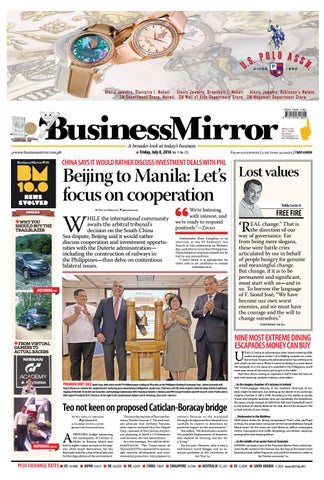
CHINA SAYS IT WOULD RATHER DISCUSS INVESTMENT DEALS WITH PHL
Beijing to Manila: Let’s focus on cooperation
W
INSIDE
@rectomercene
hile the international community awaits the arbitral tribunal’s decision on the South China Sea dispute, Beijing said it would rather discuss cooperation and investment opportunities with the Duterte administration— including the construction of railways in the Philippines—than delve on contentious bilateral issues.
Why you should buy the Trailblazer
motoring
By Recto Mercene
We’re listening with interest, and we’re ready to respond positively.”—Zhao Ambassador Zhao Jianghua, in an interview at the US Embassy’s late Fourth of July celebration on Wednesday, said efforts to further PhilippinesChina bilateral relations should not be tied to any precondition. “I don’t think it is appropriate for either side to set conditions to resume Continued on A2
E1
P25.00 nationwide | 5 sections 34 pages | 7 days a week
Lost values Teddy Locsin Jr.
free fire
‘R
EAL change.” That is the direction of our way of governance. Far from being mere slogans, these were battle cries articulated by me in behalf of people hungry for genuine and meaningful change. But change, if it is to be permanent and significant, must start with us—and in us. To borrow the language of F. Sionil José, “We have become our own worst enemies, and we must have the courage and the will to change ourselves.” Continued on A2
NINE MOST EXTREME DINING ESCAPADES MONEY CAN BUY
from virtual gamers to actual racers
U
sually, being an adventurous eater means ordering offal, snakes and game meats—or in Beijing, scorpion on a stick. But at these 10 spots, the adrenaline factor has nothing to do with what’s on the menu. When it comes to dining in a crane above the Acropolis or in the spray of a waterfall in the Philippines, you’ll need your sense of adventure just to get to the table. Next time you’re craving an experience that’ll make the hairs on your neck stand up, consider making a reservation...
M a z d a Skyactiv-D: Breaking
premium debt sale Ayala Corp. debt notes worth P10 billion began trading on Thursday at the Philippine Dealing & Exchange Corp., whose proceeds will
...In the magma chamber of a volcano in Iceland
help refinance or redeem the conglomerate’s maturing peso-denominated obligations. Ayala Corp. Chairman and CEO Jaime Augusto Zobel de Ayala led the traditional ringing of the bell. To his left are Securities and Exchange Commission (SEC) Chairman Teresita J. Herbosa and PDS Group President and CEO Cesar B. Crisol. Partly seen is BDO Capital President Ed V. Francisco. At far right is SEC Commissioner Ephyro Luis B. Amatong. Story on B1. NONIE REYES
The Thrihnukagigur Volcano, in the Southern Peninsula of Iceland, might be dormant, but setting up for dinner in its cavernous magma chamber is still a thrill. According to the guides at Jacada Travel, one bespoke operator who can coordinate the experience, the space is large enough to hold three full-sized basketball courts or the Statue of Liberty tilted on her side. But it’ll be all yours—for a meal entirely of your design.
Teo not keen on proposed Caticlan-Boracay bridge By Ma. Stella F. Arnaldo @Pulitika2010
& Leandro Anton castro
Special to the BusinessMirror
motoring
E2-E3
A
PROPOSED bridge connecting the municipality of Caticlan in Aklan to Boracay Island may lead to higher visitor arrivals to the popular white beach destination, but the downside could be a loss of local jobs and further degradation of the environment.
PESO exchange rates n US 46.9000
This was the reaction of Tourism Secretary Wanda Corazon T. Teo and tourism advocate Ivan Anthony Henares, after reports surfaced that San Miguel Corp., operator of the Caticlan Airport, was planning to build a 1.9-kilometer road between the two destinations. In a text message, Teo told the BusinessMirror: “The Department of Tourism [DOT] is committed to sustainable tourism development and environmental protection. Any proposal to
connect Boracay to the mainland through a bridge must be evaluated very carefully by experts to determine its potential impact on the environment.” She added, “We should also consider the possible displacement of boatmen who depend on ferrying tourists for a living.” For his part, Henares, who is also a well-known travel blogger and an assistant professor at the University of See “Teo,” A2
…Underwater in the Maldives How about sharks for dining companions? That’s what you’ll get at Ithaa, the underwater restaurant at the Conrad Maldives Rangali Island resort. On the menu are such dishes as saffron champagne risotto, mascarpone and truffle dumplings, and lobster carpaccio, among other luxe-leaning dishes.
...In the middle of an oyster farm in Tasmania Anyone can book a tour of the Freycinet Marine Farm, which harvests Pacific oysters in the Tasman Sea. But stay at Tasmania’s most luxurious hotel, Saffire Freycinet, and you’ll be invited to a table to See “Dining escapades,” A2
n japan 0.4629 n UK 60.6558 n HK 6.0459 n CHINA 7.0043 n singapore 34.7484 n australia 35.2454 n EU 52.0590 n SAUDI arabia 12.5026
Source: BSP (7 July 2016 )
A2 Friday, July 8, 2016
Lost values. . . Continued from A1
My initial reaction was distaste. What, another president telling us to change ourselves? He should change the lousy government. We, the people, who suffer from bad presidents—tayo pa mag-change? No, you change. You won the election, ikaw lang magchange, kasama na mga tao niyo. Why do presidents always say they cannot do it alone, that the people must do it with them; that is not their fault but the fault of all of us—and yet we don’t get his enormous salary and outrageously big discretionary fund? Their failure is always the failure of the people who did not step forward. The problem with that is the people end up doing it all alone. So who or what was Duterte talking about? Who needs to change? He couldn’t mean us. “Love of country, subordination of personal interest to the common good, concern and care for the helpless and the impoverished— these are among the lost and faded values that we seek to recover and revitalize as we commence our journey toward a better Philippines.” So it is not about us; by “us” means himself and his new government—and the old valuest of governance that were lost in disappointments after Independence; lost in frustrations after every administration since; lost completely in the thievery of martial law when public service was entirely self-service; and worse yet after Edsa, which legitimized the thefts of the Marcos cronies and gave them clean title to their hidden wealth. It was just more of the same under cover of freedom. To underscore the vintage of those vanished values, Duterte says, “There are two quotations from revered figures that shall serve as the foundation on which this administration shall be built.” The first: “The test of government is not whether we add more to the abundance of those who have much; it is whether we provide for those who have little.” Franklin Delano Roosevelt in the Great Depression (according to the Inquirer transcript; Teddy Roosevelt, the Trust Buster, according to Jun Yasay in his US Independence Day speech). The second from Lincoln: “You cannot strengthen the weak by weakening the strong; you cannot help the poor by discouraging the rich; you cannot help the wage earner by pulling down t he wage payer; you ca nnot f ur t her brotherhood by inciting class hatred among men.” Duterte added, “My economic, financial and political policies are contained in these quotations couched as they are in general terms. So read between the lines. I need not go into specifics now. They shall be supplied to you in due time.” Take his word for it; for in those words and in this inaugural is the blueprint of dreams to be achieved—or once again lost.
BMReports BusinessMirror
www.businessmirror.com.ph
Beijing to Manila: Let’s focus on cooperation Continued from A1
bilateral talks on the dispute we have,” Zhao said. “[But] let me emphasize this, we have been talking too much about the dispute in the last six years; let’s focus on our friendship, on cooperation—that’s better.” For instance, Zhao said Beijing has been “listening with interest” to the pronouncements of President Duterte and is ready to hear any proposal from the new administration if it invites China to participate in proposed infrastructure projects. “The president [Mr. Duterte] just took office several days ago,” he said, “so we’re listening with interest and we’re ready to respond positively.” Asked whether the proposed railway came from Mr. Duterte or it was offered by China, Zhao said: “We’re not in a period of offering proposals or counterproposals. We are willing to participate in the economic investments, as well as open to discuss the possibility of China’s participation in major infrastructure projects, which, of course, include railways.” The subject of railways connecting Manila to Clark surfaced following Zhao’s courtesy call on Duterte at his headquarters in Davao City. Following the meeting, Zhao
was quoted as saying that China can build the railway from Metro Manila to Clark, Pampanga, in two years. The ambassador was quoted as saying: “We will do the railway immediately and we will solve your Clark-Manila railway. We’ll use the shortest way.” The Chinese envoy also assured Duterte they have successfully built railways in Africa. They could do the same in Mindanao, he was reported as saying. When asked whether China is willing to offer to build a railway in Mindanao as well, Zhao said, “It might be included, but we have to conduct feasibility studies before this.” Asked when the railway offer was made, Zhao said it was mentioned by Mr. Duterte on many occasions. “I’m sure China will respond positively to this idea of how to build railways, but we have not conducted detailed studies on that,” Zhao said. “So we are hoping we can do that sometime soon.” He, however, said, “It’s hard to fathom the agenda of the President.” Nonetheless, “China is always willing to promote our bilateral relationship.” Zhao said he has not read newspaper reports that the administration is sending a special envoy to China as backchannel to
Dining escapades. . . Continued from A1
stand knee-deep, as a culinary guide shucks the freshest bivalves you’ve ever tasted—pulled straight from the water and set on your plate.
…In a treehouse in the Seychelles Don’t be fooled by the rustic connotation of dining in a treehouse—this isn’t what you remember from childhood. Luxury outfitter Epic Road will coordinate a treehouse dinner at Fregate Island in the Seychelles that starts in the property’s garden; there, you can pick your favorite ingredients with the hotel’s chef de cuisine. He can whip them up for you or show you the ropes in the kitchen before you climb a spiral staircase to your ultimate dining destination: in a towering banyan tree.
…In a limestone cave in Italy Back in the 1700s, Italian nobility would dress up up to dine cliffside at the Summer Cave at Puglia’s Grotta Palazzese, now a tried-and-true spot on the global tourist map for its postcard-perfect views. Here, the catch of the day comes with a side of sea spray from the Adriatic below. Be prepared to arrive early: You’ll have to maneuver through ascending and descending cobblestone stairways just to reach the hostess stand.
…In a crane over the Acropolis Elevated dining is a literal term for Dinner in the Sky, which sets up sky-high meals for up to 22 diners in 40 cities around the globe. Its most jaw-dropping location might be above the Acropolis, where adrenaline junkies are served a five-course meal on a crane hoisted 50 meters (about 160 feet) in the air. Among this summer’s
the South China Sea (SCS) issue ahead of the International Tribunal’s ruling, which the International Court of Arbitration in The Hague said would be released on July 12. “We have no more channel of communication since [Mr. Duterte] got elected as president,” Zhao said. “We hope that, through all these channels, we continue to exchange peace, particularly how to strengthen bilateral relationship.” Zhao said he does not know how the negotiation on the SCS issue should start because China has not set a time limit. He added that China had not imposed any precondition, but said the negotiation should start after the tribunal’s release of the decision. In the same venue, American Ambassador Philip Goldberg denies the accusations that the United States was behind the filing of the case against China before the UN-backed tribunal at The Hague. “We weren’t participants in the case, we weren’t even observers in the case,” Goldberg said. “We haven’t participated in Unclos [United Nations Convention on the Law of the Sea].” He added that he hopes “that it [Unclos] will be ratified by the [US] Senate.” “But that’s not [always] the case,” he added. “Of course, we believe in legal, peace-
worldwide events: dinner above the Mexican ruins at Teotihuacán, on the coast of Saint Tropez, and hanging precipitously over downtown Los Angeles.
…In the shadow of Angkor Wat Dining at Angkor Wat may actually be less an adventure than visiting the iconic ruins at any other time; without crowds, the landmark and its surrounding temples are dreamy and serene. Travelers with Jacada can access the grounds past the site’s normal operating hours for a private Khmer-style dinner under a tent on the temple grounds—though the privilege will run you a cool $11,000. Blessings from a Buddhist monk are included before the first course, natch.
…On a floating boulder in Zanzibar Time it just right and you can walk to the Rock, an aptly named spot that juts 22 feet above the Indian Ocean. But once the tide rises, you’ll have to take a boat to and from this floating restaurant off the coast of Zanzibar. The menu, predictably, focuses on whatever can be caught in the surrounding waters (octopus, prawns, lobster). But the main thing not to miss is a sundowner on the deck—be it a classic Negroni or a more locally inspired Dawa, made with Konyagi (a citrus-y East African spirit), honey and tonic.
…Under a waterfall in the Philippines Villa Escudero is a lovely resort on a 130-year-old coconut plantation in the Philippines, two hours southeast of Manila. But it’s most famous as a place to rest your head after a once-in-a-lifetime meal at the Labassin Waterfall Restaurant across the way. Here, bamboo tables sit so close to the foot of a man-made waterfall that shoes are absolutely not encouraged. (The waterfall was built to mitigate runoff from a nearby dam.) Don’t bother with a poncho, either—getting wet is half the fun. Bloomberg News
ful and diplomatic solutions to disputes around the world, especially in the SCS,” Goldberg said. “That’s what we support [and] any other contention is not the case.” Asked to respond to China’s warning that the US will pay the price in contributing to the rising tension in the SCS, Goldberg said the US has “supported the Philippines’s case filed under Unclos. “We’ll see what [the Tribunal] says,” he added. “We support the rule of law, freedom of navigation, the kind of things that our two governments and most of the governments of the world support.” Goldberg said the US would “look at the decision and see what it says.” “We do support legal, peaceful and diplomatic solutions to the issues in SCS and I don’t think it serves any purpose or any other methods of resolving these disputes,” he added. “We also said there’s also nothing wrong with parties talking to each other, talking regionally, arranging code of conducts—all of those things are good things and are steps in the right direction.” “Everybody ought to be very calm and see what the decision says, it’s something that is being issued under a UN convention and should be observed by countries involved,” Goldberg said.
Teo. . .
Continued from A1
the Philippines’s Asian Institute of Tourism said three factors that should be considered before a bridge is constructed: “community acceptability, environmental concerns and carrying capacity of the island.” Echoing Teo’s concerns, he said ferry operators, which currently transport people and goods from Caticlan to Boracay, may be displaced due to the construction of the bridge. About 400 families will be automatically affected by the loss of ferry operations. Tricycle operators from the airport to the Caticlan pier (and vice versa) will likely to be affected, along with tricycle operators on Boracay, who will be displaced by the vehicles brought in by visitors from the mainland. He added that even without the proposed bridge, the current influx of tourists is more than what Boracay can handle. “ The roads are narrow and there’s high traffic congestion already, you might diminish the tourist experience if you allow even more vehicles to move around Boracay. Roads are already crowded as it is. We might make the situation worse,” Henares said. Some 1.56 million tourists visited Boracay in 2015, breaking the 1.5-million target set by the DOT. Tourists to Boracay reached 1.47 million in 2014. SMC President Ramon S. Ang has said the company plans to invest $100 million to build the toll
Franchise. . . Continued from A12
“ Fi l ipi no g loba l f ra nc h i se brands are a testament of the potential of the Philippines to be a producer of world-class brands,” Quintana said. Apart from expanding their businesses nationwide, Quintana said there is also demand for local brands to franchise abroad. By expanding abroad, local brands can bring the Philippines’s products to various parts of the globe. This, Quintana said, can boost the country’s exports. Quintana is also the CEO of Oryspa, a homegrown brand offering rice branbased spa products. Among the Filipino global brands that will be joining this year’s expo come from Max’s Group Inc., whose brands’ overseas expansion are making headlines recently. These include Max’s Restaurant, which will open in Qatar, Yellow Cab in the United Arab Emirates, and soon in China; and the inking of a deal for the opening of five Pancake House restaurants in Qatar.
bridge, as this will help ease travel between the Island of Boracay and its nearest airport. He added that he has submitted the proposal to the local government and will agree to a public bidding for the project. “If there’s an investor who wants to construct a large hotel in Caticlan, maybe they can create their own speedboat transfers to transport their clients to the island. That will be a more feasible scenario,” he said. Moreover, he said, the situation of Boracay is complex and demands a clear development master plan that should cover new development, construction regulations, environmental protection and conservation areas, infrastructure improvement, sewage system and garbage disposal. “They need to hire the best planners to be able to study the situation and control, regulate the development that’s happening. We can’t just allow the unregulated construction in Boracay to go on,” he said. Unmonitored and unregulated tourism activities degraded coral reefs in Boracay by some 70 percent from 1988 to 2011, according to a study by the Japanese International Cooperation Agency in 2015. Water quality in the eastern part of the beach was also deemed unsafe, said the same strudy. The DOT will be reaching out to the Department of Environment and Natural Resources to clean up the island and tackle the unregulated and unmonitored construction of new accommodations and other tourism establishments. (See DOT chief to seek DENR’s help to clean up Boracay Island, in the BusinessMirror, July 4, 2016) Also joining Franchise Asia Philippines Expo 2016 are Goldilocks, which has more than a dozen stores in US and Canada; Bibingkinitan, which recently opened in Dubai; Potato Corner, which is present not only in Asian markets like Indonesia but is also doing well in the US, the birthplace of French fries; and Figaro, whose growing global footprint includes the Middle East and Oceania. “Filipino global franchise brands are a testament of the potential of the Philippines to be a producer of world-class brands,” Quintana said. With the theme “Building Inclusive Growth Amidst a Hypercompetitive World,” Franchise Asia Philippines 2016—Asia’s biggest four-in-one franchise show—is a weeklong event organized by the PFA. It is the country’s centerpiece capacity-building event for the Philippine franchise sector, as well as the organization’s principal activity to promote franchising as a tool to create businesses and generate jobs. It averages about 1,000 conference delegates and 45,000 expo visitors every year.
BMReports BusinessMirror
news@businessmirror.com.ph
Friday, July 8, 2016 A3
Davao BOI exec seeks review of oil, gas project approvals in Mindanao By Manuel T. Cayon
D
@awimailbox Mindanao Bureau Chief
AVAO CITY—The Board of Investments (BOI) here would be interested to hear from the Department of Energy (DOE) on the status of oil and gas projects in Mindanao, and the prospects of further increasing investments in the country’s largest island-grouping. Gil M. Dureza, chief of the BOI’s domestic investments promotion service here, said heads of government economic and investments agencies would gather anew this week to continue discussions on the prospects and opportunities in the local and
national economy. Dureza explained his initial evaluation of investments revealed there were only few actions done on the application for oil and gas explorations in the island. He added that indications point to approvals at the subcontract
level, “but there have been no major activities in this sector.” He sa id t he appl ic at ions were along the Davao-Agusan river basin, the Mindanao river basin running along Maguindanao and the Zamboanga river basin. Dureza added that the country has made little dent in oil and gas explorations, “when you can just imagine the wealth it could bring to the economy, even if we would increase the projects in the sector by about 10 percent more.” At the current number of projects nationwide, including the big natural-gas field in Malampaya off the West Philippine Sea, “we tapped only 0.77 percent of the total oil and gas reserves of the country, estimated to be 198 million barrels.” This level of extraction is already worth P95 billion “if we increase its production to 10
percent,” Dureza added. A government deposit mapping would show that Mindanao has about 16 percent of the total untapped reserves. Dureza said there are only three oil and gas explorations at the Davao-Agusan river basin, although he showed the BusinessMirror the map of all applications still pending approval. “A bigger tap into the oil and gas reser ves wou ld enable Mindanao to build its own power plant, run by either of these reserves with a capacity more than enough to hold an energ y reser ve,” he said. “Then we would [not] have to be hampered anymore by fluctuating brownouts and unstable power supply.” Dureza added that he believes oil by-products would ensure cheap and adequate supply for basic industries and even
for petrochemical operations in Mindanao. “Petrochemical companies would be able to produce asphalt, for instance, in affordable and sufficient quantity to build more national highways and farm-to-market roads,” he said. “We would be awash with revenue to easily pay our foreign and domestic debts, and more than enough to offset the deficit that might accrue to reducing taxes of ordinary Filipino workers.” Dureza explained that “an economy awash with revenues may even lower the tax deductions on people.” He said he has submitted his proposal to increase activity in oil and gas to President Duterte. “I believe this singular activity in oil and gas exploration and extraction can trigger a more robust and livelier economy,” he said.
Pisi asks BOC to look into steel shipment
T
he 5,000 metric tons of deformed steel bars (rebars) imported by Mannage Resources Trading Corp. in April were misdeclared and undervalued, said the Philippine Iron and Steel Institute (Pisi) in a letter to Customs Commissioner Nicanor Faeldon. Pisi President Roberto Cola alleged Mannage used a tariff heading in its import entry declaration that was not for rebars. A misdeclaration and undervaluation of an importation is technical smuggling, which is a criminal act. The tariff heading used by Mannage was 72.28.30.90, which has a Bureau of Customs (BOC) reference value of $340 per ton. However, the BOC reference value is $380 per ton for carbon rebar and $410 per ton for alloy rebar. Mannage’s misdeclared tariff heading and corresponding value of $330 per ton represents a loss for government of up to P2.25 million in taxes. Mannage, Cola said in his letter, also did not declare the specifications and grade of the steel bars as required. Cola said this is critical “in the interest of public safety and to protect government revenues.”
A4 Friday, July 8, 2016 • Editor: Max V. de Leon
AseanFriday BusinessMirror
Watchdog: Cambodian leader’s family rules business world, too
A
n extensive network of businesses controlled by the family of Cambodia’s longtime leader sustains and is sustained by his authoritarian rule, making foreign investment in the country risky, says a report issued on Thursday by the research and advocacy group Global Witness. The London-based group, which focuses on exposing the corrupt exploitation of natural resources in the developing world, says the family of Prime Minister Hun Sen uses a business empire worth at least $200 million along with influential positions they hold in the military and government to keep a lock on power. Significant holdings in the media, along with close ties with other powerholders and business cronies tighten their grip. The report, “Hostile Takeover: The Corporate Takeover of Cambodia’s Ruling Family,” describes the 30 years Hun Sen has been in power as “characterized by electoral fraud and the brutal suppression of political opposition, including through murder, torture and arbitrary imprisonment,” an assessment shared by human-rights groups, such as Amnesty International. It said 40 percent of the country’s 16 million people still live below or close to the poverty line. Hun Sen, who became prime minister in 1985, vowed during the 2013 election campaign to stay in power until the 2028 polls. Now 63, he is seen as grooming one of his three sons to succeed him. Data for the report mainly came from the Cambodian Commerce Ministry’s online corporate registry, where Global Witness found that 21 of Hun Sen’s closest relatives were registered as holding interests in 114 private domestic companies. It says the holdings “span many of Cambodia’s most profitable sectors, including those known to be riddled with corruption, such as mining,
$200M The estimated worth of the business empire of Prime Minister Hun Sen’s family, according to Global Witness gambling and real estate.” Trading, energy, real estate and construction are other sectors in which the family is active. There was no immediate comment from the government. However, two of Hun Sen’s children posted responses on their Facebook pages, saying the report contained misinformation and was intended as a political attack on their father. Hun Mana, who was highlighted as the family member most active in business, sarcastically thanked Global Witness for its work, which she said was “all lies and deceitful to confuse the public about what my father has accomplished.” She and her brother Hun Manith accused the country’s two main English-language newspapers, The Phnom Penh Post and the Cambodia Daily, of colluding with Global Witness to defame their family. Hun Sen, who in the past year has become very active on Facebook, reposted their comments and said he shared their point of view.
In this November 19, 2012, file photo, US President Barack Obama (right) returns a greeting to Bun Rany, wife of Cambodian Prime Minister Hun Sen, prior to a gala dinner in Phnom Penh, Cambodia. AP
Global Witness believes the actual value of the family’s holding is likely to be much higher than $200 million because of incomplete information and the use of third parties to hold shares. Some of their businesses, through direct and indirect relationships, such as franchising and distribution deals, have links to international brands, such as Apple, Nokia, Visa, Unilever, Proctor & Gamble and Honda, it said. “These relationships not only raise ethical questions for the brands, they also pose significant risk,” said Global Witness, saying there are worries about an opaque business environment and the risk of breaking national and international anticorruption laws. Besides facing a stacked deck in any business dispute—Cambodian courts are considered vulnerable to political influence—foreign companies face possible legal sanctions under their own home countries’ anticorruption laws.
“Due to a lack of transparency and pervasive corruption, all business transactions involving the Cambodian government, including public procurement, infrastructure contracts and natural resource allocation, present heightened risk for foreign investors,” Global Witness said. The report said that appointing family members to key official and semi-official posts—in politics, the military, police and the media—is another essential element of Hun Sen’s control. His two older sons hold important military posts. The youngest is a member of Parliament. The eldest daughter—who has the largest number of business holdings in the family—is one of Cambodia’s only two tycoons with radio, television and newspaper outlets. Two of the children are married to offspring of deputy prime ministers. With rapid economic growth for the past two decades along with a cheap labor force and minimal regulation, Cambodia has attracted for-
eign investment from the West as well as China. In 2015 Britain was the second-largest foreign investor in Cambodia after China. The United States is Cambodia’s largest trading partner and export market. Other critics point out that the powerless pay the price for corruption through the destruction of their environment and land grabs. “In Cambodia economic control and political repression are two sides of the same coin. Under Hun Sen, political power is used to obtain economic resources, which are in turn used to obtain more political power,” Sebastian Strangio, author of the book “Hun Sen’s Cambodia,” told The Associated Press. “The cycle never ends. This has had pernicious effect on Cambodia’s development. Instead of flowing to the national budget, where it can be spent on services like health and education, a huge proportion of the national wealth circulates in a nether-economy that is opaque to outside scrutiny.” AP
QuickTake Q&A: Asia sea dispute set for ruling China won’t heed
T
ensions are high in the South China Sea, a waterway that hosts $5 trillion in trade a year—and a bunch of territorial disputes. China contests more than 80 percent of the area, having reclaimed reefs and beefed up its military and civilian presence. That’s straining ties with other claimant states, not to mention the United States, which has been the dominant military presence in the region for decades. The Philippines is challenging China’s claim in an international tribunal in The Hague, with a ruling due on July 12. 1. What’s happening? The Philippines asked an arbitration tribunal to consider the status of features that China has developed, as well as the legal basis of China’s socalled historic-rights claim. That assertion is based on a 1947 map showing a vague dashed line—known as the nine-dash line—looping about 1,120 miles (1,800 kilometers) south of China’s Hainan island. 2. How did we get here? The Philippines brought the case after China seized a triangle of reef and rocks, known as Scarborough Shoal, in 2012. Beijing then began dumping millions of tons of sand and coral onto seven features in the Spratly Island chain, creating islands that together would be more than three times the size of New York’s Central Park. 3. Why is this controversial? The dispute sits at the core of a
struggle between the US, the long-time guarantor of the freedom of navigation in the waters, and a rising China bent on becoming a maritime power. Though the US takes no view on the merits of the South China Sea claims, it has pressed countries to resolve disputes under international law. China argues that disagreements should be dealt with via direct talks between claimants, a position it says is supported by about 60 nations. 4. How is that affecting tensions? The US is concerned that China will use its reclaimed reefs to establish military bases. It has sent ships and conducted flights near some of the reefs, infuriating the Chinese. They, in turn, dispatched fighters and warships to warn off a US ship in May. The same month, Group-of-Seven leaders expressed concern about instability in the South China Sea. 5. What’s likely to happen? Don’t hold your breath for a resolution. China won’t recognize the arbitration ruling because it says the tribunal has no jurisdiction over matters of sovereignty. The tribunal countered that it does have jurisdiction because the dispute is rather about maritime rights. Bill Hayton, an author on South China Sea tensions, expects the Philippines to win at least half its 15 submissions. Whatever the results, the tribunal’s report risks inflaming tensions. Bloomberg News
news@businessmirror.com.ph
Seiko aims for young crowd in Thai market
S
eiko (Thailand) Co., the Thai distributor of Seiko watches, is making a strategic move to draw more Generation-Y customers with the use of a local brand ambassador for the first time. Managing Director Harumitsu Akashi said the company will expand its customer base to reach Gen Y people because their purchasing power is quite strong. Gen Y spans people aged 16 to 35 years old, he said. While they are not the highest earners, they are willing to spend more than any other customer group if inspired by an exciting thing. Meanwhile, the international market will continue to see one of the world’s great tennis players, Novak Djokovic, in his key role as a spokesman for Seiko watches. Seiko Thailand is using a local presenter for the first time because the country is the largest market in Asean for Japan’s Seiko and ranks third in Asia after China and Japan. “Thailand has been very special and important for Seiko for many years in terms of business value and brand image,” Akashi said. “With over half a century in Thailand, our loyal customers are getting old, therefore, we want Seiko to appeal more to younger customers here.” The Seiko Prospex Zimbe Limited Edition will launch exclusively in Thailand to cash in on the “bright watch” market. The Prospex Zimbe was crafted in Thailand and will be introduced at the Siam Paragon Watch Expo, which will run from July 27 to August 15. The watch will be marketed here with a limited circulation of 1,299 pieces. Moreover, the company will more than double its online marketing budget to reach more Gen Y customers. It also sells watches via onlineshopping platforms of Central and Robinson. Seiko plans to bring more interesting watches to Thailand soon. “We hope our sales from Gen Y customers will contribute about 30 percent of the total, in line with the 30-percent ratio of Gen Y people to the total population in Thailand,” Akashi said. The company expects to increase watch sales by 10 percent to 15 percent this year, beating the industry rate of less than 10 percent. Akashi said local and external factors, such as economic conditions, might affect sales performance from time to time. “My confidence in the Thai market remains high, as there is still more room to grow,” he said. “We can expand further, if we are keen on product development, marketing strategy and new market penetration.” The new brand ambassador is expected to boost sales by 10 percent to 15 percent in the short term. MCT
Angkor temples’ visitors must dress properly
C
ambodian authorities say they will ban visitors to the famed Angkor temples who dress immodestly. Long Kosal, a spokesman for Apsara Authority, which oversees the archaeological complex, says beginning on August 4, local and foreign tourists will be required to wear pants or skirts below the knees and shirts that cover their shoulders. Those not dressed appropriately will be required to change their clothes before being allowed to enter the temple site. He said on Thursday that the ban was implemented because wearing revealing clothes disrespects the temple’s sanctity. About 2.1 million foreign tourists visited Angkor last year. AP
The World BusinessMirror
A6 Friday, July 8, 2016
news@businessmirror.com.ph
Iraq inquiry: Oil a motive for Britain before the war
T
he United Kingdom (UK) government held talks with Royal Dutch Shell Plc. and BP Plc. to ensure British energy companies were “well-placed to pick up contracts in the aftermath” of the invasion of Iraq, according to declassified documents released as part of an official inquiry. Although the report, overseen by former civil servant John Chilcot, doesn’t explicitly say oil played a role in the war, documents published on Wednesday show British officials discussed how to obtain “substantial business for UK companies” in the energy sector. The papers, including a letter from Jack Straw, then UK foreign secretary, to Prime Minister Tony Blair, are likely to reinforce the belief, held by some opponents of the 2003 war, that the conflict was partly driven by Iraq’s substantial oil reserves. After the war, BP and Shell won big contracts to develop oil fields in the south of Iraq. That said, the awards were made in an auction and Chinese and Russian companies also made successful bids despite the opposition of their countries to the war. In one of the declassified documents, a UK diplomat says the British government should “start preliminary work to ensure UK companies are well-placed to pick up contracts in the aftermath” of the war. The memo, dated February 2003, calls for a meeting with BP, Shell and other British companies. “We would need to handle this carefully and ensure it was confidential to avoid charges of oil motivations,” the declassified memo states. In 2005 Straw sent a now declassified letter to Blair with the title “Iraq: Oil and Gas Strategy.” In the memo, the foreign secretary said a key objective of the UK government was to increase the “involvement of the private sector, leading to sustained investment over the next five to 10 years” in the Iraqi energy sector and “substantial business for UK companies”. “Foreign investment is badly needed and we need to continue to support Iraq to create the right framework for investment, while also supporting UK companies,” he wrote. “Iraq will need to engage with international oil companies to achieve rapid rehabilitation or significant new development.” The documents also show a gap between the efforts of British officials to win contracts and the companies’ conservative attitude. Shell and BP, according to the documents, told British officials they would only invest in the country once Iraq had a new Constitution. In one document, British officials said they heard criticism from Iraq oil officials that both UK companies were “less committed than many of their international competitors” about investing in Iraq. BP and Shell declined to comment. At the time of the invasion in March 2003, Iraq—one of the founders of the Organization of Petroleum Exporting Countries (Opec)—was pumping about 2.5 million barrels a day. Output briefly fell, but recovered to the same level a year later. Although many predicted a rapid increase, oil output only started to rise significantly from 2010 onward with the help of foreign companies. According to the inquiry, BP told the UK government that Iraqi oil production could rise to 4 million barrels a day within five years of the invasion. In reality, it took 12 years to reach that level. Last month Iraq pumped 4.3 million barrels a day, making it the second-largest Opec producer, after Saudi Arabia, according to Bloomberg data. In another document, Matthew Rycroft, then private secretary on foreign affairs to Blair, wrote to the prime minister that “BP and others are fretting that they will lose out in the carve-up of contracts after any military action, as the UK did after the Gulf War” in 1990-1991. “BP think prospects in Iraq could be as promising as in Saudi Arabia,” he wrote in November 2002. The documents also show that Blair saw a spike in energy prices as a key problem if the UK joined a military attack. “Oil prices. This is my big domestic worry,” he wrote to his chief of staff in March 2002. “We must concert with the US to get action from others to push the price back down. Higher petrol prices really might put the public off,” Blair wrote. Bloomberg News
In this March 20, 2009, photo, US Army soldiers stroll past two bronze busts of former Iraqi President Saddam Hussein in the Green Zone in Baghdad, Iraq. AP/Hadi Mizban
Blair’s letter to Bush:
‘I will be with you whatever’ Sir John Chilcot presents the Iraq Inquiry Report at the Queen Elizabeth II Centre in London, on Wednesday. The head of Britain’s Iraq War inquiry has released a damning verdict on a conflict he says was mounted on flawed intelligence, executed with “wholly inadequate” planning. Dan Kitwood/Pool via AP
In this May 29, 2003, photo, British Prime Minister Tony Blair addresses troops in Basra, Iraq. The head of Britain’s Iraq War inquiry, retired civil servant John Chilcot, released a damning report on Wednesday on a conflict he said was mounted on flawed intelligence and executed with “wholly inadequate” planning. The 2.6-million-word report is an exhaustive verdict on a divisive conflict that—by the time British combat forces left in 2009—had killed 179 British troops, almost 4,500 American personnel and more than 100,000 Iraqis. AP/Stefan Rousseau/WPA pool
L
ONDON—Letters published by the UK’s Iraq War Inquiry show that then-Prime Minister Tony Blair assured US President George W. Bush of his support for regime change in Iraq eight months before the US-led invasion began in March 2003. The report by retired civil servant John Chilcot offered a sweeping condemnation of Britain’s preparations for the war and its aftermath. The newly published documents offer one side of the vital relationship between Bush and Blair—Blair’s letters to Bush are published, but Bush’s responses are not. In a six-page “Secret Personal” memo to Bush written on July 28, 2002, Blair says he would do “whatever” with regard to removing Iraqi dictator Saddam Hussain from power. Blair says toppling Saddam is “the right thing to do,” adding that the important question is “not when, but how.” At the time, Blair was telling the
British public and Parliament that no decision to go to war against Iraq had been made. “I will be with you whatever,” Blair wrote to his US counterpart. “But this is the moment to assess bluntly the difficulties. The planning on this and the strategy are the toughest yet. This is not Kosovo. This is not Afghanistan. It is not even the Gulf War.” Blair was criticized during his Labour Party administration for aligning himself too closely with his American allies. He provided Bush with important political support in the months before the 2003 invasion and his decision to commit British forces provided vital military
A protester holds up a placard during a demonstration outside the Queen Elizabeth II Conference Centre in London, before the publication of the Chilcot report into the Iraq war, on Wednesday. The Iraq war was mounted on flawed intelligence, was executed with “wholly inadequate” planning, and ended “a long way from success,” according to a damning report released on Wednesday by the head of Britain’s Iraq War inquiry. AP/Matt Dunham
backing to the US-led effort. In his letters, many of which are undated, Blair was frequently blunt about the lack of public and political support in Britain and elsewhere for an invasion of Iraq. “Opinion in the US is quite simply on a different planet from opinion here in Europe or in the Arab world,” he said in the July 28, 2002, missive. “In Britain right now I couldn’t be sure of support from Parliament, party, public or even some of the Cabinet. And this is Britain. In Europe generally, people just don’t have the same sense of urgency post 9/11 as people in the US.”
Blair tries to convince a reluctant Bush that the best way to build support would be to take the issue to the UN Security Council. He suggests that by going to the UN, they could give Saddam a deadline to let UN weapons inspectors in without any conditions. “He would probably screw it up and not meet the deadline, and if he came forward after the deadline, we would just refuse to deal,” Blair wrote. Blair, however, seemed confident he could eventually win public backing by emphasizing the threat posed by Saddam. “If we recapitulate all the WMD
[weapons of mass destruction] evidence; add his attempts to secure nuclear capability; and, as seems possible, add on al-Qaeda link, it will be hugely persuasive over here,” he wrote. No weapons of mass destruction were found inside Iraq. Blair also offers Bush advice on communications strategy, suggesting that a “media and communications War Room” be set up in both countries. He suggests a unified messaging strategy, a policy discouraging interviews, and “continually” focusing on Saddam’s nature. The message should be this, Blair says: “He’s bad; we’re good; he’s going to lose; we’re going to win.” In another pre-invasion note, the British prime minister asks Bush about “military questions”: if there is sound planning for how to react if Saddam uses weapons of mass destruction against the United States or the Iraqi people; if he attacks Israel; if he destroys Iraq’s oil wells; or how to keep rival groups inside Iraq apart. As a handwritten addendum to this list, Blair asks if there has been planning for “avoiding civilian casualties.” Blair also asks Bush about postinvasion plans: “What happens immediately: a new Iraqi government or US run?” and “What type of Iraqi government are we aiming for medium term?” In later undated notes and letters released in the report, as the reconstruction of Iraq proves far more difficult than had been anticipated, Blair warns Bush that Islamic extremists have a coherent political strategy linked to their military objectives, allowing them to capitalize on anti-Western sentiments throughout the Islamic world. He warns in a declassified note that “the bad news is still the massive level of misunderstanding about us, our motives, and the fact that we want the same as them: a free Iraq.” By the time British combat forces finally left Iraq in 2009, the conflict had killed 179 British troops, almost 4,500 American personnel and more than 100,000 Iraqis. AP
The World BusinessMirror
news@businessmirror.com.ph
Friday, July 8, 2016
A7
former british p.m. apologizes for errors in war plan, but not for invasion
UK Iraq probe hits Blair, spies over war failures
B
ritain’s involvement in the Unied States-led invasion of Iraq was a failure, carried out before peaceful options had been exhausted and based on intelligence that was overstated, an official inquiry concluded.
The investigation into the buildup to war, its execution and aftermath, is highly critical of government ministers, the intelligence services and the military. But the biggest impact of the report, published on Wednesday by former civil servant John Chilcot, will be on the reputation of former Prime Minister Tony Blair, the man responsible for committing British troops. “The UK chose to join the invasion of Iraq before the peaceful options for disarmament had been exhausted,” Chilcot told reporters, as he announced the results of his sevenyear inquiry. “Military action at that time was not a last resort.”
Danger of WMD ‘not justified’
Judgments about the danger of Iraq’s weapons of mass destruction (WMD) “were presented with a certainty that was not justified” by the underlying intelligence, Chilcot said. The consequences of invasion were “underestimated,” planning for rebuilding Iraq was “wholly inadequate” and the British government “failed to achieve its stated objectives,” he said.
The decision to join the 2003 invasion has hung over Britain ever since. At the time, opposition to the war led to the largest-ever march through London, with estimates of about a million people taking part. In Parliament, a quarter of Blair’s Labour Party voted against him. Subsequent Labour leaders have been chosen partly on the basis of whether they supported action and the party’s current leader, Jeremy Corbyn, was a fierce opponent of the war.
Blair apologizes for errors in war plan, not for invasion
Chilcot’s inquiry is the fifth into the UK’s role in the war, and by far the most complete. Previous investigations have looked at intelligence failures and the circumstances surrounding the death of a British weapons scientist, David Kelly. All have been critical of Blair. The former prime minister responded with an impassioned defense of his decisions, apologizing for errors in the way the war was planned but not for the invasion itself. After setting out his position for al-
most an hour, he spent nearly as long taking questions, and asking people to put themselves in his shoes. “If I was back in the same place, with the same information, I would take the same decision,” he said. He urged Britain not to back away from international interventions. “If we’re not prepared to take these kinds of decisions and engage in this way, we will make the world less safe,” he said. The report risks deepening divisions in Labour at a time when Corbyn is fighting calls from his own lawmakers to resign. Speaking in Parliament on Wednesday, the Labour leader was heckled by some on his own side as he described the war as “an act of military aggression launched on a false pretext.”
‘Fundamental breakdown’
Corbyn said the invasion had “fueled and spread terrorism,” as well leading to “a fundamental breakdown in trust in politics.” Without naming Blair, he said Parliament had been misled at the time and should “deal with” those responsible. Asked about this later, Blair said Chilcot’s report exonerated him of exaggerating the case for war. “There was no misleading Parliament,” he said. “Go and read the reports, see what was said to me.” Prime Minister David Cameron, who voted with his party in favor of the war, said those who did so “have to take our fair share of the responsibility. We cannot turn the clock back.” The report was not “accusing anyone of deliberate deceit,” he said. Chilcot said the question of
whether military action was legal was one for an international court, rather than his report. “We have, however, concluded that the circumstances in which it was decided that there was a legal basis for UK military action were far from satisfactory,” he said.
Sofa government
The report shows how Blair’s working style, known as “sofa government,” meant the decision for Britain to join the invasion took place with few formal meetings or discussions. In March 2003, at the request of Peter Goldsmith, the then Attorney General, Blair said Iraq had committed “further material breaches” of its obligations. “The precise basis on which Mr. Blair made that decision is not clear,” Chilcot said. He cited it as “one of a number of occasions” when the matter should have been formally discussed by the Cabinet. The report paints a picture of a prime minister trying to stay close to and influence US President George W. Bush, who was determined to invade. Blair’s relationship with Bush meant he was able to persuade the US to go through the United Nations, but didn’t stop Britain’s views being sidelined.
Inadequate plans
“Ministers were aware of the inadequacy of US plans, and concerned about the inability to exert significant influence on US planning,” Chilcot said. “Mr. Blair eventually succeeded
only in the narrow goal of securing President Bush’s agreement that there should be UN authorization of the post-conflict role.” Blair, he said, should have been prepared to part ways with Bush. “The UK’s relationship with the US has proved strong enough over time to bear the weight of honest disagreement,” Chilcot said. “It does not require unconditional support where our interests or judgments differ.” The report criticized intelligence agencies for never questioning the “ingrained belief” that Iraq still had a chemical and biological weapons program. A dossier published by Blair in September 2002 “was presented with a certainty that was not justified,” Chilcot said, but he cleared Blair’s office of subsequent claims that it had “improperly influenced the text.”
Intelligence doubts
Instead, he said the Joint Intelligence Committee, responsible for the dossier, “should have made clear to Mr. Blair that the assessed intelligence had not established the presence of weapons ‘beyond doubt.’” “It is now clear that policy on Iraq was made on the basis of flawed intelligence and assessments,” Chilcot said. “They were not challenged, and they should have been.”
Among Chilcot’s other findings:
Blair was warned that an invasion would increase the threat from al-Qaeda to the UK. Blair sent Bush a note in July 2002 beginning: “I will be with you, whatever.” This made it very dif-
ficult for Britain to withdraw support. Britain undermined the authority of the UN Security Council by invading without its support. The drive to send the largest possible UK force came from the British military. Blair changed his justification for the invasion after it became clear there were no WMD in Iraq. After the invasion, Britain was “fully implicated” in decisions on how to govern Iraq, “but struggled to have a decisive effect.” Britain “failed to take account of the magnitude of the task of stabilizing, administering and reconstructing Iraq.” The Ministry of Defence was “slow in responding to the threat from improvised explosive devices.” The UK didn’t have sufficient resources to fight in both Iraq and Afghanistan. By 2007 UK commanders in southern Iraq were in the “humiliating” position of releasing detainees in exchange for militia promises not to attack British forces. There was a failure across government, the report found. Intelligence agencies didn’t question their own assumptions, the military downplayed difficulties, ministers and officials didn’t challenge the prime minister, while Blair “overestimated his ability to influence US decisions,” Chilcot said. “Above all, the lesson is that all aspects of any intervention need to be calculated, debated and challenged with the utmost rigor,” Chilcot said as he summed up. “And when decisions have been made, they need to be implemented fully. Sadly, neither was the case in relation to the UK government’s actions in Iraq.” Bloomberg News
A8
The World BusinessMirror
Friday, July 8, 2016
Louisiana shooting caught on video
Obama slows US Afghan withdrawal
B
ATON ROUGE, Louisiana—An emotional, at times angry, evening unfolded in the working class, predominantly black Louisiana neighborhood where the police killing of a black man was caught on videotape. Hundreds of mourners, friends and family members of Alton Sterling, 37, gathered on Wednesday in Baton Rouge for a second night of protest, prayer and remembrance. Sterling was shot early Tuesday as he wrestled with two white police officers outside the convenience store where he sold music and movies on compact discs. The police say he was armed. Cell-phone video of the shooting posted online by a community activist set off angry protests, coming at a time when law-enforcement officers across the country are under close scrutiny over what some see as indiscriminate use of deadly force against blacks. Moving quickly to keep tensions from boiling over, Democratic Louisiana Gov. John Bel Edwards asked the US Justice Department to lead a civil-rights investigation into the killing. “I have very serious concerns. The video is disturbing, to say the least,” the governor said at a news conference. Sandra Augustus, an aunt who helped raise Sterling after his mother died, spoke to the crowds on Wednesday night with a tearful, broken voice. She said a second video that emerged showing the moments before her nephew was shot left her angry. “I’m angry, but I’m not angry enough to hurt nobody,” Augustus said. “I’m not angry enough to go into the street. I’m not angry enough to curse the police out. But I’m angry and I’m mad because they took something from me that I never ever will get back.” Terrance Carter, Sterling’s 28-yearold nephew, wore a T-shirt with his uncle’s image printed on it. The police, he charged, went way too far. “They did it wrong,” he said. “They could have handled it better than they did. They didn’t have to shoot him!” He said, though, the family was not condoning violent protests. “The family just wants it to be peaceful,” he said. “I understand right now it’s bigger than us but, at the same time, we’re just trying to work through this and be smooth with it.” In a statement, Democratic presidential candidate Hillary Clinton called the shooting a tragedy and said trust between the police and the communities they serve needs to be rebuilt. “Something is profoundly wrong when so many Americans have reason to believe that our country doesn’t consider them as precious as others because of the color of their skin,” Clinton said. A law-enforcement official said a gun was taken from Sterling after he was killed early Tuesday. The official was not authorized to discuss the investigation and spoke on condition of anonymity. It was not clear from the murky cell-phone footage whether Sterling had the gun in his hand or was reaching for it when he was shot. A witness said he saw the police pull a gun from Sterling’s pocket after the shooting. Baton Rouge Police Chief Carl Dabadie Jr. said Sterling was armed— Dabadie didn’t specify the type of weapon—but that there are still questions about what happened. “Like you, there is a lot that we do not understand. And at this point, like you, I am demanding answers,” Dabadie said, calling the shooting a “horrible tragedy.” Sterling was confronted by the police after an anonymous caller reported being threatened by someone with gun outside the store, authorities said. In cell-phone video, one of the officers tackled Sterling, and the two officers pinned him to the pavement. Someone yelled, “He’s got a gun! Gun!” and one officer pulled his weapon from his holster. After some shouting, what sounded like a gunshot could be heard. The camera pulled away before more shots were heard. The officers, identified by the chief as Blane Salamoni, a four-year member of the department, and Howie Lake II, who has been on the force for three years, were placed on administrative leave, a standard department procedure. AP
news@businessmirror.com.ph
President Barack Obama, flanked by Defense Secretary Ash Carter (left) and Joint Chiefs Chairman Gen. Joseph Dunford, makes a statement on Afghanistan from the Roosevelt Room of the White House in Washington on Wednesday. AP/Susan Walsh
W
ASHINGTON— President Barack Obama scrapped plans on Wednesday to cut American forces in Afghanistan by half before leaving office, a dispiriting blow to his hopes of extricating the US after 15 years of fighting. He said he’ll leave 8,400 troops to address the country’s “precarious” security situation. Obama’s new drawdown plan, announced alongside top military leaders, reinforced the likelihood that the US will remain entangled in Afghanistan for years to come, as America works to suppress a
resurgent Taliban and train a stillstruggling Afghan military. Indeed, Obama said his goal was to ensure the next president has the foundation and flexibility to fight terrorism there “as it evolves.”
Obama acknowledged that few Americans might have expected US troops would still be in Afghanistan this long after the 2001 invasion following the 9/11 attacks. But he said perseverance was needed to prevent al-Qaeda from regrouping and the Islamic State group from spreading. He said, if terrorists regain control of territory, they’ll try to attack the US again. “We cannot allow that to happen. I will not allow that to happen,” he declared. Obama, who had revised the exit plan several times before, had most recently expected to leave 5,500 troops when his term ends in January, down from roughly 9,800 there currently. His move to slow that withdrawal reflected the Afghan military’s continuing inability to secure the nation independently, demonstrated by escalating Taliban attacks that have killed scores in recent weeks. The new plan, announced the day before Obama attends a North Atlantic Treaty Organization sum-
V.A. puts latest estimate of veterans suicides at 20 a day, down from 22
W
ASHINGTON—On average, 20 veterans a day committed suicide in 2014, a slight decrease from the previous government estimate, but federal health officials are cautious about concluding the suicide problem is getting better. Rather, they say the Department of Veterans Affairs (VA) is relying on a more comprehensive database than ever before, making comparisons to prior studies difficult and possibly offering a truer snapshot than what was captured in the past. In 2013 the VA projected that 22 veterans a day were committing suicide. The number became a fixture in media stories and in comments from politicians and advocacy groups highlighting the prevalence of the problem. But the number was also based on data submitted from fewer than half of the states. Some states with many veterans were not part of that study, including California and Texas. Veterans groups urged the department to expand its database and incorporate Department of Defense records to identify veterans who had not enrolled in the VA’s numerous pro-
grams. And that’s what it has done. Dr. David Shulkin, undersecretary for health at the Department of Veterans Affairs, told The Associated Press that the data used for the latest suicide projections came from every state and US territory, and was the largest analysis of veteran records ever undertaken by the department. He said the data gives the VA more information about where to direct resources and which veterans are most at-risk of suicide, but he’s hesitant to make any firm determinations about the overall trend and whether it’s getting better. “Twenty a day is not that different from 22,” Shulkin said. “It is far too high.” The attention on veteran suicide comes at a time when the VA has reported a huge upswing in veterans seeking medical care as they have returned from conflicts in the Middle East. Yet, the VA data continue to show that older veterans make up most suicides. About two-thirds of all veterans who died by suicide were age 50 and over. The rate of suicides for non-veterans has also been increasing in
recent years, but the rate has increased at a greater pace for veterans. That’s particularly the case for female veterans. The risk for suicide is 2.4 times higher for female veterans than it is for female civilians. In 2014 the rate of suicide among veteran females was 18.9 per 100,000. The rate of suicide for females in the civilian population was 7.2 per 100,000, the VA said. Shulkin called preventing suicide the VA’s top priority. He said the department added 446 new psychologists last year and 80 new psychiatrists. It’s also adding 60 employees to the Veterans Crisis Line and making it easier for veterans calling their local VA medical facilities to connect directly to the suicide hotline. He said the VA data also show that those who receive mentalhealth care from the VA are less likely to commit suicide than those who don’t get care. He said it’s critical to destigmatize getting counseling so that people feel comfortable reaching out. He said the VA is intent on partnering with advocacy groups and US companies to ensure veterans get help. AP
mit in Poland, marked the culmination of a delicate debate within his administration about how many troops to pull out—if any. Though US officials said Obama had accepted the Pentagon’s formal recommendation of 8,400 troops, top military leaders had urged the White House to stay closer to the current 9,800. In an unusually public lobbying campaign, last month more than a dozen former ambassadors and commanders urged him to “freeze” the current level for the rest of his term In the end, Obama appeared to settle on a number that would show continued progress toward drawing down without jeopardizing the mission. Elected after vowing to end the wars in Afghanistan and Iraq, Obama has struggled to deliver a legacy of leaving the US less encumbered by foreign conflicts than he found it. Although he’s declared US combat operations over in both countries, the US is still deep in conflict in both, plus major new
fighting that has emerged in Syria and Libya since he took office. In Congress Republican leaders who favor a larger force said Obama’s new plan was preferable to the old one, but they criticized him for not keeping the full 9,800. Sen. Lindsey Graham, RepublicanSouth Carolina, said the partial drawdown would increase the dangers for remaining troops, calling it “more a political decision by President Obama than a military one.” Yet, some Democrats, frustrated by the inability to fully end the war, said they were disappointed—for the opposite reason. “Today, the longest war in American history just got longer,” said Rep. Jim McGovern, DemocratMassachusetts. Ultimately, it will be up to the next president to decide the level of US involvement. Democrat Hillary Clinton has aligned herself with Obama’s handling of Afghanistan, while Republican Donald Trump has remained vague and has criticized Obama for revealing too much publicly about deployment decisions. In Kabul Afghan President Ashraf Ghani applauded Obama’s decision. A brief statement from his spokesman called it “a sign of continued partnership between our nations to fight our common enemy and strengthen regional stability.” But the Taliban said the US action would only prolong the war. “What Obama could not do with 149,000 troops, he will not be able to do with 8,400 troops,” Taliban Spokesman Zabiullah Mujahid said on Twitter. At the peak, in 2010, US troop levels surged to 100,000, fighting alongside forces from US-allied countries. The president said the US is “no longer engaged in a major ground war,” and insisted the mission remains narrowly focused on “training and advising” Afghan forces and counterterrorism operations against the remnants of al-Qaeda. Yet, just last month, the White House gave the military expanded authority to conduct air strikes against the Taliban in support of Afghan troops. Though Obama touted progress in Afghanistan, including bettertrained security forces, the situation remains perilous, with Afghan battlefield deaths rising and civilian casualties hitting a record high. Last month the Pentagon told Congress that Afghans were feeling less secure than at any other recent time. Obama also pointed out that 38 Americans had died in the past 18 months. AP
Bangladesh blast, gun battle leave 2 dead during Eid prayers
N
EW DELHI—Islamic extremists in Bangladesh hurled homemade bombs and engaged in a gun battle with police guarding a large Eid prayer at the end of the holy Muslim month on Thursday morning. One officer and one suspected militant were killed, while several others were wounded, officials said. At least one of the bombs exploded during the prayer attended by hundreds of thousands of people at the sprawling Sholakia grounds the district of Kishoreganj, about 90 kilometers north of the capital of Dhaka. The grounds hold the largest open-air gatherings for the Muslim holiday of Eid’l-Fitr, marking the end of the fasting month of Ramadan. After the blast, police fired on the attackers and killed one of them, Assistant Supt. Tofazzal Hossain said. The country’s information minister said the target of the attack was the police convoy patrolling the religious gathering. Up to nine police constables were wounded in the attack, Minister Hasanul Haq Inu told Indian broadcaster CNN-News 18. Police cordoned off the area and searched the devotees, as well as nearby houses, for suspects in hiding, said resident Shafiqul Islam, who was among those offering Eid prayers. The violence comes just days after a deadly hostage crisis in which 28 people were killed, including 20 hostages, two police and six of the attackers. Most of the hostages slain during the Friday night attack on
a Dhaka restaurant were foreigneirs—from Italy, Japan and India—raising international concerns about escalating extremist violence in Bangladesh. The ongoing spate of attacks begun in 2013 has generally targeted atheists, religious minorities and others considered by militants to be “enemies of Islam.” There was no immediate claim of responsibility for Thursday’s attack, but the government insisted it was carried out by domestic militants fighting to destabilize Prime Minister Sheikh Hasina’s secular government and establish Islamic rule in the Muslim-majority nation. “It is a totally political move. They are out to destabilize the government. It is a political attack to oust and topple the secular government of Sheikh Hasina,” Inu said. Though many past attacks, including the hostage-taking, have been claimed by the Islamic State group, Hasina’s government has dismissed those claims as opportunistic, and says none of the attacks have been orchestrated from abroad. Instead, Hasina’s government has accused her political opponents of backing the militant agenda in Bangladesh, an allegation the opposition parties vehemently deny. On Wednesday the extremist Sunni Muslim group released a video warning of more attacks in Bangladesh, according to the SITE Intelligence Group, which monitors jihadi activity online. AP
news@businessmirror.com.ph
The World BusinessMirror
Editor: Lyn Resurreccion • Friday, July 8, 2016
A9
Brexit empties London restaurant tables
A
t Corrigan’s restaurant in London’s affluent Mayfair district, the three private rooms are normally filled with bankers celebrating deals over dishes, like roast saddle of rabbit with spinach and morel mushrooms, for £30 ($39).
Since the United Kingdom’s June 23 vote to leave the European Union (EU), the deals have dried up and Corrigan’s has experienced an unfamiliar phenomenon: cancellations. “The City of London subsidizes eating in the rest of London. When the City of London gets nervous, the rest of London shakes,” chef and owner Richard Corrigan said, referring to London’s financial district. “We had a very good May and we had a very good June, but July has started rather meekly.” Across London, restaurateurs worry that worse may be to come, as diners adapt to a post-Brexit world in which bean counters keep closer tabs on expense accounts, a weak pound raises prices of imported food and eateries struggle to hire workers from the EU. Until recently, the UK’s dining scene was booming, swelling the number of restaurants by 21 percent over the past five years. Now, supply may be outpacing demand. Sales growth at existing establishments halved to 1.3 percent this year in advance of the referendum, according to data compiled by research firm Coffer Peach.
Pig’s trotters
Even a three-course, £28 set lunch can’t fill the hushed dining room at Pierre Koffmann’s London restaurant, known for stuffed pig’s trotters and other French delicacies. In the week after the referendum,
25% The percentage in sales plunge at a London restaurant a week after the Brexit referendum
sales plunged 25 percent. “It’s been a bit scary,” Koffmann said. “It’s been, ‘Welcome Brexit, good-bye customer.’” Koffmann’s, as the restaurant is known, is set to close at the end of the year because of a redevelopment of the luxury hotel in which it’s located. Other eateries may come under pressure from a downturn in the economy. Almost three-quarters of economists consulted in a Bloomberg survey in the wake of the vote said they think the UK is headed for its first recession since 2009. During that downturn, quarterly spending in cafés and restaurants dropped as much as 6.6 percent, according to the Office for National Statistics. Last year, researcher Mintel estimates, UK dining establishments took in £36 billion. “Consumer demand will suffer now as it did during the last downturn,” said Sahill Shan, an
People sit at a pub in downtown Glasgow, Scotland, on July 1. AP/Emilio Morenatti
analyst at N+1 Singer. “But the fundamental difference this time around is that there are a lot more restaurants out there and that’s a big problem.” Brexit brings a new cocktail of problems, including worries about whether restaurants will be able to continue to rely on labor from the EU. The concern about a swift Brexit-related spending hit led Revolution Bars Group Plc. to scrap its planned £16-million acquisition of four bar-restaurants in Edinburgh.
‘Shell-shocked’
Other restaurateurs have been counting the cost of Brexit since
Prime Minister David Cameron set the date of the referendum in February. The jitters that shook the UK business community precipitated a 12-percent drop in corporate creditcard spending at Michelin-starred Pied a Terre since then, founder David Moore said. “We probably won’t be able to match the growth we have had in recent years now,” he said. “I’m shell-shocked that this has actually happened.” Not every restaurateur is hitting the panic button. Russell Norman, founder of Polpo, an Italian chain serving small plates, said only “destination” restaurants would feel the squeeze and Britons will still want
to eat out at his eateries in London, Brighton and Leeds. “People aren’t going to just stay at home in a darkened room eating corn flakes,” he said. More luxurious options might carry a premium, though, after a 10-percent drop in the pound against the euro since the referendum. According to estimates from Barclays Capital, the UK imports about half of the food it eats.
Ham, vinegar
Spanish Chef Jose Pizarro, who runs three restaurants in London, fears he won’t be able to source ingredients, such as jamon iberico and sherry vinegar, at affordable prices,
and that customers will be left with a less palatable bill. “I’m really worried. The consequence of prices increasing is that people can’t go out to eat as much,” Pizarro said. “I can’t invest more of my money here because of the uncertainty. I don’t want to waste my money.” Corrigan, the Mayfair restaurateur, said he expects a 15-percent increase in the cost of French wine as a result of the plunge in the UK currency, so he moved quickly to lock in current prices. “When I saw the pound dropping, I phoned up the sommelier in Corrigan’s and said, ‘Buy the Bordeaux! Buy the Bordeaux!’” he said. Bloomberg News
Trump: Saddam killed Clinton, Sanders discussing endorsement terrorists ‘so good’ W R ALEIGH, North Carolina—Donald Trump, who frequently criticizes US foreign policy under President Barack Obama and former Secretary of State Hillary Clinton, is praising Iraqi President Saddam Hussein’s ruthlessness. “Saddam Hussein was a bad guy, right?... But you know what he did well? He killed terrorists. He did that so good,” Trump told supporters at a campaign rally on Tuesday night in Raleigh, North Carolina. “They didn’t read ‘em the rights, they didn’t talk. They were a terrorist, it was over.” Trump has previously said the world would be “100-percent better” if dictators like Saddam and Libya’s Moammar Qaddafi were still in power. Saddam, in fact, has no record of killing terrorists and was not a force against al-Qaeda. Then-Defense Secretary Donald Rumsfeld said in 2003 that Saddam was offering financial rewards of up to $25,000 to families of suicide bombers. Although the US supported Saddam against Iran in the Iran-Iraq war, Iraq was listed by the US as a state sponsor of terrorism. Saddam suppressed dissent in his country and used poison gas against 5,000 Iraqi Kurdish men, women and children. Jake Sullivan, a Clinton senior policy adviser, said Trump’s “praise for brutal strongmen seemingly knows no bounds.” Sullivan said such comments “demonstrate how dangerous he would be as commander in chief and how unworthy he is of the office he seeks.” Trump’s foreign-policy pronouncements have proved controversial, even within the Republican Party that is poised to nominate him for president in a few weeks. He has said the United States is too fully engaged around the world and has questioned the role of North Atlantic
Treaty Organization (Nato), and said the US has been taken advantage of by nations benefiting from its security cooperation and troop presence. Some critics within the GOP have said his policies suggest an isolationist stance in an increasingly dangerous world. Sens. John McCain of Arizona and Lindsey Graham of South Carolina, partners among Republican congressional critics of Obama administration foreign policy, carried out a fact-check on Trump’s national security statements earlier this year at a Capitol Hill hearing. On April 19, when the Army general selected to lead US forces in South Korea testified before the committee, McCain seized the opportunity to undermine Trump’s suggestion that the US withdraw its forces from the South because Seoul isn’t paying enough to cover the cost of the American military presence. “Isn’t it the fact that it costs us less to have troops stationed in Korea than in the United States, given the contribution the Republic of Korea makes?” McCain asked Gen. Vincent Brooks. Yes, Brooks said, telling McCain the South Koreans pay half, or $808 million annually, of the US presence there. Two days later, Trump’s claim that Nato is irrelevant and ill-suited to fight terrorism came under the microscope. As president, Trump has said he would force member-nations to increase their contributions, even if that risked breaking up the 28-country alliance. In early March, more than 70 conservative national experts, including former Homeland Security Secretary Michael Chertoff, wrote in an open letter that they have disagreed with one another on a variety of issues but are united in their opposition to a Trump presidency. Chertoff served in President George W. Bush’s administration. AP
ASHINGTON—The Hillary Clinton and Bernie Sanders campaigns are discussing a potential event next week in New Hampshire, during which the Vermont senator would endorse Clinton’s White House bid. A Democrat familiar with the plans said on Wednesday if the two sides continue to make progress, Clinton and Sanders would appear at the joint event on Tuesday in New Hampshire. The Democrat spoke on condition of anonymity because the person was not authorized to discuss the plans. Clinton and Sanders officials declined comment on the possible rally, which was first reported by NBC News.
Sanders has withheld his endorsement of Clinton since the end of the Democratic primaries in mid-June, pressing for policy commitments from the campaign and party leaders developing the platform that will be considered at the Democratic National Convention in Philadelphia. But he has shown signs of coming around. The senator praised Clinton’s announcement of a proposal earlier on Wednesday to tackle the rising cost of college tuition and the burden of student-loan debt, calling it a “very bold initiative.” In a positive sign for Democratic unity, Sanders said he hoped to find more areas of agreement with Clinton “sooner rather than later.”
Sanders trounced Clinton in the New Hampshire primary, and holding the event in the Granite State would put the two rivals in a fall battleground state where Clinton will compete against Republican Donald Trump. It would also draw comparisons to 2008, when then-Sen. Barack Obama joined Clinton for an endorsement event in Unity, New Hampshire, a symbol-rich town where Obama and Clinton split the vote in the primary. Sanders was wildly popular with young voters during the Democratic primaries, with many drawn to his calls for free tuition at all public colleges and universities. Clinton cast her opponent’s proposals as unreal-
istic, saying that, while she shared his concerns about rising debt, she didn’t want wealthier families to be able to take advantage of opportunities aimed at the middle and lower classes. The new policy proposal from Clinton would place a three-month moratorium on loan payments for all federal borrowers. It would also ensure that families with annual incomes up to $125,000 pay no tuition at in-state public colleges and universities. Sanders said the plan combined “some of the strongest ideas which she fought for during the campaign with some of the principles I fought for. The final product is the result of the work of both campaigns.” AP
Toxic air threat choking Indian subcontinent
T
he mega-city of New Delhi has tried everything from banning diesel guzzling sport-utility vehicles to taking about half the city’s cars off the streets, in a fight against air pollution. Officials may yet have to do much, much more, based on National Aeronautics and Space Administration (Nasa) satellite research. The research depicts how much sunlight is blocked by airborne particles, providing a proxy for levels of pollution. The data show parts of the Indo-Gangetic plain—stretching across northern India from eastern Pakistan on one side to Bangladesh on the other—suffer some of the planet’s worst haze last October through January, after monsoon rains end in September. On average during those months, as much as 10 times more solar beam was blocked over the plain from 2008 to 2014 compared with the US, signaling substantial concentrations in the air of the
tiny, toxic PM2.5 particles that damage health. While New Delhi is heaving with millions of vehicles, exhaustpipe emissions in cities in the densely populated plain are just part of a complex picture, according to Pawan Gupta, a research scientist at Goddard Earth Sciences Technology and Research in Greenbelt, Maryland. “During the postmonsoon season, the Indo-Gangetic plain is one of the most heavily polluted regions,” Gupta said. The burning of vegetation, for instance by farmers or for cooking, as well as a winter climate and a topography that traps pollutants, all add to the problem, he said. A ribbon of 17 cities across or near the plain—with a combined population of about 55 million—dominates the World Health Organization’s (WHO) ranking of the 30 metropolises with the worst air. The chain starts with Peshawar in Pakistan and heads south and east in a shallow arc through New Delhi
and onto Narayanganj in Bangladesh. Hemmed in by the Himalayas, the region has what Gupta calls a valley-like topography that helps trap pollutants when temperatures cool. The Nasa data on so-called aerosol optical depth also show heavy pollution in premonsoon summer months across the plain, in some parts as much as eight times more than average readings in the US. That’s partly because of dust billowing from the Thar Desert in northwestern India, according to G.P. Sharma, vice president of meteorology at Skymet Weather Services Pvt. in New Delhi. The World Bank in 2013 estimated the annual cost of environmental degradation in India at $80 billion. That’s an indication of the overall blow for Asia’s No. 3 economy from pollution, even as companies, such as Amsterdam-based Koninklijke Philips NV and Japan’s Sharp Corp., see growing sales of products,
such as air purifiers. There’s strong evidence that poor air leads to respiratory and cardiovascular diseases, stoking costs, such as hospital visits or sick days from work, and even deterring tourism, said Prakash Doraiswamy, an environmental scientist at North Carolina-based RTI International. New Delhi has tried banning cars with big diesel engines and experimented with periodic curbs on when vehicles can be used based on their number plates. India and Pakistan are also pursuing ambitious renewable-energy agendas to cut reliance on dirty fossil fuels. The scope of Indo-Gangetic haze signals such steps must intensify. When WHO data for PM2.5 is plotted, the concentrations are pretty similar across most regions, including those outside India, according to RTI’s Doraiswamy. That suggests this is a regional problem and requires a coordinated strategy, he said. Bloomberg News
A10 Friday, July 8, 2016 • Editor: Angel R. Calso
Opinion BusinessMirror
editorial
Confidence creates a better economy
A
merican politician and public prosecutor Rudolph William Louis “Rudy” Giuliani was mayor of New York City from 1994 until 2001. He came to the mayor’s office by prosecuting important cases against the American Mafia, and against corrupt corporate financiers. His most famous anticrime case was getting a conviction against Gambino crime family head John Gotti. During Giuliani’s first term as mayor, his focus was to get tough on crime, particularly in tourist areas, and significantly reduced the crime rate through a particular criminological theory—the broken windows theory. Introduced in 1982, this idea says that minor disorders and violations— such as allowing “broken windows”—create a permissive atmosphere that leads to further and more serious crimes that can threaten the safety of a city. While the idea that law enforcement should concentrate on serious crimes, apprehending violators for such offenses as vandalism, public drinking and intoxication, and even littering, creates a positive environment. That positive environment then leads to more confidence from the community and from outsiders looking in. Reducing even minor crime and literally cleaning up the streets lead to that increased confidence by the locals, and increases their willingness to spend money. Outside investment is more willing to come in when it sees that the local community is well to invest. According to the Bureau of Investments (BOI), for the month of June alone, Mindanao registered nearly P800 billion of investment leads. The local BOI office in Davao reported that the surge was most notable after the May elections, and said the election of President Duterte was a factor that triggered much of the interest of investors coming to Mindanao. We will withhold judgment that this is all about the “Duterte Factor”. However, it is certainly true that the prospects for a long term and sustainable peace with the insurgents in Mindanao and a significant reduction of crime, and an increase in peace and order are now possible. The “investment leads” that the BOI speaks of are not “money on the table”. These are preliminary indications of investment interest that may come to fruition in the next 12 to 18 months. Investors will wait and watch to see if the current administration can live up to its promises. The bulk of these investment leads is from local Filipino sources. But if the confidence level of Filipinos rises to the point of putting substantial hard investment in Mindanao, then we will see foreign investment come in also. This will not only happen in the South, but all over the nation. Foreign money does not want to invest in countries that even the locals avoid. Confidence in the future breeds more confidence and becomes a self-fulfilling prophecy. Confidence in the future creates economic growth and wealth.
Since 2005
BusinessMirror A broader look at today’s business ✝ Ambassador Antonio L. Cabangon Chua Founder
Publisher Editor in Chief Managing Editor Associate Editor News Editor City & Assignments Editor Senior Editors
T. Anthony C. Cabangon Jun B. Vallecera Max V. de Leon Jennifer A. Ng Dionisio L. Pelayo Vittorio V. Vitug Lorenzo M. Lomibao Jr., Gerard S. Ramos Lyn B. Resurreccion, Efleda P. Campos
Online Editor Social Media Editor
Ruben M. Cruz Jr. Angel R. Calso
Creative Director Chief Photographer
Eduardo A. Davad Nonilon G. Reyes
Chairman of the Board & Ombudsman President VP-Finance VP-Corporate Affairs VP Advertising Sales Advertising Sales Manager Group Circulation Manager
Judge Pedro T. Santiago (Ret.) Benjamin V. Ramos Adebelo D. Gasmin Frederick M. Alegre Marvin Nisperos Estigoy Aldwin Maralit Tolosa Dante S. Castro
BusinessMirror is published daily by the Philippine Business Daily Mirror
HOM
Publishing, Inc., with offices on the 3rd floor of Dominga Building III 2113 Chino Roces Avenue corner De La Rosa Street, Makati City, Philippines. Tel. Nos. (Editorial) 817-9467; 813-0725. Fax line: 813-7025. (Advertising Sales) 893-2019; 817-1351, 817-2807. (Circulation) 893-1662; 814-0134 to 36. E-mail: news@businessmirror.com.ph.
www.businessmirror.com.ph
regional offices n DXQR -93dot5 HOME RADIO CAGAYAN DE ORO E-MAIL ADDRESS: homecdo@yahoo.com ADDRESS: Archbishop Hayes corner Velez Street, Cagayan de Oro City CONTACT NOs.: (088) 227-2104/ 857-9350/ 0922-811-3997 n DYQC -106dot7 HOME RADIO CEBU E-MAIL ADDRESS: homecebu@yahoo.com ADDRESS: Ground Floor, Fortune Life Building, Jones Avenue, Cebu City CONTACT NOs.: (032) 253-2973/ 234-4252/ 416-1067/ 0922-811-3994 n DWQT -89dot3 HOME RADIO DAGUPAN E-MAIL ADDRESS: homeradiodagupan@ yahoo.com ADDRESS: 4th Floor, Orchids Hotel Building,
Rizal Street, Dagupan City CONTACT NOs.: (075) 522-8209/ 515-4663/ 0922-811-4001 n DXQM – 98dot7 HOME RADIO DAVAO E-MAIL ADDRESS: home98dot7@gmail.com ADDRESS: 4D 3rd Floor, ATU Plaza, Duterte Street, Davao City CONTACT NOs.: (082) 222-2337/ 221-7537/ 0922-811-3996 n DXQS -98dot3 HOME RADIO GENERAL SANTOS E-MAIL ADDRESS: homegensan@yahoo.com ADDRESS: 2nd Floor, Penamante Clinic Tiongson Street, General Santos City CONTACT NO.: 0922-811-3998 n DYQN -89dot5 HOME RADIO ILOILO E-MAIL ADDRESS: homeiloilo@yahoo.com
ADDRESS: 3rd Floor, Eternal Plans Building, Ortiz Street, Iloilo City CONTACT NOs.: (033) 337-2698/ 508-8102/ 0922-811-3995 n DWQA -92dot3 HOME RADIO LEGAZPI E-MAIL ADDRESS: homeradiolegazpi@ yahoo.com ADDRESS: 4th Floor, Fortune Building, Rizal Street, Brgy. Pigcale, Legazpi City CONTACT NOs.: (052) 480-4858/ 820-6880/ 0922-811-3992 n DWQJ -95dot1 HOME RADIO NAGA E-MAIL ADDRESS: homenaga@yahoo.com ADDRESS: Eternal Garden Compound, Balatas Road, Naga City CONTACT NOs.: (054) 473-3818/ 811-2951/ 0922-811-3993
Printed by brown madonna Press, Inc.–San Valley Drive KM-15, South Superhighway, Parañaque, Metro Manila MeMBer of
Community James Jimenez
K
spox
asado na. The Commission on Elections earlier this week released Resolution 10148, setting out the rules and regulations that would govern the conduct of continuing voter registration, prior to the October 31 barangay and Sangguniang Kabataan elections. Time now to focus, instead, on what’s at stake in the barangay elections, if only to counter the notion that barangay positions are irrelevant and can safely be left to “others” to fight over. Calling barangay officials irrelevant is stupid and, I suspect, a distinctly urban idiocy. When I walked from Laoag to Manila during the Walkah-Walkah voter education and awareness campaign in 2014, I saw firsthand how integral to the community its barangay officials were. Kagawad worked the nets with their constituents, the kapitan sat under shade trees processing tobacco leaves side by side with the people of the community. It was impossible
not to compare that with my own experience of barangay officials I didn’t know from Adam, much less relate to in any meaningful way. How then could such strangers be relevant to me? The problem is that I, like a lot of other city folk, only sleep in my barangay. The rest of the day, seven days a week, I am likely to be either at work or at leisure somewhere else. This disconnectedness to my community contributed to my
We have our work cut out for us. We must take a more active interest in our communities; we must rouse friends and neighbors from their complacency; and we must deny power to those who have perennially and cynically taken advantage of our inattention. alienation from the barangay structure that is charged by law with the delivery of key basic services to me and my community. Is it any wonder then that, prior to my becoming involved in election work, I was just as cavalier as anyone about who was running for barangay office; content to let other people in the community select who would be in charge of things like health and social services, community hygiene and sanitation, and the maintenance of barangay roads and bridges? Needless to say, this state of affairs is intolerable. People must realize that the business of running a barangay is far too important to be left in the hands of neighborhood
bravos and their cliques. Punong barangays have the power to negotiate, enter into and sign contracts for and in behalf of the barangay. That fact alone should signal how critically important the position is. They approve how barangay money is spent, and they are responsible for services like keeping the waterways clear of obstructions. As we enter a period of La Niña, the importance of handing these powers over to qualified and responsible women and men cannot be overstated. We have our work cut out for us. We must take a more active interest in our communities; we must rouse friends and neighbors from their complacency; and we must deny power to those who have perennially and cynically taken advantage of our inattention. We may not have nets to mend or tobacco leaves to dry, but we cannot be any less invested in finding people who share our aspirations and are able to work meaningfully within and for the good of the community. James Arthur B. Jimenez is director of the Commission on Elections’s Education and Information Department.
Opinion BusinessMirror
opinion@businessmirror.com.ph
The real and financial value of the illegal-drugs market
Friday, July 8, 2016 A11
The last tango Tito Genova Valiente
EAGLE WATCH By Dr. Luis F. Dumlao | Dean John Gokongwei School of Management, AdMU
& Ser Percival K. Peña-Reyes
Lecturer, Economics Department, School of Social Sciences, AdMU
P
resident Duterte is now in charge and, true to his campaign promises, the outspoken leader paid an evening visit to a slum area and unleashed profanity-laden threats against drug traffickers in front of a crowd of about 500 people. (Read: https://www. theguardian.com/world/2016/jul/01/philippines-president-rodrigoduterte-urges-people-to-kill-drug-addicts.) Indeed, it doesn’t take an elementaryschool graduate to see the harmful effects of illegal drugs, such as ecstasy and shabu. Sooner or later, the use of such drugs will destroy one’s health, both mentally and physically. It contributes to the increase in the crime rate, and destroys the relationships we cherish the most (i.e., our families). Illegal drugs simply bring out the worst in any person; that’s why society has chosen to wage a war against them. The economics of the war has two main fronts: supply and demand. Supply is what the government could primarily address, while demand is where the private sector could intervene. On the supply side, the government could prevent the entry and proliferation of illegal drugs in society. Availment and delivery costs for drug lords and pushers are likely to increase. Suppliers are likely to increase their prices, and users react by reducing demand. The “real market” is supposed to shrink. However, fighting the war purely from the supply side is probably insufficient to win. As economic theory goes, demand probably won’t respond that much to price increases. In other words, increasing the price by 50 percent will most likely decrease demand by less than 50 percent. Even if the “real value” of the market decreases, the “financial value” could even increase. To illustrate, suppose that the price of each drug is P100, and the resulting demand is 100 units. The real value of the market is 100 units, and its financial value is P10,000 (P100 per unit x 100 units). Suppose government enforcement could effectively increase price by 50 percent (to P150). Because addicts aren’t likely to change their behavior drastically, demand could decrease by, say, only 5 percent (to 95 units). The good news is that the real value of the market decreases to 95 units. The bad news is that the financial value increases to P14,250 (P150 per unit x 95 units). This means that addicts might have to steal more to finance their addiction. It could be argued that government enforcement by itself will be more effective in the long run, since more expensive illegal drugs will discourage experimentation. As a result, the number of users should eventually decrease.
However, the argument probably won’t work well in practice. Since the financial value of the market increases, the potential reward for drug trafficking increases, too. This entices pushers to work more effectively. This entices others, especially the economically disadvantaged, to join the supply side. Thus, no society could really win the war via plain drug enforcement alone. On the demand side, the private sector could intervene to decrease drug use and rehabilitate users. As a result, demand would decrease. Both the real and financial values of the market would shrink, whether suppliers react to the price decrease or not. Again, to illustrate, suppose that the price of each drug is P100, and the resulting demand is 100 units. The real value of the market is 100 units, and its financial value is P10,000 (P100 per unit x 100 units). Suppose private-sector intervention could effectively decrease demand by 50 percent (to 50 units). Because suppliers compete for the limited demand, they decrease their price by, say, 5 percent (to P95). The good news is that the real value of the market decreases to 50 units. The better news is that the financial value of the market decreases to P4,750 (P95 per unit x 50 units). This means that some pushers will have to switch occupation—hopefully, to more legitimate businesses. Slowly but surely, the market shrinks. So, between supply and demand, a “supply-side-only” approach probably won’t be as effective as a “demandside-only” approach. By itself, decreasing demand could ease the job of the government and spill over to decrease supply. Nevertheless, the best solution is the reduction of both supply and demand—that is, a concerted effort by the government to coerce suppliers, and by the private sector to discourage drug use. Indeed, the tone of today’s discussion has been bold and aggressive, but let us pause and reflect critically on some questions. Wouldn’t compassionate—rather than strict and coercive— guidance of the youth work better in discouraging experimentation and drug use? Although drug rehabilitation will require professional and caring— not to mention expensive—treatment, wouldn’t this more humane solution ultimately work better than legal duress?
annotations
D
o orchids bloom in the moonlight? I believe they do. The truth comes from this old tango music I am listening to.
The music takes me to the old house behind the ancient church, with sturdy vines bent around the old massive posts. It is 1 o’clock in the afternoon. The lunch is over. The two helpers are out in the kitchen cleaning up: one of them will be with us to tell stories about men who look like horse and whip their mane against the breast of women and, forever, keep them under enchantment. A radio so big, it could contact distant stations when the typhoon has just passed over the small island airs songs about broken vows and promises made with daggers in front of the sacred altar. Soon, the music is played about orchids blooming in the moonlight. My grandfather, Elpidio, rises from his chair and goes to my grandmother, Emilia, busy drying her set of spoons of different sizes. She is going to bake some
D
ear Vice President Leni Robredo, How are you? We can imagine that things may have been so incredibly busy for you—and, at times, even overwhelming. From 1 percent to Vice President is no easy feat. And we are sure that being the second most powerful person in the land is slowly starting to sink in—with all the challenges and responsibilities that go along with it. We are proud and honored, and eager to support you; this is why we write this letter.
We, the women of Business & Professional Women (BPW) Makati, come from all walks of life. Some of us are CEOs, some are “legal eagles”, others are engaged in entrepreneurship, in academe and in the professional world. We are all women—founders, creators, builders, innovators, nurturers, visionaries and warriors—who have come together to weave our stories, to find
strength in each other, and to find the courage to build our own niche and empower other women, especially those who have lost confidence in their own voice. The noise of life has not been kind to women, and has drowned many voices. What we have created is a patchwork of intermingling narratives of triumphs, achievements and conquests in order to break the silence.
goddesses, spies and secret agents, and men and women who burst into songs, there was nothing in our new place to amuse us. Well, there were the carnivals and circuses that featured wild men and women who ate live rooster, I still remember one of these feral beings, “Gamuga”. The next morning Gamuga scared the hell out of us, we saw somebody like him, without the scary countenance, tending to a coop of chicken. In the small city, we experienced the fun of subscribing to magazines and getting free copies for inspection. One magazine particularly attracted us. It carried the name The Plain Truth. It had news on religion, but also news about science and de-
Streamlining application for CAR
and shares of stock, is the CAR required to be obtained from the Bureau of Internal Revenue (BIR). The CAR has to be issued for the title of the property to be issued/registered in the name of the buyer/transferee. Thus, the interested party has to undergo the process of application and release of the CAR by the BIR. RMO 15-2003 and other related issuances mandate a short processing time for applications for CAR. This is not, however, often followed. Sometimes it takes months, and even years, for a CAR to be issued. This could have been made worse had RMOs 24-2016 and 25-2016 remained effective because of their additional requirements. Other than the revocation of RMOs 24-2016 and 25-2016, the current BIR
and support cannot be obtained from traditional sources, such as banks or lending firms, then they may also come from alternative options, such as venture capital, impact investment, gender lens investment, crowdsourcing and the like. These unconventional funding sources are now becoming common in the start-up community. But how can microenterprises from far-flung villages in the provinces access these, when most of them hardly have access to the Internet or even updated information? How do we open up financial access and support to womanentrepreneurs in those areas? Micro, small and medium enterprises (MSMEs) must, likewise, be equipped to be able to run sustainable business operations, to innovate and to become globally competitive in a world that is increasingly connected and integrated. There is a breadth of intelligence that can be made available and shared, and there are many women’s organizations out there that can bring something to the table, so to speak. Please help bring us together—all these women’s organizations, foundations, women’s business centers, venture capitalists and microfinancers, CEO/president groups, MSME
development centers, founders and creators—as one connected “Resource for Women in Business,” each category focused in developing specific needs. There is much to be done, and with a female champion like yourself in the second-highest office in the land, bringing in your unique perspective and breadth of experience, we believe that many things are possible. Vice President Robredo, we call on you to help make this administration responsible for creating an enabling environment for women to flourish; to support safe spaces for women to discover their potentials; to hold accountable our government to use the Gender and Development (GAD) budget wisely and strategically; to inspire Filipinos to embrace diversity; and to not only tolerate differences but celebrate them. Creativity is the mother of innovation; in order to spark creativity and Filipino innovation that can more greatly impact our country and the world, then we will have to pull together varying ideas and synthesize them. Creative thinking is vital for all of us to flourish and bloom.
In behalf of our sisters from all over the country, we demand a government that allows a woman to assert her rights—free from violence, unshackled by prejudice and liberated from fear. As we strengthen our collective voice, we invite you to work with us in transforming the structures of power, to achieve not only the economic and political empowerment of women but also of gender justice and sustainable, inclusive development. You, Vice President Leni, epitomize the best of the Filipina: strong, smart, compassionate, resilient but also unwavering in your faith and in your commitment to serve our people and move this country forward. You can count on us to be your partners in change. We wish you well, and we want you to know that your BPW sisters got your back. Mabuhay po kayo!
O
ne of the first actions of the new commissioner of internal revenue was to revoke Revenue Memorandum Order (RMO) 24-2016 and 25-2016, issued by the previous commissioner a few days before she stepped down from office. Said memorandum orders were supposed to provide guidelines and procedures relative to the investigation of parties in transactions involving the transfer/assignment/sale of properties.
Collectively, we take pride in your success. Jointly, we call on you to be a champion of women and of gender equality. We urge you to prioritize the ecosystem of women in the country, recognizing that investing in women is smart economics, and that there is no better tool of development than women. Ernst & Young has been reporting for years that women start businesses at double the rate than men do. However, these businesses remain small. Many of these women-run organizations operate with very limited resources, leaving little to no room for growth. They are also faced with numerous challenges that may seem overwhelming at first—such as high turnover or a lack of good talent, limited access to capital, lack of knowledge in sustainable operations or global commerce, among many others. How do we enable these women-owned businesses to survive and sustain themselves, much less to scale up? When it comes to capitalization, we know that access to capital is necessary in order to develop products and services that often change quickly along with market needs. If funding
E-mail: titovaliente@yahoo.com.
appraisal by an independent appraiser to complete the requirement. These rules had unnecessarily increased the procedures required from taxpayers for the CAR applications. And not only that—some taxpayers were discouraged from pursuing their transactions because of the difficulty in complying with the requirement. This is especially true with respect to holders of small number of shares who may not have the capacity to require the corporation to conduct the required appraisal of their properties. And the more that these type of transactions are suppressed, the lesser are the transaction taxes that should accrue to the government. These are just some of the concerns that the new BIR officials should consider, to be consistent with their mandate to shorten the processing time for all applications required to be processed by the office. As they say, tax rules should follow business, and not the other way around.
Tax law for business
The revocation is just and proper. Aside from the evaluation of the sale, transfer or assignment of properties subject of an application for Certificate Authorizing Registration (CAR) for the correctness of the taxes paid on the transaction, both the parties to the transaction may possibly be subjected to audit and investigation for other taxes, other than for the taxes due on such sale, transfer or assignment. The revocation is also in line with the directive of the president to all department secretaries and the heads of agencies to reduce requirements and the processing time of all applications, from the submission to the release. It is noted that one of the requirements for the transfer of some types of properties, such as land
velopment. We never thought that an institutional religion was behind the magazine that came to us free. Even in the city, the years did not seem to rush headlong to any point. You could feel the grass growing under your feet. The world remained benign. Even the presidents elected appeared good and ideal. Soon, we gave up The Plain Truth. There were only truths that remained in my heart: That grandfathers and grandmothers love forever, and would dance to the dark and sad tango songs. It followed that I always believed orchids do bloom in the moonlight.
officials should also look into the possible changes or amendments of earlier issuances. In cases of shares of stock not listed and traded in the local exchanges, for example, it had always been the rule that the book value of the shares of stock as shown in the financial statements duly certified by an independent certified public accountant nearest to the date of sale shall be considered the fair market value (FMV). From a mere reference to the financial statements, the FMV of the shares could easily be determined and compared to the selling price. This was changed in 2013 through Revenue Regulations 6-2013. The change introduced the concept that in determining the value of the shares, the adjusted net asset method shall be used, whereby all assets and liabilities are adjusted to FMVs. The net of adjusted asset minus the liability values is the indicated value of the equity. This requires the restatement of all underlying assets and liabilities to their FMVs, such that if the assets and liabilities are not stated at their FMVs, adjustments should be made. In this regard, if there are real properties involved, the appraised values at the time of sale shall be used, which is the higher of: (1) the FMV as determined by the commissioner, or (2) the FMV as shown in the schedule of valued fixed by the provincial and city assessors, or (3) the FMV as determined by an independent appraiser. This necessarily requires the
Fulvio D. Dawilan
An open letter to VP Leni Robredo Women Stepping UP
cake, which will be brought to the Chinese baker who is going to put them in his wide oven. The merienda can wait. Elpidio and Emilia dance, as if the world is theirs and theirs alone. We are all looking up from the floor. They just do not dance for a few seconds; they finish the music. There is no modifier for that age than to call it “golden”. The world in those years moved slow, because there was no desire to go fast. No one knew when change was coming. The earth was at a standstill; only the music moved our world. Soon, we had to leave the island. My older brother and I discovered in the quiet city we moved to a territory that was moving to where we do not know. Except for the moviehouses that brought a universe of gods and
The author is a senior partner of Du-Baladad and Associates Law Offices (BDB Law), a memberfirm of World Tax Services (WTS). The article is for general information only and is not intended, nor should be construed, as a substitute for tax, legal or financial advice on any specific matter. Applicability of this article to any actual or particular tax or legal issue should be supported, therefore, by a professional study or advice. If you have any comments or questions concerning the article, you may e-mail the author at fulvio.dawilan@ bdblaw.com.ph, or call 403-2001, local 310.
The women of BPW Makati
Business and Professional Women (BPW) Makati is a member of BPW International and a nonprofit organization aligned with the United Nations Women Empowerment Principles. For more information, e-mail bpw.makati@gmail.com.
2nd Front Page BusinessMirror
A12
Friday, July 8, 2016
www.businessmirror.com.ph
Next big franchise concepts: Funeral homes, drug-rehabilitation centers
F
By Cai U. Ordinario
@cuo_bm
uneral homes, as well as drug-rehabilitation centers, are now exploring the possibility of franchising their businesses, according to the Philippine Franchisers Association (PFA).
PFA Chairman Emeritus Samie Lim said two funeral homes have already approached him and asked him how they can go about franchising their business. Lim also said drug-rehabilitation centers can also look into franchising because of the demand. He said, instead of killing drug abusers, households can explore rehabilitating them instead. “Many funeral homes are now asking my company [Francorp] how they can go into franchising. They want to franchise the funeral home business. I would suspect that a bigger business would really be the drug-rehabili-
tation center rather than funeral homes,” Lim said. Lim said another big venture in the next five years will focus on pet care, including pet hotels, grooming centers, fashion and even pet funeral homes. He said more and more Filipinos are looking for ways to pamper their furry friends and provide them with the best care, even in the afterlife. “We have more of people in the pet care or pet grooming, to mind pets, pet medical or pet hotel. If they pass away, they don’t want to bury their pets in the backyard so pet funeral homes is going to come
Franchise-industry leaders (from left) Sherill Quintana, Franchise Asia Philippines (FAPHL) 2016 Expo chairman; Dr. Alan Escalona, Philippine Franchise Association (PFA) president; Samie Lim, PFA chairman emeritus; ElizabethPardo-Orbeta, FAPHL 2016 Marketing chairman; and Richard Sanz, FAPHIL 2016 overall chairman, hudle as they prepare to answer queries from reporters during the press launch of Asia's biggest four-in-one franchising event slated from July 20 to 24 at SMX Convention Center. NONIE REYES
Many funeral homes are now asking my company [Francorp] how they can go into franchising.” —Lim
in a big way in the next five years,” Lim said. Apart from these, PFA President Dr. Alan Escalona said some drugtesting centers are also looking at franchising as a way to expand their business, adding that inqui-
ries on drug-testing services have increased in recent months. Esc a lon a sa id t h i s i s one of the ways to increase their revenues, especially since there are only a few accredited drug-testing centers nationwide. “I have a feeling that drug tests will be done more often. Currently, there are only a few authorized drug testing centers in the Philippines,” Escalona said. Overall, PFA International Expo of Franchise Asia Philippines 2016 Chair man Sher ill Quintana said the PFA is encouraging more innovative ideas to come forward and franchise their unique business concepts. Quintana said this is one of the goals of having the expo—to become a venue for new and upcoming concepts that can eventually become global brands. Lim said at least 150 new global brands are already looking at the Philippines to become their next investment destination. These brands come from countries, like T hailand, Korea, Taiwan and Singapore, among others. See “Franchise,” A2