


THE central bank signaled that inflation remains its top priority as the governor, who’s also the chairman of the Monetary Board, indicated that the economy can still absorb more rate hikes despite the weak growth momentum.
In an interview with reporters on Monday, BSP Governor Eli M. Remolona Jr. expressed confidence that the economy will recover “in the second half of this year.”
“So we expect to recover strongly in the second half of the year.” He pointed to the “flood control” scandal, which triggered a strictness in spending. However, he expects that “by the
second half, it should be alright.”
He expressed hope that the growth rate of the economy would at least be 4 percent in the second half of the year. Asked if the economy could still absorb another rate hike, the BSP chief said: “Kayang kaya pa kasi maliit lang ‘yung 25 basis points eh [It can very well be accommodated because 25 basis points isn’t so big].”
Even with a weak growth momentum, Remolona explained the importance of raising the nominal interest rate to attain a positive real interest rate, meaning, the nominal interest rate should be at least on the same level as the inflation rate.
“Nominal yun ha. Pag binawas mo yung inflation, ang baba nun. [Around] 6 percent ang inflation natin eh so 4.75 percent [nominal interest rate] minus 6 percent, e di negative pa yun,” the central bank chief explained. The Philippine economy grew by 2.8 percent in the first quarter of the year, according to the Philippine Statistics Authority (PSA). The latest print marked the weakest gross domestic product (GDP) growth since the 3.8 percent contraction recorded in the first quarter of 2021 at the height of the pandemic.




By Justine Xyrah Garcia
THEPhilippine economy must grow by an average of at least 3.7 percent over the remaining three quarters of 2026 to meet the lower end of the government’s revised growth target, according to the Department of Economy, Planning, and Development (DepDev).
By Lenie Lectura @llectura

THE Department of En-
ergy (DOE) has issued a total of 203 show-cause orders (SCOs) to power firms over plant outages. Of these, 121 have snubbed the agency.
“As of today, we have issued 174 show cause orders to on-grid power generators and 29 show cause orders to off-grid generators. This is on a per-plant basis. So, a total of 203 show-cause orders,” said DOE legal officer Gabriel Corpuz during an online news conference.
“Just to clarify, these showcause orders do not mean that the generation companies are guilty of forced outages, recurring capacity
deratings, or other violations. It simply means that they failed to submit the required annual selfassessment form,” he added.
The deadline to reply to the SCOs issued by the DOE was extended up to April 24 this year.
“Based on the submissions, if they comply, the DOE will still have to assess them and determine whether there are violations. That is when the DOE will determine whether the generation companies should be penalized,” added Corpuz.
According to DOE Secretary Sharon Garin, out of the 174 SCOs sent to on-grid plants, 114 companies have taken no action. “They did not even respond or
TBy Ada Pelonia @adapelonia
HE National Food Authority (NFA) failed to attract enough bidders for its auction of more than 37,000 metric tons (MT) of aging rice stocks last June 30.
NFA Administrator Larry Lacson told the BusinessMirror that the lack of interest in the agency’s fourth round of tender likely stemmed from the “high” floor price.
“Only one participated and they got disqualified. They said the floor price was high, so we’ll reassess it and then hold the auction again,” Lacson told this newspaper.
“By rule, there is a certain percentage that allows the lowering of [floor prices] if needed,” he added,
not disclosing the potential decrease in prices.
The previous prices ranged from P22 to P28 per kilo, depending on how long the rice has been stored. The approved volume in the latest auction covers milled rice stocks aged 6 to 18 months. In May, Lacson said the NFA would slightly increase the floor price following the uptick in retail rice prices. Given the failed auction, the NFA chief said the grains agency is targeting to hold another bidding of aging rice stocks this month, with the same volume of 741,570 50-kilo bags or 37,078 MT. Buying price EARLIER , the NFA announced that
it will increase its buying price for dry palay to P27 per kilo in the wet season harvest to ensure profitability of farmers. (See: https://businessmirror.com.ph/2026/06/01/ nfa-to-raise-buying-price-fordry-palay-to-P27-a-kilo/)
Agriculture Secretary Francisco
Tiu Laurel Jr., who chairs the NFA Council, said the move aims to shield planters from losses despite the spike in fertilizer and fuel prices.
“Even before harvest starts nationwide, the NFA will already set a buying price of P22 per kilo for wet palay and P27 per kilo for dry palay,” Tiu Laurel said. “The goal is to set a benchmark for the industry and help ensure that farmers can earn a reasonable profit.”
Lacson said the grains agency intends to play a more active role in the coming harvest season.
“Unlike during the dry season when we came in later mainly to match prices already being offered by private traders, we will be more aggressive this coming season. We will be buying early and at higher prices,” Lacson said. For the dry season harvest, the NFA purchased dry palay at a range of P25 to P30 per kilo.
By Ada Pelonia @adapelonia
THE Department of Agriculture (DA) has approved over P2.06 billion worth of farm-to-market road (FMR) and bridge projects as part of efforts to boost farm connectivity nationwide.
Agriculture Secretary Francisco Tiu Laurel Jr. said the projects cover more than 66 kilometers of roads and 310 linear meters of bridges in Zambales, Oriental Mindoro, Masbate, Samar, Bukidnon, and North Cotabato. These were funded largely through the World Bank-supported Philippine Rural Development Program (PRDP) Scale-Up, the DA said.
“We therefore should not lose sight of the core principle that the burden of proof is on the prosecution; unless it discharges that burden, the accused need not offer evidence on her behalf and
she will be entitled to an acquittal. This is the law then. This is the law now,” she emphasized. Sison said that the defense maintains that impeachment is not a purely “political tool” but a legal and constitutional mechanism that must be handled with fairness and strict adherence to the rule of law.
“Thus, if we are to uphold the rule of law, serve justice, and invoke the accountability mechanism,
“These projects are very crucial to our agri-food systems,” Tiu Laurel said, noting that the package includes long FMRs and bridges that connect farming communities to markets.
He described the construction of bridges as the program’s “most transformative component” because they replace river crossings that often be -
then this court, and we as a people must guarantee that all efforts to hold our leaders accountable must be done right. This we must not forget,” she concluded.
Before giving her opening statement, Sison questioned the legal basis of Luistro’s motion that Duterte be arraigned. Luistro cited Rule No. 7, Rule No. 9, and Rule No. 21 of the Senate rules

come impassable during inclement weather.
“I’m sure these projects will improve the lives of farmers and fisherfolk, lower their expenses, and give them better access to markets.”
Furthermore, the DA noted that the PRDP Scale-Up’s infrastructure package also includes irrigation systems and post-harvest facilities.
Tiu Laurel dubbed the PRDP Scale-Up as one of the government’s “most demanding” foreign-assisted programs due to its strict adherence to stringent World Bank standards.
Despite this, the DA chief adhered to President Ferdinand Marcos Jr.’s directive to accelerate its implementation because the projects are needed in rural communities.
on impeachment. “For all intents and purposes, respondent is present today through counsel,” Sison stated.
Article IV first MEANWHILE, the House prosecution panel will present Article IV first in the Senate impeachment trial, followed by Article I, Article III, and Article II.
House prosecutor Chel Diokno announced the sequence on Monday after Presiding Officer Sen. Francis “Chiz” Escudero took up pending matters, including the order of presentation of the Articles of Impeachment.
Escudero said the pretrial order gave the prosecution “a free hand to determine the sequence of the presentation of the articles of impeachment.”
Diokno said the prosecution would begin with Article IV on grave threats.
“The first article we will be presenting will be article four on grave threats,” Diokno said. He said Article I on confidential funds would follow, then Article III on bribery, and
The DA said it is targeting to award all of the remaining PRDP projects before yearend.
Tiu Laurel also thanked the World Bank for its continued confidence in Philippine agriculture, noting that the lender has expressed interest in expanding its support as the program delivers results.
He then urged local government units (LGUs) to continue preparing projects that meet World Bank standards to speed up future approvals.
With more infrastructure projects moving into construction, the DA said improved farm connectivity, modern postharvest facilities, and improved irrigation will enhance food supply chains, raise rural productivity, and help ease pressure on food prices.
finally Article II on unexplained wealth. Diokno briefly misstated the number of the last article before correcting himself.
Escudero summarized the final sequence for the record.
Escudero then clarified that the prosecution would start with Article IV once subpoenas were issued for its first set of witnesses.
“So I presume the beginning tomorrow, once we issue the subpoena for your first set of witnesses, you shall begin with Article Four,” Escudero said. Diokno replied: “Yes, Your Honor.”
The order sets the prosecution’s initial roadmap for trial: Article IV on grave threats, Article I on confidential funds, Article III on bribery, and Article II on unexplained wealth. Escudero also stressed that Duterte’s defense team will have the same flexibility when it is time to present evidence.
“Again, the chair rules that the respondents have the same and equal privilege of presenting its case as it so desires when it’s time to present its evidence in chief shall come,” Escudero said.
The Development Budget Coordination Committee (DBCC) in late June lowered its 2026 growth target to a range of 3.5 to 4.5 percent from 5 to 6 percent, citing weaker-than-expected economic performance following last year’s flood control corruption scandal and now the economic fallout from the Middle East conflict. Growth targets for 2027 to 2030 were likewise reduced to 5 to 6 percent from the previous ranges of 5.5 to 6.5 percent for 2027 and 6 to 7 percent for 2028 to 2030.
The Philippine economy expanded by 2.8 percent in the first quarter, its weakest performance since the pandemic-induced contraction in 2021.
Spending rebound
BALISACAN said stronger growth in the second half is expected to be supported by improved government spending, particularly on infrastructure projects.
He said DepDev has been coordinating with infrastructure agencies to accelerate budget utilization after slower-than-expected spending from January to April.
“We have been working closely with these agencies, and we see that the second half would be a much more improved situation insofar as the infrastructure and government spending is concerned,” Balisacan said.
Data from the Department of Budget and Management (DBM) showed infrastructure spending declined by 45.6 percent to P189.3 billion in the first four months of 2026 from P347.6 billion in the same period last year.
The DBM attributed the decline to the lingering effects of last year’s flood control corruption scandal, which disrupted the implementation of public infrastructure projects.
Q2 outlook still clouded
DESPITE expectations of a stronger second half, Balisacan acknowledged that the second quarter was likely weighed down by the Middle East conflict, which fueled inflationary pressures and dampened economic activity.
The chief economist said the April-to-June period coincided with the height of the Middle East conflict, which pushed oil prices higher and drove inflation to 7.2 percent in April before price pressures began to ease.
“We’ll still be challenged by inflation, but we are determined to bring inflation down as fast as we can,” Balisacan said.
He added that external developments remain beyond the government’s control, although a stabilization of geopolitical conditions, together with stronger public spending, should provide support for economic activity in the succeeding quarters.
No return to LMIC?
request an extension. These 114 will be evaluated, and we will take the proper action against them should they be unable to justify their non-compliance,” she said.
The remaining 60 on-grid plants have either responded, requested for extension, and acknowledged the SCOs.
Moreover, out of the 29 show cause orders issued in the off-grid areas, seven have not responded. “They have not taken any action on our communication and our show cause orders,” added Garin.
Among these include Occidental Mindoro Consolidated Power Corp. (OMCPC), Ormin Power Inc. in Calapan and Occidental Mindoro Consolidated Power Corp. (OMCPC) Solar.
“These consist of five diesel plants, one solar plant, and one hydropower plant. The plants are located in Mindoro, with one in Mindanao, which is Kumalarang mini-hydro power plant,” Garin said.
The DOE is now assessing the performance of these generation companies. “We will determine whether they should be penalized, but this will be assessed by our legal department,” she said.
Meanwhile, Energy Undersecretary Mario Marasigan said the DOE and the National Grid Corporation of the Philippines (NGCP) implement an annual, nationwide grid operating and maintenance program (GOMP) to schedule facility maintenance, aiming to avoid yellow or red power alerts.
While 14 power plants face challenges rescheduling due to logistics, Marasigan said special
focus is placed on maintaining capacity in Visayas and Mindanao, with two generation companies agreeing to defer maintenance to meet demand amidst unpredictable weather patterns.
“If we see potential yellow or red alerts that may be caused by changes in the schedule, we coordinate with the individual power plants to move either earlier or later their scheduled preventive maintenance.
Lately, we monitored 14 power plants that requested confirmation of their periodic maintenance schedules because they will have difficulties moving their schedules since their consultants have already been scheduled, including logistical concerns.
However, two gencos have agreed to defer their maintenance schedules. We pay special attention to Mindanao and Visayas because of their capacity sharing,” he said.
Garin said power plant maintenance schedules are being adjusted due to changing seasonal weather patterns. Traditionally, peak heat occurs in April and May.
Nowadays, setting up maintenance windows and securing technicians takes a full year of advance scheduling. Garin said maintenance crews cannot be summoned on short notice or the next day once a plant goes offline.
“Actually, we’re trying to push some more movement for this year, but what DOE is also doing is trying to make sure that the 2027 scheduling is adjusted. Planned outages are hard to change, but many companies are calling their suppliers, especially foreign companies, to maintain their units. Because if we don’t do maintenance, the power plant may not last. So we need to do this every year,” said Garin.
BALISACAN also expressed confidence that the Philippines is unlikely to slip back to lower middle income status, saying years of structural reforms have made the economy more resilient and better positioned to sustain growth.
He said reforms carried out not only under the current administration but also by previous governments have opened up the economy and made it more responsive to investment and other growth opportunities.
He noted that successive administrations have largely maintained key economic reforms instead of reversing them, providing policy continuity that supports long-term growth.
“The possibility of us going back to lowermiddle-income class is, I think, quite remote,” he said. “Unless you have certainly a very bad development in our political economy.”
“At the end of the day, it’s still debt. Should we rush just to take advantage of cheaper financing? How are we going to pay for it?” she said. Oplas said the government should exercise “fiscal sensitivity” by prioritizing projects with the highest economic and social returns.
The DepDev acknowledged that fiscal space remains constrained next year, prompting the government to become more selective in approving projects requiring immediate government funding. Capuno said priority would be given to social sector investments, while approvals of new infrastructure projects would slow even as spending on ongoing projects is accelerated.
“We’re going to slow down on approvals of new infrastructure projects but expedite spending on ongoing projects,” he added.
Better financing prospects FOR his part, Socioeconomic Planning Secretary Arsenio M. Balisacan said that while the country’s new income classification will gradually reduce access to concessional financing, it also presents an opportunity to diversify funding sources. He added that sustained economic growth should improve the country’s credit standing, allowing both the government and private sector to borrow at more favorable terms over time as investor confidence strengthens.

By Butch Fernandez | @butchfBM
& By Joel R. San Juan | @jrsanjuan1573
SEN. Rodante Marcoleta on Monday surrendered to the Sandiganbayan after the antigraft court issued a warrant for his arrest on a plunder charge in connection with P75 million in campaign donations he accepted as a sitting congressman and senatorial candidate. He did not declare this in the Statement of Contribution and Expenditures he submitted to the Commission on Elections and in the Statement of Assets, Liabilities and Net Worth that he submitted to the Senate when he assumed office.
Marcoleta, “had surrendered, his office said, contrary to media reports he was arrested Monday morning.”
The development came just hours before the Senate opened at 2:00 pm the impeachment trial of Vice President Sara Duterte. Marcoleta is perceived as one of those inclined to swing to her defense.
In an ambush interview at the Sandiganbayan, Marcoleta said he rushed to the antigraft court
because his motion to quash and the accompanying motion to defer the issuance of a warrant of arrest had been calendared right away for hearing on Monday morning (July 6).
“That is a good indication that the Rule of Law is prevailing [in the country],” he said. He thanked the Sandiganbayan for immediately setting to calendar a hearing.
In a transcript of the ambush interview provided by his
office, Marcoleta noted that the Sandiganbayan had declared it had made a determination of probable cause, hence, the issuance of a warrant of arrest. “Igalang natin iyon Kaya meron naman kaming motion to quash, pinagbigyan naman iyon At alam ko naman iyon ay bibigyang-daan pa rin Ibig sabihin ipo-proseso pa rin ang aming motion. Dahil syempre kami naman, meron kaming ibang pananaw doon sa asuntong ifinile sa amin.”
[Let’s respect that. That is why we have a motion to quash…And I know they will still process our motion. Of course, we have a different view of the charge filed against us].
He strongly denied he was arrested , adding that “when I came here today, I fully expected all the procedures the court would take. As I told you before, I will not hide, I will face the law, the charge, according to my best understanding of our laws.”
‘Reverse trial’?
EARLIER, Sen. Panfilo M. Lacson said the plunder case lodged against Marcoleta could turn into a “reverse trial” with prosecutors merely sitting back while the respondent argues against the evidence that he himself placed on record.” Lacson noted that Marcoleta effectively made an “admission against interest” on television by acknowledging that he received cash donations for his senatorial campaign while serving as a congressman,
yet failed to disclose them in his Statement of Contributions and Expenditures (Soce).
“Reverse trial: The prosecutor may just sit and watch with folded arms while the respondent argues against himself and the damning evidence that he himself presented in plain view of all the witnesses who watched his ‘admission against interest’ on national TV,” Lacson said on X.
In a radio interview, Lacson also rejected claims that the charge against Marcoleta was a form of harassment by the administration, saying Marcoleta himself supplied the evidence.
“Harassment is when one forcibly tries to find evidence against you. But as Ombudsman Jesus Crispin Remulla said, they did not need to find evidence because the evidence fell on their laps,” Lacson said, partly in Filipino.
On Friday, the Office of the Ombudsman filed plunder charges against Marcoleta and three others over some P75 million in undeclared campaign contributions for his 2025 senatorial campaign.
It also charged Marcoleta with three counts of violating Presidential Decree 46, which bars public officers from accepting gifts while in office. Also charged were former congressman Michael Defensor, and businessmen Joseph Espiritu and Aristotle Viray.
Marcoleta declared a net worth
of P51 million last year and reported spending P112 million for his election bid. He admitted on television that he received the funds in three tranches in January 2025 from donors, but did not disclose them because they wanted to remain anonymous.
He argued that since he received the funds a month before the official campaign period started, they became “personal funds,” but Lacson pointed out that Marcoleta still violated the law and showed a clear admission against interest because he was a public official at the time—a nominee of Sagip party-list group in the House.
“I guess Marcoleta and his legal team thought they were being smart by being technical about when these contributions were made. But the funny thing is that he admitted receiving contributions so he would have a debt of gratitude to the contributors. This is a clear admission against interest, as lawyers say,” Lacson had said in a privilege speech last March.
Sandigan appearance MARCOLETA, together with his counsels, personally appeared before the Sandiganbayan on Monday morning to file a motion to quash the plunder case but it was denied by the anti-graft court as it has already found probable cause to proceed with the trial.
“Marcoleta,” A4
TBy Mary Jade Jadormio
HE Department of Budget and Management has recommended a reduction of P9 billion from the proposed 2027 budget of the Commission on Elections prompting worries on the capability of the poll body to adequately prepare for the 2028 elections.
Data from Comelec showed that the agency sought P33.04 billion for preparatory activities for the 2028 elections, but the DBM recommended only P23.92 billion, resulting in a P9.12-billion reduction that the poll body hopes the Congress will restore during deliberations on the proposed 2027 national budget.
Comelec Chairman George Erwin M. Garcia stressed that funding the early stages of election preparations is crucial to ensure the successful conduct of the next polls.
“I hope they realize that the 2028 national and local election is highly important. Early preparation and sufficient resources are critical for its successful conduct,” Garcia told the BusinessMirror
The latest appeal added to Comelec’s recurring requests for additional funding after portions of its proposed budgets were reduced by the DBM.

By Justine Xyrah Garcia
MANILA and Beijing can continue expanding trade and investment despite tensions in the West Philippine Sea (South China Sea), but a Chinese foreign policy scholar said the trajectory of bilateral economic ties will depend largely on the political climate in both countries.
Responding to a question on whether the territorial dispute would inevitably constrain economic cooperation, Zhu Feng, executive director of the China Center for Collaborative Studies of the South China Sea at Nanjing University, said domestic political considerations have become the biggest challenge to bilateral relations.
“The real threat to our bilateral relations over the South China Sea conflict is the political climate,” Zhu said during a media workshop
By Henry J. Schumacher
ALL countries and peoples are changing rapidly— as the market economy, democratic politics, non-democratic policies and the international millennial’s culture spread all over the world, pushed by artificial intelligence (AI).
A few years ago, in the process called ‘globalization,’ American management thinker Peter Drucker, memorably described this emerging social organization as the “Knowledge Society.” By this Drucker meant that—in our world today—knowledge has become the basic human resource.
Nowadays, value is created not so much by capitalists, workers, and natural resources, as by productivity and innovation—both of which are the application of knowledge to work. Today, value is created primarily by intelligence—creativity—and inventiveness. The new tribe are “knowledge workers”—individuals who know how to allocate knowledge to productive use.
Continued from A3
The senator’s camp described his decision to personally appear before the Sandiganbayan as “act of good faith” which in effect “a surrender to the jurisdiction of the jurisdiction of the court.” Marcoleta was subsequently taken to the National Police (PNP) headquarters for booking process. He was accompanied by
in Nanjing last week. Official data showed that total merchandise trade between the Philippines and China reached $22.71 billion from January to May 2026.
During the period, China remained the Philippines’ largest source of imports at $18.54 billion and its fourth largest export market, with Philippine exports reaching $4.17 billion. In 2025, total merchandise trade between the Philippines and China reached $47.75 billion.
Trade between the two countries spans a broad range of products. The Philippines exports electronics, mineral products, and agricultural goods to China, while importing electronic components, steel, chemicals, and other industrial inputs used by domestic manufacturers and the construction sector.
Zhu said the contrasting approaches of former President Rodrigo R. Duterte and President Marcos toward Beijing illustrate how domestic political considerations can shape foreign policy.
According to Zhu, Marcos initially maintained friendly relations with China, noting that the Philippine leader made Beijing one of his first overseas destinations after assuming office.
However, he argued that domestic political considerations later contributed to Manila’s tougher stance toward Beijing.
Zhu claimed that Marcos’ approval ratings, as well as what he described as the administration’s efforts to strengthen ties with the United States, including seeking the relaxation of restrictions on Marcos family assets in the US, influenced the Philippines’ approach toward China.
And, for both individuals and nations, education— the systematic acquisition of knowledge—has become the ultimate ladder to opportunity!
Globalization will speed up the flow of technical and scientific knowledge from the developed to the less-developed countries. Education must work to close the gap in learning between those two types of countries. In other words, globalization will intensify and broaden every country’s need to educate all its people. No longer will it suffice to educate a tiny elite that will then manage and direct the politics, the economy, and the culture of the many.
Development will require not only a corps of highly skilled individuals capable of absorbing advance technology; it will also require a minimum of scientific literacy and technological skill; it will also need the setting of professional standards, the delineation of fields of ex-
Interior Secretary Juanito Victo Remulla and Gen. Melencio Nartatez Jr., National Police chief.
The senator is expected to file a motion for reconsideration of Sandiganbayan’s denial of his motion to quash.
Third Division Chairperson Associate Justice Karl Miranda personally announced the issuance of the arrest warrant as well as hold departure order (HDO) against the senator and his co-accused Defensor, Espiritu and Viray. “The issuance of the arrest


pertise, and the organization of communities of knowledge.
Education can no longer afford to leave anybody behind. All young people—whether they go to college or not—will need a similar set of core competencies if they are to succeed in today’s labor markets. Government, the private sector and civil society have to work closely together to Safe the Children.
Ramon del Rosario Jr., Chairman of the Philippine Business for Education (PBED) found the
warrant signifies only that after evaluating the records, the court found probable cause to believe that the accused committed the offense charge. Probable cause for the issuance of a warrant exist when the facts and circumstances would lead a reasonably discreet and prudent person to believe that an offense has been committed by the persons to be arrest,” Miranda announced.
The justice also clarified that the issuance of an arrest warrant “does not constitute a
Continued from A3
Recently, the poll body announced that it might have to realign funds and reuse previous election materials from previous elections for the special elections in Dasmariñas, Cavite. (See: https:// businessmirror.com.ph/2026/ 06/11/comelecmay-realign-funds-reuse-election-materialsfor- dasmarinas-special-polls/ ) Meanwhile, last February, Comelec was advised by DBM to charge their additional budget requests from theirexistingandavailableappropriations.(See: https:// businessmirror.com.ph/2026/02/05/comelecdbm- scramble-on-additional-funding-requestfor-antipolo-2nd-district-special-elections/ ) Overall, the poll body lowered its original
Relations between Manila and Beijing have remained strained in recent months.
On June 11, China imposed sanctions on Defense Secretary Gilberto Teodoro Jr., citing what it described as his “irresponsible remarks” on China-related issues.
The sanctions bar Teodoro and his family from entering mainland China, Hong Kong, and Macau, and prohibit them from conducting transactions with Chinese individuals and entities.
Marcos described the move as “unhelpful,” saying it raises tensions instead of easing them at a time when Manila is seeking to “reset” relations with Beijing.
Despite criticizing Manila’s approach, Zhu said Beijing also has a responsibility to prevent tensions from escalating.
“I hope Beijing also should behave itself. Don’t kick President Marcos Jr. so hard. Let him stay in course,” he said, arguing that China should avoid placing excessive pressure on the Philippine government over the maritime dispute.
He said he feels “very, very uneasy” about what he described as the factors driving China and the Philippines toward “a collision course” over
right words: “It’s the private sector that is creating the jobs. But government has to create an enabling environment for the jobs to be created!”
If the Philippines is to survive in the ever-changing, fastmoving,technologydriven world taking shape before our eyes, the country has to position itself strategically in this new economy.
The end-effort must be to secure the Philippines’s place on the right side of the digital divide the revolutions in communications, information, and computer technologies are creating.
This requires a work-class workforce, something that the Information and Communication Technology (ICT) and creative industries have been asking for.
And because knowledge has become the modern economy’s central resource, we must keep in mind continuous learning has become essential. So swift is the generation and transmission of knowledge that learning has become a life-long process for every one of us.
On the industry side, we are already seeing moves from sectors that will be
determination of guilt.”
“All the accused continue to enjoy the constitutional presumption of innocence until their guilt is proven beyond reasonable doubt,” Miranda announced
“The court’s proceedings are governed solely by the Constitution, the applicable laws and the evidence properly presented before it,” he added. Miranda also reminded both parties to “uphold the integrity and administration of justice and to ensure compliance with lawful orders of the court.”
proposed budget of P52.66 billion to P44.72 billion, but the DBM recommended only P29.50 billion, leaving P15.21 billion, or 34.03 percent, for reconsideration.
Within the election preparation budget, the allocation for the printing of ballots, forms and voter information sheets took one of the biggest hits.
Comelec proposed P3.29 billion for the activity, but the DBM recommended only P348.95 million, leaving P2.94 billion for reconsideration.
Funding for the deployment of automated election system equipment, election supplies and paraphernalia was likewise reduced from P2.64 billion to P127.02 million, resulting in a funding gap of P2.51 billion.
The recommended budget also fell short of the amounts sought for election forms, supplies and consumables, overtime pay, packaging services for
disputed islands and shoals.
While acknowledging that the maritime dispute is unlikely to be resolved soon, Zhu said both countries should focus on managing differences through sustained dialogue instead of allowing tensions to spill over into other aspects of the relationship.
He described current ChinaPhilippines ties as “very interactive but less transactive,” saying the two sides have become more focused on reacting to each other’s actions than engaging in sustained dialogue.
“The South China Sea issue between China and the Philippines will not be easily resolved,” Zhu said. “But our policy response should be highly transactive.”
Zhu’s remarks came ahead of the 10th anniversary of the July 12, 2016 arbitral award, which invalidated China’s expansive claims in the West Philippine Sea under the United Nations Convention on the Law of the Sea (Unclos).
Beijing has rejected the ruling and continues to assert its claims over most of the resource-rich waterway, while Manila has repeatedly maintained that the decision is final and legally binding.
significantly affected by the adoption of AI such as high tech and telecom, financial services, manufacturing, transportation and logistics, healthcare and education. Experts anticipate that a quarter of jobs in outsourcing and electronics will be lost due to automation, but this loss will be offset by new roles within those industries.
Let’s also bear in mind that digitalization means that new skills and capabilities are needed, and companies must provide the appropriate programs and training for their employees to remain competitive.
With AI making it possible to get to “knowledge” with just one click, it is necessary for us to discern what is true and what is not. Mis- and disinformation will continue to be rampant. Therefore, we have to have the ‘skill’ to discern three realities: what is true, what is right and what is false.
Let’s all be part of the Knowledge Society and agree to push for a ‘humancentered’ approach to AI.
Feedback would be highly appreciated; contact me at hjschumach er59@gmail.com.
Miranda also enjoined all parties to accord full respect for the rule of law and to fully cooperate to ensure smooth proceedings of the case.
Marcoleta is expected to be detained at the Quezon City Jail
Male Dormintory in Payatas where his fellow incumbent Sen. Jose Pimentel Ejercito alias Jinggoy Estrada is detained as well as former senator Ramon Revilla.
Estrada and Revilla are being detained for allegedly receiving kickbacks from flood control projects of the government.
ballots, technical support operations, warehouse rentals and other preparatory requirements needed before election day. Apart from election preparations, Comelec’s regular operations also received a lower allocation.
Meanwhile, the poll body sought P11.07 billion for its regular operations, but the DBM recommended only P5.32 billion, reducing funding for continuing voter registration and voter education, information and communications technology requirements, personnel training, office rentals and other operating expenses.
Budget deliberations on the proposed 2027
General Appropriations Act are expected to begin in August, and the Comelec is expected to ask lawmakers to restore funding for key election activities, arguing that preparations for the 2028 national polls require sufficient resources years before election day.
By Lenie Lectura @llectura
Tannounced mixed fuel price adjustments for the week, with gasoline prices possibly going down while diesel and kerosene prices may go up. As of Monday afternoon, the agency said gasoline products may either be sold at P1.75 per liter cheaper or higher by as much as P0.25
oil companies have yet to announce the price movements that will take effect on Tuesday, July 7. They implement weekly price adjustments to reflect movements in the world oil market.
“Dubai crude oil [price] is going down. In fact, the good news, as of last week, is
But it will take time. It won’t happen in just one week or two weeks. It might take a few weeks or a few months. But I think the worst is over, and hopefully we can start adjusting the price as well as adjusting to pre-war prices,”said Garin. Nonetheless, local pump prices still range from P15 to P20 per liter higher compared to pre-war levels.
Energy Undersecretary Alessandro Sales explained during a news briefing that local pump prices often lag behind the Means of Platts Singapore (MOPS), the daily average of trading transactions for refined petroleum products. Oil companies, except Petron Corp., import finished petroleum products and they use MOPS as the primary benchmark to determine weekly pump prices. MOPS only serves as the imported fuel benchmark. The price at the pump also includes import duties, port-customs charges, hauling costs, company profit margins, and a 12 percent value-added tax (VAT) applied to the final cost.
“Bulk of the products sold is imported. So, when we import gasoline or diesel, the pricing is based on the MOPS index. Before the war started, the MOPS price for diesel was $92.37—that was the week before February 28. However, the closing MOPS price last Friday was $114.73 per barrel.
So, even though the price of Dubai crude has returned to pre-war levels, diesel itself still carries a premium. The trading price for diesel remains $22 per barrel higher than it was before the war began.
This is reflected in our pump prices. There is a ‘lag time’ involved—the time it takes for crude oil to arrive, be transported to the refinery, undergo processing, and finally be sold as a finished product.
“So, our expectation is that—provided there are no further major disruptions—within one to two months, once that lag time has passed, product prices will catch up and normalize,” said Sales.
As of July 3, the country’s fuel inventory will last for 46 days.
The DOE requires oil companies to maintain a minimum fuel inventory equivalent to 15 days of supply, while seven days is required for liquefied petroleum gas. Oil refiners, meanwhile, are mandated to hold a 30-day inventory of their crude oil and refined products.
The DOE is strongly pushing for amendments to the Oil Deregulation Law of 1998 meant to strengthen the country’s energy security and to improve supply resilience from future global disruptions. Among the key proposals are the establishment of a national fuel reserve equivalent to at least 60 days of supply, and the increase in the minimum inventory requirement for oil companies from 15 to 30 days.
“The global energy landscape today is far more uncertain and interconnected than it was when the Oil Deregulation Law was enacted nearly three decades ago.
“Recent geopolitical developments have reinforced the need to equip the government with stronger tools to respond to supply shocks and protect Filipino consumers,” said Garin.
By Justine Xyrah Garcia
ONLY two of the country’s 17
Sustainable Development Goals (SDGs) are on track to meet their 2030 targets, new data released by the Philippine Statistics Authority (PSA) on Monday indicate.
The PSA’s updated 2024 SDG Pace of Progress report showed that while 10 goals have posted gains since 2015, only Responsible Consumption and Production (SDG 12) and Life Below Water (SDG 14) are advancing at the pace needed to achieve their 2030 targets. Two goals, Good Health and Well-being (SDG 3) and Sustainable Cities and Communities (SDG 11), remained on a reverse trend,
while five others could not be fully assessed owing to insufficient data.
These were Gender Equality (SDG 5), Reduced Inequalities (SDG 10), Climate Action (SDG 13), Peace, Justice and Strong Institutions (SDG 16), and Partnerships for the Goals (SDG 17). The PSA said fewer than half of the indicators under these goals met the data requirements needed to estimate goal-level progress.
Among the two goals on a reverse trend, the PSA said SDG 3 reflects setbacks in health outcomes, while SDG 11 points to challenges in urban development and disaster vulnerability.
Socioeconomic Planning Secretary
Arsenio M. Balisacan said governance issues, including the alleged misuse
of flood control funds, may have contributed to the country’s weak performance on disaster resilience.
“If only the budget [for flood control] was disbursed correctly, it would have helped us,” he said in a chance interview.
“But at the same time, now that the government is pushing for reforms, making sure that this will not happen again, the resources that we are devoting and deploying for infrastructure, particularly for resiliency, is properly deployed.”
The accompanying pace-ofprogress assessment showed that under SDG 11, disaster resilience and local disaster risk reduction indicators were likewise classified as regressing, while air quality needs
faster progress to stay on track.
For SDG 3, indicators related to communicable diseases, noncommunicable diseases, road traffic accidents, health impacts from pollution, and access to essential medicines in public health facilities were classified as regressing.
Maternal mortality, child mortality and family planning indicators, meanwhile, were also assessed as needing faster progress.
Overall, the PSA said only 23 of the country’s 99 measurable SDG indicators, or 23.2 percent, are on track to achieve their corresponding 2030 numerical targets if current trends continue.
More than half, or 51 indicators (51.5 percent), require accelerated
progress, while 25 indicators (25.3 percent) are moving in the opposite direction and need to reverse course. The pattern is similar at the target level, where only 15 of the 62 SDG targets (24.2 percent) are on track. Another 32 targets (51.6 percent) require faster progress, while the remaining 15 targets (24.2 percent) are regressing.
Despite this, Balisacan said the report provides the government with a clearer picture of where interventions should be concentrated, particularly in sectors that are critical to achieving the country’s long-term development objectives.
“Our focus now is health, education, social protection, including insurance, infrastructure,” he added.
By Samuel P. Medenilla @sam_medenilla
ALACAÑANG said Presi -
Mdent Marcos is “too busy” with the affairs of the State to monitor the start of the impeachment trial of Vice President Sara Duterte in the Senate. Palace Press Officer Claire Castro made the statement in a press briefing when asked if the Chief Executive will closely monitor the trial of his former running mate in the 2022 polls.
“It is not necessary for the President to monitor the trial. He will eventually learn the news on the matter,” she said in Filipino.
“The President has far more important work to attend to; he will not simply sit around watching the impeachment trial,” she added.
Marcos held several private meetings and appointments on Monday after his four-day official visit in Canada during the weekend.
No Palace interference CASTRO said the Palace has no position on the ongoing debate on the proposal to lower the conviction threshold of Duterte after several senators were arrested preventing them from participating in the impeachment trial. Under the current rules of the Senate, at least 16 or two-thirds of the 24 Senators should vote to convict Duterte to oust her from her position. However, currently three senators are unable to participate in the said trial since they are facing charges.
These are Sens. Jose Pimentel Ejercito Jr., alias Jinggoy Estrada, and Rodante D. Marcoleta who are detained on plunder charges on orders of the Sandiganbayan,
and Ronald dela Rosa, alias Bato, who went ito hiding after he International Criminal Court ordered his arrest.
Ejercito is facing plunder raps at the Sandiganbayan for alleged P573million illicit payouts from flood control projects in the 2025 national budget, while Marcoleta is facing a separate plunder case for accepting P75 million campaign funds without reporting it.
“The Executive branch will not interfere with whatever resolution is reached regarding that issue. It is up to the Senate to decide what to implement,” she said.
Concrete evidence WHEN asked about Marcoleta’s arrest and three others including, former congressman Michael T. Defensor, on the campaign funds case, Castro said the Palace will respect the decision of the Sandiganbayan’s order for their arrest.
“If that is what the law states and what the court has ordered, the President will respect it,” she said.
Defensor claimed they were being arrested to stop them disclosing what they know about corruption in the Marcos administration.
Castro urged Defensor to submit the pieces of evidence on the said claim before the courts.
“A resolution and a solution would be more likely if they immediately submitted concrete evidence; this way, the individuals they wish to hold accountable could have already been made to answer for their actions, and the cases they are raising could have already been brought to court,” she said.
“However, as long as they fail to provide concrete evidence, the courts will simply not entertain the matter,” she added.
PRESIDENT Marcos has mobilized concerned government agencies as the country braces for the possible impact of a super typhoon with the international name Bavi once it enters the Philippine Area of Responsibility (PAR).
On Monday, the Philippine Atmospheric, Geophysical and Astronomical Services Administration (Pagasa) reported that Typhoon Bavi is expected to enter the PAR on Tuesday or Wednesday. It will be named Inday when it enters PAR. Bavi is currently not expected to make landfall in the Philippines.
Palace Press Officer Claire Castro said the Chief Executive ordered the National Disaster Risk Reduction and Management Council (NDRRMC) to conduct pre-disaster risk assessment.
“This is a whole-of-government approach,
THE Department of Health (DOH) on Monday reported a spike in coronavirus disease 2019 (Covid-19) cases in Quezon City, but clarified that infections remain generally low and managed mostly as outpatients.
In a statement, the DOH said data from the Quezon City Epidemiology and Surveillance Division (QCESD) showed that recorded Covid-19 cases rose to 84 between June 11 and July 1, from 23 cases in the preceding period. However, health authorities cautioned against using percentage in -
so all involved agencies must take action –that is the President’s directive,” she said in Filipino in a press briefing in Filipino.
She said the Chief Executive directed the NDRRMC to conduct alert warning and information campaigns across all channels and platforms and implement preemptive evacuations in high-risk areas. It will also secure safe evacuation centers and set up livestock equipment zones.
In anticipation of those who will be affected by the super typhoon, Castro said the NDRRMC will also organize the preposition rescue teams, relief goods and essential supplies, including special needs, and identify alternate routes.
It will also enforce sea travel bans and inspect critical infrastructure; and, provide early assistance to vulnerable sectors and monitor public health risk like flood-related diseases. Samuel Medenilla
By Jovee Marie N. Dela Cruz @joveemarie
HOUSE of Representatives trial spokespersons on Monday said that Vice President Sara Z. Duterte may appear before the Senate impeachment court through counsel, but her personal absence would disappoint Filipinos awaiting direct answers on the Articles of Impeachment.
House trial spokesperson Benjamin Tolosa Jr. said the prosecution respects the Senate Impeachment Court’s order allowing Duterte to appear either in person or through counsel.
“We will respect the Rules of Impeachment and the order issued by the Impeachment Court wherein the Vice President was given an option to appear either in person or through counsel,” Tolosa said at a news conference at the Senate.
“At the end of the day, that’s a decision for them to make,” he added.
He noted that the prosecution understands public sentiment that Duterte should personally face the proceedings.
“We understand that sentiment. That sentiment is the sentiment of the entire country or most of our countrymen,” Tolosa said.
“Everyone’s demanding that the Vice President face this in person,” he added.
House spokesman Zia Alonto Adiong said Duterte’s personal appearance would show she is taking the allegations seriously and is ready to answer them in the proper forum.
“It will only show that she’s really seriously taking these allegations, now facing these allegations with a clear position that she is not guilty of any of these accusations,” Adiong, who represents Lanao del Sur, said.
“The clearest message that she can send is to appear before the court,” he added.
Adiong said that appearing would reinforce Duterte’s earlier statements that she was ready to address the allegations in the appropriate venue.
For her part, House spokesperson Party-list Rep. Renee Louise Co said Filipinos have waited long enough for both the trial and Duterte’s response.
“The public has long been waiting for this process,” Co, the nominee of Kabataan, said. “The people have also long been waiting for Vice President Sara to answer the questions regarding the Articles of Impeachment,” she added.
She warned that Duterte’s absence would be disappointing for citizens expecting accountability.
“That would be unfortunate and a disappointment to the Filipino people who are expecting her today, her answers today, and for the process to continue with finality until the end,” Co said.
She noted that while the defense may pursue its own strategy,
impeachment remains both a legal and political process that requires public engagement.
Moreover, Adiong stressed that Duterte’s attendance or absence will not affect the prosecution’s work. He said the prosecution will proceed with presenting its case regardless of Duterte’s attendance.
“We will make sure that we’ll be able to establish solid evidence to back our allegations against her regardless if she will be there or not,” Adiong said. Also, Tolosa added that any nonattendance would be consistent with what he described as a pattern of skipping earlier processes.
“On this case, the Vice President is consistent from the very start. Not attending or skipping the process,” Tolosa said.
“Her decision not to attend is a personal one, but the public will have an entirely different perception,” Tolosa added.
By Carmel Pedroza
CEBU CITY—Addressing
malnutrition remains a critical step toward Cebu’s development, prompting the Provincial Government to invest P140 million this year in nutrition and feeding programs while expanding food security initiatives across the province.
Gov. Pamela Baricuatro announced the allocation during the Provincial Nutrition Month launching at the Cebu Provincial Capitol Grounds, where she also unveiled the deployment of seven mobile kitchens that will support feeding activities in communities throughout Cebu.
The mobile kitchens, expected to be delivered this month, will be deployed to different parts of the province to help improve access to nutritious meals, particularly in underserved areas.
Baricuatro said nutrition should be viewed as the foundation of the province’s progress, stressing that development cannot be sustained if families continue to struggle with hunger and poor health.
“If you ask me what kind of Cebu I dream of, my answer is simple—a Cebu where every family has the opportunity to live a healthy and dignified life,” she said. She added that discussions on
economic growth, quality education and tourism lose meaning if many Cebuanos remain hungry and malnourished.
As part of the Nutrition Month kickoff, the governor led the ceremonial administration of Vitamin A and iron supplements to toddlers.
The Provincial Government is set to distribute 600,000 Vitamin A capsules and 300,000 iron supplements to Rural Health Units in all cities and municipalities across Cebu.
Capitol Piso Health Consultant Dr. Elisse Nicole Catalan said combating malnutrition requires sustained government leadership and community participation.
“Malnutrition is not only a health concern; it is a governance concern,” Catalan said.
“The data on malnutrition in Cebu is not something we can ignore. It should disturb us, but more importantly, it should move us to act,” Catalan added.
She said the provincial government’s decision to prioritize nutrition, food security and improved health services reflects the recognition that Cebu’s development depends on ensuring children receive proper nourishment.
Catalan also emphasized that nutrition goes beyond providing food.
“Nutrition is not only about food.
creases to interpret the trend.
Citing the percentage increase (265 percent) does not accurately reflect the small absolute number, and requires much caution in interpretation, the DOH said.
The DOH, in coordination with the QCESD, is currently investigating the cases, which appear to be isolated in specific areas or health facilities.
Initial assessments suggest that the
close proximity of individuals in these settings may have played a role in the recorded increase.
Despite the localized spike, cumulative data as of July 4 showed that Quezon City has recorded 125 cumulative cases this year.
This represents a 68 percent decrease from the 389 cases reported during the same period in 2025.
The Health department also emphasized that the majority of the recent infections are mild.
Of the recent cases, only 17 or 14 percent required hospital admission, while 108 or 86 percent were managed as outpatients.
Around 70 percent, or the majority of the patients, have already recovered. On a broader scale, the DOH high-
It is about the child who deserves to grow well, the mother who deserves support, the family who should not have to choose between what is affordable and what is healthy, and the farmers and fisherfolk whose work makes food possible for all of us,” she said.
This year’s Nutrition Month celebration carries the theme, “Nutrisyon at Kalikasan, Ating Pangalagaan,” and brought together hospital chiefs, municipal and city nutrition coordinators, nutritionistdietitians, barangay health workers and barangay nutrition scholars from across the province.
During the program, the Municipality of Dalaguete received a Plaque of Achievement after earning the 2025 National Nutrition Green Banner Seal of Compliance Award for its exemplary nutrition programs.
Thirteen provincial and district hospitals were likewise recognized for maintaining their 2025 Mother-Baby Friendly Hospital Initiative status.
The province also honored Bogo City, Borbon, Minglanilla, San Fernando and Naga City for recording the lowest stunting prevalence based on Operation Timbang Version 1 for 2025, while Oslob, Alcantara, Ronda, San Remigio and Cordova were cited for having the lowest prevalence of nutritionally at-risk pregnant women.
lighted a significant overall decline in infections at the national level. As of June 20, the country logged 719 cumulative cases, compared to 3,579 cases reported during the same period last year.
Amid the localized fluctuations and the onset of the wet season, the DOH reminded the public to maintain hand hygiene and other preventive measures, especially as the rainy season brings a rise in W.I.L.D. diseases (water-borne, influenza-like, leptospirosis and dengue). Claudeth Mocon-Ciriaco with PNA
DAVAO CITY—Electric consumers in the island resort of Samal sought relief from rising electricity cost at a level near the collection rate of the former ailing electric cooperative, the Davao Consumer Movement said.
The last billing rate in June was more than P12 per kilowatt hour.
“The DCM expresses serious concern over Davao Light’s announcement that electricity rates are expected to remain elevated in the coming months,” it said. This will put residents of the Island Garden City of Samal at a disadvantage because “consumers can no longer be expected to shoulder repeated increases in their monthly power bills.” It said the increase was nearly P2 per kilowatt-hour
“This
the DCM added. It said Davao Light attributed the increase to higher generation costs in the Wholesale Electricity Spot Market (WESM) but it said consumers should not become the “default shock absorbers” whenever market prices spike or power plants experience outages.
“Managing supply risks and minimizing their impact on consumers is part of the responsibility that comes with operating an electric distribution utility,” it said. It reminded Davao Light of its commitment during the deliberations on Republic Act 12144, the law that handed over the franchise of the island, along with that of entire Davao del Norte and Davao de Oro provinces to Davao Light from the
By Jovee Marie N. Dela Cruz @joveemarie

AS the number of Filipinos turning to freelance and digital platform work continues to surge, lawmakers are calling for urgent legislation to ensure protections and benefits for workers in the rapidly expanding gig economy.
Camarines Sur Reps. Miguel Luis “Migz” Villafuerte and Luis Raymund “Luigi” Villafuerte said the growth of freelance work— especially among millennials and Gen Z—highlights the need for Congress to institutionalize safeguards against unfair labor practices. Their push comes on the heels of the adoption of the Decent Work in the Platform Economy Convention by the International Labour Organization (ILO).
The lawmakers said the Philippines should align with this international development by passing House Bill 1988, which seeks to
provide job protection, fair compensation, and incentives for freelance workers.
The Villafuertes said Congress could demonstrate its full support for the approval of the international convention at this year’s annual ILO meeting in Geneva by passing legislation that will provide a work protection and incentive package for millions of Filipino millennials and Gen Zers engaged in side gigs or part-time work in the online freelance economy. They were referring to the Decent Work in the Platform Economy Convention, which was approved during the 114th Inter -
By Rex Anthony Naval
THE Philippine National Police (PNP)
on Monday said that it is now closely coordinating with the Office of Civil Defense (OCD) as part of the government’s preparations for the expected impact of Super Typhoon Bavi.
While the weather disturbance remains outside the country’s area of responsibility, the Philippine Atmospheric, Geophysical and Astronomical Services Administration (PAGASA) said it may enhance the southwest monsoon as it moves closer to the country. Its effects could begin to be felt by Wednesday.
PNP chief Gen. Jose Melencio Nartatez Jr. said coordination with the OCD and PAGASA is intended to identify areas that would likely be affected by the super typhoon in order for the local police forces to assist the local government units in implementing measures to ensure the protection of local residents.
“The goal will always be zero casualty. Our disaster response protocol will immediately
be in place to ensure the safety and welfare of everybody, especially those living in coastal and low-lying areas,” he added.
Part of the protocol is the pre-positioning of emergency response teams and police assets in areas that may be affected by the weather disturbance.
The coordination with local government units are also done to identify areas prone to flash flood and landslide, as well as coastal communities that are in danger of the effects of storm surge.
“Our personnel are keeping an open communication line with the LGUs, especially on the matter of preemptive evacuation, search and rescue, and other necessary response,” Nartatez noted.
He said the coordination also extends to identifying the safety evacuation centers and their security.
Nartatez said the PNP continues to closely monitor the movement of the typhoon and will adjust police deployments when necessary to support local disaster response operations.

national Labour Conference held June 1 to 12 in Geneva, Switzerland, for the benefit of an estimated 400 million online gig workers worldwide.
The two lawmakers said they hope both the Senate and the House of Representatives will prioritize the measure when the 20th Congress opens its Second Regular Session on July 27. Both chambers adjourned sine die on June 3.
“An ever-increasing number of forty-something and younger Filipinos are now doing freelance work, especially on online platforms, for their principal or extra incomes in the gig economy, in lieu of jobs in the traditional workplace,” he said.
Luigi, a deputy majority leader, said, “More and more Filipinos are being drawn to popular freelance work, such as virtual assistance, delivery of creative services, and digital marketing, apparently because of the unconventional nature of these jobs or side gigs that are project-based, primarily focused on output compliance, and free from the 8 o’clock-5 o’clock, Monday-to-Friday work setup.”
Citing the 2020 Global Gig Economy Index by global online payment firm Payoneer, the Villa -
fuertes said the Philippines ranks No. 1 among the fastest-growing freelancing countries with revenue growth of over 200 percent, and No. 3—after the United States and India—in terms of market size for freelance workers.
However, they warned that in the absence of formal job contracts, many Filipino freelance workers remain vulnerable to inadequate legal and labor protection, social security gaps, and taxation concerns.
Hence, their push for the passage of House Bill 1988, which seeks to safeguard freelancers who are highly vulnerable to unfair labor practices by errant employers.
The lawmakers refiled the bill following a Deloitte Philippines survey in 2023 showing that 71 percent of Filipino millennials and 65 percent of Gen Z workers have side gigs or additional jobs, up from 61 percent and 64 percent the previous year.
These figures were higher than the global averages of 37 percent for millennials and 46 percent for Gen Z workers.
Millennials are those born between the early 1980s and late 1990s, while Gen Z refers to those born between 1995 and 2004.
House Bill 1988 proposes stronger protections and clearer contract standards for freelance workers.
It requires employers to provide at least a 30% down payment upon engagement and mandates a night shift differential of at least 10% for work done between 10 PM and 6 AM for freelancers assigned to onsite or field work.
Freelancers deployed in highrisk or “dangerous areas”—such as conflict zones, disaster areas, prisons, hospitals, or hazardous facilities—must receive hazard pay of at least 25% of their total contract payment.
The bill also prohibits key abusive practices, including hiring freelancers without a written contract, delaying payment beyond 15 days after the agreed schedule or service completion, and retaliating against workers who file complaints or assist authorities. Violations carry fines ranging from P50,000 toP500,000 per offense.
In addition, HB 1988 grants freelancers access to tax relief under existing laws and directs the Bureau of Internal Revenue to set up assistance desks in revenue district offices to help freelancers with registration and compliance.
By Justine Xyrah Garcia
MORE than 3,000 individuals are expected to benefit from a pilot rental housing project at the University of the Philippines-Diliman as the government expands the housing options under its flagship Pambansang Pabahay para sa Pilipino (4PH) Program.
The Department of Human Settlements and Urban Development (DHSUD) last week unveiled the model unit for the UP Southern Diliman Gardens Rental Housing Project, which will deliver around 1,000 rental units across eight walk-up residential buildings targeted for completion in 2027.
Each housing unit will have a floor area of 27 square meters, with the project to be undertaken by Megawide Construction Corp.
By Claudeth Mocon-Ciriaco @claudethmc3
FACE-to-face classes officially resumed at San Jose National High School (SJNHS) in Tacloban City on Monday following the tragic campus incident last June 22.
To accommodate heavily affected and traumatized learners at SJNHS, Department of Education (DepEd) has expanded flexible
under a memorandum of agreement signed by DHSUD and the University of the Philippines last year.
Housing Secretary Jose Ramon P. Aliling said the rental housing component was introduced under the expanded 4PH program to complement existing homeownership initiatives and widen access to government housing.
“Rental housing is one of the modalities we introduced so that more Filipinos can benefit from the program,” Aliling said in Filipino.
He added that under the Expanded 4PH Program, the administration aims to provide “not just housing, but decent, safe and affordable homes that allow Filipinos to live with greater dignity.”
The Southern Diliman Gardens project is among the government’s pilot rental housing
learning options alongside the return to physical classrooms to ensure educational continuity without compounding their distress.
developments. DHSUD is also implementing a similar project at the University of the Philippines Los Baños. Meanwhile, the housing department said more than 800 informal settler families in Antipolo City recently secured ownership of the land they occupy through the Enhanced Community Mortgage Program (ECMP).
The beneficiaries include more than 200 members of the San Isidro Labrador Homeowners Association and over 600 residents of Sitio Sto. Niño de Pasig, who received individual Transfer Certificates of Title through the Social Housing Finance Corp. Aliling said the issuance of land titles forms part of the government’s efforts to provide security of tenure alongside the rollout of housing projects under the expanded 4PH program.
“President [Ferdinand] Bongbong Marcos [Jr.] has been very clear that our schools must be sanctuaries, not places of anxiety, which is why we are systematic in our approach—combining strict infrastructure audits with compassionate learner protection,”said Education Secretary Juan Edgardo Angara said.
Maynilad joins Brigada Eskwela, donates drinking fountains and WASH facilities
By Jonathan L. Mayuga @jonlmayuga
MAYNILAD Water Services, Inc. has joined the annual Brigada Eskwela campaign by providing 25 public schools with refrigerated drinking fountains, cleaning materials, learning supplies, and improvements to school water and sanitation facilities.
A total of 17 refrigerated drinking fountains were turned over to public schools under the Las Piñas and Muntinlupa Schools Division Offices to help improve students’ access to safe drinking water.
Maynilad also donated cleaning materials, including products sourced from Mayniladsupported social enterprise communities, to assist schools in preparing for the opening of classes. The company also distributed school bags and learning supplies to 60 students from the Sining Ipo community in the Ipo Watershed in Norzagaray, Bulacan. Maynilad likewise donated educational toys and materials to approximately 90 Special Education students from Noveleta Elementary School in Cavite. “Access to safe drinking water and proper hygiene facilities is important in creating a healthier and more conducive learning environment for students. Through Brigada Eskwela, we can support public schools in ways that are closely aligned with Maynilad’s core advocacy on water, sanitation, and environmental stewardship,”Maynilad Head of Corporate Affairs and Communication Marie Antonette H. De Ocampo said in a statement.
As part of its continuing support for schools, Maynilad will also refurbish drink-wash stations in 12 public schools across its service area. The project will improve access to drinking water and handwashing facilities in schools located in Caloocan, Valenzuela, Quezon City, Bacoor, and Imus and Kawit in Cavite, in coordination with their respective Schools Division Offices. Beyond Brigada Eskwela, Maynilad continues to promote water conservation and environmental stewardship among students through its Daloy Dunong educational program.
Group seeks help for fisherfolk affected by Magat Dam fish kill
AExtensive security upgrades have also been completed on-site, including the installation of additional CCTV cameras, walk-through metal detectors, perimeter fencing, and heightened police visibility.
The school also completed thorough cleanup and repainting efforts to restore the campus environment. Furthermore, the classroom involved in the incident has been repurposed into an office, ensuring it will no longer function as a learning space.
In addition to physical security, DepEd, in collaboration with local authorities and partner organizations, has significantly strengthened mental health and learner protection systems by institutionalizing sustained Psychological First Aid, counseling, and confidential reporting channels for learner safety.
A special uplifting program featuring guest performers was sponsored by the City Government of Tacloban, under the leadership of Mayor Alfred S. Romualdez, to offer comfort and encouragement to learners and school personnel on their first day back. Through these concerted efforts, the entire education community remains steadfast in walking together on a path toward long-term recovery, resilience, and hope.
Angara underscored the balance between academic continuity and holistic healing, noting that the department will not rush the emotional recovery of those affected.
NATIONAL federation of small fishermen and fisherfolk is urging the Bureau of Fisheries and Aquatic Resources (BFAR) to provide immediate assistance to fellow fisherfolk affected by the massive fish kill that hit the Magat Dam. The fish kill affected over 1,400 fisherfolk in the town of Ramon, Isabela Province alone. Magat Dam is one of the largest and most prominent multi-purpose dams in the Philippines, located at the boundary of Ramon, Isabela, and Alfonso Lista, Ifugao. Built in 1982, it is utilized primarily for irrigation, generating 360 MW of hydroelectric power, and flood control, but it also provides a source of income and way of life to fishermen in the town of Ramon.
“The BFAR and other concerned agencies should closely coordinate with fisherfolk and fish cage operators to assess the extent of the losses, and eventually provide economic assistance to affected sectors. The assistance should be in the form of relief, economic aid, and other livelihood support, especially to the fish workers who will bear the brunt of the losses,” Fernando Hicap, Pamalakaya National Chairperson, said in a statement. Pamalakaya said that the fish kill is being attributed to the El Niño phenomenon, which caused the rapid loss of water volume and oxygen depletion.
“Maaga pa lamang ay may babala na sa paparatingnaElNiño,kayainaasahangsapat angpaghahandaatmaagapsapagtugonang pamahalaan.Dapatigiitngmgamangingisda at iba pang apektadong sektor ang agaran at konkretong aksyon mula
The 2.8-percent GDP in the first quarter also fell short of the Marcos administration’s 5- to 6-percent growth target.
Analysts’ take
ANALYSTS explained what the BSP governor may be signaling—which suggests the central bank remains “hawkish” and is prepared to hike further if inflation stays high.
Jonathan L. Ravelas, senior adviser at Reyes Tacandong & Co. explained that having positive real interest rates is important “because it helps restore the purchasing power of savings, anchor inflation expectations, and signal that monetary policy is sufficiently restrictive to bring inflation back under control.”
However, Philippine Institute for Development Studies (PIDS) Senior Research Fellow John Paolo Rivera said the BSP Governor’s pronouncement “does not mean automatic or aggressive hikes throughout the year.”
While both analysts concurred that the central bank is not necessarily committing to a hawkish stance for the entire year,
Cayetano: Constitution requires SP to preside over trial
SENATOR-JUDGE Cayetano on Monday raised constitutional objections to the designation of a senator other than Senate President Gatchalian as presiding officer in Duterte’s trial.
Shortly after Gatchalian’s opening statement on the first day of trial on July 6, Cayetano raised a point of order challenging the Senate’s June 3 adoption of Senate Resolution No. 430, which amended the impeachment rules to allow another senator to be elected as presiding officer by a majority vote of members present. He argued that the Constitution instead requires the Senate President to preside over all impeachment trials except when the President of the Philippines is on trial.
“It is very clear in the Constitution of the Philippines that the Presiding Officer is the Senate President. Section 3, Paragraph 6 of Article 11 of the 1987 Constitution, the Senate shall have the sole power to try and decide all cases of impeachment,” he said.
Cayetano cited the deliberations of the 1986 Constitutional Commission, saying the framers deliberately clarified that distinction during the drafting of the Constitution.
“We cannot say we’re following the Constitution, then we will not follow the Constitution. If the Constitution and its framers prescribe who shall preside, who are we to change the Constitution here today?” he said.
“Fulfilling President Bongbong Marcos’ directive, our immediate priority is to wrap our learners and teachers in a blanket of security and psychosocial care, recognizing that true learning cannot genuinely resume where fear remains,” Angara said.
“By offering flexible learning pathways alongside a heavily fortified environment, we are giving our traumatized learners the grace, time, and space they need to heal without being left behind academically,” he added.
Angara immediately visited the victims and their families, affected teachers and school personnel, while also meeting with local authorities to coordinate a unified response.
This return aligns with Department of Education’s (DepEd) nationwide School Safety Campaign, an urgent initiative driven by Angara to upgrade campus security and learner protection mechanisms across the country. As part of this comprehensive campaign, the education chief ordered school safety audits to assess and fortify structural vulnerabilities.
DepEd emphasized that school safety remains a shared responsibility, urging the public to exercise compassion and avoid spreading misinformation as the community moves toward healing.
Ravelas pointed out that the BSP governor’s comment indicates that inflation remains the central bank’s top priority.
“Ultimately, sustainable growth is difficult to achieve without price stability, so the central bank appears willing to accept some moderation in growth today to prevent higher inflation from causing greater economic damage tomorrow,” added Ravelas.
Rivera said the BSP is likely to remain “data-dependent, weighing inflation, peso movements, and growth conditions before each decision.”
In an earlier message sent to the B usiness M irror , Bank of the Philippine Islands (BPI) Lead Economist Emilio S. Neri Jr. explained that bringing interest rates back to normal, more sustainable levels “may be a bitter pill to swallow.”
“It temporarily makes borrowing tougher, but it cures a worse disease: runaway inflation, which destroys everyone’s purchasing power,” Neri explained to this newspaper. (See: https://businessmirror. com.ph/2026/06/24/hiking-rates-tocure-runaway-inflation/) Neri said what should be considered a “normal” interest rate is around 5 percent to 6 percent. Andrea E. San Juan
Cayetano also pointed out that the adoption of Senate Resolution No. 48 remains one of the threshold issues raised in Cayetano v. Aquino, et al., which is pending before the Supreme Court.
When Gatchalian called for a division of the house, Cayetano was outvoted, with 12 voting in favor of, and 8 against, the motion of Sen. Panfilo Lacson to elect Escudero as presiding officer.
The Constitution, according to SenatorJudge Francis Pangilinan, does not provide that the Senate President must preside in cases of impeachment trial.
“What the Constitution provides is that when the President is undergoing impeachment, going through the trial, is being tried, the Chief Justice must preside.
“Nowhere in the Constitution, in the provisions on public accountability and impeachment does it say that the Senate President must preside when the Vice President is under trial or any other impeachable officer. And precisely because of this, and precisely because the Constitution likewise allows Congress, not the impeachment court, Congress to promulgate its own rules, which is what the Senate did on June 3. We promulgated, we proposed amendments to the rules under our rulemaking power, which, by the way, was subsequently ratified when we convened in a special session on June 17. The June 3 Journal was ratified unanimously on June 17 when we had our special session. And in the June 3 minutes and the Journal, precisely, we approved the amendments to the rules. This was further ratified on June 17. Therefore, it is considered regular. The presumption of regularity now comes into fore.”
EduKahon program
Stressing that every disaster disrupts not only homes but also learning, the DepEd has expanding its response to communities affected by the magnitude 7.8 earthquake in Mindanao with additional interventions for displaced learners and education personnel, including a P10 million allocation for the EduKahon program.
Not only the DepEd has distributed 100 EduKahon learning kits to evacuation centers, but expanded financial assistance for affected employees, after the Schools Division Offices of Sarangani and General Santos City, with P5 million allocated to each division.
Complementing this assistance, DepEd is also dispatching 100 EduKahon learning kits to evacuation centers in the affected areas. Of the total, 80 units were delivered to the Schools Division Office of Sarangani and 20 units to the Schools Division Office of General Santos City to establish child-friendly learning spaces where displaced learners can safely continue educational activities while communities recover.
“Kailangangmaibalikdinnatinangpag-asa ng ating mga mag-aaral. Sa pamamagitan ng EduKahon, ipinapakita nating kahit nasa evacuationcenter,tuloyangpagkatutoattuloy ang pangarap,” Angara said. DepEd’s EduKahon contains various learning and teaching tools and materials, including whiteboards, pens, paper, first aid kits, laptops, and other communication devices tailored to specific learning disruptions.
By Nasser Karimi & Jon Gambrell The Associated Press
TEHRAN, Iran—Iran’s top officials and brothers of the new supreme leader emerged into public view Sunday to attend funeral prayers for Ayatollah Ali Khamenei. Their appearance projected unity, defiance and confidence in their safety as Iran pushes back on US demands in negotiations to permanently end the war.
Crowds of hundreds of thousands chanted “Death to America” and “Death to Israel,” as they called for revenge over the Feb. 28 attack that killed the 86-year-old supreme leader and other top officials, triggering the war. Some hardliners called for the assassination of US President Donald Trump.
Iran’s new supreme leader, Ayatollah Mojtaba Khamenei, has yet to make an appearance in the funeral ceremonies, which are unfolding over several days. He is believed to be in hiding after reportedly being wounded in the airstrike that killed his father.
At the height of the war, before an April ceasefire, Israel had targeted top leaders, in at least one case likely using their public appearance to fix their position. It has also threatened to kill the younger Khamenei.
The US is meanwhile pressing ahead with negotiations with Iran aimed at fully reopening the Strait of Hormuz, rolling back its disputed nuclear program and reaching a permanent end to the war. Talks appear to be on hold until after the burial.
Ziba Naderi, a nurse attending the funeral Sunday, said Iran needed to heed Mojtaba Khamenei’s commands. “I heard the call for revenge, but our leader should say what we need to do,” she said. “And we must listen to him.”
Top officials appear as the crowd size swells
AYATOLLAH JAFAR
SOBHANI , a 97-year-old Shiite cleric, led the prayers at Tehran’s Grand Mosalla for the late Khamenei and his family members killed in the strike. On hand were Khamenei’s other sons, Masoud, Meysam and Mostafa,
who had not been seen since the war.
Revolutionary Guard head Gen. Ahmad Vahidi, who was photographed for the first time since the war on Thursday, could be seen in the crowd by Associated Press journalists, flanked by plainclothes security forces and wearing a black baseball cap.
Iran’s President Masoud Pezeshkian, Parliament speaker Mohammad Bagher Qalibaf—who has led the negotiations with the US—and Esmail Qaani, who leads the elite Quds Force of the paramilitary Revolutionary Guard, also attended.
The crowd had grown from the day before. Mourners dressed in black carried banners and flags honoring Khamenei.
Some mention Trump by name as mourners call for revenge POSTERS and graffiti at the Grand Mosalla called for the killing of Trump and Israeli Prime Minister Benjamin Netanyahu.
“Why is the biggest bastard in the world still alive?” Mohammad Rasouli, a poet who emceed the event before the prayers, said to the crowd over loudspeakers, referring to Trump. “The world is no longer a good place” for Trump, he added as the crowd cheered.
“I came here to shout and seek revenge,” said Gholamreza Sabooni, a 29-year-old man who works in a grocery. “They killed our imam. We should kill their leader, Trump.”
The US president was giving a speech at the same time across the world in Washington, D.C., for the 250th anniversary of America’s founding.
“We’ve had tremendous success,” Trump said about the US military. “You look at Venezuela, you look at Iran. We
By Hanna Arhirova & Samya Kullab The Associated Press
KYIV, Ukraine—Russia launched waves of missiles and drones targeting Kyiv early Monday that killed at least 11 people, authorities said, hours after Ukraine’s president warned that a large-scale attack was imminent.
Another 60 people were wounded, according to local officials, as emergency workers combed through rubble looking for survivors at residential high-rise buildings in two locations that suffered direct hits.
The new attack came days after a Russian strike killed 31 people in the capital on Thursday, the deadliest for the capital this year. Russia’s Defense Ministry said the bombardment was retaliation for Ukraine’s recent long-range strikes, which have caused severe fuel shortages and pressured President Vladimir Putin.
More than four years after Moscow launched its full-scale invasion of its neighbor, Ukraine’s advances in drone technology have given it an edge in recent months, analysts and Western officials say. Strikes on supply routes behind the front line have stripped the Russian army of momentum on the battlefield,
wiped it out, wiped out their military.”
US federal authorities have been tracking Iranian threats against Trump and other administration officials for years. The threats stem from Trump ordering the 2020 killing of Gen. Qassem Soleimani, who had led the Quds Force.
Iran repeatedly has denied plotting to kill Trump, though hardline propaganda footage long has suggested Trump was in Tehran’s crosshairs.
Trump meanwhile promised to destroy Iran’s civilization during the war, among other threats.
Funeral postpones talks with US
KHAMENEI’S body will be transported to cities in Iran and neighboring Iraq, with authorities planning to drive his casket and others through the streets of Tehran on Monday. Authorities have shut down streets, airspace and daily life for the mourning, which will end Thursday as he is buried at the Imam Reza shrine in Mashhad, Khamenei’s place of birth.
Authorities offered no attendance count for the event Saturday and Sunday. Other cities across Iran also held mourning ceremonies.The funeral
was in part a show of unity as Iran demands a measure of control over the Strait of Hormuz, a vital waterway for global energy that it shut down during the war. The US has rejected those demands, and the sides are divided on other key issues, including Iran’s nuclear program and the conflict between Israel and the Iran-backed Hezbollah in Lebanon.
The US assisted 70 transits of the Strait of Hormuz over the past 72 hours, including 18 on Saturday, a multinational maritime body overseen by the US Navy said Sunday. It called traffic steady along routes near Oman and Iran but still below prewar levels. The threat level remained “substantial” and mine clearance and surveying work continued.
“Our foreign policy should not be shaped in a way that allows our martyred leader’s blood to be dishonored,” mourner Mohammad Reza Sharifi said. He said he expected a “serious response” from Iran’s government.
Gambrell reported from Dubai, United Arab Emirates. Associated Press writer Cara Anna in Lowville, New York, contributed.
they say, slowing its advance and driving up the cost.
But Russia is now exploiting a different kind of momentum: gaps in Ukraine’s air defenses, which remain heavily reliant on the US Patriot systems to intercept ballistic missiles it can rarely shoot down any other way. The war in the Middle East has strained the global supply of Patriot interceptors, already produced in limited numbers—a shortage now most of all being felt in Ukraine.
Gaps in Ukraine’s air defense
UKRAINE’S Air Force said Russia fired hundreds of drones and dozens of missiles at the country overnight, targeting mainly Kyiv and 29 ballistic missiles that were launched struck their targets, underscoring how little Ukraine can do to stop them.
“To intercept ballistics, we need the means for interception,” Air Force spokesman Yurii Ihnat said on national television, commenting on last night’s attack. “Russians are certainly using the fact that there is a serious deficit of interceptor missiles now, in Ukraine and the world.”
Illia Novikov in Kyiv, Ukraine, and Susie Blann in London contributed to this report.
By Jovee Marie N. Dela Cruz @joveemarie
HOUSE of Representatives
impeachment spokesman Rep. Zia Adiong of Lanao del Sur said that any resignation by Vice President Sara Duterte would not erase accountability or automatically end the impeachment proceedings.
Adiong said the impeachment case is a constitutional accountability process and not a wasted effort.
“It will not be put to waste because, first and foremost, what we are talking about here is accountability,” Adiong said.
THE Commission on Elections (Come -
lec) will begin accepting certificates of candidacy (COCs) on July 15 for aspirants seeking to represent Cavite’s Fourth Legislative District in the House of Representatives.
Aspiring candidates could file their COCs until July 17, giving them three days to formally seek the congressional post.
The special election will fill the congressional seat left vacant by the expulsion of former Cavite Fourth District Rep. Francisco“Kiko”Barzaga from the House of Representatives.
Comelec scheduled the special polls to allow voters in Dasmariñas City to elect a representative who will serve the remainder of the current term.
The campaign period will officially run from July 30 to Aug. 27, giving candidates less than a month to woo voters.
Meanwhile, the election period will also begin on July 30 and continue until Sept. 13, during which the gun ban will be enforced and vote buying and vote selling will be prohibited.
Campaigning will no longer be allowed on Aug. 28, the eve of the election, when a liquor
ban will also take effect.
Voters will head to the polls on Aug. 29, with voting scheduled from 7 a.m. to 3 p.m.
The opening of the filing period comes more than a month after the Comelec announced preparations for the special election despite initially facing funding constraints.
The commission earlier estimated that nearly P200 million would be needed to conduct the special polls for Dasmariñas City’s more than 437,000 registered voters.
To reduce costs, the Comelec said it would reuse available election materials, including unused indelible ink and other supplies from previous elections, while exploring fund realignment measures.
Comelec Chairman George Erwin M. Garcia also assured the public that cost-cutting measures would not affect the integrity of the election or the honoraria of teachers who will serve as poll workers.
Winning candidates and political parties will be required to submit their Statements of Contributions and Expenditures (SOCE) on or before Sept. 28 in compliance with campaign finance regulations. Mary Jade Jadormio


He stressed that the trial must continue because the alleged acts under the articles of impeachment still need to be heard and resolved.
“The trial will continue; the trial must continue because the resignation does not automatically condone the acts committed,” Adiong said.
He pointed out that the House has already impeached Duterte, and the next constitutional step is for the Senate to try and decide the case.
He added that while public officials may choose to resign, accountability cannot be treated as optional.
“Resignation is an option given to all public officers, either appointed or elected,” Adiong said. “Accountability should not be made an optional issue.”
Also, Party-list Rep. Renee Co of Kabataan, a House trial spokesman, said resignation would only settle the question of whether Duterte remains in office but not the substance of the case.
She emphasized that resignation would not resolve the four articles of impeachment nor the issue of possible permanent disqualification from public office.
“It only answers the question of occupation of office,” Co said.
“She has yet to answer the four articles of impeachment and has not addressed the other constitutional issues, including the imposition of permanent or perpetual disqualification from office,” she added.
Co said the House prosecution panel remains ready to proceed
regardless of developments. “The trial is promised to the Filipino people today. We will continue regardless of kung ano pong maging development.”
Another House impeachment spokesman, lawyer Benjamin Tolosa Jr. said the question assumes that resignation would terminate the case, but the prosecution maintains that impeachment carries two constitutional penalties.
“There are two penalties in a constitutional impeachment: removal from office and perpetual disqualification from holding public office,” Tolosa said.
SBy Butch Fernandez @butchfBM
ERVING as a Senator-Judge in the upcoming impeachment trial of Vice President Sara Duterte will not derail the push for critical legislation aimed at lowering prices, streamlining government aid, and restoring peace and order. This was the firm reassurance from Senator Erwin Tulfo as the Senate prepares to convene for the high-profile trial.
“We recognize our constitutional mandate to sit as impartial judges in this trial. However, the daily struggles of millions of Filipinos cannot be put on hold,” Tulfo said.
“Skyrocketing food prices, gaps in healthcare, and safety concerns still demand our
immediate attention. The Senate must be capable of multi-tasking; we owe the public both accountability and continuous service.”
Despite the grueling schedule demanded by the impeachment proceedings, Tulfo committed to relentlessly advancing his priority measures. These include the Assistance to Individuals in Crisis Situations (AICS) Act, Amendments to the Oil Deregulation Law, the Creation of the Philippine Petroleum Reserve, and a comprehensive review of the Juvenile Justice and Welfare Act.
“There are critical legislative gaps that need to be filled. We cannot neglect our primary duty to pass laws while fulfilling our judicial obligations,” Tulfo remarked.
The senator also emphasized that vital oversight functions must continue concur -
THE leadership of the Balatoc Kalinga Tribe Inc. (BKTI) has strongly denounced recent statements circulating in the media that it is opposing the development of the Batong Buhay mining
project, describing them as false, misleading, and unrepresentative of the legitimate position of the Balatoc Tribe.
In a statement on behalf of the Balatoc tribe, Victor Gumisa emphasized that the


rently. As a member of the Blue Ribbon Committee, he noted that key investigations—including the flood control probe and the massive tree-cutting and earth-balling issues in Palawan—must push forward.
“With the alarming rise in crimes involving minors, we also need an urgent review of our juvenile justice and anti-bullying laws. Simply put, the work of the nation does not stop for a trial,” he added.
Tulfo closed by calling on his colleagues in the Senate to maintain unity in addressing the urgent economic and social plights of ordinary citizens.
“The Filipino people deserve transparency and truth in government, but they also deserve continuous relief and a better quality of life. We will deliver both,” Tulfo concluded.
Kalinga tribe group reaffirms supports for Batong Buhay Mining Project
statements being attributed to the Balatoc community do not represent the views of the recognized Indigenous Peoples’ organization (IPO), the Council of Elders, nor the overwhelming majority of the Balatoc and Pasil people in Kalinga.
“The public deserves to know the truth. These statements are not supported by the recognized leadership of the Balatoc Tribe. They are false, misleading, and intended to create confusion regarding the legitimate aspirations of our people,” Gumisa said.
Gumisa explained that the Balatoc Tribe has already exercised its priority rights over its ancestral domain, as recognized by the National Commission on Indigenous Peoples (NCIP) in 2008.
As the duly recognized representative of the Balatoc Tribe, BKTI was subsequently granted the Certificate of Precondition (CP) covering the exploration area, giving it the authority and responsibility to determine the development of the mineral resources within Exploration Permit Application (EXPA) No. 79.
“The authority to decide the future development of our ancestral domain rests with BKTI and the recognized leadership of the Balatoc Tribe—not with individuals pursuing their own personal interests,” Gumisa stressed.
According to Gumisa, the President and Board of Directors of BKTI, together with the majority of tribal elders, have expressed their full support for the responsible development of the Batong Buhay Mine.
BKTI has formally nominated Metals Exploration as its preferred mining partner to develop the project under a partnership model designed to ensure that Indigenous Peoples become genuine stakeholders in the project.
Jonathan L. Mayuga
Tolosa added that the principle applies even more strongly in Duterte’s case given the gravity of the allegations.
“Here we’re talking about billions of financial transactions, hundreds of millions of confidential funds,” Tolosa said.
For the House prosecution panel, resignation may affect Duterte’s hold on office, but it does not erase the alleged acts, the articles of impeachment, or the Senate impeachment court’s constitutional duty to try and decide the case.
He cited a Supreme Court ruling in an administrative case where resignation did not end proceedings because other penalties could still be imposed. “The resignation does not render the entire proceedings moot because, again, there are other penalties,” Tolosa said.
THE Department of Agrarian Reform (DAR) has provided Camarines Sur agrarian reform beneficiaries (ARBs) a P500,000 assistance package to enhance a coconut processing facility in Sipocot, Camarines Sur. Provided under DAR’s Village Level Farm-Focused Enterprise Development (VLFED) Program, the assistance will fund the rehabilitation and upgrading of the coconut processing center of the Masaganang Buhay Farmers and Agrarian Reform Beneficiaries Association (MBFARBA), Inc. in Barangay Aldezar. Under DAR Secretary Conrado M. Estrella III, the agency continues to advance programs that strengthen agrarian reform communities by helping farmer organizations build sustainable enterprises, increase incomes, and improve their access to markets.
The partnership was formalized through a Memorandum of Agreement (MOA) signed between DAR Camarines Sur I and MBFARBA in Naga City. DAR Camarines Sur I OIC Provincial Agrarian Reform Program Officer I Rene B. Bacho said the project aims to help farmer organizations move beyond selling raw agricultural produce by enabling them to process, add value to, and market their products more competitively.
“When we invest in value-adding enterprises, we invest in the long-term growth of our farmer organizations. Our goal is to help them become competitive, self-sustaining, and market-driven,” Bacho said.
Beyond the financial assistance, DAR will provide technical support, enterprise development training, product enhancement, market linkage, and assistance in securing the permits and certifications required for commercial operations.
MBFARBA, for its part, is committed to managing the facility, ensuring a steady supply of raw materials, and strengthening its operations through improved enterprise and marketing management. The project also covers office improvements and continuing capacity-building programs to prepare the enterprise for full-scale commercial operations.
Once completed, the upgraded facility is expected to increase the value of locally produced coconuts, create additional income opportunities for Agrarian Reform Beneficiaries (ARBs), and strengthen sustainable livelihoods in the community. Jonathan L. Mayuga

www.businessmirror.com.ph
By Justine Xyrah Garcia
WITH the Philippines racing to lock in concessional financing before its recent upgrade to upper middle income country (UMIC) status begins to limit access to cheaper loans, the Marcos administration is hastening the approval of over 20 infrastructure and social sector projects.
Economists, however, warned that the government should resist the temptation to rush approvals simply to secure cheaper financing, saying project quality and fiscal discipline should remain the priority.
Former Socioeconomic Planning Secretary Dante B. Canlas said the government must continue subjecting major capital projects to the rigorous review of the Investment Coordination Committee (ICC), the interagency body tasked with evaluating whether projects are economically and socially viable.
“ICC evaluation is crucial—to help ensure project quality. Only projects that pass ICC review must be implemented,” Canlas told the BusinessMirror
Canlas said the ICC’s evaluation process serves as an important safeguard by ensuring that only projects with sound returns are approved.
He added that projects financed through official development assistance (ODA) must also be fully appropriated under the national budget, helping ensure that the government has the fiscal capacity to implement them.
The World Bank last week upgraded the Philippines to upper middle income economy status.
While the reclassification marks a development milestone, it also means the country will gradually lose access to concessional loans and grants from multilateral development institutions after a transition period, relying more on market-
based financing.
To maximize the remaining concessional financing window, the Department of Economy, Planning, and Development (DepDev) is recalibrating the government’s investment pipeline.
DepDev Undersecretary Joseph J. Capuno said the government is aiming to approve 20 to 30 infrastructure and social sector projects before the transition period expires.
DepDev has yet to release the list of projects that will be prioritized for approval under the accelerated timetable.
“The strategy is actually to approve them, all those in the pipeline, before the three-year window closes,” Capuno said during a press briefing. Capuno said the government is reviewing investments through the remainder of the Marcos administration to ensure more projects qualify for concessional financing while it remains available.
However, De La Salle University (DLSU) economist Maria Ella C. Oplas warned that rushing approvals simply to beat the deadline could create implementation problems.
She said compressed timelines may increase the risk of overlooking important considerations during project preparation, while also raising questions about the government’s capacity to execute multiple projects simultaneously.
“There is a question of the absorptive capacity of the government to implement these “rushed” projects,” Oplas told the BusinessMirror Fiscal sensitivity needed OPLAS also urged policymakers to keep debt sustainability in mind, noting that concessional loans remain borrowings that must eventually be repaid despite carrying lower interest rates.
By Jovee Marie N. dela Cruz & Claudeth Mocon-Ciriaco
THE Senate convened on Monday for the historic impeachment trial of Vice President Sara Duterte, with the House prosecution panel calling on the Impeachment Court to resolve the case strictly on the basis of evidence, official records, and witness testimony, rather than on politics, popularity, fear, or loyalty.
House lead prosecutor Gerville “Jinky Bitrics” Luistro said the prosecution will present a case anchored on official documents, financial records, government reports, video footage, sworn statements, and independent findings.
“Evidence, not gossip, not speculation, not propaganda, and most especially not social media narratives,” Luistro said.
She stressed that the evidence should be examined in court and not dismissed through political noise.
“Documents that are impartial,” Luistro said.
“Records that have no party,” she added.
Luistro said the four Articles of Impeachment should not be viewed as separate allegations but as interconnected parts of a single accountability case.
“At first glance, the four articles of impeachment may appear separate,” Luistro said. “But these are not four separate stories.”
She called on senator-judges to follow where the evidence leads.
“Look at the evidence. Listen to the witnesses. Examine the records,” Luistro said. She also cautioned the court against political pressure.
“Judge this case not by politics, not by popularity, not by fear, not by loyalty,” Luistro said. Luistro said the prosecution will present evidence involving confidential funds, alleged unexplained wealth, bribery and corruption, and threats against constitutional order.
Power belongs to the people OPENING the prosecution’s presentation in the Senate impeachment trial, Luistro said public power ultimately belongs to the Filipino people and those who hold it must remain accountable to them.
She said the trial concerns public money, public trust, and the people’s right to demand accountability from officials they have placed in power.
“...The issue now concerns something that belongs to all of them—their money, their trust, and their right to demand accountability from the leaders they have entrusted,” she said. Luistro noted that even ordinary public servants are required to account for public funds and performance of duty and said the same standard must apply to higher officials.
“If a barangay treasurer must account for public funds, then so must the vice president,” Luistro said.
She emphasized that impeachment is not a tool for political revenge but a constitutional safeguard.
“Not to punish political opponents, not to settle political scores, but to protect the Republic itself,” Luistro said.
“When the people entrust power to a public official, does the public official remain accountable to the people, or do the people become

By Ma. Stella F. Arnaldo Special to the BusinessMirror
TOURISM attaches abroad will get their required quick funding for the continued promotion of the Philippines to the residents of their host countries.
This was the assurance made by Acting Tourism Secretary Ma. Bernadita Angara-Mathay in an interview with the BusinessMirror, making the same vow for the speedy remittance of funds to the agency’s regional offices.
accountable to the public official?” Luistro said.
She answered by invoking the Constitution’s principle of popular sovereignty.
“Power belongs to the people,” Luistro said.
Luistro added that the case transcends personalities, parties, and administrations, focusing instead on whether accountability remains meaningful even at the highest levels of government.
Luistro also told the Senate Impeachment Court that the ongoing trial is a defining test of whether public office is truly a public trust and whether the rule of law applies equally to both the powerful and the powerless.
Luistro emphasized that under the Constitution, public office is not personal property but a responsibility entrusted by the people.
“That is why the Constitution declares public office is a public trust,” Luistro said. She added:
“Power does not belong to any official.”
She said the nation’s future generations will judge institutions by how they respond when accountability is put to the test.
“What they will remember is when accountability was tested, the institutions of the republic stood firm,” Luistro said.
Luistro described the impeachment trial as a constitutional moment where public trust must be upheld in practice, not just in principle.
“This is the moment when public office must truly remain a public trust,” Luistro said.
“This is the moment when the Republic must demonstrate that laws are applied equally to the powerful and the powerless alike,” she added.
She said the prosecution is confident that once the evidence is fully presented—after wit-
Escudero,
nesses are heard and documents examined— the case will point towards accountability. She closed by invoking the welfare of the people as the highest law.
“Salus populi suprema lex. The welfare of the people is the supreme law,” Luistro said.
Defense: Impeachment
Sison
ambassadors. (See, “After the underperforming Vanessa Hudgens, can BINI do better?,” in the BusinessMirror, July 6, 2026.)
By Butch Fernandez
THE Senate sitting as an impeachment court will return Tuesday to the Bureau of Internal Revenue the controversial “BIR green box” containing tax records of Vice President Sara Duterte and her husband, with Presiding Officer Sen. Francis “Chiz” G. Escudero noting the court is “not yet in custodia legis of this box,” there being no court order yet and it not being marked.
The Office of the Senate Secretary was directed to have the sealed BIR box, “sent back” to the Bureau of Internal Revenue“in the condition it was received.” Escudero also directed the impeachment body’s clerk of court to upload on the website all journals of proceedings of the trial, which is expected to last over three months.
At the opening of the trial, Escudero was elected Presiding Officer, following a lengthy debate triggered by Minority Leader Alan Peter Cayetano’s objection to calling a vote for that post, which he said the Constitution vests solely in the Senate President.
its term ends is “among the most drastic acts our constitutional democracy can undertake.”
“This is why the trial must be guided with prudence, tempered by caution, and marked with unquestionable impartiality. We must avoid even the appearance of impropriety and observe the cold neutrality of an impartial judge at all times,” he added.
“May I therefore caution my fellow Senator-judges, the prosecutors, the respondent, and their respective counsels and witnesses to refrain from making any comments and disclosures to the public pertaining to the merits of the trial,” he added. According to Escudero, the Vice President will be afforded the presumption of innocence, and it is up to the Prosecution to prove otherwise. “The burden of proof rests upon the Prosecution. It does not and will not shift.”
He explained that while the Rules of Court will be liberally construed to allow both sides to fully present their case, this must not be abused.
“The regions, and the tourism attaches should be given funds, because they are the ones who produce the [tourism] products and sell the Philippines, so yes they should have money,” she stressed. However, she noted there were some DOT foreign offices which have unliquidated expenses as far back as 20 years. “So a system should be implemented, where you won’t be given new funds unless you’ve liquidated your expenses, because that’s also a violation of COA [Commission on Audit] rules,” she said. COA’s latest report on the DOT’s use of its funds found some P103.33 million in unsettled cash advances for the operations of the latter’s foreign offices in 2023. (See, “COA flags underspending by DOT despite calls for more tourism funds,” in the BusinessMirror, April 20, 2026.)
their operations and programs) and the agency’s marketing arm, the Tourism Promotions Board (TPB), as part of the latter’s annual corporate operating budget, for marketing expenses.
Meanwhile, DOT Assistant Secretary for Branding Ren V. Sapitan clarified that of the total P1 billion in Branding budget allocated to the agency this year, only P500 million was alloted under the GAA.
Crucial September meet ACCOUNTING deficiencies amounting to some P115.7 million were also found, covering the Central Office and almost all of the regional offices, due to the absence of adequate records. Under the General Appropriations Act (GAA) for 2026, the DOT has some P525 million in market and product development funds, of the P3.64 billion in its total budget this year. The Office of the Secretary and the National Capital Region have been allocated half of said market and product development funds at some P263.7
Tourism attaches last year complained about the delayed remittance of their funds, which led to a key meeting in September when tourism officials were reported to have loudly debated on the reasons for the delays, according to BusinessMirror’s sources.
One DOT insider explained also that while remittances from DOT to tourism attaches have been quick, “there have been challenges under the TPB due to rigid contract requirements for direct payments. So the trade partners have had some difficulties with this.”
‘Half of branding funds under SARO’ TOURISM leaders have also batted for the use of the DOT’s limited resources to fund the programs of the Philippine tourism offices abroad, which they said can quickly convert to higher visitor arrivals, rather than spending these on celebrity brand
The rest of the P500 million, he said, is “under a SARO [special allotment release order],” which means a project is approved but there is no actual cash. A notice of cash allocation is needed for an agency to pay its obligations under said project with a SARO, as the former signals the actual availability of cash.
Regarding the naming of Pinoy Pop girl group BINI as tourism ambassadors, Angara-Mathay said that she was looking forward to a “long-term” relationship with the group, as “that’s more impactful.... So we’re there for the long haul, and hopefully the group also has the same in mind.”
In a news statement, the DOT said BINI members shared their favorite Philippine destinations that they want to explore, offering fans a
“As Presiding Officer, I shall do my part to uphold the fairness and integrity of this process and shall see it through to its proper conclusion,” Escudero said after his fellow senator-judges chose him to steer the trial of Duterte, the first vice president in Philippine history to face such proceedings and the only official to be impeached twice by the House of Representatives.
“I did not seek nor did I ask for this responsibility. But neither will I shirk from fulfilling this duty without fear or favor,” the veteran legislator said.
He then thanked his colleagues for their trust and confidence in choosing him to preside over the trial that has elicited intense national attention, historic comparisons, and sharp political divisions as the Senate assumes its role as an impeachment court.
Escudero emphasized that terminating an elected mandate before
“The liberal construction of the Rules is not a license to ambush the opposing party, bypass due process, or introduce unverified evidence that would prejudice the fair and orderly conduct of this trial,” he said. Duterte is the fifth official impeached by the House under the 1987 Constitution. The first was President Joseph Estrada in 2001, whose trial was overtaken by the events of Esdsa II. The second was Ombudsman Merceditas Gutierrez in 2011, who resigned before trial. The third was Chief Justice Renato Corona, also in 2011, who was convicted and removed from office. The fourth was Commission on Elections Chairman Andres Bautista in 2017, who stepped down before the Senate could try him. VP Duterte was first impeached in 2025, but the Supreme Court declared the Articles of Impeachment null and void ab initio, leading to their dismissal. She was impeached again this year, bringing the case now before the Senate.
THE numbers tell a sobering story. At 3.44 percent, the country’s non-performing loan ratio may not yet trigger panic among banking executives, but the trajectory should concern every policymaker watching the economy. When bad loans hit a record P601.41 billion and the cushion banks maintain against those losses shrinks to its thinnest level in over four years, we are no longer looking at a theoretical risk—we are witnessing the materialization of borrower stress that analysts have warned about for months. (Read the BusinessMirror story: Bad loans rise as oil shock hikes costs, July 4, 2026).
The confluence of elevated inflation, stubbornly high interest rates, and the persistent drag of external shocks has created a perfect storm for debt distress. The Middle East conflict’s ripple effects on energy costs have not merely nudged prices upward; they have eroded the repayment capacity of households and businesses already stretched thin by slower economic growth. This is not a surprise. It is the predictable outcome of sustained financial pressure on borrowers who have exhausted their capacity to absorb shocks.
What makes this moment particularly delicate is the divergence between rising NPLs and falling provision coverage. At 88.92 percent, the coverage ratio suggests banks are either confident that asset quality risks remain manageable or they are lagging in their risk assessment. Jonathan Ravelas, senior adviser at Reyes Tacandong & Co., calls it a “caution flag rather than a red flag,” but caution flags exist for a reason—they signal that conditions are deteriorating and demand attention before they become crises.
The granular data reveals where the pain is concentrated. Thrift banks and digital lenders—institutions that typically serve MSMEs and lower-income households—are experiencing NPL ratios more than double those of universal banks. At 6.28 percent, these sectors are flashing warning signs that the most vulnerable borrowers are already buckling. For micro-entrepreneurs who form the backbone of Philippine employment, and for families living paycheck to paycheck, the margin for error has vanished.
As John Paolo Rivera of the Philippine Institute for Development Studies pointed out, the “cumulative effects” are now evident. Economic policy cannot operate in silos. Monetary tightening designed to combat inflation has inevitably increased debt service burdens. Fiscal constraints have limited the government’s ability to cushion vulnerable sectors. External volatility has added unpredictable costs. The result is a financial system where past due loans have ballooned to P761.87 billion—an increase of over 15 percent from the previous year.
The banking sector’s assertion that it remains “well-capitalized and resilient” is not wrong, but it is incomplete. Capital buffers are meant to absorb losses, not justify inaction. While UBP chief economist Ruben Carlo Asuncion’s optimism about easing financing conditions and strong bank fundamentals provides some comfort, the reality is that NPLs are a lagging indicator. The loans turning sour today were originated when conditions were ostensibly better. If economic growth does not accelerate and inflation does not moderate more quickly, the pipeline of problem loans will only thicken.
Moving forward, the Bangko Sentral ng Pilipinas and financial institutions must resist the temptation to treat this as a temporary blip. Proactive credit risk management, particularly targeted support for MSMEs and distressed households, is essential. Restructuring programs, refinancing options, and early intervention mechanisms should be deployed before the “caution flag” becomes the “red flag” nobody wanted to see.
The Philippine economy has weathered storms before, but weathering them requires acknowledging when the barometer is dropping. The NPL data is that barometer—and the pressure is falling fast.


CJohn Mangun
APITAL rotates between two sectors: technology and energy then back again. It always has and always will. The rotation leaves behind overvalued growth stocks and underpriced asset plays.
The technology sector does not have an energy problem. It has always had an energy problem. The current version with data centers consuming grid capacity faster than utilities can build it is simply the latest restatement of a constraint that has never been solved, only temporarily outrun.
The cycle is old. The terminology is new. The result is the same. It had no name in 43 AD but it ran the same way.
Rome never solved the problem of distance despite its incredible road system. But it solved the problem of water. The aqueduct was not simply a feat of engineering. It was the delivery mechanism for the watermill, and the watermill was the Roman economy’s only source of mechanical power beyond human and animal muscle.
The Barbegal complex in southern France ran 16 overshot waterwheels in two parallel rows, fed by two converging aqueduct channels, producing 4.5 tons of flour per day, sufficient to supply bread for roughly 10,000 to 12,000 people. Archaeolo -
T. Anthony C. Cabangon
Lourdes M. Fernandez
Jennifer A. Ng Vittorio V. Vitug
Lorenzo M. Lomibao Jr., Gerard S. Ramos Lyn B. Resurreccion, Dennis D. Estopace Angel R. Calso, Dionisio L. Pelayo Ruben M. Cruz Jr.
Eduardo A. Davad Nonilon G. Reyes
D. Edgard A. Cabangon Benjamin V. Ramos Aldwin Maralit Tolosa Rolando M. Manangan
BusinessMirror is published daily by the Philippine Business Daily Mirror Publishing, Inc., with offices on
Sales) 893-2019; 817-1351, 817-2807. (Circulation) 893-1662; 814-0134 to 36. E-mail: news.businessmirror@gmail.com www.businessmirror.com.ph


gists call it the greatest concentration of mechanical power in the ancient world. But when the Western Empire collapsed, the aqueducts stopped being maintained. The mills went quiet and the cities emptied. Rome did not lose its knowledge of milling. It lost the energy to run the mills. The technology survived but the lights went out anyway.
That is the oldest version of the rotation. Technology and energy are not two sectors competing for capital. They are two halves of the same machine and one without the other produces nothing. The market has always known this, even when investors forget it.
The modern version of the cycle is easy to date. At the height of the energy boom in 2013 into the first half of 2014, the technology sector trailed energy by nearly 10 percentage points. Energy stocks were golden. But that was the time to buy tech issues.
Then the relationship inverted: technology took the decade from roughly 2014 to 2022 while energy was left for dead, with the last inves-
The technology sector does not have an energy problem. It has always had an energy problem.
The current version with data centers consuming grid capacity faster than utilities can build it is simply the latest restatement of a constraint that has never been solved, only temporarily outrun.
tors in the sector losing their shirts and becoming, as they always do, extremely reluctant to return.
The current tech/energy cycle, however, is not the standard rotation. This cycle China changed the rules. Resource dominance is no longer an economic condition. It is a weapons system. When the NASDAQ collapsed more than 75 percent in 2001, it triggered a commodity supercycle that ran for 13 years. When the NASDAQ finally recovered to its prior high, oil peaked almost to the day.
The reset was mechanical, indifferent to the headlines. History says oil rises roughly seven times during such cycles before the pendulum swings back. The current cycle began in 2022.
What is different this time is that the rotation is no longer just a capital allocation story. It has become a geopolitical one.
China has spent two decades cornering the elements table—rare earths, critical minerals, the metals that make semiconductors and motors function. When Beijing restricted exports of rare earth magnets last year, Western manufacturers discovered what energy economists
already knew: a small input with no substitute is not a small input. It is a chokepoint.
The United States sits on the opposite resource base: hydrocarbons, grain, and the fuel chain that industrial civilization still runs on.
Two powers, two resource portfolios, zero overlap. These two powers have divided the material world between them, and every country that sits between them is now doing the arithmetic on which side of that divide their supply chains fall. The Philippines is not a bystander to that calculation. It is a dependent variable inside it. The country imports the overwhelming majority of its energy, prices that energy in dollars, and earns those dollars through remittances wired home by workers in the Middle East – the same region whose production decisions move the oil price that determines what Filipinos pay at the pump and what forces the BSP’s hand every policy meeting. The Barbegal mills went quiet not because Rome forgot how to produce flour. The knowledge survived. The infrastructure to power it did not. The Philippines loses on every leg of the supercycle simultaneously. Oil rises and the import bill grows. The peso weakens and remittances buy less. The BSP tightens and domestic credit contracts. There is no domestic energy sector large enough to offset any of it. Every variable moves against the same economy simultaneously. That is not bad luck. That is architecture.
E-mail me at mangun@gmail.com. Follow me on Twitter @mangunonmarkets. PSE stock-market information and technical analysis provided
CHINA is stepping up efforts to eliminate risks in its financial sector, highlighted by moves to address troubles at two financial institutions.
The National Financial Regulatory Administration announced Friday a one-year regulatory takeover of ZBank and approved the bankruptcy of Zhongrong International Trust Co., according to separate statements. The moves mark the first major enforcement actions under Ding Xiangqun, a veteran banking and insurance regulator who took the helm of the agency in late May.
The announcements underscore a shifting approach toward China’s $60 trillion financial system, with authorities increasingly willing to take decisive action to contain financial risks and strengthen market discipline. The stance comes as the nation’s financial institutions grapple with surging bad loans and record-low margins, compressed by an economy struggling to regain momentum.
Wuhan-based Z-Bank, one of China’s few privately owned, internet-focused commercial lenders, expanded rapidly via online consumer lending. However, the aggressive growth left the bank saddled with years of regulatory violations, weak internal controls, and deteriorating asset quality. The takeover, effective July 3, aims to protect depositors and stabilize the lender under direct state management.
The bankruptcy of Zhongrong International Trust marks the formal demise of a prominent player in China’s shadow banking sector. Once among the nation’s largest trust firms and a core financial arm of the troubled Zhongzhi Enterprise Group, Zhongrong became a high-profile casualty of the property downturn due to its heavy exposure to real estate financing and non-standard
The announcements underscore a shifting approach toward China’s $60 trillion financial system, with authorities increasingly willing to take decisive action to contain financial risks and strengthen market discipline.
credit assets. The company first missed payments on wealth management products in 2023, sparking fears of broader financial contagion. Despite a government-arranged trusteeship and restructuring attempts, the firm failed to regain solvency, paving the way for its liquidation.
“Financial stability is no longer synonymous with keeping every troubled institution afloat,” said Liao Zhiming, an analyst at Huayuan Securities Co. “Instead, authorities seem increasingly comfortable allowing weaker firms to fail, reflecting greater confidence that systemic risks can be contained and that long-standing financial
vulnerabilities have been substantially reduced.” Liao added that Z-Bank’s interbank liabilities at end-2024 were well below Baoshang Bank’s level when it was taken over in 2019, meaning the impact on the bond market will be much more limited than that of the Baoshang case.
In 2019, China’s surprise takeover of Baoshang Bank jolted markets as the government imposed losses on some creditors, upending longheld assumptions of a government backstop.
The aggressive wind-downs follow years of behind-the-scenes cleanup. Speaking at the Lujiazui Forum in Shanghai, Chinese Vice Premier He Lifeng said that the number of highrisk, small and medium-sized financial institutions has plunged by more than 70 percent from 2022 levels. He reiterated Beijing’s hardened stance, pledging that authorities will resolutely force the exit of financial institutions that are insolvent and lack going-concern value. Bloomberg
By Rakesh Sharma
PRIME Minister Narendra Modi’s flagship biofuels campaign is facing rare public opposition, with protesters taking to the streets on Sunday against an ethanol blend that the government hopes will cut crude imports, but which motorists say means extra costs and engine damage.
The demonstration in New Delhi was the first significant street protest to date, with campaigners braving monsoon rains to demand a choice between basic gasoline and a government-promoted fuel blend that contains 20 percent ethanol, known as E20.
The energy upheaval caused by the Iran war has provided a boost for biofuels in multiple countries seeking to cut back dependence on costly purchases of crude from overseas to keep transport moving. Indonesia has just begun rolling out a pioneering 50 percent palm-diesel blend, and Vietnam sped up its plans for mandatory use, in a push for energy security.
Motorists, however, say Modi’s signature self-reliance shift also means worse fuel efficiency, higher maintenance bills and engine corrosion—all costs borne by the consumer.
“A car is the second-most expensive thing that the middle class buys,” political analyst Tehseen Poonawalla, who led the protests in Delhi, told reporters. “The government has imposed E20 fuel on the citizens who have vehicles compatible with E10 fuel, and they are now facing the consequences.”
The government has already been battling weeks of complaints on social media, and carmakers on Saturday sought to dismiss the concerns as unfounded. They said E20 underwent extensive testing before its nationwide rollout.
“We haven’t seen any glaring issues on social media that warrants a rethink of the government’s biofuel blending program,” said Puneet Anand, associate vice president at Hyundai Motor India.
Vehicles designed for E20 have been on sale since 2025 and the fuel is also compatible with older E10certified vehicles, according to Rahul Bharti, executive director at Maruti Suzuki India. Although fuel economy may decline modestly, the tradeoff is offset by the fuel’s broader economic and environmental benefits, he said.
Manufacturers also pushed back against specific claims circulating online. Vikram Gulati, country head at Toyota Kirloskar Motor, said a widely shared case involving a Toyota Innova Hycross allegedly damaged by E20 was traced to contaminated fuel rather than ethanol blending. Speaking separately in Rajast-
For consumers, however, the debate fits into wider concerns about living costs. Gasoline prices remain near four-year highs following geopolitical disruptions, while insurance premiums, toll charges, poor road conditions and monsoon-related damage have added to motorists’ expenses, making concerns over fuel efficiency and maintenance more politically sensitive.
han, Oil Minister Hardeep Singh Puri said concerns stemmed from misinformation.
Biofuels have been a signature policy for Modi. India met its target of blending 20 percent ethanol into gasoline five years ahead of schedule in 2025 and is evaluating a further increase in the mandate. Last month, state refiners also began selling gasoline blended with 85 percent ethanol for flex-fuel vehicles.
Apart from cutting a gargantuan oil-import bill, the push is intended to boost farm incomes.
For consumers, however, the debate fits into wider concerns about living costs. Gasoline prices remain near four-year highs following geopolitical disruptions, while insurance premiums, toll charges, poor road conditions and monsoon-related damage have added to motorists’ expenses, making concerns over fuel efficiency and maintenance more politically sensitive. India’s gasoline demand has been expanding faster than diesel consumption, rising an average 8.8 percent annually over the past five financial years compared with 5.5 percent for diesel, according to government data. Gasoline accounts for about 18 percent of refined fuel sales, making the success of the ethanol program increasingly important to the government’s energy strategy.
Oil Minister Puri said Saturday that any move to raise ethanol blending further to 25 percent from 20 percent—a key concern for protestors—would be undertaken only after rigorous testing and consultations with stakeholders. He added that India’s strategy to diversify transport fuels would rely on multiple technologies, including biofuels, batteries and compressed natural gas. With assistance from Shamim Adam /Bloomberg
$14 billion windfall,
By Keira Wright
ABy Dinesh Nair
ABU Dhabi’s Mubadala Investment Co. is opening up one of its largest investment businesses to outside investors for the first time, betting on its ability to attract institutional capital as demand for alternative lending rises.
The wealth fund is transferring a $25 billion credit portfolio to its alternative asset manager Mubadala Capital under a long-term management agreement that will allow the platform to raise third-party capital for the first time. Mubadala will commit an additional $4.65 billion to support expansion.
The fund is betting that banks’ continued retreat from direct lending will create opportunities, particularly in Europe and Asia. Mubadala has been rapidly pushing into private credit, and its latest move indicates bullishness despite concerns in pockets of the market.
Private credit has become one of Wall Street’s fastest-growing businesses as tighter banking regulation has fueled demand for non-bank lenders. Alternative asset managers including Blackstone Group Inc., Apollo Global Management, Ares Management and Brookfield Asset Management have all expanded aggressively into the asset class, viewing it as a source of recurring fee income and long-term investment growth.
At the same time, there have been concerns over the state of the $1.8 trillion market, and Wall Street lenders like JPMorgan Chase & Co., which act as banks to private credit funds by providing them with cash using their loans as collateral, have been
Erestricting some lending. Mubadala executives, however, have voiced confidence. Chief Executive Officer Khaldoon Al Mubarak and his deputy Waleed Al Muhairi have both pointed to private credit’s resilience, framing performance as cyclical rather than structurally at risk.
As part of the changes, Al Mubarak will take over as chairman of Mubadala Capital, which has rapidly evolved from an in-house private equity operation into one of the Middle East’s fastest-growing alternative asset managers.
After opening its platform to outsiders in 2017 and becoming a standalone subsidiary of Mubadala four years later, the firm has expanded well beyond buyouts into insurance, real estate and wealth management, increasingly seeking to generate fee income alongside investment returns.
“Mubadala is doubling down on Mubadala Capital in more ways than one,” the unit’s Chief Executive Officer Hani Barhoush, told Bloomberg News.
The $385 billion sovereign wealth fund will continue to own the entire credit portfolio while transferring its management to Mubadala Capital, he said, giving outside investors access for the first time to a business that had previously invested only
By Michael Msika
UROPE is enjoying a breakout moment as the major beneficiary of a global rotation out of technology stocks. That said, its immunity against cracks in the artificial-intelligence trade is unlikely to last.
The Stoxx 600 is once again hitting records in a bullish trend that is supported by earnings upgrades, a positive run of economic indicators and lighter investor positioning compared to the US. Left-behind sectors such as healthcare, staples and financials have had a strong month. Technology, meanwhile, is struggling to hold up. And while the sector doesn’t carry nearly the weight than in the US and Asia, Europe will also be at risk if the theme falters. AI names such as ASML Holding NV, Infineon Technologies AG and ABB Ltd. account for nine of the Stoxx 600’s top 20 contributors this year, and they have generated 47 percent of the benchmark’s gains. The “European market remains
priced for perfection, with margin expectations at record highs and risk premia at a 20-year low, at a time when AI models increasingly risk becoming commoditized,” said Bank of America Corp. strategists led by Sebastian Raedler. It “could call into question AI capex expectations and threaten a reversal of the AI-led momentum.”
On a more positive note, the strategists said that Germany’s fiscal stimulus plans will finally make an impact. Growth in euro area domestic demand is likely to accelerate through year-end, while inflation is slowing and the European Central Bank sounds noticeably less hawkish. All these factors are creating a “mini-Goldilocks” moment, the
Mubadala’s own capital.
The platform has grown over more than 15 years and now manages investments across direct lending, infrastructure and real estate debt, private credit secondaries, net asset value financing, technology private credit and Asia-focused lending.
Mubadala Capital manages, advises and administers more than $600 billion in assets. Its team of over 200 professionals are spread across offices in Abu Dhabi, New York, London, San Francisco and Rio de Janeiro. Barhoush, a former Merrill Lynch banker, has helmed the unit since inception.
More than 25 people have transferred to Mubadala Capital as part of the latest transaction. The business will be led by Omar Eraiqat, who will be senior partner, president and chief investment officer for Credit and Solutions, alongside Fabrizio Bocciardi, senior partner and head of credit.
Get the Mideast Money newsletter, a weekly look at the intersection of wealth and power in the region.
Mubadala began investing in private credit in 2009 and built the business by partnering with specialist managers rather than creating its own lending platform, according to Eraiqat. That helps the firm source deal flow from across a variety of asset classes.
“We cherry-pick what we believe are the best risk-adjusted return opportunities,” he said.
For Mubadala, the transaction reflects a broader strategy of monetizing investment capabilities developed within the fund by opening them to
strategists said. As a result, they now prefer domestically exposed stocks, small caps and German shares.
The differing policy paths of the ECB and the Fed are key. European officials have gone out of their way to emphasize that further rate hikes are far from certain. The rates market has recalibrated significantly since the ceasefire in Iran, now barely pricing in a full hike over the next 12 months, compared with nearly three a month ago.
By comparison, resilient US economic growth has driven a hawkish repricing of Fed rate expectations, pushing real yields and the dollar materially higher.
“Tech and Fed jitters have hit momentum trades,” said Barclays Plc strategists led by Emmanuel Cau. “As positioning is in the driver’s seat, second-quarter earnings will be key to re-anchor price action to fundamentals.” For now, the strategists said, renewed appetite for diversification is benefiting Europe, with lower oil prices and pro-growth reforms in
pension funds, insurers and private wealth clients. The fund was one of the biggest backers of global deals last year with a $39 billion outlay, and has said it remains well positioned to weather fallout from the war. Mubadala Capital has also accelerated dealmaking in recent years through a string of acquisitions and strategic partnerships. The new structure will give it greater flexibility to launch traditional funds, evergreen vehicles and other products for outside investors.
“Now we can go raise new funds, or we can raise evergreen vehicles,” Barhoush said. “There are all these various options and possibilities.” Over the past two years, the investor has embraced a more aggressive stance, wading into complicated transactions shunned by the titans of private equity and participating in multibillion-dollar buyouts that many other sovereign investors typically avoid. In 2024, it agreed to acquire Canadian mutual fund manager CI Financial Corp. in one of the largestever privatizations by an Abu Dhabi entity in the financial sector. It has also bought a 42 percent stake in Los Angeles-based credit manager Silver Rock Financial, committing more than $1 billion to its funds. Mubadala Capital has also forged insurance partnerships with Aquarian and announced a joint venture with Abu Dhabi’s Aldar to create a platform aimed at attracting global institutional investors to Gulf real estate and infrastructure opportunities. Bloomberg
Germany reviving optimism. While Europe is almost guaranteed to fare better than the US if a sharp drawdown in technology stocks comes to pass, further diversification makes a lot of sense, especially toward more defensive sectors. Morgan Stanley strategists led by Marina Zavolock said investors are eager to broaden their exposure. While nearly 70 percent of European long-only funds are overweight chipmakers and will continue to favor AI capex beneficiaries, a prudent strategy will also include heavyweights from outside the sector.
“Europe offers plenty of scope for diversification, improving fundamentals and structurally rising stock dispersion,” they said. The strategists recommend increasing allocation to banks, while warning that selectivity is key in other sectors. Their top stock picks include Airbus SE, Saint-Gobain SA, Inditex SA, Richemont SA, AstraZeneca Plc and British American Tobacco Plc. Bloomberg
USTRALIA’S liquefied natural gas exporters should be riding high on a A$20 billion ($14 billion) sales windfall from the conflict in the Middle East. Instead, their good fortune has triggered a wave of public backlash.
A war-driven surge in profits has amplified complaints that ordinary Australians are being short-changed by its tax regime on LNG exports, with lawmakers from both ends of the political spectrum questioning why the gas-rich country remains exposed to high prices and potential shortages at home. This has been exacerbated by viral claims the country’s beer drinkers pay more tax than its LNG producers.
Australia’s LNG export earnings for the fiscal year to June 2027 are forecast to hit A$65 billion ($45 billion), up more than 40 percent from an outlook made before the near-closure of the Strait of Hormuz choked a fifth of global supply, according to the latest resources and energy quar-
terly report released Friday. “It’s harder to make the case for unconstrained fossil fuel exports to the public in a context of record corporate profits, constrained tax returns and repeated price shocks,” said Rohan Bowater, analyst and cofounder of Melbourne-based think tank Accela.
Opinion polls now indicate more than three in five Australians back a 25 percent tax on gas exports, even as the center-left government decided to leave the levy out of its budget in May. About four-fifths of gas produced in Australia is shipped overseas.
A wave of new LNG projects over the last two decades made Australia one of the world’s top exporters, with
the fuel now its third most valuable export after gold and iron ore. As a cornerstone supplier to Asia’s largest gas importers, the industry has become a strategic asset for Canberra—which Prime Minister Anthony Albanese leveraged earlier this year to secure other fuels from its customers in return.
Disruption in the Persian Gulf has heightened both the importance of Australian LNG to the region, as well as its profitability. The country’s two biggest oil and gas producers, Woodside Energy Group Ltd and Santos Ltd, are expected to post a combined net income of nearly $6 billion for the year to December 2026, according to analysts surveyed by Bloomberg. That’s double the estimate a year ago.
However, bumper earnings have sharpened criticism that Australia’s LNG industry is benefiting shareholders more than the broader public. The backlash raises the political risk around future gas export projects, from Woodside’s advanced plans
at Browse to new offshore acreage and the ramp-up of Scarborough to Santos’ Barossa, which were already facing mounting opposition from environmental groups.
Critics also point to the Labor government’s favorable treatment. Regulators allowed Woodside’s North West Shelf export project to continue operating until 2070 and approved new exploration permits, framing the additional supply as necessary to ease forecast domestic shortages despite locking in decades of emissions.
LNG exporters have been backed by powerful lobbying efforts by groups such as the Australian Energy Producers—an association that represents oil and gas producers. The AEP is among the world’s most “engaged” and “oppositional” associations, according to London-based think tank InfluenceMap, which tracks lobbying groups.
That influence has also been reinforced through decades of high-profile civic sponsorships,
particularly in Western Australia. Woodside’s bright yellow sponsorship vests for junior lifesavers have long been an iconic feature on the state’s beaches.
To boost supply and curb rising energy costs, the government was able to push forward a scheme to reserve gas for local use—20 percent of annual LNG exports— sparking strong opposition from parts of the industry and its lobbyists. Santos Chief Executive Officer Kevin Gallagher warned in May that this will drive prices down for a short period, but kill investment and supply.
The country’s long-simmering issue over how to tax LNG exports without dissuading investment exploded into a cost-of-living debate during a Senate inquiry in June. Independent Senator David Pocock’s question to a Treasury official elicited agreement that the country’s beer drinkers paid more tax than its LNG exporters. Their exchange has been viewed
millions of times on social media.
“For too long there has been an assumption in Canberra that the gas industry is politically untouchable,” Pocock, who represented Australia at rugby union and was a key instigator of the inquiry, told Bloomberg. “That assumption is beginning to change because Australians can see the gap between record gas exports, huge industry profits and what is flowing back to the public.”
The Senator said he was unperturbed the inquiry failed to secure support for a 25 percent levy on LNG export revenue. “I don’t think it’s a question of whether there will be a tax on gas exports; it’s a question of when,” he said.
It’s now not just progressive politicians like Pocock calling for gas tax reform—far-right politician Pauline Hanson last month argued for a new royalty and Commonwealth equity model for future gas projects, saying taxpayers should get a better return. With assistance from James Mayger /Bloomberg
A12
Tuesday, July 7, 2026 |
Editor: Jun Lomibao
LONDON—When power meets power, getting in the first blow can sometimes be the key. In a matchup of two of the hardest hitters on tour, that was Naomi Osaka’s strategy against top-ranked Aryna Sabalenka in the most highly awaited matchup of Wimbledon so far this year.
Sabalenka had beaten Osaka in all three of their previous matches this year—including at the same stage of the French Open last month.
“On the clay courts I felt like she was pushing me back a lot. I just tried to do it to her first,” Osaka said.
The tactics worked, and Osaka outslugged Sabalenka, 6-2, 7-6 (2), to reach the quarterfinals at the All England Club for the first time on Sunday. Osaka’s pace and flat groundstrokes overwhelmed Sabalenka.
“Obviously we’re big ball strikers. It’s not like I’m going to start running around the court trying to draw an error from her. I can only focus on my strengths,” Osaka said.
“I just tried to serve really well, because it’s grass. I also tried to get the upper hand in the rallies first.”
Osaka’s power had an even bigger impact than usual as her balls flew through the air faster on the warmest
day of the tournament so far: The temperature during the match reached 28 degrees Celsius (82 Fahrenheit).
“She overpowered me,” Sabalenka said. “I felt like it was incredible level from her.”
Besides Paris, Sabalenka also beat Osaka in Indian Wells, California, and Madrid this year.
“That really sucked,” Osaka said. “So I wanted to turn it [around].”
When it was over, Osaka performed a few fist pumps, let out a brief smile and then placed her racket over her head and spun around in delight to celebrate her first career win on Centre Court.
“It’s been a long time since I’ve had so much fun on the court,” Osaka said.
“And to do it here, it really means a lot.”
Mental health and maternity
IT was Naomi Osaka’s first win over a No. 1 player since beating Ash Barty in Beijing in 2019. That was before Osaka, a former No. 1 herself, took breaks from the tour to manage her mental health in 2021 and for maternity leave that resulted in her missing all of 2023. Osaka’s daughter turned three on Thursday.
After getting routed by Iga Swiatek at the Italian Open in May, Osaka said she “shut everyone out” on her team and “literally just got on a plane back home.
“It wasn’t the most professional thing to do,” she said. “I felt really ashamed about what I did. So then after that I just told myself, ‘Hey, I’m nearing 30, I really got to enjoy the time that I have.’ Also, obviously tennis is very, very important to me, but I have a life outside of that. I have to treasure tennis in the way that I can, which is not putting too much importance on it.”
Sabalenka to ‘forget about tennis’
IT’S the second straight Grand Slam in which Sabalenka has failed to reach the latter stages. After a stunning meltdown against Diana Shnaider in the French Open quarterfinals last month, Sabalenka said she “just want to quit tennis.”
This time, Aryna Sabalenka said she wanted to “get completely drunk, forget about tennis, and try to get in better shape.”
Sabalenka and Osaka have each won four Grand Slam titles. All their major trophies have come on hard courts—at the Australian Open and US Open. Osaka is coming off her first grass-court final. She had to retire against Karolina Muchova in Bad


of two of the hardest hitters on tour. AP


SENATOR Christopher
“Bong” Go believes Alex Eala’s emotional post-match speech after defeating defending Wimbledon champion Iga Swiatek could inspire the country to invest earlier and deeper in young Filipino athletes.
“Alex Eala’s victory over Swiatek showed that the Philippines has many talents waiting to be discovered and developed,” Go said. “We can be a sports powerhouse if we support moyre out athletes, especially in the grassroots.”
“We have so much talents to be discovered and to be developed and given the proper training and support, we can do it,” he added.
Eala defeated Swiatek, 7-6, (11-9), 6-2, in the third round of the Wimbledon Championships, advancing to the fourth round of a Grand Slam for the first time in her career.
The 21-year-old Filipina also became the first player— male or female—from the Philippines to reach the fourth round of a major tournament.
Eala became emotional after the match as she reflected on what the moment meant for a player who grew up in the Philippines.
“And maybe for, for someone like Iga, who has won so many Slams, or maybe someone like Serena or Venus, this achievement may seem small, but for someone who grew up in the Philippines,” she said.
“And you know, I used to train with my brother and my grandfather every day after school with my ruffled socks and my light-up shoes and chubby cheeks, so to her, this is everything,” she siad. But, obviously, because I’m emotional doesn’t mean I’m satisfied, so...yeah, okay, next round, let’s go!”
Go said Eala’s words should push sports officials, schools, local communities and private partners to look harder for young athletes who may have the same drive but lack access to proper coaching, equipment and facilities.
ERNEST JOHN “EJ” OBIENA continued his progress, clearing 5.81 meters for the first time in more than a year at the 2026 Fly Athens Street pole vault tournament at the Panathenaic Stadium in Greece over the weekend.
It was not enough for a podium spot, however, the Filipino ending up in fourth.
Paris Olympics silver medalist Chris Nilsen ruled the event a 5.91m vault, which was later matched by Frenchman Thibaut Collet for silver.
Paris Olympics bronze medalist Emmanouil Karalis of Greece cleared 5.61m in his first attempt before also making 5.81m in one try.
Obiena, meanwhile, needed two attempts at 5.65m but needed only one each at 5.71m and 5.81m.
“Happy to see this number again beside my name,” Obiena, Asia’s top pole vaulter, told the BusinessMirror on Monday just a few hours after the competition. “It’s been a while or I

think more than a year since I reached this number. I will continue my training routine here.” The 30-year-old Filipino cleared 5.78m at the ISTAF Indoor in Berlin, Germany last March. Also clearing 5.81 were Dutch Menno Vloon for fifth place, Turkiye’s Ersu Sasma for sixth and France’s Baptiste Thiery for seventh. The last time Obiena made it at least 5.81m was during the Atletang Ayala Pole Vault Challenge last September in Makati City where he won the gold by 5.80m.
“So far, everything is good. I am moving into the right direction under my new trainer here in Athens slowly and be consistent all the time as I improve my clearance,” Obiena added, referring to new trainer coach Marcin Szczepanski.
The two-Olympian’s next tournament is the gold level meet 2026
Editor: Jennifer A. Ng
By Ada Pelonia @adapelonia
CANADIAN telecommunications firm Telus Corp. and business process outsourcing firm NQX are expanding their operations in the Philippines, according to the Department of Trade and Industry (DTI).
The DTI said Telus is scaling up its artificial intelligence (AI)-related services and healthcare operations in the Philippines while NQX is investing $10.3 million in countryside locations.
“Telus has been with the Philippines for more than two decades, creating quality jobs for Filipino talent and helping move the country from traditional outsourcing to higher-value digital work,” Trade Secretary Ma. Cristina Roque said in a statement.
“Its growth in AI, healthcare support, software engineering, and workforce development supports our goal of preparing Filipino workers for the next stage of the global services economy.”
Roque said Telus’ expansion direction aligns with the domestic ITBPM industry’s shift toward knowledge-intensive, innovation-driven services.
Telus’ expansion was discussed during a meeting with President Ferdinand Marcos Jr., Roque, De -
partment of Finance Secretary Frederick Go, and Telus Digital Global Vice President and General Manager for AI & Data Amith Nair during the president’s recent visit to Canada.
Telus Digital Philippines has employed more than 24,000 Filipinos across nine sites in Metro Manila and Iloilo.
Its Philippine operations support global clients in customer experience, digital services, technical support, financial services, back-office operations, and emerging AI-enabled capabilities.
New NQX sites
THE DTI noted that NQX’s expansion will generate an additional 725 jobs. Part of the planned expansion includes establishing a new Philippine site in potential countryside locations including Laoag and Dagupan in North Luzon, and Legazpi in South Luzon, subject to final site selection.
The bid to scale up was built on NQX’s roughly P1.425-billion investment in the Philippines, where
it operates under the NQX brand through its registered legal entity, Quantrics Enterprises Inc.
As of April, the DTI said the firm employed 5,661 workers in the country. It is considered as one of the largest corporate employers headquartered in Taytay, Rizal, as well as a major private sector employer in Camarines Sur.
“This goes to show that NQX’s expansion is a testament to the Philippines being a trusted destination for global business services,” Roque said in a separate statement.
“The DTI stands ready to support investments that generate quality jobs, strengthen regional economies, and bring stable employment directly to the countryside, allowing Filipinos to thrive without leaving their home provinces.”
Aside from Marcos, Roque and Go, the meeting where the company’s proposed expansion was discussed was also attended by NQX President and CEO John Dinardo and Global Vice President for Strategy and Chief Marketing Officer Nathalie Siphengphet.
TBy Lenie Lectura @llectura
HE National Irrigation
Administration and First Gen Corp. signed a 25-year memorandum of agreement to develop the 120-megawatt (MW) Aya Pumped-Storage Project (PSP) in Nueva Ecija.
This project, which aims for commercial operation by 2030, will utilize existing reservoirs to enhance grid stability and optimize water management for neighboring power plants. The MOA, which is valid for 25 years and is renewable for another 25 years, marks a milestone in proceeding with the actual development of the project. Under the MOA, First Gen will develop,
construct, operate, and maintain the Aya PSP. It also gives First Gen the clearance and endorsement to secure all other permits needed by the project.
A pumped-storage hydroelectric power plant cycles water between upper and lower reservoirs to store and generate electricity without water abstraction or loss.
Aya PSP will utilize the Aya and Masiway reservoirs to cycle and store water to generate energy. To store energy, the project pumps water from the lower reservoir to the upper reservoir, then provides energy or ancillary services to the grid by releasing water back to the lower reservoir to drive an underground power plant.
“More facilities with storage and highly flexible operating pa -
rameters are key to stabilize the electricity grid, in terms of addressing load variation and shifting energy supply to support evening peak demand. Project Aya will provide more resources for NIA to effectively manage valuable water resources,” said Dennis Michael Gonzales, First Gen senior vice president.
NIA acts as the owner and approving authority for First Gen’s pumped-storage hydro projects.
“We reaffirm our shared commitment to advancing sustainable development, strengthening energy security, and maximizing the benefits of our water resources for future generations through the development of the Aya Pumped-Storage Project,” NIA Administrator
Eddie Guillen said. The project is also anchored on NIA’s seven-point strategic policy agenda, particularly in irrigation infrastructure development. This highlights NIA’s continuing efforts to modernize irrigation systems and expand service coverage nationwide.
A flagship project of First Gen, Aya PSP aims to maximize the utilization of two other First Genowned hydro power facilities within the same area—the 132-MW PantabanganMasiway plant and the 165MW Casecnan plant. It is targeted for commercial operation by 2030.
FUNDS raised from the Philippine Stock Exchange may reach more than P200 billion this year, a huge chunk of which will come from the initial public offering (IPO) of Mynt Inc., the parent of GCash.
Ramon S. Monzon, PSE president and CEO, said based on the application that it received, funds raised by the bourse this year could rise by 41 percent year-on-year to P204 billion. So far, only two IPO’s have applied, Mynt at around P92.3 billion and PLDT Inc.’s Vitro REIT (real estate investment trust) at about P24.2 billion.
Monzon said there’s also a pending application to list on the PSE the preferred shares of a company that has no listed common shares—a first for the PSE. The company plans to list some P9 billion worth of private placement.
“I’m happy to report, for the first half of the year we raised about P39.4 billion from two private placements and some follow-on offerings,” he said.
For next year, the PSE is expecting the maiden offering of the merged tollway firms of San Miguel Corp. and Metro Pacific Tollways Corp., which could be another blockbuster offering.
“I don’t know how much, but that has been shared with me by one of the principals of that company,” Monzon said. He said four of its LEAP clients are ready and prepared to do an IPO next year. LEAP stands for the PSE’s listing engagement and assistance program for small, and medium-sized firms that are keen on an IPO.
For the listing of e-wallet operator Maya, Monzon said the owners are also “determined” to list the company in the Philippines, adding that its plan to list abroad “does not seem to be moving smoothly.”
“More than the GCash volume, the amount of the IPO, it’s really the very first tech company, we should call an e-wallet a tech company, but it’s the first semblance of a tech company listing in the PSE. Most of our listed companies are conglomerates, banks,” he said.
“But this is the first [GCash]. With Maya, that would be the second. So, I hope this will start the momentum for listing of tech companies.” VG Cabuag

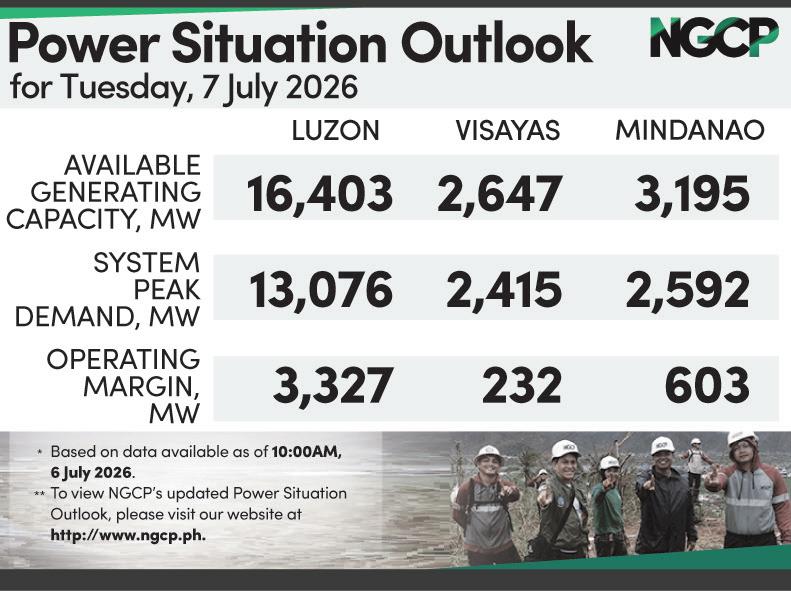

as
By VG Cabuag
SHARE prices closed higher as investors shrugged off the impeachment trial of Vice President Sara Duterte, which started at the Senate on Monday.
The benchmark Philippine Stock Exchange index (PSEi) rose by 35.96 points to 6,223.09 points.
Luis Limlingan, managing director at Regina Capital Development Corp. said American equities were unchanged on Friday as markets were closed due to the Independence Day holiday in the United States.
“Investors will look for clues on the path of interest rates and early signals from upcoming earnings season.”
Philstocks Financials Inc., meanwhile, attributed the PSEI’s gains last Monday to bargain hunting.
“The local market extended its rise to a fourth straight day as investors continued with their bargain hunting. This comes amid optimism towards our country’s inflation outlook given the decline in global oil prices.”
Total volume of shares that ex-
changed hands reached 895.27 million, valued at P6.5 billion. Gainers edged losers 100 to 83 and 59 shares were unchanged. Among the sub-indices, only the Services index declined by 56 points and ended at 3,202.46 points, while the rest closed higher. The broader All Shares index gained 18.03 to 3,388.97, the Financials index rose 35.40 o 1,943.80, the Industrial index added 99.30 to 8,484.26, the Holding Firms index climbed 75.30 to 4,523.31, the Mining and Oil index was up 96.34 to 14,688.21 and the Property index was higher by 20.36 to 1,917.22. International Container Terminal Services Inc., the port operator of billionaire Enrique K. Razon Jr., was the day’s top traded. Its shares closed lower by P18.50, or 2 percent, to end at P894.50. BDO Unibank Inc. rose P3.50 to P127, Bank of the Philippine Islands added P3 to P104, Ayala Corp. gained P16.20 to P497, Jollibee Foods Corp. climbed P3.20 to P149, Ayala Land Inc. was up P0.48 to P15.92 and SM Investments Corp. was higher by P13 to P608.


By Joel R. San Juan @jrsanjuan1573
THE Supreme Court (SC) has af-
firmed the constitutionality of a law granting value-added tax (VAT) refunds on certain local purchases made by non-resident foreign tourists.
to at least P3,000.
Section 5 of the law’s implementing rules and regulations limits the refund to retail and tangible goods, including clothing, apparel, electronics, gadgets, jewelry, accessories, souvenirs, food or non-food consumables, and other items intended for personal use.
The law aims to encourage tourist spending, stimulate economic activity, and promote Philippine products and craftsmanship, particularly those produced in communities near tourist destinations.
the government could lose at least P1.9 billion income from VAT refund claimed by foreign tourists.
In ruling against the petitioner, the Court agreed with the Office of the Solicitor General (OSG) that foreign tourists and local consumers are not similarly situated. The High Tribunal stressed that the right to equal protection of the law “is not absolute.”
to the law’s objective of promoting tourism and encouraging visitors to purchase local products.
Philippines, and they take the goods out of the. country within 60 days from the date of the purchase and consume it somewhere else.
The High Tribunal stressed that the law does not discriminate against Filipinos, instead, litigants a specific incentive to foreign tourists as part of the State’s effort to strengthen the tourism industry. The SC also said the VAT refund system follows the basic rule of VAT that goods are taxed where they are consumed.
In a 16-page ruling penned by Associate Justice Amy Lazaro-Javier, the Court en banc denied the petition filed by high school teacher John Barry T. Tayam assailing the constitutionality of Republic Act (RA) 12079. Section 112-A of RA 12079 (“An Act Creating a VAT Refund Mechanism for Non-Resident Tourists, Adding a New Section 112-A to the National Internal Revenue Code of 1997”) specifically states that a tourist shall be eligible for a VAT refund on locally-purchased goods if it meets certain conditions.
PBy Samuel P. Medenilla @sam_medenilla
RESIDENT Ferdinand R. Mar-
cos Jr. urged private banks to adapt the free digital transfers initiated by government-owned LandBank of the Philippines to reduce the cost of transactions and doing business in the country, according to Malacañang.
“We would prefer for all banks to emulate the initiative started by LandBank in order to help our fellow citizens,” Palace Press Officer Claire A. Castro said in Filipino at a news briefing last Monday.
Castro issued the Palace’s official statement after the Landbank announced it will waive InstaPay and PESONet transfer fees starting July 7. In a statement issued last Monday, the state-run lender said the initiative enables retail clients to send money at no cost via the Landbank’s mobile banking app and iAccess for InstaPay and PESONet transactions. This zero-fee policy also extends to Overseas Filipino Bank (OFBank) clients worldwide, the lender added.
“By expanding our zero-fee digital framework from government payments to everyday retail transfers, we want to ensure that our banking services directly uplift our workers, small business owners, and overseas Filipinos,” LandBank President and
One is that the goods are purchased in person in duly accredited stores. Another is if such goods are taken out of the Philippines by the tourist within 60 days from the date of purchase. Finally, a VAT refund is allowed if the value of goods purchased per transaction is equivalent
CEO Lynette V. Ortiz was quoted in the statement as saying. “Our focus remains on keeping our platforms secure, reliable, and accessible to everyone, helping our clients stay connected to their families and businesses without the burden of extra costs.”
LandBank’s announcement came weeks after the Bangko Sentral ng Pilipinas (BSP) issued Circular 1238 mandating fees for person-to-person e-payments across banks, e-wallet operators, and other payment service providers (PSPs) should not be materially different from fees within the same institution.
“Transfers within one bank or ewallet are often free. So any difference in pricing should mainly reflect fees paid to the network switch operator,” the BSP emphasized.
The issuance of Circular 1238 last June marks the BSP’s push for fair and transparent fees in digital transactions by introducing measures to lower interbank fees.
The central bank said it will also require BSP-supervised financial institutions to be prepared to show how they compute their costs.
Weeks after the BSP issued Circular 1238, several private banks announced waiving or lowering fees. (See https://businessmirror.com.ph/2026/07/06/lowbank-transfer-fees-to-benefitconsumers/ )
Bayam argued the said law violated the constitutional right to equal protection of the law—enshrined under Article VI, Section 28 (1) of the Constitution—because RA 12079 excluded Filipino citizens and residents from eligibility for VAT refund.
Article VI, Section 28 (1) mandates that “the rule of taxation shall be uniform and equitable.”
The petitioner also asserted that
By Andrea E. San Juan
OFFICIALS of the central bank aim to complete in three months its roadmap for the central bank digital currency (CBDC), which includes the goal of using wholesale CBDC for interbank funds transfer, securities settlement, and large value cross-border payments.
“Those are the opportunities we saw that make economic sense,” Bangko Sentral ng Pilipinas (BSP) Deputy Governor for Payments and Currency Management Sector Mamerto E. Tangonan told reporters last Friday.
Tangonan said the other thing that the central bank is looking at but still needs to be proven is if this type of currency can be used as “like a backup to the RTGS [Real-Time Gross Settlement].”
“The equal protection clause does not forbid discrimination as to things that are different. It does not prohibit legislation [that] is limited either in the object to which it is directed or by the territory within which it is to operate,” the SC explained.
“If the groupings are characterized by substantial distinctions that make real differences, one class may be treated and regulated differently from another,” the Court added.
Thus, the SC held that RA 12079 validly distinguishes foreign tourists from Filipino citizens and residents. The classification is directly related
“Because if you’re able to settle obligations amongst each other, that’s what the RTGS does,” added the BSP deputy governor.
Tangonan said the central bank would need about three months to finish the roadmap.
“But anyway as we write it, we are preparing for ‘Project Aguila 2.’ We’ll build on Aguila 1. But this time, we intend to launch. We intend to pilot,” he added.
“Project Agila” represents the BSP’s wholesale CBDC initiative, “designed to explore how programmable ledger and tokenization technologies can transform the country’s financial infrastructure.”
The Project provides the BSP and participating financial institutions with practical insights into CBDC technology’s potential to modernize large-value payment systems, according to a report by the central
The High Tribunal also found no merit with Tayam’s argument that foreigners who hold long-term visas, such as work or retirement visas, who may be allowed to stay in the Philippines for longer periods, will be at-a disadvantage as compared to tourists who stay in the Philippines for much shorter periods.
The SC explained that these foreigners who are allowed to stay for a much longer period in the Philippines may still avail of the VAT refund for as long they have no residence in the
bank. (See https://www.bsp.gov. ph/PaymentAndSettlement/ Project-Agila/Project-Agila-Report.pdf )
Apart from enabling banks to transfer funds to each other, Tangonan said the BSP will also enable GSEDs [government securities eligible dealer] to settle their purchases of government bonds, treasury bonds, using wholesale CBDC.
“There’s a new use case,” Tangonan explained. “The idea there [is that] we want to see that the government bonds can be accessed by more Filipinos.”
“Right now, because it’s not fully digitalized, the cost is quite high. So, if you look at the issuances, it’s big: you have to pay 100 million,” he added.
In a statement issued last week, the BSP announced it would formulate a CBDC Roadmap, which shall lay
The SC added that VAT refund programs for foreign tourists are widely practiced around the world. It observed that several Asian countries—including Indonesia, Malaysia, Singapore, Thailand, Vietnam, China, and Japan—as well as members of the European Union, have long implemented similar systems.
“Granting VAT refund to foreign tourists was not arbitrarily done. It is a policy decision based on legitimate state interests, i.e., the need to remain competitive as a global tourist destination,” the Court stressed.
“In fine, foreign tourists may be. granted privileges and benefits that are not extended to Filipino citizens, so long as these distinctions are based on reasonable and justifiable classifications, as in here,” the High Tribunal added.
out the BSP’s strategic direction for the exploration and development of “highly compelling” CBDC use cases. According to the BSP, CBDCs are digital forms of money that constitute direct liabilities of the central bank. A wholesale CBDC, meanwhile, is a type of CBDC designed for use by commercial banks and other financial institutions.
“Much like the current real-time gross settlement (RTGS) system, [the] wholesale CBDC would allow each bank to maintain an account with the BSP,” the central bank explained.
“Balances would then be credited or debited based on transactions with other banks,” the BSP said. The key difference is in the use of distributed ledger technology, which enables greater automation, faster processing, and lower transaction costs, added the central bank.
THE Philippine Government and the Kingdom of Denmark have inked a deal on promoting financial and developmental cooperation, to “deepen” bilateral cooperation and mobilize financing for the government’s priority development programs, according to the Department of Finance (DOF).
A statement issued by the DOF last Monday read that the goal of the two countries is to translate this
agreement into “concrete projects, stronger investments, and meaningful results” that benefit both the Philippines and Denmark.
The DOF sees this partnership as an investment in our future, the statement added.
The Finance department noted this agreement expands cooperation in key sectors, including infrastructure, renewable energy, climate action, maritime development and shipbuilding, transportation, ag-
YOU finally get a salary increase. For a moment, it feels like life will get easier. The extra money promises relief: more room in the budget, less pressure when bills arrive, maybe even the chance to save. But a few months later, the same stress returns. Expenses feel heavier, savings have not grown, and somehow the raise has disappeared.If more income should bring comfort, why does money stress often stay the same?
Expectation vs reality
MANY people believe that a higher salary is the answer to financial struggles. It seems logical: if money is the problem, then more money should be the solution. Yet reality tells a different story. Even with raises or bonuses, many still feel stuck in the same cycle of living paycheck to paycheck. The truth is that income alone does not solve financial stress. Without changes in habits and mindset, a bigger paycheck often brings only temporary relief. Over time, the same pressures return, sometimes even stronger.
Lifestyle creep effect
ONE of the main reasons salary increases fail to reduce stress is lifestyle

creep. This happens when expenses rise as income rises. Instead of saving the extra money, people begin to upgrade their lifestyles. A new phone feels affordable, dining out becomes more frequent, or a bigger apartment suddenly seems within reach. These upgrades feel justified because the income has increased. The problem is that the new expenses quickly become the new normal. What once felt like an improvement becomes an expectation.
In the Filipino context, lifestyle creep often extends to family and social life. A worker who gets a raise might treat
parents to a nicer dinner, give larger allowances to siblings, or sponsor more gatherings with friends. These gestures are generous and meaningful, but they can also consume the very income that was supposed to bring financial relief.
Behavioral traps
BEHAVIORAL economics helps explain why salary increases rarely fix financial problems. Human decisions are influenced by psychology, not just logic. One factor is hedonic adaptation. We quickly get used to new comforts. A raise that once felt like freedom soon feels ordinary, and the happiness fades.
This pushes people to spend more again, searching for the same satisfaction.
Another is social comparison. When income rises, people often compare themselves to others at the same level. A promotion may lead to more pressure to dress a certain way, buy a car, or keep up with colleagues’ lifestyles. Instead of easing stress, the raise creates new expectations.
There is also mental accounting. Extra income is treated as “extra money” rather than part of a bigger financial plan. A bonus or allowance is often spent freely on wants rather than directed toward savings or debt. Finally, optimism bias leads people to believe that the next raise will finally fix everything. Instead of addressing habits today, they delay change, waiting for a future income that will supposedly make things easier. Unfortunately, the cycle continues.
Habits matter
CONSIDER two employees. One earns
P30,000 a month but consistently saves 10 percent, avoids unnecessary debt, and has a small emergency fund. Another earns P80,000 but spends nearly everything, takes on new loans, and has no savings.
On paper, the second employee has more financial power. In reality, the
riculture, and other priority areas.
According to the DOF, the agreement is expected to also create opportunities for concessional and blended financing to support high-impact projects that strengthen climate resilience, improve connectivity, and promote long-term, sustainable economic growth.
Finance Secretary Frederick D. Go and Danish Ambassador to the Philippines Franz-Michael Skjold Mellbin led the ceremonial signing of the agreement. The DOF said this marks another milestone in the two countries’ longstanding partnership as they celebrate 80 years of diplomatic relations.
first one is more secure. This shows that money stress is not solved by how much we earn, but by how we use what we earn.
Income provides opportunity, but habits create stability. Without good habits, even the highest salary can feel insufficient. With good habits, even a modest income can create peace of mind.
Practical steps
SALARY increases can still be powerful tools for financial wellness, but only if used wisely. Here are some ways to make them count.
Pay yourself first. Direct part of the increase into savings or investments before adjusting spending. Even a small percentage creates progress. Avoid lifestyle creep. Keep living expenses steady even after income rises. Treat raises as an opportunity to build security, not bigger bills. Set clear goals. Use the additional income to reach milestones like paying off debt, funding an
“When we get the framework right, we get the solutions right, and companies are more willing to invest in the Philippines to increase productivity and strengthen the economy’s resilience,” Mellbin was quoted in the statement as saying. Andrea E. San Juan

SAN FRANCISCO—On one side of the world, Xiangqi Chen can be punished for her LGBTQ+ activism. But on the other, the activist and artist is lauded as a trailblazer—the architect behind the first of its kind Chinese queer art museum.
The irony that she left her home in China and found a public platform for her LGBTQ+ artistic expression in San Francisco’s Chinatown—the country’s oldest—is not lost on her.
“Here in San Francisco Chinatown, I still continued my journey and met so many like-minded community members and friends,” Chen told The Associated Press through an interpreter. “It kind of actually encouraged me and gave me lots of strength to do what I know is my mission, my calling.”
The OUT Museum opened with a rainbow-ribbon cutting at the end of May—between Asian American Pacific Islander Heritage Month and Pride Month. Situated across from the Chinese Historical Society of America Museum, the bilingual museum is giving recognition to a demographic that has long felt invisible. It seems like an ideal fit in the progressive city at a time when some cities, states and the federal government are restricting or banning certain LGBTQ+ rights.
To start, the museum is only open on Saturdays and is one room with fewer than a dozen artworks by artists from China and the Chinese diaspora. But there is hope to expand the museum’s exhibits and days of operation. AP
CELEBRATING the illustrator as a potent storyteller, children’s illustrator group Ang Ilustrador ng Kabataan (Ang INK) unveils its 35th anniversary exhibit, Stories We Tell, at Fundacion Sansó , San Juan City, from July 11 to August 8, 2026.
Mounted in partnership with Fundacion Sansó, Stories We Tell asks the question, “What do you see?” as it presents artworks that propose a beginning and end, and playfully invites the viewer to tell the tale in between.
Devoid of words dictating what happens, the viewer becomes an active participant, the narrator in the folding of the story, allowing images to take hold and imagination take flight in the unfolding of the story.
Aside from the main exhibit showcasing more than 70 artworks by Ang INK members, a companion exhibit, Side Stories, will also be mounted at the ScholarSip Café, the museum’s exhibition space that supports Fundacion Sansó’s scholarship program. This capsule collection showcases works from a tribute to the late award-winning graphic artist, illustrator, painter, and crafter Robert A. Alejandro (1963-2024).
Side Stories honors Robert’s simple but profound belief that art belongs to everyone and every child should be empowered to create, imagine, and tell their own story.
Several special events are also lined up throughout the exhibition run, starting with the exhibit opening on July 11, 3 pm.
“K is for Komiks” is scheduled on July 22, 7 pm, an online panel with comic book illustrators Hans Dimapilis, Arli Pagaduan, Tori Tadiar and Cy Vendivil, moderated by Patti Ramos. On July 25, 2 pm, “Buhay Ilustrador” gathers new, mid-career, and

veteran illustrators Luce Melegrito, Cyrill Acuña, and Jomike Tejido in a panel discussion moderated by Isa Nazareno.
Stories We Tell is slated on August 1, 10 am, featuring author-illustrators Dione Kong, Liza Flores and Rommel Joson, moderated by Isa Nazareno. This will be followed by Mentor Minutes, a portfolio review session at 1 pm, featuring Liza Flores, Ivan Reverente, Marcus Nada, Aldy Aguirre and


‘Pasts Revisited’ exhibit extended until July 31
VISITORS have more time to experience a unique intersection of history, art, and intellectual resistance, as the Constantino Foundation and Yuchengco Museum have officially extended the run of Pasts Revisited: An Exhibit on a Usable History and the Romance of Renato Constantino and Letizia Roxas Constantino until July 31, 2026.
Currently housed at the RCBC Plaza in Makati City, the exhibition highlights the celebrated husband-and-wife historian duo whose writings profoundly reshaped Filipino identity.
Due to popular demand and the vast nature of the collection, organizers are giving the public a prolonged opportunity to engage with these pieces of national heritage.
The exhibit offers a look at the intellectual labor and lifelong romance of Renato and Letizia. For the first time, the public can view personal artifacts, rare art and photos, historical notes, and contemporary expressions.
On display are never-before-seen book manuscripts, personal letters, Renato’s writing desk, and his wood pipes which were once so coveted that National Artist Vicente Manansala reportedly bartered a custom painting to acquire one.
Artworks gifted to the couple by Manansala and renowned painters Malang and Araceli Dans, alongside photos with close friends like Senators Claro M. Recto and Lorenzo Tañada, are also exhibited together with handwritten notes from esteemed historians such as William Henry Scott, Doreen Fernandez, and Edilberto Alegre.
In addition, there are new art pieces exploring a “usable history” created in collaboration with the advocacy group 350 Pilipinas, including the “Alas ng Bayan” project, which highlights five Filipino women who resisted national oppression.
The extension allows more time for the public to engage with the urgent message behind the exhibit. Renato Redentor Constantino, managing director of the foundation, emphasized the need for historical remembrance in modern times as he reflected on the nation’s current state.
He credited his parents, RC and Dudi Constantino, and the museum crew for helping bring the voluminous records together, while noting that the foundation still has “boxes and boxes and boxes we have yet to open.”
Co-curator Ninel Constantino shared that the exhibit, set in the museum’s circular space, avoids a chronological narrative. Instead, it serves as an open invitation to cultural advocates and other interested people looking to engage critically with the Filipino identity.
The museum is open from Monday to Saturday, 10 am to 6 pm. Admission fees apply, with substantial discounts available for students, teachers, senior citizens, and PWDs. Group visits can be scheduled by contacting info@constantinofoundation.org.
Visitors can also drop by the YSpace Museum Shop to purchase biographer Dr. Rosalinda PinedaOfreneo’s books Renato Constantino: A Life Revisited and Dahil ang Bukas ay Para sa Mapagkalinga, to take a piece of this intellectual history home.
opportunities than you realize, and engaging in activities that can help you visualize the outcome and turn it into something realistic is encouraged. Avoid trying to buy love or favors, or spending on products or subscriptions that don’t live up to their promises.
VIRGO (Aug. 23-Sept. 22): A positive attitude will help you acquire information that’s geared toward better health, finances and negotiations. Dissect what you hear, and rework the information to suit your schedule and needs. Life choices make a difference, and putting health and financial well-being first is essential if you want to come out on top. Keep your thoughts and plans to yourself. ★★★
LIBRA (Sept. 23-Oct. 22): Refrain from offering personal information. Someone will use what you say against you. Concentrate more on what you can do to improve your life, prospects and financial situation. Lower your overhead or sell off what you don’t use. Decluttering your life will relieve pressure, stress and the need to live up to anyone’s expectations but your own. ★★★
SCORPIO (Oct. 23-Nov. 21): Set a budget, draw the line and be realistic about what you want and what you need. Refuse to let anyone pressure you into something that isn’t necessary. Do your research and apply what you learn to cutting your overhead and choosing to use the surplus for educational pursuits and self-improvement. Refuse to let someone’s charm con you. ★★★
SAGITTARIUS (Nov. 22-Dec. 21): Spend more time nurturing meaningful relationships and fixing up your space to offer a convenient and comfortable place to excel. Don’t hesitate to do things differently if it enriches your life and invites new opportunities. Love, romance and how you present yourself to others will require patience and research. Put more energy and effort into personal gain. ★★★★★
CAPRICORN (Dec. 22-Jan. 19): Do a double take if someone surprises or pressures you to do something that makes you uncomfortable. Being upfront will lead to the least amount of tension. Don’t let anyone think you are remotely interested in something that is going to cost you emotionally or financially. A concise approach to what you want and will do is favored. ★★
AQUARIUS (Jan. 20-Feb. 18): Changes at home that add


Thrills, shocking twists unfold in third week of ‘You’re My Favorite Song’
VIEWERS can look forward to an emotional and exciting week as GMA Network’s hit afternoon series You’re My Favorite Song delivers major revelations, unexpected twists, and heartfelt moments in its much-anticipated third week.
The giddy thrills between Angel (Caprice Cayetano) and Miguel (Heath Journales) reaches a long-awaited milestone as the two finally come face-to-face. While hiding from the wrath of Calix (Clifford), Angel encounters the familiar voice of Captain Serenade, only to discover that the kindhearted busker behind the bear costume is none other than the lead vocalist of the popular band Siklab, Miguel Miraflor.
Meanwhile, a shocking tragedy shakes the Montaverde family after Enrico’s (James Blanco) yacht suddenly explodes, leaving him missing. As the family reels from the devastating news, questions begin to arise. Was Serina (Kazel Kinouchi) truly caught off guard by the incident and will Enrico survive the explosion?
Adding another emotional layer to the story, Lolo Xavi (Boboy Garrovillo) reunites with his estranged daughter Serina as he visits the Montaverde mansion to comfort her following Enrico’s disappearance. Could this heartbreaking incident finally pave the way for reconciliation between them?
You’re My Favorite Song airs Mondays to Fridays at 4 pm on GMA. Viewers can also catch the latest episodes via Kapuso Stream and www.gmanetwork.com.
Ang INK celebrates 35th anniversary with ‘Stories We Tell’ exhibit
Continued from B4
Alyssa Babasa. On August 8, the exhibit will host Kids and Books Day, with “Silent Stories We Tell,” a kids wordless comics workshop at 10 am featuring Patti Ramos and Rev Cruz; Saan-saan Storytelling and live drawing at 1 pm featuring Kuya Ray Bufi; and Kids Speak: Kids and Books panel at 2 pm moderated by Zarah Gagatiga.
Stories We Tell is supported by Adarna House, Milflores Publishing, Lampara Books, Oishi, Prestige Paper Products, Artline Philippines and Tahanan Books.
More information about Ang INK can be found at www.ang-ink.org.

THERE is no doubt that Will Ashley is in demand. The career of this GMA Sparkle contract artist continues to be on the upswing as he lands one acting job after another.
He is part of the main ensemble cast of the ongoing action drama series Taskforce: Firewall where he takes every work day very seriously. “I have been acting for more than 10 years now because I started so early as a child actor. And as I grow and mature, I make sure that I take every work assignment with both gratitude and excitement. I have learned to prepare and read the script thoroughly so I can understand where my character comes from and where he is going. I also observe a lot of my fellow actors, especially the veterans, when it comes to going deep into your role and at the same time be sincere about the kind of acting you give.”
By the time this piece comes out on print and online, Will might have just scored another victory for his strong performance in the festival movie Bar Boys: After School. Will is a heavy favorite to win the best supporting actor at The Eddys.
“I appreciate every nod and nomination, especially if these come from legitimate critics and no-nonsense organizations that hand out awards yearly. Every time I land a nomination, I am thankful that my acting was noticed and singled out. But perhaps it’s just me, I never sulk when I do not win, because I guess it’s destiny when it comes to who takes home the trophy. I have learned to be happy for others,” he shared.
Will has his share of acting awards, courtesy of his much talked-about performance in the indie festival movie Balota. He also scored nominations for the teenage romance film Love You So Bad, which incidentally will be available on Netflix in a week or two.
“I am glad there are several platforms nowadays so we can reach a wider audience, including the Filipino communities worldwide. I fully understand that life overseas can be lonely especially if our kababayans are away from their loved ones, and I am very happy that through these platforms, they are able to watch films and shows from back home,” he said.

Will is excited for the new GMA comedy series entails a lot of teamwork with other actors. Hopefully, I’ll be able to deliver.”
‘MINIONS & MONSTERS’ TOPS FOURTH OF JULY HOLIDAY BOX OFFICE, BARELY

LOS ANGELES—The Minions have taken down Toy Story 5 at the July Fourth weekend box office, but not by much.
Minions & Monsters, the seventh film in the Despicable Me franchise, earned $36.4 million at the holiday weekend box office, according to studio estimates for North America. Toy Story 5, a juggernaut that last week beat Supergirl, earned an estimated $31 million.
The Minions movie, which has the devious
henchlings seeking movie glory in Hollywood’s Golden Age, opened on Wednesday and earned an estimated $61.4 million in its first five days, according to studio estimates. The Minions are a popular franchise globally and Minions & Monsters has earned $160 million worldwide in its debut week.
Audiences looking for patriotic fare amid the United States’ 250th birthday celebration had Young Washington to consider; it opened in third place with nearly $21 million. The movie focuses on George Washington’s service during the French and Indian War. That left Supergirl in fourth with just under $10 million at the box office, a steep 74 percent drop from its disappointing opening weekend.
The weekend box office was down year-over-year about 24 percent, according to figures compiled by Rentrak, though this summer is up from 2025 by nearly 12 percent. That’s due in part thanks to the low-budget Gen-Z sensations Obsession and Backrooms, which took the sixth and seventh spots, behind Steven Spielberg’s Disclosure Day AP
Center for Social Action, Center for Campus Exhibitions, and Center for Student LifeCulture and Arts Unit. The event will be held at the Fifth Floor Theater of the Benilde Design + Arts Campus, 950 Pablo Ocampo Street, Malate, Manila.
President for Lasallian Mission and Student Life, School of Diplomacy and Governance, Museum of Contemporary Art and Design,
It is scheduled for July 17, 2026, from 11 am to 2 pm. It is free and open to the public. Interested participants may register through bit.ly/csb-fooddelivery.
More information can be found at www. facebook.com/centerforsocialaction.
OPENAI FILM ‘ARTIFICIAL,’ DROPPED BY AMAZON, FINDS A NEW HOME WITH NEON NEW YORK—Artificial, Luca Guadagnino’s starry film about Sam Altman and OpenAI, has been acquired by the indie distributor Neon after it was dropped by Amazon MGM Studios.
Neon said on Tuesday that it bought the film following a bidding process.
Amazon dropped the nearly complete $40 million film, starring Andrew Garfield as Altman, earlier this month, a surprise move that came just months after Amazon announced a $50 billion investment in OpenAI.
Amazon said then that Artificial would “be better served if it were released by a different studio.” Neon said on Tuesday that it will release Artificial this year and “compete in this year’s Oscar race.” The film, which chronicles the days leading up to the 2023 firing and reinstatement of Altman as OpenAI chief executive, also stars Monica Barbaro, Yura Borisov and Academy Award winner Mark Rylance. Ike Barinholtz plays Elon Musk.
In late February, Amazon signed an expansive multiyear partnership with the artificial intelligence startup. Then earlier this month, Amazon MGM said it would put the film up for sale to find it a new home.
Neon has established an enviable awardsseason track record with Oscar winners, like Parasite and Anora. The specialty label has backed the last seven Palme d’Or winners at the Cannes Film Festival. The studio declined to disclose how much it paid for the worldwide rights to Artificial AP
Megaworld Hotels & Resorts, the Philippines’ largest hotel operator, invites Filipinos to rediscover the beauty of local travel through TARA! (Travel Away & Reignite Adventure) campaign, a promotion designed to make meaningful getaways more accessible amid rising global travel costs and economic uncertainties.
Last July 1, 2026, Hotel101 Global Holdings Corp., a leading asset-light, prop-tech hospitality platform pioneering a global standardized “condotel” business model listed on the Nasdaq Stock Exchange and a subsidiary of Philippinelisted DoubleDragon Corporation (PSE Ticker: DD), announced the signing of definitive binding agreements for the joint venture development of an approximately 770-room Hotel101 in Bangkok, Thailand.
This expansion marks a significant milestone in the company’s global growth strategy, bringing its novel, globally standardized condotel business model to one of Southeast Asia’s most dynamic capital cities and major transportation hubs.
The Hotel101-Bangkok is expected to occupy a prime 8,336 sqm site along Phahon Yothin Road, near Don Mueang

Bangkok, Thailand International Airport and beside the Yaek Kor Por Aor BTS Station. This strategic position is expected to offer connectivity and convenient access to Bangkok’s vibrant northern corridor. The area has emerged as one of Bangkok’s key growth districts, known for its modern infrastructure, excellent transport links, and strong mix of commercial, residential, and tourism developments.
Key location advantages include: Prime Phahon Yothin road position: Located beside the Yaek Kor Por Aor BTS Station and near Don Mueang International Airport. Guests are expected to benefit from seamless connectivity via the BTS Skytrain system and proximity to the airport, providing convenient access for both domestic and international travelers.
Proximity to major attractions: Surrounded by vibrant local attractions
including Yaek Night Market. The site offers an excellent balance of urban energy, shopping, dining, and green spaces, with easy access to Chatuchak Market, the city center, and major Bangkok attractions
Hotel101-Bangkok is expected to generate approximately 1.925 Billion Baht (US$58 million) in sales revenue once fully sold and is expected to be completed by 2029 forming part of Hotel101 Global’s global expansion strategy.
Hotel101 Bangkok is expected to offer 4-star amenities at affordable prices, including ample meeting spaces and a conference center tailored for business events. Consistent with Hotel101’s offerings across its locations globally, guests are expected to be able to enjoy modern rooms, 24/7 reception, all-day dining, swimming pool, full-size gym, business center, children’s pool, ample parking, luggage storage and other amenities.

FOR the past decade, Somerset Alabang Manila has been more than a place to stay, it has been a home in the South, where heartfelt hospitality, meaningful experiences, and genuine care have welcomed travelers, families, and the local community alike.
As the property celebrates its 10th anniversary this July, Somerset Alabang Manila enters a new chapter, one that is refreshed, elevated, and thoughtfully reimagined while preserving the warmth and comfort that guests have come to love.
Under the anniversary campaign, “A Decade of welcoming you Home,” the celebration reflects the hotel’s evolution into a complete lifestyle destination where guests can stay, dine, gather, celebrate, and connect through experiences designed with purpose.
Leading this exciting milestone is the unveiling of Somerset Alabang Manila’s food and beverage outlets:
Veranda at SAM - soft launched last February, an all-day dining restaurant serving Filipino and Western cuisine through the philosophy of mindful dining, a commitment to serve sustainable dishes that care for the guests and the planet and GloCal sourcing, using locally grown ingredients supporting local farmers and artisans, reducing carbon footprint while upholding global standards.
Soluna - “Sol” means sun, while “Luna” means moon symbolizing a space that seamlessly transitions from day to night, from your morning coffee ritual to evening
cocktails which will be opened this July 31, 2026.
At the heart of these new concepts is Somerset Alabang Manila’s commitment to mindful dining. A dining philosophy that delivers exceptional culinary experiences while caring for both people and the planet.
Through GloCal sourcing, Veranda combines global culinary standards with locally sourced ingredients, partnering with Filipino farmers, producers, and artisans to create dishes that are fresh, seasonal, and responsibly sourced. By shortening supply chains and supporting local communities, the restaurant reduces its environmental footprint while celebrating the richness of local ingredients.
This philosophy extends beyond sourcing. Every dining experience is thoughtfully designed to promote conscious consumption, minimize food waste, and support sustainable hospitality proving that great food can create a positive impact on both guests and the communities it serves.
Complementing these new dining experiences are Somerset Alabang Manila’s newly enhanced event venues offering beautifully curated spaces where celebrations, corporate gatherings, and social occasions come together seamlessly with in-house catering, comfortable accommodations, and personalized service. Together, these additions reinforce Somerset Alabang Manila’s vision of becoming a destination where every moment from overnight stays to memorable celebrations is thoughtfully designed to feel like home.
Sustainability has always been woven into Somerset Alabang Manila’s story through Ascott CARES, The Ascott Limited Philippines’ sustainability framework aligned with the Global Sustainable Tourism Council (GSTC) Criteria.
Over the years, responsible hospitality has become part of everyday operations from environmental initiatives and resource-conscious practices to meaningful partnerships that create lasting value for both guests and the community.
This commitment now extends even further through food and beverage.
Mindful dining reflects Somerset Alabang Manila’s belief that hospitality should nourish not only its guests but also the environment, local livelihoods, and future generations.


VThroughout July, Somerset Alabang Manila invites guests and the community to be part of its anniversary celebration through 10 thoughtfully curated events and experiences, including:
Exclusive 10th anniversary launch featuring a special four-course dinner to be offered throughout July
32-Hour Anniversary Stay offering an extended stay experience from 2 pm until 10 pm the following day.
Craft & Create Series, featuring handson workshops including candle making, cocktail making, soap making, and the Little Hotelier experience for kids.
Home in the South Weekend Market, showcasing local artisans, makers, food entrepreneurs, and lifestyle brands.
Venue Open House, where guests can explore the hotel’s event spaces, room showcases, and curated culinary offerings.
A meaningful Corporate Social Responsibility initiative with the Philippine Air Force school at Fernando Air Base in Lipa, Batangas, providing hospitality skills training alongside educational support.
The return of the Pet Community Walk, promoting wellness, responsible pet ownership, pet adoption, and fundraising activities.
Greenversary, encouraging recycling and environmental stewardship within the community.
The grand opening of Soluna, introducing Somerset Alabang Manila’s newest F&B outlet and social space.
The hotel’s 10th Anniversary celebration, commemorating a decade of hospitality while looking toward the future.
Ten years is more than a milestone, it is the beginning of something even greater.
As Somerset Alabang Manila celebrates A Decade of welcoming you home, it reaffirms its commitment to creating experiences that are warm, sustainable, and thoughtfully designed for every guest.
With refreshed spaces, new culinary concepts rooted in sustainability, meaningful community initiatives, and experiences that bring people together, Somerset Alabang Manila welcomes everyone to be part of its next chapter.
Because while the hotel continues to evolve, one thing remains unchanged: the feeling of coming home.
Celebrate this milestone with Somerset Alabang Manila. Visit their Facebook and Instagram pages @somersetalabangmanila to join the festivities.
(DepEd) provides private organizations the opportunity to become partners in strengthening public education in the country. It provides assistance to schools through resources that address infrastructure needs and learning environments. Partnerships are formalized through a MOA between the donor and the recipient school or division, helping ensure that assistance is coordinated, documented, and aligned with the academic community’s needs.
The Vista Land donation was intended to help its adopted schools in Luzon, Visayas, and Mindanao carry out repainting and rehabilitation activities that contribute to safer, orderly, and more conducive learning environments. Construction materials support improvements to classrooms, common areas, and other facilities.
Vista Land executives and employees also participated in Brigada Eskwela, the annual DepEd volunteer program that mobilizes teachers, academic personnel, parents, and local partners to prepare public schools for the opening of classes. Volunteers contribute their time to clean and
improve facilities, fostering a spirit of bayanihan and shared responsibility for education. Through these initiatives, Vista Land honors public schools as vital pillars where youth build knowledge, discipline, and confidence for the future. The organization highly recognizes the collaborative efforts of DepEd, educators, parents, and volunteers. This collective commitment highlights the power of cooperation in sustaining quality education, the foundation for regional progress and national development.
As the holding company for the residential ventures of Vista Group, Vista Land is primarily engaged in the development of integrated estates, house-and-lot communities, and condominium properties across the country.
Filipinos deserve the best. This guiding belief has long been central to the enduring success of the Philippines’ leading integrated property developer. Creating visionary, secure, and enriching environments and services for its residents, as well as delivering exceptional long-term returns for its investors, has always been the driving force behind the continued evolution of Vista Land.
To learn more about Vista Land, visit www.vistaland. com.ph and follow @VistaLandAndLifescapesOfficial.

ENCHANTED Kingdom, the first and only worldclass theme park in the Philippines, continues to strengthen its forever enchanted ties with the travel and tourism sector as it honored industry partners at its 21st Tour Operators and Partners Appreciation Party. Keeping the momentum of its 30th anniversary celebration alive, the Laguna-based theme park took its annual gathering for both new and longtime affiliated tour operators and travel agencies to greater heights with a grand Flores de Mayo-themed event that showcased the beauty and richness of Filipino culture and tradition last May 29, 2026. EK set the festive mood with a colorful Sagala parade around the Park, featuring representatives from select tour operators dressed in vibrant gowns and accompanied by the lively tunes of the Muntinlupa Black Diamond marching band. Miss Universe Philippines Laguna titleholders Eloisa Jauod and Ysabel Prats were also present, adding even more enchantment and elegance to the festivities. The event proper was held at the Enchanting Events Place, where EK recognized its longtime partners, as well as the top-performing contributors whose efforts helped expand the park’s reach to more Filipino travelers across the country from 2025 to 2026. “It is only fitting that we recognize each and every one
of our partners for their valuable contributions in helping us attain our objectives over the past year, especially in bringing groups and schools to Enchanted Kingdom. We are grateful for the
By Francesca Stevens, Nguyen Dieu Tu Uyen & Philip Heijmans
AT Vietnam’s southernmost tip, some eight hours by car from Ho Chi Minh City along potholed roads, heavy trucks rumble through mangrove swamps and shrimp farms as soldiers and construction crews work around the clock to build the country’s longest sea bridge.
The 18-kilometer (11-mile) crossing connects Ca Mau province to tiny Hon Khoai Island— the centerpiece of a nearly $4 billion dual-use seaport and transport corridor linking the Mekong Delta region to global shipping routes in the Gulf of Thailand. For Hanoi, the project not only represents an expensive economic gamble, but a strategic response to growing concerns about Beijing’s expanding influence next door in Cambodia, and its increasingly dominant position in the South China Sea. Plans for Hon Khoai Island have circulated for years, but the project backed by the navy gained urgency in 2024 after Cambodia broke ground on a China-funded canal that raised fresh security concerns in Hanoi, according to a senior defense official familiar with the matter. The port would create a new gateway for trade and logistics in the Mekong Delta while giving Vietnam a stronger foothold in surrounding waters, said the official who requested anonymity and was not authorized to speak publicly.
To Lam, who took over as Communist Party chief in 2024, elevated Hon Khoai as a strategic priority in November, signaling that the focus of Hanoi’s rivalry with Beijing was shifting away from just the disputed reefs and resource-rich waters in the South China Sea.
Vietnam is watching China’s relationship with Cambodia “with growing unease,” said Le Hong Hiep, a senior fellow at the Vietnam Studies Program at Singapore’s ISEAS-Yusof Ishak Institute. “A dual-use port in the southwest, one that could accommodate military vessels, addresses these anxieties directly.”
China last year helped upgrade the Ream Naval Base on the Gulf of Thailand, while the $1.2 billion Funan Techo Canal, a 180-kilometer artery from Phnom Penh to the coast, has fueled fears that Cambodia could increasingly bypass Vietnamese ports and waterways, weakening a source of economic leverage over its neighbor.
Hon Khoai “looks less like an economic bet and more like a geopolitical hedge,” said Hiep.
The island’s position on the approaches to the Gulf of Thailand will allow Vietnam to operate larger vessels closer to developments in Cambodia and the country’s southwestern maritime frontier. And unlike shallower facilities farther west, the deep-water port, which is expected to handle 20 million tons of cargo annually, is designed to receive ships of up to 250,000 deadweight tons, large enough for some of the world’s biggest commercial bulk carriers and tankers.
While details of the military component remain limited following its commencement in August, the broader plans also call for an 80-km expressway alongside comprehensive logistics facilities.
In Ca Mau’s remote fishing community of Dat Mui, where stilt houses flank the town center’s harbor, roadside cafes and supply shops have sprung up to cater to the influx of construction workers.
“This property used to be just abandoned swampland,” said 40-year-old Nguyen Thi Quyen, who works at the roadside restaurant her family opened last year just across from a construction site. “But we invested to fill and level the ground and set up this shop because we saw the business opportunities.”
Across the water, Hon Khoai

is no longer populated, but the island has a deep military lineage and functioned as a vital transit point for revolutionary forces during the wars against France and the US. During a visit in November, Lam made a stop at a tourist complex featuring a mock fairy-tale castle, a Buddhist pagoda and a monument marking Vietnam’s southernmost point. Standing before billboards and flanked by military officers, he called Hon Khoai a “national strategic focal point.”
If completed as planned, Hon
Khoai would allow Vietnam to sustain larger naval combatants and potentially foreign naval visits in a theater where its presence has traditionally relied on smaller patrol craft, said Adam Farrar, a senior geoeconomics analyst with Bloomberg Economics. It “would represent one of the most significant shifts in Vietnam’s naval posture in decades,” said Farrar.
Together with naval facilities on Phu Quoc and a planned multipurpose airfield on Tho Chu island, Hon Khoai would form part of a
broader network of military and commercial infrastructure across Vietnam’s southwestern waters.
“Vietnam is basically trying to turn that area into some kind of sea fortress,” said Nguyen The Phuong, a maritime security expert at UNSW Canberra.
China’s foreign ministry said in a response to a request for comment that the country “has always adhered to the diplomatic concept of sincerity, friendship, mutual benefit, and inclusiveness” and that its “development of friendly cooperative relations with any country does not target third parties.”
“Cambodia has always said that the Funan Techo Canal project is good for the region to reduce the cost of logistics,” Cambodian Deputy Prime Minister Sun Chanthol wrote in a text message. “Nothing to do with the military use. It does not make any sense.”
Vietnam’s rivalry with China has long been linked to developments in neighboring Cambodia. Hanoi’s 1978 intervention that toppled the Beijing-backed Khmer Rouge regime led to a decade-long Vietnamese military presence in Cambodia and helped trigger China’s invasion of northern Vietnam the following year.
China’s troops suffered heavy
losses in that brief conflict, but it showed its naval superiority in 1988, when dozens of Vietnamese servicemen were killed as the PLA navy seized a disputed reef. Unable to match China ship for ship, Vietnam is pursuing a strategy built around deterrence. Lam has promised a leaner, stronger military despite a defense budget over 20 times smaller than China’s roughly $250 billion, which is equivalent to about 44% of all military spending in the region. Vietnam’s defense budget is estimated to reach $20.4 billion by 2031, according to a Bloomberg Intelligence analysis.
Officials also see Hon Khoai as central to plans to transform one of Vietnam’s poorest provinces. Ca Mau is targeting annual growth of more than 10% through 2030, up from around 7% in 2021-2025 and in line with the government’s double-digit growth push. The port could reduce logistics costs and provide the Mekong Delta with a major deep-water gateway, while helping offset some of the commercial leverage Vietnam risks losing as Cambodia develops alternative trade routes.
“It benefits both the military and the state, to some extent, to build up infrastructure,” said Phuong. “It’s not only about defense, it’s also about the economic benefits of certain interest groups inside the Vietnam political sphere.”
Not everyone is convinced about the project’s economic rationale. Vu Minh Khuong, practice professor at the National University of Singapore and former member of the Vietnamese prime minister’s advisory team, said Ca Mau isn’t necessarily an urgent need.
“It is a huge investment, so some may question whether this is the best use of resources,” he said.
Still, the project may alter the trajectory of a backwater many young locals once expected to leave behind.
“I used to think I would need to move to a big city for better job opportunities,” said Kim Nhan, 30, who works at a restaurant that now provides guestrooms on a nearby wooden boat to meet the growing number of visitors to the area. “Now, though, I want to stay because I can see that this area is creating more opportunities every year.” With assistance from Shadab Nazmi/ Bloomberg
AI drafts emails, but humans build trust: Inside the administrative assistant’s fight for relevance
By Claire Savage
The Associated Press
WITH their numbers already in decline, secretaries and administrative assistants face another growing threat: artificial intelligence tools like ChatGPT and Claude that can accomplish aspects of their workload with a tap.
Employment projection data offers a grim outlook for the women-dominated profession that may be particularly vulnerable to AI-induced job displacement compared to the broader workforce. But some admins are embracing the technology—and even using it as a tool to get ahead.
Deanna Danger, 43, has worked in an administrative role since 2003. She says adapting and staying ahead of the curve is a key part of her constantly-changing role, and AI is no exception.
“All you do is have to evolve,” she says. Danger started using AI professionally in 2022, learning through experimentation and collaboration with fellow admins. Today, she no longer takes notes during
meetings—she’s set up Copilot and ChatGPT to do it for her. That has freed her to “actually participate in the meetings, and not just worry about making sure I typed everything out that was said,” says Danger, executive assistant to the chief information officer at Vanderbilt University. “Honestly, what used to take me hours I’m now done with in under five minutes.”
How—and to what extent—AI might reshape her profession remains to be seen, but jobs for administrative assistants and secretaries have been dwindling for decades. In 2004, about 3.5 million people worked in the role—nearly 97% of them women, according to Current Population Survey data. Twenty years later, that number slid to 2.1 million—despite overall workforce growth during the same period. And except for medical secretaries and administrative assistants—a category projected to grow 4% by 2034 thanks to growth of the healthcare industry—economists at the US Bureau of Labor Statistics predict a continued decline in the profession.
The unemployment rate for office and administrative support workers—a broader category that also includes
accounting clerks, postal service workers and more—ticked up to 4% compared to 3.6% in June last year, according to Labor Department data released Thursday, although that level remains lower than the overall unemployment rate.
“The overall story in office and admin occupations from the projection standpoint for the last several cycles has been one of productivity-enhancing technologies, limiting demand for employment,” said Emily Rolen, lead economist for the division of employment projections at the BLS. Technological advances—word processing, speech-to-text transcription, scheduling tools and apps—each transformed the duties of administrative professionals and contributed to overall decline.
Clerical and administrative workers may be more exposed to AI-induced job displacement than other professionals because they “lack adaptive capacity due to limited savings, advanced age, scarce local opportunities, and/or narrow skill sets,” according to a Brookings Institution report published in January. About 86% of these 6 million workers are women.
Indeed, more secretaries and
administrative assistants are 55 and older compared to the workforce at large (34% vs. 23%), median pay is lower than that of all US workers ($47,460 vs. $49,500), and a high school diploma is sufficient for many entry-level roles.
But what labor data doesn’t capture— as noted by the Brookings report—is an individual’s ability to navigate a changing environment, including administrative assistants like Danger, who say they “are way more capable than people think.”
Danger hosts a biweekly virtual coffee chat for peers through the American Society of Administrative Professionals, a professional group that says it serves about 132,000 members. Participants in a May session shared their AI use cases: creating flyers, scouting out restaurants for executive events, coming up with captions for employer social media accounts, drafting standard operating procedure language, and more.
But despite the overall atmosphere of enthusiasm, some participants raised concerns, including data security and the lack of AI regulation. Others emphasized that AI cannot, and will not, replace the emotional intelligence and relationship
building skills that are hallmarks of a successful admin.
Fiona Young, founder of Carve, a business focused on training executive assistants on AI, says she has seen “a massive shift in demand” for her services since 2023. Young, a former executive assistant herself, says she has delivered AI training to administrative professionals globally, including at Google, Amazon, Uber, Salesforce and LinkedIn. In her experience, employers want staff to be able to leverage AI—“not just loosely understanding it, but genuinely using it as an integral part of how people are working every day,” she says.
Oana Manolache takes an even stronger stance. The founder and CEO of Sequel.io, a platform that enables companies to host webinars on their own websites, wrote in a LinkedIn post last year: “I will fire anyone who doesn’t use AI.” But even Manolache says AI could not replace her executive assistant, Stephanie Martinez.
Manolache says Martinez uses AI to “free herself” from tasks like note-taking and meeting prep to focus on the “human work” of building team connectivity,
making judgment calls, understanding executives’ relationships with stakeholders and communicating accordingly.
Maybe AI could supplant the “traditional” assistant, but “it doesn’t replace what an executive assistant does now as the role has evolved,” Manolache says.
Martinez works remotely from El Salvador through Viva Talent, which—in another example of the shifting landscape for the role—trains and matches assistants from Latin and South America to primarily US-based tech companies.
“The people who truly want to succeed in this role have a massive opportunity,” Manolache says. “This person has access to information across the entire organization.” For instance, when the company aimed to drive more customer reviews on a software review platform, Martinez, who manages most invoices and billing, approached the problem innovatively. She leveraged AI to sift through all customer communications, pinpoint good candidates for reviews, and draft outreach emails. Without AI, “it would have taken her so long to do this,” Manolache says, adding that it also freed up Martinez to “think creatively.”
By Butch Fernandez @butchfBM & Samuel Medenilla @sam_medenilla
MALACAÑANG said the “minuscule” effect of the Philippines’ new Upper Middle Income Country (Umic) status is expected to kick in only after the Marcos administration.
Palace Press Officer Claire Castro made the statement amid concerns raised by economists that the new classification may raise the interest rates on the country’s international loans and bar it from qualifying for some international grants.
Quoting Finance Secretary Frederick D. Go, Castro clarified the new status will have no impact on the country’s multilateral loans in the next three years.
“Most of them [multilateral development institutions] have a period to see if we maintain the status for about three years before there is an effect on loan rates, and [the] effect is very minimal and only affects a very few,” Castro said on Monday.
“So, for 2026 or 2027, there will be no effect [on the interest of loans] and if ever there is, it will be very minuscule,” she added.
This means, she said, that the 2026 national budget and the 2027 National Expenditure Program will be insulated from the effects of the Umic status.
Last week, the World Bank elevated the country’s income status from the Lower Middle Income Country (LMIC) to a Umic after the country’s Gross National Income (GNI) per capita reached US$4,850 in 2025.
In his joint press briefing with Canadian Prime Minister Mark Carney
during the weekend, Marcos said while the UMIC will not affect the country’s interest rates for its loans, it will affect the grants received by the country.
THE Philippines’ elevation to uppermiddle-income status by the World Bank is a welcome development but the country’s new economic standing must translate into inclusive growth that creates more opportunities and lifts poor Filipinos out of poverty, Senate President Sherwin Gatchalian said.
“The government’s priority should be to sustain inclusive economic growth by accelerating infrastructure development and ensuring that economic gains reach every Filipino through better-paying jobs, affordable basic goods, and stronger social protection. Walang Pilipino ang dapat maiwan sa pag-unlad [No Filipino should be left behind in the march to progress],” Gatchalian said.
The country’s new classification, however, comes with trade-offs. As an upper-middle-income economy, the Philippines could gradually lose access to concessional loans from multilateral lenders, while some grant programs and development assistance may be phased out. The country could also eventually become ineligible for certain preferential trade programs.
Given such a consequence, the government should exercise more prudence in fiscal management and ensure better efficiency of foreign borrowings, Gatchalian emphasized.
“Ang pagiging upper-middle-income country ay isang mahalagang tagumpay para sa ating bansa, ngunit hindi ito dapat maging dahilan para maging kampante. Ito ay panibagong hamon upang tiyakin na ang pag-unlad ng ating ekonomiya ay tunay na nararamdaman ng bawat pamilyang Pilipino ,” he added.
(Becoming an upper-middleincome country is a crucial win for our country, but it shouldn’t be a reason to be compliant. This is a new challenge to ensure that our economic progress is truly felt by each Filipino family.)
Manufacturing push THE WB’s recent reclassification of the Philippines to an upper middleincome economy is not just a statistical achievement but a pivotal moment that should drivestronger support for local industries, according to Federation of Philippine Industries (FPIP) President Jesus Arranza.
Arranza said it signals that the economic policies of the administration of President Marcos Jr. “are hitting the target marks, [which] will attract investors to do business in the Philippines because a stronger domestic market has been developed.”
The World Bank last week upgraded the Philippines to the rank of upper-middle-income country after the country’s gross national income per capita met the $4,636–$4,850 threshold.
“This recognition shows that many of the government’s economic policies are beginning to achieve their intended objectives,” Arranza said. “A stronger domestic market gives investors greater confidence
that the Philippines is becoming a more attractive place to do business.”
The Development Bank of the Philippines echoed Arranza’s observations. In a post on Facebook, the state bank said the country’s graduation to upper middle-income status is more than an economic milestone. “It’s a significant indicator that the country is ready for bigger investments, stronger industries, and advance structural reforms,” the DBP said.
To the nation’s development bank, “it serves as fuel for the work ahead as we continue to finance infrastructure, climate resilience, and food security projects that carry this progress into every Filipino community,” it added.
Arranza stressed that the milestone must translate into concrete actions, particularly within government-owned and controlled corporations (GOCCs). He urged these entities to consciously prioritize locally manufactured products whenever feasible, framing government procurement as a powerful tool for national development.
“Every government purchase is more than an accounting transaction. It is also an economic vote,” Arranza emphasized. “When public institutions purchase locally produced goods, they sustain factories, preserve jobs, encourage innovation, and expand production capacity. Such expenditures should not be viewed merely as cost—they are investments in the productive strength of the nation.”
Arranza’s remarks underscore a broader argument: robust domestic industries do more than serve consumers—they create the suppliers, skilled workforce, and reliable production networks that long-term investors seek. By bolstering local manufacturing, the Philippines can move beyond consumption-driven growth toward sustainable industrial expansion.
THE Navy (PN) on Monday said it has launched its third landing dock (LD) at the PT PAL Indonesia shipyard in Surabaya, Indonesia, to boost the service’s transport and humanitarian assistance and disaster response (HADR) capabilities.
By Rex Anthony Naval
THE National Police (PNP) Chief, Gen. Jose Melencio Nartatez Jr., on Monday said the force has organized a special task group to make sure that peace and order will prevail during the impeachment trial of Vice President Sara Duterte.
In a media briefing, Nartatez said that a “comprehensive security and deployment plan” has been activated with the start of the impeachment trial on Monday.
Policemen assigned to Special Task Group Senate Impeachment have been deployed.
The PNP chief said the task group was formed “to ensure the safe, orderly, and peaceful conduct of this important constitutional process.”
He said some 3,250 personnel have been deployed around the Senate Complex while 2,900 Civil Disturbance Management personnel are on standby “to respond to any contingency.”
The PNP chief added additional closedcircuit television cameras have been installed in key areas as part of the security measures of the police force.
Nartatez said traffic rerouting measures have been coordinated with concerned agencies and nearby hospitals have been identified to ensure immediate emergency response.
“Our objective is simple—to provide a secure environment where the proceedings can move forward without disruption
while respecting the rights of everyone to peacefully and lawfully express their views,” he added.
Monitor online activities THE PNP also said that its Anti-Cybercrime Group (ACG), intelligence units, and all police regional offices have been ordered to beef up the monitoring of online activities that may incite violence, target government institutions, or threaten public officials in connection with the impeachment proceedings.
“Disinformation that seeks to incite violence or undermine our democratic institutions is a direct threat to public safety. The PNP is utilizing 24/7 cyber patrolling to identify and neutralize malicious narratives intended to deceive the public,” Nartatez said in a statement.
Nartatez said intelligence monitoring has also been intensified to detect online calls for violence, attacks against government institutions, and threats directed at public officials involved in the impeachment process. The PNP chief, likewise, instructed local police commanders to promptly validate and address viral false information that could create panic or provoke disorder in their respective areas of responsibility.
“We urge the public to be discerning. Before sharing any information regarding these proceedings, verify it through official channels to avoid becoming a tool for those who wish to disrupt the rule of law,” Nartatez stressed.
By Carmel Pedroza
CEBU CITY—Central Visayas sustained economic growth in the first quarter of 2026 despite elevated inflation, geopolitical tensions, and persistent global uncertainty, with stronger investments, expanding trade, and robust domestic commodity movement offsetting mounting cost pressures, according to the Department of Economy, Planning and Development (DEPDev)-7 Regional Economic Situationer Report released on Friday.
The region’s economy was marked by contrasting developments during the quarter.
Inflation accelerated to its highest level in the country, while investment approvals remained among the strongest outside Metro Manila.
slightly lower than the P9.99 billion approved a year earlier, allowing the region to retain the highest approved investments outside Greater Capital Region, which includes Metro Manila, Central Luzon and Calabarzon (Cavite, Laguna, Batangas, Rizal and Quezon).
Foreign investment approvals grew significantly by 35.26 percent, rising from P336.58 million to P455.27 million, indicating sustained investor confidence in business process services, energy, tourism and manufacturing.
It is expected to be named BRP Ilocos Norte (LD-603) when commission and is expected to be in service within the year.
In a statement, the PN Public Affairs Office chief, Capt. Marie Angelica DC Sisican, said the landing platform dock was launched on June 30 with the Navy flag-officer-incommand, Vice Adm. Jose Ma. Ambrosio Ezpeleta. and the Armed Forces (AFP) vice chief of staff, Lt. Gen. Rommel Roldan,
Launching refers to the nautical tradition of transferring a ship being constructed to the water for the first time. The third LD has a length of 124 meters, a beam of 21.8 meters, and a displacement of 7,200 tons. It is designed for a maximum speed of 16 knots and a range of more than 9,000 nautical miles.
witnessing the launching ceremony.
“Hosted by PT PAL Indonesia, the event underscored the partnership between the PN and the Indonesian shipbuilder in advancing the country’s naval capabilities,” Sisican said.
Meanwhile, the fourth LD is expected to be also launched this year.
Sisican said the future LD is expected to significantly enhance the PN’s capability to conduct strategic sealift operations, HADR, and maritime security missions.
“Its launching reflects the PN’s continuing
efforts to establish a modern and responsive fleet as it continues to invest in capabilities and strategic partnerships that enable it to better protect the nation’s sovereignty and serve the Filipino people,” she added.
The two ships are based on the PN’s two earlier Tarlac-class LDs, which were delivered and commissioned in 2016 and 2017. The P5.5 billion contract for the third and fourth LDs was signed in June 2022 and is part of the AFP Modernization Program Horizon 2. Rex Anthony Naval with PNA
By Claudeth Mocon-Ciriaco
SAYING that they are vital partners in promoting learner welfare and preventing school-related violence, the Department of Education (DepEd) called on schools nationwide to fully engage Parent-Teacher Associations (PTAs).
Education Secretary Juan Edgardo Angara said the Department’s Omnibus PTA Guidelines, under DepEd Order 13, s. 2022, provides schools with a clear framework for strengthening the partnership between parents and teachers, making PTAs an important platform for identifying concerns early, supporting learners, and mobilizing communities around child protection.
“Schools cannot do this alone. Parents cannot do this alone. Pananagutan nating lahatangkaligtasanngatingmgaanak,at ang PTA angisasapinakamahalagangtulay na nagdurugtong sa pamilya, paaralan, at komunidad upang mapangalagaan ang bawat mag-aaral,” Angara said.
He emphasized that under the Omnibus PTA Guidelines, PTAs serve as a forum for parents and teachers to discuss learnerrelated concerns and their solutions, support school programs, and coordinate with local government units, civic organizations, and other stakeholders in advancing learner welfare and school development.
The guidelines, likewise, recognize active collaboration among parents, teachers, schools, and communities as critical in ensuring the welfare of learners.
Angara encouraged schools to use PTA general assemblies and regular meetings as opportunities to strengthen communication between parents and teachers, discuss learner attendance and behavior, identify learners who may require additional support, and reinforce positive discipline, anti-bullying efforts, responsible digital citizenship, and mental health awareness.
“Our conversations with parents should not begin only when a problem has already occurred. The PTA gives us the opportunity to build trust, identify warning signs early,
and work together before issues escalate,” Angara said.
Angara also encouraged PTAs to organize activities that strengthen school communities, such as parenting seminars, values-formation sessions, digital-safety orientations, peer support-initiatives, community dialogues, and partnerships with village and town local governments, youth organizations, and health professionals.
These initiatives are further reinforced by the implementation of the Kaagapay Program under DepEd Memorandum 002 s. 2026, which empowers parents as coeducators to support values formation, learning, and bullying prevention at home. Through this program, schools are provided with structured avenues to work alongside families to ensure that learner protection and well-being remain a shared, consistent responsibility.
These initiatives, he said, complement the department’s ongoing efforts to strengthen campus security, learner protec -
tion, and psychosocial support.
Angara added that the guidelines encourage parents to actively monitor learner performance, support school programs, help monitor attendance of learners at risk of dropping out, provide feedback to teachers, and participate in initiatives that promote the welfare of learners.
“The strongest safeguard against violence is a community that knows its children well,” Angara said. “When parents and teachers communicate regularly, when schools work closely with local governments and community partners, and when learners know they have trusted adults they can turn to, we create an environment where problems are addressed early and every child feels safe, supported, and valued.”
The call forms part of DepEd’s continuing efforts to reinforce school safety nationwide through stronger security measures, enhanced learner support systems, and whole-of-society partnerships aimed at creating safer and more nurturing learning environments.
Foreign and domestic trade likewise expanded, reflecting sustained manufacturing activity and the region’s growing role as a logistics and distribution hub.
Inflation
CENTRAL Visayas posted an average inflation rate of 6.33 percent in the first quarter of 2026, sharply higher than 2.93 percent during the same period last year.
Inflation steadily climbed from 5.6 percent in January to 6 percent in February, before peaking at 7.4 percent in March, making Central Visayas the region with the highest inflation rate among the country’s 18 regions for eight consecutive months.
DEPDev attributed the January increase largely to higher prices in restaurants and accommodation services, buoyed by stronger tourism demand during the Sinulog Festival, which drew an estimated 5.2 million spectators.
Food inflation also intensified, particularly for food and non-alcoholic beverages, while lingering supply disruptions caused by the 2025 typhoons and the Northern Cebu earthquake continued to affect logistics and food distribution.
By March, transport costs became the primary driver of inflation after global crude oil prices surged amid escalating tensions in the Middle East. Rising electricity rates and higher utility charges also contributed to increasing household and business expenses.
Investments
DESPITE inflationary pressures, Central Visayas remained one of the country’s leading investment destinations.
Total approved investments reached P9.85 billion during the first quarter, only
Officials said the depreciation of the peso—which averaged around P59 to the US dollar during the quarter—made the country relatively more attractive to foreign investors by lowering investment costs in dollar terms. However, local investment approvals declined by 2.61 percent to P9.40 billion, reflecting the impact of elevated borrowing costs, more expensive imported equipment, and increasing uncertainty. To sustain investment momentum, local leaders intensified investment promotion efforts, including a trade mission to Japan led by Cebu Gov. Pamela Baricuatro and discussions between Bohol officials and the Philippine Economic Zone Authority (Peza) on the proposed establishment of a mixed-use economic zone.