the energy shocks are showing signs of waning, the central bank is now redirecting its focus to the impending El Niño shock, the impact of the record-high pay hike in Metro Manila, alongside the “unusual” movements in inflation expectations, the central bank chief emphasized.
On the same day the Bangko Sentral ng Pilipinas (BSP) launched its book project titled, “Risk and Resilience in the Philippine Financial System: How Much Has Changed?,” BSP Governor Eli M. Remolona Jr. signaled that the central bank is bracing for the impact of new developments in the economy.
For one, Remolona said the recently approved P85 daily minimum wage hike for Metro Manila workers may have “significant” inflationary pressures.
However, he said the “sensitivities” of the recent wage adjustment may have to be further looked into.
“Significant siya pero medyo hindi ko alam ‘yung sensitivities. Titignan pa namin. We’ll have to do the numbers. Unusual ito, eh,” the central bank chief told reporters. Even though he considers the inflationary pressures of the pay hike “significant,” the BSP governor said this record-high pay hike
Maturing Covid loans, weak peso swell debt service
By Reine Juvierre S. Alberto
ing to finance spending and help the economy recover has started to mature, requiring larger principal repayments, Ricafort noted. These are coupled with a weaker peso against the US dollar, which made debt servicing for matured foreign debt principal and interest payments more expensive, he added. Treasury data showed payments for amortization doubled to P728.214 billion as of endMay from P345.567 billion a year earlier.
The increase was driven mainly by principal repayment on domestic debt, which surged by 269.92 percent year-on-year to P630.367 billion from P170.403 billion.
In contrast, repayments on external debt fell by 44.13 percent to P97.847 billion from P175.164 billion.
Meanwhile, interest payments for the five-
borrow-
month period rose by 17.86 percent to P421.259 billion from P357.401 billion a year earlier. Interest payments on local debt climbed by 22.74 percent to P320.797 billion from P261.343 billion last year. Foreign interest payments stood at P100.462 billion, up by 4.58 percent year-onyear from P96.058
By Samuel P. Medenilla @sam_medenilla
PRESIDENT Ferdinand Marcos Jr. has secured US$2.5 billion or over P153.75 billion worth of investments in mining, critical minerals, and Information Technology-Business Process Management (IT-BPM) from Canadian firms from his recently concluded four-day official visit in Canada.
He said the Philippines can get even more investments from Canada once the Free Trade Agreement between Manila and Ottawa is finalized within the year.
The chief executive made the announcement in a media forum on Sunday (Manila time) in Vancouver, Canada after meeting with several Canadian firms, which are seeking to expand their operations in the IndoPacific region.
Among the firms is Canadian mining company, B2Gold Corp., which is planning a US$14-million expansion of its gold operations through the Philippine-based Filminera Resources Corp. in Masbate. The expansion project covers a solar plant expansion of the Masbate Gold Project and exploration programs. The project paid P10 billion worth of taxes last year.
Another Canada-based mining firm, OceanaGold Corp., also announced its US$1.9-billion expansion plan to extend the operations of its Didipio GoldCopper Mine until 2037.
Marcos also met with representatives of Canadian telecommunications firm Telus Corporation and business process outsourcing company, NQX.
“All these business engagements in the sectors of mining, critical minerals, energy, services, and IT BPM resulted in a combined US$2.5 billion in investment from Canadian partners,” he said.
“Thus, it is already timely that we presently are negotiating a free trade agreement with Canada, which we hope will further strengthen our economic cooperation once it enters into force,” he added.
This was on top of the 2 million Canadian dollars or over P86.62million investments, which Canada announced in May in the country’s Luzon Economic Corridor (LEC), and which Canadian Prime Minister Mark Carney reiterated during his bilateral talk with Marcos last week.
funding so they can move swifter on their programs,” he underscored.
Long-term ties eyed
THE eight-member BINI, who is managed by ABSCBN Star Magic, called on the DOT chief on July 3, along with its head Laurenti M. Dyogi. “Sometimes, the young people can actually direct a whole generation, a whole government or bureaucracy to go a certain direction, which will connect with a larger population and we made the right choice,” said Angara-Mathay after meeting with the group. “A fresh takeaway from this first meeting is each girl actually represents a province or a town. They’re very knowledgeable about what is a charming feature of their town. I thought that the input is very refreshing, and each girl member has that to bring to tourism,” she said.
As part of the partnership, the DOT will support BINI—composed of Aiah, Maloi, Colet, Sheena, Gwen, Mikha, Jhoanna, Stacey—by giving them more platforms to feature diverse Philippine tourism offerings. “If they’re into cooking, they’re into sports, they’re into thinking about going back to their provinces and their communities, we’ll support that, even if they go abroad, we’ll support that,” she added. The naming of the tourism ambassadors follows the recent launch of the DOT’s domestic tourism campaign, “Discover More to Love”, featuring over 3,000 travel deals involving hotels and resorts, airlines, and travel experiences.
A7
the so-called “second envelope” that was supposed to contain vital evidence.
Tolosa said the prosecution is confident the evidence it will present will carry significant weight
DA seeks ₧220B for 2027 to boost local farm sector
By Ada Pelonia
THE Department of Agriculture (DA) is seeking P220 billion in its proposed 2027 budget to bolster the local farm sector.
Agriculture Secretary Francisco Tiu Laurel Jr., however, said the proposed budget was higher than the P160- billion ceiling set by the Department of Budget and Management (DBM).
Currently, the DA has a budget of around P215 billion under the 2026 General Appropriations Act (GAA). He said the agency also wants to secure a range of P32 billion to P33
during the trial.
“More than anything, let the strong documents speak for themselves,” the said.
Vice President Duterte’s defense panel has agreed to open the box of BIR documents but only in an executive session of the Senate sitting as the impeachment court.
Bam: Make all evidence in trial public
billion for the construction of farmto-market road (FMR) projects next year, but the cap set stood only at P16 billion.
“Wherever I go, farmers and even fisherfolk request FMRs, especially given the recent fuel crisis; roads are crucial to reduce their logistics cost,”
Tiu Laurel recently told reporters.
This year, the DA received addi-
MEANWHILE, Senator Bam Aquino wants all evidence presented during the impeachment trial to be made public, saying it is important to keep Filipinos informed about the proceedings.
In a video statement, Aquino said he will file a motion seeking the public release of all evidence presented during the trial, which begins today (Monday).
“In the first week of the trial, I will file a motion to release all presented evidence to the public,” Aquino
tional funding from the House of Representatives, which realigned the P255 billion originally allotted for flood control projects of the Department of Public Works and Highways (DPWH).
Among these was the higher budget for FMRs, which has been doubled to P33 billion.
Tiu Laurel touted the DA’s increased budget for 2026 as a boost for food production, rural development, and long-term food security.
Meanwhile, the proposed budget would officially include the P20 billion funding under the Animal Industry Development and Competitiveness Act (Aidca), according to the DA chief. This has not been included in the agency’s 2026 GAA.
said, adding that keeping the public informed is vital as senator-judges hear the impeachment case against the Vice President, including allegations of graft and corruption, betrayal of public trust, bribery, and high crimes.
Aquino stressed that impeachment is a rigorous constitutional process with a deliberately high
The Aidca allocated P20 billion annually over the next decade through the Animal Competitiveness Enhancement Fund (Ancef) to strengthen the livestock sector. The fund consists of tariffs collected from imported livestock, poultry, and dairy products.
Among the agencies that will receive an allocation from the Ancef is the National Dairy Authority (NDA), which is banking on the P1.53-billion funding it will receive from the fund to bankroll its digitalization program.
Tiu Laurel said the proposed budget also earmarked P1 billion for the agency’s El Niño response, with farmers receiving P500 million, and fisherfolk getting the remaining balance.
threshold, requiring a two-thirds vote of senatorjudges to remove an elected official from office.
“Removing an official is not a simple process because an impeachment reverses the will of the majority of voters,” he said, partly in Filipino.
With Jovee Marie N. dela Cruz, Samuel P. Medenilla
weather disturbance is seen to weigh on food prices.
“We expect inflationary pressures to remain elevated in the coming months despite June’s likely moderation, with risks still tilted to the upside,” Neri said.
consumers, limiting further transport-driven disinflation,” Neri explained.
Meanwhile, he pointed out that global oil prices remain “sticky” despite the US-Iran ceasefire, reflecting the “fragility” of the truce and the “gradual normalization of shipping flows through the Strait of Hormuz.”
Rizal Commercial Banking Corp. (RCBC) chief economist Michael L. Ricafort, meanwhile, said inflation for the month of June 2026 could be slightly lower at 6.7 percent year-on-year, compared to the 6.8 percent in May, “largely due to the series of sharp rollback in the prices of local diesel and gasoline prices over the past three months.”
Lately, he said diesel prices have gone down to P60 to P70 per liter levels lately, sharply down from the peak of P150 to P170 per liter in April 2026.
Food and utilities
MEANWHILE, Neri said food and utilities provided “mixed signals.”
He said rice prices likely “fell further” around -2 percent month-on-month compared to the -0.9 percent in May, supported by the harvest season and sustained imports, helping offset transportrelated price pressures.
In contrast, the BPI lead economist said vegetable prices likely rebounded, while Meralco rates increased by 1 percent month-on-month after “edging down” 0.1 percent in May, reflecting “higher seasonal generation costs.”
For his part, Jonathan L. Ravelas, senior adviser at Reyes Tacandong & Co., sees June 2026 inflation coming in at 6.5 percent, reflecting “still-elevated price pressures.”
He pointed out that food costs remain the “biggest driver,” especially with ongoing supply constraints, while energy and transport prices continue to feed through to the broader economy.
Average inflation
‘26 to stay elevated
ALL three analysts expect inflation to stay above target in the near term, with some of them closely watching the potential impact of Super El Niño, as this
The BPI lead economist noted that key upside risks include the potential impact of Super El Niño on agricultural output and food prices, the “fragility” of the US-Iran de-escalation that could reverse recent fuel price rollbacks, rising fertilizer costs locally that continue to pressure farm production, and the P85 NCR minimum wage hike, which Neri said could “reinforce the wage-price second-round dynamic flagged earlier.”
“Together, these factors suggest the recent disinflation is likely temporary rather than the start of a sustained easing trend,” added Neri.
Ricafort echoed Neri’s sentiment, but he pegged averaged inflation to be around 6 to 7 percent levels “amid risk of El Niño drought from June 2026 to early 2027 with global rough rice already near 10-month highs recently or since August 2025, as reduced rainfall could reduce food production/supplies in the country and in other parts of Asean/Asia, on top of higher fertilizer prices that could increase food production costs and could also reduce food production, thereby could lead to higher food prices and overall inflation.”
Ravelas, for his part, said the good news is there may be some “gradual relief” toward the latter part of the year, on the assumption that geopolitical concerns subside as supply conditions improve and global prices stabilize.
“But in the meantime households and businesses should plan for continued volatility, particularly from weather shocks and global oil movements,” he said.
The key message, Ravelas pointed out, is “inflation isn’t out of control, but it’s also not fully tamed yet.”
In a statement released last week, the central bank said it projects June 2026 inflation to settle within the range of 6 to 7 percent.
“The decline of domestic oil prices and the lower prices of major food items, such as rice and meat may temper inflation for the month,” the BSP said.
However, it noted that higher electricity rates and vegetable prices could “partly offset” these downward price pressures. (See: https://businessmirror.com.ph/2026/06/30/bsp-projects-inflation-at-6-7-range-in-june/) Andrea E. San Juan
still may not trigger jumbo hikes or at least 50 basis points per rate-setting meeting.
Hindi naman siguro [Probably not a] jumbo,” he said. Last week, the central bank told the BusinessMirror that its latest inflation forecasts already took into account “a smaller wage adjustment.” The BSP said the approved increase will be considered at the Monetary Board’s upcoming rate-setting meeting in August, together with other incoming economic data.
El Niño shock
ANOTHER shock that warrants close monitoring, Remolona said, is the El Niño shock. Speaking partly in Filipino, he underscored: “That’s what we’re monitoring. So this energy shock may have already passed. Maybe. We don’t know. There’s a coming El Niño shock,” which he characterized as “also a supply shock.”
A commentary released by ANZ Research last Friday noted that the Philippines is emerging as the most vulnerable to an El Niño shock compared to its peers in Asia, as foodprice sensitivity remains high in the country.
During the Monetary Policy Stance briefing held by the Bangko Sentral ng Pilipinas (BSP) on June 18, Remolona said the potential effects of El Niño, which the Monetary Board has not yet taken into account in its revised inflation forecast, poses a “big risk” to inflation. “So far, we haven’t [taken that into account]. It’s a big risk. We know that this one could be unusually big. So, it is a big risk, but we’re still analyzing the potential effects of El Niño,” he said.
On top of the wage hike and the impending El Niño shock, the BSP chief said the central bank is monitoring the movements of inflation expectations, which he said appear “unusual” right now.
Tapos tinitignan din namin yung galaw ng inflation expectations. Medyo iba,” Remolona told reporters.
Risk and resilience in the financial system
THE BSP governor gave these recent updates moments after he delivered his remarks as the central bank launched a book project on Risk and Resilience in the Philippine Financial System. Remolona said the central bank launched this book because the chapters tell the stories behind “some of the most important financial crises in our history, and those stories matter.”
“Unless we understand how narratives spread, we cannot fully understand how crises unfold,” the central bank chief said.
He pointed out that sometimes, “the most dangerous narrative is the reassuring one.”
As economist Hyman Minsky observed, Remolona said, “Too much stability can create complacency and plant the seeds of instability.”
This has been proven in various crises over the years—namely the Dewey Dee episode, the Asian Financial Crisis, the Global Financial Crisis, and during the pandemic, Remolona said.
“In every case, overconfidence allowed vulnerabilities to accumulate until, all of a sudden, confidence disappeared and gave way to panic and catastrophe,” the BSP governor pointed out.
According to Remolona, the characters change, the details change, but deep down, the stories are the same.
“I thank Prime Minister Carney for the decision to participate in the Luzon Economic Corridor with an initial investment pledge of 2 million Canadian dollars to support infrastructure, the supply chain and clean energy projects within the LEC,” Marcos said. Marcos described his visit to Canada as productive since it resulted in Manila and Ottawa announcing the elevation of their diplomatic relations into a strategic partnership. He and Carney said the upcoming ratification of the status of visiting forces agreement (SOFVA), which was signed last year, enables the armed forces of both countries to train and operate more closely through joint military exercises.
They also witnessed the signing of two memorandums of agreement on tourism, as well as a joint declaration of intent on labor and migration to strengthen protection for migrant workers and to promote ethical recruitment; and energy and natural resource cooperation.
“During my visit, we were also able to sign agreements that will harness the strength of our diaspora as the anchor of our bilateral relations such as in culture and in the arts, tourism, labor, and migration,” Marcos said. Before returning home, Marcos also met with the over 500 members of the Filipino community who came to Vancouver from different parts of Canada.
“I convey to the Philippine community, the Philippine government’s continued support for overseas Filipinos and our appreciation for their continued hard work and dedication to their families and loved ones in the Philippines,” Marcos said.
“They teach an enduring lesson,” he said, adding: “Buffers must be built before a crisis, not during one. Capital must be strong before losses emerge.”
“Supervision must be credible before confidence is tested,” the central bank chief said.
By understanding how these vast c rises played out, the country’s central bank governor emphasized: “We become better equipped to question optimistic narratives, detect risks earlier, and respond more effectively when the next shock comes.”
“The numbers will always matter, but so will the stories we tell about them,” the BSP governor emphasized.
Think tank pushes passage of Ledac priority measures
THE country’s economic growth can be protected and further strengthened if pending priority measures under the Legislative-Executive Development Advisory Council (Ledac) are enacted, according to the House of Representatives think tank.
Executive Director Novel Bangsal of the House Congressional Policy and Budget Research Department (CPBRD), said that nearly all Ledac priority bills have already cleared the House.
“From what I understand, almost all LEDAC priority bills have already been passed by the House,” Bangsal said in a news forum last Saturday.
Under the leadership of Speaker Faustino
G. Dy III and Majority Leader Ferdinand Alexander A. Marcos, the House has approved 26 out of the 52 Ledac priority measures. Several remaining bills are already in advanced stages of deliberation.
Bangsal emphasized that the Ledac agenda serves as a key legislative pathway to sustain the country’s economic momentum, particularly after the Philippines achieved upper-middle-income status and posted steady growth and revenue gains.
He noted, however, that the next phase now largely depends on the Senate.
“With the House having done its part, the ball is now in the Senate’s hands so that the necessary laws can be enacted,” he said.
Among the measures that could be quickly approved are proposed amendments to the Anti-Money Laundering Act (Amla) and the Bank Secrecy Law, which Bangsal described as “low-hanging fruit” that could still be passed and signed into law within the year if prioritized.
“There are amendments to the Amla and the Bank Secrecy Law – these are attainable reforms that, if prioritized, can be approved and signed by the President within the year,” Bangsal said.
He stressed that the pace of legislative progress will depend on how quickly the Senate can act on the remaining Ledac priority bills.
As of June 3, the House reported that the 52 Ledac priority measures are at various stages of the legislative process. One measure has already been enacted into law, one has a ratified bicameral conference committee report, three are under conference committee deliberation, and 21 have been approved on third reading. Others are at different stages, including committee-level approval and ongoing deliberations.
The measure, already enacted into law, is the resetting of the first regular elections in the Bangsamoro Autonomous Region in Muslim Mindanao.
Meanwhile, amendments to the Universal Access to Quality Tertiary Education Act have a ratified bicameral conference committee report.
Measures currently under conference committee deliberations include the proposed National Center for Geriatric Health, amendments to the Government Assistance to Students and Teachers in Private Education Act, and the Assistance to Individuals in Crisis Situations Act.
Among the priority bills approved on third reading are the Right to Information Act, amendments to the Electric Power Industry Reform Act (Epira) strengthening the Energy Regulatory Commission, the Waste-to-Energy Act, the Blue Economy Act, the National Land Use Act, the Digital Payments Act, and several proposed amendments to existing laws on education, taxation, and social protection.
Other measures are at various stages, including the Cybersecurity Act under the Calendar of Business, proposals awaiting committee reports, and several undergoing deliberations at the technical working group or committee level.
Bangsal also cited the positive revenue impact of earlier economic reforms, particularly the Tax Reform for Acceleration and Inclusion (TRAIN) law.
Our monitoring shows that TRAIN has significantly contributed to overall revenue performance,” he said.
On the Corporate Recovery and Tax Incentives for Enterprises to Maximize Opportunities for Reinvigorating the Economy (Create MORE) law, Bangsal said the government is still assessing its impact on job generation and investments, especially following the recent release of its implementing rules.
“The IRR has only recently been released, so we are still evaluating the effects of Create MORE on employment generation and investment inflows,” he explained.
He added that current assessments remain limited, with only about a year’s worth of data available for evaluation.
“Based on the reports we have seen, the cost-benefit assessment of Create MORE is still based on roughly one year of data,” Bangsal said.
While early indicators show improvements from recent reforms, Bangsal noted that more work is needed, including reducing regulatory barriers, lowering electricity costs, and ensuring that government revenues are efficiently utilized.
“There have been improvements, but there are still areas we need to address,” he said.
He emphasized that the success of tax and economic reforms will ultimately depend not just on revenue collection but also on how effectively public funds are allocated and used.
“We need to simplify regulatory requirements, reduce electricity costs, and ensure that revenues from new taxes are properly allocated and fully utilized for priority programs,” Bangsal said. Jovee Marie N. dela Cruz
Trade gains propel PHL’s Umic pitch
By Bless Aubrey Ogerio
THE Department of Trade and Industry (DTI) said stronger exports and investment approvals helped secure the Philippines’ upper middle-income country (Umic) status, which it now hopes will translate into greater investor confidence and new business opportunities.
In a statement on Sunday morning, the DTI said the country’s upgraded income classification reinforces the country’s investment credentials by signaling stronger economic fundamentals, improved creditworthiness and a more stable environment for manufacturing, innovation and regional business expansion.
Last week, the World Bank reclassified the Philippines as an upper middle-income economy after its gross national income per capita reached $4,850 in 2025, exceeding the $4,635 threshold and ending nearly four decades of lower middleincome classification.
The agency pointed to the Marcos administration’s push to expand the country’s network of free-trade agreements, saying broader market access has strengthened the competitiveness of Philippine exports and opened more opportunities for local businesses.
“Crucial to this trade breakthrough is the Marcos administration’s aggressive pursuit of expanded 23 Free Trade Agreements [FTAs] and international partnerships,” the DTI said.
The agency also mentioned how the country’s trade performance continued to improve, with merchandise
exports posting record growth in 2025 before sustaining expansion during the first five months of 2026. Investment approvals, likewise, remained robust, as the Board of Investments (BOI) approved P1.56 trillion worth of investments in 2025, the second-highest level in the agency’s 58-year history.
Meanwhile, the Philippine Economic Zone Authority (Peza) approved P260.89 billion in investments covering 314 new and expansion projects, up 21.91 percent from 2024 and marking the agency’s strongest investment growth since 2016.
Business groups, however, earlier said the country’s new income classification would translate into sustained investment only if the government continues reforms aimed at improving competitiveness, streamlining regulations and strengthening digital infrastructure. (See: https://businessmirror.com.ph/2026/07/04/hastenreforms-to-realize-gains-fromnew-income-rank/)
Looking ahead, Roque said the Philippines intends to use its 2026 Association of Southeast Asian Nations (Asean) chairmanship to further promote the country’s investment opportunities and strengthen regional economic partnerships.
The Medical City named the Philippines’ top hospital for Cardiology, and among the country’s best for heart and brain care, in Newsweek and Statista’s Best Specialized Hospitals Asia Pacific
THE Medical City (TMC) has earned international recognition for the specialties that care for some of the Philippines' most life-threatening conditions, with Newsweek and Statista ranking its Cardiology program first among Philippine hospitals and recognizing its heart and brain care among the country's best.
The recognition comes as heart disease and stroke continue to be among the leading causes of death in the Philippines, underscoring the importance of timely access to specialized care.
For patients and their families, the rankings offer independent validation that highly specialized expertise for complex cardiovascular and neurological conditions is available close to home.
The Medical City rose to first among Philippine hospitals in Cardiology, climbed to second in Cardiac Surgery, and remained among the country's best in the neurosciences in the Newsweek and Statista Best Specialized Hospitals Asia Pacific 2026 rankings. The annual study evaluates hospitals across the region based on recommendations from medical professionals, hospital quality metrics, and the implementation of patient-reported outcome measures (PROMs).
“For patients and their families, choosing where to seek care during a heart attack, stroke, or other complex medical condition is one of the most important decisions they will make. We want this recognition to reassure them that they can receive highly specialized and compassionate care here at The Medical City,” Dr. Ruben G. Kasala,
EVP and CEO of TMC Ortigas, shared. “While we are honored by this recognition, our greatest measure of success will always be the lives we improve and the trust our patients place in us."
Beyond its flagship hospital in Ortigas, The Medical City's commitment to specialized care was also reflected across its healthcare network. The Medical City Clark was recognized among the Philippines' leading hospitals for Pediatric Services, highlighting the enterprise's strength in delivering specialized care for patients across every stage of life.
"These recognitions are meaningful because they reflect the trust our patients place in us and the dedication of our physicians, nurses, and healthcare teams who work together every day to deliver the highest standards of care," said Dr. Stuart A. Bennett, President and Group CEO of The Medical City.
"We are especially proud that our Cardiology program is now the highest-ranked in the country. And it affirms our commitment to ensuring that Filipinos have access to exceptional, specialized healthcare without having to leave the Philippines,” Dr. Bennett added.
The recognition reflects The Medical City's continued investment in highly specialized
‘Monitor impeach proceedings live, don’t rely on social media’
LHouse prosecution team all set for trial
TBy Jovee Marie N. dela Cruz @joveemarie
AWMAKERS are calling on the public to actively watch and follow the impeachment trial of Vice President Sara Z. Duterte, emphasizing that the historic proceedings are not just a political event but a crucial moment for democratic participation.
As the Senate convenes as an impeachment court, officials stressed that the trial offers a rare opportunity for citizens to witness firsthand how accountability and constitutional processes unfold at the highest level of government.
Deputy Speaker Paolo Ortega V underscored the importance of watching the proceedings live, warning against relying solely on social media clips and secondhand interpretations.
“It is not every day that an impeachment trial is held against a sitting vice president. This is a national event that will become part of our history. That is why we hope every Filipino will bear witness,” Ortega said. He cautioned that misinformation spreads rapidly online, especially during high-profile events, and that short videos or headlines often fail to capture the full context of the proceedings.
“I encourage everyone to watch
the proceedings live from day one. Listen to the arguments as they are made. Observe how the Senate Impeachment Court conducts itself. Form your own conclusions based on what you personally see and hear,” Ortega said.
“Watch it live. Let’s not leave the shaping of our opinions to clickbait, edited videos, or algorithms,” he said. He also encouraged families, schools, universities, civic organizations, and workplaces to discuss the issues raised during the trial as part of strengthening democratic participation.
“I hope this becomes a national conversation—not driven by rumors or partisan narratives, but by facts, constitutional principles, and respect for due process,” Ortega said.
Echoing this call, a trial spokesperson, Party-list Rep. Renee Co of Kabataan, urged young Filipinos to take an active role by tuning in to the trial, describing it as a “lesson in citizenship” for the current generation.
“I encourage our young people to watch the proceedings from day one. Seeing viral clips or social media summaries will not be enough. Watch the process unfold. Understand how processes work and why accountability matters in a democracy,” Co, a lawyer, said.
She said the impeachment trial is more than a legal proceeding—it is a lesson in citizenship for an entire generation.
“This is one of those defining moments that future generations will read about in history books. Today, you have the opportunity to witness it as it happens. I hope our youth will see not just the politics, but the principles that underpin our Constitution,” Co said.
She encouraged the youth to go beyond passive viewing by engaging in meaningful discussions and holding public officials to high standards.
“Your voice matters. Ask questions. Engage in respectful conversations. Hold all sides to high standards. Democracy becomes stronger when citizens—especially the youth—are informed and actively engaged,” she said.
Meanwhile, Deputy Speaker Jay Khonghun highlighted the importance of vigilance, urging Filipinos to pay close attention to how the trial unfolds, particularly whether it progresses to the presentation of evidence.
“That is why the defining question on day one is not who wins a procedural argument,” Khonghun, who represents Zambales, said. “The defining question is whether the impeachment trial will be allowed to begin in earnest.”
Lawmakers emphasized that the impeachment trial goes beyond the fate of a single official. Instead, it serves as a test of the country’s institutions and the strength of its democracy.
They stressed that an informed and engaged citizenry plays a vital role in ensuring transparency and accountability throughout the proceedings.
“When Filipinos watch, ask questions, and stay informed, our institutions become stronger,” Ortega noted.
For her part, Deputy Speaker Janette Garin emphasized that while individual Filipinos may hold different opinions on the case, the prosecution represents the constitutional decision of the House acting as the people’s elected chamber.
Garin, who represents Iloilo, assured the prosecution panel that the entire House leadership and membership stand firmly behind them throughout the proceedings.
She stressed that the House’s support for its prosecutors is fully consistent with its respect for the Senate’s constitutional role as the sole impeachment court.
Garin said the House will continue extending every institutional support necessary to enable the prosecution panel to discharge its mandate with competence, professionalism, and fidelity to the Constitution.
“We stand behind our prosecutors because they stand for the institutional action of the House. We have full confidence that they will present the case with integrity, professionalism, and respect for due process,” she said.
Think tank urges govt to speed up AFP modernization
TBy Rizal Raoul Reyes @brownindio
HE Stratbase Institute on Sunday called on the government to accelerate the modernization of the Armed Forces (AFP), stressing that a stronger and more capable military is essential to counter the growing threats in the West Philippine Sea (WPS) and safeguard the country’s sovereignty, territorial integrity, and national security. The think tank issued the call ahead of a high-level gathering on July 10 marking the 10th anniversary of the 2016 arbitral award, which invalidated Beijing’s sweeping claims in the South China Sea. The forum will examine how the Philippines can build on its landmark legal victory by strengthening credible deterrence and enhancing national security amid growing geopolitical challenges. The discussions will be anchored on the Stratbase Institute’s June 2026 SPARK publica -
tion, “10 Years After the Arbitral Award: From Legal Triumph to Credible Deterrence Through Multidomain Modernization,” which argues that the Philippines must translate its legal victory into strategic capability.
“The Arbitral Award gave the Philippines legal standing; the next decade must deliver strategic strength,” Stratbase Institute president and SPARK lead author Victor Andres Manhit wrote in the publication.
As the country marks the 10th anniversary of the arbitral award, public support for defending the West Philippine Sea remains overwhelming. A Stratbase-commissioned survey conducted this May found that 86 percent of Filipinos support the government’s efforts to defend the West Philippine Sea alongside like-minded nations in accordance with the ruling.
“The survey results show that Filipinos understand that defending the West Philippine Sea requires more than legal arguments and diplomatic statements,” Manhit said. “It
requires credible deterrence, stronger partnerships, and national resilience.”
Manhit said this required accelerating efforts to transform the AFP into a technologically capable, multidomain force and fully implementing the Comprehensive Archipelagic Defense Concept, which integrates operations across land, maritime, air, cyber, and information domains.
He stressed that defending Philippine interests in the West Philippine Sea requires more than military capability alone.
“National security today requires a whole-ofsociety effort involving government, civil society, academia, media, the private sector, faith-based organizations, and international partners working together to strengthen resilience and uphold the rules-based international order,” he said.
Stratbase said this strategic direction is supported by public sentiment. A 2025 Pulse Asia survey it commissioned found that Filipinos view support for the AFP and Philippine Coast Guard as the most important measure
for defending the country’s rights in Philippine waters, followed by stronger alliances, joint patrols, military exercises, and security cooperation with like-minded countries.
These priorities will be reflected in the July 10 conference, titled “A Decade of the Arbitral Award: Credible Deterrence in Defense of the West Philippine Sea,” which would examine the gains and continuing challenges arising from the arbitral ruling.
Defense Secretary Gilberto Teodoro Jr. will deliver the keynote address. Underscoring the importance of international cooperation, the conference will also feature at least 10 ambassadors from like-minded countries that support a rules-based order in the Indo-Pacific.
It will also highlight a whole-of-society approach to national security by bringing together representatives from government, academia, business, youth organizations, and civil society, including Cardinal Pablo Virgilio David as one of the lead voices from civil society.
Russian envoy in sex charge
By Malou Talosig-Bartolome
AFILIPINA executive has formally accused a Russian diplomat of sexually harassing her at the lobby and inside the elevator of a condominium in Bonifacio Global City last month.
The 34-year-old victim, whose identity is being withheld, filed a complaint for acts of lasciviousness against a man who is reportedly with the administrative and technical staff of the Russian Embassy in Manila.
The incident allegedly occurred at One Meridien Condominium on June 5, 2026, according to the victim’s sworn affidavit submitted to the Taguig City Prosecutor’s Office.
The BusinessMirror has sought confirmation from the Department of Foreign Affairs (DFA) regarding the accreditation of the accused with the Russian Embassy. Russian Ambassador Marat Pavlov has yet to respond to requests for comment. According to the victim, the suspect was
HE House of Representatives prosecution panel is entering the opening of Vice President Sara Z. Duterte’s impeachment trial fully prepared, composed, and focused on presenting evidence before the Senate impeachment court this week. Trial spokespersons Robert Ace Barbers, Renee Co, and Zia Alonto Adiong said on July 6 marks the formal start of the constitutional process, where evidence, witnesses, and due process—not political noise—must take center stage.
Barbers described the week as the “Week of Evidence,” emphasizing that the proceedings will allow Filipinos to hear the case based on facts presented in court.
“Our responsibility is straightforward: present the evidence, respect due process, and allow the impeachment court to perform its constitutional duty. At the end of the day, the evidence—not the noise—should guide the outcome,” Barbers added.
Co, a House assistant minority leader and nominee of the Kabataan party-list group, stressed that the prosecution’s role is to present evidence in accordance with constitutional procedures. She underscored that the process must be allowed to proceed without obstruction, with both sides given the opportunity to present their case.
“Tomorrow [Monday] is the day. No drama. No cover-up,” she said.
She added that the impeachment trial provides the proper forum for both the prosecution and defense to present their arguments before the senator-judges and the Filipino people.
For his part, Adiong, who represents Lanao del Sur, said the House remains focused on fulfilling its constitutional mandate and is ready to present its case in a professional and orderly manner. He emphasized that all parties in the proceedings deserve equal respect under the Constitution.
Adiong also reminded the public that the impeachment court is the proper venue for resolving the charges, noting that sworn testimony—not political rhetoric—should guide the proceedings.
Allowing the trial to proceed, he said, upholds both fairness and accountability, while ensuring that the public has the opportunity to hear the evidence.
100 percent
THE House prosecution panel is fully prepared for the opening of Duterte’s trial, according to Adiong, who expressed confidence that months of preparation have positioned the team for the historic proceedings.
“We are 100 percent ready. Our prosecutors, our legal team, and everyone supporting the prosecution have worked tirelessly to prepare for this constitutional duty. We are ready to present our case before the Senate Impeachment Court,” Adiong said.
He clarified, however, that the first day of the trial will largely focus on legal and procedural matters, rather than the immediate presentation of witnesses and documentary evidence.
“Many are expecting witnesses to appear right away. But the first day is allotted for the formal opening of the trial, opening statements, and the resolution of legal and procedural issues. That is standard in any serious proceeding,” he explained.
Adiong noted that the prosecution welcomes the start of the trial, as it provides the proper constitutional forum for both sides to present their cases.
He emphasized that the prosecution’s priority is to prove the Articles of Impeachment through evidence, not through public discourse.
Adiong also assured the public that the prosecution will respect all rulings of the Senate sitting as an impeachment court.
“We respect the Impeachment Court and its processes. Whatever procedural rulings are made, we will abide by them and continue to fulfil our duty as representatives of the House,” he said.
First day toward truth
MANILA Rep. Joel Chua, a House prosecutor, described the opening as the “first day toward the truth,” stressing that all allegations and defenses must ultimately be tested against evidence.
“For months, the public has heard allegations, denials and political commentary. On July 6, the Filipino people will finally see the impeachment process do what it was designed to do—hear the preliminaries and evidence in the succeeding days,” Chua said on Sunday. The Senate is expected to open proceedings with initial formalities, including opening statements from both sides and the resolution of pending matters before the presentation of evidence begins.
The prosecution is scheduled to present its case on July 7 and 8, starting with witnesses related to Article IV of the impeachment complaint. This article accuses Duterte of committing a culpable violation of the Constitution by allegedly making grave threats against President Marcos, First Lady Liza Araneta-Marcos, and former Speaker Ferdinand Martin G. Romualdez.
In compliance with the court’s pre-trial order, the prosecution has already submitted its initial list of witnesses for the first three hearing days.
Among those expected to testify are officials from the National Bureau of Investigation (NBI) and the Legislative Security Bureau, who will help establish the circumstances surrounding the alleged threats and authenticate documentary evidence.
Article IV stems from Duterte’s November 2024 statement claiming she had hired someone to kill the President, First Lady, and Romualdez if she herself were killed—a remark she later emphasized was not a joke.
The prosecution argued that this statement constitutes a grave threat and forms one of the grounds for impeachment.
Chua said the early days of the trial will highlight the distinction between political discourse and constitutional proceedings, stressing that the case will be decided based on records, documents, and testimony –not public noise.
He added that the prosecution is fully prepared and is simply asking that the constitutional process be allowed to proceed without interference.
not arrested after she reported the incident to the condominium administration and the Taguig Police Sub-Station 1. Instead, two ranking Russian diplomats— a consul and a first secretary—appeared at the police station and asserted that the man was entitled to diplomatic immunity.
Incident details
THE victim said, at around 10:40 p.m., she was waiting alone for the elevator when the Russian diplomat allegedly touched her back and buttocks without her consent.
“I was immediately shocked and stunned by what had happened. When I turned and realized who had touched me, I froze and was unable to react due to fear, disbelief, and shock,” she said.
Inside the elevator, she claimed he invaded her personal space, grabbed her hand, and attempted to kiss her despite her repeated efforts to move away.
See “Russian,” B8
The House panel has consistently maintained that it is the Senate’s constitutional duty to hear the evidence before rendering judgement, emphasizing that the trial aims to determine whether the allegations are supported by sworn testimony and documentary proof.
Duterte was impeached by the House of Representatives over several allegations, including the alleged misuse of P612.5 million in confidential funds, unexplained wealth, bribery involving Department of Education personnel, and making threats against top government officials.
Legal arguments
A DAY before the trial’s opening, Barbers clarified that the first day of proceedings will focus primarily on legal and procedural matters, with no witnesses expected to testify.
He explained that the Senate Impeachment Court will first establish the legal framework that will guide the entire trial, consistent with standard judicial practice.
Barbers stressed that the public should not measure the progress of the trial based on early legal exchanges, noting that the true measure of the case will be the evidence presented and the final ruling of the impeachment court.
He also urged Filipinos to view the proceedings as a demonstration that the country’s constitutional institutions are functioning as intended.
Barbers assured the public that the prosecution will respect all rulings of the court while remaining committed to presenting its case in an orderly, fair, and transparent manner.
“Our commitment is simple: to respect the Court, uphold the Constitution, and present the evidence in an orderly, fair, and transparent trial. We ask the public to allow the process to unfold and let the evidence speak for itself,” Barbers said. Jovee
‘DA should choose rice seed type for planting’
TBy Ada Pelonia @adapelonia
HE national government should have the flexibility to decide on the rice variety that it will distribute to farmers under a program funded by tariffs collected from imports, the Department of Agriculture (DA) said.
Agriculture Secretary Francisco Tiu Laurel Jr. urged Congress to allow the DA to choose between inbred and hybrid seeds that will be procured using the Rice Competitiveness Enhancement Fund (RCEF).
He said some hybrid seeds could withstand plenty of water, while certain inbred seeds also show good traits.
“Technically, inbred seeds should be planted during El Niño. If there are torrential downpours and no dry spell, it should be hybrid seeds,” he said. “What the funds should be used for is the purchase of the right seeds for the right climate at the right time.”
The DA chief also noted that such a provision under the law enables the agency to be “proactive.”
“The DA’s position is that we shouldn’t be dictated on what type of rice seed we decide to procure through RCEF, because technology is different now,” the DA chief told reporters in a recent interview.
This forms part of the agency’s proposals, as Congress deliberates on the proposed RICE Act, which is yet another amendment to the Rice Tariffication Law (RTL) that earmarks P6 billion for the distribution of inbred seeds.
Japan buyers agree on higher aluminum fees due to war disruption
ALUMINUM buyers in Japan, where the automobile industry is heavily dependent on metal imports, agreed to pay a sharply higher premium for third-quarter shipments after two producers lowered their initial demands.
Rio Tinto Group and South32 Ltd. reached an agreement with at least one Japanese customer to set the third-quarter premium at $395 a ton over London Metal Exchange prices, according to traders familiar with the negotiations. The fee, while above second-quarter levels, was less than suppliers’ initial offers of more than $400 a ton, they said, asking not to be named as the discussions are private.
Japan’s reliance on the Middle East for highend aluminum is forcing companies to cut back on production and scramble for alternative supplies, leaving it vulnerable to demands for higher prices from producers. The agreed fee compared with a premium of $350 a ton for secondquarter shipments from Rio Tinto and $353 a ton from South32.
Rio didn’t immediately respond to a request for comment, while South32 declined to comment. The two companies initially offered premiums of between $460 and $480 a ton, the traders said. There looks to be some relief coming for Japanese buyers, however. While the longer-term outlook for
aluminum is bullish, traders say sentiment is weakening in the short term as supply conditions improve. That also helps explain why aluminum has retreated nearly 20 percent on the LME after climbing to a four-year high a month ago.
Emirates Global Aluminium, the Middle East’s top producer of the metal and a major supplier to the Japanese market, said this week that it aimed to speed up resumption of output at its Abu Dhabi facility that was damaged during the Iran war, with repairs of the main smelter ongoing.
About 7 percent of the aluminum production pots at the company’s Al Taweelah smelter are back online, Emirates Global’s Chief Financial Officer Pal Kildemo said in an interview. The company is exporting metal by drawing down inventories and aims to get stockpiles back to normal levels by the end of the year, he said. In China, some smelters and merchants have been maximizing overseas sales of stranded aluminum wire, typically used in power cabling for its strength and flexibility, and the buyers included Korean and Japanese firms, according to Chinese customs data. Much of the wire being shipped is probably being remelted abroad into aluminum ingots, which China has largely stopped exporting directly due to tariffs, traders have said. Bloomberg News
“It’s so fast now with AI [artificial intelligence]. It’s plausible that inbred seeds would have the same characteristics as a hybrid after a while, or vice versa. So, we have to be flexible, especially in these changing times.”
He said the agency is veering away from production as its sole goal, as Filipinos are now more partial to high-quality rice from other countries. “The DA’s central
focus is now eating quality and marketability.”
To accomplish this, he said the DA sought importers’ compliance to stop bringing in 5
percent broken rice starting this month, as it poses stiff competition to local palay.
The move is meant to support farmgate prices of paddy rice,
which tends to freefall during the main harvest season from September to October.
This would also provide local rice a fighting chance in the market, replete with its foreign counterpart, the DA chief said. “If the price is the same, (consumers) will choose imported rice so, how can we (the Philippines) compete?”
The DA chief said he has also directed the Philippine Rice Research Institute (PhilRice) to provide high-quality seeds to farmers, “since the yields of which are on par with imported rice, especially if they were processed right.” He ordered PhilRice to propagate high-quality rice varieties in the hope that such seeds would account for 30 percent of the allocation to farmers in 2027.
Bohol tightens border control measures against ASF
By Carmel Pedroza
CEBU City—Bohol is the latest province in Central Visayas to tighten border control measures against African swine fever (ASF), following Cebu’s move to strengthen quarantine protocols aimed at protecting its hog industry from the disease spreading in neighboring areas.
Bohol Gov. Erico Aristotle Aumentado signed Executive Order (EO) 28, Series of 2026, last July 3, temporarily prohibiting the entry of live pigs, pork, and pork products originating from Negros Oriental and Negros Occidental for 60 days.
The governor said the temporary ban was imposed to prevent the possible entry and spread of ASF into Bohol following confirmed cases reported on Negros Island.
“Sa gihapon, magtinabangay kita sa pagpugong nga mokatag ang maong sakit sa atong probinsya. Ug mosunod kita sa mga palisiya alang sa kaayohan sa katawhang
Bol-anon (Let us continue working together to prevent the disease from spreading in our province. Let us also comply with the policies put in place for the welfare of the people of Bohol),” he added in a video message.
A week earlier, Cebu Gov. Pamela Baricuatro issued EO 36 directing stricter preventive and control measures across the province, despite laboratory surveillance confirming that Cebu remains free of ASF.
The order, which took effect immediately upon its issuance last June 26, strengthens border inspections at ports and other entry points, particularly those serving routes from Negros Island and other ASF-affected areas in the Visayas.
Under the directive, shipments of live hogs, pork, and processed pork products from ASF-affected provinces will only be allowed entry if accompanied by complete veterinary health certificates, meat inspection certificates, negative ASF laboratory test results, and other required
regulatory documents.
The Cebu Provincial Government also ordered the activation of ASF task forces in all component local government units and directed local authorities to intensify inspections to curb the illegal transport and smuggling of swine and pork products. Additional inspection personnel will be deployed during nighttime and early morning hours when most cargo shipments arrive.
This executive order likewise restricts the passage of livestock carriers and transport vehicles coming from Negros Occidental and other affected provinces for up to 45 days, subject to extension or modification depending on the ASF situation.
The Provincial Veterinary Office, together with city and municipal veterinarians and agriculture officers, was instructed to continue disease surveillance through routine blood sampling, laboratory testing, and farm inspections for early detection of possible infections.
Hog raisers were also directed
to strengthen biosecurity measures, including regular disinfection of farms and equipment, limiting farm access, installing foot baths, requiring protective gear for workers, avoiding swill feeding, and promptly reporting unusual pig deaths to veterinary authorities.
To support enforcement, the Provincial Information Office will conduct information campaigns reminding consumers to buy pork only from legitimate sources and avoid bringing pork products from ASF-affected provinces.
The Cebu Provincial Government will also coordinate with the Departments of Agriculture and Trade and Industry to help stabilize pork supply, monitor prices, and prepare contingency measures should the ASF situation worsen.
Provincial officials said the heightened border controls are intended to protect the livestock industry, ensure food security, and safeguard the livelihood of thousands of hog raisers while keeping Cebu and Bohol free from ASF.
Producers, exporters to form purple yam federation
LOCAL purple yam (ube) stakeholders will form an organization to address supply chain gaps and raise output to meet the surging global demand, according to the Department of Agriculture (DA).
At a recent consultative meeting, Agriculture Secretary Francisco Tiu Laurel Jr. said producers, processors, and exporters would create a national ube federation to unify them under a single agenda.
The DA chief issued the pronouncement after stakeholders lamented that they continue to grapple with fragmented supply chains, inconsistent quality standards, scarce planting materials, and the absence of a unified national marketing strategy.
Rather than dictate solutions,
he said the DA will focus on providing funding, policy support, and research.
“We want to identify the actual needs of the industry. I don’t want the DA deciding for stakeholders what the industry needs.”
The DA chief said the organization’s formalization will be “a critical first step” toward enhancing coordination across the value chain. Meanwhile, the agency plans to expand production of planting materials through tissue culture, community-based nurseries, and the mini-sett propagation technique, which can propagate faster than conventional methods.
Proposed propagation sites include Quezon, Laguna, Pangasinan, and Aurora, while additional pro -
cessing hubs are being considered in Mindanao. Furthermore, research institutions showcased advances to develop a high-yielding purple ube that could substantially increase local output.
The DA then instructed researchers to fast-track the evaluation of new varieties while working with the private sector to determine which cultivars best meet commercial requirements.
With branding emerging as another major issue, the DA chief said his agency would support an independent market study to determine the country’s optimal branding strategy while continuing efforts to register and promote Philippine ube globally.
“The real competition is not among Filipino ube growers but with our Asean neighbors.”
The industry should also develop a standardized color classification system for purple ube, secure legal protection for Philippine ube, and concentrate investments in leading production areas, he added.
The DA said the stakeholder meeting reflects the agency’s broader push to diversify the country’s agricultural export portfolio.
While coconut, bananas, mangoes, pineapples, and durian remain key export earners, officials see ube as an emerging product with untapped potential amid booming international demand for natural food ingredients and premium processed products. Ada Pelonia
Govt banks on PPPs to hasten farm infra projects
Tthrough public-private partnerships (PPPs). Agriculture Secretary Francisco Tiu Laurel Jr. recently met with officials of the Public-Private Partnership (PPP) Center to discuss a pipeline of priority projects to improve farm productivity and reduce post-harvest losses.
“We are bringing in the private sector to accelerate
A VEHICLE assembly plant in Japan. Photographer: AKIO KON/BLOOMBERG
PHOTO FROM WWW.DOST.GOV.PH
Iran holds massive funeral for Supreme Leader Ayatollah Ali Khamenei, killed in Israeli airstrike
By Nasser Karimi & Jon Gambrell The Associated Press
TEHRAN, Iran—Hundreds
of thousands of mourners
began a dayslong funeral on Saturday for Iran’s Supreme Leader Ayatollah Ali Khamenei, beating their chests in sorrow before the glass case containing his flag-draped coffin in Tehran and calling for revenge against Israel and the United States.
The funeral for Khamenei, who ruled Iran for decades before he was killed at age 86 in a Feb. 28 airstrike in the opening moments of the Iran war, could provide a boost for the country’s theocracy and its new supreme leader, his son Ayatollah Mojtaba Khamenei.
That is important as Iran tries to leverage its hold on the Strait of Hormuz in negotiations with the US over a permanent end to the war and as concern lingers that Israel could attack again. The funeral was delayed as the war raged, and talks appear to be on hold until it is over.
During the ceremony, Iran’s top negotiator warned France and the U.K. over their comments about potentially launching joint patrols in the waterway, the narrow mouth of the Persian Gulf through which a fifth of all oil and natural gas once passed in peacetime.
Mourners wept at the sight of Khamenei’s coffin alongside those of his family members also killed in the airstrike, with some chanting: “Our word is one! Revenge! Revenge!” Some carried banners and flags. Billboards
across the city bore Khamenei’s image. Crowds of men rhythmically beat their chests in mourning, a common practice at Shiite funerals.
“Imam Khamenei was our heart, our father, our everything,” mourner Masoumeh Mohammadi said. “I still can’t believe they martyred him. We will not rest until we avenge his death.”
Coffins on display at Grand Mosalla AN outdoor stage at the Grand Mosalla resembled the stage where Khamenei once gave his speeches at a husseiniyah, or congregation hall, at his com -
pound in downtown Tehran. There was a chair like the one he once sat in while giving his sermons, complete with a microphone on a stand and a table next to it. Above it hung an image of the late Supreme Leader Ayatollah Ruhollah Khomeini, who died in 1989. Khomeini’s funeral saw chaotic scenes as millions thronged his mourning ceremony and trip to the cemetery. Khamenei’s death was only the second time Iran has lost a supreme leader since the 1979 Islamic Revolution.
On Saturday, volunteers sprayed
Pope Leo XIV delivers July 4th message to US: America was built by immigrants
By Nicole Winfield & Andrea Rosa
The Associated Press
LAMPEDUSA, Sicily — Pope Leo XIV, who has sparred with the Trump administration over its immigration crackdown, spent the Fourth of July on Saturday in the epicenter of Europe’s migration debate to honor the tens of thousands of people who have died trying to reach Europe to find freedom and prosperity.
While the United States marks the 250th anniversary of the Declaration of Independence with rallies, parties and fireworks, the US-born pope traveled to the Sicilian island of Lampedusa to pray at a migrant cemetery and celebrate a solemn Mass for the island’s residents and newest arrivals.
Later, on Saturday, he got into the July 4 spirit with a visit to the residence of the US ambassador to the Holy See, Brian Burch, a rarity for popes who usually don’t call on ambassadors. The US Embassy said Burch gave Leo a commemorative baseball, an apple pie and a US World Cup jersey.
Leo confirmed he was rooting for the US team, the Embassy wrote on X, adding that the two discussed “American efforts to pursue peace, religious freedom and the need for moral clarity and courage around the world.”
A treeless strip of rock 9 kilometers (5.6 miles) long, Lampedusa is closer to Africa than the Italian mainland and is the main port of entry into Europe for hundreds of thousands of migrants who crossed by boat from Libya or Tunisia, often smuggled by human traffickers.
Leo met with some migrants at the port and then walked alone onto the jagged jetty rocks, the wind whipping his cassock and blowing his zucchetto skullcap off as he looked out to the sea. He then blessed a plaque dedicating the dock to Pope Francis, who visited in 2013, before celebrating Mass on land.
“This is a place where gestures speak louder than words,” Leo said. “But for gestures to be human, they need a heart.”
In making the visit on this particular Saturday, Leo was sending a powerfully symbolic message to the United States and Europe of the Christian obligation to uphold the dignity of every human being, migrants
and the most vulnerable especially, while reminding the United States that it was founded by immigrants.
In a letter sent to Americans on the July 4 anniversary, Leo insisted that protecting the unborn and all human life also means “welcoming, protecting and assisting immigrants, whose hopes, sacrifices and contribution have formed part of the history of this country from its very beginning.”
“To receive them with compassion and generosity is not only an act of charity, but also a recognition of the dignity that belongs to every human person,” Leo wrote.
A tiny island becomes Ground Zero for European migration IN recent years, Lampedusa has become Ground Zero of Europe’s migration debate as the continent struggles to police its borders while honoring its legal obligations to welcome refugees fleeing conflict, climate change and poverty.
In his homily, Leo thanked the residents of Lampedusa for the “miracle of compassion” they have shown in welcoming migrants and urged Europe to rise to the challenge of the moment and assume its responsibility.
“Indeed, before any intellectual consideration or ideological conviction, the encounter with those who lie before us, stripped of everything, calls us to be close to them,” Leo said, wearing vestments decorated with images of waves.
Preaching from “this far-flung corner of Europe on the Mediterranean Sea,” Leo urged European leaders to address the migration phenomenon in a comprehensive way, integrating immediate relief with long-term strategies to receive, protect, support and integrate migrants while developing their home countries so no one is forced to migrate.
“Here you have seen not just one, but thousands of human beings fallen into the hands of robbers who have taken everything from them, beat them brutally and walked away, leaving them half-dead,” he said.
Others have died making the voyage, he said, “yet we feel their presence, which challenges us no less than that of those who have landed in need of attention and aid.”
The number of migrants arriving in Italy so far this year is significantly lower than in recent years, with the Interior Ministry re -
porting 14,464 arrivals as of Friday compared with 30,598 in the same period last year and 26,202 in 2024.
At the same time, the International Organization of Migration has recorded more than 35,000 missing migrants in the Mediterranean since 2014, though the actual number of dead is believed to be far higher given the untold number of “invisible” shipwrecks that are never recorded.
Leo has strongly emphasized the need to uphold the dignity of migrants, especially amid the Trump administration’s mass deportation program in his native Chicago. But he has also directed his message to Europe’s Christian leaders.
Last month, Leo visited another European migration hot spot, in Spain’s Canary Islands, to shame leaders who turn migrants away indifferently while also warning people smugglers they will face God’s wrath for exploiting the desperation of migrants.
Leo honors the dignity of the dead and recalls Francis
AFTER arriving in Lampedusa by plane, Leo paid homage to the dead at the island’s migrant cemetery, laying a wreath of yellow and white flowers on their graves, marked by simple crosses made from the splintered wood of shipwrecked boats.
The gestures send a “strong message” of solidarity, said Tareke Brhane, a migrant from Eritrea and president of the Oct. 3 Committee, a nonprofit founded by relatives of victims of a 2013 shipwreck in Lampedusa that left 368 people dead.
“It is a strong sign for our battle with Italy and with Europe in order to register the deaths, because as of today we still do not have a registry (of those deceased),” he told The Associated Press.
Leo’s visit both honors the dead and “gives a message to the relatives, so many of them still waiting and suffering,” he said.
With his visit, Leo followed in the footsteps of Francis, who made the plight of migrants and refugees a priority of his pontificate. For the Catholic Church, welcoming and accompanying people fleeing hardship is part of the Gospel-mandated call to “welcome the stranger.”
Winfield reported from Rome.
cooling water on crowds in the summer heat. Men and women congregated separately inside the Grand Mosalla after being checked by metal detectors and body searches. Police with assault rifles stood guard on surrounding streets. Many people stayed outside in the street, lounging under the shade of trees because the city had shut down.
The caskets of his dead family members sat beneath Khamenei’s, which had his black turban atop it, identifying him as a direct descendant of the Prophet Muhammad. The dead included the wife of Mojtaba Khame -
nei, whose possible appearance at the funeral remained unclear. He reportedly was wounded in the attack that killed his father and has not been seen publicly since the war began.
“We attended the funeral to show that we are all committed to defend our country and religion,” said one mourner, Ali Kazemi.
As sunset approached, the streams of people continued. “Authorities advised not to rush to the sites,” said a later visitor, Mohammad Barati. Mourners had also been advised not to stay too long, to allow others to come.
Funeral starts as US marks its 250th anniversary IRAN chose July 4, the 250th anniversary of the creation of the US, to begin the funeral. While authorities did not acknowledge the timing, crowds at the ceremony in Tehran chanted:
“Death to America!” The refrain has been common in Iran since the 1979 Islamic Revolution and US Embassy takeover and hostage crisis. They also cried: “Death to Israel!”
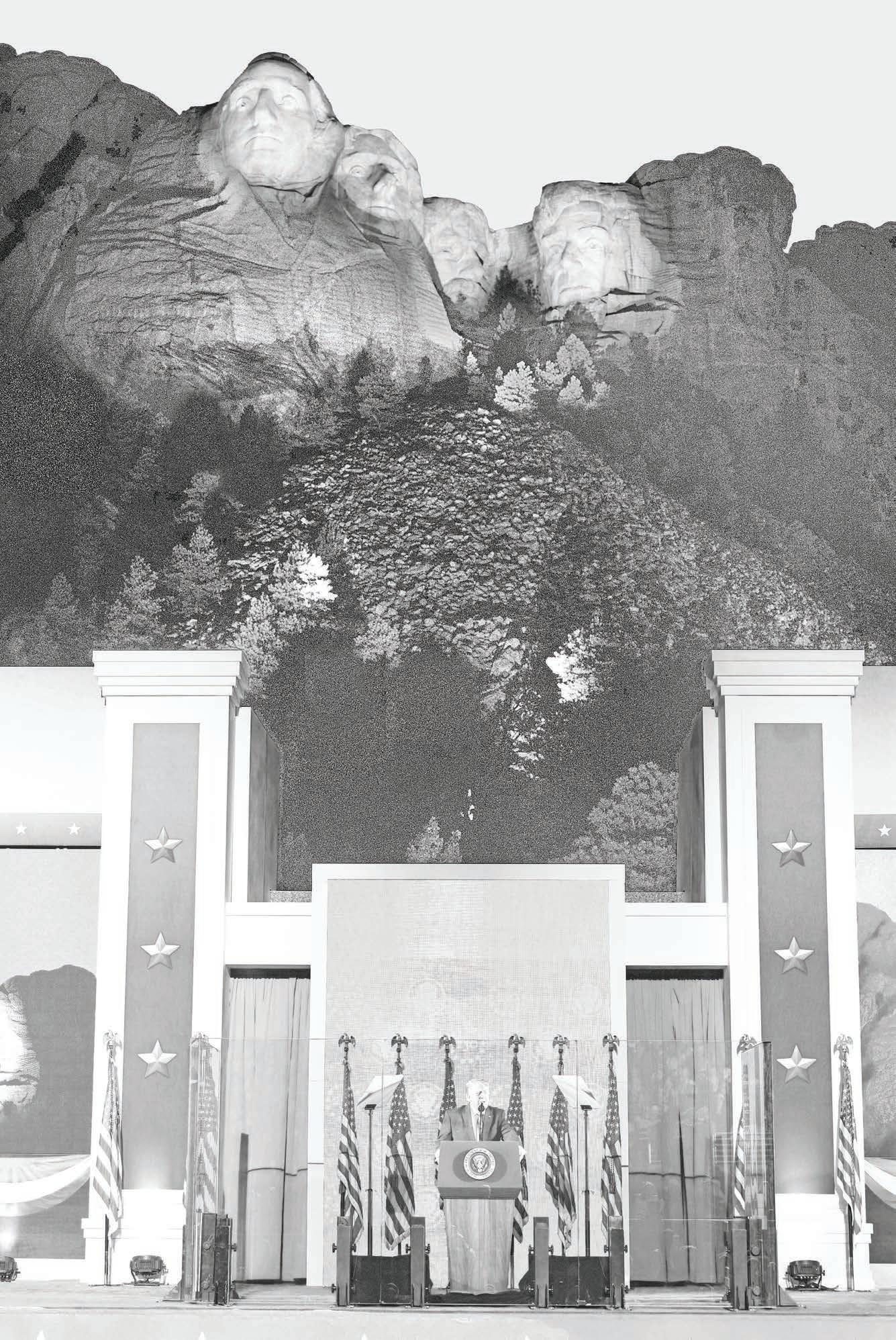
“We knocked the hell out of Iran,” US President Donald Trump said in a speech at the same time in South Dakota in front of Mount Rushmore.
“They want to settle so badly. We gave them a week off for a funeral.”
The US president was not forgotten in Tehran. In the crowd in Grand Mosalla, several mourners held a large flag that read: “#KillTrump.”
As the ceremony went on, Iran’s chief negotiator Kazem Gharibabadi criticized a joint statement overnight from British Prime Minister Keir Starmer and French President
Emmanuel Macron which suggested their militaries stood ready to patrol the Strait of Hormuz. Iran has suggested it wants to charge vessels passing through the strait, upending decades of it being widely considered an international waterway.
“The security of Hormuz lies with the coastal states—the crisis-makers will be held accountable for the consequences of their adventurism,” Gharibabadi wrote on X. “This is a serious warning.”
Khamenei to be buried in Mashhad KHAMENEI’S body will be transported to cities in Iran and neighboring Iraq. Authorities have shut down streets, airspace and daily life for the mourning, which will end Thursday as he is buried at the Imam Reza shrine in Mashhad, Khamenei’s place of birth. Authorities offered no immediate attendance count for the event Saturday. Other cities across Iran also held mourning ceremonies. On Sunday, a prayer for the dead is planned at the Grand Mosalla. On Monday, Khamenei’s body and those of his family will be taken through the streets of Tehran, which likely will draw large crowds.
“I am here to say goodbye to my beloved leader Ali Khamenei,” said a weeping Hananeh Mousavi, 27, who attended alongside her mother. “I never expected to see such a day. I wish I had died before this tragedy.” Gambrell reported from Dubai, United Arab Emirates.
summit preview: Can Erdogan succeed where Rutte’s charts failed?
By Lorne Cook The Associated Press
ANKARA, Turkey—Since he started work as NATO secretary-general almost two years ago, Mark Rutte has spent much of his time trying to keep the United States anchored to the world’s biggest military alliance, employing outright flattery to dissuade US President Donald Trump from acting on threats to abandon it.
But the goalposts keep shifting, raising the stakes ahead of this week’s summit in Turkey.
In itially, it was about money. Trump has long railed against NATO allies for spending too small a fraction of their national budgets on defense. But those problems were addressed at their summit last year, when US allies committed to invest as much as America, in gross domestic product terms.
NATO’s real problem now is turning that money into military capabilities, particularly as European countries worry about a possible attack from Russia.
Still, Rutte tried to put to bed any lingering concerns at a White House meeting last month, with a new pitch using a chart labeled the “The Trump Trillion” in gold letters—showing $1.2 trillion in spending by European allies and Canada since 2017.
But Trump appeared unmoved, saying he was still disappointed at some NATO allies’ refusal to join the Iran war, which he had launched alongside Israel without consulting them.
“We don’t need their money—we don’t need anything,” Trump said. “I just want loyalty.”
Trump suggested he might have skipped the upcoming summit entirely were it not being hosted by Turkish President Recep Tayyip Erdogan. It’s a sign that even Erdogan and Rutte—foreign leaders Trump seems to hold in rare esteem—will have their work cut out for them in keeping the summit on track. Rutte set a new marker for flattery at the White House HISTORICALLY the prime tasks of NATO’s top civilian official—always a European, never an American—have been to encourage consensus in an organization that makes its decisions unanimously, and to speak on behalf of all 32
member countries.
But during both of Trump’s terms, Rutte and his predecessor at the helm of NATO, Jens Stoltenberg, have dedicated a huge amount of energy just to keep the United States inside their alliance.
Trump has threatened to leave NATO, dallied with pulling US troops out of Europe and vowed to take over the island of Greenland— a semiautonomous part of ally Denmark. He has cast doubt over whether he would defend another member not spending enough on their military, eroding trust.
Rutte’s approach has been heavy on flattery. Last month’s carefully choreographed pitch in the Oval Office—with props redolent of an American flag—laid down a new marker, even for a man heavily criticized for likening Trump to a “daddy.”
The charts showed tens of thousands of US jobs were being created and a backlog of $300 billion in European orders for military equipment—all thanks to the “leader of the free world,” Rutte said.
He pushed back, gently, on Trump’s complaints that NATO did not support the US against Iran, noting that up to 5,000 US planes took off from bases in Europe before an April ceasefire.
Trump has threatened to pull forces from Europe at a moment of peril NATO cannot function without its biggest and most powerful ally. Europe is being pushed to fend for itself even as Russia,
the historical reason for the alliance, poses a greater threat.
Last month, the Pentagon surprised its NATO allies by announcing that it was scaling back the number of troops, warships, aircraft and drones it would provide if one of them came under attack. Trump has also sent conflicting messages about whether US troop numbers would be lowered or increased. The cutbacks and mixed messaging have undermined unity at the alliance, just as Russia has been probing Europe’s defenses with drone flights near military bases across multiple countries, according to a study released on Thursday.
Flattery worked last year, but now there are new challenges EACH summit is meant to showcase the commitment to collective security—the all-forone, one-for-all pledge enshrined in Article 5 of NATO’s treaty. It’s only been invoked once, when allies came to America’s aid after the Sept. 11 attacks. The last NATO summit was held in The Hague, the hometown of Rutte, a former Dutch prime minister. The Dutch royal family hosted dinner, and Trump stayed overnight at the king’s palace. Rutte got the allies behind a major defense spending pledge, and Trump left a
2nd Front Page
BusinessMirror
AFTER THE UNDERPERFORMING VANESSA, CAN BINI DO BETTER?
By Ma. Stella F. Arnaldo Special to the BusinessMirror
OURISM stakeholders raised con-
Tcerns on the effectivity of appointing tourism ambassadors after Pinoy Pop girl group BINI was recently named to represent the Philippines.
Industry veterans, who requested anonymity, expressed their doubts on what they perceived as an “old and outmoded” scheme of the Department of Tourism (DOT), after the last tourism ambassador, American actor Vanessa Hudgens, failed to produce any significant increases in visitor arrivals. Other celebrity brand ambassadors were also previously named for Japan and South Korea.
Acting Tourism Secretary Ma. Bernadita
Angara-Mathay said the naming of BINI was part of the DOT’s ongoing efforts to engage globally recognized Filipino talent in promoting Philippine tourism.
However, one tour operator told the BusinessMirror, while it’s a “good move to ride on the popularity of BINI...I hope DOT has a tactical approach in the campaign, or else it might go the way of previous ambassadors like Hudgens na wala naman nagawa at ginagawa [who didn’t do anything and isn’t doing anything].”
Hudgens, who never really acknowledged her Filipino roots until after her appointment as global tourism ambassador in 2023, was supposed to have starred in a travel documentary featuring Philippine destinations.
Using DOT funds wisely?
WHILE the DOT chief declined to say how
much the agency was paying BINI as tourism ambassadors, one hotelier was adamant about what he perceived was a waste of government funds. The DOT has a P1-billion branding campaign budget this year.
“At this juncture, what is urgently needed is aggressive market activation to propel instantaneous conversion. Resources should be invested in our foreign offices and/or global strategic partners to incentivize traditional and online travel trade networks that would most likely yield faster responses. A direct, no-nonsense business-to-business approach is the most organized way of bringing systematic arrivals into the country,” he said.
“More urgent than brand awareness through ambassadors, we need to fight it out there in a bloody marketplace in real time,” he stressed.
In the first five months of the year, the Philippines received 2.74 million inbound tourists, up 7.5 percent year on year, with significant increases recorded from the Chinese and Indian markets, which now have visa-free privileges.
DOT has been eyeing BINI as tourism ambassadors since their breakout performance at Coachella. Still, “appointing them as tourism ambassadors may not necessarily result in immediate impact on our tourism arrivals. They have yet to attain BTS-like status to build a brand on,” said one veteran tourism leader.
“It would also depend on how the DOT will plan to use them in tourism promotions and how much will be spent for that.” The source preferred that the DOT “focus more on efforts that can generate more arrivals swiftly such as giving their foreign offices the appropriate
BIR box, senators’ fate hang as VP Duterte trial opens
By Butch Fernandez
THE Senate sitting as an Impeachment Court opens today, July 6, the trial of Vice President Sara Duterte-Carpio, but this early the question of the “BIR Green Box” containing the Vice President’s tax records promises to be one of the most contentious moments.
Also hanging over the court is the fate of several senators facing legal challenges—both those already charged, about to be charged, or still facing investigation for various issues: the flood control fund scandal, the May 14 dawn escape from Senate premises of fugitive senator Ronald “Bato” dela Rosa, and undeclared campaign donations.
The possible detention of several senators is seen to impact the conduct of the trial and the number dynamics in the court, given the constitutional mandate that a vote of 16 senators is needed to convict a respondent official.Related stories on impeachment trial in A3 Nation.
Meanwhile, the impeachment court will not and cannot be above the law in deciding what to do with the BIR box, Sen. Panfilo “Ping” M. Lacson stressed on Sunday.
Lacson said Sunday the disposition of the Vice President’s sealed Bureau of Internal Revenue (BIR) income tax return (ITR) records must be governed solely by the law and existing jurisprudence.
“The decision on the status of the sealed BIR ITR records will be dictated by law and existing jurisprudence. The Impeachment Court will not and cannot be above the law. No one else is,” he said on X.
AsPac govts adopt new roadmap as region
trails in sustainability goals
By Justine Xyrah Garcia
GOVERNMENTS across Asia and the Pacific have adopted a new regional roadmap aimed at strengthening cooperation on climate change, biodiversity loss, and other environmental challenges, as the region falls behind in meeting its sustainability targets.
In a statement, the United Nations Economic and Social Commission for Asia and the Pacific (Escap) said member states approved the Ministerial Declaration on Environment and Development in Asia and the Pacific 2026 during the Eighth Ministerial Conference on Environment and Development.
The declaration identifies priority areas including climate action, biodiversity conservation, ecosystem restoration, pollution reduction, sustainable water management, sustainable urban development, and the use of digital technologies and early warning systems to improve environmental management. The agreement comes as the region remains off track in achieving most of its envi-
ronmental commitments.
Escap said Asia and the Pacific is projected to miss 88 percent of its environment-related Sustainable Development Goals (SDGs) by 2030, while around 90 percent of the population continues to be exposed to unsafe pollution levels.
United Nations Undersecretary-General and Escap Executive Secretary Armida Salsiah Alisjahbana said the scale and interconnected nature of these challenges require governments to pursue coordinated rather than isolated responses.
“Fragmented responses are inefficient and cannot keep pace with interconnected challenges. Advancing synergies is a practical necessity for achieving better development outcomes while making the best use of increasingly constrained financial, institutional and technical resources,” Alisjahbana said.
Alongside the declaration, member states also adopted the Regional Programme of Action on Advancing Synergies for Sustainable Development in Asia and the Pacific, 20262030. Rather than imposing binding commit-
ments, the program provides a voluntary framework to help governments coordinate policies and investments across five areas: climate action, biodiversity and nature-positive solutions, pollution reduction and the circular economy, resilient urban development, and stronger governance, financing and data systems.
Escap said implementation will be aligned with each country’s development priorities and national circumstances.
The UN regional body also said the declaration and action program are intended to help governments better align environmental policies, financing, and institutions so that progress in one area can support gains in others, accelerating implementation of regional and global environmental commitments.
According to Escap, 39 member states have adopted carbon neutrality or net-zero emissions targets, 46 have integrated nature-based solutions into national climate or development strategies, while 25 of the 27 coastal countries that submitted updated national climate plans have incorporated ocean-based measures.
On Saturday, Lacson said the Impeachment Court may return the box to the House prosecution team as it is not meant to be its custodian.
He cited Sections 71 and 270 of the National Internal Revenue Code, as well as existing jurisprudence based on Supreme Court rulings.
Under Section 71 of the NIRC, ITRs “shall constitute public records and be open to inspection as such upon the order of the President of the Philippines, under rules and regulations to be presented by the Secretary of Finance, upon recommendation of the Commissioner.”
Section 270 of the NIRC provides penalties for BIR personnel who divulge information collected from taxpayers, including trade secrets and confidential information.
Another circumstance that will allow the unsealing of the records would be a written waiver from the respondent.
Lacson warned that if the Impeachment Court decides on whether to unseal the box without complying with the law, it may expose itself to charges of grave abuse of discretion.
PBBM: I’d show up in court if I were Sara
ON Sunday, President Ferdinand Marcos said if he were in the Vice President’s shoes, he would personally appear before the Senate impeachment trial to defend himself even if it is against the advice of his legal counsel.
The Senate, acting as the impeachment court, earlier ordered the Vice President to ap -
pear in the hearing.
If convicted, Duterte faces removal from her post and perpetual disqualification from holding an elected post. The charges against her are lodged under four articles: alleged misuse of government confidential funds, unexplained wealth, discrepancies in the Statement of Assets, Liabilities and Net Worth (SALN), and issuing grave threats against Marcos and his family.
“If it was me being accused, I would almost insist on the advice of lawyers, if they advise me not to appear, I would insist on appearing. Because I can answer [the allegations against me],” Marcos said partly in Filipino in a media forum in Canada last Sunday (Manila time).
He said Duterte’s appearance in the Senate will make the trial proceed much faster.
“But of course, it would be much easier to get to the bottom of everything if you can speak to the accused directly. The accused can answer directly, not through secondary channels, not through the lawyers,” he said.
The President, however, said it will be up to Duterte and her legal team to decide on the matter.
“It’s really up to the accused whether or not they feel the need to appear. I guess the lawyers on the defense side will give their advice. It’s not for me to say one way or the other,” Marcos said. Marcos was a senator when then Chief Justice Renato Corona was tried and convicted by the Senate impeachment court in 2012. He was one of only three senators who voted to acquit Corona; the two others being Senators Joker Arroyo and
urged: Open VP’s BIR records in public ON Sunday, the Senate impeachment court was urged to make all proceedings public and to open the box containing tax records of the Vice President in full public view. Lawyer, Benjamin Tolosa Jr., a spokesperson for the House prosecution panel, said the prosecution strongly opposes the defense’s
Miriam Santiago.
See “Bini,” A2
RAISING THE BAR(RICADES) Members of the Philippine National Police prepare steel barricades outside the Senate in Pasay City on Sunday, July 5, ahead of the expected protest actions and heightened security during the opening day of the impeachment trial of Vice President Sara Duterte. The Senate is set to convene as an impeachment court, with police deploying security measures to manage demonstrators and maintain order around the complex. NONIE REYES
See “VP Duterte,” A2
Billion-dollar bet on PHL’s future
THE World Bank’s approval of a $1.02 billion financing package for the Philippines last week represents more than just the largest loan commitment in the institution’s history with the country. It is, fundamentally, a vote of confidence in the country’s ability to reshape its economic trajectory—and a recognition that it can no longer afford to remain hostage to the volatile global fossil fuel markets that have long dictated the cost of doing business. (Read the BusinessMirror story: “WB approves biggest loan for PHL energy, water,” June 29, 2026).
The package arrives at a critical juncture. Philippine electricity rates remain among the highest in Southeast Asia, a burden that falls heaviest on households and erodes the competitiveness of domestic industries. For decades, the country’s energy security has meant importing coal and oil, exposing the economy to price shocks that ripple through everything from manufacturing to food transport. The World Bank’s financing directly targets this vulnerability, but its real significance lies in how it reframes the solution: not more imported fuel, but domestic wind, solar, and geothermal resources that have been underutilized for generations.
The ambition is considerable. By targeting 42 percent renewable energy capacity by next year—up from 30 percent currently—and launching the country’s first offshore wind auction with a 3.3 gigawatt target by 2030, the Philippines is signaling a decisive pivot. The projected $7 billion in private investment that these reforms aim to mobilize suggests this is a genuine attempt to create market conditions where clean energy becomes the economically rational choice.
Yet the most astute element of this package may be its integration of water security with energy transition. The inclusion of reforms targeting over 1,600 local water service providers—aiming to expand sustainable operations from just 10 providers to 100 by 2027—acknowledges a reality often ignored in development planning: energy and water are inseparable systems. You cannot power a renewable grid without water for cooling and hydroelectric generation, nor can you treat and distribute clean water without reliable energy. By bundling these reforms, the World Bank and our policymakers are demonstrating a sophistication in climate planning that treats infrastructure as an ecosystem rather than isolated silos.
Still, financing and policy frameworks are only as good as their execution. The Philippines has no shortage of ambitious energy plans that have stalled in the face of regulatory fragmentation, local opposition to infrastructure projects, and the entrenched interests of fossil fuel incumbents. The offshore wind targets, in particular, will require navigating complex maritime jurisdictions, environmental assessments, and transmission infrastructure challenges that have derailed similar projects elsewhere in the region. The operationalization of the Renewable Energy Market—a critical component for enabling trading and competition—has been discussed for years without full implementation.
The performance-based nature of the $20 million Livable Planet Fund grant suggests the World Bank understands these risks. This is not unconditional financing; it is contingent on measurable reforms, including cost-recovery tariffs for water services and the integration of electric vehicle infrastructure into utility planning. These conditions reflect a hard-learned lesson from previous development lending: that sustainable infrastructure requires sustainable economics, and that political will must be locked in through institutional mechanisms, not just press releases.
For ordinary Filipinos, the promise is straightforward: lower electricity bills, more reliable power, and cleaner water. For the broader economy, the implications are transformative. If successful, this package could position the Philippines as a renewable energy hub in Southeast Asia, attracting the kind of green manufacturing and data center investments that are increasingly making corporate location decisions based on access to clean power.
The World Bank’s Division Director Zafer Mustafaoğlu is correct: the Philippines has everything it needs to power itself. The question now is whether the country can convert that natural abundance into institutional and economic success. The billion dollars is a start. The real work begins now.
BusinessMirror
Antonio L. Cabangon
T. Anthony C. Cabangon
Lourdes M. Fernandez
Jennifer A. Ng Vittorio V. Vitug
Lorenzo M. Lomibao Jr., Gerard S. Ramos Lyn B. Resurreccion, Dennis D. Estopace
Angel R. Calso, Dionisio L. Pelayo
Ruben M. Cruz Jr.
Eduardo A. Davad Nonilon G. Reyes
D. Edgard A. Cabangon Benjamin V. Ramos Aldwin Maralit Tolosa
Rolando M. Manangan
BusinessMirror is published daily by the Philippine Business Daily Mirror Publishing, Inc., with offices on the 3rd floor of Dominga Building III 2113 Chino Roces Avenue corner De La Rosa Street, Makati City, Philippines. Tel. Nos. (Editorial) 817-9467; 813-0725. Fax line: 813-7025. (Advertising Sales) 893-2019; 817-1351, 817-2807. (Circulation) 893-1662; 814-0134 to 36. E-mail: news.businessmirror@gmail.com www.businessmirror.com.ph
A nutrient label won’t save us,
TRISING SUN
HE Philippine Nutrient Profile Model (PNPM), drafted back in 2019 and finally adopted by the National Nutrition Council (NNC) on June 25, 2026, sets maximum thresholds for sugar, sodium, and saturated fat in packaged and ultra-processed foods, giving the government a legal baseline for calling a product “unhealthy.”
It didn’t arrive overnight. The NNC had two competing versions in the works, both broadly aligned with national dietary guidelines, before a WHO-supported technical review helped settle on one. Along the way, the University of the Philippines Manila’s College of Public Health tested it against 5,000 real packaged products, and found that the homegrown version works about as well as the simpler international
WHO-PAHO (World Health Organization—Pan American Health Organization) model, even with its added layers.
The case for the PNPM is genuinely strong. Ischemic heart disease, cancer, and cerebrovascular disease remain the country’s top killers, and diets increasingly built on sugary drinks and ultra-processed snacks are a major driver. This is the first time the Philippines has an evidence-
but it’s a start
based, locally validated tool that can underpin front-of-pack warning labels, junk-food taxation, school canteen rules, and restrictions on what gets served in emergency relief. For low-income households, who eat more ultra-processed food out of necessity rather than choice, a mandatory warning label could be one of the cheapest public health interventions available. It costs the government almost nothing and shifts the burden of clarity onto the product, not the shopper. The pushback is worth taking note of. The Philippine Chamber of Food Manufacturers Inc. says that under the current thresholds, roughly 19 out of every 20 commercial food products on shelves would end up carrying a warning label. That’s a real problem: if nearly everything gets flagged as unhealthy, the label stops meaning anything. Plus, more than 99 percent of the country’s food manufacturers are small and medium enterprises, already squeezed by 4.1 percent inflation, and reformulating recipes, retesting products,
A nation of builders: The real promise of upper-middle income status
THE World Bank’s recognition of the Philippines as an uppermiddle income economy is more than an economic milestone. It is an invitation to rethink what kind of nation we aspire to become.
For decades, the Philippine economy has largely been viewed through the lens of consumption. Investors came because Filipinos bought products. A young population, rising incomes and a vibrant consumer market made the country attractive to business.
There is nothing wrong with being a strong market. But there is something far more ambitious within our reach.
Cesar Tolentino, a semiconductor industry consultant and member of the Monday Circle, believes the country’s new status signals something larger. As incomes rise, more Filipinos are able to save through digital banks and financial platforms. Those savings become part of the capital that financial institutions can channel into productive investments.
This is where economic development changes character. Savings become investment. Investment becomes factories. Factories create
technology, skills and higher-value employment.
Tolentino sees opportunities extending well beyond semiconductor assembly. He envisions the Philippines gradually developing capabilities in telecommunications infrastructure, electronic equipment, medical devices, laptops, hard drives and other advanced manufacturing activities. Such industries would deepen the country’s industrial base while creating more opportunities for Filipino engineers, technicians and entrepreneurs.
His observation points to a deeper truth. For decades, the Philippines has often described itself as a consumer market. But what Tolentino—and Federation of Philippine Industries Chairman Emeritus Jesus Arranza—are pointing toward is something far more transformative.
They are describing the possibility of the Philippines becoming a producer economy. That is a profound shift.
The country should not aspire merely to have Filipinos who can afford to buy more imported goods because incomes have risen. It should aspire to have Filipino enterprises that design, manufacture, export and compete globally. That is where upper-middle income status becomes meaningful—not because it changes how the World Bank sees the Philippines, but because it can change how we see ourselves.
Arranza views the country’s new classification as evidence that many of the economic policies of the Marcos administration are beginning to achieve their intended objectives. A stronger domestic market, he says, gives investors greater confidence that the Philippines is becoming a more attractive place to do business. His most important point, however, goes beyond investor confidence. He believes government-owned and -controlled corporations should consciously prioritize locally manufactured products whenever practical.
That deserves serious consideration.
It is a thesis that Arranza is very passionate about and one theme that he focused on when he spoke before the Monday Circle, a think tank with far-reaching advocacies that range from financial literacy to nationhood possibilities. Arranza raises a valid point. Ev-
and redesigning packaging isn’t free. Low-income families—the very group this policy claims to protect— already devote roughly two-fifths of their household food money to staple items that could be affected by this. If the thresholds aren’t recalibrated by food category, the risk is a policy that raises prices on basics without meaningfully changing what people can afford to eat. So where does this actually stand? As of now, the PNPM is adopted as the Philippines’ official reference model, but adopting the model isn’t the same as adopting the policies it’s meant to power. Front-of-pack warning labels, marketing restrictions, and “junk food” taxation all still require separate implementing rules or legislation. At least 20 versions of a Healthy Food Marketing/Healthy Food Environment bill remain filed in the House of Representatives, still awaiting passage, with the NNC, UNICEF, and WHO publicly urging Congress to act given that nearly 13 percent of Filipino school-age children are already overweight or obese.
ery government purchase is more than an accounting transaction. It is also an economic vote. When public institutions purchase locally produced goods, they sustain factories, preserve jobs, encourage innovation and expand production capacity. Such expenditures should not be viewed merely as costs. They are investments in the productive strength of the nation. Strong domestic industries attract investment because investors seek more than consumers. They seek suppliers, skilled workers, reliable production networks and an economy capable of sustaining longterm industrial growth.
The World Bank has given the Philippines a new economic classification. Whether that classification becomes a footnote in history or the beginning of a manufacturing renaissance now depends on the choices Filipinos make. This is where the country’s new economic classification acquires its greatest significance. Upper-middle income status is not a trophy to display. It is a platform upon which to build. The next chapter of Philippine development should not be measured solely by larger shopping malls or stronger consumer spending. It should be measured by the growth of factories, research laboratories, technology firms and manufacturing enterprises that create value within our own shores. Manufacturing is not simply about
Atty. Jose Ferdinand M. Rojas II
RELIEF, third-party matching, and the rise of data-driven tax administration
LDEBIT CREDIT
ONG before artificial intelligence became a popular phrase, the BIR was already learning an important lesson: data can reveal what paper returns sometimes conceal.
One major step in this direction was RELIEF, the Reconciliation of Listings for Enforcement System. RELIEF introduced a more systematic approach to using third-party information, particularly sales and purchase data, to detect discrepancies in taxpayer reporting. It was a significant movement from traditional audit methods toward datadriven tax administration.
The Bureau of Internal Revenue’s RELIEF Program started as one of the earliest major BIR datamatching and third-party information initiatives. It was not born from one single issuance alone; it evolved from the VAT summarylisting rules, the BIR computerization/data warehouse effort, and the 2002 enforcement push under the VAAP program.
The data foundation came from the requirement for VAT taxpayers to submit quarterly Summary Lists of Sales and Purchases. This existed earlier under VAT regulations, but RR No. 8-2002 dated June 13, 2002 was the major trigger because it required covered VAT taxpayers to submit summary lists in magnetic/ electronic form, using 3.5-inch diskettes and prescribed electronic formats. It covered taxpayers with quarterly sales over P2.5 million or purchases over P1 million.
The first clear public indication that RELIEF was already operational appears in RR No. 12-2002 dated September 11, 2002, which stated that the RELIEF System, together with the Integrated Tax System, was already generating “firm and precise data” on sales underdeclarations and that criminal cases had been filed against an initial batch of taxpayers. This means RELIEF was already functioning by September 2002, even if its procedural architecture was still being formalized.
Prior to the RELIEF, the old audit environment, tax enforcement depended heavily on the documents submitted by the taxpayer, the skill of the examiner, and the scope of the Letter of Authority. The audit was often document-intensive and sometimes dependent on what was available and visible in the taxpayer’s records. I recall the long and tedious process of BIR examiners looking at thousands of transactional records of taxpayers that they were auditing, and barely finding any discrepancies that may arise in deficiency tax assessments. Third-party matching in RELIEF changed the perspective. It allowed the BIR to compare what one taxpayer declared as sales with what another taxpayer claimed as purchases. It made inconsistencies more visible. This was an early form of tax intelligence.
RELIEF was not perfect. Like any data-matching system, it depended on the quality, completeness, and accuracy of submitted information. Mismatches could arise from timing differences, encoding errors, classification issues, or incomplete submissions. But its importance was not diminished by these limitations. RELIEF showed that enforcement could be strengthened not merely by increasing the number of audits, but by improving the intelligence behind audit selection.
The BIR’s present digitalization
Patchwork that truly works!
LThe Bureau of Internal Revenue’s RELIEF Program started as one of the earliest major BIR datamatching and third-party information initiatives. It was not born from one single issuance alone; it evolved from the VAT summarylisting rules, the BIR computerization/data warehouse effort, and the 2002 enforcement push under the VAAP program.
landscape builds on this idea. Electronic filing, electronic payment, eAFS, electronic invoicing, and electronic sales reporting all contribute to a richer compliance data environment. The BIR roadmap identifies the Electronic Invoicing and Sales Reporting System as one of the major taxpayer-facing systems under filing and declaration. It also distinguishes electronic invoicing (e-invoicing) from electronic sales reporting—the invoice as an electronic document, invoicing as an automated process, and sales reporting as electronic data transmission.
The Tax Code mandates certain taxpayers covered by the threshold rules to use e-invoicing in their business operations. Sections 237 and 237-A, as amended by Republic Act No. 12066, or the CREATE MORE Act, passed into law in November 2024, provided the legal provisions for the use of e-invoicing. For electronic invoicing, Section 237, as amended by RA 12066, provides that once the BIR has a system capable of storing and processing the required data, the BIR shall require the following taxpayers to issue electronic invoices:
1. t axpayers engaged in the export of goods and services; 2. t axpayers engaged in e-commerce; and 3. t axpayers under the jurisdiction of the Large Taxpayers Service.
The same provision allows taxpayers not covered by the mandatory requirement to voluntarily issue electronic invoices and authorizes the Secretary of Finance, upon recommendation of the Commissioner of Internal Revenue, to expand the coverage.
This distinction is important. In the future, the BIR will not merely receive tax returns after the fact. It will increasingly receive transaction-level or near-real-time data that can be used to identify compliance risks much earlier.
This is where the country is moving: from data collection to data analytics, from analytics to risk scoring, from risk scoring to targeted enforcement, and from enforcement to voluntary compliance improvement.
To be continued
Joel L. Tan-Torres was the former Dean of the University of the Philippines Virata School of Business. Previously, he was the Commissioner of the Bureau of Internal Revenue, the Chairman of the Professional Regulatory Board of Accountancy, and a partner of Reyes Tacandong & Co. and the SyCip Gorres and Velayo & Co. He is a Certified Public Accountant who garnered No. 1 in the CPA Board Examination of May 1979. He is now back to his tax practice with his firm, JL2T Consulting. He can be contacted at joeltantorress@yahoo. com.
Siegfred Bueno Mison, Esq.
THE PATRIOT
Conclusion
AST week, I wrote about how government responses to most crises appear reactionary and patchwork at best. The ongoing Senate hearings on the Tacloban shooting will likely produce a series of recommendations, many of which may be implemented immediately. Whether these measures will meaningfully address youth violence or be sustained long enough to repair our broken social fabric remains uncertain.
I am not as optimistic unless significant transformation happens in our society today. I am unaware of any single policy proposal that can reverse the deterioration of our values as a society. The challenge confronting today’s generation of Filipinos goes beyond legislation. To me, our broken system is fundamentally an offshoot of discipline and character.
During a recent protest organized by a religious group, I observed demonstrators openly challenging traffic enforcers and even police officers. The government’s policy of maximum tolerance was stretched to the point where some law enforcers were intimidated and even injured. Such disregard for authority is not confined to protest actions.
Across society, respect for the rule of law has steadily eroded, partly because many have come to believe that lawbreakers can evade accountability. This gradual decline in respect for institutions has reached a point where government officials, from police officers to even the President himself are openly treated with contempt by certain sectors of society. Our leaders themselves must bear part of the responsibility for creating an environment where impunity is tolerated and accountability is often applied selectively. No amount of government patchwork can effectively arrest the moral decay of our youth if the underlying issues remain unresolved.
Yet, there are patchwork solutions that can actually work, especially for the youth. A survey of Filipino youth
reported that 81 percent are proud to be Filipino, 54 percent regularly participate in religious activities, and 64 percent maintain strong family ties. However, only 5 percent are involved in community projects. That figure reveals both a weakness and an opportunity.
This is where “patchwork” can actually work. Community involvement cultivates responsibility, discipline, and a sense of shared purpose. These are precisely the values needed to confront the problems of poverty, corruption, and criminality, among others. These are admittedly the weaknesses in our national value system that require a small group strategy.
During my Army years as a lieutenant in rebel-infested Bataan, I recall how small teams of about 1012 soldiers went from one barangay to another and conduct a community workshop discussing the values of “Bayanihan” and patriotism. Called as Special Operations Training (SOT), small groups of Army soldiers together with a handful of policemen in the community showed how government presence can help alleviate the problems in far flung areas in Bataan.
Fast forward to today, the province is rid of communist insurgents. The positive outcome was a product of a deliberate national strategy carried out throughout the country by way of small SOT groups.
Another organization that embraced this small group approach is Christians for Nation Building
(C4NB), a non-profit movement anchored on Christian values. Its mission is both simple and ambitious: to help build “a Filipino nation that is pleasing to God and a blessing to the world” by strengthening families and developing communities.
Founded by retired police general Cesar Hawthorne Binag (PMA Class of 1987) together with a small group of like-minded individuals, C4NB has grown into 10 chapters nationwide in three years. Its strategy mirrors the leadership principles described by Dr. John Kotter, particularly the importance of building a guiding coalition. Each chapter operates independently while pursuing the same mission of helping Filipinos discover their Christian identity and understand the role each person plays in shaping the nation’s future.
In that sense, C4NB is indeed a patchwork of many small groups working autonomously yet united by a common purpose. The same principle can be seen in the remarkable growth of Christ Commission Fellowship (CCF). Founded in 1982, CCF has grown into one of Asia’s largest evangelical churches, with around 80 satellites throughout the Philippines and ministries in other parts of the world.
One of its satellites in Santa Rosa, Laguna (CCFSR) is one example how changes can be introduced and implemented one family at a time. Pastor Albert Pelea and his wife Mavi moved from the comforts of their home in Alabang to plant a church in Santa Rosa in the mid-nineties. From mentoring one couple to a small congregation of about a few families, CCFSR has grown into a thousand of Christ-committed followers, again using the power of small groups called Disciple Groups.
CCF and perhaps other faithbased organizations illustrates the extraordinary power of small groups. Through discipleship and consistent community engagement, CCF has been fulfilling its mission, which practically echoes Christ’s Great Commission: “Therefore go and make disciples of all nations, baptizing them in the name of the Father and of the Son and of the Holy Spirit, and teaching them to obey everything I have commanded you. And surely I am with you always, to
the very end of the age.” (Matthew 28:19–20)
Because of its clear mission and decentralized model, CCF has continued to grow, much like the early Christian church. From 12 apostles, later joined by the Apostle Paul, to thousands of believers within a generation, Christianity eventually became the world’s largest faith community. It was, in many respects, a patchwork of small, faithful communities transforming society from the ground up.
Perhaps the most effective patchwork is not one hurriedly stitched together after every tragedy, but one patiently woven over many years through countless acts of service, mentorship, and faithful leadership. This is exactly the kind of patchwork our nation needs today. Organizations such as C4NB, CCF, and countless other Christian groups may operate independently, but together they can help rebuild the country’s moral foundation. Laws remain necessary, but lasting change begins with transformed lives, strengthened families, and communities committed to serving others. The Bible tells us that the harvest is plenty but the workers are few. If enough Filipinos embrace that Christ-like compassion for others and respect one another, the rule of law may gradually be restored. Sometimes, the most enduring solutions are not imposed from the top down but patiently woven together from the ground up. It only takes a spark to light a fire. May the country be filled with many “fired up Filipinos” who are encouraged by faith to help one another despite and because of how the government has responded to the endless tragedies happening in our society today.
Siegfred has a diversified set of education and experiences which has made him a game changer and a servant leader in organizations. His professional degrees came from the United States Military Academy at West Point in New York, Ateneo Law School, and University of Southern California, Los Angeles, USA. His corporate experiences include stints as general counsel for the country’s flag carrier, a food exporter with manufacturing plants in Davao and in Laguna, and a sports distributor company. Siegfred is a former soldier and a lawyer by profession, a teacher and inspirational speaker by passion, and a book author and a writer with a mission.
Andy Burnham’s call on Ed Miliband could shape his premiership
By Joe Mayes, Chloe Chaplain & Ellen Milligan
AS Andy Burnham weighs the top team he will appoint if he becomes UK prime minister, one divisive decision could come to define his term in office: the role of Ed Miliband.
Miliband, the former leader who led Labour to electoral defeat in 2015 and now serves as the influential energy secretary under Keir Starmer, has played a key role in pushing Burnham to the brink of power, helping usher Starmer out and advising his would-be successor on economic policy.
That’s made Miliband the clear bookmakers’ favorite to succeed Rachel Reeves as Chancellor of the Exchequer, provoking jitters among investors concerned he would steer the government left and raise borrowing. Moreover, many Labour MPs fear the consequences of giving second-most powerful job in government to an election loser tied to net-zero policies that have helped send voters to Reform UK.
Appointing Miliband would be perceived as a strategic push for voters on the left rather than the populist right, according to Harry Pitts, professor of political economy at the University of Exeter. “This is a pivotal decision,” he said. “It could end up typifying the whole way the Burnham project is seen.”
Burnham’s team declined to comment. A person familiar with his preparations said he’s considering policy and direction before cabinet appointments, and that the focus should be on
those details rather than personalities. A spokesperson for Miliband declined to comment.
Burnham is racing to develop a plan for government with just over two weeks to go until he will likely be installed as the UK’s seventh premier in a decade. If he remains the only candidate in Labour’s leadership contest when nominations close on July 16, he’s set to take the reins of the party the next day and become premier on July 20.
Burnham is currently in a honeymoon phase with Labour MPs, buoyed by his thumping victory over Nigel Farage’s poll-topping Reform in the Makerfield by-election. His challenge now is to carry that optimism into government, where a forbidding in-tray awaits, and his cabinet picks and omissions will inevitably create internal enemies.
Burnham says he won’t announce his cabinet until after securing the leadership, leaving senior figures in the dark on their future and creating an atmosphere of uncertainty that is troubling investors, Labour advisors, ministers and MPs.
Despite the relatively low trading volume on Polymarket, the market reflects a shift in bets away from former Health Secretary Wes Streeting—a would-be
rival who instead endorsed Burnham— toward Miliband as the next chancellor.
Other contenders include Foreign Secretary Yvette Cooper, Home Secretary Shabana Mahmood and Work and Pensions Secretary Pat McFadden.
Investors are gaining confidence in Andy Burnham’s promises of discipline when it comes to borrowing and spending, which have helped offset nerves over his comment last year that the UK must move beyond being “in hock” to bond markets.
“The market is steady, but I think anxious” about the next chancellor, Jane Foley, head of FX Strategy at Rabobank, told Bloomberg Radio. “Miliband would perhaps cause it the greatest concern, because of his positioning on the left.”
Still, that confidence may be tested if Burnham opts for Miliband and the uncertainty has left investors more cautious on longer-dated gilts, which tend to be more sensitive to that type of risk than shorter ones.
Miliband once served as special adviser to Gordon Brown when he was chancellor, and a return to the Treasury in the top job would complete a remarkable turnaround for the 56-year-old. He famously stood against his older brother David to win the Labour leadership in 2010 before losing to David Cameron’s Conservatives five years later, a defeat that appeared to mark the end of his career in top-level politics.
Miliband rebuilt his image first as an influential backbencher during the Jeremy Corbyn years, then as energy secretary under Starmer, and now at the center of Britain’s latest political upheaval. He was one of the first cabinet ministers to privately urge Starmer to go, despite being a close ally, and was then at the center of maneuvers to replace him, people familiar with the matter previously told Bloomberg. Then, Miliband lent staff to Burnham’s campaign in Makerfield and went north to personally canvass support for him. Miatta Fahnbulleh, a Miliband ally and former minister in his energy department, is working on Burnham’s economic policy. Grace Pritchard, who previously worked on communications for Miliband, now handles media for Burnham. Other Miliband advisers are also working directly on Burnham’s transition into government, people familiar with the matter said. Miliband has also privately suggested Burnham consider giving his brother a role. After relations became strained between the brothers when Ed beat David to the leadership, the older Miliband left Parliament in 2013. He’s now eager to return to government, potentially as Foreign Secretary, a
Joel L. Tan-Torres
Monday, July 6, 2026
SPORTSplus
PBBM on Alex Eala: Truly world class
By Samuel P. Medenilla
RESIDENT Ferdinand Marcos
Pcongratulated Alex Eala for for continuing to be the Philippines’ pride in tennis after her historic feat at the Wimbledon Championship.
I n an interview with reporters in Canada last Sunday (Manila time), the chief executive commended Eala after he watched her dethrone Iga Swiatek of Sweden in straight sets.
“ She really is becoming a true inspiration especially for younger people, younger Filipinos,” Marcos said. “Tennis does not operate at a higher level than Wimbledon so she’s really world-class.”
Marcos said he and other Filipinos will continue to cheer for Eala in her campaign in the international tennis tournament.
“Congratulations, Alex. Keep it up. We’ll all be here. The whole Filipino nation is cheering you on,” he said. “We know that you are fighting to make us proud and bring luster and honor to the Philippines.”
Lacson: Necessary dose of inspiration
THE nation received a muchneeded dose of inspiration and unity from tennis sensation Alex Eala, Senator Panfilo “Ping” M. Lacson said Sunday. Lacson thanked Eala for lifting the Filipino spirit after she made history as the first Filipino player to reach the fourth round of a Grand Slam singles tournament, highlighted by her dethroning of Iga Swiatek.
“ She is the detoxifier that our country’s highly toxic atmosphere needs and an influential unifier of a deeply divided nation. Thank you Alex Eala for lifting the Filipino spirit. God bless you and the Philippines,” Lacson said on X. E ala advanced after ending Swiatek’s title defense Saturday amid cheers from Filipino supporters. She will next face 13th-seeded Jasmine Paolini for a place in the Wimbledon quarterfinals. Lacson earlier lauded Eala for her breakthrough Wimbledon win in the opening round, and for her rally that helped her beat Maya Joint, saying her indomitable fighting spirit made every Filipino proud.
Junior tennis series gets going in Naga
THE Palawan Juniors Tennis Series moves to Cebu following a successful Mindanao opener starting on Thursday at the City of Naga Tennis Courts in Naga City. The Group 2 tournament forms part of Palawan Pawnshop’s long-term grassroots development program aimed at providing Filipino juniors with a consistent, high-level competitive platform where they can sharpen their skills, gain valuable match experience and steadily progress toward higher levels of competition.
The event is sanctioned by the Philippine Tennis Association and Universal Tennis Rating (UTR). Registration remains open for the second leg of the nationwide circuit through the UTR Platform, with all eligible junior players encouraged to participate in one of the country’s premier ranking events.
Following the City of Naga tournament, the circuit moves to Cebu City for the third leg from July 16 to 21 at the Villa Aurora Tennis Courts in Pardo before concluding the Visayas swing from July 23 to 28 at the Mandaue Tennis Courts.
EALA: WE’RE ALL IN THIS TOGETHER
By Ken McGuire The Associated Press
LONDON—Alexandra Eala didn’t have the option of playing on grass courts growing up in the Philippines.
I nstead, she used one that also doubled as a basketball court. There would be the basketball hoops, so I couldn’t really step back a lot because then I would hit the basketball hoop,” Eala said.
The 21-year-old Eala found Centre Court at Wimbledon a bit more accommodating Saturday when she beat defending champion Iga Swiatek, 7-6 (9), 6-2, in the third round at the grass-court major and made some history in the process.
E ala is the first Filipino player, male or female, to reach the fourth round of a Grand Slam singles tournament.
T he left-handed Eala dropped to her knees and rolled onto her back after hitting a forehand winner on her third match point.
It’s incredible to have my countrymen cheering me on and knowing that we’re all in this together,” she said in an on-court interview as she looked around at the Philippines flags.
“ This goes out to them, this goes out to my family, this goes out to all the little girls with ruffled socks and chubby cheeks. It means the world,” said the 29th-seeded Eala, who saved two set points in the first-set tiebreaker.
The third-seeded Swiatek earned her first Wimbledon women’s title a year ago when she beat Amanda Anisimova, 6-0, 6-0, in the final.
I felt like Alexandra was more brave in important moments,” Swiatek said. “In the tiebreak we both had many chances to close the set earlier, and it didn’t go my way.”
Eala, who has trained in Mallorca at the Rafael Nadal Tennis Academy, gained worldwide support last year on her breakthrough run to the Miami Open semifinals, which included an upset of Swiatek.
S he next faces 13th-seeded Jasmine Paolini for a spot in the Wimbledon quarterfinals.
2022 champion Rybakina also out SHORTLY before Iga Swiatek’s exit, 2022 Wimbledon champion Elena Rybakina was upset in the third round by Elise Mertens, 7-6 (4), 6-1.
At No. 2, Rybakina is the highest seed on the women’s side to be eliminated. Her loss ensures that Aryna
Sabalenka—who faces Naomi Osaka in the fourth round on Sunday—will keep her No. 1 ranking after the tournament.
B elgium’s Mertens is the No. 25 seed at Wimbledon, where she’s won two doubles titles. She will next face 21st-seeded Marie Bouzkova of the Czech Republic.
I n another upset, Madison Keys rallied to oust the sixth-seeded Anisimova, 3-6, 6-2, 6-3, in an all-American contest on the 250th anniversary of US independence.
The 26th-seeded Keys, the 2025 Australian Open champion, was asked how she’ll celebrate the US holiday. I have no plans,” she told the Centre Court crowd after her victory. “When you’re not in the States, it’s just kind of another day.”
K eys will next play ninth-seeded Linda Noskova.
A shlyn Krueger, another American, has come through qualifying to reach the fourth round. She beat Ukraine’s Daria Snigur, 6-3, 6-2, and will face another Ukrainian—12th-seeded Marta Kostyuk—for a spot in the quarterfinals.
The only American man to reach the last 16 is Taylor Fritz, who beat Lorenzo Sonego, 4-6, 6-3, 6-4, 7-6 (5), on No. 2 Court. The sixth-seeded Fritz next faces Alexander Bublik, who beat American
Frances Tiafoe in five sets.
Grigor Dimitrov outlasted Matteo Berrettini in another fivesetter to set up a fourth-round match against fellow wild card
Arthur Fery—the last British player left in either men›s or women›s singles.
French Open champion Alexander Zverev, the No. 2 seed, got past American Marcos Giron, 6-2, 7-6 (4), 6-4, to set up a fourth-round match against 13th-seeded Jiri Lehecka.
Serena, Venus withdraw from doubles
SERENA WILLIAMS withdrew from her doubles match with sister Venus due to a right knee injury. The 44-year-old Serena was injured during her singles return earlier this week.
The 23-time Grand Slam singles champion said in an Instagram post that she was “heartbroken to have to withdraw from doubles.”
ALEX EALA is the first Filipino player, male or female, to reach the fourth round of a Grand Slam singles tournament. AP
Gilas out to dent Boomers’ armor
THE Philippines squares off anew with the toughest team in Group A—arguably even in the whole of Asia—hoping to dent Australia’s unblemished record of 5-0 in the FIBA 2027 World Cup Asia Qualifiers on Monday in Perth. So vaunted are the Aussies that the FIBA itself has brewed excitement over which team—the Philippines and Iran, Jordan or Syria in Group C of the qualifiers’ next phase—could hand the Boomers their first loss.
“ The Boomers have looked virtually untouchable, but a hazardous group of tactical challengers is ready to disrupt their perfect run,” the FIBA article said. “Whether it is the Philippines seeking redemption in their final Group A clash, or the advancing Group C trio of Iran, Jordan and Syria waiting in the Second Round, the
road ahead is anything but safe.”
Australia, New Zealand (3-2) and the Philippines (2-3) are through the second round with Guam crashing out with a winless effort in Group A.
The FIBA furthered that the Philippines suffered a tough 66–93 blowout loss to Australia on their home floor at the SM Mall of Asia Arena last March, but “despite the margin, Gilas Pilipinas proved it could push the Boomers early, utilizing an 8–0 first-quarter run to briefly seize the lead behind Quentin Millora-Brown’s interior presence.”
M illora-Brown’s not on the roster this time but Justin Brownlee is—he spearheaded the effort with a stellar line of 20 points, eight rebounds and seven assists against the Aussies. “The key is whether the Philippines can figure out a way to utilize their size as they had in the past two windows,” the FIBA adeed. “The Philippines have had an advantage in the paint in the
previous windows— ranking in the top two of both rebounds and blocks on average.”
The game is set at 6:30 p.m. at the RAC Arena in Perth with head coach Tim Cone and his wards—reeling from a 102-106 double-overtime loss to New Zealand in Auckland on Friday—confronted with an opponent that’s been shooting from beyond the arc almost flawlessly at will.
A ustralia massacred Guam with 24 record-breaking three-pointers, 124-52 win—the biggest winning margin in all World Cup qualifiers— last Friday in Perth.
Cone again expects to draw big numbers from his young guns—Juan
LLLOYD GO is hoping to strengthen his position in the Philippine Golf Tour’s
LLLOYD GO heads to the Internationak Container Terminal Services Inc. Pradera Verde Championship riding the confidence of a dominant victory—but the Cebuano ace knows an even bigger prize is at stake other than trophy. Fresh from a commanding triumph at the Pinewoods Challenge, Go is
Need for clarification
I PREVIOUSLY postulated that the CIDG’s findings about the Dipaculao tragedy left more questions than answers. As a result, I have to wonder…are they pushing an agenda here? There is no disputing that Ateneo will be accountable for the deaths of Divine Adili and Rene Baterbonia, but I cannot help but wonder if there are larger forces at work behind the scenes. W hen was the last time you saw an incident where multiple bodies are doing their own investigations? You have the Aurora police, the Criminal Investigation and Detection Group (CIDG), National Bureau of Investigation, Philippine Sports Commission and the University Athletic Association of the Philippines, not to mention Ateneo’s own internal inquiry. Wow. Granted grabe naman talaga ang trahedya nito, but that is overkill. Sana ganyan sila mag imbestiga sa dami nating problema
The CIDG says they have an airtight case and it is pushing for violations of the anti-hazing law. F rom the moment the CIDG began its socalled investigations, early on, even without being done, it claimed what happened in
determined to build on his recent form to strengthen his position in the Philippine Golf Tour (PGT) Order of Merit (OOM), regain his place among the Top 30 and set the stage for the resumption of his overseas campaign. Th at mission continues Tuesday when the fourth leg of this year’s Philippine Golf Tour unfolds at Pradera
Aurora wasn’t an accident.
T hey make it sound like the players were forced to attend the training camp in order to make only few slots on the basketball team. Duh!
At Jonvic, dapat heto na ipaliwanag mo sa kanila dahil ganyan din naman sa eskwela na sinusuportahan mo. You make it sound sinister while demeaning what the team’s BEBOP” creed is.
First of all, there are always x-number of candidates for a team, a job, a unit and so on. Not everyone makes it because you measure them for their ability, for their toughness, personality, etc. I f the cops cannot appreciate this when they themselves go through even tougher training with not everyone making it then you go, no wonder we have cops like this. L ook, obviously, the police do not know
and
and
Verde in Lubao, Pampanga, where Go enters as the player to beat after producing one of the most convincing victories in recent Tour memory.
But beyond bagging the crown and the P441,500 champion’s purse, Go said the victory at Pinewoods came at a crucial stage of his season. I need to play well at Pinewoods and Pradera Verde so I can keep my card,” said the former national standout, who remains driven by the disappointment of missing last year’s The Country Club (TCC) Invitational, the PGT’s flagship tournament. Last year I wasn’t able to play at TCC because I wasn’t in the top 30, and that hurt me. So my goal is to get back (into the Top 30),” he said, referring to his absence after failing to qualify through the OOM because of overseas commitments.
anything about swimming. The human body can get bruises from the force of the waves, wiping out, or even debris stirred up by the waves that hits one’s skin. Even diving into the water can also cause bruising. And studies have shown that bruising also can occur due to medical conditions! Furthermore, one can still get bruised from the water in the swimming pool. Take note…I said one. Not all.
B y not explaining these things properly, the police have allowed these conspiracy theories of hazing, murder— kasi naiingit ’yung ibang players—and others to fester. Granted Ateneo did not help with their underwhelmingly poor public response that exacerbated the situation (that allowed the fake news and trolls). And hindi naman rookie si Divine Adili and Dave Ildefonso did not join any training camp and that debunks this theory that if you missed out on the training camp, then you will not be a part of it. It is an unfortunate accident where there must be accountability and proper restitution. Should the Ateneo coaching staff had more safety precautions? For sure. But not all the precautions will mean something untoward will not happen.
The waters off Bondi Beach in Sydney claim at least one life a year despite heavy lifeguard presence, CCTVs, rescuers on jet skis. It is
estimated that lifeguards save an average of 2,500 people per year. Yet it still happens.
Australian authorities report that from July 2025 to January 2026, 10 people lost their lives. We aren’t justifying the deaths of the Ateneo players. Of course not. Am just saying that it was a bleeping accident. Could it have been prevented? Yes and no. Yes, because there should have been
rip current.
L ook. Whatever the result of this, not everyone will be satisfied. It is what it is. I think the investigating bodies should ask themselves, have I been thorough and fair?
I t hink not. And that adds to the tragedy of this because part of the fallout has taken a life of its own because of inadvertent and deliberate release of information.
Quiambao scattered 23 points each and Dwight Ramos
Carl Tamayo had 18 points
17 points, respectively, against the Tall Blacks.
Australia is 7-1 won-lost over the Philippines in FIBA games—the Filipinos’ only victory was 101-100 in the 1974 world championship in Puerto Rico. The most notable loss was a brawlmarred 89-53 Boomers’ win against a
Gomez de Liaño and Kevin
JUAN GOMEZ DE LIAÑO in action against New Zealand’s Traine Murray. FIBA PHOTO
MARCOS
LACSON
Order of Merit. PGT PHOTO
Editor: Jennifer A. Ng
DTI: Canadian firm keen on nuclear energy tieups in PHL
By Bless Aubrey Ogerio @blessogerio
THEDepartment of Trade and Industry (DTI) has begun discussions with Canadian engineering and nuclear technology firm AtkinsRéalis on possible cooperation in civil nuclear energy, as the Philippines continues to evaluate options for its longterm energy mix.
The DTI said over the weekend that Trade Secretary Ma. Cristina Roque and Finance Secretary Frederick Go met with executives of the Montréal-based company last July 2 to discuss potential collaboration in nuclear energy, engineering services and long-term project development. According to the trade agency, the discussions focused on technologies that could support the country’s energy requirements while meeting safety and commercial vi-
ability considerations.
AtkinsRéalis, through its subsidiary Candu Energy Inc., presented its CANDU EC6 nuclear reactor technology as one of the options that could be considered as the Philippines studies the possible adoption of civilian nuclear power.
The discussions come as the Philippine government continues laying the regulatory groundwork for a civilian nuclear energy program. Earlier this year, the Depart -
ment of Energy finalized a harmonized licensing roadmap for nuclear power projects and said it aims to begin accepting nuclear power plant license applications this year, in line with the government’s target of integrating nuclear power into the country’s energy mix by 2032 (See: https://businessmirror.com. ph/2026/02/24/doe-presentsnuclear-licensing-roadmap/)
AtkinsRéalis provides nuclear engineering, licensing, project planning, financing support, supply chain localization and project execution services. It employs more than 40,000 professionals worldwide.
The discussions also covered possible cooperation in regulatory preparedness, project development, licensing, engineering support, workforce training and human capital development.
According to the company, CANDU technology uses natural, unenriched uranium and heavy water. It said 31 commercial CANDU reactors have been built in countries including Canada, Argentina, China, Romania and South Korea, while the technology has also been
TBy Lenie Lectura @llectura
HE Philippine National Oil Co. (PNOC) is releas -
ing a strategic liquefied petroleum gas (LPG) inventory stored at the South Pacific Inc. (SPI) terminal in Batangas, priced at P68.72 per kilogram (kg).
“The PNOC invites legally, technically, and financially qualified entities to submit a letter of intent for the purchase and commercial withdrawal of available LPG inventory currently stored,” the state firm said in a public notice. PNOC said the LPG withdrawal—available for minimum 1,000 MT purchases with specific payment terms—from the terminal must take place on or before July 17, with priority given to entities with existing storage to ensure efficient distribution. Any allocated volume remain -
ing after July 17 may be subject to applicable storage charges and terminal fees.
The strategic LPG inventory is an emergency fuel buffer meant to safeguard domestic supply and protect consumers from global
used in reactor refurbishment and life-extension projects.
The company also said the technology can produce nuclear isotopes used in medical treatments alongside electricity generation.
Roque, for her part, said the government informed the company that investment facilitation mechanisms, including the Green Lane for Strategic Investments, remain available for qualified strategic projects.
“Reliable and affordable energy is essential to industrial growth. As the Philippines studies nuclear energy as part of its long-term energy mix, we welcome AtkinsRéalis’ interest in sharing its proven engineering and nuclear technology expertise with the country,” Roque said.
The department said the Board of Investments and the Philippine Trade and Investment Center in Toronto will continue coordinating with relevant government agencies and stakeholders on follow-up discussions.
The meeting took place on the sidelines of President Ferdinand Marcos Jr.’s official working visit to Canada.
TBy VG Cabuag
HE Philippine Stock Exchange Inc. (PSE) elected two new independent directors and one new regular director to its board during its annual stockholders’ meeting over the weekend.
The two new independent directors are Jikyeong Kang and Niek Johan van Veen, while Lorenzo Andres T. Roxas has been elected as a regular director.
Kang has served as president and dean of the Asian Institute of Management since 2015. She is an independent director at Kesoram Industries, a part of the B.K. Birla Group in India.
She is also an officer in various international academic organizations such as the European Foundation for Management Development for Asia and the Association of Asia-Pacific Business Schools, where she is a board member and vice president and president, respectively.
Van Veen has over 20 years of experience in technology, data and telecommunications across Southeast Asia and Europe.
He has been vice president of commercial and AI consulting at Thinking Machines Data Science since 2017, where he advises executive committees of leading Southeast Asian enterprises on AI usecase roadmaps, prioritization and alignment of business strategy with artificial intelligence.
Investment Management Partners Corp. and a member of the Advisory Board of PhilExcel Corporation.
and the Mining and Oil index gained 230.42 to 14,591.87. For the week, gainers edged losers 116 to 97 and 27 shares were unchanged. Top gainers were
market volatility and supply disruptions.
Last week, the Department of Energy (DOE) reported that LPG supply in the country is good for 35 days.
Meanwhile, diesel prices this
week may go up anywhere from P1.15 per liter to as much as P3.15 per liter for diesel while gasoline prices may either go down to P1.70 per liter or go up by P0.30 per liter.
The price movement is based on last week’s MOPS and forex averages, including movements in the cargo premiums and other oil industry costs: Industry players commented that diesel and middle distillate prices have strengthened due to limited Middle Eastern outflows. The potential loss of Russian diesel exports following Ukrainian attacks on energy infrastructures have added another layer of support.
Limiting the further downside to gasoline prices is the tight balances in Asia as demand remains firm while restricted Chinese outflows continue to curb regional supply, they added.
Japhet Louis O. Tantiangco, senior research analyst at Philstocks Financials Inc. said their estimates showed that inflation may come in at 6.5 percent.
“If inflation exhibits a decline from the prior month’s 6.8 percent, we may see a positive reaction from the local bourse,” he said.
“The situation between the US and Iran is seemingly subdued so far. This in turn has calmed oil prices, somehow giving us a relief with our inflation outlook. However, no permanent resolution has been established between the two yet. Hence, uncertainties remain.”
Broker 2TradeAsia said political risk premium views will also be on spotlight, depending on how the Senate will tackle Vice President Duterte’s impeachment trial.
“Also, firmer details are awaited from Doha-mediated US-Iran peace treaty, as discussions remain fluid. Monitor peso-dollar trend. June’s inflation print and BSP’s forward guidance on interest rates have a direct impact on consumer and investment spending.”
Tantiangco said chartwise, the local market managed to get past its 200-day exponential moving average as well as the 6,150 resistance line.
“The validity of its breach of the said lines could be tested. If the market manages to hold ground at 6,150, this will be considered as its new support while next resistance is seen at 6,400.”
STOCK PICKS
BROKER Regina Capital Development Corp. gave a trade the range advise on the stock of International Container Terminal Services Inc. due to the persistence of rumors on its delisting.
Shares of ICTSI is moving on a mixed momentum, with its technical readings showing bearish momentum continues despite the recent price gain.
Its price is gradually recovering, indicating balanced market conditions with a slight bullish bias.
ICTSI’s shares closed at P913 apiece.
Meanwhile, it advised to sell on rallies on the stock of BDO Unibank Inc. as its stock price is also moving on a mixed momentum.
Its technical readings show bearish momentum is strengthening following the recent pullback. Its price is showing signs of stabilizing, suggesting that selling pressure is easing but buyers have yet to regain control.
BDO shares closed last week at P123.50 apiece. VG Cabuag
Roxas, meanwhile, is the managing director and nominee of Philippine Equity Partners Inc., who concurrently sits as director in RCBC Bankard Service Corp., Vivant Energy Corp., ATRAM Trust Corp., ATR Asset Management Inc., ATRAM
“The newly elected board features a diverse group of industry leaders, bringing extensive experience in capital markets, corporate governance, and technology. The Board’s collective expertise will be instrumental as we accelerate our strategic initiatives and implement reforms, which ultimately enhances shareholder value,” PSE chairman Jose T. Pardo, who was also re-elected to the post, said. Pardo, previously an independent director now a regular director, represents other market participants while Ramon S. Monzon retained his president and CEO post. Kang and van Veen replaced Pardo and Vicente L. Panlilio as independent director, while Roxas took the post of Wilson L. Sy Shareholders also gave fresh mandate to three independent directors: former Chief Justice Teresita Leonardo De Castro, Jaime J. Bautista and Peter B. Favila. Meantime Diosdado M. Arroyo, Eddie T. Gobing, Anthony M. Te and Ma. Vivian Yuchengco were reelected as Regular Directors. Also re-elected were Cecile L. Ang and Jose Arnulfo A. Veloso as directors representing Investors and Marilyn A. Victorio-Aquino as director representing Issuers. The 15-member PSE board is comprised of one president-director, five regular directors and nine non-broker directors. Of the nine non-broker directors, at least five are independent directors and at least four are directors representing the interests of issuers, investors and other market participants.
THE board of directors of Batangas II Electric Cooperative Inc. (Batelec II) unanimously approved a competitive selection process (CSP) to “ensure transparency and fairness” in evaluating private sector participation for its distribution utility.
The Technical Working Group (TWG) of Batelec II is tasked with creating the terms of reference (TOR) in compliance with regulatory laws, with any final partnerships requiring approval from member-consumers-owners (MCOs.)
The board established a unified governance framework to systematically manage private sector participation while protecting its institution and members.
In a nutshell, the board resolution stated that prior to reviewing any partnership proposals, the policy rules, legal safeguard, and TOR must be laid out.
Any partnership involving cooperative franchise, property, or assets must be approved by MCOs via a referendum. This process, it said, seamlessly merges strategic plan-
ning, competitive selection, and regulatory compliance.
Instead of picking a partner first, the cooperative prioritized an objective, transparent, and legally defensible selection process to ensure credible long-term operational success.
“By establishing the rules of the process before evaluating proponents, the Board has reinforced the pr inciple that the rules governing a selection process should be established before proposals are received and evaluated,” it said.
A CSP is a government-mandated bidding procedure that distribution utilities like Meralco must conduct to secure power supply agreements (PSAs). It is primarily designed to ensure transparency, promote market competition, and find the lowest-cost electricity available for consumers.
Low bank transfer fees to benefit consumers
By Andrea E. San Juan
HE central bank envisions
Ta payment system that embraces the “network externalities” approach as it expects more banks to follow in lowering and eliminating transfer fees to other local lenders.
“We expect more banks to follow,” Bangko Sentral ng Pilipinas (BSP) Governor Eli M. Remolona Jr. told reporters last Friday. Maganda ’yan kasi ’yung payment system, ’yung value niyan, ’yung maraming kasali .” [The beauty of the payment system lies on the high number of its participants that enhances the value of the system.]
Speaking on the sidelines of the launch of the BSP-published book titled “Risk and Resilience in the Philippine Financial System: How Much Has Changed?,” Remolona likened the BSP’s vision for a payment system to the use and network access of handheld phones.
Kung may telepono ka at isa lang natatawagan mo, hindi maganda ’yun. Kailangan, marami kang natatawagan. Ganun din ang payment system; ang tawag dun ‘network externalities,’” the BSP governor said. [If you have a phone and you can only call one person, that’s not good. You need to be able to call many people. The same goes for the payment system; it’s called “network externalities,”]
“ Kung maraming kasama, mas maganda. So dapat ’yung entry fee mababa; kung pwede zero, mabuti ,” the central bank chief added. [It would be better if there are as many people using the system. So the entry fee should go low; if possible, zero fees.”]
Two private banks recently announced following the BSP’s drumbeat.
Last week, the Bank of the Philippine Islands (BPI) announced that fund transfers to other banks and e-wallets via InstaPay and PESONet for custom -
ers of BanKo (BPI Direct BanKo Inc.) and those using the BPI mobile app, online banking platform, “VYBE” e-wallet application, and the digital banking and cash flow management platform “BizKo” will be permanently free effective July 1.
Previously, the bank said BPI app users were charged P10 for InstaPay transactions and P50 for PESONet transfers when sending funds through the BPI app. Transfers to other banks and e-wallets remain free for all verified VYBE users, BPI announced.
Meanwhile, the Rizal Commerical Banking Corp. (RCBC) announced that starting July 4, its clients can send money for free to other local banks via InstaPay for their first 30 transfers each month, with a minimum transfer amount of P100.
Maya Bank Inc. also announced over the weekend of lowering its InstaPay transfer fee to other banks from P15 to P10, while keeping Maya-to-Maya transfers and PESONet transfers free for customers.
In an earlier statement, the BSP said it is pushing for fair and transparent fees in digital transactions by introducing measures to lower interbank fees.
The central bank said it will also require BSP-supervised financial institutions to be prepared to show how they compute their costs.
Under Circular 1238 issued on June 17, 2026, fees for person-to-person e-payments across banks, e-wallet operators, and other payment service providers (PSPs) should not be materially different from fees within the same institution, the BSP emphasized.
“Transfers within one bank or e-wallet are often free. So any difference in pricing should mainly reflect fees paid to the network switch operator,” according to the BSP.
‘Blended finance to sustain UMIC rank as ODA trickles’
By Reine Juvierre Alberto @reine_alberto
WITH access to cheap official development assistance (ODA) gradually narrowing, the Philippines has an opportunity to make its upper-middle-income country (UMIC) status longer only if the government wields the power of blended finance, according to former lawmaker Jose Ma. Clemente “Joey” S. Salceda.
Salceda wrote in a commentary that the country’s elevation to UMIC carries a price: increasing competition for financing on less concessional terms.
“As countries become richer, the cheapest development finance becomes harder to access. Donors and lenders will treat us less like a poor country and more like a serious emerging economy,” said Salceda who previously headed the House
IC
TCommittee on Ways and Means of Congress.
This is why the government should be more open to blended finance, as it could turn marginal projects into bankable ones without placing the entire burden on the national budget, he added.
Blended finance mixes grants, concessional loans, guarantees, private capital, climate finance and domestic public funds to make
large projects financially viable. Through this arrangement, public funds absorb part of the risk, development financing provides a longer repayment period and private cash flow attracts ordinary commercial financing.
Salceda said blended finance would be important for climate adaptation, water security, flood control, renewable energy, logistics, and agricultural infrastructure, which generate public benefits but often lack private cash flow.
While the Philippines could still access ODA until it attains highincome status for three consecutive years, the grant element threshold will be slimmer at 10 percent for UMICs, based on the concessionality rules of the Organisation for Economic Co-operation and Development (OECD).
Salceda opined that this condition warrants a revisit of the country’s ODA law. Republic Act (RA) 8182— the country’s ODA Act of 1996—requires loans or loan-and-grant packages to contain a grant element of at least 25 percent, computed using a 10-percent discount rate, to qualify as ODA.
“That standard made sense for an earlier Philippines. It may now prove too strict for the Philippines
we have become,” Salceda said. “Our law may now require more concessionality than the development finance market can reasonably offer us.”
The former research director for SBC Warburg Securities (Philippines) Inc. said the Republic would continue to require long-term financing for major infrastructure such as railways, irrigation, flood control, hospitals and climate adaptation, but many cannot be financed by purely commercial debt.
He noted that retaining the 25 percent requirement could limit the country’s access to financing that remains cheaper, longer-term, and more development-oriented than ordinary market borrowing. Instead of focusing on whether a financing package fits the traditional definition of ODA, policymakers should evaluate whether it lowers the overall cost of projects, allocates risks efficiently, protects the public interest and helps finance the infrastructure needed by a UMIC, Salceda argued.
“We should align our ODA rules with our new income status and with the realities of global development finance,” Salceda said. “It will require financing development with more sophistication.”
lifts cease, desist order vs Metropolitan Insurance
HE Insurance Commission (IC) announced of having lifted the cease-and-desist order against Metropolitan Insurance Co. Inc. (MICI), allowing the non-life insurer to resume its business.
In a notice posted on the regulator’s website, Insurance Commissioner Reynaldo A. Regalado said the order and conservatorship ruling were removed last July 2.
This means MICI is once again considered capable of operating un-
NHMFC chairs Asian Secondary Mortgage Market Association
THE National Home Mortgage Finance Corp. (NHMFC) announced that it has been unanimously elected chairman of the Asian Secondary Mortgage Market Association (Asmma) for 2027, “marking a significant milestone that reinforces the Philippines’s growing leadership in advancing sustainable housing finance and regional cooperation across Asia.”
A statement issued by the NHMFC on June 10 read that the election took place during the Asmma Annual Meeting on June 9, 2026, in Mongolia. The meeting was participated by more than 40 delegates from Asia-Pacific member states and partner countries. They convened to exchange strategic insights on strengthening the secondary mortgage market, promoting green finance initiatives, and expanding regional collaboration in housing finance.
NHMFC’s 3-member delegation was led by OIC Executive Vice President Victor Allan B. Hilao.
NHMFC President Renato L. Tobias described the unanimous election as a strong vote of confidence in the Corporation’s continuing efforts to advance housing finance innovation and promote regional cooperation.
“Our election as Asmma Chair reflects the trust and confidence of our regional counterparts in NHMFC’s contributions to housing finance innovation,” Tobias was quoted as saying in the statement. “This leadership role enables [the NHMFC] to foster stronger regional partnerships, exchange best practices and help shape the future of housing finance across Asia.”
As incoming chairman of the Asmma, the NHMFC will host the 2027 Asmma Annual Conference in the Philippines. The conference, with the schedule to be announced at a later date, will bring together housing finance institutions, policymakers, regulators, and industry leaders from across the region to discuss emerging trends, share knowledge, and explore innovative solutions for expanding housing finance.
Tobias further emphasized that the chairmanship will also provide an international plat -
der its own management and may resume its insurance business.
MICI was placed under conservatorship by IC last March 2026 after failing to comply with the requirements of Republic Act 10607, or the Insurance Code.
The insurer had previously been placed in conservatorship last March 2018 for its failure to comply with the capital requirements set by the IC. The order was lifted last July 2019 after Hong Kong-based Streetcorner
E-Commerce Ltd. (SCEL) infused MICI with additional capital.
The Insurance Code mandates the IC to place an insurer under conservatorship if the regulator deems a company to be in a state of continuing inability or unwillingness to maintain adequate solvency or liquidity.
MICI began its operations in 1933 and provides non-life insurance products such as motor car, property, personal accident, mobile phone, marine, surety and pet insurance.
Its net income declined by 68.37 percent to P10.468 million in 2025 from P33.098
South Korea eyes growth fund from chip tax windfall
SOUTH Korea plans to create an investment fund using tax revenue from its burgeoning semiconductor industry to finance long-term economic growth, Yonhap News reported last Sunday citing the presidential chief of staff.
In a senior-level meeting of the government and the ruling party, Kang Hoon-sik said the additional revenue from the country’s chip industry should be invested for future growth, the news agency reported.
“By launching the fund with the extra tax revenue, we aim to make bold investments for the future, including supporting the three mega projects, creating future growth engines, addressing K-shaped polarization, and supporting housing, startups and jobs for those in their 20s and 30s,” Kang said.
South Korea recently unveiled its three mega projects initiative, which involves significant investment in semiconductors, physical AI and data centers. Investments of at least 1,350 trillion won ($880 billion) from companies including Samsung Electronics Co. and SK Hynix Inc. will be made, as the government looks to strengthen the country’s long-term competitiveness and position itself as an AI powerhouse. Kang said the mega projects will help create new growth engines to determine the country’s future over the next 20 years to 30 years, Yonhap added. Bloomberg
US Treasury introduces currency Trump signed
TREASURY Secretary Scott Bessent announced that US dollar-denominated bills featuring President Donald Trump’s signature were being introduced to commemorate the nation’s 250th birthday. Bessent reposted a social-media message on Saturday by the president with an image of a $100 bill bearing Trump’s familiar signature to confirm the move.
ful way to recognize the historic achievements of our great country and President Donald J. Trump than U.S.”
Trump, a former New York businessman, has been eager to put his stamp—and his name—on institutions throughout Washington and the country. The administration added Trump’s name to the US Institute of Peace last year, as well as to the board of the John F. Kennedy Center for the Performing Arts, which he took over at the start of his second term. A judge later ruled that his name be taken down from the arts complex. Palm Beach International Airport in Florida is also being renamed for the president. Bloomberg THIS June
form to showcase the Philippines’s initiatives in strengthening the secondary mortgage market and advancing resilient, inclusive and sustainable housing.
“We look forward to the furtherance of our commitment to foster a more dynamic and resilient housing finance ecosystem through stronger international cooperation, knowledge-sharing programs, and exchange of innovative solutions,“ the NHMFC official added.
The Asmma is a non-profit, member-driven network of secondary mortgage institutions across Asia. It serves as a platform for collaboration among member institutions to exchange expertise, promote sustainable and affordable homeownership, and strengthen secondary mortgage markets across the region.
“Under President Trump’s leadership, we are on a path toward unprecedented economic growth, lasting dollar dominance, and fiscal strength and stability. There is no more power-
“There is no more powerful way to recognize the historic achievements of our great country and President Donald J. Trump than U.S dollar bills bearing his signature, and it is only appropriate that this historic currency be issued at the semiquincentennial,” Bessent wrote.
Traditionally US paper currency contains the signature of the treasury secretary and the US treasurer, not the president.
Lenders to supercharge crypto trading in Germany
THE ART OF THE MAYBE:
Decoding Trump’s contradictory messages on war, trade and diplomacy
By Will Weissert The Associated Press
WHEN the US and Iran reached a tentative agreement to end the war, President Donald Trump managed to both trumpet the deal and raise questions about its viability, all in the same answer.
“It’s a very strong deal,” he said. “Nobody knows what it is. But it’s very strong.”
It was the kind of mixed signal the president frequently sends: He’ll seem to commit to one side of a major issue, then the opposite—only to subsequently suggest he’s not actually decided and may not be wed one way or the other.
Just as Ronald Reagan was the “Great Communicator” and George W. Bush declared himself “The Decider,” Trump increasingly seems comfortable as the “Great Equivocator,” oscillating between contradictions in what he says on one subject or multiple times in a single online post.
Taking so many positions means the president can’t be fully wrong while letting the public fix on different, albeit often conflicting, statements that can reinforce their own beliefs. It differs from Trump’s propensity for falsehoods, which can be part of a concentrated effort to cloud the facts for his own political benefit.
“Trump is, generally, all over the map,” said Daniel Immerwahr, a historian at Northwestern University and author of How to Hide an Empire: A History of the Greater United States. “His friends forgive him, and his enemies hate it.”
Those close to Trump say it’s strategic
WHITE House spokesperson Kush Desai dismissed questions about the president’s shifting positions as an “asinine obsession with splitting hairs.”
“President Trump’s results speak for themselves,” Desai said, noting the ceasefire agreement, a resulting decline in energy prices and administration efforts to lower prescription drug prices among the “many other victories for the American people.” Aides from Trump’s first administration say the president likes to lean on the business concept of “optionality,” or staying flexible enough to have always multiple choices available. That allows him to shift abruptly as the politics or his personal needs change.
Deepak Malhotra, a Harvard Business School professor and author of Negotiating the Impossible, finds that implausible.
“Business leaders and politicians have always sought to create option value whenever possible. But they wouldn’t go about it by taking incoherent, or mutually inconsistent, positions on major issues,” he said. “That erodes credibility.” Still, Trump’s style can make him a feared negotiator since no one knows
his next move. It recalls President Richard Nixon’s “madman” theory of foreign relations, in which he sought to gain an upper hand by spreading uncertainty about his personal volatility.
Trump has mostly abandoned any pretense of the United States playing its traditional role as leader of a rules-based global order. That could damage the country’s international reputation, but it also gives Trump a freer hand, Immerwahr said.
Most presidents “are interested in systemic power, the whole chessboard,” Immerwahr said. Trump, meanwhile, is “interested in what’s in front of his face.”
“That’s not just a pathology of his, that’s his worldview,” Immerwahr said. “That is a strategy.”
Trump is consistently inconsistent WHILE politicians typically try to avoid accusations of waffling, Trump has long been unafraid to contradict himself—refusing to be pinned down even when it unsettles financial markets or sparks consternation among fellow Republicans ahead of November’s midterm elections.
On Iran, Trump indicated that two top objectives were to remove Tehran’s stockpile of enriched uranium and eliminate its ability to fire ballistic missiles. More recently, how -
ever, he has suggested Iran should be able to keep both, citing the need for fairness among regional powers.
“You’re not letting them have it for purposes of electricity and things like that,” he said in June of the enriched uranium. “You have to use a little common sense.”
Of Tehran’s missiles, the president now says, “They have to have some because other people have some.”
Malhotra said Trump “has become accustomed to people not holding him accountable for outcomes because he is typically able to change the subject or declare victory regardless.”
“We are now witnessing what happens when someone like that realizes
there are limits to how much you can spin reality,” he said. “You start to promise everything and nothing, and you get fixated on making excuses for yesterday rather than strategizing for tomorrow.”
Desai countered that the ceasefire agreement amounted to “the Art of the Deal in practice.”
Trump also frequently offered conflicting statements about the war itself. He claimed repeatedly that it was already won even as fighting escalated. He downplayed the war as “a little excursion” and “not a big thing,” while pointing to it as the reason he couldn’t do other things, like attend his son’s wedding in the Bahamas.
“I think there’s a point where he goes into default sales mode for whatever he’s trying to sell,” said Thomas Wright, a former special assistant to President Joe Biden and senior director for strategic planning at his administration’s National Security Council. “And he’ll say, with great conviction, points that will sometimes be in contradiction to each other.”
It’s not just Iran CUBA , Trump has said, is “ready to fall” without US military intervention. while also suggesting that the quick-strike US operation to remove Venezuelan President Nicolás Maduro could be a model for the island’s communist government.
“Sometimes you have to use it,” Trump said of the military during a March investment forum. “And Cuba is next, by the way.” On Wednesday, in a North Dakota speech he was even more explicit saying of Cuba: “After many, many decades, it’s coming our way.”
After spending years slamming Biden for rising inflation, Trump said recently, “I love the inflation,” as prices rose under his own watch during the Iran war.
Even when it comes to seeking a third presidential term, Trump has toggled between teasing another run and hinting that he’s only joking—or maybe not.
Reagan, known for his keen storytelling and ability to project warmth, got his moniker from a background in radio and movie and television acting. Bush declared himself the ultimate arbiter at a low moment of the Iraq War when asked about firing Defense Secretary Donald Rumsfeld.
Trump doesn’t struggle to communicate. As a developer in 1980s New York, the future president was so obsessed with managing his image that he used fake names to call reporters and pose as his own spokesperson. Now, he talks constantly to the media and is the unquestioned decision maker at the White House, where aides often have to scramble to make their own past and present statements coincide with the boss’ latest about-face.
Trump nonetheless talks in circles as a matter of course.
“We like everybody really in the room. I don’t like a few people, but that’s OK,” the president said recently following an occasionally heated lunch with Senate Republicans.
Trump’s approach carries risk even for allies
DANIEL AMES , a professor at Columbia Business School whose research focuses on social judgment and behavior, said Trump may be driven by showmanship.
“We could look at President Trump’s behavior through the lens of content production and managing for viewership,” Ames said. “Constant twists and cliffhangers may seem like attractive levers for engagement, leaving viewers wondering and having to tune back in to find out ‘What will I do?’”
But Wright, now a senior fellow at the Brookings Institution, said Trump’s ever-changing sentiments also mean he can fully support something, then shift his position without warning—leaving even close allies squeezed. For instance, Israeli Prime Minister Benjamin Netanyahu has been politically weakened by the Iran war’s major objectives going unfulfilled.
“It’s a little bit like riding the tiger,” Wright said. “You might sometimes get him to move in your direction. But, when all is said and done, one might wonder if it was better just to leave the tiger alone.”
PRESIDENT Donald Trump speaks at Mount Rushmore National Memorial, Friday, July 3, 2026, near Keystone, South Dakota. AP/ALEX BRANDON
Style
Talk is chic: The rise of AI in fashion, beauty and pageantry
MEGAN YOUNG NAMED AS LACTACYD’S NEW
AMBASSADOR
AFTER years in the spotlight, Megan Young has learned that confidence evolves with time.
Known for her grace, authenticity and relatable presence both on- and off-screen, Megan has spent much of her life growing up in the public eye. But beyond the titles, milestones and public moments, she says confidence today feels far different from what it once did.
For Megan, confidence has become less about appearances and more about feeling secure in who she is through every stage of life, both personally and privately.
This 2026, Lactacyd introduces Megan Young as its newest brand ambassador, grounded in a shared belief that confidence is not defined by a single moment, but by how women continue to show up for themselves through every chapter of life.
“Before, confidence was very physical for me. If I looked good, I felt good,” Megan shares. “But now, confidence comes from consistently showing up for myself, whether that’s taking care of my intimate health, setting boundaries, making time to rest, or simply feeling comfortable and secure in my own body. Those everyday choices have shaped the confidence I have today.”
Having spent years in front of audiences and cameras, Megan has experienced firsthand how public expectations around beauty and confidence can evolve over time. Today, she embraces a quieter and more grounded perspective, one shaped by experience, self-trust, and the support of the people around her.
“Now, it’s about trusting my intuition,” she says. “I feel more confident making choices for myself, especially when it comes to my intimate health and daily self-care routine. As I’ve gotten older, I’ve also become more mindful of the products and routines I trust for myself and my family every day.”
The evolving definition of intimate care is at the heart of Lactacyd’s purpose. More than just a product, it represents a trusted companion in a woman’s journey, supporting her as her needs change over time. From personal care to motherhood and beyond, it champions a kind of confidence that grows deeper, steadier, and more meaningful with every chapter.
For Megan, the partnership feels both natural and meaningful.
“It feels full circle,” she shares. “People have seen me grow through different stages of my life, and Lactacyd has been that kind of constant. It’s simple, trusted, and something you grow with.”
“Megan represents the kind of confidence that women genuinely connect with today. It is authentic, evolving, and deeply personal,” shares Jamie Superable-Martin, brand manager of Lactacyd. “People have seen her grow through different chapters of her life, which makes this partnership feel both meaningful and relatable. Through Megan, we hope to remind women that confidence is not something they have to figure out alone.”
With Lactacyd, confidence is nurtured every day in ways that feel trusted, meaningful and deeply personal.
SERIES of “high-impact” panel discussions were held during the Philippine Blockchain Week on June 20 and June 21 at the SMX Convention Center, Mall of Asia, which brought together medical practitioners, tech entrepreneurs, content creators, fashion experts, digital pioneers, as well as beloved and controversial beauty queens.
Philippine Blockchain Week 2026 is one of Asia’s leading gatherings focused on blockchain, artificial intelligence, and emerging technologies, attracting global leaders, innovators, investors, creators, and technology advocates from around the world.
The more exciting talks were produced, curated and moderated by the energetic Josh Yugen, founder and CEO of the House of Yugen, publisher of Xpedition Magazine, and owner of the Miss Universe franchises of Sweden, Egypt and Pakistan.
“The success of the two-day discussion series represents more than just a collection of panels—it reflects a broader vision of connecting industries, communities, and generations through meaningful conversations,” Yugen noted.
THE LAUNCH OF GEN YU
THE event also served as the official public introduction of Gen Yu, Yugen’s newest venture which features modern lifestyle fashion, futuristic concepts, AI-inspired designs, wearable technology, and robotic-inspired runway creations.
“Gen Yu’s vision extends far beyond clothing. It aims to become a bridge between technology and humanity by creating opportunities for young people to learn, understand, and responsibly utilize artificial intelligence,” explained Yugen. “Through future educational programs, mentorship initiatives, workshops, technology forums, digital learning experiences, and industry collaborations, Gen Yu seeks to equip future generations with the knowledge and skills needed to thrive in an AI-driven world.”
‘THE RISE OF AI IN BEAUTY, HEALTHCARE & PAGEANTRY—OPPORTUNITY OR THREAT?’
THIS conversation was about artificial intelligence and its growing influence across beauty, healthcare and pageantry. Moderated by Yugen, the panel featured Dr. Jonas Apostol, celebrity dentist and founder of Apostol Dental Cosmetic Center; Gwendolyn Fourniol, Miss World Philippines 2022 and international model; Imelda Schweighart, Miss Grand International All Stars Philippines 2026, beauty queen and media personality; and Mcgyver Yu, CEO of Rokid Philippines and technology innovation leader.
Here are some of the thoughts of the beauty queens:
n Imelda Schweighart: “I’ve been a pageant queen for 20 years. And I really utilize the way I’m being bashed online, for being the most bashed and the most controversial beauty queen. But for me, it’s the only way to be memorable.
“And it must be very hard for others wanting to be remembered in this way, in my way. But for me, it takes a lot of mental strength. And fitness is one of
And I feel like we’ve been all related and linked to each other. During Miss World Philippines 2022, my advocacy was education. So, I think that really links to AI.
“And that’s why I love Josh so much because with every queen, there’s always a community behind them. And with AI, it really helps us educate ourselves. And it’s been very helpful to use it for my speeches, to be more organized. Because (the life of) a beauty queen is so hectic. Our schedules are so busy. ChatGPT has made my life easier, I would say.”
‘THE FUTURE OF FASHION, PAGEANTRY AND DIGITAL IDENTITY’
WITH Yugen at this panel were The Miss Globe 2021 Maureen Montagne, Pakistani beauty queen Misbah Arshad (former Miss Supranational Pakistan, Miss Aura Pakistan, Miss World Pakistan and Miss International Pakistan), fashion editor Geolette Esguerra, and Binibining Pilipinas 2025 First RunnerUp Dalia Varde.
The beauty queens were asked: What do you think is the future of pageantry?
n Maureen Montagne: “I think the future of pageantry is really impact. Nowadays, to be beautiful is not enough. To have a lovely message is not enough. You need impact, you need relevance, and you need proper positioning. So, I think we need to teach the next batch, the next generation, how to really
Eco-friendly footwear brand opens first store in QC
is expanding its design vision through new collections, retail experiences, and a growing presence across global markets. Vivaia also showcases Spring 2026 and Resort 2026
Eden Toe-Ring Heeled Sandals, Jayna Toe-Ring Heeled Sandals, Hatty Platform Sandals, Kamber Walker Sandals, Margot Walker Air Flats, Silvie Icon Loafers, and Ciara Organza Sneakerinas.
BYOB WHEN YOU SHOP
of shoppers visit Watsons for health and beauty essentials daily. By introducing BYOB, we want to encourage a simple
“We are very close to our beauty queens on social media. We get to know them, their personas, who they are, what they are like, what they like, what they work for. And I think a beauty queen, a modern beauty queen is someone you look up to and think, ‘Hey, I could be actually friends with her. She’s very relatable and if she can, I can do it, too.’
“For me, personally, when Olivia Culpo won in the 2012 Miss Universe, and I’m not very tall, but I saw her winning, and I believed in myself that if she could win, I could do it too. So, for me, it is inclusivity, authenticity, and relatability.”
n Dalia Varde: “I think if I were to talk about all [beauty and business] industries together, something they all have in common is they’ve already embraced AI. I feel like that is also a big part of our future now.
“I think if we embrace it all together, we can really make a difference for everyone. We can relate to one another more, and we can open doors that connect with each other. I’m half Filipino, and I’m also half Egyptian.
“So, with AI and understanding digital identity, I think it could really make a big difference now. It’s just like, we can just speak to anyone now, right? We can get in touch with anyone, we can learn from one another, and we can create from our own ideas, just from our phones and from these apps. So, learning and understanding the power of AI and technology is really the next step in pageantry.”
TOP photo: Josh Yugen, founder/ CEO of House of Yugen; Dr. Jonas Apostol; Gwendolyn Fourniol, Miss World Philippines 2022; Imelda Schweighart, Miss Grand International All Stars Philippines 2026; and Mcgyver Yu, CEO of Rokid Philippines. Bottom photo: Josh Yugen; The Miss Globe 2021 Maureen Montagne, Pakistani beauty queen Misbah Arshad, Metro fashion editor Geolette
TARA! Megaworld Hotels & Resorts invites you to travel more locally
Megaworld Hotels & Resorts, the Philippines’ largest hotel operator, invites Filipinos to rediscover the beauty of local travel through TARA! (Travel Away & Reignite Adventure) campaign, a promotion designed to make meaningful getaways more accessible amid rising global travel costs and economic uncertainties.
“For many Filipinos, travel has become more than just a vacation. It is an opportunity to reconnect with loved ones, discover new places, and create lasting memories. Through Megaworld Hotels & Resorts’ TARA! Campaign, we hope to make these experiences more attainable while encouraging locals to travel with more intention to the many destinations our country has to offer,” Loleth So, Group Commercial Director of Megaworld Hotels & Resorts, said.
Running from June 17 to November 29, 2026, with stays valid until November 30, 2026, the TARA! campaign encourages travelers to take a well-deserved break in some of the beautiful Philippine destinations. Under the promotion, participating hotels are offering special room rates starting at P3,800.
Participating properties include Belmont Hotel Manila, Savoy Hotel Manila, Grand
Megaworld Hotels & Resorts’ TARA! campaign
Westside Hotel, Kingsford Hotel Manila, Richmond Hotel Iloilo, Belmont Hotel Iloilo, and Mercure Mactan Cebu offering room-only accommodations. Guests who prefer to start their mornings with a hearty meal can also enjoy room packages with breakfast at Hotel Lucky Chinatown, Chancellor Hotel Boracay, Belmont Hotel Boracay, Savoy Hotel Boracay, Richmonde Hotel Ortigas, Savoy Hotel Mactan, and premium offerings at Eastwood Richmonde Hotel and Twin Lakes Hotel. Beyond comfortable accommodations, TARA! opens the door to a wide range of experiences across Megaworld Hotels & Resorts’ destinations. Guests can soak up the sun on the white-sand beaches of Boracay, where island hopping, water sports, and beachfront dining await. In Cebu, travelers can combine leisure with adventure by exploring beaches and indulging in the region’s renowned culinary offerings.
Those seeking an urban escape can discover Manila from a different perspective. Shop at lifestyle destinations, immerse themselves in the rich heritage of Binondo, the world’s oldest Chinatown, catch concerts and live entertainment, or simply unwind with a relaxing staycation. In Iloilo, guests can savor the city’s celebrated gastronomy, explore centuries-old churches and heritage districts, and experience the warmth of Ilonggo hospitality.
For those craving tranquility, Twin Lakes Hotel in Batangas offers a refreshing retreat surrounded by lush mountains and cool breezes overlooking Taal Lake. Guests can enjoy leisurely nature walks, scenic viewpoints, vineyard-inspired landscapes, and quiet moments away from the city’s hustle.
Guests may contact their preferred participating hotel directly or make their reservation through the property website using the promotional code TARAMHR. Reservations must be made at least 14 days before the intended stay, and all bookings are prepaid, non-refundable, non-cancellable, and non-amendable.
The promotion is available exclusively to local Filipino residents upon presentation of a valid government-issued ID. It is also open to foreign guests holding a valid ACR I-Card (Alien Certificate of Registration Identity Card). Standard blackout dates apply, including periods of high demand such as major events and conventions.
As more travelers seek value-driven experiences closer to home, Megaworld Hotels & Resorts invites every Filipino to travel with purpose, support local communities, and create new memories across the country. Ano, TARA?
NephroPlus Philippines strengthens nationwide presence with 50 clinics
NEPHROPLUS Philippines announced the expansion of its nationwide network to 50 dialysis clinics, a major milestone in its mission to make quality dialysis care more accessible to Filipinos. NephroPlus recently opened its 50th clinic in Orion, Bataan. The achievement follows the addition of eight newly acquired clinics located in Cauayan, Isabela; Laurel, Batangas; Orani, Bataan; Cagayan de Oro; Aliaga, Nueva Ecija; Kamagong, Quezon City; Bacoor, Cavite; and Ipil, Zamboanga Sibugay in Mindanao. The expanded footprint strengthens the company’s ability to serve patients in high-chronic kidney disease (CKD)-prevalence areas with limited access to specialized renal healthcare services. The expansion also aligns with the broader international growth strategy of NephroPlus, Asia’s largest dialysis provider, while contributing to the country’s pursuit of universal health coverage through infrastructure and workforce developments. The company helps create local employment opportunities for healthcare professionals, clinical staff, and admin personnel in the communities it serves.
“Reaching 50 clinics in the Philippines is a defining milestone not just for NephroPlus but for every Filipino living with kidney disease, who deserves access to world-class dialysis care closer to home. The Philippines is now our second-largest country of operations globally, a testament to the trust communities here have placed in us. Our focus remains where it has always been, on our guests, their outcomes, and their right to live normally. At NephroPlus, life can be normal even when kidneys aren’t,” said Rohit Singh, Group CEO of NephroPlus. Altogether, NephroPlus Philippines brings a total capacity of 686, serving an estimated 2,866 patients every month.
As NephroPlus Philippines continues its nationwide expansion, the company ensures to invest in systems and processes that enable every clinic to deliver the same standard of care to its guests everywhere.
“Consistency is crucial for a continuously expanding network like NephroPlus,” said Gowtham Arumugam, Country Head of NephroPlus Philippines. “As much as
we want every Filipino to receive the world-class dialysis they deserve, we first ensure that every clinic we open meets our NephroPlus standards, care that is safe, ethical, and compassionate. This demonstrates our commitment to quality dialysis care for our guests.”
This quality is evident across the company’s operational excellence, workforce development, and digital innovation.
The company maintains a robust operational framework that includes active compliance monitoring, standardized clinical protocols, structured onboarding of newly integrated centers, regular quality audits, and continuous patient feedback mechanisms. From operations to senior leadership, direct engagement across all clinics helps strengthen accountability and ensure consistent standards of care.
Every patient at NephroPlus is referred to as a “Guest,” based on the company’s Guest Care Model, which is a commitment to safe, ethical, and patient-centered care. To support this philosophy, the company recently launched the NephroPlus Hemodialysis Training Center in Quezon City, its first-ever training facility in the country. The center develops highly skilled dialysis professionals through programs aligned with the Department of Health (DOH), Philippine Society of Nephrology, and international standards.
Complementing its investments in infrastructure and workforce development, NephroPlus is leveraging technology to enhance guest support nationwide.
Earlier this year, the company launched its Guest App, a first-of-its-kind digital platform designed to support comprehensive renal care management beyond treatment sessions. Apart from appointment scheduling, guests can access a learning hub, lifestyle guidance, and a patient community network that overall support their healthcare journey.
NephroPlus Philippines’ ongoing investments in clinic expansion, professional training, and healthcare innovation are a collective effort to reinforce its global commitment: to provide every guest living with kidney disease the opportunity to live a fuller, healthier, and more meaningful life.
Beyond the walls: How Steine Paints is inspiring creative living through modern limewash
SB Finance strengthens healthcare financing with exclusive offers for doctors
SB Finance is expanding its footprint in the healthcare sector with a comprehensive suite of financing solutions tailored for both medical professionals and patients, further solidifying its role as a trusted financial partner across the healthcare ecosystem. This builds on the successful launch of its Patient Access Program last year, which enables patients of partner medical institutions to access financing for hospitalization and medical procedures.
Building on the growth of its healthcare financing initiatives, SB Finance has introduced exclusive offers for doctors while continuing to expand patient financing programs that help make medical care more accessible and affordable for Filipinos. Called Doctor’s Loan, the initiative supports healthcare institutions, medical practitioners, and patients through an integrated financing ecosystem.
Under the program, qualified medical professionals may access multi-purpose personal loans of up to P3 million, enjoy repayment terms of up to 36 months, and take advantage of special interest rates (subject to credit evaluation and approval).
“We have a whole suite of specialized offers that doctors and other medical professionals can maximize to support their practice or even for personal purposes,” said SB Finance Business Development Head Patrick Felizardo. “The rates are competitive, and the process is made more convenient.”
Designed to accommodate the demanding schedules of healthcare professionals, the program features a streamlined application process requiring only basic documentary requirements, including a valid government-issued ID, accomplished application form, and supporting financial documents, subject to credit assessment. As an added benefit, Gold Circle and Wealth clients of Security Bank also enjoy better Doctor’s Loan rates, going as low as 0.8 percent per month.
“Healthcare is one of the most important sectors in the country, and financing plays a critical role in supporting both providers and patients. Our goal is to create solutions that empower doctors, while also helping patients gain access to the care they need,” SB Finance Head of Personal Loan and OR/CR for Cash Sales and Distribution Ron Romo shared.
Beyond financing, qualified doctors may also enjoy a suite of exclusive benefits from both SB Finance and Security Bank. Eligible clients may qualify for Security Bank’s Gold Circle and Wealth Welcome Offers, which provide cash rewards of up to P9,000 for opening and maintaining qualified deposit accounts. Doctors may also participate in the Wealth Referrer Rewards Program, earning up to P10,000 for every successful referral with no cap on rewards (subject to applicable promo terms and conditions).
As an added perk, the program also includes
SB Finance expands its healthcare financing portfolio through the Doctor’s Loan Program, offering qualified medical professionals financing of up to PhP3 million, exclusive Security Bank banking privileges, and access to an integrated healthcare financing ecosystem that supports both providers and patients.
referral opportunities that enable healthcare partners to connect eligible patients and colleagues with relevant financing solutions
Together, these offers provide doctors with access to financing,
The
UNIQLO launches tournament polo shirts designed for Adam Scott
NephroPlus employees at the opening of the 50th clinic located in Orion, Bataan.
WHEN FABRIC IS NOT JUST FABRIC:
Championing sustainable fashion, craftsmanship and cultural heritage
PRESERVING culture is often spoken as an act of memory. As Filipinos, we are tasked to protect what we have inherited, honor what came before us, and pass on what must not be forgotten. But in the case of Philippine textiles, preservation is not only about remembering; it is also about protecting what is ours.
The recent launch of It’s a Wrap, published by FEU Publications, reminded me that fabric is never just fabric. Through the life and work of Ditta Sandico, the book brings forward a powerful truth: a weave carries stories passed on as memory, community labor, identity, and pride. From Mangyan to piña-linen, from Inabel (or Abel Iloco) to Banaca (blend of banana and abaca), every textile tells of communities, artisans, landscapes, and traditions patiently passed on from one generation to another.
This is why the issue of counterfeit and machine-made replicas should concern us. In 2021, the Philippine Daily Inquirer reported that Cordillera weavers had raised alarm over counterfeit woven blankets and garments reportedly coming from China and flooding local markets. These cheaper replicas were said to negatively affect local weavers whose work depends not only on skill, but also on the cultural integrity of the designs they produce.
The Department of Science and Technology, through the Philippine Textile Research Institute, has also recognized the problem. In 2026, DOST-PTRI reported its collaboration with the Baguio City Government to counter textile imitations, particularly counterfeit handwoven textiles and machinemade woven replicas.
The repercussion of counterfeiting is felt directly by weaving communities. Rejoice Apanti, head weaver of the Weaving Community of Baras, Catanduanes, shared that protecting their fabric and patterns is also about protecting the identity and livelihood of the community. Every item woven is
HPV PREVENTION ALLIANCE, THE KAREN LEUNG FOUNDATION AND OMNICOM HEALTH HONG KONG LAUNCH CAMPAIGN TO CONNECT YOUNG WOMEN WITH FREE VACCINATION BEFORE TIME RUNS OUT OMNICOM Health Hong Kong, in partnership with the HPV Prevention Alliance and the Karen Leung Foundation, has launched “Catch-up Now” a campaign designed to raise awareness and drive registrations for Hong
a source of income, but it is also a marker of who they are. While their fabric and pattern have been formally protected through trademarks, she noted continuing concerns over unauthorized copying and use by others. Recognition must go beyond appreciation, Apanti added; it must include stronger protection of the rights of weavers and the communities that carry these traditions.
Imitations are also a public relations issue. It is about whether the public understands where a fabric comes from, who made it, and why the name of the community matters. When copycats enter the market, the damage goes beyond price. The maker is no longer recognized. The community behind the design is pushed aside. The long hours of careful
Kong’s free HPV Vaccination Catch-up Program. The campaign is designed to address a significantly low uptake among the estimated 70,600 young females born between 2004 and 2008 who remain eligible for the final phase of Hong Kong’s one-off free HPV vaccination program. According to the LegCo Panel on Health Services, less than 3 percent of eligible recipients had registered through a Women’s Wellness Satellite government clinic as of August last year. With the registration deadline set for 31 July, eligible young females who fail to sign up risk losing access to free vaccination.
The creative concept of the campaign draws an elegant cul -
tural parallel: Cantonese opera preserves traditions for future generations; HPV vaccination preserves futures themselves. Yet while opera’s villains are always obvious, HPV operates invisibly, making it a threat that young women often don’t see coming.
The campaign film brings this comparison into sharp focus through a conversation at a Cantonese opera exhibition between Gen Z YouTuber Hiu Yan, Professor Hextan Ngan (HPV Prevention Alliance convener), and Professor Karen Chan (trusted medical advisor). Their dialogue bridges cultural preservation with cancer prevention, helping young females understand that protecting their health is an act of safeguarding
work are reduced to a pattern on fabric. What should carry memory and identity becomes just another commodity.
In all this duplication, Ditta Sandico’s work matters. This well-loved artist, who helped put Banaca on the world map, anticipated what many now call sustainable fashion by placing Filipino materials, Filipino weavers, and Filipino artistry at the center of design. Her work proves that heritage need not look old or distant. It can be worn, admired, and carried into new rooms. It can enter global spaces without losing the community story that shaped it.
I say this also from a personal place. For years, a beige cabbage rose brooch by Ditta was a staple in my attire. I lost it in Korea last October, but not before interna -
their own futures. As an ovarian cancer fighter herself, Hiu Yan speaks from lived experience, creating space for real and personal conversations about why protecting your future matters. Her voice encourages young women to take active steps in preventing HPV and its related cancers.
The campaign is already showing promising results. Since launching a month ago, appointments at the program’s vaccination sites have been operating near capacity, with booking availability remaining extremely limited throughout June and July.
Katharina Reimer, CEO of the Karen Leung Foundation commented, “The Karen Leung Foundation is proud to stand along -
tional delegates at the QS Summit admired that distinctly Filipino piece. At the fashion show, I bought a new one. It completed my outfit right away, but it also felt less like replacing an accessory and more like reclaiming a story. Even a modest piece of local design can become cultural diplomacy.
But cultural diplomacy loses strength when what we present to the world is no longer authentic.
If a Ditta wrap tells a story, then an imitation Ditta wrap tells the wrong one. If a weave carries identity, then a copied weave weakens that identity. If we allow imitation to replace origin, we do not simply lose sales. We also lose meaning.
Preservation cannot stop at admiration. It has to affect how we buy, how we label, how we credit,
side the HPV Prevention Alliance in supporting Hong Kong’s HPV Vaccination Catch-Up Program.
Protecting girls and young women from cervical cancer is at the heart of everything we do, and this progress is only possible through a collective effort. We are deeply grateful to our community of partners, friends, and generous donors whose support makes it possible to expand access, raise awareness, and drive lasting change together.”
Sam Wong, Managing Director of Omnicom Health Hong Kong commented, “The challenge with this campaign wasn’t simply telling people to get vaccinated, but helping them understand why it matters and empowering them to
and how we tell the story. As I have written in previous columns, we must keep asking: Who made this? Where did it come from? What community does it represent? Who benefits when I buy it?
For universities, publishers, designers, museums, cultural workers, and communicators, the responsibility is clear. There is an urgent need for the public to be more discerning. Each fabric tells a different story. Each colored fiber speaks of women who exchange stories, plan their lives, and build their future around weaving. Every wrap tells a story. But only the real Ditta tells it truthfully. A PR Matter.
PR Matters is a roundtable column by members of the local chapter of the United Kingdom-based International Public Relations Association (Ipra), the world’s premier organization for PR professionals around the world. Rowena Capulong Reyes, PhD is the vice president for Corporate Affairs of Far Eastern University (FEU). She is an executive committee member of the Metro Manila Film Festival 2025 and heads its education committee. She was formerly the Dean of FEU Institute of Arts and Sciences and Colegio de San Juan de Letran. She is the immediate past president of the Philippine Association of Communication Educators (PACE), serving two terms.
We are devoting a special column each month to answer our readers’ questions about public relations. Please send your questions or comments to askipraphil@gmail.com.
act before the opportunity disappears. It’s been incredibly rewarding working with our trusted partners at Karen Leung Foundation and the HPV Prevention Alliance to make sure we created something meaningful and we’ve been overwhelmed by the positive response so far.”
The campaign spans digital channels with targeted video placements, amplified through the HPV Prevention Alliance, Karen Leung Foundation, and influencer Hiu Yan’s social platforms to reach both young females and their parents to address awareness gaps across both audiences. The sign-up deadline is July 31st, so people are being encouraged to register now given limited capacity.
DITTA SANDICO with a Mangyan embroiderer, showing the community work behind Filipino textile heritage. IT’S A WRAP BOOK
DITTA SANDICO
DITTA (seated fourth from the left) with Corazon Agosto (fifth from the left) with the weavers of Santiago, Ilocos Sur. IT’S A WRAP BOOK
Groups join forces to raise awareness vs cigarette butts
Ewww.businessmirror.com.ph
Comelec clears vote-counting machines for BARMM polls
ALL of the 6,500 Automated Counting Machines (ACMs) to be used in the first Bangsamoro Autonomous Region in Muslim Mindanao (BARMM) parliamentary elections have passed the Hardware Acceptance Test (HAT), the Commission on Elections (Comelec) said.
media orientation.
“Our target remains fixed. Six thousand five hundred machines should pass,” he added.
By Jonathan L. Mayuga @jonlmayuga
COWASTE Coalition and the Action on Smoking and Health (ASH-Philippines) have joined forces to raise awareness on the observance of “No Butts Day” to draw attention to cigarette butt pollution and the need for resolute measures to protect the people and the environment from addictive and injurious tobacco products and their litter byproduct.
Originating from the Netherlands, No Butts Day is an international event where volunteers collect and count discarded cigarette filters to show the scale of the problem and to push for a ban on plastic filters to curb plastic and microplastic pollution.
of the historic Intramuros in Manila City (held on July 4).
“The only solution to tobacco and related product waste is upstream, meaning keep them from being produced, marketed, and used in the first place,” said Maricar Limpin, executive director of ASH-Philippines. “These unnecessary, addictive, and deadly products need to be phased out to protect people’s health and the environment amid the climate change, biodiversity loss, and pollution crisis afflicting the planet,” she added.
Aileen Lucero, national coordinator of EcoWaste Coalition, agreed with ASHPhilippines.
Comelec Spokesperson John Rex E. Laudiangco said none of the ACMs failed since testing began on June 1, keeping the poll body’s preparations for the September 14 elections on schedule.
“So far, all of them passed [the test]. But in case one fails, there are still backups because our supplier provides us more than our requested number of machines,” Laudiangco said on the sidelines of the BARMM polls
Russian. . .
Continued from A4
A total of 5,212 ACMs will be deployed to clustered precincts across BARMM, with one machine assigned to each polling precinct. The remaining 1,288 units will be stationed in provincial and city hubs as contingency units in case replacement machines are needed on election day.
Laudiangco said election personnel will first attempt to troubleshoot any malfunctioning ACM before replacing the unit.
If an ACM remains inoperable within an hour, poll workers will be instructed to immediately switch to a backup machine to
building’s security personnel but were told that the elevator’s CCTV camera was not recording.
minimize disruptions to the voting process. The HAT is among the final verification procedures conducted by Comelec to ensure that the ACMs meet the technical and operational requirements before deployment to polling centers. Earlier, the poll body also completed other pre-election activities, including field tests, mock elections and transmission exercises, to assess the
AEcoWaste Coalition said a single cigarette butt can pollute up to 1,000 liters of water, and is poisonous to wildlife such as birds, fish, and other animals who mistake butts for food and thus ingest plastic and hazardous chemicals.
For this year’s No Butts Day, EcoWaste Coalition and ASH-Philippines collected 5,250 cigarette butts tossed on the ground, plant boxes, and butt receptacles at a commercial center in Quezon City (conducted on July 3), and in the plant pots and sidewalks
Last year, volunteers picked 964,000 cigarette butts from streets and nature, including the 6,900 discarded filters collected by EcoWaste Coalition and ASH-Philippines. A global ban on plastic cigarette filters is needed, the Dutch Plastic Cigarette Butt Collective said, as cellulose acetatebased butts are not biodegradable and will break down into microplastics and nanoplastics through time, and are laden with hazardous substances that can leach into the environment.
“Countless cigarette butts enter the environment every year, and there really is no practical way to collect and recycle this toxic plastic residual garbage. To eliminate this ‘everywhere plastic and toxic waste,’ as well as the toxins in tobacco products and their byproduct smoke, it is essential to strengthen and enforce tobacco control measures to protect the people and the environment against health-damaging tobacco and nicotine products and their smoke and waste,” Lucero said.
To mark last year’s World Health Day on April 7 and World No Tobacco Day on May 31, ASH and the EcoWaste Coalition highlighted the non-recyclability of cigarette butts and electronic smoking devices (ESDs), stressing the need for an upstream solution to address the health and environmental threats from cigarettes and ESDs.
“As the elevator was moving, he approached me, invaded my personal space, attempted to grab my hand, and attempted to kiss me. I did not consent to any physical contact and did not engage with him in any manner. I repeatedly gestured for him to move away and turned my face away in an effort to avoid his attempted kiss.
“At that point, I was already pressed against the corner of the elevator and had no practical means of leaving the situation until the elevator doors opened. [The suspect] eventually exited Elevator 3 on the 5th floor,” she added.
She said the suspect smelled strongly of alcohol and had slurred speech.
The encounter ended when the accused exited on the fifth floor, after which she fled to her boyfriend’s unit on the 10th floor, “crying uncontrollably, visibly distressed, trembling, and emotionally shaken.”
The couple reported the incident to the
In his affidavit, the victim’s boyfriend said the security guards appeared more concerned about preventing a disturbance in the lobby than contacting the police. The couple later went to Police Sub-Station 1 to file a report.
“During the reporting process, I repeatedly cried and, at times, had difficulty breathing because of the emotional shock and anxiety caused by the respondent’s actions,” the victim said.
Embassy intervention
THE victim said they remained at the Taguig City police station for several hours while police coordinated with the building administration officials to locate the accused.
Later, police officers returned together with building security representatives and two Russian Embassy officials –the consul and First Secretary Nikolao V. Gutor.
Based on the separate sworn affidavit
of the victim’s boyfriend, the Russians introduced themselves as the representative of the suspect and claimed the man has diplomatic immunity.
The two diplomats then proposed a settlement that included an apology, the man’s removal from the condominium, and monetary compensation.
The victim declined the offer, insisting on pursuing the case under Philippine law.
On June 6, she elevated her complaint to the Women and Children Protection Center at Camp Crame and formally reported the incident to the Violence Against Women and Children (VAWC) Desk.
The victim said, since the incident she suffered “severe emotional distress.”
“Since the incident, I have continued to experience fear, anxiety, emotional distress, and difficulty carrying out my normal daily activities. I have not sustained visible physical injuries; however, the emotional and psychological impact of the incident has been significant,” she said.
Biz consultant Jaycee Ynares to Filipino mothers: “AI isn’t just for the tech-savvy. It’s also for you.”
By Francine M. Marquez
rtificial intelligence is no longer just a tool for tech experts and large corporations. Today, AI is becoming a practical partner in everyday life, helping families manage budgets, plan meals and trips, support children’s learning, and simplify household tasks.
In the latest episode of Freshly Brewed, BusinessMirror’sweekly podcast, strategic business consultant, corporate trainer, and AI advocate Jan Christine “Jaycee” Supan-Ynares joined host and Trade reporter Bless Aubrey Ogerio to discuss how AI can help make daily life more productive, organized, and manageable for busy Filipino families.
A mother of one, Ynares knows firsthand the challenge of balancing work and family. Although she is now a passionate advocate of artificial intelligence, her journey into the technology began with curiosity rather than expertise.
After spending two decades in sales and marketing and working in traditional media, she became interested in how digital platforms were changing the way people
consumed information. During a career break, she began exploring what the future might look like—and eventually found herself immersed in AI.
“I took a brief break from my career and started learning about what’s next,” she recalled. “I saw how people are consuming content now. It’s not just on TV anymore. They’re consuming content on digital platforms and mobile phones. I wanted to know where it was headed, and that eventually brought me to AI.”
AI to prepare school reviewers IRONICALLY, it was her young daughter who introduced her to the technology.
As a hands-on mother who regularly prepared school reviewers, Ynares was surprised when her daughter
suggested using AI to create them.
“She was actually the one who taught me how to use it at first,” Ynares said. “That conversation became Day One of my AI journey.”
Her curiosity eventually led her to pursue formal studies through the Strategy Management for Business Leaders program at the Asian Institute of Management. There she discovered that AI was far more powerful than she had initially imagined.
“That’s when I found out that it’s 10,000 times more powerful than what I was giving it credit for. So I changed my perspective and the way that I use the tool.”
Ynares recently shared these lessons during She Loves Data Philippines’ “AI for the Modern Mom Bootcamp,” where mothers, parenting advocates, and IT professionals explored prompt engineering, parenting in the digital age, and practical AI applications. She Loves Data is a global nonprofit that
promotes data and AI literacy among women through free learning sessions and community support.
For working mothers, Ynares said AI can help ease the mental burden of juggling careers, households, and parenting. From keeping track of school activities and bills to planning vacations and organizing schedules, many of the repetitive tasks that occupy a mother’s mind can now be delegated.
“That’s where AI is best,” she said. “It’s best in organizing. I want to take that off from moms so they can be more present parents and have more meaningful time with their families.”
Common misconceptions
ONE of the biggest misconceptions, according to Ynares, is that AI is only for programmers or highly technical professionals. She quickly dispels that notion by pointing to her own background in Broadcast Communication rather than
information technology.
Another misconception is that AI tools are expensive. In reality, she said, many powerful platforms are available for free. She also encounters mothers who worry that using AI is “cheating.”
“Who gave the brief to AI? Who set the direction? Who gave it judgment and values? Who will take accountability for the project? If it’s you, then this is still your project.”
For beginners, Ynares recommends starting with simple everyday tasks. AI can suggest recipes based on the contents of a refrigerator, draft letters and emails, summarize documents, explain complicated topics, organize travel itineraries, and even help parents prepare school reviewers.
She cited electricity bills as another practical example. Instead of wondering why a Meralco bill suddenly increased, users can ask AI to explain the charges in simple language. Likewise, AI can help families analyze
cash flow and identify opportunities to save money.
“If you tell AI what you’re earning and what your fixed costs are, it can suggest ways to save P3,000 every month, especially if you’re saving for travel or another family goal,” she said.
AI as a teammate RATHER than treating AI as software, Ynares prefers to think of it as a teammate. Just as colleagues need clear instructions before beginning a project, AI also performs best when users provide context and specific directions.
She recommends a simple formula for creating effective prompts: tell AI who you are, explain what you need, and define your constraints. When creating reviewers for her daughter, for example, she assigns AI the role of a Grade 2 teacher, requests kawaii illustrations, and asks for interactive exercises that suit a seven-year-old learner.
“The more specific you are, the better it answers,” she said. Looking ahead, Ynares believes AI will become as commonplace as internet search engines are today. She sees it becoming part of everyday parenting, education, work, and household management—not replacing human relationships but supporting them. By allowing AI to handle repetitive tasks, parents can devote more time to meaningful conversations, family experiences, and personal well-being. For Ynares, that is the technology’s greatest promise.
And if there is one message she hopes Filipino mothers will remember, it is this: “AI isn’t just for the techsavvy. It’s also for you.”
• Watch the full interview on BusinessMirror’s YouTube channel. Catch new episodes of Freshly Brewed every Monday at 10 a.m. on BusinessMirror’s YouTube channel, Facebookpage,andwebsite.
Jaycee Supan Ynares, Strategic Business Consultant, Corporate Trainer and AI Advocate. Bless Aubrey Ogerio, BusinessMirror’s Trade and Industry Reporter.
Jaycee Supan Ynares, Strategic Business Consultant, Corporate Trainer and AI Advocate, talks about using AI for everyday productivity with Bless Aubrey Ogerio, BusinessMirror’s Trade and Industry Reporter.