

THEcountry’s economic growth may fall below 3 percent in the second quarter of the year due to tepid domestic consumption and sluggish investment inflows, according to economists from the University of Asia and the Pacific (UA&P).

THEcountry’s economic growth may fall below 3 percent in the second quarter of the year due to tepid domestic consumption and sluggish investment inflows, according to economists from the University of Asia and the Pacific (UA&P).
By Bless Aubrey Ogerio
HE biggest economic consequences of the Strait of Hormuz crisis may still lie ahead, with markets likely underestimating the duration of the disruptions to energy supplies and global production, a Washingtonbased geopolitical advisory firm said on Wednesday.
Speaking during an online briefing on Wednesday, Dan Kritenbrink, partner at The Asia Group, said markets appear to be pricing in a quicker recovery despite the lasting effects of the conflict around the Strait of Hormuz.
“I worry that much of the region
and analysts and markets are really underestimating the long-term impact of this crisis,” Kritenbrink said, who is also the former United States (US) Assistant Secretary of State for East Asian and Pacific Affairs.
Although Iran and the US have recently agreed to halt hostilities and resume talks over the Strait of Hormuz, Kritenbrink said the reopening of the shipping lane would not immediately restore global energy markets.
Drawing on discussions with energy industry executives, he said oil and gas supply disruptions could continue for at least another year even if maritime traffic returns to normal, while restoring
production to pre-conflict levels may take years because of infrastructure damage and operational constraints.
“So, for me, it really comes down to whether we can fully restore the energy flows through the Strait of Hormuz. But I worry that we’re underestimating the long-term impact of these shocks. We’re going to be dealing with this for quite some time,” he said.
Kritenbrink said the Philippines is among the economies most exposed to prolonged disruptions because it imports most of its crude oil from the Middle East, maintains limited strategic fuel reserves and has relatively little fiscal space to
cushion external shocks. The country also continues to rely on oil-fired power plants for part of its electricity supply, leaving it vulnerable to sustained increases in fuel prices.
“I think on that scale, the Philippines comes out to be one of the most vulnerable countries in the region,” he said. He warned that prolonged supply disruptions could raise production costs and weaken the country’s competitiveness as manufacturers pursue “China+1+1” strategies, in which companies diversify production beyond China to reduce supply-chain risks.



Targuing that the wage board relied on inflation figures “distorted” by temporary economic shocks rather than longer-term conditions.

He clarified that employers did not object to the wage board’s formula, which considers inflation and other economic indicators, but argued that the current environment is “far from normal.” Data from the Philippine Statistics Authority showed inflation slowed to 6.8 percent in May from a three-year high of 7.2 percent in April, while unemployment stood at 2.41 million in April, higher than a year earlier but lower than the level recorded in January.
“We agree with the formula they use, but these are abnormal times. Inflation reached unusually high levels because of temporary
Employers Confederation of the Philippines (ECOP) President Sergio Ortiz-Luis Jr. told BusinessMirror that the employer sector opposed the increase during deliberations before the National Capital Region wage board. The group said, however, that its members would respect and comply with the final decision. “For the first time, the employer sector dissented from the wage board. We will respect the decision and comply with it, but we felt the increase was too high,” Ortiz-Luis said in an exclusive phone interview on Wednesday morning.
ECONOMIES whose central banks (CBs) are less independent, have low-competitive business environments, more flexible labor markets and weak fiscal policy frameworks may tend to suffer more from second-round effects of global oil price shocks, according to a discussion paper published by the Bangko Sentral ng Pilipinas (BSP).
In a discussion paper titled “Second-round Effects and Asymmetry: Impact of Oil Price Shocks on Emerging Market Inflation,” authors Joan Christine S. Allon-Pineda and Christian Kenneth R. Collado said their findings confirm the presence of “significant and persistent direct” and second-round effects of global oil price shocks, with
generally “greater” response coming from Emerging Market Economies (EMEs).
The discussion paper noted that “robust” monetary structures, particularly those characterized by central bank independence and flexible exchange rate regimes, help stabilize inflation by allowing policy to respond effectively to external price fluctuations.
“Likewise, enforcing sound fiscal rules on government revenues, expenditures, and the overall fiscal balance also prevents procyclical spending, moderates demand pressures, and promotes not only fiscal stability but also price stability,” the BSP paper pointed out.

By Reine Juvierre S. Alberto
THE Bureau of Customs (BOC) beat its rev-
enue target in the first half of the year, despite disruptions to global trade and a temporary reduction in fuel excise taxes that weighed on collections. Preliminary data obtained by BusinessMirror showed the second-largest revenue-generating agency collected P491.748 billion from January to June 2026. This is 2.4 percent above the P480.270-billion
Continued from A1
factors. Those conditions should have been taken into consideration,” he said.
Ortiz-Luis pointed to the spike in fuel prices caused by geopolitical tensions, noting that oil prices and inflation have started easing as global conditions stabilize.
Several energy reports showed that fuel prices are expected to post mixed movements as global oil prices cool, driven by easing tensions in the Middle East.
“It’s similar to how fuel companies adjust prices based on replacement cost. The war is easing, fuel prices are coming down, and inflation is easing. Those developments should also have been considered,” he said.
“The problem is that once wages are increased, they cannot simply be reduced when conditions normalize. That was the reason for our dissent.”
target for the period, which resulted in an P11.478billion surplus for the bureau.
BOC’s revenue take was also 7.2-percent higher than the P458.771 billion it raised in the equivalent period last year.
For the month of June, the BOC also surpassed its P83.220-billion target after collecting P86.073 billion, posting a 3.4 percent goal attainment. Year-on-year, BOC’s tax haul grew by 11.7 percent from P77.035 billion in 2025.
“We continuously remind our personnel to strictly classify imports properly and give the accu-
The Department of Labor and Employment (DOLE) on Tuesday approved an P85 daily wage increase for workers in Metro Manila, the largest adjustment granted by the regional wage board in recent years.
The increase will be implemented in two tranches, with P60 taking effect on July 19 and the remaining P25 on Jan. 1, 2027.
The new wage order raises the daily minimum wage for non-agricultural workers to P780 from P695, while workers in agriculture, retail and service establishments with 15 or fewer employees, and manufacturing firms employing fewer than 10 workers will receive P743, up from P658. (See: https://businessmirror.com.ph/2026/06/30/ metro-manila-workers-to-get-p85-dailywage-increase/)
Yet, labor groups argued the increase remains insufficient to address workers’ needs. (See: https:// businessmirror.com.ph/2026/06/30/ncr-board-
rate value. This is coupled with strict enforcement operations against those who violate our laws,”
Customs Commissioner Ariel F. Nepomuceno told the BusinessMirror
This came against the backdrop of the geopolitical tensions between the United States and Iran, which affected global trade and economic activity.
Excise taxes on liquefied petroleum gas (LPG) and kerosene were also temporarily suspended for three months as the government aims to cushion consumers from high oil prices.
oks-%e2%82%b185-wage-hike-labor-calls-ita-token/)
Ortiz-Luis said employer representatives had proposed a lower adjustment of P50 to P60, which they believed would have balanced workers’ welfare with businesses’ capacity to absorb higher labor costs.
“If you consider the current abnormal conditions, we believe P50—or at most P60—would have been a more realistic adjustment,” he said.
He also warned that the increase could place additional pressure on micro and small enterprises, which comprise the overwhelming majority of businesses in the country.
“About 90 percent of businesses are micro enterprises, while another 8 percent are small businesses. Many of them are already struggling, and many are already closing,” Ortiz-Luis said.
He noted that only around 16 percent of workers are directly covered by the minimum wage, while the employers bearing the adjustment are largely

The measure is expected to dent the BOC’s collection, and will result in a revenue loss of P500 million per month from LPG and P10 million per month from kerosene, Nepomuceno said.
Despite this, Nepomuceno expressed optimism that the BOC will hit its P1.003trillion revenue target for the year.
This is 4.61 percent higher than the target set for the BOC at P958.714 billion last year.
The bureau has collected 49.02 percent of its full-year goal so far.
micro and small enterprises.
‘Additional pressure’ THE country’s business organizations said they would comply with the new wage order but cautioned that the increase comes as manufacturers and employers continue to face rising operating costs and global uncertainty.
The Federation of Philippine Industries (FPI) noted that even though the country’s manufacturing remained in expansion for a second straight month in June, business confidence weakened as firms continued to grapple with higher costs and external risks.
“Businesses are weighing the cumulative toll of recent cost pressures,” FPI Chairperson Elizabeth Lee said in a statement.
While the group acknowledged that higher living costs justified a wage adjustment, Lee said the increase adds to existing pressures from elevated energy and logistics expenses, tighter financing conditions and global trade uncertainty.
“June’s PMI [Purchasing Managers’ Index] uptick shows Philippine manufacturing can still grow under pressure. However, sustaining that growth means supporting workers while preserving businesses’ ability to invest, employ and compete. We cannot treat one factor in isolation,” she said.
For its part, the Philippine Chamber of Commerce and Industry (PCCI) urged the government to pursue policies that improve enterprise productivity and reduce business costs.
In a statement, PCCI President Perry Ferrer said wage adjustments should also consider the capacity of enterprises, particularly micro, small and medium enterprises, to absorb higher labor costs while preserving jobs and investments.
“More than wage increases, we hope that our government will address the growing inflation - lowering the cost of basic commodities, transportation, gasoline, and other necessitiesso that gains will benefit all Filipinos and not only selected sectors,” the PCCI head said.
Meanwhile, PCCI Director for Labor and Employment Butch Guerrero warned that firms operating on thin margins may respond by delaying expansion, renegotiating supplier contracts or accelerating automation, with possible spillover effects on employment.
“These adjustments, while necessary, may ripple across the formal and informal sectors of the economy, ultimately affecting the livelihoods of the country’s nearly 50-million workforce,” Guerrero said.
Exemption
LABOR Secretary Francis N. Tolentino said on Wednesday that small businesses can apply for an exemption from complying with the order to raise the minimum wage by P85 under existing rules.
The labor chief said Wage Order No. NCR-27 allows certain establishments to seek exemption from the wage increase.
“There is a provision in Wage Order No. [NCR]27 on exemptions. Businesses with 15 employees or fewer may apply for exemption. This also covers those qualified under the Barangay Micro Business Enterprises law,” Tolentino said.
He did not immediately say how many firms could qualify but stressed that the exemption process is provided under the wage order.
Tolentino also defended the amount of the wage increase, saying the Regional Tripartite Wages and Productivity Board considered the conditions required under the law before approving the adjustment.
“The workers’ purchasing power, inflationary pressures and other economic conditions were all taken into consideration. The consultations were very extensive,” he said.
He said the wage board received petitions from workers across different sectors, including manufacturing, hospitals, ports and business process outsourcing firms, before issuing the wage order.
The labor chief said the board’s decision was based on the standards set under Republic Act No. 6727, or the Wage Rationalization Act, which requires regular reviews of regional wage levels. Bless Aubrey Ogerio and Mary Jade Jadormio
from A1
the weakest GDP growth since the 3.8-percent contraction recorded in the first quarter of 2021 at the height of the pandemic. Excluding the pandemic years, it was the slowest expansion since the fourth quarter of 2009, when the economy grew by 1.8 percent.
The report noted that while the economy is showing early signs of recovery, the outlook remains uncertain as inflationary pressures remain elevated and domestic demand continues to weaken.
Based on PSA data, household consumption—long considered the main driver of the Philippine economy—slowed further to 3 percent in the first quarter of 2026 from 5.3 percent in the same period last year.
The PSA said this was the slowest household spending growth since the 4.8 percent contraction recorded in the first quarter of 2022 during the pandemic. Excluding the pandemic years, it was the weakest since the third quarter of 2010, when household spending grew by 2.6 percent.
On inflation, UA&P said consumer prices are likely to remain elevated for the rest of the year despite easing tensions in the Middle East, citing second-round effects and the potential impact of a Super El Niño.
“We see underlying price pressures in tertiary sectors, where inflation pass-through tends to be lagged, along with a looming Super El Niño season threatening to raise food prices,” the report said.
UA&P economists said secondround effects continue to build underlying inflationary pressures as businesses in service industries, such as restaurants and accommodation, and personal care, increasingly pass on higher operating costs to consumers through higher prices.
The report also noted that core inflation—which strips out volatile food and energy prices—stood at 4.1 percent in May, suggesting that broader price pressures are becoming more entrenched beyond temporary supply shocks.
Given these headwinds, UA&P expects the Bangko Sentral ng Pilipinas (BSP) to raise its policy rate by another 50 basis points this year.
“Risks of an off-cycle hike diminished with the softer inflation reading, but the BSP remained hawkish at its latest policy conference,” it said.
Last month, the Monetary Board
Continued from A1
Higher energy and petrochemical costs could also weigh on key industries across Southeast Asia, including Philippine manufacturing and business process outsourcing, as well as Vietnam’s advanced manufacturing sector, Malaysia’s data centers, Thailand’s electronics industry and Indonesia’s nickel processing industry, he said.
Recently, the Philippines’s Manufacturing Purchasing Managers’ Index edged up to 50.9 in June from 50.8 in May, indicating a second straight month of modest expansion in factory activity.
Earlier, the Federation of Philippine Industries said manufacturers were becoming more cautious by preserving cash, tightening inventory management and delaying non-essential investments amid concerns over possible disruptions to global trade.
Kritenbrink said the effects of prolonged energy market instability would extend beyond factories, potentially affecting overseas Filipino workers, tourism receipts and household spending.
“In Southeast Asia, energy stress can become household cost stress and then political stress very quickly,” he said.
While he described the Philippine government’s response to the crisis as “swift,” he said the country’s dependence on imported energy leaves it structurally vulnerable if disruptions persist.
‘Uneven, costly recovery’ SEPARATELY, the United Nations
raised its key policy rate by 25 basis points for the second time this year. The BSP said the move was intended to keep inflation expectations anchored and mitigate the risk of second-round effects.
Inflation watch
THE BSP said the wage hike in the National Capital Region will be tabled during the August rate-setting meeting of the Monetary Board. In a message sent to the BusinessMirror on Wednesday, the central bank said: “The approved increase will be considered at the BSP’s upcoming monetary policy meeting in August, together with other incoming economic data.”
The BSP told this newspaper that its latest inflation forecasts already took into account a “smaller wage adjustment,” but it opted not to disclose the amount yet.
“The BSP remains vigilant about inflation. Monetary policy decisions will continue to be guided by incoming data and the evolving inflation outlook,” the central bank also told this newspaper.
The central bank pegged the average inflation forecast at 6.4 percent for 2026 and 4.5 percent for 2027. These projections do not yet take into account the full amount of the recent wage hike approved by the NCR wage board.
The BSP also told this paper that it “stands ready to take the appropriate policy action, as needed, to help steer inflation back to its 3-percent target over the policy horizon.”
Jonathan L. Ravelas, senior adviser at Reyes Tacandong & Co., told the BusinessMirror that the P85 wage hike “will nudge inflation higher roughly by about 0.2 to 0.4 percentage points over the next year driven by higher labor costs and stronger consumer spending from low-income households.”
“But it’s not a shock to the system, it’s manageable,” Ravelas told this newspaper in a Viber message on Wednesday.
For the BSP, he said this doesn’t change the direction of policy. However, he said: “It does affect the pace.”
According to Ravelas, this recent wage hike “reinforces a more cautious, data-dependent approach” for the central bank.
However, from a market perspective, he explained that this recently approved wage hike is a “short-term boost to consumption.”
He said the key risk to watch is “whether broader wage pressures emerge and start feeding into a sustained inflation cycle.”
Conference on Trade and Development (Unctad) said reopening the Strait of Hormuz would only mark the start of the recovery process, warning that developing economies could continue to feel the effects of the disruption for months. In its latest report, Unctad said more than 100 days of shipping disruptions had already rippled through the global economy, even as the reopening of the waterway provides relief for energy markets and international trade.
“The reopening paves the way for recovery. But for vulnerable economies, the path can be longer, uneven and costly. International support is needed to improve their ability to cope,” the United Nations agency said.
Meanwhile, UN Secretary-General António Guterres urged all parties to uphold the ceasefire, warning that developing countries would continue to bear the brunt of the economic consequences.
“These shocks will be felt for many months—with developing countries bearing the heaviest impacts,” Guterres said.
Unctad said countries heavily dependent on imported oil and constrained by limited fiscal resources remain particularly vulnerable to higher energy and fertilizer costs, which could keep inflation elevated and make food, healthcare and other essentials more expensive.
The agency added that while oil prices may stabilize relatively quickly, shipping networks and global supply chains are expected to take longer to recover, underscoring the need for more diversified trade links and continued international support.

TBy Joel R, San Juan @jrsanjuan1573
EVERAL Moro leaders on Wednesday urged the Supreme Court (SC) anew to resolve their petition assailing the constitutionality of the provisions on redistricting and political party accreditation under the Bangsamoro Autonomy Act (BAA) before the conduct of the parliamentary election in the Bangsamoro Autonomous Region in Muslim Mindanao (BARMM) scheduled in September.
The Moro leaders belonging to AmanaBARMM said the petition should be resolved immediately in light of recent protests in Cotabato City and Lanao del Sur calling for compliance with the peace agreement and protection of the gains of the Comprehensive Agreement on the Bangsamoro (CAB).
The group said these protests should be seen as a serious pace and order concern prior to the September elections.
“The Court should carefully review the petitions and appeals filed before it, especially amid signs of political instability, questions of representation, and concerns that the MILF [Moro Islamic Liberation Front] is no longer majority-led in the transition envisioned under the Bangsamoro Organic Law,” Amate said.
“The BARMM is not only an election issue. It is a constitutional peace issue. It came from struggle, sacrifice, peace talks, and the CAB. These gains must be protected,” he added.
Amate said the Court’s favorable decision on their petition would ensure the peaceful and orderly conduct of the first BARMM elections.
The petition specifically seeks to declare BAA 86 (redistricting) and Section 17 of BAA 88 (political party accreditation) as unconstitutional.
The petitioners are also asking the Court to issue a status quo ante order or a temporary restraining order or both to prevent respondents Bangsamoro Transition Authority (BTA) and Commission on Elections (Comelec) from enforcing the “unconstitutional” provisions of BAA.
The petitioners argued that BAA 68 could be another districting scheme repeating the same defects found in BAA 77, which the Court struck down on September 30, 2025 for violating Section 5 of the Voter’s Registration Act (VRA).
The said provision prohibits any alteration of precincts once the election period has started.
Aside from redistricting, the petitioners said they are also challenging Section 17 of BAA 88 as it forces already registered parties to register again.
The said requirement, according to the petitioners, is not merely procedural, but could operate as a form of exclusion.
The petitioners said election rules should not favor those who crafted them, especially in the region’s first parliamentary polls.
ATOTAL of 1,827,827 public utility vehicle (PUV) drivers nationwide have received cash relief assistance from the Department of Social Welfare and Development (DSWD), as the payout for public transport groups affected by the oil price hike concluded on Tuesday.
Under its Assistance to Individuals in Crisis Situations (AICS) program, the DSWD disbursed over P9.139 billion in cash aid.
“June 30 was the final day of our cash relief distribution for PUV drivers and delivery riders affected by the increase in fuel prices. From March 17 to June 30, more than 1.8 million individuals received P5,000 each,” DSWD Assistant Secretary and spokesperson Irene Dumlao said on Wednesday.
Of the total beneficiaries, tricycle drivers comprised the largest group with 1,200,009 recipients, followed by 314,530 delivery service riders and 119,030 jeepney drivers. More than 104,000 motorcycle taxi drivers and 89,394 transport network vehicle service (TNVS) drivers also received P5,000 each.
Based on lists submitted by local governments (LGUs), transport network companies (TNCs), the Private Express and Messengerial Delivery Service Sector (Pemedes), the Land Transportation Franchising and Regulatory Board (LTFRB), and the Department of Information and Communications Technology (DICT), around 2.4 million PUV drivers were initially expected to benefit from the program.
Dumlao explained that the gap between the projected and actual number of beneficiaries may be due to individuals who are no longer working as PUV drivers.
“The nationwide payouts ran for nearly three and a half months. As you may recall, the DSWD also conducted several special payout schedules to accommodate those who were not included on the initial list or were unable to attend their assigned schedules. Some of these individuals may no longer be PUV drivers, while others may no longer be in the country,” she said.
The cash relief assistance, provided under the AICS program, forms part of the Department’s commitment to the Marcos administration’s Unified Package for Livelihood, Industry, Food, and Transport (Uplift) framework, which aims to support sectors most affected by rising oil prices, including the public transport sector.
The initiative is also in line with the directive of President Marcos for government agencies to work in coordination to deliver
appropriate interventions to sectors heavily impacted by the Middle East conflict.
Relief for quake victims
THE department has so far extended more than P771 million worth of humanitarian aid to families affected by the 7.8 magnitude earthquake that struck parts of southern Mindanao.
Based on DSWD data, included in the total amount were 676,987 boxes of family food packs (FFPs), 17,545 non-food items (NFIs), and 13,595 ready-to-eat food (RTEF) boxes that were distributed in Region 9 (Zamboanga Peninsula), Region 11 (Davao Region), Region 12 (Soccsksargen) and the Bangsamoro Autonomous Region in Muslim Mindanao (BARMM).
In a statement on Wednesday, Dumlao, who heads the DSWD’s Disaster Response Management Group said relief operations continue for affected families in Mindanao. AlinsunodsautosniPangulong Marcos, ang DSWD ay patuloy na magbabahagi ng tulong hanggang sa maka-recover at makabalik sa dati nilang pamumuhay ang mga kababayannatingnaapektuhanngmalakasna lindolsaMindanao [In line with the directives of President Marcos, the DSWD will continue to distribute assistance until the affected families return to their normal lives],” Dumlao said. On June 30, the DSWD’s Field Office 11 distributed sleeping kits and kitchen kits donated by the People’s Republic of China to affected families in Jose Abad Santos, Davao Occidental.
In Soccsksargen (Soccsksargen (South Cotabato, Sultan Kudarat, Sarangani and General Santos City), the DSWD FO12 also facilitated the distribution of kitchen kits, sleeping kits and solar lights donated by the Chinese government to families in Pangyan and Burias in Glan, Sarangani, while family tents and solar lights were provided to evacuees in Malapatan, Sarangani. With the help of the Navy (PN) ship BRP Agta (LC-882), 4,900 FFPs and 1,092 sleeping kits donated by the Republic of China (Taiwan) are set to arrive in Balut Island on Wednesday. As part of the Department’s commitment to help in the early recovery of affected residents, the various FOs are also currently providing Emergency Cash Transfer aid. Meanwhile, the DSWD continues to replenish supplies in Sarangani and General Santos to ensure the uninterrupted distribution of relief goods in heavily affected areas.
Jovee Marie N. dela Cruz with PNA
VBy Jovee Marie N. dela Cruz @joveemarie
ICE President Sara Z. Duterte cannot invoke freedom of expression as a defense against the impeachment article accusing her of issuing threats, as such statements go beyond protected speech, a House of Representatives trial spokesperson said on Wednesday.
House trial spokesperson Zia Alonto Adiong stressed that freedom of expression is not absolute and does not cover statements that constitute threats, particularly those classified as grave threats under the law.
“Well, you know, the legal community is unanimous in saying that the freedom of expression is not absolute. It has certain limitations,” Adiong said.
He underscored that political opinion and alleged grave threats cannot be placed on the same legal footing, emphasizing that threats are distinct from expressions of sentiment.
“And one of the limitations actually is not to use this as a way to threaten, make threats or grave threats against anyone, right? It’s not an opinion, it’s a threat,” Adiong, who represents Lanao del Sur, explained.
The Vice President has invoked freedom of expression in response to the threats allegation, which is expected to be among the first issues to be tackled when the Senate Impeachment Court opens trial on July 6.
Adiong maintained that the prosecution’s case is not about suppressing criticism of the government, but determining whether Duterte’s public statements crossed the line into serious threats against President Marcos, First Lady Liza Araneta-Marcos, and former Speaker Martin G. Romualdez.
“It’s two separate issues. It’s not of the same type, and it should not also be taken on the same footing,” Adiong pointed out.
“Grave threat is a grave threat. It is not an expression of opinion,” Adiong stressed.
He added that the allegation is serious, as Duterte herself allegedly mentioned contacting an individual who could carry out an instruction if something were to happen to her.
“Just to be specific about the allegation of grave threats, in fact, the Vice President herself said
that she had contacted or at the very least, reached out to a possible assassin where she enumerated these names if something happens to her. This is now over words,” Adiong said.
Adiong added that it will be up to the defense to convince the Senate Impeachment Court to interpret the statements differently, but maintained that the prosecution believes the Vice President’s remarks are clear enough to be tested during trial.
“As far as we are concerned, it’s very clear what the Vice President has said during the Zoom with the media. And it’s very clear that she had already made some understanding arrangement with the person that would be, that will carry out,” Adiong said.
THE House prosecution panel said Duterte should personally appear before the Senate impeachment court if she intends to answer the charges in the proper forum.
Adiong said Duterte’s attendance would send a strong message to the public that she is ready to confront the allegations against her.
“It’s important because we’re talking about the impeachment trial, which the whole country will be watching. And that’s the strongest message, a clear message that the Vice President can actually deliver to the people by way of, you know, answering these charges and be physically present during the trial by which she is actually being tried,” said Adiong.
He noted that appearing before the court would reinforce earlier statements from Duterte’s camp that she is willing to face the allegations.
“There’s no clearer message that would actually reinforce their claim in the previous months that they are willing now to answer these allegations in the proper forum, that they are ready, than to appear before the court. But then again, we would
anticipate, probably, that the vice president may or may not appear in the trial,” Adiong noted.
The issue of Duterte’s attendance resurfaced after she skipped previous House proceedings on the impeachment complaints, despite her camp’s insistence that the proper venue for addressing the allegations is the Senate.
Adiong, however, maintained that the prosecution’s position is clear.
“But our position really is that she should attend. Because this is her trial,” Adiong stressed.
He pointed out that the proceedings will openly tackle the charges against Duterte, including allegations involving threats, confidential funds, bribery, and unexplained wealth.
Adiong also said that earlier hearings could have provided Duterte an opportunity to present her side, but she chose not to attend.
With the Senate trial set to begin, Adiong said there should be no further reason for Duterte to skip the proceedings.
Regional translators
THE House prosecution panel is still considering the use of translators in major Philippine languages to make the impeachment proceedings more accessible to the public.
Impeachment adviser Robert Ace Barbers said the initiative aims to clearly and accurately explain the trial to Filipinos who are more comfortable in their native languages.
“The impeachment process is broad in scope. It involves legal, procedural, and public information aspects. It cannot be explained by just one person. We need a team delivering a unified message,” Barbers said.
He noted that while lawyerspokespersons handle legal and procedural matters, efforts are underway to strengthen public communication.
“We plan to explain the process in different languages so more Filipinos can understand it and avoid misinformation,” he added.
Barbers emphasized that impeachment is a constitutional accountability mechanism that applies even to the highest officials and that the public must understand the process before forming conclusions.
He also urged Filipinos to watch the proceedings directly rather than rely solely on social media.
Barbers added that the prosecution’s goal is not only to present its case but also to ensure that the public understands the process based on facts, evidence, and the rule of law.
THE Air Force (PAF) reiterated i ts commitment in protecting the country’s territories and sovereignty as it celebrated its 79th founding anniversary on Wednesday.
“As we celebrate our 79th founding anniversary, your mission-oriented, capability-driven, and values-based PAF, remains focused in its commitment to serving the nation as a source of assurance and inspiration, a dependable guardian of our sovereignty and territorial integrity, and a steadfast partner in advancing national security and development for a stronger, safer, and more secured Bagong Pilipinas,” the Air Force commander, Lt. Gen. Arthur Cordura, said in his anniversary speech. Likewise, Cordura said the PAF is looking forward to becoming a more effective force
provider to the joint force and relevant in combined operations.
“We will sustain our focus on operational preparedness, accelerate force modernization, further strengthen cooperation with allies and partners, explore novel technologies in defense, strengthen air and maritime domain awareness, enhance deterrence and area denial, invest in strategic basing and infrastructure, and develop the professional growth and well-being of our human resource,” the PAF chief stressed.
And in doing so, Cordura said the PAF will be made a more integrated, resilient, and multi-domain Air Force capable of fulfilling its roles under the Armed Forces of the Philippines’ Comprehensive Archipelagic Defense Concept and meeting the evolving
HE Bureau of Immigration (BI) on Wednesday announced the arrest of a South Korean fugitive in Angeles City, Pampanga, who is involved in a sophisticated telecommunications fraud scheme which has victimized numerous individuals.
The Korean, identified as 44-year-old Park Junhyeon, was arrested by agents of the BI’s Fugitive Search Unit (FSU) in coordination with the National Police (PNP) and South Korean authorities on the evening of June 28 along MacArthur Highway in barangay Balibago, Angeles City. Park’s arrest stemmed from an Interpol Red Notice issued against him on May 7, 2026 following the issuance of a warrant for his arrest by the Busan District Court in South Korea for fraud.
The foreigner is being accused of operating a fraudulent “no-show” scam with several accomplices, posing as a businessman who promised to reimburse victims for goods purchased on his behalf. Investigators said the scheme deceived seven victims through 24 fraudulent transactions, resulting in losses amounting to approximately KRW170 million or almost P7 million.
“This arrest sends a clear message to foreign fugitives: the Philippines will never be a sanctuary for criminals fleeing justice,” Immigration Commissioner Joel Anthony Viado said.
“Individuals who prey on innocent victims through deception and organized fraud have no place in our country. We will continue working closely with our international law enforcement partners to track them down and ensure they are held accountable,” he added.
Based on the BI records, Park last entered the Philippines on December 12, 2025 as a temporary visitor and has since remained in the country despite the expiration of his authorized stay on June 9, 2026.
The Bureau also disclosed that Park’s passport had earlier come into the custody of its Angeles Field Office after a representative filed an application to extend his stay. Authorities noted that Park did not personally appear during the processing of the application.
The BI confirmed that Park had already been placed on its watchlist as an undesirable alien owing to his status as a fugitive from justice.
The BI said the Korean will be detained at the BI’s Warden Facility pending deportation proceedings against him. Joel R. San Juan
Trequirements of the nation’s defense and security environment.
“Beyond current operations, we continue to build the foundation of air power, the planned acquisition of long-range patrol aircraft, the projected delivery of additional [UH-60] ‘Black Hawk,’ [and] Bell 412 EPX helicopters, advanced surveillance radar systems, and acquisition of flight simulators, are steadily enhancing our ability to monitor, respond, and operate across greater distances, and more demanding operational environments.
Complementing this effort is the eventual completion of strategic basing in Pagasa Island and Santa Ana, Cagayan, which will improve operational endurance, expand our
HE Philippine Military Academy (PMA) is encouraging qualified Filipino youth to apply for its entrance examination to be held in 48 testing centers nationwide from July to September.
Lcdr. Jesse Nestor Saludo, chief of the PMA Public Affairs Office, said applicants must be natural-born Filipino citizens, physically fit, of good moral character, single with no children or legal obligation to support one, and free of administrative or criminal cases. Applicants must
danao, July 25-26 in
Mindanao, August 8-9 in the Visayas, August 22-23 in Metro Manila and Regions 4-A, 4-B, and V, and September 5-6 in Central and Northern Luzon. Venues for the July 11-12 tests will be announced later. Saludo said the entrance examination is the first stage of the academy’s screening process. PMA sets
www.businessmirror.com.ph
By Malou Talosig-Bartolome
THE Philippines has extended for another year the visa-free entry privilege for Taiwanese tourists, the Manila Economic and Cultural Office (Meco) announced on Tuesday.
The policy takes effect July 1, 2026 and runs until June 30, 2027, allowing Taiwanese nationals to enter the country without a visa for stays of up to 14 days.
Meco clarified that the privilege is non-extendible and non-convertible to other visa categories. Travelers must still complete a customs declaration via the Philippine government’s eTravel website within 72 hours before departure.
Manila first granted the privilege in 2025 as a reciprocal measure after Taiwan extended visa-free treatment to Philippine nationals.
The arrangement underscores reciprocity and highlights strengthening Taiwan–Philippines ties in tourism, trade, and people-to-people exchanges.
Department of Tourism figures show 213,928 Taiwanese visitors arrived in the Philippines in 2025, a 6.32 percent increase from 2024. For the reverse flow, Taiwan’s Tourism Administration reported nearly 630,000 Filipinos visited Taiwan in 2025.
The upward trend continues.
In the first quarter of 2026, more than 210,000 Filipinos traveled to Taiwan, a 43 percent increase yearon-year, making the Philippines Taiwan’s largest Southeast Asian source market. Independent travelers account for over 60 percent of Philippine visitors, underscoring strong growth potential.
Taiwan has stepped up promotions, staging the Taiwan Travel Fair in Manila in June 2026 under the theme “Waves of Wonder.” The event showcased landscapes, the Alishan Forest Railway, and urban attractions, alongside bubble milk tea tastings and cultural activities. More than 250 tourism professionals and airline representatives joined related events in Manila and Cebu.
With expanding economic growth, a rising middle class, and convenient flight connections, Taiwan expects demand from the Philippines to keep rising. It plans to further promote food, culture, wellness travel, and transit tourism while collaborating with influencers and social media platforms.
Conversely, the DOT and Meco continue to push golf, dive, and destination marketing to raise the Philippines’ visibility among Taiwanese travelers.
Analysts note that visa-free entry has reduced barriers, but the Philippines still faces challenges in attracting Taiwanese tourists owing to convenience factors in entry rules, flight schedules, and trip planning.
The country also competes with larger short-haul destinations such as Japan, South Korea, mainland China, Vietnam, and Thailand.
By Lenie Lectura @llectura
THE National Power Corporation (NPC) is accelerating the restoration of the Agus-Pulangi Hydroelectric Power Plants (APHPPs), that supply almost 50 percent of the electricity requirement in Mindanao, aiming full operational status by next month.
The state company said on Wednesday that 17 of the 20 generating units of the APHPPs have been restored.
The restored units provide 796.02 megawatts (MW) to the Mindanao grid. Agus 1 (Units 1 and 2) and Pulangi 4 (Unit 2) have returned to service. Agus 6 and Agus 5 are targeted to resume operations on July 17 and August 20, respectively.
The Agus-Pulangi hydropower complex consists of seven run-ofriver hydroelectric power plants located in southern and central Mindanao with a combined installed capacity of 1,000 megawatts (MW). However, only up to 700MW are operational owing to ageing infrastructure.
Agus 1, 5, and 7 each have two generating units while Agus 2, 4, and Pulangi 4 each have three generating units. Agus 5, meanwhile,
have five units.
These generating units cascade down from Marawi City to Iligan City to Maramag, Bukidnon.
NPC said it plans to complete 47 remaining maintenance activities this year.
“We are aggressively expediting our restoration activities, having already successfully synchronized three critical units back to the Mindanao grid in June…Although 47 maintenance activities remain scheduled for the balance of the year, we are working in close coordination with the NGCP [National Grid Corporation of the Philippines] to optimize these schedules and ensure the continued stability of the Mindanao power supply,” said NPC’s Mindanao Generation (NPC-MinGen) group vice president Larry Sabellina.
NPC President Jericho Jonas Nograles said the restoration
activities aims to provide Mindanao with clean, stable energy while reducing regional reliance on imported coal and fuels. “This reflects the dedication and technical excellence of our operating teams, whose efforts continue to strengthen grid reliability while minimizing downtime,” he added.
Meanwhile, the NPC welcomed the grid connection of Sultan Kudarat’s Kalamansig Substation. This paved the way for several towns to shift from off-grid to the main national grid.
NPC said Sultan Kudarat Electric Cooperative, Inc. (Sukelco) energized the 10 megavolt ampere (MVA) Kalamansig substation and connected it to the NGCP transmission line. This resulted in the connection of the towns of Lebak, Kalamansig, and parts of Palimbang to the main power grid.
In line with this, NPC is decommissioning the Kalamansig diesel power plant. Its nine gensets with a total capacity of eight MW will be relocated in other off-grid areas like Loreto, Palimbang, Talicud, and Sen. Ninoy Aquino.
This transition will save NPC P750 million in fuel costs and P46 million in generator rentals per year. It will also yield major savings for the Universal Charge for Missionary Electrification (UCME) fund.
“We do not see it as an exit—we see it as a success... It means the community has progressed,” said Nograles.
exhibitors secure ₧113-M at Malaysia’s premiere dive show
By Manuel T. Cayon @awimailbox
DAVAO CITY—Filipino dive and resort exhibitors secured more than P113 million in booked sales during the recently concluded Malaysia International Dive Expo (Mide) in Kuala Lumpur.
The Tourism Promotions Board (TPB) Philippines said the sales were generated by ten Filipino exhibitors whose dive sites are located in Luzon and the Visayas.
“Generating P113,273,411.00 million in sales leads, the Philippine delegation showcased the country’s award-winning dive destinations and offered special packages from discounted accommodation rates to guided liveaboard adventures,” it said.

The TPB led the 10 Philippine dive outfits in the June 5-7 event held at the Malaysia International Trade and Exhibition Center (Mitec). The exhibitors were the Aldive Corp., Buceo Anilao Beach and Dive Resort, Dauin Silver Reef Dive Resort, Garden of Eden Dive Resort, Kasai Village Dive Resort, Lalaguna Villas Luxury Dive Resort and Spa, Logon Fish Buddies Dive Center, M/Y Resolute (Liveaboards), Slam’s Garden Dive Resort-Ocean Passion, and Umali Dive Center Corp.
Dive enthusiasts, mainly from Malaysia, visited the 72-square meter Philippine country pavilion, which was designed with colorful underwater images shot from the country’s renowned dive locations, the TPB said.
The Philippine dive delegation recorded strong interest in destinations such as Palawan, Negros Oriental, Batangas, Cebu, and Mindoro, with visitors also expressing enthusiasm for specialized experiences including pelagic and wreck diving, said TPB Chief Operating Officer Maria Margarita Montemayor Nograles.
“Mide provided an excellent opportunity for the Philippines to promote its world-class dive destinations to the Malaysian market and beyond,” she said.
She said the Philippine delegation this year not only showed the beauty of the country’s underwater treasures “but also strengthened our continued support for the Malaysian and Philippine dive stakeholders as evidenced by the Longstanding Appreciation Award we
THE Energy Regulatory Commission (ERC) said on Wednesday that its role in the third round of the Green Energy Auction (GEA-3) was limited to price evaluation.
The ERC emphasized that the Department of Energy (DOE) holds exclusive authority to select winners and award contracts, and noted that it adjusted two of the 14 price offers reviewed to align with established parameters.
Under the GEA framework established by the DOE and the ERC’s own price determination methodology (PDM) rules, the ERC’s mandate in GEA-3 was confined to two functions: Establishing the methodology and parameters for evaluating the reasonableness of price offers; and endorsing to the DOE its evaluation report indicating which price offers it found acceptable and at what rates.
“The ERC does not select winning bidders, does not award contracts, and does not approve the terms of reference of the auction. These are exclusively within the authority of the DOE and the GEA committee,” the agency said.
The ERC evaluated all 14 price
Treceived for our participation for the last 13 years.”
“And with a strong contingent covering the various segments of the Philippine dive industry, we were able to achieve an impressive sales lead figure, solidifying the country’s position as a premier global diving destination,” she added.
Though Mide is a consumerbased event, the TPB said it organized business-to-business (B2B) meetings through its market representative in Malaysia. A total of 142 meetings were scheduled, allowing Philippine dive stakeholders to establish stronger partnerships with Malaysian dive agents and further increase sales.
In addition to promoting key Philippine dive destinations, Philippine dive companies highlighted improved accessibility through carriers including Philippine Airlines, Cebu Pacific, and Malaysian-based airlines such as AirAsia and Firefly, the TPB said. Both airlines operate direct flights from Kuala Lumpur to Cebu, already a key gateway to major dive sites in central Philippines.
Aside from managing the B2B, the TPB said it also organized marketing and promotional activities for the general public including provision of free promotional items for answering market surveys and booking Philippine dive packages.
The TPB Philippines is an attached agency of the Department of Tourism mandated to market and promote the country both domestically and internationally as a worldclass tourism and MICE destination.
offers endorsed by the DOE and that it made significant adjustments to two of those offers that did not fully align with the parameters of its rules.
Contrary to reports that the reserve price ceilings set by the ERC were allegedly inflated and that bidders’ offers near those ceilings indicate that consumers could be overcharged, the commission said these accusations are incorrect.
The ERC-approved rates function as cost-based ceilings—not targets—to ensure economic viability and reasonable investor returns.
Based on DOE’s record, all bidders accepted the ERC’s recommended rates, with the single exception of First Gen’s Mindanao 3 Binary plant, which declined and was consequently disqualified from the awards.
“This is not the conduct of a captured regulator. It is the conduct of a Commission exercising its ratesetting authority rigorously, correcting inflated bids, and protecting consumers from above-cost pricing—even when the affected parties are powerful consumers from above-cost pricing—even when the affected parties are powerful industry players,” it said. Lenie Lectura
By Bless Aubrey Ogerio
HE 13th KALAKAL CALABARZON Regional Trade Fair generated P8.46 million in sales, exceeding its original P5-million target by about P3.46 million, as locally made products drew strong consumer demand and created new market opportunities for micro, small and medium enterprises (MSMEs).
The five-day trade fair, organized by the Department of Trade and Industry (DTI) Region IV-A, recorded total sales of P8,456,450.
The event featured 51 DTI-assisted MSMEs from Cavite, Laguna, Batangas, Rizal and Quezon, providing entrepreneurs with a platform to connect with bulk buyers, increase retail sales and introduce their products to a broader market.
DTI Regional Director Marissa Argente said the outcome reflects the increasing competitiveness of MSMEs in the region.
“The success of KALAKAL CALABARZON 2026 reflects the strength and competitiveness of our MSMEs,” Argente said.
“Surpassing our sales target demonstrates a growing appreciation for locally made products and the increasing confidence of consumers and buyers in the quality of regional enterprises,” she added.
The trade fair concluded with awards recognizing outstanding innovation and sales performance.
In the food category for the Most Innovative Product Awards, Anitta Café of Batangas placed first, followed by R3B2P Ube Manufacturing of Rizal and Café Cuatro PH Coffee Store of Laguna.
For non-food products, Olvin Scrapwood Furniture and Antique of Quezon won the top innovation award, ahead of Wangis Laro at Kwento Corp. of Cavite and Vin Vie Integrated Farm of Batangas.
Meanwhile, Mira’s Food and Agriventure Inc. of Batangas emerged as the top seller in the food category, followed by Phil. Morinda Citrifolia Inc. of Laguna and Sauce On Food House of Rizal.
In the non-food category, Camar Creation Furniture Design Corporation of Quezon topped sales, with Souq Salamanca Artisan Arts and Crafts of Batangas placing second and Olvin Scrapwood Furniture and Antiques of Quezon finishing third.
The agency said the trade fair also serves as a venue for long-term business development by encouraging participating enterprises to improve product quality, strengthen branding and expand their market reach beyond immediate sales. “At the DTI, our goal is to help our entrepreneurs transition from micro to small, from small to medium, and from medium to large enterprises, and ultimately becoming globally competitive businesses and exporters,” DTI Undersecretary Blesila Lantayona said, who is also the Regional Operations Group Supervising Head.
And through joint air control operations, air intelligence, surveillance and reconnaissance missions, close air support, battlefield air interdiction, humanitarian assistance and disaster relief, and other operational activities, Cordura said the PAF has demonstrated what it can do with what it has, delivering operational effects that strengthened national defense, supported joint force objectives, and protected the interests of the Filipino people.
PMA. . .
Continued from A3 strategic reach, and reinforce our ability to contribute meaningfully to the nation’s defense posture,” he added.
Applicants are encouraged to review mathematics, English, verbal and numerical reasoning and pattern analysis. They should also prepare for the physical fitness test, which includes a 3.2-kilometer run, push-ups and sit-ups.
The PMA receives around 35,000 to 40,000 applications each year, with about
20,000 to 25,000 applicants taking the examinations.
Successful applicants will undergo four years of military and academic training under the academy’s updated curriculum, leading to a Bachelor of Science in Management major in Security Studies degree. Cadets receive free college education, allowances, and training, and upon graduation are commissioned as officers in the Armed Forces (AFP) with corresponding benefits and career opportunities. PNA
PBy Ada Pelonia @adapelonia
HILIPPINE raw sugar output fell below 2 million metric tons (MMT) in mid-June, when most millers have already concluded operations, according to the latest data from the Sugar Regulatory Administration (SRA).
As of June 14, raw sugar from mills reached 1.845 MMT, 10 percent lower than the 2.05 MMT recorded in the same period a year ago, SRA figures showed.
Production breached the 2-MMT mark in the previous crop year (CY) due to the expansion of farms and an increase in yields.
Figures from the SRA showed that sugarcane milled also dropped by 9.69 percent to 23.05 MMT from the previous year’s 25.52 MMT, while sugar content was flat at 1.62 LKGTC (50-kilo bag per ton of cane), compared with last year’s level.
SRA had initially projected that raw sugar output will reach 1.92 MMT, but this did not take into account the impact of red-striped soft-scale insects (RSSI) on yield. The revised forecast of 1.85 MMT was attributed to pest infestation and weather-related shocks.

Sugar industry stakeholders have also recently pledged to help the SRA curb the RSSI infestation in Negros.
Planter’s group Asociacion de Agricoltures de la Carlota y Pontevedra Inc. (AALCPI), and the Universal Robina Corporation (URC) mills in the cities of Kabankalan and La Carlota committed to address the RSSI infestation in the region.
Prior to crop year 2024-2025, raw sugar output did not reach 2 MMT for three crop years—CY 2021-2022, CY 2022-2023 and CY 2023-2024.
Unless there is a dramatic increase in the output of the mills that remain open, the Philippines will likely end the current crop year with a raw sugar output of 1.85 MMT, as projected by the SRA.
THE Department of Agriculture (DA) and the Department of the Interior and Local Government (DILG) have issued tax break rules covering farm warehouses in a bid to reduce operating costs.
Agriculture Secretary Francisco Tiu Laurel Jr. and Interior and Local Government Secretary Juanito Victor Remulla Jr. signed a Joint Memorandum Circular (JMC), which outlined the guidelines for exempting eligible farm storage facilities from local real property taxes.
The government noted that producers continue to grapple with elevated logistics and transport costs, making efficient storage increasingly essential to reducing waste and improving farm profitability.
The JMC stipulated the requirements, procedures, and responsibilities of national agencies and local government units (LGUs), providing qualified beneficiaries certainty in availing themselves of the tax exemption.
It also operationalizes the Sagip Saka Act, exempting qualified structures, buildings, and warehouses used for storing farm inputs and outputs from real property tax, provided their assessed value does
not exceed P3 million. For the DA chief, the issuance was “an important step” in the government’s continuing efforts to fully realize the vision and promise of the Sagip Saka Act, adding that the guidelines “finally establish a clear and uniform framework for implementing one of the law’s key incentives.”
He also said the incentive encourages investments in storage infrastructure to enhance the country’s agricultural supply chain.
“Storage facilities are critical components of agricultural development. They help reduce post-harvest losses, preserve product quality, improve inventory management, and support more efficient marketing and distribution of agricultural products.”
He said the tax savings can be redirected toward better farm inputs, modern storage systems, post-harvest facilities, equipment, technology adoption, and enterprise expansion.
The DA chief, however, stressed that the policy’s success will hinge on its effective implementation, urging LGUs to work closely with the DA so qualified beneficiaries can readily access the incentive.
Ada Pelonia
The latest SRA report indicated that plantations in sugar powerhouse Negros continues to be battered by RSSI, with 13,797.59 hectares of sugarcane areas in the region infested by the pest.
While validated figures came from field inspections, the SRA warned that actual infestation levels could be higher as validation, monitoring, and coordi -
Enation efforts continue. (See: https://businessmirror.com. ph/2026/06/24/pest-attacksmore-cane-farms-in-negros/)
The SRA noted that as much as 76,607 hectares could be affected by the sugarcane pest in Negros, pending validation.
These areas account for 32.02 percent of the region’s 239,215.62-hectare planted sugarcane area for the current crop year.
The SRA said it continues its field validation, surveillance, and technical assistance in affected communities.
Last May, SRA Administrator Pablo Luis Azcona told the BusinessMirror that the global oil crisis triggered by the Middle East war, which has since jacked up fuel and fertilizer prices, could dent raw sugar output for crop year 2026-2027.
“For the next crop (year), we have observed a drop in the application of farm inputs and irrigation due to the high price of inputs and fuel,” he said. “It is too early to tell the net effect of the drop in inputs and irrigation.”
ARNINGS from coconutbased shipments expanded by double digits in the first five months of the year on the back of higher revenues from coconut oil, according to the Philippine Statistics Authority (PSA).
Receipts from coconut-based exports from January to May rose by 13.3 percent to $1.62 billion from $1.43 billion recorded in the same period last year.
Coconut oil—the country’s top farm export—led the product group, with shipments accounting for a chunk of revenues from coco -
nut products at $1.32 billion. This was higher than 10.3 percent from the previous year’s $1.2 billion.
Revenues from several coconut-based products also recorded growth on an annual basis, based on PSA data.
The country’s exports of copra meal or cake continued to soar, rising by 70.2 percent in the reference period to $36.69 million, from $21.56 million in 2025.
Export earnings from outbound shipments of desiccated coconut also went up by 22.5 percent to $202.09 million as of
May, from $164.97 million in the previous year.
Revenues from other coconut products jumped by 34.5 percent to $57.56 million from $42.81 million.
The Philippine Coconut Authority (PCA) is aiming to increase coconut output in 2026 through various government interventions, including fertilization and drip irrigation, that could offset the potential impact of El Niño on plantations.
Based on PSA data, earnings from coconut-based products last
year skyrocketed to $3.5 billion from the $2.66 billion recorded in 2024 on the back of tight supply driving up costs. Shipments of coconut oil held the lion’s share of the product group in 2025, as it jumped by 29.4 percent to $2.87 billion, an all-time high from the $2.22 billion recorded in the previous year. In 2025, the average price of coconut oil, the country’s leading farm export, leaped by 63.27 percent to $2,480 per metric ton (MT) from $1,519 per MT a year ago, according to the World Bank. Ada Pelonia
By Bless Aubrey Ogerio
MICRO, small and medium enterprises (MSMEs) supported under the government’s Comprehensive Agrarian Reform Program (CARP) generated more than P3 million in sales during a three-day trade caravan in Makati City.
The Department of Trade and Industry’s Comprehensive Agrarian Reform Program (DTI-CARP) said the Negosyo Agraryo Mini
Caravan, held from June 23 to 25 at the Trade and Industry Building, recorded P3,020,851 in total sales.
The caravan brought together 20 on-site exhibitors from Regions I, II, III and Mimaropa, along with 29 off-site MSMEs that accepted orders through a pre-order system.
Participating enterprises offered a wide range of products, including fresh produce, rice, dairy items, processed meats, fruits, nuts, pastries and regional coffee.
The DTI said the event’s commercial gains were led by the top-performing exhibitors from Pampanga and Bulacan, reflecting strong market interest in products produced by agrarian reform beneficiaries.
Held as part of the CARP anniversary celebration, the three-day activity also aimed to broaden the market reach and increase the visibility of agrarian reform products by linking rural producers with consumers in Metro Manila.
The agency said it will continue monitoring negotiations initiated during the caravan and provide technical assistance to participating enterprises to help convert business leads into long-term commercial partnerships. Building on the event’s outcome, DTI-CARP said it intends to further enhance future Negosyo Agraryo caravans to expand market access and strengthen economic opportunities for agrarian reform beneficiaries.
INDIA is likely to receive below-normal rainfall in July, the monsoon’s wettest month, after its driest June in 12 years, threatening to further delay crop planting across large parts of the country.
July rainfall is expected to be less than 94 percent of the long-term average of about 28 centimeters, largely due to the emergence of an El Niño weather pattern in the Pacific Ocean, Mrutyunjay Mohapatra, director general of the Indian Meteorological Department, said at an online briefing Tuesday. India received nearly 40 percent less rainfall than normal last month, making it the most arid June since 2014.
The monsoon delivers the bulk of India’s annual rainfall, replenishing groundwater reserves and supporting agricultural activity. Belownormal precipitation has in
the past prompted authorities to restrict exports of key farm commodities to secure domestic supply. In May, the government banned sugar exports through Sept. 30.
Deficient rains are unlikely to be “a big problem” for staples, but they raise concerns over oilseeds crops and vegetable price inflation, said Teresa John, economist with Nirmal Bang Equities Pvt Ltd.
July is the main planting month for monsoon crops such as rice, soybeans, cotton and pulses. Poor precipitation has so far disrupted sowing.
The latest forecast by the weather bureau points to normal to above-normal precipitation in the first week of July. However, the outlook remains sensitive to rainfall distribution, as heavy downpours over a short period could also create disruptions.
“I want to stress that the distribution of rainfall is more

important than the quantity of rainfall received” within the next three to four weeks, said Harsha Muragod, an analyst at Expana.
The area under monsoonsown crops including rice, oilseeds, corn and cotton fell to 18.27 million hectares (45
million acres) as of June 25, down almost 23 percent from a year earlier, according to farm ministry data.
For Vinod Patidar, who grows peanuts, black gram and soybeans across 25 acres in the central Indian state of Madhya Pradesh, the late arrival of
rains has pushed back sowing, shifting the harvest further into the season. He began planting peanuts on Monday, about two weeks behind schedule.
“My fields desperately need rain, and it’s all in God’s hands now,” Patidar said. “We’re already running late.” India has identified 315 districts vulnerable to belownormal rainfall, including 111 high-priority areas with limited irrigation, the farm ministry said this month after a review held by Agriculture Minister Shivraj Singh Chouhan. Contingency plans will guide crop choices, water use and emergency measures across 12 states, including Madhya Pradesh, Maharashtra, Gujarat, Uttar Pradesh, Karnataka and Andhra Pradesh.
The Finance Ministry has flagged the monsoon rainfall deficit as a concern for the economy. “Among the many things India needs to build buffers for in the coming years, water may be at the top of the list,” the ministry said in its June monthly economic review.
Scant rains have kept the weather hot in many parts of the country, boosting demand for electricity, cooling and irrigation, an activity that farmers carry out after sunset to avoid the heat. That has kept evening power demand elevated. As a result, evening supply shortfalls have returned after a brief earlyJune respite.
Heat waves are a major driver of electricity demand in India, but lack of rain can cause unusual consumption surges during the monsoon months. In 2023, the nation witnessed that year’s highest power demand in September, as a result of weak rains. Bloomberg News
By Claudeth Mocon-Ciriaco @claudethmc3
THE Department of Educa -
tion (DepEd) reported that the Department of Budget and Management (DBM) is now cleared to create 10,000 School Counselor Associate I positions, following the approval of the Qualification Standards (QS) under Republic Act (RA) No. 12080, or the Basic Education Mental Health and Well-Being Promotion Act. These new roles are expected to be rolled out to public schools
in School Year 2026–2027.
Education Secretary Juan Edgardo Angara welcomed the approval by the Civil Service Commission (CSC), stressing that this development highlights the government’s continued commitment to strengthening mental health awareness, prevention, and support services for learners through comprehensive school-based programs.
Through CSC Resolution No. 2600920, the Commission approved the Qualification Standards for the positions of Schools Division Counselor
(SDC), School Counselor I–IV, and School Counselor Associate (SCA) I–V positions.
These positions represent the first phase of implementing the school counseling workforce established under RA No. 12080.
The establishment of these positions represents a critical step toward expanding school-based counseling services and strengthening learner support mechanisms throughout the basic education system.
This marks a significant milestone in implementing RA 12080
and institutionalizing mental health and psychosocial support services across public schools.
Angara emphasized the importance of the CSC approval in advancing DepEd’s learner mental health and well-being agenda.
“The approval of the Qualification Standards is a major milestone in the implementation of RA 12080. It establishes the professional standards for our school counseling workforce and brings us closer to ensuring that learners across the country have greater access to quality
mental health and psychosocial support services in our schools,” Angara said.
“By rolling out this dedicated workforce of counselors and counselor associates, we are taking a concrete step toward fulfilling the directive of President Bongbong Marcos to transform our schools into centers of genuine care, protection, and well-being,” he added.
Following the creation of the positions, DepEd shall prepare the necessary implementation guidelines to begin recruitment, appointment, and deployment of
EDUCATION Secretary Juan Edgardo Angara lauded the congressional passage of the Basic Education Voucher Assistance Act, a landmark measure that institutionalizes private school vouchers from Kindergarten to Grade 12 and expands eligibility to middle-middle-income families, stressing it is a pragmatic solution to the logistical constraints of public school system.
“By expanding the voucher framework, we are building more sustainable partnerships with private educational institutions, which have always been integral to our national strategy for human capital development,” Angara said of the consolidated legislation, which successfully harmonizes Senate Bill No. 1981 and House Bill No. 4744, seeks to ease severe public school


congestion while providing critical support to the private education sector.
He noted that the new measure significantly broadens the government’s subsidy framework by extending tuition assistance to qualified learners from middle-middle-income households and below, expanding the reach beyond lower-income brackets.
It institutionalizes aid across the entire basic education spectrum from Kindergarten through Grade 12 and extends crucial support to learners whose preferred Senior High School tracks or strands are unavailable in nearby public schools.
Under the provisions approved by the Bicameral Conference Committee, the program prioritizes learners coming from



qualified School Counselor Associates in accordance with civil service laws, rules, and regulations. As DepEd continues to prioritize learner well-being, Angara said the Department remains committed to working closely with partner agencies to ensure the timely staffing and operationalization of these crucial mental health positions. These efforts reinforce DepEd’s mission to provide safe, inclusive, supportive, and learner-centered environments for every Filipino learner.
congested public campuses, areas lacking nearby public schools, and vulnerable or disadvantaged sectors.
Qualified learners will be enabled to enroll in participating private schools through a centralized Department of Education (DepEd) registry, a system designed to strengthen monitoring, accountability, and quality assurance while providing critical welfare support to participating private institutions and teachers.
Following the bicameral approval, the bill is now subject to final ratification by both houses and approval by President Ferdinand R. Marcos Jr. before it officially becomes law.
This legislative breakthrough complements the Department’s ongoing internal reforms under DepEd Order No. 11, s. 2026, which strengthened governance, beneficiary targeting, monitoring, accountability, and implementation under the Enhanced Government Assistance to Students and Teachers in Private Education (E-GASTPE) framework.
DepEd is expected to immediately discuss necessary preparatory actions in anticipation of the enactment of the Basic Education Voucher Assistance Act.
“We must hit the ground running with our preparatory work so that the transition is seamless and the benefits reach our learners and teachers without delay once the bill is signed into law,” Angara added. Claudeth Mocon-Ciriaco
PHILIPPINE National Police (PNP) chief Gen. Jose Melencio Nartatez Jr. on Wednesday said that they have recalibrated their operational strategy for the second day of the scheduled Iglesia ni Cristo (INC) protest rally to prevent a repeat of the massive traffic disruptions experienced during its demonstrations last Tuesday. Nartatez, in a statement, said he has directed the National Capital Region Police Office (NCRPO), the Quezon City Police District (QCPD), and other concerned units to fully implement the approved security and traffic management plans following the issuance of a rally permit by the Quezon City government. This is part of efforts to uphold the constitutional right to peaceful assembly while maintaining public order, ensuring public safety, and minimizing disruption to commuters and essential services.
“We have directed all concerned units to implement the appropriate security and traffic management plans, maintain close coordination with the local government and rally organizers, and ensure the peaceful conduct of the assembly,” Nartatez said.
The Quezon City government earlier issued a permit allowing the rally to be held along White Plains Avenue from 8 a.m. to 8 p.m. on July 1.
PNP recalibrates strategy for 2nd day of INC rally See “PNP,” A8


By Suzan Fraser The Associated Press
ANKARA, Turkey—Turkey is rolling out sweeping security measures for the upcoming NATO summit, deploying tens of thousands of police and placing air defenses on high alert, while banning public gatherings and imposing controversial restrictions on freedom of expression and assembly.
That’s meant to safeguard the summit, but also to display strength and underscore Turkey’s commitment to the military alliance, even as it is often portrayed as an outlier within it.
On July 7–8, leaders from all 32 member states are expected convene in the Turkish capital, including US President Donald Trump, whose threats to withdraw from NATO and reduce US troop levels have cast uncertainty over the alliance’s future.
Turkey has also unveiled a new VIP airport, converted from a former military airfield, specifically to host NATO leaders.
Allies will aim for unity AT the Ankara summit, NATO members are expected to address questions over defense spending and the US’s evolving role in the alliance.
The main agenda will center on unity after Trump has criticized allies for failing to support the US-led war on Iran and efforts to reopen the Strait of Hormuz.
“The important aspect of the meeting is to what extent the rift between the United States and Europe can be healed or narrowed during the summit,” said Fatih Ceylan, a former Turkish ambassador to NATO and security analyst at the Ankara Policy Center. “We should not expect miracles, but nonetheless if there is a convergence of ideas emphasizing the importance of NATO, that should be seen as a success.”
Turkey’s role as host seems to have helped win an appearance by Trump, who has a close rapport with Turkish President Recep Tayyip Erdogan.
“Well, except for the fact that it was being held in Turkey by President Erdogan, I don’t think I would have gone to it,” he told reporters following a meeting with NATO Secretary General Mark Rutte at the White House.
Turkey has often acted independently in NATO IN the run-up to the summit, Erdogan described Turkey as a reliable ally that consistently shoulders responsibility on NATO’s southeastern flank and will continue to play a leading role in the alliance. He said his country was working to ensure that the Ankara Summit “will stand as a reference point in NATO’s history.”
A NATO member since 1952, Turkey has the alliance’s second-largest army after the United States, a fast-growing defense industry, and a strategic location the crossroads of Europe, the Middle East, the Black Sea, and the Caucasus.
Yet it has often acted independently, frustrating allies by refusing to participate in sanctions on Russia, engaging in disputes with Greece, and purchasing Russian missile defense systems—a move that led to its expulsion from the US-led F-35 program in 2019. Turkey also delayed Finland and Sweden’s NATO membership until it secured concessions on counter-terrorism cooperation and the lifting of arms export restrictions, and blocked the appointments of NATO chiefs Anders Fogh Rassmussen in 2009 and Mark Rutte in 2024 until other demands were met.
But Turkey’s independent streak has also enabled it to play a mediating role, from brokering a deal to ship grain across the Black Sea between Ukraine and Russia in 2022 to supporting recent initiatives aimed at ending the war in Iran. Ankara, too, has at times been frustrated with its NATO allies, particularly over what it saw as the alliance’s lack of solidarity during a failed coup attempt in 2016, and the arms sales restrictions imposed on Turkey after its intervention in Syria.
Murat Aslan, an analyst at the Ankarabased SETA think tank, said Turkey learned to “play it alone” due to its turbulent relations with the United States and Europe, adding that Europe is now also talking about “strategic autonomy” from the US. Turkey can help NATO navigate US–Europe tensions by showing how to “balance” independence with alliance commitments, he said.


By Jon Gambrell The Associated Press
UBAI, United Arab Emirates—
DA ship ran aground in the Strait of Hormuz while using a route not approved by Iran, state television in Tehran reported Wednesday. The report identified the affected vessel as a foreign container ship, but offered no other immediate details.
The report appeared aimed at underlining Tehran’s claims to control the strait, which has long been considered by the world as an international waterway and saw a fifth of all oil and natural gas pass through it in peacetime.
Iran has used its ability to choke off the narrow waterway as a key source of leverage since the war began, disrupting global markets for energy and other critical goods.
The report also came as US Mideast envoy Steve Witkoff and Jared Kushner, US President Donald Trump’s son-in-law, were in Doha, Qatar, for talks over reaching a permanent end to the Iran war.
Technical talks between diplomats began Wednesday in Qatar, said two regional officials, who spoke on condition of anonymity to discuss the closed-door discussions. Those discussions see negotiators aiming to nail down specifics to pave the way for top leaders to seal an agreement, though the differences over the strait and Lebanon still loom large. Iran offered no immediate acknowledgment of the negotiations starting.
Continued from A1
Moreover, the study underscored that market structures such as lower competition, greater labor market flexibility, and net-oil-importer status
The Strait of Hormuz is a key sticking point in talks IRAN and the United States agreed as part of an interim deal to allow ships to pass uncharged for 60 days, but Tehran insisted it must control the routes of the vessels and later charge fees for passage, upending decades of practice in the waterway. The U.S. and many Gulf Arab states say they won’t agree to the charges. An effort by Oman and a U.N. agency to launch a new route near Oman’s shore sparked attacks across the Mideast over last weekend, highlighting the tensions still gripping the Mideast.
Iranian state TV said the ship “ran aground with its cargo because of shallow waters along the route it had chosen and was unable to continue sailing.” It said shippers needed to follow the instructions of Iran’s paramilitary Revolutionary Guard in the strait.
The Guard’s navy “has repeatedly warned captains, shipowners and officials of shipping companies around the world that any entry or exit through routes other than the ‘Route of Authority’ in the Persian Gulf could lead to irreparable incidents,” it said. The report did not mention the two ships Iran attacked in recent days for daring to head out through the strait without Tehran’s permission, including one that was carrying crude oil from Qatar.
US negotiators are in Qatar and Iranians are expected WITKOFF and Kushner arrived in Qatar on Tuesday ahead of talks with Qatar mediating. While Iran has insisted it planned no meetings with the Americans, their
were also found to “amplify” indirect oil-price pass-through by influencing wage- and price-setting behavior.
The paper noted that the regulatory environment for businesses and labor markets shapes inflation trends in the presence of global price shocks.
For one, it explained that competitive business environments, “prox -


comments left open the possibility of socalled “indirect negotiations,” in which the two nations pass messages through Qatari officials. That has happened multiple times during negotiations in the second Trump administration.
Qatar early Wednesday morning acknowledged a meeting between the Americans and its foreign minister, Sheikh Mohammed bin Abdulrahman Al Thani. A readout from Qatar’s Foreign Ministry said the men talked about the interim deal “along with the efforts aimed at promoting security and stability in the region through dialogue and diplomacy.” Lebanon also was discussed, another key point in a final deal as Iran has been insisted that all fighting between the Iranian-backed militia Hezbollah and Israeli military forces end.
Iran also has called for Israel to give up the land it occupies in southern Lebanon now. Israel insists it must hold the territory and have a free hand to attack Hezbollah, which has been launching attacks into northern Israel.
Iran did not immediately acknowledge any talks on Wednesday. However, Iranian parliament speaker Mohammad Bagher Qalibaf, a key negotiator, told Iranian state television overnight that work continues to try to reach a permanent end to the war.
“We are engaged in dialogue, but if they refuse to implement what has been agreed through dialogue, we are prepared for war,” Qalibaf said.
More ships get out of Strait of Hormuz WHILE ship traffic in the strait
ied by a higher business freedom index,” exhibit lower expectations pass-through but higher direct passthrough.
“In highly competitive markets, firms risk losing customers if their prices deviate too much from their competitors,” it noted.
As such, they have “less flexibility” in adjusting prices in non-oil commodities following higher input costs, which “tempers” inflation expectations.
Meanwhile, flexible labor markets were also linked to slightly higher second-round pass-through given “greater freedom” for wage negotiations between laborers and businesses (i.e., largely market-determined wages), which the paper noted “exerts notable demand-side pressures” on inflation.
The paper also explained how central bank independence (CBI) is related to the gravity of pass-through effects of oil shock.
“Several studies have examined how central bank independence (CBI) and the adoption of an inflation-targeting framework have helped maintain stable inflation amid global supply shocks,” it said.
For instance, in a sample of advanced Organisation for Economic Co-operation and Development economies, the paper underscored: “more
dropped after this weekend’s attacks, more countries say their vessels have gotten out.
Thailand’s Foreign Ministry said Tuesday that 10 out of 11 Thai-flagged vessels or vessels chartered by Thai operators have departed the Strait of Hormuz safely. South Korean officials say all but two of the country’s 26 vessels that were stranded have left safely. Iraq shoots down drone over Baghdad
ALSO Wednesday, Iraqi authorities shot down a small drone over Baghdad’s heavily fortified Green Zone, where many embassies and government buildings are located, two Iraqi security officials said. They spoke on condition of anonymity because they were not authorized to comment publicly. One of the officials said the drone was unarmed and likely was being used for surveillance. No group immediately claimed the drone as theirs.
After the US and Israel launched their war on Iran in late February, Iranian-backed Iraqi militias launched frequent attacks on US military and diplomatic facilities in Iraq. The drone being shot down overnight Wednesday was the first security incident in Baghdad since the US and Iran agreed to a ceasefire.
The Associated Press writers Amir Vahdat in Tehran, Iran, Samy Magdy in Cairo, Najib Jobain in Doha, Qatar, Jintamas Saksornchai in Bangkok, Qassim Abdul-Zahra in Baghdad and Tong-hyung Kim in Seoul, South Korea, contributed to this report.
independent central banks experienced a decline in average inflation and lower inflation volatility.”
The paper also cited a study by Mammadov and Shaig which was published in 2017 which noted that “credible-and well-enforced fiscal rules were found to lessen the pass-through of oil price shocks to inflation.”
“Policy measures such as prudent fiscal expenditure, effective revenue management, strict budget balance, and sound fiscal solvency may help moderate the inflationary impact of global oil shocks,” the BSP discussion paper underscored.
Given these, the authors of the paper said: “Our findings are broadly c onsistent with the view that stronger policy frameworks, including maintaining central bank independence, flexible exchange rates, and sound fiscal rules, may help moderate inflation pass-through from external commodity price shocks and thereby support price stability.” Moreover, the authors of this paper said central bank authorities should focus on keeping inflation expectations well-anchored and respond effectively to “persistent” shocks, particularly in weak economic environments, to prevent the “amplification” of inflationary pressures. Andrea E. San Juan

Thursday, July 2, 2026
By Samuel P. Medenilla @sam_medenilla & Claudeth Mocon-Ciriaco @claudethmc3
RESIDENT Ferdinand Mar -
Pcos has ordered the release of over P1.3 million worth of cash aid to the 21 victims of the San Jose National High School in Tacloban, Leyte shooting incident to help in their recovery, according to Malacañang.
Palace Press Officer Claire Castro said each of the families of the three students, who died from the incident got P150,000, while those who were injured each got P50,000.
“Although the lives lost cannot be brought back, the President extends his deepest condolences and more than one million pesos in financial assistance to the families of the students who died and were injured in the shooting at San Jose National High School in Tacloban,” she said in Filipino in a press briefing. This was on top of the assistance provided by the Department of Social Welfare and Development (DSWD) and the Department of Education (DepEd) to the victims and their families.
The shooting incident was committed by two students, who opened fire at their fellow students at the San Jose National
High School. Authorities considered bullying or exposure to violent gaming apps as the cause of the incident.
Castro said Marcos has vowed to give justice to the said victims and to implement measures that will prevent the recurrence of similar incidents.
Since the incident that happened last week, DepEd has also strengthened safety policies in schools including the installation of metal detectors, CCTV (ClosedCircuit Television) cameras, and more intensive communication with parents and the barangay.
She assured that the two child shooters will not only remain under custody of DSWD, but they will also be held accountable under the Republic Act (RA) No. 9344 or the Juvenile Justice and Welfare Act of 2006.
“The administration of President Marcos Jr. will ensure that you achieve justice,” Castro said.
Prohibiting the use of cellphones, other gadgets AMID calls to strengthen security measures in schools, including banning learners from bringing gadgets, Education Secretary Juan Edgardo Angara reiterated that there is already an existing while inside the classrooms or during instructional hours.
“DepEd Order [DO] No. 6, s. 2026, titled Guidelines on Ensuring a Safe and Motivating Learning Environment [ESMLE], expressly prohibits the use of portable electronic devices during instructional hours by both learners and personnel. However, exemptions are granted in meritorious cases, specifically for academic purposes [e.g. accessing educational platforms, digital resources, or participating in authorized online collaborative activities] and emergency situations [e.g. facilitating communication during disasters, medical crises, or other immediate safety concerns].
This includes the prohibition of the usage of, but not limited to, social media, online games, content creation, and vlogging during class hours,” the DO issued on June 30, read.
In Cebu, Dumanjug Mayor Gungon Gica already ordered to prohibit cellphones inside the classroom.
Meanwhile, Angara called on school officials to intensify information and advocacy campaigns to ensure that the policy is strictly adhered to.
“ Hinihikayat ang mga paaralan na palakasin ang information at advocacy campaigns upang matiyak ang tamang pagsunod sa polisiya at maisulong ang ligtas at
TO address long-standing pedestrian safety concerns in the area, the Metropolitan Manila Development Authority (MMDA) formally inaugurated on Wednesday the newly constructed pedestrian footbridge with roofing and lighting facilities along Visayas Avenue in front of Maria Montessori School, Quezon City.
A major arterial road traversed daily by thousands of motorists, commuters, students, and residents, an average of 1,655 pedestrians cross the area every day, while approximately 35,896 vehicles pass through the corridor.
The need for a safer crossing facility became more urgent following a road crash incident involving a faculty member of Maria Montessori School in January 2024.
The project aligns with President Ferdinand R. Marcos Jr.’s directive to build infrastructure that supports the Philippine economy and helps improve traffic conditions in Metro Manila.
In response, the MMDA planned, designed, and constructed the pedestrian footbridge equipped with roofing that provides


responsableng paggamit ng internet at gadgets,” he added.
Likewise, Angara ordered all field offices and schools to ensure the widest discrimination of these policies to all stakeholders and to intensify the campaign on the safe and responsible use of the internet and related devices.
‘Don’t put Tacloban shooting suspects in Bahay Pag-asa’ THE mother of one of the victims who died in the mass shooting incident in Tacloban City has demanded that the suspects be placed in a different facility, not in Bahay Pag-asa.
“ Dapat may pasilidad din sa kanila para maramdaman nila ang sakit ,” an emotional Jenelyn Badoria told the Senate hearing on Committee on Women, Children, Family Relations and Gender Equality. Jenelyn’s daughter, Yancee, 15, was one of the three victims who died during the tragic incident on June 22. Jenelyn attended the hearing online.
The Department of Social Welfare and Development calls Bahay Pag-asa as a real “home away from home,” where the child “residents” can experience home life while undergoing rehabilitation. The place serves as a short-term sanctuary for children at risk (CAR) and children in Conflict with the Law
protection from harsh weather conditions, and lighting facilities that will enhance visibility and security during nighttime and low-light conditions.
MMDA Chairman Romando Artes emphasized that the facility will promote road safety and prevent road crash incidents by providing a dedicated crossing structure for pedestrians while ensuring smoother movement of vehicles along Visayas Avenue.
“This footbridge will provide a safe facility for students, teachers, and residents in this area,” Artes said.
MMDA Deputy Chairman Usec. Friso San Juan Jr. thanked all individuals who contributed to the successful completion of the project. He also expressed hope for the continued support of the MMDA’s mission of building a safer, more accessible, and more livable Metro Manila for all.
Meanwhile, in his opening remarks, MMDA Traffic Discipline Office Director Atty. Vic Nuñez highlighted the MMDA’s commitment to building infrastructure projects that are not only functional but also responsive to the needs of the communities which the agency serves.
Representing the Quezon City Government, City Administrator Atty. Michael Victor Alimurung expressed the city’s appreciation for the project and the MMDA’s immediate response to the community’s concerns.
“In Quezon City, we believe that the most important infrastructure projects are those that save lives. We are deeply grateful to the MMDA for responding to this need,” Alimurung said. Claudeth Mocon-Ciriaco
(CICL) in support of a restorative justice and welfare system in a protective and enabling environment.
Eh ‘yung batang ‘yan eh nakamatay [nakapatay] ‘yan eh, nakamatay [nakapatay] yan eh, ng tao! So ano?! Ibabahay Pag -asa lang yun?! Ha? !” the fuming, yet weeping mother of Yancee said.
Meanwhile, Senator Risa Hontiveros, who chair the committee, Wednesday hinted the possible link of the phenomenon online grooming games, exposing young children to violence and other sexual abuse and exploitation, to the tragic Tacloban school shooting incident which lead to the death of three students and injured over 20 students.
She also laid her observations of an online game, indicating its influence behind the Tacloban incident.
Hontiveros mentioned the group “764” or the 764 Network, a transnational online violent extremist and child exploitation enterprise. The founder is Bradley Cadenhead.
“Cadenhead claims an individual he met through the online game Minecraft aided him in starting 764, na first three digits ay zip code niya sa Texas. Ang modus ng grupong ito—maghanap ng mga bulnerableng minors online at hikayatin na gumawa ng kahindik
hindik na bagay. Sabi mismo ng FBI [Federal Bureau of Investigation], the leaders of the group are pushing victims to create graphic pornography, to harm family pets, to cut themselves with sharp objects, or to even die by suicide. Paano? Kinakaibigan muna. Binibigyan ng sense of belonging. Pinaparamdam na may lugar sila. At saka unti-unting hinihikayat sa mas madilim at mas mapanganib na gawain ,” Hontiveros said.
Marami rin pong indikasyon na yang mga NVE — nihilistic violent extremism networks na yan, ginagawang pugad ng recruitment yung mga games na nilalaro ng kabataan- gaya ng Roblox, Minecraft, at Gorebox,” she also said. PSSg. Arla Ray Pacencia, present the aunt of one of the suspects, was present during the hearing. It was Pacensia’s registered firearm that was supposedly used by one of the suspects. Likewise, Hontiveros also made mention that they failed to locate the parents of the other suspect.
“I mention this to inform everyone that the committee also tried to invite the parents of alias Rod, but we were unable to locate them. I just want that to be on the record,” Hontiveros said. The relatives of some of those killed and injured also attended the hearing.
Marikina City’s river dredging operations boosted by new DPWH amphibious dredger
MARIKINA City has long been conducting dredging operations along the Marikina River as part of its flood mitigation and disaster preparedness efforts, with the initiative receiving a boost after the Department of Public Works and Highways (DPWH) turned over a new amphibious dredger to the local government unit (LGU) on Tuesday, June 30.
Mayor Maan Teoodoro personally inspected the new dredging machine and its operation along the river which will augment the city’s existing dredging equipment, and accelerate dredging operations as part of Marikina’s integrated flood control strategy.
Kasabay na itong gagamitin ng ating existing dredger para mas mapabilis ang pagpapalalimatpagpapalawakngMarikina River.Masmalakingwater-carrying capacity, mashandatayongayongtag-ulan,” she said.
The Marikina LGU expressed gratitude to the DPWH for helping Marikina City in its ongoing and extensive dredging operations.
According to Mayor Maan, these dredging
Continued from A6
The permit requires organizers to remain within the approved venue and schedule, comply with Batas Pambansa Blg. 880, avoid disrupting police security operations, prevent total road closures, and maintain cleanliness and order.
The activity followed the June 30 gathering at the EDSA People Power Monument, which the PNP earlier said was conducted without the required permit and temporarily affected traffic along EDSA.
“Our personnel have been instructed to

operations have helped to prevent heavy flooding in the city, protecting many families and communities, especially those near the river.
The city has invested in specialized equipment, including amphibious excavators, to sustain dredging and river maintenance activities as part of its broader flood control strategy.
Beyond deepening the river, these efforts are designed to facilitate the faster movement of water during periods of heavy rainfall.
While no flood mitigation program can completely eliminate the risks posed by extreme weather events, Marikina remains focused on enhancing resilience, protecting lives and properties, and ensuring that communities are better prepared for the challenges brought about by the rainy season and other climaterelated hazards.
Prior to the inspection, Mayor Maan led a pre-disaster risk assessment meeting with the Marikina Disaster Risk Reduction and Management Office (DRRMO), local police and firefighters, Schools Division Office (SDO), and other concerned offices and departments of
exercise maximum tolerance while remaining ready to enforce the law and protect the safety of participants and the general public,” Nartatez said.
Nartatez called on organizers and participants to observe the conditions of the permit and cooperate with authorities to ensure the activity proceeds peacefully.
“We ask the organizers and participants to strictly comply with the conditions of the permit, cooperate with law enforcement personnel, and help maintain peace, order, and cleanliness throughout the activity,” he said.
The PNP chief also assured the public that measures are in place to reduce inconvenience and maintain the flow of traffic in affected areas.
“To the public, we assure you that the PNP is taking all necessary measures to minimize inconvenience, manage traffic, and ensure everyone’s safety,” Nartatez stated.
the city government to ensure resources and assets are prepared.
Effective flood management requires close coordination among local and national government agencies. Through a whole-of-government approach, the city government of Marikina continues to work with partner agencies to ensure that flood control projects, water management measures, and disaster preparedness initiatives are properly integrated and implemented.
“Ngayong papasok na muli ang tag-ulan, tuloy-tuloy ang ating paghahanda para masiguradonaligtasangmgataga-Marikina. We are coordinating efforts across all our frontline offices and departments to ensure the safety and welfare of our people,” she said. Over the years, the Marikina LGU has invested in long-term flood control measures, including the improvement of drainage infrastructure, regular maintenance of waterways, and the continuous dredging of the Marikina River.
AFP units in NCR now in ‘red alert’ AS this developed, the Armed Forces of the Philippines (AFP) announced that it had placed its units in the National Capital Region (NCR) on “red alert” status to ensure heightened operational readiness Tuesday night. This standard measure keeps AFP personnel and assets prepared to support civil authorities, when requested, in accordance with the Constitution, existing laws, and established procedures, it added. “The AFP continues to coordinate with the PNP and other government agencies to promote public safety, security, and the uninterrupted delivery of essential services,” it stressed. Likewise, the AFP said it remains a professional, non-partisan institution committed to upholding the rule of law, respecting human rights, and protecting the rights of all Filipinos while fulfilling its mandate to safeguard the nation. Rex Anthony Naval

By Lorenz S. Marasigan
THE two minors behind the deadly shooting at San Jose
National High School in Tacloban City were groomed by 764, a notorious international online network of violent extremists, the Cybercrime Investigation and Coordinating Center (CICC) confirmed on Wednesday.
CICC Undersecretary Renato Paraiso, speaking to BusinessMirror by phone while on an official visit to the United States, said authorities recovered chat logs that established the two teenage perpetrators were active members of 764 and were deliberately recruited and manipulated by the group.
“The two minors are part of the group—talagang grinoom sila based on the chats that we recovered,” Paraiso said. According to the US Federal Bureau of Investigation (FBI), 764 is a nihilistic violent extremist and cybercriminal network that specifically targets minors and vulnerable individuals online.
The group operates through social media platforms and gaming apps, using sextortion, blackmail, and physical coercion to force victims into self-harm, animal cruelty, child sexual abuse material (CSAM) production, and other acts of violence. Its operations are secretive and invitation-based, making it difficult to monitor and infiltrate, Paraiso said.
“We can only do limited monitoring because it’s a secretive group. It’s by
invite,” he said, adding that the most effective countermeasures require intelligence funding from law enforcement agencies and active cooperation from the private sector and communities.
Paraiso said the CICC will hold a multisectoral town hall in partnership with the Game Developers Association of the Philippines (GDAP) to advance self-regulation and build a reporting ecosystem for dangerous online activity.
Paraiso also warned that the Tacloban incident has already spawned “copycat” behavior and expressions of sympathy toward the perpetrators online — a pattern he said the CICC is actively monitoring at the surface level.
“Madami nang copy-cat and nakikisympathize,” he said. “Yung mga nagbabanta online, so we do our monitoring there.”
Before this, the government had limited the conversation to the influence of GoreBox, a violent R-18 sandbox game that one of the two teenage suspects was found to have played regularly. The game has been banned in the Philippines.
Paraiso said the CICC is currently in backdoor meetings with the FBI and other US law enforcement counterparts as part of multilateral efforts to address the group. He noted that even first-world countries like the US have struggled to contain the network’s influence.
“764 is like a cult,” Paraiso said.
By Bless Aubrey Ogerio @blessogerio
PHILIPPINE factories sustained their recovery in June as demand and production continued to improve, although manufacturers turned more cautious about the months ahead, with business confidence slipping to a five-month low, according to Standard & Poor’s (S&P) Global Market Intelligence.
The country’s Manufacturing Purchasing Managers’ Index (PMI) edged up to 50.9 in June from 50.8 in May, signaling another month of modest improvement in operating conditions across the country’s goods-producing sector.
“Output and new orders expanded further during the month, with broader PMI gauges signaling renewed purchasing activity and a stabilized employment pic -
ture,” S&P Global Market Intelligence economist Maryam Baluch said. “This marks a shift from job losses recorded in the opening months of the second quarter.”
She added that renewed pressure on production capacity, reflected in a fresh increase in backlogs of work, could pave the way for future hiring if demand continues to strengthen.
Also, as inflationary pressures eased in June, Baluch noted that

By Samuel P. Medenilla & Ada Pelonia
PRESIDENT Ferdinand Marcos is considering the impact of the upcoming monsoon season on the country’s rice production before finally deciding on the proposal to extend or lift the P50-per-kilogram (kg) price cap, according to Malacañang.
Palace Press Officer Claire Castro issued the statement after the 30day period in the implementation of Executive Order (EO) No. 118, which the chief executive issued on 13 May 2026 imposing the price cap.
“The President is still studying this for his approval because the upcoming September monsoon is being considered by the President,” she said in Filipino in a press briefing last Wednesday.
The National Price Coordinating Council (NPCC) has recommended extending the P50 per kilo price cap on imported rice to prevent a spike in retail prices during lean season, the Department of Agriculture (DA) said.
Agriculture Secretary Francisco
Tiu Laurel Jr. did not disclose the NPCC’s proposed timeline for the extension, but reiterated the agency’s call to stretch it for another 60 days to temper inflation.
The government imposed the P50 per kilo price ceiling on 5 percent broken imported rice for 30 days. It lapsed on June 13. “Now that the price cap has been lifted, we have seen some retailers taking advantage again, profiteering […] which is why we’re requesting its immediate release to control inflation, especially at this time,”
the DA chief told reporters on Wednesday.
He explained that extending the price cap for another 2 months would prevent a hike in retail rice prices, especially during the lean season when rice production is minimal relative to the main harvest.
“We need 2 more months, because there’s currently no harvest […] then by September, our harvest will start again, stabilizing supply and tempering inflation,” he said.
The measure was initially issued to curb “unjustified retail prices” that reached a high of P60 per kilo despite easing global rice costs and reduced import tariffs.
Under EO 118, the NPCC will conduct a periodic review of the price cap every 15 days to determine whether it should be continued, adjusted, or lifted.
Last September, the Department of Agriculture reported that three storms, which hit the country, caused P1.95 billion in damages to the agriculture sector.
The Philippine Statistics Authority reported that inflation last May reached 6.8 percent. Rice was among the food commodities which registered the highest annual increases.
As of June 30, the average retail price of imported well-milled rice was at P48.05 per kg, while regular milled imported rice was at P49.25 per kg, according the price monitoring data of the DA for major markers in Metro Manila.
This was higher compared to the average retail price for imported rice last May 30, when well-milled was at P48.02 per kg and regular milled was at P42.50 per kg.
this provided some relief to manufacturers after input costs accelerated in the previous two survey periods.
“However, sharp increases in the two preceding survey periods weighed on sentiment at goods producers. Business confidence fell markedly in June, indicating that while the sector gained traction, firms are cautious regarding the outlook,” she said.
The survey showed that both new orders and output expanded for a second consecutive month. Demand strengthened slightly, supported by improved market conditions and new client wins, while production continued to grow, albeit at a more moderate pace than in May.
Manufacturers also reported that the decline in export orders eased significantly, reducing its drag on overall sales.
The sustained increase in new business prompted firms to raise purchases of raw materials and semi-finished goods for the first time in four months, while inventories of production inputs remained broadly stable.
Supply chain conditions also improved, with supplier delivery
delays easing to their least severe level since December last year.
Employment stabilized in June after job cuts recorded in April and May, while unfinished work increased for the first time in three months as stronger order inflows outpaced production capacity. Input cost inflation also moderated, with manufacturers reporting the slowest increase in production expenses in four months, although higher raw material prices remained the main driver of cost pressures. Likewise, selling prices continued to rise but at a slower pace than in the previous month. Despite the sustained recovery in factory activity, confidence weakened to its lowest level since January.
S&P said manufacturers remained optimistic overall, citing expectations of stronger demand, product launches, expanded marketing efforts and entry into new markets. However, the lingering impact of earlier cost increases on profit margins tempered expectations for output growth over the coming year.
Cargoes from PHL face double whammy–report
PHILIPPINE cargo movements may suffer a double blow in July as persistent congestion at the country’s major air and seaports coincides with the peak of the southwest monsoon, prompting global logistics firm Dimerco to urge shippers to prepare for longer transit times and weather-related disruptions.
In its latest Asia Pacific Freight Report, Dimerco said businesses should build additional buffer time into shipments passing through monsoonprone routes and use moisture protection, such as shrink wrapping and waterproof barriers, for cargo vulnerable to water damage.
According to Dimerco, terminal bottlenecks in Manila have yet to ease, extending overall door-to-door transit times for both air and ocean cargo.
The most severe disruption remains at the country’s primary air gateway, where congestion at the Ninoy Aquino International Airport has significantly delayed cargo releases.
Dimerco attributed the situation to the takeover of the airport’s cargo terminal and the construction of a new passenger terminal, which have substantially reduced available staging space.
As a result, unit load devices (ULDs) have been stored outside the PAIRCARGO warehouse for weeks, with some shipments taking more than a week to clear customs.
This mirrors concerns raised by the PCCI, which said delays in cargo clearance at NAIA are already affecting semiconductor manufacturers that rely on imported wafers and other time-sensitive components transported by air (See: https://businessmirror.com.ph/2026/06/26/cargo-delays-disrupt-chip-supply-chain/).
Meanwhile, ocean freight operations are also under pressure as port congestion continues to delay vessel arrivals and lengthen transit lead times.
This also echo concerns raised separately by the Association of International Shipping Lines Inc. (AISL) to the BusinessMirror, which attributed congestion at Manila ports to high terminal utilization and delayed withdrawal of laden containers, not empty containers as commonly claimed.
Beyond domestic bottlenecks, Dimerco said geopolitical risks remain a concern despite easing tensions in the Middle East.
The logistics firm noted that the Strait of Hormuz has reopened without transit tolls under a preliminary ceasefire arrangement, reducing the immediate threat of fuel-related disruptions. However, vessel traffic has yet to return to pre-conflict levels, prompting Dimerco to advise shippers to remain flexible in planning routes and budgeting for possible freight surcharges.
Looking ahead, the company expects mixed conditions across freight markets in the country for July. Within Asia, air freight capacity is projected to remain soft while rates stay generally stable. Shipments to Europe are expected to benefit from improving cargo space without significant rate increases.
Routes to both the United States East and West Coast are, likewise, expected to see better space availability, although freight rates are forecast to increase.
In ocean shipping, cargo bound for Asian destinations may be charged higher freight rates despite soft capacity. Rates for Europe and the United States are also projected to rise as carriers tighten pricing, even as vessel space gradually improves.
Dimerco also cautioned that the recent surge in shipping demand was largely driven by early peak-season frontloading rather than a sustained recovery in global trade, suggesting freight demand could soften later in the third quarter.
On the manufacturing front, the report said global factory activity is likely to remain in expansion territory, albeit at a slower pace as demand moderates and production costs remain elevated.
The Philippines’as Manufacturing Purchasing Managers’ Index (PMI) rose to 50.8 in May from 48.3 in April, returning above the 50-point threshold that signals expansion.
To minimize disruptions, Dimerco advised exporters and importers to book shipments well in advance on heavily utilized routes.
The company also recommended considering China-Europe rail services as an alternative for shipments affected by air and ocean congestion, while urging businesses to monitor developments in the Middle East and remain prepared for possible changes in shipping routes and freight costs.
THE partnership between First Gen Corp. and the Jollibee Group at the Danao Commissary represents more than just a corporate sustainability initiative. It is a blueprint for how Philippine industry can thrive in an era of climate uncertainty and energy volatility. When one of the nation’s largest food manufacturers can power its operations with 99 percent clean energy—combining rooftop solar with geothermal power—it demolishes the persistent myth that renewable energy is incompatible with large-scale industrial production. (Read the BusinessMirror story: “First Gen helps Jollibee Cebu facility achieve 99% renewable energy use,” June 25, 2026).
The numbers tell a compelling story. The Danao facility’s 2.8 megawattpeak solar installation, working in tandem with geothermal power from First Gen’s Bac-Man facility, has slashed greenhouse gas emissions by over 70 percent. But perhaps more significantly for business leaders watching from the sidelines, this green transition has simultaneously stabilized electricity costs and insulated the facility from the fuel price shocks that have long plagued our manufacturers.
This is the economic reality that too many boardrooms have been slow to grasp: renewable energy is no longer just an environmental checkbox. It is a risk management strategy. In a country where power interruptions and fossil fuel price spikes can devastate production schedules and profit margins, the ability to generate clean, reliable, and predictably priced energy on-site is a competitive advantage.
The speed of the Danao project—just four months from preparatory work to energization—also challenges the bureaucratic inertia that often delays infrastructure projects in the country. It proves that with committed privatesector partners, the transition to clean energy can happen at the pace business requires, not at the glacial speed of government processes.
What makes this case particularly noteworthy is that the Danao Commissary was designed from the ground up with solar integration in mind. This “built green” approach should become the standard, not the exception, for new industrial facilities. Retrofitting existing infrastructure is admirable and necessary, but embedding sustainability into a facility’s DNA from day one yields superior results.
The broader context matters too. This is not a one-off project. First Gen already supplies 11 megawatts to Jollibee’s nationwide operations, following the 2024 completion of solar installations in Parañaque and Laguna. When a corporate giant of Jollibee’s stature—operating brands that touch millions of lives daily—makes this level of commitment to decarbonization, it creates ripple effects throughout the supply chain. Suppliers take notice. Competitors take notice. Policymakers take notice.
For a nation that remains heavily dependent on imported fossil fuels, every megawatt of domestically generated renewable energy represents energy security. The Philippines sits on the Pacific Ring of Fire with tremendous geothermal potential and enjoys abundant sunshine year-round. The First Gen-Jollibee partnership demonstrates that these natural advantages can be converted into industrial strength.
The challenge now is scale. If one commissary can achieve 99 percent clean energy, why not every manufacturing facility in the country? If a single food production complex can cut emissions by 70 percent while improving operational reliability, what could an entire industrial sector achieve? Government has a role to play in accelerating this transition—streamlining permitting for renewable projects, providing clear policy frameworks, and ensuring grid infrastructure can accommodate distributed generation. But the Danao example shows that the private sector need not wait for perfect conditions. The technology is ready. The economics are favorable. The only missing ingredient is the will to act.
Jollibee built its empire on understanding Filipino tastes and delivering comfort food at scale. Now, in partnership with First Gen, it is serving something equally essential: a proof of concept that Philippine industry can compete in the 21st century while honoring its responsibility to the planet. Other corporate leaders would do well to place their orders.
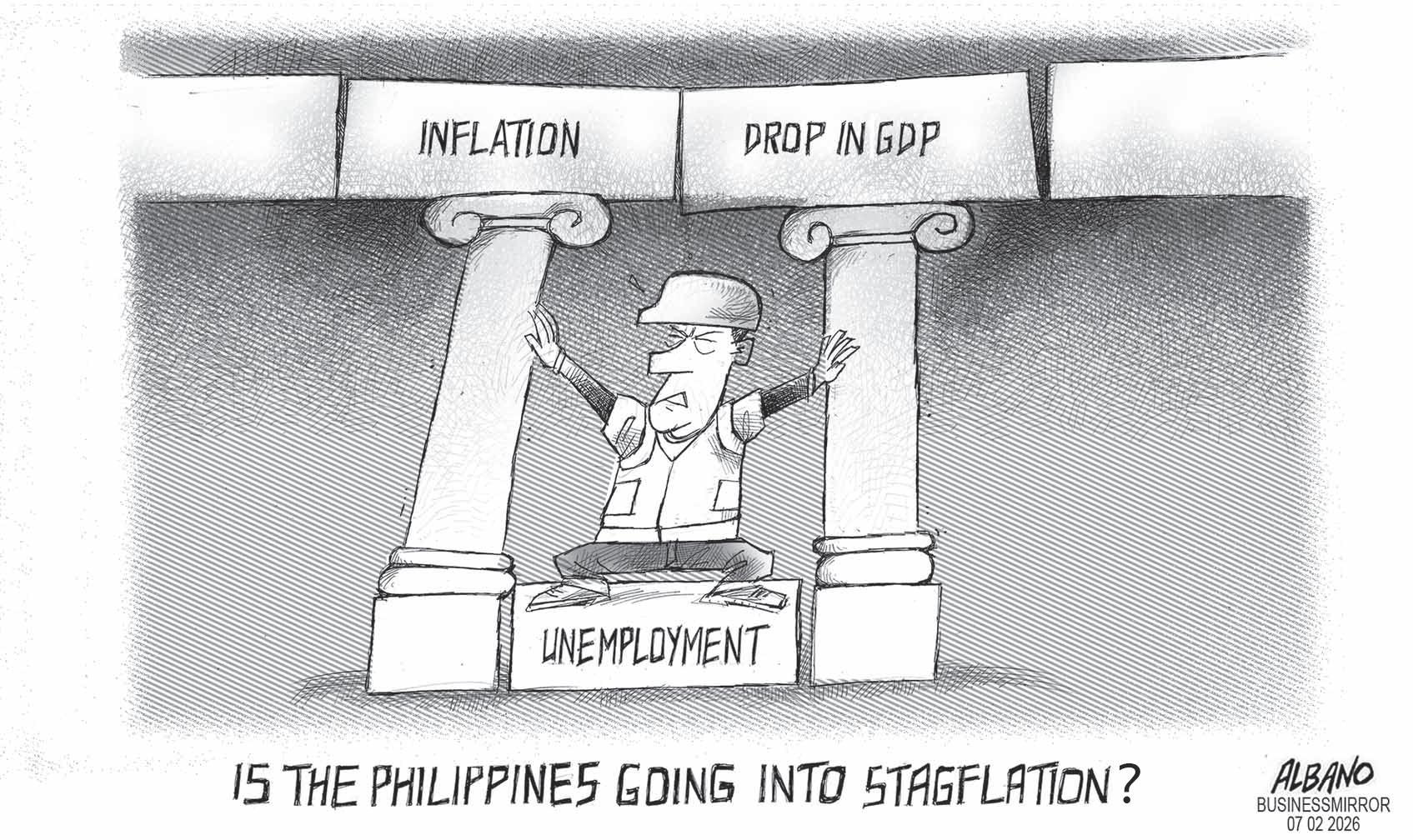

UJohn Mangun
NCERTAINTY is the oldest alibi in human affairs. Generals have used it to explain retreats, merchants to explain empty shelves, and priests to explain unanswered prayers. It has never once been wrong, and it has never once been useful.
Every corporate earnings miss and most economic data has been preceded by a warning about uncertain conditions. The conditions were always uncertain. The miss was always a surprise. At some point in the past decade, “uncertain” became the most expensive word in business language. It costs nothing to say and has never once been accompanied by a plan.
Charlie Munger, the late vice chairman and Warren Buffett’s partner at Berkshire Hathaway, was one of the more rigorous minds American investing produced. He kept a mental basket labeled “too tough.” Into it went any investment where the executives involved described the future as uncertain. Not because uncertainty is abnormal—it is the permanent condition of all markets—but because the word, spoken by someone in authority, is a confession not to be ignored. It means
CR. Calso, Dionisio L. Pelayo
Ruben M. Cruz Jr.
Eduardo A. Davad
Nonilon G. Reyes
D. Edgard A. Cabangon Benjamin V. Ramos Aldwin Maralit Tolosa
Rolando M. Manangan
BusinessMirror is published


they have stopped thinking about a problem and have started hoping no one notices “The Problem.”
The distinction Munger drew, borrowed from economist Richard Zeckhauser, is precise. Risk is calculable: you know the outcomes, you know the odds, and then you pay your money and you take your chances. Uncertainty is harder: outcomes are visible, but probabilities are not. Ignorance is the condition below that: you cannot even map the possible outcomes. Munger’s argument was that honest people give a name to which condition they are actually in. Executives who reach for “uncertainty” as a general-purpose explanation are usually operating in ignorance and calling it something more respectable.
Philippine public life is wellstocked with this particular euphemism. Listen to any BSP press conference where the forward guidance
The next time a Philippine official describes the investment climate as uncertain, the useful followup question is the one Munger would have asked: uncertain relative to what baseline, with what probability distribution, and what margin of safety is built into the plan? Those are not technical questions. They are the minimum threshold for knowing whether the person speaking is managing a situation or an audience.
is being softened, any NEDA briefing where infrastructure timelines are slipping, any listed company disclosing why its earnings fell short. The word appears with the regularity of a legal disclaimer. It protects the speaker without informing the listener.
The Philippine peso has spent much of the past three years trading from the mid to high 50s to the dollar, and the official explanation for its weakness has consistently invoked external uncertainty: the Federal Reserve, the Middle East, China’s slowdown, global supply chains.
Every one of those factors is real. None of them is unknowable. The Fed publishes its dot plots. Freight rates have indices. China’s PMI prints monthly. Probabilistic thinking — Munger’s preferred alternative to uncertainty-as-excuse — would have
fund managers and policymakers working with scenarios and probabilities. What gets called uncertainty is often the decision not to do the analysis. The PSEi tells a similar story. Foreign portfolio outflows have been attributed to global uncertainty in virtually every quarterly report issued by any Philippine brokerage for the past decade. The implication is that the selling is external in origin and therefore beyond local control. The listed universe, however, is thin, illiquid at the second and third tiers, and dominated by holding companies whose earnings visibility is structurally poor.
That is not global uncertainty. That is a market architecture problem that nobody wants to own because owning it requires fixing it. Munger’s prescription was not optimism. It was margin of safety— holding enough reserves, maintaining enough options, that when the truly unpredictable arrives, the institution survives it. The Bangko Sentral’s gross international reserves, running around $104 billion as of the latest reporting, represent that kind of institutional thinking. The BSP does not claim to know where the dollar/peso rate is going. It builds a buffer large enough to survive being wrong. That is probabilistic thinking applied at the sovereign level, and it is the exception rather than the rule in how Philippine institutions handle
“Mangun,” A11
positions China’s ruling party as global force for progress
HINESE leader Xi Jinping made a case for his ruling party as a force for global progress and prosperity—a role that would be backed by a strong military—signaling his ambition for the nation to stand at the fore of global affairs.
In a speech in Beijing on Wednesday marking the founding of the Communist Party 105 years ago, Xi said the organization was “creating a new form of human advancement” while paving the way for developing nations to modernize.
He said that “socialist China, led by the party, is recognized as a builder of world peace, contributor to global development and defender of international order.” He again touted vaguely defined programs his government has put forward, like the Global Governance Initiative, while also pledging to “strengthen the military through reform, science and technology, and personnel training.”
While Xi and other Chinese leaders have long positioned the party –which now has more than 100 million members—as central to China’s development, the speech underscores a mounting ambition for the nation to play a more high-profile role on the international stage. It buttresses
Xi’s push to use blocs like BRICS to rally developing countries to act as a counterweight to what he sees as the US’s fading influence.
While Xi didn’t directly mention the US in the roughly 40 minutes of remarks, he did allude to the obstacles his nation faces in its ambitions.
“No matter how strong the enemy, how treacherous the path, and how severe the challenges may be, our party has remained dauntless and unyielding and inspired the people of the whole country to achieve one victory after another,” he said.
Xi repeatedly exhorted the gathering at the Great Hall of the People – and the public watching on national television—to “maintain confidence.” He repeated his goal to bring about “national rejuvenation,” partly by solving the “Taiwan problem.”
The status of the chipmaking powerhouse of 23 million people some 160 km (100 miles) off China’s coast is one of the thorniest issues
in the relationship with Washington, even after Xi held warm meetings with President Donald Trump in Beijing in May. American arms sales to Taiwan annoy China, which has pledged to bring the democracy under its control eventually, even if force is required.
The government in Taipei has pushed back at Beijing’s claims, saying Taiwan is already independent while stepping up preparations to counter any attack.
In his speech, Xi signaled he’d press on with one of the signature aspects of his roughly 14 years in power: rooting out corrupt officials—a drive that also serves to eliminate political rivals.
“We are determined to remove all elements that undermine the advanced nature and the purity of the party and eliminate all viruses that erode its health, so that we can forge a strong party through the tempering of revolution,” he said.
The event on Wednesday marked the first time since 2021 that the 73-year-old has delivered a speech about the party on its anniversary.
That time, to mark its centenary, Xi addressed a crowd of some 70,000 party faithful from above the por-
trait
Mao
in
Square. He struck a defiant tone, saying that “the time when the Chinese nation could be bullied and abused by others was gone forever.” He has continued his efforts to cast himself as the “people’s leader” before a party congress next year in which the son of a former vice premier is expected to seek a fourth fiveyear term—a move made possible by his earlier lifting limits on how long the president can serve.
Most of Xi’s latest speech focused on the accomplishments of the Communist Party since it was founded in Shanghai 105 years ago. Xi’s grip over China is stronger than ever, influencing all aspects of life from classrooms to the office, and it has been bolstered by a purge of key defense and civilian officials. Yet Xi faces a range of economic challenges at home. China’s government has lowered its official 2026 growth target to between 4.5 percent and 5 percent, its least ambitious goal since 1991. While exports have helped offset a weakening economy, Xi has to contend with a slumping property market,
By Kanoko Matsuyama & Carol Massar
THE global oil market is set to swing back into oversupply as the impact of the Iran war fades and traffic through the Strait of Hormuz recovers, according to Goldman Sachs Group Inc.
While purchases of crude to replenish strategic reserves are expected to tighten the global market to some extent, they would only partially offset the anticipated glut, Samantha Dart, co-head of global commodities research, said in an interview on Bloomberg Television.
“Once we have a normalization of flows through the strait, the expectation is that we go into an oversupply,” Dart said, adding that the surplus is expected to average just over 3 million barrels a day next year.
“We do expect a little over 1 million barrels a day just of SPR rebuilding globally, but still, that would leave us close to 2 million barrels a day of a surplus,” she added, referring to the Strategic Petroleum Reserve.
Benchmark crude prices collapsed by almost 30 percent last quarter—wiping out all of the gains from the conflict—as the US and Iran struck an interim peace deal and shipping through the waterway began to pick up. During the initial weeks of the crisis, the International Energy Agency coordinated the release of a record 400 million barrels of oil from rich nations’ emergency reserves in a bid to contain prices and ensure supplies. Those holdings now need to be rebuilt.
As part of the drive, the Trump administration tapped the US Strategic Petroleum Reserve, the nation’s emergency cache of crude. Those stockpiles sank from 415 million barrels at the end of February to 331 million as of June 19, according to official figures. That’s the lowest level since 1983.
Goldman Sachs’ expectation that surplus conditions are set to return tallies with the view from Morgan Stanley, which has cut price
By Sakura Murakami
JAPANESE
Prime Minister Sanae Takaichi is heading to India for a three-day trip starting Wednesday to bolster economic ties and align on security cooperation with counterpart Narendra Modi as the two Asian powers seek to wean off dependence on China.
The ‘too-tough basket’ was not a blueprint for paralysis. It was a filter. Investments that could not be reasoned about with rigor went in that basket. If a department secretary or a CEO cannot specify which of Zeckhauser’s three conditions— risk, uncertainty, ignorance—they are actually operating under, they are not managing the situation. They are managing the audience.
forecasts twice in a little over two weeks. “As attention turns to 2027, the market has come full circle— back to surplus,” the Morgan Stanley analysts said in a note this week.
Crossings through Hormuz—the waterway that connects the Persian Gulf to global markets—have continued to pick up despite attacks on two vessels in recent days. Iran, meanwhile, has reiterated a determination to control maritime traffic through the conduit, possibly in conjunction with Oman.
‘This is done’ EXPORTS through Hormuz are now expected to normalize by the end of this month, said Dart. “We really expect, by the end of July, this is done,” she said, after recent disruptions set back the expected time line a little.
Asked about a proposal to impose transit fees on vessels, Goldman’s Dart said companies were less concerned about the cost than regulatory uncertainty.
“When I talk to shipping companies, the main thing they say is: ‘I don’t mind paying a toll, as long as there’s clarity on the rules’,” she said, referring to the need to avoid running afoul of US sanctions.
An informal toll that had previously been discussed amounted to about $1 a barrel, a cost that isn’t materially different from the normal, day-to-day volatility in oil prices, she said.
“Is it going to really significantly increase energy costs? That’s not obvious,” Dart said. “When I talk to shippers, that was the impression I got from them.”
Brent futures traded just above $73 a barrel on Wednesday. At the war’s peak, they had topped $126. With assistance from Tim Stenovec/Bloomberg
as uncertain, the useful follow-up question is the one Munger would have asked: uncertain relative to what baseline, with what probability distribution, and what margin of safety is built into the plan? Those are not technical questions. They are the minimum threshold for knowing whether the person speaking is managing a situation or an audience. Words have consequences in markets. Vagueness is not neutral. It is a position, and usually a losing one.
Discussions are set to span semiconductors, critical minerals, and energy — crucial areas as the global race to dominate artificial intelligence heats up, rare earths are increasingly weaponized and the war in Iran highlights supply vulnerabilities.
For Modi, the visit is a balancing act: Deepen ties with Tokyo without derailing a cautious effort to repair relations with Beijing. For Takaichi, the prospect of greater cooperation with New Delhi offers a counterbalance to worsening relations with China, which this week further tightened controls on exports to Japan that have both military and civilian use.
“Cooperation with India—a nation with which we share the same fundamental values and strategic interests—is becoming increasingly important as geopolitical uncertainties deepen,” Takaichi said on Wednesday in Tokyo, ahead of her flight to New Delhi.
“During this visit, I hope to work with Prime Minister Modi on furthering concrete cooperation on three areas: deepening strategic cooperation between Japan and India in the context of the broader international situation, furthering cooperation on economic security,
and fostering collaboration to ensure businesses can invest and innovate,” she added.
For India, the visit carries significance on several fronts. Despite the warm personal rapport between Modi and US President Donald Trump, New Delhi’s relationship with Washington has become increasingly unpredictable. That has prompted India to deepen engagement with other advanced economies such as Japan, Germany and France for technology, investment and supply-chain partnerships needed to sustain long-term economic growth.
For Japan, India is a crucial partner in carrying out its foreign policy vision of achieving a “Free and Open Indo-Pacific.” The two nations have existing agreements on the transfer of defense equipment and have held multiple joint foreign and defense minister meetings.
Energy resilience is another area of shared concern for Takaichi and Modi—both leaders of large economies that are reliant on energy imports and susceptible to global supply disruptions. The war in Iran and the effective closure of the Strait of Hormuz has hit India’s economy, while Japan’s ample oil reserves gave it
For Modi, the visit is a balancing act: Deepen ties with Tokyo without derailing a cautious effort to repair relations with Beijing. For Takaichi, the prospect of greater cooperation with New Delhi offers a counterbalance to worsening relations with China, which this week further tightened controls on exports to Japan that have both military and civilian use.
more of a buffer.
While tensions between Beijing and New Delhi have eased in recent months as they discuss marking out a disputed border, India still has concerns over China’s expanding naval presence in the Indian Ocean and its dominance of critical minerals exports.
Tokyo’s relationship with Beijing is far frostier. Relations between the two Asian powers have deteriorated since November, when Takaichi speculated over the potential for military action in relation to Taiwan.
As part of Japan’s most ambitious economic-security push in years, Takaichi’s administration this week launched what’s been billed as the Japanese equivalent to the Committee on Foreign Investment in the US, or CFIUS.
Still, it’s too early to say whether any Tokyo-New Delhi alignment on issues such as semiconductors, critical minerals, and energy can meaningfully impact the regional
geo-strategic and economic realities. India’s industrial ambitions hinge on access to Chinese technology and rare earth magnets in order to meet goals in the electric vehicle, renewable energy and consumer electronics sectors. Japan also remains highly dependent on Beijing for rare earth imports, with China accounting for around 70 percent of its supply as of 2024.
The deepening Japan-India ties extend into the private sector too. Last year, Japan pledged it would encourage private companies to invest in India with a target of reaching 10 trillion yen ($61 billion) over the next 10 years. Japan is also the largest bilateral donor to India, offering development loans of 439 billion yen in 20242025. The funds have been used on projects ranging from a subway in New Delhi to a bullet train under construction linking Mumbai and Ahmedabad using Japan’s “Shinkansen” technology. The two governments are also considering establishing a local currency settlement mechanism that would allow direct transactions between the yen and rupee, according to a report by the Nikkei newspaper. That would mean transactions wouldn’t have to be made via the dollar, making it cheaper and quicker to send money, the report said.
Such a move would align with the broader direction laid out in a joint vision document issued last year. With assistance from Sudhi Ranjan Sen/Bloomberg
By Randy Thanthong-Knight
THAILAND is done chasing tourist records. After decades of measuring success by ever-rising arrival numbers, the government is making its clearest push yet to prioritize how much visitors spend versus how many show up.
The Southeast Asian nation, famed for its beaches and city nightlife, is only targeting about 33 million foreign visitors this year, well below the nearly 40 million who arrived in 2019. If arrivals fall short of last year’s 32.97 million, it would mark Thailand’s first back-to-back annual decline outside the pandemic since at least 1995.
Geopolitical tensions and intensifying regional competition mean a focus on higher-spending travelers rather than mass tourism is key, Tourism Authority of Thailand Deputy Governor Nithee Seeprae said in an interview.
UK cities including Oxford and Manchester as evidence of the shift. The agency is targeting travelers drawn by medical care, wellness retreats, concerts, festivals, golf, marathons and other sporting events because these visitors tend to stay longer and spend more.
The agency’s website also leans heavily into the luxury and wellness angle, with a welcome video suggesting visitors can “heal and become a warmer, happier you.”
Tourism Authority of Thailand Deputy Governor Nithee Seeprae pointed to the tourism authority’s recent marketing events in UK cities including Oxford and Manchester as evidence of the shift. The agency is targeting travelers drawn by medical care, wellness retreats, concerts, festivals, golf, marathons and other sporting events because these visitors tend to stay longer and spend more.
economy, the ecosystem of hotels, restaurants, food markets, transport operators, dive shops and tour companies which has sprung up around that depends on large volumes of visitors. Destinations such as Phuket and Chiang Mai were built around scale, making a shift toward fewer, higher-spending travelers harder to execute.
Thailand also no longer dominates the value-for-money market the way it once did. Vietnam and Indonesia have become increasingly competitive, while a stronger baht in recent years has eroded one of Thailand’s traditional advantages.
The next time a Philippine official describes the investment climate
UKRAINE has expanded the range and intensity of its missile strikes inside Russia, triggering alerts across nearly half of the regions in the world’s largest country so far this year. Missile threats were declared in at least five regions of the Volga Federal District southeast of Moscow in the past week alone, as well as in the southern Astrakhan region and at least four regions in the North Caucasus. Similar warnings were also issued in the Moscow, Vladimir, Tambov, Orel and Lipetsk regions of central Russia.
Ukraine struck the Ufa oil refinery more than 1,300 kilometers (807 miles) from the front line for a second time, as well as a military-industrial facility in the Penza region that produces missile components, Ukrainian President Volodymyr Zelenskyy said Wednesday in a statement on the X platform. Bloomberg News can’t independently verify the claims.
E-mail me at mangun@gmail.com. Follow me on Twitter @mangunonmarkets. PSE stock-market information and technical analysis provided by AAA Southeast Equities Inc.
“We’re not too worried about the number of tourists because we want to generate more revenue from each visitor,” Nithee said. “We focus on quality markets.”
Visitors currently spend roughly $1,500 per trip on average. Officials ultimately want that to climb to about $2,400. Yet international tourism receipts are projected to edge up only slightly this year, to 1.55 trillion baht ($46.5 billion) from 1.54 trillion baht in 2025.
sas. Measures introduced after the pandemic to stimulate tourism have been rolled back after authorities linked easier entry rules to a rise in illegal work, overstaying and crimes involving foreigners.
Last week, Thai police arrested an Australian man at Bangkok’s Suvarnabhumi Airport as he allegedly tried to flee the country after authorities accused him of killing a 17-year-old Thai girl and abandoning her body in a suitcase.
Nithee insists the new strategy isn’t about excluding budget travelers. “For Thailand, luxury is about meaningful experiences and exclusive experiences,” he said. “That’s our new definition of luxury.” Bloomberg the unknown.
Nithee pointed to the tourism authority’s recent marketing events in
The scale and geographic reach of the attacks highlight how Ukraine’s tactics and long range strike capabilities have evolved as it attempts to bring the war closer to home for Russians. Kyiv is stepping up pressure on President Vladimir Putin to enter peace talks after more than four years of fighting. Earlier in the war, missile alerts were largely confined to Russian regions bordering Ukraine as well as Ukrainian territories occupied by Moscow’s forces. This year, however, the areas that are home to more than 70% of the country’s population have sounded the alarm at least once, according to a Bloomberg analysis of statements by regional authorities.
Omsk region in western Siberia, nearly 3,000 kilometers east of the Ukrainian border recorded its first missile alert in June, as did the entire Ural region. Samara, a city of about 1.2 million
people on the Volga River, temporarily suspended overground public transport during one alert this week, while the metro remained open as a public shelter.
A missile strike killed five people last week in the Voronezh region that borders Ukraine, with local authorities issuing air alerts almost daily since then. A weekend attack in the Volgograd region in which Ukraine said it used its new Flamingo missiles also left two people dead.
Novgorod and Pskov regions in northwest Russia triggered missile alerts this week for the first time since Russia began its full-scale invasion of Ukraine in 2022.
Kremlin spokesman Dmitry Peskov declined to comment.
Ukraine is increasingly relying on domestically developed long range cruise missiles to complement its expanding fleet of attack drones, giving Kyiv the ability to strike military and industrial targets over greater
The clearest sign Thailand is no longer singularly focused on visitor numbers is its reversal around vi-
distances inside Russia.
Zelenskyy said in May that Flamingo cruise missiles had flown more than 1,500 kilometers for the first time to strike a defense plant that manufactures navigation components in Cheboksary, the capital of Russia’s Chuvash Republic in the Volga region.
“This marks a significant evolution in Ukraine’s long range strike campaign,” said Douglas Barrie, a senior fellow for military aerospace at the International Institute for Strategic Studies. “Flamingo offers the ability to strike deep into Russia with a large warhead.”
The ability to strike Russian critical national infrastructure with long-range attack drones and cruise missiles “is having the effect of damaging elements of the Russian industrial war effort, hitting the economy, and underscoring to the Russian public that the war on Ukraine has a cost,” Barrie said.
But with tourism accounting for about one-fifth of Thailand’s
This should translate into greater pressure on the Kremlin, but whether Putin will become more willing to negotiate is another question, he added.
Almost every Russian region reported either fuel rationing or disruptions to gasoline supplies by the end of June following Ukrainian drone strikes in recent weeks that targeted key oil refineries, temporarily halting operations at some of them.
A fire at an oil refinery in Slavyansk-on-Kuban in Russia’s Krasnodar region was burning for a second day after a large-scale Ukrainian drone and missile attack on Sunday, local authorities said. The strike involving 110 drones and five Flamingo cruise missiles on the district that hosts the refinery was the largest since the start of the war, killing one person and injuring six.
Thailand spent decades building one of the world’s biggest mass-tourism industries, helped by a cheaper currency, global exposure from films and TV series and a boom in Chinese visitors before the pandemic. It’s struggled to regain that momentum since Covid-19.
“Ukraine often tries to saturate Russia’s air defense with drones so that cruise missiles can get through,” said Sam Cranny-Evans, a military analyst at the Royal United Services Institute in London. Ukraine’s Defense Ministry declined to comment on its missile production program.
Ukraine began producing the Flamingo last year and claims the missile has a range of up to 3,000 kilometers, potentially allowing it to hit targets across most of European Russia and, in theory, beyond the Ural Mountains. Neptune, Ukraine’s first homegrown long range cruise missile, was originally developed as an anti-ship weapon and used to sink the Moskva cruiser that was the flagship of Russia’s Black Sea Fleet in 2022. The repurposed missile is capable of hitting land targets over a distance of as much as 1,000 kilometers. With assistance from Thomas Hall, Kollen Post, Alex Newman and analyst Alex Kokcharov/Bloomberg
Thursday, July 2, 2026
Stakeholders chart long-term solutions for safety in sports A12 mirror_sports@yahoo.com.ph
Rayco and co. down Iranians
THE Philippines defeated Iran, 29-19, 19-25, 25-23, 25-18, for its first victory in Pool C Wednesday in the Asian Volleyball Confederation (AVC) Girls’ U18 Championship at the Terminal 21 Hall in Nakhon Ratchasima, Thailand.
Xyz Ellen Rayco topscored with 19 points on 14 attacks, three blocks and two aces, followed by Ma. Ellanie Lorraine Gonzalvo with 15 points on 12 attacks and two aces in the one hour and 50-minute match.
J haynna Love Bulandres and Adelaine Terese Agustin chipped in nine points for the team, which clinched the bronze medal in the Princess Cup. Sana Naghipour led the Iranians with 15 points, 13 on attacks, followed by Setayesh Nasr Esfahani with 15 points on eight points and two aces.
“ We had expected Iran to play well, they beat us in the semifinal at the Asian Youth Games in Bahrain,” said head coach Rey Karl Dimaculangan, who is assisted by Keenan Quitco and Marco Ely Maclang.
The Philippines—sent to the tournament through the Philippine Olympic Committee and supported by the Philippine Sports Commission, Boysen and Monolith—will next face Japan and 10 a.m. Thursday and Indonesia at 4 p.m. on Friday.
D imaculangan stressed the importance of mindset.
We need to be more focused on the game and be more aggressive, especially on the floor,” he said.
Most of the players are members of the 2026 Palarong Pambansa champion National University, while Lleses is a player of King’s Montessori of Quezon City, while Gonzalvo is with the Adamson University.
Six of the players—Rayco, Bulandres, Lleses, Princess Khaira Manzano, Irish May Mahinay and Frances Dianne Ramos—are part of the national team that qualified for the FIVB World Girls’ U17 in Chile from August 6 to 16.
K azakhstan defeated Hong Kong, 25-3, 25-23, 25-15, in Pool B at the Nakhon Ratchasima Rajabhat University gym.
The semifinalists in the championships will qualify for the U19 world championships next year—the FIVB has yet to announce the venue. AVC Pool




issues and dipped from a high ranking of 28th last year to No. 87 entering Wimbledon.
T he US-born Australian pulled off an impressive opening performance at Wimbledon.

ALEX EALA throws a kiss to the crowd after easily disposing of Mexico’s Renata Zarazua as Serena Williams bids goodbye—the 23-time majors winner yields in three sets to Maya Joint in the first round on Tuesday. AP
THERE will be no duel with the 23-time Grand Slam champion. Instead, Alexandra Eala braces for a showdown with a familiar foe.
A rguably less daunting. Potentially more challenging.
Serena Williams’s much-hyped return to professional tennis ended at the first hurdle, falling to Maya Joint in the Round of 128 of the Wimbledon Championships, 3-6, 7-6(6), 3-6, on Tuesday.
T he result put to rest what had
been a much-discussed secondround showdown with Eala, who made quick work of Mexico’s Renata Zarazua, 6-1, 6-2.
The 21-year-old Eala now takes on Joint, a year younger, and the player who beat her in the title showdown at the Women’s Tennis Association 250 Eastbourne Open last year.
T he two have not met since their three-set thriller in England.
E ala has pulled off solid
At a packed Centre Court of the All England Lawn Tennis and Croquet Club, Joint got a huge boost in morale, playing a dream match against Williams and making it count. Even though I didn’t win many matches this year, I still felt like I could
I had the belief and I just took advantage of the moment and enjoyed it,

didn’t really think about the previous matches I’ve played.”
Serena enjoys comeback at 44
THE roars began even before Serena Williams stepped on Centre Court. Then they grew louder when the 23time Grand Slam champion arrived to play her first singles match in nearly four years.
A nd when it was all over and the 44-year-old Williams had performed admirably in a three-set defeat to an opponent less than half her age in the opening round of Wimbledon with her two daughters cheering her on, Williams smiled as she walked off to a loud round of applause.
It was really great to be back at Wimbledon. I never expected to be here,” Williams, who did not meet with media after the match, said in a statement released by Wimbledon organizers. “The atmosphere was amazing. Walking out was amazing. I definitely relished it and missed it and enjoyed the moment more than anything.”
I n a three-set loss to Maya Joint of Australia on Tuesday, Williams showed she can still crank out serves faster than 120 mph and dictate points with her heavy groundstrokes. Movement was an issue for Williams, though, and the 87th-ranked Joint was able to handle Williams’ pace and win more of the big points by hitting beyond the American’s reach.
W hile Williams played two doubles matches just before Wimbledon to announce
Vargas, like Cone, believes in Gilas






ATEAM BUILDING activity that cost the lives of two Ateneo de Manila athletes could be avoided a with a long-term and encompassing solution involving coaches and team managers.
We reiterate our strong commitment to professionalizing coaching and team management through higher standards, continuous education, mandatory certifications [including basic life support t raining], clearer operational guidelines and robust safeguarding measures across all sports environments,” the Sports Stakeholders Panel created by the Philippines Sports Commission (PSC) said in a statement on Wednesday.
Properly designed and implemented, these reforms will protect both athletes and coaches, reinforce ethical and professional practice and strengthen public t rust in sport,” the group added in the statement circulated by the panel’s organizer, PSC chairman Patrick Gregorio.
Gregorio created the panel to look into the drowning to death of Ateneo basketball players Rene Baterbonia and Nigerian Divine Adili last June 8 on Dipaculao beach in Aurora Province.
The panel is composed of key officials from the Commission on Higher Education (CHED), Samahang Basketbol ng Pilipinas, National Youth Commission, Department of Education (DepEd) and the University Athletic Association of the Philippines.
The panel also thanked the Criminal Investigation and Detection Group on its diligent, progressive and transparent investigation of the case and the ongoing proceedings of the CHED in evaluating institutional oversight under a CHED memorandum order that is thoroughly sifting through the tragedy.
The PSC said that its Coach Developer Academy prepares coach developers who will train and certify coaches under the forthcoming National Sports Coaching Certification Program.
The initiative is being implemented in partnership with the DepEd as the CHED develops new memorandum orders on athlete welfare and safe sport.
The statement added that national sports associations are encouraged to strengthen their safeguarding frameworks and designate safeguarding officers so that concerns that emerge in sporting environments can be safely raised, addressed, and resolved.
“ These initiatives lay the ground work for renewed consideration of the proposed Sports Coaching Act [House Bill 2631],” the panel state ment said.
Josef Ramos
SAMAHANG B Basketbol ng Pilipinas president Ricky Vargas believes that the men’s national team could pull win on enemy in the third window of International Basketball Federation (FIBA) 2027 World Cup Asia Qualifiers. Vargas said he believes in how head coach Tim Cone compares the games against New Zealand and Australiua as a “Game 7 in a finals series,” “ Every game is a new game and I do not look at the history of losses,” Vargas said. “There is always a chance that we can beat the team that we have never been able to beat for a long time.” I look at the opportunity that we can win,” he added. Vargas arrived in at Auckland on Wednesday, two days ahead of Gilas Pilipinas’ 3 p.m. game against the Tall Blacks at the Spark Arena on Friday, but said he might miss the match against Australia on Monday in Perth.
G ilas has beaten the Kiwis, 93-89, on November 21, 2023, during the FIBA Asia Cup Qualifiers at the SM Mall of Asia Arena behind Justin

Brownlee’s 26 points and 11 rebounds and Kai Sotto’s 19 points, 10 rebounds and seven assists. The Tall Blacks, however, fought back in the second window last February, 69-66, also in the same Pasay City facility with Brownlee limited to only four points on 2-of-10 shooting. S otto won’t be around this time as he preferred to prioritize his dream to play in theNational Basketball Association. But Vargas remained confident. “ Every game we play, we play our best … and a chance to win is there,” he said. “I look forward to a team that is going to fight and committed to play for the country, and they will do their best plus their good character.” They are the best team that we will sent to New Zealand,” he added. W ith Brownlee are 6-foot-8 Mike Philips, Troy Rosario, Juan Gomez de Liaño, June Mar Fajardo, Kevin Quiambao, Chris Newsome, Justin Baltazar, Carl Tamayo, Dwight Ramos, AJ Edu and RJ Abarrientos. Josef Ramos
LLOYD GO mastered the picturesque yet vicious course with the day’s only sub-par round—a five-under 67—to blow the International Container Terminal Services Inc. Pinewoods Challenge wide open in Baguio City on Wednesday. Go stormed to a
Editor: Jennifer A. Ng

By VG Cabuag @villygc
CONGLOMERATE San Miguel Corp. announced last Wednesday it had distributed P1.43 trillion, or 95 percent of its revenues, back to suppliers, employees, investors, communities and the government.
The company’s sustainability report read that the vast majority of the total economic value generated by San Miguel’s group-wide operations went back to supporting Philippine businesses, jobs, public revenues and economic activity.
while P560 million was invested in community development programs.
Apart from its financial performance, the company reported progress on infrastructure assets, environmental programs, workforce development, community initiatives and governance practices.
through its Better Rivers PH initiative, which it started in 2020.
For social programs, San Miguel reached more than 200,000 individuals through volunteer programs nationwide. A total of 4,298 employee volunteers contributed 65,415 hours across about 600 activities.
ABy Lenie Lectura @llectura


BOITIZ Power Corpora -
tion (AboitizPower) broke ground on a 60-megawatt (MW) Naga Battery Energy Storage System (BESS) project at the former Naga Power Plant Complex in Cebu.
(DOE) commends AboitizPower for their continued confidence in the Philippine energy future. Your investment demonstrates the innovation and sustainability that can go beyond what we have been dreaming of,” said Energy Undersecretary Mario C. Marasigan.
Some P221 billion went to taxes and other government payments, while another P153 billion went to payments to providers of capital, including investors and shareholders.
Some P58 billion went to salaries and benefits for SMC’s employees,
Approximately P995 billion of total revenues went to suppliers and operating expenses, helping support businesses across the company’s nationwide supply chain, and enabling them to sustain operations, generate income, and provide employment in their communities.
Its operating footprint includes 5,710 megawatts of total energy capacity, 225 kilometers of expressways, fuel refining capacity of 180,000 barrels per day in Bataan and annual cement production capacity of 17.5 million metric tons.
On environmental initiatives, San Miguel planted 8.14 million trees through various reforestation programs nationwide and saved 58 billion liters of water since 2017 through desalination, conservation, recycling, reuse and rainwater harvesting.
It also reported removing 8.95 million tons of silt and waste from major rivers and river systems
The report also showed that Sa Miguel’s workforce grew to 59,117 in 2025, with about 64 percent of employees based outside Metro Manila.
“At San Miguel, creating value goes well beyond financial performance. Our job is not just to provide quality food and beverage products, and access to everyday necessities such as power, fuel and infrastructure,” San Miguel Chairman and CEO Ramon S. Ang said.
“Our bigger mission is to help sustain our economy and create the conditions needed to ensure more Filipinos have jobs and opportunities that can uplift and sustainably improve their lives.”
BROKENSHIRE Medical Center has launched the BMC Heart Institute, a full-spectrum cardiovascular care facility in Davao.
The BMC Heart Institute is the latest milestone in AppleOne Medical Group’s expansion of regional healthcare.
“Our goal has always been to elevate the standard of living in Visayas and Mindanao (VisMin) through the places we build, the experiences we offer, and now, through the care we deliver,” AppleOne President and CEO Ray Go
By Bless Aubrey Ogerio @blessogerio
THE Philippine Economic Zone Authority (Peza) has registered the P10-billion Hann Reserve project in New Clark City, allowing the tourism development to operate as a domestic market enterprise under the agency’s investment framework.
Executives representing the Peza and Hann Philippines Inc. signed the Registration Agreement on June 23, formally registering the company as a Peza Ecozone Domestic Market Enterprise for tourism.
According to the Peza, the project involves an initial investment of about P10 billion and is expected to generate more than 220 direct jobs.
The registration allows Hann Philippines to operate tourism-related facilities within its integrated mixed-use development in Capas, Tarlac, including golf courses affiliated with the Professional Golfers’ Association of America (PGA), as well as clubhouses and food and beverage outlets.
The agreement follows a supplemental agreement signed in August last year.
Hann Reserve began preview operations on January 31, ahead of its planned full commercial operations.
The Peza said the registration covers the project’s operation as a tourism enterprise within the economic zone under its existing regulatory framework.
Manigsaca said. “Establishing AMG in 2020 was a bold step during the height of the pandemic, driven by our purpose and strong belief in the VisMin region. Today, we are even closer to bringing world-class healthcare closer to home.”
The heart institute expands Mindanao’s cardiovascular care options by offering new and integrated services the region lacked, according to the company.
From preventive screenings and non-invasive diagnostics, to complex invasive cardiology like, diagnostic
coronary angiography, angioplasty, coronary stenting, cardiac rehabilitation and long-term disease management, the institute brings together top cardiologists and a multidisciplinary team to deliver end-to-end cardiac care.
Designed as Mindanao’s regional referral hub, the BMC Heart Institute serves Davao City and extends to Western Mindanao, Northern Mindanao, Barmm, and surrounding provinces. Founded in 1917 and now under AMG’s management, BMC is home
to the region’s first hospital-based multidisciplinary center for children with special needs and houses the first and only IVF Laboratory in Mindanao.
AMG operates three hospitals across Visayas and Mindanao: the VisayasMed in Cebu and the United Shalom in Tacloban and the Brokenshire Medical Center, both in Davao.
It has plans to expand through a hub-and-spoke network of satellite care centers within 50 kilometers of each flagship hospital. VG Cabuag

DITO Telecommunity Corp. has forged a strategic partnership with insurtech firm Stere Asia Pacific Pte. Ltd. to extend digital insurance access to its subscriber base, focusing on underserved and emerging market segments across the Philippines. Under the arrangement, Dito’s telecommunications platform and nationwide reach will serve as the distribution channel for Stere’s insurance products, allowing subscribers to access protection services digitally.
Stere Asia Pacific Regional Head
Myla Gonzales said the decision to partner with Dito was driven by the alignment between the telco’s subscriber profile and the segments Stere is targeting.
“Of everybody, Dito’s portfolio of subscribers are the ones that match exactly how protection is applied— important and needed by our nation,” Gonzales said in an interview. “We believe in the tech and strength of Dito’s infrastructure. Our visions are aligned.” Insurance providers under Stere
include PGA Sompo, Starr Insurance Companies, iCare, and HiDoc.
“What we’re doing now is really an evolution of our company. We continue to move beyond telco; we are becoming a digital experience company. This partnership with Stere is a step toward that direction,” said Dito Chief Revenue Officer Adel Tamano.
Dito’s subscriber base is at 17 million. It is targeting to carve out a third of the Filipino telco market, according to Eric R. Alberto, the CEO of Dito. Lorenz S. Marasigan
A BESS is a type of energy storage that uses a set of batteries to store surplus electricity which is released when needed to augment supply or improve the quality of the electricity in the power system. The facility is expected to provide contingency and regulating reserve services that will support the grid’s ability to respond to fluctuations in electricity supply and demand.
The Naga BESS project is part of AboitizPower’s broader strategy of a balanced energy mix portfolio, in support of the Philippine Energy Plan. It is expected to begin commercial operations by 2027.
“The Department of Energy
Built by the National Power Corp. (Napocor) in the 1980s, the Naga Power Plant Complex was acquired by AboitizPower in 2018 through the government’s privatization program. The BESS project marks the site’s transformation from thermal power generation to energy storage. The legacy coal and diesel-fired units were decommissioned and demolished.
“Naga BESS represents transformation in action. It reflects our efforts to strengthen the energy system by investing in people, infrastructure, and technology to enhance flexibility, resilience, and reliability of the grid,” said AboitizPower Transition Business Group President Celso C. Caballero III.
EVOENERGI Inc., a premier retail electricity supplier and a member of the D and L Group, said it has switched on the country’s first two residential retail aggregation groups under the Energy Regulatory Commission’s Retail Competition and Open Access framework.
The first two residential aggregation groups, comprising nine households in Barangay Blue Ridge A, Quezon City, and 13 households in Barangay Greenhills West in San Juan, began receiving power from EvoEnergi on June 26.
This marks the first day the ERC’s 100 kW retail aggregation framework took effect.
“This is more than a market milestone; it is a major leap forward in achieving the core objectives of the Electric Power Industry Reform Act,” EvoEnergi President Julian T. Lao said. “For many years, households have viewed electricity as a fixed expense with limited alternatives. Through the ERC’s retail aggregation program, the collective demand of residents creates stronger purchasing power, unlocking customized energy solutions that would other-
wise be out of reach for individual households,” Lao added. Traditionally, only large-scale energy consumers could directly participate in the competitive retail electricity market. However, under the ERC’s retail aggregation framework, smaller end-users can now pool their electricity demand to collectively meet the minimum 100-kilowatt threshold required to freely choose their electricity supplier.
Building on this historic milestone, EvoEnergi is forming additional residential retail aggregation groups in Metro Manila. Throughout the onboarding process, EvoEnergi works in close coordination with homeowners, community leaders, the Manila Electric Co., the Independent Electricity Market Operator of the Philippines and the ERC to guarantee a seamless transition and strict regulatory compliance. As the Philippine retail electricity market continues to evolve, EvoEnergi remains committed to pioneering aggregation programs that enable more residential communities to take full control of their energy future. VG Cabuag

By Reine Juvierre Alberto @reine_alberto

AS the government pushed to capture taxes from the expanding digital economy, the withholding tax collections from online sellers more than tripled last year, according to the Bureau of Internal Revenue (BIR).
The BIR has collected P9.202 billion in withholding taxes remitted by electronic marketplace (emarketplace) operators and digital financial service providers last year, a 254.45 percent jump from P2.596 billion in 2024.
Online sellers are levied a 1-percent withholding tax on every purchase of goods or services through emarketplaces, food delivery apps and online booking services. The withheld amount serves as an advance payment that can be credited against the seller’s income tax liability. According to the government’s main tax collector, the BIR has been closely monitoring the tax declarations of online sellers with the taxes withheld and remitted by e-marketplace operators to verify compliance. The new tax regime aims to level the playing field between brickand-mortar stores, which regularly comply with their tax obligations, the BIR said.
“Whether their business is operated online or through physical stores, sellers and merchants have to pay their taxes,” it added. BIR collects P14.520B in VAT on digital services. Meanwhile, value-added tax (VAT) collections on digital service providers (DSPs) reached P14.520 billion as of 2025, following the implementation of Republic Act No. 12023, which imposed a 12 percent VAT on digital services consumed in the Philippines, last July 2025.
Of the total VAT collections, P8.083 billion came from business-toconsumer (B2C) transactions, while P6.436 billion was generated from business-to-business (B2B) transactions. B2C transactions involve nonresident DSPs directly remitting VAT to the BIR, while B2B transactions require local businesses or government entities to self-account through the reverse charge mechanism. Collections from DSPs helped boost overall VAT revenues, which grew by 5.58 percent year-on-year to P679.80 billion in 2025.
Last year, the BIR collected P3.109 trillion, up by 9.06 percent from the prior year’s collection of P2.851 trillion. This translated to a tax effort of 11.10 percent of gross domestic product, the second-highest level over the past decade.

By Andrea E. San Juan
THE Bangko Sentral ng Pilipinas (BSP) announced it will formulate a “Central Bank Digital Currency” (CBDC) “strategic” roadmap to chart initiatives, stakeholder involvement, timelines and deliverables for exploring, testing and developing use cases that address “real world constraints” in capital market development.
The central bank said through a statement it issued last Wednesday of having identified the settlement of financial securities and large-value cross-border payments as “potential applications” for wholesale CBDC.
“This was highlighted in the BSP’s ‘Project Agila’ report, which aims to help the central bank and participating financial institutions [FIs] explore potential use cases of CBDCs,” the BSP said.
The central bank explained that CBDCs are digital forms of money
THE Bureau of Internal Revenue (BIR) has simplified the transfer of proprietary club shares by removing the requirement to obtain prior confirmatory ruling.
This was after Internal Revenue Commissioner Charlito Martin R. Mendoza issued Revenue Memorandum Circular 72-2026, which clarifies the tax treatment of proprietary club shares owned by corporations but registered under the names of company officers or other nominees.
The circular read that transferring a club share from one nominee to another, while beneficial owner-
THE country’s second-largest lender plans to expand the new services it launched last Wednesday from the current 1,300 stores and pawnshops to 8,000 next year.
The new services allow users of digital accounts in the Bank of the Philippine Islands (BPI) to withdraw from and place funds through the bank’s partner stores and pawnshops.
According to BPI executives, an account holder can withdraw a minimum amount of P100 for every transaction through 34 merchants across 1,300 stores nationwide.
The bank recently launched this service to turn everyday neighborhood stores into mini-BPI branch hubs.
Jose Raul E. J Jereza, the lender’s head of agency banking, told reporters last Wednesday the bank is hoping to expand the reach of these services to 8,000 stores nationwide by the middle part of next year.
BPI President and CEO Jose Teodoro K. Limcaoco said during the news briefing their initiative aims to make the banking experience of BPI account holders more convenient, compared to going out of their way to withdraw through ATMs.
“The issue with ATMs is there are minimum amounts. For a person whose every peso counts, you literally can go to a partner store and withdraw an exact amount,” Limcaoco said.
“You have to think about the journey. Yes, ATMs are convenient but it’s still a specific journey. Whereas if you need to do a transaction, whether it’s at the point of withdrawal, if you’re doing your grocery, your weekly chore, or you’re going to gas up,you don’t need to go out of your way,” he added.
As of June, BPI said there are 1,324 transaction-capable stores nationwide. Of these, 833 stores are under merchants owned by Robinsons Retail Holdings Inc. (RRHI). Transaction-capable means these stores already offer the deposit and/or withdrawal services.
Of these 833 RRHI-owned partner-merchants of BPI, 168 Robinsons Easymart stores; 159 Robinsons Supermarket stores; 15 Shopwise stores, and 37 The Marketplace stores offer both deposit and withdrawal services.
Fifty Robinsons Department Stores, 43 Toys R Us stores and 361 Uncle John’s stores so far offer only withdrawal services. Meanwhile, 491 stores that are not owned by RRHI offer both deposit and withdrawal services.
Some stores are located in Davao, South Central Mindanao, Negros and Panay Islands, Palawan, Bicol, Cebu, Cagayan Valley, among others.
As to the types of stores included, there are drugstores and pawnshops under the Tambunting and CVM brands.
Jereza said compared to how withdrawing through an ATM works, BPI account holders can transact through these partner merchants by simply generating a barcode through the BPI app.
Limcaoco said the “real miracle” the campaign, which they dubbed as “Himala,” is “not technology itself: it’s giving more Filipinos the opportunity to participate in the financial system with ease and confidence.”
“Through our growing partner network, we are transforming everyday locations into gateways to banking, helping make financial inclusion a reality for more communities,” he added. Andrea E. San Juan
Gthat constitute direct liabilities of the central bank. A wholesale CBDC, meanwhile, is a type of CBDC designed for use by commercial banks and other financial institutions.
“Much like the current ‘real-time gross settlement’ [RTGS] system, a wholesale CBDC would allow each bank to maintain an account with the BSP,” the central bank explained. Balances would then be credited or debited based on transactions with other banks, it added.
“The key difference is in the use of
ship remains with the corporation, will not be treated as a sale, exchange or donation.
Since these transfers do not change the ownership, the transfer will not be subject to capital gains tax, donor’s tax or documentary stamp tax.
The circular, likewise, removed the requirement for companies to secure a prior confirmatory ruling from the BIR before processing these transfers.
Instead, taxpayers may proceed directly to the appropriate Revenue District Office to process the elec-
OVERNMENT employees and pensioners can now receive up to 6-months’ worth of loan payments as the Government Service Insurance System (GSIS) expanded its loan moratorium refund program.
The state-run pension fund said last Wednesday that it broadened the scope of the program to allow members and pensioners to receive refunds equivalent to up to six months of loan amortizations, up from the previous limit of three months.
The program will cover loan payments made from December 2025 to May 2026. Applications will be accepted from July 1 to October 31 through the GSIS Touch mobile application.
According to the GSIS, active loan accounts, including housing loans, will be covered, except those under the pension fund manager’s “Ginhawa Green Loans” program, namely the “Ginhawa Solar Energy Loan” and the “Ginhawa Bike and E-Mobility Loan.”
GSIS President and General Manager Jose Arnulfo A. Veloso was quoted in a statement as saying the loan moratorium program, dubbed “Balik Ginhawa 2, “was designed to give our members and pensioners additional financial breathing room.”
Any refunds previously received under the first phase of the “Balik
distributed ledger technology, which enables greater automation, faster processing, and lower transaction costs,” the central bank noted.
BSP Governor Eli M. Remolona Jr. said wholesale CBDCs can “enhance efficiency in the payments infrastructure and develop new financial services that could address evolving needs in the national payments ecosystem.”
The BSP also noted in the report that adopting wCBDCs for financial securities transactions could “significantly” reduce settlement risks by narrowing the time gap between trade execution and final settlement.
Looking ahead, the central bank said it will formulate a CBDC Roadmap that shall “lay out the BSP’s strategic direction for the exploration and development of highly compelling CBDC use cases.”
Among the next steps of the central bank cited in the report are to identify policy goals, expected outcomes, key performance indicators, success measures, and decision points for each wCBDC use case.
Moreover, BSP said it shall continue engaging with relevant payment system stakeholders (BSP-supervised financial institutions, financial market infrastructures, government agencies, foreign central banks) to “further validate” pain points and
identify new use cases addressing evolving payment system needs.
As it continues to engage with stakeholders, the central bank said it will expand wCBDC exploration, testing, and development for tokenized securities settlement and cross-border payments.
The central bank also noted that it will ensure wholesale CBDC use cases deliver expected benefits to target end-users.
A post on the website of IBM Corp. reads that a CBDC “is a digital form of fiat—money that is issued by central banks.”
“It is designed to be a digital representation of the country’s physical currency. Unlike cryptocurrencies like Bitcoin or Ethereum, CBDC is backed by the government and is legal tender. The aim of CBDC is to improve the efficiency of payments and reduce the cost of printing, storing and transporting physical cash.” According to the post, a CBDC operates on a secure, transparent blockchain network, and it uses blockchain technology to create an immutable record of all transactions.
“This means that all transactions are recorded on a decentralized ledger, making it impossible to modify or tamper with the data.” (See https:// www.ibm.com/think/topics/ blockchain-for-cbdc)
tronic Certificate Authorizing Registration.
The simplified process applies only if the corporation is still the beneficial owner, the nominee holds legal title under a Declaration of Trust or Trust Agreement, the share is recorded as a corporate asset, no payment is made between nominees and the supporting documents are submitted.
“Any misrepresentation or failure to comply with the foregoing conditions shall subject the transaction to the applicable taxes, penalties, and surcharges under the Tax Code and existing revenue issuances, including possible recharacterization of the transaction based on its true nature,” the circular stated.
Ginhawa” program will be deducted from the maximum amount that members may claim, read the statement issued by the GSIS.
Members who received less than the full three-month refund under the original program may still claim the remaining eligible amount, along with the three additional months under the enhanced program, up to a maximum of six months of loan amortizations.
Refunded loan payments will not be treated as loan arrears, GSIS clarified. While the refunded months will appear as unpaid, they are covered by the loan moratorium and will not result in penalties.
Approved refunds will be credited directly to the member’s designated GSIS bank account upon approval of their application.
The expanded program excludes loan accounts already classified as due and demandable, or those with unpaid amortizations equivalent to more than six months.
Also ineligible are fully paid or renewed loan accounts, members with pending or processed retirement or separation benefit claims at the time of availment, members without a designated GSIS bank account and advance payments made before a loan’s first due date. Reine Juvierre S. Alberto
Proprietary club shares are ownership shares in private clubs, such as golf or country clubs, whose memberships are typically required to be registered under the name of an individual rather than a corporation. Historically, companies sought confirmatory rulings from the BIR to confirm that these are not subject to capital gains tax, documentary stamp tax and donor’s tax.
➔ Credential-based attacks flagged CYBER criminals are increasingly bypassing malware altogether, relying instead on
passwords and
system access to breach organizations undetected, according to a new global report from Kaspersky
The “Anatomy of a Cyber World” report found that credential-based attacks ranked among the most effective tactics used by threat actors last year. According to the report, adversaries moved away from deploying malware that can trigger endpoint protection alarms, opting instead to exploit valid credentials that allow them to blend in with normal network activity. The report measured techniques by their conversion rate, or how often a monitored activity led to a confirmed malicious incident, and found that the top five attack methods all centered on credentials and identity management. Lorenz S. Marasigan
➔ PDIC cites savings importance
THE Philippine Deposit Insurance Corp. announced last Monday of having “successfully concluded” the nationwide observance of the 24th Depositor Protection and Awareness Week from June 16 to 22, “reinforcing its commitment to promoting financial literacy, depositor confidence, and a stronger culture of saving in banks among Filipinos.” Centered on the theme, “Kapag sa bangko may ipon, handa anumang panahon,” this year’s celebration underscored the important role of maintaining deposits in banks to help individuals and families respond to life’s uncertainties while working toward long-term financial security and future aspirations. The annual observance of DPAW is mandated under Presidential Proclamation 358 issued in 2003 to reinforce public trust in the banking system, promote financial literacy, and strengthen the stability of the
By Anne Ruth Dela Cruz
WHEN it comes to treating disease, timing can make all the difference. A tiny lung nodule detected before symptoms appear, a clearer view of blocked coronary arteries, or a more precise assessment of an injury can help physicians intervene earlier, often leading to better outcomes for patients.
Advances in computed tomography (CT) imaging are making those possibilities increasingly attainable.
The latest generation of CT technology uses what is known as photon-counting imaging, a significant evolution from conventional CT scanners. Rather than measuring the total energy of X-rays, photon-counting technology detects and measures every individual X-ray photon that passes through the body. The result is substantially sharper images, improved tissue characterization, and more detailed information that physicians can use in making clinical decisions.
One example of this next-generation technology is the Siemens Naeotom Alpha.
Peak, the world’s first photon-counting CT (PCCT) scanner, is now available at St. Luke’s Medical Center Global City. For patients, that means earlier detection of disease, fewer repeat scans, lower radiation exposure, and more precise information that can help physicians determine the most appropriate course of treatment.
Ultra-high-definition images
DR . Maricar P. Reyes, Head of the Institute of Radiology at St. Luke’s Medical Center Global City, likens the difference to switching from high-definition television to ultrahigh definition.
“The pictures are clearer, with more de -

tails and better tissue characterization,” she explained. “Because it provides more diagnostic information, physicians have greater confidence when interpreting the images.”
That added clarity can have a meaningful impact across several medical specialties.
For patients with cardiovascular disease, one of the longstanding challenges in CT imaging has been evaluating coronary arteries with heavy calcium deposits or previously implanted stents. These structures can obscure the vessel’s interior, making it difficult to accurately determine the severity of a blockage.
Photon-counting CT technology can digitally reduce the visual interference caused by calcium, allowing physicians to obtain a clearer view of the artery’s lumen. In some patients, this could reduce the need for more invasive diagnostic procedures while helping cardiologists make more informed treatment decisions.
The technology also holds significant promise in cancer detection.
Earlier detection, better outcomes
BECAUSE the images capture finer anatomical details, radiologists may be able to identify very small lung nodules or subtle abnormalities that might otherwise be difficult to visualize. Detecting disease at an earlier stage often gives physicians a wider range of treatment options and improves the likelihood of better patient outcomes.
“If we’re able to catch the disease earlier, treatment can be given much earlier, and that would lead to better outcomes for the patient,” Reyes said. The benefits extend beyond diagnostic accuracy.
Modern photon-counting CT scanners can operate using lower radiation doses while maintaining excellent image quality. They can also reduce the amount of iodinated contrast material needed for many examinations by approximately 20 to 30 percent—a welcome advantage for patients with impaired kidney function or those who require repeated imaging studies.
FBy Bless Aubrey Ogerio
OR years, skincare largely focused on correction—fading dark spots, soothing sunburn or softening the first signs of aging. Today, however, the industry’s biggest shift may be happening long before any of those concerns appear.
More Filipinos are embracing a preventionfirst approach, making sunscreen, moisturizers and other protective products part of their daily routine before visible skin concerns develop.
Dermatologists have long emphasized that consistent sun protection helps minimize the cumulative effects of ultraviolet (UV) exposure, including premature skin aging, pigmentation and an increased risk of certain skin cancers. As awareness grows, daily sunscreen use is increasingly being viewed as one of the simplest yet most important preventive skincare habits.
The growing emphasis on prevention has also prompted skincare companies to rethink how they develop products, placing greater focus on protecting skin from everyday environmental stressors before damage occurs.
Healthier skincare habits
DURING the recent introduction of Gluta-C’s Brightening Sunscreen line, conversations centered less on correcting imperfections and more on helping
MBy Claudeth Mocon-Ciriaco
ORE than 130 barangay officials, Sangguniang Kabataan (SK) officials and youth leaders gathered at the Sorsogon People’s Mansion recently to strengthen local efforts against tobacco and vape use, as Sorsogon continues to b uild momentum for stronger smoke-free and vape-free policies.
The Community MPOWERment Session on Smoke-Free and Vape-Free Communities, organized by Parents Against Vape (PAV) in partnership with the City Government of Sorsogon in observance of National No Smoking Month, equipped community leaders with knowledge on tobacco control measures and the role of local governments in protecting public health, particularly among children and young people.
The session featured discussions on the World Health Organization’s (WHO) MPOWER strategy, existing tobacco control laws, and the proposed SmokeFree and Vape-Free Environment Bill (House Bill No.
consumers build healthier skincare habits.
For Ditas Española, Group Brand Manager at Ardent World Inc., the company behind GlutaC, the shift reflects how consumers themselves have evolved.
“We need to adapt to the lifestyle and the needs of our current consumers,” Española told BusinessMirror in an exclusive interview. “The sunscreen was intentionally formulated not only for UV protection but also for blue light.”
The formulation reflects how modern lifestyles have changed. Whether commuting to work, spending long hours in front of computers and smartphones, exercising outdoors or simply running daily errands, people are exposed to a wider range of environmental stressors than ever before.
“We’re launching this especially now,” Española said. “Everybody is highly exposed to screens—to mobile phones, laptops and other devices. Whether you’re going to work, going to school, out for a run or simply staying at home scrolling through your phone, the sunscreen was formulated to provide protection.”
Protection before correction
PERHAPS the biggest change in skincare today is not a new ingredient but a new habit. Consumers are increasingly viewing sunscreen as an everyday essential rather than something reserved for
9603), which seeks to strengthen smoke-free and vape-free protections in public places and workplaces.
Community participation
JUDY DELOS REYES, project leader of PAV, emphasized the importance of community participation in preventing nicotine addiction among young Filipinos.
“We hope to strengthen community participation in protecting children and young people from cigarettes, vapes and emerging nicotine products such as nicotine pouches. Through greater awareness and collective action, we can prevent a new generation from becoming addicted to nicotine,” Delos Reyes said.
Sophia D. Dematera, RN, HEPO III and National Tobacco Control Program coordinator of the Sorsogon City Health Office, together with City Health Officer
Dr. Olan Dealca, discussed the health risks of tobacco and vape use while underscoring the importance of enforcing local tobacco control policies.
The activity also highlighted the proposed
Speed is another advantage.
THE shorter acquisition time is particularly beneficial for children and patients who have difficulty remaining still during an examination, reducing the likelihood that scans will need to be repeated or that sedation will be required.
Technology guided by clinical expertise DESPITE these technological advances, physicians emphasize that the technology is meant to complement, not replace, the expertise and judgment of healthcare professionals.
“The true power of this innovation lies in the people who use this machine, with knowledge, compassion and judgment,” Reyes said during the technology’s unveiling. “May it not simply be a symbol of advanced technology, but a tool that enables earlier diagnosis, wiser clinical decisions and better outcomes for our patients.”
Dr. Dennis Serrano, President and CEO of St. Luke’s Medical Center, echoed the same sentiment, noting that healthcare institutions today must deliver faster access, greater diagnostic precision and a more seamless patient experience without losing the human connection that remains central to quality care.
“The better we see, the better we understand disease, and the better care we can give,” Serrano said. “Technology allows us to do this, but we must never forget that it is really the human in the middle that completes the care that should be given to our patients.”
As imaging technology continues to evolve, its greatest value lies not simply in producing sharper images, but in helping physicians detect disease earlier, make more confident diagnoses, tailor treatments more precisely, and ultimately improve patients’ chances for better health.
people’s color,” she said.
“You don’t need to be white. It’s really about enhancing the skin that you have and taking care of it.”
She added that skincare should not be viewed as something exclusively for women.
beach vacations.
“I think consumers nowadays are already knowledgeable and aware that sunscreen is no longer just for the beach but for daily use,” Española said.
At the same time, growing interest in fitness, outdoor activities and overall wellness has encouraged consumers to view skincare through the same preventive lens as nutrition and exercise.
“Holistically, it goes with what you take in and what you put on your skin,” Española said.
“For us, it’s really first and foremost protection.” That philosophy extends beyond preventing sunburn. Daily exposure to heat, pollution and prolonged screen time has made skin protection a more consistent part of conversations about overall health and wellness.
Redefining healthy skin
THE prevention-first mindset also coincides with a broader shift in beauty ideals. Instead of chasing a particular complexion, many consumers today are placing greater value on maintaining healthy skin regardless of skin tone.
According to Española, consumers have become more accepting of different complexions, a perspective reflected in the brand’s “Live the Skin You Love” campaign. “The market now has been more accepting of
Sorsogon City Smoke-Free and Vape-Free Ordinance, which seeks to protect the public from exposure to tobacco smoke and vape aerosols while promoting healthier public spaces. The measure has already been approved by the Sangguniang Panlungsod and is expected to further strengthen the city’s tobacco control efforts once it completes the remaining processes before implementation.
Smoke-free, vape-free initiatives
COUNCILORS Mark Jayson Jamisola and Thess Hamor Gonzales joined the activity and reaffirmed the city government’s commitment to advancing smoke-free and vape-free initiatives. Youth participation also took center stage during the event. Representatives of Youth Against Vape (YAV) Sorsogon and the Sangguniang Kabataan Federation of Casiguran shared youth-led initiatives promoting healthier communities. Participants also viewed selected entries from the TobaccOFF NOW! Film Festival, including Hangos directed by Mark Raniel Mirabueno, to raise awareness about the
Patient groups step up fight against health misinformation amid rising CRM disease burden
By Candy P. Dalizon | Contributor
AS misinformation on social media continues to influence health decisions, patient organizations in the Philippines are stepping up efforts to provide credible information and encourage Filipinos to consult healthcare professionals, particularly as cardio-renal-metabolic (CRM) diseases continue to rise. From misleading claims about PhilHealth benefits to fad diets and disease myths, inaccurate health information has become increasingly common online. In response, patient groups are producing expert-led podcasts, livestreaming educational forums, and organizing community discussions that give patients direct access to doctors and health experts.
Marimel Lamsin of the Philippine Alliance of Patient Organizations (PAPO) said their organization makes it a point to address misinformation by providing information straight from reliable sources.
“When there are issues involving PhilHealth that need clarification, we invite PhilHealth officials to our podcast so they can explain them directly,” she said. “That way, people hear verified information instead of relying on rumors or myths.”
Battleground vs misinformation FOR the Kidney Transplant Association of the Philippines (KITAP), social media has also become a battleground against misinformation, particularly on nutrition and kidney health.
Abraham B. Mirandilla Jr., KITAP president, said patients frequently encounter conflicting advice online about diets and lifestyle practices.
“ Sa Facebook kasi maraming information like diet after 6 p.m. or kakain ka dapat ng ganito [There is so much information on Facebook about dieting after 6 p.m. or what people should eat],” he said. “Our advice is simple: go back to your doctor and ask.” Lamsin and Mirandilla were among the patient advocates who participated in “Kapihan at Ugnayan: Usapang Kidneys, Puso at Metabolismo,” a dialogue that brought together patient organizations, members of the media, and representatives of Boehringer Ingelheim Philippines Inc. (BIPHI).
The discussions underscored the growing burden of CRM diseases in the country and highlighted the importance of early detection, regular screening, healthier lifestyles, and improved access to integrated, patient-centered care.
The growing burden of CRM diseases
CARDIO-RENAL-METABOLIC (CRM) diseases refer to interconnected conditions affecting the heart, kidneys, and metabolic system, including cardiovascular disease, chronic kidney disease, and diabetes. Because these conditions share common risk factors, experts say they often develop together and can accelerate one another’s progression if left unmanaged.
Globally, CRM diseases affect more than one billion people and are responsible for up to 20 million deaths annually, making them among the leading causes of death worldwide.
“It’s for everybody,” she said. “Everybody wants healthy, good-looking skin.”
Starting younger THAT prevention mindset is becoming increasingly evident among younger consumers.
Unlike previous generations that often began skincare only after experiencing visible concerns, many members of Generation Z are incorporating sunscreen and other protective products into their daily routines much earlier.
Recognizing that shift, brands are also adapting how they communicate with younger consumers whose skincare habits are shaped by wellness, convenience and lifestyle.
“Products today need to be sensitive to their lifestyle,” Española said.
Rather than promoting elaborate, multi-step regimens, skincare companies are increasingly developing products that fit naturally into people’s everyday routines.
Ultimately, that may be the biggest trend shaping today’s skincare market: consumers are no longer waiting for damage before taking action.
In many ways, prevention is reshaping skincare much as it has transformed healthcare. Success is no longer measured solely by how well damage is repaired, but by how effectively it is prevented in the first place.
harmful effects of smoking and vaping.
Theresa Rose Sia, a board member of PAV, said sustained community action and strong public health policies are essential to safeguarding the next generation.
“Protecting our children goes beyond providing for their needs; it means creating communities where they can grow and thrive free from the harms of tobacco and vaping. Through collective action and strong policies, we can build a healthier future for the next generation,” Sia said.
The push for stronger tobacco control measures is also gaining ground elsewhere in the province.
In Castilla, Sorsogon, the Sangguniang Bayan recently approved a proposed ordinance principally authored by Councilor Camille Joy M. Mendoza prohibiting the use of cigarettes, electronic cigarettes and similar tobacco products among minors.
The developments in Sorsogon come as lawmakers continue to push for stronger tobacco control measures nationwide, including House Bill No. 9603, which seeks to expand smoke-free and vape-free protections in public places and workplaces as part of broader efforts to curb nicotine addiction and protect public health.
In the Philippines, these diseases continue to pose a growing public health challenge, driven by gaps in early detection, health literacy, and access to integrated, patient-centered care. Health advocates stressed that improving awareness and encouraging regular screening remain critical to reducing preventable complications.
Empowering patient voices
RECOGNIZING the important role of patient organizations in improving health literacy, Boehringer Ingelheim Philippines launched “IMPACT at Kapihan,” a capacity-building program designed to strengthen the communication and media engagement skills of patient advocates. The initiative equips participants with the tools to tell their stories responsibly and effectively while helping the public better understand the connection between heart, kidney, and metabolic diseases. Jackielyn Cortez, Head of Market Access and Healthcare Affairs at BIPHI, said the program was designed to empower advocates who already possess compelling personal experiences but need support in communicating them to wider audiences.
“The goal is to help them put their stories together and empower them to share these experiences in a way that resonates with the public while remaining true to the advocacy of their organizations,” she said.
Participants also learned from seasoned patient advocates with experience engaging policymakers, healthcare professionals, and fellow patient organizations to advance patient-centered care.
Patients at the center of care
DR. GRETA CORTEZ , Head of Medicine at BIPHI, said patient voices have become increasingly important as CRM diseases continue to affect more Filipinos.
“They are the core of everything we do,” she said. “For a long time, patients have not had the opportunity to tell their stories. Now is the time to let their voices be heard.”
She added that listening to the experiences of people living with CRM diseases provides valuable insights that can strengthen awareness campaigns and encourage others to seek medical attention before complications develop.
For Lamsin, however, improving health outcomes requires more than patient advocacy alone. She emphasized the need for collaboration among patients, healthcare providers, government agencies, and the private sector to build stronger and more effective health education programs.
“No single sector can do this alone,” she said, noting that a unified voice carries greater influence in promoting healthier communities.
‘Know your numbers’
LAMSIN’S message to the public was straightforward: “Know your numbers.”
She said regularly monitoring blood pressure, blood sugar, and kidney function allows diseases to be detected early, when treatment is often more effective and complications can still be prevented. Patient advocates also encouraged Filipinos to take advantage of free screening programs offered by government agencies and private organizations. Simple laboratory tests, including the urine albumincreatinine ratio (uACR), can detect early signs of kidney damage even before symptoms appear, allowing patients to receive timely intervention and improve long-term health outcomes.
&
THE Embassy of Ukraine and the Asian Institute of Management hosted the academic forum
“What Holds a Nation Together: Lessons from Ukraine and the Philippines” on June 23.
The event commemorated both the Independence Day of the Philippines and the Constitution Day of Ukraine by focusing on culture, history, and civic resilience against a backdrop of shared historical struggles marked by colonial domination, foreign occupation, and modern geopolitical disruptions.
In her keynote address, Ambassador Yulia Fediv drew striking parallels between her country and the Philippines, as she emphasized that nationhood must be actively nur-
tured, defended, and renewed by every generation.
“At first glance, Ukraine and the Philippines may seem very different, separated by geography, language, and culture,” Fediv noted. “But both understand that nationhood is never guaranteed. Nations endure not only through political institutions or military strength, but through the preservation of collective memory, cultural identity, and civic commitment.”

The envoy underscored that contemporary Ukrainian identity has evolved to become profoundly civic and value-based, rather than strictly ethnic: “Belonging to Ukraine is
The forum featured prominent scholars who echoed the sentiment that national survival relies heavily on the internal preservation of identity during existential crises. In a pre-recorded address, Prof. Natalia Kryvda explained that Ukrainian culture must be viewed as a “living core of worldview, rather than mere folklore.”
“We protect [our culture], not because it is old,” Prof. Kryvda remarked. “We protect it because right now, it is what lets our people remain whole.”
Offering a localized perspective, Prof. Ricardo Jose of the University of the Philippines mapped out the multi-layered complexities of the local historical experience. He highlighted the archipelago’s diverse island cultures, shared regional traumas such as devastating natural disasters and a history of fierce resistance against successive colonizers that have continually shaped a unified, yet diverse, national consciousness. Government and institutional
leaders also weighed in on the vital role of structural pillars in safeguarding civic continuity. Rafael Kada, representing the Department of Education’s international partnerships, delivered a message from Secretary Juan Edgardo “Sonny” Angara. It emphasized that schools are crucial spaces where young citizens learn values and resilience.
Meanwhile, Director Dennis C. Legaspi read a solidarity message from Peace Secretary Carlito Galvez, in which he stated that the true strength of a country is inherently determined by the unity and sense of purpose of its citizens.
Organizers noted that the academic dialogue succeeded in shifting Ukraine’s local visibility into a space of scholarly cooperation. The forum served as a powerful reminder to both Filipinos and Ukrainians that while borders can be threatened, the collective memory and cultural dignity of a people remain the ultimate armor keeping a nation intact.
home.”
By Malou Talosig-Bartolome
AT least nine foreign governments and dozens of international non-governmental organizations (NGOs) have mobilized relief operations in southeast and south-central Mindanao, following the magnitude 7.8 offshore earthquake on June 8.
The National Disaster Risk Reduction and Management Council (NDRRMC) said it has officially accepted the help offered by the governments of Malaysia, Australia, Japan, the United States, the United Arab Emirates, Kuwait, Indonesia, China, and Taiwan.
The Department of Foreign Affairs (DFA), as lead agency of the Philippine International Humanitarian Assistance Cluster, is facilitating the entry and distribution of foreign government donations.
Govt-to-govt aid
MALAYSIA: Embassy officials deliv-
ered 1,000 kilograms of locally produced rice to the Department of Social Welfare and Development (DSWD) on June 12.
Australia: The embassy provided P35-million worth of prepositioned relief supplies—including sleeping kits; shelter materials; and WASH or water, sanitation and hygiene kits— through the Philippine Red Cross, United Nations Population Fund or UNFPA, and the International Organization for Migration.
Vietnam: A 2,000-metric-ton rice donation was redirected to the DSWD-Visayas Disaster Resource Center on June 19 to augment the “Family Food Pack” production. China: The embassy redirected RMB10-million worth of shelter and kitchen supplies for distribution to affected families.
United Arab Emirates: Its aid agency deployed a humanitarian team to General Santos City and Glan, Sarangani, distributing food packs and drinking water.
Secretary of Foreign Affairs Ma.
Theresa P. Lazaro said the immediate assistance “will go a very long way in helping our kababayans in the affected areas and fast-tracking our relief and early recovery efforts.”
Intl NGO mobilization
PARALLEL to state-led aid, global NGOs have scaled up operations under the Philippine Inclusive NGO Network (PINGON), co-funded by European Union Humanitarian Aid.
Major PINGON members—including Action Against Hunger, CARE, Catholic Relief Services, Oxfam, Save the Children, World Vision, and Médecins Sans Frontières are prioritizing safe drinking water, emergency shelter kits, solar lighting, and psychosocial support for children affected by aftershocks.
Japanese non-profits also contributed targeted relief. The Association of Medical Doctors of Asia deployed a joint team to Glan, Sarangani and
donated 100 bags of cement for immediate reconstruction before returning to Japan on June 22.
Despite landslides and collapsed bridges that initially hampered logistics, the combined efforts of foreign governments and international NGOs continue to provide a critical lifeline to more than 70,400 displaced persons across the region.
In its assessment, PINGON identified the “severely” impacted areas as Glan, Malapatan and Maasim in Sarangani province, Jose Abad Santos and Sarangani in Davao Occidental, and General Santos City.
Despite assistance from the Philippine and foreign governments and international NGOs, residents from the affected areas will continue to need water, food, psychosocial support, solar lighting and non-food items, shelter repair kits or tents and tarpaulins, temporary learning spaces for damaged schools, access to health facilities, cash and livelihood aid.
IN commemoration of the 70th anniversary of Philippines-Japan Friendship, the Filipinas Heritage Library (FHL) and Toshiba International Foundation are presenting the exhibition “Between Two Worlds: A Philippine Diary, 80 Years Ago” by Shinichi Komatsu from July 2 to August 16, 2026 at the Ayala Museum.
The exhibition presents the unembellished, first-hand account of Komatsu—a civilian engineer dispatched to the Philippines in 1944 who became a Japanese prisoner of war during World War II (WWII). His experience is recorded in “Ryojin Nikki” (Prisoner’s Diary): a richly illustrated visual recollection that survived the war against all odds, and has since been preserved and digitized. Through this exhibition, audiences are invited to reflect on the complexities of war and its impact on individuals—beyond nationality and era—while fostering dialogue and deeper understanding between Japan and the Philippines. At its heart, Komatsu’s writings reveal universal truths and emotions that speak to a shared humanity, inviting empathy across generations and borders.
“Through my grandfather’s diary, I hope this exhibition will encourage a deeper understanding of our shared history and strengthen the friendship between our two nations,” says Shiko Komatsu, who is the author’s grandson
and representative of the Komatsu family. Echoing this sentiment, Dr. Karl Ian Uy Cheng Chua—a Japanese studies specialist from the University of the Philippines-Asian Center—invites audiences to “allow ourselves to remember and reflect on the past through the eyes of another.”
The younger Komatsu and Dr. Cheng Chua have played a key role in curating the exhibition and its accompanying programs, in collaboration with FHL. They will both attend the opening reception on July 11 at 4 p.m. in the Ayala Museum, where guests will have the opportunity for meaningful dialogue and exchange.
In conjunction with the exhibition, FHL will host two talks delving into broader themes and parallels in Philippines-Japan history and cultural life, particularly on the following topics: “Dogs in Selected Philippine-Japan Writings” on July 18, and “Visual Histories” on August 15. Both will be held at 4 p.m. in Ayala Museum, with the support of the Hall family under the Roderick Hall Memorial Lectures. Tickets for the talks are available at bit.ly/fhl-eventsportal, while the exhibition is free and open to the public.
The program also marks a significant year for both the FHL and Ayala Foundation, as they celebrate their respective anniversaries.

portunity is not just adopting new technologies, but ensuring innovation creates economic prosperity, quality jobs and better outcomes for communities.
Ways forward STRENGTHENED technological cooperation is essential to achieving this goal.
In May, we organized the first Philippine technology mission to Australia that brought Philippine leaders from government and the private sector to Sydney and Melbourne. The mission explored collaboration opportunities across tech subsectors including financial technology (fintech) and healthtech—areas of mutual interest and in which Australia possesses significant strengths.
This effort aligns with longterm priorities outlined in “Invested: Australia’s Southeast Asia Economic Strategy to 2040” and the new “Philippine Strategic Investment Priority Plan.” Both countries recognize that future growth will depend on innovation, digital ca -
pability and stronger links between industry and research.
Australian companies are increasingly choosing to invest in the Philippines, attracted by its talented workforce, growing digital economy and expanding consumer market. Canva’s expansion into Manila—its first international office—reflects this confidence. Today, the company employs around 1,000 people and continues to invest in local talent.
Other firms like Stanchion Payments, Ingenuous and Leighton, are contributing fintech, digital infrastructure and specialized technology services. Their innovation is expanding digital connectivity and strengthening financial inclusion in the Philippines.
Heavy
HEALTHTECH is another area where collaboration delivers benefits. Australia has expertise in medical technology, biotechnology, healthcare data analytics and medical research. During the technology mission, Philippine
delegates engaged with Australian institutions and companies to explore how technology can improve service delivery and expand access to specialized care.
Australian firms like Genea are also operating here in the Philippines, offering practice solutions to health care and system-capacity issues in critical areas such as reproductive and fertility care.
Technology partnerships are also about people. As innovation accelerates, demand for new skills will continue to grow. Ensuring that workers can adapt to changing industries and emerging opportunities will be critical to long-term economic success.
Our countries have a strong history of cooperation in education and skills development. Helping people enhance their skills for future industries will ensure that technological change creates opportunities that are inclusive and widely shared.
Further forward LOOKING ahead, there are three
areas where Australia and the Philippines can further strengthen coo peration.
First, by expanding linkages in emerging technologies, including financial technology, artificial intelligence, digital infrastructure and health technology.
Second, by investing in workforce capability and skills development to ensure innovation translates into jobs, productivity and economic opportunity.
Third, by supporting innovation-driven investment that enables businesses from both countries to develop, test and scale solutions not only for domestic markets but across Southeast Asia. The foundations for success are already in place. We have a strong bilateral relationship, built over 80 years, with complementary strengths and growing interest from our businesses and investors. With activities like the technology mission, we can draft a new chapter together, shaped by innovation, technology and the talent of our people.
Farmers in irrigated areas across the country are gaining greater access to affordable financing and support services as LANDBANK and the National Irrigation Administration (NIA) partner to scale up agricultural productivity and financial inclusion.
Building on their long-standing partnership, LANDBANK and NIA have formalized their collaboration through a Memorandum of Agreement (MOA) signed on June 11, 2026 at LANDBANK Plaza in Manila. The agreement aims to expand financing opportunities, enhance farm productivity, and support food security in irrigated areas by delivering coordinated, targeted support to farming communities nationwide.
The signing was led by LANDBANK President and CEO Lynette V. Ortiz and NIA Administrator Engr. Eduardo Eddie G. Guillen, with LANDBANK First Vice President Eden B. Japitana and NIA Senior Deputy Administrator Engr. Robert C. Suguitan serving as witnesses.
“By bringing together irrigation and financing, we align two critical requirements for stronger farm performance. With NIA’s extensive network on the ground and LANDBANK’s development financing, we are in a better position to support our farmers as they move forward with greater confidence,” said LANDBANK President

CEO Ortiz.
Under the agreement, NIA will mobilize eligible farmer groups, including Irrigators’ Associations (IAs), Federations of Irrigators’ Associations (FIAs), Irrigators Service Cooperatives (ISCs), and their members, while LANDBANK will provide financing and credit administration under the Agrisenso Plus Lending Program.
“Together, LANDBANK and NIA are unlocking vital opportunities to deliver adequate, affordable, accessible, and timely support to our farmers. By empowering the whole agricultural value chain, we catalyze an economic multiplier effect that drives genuine, inclusive growth across the nation,” said NIA Administrator Guillen.
Agrisenso Plus is LANDBANK’s flagship financing program designed to support agricultural modernization. It offers affordable credit at an interest rate

SUN Life of Canada (Philippines), Inc., in partnership with the Blas F. Ople Policy Center and Training Institute and the Associated Marine Officers’ and Seamen’s Union of the Philippines (AMOSUP), brought its continuing advocacy to life by copresenting a two-leg Overseas Filipinos Health and Financial Wellness Expo. Held in Cebu and Iloilo, the initiative brought together migrant workers, seafarers, dependents, and stakeholders for a day focused on health, financial literacy, and community support.
On-site services and informational sessions were provided by government agencies, including the Department of Migrant Workers (DMW), Overseas Workers Welfare Administration (OWWA), Social Security System (SSS), Pag-IBIG Fund, and PhilHealth. Meanwhile, healthcare services were delivered by Physicians Diagnostic Services Center Inc., which offered physical examinations, blood sugar testing, and a wellness lecture addressing the unique health challenges faced by seafarers.
Sun Life Client Segment Marketing Senior Manager Beron Mangosing presented
the company’s “Live Bright Now” campaign, which promotes proactive health and financial planning. The initiative encourages Overseas Filipinos to take charge of their present wellbeing and financial security while preparing for retirement, ensuring they have the tools and knowledge needed to achieve their goal of coming home for good.
To bring the campaign to life, Sun Life immersed participants in two interactive activities. The first was the “Home for Good” simulation, which allowed families to “fly” an airplane through various life obstacles, symbolizing the journey of Overseas Filipinos. The second activity was the “Play for Life” game board, which highlighted the importance of being prepared for life’s risks, reinforced the value of financial security, and emphasized the critical importance of retirement planning, all of which are key elements of Sun Life’s comprehensive approach to supporting OFW well-being.
All these are aligned with Sun Life’s promise to help more OFWs build financial security a brighter future.
Participants also listened to inspiring messages and presentations from notable guests, such as Dr. Teodosio Alcantara,
of only three percent per annum to small farmers, fishers, and agrarian reform beneficiaries.
To date, the program has expanded across key provinces nationwide, bringing formal credit closer to agricultural stakeholders in underserved rural areas.
As of April 2026, LANDBANK has released P3.78 billion in loans under the program, benefiting over 15,200 borrowers nationwide.
The initiative reflects both institutions’ shared commitment to delivering coordinated, on-the-ground support that empowers farmers, strengthens rural economies, and advances inclusive and sustainable growth. This effort directly aligns with President Ferdinand R. Marcos Jr.’s broader UPLIFT (Unified Package for Livelihoods, Industry, Food, and Transport) framework to protect livelihoods, stabilize food supply, and support key sectors.
Dr. Ryan Ed Comuelo, Dr. Douglas Aurelio, and Blas F. Ople Policy Center and Training Institute Senior Consultant Luther Calderon; while Dr. Eris John Tibay and Dr. Melanie De Vera-Padura provided practical insights on maintaining physical and mental well-being while working at sea.
An interactive session promoting mental wellness and emotional resilience was also held, facilitated by Vertical Parallel Asia with Anne Margarette Estacio, RPm, MSPsy at the helm.
Various activities at the “OF Play” area allowed participants to win prizes through interactive games and challenges. A pickleball tournament in Iloilo, initiated by AMOSUP, added a recreational and wellness focused component that encouraged camaraderie and active participation.
Sun Life, together with participating partners and government agencies, distributed prizes, giveaways, and merchandise during raffle draws and booth activities. The major raffle prize for both locations was a travel voucher worth P5,000, awarded to two lucky participants as they continued their journey toward coming home for good.
The expo demonstrated the strength of multi-sector collaboration in addressing the holistic needs of Filipino migrant workers.
By collaborating with groups that share its vision of a brighter future for the OFWs, Sun Life reaffirmed its commitment to providing meaningful support, financial literacy, and health awareness, the essential building blocks for achieving their dream of coming home for good and building a brighter future for themselves and their families.
To learn more about Sun Life’s products and services, visit www.sunlife.com.ph. Stay updated by following Sun Life PH on Facebook, Instagram, and TikTok.
DAIICHI Properties sets a new benchmark for sustainable office developments in the Philippines after three of its Bonifacio Global City properties earned Leadership in Energy and Environmental Design (LEED) Operations and Maintenance (O+M) certifications, including the country’s first-ever LEED O+M Platinum recognition for an office building.
This milestone marks a defining moment for the Philippine office sector, highlighting a growing shift toward operational sustainability and globally aligned building performance standards.
Leading this achievement is The Finance Centre on 26th Street, which was awarded LEED O+M Platinum, becoming the first office building in the Philippines, and only the second in Southeast Asia, to attain the highest certification level under the rating system. The recognition places the development among a select group of high-performing buildings in the region and reflects Daiichi Properties’ longterm commitment to creating workplaces that are efficient, people-centered, and environmentally responsible.
The recognition forms part of a broader sustainability push across Daiichi Properties’ office portfolio. Alongside The Finance Centre, World Plaza on 5th Avenue also achieved LEED O+M Platinum, making it the second office building in the Philippines to reach this distinction. Meanwhile, One World Place on 32nd Street earned LEED O+M Gold, upgrading from its previous LEED Core and Shell Silver certification through continued improvements in operational performance and building management.
Developed by the U.S. Green Building Council, LEED is one of the world’s most widely recognized frameworks for sustainable buildings. Its Operations and Maintenance (O+M) certification focuses on how buildings perform in day-to-day operations, from energy and water efficiency to indoor environmental quality and occupant experience, ensuring that sustainability is reflected not only in design, but in how spaces are actively managed over time. Certifications are administered by Green Business Certification Inc. (GBCI) through third-party verification aligned with global standards.
For Daiichi Properties, the achievement reflects the evolving role of office buildings today, where sustainability is experienced daily by tenants through healthier, more efficient, and better-managed workplaces. Beyond design, the certifications highlight how operational excellence can directly support comfort, well-being, and long-term environmental impact.
“This milestone is especially meaningful for us because it reflects the care and intention we put into our buildings every single day, not only in how they are designed, but in how people experience them,” said Charmaine C. Uy, President and COO of Daiichi Properties.

Properties sets new benchmarks in operational sustainability with Platinum and Gold achievements for its Bonifacio Global City office portfolio.
“Becoming the first office building in the Philippines to achieve LEED O+M Platinum is an honor we share with our tenants, partners, and teams who have been part of this journey. More importantly, it strengthens our commitment to continuously create workplaces that support well-being, sustainability, and the evolving needs of the communities we serve.”
“These certifications underscore Daiichi Properties’ leadership in advancing existing buildings excellence through LEED v4.1 O+M performance in the region. LEED Platinum certification reflects disciplined operations, strong management practices, and sustained environmental impact,” said Mr. Gopalakrishnan P, Managing Director, GBCI.
The certifications represent another step in Daiichi Properties’ long-term sustainability journey, anchored on creating future-ready workplaces that balance operational excellence with environmental responsibility. As demand continues to grow for healthier and more sustainable office environments, the company remains focused on raising standards across its portfolio and contributing to the continued advancement of green building practices in the Philippines.

Head Sommelier Jose Carlos “JC” Tongco leads La Piazza’s multi-awarded wine program.
OKADA Manila’s La Piazza, the Forbes 5-star destination’s signature Italian restaurant, has earned Wine Spectator’s Best of Award of Excellence for the third consecutive year, reaffirming its place among the world’s notable dining destinations for wine and underscoring the consistent quality of its wine program year after year.
Presented by Wine Spectator, one of the world’s leading authorities on wine, the Restaurant Awards honor dining establishments with outstanding wine programs. The Best of Award of Excellence recognizes wine lists with strong regional variety, notable
selections from respected producers, thoughtful presentation, and knowledgeable service.
Among only 15 Philippine restaurants included in this year’s list, La Piazza’s third consecutive win reflects a wine experience that has been carefully maintained, shaped by a strong list, thoughtful pairings, and attentive recommendations at the table.
At La Piazza, the recognition affirms a wine program built for both depth and discovery. Its list features 475 selections and an inventory of 1,350 bottles, with choices spanning Champagne, Burgundy, Bordeaux, California, Italy, Spain, and other celebrated wine regions. The program is thoughtfully assembled to enhance La Piazza’s menu, from handmade pastas to Italian signatures made for sharing. For guests, this means every bottle can be selected with care, with sommeliers ready to recommend pairings that complement a dish, mark an occasion, or introduce a new favorite.
“Our goal is to present a wine collection that reflects the world, not only one country or one tradition,” said Jose Carlos Tongco, Head Sommelier of La Piazza. “This diversity allows us to complement La Piazza’s Italian cuisine with wines that suit each guest’s taste, while delivering the personalized, worldclass service that Okada Manila is known for.” A seasoned sommelier, Tongco brings technical knowledge and
La Piazza’s


FOR over 69 years, World Vision has been bringing hope, joy, and justice to millions of people, particularly children and communities living in vulnerable circumstances. According to the 2025 Philippines Impact Report, the Christian humanitarian organization positively impacted the lives of 2,051,634 children and 61,954 adults through sponsorship, sector programming, emergency response, and advocacy initiatives. Meanwhile, 1,554 persons with disabilities were reached through various interventions.
“At World Vision, we provide programs that address the diverse needs of children and communities. These initiatives focus on critical areas such as health, education, child protection, livelihoods, and emergency response, all working toward ensuring that every child can thrive and experience life in its fullness,” said Dr. Herbert Carpio, World Vision national director.
In education, World Vision provided learning opportunities and educational support to 135,861 children and adults across the country through impactful initiatives such as the Abutin Na10 Campaign, Auto-Mechanic Training Center, Project Brigada Pagbasa-Kalinga Aralan Project, Gulayaan sa Paaralan, and the ProFuturo Digital Education Project, among others. Through its Health and Nutrition programs, 37,072 children and adults received vital interventions to improve health outcomes and promote overall well-being.
Meanwhile, World Vision’s Water, Sanitation and Hygiene (WASH) programs reached at least 43,690 children and adults through various national and regional initiatives. These efforts have contributed to healthier communities and improved access to safe water and sanitation facilities. Among them are Agusan del Sur and North Cotabato, where 14 barangays recorded an 80 percent reduction in waterborne disease cases through the implementation of various WASH interventions.
Beyond these program interventions, World Vision also continued to champion children’s rights through advocacy. In 2025, the organization contributed to the development and advancement of more than 100 national and local policies benefiting at least 39 million children across the Philippines, including 6.7 million vulnerable children. These policy gains reflect World Vision’s commitment to creating lasting systemic change that advances child well-being at scale. While so much work has already been done, World Vision hopes to do more especially as it celebrates its 70th year in 2027.
“The year 2025 proved to be a milestone year for World Vision. While we are proud of how far we have come, we still have more work to do with vulnerable children and communities still needing help,” stressed Carpio.
More informationcan be found at www.worldvision.org.ph.
By Albert Stumm
The Associated Press
GREEN means go, red means stop. Trophies or confetti come with good performance, and people who fall behind get nudged to do better.
Those brightly colored engagement tactics long ago jumped from smartphone games to everything from online shopping to sports betting and classrooms. So it should come as no surprise that many nutritiontracking apps like MyFitnessPal and Noom also use gaming features to keep users coming back.
But as nutrition apps proliferate, some researchers are raising alarms that gamification features may do more harm than good for some people.
Isabella Anderberg, a psychologist researching digital dieting behavior at Flinders University in Adelaide, Australia, said calorie tracking can reinforce behaviors associated with body dysmorphia and disordered eating.
“We do know that not everyone’s going to experience harm from using the apps, but there are certainly factors that might increase risk,” Anderberg said. “Approach with caution.”


AS another school year begins, many Filipino families find themselves in familiar territory of schedules and supplies preparations. For some children, returning to school brings excitement. For others, it may come with nervousness, uncertainty, even resistance.
This is why I appreciate initiatives that remind us of the value of education and community support.
WalterMart recently concluded its participation in this year’s Brigada Eskwela, joining the Department of Education’s nationwide effort to prepare public schools for the new academic year. Brigada Eskwela began in 2003 as the Department of Education’s National Schools Maintenance Week.
WalterMart’s Brigada participation started in 2010 and has since grown into a mall-wide campaign that supports over 1,100 schools and 30,000 students nationwide. This year, WalterMart partnered with 150 schools across North Luzon, South Luzon, and Metro Manila. Through customer contributions, employee volunteerism, school clean-up activities, safety improvements, and the distribution of school kits for Grade 1 students, the company continues to demonstrate how communities can work together to support learning.
The campaign also included support from partner brands Nagaraya, CDO, Nissin, Presto, Alaska Milk, Similac, Monde Nissin, and Surf, along with cleaning
ANDERBERG said there is certainly a place for the apps. Health professionals she interviewed during her research reported that apps can be especially helpful as meal-planning tools for people managing chronic conditions such as heart disease and diabetes. And physical activity apps remind people to move their bodies.
Many users report enjoying them, finding tactics like streak notifications to be motivating.
Angela Drury, an English professor in Woodstock, Georgia, began using MyFitnessPal more than 10 years ago to track protein, fat, carbohydrate and calorie intake when she started CrossFit. She has since cycled through several other apps, including Weight Watchers, Lose It and now Nourish, which is paid for by her insurance and includes blood work and weekly meetings with a dietitian.
from
As parents, one of our biggest questions is often “What should my child be learning?”
According to education researcher John Hattie, some of the strongest predictors of learning success include self-regulation, perseverance, curiosity, and the ability to learn from mistakes. Similarly, early childhood experts Kathy Hirsh-Pasek and Roberta Golinkoff emphasize the importance of developing 21st-century learning skills such as collaboration, communication, content knowledge, critical thinking, creative innovation, and confidence.
The good news is that these skills can be developed at every age.
For children in Pre-Kindergarten, the goal is not academic pressure but developing a love for learning. Harvard University’s Center on the Developing Child highlights that early childhood is a critical period for building language, emotional security, attention skills, and executive function.
Parents can support this stage by reading aloud daily, singing songs and using pretend-play toys to practice communication and start logic skills. Cooking toys that teach “how-to’s”—like how to prepare a salad, coffee or pizza—are a fun way to develop these skills. Age-appropriate and good quality puzzles helps fine motor skills needed for writing, and logic skills which are fundamental in future subject learning, especially math and science.
For Kindergarten children, learning should remain hands-on and joyful. At this age, children are beginning to connect letters, sounds, numbers, and simple concepts. Montessori educators remind us that children learn best when they can touch, manipulate and explore. Parents can build confidence by celebrating effort, practicing routines, and making learning part of everyday life. Counting fruits at the grocery, reading signs, and helping prepare meals become valuable learning opportunities.
For Grade School children, curiosity becomes
one of our greatest parenting tools. This is often the stage when children begin asking endless questions. Instead of immediately providing answers, encourage exploration. If your child struggles with math, connect numbers to art, math toys like Numberbloks or cooking measurements.
For High School students, the focus gradually shifts from supervision to partnership. Adolescents are developing identity, independence, and decisionmaking skills. According to child psychologist Dr. Laurence Steinberg, one of the strongest influences on adolescent success is having parents who remain involved while allowing increasing autonomy. Rather than focusing solely on grades, ask questions about goals, challenges, friendships, and interests. Help them connect school subjects to future careers.
One question I am often asked is how to motivate children to enjoy subjects they find difficult.
A child who loves basketball may become interested in math through logging game statistics. A future entrepreneur may appreciate science through innovation and problem-solving. When children understand the “why” behind learning, motivation often follows.
Equally important is remembering that learning does not happen only inside classrooms.
It happens during family conversations, community activities, sports practices, church events, volunteer work, and even simple household responsibilities. This is why community initiatives like Brigada Eskwela matter. Education is not solely the responsibility of teachers or schools. It takes parents, businesses, volunteers, local communities, and organizations working together to create environments where children can thrive.
As we welcome another school year, may we remember that education is not merely about producing good students. It is about raising capable, compassionate, curious, and resilient young people. Happy Back-to-School, everyone!

Drury said the apps have helped her stay on track with fitness goals and have sometimes steered her away from highcalorie foods when she uploaded photos of meals she was considering eating. She feels a little boost when she gets a badge for continuing a streak for logging meals, but a notification that says she hasn’t
entered lunch has the opposite effect. “Then it felt like it was scolding me,” she said.
BE WARY OF WHAT THE APP TELLS
height, weight, age and other information, needed to reach that goal, using gamelike
Many nutrition tracking apps are free but offer premium versions that users
The Centers for Disease Control and others say that how many calories you need depends on factors including your The CDC provides a tool to calculate how Critics warn that food databases are often inaccurate, with estimated portion and calorie counts that vary widely.
Treatment Centers of Seattle, said some apps encourage people to set calorie goals that are far too low for any adult. That’s not only unhealthy but can set people up for failure.
The gaming features keep people coming back to unrealistic goals, creating shame that may contribute to binge eating or other behaviors people are trying to
change, Simpson said.
“It’s not that gamification itself is bad. It’s about what it is promoting,” she said. “Is that actually going to be beneficial?” MyFitnessPal and Noom did not respond to several requests for comment.
LISTEN TO YOUR BODY
ANDERBERG said people who already believe that thinner is better are more likely to misuse the apps. Calorie and macronutrient tracking can then become obsessional, which creates more negative feelings when daily goals aren’t met. She urged users to be skeptical of what the apps tell them to do and instead rely on their own intuition. If you feel the need to rest, nurse an injury or treat yourself to something delicious, do so.
“We are sort of losing that ability to read our body cues,” she said.
Simpson noted that focusing on weight as a measure of overall health, besides being inaccurate, makes it more likely to lose and regain weight. Such cycling is linked to worse health outcomes over time.
“If you really want lasting change, then you need to be doing behaviors that are feasible and sustainable for you over time,” she said.
Thursday, July 2, 2026
SBy Mary Jade Jadormio
OME 10,000 disadvantaged workers in Metro Manila will be hired under a P220-million emergency employment program aimed at clearing waterways and drainage systems before heavy rains intensify this year.
The initiative, funded through the Department of Labor and Employment’s Tulong Panghanapbuhay sa Ating Disadvantaged Workers (Tupad), combines flood mitigation with short-term employment as the government ramps up preparations for the rainy season.
The program was launched following the signing of a memorandum of agreement between the Dole and the Metropolitan Manila Development Authority (MMDA) on Wednesday.
Labor Secretary Francis N. Tolentino said the cleanup drive seeks to reduce
flood risks while protecting communities from diseases commonly associated with stagnant floodwaters.
“It is timely that we are signing this memorandum of agreement as the rainy season approaches. Cleaning esteros, canals and drainage systems is not only about protecting communities from flooding but also preventing diseases such as dengue and leptospirosis,” Tolentino said.
The P220-million allocation will fund workers tasked with declogging drainage systems, cleaning esteros and waterways, and carrying out waste segregation in flood-prone communities across the metropolis.
An initial 500 beneficiaries were deployed on July 1, while another 3,600 workers are being profiled by Dole’s National Capital Region Office, the MMDA and participating local governments.
The MMDA will provide training on waste segregation and material recovery to support the cleanup operations.
Tolentino said the Bayanihan sa Estero program under Tupad is expected to strengthen flood prevention efforts while providing temporary income opportunities for vulnerable workers.
“I am confident that the massive cleanup drive and the Bayanihan sa Estero program under Tupad will greatly benefit our communities,” he said.
The government expects the program to help improve the flow of waterways and drainage systems, which are often clogged by solid waste and contribute to flooding during heavy downpours.
The cleanup drive also reflects the government’s continued use of emergency employment programs to address both seasonal risks and short-term livelihood needs.
By Bless Aubrey Ogerio
CLIMATE change should no longer
be viewed as a stand-alone environmental concern as its impacts increasingly shape the country’s progress on poverty reduction, health, energy, water access and other Sustainable Development Goals (SDGs), a United Nations Development Program (UNDP) official said.
UNDP Climate Action Program Team
Leader Floradema Eleazar said climate-related challenges are deeply interconnected with broader development outcomes, making it difficult to achieve one SDG without making progress in others.
“I think there’s this SDG tracker which points to some SDGs in the Philippines being on track to achieve targets, but there are also quite a number of SDGs that we are not on track to achieve by 2030,” Eleazar said in a news conference in Quezon City.
Although she did not identify the specific
goals, Eleazar said climate change has become a cross-cutting issue that affects multiple areas of development.
“When you talk about climate, it affects gender, it affects partnerships, it affects energy access, it affects poverty. These SDGs are all interconnected,” she said. Eleazar added that climate change also influences livelihoods, access to clean water, public health and other essential services, underscoring the need to treat climate action as a broader development priority rather than a single environmental objective.
“You cannot think of climate as just one issue. It affects livelihoods, it affects access to water, it affects access to energy and even health. So when you talk about climate, you’re talking about a broader development issue,” Eleazar said.
She added that climate policies must be inclusive, noting that vulnerable communities often bear the greatest burden from worsening climate impacts despite having the least
capacity to respond.
“When you address climate, you need to be more inclusive because the most vulnerable are those who can’t protect themselves,” she said.
Meanwhile, Forest Foundation Philippines Deputy Executive Director and Program Manager Alaya de Leon said nature-based solutions offer opportunities to address several development objectives simultaneously because they are designed around entire ecosystems rather than isolated problems.
“Nature-based solutions are known to address multiple goals. They deliver multiple benefits by design,” de Leon said in the same event.
She explained that ecosystem-based interventions can contribute to climate resilience while also supporting biodiversity conservation, water security and sustainable livelihoods.
“It would be very hard to find an example of a nature-based solution that addresses only
one challenge because it looks at an ecosystem with many interconnected elements,” she said.
“If we do nature-based solutions that are well designed and implemented at scale, many of those interconnected issues mentioned can be addressed, and multiple SDGs can be advanced at the same time,” de Leon added.
The Asia-Pacific region, including the Philippines, is unlikely to achieve most of the Sustainable Development Goals by 2030, with the United Nations Economic and Social Commission for Asia and the Pacific estimating that only 14 of 117 measurable targets are on track to be met if current trends persist.
According to the UN regional body, deteriorating performance in environmental goals, particularly those covering climate action, marine ecosystems, and terrestrial biodiversity, has become one of the main factors slowing overall progress across the region. (See: https://businessmirror.com. ph/2026/02/19/phl-most-aspac-nationsoff-track-in-meeting-sdg-escap/)
AMID calls to impose a social media ban for minors—calls driven by the recent rash of violent incidents in schools—Senate President Sherwin
Gatchalian reiterated his proposal to prohibit the use of smartphones and other electronic devices during class hours in both public and private schools.
Gatchalian’s call follows the suspension of on-site classes at a Batangas public school over a shooting threat. Last week, authorities in Tolosa, Leyte, tracked down a 14-year-old student for posting threats of violence and
just days before that, three students were killed in a school shooting in Tacloban City perpetrated by two minors, one suspected to have been groomed by an online site that encourages violence.
Gatchalian recalled a foiled school attack in Laguna last February involving seven students allegedly recruited by foreign handlers through the online game Roblox.
Gatchalian’s bill, the Electronic GadgetFree Schools Act (Senate Bill 627), would prohibit students from Kindergarten to Senior High School from using smartphones
and other electronic gadgets in school.
The measure, however, provides exemptions for educational purposes, such as classroom presentations and other teacher-directed learning activities. It also allows the use of mobile devices and other electronic gadgets for students with specific health conditions and during emergencies or other situations involving a perceived threat or danger.
“Maliban sa pagtiyak sa kaligtasan ng mga mag-aaral, isinusulong din natin ang smartphone ban sa mga paaralan upang matiyak nating nakatutok sila sa pag-aaral
ALAWMAKER is pushing for the establishment of a unified and standardized Emergency Medical Services System (EMSS) nationwide to ensure that life-saving, pre-hospital care is readily available in all communities during emergencies.
Parañaque Rep. Brian Yamsuan has filed House Bill (HB) 9474, which seeks to institutionalize the EMSS by setting clear national standards for emergency protocols and operations, while also mandating the continuous training and professionalization of medical first responders.
“A well-functioning, coordinated emergency medical services system may be the key to a patient’s survival and recovery before being brought to the hospital,” Yamsuan said.
“It could spell the difference between life and death for people in critical situations,” he added.
He emphasized that a robust and comprehensive EMSS is crucial for a disaster-prone country like the Philippines, as it serves as the first line of defense during natural calamities,
mass casualty incidents, and epidemics. Yamsuan also stressed that accident victims and patients facing medical emergencies deserve immediate and quality pre-hospital care, noting that the EMSS serves as their critical first link to definitive medical treatment.
“During crises, survival is determined not only by the sophistication of medical equipment but also by how quickly and effectively help arrives before reaching the hospital. While it is important for the government to invest in better hospitals, medicines, and medical technology, it is even more critical to ensure that a system is in place to connect people to these services when they need them most,” he said.
“Every life matters. In any crisis, the delivery of emergency services should be equal for all those in need, regardless of one’s status in life,” he added.
Under the proposed measure, a National EMSS Council will be created under the Department of the Interior and Local Government (DILG) to formulate and enforce national standards and protocols for emergency medical response across the country.
The council will be chaired by the DILG Secretary and co-chaired by the Secretary of Health.
It will also be tasked with ensuring coordination and networking among government health agencies, local governments (LGUs), and private and non-government medical institutions. The Bureau of Fire Protection (BFP) will serve as the council’s secretariat.
Yamsuan said the bill aims to address the fragmented and uneven quality of emergency response systems nationwide. Currently, LGUs operate under varying standards for emergency protocols, ambulance services, dispatch systems, and personnel training, with many areas still lacking adequate equipment and coordination, including reliable emergency hotlines.
To streamline access to emergency assistance, the bill proposes the adoption of a unified national emergency hotline—911.
HB 9474 also provides for the creation of plantilla positions for emergency medical services personnel in government hospitals and health facilities, including those under LGUs.
at hindi sila naaabala,” said Gatchalian. [Besides ensuring the safety of learners, we are pushing a smartphone ban in schools to make sure our pupils are focused on their class work and do not get distracted].
Several bills for online safety of minors, as well as their physical safety from risks triggered by dangerous online sites, have lately gotten more attention, and the Senate Committee on Women, Children and Family Relations on Wednesday, July 1, opened hearings into the matter, with the June 22 Tacloban shooting as peg.
The Council will submit proposed qualification standards to the Civil Service Commission (CSC), and EMS personnel will be required to undergo training and continuing education through the DOH and accredited institutions.
The measure further sets minimum standards for ambulances and other emergency medical vehicles to ensure they are properly designed and equipped for crisis response.
All LGUs will be mandated to establish and institutionalize their respective EMSS, ensure the availability of sufficient emergency transport vehicles with qualified EMS personnel, and set up dispatch centers to respond to all emergency cases.
While funding for the EMSS will primarily come from the General Appropriations Act, the bill also proposes the creation of an EMSS Fund to augment the operational budgets of LGUs— especially those in geographically isolated and disadvantaged areas (Gidas)—as well as support the administrative functions of the Council. The fund may be sourced from fees, donations, and grants, subject to regulations by the Commission on Audit (COA). Jovee Marie N. dela Cruz
By Jonathan L. Mayuga @jonlmayuga
AS the water level at Angat Dam continues to go down, Maynilad Water Services, Inc. (Maynilad) said it continues to strengthen its water supply and risk mitigation measures to better respond to the possible effects of El Niño and lower raw water allocation, even as Angat Dam levels continue to decline.
As of July 1, the water level at Angat Dam is 159.9 meters, below its critical low of 160 meters.
The weather bureau earlier said that an intensifying El Niño is underway. It is forecast to transition into a strong or very strong El Niño by late 2026 and extend through the early months of 2027.
The National Water Resources Board (NWRB) has suspended the release of water for irrigation to prioritize domestic drinking water for Metro Manila.
Water supply in Maynilad’s service area remains stable, and the company continues to work with the Metropolitan Waterworks and Sewerage System, National Water Resources Board, Philippine Atmospheric, Geophysical and Astronomical Services Administration (Pagasa), Department of Environment and Natural Resources, National Irrigation Administration, and other concerned agencies on a coordinated response to evolving water supply conditions.
“Maynilad recognizes the concern over the continued decline in Angat Dam levels and the possible effects of El Niño. We have been preparing for these circumstances since previous El Niño episodes, particularly in 2019, when Angat Dam dropped to its historical low level,” Maynilad Chief Operating Officer Christopher Jaime T. Lichauco said in a statement.
The Maynilad system today has more buffers than it had in 2019. Angat Dam remains our main raw water source, but we now have more supplemental sources, lower water losses, expanded storage, and improved network management capabilities to help manage tighter raw water conditions,” Lichauco added.
Ma ynilad operates the largest water concession by population served within a single concession area in the Philippines. It is a concessionaire of the Metropolitan Waterworks and Sewerage System (MWSS) for the West Zone of the Greater Manila Area, which is composed of the cities of Manila (certain portions), Quezon City (certain portions), Makati (west of South Super Highway), Caloocan, Pasay, Parañaque, Las Piñas, Muntinlupa, Valenzuela, Navotas and Malabon, all in Metro Manila; the cities of Cavite, Bacoor and Imus, and the towns of Kawit, Noveleta and Rosario, all in Cavite province.
A key part of this improved readiness is Maynilad’s Laguna Lake treatment capacity, which now totals 450 million liters per day (MLD) through Putatan Water Treatment Plants
1 and 2 and the Poblacion Water Treatment Plant, each with a design capacity of 150 MLD. Maynilad said it also increased its total treatment capacity by 173 MLD since 2019, from 2,700 MLD to 2,873 MLD, supported by additional treatment facilities and supply augmentation projects. These include modular treatment plants, NEW WATER facilities, and deep wells, where appropriate. Among these is Maynilad’s NEW WATER program, which produces potable water from treated effluent that undergoes advanced treatment processes such as ultrafiltration, reverse osmosis, and disinfection. Maynilad currently has NEW WATER facilities in Parañaque and Valenzuela, and is preparing to commission its 12-million-liter-per-day Pasay NEW WATER facility in 2026 to further expand potable recycled water availability in its service area. Maynilad has, likewise, added 88 million liters in reservoir capacity since 2019, from 692 ML to 780 ML. With the expected completion of the 40-ML Parada Reservoir and the 200-ML La Mesa raw water reservoir within 2026, total reservoir capacity is projected to reach 1,020 ML. Another key component of Maynilad’s El Niño readiness is its intensified Non-Revenue Water reduction program. As of the first quarter of 2026, Maynilad brought its average NRW down to 32 percent, while its period-end NRW stood at 30.7 percent. In 2025 alone, Maynilad prevented the loss
through
replacement, meter
and repair,
regulation, and network efficiency measures, which help reduce water losses and improve the distribution of available supply across its service area. The company also continues to implement pressure management and network optimization measures to help move available supply more efficiently across its network. In the event of localized low pressure or temporary service interruption, Maynilad has standby support measures such as mobile water tankers and stationary water tanks for deployment to affected communities.
“Maynilad’s investments in additional sources, NRW reduction, storage, treatment upgrades, and network management give us more tools to reduce the risk and extent of service disruption under tighter raw water conditions. While the severity and duration of El Niño will ultimately depend on weather patterns and raw water availability, we will continue to implement appropriate measures to protect service reliability as conditions evolve,” Lichauco said.
Maynilad also encouraged customers to use water responsibly, avoid wastage, fix household leaks, and report street leaks or illegal connections.
Legislator calls on regional wage boards to also hike minimum wage
THE chairperson of the House Committee on Labor and Employment is urging regional wage boards to implement pay increases outside Metro Manila, following the recent approval of an P85 daily wage hike for minimum wage earners in the National Capital Region (NCR). While welcoming the decision by the Department of Labor and Employment (Dole) and the NCR Tripartite Wages and Productivity Board (NCR-TWPB), Cavite Rep. Ramon Revilla III, the panel chairperson, emphasized that workers in nearby regions facing similar economic pressures should also benefit from comparable wage adjustments.
“We commend Dole and the NCR Wage Board for this important step, but we must also ensure that workers in nearby regions who face similar economic pressures are not left behind,” Revilla said.
Revilla described the NCR wage increase as long-overdue relief for workers grappling with the rising cost of living, noting that it is a step toward improving purchasing power. However, he stressed that limiting such adjustments to Metro Manila risks leaving behind workers in other regions who are equally affected by inflation.
He particularly called on wage boards in Calabarzon (Cavite, Laguna, Batangas, Rizal and Quezon) and Central Luzon to consider similar increases, citing the shared economic realities in these areas.
He pointed out that many workers in the two regions contend with high living costs, especially those who commute to Metro
Manila or are employed in industries closely tied to the NCR economy.
Amid the congressional recess, Revilla said the House Committee on Labor and Employment continues to push for long-term measures to improve workers’ welfare.
On Tuesday, the panel deliberated on 17 bills proposing a legislated P200 daily wage increase, aimed at providing additional income relief while giving employers time to adjust through phased or flexible schemes.
Lawmakers also discussed a proposed amendment to the Labor Code that seeks to institutionalize a mandatory personal finance education program for workers. The measure aims to equip employees with practical knowledge on budgeting, saving, financial planning, and responsible money management. In addition, the committee tackled the proposed Financial Literacy for Workers Act, which seeks to strengthen workers’ understanding of basic financial concepts and protect them from scams, fraudulent schemes, and other forms of financial exploitation.
Revilla underscored that improving workers’ welfare goes beyond wage increases, highlighting the importance of financial literacy in helping workers maximize and safeguard their income. Revilla expressed hope that regional wage boards would act swiftly in addressing current economic conditions, as Congress continues to pursue complementary measures that promote fair wages, strengthen financial resilience, and improve the quality of life of Filipino workers nationwide. Jovee Marie N. dela Cruz