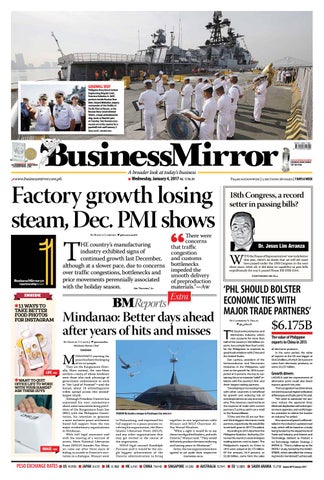
GOODWILL VISIT
Philippine Navy Naval Combat Engineering Brigade Cmdr. Francisco Gabudao Jr. (left) gestures beside Russian Rear Adm. Eduard Mikhailov, deputy commander of the Flotilla of Pacific Fleet of Russia, as the Russian Navy vessel Admiral Tributs, a large antisubmarine ship, docks at Manila’s pier on Tuesday. Two Russian navy vessels are in the country for a goodwill visit until January 7. Story on A3. AP/Aaron Favila
media partner of the year
United nations
2015 environmental Media Award leadership award 2008
BusinessMirror A broader look at today’s business
www.businessmirror.com.ph
n
Wednesday, January 4, 2017 Vol. 12 No. 84
Factory growth losing steam, Dec. PMI shows
T
By Bianca Cuaresma
@BcuaresmaBM
he country’s manufacturing industry exhibited signs of continued growth last December, although at a slower pace, due to concerns over traffic congestions, bottlenecks and price movements perennially associated with the holiday season. See “Factory,” A2
inside
There were concerns that traffic congestion and customs bottlenecks impeded the smooth delivery of preproduction materials.”—Aw
@awimailbox Mindanao Bureau Chief
life
d1
want to quit office life to work with your hands? ask these guys
image
18th Congress, a record setter in passing bills?
Dr. Jesus Lim Arranza
W
ith the House of Representatives’ vow to do better this year, there’s no doubt that we will see more laws passed under the 18th Congress in the next three years. After all, it did show its capability to pass bills expeditiously the way it passed House Bill (HB) 4144. Continued on A11
‘PHL should bolster economic ties with major trade partners’ By Catherine N. Pillas
By Manuel T. Cayon |
d4
M
Conclusion
INDANAO’s yearning for peace has been the longing of its tri-people. They are the Bangsamoro (literally, Moro nation), the non-Moro settlers—many of whose forebears were those who took advantage of government endorsement to work in “the Land of Promise”—and the lumad, about 18 ethnolinguistic tribes spread across this secondlargest island. Although President Duterte has expressed his own commentary about some noncomforming provisions of the Bangsamoro basic law (BBL) with the Philippine Constitution, his intention to generate a more inclusive peace settlement found full support from the two major revolutionary organizations in Mindanao. With full legal assurance and with the waiving of a warrant of arrest, Moro National Liberation Front (MNLF) founder Nur Misuari came out after three years of hiding to accede to Duterte’s invitation to a dialogue. Misuari went
PESO exchange rates n US 49.7690
Pigeons fly beside a mosque in Parañaque City. NONIE REYES
to Malacañang, and expressed his full support to a peace process involving his organization, the Moro Islamic Liberation Front (MILF), and any other organizations that may get invited in the course of the negotiation. MNLF legal counsel Randolph Parcasio said it would be the single biggest achievement of the Duterte administration to bring
together in one negotiation table Misuari and MILF Chairman AlHaj Murad Ebrahim. “What a sight it would be to see these two dignified leaders, and with Duterte,” Misuari said. “They would definitely produce the most enduring and lasting peace in Mindanao.” So far, the two organizations have agreed to set aside their respective Continued on A2
business news source of the year
P25.00 nationwide | 5 sections 28 pages | 7 days a week
BMReports Mindanao: Better days ahead after years of hits and misses T
11 ways to take better food photos for instagram
2016 ejap journalism awards
@c_pillas29
He local semiconductors and electronics industry, which now accounts for more than half of the country’s $46-billion exports, has a simple New Year’s wish: for the Philippines to maintain its good trade relations with China and the United States. Dan Lachica, president of the Semiconductor and Electronics Industries in the Philippines, said even as the growth for 2016 is projected at 6 percent, the key to sustaining this is to maintain “solid” relations with the country’s first- and third- largest trading partners. “Developing or increasing trade with other countries is beneficial for growth and reducing risk of overdependence on any one economy. This, however, need not be at the expense of trade with current partners,” Lachica said in an e-mail to the BusinessM irror. “China and the US are our firstand third-biggest electronics trade partners, respectively. We would like to see both grow in 2017,” he added. According to 2015 data from the Philippine Statistics Authority, China was the country’s second-largest trading partner, next to Japan. The Philippines’s exports to China in 2015 were valued at $6.175 billion. Of the amount, 54.9 percent, or $3.38 billion, came from the sales
$6.175B The value of Philippine exports to China in 2015
of electronic products. In the same period, the value of exports to the US was bigger at $9.023 billion, of which 39.4 percent came from electronic products, or some $3.557 billion.
Growth drivers
Lachica said the improvement of alternative ports could also boost exports growth this year. “Port congestion has diminished, we need to pursue higher utilization of Batangas and Subic ports,”he said. “We need to automate the process; reduce the approval time; eliminate duplication with other government agencies; and certify logistics providers to relieve the burden on industry,” he added. New sources of growth will be detailed in the industry’s updated road map, which will be based on a study being funded by the departments of Trade and Industry and Science and Technology, dubbed as Product a nd Technology Holistic Strategy 2 (PATHS 2). “This is a follow-up to the PATHS 1 study, funded by the USAIDSTRIDE, which identified the emerging trends I mentioned,” Lachica said.
n japan 0.4233 n UK 61.1860 n HK 6.4161 n CHINA 7.16440 n singapore 34.3282 n australia 35.7441 n EU 52.0833 n SAUDI arabia 13.2738
Source: BSP (3 January 2017 )
BMReports BusinessMirror
A2 Wednesday, January 4, 2017
www.businessmirror.com.ph
Mindanao: Better days ahead after years of hits and misses Continued from A1
positions in the peace negotiations in the past, when the MNLF eventually signed a peace treaty in September 1996 and the MILF in 2015. The MNLF, on one hand, complained later that the national government reneged on many of its commitments, mainly on the proposed Marshall Plan-like economic assistance. The MILF, on the other, warned that unless the BBL is signed sooner, peace would begin to take its own critical distance anew. It was the pan-Arabic Organization of Islamic Cooperation that gathered the two organizations in 2006 to strike a common position in negotiating an aceeptable peace settlement in Mindanao, and this tripartite meeting has produced consensus points that they wanted the government to consider for a more inclusive peace pact. The Office of the Presidential Adviser on the Peace Process reported that the two revolutionary organizations have held their grounds on a promising atmosphere of confidence and cooperation,
Factory. . .
Continued from A1
This was evident in the Philippines’s Purchasing Managers’ Index (PMI) for December, which—while still on the growth path—fell for the third straight month. On Tuesday regional business media organization Nikkei and international think tank IHS Markit announced that the country’s PMI dropped further to 55.7 from 56.3
APPARENTLY, his aggressive push for peace helped Duterte to mount a massive police and military push against the Abu Sayyaf Group (ASG) in the country’s southern backdoor. The ASG has mounted successful sea piracy, the latest attack of which is on a South Korean cargo vessel that sailed over the Moro Gulf. W hi le mi litar y operations against the ASG remained to this day, another terror band in Lanao del Sur, the Maute Group surfaced. This group occupied Butig town, in what the military described as a propaganda move to gain global contact with and logistical support from the Islamic State of Iraq and
Syria (Isis). The President has made repeated warning to the nation that it would be facing a more dreaded war on terror than the war on illegal drugs that he has mounted. He said his war on illegal drugs was not far from the antiterror campaign that the nation would be facing soon, saying that the method of attacks and killings of captives smacked of drug-crazed individuals. By talking with President Joko Widodo of Indonesia and Prime Minister Najib Razak of Malaysia, Duterte has initiated the crafting of a trinational sea security blanket against sea piracy. The President begged off from disclosing the details of the plan, citing confidentiality issues. Duterte’s anti-illegal-drugs campaign has incidentally downgraded the strength of political warlords in the South, which past presidents had conceded to be difficult turfs to demolish. The influence of these warlords, however, seemed to remain in place, after Philippine National Police chief Dir. Gen. Ronald M. de la Rosa disclosed that a planned raid on a northwestern Mindanao
last November. This is the third month in a row that the Philippines’s PMI saw a slower expansion. The PMI is a composite index calculated as a weighted average of five individual subcomponents. The components include new orders, which weigh the most at 30 percent of the index; output, 25 percent; employment, 20 percent; suppliers’ delivery time, 15 percent, and stocks of purchases, 10 percent. Readings above 50 signal an im-
provement in business conditions on the previous month, while readings below 50 show deterioration. Despite being above 50—indicating expansion during the period—and still the fastest PMI in the Asean, the Philippines’s index hit the lowest in four months. Total new orders, input buying and employment rose at slower rates for the month. “ The Philippines continued to see strong improvements in manufacturing conditions dur-
while the cease-fire with the MILF has also been holding. Meanwhile, Duterte’s main peace foray with the National Democratic Front has helped stayed the peace in the rest of Mindanao, to the relief of banana plantation owners, for instance, who expressed wishes for the President to reopen negotiations with the revolutionary organization.
Drugs, terrorism
city was called off after the plan was leaked. The area was believed to be one of Mindanao’s biggest source of methamphetamine hydrochloride, or shabu. Nonetheless, Duterte’s antiterror and anti-illegal-drugs campaign was not without a price. Last September 2 a crude bomb, improv ised from two mortar rounds wrapped together, was exploded at a night market area along Roxas Avenue in Davao City, killing 15 and wounding 71 others. While it was the only significant bombing linked to alleged retaliation by either the terror groups or the drug personalities, Duterte has considered it to be a foreboding of more terror attempts in the country. But the two Moro revolutionary organizations have assured of their cooperation and respective moves to contain the threat from local terror groups.
WHILE there have been acrid resistance to the administration’s war on illegal drugs, some foreign organizations, including the World Bank, has assured of their continued
presence and assistance to the underprivileged sectors of society. The state and these groups have agreed to continue pouring aid to the former conflict areas, while the peace process remained in place despite threats of outbreak of violence. The world’s second-biggest lender has said bringing more residents in the conflict areas to partake of the fruit of development may help increase the inclusion of the poor in the overall economic growth, of which the Philippines was expected to log figures higher than well-performing economies in Asia. At least the Japan International Cooperation Agency is known to have kept its assistance pouring to cooperatives and associations, including those formed by former combatants and their families. The Japanese Embassy said it has already crafted a second phase of its own assistance program for Central Mindanao. T he Ba ngsa moro Develop ment Agency (BDA), the economic arm of the MILF in the peace negotiation, said projects have been continuing and have significantly helped reduced the political and economic tension in
the communities that previously fuelled insurgency. Diplomatic officials said Japan has provided options aside from the taking up of arms, which was the only choice for some Mindanaoans back then. While projects were as small as growing freshwater fishes in fishponds or providing scholarships for higher education, the BDA reported that these became venues for even former combatants to stay in the communities and help in the livelihood. In the rest of Mindanao, bigticket projects have been sprouting in major cities, while the national government has prepared possible venues for multimillionpeso public-private partnership (PPP) ventures. According to the Mindanao Development Authority, the government’s socioeconomic planning unit for Mindanao, the PPP is for the construction of more seaports and highways. Political and business leaders have also expressed their wish for projects to be implemented faster, while the anticorruption atmosphere blankets the Philippines’s second-largest island-group.
ing December, where robust client demand underpinned the PMI,” IHS Markit economist Bernard Aw said. “Meanwhile, there were concerns that traffic congestions and customs bottlenecks impeded the smooth delivery of pre-production materials,” he added. The economist—who is part of the team that compiles the data on the monthly PMI—further noted that on the prices front, Philippine manufacturing companies faced
the sharpest rise in cost inflation last December, as a combination of peso weakness and higher costs for raw materials lifted input prices. “If this continues, manufacturers’ profit margins may come under pressure in the coming months,” he warned. Particulars of the monthly survey showed that the expansion in output was led by greater new orders placed at local manufacturing firms, indicating strong client appetite.
Client demand from foreign markets, meanwhile, continued to strengthen at the end of the year, but at a slower pace after expanding at a record high rate last November. More notably, job creation in the sector for December was the slowest since August last year. The average lead times also lengthened for the first time in the series’s history in December, with firms blaming port congestions and custom bottlenecks as factors.
Inclusion of the poor
The Nation BusinessMirror
news@businessmirror.com.ph
Pa seeks custody of two kids from estranged wife
A
50-year-old father has asked the court to regain custody of his two children from his wife who is now allegedly living in with another married man. JR Rodriguez, a photographer, filed an adultery case against his wife, Arianne Blanche, before the Manila Prosecutor’s Office, claiming that Blanche violated Article 333 of the Revised Penal Code (RPC) for allegedly living with businessman Michael Angel Rocha at his loft at Rosaria Apartments at 1745 Adriatico Street, Malate, Manila. In his complaint, Rodriguez alleged that he married Blanche in 2004, three years after they met in Bohol. During their marriage, Blanche bore two children and he, in turn, recognized her child born out of wedlock as his own. Rodriguez said things began to turn sour between them when, in 2013, he confronted Blanche when he discovered that she had a sexual tryst with a Swedish national, Jonatan Hoglund, whom she just met at a seamen’s convention in Manila. He claimed Blanche admitted her indiscretion but it took a year before she finally left their conjugal house in Quezon City. Rodriguez said Blanche is now the live-in partner of Rocha, a businessman and president of a maritime recruitment agency. She allegedly lives in with Rocha with her two children with Rodriguez and another one who was born out of wedlock. Rocha is previously married to a foreigner who gave him a daughter. Rocha’s estranged wife is living with their daughter in Boracay. Rodriguez asked the court to separate his children from the house of Rocha, saying the allegedly adulterous relationship is a bad influence to his growing children, who are in their early teens. Joel R. San Juan
Editor: Dionisio L. Pelayo • Wednesday, January 4, 2017 A3
Group asks Duterte to fire Pernia, allies in Cabinet over SSS pension increase
T
By Marvyn N. Benaning | Correspondent
HE party-list group Bayan Muna has asked President Duterte to consider sacking Socioeconomic Planning Secretary Ernesto M. Pernia and his Cabinet allies for refusing to allow the P1,000 pension increase for Social Security System (SSS) retirees. Party-list Rep. Carlos Isagani T. Zarate of Bayan Muna and Neri Colmenares, the group’s chairman, in a statement also urged Duterte to immediately sign the P2,000 SSS pension increase, “as this only translates to P66 per day for the much-needed additional fund for our senior citizens food, maintenance medicine and other expenses”. Pernia opposes practically all of Duterte’s policy pronouncements, including his vow to ensure rice self-sufficiency; his pledge to stop land conversions to prevent more arable land from being transformed into commercial centers, residential subdivisions and industrial parks; and his commitment to raise the monthly pension of SSS retirees, Bayan Muna argued. He has allegedly recruited Finance Secretary Carlos G. Dominguez III and Budget Secretary Benjamin E. Diokno in recommending that Duterte scrap the planned SSS pension increase. Zarate and Colmenares accused the three Cabinet members of “junking and sabotaging [a] Congressional measure to give immediate relief to millions of SSS pen-
sioners now and in the future.” “The concession to give the pension increase in two tranches, upon strong representations by the new SSS leadership, was, in fact, allowed by Congress, so that the SSS can still raise more funds. Thus, it is utterly ridiculous for the three Cabinet secretaries to say that the agency would go bankrupt,” Zarate said. “In fact, with the initial P1,000 increase beginning this month, that would mean just P33 per day of additional funds for the elderly pensioners,” he added. Zarate, one of the principal authors of House Joint Resolution 10 granting the increase beginning January 2017, condemned the sabotage operations of the Pernia cabal. “During the House and Senate hearings, SSS Chairman Amado Valdez even explicitly said the P1,000 initial pension increase can be done as early as December 2016 and the SSS would not go bankrupt. He even added that raising membership premium is also the least, even last, of the options to raise the funds of the agency. Furthermore, if at all, government subsidy for the pen-
National Economic and Development Authority building
sion fund as provided for by the SSS Charter is even higher in their options,” he added. “It is also not unfair to future pensioners because the P2,000 pension hike bill and the subsequent Joint Resolution 10 states that, through this legislation, the base of the SSS pension would be raised so all pensioners from now on would enjoy higher pension,” he added. Duterte said the only thing needed for the SSS pension increase to be implemented is his signature, but added that he wants to discuss the matter to be “fair” to everybody. Pernia, Dominguez and Diokno claimed that without an accompanying SSS premium increasae, the proposed pension increase would
unduly jack up the unfunded liabilities of the fund from P3.5 trillion to P5.9 trillion. “This is the same scare tactic used by the previous SSS administration. It would be well for the three Cabinet members to stop scaring the people, especially the President, for this phantom adverse effect once the current pension is increased,” Zarate added. Meanwhile, Colmenares said that “the Cabinet secretaries should stop trying to delude the people and Duterte that it has no funds for the P2,000 pension increase because this is not true. They are trying to sabotage the distribution of the P2,000 pension increase, even if it has actually admitted several times that it has the funds for the pension
increase. At most, the increase will only shorten the SSS fund life to 2025-2029, instead of the current 2042,” he added. “Assuming this is true, 14 years is more than enough time for the government and the SSS to find ways to increase its fund life. In 2001 the SSS declared that it has a fund life of only five years and yet it was able to increase this to 2042 in just 14 years. If it previously survived a five-year fund life, then surely it can also survive a 14-year fund life. Truthfully speaking, we are in a better shape than the United Kingdom, which has a fund life of only up to 2027, and Canada, which has a fund life of 2022 or merely seven years,” Colmenares added.
Bulacan to come up with product standard for fireworks Arson eyed in Red By Catherine Joy L. Maglalang Correspondent
C
ITY OF MALOLOS—Bulacan Gov. Wilhelmino M. Sy-Alvarado will issue within the year an executive order that will set the product standard for local fireworks. Sy-Alvarado also asked the Sanguniang Panlalawigan to come up with a resolution providing for the determination of the product standard for pyrotechnic products made in the province, so that manufacturers can come up quality products that are safer to use.
During a recent fireworks stakeholders consultative meeting, manufacturers and dealers explained that lack of product standards has prvented them from coming up with uniformquality products. Lea Alapide, former president of the Philippine Pyrotechnics Manufacturers and Dealers Association Inc. (PPMDAI), explained that, “If the provincial government of Bulacan through its Pyrotechnic Regulatory Board can come up with a product standard for pyrotechnic products similar to the PS Mark issued by the DTI [Department of
Trade and Industry], then many could afford to have their products be certified to be of good quality.” On the other hand, Celso Cruz, PPMDAI chairman emeritus, noted that 90 percent of local fireworks manufacturers still use potassium chlorate, a chemical ingredient of fireworks already banned in other countries for over a hundred years. He pointed out that potassium chlorate, sulphur and aluminum are the main chemicals that traditional manufacturers use in making firecrackers. Potassium chlorate is very unstable
when mixed with other chemicals and has the tendency to heat up and explode when it makes contact with water. Cruz noted that potassium chlorate has been replaced by potassium perchlorate in manufacturing fireworks in other countries. However, Cruz pointed out that local chemical dealers still sell potassium chlorate to fireworks manufacturers. The governor said he will sign an executive order once the Sanguniang Panlalawigan has come out with a resolution for the product standard for pyrotechnic products.
Russia seeks close defense ties with Philippines
R
USSIA wanted to maximize its newly minted defense and security relations with the Philippines by holding bilateral war games with the Armed Forces, either on Russian soil or Philippine territory. Rear Adm. Eduard Mikhailov, deputy commander of the Russian Pacific Fleet, said Russia wants to duplicate the exercises that its military has been been holding with other Southeast Asian countries by holding a joint maritime-training exercise with the Philippines. “For sure, in the future, we’ll have exercises with the Philippines,” said Mikhailov, who headed the personnel of the Russian antisubmarine destroyer Admiral Vladimir Tributs and an oiler that are currently docked at the South Harbor for a five-day goodwill visit. “Our government will discuss…the possibilities of our maritime exercises… maybe just only manuevering or maybe use of combat systems and so on,” he said. Tributs and its oiler’s visit to the country was the first for Russia in four years, as both countries work for stronger defense relations under President Duterte’s “East-leaning diplomacy,” with principal focus on China and Russia. Both Russia and China have expressed their readiness to help the Philippine military pursue its capability-upgrade program by offering to become its source of weapons and other military assets and equipment. For one, Russia is even willing to sell submarines, drones and sniper rifles to the Philippine military. Rene Acosta
It is more blessed to give thaN... Residents of various barangays of Las Piñas City receive gifts in an event sponsored by Mayor Imelda T. Aguilar and the city council held at Verdant Covered Court recently. Aguilar personally distributed the gifts to thousands of attendees.
Cross building fire
A
FIRE of still undermined origin razed the old Philippine Red Cross (PRC) building at the disputed Olongapo Civic Center Complex before the New Year. The fire destroyed important Red Cross files and documents that were being kept in the facility. It was put out an hour and a half later. Red Cross officials, however, are harboring suspicions of a possible arson since the building was unmanned and its power connection already cut off prior to the incident. They are also wondering why the police and fire authorities were taking so long to file an official report regarding the cause of the fire. “The fire, to us, is highly suspicious, both to the timing and the circumstances obtaining prior to the incident,” PRC Secretary-General Oscar Palabyab said. The PRC building was constructed in the 1970s near the site of the former public hospital and housed the PRC blood bank and chapter office before transferring to its newly constructed building on Magsaysay Avenue three years ago. It was the only structure left standing in the complex after nearby buildings had been demolished to give way to a development project. “The city government had earlier asked us to vacate the premises as it has committed that area to a business group. We have been in the premises for a long period of time and have taken good care of the premises ever since. While we constructed a new building on Magsaysay Avenue in Olongapo City, our local chapter is still operating and using the old building for our operations. We are, therefore, resisting the move to relocate us to another place, which is not even ready nor available. The growing population of the city needs the space to augment the services offered by our local chapter,” Palabyab explained. Palabyab has asked the Olongapo fire marshal, Supt. Bobby V. Baruelo, to conduct an immediate and impartial investigation to dispel any doubt of a possible arson. “We are apprehensive and are at a quandary as to the circumstances surrounding this incident and we cannot help but fear that this fire was not accidental nor due to any negligence on the part of our local chapter,” Palabyab said in his letter to the local fire chief. He said the PRC renders assistance round-the-clock during disasters and calamities with the help of volunteers all over the country. “It is ironic that the PRC becomes a fire victim itself as we have been a partner of the Bureau of Fire Protection in combating fires using our own fire trucks and water tankers, as well as in the transport of injured victims to hospitals with our ambulances all over the country,” Palabyab said. Claudeth Mocon-Ciriaco
Economy BusinessMirror
A4 Wednesday, January 4, 2017 • Editors: Vittorio V. Vitug and Max V. de Leon
Subcontracting is the norm in mining sector–PSA data By Cai U. Ordinario @cuo_bm
M
ore than half of mining firms subcontracted their activities and services as of June 2014, according to the Philippine Statistics Authority (PSA). PSA data showed 56.4 percent of establishments in mining and quarrying subcontracted works and employed 9,073 agency-hired workers during the period. “There were 23 establishments that outsourced their manpower to perform job activities outside the premises of the establishment,” the PSA added. PSA data also showed that four out of nine nonregular employees, or 43.9 percent, which translates to 6,006 people, are contractual or project-based workers. Around four out of 13, or 31.7 percent, which is equivalent to 4,335 people, were considered seasonal workers. The rest had shares of less than 20 percent each: casual workers, 16.9 percent; probationary workers, 6.8 percent; and apprentices or learners, 0.8 percent. The establishments were able to do this because the majority of
the 1,481 job vacancies in the sector are easy to fill. The PSA said about 70.7 percent of these job vacancies were easy to fill and 29.3 percent were regarded as hard-to-fill occupations. The top hard-to-fill vacancies identified in the industry were earth-moving and related plant operators; motor-vehicle mechanics and related trades workers; and geologists and geophysicists, along with mining and quarrying laborers. The list of hard-to-fill jobs also includes miners and quarry workers, as well as safety, health and quality inspectors. As of June 30, 2014, there were 195 establishments in the mining and quarrying industry all throughout the country. Total work force in the industry stood at 40,407 during the period, the majority of whom were paid workers (99.7 percent, or 40,269), while the rest were working owners or unpaid workers (0.3 percent, or 138). The PSA obtained the data from the results of the 2013/2014 Integrated Survey on Labor and Employment (ISLE)—a nationwide sample survey covering 8,399 establishments with 20 or more workers.
briefs dti bares 2017 plans for western visayas msmes ILOILO CITY—The Department of Trade and Industry (DTI) here is urging micro, small and medium enterprises (MSMEs) to level up and be more competitive, as it also lined up major initiatives this 2017 to boost local entrepreneurs. DTI Officer in Charge Regional Director for Western Visayas Rebecca M. Rascon said they will be negotiating with malls for the display of DTI-assisted products under the One Town, One Product (Otop) initiative. “We would like to elevate them from where they are. We will see to it that the best of the best will be displayed there,” she said, adding that there is no showroom in the region where Otop output can be displayed, except in Sarabia Manor Hotel and at the PhilExport in Mary Mart Mall. With this, she encouraged MSMEs to come up with competitive products. “If you don’t make your products of the right quality, of the right quantity, then you will be left behind,” she said. Rascon said they are coordinating with the private sector, such as the Iloilo Economic and Development Foundation (ILED) and the Small and Medium Enterprise Development Council, in trying to identify products that should be given priority. “We also get in touch with the private sector in determining what sectors should be pursued for every province. ILED is a strong house of information for that,” she said. The DTI this year is also bent on pushing for more support to MSMEs through the shared service facilities, which Rascon said paves the way for inclusive growth; and “mentor me” project, which allows small enterprises to thrive. Rascon then urged the local media to “monitor and document success stories” of local government units and individuals they have assisted. PNA
boracay targets 2 million tourists for this year
BORACAY Island, Aklan—The Aklan Provincial Government is targeting around 2 million foreign and local tourists this year. Niven Maquirang, Jetty Port administrator, said on Tuesday they have reached the projected 1.7 million, or 1,724,125, tourists registered for 2016. First on the list of top 10 foreign arrivals are still South Korea, with 292,869; China, 259,439; Taiwan, 53,208; Malaysia, 24,465; the United States, 21,274; Australia, 14, 883; the United Kingdom, 14,397; Australia, 11,978; Russia, 9,834; and Singapore, 9,724. Maquirang said they anticipate an influx of tourists coming this year, as Boracay is considered an official venue for the 50th year Asean summit in the first quarter. Reports said around four meetings of both senior and ministerial officials are being allocated. “Boracay also remains to be considered a cruise ship-tourist destination in Asia Pacific," Maquirang said. PNA
Duterte told: Drop coal ‘addiction’, shift to RE
A newly inaugurated 150-megawatt clean-coal power plant at its inauguration last November. Groups on Tuesday reiterated their call to President Duterte to get rid of the country’s dependence on “dirty” coal and shift to renewable energy. Nonie Reyes
By Jonathan L. Mayuga
M
cebu city sets jan. 6 launch of sinulog festivities
@jonlmayuga
embers of civil-society and renewable-energy (RE) advocates renewed their call for a review of the country’s energymix policy to veer away from “dirty coal” for good.
They said the Duterte administration should abandon dirty, deadly and costly energy, and support the development of RE, such as solar energy, which is now becoming the world’s cheapest source of electricity, based on a latest report Citing a recent report from the Bloomberg New Energy Finance (BNEF), a team of experts in cross-sectors and cross-geography trends spread across six continents, said solar now outranks wind as the cheapest form of RE, and is outperforming coal and gas, as well. The report showed that solarenergy prices in China, India, Brazil and 55 other emerging-market economies have dropped to about one-third of its price in 2010. This was attributed largely to China’s massive deployment of solar, and the assistance it had provided to other countries financing their own solar projects. As such, Gerry Arances, head
convener of the the Center for Energy, Ecology and Development (CEED), said the government can no longer hide under the guise of development in its support for coal. “This latest report from the renewable-energy sector confirms that not only does solar energy provide cleaner energy, but more sustainable and cheaper electricity for all,” he said. According to Arances, the Duterte administration should invest heavily on RE, instead of allowing coal companies to put up more coal-fired power plants. “Aside from cheaper electricity, solar energ y that is gathered and distributed through c o m mu n it y - m a n a g e d ‘m i n i grids’ can also solve the problem of energ y’s costliness and riskiness in the countr yside,” Arances said. “Increased government support for solar energy would also enable communities in far-flung areas to
finally be electrified, something that coal, which relies heavily on large megagrids for distribution, has failed to do,” he added. The increasing economic cost of coal, as projected by economic experts as stranded assets, will place most Filipinos at a disadvantage, since they will end up paying more for electricity generated from coal power plants in the next 25 years in their electric bills, as the technology is becoming more and more obsolete. “Despite this, the Department of Energy’s [DOE] Philippine Energy Plan [PEP] leads us to relying on more coal for the next 15 years, instead of transitioning away from it,” Arances noted. According to the PEP, coal is set to have a big share in the country’s primary energy supply, even under a low-carbon scenario, with coal still having a growth rate of 4.8 percent, giving it a 25.2-percent average share in the primary energy supply,” he said. Various sectors have expressed dismay over the Duterte adminis-
tration’s policy on energy, which has welcomed the inauguration of more coal-fired power-plant projects (CFPPs) in the Philippines, including those attended by the President himself, like the 405-megawatt CFPP in Villanueva, Misamis Oriental, last September, and the 135-megawatt CFPP in Concepcion, Iloilo. “The Duterte administration has, so far, failed in distinguishing itself from [former President Benigno S. Aquino in the issue of energy,” Sanlakas Secretary-General Aaron Pedrosa said. “For many years, administrations have continually undermined and even mocked the capacity of renewable energy, to replace dirty energy from coal as our primary source of energy in spite of the adverse effects of coal to the health and livelihood of communities affected by coal mining and coal use,” he continued. Pedrosa cited the experience of mining-affected communities in Semirara, Antique, whose ecology and livelihoods were destroyed, along with the destruction of the environment. He also pointed out that coal’s dirtiness and deadliness is also manifested in the particulate matter released in the air by coal-fired power plants and the various toxic chemicals it releases in the water. “A study by the Harvard University on the emissions of toxins and carcinogenic compounds from coal plants confirms the correlation of local morbidity and mortality in Naga, Cebu, where cancer and URTI are higher than national averages,” Pedrosa stated. “Despite this, 69 more coal power plants are set to add to the 41 existing coal power plants in the Philippines,” he continued. T he unreasonable and unfounded dependence of our country’s energy policy on coal can only be described as an addiction,” Pedrosa said. “Coal addiction must stop. Thus, we urge [Mr.] Duterte to immediately cancel the permits of new coal power plants and review the country’s overall energy policy,” he said.
This latest report from the renewable-energy sector confirms that not only does solar energy provide cleaner energy, but more sustainable and cheaper electricity for all.”—Arances
Bill proposes titling of lands occupied by public schools in favor of DepEd By Jovee Marie N. dela Cruz @joveemarie
CEBU CITY—The Cebu City government is set to launch the Sinulog festivities with a Mass on Friday, January 6, an official said. Ricky Ballesteros, Sinulog Foundation Inc. (SFI) executive director, said the Mass will be held at the Basilica Minore del Santo Niño, home of the Santo Niño de Cebu. Ballesteros said this will be followed with a parade to the Cebu City Sports Center (CCSC) on Osmeña Boulevard, Cebu City. The Sinulog Grand Parade will be held on January 15, Sunday, with a total of 22 dancing contingents, including four out-of-town contingents. He said the stage at the CCSC, where the contingents will perform for final judging, is now undergoing construction and is set to be completed before the Sinulog sa Kabataan on Saturday and Sunday. Earlier, the city government reduced the distance of the Sinulog carousel route from 6 kilometers to only 4 km, so that the parade will be finished before 5 p.m. As this developed, Nagiel Banacia, head of the city’s disaster-reduction management body, said street parties during the Sinulog will only be allowed 200 meters away from the parade route. Banacia said this is intended to avoid a repeat of previous Sinulog celebrations, where partygoers and revelers crowded the parade route. Millions of people, both foreign and local, are expected to attend the Sinulog festivities. PNA
news@businessmirror.com.ph
T
O address the huge backlog on school buildings, the chairman of the House Committee on Housing and Urban Development has filed a bill providing for the summary titling of real properties occupied by public schools. In House Bill (HB) 4350, PDPLaban Rep. Alfredo B. Benitez of Negros Occidental said education has always taken up the largest chunk of the government’s budget, but there are still a number of factors that impede the delivery of quality education. “One of these impediments is the backlog on school building, which impacts on the Filipinos’ right to access quality education. Adding to this problem is the fact that a number of school sites are unregistered and are subjected to disputes, frequent transfer of locations and/
or revocation of donations of lands where they are situated. Some of the sites that were donated lack proper legal documentation of transfer of ownership to the Department of Education [DepEd], which results to the land disputes filed by some of the relatives of the donors,” the lawmaker stated. “There is a need to effectively address the ownership controversies by providing for the summary titling of real properties used as public school sites in favor of the DepEd,” Benitez added. According to Benitez, the measure would effectively address the issue on the ownership of several school sites in the country while declaring that the DepEd will be the prima facie owner of all unregistered qualified school sites. Despite the availability of funds for school buildings, he added, the implementation of educationinfrastructure program has been
delayed by various legal impediments resulting from questioned ownership of lands used as publicschool sites. “Some of the school sites that were donated lack proper legal documentation of transfer of ownership to the DepEd, which results to the land disputes filed by some of the relatives of the donors,” Benitez said. “The enactment of this proposed policy shall respond to the problems over land disputes over school sites and, more important, allow school administrator to focus in the improvement and efficient delivery of quality education to their students instead,” he added. HB 4350 seeks to provide for the titling of public-school sites not yet owned by the government in favor of the DepEd to ensure legal ownership by government. At the same time, the bill directs the government to guarantee
prompt payment of just compensation for the acquisition of real property, where public-school buildings and other educational infrastructure have been erected. Under the bill, qualified school sites are lands that have been utilized at least five years before the effectivity of the law, which are “of public domain” or “are owned, whether registered or otherwise, by persons or entities other than the DepEd.” The measure also provides that all pending legal cases will be litigated under summary proceedings with the DepEd needing only to “establish that the school site is untitled” and had been used as school site for at least five years. The bill said the DepEd is exempted from payment of all related costs, fees and taxes to the national government and its entities in its bid to acquire the title of real-estate properties.
Agriculture/Commodities BusinessMirror
news@businessmirror.com.ph
Editor: Jennifer A. Ng • Wednesday, January 4, 2017
A5
‘Growth in farm production flat in 2016’
Davao fish landings down 75% in 2016 By Manuel T. Cayon
@awimailbox Mindanao Bureau Chief
D
Residents cut the roots of a tree after being uprooted by Typhoon Nina (international code name Nock-ten) in Mabini, Batangas, a day after Christmas Day. The powerful typhoon slammed into the eastern Philippines on Christmas Day, spoiling the biggest holiday in Asia’s largest Catholic nation. AP/Bullit Marque
F
By Jasper Emmanuel Y. Arcalas
@jearcalas
arm-production growth in 2016 would likely be flat as strong typhoons such as Nina (international code name Nock-ten) caused farmers to incur huge losses, according to Agriculture Secretary Emmanuel F. Piñol. Piñol’s latest projection is nowhere near his earlier forecast of a 3-percent to 5-percent farm-production growth for the year. “I would not be very optimistic at this point because just look at the abaca industry, it was wiped out. The coconut plantations in Quezon and Bicol regions were also affected,” he told reporters in an interview on Tuesday. “So realistically, the growth [for 2016] is less than 3 percent, a reduction of about two to three [percentage points] from our original projection. If we can post flat growth, that would be okay with me,” Piñol added. For the fourth quarter of 2016, the Department of Agriculture (DA)
chief also cut his projection to 5 percent from the previous 7 percent to 8 percent. “I have to admit we have to make some adjustments because Camarines Sur was greatly devastated [by Typhoon Nina],” he said. Data from the Philippine Statistics Authority (PSA) showed that farm output in January to September 2016 dropped by 1.53 percent. The 2.98-percent production increase recorded in the third quarter was not enough to offset the decline in the output in the January-toJune period. Farm-production growth in the first quarter and second quarter of the year contracted by 4.53 percent and 2.34 percent, respectively.
Agriculture production in 2015 grew by only 0.11 percent, according to the PSA.
Typhoon damage
As of January 3, figures from the DA showed that Nina damaged 385,728 metric tons (MT) of crops planted in 123,994 hectares in Regions 4A, 4B and 5. The DA said the 86,940 farmers affected by Nina lost some P5.32 billion. The typhoon damaged a total of 204,103 MT of rice crops valued at P2.25 billion. It also destroyed 104,124 MT of high-value crops, with an estimated value of P1.79 billion. The corn subsector’s losses reached 56,826 MT estimated at P608.85 million, while the livestock subsector incurred damages amounting to P56.23 million. Among all the regions battered by Nina, Region 5 posted the biggest loss at P5.25 billion, of which P2.23 billion was recorded in the region’s rice sector. Crops lost in Regions 4A and 4B reached P13.12 million and P52.94 million, respectively. “In addition, PCA Region 5 has reported a total of 1.56 million coconut trees affected [by Typhoon Nina],” Christopher V. Morales, DA chief for Field Programs Opera-
tional Planning Division, said in a memorandum to Piñol. “To date, the Regional Field Offices in coordination with concerned local government units [LGUs] are still validating the effects of Nina in Regions 4A, 4B and 5,” Morales added. President Duterte has earlier approved the allocation of an initial P500 million for rehabilitation efforts for areas affected by Nina. Some P300 million will come from the Office of the President while the rest will be sourced from the DA, Piñol said. He said about P55 million of the fund will be used for the immediate rehabilitation of the abaca industry in Catanduanes, the release of rice seeds and fertilizers for about 5,000 hectares of rice land, and repair of fisheries infrastructure. Piñol added that the DA will distribute at least 11,000 bags of certified palay seeds, 6,000 bags of hybrid-rice seeds, 3,000 bags of hybrid-corn seeds, 1,000 kilograms of vegetable seeds, 50,000 fruit tree seedlings and 30,000 tons of urea fertilizers to Regions 4A, 4B and 5. He said he has also ordered the creation of “Task Force Nina,” which would focus on the DA’s rehabilitation efforts in the affected areas.
Thank tiny bugs and China’s hungry pigs for agriculture winners
I
nvestors who defied surpluses and low prices to make winning bets on agriculture in 2016 have tiny bugs and hungry Chinese pigs to thank for their windfalls. Orange juice, which soared 34 percent, was the biggest winner for crop and livestock markets. Futures zoomed as a citrus disease shrunk fruit production. The soybean complex, which includes the vegetable oil and animal feed made from the beans, rallied as US exports to China surged. In contrast, there was pain for those who bet on cocoa or wheat, where supply remains plentiful. It was a lackluster year for the asset class as a whole—the Bloomberg Agriculture Subindex of nine components was up less than 2 percent in 2016. Still, that was the first annual advance since 2012. Goldman Sachs Group Inc. is among those predicting more gains for 2017. The bank last November recommended an overweight commodities position for the first time in four years and predicted a 12-month return of more than 4 percent for agriculture as rising demand erodes cheap supplies.
“We are at very low levels for many of these commodities, and based on valuations, I see very little downside,” said Ben Ross, co-portfolio manager, commodity strategy, at New York-based Cohen & Steers Capital Management, which oversees about $56.5 billion. “We could expect to see some deficits for the year, but markets will still have high inventories to contend with.” Here’s a closer look at some of the agriculture winners and losers:
Orange juice Prices on ICE Futures US in New York reached an all-time high of $2.275 a pound in November. The Asian citrus psyllid, the diseasespreading bug, sent fruit production in Florida down for fifth straight season, the longest slide in a century. Output in Brazil the world’s top producer and exporter, fell to the lowest in 22 years. Despite the price gains, it’s not boom times for all growers. The psyllid plague has gotten so bad that some of Florida’s farmers are giving up on the crop, and acreage has dropped
Photograph by Imaginechina via AP Images/Bloomberg News
to the lowest in 50 years. In Brazil, farmers on average sold their fruit at 36 percent below market prices because they were locked in to contracts made earlier, said Gilberto Tozatti of Araras, São Paulo-based GCONCI-Group Citrus Consulting.
Sugar, soybeans Sugar’s had a roller-coaster year, first surging as much as 58 percent to a peak in September before tumbling
into a bear market last December. Drought in A sia had meant that production was lagging behind demand, but better weather returned and crop prospects also improved in Brazil. While prices still posted an annual gain of 28 percent, hedge funds have drastically cut back their bets on further gains as many analysts predict the market will move to a supply surplus. Bloomberg News
avao City—Fish landings at the fish port comple x here d ropped by 75 percent last year due to the operation of new fish ports in other Asian countries that are nearer to the sources of tuna in central Pacific. Despite this, fish prices in the local market remain stable because the tuna caught by foreign fishing vessels are exported, according to Bureau of Fisheries and Aquatic Resources (Bfa r) Reg iona l Director Fatima Idris. “We have some 100 or so ships coming to the fish port before but recently, we only have about 25 of them,” Idris told reporters in a news briefing at the SM Ecoland here. She attributed this to the operation of new fish ports in countries like Indonesia and Guam, which are near the tuna-rich high seas pocket 1 in central Pacific. In 2009 the Davao fish-port management has expressed optimism about increasing fish l a nd i ngs here a f ter Ja k a r t a decided to regulate fishing in their waters. M a r io M a l i n a o, t he n t he Davao fish-port manager, said the Indonesian regulation would likely diver t many foreig n f i s h i n g b o at s t o u s e e it he r t he G e ne r a l S a nt o s C it y or Davao City fish port. H e added that the two fish ports
were “much more attractive” than other fish ports in Koror, Palau and Guam, due to the proximity of airports. But more vessels appear to prefer fish ports nearer to tuna sources, as the short drop in port calls by foreign fishing boats would indicate. However, Idris said the local fish market was not affected by the sudden drop in the volume of fish landings. “ These are tuna that are cut up and are exported.” The decline in the arrival of foreign long-line fishing boats wa s a lready noted in 2005, when only 504 d ocked at the port, significantly lower than the 762 recorded in 2007. It was only in 1998 and 1999 when foreign fishing-boat arrivals reached 1,282 and 1,247, respectively. Previously, Malinao said climate change and the increase in crude-oil prices discouraged both local and foreign fishing boats to go out to sea. The fish-port complex here is one of the eight operated by the Philippine Fisheries Development Authority. Two others are in General Santos City, which has become a major fishing port, and in Zamboanga City, both in Mindanao. Another fish port is located in Tanza-Esperanza, Iloilo City, in the Visayas, and in the Navotas Fishport in Metro Manila, one each in Lucena City, Pampanga and Camarines.
Government to distribute 3,000 fiberglass boats
D
avao C ity— S o me 3,000 fiberglass fishing boats wou ld be given to fishermen near Davao Gulf within two years to replace their old vessels, according to the Bureau of Fisheries and Aquatic Resources (Bfar). Di rec tor Fat i m a M. Idris of the Bfar regional office said the move is aimed at helping fishermen boost their income and to increase the number of Bantay Dagat members around the Davao Gulf to prevent fishing in municipal waters. The first batch of 1,500 boats would be distributed this year, while the remaining vessels wou ld be g iven to fishermen next year, Idris said. She added that each fiberglass boat with a fitted engine costs P60,000 and would be shared by two fishermen who will be trained to operate the vessel. Idris noted that Agriculture Secretary Emmanuel F. Piñol resorted to the same arrangement following his distribution of 300 boats and 400 boats in Davao del Norte in August last year. She said the local governments would shoulder the cou nter pa r t f u nd for t he boat-replacement program. “At least, they have to identify the beneficiaries based on some criteria, including the participation of fishermen in the regular programs
of the Bfar.” Idris said the boat replacement program would continue until the end of the term of President Duterte, as the government aims to replace all the old boats of fishermen. A s of D e c e m b e r 2016 , the Bfar listed 8,806 fishing boats being operated by 50,868 fishermen around the Davao region. The Davao Gulf is estimated to be 623,000 hectares covering 18 municipalities, five cities and four provinces in southeastern Mindanao. She said the idea of involving the fishermen in guarding the Davao Gulf was due to attempts by commercial fishing boats to fish in its municipal waters. Idris said there have been instances when t he Coast Guard and the maritime group of the Philippine National Police had to drive away Filipino commercial fishing boats from the Davao Gulf. “With report of dwindling fish stocks in the seas in Region 12, we would be expecting fishermen from there to enter the Davao Gulf,” she added. Idris said there have also been more cases of foreign f ishing boats encroaching into the Davao Gu lf, f ive years after the Bfar arrested Taiwanese fishermen in two deep-sea fishing boats in Cape San Agustin in Davao Oriental. Manuel T. Cayon
A6
Wednesday, January 4, 2017
The World BusinessMirror
‘It won’t happen,’ Trump says of North Korean missile test
F
aced with a threat from North Korea that it might soon test an intercontinental ballistic missile, President-elect Donald J. Trump took to Twitter on Monday night to declare bluntly, “It won’t happen!” Trump made his post on Twitter, where he often tests out his first thoughts on developing issues in the United States and abroad, a day after North Korea’s young leader, Kim Jong Un, declared that the “final stage in preparations” was under way for a test of such a missile. Kim offered no time frame. North Korea has routinely tested short- and medium-range missiles, with some successes and many failures, but it has so far stopped short of testing a long-range missile, which could reach Guam or the West Coast of the United States. “North Korea just stated that it is in the final stages of developing a nuclear weapon capable of reaching parts of the US,” Trump wrote, somewhat misstating Kim’s warning. Pyongyang has already tested nuclear weapons underground; the latest threat concerned what Kim called a “test launch of an intercontinental ballistic missile.” But Kim also boasted last year that the
North had conducted “the first Hbomb test,” and experts say there is no evidence for that claim. After his first Twitter message, Trump added: “China has been taking out massive amounts of money & wealth from the US in totally one-sided trade, but won’t help with North Korea. Nice!” That appeared to reflect briefings Trump has received about how Chinese leaders fear instability and collapse in the North more than the status quo. Trump takes office in less than three weeks, and a test by North Korea, if it demonstrated that the missile could, in fact, reach US shores, would present one of the first big national security tests for his administration. There was no immediate comment from either North or South Korea on Trump’s latest remarks. North Korea conducted a nuclear test in the first months of the Obama administration, turning many White House officials against the country—and against
In this undated image from video distributed on January 1 by North Korean broadcaster KRT, North Korean leader Kim Jong Un delivers a speech in Pyongyang hinting that his country may be hoping to ring in the new year with another bang—the test-launch of an intercontinental ballistic missile. KRT via AP
the concept of negotiating with it. Early in the presidential campaign, Trump said he was willing to sit down with Kim and, perhaps, have a hamburger with him. But negotiating with the North would be anathema to many Republicans, and even Obama, who was willing to talk with the leaders of Cuba and Myanmar, refused to enter negotiations with the North unless it acknowledged that the endpoint of the talks would be a nuclear-free Korean Peninsula. In his New Year’s Day speech, Kim said he would continue his country’s efforts to build a nuclear-strike capability, unless the US abandoned its “hostile” policy toward the North.
Some analysts have predicted that North Korea will conduct a weapons test in the coming months, taking advantage of leadership changes in both the United States and South Korea. How Trump would respond to such a provocation is a matter of great concern for South Koreans, who are also struggling with uncertainty in their domestic politics. South Korea’s parliament voted on December 9 to impeach President Park Geun-hye over a corruption scandal. If the nation’s Constitutional Court decides to formally remove her from office, the country will have a new election within months. New York Times News Service
Editor: Lyn Resurreccion • www.businessmirror.com.ph
‘Right to disconnect’ from work e-mail goes into effect in France
P
ARIS—If the world does not envy the French enough already for their generous vacations, universal health care, and fine food and wine, the arrival of 2017 brings this: a newly created “right to disconnect.” Though ridiculed in some quarters as a ban on work-related e-mail after hours, it is not quite that. But it is borne of the enlightened view that it is actually beneficial for people not to work all the time, and that workers have the right to occasionally draw the line when their employer’s demands intrude on evenings at home, treasured vacations or Sundays with friends and family. “Employees are more and more connected during hours outside of the office,” Myriam El Khomri, the minister of labor, said last year in justifying the need for the law. “The boundary between professional and personal life has become tenuous,” and cases of burnout are becoming more prevalent, she said. The measure is one of a raft of new laws that took effect with the beginning of the new year and that exemplify the search for compromises between preserving French traditions and making concessions to the realities of the modern world. The new provision in the labor law does not ban work-related e-mails, but does require that companies with more than 50 employees negotiate a new protocol to ensure that work does not spill into days off or afterwork hours. Some consultants have recommended that employees and managers avoid the “reply all” function on e-mails to groups so that only one person is being asked to read an email and respond, rather than half the office. Another approach recommends setting a time each evening after which employees are not expected to reply—several firms have designated the 10 hours between 9 p.m. and 7 a.m., others the 12 hours between 7 p.m. and 7 a.m.
As a country with Catholic roots, but also a commitment to personal liberties, France has had an ambivalent approach to divorce. It has long been legal, but not necessarily speedy. A new nod to modernity in French laws eases the rules for people who want to divorce. While historically France has been far more flexible than Ireland or Italy, it still required a judge to rule on each divorce. The procedure routinely took as long as a year and sometimes far longer, because cases were backed up awaiting the judicial signature. Now, if both members of the couple agree on the divorce, lawyers can draw up the divorce agreement, jointly sign the papers and have them notarized. No judges need be involved. Smoking is another area in which French habits have changed relatively little in recent years—27 percent to 28 percent of the population still lights up—but the country is now following many others in requiring “neutral packaging” for tobacco products: Instead of advertising a brand, cigarette packs sport only health warnings and photos of illnesses caused by smoking. At least two new laws demonstrate the country’s gradual move toward more sustainable products. Instead of thin plastic bags, French supermarkets and fruit vendors must substitute either bags made with a plantbased synthetic called amidon that is mixed with plastic, a thicker type of plastic bag that could be reused, or paper bags. At Monoprix, a supermarket chain, paper bags have won out and stacks of them perch precariously on stands at the ends of fruit counters. More radical is the edict that went into effect on Sunday banning the use of pesticides in public gardens and along public highways. It promises to make public green spaces safer for birds and other small animals, which are especially vulnerable to the poisons used in pest killers. New York Times News Service
After Obama’s term, some US health reforms may prove lasting
F
ISHER S, Ind i a na—Fragments of bone and cartilage arced across the operating room as Dr. R. Michael Meneghini drilled into the knee of his first patient at a hospital at dawn. Within an hour, the 66-year-old woman had a replacement joint made of titanium and cobalt chrome, and she was sent home the next day. But the Obama administration was watching over her caregivers’ shoulders. If, over three months, her medical costs exceeded a target amount set by President Barack Obama’s health regulators in Washington, Meneghini’s employer, Indiana University (IU) Health, stood to lose money. Such efforts to squeeze spending out of the nation’s health system may well remain as Obama exits the West Wing and Donald Trump takes his seat in the Oval Office. The Affordable Care Act is in peril, and Obama will meet with congressional Democrats at the Capitol on Wednesday to try to devise a strategy that can stave off the repeal that Republicans are planning. But the transformation of US health care that has occurred during the last eight years has a momentum that could prove impossible to stop. E x pa nd i ng i nsu ra nce coverage to more than 20 million Americans is among Obama’s proudest accomplishments, but the changes he has pushed have had an effect on every level of care—from what happens during checkups and surgery to how doctors and hospitals are paid, how their results are measured and how they work together. Changes in the delivery system affect far more people than the law’s higher-profile coverage gains. At IU Health, the largest healthcare provider in Indiana, leaders have started moving away from fee-for-service medicine, where every procedure, examination and
prescription fetches a price. The emphasis is on preventive care. Social work has become a larger part of the medical mission. Collaboration between doctors is becoming a necessity. And unlike Obama’s insurance coverage expansions, these changes are not in jeopardy, said Dennis M. Murphy, IU Health president and chief executive. “We’ve got to create more value in health care,” Murphy said after Trump’s election. “That principle, I think, survives.” During Obama’s tenure, big systems like IU Hea lth have gobbled up sma ller hospita ls and physician groups as the industry has consolidated, partly in response to incentives in the Affordable Care Act. Most doctors across the United States are using elect ron ic med ic a l record s. T he federal government and private insurers are rewarding hea lthcare prov iders that work together to coordinate care and avoid unnecessar y ex penses. Doctors and hospitals here are obsessed with metrics, not least because under the health law, they may be rewarded or penalized based on their performance. IU Health has more than 150 “navigators” who work with patients to help them get insurance, often through a Medicaid expansion authorized and funded by the health law and engineered in Indiana by Gov. Mike Pence, the vice president-elect.
‘Be thoughtfully aggressive’
The Affordable Care Act gave the gover nment author it y to test new models of care, and the administration has aggressively used that power to try different ways of paying for cancer care, heart surgery, primary care and other services covered by Medicare and Medicaid. Sylvia Mathews Burwell, who has been secretary of health and human services since 2014, said
Dr. Michael Meneghini (left) performs a knee-replacement surgery at the Indiana University Health Methodist Hospital in Indianapolis on September 14, 2016. Thanks to health regulations set under Obama’s presidency, Medicare now pays bonuses or imposes penalties depending on whether hospitals meet spending targets and quality standards for joint-replacement procedures. Ilana Panich-Linsman/The New York Times
20M The estimated number of Americans enrolled in the expanded health-insurance coverage
she met with Obama early in her tenure to describe payment and delivery reforms. The size and speed of some of those initiatives have provoked criticism from Republicans, including Rep. Tom Price of Georgia, picked by Trump to be the new health and human services secretary. They say the efforts t hreaten t he qu a l it y of care and exceed the authority of the
agency overseeing Medicare by requiring doctors and hospitals to participate. More than 170 House Republicans signed a recent letter of which Price was an author, urging the administration to “stop experimenting with Americans’ health.” In 2015 Obama’s administration set a goal for half of all Medicare payments to be tied to the quality, instead of the quantity, of care that doctors and hospitals provide by 2018. “What he said was, ‘Be thoughtfully aggressive,’” Burwell said.
At patients’ service and mercy
“I started drinking soda again,” confessed Wi l l ie Johnson, a 52-year-old patient with uncontrolled diabetes and high blood pressure. “How much?” asked Dr. Michael E. Busha, a primary care physician
at IU Health in Indianapolis. “Quite a bit.” For Busha, that mattered. He helps lead the IU system’s effort to measure how well doctors do at keeping patients healthy. And even this champion of “quality measures” has found it is not always easy to meet them. If enough of his patients fall below the standards set by IU Health, Busha could lose some of his income. Johnson, who registers patients when they arrive for neurology appointments at IU Health Methodist Hospital in Indianapolis, was not helping. He also had stopped taking his cholesterol medicine because it left a bad taste in his mouth. Busha is part of a team that includes a pharmacist, a social worker and a “care manager”. Such teams, encouraged by the health law, focus on patients like Johnson who are not meeting IU Health’s quality measures, and who are disproportionately likely to end up in the emergency room or be hospitalized. Partly because of these efforts, IU Health’s two adult hospitals in downtown Indianapolis are seeing 12 percent fewer inpatients than they were in 2013. The system is merging the two hospitals into a $1-billion medical center focused heavily on outpatient care. The push toward a “risk-based” model over traditional fee-forservice medicine has spread beyond Medicare and Medicaid to private insurers. Some of the experiments, overseen by an office created under the Affordable Care Act, have shown promise. But evaluating results is difficult. For e x a mple, sa id Dr. John M . T hom a s, a pr i m a r y - c a re physician at an IU Hea lth pract ice in L a fayet te, rat her t ha n r isk being pa id less because s o m e p a t i e nt s h a v e u n c o n trol led diabetes, doctors cou ld tel l t hose pat ients, “I ’m sor r y, you’re not in compl i a nce w it h
you r med icat ions, a nd I don’t wa nt to be you r physic i a n.”
A law that gives and takes
Justin Kloski learned he qualified for Medicaid under the worst of circumstances. The student and part-time lawn-company worker had lost 20 pounds, could not shake a nagging cough and was sleeping 14 hours a day when he decided to visit a clinic in Muncie, Indiana, that provides free care for the poor and uninsured. A clinic employee invited Kloski, now 28, to apply for Medicaid. A few days later, he took his new coverage to the emergency room at IU Health Ball Memorial Hospital in Muncie. A CT scan found a 15-centimeter tumor in his chest. In May 2015, he learned he had Hodgkin lymphoma. The Affordable Care Act, and Pence’s decision to go against many other Republican governors and expand Medicaid under the law, may well have saved Kloski’s life. He is among more than 400,000 Indiana residents who have enrolled in Medicaid since Pence expanded it in 2015, the 10th Republican governor to do so. In the first nine months of last year, IU Health officials said, the amount of bad debt owed by patients and referred to collection agencies totaled $233 million, a 23-percent reduction from the comparable period in 2015, thanks largely to Obama’s health law. But, officials added, these gains have been largely offset by cuts in Medicare reimbursements and other federal funds under a law that has given and taken away. Murphy is among many hospital executives anxious about the possibility of seeing a bump in uninsured patients if the health law is repealed, while not getting back the federal funds they gave up under the health law. “I do think it would be problematic if part of the deal was changed and not the whole deal,” he said. New York Times News Service
Editor: Lyn Resurreccion • www.businessmirror.com.ph
The World BusinessMirror
Wednesday, January 4, 2017
A7
Trump to name lawyer Lighthizer as top trade rep
W
A SHINGTON—President-elect Donald J. Trump is expected to nominate lawyer Robert Lighthizer as US Trade Representative (USTR), a transition official said on Monday night, filling in one of the final pieces in the new administration’s senior team. Lighthizer, who served as deputy USTR under President Ronald Reagan, would play a key role in Trump’s trade agenda. The president-elect has vigorously opposed the 12-nation Trans-Pacific Partnership pact, but has said he would ink one-onone trade deals with individual countries. Trump has also signaled a tough stance on trade with China, including levying a hefty tariff on Chinese imports. The transition official was not authorized to publicly confirm Trump’s expected decision and insisted on anonymity. Trump returned to New York on Monday after spending the holidays at his private club in South Florida. With less than three weeks until his January 20 inauguration,
Trump is expected to fill out a handful of remaining Cabinetlevel posts in the coming days. In addition to the USTR, Trump is also weighing picks to lead the departments of Agriculture and Veterans Affairs, as well as a Director of National Intelligence. In addition, Trump is still filling out some top White House positions. Trump has already signaled that he plans to spread work on his trade policies beyond USTR. His transition team has said billionaire investor Wilbur Ross, Trump’s nominee to head the Commerce Department, will play a lead role on trade. The president-elect has also named economist Peter Navarro to a newly created White House National Trade Council. Outside of government, Lighthizer has worked on trade issues as a lawyer, representing manufacturing, agricultural and hightech companies, according to his law firm biography. Lighthizer’s bio also states that he focused on “market-opening trade actions on behalf of US companies seeking access to foreign markets.” AP
A factory assembly line in China Bloomberg News
China’s factories, services cap year of gains as prices rise
C
People hold signs reading “No more gasoline price hikes” and “Peña out,” as they shut down a Pemex gas station in protest over fuel-price increases in Mexico City on January 1.
hina’s factories and services both closed out 2016 on relatively robust notes that signal growth is strong enough for policy-makers to keep pushing for economic reforms in 2017.
AP/Rebecca Blackwell
Mexicans block roads, stations to protest gasoline hikes
M
E X ICO C I T Y— Sm a l l g roups of protesters blockaded some roads and gasoline stations in Mexico on Monday to protest a government price deregulation that sent the price of fuel up by as much as 20 percent over the weekend. One group blockaded a privately owned gasoline station on Mexico City’s main boulevard, shouting: “The people, united, will never be defeated!” “This will increase the cost of living for all Mexicans. It will make more expensive transportation, basic food stuffs, food, and it will ultimately hit Mexican families,” said Rafael Sotocruz, a nurse who was protesting at the station. On a busy highway leading into the capital from the west, another group blocked traffic and held up a banner reading “Enough already!” Reports on social media and local newspaper sites suggested small, intermittent protests popped up at a half dozen other sites across the country. The Mexican government said the deregulation had long been planned, but unfortunately coincided with rising world oil prices. The deregulation is aimed at ending subsidies that the government says largely benefit wealthier Mexicans and at attracting interest in private participation in the newly opened fuel market “Unfortunately, it coincided with a significant increase in international oil prices,” said Miguel Messmacher, Mexico’s assistant finance secretary. That, and a drop in the value of the Mexican peso against the dollar in 2016, probably would have resulted in gas-price hikes last year, but the government was still setting prices then. Mexico
imports much of its gasoline, even though it exports crude oil. “It was precisely because we were limiting these [price] movements in some ways that gave rise to this pent-up increase,” Messmacher said. “These things always create bad feelings,” he added. “That is very clear, and very understandable. It is very clear to us that this is obviously an unpopular measure.” When the deregulation took effect on New Year’s Day protesters snarled traffic on one of the country’s main north-south highways. Gasoline supplies have begun stabilizing after some stations were recently left dry due to what officials described as panic buying, increased holiday demand, unforeseen shipping delays and damage to pipelines that officials blamed on a surge in fuel thefts. Authorities still haven’t explained why pipelines thefts increased so dramatically in early December, but the government was forced to increase military patrols by 60 percent to combat the thefts. Thieves steal about $1.4 billion worth of fuel products annually from pipelines operated by the state oil company, Pemex, according to official estimates. The 2017 price deregulation is part of a broader overhaul of Mexico’s energy sector passed two years ago under President Enrique Peña Nieto, allowing some private investment and ending more than seven decades of state monopoly over oil. In a second phase later this year, other companies will be allowed to begin importing and distributing gasoline instead of Pemex handling the entire supply chain. AP
The manufacturing purchasing managers index (PMI) stabilized near a post-2012 high last December, edging down to 51.4 from 51.7 the prior month. The nonmanufacturing PMI slipped to 54.5 from a two-year high of 54.7 in November. Numbers higher than 50 indicate improving conditions. A gauge of factory input prices surged to a five-year high of 69.6. “Clearly activity levels firmed heading into year-end,” said Geoffrey Yu, head of the UK investment office at UBS Wealth Management in London. “Stabilization isn’t too much of an issue right now, compared to the microlevel problems, such as liquidity, regulation and, of course, the exchange rate.” The readings capped a year of strengthening across a range of indicators and continued a reversal from the dark outlook last February, when the manufacturing gauge tumbled to 49. The economy is on pace to meet the official growth target, posting 6.7-percent expansions in the first three quarters of 2016, while factory prices have snapped four years of deflation.
Neutral monetary policy
The private manufacturing PMI
51.4
The rate of manufacturing purchasing managers index, which stabilized near its post2012 high last December by Caixin Media and Markit Economics confirmed the strength in official data. The gauge advanced to 51.9 last December, the highest since January 2013, data showed on Tuesday, exceeding the 50.9 estimate in a Bloomberg survey of economists. That’s good news for policymakers as they shift to neutral monetary policy and seek to defend against a trio of threats: a potential pickup in capital outflows after the yuan posted its steepest annual slump in more than two decades, Federal Reserve interest rate rises, and US President-elect Donald J. Trump, who has called for punitive tariffs on China’s exports.
Outflow pressure may resume after a January 1 reset of the country’s $50,000 cap on how much foreign currency individuals are allowed to convert each year. An estimated $689 billion flowed out of China in the first 10 months of 2016, a Bloomberg Intelligence gauge shows. C h i n a’s f o r e i g n r e s e r v e s , the world ’s largest stockpile, fell to a five-year low of $3.05 trillion as of November. Data scheduled for release on Januar y 7 will show the hoard fell to $3.01 trillion, according to the median estimate of economists sur veyed by Bloomberg. Authorities plan to step up monitoring of how citizens use their annual quota for buying foreign currencies, according to four people familiar with the matter. China’s central bank said on Friday it tightened requirements for lenders to report cross-border transactions by customers as part of stepped-up efforts to curb money laundering. Ma Jun, chief economist of the People’s Bank of China research bureau, said the requirement “is not capital control at all,” the official Xinhua News Agency reported on Sunday. The policy stoked concern the government is trying to impose capital controls in a disguised form, Xinhua reported.
Bears wrong
Outflows aside, the economy proved bears wrong last year. Growth picked up to about 7 percent in November, a monthly tracker from Bloomberg Intelligence shows. Economists have been raising their estimates for
2016 and 2017 growth, Bloomberg surveys show. T he manufactur ing repor t showed improving market demand and robust consumption before the New Year, the National Bureau of Statistics (NBS) said on Sunday in a supplementary statement. The cost of raw materials and logistics is the highest in recent years and is certain to impact business operations as rising corporate costs are squeezing profits, the NBS said “ PM I i nd ic ated cont i nued strength in the industrial cycle,” China International Capital Corp. economist Eva Yi wrote in a report. “Demand growth started to firm up in sectors that cater toward m a nu f a c t u r i n g i nv e s t me nt s and personal consumption. We expect further broadening of the ref lationary impulse from the upstream heavy industrial sectors to mid-to-downstream manufacturing industries.”
Other gauges
Beyond the main PMI, other early gauges also signal the economy closed out the year on a firmer footing last month. Large and small firms reported stronger momentum and the mood among executives was the brightest in two years. Sales managers had a stable outlook. The China Satellite Manufacturing Index was at 51 last month, close to November’s five-year high of 51.4, according to San Francisco-based SpaceKnow Inc., which uses commercial satellite imagery to monitor activity across thousands of industrial sites in the country. Bloomberg News
Finland to pay unemployed basic income of $587 a month
H
ELSINK I—Finland has become the first country in Europe to pay its u nemployed c it i zens a ba sic monthly income, amounting to €560 ($587), in a unique social experiment which is hoped to cut government red tape, reduce poverty and boost employment. Ol li K angas from the Finnish gover nment agenc y Kela, which is responsible for t he countr y’s socia l benefits, said on Monday that the t wo-year tr ia l w ith the 2,000 randomly pic k e d c it i z e n s who re ce ive
unemployment benefits kicked off on Januar y 1. Those chosen will receive €560 every month, with no reporting requirements on how they spend it. The amount will be deducted from any benefits they already receive. The average private-sector income in Finland is €3,500 per month, according to official data. Kangas said the scheme’s idea is to abolish the “disincentive problem” among the unemployed. The trial aims to discourage people’s fears “of losing out something,” he said, adding that the
selected persons would continue to receive the €560 even after finding a job. A jobless person may currently refuse a low-income or short-term job in the fear of having his financial benefits reduced drastically under Finland’s generous but complex social security system. “It’s highly interesting to see how it makes people behave,” Kangas said. “Will this lead them to boldly experiment with different kinds of jobs? Or, as some critics claim, make them lazier with the knowledge of getting a basic
income without doing anything?” The unemployment rate of Finland, a nation of 5.5 million, stood at 8.1 percent in November with some 213,000 people without a job—unchanged from the previous year. The scheme is part of the measures by the center-right government of Prime Minister Juha Sipila to tackle Finland’s joblessness problem. Kangas said the basic income experiment might be expanded later to other lowincome groups, such as freelancers, small-scale entrepreneurs and part-time workers. AP
A8
Wednesday, January 4, 2017
The World BusinessMirror
Singapore GDP accelerates to more than three-year high
S
ingapore’s economic growth quickened to the fastest pace in more than three years last quarter as manufacturing and services rebounded. GDP rose an annualized 9.1 percent in the three months to December 2016 from the previous quarter, when it declined a revised 1.9 percent, the trade ministry said in a statement on Tuesday.
The median estimate of nine economists in a Bloomberg survey was for a 4-percent expansion GDP rose 1.8 percent in the fourth quarter from a year earlier, compared with the 0.3 percent median estimate in a Bloomberg survey. The economy expanded 1.8 percent in 2016, the slowest pace since 2009.
Big picture
Singapore, among Asia’s mostexport-dependent nations, is seeking new growth engines to boost incomes as its population ages and trade falters. With global growth
9.1%
The increase of Singapore’s GDP in the three months to December 2016 from the previous quarter
under pressure and the US threatening to turn more protectionist
under Donald J. Trump, the outlook remains cloudy. That will be a consideration for the central bank in its April policy review after it signaled last October it will stick to its neutral currency policy for an extended period of time. “Overall, we are not doing badly, considering the global economic uncertainties,” Prime Minister Lee Hsien Loong said in a New Year message last December 31. “ W hile the labor market has eased, unemploy ment remains low and we are stil l creating new jobs.”
Market reaction
The Singapore dollar erased an earlier decline after the GDP report, trading little changed at 1.4503 against its US counterpart as of 8:44 a.m.
Economist takeaways
“I stilL think Singapore is in a ver y cha l leng ing condition,” said Edward Lee, regional head of research at Standard Chartered Plc. in Singapore, who expects 2017 growth to slow to 1.4 percent. “Exter na l conditions remain extremely cha l leng ing and we cer ta in ly have to be watc hf u l for mater ia l i zat ion
of antigloba lization and antitrade sentiment. A ny mater ia lization of that w il l f ur ther dampen the a lready ver y wea k globa l trade conditions.” “For now, my forecast is that there will be no further easing in April,” he said, referring to monetary policy. “Prospects of a more protectionist trade policy would be negative for Singapore,” which is wedded to the old export model and this will have a knockon impact on domestic incomes, said Weiwen Ng, an economist at Australia and New Zealand Banking Group Ltd. in Singapore. “Domestic demand weakness should continue to weigh on an already subdued labor market.”
Other details
The services industry, which accounts for about two-thirds of the economy, rose an annualized 9.4 percent in the fourth quarter from the previous three months. Manufacturing jumped an annualized 14.6 percent. The advance GDP estimates for the fourth quarter are computed largely from data in the first two months of the quarter, and are subject to revision when more comprehensive data become available. Bloomberg News
Editor: Lyn Resurreccion • www.businessmirror.com.ph
Riot by drug gangs in Brazil prison leaves at least 56 dead
R
IO DE JANEIRO—A prison riot involving gangs vying for supremacy over the cocaine trade in the Brazilian Amazon left at least 56 people dead, authorities in the city of Manaus said on Monday. Riots at Brazil’s prisons are common, b u t t h e e p i s o d e i n M a n a u s, w h i c h included decapitated bodies thrown over the walls of the penitentiary, ranks among the bloodiest in recent decades. Officials expressed dismay over the scenes of slaughter in the Compaj prison, which held more than 1,200 inmates, about triple its official capacity. “I never saw anything like this in my life,” Judge Luís Carlos Valois, who helped negotiate an end to the riot, said in a Facebook post. He said dozens of people had been killed, but that it was challenging to arrive at a precise count: “There were lots of bodies. Many of them were dismembered.” The riot flared on Sunday and lasted about 17 hours, raising fears of even greater violence on the streets of Manaus, the largest city in the Amazon basin with a population of about 2.1 million. Manaus has emerged as a brutal battleground between two prison gangs that are contesting control of the drug trade in the region. Authorities said one of the gangs, Familia do Norte (Family of the North), which operates from the Manaus prisons, was responsible for the vast majority of the killings during the riot. The targets were from First Capital Command, a much-larger rival gang commonly known by its Portuguese initials PCC, which has its roots in the prisons of São Paulo in southeast Brazil.
“There were deaths only on one side,” Sérgio Fontes, the top security official in Amazonas State, told reporters. “The Familia do Norte massacred members of the First Capital Command, and one or another guys who weren’t on their good side at the moment.” The riot drew comparisons with the 1992 uprising at the Carandiru prison in São Paulo, when police forces stormed the building and 111 inmates were killed. An appeals court recently voided the convictions of 73 police officers for their participation in the killings, raising criticism from human-rights groups. Since that episode, Brazilian authorities have vowed to alleviate overcrowding in the country’s prisons and combat prison gangs. But soaring numbers of convictions for relatively minor drug offenses have pushed prison populations upward, the gangs’ clout is growing, and riots continue to erupt frequently all over the country. In the riot in Manaus, inmates took dozens of fellow prisoners hostage. They also seized 12 employees of Umanizzare, a private contractor that operates prisons in the Amazon. Negotiators eventually won the release of the hostages by assuring the inmates that they would not be harmed or transferred to other prisons. Security specialists say Brazil could experience more riots like the one in Manaus as PCC, the São Paulo gang, extends its reach around the country. Familia do Nor te, the Manaus gang, recently formed an alliance with Red Command, a gang that has been losing ground to PCC in parts of Rio de Janeiro. New York Times News Service
IS, praising ‘hero soldier’, claims responsibility for Istanbul attack
I
STANBUL—The Islamic State (IS) on Monday issued a rare claim of responsibility for an attack in Turkey after a New Year’s Day shooting at an Istanbul nightclub that killed at least 39 people, describing the gunman who carried out the assault—and who has not been identified or captured— as “a hero soldier of the caliphate.” Turkish authorities are still searching for the gunman, who killed a police officer guarding the Reina nightclub before going on a shooting rampage with a rapidfire rifle, but the state news media reported that eight suspects had been detained in connection with the attack. Authorities on Monday released two photographs of the person suspected of being the gunman, captured by security cameras, that showed a dark-haired, cleanshaven man in a dark winter coat. The government’s spokesman, Numan Kurtulmus, said at a news conference that investigators believed they found the assailant’s fingerprints and that they were close to identifying him. Kurtulmus did not mention IS specifically, but he said Turkey would press the fight against terrorism. Referring to the attack, which happened just after midnight on Sunday morning, Kurtulmus said, “The fact that it was done during the first minutes of 2017 gives an important message. The message is, ‘We will go on to menace Turkey in 2017.’ And we say to them, we will break into your caves wherever you are.” The Turkish newspaper Hurriyet reported on Monday that the gunman might be from Kyrgyzstan or elsewhere in Central Asia. The Russian news agency Interfax quoted Aiymkan Kulukeyeva, a spokesman for the Foreig n Ministr y in Ky rg yzstan, as saying, “According to preliminary information, this information is doubtful, but we are checking all the same.” The IS asserted in a statement that the attack had been carried out “in continuation of the blessed operations that the IS is
A man places a national flag near the scene where photographs of the victims are displayed a day after an attack at a popular nightclub in Istanbul on Monday. A manhunt is on in Turkey as authorities work to identify the assailant who killed dozens of people in a crowded Istanbul nightclub during New Year’s celebrations on Sunday. AP/Halit Onur Sandal
conducting against Turkey, the protector of the cross.” “A hero soldier of the caliphate attacked one of the most famous nightclubs, where Chr istians celebrated their pagan holiday,” read the statement from the IS. “They used hand grenades and a machine gun and transformed their celebration to mourning.” In an apparent reference to Turkey’s role in the conflict in Syria, the statement warned that “the government of Turkey should know that the blood of Muslims, which it is targeting with its planes and its guns, will cause a fire in its home by God’s will.” The statement did not name the assailant, and it was not clear whether the IS had organized the attack or had merely inspired the gunman. But the shooting came just days after a pro-IS group, the Nashir Media Foundation, published the latest in a series of messages calling for attacks on clubs, markets and movie theaters. The IS’s claim of responsibility came after years of complex relations between the Turkish state and the jihadi group operating across its southern border. Several terrorist attacks in Turkey over the last year have been attributed to the IS, but the militant group rarely claims responsibility for major attacks in the country.
A rare exception came last November, when the group claimed to be behind a deadly car bombing in southeastern Turkey. Analysts said the IS has walked a fine line in Turkey, trying to balance its goal of destabilizing the country without antagonizing the government to the extent that it would crack down heavily. For years, Turkey looked the other way, according to analysts and regional diplomats, as jihadi groups moved fighters and supplies across the border, establishing deep networks in Turkish border towns. Committed to supporting the uprising aga inst President Bashar a lAssad of Syria, Turkey felt the jihadis could be managed while they fought with forces loyal to the Syrian government. But that polic y u ltimately changed, as Turkey worked to secure its borders, under pressure from its allies as it took in millions of Syrian refugees and as terrorist attacks rocked the country. Turkey began a military inter vention in northern Sy ria in August that put its forces on the front lines against Kurdish militants, as well as IS fighters. This turned the jihadis decidedly against Turkey, prompting their leaders to call for attacks there.
New York Times News Service
ExportUnlimited BusinessMirror
DTI-Citem, expert share secrets to creating, growing luxury brands
T
HE Department of Trade and Industry (DTI), through the Center for Trade Expositions and Missions (Citem), and luxurybrand expert Prof. Dennis Morisset ignited a new creative energy among more than 100 Philippine designers, artists, entrepreneurs and industry leaders who attended 2016’s most exciting and informative master class on luxury-brand management, entitled “The Art of Creating and Growing Luxury Brands”. Held on November 22 and 23, 2016, at Citem HallONE in Pasay City, the master class was facilitated by Morisset, whose wealth of experience comes from his time leading the most sophisticated brands, including Piere Balmain and Giorgio Armani France, where he was CEO; and Ralph Lauren Europe, where he was COO.
Morisset also served as executive director of MBA in International Luxury Brand Management in one of the world’s most prestigious higher-education establishments, the ESSEC Business School in Paris, France. The two-day seminar-workshop covered four significant topics—“Understanding Luxury”;
“Luxury Branding Fundamentals,” “Business Models and Distribution Channels” and “Retailing in the Digital Age.” These topics were carefully organized by Citem and Morisset to keep small and medium enterprise owners, managers and merchandising and marketing executives abreast with emerging lifestyle and behaviors, and provide a solid grounding in the concept and foundation of luxury and premium branding. Citem and Morisset garnered numerous praises from the attendees, including bag and shoe designer and entrepreneur Zarah Juan, who expressed her appreciation for the unique learning experience and added, “I feel this will impact my brand in so many good ways. Mabuhay kayo!” A not her g ratef u l attendee was sculptural jewelry designer Helena Alegre, who asserted the relevance and instructiveness of the seminar-workshop to designers like her. Mea nwh i le, a r t i sa n a l ice cream-churning duo of Up in the Clouds said, “[We are] really happy we had this opportunity. We can really benefit from this class. I hope Citem will invite more pro-
By Gari Ann Valera
Trade and Industry Development Specialist Market Innovation Division
The Center for International Trade Expositions and Missions is the export-promotion arm of the Philippine Department of Trade and Industry. Citem is the owner and organizer of Manila FAME, the Philippines’s premier design and lifestyle sourcing event; and Ifex Philippines, the biggest and most respected ex port- or iented food show in the country. For more information, visit www.citem.gov.ph.
T
CHINA COSMETICS ENTERPRISES EYE PARTNERSHIP WITH PHL MSMEs
The Department of Trade and Industry (DTI) recently hosted a meeting of Philippine micro, small and medium enterprises (MSMEs) with the Chinese business delegation from the cosmetics, chemicals, and health and wellness industries last December 7 at the Philippine Trade Training Center in Pasay City. Led by Undersecretary for Industry Promotion Group Nora K. Terrado (seated, third from right) with Dr. Francis Chua (seated, third from left) of the Philippine Chamber of Commerce and Industry (PCCI), the courtesy meeting aimed to introduce potential partnerships among Filipino and Chinese manufacturers and to expand networks for future collaboration in the supply chain of chemical and cosmetic products. Meanwhile, the 31-man Chinese business delegation was led by China-Asean Business Council President Xu Ning Ning, who also expressed the intentions of the delegation to seek potential partners for overseas expansion, particularly contract manufacturing for local and export markets. Present during the meeting are Philippine Exporters Confederation Inc. President Sergio Ortiz-Luis Jr. (seated, second from right) and DTI Export Marketing Bureau Director Senen M. Perlada (seated, right). The DTI-EMB said in 2015, Philippine beauty and personal-care exports amounted to $132 million, with Malaysia, the United Arab Emirates and Australia as the top 3 exports destination. The cosmetics and personal-care industry is classified among the emerging Philippine products for exports.
9,000 target. Representatives from 5,833 companies participated, 833 over the 5,000 target for the year. In 2013, 125 sessions were targeted, with 140 held. Actual attendees reached 18,952, over 7,702 more than the 11,250 target for the year. Target companies totaled 6,250 and 6,308 companies participated. In 2014, 195 sessions were held over the
DTI-EMB conducts seminar on new markets for PHL exports
fessors or speakers, or have more similar initiatives.” T he Lu xur y Brand Management Masterclass is a new initiative of Citem to introduce a higher level of design thinking among small and medium enter prises, exporters, designers and manufacturers. Citem spearheads developmental programs like the Red Box, which harnesses young talent and creates the next generation of Philippine designers; and Manila Wear, which aspires to raise Philippine fashion into a globally competitive industry.
DBFTA program ends 2016, 35% over target HE Doing Business in Free Trade Areas (DBFTA) Program of the Department of Trade and Industry’s Export Marketing Bureau (DTI-EMB) has ended 2016, going 35 percent over its target sessions of 200 for the year. The program completed 270 sessions from January to December 2016, with a total of 32,003 attendees, 78 percent over its target participants of 18,000. Companies represented in those information sessions totaled 10,395, 4 percent over its target of 10,000 companies. The DBFTA is an outreach program of the DTI-EMB that seeks to inform as many local manufacturers and would-be exporters as possible of the benefits of free trade agreements (FTAs) and generalized schemes of preferences (GSPs). DBFTA information sessions also aim to reach local government units, the academe including students and faculty, government agencies, and interested members of the public. Many participants represent micro, small and medium enterprises (MSMEs) whom the government sees as benefitting the most from these information sessions and who can assist the government expand its export targets and markets. Many sessions are held in the DTI-EMB’s headquarters in Gil J. Puyat Avenue in Makati City. Teams of resource speakers from the DTI-EMB along with representatives from the Bureau of Customs, the Tariff Commission, the Bureau of Standards, the Board of Investments and the private sector also go to the different regions of the country to conduct these sessions. Currently, the Philippines has FTAs with the other members of the Asean, New Zealand, Australia, China, India, South Korea, a bilateral one with Japan, and the European Free Trade Association. The DBFTA program was launched in November 2010, with 11 sessions reaching 1,948 participants. In 2011, 78 sessions were held, attended by 8,631 participants. In 2012, 116 sessions were held, 16 over the 100-session goal for the year, with 11,169 attendees over the
Editor: Efleda P. Campos • Wednesday, January 4, 2017 A9
150- session target, with 25,941 participants over the target of 13,500. A total of 7,534 companies participated over the 7,500 target. In 2015,238 sessions were held, compared to the 175-session target. These were attended by 22,226 participants, compared to the 15,750 target. A total of 7,896 companies participated, lower than the 8,750 companies the program targeted to reach for the year.
PHL, SINGAPORE REAFFIRM ECONOMIC PARTNERSHIP The Philippines, through President Duterte (center) and Trade Secretary Ramon M. Lopez (third from right), reaffirms
strong economic partnership with Singapore through increased collaboration in sectors such as food, engineering and architecture services, aircraft services, infrastructure, construction and publicprivate partnership, shipbuilding, Information Technology and Business Process Management, tourism and start-up sectors. With Singapore Business Federation members during the recent presidential visit in December 2016, the two countries discussed areas of collaboration in support of investment and entrepreneurship of Filipinos in Singapore and the continued efforts of forwarding the Regional Comprehensive Economic Partnership (RCEP) in the region. In 2015 total Philippine exports to Singapore amounted to $3.6 billion, making it as the fifth-largest export market of the country. With heightened collaboration, the Philippines eyes expanded exports to Singapore in the coming period.
I
N celebration of the 2016 National Exporters Week (NEW), the Export Marketing Bureau (EMB) of the Department of Trade and Industry (DTI) conducted a seminar focusing on “New Markets for Philippine Exports” last December 9, 2016, at the DTI International Building in Makati City as part of its Usapang Exports seminar series. The seminar—which focused on export opportunities and discussions on doing business with the Russian Federation, Israel, Mexico, South Africa, India and the Islamic Republic of Iran—was attended by exporters and participants from the private sector, academe and government. The morning session included presentations from Itamar Alexander Gero, president of the Israel Chamber of Commerce of the Philippines; Ambassadors Igor Anatolyevich Khovaev of the Embassy of the Russian Federation, and Julio Camarena Villaseñor of the Embassy of Mexico; while the afternoon session consisted of presentations from Tshire Kau, political counselor of the Embassy of South Africa; Narayanan Ramakrishnan, chargé d’affaires of the Embassy of India; and Ambassador Mohammad Tanhaei of the Embassy of the Islamic Republic of Iran. Also present during the activity were Andrey Sapozhnikov, commercial counselor of the Embassy of the Russian Federation; and Hadass Nisan, deputy chief of mission of the Embassy of Israel in the Philippines. Israel is the 41st trading partner of the Philippines, with total trade valued at $150,219,992 in 2015. Dubbed as a start-up nation by Time Magazine, Israel is in the top5 emerging tech hubs in the world, second only to the United States. It also ranks first in the world in expenditure on research and development (R&D), with companies such as Intel, Microsoft and Apple opening their first R&D centers outside the US in Israel. New business opportunities for Israel are available in the sectors of electronic equipment and manufacturing (particularly in integrated circuits); processed and frozen food (fish); pineapple, coconut and other fresh and dried fruits; business-process outsourcing (software development, quality assurance); and tourism. The Philippines has agreed to foster a stronger trade relationship with Russia. During the bilateral discussions between President Duterte and Russian President Vladimir Putin at the margins of the Apec meeting in Peru, Russia committed to buy up to $2.5 billion worth of Philippine fruits, grains or vegetables in the next 12 months. Philippine exporters can benefit from Russia’s Generalized System of Preferences covering about 2,800 goods, which include meat, fish, fruits and vegetables, coffee, cocoa, rice, coconut oil and processed foods.
Mexico is the 11th-largest economy in the world with a GDP purchasing power parity (PPP) of $2.23 trillion. Its economy has become increasingly oriented toward manufacturing in the 22 years since the North American Free Trade Agreement entered into force. Mexico is the 28th trading partner of the Philippines, with total trade valued at $507,837,808 in 2015. Top Philippine exports to Mexico include digital processing units, integrated electronic circuits and photovoltaic solar cells, among others. Trade and investment opportunities in Mexico are available for manufacturing and assembly of components of electric and electronic products and auto parts; construction of resorts; construction and management of ports; and pharmaceutical products. South Africa, positioned as a manufacturing center of excellence, serves as the gateway to the African market and its more than 260 million consumers. Opportunities for investments and trade in South Africa are available in priority sectors, such as advanced manufacturing, nanotechnology, agribusiness, automotive and components, capital equipment, aerospace, tourism, ICT and electronics, business processing and outsourcing, forestry products and furniture, among others. India is the third-largest economy in PPP terms behind the US and China, with a GDP of $2.1 trillion in 2015. It is 16th major trading partner is the Philippines, with total trade valued at $1,446,092,016 in 2015. The services sector is the main driver of the Indian economy. With liberalization and reforms in the last two decades, India is seen as a prominent emerging economy. Potential sectors of interest for India include pharmaceuticals, bio and thermal-energy motorcycles and autoparts, mining and infrastructure, space and defense-related industry, environmental energy, steel, textiles, construction, coal, dairy and other agro-based industry, and information and technology. Ira n is t he second-l a rgest economy in t he Midd le East and North African region after Saudi Arabia and the secondlargest population of the region after Egypt. Iran has been at the heart of the Silk Road, facilitating trade and acting as a hub for exchange of ideas and knowledge between the East and the West since the second century. It is a natural hub for the production of goods and services to serve a vast consumer market. With the extensive economic and financial sanctions relief received by Iran following confirmation from the International Atomic Energy Agency that it had met its obligations under the nuclear deal agreed on July 14, 2015, the country is now able to trade more freely globally. Iran is looking to regain market share by increasing global trade. Opportunities for trade and investment in Iran are available in the health-care and pharmaceutical industry, science and technology, and retail.
A10 Wednesday, January 4, 2017 • Editor: Angel R. Calso
Opinion BusinessMirror
editorial
Duterte’s extended honeymoon period
N
ew presidents get to enjoy the so-called honeymoon period. It is a sort of feeling-out period when even those at the opposing end would reserve criticisms for several months, giving new chief executives a good head start because they get very little or no negative reports in the mainstream media.
President Duterte—with his rants and controversial policies, including his bloody war against illegal drugs—immediately got open criticisms in his first months in office, all well covered by US-centric media. His China pivot and pronouncements on the “liquidation” of illegal-drugs peddlers even drew a loud chorus from naysayers that capital flight stares the Philippines in the face. But Trade Secretary Ramon M. Lopez reported that the opposite happened in 2016, which covered the first six months of Duterte in office. Proving naysayers wrong, Lopez said the Board of Investments (BOI) exceeded its target of increasing new project approvals by 7 percent in 2016, notching a 20.4-percent growth to P441.8 billion. This was the second-highest level based on value since 2000, with 2013 remaining as the record year for the BOI with approved projects worth P466 billion. The total investment approvals in 2016 came from 377 projects and are expected to create about 67,615 jobs when these projects become fully operational. The investments registered were mainly from local companies, taking an 80-percent share, or P352.5 billion. Foreign-investment pledges in 2016 are 50 percent higher compared to 2015’s P59.5 billion. Lopez credits this achievement to the new administration’s numerous investment road shows and the President’s state visits undertaken in the last four months. “With the investment missions that we are doing, investors have gained greater awareness of the Philippines’s strong and growing economy,” Lopez said in a statement. Duterte’s successive international trips with trade and investmentpromotion components were in Indonesia, Vietnam, Brunei Darussalam, China, Japan, Thailand, Malaysia, Cambodia and Singapore. In his China visit alone, Duterte got $24 billion in fresh investment commitments from the public and private sectors. In Japan Duterte received offers for some $19 billion worth of investments and loans. More important, the kind of reception he got from the countries he visited was way better than what the leaders of bigger economies got—certainly something Filipinos must be proud of. So, while critics were saying Duterte’s rants would drive investors away from the Philippines, what’s happening is actually the other way around—the President is talking his way into the hearts of private- and public-sector investors abroad. The rock-star treatment he is getting in his state visits only shows how Duterte is being valued in other countries. So why should we not give him the same support here. Yes, he loves to talk a lot, making policy pronouncements left and right. But let’s not make a prophet that is despised in his own country out of our new president. His first six months in office have shown that he can be an effective leader with the charisma and iron will to move the country in one direction, toward the “change” that he promised. With all the things he has done in his six months in office, the President deserves an extended honeymoon period. Since 2005
BusinessMirror A broader look at today’s business
Taking the bull by its horns Susie G. Bugante
All About Social Security
T
he Social Security System (SSS), for many years now, has been working on a reform agenda that includes enhancing benefits without jeopardizing the sustainability of the pension fund; adjusting the rate of contribution to a more realistic level; and amending the SSS Charter to enable it to lengthen the fund life to perpetuity, among others.
The proposal in 2011 to raise the contribution rate by 0.6 percent to round off the 10.4 percent rate to 11, as well as to adjust the maximum salary subject to SSS contribution from P15,000 to P20,000, met stiff opposition, particularly from the employer sector. It took several years of dialogues and consultative meetings before the employer sector finally agreed to the 0.6-percent increase, but not to the P20,000 salary ceiling. Instead, the maximum salary was raised to P16,000, which, by today’s standard, is the entry-level salary in most companies. The adjusted contribution rate, as
Just being Filipino Teddy Locsin Jr.
✝ Ambassador Antonio L. Cabangon Chua
Free fire
Founder
Publisher Editor in Chief Managing Editor Associate Editor News Editor City & Assignments Editor Senior Editors
T. Anthony C. Cabangon Jun B. Vallecera Max V. de Leon Jennifer A. Ng Dionisio L. Pelayo Vittorio V. Vitug Lorenzo M. Lomibao Jr., Gerard S. Ramos Lyn B. Resurreccion, Efleda P. Campos
Online Editor Social Media Editor
Ruben M. Cruz Jr. Angel R. Calso
Creative Director Chief Photographer
Eduardo A. Davad Nonilon G. Reyes
Chairman of the Board & Ombudsman President VP-Finance VP Advertising Sales Advertising Sales Manager Group Circulation Manager
Judge Pedro T. Santiago (Ret.) Benjamin V. Ramos Adebelo D. Gasmin Marvin Nisperos Estigoy Aldwin Maralit Tolosa Dante S. Castro
BusinessMirror is published daily by the Philippine Business Daily Mirror
HOM
Publishing, Inc., with offices on the 3rd floor of Dominga Building III 2113 Chino Roces Avenue corner De La Rosa Street, Makati City, Philippines. Tel. Nos. (Editorial) 817-9467; 813-0725. Fax line: 813-7025. (Advertising Sales) 893-2019; 817-1351, 817-2807. (Circulation) 893-1662; 814-0134 to 36. E-mail: news@businessmirror.com.ph.
www.businessmirror.com.ph
Printed by brown madonna Press, Inc.–San Valley Drive KM-15, South Superhighway, Parañaque, Metro Manila MEMBER OF
well as the maximum salary subject to SSS contribution, took effect in January 2014, but not before the SSS went through a lot of flak after politicians rode on the issue. Instead of seriously studying the matter and looking at the data (gathered by the World Bank and other interested parties) on the viability of the state pension fund, legislators opted to take the populist route, probably in aid of election. Thus, instead of helping the SSS strengthen its financial standing, several bills were filed in Congress proposing to raise pensions without any care that the proposed measures will bankrupt
H
UNDREDS of thousands of Syrians have been killed since Western-back protests were started to topple Assad, turn Syria into a Western protectorate or colony, and bring Western power closer to bear on Iran. Never mind if Syria turned into a murdering, gang-raping caliphate, sex-trading Syrian girls, throwing homosexuals off rooftops, displacing half the population and turning millions into refugees in the Western countries, which are to blame for the war in Syria. The US did nothing but arm “friendly” rebels against Assad, which is to say those who wouldn’t fight him sold their American weaponry to Islamic State of Iraq and Syria (ISIS). In the last year, the tide has turned. Russia and Iran have gained the upper hand, and Syrian government forces are retaking one ISIS hell hole of a city after another, including Aleppo (whose entirety finally fell to Assad’s forces). But earlier, rebel forces had to be painfully dislodged from the areas they held. The rebels had used civilians as human shields. Disappointingly, as Syrian forces liberated section after section of Aleppo, they started taking reprisals, presumably against Syrians, who were either accepting of what they could not reject, or actively participated
in the horrors of ISIS. How could they tell in the smoke of battle who among the civilians sided with whom? The world expected the worst. Would Assad seize the chance to turn on civilians in the confusion of the last stages of battle? It might eliminate future opposition to him. This is the Assad way. Three decades ago, when strong resistance developed against his father’s regime, his father marked out a section of a city for extermination as an object lesson. And 30 years of a graveyard peace followed. When Assad’s foreign minister asked me for advice when the recent demonstrations were just starting, I suggested that Assad speak to the opposition on the possibility of power sharing—provided the opposition picked only one of themselves to speak to him. That way, I opined, the opposition is sure to turn against itself and kill each other to be that one to speak to Assad. But later she told me that the old generals preferred the original approach, kill off a section of the city as a
the workers’ pension fund. Now it’s time to take the bull by its horns. President Duterte’s economic managers—Finance Secretary Carlos G. Dominguez III, Socioeconomic Planning Secretary Ernesto M. Pernia and Budget Secretary Benjamin E. Diokno—are correct in saying that contributions must be raised by six percentage points to 17 percent and the salary ceiling to P20,000 to enable the pension fund to afford the pension increase of P2,000. They further said that calling on the sovereign guarantee should be the last resort. This position is consistent with the SSS reform agenda. However, the agency is also cognizant of the needs of all stakeholders, including the employers. As Social Security Commission Chairman Amado D. Valdez said, while the agency welcomes the idea of raising the SSS contribution rate, “it should be implemented in stages, raising it by only 1.5 percent at a given time. As for the maximum monthly salary credit (MSC), we support increasing it to P20,000 to better reflect the present wages of SSS members, and enable them to save up more for their retirement.” He noted that increasing the 11-percent SSS
contribution rate and raising the P16,000 maximum MSC are just part of the various measures that the institution is considering to strengthen the fund’s capacity to absorb the impact of the P2,000 pension hike. The SSC, led by Valdez, is urging SSS management to work on increasing the present rate of return on investments to 15 percent to 20 percent, from the current 6 percent, through innovative investments to bolster SSS income and give additional buffer for implementing the pension increase. The SSS is looking at investing in infrastructure projects, such as toll roads and railways, under publicprivate partnerships, to provide the agency a stable and safe source of income that will be covered by government guarantees. These investments will also help spur economic development in the country.
deterrent to the rest. Oh, well. In Aleppo Assad’s troops did just that, going house to house and shooting men, women and children out of hand. A kind of insurance against future dissent. Who is to blame for this bloody mess we know—the United States of America. But that is past. Meanwhile, tens of thousands of civilians were under fire. And, meanwhile, the US government continued to quibble over which was worse—more of ISIS murdering, gang-raping and sex-trafficking 11 year-old girls and throwing homos off rooftops—or Assad fully restored to power. Fortunately, Russia and Turkey— yesterday at each other’s throats over the downing of a Russian fighter plane—hammered out a truce between rebel and Syrian forces to get civilians out of the killing zones. The truce went into effect, but there were no civilian takers. People feared to stick up their heads and get them shot off by either or both sides. This lull permitted the US to fulminate at the United Nations about the total lack of decency of the only two powers with any decency to stop the carnage. The truce eventually held, and the civilians were evacuated. About this horror and others to follow, there is nothing we Filipinos can do. But Turkey has set up a tent city to take in 80,000 Syrians who fled Aleppo. It is our tradition to take in those the rest of the world rejects. We took in Jews fleeing the European holocaust—it wasn’t only the Germans, all Europeans pitched in.
Only 6 million Jews could be herded to the death camps from all over Europe. The Jews were denied refuge by the US. But we took them in. We took in the survivors of the half million Vietnamese who fled the American defeat, only to perish at sea. Justice Secretary Leila M. de Lima did not blink and offered haven to refugees fleeing BBB—Buddhist brutality in Burma, although DSWD balked at resources wearing thin from disbursing CCT for the coming election. The Syrians are brothers in the faith, people also of the Book. Most are Muslims, as are some of us. The Syrian church is the oldest in Christendom. So whether we deliver or not, offer we must to take in those no one else will, because we are Filipinos—the only race on the planet that’s never committed mass murder, never did ethnic cleansing or conducted religious and political persecutions. In short, never violated human rights on a national scale for reasons of ethnicity, religion, politics or sexual orientation, which are the only grounds for charging humanrights violations. Ours is the only race to consistently meet the standard of what it is to be human. Let us not fail ourselves by failing the refugees. Ours may be among the poorest countries on earth but we must seem like the richest to those with absolutely nothing—not even a say on whether they live or die today. Where all other nations are turning their backs, let us face the problem, embrace it and take upon ourselves as much of the problem as we can—just because we are Filipinos.
For more details on SSS programs, members can drop by the nearest SSS branch, visit the SSS web site (www.sss.gov.ph), or contact the SSS call center at 920-6446 to 55, which accepts calls from 7 a.m. on Monday all the way to 7 a.m. on Saturday. Susie G. Bugante is the vice president for public affairs and special events of the SSS. Send comments about this column to susiebugante.bmirror@gmail.com.
Opinion BusinessMirror
opinion@businessmirror.com.ph
Japan takes on its workaholics
T
Japan is legendary for its work ethic. You wouldn’t know this from the official statistics, which show Japanese working hours converging with US levels: Average annual hours worked per capita
In the salt mines
I suspect the Japanese numbers are understated. Many more salaried workers in the US are exempt from overtime rules than in Japan. Therefore, Japanese bosses have a bigger incentive than their US counterparts to force their white-collar employees to work off the clock. In any case, surveys find that unpaid overtime is significant. Additionally, much of Japan’s working-hour decline comes from a compositional shift from full-time to part-time work—in other words, underemployment. Full-time workers in Japan still work longer than their US counterparts. The harm from long working hours goes beyond stress, psychiatric issues and health problems. Overwork might also be a factor behind the country’s low productivity. Stanford economist John Pencavel has shown that if people work more than 60 hours a week, their output flatlines or even declines. Putting in long hours might convince your boss that you’re a diligent employee, but after a point it becomes self-defeating. But the biggest consequence of overwork could be its destructive impact on family. In Japan the tradition of eating dinner with the family is long gone. Many full-time workers—men in particular—don’t get home until late at night. That makes child care almost impossible for households with two full-time earners. Women are, thus, forced to choose between careers and childbearing, which contributes to the country’s low fertility rate and aging population. And since women are far more likely than men to choose to stay home with the kids, the culture of long work hours also keeps women from advancing in the workplace. So Japan’s long hours hurt the economy, personal health and families, all for little economic benefit. Something needs to be done. Fortunately, the administration of Prime Minister Shinzo Abe is aware of the problem, and is taking some steps to address it. First, Abe is drawing up new rules to cap overtime hours. These will only be effective if they are enforced, of course. But according to economist and government policy adviser Akiko Kamesaka, the government is preparing to send inspectors to make sure that office lights are off after certain hours. That kind of top-down policy might seem unthinkable to many in the US, but it might be the only way to force hidebound, aging Japanese managers to change. Another idea is to nudge Japanese companies to let employees take their work home with them. Japan has traditionally lagged other rich countries in allowing workers to substitute working at home for office time, and Abe’s advisers have long been suggesting ways to fix the disparity through deregulation and bureaucratic pressure on businesses. Already, government efforts and natural cultural change seem to be having an effect—more than a third of large Japanese companies recently claimed to be implementing work-fromhome systems. These reforms, if successful, will have at least two big positive effects. They will force conservative Japanese managers to change their mind-set regarding work itself—bosses will have to find ways to get their employees to work smarter, not harder. The changes will also benefit Japanese families, allowing parents to be home with the kids while they work. That will make childcare easier (increasing the fertility rate), and will help women win economic equality. In the long run, shorter hours for full-time employees could also help close the gap between full-time and part-time workers in Japan. As things stand, the employment system is hugely unfair, since it’s very hard to switch from the dead-end part-time track to the upwardly mobile full-time track. But if full-time employees work more reasonable workweeks, companies will have less reason to maintain two different kinds of employment. That could give the government an opening to push companies toward providing equal pay for equal work, something Abe himself has advocated. So Japan may finally be addressing its most infamous corporate-culture problem. The days of the exhausted salaryman nodding off on the midnight train might soon be gone for good, replaced by a new emphasis on efficiency, productivity and family time. It would be a welcome change.
Automation trepidation
D
18th Congress, a record setter in passing bills? health, cigarettes should not be made affordable to the consumers through tax differentiation. The excise-tax structure should not be used as a mechanism to allow cigarettes to become affordable to the public, in particular among the young and the poor, with the existence of lower tax rate for low-priced brands. n A two-tiered structure only promotes downshifting and, therefore, does not fully discourage tobacco consumption. n Not only does a tiered structure influence consumer behavior, it also incentivizes tobacco companies to employ pricing strategies to stay within the lower band, resulting in the continued access to low-priced cigarettes. n A unitary structure is simpler and easier to administer. On the other hand, a two-tiered structure is prone to misreporting and misclassification of volume of removals from high-taxed to low-taxed brands, resulting in lower revenues for the government. n The welfare of tobacco farmers should be addressed through the expenditure policy, not through the tax structure. Social equity and social justice to protect the welfare of tobacco farmers must be done through the national budget and not through the excise-tax structure of the final product—cigarettes. n Tax differentiation is not germane to the principle behind the excise taxation of cigarettes. More than a revenue measure, the sin-tax reform law is a health measure with the primary goal of curbing tobacco use, in particular among the young and the poor, because of its known detrimental effects on health. I understand the fears of DOF officials that the two-tiered tax system on cigarettes can be exploited by tax cheats through misreporting and misclassification. And, most impor-
Dr. Arranza is the chairman of the Federation of Philippine Industries and Fight Illicit Trade, a broad-based, multisectoral movement intended to protect consumers, safeguard government revenues and shield legitimate industries from the ill effects of smuggling.
ormal leaders come up with policy proposals in a certain conventional way. They gather their advisers around them and they debate alternatives—with briefing papers, intelligence briefings and implementation strategies. President-elect Donald J. Trump doesn’t do that. He’s tweeted out policy gestures in recent weeks, say about the future of the United States’s nuclear arsenal. But these gestures aren’t attached to anything. They emerged from no analytic process and point to no implemental effects. Trump’s statements seem to spring spontaneously from his middle-of-night-feelings. They are astoundingly ambiguous and defy interpretation. Normal leaders serve an office. They understand that the president isn’t a lone monarch. He is the temporary occupant of a powerful public post. He’s the top piece of a big system, and his ability to create change depends on his ability to leverage and mobilize the system. His statements are carefully parsed around the world because presidential shifts in verbal emphasis are not personal shifts; they are national shifts that signal changes in a superpower’s actual behavior. Donald Trump doesn’t think in that way, either. He is anti-system.
As my PBS NewsHour colleague Mark Shields points out, he has no experience being accountable to anybody, to a board of directors or an owner. As president-elect, he has not begun attaching himself to the system of governance he’ll soon oversee. If anything, Trump is detaching himself. In a very public way, he’s detached himself from the intelligence community that normally serves as the president’s eyes and ears. He’s talked about not really moving to the White House, the nerve center of the Executive branch. He’s sided with a foreign leader, President Vladimir Putin of Russia, against his own governmental structures. Finally, normal leaders promulgate policies. They measure their days by how they propose and champion actions and legislation. Trump doesn’t think in this way, either. He is a creature of the parts of TV and media where display is an end in itself. He is not really interested in power; his entire life has been about winning attention and status to build the Trump image for low-class prestige. The posture is the product. When Trump issues a statement, it may look superficially like a policy statement, but it’s usually just a symbolic assault in some dominance-submission male rivalry game. It’s trash-talking against a rival, President Barack Obama, or a media critic like CNN. Trump may
be bashing Obama on Russia or the Mideast, but it’s not because he has implementable policies in those realms. The primary thing is bashing enemies. Over the past weeks, we’ve treated the president-elect’s comments as normal policy statements uttered by a normal president-elect. Each time Trump says or tweets something, squads of experts leap into action, trying to interpret what he could have meant, or how his intention could lead to changes in US policy. But this is probably the wrong way to read Trump. He is more postmodern. He does not operate by an if-then logic. His mode is not decision, implementation, consequence. His statements should probably be treated less like policy declarations and more like Snapchat. They exist to win attention at the moment, but then they disappear. To read Trump correctly, it’s probably best to dig up old French deconstructionists like Jean Baudrillard, who treated words not as things that have meanings in themselves but as displays in an oppositional power struggle. Trump is not a national leader; he is a national show. If this is all true, it could be that the governing Trump will be a White House holograph. When it comes to the substance of actual governance, it could be that President Trump is
the man who isn’t there. The crucial question of the Trump administration could be: Who will fill the void left by a leader who is all façade? It could be the senior staff. Trump will spew out a stream of ambiguous tweets, then the hypermacho tough guys Trump has selected will battle viciously with one another to determine which way the administration will really go. It could be congressional Republicans. They have an off-theshelf agenda they are hoping that figurehead Trump will sign, though it has nothing to do with the issues that drove the presidential campaign. It could be the permanent bureaucracy, which has an impressive passive-aggressive ability to let the politicians have their news conference fun and then ignore everything that’s “decided”. I’ll be curious to see if Trump’s public rhetoric becomes operationalized in any way. For example, I bet his bromance with Putin will end badly. The two men are both such blustery, insecure, aggressive public posturers; sooner or later, they will get in a schoolyard fight. It will be interesting to see if that brawl is just an escalating but ultimately harmless volley of verbiage, or whether it affects the substance of government policy and leads to nuclear war. Happy New Year!
should make life better for consumers, reduce costs, stimulate demand and increase growth. It should raise productivity and boost wages for those who can take advantage of it. Intriguingly, it could improve problem-solving skills, unleash creativity and spur yet more innovation. History suggests it will create many more jobs than it destroys. None of this is much comfort to the taxi drivers and grocery baggers who will need to find other work—or to the hundreds of thousands of people employed
in the US delivery business who may be eyeing Amazon’s drones with trepidation. These workers may see the promise of automation as unstable employment and stagnant wages. As it happens, the same day that Amazon’s chief executive, Jeff Bezos, announced the drone delivery, he visited Trump Tower in New York, one of many grandees invited to meet the presidentelect to discuss how Silicon Valley and Washington might work together. Easing the drawbacks of automation ought
to be high on their agenda—because it seems likely to become a defining political issue in the years ahead. The dislocations of this new technology will be more than economic, but the most urgent challenge, private and public, is retraining the work force. Research suggests that future workers will need to learn new skills quickly—either by finding new fields of work, or by mastering new tasks within the same occupation. The key is to make the process cheaper and easier, and more cooperation
between business and government would help. Technology itself can be part of the solution. Some tech companies are issuing “nanodegrees” for workers who want to continually renew their skills, for instance. Other options for online education and training are proliferating, but are of variable quality. Government certifications might help students choose wisely among such programs, and give potential employers confidence when they see them on a resume. Bloomberg View
By Noah Smith | BloombergView
he same problems come up again and again in discussions of what Japan needs to do to revive its economy. The first is low white-collar productivity. The second is population aging. The third is gender equality. Now, Japan’s government is poised to attack all three problems at once, undertaking an assault on one of the central features of the country’s corporate culture—long working hours.
ecades from now, when historians look back on 2016, they’ll of course take note of the momentous votes on both sides of the Atlantic. But if they’re interested in symbolism, they might find that an even more profound turning point occurred over the English countryside in early December, when a little flying robot buzzed though the air, alighted on a lawn and gently deposited a package for a happy customer. It was the first real-world drone
delivery for Amazon.com. And it offered a bracing glimpse of the glories—and anxieties—of the economy of the future. Drone delivery still faces formidable obstacles, regulatory and technical. But it’s part of an accelerating evolution toward automation. Taxis drive themselves. Chatbots offer customer service. Robots bag groceries, flip burgers, harvest crops and mine ore. Amazon employs some 30,000 of them, trundling through its warehouses. All this is progress. Automation
Wednesday, January 4, 2017 A11
Dr. Jesus Lim Arranza Continued from A1
I
am really amazed at how fast the House passed HB 4144, the bill that would maintain the current two-tier excise-tax system for cigarettes, despite the opposition from health advocates and state finance officials for its impact on the government’s health and revenue-generation programs. And while House deliberations on bills, especially those involving taxation, would normally take time in Congress, HB 4144’s passage at the House was like a “walk in the park”. Filed only last October 19 by Party-list Rep. Michael de Vera of ABS, HB 4144 underwent only two committee hearings, the first one on November 28 and the last one on December 5, where 26 members of the House Ways and Means Committee voted for its passage without amendments, and then deliberated at the plenary the next day. HB 4144 would sidetrack the full implementation of Republic Act (RA) 1035, or the “sin” tax law of 2012, which, when fully implemented beginning January this year, would impose a P30 unitary excise tax for all brands of cigarettes. Under the current taxation system for cigarettes, the lower brands are taxed less from the higher quality brands. The timing of the passage of HB 4144 seems suspicious, however, knowing that the implementation of the unitary tax system for cigarettes starts this month. De Vera’s alleged reasons for filing HB 4144 are to protect the interest of local tobacco farmers and to generate more revenues for the government through the old two-tier tax system
for cigarettes, which was strongly argued by pro-health advocates in Congress and government finance and health officials. AlbayRep.EdcelLagmanslammed the seeming rush in passing HB 4144 for its impact on the government’s health program, particularly its antismoking campaign. According to Lagman, a majority of cigarette smokers will only be encouraged to shift to lower brands because they will not be able to afford the higher priced cigarettes. The Department of Finance (DOF), for its part, submitted a position paper to the House outlining the following concerns on HB 4144: n Cigarettes are all harmful, regardless of its price or form. The ills that tobacco products cause to public health, whether through firsthand, secondhand, or thirdhand smoke, are in no way different between a low-priced and a high-priced brand. Hence, the tax, as a payment for its negative externality, should be the same for all brands regardless of price and form. n Because of their ill effects to
The snapchat presidency David Brooks
New York Times News Service
N
tant, it will jeopardize the government’s health program, especially its antismoking campaign among the youth and the poor. The two-tier tax system for cigarettes would also result in market segmentation, which would contravene the recently enacted Philippine Competition Law. Moreover, this can also be exploited by cartel operators, resulting in less revenues for the government, instead of raising more revenues from cigarette taxes. Pursuing the two-tier tax system to allegedly protect the local tobacco industry is a palliative solution. The government must develop and implement more long-term solutions to the problem, such as enhancing the local tobacco industry’s technology level to make it globally competitive. With the unitary tax system for cigarettes and a market-driven industry, local tobacco manufacturers will have to enhance the quality of their products to make it competitive with the other brands. Perhaps, some House veterans now pushing for the immediate passage of HB 4144 may have even supported RA 1035, or the sin-tax law, during its House deliberations prior to its enactment in 2012. Moreover, those who were against the unitary tax system for cigarettes had all the time to question the provisions of the law, but no one bothered. And now that the unitary tax system for cigarettes starts its implementation this month, there is this sudden change of heart by the 18th Congress. This, indeed, is a big mystery for a health, industry and consumer advocate like me.
{
We’re not saying we’re really good at what we do.
{
They are... 13th Lasallian Scholarum Awards for Outstanding Media Coverage
PAJ-SMC Binhi Awards
n Agriculture/Commodities Page, Agriculture Section of a National Paper of the Year n Mary Grace Padin, Agricultural Journalist of the Year n Mary Grace Padin, Agriculture Reporter of the Year n Jonathan L. Mayuga, Environmental Journalist of the Year (3rd place) n Mauricio E. Victa, Agriculture Photojournalist of the Year
Gawad Sulo ng Bayan 2016
25th Journalism Awards of the Economic Journalists Association of the Philippines (Ejap)
n BusinessMirror, Best Business News Source of the Year n Mary Grace Padin, Agribusiness and Mining Reporter of the Year n Lenie Lectura, Energy Reporter of the Year n Cai U. Ordinario, Macroeconomy Reporter of the Year n Lorenz S. Marasigan, Best Business Feature Story, for “PHL’s slow but expensive Internet service”
2016 Jose G. Burgos Awards for Biotech Journalism
n BusinessMirror, First Place, Institutional Category n Mary Grace Padin, First Prize, Best News Story Category, for “Genetically modified corn allowed farmers to earn $560 million–study”
n Leonila R. Garcia, Outstanding Feature Story, for “Journey of a Lasallian Scholar”
n Tet Andolong, 2016 Prestigious Seal Award for Real Estate Journalism
Second Sarihay Media Awards
n Jonathan Mayuga, Best News Story for Print (National), for “Ugly Scars Left Behind by Miners Overshadow Development” n Jonathan Mayuga, Best Feature Story for Print (National), for “Saving Danjugan Island”
Department of Agriculture Biotechnology Program
n Lyn Resurreccion, Filipino Faces of Biotechnology
WWF-Philippines
n Certificate of Recognition for BusinessMirror’s continued support in promoting WWF activities
Our 2016 haul BusinessMirror Best Business News Source