BusinessMirror
OUT NOW To order, e-mail us at bmturningpoints@businessmirror.com.ph or call 893-1662, 814-0134 to 36 Available at all National Book Store and Fully Booked branches
media partner of the year
BusinessMirror
United nations
2015 environmental Media Award leadership award 2008
A broader look at today’s business
www.businessmirror.com.ph
n
Friday, February 26, 2016 Vol. 11 No. 141
P25.00 nationwide | 5 sections 34 pages | 7 days a week
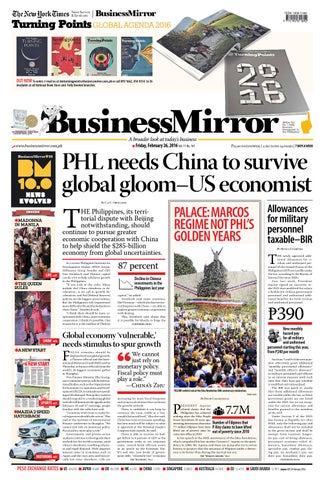
PHL needs China to survive global gloom–US economist
T
HE Philippines, its territorial dispute with Beijing notwithstanding, should continue to pursue greater economic cooperation with China to help shield the $285-billion economy from global uncertainties.
INSIDE
madonna in manila
life
d1
the queen rules
show
d6
Sports BusinessMirror
Friday, February 26, 2016
C1
AP NEW START
RICKIE FOWLER lines up a putt on the 15th green during the proam at the Honda Classic golf on Wednesday. AP
ALM BEACH GARDENS, Florida—A missed tee shot by Rickie Fowler. A missed putt by Phil Mickelson. A missed opportunity for Rory McIlroy. All three had great chances to win in the last tournament they played. All three are eager to get back to work at the Honda Classic at a time of the year when each tournament presents a strong test and each week gets them closer to the first major of the year at Augusta National. McIlroy’s scars are the most recent, thought they are more like a flesh wound. Two shots behind going into the last round on Sunday at Riviera, he made eagle on the par-5 opening hole to briefly tie for the lead. That was as close as he got. He threeputted from 12 feet on No. 4, found the bunker in the middle of the green at No. 6, had a long birdie putt that nearly went off the green at No. 7 and spent the rest of the day trying to catch up, which is a tough spot to be in at Riviera. He closed with a 75 and tied for 20th. “The score probably got away from me because of that,” McIlroy said on Wednesday. “So I didn’t dwell on it too much because I knew that it was more the circumstances I put myself in. I know my game is in good shape and it’s there, and hope to get into contention again this week.” The Honda Classic, which begins on
While the Honda Classic has been gaining in strength over the last five years, this year’s field is not as strong at the top as it has been in recent years.
Thursday, is hit-and-miss for McIlroy. He won at the Professional Golfers’ Association (PGA) National in 2012 to reach No. 1 for the first time in his career. The next year, he walked off the course in the middle of the second round when he was on his way to missing the cut, citing a sore wisdom tooth. He lost a two-shot lead and lost in a four-man playoff in 2014 and then missed the cut last year. Is it the nature of the golf course? The wind? “I think it’s the nature of me,” McIlroy said. “Yeah, it’s one of these golf courses that if you’re slightly off, it can really magnify your misses a little bit, and it can make you feel as if you’re playing worse than what you actually are.” Mickelson is thrilled to be playing better than he has the last few years, at least based on the first month of the season. Even so, it was a disappointment two weeks ago at Pebble Beach when he had a two-shot lead in the final round and wound up closing with a 72 to finish one shot behind Vaughn Taylor, who had gone 10 years without winning. Mickelson had a 5-foot birdie putt on the 18th hole to force a playoff and watched it spin around the edge of the cup. Mickelson is a three-time Masters champion who turns 46
this year. Along with 45 wins around the world, he has finished second 36 times. Patience comes easily with age and a spot in the World Golf Hall of Fame. “Whether I won or lost the tournament, I was still using it as a steppingstone for the rest of the year for where my game has gone,” Mickelson said. “It’s gone through a difficult time for a couple of years. And the fact that I’m playing well again, I’m in contention, and I’m hitting shots with ease...I’m showing up at the golf course not trying to find something, but continue refining what I’m already doing. “So win, lose or what have you, it’s not really affecting the confidence that I have or the direction that I feel like my game is going.” His three kids being out of school was the primary reason Mickelson didn’t play Riviera last week, though he conceded that four straight events to start the year was enough golf at that point. He has played the Honda Classic the last two years with indifferent results. Mickelson is mostly geared toward Augusta. Fowler has had two weeks to think about losing a prime opportunity at the Phoenix Open. He had a two-shot lead with two holes to play when he chose a driver off the tee on the 17th hole,
it took a hard bounce and went over the green and into the water. One hole later, he had to make a 10-foot putt just to get into a playoff, and then he lost on the 17th hole when his tee shot again went into the water and Hideki Matsuyama beat him. Fowler held back tears in his news conference, mainly because he had family members there who had never seen him win. But having won at Abu Dhabi for his fourth victory in the last eight months, it did not shake his confidence. “I’m fine,” he said. “It’s obviously one that I wanted to get. Felt like I was in a great position to get it. But I’ve been playing well, all through last summer, through the fall. Just really focusing on this week and see if we can get off to a good, solid start.”
RANKING GAME
WHILE the Honda Classic has been gaining in strength over the last five years, this year’s field is not as strong at the top as it has been in recent years. Attribute that to a change in the world rankings. And to Tiger Woods. For the first time since 2012, the Honda Classic will not have the No. 1 player at PGA National. Rory McIlroy was No. 1 in 2013 and 2015, and Woods was atop the ranking in 2014. Woods, out with an injury since Augusta, is now at No. 445. McIlroy is No. 3, having wasted a good chance to go back to No. 2 by closing with a 75 at Riviera. The Honda Classic has four of the top 10 in the world: McIlroy, Rickie Fowler (No. 5), Patrick Reed (No. 9) and Branden Grace (No. 10). AP
‘PROGRESSING NICELY’
P
ALM BEACH GARDENS, Florida—Tiger Woods posted a video of him swinging a 9-iron in a golf simulator on Wednesday to shoot down rumors on social media that suggested his recovery from back surgeries had worsened to the point he could not even sit on a chair. The 13-second video Woods posted on Twitter shows him dressed in shorts and golf shoes, and he takes a smooth swing on a golf simulator. “Progressing nicely,” Woods wrote. The video had a time stamp of Wednesday. If nothing else, it provided the first update on Woods since he spoke at the Hero World Challenge the first week of December. This was intended primarily, however, because of the social-media storm that began over the weekend with a
Twitter account called “Secret Tour Pro.” Mark Steinberg, Woods’s agent at Excel Sports Management, released a statement on Monday that said the rumors were “ridiculous and absolutely false.” “With everything that went on this weekend with Twitter exploding and the ridiculous and erroneous discussions—I don’t even want to call it reporting—we were inundated with fans saying: ‘Wow. How can this be true?’ Clearly, it wasn’t true,” Steinberg said on Wednesday. “If I picked up the phone and called you and said he’s doing some chipping and putting and making some swings up to a 9-iron—and that’s what the club was—is that impactful or a visual evidence of that?” he said. “We felt that was a more appropriate way to go.” Woods first had a microdiscectomy a week before the 2014 Masters, which
kept him out nearly three months. He took off another three months to get stronger, but then announced another back surgery last September, and a third one at the end of October. He has not played since August. He has not won since August 2013. The tweet on Sunday from Secret Tour Pro—who claims to be a tour player, though it has never been verified—said that Woods’s condition had worsened since Christmas and that he has to ride in a car with the seat full reclined. The tweet also said Woods has to lay down for the majority of the time and sitting in chair is no longer possible. Robert Lusetich, who wrote a book about Woods’s 2009 season after returning from knee surgery, tweeted similar information the next day that he
attributed to his sources, and talked about it on a national radio show. Steinberg could not say if Woods would have posted the video without the rumors. “He does want to keep people in the loop to some degree,” he said. Missing from the update was anything beyond “progressing nicely.” Woods said last December that he misses competing and wants to return, though he does not appear to be in any rush this time. He has said he tried to come back too early from the first back surgery. “He’s going to learn from the past,” Steinberg said. “We don’t want to put a timetable on it. He’ll come back when he’s ready.” AP
TIGER WOODS posts video to rebut rumors of his demise. AP
sports
c1
mazda 2 speed hatchback
motoring
In a recent Philippine Institute for Development Studies (Pids) forum, Difference Group founder and CEO Dan Steinbock said Chinese capital can do a lot to help rebalance growth in the Philippines. “If you look at the risks, [these include the] China slowdown or deceleration, as we call it; growth deceleration; and Fed [Federal Reserve] policies are the biggest uncertainties. But the Philippines will [experience] more difficulty [from] the Fed policies than China,” Steinbock said. “I think there should be more cooperation with China, more economic cooperation. I think it’s possible. One reason for it is the outflow of Chinese
e1
PALACE: MARCOS REGIME NOT PHL’S GOLDEN YEARS
isca l stimulus should be deployed to boost global growth, a Chinese official and the International Monetary Fund (IMF) said on Thursday, as finance officials from the world’s 20 biggest economies gather in Shanghai. Vice Finance Minister Zhu Guangyao’s comments mirror calls by international bodies, such as the Organization for Economic Co-operation and Development (OECD), to unleash new spending to lift demand. How policy-makers should respond to a weakening global outlook will dominate the agenda at the February 26 and 27 meetings, people familiar with the talks have said. “Countries with room to make fiscal expansion should take action,” Zhu said at the Institute of International Finance conference in Shanghai. “We cannot just rely on monetary policy. Fiscal policy must play a role.” Governments and private-sector analysts continue to downgrade their outlook for the world economy, amid China’s slowdown, tumbling oil prices and tepid demand. With negative interest rates in economies such as Japan and the euro area and historically low rates elsewhere, calls are
T
Decline in Chinese investments in the Philippines last year capital,” he added. Steinbock said some countries, like Vietnam—which also has territorial disputes with China—are able to explore greater economic cooperation with Beijing. This, Steinbock said, shows that it is possible for Manila to forge the
₧390
Continued on A2
New monthly hazard pay for all military and uniformed personnel starting this year, from P240 per month
PESO exchange rates n US 47.6230
YELLOW confetti rain at the Edsa Revolution 30th anniversary celebration. NONOY LACZA
increasing for more fiscal firepower and structural reforms that can boost the growth outlook. China is confident it can keep its currency, the yuan, stable at a “reasonable balanced level,” Zhu also said. China has room to increase spending, but how much will be subject to what is approved at the National People’s Congress next month, he said. China is able to increase its budget deficit to 4 percent of GDP as the government seeks to cut corporate taxes, central bank officials wrote in an article on the Economic Daily’s web site. Low levels of government debt, “relatively fast” economic
By Bianca Cuaresma
he newly approved additional allowances for civilian and uniformed personnel of the Armed Forces of the Philippines (AFP) are taxable under the law, according to the Bureau of Internal Revenue (BIR). Ju st l a st wee k , P resident Aquino signed an executive order (EO) that modified the salary schedule for civilian government personnel and authorized additional benefits for both civilian and uniformed personnel.
87 percent
We cannot just rely on monetary policy. Fiscal policy must play a role.” —China’s Zhu
Allowances for military personnel taxable–BIR
Global economy ‘vulnerable,’ needs stimulus to spur growth
F
a new start Editor: Jun Lomibao • sports@businessmirror.com.ph
By Cai U. Ordinario
P
By David Cagahastian
7.7M
r e si den t A qu i no refuted claims that the Philippines has achieved nothing since the Edsa People Power Revolution 30 years ago, stressing, for instance, that some Number of Filipinos that 7.7 million Filipinos have been P-Noy claims to have lifted lifted out of poverty since he out of poverty since 2010 came into office in 2010. In his speech at the 30th anniversary of the Edsa Revolution, which catapulted his late mother Corazon C. Aquino to the presidency in 1986, Mr. Aquino said there are many who try to revise history to purport that the situation of Filipinos under a democracy is no better than during the martial-law era. See “Marcos regime,” A12
Sections 7 and 9 of the new mandate effectively grant additional “monthly provisional allowance” and “monthly officer’s allowance” to military personnel and officers as an interim measure until such time that their base pay schedule is modified and rationalized. The BIR was quick to clarify that these additional allowances are taxable under the law, as these provisional grants are not listed under the 2001 law on tax exception for certain allowances and benefits granted to the members of the AFP. Under Section 3 of the 2001 law, known as Republic Act (RA) 9040, only the following pay and allowances shall not be included in the gross income and shall be exempt from taxation: longevity pay, cost-of-living allowance, personnel economic-relief allowance, hazardous allowance, specialist pay, combat pay, flying pay, air mechanic’s pay, sea duty pay, hazardous duty pay,
See “Economy,” A12
n japan 0.4249 n UK 66.7389 n HK 6.1293 n CHINA 7.2970 n singapore 33.8833 n australia 34.3303 n EU 52.4710 n SAUDI arabia 12.7011
Continued on A2
Source: BSP (24 February 2016 )
BMReports BusinessMirror
A2 Friday, February 26, 2016
Caap reminds air carriers: Keep hoverboards, mini-segways in overhead cabins while on flight
T
By Recto Mercene
he Civil Aviation Authority of the Philippines (Caap) has reminded air carriers that allow lithium battery-powered transportation devices, such as hoverboards or mini-segways, on their aircraft to store these items in the overhead cabin as passenger carry-on baggage.
The Caap issued the reminder after the International Civil Aviation Organization (Icao) issued last month an electronic bulletin to clarify safety concerns over the carriage of personal transportation devices on airplanes. According to the Icao advisory, several aviation authorities have
reported confusion among air operators on the carriage by passengers of hoverboards and selfbalancing or multiwheel minisegways onboard aircrafts. The advisory came following reports of hoverboards catching fire without warning. According to the US Consumer
Product Safety Commission, there have been 12 incidents in the US where the lithium ion batteries in these hoverboards reportedly caught fire, destroying bedrooms and even entire homes. The fires have started in all sorts of different circumstances, too. According to owners and witnesses, some of the hoverboards exploded while charging, others while riding and one while it was sitting on a kiosk in a Washington shopping mall. The scary part is that there’s no single reason these hoverboards are exploding, and there’s no surefire way to avoid potential catastrophe if you want to buy one yourself. There’s no particular brand of hoverboard to avoid as they all seem to come from thousands of interchangeable parts factories in China, or any label on the box that guarantees a product won’t explode. Although there’s no report of hoverboard catching fire in the Philippines, it was reported that a Filipino in Dubai had died after
hitting a lamppost while riding a hoverboard. The Dubai police said the man, who remains unidentified, hit the post when he lost balance. The Icao bulletin stated: “Some airline operators have banned carriage of, [hoverboards or minisegways]…by passengers and crew because of safety concerns prompted by media reports of some devices catching fire.” Philippine Airlines and Cebu Pacific banned late last year the lithium battery-powered transportation devices on their flights, citing their tendency to spontaneously combust. The two airlines prohibit passengers from bringing the devices either on their checked or carry-on baggage because of the fire hazard risk they pose when they overheat. Caap chief William Hotchkiss III cited another Icao advisory, which states that, “while the Technical Instructions for the Safe Transport of Dangerous Goods by Air currently allow these devices to be carried
provided certain conditions are met, states are encouraged to recommend to operators that they require passengers to carry such devices in the cabin,” the advisory said. Hotchkiss explained that the Icao issued the advice because it was “easier to control fire incidents possibly caused by a lithium batterypowered transportation device or equipment in the flight cabin than in the cargo hold.” The Icao instructions completely ban electronic devices powered by lithium metal or lithium ion cells and carried by passengers or crew when the batteries exceed the 160 watt-hours limit. On the other hand, air carriers have the discretion of allowing devices containing lithium ion batteries with over 100 watt-hours but not exceeding 160 watt-hours in their aircraft. Icao also prescribes using codes UN 3171 for battery-powered vehicles and equipment, and UN 3480 for lithium ion batteries when they are transported as cargo.
PHL needs China to survive global gloom–US economist Continued from A1
same kind of partnership with Beijing, given that China is one of the Philippines’s major trade partners. In 2015 data from the Philippine Statistics Authority (PSA) showed that China was the country’s top import source and third top export market. Total imports from China amounted to $10.83 billion, while total exports reached $6.39 billion in 2015. In terms of approved foreign investments by investment promotion agencies, however, Chinese investments declined by
87 percent to $1.46 billion in 2015, from $11.48 billion in 2014. “Vietnam and other countries have had territorial friction with China and were able to separate negotiations on the economic policies and the territorial issues,” Steinbock said. “Chinese capital is a very important trend and I think that this is underestimated in the Philippines,” he added. He noted that the forging of economic cooperation between China and Indonesia holds a lot of promise for both countries. Steinbock said these partner-
ships complements China’s One Belt, One Road (Obor) initiative. Ultimately, the Obor, he said, can also be good for the region, including the Philippines. The Obor seeks to revive the “Silk Road” that connected trade between Asia and Europe. The Obor starts in Xi’an, China, and ends in Fuzhou, China. It passes through Istanbul, Turkey; Moscow, Russia; Venice, Italy; Nairobi, Kenya; and Kuala Lumpur, Malaysia. The Obor is financed by the China-led $40-billion Silk Road Infrastructure Fund, as well as funding
from the newly created regional development bank, Asian Infra Investment Bank. Last year government underspending in the first half of the year, weak export earnings and lackluster performance of the agriculture sector dampened the GDP growth of the Philippines. The economy merely grew by 5.8 percent, the slowest since 2011 when the economy only expanded by 3.7 percent. Services was the main driver of the economy at 6.7-percent growth, from 5.9 percent the previous year. Industry and Agriculture posted
growth rates of 6 percent and 1.6 percent, respectively. While GDP growth reached 6.3 percent in the fourth quarter of 2015, the rate was not enough for the government to meet its revised 6-percent to 7-percent target for the year. Fourth quarter GDP was driven by the Services sector, which accelerated to 7.4 percent from 5.6 percent, while Industry decelerated to 6.8 percent from 9.1 percent. Meanwhile, Agriculture contracted by 0.3 percent compared to the 4.2-percent growth rate posted in the previous year.
news@businessmirror.com.ph
Allowances for military personnel taxable–BIR Continued from A1
instructor’s duty pay, parachutist’s pay, hardship pay, special clothing allowance, cold winter’s clothing allowance, cold weather clothing maintenance allowance, winter clothing allowance, initial enlistment and reenlistment allowance, and laundry allowance. “A reading of Section 3 of RA 9040 would show that the monthly provisional allowance and monthly officer’s allowance given to military personnel and officers pursuant to the recently signed EO are not among those enumerated as exempt from income tax under the law,” the BIR said in a memorandum. “Accordingly, it is hereby clarified that—not being included under the enumeration of pay and allowances exempt from income tax under Section 3 of RA 9040—the Monthly Provisional Allowance and Monthly Officer’s Allowance given to military personnel and officers under the recently signed EO are subject to income tax,” the BIR added. This means the new monthly provisional allowance—which ranges from P95 to P1,149 and the monthly officer’s allowance— which ranges from P7,000 to P35,000—are all subject to the income-tax brackets applicable. In the case of a candidate soldier, under the granted monthly provisional allowance, he or she will have his or her allowances at P267 on the first tranche, P547 on the second tranche, P842 on the third tranche and P1,149 on the fourth tranche—all subject to income-tax rates. The monthly provisional allowances get incremental raises depending on the rank of military and uniformed personnel—the lowest of which are candidate soldiers and the highest of which are generals and director generals, who will receive P14,214 on the first tranche, P35,260 on the second tranche, P63,977 on the third tranche and P95,399 on the fourth tranche, all minus taxes due. The P1,000 allowance on the first tranche given to a captain—under the monthly officer’s allowance provided in the EO—is also clarified to be taxable under the law along with the P3,000 in the second tranche, P4,500 in the third tranche and P7,000 in the fourth tranche. The allowance ranges increasingly with higher-ranking officials—with the captain, senior inspectors and lieutenants senior grade at the bottom of the officers’ list and the generals and director generals on top. The latter two positions will receive P9,000 on the first tranche, P18,000 on the second, P25,000 on the third and P35,000 on the fourth tranche —all minus income taxes. What is exempt from income tax under the newly signed EO is the increase in the hazard pay of all military and uniformed personnel from the current rate of P240 per month. Under the President’s mandate, hazard pay will increase to P390 per month starting this year; then to P540 per month starting January 1, 2017; P690 per month starting January 1, 2018; and P840 per month starting January 1, 2019— all exempt from income taxation by the BIR. Meanwhile, Col. Noel Detoyato, Armed Forces of the Philippines public affairs office chief, thanked the President for the additional allowances as he welcomed the hazard-pay tax exemption. “It is a much-needed reprieve. The exemptions will go a long, long way for soldiers. It will not only increase our salaries, but will also increase our take-home pay,” he said. With reports from Rene Acosta
PHILHEALTHAnniversary A BusinessMirror Special Feature
www.businessmirror.com.ph
Friday, February 26, 2016 A3
PhilHealth at 21: A coming of age
T
HE number 21 is closely associated with the traits of maturity, stability and resilience. It denotes a coming of age, a stage when a person is usually all fired up to explore what life has to offer. It is at this very interesting phase in life when one is eager to find out what the world has to offer, and how prepared one is for these challenges. Now at the prime of its youth, the Philippine Health Insurance Corp. (PhilHealth) is pretty much on the same stage—it has gone a long way in implementing the National Health Insurance Program (NHIP), and has made countless reforms that have practically made PhilHealth a byword in every Filipino household. At the very start (1972) was the Medicare Program, which assured every Filipino of adequate and quality health care at the time of need. With the passage of the National Health Insurance Act in 1995, the country’s only health insurance was transformed into a national program, a more robust organization to stand as overseer of health benefits and privileges that every Filipino should have the right to access. Since then, PhilHealth has been faithful in providing its members with adequate benefits to help them with their in-hospital and outpatient medical-care needs. Now that the organization has matured, it has articulated its readiness for the challenges ahead, particularly in ensuring that it is able to provide financial-risk protection for its members. A soon-to-be-released report on an assessment study conducted by the National Institutes of Health, University of the Philippines Manila by Dr. Leonardo Estacio Jr., Dr. Hilton Lam and team showed that “average out-ofpocket expenses of indigent members
is 83 percent lower compared to those without PhilHealth coverage.” The same study found out that “PhilHealth members are 10 times less likely to experience financial catastrophe compared to those without PhilHealth coverage.” If this is any indication of PhilHealth’s performance as administrator of the NHIP, then it clearly shows that PhilHealth delivered on its mandate to make sure that every Filipino, especially those who have less in life, are adequately protected from the rising cost of health care and health services. “We have indeed come of age. At 21 we have become more mature, stable and discerning without losing sight of why and for whom the NHIP exists. Over the years, we have imbibed that sense of responsibility for the health care of the 89 million members, who bank on our program for their financial-risk protection against the increasing cost of healthcare services,” PhilHealth President and CEO Alexander A. Padilla said. Among the major reforms that PhilHealth has undertaken over the last 21 years are the development of benefit packages that are constantly being reviewed and updated; the enhancement of its information technology and other systems to ensure that services, both to the members and to its partner-providers are fast, convenient and seamless; introduction of policies that reiterate its commitment to safeguard the health insurance fund entrusted to it by its members; expansion of its office network in various parts of the country to reach more members; the quest for
total quality management; the continued promotion of PhilHealth until it became a household name; and the provision of learning and growth opportunities for its employees. Still, the road ahead is full of interesting turns that PhilHealth is willing and ready to face head-on. Padilla acknowledged that “there is room for improvement in our systems, our processes and in the standards that we have set as we implement the NHIP.” Recognizing that there is still a portion of the entire Philippine population that needs to be covered, the PhilHealth chief has noted that the state-run agency needs to “recognize that compliance to labor and related laws by certain companies who have contractual workers continues to challenge us where enrollment and premium remittance [in the formal economy] are concerned.” Despite the fact that PhilHealth has already set in place the mandatory coverage of these workers, the organization needs “to work more closely with the principal players in the labor industry to fully implement this provision.” As it takes its first step toward the next 21 years, PhilHealth musters enough strength and confidence which it draws from the support of its various stakeholders and program coimplementers, to face the challenges that the next few years will bring. For the meantime, it articulates its current state with confidence, emphasizing that at 21, it is definitely able to bring about “Mas Matatag na Kaseguruhan sa Kalusugan.”
Improving access to assistive technology and rehabilitation for children with disabilities By Michelle S. Nisperos
S
pecial benefits for hearing, visual, mobility and neuro-developmental disabilities shall soon be provided by the Philippine Health Insurance Corp. (PhilHealth). These benefit packages are currently being developed and are designed to provide early intervention for children with these disabilities. PhilHealth supports efforts to uplift the rights of children with disabilities (CWDs) to special care, to enable them to live full and independent lives. As such, they become “active participants
and contributors in their respective economies through education, inclusion and participation.” On the occasion of its 21st anniversary, PhilHealth announced that these special benefits will be available for CWDs who are 18 years old and below, with confirmed disabilities such as hearing, visual and mobility-impairment, and those with neuro-developmental disabilities, as screened by appropriate professionals. According to a report by the United Nations Children’s Fund, one out of seven Filipino children, or
around 5.1 million, are living with disabilities; and 30 percent, or 1.5 million, of whom will need assistive technology. Likewise, only one of 20 Filipino CWDs has access to assistive devices, while 95 percent, or 1.46 million, have unmet needs for assistive technology. “Every child has the right to live a normal life. If we have the means, who are we to deprive them of such right?” PhilHealth President and CEO Alexander A. Padilla said. “We believe that these children have a significant role in society, whatever sector they may belong to,” he said.
Messages
My warmest greetings to the Philippine Health Insurance Corp. (PhilHealth) as you celebrate your 21st anniversary. An array of challenges and opportunities comes our way in 2016. The turnover of leadership in government revives the discussion on the longevity of reform and of our nation’s present momentum. It is at this time of flux that our agencies must exhibit their commitment to their mandates and uphold, through our lines of service, the public’s confidence in our institutions. PhilHealth has contributed significantly to our agenda of inclusive growth. May your organization exhibit the same vigor and resolve as you have done in enrolling a vast majority of our fellowman to our state’s health coverage system, in rolling out improved health-care packages for the most vulnerable segments of our society, and in holding accountable our partners in protecting our people’s well-being. Continue to help Filipinos transcend the grip of disease and journey forward, united and steady along the daang matuwid. Our campaign for national renewal began with the vision to uplift the lives of our people. Knowing that we have colleagues in civil service for genuine, positive change gave us courage; we are aided by a citizenry willing to make this period truly transformative for all. I entrust to you this legacy of good governance and restored promise: Abide by the ideals we worked to institutionalize and sustain the responsive and compassionate bureaucracy our country so deserves. Congratulations on your anniversary. I wish you fortitude for the years to come. BENIGNO S. AQUINO III President, Republic of the Philippines I am very happy to congratulate the Philippine Health Insurance Corp. (PhilHealth) on its 21st anniversary as the premier government health insurer in the country. Serving the Filipino people for over two decades is no mean feat, especially when one is constantly challenged by new developments in the health-care industry. But PhilHealth has risen above these adversities and persevered in doing what it is mandated to do, providing financial risk protection to the Filipino people. These challenges only serve as the impetus for PhilHealth to overcome whatever difficulties it faces, and turn these into best practices. For 21 years, PhilHealth has nobly served the multitude of the population all over the country, as well as other parts of the world. We have witnessed how PhilHealth relentlessly doubled all efforts to ensure that access to adequate health care is provided for the growing number of members each year. Benefit packages have augmented the existing ones implemented the previous years, notably those that are beneficial not only to the members here in the country but even to our kababayans overseas. PhilHealth has always taken bigger strides in ensuring that our members get the maximum financial risk protection that they deserve. As PhilHealth covers all sectors of our society and continues to expand its benefits, Kalusugan Pangkalahatan or Universal Health Care is coming to fruition. Today we have over 90 percent coverage throughout the country. We want to translate this health coverage into health care. Hence, the Department of Health is striving to ensure that our government health-care facilities are adequately and properly equipped throughout the country so that PhilHealth members can be assured of accessible, affordable, relevant and responsive health care. As you go forward towards the next decade, rest assured that the Department of Health is one with you in working together for a healthy nation made possible through a sustainable program for Universal Health Care. To the men and women of PhilHealth, mabuhay and congratulations! JANETTE P. LORETO-GARIN, M.D., MBA-H Secretary of Health Chairperson, PhilHealth Board of Directors Anniversaries are all about getting together to rejoice, to celebrate and to feel the strength of our unity. They are also about nostalgia, looking back at happy, emotional memories, and how it all began for us. On the occasion of our 21st anniversary, I would like to congratulate my Team PhilHealth for their love, dedication and hard work. Despite the many challenges along the way, we have persevered in providing excellent service to our fellow Filipinos, thereby enabling us to reach almost every Filipino household in the entire Philippine archipelago. Serving 89 percent of the Philippine population is not that easy. We have been dragged into various issues that tested our will to stay focused on our mandate, but we remained strong and unaffected for the sake of our members and stakeholders who put their trust and support to the National Health Insurance Program (NHIP). I strongly believe that efficiency, consistency and trust are the values that have kept PhilHealth and the NHIP successful. To all our partner health-care providers—thank you for providing our members with the highest quality of medical care. To our other institutional partners, thank you for your unwavering support to the NHIP. Let us continue to strengthen our partnerships so that we can ensure the viability of the NHIP for the next generations to come. Let us work hand-in-hand until the remaining 11 percent of our population is assured of social health insurance coverage, so that when the need arises, they can bank on their PhilHealth membership for the much-needed financial risk protection. The road to Universal Coverage may turn rough as the needs of our members and stakeholders change. But at 21, PhilHealth has definitely come of age and I am optimistic that it can hurdle any obstacle that the future may bring. Happy anniversary! ALEXANDER A. PADILLA President and CEO
PHILHEALTHAnniversary A BusinessMirror Special Feature
A4 Friday, February 26, 2016
www.businessmirror.com.ph
UP-PGH is now a contracted facility for Z Benefits
T
By Pinky G. Aragones
HE country’s oldest government-teaching hospital is now ready to provide the special-benefits package for members of the Philippine Health Insurance Corp. (PhilHealth), who are diagnosed with colon and rectum cancers.
Through a memorandum of agreement (MOA) signed with PhilHealth in Pasig City, the University of the Philippines-Philippine General Hospital (UP-PGH) has formalized its commitment to be the first contracted provider of the Z Benefits for colorectal cancer. The signing ceremony took place at the Chardonnay by Astoria on the occasion of PhilHealth’s 21st anniversary. Signatories to the MOA were PhilHealth President and CEO Alexander A. Padilla and UP-PGH Deputy Director for Fiscal Services Dr. Margarita Luna. Under the agreement, the UPPGH shall make avail of the benefit packages for colon cancer Stages I and II (low risk) worth P150,000 up to Stage III (high risk) worth P300,000
to PhilHealth members, who have passed the selections criteria. The Z Benefits rates for the entire course of treatment for rectum cancer Stages I to III is P150,000 to P400,000. At the same time, it shall implement the no-balance billing (NBB) policy to members under the sponsored and indigent programs, as well as to kasambahay and iGroup members. The NBB, which enforces that no other amount shall be collected from the member beyond what PhilHealth provides for, shall also be applied to members who are not covered due to lack of qualifying contributions, and to nonmembers who were assessed and classified as belonging to Class C-3 or D, and enrolled under the Point-of-Care program.
The UP-PGH also agreed to implement the ceiling amount of P230,000 as maximum co-payment for colon cancer, and P300,000 for rectum cancer for PhilHealth members and their dependents who are classified as charity patients Classes 1 and 2, as well as to members with
income of less than P50,000 per household per year. “PhilHealth is committed to provide accessible health-care services to our members, which is why we are thankful to UP-PGH for this partnership, being our first contracted hospital for the Z Benefits for colon
and rectum cancers. I would also like to thank our partner health-care providers for helping us achieve our mandate. Indeed, we can say that our government is doing its job in providing quality care to all Filipinos,” Padilla said. The UP-PGH is, likewise, con-
tracted to provide four other Z Benefits packages, namely, Coronary Artery Bypass Graft, Surgery for Total Correction of Tetralogy of Fallot, patch repair of Ventricular Septal Defect and the Z MORPH (Mobility, Orthosis, Rehabilitation, Prosthesis Help).
PhilHealth taps PGEA for SHInES By Amelita L. Buted
‘W
e firmly believe in empowering our members, and this can only be achieved by providing them with the latest information that is accurate, complete and timely.” Thus said Alexander A. Padilla, president and CEO of the Philippine Health Insurance Corp. (PhilHealth), as the government agency marked its 21st anniversary with a corporate event at the Chardonnay by Astoria in Pasig City recently. One avenue that PhilHealth undertakes to empower its members is the conduct of the Social Health Insurance Education Series (SHInES) to further educate PhilHealth’s key stakeholders on various aspects of the National Health Insurance Program (NHIP).
Recently, PhilHealth entered into an agreement with the Philippine Government Employees Association (PGEA) for the conduct of SHInES among government employees to ensure that appropriate information and updates on PhilHealth and the NHIP will be cascaded properly. The PGEA is an organization of government employees’ unions in the country. The agreement espouses that the proposed orientation in government offices through the Public Sector UnionPhilHealth advocates is to make government workers become active partners and effectively participate in the NHIP in a well-informed and responsible manner. “The agreement is not only an issue of responsibility to the government, but also a critical task to serve and protect the workers who are the contributing
members of PhilHealth,” said Esperanza S. Ocampo, PGEA national president. PGEA, as a public-sector organization, has the innate responsibility to assist any government institution to ensure that quality public service will be delivered. The joint agreement provides a venue that will gather and consolidate selected public sector union leaders who will be trained to become advocates of employees’ protection programs and of PhilHealth. “With this agreement, PhilHealth was able to tap one of the biggest potential resources that can help strengthen the program and make it more attuned with the needs of workers in the public sector. More important, these information multipliers can readily become program advocates who can help spread the good news that is PhilHealth,” Ocampo said.
PhilHealth coverage of orphans assured By Dianna Marie S. Chua
T
HE Philippine Health Insurance Corp. (PhilHealth) and the Department of Social Welfare and Development (DSWD) are joining hands to ensure that orphans, abandoned and abused children, out-ofschool youth and other minor children being cared for in the latter’s residential care facilities are provided with socialhealth insurance coverage. Consistent with its vision statement of “Bawat Pilipino miyembro. Bawat miyembro protektado. Kalusugan natin sigurado,” PhilHealth worked closely with the DSWD, whose own vision is to improve the quality of life of the poor and reduce poverty by year 2030, for the group enrollment and coverage of minor children under the care and custody of the latter as Sponsored Members. “Ang bawat batang Pilipino ay may karapatang magkaroon ng proteksyong pangkalusugan, nang maisiguro ang kanilang maayos na kinabukasan,” said Alexander A. Padilla, PhilHealth president and CEO. He added that even minor children under the DSWD’s care should be entitled to social-protection programs, such as health insurance “dahil bahagi sila ng lipunan na kailangan nating pangalagaan din.” A memorandum of agreement (MOA) was signed between the two government agencies at the Chardonnay by Astoria, on the occasion of PhilHealth’s 21st anniversary. Signatories
to the MOA were Padilla and DSWD Undersecretary Vilma B. Cabrera. Under the agreement, the DSWD shall identify the qualified beneficiaries under the care and custody of DSWD Residential Care Facilities based on a criteria. It shall also determine the increment beneficiary slots depending on the necessity to do so and availability of medical funds. In addition, it shall remit to PhilHealth the prescribed annual premium contributions of beneficiaries enrolled as a group or individually. Enrollees to the program are orphans, abandoned and abused children, out-of-school youth and children with special needs, street children, minor children who are pregnant or with child, children with disability who are below 17 years old, battered women, and clients above 18 years old, but are unable to fully take care of themselves
and who are under the care of DSWD Residential Care Facilities. Three children below 17 years old may apply for PhilHealth coverage as a group, while minor children who are pregnant or with a child, shall enroll individually. As Sponsored Members., they are entitled to avail themselves of all benefit packages, such as inpatient care, outpatient care, Primary Care Benefits, Maternity Care Package, Newborn Care Package and Z benefits, among others. Padilla stressed the importance of health protection for all Filipinos, especially the nation’s next generation. “PhilHealth believes that everyone has the right to health. Hence, extending PhilHealth benefits to orphans is an assurance that the health of everyone is in good hands.” The agreement shall take effect in the first quarter of 2016.
news@businessmirror.com.ph
AseanFriday BusinessMirror
Singapore may relax some curbs this year, City Developments says
T
he longest losing streak in Singapore residential prices in 17 years may prompt the government to take its foot off the brakes and relax some property curbs this year, the city-state’s secondbiggest developer said. Kwek Leng Beng, the billionaire executive chairman of City Developments Ltd., which built luxury condominiums such as the St. Regis Residences near the Orchard Road shopping belt, said mid-income and low-end housing could see further price declines and the high-end market remains subdued. “They will press the button at the right time although developers are hoping they will do it sooner than later,” Kwek said after the company’s earnings briefing on Thursday. “I think they will do something this year, that’s my speculation, as there are a lot of mid- and low-end homes coming up. I suspect it will be the abolishing of the buyer’s stamp duties.” Singapore has been successful in cooling its property market with a slew of measures to tame record prices set in 2013. They have included a cap on debt-repayment costs at 60 percent of a borrower’s monthly income, higher stamp duties on home purchases and an increase in real estate taxes. Home values have dropped 8.4 percent from the peak in 2013 and sales have since declined to about half the level that year. The government needs to calibrate cooling measures imposed on Singapore’s property market to engineer a soft landing, the Real Estate Developers’ Association of Singapore President Augustine Tan said this month.
8.4%
R
Australia warns of possible terror attack in Indonesia
Drop in Singapore home values from the peak in 2013
City Developments posted a 6.7-percent increase in fourth- quarter profit to S$410.5 million ($293 million) in the three months ended December 31. The developer is trying to mitigate risks in Singapore by expanding overseas to markets such as China, Japan and the UK. The company is expanding its fund-management platform and has completed two deals valued at S$2.6 billion since December 2014. It is on target to grow fund assets under management to S$5 billion by 2018. Meanwhile, the nation with Asia’s longest bout of deflation in recent years won’t be getting out of it anytime soon, if local gasoline pump prices catch up with the global crude slump. Singapore’s petrol prices have fallen only 9 percent compared with the 70-percent plunge in dollar terms for global oil since 2013, providing plenty of scope for local fuel costs to fall and align with crude declines, according to Bank of Singapore. The island’s main inflation measure has been negative for 15 straight months, longer than other Asian economies in the past five years including deflation-prone Japan. Bloomberg News
Motorcycles are Uber’s new option to conquer Southeast Asian cities
ide-hailing service Uber is placing a bet on motorcycles in Thailand’s capital. Uber announced on Wednesday the launch of its UberMOTO service in Bangkok as a pilot project for cities in developing countries. The new service is not original. Motorcycle taxis are a long-standing tradition in many Southeast Asian cities, and became especially popular after the economic boom of the 1980s brought an onslaught of new cars jamming city streets. Uber’s Singapore-based competitor GrabTaxi launched its GrabBike motorcycle ride-on-demand service in Bangkok last July, and even earlier in Indonesia and Vietnam. In 2012 Uber had a short-lived motorcycle taxi pilot project in Paris. Uber said in a statement that the UberMOTO service will initially be available in three major business and residential areas of central Bangkok. It said it will have standard Uber features such as “live GPS tracking, two-way feedback and the ability to share trip details with family and friends.” “We aren’t surprised when competitors recognize the need to offer
Editor: Max V. de Leon • Friday, February 26, 2016 A5
We aren’t surprised when competitors recognize the need to offer services beyond private cars in this region.” —Foo
services beyond private cars in this region,” Adelene Foo, regional head of GrabBike/GrabExpress, said in an e-mail. “Motorbikes are a way of life in Southeast Asia and a critical part of the transportation ecosystem.” Foo said a motorcycle-based business “has its own unique set of challenges, and local knowledge is essential to recruiting drivers and understanding passenger preferences.” Uber’s original automobile service ran into legal problems in Thailand in 2014 when authorities said it was operating illegally until it met certain regulatory requirements. AP
In this December 16, 2015, file photo, a man leaves the headquarters of Uber in San Francisco. Ridehailing company Uber received a complaint about erratic driving by Jason Dalton on Saturday night, but says it never could have predicted the violent acts Dalton allegedly committed. AP
Members of the police and army stand guard before the arrival of Malaysian Prime Minister Najib Razak for a joint police-army exercise at a shopping mall in Kuala Lumpur, Malaysia, on Monday. Australia warned on Sunday that terrorists may be plotting attacks in and around Kuala Lumpur. AP
A
ustralia’s government warned on Thursday that terrorists may be in the advanced stages of preparing attacks in Indonesia, and urged travelers to exercise a high level of caution when visiting the Southeast Asian nation, including the popular tourist island of Bali. The Department of Foreign Affairs and Trade issued the travel advisory, which said only that there were “recent indications” an attack may be in the advanced planning stages, and warned people to be vigilant at places of worship and during holiday periods. The department did not raise its overall warning level for Australians visiting the country. The advice comes just days after Australia warned that terrorists may be plotting attacks in and around Kuala Lumpur, Malaysia’s largest city. In its warning for Indonesia, the department cited the January 14 attacks in the capital, Jakarta, that left eight people dead, saying the assaults demonstrated an ongoing threat. “We continue to receive information that indicates that terrorists may be planning attacks in Indonesia,” the department wrote. “An attack could occur anywhere at any time.” The agency did not immediately to a request for more details. In recent years, Indonesian counterterrorism forces successfully eradicated the extremist group
Jemaah Islamiyah that was responsible for several attacks, including the 2002 bombings of bars in Bali which killed 202 people, as well as two hotel bombings in Jakarta in 2009 that killed seven people. Indonesia’s government has outlawed the Islamic State (IS) group, but there are fears that militants who travel abroad will return home and carry out attacks in Indonesia. Indonesian authorities estimate that more than 600 Indonesians have joined the extremist group in Syria or Iraq. Singapore announced on Tuesday that it had deported four Indonesians it says were on their way to Syria to join the IS group. The Ministry of Home Affairs said the four “were deported to Indonesia after investigations revealed that they had plans to make their way to Syria to fight for ISIS.” ISIS is another acronym for the IS group. “Singapore authorities informed their Indonesian counterparts before the deportation,” the ministry said in a statement to the Associated Press. The local Straits Times newspaper reported that one of the four was a
We continue to receive information that indicates that terrorists may be planning attacks in Indonesia. An attack could occur anywhere at any time.” —Australian govt 15-year-old boy who was detained Sunday while attempting to enter Singapore from Johor in Malaysia. On Monday Singapore’s government said plans on raising public awareness on how to respond to terror attacks will be released soon. Last month authorities said they had deported 26 Bangladeshi construction workers for forming a religious study group that was spreading the ideology of al-Qaeda and the IS group. On Sunday Australia also warned that terrorists may be plotting attacks in and around Kuala Lumpur, Malaysia’s largest city. The Australian High Commission in Malaysia said in a travel advisory that there was an ongoing terrorism threat in Malaysia, noting that authorities there have arrested a number of people allegedly involved in planning attacks, including against entertainment venues in Kuala Lumpur.
“Terrorists may be planning attacks in and around Kuala Lumpur. Attacks could be indiscriminate and may target Western interests or locations frequented by Westerners,” the commission said in the advisory, which was posted on its web site. Malaysia has raised its security alert level following the January 14 attacks in Jakarta, the capital of neighboring Indonesia, that left eight people dead. In response to Australia’s warning, Kuala Lumpur police chief Tajuddin Mohamad Isa told the Englishlanguage newspaper The Star that security has been stepped up in the past few months and that there was no indication of an attack. Since 2013, Malaysia has arrested more than 150 people with suspected links to the IS group. Last month a 28-year-old Malaysian man was detained just hours before he planned to blow himself up at an entertainment outlet in Kuala Lumpur. The travel advisory also urged Australians to avoid traveling to Malaysia’s eastern Sabah state on Borneo island, famed for its dive sites, due to a high threat of kidnappings by Philippine rebels. It said Australians should exercise “normal safety precautions” when in Malaysia overall. A Malaysian Foreign Ministry official said on Sunday that foreign missions are at liberty to provide their own assessment of the security situation in the country. The official, who declined to be named due to the sensitivity of the issue, said “it is nothing to be alarmed of,” noting that the terror warning also acknowledged Malaysia’s efforts in strengthening its security presence in high-risk areas. AP
BIMP-Eaga positions as Asean’s agri biz hub
D
AVAO CITY—More than 250 government officials and key business leaders from the Brunei Darussalam, Indonesia, Malaysia, the Philippines-East Asean Growth Area (BIMP-Eaga) gathered here on Wednesday at the Marco Polo Hotel for the subregion’s Strategic Planning Meeting, aimed to review and assess ongoing programs identified in the BIMP-Eaga implementation blueprint. The meeting will also provide the platform for the discussion of the strategies and collaboration mechanisms necessary to optimize the agribusiness potentials of the subregion in line with its bid to become
the Asean’s food basket hub. “We are seizing this rare opportunity when all representatives from the BIMP-Eaga clusters and working groups are gathered together to push for collaboration efforts, enhance agriculture production capacities and facilitate cross-border trade within the subregion,” Mindanao Development Authority Undersecretary Janet Lopoz said. Through its food basket strategy, BIMP-Eaga aims to continuously optimize its natural resources to secure long-term food security and alleviate poverty within the subregion. Among the priorities identified under the strategy are food
security, export development and sustainable livelihood. Lopoz, who also sits as the head of the PhilippineEaga National Secretariat, added “the Philippines has already developed the project concept geared toward positioning the BIMP-Eaga as Asean and Asia’s agricultural hub.” Dubbed as the “Establishment of a Food, Agribusiness and Logistics Corridor,” the project will focus on developing regional agribusiness corridors, along with necessary elements of the value chain including food-processing complex or food terminals, multimodal transport interchange network and market gateways.
“This project suggests that our vision for the BIMP-Eaga to be Asean’s food basket is not just the work of one cluster,” said Lopoz, while adding “the enabling conditions to launch our agribusiness potentials can only be achieved with the strengthened collaboration among the concerned clusters such as transport, infrastructure, and the trade and investment facilitation cluster.” At present, there are three existing economic corridors in the BIMPEaga, namely the West Borneo Economic Corridor, the East Borneo Economic Corridor and the Greater Sulu Sulawesi Corridor, each already having their priority commodities. PNA
TheBroa
Business
A6 Friday, February 26, 2016
Showdown betwee and SEC imperils t W
By VG Cabuag
ORDS can hurt and sentences can spark a conflict that puts the entire Philippine market at risk. Apparently, some of these are found in the 2015 implementing rules and regulations (IRR) of the Securities Regulation Code (SRC). Certain provisions in the 280-page-long document have started a feud between select stockbrokers and dealers and the corporate regulator.
As external factors shook share prices to lower levels early in the new year, the Philippine Association of Securities Brokers and Dealers Inc. (Pasbdi) went to court to stop the Securities and Exchange Commission (SEC) from implementing several provisions of the IRR. Officials of Pasbdi, the umbrella organization of dealers and brokers, went to the Regional Trial Court in Mandaluyong City Branch 212 on January 12 and asked for a declaratory relief. They also applied for a temporary restraining order (TRO) and possibly an injunction against the IRR. Eight days later, the lower court on January 20 junked Pasbdi’s petition for a TRO and stop the implementation of many provisions of the 2015 IRR of the SRC. After amending its petition, the Pasbdi secured a 20-day TRO against the IRR. The SEC received the order on February 19.
Puzzling
A petition for declaratory relief gives a practical remedy for ending controversies that have not reached a state where another relief is immediately available. It supplies the need for a form of action that will set controversies at rest even before they happen, such as leading to a repudiation of obligations, an invasion of rights and a commission of wrongs. In this case, Pasbdi claimed the new IRR “violate[d] [its] right to due process and impair[ed] the obligations of contracts,” among others. What puzzled regulators is that Pasbdi was able to secure a reprieve on dozens of the rules that do not concern the brokers themselves. Also, many of the provisions the group assailed are already in place and being implemented for years now, according to a ranking SEC official. These provisions include Rule 12.1.1, which called on issuers of registered securities to enter an underwriting agreement with a universal bank, investment house or any financial institution. There is also Rule 24.1, which refers to manipulative practices, and Rule 33, on the Registration of Exchange. The latter refers to the requirement of the SEC for the creation of a self-regulatory organization (SRO), such as the Philippine Stock Exchange (PSE) and the Philippine Dealing & Exchange Corp., which operates the bond market-trading platform. Another provision is Rule 39.1.1.10.4, which refers to the submission by the SRO of annual reports.
The SEC official said while the TRO may be in effect by only 20 days, this may be placing the entire market in jeopardy, as the provisions that were stopped include the operations of the Exchange. For instance, the TRO included Rule 39.1.1.3, which refers to the monitoring of the market and the access to information for market surveillance. It states: “The Commission may, on its own initiative, monitor the market to ensure that the SRO is fulfilling its functions and to ensure further that each activity or potential problem area in the market is adequately covered and being reasonably addressed. For this purpose, SROs, exchanges, operators of trading markets, trading participants and other market participants shall, upon request, provide the Commission or its authorized representatives direct access to their trading systems, platforms, repositories and databases for information about particular accounts, orders, trades, positions, clearing data, trading-account codes and the names of clients corresponding to such codes, or any other information reasonably needed for effective market surveillance, reconstruction of trade events and conduct of trade analysis.” “The rule [39] is an important function of the SEC, in case of suspicious activities,” the SEC official said. “With the TRO, the PSE can now withhold such information to us.”
Disclosure
THE Pasbdi placed a half-a-million-peso bond to answer for any damages that the SEC may sustain as a result of the TRO. However, the SEC said it would no longer wait for the TRO to expire. Instead, it would, through the Office of the Solicitor General, move for reconsideration to lift and present evidence that will oppose another impending order, which is the issuance of a writ of preliminary injunction. If issued, the writ of preliminary injunction would prevent the SEC from enforcing the 2015 IRR, until the final disposition of the petition for declaratory relief case filed by Pasbdi. Another broker, who declined to be named, said at the heart of the matter is the requirement that asks brokers to disclose the beneficial owner of the stock. The government has not required this provision before, despite a provision at the SRC that brokers should disclose the beneficial ownership. A stock exchange such as
aderLook
sMirror
www.businessmirror.com.ph | Friday, February 26, 2016
en stockbrokers the entire market
a7
It is perfectly legal to have the stocks registered under the name of a person other than the true owner. But these brokers and dealers should, by law, disclose the real identity of the investors to whom the stocks truly belong. That is the meaning of the disclosure requirement of beneficial ownership of stocks.”—Herbosa
the PSE mainly facilitates the exchange or trading of securities between buyers and sellers, among its other functions. Investors wishing to invest, however, cannot just enter the exchange and purchase shares. They must go to a registered stockbroker, which will trade their money on their behalf. Brokers earn through commission and fees for the transactions. The investors who own the money have rights over that stock. They are the beneficial owners of the stock they purchased, even though the stock is under the name of another, usually the broker or a dealer.
Tabs
A broker has his own system of keeping tabs on who owns what and how much. A stockbroker told the BusinessMirror he normally keeps these files in his filing cabinet; never sharing it with anyone, not even his peers or the regulators, as these are confidential papers. Previously, stockbrokers are not required by the government to submit them. The umbrella organization of brokers, however, were up and arms when the 2015 IRR of the SRC required stockbrokers to release beneficial owners to the government, and, in this case, the SEC. Rule 18.1.2 of the 2015 IRR reads: “If the equity securities under the name of the legal owner are beneficially owned by another person/s, the legal owner and beneficial owner shall individually or jointly, within five business days after such acquisition, submit to the Issuer, the Exchange where the security is traded, and to the Commission a sworn statement containing the information required by SEC Form 18-A.” The rule was not present in the old IRR, released in 2004 and which took effect during that year. The rule covers those who are beneficial owners of 5 percent of any class of securities.
BIR-like
THE Pasbdi likened the move of the SEC on the similar efforts of the Bureau of Internal Revenue requiring companies, mainly the banking and financial sectors, to disclose the alpha list (alphabetical list), which contains the names of the portfolio investors receiving income payments and dividends. Those efforts were stopped by the Supreme Court (SC) in 2014. Pasbdi claimed that certain provisions of the IRR are “contrary to the Constitution, as they denied them due process, and even impair the obligation of contracts” already entered into by its member-brokers and clients. In the Philippines those who put money in the stock market are mainly institutional investors. Only a handful of the amount invested come from individual investors, PSE data shows. Institutional investors are usually large firms with hefty cash for investments in markets where
they believe the returns are high. The issue of beneficial ownership has been the main topic in many legal circles, as it is commonly believed to be used as a means to circumvent the law on limiting foreign equity to just 40 percent on partly nationalized industries. That limit to foreign ownership was enshrined in the 1987 Constitution. These industries include operation and management of public utilities, advertising, mining activities and exploration, development and utilization of natural resources. In an earlier ruling that took effect in 2015, the SC ordered the SEC, in the case of Gamboa v. Teves, to look into the beneficial ownership of corporations and ensure compliance with the limit on foreign ownership.
Complicated
A more complicated structure of beneficial ownership is when the money is being held by a corporation or an entity, like a mutual fund. The latter lumps all the money of individual investors and are traded by stockbrokers while still under the name of one company. The beneficial owner goes at so many layers below the levels of ownership they are very difficult to track, especially to untrained eyes. Identifying the beneficial owner through this thick layer spells more work for the PSE. PSE President and CEO Hans B. Sicat said the current system on beneficial ownership already “works fine,” as this system is already in place to track the ownership structure. “The structure where client shares are indirectly lodged with the broker in the depository is a globally accepted practice,” he said in an e-mailed statement to the BusinessMirror. “[The structure] is designed as such to help facilitate the transfer of ownership from one client to another for stock-market transactions.” Sicat further said the system at the Exchange is “equipped with tools to help track foreign-ownership levels.” “It even has mechanisms to prevent trades that will cause a breach in foreign-ownership limits. Information on foreign-ownership is also readily available real time in the trading terminals, as well as the regular submissions of the listed companies.”
Powers
SEC Chairman Teresita J. Herbosa said the agency is acting within its regulatory powers when it issued the amended IRR of the SRC to disclose the beneficial owners of stocks. “We stand by our position. The issuance of the 2015 IRR of the SRC is well within the exercise of our regulatory function,” Herbosa said. “There is no reason for them to seek relief claiming injustice, when we are only performing what is mandated by law.” Herbosa cited a section of the SRC IRR, which states, among oth-
ers, that “the State shall ensure full and fair disclosure about securities.” Section 18 of the SRC IRR also states: “any person who acquires directly or indirectly the beneficial ownership of more than 5 percent of certain equity shall report the true identity and citizenship of said owners to the Commission.” The amendment, however, only forms part of an overarching rule to make trading more transparent and placed several new requirements to the brokers. “It is perfectly legal to have the stocks registered under the name of a person other than the true owner. But these brokers and dealers should, by law, disclose the real identity of the investors to whom the stocks truly belong,” Herbosa said. “That is the meaning of the disclosure requirement of beneficial ownership of stocks.” “How can we protect them [stockholders], if their identity is unknown? How do we know if the foreign-equity limitation is not violated, if we do not know who the true owners are?” she added.
Mandate
ASIDE from the disclosure of beneficial owners, the IRR also mandates stockbrokers and dealers the submission of detailed description of organizational and functional charts, the names and designations of the officers, including branch offices; risk-management manual and internal control procedures; and business continuity and disaster-recovery plan. It also requires stockbrokers, dealers and trading participants to submit a comprehensive information-technology plan. They were also ordered to submit an updated written supervision and control procedures, including procedures for establishing and segregating transactions, taking into consideration the requirements of the Anti-Money Laundering Act of 2001 (Republic Act 9160, as amended) and the Revised Code of Corporate Governance. The majority of these new requirements were included in the TRO. Despite the legal case that Pasbdi filed, the SEC said 88 (66 percent) of the 133 broker dealers and trading participants of the PSE have already submitted the new requirements. The SEC, however, declined to give out the list of those compliant brokers. Two broker dealers requested and were granted extension of time to comply with the new IRR of the SRC, which took effect on November 9, 2015. Under the rules, brokers should comply with the new requirements by February 9. SEC officials said they are still waiting how things pan out the next few weeks. The agency implores brokers to view the 2015 IRR as government’s move for greater transparency in transactions at the stock market.
The World BusinessMirror
A8 Friday, February 26, 2016
Editor: Lyn Resurreccion • news@businessmirror.com.ph
China’s new economy leading to deep export slump in Asia
demand and rising competition in China, and this was likely exacerbated this month by the lunar new year holiday period,” Emily Dabbs, a Sydney-based economist at Moody’s Analytics, said in an e-mail. “Low global commodity prices have also kept a lid on the import bill, with softer domestic demand likely adding to the decline this month.” Creeping trade barriers also are posing obstacles. Simon Evenett, a professor focusing on international trade at the University of Saint Gallen, estimates 476 trade distortions were introduced by governments last year. Still, even as exports have slumped in Korea, Asia’s fourthlargest economy posted 2.6-percent growth in 2015. The government and the Bank of Korea both forecast that the country’s economy will expand at least 3 percent this year. Taimur Baig, chief economist for Asia at Deutsche Bank AG, describes the situation as trade stagnation.
‘Waning domestic demand’
A Chinese woman speaks on her phone near a display highlighting the new Chinese bank notes at a bank in Beijing, China, on February 16. AP/Ng Han Guan
T
he South Korean city of Ulsan, perched on the peninsula’s southeastern tip, has long been a proxy for the health of the nation’s exportdriven economy.
research team leader at the Ulsan Chamber of Commerce and Industry, said. “I’m afraid headwinds may continue this year. Slower growth in China is the biggest risk as the main market for all those industries is China.” The export malaise isn’t unique to South Korea. Across Asia, shipments are tumbling—in some cases at double-digit rates. In January Japanese overseas sales fell 12.9 percent from a year earlier and China’s dropped 11.2 percent. While some of this can be attributed to falling prices for commodities and energy, much of the decline is pinned on China’s economy, which last year grew at the slowest pace in a quarter century. As about 68 percent of South Korea’s shipments to China are of intermediary goods, a downturn in the Chinese economy squeezes demand for Korean exports. Because China is exporting less of the goods it makes, the world’s biggest trading nation is also buying less of the materials needed for its supply chain. Part of the problem is structural: China wants to shift its growth model from one centered
11.2 % Drop of China’s overseas sales in January
on manufacturing to more of a focus on services and consumption.
Others importing less
Home to the world’s biggest auto-manufacturing plant, a major shipyard and a large oil refinery, Ulsan has been a key engine of one of Asia’s postwar-growth stories. Now, the city is being held up as an example of something much less favorable—how a deepening export slump is crimping South Korea’s $1.2-trillion economy. With China as its biggest trading partner, Korea’s export crunch is sending a warning shot to the world about the risks of slower growth in its neighbor’s economy. Shipments from Ulsan in 2015 sank to $75.6 billion, the lowest
level since 2010. The city’s chamber of commerce responded by freezing some of their employees’ salaries for a second year to “share the pain” being felt at its member companies across sectors, including shipbuilding, auto manufacturing and petrochemicals. Take Korean cars: shipments fell 21.5 percent in January from a year earlier, an even sharper decline than the month’s 18.8 percent drop in total exports. “With the big three sectors of Ulsan all in a slump, subcontractors to some of the big companies closed their businesses,” Choi Jin Hyeok,
WHO praises Brazilian govt’s response to Zika
g.o.p. coming to terms wi th Trump’s rise as possible nominee
R
IO DE JANEIRO—The head of the World Health Organization said on Wednesday that she has been impressed by the Brazilian government’s handling of the Zika virus outbreak. Speaking at a news conference, Dr. Margaret Chan praised the government’s commitment to tackling the disease, its transparency and its willingness to collaborate at both national and international levels. But she also warned that the situation could get worse before it gets better. Chan’s comments came at the end of a two-day visit to Brazil, during which she met with President Dilma Rousseff and senior Cabinet ministers to discuss the government’s strategy for handling the Zika outbreak. Earlier in the day, Chan visited a hospital and clinical-research center in Recife, a city at the epicenter of the Zika surge, which Brazilian researchers suspect is linked to an apparent increase in a rare birth defect. In response to a question over the link between Zika and microcephaly, which causes babies to be born with unusually small heads and brain damage, Chan said the evidence in Brazil pointed to the disease as a possible cause. AP
W
ASHINGTON—Republican leaders who view Donald Trump as a pox on their party have finally settled on a strategy: Resist him as long as they can. Then figure out how to retreat gracefully. Most mainstream Republicans still worry that Trump, who has dominated early Grand Old Party (GOP) nominating contests and is poised to scoop up an even bigger bounty of delegates next week on Super Tuesday, would make a bad president. And they hold deep concerns that his incendiary rhetoric and ideological smorgasbord of ideas could damage the party, politically and philosophically, so profoundly that it might never recover. But even as many party elites have fallen in line behind Florida Sen. Marco Rubio in recent days—believing him the best hope to defeat Trump—they no longer dismiss the billionaire celebrity or insist that it will all work out, as it usually does for the establishment in GOP primaries. “A lot of longtime Republicans, probably a couple weeks ago, had to sit down and think, ‘You know, this could happen,’” said Trent Lott, the former Senate majority leader from Mississippi who is now a Washington lobbyist. For many in the party establishment,
that reckoning amounted to an existential crisis, a moment to reflect on where their core beliefs end and where their practical political instincts kick in. If Trump wins the nomination, his combative relationship with the establishment will end in an embrace, though perhaps an uneasy one, predicted Lott, who is backing Ohio Gov. John Kasich. “They’re not going to sign up, and they’re not excited by the prospect,” Lott said of his fellow party standard bearers. “But I think they’re thinking that if he becomes the nominee—he runs the table and becomes the nominee—we’re certainly going to support him if it comes to Hillary or Bernie,” he added, referring to Democratic candidates Hillary Clinton and Bernie Sanders. It’s a slow process. Several establishment figures, including former New York Mayor Rudolph W. Giuliani and Reagan administration Education Secretary William Bennett, said in recent days that Trump had reached out to them to talk policy, sending a broader signal that he may be able to win over at least a few establishment allies. And others have sounded notes of increasing acceptance. “Oh, yeah, I think I can work with Donald Trump,” Rep. Kevin McCarthy, the
Korea isn’t affected only by China’s slower growth. Other big customers like the United States and Europe are importing less, too. “Developed markets such as the EU [European Union] and the US are gradually grinding higher in terms of growth but they are not as responsive to imports due to changing consumption patterns in goods,” said Trinh Nguyen, an economist at Natixis Asia Ltd. The outlook for exports in Korea isn’t expected to improve much in the short run, owing to several factors. “Korean exporters are coming under pressure from softer global
“Asian economies are navigating through 2016 much the same way they did in 2015, facing waning domestic demand, exports and credit momentum, under-pressure asset markets and continued drag from high household and corporate leverage,” he said. The export picture isn’t entirely gloomy. The world economy, while slowing, isn’t at a crisis point. Unemployment in the US, the world’s biggest-consuming nation, is low. The outlook for Asian manufacturers remains upbeat with purchasing managers’ index export orders for Japan and South Korea expanding, according to analysis by Bloomberg Intelligence. There are a few bright spots in Asia: Singapore’s economy grew more than estimated last quarter as a gain in services outweighed weaker manufacturing and exports. Fast-growing Vietnam continues to avoid the regional trend. And some economists say things may bounce back soon. Prospects that China’s economy will recover coupled with rising wages and loose monetary and fiscal policy in Asia likely will stoke domestic demand around the region. Expectations are growing that central banks in China, India, Thailand and elsewhere may lower interest rates this year. “As far as exports are concerned, there are good reasons to think that Asia is past the worst, and that growth will soon start to pick up,” said Daniel Martin, a senior Asia economist at Capital Economics Ltd. in Singapore. Bloomberg News
House majority leader from Bakersfield, California, told MSNBC this week, giving Trump a 50-percent chance of grabbing the nomination. Rep. Duncan Hunter, a California Republican, told Politico on Wednesday that he was supporting Trump, becoming the first member of Congress to endorse him. At the same time, the anti-Trump forces remain divided over how to confront him—whether to attack him head-on now, or wait until the field winnows, so that a single candidate can take him on. Many of the GOP’s traditional megadonors, including casino magnate Sheldon Adelson and the Koch brothers, have not spent money in the primaries, neither to support a candidate, nor to try to take down Trump. Rubio’s supporters have pressed Kasich to withdraw. Kasich, who believes his support will increase in a few weeks when contests move to the Midwest, has resisted. Texas Sen. Ted Cruz, the only candidate to defeat Trump in a nominating contest, also has asserted that he is the best candidate to beat Trump, though his campaign is troubled and many in the GOP establishment view him with equal or greater disdain. Ben Carson, the retired neurosurgeon,
is also keeping the field relatively crowded, even though he has little chance of winning. That dynamic helps Trump, who has solid support from about one-third of Republican primary voters. Trump has now decisively won contests in New England, the South and the West, while placing second in the Midwest. But many party leaders and donors still want to wait until at least mid-March, when larger winner-take-all states, such as Florida and Ohio vote, before resigning themselves to a Trump nomination. “I don’t think you’re going to see a lot of folks accepting the inevitable until we get through the heavy delegate states and the math starts to harden,” said Josh Holmes, former chief of staff to Senate Majority Leader Mitch McConnell and president of Cavalry, a consulting company. “We’re just not there yet.” One of Rubio’s Washington-based financial backers explained the Machiavellian political calculus a little more bluntly. “There’s plenty of time to make nice with Trump,” he said, requesting anonymity to speak candidly about the thinking among elite Republicans. “But you don’t need to do that now, when there’s time to take him out.” TNS
US, China agree on new North Korea sanctions
U
NITED NATIONS—The United States and China have reached agreement on a UN resolution that would impose tougher sanctions on North Korea as punishment for its latest nuclear test and rocket launch, UN diplomats said on Wednesday. One Security Council diplomat called the draft resolution “significantly substantive” and expressed hope that it will be adopted in the coming days. Another said the draft had been circulated on Wednesday to the three other permanent council members—Russia, Britain and France. The Security Council is scheduled to hold closed consultations on Thursday afternoon on compliance with the North Korean sanctions resolutions, and the US-China draft could be discussed then with the 10 nonpermanent council members. Both diplomats spoke on condition of anonymity because all discussions on the proposed resolution have been private. Their comments follow a flurry of activity in Washington, including meetings between China’s Foreign Minister Wang Yi and US Secretary of State John F. Kerry on Tuesday, and with National Security Adviser Susan Rice on Wednesday afternoon. National Security Council Spokesman Ned Price said Rice and Wang agreed “on the importance of a strong and united international response to North Korea’s provocations, including through a UN Security Council resolution that goes beyond previous resolutions.” “They agreed that they will not accept North Korea as a nuclear weapons state,” Price said. Earlier on Wednesday, Kerry told a Congressional hearing: “We’re on the brink of achieving a strong United Nations Security Council resolution.” North Korea started off the new year with what it claims was its first hydrogen-bomb test on January 6 and followed that up with the launch of a satellite on a rocket on February 7 that was condemned by much of the world as a test of banned missile technology. Over the past 10 years, North Korea has conducted four nuclear tests and launched six long-range missiles—all in violation of Security Council resolutions. South Korea’s UN Ambassador Oh Joon has urged the Security Council to adopt “extraordinary” measures to make clear to the North “that it will no longer tolerate its nuclear weapons development.” The US, its Western allies and Japan, also pressed for new sanctions that go beyond the North’s nuclear and missile programs. But China, Pyongyang’s neighbor and supporter on the council, is reluctant to impose measures that could threaten the stability of North Korea and cause the country’s economy to collapse. Wang said on Tuesday that a new UN resolution alone cannot resolve the North Korean nuclear issue and that dialogue was needed. He said China was urging a “parallel track” in which there were both talks on denuclearization—the top priority of the United States—and replacing the armistice that ended the 1950 to 1953 Korean War with a formal peace treaty, a key demand of Pyongyang. While the US and China were discussing a new UN resolution, the US took tougher steps of its own against North Korea, tightening sanctions and announcing it will hold formal talks with South Korea on deploying a missiledefense system that China fears could be used against it, as well AS North Korea. South Korea and Japan have also announced new measures against Pyongyang. AP
The World BusinessMirror
news@businessmirror.com.ph
briefs
‘Guns in classes could chill debate’ HOUSTON—Some faculty members at the University of Houston say sensitive subjects may become taboo in their classrooms because of a law allowing Texas public university students to bring guns to class. Jonathan Snow, president of the faculty senate at the university, told University of Houston regents that staff concerns about the law are growing, the Houston Chronicle reported on Wednesday. “Academics know the intrusion of gun culture into campus inevitably harms academic culture,” Snow told the Board of Regents. A faculty senate slideshow shown at a recent meeting featured a message that said instructors “may want to be careful discussing sensitive topics” or may choose to drop “certain topics” from their curriculum. Under the law, which takes effect August 1, licensed gun owners may carry concealed handguns on public university campuses. AP
Editor: Lyn Resurreccion • Friday, February 26, 2016
Most parts of IS bombs from commercial sources
Experts to probe death of Chilean poet Neruda
SANTIAGO, Chile—An international team of genomics experts and forensic specialists said on Wednesday it will study the remains of Nobel Prize-winning poet Pablo Neruda to try to solve the cause of his death. The leftist poet died in the chaos following Chile’s 1973 military coup led by Gen. Augusto Pinochet. Some people have speculated that he was poisoned by agents of the right-wing dictatorship. Neruda’s body was exhumed in 2013, but tests showed no toxic agents in his bones. Even so, Chile’s government said in 2015 that “it’s clearly possible and highly probable that a third party” was involved in his death, although it warned that more tests needed to be carried out. The remains of Neruda’s bones and teeth will be analyzed by a lab at Canada’s McMaster University’s Ancient DNA Center and the University of Copenhagen’s Department of Forensic Medicine. The panel of experts will focus on identifying pathogenic bacteria that might have caused Neruda’s death. AP
Australia’s planned military buildup focuses on navy CANBERRA, Australia—Australia’s prime minister says his country will bolster its naval strength with more submarines and warships as part of a long-term military buildup needed to maintain peace in the Asia-Pacific region. Prime Minister Malcolm Turnbull said on Thursday that Australia plans to double the size of its submarine fleet to 12, as well as commissioning three additional air warfare destroyers, nine anti-submarine frigates and 12 patrol boats. The naval increase is at the center of a planned 20-year military buildup to deal with future threats, including tensions in the South China Sea, where China, Australia’s most important trade partner, is aggressively staking territorial claims. The plan says the United States will remain the preeminent global military power and will continue to be Australia’s most important strategic partner. AP
Bollywood actor Dutt freed from jail in weapons case NEW DELHI—Bollywood actor Sanjay Dutt walked free on Thursday after completing his five-year prison sentence for illegal weapons possession in a case linked to the 1993 terror attack in India’s financial capital Mumbai. Dutt’s wife Maanyata and noted filmmaker Rajkumar Hirani greeted the actor as he came out of the prison gate in the western city of Pune. He saluted the Indian national flag at the prison building. Dutt thanks his fans, including some who came in person to see him, for their support. “There is no easy walk to freedom, my friend,” he told reporters before leaving for the airport to take a chartered plane to Mumbai. Dutt, 56, is expected to resume his film career soon. He was convicted for illegal possession of weapons linked to the 1993 terror attack, when 13 powerful bombs packed into cars and scooters exploded over a two-hour period across Mumbai. The bombs killed 257 people and injured 720. AP
Iraqi forensic team members on January 25 work at the site of a mass grave believed to contain the bodies of Iraqi civilians killed by Islamic State group militants in Ramadi, 115 kilometers west of Baghdad, Iraq. AP
I
RBIL, Iraq—The Islamic State (IS) group relies on commercially available components for most of its bombs, with some parts coming from as far away as the United States and Japan, according to a report released on Wednesday by a Londonbased arms research group. Conflict Armament Research (CAR) says most components—such as chemicals and detonators—come from companies in Turkey and Iraq, which may not know the parts are being bought by the extremists. Many components are also used for civilian purposes, such as mining, making them relatively easy to get. Roadside bombs have long been a
weapon of choice among insurgents in the Middle East. IS has made much use of armored vehicles loaded with explosives, which can withstand gunfire in order to reach their targets during battles with conventional military forces. The researchers traced the origins of over 700 components recovered from IS bomb factories and unex-
ploded bombs. The parts they were able to fully document had all been legally acquired. The most commonly used explosive was made with ammonium nitrate, a common fertilizer. The group’s mobile phone of choice, used for remote detonation, is the Nokia 105, the report said. Most components come from companies in Turkey and Iraq, probably because of their close proximity to the IS group’s selfproclaimed caliphate. But the procurement network stretches to 20 countries, with some parts originating as far away as the United States, Brazil, China and Japan. “The most striking find of the report is that the IS is very much self-sustaining in their areas of operation in terms of acquiring weapons and other strategic goods,” said James Bevan, executive director of CAR. “They can tap into a lot of commercially available products in the region.”
700
Components recovered from IS bomb factories traced. It’s unclear whether local distributors, often small companies, knew where their products ended up. The chain of custody is not always documented in full, as some of the producers and distributors did not respond to requests for information, the report said. The IS group has a considerable amount of military-grade weapons and supplies taken from captured army bases in Syria and Iraq, including machine guns, mortars and US-made armored Humvees. It also likely acquires weapons and ammunition on the black market.AP
Fijians urged to immediately bury those who died in cyclone
W
ELLINGTON, New Zealand—Fijians in remote places were being urged on Thursday to immediately bury loved ones who died in a powerful cyclone rather than waiting for autopsies. Government Spokesman Ewan Perrin said many remote islands and isolated communities still do not have electricity or refrigeration, and so the government is asking people to bury the dead in the interests of public health and safety. The death toll from Cyclone Winston remained at 42 on Thursday,
with at least four others still missing. The cyclone tore through the Pacific Island chain last weekend with winds that reached 285 kilometers per hour, making it the strongest storm in Fiji’s recorded history. Perrin said authorities have now managed to travel to all the islands affected by the storm but still haven’t reached a handful of isolated communities. He said people who do bury their dead are being asked to recall as many details as they can, such as the time of death and the events that preceded it.
“It would take several days for pathologists to reach some of these sites and there’s no power for refrigeration,” he said. He said 45,000 people are now staying in emergency shelters after thousands of homes were damaged or destroyed. In some cases, he said, entire communities might be moved to safer ground when it comes time to rebuild. The government is distributing aid and satellite phones and hopes to soon move into the rebuilding phase of the recovery, he said.
Joseph Hing, a Fijian who works for United Nations Children’s Fund , wrote about his experience traveling to hard-hit Koro Island, where at least 10 people have died. “As we sailed closer, we started to smell the dead carcasses of livestock that were floating past the ships,” he said. He said uplifted coral created a hazard on the sea’s surface and that when they could see the island clearly “It looked like someone took a torch and just burned from one side to the other.” AP
A9
Russia’s Putin pushes Syria truce deal amid skepticism
B
EIRUT—Russian President Vladimir Putin spoke on Wednesday with key players in the Syria conflict, including President Bashar al-Assad, ahead of a US-Russia-engineered cease-fire, as the opposition voiced concerns that the truce due to begin later this week will only benefit the Syrian government. Government troops backed by Russian warplanes waged fierce battles to regain control of a strategic road southeast of Aleppo from the Islamic State (IS) group. The extremist group seized the town of Khanaser and surrounding hills on Tuesday, cutting the main land route to Aleppo. The state-run news agency said 18 people were killed in IS shelling of government-held neighborhoods in the city over the past 24 hours. A key element of the agreement on a “cessation of hostilities” is humanitarian access to besieged and hard-to-reach areas. The United Nations announced the first high-altitude airdrop of 21 metric tons of aid on Wednesday over Deir el-Zour, which is under siege from IS extremists. But the World Food Program said later it faced “technical difficulties” and indicated the drop may have been off target. The truce agreement, which is set to take effect at midnight on Friday local time, does not cover IS, Syria’s al-Qaeda branch, known as the Nusra Front, or any other militia designated as a terrorist group by the UN Security Council. It’s not clear exactly where along Syria’s complicated front lines the fighting would stop and for how long—or where counterterrorism operations could continue. Also unresolved are how breaches in the truce would be dealt with. It remains shaky at best and major questions over enforcement are still unresolved. In a further reflection of the complicated terrain, Turkey’s president said on Wednesday that a US-backed Syrian Kurdish militia group—which Turkey regards as a terror organization—should also be kept outside of the scope of the agreement. Turkey has in the past few weeks been shelling the group known as the People’s Protection Units in northern Syria. The comments by President Recep Tayyip Erdogan suggested Turkey may not stop bombarding the group, which has been a key fighting force against IS. Addressing dozens of local administrators in Ankara, Erdogan also voiced serious concern that the proposed truce will strengthen Assad and lead to “new tragedies.” Although it has committed in principle to the truce, the main Syrian opposition umbrella group is deeply skeptical and has kept its meetings in Riyadh, Saudi Arabia, open while it seeks clarifications from the US about the mechanism for the implementation of the agreement. Salem Al Meslet, spokesman for the alliance known as the High Negotiations Committee which groups political and rebel factions, said his group has “major concerns” that Russia and Assad’s forces will continue to strike at mainstream rebels under the pretext of hitting “terrorist groups” during the truce. However, in a telephone interview with The Associated Press, he reiterated that the opposition wants to stop the bloodshed and would abide by the truce in principle. “The Americans are taking note of our concerns and we are waiting for their replies,” Al Meslet said. The US is hoping that a cessation of hostilities would reduce the violence in Syria enough to bring the two sides back to the negotiating table in Geneva to discuss a road map for a political transition that was unanimously adopted by the UN Security Council last December. Staffan de Mistura, the UN special envoy for Syria who led the last round of talks, is expected to brief the Security Council on Friday. He is likely to call for new talks between the government and opposition on March 4, a council diplomat said on Wednesday, speaking on condition of anonymity because consultations have been private. US Secretary of State John F. Kerry told American lawmakers on Tuesday that he would not vouch for the success of the cease-fire agreement but that it is the best pathway for ending five years of violence in Syria that has killed more than 250,000 people and displaced another 11 million. On Wednesday Assad and Putin discussed the truce agreement in a phone call. AP
A10 Friday, February 26, 2016 • Editor: Angel R. Calso
Opinion BusinessMirror
editorial
It’s a conspiracy!
S
carcely after the last of the countless television commercials had ended and well before any legitimate reporters had gathered their thoughts and submitted stories, that institution of wisdom and truth—social media—had shared its theories about certain “anomalies” during the presidential debate. We prefer not to mention any of these as it would require exploring the depths of unfounded speculation and is a pool of mental quicksand that travelers may not be able to return from. Needless to say, the substance of what the candidates actually said may not be as interesting as the conspiracy theories. But then again, wading through some 45 minutes of commercials during a two-hour broadcast does allow the mind to wander off topic and some of the topics and answers were boring. We were drawn, however, to a BusinessMirror article about “Outer space-type music heard over Apollo 10 radio.” While on its mission that set the stage for the Apollo 11 moon landing, a landing craft was deployed to come near the moon’s surface. When the command module was on the “dark side of the moon”—an ominous thought itself—the crew heard “music-like” whistling on their radios. At the time, they would have been out of the line-of-sight radio communications with the control center on earth. They spoke among themselves of the “music” and a recording was made as is done for all onboard conversations and radio talk. Nothing more was said of the situation except probably in post-flight debriefing. But that outer-space music has made for some interesting theories through the decades. The transcript of the conversation was made public years ago and the actual recorded tape released in 2012. A recent television show called NASA’s Unexplained Files resurrected the issue. The final word was given by Apollo 15 astronaut Al Worden that “to date, the origin of the noises mentioned in the Apollo 10 recordings remains a mystery.” Except it is not a mystery. In fact prior to the flight, the crew was cautioned by American space agency National Aeronautics and Space Administration (NASA) technicians that feedback and interference between the command-module and landing-module radios could create that whistling noise. Of course, revealing that fact would have made NASA’s Unexplained Files much less unexplained and would have brought far fewer television viewers. It is natural that rumors and theories are going to fly during the election season. Otherwise, there would not be as much fun. But right now, we do not have the luxury of too much white, black or even grey propaganda. This election is too important. We need to confine the discussion to the issues and the candidates’ positions on the issues. The children are certainly welcome to play on social media all they want. But we need to be serious and not frivolous. If there is something consequential to the nation that needs to be discussed, do it. Otherwise, confine the conspiracy theories to aliens and Atlantis.
Earthshaking James Jimenez
spox
I
was 10 when I learned about Ninoy Aquino’s assassination. I was at home in Iloilo, sitting at the dinner table and sulking because my mom wanted to watch the news.
“Oh my God, they shot Ninoy!” And so the national drama began to unfold on television, and my mother followed it avidly through the nightly newscasts of the late Harry Gasser. Without a choice in the matter, I watched the news along with her. Despite my impatience for the broadcast to end, the constant exposure to the news—as filtered and sanitized as I imagine it must have been—did give me the sense that the rest of the country was headed for something earthshaking. I didn’t
know what it was, but the anticipation was palpable. A little over two years later, Ferdinand Marcos called for snap elections. It was like people got shook out of the funk the assassination had thrown them in. All of a sudden, everyone was talking politics— loudly and at length—all over the place. I was a high-school freshman then, and loved nothing more than to watch political discussions break out among the seniors on campus. The shroud of despair had been shed,
to be replaced by an air of invincibility. And when Ferdinand and Imelda Marcos came to campaign, the older students wrapped the face of the Oblation in a black cloth. In the exuberance of the moment, no one cared that funding for our school quickly got diverted to the school that welcomed the First Couple with considerably more warmth. I remember asking my mother why the people felt so empowered to do that. Weren’t they scared? And why were people so eager to join the elections anyway? The much talked about excesses of martial law, I thought, must have surely soured people to anything seemingly good that could come from the regime. “Hope,” she said. “Just like Pandora.” That night, in the flickering candlelight made necessary by the brownouts we had to endure on a daily basis, that story finally made perfect sense to me. That was the first elections I ever
become aware of; the first time I encountered the power of the ballot. Ultimately, it didn’t matter that Cory Aquino was probably going to be cheated out of a victory. No one said that they weren’t voting because their vote would be wasted anyway, or because the Commission on Elections was sure to rig the elections. The mere fact that elections were going to be held was enough to rekindle in the hearts of people the realization that we were a free people—that we did have a voice that, at the very least, the people in power had to invoke if they wanted to maintain the appearance of legitimacy. It was the first time, in a long time, that people felt that power was not in the hands of the abusers. Less than a month after the elections, the dictatorship was over. The Earth had been shaken. James Arthur B. Jimenez is director of the Commission on Elections’s Education and Information Department.
Opinion BusinessMirror
opinion@businessmirror.com.ph
Friday, February 26, 2016 A11
How do institutions change? Of ‘George’ Borges, typos and false revolutions Tito Genova Valiente
Leonardo A. Lanzona Jr.
EAGLE WATCH
annotations
he 30th anniversary of Edsa revolution was greeted by many with indifference. For them, much of the promises that it was supposed to engender, particularly the change in the distribution of power, were not accomplished. One set of oligarchs simply replaced another set of oligarchs. It is for this reason that the campaign of Sen. Ferdinand Marcos Jr. for the vice presidency seem to be flourishing. His constituents apparently believe that his set of oligarchs is better than the current set of oligarchs.
E was “Jose” last week in this column, and not “Jorge.” A very polite e-mail from “Teresita Reed” was the first to call my attention to it. The e-mail said: Jose Luis Borges po. I looked at the politesse and tried to make sense of it. Goodness! “A grand typo for a grand writer,” I wrote Marne Kilates, the laurelled poet and an admirer of Jorge Luis Borges and not “Jose” Luis Borges.
T
Underlying all of this is the continued lack of effective institutions that could have brought the country closer to a more inclusive society. Much of the government remained unchanged as the same people from the martial law period, tightly held on to their reins of power. Consequently, the members of the Marcos family now hold prominent government positions. So how do institutions change? The works of Daron Acemoglu and James Robinson point out that, from time to time, changes occur when exceptional events give power to certain groups in society to do so. In the case of Edsa I, the series of events started with the assassination of Sen. Benigno Simeon S. Aquino Jr. and its adversarial aftermath of the event. At that time, civil society had been disorganized most of the time, but during that crisis, was able to unite and have the strength to overthrow the existing regime. The ability of social groups to organize, thus, depends partly on particular situations that make collective or unified action necessary. Several points need to be stressed in this framework. First, dictatorships tend to systematically repress the collective action of those not in power. In contrast, a democracy provides an institutional framework for the large majority of the people, especially the poor, to solve their collective action problem via political competition and elections. This is partly why elections are such major struggles between extreme forces in this society. For the poor, it represents a potential source of institutional change that could maintain the momentum of exceptional moments, such as, for instance, genuine governance reforms, in which the collective action problem could be solved momentarily. For the rich, however, the elections can be a way to commit to redistributive transfers toward the poor while avoiding a revolution. Hence, as one can perceive in the current election process, people who have vested interest in the status quo are running for office and promising all sorts of programs for the poor, without the intention of relinquishing their family’s wealth and high positions. Second, inefficient institutions may survive for a long time because groups with stakes in institutional change fail to get organized and solve their collective action problem. However, collective action problems are not necessarily the only reason for the persistence of inefficient institutions. Acemoglu and Robinson have emphasized the so-called commitment problem: Governments in general falter to undertake change, since there is usually not an external party to enforce agreements between various groups in society. Because of weak governance, whatever group holds power will use that power in its own best interest. Thus, ruling elites who have vested interest in maintaining their power in societies with inefficient institutions may not agree to give up that power because the winners of institutional change may not be able to commit to compensation schemes for the losers in both the legal and economic systems. Inefficient institutions may, therefore, persist because of the combined effect of social conflict and lack of commitment.
An example is the current Aquino administration in relation to the previous Arroyo administration. In the latter, the elite remained purely entrenched in their own jurisdictions and wealth, especially in the agricultural sector, because the economy was not growing enough to offer other feasible alternatives. Genuine reform, including industrial change, was seen as a threat to their power, and agriculture was lucrative enough to justify their activities in that sector. In the Aquino administration, by contrast, the anticorruption programs had deeply shaken the powers of the certain strong political entities, and while governance remained weak, the upsurge in both the industrial and service sectors caused the elite to penetrate both of these sectors, arguably leaving much of the agriculture in disarray. Clearly, for the next administration, there is a need to sustain these efforts in order to create room for social mobility, and to help poor farmers in agriculture, especially those in the cooperative movements and civil-society organizations, to consolidate their hold on their resources, especially those that have been newly acquired. Third, dictatorial institutions have the potential for decisive, centralized decisional changes in large steps. In this sense, they lead to fast-moving institutions, which, nevertheless, change nearly overnight when there are revolutionary moments. In contrast, democratic systems are more often a rationale for slow-moving institutions, but are not readily altered. In fact, Marcos had to undertake a series of steps across certain years before he can impose martial law, while the Edsa revolution only took five days. This makes sense since dictators base their decisions on their own personal interests and perceptions. In contrast, democratic systems have to take a long arduous process of negotiations and renegotiations before decisions are made, ensuring that everyone’s rights are protected. The end result should then be a more unequal distribution of wealth in the period of dictatorships. Income inequality, in fact, grew during the era of martial law, as the 60 percent of the population, belonging to the lower-income classes, were able to obtain only 22.5 percent of the income in 1980, down from 25 percent in 1970. Today this 60 percent of the population with lower income now owns roughly 24 percent of the national income. While the changes may be slight, the elimination of the dictatorship had averted at least the continued increase in inequality. The takeaway message is that the next elections have a significant effect on the way we celebrate the succeeding anniversaries of the Edsa revolution. Never again should we be fooled by people whose sole interest is only to maintain their control of power and wealth. Unwillingness to accept gross errors in the past, particularly the widespread unrest and social iniquities, is a clear indication of this selfish intention. Instead, we should use this election to vote for individuals who can provide more opportunities for collective action and social mobility. In this way, more inclusive institutions can emerge. Leonardo Lanzona Jr. is director at the Ateneo Center for Economic Research and Development and a senior fellow of Eagle Watch, the school’s macroeconomic research and forecasting unit.
H
The error brought me back to another occurrence in the past. I was writing an obituary for Peter O’Toole and Joan Fontaine when something sublimely amusing happened in my column, “Reeling,” which comes out on the Life section of this broadsheet. In that article, I talked about Ms. Fontaine and her equally legendary sister, Olivia de Havilland. The two names kept bouncing back and forth in my prose because in their beauty they were almost interchangeable. The next day an e-mail came from a PR group following up on articles written about Ms. D’Havilland. It mentioned how I just killed the actress who was very much alive in Paris. I apologized profusely and got an assurance that an explanation in my column would suffice and that I should not lose sleep over it. But, I want to lose sleep over typos. Facts are important and names are at the first rank of facts. I mind when the “Genova” is dropped from my name because “Tito Valiente” sounds like the King
of Salsa, and I am not. In the same way, Tennessee Williams should have all those “n” and “s” and “e”,
or we would not ride any of his streetcar named desire. The writer e.e. cummings should be respected for his lower case—in the case of typewriters—or small letters. How will you remember “what if a much of which of a wind” if you call him Mr. Edward Estlin Cummings? In the same breath, T. S. Eliot sounds like he could be the prophet for the spiritually hollow Age and Men so long as you do not call him Thomas Stearns. And, Marne Kilates is indeed male, although he has proven capable of the subtlest and quietest of intimate lines, which quality gender-obsessed observers wrongly attribute to female poets. A grand correction of a grand
typo is the province of a just man. Borges describes him as: A man who, as Voltaire, wished, cultivates his garden./He who is grateful that music exists on earth./He who discovers an etymology with pleasure.../He who prefers the others to be right./ For Jorge Luis Borges, “These people, without knowing, are saving the world.” Well, I just saved the world...and my name. With regard to those fateful days that took place on a long highway called “Edsa,” that was not a revolution, but simply a shift from one elite group to another. It is just to give it the right name. E-mail: titovaliente@yahoo.com.
‘Don’t Forget the Parsley’: More on ‘work-life integration’ and making the most out of life Niña Terol
Women Stepping UP
I
N her latest book, Don’t Forget the Parsley, best-selling and award-winning Filipino-Canadian-American author and banking executive, Marie Claire Lim Moore, uses the humble garnish as a metaphor for making the most of everything and adding color to everyday life—a practice she learned from her immigrant parents, Jose and Lenore Lim. “I’m not saying life is perfect,” Claire writes. “‘This isn’t heaven,’ my mother always reminds me when I’m frustrated that something didn’t work out the way I wanted. Like everyone else, my parents have their share of challenges and bumps in the road, but somehow they always find a constructive way to deal with them. They manage to turn around any tough situation by finding the positive in it. They do this for everything, big and small.” She writes further, “Now that I have a family of my own, I often find myself reflecting on my own past, my own childhood and everything I’ve learned from my parents…. Regardless of how much or how little they have, one of the most important lessons I can teach my children is how to live their best life. During a recent interview, someone asked me what kind of legacy I wanted to leave behind. That would be it.” Claire shares colorful vignettes showing how her family has demonstrated this belief through the years—in times of penny-pinching and plenty, whether in the Americas or in the Philippines, or with family or with strangers. The metaphor arose from how Claire’s mother, an educator and critically acclaimed visual artist, would always garnish their family dishes whether they had guests over for a meal. Now an expatriate executive working for one of the world’s largest multinational banks—while being a wife, a mother to three young children, a book author and a community volunteer (among her many other
roles)—Claire shares some principles she has lived by for attaining success in the many areas of her life, and for achieving that precarious “balance” and “integration” that we’ve been discussing in this column over the past few weeks. Here are a few of them: Be excellent. Be resourceful. “First thing is you have to be competent and great at your job. That’s your baseline. You also need to be resourceful in terms of getting in front of the right people [that can lead you to opportunities] that you can be most passionate about. When you keep the two in mind, one thing leads to another,” Claire shares in an exclusive interview with this writer. In her case, it meant learning more about the bank’s microfinance program and volunteering for it, scheduling coffee sessions with highranking executives she wanted to learn from, and, eventually, being “top of mind” for the bank’s Habitat with Humanity project. “I found that, without looking too far, I knew that I was contributing a lot, but I was also able to get a lot out of the organization,” Claire shares. Even the fact that she has become a best-selling author has turned her into a more valuable asset of the company. Instead of treating her writing as competition to her “day job,” the bank has turned it into an opportunity to connect with more women, therefore, successfully integrating an important aspect of Claire’s personal life with her work life. Make your significant other a part of your career plans. Claire
Even the fact that she has become a best-selling author has turned her into a more valuable asset of the company. Instead of treating her writing as competition to her “day job,” the bank has turned it into an opportunity to connect with more women, therefore, successfully integrating an important aspect of Claire’s personal life with her work life.
met her husband, Alex, while on assignment for the bank in Sao Paulo, Brazil. Both were aspiring executives for the bank and had their careers as top priority. When they got married, one consideration they had for both their careers and their family life was for them to move to another country—at the same country, at the same time. The Lim Moore family has since moved to Asia, where the couple has done stints in Singapore and, now, Hong Kong. Claire points out that, again, such support was only possible because both she and Alex have proven their performance and leadership at the bank. She also talks of the importance of scheduling in dates with her husband—whether it’s a lunch together, a quick dinner before they go off to evening meetings or calls, or “corporate day dates.” Even with three children in tow, the couple finds time to do shared activities that nurture their relationship. “You make time for that for networking with other people; you have to make time for that for your husband [or your partner],” Claire emphasizes. Use your project-management skills to be a more effective parent. As someone who’s been trained in project management and metrics all throughout her career, Claire uses valuable corporate skills to manage her role as a parent. For instance, she sets metrics for how many times in a week she (versus the nanny) has changed her baby’s diapers, how many books she has read to her son, what letter of the
alphabet she has taught her daughter to write, and so on. She also uses technology to frequently check in on her children while on business trips. Time with family has been so important for the Lim Moore family that even Claire’s son, Carlos, has picked up on this cue. Once while stuck in traffic in Manila, Carlos caught the adults grumbling about the gridlock while he gave its upside: “More time with family.” Schedule in some “me time.” In page 172 of her book (in a chapter that I’ve bookmarked and would like to highlight), Claire writes, “Reward yourself when you achieve a milestone: rewards for me these days can be a lunch by myself after a successful meeting.” She later on shares during our interview, “And I pick a happy place…or a place I’ve been meaning to try. Somewhere I can rest and reflect and integrate that ‘me time’ into my day.” For Claire, women especially need to be smart about scheduling in their me time—whether it’s a solo lunch treat, time at the salon, a nighttime solo run (this writer’s favorite), or even running shopping errands. Claire also acknowledges the need for women to look polished and put-together, whether at work or in social functions, and she offers some tried-and-tested tips for looking one’s best without breaking one’s budget. A book that is part-memoir, parthow-to and overall inspiration, Don’t Forget the Parsley is a meaningful metaphor for how busy professionals can make the most out of every day and add more color and joy into their already-jampacked lives. It is currently available at Fully Booked and online through Amazon.com. Niña Terol (@ninaterol) calls herself a “communicator, connector, idea curator and change maker.” She heads corporate affairs for McCann Worldgroup Philippines, one of the largest and leading multinational communications firms in the Philippines, and is a founding trustee and board member of Business and Professional Women Makati, a nonprofit organization aligned with the United Nations Women Empowerment Principles. She has also been widely published in local and international publications and is a lecturer at the Ateneo de Manila University.
2nd Front Page BusinessMirror
A12 Friday, February 26, 2016
DOJ backs proposal to exempt power plants from mandatory use of biofuels in some cases
T
By Joel R.San Juan
HE Department of Justice (DOJ) has backed the passage of a proposed law in Congress that seeks to exempt power plants from the mandatory implementation of Republic Act (RA) 9367, or the Biofuels Act of 2006. In a one-page legal opinion signed by Justice Undersecretary Zabedin M. Azis, the justice department noted that Senate Bill 2622 and House Bill 5587 intend to amend Section 5 of R A 9367 by exempting natural-gas plants from the requirement to use biodiesel in their operations.
The exemption intends to address the possible power shortages during the summer months, when the Malampaya plant and one block of the Ilijan plant in Batangas will be shut down for maintenance. “To allow natural-gas plants to run on neat or pure diesel will help avoid rolling power outages, as it will make up for the
This department does not see any legal objections to the approval of the enrolled bill granting exemption to natural-gas power plants under certain conditions.”—Azis limited capacity of the available units as when they are running on biodiesel only,” the DOJ said.
“This department does not see any legal objections to the approval of the enrolled bill granting exemption to natural-gas power plants under certain conditions,” Azis added. The DOJ issued the legal opinion upon the request of Deputy Secretary for Legal Affairs Menardo I. Guevarra. Sen. Sergio R. Osmeña III, chairman of the Senate Energy Committee, earlier said exemption from the biofuels law would allow the Ilijan gas plant to deliver additional 160 megawatts. But Osmeña said the exemption has limitations and could only be invoked when there is a supply shortage, as determined by the Department of Energy (DOE). Other conditions include the pure or neat diesel as an alternative fuel of covered plants; the use of the pure or neat diesel will solely be for the production of electricity; and the exemption will be for the duration of the supply shortage only.
Oil drops as rising US crude supplies exacerbates global glut
O
il declined as ex panding US crude inventories kept supplies at the highest level in more than eight decades, adding to a global oversupply. Futures fell as much as 0.9 percent, erasing a 0.9-percent gain on Wednesday. Stockpiles increased for a second week to 507.6 million barrels, the most since 1930, according to an Energy Information Administration (EIA) report. Prices won’t recover until the second half of next year at the earliest, Mexican Energy Minister Pedro Joaquin Coldwell said at a conference in Houston, estimating that the market is oversupplied by about 2 million barrels a day. “Any rally is going to be subdued primarily because of the large inventory levels,” David Lennox, an analyst at Fat Prophets in Sydney, said by phone. “We expect the volatility to ease, but the risks
Any rally is going to be subdued primarily because of the large inventory levels.” —Fat Prophets are still to the downside.” Oil is down about 14 percent this year on speculation a global glut will be prolonged amid brimming US stockpiles and the outlook for increased exports from Iran after the removal of international sanctions. US driller Continental Resources Inc. halted all fracking in the Bakken shale region after posting its
first annual loss since the company’s public debut in 2007. West Texas Intermediate (WTI) for April delivery dropped as much as 30 cents to $31.85 a barrel on the New York Mercantile Exchange and was at $31.89 at 11:59 a.m. Hong Kong time. The contract rose 28 cents to $32.15 on Wednesday. Total volume traded was about 7 percent below the 100-day average. Prices lost 30 percent last year. Brent for April settlement fell as much as 39 cents, or 1.1 percent, to $34.02 a barrel on the London-based ICE Futures Europe exchange. The contract advanced $1.14, or 3.4 percent, to $34.41 on Wednesday. The European benchmark crude was at a premium of $2.17 to WTI. US crude stockpiles expanded by 3.5 million barrels through February 19, according to the EIA report on Wednes-
day. Supplies at Cushing, Oklahoma, the delivery point for WTI and the nation’s biggest oil-storage hub, increased for a fourth week to a record 65.1 million barrels. The site has a working capacity of 73 million barrels, EIA data shows. Production declined for a fifth week to 9.1 million barrels a day, according to EIA data. Gasoline inventories dropped for the first time since November, falling 2.2 million barrels from the highest level since January 1990. Mexico, which is not a member of the Organization of the Petroleum Exporting Countries (Opec), is willing to participate in a meeting with Opec and non-Opec producers to discuss a potential output freeze, Coldwell said in an interview on Wednesday at the IHS CERAWeek conference in Houston. He met with Saudi Arabia’s Oil Minister Ali al-Naimi on Tuesday. Bloomberg News
www.businessmirror.com.ph
Marcos regime. . . Continued from A1
But Mr. Aquino said that, aside from the freedom now enjoyed by Filipinos, the quality of life had also improved. “Indeed, they are trying to smother all that we have achieved on the straight and righteous path. Today there are 7.7 million Filipinos who have been lifted from poverty; there are the more than 4.4. million households supported by Pantawid Pamilya, or the CCT [Conditional Cash Transfer], together with the 92 percent of our population covered by PhilHealth [Philippine Health Insurance Cop.],” he said in his speech. President Aquino, in his speeches during the previous week, had focused on reminding Filipinos of the repression during the martial-law years, and understandably so, since his father resisted the martial rule and he personally experienced the human-rights violations during that era. On Thursday he said the Marcos regime was not the golden age of the Philippines. Malacañang officials echoed the President’s statements against perceptions among Filipinos that the dictatorship during the Marcos era brought about order and prosperity in the Philippines, a perception which appears to be gaining strength with the high popularity of Sen. Bongbong Marcos, son of late-President Marcos. Because the younger Marcos is now leading the vice-presidential race, Malacañang officials are trying to pin the blame on him for the human-rights violations committed during the martial-law regime of his father. Presidential Spokesman Edwin Lacierda attributed to “revisionism” the popularity of these perceptions that a dictatorship could actually be the solution to the Philippines’s problems on peace and order. “There is, by the way, a strong attempt for revisionism. There has been a strong attempt to revise what happened prior to Edsa Revolution. In fact, our vice-presidential candidate Leni Robredo has mentioned that people are portraying the Marcos years as the ‘golden years’—far from it,” Lacierda said. For his part, Communications Secretary Herminio B. Coloma Jr. said that even up to now, the government is still trying to correct the human-rights violations during the martial-law years through the Human Rights Claims Board, under the Commission on Human Rights. “The Human Rights Claims Board is processing more than 76,000 claims from individuals and surviving families of those who were killed, tortured or who disappeared during martial law. Funding for claims is from the proceeds of the recovery of ill-gotten wealth that was made possible through the efforts of the Presidential Commission on Good Government,” Coloma said.
Economy. . .
Continued from A1
growth and abundant state-owned assets give the country more capacity to sell more bonds, according to an article written by People’s Bank of China officials, including Sheng Songcheng, head of the statistics department. The IMF downgraded its forecast in January for 2016 world expansion, to 3.4 percent from 3.6 percent. Both the fund and the Paris-based OECD have called for more robust fiscal policy. T he w or l d e c o no my “ i s e v e n slower than what we thought it would be at the beginning of the year,” Marios Maratheftis, chief economist at Standard Chartered Plc., said at the IIF conference on Thursday. Zhu called on governments to better coordinate their policy efforts and said the US is a source of volatility for market. “We understand that, as the secondlargest economy, our policies spill over to others. We also understand that US policies spill over,” Zhu said. “We must stress policy coordination.” The IMF, meanwhile, said the global economy is “highly vulnerable” to adverse shocks and urged the US and other major governments to prepare contingency plans that could be rolled out quickly to boost growth. The IMF report said a fragile global recovery has weakened further in the face of increasing financial market turbulence, falling oil prices and diminished growth prospects in China and other emerging- market countries. The lending agency said the world’s 20 largest economies should keep pursing growth strategies they have already unveiled. But it adds that G-20 nations should develop additional measures that could be implemented
quickly if growth keeps wilting. The IMF report will be delivered at a meeting on Friday and Saturday of G-20 finance officials in Shanghai. Treasury Secretary Jacob Lew and Federal Reserve Chairman Janet M. Yellen will represent the US at the discussions. Lew played down any expectations that the Shanghai meeting would produce specific growth plans similar to the ones rolled out in the spring of 2009, when policy-makers were trying to restore confidence in the wake of the 2008 financial crisis and a deep global recession. “Don’t expect a crisis response in a noncrisis environment,” Lew said in an interview broadcast on Wednesday by Bloomberg Television. “It’s not the job of finance ministers and central bank governors to accelerate a crisis. It’s our job to try and avoid a crisis.” Lew said he did not expect the G-20 discussions to produce specific plans of “what each country is going to do and how.” Rather, he said the meeting would likely produce “a more stable understanding of what the future may look like,” including greater clarity from the Chinese government about its plans to deal with a pronounced slowdown in that country. Worries about China’s intentions have been blamed for increasing market volatility this year. The IMF last month trimmed its economic forecast for global growth by 0.2 percentage point for both 2016 and 2017, reducing its projection to 3.4 percent this year and 3.6 percent next year. The new report said a further downgrade is “likely” in April, when the IMF’s next forecast is released. All of the economic headwinds point “to higher risks of a derailed recovery, at a moment when the global economy is highly vulnerable to adverse shocks,” the IMF cautioned. Bloomberg News, AP