Bangko Sentral ng Pilipinas (BSP) may soon hit the brakes on monetary easing as it braces for evolving inflation dynamics, which includes potential oil price spikes, according to some analysts.
“We expect the April rate cut that we forecast to mark the end of the easing cycle, leaving the terminal rate at 4 percent,” said BMI, a unit of Fitch Solutions. Among the factors priced in, it added, is inflation accelerating towards the ceiling of the BSP’s target band.
“We forecast inflation to pick up towards BSP’s inflation rate upper bound target as favorable base effects fade,” said BMI. Moreover, it noted that the flexible rice tariff of 15 to 35 percent alongside higher electricity rate tariffs will be passed on to consumers.
“Our tracker currently forecasts an average inflation of 3.1 percent in 2026, with price growth being especially rapid during H2 [the second half],” it noted. In line with this, BMI warned that the Philippines being a net oil importer leaves it “susceptible” to rising oil prices.
“Indeed, in our oil scenario analysis, we have flagged potential disruptions in the Straits of Hormuz that may result in oil prices spikes to varying degrees. Should such disruptions escalate, this will push up inflation and constrain BSP’s room
By Reine Juvierre S. Alberto
BOUT
Areleased as of the end of January, according to the Department of Budget and Management (DBM).
Latest data from the DBM showed that P4.251 trillion of the P6.793-trillion national budget has been disbursed as of end-January. This leaves P2.542 trillion still undistributed.
The January figure was lower than last year’s amount, when the government had released 64.9 percent, or P4.102 trillion, of the 2025
full-year budget. Status of the 2026 budget showed that various Cabinet departments received a total of P2.803 trillion as of end-January, or 75.9 percent of the P3.691-trillion program.
Releases for special purpose funds (SPFs) reached P109.229 billion, or 20.6 percent of the P529.595 billion allocation.
SPFs provide budgetary support to government corporations and local government units and include the contingent fund, miscellaneous personnel benefits fund, national disaster risk reduction and management fund, and pension and gratuity funds. Meanwhile, allotment releas-
es for automatic appropriations amounted to P1.369 trillion, or 57.3 percent of the P2.390 trillion set aside for such expenditures.
These allocations are programmed annually and issued by the DBM upon compliance with the conditions provided by law.
Broken down, the entire P1.190 trillion in national tax allotments and the P93.982-billion block grant had been completely distributed as of January.
Some 10.6 percent, or P3.219 billion, of the P30.466-billion budget for the special account in the general fund was also disbursed in the first month of the year.
The DBM has yet to release several allocations, including the P480 million for pensions of former presidents or their widows, P28.7 billion for net lending, P950 billion for interest payments and P14.5 billion for tax expenditures fund and customs duties and taxes. This year’s national budget is 7.38 percent higher than the previous year’s P6.326- trillion program. Based on the government’s medium-term fiscal program, this year’s revenue target is set at P4.823 tril-
By Andrea E. San Juan @andreasanjuan
THE target set under the Philippines’s economic blueprint for the volume of digital payments to corner 70 percent of the pie of retail transactions by 2028 may not be achieved due to cyber risks. In a televised interview, Bangko Sentral ng Pilipinas (BSP) Governor Eli M. Remolona Jr. pointed out that the growth of digital payments has been “slow,” adding that digitalization brings with it some risks.
“To be honest, it’s been slow. We’re on track but maybe it will take a couple more years than we thought to get where we want to go,” Remolona said in a televised interview.
Asked if this could go beyond the aspiration set in the Philippine Development Plan 20232028 to hit the goal by 2028, the central bank governor said: “Yeah, I think so.”
Remolona said this as he noted that digitalization, in the context of digital payments, persists in the country but warned
TBy Lenie Lectura
HE Energy Regulatory Commission (ERC) has set a price cap of P11-per-kilowatt hour (kWh) for the upcoming offshore wind (OSW) auction this year. The final green energy auction reserve (GEAR) price for the fifth round of the Green Energy Auction Program (GEAP) is higher than the preliminary rate of P10.3859/kWh. According to the ERC, the adjusted GEAR price took into consideration the capacity factor, port rental, fishery compensation, and land acquisition or rental costs, as well as inflation and foreign exchange assumptions. At the same time, the ERC said certain components were also reduced or removed, including the cost
of equity and decommissioning costs.
The GEAR price serves as the maximum price in pesos per kWh that will be used as the basis for bid offers during the auction.
The OSW auction, known as GEA-5, forms part of the DOE GEAP, the government’s primary mechanism for procuring renewable energy (RE) capacity to achieve the clean energy target. For the fifth round, the auction targets 3,300 megawatts (MW) of fixed-bottom offshore wind capacity for delivery between 2028 and 2030.
The ERC has also set for March 9 and 10 the next round of public consultations on the implementation of one-time indexation. Following the consultations, the ERC will finalize the indexation framework and issue the implementing guide-
lines under GEA-5. Indexation accounts for cost changes from the time the project contract was awarded up to the commercial operation. The creation of the tariff indexation rules is critical to the GEA-5, as this will allow for adjustments to the GEAR price based on changes in foreign exchange (forex) rates and inflation, among others.
“Between the date of award and the date for the start of delivering the power, there may be substantial increases in their cost when putting up the plant. The significant increase in cost per-
“Water levels within the river system of the province are gradually decreasing, but there are still evacuees inside and outside the evacuation centers in affected areas. As of reporting time, no casualties have been reported,” stated the PDRRMC report.
The Department of Social Welfare and Development, in its Disaster Response Operations Management, Information and Communication report as of 6 a.m., February 22, said a total of P21,737,812 worth of assistance has been provided to affected families and individuals in Agusan del Sur. The assistance covers the cost of food and non-food items distributed to displaced and affected residents.
Updated Namria map stirs new debate on Sabah claim
By Malou Talosig-Bartolome
THErecent release of an updated Philippine administrative map by the National Mapping and Resource Information Authority (Namria) has inadvertently reignited discussions over the country’s dormant, yet enduring, claim to Sabah.
the importer,” the BPI said.
For the PCAFI president, however, the government should still impose an import freeze on certain commodities during the local harvest so as not to injure the domestic industry.
“We should continue to suspend the importation of commodities concerned during the time of harvest in order to prevent the decline of farm gate prices below production cost,” Fausto said.
While the newly issued chart was primarily designed to underscore the country’s sovereignty over the Kalayaan Island Group (KIG) and Bajo de Masinloc in the West Philippine Sea (WPS), it notably depicts the territory of Sabah just south of Mindanao, prompting questions about its geopolitical implications. The Department of Foreign Affairs (DFA), however, was quick to temper speculations. At a press briefing, DFA Spokesman Rogelio Villanueva Jr. clarified that the chart is an administrative tool meant for government planning and resource management, rather than a definitive maritime zones chart.
Villanueva noted that the base of the map is not entirely new—having been initially issued in 2012—but clearly delineates the territories over which the Philippines exercises sovereignty.
“The main purpose of the map was to remove the confusion regarding the West Philippine Sea,” Villanueva explained, citing recent Senate debates that raised questions regarding the exact status of Pag-asa Island.
He emphasized that Philippine sovereignty and maritime entitlements are firmly anchored in international law, the United Nations Convention on the Law of the Sea (Unclos), and the landmark 2016 arbitral award,
and are not dependent on map submissions to the United Nations.
The Sabah question WHEN pressed on whether Namria’s map redefined territorial boundaries to formally include Sabah, Villanueva said the chart merely provides a “geographical approximation of North Borneo relative to the Philippine archipelago.”
However, the DFA official was categorical in saying that Manila is not relinquishing its historic rights to the territory, which Malaysia currently administers as North Borneo.
Unlike Manila’s increasingly assertive posture in the WPS, the Sabah dispute has largely been placed on the diplomatic backburner.
“The Philippines, with the enactment of Republic Act [RA] 12064, has not repealed Section 2 of Republic Act 5446, which defines the baselines of the territorial zones of the Philippine archipelago and is without prejudice to the Philippines’s existing and valid claims on the portion of North Borneo,” Villanueva stated.
The Philippine claim over Sabah traces its roots to an 1878 agreement between the Sultan of Sulu and the British North Borneo Company. Manila interprets the historic pact as a lease agreement, asserting that as the suc-
cessor to the Sultanate of Sulu, the country never relinquished its sovereignty.
This position was officially codified in RA 5446 in 1968, which amended the country’s baseline law and explicitly preserved the claim over North Borneo.
Despite Malaysia’s effective control over the territory—and Kuala Lumpur’s argument that Sabah residents democratically chose to join the Malaysian federation in 1963—the Philippine government consistently maintains that its claim remains legally valid and unrepealed under domestic law.
Malaysia lodges formal protest MALAYSIA has formally protested the new maritime statutes of the Philippine: Philippine Maritime Zones Act (Republic Act 12064) and the Philippine Archipelagic Sea Lanes Act (Republic Act 12065).
Malaysian Foreign Minister Datuk Seri Mohamad Hasan said the laws encroach upon Malaysia’s maritime boundaries off the coast of Sabah, as delineated in the 1979 Malaysia New Map.
Kuala Lumpur maintains that the Philippine legislation directly impacts Malaysia’s sovereignty and jurisdiction, reiterating that Sabah’s status within the Federation of Malaysia is recognized by the United Nations and the international community.
to ease further,” added BMI. (See: https://businessmirror.com. ph/2026/02/12/inflation-willhover-around-3-in-2026-2027/).
For its part, Maybank echoed the sentiment of BMI. “We expect the BSP to pause its easing cycle in the near term as it monitors the evolving inflation dynamics and incoming economic data.” In fact, the bank said it has revised its 2026 inflation forecast upward for the Philippines to 2.8 percent from 2.2 percent, reflecting “lingering supply-side pressures.”
“Nonetheless, we still see room for one final 25bps cut later this year to 4 percent,” it added.
In a separate commentary, the Union Bank of the Philippines (UBP) said its latest inflation forecast models point to a “gentle upturn that could become concerning in [the second half of 2026]” particularly in the final quarter or the last three months of this year when the risk of inflation breaches 3 percent “rises meaningfully.”
“The imminent end of rice deflation, faster cost pass-through effects regardless of USDPHP direction, with expectations of improved public disbursements—especially in infrastructure by end-2026 [or early 2027] strengthen the case for markets to anticipate a shift toward a neutral BSP stance, effectively pivoting to a hawkish pause by mid-year ahead of a more pronounced inflation upturn,” added the UBP.
Meanwhile, the BMI also noted that further easing below 4 percent will risk “considerable depreciatory pressures.”
“The latest move brings the Philippine-US policy rate spread back to its narrowest at 50 basis points [bps]. Nonetheless, our Americas team expects the Fed to cut by a further 50bps, thereby widening the policy rate differential to 75bps by end-2026. This change will ease depreciatory pressures,” the BMI said.
banks anew to protect themselves from cyber risks.
“Well, digitalization continues. It’s a good thing. At the same time, it brings with it some risks,” said Remolona.
“We worry a lot about cyber risks. So, even as we’ve encouraged digitalization, we’re also trying to get the banks to also make sure that they defend themselves against cyber risk,” added the BSP chief.
In July 2025, the BSP reported that the share of digital payments to total monthly retail transactions rose to 57.4 percent in terms of volume and 59 percent in terms of value in 2024.
These are up from 52.8 percent and 55.3 percent, respectively, in 2023.
After the release of the latest data on digital payments last year, Remolona said the central bank will continue to pursue its vision of “harnessing technology and finance not only to connect markets but also to ensure that every Filipino becomes part of the formal financial system.”
The report said the share of digital payments steadily grew to 57.4 percent in 2024 from 1 percent in 2013; 10 percent in 2018; 14 percent in 2019; 20.1 percent in 2020; 30.3 percent in 2021; 42.1 percent in 2022; and 52.8 percent in 2023. Based on the PDP, the baseline which is at 30.3 percent in 2021 should increase to 50 percent in 2023; 52 to 54 percent in 2024; 54 to 58 percent in 2025; 56 to 62 percent in 2026; 58 to 66 percent in 2027; and 60 to 70 percent in 2028.
That said, BMI noted the deteriorating external position will keep the peso weak. As such, it forecasts the peso to depreciate gradually towards P59.50/USD by end-2026, even absent further easing. It expects economic growth to accelerate in the second half of 2026, bringing its forecast for GDP to 5.2 percent this year.
In contrast, BMI said should there be continued delays to infrastructure spending, this will serve as a drag on economic growth and cool inflation. This case, it pointed out, may compel BSP to cut rates further.
In a recent interview, BSP Governor Eli M. Remolona Jr. said the central bank is currently focusing on the output gap. “We’re about 2 percent below potential. So that gives us a lot of room to ease without causing higher inflation,” Remolona said in a televised interview on Friday.
According to the 2024 BSP report, 97.2 percent of payments made by the government were conducted digitally in 2024. Government transactions were considered the “most cash-lite” compared to payments made by persons and those made by businesses. Nonetheless, digital payments made by Filipinos through digital channels have also increased to 72.2 percent. The BSP noted that this was accompanied by a decrease in non-digital payments, indicating that Filipinos may now prefer to pay digitally. (See: https://businessmirror.com. ph/2025/07/07/57-of-retailpayments-now-made-via-digital-means-bsp/) imposed in other countries, many of which use these to fund projects to construct tourism infrastructure and to protect their environment. (See, “Travel tax standard practice across AsPac–Tieza chief,” in the BusinessMirror, Feb. 12, 2026.) The Philippines continues to lag behind its neighbors in terms of visitor arrivals, attracting barely 6 million in 2025. Despite the travel tax, 7.7 million Filipinos traveled abroad, up 11.6 percent, year on year. Tieza has funded “high impact and significant infrastructure projects” over the years such as the Boracay Drainage Project, construction of Balicasag Island Dive Resort in Bohol, construction of
these rounds, the Department targets at least 3,200 MW of solar, excluding floating solar, across Luzon, Visayas, and Mindanao, as well as 85 MW of rooftop solar in Visayas and Mindanao.
important, this scale-up will expand the Philippines’ RE portfolio, strengthen long-term power supply reliability, and support national targets of 35 percent RE share by 2030 and 50 percent by 2040.
After GEA-5, the DOE will auction onshore wind and floating solar under GEA-6. GEA-7, meanwhile, will cover rooftop solar, as well as solar plus battery energy storage systems (BESS) in collaboration with the Mindanao Development Authority.
GEA-8 will include solar on stilts with the Department of Agriculture, AgriSolar with the Department of Agrarian Reform and the Department of Agriculture, and canal-top solar with the National Irrigation Administration.
GEA-9 will cover biomass, geothermal, solar, hydropower, and onshore wind. For the 2027–2028 delivery window under
A further 5,565 MW of additional technologies is targeted for delivery from 2028 to 2035. All these capacities will be included in the series of GEA rounds that will be held in 2026 and 2027.
Succeeding auctions for the remaining capacities in the 25GW target will be scheduled based on the availability of ready projects covered by RE Contracts or Certificates of Award, power-supplydemand scenarios, grid conditions, among others. The planned pipeline was presented during the Renewable Energy Investment Forum held last February 13.
“By preparing a clear, auction-backed pipeline, we are giving developers and financial institutions the market visibility they need to plan, mobilize capital, and deliver projects on schedule,” said Garin. “Our objective is simple: translate investor interest into reliable, affordable, and cleaner power that Filipinos can feel—through projects that are real, buildable, and delivered on time.”
REEL VS. REAL: WHY VACCINES MATTER
HAVE you ever been scrolling through your FYP and suddenly stopped by a “health hack” or a warning about routine vaccines? While many professionals share credible information online, some post unverified claims that can confuse and, sometimes, cause fear.
At the Putik Health Center in Zamboanga City, health workers see firsthand how online misinformation can shape real-life health decisions.
For Nurse Marielle Paclibar, a young community nurse who has served the area for five years, conversations about vaccines often begin with something a parent saw online.
“May nabasa silang hindi maganda ‘yung vaccine sa baby nila, may mga side effects daw,” she shared. Instead of dismissing these concerns, Nurse Marielle and her colleagues respond with patient explanations. They walk families through how vaccines work and why immunization remains one of
the most effective ways to prevent disease.
“‘Yung mga vaccines na binibigay natin sa Putik Health Center ay proven safe dahil ito ay aprobado ng mga experto ng siyensya at dumadaan ito sa masusing pag-aaral at sinusuri ito ng Food and Drug Administration bago gamitin,” she added.
Putik Health Center supports the Department of Health’s immunization initiatives, including the Measles-Rubella campaign and the Expanded Program on Immunization (EPI), which provides essential vaccines such as BCG, Hepatitis B at birth, Oral Polio Vaccine, Pentavalent Vaccine, PCV, and Measles Mumps Rubella.
According to Dr. Rosanna Arquiza, Medical Officer at the facility, prevention remains the goal.
“Kapag nabakunahan, less ang nagkakasakit. At kung magkasakit man, mas mild at hindi komplikado,” she explained. Most families, she noted, are not refusing care, but they need clarity. Through information drives and house-to-house visits, the health center ensures that concerns are addressed respectfully and backed by science.
As part of the younger generation, Nurse Marielle also reminds fellow netizens to pause before believing or sharing viral claims.
“Hindi dapat mag-rely lang sa overhyped posts,” she said. Just because something is trending doesn’t mean it is verified.
Putik Health Center primarily serves Barangay Putik and functions as a catchment facility for the Guiwan district. Because of its location along MCLL Highway, it is also accessible to residents from nearby barangays such as Divisoria, Lunzuran, and Tumaga. On average, the center caters to 20 to 50 patients daily for basic health services.
Before its rehabilitation, the facility faced several limitations, including poor ventilation and
cramped patient waiting areas. Through the collaboration of SM Foundation and the local government of Zamboanga City, the upgraded facility now provides a cleaner, more organized, and more comfortable environment for patients and health workers alike. The improved work areas help streamline services and create a more welcoming experience for families seeking prenatal care, family planning, and immunization. In communities where trust spreads through word of mouth, a safe and orderly space emphasizes confidence in public healthcare.
As Nurse Marielle said, “nagmamatter talaga kasi kung nakikita nila na bago, malinis, and wellequipped. So, sa isip nila maganda ‘yung health services.” But for Dr. Rosanna, the mission goes beyond infrastructure.
“Misinformation in the community was and will always be addressed through proper investigation and by responding based on science and factual information,” she emphasized.
In an era of fast-moving feeds and viral claims, Putik Health Center remains steady, grounded in evidence, education, and a commitment to safe, quality patient care.
The commitment of Putik Health Center remains clear, addressing misinformation with science, educating the community, and delivering safe, quality care grounded in evidence and compassion.
Through open conversations and evidence-based explanations, health workers at Putik Health Center help families separate online misinformation from medical facts.
PHL engaged in ‘unseen war’
By Rizal Raoul Reyes @brownindio
THE Philippines is facing an “unseen
war” in the digital domain as foreign interference and disinformation increasingly shape public perception and democratic processes, Stratbase Institute
President Victor Andres Manhit warned at a cybersecurity conference in Manila.
Speaking at the launch of “Navigating Digital Crossroads: Advancing Cybersecurity and Democratic Resilience in the IndoPacific” held at the Manila Polo Club, Manhit said the battleground has expanded beyond traditional military conflict.
“This is a war we cannot easily see,” Manhit said. “It is no longer plainly measured by bullets, ships, or aircraft. It is measured by who controls the information space, who shapes the narratives being amplified, and who influences public perception.”
The conference, organized by Stratbase in partnership with the Embassy of Canada in the Philippines, brought together senior government officials, security leaders, diplomats, technology experts, and academics to address escalating cyber threats, hybrid warfare, cyber espionage, and foreign information manipulation and interference (Fimi).
Manhit underscored that democratic resilience requires transparency and accountability, even in moments of geopolitical tension.
“A few weeks ago, the Stratbase Institute released two statements about China. The Chinese Embassy responded. We welcome that response,” he said. “Because this is precisely what democratic resilience requires: open debate, transparency, accountability, and the defense of sovereign rights under international law.”
He warned that election-related influence operations begin long before campaign season.
“A campaign does not begin in the filing of certificates of candidacy,” Manhit said. “It begins now, in shaping the information environment and the cyber landscape.”
He stressed that Stratbase Institute has long emphasized that the Philippines occupies the critical position of the Indo
Pacific, and what reverberates within the domestic context affects the broader region and developments in the region and the bitterness shape outcomes.
“We are familiar with this information and misinformation on social media, but even greater challenge rules, as we have discussed this afternoon, specifically foreign interference and malign influence operating in the same space the ability shaping narratives to advance external agendas. This is not random propaganda,” Manhit explained.
Citing Stratbase-commissioned Pulse Asia survey data, he noted that most Filipinos rely on social media and online platforms for news, while seven in ten express deep concern about misinformation.
“What starts as ‘fake news’ rarely stays confined to a single platform,” he said. “It spreads across networks, enters daily conversations, and ultimately penetrates governance and national decision making.”
Manhit pointed to China’s “three warfares” doctrine—psychological, legal, and public opinion—as an example of coordinated political and cognitive operations.
“We have seen this unfold before our very eyes—through the aggressive amplification of pro-China narratives on the West Philippine Sea and the discrediting of Philippine institutions,” he said.
He stressed that foreign interference is now “deliberate, organized, and externally driven,” warning that without long-term planning, the Philippines risks entering the next decade unprepared for evolving geopolitical threats.
“Today’s discussion is not just about cybersecurity,” Manhit said. “It is about defending the integrity of our democracy.”
The first day of discussions focused on assessing the cybersecurity landscape, hybrid warfare in the digital age, cybercrime, and cyber espionage. The second day examined Foreign Information Manipulation and Interference (FIMI) operations in the Philippines and regional collaboration to safeguard democratic processes ahead of the 2028 elections.
“Foreign interference thrives in silence and fragmentation,” Manhit said. “Democratic resilience grows through cooperation, transparency, and collective vigilance.”
Ciac to open community park near Clark airport
CLARK FIELD, Pampanga—The Clark International Airport Corp. (Ciac) over the weekend announced that the newly built Clark Aviation Capital (CAC) Picnic Grounds, located on Gil Puyat Avenue near the Clark International Airport (CRK), will soon open as a community park space for visitors to the Freeport Zone.
The modernized picnic grounds are designed to serve as an accessible public space at no cost, offering amenities such as jogging and walking paths, recreational and wellness facilities, an amphitheater, a playground, a pet park, and expansive open areas.
The development will also feature a storm water reservoir or catch basin for flood mitigation, ample parking areas, park benches, coffee shops, community gardens, and food and beverage stalls, making it suitable for family outings, picnics, recreational activities, and tourism.
Project planners ensured the preservation of the site’s dense concentration of century-old acacia trees planted in the early 1900s during the American colonial period, with no trees felled during construction.
The Clark Picnic Grounds forms part of Ciac’s Seven Flagship Projects under its
Urban Renewal and Heritage Conservation Program, which aims to implement modern urban planning principles and promote sustainability within the Clark Freeport Zone. Once completed, the CAC Picnic Grounds will complement other designated outdoor areas in Clark, including the Clark Parade Grounds, Bicentennial Park, and Air Force City Park.
The project’s initial phase of development, covering five hectares of the ninehectare CIAC property, is almost complete and is expected to open to the public soon.
Ciac said the project is intended to strengthen community engagement and enhance public spaces within the Clark Freeport Zone.
“As we develop the Clark Aviation Capital, we are committed to creating sustainable and inclusive public spaces that improve quality of life and foster stronger communities,” Ciac President Jojit Alcazar said. As the aviation and land development arm of the Bases Conversion and Development Authority (BCDA), Ciac continues to advance efforts to transform the Clark civil aviation complex into a premier global aviation and logistics hub, Alcazar added.
New center unifies govt’s AI efforts
By Bless Aubrey Ogerio
YEARS of fragmented work on artificial intelligence will be brought under a single, permanent national institution, as the Department of Science and Technology (DOST) moves to centralize its AI efforts.
The National Artificial Intelligence Center for Research and Innovation (Naicri) will be launched on February 26 at the Manila Hotel, where the government will present a suite of AI platforms and tools already uses by state agencies and research institutions.
The creation of Naicri is meant to provide a stable institutional base for the National AI Strategy for the Philippines, Science Secretary Renato Solidum Jr. said.
“Naicri will serve as the Philippines’ central hub for AI research, advanced computing, and innovation – designed to provide continuity, coordination, and governance beyond individual projects and funding cycles,” Solidum said.
The center is anchored at the Advanced Science and Technology Institute (Asti), the government’s lead research arm for advanced computing, artificial intelligence, and information and communications technology.
While based at Asti, Naicri is intended to function as a national platform that relies on partnerships with universities, industry players, and other government agencies.
During the launch, DOST will showcase several AI systems already operating under Asti.
These include Coare, the country’s national supercomputing facility, which has been used for pandemic surveillance through Fassster, rice genome sequencing in collaboration with International Rice Research Institute, climate modeling, and hazard mapping.
Also to be featured is Preginet, the national research and education network that links academic, government, and research institutions to global research communities, and Naira, an AI-as-a-Service platform that gives government agencies, researchers, and micro, small, and medium enterprises access to computing resources,
AI models, and deployment tools.
Other platforms include Dimer, a shared repository where locally developed AI models for agriculture, disaster detection, and traffic analysis can be reused across agencies, and iTanong, a natural language interface that allows users to search complex datasets using everyday language, including Filipino.
In December, Solidum described the Philippines as “above the middle” in terms of global AI readiness, while acknowledging that computing capacity and talent development still need to be strengthened.
From 2018 to 2024, DOST’s data showed that it supported more than 100 AI-related research and skills development projects.
Budget allocations for the agency are set to rise to P30.4 billion in 2026, from P28.46 billion in 2025, with most of the increase directed toward research, development, and commercialization.
International indicators also point to growing potential for the local AI sector. The United Nations Educational, Scientific and Cultural Organization (Unesco) estimated the Philippine AI market at $772.1 million in 2024, with annual growth projected at 28.6 percent, reaching nearly $3.5 billion by 2030.
The country also improved its standing in the 2024 Government AI Readiness Index by Oxford Insights, climbing to 56th out of 188 countries from 65th a year earlier.
No local flood control funds in 2026 natl budget
By Carmel Pedroza
EBU CITY—At least P26.693
Cbillion worth of infrastructure projects have been allocated for Central Visayas under the Department of Public Works and Highways (DPWH), but officials confirmed that no funding has been set aside for locally funded flood control projects in the 2026 national budget.
During the final leg of the “Usapang Budget Natin” forum held in Cebu City, Public Works Undersecretary Ador Canlas presented the regional breakdown of allocations.
Of the total amount, P15.959 billion has been earmarked for Cebu island, P3.949 billion for the DPWH Regional Office 7 operations, and P5 billion for Bohol province.
Canlas said the Central Visayas allocation represents 6.05 percent of the P496.93 billion capital outlay under the proposed 2026 national budget.
However, he clarified that the region received zero allocation for locally funded flood control projects.
“Again for 2026, wala po tayong local na fund for flood control,” Canlas said in an interview.
Shift THE absence of locally funded flood control projects comes amid ongoing reforms in infrastructure spending under the administration of President Marcos.
The President earlier directed a review of flood control expenditures following public criticism over recurring flooding in various parts of the country despite
billions of pesos allocated annually for flood mitigation.
Lawmakers and watchdog groups had questioned the effectiveness, duplication, and transparency of some small-scale, locally endorsed flood control projects.
In response, the administration moved to prioritize large-scale, master plan-based flood control systems and foreign-assisted projects, rather than dispersing funds across numerous locally initiated projects.
Canlas explained that while no locally funded projects were included, P4.7 billion has been allocated as counterpart funding for foreign-assisted flood control initiatives.
“But remember, meronpanamantayong 2025 fund na hindi na-implement and there’s a certain amount for flood control maintenance,” he said, noting that unused 2025 funds and maintenance allocations could still be utilized.
He added that augmentation remains possible if necessary. “Should there be a need to complete gaps, then there is a window for augmentation for flood control,” Canlas said.
Budget cuts
THE exclusion of locally funded flood control projects forms part of a broader reduction in DPWH’s proposed budget for 2026.
The original National Expenditure Program for DPWH stood at P881 billion but was revised down to P625.8 billion after all locally funded projects were removed. The final General Appropriations Act (GAA) allocation further dropped to P530.89 billion.
This represents roughly a 40 percent reduction compared to the nearly P1 trillion DPWH budget in 2025.
In total, P263.54 billion worth of locally funded flood control projects were excluded from the 2026 spending program.
Other projects
ASIDE from regular infrastructure allocations, DPWH also highlighted several infrastructure flagship projects in the region, including:
n The Panglao–Tagbilaran City Offshore Bridge Connector
n The 12-storey, 42-classroom, nine-workshop academic building at Don Vicente Rama Memorial High School in Cebu City
n The Consolacion–Liloan Bypass Road Project
n The Cebu–Mactan Bridge (4th Bridge) and Coastal Road Construction Project
The Cebu–Mactan 4th Bridge is among the most significant projects in the pipeline.
Canlas said procurement and civil works may begin by mid- to late 2026 once right-ofway concerns are resolved.
The project is funded through a development assistance loan from the Japan International Cooperation Agency (JICA), amounting to about P50 billion.
With an estimated total cost of P76.412 billion, the 3.3-kilometer, four-lane bridge will include a coastal road component designed to ease traffic congestion between Cebu and Mactan Island and support longterm urban expansion in Metro Cebu.
BIR, BOC heightens crackdown against illicit tobacco products
RCigarette manufacturing
along with around 700,000 counterfeit excise tax stamps which would have cost the government some P48.62 million in unearned revenue.
Verification through the BIR’s Excise Tax Stamp Authentication System revealed that the stamps were meant for illegal cigarette production and distribution, indicating an organized scheme to evade excise tax obligations, the BIR said.
Building on the initial enforcement action, authorities continued their operations five days later with another operation at Golden Sun 999 Industrial Park in San Simon, Pampanga. This resulted in the confiscation of 1,013 master cases of illicit cigarettes, or about 506,500 packs, with an estimated tax liability of P412.36 million, inclusive of excise tax, value-added tax, surcharges, interest, dministrative penalties and inspection fees.
The BIR said the sustained enforcement actions prevented untaxed tobacco products from reaching the market and helped protect substantial government revenues.
“We will relentlessly pursue those who seek to undermine lawful revenue collection,” Internal Revenue Commissioner Charlito Martin R. Mendoza said.
“Our enforcement actions safeguard government resources and ensure that funds intended for essential public services are protected from illicit trade.”
Follow-up investigations are ongoing to identify the owners of the warehouses and other individuals involved, with criminal and tax charges being prepared under the National Internal Revenue Code and other related laws.
Meanwhile, the Bureau of Customs (BOC) reported in a separate statement that it uncovered around P200 million worth of illicit cigarette manufacturing equipment, raw materials and finished products in a warehouse in Tanza, Cavite. The joint operation was carried out with the Armed Forces, the National Police and the Department of the Interior and Local Government.
Initial assessments showed that the seized items included 11 suspected cigarette-making machines, two generator sets, one forklift and various finished cigarette brands.
Among the brands initially identified were Champion, Marlboro, Canon Menthol, New Orleans, Bros, New Berlin, Commando, Delta and Troy, that are still subject to final inventory and verification.
Fake and irregular tax stamps were also discovered, reinforcing suspicions of large-scale illicit cigarette production and distribution intended to evade lawful duties and taxes, the BOC said. The operation was carried out pursuant to the issuance of letter of authority and mission order, following intelligence information indicating possible violations of Republic Act 10863, or the Customs Modernization and Tariff Act and Republic Act 12022, otherwise known as the AntiAgricultural Economic Sabotage Act.
The BOC said the operation underscores the government’s intensified campaign against smuggling, illicit manufacturing, and economic sabotage, which undermine legitimate businesses, deprive the government of revenues and harm Filipino farmers. Reine Juviere Alberto
14.2K policemen tasked to maintain order during 3rd Trillion Peso March
By Rex Anthony Naval
THE National Capital Region
Police Office (NCRPP) over the weekend said that it will deploy a total of 14,266 personnel for the coming People Power Revolution anniversary commemoration and the Third Trillion Peso March scheduled on February 25.
A total of 14,266 personnel will be strategically deployed in identified convergence areas, major thoroughfares, transport hubs, and other key locations across Metro Manila, the Metro Manila police said in a statement.
These include 1,500 augmentation personnel from Police Regional Office (PRO) 3 and 1,500 augmentation personnel from PRO 4A who will be deployed to reinforce NCRPO forces.
Civil disturbance management units, mobile patrol teams, intelligence operatives, and force multipliers will augment police presence to maintain public order, ensure operational scalability, and enhance police visibility throughout the operational period.
The NCRPO said that it will implement calibrated security measures to ensure the safe and orderly conduct of activities across Metro Manila.
Drawing from experience in the
past three years, NCRPO noted that People Power–related activities were generally peaceful.
These assessments served as a key reference in refining current security plans, focusing on prevention, visibility, and timely response to ensure a smooth flow of events.
“As part of proactive preparations, the NCRPO has intensified security measures and implemented early interventions, including visitation dialogues with barangay officials, local leaders, and other key stakeholders to promote cooperation and prevent potential disruptions,” it added.
Likewise, the NCRPO said that it is now on full alert status as of 5:00 p.m. on Feb. 21, with skeletal deployment set to commence on February 22, particularly in areas where initial activities are expected.
Meanwhile, police commanders were directed to intensify coordination with local government units and partner agencies, closely monitor developments, and ensure contingency measures are in place. All personnel were, likewise, strictly reminded to observe maximum tolerance, exercise restraint, and uphold professionalism at all times. Rex Anthony Naval
Priority bills on track at House
THE leadership of the House of Representatives on Sunday underscored steady progress on key legislative priorities, pointing to the recent approval by the Committee on Appropriations of the Presidential Merit Scholarship Program and the proposed National Land Use Act as evidence that priority bills are moving forward in the chamber.
House Majority Leader Ferdinand Alexander Marcos of Ilocos Norte said the two Legislative-Executive Development Advisory Council (Ledac) priority measures—the scholarship bill providing merit-based support for top senior high school graduates and the land use measure establishing a national framework for sustainable land allocation—have cleared their main committees and were recently approved by the Appropriations committee, which paves the way for the measures to proceed to plenary deliberations.
Sponsored by Party-list Rep. Jude A. Acidre of Tingog, chairman of the House Committee on Higher and Technical Education, the Presidential Merit Scholarship Program institutionalizes support for academically outstanding senior high school graduates under the Commission on Higher Education, providing a stable legal framework that is insulated from shifting policy priorities. Meanwhile, the proposed National Land Use Act seeks to harmonize land planning and management nationwide by creating an oversight body to resolve inter-agency land use conflicts and requiring consultations from regional down to local levels. Marcos said the House is maintaining momentum on the broader LEDAC agenda, with eight priority bills already in advanced committee stages, reflecting a concerted effort to align legislation with both
URGING the administration to “see our situation here,” a House leader appealed for expanded flood control support, pointing to successful projects in Mindanao that eased the impact of recent shear line rains and urging officials to distinguish effective infrastructure from controversial projects elsewhere.
Davao de Oro Rep. Maria Carmen Zamora, a member of the Mindanao Affairs Committee, said flood control systems in Davao de Oro helped protect communities during days of heavy rainfall that
Impeachment endorser confident of getting enough votes vs Sara
By Jovee Marie N. dela Cruz @joveemarie
AN impeachment endorser has expressed confidence that the House of Representatives can secure enough votes to transmit the fourth impeachment complaint against Vice President Sara Duterte to the Senate.
Manila Rep. Bienvenido Abante Jr., in a news forum over the weekend, said the chamber has “more than enough” support to meet the one-third threshold needed for the complaint to proceed.
“More than enough, yes,” Abante said when asked about the numbers.
As chairperson of the House Committee on Human Rights and co-chair of the House Quad Committee, Abante outlined the expected path of the complaint: referral from the Committee on Rules to the Committee on Justice, committee deliberations, and a plenary vote that would determine whether the Senate convenes as an impeachment court.
administration priorities and household needs.
“Our focus remains on bills that directly affect education, health, food security, and social protection, because these are the areas where legislation turns into something families can actually feel,” Marcos said.
“That’s why we make sure to expedite the approvals of these LEDAC measures, because we know that these proposals truly bring relief to our fellow citizens,” he added.
With the approval of two of the eight advanced Ledac measures, the Appropriations panel will now deliberate on the remaining six: the bill modernizing the Bureau of Immigration; the creation of an Independent People’s Commission; amendments to the Universal Access to Quality Tertiary Education Act; revisions to the Pantawid Pamilyang Pilipino Program (4Ps) Act; amendments to the Magna Carta for Micro, Small, and Medium Enterprises; and a proposal to reset elections in the Bangsamoro Autonomous Region in Muslim Mindanao (BARMM).
The BARMM bill was among four key measures endorsed during the recent Ledac meeting under the Common Legislative Agenda (CLA), alongside the Expanded Online Sexual Abuse or Exploitation, or Child Exploitation of Children (Osaec) and Child Sexual Abuse or Exploitation Materials (Csaem) Act of 2026, a bill addressing digital disinformation, and Marcos’s proposal to abolish the travel tax.
Marcos also noted that the House has already approved 12 of the 52 Ledac priority measures on third and final reading, emphasizing that legislation continues to prioritize programs that directly respond to pressing household needs, particularly in education, public health, food affordability, and social protection. Jovee Marie N. dela Cruz
drenched large parts of the region. She pointed to improvements near Kalaw Bridge that spans the Agusan River in Monkayo, where waters that once regularly overflowed remained within safe levels. Zamora described these projects as prime examples of how properly designed and implemented infrastructure can significantly reduce disaster risks in floodprone areas.
Monkayo, she noted, naturally serves as a basin for runoff from upland communities, making mitigation measures critical.
“The Committee on Rules will give it to the Committee on Justice. They may deliberate for two or three days, then it goes to the plenary. Only one-third is required,” Abante explained. All four complaints are set to be referred to the House Committee on Justice on Monday.
The fourth verified complaint, filed by lawyer Nathaniel G. Cabrera was endorsed by Abante and Deputy Speaker Paolo Ortega V. Abante said reaching the threshold is achievable, recalling that
over 200 congressmen supported the first impeachment complaint against Duterte.
“Out of 311 congressmen, only 105 votes are needed. So, we are in a proper position at this point,” he said. “It might not be the same number as before, but one-third is enough, and I think we can get it.”
Once the House approves the complaint, Abante said it would be transmitted directly to the Senate. He added that House action will follow rules and Supreme Court guidance, including the one-year bar and counting of days, which have shaped the impeachment calendar.
Pressed about the Senate, where conviction requires 18 votes, Abante acknowledged the challenge but expressed hope that senators would consider the facts and evidence rather than politics.
The fourth complaint accuses Duterte of failing to fully disclose assets in her Statements of Assets, Liabilities, and Net Worth (SALNs), amassing wealth disproportionate to her lawful income, and violating the Constitution. It seeks a forensic review of bank accounts, property transfers, and financial records,
Lacson: Senate
citing alleged irregular confidential fund disbursements of at least P612.5 million covering both the Office of the Vice President (OVP) and the Department of Education (DepEd).
Examine
IN a separate statement, Ortega, who represents La Union, said the House may examine Duterte’s bank records as part of the probe. He said that the allegations—omitted assets, cash movements, and property transactions—must be reconciled with SALN disclosures.
Ortega described the allegations in the fourth verified impeachment complaint as “serious and disturbing,” noting claims that “certain bank accounts, properties, and significant cash movements were allegedly not fully reflected in Duterte’s SALNs.”
The fourth complaint requests the House to issue subpoenas for bank records—including deposits, withdrawals, transfers, and account activity—from 2019 to 2025. It also asks for coordination with the Commission on Audit (COA), Bureau of Internal Revenue (BIR), and Anti-Money Laundering Council (AMLC), and proposes commissioning an independent forensic accounting team to reconcile SALNs with financial and property records.
Ortega emphasized the House’s constitutional authority and said material omissions in asset declarations are a serious concern.
“This is not a conviction. This is a process. But when there are sworn statements about large cash transfers and serious red flags in asset declarations, the House cannot look away,” Ortega said.
‘Blessing in disguise’ ABANTE said Duterte’s early
may need to revisit rules to address dela Rosa’s situation
FBy Butch Fernandez @butchfBM
ORT DEL PILAR, Baguio
City—The Senate may need to revisit its rules to address the continued absence of Sen. Ronald dela Rosa since reports surfaced that a warrant of arrest was out on him from the International Criminal Court, Senate President Pro Tempore Panfilo M. Lacson said.
An all-senators’ caucus on Monday, Lacson said, will hopefully provide the Senate a chance to take a closer and more serious look at the situation involving dela Rosa, who along with Sen. Christopher
She acknowledged that some projects may have been affected by broader national controversies surrounding flood control spending but urged policymakers to distinguish between problematic works elsewhere and functioning infrastructure in her district.
“I hope they can see our situation here—that the flood control project in our part of the region has truly helped,” said Zamora, appealing for an objective assessment and additional support in the next budget cycle. She added that many areas in
Lawrence Go has been tagged by the International Criminal Court a “co-perpetrator” in the bloody drug war during the presidency of Rodrigo Duterte, their former boss.
“We have rules: In case of a continuous absence in a committee, the membership in the committee is lost. As far as plenary, we have no rules. I think we should revisit the rules of the Senate so as to incorporate a situation like that of Senator dela Rosa,” Lacson said, partly in Filipino at an interview after the Philippine Military Academy (PMA) Alumni Association’s homecoming.
Both Lacson and dela Rosa are
the province remain flood-prone and assured that future proposals would be based on proper studies.
Local officials and residents echoed the lawmaker’s assessment, reporting that rising waters were slower and more manageable than in previous years. In Barangay Tupas, Maragusan, floodwaters were kept from residential areas despite continuous rains, enhancing community safety.
Davao de Oro has long faced destructive flooding and landslides due to its mountainous terrain and river systems. The recent weather
announcement for the 2028 presidential race could be a “blessing in disguise” for rivals.
“By announcing early, she exposes herself to scrutiny, particularly on the impeachment complaint,” Abante said. He urged Duterte to be transparent and accountable, saying the complaint touches “the very heart of public trust.”
“It might be a blessing in disguise for those running against her. Secondly, she announced her candidacy early. That puts her in a position where she will be more exposed, and many questions will be asked, particularly regarding the impeachment complaint,” Abante said. Abante noted that while Duterte may be “winnable” today, more than two years remain before the elections, and political dynamics could shift. He also cited ongoing reforms, like the proposed AntiPolitical Dynasty Act, as factors that could influence voters.
For his part, former Albay Rep. Jose Clemente “Joey” Salceda called Duterte’s early 2028 bid a “misguided gamble” and warned the timing reflects poor political instincts.
“Marcos will still be President until June 2028. This move is premature and ill-advised,” Salceda said at the same forum last Saturday.
Salceda’s remarks carry particular weight, given his past support for Duterte’s national ambitions.
“In 2022, I was promoting Sara for presidency. You can go back to your files,” he said.
But Salceda stressed that presidential bids are strongest when they arise from genuine public clamor, not early positioning.
“I think I would have wanted that there should be a clamor for her. Let the people proclaim you,” Salceda said.
Cops on alert for protest actions during Duterte’s pre-trial at ICC
PMA graduates.
Dela Rosa has stopped attending Senate sessions since late last year. He has been in hiding since Ombudsman Jesus Crispin Remulla said the ICC has issued an arrest warrant against him in connection with the previous administration’s war on drugs.
Lacson said that while the senators have discussed possible courses of action to address dela Rosa’s situation, there has been no consensus so far.
“I think we should take it seriously. On Monday, if there is an all-senators’ caucus, it could come up and we could have a consensus,” he said.
disturbance served as a real-world test of mitigation measures, with communities in Davao de Oro reporting reduced impact compared with previous severe weather events—reinforcing the case that successful Mindanao flood control projects can deliver tangible protection when properly funded and completed.
Credit upgrade
THE recent successes in flood control projects in Mindanao
THE Philippine National Police (PNP) Chief, Gen. Jose Melencio Nartatez Jr., on Sunday said all police units will be on heightened readiness with the scheduled International Criminal Court (ICC) proceedings onformer President Rodrigo R. Duterte’ crimes against humanity case.
“Our security measures are in place and it is intended to ensure the peaceful conduct of any activity in public places. Regardless of the
A6
Monday, February 23, 2026
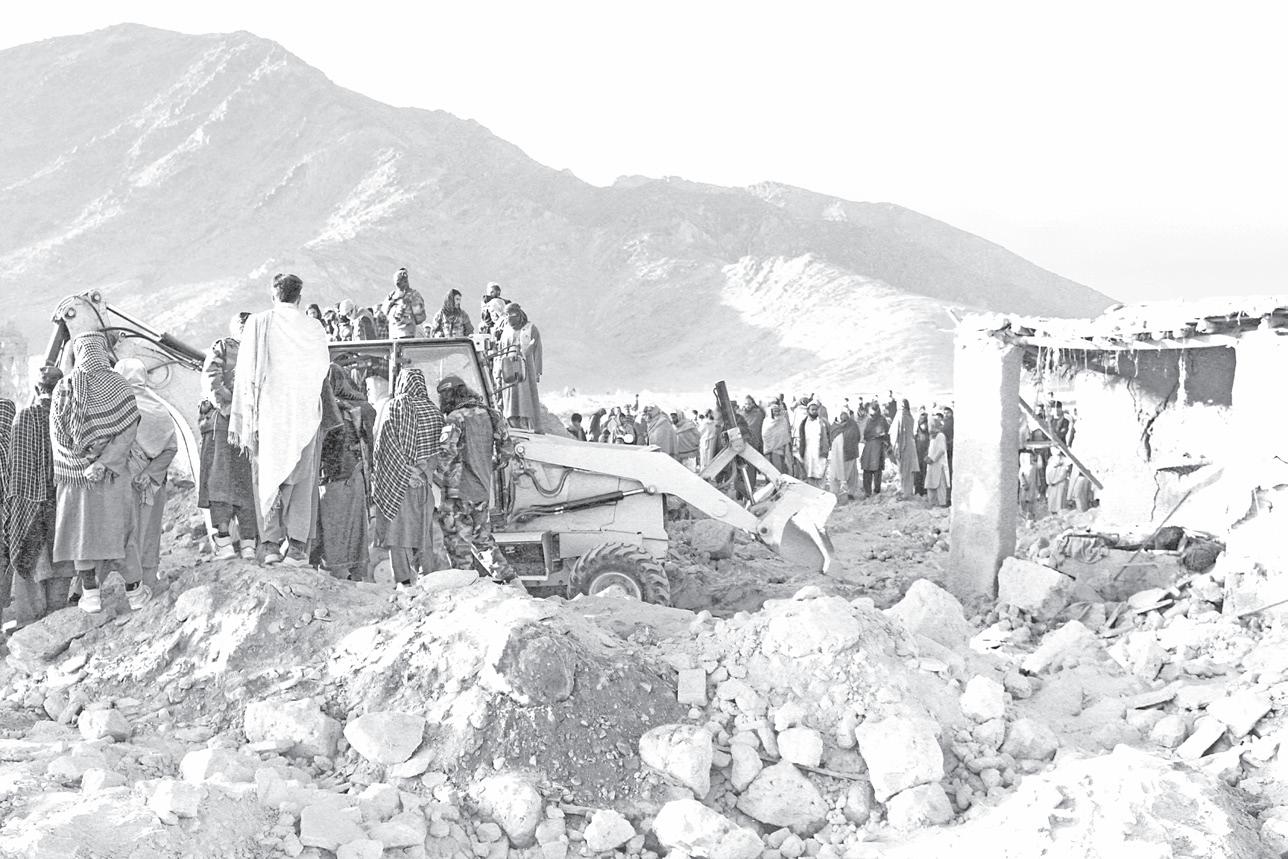
Montalban garbage slide kills 3; 50 missing
TBy Jonathan L. Mayuga @jonlmayuga
HREE people were killed, while 50 others remain missing, after a portion of a sanitary landfill in Montalban, Rizal, collapsed on Friday.
Office of Civil Defense—Calabarzon
(Cavite, Laguna, Batangas, Rizal and Quezon)
Operation Center officials said they are still
awaiting a report from the Rizal local government, that came to know of the incident only on Saturday.
Urban poor group Kadamay, which first reported the incident, said some 100 residents have been affected in the area.
The 19-hectare Rizal Provincial Sanitary Landfill is operated by International Solid Waste Integrated Management Specialist Inc. It serves as the primary disposal facility of
Metro Manila and other areas.
The Montalban Methane Power Corporation has a waste-to-energy facility operating in the area, the Landfill Gas-To-Energy (LFGTE) plant.
A waste management and disposal company, ISWIMS, is reportedly providing services to 18 local governments and has close to 5,000 employees.
The Rodriguez incident happened just more than a month after a similar tragedy occurred in Cebu City.
Interviewed by ANC, Romeo Gonzales Hidalgo, a nongovernment organization representative to the National Solid Waste Management Commission (NSWMC), said the garbage heap at the Rizal Provincial Sanitary Landfill has reached 20 to 23 meters, exceeding the safety limit of only six meters.
He said there’s a need to put a limit to
the height of garbage in sanitary landfills to prevent untoward incidents.
In a statement, the DENR—Environmental Management Bureau (DENR-EMB) said EMB-Calabarzon has already conducted an on-site investigation and ordered immediate stabilization operations following the trash slide.
EMB Calabarzon personnel were deployed to the site to assess the extent of the erosion and to verify reports on missing individuals.
The Proponent Operator was, likewise, directed to implement stabilization activities, such as leveling and sloping of the eroded area to prevent further instability.
To ensure rapid corrective action and full compliance with environmental and safety standards, the EMB has required Green Leap Solid Waste Management to:
1. Provide a detailed action plan and
daily project status reports on retrieval and rehabilitation activities; Immediately conduct waste compaction and daily soil covering, and
2. Control heavy equipment movement and restrict access to high-risk zones; Implement slope stabilization and maintain regular site inspections.
A technical conference will be conducted by EMB Ccalabarzon with the operator of the landfill to discuss the details of the incident, status of ECC compliances, and will issue the corresponding Notice of Violation for identified non-compliance with their ECC conditions based on the results of the investigation.
The EMB Central Office said it remains in close coordination with DENR-EMB Calabarzon and will continue to provide directives and receive regular updates as the situation develops.
BCDA embraces transit-oriented development for BGC
THE Bonifacio Global City (BGC) is entering a new phase of growth anchored on public transit as major infrastructure projects converge with longterm urban planning reforms, according to the Bases Conversion and Development Authority (BCDA).
BCDA, which manages the development of BGC, sees the integration of the Metro Manila Subway as a solution to the district’s historic dependence on private vehicles and as a foundation for transit-oriented development (TOD).
“National infrastructure investments are allowing BGC to mature into a more commuter-focused and accessible district,”
BCDA President and Chief Executive Officer Joshua Bingcang said.
Bingcang added, “When mass transit becomes embedded in the estate, it improves mobility, strengthens property fundamentals, and supports long-term competitiveness.”
At the heart of this transformation is the Metro Manila Subway, led by the Department of Transportation (DOTr) in coordination with national and local agencies.
A recent groundbreaking marked the start of a 1.33-kilometer segment connecting Shaw
Boulevard Station in Pasig City to Lawton Avenue Station in Taguig City, including stops within Uptown BGC.
Planned stations near Kalayaan Avenue and eastern BGC will provide direct underground rail access to Ninoy Aquino International Airport and major hubs in Quezon City in under 30 minutes.
The subway will also interconnect with existing and planned railway lines, including LRT-1, LRT-2, MRT-3, MRT-4, MRT-7, and the North-South Commuter Railway.
BCDA anticipates that improved rail access will increase pedestrian traffic within walking distance of future stations, benefiting residential, office, and retail developments.
On the other hand, the former Fort Strip property along 5th Avenue is being redeveloped into higher-density, mixed-use spaces, while a newly opened segment of 7th Avenue toward 32nd Street restores street grid continuity and improves mobility between Uptown and High Street.
In collaboration with SyCip Gorres Velayo & Co., BCDA is updating the BGC Master Development Plan. (See: https:// businessmirror.com.ph/2026/01/26/ traffic-infra-climate-risks-drive-bgc-
House bill targets gaps in vape taxation
LAWMAKERS are moving to consolidate the country’s divided tax framework for vapor products, hoping to restore billions of pesos in government earnings.
With support from more than 40 members of Congress, including Deputy Speaker Kristine Singson-Meehan and four co-authors of related bills, House Bill 5207 targets the unequal taxation of nicotine salt versus freebase nicotine.
Lawmakers backing the bill warn that the disparity—P60.20 per milliliter for nicotine salt against P6.95 per milliliter for freebase nicotine—drives misdeclaration practices and deprives the government of revenue.
The measure seeks to boost taxes on freebase nicotine products, thereby preventing revenue losses linked to the gap between nicotine salt and freebase liquid taxation.
“All told, this bill seeks to lessen the burden on the legitimate businesses, level the playing field, discourage illegal trading practices that expose consumers to unregulated products and ensure fair competition in the market,” the authors of the bill said.
Advocates warn that the steep 900 percent difference in taxation has resulted in a “tax leakage,” as importers misclassify nicotine salts to avoid higher duties. Senate Ways and Means committee chairman Sen. Sherwin Gatchalian previously estimated the government loses
Flood control. .
.
Continued from A5
come alongside encouraging developments in the country’s fiscal landscape. Former Albay Rep. Jose Clemente “Joey” Salceda, an economist and former chairman of the House Committee on Ways and Means, credited President Marcos’ policies for improving fiscal discipline, narrowing the deficit, and creating space for investments in priority sectors.
“In fact, we are at the cusp or on the verge of another credit update, which means a lower interest rate, which means
P14.8 billion each year from this loophole.
The bill points out that, despite a 2024 rule mandating revenue stamps on all vape products, illicit traders still exploit loopholes. By mislabeling salt nicotine as freebase, they evade higher taxes—taking advantage of the government’s limited ability to detect the difference.
Government revenue has not matched the surge in vapor product withdrawals, Bureau of Internal Revenue (BIR) data show. The average excise collected per milliliter slid from P42.00 in 2021 to P9.00 in 2025, reflecting that most products are being taxed at the lower freebase rate.
“These illicit traders capitalize on such regulatory gaps to evade higher taxes imposed on certain nicotine varieties, ultimately undermining public health efforts and fair market practices,” the bill proponents said.
“The bill seeks to remove the inordinate distinction on the excise taxes imposed between nicotine salt and freebase vapor products, through the imposition of one tax rate for all vapor products regardless of the type of nicotine used,” the authors said.
Economists and industry players believe HB 5207 would standardize vapor product taxation in line with global and Asian norms, while simplifying administration to improve compliance and boost government revenue.
more space for spending, for government investments in areas that will essentially support our competitiveness for foreign direct investments,” Salceda said during a Saturday news forum.
The Philippines maintains investmentgrade ratings across major agencies, with S&P Global Ratings keeping a positive outlook on the country’s “BBB+” rating.
Salceda said this combination of successful local projects and improved fiscal headroom positions the country to expand programs that directly improve the lives of citizens while strengthening economic resilience. Salceda’s point, in effect, is that the
www.businessmirror.com.ph
Run for Million Trees back Manila’s 100,000 bamboo planting program
OFFICERS of the Million Trees Foundation Inc. recently, with Manila city government officials to strengthen the group’s collaboration in the implemenation of the city’s projects to advance environmental initiatives.
During the courtesy call at Manila City Hall, MTFI formally expressed support for the city’s 100,000-bamboo planting program and discussed plans for the upcoming Million Trees Fun Run, which will start at the Quirino Grandstand and pass through Manila’s historic landmarks in celebration of Earth Day. MTFI President Melandrew Velasco lauded Mayor Francisco Domagoso’s environmental leadership and formally recognized him as a “Bamboo Champion.”
“Mayor Isko has shown that urban governance and environmental stewardship can go hand in hand. By planting 100,000 bamboos, Manila is setting a powerful example for other highly urbanized cities. This is not ornamental planting—this is climate action,”Velasco said. Domagoso emphasized that the bamboo initiative is part of the city’s flood mitigation and sustainability program.
master-plan-update/)
Moreover, the agency is also working with the Japan International Cooperation Agency (Jica) and other government partners to develop a roadmap for transit-oriented development across the country, coordinating land use planning, infrastructure investment, and value capture along major rail corridors. Industry assessments continue to identify BGC as one of Metro Manila’s most resilient submarkets, supported by steady tenant demand and existing infrastructure.
Data from Leechiu Property Consultants showed that the business district accounted for 218,000 square meters, or 23 percent, of office demand in 2025, led by information technology and business process management companies.
“With infrastructure aligned to land use and guided by a clear transit-oriented framework, BGC is moving into a more inclusive phase of growth,” Bingcang said. “Accessibility is no longer a constraint. It becomes a driver of long-term value.”
The agency added that lessons from BGC’s evolution will inform similar strategies in other growth centers, with a particular focus on New Clark City. Bless Aubrey Ogerio
Bienvenido Oplas Jr., president of Minimal Government Thinkers and Tholos Foundation international fellow, backed HB 5207. He said a single tax rate would deliver four key gains: easier administration, closure of evasion loopholes, alignment with international norms, and fairer taxation based on relative harm.
“Risk-proportionate taxation is to incentivize switching to less harmful products, for those who cannot quit smoking,” said Oplas. Meanwhile, Joey Dulay, president of the Philippine E-cigarette Industry Association (Pecia), argued that excise taxes should target consumables alone and exclude delivery devices from coverage.
“While we advocate for a unified tax structure across freebase and nicotine salt liquids, we believe that imposing taxes on vaping hardware undermines the principles of harm reduction,” Dulay said.
“The hardware, which consists of the heating device, chargers and cables, does not warrant a specialized tax. Since the consumables are already subject to duty, taxing the device itself constitutes an unfair double taxation on the end-user,” Dulay added.
“To remain consistent with public health goals, taxation should reflect the relative risk of the product; therefore, vapor products should be taxed significantly lower than traditional cigarettes,” he said.
administration’s push to expose and squeeze out questionable items in the budget, including the flood control allocations Marcos cited in his State of the Nation Address, is freeing resources that can be redirected to social and economic priorities like education, health, and agriculture.
“It was a blessing in disguise. wouldn’t exactly call it a blessing that the flood control funds were stolen. But because of that, Marcos cut a lot, erased many items, and didn’t release the funds, which gave us fiscal space. And because of that, I think we are now on the verge of getting a credit upgrade,” Salceda said. Jovee Marie N. dela Cruz
“We are reinforcing our riversides and major roads by planting bamboos along the banks to help control floodwaters that perennially affect our city during the rainy and typhoon seasons,” Domagoso said.
The mayor also welcomed the Million Fun Run on April 11, noting that it will showcase Manila’s beauty while strengthening public awareness for environmental protection in celebration of Earth Day. Joining Velasco during the meeting were MTFI Trustees Annette de Ocampo (Maynilad VP for Communications), former Education Undersecretary Alain Pascua, and Joel Madamba. Also present were Philippine Bamboo Development Industry Council (PBDIC) Executive Director Butch Madarang and Green Media Events President Jenny Lumba. PBDIC and MTFI, likewise, committed to refer bamboo experts and scientists to further strengthen Manila’s bamboo planting program and ensure its sustainability.
The partnership signals a unified push toward urban greening, flood mitigation, and climate resilience in the nation’s capital. Jonathan L. Mayuga
Muntinlupa residents reeling from lack of water
WEST zone water concessionaire Maynilad has admitted lacking potable water from its current sources for various reasons, which the company blamed for the current service interruptions in Muntinlupa City. In a town hall meeting called by Muntinlupa Mayor Ruffy Biazon last week, Maynilad officials admitted that the company is having difficulty supplying water 24/7 to households in the city mainly because of problems that hound its treatment plant that draws water from Laguna de Bay.
“We need to distribute or allocate hours. We have to distribute the water because of the number of customers that we have to serve,” said Greg Antonio, head of Maynilad’s Water Production South, at the meeting. Antonio admitted that Maynilad is currently rationing water to many areas in Muntinlupa. “There’s eight hours in the morning, eight hours in the afternoon and eight hours at night,” he said. “That’s the rationing.” He said in instances when there’s really no water, Maynilad resorts to delivering water through tankers.
Alfred John Gallego, head of Maynilad’s Muntinlupa-Las Pinas Business Area, said the company treatment plant handling water from Laguna Lake was unable to cope with strong winds that generate powerful waves in the lake surface.
“We can see that wind conditions have not been favorable to us though we know it’s seasonal,” Gallego said at the same meeting.
“We need to protect our plant to prevent a surge of water that is not according to design,” he said.
He said Maynilad reduces the volume of water that the treatment plant processes to avoid compromising water quality. Gallego admitted that the concessionaire also gets help from other water sources, like La Mesa Dam. He did not discuss, however, whether the company is also looking at other water sources. He said, though, that Maynilad “crosses into the north area” for water supply. He also said existing pipelines of Maynilad are no longer sufficient to carry additional water volume. He added that their main source of water, Angat, is always prone to the effects of El Nino, or prolonged dry spell.
The World BusinessMirror
Editor: Angel R. Calso Monday, February 23, 2026 A7
Trump says he’ll raise tariffs to 15 percent after Supreme Court ruling
By Michelle L. Price The Associated Press
ASHINGTON—President
WDonald Trump said Saturday that he wants a global tariff of 15%, up from 10% he had announced a day earlier after the US Supreme Court struck down many of the far-reaching taxes on imports that he had imposed over the last year.
Trump’s announcement on social media was the latest sign that despite the court’s check on his powers, the Republican president still intends to ratchet up tariffs in an unpredictable way. Tariffs have been his favorite tool for rewriting the rules of global commerce and applying international pressure.
The court’s decision on Friday struck down tariffs that Trump had imposed on nearly every country using an emergency powers law. Trump now said he will use a different, albeit more limited, legal authority.
He’s already signed an executive order enabling him to bypass Congress and impose a 10% tax on imports from around the world, starting on Tuesday, the same day as his State of the Union speech. However, those tariffs are limited to 150 days unless they are extended legislatively.
The White House did not immediately respond to a message inquiring when the president would sign an updated order to peg the tariffs at 15%.
He wrote on social media that he was making the announcement “based on a thorough, detailed, and complete review of the ridiculous, poorly written, and extraordinarily anti-American decision on Tariffs issued yesterday.”
By a 6-3 vote, the justices ruled that it was unconstitutional for Trump to unilaterally set and change tariffs because the power to tax lies with Congress.
In addition to the temporary tariffs that Trump wants to set at 15%, the president said Friday that he was also pursuing tariffs through other sections of federal law which require an investigation by the Commerce Department.
He wrote on Saturday that “during the next short number of months, the Trump Administration will determine and issue the new and legally permissible Tariffs, which will continue our extraordinarily successful process of Making America Great Again.”
After the Supreme Court decision, Trump made an unusually personal attack on the justices who ruled against him in a 6-3 vote, including two of those he appointed during his first term, Justices Neil Gorsuch and Amy Coney Barrett. Trump, at a news conference on Friday, said that the situation is “an embarrassment to their families.”
He was still seething Friday night, posting on social media complaining about Gorsuch, Coney Barrett and Chief Justice John Roberts, who ruled with the majority and wrote
Feb. 20, 2026, in Washington.
the majority opinion. On Saturday morning, Trump issued another post declaring that his “new hero” was Justice Brett Kavanaugh, who wrote a 63-page dissent. He also praised Justices Clarence Thomas and Samuel Alito, who were in the minority, and said of the three dissenting justices: “There is no doubt in anyone’s mind that they want to, MAKE AMERICA GREAT AGAIN!”
Tariffs have been central to Trump’s economic policies, which he has said address a host of ills, from reviving trade imbalances and reviving US manufacturing to forcing other nations to action, whether it be stepping up efforts to combat drug trafficking or ceasing hostilities with each other.
He also regularly claimed despite evidence to the contrary that foreign governments would pay the tariffs—not American consumers and businesses.
Federal data shows the Treasury had collected more than $133 billion from the import taxes the president has imposed under the emergency powers law as of December, and Trump has made many promises about what that money might go toward, such as paying down the national debt and sending dividend checks to taxpayers. The Supreme Court decision did not address what happens to the funds that have already been collected from tariffs.
Democrats spoke out quickly on Trump’s new tariff threat. Democrats on the House Ways and Means Committee accused Trump of “pickpocketing the American people” with his newly announced higher tariff.
“A little over 24 hours after his tariffs were ruled illegal, he’s doing anything he can to make sure he can still jack up your costs,” they wrote on social media.
California Democratic Gov. Gavin Newsom, a Trump nemesis, added that “he does not care about you.”
AP reporter Ali Swenson contributed to this story.
Ruling against Trump’s tariffs creates new uncertainty in US
trade relations with China
WBy Didi Tang The Associated Press
ASHINGTON—The Supreme Court decision striking down President Donald Trump’s sweeping tariffs has added a wrinkle to already complicated US-China relations, with both countries navigating shifting ground to avoid an all-out trade war that would disrupt the global economy while still jostling for a position of strength in negotiations.
Friday’s court ruling would seem to strengthen China’s hand, but analysts predict that Beijing will be cautious in exploiting the advantage, knowing that Trump has other ways of levying taxes. Both sides also want to maintain a fragile trade truce and stabilize ties ahead of Trump’s highly anticipated trip to Beijing.
“It will give China a moral boost in their negotiations with Trump’s team ahead of the summit, but they are prepared for the scenario that nothing actually changes in reality,” said Sun Yun, director of the China program at the Stimson Center, a Washingtonbased think tank.
Furious about the defeat, Trump said first he was imposing a temporary 10% global tariff before raising it to 15% as well as pursuing alternative paths for import duties. He made the case for tariffs by pointing to China, which poses the biggest challenge to US economic, technological and military dominance.
“China had hundreds of billions of dollars in surpluses with the United States. They rebuilt China. They rebuilt the army. We built China’s army by al -
lowing that to happen,” Trump told reporters Friday.
“I have a great relationship with President Xi, but he respects our country now.”
The White House has confirmed that Trump will travel to China on March 31 through April 2 to meet President Xi Jinping.
China is looking beyond tariffs
XI is unlikely to “flaunt or brandish” the Supreme Court ruling forcefully when meeting Trump, likely choosing instead to try to strengthen his rapport with the US president, said Ali Wyne, a senior research and advocacy adviser focused on US policy toward China at the International Crisis Group.
The more that Xi can do that, “the more likely it is that the fragile trade truce between the United States and China will take hold in earnest and that Trump will be amenable to security concessions that give China greater freedom of maneuver in Asia,” Wyne said.
Asked for comment on the implications of the court ruling, Chinese Embassy spokesperson Liu Pengyu said only that tariff and trade wars serve neither country’s interest. He called for Beijing and Washington to work together to “provide greater certainty and stability for China-US economic and trade cooperation and the global economy.”
The court decision also creates new uncertainty for other US trading partners, in Asia and elsewhere, especially those that have reached trade deals to calm the initial turmoil from Trump’s tariffs.
See “Ruling,” A8
PRESIDENT Donald Trump speaks during a press briefing at the White House, Friday,
AP PHOTO/EVAN VUCCI
Pakistan says it struck militant hideouts along Afghan border after surge in deadly attacks
By Munir Ahmed & Abdul Qahar Afghan The Associated Press
ISLAMABAD—Pakistan said early Sunday it carried out strikes along the border with Afghanistan, targeting hideouts of Pakistani militants it blames for recent attacks inside the country.
Islamabad did not say in precisely which areas the strikes were carried out or provide other details.
In Kabul, Afghan government spokesperson Zabihullah Mujahid said Pakistan carried out strikes inside Afghanistan. In a post on X, Mujahid said the strikes targeted civilians in Nangarhar and Paktika provinces, killing and wounding dozens of people, including women and children.
Mujahid accused Pakistan’s military of carrying out the strikes to compensate for what he described as security weaknesses inside the country. In comments before dawn Sun -
day, Pakistan’s Information Minister Attaullah Tarar wrote on X that the military conducted what he described as “intelligence-based, selective operations” against seven camps belonging to the Pakistani Taliban, also known as Tehrik-e-Taliban Pakistan, and its affiliates. He said an affiliate of the Islamic State group was also targeted in the border region. In October, Pakistan also conducted strikes deep inside Afghanistan to target militant hideouts. Tarar said Pakistan “has always strived to maintain peace and stability in the region,” but added that the
safety and security of Pakistani citizens remained a top priority.
The latest development came days after a suicide bomber, backed by gunmen, rammed an explosives-laden vehicle into the wall of a security post in Bajaur district in northwestern Khyber
Pakhtunkhwa province, which borders Afghanistan. The blast caused part of the compound to collapse, killing 11 soldiers and a child, and authorities later said the attacker was an Afghan national.
Hours before the latest border
strikes, another suicide bomber targeted a security convoy in the nearby Bannu district in Pakistan’s northwest, killing two soldiers, including a lieutenant colonel. After Saturday’s violence, Pakistan’s military had warned that it would not “exercise any restraint” and that operations against those responsible would continue “irrespective of their location,” language that suggested rising tensions between Islamabad and Kabul.
Tarar said Pakistan had “conclusive evidence” that the recent attacks, including a suicide bombing that targeted a Shiite mosque in Islamabad and killed 31 worshippers earlier this month, were carried out by militants acting on the “behest of their Afghanistan-based leadership and handlers.”
He said Pakistan had repeatedly urged Afghanistan’s Taliban rulers to take verifiable steps to prevent militant groups from using Afghan territory to launch attacks in Pakistan, but alleged that no substantive action had been taken.
He said Pakistan urges the inter -
After 4 years of war by Russia in Ukraine, peace is still elusive despite US push for a settlement
By The Associated Press
WHEN Russia’s full-scale invasion of Ukraine surpassed 1,418 days last month, it officially exceeded a historic milestone—the same span of time it took Moscow to defeat Nazi Germany in World War II.
And unlike the Red Army that pushed all the way to Berlin eight decades ago in what it called the Great Patriotic War, Russia’s 4-year-old, all-out invasion of its neighbor is still struggling to fully capture Ukraine’s eastern industrial heartland.
After Moscow failed to seize the capital of Kyiv and install a puppet government
in February 2022, the conflict turned into trench warfare with tremendous cost. By some estimates, nearly 2 million soldiers are dead, wounded or missing on both sides in Europe’s most devastating conflict since World War II.
Russia has occupied about 20% of Ukrainian territory since illegally annexing Crimea in 2014, but its gains after the Feb. 24, 2022, invasion have been slow. NATO Secretary-General Mark Rutte this month likened Moscow’s advance to “the speed of a garden snail.” Russian troops have moved only about 50 kilometers (about 30 miles) into the Donetsk region of eastern Ukraine in the past two years in a grinding battle for control of a few strongholds. Despite the slow pace and high cost, President Vladimir Putin has maintained his maximalist demands in US-mediated peace talks, saying Kyiv must pull its forces from the four Ukrainian regions that Moscow illegally annexed but never fully captured. He has repeatedly brandished his nuclear arsenal to prevent the West from boost -
ing military support for Kyiv.
A war of attrition
INITIALLY involving quick movements of large numbers of troops and tanks in Russia’s opening blitz and Ukraine’s counteroffensive in fall 2022, the fighting morphed into bloody positional warfare along the 1,200-kilometer (750-mile) front line.
The Washington-based Center for Strategic and International Studies estimated Russian military casualties at 1.2 million, including 325,000 killed. It put Ukrainian troop casualties at up to 600,000, including up to 140,000 killed.
“Russia has suffered the highest casualty rate of any major power in any war since World War II, and its military has performed poorly, with historically slow rates of advance and little new territory to show for its efforts over the last two years,” it said, noting Russian troops were advancing an average of 70 meters (76 1/2 yards) a day in two years to capture the transport hub of Pokrovsk.
For the first time in military history, drones are playing a decisive role, making it effectively impossible for either side to covertly mass significant numbers of troops.
Since early in the conflict, Ukraine has relied on drones to offset Moscow’s edge in firepower and stem its advances, but Russia has drastically expanded drone operations and introduced longer-range optical fibertethered drones to avoid electronic jamming. They widened the kill zone to 50 kilometers (about 30 miles) from the front, leaving the terrain tangled in strands of filament.
The mixture of high-tech drones and World War I-style trench fighting has seen small groups of infantry—often just two or three soldiers—try to infiltrate enemy positions into towns flattened by Russian heavy artillery and glide bombs. Ferrying supplies and evacuating the wounded is a major challenge as drones target supply routes.
Long-range attacks
UKRAINIAN officials described this winter as the most challenging of the war. Russia exponentially increased its strikes on the country’s energy system, causing blackouts in Kyiv where power supplies to many were cut to a few hours a day amid bitter cold.
Russia also has increasingly targeted power lines aiming to halt energy transfers and split Ukraine’s power grid into isolated islands, increasing pressure on the grid.
Ukraine retaliated with long-range drone attacks on oil refineries and other energy facilities deep inside Russia, aiming to drain Moscow’s export revenues.
Its drones and missiles sank several Russian warships in the Black Sea, forcing Moscow to redeploy its fleet from Russiaoccupied Crimea to Novorossiysk. And in an audacious attack code-named “Spiderweb,”
Ukraine used drones from trucks to hit several air bases hosting long-range bombers across Russia in June, a humiliating blow to the Kremlin.
US pressure, conflicting demands
US President Donald Trump, who once promised to end the war in a day, has pushed to end the fighting, but mediation efforts have run into sharply conflicting demands.
Putin wants Ukraine to pull its troops from the part of the Donetsk region it still controls, abandon its bid to join NATO, curb its military and grant official status to the Russian language, among other demands Ukraine has rejected.
Russia left the door open to Kyiv’s prospective European Union membership, but it firmly ruled out any European peacekeepers deployed to Ukraine as part of a settlement.
Ukrainian President Volodymyr Zelenskyy wants a ceasefire along the existing line of contact, but Putin rules out a truce, demanding a comprehensive peace agreement.
“The territorial issue is important to the Kremlin, but the war has a more ambitious goal: to create a Ukraine that would be entirely within Russia’s sphere of influence and not perceived by Moscow as ‘anti-Russia,’” observed Tatiana Stanovaya of Carnegie Russia Eurasia Center.
Ukraine and its allies accuse Putin of dragging out talks while he seizes more territory. The Kremlin accuses Kyiv and its European supporters of trying to undermine a tentative agreement reached by Trump and Putin at their Alaska summit.
While sticking to their positions, Putin and Zelenskyy have praised US mediation and tried to curry favor with Trump.
After a disastrous White House meeting a year ago, Zelenskyy has adopted a more practical negotiating stance, emphasizing Ukraine’s goodwill.
After Trump called for a presidential election in Ukraine, Zelenskyy signaled readiness for it even though it’s banned
under martial law. The election could be coupled with a referendum on a peace deal, he said, but insisted the vote was only possible once a ceasefire is established and Ukraine gets security guarantees from the US and other allies.
Elusive settlement
ZELENSKYY said the White House has set a June deadline for the war’s end and will likely pressure both sides to meet it. But even as Trump appears eager for a peace deal before the US midterm elections, challenges remain.
With Putin insisting on Ukraine’s pullback from Donetsk and Zelenskyy ruling it out, a quick deal appears unlikely. Zelenskyy also expressed skepticism about a compromise US proposal to turn the eastern region into a free economic zone.
The Kremlin expects its attacks eventually will force Kyiv to accept Moscow’s terms. Ukraine hopes it can hold on until Trump loses patience and increases sanctions on Russia, forcing Putin to halt his aggression. But Trump often appears to be losing patience with Zelenskyy instead.
The war and Western sanctions have increasingly strained Russia’s economy. Growth has slowed to a near halt, due to persistent inflation and labor shortages. The latest US sanctions on Russian oil exports have added to the strain.
But even with the economic challenges, Russia’s defense plants have increased weapons output and its government has shielded key social groups like soldiers and industrial workers from hardship.
“Its economy is poorer, less efficient and less promising than it might otherwise have been,” wrote Richard Connolly of the Royal United Services Institute. “But it remains capable of sustaining the war. Its elites are more dependent on the regime, not less. Its political system is insulated from the transmission of economic discontent into pressure for regime change.”
national community to press Afghanistan’s Taliban authorities to uphold their commitments under the Doha agreement not to allow their soil to be used against other countries.
Pakistan has seen a surge in militant violence in recent years, much of it blamed on the TTP and outlawed Baloch separatist groups. The TTP is separate from but closely allied with Afghanistan’s Taliban, who returned to power in 2021. Islamabad accuses the TTP of operating from inside Afghanistan, a charge both the group and Kabul deny.
Relations between the neighboring countries have remained tense since October, when deadly border clashes killed dozens of soldiers, civilians and suspected militants. The violence followed explosions in Kabul that Afghan officials blamed on Pakistan.
A Qatar-mediated ceasefire has largely held, but talks in Istanbul failed to produce a formal agreement, and relations remain strained.
Afghan reported from Kabul, Afghanistan.
Ruling...
Continiued from A7
“I would expect most Asian partners to proceed cautiously, with existing agreements largely holding as both sides work through the implications in the coming weeks,” said Dan Kritenbrink, a partner at The Asia Group who served as assistant secretary of state for East Asian and Pacific affairs in the Biden administration. He said he would be watching the impact on Japan ahead of Prime Minister Sanae Takaichi’s planned visit to Washington in March. Japan, a staunch US ally, has seen its relations with Beijing deteriorate in recent months.
Trump has options SHORTLY after Trump returned to the White House early last year, he invoked an emergency powers law and slapped 20% tariffs on Chinese goods over what he said was Beijing’s failure to stem the flow of chemicals that can be used to make fentanyl. Trump later invoked the same emergency authority to impose sweeping reciprocal tariffs on many countries, including 34% on China. Beijing retaliated, and the tariffs temporarily soared to triple digits before both sides climbed down.
After several rounds of trade talks and a summit between Trump and Xi in South Korea in October, the two countries agreed to a oneyear truce with a 10% baseline tariff. Trump also slashed the so-called fentanyl tariff to 10%, while Beijing resumed its cooperation in restricting the export of more substances that could be used to make the opioid. Wendy Cutler, vice president of the Asia Society Policy Institute, said she suspected the Trump administration could roll out a Plan B quickly. The Office of the US Trade Representative has an active investigation into China’s compliance with a previous trade agreement and that could be the administration’s backup plan, she said. If China is found not to be fulfilling its obligations under the agreement, the US government is allowed under a trade law to impose tariffs. Rep. Ro Khanna, the top Democrat on the House Select Committee on the Chinese
NFA earns ₧936.5M from sale of rice stocks
TBy Ada Pelonia @adapelonia
HE National Food Authority (NFA) auctioned off nearly 90 percent or 32,500 metric tons (MT) of its aging rice stocks during the third tender, freeing up warehouse space for palay procurement.
NFA Administrator Larry Lacson said the grains agency sold rice at an average price of P28 per kilo, resulting in P936.5 million in revenues. This exceeded its target amount of P912.4 million from the entire lot, he added. Currently, the agency said bid documents are being validated by the NFA before all sale contracts are finalized.
in storage for between 3 and 18 months.
The grains agency set floor prices based on stock age, ranging from P25.16 per kilo for rice stored three to six months, down to P22.52 per kilo for stocks held for over 18 months.
Of the 83 lots offered, NFA said it secured tenders for 57 lots, equivalent to 604,364 bags or 88 percent of total volume. A total of 39 bidders purchased bid documents, though only 19 are expected to secure contracts.
“But more important than the revenue the auction raised is the space it cleared in warehouses that will allow NFA to buy more palay from our farmers at a fair price.”
For Agriculture Secretary Francisco Tiu Laurel Jr., who also heads the NFA Council, the strong turnout of the third tender allowed the grains agency to clear space ahead of the harvest season.
The NFA offered a total 737,339 50-kilo bags or 36,866 MT of milled rice that had been
Ube can become PHL’s export winner–DTI
WHAT was once a staple of local desserts is now turning into an export earner, as Philippine ube products pulled in $3.06 million in 2025 on the back of strong overseas demand, according to the Department of Trade and Industry (DTI).
Preliminary data showed steady growth in processed ube products such as powder, purée, halaya and flavor extracts, underscoring the crop’s role as an export ingredient in key markets including the Middle East, the United States, the United Kingdom, and Italy.
“Industry monitoring also indicates strong interest from foreign manufacturers in incorporating ube into ice cream, baked goods, confectionery, specialty beverages, and ready-to-eat
desserts,” the DTI said in a statement.
Global product launches featuring ube have also increased, with a report from Mintel Global New Products Database recording 359 new products worldwide that used ube across various categories.
Meanwhile, the country accounts for the largest share of these launches, largely in cakes, pastries, sweet goods, and dairybased items, such as ice cream and frozen yogurt. Yet, new product development continues to gain traction abroad, the trade department said.
Moreover, Japan, China and the United States have emerged as key innovation markets, it added.
“In Japan, ube appears in chilled and shelf-stable desserts; in China, in cakes, pastries, malt and hot beverages; and in the United States, in dairy-based
The additional warehouse space will be used to store purchased palay from local farmers at a minimum of P17 per kilo for wet and a floor price of P21 per kilo for dry. The dry harvest season for rice is expected to reach its peak between April and May.
Furthermore, the average price of P28 per kilo also signaled “firm demand” despite the age of the rice stocks,
ice cream, frozen yogurt, sweet biscuits, and cookies,” the DTI said.
For her part, Trade Secretary Cristina Roque said the growing adoption of ube overseas opens opportunities for exporters to move into higher-value segments while showcasing the country’s ability to transform a traditional crop into a competitive, value-added export.
“We continue to strengthen support for the sector by improving quality standards and reinforcing supply chains, so Philippine ube can compete confidently and sustainably in international markets,” Roque said.
On the supply side, agricultural spending has traditionally focused on staples, such as rice and corn, as well as vegetables, under the Department of Agriculture.
Latest data from the Philippine Statistics Authority showed ube production at 13,535 metric tons in 2022.
Bless Aubrey Ogerio
according to the NFA.
Last December, the NFA auctioned off 315,000 bags of aging rice, with prices landing within the expected P22.52 to P25.16 per kilo range.
“With added liquidity and expanded storage capacity in the coming months, the NFA is positioning itself to step up
market intervention as harvest season advances, aiming to support farmgate prices while keeping buffer stocks manageable.”
Biddings in regions
EARLIER , Lacson said the grains agency has outlined adjustments to the terms of
reference (TOR) that may apply to the next auction round in early April, pending approval from the NFA Council. (See: https://businessmirror.com. ph/2026/02/16/nfa-eyesauction-of-old-stocks-atregional-level/)
“The TOR is being adjusted, since it’s necessary based on our previous auctions... we’re considering lowering the [minimum]volume of offer and bringing the auction process down to the regional level,” he said.
“For a faster and more efficient [process], the auction should be brought to the regional level since the central [office] gets clogged.”
Under the current TOR, the minimum acceptable quantity or volume of offer should be 5,000 50-kilo bags per lot, with Lacson citing stakeholders’ suggestion to bring it to around 3,000 bags instead. However, he did not disclose the final volume for the threshold.
PCB pins hopes on Cido to fortify local coffee industry
THE dedicated office for centralized coffee projects and funding will strengthen the competitiveness of the domestic industry, according to the Philippine Coffee Board (PCB).
PCB made the pronouncement after the Department of Agriculture (DA) established the Coffee Industry Development Office (Cido) to centralize coffee programs, funding, and policies that were previously scattered across several units.
“By centralizing programs, funding, and policy under one accountable office, Cido ends fragmented management and gives the sector the focused leadership it urgently needs,” it said in a statement.
For PCB, the government initiative would improve productivity in an industry the DA said has been plagued by low output, aging farmers, limited access to inputs, outdated equipment, and “patchy” infrastructure.
Such hurdles resulted in declining yields, uneven quality, and rising imports to meet local demand, according to the agency.
“This reform will accelerate farm modernization, improve productivity and quality, strengthen coordination across agencies and partners, and help farmers capture greater value from a rapidly growing market,” the PCB said.
“At a critical time of rising demand and increasing imports, this decision signals that coffee is now a national priority. Under the unified leadership of Cido, we are confident this initiative will restore competitiveness and unlock the full potential of Philippine coffee for farmers, businesses, and consumers alike.”
Under the Cido, the DA said the office will lead program planning and prioritization, track accomplishments across the bureaus and regional offices, and ensure all initiatives align
with national agricultural priorities and ODA-funded projects.
The office will coordinate with local governments, universities, private firms, and farmer groups while also recommending reforms to fill gaps in policy or implementation.
All coffee development funds, including those under the High Value Crops Development Program (HVCDP) and the Office of the Secretary, will now be under Cido.
The new office will be led by the agency’s Office of the Undersecretary for Special Concerns and Official Development Assistance (ODA), headed by Undersecretary Jerome Oliveros.
“Success will hinge on execution of modernizing farms, attracting younger farmers, upgrading processing facilities, and linking producers to highervalue markets,” the DA said. Ada Pelonia
Raw sugar finds support after Supreme Court tariff ruling
RAW sugar futures briefly extended gains after the Supreme Court struck down President Donald Trump’s global tariffs, as the move could allow top producer Brazil to export more sugar and ethanol to the United States.
The most-active contract in New York rose as much as 2.3 percent to the highest price in almost two weeks, before paring some of the gains.
The removal of tariffs could allow Brazil to ship more of its cane-based ethanol to the US, according to Claudiu Covrig, the lead analyst at Covrig Analytics. That could allow Brazilian producers to max out the use of cane for ethanol instead of sugar, he said.
Millers have been looking for more markets for the fuel, as plunging sugar prices amid ample global supplies and weak demand have made it less profitable to produce the sweetener.
Those shipments, though, would likely be in the second half of the year, as the Brazil has also been importing more for its own use, said Mike McDougall, an analyst at McDougall Global
View. Still, the lifting of levies could provide some support to the world sugar market if more Brazilian sugar ends up flowing into the higher-priced US market, he added.
Meanwhile, arabica coffee futures dropped as much as 1.6 percent after the Supreme Court’s ruling, before turning higher. While coffee prices had already adjusted last fall after tariffs on beans were lifted, including for top grower Brazil, the move will make buying decisions more fluid and provide relief to roasters, said coffee broker Thiago Cazarini. Still, the Supreme Court did not address the issue of refunds to importers, and Trump has said he has a backup plan.
Copper climbs COPPER climbed in London, tracking gains in US stock markets after the US Supreme Court struck down President Donald Trump’s sweeping reciprocal tariffs, which have weighed heavily on the outlook for global trade.
Prices rose as much as 1.3 percent on the London
Metal Exchange before paring gains after the court said the administration had exceeded its authority when it imposed the tariffs on trading partners. Those levies are separate to the sectorspecific tariffs Trump put in place on aluminum, steel and copper products on national security grounds.
The ruling — which was widely anticipated by investors — strikes at the heart of Trump’s agenda, blunting an all-purpose tool he has wielded against trading partners. The White House has said it will quickly replace the levies using other legal tools, though the fallback options tend to be either more cumbersome or more limited than the powers Trump asserted under the International Emergency Economic Powers Act.
Copper rose 1.2 percent to settle at $12,964 a metric ton on the LME,as all of the five main metals contracts climbed on the exchange.
Egg prices collapse
A YEAR ago, empty egg shelves in grocery stores were a symbol of stubborn food inflation. Shoppers
paid record prices, scrambling to beat per-customer limits and stocking up whenever cartons appeared.
Today, the picture has flipped — and while that’s good news for US consumers, egg farmers are feeling the whiplash.
After ramping up production to meet last year’s frenzied demand and hedge against bird flu losses, US producers now face a glut. Consumer prices have fallen to their lowest levels in two years, squeezing farm margins and pushing some operators below breakeven.
Americans on average paid $2.577 for a dozen large grade A eggs in January, a 59 percent drop from last March’s record high of $6.227, when avian influenza outbreaks decimated flocks and sent prices soaring. The sharp correction reflects a rapid effort to expand the number of hens to offset the risk of avian influenza, as producers bet tight markets would persist.
Instead, supply has overtaken demand.
“We had farmers that worked really hard to make sure that they have extra hens on hand,”
said Emily Metz, president of the American Egg Board. “As a result, we have a very strong supply right now of eggs. That’s why the market is where it is.” There were 309 million layer hens producing table eggs as of Jan. 1, the most since December 2024, according to US Department of Agriculture data. Egg companies riding the wave of higher prices invested to help farmers expand output, while the Trump administration — under pressure to tame grocery inflation — boosted imports to an estimated 122.5 million dozen eggs in 2025, more than four times year-earlier levels. That’s sent prices plummeting. Wholesale egg prices, which usually are passed down to the retail level after a lag, at one point in January reached the lowest level since 2017. The USDA forecasts eggs this year averaging $1.25 a dozen, down 67 percent from the prior year.
Metz said many producers are now operating below breakeven, and prices are likely to remain under pressure given “a lot of supply, and more supply coming on board.” Bloomberg News
A FARMER sells his palay to the National Food Authority (NFA) in Zamboanga del Sur in this NFA FILE PHOTO.
Rewriting the rules at sea: Why seafarers must lead shipping’s triple transformation editorial
THE Philippines is the beating heart of the global merchant fleet, with over 400,000 to 500,000 Filipino seafarers at sea at any time—about a quarter of the world’s maritime workforce. In 2025 alone, more than 589,000 seafarers were deployed, highlighting the country’s vital role in providing skills, stability, and remittances that support numerous economies.
This reality should heighten global interest whenever maritime industry regulations are discussed or revised. Recent talks between International Maritime Organization (IMO) Secretary General Arsenio Domínguez and the Philippine Maritime Industry Authority (Marina) serve as a crucial reminder that the backbone of global trade consists of individuals whose safety and dignity must adapt alongside technological advancements and decarbonization efforts. (Read the BusinessMirror story: Marina, IMO tackle maritime issues; Locsin flags threats, February 20, 2026). Key issues discussed include seafarer training standards, green shipping initiatives, autonomous vessels, workplace harassment, and the safe handling of alternative fuels. These concerns are urgent, reflective of the shipping industry’s need to navigate three critical transformations: decarbonization, rapid digital adoption, and scrutiny over workforce treatment. Without careful, rights-based updates—particularly to the Standards of Training, Certification and Watchkeeping for Seafarers—there is a risk of exacerbating existing crises.
Two main points from the discussions merit particular focus. Firstly, decarbonization must be aligned with improved training and safety standards. Philippine Ambassador and Permanent Representative to the IMO Teodoro Locsin Jr. emphasized that safety shouldn’t be compromised while pursuing cleaner fuels; this is crucial as new fuels like ammonia and hydrogen will require different handling protocols and emergency responses. Proper training and clear regulatory frameworks are urgent necessities to avoid potential disasters.
Secondly, the rise of digitalization and automation presents both benefits and challenges. Secretary General Domínguez encouraged younger seafarers to engage with new technologies, highlighting the need for training in operating complex systems. However, this engagement must be reciprocal. Regulators should be vigilant against over-reliance on technology, as human judgment remains essential, especially in critical situations. The STCW review must integrate digital competency training while reinforcing essential seamanship skills, addressing human-machine interaction, fatigue management, and cognitive loads in automated systems.
Addressing the human rights and dignity of seafarers is equally important. The ongoing issues of bullying and harassment at sea violate international conventions and hinder efforts to diversify the workforce. The Manila Declaration on Seafarers’ Rights lays a foundation, with the STCW review needing a stronger framework for accountability, clear employer responsibilities, and mental health support systems. Improving working conditions is also key to attracting more women into the industry, where they currently represent less than one percent of the workforce.
Given the Philippines’ significant contribution to the global maritime labor pool, its perspectives are crucial. Policies that ignore the realities of Filipino seafarers—regarding training, assessments, and welfare—are likely to fail. Marina’s showcase of STCW best practices and constructive engagement with the IMO should encourage enhanced technical cooperation, capacity building for training centers, and practical drills. Thoroughly revising the STCW Convention is not just a technical matter; it carries moral, economic, and strategic implications. As the world seeks to decarbonize and digitalize shipping, it cannot do so at the expense of underprepared seafarers or neglect the importance of human oversight.
The discussions in Manila should ignite a dedicated movement towards revising the STCW with definitive goals, timelines, and resources. Engaging seafarers—not just administrators or shipowners—in consultations is vital. Strengthening connections between training, enforcement, and welfare will help ensure a future that honors the contributions of seafarers and enhances safety at sea. Failure to act risks leaving behind those who sustain global trade, a setback that is unacceptable.
Opinion
Jobs on shaky ground
YRISING SUN
OU hear different variations of the same story: a former business process outsourcing (BPO) agent now selling snacks online; a fresh grad doing three part-time gigs; a middle-aged construction worker heading home early because the project shut down.
The Philippines ended 2025 with about 2.26 million people unemployed, even though the official jobless rate stayed at 4.4 percent in December. On paper, that looks “manageable.” On the ground, it feels very different.
The jobless count in December 2025 was sharply higher than the 1.63 million recorded a year earlier. Underemployment, where people have work but want more hours or better jobs, still hovers around 10.9 percent according to the Philippine Statistics Authority, specifically for December 2025. Roughly 42 percent of the total workforce—including agriculture— are in the informal sector
as of early 2025/2026 estimates. That would include vendors, riders, and “raket” workers; all of them without strong protections or benefits.
Artificial Intelligence (AI) adds to this problem—an International Monetary Fund (IMF) study estimates that about 36 percent of jobs in the Philippines are highly exposed to AI, with roughly 14 percent of the total workforce at real risk of being replaced. The most vulnerable are roles heavy on routine, rule-based tasks: basic customer service, some back-office processing, and low-level data work. These are exactly the entry points many young Filipinos depend on. Is hiring slowing? The answer
is: not everywhere, but enough to worry about. Overall unemployment looks stable, but the rise in jobless numbers, especially in construction, signals a softer labor market. Businesses are cautious: corruption issues, high costs, and global uncertainty are making them think twice about expanding their payrolls.
Forecasts for 2026 are not all doom and gloom, however. Groups like the ASEAN+3 Macroeconomic Research Office (AMRO) see the economy growing around 5.3 percent, which could support more jobs if investments and reforms push through.
So what can be done now—beyond the usual “upskill” slogan? First, treat underemployment and informality as seriously as unemployment. Policy should reward companies for creating stable, decent jobs, not just any jobs. Second, invest heavily in vocational and technical training that lines up with real demand: renewable energy, advanced manufacturing, logistics, and higher-value IT services, not just generic “digital skills.” Third, give young people more ways to learn on the job—apprenticeships, paid internships, and partnerships between schools and employers, especially outside Metro Manila.
The twin pressures: When water won’t come and water won’t go
ALyn B. Resurreccion, Dennis D. Estopace Angel R. Calso, Dionisio L. Pelayo
Ruben M. Cruz Jr.
Eduardo A. Davad Nonilon G. Reyes
D. Edgard A. Cabangon Benjamin V. Ramos Aldwin
to 36. E-mail: news.businessmirror@gmail.com www.businessmirror.com.ph
Finally, AI should be built into national workforce planning, not left to chance. That means supporting workers in roles most exposed to automation with targeted retraining, and helping smaller firms adopt AI in ways that make employees more productive instead of disposable. If you listen closely to the stories mentioned above, and other similar tales, they all circle back to the same question: where is all this going? The real test for 2026 and beyond is whether these stories slowly shift— from people hanging on to whatever they can find, to people building careers that can last.
Experts are not promising a quick fix: institutions like the World Bank (WB) and the United Nations (UN) see a gradual, “slow climb” recovery stretching through 2026–2027, with growth improving but structural labor problems lingering unless reforms speed up. At the same time, groups like the International Labor Organization (ILO) and IBON warn that underemployment and informality could remain stubbornly high for years if policy continues to focus on headline gross domestic product (GDP) instead of job quality and worker protection.
LITO GAGNI
CITY lives by water in two opposite ways: it suffers when water does not arrive, and it suffers when water does not leave. One appears as an empty faucet at dawn; the other as a rising river at night. Yet both are judged by the same measure—whether public infrastructure performs when ordinary life depends on it.
Recent discussions on Maynilad’s 34 percent non-revenue water and the government’s repair of flood control projects may seem unrelated, but they reveal a common question: when systems fail to work as designed, who carries the burden—the network, or the household?
There is a figure that should not be brushed aside. In December 2025, MWSS Regulatory Office Chief Regulator Patrick Lester Ty said Maynilad’s non-revenue water (NRW) stands at 34 percent—a level he described as “high,” especially when Manila Water operates at roughly 13 to 15 percent. That contrast is not merely technical. It invites a deeper question: when treated water fails to reach the faucet, who ultimately absorbs the cost?
In a sense, water loss inside the network becomes wage loss outside the household.
High NRW is an engineering problem inside the pipe. But outside the pipe, it can become a reliability problem. When pressure must be managed and supply rotated, service interruptions follow. And interruptions are rarely neutral. In communities without storage tanks—often lower-income areas—hours without water mean time spent adjusting schedules, securing supply, or postponing work.
Morning routines are the invisible clock of the working day. In many households, water determines whether that clock starts on time. When supply pauses, preparation pauses—and sometimes income
does too. What appears as leakage in a distribution network can translate into lost productivity at home. In practical terms, interruption hours can become foregone wages.
A pipe leak wastes water inside the system; an interruption wastes time outside it. One appears in regulatory filings. The other never does.
Yet for workers paid by the day, reliability may matter more than tariff adjustments. As billions are invested in modernizing distribution, perhaps the next benchmark of success should not only be lower NRW, but fewer mornings when earning a living must wait for water to flow.
Recent reports that Department of Public Works and Highways (DPWH) Secretary Vince Dizon has directed the repair of damaged flood control projects under existing warranty provisions represent a practical step toward resolving the issue.
Enforcing contractual obligations allows deficiencies to be addressed promptly while avoiding prolonged legal proceedings.
Several contractors have begun undertaking corrective work to bring structures into compliance with agreed standards. This approach prioritizes immediate remediation and public safety, particularly with the approaching rainy season. By focusing on restoration rather than litigation, both the agency and the
contractors can concentrate on ensuring the intended protective function of these projects. The development also highlights the role of contract enforcement in maintaining confidence in public infrastructure programs. Accountability mechanisms embedded in project agreements are designed precisely for such situations—to correct deficiencies without delay and to clarify responsibilities between the implementing agency and private partners.
These events occur against the backdrop of the Philippines’ recent decline in Transparency International’s 2025 Corruption Perceptions Index, where the country moved from 114th to 120th out of 182 countries. The flood control controversy has therefore taken on broader significance, as public works programs often serve as indicators of institutional reliability. In this context, remediation efforts contribute not only to structural integrity but also to restoring confidence. Acknowledgment of deficiencies and completion of corrective measures are constructive steps toward strengthening professional standards within the construction sector.
Chua
2005
Atty. Jose Ferdinand M. Rojas II
Pest control, not machine guns: Proportional reform for Philippine tax administration
EDEBIT CREDIT
First part
VERY few years, a familiar “big bang” idea returns to tax administration policy conversation: abolish the Bureau of Internal Revenue (BIR) and the Bureau of Customs (BOC), and replace both with a single, independent, well-funded National Revenue Authority (NRA). The pitch sounds seductively simple—remove fragmentation, improve governance, curb corruption opportunities, modernize systems, and professionalize leadership. Recent forums and reports have revived the proposal anew.
But tax administration is not an ordinary back-office function. It is the government’s lifeblood system— an always-on operation that must collect from millions of taxpayers, clear imports daily, and keep public services funded. When a house has pests, you do not solve it with machine guns. You use targeted pest control: identify entry points, improve hygiene, seal cracks, apply the right treatment, and monitor results.
That is the principle of proportional reform: match the reform tool to the governance problem, without triggering collateral damage larger than the disease.
The NRA vision is often described as corporate-style governance, fiscal autonomy, stronger digital platforms, risk-based audits, and performance-linked compensation. Those are worthy outcomes. The question is whether the total abolition of existing institutions is a proportional path to reach them.
Start with the human and legal reality. A wholesale termination or forced retirement or separation of thousands of career officials raises civil service and security of tenure issues and can trigger prolonged litigation, grievance cases, and labor dislocation. It also risks significant unemployment and the social cost of displaced families.
Then comes the fiscal bill. A new organizational authority will require massive transition funding: separation benefits, retirement obligations, rehiring processes, new compensation structures, new buildings and information technology infrastructure, new cybersecurity posture, and the “parallel run” costs of keeping collections alive while systems migrate.
Operationally, an NRA does not wake up on Day 1 with the institutional memory of BIR/BOC: audit techniques, collection enforcement, port intelligence, case build-up discipline, court coordination, taxpayer segmentation, and local knowledge embedded in hundreds of decentralized offices. If you force a “groundzero” restart—new recruitment, new training, new manuals, new systems—you introduce a dangerous window where collections can soften, leakages can widen, and disputes can multiply. That is not hypothetical; it is a predictable transition risk in any major change in the bureaucracy— made worse when the bureaucracy is responsible for the nation’s daily revenue inflow.
Even the BIR itself has publicly framed the NRA concept as a last resort, emphasizing that the immediate priority is restoring credibility and public trust in current institutions and fixing governance where it matters most—data sharing, audit integrity, and institutionalized digital processes.
From 2001 to 2002, a similar NRA initiative was pursued by then Commissioner Rene Bañez. He initiated a proposal to transform/replace the BIR into a more independent, council-led structure called the Internal Revenue Management Authority (IRMA).
This move caused resistance from BIR employees and organizations that launched pickets in various locations. These BIR personnel were apprehensive of the impact of forced
Union guided by wisdom
PThe NRA vision is often described as corporate-style governance, fiscal autonomy, stronger digital platforms, risk-based audits, and performance-linked compensation. Those are worthy outcomes. The question is whether the total abolition of existing institutions is a proportional path to reach them.
early retirement that posed a direct threat to their security of tenure and career stability.
Academic and policy literature later summarized the heart of the resistance this way: radical tax agency reform generates internal pressure from revenue personnel affected by the changes, and external pressure from allies and networks that benefit from the status quo. There were also discussions of BIR staff officials and employees reportedly slowing down their work, which adversely affected revenue collections. As a result of these negative repercussions, the IRMA proposal was not able to take off and resulted in being shelved when Commissioner Rene Bañez resigned in August 2002.
I saw all these dynamics up close, I personally witnessed from the front row the developments surrounding Commissioner Bañez’s revenue-authority initiative—and the intensity of the institutional resistance it triggered. I was a member of a BIR-private sector committee tasked with some reform measures, and personally know the leaders of the BIR opposing the IRMA initiative.
Whatever one thinks of the proposal’s merits, the episode underscored a hard lesson in public administration: when reform is perceived as a threat to security of tenure, careers, and institutional identity, the backlash can become powerful enough to overwhelm even well-intentioned modernization goals. This presents a vivid reminder that reforms seen as existential threats can generate backlash strong enough to stall— even derail—otherwise sound modernization objectives. I agree with most of the desired outcomes of the NRA proposal— professionalization, integrity, faster modernization, and stronger financial capacity. But I recommend that this be pursued through a proportionate reform path that keeps the revenue engine running while this is being upgraded. In other words, treat the NRA concept as a destination (better governance and capability), not as a detour that demolishes existing institutions. So, what is the proportional alternative?
To be continued
Joel L. Tan-Torres was a former Commissioner of the Bureau of Internal Revenue. He has also held various positions, including Dean of the University of the Philippines School of Business, Chairman of the Professional Regulatory Board of Accountancy, Tax partner of Reyes Tacandong & Co., and SyCipGorres and Velayo & Co., and director of various
Siegfred Bueno Mison, Esq.
THE PATRIOT
OLITICAL pundits will be quick to say that the visit of President Bongbong Marcos (PBBM) to the Naga City of his erstwhile opponent in the 2022 presidential race, Mayor Leni Robredo, is just calculated as the bold pronouncement of VP Sara Duterte of her plans to run as president for the 2028 presidential elections. PBBM even proudly showed his pink socks during an interview, as an informal salute to former VP Leni Robredo who was badly beaten in the 2022 elections.
There is more than just talking about flood control projects in Naga City, that, I concede. In the same vein, when Senator Bam Aquino made his much-criticized “ideally” remarks that cases involving the extrajudicial killings during the Duterte drug war should be tried in the Philippines, they were deliberate to indicate some kind of semblance of support of an Aquino to a Duterte. For some Liberal Party die-hards, such pretense, if it were so, was just as strategic.
All of these actions were likely timed and served a specific agenda, known only to their respective advisers. History is filled with such stories of alliances, some lasted for centuries while others fizzled within a few days. These well-thought-of “chess” moves are intended to elicit reactions from their political opponents and from the large majority of supposedly undecided voters.
If the elections were held today, we will most likely have a President Sara, based on the recent satisfaction survey ratings. But wait, there are still two full years and a looming impeachment trial that will dictate how these alliances will pan out. Interesting enough, anything hurled against VP Sara will now be considered tainted with political color.
Given the nature of temporary coalitions in Congress, save for the leftleaning groups, which always echo the same tune, politicians now tread more carefully in terms of going green (Sara) or red (PBBM). Along similar lines, going green can mean being pro-China while going red can mean pro-USA. Can there be something in between, without being judged to be a loyalist in one and a traitor to another? In broken relationships, the former spouses or lovers usually end up as bitter enemies, if not estranged from each other. For instance, I have a doctor-friend, who, after having his marriage annulled and getting married soon after, remains estranged from his first family, both wife and children. There seems no reconciliation in the horizon. Their friends have to choose to remain friends between the wife or the husband. In stark contrast, I have seen my lawyerfriend from the Visayas, who is now on his second marriage, enjoying reunions with his former wife, their common children, his current wife and his children with her. Despite a difficult annulment process, the former spouses chose to be civil or at least appear united, for the sake of the children, under a concept of a blended family. The spouses exert
efforts to have a peaceful co-existence to minimize the harsh effects of separation in relationships, especially with the children.
In biblical history, there was once a story of unions between former adversaries. Some say that wicked King Herod and Pontius Pilate, otherwise at odds, found unity in ridiculing and mistreating Jesus, ironically, despite finding Him innocent. In Luke 23:1112, the Bible said—“Then Herod and his soldiers ridiculed and mocked him. Dressing him in an elegant robe, they sent him back to Pilate. That day Herod and Pilate became friends— before this they had been enemies.”
The resentment that these “kings” felt toward each other was rooted in politics. Herod resented the Roman Pilate to rule the big city (Jerusalem) while Herod was relegated to ruling over the small town (Galilee). Pilate, on the other hand, resented the fact that Herod allowed the Jews under him to be such trouble-makers while brown-nosing to Caesar. Still, the fact that neither the Roman Pilate nor the Jew-practicing Herod found Jesus guilty reinforces the impurity of their temporary alliance.
This example of provisional and blended collaboration of two corrupt rulers in the mistreatment of Jesus reflects the flawed nature of human power and inherent evil desires. A Russian proverb says: “The enemy of my enemy is my friend.” Whether in political situations or in any estranged relationships, these alliances crumble when their “being” is grounded on evil. If President BBM is truly aligning with former VP Leni Robredo for the purpose of genuine unity against corruption, I am confident that it will be a much better Uni-Team than the BBM-Sara in 2022. But, if such idea of collaboration is just to defeat a common enemy in VP Sara, then it will just crumble.
Any alliance out of self-serving purposes is built with a weak foundation. My pastor mentor once taught
Long-delayed constitutional promise
By Atty. Rico V. Domingo
ALMOST 40 years after the 1987 Constitution pledged to prohibit political dynasties, the strongest push for action has come not from Congress but from the courts. In March 2024, members of the University of the Philippines College of Law Batch ’76 filed a Petition for Mandamus before the Supreme Court, docketed as G.R. No. 272370. They asked the Court to compel Congress to fulfill what they described as a constitutional duty under Article II, Section 26: to ensure equal access to public service and to ban political dynasties through legislation.
The argument was simple: Congress has a mandatory responsibility to define and regulate political dynasties. Decades of inaction, they claimed, turned a clear constitutional promise into an empty provision. What should have been a safeguard against inherited political power instead became a symbol of delay.
The Constitution’s framers understood the risks posed by political families dominating public office. They included a prohibition in the Charter but left the details to Congress. This decision assumed lawmakers would regulate their own advantages. Nearly four decades later, no enabling law exists. Without a legal definition, the provision has remained largely symbolic. Political families have expanded their reach across national and local positions, influenced legislation, and shaped oversight bodies meant to hold power accountable.
The mandamus petition reframed the debate. Instead of treating the anti-dynasty issue as a policy choice, it presented legislative inaction as a constitutional violation. The petitioners argued that the duty to act is not optional. Failure to pass the law
Gagni. . .
Continued from A10
undermines the will of the people expressed in the Constitution itself.
Recent discussions among members of the Constitutional Commission help explain why the provision was written the way it was. Former commissioner Adolfo Azcuna noted that leaving the definition to Congress allowed flexibility as political conditions changed. He favored a second-degree limit as a workable starting point. Christian Monsod, another commissioner, said he initially opposed anti-dynasty restrictions because he feared they might be undemocratic. He later supported a broader fourth-degree prohibition after concluding that dynasties often exclude candidates who lack wealth or political connections. The framers debated how strict the rule should be. What they did not anticipate was longterm legislative paralysis.
The effects of that paralysis reach beyond elections. Media reports on flood-control projects have pointed to recurring problems, including failed infrastructure despite large budgets. Communities continue to face flooding while procurement networks and weak oversight remain unresolved.
Observers have linked these issues to concentrated political power, in which the same families hold influence across legislative bodies, local executive offices, and regulatory bodies. When power is concentrated, accountability can weaken. Oversight risks become accommodation rather than enforcement.
Research also shows the scale of dynastic dominance. The Philippine Center for Investigative Journalism (PCIJ) reported that about eight out of 10 district representatives belong to political families. A 2025 PCIJ report identified at least 18 “obese dynasties,” meaning families that hold several elective posts at the same time, securing between five and 19 seats each during the 2025 midterm elections. These numbers suggest a pattern of structural consolidation. Dynastic networks affect candidate selection, campaign resources, and the fate of reform proposals.
Public consultations reveal growing frustration. Many citizens view the absence of an anti-dynasty law as a failure of democratic reform. One youth participant in a recent congressional hearing in Cavite argued that without a clear legal definition, political dynasties thrive under the illusion of voter choice. Wealth, name recall, and entrenched networks discourage new entrants and narrow the field of competition. The promise of equal access becomes harder to realize.
Legislative advocates have echoed these concerns. In sponsoring House Bill No. 4784, Gabriela Representative Sarah Elago described political dynasties as monopolizing not only
me that unity within comes first before building or uniting relationships with others. Believers ought to genuinely collaborate or cooperate with the Holy Spirit that indwells among us. Living honorably and following time-honored and biblical doctrines appear impossible unless believers seek out and listen to the Holy Spirit. Moments before his death on the cross, Jesus told His disciples— “These words you hear are not my own; they belong to the Father who sent me. “All this I have spoken while still with you. But the Advocate, the Holy Spirit, whom the Father will send in my name, will teach you all things and will remind you of everything I have said to you.” (John 14:24-26). “Being” good precedes the “doing” good in all things. The head (knowledge of God) dictates what the hands do (noble acts).
Except for the persons involved in these political intramurals, we will not be privy to the intentions of such gestures of apparent reconciliation or implied offers of alliances. I just hope and pray that the Advocate in them will remind them of what they already know and what they ought to do in public service. May our leaders in this country be guided with God’s wisdom, which “is first of all pure; then peace-loving, considerate, submissive, full of mercy and good fruit, impartial and sincere.” (James 3:17 ). Let all unions, political or familial, be blessed with wisdom from above.
Siegfred has a diversified set of education and experiences which has made him a game changer and a servant leader in organizations. His professional degrees came from the United States Military Academy at West Point in New York, Ateneo Law School, and University of Southern California, Los Angeles, USA. His corporate experiences include stints as general counsel for the country’s flag carrier, a food exporter with manufacturing plants in Davao and in Laguna, and a sports distributor company. Siegfred is a former soldier and a lawyer by profession, a teacher and inspirational speaker by passion, and a book author and a writer with a mission.
positions but also opportunities for genuine leadership. She argued that dynasties survive because political money overwhelms ordinary candidates and because Congress has failed to enact the law envisioned by the Constitution. Her proposal called for a fourth-degree prohibition and linked dynastic dominance to broader barriers faced by women and marginalized groups. At its core, the issue exposes a deeper problem in institutional design. Constitutional provisions set ideals, but institutions respond to incentives. By delegating implementation to Congress, the system relied on self-restraint that never materialized. The gap between constitutional vision and political reality produced lasting consequences. Dynastic politics, once seen as a danger to be prevented, became normalized. Whether this outcome resulted from unintended consequences or a built-in loophole remains debated. What is clear is that decades of delay allowed political families to entrench themselves and shape governance in ways the Constitution sought to prevent. Anti-corruption campaigns may address specific abuses, but without structural reform, the underlying conditions remain. The Constitution set an ambitious goal in 1987. The question now is whether its promise will stay symbolic or finally lead to decisive action.
Atty. Rico V. Domingo is the lead convenor of the Ugnayan ng mga Lumalaban sa Airport Privatization. He is also the founding Chairman of the Movement Against Disinformation and Past President of the Philippine Bar Association.
On the matter of projects labeled as “ghost,” accurate classification is essential. Joint inspections in Bulacan reportedly confirmed that several projects previously identified as non-existent were physically present but recorded using incorrect coordinates under earlier documentation.
tention. Maintaining clear documentation and independent verification reduces the likelihood of disputes and reinforces public trust. Contractors and agencies share responsibility in ensuring that approval procedures remain transparent and consistent.
Administrative errors, while significant, require a different response from deliberate misrepresentation.
Comprehensive, on-site verification will therefore be necessary to distinguish between documentation inaccuracies and actual irregularities.
Clarifying this distinction allows accountability to be applied appropriately and prevents misinterpretation of the overall scope of the issue. Ultimately, sustained confidence in infrastructure programs depends on two parallel efforts: consistent enforcement of contractual standards and careful verification of records. Addressing both will help protect communities, improve institutional credibility, and reinforce the reliability of public works administration.
Joel L. Tan-Torres
Monday, February 23, 2026
2nd Front
BusinessMirror
TOURISM COMPETITIVENESS AT RISK IN TRAVEL TAX JUNKING
By Ma. Stella F. Arnaldo Special to the BusinessMirror
AT a time when the Philippines is lagging in tourism competitiveness in Southeast Asia, can it afford to abolish travel taxes, which fund infrastructure projects?
Alfred Lay, Director for Hotels, Tourism, and Leisure at Leechiu Property Consultants said in the company blog, “If the travel tax is removed without a clear replacement funding source for the Tourism Infrastructure and Enterprise Zone Authority [Tieza], we risk weakening one of the foundations of tourism growth in the Philippines.”
Of the total travel taxes collected by Tieza, it retains 50 percent to fund tourism infrastructure projects, while the rest go to the Commission on Higher Education (40 percent) and the National Commission for Culture and the Arts (10 percent).
“This is not about optional improvements.
It is about the basics that make destinations viable. Tourism enterprise zones, access roads, wastewater systems in island communities, ports, public spaces, and heritage rehabilitation projects determine whether a destination can sustain visitor activity and attract private investment,” Lay pointed out.
‘No infra, no investors’ “INVESTORS and developers do not commit to projects where access is unreliable or utilities are insufficient. But when roads, water systems, and public amenities are in place, hotels get built. Commercial activity expands. Jobs are created. Local economies become
more resilient. We have seen this pattern repeatedly in destinations that have successfully grown their tourism sectors,” he underscored.
Several lawmakers from the House of Representatives and Senate have proposed to eliminate or partially abolish the travel taxes, or prescribe more exemptions such as senior citizens.
A number of them believe that the travel tax— P1,620 on economy passengers, P2,700 on first class passengers—prevents people from traveling, and its abolition will generate more revenue for government through increased income from the travel and tourism industry.
“Across Southeast Asia, tourism competitiveness increasingly comes down to infrastructure. Indonesia is investing in access and utilities in its priority tourism zones. Vietnam continues to build expressways that connect coastal destinations. Thailand has maintained steady upgrades to its tourism infrastructure for decades. Cambodia is expanding resort and eco-tourism facilities with clear direction,” Lay noted. So he suggested that legislators pin down a way to fund tourism infrastructure if the tax is removed. He cited options such as rate adjustment, exemptions, improvement of collection scheme, or a redesign of the levy. Lay nixed general appropriations funding for these projects, as this “creates uncertainty and makes long-term planning difficult,” considering these now have to compete with other agencies for government’s limited budget. New tourism roads, for instance, are no longer being funded through the GAA.
THEPhilippine Exporters Confederation Inc. (Philexport) said the United States Supreme Court ruling that struck down President Donald Trump’s “reciprocal” tariffs as unconstitutional has removed a major hurdle to boosting the country’s export earnings.
The 6-3 decision last February 20 invalidated tariffs previously imposed under the International Emergency Economic Powers Act (IEEPA), which had reached an average of 19 percent on Philippine exports in 2025.
“The invalidation of the previous 19 percent tariff provides much-needed legal relief to our members,” Philexport President Sergio Ortiz-Luis Jr. said.
“Our exporters showed in -
credible resilience last year, driving total exports to a record $84.4 billion despite these headwinds,” he added. “This ruling removes a major barrier that was unfairly penalizing Philippine craftsmanship and industry.” The ruling represents a key win for Philippine exporters and reinforces a rules-based trading system, he said, particularly for critical sectors such as semicon -
ductors and electronics, which generated $47 billion in 2025.
Philexport expects these industries to continue benefiting from existing exemptions due to their strategic role in the US technology supply chain.
In response to the ruling, the US Administration announced a new 10-percent global tariff under Section 122 of the Trade Act of 1974, effective February 24.
For Ortiz-Luis, the global application of the levy preserves the Philippines’s relative competitiveness among other trading partners.
Agricultural exports exceeding $1 billion, including coconut oil, pineapples, and mangoes, remain exempt from the new tariff, safeguarding the country’s vital agri-export sectors.
The group also highlighted the importance of the 150-day cap on the Section 122 tariff, providing a window for bilateral negotiations.
Rizal Commercial Banking Corporation (RCBC) chief economist Michael Ricafort said the Supreme Court ruling provides
Shear line floods, slides displace 52K in Agusan; cause ₧15.4-M damage
By Erwin Mascarinas
SAN FRANCISCO, Agusan
del Sur—Several days of moderate to heavy rains brought by the shear line have displaced more than 52,000 residents and left at least P15.4 million in damage to agriculture and infrastructure as flood waters swept across Agusan del Sur, disaster authorities reported Saturday.
Torrential rains brought by the shear line beginning on February 18 gradually inundated low-lying communities across the provinces of Davao del Norte, Davao del Oro, Agusan del Sur and Surigao del Sur.
As the heavy rainfall persisted, river basins and floodplains swelled on February 20, eventually overflowing and causing widespread flooding in riverside communities and surrounding valleys in Agusan del Sur—where the Agusan River and the region’s catch basin, the Agusan Marshland area, are situated.
In its situational report as of 7pm, February 21, 2026, the Agusan del Sur Provincial Disaster Risk Reduction and Management Council (PDRRMC) said a total of 13,925 families, or 52,044 individuals, were forced to flee their homes after flood waters submerged communities and landslides struck several areas in the province.
Of those displaced, 1,701 families or 4,824 individuals are currently staying in 49 evacuation centers set up by local government units. The majority, 12,224 families or 47,220 persons are temporarily taking shelter in the homes of relatives and friends.
The PDRRMC report said 42 barangays were affected by the flooding, while landslides were recorded in 14 barangays. In total, 88 barangays across the province have been affected by the weather disturbance, disrupting the lives and livelihoods of 22,936 families or 85,210 individuals.
In the municipality of Bunawan, one of the hardest-hit areas, residents waded through
waist-deep floodwaters as rivers swelled following continuous rainfall from February 18 to 20.
Several families were forced to evacuate at night as water levels rose rapidly.
“We started to observe the floodwaters rising outside our house at around 4 a.m. in the morning of February 20; by 8 a.m. most of the area outside our house including the road was already flooded and [the water] kept on rising throughout the day,” said Bo Cañete, a resident of Bunawan.
Cathy, who requested not to be fully named, said they had to evacuate their house after flooded waters got deeper and they feared that her children might get caught by the fast current if they won’t leave for the evacuation centers.
“The waters coming from the Agusan River were getting bigger and the fast current was too strong even for adults to keep ourselves balanced. So we decided to really leave and move to the evacuation center closest to our area,” she said.
Initial damage assessments show that infrastructure losses have reached P6.1 million. These include sections of roads eroded by strong currents, damaged culverts, and other public facilities affected by flooding and soil erosion.
Agriculture sustained the biggest losses, with damage estimated at P9,295,504. The flooding affected approximately 2,068.8 hectares of agricultural land, mostly rice fields, as well as root crops, vegetables, and fishponds. Of the total affected agricultural land, 331.58 hectares have no chance of recovery and are considered totally damaged.
The February 22 weather advisory of the Philippine Atmospheric, Geophysical and Astronomical Services Administration (PAG-ASA)-Mindanao Regional Services Division said Agusan del Sur will experience partly cloudy to cloudy skies with light to moderate rains.
clarity on presidential tariff powers, which could have broader implications for global trade and financial markets.
“Reduced US tariffs would lead to faster global trade, investments, jobs and employment, and overall US and global economic growth, reversing some of the tariffs’ drag on the US and global economy since last year,” Ricafort said.
“[It] would also lead to slower US inflation that would somewhat support future Fed rate cut later in 2026 that could be matched locally to help further boost the local economy,” he added. The economist added that the ruling could indirectly benefit the Philippine economy and markets, particularly exporters not covered by existing exemptions.
Still, he urged “further diversification of export markets and export products/winners to continue to address the risk related to Trump’s tariffs, trade wars, and other protectionist measures.”
Agri group pushes exports amid port congestion
By Ada Pelonia @adapelonia
WITH the trade deficit compounding port utilization levels, an agriculture group urged the government to boost exports to ease the recurring concern on congestion.
Philippine Chamber of Agriculture and Food Inc. (PCAFI) President Danilo Fausto made the call after the shipping industry called for a different approach to address high yard utilization, which has become a recurring predicament as the country’s imports continue to outstrip exports.
“We should focus on and develop our export commodities winners and ease regulatory policies that hamper export and ease of doing business,” Fausto told the BusinessMirror Association of International Shipping Lines, Inc. (AISL) President Patrick Ronas earlier told this newspaper that out of every four laden containers that enter the country, only one gets filled with cargo and shipped out. (See: https:// businessmirror.com.ph/2026/02/20/wanted-different-approach-to-port-utilizationproblems/)
The influx of imports combined with the long holidays in December and moderate pullout of container shipments further exacerbated yard utilization rates, leading to the congestion that domestic industries warned about. With this, the Bureau of Customs (BOC) issued a memorandum on February 18, directing concerned district collectors to expedite the clearance of any pending rice shipments to ease pressure on retail rice prices.
Citing analysts, the Department of Agriculture (DA) said “supply fluctuations and logistical bottlenecks that delayed the arrival of imports” caused the recent spikes in rice prices to a high of P62 per kilo for premium, P49 per kilo for wellmilled, and P46 per kilo for regular milled. Agriculture Secretary Francisco Tiu Laurel Jr. recently told the BusinessMirror that the BOC lifted the red flag on rice shipments to fast-track the processing for faster release.
Earlier, the Bureau of Plant Industry (BPI) also released a memorandum that increased the number of allowed ports of entry for incoming rice shipments, considering the port congestion “reported by importers.” The order stipulated that all rice shipments should arrive on or before February 28 to ensure that imports would not affect the upcoming local rice harvest.
“Consignments arriving beyond the said date will not be allowed for release and must be returned to the source country on the expense of See “Agri,” A2 See “Damage,”
Editor: Jennifer A. Ng
Companies
BusinessMirror
B1 Monday, February 23, 2026
FMCG growth to drop this year Ayala Land income rose on sale of ATC
TBy VG Cabuag @villygc
HE growth of fast moving consumer goods (FMCGs) in the country will slow down this year on subdued economic growth and price increase of many products, according to a consumer data company.
Numerator Philippines Inc. expects growth of 3 percent to 4 percent this year, down from the previous year’s average of about 5.1 percent. The slowdown started in the fourth quarter last year when sales of FMCGs grew only at 2.1 percent, slower compared with as much as 6.8 percent in the first quarter of 2025.
Laurice Obana, shopper insights director, said the growth rests upon how FMCG brands can tap high-value segments, particularly in three key areas, mainly on those older individuals who can spend more, the overseas Filipino workers and pet lovers.
“FMCG players must pinpoint opportunities that fit the different
lifestyles and interests of Filipino households,” Obana said.
In the Philippines, 16 percent of the current population is aged 55 and above and this number is anticipated to grow to 34 percent by 2055.
According to documents provided by the company, older shoppers yield a higher purchasing power and spend 10 percent more on average than younger generations.
This is because they prioritize health and wellness products such as plant-based milk alternatives and health supplements on top of the usual pantry staples. They also participate in physical activities, with some having access to sporting equipment, in order to stay fit and healthy.
Another group that spends more across FMCG categories is overseas Filipinos homes. Over the years, cash remittances from OFWs have
been a pillar of growth for the local economy.
According to the company, 73 percent of FMCG categories show a higher spend per buyer from these households, the company said.
Caring for animals has also shaped the everyday lives and purchases of 67 percent of Filipino homes, who own at least one pet.
About 17 percent percent of pet owners in the country buy pet food and they do so largely from pet stores.
Aside from products directly consumed or used by pets, brands that cater to adjacent categories that are relevant to homes with pets have an opportunity to grow their market share.
“At the center of Filipino culture is food. Our wallets tell us that food comes first both for in-home and take-home FMCG categories,” Obana said.
PDDC gets certificate to run energy project
THE Philippine DCS Development Corp. (PDDC) received its Certificate of Registration on February 18, marking the country’s first Complex Energy Efficiency project approved under the “Create More” law (Republic Act 12066).
A joint venture between local conglomerate Filinvest Development Corp. and French energy company ENGIE SA, the P400-million project is set to operate in Alabang, Muntinlupa City. The project involves retrofitting and upgrading the facility’s cooling
systems to improve reliability while significantly reducing energy consumption.
Trade Secretary Cristina AldeguerRoque said the project underscores the government’s drive to attract “highimpact, sustainable investments.”
“This first-of-its-kind award under the Create More [law] underscores our commitment to making the Philippines a premier destination for smart, sustainable investments,” Roque said, who also chairs the Board of Investments (BOI).
Bless Aubrey Ogerio
ATYALA Land Inc. disclosed last Friday that its net income rose 38 percent last year to P39.1 billion from the previous year’s P28.23 billion, driven mostly from the sale of the Alabang Town Center and the company’s expanding leasing and hospitality segment.
Consolidated revenues rose 5 percent to P190.2 billion from the previous year’s P180.73 billion.
Net income from core operations, which exclude the sale of ATC, reached P30.6 billion, 8 percent higher year-on-year, on the back of robust fourth-quarter earnings from estate lots and leasing and hospitality businesses, according to the company.
Anna Maria Margarita BautistaDy, the company’s president and CEO, said Ayala Land’s capital expenditures this year could reach between P70 billion to P80 billion, 38 percent of which will be for its leasing projects.
The company is pivoting its investments on recurring income as residential supply in Metro Manila remains elevated.
“We will accelerate our leasing growth. The biggest driver of earnings growth in 2026 will be leasing. We will start with sweating existing assets. Many of our renovated malls and hotels are now
operational, and the focus shifts to consumer delight and operational excellence,” Dy said.
The company is opening 200,000 square meters (sqm) of gross leasable area in new retail, which Dy said is the largest single year addition of new spaces in its history.
This include the opening of Arca South mall some two weeks ago, open over 70,000sqm of new office space in Evo City, Arca south and gate walk.
“In addition, we signed three new major leases with big multinational firms in Quezon City and Cebu totaling 82,000sqm. The Mandarin Oriental will reopen in the fourth quarter, adding another 276 rooms to our hotel portfolio,” Dy said.
“We have clear sight of P30 billion of new launches, firmly scheduled for 2026 and we have already launched pipeline that we can move on as we see market windows open,” Dy said. Ayala Land’s property development business delivered P113.9 billion in revenues, despite market sentiment headwinds, propelled by strong estate lot and office-for-sale bookings and a sequential improvement in core residential revenues.
Development revenues in the fourth quarter reached P38 billion, up 5 percent year-on-year. VG Cabuag
The BIG IDEA: Inside Asian Hospital s 2026 Game Plan
By Francine Medina
he New Year brings revitalized energy and renewed focus especially in healthcare, where every decision impacts lives.
In the latest episode of “Freshly Brewed,” BusinessMirror’s digital show, Dr. Beaver Tamesis, President and CEO of Asian Hospital and Medical Center (AHMC), discussed how the institution is setting the tone for 2026 through its annual gathering, “Fantastic 6 sa 2026: The BIG IDEA.”
Hosted by Anne Ruth Dela Cruz, BusinessMirror’s Health and Fitness Editor, the episode explored how leadership vision and teamwork drive the mission of delivering the hospital’s slogan, “Alagang Deserve, Alagang Sulit.”
AHMC welcomes 2026 with a sense of pride, particularly since it has more than fulfilled its vision and goals under last year’s “High Five para sa 2025” campaign.
To kickstart the hospital’s fresh goals, AHMC opened a new 29-bed “Bayanihan Ward” last January 26 on the eighth floor of Tower 2. The new wards are set to provide accessible, high-quality care for indigent and financially needy patients. The 29-bed ward offers specialized areas for adult medical/surgical, obstetrics and gynecology, and pediatric patients.
“These are PhilHealth beds so that patients, as much as possible, will have nobalance billing or at least can afford it. We have been working with all the communities, including the DSWD and PhilHealth.”
Training and upskilling hospital staff continue to be part of the plan for 2026. The AHMC chief said, “All of these goals are powered by innovation and information technology,” he added. “But the biggest part of it is the growth and development of our people. Asian Hospital cannot really grow if our colleagues are left behind in their development.”
The hospital will also continue its “Ate Rose” atherosclerosis awareness
Among its key achievements were: Securing the JCI Gold Seal of Approval, which represents the highest international standards for patient safety and quality healthcare; opening the new Asian Health and Medical Clinics; inaugurating the Asian Learning Institute; launching the cutting-edge, non-invasive cancer treatment CyberKnife technology; and promoting the “Ate Rose” atherosclerosis awareness campaign. Building on this strong foundation, this year’s theme, “Fantastic 6 sa 2026: The BIG IDEA,” reaffirms Asian Hospital’s commitment to a community-forward vision.
campaign. “But this time, we will be presenting prevention and strategies against atherosclerotic heart disease, and even how to prevent strokes, and the like.”
“We must wrap all of these in a diseaseintegrated approach so that patients won’t get lost in the big hospital maze,” he stated. “We need to be in that same vicinity when a patient enters so that all the touch points are there, so that there will be little navigation for their requirements.”
Such strategy asserts the commitment of AHMC to enhancing the patient journey. Dr. Tamesis continued, “Improving access will be very critical as part of our big ideas. It’s about making Asian Hospital more accessible to the community. It could include improving parking to helping patients without financial stability, so that they won’t end up bankrupt when they face serious medical illness. That’s what we mean by access—it’s both access to our physical and financial facility.”
To ensure that the campaign transcends boardroom strategy and becomes a lived experience, Dr. Tamesis cited the importance of the kick-off event announcing the campaign.
“We were able to communicate to every employee that these are our priorities, these are the standards and norms that we expect
from you, and which they can expect back from us. It’s a two-way street. We help each other. It’s not just management dictating, but also management helping employees achieve its goals. It’s always a two-way street when we look at these campaigns.”
One way to achieve the campaign goals is the continuous development of its staff and doctors.
He explained, “We identify how else we can improve their skills. This is why we spend so much time identifying competencies and finding the gaps. And when we see the gaps, we look for training programs to put that person to the next level.”
“For doctors, we look for specialty programs that they can be part of, be it external, local, or outside of the country. If we need to send them abroad, we will do that. We are willing to invest in our key doctors,” he said.
Digitalization and patient care
At AHMC, the future of healthcare is here as it gets into digitalization while remaining focused on patient care.
“It’s important to choose the right technology. Artificial Intelligence or AI is much talked about. You need to select a system that caters to the Philippines or a
similar market so we can easily adapt it and not just apply a Western concept. That way, we can get the best technology with the best possible results and with the least possible confusion for doctors and our patients. It should be able to address the patient’s needs.”
Valuing advocacy
While the hospital invests in innovation and technology to maintain its world-class services for patients, community-focused advocacies, such as its Ate Rose campaign, are part of its identity.
He noted, “It helps cement Asian Hospital’s reputation as a top-notch center that addresses the biggest health needs of the country.”
“We all know that atherosclerosis is the number one killer, be it in the heart or brain. We have to position ourselves here; we have to claim the space. At the same time, we see the growth of diseases, particularly malignancies. We have to ensure that we are capable of bringing in the newest and bestpriced technology so patients don’t have to suffer from unnecessary pricing. “ Beyond providing medical information for its awareness campaigns, creativity plays an important role in making the
message effective.
Dr. Tamesis surmised, “We need to motivate people to make them understand what it is all about. In the Ate Rose campaign, for instance, everyone had a big smile when they saw the concept. It makes it more real.’
“If people get to be more aware of the disease, how they can have control over it, then they’ll be more able to handle their diabetes, high blood pressure, or heart disease.”
By the end of the year, as “Fantastic 6 sa 2026: The BIG IDEA” winds down, Dr. Tamesis hopes to make patients and the hospital team feel that AHMC is both accessible and inclusive. He said, “It would be fantastic if patients feel that they can come to us without fear of financial loss or ruin. And for employees to feel the sense of loyalty and gratitude that we nurtures their career.”
“When I see these success stories in our patients and our employees, that makes me extremely happy because I know we’ve done our job in taking care of our patients, community, and employees.”
If there’s one big idea that AHMC employees would take home this year, Dr. Tamesis hopes that it would be connection and cooperation. “I think it should be the idea of bayanihan, of really helping each other. If you look at the etymology of the word, it is about bayan or nation, the community helping each other.
“The hospital system is so integrated that everybody has a role to play. So it’s really important to inculcate that bayanihan spirit. Tulong-tulungantayo. No man can do the job by themselves; we all need to do the job together for our patients, community, and employees. We all uplift together,” Dr. Tamesis commented.
“Healthcare is complex, but if we work together, choose the right tools, it can actually be surmountable. We need to understand that everybody is trying to help the country and improve the systems. But by working together, we will find the solutions,” he concluded.
• WatchthefullepisodeonBusinessMirror’s YouTube channel. Catch fresh episodes of “Freshly Brewed” every Monday, 10 a.m., on BusinessMirror’s YT,FB,andwebsite.
Dr. Beaver Tamesis, President and CEO of Asian Hospital and Medical Center Anne Ruth Dela Cruz, BusinessMirror’s Health and Fitness Editor
Dr. Beaver Tamesis, President and CEO of Asian Hospital and Medical Center, talks about “Fantastic 6 sa 2026: The BIG IDEA with Anne Ruth Dela Cruz, BusinessMirror’s Health and Fitness Editor.
“
WAR DRUMS IN THE GULF:
What to know as US moves military assets to Mideast and Iran nuclear talks have yet to reach a deal
By Jon Gambrell The Associated Press
DUBAI, United Arab Emirates— Iran and the United States are waging gunboat diplomacy as talks over Tehran’s nuclear program hang in the balance following Israel’s 12day war on the country in June and the Islamic Republic carrying out a bloody crackdown on nationwide protests.
US President Donald Trump has kept up pressure on Iran, moving an aircraft carrier and other military assets to the Persian Gulf and suggesting the US could attack Iran over the killing of peaceful demonstrators or if Tehran launches mass executions over the protests. A second aircraft carrier now is off the coast of Morocco, potentially heading to the eastern Mediterranean Sea.
Trump has pushed Iran’s nuclear program back into the frame as well after the June war disrupted five rounds of talks held in Rome and Muscat, Oman, last year. Two rounds of talks so far have yet to reach a deal, though. It remains unclear how—or if— more talks will happen, though Mideast nations fear a collapse in diplomacy could spark a new regional war. US concerns also have gone beyond Iran’s nuclear program to its ballistic missiles, support for proxy networks across the region and other issues.
Iran has said it wants talks to focus solely on the nuclear program. Iranian President Masoud Pezeshkian has insisted that his nation was “not seeking nuclear weapons....and are ready for any kind of verification.” However, the United Nations’ nuclear watchdog—the International Atomic Energy Agency—has been unable for months to inspect and verify Iran’s nuclear stockpile. Trump began the diplomacy ini -
tially by writing a letter last year to Iran’s 86-year-old Supreme Leader Ayatollah Ali Khamenei to jump start these talks. Khamenei has warned Iran would respond to any attack with an attack of its own, particularly as the theocracy he commands reels following the protests. Here’s what to know about Iran’s nuclear program and the tensions that have stalked relations between Tehran and Washington since the 1979 Islamic Revolution.
Trump writes letter to Khamenei TRUMP dispatched the letter to Khamenei on March 5, 2025, then gave a television interview the next day in which he acknowledged sending it. He said: “I’ve written them a letter saying, ‘I hope you’re going to negotiate because if we have to go in militarily, it’s going to be a terrible thing.’”
Since returning to the White House, the president has been pushing for talks while ratcheting up sanctions and suggesting a military strike by Israel or the U.S. could target Iranian nuclear sites.
A previous letter from Trump during his first term drew an angry retort from the supreme leader.
But Trump’s letters to North Korean leader Kim Jong Un in his first term led to face-to-face meetings, though no deals to limit Pyongyang’s
atomic bombs and a missile program capable of reaching the continental US.
Oman mediated previous talks
OMAN , a sultanate on the eastern edge of the Arabian Peninsula, has mediated talks between Araghchi and US Mideast envoy Steve Witkoff. The two men have met face to face after indirect talks, a rare occurrence due to the decades of tensions between the countries.
It hasn’t been all smooth, however. Witkoff at one point made a television appearance in which he suggested 3.67% enrichment for Iran could be something the countries could agree on. But that’s exactly the terms set by the 2015 nuclear deal struck under former U.S. President Barack Obama, from which Trump unilaterally withdrew America. Witkoff, Trump and other American officials in the time since have maintained Iran can have no enrichment under any deal, something to which Tehran insists it won’t agree.
Those negotiations ended, however, with Israel launching the war in June on Iran. There since have been two new rounds of talks in Oman and Geneva.
The 12-day war and nationwide protests
ISRAEL launched what became a 12day war on Iran in June that included the US bombing Iranian nuclear sites.
Iran later acknowledged in November that the attacks saw it halt all uranium enrichment in the country, though inspectors from the IAEA, the UN nuclear watchdog, have been unable to visit the bombed sites.
Half a year later, Iran saw protests that began in late December over the collapse of the country’s rial currency. Those demonstrations soon became nationwide, sparking Tehran to launch a bloody crackdown that killed thousands and saw tens of thousands detained by authorities.
Iran’s nuclear program worries the West IRAN has insisted for decades that its nuclear program is peaceful. However, its officials increasingly threaten to pursue a nuclear weapon. Iran now enriches uranium to near weaponsgrade levels of 60%, the only country in the world without a nuclear weapons program to do so.
Under the original 2015 nuclear deal, Iran was allowed to enrich
uranium up to 3.67% purity and to maintain a uranium stockpile of 300 kilograms (661 pounds). The last report by the IAEA on Iran’s program put its stockpile at some 9,870 kilograms (21,760 pounds), with a fraction of it enriched to 60%. The agency for months has been unable to assess Iran’s program, raising nonproliferation concerns.
US intelligence agencies assess that Iran has yet to begin a weapons program, but has “undertaken activities that better position it to produce a nuclear device, if it chooses to do so.” Iranian officials have threatened to pursue the bomb.
Israel, a close American ally, believes Iran is pursuing a weapon. It wants to see the nuclear program scrapped, as well as a halt in its ballistic missile program and support for anti-Israel militant groups such as Hezbollah in Lebanon and Hamas.
Decades of tense relations between Iran and the US IRAN was once one of the US’s top allies in the Mideast under Shah Mohammad Reza Pahlavi, who purchased American military weapons and allowed CIA technicians to run secret listening posts monitoring the neighboring Soviet Union. The CIA had fomented a 1953 coup that cemented the shah’s rule.
But in January 1979, the shah, fatally ill with cancer, fled Iran as mass demonstrations swelled against his rule. The Islamic Revolution followed, led by Grand Ayatollah Ruhollah Khomeini, and created Iran’s theocratic government.
Later that year, university students overran the US Embassy in Tehran, seeking the shah’s extradition and sparking the 444-day hostage crisis that saw diplomatic relations between Iran and the U.S. severed. The IranIraq war of the 1980s saw the US back Saddam Hussein. The “Tanker War” during that conflict saw the US launch a one-day assault that crippled Iran at sea, while the US later shot down an Iranian commercial airliner that the US military said it mistook for a warplane.
Iran and the US have seesawed between enmity and grudging diplomacy in the years since, with relations peaking when Tehran made the 2015 nuclear deal with world powers. But Trump unilaterally withdrew the US from the accord in 2018, sparking tensions in the Mideast that persist today.
CTA orders BIR to refund Watsons ₧370-M
By Joel R. San Juan @jrsanjuan1573
THE Court of Tax Appeals (CTA) has ordered the Bureau of Internal Revenue to refund Watsons Personal Care Stores (Philippines) Inc. the amount of P370 million representing its unutilized creditable withholding taxes.
In an 18-page decision penned by Associate Justice Maria Rowena Modesto-San Pedro, the CTA’s Special Second Division granted Watsons’s petition seeking to compel the BIR to grant its claim for tax refund for the taxable year 2018.
The health and beauty care retailer filed the petition due to the BIR’s inaction on its claim for refund .
The petitioner argued it is entitled to a tax credit or refund of its excess amount of taxes withheld over its income tax due in accordance with Section 76, in re lation to Section 58(D), of the National Internal Revenue Code of 1997, as amend ed, (the Tax Code) and is filed in accordance with Sections 204(C) and 229 of the same Code
The BIR, howev er, countered that its petition must be dis missed for lack of juris diction as petitioner failed to exhaust administrative remedies before elevating the case to the CTA.
of about P420 million.
The CTA said Section 2.58.3 of Revenue Regulations 02- 98, as amended, provides that submission of the prior year annual income tax return (AITR) showing the amount of excess withholding tax credits shall entitle the taxpayer to an automatic tax credit of said amount in the succeeding quarters/year.
Assuming there is jurisdiction, the BIR said Watsons isn’t entitled to the refund as the company failed to prove actual remittance of the excess creditable withholding taxes (CWTs) for 2018.
The CTA, however, ruled that Watsons is qualified to claim a refund for its excess income tax payments.
The CTA pointed out that in order for a taxpayer to qualify for a claim of tax refund under Section 7 6 of the Tax Code, the taxpayer must be able to establish that it has excess tax payments for the taxable year, and chosen the option to be credited or refunded of such amount.
Based on records filed with the court, Watsons’s total income tax due for 2018 amounted to P135,852,499.00 while its prior year’s excess credits show an amount
“In this case, petitioner’s prior year excess credits amounting to P420,045,366.00 can be traced to its prior year AITR for TY 2017,” the CTA said.
“This automatically entitled the petitioner to a tax credit to the extent of such amount in succeeding year TY 2018… Petitioner’s prior year excess credits are more than sufficient to cover its income tax due for TY 2018 and it indeed has excess tax payments which qualify for a claim for refund,” it
Furthermore, the CA said records would show that Watsons’s reported a total overpayment of income taxes based on its 2018 AITR in the amount of P687.3 million for the whole taxable year.
Out of said amount, P380 million pertains to the creditable taxes withheld in 2018, which the petitioner opted “to be refunded.”
“With the foregoing considered, petitioner was able to satisfactorily demonstrate that it is qualified to claim a refund of its excess income tax payments for TY 2018 in the amount of P380,014,790.00 in compliance with Section 76 of the Tax Code,” the CTA said.
However, the CA said Watsons is only entitled for a P370 million tax refund as it failed to properly substantiate CWTs in the amount of P10 million.
JPMorgan’s announcement ‘maybe’ positive—Almanza
MANILA is now awaiting a possible decision on its inclusion in the “Government Bond Index for Emerging Markets” (GBI-EM) series of JPMorgan Chase & Co.
National Treasurer Sharon P. Almanza told reporters last week that a decision from JPMorgan, which maintains the bond index, will be announced in March.
“They will make an announcement soon. So when they announce, maybe the announcement will be positive. Maybe,” Almanza said.
The Philippines is in the final review phase for potential inclusion in the bond index after the Philippine peso-denominated government bonds (RPGBs) were tagged as “Index Watch Positive” last September 2025.
If included, the Philippines would have a weight of about 1 percent of the “GBI-EM Global Diversified Index,” helping attract more foreign investments, increase liquidity and allow the government and eventually the private sector to borrow at cheaper costs.
According to Almanza, the Philippines has “made strides” and “a lot of improvements,” particularly in enhancing market liquidity, tax treaty implementation and trading infrastructure. These reforms include enabling investors to get clearer and fairer tax treatment through tax treaties and improving the interest rate swap (IRS) and repurchase agreement markets of the Bangko Sentral ng Pilipinas. Meanwhile, Almanza said the gov -
ernment is working closely with the industry to transition toward globally accepted pricing standards, where tax is no longer built into bond prices.
Under the current system, the Treasurer said the withholding tax on bond premiums and discounts is embedded in the price, resulting in so-called “net” pricing.
“We’re also trying to align with how other countries are withholding tax,” she added.
In most other markets, the withholding tax is not included in the computation of bonds when they are issued at a premium or at a discount and are quoted at “gross” prices.
“This is what we’re working with the industry—how we can transition to the global bond price [where the tax is not netted],” Almanza said.
The GBI-EM is the pioneer index for local-currency emerging market sovereign bonds covering about 19 countries. The index is most followed by global fund managers and investors as a guide for where to invest.
Data from the Bureau of the Treasury showed foreign investors are increasing their exposure to Philippine government bonds, with participation more than doubling since 2023. Non-resident participation rose from about 2 percent in 2023 to nearly 5 percent by 2025.
Total value of foreign holdings jumped by 35.39 percent to P614.84 billion in the first half of 2025 from P454.12 billion at the end of 2024. Reine Juvierre S. Alberto
BTr establishes new benchmark after bond offer
By Reine Juvierre Alberto @reine_alberto
THE Bureau of the Treasury (BTr) has established a new 10-year benchmark after successfully raising P297.94 billion through its jumbo peso bond offering, supported by strong investor demand.
The Treasury closed the offering of new 10-year fixed-rate treasury notes (FXTNs), which included both new money and a bond-switch component, after meeting its funding target ahead of schedule.
Broken down, the Treasury generated P235 billion from the new money issuance, while the remaining P62.94 billion was sourced from tenders of five eligible bonds under the switch program.
The new money portion totaled P107.07 billion from the rate-setting auction held last February 18, while another P127.93 billion was raised through the Treasury’s tap facility.
The exchange component allowed investors to swap older securities for the new benchmark bond, offering a reinvestment opportunity for
holders of bonds maturing in April, September and October.
The offer period, originally schedul ed from February 18 to 20, was shortened after strong demand enabled the BTr to complete the sale on the first day.
Total tenders from investors during the ratesetting auction reached P328.5 billion, or almost 11 times oversubscribed the P30-billion programmed amount.
The heavy oversubscription allowed the Treasury to price the bonds below prevailing secondary market levels at a competitive coupon rate of 5.925 percent.
The FXTN 10-74 will now serve as the government’s new 10-year benchmark bond, the Treasury said, and will be reopened in upcoming Treasury
ARTIFICIAL intelligence (AI) is not a threat to climate progress; it is likely the greatest accelerator of it.
A KPMG Global study explores how organizations are using AI to drive sustainability and where action must accelerate. It draws on insights from over 1,200 executives across twenty markets, spanning energy producers (utilities, renewables, infrastructure developers) and major energy consumers (hyperscalers, data center operators, and technology firms), all of whom play a critical role in shaping global energy solutions.
Discussing key themes such as:
n AI and its expanding climate handprint, powering adaptation solutions, enabling greater energy efficiency, biodiversity protection, and circular innovation.
n System-wide transformation: AI is enabling real progress on sustainability across value chains, from manufacturing and transport to agriculture and buildings, and helping to create positive value for companies that are addressing their climate risk exposures.
n Progress is uneven, particularly due to challenges in scaling clean energy solutions globally. Infrastructure bottlenecks, policy delays, and financing barriers risk slowing down momentum. The next 24 months, through 2027, will be decisive in closing this gap.
n Market pull for innovation: AI is growing fast and creating new markets for advanced clean technologies, reducing commercialization cycles from decades to years.
The research revealed a call for immediate attention
n
87 percent say AI is central to achieving net zero goals
n 45 percent plan to meet energy needs primarily through onsite generation
n 97 percent describe AI as a net positive for accelerating progress towards net zero goals
n 29 percent extend net zero commitments to their full value chain
It speaks directly to the key stakeholder groups (Hyperscalers, Utilities, Developers, Investors and Governments) who stand at the crossroads of AI acceleration and climate responsibility. Each faces a different version of the same challenge: how to advance AI without undermining sustainability and how to use sustainability as a competitive advantage.
In the Philippine context
SUSTAINABILITY trends in the country are increasingly aligned with global developments, particularly the growing recognition of AI sustainability in the Philippines and its potential to play a meaningful role in advancing environmental efforts. This shift in perspective reflects a broader understanding that, when applied responsibly, technology can help address complex environmental challenges while supporting longterm development goals.
This belief is reinforced by local research and initiatives that demonstrate tangible results. For example, a research team from a leading academic institution has launched a project that uses AI and data analytics to improve water resource mana gement. Their
work demonstrates how advanced models can provide deeper insights into water behavior and quality. This highlights how AI in sustainability strategies enables more informed and effective environmental decisionmaking.
Beyond academia, government institutions are also integrating AI into sustainability initiatives. The Department of Science and Technology, for instance, is incorporating AI into regional development programs in the CARAGA region , encouraging its use alongside circular-economy practices to help build smart, sustainable communities. Collectively, these initiatives reflect the growing confidence of Filipino scientists, policymakers, and communities in AI as a research-driven, practical tool for achieving long-term sustainability goals.
Alongside these efforts, AI is emerging as a valuable enabler in the country’s energy transition. It can support the management and integration of renewable energy sources, optimize performance, and improve energy forecasting. AI-powered technologies can help Philippine utilities better balance supply and demand across the grid’s many islands and optimize energy systems. Despite these promising developments, challenges remain. “Decisive action is required to ensure that AI’s growth supports, rather than compromises, the Philippines’ climate and sustainability goals. By advancing policies, investments, and talent development, the country can transform technological progress into a catalyst for green growth, responsible AI adoption, and long-term sustainable development,” said Technology Consulting Principal and Data, AI and Innovation Lead Doris Aura B. Pastoriza.
Ultimately, while AI and climate change present powerful opportunities to accelerate sustainability efforts in the Philippines, long-term impact will depend on balanced implementation, strong governance, and continued investment in clean energy and human capital. By aligning innovation with responsible planning, the country can harness AI not only as a technological advancement but as a strategic driver of inclusive and sustainable growth.
This excerpt was taken from the KPMG Thought Leadership publication “AI’s dual promise: Enabling positive climate outcomes and powering the energy transition.”
Copyright 2026 R.G. Manabat & Co., a Philippine partnership and a member firm of the KPMG global organization of independent member firms affiliated with KPMG International Limited, a private English company limited by guarantee. All rights reserved. This article is for general information purposes only and should not be considered as professional advice to a specific issue or entity. The views and opinions expressed herein are those of the author and do not necessarily represent the BusinessMirror , KPMG International or R.G. Manabat & Co. For more information, you may reach out through ph-kpmgmla@kpmg.com, social media or visit www.home.kpmg/ph.
bond auctions this year.
“The strong demand for the new 10-year FXTN reflects continued investor confidence in the Republic’s credit profile,” National Treasurer Sharon P. Almanza was quoted in a statement as saying.
“This transaction allowed us to establish a liquid benchmark while also using the exchange component to manage near-term maturities and support our broader debt strategy,” Almanza added.
As of end-2025, the government’s outstanding debt reached P17.707 trillion, up by 10.32 percent from P16.051 trillion in end-2024.
The Treasury will borrow a total of P2.682 trillion this year and will follow a 77:23 borrowing mix in favor of domestic sources.
Bitcoin’s $1-trillion identity crisis hits from every direction
IT wouldn’t have seemed possible a year ago. But Bitcoin has gotten caught in one of its deepest struggles yet, with no obvious way out.
The world’s largest cryptocurrency has plunged more than 40 percent from its peak, and the usual playbook isn’t working—dip buyers have vanished, and the forces that would normally fuel a rebound are now working against it. Gold is winning the macrohedge argument. Stablecoins are winning payments. Prediction markets are winning speculation.
The strange part: none of this is happening because the system failed Bitcoin. Washington has never been more accommodating. Institutional adoption has never been deeper. Wall Street has never been more bought in. Bitcoin got everything it wanted—and it wasn’t enough.
That means the defining struggle of this crypto era isn’t about price. It’s about purpose. And this selloff is forcing a question Bitcoin hasn’t needed to answer when prices were rising: if it isn’t the best hedge, the best payment rail or the best speculation—what, exactly, is it for?
“The central story of Bitcoin was ‘number go up’ and we don’t have that anymore,” said Owen Lamont, portfolio manager at Acadian Asset Management. “We have number go down. That is not a good story.”
The narrative problem UNLIKE stocks or commodities, Bitcoin lacks fundamentals. Its value rests almost entirely on belief—on the strength of narratives that persuade new buyers to join.
Those stories are faltering. Retail traders who bought into the Trump-fueled rally are now deeply underwater.
“New speculative venues such as prediction markets—and commodities exchanges!—are siphoning away attention from crypto markets,” said Noelle Acheson, author of Crypto is Macro Now newsletter.
“Now that BTC is a ‘macro asset,’ it has to compete with so many other alternatives, most of which are easier to understand and easier to explain to trustees, clients, your board, etc.”
The defections A CLEAR signal came in November. Jack Dorsey—long one of Bitcoin’s most vocal corporate evangelists— announced his Cash App would begin supporting stablecoins. For years, Dorsey treated Bitcoin maximalism as doctrine. His pivot was a signal: the payments race had moved on.
In Washington, stablecoins have become the center of gravity. The bipartisan Genius Act passed easily.
Regulators are openly encouraging dollar-backed token infrastructure. Even within crypto, Bitcoin is no longer the sole focus. Tokenization, blockchain-powered derivatives and cross-border stablecoin payments are emerging as credible use cases—none of which require Bitcoin to function.
“If anything, stablecoin activity could be correlated with activity on Ethereum or on other chains. And stablecoins are for payments,” said Carlos Domingo, co-founder and CEO of Securitize, a tokenization platform. “I don’t think anybody
today sees Bitcoin as a payment mechanism.”
The financialization trap
IRONICALLY, Bitcoin’s unraveling began during its own rise. The 2025 bull run triggered a rush of institutional infrastructure that was meant to cement its legitimacy. Instead, it stripped the asset of its mystique.
Once a cipher for libertarian escape, Bitcoin now resembles every other Wall Street instrument: a ticker in a drop-down menu, bundled with zero-day options and volatility products. What once required a rabbit hole now takes a brokerage login. Bitcoin’s defenders still point to its engineered scarcity—the 21 million cap, halving cycles, hardcoded deflation. But in markets, the scarcity that matters isn’t just of supply—it’s of attention. And the supply of things competing for that attention is now effectively infinite. Altcoins. Altcoin derivatives. Tokenized stocks. Structured leveraged products. Scarcity may be coded, but abundance is manufactured. And even the code itself is facing scrutiny—the rise of quantum computing has begun to fuel fears that Bitcoin’s cryptographic foundations, long assumed to be unbreakable, may not be permanent. It’s a distant threat, but in a narrative-driven asset, the mere possibility is corrosive.
The hedge that wasn’t EVEN after years of “digital gold” hype, Bitcoin has failed its most important macro test. Despite geopolitical jitters and enduring dollar weakness, gold and silver have staged volatile rallies this year, while crypto has only gone down. Flows confirm the divergence. US-listed gold and gold-themed ETFs pulled in more than $16 billion in the past three months, while spot Bitcoin ETFs saw roughly $3.3 billion in outflows, according to data compiled by Bloomberg. Bitcoin’s market cap has shrunk by over $1 trillion.
“People are realizing that Bitcoin is what it’s always been—which is simply a speculative asset,” said Tom Essaye, president and founder of Sevens Report and a former Merrill Lynch trader. “Bitcoin is not replacing gold, it’s not digital gold, it doesn’t do the same thing, it doesn’t give people the same utility that gold does. It’s not an inflation hedge—there are other better hedges, frankly, where you don’t have to worry about the volatility. And it’s not a chaos hedge either.”
The Treasury unwind THE digital-asset treasury model was supposed to be Bitcoin’s corporate identity. Companies like Strategy Inc. amassed Bitcoin during the bull run and issued shares against it, creating a self-reinforcing loop that conjured billions in market cap and gave institutional investors a way to express conviction without touching the asset directly. For a time, it worked.
Now the loop has reversed—and with it, the credibility of the model. The largest DATs have plunged over the past year—some far more than Bitcoin itself. Many now trade below the value of their holdings. Bloomberg
The Baton, The Book, and the Viber notifications: A fond farewell to the hot seat
THEY say Public Relations is the art of making people look good while you’re sweating bullets behind a velvet curtain. For the last two years, as National Chair of the IPRA Philippine Chapter, I haven’t just been behind the curtain—I’ve been the one trying to make sure the curtain doesn’t catch fire while simultaneously coordinating the lighting and ensuring the press kit has the right fonts.
As I, Noel Rene Nieva, prepare to step down from this esteemed post, I find myself in a state of “strategic transition.” To be clear: I am not being “rebranded.” I am simply handing over the keys to the kingdom before I accidentally “Reply-All” to an international thread with a meme of a cat in a business suit.
The genetic predisposition WHY did I take this on? Some might call it a sense of duty; others might call it a genetic predisposition. My father, Rene Nieva, was a founding member of IPRA Philippines. In our household, PR wasn’t just a career; it was the family dinner conversation. Carrying on the legacy of promoting a craft that has quite literally loved us back for decades felt less like a career move and more like a beautiful, high-stakes destiny. And what a ride it has been. We didn’t just maintain the status quo; we gave it a caffeinated, multi-platform jolt.
n CommuniTalks: Our quarterly seminars became the “mustwatch” (and occasionally “mustattend”) events of the industry. We
n DMAP REPORT REVEALS SHIFT IN BRAND DISCOVERY HABITS AMONG FILIPINO YOUTH
MANILA, PHILIPPINES— More Filipino youth are discovering brands through non-digital formats while Gen X are increasingly finding out about new brands on mobile games and online ads, according to a recent report from the Digital Marketing Association of the Philippines (DMAP).
During the association’s first General Membership Meeting at The Atrium at Enderun in Taguig, DMAP President Miko David shared that billboard ads (+30.8 percent) and word of mouth (+22.4 percent) saw a surge among Filipinos aged 16 to 24 years old for brand discovery.
Similarly, ads on mobile games (+45.4 percent) and search
engine queries (+37.2 percent) have seen an exponential growth for brand discovery among Filipinos aged 45 to 54.
The DMAP report, titled “State of Digital From a MultiDimensional Approach,” studied consumer and media habits, as well as platform planning data specific to the Philippines from October 2024 to December 2025.
“The significant changes in consumer behavior, especially on how Filipinos discover brands, challenge us marketers to navigate a complex balance between traditional and digital platforms. These shifts demand the industry to rethink conventional wisdom and explore avenues for meaningful visibility and discoverability,” David said.
The report also showed that generative AI tools ChatGPT and Gemini achieved a combined unique reach of 16.8 million Filipino users last year, while seeing an influx among Gen X and millennial users. According to David, this marks a shift in
saw over a thousand professionals and students tune in. We didn’t just hide behind Zoom screens; we took the show on the road, hitting the campuses of UP Diliman, Centro Escolar University, and Far Eastern University. There is nothing quite as humbling—or as character-building—as addressing a lecture hall full of communication students who may or may not have been “strongly encouraged” (read: forced) by their professors to listen to us.
n The “PR Matters” Legacy: We finally birthed our baby! We launched the PR Matters book, a collection of evergreen articles culled from our decades-long partnership with the BusinessMirror. It’s a literal manifestation of our collective wisdom, now available in a format that—blessedly—doesn’t
the mindset of Filipinos on AI to view these tools as a “teammate.”
Despite the growing adoption of AI tools, David noted the significant gap in professional digital fluency. While Facebook commands an 88 percent visit share, only 17.3 percent of unique monthly visits are directed toward Facebook Ads Manager, suggesting that many marketers are still operating within basic business interfaces rather than advanced advertising tools.
Given this, David emphasized the need for capability to collaborate across various resources and AI tools. “Marketers must become cross-platform fluent. The goal is to embrace the new teams in the arena, wherein AI acts as a collaborator to navigate changes in the landscape,” he said.
During the meeting, “Interoperability: Welcome to the Age of Collaboration” was also revealed to be the theme for DMAP’s Digicon 2026, the annual digital marketing conference in the Phil -
require a stable WiFi connection to read.
n The Attendance Rally: My tenure was defined by the relentless pursuit of “presence.” Between the endless string of emails and the myriad Viber groups created for every sub-committee known to man, I’ve spent a significant portion of my life “pinging” our members. Seeing our stalwarts and the “young and restless” talent actually show up for our monthly general meetings has been my greatest reward. Don’t get me wrong, I am not claiming that these monumental tasks I pulled off singlehandedly. In fact, perhaps the only contribution I had was to agree to be the mug of the chapter while everyone in our organization pulled weight to ensure the successful execution
ippines happening at the Marriott Grand Ballroom on October 15 and 16. DMAP also launched plans for the Boomerang Awards and the Digital Young Creators community for 2026. The newly-inducted DMAP Board of Trustees gather in the first General Membership Meeting of the year, where the association also revealed “Interoperability: Welcome to the Age of Collaboration” as the theme for Digicon 2026. For inquiries and more information, contact secretariat@ dmap.com.ph and follow DMAP on Facebook, Instagram, and LinkedIn.
n LYRIA 3 ON GEMINI TURNS PHOTOS, PROMPTS INTO PERSONALIZED SOUNDTRACKS
MANILA, PHILIPPINES— Whether it’s a sunset photo from an El Nido trip or a wayward thought shared while stuck in EDSA traffic, every moment in your life little or grand can
of these activities!
Passing the torch (and the muted notifications)
It is my immense pleasure—and a slight relief for my blood pressure—to turn over the leadership to Claire Papa, the powerhouse Head of Public Relations and Partnerships at Unilab.
Claire isn’t just taking the reins; she’s likely going to professionally audit them and return them polished. I’ve seen her dedication to this industry firsthand, and her contribution to both IPRA and other organizations proves she has the stamina of a marathon runner and the strategic mind of a Grandmaster.
Claire, the floor—and the approximately 47 active Viber groups—are yours.
I look forward to a promising two years under your guidance. I’ll
now have its own perfect, fitting soundtrack. That’s because Google is launching Lyria 3, a generative music model available directly within Gemini. Lyria 3 is a digital instrument that gives people a new way to express themselves. By describing an idea or scenario, or uploading a photo, Gemini generates a 30-second, high-quality track with lyrics and cover art that matches exactly what you’re looking for or the vibe you’re chasing. With simply a prompt, you can choose the genre—from upbeat pop to chill acoustic and everything else that’s available—and adjust the tempo, vocals, and style to fit your vision.
Prompt to Play: Describe a vibe as detailed as you can, like “a nostalgic 90s alternative track about a rainy day in Manila.”
Visual inspiration: If you don’t know where to start with a text prompt, you can also upload a photo and let Gemini generate a melody that matches the mood of the image.
be the guy in the back of the room, finally able to enjoy the catered sandwiches without wondering if the keynote speaker is currently stuck in Makati traffic. To the members of IPRA: Thank you for the memories, the patience, and the “Noel, you’re still on mute” reminders. It’s been an absolute honor.
PR Matters is a roundtable column by members of the local chapter of the United Kingdom-based International Public Relations Association (IPRA), the world’s premier association for senior professionals around the world. Noel Rene Nieva, president and CEO of Perceptions, Inc., one of the country’s leading PR counsels and a founding member of One Asia PR Group, the professional network of local agencies in the AsiaPacific (APAC) region.
Granular Control: Once Gemini gives you the output, you can tweak the vocals or the energy of the track with further prompts until it sounds right.
A good sound track comes from human emotion and experience, and Lyria 3 serves as an exciting and accessible partner in that process. The Philippines has a long history of adopting technology to express themselves. From viral shortform video remixes to visual storytelling, Filipinos are already using AI to showcase their culture and daily lives.
And for many young Filipinos today, AI works best as a collaborator. Lyria 3 provides a safe, simple space to experiment with these ideas, giving “Pinoy creativity” a new set of digital tools. Students can use it to score school projects, while content creators could use it to find unique beats for their videos. Lyria 3 is now available on Gemini. You can start creating today at gemini.google.com.
PHOTO shows some members of IPRA PH at the end of its first face to face CommuniTalks session held at the University of the Philippines Diliman campus
TO help raise awareness for our PR Matters book, we went on live TV and had to strategically address the anchor’s curve ball questions (media spokesperson training module sure came in handy!)
MONTHLY general meetings, committee Viber groups and subcommittee coordination were welcome breaks from the usual corporate responsibilities
B6 Monday, February 23, 2026
Lunar New Year surprise: Get angpao everyday until February 28
THE “second” New Year brings about feelings of luck and fortune, inspiring a fresh start—on our wardrobes, our homes, and our daily routines.
As every savvy Filipino shopper knows, the best kind of fresh start is the one that doesn’t break the bank, especially after the past holiday season that was definitely indulgent with all the parties and gifts to give.
You’re likely looking for those smart finds that spark joy without the financial guilt. And this year, we’re shopping smarter and in a more rewarding way: the secret to a successful “budol” session is about making sure every peso spent works harder for you.
STARTING OFF 2026 HOT
LAST year was a massive win for the SMAC community, with millions of members enjoying exclusive points and benefits that made every shopping trip feel like a major reward—with the biggest giveaway being a whopping 100,000 SMAC Points.
The lucky winner of the Spin and Win Christmas promo, Rosalie Clave from Dasmariñas, Cavite, was a 16-year SMAC member who loved SMAC for its sheer convenience and accessibility.
“When you get points for purchases, it feels like you get a return on your buys. It’s so good because the points you earn are like gifts for yourself, which you can use in your other essential purchases,” said Clave.
FEELING LUCKY THIS CHINESE NEW YEAR
BUT if you missed out on all the excitement and rewards, don’t worry, SMAC is only just getting started. SMAC is making 2026 the biggest year for the members yet: the rewards are getting even bigger, the deals are getting sweeter, and the shopping experience is easier than ever.
With the Chinese New Year, it’s as great a time as any to push your luck. All SMAC members can play the digital angpao every day and win as much as 888 SMAC Points daily when you open an angpao on the SMAC&SHOP app from February 17 to 28, 2026. Not yet a member? It’s not too late to download the SMAC&SHOP app, register and get your free SMAC Start, and play.
Of course, a lucky season also has the best deals to go along with it. Here’s a quick look at the other “budol-worthy” offers waiting for you this month:
n Fashion steals: You can get 10% OFF with a minimum P1,000 single-receipt spend on regular-priced Parisian items at SM Fashion inside SM Store on Mondays to Thursdays this February.
n Beauty deals: Restock your makeup drawer and get up to 40% OFF on select cosmetics in SM Beauty inside SM Store until April 30, 2026.
n Home and living upgrades: Entertain and refresh your space with Buy 2, Get 2 on regular-priced Wine Glasses at Crate & Barrel, 20% off on Our Home Private Label Sofas, and 30% off on select items at ACE Hardware—all promos valid until February 28, 2026.
Don’t let 2026 pass you by without making the most of your shopping. If you’re not a member yet, now is the perfect time to join the club. Get the SMAC, download the app, and start turning those shopping receipts into rewards.
Angelo Estera’s New York ‘Amour’
LOVINGLY unveiled on Valentine’s Day, designer Angelo Estera presented his latest collection in time for the New York Fashion Week Fall/Winter shows. He calls his collection “a powerful meditation on love in all its forms: romantic, spiritual, self-affirming, and enduring.”
The show was set at the iconic St. Bartholomew’s Church on Park Avenue, an architectural sanctuary in the heart of New York City. Saint Bartholomew, coincidentally, is the patron saint of Catbalogan, Samar, Estera’s home province. His collection’s first look was a deep crimson, handembroidered, detailed and tailored menswear piece, while his finale look was an immaculate off-white, embroidered couture wedding dress that “signifies the culmination of love and all things that we aspire for.”
NEW YORK IN FALL AND WINTER
“ENTITLED ‘Amour,’ my Fall/Winter 2026 collection explores love not as a fleeting emotion, but as a force—structured yet soft, intimate yet bold. The collection juxtaposes sharp tailoring with fluid drapery, symbolizing the balance between strength and vulnerability. Sculpted coats embrace the body like protective armor, while cascading silks and chiffon evoke tenderness and movement,” explained the Dubai-practicing creative.
The collection’s color palette ranged from cobalt blue, brown rice, pink cosmos, crimson, beige, sage and off white in sharp
tailoring of rich textured fabrications of jackets and pants for menswear. The womenswear includes pieces that are oversized and structured, soft masculine yet feminine. The use of rich fabrics in silk taffeta, metallic and matte sequins and handmade embroideries adorn the meticulously made ensembles.
“The collection is a showcase of my strength as a brand— the passion that I put into every single collection, with every detail crafted in couture. It features beautifully crafted jackets and pants to the cocktail dresses and eveningwear, down to walking down the aisle in a wedding dress,” Estera explained via Facebook chat.
FROM
CATBALOGAN TO THE COUTURE CAPITALS
AT 18, Estera left his hometown to pursue his dream of being a fashion designer in Manila. He trained and apprenticed with some fashion designers, notably Bobby Novenario. He enrolled at Slim’s Fashion and Design School and honed his skills in pattern manipulation at the Fashion Institute of the Philippines.
“Ever since I was young, already knew I wanted to be a fashion designer. My entire notebooks in school would be littered with drawings. I started making my cousins’ prom dresses and was already making costumes for profit in high school,” Estera related.
With guts and gumption, he joined several design contests such as Mega magazine’s competition in 1995, the Paris Young Designers Competition, and the Smirnoff International Young Designers Competition.
After winning and placing as a finalist in the design tilts, he opened an atelier in Manila but eventually moved to Dubai, specializing in couture, luxe wear and wedding dresses for women and suits for men.
“The goal was to go international, build my brand, and be among the biggest names one can only dream of,” Estera said. “In a few seasons, I’ll be launching accessories, beauty products and home/living. Since I ventured to make it in the international arena, my dream is to take all my design skills to another level.”
Vice Cosmetics’ aura mochimo collection is
ONE of my favorite presents from Christmas 2025 was the Pretty Fresh Palette from the collaboration between Vice Cosmetics and Jelly Eugenio. I loved the Fresh Mochi Blush and the lipstick. Little did I know that the palette was just teaser for what was to come.
This week, Vice Cosmetics launches aura mochimo, its line of soft and pillowy cheek and eye products, including blushes, brontour, highlighter, and eyeshadow palettes. The collection also includes softer-than-soft brushes for the eyes and cheeks, and a squishy blending puff with its own adorable carrying case.
There are 12 blushes at P345 each. I have my eye on Mauve Cloud, Whipped Berry, and Strawberry Jam.
There are three shades of brontour at P345 each and three highlighters also at P345 each. Four eyeshadow palettes, each priced at P395, complete aura mochimo’s color story.
MANILA VS DUBAI VS NEW YORK VS LOS ANGELES
THE next level, Estera intimated, is opening a shop in the USA.
“I was choosing between New York and LA, but LA for me is adaptable since I was coming from Dubai, which is warm and sunny, and LA is mostly similar in vibe,” he said.
“It takes an arm and a leg to materialize shows abroad or anywhere. From the budget of finalizing a certain collection, you have to have a clear vision and dreams of where you want to put your brand and who is the target audience for your collection season after season. Logistics plays an important role in every show, and it takes lots of fashion people to make it happen, too. A lot of hard work is put into preparations prior to your shows,” Estera shared.
He added that one has to be extra talented yet resilient in working abroad: “For many Filipino designers, this environment fosters adaptability and a collaborative spirit. But it also taught me to document impact better. In Manila, success is often measured by client satisfaction rather than measurable metrics, and that can make it harder to translate your work abroad.”
The UAE was his next lesson in scale and expectation: “For the past 20 years of living in Dubai, I was built on the promise of world-class presentations. Clients expect perfection, swift turnarounds, and a certain brand prestige. In Dubai, resources were there, but so was the competition: as a Filipino designer, you’re competing with fashion teams from Europe, India and everywhere, each with polished portfolios and experience servicing multinational clients.”
What single piece of advice could he give to Filipino designers planning to work abroad?
“Be proud of the adaptability you cultivated in the Philippines, but learn to translate it into the language each market values. Learn the metrics and processes in the US, the spectacle and precision in the UAE, and keep the relational agility from Manila. Your craft is portable—what changes is how you package it, protect it, and how to tell its story.”
softness
Vice Cosmetics is known for making good makeup brushes and in this collection, there are softer-than-soft brushes for the eyes and cheeks, and a squishy blending puff with its own adorable carrying case.
To launch the collection, Vice Cosmetics is staging an aura mochimo pop-up at Guijo Studios in Makati on February 27-28. Get the aura mochiverse pass for P799, which includes aura mochimo products and treats worth P2,000. The first 100 sign-ups also each get a free gacha spin (which will give you the chance to win a PR kit). You can sign up via Vice Cosmetics’ Instagram page (https://tinyurl.com/3cpew3kf).
“After the success of our previous collections, we are very happy to present aura mochimo as part of Vice Cosmetics’ mission to be Makeup for Life,” said Cathryn Lao, co-CEO of Vice Cosmetics.
Brenda Santos, Vice Cosmetics’ marketing manager, said the collection was inspired by mochi, a popular Japanese sweet known for its bouncy, pillowy, stretchy softness.
“aura mochimo is our playful, kawaii-inspired world where makeup feels soft, looks vibrant, and brings joy with every touch,” said Santos.
‘Love Story’ is revealing just how much Carolyn Bessette Kennedy’s style has endured
GRAINY paparazzi shots on social media show her hailing a cab in a black slip dress. Walking the streets of New York in an oversize coat. Wearing that signature red lipstick.
Nearly three decades after her death at age 33, Carolyn Bessette Kennedy is back in the spotlight as one of fashion’s most powerful style influencers. The new TV series Love Story chronicles her relationship with John F. Kennedy Jr., and many fans are watching for the clothes.
In an era dominated by conspicuous branding and obvious cosmetic enhancements, Bessette Kennedy’s enduring appeal lies in what she did not do. She had no platform, no brand partnerships, no social media presence.
“She looks so different from the people we see now on Instagram,” said Ashley Traher, a 45-year-old attorney in Phoenix who grew up admiring Bessette Kennedy from afar. “I think we’ll be able to date today’s influencers immediately because of their makeup, clothes, even plastic surgery. But Carolyn had an effortlessness that always looks modern and cool.” Traher, who first encountered Bessette Kennedy as
a teenager flipping through People magazine in rural Lamar, Colorado, dreamed of copying her understated elegance.
“Middle-aged me is still trying to emulate her,” she said.
A QUIET INFLUENCER
BESSETTE Kennedy rarely gave interviews, communicating with the outside world mostly through her clothes, says Sunita Kumar Nair, who wrote CBK: Carolyn Bessette Kennedy: A Life in Fashion, and consulted on the show.
“I really got a sense that she was extremely private, and it shows because there’s barely any footage of her speaking,” Nair said.
Yet Bessette Kennedy’s influence has proven durable. On TikTok and Instagram, accounts such as @ allforcarolyn and @carolynbessettepage are devoted to chronicling her wardrobe. Three of her coats and a little black dress are being auctioned off this month at The Fashion Auctioneer.
Bessette Kennedy, a former Calvin Klein publicist, married Kennedy in 1996. Although her mother-in-
law, Jacqueline Kennedy Onassis, was also famous for her style, “she didn’t copy Jackie. She had her own voice,” Nair said.
“And it wasn’t something that she just deliberately did when she married John. And this is what I loved about Carolyn. She’d actually dressed like this almost throughout her life,” she said. The couple died in a plane crash in 1999.
SIGNATURE PIECES
YOU can still buy Bessette Kennedy’s exact Charles J. Wahba tortoise headband from C.O. Bigelow, a Greenwich Village apothecary where she shopped.
“It’s the original one. That’s the one,” said Alec Ginsberg, 34, whose family has owned the store for four generations.
“We still have one of the beauty associates who remembers her. She was super-sweet. My father remembers her as well,” he said.
Love Story, part of Ryan Murphy’s expanding slate of cultural retrospectives, sparked debate after fans who saw early test images of the actors in costume felt the clothing failed to capture Bessette Kennedy’s
precise restraint.
Some of the criticism, Nair said, caught the wardrobe team off guard, and led them to pay more attention to every tailoring detail.
“I think that is actually the irony of Carolyn’s clothes, that it does look simple, but it’s actually really not,” she said.
The first few episodes mostly take place during the period before Bessette Kennedy was famous, and her wardrobe is generally approachable — a simple black dress, or jeans and a basic top.
“I’m very interested to see if the character’s clothing choices will change as she becomes more ingrained with the Kennedys,” Traher said. “So far she’s still cool and very ‘90s Calvin Klein with the slip dresses, but maybe less polished than she ended up being.”
There’s an “undercover quality” to Bessette Kennedy’s influence, said Rebecca Resnick Gick, a former editor at Vogue and Teen Vogue and a personal shopper. She describes the look as “educated tailoring.”
“She looked high-end and well-fitted without being flashy,” she said.
SHADES OF PRINCESS DI AND RALPH LAUREN
NATALIE DECLEVE, a personal stylist in New York, says Bessette Kennedy’s “clean, classic, old-money” style has an American vibe akin to Ralph Lauren.
“It’s that same language,” Decleve said. “A very clean version of the ’90s.” Bessette Kennedy is also compared often to Princess Diana, Decleve noted, because both women managed to look approachable while remaining aspirational.
Actor Sarah Pidgeon, who plays Bessette Kennedy in Love Story, said she got a glimpse of the real person underneath the stylish facade.
“There is a bit of mystery about her, you know— she never sat down for an interview. There’s no memoir that she wrote,” said Pidgeon. “But from everything I’ve learned about her, she was an incredibly ambitious, vivacious, warm, funny woman,” said Pidgeon. “And I think that while her style is replicated so often, there is something about the woman who wore the clothes, and how she embodied them, that makes those photos so enduring.” AP
AS VEGAS—Ryan Garcia is an
Limmensely talented boxer who has gone through his share of personal and professional turmoil in his young career, but at some point, his skills figured to put him on top.
That finally happened Saturday night in a clinic of a performance.
Garcia dominated Mario Barrios to win by unanimous decision and capture the WBC welterweight championship. The judges scored the fight 119-108, 120-107 and 118-109 for Garcia (25-2, 20 knockouts) of Victorville, California. The Associated Press had it 119-109.
“It feels good to finally be a world champion,” Garcia said. “It’s something I’ve been dreaming of since I was 7 years old.” Garcia already has begun to turn to his future, looking at WBO super lightweight champion Shakur Stevenson and saying he wanted him next.
This was the second underwhelming bout in a row for Barrios (29-3-2, 18 KOs) of San Antonio, who was fortunate to escape with a majority draw victory over Manny Pacquiao last July. In the co-main event, Gary Antuanne Russell (19-1, 17 KOs) of Capitol Heights, Maryland, retained his WBA super lightweight title with a unanimous decision over Japan’s Andy Hiraoka (24-1, 19 KOs). The judges scored the fight 117-110, 116-111 and 116-111. Hiraoka was penalized a point in the 10th round for delivering a punch below the belt
that caused a short stoppage.
Richardson Hitchins (20-0, 8 KOs) of New York was scheduled to defend his IBF super lightweight belt against Oscar Duarte (30-2-1, 23 KOs) of Mexico, but pulled out of the fight citing an illness. That bout was supposed to be the co-main event. There was no immediate word on whether Hitchins would forfeit his title for the late cancellation.
JORRIT BERGSMA breaks the nearly century-old record as oldest men’s Olympic speedskating gold medalist. AP
Garcia, a -250 favorite at BetMGM Sportsbook, went to work right away, knocking down Barrios with an overhand right just 30 seconds into the bout. He didn’t recklessly try to finish off Barrios, however, patiently using combination to the champion’s head. One such combo late in the third round briefly staggered Barrios.
“I was caught early with a punch I didn’t see,” Barrios said. “Other than that, he had the better game plan. He fought very smart, very explosive, very intelligent. It was his night.”
As Garcia kept picking his spots, the 30-year-old Barrios had no real answers to counter the attack. Barrios occasionally landed a right, but nothing seemed to slow down Garcia, who relied heavily on his right hand. AP
Karl makes senior debut in world series, eager to join big bro Caloy
By Josef T. Ramos
AKarl Eldrew Yulo is eager to make his debut as a senior in the World Cup series and making it even more special is seeing action along with brother Carlos Edriel, the double gold medalist in the Paris Olympics, this season. Karl Eldrew will participate in all World Cup legs series beginning with the first leg in Baku, Azerbaijan from March 5 to 8. In the second leg, Karl Eldrew will join Carlos Edriel in the next stop in Antalya, Turkiye from March 12 to 16 in Antalya, Turkey.
“I will be debuting as a senior and I am so excited to represent the country alongside with my big brother,” the 18-year-old Karl Eldrew, a two-time World Junior Championships bronze medalist, told the BusinessMirror
“I have been waiting for this since I was eight. Now, it is just a few weeks away. I’m so excited to compete in the World Cup series and praying for my inclusion along with my brother Carlos in the Nagoya Asian Games and World Championships this year,” Yulo said. The third leg is set from April 3 to 6 in Cairo, Egypt, and the fourth in Osijek, Croatia from April 9 to 12. The fifth and final leg is set in Doha, Qatar from April 15 to 18.
Carlos Edriel will only compete in Turkey and Doha.
“I still have a lot to learn, but I’m ready for whatever comes my way. I hope this is the right path leading to the 2028 Summer Olympic Games in Los Angeles,” said Yulo.
“I want to focus on improving my performance in other apparatuses, like the vault, though I’m already doing well in the high bar and floor exercises.”
The 20th Asian Games in Nagoya, Japan will be held September 19 to October 4, while the World Championships are set from October 17 to 25 in Rotterdam, Netherlands.
Dark clouds hover over Alps Olympics
MILAN—We’ve got this. Really, we do. Organizers of the 2030 French Alps Olympics worked Saturday to put a positive sheen on their project that already was on the tightest of hosting schedules before being rocked by inner turmoil.
“We’re confident in our capacity to deliver these games in 2030 with a high degree of excellence,” said
Edgar Grospiron, the former Olympic champion freestyle skier who leads the organizing committee.
The French Alps is officially next up on Sunday evening after a formal handover of the Olympic flag to its sports and public officials at the Milan Cortina Winter Games closing ceremony, being staged in Verona.
Hours earlier, the French organizing committee holds a board meeting amid tension between Grospiron and his director general, Cyril Linette, who is set to be the latest executive exit from a team launched just one year ago.
Grospiron acknowledged the “turbulence” Saturday at the traditional Olympic news conference for the next games host.
“For these games to be successful we do need stability, serenity, continuity and the organizing committee needs this,” he
said. “We want to show the whole world, but also particularly the French, and I am sure that they will really see the worth of what we’ve done.”
The French Alps Winter Games— with speed skating destined to go abroad, at Turin, Italy, or Heerenveen in the Netherlands, where venues already exist—has always been on the tightest timeline of any modern Olympics.
Sweden denied again
THE outline of a bid came together only in 2023. At the time, the International Olympic Committee was in talks with Swedish officials who had revived the Stockholm proposal that lost a hosting vote in 2019 against the Italian bid for these Winter Games that close Sunday.
Riding enthusiasm of preparations for the 2024 Paris Summer Games, from local Olympic officials and President Emmanuel Macron—whose term in office expires next year—the IOC and its thenleader Thomas Bach pivoted to France again. It left a bitter taste in Sweden.
IOC members confirmed the French Alps win in Paris at their eve-of-games meeting, giving the project just 5½ years to prepare.
“We know, obviously, that
there is little time,” Grospiron said. “Not just the time but the budget is tight. But we know we can do it.”
Spread-out Winter Games
LIKE the Milan Cortina Olympics, the French Alps has a split between snow sports in storied mountain resorts and skating in a snow-free city, the French Riviera resort Nice.
Squeaker Casiey Dongallo and the University of the Philippines Lady Maroons defeat the Ateneo
appearance at Toys R’ Us in Times Square and that was absolutely amazing.
I have seen all the WWE shows in Manila, got the merch that I still have to this day. And what a thrill it was to be able to interview in person Ricky “the Dragon” Steamboat, Kevin Owen, Shaemus, Bayley, and TJ Perkins among others and get some photos with them.
When the WWE struck a deal with Netflix, that was massive. For the first time since about 2014, I have enjoyed watching pro wrestling again. And that reality documentary series
York. The Undertaker did a guest
tournament. UAAP
SELINA WITSCHONKE (center), Carole Howald (left) and Alina Paetz play for Switzerland during the women’s curling gold medal match against Sweden on Sunday in Cortina d’Ampezzo. AP
RYAN GARCIA wants to face WBO super lightweight champion Shakur Stevenson. AP
The final plan of venues, now including Alpine ski resort Val d’Isere, will be confirmed in June when the IOC decides the list of sports and events. Until then, a top official from the hugely successful Paris Olympics, Étienne Thobois, is helping stabilize the French Alps team. The expertise gained at Paris shapes to be key for the next Winter Games. AP