Trade and Sustainable Development (TSD) chapter in their Free Trade Agreement (FTA) negotiations, locking in binding commitments on human rights, labor rights, anti-corruption, and climate action. European Parliament officials visiting Manila confirmed that the TSD chapter is among nine now “provisionally closed,” marking a breakthrough in talks that negotiators hope to finalize within the year.
The push comes as the Philippines’ preferential trade access under the Generalized Scheme of Preferences Plus (GSP+) is set to expire in 2027, raising the stakes for exporters
who currently enjoy zero tariffs on billions of euros worth of goods.
Biggest, most comprehensive trade deal IF concluded, the FTA would be the largest and most comprehensive trade agreement ever secured by the Philippines. It would give Manila permanent access to the world’s largest trading bloc, home to nearly 450 million consumers and accounting for about 14 percent of global trade.
On the other hand, the EU would gain access to the Philippines’s 112 million-strong domestic market, characterized by a young, digital-savvy population that is increasingly driving demand for e-commerce, fintech, and modern consumer goods.
Unlike many traditional trade deals, EU free trade agreements are deliberately comprehensive.
The bloc requires that market access be paired with commitments on human rights, labor standards, environmental protection, and governance—reflecting EU law and values that mandate trade policy must also promote sustainable development.
Race against 2027
THE Philippines is the second-largest GSP+ beneficiary globally, exporting about €2.3 billion (P158 billion) tariff-free goods to the EU in 2024. Coconut oil, tuna, and electronics are among the top products benefiting from the scheme, which covers around 66 percent of EU tariff lines and has an 80-percent utilization rate.
Without a new FTA in place, Philippine exporters risk losing these privileges and facing sudden tariff reimpositions. “At the moment, the Philippines have access for around 6,200 products based on the so-called GSP+,” said INTA Chair Bernd Lange, stressing that the FTA must serve as a seamless replacement to preserve market access.
Anchoring trade on rights, governance THE agreed TSD provisions commit both sides to the Paris Agreement on climate change and the 10 core International Labor Organization (ILO) conventions, including freedom of association, collective bargaining, and the abolition of child labor.
By Reine Juvierre S. Alberto @reine_alberto
THEPhilippines is eyeing another foray into the global bond market in the second semester, according to National Treasurer Sharon P. Almanza.
After the Bureau of the Treasury’s auction of 10-year fixed-rate treasury notes, Almanza told reporters that the government has yet to borrow $2.5 billion as part of this year’s financing program. Almanza said the timing of any new offering would depend on market conditions, but the government is monitoring the US dollar bond market, as it is the “cheapest.” A follow-up issuance is “most probably” planned for the second half, she said, noting that the government is also tracking developments in other major currencies.
“We’re also monitoring Japanese yen and Euro,” the treasurer said. The Philippines is currently awaiting JP Morgan’s decision on its inclusion in the Government Bond Index for Emerging Markets (GBIEM) Global Diversified Index after the Philippine peso-denominated government bonds were placed on its positive watchlist. If the country were included in the index, this would help attract more foreign investments, increase liquidity and allow the government and eventually the private sector to
EBy Ada Pelonia @adapelonia
XPORT earnings from nickel ores and concentrates surged by nearly 41 percent to $1.47 billion in 2025, the highest level in over a decade, according to the Philippine Statistics Authority (PSA).
Figures from the PSA showed that the value of nickel ores and concentrates exports leaped by 40.8 percent, from the $1.04 billion recorded in 2024.
Historical data from the state statistics agency indicated that the latest figures were the highest level posted since the $1.72 billion in 2014.
PSA data also showed that the volume of nickel ores and concentrates exported stood at 55.08 million metric tons (MMT) last year, higher than the 44.97 MMT in the previous year.
China, the top market for Philippine nickel ores and concentrates shipments in 2025, accounted for $989.07 million with a volume of 39.5 MMT.
This was followed by Indonesia with $477.58 million for 15.45 MMT; and Japan with $4.86 million for 130,000 metric tons (MT).
Global prices of nickel slumped to $15,162 per MT in 2025, from $16,814 per MT in 2024, the
FBy Lenie Lectura @llectura
OLLOWING its decision to not renew the coal operating contract (COC) of Consunji-led Semirara Mining and Power Corp. (SMPC), the Department of Energy (DOE) said Thursday it will launch a Pre-Determined Area (PDA) bid round for coal development and production on February 27.
The auction will offer three coal areas covering a total of 18 coal blocks. These include 10 blocks in Semirara Island, Caluya, Antique; three blocks in Amulung and Iguig, Cagayan; and five blocks in Benito Soliven, Naguilian, and Cauayan, Isabela. The
borrow at cheaper costs.
The Philippines raised $2.75 billion from its sale of triple-tenor US dollar bonds last January 21, 2026, the first time it re-entered the global capital market this year.
This year, the government will borrow a total of P2.682 trillion from both external and domestic debt markets to meet its spending requirements, as well as to finance its budget deficit.
Of the total, P2.065 trillion will come from domestic sources, while P616.86 billion will be borrowed from foreign financiers.
The government’s outstanding debt reached a new record high of P17.707 trillion as of end-2025, while the debt-to-GDP ratio stood at its highest in 20 years at 63.2 percent.
HMOs’ net income up 300% to ₧3.99B in ’25–IC report
By Reine Juvierre S. Alberto @reine_alberto
HEALTH maintenance organizations (HMOs) in the country maintained profitability, with net income growing fourfold.
Latest data from the Insurance Commission (IC) showed the HMO industry’s net income rose by 300 percent to P3.99 billion in 2025 from P996.52 million in 2024. The higher net income was driven by the positive spread between revenues and expenses, the IC said.
“Recent statistics emphasize the continued improvement in the performance of the HMO industry in 2025, characterized by expanded membership and increased benefits delivered to members,” Insurance Commissioner Reynaldo A. Regalado was quoted in a statement as saying.
Indonesia.
These gaps severely limit our ability to act effectively,” Beaven said.
She added that incomplete data makes it difficult to track progress comprehensively or design fully informed policies.
Among countries in the Asia-Pacific region, China recorded the highest number of targets showing positive movement, followed by Mongolia.
second consecutive year it fell below the $20,000 per MT-mark, based on World Bank data.
In its latest commodity markets outlook report released in October, the World Bank said global output of nickel would expand steadily, particularly in
Total revenues of the sector grew by 24.84 percent to P101.56 billion in 2025 from P81.36 billion in the prior year.
Membership fees collected also jumped by 26.82 percent yearon-year to P98.46 billion from P77.64 billion.
Meanwhile, total healthcare benefits and claims disbursed by HMOs on behalf of members likewise increased to P74.64 billion in 2025, up by 19.35 percent from P62.53 billion a year ago.
These payouts represent 76.50 percent of the total expenses incurred by the industry in 2025, the IC noted.
“This progress not only demonstrates the industry’s com-
Indonesia is a leading producer of the base metal, accounting for around 60 percent of global output.
“Indonesia’s plan to revert to one year [from three-year] production quotas is intended to strengthen oversight and support prices, but the impact on the still-oversupplied global market is envisaged to be limited, with the surplus projected to narrow only gradually.”
On the demand side, the World Bank
mitment to help augment the provision of quality healthcare, but also serves as an encouraging impetus to further strengthen healthcare protection for Filipinos,” Regalado said.
Assets of the HMO industry totaled P88.58 billion as of end2025, a 17.34- percent increase from P75.49 billion a year earlier.
Total invested assets also grew by 23.11 percent to P22.60 billion from P18.36 billion, while total liabilities increased by 16.55 percent year-on-year to P74.67 billion from P64.06 billion.
Accordingly, total equity rose by 21.82 percent to P13.91 billion in 2025 from P11.42 billion in 2024.
batteries.”
forecasts stainless steel production to partially serve as an upside risk for prices “amid subdued global activity,” while banking on sustained adoption of electric vehicle to buoy quotations for the base metal.
“Demand is also set to benefit from continued EV adoption, where nickel is a key input for nickel-rich EV batteries, particularly in China, despite the growing use of nickel free lithium-iron-phosphate
a credible confidence restoring and faster execution, not just better forecasts,” Rivera told the BusinessMirror
He said the main obstacles to faster growth now include “weak and volatile” public spending, particularly in infrastructure; cautious private investment amid policy and institutional uncertainty; high production costs driven by bottlenecks in food, energy and logistics; and gaps in skills and productivity that limit the economy’s longterm capacity.
Rivera said reforms with the biggest payoff are those that directly address these bottlenecks.
These include streamlining
With this, the international organization expects nickel prices to slightly increase by 1 percent in 2026 and by a further 3 percent in 2027 “as the demand-supply balance gradually tightens.”
Data from the World Bank showed that nickel prices grew by 19 percent to $17,769 per MT in January, from $14,884 per MT in December.
procurement and project pipelines to stabilize public investment, simplifying regulations to encourage private capital spending, strengthening competition and logistics systems to reduce costs, and upgrading skills training and digital infrastructure to boost productivity.
“Hence, less announce-reform, more deliver-and-measure, because the market will price execution credibility faster than it will reward new targets,” he also said.
In January, the Cabinet-level Development Budget Coordination Committee (DBCC) revised its growth assumptions for 2026 to 2028, scaling down its 2026 GDP target to 5 to 6 percent from the earlier 6 to 7 percent range. Growth is now projected at 5.5 to 6.5 percent in 2027 and 6 to 7 percent in 2028.
volatile trade policies, contrasting the bloc’s rules-based approach with tariff shocks imposed by other major powers.
To ensure compliance, the Philippine-EU FTA introduces Domestic Advisory Groups (DAGs) composed of unions, business groups, and NGOs.
These watchdogs can request consultations if standards are breached, with disputes escalated to independent panels of experts.
Negotiators also closed the chapter on Anti-Fraud Clauses, embedding anti-corruption safeguards modeled after the EU’s modernized agreement with Mexico.
Lange noted that corruption “is harming investment” and must be addressed through enforceable rules.
According to a report on the fourth negotiation round in Cebu, chapters on Sustainable Food Systems, Good Regulatory Practices, Transparency, and MSMEs have also been closed.
While officials aim to conclude talks this year, Lange cautioned: “It’s really like in traffic—safety before speed.”
Both countries require ratification after the deal is signed. In the case of EU, legal scrubbing and translation into 24 languages is required before the text is submitted to EU Parliament for ratification. A two-thirds majority concurrence in the Philippine Senate is required to push the FTA into ratification.
Both EU legislators are confident that if the talks are concluded this year, their ratification would push through by 2027.
Geopolitical stability
WARBORN underscored that the EU-Philippines FTA offers predictability in an era of
has yet to be formally informed regarding a final decision on its request for term adjustment under COC No. 5. When sought for clarification, the DOE confirmed that SMPC’s COC no. 5 is included in the PDAs that will be bided out. However, SMPC can continue to operate under its existing COC. “COC-5 will expire on July 10, 2027 and they can still continue their work program until July 10, 2027. New contract will take effect the day after July 10, 2027,” said DOE Undersecretary Alessandro Sales.
For SMPC’s part, the company said it intends to fulfill the remainder of its current COC. It added that management continues to implement prudent capital management measures to preserve financial flexibility. It stressed that there is no immediate impact on its financial condition or business operations, beyond the mine plan submitted to the DOE.
The DOE stressed that the government’s priority is to uphold the rule of law while safeguarding the country’s indigenous energy resources. “Any future contract or continuation of operations must strictly comply with constitutional limits and demonstrably protect both the national interest and our host communities,” said DOE Secretary Sharon Garin.
To support orderly development of these established mineable reserves while maintaining the state’s full control and supervision and keeping contract structure within constitutional limits, the DOE has strengthened its contracting and regulatory framework for the award of COCs. Recently, the DOE issued Department Circular (DC) No. 2026-02-004, which sets out guidelines for awarding COCs for development and production. The circular reinforces the open, transparent, and competitive process under DC2017-09-0010, which adopts the Philippine Conventional Energy Contracting Program (PCEP) for awarding COCs and establishes the Review and Evaluation Committee (REC). Accordingly, the DOE assures the public that all contracting and regulatory actions will remain transparent, competitive, and firmly anchored in law.
The DOE further said it continues to review and enhance regulatory frameworks to align with evolving energy security, environmental, and economic priorities. Updated operational standards and progressive safeguards reflect a balanced approach that supports indigenous resource utilization while ensuring responsible stewardship in areas where coal operations exist. This includes reinforcing mine safety and environmental standards; institutionalizing progressive rehabilitation and coal mine decommissioning requirements; and strengthening compliance obligations on geotechnical monitoring, slope stability assessments, occupational health and safety protocols, environmental protection, and reporting.
The DOE reiterates that the PDA bid round is firmly grounded in law and conducted through a transparent and competitive process that safeguards public interest. The mechanism ensures equal opportunity among qualified proponents and strict adherence to established eligibility and evaluation standards.
The agreement aims to cut tariffs on at least 90 percent of trade volume, opening wider opportunities for Philippine exports such as electronics, agricultural goods, and processed foods.
Officials stressed that unlike other partners whose policies may shift “depending on the weather,” the EU offers a relationship anchored in binding rules and mutual trust.
“The more predictability that we can create for our businesses…that’s exactly what we need in this very unpredictable time,” Warborn said.
The EU already has comprehensive trade agreements with economies such as Vietnam, Singapore, South Korea, Canada, Mexico, and Mercosur (Argentina, Brazil, Paraguay, Uruguay). It is also negotiating similar pacts with Thailand, Malaysia, and Australia.
For its part, Manila participates in the Asean Trade in Goods Agreement (Atiga) and Asean’s multilateral FTAs with dialogue partners including Australia, New Zealand, China, Hong Kong, Japan, South Korea, and India. The Philippines is also part of the Regional Comprehensive Economic Partnership (RCEP)—a mega-FTA with Asean plus China, Japan, South Korea, Australia, and New Zealand.
Beyond Asean, the Philippines has a bilateral FTA with Japan, a recently signed deal with the United Arab Emirates, and a signed but not yet fully implemented agreement with the European Free Trade Association (EFTA)—covering Switzerland, Norway, Iceland, and Liechtenstein. Ongoing negotiations include FTAs with Chile, and Canada.
of cybercrimes allegedly committed by bad actors within the industry, and the lack of qualified talent to fuel industry expansion.
Aquino said he will convene concerned government agencies and industry stakeholders to fast-track upskilling programs for thousands of workers in IT-BPM subsectors that may face job displacement due to technological advancements. He also underscored the importance of addressing the country’s education crisis to safeguard the future of the IT-BPM workforce and sustain the continued growth of the industry.
“Compounding the IT-BPM problems is the crisis in education. If we cannot respond to the declining rate of proficiency and literacy, our industry will be more affected. If we cannot address this, the Filipino youth will find it hard to land good jobs in this industry,” he said in Filipino, adding that reskilling is also crucial to protect current IT-BPM workers.
Senate panel eyes return of 15-km municipal waters to small fishers
THE Senate Committee on Agriculture, Food and Agrarian Reform on Wednesday discussed proposals seeking to restore and strengthen the 15-kilometer municipal waters reserved for small fishers.
The public hearing, led by Sen. Francis Pangilinan, discussed the proposed creation of a Department of Fisheries and Aquatic Resources (Dfar), amendments to the Philippine Fisheries Code, fuel subsidies, and incentives for Bantay Dagat volunteers.
“Kaya ang pagdinig na ito ay para sa kanila...nakikipagpatintero pa sa mga Chinese Coast Guard at sariling commercial fishing vessels [This hearing is for them— the small fishers facing storms, rising fuel costs, and bigger vessels],” Pangilinan said.
The hearing comes amid efforts to reinstate protections within the 15-km. municipal waters from the coastline, which had long been reserved for smallscale fishers under Republic Act 8550, or The Philippine Fisheries Code of 1998, before subsequent court rulings allowed commercial fishing in parts of the zone.
Pangilinan said lawmakers must determine whether current laws and monitoring systems are strong enough to protect marine resources and ensure that municipal fishers benefit from them.
In her opening statement, Sen. Loren Legarda underscored the need to support the fishermen, citing that 27.4 percent of them remain in poverty.
“ Hindi sapat ang pagbabago ng pangalan ng ahensya; kailangang may sapatnapondoatsuporta [It is not enough to change the name of the agency; there must be adequate funding and support],” she said.
Legarda also pushed for restoring the exclusive rights of municipal fishers within the 15-km. zone through the Municipal Fisherfolk Protection Act, which she filed as Senate Bill 522, and for ensuring that fuel subsidies under the proposed Pantawid Pambangka Act directly reach beneficiaries. PNA
Marcos pushes okay of free power for poor households bill
THE majority leader of the House of Representatives is pushing for the passage of the proposed Free Electricity for Low-Consumption Households Act, which would grant free electricity to qualified homes and replace the current cross-subsidy scheme with a direct government subsidy.
House Majority Leader Ferdinand Alexander A. Marcos filed House Bill 2700 that would institutionalize a Direct Government Subsidy covering the full electricity bill of eligible households within a defined monthly usage threshold. The subsidized portion would also be exempt from the 12 percent value-added tax.
Marcos said electricity is a basic necessity and the bill aims to make access more affordable and equitable while phasing out cross-subsidization.
Earlier, President Marcos announced expanded access to power subsidies for lowincome and marginalized families.
Under the bill, an eligible household is a residential consumer whose average monthly consumption over the past three months does not exceed 135 kilowatt-hours or whose monthly bill is no more than P2,000, whichever is lower. Eligibility would be certified by the Energy Regulatory Commission and the Department of Energy.
“Electricity is a basic necessity of modern life. This bill seeks to institutionalize a Direct Government Subsidy for low-consumption households, granting them free electricity within a reasonable monthly threshold and, eventually, phasing out the current system of cross-subsidization,” Marcos said. Marcos argued that while the current lifeline rate and senior citizen discounts are well-intentioned, they rely on cross-subsidies that shift costs to other consumers. He cited a December 2024 study by the Philippine
PHL pitches growth story to US investors
By Bless Aubrey Ogerio
STRONG macroeconomic fundamentals continue to make the Philippines an attractive investment destination, Philippine Consul General Senen Mangalile said during a briefing for American businesses in New York.
Speaking at the Philippine Economic Outlook Briefing at the Philippine Center, Mangalile pointed to the demographic advantages and proximity to the broader Association of Southeast Asian Nations (Asean) market as key factors drawing investor interest.
The event formed part of activities marking the 80th anniversary of diplomatic relations between the Philippines and the United States.
Also addressing the forum, economist Ronilo Balbieran of the University of Asia and the Pacific said the nation’s macroeconomic fundamentals remain strong and
could accelerate further once current reforms and investments gain full traction.
In his presentation, he told participants that valuations remain relatively low, with much of the downside already priced in, while growth potential remains significant.
Further, Balbieran described the country as having “strong bones and muscles,” saying it is well-positioned for growth even if it has yet to hit full speed.
He also noted that despite global economic headwinds and longstanding governance concerns, the Philippines has maintained its investment-grade credit rating
and remains among the fastergrowing economies in the region.
According to the economist, negative perceptions have contributed to the country being undervalued and underappreciated by some investors, obscuring what he described as a more favorable underlying investment picture.
The New York event combined the economic outlook briefing with the formal launch of the 2026 US Business Mission to the Philippines.
Scheduled for July 2026, the mission will bring American companies to Manila, the Luzon Economic Corridor covering Manila, Clark and Subic, as well as Palawan, for briefings, meetings, site visits and engagements with government and private-sector partners.
Organizers said a similar launch event is planned in Chicago in March to reach companies based in the US Midwest.
Interested companies may apply to join the mission through the Philippine Trade and Investment Center-New York until April 30.
In 2025, the US ranked as the Philippines’ third-largest trading partner, with two-way trade exceeding $20 billion.
Affordable housing, water security accessible electricity House priorities
By Jovee Marie N. dela Cruz @joveemarie
LEADERS of the House of Representatives on Wednesday committed to fast-track legislation that will sustain and expand priority programs of the government, focusing on affordable housing, water security, and accessible electricity for Filipino households.
Speaker Faustino G. Dy III and Majority Leader Ferdinand Alexander A. Marcos said the chamber will complement ongoing infrastructure rollouts—such as irrigation upgrades, housing distribution, and expanded power assistance—with laws designed to lower household costs and widen service access.
The House Committee on Suffrage and Electoral Reforms chairman, Rep. Zia Alonto Adiong of Lanao del Sur and Deputy Speakers Paolo Ortega V and Jay Khonghun emphasized that Congress will institutionalize support mechanisms to sustain these programs long term. Among the measures being advanced is House Bill 2700, which proposes a direct government subsidy to cover electricity bills of qualified low-consumption
households and exempt the subsidized portion from valueadded tax.
Lawmakers said the strategy links on-the-ground delivery with legislative continuity: strengthen basic services now, then secure them through policy reform and funding safeguards. They added that reforms under the Legislative-Executive Development Advisory Council (Ledac) aim to streamline implementation, remove regulatory bottlenecks, and ensure accountability in public spending.
They said that investments in irrigation and water systems are central to food security, while expanded housing programs are positioned as both social protection and economic stimulus. Energy reforms, meanwhile, are intended to make electricity more reliable and affordable for families and businesses nationwide.
Lawmakers said water investments carry a direct impact on food security and everyday living.
“If farms have sufficient water, food on every Filipino family’s table becomes more affordable,” Adiong said, referring to President Marcos’ inauguration of the rehabilitated
Mahayag Dam and the turnover of solar-powered pump irrigation projects (SPIPs) across Zamboanga Peninsula.
Khonghun, who represents Zambales, meanwhile, said the direction is clear: power policy must translate into reliable electricity that families and businesses can afford.
“Without reliable electricity, there can be no industrialization,” said Khonghun after announcing in Pasig City the reforms aimed at making electricity subsidies more accessible to low-income and marginalized families, while streamlining net metering so households can install solar panels and sell excess power to the grid more quickly than before.
In addition, Ortega, who represents La Union, said housing must be treated as an economic engine that also restores dignity to families.
“Housing is not an expense—it is an investment in jobs, in the economy, and in the dignity of every family,” Ortega said after the President led the awarding of homes and assistance to beneficiaries during the seventh anniversary celebration of the Department of Human Settlements and Urban Development at the Megawide Precast Plant.
Telecom service charges drop in Q1 of 2025
By Justine Xyrah Garcia
ELECOMMUNICATIONS
Tservice prices declined in the first quarter of 2025, with lower charges for wired services pulling down the industry’s overall producer price index (PPI), the Philippine Statistics Authority (PSA) said on Wednesday.
Preliminary data showed that the PPI for telecommunications fell by 1.9 percent year-on-year in the first quarter, as the index slipped to 98.1 from the 2024 base of 100.
On a quarter-on-quarter basis, the index, likewise, contracted by 1.9 percent from the fourth quarter of 2024.
The PSA attributed the downturn largely to wired telecommunications activities, which registered a 5.4 percent decline both annually and quarterly.
The index for wired services fell to 94.6 in the first quarter.
Wireless telecommunications activities, meanwhile, showed no movement. The index for wireless services stood at 100, posting zero
LTFRB sets public hearing on fare increase petitions
By Lorenz S. Marasigan @lorenzmarasigan
THE Land Transportation Franchising and Regulatory Board (LTFRB) said on Wednesday it will conduct a series of weekly public hearings on pending petitions for a fare increase amid hikes in oil prices and operating costs.
LTFRB Chairman Vigor D. Mendoza II said the agency will hold two hearings next week before shifting to a weekly schedule for subsequent sessions.
“We will hold two hearings next week to discuss all the issues surrounding the petitions for fare increase. And we will be holding weekly hearings in relation to the matter after that,” Mendoza said.
The fare increase push is being driven by several transport groups that have long argued that the current fare structure no longer reflects the economic realities faced by drivers and operators.
Three major transport groups filed the most recent petitions in October 2024, seeking to make permanent the P1 provisional fare increase granted in October 2023 while adding another P2 to the minimum fare.
If approved, the minimum fare for traditional jeepneys would rise from P13 to P15, while modern jeepneys would go from P15 to P17. The petitions also seek an increase in the per-kilometer charge beyond the initial fourkilometer coverage under the minimum fare.
Aside from jeepney operators, bus and taxi groups are also seeking fare adjustments.
Mendoza acknowledged that the LTFRB’s own verification and
study validated the arguments raised by transport groups in their petitions, noting that drivers and operators are “really at a disadvantage” under the current fare structure.
“The arguments they raised in the petition are valid and really represent the realities on the ground for those in the transport sector,” he said.
The LTFRB had been reluctant to act on the petitions given the potential inflationary impact of any fare increase. However, Mendoza said the unrelenting rise in oil prices in recent weeks has reopened the door for a substantive discussion on the matter.
The last approved fare increase—a P1 provisional increase—was granted more than two years ago, a decision described at the time as a compromise given the lingering economic effects of the Covid-19 pandemic.
Mendoza said the LTFRB will invite economists and other experts to provide insights on the petitions, particularly regarding the macroeconomic implications of a fare adjustment.
The agency also plans to consult with the Department of Economy, Planning, and Development (DEPDev) in crafting what Mendoza described as a “win-win solution” for both commuters and the transport sector.
“We understand that any increase in fares affects the daily lives of commuters who rely on jeepneys for affordable transportation but we must also ensure that our drivers and operators can not only sustain safe and reliable services amid rising costs, but are also able to provide for the needs of their families,” said Mendoza.
Marcos meets delegates to PHL-Japan meeting
By Samuel P. Medenilla @sam_medenilla
PRESIDENT Marcos discussed possible new economic and business deals during his meeting with delegates of the 42nd Annual Joint Meeting of the Economic Cooperation Committees of the Philippines and Japan.
The courtesy call was held at the Palace last Wednesday afternoon.
“Aside from forging stronger ties, the meeting is also aimed at discussing economic and business opportunities for the betterment of the economies of the two countries,” Palace Press Officer Claire Castro said in Filipino in a press briefing prior to the meeting.
Among the topics, which were discussed were trade, investment, infrastructure development, enrichment of human resources and tourism.
“It is expected that the meeting and discussions at the said economic meeting between Japan and the Philippines will be meaningful,” Castro said.
growth on both year-on-year and quarter-on-quarter bases.
PSA said the PPI for Services measures the “average change over time in the prices received by domestic service providers for services rendered to domestic customers, with 2024 serving as the base year.”
This is the maiden release of the PPI for Services, which initially covers telecommunications and air transport, although the latest report focuses only on the telecommunications industry.
Among the government officials who attended the courtesy call were Executive Secretary Ralph G. Recto, Acting Finance
Secretary Frederick D. Go, Trade Secretary Cristina A. Roque and Economy, Planning, and Development Secretary Arsenio M. Balisacan.
As for the Japanese delegates, they include Japan Ambassador to the Philippines Endo Kazuya, Minister for Economic Affairs Naobumi Yokota, and representatives of the Japan-Philippines Economic Cooperation Committee (JPECC).
Representatives from the Philippines-Japan Economic Cooperation Committee (Philjec) were also present at the event.
Japan is one of the country’s top trade partners with the signing of the Japan-Philippines Economic Partnership Agreement (JPEPA) in 2006.
Based on the latest data from the government, trade between the two countries reached US$22.1 billion last year. The Philippines’ total exports to Japan was US$11.6 billion, while its imports from the East Asian country was at US$10.5 billion.
The Philippines and Japan are set to celebrate the 70th anniversary of the normalization of their diplomatic relations this year.
Sara using presidential bid announcement as shield to evade accountability–solons
By Jovee Marie N. dela Cruz @joveemarie
LAWMAKERS expressed concern over Vice President Sara Duterte’s announcement to run for President in 2028, suggesting that the timing of her bid raises questions about how she addresses ongoing allegations of corruption, misuse of confidential funds, and public trust as they noted that if she is cleared of wrongdoing, she would remain eligible to run in future elections.
Duterte is facing three pending impeachment complaints before the House of Representatives.
Deputy Speaker Paolo Ortega V also said Duterte’s declaration confirms what a series of events has long suggested: her departure from the Marcos administration was motivated by political strategy, not a principled stand against corruption or inefficiency.
“The announcement removes any ambiguity,” said Ortega. “The distancing was not rooted in governance reform. It was part of a larger electoral trajectory.”
Ortega, who represents La Union, pointed to the controversy
surrounding confidential and intelligence funds allocated to the Office of the Vice President (OVP) and previously to the Department of Education (DepEd) as the turning point in the alliance.
“When Congress exercised its constitutional power of oversight and sought explanations on how confidential and intelligence funds were utilized, transparency became the central issue,” Ortega said.
Ortega noted that Duterte repeatedly declined to provide detailed public explanations, citing the confidential nature of the funds.
Fate of ICI hangs
PRESIDENT Marcos has already read the accomplishment report of the Independent Commission of Infrastructure (ICI), but has yet to decide on the fate of the fact-finding panel, according to Malacañang.
“Yes, he read it before he gave it to the OES [Office of the Executive Secretary],” Palace Press Officer Claire Castro said in Filipino in a press briefing ON Wednesday.
“He said he is still waiting on the outcome of the OES review to determine if he will maintain the ICI and appoint new commissioners for the panel or abolish it.”
The ICI urged Marcos to make the appointments following the resignation of its two former commissioners: former SGV & Co. country managing partner Rossana A. Fajardo and former Public Works secretary Rogelio L. Singson.
The Commission said its lack of quorum in the three-man ICI has hampered its ability to endorse more cases to concerned agencies.
“It is still under study – because the report they submitted is quite extensive,” Castro said. Earlier this month, the ICI submitted the report, which covers its accomplishment from 15 September last year to 18 January 2026.
The report includes how the Commissions endorsed nine cases involving 65 individuals to the Office of the Ombudsman involving 65 individuals. It also requested the Department of Justice to issue Immigration Lookout Bulletin Orders (Ilbo) on 66 more individuals.
Marcos earlier said he will leave it up to the ICI chairman and former Supreme Court Justice Andres B. Reyes Jr. to determine if the operation of the fact-finding panel needs to be extended through the accomplishment report it submitted.
Marcos created the ICI last year through Executive Order 94 to gather pieces of evidence related to flood control projects irregularities. Samuel P. Medenilla
Instead of addressing substantive concerns during hearings, Ortega said the conflict escalated into political disengagement.
“The timeline is clear. Questions were raised. Oversight mechanisms were activated. Instead of institutional engagement, we saw political disengagement,” Ortega said.
The confidential fund controversy later became a central element of the impeachment complaint filed against Duterte.
“The impeachment process is constitutional. It is not political theater,” Ortega emphasized. “The complaint centered on alleged misuse and failure to properly account for confidential and intelligence funds—not on partisan differences.”
He also noted that Duterte served nearly two years within the administration without publicly denouncing corruption or inefficiency.
“If corruption and inefficiency were the real reasons, those concerns should have been documented while she was inside the Cabinet,” Ortega said. “Instead, the rupture coincided with fiscal scrutiny and institutional questioning.”
With Duterte’s formal declaration of a presidential bid, Ortega said the political context has become unmistakable.
“Succession politics reshape alliances. That is reality,” Ortega said. “But let us not retroactively frame political repositioning as
moral departure.”
For his part, the House Committee on Public Accounts chairman, Party-list Rep.Terry L. Ridon of Bicol Saro, emphasized the importance of addressing fundamental issues affecting Filipinos amid the upcoming presidential elections.
He added, however, that during this critical period, national leaders must work together to tackle pressing concerns, including food security, employment, healthcare, and issues of justice and accountability in government operations.
Shield
THE Makabayan bloc, meanwhile, criticized Duterte’s announcement of her 2028 presidential bid, calling it a “cynical and desperate” move to shield herself from accountability over allegations of corruption, misuse of confidential funds, and betrayal of public trust.
Party-list Reps. Antonio Tinio of ACT Teacher, Sarah Jane Elago of Gabriela and Renee Louise Co of Kabataan, in a joint statement, said Duterte’s early declaration— over two years before the 2028 elections—is not about serving the public but about framing impeachment proceedings against her as political harassment.
“Do not deceive the public, Madam Vice President. The impeachment against you is not about politics—it is about accountability. This concerns millions of pesos in confidential funds that remain
unaccounted for. It involves allegations that your campaign received funding from Pogo [Philippine Offshore Gaming Operations] operators and drug syndicates. It also includes whistleblowers from your own security team linking you to criminal activities,” the bloc said.
The group warned that Duterte is attempting to weaponize her presidential bid as a shield against scrutiny, portraying herself as a victim while turning a legitimate constitutional process into a political spectacle.
“This is a classic authoritarian playbook: declare yourself a candidate, claim persecution, and rally supporters to defend you not on the merits of the allegations but on loyalty and victimhood.
Duterte is trying to turn a legitimate constitutional process into a political circus where she is the martyr and her accusers are the villains,” it added.
The Makabayan bloc stressed that impeachment is a constitutional mechanism meant to hold officials accountable, not a political attack. They pointed out that the impeachment complaint against Duterte is based on serious, documented allegations, including misuse of hundreds of millions of pesos in confidential funds, campaign funding from alleged criminal sources, and involvement of military officers in transporting large sums of cash.
Makabayan called on the House leadership to secure the one-
Remulla to new SAF commandos: Stay true to your oath, country
By Jonathan L. Mayuga @jonlmayuga
INTERIOR Secretary Juanito
Victor Remulla urged new Special Action Force (SAF) commando course graduates to remain faithful to their oath and the country amid evolving security challenges, underscoring the vital role of the unit in safeguarding national security.
The National Police (PNP)-SAF Commando Course is an elite, high-intensity training program that prepares officers in counterterrorism, internal security operations, special reconnaissance, jungle and urban warfare, and tactical combat leadership.
Regarded as one of the toughest courses in the PNP, it demands exceptional physical endurance, mental resilience, and operational competence for high-risk missions.
Speaking at the SAF Commando Course graduation rites at Fort Sto. Domingo, Sta. Rosa, Laguna, Remulla said the country faces complex challenges, including internal groups seeking to destabilize the government.
“Marami kayong haharapin na mga suliranin. Nandyan ang iba’t ibang hanay na gustong sumira sa ating bansa,” he said. “Stay true to your oath. Stay true to your country.”
Remulla described the SAF Commando Course as a defining milestone not only for the graduates but also for the nation, noting that it consistently produces “the best and the brightest” of the police force.
The elite training completed by the graduates was shaped by the hard lessons and sacrifices of those who came before them, equipping today’s commandos to
confront modern security threats with discipline, courage, and unity, Remulla pointed out.
Remulla also honored the fallen members of the SAF, reminding the graduates that service in the SAF carries both prestige and the weight of ultimate sacrifice.
“Sino bang hindi gustong maging SAF? It is the pride of every PNP officer to be called a Special Action Force Commando. Wherever you go, carry that identity with honor,” Remulla said.
A total of 111 police commissioned and non-commissioned officers holding the ranks of Major, Captain, Lieutenant, and Patrolman from Regions 5, 6, 8, 10, and PNP-SAF headquarters successfully completed the course. They are now authorized to wear the SAF black beret, Commando badge or pin, and Commando tab.
During the same event, Remulla also congratulated the PNP-SAF Special Weapons and Tactics (SWAT) team that represented the Philippines in the United Arab Emirates SWAT Challenge 2026 in Dubai, placing 14th overall among 109 teams from 48 countries.
third vote required to fast-track impeachment proceedings, emphasizing that Duterte’s political ambitions should not influence the process.
The bloc said that impeachment is about holding Duterte accountable for her actions as vice president, saying, “If found guilty, she should be removed and disqualified from holding public office; if innocent, she remains free to run in future elections.”
Earlier, Duterte declared her intention to run for President in 2028.
“ Mga kababayan, ibalik natin ang tapang at malasakit para sa Diyos, sa bayan, at para sa bawat pamilyang Pilipino,” Duterte announced in a news conference at the Office of the Vice President (OVP) Central Office in Mandaluyong City.
Saying that she cannot plead for each and every Filipino to beg for forgiveness, Duterte, instead, stressed that she offers her life, strength, and her future in the service of the nation.
Duterte asked for forgiveness that she was “instrumental” in the victory of President Marcos in the 2022 elections.
In 2022 Marcos and Duterte were powerful political alliance called the UniTeam.
She also expressed sadness over the plight of the Filipinos, citing flood control mess, corruption, lack of better healthcare system, among others.
With Claudeth Mocon-Ciriaco
Up to court to allow Bonoan to leave–DOJ
TBy Joel R. San Juan @jrsanjuan1573
HE Department of Justice (DOJ) is leaving it up to the court to decide whether to allow or not former Public Works secretary Manuel Bonoan to leave the country to visit his wife who is undergoing medical treatment in the United States. In an interview, acting Justice Secretary Fredderick Vida said any request to travel by Bonoan and his co-respondents in the plunder case would now have to be filed before the court following the issuance of a preliminary hold departure order (PHDO) against them last Monday. Aside from Bonoan, also covered by the PHDO are Sen. Jinggoy Estrada and former DPWH officials Roberto Bernardo, Gerard Opulencia and Henry Alcantara.
“Bonoan,” A5
SC to launch second Specialty Justice Zone vs Osaec, Csaem
THE Supreme Court (SC) will launch on Thursday the TriCity Specialty Justice Zone (SJZ) in Tacloban, Ormoc and Calbayog cities which will focus on addressing cases involving online sexual abuse and exploitation of children (Osaec) and child sexual abuse or exploitation material (Csaem) in Eastern Visayas. The launch will mark the
establishment of the seventh SJZ in the country and the second dedicated to combating Osaec and Csaem. The Justice Zones are the flagship project of the Justice Sector Coordinating Council (JSCC), composed of the SC, the Department of Justice, and the Department of the Interior and Local Government.
The JSCC has established specialized justice zones in other parts of the country such as the AntiTrafficking in Persons Justice Zone in Zamboanga, the Tourism Justice Zone in Tagaytay City, the Green Justice Zone in Puerto Princesa City, and the Tri-City Anti-Online Sexual Abuse and Exploitation of Children (Anti-Osaec) Justice Zone in Cagayan de Oro City, Iligan City, and Ozamiz City. The JSCC said The Tri-City Specialty Justice Zone aims to strengthen coordination among courts, prosecutors, law enforcement, and corrections agencies to ensure faster, more coordinated, and child-sensitive justice responses.
US to boost missile deployments to PHL
By Malou Talosig-Bartolome
THE United States has committed to expand deployments of advanced missile and unmanned systems to the Philippines, a move aimed at reinforcing deterrence in the South China Sea and strengthening the alliance’s collective defense posture.
The announcement followed the 12th Philippines–US Bilateral Strategic Dialogue (BSD) held in Manila on February 16, 2026, where senior officials outlined security and economic priorities for the year ahead.
In a joint statement, both sides stressed the need to “re-establish deterrence” in the Indo-Pacific, warning that freedom of navigation must not be subject to “arbitrary control by one country.” “Collective defense is critical
South Korea’s ‘Black Eagles’ to join PH jets for friendship flight
THE growing defense ties between the Philippines and South Korea will be highlighted anew when the Republic of Korea Air Force’s (Rokaf) “Black Eagles” Team conduct a “Friendship Flight” with the Air Force (PAF) on February 23.
In an advisory issued by the PAF on Wednesday, the “Black Eagles” Team, which is flying the T-50Bs, will perform the flight with Filipinos’ FA-50PHs over Clark Air Base, Angeles City, Pampanga.
“The Rokaf ‘Black Eagles’ Team intends to conduct a ‘Friendship Flight’ with PAF FA-50PH aircraft on 23 February 2026,” it added.
The T-50Bs being used by the “Black Eagles” are the aerobatic version of the Mach 1.5-capable FA-50PHs being used by the PAF as its fighter jets.
Both aircraft are manufactured by the Korea Aerospace Industries, where the PAF sourced its initial 12 FA-50PHs and the second batch of 12 more capable FA-50s.
The PAF said the event is designed to reinforce “bilateral cooperation, enhance interoperability, and highlight their commitment to beefing up defense ties with the Rokaf.”
The “Black Eagles,” also known as the 53rd Air Demonstration Group, was formed on December 12, 1994, and initially flew six Cessna A-37B “Dragonfly” light attack aircraft.
The team disbanded temporarily after the 2007 Seoul Air Show and reformed upon the arrival of their new T-50B planes in 2010. PNA
Bonoan. . .
Bonoan’s co-respondents who are covered by the PHDO.
to denying and deterring aggression anywhere in the First Island Chain,” the Philippine Department of Foreign Affairs and the US State department said.
The planned increase in missile and unmanned system deployments complements ongoing efforts to modernize the Armed Forces (AFP), supported by US security assistance.
Officials reaffirmed the 1951 Mutual Defense Treaty (MDT), clarifying that its protections against armed attack extend to the Coast Guards of both nations across the Pacific, including the South China Sea.
The allies also condemned China’s “illegal, coercive, aggressive, and deceptive activities” in disputed waters, citing their destabilizing impact on regional peace.
To deepen regional security architecture, Manila and Washington agreed to convene a foreign minister-level trilateral dialogue with Japan and confirmed plans for a fifth “2+2” Ministerial Dialogue in the United States later this year.
Missile systems already here
THE US has already deployed key missile platforms to the Philippines as part of joint exercises and deterrence efforts: Typhon Mid-Range Capability (MRC) First deployed to northern Luzon in April 2024, Typhon launchers can fire Tomahawk cruise missiles (range: thousands of kilometers) and SM-6 missiles (effective against air and maritime targets beyond 200 km). Relocated within Luzon in early
2025, they remain in place with Philippine support. Plans for additional units were announced in February 2026.
NMESIS Anti-Ship System
The Navy-Marine Expeditionary Ship Interdiction System (NMESIS), equipped with Naval Strike Missiles (NSM), debuted during Balikatan 2025 and was retained for Philippine Marine Corps training. Deployed in northern Luzon and the Luzon Strait, NMESIS enhances maritime strike capability against hostile vessels.
In December, the US Congress allocated US$3.5 billion in security assistance for the Philippines over five years starting 2026. The budget is intended to support coastal and long-range fires, integrated air defenses, maritime
DFA: Ukraine holds 6 Pinoy POWs
THE Department of Foreign Affairs (DFA) has confirmed that six Filipinos are currently detained in Ukraine after being captured while fighting for Russian forces.
One of them, Raymon Santos Gumangan from Pangasinan, was seized in September 2025 while serving in a Russian parachute regiment. His family has appealed for updates through the Department of Migrant Workers and the Ukrainian Embassy in Manila.
Ambassador Angelica Escalona, spokesperson for the DFA, said the families of five other Filipinos have sought assistance, reporting that their relatives were recruited under misleading job offers in Russia that ultimately placed them in combat.
In addition to the six captives, one Filipino mercenary—identified only as John Patrick—was killed while serving with Russian armed forces in Donetsk.
(See related: https://businessmirror.com.ph/2026/01/27/
“Hindi natin tiyak kung ilan talaga ang meron na Filipino fighters in this conflict, pero sa kasalukuyan dito sa DFA we have five active requests for assistance involving Filipino fighters,” Escalona said. She explained that many were enticed by online job postings and informal recruitment networks, warning Filipinos to be cautious about overseas employment offers, particularly those circulated on social media.
The Commission on Filipinos Overseas echoed the DFA warning for the public to “remain vigilant against unscrupulous individuals and activities.”
Those who are being lured to work in conflict zones like Russia and Ukraine should contact the DMW or the 1343 Actionline.
Escalona said the DFA is coordinating with Ukrainian and Russian embassies in Manila, as well as counterparts in Moscow
and Kyiv. However, she stressed that consular assistance in this case is “complicated” as there are other international conventions that apply during wartime.
“We are not party to the conflict,” she said, adding that the DFA has sought help from the International Committee of the Red Cross to gain access to the captives.
Under the 1949 Geneva Convention, prisoners of war must be always treated humanely, without discrimination based on race, nationality, religion, or politics. The convention prohibits violence, torture, cruel treatment, hostage-taking, and outrages on personal dignity.
Mercenaries may qualify as POWs if captured in enemy uniform, though they can also face separate prosecution. The ICRC has rights of access to monitor compliance.
Escalona added that the DFA has yet to determine whether the captives have lost their Filipino citizenship, noting that Philippine law requires both service in
security, ISR, unmanned aerial systems, mechanized vehicles, and defensive cyber security through grants and loans.
(See related story: PHL secures historic $3.5-B US defense aid via NDAA 2026)
The U.S. Department of Defense was also given an additional US$144 million to invest in Enhanced Defense Cooperation Agreement (Edca) sites, with a bilateral commitment to focus on Edca site infrastructure development. Beyond defense, the BSD spotlighted economic initiatives, notably the inaugural Luzon Economic Corridor (LEC) Investment Forum set for 2026. The first LEC project, in cooperation with Japan, is a freight rail line connecting Subic and Clark.
a foreign armed force and an oath of allegiance for citizenship loss. Ukraine’s embassy has acknowledged the DFA’s request for assistance but emphasized that the process remains difficult. Meanwhile, Luxembourg Deputy Prime Minister and Foreign Minister Xavier Bettel, visiting Manila, said he was not aware of Filipinos being held as POWs in Ukraine. Bettel, whose country is a founding member of the North Atlantic Treaty Organization and openly supports Ukraine, confirmed that foreign mercenaries are fighting on both sides. He recalled his conversations with Russian President Vladimir Putin and Ukrainian President Volodymyr Zelensky, saying: “I told President Putin over the phone, ‘To start a war is easy. But to show leadership is to be able to end the war,’” Bettel recalled. The BusinessMirror has yet to receive comments from the Ukrainian Embassy in Manila as of press time. Malou Talosig-Bartolome
Biazon hits water service interruptions
MBernardo, Opulencia and Alcantara along with contractor Sally Santos have already been admitted under the DOJWitness Protection Program as state witnesses in the flood control scandal.
Vida confirmed that Bonoan has submitted a letter-request to the DOJ seeking to be allowed to travel despite his pending plunder case.
Vida pointed out that the DOJ has no authority to grant or deny any request to travel since it is considered a basic personal right unless there is a preventive order issued by the court.
“It is a right of every Filipino to travel unless there is a court process or court order preventing you from traveling and based on the information I got there is already a precautionary hold departure order against Secretary Bonoan. So with that, any permit or allowance for you to travel would need a court order,” Vida noted.
Continued from A4 SC. . .
This also applies, according to Vida, to
Continued from A4
“This initiative follows a rigorous readiness assessment led by the JSCC Technical Working Group on Processes and Capacity Building, demonstrating the three cities’ commitment to justice sector reform and child protection,” the JSCC said in a statement.
A study conducted by the Governance in Justice (Gojust), showed 85 percent
Vida explained that the Justice department sought the issuance of a PHDO before the court considering that the respondents might be a flight risk. He cited the case of Bonoan who left the country on November 11, 2025 and promised to return on December 17, 2025 but failed to do so.
Bonoan returned to the country a month later to face the Senate Blue-Ribbon committee’s investigation on the flood control scandal.
In its order issued on February 16, the Regional Trial Court in Manila said there is probable cause “to believe that respondents will depart from the Philippines to evade arrest and prosecution of the crimes against them.”
Thus, it directed the BI “to hold the departure from the Philippines” of the respondents “and to include their name in the Hold Departure List of the said office.” Bonoan, Estrada and their co-respondents are undergoing preliminary investigation before the DOJ for plunder in connection with the flood control scandal.
of stakeholders perceived the justice zones significantly contributed to the resolution of justices in their respective localities.
In terms of the relevance of the Justice Zones, 83 percent of stakeholders affirmed that the Justice Zones helped address pressing local justice concerns.
Some respondents shared that the Justice Zone paved the way for direct resolution of concerns with local law enforcement agencies, resulting in speedy case disposition.
UNTINLUPA Mayor Ruffy Biazon on Wednesday said he was unsatisfied with the responses provided by Maynilad Water Services representatives regarding the recent daily water service interruptions affecting parts of Muntinlupa.
Residents in several barangays experienced intermittent water supply over the past few days, prompting expressions of frustration and complaints.
Biazon addressed the issue in a live Facebook broadcast together with Public Information Office Head Mimi Gonzales and Maynilad officials Greg Antonio, head of Maynilad Water Production South; Alfred Jhon Gallego, head of the Muntinlupa–Las Piñas Business Area; Alvin Cruz, head of Outage Management; and Marie Antonette de Ocampo,
head of Corporate Affairs & Communication.
“To be honest, I am not satisfied with the answers. What our countrymen are asking for is clear and reliable scheduling during water interruptions—people know when the water will be out and when it will be back, so that each family can prepare,” Biazon said in Filipino.
He also requested full documentation of Maynilad’s emergency response during the recent interruptions, including the number of water tankers deployed and a clear deployment plan for future incidents, emphasizing the need for concrete, reliable measures.
“We also asked for a complete report on how many water tankers they sent during the previous interruptions so that we can validate their deployment. This includes a clear deployment plan for future
incidents. As I said, what we need is a concrete solution, a proper process, and reliable steps.”
Maynilad officials explained the cause of the interruptions as constraints in water supply. Antonio said the company operates three water treatment plants in Muntinlupa—two in barangay Putatan and one in barangay Poblacion—which draw raw water from Laguna de Bay.
The Maynilad executive attributed the recent deterioration in raw water quality to the seasonal “amihan” (northeast monsoon), which increases silt and other contaminants in the lake.
THE Coast Guard (PCG) has began the process for the acquisition of three Beechcraft King Air turboprop airplanes from the United States to boost the country’s maritime domain awareness (MDA) and search and rescue (SAR) capabilities.
In a statement, the PCG said the acquisition was formalized through a letter of offer and acceptance signed by the PCG commandant, Adm. Ronnie Gil Gavan, and US Assistant Secretary of War for Indo-Pacific Security Affairs John Noh during a bilateral meeting in Makati City on Monday.
“The milestone signing cements a
critical upgrade to the PCG’s MDA and SAR capability,” it said.
The signing came after a recent series of maritime incidents in the Philippine seas, such as the capsizing of the bulk carrier M/V Devon Bay and the sinking of the passenger ferry M/V Trisha Kerstin 3 that occurred days apart.
“[These incidents] have underscored the urgent need for faster and more efficient SAR response,” it said.
Aside from the aircraft acquisition, Gavan and Noh also discussed the Search and Rescue Optimal Planning System Program, a
Biazon questioned whether the water quality issues in Laguna de Bay were resolvable. Antonio responded that Maynilad is continuously upgrading its treatment plants and exploring new technologies to better manage raw water quality.
Antonio noted that only 6 to 10 percent of the entire year where water treatment plants face challenges.
“Until it does not normalize, the water we can produce is not enough for the needs of customers who will use it at the same time and the interruptions will be repeated. But Maynilad will not let a situation to happen wherein in 24 hours, you will not be provided [water],” Antonio explained in Filipino.
Antonio said the current water quality at Laguna Lake requires Maynilad to protect treatment facilities from inflows that exceed their design parameters, necessitating temporary reductions in water production to ensure treated water meets the Philippine National Standards for Drinking Water. He stressed that Maynilad will not compromise water quality.
Coast Guard eyes acquisition of more aircraft
comprehensive US Coast Guard SAR planning program that uses advanced environmental modeling and simulation technology to optimize search planning. The program is said to maximize the probability of locating persons in distress at sea.
“The introduction of these capabilities is expected to significantly boost the PCG’s effectiveness in MDA and SAR operations,” the statement said.
During the meeting, both officials discussed broader US support for the PCG’s modernization, including sustained MDA
operations in the West Philippine Sea and support for other coast guard functions.
“The meeting reinforced the coast guard-to-coast guard dimension of the US-Philippine alliance and the shared commitment to a free, open, and secure Indo-Pacific,” the PCG said. Gavan also announced the first-time participation of the PCG in the Rim of the Pacific exercise as the first foreign coast guard service
A6 Thursday, February 19, 2026
Editor: Angel R. Calso
Takaichi reelected as Japan’s PM, vows hard-right shift backed by supermajority
By Mari Yamaguchi The Associated Press
TOKYO—Japanese Prime
Minister Sanae Takaichi was reappointed Wednesday by Parliament to form her second Cabinet, following last week’s landslide election win that she hopes will allow a hardright move to the country’s policies. All previous ministers are expected to be retained.
Takaichi will look to use the symbolism of the day, seen as a formality, to further boost her ruling Liberal Democratic Party as it looks to capitalize on a two-thirds supermajority in the lower house, the more powerful of Japan’s two parliamentary chambers.
Her goals include an increase in military power, more government spending and strengthened conservative social policies.
The power of a supermajority HAVING two-thirds control of the 465-seat lower house allows Takaichi’s party to dominate top posts in house committees and push through bills rejected by the upper house, the chamber where
the LDP-led ruling coalition lacks a majority.
Takaichi wants to bolster Japan’s military capability and arms sales, tighten immigration policies, push male-only imperial succession rules and preserve a criticized tradition that pressures women into abandoning their surnames.
Her ambition to revise the USdrafted postwar pacifist Constitution might have to wait, for now, as she is facing pressure to deal with rising prices, a declining population and worries about military security.
Addressing rising prices
HER first urgent task is to address rising prices and sluggish wages and pass a budget bill to fund those
measures, delayed by the election.
Takaichi proposes a two-year sales tax cut on food products to ease household living costs.
Experts caution that her liberal fiscal policy could drive up prices and delay progress on trimming Japan’s huge national debt.
Courting Trump
TAKAICHI is maneuvering for a crucial summit next month with US President Donald Trump, who will visit Beijing in April.
The US president endorsed Takaichi ahead of the Japanese election, and hours before Takaichi’s reappointment as prime minister, US Commerce Secretary Howard Lutnick announced Japan will provide capital for three projects under a $550 billion investment package that Japan pledged in October.
Japan is committed to the $36 billion first batch of projects—a natural gas plant in Ohio, a US Gulf Coast crude oil export facility and a synthetic diamond manufacturing site.
Japan is also under pressure to increase annual defense spending.
“Japan will keep spending more and more for the US.... The question is whether the public wants her to speak out against Trump or be obedient to ensure Japanese security,” said Masato Kamikubo, a Ritsumeikan University professor of policy science. “For China, it’s simple.
Japanese people want her to be tough.”
A hawk on China
TAKAICHI in November suggested possible Japanese action if China makes a military move against Taiwan, the self-governing island that Beijing claims as its own. That has led to Beijing’s diplomatic and economic reprisals.
Many Japanese, frustrated by China’s growing assertiveness, welcomed her comments on Taiwan.
Emboldened by the big election win, Takaichi could take a more hawkish stance with China, experts say.
Takaichi, soon after the election, said she is working to gain support for a visit to Tokyo’s controversial Yasukuni Shrine. Visits to the shrine are seen by Japan’s neighbors as evidence of a lack of remorse for Japan’s wartime past.
A stronger military that spends more and sells more
TAKAICHI has pledged to revise security and defense policies by December to bolster Japan’s military capabilities, lifting a ban on lethal weapons exports and moving further away from postwar pacifist principles. Japan is also considering the development of a nuclear-powered submarine to
increase offensive capabilities.
Takaichi wants to improve intelligence-gathering and establish a national agency to work more closely with ally Washington and defense partners like Australia and Britain. She supports a controversial anti-espionage law that largely targets Chinese spies. Some experts say it could undermine Japanese civil rights.
Stricter on immigration and foreigners
TAKAICHI has proposed tougher policies on immigration and foreigners, something that resonates with a growing frustration in Japan. Her government in January approved tougher rules on permanent residency and naturalization as well as measures to prevent unpaid tax and social insurance.
Promoting traditional family values
TAKAICHI supports the imperial family’s male-only succession and opposes same-sex marriage. She is also against a revision to the 19th-century civil law that would allow separate surnames for married couples so that women don’t get pressured into abandoning theirs. In a step that rights activists call an attempt to block a dual-surname system, Takaichi is calling for a law to allow the greater use of maiden names as aliases instead.
Ukrainian, Russian envoys hold 2nd day of US-brokered talks in Geneva
GBy Jamey Keaten & Illia Novikov The Associated Press
ENEVA—Envoys from Moscow and Kyiv met Wednesday in Geneva for a second consecutive day of USbrokered talks, with officials trying to bridge political and military differences stemming from Russia’s all-out invasion of Ukraine almost four years ago.
“Consultations are taking place in working groups by areas within the political and military tracks,” the head of the Ukrainian delegation, Rustem Umerov, wrote in English on X. “We are working on clarifying the parameters and mechanisms of the decisions discussed yesterday.”
The negotiations in Switzerland are the third round of direct talks organized by the US, after
meetings earlier this year in Abu Dhabi that officials described as constructive but yielded no breakthrough.
US President Donald Trump’s envoy, Steve Witkoff, said on social media that Washington’s push for peace in Ukraine over the past year has “brought about meaningful progress.” He didn’t elaborate, and the fighting has continued. The two armies are locked in battle on the roughly 1,250-kilometer (750-mile) front line, while Russia bombards civilian areas of Ukraine. Overnight, Russia launched one ballistic missile and 126 long-range drones at Ukraine, the Ukrainian air force said.
A Russian drone strike in the southern city of Zaporizhzhia killed a woman and injured seven people, including two small
JAPANESE Prime Minister Sanae Takaichi, center, bows while being applauded by members of the lower house of Japan’s parliament. Takaichi was reelected as prime minister during a special session in Tokyo, Japan, Wednesday, Feb. 18, 2026. AP/EUGENE HOSHIKO
Indonesia tightens control on nickel as US and China scramble for critical minerals
By Aniruddha Ghosal & Anton L. Delgado
The Associated Press
ANOI, Vietnam—Indonesia
His tightening state control over the world’s largest nickel supply after years of betting the metal would anchor a homegrown electric-vehicle industry, and just as global demand begins shifting away from heavy reliance on nickel.
The move could still ripple through global EV supply chains as the United States and China compete for critical minerals. Indonesia sits at the center of the nickel market: its share of global supply jumped to about 60% in 2024 from 31.5% in 2020, according to S&P Global Market Intelligence, after former President Joko Widodo banned raw ore exports, drawing a surge of Chinese-backed investment into refining.
Jakarta hoped that control over nickel would underpin a fully domestic EV industry, from mining and batteries to finished cars. Experts say that promise was used to justify forest clearing and mining expansion in the name of the energy transition, even as climate risks deepened.
In 2025, Indonesia cracked down on what it called illegal exploitation of natural resources, saying many mining and plantation licenses were tainted by bribery or never properly approved. Authorities say they have seized more than 4 million hectares (9.8 million acres) of mines, palm oil plantations and processing sites, levied $1.7 billion in fines, and could seize another 4.5 million hectares this year.
But analysts warn the crackdown is coming just as nickel’s payoff is starting to fade, with many Chinese EVs shifting to battery chemistries that use far less of the metal, relying instead on iron-based designs.
“The forests have been exploited to the brim,” said Putra Adhiguna of the Jakarta-based Energy Shift Institute. “But you never got the electric-vehicle value chain.”
Indonesia pays an environmental cost
CHINA plays the leading role in Indonesia’s nickel sector, using the metal to underpin its stainless steel and clean-energy industries.
The world’s largest nickel reserves are concentrated on the
Geneva. . .
Continued from A6 children, according to regional military administration chief Ivan Fedorov. Russia and Ukraine appear to still be far apart on their demands for a peace settlement.
Ukrainian President Volodymyr Zelenskyy has offered a ceasefire and a face-to-face meeting with Russian leader Vladimir Putin. But Moscow wants a comprehensive agreement before committing to a truce.
Putin’s key goals remain what he declared when Russia invaded its neighbor on Feb. 24, 2022: Ukraine must renounce joining NATO, sharply reduce the size of its army and protect Russian language and culture to keep the country in Moscow’s orbit.
Additionally, Putin wants Kyiv to withdraw its forces from the four regions Moscow has occupied but doesn’t fully control.
Zelenskyy says Ukraine won’t surrender land to Russia.
Novikov reported from Kyiv, Ukraine.
Indonesian island of Sulawesi, which accounts for more than half of global nickel mine production, according to the US-based Institute for Energy Economics and Financial Analysis or IEEFA.
China has sourced nickel from Indonesia for decades, but the relationship deepened after Jakarta banned raw ore exports in 2020, drawing a surge of Chinese investment into smelters.
Nickel shipments to China jumped, with imports of nickel matte—a semi processed material used in battery chemicals and alloys—rising nearly 28-fold between 2020 and 2023, more than 90% of it from Indonesia, according to trade data. Over the same period, North and South America’s combined share of global nickel output fell from 16% to 7%, while Europe’s share dropped from 35% to 10%, according to the International Nickel Study Group, a Lisbon-based intergovernmental organization.
Meanwhile, mining drove the loss of about 370,000 hectares (roughly 914,000 acres) of Indonesian forests between 2001 and 2020—more than in any other country—according to an analysis by the World Resources Institute. More than a third of that loss was old-growth rainforests which hold vast carbon stocks and are crucial for limiting climate change.
The heavy use of coal to run Indonesia’s nickel smelters has also slowed the country’s energy transition, adding new fossil-fuel demand even as it tries to cut emissions. A 2024 analysis by the IEEFA found that major nickel producers emitted about 15 million metric tons (16.5 million US tons) of greenhouse gases in 2023, largely because of coal reliance.
See “Indonesia,” A9
Oil prices steady as US and Iran signal progress in nuclear talks
By Jake Lloyd-Smith
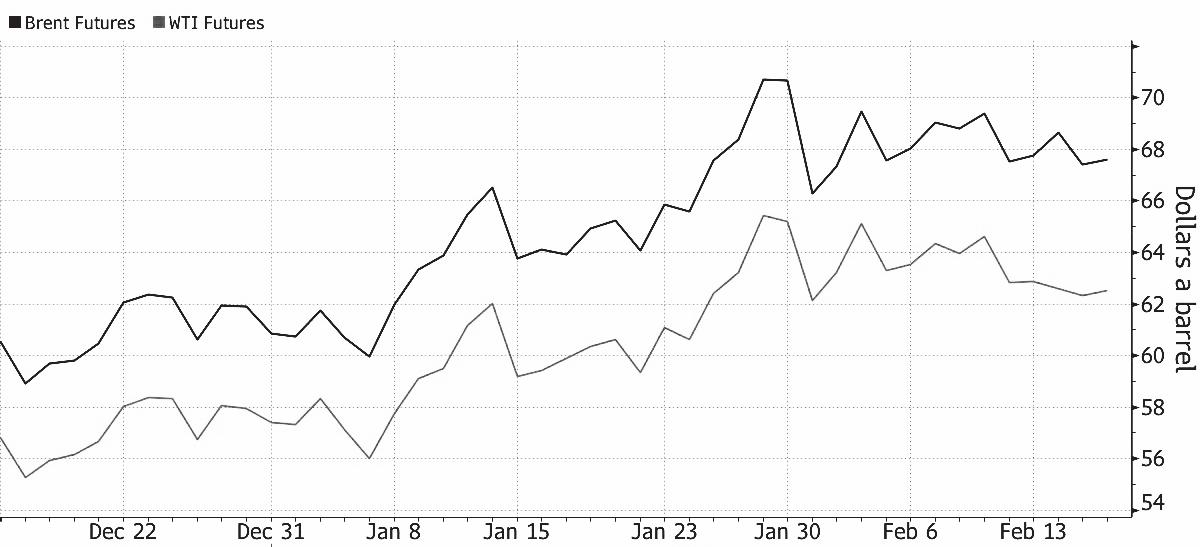
Oil prices were steady after the US and Iran said talks over the Opec member’s nuclear program were positive and made progress in finding common ground.
Global benchmark Brent was little changed above $67 a barrel after ending almost 2% lower on Tuesday, while West Texas Intermediate traded around $62. Tehran said it had reached a “general agreement” with Washington on the terms of a potential deal, while a US official said Iranian negotiators were scheduled to return to Geneva with a new proposal in two weeks.
Crude has gained so far this year as geopolitical concerns, including tensions over Iran, have outweighed warnings that a global
glut in the market will drag down prices. The standoff with the Islamic Republic—which was rocked by anti-government protests in January—has fanned concerns among traders that oil output or
vital supply routes such as the Strait of Hormuz could be interrupted by military clashes.
US Vice President JD Vance said Tuesday that the talks with Iran had gone well, but the country has not yet acknowledged President Donald Trump’s red lines. The apparent diplomatic progress came despite growing military deployments. Iran said Tuesday it would close part of the Strait of Hormuz – the choke point for energy exports from the world’s top oil-producing region—for several hours due to military drills. The US has sent a second aircraft carrier.
Elsewhere, investors were tracking US-brokered negotiations between Ukraine and Russia, which are also taking place in Geneva. Discussions are set to continue on Wednesday, according to an aide to Kyiv’s lead negotiator. Any resolution to Moscow’s invasion of its neighbor may lead to a roll back of sanctions, potentially boosting oil flows to global markets.
Volumes in Asian hours may be lower than usual on Wednesday, with several nations on holiday for the Lunar New Year. These included the trading hub of Singapore and China, the world’s largest oil importer. With assistance from Anthony Di Paola/Bloomberg
GLOBAL benchmark Brent was little changed above $67 a barrel after ending almost 2% lower on Tuesday, while West Texas Intermediate traded around $62. BLOOMBERG
House leader says impeachment process will proceed despite VP Sara’s ‘28 presidential bid
By Jovee Marie N. Dela Cruz @joveemarie
ALEADER of the House of Representatives assured on Wednesday that Vice President Sara Duterte’s announcement to run for president in 2028 may shift political alliances, but it will not derail the constitutional process regarding the impeachment complaints filed against her.
“It’s a strategic move to
strengthen her following, especially with the impeachment complaints already filed against her. It also helps her gauge who her allies really are and who are not,” House Senior Deputy Majority Leader Lorenz Defensor of Iloilo told reporters, referring to Duterte’s declaration of her presidential bid.
Defensor noted that the timing of her announcement could help consolidate her political base.
He emphasized that the impeachment complaints would
Chinese national claiming Filipino identity held for immigration violations
By Carmel Pedroza & Rex Anthony Naval
EBU CITY—
CA Chinese national who allegedly posed as a Filipino has been apprehended in Panglao, Bohol for violating Philippine immigration laws, authorities said on Tuesday.
The Bureau of Immigration (BI) identified the suspect as Jingjin Guo, who was arrested on February 17, 2026, during an operation conducted under Mission Order No. 2026-066.
According to the BI, Guo falsely declared himself a Filipino national, presenting a Philippine driver’s license as proof of local citizenship.
He was charged with misrepresentation under Section 37(a) (9) in relation to Section 45(f) of the Philippine Immigration Act of 1940, as amended.
Chinese national with expired passport IMMIGRATION records show that Guo was born on February 28, 1977 in Fujian, China.
He holds a Chinese passport issued in Beijing on September 18, 2013, which expired on September 17, 2023.
Authorities said Guo entered the Philippines under a Special Resident Retiree’s Visa (SRRV), a program that grants indefinite stay with multiple-entry privileges. Records indicate that he has been residing in Bohol since 2018 and has not departed the country since his arrival.
Alleged
links to overseas Chinese service center
INVESTIGATORS also revealed that Guo is reportedly the director of the Overseas Chinese Service Center (OCSC) for Cebu and Bohol.
The OCSC has been reported to have links with the United Front Work system of the Chinese Communist Party, a structure tasked with mobilizing overseas Chinese communities, cultivating local influence, shaping narratives favorable to China, and advancing state interests abroad. Authorities noted that organizations such as the OCSC can potentially be exploited to facilitate the movement and settlement of Chinese nationals, consolidate community control structures, and establish informal networks. Such networks may function as logistical, informational, or influence nodes particularly when led by individuals holding long-term residency privileges or operating under concealed identities.
Investigators said Guo’s position and
membership with the OCSC allegedly enabled him to assist in facilitating the entry, settlement, and movement of Chinese nationals in Bohol and Cebu.
While these activities were presented as community or service-oriented, officials noted that similar patterns have been observed in foreign influence and network-building operations.
Investigation ongoing
THE BI said investigations are continuing to determine the full extent of Guo’s activities and possible violations.
Guo remains under the custody of the Bureau of Immigration pending appropriate legal proceedings.
Nationwide
PHILIPPINE National Police (PNP) chief Gen. Jose Melencio Nartatez Jr. on Wednesday alerted all police units to monitor and neutralize potential espionage activities nationwide.
This was after a Mongolian aviation student with ties to China for allegedly engaging in espionage-related activities in Iba, Zambales.
“The safety and security of our nation remain our top priority. We must remain vigilant and proactive in identifying and neutralizing any threats, especially those involving espionage. Every police unit is tasked to stay alert and act swiftly to protect our national interests,” he said.
The 30-year-old Mongolian man was arrested last Feb. 12 by operatives of the Bureau of Immigration (BI), in close coordination with the PNP, Armed Forces of the Philippines (AFP), and National Intelligence Coordinating Agency (NICA) at an aviation school in Iba town where the suspect was a graduating student.
Intelligence reports indicate he took aerial photos of the Iba airport and the nearby Palauig River area, about five nautical miles from the airport.
The suspect, it turns out, is actually a licensed jet fighter pilot for the Chinese military.
The National Security Council said the suspect concealed his military background and service with the People’s Liberation Army (PLA), especially his jet fighter license from the PLA Air Force Aviation University.
Nartatez vowed that the PNP would work closely with other concerned agencies to deter any form of threats to the Filipinos.
“We are committed to strengthening cooperation with all relevant agencies to ensure that any threats to our people are detected early and effectively neutralized,” he said.
continue to follow the standard procedures in the House of Representatives.
“I hope we can act as independently as possible. It’s better for the public to know that we are fulfilling our constitutional duty in processing the impeachment complaints,” Defensor said.
He added that the complaints would be referred to the House Committee on Justice for the determination of sufficiency in form and substance.
“It will not affect how the process will go on in terms of hearing it, in terms of deliberations in the committee on justice,” Defensor said.
He clarified, however, that endorsers of the complaints remain resolute.
“Those who endorse the impeachment complaints are very firm on their position that there was an impeachable offence committed,” Defensor said.
Defensor dismissed sugges -
tions that Duterte’s presidential bid would pressure lawmakers.
Still, he acknowledged the political reality facing House members, especially with the 2028 elections drawing nearer.
“And we also have to take into consideration na malapit na ang 2028. But I can assure you that as far as the Committee on Justice is concerned that chairman and its members will be objective in hearing and deliberating the impeachment complaints based on the Constitution,” Defensor added. For now, Defensor does not see the numbers for an immediate elevation of the complaints to the Senate.
Angara calls for private sector partnership to tackle classroom shortage and boost digital learning
By Claudeth Mocon-Ciriaco @claudethmc3
FEARING that delays in infrastructure and digital access continue to limit learning opportunities for millions of Filipino students, Education Secretary Juan Edgardo “Sonny” Angara on Wednesday urged the private sector to play a central role in helping the government address the country’s 165,000-classroom shortage and modernize public schools.
Angara said that the department is pursuing large-scale public-private partnerships (PPP) to accelerate the construction of classrooms and improve school infrastructure. These partnerships are expected to deliver up to 106,000 classrooms in the coming years as part of a broader strategy to close the nationwide deficit.
“PPP is the bridge between urgency and execution...We invite the private sector not as donors, but as co-architects of national development,” mentioned Angara who spoke before business leaders at the Philippine Business for Education (PBEd) leadership forum in Makati City. He said the scale and urgency of the education crisis require deeper collaboration between government and industry.
He explained that traditional government procurement for classrooms can take two to
THE National Task Force to End Local Communist Armed Conflict (NTFELCAC) on Wednesday strongly condemned the circulation of so-called “wanted” posters labeling former insurgents Gerald Mangao, Erick Simogan, and Zena Punada Candelario Segui as “taksil sa bayan” and placing a token bounty for information on their whereabouts.
The materials were posted on the Facebook page “Villagers Point of View 2.0,” which authorities have identified as a propaganda portal aligned with the Communist Party of the Philippines–New People’s Army–National Democratic Front (CPP–NPA–NDF) network.
“This is not harmless online rhetoric. This is organized psychological warfare. When individuals are publicly branded as ‘spies’ or ‘traitors’ without evidence or due process, it places their lives in clear and present danger,” NTF-ELCAC executive director Undersecretary Ernesto Torres Jr. said in a statement.
He also described the posters as blatant examples of “spy-tagging”—the deliberate labeling of civilians as informants or enemies of the movement, a practice that has historically preceded harassment, abduction, and execution
SBMA CEO among PeopleAsia’s ‘People
By Henry Empeño
seven years, while PPP arrangements can shorten delivery timelines to as little as one to two years by streamlining approvals and consolidating procurement processes.
The DepEd has already secured approval for the construction of an initial 16,000 classrooms under the latest phase of its PPP program, targeting areas with the most severe shortages.
To explore faster and more efficient construction methods, Angara also recently visited a concrete prefabricated and modular structures plant in Mariveles, Bataan, together with Public Works and Highways Secretary Vince Dizon.
During the visit, they inspected a fourstorey building designed using shell-type and full modular structures, as well as a sample classroom capable of accommodating more than 50 students. Because the structures use full modular design, installation can be completed faster and more efficiently compared to traditional school construction methods.
Beyond physical infrastructure, Angara said the department is also pursuing a nationwide digital transformation to equip schools with connectivity, devices, and modern education technology.
Through its PPP for School Infrastructure Project (PSIP) Connect initiative, DepEd aims to establish a nationwide digital backbone
in areas where armed elements operate.
“We have seen this deadly pattern before. Accuse without proof. Label without process. Eliminate without remorse,” Torres said.
He pointed to the recent killing of Leonora “Leonor” Anguit, a 74-year-old grandmother from Kabankalan City, Negros Occidental, who was executed after being accused of being a military informant.
“By the perpetrators’ own admission, she was killed on mere suspicion. No court. No proof. No defense. Just an accusation followed by a bullet,” Torres stressed.
According to NTF-ELCAC monitoring, 26 civilians were killed in 2025 alone following spy-tagging accusations.
Many of the victims were ordinary citizens—farmers, forest guards, and community members—whose alleged “offense” was speaking against the communist terrorist group or refusing to support its violent agenda.
Torres underscored what he called the “bitter irony” behind the practice.
“The same group that loudly invokes human rights, press freedom, and freedom of expression weaponizes these principles
that will support teaching, learning, and school management systems.
“We are embedding technology into the core of our system to ensure that Filipino learners are prepared for the future,” he said.
He cited DepEd’s partnership with Khan Academy, which now supports over 2,800 public schools nationwide. The program has helped improve student performance in mathematics and allowed teachers to save time in lesson preparation, demonstrating the potential of digital tools to strengthen learning outcomes.
Angara emphasized that private sector participation is critical for bringing technical expertise, innovation, and efficient project implementation.
“Education has always been a shared responsibility. But today, it must also be a shared investment. This is a nation-building strategy,” he said.
Present at the forum were representatives from leading business and professional organizations, including the PBEd, Makati Business Club, Management Association of the Philippines, Philippine Chamber of Commerce and Industry, Employers Confederation of the Philippines, Philippine Constructors Association, Financial Executives Institute of the Philippines, and the Federation of Filipino Chinese Chambers of Commerce and Industry, Inc.
to advance its cause, while silencing and eliminating those who dare to reject its ideology,” he said. “They preach rights publicly but impose death sentences privately. That is a dangerous double standard.”
He also recalled the internal purges that scarred communities during campaigns such as Oplan Zombie, Kampanyang Ahos, and Kadena de Amor, which resulted in thousands of suspicion-driven executions.
“Today’s spy-tagging follows the same logic. History warns us what happens when propaganda becomes a trigger for violence,” Torres added.
The NTF-ELCAC official said that the NPA’s “wanted” materials against Mangao, Simogan, and Segui effectively placed targets on their backs.
“This constitutes a direct threat to their lives. The State cannot ignore this,” he stressed.
The NTF-ELCAC called on law enforcement and security authorities to immediately ensure the safety and protection of the individuals named, and urged civil society, media organizations, faith-based groups, and human rights advocates to denounce spy-tagging as a deadly practice. Rex Anthony Naval
“As of right now, as of today, I cannot see getting one-third of endorsements from the members of the House of Representatives. But I can tell you right now that aabot ito sa Committee on Justice,” Defensor said. Defensor urged observers to allow the process to unfold.
Aboitiz Foods delivers aid to over 1,000 Basyang-affected families in Iligan City
ABOITIZ Foods, through its subsidiary Pilmico Foods Corporation (Pilmico) and Aboitiz Foundation, Inc., teamed up with the Iligan City Disaster Risk Reduction and Management Office (ICDRRMO) to distribute essential support to more than 1,000 disaster-affected families in Barangays Ubaldo Laya and Tubod, Iligan City, in Northern Mindanao. Iligan City continues to grapple with the impact of Tropical Storm “Basyang.” Around 24,500 individuals across 21 barangays, including Ubaldo Laya and Tubod, many of whom received aid for the first time. In a statement, Aboitiz Foods said food packs with rice and groceries for sustenance, hygiene kits prevent illness, and sleeping kits for displaced families in evacuation centers received the support package.
“Iligan City has been Pilmico’s home for over 60 years. This community has grown with us, supported us, and shaped who we are today,” Engr. Alexis Revantad, Pilmico’s vice, president for Iligan Site Management and Flour Operations said. “In moments like this, we stand by you, our fellow Iliganons, in your darkest hour. We are part of this community, and we are here as your partner to help rebuild our city.” Jonathan L. Mayuga
Comelec: More than 14,000 register for BARMM polls
By Mary Jade Jadormio
THE Commission on Elections (Comelec) has logged more than 14,000 voter registration applications in the Bangsamoro Autonomous Region in Muslim Mindanao (BARMM) for the region’s first parliamentary polls and Barangay and Sangguniang Kabataan Elections.
Data from the poll body showed a running total of 14,587 applications processed from Feb. 9 to 17. Of the cumulative figure, 7,390 were male applicants, while 7,197 were female. For Feb. 17 alone, a total of 1,724 applications were processed across the region. Among the provinces, Basilan posted 405 applications for the day, followed by Maguindanao del Norte with 368 and Maguindanao del Sur with 341.
Tawi-Tawi recorded 267 applications, while the Special Geographic Area logged 221 and Lanao del Sur posted 122. The ongoing registration is being conducted under the Special Registration and Application Period (SRAP), which began on Feb. 9. The SRAP was implemented in preparation for the first-ever Bangsamoro parliamentary elections, which were initially set for March 30. Comelec earlier officially postponed the March polls, citing legal and operational concerns, including pending issues involving amendments to the Bangsamoro Electoral Code. The BARMM parliamentary elections have been deferred three times since 2022 following congressional measures extending the Bangsamoro transition period. Despite the postponement, the poll body has continued voter registration activities in the region to ensure readiness once a new election date
DILG chief vows to shut down large-scale illegal cigarette ops
SBy Jonathan L. Mayuga @jonlmayuga
ECRETARY Jonvic
Remulla
of the Department of the Interior and Local Government (DILG) vowed to shut down large-scale illegal cigarette operations in the Philippines.
At the same time, Remulla announced that a case build-up is now ongoing in preparation for the filing of multiple charges against those behind the illegal operation of four tobacco factories in Pampanga.
In a statement, Remulla said the operation in Pampanga last February 11 reflects the government’s commitment to enforcing the law and protecting ordinary Filipinos, in line
Patents. . .
Continued from A3
Total IP filings reached 3,242, up 43.7 percent from 2,257 in 2024, marking another year of record-high registrations, IPOPHL said.
A significant share of this growth came from Innovation and Technology Support Offices (Itso), which accounted for 506 of the 999 resident patent filings in 2025, or 50.7 percent. Patent filings by Itsos rose 15.3 percent year-on-year.
Income generated from IP assets by Itso members also increased, posting a 19 percent year-on-year growth in 2025.
Further, universities, colleges and research centers participating in the Itso Program earned a combined P24.3 million from their IP assets, up from P20.4 million in 2024.
IPOPHL said commercialization channels included licensing agreements, spin-offs and direct sales.
IPOPHL Acting Director General Nathaniel Arevalo said the figures point to the expanding role of technology transfer and IP commercialization across academic and research institutions.
“It highlights how research and innovation not only contributes to knowledge and societal benefits, but also generates tangible economic value for the institutions and stakeholders involved,” Arevalo said.
Beyond patents, Itsos accounted for nearly half of resident utility model filings, contributing 858 or 47.7 percent of the 1,800 applications recorded.
They also filed 454 industrial design applications, or 28.8 percent of the 1,578 total.
Overall, utility model and industrial
Institute for Development Studies led by Dr. Kris A. Francisco, which found that lifeline discounts vary by distribution utility and may even result in poor households subsidizing other poor households. The study also noted that subsidized electricity remains subject to VAT.
The bill seeks to eliminate these distortions by shifting to a direct subsidy funded by the government, allowing transparent eligibility checks, removing VAT on subsidized amounts, and standardizing implementation nationwide.
Eligible households within the monthly threshold would receive zero-charge bills from distribution utilities, which would then seek reimbursement from the DOE. Claims would undergo strict audit by the Commission on Audit to ensure accountability.
If a household exceeds the threshold in a given billing period, it would pay the full bill
with President Ferdinand Marcos Jr.’s directive to safeguard consumers, public health, and legitimate businesses from organized illegal activity.
“This administration has always been clear. Large-scale illegal operations that put public health at risk and undermine the law will be confronted and shut down. No excuses.”
Remulla said.
The operation was the result of sustained surveillance, intelligence gathering, and close inter-agency coordination. Authorities seized machinery, cigarette components, and tobacco products used in the illegal manufacture and repacking of unbranded cigarettes, including those marketed under the name “Playboy.” Inventory and valuation
design filings grew by 31.8 percent and 31.2 percent, respectively.
On the other hand, copyright filings nearly doubled to 1,197, representing 17.8 percent of the 6,732 resident filings.
Trademark applications, meanwhile, also expanded sharply, increasing by 51.3 percent, though they accounted for less than 1 percent of total resident filings.
International partners welcomed the continued expansion of the ITSO ecosystem in the Philippines and across Southeast Asia.
Alex Riechel, head of the TISC Development Section at the World Intellectual Property Organization, said the Association of Southeast Asian Nations has made notable progress in institutional coordination on innovation support.
He described the region as having established “a world-first, formally established mechanism for coordinating the development of TISCs,” while stressing the importance of sustaining momentum to translate innovation into economic value.
Motohiro Nishio, intellectual property attaché of the Japan Patent Office for Southeast Asia, said strong IP systems remain critical to innovation-led growth.
“Japan strongly believes that robust IP systems with effective information access and practical technology transfer are essential for innovation-driven growth,” Nishio said.
The Itso Program, IPOPHL’s flagship initiative to promote innovation and IP use, now has 103 member institutions.
The program forms part of the global network of Technology and Innovation Support Centers established by the World Intellectual Property Organization to help researchers and institutions access highquality technology information, develop IP assets and support the commercialization of research outputs. Bless Aubrey Ogerio
for that month but could regain eligibility later upon compliance.
A two-year transition period would allow the new subsidy to run alongside existing lifeline and related programs while agencies assess whether to replace or retain them.
The measure notes that other members of ASEAN—including Indonesia, Vietnam, Thailand, Singapore, Myanmar, and Lao PDR—already provide electricity subsidies.
The bill also aligns with broader efforts to ease access to assistance programs. The administration recently streamlined applications for the Net-Metering Program and updated lifeline thresholds. As of November 2025, about 334,000 consumers were enrolled in the Lifeline Rate Subsidy Program, or roughly 11% of beneficiaries under the Pantawid Pamilyang Pilipino Program.
Marcos said the proposal would deliver more effective relief than the current lifeline rate under the Electric Power Industry Reform Act and urged swift passage. Jovee Marie N. dela Cruz
of the seized items are ongoing.
Initial findings indicate that the products involved do not meet consumer safety standards and mandatory graphic health warning requirements. Authorities also noted that the registered business at the site was unrelated to cigarette manufacturing, and unsafe waste-disposal practices may pose risks to workers and nearby communities.
Remulla commended the Philippine National Police and partner agencies, including the Bureau of Internal Revenue and the National Tobacco Administration, for the disciplined, intelligence-driven execution of the operation, which used body-worn cameras to ensure transparency and accountability.
The DILG noted that the acts uncovered may involve violations of tax, consumer protection, and economic sabotage laws.
“This is about protecting the people and enforcing standards fairly. We will continue to support focused operations against organized illegal activities that harm consumers, deprive the government of revenue, and disadvantage law-abiding businesses,” Remulla said.
Remulla disclosed that three other cigarette factories in Pampanga, two in Mexico town and one in San Simon, have ceased operations following the government raid on a commercial warehouse in San Fernando City.
“It is such a coincidence that they stopped at the same time. The products, machines, and
brands found here are not on the National Tobacco Administration Registration List. This means the operation is 100 percent illegal,” he added.
Authorities recovered several pieces of evidence during the San Fernando operation, including four units of cigarette packing components, a cigarette repacking machine, two cigarette-making machines, three tobacco drying machines, cigarette manufacturing materials branded as Playboy, cigarette filters, and counterfeit BIR tax stamps, all indicating the scale and sophistication of the illegal operation.
Remulla further said San Fernando City Mayor Vilma Balle-Caluag, who was present during the operation, confirmed that the
facility had no business permit to operate within the city.
Among the persons of interest identified by Remulla are the three owners of Fast Track Trade Link Richard Uy, Marlene Garcia, and Leonardo Bangayan Lim. He also raised the possible involvement of two congressmen from Central Luzon.
According to Remulla, the group may face charges for multiple violations, including Republic Act No. 8424 or the Tax Reform Act of 1997; Republic Act No. 12022 or the AntiAgricultural Sabotage Act; Republic Act No. 10863 or the Customs Modernization and Tariff Act; Republic Act No. 7394 or the Consumer Act of the Philippines; as well as other applicable environmental laws.
Senate passes on 3rd and final reading Erwin Tulfo bill ensuring one-day process, streamlined requests for ayuda
VOTING 19-0-0, the Senate on Wednesday approved on third and final reading Senator Erwin Tulfo’s Senate Bill No. 155, known as the Direkta at Agad na Lingap at Interbensiyon (DALI) Act, which seeks to eliminate unnecessary documentary requirements in accessing government aid and ensure its release within the day. “For too long, our kababayans have been burdened by excessive and repetitive documentary requirements. These requirements cost them time, money, and sometimes dignity,” Tulfo said. “This bill ensures that government assistance becomes truly accessible, inclusive, efficient,
and responsive. This is a reform rooted in social justice. It affirms a simple principle: Assistance should be given with compassion, not complication,” the Senate Social Justice, Welfare, and Rural Development Panel Chairman added.
The DALI Act will mandate government agencies to require only three documents when availing of financial assistance: a valid government-issued ID; billing statement from hospital, clinic, or funeral parlor; and an original or certified true copy of a medical certificate or medical abstract with complete details. Upon submission of the complete documents, SBN 155 directs the Department of
Social Welfare and Development, Department of Health, Philippine Charity Sweepstakes Office, PhilHealth, and other national and local agencies and offices concerns to process the requests for ayuda within the day.
Further requests submitted on weekends, holidays, or outside official working hours shall be processed on the next working day.
If the beneficiaries are not capable of submitting the requirements, their relatives within the fourth degree of consanguinity or affinity, or a legal guardian, may be allowed to request financial aid, through an authorization letter with valid IDs of both the beneficiary and the representative Digital requests for government aid will also be accommodated once SBN 155 is enacted into law, as it directs the Department of Information and Communications Technology (DICT) to develop and use the eGov PH Super App or other digital systems for this purpose. In cases of undue delays, excessive documentary requirements, and other forms of non-compliance, the DSWD and other concerned agencies shall coordinate with the Anti-Red Tape Authority to ensure full compliance to the proposed law and the Ease of Doing Business Act. Butch Fernandez
DOJ insists on waiting for SC ruling before taking any action on Duterte’s alleged co-perpetrators
drug war campaign during his term.
TIndonesia. . .
Continued from A7
By Joel R. San Juan @jrsanjuan1573
HE Department of Justice (DOJ) on Wednesday maintained its position that it would wait for the Supreme Court’s ruling on the pending petitions questioning the constitutionality of the arrest and the turn-over of former President Rodrigo Duterte to the International Criminal Court before determining its possible actions in the event that an arrest warrant is also issued against other Filipino individuals tagged as his co-perpetrators in the crimes against humanity.
At a press briefing, DOJ spokesman, lawyer Polo Martinez clarified that the DOJ does not enforce warrants because such mandate belongs to law enforcement authorities such as the National Bureau of Investigation (NBI).
“I know there are pending petitions for certiorari and prohibition with the Supreme Court, as to whether or not the arrest before and the surrender of President Rodrigo Duterte was valid,” Martinez said.
“That’s still a pending issue of the Supreme Court and the DOJ takes the position that it will be prudent to wait for the resolution of the Supreme Court before it acts upon any alleged warrant should there be one issued. That is our position,” Martinez said.
Martinez made the statement after the ICC Office of the Prosecutor made public the names of the alleged co-perpetrators of Duterte in the crimes against humanity case which stemmed from his anti-illegal
He added that the justice department will have to comply with any directive that the High Tribunal might issue in resolving the petitions.
“Again, if the Supreme Court (SC) decides upon the issue, we will have to comply. That is the whole reason why we deemed it prudent for the Supreme Court to solve this matter before acting on anything,” Martinez said.
They were identified as Senators Ronaldo “Bato” dela Rosa and Christopher Lawrence “Bong” Go, former Justice Secretary Vitaliano Aguirre II, former Davao City police chiefs Vicente Danao Jr. and Isidro Lapeña, former National Capital Region Police Chief Oscar Albayalde, and former National Bureau of Investigation (NBI) chief Dante Gierran.
Martinez stressed that there is no basis at this time to take custody of any of the said individuals considering that there is no warrant issued against them.
“Again, respect the rights of all individuals. If there is no arrest warrant, there is no reason for us to take custody of them. There is also no reason for us to prepare for the eventual arrest, that will be speculative,” he added.
One of the petitions before the SC assailing Duterte’s arrest was filed by Dela Rosa.
In his petition, Dela Rosa asked the Court to enjoin the Palace and other government agencies from enforcing any arrest warrant issued by the ICC in connection with its investigation on the drug-related killings during the Duterte administration.
It also sought the issuance of a temporary restraining order (TRO) enjoining the respondents from cooperating with the ICC and providing assistance with the Interpol in the execution of ICC-issued warrants, red notices, summons, or other actions.
The petition, likewise, sought to declare as unconstitutional the Philippine government’s cooperation with the ICC and to affirm that the Philippine government’s withdrawal from the Rome Statute on March 17, 2019 effectively terminated all jurisdiction of the ICC over the country and its nationals.
The petition also cited the principle of complementarity, which bars the ICC from exercising jurisdiction over the Philippines because the country has a functioning legal system capable of investigating and prosecuting crimes under its national laws.
Duterte’s three children—Davao Mayor Sebastian Duterte, Davao 1st District Rep. Paolo “Polong” Duterte Veronica A. Duterte—have also filed separate petitions before the SC for the issuance of a writ of habeas corpus, raising similar arguments.
Earlier, Palace Press Officer Claire Castro indicated the government’s willingness to turn-over Duterte’s alleged co-perpetrators to the ICC in the event an arrest warrant is issued against them through the International Criminal Police Organization (Interpol), like what happened to the former president.
Castro also challenged them not to go into hiding and instead face the charges to prove their innocence.
Air transport costs dip year-on-year in Q1 ‘25 despite quarter-on-quarter rebound, says PSA
By Justine Xyrah Garcia
AIR TRANSPORT service prices declined on an annual basis in the first quarter of 2025, even as rates rebounded from the previous quarter, according to preliminary data released by the Philippine Statistics Authority (PSA).
Data from the PSA’s Producer Price Index (PPI)
from
a
basis,
7.7
fourth quarter of 2024, indicating higher average charges at the start of the year.
The PSA said the annual decline was largely driven by passenger air transport, which posted a 2.8 percent contraction year-on-year in the first quarter. Freight air transport, in contrast, recorded a 7.1 percent annual increase during the period. Quarterly data showed that passenger
air transport also led the rebound, registering a 7.7 percent increase from the previous quarter. Freight air transport likewise posted a quarter-on-quarter growth of 3.9 percent . The PSA noted that the PPI for Services tracks the “average change over time in prices received by domestic service providers,” with 2024 serving as the base year.
This marks the maiden release of the PPI for Services, which now presents separate reports for telecommunications and air transport.
In one of the most public nickel-related seizures last year, Indonesian soldiers accompanied by a local television crew, took control of part of the world’s largest nickel mine. Mostly owned by Chinese metals giant Tsingshan Holding Group, the mine has caused deforestation, air and water pollution and increased coal-fired emissions, while displacing communities, harming livelihoods and exposing residents to health risks, according to a 2024 report by the nonprofit group Climate Rights International. The move wasn’t aimed at environmental protection or restoring forestry safeguards, said Bhima Yudhistira, with the Jakarta-based Center of Economic and Law Studies or CELIOS. “There is no guarantee things will get better,” he said. They could get “even worse.” Indonesia bet on EV batteries but the market shifted
Indonesia’s effort to turn its nickel reserves into the backbone of a domestic EV industry drew early interest from investors in South Korea and China but has fallen short of expectations.
In July 2024, South Korea’s Hyundai Motor Group and LG Energy Solution opened Indonesia’s first EV battery-cell plant, with annual capacity to supply more than 150,000 electric vehicles. But in April 2025, LG Energy Solution withdrew from a larger $8.4 billion battery investment, citing market and investment conditions.
An EV plant is still being
The fragile ascent: PHL nears UMIC status, faces test of inclusive growth
THE Philippines stands on the threshold of a significant economic milestone: transitioning from lower-middle-income to upper-middle-income country status, according to World Bank classifications. University of Asia and the Pacific economist Bernardo M. Villegas, often dubbed the “Prophet of Boom,” expressed confidence in a recent interview that the country could cross this line as early as September 2026, with GNI per capita edging very close to the required benchmark of around $4,496 (with the current threshold for UMIC at $4,496-$13,935). (Read the BusinessMirror story—“Prophet of Boom: PHL to hit UMIC status this September,” February 13, 2026).
Despite a slowdown in GDP growth to 4.4 percent last year—down from previous years—Villegas argues this dip is insufficient to derail progress. Past momentum has already propelled GNI per capita to $4,470 (based on recent World Bank data for 2024), leaving just a narrow gap. He remains optimistic that renewed infrastructure spending, recovering consumer sentiment, and projected 5.6 percent growth in 2026 will deliver the final push.
This optimism is tempered by external risks, such as a potential global slowdown from US policy shifts and tariffs. Yet Villegas downplays their impact on the Philippines, noting the country’s limited reliance on exports compared to manufacturing-heavy neighbors.
He also dismisses fears of sharp peso depreciation, crediting Bangko Sentral ng Pilipinas for effective management. Most strikingly, he asserts that corruption will not derail growth—a bold claim in a nation long plagued by governance challenges.
This narrative is encouraging and reflects real progress. The country has sustained respectable growth over the past decade, lifting millions out of poverty and building a more resilient economy. Achieving UMIC status would mark symbolic and practical advancement: better access to certain international financing, enhanced global standing, and a signal to investors of maturing economic fundamentals.
However, the milestone should not be overstated. Missing the threshold by a slim margin in recent World Bank updates (e.g., $26 short in mid-2025 classifications) highlights how fragile and incremental such transitions can be. A mere $4,496 GNI per capita average masks deep inequalities—urban prosperity contrasts sharply with rural and informal sector struggles. Widespread job losses and the “economic slowdown” referenced underscore that growth has not been inclusive enough. True upper-middle-income status must translate into higher living standards, reduced poverty, and improved human development metrics, not just an accounting upgrade.
Villegas’ reassurance on corruption is particularly noteworthy but demands scrutiny. While strong growth can occur amid governance issues, systemic corruption erodes public trust, distorts resource allocation, and deters long-term investment. Dismissing it risks complacency at a time when institutional reforms—stronger anti-corruption enforcement, transparent procurement, and accountability—are essential to sustain momentum beyond the threshold.
The path forward requires more than optimism. Policymakers must prioritize: Accelerating inclusive growth through investments in education, skills training, and job creation in high-value sectors.
Strengthening social safety nets to cushion vulnerable populations during slowdowns.
Advancing structural reforms to boost productivity and competitiveness.
Maintaining fiscal and monetary discipline amid global uncertainties. Crossing into upper-middle-income territory would be a proud achievement for Filipinos, validating years of effort. But the real test lies in what comes after: using elevated status to narrow inequality, build resilience, and lay foundations for eventual high-income aspirations. Optimism is justified, but complacency is not. The Philippines has made significant progress and should not be content with just symbolic victories.
BusinessMirror
Welcome to the New Asian Order
JAPAN’S
John Mangun
OUTSIDE THE BOX
recent election result was a political earthquake. Prime Minister Sanae Takaichi has secured one of the strongest electoral mandates seen in Japan since the Liberal Democratic Party was founded in 1955. Her party did not merely win. It crippled the opposition, with the LDP now effectively controlling 351 seats, giving it the highest proportion (75 percent) of representatives in the Diet Lower House in postwar Japan.
That landslide is not mere parliamentary arithmetic. It reflects a deeper political realignment in Tokyo, one that reinforces Takaichi’s blend of larger fiscal spending, conservative social policy, and a muscular foreign posture. She did not merely win the vote; she consolidated it into a personal mandate, aided perhaps by an endorsement from US President Donald Trump just ahead of the vote. His public support for her potential Asian leadership and pro -growth agenda drew attention across the Pacific.
The opposition was fragmented and was unable to translate any voter economic unease into seats.
The supermajority gives Takaichi room to push changes once considered beyond Japan’s reach. Her government is floating revisions to Japan’s postwar pacifist constitution and seeking to lift restrictions on defense exports. Japan’s pivot from purely defensive hardware toward more capable systems with broader exportable potential is not abstract.
Australia agreed to purchase 11 upgraded Mogami class frigates from Japan last year, marking Japan’s first major defense export. Symbolism matters. It reflects a Japan willing to step beyond customary self-restraint and its partners willing to encourage it.
Takaichi campaigned on economic revitalization, tax relief, and industrial policy. But she combined that with a distinctly firmer stance on national defense and foreign policy. Her remark last year that a Chinese invasion of Taiwan could constitute an existential threat to Japan was not campaign theater. It was a signal that changes are coming. Beijing understood it that way and reacted sharply.
This shift cannot be viewed as distant drama from a Philippine perspective. Manila already operates in contested waters, balancing economic engagement with China against repeated security incidents in the West Philippine Sea. If Japan becomes more assertive, and it is a
Japan’s election did not just settle a domestic contest. It clarified direction. A stronger executive in Tokyo, aligned more closely with Washington and more willing to test long-standing constraints, narrows the middle ground in Asia. More importantly, expect Asia’s strategic landscape to feel less confusing but less forgiving.
big if, that changes the regional equation. It provides another counterweight to Beijing, but it also accelerates a broader strategic competition that reduces room for neutrality.
Enhanced capabilities flowing to Southeast Asian partners, including the Philippines, have been discussed in official circles as part of a wider regional pivot in Tokyo’s security strategy. It all aligns neatly with strategic preferences in Washington. It predictably aggravates tensions with China and quietly unsettles neighbors who remember that Asian geopolitical history did not begin in 1945. Japan colonized Korea in 1910.
Regional alignments are becoming more pronounced across the Indo Pacific. Indonesia and Australia just signed a new bilateral security agreement that would have seemed surprising a decade ago.
Why? Because Indonesia has traditionally guarded its non-aligned stance, yet growing friction with China over maritime claims has encouraged a visible recalibration. Australia has been building security ties across the Pacific with Papua New Guinea, Fiji, the Solomon Islands, and Vanuatu.
Economic policy mirrors the same logic. Australia has raised tariffs on Chinese steel while pursuing freer trade with Europe. Lower fences, not walls, are being quietly erected between blocs over time even in the age of “Trump Tariffs.”
Financial markets grasped this all quickly. Japanese government bonds weakened modestly as investors priced in higher spending, while the Japanese yen showed familiar signs of strain. A government with this kind of authority might be able to pursue fiscal stimulus and defense expansion with fewer political brakes.
The Philippines does not have the luxury of treating this as background noise. Domestic economic resilience buys time but not immunity. Strategic shifts eventually surface in capital flows and defense priorities. Japan’s election did not just settle a domestic contest. It clarified direction. A stronger executive in Tokyo, aligned more closely with Washington and more willing to test long-standing constraints, narrows the middle ground in Asia. More importantly, expect Asia’s strategic landscape to feel less confusing but less forgiving. For the Philippines, the region is entering a phase where the geopolitical stakes are higher and miscalculation costs more. That reality may be uncomfortable, but it is no longer ambiguous. It is better to recognize it now than try to explain it later.
E-mail me at mangun@gmail.com. Follow me on Twitter @mangunonmarkets. PSE stock-market information and technical analysis provided by AAA Southeast Equities Inc.
India seeks reset with Bangladesh as new leader takes oath
By Dan Strumpf & Arun Devnath
S.
M. Lomibao
INDIA is moving quickly to shore up relations with Bangladesh following last week’s landmark election that swept into power a former ruling party known for prioritizing closer links with China.
Tarique Rahman was sworn in as Bangladesh’s next prime minister before a crowd of visiting foreign leaders and other dignitaries on Tuesday after a landslide win last week that delivered a two-thirds parliamentary majority to his Bangladesh Nationalist Party.
The result catapults one of Bangladesh’s two major historic ruling parties back into power. The party has advocated closer ties with China and says it will pursue a more “balanced” relationship with India now that it has returned to office.
New Delhi had for years backed former Prime Minister Sheikh Hasina, who was overthrown in a 2024 student-led uprising, and her Awami League party was barred from con-
testing last week’s elections. Hasina now lives in exile in India—much to the anger of many in Bangladesh.
“The BNP victory ushers in a new era of more complex bilateral political relations for India with Bangladesh,” said Rajiv Biswas, CEO of Asia-Pacific Economics, a geopolitical risk and economics research firm. He said he expects Bangladesh under the BNP to deepen ties with both China and Pakistan—India’s other main regional rival—forcing New Delhi to “manage” greater geopolitical competition in the region.
Indian Prime Minister Narendra Modi has made overtures to the BNP in recent months in an effort to rebuild ties. He was among the first foreign leaders to congratulate
Rahman on his sweeping victory on social media and followed up with a telephone call on Friday. In December, he sent India’s foreign minister to the funeral of Rahman’s mother, former Prime Minister Khaleda Zia.
Representing India at Tuesday’s swearing-in was Om Birla, the speaker of the lower house of parliament, who delivered a letter from Modi inviting Rahman to visit India.
Also sworn in on Tuesday were 25 ministers and 24 state ministers joining Rahman’s government.
High stakes THE stakes for India in Bangladesh are high. The two countries share a 4,000-kilometer border, stretching along India’s often volatile eastern region. The frontier spans mountains and riverine terrain that are difficult to monitor and allow relatively easy cross-border movement.
The prospect of closer ties between Bangladesh and China have already alarmed New Delhi. In a De-
cember report to lawmakers, India’s Ministry of External Affairs said it was closely monitoring China’s expanding presence in Bangladesh, particularly in strategic infrastructure, ports and defense-related projects.
“India has very clear stakes in Bangladesh,” said Swaran Singh, professor at the School of International Studies at Jawaharlal Nehru University in New Delhi. “India also incidentally has very favorable trade with Bangladesh and in that sense India would first like to focus on the economic partnership.” That economic relationship has deepened significantly in recent years. Bilateral trade stood at $13.4 billion in 2024-25 from $7.07 billion in 2014-15, data from India’s Ministry of Commerce showed, making Bangladesh India’s largest trading partner in South Asia. The ties are especially important for Dhaka as Rahman seeks to steer Bangladesh’s economy out of a prolonged slump See “India,” A11
Putin’s crackdown on Telegram slammed by Russian propagandists
SOME of Russian President Vladimir Putin’s most vocal fans are up in arms over the Kremlin’s latest move to restrict the Telegram messaging service and push people to use a new statebacked alternative.
Last week, millions of users of Telegram in Russia experienced slowdowns and outages of the messenger after the communications regulator Roskomnadzor imposed new restrictions on the service. The pressure is the latest move in a longrunning campaign to promote what the Kremlin calls sovereign internet that’s led to blocks of YouTube, Instagram and WhatsApp.
But the attack on Telegram might be a bridge too far. It has drawn criticism and comments from unexpected quarters, including soldiers who use the service to communicate in the trenches, pro-war bloggers and regional officials. Even Putin’s spokesman, Dmitry Peskov, lamented the move. Vladimir Soloviev, the hawkish host of the weekly show Moscow. Kremlin. Putin. on the federal Rossiya-1 network, complained during a live stream that he’s already seen his audience numbers drop off since the measures began on Feb. 9. Soloviev is a key figure in Russia’s propaganda efforts and is sanctioned by the European Union and UK.
“This is the first time when we see this sort of internal splits within different communities loyal to the Kremlin,” said Tatiana Stanovaya, a senior fellow at the Carnegie Russia Eurasia Center. “Telegram has replaced mainstream media in Russia. People who are interested in politics and major part of Russian elite follow Telegram channels to get informed.”
The Kremlin is stepping up its assault on platforms it doesn’t control, with Russia also moving to fully block Meta Platforms Inc.’s WhatsApp last week. The government wants Russians to adopt a state-run “super-app” called Max, modeled after China’s WeChat, that critics say leaves users vulnerable to surveillance by Russia’s security services.
Russia has regularly ratcheted up pressure on foreign technology companies since the full-scale invasion of Ukraine four years ago. Messengers and services including Snap Inc.’s Snapchat, Apple Inc.’s FaceTime, Discord, Viber and Signal have all been blocked. These services remain available to Russians via virtual private networks.
However, the recent moves against Telegram, which is Russia’s second-most popular messaging service according to mobile app researcher Apptopia, have struck a nerve. Roskomnadzor said the new limits were because the service failed with Russian laws requiring personal data to be stored locally. It blocked voice and video calls via Telegram in August, but core features including broadcast channels continued to work until last week.
Pro-Kremlin commentator and culture war figure Ekaterina Mizulina, who has been called Russia’s “chief internet censor” for her role filing complaints against journalists and public figures, opposed the restrictions. “I don’t support proposals to introduce limitations on Telegram,” Mizulina posted on her Telegram channel last week. “To lose such a vital tool of promoting proRussian ideas and positions would be a mistake.”
The decision is also having an impact of the front line. Several military bloggers on Telegram, including
R“This is the first time when we see this sort of internal splits within different communities loyal to the Kremlin,” said Tatiana Stanovaya, a senior fellow at the Carnegie Russia Eurasia Center. “Telegram has replaced mainstream media in Russia. People who are interested in politics and major part of Russian elite follow Telegram channels to get informed.”
Arkhangel Spetsnaza, with over 1.1 million subscribers, said in posts the move risks leaving soldiers without communications.
There are no viable alternatives to Telegram on the front, according to a Russian soldier who asked not to be identified because he wasn’t authorized to speak on the matter. The officials who approved the block are unaware of the real situation on the ground, he said.
Vyacheslav Gladkov, the governor of the Belgorod region, which borders Ukraine and has faced frequent drone attacks, warned the measures “can impact the operational flow of information.”
The Kremlin has publicly defended Roskomnadzor’s authority. “One can only express regret here,” Peskov told the Interfax news service last week. “There is nothing good about it, but the law must be obeyed.”
Max is developed by VK, the social media platform run by Vladimir Kirienko, the son of a key Putin aide who answers for domestic policy. The app was introduced last year with a number of features designed to get people to depend on it. Max hosts government services and enables document storage, banking and other public and commercial programs. State employees from officials to teachers have been told to use the app for communications.
“Russia is restricting access to Telegram in an attempt to force its citizens to switch to a state-controlled app built for surveillance and political censorship,” Telegram’s billionaire founder Pavel Durov said last week. “Telegram stands for freedom of speech and privacy, no matter the pressure.”
It isn’t the first time Durov, who was born in Russia and lives in Dubai, has clashed with the Kremlin. Russia ordered a ban on Telegram in 2018, but gave up two years later when that proved impossible to enforce. Still, the lessons learned from that stand-off helped the Kremlin more effectively crack down on foreign media platforms since 2022.
Downloads of an app designed to allow people access to Telegram without using a VPN have soared in recent days. Downloads of the free app called Telega, a so-called fork that helps users connect to Telegram’s servers using different routing methods and bypass Roskomnadzor’s efforts, have spiked on the Google Play store since the regulator implemented the new measures.
“Every time they tighten the system, people find another workaround,” said Mikhail Klimarev, head of the Internet Protection Society, a group that campaigns for Russian digital rights from abroad. “It’s an arms race.” Bloomberg
marked by slow growth and high inflation.
In an interview with Bloomberg News, AKM Wahiduzzaman, the BNP’s secretary for information, communications and technology affairs, said Bangladesh and India have had a “sweet and sour” relationship. He said there remains lingering gratitude for New Delhi’s support during the 1971 war of independence from Pakistan, but described India’s backing of Hasina as “an unfortunate event that we want to forget.” With assistance from Sudhi Ranjan Sen, Swati Gupta and Shruti Srivastava/Bloomberg India. . . continued from A10
By Julian Lee
USSIA’S crude shipments edged higher with a step-up in Ukrainian drone strikes on the country’s refineries and a halt to piped deliveries to Hungary and Slovakia likely boosting export volumes.
Exports averaged 3.39 million barrels a day in the four weeks to February 15, according to vesseltracking data compiled by Bloomberg. They nudged up from the period to Feb. 8, rising for a fourth week, but were still down by about 480,000 barrels a day from the preChristmas peak.
The higher shipments combined with an increase in four-week average prices to boost inflows to the Kremlin’s war chest to the highest in almost two months.
Russia’s oil production slipped for a second straight month in January, leaving it almost 300,000 barrels a day lower than the amount the country is allowed to pump under an agreement with the Organization of the Petroleum Exporting Countries and allies. But any impact from the lower output on exports has likely been more than offset by renewed attacks on crude processors.
After a lull in January, Ukraine has stepped up its drone strikes on Russian oil refineries this month, with hits on Lukoil plants in Volgograd and Ukhta and the independent Ilsky refinery in the Black Sea region. The three plants have a combined processing capacity of about 500,000 barrels a day.
Separately, an earlier Russian attack on a pumping station in western Ukraine has halted piped flows of about 200,000 barrels a day of Moscow’s crude to Hungary and Slovakia through the Druzhba pipeline system.
At the other end of the supply chain, deliveries of Russian crude to China have surged to more than 2 million barrels a day in the first 15 days of February, the tracking data show, with increasing amounts of Urals crude being diverted from recent buyers in India. In addition, almost all the barrels shipped from Pacific and Arctic ports are also heading to China.
India’s pull-back from Russian crude can be seen clearly in shipments of key Pacific grade ESPO. Just one February-loading cargo is heading to India, with none making the journey in January. That compares with four December cargoes and nine that loaded in November heading to the south Asian nation.
The increased pace of deliveries to China has helped to stabilize the amount of Russian crude held at sea at about 140 million barrels. The rapid build-up prior to that saw almost 60 million barrels added since the end of August, an increase of about 65 percent. The figure includes crude in transit, as well as barrels sitting on idling ships, which have congregated near the Riau archipelago, east of Singapore, and in the Gulf of Suez at the southern end of the canal.
Looking ahead, Russia’s Baltic shipments are facing mounting challenges from the weather, with the most extensive sea ice in 15 years around oil ports. That could curb a chunk of the nation’s Baltic program because of a shortage of vessels that can cope with the conditions. The freeze has already led to one tanker accident at Ust-Luga and may slow shipments.
Crude shipments
A TOTAL of 32 tankers loaded 24.4 million barrels of Russian crude in the week to February 15, vesseltracking data and port-agent reports show. The volume was up from 22.08 million barrels on 28 ships the previous week.
On a daily average basis, shipments in the week to February 15 rose to 3.49 million barrels a day, an increase of about 330,000 barrels a day, which reversed about threequarters of the previous week’s drop.
The flows are volatile, affected by weather, maintenance work, sanctions and the timing of shipments.
There was one shipment of Ka-
After a lull in January, Ukraine has stepped up its drone strikes on Russian oil refineries this month, with hits on Lukoil plants in Volgograd and Ukhta and the independent Ilsky refinery in the Black Sea region. The three plants have a combined processing capacity of about 500,000 barrels a day.
zakhstan’s Kebco grade from UstLuga during the week. The increase in flows last week was driven by a jump in ESPO cargoes from Kozmino in the Pacific and small increases in shipments from the Baltic ports of Primorsk and Ust-Luga.
Export value
ON a four-week average basis, the gross value of Moscow’s exports rose for a fifth week, edging up to $1.09 billion a week in the 28 days to February 15. Elevated tensions in the Middle East are keeping a floor under global benchmarks, leading to a fifth straight increase in average Russian crude prices. The higher prices combined with the small increase in flows to boost the value of shipments by $50 million a week.
Using this measure, the export prices of Russia’s Urals from the Baltic rose by about $0.80 to $42.70 a barrel and Black Sea cargoes were up by about $1 a barrel to $40.43. The price of Pacific ESPO crude increased by $1.40 to average $51.99 a barrel. Delivered prices in India rose by $0.20 to $58.85 a barrel, the highest since November. All prices are according to numbers from Argus Media.
On a weekly basis, the value of exports averaged about $1.18 billion in the 7 days to Feb. 15, up by $160 million from the revised figure for the previous week, with the increase in flows boosted by higher Urals prices.
Flows by destination
OBSERVED shipments to Russia’s Asian customers, including those showing no final destination, rose to 3.15 million barrels a day in the 28 days to February 15, up from a revised 3.07 million in the period
Youth jobs crisis grows in UK as government policies backfire
By Philip Aldrick & Irina Anghel
YOUTH unemployment in Britain has soared above the European Union average for the first time, with the Labour government accused of making the situation worse by hiking the minimum wage and planning to bolster employment laws.
Official data on Tuesday showed unemployment among 16-24 year olds hit 16.1 percent, the highest level including the pandemic since 2014 when the job market was still recovering from a deep recession after the financial crisis.
Elevated youth unemployment has been typically more common on the continent, but the center-left Resolution Foundation think tank said prospects for Britain’s young are now worse for the first time since records began in 2000.
While Labour has committed to the “abolition of long-term youth unemployment,” economists are blaming the ruling party’s policies. Sharp increases in the minimum wage and higher payroll taxes are deterring employers from hiring young staff just as artificial intelligence threatens to take many entry level jobs.
Strict new laws under the Employment Rights Act, including day one sick pay rights and tighter rules around zero hour contracts, have added to employer concerns.
Simon French, chief economist at Panmure Liberum who has argued that minimum wages are deepening youth unemployment, said he hoped “the penny is now dropping on the policy and tax burden on employers.”
Andrew Wishart, senior UK economist at Berenberg, said the recent spike in unemployment has been concentrated among the young in lower paid roles which suggests “particularly aggressive increases in the minimum wage applicable to younger staff is the main explanation, not a collapse in the number of graduate roles.”
‘Lost generation’ FROM April, the combined cost of employing someone aged 21 and over will have risen by 15 percent since 2024, according to Centre for Policy Studies, a conservative think tank. For 18-20 year olds, the increase is 26 percent. Labour came to power in July of that year.
Inflation, by comparison, has been about 3.8 percent—measured by CPI—since Chancellor of the Exchequer Rachel Reeves’ October 2024 budget when the first minimum wage rises and payroll taxes were announced. Reeves made a commitment to end youth unemployment just five months ago at the Labour party conference.
“We face the risk of a lost generation, a million young people,” said former Labour health secretary Alan Milburn, who is chairing an indepen-
to February 8.
While the amount of Russian crude on tankers showing destinations in China and India appears to be falling sharply, the volume on vessels yet to show a final destination has soared, allowing for much of that pattern to be reversed in time. Tankers are increasingly showing interim destinations, such as Suez or Port Sudan, until they are well across the Arabian Sea, while some never show a final calling point, even after mooring to discharge.
Vessels are also spending longer at sea, with several tankers diverting from initial destinations on the west coast of India or in Turkey. They are also getting held up waiting to discharge at Chinese and Indian ports.
Flows on tankers signaling Chinese ports stood at 1.1 million barrels a day in the four weeks to Feb. 15, down from a revised 1.2 million barrels a day for the period to Feb. 8. The amount destined for India fell to just 190,000 barrels a day from a revised 420,000 barrels a day in the earlier period. But there is the equivalent of 1.86 million barrels a day on vessels yet to show a final destination. Of that, about 1.61 million barrels a day is on ships from Russia’s western ports showing their destination as Port Said or the Suez Canal, or those from Pacific ports with no clear delivery point, and a further 250,000 barrels a day is on tankers yet to signal any destination. Flows to Turkey in the four weeks to February 15 were unchanged at about 180,000 barrels a day after a revision of the figure for the period to February 8.
Four-week average flows to Syria stood at 25,000 barrels a day, down from a recent peak of about 100,000 barrels a day seen in the period to mid-January. Tankers hauling Russian crude to the east Mediterranean nation rarely signal their destination and usually disappear from automated tracking systems when they’re south of Crete, making it difficult to estimate flows in advance of ships arriving off the port of Baniyas, where they can usually be picked up on satellite photos. With assistance from Sherry Su/Bloomberg
Elevated youth unemployment has been typically more common on the continent, but the centerleft Resolution Foundation think tank said prospects for Britain’s young are now worse for the first time since records began in 2000.
dent review into youth unemployment due to report in the summer. “We’re seeing something dramatic changing in the labor market,” he told the BBC, describing the situation as “existential.”
In April, the minimum wage will rise 4.1 percent to £12.71 an hour while the rate for 18-20 year olds will jump 8.5 percent to £10.85 an hour, well above the 2 percent rate of inflation that the Bank of England expects for that month. Almost a million 1624 year olds are not in education, employment or training—12.7 percent of that age group, Office for National Statistics figures show.
In response to Tuesday’s unemployment figures, the government pointed to its work encouraging young people into apprenticeships and other jobs, while providing the chance to earn or learn under a socalled Youth Guarantee. Employers are also exempt from national insurance contributions when hiring staff under the age of 21.
“Our £1.5 billion drive to tackle youth unemployment is a key priority,” said Pat McFadden, secretary of state for Work and Pensions.
McFadden’s department is committed to keeping the National Liv-
ing Wage at 66 percent of the average wage, and eliminating what it has called the “discriminatory” band for 18-20 year olds. That means the 18-20 level must always rise faster than the living wage.
A DWP spokesperson said there is no plan to change the policy. Still, the government updated the Low Pay Commission’s remit last August to say it “should consider the risks of youth unemployment in light of emerging and concerning trends for this cohort.” The LPC is the independent body that sets minimum wage rates subject to government policy. Louise Murphy, senior economist at the Resolution Foundation, said different minimum wage bands for different age groups are common practice across Europe, adding that increasing the minimum rate at “such a fast pace while young people were already doing badly in the labor market was not something that we would have encouraged.”
“When it comes to the minimum wage, there should be a bit more caution, weighing up the potential disemployment effects against the gains through the wage increases,” Murphy said.
Analysis of payroll tax data by Martin Beck, chief economist at WPI Strategy, found that the number of employees aged 34 and under has fallen by 242,000 since mid-2024, while employment among those aged 35 and over risen by 71,000. “Younger workers are bearing the brunt,” he said. With assistance from Andrew Atkinson/Bloomberg
Thursday, February 19, 2026
PHL, MOST ASPAC NATIONS, OFF TRACK IN MEETING SDG–ESCAP
By Justine Xyrah Garcia
WITH less than five years left before the 2030 deadline, the Asia-Pacific region— including the Philippines—remains off track in meeting most of its Sustainable Development Goals (SDGs), according to UN Economic and Social Commission for Asia and the Pacific (Escap).
A new report released by the agency on Wednesday showed that, at the current pace, the region is projected to miss 88 percent of measurable SDG targets or 103 out of 117 targets with sufficient data. Escap said one of the biggest drivers of the slowdown is continuing “environmental backsliding,” particularly in climate action (SDG 13), life below water (SDG 14), and life on land (SDG 15).
The agency noted that progress on climate action is not only slow but moving in the wrong direction. Total greenhouse gas emissions in the region continue to rise, while the number of people killed, missing or affected by disasters is also increasing.
“Not only are we off track, we’re actually regressing, making the climate challenge even harder to address over time,” said Rachael Beaven, Director of Escap Statistics Division, during the report’s launch.
The regional picture is reflected in the Philippines. Under SDG 13, only 25 percent of Philippine climate-related indicators show improvement, while 13 percent are regressing.
One key climate-related indicator, the proportion of local governments adopting disaster risk reduction (DRR) strategies
aligned with national policies, declined by 8.22 percentage points, from 80.29 percent in 2018 to 72.07 percent in 2023. Environmental pressures are also evident in marine and land ecosystems. Under SDG 14, a sizeable 20 percent of indicators are regressing. For instance, the country’s level of implementation of international instruments to combat illegal, unreported and unregulated fishing stands at Level 4 from Level 5 in 2018 (emphasize highest is 5)
Meanwhile, the contribution of sustainable fisheries to gross domestic product (GDP) declined from 0.80 percent in 2015 to 0.50 percent in 2022—reflecting a shrinking economic share from sustainable fisheries.
Under SDG 15, at least 21 percent of indicators are regressing. Nearly half of the country’s total land area, or 49.44 percent, is classified as degraded. Separately, about 3 percent of mountain land is also considered degraded.
The Red List Index, which measures extinction risk of species (with 1 meaning no species at risk and 0 meaning all species extinct), stands at 0.67. Indicators on forest area and sustainable forest management have remained largely stagnant.
Beyond environmental setbacks, Escap also flagged data gaps as a major regional concern.
“For around a third of all SDG targets, we simply do not have enough data to be able to determine if we are moving forward, or if we’re standing still, or falling behind.
BusinessMirror
IT-BPM sector feeling pinch from AI, cyber security risks
By Butch Fernandez @butchfBM
THEcountry’s IT and Business Process Management (IT-BPM) industry has always been touted as a booming sector, providing jobs, driving local economies and bolstering export figures. However , some companies have begun reporting significant job losses as the inroads from artificial intelligence have begun to be felt.
With this development, Senator Bam Aquino has sounded the alarm over the growing threats posed by artificial intelligence (AI) and cybersecurity risks to the industry.
In his opening statement at the Senate Committee on Science and Technology hearing on the state of the country’s IT-BPM sector, Aquino, panel chairman, underscored the urgent need for national government agencies and private stakeholders to work together to
address these emerging challenges.
“Currently, the Philippines is among the leaders in IT-BPM. But we all know that status is threatened by the rapid advance of technology. We must unite our efforts to protect and further grow the IT BPM industry in the country,” Aquino, who filed Senate Resolution No. 253 to tackle the rapid advancements in the IT-BPM sector, said, partly in Filipino.
Aquino stressed that swift action
‘Let go of what no longer leads to God’
By Mary Jade Jadormio
AS the Season of Lent began on Ash Wednesday, Manila Cathedral Vice Rector
Fr. Viel Bautista urged the faithful to look beyond temporary sacrifices and reflect on what must truly be removed from their lives. Lent begins with visible signs of stripping away, including the removal of flowers and decorations in churches and the silence of joyful hymns such as the “Gloria” and “Alleluia.”
“Lent calls us to remove what draws us away from God,” he said.
The city vice rector emphasized that there are things that are temporarily removed in our lives to prepare us for a joyful celebration.
“Some things are removed because they are no longer worth keeping,” Bautista said. He invited the faithful to ask themselves a personal question during this season.
“Why am I removing something from my life?” he asked.
The priest shared that many people let go of certain habits, relationships or attachments in order to grow and heal.
“I remove things from my life so
that I may grow and heal,” he said.
He added that some things are simply no longer good for a person and no longer bring peace.
Bautista said Lent is also a time to allow God to remove sins and harmful attitudes.
The rector also encouraged Catholics to return to the Sacrament of Reconciliation.
“A priest waits for you, and Jesus waits for you to seek His mercy,” he said.
He noted that confession is not only for Lent but is available every day for those seeking forgiveness.
According to him, there are everyday habits that may need to be reconsidered, including excessive screen time, gossip, neglecting Sunday Mass and the desire for power.
“Maybe we need to remove our excessive desire for control,” he said.
He reminded the faithful that Lent is about becoming who God calls them to be.
“Remove the things that no longer fit you,” he said.
He said what truly fits a person is a life marked by peace, joy, and closeness to God.
is needed to protect the IT-BPM sector, which remains a key pillar of the Philippine economy, employing around 1.9 million Filipinos, contributing 8.2 percent to the country’s GDP, and generating over $40 billion in revenue in 2025.
“If we don’t act fast, this industry that needs support, and has helped so many people in the past decade and more, may decline and whither away,” Aquino added in Filipino.
Drastic drop in workers
DURING the hearing, Jarmie Bateson, managing director of cloud accounting firm Nimbl, which acquired Cebu-based iResponse Business Solutions Inc., reported a drastic drop in their number of employees.
According to Bateson, from more than 300 workers at the peak of its operation, Nimbl currently has fewer than 100 employees following the loss of several clients as AI-driven automation reduced the demand for traditional outsourcing services.
“The impact of that to our company is that we lost 70 percent of our revenue. Can you imagine we used to be 300 but now we are less than 100. I think currently, we are
at 67 or 68,” she said, adding that most of those affected are entrylevel employees, many of whom are breadwinners.
Other challenges ASIDE from AI, Celeste Ilagan, chief operating officer of the IT and Business Process Association of the Philippines (IBPAP), said the IT-BPM industry also faces other challenges that might hamper its projected growth to 2.5 million employees and revenue of $59 billion in 2028.
“There is a lot more that affects the growth of our industry. We need all the help we can get so that investors that are here continue to stay in the country and expand and also invite more players if the Philippines continues to be known as the best destination for IT-BPM,” she said.
She pointed to continuing issues with ease of doing business with local government units, inconsistent regulations on requirements imposed on employees, the rising cost of doing business, policies of the Department of Labor and Employment (DOLE), the growing number
In 1st half of PDP’s implementation, govt misses macro indexes
By Justine Xyrah Garcia
THE Marcos government fell short of several of its macroeconomic benchmarks in the first half of the implementation of the Philippine Development Plan (PDP), with 2025 emerging as the weakest year as growth softened further while fiscal and debt targets slipped off track.
The Department of Economy, Planning, and Development’s (DepDev) executive report assessing the government’s flagship development blueprint showed that gross domestic product (GDP) expanded below its programmed range for three consecutive years—expanding by 5.5 percent in 2023 against a 6 to 7 percent target, 5.7 percent in 2024 versus a 6.5 to 8 percent goal, and slowing further to 4.4 percent in 2025, below the 5 to 6 percent band.
At the same time, fiscal consolidation lagged behind schedule, with the national government’s deficitto-GDP ratio settling at 6.2 percent in 2023 (above the 6.1-percent target), 5.7 percent in 2024 (against 5.1 percent), and 5.6 percent in the first three quarters of 2025, well above the full-year goal of 4.1 percent.
The outstanding debt-to-GDP ratio also rose to 63.2 percent in 2025, exceeding the programmed 56 to 59 percent range.
DepDev acknowledged that the targets that were not achieved were largely macrolevel indicators, particularly economic growth and fiscal metrics.
“While these indicators often have limited direct impact on daily experiences, people make sense of them based on the constraints and realities of their current situation,” it explained.
Moving forward, DepDev said the government must “focus its resources on strategic sectors and apply the lessons learned from the past three years of PDP implementation.”
These priority areas include education reform, health access, food security, social protection, job creation and infrastructure development.
The renewed push comes amid
what the agency described as a “trust deficit” that emerged following the controversy over flood control projects, which triggered congressional investigations and public backlash. According to the review, declining confidence—reflected in weaker business sentiment and slower government spending—contributed to softer economic performance in the latter part of 2025.
With less than three years left to meet the PDP’s 2028 targets, the agency framed 2026 as a “rally point” year to reset implementation, strengthen governance mechanisms, and rebuild public trust.
Among its key recommendations are the development of public dashboards detailing project costs, funding sources and implementation status; wider adoption of geotagging and geographic information systems for infrastructure monitoring; and the establishment of a national infrastructure asset registry to enhance transparency and accountability.
The agency also proposed tightening the link between planning and budgeting systems, institutionalizing zero-based budgeting for longstanding programs, and integrating the National ID and communitybased monitoring systems across social protection initiatives to reduce leakages and improve targeting.
Despite domestic and external headwinds, DepDev maintained that the country’s macroeconomic fundamentals remain sound.
“Growth is expected to rebound, job creation is steady, inflation is manageable, and our financial system remains healthy with external buffers remaining adequate,” it also said.
Still within reach?
DESPITE missing several macroeconomic targets, Philippine Institute for Development Studies (PIDS) Senior Research Fellow John Paolo R. Rivera said the Marcos administration can still realistically achieve its revised growth goals—but only if execution improves.
“[The] projections are still achievable but conditional as they require
Editor: Jennifer A. Ng
B1
February 19, 2026
SEC to adopt new rules on corporate training schemes
By VG Cabuag @villygc
THE Securities and Exchange Commission (SEC) is updating its guidelines on mandatory training programs for board members and key officers of companies as part of efforts to strengthen good corporate governance practices among businesses.
The agency issued for public comment the draft memorandum circular on the new guidelines on the conduct of corporate governance training and the accreditation of institutional training providers (ITPs), resource speakers and in-house corporate governance training.
The proposed guidelines consolidate and update existing memorandum circulars on corporate governance training, with the goal of providing a more comprehensive and future-ready framework that supports the commission’s push to strengthen corporate governance.
isation for Economic Co-operation and Development Principles of Corporate Governance, ASEAN Corporate Governance Scorecard, Code on Corporate Governance, Integrated Annual Corporate Governance Report, and the environment, social and governance and sustainability reporting.
ing provider and can be accredited by the SEC.
The accreditations are proposed to have corresponding processing fees ranging from P2,000 up to P50,000. The validity of accreditation of institutional training providers was also proposed to be increased from three years to five years.
DOE ties up with Quezon co-op for hybrid microgrid
By Lenie Lectura @llectura
THE Department of Energy (DOE), in partnership with Quezon II Electric Cooperative Inc. (Quezelco II) will soon rollout a hybrid microgrid system in Quezon Province.
ationalizing the Microgrid Systems Act through concrete infrastructure investments. By deploying hybrid microgrid systems, we will be able to deliver reliable, affordable, and sustainable electricity to communities that have long remained underserved.
It also wants to enhance compliance monitoring and documentation to ensure that governance training is completed and delivered with quality, consistency and relevance. The proposed guidelines cover all publicly-listed companies, public companies and registered issuers, as well as accredited institutional training providers.
Under the proposed rule, mandatory topics for the training of first-time directors and key officers should include the revised Organ -
Through the new rules, the SEC seeks to introduce more “rigorous accreditation standards and expand mandatory training content to reflect current global and domestic governance expectations.”
Board responsibilities, protection of minority interests, financial oversight, reporting and audit, compliance and ethics, illegal activities, such as insider trading, short-swing transactions and conflict of interest, related party transactions, director liabilities, confidentiality obligations and competition law must also be part of the initial training.
Regulatory updates relevant to the company’s industry, including policies issued by the SEC and the Bangko Sentral ng Pilipinas, among others, must be considered when designing a training program.
Subsequent training sessions, which must be tailored to a company’s needs, may expound on the mandatory topics and other corporate governance-related areas.
These trainings, which may be conducted through onsite, online or hybrid mode, may be organized by the company itself, or by a corporate governance institutional train-
Aside from the accreditation of ITPs and in-house corporate governance training, resource speakers of ITPs, through the initial or amended application for accreditation of ITPs, should secure accreditation from the SEC under the proposed guidelines.
An accredited resource speaker who is a director and officer of a company that holds continuing accreditation and has conducted at least one training in a year, as well as those who attended foreign training, with proof of attendance disclosed in the company’s annual corporate governance report, are exempted from the training requirement.
Penalties for any violation of the provisions of the rules ranged between P1,000 up to P50,000, as well as suspension and revocation of SEC accreditation after due notice and hearing.
The public may send their comments to the agency until the end of the month.
Meralco to conduct SMR adoption study
HE Manila Electric Co.
T(Meralco) is taking its pivot toward nuclear energy seriously, with plans to invest in conventional nuclear power plants aimed at diversifying its power portfolio and ensuring energy security.
“Meralco is also looking at not only SMRs [small nuclear reactors], depends on the horizon by which we’re able to deploy, but also probably perhaps a bit sooner on conventional nuclear plants for this country,” said Meralco chairman Manuel V. Pangilinan.
Meralco’s power generating arm, Meralco PowerGen Corp. (MGen), has received a grant from the United States Trade and Development Agency (USTDA) to support its efforts for a safe and responsible adoption of nuclear energy for long-term security. Through the $2.8-million (P162
million) technical financial assistance, MGen will conduct a study on the viability for SMR deployment in the Philippines, and identify a preferred technology and sites for development. The comprehensive SMR adoption study is targeted to start this year.
“This grant goes beyond funding-it is a demonstration of support from the United States for our vision, our readiness, and our capabilities to lead the adoption of nuclear energy. Meralco sees this grant as the beginning of a long but necessary journey. It simply is right for the country to think nuclear and Meralco is prepared to act as thought leader in that regard,” added Pangilinan.
The USTDA grant is a significant milestone in advancing Meralco’s Nuclear Energy Strategic Transition (NEST) program, which aims
to integrate nuclear power into the Philippine energy mix as a long-term, low-carbon solution.
This will also enable Meralco to tap into American expertise in nuclear energy, giving it access to world-class insights and a comprehensive technical review of advanced US-developed SMR technologies, including a comprehensive evaluation of available SMR options that will result in a shortlist of designs best suited for the Philippine market, and preliminary siting assessments to identify potential locations for future deployment.
In addition, it is expected to deliver a high-level implementation roadmap assessing commercial, financial, and regulatory readiness, and outlining phased timelines and milestones toward project development.
“USTDA is proud to lead the US government’s efforts to develop strategic infrastructure projects that both our countries have prioritized,” said Thomas R. Hardy, USTDA’s Deputy Director.
“Safe, secure, and safeguarded nuclear solutions offer tremendous potential for energy independence. Our funding will advance Meralco’s nuclear energy program, strengthen America’s nuclear industrial base and position trusted US technologies as the foundation for the Philippines’s energy future.”
USTDA’s support opens doors for US industry to become a key partner in building the Philippines’ clean energy future, banking on the strong bilateral cooperation between the two nations in advancing clean energy infrastructure. Lenie Lectura
The P52-million hybrid microgrid system will be a combined 120-kilowatt solar photovoltaic (PV) system, a 100-kilowatt-hour Battery Energy Storage System (BESS), and two diesel generator units with a minimum capacity of 50 kilowatts each.
It will be connected to a centralized distribution facility and will be capable of parallel operation and maintains efficient performance even if operating at partial load conditions.
In its initial phase, the hybrid microgrid will provide 24/7 power supply to at least 214 households situated in Barangay Cabungalunan, Burdeos, Quezon Province. The project will deliver a “balanced energy mix” which is designed to ensure system reliability while significantly reducing dependence on diesel fuel, supporting the DOE’s transition toward cleaner, more resilient power solutions for unserved and underserved areas.
The project will be funded under the DOE Locally Funded ProjectTotal Electrification Program (LFPTEP) for Fiscal Year 2025.
Awarded under a competitive procurement process, Trademaster Resources Corp. will construct and install the microgrid system be carried out over an 18-month period, with project completion expected by April 2027.
“This project underscores the government’s commitment to oper-
While most of the areas are to be offered to private sector, the government in parallel will support areas where there is least interest because of viability. These initiatives demonstrate how policy reforms are translated into tangible benefits for Filipino households,” said DOE Secretary Sharon Garin. Meanwhile, the DOE said TawiTawi Electric Cooperative Inc. (Tawelco) has been consistently meeting its payment obligations to Kaltimex Rural Energy Corp. (Kaltimex).
Kaltimex President Oscar Torralba said it received this month P10 million from Tawelco as down payment and P500,000 corresponding to Tawelco’s first amortization payment under the restructuring agreement. The parties signed in December last year the financial debt restructuring agreement which was witnessed by the DOE. Torralba said TAWELCO, under the leadership of general manager Peraida T. Jalani, has maintained timely compliance with its amortization schedule and operational commitments.
The DOE described the development as a significant step in TAWELCO’s financial recovery efforts, noting that continued compliance reflects the cooperative’s organizational capacity and determination to address longstanding financial management challenges while ensuring stable and reliable electricity service in its franchise area.
rector Tang Yong has tendered his resignation from the board of the company, which took effect last Tuesday.
He was replaced on the same day by Hu Jianguo to fill in the vacancy, which include nomination committee, compensation committee and executive committee.
Yong will remain at the company as board adviser. Hu, meanwhile, is a globally seasoned software engineer and strategic business leader with over two decades of experience spanning platform innovation, gaming operations and enterprise-scale technology leadership.
Before his appointment, Hu played a role in transforming DigiPlus from a land-based gaming operator in the Philippines into a leading tech-powered digital entertainment brand.
“As a behind-the-scenes architect, he helped shape the company’s vision, driving modernization, and embed a culture of innovation across teams and technologies,” the company said. VG Cabuag
FIRST Gen Corp. has been tapped as the electricity aggregator for the Lyceum of the Philippines University (LPU) to power its satellite campuses in Batangas and Laguna.
Under an agreement signed early this month, LPU would pool over 1,150 kilowatts (kW) of electricity usage of the LPU Laguna and Batangas campuses and transition to using geothermal energy sourced by First Gen from its unified generating plants in Tongonan, Ormoc City, and Kananga, Leyte (Unified Leyte).
LPU Batangas and Laguna have already shifted to geothermal power, while the pooling of the electricity consumption of these campuses-enabled by government’s Retail Aggregation Program (RAP), took effect last Monday.
The initiative will help LPU rationalize power costs and reduce the energy intensity at its key South Luzon campuses. Under RAP, power consumers with at least 500 kW of pooled energy demand within a contiguous area or the same owners, or under the same business category can directly choose and negotiate with an electricity supplier. By June 26, 2026, the RAP
threshold will come down from 500 kW to 100 kW per month, enabling more consumers to participate.
“Over the years we have learned a lot from the Lopez group and this partnership will not just help us make our campuses greener but also help us attain cost-efficiency on power. We are optimistic that our partnership with First Gen will open more opportunities for us to utilize more renewable energy and become more energy efficient,” said Dr. Peter Laurel, president of the Lyceum of the Philippines University.
The LPU system has a total of five campuses in Metro Manila and Southern Luzon.
“As retail competition and open access were implemented and thresholds went down, we are proud to partner with LPU whose values and commitment to environmental sustainability align closely with ours. We look forward to being their progress partner as Lyceum
Banking&Finance
The Chinese New Year: A surge in cash demand
AS the vibrant festivities of the Chinese New Year approached, the excitement isn’t just in the air—it’s felt in the wallets, too! This time of year sparks a significant increase in cash demand as families across the globe prepare for this cherished holiday.
From red envelopes filled with money symbolizing good luck to the bustling markets brimming with preparations, the cultural significance of cash takes center stage. Let’s explore how this annual celebration ignites a financial frenzy, influencing everything from spending habits to economic trends!
The vibrant tradition of red envelopes IMAGINE this: you’re at a lively family gathering, and suddenly, a shiny red envelope lands in your hands. It’s not just a piece of paper; it’s your ticket to joy and good fortune!
The tradition of giving red envelopes, angpao or ‘hongbao’, is deeply rooted in Chinese culture, symbolizing happiness and wealth. During Chinese New Year, elders and married couples gift these lucky envelopes filled with money to children and unmarried adults as a way to spread blessings for the year ahead.
The amount inside can vary, but it’s typically an even number—except for four, which is considered unlucky. Six and eight are especially favored, representing smooth sailing and prosperity. Getting a red envelope can feel like hitting the jackpot!
This tradition isn’t just for family. In workplaces, employers happily hand out hongbao as a token of appreciation, while businesses give them to clients to strengthen ties. As the New Year approaches, the cash demand skyrockets, creating a festive rush!
The thriving tradition of cash demand
AS the CNY approaches, the delightful tradition of giving red envelopes sparks a surge in cash demand that energizes the banking world. In the weeks before the festival, people queue up at banks to exchange worn notes for fresh ones—after all, nobody wants to give crumpled bills during this auspicious occasion!
According to the Financial Times, the People’s Bank of China steps in to meet this demand, injecting billions of yuan into the economy. In 2023, they poured about 1.5 trillion yuan into the financial system; and, for the 2025 celebrations, they set a record with 2.2 trillion yuan. This trend isn’t limited to China; cities with strong Chinese communities, like Singapore and San Francis-
co, also see increased cash withdrawals. For instance, Singapore banks report a 15 percent to 20 percent rise in ATM withdrawals as families prepare for festivities.
Innovative red envelopes
THE tradition of giving red envelopes has evolved to accommodate modern technology, with digital angpaos gaining popularity among younger generations. Platforms like WeChat and Alipay enable users to send virtual red envelopes, effectively merging this traditional practice with digital transactions. In 2017, it was estimated that over 100 billion virtual red envelopes were distributed during the New Year holiday. Despite the rise of digital options, the preference for physical cash remains strong during the Chinese New Year. Many individuals value the tangible nature of giving and receiving physical red envelopes, viewing it as a more authentic expression of the tradition. This preference drives seasonal cash withdrawals, necessitating increased liquidity in the financial system.
Wrapping up with a gallop of good fortune
THE tradition of giving red envelopes during the CNY symbolizes sharing blessings and good fortune. This practice boosts cash demand, increasing bank activity and prompting the central bank to inject more liquidity into the system. And while digital red envelopes are taking over the world faster than you can say “angpao,” there’s still something special about the crinkle of a good old-fashioned red envelope. It’s like unwrapping a gift, only you know it’s cash, which makes it even more exciting, as the tradition that keeps the custom at the heart of Chinese New Year celebrations!
As for me, whether it’s a digital angpao popping up on my screen or a physical one sliding into my hands, I’m here for it—arms wide open, ready to embrace the cash! Bring on the blessings and the shopping spree! Nawa’y sipain at tadyakan tayo ng umaapaw na swerte! Happy Year of the Horse!
For more information, visit www. bmap.org.ph or https://facebook.com/ BankMarketingAssociationPH
Judith C. Songlingco is the head of Corporate Affairs and Brand Marketing at Philippine Business Bank (PBB) and the secretary of the Bank Marketing Association of the Philippines (BMAP). She can be reached via judith.songlingco@yahoo.com. The writer’s views and her written piece do not necessarily reflect those of the BusinessMirror, the PBB and the BMAP.
Demand for fixed-rate debt papers rose on rate cut bets
By Reine Juvierre Alberto @reine_alberto
THE Bureau of the Treasury (BTr) raised P107.072 billion in new money through its offering of 10-year fixed-rate treasury notes (FXTNs) on Wednesday.
On the first day of its three-day auction, the Treasury was met with strong demand as tenders for the bonds maturing in February 2036 amounted to P328.467 billion or almost 11 times the P30-billion offer.
The debt instrument fetched a coupon rate of 5.925 percent, which National Treasurer Sharon P. Almanza said was a “fair rate” due to investors’ expectations of a reduction in interest rates this February 19.
Average yield of the bonds settled at 5.893 percent, with the Treasury awarding rates ranging from a low of 5.750 percent to as high as 5.925 percent. Compared to the secondary benchmark rate of 5.934 percent for the same tenor, the average yield of 10-year debt papers is lower by 4.1 basis points (bps).
Almanza told reporters after the auction that ample liquidity in the market also influenced the rates, as some bonds have recently matured. “Those funds will have to be reinvested. The main [factor] there is the expectation that rates will still go down. These are 10-year [notes],” she added.
Rizal Commercial Banking Corp. Chief Economist Michael L. Ricafort said monetary authorities are “widely expected” to deliver a 25-bps rate cut. Still, officials reiterated the central bank is already nearing the end of its easing cycle.
However, Ricafort said further monetary easing measures, such as rate cuts and a reduction in the reserve requirement ratio, are justified with inflation having been recently
benign and economic growth relatively slower.
Confidence
LAST year, the Treasury raised P300 billion from its issuance of benchmark 10-year FXTNs, with an annual fixed coupon rate of 6.375 percent.
Asked whether the Treasury would match last year’s issuance, Almanza said the government is eyeing to raise a total of P200 billion in new money and through the bond exchange program that comes with its jumbo bond offer.
“If we exceed, let’s see. There challenge there; does the market want that level? The 5.925 [percent]? We’ll know if there will be more bids,” she added.
A trader said the Treasury is confident of getting to P200 billion, as it had the chance earlier in the auction to award P200 billion. However, that would have resulted in a 5.95 percent coupon rate, said the person who requested anonymity.
Holders of government securities maturing in April, September and October this year and January next year may exchange their existing bonds with the fresh long-dated securities.
Ricafort said that 7-year Treasury
bonds (T-bonds) worth P232.8 billion that matured last February 14 could be reinvested in government securities, especially in the ongoing jumbo 10-year FXTN offering until February 20. Upcoming T-bond maturities that could add to peso liquidity in the market include the maturing 5-year T-bonds worth P282.2 billion on April 8, Ricafort added.
Yield curve
THIS is the only jumbo bond issuance of the government this year, as Almanza said the Treasury does not want to introduce a new International Securities Identification Number (ISIN) so that the yield curve would not be fragmented.
“There’s too much ISIN; so we’re retiring and then we’re only introducing one or two,” Almanza added. Next week, the Treasury will raise P27 billion in Treasury bills and up to P40 billion in T-bonds.
The government aims to borrow a total of P2.682 trillion this year, following a 77:23 financing mix in favor of domestic sources.
Outstanding debt of the national government rose to P17.707 trillion as of end-2025, while the debt-toGDP ratio settled at 63.2 percent— the highest in 20 years.
Wealth fund manager onboards finance executives
SOVEREIGN wealth fund manager Maharlika Investment Corp. (MIC) announced the appointment of two banking and finance veterans to its board of directors.
The MIC announced last Wednesday that Rolando G. Peñaflor and Enrico S. Cruz were appointed as regular director and independent director, respectively.
Serving for a three-year term, Peñaflor was previously a senior vice president in corporate banking at the Bank of the Philippine Islands for 38 years and as President of Jardiniano Development Corp., Aspirea Development Corp. and Oro de Siete Productions Inc.
Cruz, meanwhile, has 40 years of experience serving on the board of five publicly-listed companies and five private companies in finance, retail, real estate and healthcare.
“Their depth of experience and independent perspective will be invaluable as we continue to build a disciplined, transparent, and globally credible sovereign investment institution,” MIC President and CEO Rafael D. Consing Jr. said.
“These appointments strengthen our collective expertise as MIC transitions into a period of decisive capital deployment across priority sectors of the Philippine economy,” he added. Moreover, Land Bank of
the Philippines Executive Vice President Roderick P. Sacro assumed his role as the alternative representative of the bank.
Peñaflor, Cruz and Sacro join the existing board alternate representatives Undersecretary Maria Angela E. Ignacio of the Department of Finance and Executive Vice President Carel D. Halog of the Development Bank of the Philippines.
Last year, Stephen Anthony T. CuUnjieng, an investment banker and former chairman and CEO of Evercore Asia Ltd., joined the Board as an independent director and currently serves as chairman of the Investment Committee.
The Board also includes Independent Director Roman Felipe S. Reyes, a founding partner of Reyes Tacandong & Co., serving as the chairman of the Audit Committee.
By Lorenz S. Marasigan
@lorenzmarasigan
MEMBERS of the Air Carriers Association of the Philippines (ACAP) aired their support behind the abolition of the travel tax as they say the move would make international air travel more affordable for Filipinos and stimulate broader tourism demand. ACAP, whose members include Philippine Airlines (PAL), Cebu Pacific, Philippines AirAsia, PAL Express, and CebGo, said removing the levy would directly reduce the cost of flying abroad for individual travelers, families, students, and first-time
flyers, among others. “The policy is expected to stimulate passenger demand, enhancing the Philippines’ connectivity and global competitiveness,” the group said in a statement on Tuesday. ACAP said its member airlines are preparing to expand their Philippine-based hub networks in ways that generate economic benefits across the tourism value chain, and reaffirmed their commitment to work with government and industry stakeholders on reforms that make travel more accessible to Filipinos. In 2024, ACAP members flew more than 44.6 million passengers using a combined fleet of 194 aircraft.
By Jovee Marie N. dela Cruz @joveemarie
MEMBERS of the “Makabayan”
bloc at the Lower House filed two bills last Wednesday targeting laws that implement what they call “regressive” taxes that “disproportionately affect working families, freelancers and students.”
The bloc filed House Bill (HB) 7844 and HB 7845, which aim to repeal the 12 percent value-added tax (VAT) on digital services and abolish the travel tax, respectively.
“Eliminating regressive taxes is a necessary step toward easing the heavy burden carried by Filipino families who are already grappling with soaring prices and stagnant wages,” Rep. Sarah Jane I. Elago said. “As the cost of living rises
RBy Andrea San Juan
EGISTERED money service business (MSB) BC Remit and Money Exchange Services Inc. (BCRemit) announced it has tapped Betur Inc. (DBA Coins.ph) to launch a new QR-payment collection feature in its eponymous BCRemit app.
“This feature will streamline outbound remittances from the Philippines, further strengthening BCRemit’s established integrations with major e-wallet platforms,” read a statement the firm issued last Wednesday.
The MSB registered with the central bank added that this “innovation” is set to complement the “surging”
while wages remain low, it is unfair to further burden the people through regressive taxes.”
Elago said that the VAT on digital services effectively taxes essential tools for livelihood and education in the digital age.
“The internet and digital platforms are no longer luxuries. They are the livelihood of freelancers, the capital of small entrepreneurs, and a necessity for students. Imposing a 12-percent VAT on them directly reduces workers’ income and adds extra expenses for ordinary citizens,” she added.
Elago said that regressive taxes are a huge injustice when billions of pesos in public funds have been lost to corruption.
HB 7844 seeks to repeal Republic Act (RA) 12023, which imposes a 12-percent VAT on digital services used by freelanc-
remittance economy, which reached $3.52 billion in December 2025 alone.
The partnership with Betur, which operates a mobile app for cryptocurrency trading, is part of BC Remit’s plan to launch a “suite of cross-border payment services tailored for small and medium-sized enterprises, business process outsourcing and freelancers.”
“This evolution targets a broader global audience, aiming to provide services for other major migrant markets, including those from India, Mexico, and China,” read the company’s statement.
The firm’s plan to enter into an agreement with Betur camed after it has partnered with Circle Internet Financial LLC “to harness technol-
ers, online sellers, content creators, micro, small, and medium enterprises (MSMEs), and students. The Bureau of Internal Revenue (BIR) projects to collect this year more than P20 billion in revenues from the VAT on digital service providers.
Members of the bloc argue this projected revenue could very well be collected from different and new tax measures, such as an increase in the tax on wealthy individuals and top corporations.
Meanwhile, HB 7845 seeks to repeal the travel tax imposed on Filipinos flying abroad, calling it a regressive fee that hits ordinary families and overseas Filipino workers (OFWs) the hardest. The travel tax, first imposed under former President Ferdinand Marcos Sr. through Presidential Decree (PD) 1183, requires economy-class travelers to pay
ogy in overcoming the challenges of traditional remittances.”
“By utilizing blockchain technology and USDC stablecoins, the platform has successfully reduced transaction costs to approximately 1 percent, a stark contrast to the global average remittance cost of 6.4 percent,” the digital remittance firm said. This infrastructure allows for near-instant settlements, bypassing the 3 to 5 day delays typical of traditional banking channels. It added that this will ensure that funds reach their destination at their “highest possible value.”
BCRemit Founder and CEO Oliver C. Calma said by expanding the firm’s services beyond its core community,
Finance Secretary Frederick D. Go is the chairman of the MIC Board. The MIC is responsible for mobilizing and managing the Maharlika Investment Fund (MIF), the country’s first sovereign wealth fund. Established under Republic Act 11954, the MIC is tasked with “promoting economic development by making strategic investments in high-impact sectors, including infrastructure, energy, agriculture and digitalization.”
Reine Juvierre S. Alberto
P1,620 and first-class passengers P2,700. Critics say these costs are steep for ordinary citizens, students, and families of OFWs, especially amid rising inflation, stagnant wages, and increasing prices of basic goods.
“The travel tax is a clear example of a regressive tax—it is felt more by ordinary workers and families who have been saving for a long time to travel. Instead of helping them, it takes more money from them,” Elago said.
“Studies and economic analyses show that removing this tax would benefit the economy overall. While the government collects about P7 billion a year from the travel tax, abolishing it could generate up to P22 billion. This bill seeks to repeal PD 1183 and all related issuances imposing the travel tax.
“we aim to serve as a global financial partner built on Filipino values ready to serve the world’s most dynamic economies.”
The company also announced it has expanded its services to 23 countries. Currently, BCRemit said it has processed over 1 million transactions since its launch, amounting to over $600 million in transaction value, underscoring the platform’s “robust” capability to seamlessly facilitate high-volume cross-border settlements. The company envisions evolving as an “all-in-one financial platform,” as it aims to diversify its product offerings to introduce loans, e-wallets, stablecoin and investments.
B4
Thursday, February 19, 2026
DA to investigate farm procurement schemes
TBy Ada Pelonia @adapelonia
HE Department of Agriculture (DA) has ordered a “sweeping probe” into alleged irregularities in its procurement and distribution of farm inputs and machinery following complaints from farmers’ groups.
Agriculture Secretary Francisco Tiu Laurel Jr. ordered the investigation, noting that the new probe will go beyond standard checks to ensure that public funds are spent properly and that any wrongdoing is rooted out.
from farmers’ organizations, resulting in penalties.
The DA chief also directed the agency’s legal team to investigate reported delays in fertilizer deliveries.
“Suppliers found to have failed in their obligations may face penalties or blacklisting, signaling tighter enforcement of contracts as the planting season approaches.”
He said the DA will also test inorganic fertilizers to determine how these will boost production. It plans to pilot a new procurement system for inorganic fertilizers this year.
suppliers to ensure quality, competitiveness, and suitability across diverse farming conditions.
Structured beneficiary selection and face-to-face consultations are conducted to match equipment with farmers’ production requirements, land conditions, and operational capacity, it added.
With an expanded budget for agriculture under the 2026 General Appropriations Act (GAA), the DA chief said every peso should translate into concrete support for farmers, fisherfolk, and food producers.
In 2025, he said the agency investigated similar complaints
“We invite these farmers’ groups and other organizations to help us ferret out the corrupt within our midst,” he said. “We cannot allow these taxpayers’ funds to be squandered.”
Report: Fish fraud is widespread in markets around the world
FISH fraud, in a variety of guises, is widespread in markets around the world, and there are a growing number of tools to combat it, according to a report published by the Food and Agriculture Organization of the United Nations (FAO).
“Food fraud in the fisheries and aquaculture sector,” produced by FAO through cooperation between its Fisheries and Aquaculture Division and the Joint FAO/ IAEA Centre of Nuclear Techniques in Food and Agriculture.
FAO said the report offers “an incisive portrait” of the complex field of fraud and a review of how novel analytical techniques can help detect it.
There is no official estimate of how prevalent fraud is in the $195-billion global fisheries and aquaculture sector, but empirical studies suggest that 20 percent of the trade may be subject to some type of fraud, notably higher than for meat and fruits and vegetables, largely due to the vast diversity of species in the sector.
Fish fraud is defined in the report as “a deliberate practice intended to deceive others” and, depending on the type of deceit it can pose risks to biodiversity, human health or economic systems.
The main categories of fish fraud are adulteration (adding coloring to make tuna look fresher), counterfeit (imitation shrimp made from starch-based compounds), simulation (packaging surimi to seem like crab meat), diversion (distributing legitimate products outside of their intended markets), misbranding (such as incorrect claims about sustainability), overrun (involving overfishing), species substitution (selling tilapia as red snapper), tampering and mislabeling (involving origins and even expiry dates), and theft.
The report advocates harmonized labelling requirements, the mandatory inclusion of scientific names where possible, and better traceability systems. The use of advanced techniques ranging from enzyme-linked immunosorbent assay, stable isotope analysis and nuclear magnetic resonance can be effective, although not available to all, while portable X-ray fluorescence and machine-learning models are innovations that can aid regulation.
The evidence base ALTHOUGH thousands of fish fraud studies have been carried out, demonstrating the widespread nature of the problem in every continent save Antarctica, there are no solid baseline studies to estimate its prevalence. The global scale of fish consumption, targeting over 12,000 seafood species, the diversity of fraud types, and the lack of standardized regulatory or legal definitions of fraud, make global estimations difficult to obtain.
“However, some studies suggest that up to 30 percent of seafood products may be mislabeled in restaurants, and the report cites cases from around the world, from ceviche stands in Latin America and seafood eateries in China to canned tuna products in the European Union. While as much as a third of aquatic products sold in the United States may not be what is written on the packaging, less than one percent of imports are tested.”
The human welfare risks of some seafood fraud are evident, as some fish pose risks when eaten raw, while refreezing seafood increases the risk of bacterial growth.
However, economic incentives are the most widespread driver of fish fraud. Selling Atlantic salmon, almost all of which is farmed, as Pacific salmon, most of which is wild caught, delivers a nearly $10 benefit per kilogram. Farmed seabass branded as local to Italy sells for two to three times as much as the same fish originating from Greece or Turkey, and even more if sold as wild-caught. Adding water to unprocessed fishery products to bolster weight and price is another common practice, also widespread in land-based meat production.
Some fish fraud is done to mask the geographic provenance of a product or to suppress evidence of above-quota landings. Such practices may pose risks to the sustainability of fishery stocks.
Tools, initiatives
GIVEN its complexity, identifying fish fraud is not straightforward, but the report goes into considerable detail about how advances in science can contribute to tackling fraud. A standard method to determine whether and how many times a seafood product has been frozen has so far proven elusive, but differences in the fatty-acid composition of wild and farmed fish may be used to detect fraud, as well as carbon and nitrogen ratios to determine the geographical origin of major commercial fish species.
The report also reviews a number of concerted efforts to tackle cases of suspected fraud in Italy, and Argentina and the United States of America.
An investigation using DNA-barcoding to assess the scale of mislabeling in Los Angeles, California found that while it is quite low in processing plants, it is moderate among grocers, and particularly prevalent in sushi restaurants.
At the same time, retail-level mislabeling was rare for tuna, albacore and salmon, but common for red snapper and halibut. A local initiative, partnering academia, industry and government stakeholders, managed through an education campaign coupled with ongoing blind tests, managed to reduce seafood mislabeling in the focus area by twothirds over 10 years.
With this, farmers will be allowed to purchase eligible products directly using their Intervention Monitoring Card or IMClinked e-wallet.
The agency said it aims to launch full implementation next year, where applicable, to streamline access to subsidies and reduce leakages in distribution.
Mechanization
MEANWHILE , the DA said the Philippine Center for Postharvest Development and Mechanization (PhilMech) denied accusations that consultations with farmer beneficiaries were merely “token.”
In a statement, the agency attached to the DA said all procure -
ments undergo competitive public bidding in line with government procurement laws and auditing rules, with bid notices and results posted on official platforms.
PhilMech said it has sourced tractors, rice combine harvesters, and other mechanization technologies from multiple qualified
“PhilMech reiterated its commitment to transparency, accountability, and farmer-centered implementation, emphasizing that technologies are deployed based on validated field needs and longterm sustainability.”
The agency managed P5 billion annually over the last six years under the Rice Competitiveness Enhancement Fund (RCEF) for machinery and postharvest facilities.
This allocation will be increased following the tripling of RCEF’s budget under the amended Rice Tariffication Act.
PHL’s first R&D center for salt industry rises in Pangasinan
Bless Aubrey Ogerio
THE country has opened its first research and development (R&D) center dedicated to salt as part of efforts to strengthen local production in an industry long dominated by imports.
The Accelerating Salt Research and Innovation (ASIN) Center, funded with P43 million in government support, was inaugurated last February 17 at Pangasinan State University, marking its formal start of operations.
The facility is expected to address long-standing gaps in technology and research that have resulted in the Philippines importing as much as 93 percent of its salt supply over the years.
Science Secretary Renato Solidum Jr. said the establishment of the center reflects the need to move away from heavy reliance on
imported salt despite the country’s natural capacity for local production.
“The establishment of this R&D facility came with a realization that the country cannot remain reliant on importation, knowing full well that we have a huge potential to become globally competitive on our own,” Solidum said.
Data from the Philippine Statistics Authority showed that the Philippines imported 659,443 metric tons (MT) of salt in 2024, down 3.6 percent from the 684,040 MT recorded in 2023.
Despite the slight decline, imports continue to supply the bulk of the country’s salt requirements.
In addition, Solidum said the ASIN Center is expected to provide research capability and modern technology that have been lacking in the sector, helping secure domestic supply while supporting livelihoods
in salt-producing communities.
“The ASIN R&D Center will help deliver the research capacity and modern technology we’ve long lacked, so the Philippines can secure its own salt supply, strengthen local livelihoods, and ensure that an industry central to our daily lives never falls behind again.”
The Membrane Science and Separation Technology Division, the Salt Division, and the Process Design and Engineering Division are the center’s three divisions.
These units are equipped to conduct applied research, including alternative salt production technologies, salt testing services, technical consultancy and science and technology promotion for the local industry.
For his part, ASIN Program Leader Rex Basuel said the center will allow researchers to develop
technology for cooked salt production that could reduce the need for additives used to increase seawater salinity.
He said the technology aims to eliminate the use of imported salt inputs that raise seawater salinity from 33 degrees to 20 degrees Baumé prior to heating or cooking, a process that adds to production costs.
By concentrating seawater to ideal salinity levels through research-driven methods, Basuel said the system could help lower dependence on imported salt while reducing expenses for local producers.
The establishment of the ASIN Center is supported by Republic Act 11985, or the Philippine Salt Industry Development Act, which seeks to revive the domestic salt sector through research, technology development, and industry support.
PhilFida wants planters to hike earnings via banana fiber
THE Philippine Fiber Industry Development Authority (PhilFida) is aiming to expand the use of banana fiber and make it more durable in its bid to increase the income of planters.
PhilFida, an attached agency of the Department of Agriculture, said it organized a meeting where participants explored the potential of banana fiber as a complementary material in strengthening the Philippine fiber industry.
The agenda introduced sample banana fiber-based products, presented woven goods and export operations, and discussed the acquisition of decortication machinery to enhance extraction efficiency.
Furthermore, the discussions highlighted sustainable production, including the adoption of renewable energy-powered decorticating machines.
It also tackled the potential collaboration between the Department of Energy (DOE) and the Department of Agriculture (DA) to develop greener extraction technologies.
Supply chain issues due to abaca’s weather sensitivity was also addressed, PhilFida added.
However, it stressed that banana fiber remains weaker than abaca in textile strength and durability, albeit more accessible and creates added livelihood opportunities from postharvest stalks.
As such, the agency called for further research and development on banana fiber.
“PhilFida remains committed to innovation, sustainability, and inclusive growth—advancing research, technology, and partnerships to further strengthen
the country’s fiber industry,” the agency said in a statement.
Output rebound
EARLIER , the Food and Agriculture Organization of the United Nations (FAO) said the country’s banana shipments may have jumped by 26 percent to 2.9 million metric tons (MMT) last year, from 2.33 MMT recorded in 2024. (See: https://businessmirror. com.ph/2026/02/02/phl-likely-regainedbanana-export-ranking/)
This would enable the Philippines to return to its previous export ranking which it held for six years until 2022, before it slipped to third place in the succeeding years after being dislodged by Guatemala.
According to FAO, the rebound in banana shipments from the Philippines buoyed exports from Asia which exported some 5.2
MMT last year.
“The main reason behind this is a surge in supplies from the Philippines, the key exporter in the region, which saw production recover from the damages experienced in recent years.” It attributed the recovery of the domestic banana sector to “substantial” investments to boost the production in Cagayan Valley, including government provision of organic fertilizer and other inputs. With the recovery of the banana industry amid the persistent threat posed by Panama disease, the DA plans to scale the approach across other high-value crops. In particular, the agency has identified 10 additional high-value crops for focused promotion: asparagus, avocado, cacao, calamansi, coffee, dragonfruit, durian, okra, pomelo, and rambutan. Ada Pelonia
Food companies sink as executives warn of consumer stress
FOOD companies tumbled Tuesday as executives pointed to challenges from persistent consumer weakness and unease over prices. General Mills Inc. shares sank 7 percent on Tuesday the most since May 2022 after the packaged food company lowered its fiscal 2026 sales outlook. The shares declined 22 percent over the past year through Tuesday.
The maker of
PHOTO FROM WWW.PHILMECH.GOV.PH
Editor: Anne Ruth Dela Cruz
Health&Fitness
BusinessMirror
Tobacco taxes not main driver of illicit trade–study
By Rizal Raoul S. Reyes Contributor
TOBACCO industry practices may be contributing to the proliferation of illicit cigarette trade in the Philippines, according to a new report from global watchdog STOP.
The study challenges the tobacco industry’s long-standing claim that higher tobacco taxes are the primary driver of illicit trade. STOP, or Stopping Tobacco Organizations and Products, is a global tobacco industry watchdog funded by Bloomberg Philanthropies. It works to expose tobacco industry tactics and counter efforts that undermine public health. The initiative partners with organizations such as the University of Bath and Vital Strategies to monitor and report on industry influence over government policy.
As the 20th Congress resumed last month, public health advocates warned that tobacco companies continue to promote what they describe as misleading narratives blaming tax increases for illicit trade in an effort to weaken tobacco tax policy. They cautioned that rolling back tobacco taxes could reverse hard-won public health gains by keeping cigarettes affordable, encouraging youth smoking, and deepening health inequities.
The government raised P134.52 billion in tobacco taxes in 2024, with a substantial por -
tion allocated to health spending. “Increasing tobacco taxes has helped reduce smoking rates in the Philippines, so it is not surprising that the industry is trying to reverse these measures,” said Jorge Alday, Director of STOP at Vital Strategies. “Independent research shows that tobacco taxes are not the main driver of illicit trade and suggests the industry itself may be part of the problem. Cutting taxes would primarily benefit tobacco companies and risk undoing major health and equity gains. Filipinos deserve better.”
Debunking industry claims
ALTHOUGH tobacco taxes are uniform nationwide, recent research shows that illicit trade levels vary significantly across cities and regions. This suggests that taxation alone is not the primary driver of the illicit market, contrary to industry claims. Instead, researchers point to weak enforcement, supply chain leakages, corporate pricing strategies, and local governance gaps as contributing factors.
An empty pack audit conducted by Action for Economic Reforms (AER) in sari-sari stores found that more than 90 percent of cigarette packs collected bore brands registered with the Bureau of Internal Revenue (BIR). The findings indicate that most Filipino smokers purchase registered brands produced by major tobacco companies rather than unregistered or unknown products, underscoring
the dominant position of these firms in the Philippine market.
Tax stamp violations raise accountability concerns UNDER Philippine law, cigarette packs must carry a tax stamp to confirm that manufacturers and importers have paid the correct excise tax prior to sale. The audit identified tax stamp violations, including counterfeit or missing stamps, on packs bearing brands of Philip Morris Fortune Tobacco Corp. (PMFTC), a subsidiary of Philip Morris International, and Japan Tobacco International (JTI).
While it remains unclear whether the packs were legitimate or counterfeit, the presence of violations on registered brand packs raises questions about whether tobacco companies are adequately controlling their supply chains.
Researchers also found registered cigarette brands being sold in formal retail settings below the legal minimum price. In some cases, prices fell below P71.42, the threshold at which excise and value-added taxes could plausibly be paid, suggesting possible tax evasion. Such pricing increases affordability and access, particularly among young people and low-income communities, while depriving the government of revenue.
Industry gains amid illicit trade concerns DRAWING on global evidence, the report
Sleep problems? Get yourself checked by a doctor, says DOH
By Claudeth Mocon-Ciriaco
GOOD sleep is essential for our health and emotional well-being. It helps the body repair itself.
But not everyone gets enough good sleep, affecting the body’s normal function during the day. One of the common sleep disorders is sleep apnea.
The Centers for Disease Control and Prevention (CDC) said that sleep apnea occurs when a person’s breathing stops and restarts many times while sleeping.
Dr. Lyndon Henry Dacanay of the Snoring and Sleep Center of East Avenue Medical Center (EAMC) explained that sleep apnea happens when one’s airway gets blocked, affecting how much oxygen the body gets during his sleep.
“Bumababa yung oxygen natin, so inuutusan niya yung puso natin na magpump na magpump [ng blood]. Syempre na-overwork yung heart natin [Our oxygen levels drop and this tells our heart to pump blood harder. harder. Of course, our heart is overworked],” Dr. Dacanay said.
Cardiovascular problems
THIS, Dr. Dacanay said, leads to cardiovascular problems and uncontrolled hypertension.
“Tapos hindi lang sa puso...pwede rin siyang
maka affect sa ating diabetes, insulin resistance, tapos marami rin po, mental health rin po kasi yung concentration natin naapektuhan rin po [And not just the heart... it can also affect our diabetes, insulin resistance, and many other things, including mental health because our concentration is also affected],” he added.
The DOH encourages that if a family member gasp for air during sleep, a healthcare provider should be consulted immediately.
According to Health Secretary Teodoro Herbosa, the Department of Health (DOH) provides services for sleep apnea at the Snoring and Sleep Center at EAMC in Quezon City. It is open from Monday to Thursday, from 8 pm to 6 am.
The Snoring and Sleep Center also offers evaluations for snoring and other sleep-related breathing disorders.
Likewise, Herbosa added that PhilHealth coverage is available for sleep apnea studies and treatments.
Cellphone use
TO help a person sleep better, Dr. Dacayan said that the use of cellphone should be avoided especially during the night.
“So yung mga nagiging problema ng pasyente natin, yung mga nag-cellphone, kasi ang blue
NBy Rory Visco Contributor
AVOTAS City celebrated its 120th founding anniversary not just with fanfare but with a decisive investment in women’s health with the launch of a citywide Human Papilloma Virus (HPV) DNA screening program that aims to bring free, preventive, and early detection services closer to women.
Anchored on the opening of a new molecular laboratory and supported by global diagnostics firm Roche Diagnostics Philippines, this puts Navotas among the country’s local governments that are taking concrete steps toward eliminating cervical cancer.
Persistent but preventable
CERVICAL cancer remains one of the most preventable yet deadly diseases affecting Filipino women. Data showed that it is the second most common cancer among women aged 15 to 44 in the Philippines, but access to effective screening continues to lag, with only about one percent of women having undergone HPV testing. Estimated data in 2023 showed that about 7,897 Filipinas are diagnosed with cervical cancer and that 4,052 die from it every year.
In Navotas, a densely populated coastal city in Metro Manila, local leaders are attempting to close that gap through a comprehensive HPV DNA screening program tied to a broader cervical cancer roadmap.
At the heart of the initiative is the city’s newly inaugurated Molecular Laboratory, equipped with fully automated, high-throughput diagnostic technology aligned with international standards. The facility enables the detection of high-risk HPV, which is the primary cause of cervical cancer, and allows for earlier diagnosis and timely medical intervention.
“This is about bringing life-saving care closer to women who need it most,” according to Dr. Manuel
Mapue II, Development Officer V of the Department of Health–Metro Manila Center for Health Development (DOH-MMCHD). “Cervical cancer is preventable and treatable, yet many women still struggle to access proper screening and timely care. Through citywide HPV DNA testing, Navotas provides earlier diagnosis and ensures access to treatment and support, especially in communities beyond the reach of traditional Pap smear and VIA screening.”
Making screening more accessible
THE citywide rollout is implemented through the Centralized Laboratory Model for HPV DNA Screening (CLAMS), which allows samples from different health centers to be processed efficiently in one facility. The model also introduces self-collection options, designed to make screening more accessible and less intimidating for women who may be reluctant to undergo facility-based procedures.
For Navotas Mayor John Rey Tiangco, the program reflects a deeper social commitment as the city commemorates its founding anniversary. “In Navotas, every woman, regardless of income, background, or status, can access reliable, life-saving care,” Tiangco said. “As we celebrate our 120th anniversary, this initiative represents our promise that no Navoteña should lose her life to a preventable disease. Our measure of success is simple: lives saved, families kept whole, and women given the chance to live longer, healthier lives.”
Aligning local action with global health goals
THE HPV DNA screening program is part of Navotas’ 2026–2030 cervical cancer roadmap, which integrates screening, vaccination, and treatment. The city has aligned its targets with the World Health Organization’s 90-70-90 strategy: vaccinating 90 percent of girls, screening 70 percent of women, and ensuring timely treatment for 90 percent of those who test positive.
outlines how illicit trade can benefit tobacco companies by keeping prices low, undermining health warnings, sustaining addiction, and reinforcing arguments against stricter tobacco control policies.
The report also cites evidence that tobacco companies in the Philippines have used tax increases to raise prices beyond tax-related adjustments, a practice known as “overshifting,” allowing them to increase profits even as consumption declines.
Researchers argue that this indicates room for further tax increases to protect youth, encourage quitting and ensure additional revenues benefit public health rather than industry profits.
Dr. Allen Gallagher, Co-Director of the Tobacco Control Research Group at the University of Bath and a contributor to the report, urged governments to treat industry arguments with caution.
“This report highlights the need for stronger enforcement, not lower tobacco taxes, to address illicit trade,” Gallagher said. “Ratifying the protocol to eliminate illicit trade in tobacco products and introducing measures, including an independent track-and-trace system, which the Philippines is working toward, would help authorities identify the source of illicit products and ensure tobacco taxes are fully collected.”
An estimated 20.4 percent of Filipinos aged
light...kasi ang effect ng cellphone is nakakapag gising po siya [So the problem our patients have is that the blue light from cellphones can awaken you.],”he said.
The CDC said that habits that can improve your sleep include:
n Going to bed and getting up at the same time every day;
n Keeping your bedroom quiet, relaxing, and at a cool temperature;
n Turning off electronic devices at least 30 minutes before bedtime;
n Avoiding large meals and alcohol before bedtime;
n Avoiding caffeine in the afternoon or evening; and
n Exercising regularly and maintaining a healthy diet.
Other sleep disorders that require a visit to a healthcare provider are:
n Insomnia
n Restless legs syndrome
n Narcolepsy
“Talk to your healthcare provider if you regularly have problems sleeping or notice signs or symptoms of common sleep disorders,” the CDC said.
According to Dr. Eric David, Navotas City Health Officer, the city has already made notable progress.
“We have vaccinated 33.11 percent of eligible girls, screened 84.96 percent of women, and treated 82 percent of HPV-positive cases through our local facilities,” he said, citing services provided at health centers such as Northbay Boulevard North, Bagong Lipunan, and Navotas City Hospital.
A key enabler of the program is the partnership with Roche Diagnostics Philippines, which supplied the city with the cobas® 5800 system, an automated diagnostic platform capable of accurate, large-scale HPV DNA testing. It supports earlier detection of highrisk HPV strains and is aligned with standards used by leading healthcare institutions globally.
“Roche is proud to stand beside Navotas in translating the WHO 90-70-90 goals into concrete local action,” Marco Valencia Sanchez, Country Manager of Roche Diagnostics Philippines, succinctly pointed out. “With the cobas® 5800 system, the city now has world-class HPV screening technology that brings leading standards of care directly to the community. This collaboration reflects our commitment to public health partnerships that can significantly reduce cervical cancer-related deaths.”
Beyond HPV testing, the technology can also be used to detect other diseases such as HIV, hepatitis, and tuberculosis, positioning the molecular laboratory as a long-term asset for community-wide disease surveillance and prevention.
Navotas’ initiative brings together a broad coalition of stakeholders, including the DOH-MMCHD, the health offices of the CAMANAVA cities, the Philippine Obstetrical and Gynecological Society, Roche Diagnostics Philippines, MSD Philippines, and several hospitals and non-government organizations.
By integrating advanced diagnostics into local health services, Navotas shows how local government action, supported by strategic private-sector partnerships, can bridge the gap between global health standards and grassroots care. As the city celebrates 120 years, it is staking a claim not just on its past, but on a future where cervical cancer is no longer a death sentence for Filipino women.
15 and older use tobacco. Although smoking prevalence has declined from nearly 30 percent in 2009, the economic burden remains significant, costing an estimated P261 billion (US$4.6 billion) annually.
Nearly one in ten Filipinos aged 13 to 15 still use tobacco, underscoring concerns about youth access. Public health advocates maintain that higher tobacco taxes and prices remain among the most effective deterrents to youth smoking.
Since the Sin Tax Reform Act of 2012, tobacco tax increases have contributed to declining smoking rates and rising revenues, much of which has been earmarked to expand healthcare access for low-income households. The Department of Health budget increased from P42.2 billion in 2012 to P209.1 billion in 2023. Meanwhile, the Bureau of Internal Revenue estimates that the government lost P25.5 billion in tax revenues in 2023 due to
PMFTC Inc., a joint venture between Philip Morris International and Fortune Tobacco Corporation, held approximately 61 percent of the market in 2022. Japan Tobacco International accounted for around 38 percent following its 2017 acquisition of Mighty Corporation. Together, the two firms account for virtually all licit
For children who survived, a place to begin again Thursday, February 19, 2026
WBy Jude Trinidad
HEN is the right time to flay fear from our flesh? For the young and frail, the answer will be after a long, long time. Stories of anguish and abuse are held secret and sacred inside the four walls of Hospice of St. Margaret of Cortona, Inc. (HSMCI) in Barangay Dayap, Calauan, Laguna. Perched on a grass-matted open field, the shelter appears like an idyllic windswept lodge surrounded by lush bushes and trees. The constant rustle of leaves is music to the ears, broken only by the occasional whiffs of terror tales that go unfettered, wafting through the air.
Young girls aged seven to 17 who had overcome their long-drawn fear are brought together to this place where they can reclaim their long lost peace, security and potential to grow.
Twelve-year-old petite sun-soaked skinned Karla (not her real name) recalled that after five years of living with her drug-dependent stepfather, she was able to finally flee their home in a congested relocation site for informal settlers in San Cristobal, Calamba, Laguna. The little strength that her skinny frame summoned enabled her to amble through the nearest Violence Against Women (VAW) Desk one fateful day where she sobbingly told her tale of daily physical and sexual abuse.
“I was seven when my stepfather started sexually molesting me almost every night. By day, he will hit me indiscriminately in any part of my body for the slightest or no reason. He would constantly threaten me or my other siblings. My mother, who was also a drug-dependent, was aware of my plight but she was either powerless or tolerant of it,” confessed Karla.
“My stepfather has since been put behind bars, but I am still anxious about my younger brothers and sisters who are left with my mother, now living in with another man. My two elder siblings are fortunate to be adopted by my aunt. My mother insists on keeping my other younger siblings, aged seven, five, four and two as she continuously enslaves them especially now that she is expecting another child by her new partner. Last I saw them, they were thinner and riddled with scabies,” said Karla.
Karla’s roommate, 13-year-old Aurea (not her real name), experienced harsher luck as her abusers were her real father and eldest brother. Like Karla, she was seven when her ordeal began in their home in a slum area in Silang, Cavite. She was forced to assume a mother’s role to her siblings at the age of four. By day, she would scavenge from the rubbish to earn loose change.
A neighbor took pity on her and tasked her to cut the lawn for P100 each time. Every day, she would bring home the pittance that she earned to bring food on the table. Most of the time, though, the hard earned paltry sum would be forcefully taken away by her perpetrators. By dusk, she would start trembling in fear for the portent of the things to come.
Karla and Aurea are just two of the 9,000 yearly child abuse cases reported in the Philippines by the Council for the Welfare of Children (CWC). It is believed that the number of unreported cases can even be more.
In 2016, a national study on violence against children found that 80 percent of Filipino children have experienced some form of violence in their lifetime. This includes physical and
psychological violence, sexual violence, bullying, exploitation, and violence on the Internet.
Fortunately, the government has strong allies in the non-government institutions in finding, rescuing and rehabilitating abused children. Together, it is easier for people to support this advocacy by raising public awareness on the problem, instituting programs and improving reporting systems that can now be done via phone call, text message or chat in social media platforms.
To mark the importance of this advocacy and bring it to national consciousness, Proclamation 731 was signed on February 5, 1996 by the then-president Fidel Ramos designating the second week of February as the National Awareness Week for the Prevention of Child Sexual Abuse and Exploitation.
Indeed, while much stride has been made to advance child welfare, the dearth of funding still hovers ominously. HSMCI, for example, can accommodate a maximum of only ten girls.
“We used to squat in some of the housing units of the National Housing Authority in Calauan, Laguna where ironically, many of our residents are found. However, since these are intended for the relocation of informal settlers coming from the coastal areas of Metro Manila and nearby provinces, we have to move out,” said Mo. Nenette P. Lobino, Provincial Superior of the Franciscan Sister of the Sacred Heart and administration of the hospice.
“Funny that while we offer homes for the kids, we are ourselves homeless. Fortunately, Ayala Foundation donated to us this onehectare lot where we built this 100-sq-meter humble facilities out of our meager budget. We survive by the grace of our God who send us walk-in donors and who, by chance, are able to either locate us or pass us by here in this inconspicuous corner. We hope to build more rooms to accommodate more children, build some basic facilities like a decent mess hall, multipurpose hall, library and study rooms. We pray that, one day, a donor or donors will come along to enable us to serve more and better,” she added.
More than the residential care, HSMCI also offers community feeding program that caters to more than 1,000 indigent beneficiaries, educational assistance for its house residents, psychosocial development and life skills building program. Like the kids that it looks after, the Hospice struggles to find its sustainable spot under the sun to fulfill its mission of lasting, loving and nurturing home for the abused, neglected, and at-risk young girls.
Speaking as if in synch with the Hospice’s wish, Karla confides, “Even as I now sleep more peacefully at night and feeling fortunate to have been the one rescued from our benighted community, I am still assaulted by the thought that I have left behind my helpless younger siblings, playmates, as well as a lot of other girls in our village who are still hurdling the same predicament I have been through. They only wait for that right time to strike down their fear, come out and be found for deliverance into this place we call heaven.” The
Via Durini officially launches Italian-inspired furniture for the modern Filipino home
Via Durini unveiled its inaugural collection of Italian-inspired furniture on last February 5, 2026, marking the official launch of the brand to its discerning clientele at its Makati showroom.
Showcasing signature craftsmanship and attention to detail, Via Durini positions itself as a provider of refined furniture and modular systems designed for thoughtful living and timeless appeal. The brand has been operating since the soft opening of its showroom in June 2024.
“Via Durini draws inspiration from Milan’s iconic design district, where craftsmanship, material excellence, and understated elegance define everyday living,” said Via Durini Managing Director Enrico Villanueva. “The idea came to us while my wife and I were building our home. We found limited options that offered premium design and quality at an accessible price point, which led us to introduce Italian-inspired pieces that balance refined aesthetics, functionality, and value for the Philippine market.”
All Via Durini furniture pieces and modular systems are sustainably sourced and manufactured in China. According to Villanueva, Chinese manufacturing has evolved to match European standards while remaining cost-effective.
“Europe and Italy continue to lead in furniture and kitchen design, but China’s manufacturing has caught up in terms of quality. This makes it a highly appealing option for mid- to upper-tier markets in the Philippines,” he explained. Via Durini also offers end-to-end services, from ordering and delivery to installation and after-sales support.
“Our purpose is to bring best-indesign and craftsmanship to Filipino homes by offering quality that is
accessible and customized to real needs,”
Villanueva said. “We aim to become a highvalue name in the Philippine interior and modular solutions industry by redefining how people experience furniture and how their lifestyles are enhanced by welldesigned spaces.”
Responding to evolving consumer preferences, Villanueva noted a growing demand for modular kitchens and cabinetry in urban homes due to their spacesaving and customizable nature. Filipino consumers, he observed, tend to invest in premium pieces for public or entertaining spaces while choosing practical solutions for private areas—reflecting a balance between prestige and pragmatism.
“This is the market Via Durini serves clients who value design and quality while remaining practical and savings-conscious,” he added. “Our offerings deliver functional premiumization tailored to different spaces, lifestyles, and budgets.”
The Makati showroom was designed
Pru Life UK supports return of Great British Festival in Manila
Tas a lived-in space, allowing visitors to experience Via Durini pieces in real time. Staying true to its customization and turnkey solutions, the showroom features modular sofas, marble dining tables, and configurable systems, with over 200 series of sustainably sourced fabric and leather options available.
Looking ahead, Villanueva shared that Via Durini plans to expand its supplier network, deepen customization capabilities, and explore hospitality and commercial projects. “We also plan to open more showrooms in Metro Manila in the coming years,” he said.
“We’re proud to launch Via Durini with a clear and authentic vision where quality, design, and purpose come together. Most importantly, we aim to offer clients a refined, functional alternative to fully European furnishing. We invite customers to experience the showroom and envision how our pieces can become part of their everyday lives,” Villanueva concluded.
Suzuki Philippines strengthens commitment to environmental stewardship with pawikan release
SUZUKI Philippines reaffirmed its commitment to environmental conservation through a meaningful pawikan (sea turtle) release activity held at the Pawikan Conservation Center in Morong, Bataan. The activity brought together Suzuki Philippines leaders and team members in support of marine wildlife protection and sustainability. Leading the activity were Norihide Takei, Director and General Manager of Suzuki Philippines’ Automobile Division; Ira Valte, National Sales Manager; and Jeff Lopez, Brand Communications Group Head of the Automobile Division, together with members of Suzuki Philippines’ Marketing and Brand Communications teams. The group participated in releasing rescued Pawikan hatchlings into the sea, a symbolic and heartfelt moment highlighting the importance of collective action in protecting the environment.
The hatchlings released during the activity came from pawikan nests adopted by Suzuki Philippines during its first visit to the conservation center as part of the Suzuki Fronx media and bank partners drive. During that earlier visit, Suzuki Philippines also donated a Suzuki Jimny to support the center’s conservation and coastal monitoring efforts. The vehicle was formally turned over to Aurelio Llenarez,
President of the Pawikan Conservation Center, together with Angeline Vigo, Manager of the Pawikan Conservation Center.
According to the Pawikan Conservation Center, their conservation efforts have yielded encouraging results.
Out of 100 nests, a total of 9,468 Pawikan eggs were safely secured. From these, 8,713 baby turtles successfully hatched, demonstrating the impact of sustained conservation work and community partnerships.
During the visit, Suzuki Philippines team members experienced firsthand the conservation process by carefully digging through protected nests to collect newly emerged hatchlings before releasing them into the sea. As the sun set over the West Philippine Sea, the group released the baby turtles along the shoreline — a powerful and emotional
reminder of the shared responsibility to protect nature for future generations.
The activity reflects Suzuki Philippines’ brand philosophy, “By Your Side,” which extends beyond mobility solutions to supporting communities, protecting the environment, and contributing to meaningful causes. Through its partnership with the Pawikan Conservation Center, Suzuki Philippines continues to play an active role in marine conservation and environmental awareness.
Suzuki Philippines looks forward to strengthening this partnership through more collaborative initiatives that will help protect Pawikan populations and preserve the country’s coastal ecosystems.
By working together with organizations like the Pawikan Conservation Center, Suzuki Philippines remains committed to being by the side of communities, nature, and future generations.
For more information, you may check out any authorized Suzuki Auto dealerships nationwide or visit http://suzuki.com.ph/auto/. For daily updates on Suzuki, please like Suzuki Auto PH’s Facebook page at https://www. facebook.com/SuzukiAutoPH, follow them on X at https://x. com/SuzukiAutoPH and Instagram at @suzukiautoph.
Riding forward together: Honda Riders Convention kicks off
HONDA Philippines, Inc. (HPI), the leading motorcycle manufacturer in the country, brought its riding community together at the Honda Riders Convention – Luzon Leg, a celebration rooted in camaraderie, shared passion, and the enduring bond between the brand and its riders. More than a gathering, the event became a tribute to the people HPI proudly calls its True Brand Ambassadors—the Honda riders—whose unwavering support drove the company to a recordbreaking close of 2025. At the heart of the celebration was the announcement of HPI’s historic milestone. Driven by the continued support, HPI closed the calendar year 2025 with its highest retail sales performance in company history, recording 114,772 motorcycle units sold in December alone. This strong finish brought total sales to 1,041,237 retail units and 1,044,510 wholesale units, further strengthening HPI’s leadership in the competitive Philippine two-wheel market.
“This historic performance, highlights your continued trust by always choosing Honda,” said Takeshi Kobayashi, President of Honda Philippines, Inc. “We are deeply thankful to our loyal Honda Riders!”
The convention also served as the public launch of the refreshed New CLICK 125. Introduced as a “Game Changer Upgrade,” the New CLICK 125 stood out with its bolder styling, smarter features, and reliable everyday performance. Designed for modern urban mobility, the model reflects HPI’s understanding that motorcycles today are not just tools for transportation, but expressions of lifestyle, confidence, and individuality.
Designed with a young, fun, and lifestyle-driven concept, the Luzon leg of Honda Riders Convention offered a full day of activities that celebrate both riding culture and community. Riders took part in test rides, explored in-depth product showcases and joined various Honda product experiences, skills competition, e-sports, on-ground activations, and motorshow. Each experience reinforced The Joy of Owning a Honda and highlighted the Ultimate Game Changer of HPI CLICK125.
Beyond the machines, the event was a heartfelt expression of gratitude. HPI once again recognized the efforts of the Honda Riders Club for their continued contribution to the brand’s success. The record-breaking sales performance reflected the trust placed in Honda
models across different rider segments, from urban commuters to rural workforce heroes and weekend riders, each choosing Honda for their journeys on the road.
As the celebration continued throughout the day, riders were treated to a live performance by Sponge Cola, bringing added energy to the gathering. A grand raffle featuring two units of HPI’s electric vehicle, the EM1e:, filled the day with excitement and appreciation.
Riding into 2026, the Honda Riders Convention Luzon served as a powerful kickoff for the year ahead.
As HPI continues to lead the motorcycle industry, it remains committed to delivering motorcycles that bring joy, reliability, and lasting value—ensuring that every journey ahead is one worth riding. For more information, visit www.hondaph.com. Stay updated on Honda’s newest products and promos by following Honda Philippines, Inc. on Facebook at facebook.com/hondaph, Instagram at instagram. com/hondaph_mc/, YouTube at Honda Philippines_ Motorcycle, and TikTok at tiktok.com/@hondaphilippines. For inquiries, contact (02)-8581-6700 to 6799, and 0917884-6632.
HE Great British Festival successfully returned to Bonifacio Global City (BGC) drawing crowds to the BGC Amphitheatre for a vibrant celebration of British culture, food, and entertainment. Pru Life UK, the country’s leading life insurer, once again supported the highly anticipated event as a key sponsor.
Organized by the British Embassy Manila, the British Chamber of Commerce Philippines (BCCP), and the British Council, the Great British Festival 2026 featured a dynamic line up of performances, activities, and programs. These ranged from film screenings and informative talks on travelling and studying in the UK to live band performances, pub quizzes, food and drinks, brand booths, and raffles.
The two-day event brought together leaders, innovators, and members of the diplomatic community, with His Majesty’s Ambassador to the Philippines Sarah Hulton OBE and BCCP Chairman Sarah McLeod leading the opening programme.
“At Pru Life UK, we take great pride in our British heritage, and we are delighted to once again support the Great British Festival 2026. We have proudly sponsored this event for years reflecting our strong commitment to the British Embassy and the BCCP, our trusted and longstanding partners, as we continue working together to strengthen the ties between the UK and the Philippines,” said Sanjay Chakrabarty, President and Chief Executive Officer of Pru Life UK.
As one of the event’s major sponsors, Pru Life UK hosted an immersive booth that relives Prudential’s rich history. This included a themed photo wall featuring a backdrop of the iconic Holborn Bars, as well as a feature wall that guided visitors through Pru Life UK’s journey, from its beginnings in the UK to its milestone 30th anniversary this year. Exclusive bookmarks were also given to participants as souvenirs, each beautifully
inscribed with their name in calligraphy. The Great British Festival 2026 welcomed a wide audience and once again served as an accessible platform for celebrating British culture while reinforcing cultural and business ties between the UK and the Philippines. Through a featured talk at the event, Pru Life UK reaffirmed its commitment to championing financial inclusion and delivering financial protection plans that empower Filipinos to achieve security, stability, and hope for the future, regardless of faith, personal circumstance, or economic standing. Through Takaful by Pru Life UK, the first Shariahcompliant life protection product in the Philippines, the company has addressed a significant gap in the insurance landscape, ensuring that Filipino Muslims and values driven individuals have access to insurance without compromising their beliefs.
“In our country, millions of families remain vulnerable to unexpected life events such as illness, accidents, or the loss of a loved one. For many, the absence of financial protection can mean falling into poverty overnight. For communities that require financial solutions aligned with Islamic principles, this gap has been even wider,” said Zoe Tamano Alonto Lucman Mambuay, Pru Life UK’s pioneering Takaful Agent Ambassador.
“Takaful is not merely a product. It is a statement of values. It shows that financial services must evolve with society, that respect for faith and culture is not a limitation but a strength, and that business success and social responsibility can move forward together,” she added. With the launch of Takaful, Pru Life UK demonstrates its dedication to advancing inclusive finance and responsible business. As the first insurer in the Philippines to receive a Takaful licence, Filipinos are assured that they can count on PRU for financial protection plans that are ethical, inclusive, and transformative.
The future of Philippine townships starts with smart cooling systems
DAIKIN Airconditioning Philippines, Inc. brought the spotlight to the future of township cooling and connected building design during the Daikin Solutions Seminar 2026, held last January 23, 2026 at Solaire North in Quezon City. Designed for developers, consultants, and industry partners, the seminar focused on how smart, integrated HVAC systems can support the growing complexity of mixed-use developments while delivering long-term energy efficiency, centralized control, and operational reliability.
With over 100 years of global expertise, Daikin continues to host solutions-driven seminars to share technical knowledge, promote sustainable cooling practices, and demonstrate the value of end-to-end HVAC systems that respond to real-world development needs. This year’s seminar highlighted two key themes shaping today’s built environment: Smart Township Cooling Solutions for Modern Mixed-Use Developments and Connected Comfort through Limitless Accessibility in Modern Building Design.
Daikin Philippines President Hirohide Kinugawa emphasized that HVAC has evolved beyond a standalone system to become a strategic driver of overall building performance. He explained, “Air conditioning is no longer just an equipment; it is a foundation that protects building quality and future value,” highlighting how energy efficiency, comfort, and sustainability must work together to safeguard the long-term value of modern developments.
Kinugawa added that today’s systems play a far greater role than providing comfort alone. “In large, mixed-use developments, HVAC must support energy efficiency, operational stability, and long-term building value. At Daikin, we design systems that help townships perform efficiently today while remaining adaptable for the future. Together, let’s create comfortable, energy-saving spaces across the Philippines.”
As townships continue to expand beyond Metro Manila, cooling requirements have become more complex, spanning residential, office, hotel, and retail environments within a single development. According to Wesley Andre Chu, Deputy Division Manager for Project Sales, Daikin sees townships as integrated ecosystems that require cohesive HVAC strategies rather than isolated systems. “Townships bring together multiple asset types with different usage patterns,” Chu shared. “Our goal is to provide developers and consultants with practical, integrated solutions that deliver efficiency, comfort, and long-term value across the entire development.” Daikin’s approach to township cooling centers on scalable
VRV (Variable Refrigerant Volume) systems, chillers for large commercial spaces, and intelligent ventilation solutions that allow different building
Raising a glass to Via Durini and to the partnerships that made it possible. In the photo are, from left, Enrico Villanueva, Via Durini Managing Director; Albina Hao, Via Durini Senior Commercial and Marketing Director; Judy Li, Plain Homeland International Sales Director and Sharon Chen, Asia Pacific Sales Representative.
In the photo are, from left, Atty. Calvin Kohchet-Chua, Pru Life UK Chief Legal and Government Relations Officer; Kathryn Cajucom, Pru Life UK Head of Brand and Integrated Marketing Communications; Sarah Hulton OBE, His Majesty’s Ambassador to the Philippines; Sanjay Chakrabarty, Pru Life UK President and CEO; Sarah McLeod, British Chamber of Commerce Philippines (BCCP) Chair; Zoe Tamano Alonto Lucman-Mambuay, Pru Life UK Takaful Agent Ambassador; and Maricel Estavillo, Pru Life UK VP Sustainability and Takaful Head.
Colorectal cancer is rising in younger adults. Here’s who is most at risk and symptoms to watch for
ASHINGTON—Colorectal cancer is a threat not
Wjust to older adults but increasingly to young men and women, too. It’s now the top cancer killer of Americans younger than 50.
The deaths of Dawson’s Creek actor James Van Der Beek at 48 this week, and a few years ago Black Panther star Chadwick Boseman at 43, highlight the risk for younger adults.
“We’re now starting to see more and more people in the 20-, 30- and 40-year-old range developing colon cancer. At the beginning of my career, nobody that age had colorectal cancer,” said Dr. John Marshall of Georgetown University’s Lombardi Comprehensive Cancer Center, who has been a cancer doctor for more than three decades.
That trend “is shaking us all, to be blunt,” said Marshall, who is also medical consultant to the Colorectal Cancer Alliance. Here’s what to know about colorectal cancer—at any age— and how to protect yourself.
HOW COMMON IS COLORECTAL CANCER?
MORE than 158,000 cases of colorectal cancer will be diagnosed in the US this year, according to the American Cancer Society. Among all ages, it’s the nation’s second leading cancer killer, behind lung cancer—expected to claim more than 55,000 lives this year. For the population overall, cases and deaths have inched down in recent years. That’s thanks in part to screening tests that can spot tumors early, when they’re easier to treat—or even prevent them if precancerous growths are found and removed.
WHO’S MOST AT RISK?
THE vast majority of colorectal cancer cases and deaths still are in people 50 and older. That older age group has seen the most progress, with deaths dropping by about 1.5% a year over the past decade, according to cancer society statistics.
But while it’s still relatively rare in the under-50 crowd, their colorectal cancer diagnoses have been rising since the early 2000s. And last month, cancer society researchers reported that colorectal cancer mortality in Americans under 50 had increased by 1.1% a year since 2005, becoming the deadliest cancer in that age group. This year, the society estimates 3,890 people under age 50 will die of it. Risk factors at any age include obesity, lack of physical activity, a diet high in red or processed meat and low in fruits and vegetables, smoking, heavy alcohol use, having inflammatory bowel disease or a family history of colorectal cancer. Marshall advises everyone to eat lots of fruits and vegetables and whole grains. “Meat’s not evil” but eat less of it, he said. And a recent study found that a three-year exercise program improved survival in colon cancer patients and reduced cancer recurrence.
WHAT ARE THE SYMPTOMS OF COLORECTAL CANCER?
SYMPTOMS include blood in stool or rectal bleeding; changes in bowel habits such as diarrhea, constipation or narrowing of stool that lasts more than a few days; unintended weight loss; and cramps or abdominal pain.
“Don’t ignore symptoms. Get it checked,” Marshall stressed. Survival is far more likely when colorectal cancer is diagnosed early, before it spreads.
WHEN TO GET SCREENED FOR COLORECTAL CANCER
MEDICAL guidelines say the average person should start getting screened at age 45—too late for some young adults.
People known to be at higher risk are supposed to talk with their doctors about whether to start screening even earlier. How often people need to get checked depends on the type of screening they choose. There are a variety of options, including yearly stool-based tests or colonoscopies that may be done every 10 years as long as no problems were found. There’s also a newer blood test for adults 45 or older. AP
Do we raise children with presence or performance?
IN an era where school grades, competitions and social validations can dominate childhood success, it is easy for parents to slip into a results-oriented mindset. However, research from the American Academy of Pediatrics (AAP) reminds us that children’s emotional well-being is foundational for healthy development and cannot be sacrificed for achievement alone. AAP policy statements note that excessive performance pressure can contribute to anxiety, sleep disturbances, and emotional distress in children (AAP, Pediatrics, 2014). first wrote about this tension in September 2016 (“What’s in a Grade?”). This is an article exploring how grades can become a scoreboard for self-worth rather than a tool for learning. I explored my wonder what an award or not getting one meant to children and to their parents and guardians. dove into my own academic journey and equally thanked both my “award” and “non-award” moments. I felt grateful for the push, but also knew that in the moments where I set aside grades, I allowed new facets of my life to unfold and truly build my character. Fast-forward 10 years, where I now have a daughter in university and a son in 10th grade, below are my updated view on grades and achievements:
1. Grades and achievement are theirs as a gauge of their efforts. We, as parents, can celebrate with them, but never let them feel that we love them more just because of their achievement. Why? Because then they also consequently equate any failure to us diminishing our love for them.
2. Grades are truth serums of their abilities and a signal for parental action. Kids are sponges. If they are not good in one subject today, supplemental classes or tutors help fill the gap. Honesty to both the child and especially ourselves is important.
3. Good grades and any achievement is a great build-up of confidence for our children. More than this, it is better to make it a logic exercise for them to reflect on their work process or efforts in getting to that grade or level in any task. Every result is a chance for self-discovery on how much they want to work on or even get help on certain tasks.
4. More than anything, grades provide a good communication tool between a parent and child. Allow them to tell the story on how they view the subject, how they study for it, what do they like about it, etc.
Pressure culture is not only in school. It creeps into sports, talent classes, and friendships. We begin to chase outcomes instead of valuing growth. Social media more often adds fuel to this fire when you see other parents post of their child’s success. This is why when I post or write about my children, I always emphasize their journey in getting to where they are and that we are more proud of this than the achievement itself.
Developmental psychologist Carol Dweck’s research on growth mindset shows that children who are praised for “effort” rather than “outcomes” are more resilient and better able to
embrace challenges. According to Dweck’s studies, when children are encouraged for persistence and strategy, they show greater motivation and emotional regulation. Compassion in parenting does not mean lowering expectations. It is more about leading your children to exploring their intrinsic motivations. Our role as adults is not to fix things for them, but to have that harder discussion on their effort, strategy, courage and persistence. My children were both not honor students until they reached the second grade. My role as a parent from pre-K to preschool was to hone their selfefficacy. They need to do things on their own to see their real outcomes. My daughter’s first big school would deduct points in tests for poor handwriting or dirty erasures, as well as have graded handwriting exercises. She was left-handed so her penmanship was not close to the required strokes. Every time a test result came out, she would feel frustrated about the deductions. I did not reprimand her. I just told her it is okay to feel upset and asked her if she wanted to change or improve this. I gave her options on what she could do. I found her doing her own exercises during summer.
GH Mall celebrates Chinese New Year with award-winning 2nd Lion Dance Competition
THE rhythmic beat of drums and the clashing of cymbals echoed through the South Wing Atrium of GH Mall on February 8, 2026, as the 2nd Lion Dance Invitational Competition took center stage. Starting at 10 am, the event transformed the mall into a vibrant hub of cultural artistry and athletic prowess, drawing a massive crowd of spectators eager to witness one of the most beloved traditions of the Lunar New Year.
Organized in partnership with Pawchester and the Huang Lion & Dragon Dance Group, the competition featured a P100,000 prize pool, attracting the finest troupes from across the region to showcase their discipline and spirit.
The competition was divided into two categories: Junior, which highlighted the bright future of the craft; and Pro for seasoned performers. The participants of the Junior Division proved they were a force to be reckoned with, displaying impressive coordination and agility. Tiong Se Academy Wushu and Lion Dance Team took home the grand prize of P50,000. Meanwhile, the stakes were high in the Pro Division, where the defending champions, the Philippine Rui Dragon and Lion Dance Group, fought to keep their crown against fierce competition. In the end, the group bagged the P50,000 grand prize for the second year in a row. As the Lunar New Year approaches, the Lion Dance serves as more than just entertainment; it is a vital bridge to Chinese and Chinese-Filipino heritage. In local culture, the lion is a
symbol of power, wisdom, and good fortune.
For the Filipino-Chinese community, events like these at GH Mall are essential in keeping their traditions alive for the younger generation, blending the rigor of martial arts with the beauty of cultural storytelling. It also reinforces GH Mall’s commitment to honoring our diverse traditions through vibrant, community-driven celebrations.
Shifting to compassion allows us to transform our children’s challenges to loving and evolving accountability. Below are some of my tips for this:
1. Emphasize effort before outcome. Say, “I saw how hard you practiced.” Research shows this builds self-efficacy.
2. Separate performance from identity. A test grade or a competition result does not define your child’s value.
3. Model curiosity over perfection. When you share your own learning challenges, children learn growth is lifelong. Shame is not part of the equation, but courage and the excitement to find a more effective way becomes the norm.
Win or lose, they should know that we are their cheering them on their unique and meaningful journeys.
Special shout out: Congratulations to the CU Lions Fencing Team (Columbia University of New York) for bagging the championships at the 2026 Ivy League Titles for both the Men’s and Women’s Divisions. Meagan is so proud to be part of such a great team!
Miss Universe Philippines 2026 makes history with first-ever Maya-powered daily free fan voting
moment of pride, representation and excitement.
THE 2nd Lion Dance Invitational Competition at GH Mall celebrated Chinese New Year with a bang. Present were (from left) Monique Castañeda, Ortigas Malls AVP and Head of Marketing; Jasmine Sy; Daniel Sy, Certified Master Feng Shui Consultant; Natalie Sia, Filipino-Chinese Amateur Athletic Federation (FCAAF) President; Arch. Renee Bacani, Ortigas Malls Vice President; Fr. Joseph Y. Haw, SJ, President of Xavier School; Maritess Ortigas; Gaius Uy, Huang Lion & Dragon Dance Group Founder and CEO; Catherine Dueñas, Ortigas Malls AVP and Head of Leasing; Sharm Yu of Sucere Company; and Janice Chun of Jobin Hosieng Manufacturing Corp.
B8 Thursday, February 19, 2026
By Jennifer McDermott The Associated Press
CORTINA D’AMPEZZO, Italy—Team USA skiers Lindsey Vonn and Mikaela Shiffrin, along with Italy’s Federica Brignone, are among the many skiers who have expressed concern during these Olympic Games about the accelerating melt of the world’s glaciers. And Olympic host city Cortina is a fitting place for them to be talking about climate change: Glaciers once visible from town have dramatically shrunk. Many have been reduced to tiny glaciers or residual ice patches at high elevations among the jagged peaks of the Dolomites.
Any Olympian or spectator wishing to lay eyes on a major glacier would have to take a long drive on winding mountain roads to the Marmolada. It’s melting rapidly, too.
The world’s top skiers train on glaciers because of the high-quality snow there, and a warming world jeopardizes the future of their sport. Vonn started skiing on glaciers in Austria when she was just 9 years old.
“Most of the glaciers that I used to ski on are pretty much gone,” 41-yearold Vonn said February 3 in response to a question from The Associated Press at a prerace press conference in Cortina before she crashed on the Olympic downhill course. “So that’s very real and it’s very apparent to us.”
As athletes in snow sports, Shiffrin said, they “get a real frontrow view” to the monumental changes underway atop some of the world’s highest, coldest peaks.
“It is something that’s very close to our heart, because it is the heart and soul of what we do,” Shiffrin told AP after racing Sunday. “I would really, really like to believe
and hope that with strong voices and sort of broader policy changes within companies and governments, there is a hope for a future of our sport. But I think right now, it’s a little bit of a...it’s a question.”
Italy’s glaciers are disappearing ITALIAN glaciologist Antonella Senese said Italy has lost more than 200 square kilometers (77 square miles) of glacier area since the late 1950s.
“We are observing a continuous and uninterrupted decrease in glacier area and volume. In the last one to two decades, this reduction has clearly accelerated,” Senese, associate professor of physical geography in the University of Milan’s environmental science and policy department, said in an interview. Among the peaks surrounding Cortina d’Ampezzo, there are glaciers on the slopes of the Cristallo and Sorapiss mountains. The 2015 New Italian Glacier Inventory found these glaciers shrunk by about one-third since the 1959-1962 inventory.
Shortly after winning a second gold Sunday at her home Winter Olympics, Brignone told AP that skiing is “totally different” now than when she was younger. Brignone lives in the Valle d’Aosta, about six hours away.
When she sees how glaciers are retreating to higher elevations, Brignone said she’s not thinking about the future of skiing—she’s concerned for the future of the planet.
“There we have a lot of glaciers, but they are going up and up, every year, more and more,” she told AP.
Yet many people who don’t frequent the mountains remain unaware of what’s at stake, so the University of Innsbruck created the Goodbye Glaciers Project. The loss of glaciers has far-reaching consequences, threatening water sources, increasing mountain hazards and contributing to sea level rise. AP
Cantada sustains solid play, NU beats Adamson to go 2-0
AM CANTADA powered
Sdefending champion National University (NU) past her former teammates at Adamson University, 25-23, 25-19, 28-26, to help secure the Lady Bulldogs’ second consecutive win in University Athletic Association of the Philippines Season 88 collegiate women’s volleyball action Wednesday at the University of Santo Tomas (UST) Quadricentennial Pavilion in Manila.
Fresh off her 21-point debut against UST last Sunday, Cantada—who played two seasons as a Lady Baby Falcon before transferring to NU—had the upper hand against former teammates Shaina Nitura, Abby Segui and Fhei Sagaysay in their first collegiate meeting, giving the “three-peat-seeking” Lady Bulldogs a strong 2-0 start.
“Actually, there were no emotions. A game is a game,” said Cantada, who finished with 16 points—12 in the first two sets—on 13 attacks, two aces and one block, alongside nine excellent receptions and five excellent digs.
The 18-year-old outside spiker from Dasmariñas, Cavite, joined forces with opposite spiker Arah Panique and setter Abe Pono in the sweep, helping NU take an early lead in the eight-team field.
“I’m very proud of them and happy, although it was a difficult win,” NU head coach Regine Diego said. “It’s one way for us to learn more and we have to gel more because we’re not new to this, but we have to gel more since this is kind of a new team.”
The Lady Falcons clawed back from 12-15 in the third set on back-to-back hits by Nigerian spiker Frances Mordi
Make mine male
and an Eloi Dote block on Cantada, giving Adamson University set point at 24-23. However, Cantada, Season 86 Girls’ MVP, extended play with an attack down-the-line before two crucial errors—a Dote service fault and a Nitura attack that sailed wide—gave NU match point at 27-26. The Lady Bulldogs sealed the win with a service ace by Alexa Mata, ending the thrilling match in one hour and 31 minutes. Panique tallied 12 points on eight attacks and four blocks, adding four excellent digs, while Vange Alinsug contributed six points, nine excellent digs and seven excellent receptions.
Climate change rears ugly head at Olympics
I KNOW, I know. The great majority of volleyball fans are besotted with women’s volleyball.
It’s got everything in terms of spectator perks. Attractive, long-limbed female athletes in the prime of youth displaying both power and grace. Showing that besides talent and athleticism they’ve got brains to boot. Playing this game of strategy that emphasizes in-themoment-decision-making to exploit the opponent’s weaknesses. And keeping their composure as well. What else makes women’s volleyball so entertaining? The fun part, of course. The “taray,” the staredown, the flip of the hair and the trademark Pinay weapon of scorn: the “irap,” a sharp, judgemental, dismissive glance. I must admit I stake out volleyball games to see this phenomenon come to pass. But really, I love watching men’s volleyball games as well. In fact, I even prefer them sometimes.
Why? Because it’s got its own charm. Men’s volleyball is faster and more high-octane than women’s volleyball. Touches are sharper, meaner, more aggressive. The serves are lightninglike, the spikes more thunderous.
Vertical leaps into the air are higher, hang-time seems longer. The jump serves are thrilling to watch and when the volley ball
travels straight upward, almost rafter-high, the adrenaline starts pumping—for those on the taraflex and for the audience as well.
If you like the action swift, intense and explosive, you’ll appreciate men’s volleyball. The one word that can never be associated with it is “boring.” It’s got all the ingredients of a ground battle with lots of stealth moves, maneuver tactics and lethal shots fired.
The rallies even last longer in men’s volleyball. The suspense can kill you and the uncertainty in the outcome is what flavors up the game.
But beyond the testosterone-filled encounters in the male side of volleyball, you can catch a little of the charm of women’s volleyball as well. Men’s volleyball games in the University Athletic Association of the Philippines (UAAP) for instance have become more interesting to watch because of the game’s refreshing inclusivity. Yes, “taray,” and sass can also be observed in men’s volleyball. Both collegiate and pro sports have skilled and powerful players who have a dainty side. But don’t think they are any less deadly.
Josh Ybañez of the University of Santo Tomas Golden Spikers may look delicate and lithe but his offensive prowess and fighting heart are legend. Ateneo’s Kennedy Batas has strength and skill in equal measure and can deliver the sass, flair and sauciness often seen only in women’s volleyball. When he was still playing for the University of the
BORMIO, Italy—Francis
Ceccarelli will say goodbye to the 25th Winter Olympics with the hope of being a better, stronger and faster skier.
The 22-year-old, based i n Abetone, Tuscany, with his Italian parents, saw action in alpine skiing’s giant slalom and slalom events the past week.
He was 54th among 81 entries in the giant slalom and did not advance to the second run of the slalom, where only 39 of 96 skiers survived the brutal test.
But Ceccarelli didn’t really complain about the dangerous and slippery slopes of the Stelvio Ski Centre, with close to zero visibility under heavy snow.
He said it’s part of the game.
“It’s okay. Slalom is very difficult,” he said of the event offering tight turns and closely spaced gates (flags) all the way down to the finish at a maximum speed of 70 kph.
Instead, he said he will find ways to get better.
“Never stop,” he said hours after Monday’s slalom competition where even the gold medalist in the giant slalom, Lucas Pinheiro of Brazil, did not finish the race.
“Just never stop. Every day you can get really better. You can upgrade every day. And so, yeah, the next time, for the races, be better,” added Ceccarelli.
Tallulah Proulx, 17, the first Filipina to vie in the Winter Olympics, was competing in the women’s slalom event in Cortina late Wednesday. She finished 52nd out of 76 participants in the giant slalom.
With 80 of the 116 events done, Norway was up in the medal standings with 14-8-9 (gold, silver, bronze) followed by host Italy (9-4-11), the United States (6-10-5), the Netherlands (6-6-1) and Germany (5-8-7).
After the Winter Games come to a close on Sunday, Ceccarelli will
Philippines (UP) in the UAAP, Louis Gamban (also called “Loisa”) was a crowd pleaser who balanced his on-court pirouettes and raised-eyebrow facial expressions with murderous kills and sadistic spikes. You’ll be happy to know that “taray” is alive and kicking in men’s volleyball as well. Still, women’s volleyball is the hands-down crowd drawer that many believe has the power to overrun even basketball someday. The seamless transition of collegiate women’s volleyball stars like Bella Belen,
have little time to rest because there’s another competition on tap in Turkey.
The skier who was born in Quezon City did not look too far ahead like the 2029 Asian Winter Games in Kazakhstan or the 2030 Winter Olympics in France. But he promised to work harder.
“Just push yourself harder— every day and every moment,” said Ceccarelli, who thanked the Philippine Ski and Snowboard Federation under Jemuel Apelar, the Philippine Olympic Committee headed by Abraham Tolentino and the Philippine Sports Commission, the funding arm, under Patrick Gregorio.
“I’m happy with my work here. Representing the Philippines for me for the first time [Olympics] is my honor. For my people, for my family, for the [team] members,” he said. Ceccarelli, by his Filipino traits, was apologetic after missing out in the slalom event.
“Sorry,” he said.
A very Pinoy Cecarelli on Games debut: I’m sorry
Athlete of the Year at work Alex Eala is now the Women’s Tennis Association’s (WTA)—if not the
player and the extremely rising sensation, ranked No. 47,
NATIONAL University’s Sam Cantada sneaks one in against Adamson University’s Shaina Nitura and Laurice Tuddao. UAAP IMAGES
FRANCIS CECCARELLI builds hope from his Milano Cortina to become a better, stronger and faster skier. POC MEDIA
Envoys&Expats
OPEN DOORS, FULL CIRCLE
For Israeli ambassador, posting in Manila feels like a ‘homecoming’
By Malou Talosig‑Bartolome
HISTORY does not trail Ambassador Dana Kursh. It walks beside her and guides her through Manila—a city that once opened its doors to her people, and now embraces her as Israel’s envoy.
Kursh is the granddaughter of Rachel Dudszek, a Holocaust survivor from Warsaw who lost her parents and seven siblings to Nazi genocide. That she now represents Israel in the Philippines—the nation that under President Manuel L. Quezon welcomed Jews in 1937 when others turned them away—is what could be deemed a convergence of destiny and diplomacy.
“[Former president Manuel L.] Quezon rescued 1,300 Jews before the Holocaust. Now there are more than 8,000 descendants from those 1,300,” she reflects. For her, this posting is not just
professional achievement, but a “closing of a circle.” She marked that bond by recently hosting a screening of the movie Quezon’s Game. It was a reminder for students and diplomats present at the film showing that moral courage can ripple across generations.
Prophecy fulfilled HER arrival in Manila is also a return of sorts, as she fondly recalls a week-long reserve diplomatic assignment.
A decade ago, Kursh briefly served as “one-week ambassador” during a typhoon, as she flew in from New Delhi to cover for an absent envoy.
The city, the Israeli envoy remembers, was wrapped in relentless rain— an intense yet formative introduction to the Philippines. On her desk today sits a Manila coffee mug adorned with a jeepney illustration, presented by the embassy team as a memento of that unexpected chapter.
What was once a fleeting posting later became a prophecy fulfilled when she presented her credentials to President Ferdinand R. Marcos Jr. Kursh’s path to diplomacy is marked by resilience. She served as a captain in the Israel Defense Forces, where she supported bereaved families as a casualty officer, then worked in human resources for Israel’s high-tech sector before joining the Ministry of Foreign Affairs (MFA) 25 years ago.
Each role demanded empathy and fortitude—qualities she now channels into her ambassadorship. She describes diplomacy as “matchmaking”—pairing Israeli innovation with Filipino needs.
Flowing potential AGRICULTURE happens to be Kursh’s most passionate arena. Raised in a moshav or a cooperative farm in
northern Israel, she speaks with conviction about her country’s technologies now helping Philippine farmers.
For one, artificial intelligence and drones deployed by the National Irrigation Authority have enabled a third harvest season, boosting yields by 50 percent.
“Israel was once 60 percent desert; now, we have made the desert bloom, and we don’t have water scarcity because we found solutions,” she said, then cited her country’s desalination and water-treatment projects reaching Bacolod and Cebu.
Last month, she had the honor of inaugurating, together with Marcos Jr., a drinking water-treatment center in Bacolod City that employs Israeli water technology,
The Israeli diplomat is also pushing for direct flights between the two countries, convinced they will unlock tourism and business opportunities.
High regard for Filipinos
THE human bond between Israel and the Philippines is embodied by the 30,000 Filipino caregivers in the “Holy Land.”
Kursh notes that Israeli families often “fight” to hire them, valuing
their compassion and treating them as kin.
That bond was tested on October 7, 2023, when Hamas launched its attacks on Israel. She recounts the bravery of Camille Jesalva-Junio— a Filipino caregiver who confronted a terrorist to save her 95 -year-old ward in Kibbutz Nirim.
“She stood in front of him and said,
‘Take my money, take my phone, just let us go,’” recounted the Israeli envoy. “She saved both their lives.” Yet, the war has disrupted exchanges. The long-running agricultural internship program for Filipino students was suspended by Manila over safety concerns.
Kursh admits the halt feels like a personal failure—she once headed the MFA’s Agricultural Internship Administration—but continues to lobby for its revival, convinced that partnership and normalcy are antidotes to terror.
Realities of war
ISRAEL’S top envoy to Manila addressed the Gaza conflict head-on during her recent interview with the BusinessMirror.
“As a granddaughter of a Holocaust
survivor, I know Israel will never do genocide, and we have not done genocide,” Kursh says firmly, arguing that the brutality of the October 7 massacre—families burned alive and women raped—is often lost in short-form videos.
“We could have erased Gaza in one day,” the ambassador imparted.
“[But] we chose not to. We wanted to pinpoint the 30,000 -plus terrorists.” This is why she said the conflict has extended well beyond a year, with Israel carefully seeking to protect innocent civilians, even as Hamas tragically uses them as human shields.
Kursh acknowledges the suffering of Palestinian people—a reality that pains her as a mother, but insists peace is “hijacked,” from both the Israeli and Palestinian people, by Hamas. Still, the envoy clings to the hope of a two-state solution under the Oslo Peace Accord framework.
“Since October 7, 2023, I [have become] a warrior diplomat,” she added, referencing the dog tag she wore until the last hostage remains were returned. “But we are moving to healing and pushing for peace.”
2026 US business mission to PHL launches in New York
THE Philippine Consulate General in New York and the Philippine Trade and Investment Center (PTIC) in New York, in partnership with the Philippine American Chamber of Commerce (PACC), officially launched the 2026 US Business Mission to the Philippines.
The mission “Investing Forward: Philippine Economic Outlook and Launch of the US Business Mission to the Philippines” was activated on February 11 at the Kalayaan Hall of the Philippine Center in New York. The event, part of the celebra tion of the 80th anniversary of Philippines US diplomatic relations, brought together business execu tives, investors, Filipino American professionals, and industry leaders for an in depth look at the Philippine economy and the opportunities avail able through the mission.
Consul General Senen T. Mangalile pointed out compelling reasons to invest in the Philippines: robust eco nomic fundamentals, a young and digitally native population, and its proximity to the Asean market. At the briefing on the Philippine economic outlook, Dr. Ronilo Balbi eran of the University of Asia and the Pacific and Atty. Marian Santos, who serves as senior director at SGV & Co. and manager at the National Tax Asia Pacific Business Group of Ernst & Young, briefed the attendees on the benefits of investing in the Philip pines, citing macroeconomic trends, policy reforms, and emerging sectors for investment.
CEBU—AirAsia’s MOVE was recognized as the Best ASE AN Marketing & Promotion al Program at the 35th ASEANTA Awards for Excellence.
Presented by the Asean Tourism Association (ASEANTA), the award recognizes MOVE’s “Travel More for Less” campaign—a multi market ini tiative across Malaysia, Thailand, In donesia, and the Philippines designed to promote intra Asean travel and dis covery of hidden gems in the region.
home base, as we continue to build a digital travel ecosystem that belongs to, and serves, the people of Asean and beyond.”
The campaign brought community storytelling to the forefront, uniting content creators from Asean coun tries in collaboration with tourism boards and hotel partners. It is supported by key innovations and products such as the Asean Ex plorer Pass subscription, SNAP! Flight + Hotel bundles, in app chat groups, and Discover ASEAN site to drive year round travel and build commu nities of travelers.
THE CMA CGM Group—a glob al player in sea, land, air, and logistics solutions—and non profit organization Endangered Spe cies International (ESI) have renewed their ocean conservation partnership through November 2027. The linkage strengthens efforts to protect and restore one of the world’s most biodiverse yet threat ened marine ecosystems within the Coral Triangle.
CMA CGM Asia Pacific CEO Bo We gener said that “as a company whose operations rely on the oceans, we see marine biodiversity protection not just as a duty, but as our mission to preserve the very seas that sustain us.”
Wegener noted that their partner ship with ESI “puts that commitment into real action. It is heartening to see the improvements in biodiver sity across the three protected sites. By expanding the scope to include mangrove conservation, we can look forward to strengthening restoration efforts over the next two years.”
For ESI president Pierre Fidenci, protecting marine biodiversity is a global and local imperative: “With the support of CMA CGM, we are actively restoring the coral reefs and mangroves that serve as the nursery of our oceans. Our expanded conser vation work in mangrove restoration is particularly vital, as these coastal forests are key to the protection and survival of our coral reefs.”
Supporting sustainability BUILDING on a collaboration launched in July 2021, the renewed partnership continues to protect and restore 20 hectares of coral reef habi tat across approximately 6,000 square kilometers of seabed in Malaysia and the Philippines. Conservation efforts are also ex panded to include 308 hectares of mangrove ecosystems in Sarangani Bay in Mindanao, which is adjacent to one of the project’s protection sites.
The partnership focuses on three protected areas within the Coral Tri angle: Balabac Island (Philippines)–Pulau Banggi (Malaysia); Negros Island, Central Philippines; and Sa
Following the briefing, Mangalile and Trade Commissioner Alma Ar gayoso led the mission’s ceremonial launch, accompanied by representa tives from the consulate and PACC. It was followed by Ambassador Jose Manuel Romualdez’s message and invitation for US companies to par ticipate and deepen their engage ment with “one of Southeast Asia’s most resilient and fastest growing economies.”
Set for July 2026, the US Business Mission will include visits to Ma nila, the Luzon Economic Corridor (Manila Clark Subic), and Palawan
for high level briefings, business to business meetings, site visits, and engagements with key Philippine gov ernment and private sector partners. US companies interested in join ing the mission may apply through PTIC New York until April 30, 2026. For inquiries, contact PTIC New York at newyork@dti.gov.ph.
CMA CGM, Endangered Species Intl expand coral triangle conservation
to mangroves
rangani Bay. These sites sit within the Coral Triangle that hosts the highest coral biodiversity globally, yet more than 85 percent of reefs face threats from illegal fishing, pollution and coastal development.
Sarangani Bay also holds global significance for mangrove biodiver sity. The area supports 24 mangrove species, representing approximately 73 percent of all mangrove species in the Philippines, including the criti cally endangered Camptostemon phil ippinense —an endangered, endemic mangrove tree species found in the Philippines and Indonesia particu larly in Sulawesi and Kalimantan, and commonly known as gapas gapas —is listed on the International Union for Conservation of Nature’s (IUCN) Red List of Threatened Species. The partnership supports CMA CGM Group’s three sustainability pillars: Acting for Planet, which fo cuses on reducing the environmen tal footprint of global shipping and logistics operations; Acting for Our Partners, which aims to engage all stakeholders, including local com munities, in fostering a responsible supply chain; and Acting for People, which seeks to engage employees and raise their awareness of sustainability issues. The CMA CGM ESI partner ship translates these commitments into science driven and measurable outcomes.
Conservation outcomes
MEASURABLE ecological recovery has been observed since 2021, includ
ing higher live coral cover, recovery of threatened coral species, increased fish diversity, and more frequent sightings of endangered marine life.
Monitoring data shows sustained ecological recovery in all three pro tected sites:
• Live coral coverage increased to 63 percent—up from 50 percent in 2023 when the partnership was first renewed, and 37 percent in 2021 when it began.
• Acropora coral cover, a key indica tor of coral health, rose to 66 percent from 48 percent in 2023.
• Twenty three coral species have recovered since 2021, including Acro pora tenuis (a species of acroporid coral) in 2024. Of these, 15 species are listed on IUCN Red List of Threat ened Species.
• Fish population and diversity increased to 150 species in 2025, compared with 137 species in 2021.
• More frequent sightings of en dangered species such as green and hawksbill sea turtles, manta rays, blacktip reef sharks, three spot sea horses, and camouflage groupers.
While fish diversity continues to improve, monitoring indicates that populations of larger reef fish remain limited, highlighting the need for con tinued protection.
Conservation to resilience
THE expansion into mangrove con servation reflects the critical role mangroves play in strengthening coral reef resilience and climate ad aptation.
Mangroves filter sediment and pollutants before they reach coral reefs, improve water quality, stabi lize shorelines, and reduce damage from waves and storm surges. They also serve as nursery habitats for many reef dependent fish species, and are among the most effective natural carbon sinks.
By integrating coral reef restora tion with mangrove protection, the CMA CGM ESI partnership adopts an ecosystem based approach that ad dresses interconnected threats rather than treating habitats in isolation.
Community engagement, livelihood support LOCAL communities play an impor tant role in the partnership, with ESI working directly with fishing communities to stop illegal and de structive fishing practices within protected areas. Community led conservation is empowering coastal communities to restore reefs and mangroves, while supporting alter native livelihoods and long term ecosystem resilience.
The area’s fishermen are employed for monitoring and patrol activities. Since the partnership renewal in November 2023, four cases of minor illegal fishing have been identified and stopped.
For mangrove conservation, local communities will be involved in op erating and maintaining a mangrove conservation walk, working in a man grove nursery, and participating in restoration activities.
These initiatives are expected to support sustainable livelihoods for approximately 21 families living near Sarangani Bay.
Between 2021 and 2025, the part nership delivered 202 coral and ocean conservation awareness activities, reaching over 14,000 children from coastal communities through weekly programs.
The renewed phase aims to en gage at least 10,000 youth annually through both ocean and mangrove conservation camps to foster long term local stewardship.
AirAsia MOVE CEO Nadia Omer said “our ‘Travel More for Less’ cam paign was built on the belief that Ase an’s true beauty lies in its undiscov ered corners. With nearly 80 percent of travelers currently concentrated in just 10 percent of global destinations, our mission at MOVE is to rebalance the scales of tourism.”
Omer added that “by shifting the focus to hidden gems, we are not just changing how people travel; we are supporting local communities and en abling more people to discover Asean on a deeper level.”
For her, it was “a profound honor to be recognized by ASEANTA at our
Behind this campaign, a key strength of MOVE also lies in its strong on the ground presence across Asean, with dedicated teams based in Malaysia, Thailand, Indonesia, and the Philippines, according to a state ment from AirAsia.
The local teams collaborate closely across markets to weave meaning ful Asean connectivity, ensuring campaigns are not only regionally cohesive, but also locally relevant, culturally grounded, and impactful for communities.
OPEN DOORS, FULL CIRCLE For Israeli ambassador, posting in Manila feels like a ‘homecoming’
Continued from C1
A mother who ‘loves halo-halo’ KURSH’S immersion in Filipino life is both diplomatic and personal. She has welcomed political and business leaders of the Philippines to her resi dence, blending Israeli cuisine with a spirit of culinary diplomacy, while exploring and enjoying the coun try’s own vibrant culinary tradition
From her office, the ambassador sees Manila not just as a skyline, but as a landscape of potential.
Gamely learning Tagalog, she is determined to “understand the soul of the people” she serves among.
Whether inaugurating a women’s wellness center at the Rizal Medical Center, advocating for a free trade agreement, or simply enjoying lumpia, she is driven by a desire to deepen ties between two nations bound by history and compassion.
Away from geopolitics, the ambas sador is a single mother to 13‑year‑old Ofek—his name means “horizon” in Hebrew.
For her, becoming a mother at 40 was a miracle, and raising him in Manila is an unfolding adventure. (She just laughed her anxiety away while her child was on a school trip
to the Pawikan Conservation Cen ter—without a phone.) Though maintaining a “Kosher” lifestyle, the Israeli diplomat em braces local flavors. She delights in discovering Filipino cuisine: from halo‑halo, lumpia and turon (she de scribes both as “tasting ‘divine’”), to Jollibee’s Peach Mango Pie.
“It took me
CONSUL Juan Carlos C. Borromeo (from left), Trade Commissioner Alma F. Argayoso, Consul General Senen T. Mangalile, Atty. Marian B. Santos of Ernst & Young, with Philippine American Chamber of Commerce in New York’s Michael Nierva and Ledy Almadin led the ceremonial launch of the mission. ERIK MIGUEL AGUILAR/DEPARTMENT OF FOREIGN AFFAIRS
AN ocean conservation awareness camp
BUSINESSMIRROR publisher T. Anthony C. Cabangon and Kursh during her visit to the broadsheet’s office
THE Israeli ambassador (fourth from right) with Cabangon and BusinessMirror’s editorial team led by editor in chief Lourdes Fernandez (center)
MOVE’S Philippine country representative Maria Lourdes Japson and Head of Strategic Partnerships Yizhen Fung (third and fourth from left) accept the award.
NIGHT SHIFT CONVERSATION:
Documentary ethics, lived experience tackle 4 years of the full-scale invasion
THE Embassy of Ukraine and MINT College will host a special backgrounder screening and discussion that explores documentary filmmaking as a means of understanding lived experience during times of conflict.
Night Shift Conversation: Documentary Ethics, Lived Experience, and Four Years Since the Full-Scale Invasion will mark four years since the full-scale invasion of Ukraine.
The event approaches the subject through an educational and creative lens, focusing on the ethical responsibilities of filmmakers and the role of personal storytelling in navigating complex global realities.
According to the organizers, the program is designed for students, educators, and creative practitioners.
It will emphasize reflection, media literacy, and critical engagement rather than political positioning.
The program will feature a screening of Night Shift (2025)—a short documentary by Kyiv-based filmmaker Megumi Lim. Shot during curfew hours in the frontline city of Kharkiv, the film follows night shift workers navigating routine and risk amid ongoing uncertainty, capturing the surreal intersection between ordinary life and extraordinary circumstances.
A Singaporean documentary filmmaker and former video journalist whose work has appeared in
Reuters, The Washington Post, The New York Times, and other international outlets, Lim relocated to Ukraine in 2023 and transitioned into documentary filmmaking.
“Night Shift” marks her first entry into film festivals, which has received multiple international recognition, including the Audience Award at the Kyiv International Short Film Festival and awards at the Berlin Indie Film Festival and Independent Shorts Awards LA.
The event will open with welcome remarks from MINT College leadership, to be followed by contextual remarks from Ambassador Yuliia Fediv of Ukraine. A video message from the filmmaker will introduce the film, followed by the screening and a post-screening discussion with invited filmmakers and creatives.
By centering the conversation on women documentary filmmakers and their personal experiences, the program aims to provide students with an accessible entry point into discussions about ethical storytelling, authorship, and the responsibilities of media-mak-
Taiwan-PHL ties spotlighted as TAPh marks second decade
THE Taiwanese Association of the Philippines (TAPh) marked a significant milestone on February 1 with a grand luncheon in Manila to celebrate its 20th anniversary, underscoring strong and growing people-to-people ties.
Minister Hsu Chia-ching of Taiwan’s Overseas Community Affairs Council (OCAC) led the Taiwanese delegation and joined overseas Taiwanese residents in commemorating two decades of community service, unity, and civic engagement. The event brought together prominent guests from both Taiwan and the Philippines, reflecting the vitality and cohesion of the Taiwanese community in the country.
Senior Taiwanese officials and elected representatives who attended the event included Deputy Minister Wen-chieh Liang of the Mainland Affairs Council, legislators Chu-yin Lin and Jie Huang, New Taipei City Councilor Wei-shan Dai, and Taichung City Councilor Chih-chang Shih—all of whom traveled to Manila to express their support for TAPh and its members.
In his remarks, TAPh president Tomas Pai paid tribute to the association’s founding leaders and past officers for their dedication over the past two decades. He reaffirmed TAPh’s commitment to unity, expanded community services, and youth development. He emphasized the importance of nurturing the next generation to ensure the long-term strength of the local Taiwanese community.
Carrying forward
JACK HSIEH, who spoke on behalf of founding president Hsieh Shihying, reflected on the association’s early years and encouraged younger members to carry forward the spirit of solidarity, mutual support, and social responsibility that has defined TAPh since its establishment.
Representative Wallace M.G. Chow of the Taipei Economic and Cultural Office in the Philippines highlighted the growing momentum in Taiwan-Philippines relations, as he cited expanded cooperation in trade, agriculture, investment, and peopleto-people exchanges. He praised TAPh for serving not only as a “home away from home” for overseas Taiwanese, but also as an important platform for grassroots diplomacy and civil society engagement that boost bilateral friendship.
Hsu also expressed appreciation for TAPh’s long-standing collaboration with the Taiwanese government in advancing overseas community affairs. She noted that the association’s steady growth has been driven by leadership continuity and a strong culture of unity, which enable Taiwanese residents in the Philippines to thrive while making meaningful contributions to local society. She
further highlighted the overseas communities embodying the spirit of “Taiwan Can Help” through sustained involvement in charity and public welfare initiatives.
From PHL’s side SECRETARY General Cheloy E. Velicaria-Garafil of the House of Representatives commended the Taiwanese community for its tangible contributions to Philippine development, particularly in economic cooperation, education, and social welfare. She noted that these efforts have deepened mutual understanding and friendship between the Filipino and Taiwanese peoples, and expressed her gratitude for having recently received Taiwan’s “Order of the Brilliant Star with Grand Cordon”—a symbol of strengthened bilateral goodwill.
For his part, Manila Economic and Cultural Office director Wilson U. Tecson underscored TAPh’s role
History meets the arts in the Spanish Embassy’s cultural calendar lineup
THIS February, the Embassy of Spain is presenting a vibrant lineup of cultural events where history meets contemporary creativity.
The embassy, through Instituto Cervantes and its Cultural and Education Offices, is inviting audiences to experience painting, performances and dialogue in fresh and engaging ways.
in promoting sustained people-topeople exchanges over the past 20 years, laying a solid foundation for closer Taiwan–Philippines relations and broader cooperation in the years ahead.
The celebration opened with vibrant lion and dragon dance performances, followed by the national anthems of the Republic of China (Taiwan) and the Philippines. A commemorative video tracing TAPh’s 20year journey was also screened, which highlighted its long-standing efforts to support overseas Taiwanese as they integrate into Philippine society, and give back through community service.
The event concluded in a warm and festive atmosphere, with more than 300 guests in attendance. TECO documented the festivities marking two decades of partnership, friendship, and shared aspirations between Taiwan and the Philippines.
The calendar also captures the program’s dynamic opening, as Spanish artist Cristina Gamón and Filipino counterpart Brisa Amir have set the tone with an engaging talk for University of the Philippines students titled “Trajectories and Practices: A conversation on artistic approaches to professional practice” curated by Arianna Mercado at the UP Fine Arts Gallery in Diliman, Quezon City. Their exhibit “A dash, a colon, a dialogue between both artists” remains open to the public at the Casa Azul in Intramuros and will run until March 28.
Pedestrians passing through the Ayala-Greenbelt underground tunnel may still enjoy life-size reproductions of some of the impressive works of Joaquín Sorolla (1863–1923), billed as the “Master of Light”. Viewers of the exhibit “Sorolla: A Walk through the Light” will surely encounter the sharp contrasts of light and shade, brilliant colors and vigorous brushstrokes that distinguish his paintings.
Film features THIS month also highlights Spanish cinema par excellence with the film series “Ciclo Goya de Honor: Gonzalo Suárez” as a tribute to the filmmaker awarded the 2026 Goya Honorary Award by the Spanish Academy of Motion Picture Arts and Sciences. Every Tuesday in February at 2 p.m., a film of his will be screened at the Instituto Cervantes in Intramuros. The movies include “El portero, El detective y la muerte,” “Remando al viento,” and “Epílogo” —all selected by Suárez himself.
Meanwhile, the Quezon City Film Commission (QCFC) partners with the embassy as it hosts the “Goya Awards: International Film Screening Series” from February 20 to 22. The event will feature the works of Pedro Almodóvar, David Baute, Paula Ortiz, Jon Garaño and Aitor Arregi. The films are “La habitación de al lado,” “Mariposas negras,” “La vir -
gen roja” and “Marco” —all recipients of the most prestigious award in Spanish cinema. All screenings will be at Cinema 18 of Gateway Mall 2 in Quezon City. The Embassy of Spain’s monthly agenda will not be complete without music as Spanish organist Andrés Cea Galán performs at the gala of the International Bamboo Organ Festival on February 19. He will also offer a master class on February 21 to organ students, as well as a lecture on the history of Spanish organs, aside from a recital on February 23. Aside from classical music, “techno” returns to Intramuros as UKNWN celebrates its 10th anniversary on February 21 at Puerta Real Gardens as its dancefloor with a guest DJ from Spain. The public may still enjoy three other ongoing exhibits: “Four Centuries of Spanish Engineering Overseas”—a permanent exposition displayed at the Centro de Turismo in Intramuros; while the Ateneo Art Gallery is home to “A Synergy of Ventures, The Post War Art Scene” in commemoration of Fernando Zobel’s centennial birth year, as well as “Mezcla: Interwoven Cultures” and the “Mantón de Manila” at the Ayala Museum. The exhibits will run until late February.
Full month
SPANISH artist Ampparito took over the fifth floor of the Circuit Corporate Center One in Makati City—this year’s venue of the “Art Fair Philippines,” where the young talent’s art installation “Esperanza de Vida (Life Expectancy)” was up for viewing from February 6 to 8. Prior to those days, he was seen in action creating his art from the patio of Casa Azul in Intramuros, to the gardens of the Ayala Museum. Meanwhile, in her February 4 lecture on “The British Empire and the Philippine Revolution, 1896–1902,” Spanish scholar Laura Diaz Esteve examined various agents of the British Empire— concerned with maintaining geopolitical dominance in Asia and protecting their interests in the Philippines—reacted to the Philippine Revolution and sought to influence its course. Academia Filipina de la Lengua Española (Philippine Academy of the Spanish Language) president Daisy López offered a lecture on February 11 about Hispanism in the Tagalog language.
ers working in sensitive contexts. The event will take place on February 24, 6:30 p.m. at MINT College,
1030 Campus Avenue, second floor of the CIP Building, McKinley Hill, Taguig City.
OCAC Minister Hsu Chia-ching presents a commemorative scroll to TAPh president Tomas Pai (left) and Chief Supervisor Terence Wu (right).
HSU (left) and Representative Wallace M.G. Chow (back) of the Taipei Economic and Cultural Office in the Philippines distribute red envelopes to children.
LEGISLATORS Chu-yin Lin (left) and Jie Huang (right) present a gift to Secretary General Cheloy E. Velicaria-Garafil.
Phil., Austrian foreign ministers deepen ties to mark 80th anniversary of bilateral relations
THE Philippines and Austria have reinforced their relations as they mark the 80th anniversary of their bilateral ties.
The meeting between Secretary of Foreign Affairs Ma. Theresa P. Lazaro and Austria’s Minister for European and International Affairs
Beate Meinl-Reisinger at the Federal Ministry for European and International Affairs tackled wide-ranging issues: strengthening cooperation in trade and investment, labor, education, life sciences, and artificial intelligence, then exchanged views on regional and global issues affecting Asean and Europe.
“The Philippines-Austria friendship is reinforced by our cooperation in multilateral fora, supporting each other’s advocacies and candidatures in the United Nations and other international organizations,” said Lazaro.
On the Philippines’ 2026 Asean chairship, the secretary welcomed Austria’s interest in acceding to the Treaty of Amity and Cooperation in Southeast Asia (TAC). She then thanked the European country for its support for the earliest conclusion of a Philippines-EU Free Trade
Agreement, which will open more opportunities for economic cooperation.
Both ministers emphasized that the Philippines and Austria are likeminded partners, with shared values such as the promotion of the rule of law and multilateralism, further underscoring the importance of cooperation during this time of political uncertainty.
At the press engagement following the meeting, both sides took turns to praise the significant contribution of the Filipino community to Austrian society, especially in the Austrian healthcare system. Thirteen Filipinos who work in Austria were invited to the event, including Rose Maria Somera—a retired Filipino nurse who spoke of her 50year experience living and working in Vienna. She arrived in 1974 under a government-to-government agreement.
The Philippines and Austria will celebrate 80 years of diplomatic relations on October 17, 2026.
British Chamber anticipates local economic growth rebound in 2026
THE British Chamber of Commerce Philippines (BCCP) met with the Department of Finance (DOF) to discuss areas of collaboration on facilitating trade, food security, and managing inflationary pressures.
The chamber’s optimism remains, as a recent report of the Bangko Sentral ng Pilipinas (BSP) showed that foreign direct investments (FDI) inflows in November 2025 reached a four-month high, despite a year-onyear decline.
FDI inflows rose by 39.7 percent month-on-month, reaching $897 million in November compared to $642 million in October. However, on an annual basis, total inflows declined to $7.077 billion in November—down from $9.084 billion recorded during the same period last year.
BCCP Executive Vice Chairman Chris Nelson welcomed the easing of monetary policy in the Philippines, as well as a relatively minimal inflation rate, reaching a nine-year low at 1.7 percent in 2025. He noted that government initiatives on digitalization complement the Department of Finance’s (DOF)
announcement of a P1.4-trillion government spending program for the first quarter of 2026.
The BCCP official pointed out that the Philippine government’s broad digitalization initiatives are
expected to enhance the ease of doing business and reinforce the country’s position as “investmentready,” as he expressed support for the Cybersecurity Act, Digital Payments Act, and the Blue Economy Act Nelson also cited the DOF’s announcement that the department is “going to do over a trillion investments… At the same time, the fourth quarter [gross domestic product] was down at 4.4 percent. So for me, it is a combination.”
He said “there are opportunities [for the Philippines in 2026, but they have] to be cemented with the passage of key reforms that we would like to see done.”
The chamber emphasized that the Philippines should leverage its Asean chairship to strengthen both national and regional economic growth.
On the other hand, Nelson underscored the need for Asean to generate more business opportunities, while ensuring that companies feel confident operating within the region, highlighting the importance of the BCCP’s ongoing collaboration with the Anti-Red Tape Authority and digitalization initiatives.
Morocco planning trade mission to Asean in May
RABAT—Secretary of State in charge of Foreign Trade in the Moroccan Ministry of Trade and Industry (MIT) Omar Hejira met with the Asean Committee in Rabat (ACR) heads of missions on February 12, where they discussed prospects for trade diversification, and identified priority sectors for trade promotion. Despite a trade volume of MA$17.4 billion in 2025, Hejira characterized the current figures as “disproportionately low.” To rectify this, the ministry identified a roadmap for synergy, matching Morocco’s dominance in phosphates, automotive, and renewable energy with Asean’s leadership in electronics and advanced manufacturing.
The meeting identified several bottlenecks stifling trade growth and discussed a five-point action plan, which includes strengthening institutional and legal frameworks, promoting business linkages between relevant trade agencies, organizing trade briefings and seminars in
laboration with Moroccan
EU ambassadors explore tourism potential in Northern Mindanao
EUROPEAN UNION (EU) envoys will return to Cagayan de Oro City to further explore its tourism potential, including nearby destinations in Bukidnon and Camiguin provinces.
According to City Tourism Officer Marky Jalapadan, the planned return visit follows the successful EU delegation tour in this city and Bukidnon, which recently showcased the region’s cultural, agricultural and tourism offerings.
He said the envoys expressed strong interest in discovering more of the city and its neighboring provinces, particularly their eco-tourism sites, local products and emerging destinations.
“Given the strong interest and positive reception from the EU envoys, there is a real possibility that
that most delegation
bers enjoyed the product during their visit.
One local product that stood out to Ambassador Massimo Santoro of the EU was the chocolate brandy, which is a locally produced specialty. Jalapadan said the ambassador and several EU envoys praised the brandy’s unique taste, noting that such a product is not available in Europe.
According to Santoro, their visit in the city and Bukidnon last month sought to reaffirm the EU’s role as a long-term partner of the Philippines in advancing sustainable development and economic independence for the Filipino people.
UK bolsters tech ties, with PHL chairship boosting Asean-wide digital integration
THE government of the United Kingdom successfully hosted the return of UK-Southeast Asia Tech Week 2026 to Manila.
The two-day event on February 9 and 10 brought together a delegation of 10 British companies specializing in artificial intelligence (AI), data centers, and cybersecurity. They met with leading tech companies, policymakers, and investors in the Philippines to explore opportunities for partnership.
As part of Tech Week, the UK launched the Asean UK TradeTech Lookbook—a practical tool for governments and companies in Southeast Asia to discover how UK technology can support the region’s digital integration agenda.
As Asean advances toward a region-wide digital economy representing a trillion-dollar trade and technology opportunity, the Lookbook positions UK-based companies as trusted partners for governments and businesses modernizing trade across Southeast Asia.
The British Embassy in Manila also announced a Strategic Partnership with the AI and Analytics Association of the Philippines. This will give both countries a platform to share best practice and promote the responsible, inclusive, and trustworthy adoption of analytics and AI.
Bold vision
DEPUTY Trade Commissioner for Asia Pacific (Southeast Asia) Rhiannon Harries, said “[the region] has a bold vision for a digital and data-driven economy, and the UK is well-placed to support this. The 10 UK companies participating in this year’s Tech Week represent our $1.2 trillion technology sector: they provide the [computing, insights] and security needed to support the region’s digital ambitions.”
Harries expressed the commission’s excitement “to work more closely with the Philippines as Asean chair in the UK’s fifth year of being dialogue partner.” Ambassador Sarah Hulton OBE said “UK-Southeast Asia Tech Week [placed practical collaboration at the center, as it linked] the region’s priorities in digital innovation and financial services with proven UK expertise.” Hulton observed that “here in the Philippines, the growing footprint of UK tech firms—from digital identity to cybersecurity capability— shows…partnerships [delivering outcomes that strengthen both our country’s digital economies. We look forward to working more closely together, especially as we celebrate 80 years of UK-Philippines diplomatic ties] and the UK’s fifth year as Asean Dialogue Partner.” Companies including Arup, iProov and Union
Digital Bank took center stage during the UK Tech Showcase, as they demonstrated their latest innovations in cybersecurity, digital twins, and more. The two-day event also featured panel discussions on AI and cybersecurity, providing insights on the latest trends, emerging threats and best practices. They underscored the need for collaboration to address common challenges.
Power of partnerships
IN her keynote, Kickstart Ventures managing partner and president Minette Navarrete reflected on how the UK-Philippine collaboration exemplifies the power of partnerships in driving innovation in an increasingly complex world. She emphasized that “no single player can build the future alone.”
“The antidote to an increasingly VUCA [volatile, uncertain, changing and ambiguous and BANI or brittle, anxious, non-linear, and incomprehensible world] is partnerships that are ‘BRAVE: borderless, relational, adaptable, values-aligned, and deeply rooted in strong ecosystems,” Navarette explained. The UK and Philippines already share a close partnership in technology and digital innovation. Some ongoing partnerships include the following: UK tech company iProov is partnering with UnionDigital Bank to strengthen digital trust and security in financial services; n CyberQ Group has established a partnership with a Philippines technology solutions and systems provider, reinforcing the UK’s role as a trusted partner in cybersecurity.
n UK FinTech unicorns Wise and Revolut are establishing and expanding their operations in the Philippines, with Revolut opening its global tech hub.
n The Philippine Space Agency and Surrey Satellite Technology
SECRETARY Ma. Theresa P. Lazaro and Foreign Minister Beate Meinl-Reisinger
BCCP Executive Vice Chairman Chris Nelson (second from right) with Undersecretary Rolando Ligon Jr. (from left), Assistant Secretary Dakila Elteen Napao and Assistant Secretary Neil Adrian Cabiles
the Cagayan de Oro-made chocolate brandy could be exported to Europe in the near future,” Jalapadan said, noting
mem-
Ercel Maandig/PNA
DIPLOMATS from the EU celebrate with Cagayan de Oro City’s multisector representatives. CDO-CIO/PNA
AMBASSADOR Sarah Hulton OBE (from left), Secretary Renato Solidum Jr., and Deputy Trade Commissioner Rhiannon Harris
MIT Director General Abdelouahed Rahal (from left), Ambassador Fabio Chinda (Thailand), Ambassador Yuyu Sutisna (Indonesia), Ambassador Mohamed Amine Belhaj, Secretary Omar Hejira, Ambassador Le Kim Quy (Vietnam), Director Omar Kadiri, Ambassador Dato’ Shahabudeen Adam Shah (Malaysia), Ambassador Leslie J. Baja (Philippines), and Chargé d’Affaires Mohamad Asulham Haidi Hj Mohd Ashrane (Brunei) RABAT PE