NALYSTS see the need for the Bangko Sentral ng Pilipinas (BSP) to deliver a rate cut sooner rather than later while inflation pressures are still within control.
Union Bank of the Philippines chief economist Ruben Carlo O. Asuncion explained to the BusinessMirror that while a rate cut early in 2026 is “not strictly urgent”—with the central bank also having some room to keep rates steady—the earlier delivery of a rate cut could help support confi-
dence and domestic demand while “inflation pressures are still manageable.”
Asuncion, meanwhile, explained that although inflation is the BSP’s primary mandate, “The pronounced growth slowdown is likely to feature prominently in policy deliberations since weaker demand reduces inflation risks and expands easing space.”
Further, Asuncion said the central bank may still feel “some restraint” from BSP Governor Eli M. Remolona Jr.’s concern about inflation breaching 3 percent later in 2026, adding, this argues for “caution and gradualism” rather than
aggressive cuts.
‘Very little chance for a pause’
MEANWHILE , Angelo Taningco, Security Bank’s Research Head and Chief Economist, said in a televised interview on Monday that the bank sees a “very little chance” for a pause, adding: “Because in terms of the timing, the BSP, if it wants to cut further, may want to do so as early as Thursday instead of a few months after when inflation is already accelerating.”
Meanwhile, Asuncion said if rates are left unchanged, such would likely “reflect a preference to assess the cumulative impact of previous
easing and to guard against upside inflation risks as price pressures are projected to rise toward the second half of the year.”
Last week, BSP Governor Eli M. Remolona Jr. signaled that he would be worried when inflation goes up beyond 3 percent.
“We project that it [inflation] will hover around 3 percent over the next two years. Three percent is our target. And then we have a tolerance around 3 percent, which is 1 percent on each side,” Remolona said at the General Membership Meeting of the Management Association of the
By Andrea E. San Juan @andreasanjuan
REMITTANCES
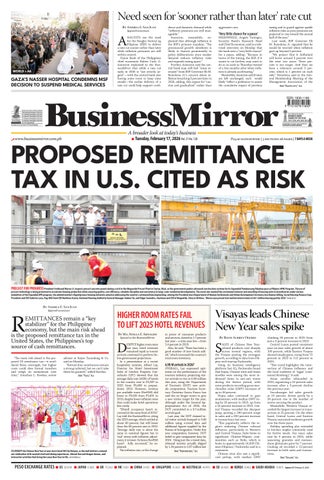
remain a “key stabilizer” for the Philippine economy, but the main risk ahead is the proposed remittance tax in the United States, the Philippines’s top source of cash remittances.
By Ma. Stella F. Arnaldo Special to
the
BusinessMirror
DESPITE higher room rates last year, hotel revenues remained tepid as tourist arrivals continued to perform below government projections.
In a presentation at a recent hospitality summit, Alfred Lay, Director for Hotel Investment Sales of Leechiu Property Consultants (LPC) showed that the average daily rate (ADR) of hotels in the country rose to P5,987 in 2025 from P5,408 in prepandemic 2019. However, revenue per available room (RevPAR) slid lower to P3,620 from P3,691 in 2019, despite lower inflation rates that could make hotel operations less costly.
“[Hotel] occupancy hasn’t recovered at the same level of 2019,” Lay told the BusinessMirror, citing the 2025 average, which settled at about 60 percent, but still lower than the 68 percent rate in 2019.
“Average daily rate is about the same in nominal figures but in ‘real’ terms with inflation adjustment, it is lower. So hence RevPAR hasn’t fully recovered,” he explained.
The inflation rate, or the change
in prices of consumer products and services, slowed to 1.7 percent last year—a nine-year low—from 2.4 percent in 2019.
Also, he said, “There has been a good number of new hotels added,” which increased the country’s total room inventory.
6.98-M arrivals in 2026?
OVERALL, Lay expressed optimism on the performance of the tourism industry, projecting visitor arrivals to rise to 6.98 million this year, using the Department of Tourism’s (DOT) new arrivals computation. Tourism Secretary Christina Garcia Frasco has said she no longer wants to give a new visitor target for the year, although under the General Appropriations Act of 2026, the DOT committed to a 6.7-million arrivals goal.
Last year, the DOT claimed total visitor arrivals bumped to 6.48 million using e-travel data and additional figures supplied by the Bureau of Immigration. Under this new computation, however, DOT failed to give comparative data for 2024. Using just the e-travel data, inbound tourists actually slipped by 1.34 percent to 5.87 million last
By Bless Aubrey Ogerio
SALES of Chinese New Yearrelated products rose sharply across several regions, with the Visayas posting the strongest growth, according to data from Filipino tech startup Packworks.
Using its business intelligence platform Sari IQ, Packworks found that hopia, Chinese wine and Asian noodles were among the most indemand items in sari-sari stores during the festive period, with some products recording gross merchandise value (GMV) increases of up to 36 percent.
Hopia sales continued to gain momentum, with median GMV rising by 20 percent in 2025, up from a 14-percent increase in 2023. Central Visayas recorded the sharpest jump, posting a 240-percent surge in sales and a 200-percent increase in transactions last year.
“This popularity reflects the region’s enduring Chinese cultural influence, particularly in Western and Central Visayas, hubs home to significant Chinese-Filipino communities such as Iloilo, which is home to approximately 14,000 Chinese-Filipinos,” Packworks said in a statement.
Chinese wine also saw a significant pickup, with median GMV
climbing 36 percent in 2025 from just a 3-percent increase in 2023. Central Luzon posted consistent year-on-year sales growth of about 100 percent, while Eastern Visayas showed steady gains, rising from 72 percent in 2023 to 115 percent in 2025.
“This trend highlights the intersection of Chinese influence and the local tradition of ‘tagay’ [communal drinking],” it said. Asian noodles rebounded in 2025, registering a 10-percent sales increase after a 3-percent decline the previous year.
Soccsksargen led sales growth at 25 percent, driven partly by a 36-percent rise in the number of stores carrying the product. Meanwhile, Western Visayas recorded the largest increase in transactions at 25 percent. On the other hand, Central Luzon and Eastern Visayas sustained moderate growth over the three years.
Holiday spending also extended to kitchen staples commonly used for festive meals. Soy sauce sales rose by 9 percent in 2025, while seasoning granules and monosodium glutamate grew by 7 percent. Cooking oil recorded a 13-percent increase in both sales and transactions.
Revenues…
year, and massively missing the DOT’s original 8.4 million visitors target. (See, “Tourist arrivals barely hit 6M, still below prepandemic peak,” in the BusinessMirror, Jan. 20, 2026.)
Hotels in Metro Manila continued their recovery, with ADR having risen to P6,009 last year from P5,161 in 2019. RevPAR rose to P3,942 from P3,553 on the back of an average occupancy rate of 65 percent. Average hotel occupancy in Metro Manila was 69 percent in 2019.
MICE to remain strong
THE LPC executive cited factors that will continue to push tourism growth: new international flight routes, more public-private partnerships to build new or upgrade existing airports, the restoration of DOT’s branding budget to P1 billion, and the 14-day visa-free entry of Chinese tourists. Prior to the pandemic, Chinese tourists accounted for 1.7 million arrivals in the Philippines, making China the second top source of tourists, after South Korea. As a key trend this year, “MICE [Meetings, Incentives, Conventions, Exhibitions] tourism maintains its status as a high-growth sector, supported by key supply and demand drivers,” specifically hosting the Association of Southeast Nations key meetings and leaders summit, and the opening of the SMX Convention Center Seaside Cebu in the fourth quarter of 2026, said Lay. He also forecast the expansion of domestic and international hotel brands into “secondary or tertiary Philippine cities by targeting underserved demand. Expect to see continued flagging of hotels in Batangas, Cavite, Bataan, Cagayan de Oro, and Zamboanga.”
DMW tracks Pinoy sailors on Russia’s ‘shadow fleet’
By Samuel P. Medenilla @sam_medenilla
THEDepartment of Migrant Workers (DMW) has already identified the 24 Filipino seafarers, who were reported to be stationed on Russia’s “shadow fleet,” and is now determining their status and checking if they were legally deployed abroad.
In a press conference on Monday, DMW Secretary Hans J. Cacdac declined to disclose the identity of the sailors until the agency can inform their families and check if their
names are in its database.
“We are still looking at the list, whether they were deployed through DMW,” he said in Filipino.
“We are specifically investigating
whether there are those licensed manning agencies who are cohorts or responsible for this,” he added.
He said they are also determining if they were indeed onboard ships, which are part of the so-called “shadow fleet,” a reference to ageing unregistered oil tankers used by Russia to bypass sanctions imposed by Western countries after it attacked Ukraine.
DMW made the statement after Senate Committee on Foreign Relations Chairman Erwin Tulfo said he got information on the 24 Filipino seafarers, who he claimed were stationed on Russian vessels.
The agency is now coordinat-
ing with the office of Tulfo on the matter
Cacdac warned other Filipino sailors from considering boarding ships, which are part of the shadow fleet.
He noted such unregistered ships are not seaworthy and do not comply with international standards, such as providing seafarers with insurance.
“Those are the perils of a shadow fleet. That is a serious matter so we will get to the bottom of this,” Cacdac said.
“So to seafarers, please go through the DMW. Their spouses can be the first to warn their loved ones to make sure they go through the DMW [for their deployment],” he added.
CBCP urges ‘digital media fasting’ for Lent 2026
By Mary Jade Jadormio
THE Catholic Bishops’ Confer-
ence of the Philippines (CBCP) has called on the faithful to observe “digital media fasting” as
part of their Lenten discipline this year.
In a pastoral message titled “Fasting Beyond Food: Inviting Christ into Digital Media Use,” the bishops said the traditional practice of fasting must also
address modern distractions, particularly the pervasive influence of digital technology.
“As we approach the holy season of Lent 2026, the Catholic Bishops’ Conference of the Philippines invites all the faithful to renew their hearts through prayer, fasting, and works of mercy,” the CBCP said.
While fasting has long been associated with abstaining from food, the bishops explained that it also means detaching from anything that draws one’s heart away from God.
They pointed to constant engagement with phones, social media, streaming platforms, and online entertainment as factors that can weaken interior life and diminish silence and reflection.
“Technology is a blessing when used responsibly, yet excessive media use often leads to distraction, fatigue, loss of focus, weakened relationships, and diminished spiritual awareness,” the statement read.
The CBCP clarified that digital media fasting is not anti-technology but a call to place technology at the service of human life, rath-
er than allowing it to dominate daily routines. By limiting screen time, the faithful are encouraged to create space for prayer, reading Scripture, Eucharistic devotion, works of mercy, and meaningful encounters with others.
The bishops described the practice as a path toward interior conversion.
“Digital media fasting is not simply about giving something up. It is about making room for something better.”
Among the concrete steps suggested are avoiding phone use before sleep and upon waking, observing device-free meals, limiting social media and streaming time, practicing occasional 24-hour or weekend digital fasts, and replacing screen time with prayer, service, reading, or conversation.
The bishops expressed hope that through this discipline, the faithful may grow in faith, clarity, and deeper communion with God and one another.
This year’s Ash Wednesday is set for February 18, which marks the beginning of the season of Lent.
Ravelas raised this after the Bangko Sentral ng Pilipinas (BSP) released its latest data showing cash remittances from overseas Filipinos grew by 3.3 percent year-on-year to $35.63 billion from January to December 2025, compared to $34.49 billion in the same period in 2024. Cash remittances are cash sent by land-based and sea-based workers through the banking system.
According to BSP, the United States remained the top source of cash remittances to the Philippines in 2025, followed by Singapore and Saudi Arabia. On a monthly basis, cash remittances rose by 4.2 percent to $3.52 billion in December 2025 from $3.38 billion in December 2024.
Rizal Commercial Banking Corp. (RCBC) chief economist Michael L. Ricafort explained that growth in cash remittances in December 2025 could be attributed to some Overseas Filipino Workers (OFWs) increasing remittances and conversion to pesos in December 2025 before the 1-percent tax on OFW remittances from the US took effect in 2026.
Ravelas explained that while December’s “surge” reflects year-end bonuses and holiday spending, “The bigger story is resilience—overseas Filipino employment held up well despite global uncertainty.”
For his part, Philippine Institute for Development Studies (PIDS) Senior Research Fellow John Paolo Rivera said cash remittances in December were likely driven by “seasonal holiday inflows, steady deployment of OFWs abroad particularly in healthcare, maritime, and service sectors and the continued recovery of host economies in the US, Middle East, and parts of Asia.” Moreover, Rivera said the relatively weaker Philippine peso encouraged higher remittance conversions, while digital transfer channels made sending money faster and more convenient. “Remittances remain a key stabilizer for the Philippine economy, supporting household consumption, cushioning external shocks, and helping sustain domestic demand despite slower growth and global uncertainties,” added Rivera.
US remittance tax
EARLIER this year, Executive Director Jeremaiah M. Opiniano of the Institute for Migration and Development Issues (IMDI) told this newspaper that while the 1-percent tax on remittance transactions may or may not reduce dollar flows, what is certain is that sending money from the United States will become more expensive.
Sweet items associated with prosperity saw notable gains as well. Chocolate sales climbed 36 percent in 2025, while sugar maintained elevated levels following a 47-percent surge in 2024.
“These trends reflect steady topup purchases of affordable and culturally symbolic items in sari-sari stores in these regions,” it said.
Packworks chief data officer Andoy Montiel said the data highlight how tradition continues to shape consumer behavior.
“The sales trends show that for the average Filipino, Chinese New Year isn’t just a holiday, but a window for ‘investing’ in prosperity,” Montiel said.
“These cultural nuances are mirrored in the sari-sari store ecosystem, proving that in our local market, heritage often leads the hand that shops,” he added.
The analysis covered more than a million monthly transactions across 300,000 sari-sari stores nationwide, comparing sales of holiday-related products two weeks before and after the Chinese New Year from 2023 to 2025.
Staying relevant CONSUMER goods companies need to move beyond simply
keeping shelves stocked and relying on standard distribution models, as purchasing patterns around the Chinese New Year show demand is often shaped by local traditions, according to Packworks.
Packworks co-founder and chief platform officer Hubert Yap said product performance at the community level is closely tied to how well brands align with longstanding cultural practices, particularly in sari-sari stores where buying decisions are more situational and event-driven.
“By aligning product availability with these deeply ingrained cultural cues, brands can capture the latent demand that often goes unseen in modern trade, effectively turning cultural nuances into a competitive advantage at the grassroots level,” Yap said.
Based on its analysis, Packworks expects gross merchandise value from Chinese New Year-related purchases to grow by about 10 percent this year, while transactions are seen to rise by 4 percent, as shoppers tend to buy more items per visit during the festive period.
The findings were drawn from more than one million monthly transactions across roughly 300,000 sari-sari stores nationwide, comparing sales of holidayrelated items in the two weeks before and after the Chinese New Year from 2023 to 2025.
The United States began imposing a 1- percent tax on remittances sent from America to other countries on January 1, 2026.
Personal remittances
MEANWHILE, BSP data also showed personal remittances increased by 3.3 percent to $39.62 billion from January to December 2025, from $38.34 billion a year ago. Personal remittances cover cash sent through banks and informal channels, as well as remittances in kind. In December 2025 alone, personal remittances went up by 4.2 percent to $3.89 billion from the previous year’s $3.73 billion.
On Friday, BMI, a unit of Fitch Solutions, through its economic overview for the Philippines, said it expects the BSP to shave off 50 basis points from the current 4.50 percent benchmark policy rate to 4 percent before this year ends. This, it noted, as it expects
www.businessmirror.com.ph
House deliberations on 8 Ledac priority bills on track
EIGHT Legislative-Executive Development Advisory Council (Ledac) priority bills focused on education access and social protection are progressing in the House of Representatives as lawmakers move them closer to plenary action, the majority leader said on Monday.
House Majority Leader Ferdinand Alexander Marcos said the measures have cleared their main committees and are now awaiting fiscal and funding-related comments from the Committee on Appropriations—an essential step before floor debates.
The bills cover a wide policy sweep: modernization of the Bureau of Immigration, the National Land Use Act, creation of an Independent People’s Commission, a Presidential Merit Scholarship Program, and amendments to laws on free tertiary education, the Pantawid Pamilyang Pilipino Program (4Ps), and micro, small, and medium enterprises. Also moving forward is the proposal to reset elections in the Bangsamoro Autonomous Region in Muslim Mindanao.
Marcos said the focus remains on legislation that produces “real-life effects” for households—lower education barriers, stronger public health access, more affordable food systems, and expanded social safety nets.
The Bangsamoro elections measure was among the key items reaffirmed in the Ledac’s latest Common Legislative Agenda (CLA), alongside proposals to abolish the travel tax, expand protections against online sexual abuse of children, and address digital disinformation.
“These committee-level approvals show that the House is doing the hard work early under the leadership of Speaker [Faustino] Dy—building consensus, refining policy, and making sure the measures we bring to the floor are ready,” Marcos said.
“Our focus remains on bills that directly
affect education, health, food security, and social protection—areas where legislation translates into real impact for Filipino families,” he added.
Joining it in the CLA were the proposed abolition of the travel tax, the Expanded Online Sexual Abuse or Exploitation, or Child Exploitation of Children (Osaec) and Child Sexual Abuse or Exploitation Materials (Csaem) Act of 2026, and a bill aimed at curbing fake news and digital disinformation.
Marcos noted that these developments build on earlier legislative gains by the House, where 12 of the 52 Ledac priority measures have already been approved on third and final reading.
He said the continued movement of Ledac bills through the committee process reflects a disciplined legislative push aligned with the administration’s priorities.
“We’ve already shown that when the House treats time as a responsibility, we can deliver.
Out of 52 priority measures, 12 are already approved on third reading, and now eight more are moving closer to plenary action. That’s progress, and we intend to sustain it,” Marcos said.
Marcos emphasized that the House continues to prioritize legislation that directly responds to pressing household needs, especially in the areas of education access, public health services, food affordability, and social protection.
“The goal is to pass sound, well-vetted laws that people can actually feel in their daily lives, whether in the classroom, at the health center, or at the dinner table,” Marcos said.
Marcos emphasized that the House will continue to prioritize Ledac measures touching on education, health, and food systems, with committee-level work serving as the backbone for more efficient and focused plenary deliberations in the coming weeks.
Cruz
Jovee Marie N. dela
Arrested Mongolian a graduate of China fighter-jet pilot school
By Henry Empeño
THE Mongolian who was arrested by the Bureau of Immigration for allegedly spying for China in Iba, Zambales, was a graduate of an advanced military aviation school in China, the Civil Aviation University of China (formerly Northeast China Democratic United Army Aviation School).
A report submitted by the arresting to the BI intelligence chief, Fortunato Manahan Jr. said Bold-Erdene Boldbaatar, 30, was also a graduate of the Defense University of Mongolia. Boldbaatar, BI said, posed a serious threat to national security, public safety, and national interest due to his military background and surveillance activities.
The report to Manahan said that Bold-Erdene Boldbaatar enrolled at the All-Asia Aviation Academy in Iba, Zambales, and in the course of his solo training
flights took aerial photographs of the Iba airport and the nearby Palauig River.
This indicated “possible exploitation of aviation training for unauthorized reconnaissance purposes,” the BI report said, and raised suspicion that his aviation training in the Philippines is financed by the Chinese government.
Initially, Boldbaatar was arrested “for engaging in activities inconsistent with the purpose of his visa and Special Study Permit [SSP].”
The suspect had entered the Philippines and enrolled at the Iba pilot school under an SSP, thereby “acquiring dual-use aviation skills potentially applicable to surveillance or military operations,” the BI reported.
The BI also said Boldbaatar had obtained a license as jet fighter pilot from the China People’s Liberation Army’s Air Force Aviation University, and had served as a soldier with fighter aircraft experience.
However, Boldbaatar failed to disclose his military affiliation and aviation combat training in his visa and SSP application, the BI said.
The suspect’s training operations in Iba, which is about 120 nautical miles from the Scarborough Shoal,
a maritime area in the center of a dispute between the Philippines and China, also “raises serious concern that [Boldbaatar’s] flight training activities may be exploited for surveillance, reconnaissance, and intelligence gathering,” the BI added. At the time of his arrest, Boldbaatar “was found without valid immigration status,” the same report indicated. It further concluded that Boldbaatar’s “concealment of military background, presence in a sensitive aviation training environment, and aerial reconnaissance activities represent a serious national security concern and a potential channel for foreign intelligence penetration into Philippine aviation and defense systems.” Boldbaatar’s arrest further raised concerns over potential of security threats from foreign nationals visiting Zambales, which hosts several strategic military facilities, including the former US military base in Subic Bay. In March last year, authorities arrested six foreign nationals, including Chinese and Cambodian citizens, for monitoring Philippine and US naval assets while posing as tourists in the Subic Bay Freeport.
BOLD-ERDENE BOLDBAATAR
A4
Tuesday, February 17, 2026
www.businessmirror.com.ph
PHL nuclear program gets boost from US
TBy Lenie Lectura @llectura
HE strong ties between the United States and the Philippines in the nuclear energy sector took a step further with the launch on Monday of a $2.5-million Public-Private Partnership (PPP) project meant to bring US nuclear experts to the Philippines to develop specialized vocational and higher education curricula focused on the civil nuclear industry.
This PPP is supported by Aboitiz Power, EōS Organization, Technical Education and Skills Development Auhority, and the US Department of State, and led by Fulbright Philippines.
“First, today, we are launching a public, private partnership involving the Philippine American Educational Foundation, the Fulbright, Philippines, and Tesda, from the Philippine side, along with private sector leaders, from both countries, to Abotiz Power,
and EōS Corporation,” said Ann Ganzer, Principal Deputy Assistant Secretary in the Bureau of Arms Control and Nonproliferation at the US Department of State.
“This approximately $2.5 million public private partnership will harness US academic expertise to develop vocational and higher education curriculum tailored to train Filipino students in the specialized fields essential to supporting a thriving nuclear industry,” Ganzer said.
Moreover, the US will provide a $1.5-million nuclear reactor control room simulator under the Foundational Infrastructure for Responsible Use of Small Modular Reactor Technology (FIRST) Program. This positions the Philippines to be an SMR (Small Modular Reactor) regional training hub.
“In addition, I’m proud to share that the United States is putting forth $1.5 million through my department’s first program to procure a nuclear reactor controlled
room simulator for the Philippines,” added Ganzer.
The simulator will be installed at a technical institution within the Luzon economic corridor. It will provide hands-on, realistic training for future reactor operators and technicians to practice plant operations, safety procedures, and emergency scenarios that create a qualified nuclear workforce, strengthen safety culture, and accelerate readiness for SMR deployment.
“A state-of-the art training tool, the simulator will enable Filipino students to gain hands on experience in operating a nuclear power plant right here in the classroom and to ensure nuclear development in the region,” Ganzer added.
She also said that lawmakers from the Philippines will be invited to the United States under FIRST program cooperation to gain firsthand insights into the technologies, policies, regulatory frameworks, and institutions that enabled the development of
Revilla refuses to enter plea
Da safe, secure, and successful US civil nuclear sector.
“Furthermore, the Department of State’s FIRST program will fund and organize a study tour in 2026 for Philippine legislators to visit the United States. This will provide valuable insights into creating the regulatory and policy environment necessary to enable a successful nuclear sector in the Philippines,” she added.
There are also partnerships between Philippine universities and Texas A&M University and King’s College London that will be established to support the development and integration of new SMR curricula into engineering programs in the Philippines. The project will connect professors and senior academics from Philippines to their US and UK counterparts.
“The United States is fully dedicated to supporting the Philippines, through a comprehensive whole of government approach, working hand in hand with our
during arraignment
close ally to achieve lasting energy security in every way we can,” Ganzer emphasized.
Earlier, the US Trade and Development Agency extended a $2.7 million feasibility study grant to help the Manila Electric Company (Meralco) assess and deploy USdesigned SMRs in the Philippines.
This study will evaluate leading US technologies, identify viable sites, and deliver a high-level implementation roadmap. When finalized, this work will provide a pathway for the deployment of safe and secure advanced US nuclear technologies that will deepen ties between our two countries for decades to come.
When finalized, this work will provide a pathway for the deployment of safe and secure advanced US nuclear technologies that will deepen ties between our two countries for decades to come.
By Joel R. San Juan @jrsanjuan1573
ETAINED former senator
Ramon Revilla Jr. refused to enter a plea during his arraignment on Monday before the Sandiganbayan Third Division for the malversation of public funds through falsification of public documents filed against him over his alleged involvement in the P92.8-million ghost flood control project in Pandi, Bulacan.
This prompted the anti-graft court to enter a “not guilty” plea on behalf of Revilla while his co-accused, former Department of Public Works and Highways (DPWH) Bulacan First District Engineering Office finance section chief Juanito Mendoza, entered a plea of “not guilty.”
The other co-accused in the case, namely former DPWH engineers Brice Hernandez, Jaypee Mendoza, Arjay Domasig, and Emelita Juat, and DPWH Bulacan First District Engineering Office cashier Christina Pineda, had pleaded not guilty for the malversation charges.
Revilla’s legal team spokesperson, lawyer Francesca Señga, explained that the former senator did not enter a plea is consistent with his position that the filing of charges by the Office of the Ombudsman against him has no basis.
Revilla’s arraignment pushed through even as the Sandiganbayan partially granted his motion for reconsideration seeking the reversal of its February 5, resolution.
The Sandiganbayan affirmed its February 5 resolution which denied Revilla’s motion to quash the information and the arrest warrant issued against him on the ground that his right to due process during the preliminary investigation was violated.
Revilla argued that the Sandiganbayan failed to give weight to his argument that he was only charged with violation of Section 3 (b) of Republic Act 3019 or the AntiGraft and Corrupt Practices before the Ombudsman but the information was for malversation through falsification of public documents.
However, the Sandiganbayan declared: “In sum, the filing of an information for an offense different from the charged in the supplemental complaint does not constitute a badge of irregularity which would have caused the court to defer the issuance of the warrants of arrest against the accused.”
“Quashing a warrant of arrest already issued after the filing of an information on the ground of the pendency of the motion for reconsideration or reinvestigation before the prosecution is not jurisprudentially recognized,” it added.
The anti-graft court also pointed out that there is no denial of Revilla’s due process that would warrant a reinvestigation of the case.
“This filing of a crime different from that preliminary designated by the complainant is not a procedural infirmity. Neither is it tantamount to a violation of the right to due process,” the Sandiganbayan said.
But, the Court granted Revilla and Mendoza’s plea to be allowed to file a motion for reconsideration of the Ombudsman’s resolution finding probable cause to indict them for malversation.
It directed the Ombudsman to resolve within 60 days the motions for reconsideration that Revilla and Mendoza are expected to file.
The anti-graft court explained the 2018 Revised Internal Rules of the Sandiganbayan requires that the information to be filed together with the relevant certifications from the Ombudsman regarding the resolution of or the lapse of the period to file a motion for reconsideration.
The Sandiganbayan noted that Revilla and Mendoza were not able to file motions for reconsideration before the Ombudsman prior to the filing of the information.
“Hence, the Ombudsman will be unable to comply with the certification requirement under the 2018 Revised Internal rules of the Sandiganbayan if this court
does not grant leave allowing the accused to file their motions for reconsideration,” the Sandiganbayan said.
“Accordingly, for more efficient conducts of proceedings, the court deems it proper to allow the accused to file their motions for reconsideration with the Ombudsman and to direct the Ombudsman to submit the certifications required under the 2018 Revised Internal Rules of the Sandiganbayan,” the resolution read.
It added that allowing the accused to file a motion for reconsideration does not result in the suspension of proceedings or the quashal of warrants of arrest issued against them.
“If the Ombudsman will indeed reconsider its resolution, it can subsequently file the appropriate motion. The grant or denial of the said appropriate motion or any subsequent action by the Ombudsman will be subject to the court’s discretion. It cannot, by itself, terminate or suspend the proceedings in this case, or even result in the quashal of the warrants of arrest,” it said.
The Sandiganbayan earlier denied Revilla’s motion seeking the inhibition of Associate Justice Karl Miranda, the division’s chairperson.
See “Revilla,” A5
Think-tank disputes Chinese Embassy claims on job
HINK-TANK Stratbase Institute
Trejected claims made by the Chinese Embassy in Manila that millions of Filipinos would lose their jobs
should Philippine-Chinese diplomatic relations sour.
Stratbase, in a Facebook post late Sunday night, said the assertion is not
supported by official economic data from the Philippine government.
Latest data coming from the Bangko Sentral (BSP), indicate that foreign direct investment (FDI) inflows from China for the period January to November 2025 amounted to US$3.10 million, or 52.43 percent lower than the US$6.52 million recorded during the same period in 2024. The inflows represented only 0.27 percent of total FDI received by the Philippines.
“In 2024, China accounted for just 0.55 percent of total net FDI inflows. This continues a steady downward trend in China’s investment share, which declined from 12.04 percent in 2019 to just over 1 percent in 2023, before falling further in 2024. The data clearly indicate that China currently plays a relatively minor role in overall FDI inflows to the Philippines,” Stratbase said.
The think-tank added China also lags behind other countries in terms of approved but unrealized investment commitments.
Data recently released by the Philippine
losses
Statistics Authority showed that in 2025, Chinese investment pledges amounted to P10.25 billion, or just 3.76 percent of the total P272.58 billion in pledges received by the Philippines.
While Chinese investment commitments surged during the administration of former President Rodrigo R. Duterte, rising from P2.33 billion in 2017 to P50.69 billion in 2018 and peaking at P88.67 billion that represented 22.7 percent of total pledges in 2019, the commitments fell sharply to PHP1P billion in 2020 amid the Covid-19 pandemic and global lockdowns.
Since then, Chinese pledges have remained comparatively low. At the same time, Stratbase said the Philippines faces structural vulnerabilities, particularly a widening trade deficit largely driven by imports from Ch ina.
“While China is often cited as among the country’s top trading partner[s], the relationship is heavily skewed toward imports. This persistent and expanding
See “Chinese,” A5
“I know that Secretary [Sharon] Garin and her team have set an ambitious target to incorporate nuclear energy into the Philippines power mix in just six years. The Philippines is already well positioned to launch a nuclear energy program and will be, and is, a leader in this region.
“We want to work together to get Philippines to the finish line on nuclear energy. Beyond acquiring the technology and establishing robust regulations to achieve that 2032 goal, the most vital elements will be assessing sites for commercial reactor, and developing the skilled workforce needed to design, construct, operate, regulate, and sustain advanced nuclear plants for generations to come. I’m therefore delighted to announce several new initiatives that will materially advance the Philippines pursuit of nuclear energy,” said Ganzer.
The Department of Energy (DOE) is aiming for the first nuclear power plant to be operational by 2032, with a capacity of 1,200MW initially, increasing to 2,400MW by 2035 and 4,800 MW by 2030.
PhilSys to be integrated in DOH aid programs
By Justine Xyrah Garcia
THE Philippine Identification System is set to be integrated into key Department of Health (DOH) financial assistance programs to speed up and simplify Filipinos’ access to government health services.
The Philippine Statistics Authority (PSA) on Monday said that the Health department will soon use the National ID in implementing the Medical Assistance for Indigent and Financially Incapacitated Patients (Maifip), the Zero Balance Payment (ZBP) program in selected government hospitals, and the Cancer Assistance Fund, including the Cancer and Supportive-Palliative Medicines Access Program (CSPMAP).
PSA Assistant Secretary Rosalinda P. Bautista said the agency is working closely with the DOH and both public and private healthcare institutions to integrate National ID authentication services into their systems, ensuring efficient identity verification for patients.
“We aim to support the healthcare sector with a secure and efficient method of verifying identities through the National ID,” Bautista said.
Based on DOH’s assessment, the National ID can significantly improve the targeted delivery of public health services.
THE Army (PA) commander, Lt. Gen. Antonio Nafarrete, on Monday said he expects all remaining 18 units of the Sabrah light tanks, ordered to beef up the service’s armored capabilities, to be delivered within this year.
“We have nine units of Sabrah [light tanks] now [in service] and we are still waiting for 18 units,” he said when asked for updates on the project at a press conference at Fort Bonifacio in Taguig City.
“This is a big item, negotiations are still ongoing. And we hope within this year matatapos na ang delivery [our Sabrah tank deliveries will be completed],” Nafarrete said.
For security reasons, the PA
The agency noted that inconsistencies in the spelling and completeness of names collected on the ground often lead to mismatched records. These discrepancies, it said, can affect the provision of health services, allocation of vaccines and immunizations, and even the release of benefits for healthcare workers.
World Bank Research Specialist Claire Casher also underscored the role of the National ID in advancing digitalization in the health sector. Casher said digitalization has “huge potential,” especially if a digital ID system allows one verified identity to follow a person across different healthcare facilities.
“From province to province or specific hospital to specific hospital, there are a lot of individual systems that were developed to deal with needs and problems [but] are not necessarily connected. That creates problems when [a patient] wants to move from one [healthcare facility] to another, and their information wasn’t following them,” she also said. Currently, the National ID is being used in DOH-developed systems such as iClinicSys, an electronic medical record and health information system that gives healthcare professionals real-time
chief did not give further details on the possible delivery dates of these armored assets. Around nine to 10 units are now in service with the PA’s Armored Division. Reports said these were delivered from 2022 to 2025. The Philippines’ Sabrah light tank, which was developed by Israeli defense manufacturer Elbit Systems, was the first armored vehicle of the PA to be armed with a 105mm cannon. The PA’s light tank acquisition project is under Horizon 2 of the Revised AFP Modernization Program. The contract is worth around P9.4 billion and
www.businessmirror.com.ph
Are you scared of
By Henry J. Schumacher
IAM. Both as an individual and as an executive of companies.
am aware that I am not alone. There is plenty information in the news that a lot of people are not only scared, many businesses and individuals have already been attacked. And let’s be aware: there are more and more hackers around waiting to attack!
Why? What’s happening to us?
BEFORE the pandemic we already shared personal data and privacy. The pandemic has changed the way we live, shop and pay. Because of the acceptance of digital transformation, we have to accept the fact that we must share personal and company information. As a consequence, cybercriminals made a killing. No business is safe, but individuals have suffered equally.
When a malicious actor attacks an enterprise, information technology (IT) and security must work together in order to respond—quickly and effectively.
But how does that work? As with anything, it depends on the organizations, how the IT and security departments work together and how much planning has been done in advance.
Cybersecurity is one of the most difficult aspects of running a business. While no amount of advance planning can prevent every cybersecurity incident, planning can help mitigate the results.
Instead of trying to figure out what role IT plays while a cybersecurity incident is happening, running through potential scenarios or even a made-up attack in advance can ensure that security and IT are working in tune in case the worst happens.
Who does what during a cybersecurity attack is determined by each organization, and the weight of the roles IT and security play. At smaller companies, IT and security teams might be close enough to share the same budget. In those situations, a smaller team can work together as one department because that’s essentially how they’ve functioned in the past.
For crucial operations, such as branches of industries and critical infrastructure, a security team typically sets policy.
Brace the backups
WHILE IT’s role depends on the enterprise, most likely the team will be responsible for the data backups—which hopefully exist.
While the incident response team is focused on the area that has been attacked, IT needs to start looking at backups immediately and confirm if they have them, and if they have them, have they been deleted. IT also needs to locate offsite backups and confirm that they have not also been infected.
Tech leaders can then identify which portions of the network haven’t been attacked and assist with restoring data or rolling back activities or both to the last good state backup that you know is clean.
IT and cybersecurity may snip at each other during an attack. It’s a tense situation and the fallout could cost not just millions in
THE National Economic and Development Authority has approved the French-funded P28.243 billion bridge project, the Department of Agrarian Reform (DAR) Secretary said. With the funding and project completion, two million agrarian reform beneficiaries (ARBs) and rural folks could expect greater economic opportunities, Agrarian Reform Secretary Conrado Estrella III said after he distributed individual electronic land titles to 5,837 ARBs from the provinces of Aklan, Antique, Capiz, Iloilo and Guimaras and Certificates of Condonation with Release of Mortgage (Cocrom) to 1,762 ARBs from Guimaras in a simple ceremony at the Pototan Coliseum, Pototan, Iloilo, on Monday.
cybercrime?
losses, but a CIO or CISO or both their jobs.
This should be treated like a corporate crisis by the entire enterprise and, depending on the size of the organization, that means the response should be part of overall crisis management coordination.
Instead of just letting the security team run with it, you need an overarching crisis management team that’s coordinating all the work streams.
Organizations should put in the time to create customized plans instead, outlining the roles of everyone, including IT and cybersecurity, and who is going to resolve disputes between the two.
Prepare for communication during an attack
THE best way to cut down on both the timeline and cost of a cybersecurity attack is to prepare before it even happens.
Instead of saying who will do what, tabletop exercises are recommended, so it’s not just talking about how they’re going to do it but also practicing that communication channel.
If an enterprise hasn’t done a tabletop exercise while employees are working remotely, it’s worth doing one while the workforce is scattered, even if plans call for most people to be back in the office sometime this year.
A lot of time these incidents don’t happen between the hours of eight and five. They’re usually on a weekend. Most likely people are going to be communicated in that kind of [remote] way.
Some more ideas:
1. Cybercrime - why are we more vulnerable today? As businesses and as individuals.
2. Where are hackers looming? Facebook, social media, e-commerce, healthcare, digitalization, fin tech - electronic payments
3. How do we defend ourselves? n As companies, as individuals n Training staff / automation n Staff training in AI and machine learning
4. Data privacy protection - companies and individuals - government support
5. Cross border data flow - BPO / cybersecurity in dealing with sensitive data with EU, UK, US, Japan, Australia = APEC at large.
I hope I helped you to address cybercrime— it’s definitely worthwhile!!! I look forward to your responses; contact me at hjschumacher59@gmail.com
PHL, Indonesia nickel miners partner for responsible mining
By Jonathan L. Mayuga @jonlmayuga
THE Asosiasi Penambang Nikel Indonesia (Apni), or Indonesia
Nickel Miners Association and the Philippine Nickel Industry Association (PNIA) recently signed a partnership agreement to shape and deepen cooperation across the nickel value chain.
The partnership brings together industry leadership from Indonesia and the Philippines, the world’s leading nickel-producing countries, to define shared direction for investment confidence, policy dialogue, and responsible mining that underpins the future of energy and sustainable growth. It also came as secure and responsibly sourced critical minerals become central to the global energy transition.
The signing event was hosted by PNIA’s academic partner, the University of Asia and the Pacific (UA&P), and was participated in by Apni Chairman Komjen Pol. (Purn) Drs. Nanan Soekarna and PNIA Chairman Antonio L. Co, and witnessed by Environment Undersecretary Juan Miguel Cuna, Trade Undersecretary Ceferino S. Rodolfo, DENR–Mines and
Geosciences Bureau Officer-in-Charge
Assistant Secretary Michael V. Cabalda, UA&P President John Philip Yeung, Apni
Secretary General Meidy Lengkey, Apni Deputy Secretary Sucianti Saenong, and Apni Advisory Board Member Djokno Widajatno Soewanto.
In a statement, PNIA Executive Director Charmaine Olea-Capili said the partnership is consistent with the Association of Southeast Asian Nations (Asean) Principles for Sustainable Minerals Development, adopted by Asean Ministers responsible for minerals development on October 2, 2025 in Vientiane, Lao PDR.
The Principles recognize the critical role of minerals in supporting strategic sectors such as energy, mobility, infrastructure, and the green and digital transitions, and call for coordinated regional efforts to uphold high standards of environmental stewardship, social responsibility, and good governance to build public trust and investor confidence.
“While this partnership was initiated by industry, we were deliberate in making sure our cooperation is anchored in and responsive to Asean’s direction,” Olea-Capili said. “So we set out five collaboration pillars to turn those
regional principles into practical industry action: sharing data and policy perspectives; creating platforms for industry dialogue; facilitating industry learning and exposure; supporting capability, human capital, and ESG development; and ensuring cooperation remains adaptive as priorities evolve.”
Olea-Capili explained further that the partnership is anchored on a common agenda expressed through shared priority areas spanning governance and regulatory coherence; ESG, EITI, and Sustainable Development Goals alignment; investment promotion and value-adding minerals; human capital and talent development; and community development and social acceptance, which together guide how the industry collectively engages governments, investors, industry, and host communities across the nickel value chain.
“These priorities send a clear signal to investors, governments, and other stakeholders about where our industries are headed,” Olea-Capili said. “They show that APNI and PNIA are serious about building a nickel value chain in the IndoPhil Nickel Corridor that people can rely on to support the energy transition, deliver shared prosperity, and earn long-term trust.”
‘Data center surge can accelerate PHL’s renewable energy, industrial growth’
THE increasing demand for data centers in the Philippines calls for synergistic planning between the energy and digital infrastructure sectors, a Manila-based think tank said.
The Institute for Climate and Sustainable Cities (iCSC) said data centers, with their continuous, large-scale, electricity-intensive operations, can overwhelm local substations, strain transmission corridors, and exacerbate grid congestion if they are geographically concentrated without proper coordination.
Strategic integration transforms this growth from a potential source of grid stress into a catalyst for clean power deployment and economic opportunities, the group pointed out.
“By co-locating data centers with renewable energy [RE] zones, the Philippines can anchor [their] demand where clean power is generated, creating a bankable market for renewable projects, and advancing the national energy transition,” iCSC noted.
“They also position digital infrastructure as a driver of sustainable economic growth, expanding the digital economy and maximizing domestic renewable resources.”
Another critical consideration for siting data centers is power quality. Data centers introduce harmonics from their large-scale
electronic loads, which, if unmitigated, can disrupt existing manufacturing, semiconductor, and industrial operations already concentrated in the Greater Metro Manila area.
“For the country’s industrial strategy to succeed, data center growth must not come at the expense of existing sectors. Therefore, proactive site selection and adherence to stringent grid standards are crucial,” iCSC emphasized.
The Philippines has no shortage of renewable energy resources to support data center demand; for instance, rooftop solar offers vast untapped potential, the group added.
The Solar Power Estimation of Capacities and Tracking Using Machine Learning or Spectrum, a solar mapping tool developed by iCSC, shows vast hectares of viable commercial rooftops nationwide that could generate far more power than current installations.
Rooftop solar can be deployed quickly through net-metering programs, helping cities use clean energy efficiently while reducing stress on the grid. Co-locating data centers with these commercial rooftops enables RE utilization without new transmission lines and supports immediate deployment.
Offshore wind can also provide largescale clean power, with up to 50 gigawatts (GW) potential by 2040. Mindoro, for example, hosts a large share of planned offshore wind and will connect to Luzon by 2027 through the Batangas–Mindoro Interconnection Project.
However, current transmission expansion plans may not fully accommodate all ongoing offshore wind developments, which could lead to curtailment or stranded capacity if grid upgrades are not aligned with growth. Bringing large data center demands to high-RE-potential areas could help reduce RE curtailment rates and the need for extensive transmission projects.
iCSC recommends co-zoning data centers with renewable energy hubs, mandating green power procurement, and integrating data centers into transmission planning.
“The path forward is clear. The Philippines must move from siloed to synergistic planning, treating data centers as a strategic asset for its grid, not just a load on it. By anchoring this new digital demand to renewable energy zones, the country can secure investment, accelerate its energy transition, and build a resilient, high-value economy fit for the decades ahead,” iCSC also said. Jonathan L. Mayuga
One immediate outcome of the Apno–PNIA partnership is the promotion of the IndoPhil Nickel Corridor as a platform to position the shared regional significance of Indonesian and Philippine nickel for investment, policy coordination, and the global energy transition.
“The Corridor signals that Philippine and Indonesian nickel is developed with clearer standards and accountability,” Olea-Capili said.
With the partnership in place, APNI and PNIA will move into implementation through technical working meetings, stakeholder engagement rounds in Indonesia and the Philippines, reciprocal mine visits, and joint learning sessions to turn shared direction into practical cooperation.
“This is where plans meet practice,” Olea-Capili said. “We invite government partners, investors, communities, and other stakeholders to work with us, because responsible nickel development has to support not just the global energy transition, but also deliver real benefits for communities on the ground, and APNI and PNIA are committed to listening and keeping this cooperation moving forward to build trust.”
imbalance, especially after Duterte’s pivot toward Beijing in 2019, heightened dependence on foreign goods, increased exposure to supply chain disruptions and put pressure on the country’s balance of payments,” it added.
Taken together, Stratbase said government data showed that China’s contribution to Philippine investment inflows is limited, while trade relations remain structurally imbalanced.
“Claims that diplomatic strain would automatically lead to catastrophic job losses are therefore exaggerated and not supported by empirical evidence,” it noted. PNA
access to patient records, and the Integrated Hospital Operations and Management Information System (iHOMIS), a computerized platform that manages digitized patient records and billing.
As of December 2025, the PSA said more than 90.74 million Filipinos have registered for the National ID.
Of this, 54.92 million individuals have already received their physical cards.
The implementation of the “Tulay ng Pangulo” project is about to begin anytime soon. The Neda approved the project only last week, Estrella said. “Our ARBs can rest assured that more
basic support services will be implemented to improve our food security program,” he added. Estrella revealed that President Marcos was instrumental in the approval of the project dubbed “Pang-Agraryong Tulay para sa Bagong Bayanihan ng mga Magsasaka [PBBM Bridges].”
“He [Marcos] stood by the 350-steelbridges project, which seeks to connect and enhance access of agrarian reform communities to growth centers,” Estrella said. Estrella said at least 350,500 households, or 1.75 million individuals, would benefit from the project, but hinted that this number could reach up to two million, counting those living in adjacent communities. The project will be implemented in cooperation with the Department of Public Works and Highways (DPWH) and concerned local governments. It is projected to be completed on or before Marcos’s term ends in June 2028. Jonathan L. Mayuga NEDA approves ₧28.243-B bridge project–DAR chief
Tinsmithry,
PRICES of tinsmithry materials at the retail level and structural steel at wholesale helped push up construction costs in Metro Manila in January, data released by the Philippine Statistics Authority (PSA) indicate.
The annual growth rate of the Construction Materials Retail Price Index (CMRPI) in the National Capital Region (NCR) edged up to 1.2 percent in January 2026, from 1 percent in December 2025. This matched the 1.2 percent annual increase recorded in January last year.
Retail prices of tinsmithry materials rose faster, with the index increasing by 2 percent year-on-year in January, up from 1.7 percent in the previous month.
Higher annual gains were also posted by plumbing materials, which climbed 0.7 percent from 0.5 percent in December, and miscellaneous construction materials, which rose 0.9 percent from 0.8 percent.
Carpentry materials continued to register a year-on-year decline, although at a slower pace of 0.2 percent in January, easing from a 0.5 percent drop in December.
Other retail components showed mixed movements. Masonry materials posted a slower annual increase of 1 percent, while painting materials and related compounds rose by 2.1 percent, slightly lower than the previous month’s 2.2 percent.
The index of electrical materials remained unchanged at an annual rate of 1.9 percent.
At the wholesale level, the Construction Materials Wholesale Price Index (CMWPI) in the NCR grew by 0.9 percent year-on-year in January, higher than the 0.8 percent increase in December.
This marked a notable pickup from the 0.1 percent annual growth recorded in January 2025.
Structural steel prices continued to
decline but at a slower rate, with the index falling by 1.7 percent year-on-year in January, compared with a steeper 3 percent drop in December.
Similar easing declines were seen in reinforcing steel, which slipped 0.7 percent from 1.5 percent previously, and metal products, which fell 0.6 percent from 0.7 percent.
Moreover, hardware registered a 0.1-percent annual increase after posting a 0.1-percent decline in December, while fuels and lubricants rose by 0.4 percent year-on-year, reversing a 1.9-percent drop in the previous month. PVC pipes also recorded a slightly higher annual increase of 0.3 percent, up from 0.2 percent.
Meanwhile, slower annual increases were noted in sand and gravel, which rose 0.1 percent from 0.2 percent, and tileworks, which increased by 3 percent from 3.4
percent in December. Other commodity groups posted weaker annual growth or deeper declines. Plywood slowed to a 0.1-percent increase from 0.3 percent; lumber shifted to a 0.2-percent annual drop from a 0.2-percent increase; electrical works declined by 0.2 percent from zero growth; cement fell by 1.7 percent from a 1.5-percent drop; and doors, jambs, and steel casement declined by 0.4 percent from 0.1 percent.
The PSA said the remaining commodity groups either maintained their December growth rates or recorded zero annual change in January. The two indices are used to track construction cost movements in the capital. The CMWPI reflects wholesale prices faced by contractors and developers, while the CMRPI captures retail prices paid by individual buyers and small-scale builders. Bless Aubrey Ogerio
A6 Tuesday, February 17, 2026
Editor: Angel R. Calso
Gaza’s Nasser Hospital condemns MSF decision to suspend medical services
By Samy Magdy & Melanie Lidman
CThe Associated Press
AIRO—One of Gaza ‘s last functioning large hospitals condemned the decision by Doctors Without Borders to pull out of operations over concerns about armed men, claiming on Sunday that the facility had installed civilian police for security.
The rare public friction between two well-known health care providers in Gaza came as the Palestinian death toll since the current ceasefire surpassed 600. At least 11 Palestinians were killed by Israeli fire in the last 24 hours, hospitals said.
Doctors Without Borders, also known by its acronym MSF, said in a
statement Saturday that all its noncritical medical operations at Nasser Hospital were suspended due to security breaches that posed “serious” threats to its teams and patients.
MSF said there had been an increase in patients and staff seeing armed men in parts of the compound since the US-brokered October ceasefire was reached.
Nasser Hospital said Sunday the increase in armed men was due to a civilian police presence aimed at protecting patients and staff and said MSF’s “allegations are factually incorrect, irresponsible and pose a serious risk to a protected civilian medical facility.”
One of Gaza’s few functioning hospitals HUNDREDS of patients and
war-wounded have been treated daily at Nasser Hospital in the southern city of Khan Younis,
and the facility was a hub for Palestinian prisoners released by Israel in exchange for Israeli
hostages as part of the current ceasefire deal.
MSF said its teams had reported “a pattern of unacceptable acts including the presence of armed men, intimidation, arbitrary arrests of patients and a recent situation of suspicion of movement of weapons.” The suspension occurred in January but was only recently announced.
Nasser Hospital staff say that in recent months it has been repeatedly attacked by masked, armed men and militias, which is why the presence of an armed civilian police force is crucial.
Hamas remains the dominant force in areas of Gaza not under Israeli control, including the area where Nasser Hospital is located. But other armed groups have mushroomed as a result of the war, including groups backed by Israel’s army in the Israeli-controlled part of the strip.
Israel’s military said it had intelligence that Nasser Hospital is being used as a headquarters and military post for senior Hamas officials, without providing evidence. It called MSF’s move “an important decision, but one that comes too late.”
Throughout the war, which began with the Hamas-led attack on Israel on Oct. 7, 2023, Israel has repeatedly struck hospitals, including Nasser, accusing the militant group of operating in or around them. Hamas security men often have been seen inside hospitals, blocking access to some areas.
Some hostages released from Gaza have said they spent time during captivity in a hospital,
including Nasser Hospital.
11 Palestinians killed in strikes across Gaza AT least 11 Palestinians were killed Sunday by Israeli fire in Gaza, hospital authorities said. The dead include five men in their 20s who were killed in the eastern part of Khan Younis, according to Nasser Hospital, which received the bodies. The strike hit a group of people close to the Yellow Line that separates Israelicontrolled areas from the rest of Gaza, it said.
Rami Shaqra said his son, alBaraa, was among the militants securing the area from potential attacks by Israeli forces or Israelibacked armed groups when they were hit. He said they were killed by an airstrike.
“They were in the area they say is safe,” Shaqra said.
Associated Press footage from the morgue showed at least two of the men had headbands denoting membership in the Qassam Brigades, the militant arm of Hamas.
In northern Gaza, a drone strike hit a group of people in the Falluja area of Jabaliya refugee camp, killing five people, according to Shifa Hospital. A separate drone strike killed a man in Gaza City, according to the hospital. Israel’s military said it had carried out multiple strikes in response to several ceasefire violations near the Yellow Line, including militants attempting to hide in debris and others who attempted to cross the line while armed.
PALESTINIANS perform funeral prayers over the bodies of Hamas militants who were killed in an Israeli military strike, at Nasser Hospital in Khan Younis, Gaza, Sunday, Feb. 15, 2026. AP/ABDEL KAREEM HANA
India hosts a high-stakes AI summit, drawing 20 leaders and top tech CEOs
By Rajesh Roy & Kelvin Chan The Associated Press
NEW DELHI—India is hosting an artificial intelligence summit this week, bringing together heads of state, senior officials and tech executives to New Delhi for a five-day gathering highlighting the growing global importance of the technology.
Organizers said the India AI Impact Summit is the first such summit being held in the Global South to discuss the technology developed and dominated by wealthy companies based in rich countries. It comes at a pivotal moment as AI rapidly transforms economies, reshapes labor markets and raises questions around regulations, security and ethics.
From generative AI tools that can produce text and images to advanced systems used in defense, health care and climate modeling, AI has become a central focus for governments and corporations across the world.
The summit, previously held in France, the U.K. and South Korea, has evolved far beyond its modest beginnings as a meeting tightly focused on the safety of
cutting-edge AI systems into an all-purpose jamboree trade fair in which safety is just one aspect. India aspires to be a rising AI power INDIA —the world’s most populous nation and one of the fastest-growing digital markets— sees the summit as an opportunity to project itself as a bridge between advanced economies and the Global South.
Officials said the country’s experience in building largescale digital public infrastructure, including digital identity and payment platforms, offer a model for deploying AI at scale while keeping costs low.
“The goal is clear: AI should be used for shaping humanity, inclusive growth and a sustainable
future,” India’s Minister for Electronics and Information Technology Ashwini Vaishnaw said.
The summit begins Monday and will be attended by 20 heads of state and government, including French President Emmanuel Macron and Brazilian President Luiz Inácio Lula da Silva. India’s Prime Minister Narendra Modi will address a session Thursday.
Google’s Chief Executive Sundar Pichai, Qualcomm’s CEO Cristiano Amon, OpenAI’s CEO Sam Altman, Microsoft’s President Brad Smith and AMI Labs Executive Chairman Yann LeCun are also expected to attend.
Indian executives are hoping the summit will reflect the country’s recognition as an en -
abler of national capabilities, economic resilience and longterm capabilities.
“As India continues on the journey to become a developed nation by 2047, AI has a critical role to play in strengthening large scale systems, from energy and manufacturing to public infrastructure,” said Sumant Sinha, the CEO of the NASDAQ-listed ReNew, a clean energy company.
Summit to adopt New Delhi declaration LIKE previous editions, the India AI Impact Summit is not expected to result in a joint binding political agreement. It’s more likely that the event could end with a non-binding pledge or declaration on goals for
N. Korea opens housing district for families of its soldiers killed in Russia-Ukraine war
SBy Kim Tong-Hyung The Associated Press
EOUL, South Korea—North Korea said Monday it completed a new housing district in Pyongyang for families of North Korean soldiers killed while fighting alongside Russian forces in Ukraine, the latest effort by leader Kim Jong Un to honor the war dead. State media photos showed Kim Jong Un walking through the new street—called Saeppyol Street—and visiting the homes of some of the families with his increasingly prominent daughter, believed to be named Kim Ju Ae, as he pledged to repay the “young martyrs” who “sacrificed all to their motherland.”
In recent months, North Korea has intensified propaganda glorifying troops deployed to fight in Russia’s war against Ukraine, such as establishing a memorial
. .
The US-brokered ceasefire deal that took effect Oct. 10 attempted to halt more than two years of war between Israel and Hamas. While the heaviest fighting has subsided, the ceasefire has seen almost daily Israeli fire.
Israeli forces have carried out repeated airstrikes and frequently fire on Palestinians near military-held zones, killing 602 Palestinians, according to Gaza health officials. The ministry, which is part of the Hamas-led
VIA AP
wall and building a museum. Analysts see it as an effort to bolster internal unity and curb potential public discontent. Kim in recent months has sent thousands of troops and large
government, maintains detailed casualty records that are seen as generally reliable by U.N. agencies and independent experts. It does not give a breakdown of civilians and militants.
Militants have carried out shooting attacks on troops, and Israel says its strikes are in response to that and other violations. Four Israeli soldiers have been killed.
Two Israeli soldiers attacked by ultra-Orthodox Jews IN Israel, two female Israeli soldiers were rescued from riots in the ultra-Orthodox city of Bnei Brak. Footage shows two
quantities of military equipment, including artillery and missiles, to fuel Russian President Vladimir Putin’s war on Ukraine, as the leaders align in the face of their separate confrontations with
soldiers being hurried away by police from thousands of ultraOrthodox men running after them and yelling.
Many in Israel’s ultra-Orthodox community are furious over laws that may force them to serve in the Israeli military, holding frequent protests.
Israeli police said the soldiers were performing a welfare visit but had not coordinated it with police. At least 22 people were arrested as protesters set police motorcycles on fire, attacked officers, threw trash and overturned a police car, police said.
Prime Minister Benjamin
Washington.
South Korea’s National Intelligence Service told lawmakers last week it estimated 6,000 North Korean troops have been killed or wounded during their deployment in the war, but did not provide a breakdown of fatalities. The agency said last year it believed roughly 600 had died.
The spy agency believes North Korean forces are gaining modern combat experience and Russian technical support that could improve the performance of their weapons systems, according to lawmakers who attended last week’s closed-door briefing.
The construction of the new street comes as North Korea prepares to open a major ruling party congress later this month, where Kim is expected to announce his major goals in domestic and foreign policy over the next five years and take further steps to tighten his control.
Netanyahu strongly condemned the attack on the soldiers but blamed an “extremist minority” for the violence.
Roughly 1.3 million ultra-Orthodox Jews make up about 13% of Israel’s population and oppose enlistment because they believe studying full time in religious seminaries is their most important duty. The broad exemptions from mandatory military service have reopened a deep divide in the country and infuriated much of the general public, especially during the war in Gaza.
Lidman reported from Tel Aviv, Israel.
AI development.
Last year’s edition, the Paris AI Action Summit, was dominated by US Vice President JD Vance’s speech in which he rebuked European efforts to curb AI’s risks by warning global leaders and tech industry executives against “excessive regulation” that could hobble the rapidly growing AI industry.
AI summits have evolved since the first meeting in November 2023, barely a year after the launch of ChatGPT, which stoked both excitement and fear about the capabilities of generative artificial intelligence.
That meeting at a former code breaking base north of London was attended only by official delegations from 28 countries and the European Union, along with a small number of AI execs and researchers, and was focused on keeping AI safe and reining in its potentially catastrophic risks.
Ahead of the India meeting, a panel of experts released a second annual safety report on the risks posed by the most advanced AI systems, including through misuse, malfunctions and so-called systemic risks.
AI governance efforts are also underway elsewhere, including at the United Nations, which last year adopted a resolution to set up two key bodies on AI—a global forum and an independent scientific panel of experts.
“The whole point of this report is to build an international consensus
on the state of the science regarding the emerging risks of AI,” said Yoshua Bengio, a prominent scientist known as one of the “Godfathers of AI” who led the study. “It’s really important that the world will continue to have a strong independent scientific evaluation of the risks.”
Reskilling key to hedging AI impact on jobs LIKE elsewhere, there have been concerns in India about AI’s adverse effect on jobs across technology and allied sectors, but experts point to reskilling to hedge risks.
“There is a lot of genuine concern around this theme, and I don’t want to underestimate this impact. But, from an Indian lens, emphasis is on re-skilling programs and as AI becomes much more mainstream, you will also see newer job roles coming up,” said Sangeeta Gupta, senior vice president at Nasscom, a prominent body representing India’s technology industry.
For 22-year-old Anirudh Singh, pursuing a master’s in social work from Delhi University, AI makes it easier to prepare internship projects.
“I think AI is just reducing the tedious work that students generally had to do,” said Singh.
Chan reported from London. Piyush Nagpal and Rishi Lekhi in New Delhi contributed to this report.
Abduction of Mexican mine workers raises doubts over touted security improvements
By Áaron Ibarra & María Verza
The Associated Press
CONCORDIA, Mexico—Deep in the coastal mountains above the sparkling Pacific resort of Mazatlan, towns spaced along a twisting road appear nearly deserted, the quiet broken only by the occasional passing truck.
It was near one of these towns, Panuco, that 10 employees of a Canadian-owned silver and gold mine were abducted in late January. The bodies of five were located nearby and five more await identification.
Most residents of these towns have fled out of fear as two factions of the Sinaloa Cartel have been locked in battle since September 2024, said Fermín Labrador, a 68-year-old from the nearby village of Chirimoyos. Others, he said, were “invited” to leave.
The abduction of the mine workers under still unclear circumstances has raised fears locally and more widely generated questions about the security improvements touted by President Claudia Sheinbaum. She signaled her more aggressive stance toward drug cartels in Sinaloa with captures and drug seizures after she took office in late 2024. It has been one year since she sent 10,000 National Guard troops to the northern border to try to head off US tariffs over the cartels’ fentanyl trafficking, much of which comes from Sinaloa.
In January, Sheinbaum held up a sharp decline in homicide rates last year as evidence
that her security strategy was working. “What these kinds of episodes do is demolish the federal government’s narrative that insists that little by little they are getting control of the situation,” said security analyst David Saucedo. He said Sheinbaum had tried to “manage the conflict” while the Sinaloa Cartel’s internal war spread and split the state by obliging people “to take a side with one of the two groups.”
Fleeting security
THE mine workers’ disappearance in late January brought more troops into the mountains as they searched by air and on the ground for signs of them.
Mexico’s Security Secretary Omar García Harfuch came to coordinate the operation. Several arrests were made and from information gleaned from suspects, authorities found the clandestine graves. But the increased security presence has not brought peace of mind to residents. Roque Vargas, a human rights activist for people displaced by violence in the area, said that “all of the hubbub has scattered the organized crime guys” but he worries they could return. He and others are also concerned about being mistaken for bad guys and attacked by security forces when they leave their town, because it has happened elsewhere in the state.
“We’ve practically been abandoned,” he said.
Verza reported from Mexico City.
BANNERS of AI-Summit with Indian Prime Minister Narendra Modi stand beside a road leading to summit venue in New Delhi, India, Monday, Feb. 16, 2026. AP/MANISH SWARUP
In this photo provided by the North Korean government, North Korean leader Kim Jong Un, second right, attends a completion ceremony of the new street, called Saeppyol Street in Pyongyang, North Korea Sunday, Feb. 15, 2026. Independent journalists were not given access to cover the event depicted in this image distributed by the North Korean government. The content of this image is as provided and cannot be independently verified. Korean language watermark on image as provided by
Malacañang says govt will allow ICC prosecution of Duterte admin officials to avoid politicization
By Samuel Medenilla @sam_medenilla
MALACAÑANG said the government will allow the prosecution of those involved in the bloody war of the Duterte administration at the International Criminal Court (ICC) to prevent their cases from being politicized.
Palace Press Officer Claire Castro made the statement in a press briefing last Monday after the ICC has named Senators Ronald “Bato” Dela Rosa, Christopher “Bong” Go, former Justice secretary Vitaliano Aguirre II and five other past officials as co-perpetrators in the
Nation mourns JDV’s legacy: Leaders unite in tribute to a consensusbuilding statesman
GOVERNMENT leaders on Monday paid tribute to former House Speaker Jose de Venecia Jr., with the current leadership saying the late statesman’s leadership reshaped the chamber and set enduring standards for public service.
In a rare display of unity across party lines and generations, five past and present speakers gathered at the plenary hall of the House of Representatives of the Philippines to honor De Venecia, the only lawmaker in Philippine history elected speaker five times.
Joining Speaker Faustino G. Dy III in delivering eulogies were former speakers Gloria Macapagal Arroyo, Manuel Villar Jr., Feliciano Belmonte Jr. and Ferdinand Martin
G. Romualdez. Together, they described De Venecia as a consensus builder whose decades-long career helped shape modern parliamentary leadership in the country. They were followed by Senators Loren Legarda, Win Gatchalian, and Juan Miguel Zubiri; Agrarian Reform Secretary Conrado Estrella III; former Sen. Mar Roxas; and former Foreign Affairs Secretary Teodoro Locsin Jr., who each paid tribute to De Venecia’s role in national reform and statesmanship.
De Venecia’s former colleagues in the House also delivered eulogies, namely Deputy Speaker Ferjenel Biron; House Minority Leader Marcelino Libanan; Reps. Bienvenido Abante Jr., Mark Cojuangco, and Rufus Rodriguez; former Rep. Robert
See “JDV's,” A9
anti-drug campaign of the Duterte administration.
As of press time, the ICC has not issued warrants of arrests against the said co-perpetrators.
Castro noted the said accused will go through the similar procedures in the arrest of former President Rodrigo R. Duterte once a warrant is issued against them.
“That’s what happened before, and that’s what will happen now,” she said in Filipino. “Once an arrest warrant has been issued, it must be implemented,” she added. Duterte was arrested last year after the government cooperated
with the International Criminal Police Organization (Interpol) in serving the arrest warrant issued by the ICC against him.
The Marcos administration maintained that Duterte can still be tried by the ICC since the allegations against him happened before the country’s withdrawal from the Rome Statute.
Duterte is currently facing crimes against humanity charges for the anti-criminality drive, which resulted in the deaths of at least 6,000 drug suspects, before the ICC and is detained in the Hague, the Netherlands.
Castro said the government has a law allowing the government to
surrender the alleged defendants to the ICC.
“So, it’s a choice, so that it’s less politicized. Wouldn’t it be better if a court that is not influenced and cannot be said to be politicized were to hear the case so that nothing could be said even if former President Duterte wins [at the ICC], nothing could be said [against its outcome]; even if former President Duterte and his co-perpetrators lose [at the ICC], Filipinos would have nothing [negative] to say because it is neutral, and it cannot be influenced [by any local parties],” Castro said partly in Filipino. She denied the government has
Marcos eyes precast tech and low interest loans to hit 1 million housing goal by 2028
WITH the use of pre-cast technology and lower interest loans, President Ferdinand Marcos is confident the Department of Human Settlements and Urban Development (DHSUD) will still be able build its target of over 1 million housing units by 2028.
This, as the DHSUD continues to be faced with a significant backlog since it was only able to construct over 400,000 housing units from July 2022 until January 2026.
“Our visit to this precast plant is a step towards building homes in our country, using modern technology,” President Ferdinand Marcos said at the sidelines of the inauguration of the Precast Plant of the Megawide Construction Corporation in Taytay, Rizal which coincides with DHSUD’s 7th anniversary last Monday.
“Here we observed a very important
process on how to speed up the production of housing units,” he added.
The pre-cast components such as walls, slabs, beams, and columns, which are produced in the new factory will be used for the implementation of the expanded Pambansang Pabahay para sa Pilipino Program (Expanded 4PH).
Precast components are expected to shorten construction period schedules.
In a statement, the Home Development Mutual Fund commonly known as Pag-IBIG Fund Chief Executive Officer Marilene C. Acosta said the components from the new facility are expected to support the construction of 7,000 Expanded housing units in Cavite in the next two years.
Pag-IBIG Fund is one of the shareholders of Megawide after it invested P10 billion to buy preferred shares of the said company in 2025.
To make housing more accessible to Filipinos, Marcos said the Pag-IBIG Fund also initiated new measures to reduce its financial burden.
“Due to the reforms in the Pag-IBIG Fund, interest rates on housing loans have been lowered. More of our countrymen are benefiting from these programs,” Marcos said.
“With the help of subsidies from the government, more families now have the opportunity to own their own [house],” he added.
Pag-IBIG Fund has allocated P27.12 billion in various housing development financing, which is expected to support the construction of 21,022 socialized housing units.
Last year, Pag-IBIG Fund took over P140 billion in housing loans from 90,727 Filipino workers.
T(Comelec) has exceeded its 2 million target for voter registration applications for the Barangay and Sangguniang Kabataan Elections (BSKE).
Data released by the poll body showed a total of 2,135,181 applications processed nationwide, breaching the 2-million goal set for the registration period.
Of the total, 1,014,069 applications were filed by male registrants, while
1,121,112 came from female applicants.
Region IV-A recorded the highest number of processed applications at 387,076.
Region III followed with 252,067 applications, while the National Capital Region logged 229,634.
Region VII posted 120,162 applications, Region V recorded 117,812, and Region X and Region XI reported 107,677 and 107,069, respectively.
The Negros Island Region logged 109,509 applications, while Region I posted 99,202 and Region II recorded 93,110.
Region XII reported 87,390 applications, Region VIII had 84,108, and Region VI recorded 81,547.
The Bangsamoro Autonomous Region in Muslim Mindanao posted 9,608 applications, while the Cordillera Administrative Region logged 31,621.
The data showed a 100 percent processing rate for all submissions as of the Feb. 14 cutoff.
The Comelec earlier set a target of at least 2 million applications to ensure wider participation in the upcoming polls.
any involvement in the latest development in the ICC, which the Partido Demokratiko PilipinoLaban, the political party chaired by Duterte, to divert attention to the corruption scandal, which were exposed under the current administration.
“It should not be blamed on our President and this government if the ICC has any findings regarding that because our government has no influence on the International Criminal Court,” the Presidential Communications Office undersecretary said.
She assured that due process will be exercised in the arrest and that they should just face the allegations
instead of going into hiding so they can clear their name.
As to the supporters of the accused, she urged them to let the cases against Duterte and his coperpetrators run its course since it will give justice to the victims of his administration’s war against illegal drugs.
“So, there is no need to hide if they know they are innocent, they should face up and be brave in the process,” Castro said.
“This will also serve justice for the accused. If he can show that he had nothing to do with it and that he is not guilty, there may be an acquittal in the said case,” she added.
Govt can use 99-year land lease law to help pitch PHL as competitive investment hub–Chiz
By Butch Fernandez @butchfBM
THE new 99 - year lease terms under Republic Act No. 12252 should be capitalized on to push the Philippines as a competitive investment hub, according to Senator Francis “Chiz” Escudero, who is urging the national government to aggressively market this.
The measure, he said in a statement on Monday must be positioned as a long - term anchor for jobs, capital, and development.
Escudero issued the call as the Philippine economy expanded by only 4.4 percent in 2025, below the government’s 5.5 to 6.5 percent target and slower than the 5.5 percent posted in 2024. He warned that the country must compensate for weaker growth by strengthening investor confidence and accelerating structural reforms.
“The law is already in place. What we need now is aggressive promotion and clear messaging to investors that the Philippines is ready for long - term partnerships,” he said.
The senator noted that foreign direct investment inflows continue to soften, underscoring the urgency of attracting long - term capital. Latest data show that FDI net inflows reached only around $7.1 billion from January to November 2025, a significant decline from the $9.08 billion recorded in the same period in 2024.
He said this contraction, driven by weaker intercompany borrowings and more cautious global sentiment, signals that the Philippines must move decisively to restore investor confidence and compete more aggressively for capital in the region.
He added that the labor market remains fragile, with the unemployment rate holding at 4.4 percent in December 2025, equivalent to approximately 2.26
million jobless Filipinos. Youth unemployment also remains in double digits, reflecting persistent structural challenges in job creation.
Without stronger investment inflows, particularly in sectors requiring long - term capital, the country risks prolonging underemployment and missing opportunities to absorb its growing young workforce, Escudero stressed. Reforms like RA 12252 can help reverse these trends by encouraging investors to commit to projects that generate stable, high - quality jobs over decades.
The senator pointed to agencies such as the Philippine Economic Zone Authority (PEZA) and the Subic Bay Metropolitan Authority (SBMA) as key drivers in marketing ecozones and tourism hubs as long - term destinations for capital, jobs, and innovation.
PEZA alone approved P260 billion in investments in 2025, while SBMA continues to attract logistics, manufacturing, and tourism projects that require long - gestation capital.
“In times of slowdown, we must think in centuries, not quarters. RA 12252 ensures that those who invest here will stay for generations, creating stability that outlasts economic headwinds,” he added.
Escudero emphasized that RA 12252, which amends RA 7652 or the Investor’s Lease Act, extends land leases for foreign investors from 50 years to 99 years—a step he described as a structural reform that can help cushion the impact of weaker growth and provide certainty for long - term projects.
WEscudero, the main author of the 99-year land lease law, added that reforms must continue even when growth slows. “We cannot pause structural change because of short - term numbers. On the contrary, we must push harder so that the next cycle of growth is stronger and more resilient,” he explained.
DOLE: Private-sector workers who work on Chinese New Year
entitled to extra pay
PRIVATE sector employees who report to work on Chinese New Year are entitled to additional pay, the Department of Labor and Employment (DOLE) said.
In Labor Advisory No. 1, Series of 2026, DOLE classified February 17 as a special non-working holiday. Workers who report for duty on that day are entitled to an additional 30 percent of their basic wage for the first eight hours.
If the holiday falls on an employee’s rest day and he or she still reports for work, the pay increases to an additional 50 percent of the basic wage for the first eight hours.
Overtime work on the special non-working holiday, meanwhile, is paid an extra 30 percent of the employee’s hourly rate.
Employees who do not report for work are generally not entitled to pay, following the “no work, no pay” principle, unless a company policy or collective bargaining agreement (CBA) provides otherwise.
DOLE Assistant Secretary Lennard C. Constantino said the pay rules also apply to employees under work from home arrangements.
“In accordance with the Telecommuting Act, when there is a work from home arrangement agreed upon by the worker and the employer, that is also covered during the upcoming special non-working holiday,” Constantino said, mostly in Filipino. He also reminded employers to comply with the prescribed pay rules.
Under the Labor Code, failure to provide the correct holiday pay may result in administrative sanctions and fines.
Justine
Xyrah Garcia
Fuel prices surge again: Diesel up by ₧1.20, kerosene by ₧0.60
LOCAL pump prices are on the rise again this week.
A per-liter of diesel will go up by as much as P1.20 while the per-liter of diesel and kerosene will increase by P0.60. The new pump prices will take effect on Tuesday, February 17. This was announced on Monday by Shell, Caltex, Total, Unioil, Seaoil, Cleanfuel, Jetti, PTT, Petron, and Phoenix. Other oil firms will follow suit.
The price adjustment for diesel and kerosene is the eight week of increases and the sixth for gasoline. Oil firms adjust their prices every week to reflect movements in the world oil market.
The Department of Energy-Oil Industry Management Bureau (DOE-OIMB) cited supply disruption through the Strait of Hormuz and the uncertainty over Iran nuclear talks. Since the start of the year up to February 10, gasoline recorded a net increase of P3 per liter, diesel by P6.40 per liter, and kerosene by P4.40 per liter. Lenie Lectura
Marcos. . .
Continued from A8
The Marcos administration has significantly downscaled its initial 6.5 million housing units due to rising construction costs. It is now targeting to build 1.13 million housing units by 2028.
Citing DHSUD data, Marcos said the agency was only able to build 423,000 housing units in the last four years.
Palace Press Officer Claire Castro, however, said DHSUD is currently fast-tracking its construction efforts to meet its target before the end of the administration.
“This government is striving to provide as many housing units as possible for our countrymen,” Castro said in a press briefing. Samuel Medenilla
DepEd: Teachers get higher pay, clearer career ladders, less paperwork under Marcos reforms
By Claudeth Mocon-Ciriaco @claudethmc3
THE Department of Education
(DepEd) on Monday boasted that public school teachers are now receiving higher allowances, clearer career paths, and reduced paperwork under sweeping reforms ordered by President Ferdinand R. Marcos Jr. Education Secretary Juan Edgardo “Sonny” Angara said that the move is aimed at strengthening support for educators nationwide, as policy changes reflect Marcos’ directive to prioritize teachers’ welfare as part of efforts to improve the country’s education system.
MalinawangutosngPangulongMarcos na unahin ang kapakanan ng ating mga guro. Tinitiyak natin na may sapat silang benepisyo, malinaw na landas sa kanilang karera, at mas maayos na kalagayan sa trabaho,” Angara said.
Under the reforms, teachers’ annual medical allowance increased sharply from P500 to P7,000, while their teaching allowance rose from P3,500 to P10,000. These allowances help teachers pay for health needs and classroom materials, which many previously covered using their own money.
DepEd also introduced the Expanded Career Progression (ECP) system that allows teachers to earn promotions and salary increases based on merit without leaving
the classroom, with 16,423 teachers already promoted while more than 40,000 are awaiting approval from the Department of Budget and Management (DBM).
In the past, teachers often had to transfer to administrative positions just to receive higher pay. Now, teachers can grow professionally while continuing to teach students.
The department also reduced teachers’ paperwork by more than half, cutting required school forms and reports from 174 to 75. Public school teachers who previously spent several hours each week completing multiple reports can now have more time to prepare lessons and assist students.
To further ease teachers’ workload,
Manila court bars Jinggoy, Bonoan et al from leaving the country
TAce Barbers; and former House Majority
DepEd created new administrative and support positions to handle non-teaching duties such as documentation and coordination work.
Teachers also now receive clearer compensation for extra work. Previously, overloading and overtime teaching had no clear funding or system for payment. Under the new policies, teachers may receive overload and overtime pay. They can also get 30 vacation service credits per year, double the previous limit of 15 days.
Meanwhile, teachers assigned to difficult or remote areas will also benefit from a fixed hardship allowance equal to 25 percent of their salary.
In the past, the allowance ranged from
15 percent to 25 percent and lacked clear and consistent guidelines. DepEd also adopted flexible work arrangements during emergencies and introduced inclusive hiring policies to ensure equal opportunities for qualified applicants. For private school teachers, Angara also pushed for the increase of the Teacher Salary Subsidy (TSS) from P18,000 to P 24,000. Angara said the reforms are part of the Marcos administration’s broader effort to restore support and dignity for teachers. Kapaginaalagaannatinangatingmga guro, mas napapangalagaan din natin ang kinabukasan ng ating mga mag-aaral. Ito angdireksyonnatinatahaknatinsaBagong Pilipinas,” he said.
HE Regional Trial Court (RTC) of Manila has ordered the Bureau of Immigration (BI) to include Senator Jinggoy Estrada, former Department of Public Works and Highways (DPWH) Secretary Manuel Bonoan and three others in its hold departure list pending the result of the preliminary investigation being conducted by the Department of Justice (DOJ) on the plunder charges filed against them in connection with the flood control scandal.
Manila RTC Branch 52 Presiding Judge Juan Rañola, Jr.’s order issued on February 10 granted the petition filed by the Department of Justice for the issuance of a precautionary hold departure Estrada, Bonoan and their coaccused former DPWH officials Roberto Bernardo,
Gerard Opulencia and Henry Alcantara in the plunder case.
Bernardo, Opulencia and Alcantara, along with contractor Sally Santos, have already been admitted under the DOJ-Witness Protection Program as state witnesses in the flood control scandal.
The trial court, in a four-page order, said there is probable cause “to believe that respondents will depart from the Philippines to evade arrest and prosecution of the crimes against them.”
Thus, it directed the BI“to hold the departure from the Philippines” of the respondents “and to include their name in the Hold Departure List of the said office.”
Meanwhile, Bonoan yesterday filed his counter-affidavit to the plunder charges during the continuation of the DOJ’s preliminary investigation.
The former DPWH chief said he filed his counter-affidavit and at the same time asked for permission to be allowed to visit her wife who is undergoing medication in the United States.
“Yes, nakapagpaalam na po,” Bonoan told reporters in an ambush interview at the DOJ, When asked if his request was granted, Bonoan replied: “Yeah.”
However, DOJ spokesman, lawyer Polo Martinez clarified that the DOJ “does not grant permission for respondents to travel nor does it have the capacity to do so.”
“Travel by respondents can only be restricted by the courts,” he added.
Meanwhile, Martinez said Estrada is due to file his counter-affidavit on the plunder charges during the preliminary investigation scheduled on February 23 before the DOJ.
JICA grant to establish modern Rice Processing System in Isabela
THE Japan International Cooperation Agency (JICA) is providing a grant approximately P652 million (JPY 1.7 billion) to support the establishment of a modern Rice Processing System (RPS) in Cauayan City, Isabela. The grant agreement was formalized by Department of Agriculture (DA) Secretary Francisco Tiu Laurel Jr. and JICA Chief Representative BABA Takashi during a signing ceremony on February 16, 2026 in Quezon City.
Extended under Japan’s Economic and Social Development Program, the grant will be implemented in partnership with the Department of Agriculture (DA) through the National Food Authority (NFA). The NFA is primarily mandated to procure palay (unhusked rice) exclusively from local farmers, maintain rice buffer stocks, and play a central role in ensuring the country’s food security, particularly during emergencies and supply disruptions. The grant aims to reduce rice
losses and improve farmer incomes in one of the country’s largest rice-producing provinces.
Government studies estimate that around 16% of rice is lost during post-harvest handling, with drying and milling accounting for the largest share. In Cauayan City, one of the top 3 rice-producing municipalities in Isabela, limited access to modern postharvest facilities has constrained farmers’ earnings and reduced NFA’s ability to purchase palay during peak harvest seasons.
This grant aligns with the DA’s priority to modernize rice postharvest and storage systems in the country through the provision of advanced postharvest equipment, including mechanical grain dryers, multi-stage rice mill, and grain silos at NFA Cauayan. The Philippine government will provide counterpart support for the construction of a warehouse that will house this equipment, as well as other essential infrastructure, utilities, and personnel.
The project is expected to directly benefit at least 5,000 individual rice farmers in Cauayan City and nearby municipalities through increased participation in NFA procurement programs.
JICA Chief Representative BABA Takashi said, “This modern RPS will strengthen NFA’s mandate to maintain adequate rice buffer stocks, while reducing postharvest losses and improving grain quality. Ultimately, the grant aims to contribute to a food-secure and resilient Philippines, with empowered and prosperous farmers.”
For decades, JICA has supported the modernization of rice production through initiatives such as constructing and rehabilitating national irrigation systems and advancing rice research, which has boosted rice productivity in rural areas. The establishment of a RPS represents a new milestone in JICA’s commitment as the Philippine’s long-standing partner in fostering a resilient, food-secure nation.
NBI seeks prosecution of former newsman and YouTuber for allegedly spreading false medical information about PBBM
THE National Bureau of Investigation (NBI) has asked the Department of Justice (DOJ) to prosecute a former newsman and a prominent YouTuber for cyberlibel in connection with the dissemination of false medical information concerning President Ferdinand Marcos Jr. Named as respondents in the complaint filed before the DOJ were Jose Yumang Sonza, also known as Jay Sonza, for posts made via his Meta-verified Facebook account, and Jeffrey Luces Celiz, also known as Ka Eric Celiz, for content broadcasted via his YouTube channel, which commands nearly 10 million total views. The two were charged with violation of Section 4(c)(4) of R.A. 10175, also known as the Cybercrime Prevention Act of 2012 and for the Unlawful Use of Means of Publication under Article 154 of the Revised Penal Code,
pher “Toff” de Venecia, offered a personal remembrance of his father’s life in public service and within their family.
“We gather as one House to honor a life that shaped this institution and influenced the course of our democracy,” Speaker Dy said, repeatedly referring to De Venecia as “Tito Joe.”
in relation to Section 6 of the Cybercrime Prevention Act.
The filing of the charges came after the conduct of cyber-surveillance operation by the NBI-Cybercrime Division (NBI-CCD) in January 2026, which identified two as primary sources of the misinformation.
The NBI said that on January 28 and 29, 2026, its agents documented online posts featuring a CT-scan report alongside images of the President.
The posts called for transparency regarding the President’s “fitness for duty” and alleged a “deterioration” in his medical condition.
Although the original Facebook posts were eventually deleted or restricted, the NBI said it was able to secure the evidence using digital forensic screenshots and by tracking the content as it continued to spread via reposts
He praised the former speaker’s five elections to the post as proof of a level of competence and leadership difficult to match, crediting him with establishing standards of dignity, discipline, and fidelity to the nation.
De Venecia, who died on February 10 at age 89, served as speaker during the 9th, 10th, 12th, 13th, and 14th Congresses and was a seven-term lawmaker. Under his stewardship,
and citations.
“Simultaneously, surveillance of the Ka Eric Celiz YouTube channel uncovered videos that further amplified these claims, questioning the President’s ability to lead based on the unverified medical documents,” the NBI said.
“In an era where information can rapidly influence public perception, we remind all stakeholders that freedom of expression carries with it the responsibility to ensure accuracy and accountability,” NBI Director Atty. Angelito DLP. Magno said.
Magno stressed that the NBI remains committed to policing the digital space to prevent the spread of malicious misinformation.
He reminded the public that while the NBI respects the fundamental right to free speech, such right is not absolute and does not grant a license to infringe upon the rights of others.
Joel R. San Juan
the House advanced major economic reforms, infrastructure policies, and legislative initiatives that continue to influence national development.
The House earlier adopted a resolution recognizing De Venecia’s unprecedented five terms as speaker and his role in forging reform-driven coalitions that produced landmark economic and institutional legislation.
Arroyo, who worked with De Vene -
THE signing of the renewed Agreement between the Philippines and Italy on Cooperation in the Field of Defense highlights the strengthening bilateral defense relations between the two nations, the Department of National Defense (DND) said on Monday.
“Our efforts reflect a shared commitment to long-term capability development and greater interoperability, anchored on mutual respect and strategic trust,” it added.
Likewise, the DND said it strongly values Italy’s expanding engagement in the Indo-Pacific and looks forward to sustained cooperation that strengthens maritime security, promotes global stability, and advances mutual interests.
Representing the Philippines, Department of Foreign Affairs Secretary Theresa Lazaro signed the said agreement with Italian Minister of Defense Guido Crosetto
on the sidelines of the Munich Security Conference in Germany last Feb. 14. Italy anchors its engagements in the Indo-Pacific on a 2021 European Union Strategy, which aims to forge closer relations with Indo-Pacific nations to help reinforce a free, open, and rules-based region. Italy said it is committed to contributing to maritime security in the region, and regards the United Nations Convention on the Law of the Sea (UNCLOS) as a “key tool for managing territorial and maritime disputes in the South China Sea.” UNCLOS, also known as the constitution for the seas, is the basis of the 2016 Arbitral Award that invalidated the sweeping claims of China in the South China Sea. In 2024, Crosetto said Italy sees the Indo-Pacific as important as the Mediterranean, and stressed the urgency of defusing tensions in the region to avoid armed conflict. Rex Anthony Naval
Government elevates case of alleged Sinaloa Gregor Haas’ case before SC
THE Department of Justice (DOJ) on Monday said the government has appealed the decision of the Court of Appeals (CA) which granted the habeas corpus petition filed on behalf of alleged Sinaloa drug cartel member Gregory Johann Haas and ordered the immediate release from the custody of the Bureau of Immigration.
DOJ spokesman lawyer Polo Martinez said the CA decision has been referred to the Office of the Solicitor General (OSG) as the principal counsel of the State.
“We are advised that the OSG has filed an appeal [via petition for review] with the Supreme Court of the decision. We now await action by the Supreme Court,” Martinez said. When asked if the BI will not release Haas pending the resolution of the appeal before the SC, Martinez replied: “Generally, yes. Under the law, an appeal timely filed will stay the execution of a judgment. An exception is if a motion for the execution of the judgment pending appeal is filed and granted by the court. There are limited grounds for this.”
In a ruling issued last February 5, the CA’s Eleventh Division affirmed the December 16, 2024 order issued by the Regional Trial Court Branch 267, Taguig City which granted the petition for habeas corpus filed by Haas’ Filipino mother Soledad Tolentino Haas.
The CA declared that Haas continued detention is illegal as it violates Section 1, Article III of the Philippine Constitution which states: “No person shall be deprived of life, liberty, or property without due process of law, not shall any person shall be denied the equal protection of the laws…”
The CA held that the deprivation of the right of the person arrested is only provisional, aimed at suppressing the imminent danger that the person arrested might pose to society.
cia as both senator and president, eulogized him as “a statesman, a colleague, and a man whose imprint on Philippine political life will endure for generations.”
Villar, who served as Speaker during the 11th Congress, said De Venecia had an “unshakable love for the Philippines” and the rare ability to “turn disagreements into dialogue and dialogue into action.”
In the case of Haas, the CA noted that no deportation proceedings have been initiated since his arrest two years ago. It also noted that no notice and commitment order has been issued by a trial court to warrant his detention at the BI’s facility. Furthermore, the CA pointed out that the Embassy of the Republic of Indonesia has not followed up on the case of Haas since it sent a letter to the BI on August 19, 2025, stating that its government is processing his extradition. The appellate court also said that the August 19, 2025 letter from the Indonesian embassy came after Interpol had already lifted the Red Notice against Haas.
In addition, the CA said based on the evidence on record, Haas is a natural- born Filipino citizen, thus, the BI has no jurisdiction to deport Gregor, as he is not an alien. Based on the BI’s records, Haas arrived in the country on August 15, 2023 using a passport issued by the Australian government which identified him as an Australian citizen.
On February 13, 2024, the National Narcotics Board of the Republic of Indonesia requested from the BI the deportation of Haas for being a person wanted in Indonesia for drug trafficking. This prompted the bureau to issue a charge sheet for deportation order against Haas for violating the terms of his entry into the country, being a fugitive from justice and that his presence in the country poses a risk to public interest.
Soledad then sought the release of her son through a petition for a writ of habeas corpus before the Taguig RTC which granted the petition. This prompted the government to elevate the case before the CA, which affirmed the trial court’s ruling. Joel R. San Juan
Belmonte, who served as Speaker during the 12th, 15th, and 16th Congresses, highlighted De Venecia’s international legacy, calling him “a statesman and diplomat par excellence” who believed that “Asia’s future depends on its economic and political integration.”
Romualdez remembered De Venecia as a “founder, builder, and unifier” whose leadership reshaped the House and elevated consensus as the highest form of democratic strength. Jovee Marie N. Dela Cruz
PHL’s investment grade rating intact, but Moody’s sounds alarm on governance editorial
THE recent periodic review by Moody’s Ratings of the country’s sovereign credit profile serves as both a reassurance and a stark warning. Maintaining the country’s Baa2 investmentgrade rating with a stable outlook affirms the resilience of the Philippine economy amid global headwinds. Yet the explicit caution—that material erosion in governance, reversal of key reforms, or worsening fiscal deficits and debt metrics could trigger a downgrade—demands urgent attention from policymakers. (Read the BusinessMirror story—“Moody’s: Governance, reform issues, debt and deficits may merit downgrade,” February 14, 2026).
Moody’s highlights a delicate balance: comparatively strong macroeconomic fundamentals and fiscal policy effectiveness are currently offsetting governance challenges. The economy is projected to remain resilient relative to regional peers, even as 2025 growth slowed to 4.4 percent, missing the government’s 5.5 percent to 6.5 percent target and following a weaker performance from the prior year. Looking ahead, Moody’s anticipates support from robust household consumption, steady OFW remittances, a rebound in public investment, and ongoing structural reforms. Export momentum may moderate due to higher tariffs and US trade policy uncertainties, but domestic drivers should sustain momentum. However, the red flags are unmistakable. Public debt has climbed to historic highs, with the debt-to-GDP ratio reaching around 63.2 percent—the highest in two decades—and interest payments straining affordability. Fiscal consolidation remains on track in principle, but persistent deficits and elevated borrowing costs risk delaying meaningful deleveraging.
More concerning is the pointed reference to “signs of a material erosion in the quality of legislative and executive institutions.” Combined with any backsliding on reforms that previously bolstered economic and fiscal strength, or deterioration in the external position relative to peers, these factors could tip the balance toward a ratings downgrade.
This assessment is not alarmist speculation; it is a calibrated signal from one of the world’s most influential credit assessors. A downgrade would raise borrowing costs at a time when the government is already contending with high interest burdens, potentially crowding out productive spending on infrastructure, education, and social services. It would also erode investor confidence, making the Philippines less attractive compared to ASEAN neighbors pursuing more consistent governance and fiscal discipline.
The administration must treat this review as a call to action. Prioritizing transparent, inclusive policymaking is essential to reverse any perceived institutional weakening. Accelerating anti-corruption measures, strengthening institutional checks and balances, and recommitting to evidence-based reforms—particularly in public finance and investment efficiency—would reinforce the very strengths Moody’s credits for the current stable outlook.
Fiscal prudence cannot be deferred: credible steps to narrow deficits, improve revenue mobilization, and manage debt sustainably are non-negotiable.
The Philippine economy has demonstrated remarkable resilience, powered by consumption, remittances, and entrepreneurial spirit. But resilience alone is insufficient in an era of rising global scrutiny on governance and debt sustainability. Moody’s message is clear: continued progress safeguards the nation’s credit standing and growth prospects; complacency or reversal invites costly consequences. The path forward lies in decisive leadership that honors the hard-won gains of recent years while addressing emerging vulnerabilities head-on. The Philippines cannot afford to squander its investment-grade status—nor the opportunities it provides for inclusive, sustainable prosperity.
The Filipino spirit of resilience, fueled by a dynamic workforce and entrepreneurial drive, has carried the nation through crises before. But in a world scrutinizing debt sustainability and governance more closely, complacency risks undoing years of gains. Policymakers have the tools: a stable banking system, ample reserves, and reform momentum. Now is the time for bold, decisive action to transform warnings into catalysts for stronger, more inclusive prosperity. The stable outlook offers breathing room—let’s not squander it.
Opinion
Stagnant waters of Philippine stocks
TJohn Mangun
OUTSIDE THE BOX
HE Philippine Stock Exchange index since January 1, 2025, has been trudging along in that peculiar Manila rhythm: trying not to crash but not inspiring confidence, moving just enough to keep investors awake. The PSEi opened lower last year, continuing the 3rd-quarter 2024 downtrend. The last three months of 2025 showed optimism, but was it a polite nod rather than an act of genuine faith? Our 2026 trading has already been bumpy.
The local press/media, often quoting brokerage firm analysts, cites stock price movement as a result of “bargain hunting” and “profit taking” behavior, using those two terms on average once a week.
Granted, these are lazy financial journalism cliches. But they are not market poetry; they describe a market that lacks depth. Manila’s exchange is easily nudged. A few million pesos in either direction can sway the index noticeably. In New York, a market of trillions, such behavior barely registers because it is drowned out by institutional flows and macro trends. Here, it is the whole story. For most of last year, the PSEi shuffled forward like a stop-and-go
driver navigating EDSA during rush hour. A momentary mid-2025 rally nudged the index back toward its 2024 close, only for those gains to vanish the moment someone decided to exit a position. By mid-November, the index slid to the 5,600 area. When the year ended, the PSEi left 2025 at 6,052—a 7.3 percent decline for the year.
The PSE does not have any genuinely equivalent market peers but money, both local and foreign, has alternatives and the contrast could not be starker. For 2025, Vietnam’s VN30 rocketed 50 percent. Jakarta gained 22 percent, and the Dow Jones closed up 13 percent. Thailand’s SET was lower by 11 percent.
Why does our market move the way it does? Minimal liquidity. No depth. Shallow volatility. Factors I constantly discuss because they never change. In the Philippines, what the media calls “bargain hunting” is actually just retail investors and a handful of cautious institutions shuffling around aimlessly. There is no torrent of foreign capital, no high-frequency algos, and no global macro investors recalibrating portfolios.
The PSEi’s modest slide looks almost embarrassing beside these moves, a reminder that Manila’s market can be deathly boring. Why does our market move the way it does? Minimal liquidity. No depth. Shallow volatility. Factors I constantly discuss because they never change. In the Philippines, what the media calls “bargain hunting” is actually just retail investors and a handful of cautious institutions shuffling around aimlessly. There is no torrent of foreign capital, no highfrequency algos, and no global macro investors recalibrating portfolios.
A small dip invites locals to step in, and a minor uptick encourages them to run for the exits. This churn is fueled by a lack of real alternatives
Japan says China’s warning over militarism not based on facts
JL. Pelayo
Ruben M. Cruz Jr.
Eduardo A. Davad Nonilon G. Reyes
By Sakura Murakami
APAN continued to object to a claim by China’s top diplomat Wang Yi that Tokyo was returning to militarism, saying the assertion didn’t reflect reality.
After Foreign Minister Toshimitsu Motegi said Saturday that Wang’s comment “was not based on facts,” his ministry followed up with a social media post on Sunday reinforcing his view.
“Japan’s efforts to strengthen its defense capabilities are in response to an increasingly severe security environment and are not directed against any specific third country,” the Japanese Foreign Ministry said in its post.
Chief Cabinet Secretary Minoru Kihara said on Monday that Japan had lodged a protest with China over the remarks. “Post-war Japan’s consistent contribution to the peace and stability of the international community has been widely recognized by global society,” he added.
The rebuttal followed verbal sparring between the Japanese and Chinese delegations at the Munich Security Conference amid an ongoing freeze in ties between the two
Asian giants over Japanese Prime Minister Sanae Takaichi’s comments on Taiwan in November.
Wang on Saturday invoked Japan’s World War II history of aggression and warned Takaichi against a return to militarism, an indication that Beijing has no intention of trying to de-escalate tensions now that the Japanese premier has shored up her leadership with a historic election win.
The tensions stem from Takaichi’s comment that a Chinese invasion of Taiwan could be considered an “existential threat,” a characterization that could give Japan legal justification for deploying troops.
The Chinese foreign minister said Takaichi’s comment on Taiwan “directly violates China’s territorial sovereignty, and it directly challenges the fact that Taiwan has been returned to China.”
China claims Taiwan, a selfgoverned democratic island located between Japan and China, as part
“Japan’s efforts to strengthen its defense capabilities are in response to an increasingly severe security environment and are not directed against any specific third country,” the Japanese Foreign Ministry said in its post.
of its own territory—an assertion Taiwan rejects. China has not ruled out the use of force to bring Taiwan under its control.
China has introduced some curbs on exports to Japan and warned its citizens against traveling to its neighbor as part of its campaign to put pressure on Takaichi to retract her remarks. Still, its muted response to the arrest of a Chinese fishing boat captain last week generated speculation that Beijing might be recalibrating its approach to Tokyo following Takaichi’s election landslide.
within the equity market, dominated by a few issues: SM, BDO, SMPH, AC, and BPI (along with ICT to a lesser extent as it is heavily foreign-owned and traded). This forces capital into a repetitive loop of mediocre entries and exits that lead nowhere. Macro economics and political currents do little to inspire confidence. Growth projections softened in 2025. Political scandals regarding flood-control mismanagement and corruption intermittently spooked the market, producing mini selloffs that further drained the pool of available liquidity. For Filipinos, the implications are subtle but real. Muted equity returns highlight the importance of diversification, often leading to “Let’s buy another cheap condo,” even as real estate itself faces its own structural hurdles. The only real excitement occurs when the next outrage hits the front page. “Solar Philippines facing P24B in penalties” or “Villar Land shares plunging 76 percent days after a suspension lifted.” These are some of the “crocodiles” that make the shallow PSE water dangerous. When you read disclosures about ”Fraudulent Facebook Group Using PSE Name To Solicit Investments,” it becomes almost impossible to take this market seriously. These incidents may be outliers, but they are part of the See “Mangun,” A11
The prime minister has now shored up her leadership and secured a clear mandate for her policy agenda including ramped-up defense spending and taking a more assertive stance on foreign policy. That has sharply improved her chances of sticking around for longer as prime minister than some of her predecessors.
In his response to Wang’s comments, Motegi denied that Japan had any militaristic intentions.
“Japan consistently after World War II has tread the path of a peaceloving nation. Going forward, Japan will contribute to the stability and peace of the international society,” Motegi said through a translator during a panel discussion held at the conference.
The Foreign Ministry post also reiterated Japan’s position that the issue of Taiwan should not be resolved by force.
“We expect that the issue surrounding Taiwan will be resolved peacefully through dialogue, and this stance remains unchanged,” it said.
Last week’s fishing boat seizure and arrest took place after a Chinese fishing vessel was spotted inside waters in Japan’s exclusive economic zone. The arrest was seen as offering a temperature check on bilateral relations following the election result. China issued a relatively measured statement calling on Japan to ensure the safety and rights of the boat crew. The fishing boat captain was released on Friday evening, according to a post on Takaichi’s X account. Bloomberg
Opinion
Russia’s losses boost reliance on foreign fighters, UK says
By Ellen Milligan
RUSSIA is becoming increasingly reliant on foreign fighters in the war on Ukraine as its forces sustain more losses than they’re able to replace, UK Defence Secretary John Healey said.
Ukrainian Defense Minister Mykhailo Fedorov told European counterparts this week that Kyiv was able to inflict more Russian casualties than the Kremlin was able to recruit over the last two months, Healey told Bloomberg News on the sidelines of the Munich Security Conference.
That’s forcing Russia’s military forces to depend more on thousands of foreign fighters, he said, including recruits from India, Pakistan, Nepal, Cuba, Nigeria and Senegal.
They are “often recruited under false pretenses and press-ganged under pressure without necessarily realizing that they’re destined for the Russian meat machine on the front line of Ukraine,” Healey said. He put the number of North Korean troops committed to fighting for Russia at about 17,000.
The Russian and Ukrainian militaries have been largely locked in combat along the 1,200-kilometer (746-mile) front line, with little territory gained since the first year of the nearly fouryear war. Russia’s mounting losses challenge a narrative projected by the Kremlin—and at times echoed by US President Donald Trump—that Moscow’s victory is inevitable.
Fedorov has outlined an ambition to drive up Russian losses to 50,000 a month by the summer, which Western officials say would make it difficult for Russian President Vladimir Putin to replace troops without resorting to some form of mobilization. That option has proved deeply unpopular—and Putin has avoided any repeat of his 2022 call-up of 300,000 reservists, which prompted hundreds of thousands to leave the country and triggered a spike in public discontent with the war.
Russia sustained around 9,000 more battlefield losses in Ukraine than it was able to replace in January, Bloomberg reported last week. Ukrainian President Volodymyr Zelenskyy cited a figure of 30,000 Russian personnel killed in action in January.
“Putin is not concerned about this now, but there is a level at which he’ll start to care,” the Ukrainian leader said Saturday at the Munich Security Conference.
Russian officials don’t disclose military losses, though Putin and his top generals have publicly insisted that fatalities are much smaller than those suffered by Ukraine. A different view has been offered by a number of Russian military bloggers, who have lamented excessive losses due to Russian commanders ordering troops to storm well defended Ukrainian positions.
Six to 25
RUSSIA likely sustained 415,000 casualties—including those killed and wounded—last year, a slight drop from 430,000 in 2024, according to assessments by Western officials, bringing the total to more than 1.2 million over the course of the war. Casualty rates in December amounted to 1,130 a day and climbed as high as 35,000 for the month,
ecosystem of a market that has not seen a significant IPO or a meaningful boost in trading volume in a long time. Early 2026 has the PSEi inching higher cautiously. Whether this signals a recovery or just another pause in the four-year coma remains to be seen. The story is less about points gained or lost than about temperament. In a market where short term sentiment rules, the quiet tug-of-war of an index tells us more about col-
Correcting the perspective on tax audits
TRussia likely sustained 415,000 casualties—including those killed and wounded—last year, a slight drop from 430,000 in 2024, according to assessments by Western officials, bringing the total to more than 1.2 million over the course of the war. Casualty rates in December amounted to 1,130 a day and climbed as high as 35,000 for the month, according to the assessments. The higher numbers have been attributed to more successful Ukrainian drone operations.
according to the assessments. The higher numbers have been attributed to more successful Ukrainian drone operations.
Russia’s war death tally spurs European scrutiny on recruitment STILL , Russian forces have been able to gain ground on parts of the front line, including in the cities of Pokrovsk and Myrnohrad in Ukraine’s eastern Donetsk region. Russian forces have also carried out relentless missile and drone strikes on Ukraine’s energy infrastructure, leaving swathes of the war-battered country without heating or water in frigid temperatures.
Western officials believe it’s probable that Russia can sustain its combat operations in Ukraine throughout 2026 as a result of its recruitment campaigns, industrial production and support from other nations like China.
Prime Minister Keir Starmer warned in his speech in Munich that though Russia continues to lose significant numbers of soldiers, they have been able to rearm and reconstitute their armed forces. Even if a peace deal if negotiated, Russia’s rearmament would only accelerate, increasing the threat to Europe, he said. Ukraine’s top general, Oleksandr Syrskyi, told reporters last week that the increased use of drones in combat has widened the area of battle along the front line by as much as 15-20 kilometers.
“This is an important reminder for us all that Ukraine is under huge pressure from Russia, not least their civilians and cities but the front line as well—but they are retaking some territory and some towns,” Healey said. Casualty rates have also grown from around six to as many as 25 Russian losses for each Ukrainian casualty on some parts of the front line, he said.
Western officials believe that trend, helped by the delivery of more drones to Ukraine, is key to increasing pressure on Russia’s campaign. Ukraine has said that while Russia appeared to exceed its goals for military recruitment, the number of its troops on the battlefield has remained the same for six months —pointing to as many as 712,000. Bloomberg
lective psychology than any financial fundamentals. We watch. We wonder. And we wait to see whether the Philippines can ever find firm footing in this swamp we call a stock market—a place where every step sinks a little, every gain invites a retreat, and even the most careful investor risks being swallowed by the murky waters of uncertainty and business/political crocodiles.
Atty. Jomel N. Manaig
AX audits have been front and center of public discourse for the better part of the past few months. Aside from the perception that tax audits would always result in additional tax burden, the manner in which these tax audits are carried out has been the subject of such public discontent that Senate hearings have been called to tackle and resolve it. At times, taxpayers see tax audits as little more than an opportunity for the government to get additional taxes on top of what they already voluntarily paid.
However, is this really the case?
Should tax audits primarily focus on more revenue generation?
Contrary to popular opinion, tax audits are not (and should never be) primarily intended for additional revenue generation. Although additional revenue generation is a byproduct of a tax assessment, tax audits should be taken with the end goal of promoting proper tax compliance. It should serve the principal objective of deterrence against improper tax practices and become a tool to foster voluntary tax compliance.
Using tax audits as a way of encouraging tax compliance is not a unique concept. In fact, this is the standard in other jurisdictions. It is part of the best practices that organizations like the Organization for Economic Co-operation and Development (OECD) and institutions of higher learning recommend for adoption by tax authorities.
Le Pen’s shadow is falling on ECB job succession to Lagarde TAX LAW FOR BUSINESS
IIn these jurisdictions, tax audits are actively being used to shape taxpayer compliance behavior for the better. Tax audits are seen as being employed to achieve long-term effects that establish positive compliance norms for taxpayers rather than short-term and output-driven revenue collection performance.
The establishment of these norms are characterized, among others, by meaningful taxpayer education and communication, objectivity in the use of audit techniques, transparency in the process and sanctions for violations, and fairness in the results of tax audits. This tax compliance norm is likewise reinforced not only by delivering a message that non-compliant taxpayers are being detected; but rather that most taxpayers are honest and compliant. It is also interesting to note that OECD studies have found that tax audits as a
By Jana Randow, Mark Schroers & Alexander Weber
N the race to succeed Christine Lagarde, the question of when leaders choose the next European Central Bank president is looming almost as large as who they pick.
That’s a key lesson from the resignation of Bank of France chief Francois Villeroy de Galhau, whose early exit announced last week automatically means the selection of his replacement falls to Emmanuel Macron—rather than a possible future far-right president such as Marine Le Pen or her protege, Jordan Bardella.
Like Lagarde, the governor was meant to leave office in October 2027, probably giving the choice of successor to the next head of state after elections in the first half of next year. That same winner will weigh in on the selection of the ECB chief, unless Europe’s leaders speed up their decision-making.
“There are good reasons to make decisions before the French elections,” said Emanuel Moench, a professor at the Frankfurt School of Finance and a former Bundesbank official. “It would certainly be easier with Macron than with Le Pen or Bardella, who have already signaled that they have very different ideas about what the role of the ECB should be.”
Whether governments see the need to act quickly to shield the central bank, and their perception of any threat to European Union functioning posed by the rise of France’s far-right National Rally, are crucial to the choreography of one of the most consequential personnel decisions confronting the region.
Investor nervousness about the Federal Reserve at a time of succession there too, just as US President Donald Trump attacks its current leadership, forms a backdrop that may help prompt officials in Europe’s corridors of power to consider a decision sooner rather than later. On the other hand, the bloc’s perennial fights over big jobs could speak against that.
There’s no set calendar for appointing ECB presidents. The agreement over Lagarde was part
Contrary to popular opinion, tax audits are not (and should never be) primarily intended for additional revenue generation. Although additional revenue generation is a by-product of a tax assessment, tax audits should be taken with the end goal of promoting proper tax compliance. It should serve the principal objective of deterrence against improper tax practices and become a tool to foster voluntary tax compliance.
deterrent is more effective where a strong social norm to comply exists.
It may be difficult for Philippine taxpayers to see it this way considering the recently publicized issues like the use of weaponized audit/ verification instruments, the exertion of undue pressure and improper audit techniques, and the practice of issuing unreasonable and bloated assessments, to name a few.
Fortunately, the BIR’s recent overhaul of its audit policies and procedures appears to be a right step in reforming the public’s perception of what a tax audit is supposed to be. It should be noted, however, that even with new policies and procedures, the effectiveness of the BIR’s thrust for a better system still hinges on its ability to effectively implement the same. Will it be able to rein in its revenue officers and actually implement a more professionalized audit system? Will the administration it-
self not compromise its own noble goals in the face of ever-increasing pressure to increase tax revenue collection?
To put things into perspective, in the BIR’s 2024 Annual Report, it was reported that collections from assessments, both preliminary and final, amounted to P0.071 trillion (or P71 billion). That is a big amount by any standard. However, it amounts to just 2.50 percent of the total collections of the BIR for 2024. An overwhelming majority of the total collections (at 97.19 percent) came from voluntary payments or those from the regular voluntary tax compliance of taxpayers. This means that a far greater amount may be collected if focus would be shifted to improving tax compliance rather than simply running after taxpayers using biased audit policies and procedures. I hope the BIR becomes successful in its drive to better itself and its service. The more conducive an environment the BIR fosters, the more that taxpayers would be inclined to properly comply with their tax obligations.
The author is a partner of Du-Baladad and Associates Law Offices (BDB Law) (www.bdblaw. com.ph).
The article is for general information only and is not intended, nor should be construed as a substitute for tax, legal, or financial advice on any specific matter. Applicability of this article to any actual or particular tax or legal issue should be supported, therefore, by a professional study or advice. If you have any comments or questions concerning the article, you may e-mail the author at jomel.manaig@ bdblaw.com.ph or call 8403-2001 local 140.
of a mammoth horse-trading package for EU jobs that took place four months before her term began. For her predecessor, Mario Draghi, the timing was similar.
Officials in Europe’s capitals are holding cards close to their chests, while insisting that it’s too soon to confront that matter. That hasn’t stopped speculation building within euro-zone policymaker circles that governments will set aside standard practice of picking ECB officials one-by-one to ensure a neater and quicker outcome with a combined selection.
In addition to the presidency, two other vacancies are coming up, including that of Chief Economist Philip Lane in May 2027. The need for European Parliament deliberations and the desire to avoid spilling into the French election year could allow for a decision by December. Leaders might also agree on the succession to Executive Board member Isabel Schnabel, who will leave at the end of 2027.
“I think that would be clearly Macron’s preference,” said Shahin Vallee, a senior associate fellow at the German Council on Foreign Relations, who advised Macron when he was France’s economy minister. “It’s not clear if other leaders will play along, but if Macron can have his way, he would make Lane’s appointment the moment for a broader deal.”
One advantage of doing all of that at once would be to settle the management positions of half of the ECB’s top echelon. Considering France’s likely aim for Lane’s job, which could then mean holding two board seats until Lagarde’s term ends, agreeing on a package might reassure big countries such as Germany and Spain that they can still get board seats of their own.
But the attraction would also be to clinch a deal before a presidential election where polls show a
There’s no set calendar for appointing ECB presidents. The agreement over Lagarde was part of a mammoth horse-trading package for EU jobs that took place four months before her term began. For her predecessor, Mario Draghi, the timing was similar.
National Rally candidate, either Le Pen or Bardella, are riding high in the polls.
Seen from Brussels, the party’s rise is scary, given that such a euroskeptic force has never been so close to taking office in a founding member of the EU.
Le Pen previously campaigned on an exit from the euro, though she has since changed position.
Bardella said in November that the party would push the ECB to relaunch quantitative easing as a way to tackle France’s bloated debt burden.
“Reaching an early package deal could help pre-empt tensions with a potential far-right presidency in France. But there is no guarantee that Le Pen or Bardella would feel bound by agreements concluded before they take office if they were to win the presidential election,” said Bloomberg senior geoeconomics analyst Antonio Barroso.
Such talk is alarming to policymakers. Last week, for example, Bundesbank President Joachim Nagel warned of the danger of central banks prioritizing fiscal objectives, pointed to Trump’s attacks on the Fed and warned that any success there could be “a blueprint for politicians in other countries.”
Those concerns might persuade current EU governments—a majority of which are wary of the impact of a potentially far-right president—to knock heads together sooner over the selection of a credible ECB chief without the involvement of Le Pen or Bardella.
More generally, how such a politician would engage with the bloc remains a matter of guesswork, and prudence may favor settling the matter before any more French market volatility tied to its politics.
Nagel is one possible candidate to succeed Lagarde, though his Dutch rival, Klaas Knot, is currently seen as most likely to prevail, according to a Bloomberg survey of economists. Bank for International Settlements chief Pablo Hernandez de Cos—of Spain—is also in the running.
Austria serves as a recent example of front-loading appointments before a possible far-right victory. In March 2024, six months preceding elections, the-then centerright-led government opened applications for all board vacancies at the central bank, well before some were due. Economy Minister Martin Kocher won the nomination as governor that August and took office 13 months later.
While acting sooner is one option, there’s also the possibility that events could force leaders’ hands, just as Villeroy’s resignation to run a charity for troubled youngsters has done in France. What if Lagarde herself were to step down early?
The ECB president did end her prior stint at the International Monetary Fund prematurely. Reports last year that Lagarde might leave to run the World Economic Forum have meant that speculation of such an outcome has never gone away, despite her insistence since then that she’s “not a quitter.”
“I’m fully determined to deliver my mission and I’m determined to complete my term,” she told reporters last June when asked on the matter. “I regret to tell you that you’re not about to see the back of me.”
As Macron picks a new Bank of France chief, he also knows that there’s a cost to denying such choices to the National Rally. It plays into the populist narrative—one that Trump himself has deployed in the US—that favoring appointees of the established order undercuts democracy.
“It could potentially heighten resentment against centrist parties,” said Vallee. “But that’s a risk worth taking.” With assistance from William Horobin and Alessandra Migliaccio/ Bloomberg
Tuesday, February 17, 2026
2nd Front
BusinessMirror
BAN ON PORK IMPORTS FROM CZECH REPUBLIC NOW LIFTED
By Ada Pelonia
THE Department of Agriculture (DA) has lifted the temporary ban slapped on pork shipments from the Czech Republic.
Agriculture Secretary Francisco
Tiu Laurel Jr. signed Department
Circular (DC) 7, which authorized the entry of pigs and byproducts, including pork meat, pig skin, and semen from the European nation.
The order rescinded the temporary import ban imposed in 2022 due to African swine fever (ASF) outbreak. The deadly hog disease has crimped the country’s pork output since it was detected in 2019.
The DA said it decided to lift the ban after the Czech Republic reported to the World Organization for Animal Health (WOAH) that the case of ASF had been resolved and that no additional outbreaks had been reported.
In accordance with the provisions under WOAH’s terrestrial animal health code, the DA said the Czech Republic is now free from ASF.
“Based on the evaluation of the DA, the risk of contamination from importing live pigs, pork meat, pig skin, and semen is negligible,” the order read. Despite this, the agency maintained that all import transactions of these commodities slaughtered or produced after the issuance of
the circular should follow existing rules and regulations of the DA.
Regionalization for pork
LAST November, the DA issued a circular that will allow trade partners to maintain exports of hogs and pork products to the Philippines amid outbreaks of ASF under a regionalization scheme. (See: https://businessmirror.com. ph/2025/11/05/government-tolet-trade-allies-keep-exports-ofhogs-pork-items-to-phl/)
The circular outlined the requirements for accredited countries that wish to secure bilateral recognition of areas free of the deadly hog disease.
“The regionalization agreement shall apply to administrative regions located outside the restricted regions that have been declared free from ASF by the veterinary authority of the exporting country, and whose status is duly recognized by the Bureau of Animal Industry [BAI].”
Under this agreement, the Philippines will restrict shipments of hogs and their products only from certain areas with confirmed ASF cases instead of imposing a country-wide ban.
Such a move was aimed at cushioning the impact of import bans on the country’s trade and food security, while safeguarding the domestic swine industry.
www.businessmirror.com.ph
Human capital index shows dim outlook for PHL youth
By Justine Xyrah Garcia
THEPhilippines is projected to forfeit about 40 percent of the future lifetime earnings of children born today because of persistent gaps in health, education and employment, according to the World Bank’s 2026 Human Capital Index Plus (HCI+).
The country posted an overall HCI+ score of 175, well below the East Asia and the Pacific (EA&P) regional average of 214.
Compared with neighboring economies, Viet Nam posted an overall HCI+ score of 216, while Malaysia registered 201.
The Philippines’s score is broadly on a par with Indonesia’s 175, indicating similar structural constraints.
According to the Washingtonbased lender, HCI+ measures the “average human capital that a child born today can expect to accumulate over their working life, based on the risks to health, education, and employment that prevail in the country
where they live.”
In simpler terms, the index shows how well a country prepares its children to become healthy, educated and productive adults. It captures whether today’s children are likely to grow into workers who can contribute strongly to the economy over their lifetimes.
The score ranges from 0 to 325, with each point reflecting a corresponding difference in future labor earnings.
Breaking down the pillars, the Philippines scored 40 in health, 98 in education and 37 in employment— figures that trail EA&P averages of 45, 124 and 45, respectively.
Worker welfare in Asean, ADD focus
By Samuel P. Medenilla @sam_medenilla
THE Department of Migrant Worker (DMW) will push for welfare protection of overseas Filipino workers (OFW) during the country’s hosting of the Abu Dhabi Dialogue (ADD) and the Association of Southeast Asian Nations (Asean) Summit. The ADD is a three-decades old voluntary consultative process between 20 Gulf Cooperation Countries, which receive migrant labor and their countries of origin in Asia. In a press conference on Monday,
DMW Secretary Hans J. Cacdac announced that the country was elected to become the chair of the 9th Ministerial Meeting of Abu Dhabi Dialogue.
During the country chairmanship of the ADD, DMW will advocate for safe and ethical recruitment, social protection, and skills training for migrant workers. Also to be discussed in the dialogue are the future of work, which includes gig work and digitalization, as well as safe and ethical recruitment.
Cacdac also gave assurances that the enhancement of the protection of Filipino domestic workers will be
tackled in the ADD.
“So these are the thematic areas in the course of the three-year chairmanship. There will be some meetings in these thematic areas culminating in the 9th ministerial meeting in early 2028,” he said.
The country is also set to host the migration- related ministerial meetings of the Asean this year.
“So for our chairship this year, migrant workers will also be front and center in terms of discussions for their protection because we have a major document. So enhancement of protections will be the order of the day for the DMW. And we are in the thick of discus-
sions,” Cacdac said. He said the Asean committee on migrant workers is set to meet in June to discuss the proposed document.
“Hopefully in the November [Asean] Summit our efforts will come to life. I won’t just give details for now, but hopefully there will be an agreement on the matter on migrant workers protection,” Cacdac said.
The DMW chief said the issue in the Mekong Peninsula, where numerous migrants, including Filipinos become victims of scam hubs, will also be part of the discussions in the summit.
The World Bank noted that the Philippines’s biggest drag comes from the education pillar, which is “furthest from the median” relative to peer countries.
Within education, school quality—measured through Harmonized Learning Outcomes (HLO)—is the weakest link.
The Philippines recorded an HLO score of 365, substantially lower than the EA&P average of 438 and below the lower-middle-income average of 379. The figures suggest that although access to schooling has expanded, learning outcomes remain significantly behind regional peers.
Another constraint is the expected years of schooling, with Filipino children aged 5 to 17 projected to complete about 10.2 years of schooling.
According to the World Bank, increasing expected years of schooling from 10.2 to 12 years would significantly strengthen long-term productivity.
More time in school—particularly if supported by improvements in learning quality—would allow children to accumulate more skills before entering the labor force, raising their earning capacity throughout their careers.
“Across the population, these gains raise overall productivity and can lift
expected earnings by about 12.6 percent over the long-term,” it noted. Beyond education gaps, the bank also flagged a gender disparity in human capital accumulation.
The HCI+ score for Filipino women stands at 172, compared with 178 for men. The six-point difference implies that women’s projected lifetime earnings are about 6 percent lower than men’s.
The disparity is most evident in the employment pillar, where women scored 26 versus 48 for men, reflecting weaker labor force attachment and job outcomes. The gap is particularly pronounced in youth labor force participation, where women registered a score of 39.3 compared with 57 for men, The bank said that closing this gender gap would lift the Philippines’ overall HCI+ score from 175 to 178, equivalent to roughly a 3- percent increase in projected future earnings nationwide.
With the index capped at 325, the World Bank also noted that the Philippines still has substantial room for improvement, adding that “each 10-point increase—achievable through targeted policy reforms— translates to roughly 10 percent higher future earnings.”
BSP seen cutting key policy rate Thursday
By Andrea E. San Juan @andreasanjuan
THE Bangko Sentral ng Pilipinas’ (BSP) current policy framework suggests it is leaning towards trimming the key policy rate on February 19 to help overall demand and bring the economy’s growth closer to its estimated potential.
Moody’s Analytics said the BSP will likely cut its policy rate by 25 basis points to 4.25 percent on Thursday to support the economy after “worse-than-expected” fourth-quarter GDP data.
For his part, Bank of the Philippine Islands (BPI) Lead Economist Emilio S. Neri Jr. told the BusinessMirror that the BSP’s current policy framework suggests the central bank should cut rates.
“Based on their framework, the unusually slow growth performance of the economy in the second half of 2025 [below 4 percent] suggests they need to reduce policy rates to help overall demand and, in turn, help bring the economy’s growth closer to its estimated potential [e.g. 6 percent],” Neri told this newspaper.
Based on this framework, the BPI lead economist said it looks “urgent” for the central bank to deliver a rate cut at its upcoming policy meeting, further noting that “The gap between potential and actual has widened quiet rapidly.”
However, Neri pointed out that some may argue that it’s not urgent to cut the policy rate because the problem of weak demand was triggered by an investigation on the flood control projects which led to a “massive drop” in public works spending and not “tightness” in liquidity.
“If the investigation is successful and it leads to a recovery in government spending, monetary stimulus may no longer be necessary,” the BPI lead economist also noted.
Neri echoed Moody’s as he pointed out that the central bank’s inflation targeting model indicates that the BSP has room to cut “as inflation remains manageable and risk of inflation breaching their 4 percent in 2026 or 2027 appears relatively low.”
Meanwhile, Neri underscored that inflation will still take the spotlight at the BSP’s upcoming policy meeting.
“It’s really inflation that always takes center stage. If inflation is at 4 percent at the moment, even if GDP just grew in 2 percent in 4Q2025, BSP is unlikely to cut rates,” he told this newspaper. In this case, the BPI lead economist said that with inflation only at 2 percent in January 2026 and while the inflation outlook “seems manageable,” the central bank would only probably decide to keep policy settings steady if GDP growth in the fourth quarter of 2025 hit 6 percent instead of 3 percent, “as the Monetary Board would still want to observe the effects of its policy easing in their last few meetings.”
‘Confidence to pause’ NERI explained that the BSP will only have the confidence to pause if it expects the economy to recover with 6 to 7 percent GDP growth in the second half of 2026.
“But since that is uncertain, their framework tells them they should be cutting rates some more,” the BPI added. He said BSP could also choose to pause if it thinks that a rate could trigger a “sharp depreciation” of the peso which, in turn, would lead to “a breach of its inflation target.”
“Another thing that could lead the BSP to pause is if it sees too much credit growth or too much speculation in real estate. This is part of their mandate to maintain financial stability even if inflation is not a threat while the economy is growing below potential,” Neri pointed out.
‘Low-inflation’ environment MOODY’S Analytics noted that the “low-inflation” environment also provides room for monetary easing “without jeopardizing price stability.”
Editor: Jennifer A. Ng
Companies
BusinessMirror
B1 Tuesday, February 17, 2026
Exec: SM Prime 2025 profit rises on efficient operations
SPNOC keen on tieup with BESTC for power project
By VG Cabuag @villygc
HOPPING mall operator SM
Prime Holdings Inc. on Monday said its net income expanded to P48.8 billion in 2025, 7 percent higher than the P45.6 billion recorded in 2004 despite recording flat growth in the fourth quarter.
Consolidated revenues for the year reached P141.1 billion, slightly higher than the P140.4 billion booked the previous year.
For the fourth quarter alone, SM Prime’s net income was flat at P11.6 billion, as lower real estate
revenues were offset by reduced costs. Revenues declined by 7 percent to P37.7 billion, while costs and expenses fell nearly 12 percent to P17.9 billion.
The mall segment last year contributed P85.1 billion, accounting
for 60 percent of total revenues, followed by residential at 30 percent at P42.5 billion, hotels and convention centers at 6 percent at P8.5 billion, and offices and warehouses at 4 percent at P5.4 billion.
Revenue contribution from commercial properties, which include rental establishments, grew by over 6 percent from P92.6 billion to P98.6 billion.
“Operational efficiency played a critical role in our performance in 2025,” SM Prime president Jeffrey C. Lim said. “It enabled us to protect margins and translate modest revenue growth into a solid bottom line.”
Total costs and expenses declined by 4 percent to P69.4 billion from P72.4 billion on lower operating expenses, film rentals, insurance and other expenses.
“2026 will bring its own set of challenges but with disciplined execution and sharper customer focus, we expect to sustain our growth momentum,” Lim said.
Capital expenditures in 2025 slightly improved to P81.9 billion from P81.3 billion in the previous year with the bulk spent on mall, residential and estate projects. The remainder was invested in office, hotel and convention center developments.
SM Prime ended the period with a net debt-to-equity ratio of 46:54 and an interest coverage ratio of 6.61x. Total assets increased by 7 percent from P1 trillion to P1.1 trillion, with investment properties (valued at cost) accounting for 61 percent. Cash and cash equivalents stood at P27.6 billion.
Riders lose case against Foodpanda
ALABOR arbiter has dismissed the labor complaint filed by delivery riders in Baguio City against Delivery Hero Logistics Philippines Inc. (DHLPI), the operator of Foodpanda in the country.
Suzie Darlene O. Ramos, Labor Arbitration Associate, ruled that the riders are not employees of the company.
In a decision dated January 20, the labor arbiter determined that the complainants were engaged as independent service providers under
New ISPs urged to prioritize GIDAs
GOVERNMENT regulators must guarantee that geographically isolated and disadvantaged areas (GIDAS) experiencing the absence or weak broadband connectivity will be given priority by the incoming of the new internet service providers (ISPs), according to consumer advocacy group CitizenWatch Philippines.
Orlando O. Oxales, lead convenor of CitizenWatch Philippines, said recent policy reforms, such as the Konektadong Pinoy Act and the new National Digital Connectivity Plan must translate into concrete gains for communities long left behind in the country’s digital transformation.
“The President was clear that connectivity is already a right, a necessity, and a lifeline. But that right remains unrealized in many coastal, mountainous, and island communities,” Oxales said in a statement the group released on Monday.
President Marcos noted that while 5G rollout, fiber deployment, and broadband speeds have improved, “many rural and remote areas continue to face unstable signals and limited broadband access,” citing delays in permits, right-of-way restrictions, as persistent barriers.
Oxales said these same bottlenecks could be the obstacles to thwart the administration’s ambitious connectivity roadmap if left unresolved. Rizal Raoul Reyes
a freelance agreement, rather than as employees.
In arriving at the decision, the labor arbiter underscored the absence of control on the part of DHLPI over the manner by which riders perform their work.
While riders are required to observe platform guidelines—such as delivery protocols, app usage and food-handling standards— these were characterized as operational safeguards intended to ensure service quality, rather than indicators of managerial
control, the Arbiter said.
The ruling said that riders are free to determine when they log in to the platform, whether to accept or decline delivery requests and whether to render services for other delivery platforms.
Compensation is based on completed deliveries, and riders use their own vehicles, equipment and resources.
“On a final note, complainants’ characterization in the Freelance Agreements they entered into as independent service providers is, in
fact, validated and authenticated by their unique working environment,” the arbiter said.
“There is, thus, no employeremployee relationship between complainants and respondents.”
Given the lack of an employeremployee relationship, the labor arbiter ruled that the labor tribunal has no jurisdiction over the monetary claims raised by the complainants.
The case was therefore dismissed for lack of merit and jurisdiction. VG Cabuag
‘Trade mission supports Meralco digital agenda’
THE Manila Electric Co. (Meralco) is seeking to advance its digitalization and grid-edge initiatives with its recent participation in the United StatesPhilippines Smart Grid Technologies Reverse Trade Mission (RTM).
During the trade mission, the group participated in live demonstrations of advanced grid technologies and discussed practical applications that enhance system operations and protect critical infrastructure. The delegation also attended the DistribuTECH International (DTECH) conference in San Diego, California and toured the Stanford Central Energy Facility, showcasing large-scale, integrated energy management systems in operation.
The trade mission was hosted by the US Trade and Development Agency (USTDA) last February 1 to 11. It brought together senior government and private-sector energy leaders for high-level engagements with US tech firms, cybersecurity experts, policymakers, and regulators. The program showcased next-generation energy technologies, innovative financing and rate-recovery mechanisms, and regulatory best practices aimed at enhancing operational efficiency and enabling the large-scale integration of renewable and distributed energy resources (DERs), among others.
Representing Meralco were Executive Vice President and Chief Operating Officer Ronnie L. Aperocho and Senior Vice President and Head of Networks Froilan J. Savet, who joined the delegation in visits to San Diego and Silicon Valley in California, and Washington, DC.
“Grid modernization is a key pillar of Meralco’s strategy to meet evolving customer needs and ensure long-term operational resilience. As we increasingly leverage artificial
intelligence, advanced analytics, and robust cybersecurity capabilities, our participation in this trade mission supports our broader digital transformation agenda—gaining firsthand insights into best practices that can strengthen grid-edge intelligence, safeguard critical infrastructure, and accelerate our grid transformation initiatives,” Aperocho said.
The trade mission concluded with high-level discussions with the US State Department and industry and policy leaders, focusing on how utilities can successfully scale transformational programs. Key themes included strengthening governance, phasing investments, and coordinating closely with regulators to ensure that modernization efforts translate into tangible improvements in operational performance and customer experience.
In the Philippines, Meralco is spearheading the Advanced Metering Infrastructure (AMI) program, which targets the rollout of around 12 million smart meters across its franchise area over the next decade. The
AMI program will provide granular, near real-time data that will support analytics-driven decision-making and customer empowerment.
Meralco’s AMI program will also underpin the development of its planned Grid-Edge Operations and Control Center (GEOCC), which will complement its existing System Control Center by incorporating low-voltage situational awareness into daily grid operations. When combined with the planned Distributed Energy Resources Management System (DERMS), the GEOCC will enable more coordinated and proactive management of distributed energy resources, demand response programs, and emerging grid services.
The company said it is committed to “investing heavily and forging meaningful collaborations” to advance artificial intelligence, datadriven operations, DER integration, and cybersecurity capabilities as part of its continuing journey toward a smarter, more secure, and futureready power grid. Lenie Lectura
TBy Lenie Lectura @llectura
HE Philippine National Oil Co. (PNOC) and BERGS Energy Solutions and Technology Corp. (BESTC) are assessing potential collaboration for a natural gas-fired power plant project in Bataan.
The state-run firm said Monday it signed a memorandum of understanding with BESTC last February 10 to explore possible partnership in developing a 3x600 megawatt (MW) natural gas-fired combined cycle power project (CCPP) and floating storage regasification unit (FSRU) at PNOC’s Industrial Park.
The project aims to provide lower electricity prices, meet the growing energy demand, and support the government’s efforts in the transition to cleaner energy sources.
Signing for PNOC is President Ma. Cristina Sheila C. Cabaraban and Senior Vice President (SVP) for Energy Business Graciela M. Barleta. BESTC was represented by its president, Bernardo P. Babaran, and Antonio Rivera. Also present are PNOC SVP for Finance and Administrative Services Josephine Cassandra J. Cui
and BESTC officers Katrina Borja, and Joseph Hansel Babaran.
PNOC’s industrial park is in Limay and Mariveles, Bataan. It is a 530-hectare property serving as hub for petrochemical and energy-related industries. Last year, PNOC expressed interest in venturing into the small-scale liquefied natural gas (LNG) market, particularly as a government distributor in the Visayas, Mindanao, and Palawan, to deliver more sustainable solutions to off-grid communities.
PNOC was engaged in talks with Indonesia’s state-owned firm PT Pertamina to explore potential LNG supply arrangements.
Last week, Simlong Energy Development Corp. (SEDC) and PNOC announced that they have extended their wind exploration deal in Batangas for two years.
SEDC, a subsidiary of listed investment holdings firm AbaCore Capital Holdings Inc., signed in September last year a memorandum of agreement (MOA), which outlined SEDC and PNOC’s partnership to evaluate and potentially develop a wind energy facility within a designated area of interest inside SEDC’s 142-hectare property in Simlong, Batangas City.
Pag-IBIG backs precast housing with Megawide, targets over 7,000 units in two years
PAG -IBIG Fund highlighted the role of public-private partnerships and modern construction technology in accelerating socialized housing delivery as officials joined President Ferdinand R. Marcos Jr. in the ceremonial launch of a precast manufacturing facility in Taytay, Rizal on Monday, Feb. 16.
The facility, operated by Megawide Construction Corporation, will produce precast housing components for Expanded Pambansang Pabahay para sa Pilipino Program (Expanded 4PH) developments financed by Pag-IBIG Fund, enabling faster construction of quality socialized housing units within reach of many Filipino families.
The launch, held in line with the anniversary of the Department of Human Settlements and Urban Development, showcased how industrialized construction methods can help deliver more homes faster under the Marcos administration’s flagship housing program.
“In line with President Marcos’ directive to expand access to affordable, decent housing, we are pushing modern construction methods like precast so we can deliver safe, quality homes faster for Filipino families,” said Department of Human Settlements and Urban Development (DHSUD) Secretary Jose Ramon P. Aliling, who also chairs the Pag-IBIG Fund Board of Trustees. “By speeding up housing delivery, we not only provide more Filipinos with homes, but we also help create jobs, sustain construction activity, and stimulate the economy.”
During the tour, the President and housing agency officials viewed the precast production line and housing components being manufactured for Expanded 4PH projects. Precast construction allows major building elements such as walls, slabs, beams and columns to be produced simultaneously in a controlled plant environment, helping improve quality checks and shorten construction schedules at the project site. Pag-IBIG Fund Chief Executive
Officer Marilene C. Acosta said that, consistent with the agency’s mandate, it provides long-term housing finance that helps stimulate the housing industry, including support for projects that enable developers to adopt faster, more efficient building methods while keeping home loan payments within reach of its members.
“Today, we witnessed a major step forward in strengthening socialized housing through the adoption of modern construction technology,” Acosta said. “In line with our mandate to provide sustainable financing for the country’s housing industry, we support projects like this to speed up construction, improve efficiency, and deliver quality homes that remain affordable for Filipino families.”
“Through our partnership with Megawide Construction Corporation, we expect to build more than 7,000 housing units in just two years—or even sooner—while ensuring strong returns that help protect and grow our members’ savings,” she added.
Pag-IBIG Fund said it invested P10 billion in Megawide preferred shares in 2025 to support the construction of 7,143 housing units in medium-rise residential developments under the Expanded 4PH in Cavite, with a robust 9% annual return intended to help sustain competitive dividends for its members’ savings.
The agency has also approved P27.12 billion in various housing development financing, of which P8.5 billion has been released. This is expected to support the construction of 21,022 socialized housing units, further advancing housing delivery under the Expanded 4PH Program. In 2025, Pag-IBIG
BLOOMBERG FILE PHOTO
Banking&Finance
Scrapping travel tax to stimulate economy—study
By Jovee Marie N. dela Cruz @joveemarie
APROPOSAL in Congress to abolish the country’s travel tax is being framed as both an economic stimulus and a regional leadership move, with a new study estimating the reform could generate P43.6 billion in additional economic output—far exceeding the levy’s current P8.9 billion in annual collections.
Research by the Institute for Risk and Strategic Studies Inc., also known as Salceda Research, projects the policy would also produce P19.6 billion in new gross value added,
underscoring the potential multiplier effects of lower travel costs on airlines, tourism services, and consumer spending. According to the institute’s chair-
man, Joey Salceda, the timing of the reform carries diplomatic weight as the Philippines prepares to assume the chairmanship of the Association of Southeast Asian Nations (Asean) this year.
Salceda, a former House Committee on Ways and Means chairman, said eliminating the tax would demonstrate compliance with the Asean Tourism Agreement, which encourages member states to phase out travel levies among Asean nationals to strengthen regional mobility. “We should not be taxing mobility in a region that is liberalizing travel,” he added.
PSA framework
THE institute’s report, “Top 5 Reasons to Abolish the Travel Tax,” backs House Bill (HB) 7443 filed by House Majority Leader Ferdinand Alexander “Sandro” Marcos. The proposal is already included in the priority
agenda of the Legislative Executive Development Advisory Council.
Using the 240-industry inputoutput framework of the Philippine Statistics Authority, the study models the removal of the P1,620 economy-class travel tax as an effective 16.2 percent drop in airfare prices. This price reduction is projected to stimulate demand, producing 891,000 additional trips and P43.6 billion in total economic output, including P19.6 billion in economywide value added. Researchers estimate a fiscal multiplier of 2.2 times, meaning growth gains would substantially exceed the foregone tax revenue.
The study said economic benefits extend well beyond airlines. Trade and commerce are projected to capture the largest share of value added at about P4.3 billion, or 22 percent of the total impact. Other services follow at roughly P3.7 billion (19
percent). Transport is expected to generate P3.3 billion in value added and P12.1 billion in total output due to strong industry linkages.
Petroleum and chemicals could gain P1.9 billion from higher fuel demand, while manufacturing is projected to add P1.5 billion and food and beverage services P1.1 billion.
Gains also spread across arts and entertainment, real estate, finance, utilities, and numerous other sectors, reflecting economy-wide effects across all 240 industries.
Five reasons
SALCEDA said the tax’s original rationale no longer fits current conditions. He noted that while the levy was once considered progressive, rising middle-class travel has weakened that argument. He suggested that if lawmakers want to preserve a progressive feature, the tax could be limited to first-
class tickets and collected by airlines as withholding agents for efficiency. He added that broader evidence favors full repeal.
The study also identifies five main reasons to abolish the tax.
First, the Philippines remains one of the few countries in the region imposing a departure tax on its own citizens—and at a relatively high rate. Second, government revenues from airport operations have surged, particularly following the NAIA concession, which remitted P48.3 billion to the government in its first year alone. Third, macroeconomic modeling indicates clear net growth benefits from repeal. Fourth, a large share of travel tax proceeds allocated to the Commission on Higher Education remains undistributed, with balances exceeding P11 billion. Fifth, a repeal would align national policy with regional treaty commitments.
BOC building ‘data lake’ for monitoring New DOF officials appointed under Go’s leadership
IMPORTERS and exporters are expected by the Bureau of Customs (BOC) to benefit from faster and more predictable transactions after the bureau fully establishes a centralized “Customs Data Lake” to consolidate trade information and enable real-time monitoring.
Customs Commissioner Ariel F. Nepomuceno said at a recent forum that the BOC is creating the reservoir of raw data and an interoperability platform to integrate trade data, generate real-time insights and improve coordination with other government agencies.
Nepomuceno added that the bureau is also expanding its digital services through its “OneClient Portal” that seeks to simplify customs transactions for businesses and the public. Through the platform, traders and stakeholders can receive real-time shipment updates, benefit from pre-arrival processing and easily access regulations and performance dashboards, according to the BOC chief.
These improvements also help cut down waiting times and make dealings with customs more transparent and predictable, among others, Nepomuceno added.
“These initiatives are about more than technology upgrades,” he said. “Through digital transformation, we are building a faster, smarter, and more accountable customs administration that makes doing business easier, protects government revenue, and serves every Filipino with integrity.”
Nepomuceno presented the bureau’s push for a fully digital, data-driven customs administration at the 2026 “Economic Ease of Doing Business” briefing on February 11 by the Anti-Red Tape Authority.
The “Integrated Customs Processing System,” an AI-enabled platform with end-to-end automated processing for imports, exports, transits, risk assessment, and digital payments, is at the center of the BOC’s modernization agenda. The platform will replace the outdated E2M system, according to documents provided by the BOC.
The CPS will create a fully paperless, transparent and compliant trade environment, read the briefing document.
The BOC and a private proponent are now working on the project under the government’s “public-private partnership” framework. Reine Juvierre S. Alberto
BTr upsizes volume of T-bills on demand
TREASURY bill (T-bill) yields fell for the sixth straight week, allowing the Bureau of the Treasury (BTr) to raise P37.8 billion by upsizing the volume of short-dated debt papers it awarded.
“The auction saw very aggressive bids, driving yields to levels below the secondaries,” read a statement the Treasury issued after the auction. Primary dealers and investors submitted bids totaling P142.15 billion, or 5.3 times the P27-billion initially offered by the Treasury during the auction. This “amid expectations of another rate cut in the [Bangko Sentral ng Pilipinas] meeting later in the week and on the backdrop of the announced P1.4 trillion primary expenditure program of the [national government] to support economic growth,” the Treasury said.
Michael L. Ricafort, chief economist at Rizal Commercial Banking Corp., said T-bill yields have fallen to their lowest in at least three years on expectations of a 25-basis point rate cut by the central bank on February 19. Ricafort said the strong appetite for T-bills indicates investors rushing to lock in yields ahead of the possible further monetary policy easing amid benign inflation, slower economic growth and a stronger peso. While the central bank has reiterated that the Monetary Board, the BSP’s highest policy-making body, sees the easing cycle nearing its end, BSP Governor Eli M. Remolona Jr. said it may not be yet. Remolona said the MB is still scrutinizing various data points ahead of its rate-setting meeting this week.
“We’re looking at the numbers. The numbers seem to have changed relative to what we thought they were.”
The key policy rate currently stands at 4.50 percent, after it was reduced by 25 ba-
sis points on December 11, 2025. The interest rates on the overnight deposit and lending facilities were adjusted to 4.00 percent and 5.00 percent, respectively.
Yields declined
DUE to “overwhelming” demand, the Treasury said the auction committee was prompted to double the non-competitive bids and added another P10.8 billion to the auction award total. The 91-day T-bill fetched an average rate of 4.350 percent, down by 14.2 basis points (bps) from the 4.492 percent average yield in the previous auction last week. Accepted bids were as low as 4.332 percent to as high as 4.363 percent. The auction committee accepted P12.6 billion, higher than the P9 billion initially planned, out of the P49.750 billion tendered bids. Meanwhile, the 182-day average Tbill yield declined by 14.5 bps to 4.433 percent from 4.578 percent in the previous week. Investors asked yields ranging from 4.410 percent to 4.453 percent. Total tenders received for the tenor reached P55.650 billion, of which P12.6 billion was accepted, higher than the original program of P9 billion.
Interest rates sought from the 364day debt notes settled at an average of 4.512 percent, lower by 10.3 bps from the 4.615 percent average yield a week ago. Rates were between 4.496 percent and 4.560 percent. The auction committee accepted P12.6 billion out of the P36.750 billion in bids tendered by investors. All three tenors fetched lower yields compared to the secondary benchmark rates. The Philippine Bloomberg Valuation (PHP BVAL) rates are 4.549 percent for the three-month tenor, 4.635 percent for the six-month tenor and 5.678 percent for the one-year tenor. ReineJuvierreS.Alberto
By Reine Juvierre Alberto @reine_alberto
THE Department of Finance (DOF) has installed a new set of undersecretaries tasked with overseeing key functions, from revenue operations to fast-tracking investments.
President Ferdinand R. Marcos Jr. appointed the new senior officials, who will serve under the leadership of Finance Secretary Frederick D. Go. Maria Angela E. Ignacio was named undersecretary of the Corporate Sector and Strategic Infrastructure Group. In her new role, Ignacio is expected to help accelerate government investments by addressing bottlenecks and fostering a more conducive business environment.
Ignacio also serves as a governor
of the Board of Investments and previously held the post of undersecretary at the Office of the Special Assistant to the President for Investment and Economic Affairs.
Ignacio earned her Bachelor of Commerce in Applied Economics and Finance from De La Salle University and her master’s degree in Applied Finance from the University of Melbourne.
Meanwhile, Rolando T. Ligon Jr. was appointed undersecretary of the Revenue Operations Group. He will oversee efforts to meet the government’s revenue collection targets and supervise the Bureau of Internal Revenue and the Bureau of Customs.
Before joining the DOF, Ligon worked as a tax lawyer at Campos, Canobas, Sy, Selva, Ligon and Dato Law.
He studied International Business, Trade and Tax Law at Harvard Law School and is a graduate of Ateneo School of Law.
The new senior officials will join the current roster of senior finance officials namely Undersecretary for Fiscal Policy and Monitoring Group Karlo Fermin S. Adriano; Undersecretary for Privatization and Partnerships Group Catherine L. Fong; Undersecretary for International Finance Group Joven Z. Balbosa; Undersecretary for Legal Services and Local Finance Group Bayani H. Agabin; Undersecretary for Tax Research and Expenditure Monitoring Renato E. Reside Jr.; and Undersecretary for Special Concerns Maria Edita Z. Tan.
Marcos has yet to fill three undersecretary posts overseeing the
The hidden power of time: How saving time can save you money
IN today’s fast-paced world, when we talk about savings, we often focus on ways to save money. We hunt for the best deals or cut back on luxuries. But there’s an oftenneglected resource that can lead to significant financial savings: time. By managing time effectively, we can unlock opportunities that not only enhance our quality of life but also put more money back in our pocket. Here’s how saving time can lead to real financial benefits:
1. The value of time over money. Before we discuss the practical ways time saves money, it’s important to understand the connection between the two. Time and money are closely related, especially when we consider opportunity costs. The time we spend doing one task could be used elsewhere to generate more income or make better financial decisions.
An example is a freelance professional. If he spends hours managing tedious administrative tasks like invoicing, he may be neglecting the time he could spend on billable work. The opportunity cost here is clear. By spending time on low-value activities, he is losing the chance to earn more money. Managing time more effectively can directly improve his earning potential and financial outcomes.
2. Streamlining daily activities, One of the simplest ways to save time and money is by streamlining daily tasks. Whether it’s grocery shopping, preparing meal, or commuting, the more time we can
save in our routine, the more we free up time for higher-value activities.
n Preparing meal: Preparing meals in advance can save us time and money. By batch-cooking, we reduce the temptation to dine out or grab unhealthy takeout. This saves both our time and our wallet.
n Online shopping with a purpose: Instead of wandering around malls or endlessly browsing online stores, the best way is to make a shopping list with specific items needed. This focused approach helps save time and prevents impulse buys, reducing unnecessary spending.
n Combining errands: Instead of running errands separately, combine them into one trip. This reduces fuel costs, saves time, and cuts down on wear and tear on our vehicle, ultimately leading to savings.
3. Automating finances. Timesaving technology is an important key player in money savings. Automation can help manage finances more efficiently, reducing the risk of missed payments or overspending.
n Automate bill payments: Setting up automatic payments for recurring expenses (like utilities, subscriptions, or credit card bills) saves time and ensures that we never miss a payment. This not only avoids late fees but also protects our credit score.
n Investing/saving automatically: Consider setting up automatic transfers from a savings account to an investment platform. We won’t have to think about it every month, and the automated consistent investing allows accumulation while letting time grow it via compounding.
4. Outsourcing and delegating tasks. We can’t finish all at once our daily activities, and by outsourcing low-priority tasks, we can focus on those that yield a higher return,
whether that’s advancing our career or managing investments.
n Hiring help: If we’re spending too much time cleaning our home or managing household maintenance, it might be worth hiring a domestic helper or an on-call cleaner to do the work. The time saved can be redirected towards more productive or profitable activities.
n Using virtual assistants: For those involved in home office businesses, virtual assistants (VAs) can handle administrative tasks, such as email management, scheduling, and research, freeing up time to focus on high-priority tasks.
While outsourcing may seem like an additional expense, the time we save can ultimately result in more money, whether we use that time to earn more or reduce stress and avoid costly mistakes.
5. Prioritizing high-value activities. A powerful way to save time and money is to evaluate the activities that give us the highest return. By focusing on high-value tasks, we can maximize our earning potential and financial health.
n Learning new skills: We can spend time to learn skills that can boost our career or improve our business that can pay off in the long run. For example, we can master a new software or pursue certifications in our field that can lead to higherpaying job opportunities, better investment returns or better business performance.
n Networking and building relationships: Time spent building relationships with influential people in our field can lead to new opportunities, collaborations, or business ventures, all of which can result in more financial growth.
n Investing in self-care: Taking time to maintain our physical and mental well-being can increase our
Office of the Chief Economist, Information Management Service (IMS) and Climate Finance Policy Group (CFPG)
The Office of the Chief Economist is a specialized unit responsible for analyzing data on emerging economic developments, providing early warnings and recommending response measures aimed at anticipating and addressing key economic issues.
The IMS serves as the DOF’s primary stakeholder engagement and strategic communications arm, while the CFPG provides advisory and technical support on climate finance, disaster risk financing and insurance, and sustainable finance covering financing, initiatives and partnerships in the national and global setting.
productivity and focus, allowing us to get more done in less time. This can lead to better financial outcomes, as we’re able to be more effective in our work and investments.
6. Time-saving habits for long-term financial health. The way we manage time over the long term will have a significant impact on our overall financial health. Small, consistent habits can make a big difference in our savings and financial situation.
n Early riser advantage: Waking up early gives us the time to plan our day, organize finances, and work on side projects before we start become occupied with our daily routines. This approach can boost productivity, which leads to financial growth over time.
n Effective time management: Utilizing time management techniques like time-blocking can help us stay focused and efficient. The more effectively we use our time, the more likely we are to generate additional income or save for future goals.
7. Conclusion: Time is money. The old saying “time is money” isn’t just an over-used phrase, it’s a practical truth. By focusing on time-saving strategies, we can unlock financial benefits that improve our lives. From streamlining daily tasks to automating our finances and delegating responsibilities, every small change adds up. Remember, time saved is money earned, and the way we manage our time today will shape our financial future.
Edmund Lao is a Registered Financial Planner of RFP Philippines. The views and opinions expressed herein are those of the author and do not
Edmund Lao
ALT Art 2026:
Not a ‘fair’ with ‘booths,’ but an open ‘experience’
AT its core, the ALT Art identity is defined by incisive semantics, its first point of departure from the mainstream.
It’s not a “fair,” according to Tina Fernandez of Artinformal, a member of the organizing group called ALT Collective. They believe the term carries too much of a commercial notion—something “where people are there to just shop”—whereas ALT is “really more of an experience.” There are no “booths” even, just an open area free of walls, with the exhibitions continuous and flowing from one presenting gallery to the next.
“ALT was established as a deliberate act of authorship,” added The Drawing Room’s Cesar Villalon Jr., another ALT Collective member, during the press conference early last week. The move, he said, was “a considered decision to shape a space on our own terms to allow galleries to present their programs with clarity and depth, to focus on their artists without compromise. The value of this model is in the quality of attention it affords—to artists, to ideas, and to the experience of art itself.”
ALT ART mounted its 4th edition over the weekend at the SMX Manila Halls 1 and 2. It was the largest iteration to date, featuring works of over 300 artists displayed at an exhibition area that’s over 5,000 square meters, which was more than enough space for art to breathe.
The participating galleries for ALT ART 2026 included the usual bunch: Artinformal and The Drawing Room, along with Blanc, Galleria Duemila, Finale Art
File, MO_Space, Underground, Vinyl on Vinyl, and West Gallery. The people behind these nine galleries form the ALT Collective, bound by a “pro-artist” ethos.
In 2020, the group formed and launched ALT ART to “reframe” the traditional art experience. They were tagged as a “breakaway” group after leaving Art Fair Philippines to create their own platform, a nickname Fernandez maintains didn’t reflect their objective.
“Our intention was to just be able to come up with a space where we can present the art the way we wanted to present it,” she said, adding they’re “still very close” with the people behind Art Fair Philippines who “come to our galleries all the time.”
For ALT ART, the organizers wanted artists to shine in a platform and space bigger than their individual galleries. This year’s edition afforded that, with the group’s hands-on involvement from conceptualization to execution, and its partnership with collaborator All At Once and designer Baby Imperial. The goal was to ensure cohesive branding, spatial design, and public programming that complement the gallery exhibits, anchoring the show.
For one, ALT ART’s “Project Spaces” returned to “push conceptual possibilities,” featuring works by Christina Quisumbing Ramilo, Buen Calubayan, Julie Lluch, Kiri Dalena and Ben Brixx, Raffy Napay, MM Yu,
Heart Evangelista, in her purest, truest, and
What our hearts tell us is not always to be trusted. Our emotions often drive the state of our heart and mind. If we do not pay attention to what our hearts are focused on, then we often find ourselves in the midst of a sea of emotions that might just confuse us and blur our focus.
Heart Evangelista has learned this well and keeps this in her good heart as she continues to evolve into the woman that she wants to be. “I’ve always listened to my heart before but as I experience life more and see the world in its wider spectrum, I realized that balance should always be the key, that my heart should work together with my mind, and they should be allies so I can be more productive, be aware of what truly matters, and be happier so I can focus on things that I really love to do.”
The top-tier Sparkle artist shared with us recently that she will be back on television soon and ready to open her world up again to her fans and followers by way of the new season of her very personal show on the GMA channel, Heart World.
and Christina Lopez, Mauro Malang Santos, Lesley-Ann Cao, and Iwan Effendi. Nagraya, the event’s co-presenter, created a dedicated space to spotlight the works of multimedia artist Miguel Lorenzo Uy.
Meanwhile, new to this year was the “Discoveries Section,” featuring up-and-coming talents from the participating galleries. The inaugural roster comprised JC Mariategue, Jomari T’leon, Joar Songcuya, Allyza Tresvalles, Eric Bico, Gelo Cinco, Joanolasco, Rhaz Oriente, and Marco Ortiga. There was a “Conversations Program” as well that ran daily at the BDO Conversations Lounge.
For Fernandez, nothing beats seeing the priceless reactions on the audience’s faces over their presentations. Following its 2020 debut, ALT ART returned in 2023 and 2024 after the Covid-19 pandemic. This year, the event returned for its 4th edition following its shift to a biennial format.
“I live for those moments, seeing our audience smile. We live for that. It gives us life.,” Fernandez said. “What I also like about our collective is that we all pump each other up. We share. We collaborate.”
Circling back to ALT ART’s category, if it isn’t an “art fair” per se, we asked if it could be called an exhibition instead. A presentation? Perhaps a celebration?
“A celebration, yes,” Fernandez said. “Art is always a celebration.”
most beautiful form
Show director Rico Gutierrez told us that Heart will share her most authentic self this season, a woman who is more confident, more mature, and more empowered. And that her mother, Cecilia Payawal-Ongpauco, will also make a rare appearance, so the viewers will get the chance to know more about the bond that exists between them.
Considered a modern mom, Cecilia has always been the silent strength of her beloved daughter Heart. And lately, she has become a very clear example of what parenting in a new paradigm is all about—a mother who knows that girls and women can do anything amid the presence of so may cultural and structural barriers that are still in place in society. Mrs Ongpauco is glad that early on, she was one of the braver parents who cultivated tenacity and grit in their children.
When we spoke to Cecilia recently, she recounted her experience when she joined Heart in an overseas fashion event.
“I had so much fun being with Heart on that trip. It’s the first time I saw her in her element in Paris and I realized the hard work she puts in her job that makes her truly happy and fulfilled. I saw her passion, her creativity, she was always in motion. She wakes up before dawn and makes sure everything is organized and planned out. Her energy is something else. Oh, yes, it’s tiring but she just kept on going, going, going. She was doing something that makes her truly happy. I appreciated her more and I am so proud of my daughter, and for the woman she has become,” Cecilia shared.
Perhaps the many experiences Heart had in the past made her the woman she is today. One the biggest revelations I’ve had about maturity is that it is never linear. Just because people have reached a certain age does not mean they’ve automatically matured. But Heart’s maturity is very evident. She
knows what truly matters. She is calm, creative, collected and composed, she knows what to fuss about and what to ignore.
We’ve known Heart for a long time now and we are happy to see her blossom into a braver, bolder, and more brilliant woman. She effortlessly displays incredible emotional depth and wisdom these days, and it’s certainly not about age—it’s about experience, and learning from the many experiences in the past that have shaped her.
Heart Evangelista turned a year older on Valentine’s Day and she has definitely stepped outside her safe and comfort zones, facing challenges head-on, and even learning how to navigate uncertainty. She understands that life does not always go according to plan, and that’s perfectly okay—it is how one adapts and moves forward that counts.
We may never know where life brings her to, but what is evident to me is that the purest souls—like Heart’s—have nothing but love to give, just love. And that is more than enough.
make it difficult for others to take a pass or refuse to pitch in. When in doubt, honesty is the best policy. Self-improvement will be well-received. HHHHH e
LEO (July 23-Aug. 22): Plan your actions, live and learn, and refuse to let anger and frustration ruin your day. Focus on what’s possible, do your research and put in the effort and time necessary to reach your goal. What you discover during the process will be a learning experience that will help you parlay your abilities in a lucrative direction. HHH
fVIRGO (Aug. 23-Sept. 22): Pay attention to what’s happening around you, and you’ll benefit from what you observe. Take the plunge and say what’s on your mind and what you intend to do next. The response will help you move forward with the right people by your side. Change begins with you, so point yourself in a positive direction. HHH
g LIBRA (Sept. 23-Oct. 22): Weigh the pros and cons, and proceed with a clear head and a plan in place. Social and networking events are favored if you put your best foot forward, presenting and promoting what you can do. A show-and-tell attitude with a playful yet timely slant will captivate those who can benefit from your insight and skills. HHH
h
SCORPIO (Oct. 23-Nov. 21): Less pushiness and more charm will get the job done. Change takes thought, work and discipline to achieve what you set out to do. Trust your instincts, offer positive suggestions and be willing to pitch in and do your part. A domestic change that eliminates stress or tension is in your best interest. HHH
iSAGITTARIUS (Nov. 22-Dec. 21): Keep working toward a goal that is liberating and offers healthy benefits. Think outside the box and take the road less traveled, and something interesting will develop that makes your home life and prospects more secure and comfortable. Don’t let your emotions dictate when common sense is what’s necessary. Choose self-improvement over trying to change others. HH
j CAPRICORN (Dec. 22-Jan. 19): Take a moment to rethink the past, present and future. Acting in haste will backfire, but biding your time will lead to options that give you the confidence to proceed.
Kolown
Year of the Fire Horse
Life, politics, and luck in the Year of the Fire Horse 2026, according to Maritess Allen
By Dinna Chan Vasquez
THE Year of the Fire Horse 2026, which begins on February 17, 2026, and concludes on February 5, 2027, will favor those who are calm, disciplined, strategic, and emotionally regulated.Those who are impulsive, reactive, reckless, or emotionally driven will be challenged.
“Think of this year as riding a powerful horse. It can take you very far—but only if you hold the reins properly,” said internationally recognized feng shui master Maritess Allen.
During a press conference where she announced her predictions for the Year of the Fire Horse, a powerful cycle that appears only once every 60 years, Allen explained that everything during the year, such as ambition, creativity and opportunity, are magnified.
“The Fire Horse years are often remembered as turning-point years. Things move faster, decisions carry quicker consequences, and preparation matters more than ever,” she said.
The last Fire Horse year was 1966.
“Globally, youth voices grew louder, old systems were questioned, and societies began to shift direction. In the Philippines, 1966 marked the first full year of leadership under Ferdinand Marcos—a period of strong direction and ambitious national vision, while the seeds of youth political awareness were already forming,” said Allen. For 2026, she sees people becoming more outspoken with social issues moving faster.
“Small events can quickly become national conversations. Public accountability pressure rises. This is highly relevant in a country that is deeply social-media driven, where information and emotion spread rapidly.”
What does this mean for the Philippines?
“The Philippines may attract stronger attention—good or bad—depending on how situations are handled. Reputation management becomes important not only for leaders and institutions, but also for businesses and industries. Movement themes may also surface—workforce shifts, job transitions, travel, migration, and a faster pace of life—making upskilling, resilience, and wellbeing national priorities.”
PREDICTIONS
THE balancing element of the year is water. Thus, colors associated with water, which are black, blue, gray and calm metallic tones, are what we should wear in the Year of the Fire Horse.
“In the Five-Element system, Fire brings speed and intensity, while Water cools, stabilizes, and restores clarity. This is why Water-element support is highly favorable this year,” said Allen.
During the press conference, Allen also issued the
reminder that “there are no bad signs—only signs that require greater awareness and preparation.”
“If the Horse or the Rat appears in your Year, Month, Day, or Hour pillar, it may affect different areas of your life—relationships, career, health, or finances. This is why understanding your complete Destiny Chart matters,” said Allen. She said that in general, the Fire Horse energy interacts with the zodiac signs in different ways: n Rat (1924, 1936, 1948, 1960, 1972, 1984, 1996, 2008, 2020) experiences movement and redirection and does best when change is initiated consciously n Ox (2009, 1997, 1985, 1973, 1961, 1949, 1937, 1925) benefits from patience and steady discipline n Tiger ( 1926, 1938, 1950, 1962, 1974, 1986, 1998, 2010, 2022) and Dog (1922, 1934, 1946, 1958, 1970, 1982, 1994, 2006, 2018, 2030), as allies of the Horse, gain leadership and visibility but must avoid burnout n Rabbit (1927, 1939, 1951, 1963, 1975, 1987, 1999, 2011,
2023) becomes more emotionally sensitive and needs healthy boundaries n Dragon (1928, 1940, 1952, 1964, 1976, 1988, 2000, 2012, 2024) gains momentum when focus is maintained n Snake (1929, 1941, 1953, 1965, 1977, 1989, 2001, 2013, 2025) benefits from networking and strategic alliances
n Horse (1930, 1942, 1954, 1966, 1978, 1990, 2002, 2014, 2026) itself enters a self-testing year that requires emotional discipline and self-awareness
n Sheep (1931, 1943, 1955, 1967, 1979, 1991, 2003, 2015, 2027) , the Secret Friend of the Horse, receives quiet support and better timing
n Monkey (1932, 1944, 1956, 1968, 1980, 1992, 2004, 2016, 2028) experiences a faster pace and must rely on strategy n Rooster (1933, 1945, 1957, 1969, 1981, 1993, 2005, 2017, 2029) gains recognition and visibility
n Boar (1923, 1935, 1947, 1959, 1971, 1983, 1995, 2007, 2019, 2031) needs balance and stronger boundaries to
Annual Forecast for the Year of the Fire Horse
By Maritess Allen
RAT 2026 (1948, 1960, 1972, 1984, 1996, 2008, 2020)
The Year of the Fire Horse places Rat-born individuals in a direct clash year, a Feng Shui condition that highlights movement, change, and emotional testing. This does not indicate bad luck, but rather a year where flexibility, awareness, and adaptability become essential. Situations may shift unexpectedly, requiring you to reassess priorities and respond with maturity rather than urgency. Progress is still possible, but it comes through patience, reflection, and steady effort rather than force. This year encourages inner growth, self-discipline, and wiser decision-making, preparing you for stronger opportunities ahead.
The Year of the Fire Horse brings a period of steady adjustment and reflection for Ox-born individuals. While this is not a clash year, it is a time that encourages reassessment, learning, and measured progress. Situations may require patience and a willingness to adapt rather than relying solely on routines or past strategies. Growth in 2026 comes through experience, discipline, and a calm response to change. When expectations are managed wisely, this year can help the Ox strengthen foundations and prepare for more dynamic cycles ahead.
The Year of the Fire Horse brings an active and demanding energy for Tiger-born individuals. This year highlights movement, decision-making, and the need for greater self-control. While opportunities may present themselves, progress depends on how well impulses are managed. Acting too quickly or emotionally may lead to unnecessary complications. 2026 encourages Tigers to slow down, think strategically, and choose responses carefully. When awareness and discipline are applied, this year can become a period of
learning, recalibration, and personal strengthening.
The Year of the Fire Horse marks a strong wealth and success cycle for Rabbit-born individuals. This year supports recognition, financial growth, and smoother progress in personal and professional pursuits. Opportunities to increase income or improve material stability may arise more naturally, often through existing skills, networks, or past efforts. When aligned properly, results can come with less resistance than usual. However, this favorable momentum also calls for awareness, as increased activity brings greater responsibility. 2026 encourages Rabbits to enjoy success while remaining grounded, attentive, and prudent in their choices.
The Year of the Fire Horse is a significant and favorable period for Dragon-born individuals, as it is supported by the Future Prosperity Star in feng shui. This star is associated with long-term growth, rising influence, and opportunities that build lasting success rather than instant results. While progress may not always appear immediate, the year encourages Dragons to focus on vision, positioning, and decisions that shape the future. When approached with discipline and clarity, 2026 becomes a year of planting strong foundations for wealth, recognition, and sustained advancement.
The Year of the Fire Horse brings a quietly favorable cycle for Snake-born individuals, supported by the presence of the Future Prosperity Star. In feng shui, this star signifies opportunities that grow over time through wise planning, foresight, and well-timed decisions rather than immediate rewards. For the Snake, 2026 is a year where progress unfolds subtly. Results may not always be obvious at first, but strategic moves made now can shape long-term success. This year encourages patience, clarity, and careful positioning, allow-
ing prosperity to develop steadily and sustainably.
The Year of the Fire Horse is a sensitive and demanding cycle for Horse-born individuals, as it combines a self-penalty year with the influence of the Misfortune Star in feng shui. This combination highlights internal pressure, restlessness, and a tendency toward dissatisfaction if energy is not well-managed. The Misfortune Star is traditionally associated with repeated disruptions, instability, and a feeling that matters require more effort than usual. This does not indicate unavoidable misfortune, but it does signal the need for caution, grounding, and conscious balance. Progress is still possible, but it comes through restraint, awareness, and deliberate pacing rather than force or speed.
The Year of the Fire Horse places Sheep-born individuals in a year that requires greater caution and self-protection. The presence of the Robbery and Loss Star indicates heightened vulnerability to unexpected disruptions, carelessness, or physical strain if awareness is lacking. This does not mean misfortune is unavoidable, but it does signal the need to slow down, remain attentive, and avoid unnecessary risks. Progress in 2026 comes through prudence, emotional composure, and making safety a priority. This year encourages awareness, restraint, and a more grounded approach to daily life.
The Year of the Fire Horse brings a year of caution and alert decision-making for Monkey-born individuals. This year is influenced by the presence of the Robbery Star, which in feng shui is associated with loss, disputes, injury, or situations arising from carelessness or misplaced trust. This does not indicate inevitable problems, but it does signal the need for vigilance, discipline, and responsible behavior.
avoid exhaustion
The Year of the Fire Horse 2026 is set to bring a noticeable rise in romance and social opportunities, particularly for people born in the Ox, Snake, and Rooster years.
Allen said that in classical Chinese metaphysics, “the Peach Blossom (romance) energy for 2026 is represented by the Horse, a symbolism long used to enhance attraction, relationship harmony, and positive social encounters.”
Those born in the Rat and Horse years should be more mindful in relationships in 2026.
“The Rat energy clashes with the Horse, and the Horse energy has a self-penalty in its own year. This does not mean relationships will fail, but it does mean misunderstandings can happen faster if emotions are unmanaged,” said Allen.
USE OF SPACE
IN feng shui, the Flying Stars change every year and “these stars influence health, wealth, relationships, stability, and decision-making,” said Allen. Thus, the use of space is very important, considering that in a Fire Horse year, everything is fast-paced.
Here are Maritess Allen’s tips on how to keep some areas of the house or place of work/business calm and undisturbed:
n The South carries misfortune-related energies.
n The Northwest reflects lower vitality and potential health challenges, especially for leaders and decision-makers.
n The West is linked to misunderstandings or legal concerns.
n The Southwest relates to loss, security issues, or accident-prone influences.
For these areas, it is best to avoid unnecessary noise, disturbance, or renovation, as excessive activity may trigger instability.
At the same time, other areas benefit from activation.
n The Center supports future planning and longterm vision.
n The Northeast supports education, creativity, and relationships.
n The East supports growth, health, wealth, and new beginnings.
n The North supports authority, leadership, and career growth.
n And the Southeast supports wealth, visibility, and business success.
Once again, Allen reminded people that feng shui is not about fear.
“Feng shui is about awareness, preparation, and empowerment,” she said.
Progress in 2026 is possible when actions are well-considered and risks are minimized. This year encourages maturity, foresight, and better judgment in both personal and external matters.
The Year of the Fire Horse places Roosterborn individuals under the influence of a Misunderstanding and Conflict Star, a feng shui indication that highlights tension in communication, differing viewpoints, and heightened sensitivity in interactions. This does not suggest inevitable problems, but it does indicate that peace and harmony may be more easily disturbed if words and actions are not handled carefully. Situations may escalate quickly when emotions run high or when assumptions are made without clarity. Progress in 2026 depends on restraint, diplomacy, and conscious effort to maintain balance. This year encourages maturity, patience, and thoughtful responses to avoid unnecessary disputes.
DOG 2026 (1946, 1958, 1970, 1982, 1994, 2006, 2018, 2030)
The Year of the Fire Horse brings a generally supportive and encouraging cycle for Dog-born individuals, as the Horse is considered a friendly ally to the Dog in Chinese metaphysics. This relationship enhances networking luck, cooperation, and the likelihood of receiving help from others. Opportunities may arise through social connections, partnerships, or being introduced to the right people at the right time. However, alongside this positive momentum, the presence of the Illness Star reminds Dog-born individuals to balance activity with self-care. Progress in 2026 comes from making use of strong support systems while remaining mindful of personal well-being.
The Year of the Fire Horse presents a mixed but manageable cycle for Boar-born individuals. While the Horse’s active and restless energy may feel demanding, it also encourages growth through adaptability and emotional maturity. In 2026, Boar-born individuals are also influenced by the Illness Star, which signals the need to pay closer attention to physical well-being and energy management. This does not indicate serious health problems, but it does suggest that fatigue or minor ailments may arise if rest and balance are neglected. Progress this year comes from pacing yourself, setting clear priorities, and maintaining inner calm amid change.
PHOTO
BaurTek Pharmaceutical Technologies, Rizal Technological University sign MOA
BauerTek Pharmaceutical Technologies and Rizal Technological University (RTU) formally signed a Memorandum of Agreement (MOA) for a strategic collaboration in the research and production of high-quality medicinal plants. The agreement was signed by BauerTek General Manager Richard Nixon Gomez and RTU President Dr. Ma. Eugenia M. Yangco. Witnessing the signing was former Department of Science and Technology Secretary Engr. Fortunato Dela Peña.
Under the agreement, BauerTek will collaborate with RTU in producing medicinal plants that will serve as raw materials for their nutraceutical-grade supplements. BauerTek is known in
the industry as a manufacturer of highquality nutraceutical products, with raw materials sourced from various state universities and colleges that operate their own processing facilities within their campuses. As part of the partnership, RTU will serve as one of the moringa plantation sites, with support from the DOST and the Department of Agriculture (DA). The
project is expected to provide significant benefits to students and faculty, particularly in the areas of research and development, as well as livelihood programs and the strengthening of the local economy.
This collaboration highlights the strong partnership among the academe, industry, and government in advancing innovation and sustainable development.
Five reasons you’re sleeping on Puregold’s ‘Got My Eyes on You,’ the underrated BL that deserves your binge time
DID “Heated Rivalry” pull you in with its slow-burn tension, emotional stakes, and rivals-turned-lovers arc? Then, there’s a really good chance that you’ve been sleeping on another BL (Boys’ Love) gem, hiding in plain sight: Puregold’s “Got My Eyes on You.” After capturing audiences in short, portrait-oriented episodes tailored for TikTok’s swipe-and-scroll culture, the series quietly built a steady following. Now, with all six Director’s Cut episodes officially streaming on YouTube, it is finally ready for a proper binge.
Here’s why this underrated BL series deserves a spot in your watchlist.
1. It’s not just a BL; it’s a grounded love story about chasing dreams.
At the heart of this series from Puregold is ambition, responsibility, and the emotional weight of growing up— experiences that resonate deeply with Filipino audiences. Drew (Mikoy Morales) and Shawn (Esteban Mara) are not idealized characters living in perfect fantasy worlds; they are professionals navigating career pressures, family obligations, and personal dreams. Drew’s role as a breadwinner and Shawn’s determination to succeed on his own terms give this BL romance real-world stakes, making the narrative feel authentic and genuine.
2. The story delivers a classic enemies-to-lovers workplace romance, in BL style.
Fans of rivalry-driven romance will feel right at home with “Got My Eyes on You.” Set in the high-pressure environment of the picturesque S-Cape Haven Resort, the series leans into the well-loved trope: professional competition that slowly gives way to attraction. Drew and Shawn bring a natural, emotionally
Now streaming in its binge-ready Director’s Cut on YouTube, Puregold’s “Got My Eyes on You” offers extended scenes and extra moments of kilig that fans did not get to see in the TikTok version.
charged chemistry that makes every stare, argument, and quiet moment count. While familiar, the story feels refreshed and sincere, seen through a BL lens.
3. The supporting cast adds texture, warmth, and realness to the story.
Beyond the central pairing, the ensemble cast gives the series depth and personality, adding humor, tension, and emotional contrast to keep each episode engaging.
Quirky work friends Moira (Hannah Lee), Wilfred (Darwin Yu), caring but firm boss Trevor (Victor Sy), and Kirk (Ady Cotoco), a rich fashionista who takes a liking to Wilfred, all help flesh out the world that Drew and
Shawn inhabit, grounding their relationship in a believable community.
4. Yes, there are adorable dogs, and they matter.
In a detail fans didn’t know they needed, both leads have golden retrievers, and they’re not just background props. Aside from bringing the two leads together, the dogs mirror the warmth, loyalty, and emotional openness the characters struggle to express at times.
This small but charming storytelling choice humanizes the leads even more, and gives viewers moments of levity amid the tension.
5. Against all odds, it dares to believe in happy endings.
Without spoiling the journey, “Got My Eyes on You” offers something many viewers who want to dream and love crave—hope. The series suggests that love doesn’t always require giving up personal dreams or compromising happiness. Instead, it explores the idea that romantic and professional fulfillment can coexist, a quietly optimistic message that lingers well even after the final episode.
Puregold’s “Got My Eyes on You” has evolved into a fullscreen, binge-ready Director’s Cut on YouTube, complete with extended scenes and extra kilig moments that were not seen in the TikTok version.
If you’re looking for a BL that balances romance with realism, tension with tenderness, and delivers a satisfying binge, you might want to give Puregold’s “Got My Eyes on You” a second look.
Stay in the loop. Subscribe to the Puregold Channel on YouTube, like @puregold.shopping on Facebook, and follow @puregold_ph on Instagram and X, and @puregoldph on TikTok for updates and behind-the-scenes content.
SCPA Development: Building with Vision, Led by Purpose-Driven Leadership
UILDING more than structures starts with vision.
BSCPA Development continues to make its mark in the Philippine construction and property development sector, guided by a clear commitment to excellence, sustainability, and long-term value creation. With a strong foundation in strategic construction, property development, and disciplined project management, the company delivers solutions that respond to the evolving demands of residential, commercial, and mixed-use developments.
SCPA Development is the evolution of SCPM Trading, founded in 2015 and built from years of hands-on experience in roofing, construction, and on-site execution. What began as a trusted trading and roofing company has grown into a full-scale development and construction partner, capable of managing projects from concept to completion. Many projects fail when planning stops at construction. Costs rise, timelines slip, and longterm value is lost. SCPA Development approaches growth differently by integrating property development, construction solutions, and longterm asset value from the very beginning. This forward-thinking approach ensures that every project is not only completed efficiently but positioned to endure and perform over time.
Behind the new name is the same commitment to reliability, now expanded with broader capability, structured systems, and a stronger development vision.
At the helm of SCPA Development is Steward Fantilaga, a seasoned businessman, online stock trader, and pastor from Kalilangan, Bukidnon. With more than 12 years of professional experience in sales, field supervision, and administrative leadership, Steward brings a rare balance of technical expertise, leadership discipline, and values-driven decision-making to the organization.
His career spans companies based in both the Philippines and the Middle East, providing him with a global perspective on operations, efficiency, and large-scale project execution. Guided by principles of stewardship, discipline, and purposeful leadership, Steward leads the company with a focus on accountability, integrity, and long-term impact.
Currently based in Baesa, Quezon City, Steward personally oversees on-site business operations from Monday to Saturday. His hands-on leadership ensures consistent service delivery, operational excellence, and strict adherence to quality and safety standards. From residential homes to commercial and mixeduse spaces, every SCPA Development project follows clear systems, disciplined management, and proven expertise. The company’s scope of work spans:
Roofing solutions
approach to development,
CEBU celebrates the successful hosting of the 45th ASEAN Tourism Forum (ATF) 2026, a milestone that firmly positioned the province at the center of the ASEAN tourism and meetings landscape. Beyond its visibility, the forum underscored how deeply Cebu’s broader economy, spanning hospitality, transport, trade, agriculture, real estate, and professional services, depends on the effective execution of international events, while generating strong momentum for future ASEAN and global meetings expected throughout the year.
Media reports and official releases noted that ATF 2026 convened over 5,000 participants, including ASEAN tourism ministers, senior government officials, heads of national tourism organizations, international buyers, airline and transport executives, travel trade leaders, media, and privatesector stakeholders. The diversity and seniority of these participants highlighted both the scale and complexity of the hosting effort, affirming Cebu’s readiness to deliver high-level regional gatherings.
In a statement reflecting the economic and strategic importance of the forum, Department of Tourism Secretary Christina Garcia Frasco emphasized that ATF 2026 extends beyond tourism promotion: “Hosting the ASEAN Tourism Forum 2026 is both an economic opportunity and a strategic statement of the Philippines’ commitment to advancing a cooperative, forward-looking ASEAN tourism agenda with tangible benefits across our communities. Under the Marcos Administration’s vision of economic development driven by tourism, this forum allows the Philippines to generate jobs, stimulate local enterprises, and attract investments, while showcasing our readiness to lead, convene, and deliver on the regional stage,” she said.
ATF 2026 reinforced Cebu’s role as a reliable host for complex, multi-sectoral business events. The forum brought together tourism ministers, national tourism organizations, and industry leaders from across ASEAN, demonstrating Cebu’s ability to manage ministerial meetings, trade exchanges, and bilateral engagements that demand precision, coordination, and operational discipline.
A key venue supporting this was the newly opened Mactan Expo, developed by Megaworld and located within the Mactan Newtown township. The venue hosted the Travel Exchange (TRAVEX) from January 28 to 30, enabling structured business-to-business meetings between Philippine tourism sellers and international buyers—translating regional visibility into concrete commercial opportunities.
Complementing this, the ASEAN Tourism Standard
Awards and Closing Ceremony were held at the NUSTAR Convention Centre in Cebu City. Looking ahead, additional venues such as the SMX Convention Center Cebu and SM Seaside Arena further strengthen Cebu’s ability to host a broader range of international meetings and exhibitions.
For the Cebu Chamber of Commerce and Industry, ATF 2026 demonstrated how major international events act as economic accelerators. Industries represented within the Chamber, from manufacturing and logistics to IT-BPM, aviation, retail, and real estate, stand to benefit directly from Cebu’s growing credibility as a MICE destination. Jay Yuvallos, President of the Cebu Chamber of Commerce and Industry, underscored the long-term value of such events: “Events like the ASEAN Tourism Forum serve as powerful catalysts across multiple dimensions of economic development. Preparations accelerate upgrades to airports, roadways, utilities, hospitality standards, and convention facilities—improvements that permanently enhance Cebu’s capacity to attract and host high-value business and tourism activities long after the forum concludes.”
The successful execution of ATF 2026 was driven by close collaboration between Cebu MICE stakeholders, the Department of Tourism (DOT), and the Tourism Promotions Board (TPB). Working in alignment, these institutions coordinated planning, standards-setting, and on-ground execution, ensuring that venues, accommodations, transport, and delegate services operated as a single, integrated system. Cleofe Albiso, who serves as Managing Director of Megaworld Hotels & Resorts and President of the Cebu MICE Alliance, emphasized that this level of coordination is critical to sustaining Cebu’s competitiveness.
“Cebu’s hosting of the ASEAN Tourism Forum reflects its readiness to compete in the global MICE space, not just in terms of capacity, but in the quality and consistency of experiences it delivers,” Albiso said.
Hotels across Cebu accommodated thousands of ATF delegates, supported by international site inspections to ensure global standards in service, safety, and security. The province currently has approximately 3,240 DOT-accredited rooms, reinforcing its ability to support major international events. Beyond physical infrastructure, the DOT led extensive human capital preparations. More than 10,000 tourism frontliners nationwide underwent training under the Filipino Brand of Service Excellence, while around 1,000 volunteers completed Project HARANA (Hosting ASEAN with Readiness, Authenticity, Nationalism, and Agility), receiving site-specific preparation for ATF-related activities and future ASEAN engagements.
SCPA Development transforms structures into lasting assets—strengthening communities while protecting client investments.
In recognition of its professional excellence and leadership, SCPA Development was named an awardee of the 2nd Southeast Asian Premier Business and Achiever Award 2024, organized by La Visual Corporation in partnership with Sirbisu Channel. This achievement affirms the company’s growing reputation for quality workmanship, ethical business practices, and strategic growth within the construction and development sector.
What truly sets SCPA Development apart is its philosophy. Progress is rooted in stewardship, diligence, and intentional growth. Clients gain stronger structures, smarter investments, and dependable partnerships built on trust and performance.
Guided by the principle “Roofing is our Heritage. Quality is our Tradition,” SCPA Development continues to build with purpose, creating projects that stand the test of time and contribute lasting value to the communities they serve. With SCPA Development, growth is intentional, professional, and built to endure. Build the future with confidence. Partner with us today. For inquires, Email: scpmtrading@gmail. com; Contact Numbers: +63 916 941 0707 | (02) 8520-275 | Office Address: 200A Quirino Highway, Baesa, Quezon City.
HONDA Foundation, Inc. (HFI) in partnership with Tamang Ride PH started 2026 by conducting the first “Kids on Safety” program last January 31, 2026, at the Tanza Elementary School in Navotas City, Metro Manila. This is their latest effort in spreading awareness on road safety, this time, specifically geared towards younger children. Kids aged seven to 10 years old participated in the two-weekend activity.
A key highlight was HFI’s donation of 100 helmets for the kids, emphasizing the importance of discipline and helmet use, and encouraging everyone to adhere to proper safety standards from an early age.
The “Kids on Safety” program aims to teach its participants the importance of road safety by explaining it through realistic situations and equipping them to be able to apply relevant practical skills in their everyday lives. It was specifically created to be simpler for younger learners to comprehend, drawing from the Tamang Ride PH Road Safety module for children, which is based on the foundations of the Honda Safety Driving Center (HSDC) program. It also incorporates elements from HSDC’s “Teen Smart” module for those aged 16 to18. Through these initiatives, the Tamang Ride PH movement and Honda hope to encourage people of all ages to actively
stay educated and committed to practicing safe behaviors and habits on the road. These programs, in addition to technology such as Honda SENSING and safety features available on its motorcycles, are in line with Honda’s 2050 global safety goal of achieving zero collision
Leaders of the Cebu Chamber of Commerce and Industry (CCCI) during the launch of the Cebu MICE Guidebook. Photo taken with Cleofe Albiso, President of the Cebu MICE Alliance and Managing Director of Megaworld Hotels & Resorts; Secretary Christina Garcia Frasco, Department of Tourism; Maria Margarita Montemayor Nograles, Chief Operating Officer of the Tourism Promotions Board; and Regan Rex King, Vice President of CCCI.
Security fears push Sweden to warm up to the euro after 2 decades of resistance
By Charlie Duxbury
AFTER Russia’s invasion of Ukraine triggered an aboutface on NATO membership, Sweden is starting to consider another historic shift: adopting the euro.
While the debate is in its early stages, a subtle but notable shift is taking place as conditions change.
In 2003, when voters rejected Europe’s common currency in a referendum, the focus was on the krona’s ability to act as a buffer for the largest Nordic economy, but now geopolitical concerns have added a new dimension.
On top of threats from Russia and China, Donald Trump’s America First foreign policy—including threats to acquire Greenland from neighboring Denmark—underscore how smaller economies are exposed in an era of great-power rivalries.
“Sweden is now a full member of NATO and we are reinforcing our defenses alongside our EU partners,” Cecilia Rönn, a Swedish lawmaker from the Liberal party, said in an interview at the parliament in Stockholm. “But we are still standing with one foot outside, in that we are not part of the currency cooperation.”
The argument in favor of the euro is that a shared currency would tighten political ties and give Swedes a seat at the table when it comes to pan-European monetary matters. That adds to traditional commercial arguments such as expanding trade and facilitating direct investment.
If a shift does firm up, it would bolster the euro’s credibility at a time when dollar dominance in world trade and as a reserve currency is being questioned.
The first tentative steps were taken by the Swedish establishment late last month. At a parliamentary session called by Rönn, Finance Minister Elisabeth Svantesson announced her backing for an inquiry into the pros and cons of euro adoption. While that opens the debate ahead of elections in September, the evaluation would only start after the vote.
“The world is changing, and the EU is changing,” Svantesson, a member of the Moderate Party, said during the debate. “We must therefore also dare to evaluate, investigate and analyze, in the best interests of Sweden, Swedish households and Swedish businesses.”
Underpinning the shift is a new report by Lars Calmfors. The Swedish economist is seen as influential on currency issues because he led the government commission that examined the case for adopting the euro ahead of the 2003 referendum. At the time, he was cautious about the benefits and the commission’s report recommended deferring.
Now, Calmfors is more positive. Geopolitical considerations
are “very different today than earlier” and that dynamic increases the value of becoming part of the EU’s “core,” he said in an interview.
“It would be a contribution to more cooperation in Europe, which we seem to be in need of,” he said.
“It’s Russia, it’s China, and of course it’s the US, which is much more unreliable.”
Calmfors also highlights the economic arguments, saying the positive effects on trade and foreign investment for euroarea states have been greater than he anticipated when he examined the question more than two decades ago.
He also noted that the Swedish business cycle had become more synchronized with the euro area, making the need for independent monetary policy less critical. Also, lower debt levels in Sweden mean the government can use fiscal stimulus more forcefully to respond to economic weakness, if needed.
Business leaders are already on board. Many complain that the Swedish currency’s volatility am-
plifies market turmoil. Financier Christer Gardell, whose Stockholmbased Cevian Capital has bought and sold stakes in big Swedish companies like truckmaker Volvo AB, has in the past called the krona a “crappy little currency” and remains in favor of a switch.
“The small, illiquid and volatile krona is a disadvantage for Swedish industry,” Gardell said in a written response to Bloomberg questions. “That would be eliminated if we joined the euro.”
Neighboring Finland is also encouraging Sweden—as well as Denmark—to make the switch. “Let’s face it, alone we are small players, but together we would punch above our weight in the euro system and in the wider EU,” Finland’s central bank chief Olli Rehn said in an October speech.
For one of the original members of the currency zone, security was always part of Finland’s calculation. With a 1,300-kilometer (800-mile) border with Russia, the thinking was that the euro strengthened ties with countries like France and Germany and was
worth the economic risks.
For Sweden’s economy, the EU is critical. More than 60% of the Nordic country’s goods trade is with the bloc, compared to just 6.4% with the US, according to data from Statistics Sweden.
While few big exporters have taken a clear stance, state-backed Business Sweden, which promotes trade and investment, sees both the pros and cons, according to chief economist Lena Sellgren.
“From an economic perspective, having its own currency and an independent central bank has served Sweden and the Swedish export sector very well for a long time,” she said. “However, the rules-based global order that we used to know is under pressure, so in a longer-term perspective, we must consider our best options.”
Still, hurdles to a currency shift remain significant. Nearly a majority of Swedes remain against joining the euro, compared with just about a third in favor. While the gap between skeptics and proponents has widened slightly in recent polling, it is significantly narrower than a decade ago, when three in four Swedes opposed the euro.
Public support is critical. Since the Swedes set a precedent with a referendum—following Denmark’s lead, which held a similar vote in 2000—politicians would be hard-pressed to justify a different approach this time.
In the parliamentary debate, Finance Minister Svantesson nodded in that direction, saying no decisions would be made “over the heads of the Swedish people.”
A second obstacle is broader political backing. Only Rönn’s Liberals, which have support from just about 2% of voters, are firmly in favor of the euro. Svantesson’s Moderates and the smaller Center
and Christian Democrat parties have only gone as far as backing the inquiry, leaving their ultimate positions open.
The poll-leading Social Democrats, which aren’t part of the governing coalition, haven’t yet taken a firm position in the debate, while the Greens and the Left are against the euro. The far-right Sweden Democrats—currently in second place with around 20% support—were the most strongly opposed during January’s debate.
“Our currency is intimately tied to our independence, and you have to ask how independent you really are as a country if you lack your own currency,” Oscar Sjöstedt, the nationalist party’s economic spokesman, said during the debate. “The Sweden Democrats will not take part in moving toward abolishing our own currency, and that is an election pledge.” If these hurdles can be overcome, giving up the krona would take at least four years—including the two years needed to demonstrate a stable exchange rate against the euro—according to an estimate from Calmfors, the Swedish academic.
But Rönn from the Liberals sees the potential for the debate to accelerate. Drawing a parallel to Sweden’s NATO accession in 2022, she said giving up neutrality had appeared a non-starter until Russia’s invasion of Ukraine triggered a change faster than anyone thought possible. Joining the military alliance was also an issue that Sweden’s Liberals had championed, often alone.
“We are used to driving issues long before everyone else,” said Rönn. “For me, the euro isn’t a question of ‘if’, it is a question of ‘when.’” With assistance from Kati Pohjanpalo and Ott Ummelas/Bloomberg
Clean-cooking company’s collapse touches World Bank and beyond
By Antony Sguazzin, David Herbling & Laura Millan
THE collapse of clean-cooking company Koko Networks Ltd. will reverberate beyond the $300 million investors lost on what used to be one of the industry’s leading businesses.
The Kenyan firm sold cooking stoves and clean-burning ethanol to about 1.3 million households, operating a network of fuel kiosks in corner stores and keeping prices low by selling carbon credits on the open market. But the company filed for administration over the weekend of Jan. 31 after Kenya’s government demurred for at least eight months over issuing the authorization Koko required to sell its offsets in regulated compliance markets, where they could fetch a higher price.
Now, a World Bank unit that insured Koko for almost $180 million may be forced to pay out, while one of Africa’s largest investment banks is trying to recover a loan secured by carbon-credit income that never materialized.
The bankruptcy damages Kenya’s once-bright prospects as a destination for emissions offsets projects and highlights the challenges of financing the cleancooking industry, a key tool in the fight against climate change. Many of Koko’s former customers are unable to get the company’s ethanol to cook with and all of the company’s 700 staff have been laid off.
“From an environmental standpoint, this is a very big step back for Kenya and for accelerating clean cooking on the continent,” said Ethan Kay, managing director of emerging markets for wood-burning cookstove provider BioLite. “Kenya has become a very challenging place to run a
clean-cooking business and that predated the collapse of Koko.”
Air pollution
AFRICA’S $47 billion cooking fuel market is dominated by charcoal and firewood, smoky fuels that produce planet-warming greenhouse gases and indoor carbon monoxide pollution, which shortens the lives of more than half a million Africans a year.
Koko was set up in 2014 to provide an alternative. Backed by Vitol SA and the Microsoft Climate Innovation Fund, it sold ethanol made mostly from sugarcane processing waste. The fuel could be purchased at thousands of what it called fuel ATMs in Kenya’s biggest cities for use in its bespoke stoves.
The simplicity of its business model— selling one type of stove and focusing on customers in one country—was key to its success. Supply chains were relatively straightforward and ethanol was cheaper for customers than other fuels such as charcoal or liquefied petroleum gas.
Some of Kenya’s poorest people adopted the technology, in part because Koko subsidized costs with income from carbon credits.
In order to generate credits, the company attempted to quantify the deforestation avoided by its customers’ shift away from burning wood and charcoal. Each credit represents a ton of avoided carbon dioxide and could be sold to a company looking to offset its own emissions.
“Clean cooking specifically is dependent on carbon credits,” said Peter Scott, the founder and chief executive officer of Burn Manufacturing, the world’s biggest cleancooking company.
“There isn’t really another option for funding,” he said, because the consumers generally can’t afford the full price of a stove.
Compliance market
IN June 2024, Kenya’s government signed an agreement to provide Koko with letters of authorization allowing it to sell credits into government-mandated compliance markets. The company would then be able to secure higher prices for its credits and to sell to buyers such as high-emitting countries and to airlines, which have a huge appetite for offsets.
Johannesburg-based Rand Merchant Bank had made a substantial loan to Koko earlier that year and pledged more finance in the future, according to people familiar with the matter who did not want to be named discussing private matters.
In March 2025, the World Bank’s Multilateral Investment Guarantee Agency insured the company’s investment. Designed to shield the company from breach of contract by the government, it was MIGA’s first insurance policy linked to carbon markets.
But Koko never received the necessary letters of authorization to enter the compliance market. The Kenyan government has not issued the documentation to any cookstove company, although other
African countries, such as Gambia and Ethiopia, have authorized firms including Burn and DelAgua.
The Kenyan government’s top climate official, Festus Ng’eno, declined to comment when asked why the letters hadn’t been issued.
Koko, in a brief statement on Feb. 1, thanked its customers, employees and the corner stores it partnered with, but said it would not comment on its contracts with the government and the World Bank for confidentiality reasons.
“We are deeply saddened that Kenyans will no longer receive the clean energy subsidies, family health support and environmental benefits that Koko has delivered at scale,” it said. Koko had spent more than $150 million subsidizing its customers, a person familiar with the situation said.
Koko is likely to make an insurance claim and may take legal action against the government, according to people familiar with the situation who didn’t want to be named discussing sensitive matters. Rand Merchant Bank said it was “working through the appropriate
processes to support recovery” of its loan.
MIGA declined to comment.
Capital FM, a radio station in the Kenyan capital of Nairobi, reported that Koko had applied for all the carbon credits the country could issue, potentially locking other companies out of the market.
Allowing credits to be traded on the compliance market can make it harder for a national government to meet its emissions-reduction targets, as offsets sold into another country don’t count toward those goals under the UN Paris Agreement.
‘Risky model’
KENYA has been trying to boost state income from its carbon industry since President William Ruto took power in September 2022. Ruto hosted Africa’s first heads-ofstate level climate summit in 2023 and has put himself forward as a leading voice on climate issues for the continent.
The result, according to carbon project developers who spoke with Bloomberg on the condition of anonymity, has been a fight for control among government departments, additional bureaucracy and a slowing of investment into the nation.
However, Koko’s collapse has also seen rivals and academics question its carbon-credit methodology. While its calculations were permissible under guidelines issued by the UN and others, the company’s approach has been surpassed by more accurate methods.
Koko exaggerated the amount of charcoal and firewood use displaced by its products and relied on a small survey of customers to estimate average ethanol use, wrote Tom Price, a former executive at a Kenyan cookstove company, in a LinkedIn post.
“They put a thumb on the scale” in measuring ethanol consumption, Price said
in an interview. “They knew to the liter. Why did they use an estimate? They have chipped ATMS.”
The methodologies used for carboncredit calculations in the cookstove industry have been problematic for a decade, said Annelise Gill-Wiehl, a postdoctoral fellow in Environmental Health Sciences at Columbia University and the co-author of a 2024 study that identified pervasive over-crediting. Those methodologies are now starting to tighten up, she said.
“The demise of Koko is a product of the sector coalescing around quality,” she said, adding that companies that don’t follow that trend “are going to fail.”
Angry customers
CUSTOMERS and vendors saw the signs that Koko was running out of money early on. Owners of grocery stores and phonerepair shops that hosted its kiosks told Bloomberg that fuel supplies had been erratic since October.
“I’m back to a charcoal stove and electric coil,” said Rasoa Kakai, a 54-year-old mother of three in Kibera, a sprawling slum on Nairobi’s outskirts. “I am still waiting for Koko, they owe me money. Early December, I paid 200 shillings ($1.55) and went to refill, but was told no fuel.” Videos of customers throwing away Koko stoves are circulating on TikTok. While Koko’s strategy of focusing on the Kenyan market alone brought advantages, it ultimately contributed to the company’s downfall.
London-based carbon ratings agency BeZero Carbon gave Koko a “D” for carbon accounting risk, its lowest ranking, but said the company met the requirements of the compliance market nonetheless. With assistance from Yinka Ibukun/Bloomberg
ELISABETH SVANTESSON at the Economic and Financial Affairs Council meeting in Brussels, on Jan. 20. PHOTOGRAPHER: SIMON WOHLFAHRT/BLOOMBERG
Tuesday, February 17, 2026
Bron undecided on retirement after 23rd season
NGLEWOOD, California—LeBron
IJames still hasn’t decided whether his unprecedented 23rd NBA season will be his last.
“When I know, you guys will know,” James told reporters Sunday after arriving at Intuit Dome to play in his 21st All-Star Game. “I don’t know. I have no idea. I just want to live. That’s all.”
The 41-year-old James again confirmed he is not on a farewell tour this season with the Los Angeles Lakers, even though he teared up during a tribute to his career in Cleveland last month. He has also spoken repeatedly about the importance of savoring moments of the season with his teammates, including his 21-year-old son, Bronny.
And while he deftly parried this All-Star Game round of questions about his future with the same basic answer he has given for months, James expressed gratitude for another chance to make memories with Stephen Curry and Kevin Durant on the All-Star stage. The veteran superstars were slated to play together on the “Stripes” team of American All-Stars before Curry’s knee injury sidelined him, but Curry is still attending the game.
“It’s always an honor to see those guys,” James said. “We’ve had such an unbelievable journey throughout our individual careers and then intersecting at certain points in our careers—matchups in the regular season, Finals appearances, postseason appearances, then Olympics two summers ago. When it comes to me, Steph and KD, we’ll be interlocked for the rest of our careers, for sure.”
As to the length of that career, James repeated his regular declarations that he hasn’t made a decision and he is focused on the final 28 games of the regular season with the Lakers, who are in the thick of the Western Conference playoff race despite major injury problems. James could be a free agent this summer, but he claims he’s not thinking beyond the tasks before the Lakers.
“It has nothing to do with that,” James said. “Same motivation, same mind factor. We’ve got past the marathon, and now the sprint is about to start.” James has spoken in the past about his desire to become an NBA owner after his playing career, and the league could soon be exploring expansion. James has noticed, but his next career isn’t his focus.
“There’s a lot of things that I have on the table that I could tap into if I want to, [ownership] being one of them,” James said. “There’s other ventures as well that I’ll continue to explore, and then see what will engage me and motivate me post-career. Right now, I’m still locked in on what’s going in right now with our season, and that’s where my mind is.” AP
Gilas readies reshuffled frontline for Fiba joust
Ant takes All-Star MVP in exciting new format
INGLEWOOD, California—Anthony Edwards has said it boldly and confidently for years. He intends to be the best basketball player in the world.
The Minnesota Timberwolves guard got to beat the World on Sunday, thanks to the NBA All-Star Game’s intriguing new format—and then he also beat a team of his fellow Americans to cap an MVP performance.
Edwards led his “Stars” team past a “Stripes” squad featuring LeBron James and Kawhi Leonard 47-21 to win the final in this mini-tournament comprising the entertaining main event of All-Star weekend at the Los Angeles Clippers’ Intuit Dome.
The NBA’s fourth All-Star format in four years matched two teams of Americans against a team representing everywhere else, hoping to stoke nationalistic passion from players and fans during an Olympic year.
The results were solid, with three exciting mini-games in the round-robin tournament all going down to the buzzer before the blowout finale.
“I like this format,” Edwards said. “I think it makes us compete because it’s only 12 minutes, and the three different teams separate the guys. I think it was really good.”
Along with the late-game theatrics, the event generally appeared to be played at a higher level of competitiveness than most All-Star Games in recent years, suggesting the league might have
finally cracked the code on the long-standing question of how to make this midseason showcase more entertaining.
Edwards forced overtime with a clutch 3-pointer before Scottie Barnes hit a game-ending, overtime 3-pointer for his team in the opening mini-game against the World.
De’Aaron Fox hit a 3-pointer at the buzzer to win the second game for the slightly older Stripes over the slightly younger Stars.
Leonard then thrilled his home crowd with a 31-point barrage for the Stripes in the final round-robin game, including a tiebreaking 3-pointer with 3.5 seconds left.
The Stripes appeared to be gassed in the finale, but Edwards and his teammates didn’t let up.
When asked to identify his most sat isfying moment Sunday, Edwards replied: “Probably beating the World team.”
Why?
“Because they say they’re the best players in the world,” he replied. “So beating them is the best feeling in the world.”
Already a four-time All-Star at 24 years old, the six-year NBA veteran has been on the world stage before, winning an Olympic gold medal two years ago in Paris. He has also led the Wolves to the Western Conference finals in two straight seasons. AP
TALLULAH PROULX joined fellow Francis Ceccarelli as proud finishers in the giant slalom event in the 2026 Cortina Milano Winter Olympic Games on Monday morning at the Tofane Alpine Skiing Centre in Bormio, Italy.
The 17-year-old alpine skier had a total time of two minutes and 41.62 seconds for 52nd spot in the field of 76.
“It was honestly unbelievable,” Proulx said. “I finished it and so much fun, but it was actually scary.”
Italian Federica Brignone, 35, timed 2:13.50 for the gold medal.
Getting silver medals were 32-yearold Sara Hector of Sweden and 29-yearold Thea St. Jernesund of Norway after submitting similar times of 2:14.12.
Proulx competed in the Harbin
By Josef T. Ramos
COACH Tim Cone
recalibrates as Gilas
Pilipinas enters the second window of the Fiba Basketball World Cup qualifiers with a reshuffled frontline.
Justine Baltazar makes his return to the national pool, a big boost as the squad misses Kai Sotto and Quentin Milloria-Brown for the Asia Qualifiers set February 26 and March 1 at the Mall of Asia Arena in Pasay City.
Cone confirmed to BusinessMirror on Monday—a day before they start practicing at the Inspire Sports Academy gym in
“It is
of
“My thoughts are that we continue to
We
but without them we take a look at a different approach,” Cone added. “Good thing is Justine Baltazar has joined the national pool.” Cone still has options with 6-foot10 June Mar Fajardo, 6-foot-10 AJ
to
UST first to semifinals of UAAP beach volleyball tournament
UNIVERSITY of Santo Tomas secured the first semifinal spot with
performances in the
Association of
88 high school beach volleyball tournament at Sands SM By The Bay. Cheng Dadang and Angelica Del Mar overpowered Ateneo’s Louise Atienza and Jelena Dait, 21-9, 21-6, in the morning session, then returned in the afternoon to rout University of the East’s Janella Mangahis and Nicole Agustin, 21-6, 21-3, for a 5-0 win-loss record.
Defending champion
National University also edged closer to the Final Four with a 4-1 record. Faith Mangyao and Alaiza Candelario defeated De La Salle-Zobel’s Aislinn Alemaña and Tessa Bonafe, 21-10, 21-16, before taking down Ateneo’s Atienza and Ainsly Santiago, 21-7, 21-10.
Adamson University’s Maegan Pineda and Ella Gonzalvo stood in third place at 3-1 after a convincing 21-7, 21-5 win over UE’s Mangahis and Agustin. Far Eastern University’s Franz Premaylon and Alexa Amana survived an extended battle against University of the Philippines’ Anya Capus and Niña Abad, 19-21, 21-17, 15-13, for a three-way tie for fourth place. The Baby Tamaraws are tied with the Fighting Maroons and the Junior Lady Spikers at 2-2, keeping their Final Four hopes alive. In boys’ play, UST and NU secured the first two semifinals tickets after going 5-0. UST’s Mark Bihag and JP Apidian defeated UP’s Marco Bamba and Prince Jimenez, 21-12, 21-11, before getting past UE’s Mharl Dullete and Cedie Camposano,
Asian Winter Games last year, finishing 16th among 44 competitors.
Philippine Olympic Committee
President Abraham “Bambol” Tolentino expressed confidence that Proloux would develop into a successful Winter Olympian, citing the courage she displayed in Italy.
“We are proud of Tallulah that at her age, she stood her ground against the world’s best. It is a learning process, and she will only get better with time,” Tolentino said. “I believe she will do wonders in the upcoming overseas competitions.”
Proloux competes again on Wednesday in women’s slalom at same venue.
Francis Ceccarelli placed 54th in the men’s Giant Slalom on Saturday. Josef T. Ramos
CHENG
www.businessmirror.com.ph
WHY CHINESE NEW YEAR REMAINS BIG BUSINESS IN THE PHL
Social media, wider media exposure, and commercialization have helped Filipinos become familiar with the occasion while preserving its deeper cultural meaning beyond material prosperity.
By John Eiron R. Francisco
FOR many Filipinos, the countdown to the New Year does not end on January 1. Weeks late, they are once again lining up for tikoy, bargain-hunting in Binondo, and decorating homes and businesses with red lucky charms associated with good fortune.
These familiar scenes reflect how Chinese New Year has steadily become one of the country’s most widely observed celebrations, trailing only Christmas and the Gregorian New Year.
While it is often perceived as a tradition reserved for those of Chinese descent, public participation suggests that its reach extends far beyond the Chinese-Filipino community.
Ivan Man Dy of Old Manila Walks, who has worked as a cultural tour guide in the Philippine capital for over two decades, told BusinessMirror that although Chi-
nese New Year is not celebrated uniformly across the archipelago, it has long found acceptance among Filipinos because of shared beliefs in luck and prosperity— values that resonate strongly in local culture and help sustain wide-
spread interest in the occasion.
Many Chinese New Year practices have since been integrated into daily life, particularly in business and family settings. Firecrackers and the color red are commonly associated with warding off bad
luck, while the display of 12 round fruits symbolizes abundance.
The giving of ang pao conveys wishes for financial well-being, while sharing and eating tikoy—a sticky rice cake often exchanged as gifts—represents unity, harmony, and progress.
Food traditions such as eating long noodles, or pancit, are linked to longevity, while customs like Ting Hun engagement rites, Qingming observances, and the use of traditional Chinese medicine point to deeper cultural exchange beyond the annual celebration.
“I think celebrating Chinese New Year is also a way for us, as a community, as Filipinos of Chinese ancestry, to share our culture within the broader tapestry of cultures in our country,” Dy said. “We are a multicultural, multiethnic, and polytheistic society.”
He noted that Filipinos engage with the celebration in different ways, with some drawn to zodiac
GALLOPING IN THE YEAR OF THE FIRE HORSE
Lbeliefs and symbolic charms, while others relate to it as a family-centered occasion.
“For many families, it’s really about reunion. It’s like Christmas. People come together for a shared meal,” he said, adding that the scale of celebration varies depending on how strongly households continue to practice and preserve Chinese traditions.
Rooted in History Historical records show that Chinese influence in the Philippines dates back as early as the 9th to 10th centuries, when Chinese traders were already engaged in commerce with early Filipinos through barter trade. They exchanged goods such as ceramics, silk, and metalware for local products long before Spanish colonization. While Chinese Filipinos make up only about one percent of the population, they have played a significant role in the Philippine economy, helping sustain the visibility of Chinese cultural practices in everyday life. These include a strong tradition of bargaining—rooted in early trade practices that emphasized negotiation, value, and mutual benefit—as well as the use of red and bright colors during festive occasions, which are traditionally linked to good fortune and prosperity.
Continued on C3
Year of the Fire Horse 2026
GOING FULL THROTTLE | In the Year of the Fire Horse, Fil-Chi enterprises chase growth that matters
The Filipino-Chinese business community remains committed to supporting economic revitalization through ventures that are both commercially sound and nationally significant.
By Bless Aubrey Ogerio
FOR the Filipino-Chinese business community, prosperity in the Year of the Fire Horse extends beyond financial gains. It embodies a resilient and inclusive spread of economic vitality across the Philippines, according to the Federation of Filipino Chinese Chambers of Commerce and Industry, Inc. (FFCCCII).
The Philippine economy faced a cautious start to 2026. Weak fourth-quarter output in 2025 pulled full-year growth down to 4.4 percent from 5.7 percent in 2024, while inflation accelerated due to rising housing and utilities costs. Hiring momentum also slowed, underscoring lingering economic uncertainties.
Despite these challenges, FFCCCII President Victor Lim emphasized that true prosperity is measured by its reach and impact.
“For the FFCCCII, prosperity has always transcended mere financial accumulation,” Lim said in an exclusive interview with BusinessMirror.
“We define it as the resilient
and equitable propagation of economic vitality across the entire Philippine archipelago, benefiting all sectors—especially the most vulnerable,” he added.
The organization envisions a Philippines where a robust middle class anchors society and shared growth helps lift citizens out of poverty. “Our metric for prosperity is the breadth and depth of its reach,” Lim said.
Trade, tourism opportunities Chinese New Year, traditionally a peak period for retail, hospitality, and food services, offers more than seasonal gains, Lim noted. In this light, the FFCCCII views strategic tourism as a transformative driver of sustained economic growth.
“With the new visa-free policy for Chinese tourists, we have a pivotal chance to attract high-value tourism to the country,” he said, highlighting how neighboring ASEAN countries tap into millions of affluent Chinese visitors annually.
Filipino-Chinese entrepreneurs hold significant stakes in wholesale and retail trade, real estate, shipping, construction, textiles, and pharmaceuticals, often accounting for major shares of domestic sales among top companies.
A 2012 Ateneo study found that Chinese-owned firms handle roughly 60 percent of trade with mainland China and represent over 40 percent of top firms’ sales, reflecting the community’s substantial influence on commerce.
Lim expressed hope that leveraging high-value tourism will generate a multiplier effect across sectors, benefiting the broader Philippine economy and fostering inclusive growth.
Yet, prudent decision-making
Despite optimism, Lim acknowledged that Filipino-Chinese businesses are approaching 2026 with measured strategies.
He said the tempered national growth forecast of around 5 percent calls for precision investing rather than expansive speculation.
“Current conditions demand prudent calibration—shifting from expansive speculation to precision investing,” Lim explained. “We are channeling capital into sectors with
demonstrable resilience and strong alignment with the nation’s longterm development goals.”
Lingering challenges, including corruption issues highlighted during last year’s flood control controversy, also continue to influence corporate decisions.
Still, the community remains committed to supporting economic revitalization through ventures that are both commercially sound and nationally significant.
Lim pointed to structural opportunities in tourism, agriindustrial innovation, food security, digital ecosystems, and sustainable infrastructure.
“We maintain a fundamentally optimistic outlook based on the Philippines’ strong demographic and economic fundamentals,” he said.
To bolster confidence and accelerate inclusive growth, the FFCCCII in January promoted a seven-pillar reform agenda.
These include boosting manufacturing and agriculture through technology and food security initiatives; enforcing transparent anti-corruption measures; attracting investment through stronger protections and ease of doing business reforms; revitalizing tourism with world-
class infrastructure; fighting poverty through education, skills development, and healthcare; expanding ports, hubs, and broadband infrastructure; and leading in green and digital transformation.
Prancing in 2026
For the Filipino-Chinese business community, success in 2026 will be measured by its contribution to national development and the broader well-being of Filipinos.
“A successful year would be one where Filipino-Chinese enterprises are instrumental in contributing to dynamic, sustainable, inclusive, and geographically dispersed economic expansion,” Lim said.
Ultimately, prosperity is meaningful only when it elevates the quality of life for all citizens, he added. “True success is the elevation of the general quality of life of all Filipinos—where business prosperity is inextricably linked to the prosperity of the whole nation and all its people.”
As the Year of the Fire Horse unfolds, Filipino-Chinese businesses are poised to drive growth that reaches beyond balance sheets toward a more resilient and inclusive economic future.
The Filipino-Chinese Friendship Arc. A testament to the enduring friendship of the Filipino and Chinese community that is deeply rooted in cultural exchange. PHOTOBYBERNARDTESTA.
Fusion of flavors. A fast-food hub in Binondo serves popular Chinese dishes that have been already adapted to the Filipino palate. PHOTOBYBERNARDTESTA.
Year of the Fire Horse 2026
A BusinessMirror
Why Chinese New Year...
“Celebrating Chinese New Year is also a way of recognizing the role and history of a community that has long been part of our society,” Dy said. Celebrations Continue Despite Regional Disputes.
Asked whether geopolitical tensions between the Philippines and China—particularly disputes in the West Philippine Sea—have affected how Filipinos engage with Chinese cultural traditions, Dy said he has seen little impact on everyday cultural participation.
“If you’re going to base it on what I see every day in Binondo, geopolitics aside, there are many aspects of Chinese culture that are already ingrained in Filipino life and enjoyed by a lot of people,” Dy said.
He pointed to food and longstanding Chinese New Year practices, such as traditional charms and rituals, as examples of cultural elements that remain widely embraced.
“All of these transcend geopolitics,” he said, adding that he has not encountered people who reject Chinese food or traditions because of diplomatic disputes. “You would eat a bowl of wonton noodles and suddenly say, ‘I don’t want to eat that anymore because we have issues with China’? I really haven’t met anybody like that.”
“There are issues with China, and I understand that’s a territorial and geopolitical matter,” he said. “But there are many other ways to bridge differences—through culture, food, and inter-ethnic harmony.”
Chinatowns across
the Philippines
Manila is home to the world’s oldest Chinatown, established in 1594 by Spanish colonizers as a permanent settlement for Catholic Chinese immigrants.
Binondo, located across the Pasig River from the walled city of Intramuros, has served as a center of commerce, finance, and Filipino-Chinese culture for more than 400 years.
Elsewhere in the country, the Philippines has another formally recognized Chinatown in Davao City, established in 2003 and considered the largest by land area. The district serves as a cultural and commercial hub for the ChineseFilipino community in Mindanao.
Within Metro Manila, Chi-
nese communities are also concentrated in areas such as Banawe in Quezon City—known both as the country’s auto-parts hub and as a site for annual Chinese New Year celebrations—as well as Greenhills–New Manila, often associated with affluent Chinoy families.
In Iloilo City, the streets of Iznart, J.M. Basa, and Aldeguer are collectively referred to as the “Chinese Triangle,” reflecting the strong presence of Chinese-Ilonggo businesses and long-standing trade ties.
Meanwhile, Cebu City stands out for having no formally designated Chinatown. However, the presence of sites such as the Cebu Taoist Temple—a popular cultural and tourist landmark—reflects the long-standing integration of the Chinese community into Cebuano society.
Dy added that while the Philippines is just one of hundreds
of countries with Chinatowns worldwide, local Chinese New Year celebrations tend to be more vibrant and outward-facing than the traditionally quieter observances in some Chinese-majority societies.
As a minority community, he said, many Chinese-Filipino businesses remain open during the holiday, treating it as a prime business day. Restaurants and shops continue operating amid heavy foot traffic, reflecting a practical mindset common among entrepreneurs regardless of background, even as others take the holiday off. Renewal and Continuity.
Moreover, Dy said Chinese New Year celebrations in the Philippines are expected to continue evolving, fueled by social media, wider media exposure, and commercialization. These factors have helped Filipinos become more fa-
miliar with the occasion while preserving its deeper cultural meaning beyond material prosperity.
“I hope it’s celebrated in such a way that the meaning goes beyond wealth,” he said.
“It’s about welcoming a new season, a new change, and wishing people good things in life—not just financially, but in family, career, and the country as a whole.” He added that, whether marked by the lunar or solar calendar, the New Year remains a shared moment of renewal. “Any New Year is a feel-good time of change,” he said.
In September 2025, President Ferdinand Marcos Jr. issued Proclamation No. 1006, which set the list of regular holidays and special non-working days for the year. The proclamation included Chinese New Year, observed on February 17, as a special non-working day.
A JOURNEY ENGRAVED | Why exploring Binondo is a feast for the senses
Whether you have yet to wander its narrow streets or are simply longing to relive the sensory rush of stepping into its vibrant chaos, this
By Vincent Peter Rivera
IN the Philippines, whenever the season of Chinese New Year draws near, one destination immediately springs to mind: Binondo. It is a cradle that vividly showcases the festivities, reflects deep-rooted traditions, and safeguards the enduring ties between Filipinos and Chinese.
Established in 1594, this Manila district is renowned as the oldest Chinatown in the world. According to the South China Morning Post, Binondo was originally intended as a permanent settlement during the Spanish occupation for Chinese traders who had converted to Christianity. It has since evolved into a cornerstone of local history and a primary source of cultural heritage. To this day, Binondo stands at the epicenter of the annual Lunar New Year festivities—the very place where the beating heart of the community is most felt. Whether you have yet to wander its narrow streets or are simply longing to relive the sensory rush of stepping into its vibrant chaos, this journey is for you.
Your way into the district begins even before you cross the threshold, as you traverse the neoclassical structure of Jones Bridge. Standing here offers an opportunity to feel the river breeze and watch the seemingly endless passage of the Pasig River. When night creeps in, the bridge reaches its full glory with warm yellow and orange-hued streetlights illuminating the path, further decorating the structure with “European vibes.”
Stepping off the bridge, you are immediately greeted by the towering FilipinoChinese Friendship Arch. Your first glimpse of the “Binondo ambiance” is etched into its very architecture—a bold display of crimson and gold, featuring intricate Chinese characters that seem to hum with energy.
Once you pass through, the district becomes a kaleidoscope for the eyes. Everywhere you look, the streets are draped in shades of lucky red and shimmering gold. When the sun sets and the streetlights flicker on, these colors don’t fade; they glow, reflecting off the shiny surfaces of festive ornaments and the candid emotions of the moving crowd.
The atmosphere is chaotic in the best way possible—it’s vibrant; it’s alive. You may find yourself lost in the crowd at some point, navigating streets so narrow that you can almost feel the pulse of the city alongside the fleeting presence of everyone within it.
Sensory overload Vendors line every available space, their voices rising in a rhythmic chorus of invitations, urging you to touch their silk wares, admire
adventure is for you.
melted wax from within the basilica. Delightful food trip Finally, your journey is incomplete without the “taste” of the district. The air near the famous “Estero” and other hole-in-the-wall eateries is thick with the savory steam of dumplings hitting hot oil. Nearby, countless stores offer the popular tikoy, available not just in the traditional style, but in a multitude of modern flavors.
Regardless of your intention for visiting Binondo, it remains a timeless testament to a shared heritage. To be here today is to realize that Binondo isn’t just a place you visit; it’s a place you feel, hear, and—most certainly—taste.
China’s Lunar New Year travel rush begins
BEIJING (AP) — Liu Zhiquan was waiting for a 30-plus hour train journey to Chengdu, the capital of Sichuan province, some 1,242 miles (2,000 kilometers) from Beijing, where he works in construction.
In living color. Around Chinese New Year, Binondo becomes an even merrier chaos as vendors lure shoppers with all kinds of wares for luck and proseperity.
Various flavors of tikoy available in Binondo, Manila. PHOTOBYBERNARDTESTA.
The oldest Chinatown in the world is a major tourist destination every Chinese New Year. PHOTOBYNONIEREYES.
Decorations in red and gold are hanging in the bustling streets of Binondo. PHOTOBYNONIEREYES.
Year of the Fire Horse 2026
Red for luck, empowerment: Lingerie brands launch collection for the Lunar New Year
CHINESE New Year has always been a moment of renewal.
It is a time when families gather, lanterns glow softly against the night, and hopes for the year ahead are whispered with warmth. While rooted in heritage, today’s celebrations are also shaped by the evolving lifestyle of the modern woman—one who honors tradition while embracing her own rhythm, identity, and confidence.
This year, the arrival of the Year of the Horse—a symbol of independence, courage, and unstoppable energy—invites women to celebrate both their heritage and their personal journeys.
This spirit is beautifully reflected in the finely crafted Red Collections of Gigi Amore and Triumph, all available at The SM Store.
With a renowned German legacy and decades of expertise, Triumph continues to redefine lingerie that empowers women. Its collections enhance natural beauty, inspire confidence, and provide exceptional comfort through superior craftsmanship.
Complementing this is the modern comfort offered by Gigi Amore, with designs
that feel fresh, expressive, and intricately attuned to a woman’s everyday needs.
This season, both brands unveil striking selections in red— the iconic color of Chinese New Year, symbolizing luck, prosperity, and joy.
From delicate lace that exudes romance, to breathable cotton for everyday comfort, to supportive spandex that moves with the body, the collections feature both floral prints and elegant plain designs, giving every woman the freedom to choose what resonates with her mood and style.
As lion dances fill the streets with movement, firecrackers burst with optimism, and angpaos are exchanged with wishes for abundance, the modern woman finds meaning in rituals both grand and intimate.
Lingerie becomes more than a hidden layer; it becomes a subtle form of self-celebration—a reminder of her strength, her softness, her independence, and her evolving story.
Much like the spirit of the Year of the Horse, she is encouraged to move forward with purpose, embrace change confidently, and welcome the year with bold authenticity. Whether she selects the allure of lace, the coziness of cotton, or the adaptable support of spandex, Gigi Amore and Triumph offer pieces that help her feel grounded, empowered, and beautifully herself. This Chinese New Year, let every piece she chooses reflect
Enchanted Kingdom celebrates CNY 2026 with lucky tree, magical show, and fireworks
The world-class theme park ushers in a prosperous but fun Lunar New Year.
STILL on a high after its recent Best ASEAN New Tourism Attraction award, Enchanted Kingdom — the first and only worldclass theme park in the Philippines — continues to bring magic as it announces its Chinese New Year this February.
After its recent Valentine’s Day celebration, the magic continues at EK’s
Lucky Lion and
Dragon Dance, Spin the Wheel, Lucky Coins for a Cause, and Lucky Grand Carousel Riders.
EK will also introduce “The Tales of the Zodiac Village,” its latest theater production scheduled Fridays to Sundays at the Eldar’s Theater, as it follows the enchanting adventure of Eldar the Wizard, together with the Fire Horse and other animals in the Chinese zodiac, to restore peace and good fortune.
Ultimately, top off the Lunar New Year festivities with the Weekend Fireworks Show featuring EK’s 30th anniversary song, Forever Enchanted, at 7PM on February 21 and 22.
EK Ride the Magic: Year of the Fire Horse Promo Eldar the Wizard brings in this year’s lucky numbers in celebration of the Chinese New Year with EK Ride the Magic: Year of the Fire Horse Promo. Through this enchanting deal, enjoy Regular Day Passes for a special rate of Php 1,236 each. First 1,000 guests born in the Year of the Horse—1954, 1966, 1978, 1990, 2002, and 2014—will also receive a special gift on the day of their visit.
On top of this, 10 lucky guests who availed this promo at the EK Online Store will score limited-edition EK Chinese New Year merchandise. Promo runs until March 8, 2026 only. Experience all of EK’s seasonal offerings along with its signature rides and attractions as the Park opens Wednesdays to Sundays, 11 a.m. to 8 p.m. Park and show schedules are subject to change without prior notice.
For more information and updates regarding these and EK’s other forever enchanting events and offers, visit https://www. enchantedkingdom.ph and EK’s official social media accounts @enchantedkingdom.ph for Facebook and TikTok, and @ek_philippines for Instagram.
inner
The Year of the Horse reminds us that confidence does not need to shout to stand out—it simply needs to be true. With Gigi Amore and Triumph at The SM Store, may the modern woman step into the new year with strength, elegance, and a boldly free-spirited heart.
Year of the Fire Horse 2026
February 17, 2026
Zodiac expert maps out 2026 fortunes
The year brings contrasting fortunes across the 12 zodiac signs, shaped by clashes with the Tai Suey for some and strong alliances for others.
By John Eiron R. Francisco
AS the Year of the Horse begins, conversations around the Lunar New Year once again center on movement, ambition, and change. But beyond traditional expectations of luck and prosperity, Chinese metaphysics expert Joseph Chau said 2026 presents a more complex landscape, one that calls for discipline, careful judgment, and emotional restraint.
Chau explained that the year brings contrasting fortunes across the 12 zodiac signs, shaped by clashes with the Tai Suey for some and strong alliances for others.
These astrological forces, he said, will influence not only career and finances, but also relationships and personal well-being, making awareness and strategic decision-making especially crucial as the new lunar year unfolds. Rats face volatility, but luck can be managed For those born under the Rat zodiac, Chau said 2026 will be a challenging year, as the sign is in direct conflict with the Horse and clashes with Tai Suey. Several inauspicious stars are expected to influence their fortunes, leading to fluctuations in career, finances, and emotional well-being.
“They may face numerous challenges and setbacks at work, so it’s crucial to be extremely cautious in handling both career and business matters,” Chau said, warning that even a single misstep could result in serious consequences.
He added that Rats should be mentally prepared for obstacles and possible betrayal, emphasizing patience, calmness, and clarity to avoid further complications.
Despite these pressures, Chau noted that two auspicious stars—Tong Fu and Yuet Tak— offer protection by helping neutralize negative forces.
“With their influence, work may proceed more smoothly, and Rats may find themselves gaining authority or real power to handle tasks successfully and advance in their careers,” he said.
Financially, Rats are expected to experience instability, with risks of losses and wasteful spending.
Chau advised close budgeting, early action to plug financial “leaks,” and diversification of income sources, particularly during the lunar months of February, May, June, and August. Romantically, the year presents opportunities. Single Rats are encouraged to consider marriage, as Chinese tradition holds that “a happy event can overcome three calamities.”
Chau said holding joyful occasions may help counteract bad luck from the Tai Suey clash. Married Rats, however, are cautioned against temptation and dishonesty, especially in February, May, June, August, and November.
Health and safety also require vigilance. Chau advised Rats to avoid sharp objects, prevent burnout, and schedule proper rest. He specifically recommended dental prophylaxis after February 5, 2026, to boost overall luck.
Attendance at funerals or wakes should be avoided, particularly for Wooden Rats (1984) and Golden Rats (1960 and 2020), with heightened caution advised across several lunar months throughout the year.
Oxen see opportunity amid caution
For the Ox, Chau described 2026 as productive and generally auspicious, even though the sign is also in conflict with Tai Suey. He said the presence of three powerful lucky stars—Chi Mei, Lung Tak, and Tei Kaai—helps counterbalance this clash.
The Tei Kaai star, Chau explained, has the ability to resolve problems and transform misfortune into blessings, while Chi Mei and Lung Tak bring creativity and inspiration, particularly in professional settings. He said Oxen who act decisively, yet avoid greed, may achieve excellent results.
Financially, Oxen are expected to enjoy stable income streams, though Chau cautioned that unlucky stars could still trigger overspending or losses if discipline is lacking.
He advised strict budgeting and the use of Feng Shui remedies in the South corner of homes and offices, especially during the lunar months of January, May, July, August, and December.
Romance is also highlighted for Oxen. Single individuals may find love easily and are encouraged to consider marriage, while married Oxen can expect harmony if they avoid misunderstandings, particularly in February, April, and July.
Health prospects are moderate, with the Heavenly Doctor star indicating access to proper treatment when needed. Chau advised careful attention to diet, especially digestive health, and recommended avoiding funerals and wakes throughout the year.
Tigers ride momentum through alliance with Horse Chau said Tigers benefit significantly from their alliance with the Horse in 2026, making this a potentially rewarding year despite early instability. Hidden lucky stars, particularly the Commander Star and Promotion Star, signal leadership opportunities and career advancement.
The Commander Star suggests that Tigers’ efforts will pay off by year-end, while the Promotion Star points to recognition, higher status, or even fame. Chau said this is an ideal year for pursuing ambitions, provided Tigers remain humble and avoid conflicts or jealousy from others.
Financially, the Golden Treasure Box star supports income growth, following the principle of “more work, more gain.” How-
ever, Chau warned that greed could reverse fortunes. Property purchases are favored, though caution is advised during select lunar months.
Romantically, Tigers enjoy improved luck due to their alliance with the Horse. Singles may meet meaningful partners, while those in relationships may consider marriage. Health-wise, Chau advised moderation, light exercise, a healthy diet, and heightened attention to road safety.
Rabbits enjoy harmony and renewed momentum
For Rabbits, Chau described 2026 as a harmonious and uplifting year, as they serve as the Romance Star for the Horse. The influence of Heavenly Virtue, Fortune Virtue, and Grace Star is expected to clear past obstacles and restore motivation.
Chau said Rabbits will likely feel re-energized at work, with fewer distractions and better focus, making this an ideal time to explore new opportunities and set fresh goals. Financial prospects improve under the “more work, more gain” principle, though Rabbits are warned never to act as guarantors to avoid legal or monetary issues.
Romantic energy is strong, particularly with the Heavenly Happiness star in play. Singles may find lasting relationships, while married Rabbits enjoy domestic harmony, though some caution is needed later in the year.
Health outlook is generally positive, with advice centered on stress management, regular exercise, and emotional balance.
Chau noted that Wooden Rabbits (1975) and Metal Rabbits (1951 and 2011) should avoid funerals or wakes, and extra care should be taken regarding liver health and physical injuries during specific lunar months.
Dragons: Rising fortunes tempered by caution
For Dragons, Chau said 2026 marks a clear improvement in overall luck, supported by the auspicious Eight Chief and Heavenly Salvation stars.
Career prospects are expected to stabilize, with steady progress at work and the ability to resolve obstacles more easily, provided effort is sustained.
Chau stressed the theme of “no pain, no gain,” noting that sincere hard work can help Dragons reach higher levels of achievement.
Financially, money luck is strong, particularly in business and career income, but Chau warned that saving may remain difficult. Careful budgeting, contract scrutiny, and income diversification are advised, especially during the lunar months of April and October.
Romantic prospects are less favorable due to the influence of the Lonely Star. Chau cautioned
that relationships may be unstable, urging patience and emotional restraint, particularly for single female Dragons.
Health-wise, attention is needed due to the Fau Chum star, with advice to prioritize safety, avoid water-related risks, and consider a medical checkup after February 5, 2026.
Snakes: Early challenges, gradual recovery Chau described 2026 as a turbulent year for Snakes, following the pattern of “bitter first, sweet later.” Work-related setbacks may arise early on, making caution, patience, and relationship management in the workplace essential.
Despite this, the Sun lucky star offers eventual relief, allowing progress to resume through perseverance.
The Wealth Star signals income potential, but Chau warned against careless spending and poorly reviewed contracts. Financial vigilance is particularly important during January, July, and September.
Romantic opportunities are active, though Chau cautioned against emotional impulsiveness, especially in online interactions.
Health requires attention due to the Sickness Star, with emphasis on diet, stress management, and road safety, particularly in the lunar months of January, April, July, and October.
Horses: Pressure from Tai Suey, but opportunities remain For Horses, Chau said 2026 brings pressure from directly offending Tai Suey, resulting in stress and emotional imbalance, especially at work. However, the presence of the Commander Star helps offset these effects, allowing Horses to pursue goals with renewed confidence.
Financial prospects improve under the Wealth Star, making the year favorable for investments or property purchases, though Chau warned against greed and urged caution when signing contracts. Emotional volatility may affect relationships, requiring patience and restraint.
Health and safety are key concerns due to the Lying Corpse and Sword Edge stars. Chau advised extra care to avoid accidents and recommended early dental care as a symbolic remedy to improve overall luck.
Goats: Compatibility fuels growth and stability
Chau said 2026 is a positive and rewarding year for Goats, as their strong compatibility with the Horse clears obstacles and opens doors to career growth, promotions, and business opportunities. Strategic planning and clear communication remain important to sustain progress.
Financial conditions are generally favorable, with stable income and opportunities for investment, though speculative ventures should be avoided. Romantic prospects improve under a lucky star, benefiting both singles and couples.
Health outlook is largely stable, with Chau advising attention to diet, back health, and road safety, particularly during select lunar months.
Monkeys: High effort, limited returns
For Monkeys, Chau described 2026 as a demanding and pressure-filled year marked by “more work, less reward.” Career and business progress may feel slow, with few major breakthroughs, as competition intensifies and sudden setbacks arise.
Chau said flexibility and persistence are essential, noting that travel or working in a new environment may help shift momentum and open new opportunities.
Financially, money luck is weak. Chau advised Monkeys to temper expectations, avoid debt, and focus on cutting unnecessary expenses while broadening income sources.
Gossip, jealousy, and rumors may also pose risks, particularly during the lunar months of January, March, October, and December.
Romantic prospects are subdued, with difficulties forming or sustaining emotional connections. Those in relationships must show extra care to prevent emotional distance.
Health-wise, Monkeys are prone to exhaustion and stressrelated issues, prompting Chau to recommend early health checkups, adequate rest, and heightened road safety throughout the year.
Roosters: Uneven progress, stronger romance Chau said 2026 brings relatively weak overall luck for Roosters, with only the Moon star offering support amid several inauspicious influences. Work progress may be uneven, requiring patience and adaptability.
Chau advised Roosters to observe carefully, remain flexible, and adjust strategies to turn setbacks into gradual gains.
Financial conditions are unstable, with income fluctuating throughout the year. Speculative investments are discouraged, though creativity and innovation may eventually open new paths, particularly for those in lifestyle- or women-focused businesses. Caution is advised during the lunar months of June, August, and September.
Romance stands out as a bright spot, aided by the Pink Phoenix star. Chau said Roosters may enjoy increased attraction and warmth in relationships, though married individuals are
warned against temptation.
Health requires attention to rest, diet, and respiratory wellbeing, with extra caution during the lunar months of May, June, July, and September.
Dogs: Steady gains through restraint
Dogs benefit from an alliance with the Horse in 2026, but Chau said overall luck remains mixed. The Earthly Salvation star helps dissolve obstacles, allowing work matters to stabilize, while the Three Pillars star offers protection from gossip and reputational harm.
Chau emphasized the importance of pacing—pushing too hard may undermine progress.
Money luck is generally favorable through stable income and business earnings, though risky ventures are discouraged. Dogs are urged to scrutinize contracts carefully and avoid greed, especially during the lunar months of March, May, July, and August.
Romantic prospects are subdued, with potential misunderstandings and emotional distance if tempers are not managed. Health is also less favorable, with higher accident risks.
Chau strongly advised early medical checkups and extra caution around sharp objects, particularly in February and June.
Pigs: Mixed fortunes with emotional rewards Chau described 2026 as a year of mixed fortunes for Pigs, challenging at the start but improving over time. The unlucky Robbery Threat star may bring work obstacles and disputes, but the Lunar Virtue and Jade Hall stars help clear past misfortune and introduce new opportunities. Strong interpersonal relationships will be key to long-term success.
Financially, business income may improve, but Chau warned against speculative ventures and overspending. Careful budgeting is needed, particularly during the lunar months of January, March, and July.
Romance is a highlight of the year, with strong emotional connections and harmony for both singles and couples. However, patience and thoughtful communication are needed to avoid conflicts later in the year.
Health remains a concern due to fatigue and stress, prompting advice to prioritize rest and avoid risky activities, especially during the lunar months of June, September, and October.
Chau’s forecast forms part of the Lunar New Year celebrations at Marco Polo Ortigas, which will host prosperity lunch and dinner set menus at Lung Hin restaurant on February 17. For inquiries and reservations, guests may contact (02) 7720-7777.
Feng shui master Joseph Chau says that the year brings contrasting fortunes for all 12 zodiac signs. PHOTOS COURTESY OF MARCO POLO ORTIGAS MANILA.
Sweet welcome. Nian gao or Chinese New Year cake symbolizes progress, growth, and advancement. Marco Polo serves this glutinous rice delicacy in various flavors. PHOTOS COURTESY OF MARCO POLO ORTIGAS MANILA.
Year of the Fire Horse 2026
Tuesday, February 17,
Chinese New Year 2026: Symbolism, Fortune, and Prognosis in the Year of the Fire Horse
With the potent Yang Fire element defining the atmosphere, 2026 promises to be a year of bold action, commanding leadership, and high visibility.
By Vincent Peter Rivera
WHILE the annual Chinese New Year is synonymous with the sweetness of tikoy, the thunder of dragon dances, and the scarlet promise of ang pao, the festivities go beyond mere tradition. Each year, many look toward the horizon, hoping for the luck and abundance promised by the latest zodiac prospects.
In 2026, the lunar calendar enters a rare cycle: the Year of the Fire Horse. Spanning from February 17, 2026, to February 5, 2027, this phenomenon occurs only once every 60 years.
According to Marites Allen, an award-winning Feng Shui master in the Philippines, the fire element in classical metaphysics represents speed, visibility, urgency, and innovation.
“The Fire Horse rises with speed, courage, and transformation,” Allen explained. “It represents movement, discovery, and independence.”
In her analogy, when this element is dominant, various facets of life—ambition, creativity, and opportunity—are amplified. However, that same intensity can also ignite conflicts if they aren’t handled with care.
This high-stakes environment is exactly why Allen describes Fire Horse years as “turning points” in history.
“Things move faster, decisions carry quicker consequences, and preparation matters more than ever,” she added.
Thus, the foretelling for 2026 is clear: the year favors those who are strategic. It is a cycle that rewards those who remain calm, disciplined, and emotionally regulated, while presenting a fiery challenge to anyone driven by impulse or recklessness.
Zodiac Prognosis in 2026
Although many look strictly to their birth year for guidance, Allen clarified that a professional “prognosis” for 2026 involves more than just one’s animal sign. According to her, a birth year is only one factor in a much larger, more complex destiny chart.
“In general, the Fire Horse energy interacts with the zodiac signs in different ways,” she pointed out. “There are no bad signs—only signs that require greater awareness and preparation.”
For 2026, here is the brief outlook for the twelve Chinese zodiac signs: Rat. Expected to experience a year of movement and redirection; success comes when change is initiated consciously rather than resisted.
Ox . Flourishes by leaning into patience and steady, unwavering discipline.
Tiger and Dog. As natural allies of the Horse, both signs gain leadership and visibility but must actively
guard against burnout.
Rabbit . May feel more emotionally sensitive this year, making healthy boundaries a top priority.
Dragon. Set to gain significant momentum, provided focus is maintained on a single goal.
Snake. Finds strength in networking and forging strategic, long-term alliances.
Horse. Entering a “self-testing” year, the Horse requires deep self-awareness and emotional regulation to master its fiery energy.
Sheep. As the “Secret Friend” of the Horse, the Sheep receives quiet, behind-thescenes support and improved timing.
Monkey. Will face a rapid pace and must rely on strategy rather than brute force to succeed.
Rooster. Stands to gain significant professional recognition and public visibility.
Boar. Needs to prioritize balance and firm boundaries to avoid total exhaustion.
State of the Business Industry From a professional standpoint, the Year of the Fire Horse acts as an accelerator. In the business world, this cycle favors industries that thrive on speed and innovation—provided they are anchored by disciplined management.
According to Marites Allen, the country is entering a period in which “rigid systems that refuse to evolve will struggle,” while those that embrace agility will find unprecedented growth. Furthermore, the “Fire” of 2026 illuminates specific sectors, particularly those rooted in digital and wellness spaces. Allen identified technology, artificial intelligence, digital coaching, and personal branding as primary beneficiaries of this year’s energy.
However, the most significant disruptor remains AI. Rather than viewing it through a lens of anxiety, Allen encourages a mindset of preparation.
“Fire years historically correlate with rapid technological adoption and the dismantling of outdated systems,” Allen noted. “Those who thrive are the ones willing to pivot, diversify, and upgrade their skills—using AI as a powerful tool rather than resisting its arrival.”
As the economy continues
transitioning toward digitalization, cryptocurrency and digital payment systems will move further into the mainstream, fundamentally reshaping how people save, trade, and invest. For the modern professional, success in 2026 will belong to the tech-literate and adaptive leader.
On the other hand, the intensity of the Fire Horse also signals a profound return to the “power of the Earth.” While the world will move rapidly this year, people may return to the basics: agriculture and sustainability.
Allen suggests that, in response to the rapid pace of the digital world, the importance of food security and environmental awareness will become cornerstones of “true” wealth.
“Being self-sufficient and environmentally aware will not only bring stability but will also be one of the wiser forms of wealth in the years ahead,” Allen added.
Elevating Your Luck in This New Cycle
Because Fire dominates the 2026 energy cycle, the primary challenge lies in managing its intense and forceful characteristics. To balance this, Allen suggests leaning into the Water element.
She described Water as an energy that “cools, stabilizes, and restores clarity” that the year may otherwise lack.
“Colors associated with Water—such as black, blue, gray, and calm metallic tones—help regulate emotions, improve judgment, and soothe impulsive energy,” Allen explained.
She noted that integrating these shades into one’s environment is a strategic move, as they act as an emotional anchor during a year characterized by rapid, highstakes movement.
Beyond personal habits, Allen suggested that utilizing one’s space in 2026 plays a crucial role in attracting distinct energies.
According to her analysis, the South currently carries energies associated with misfortune, while the Northwest reflects potential health challenges and lowered vitality that could specifically affect leaders and decision-makers.
Furthermore, she warned that the West is linked to legal complications and interpersonal misunderstandings, and the Southwest remains associated with security concerns, potential loss, or accident-prone influences.
Conversely, Allen pointed to other sectors that are ripe for activation and conducive to growth and success.
She identified the center of the home as the heart of longterm vision and future planning, while the Northeast serves as a hub for creativity, education, and relationship strengthening.
To invite fresh beginnings in health and wealth, she directed attention to the East, noting it as a prime sector for growth. For those seeking career advancement and leadership authority, the North becomes the ideal focus, while the Southeast serves as the focal point for business visibility and financial success.
By mindfully managing these spaces, Allen believes individuals can better align their environment with the shifting tides of the year.
With the potent Yang Fire element defining the atmosphere, 2026 promises to be a year of bold action, commanding leadership, and high visibility.
Allen emphasized: “This is a year that rewards brave decisions but also reminds us to stay humble and strategic. Move with purpose, not pressure. Lead with passion, but stay grounded.”
Recognizing the need for
accessible guidance in such a fast-paced era, Allen has sought to bridge the gap between ancient heritage and the digital age through DESTARA. This “Destiny AI mentor” is the culmination of nearly three decades of her Feng Shui practice, distilling a career’s worth of pattern recognition and logic into a digital tool designed to guide daily decision-making.
“Astrology is something people all over the world turn to because it offers timeless guidance,” Allen noted, explaining the evolution of her craft. “That is why I created Destara—to bring that heritage into a modern, easy-to-use app.”
As the festivities of the New Year settle into the daily rhythms of 2026, the goal remains one of intentional growth. For Allen, the ultimate prognosis for the year is a choice.
“May 2026 be the year we choose clarity over chaos, wisdom over impulse, and progress with purpose,” she concluded.
Feng Shui master Marites Allen advises everyone to move forward with clarity, balance, and emotional discipline this 2026.
Year of the Fire Horse 2026
At LaVie Resort and Casino Manila, festive energy and prosperity treats mark Lunar New Year 2026
From auspicious decors to immersive experiences, every corner of LaVie reflects the spirit of the season.
Atradition while embracing modern spectacle.
Set in the heart of Manila, this year’s Lunar New Year celebration transforms LaVie into a vibrant destination where symbolism, culture, and festive energy come together—inviting guests to welcome 2026 with optimism and joy.
From auspicious decors to immersive experiences, every corner of LaVie reflects the spirit of the season. Whether you’re observing time-honored customs, seeking blessings for the year ahead, or simply enjoying the festive atmosphere, LaVie offers a meaningful and memorable way to celebrate the Lunar New Year with family and friends.
The Four Pillars of Fortune
At the heart of LaVie’s Lunar New Year display are the Four Pillars of Fortune, striking LED pillars located in the Grand Lobby. Each pillar showcases rotating visuals of the Chinese zodiac horoscopes, with every side offering insights into luck, prosperity, relationships, and personal growth for the year ahead.
Guests are encouraged to pause, explore their zodiac signs, and reflect on what the new year may bring. The pillars serve as both artistic centerpieces and cultural touchpoints—merging ancient wisdom with modern design.
As people gather around, reading and sharing their horoscopes, the space naturally becomes one of conversation, connection, and quiet anticipation for the months ahead.
The Blazing Horse and the Auspicious Tree
Dominating the Grand Lobby is a gold-plated horse sculpture, stand-
ing proudly as a symbol of strength, resilience, and forward momentum—qualities deeply associated with success and perseverance in Chinese culture. The horse’s radiant finish captures attention immediately, embodying the fiery energy and determination that many hope to carry into the new year. Complementing this powerful symbol is a 20-foot Prosperity Tree, adorned with auspicious ornaments and golden accents. Guests are invited to admire its towering presence, often stopping to take photos or make silent wishes for health, abundance, and happiness. Together, the Blazing Horse and the Prosperity Tree create a focal point that reflects LaVie’s message for the Lunar New Year: move forward with confidence and let prosperity take root.
Prosperity Treats Galore
No Lunar New Year celebration is complete without traditional food, and LaVie embraces this tradition with Nian Gao, also known as Tikoy, which is made from rice flour. This beloved sweet rice cake symbolizes progress, unity, and growth—making it a meaningful treat for the season.
Guests can enjoy Tikoy as part of the festive offerings, sharing it with loved ones as a gesture of goodwill and abundance. Also, there’ll be a fortune cookie giveaway throughout the Lunar New Year celebration.
The presence of this classic delicacy adds a comforting, familiar element to the celebration, reminding guests that this celebration is as much about heritage as it is about new beginnings.
An Eventful Lunar New Year at LaVie
The festivities at LaVie Resort and Casino Manila extend beyond décor and dining, featuring a full calendar of events designed to engage guests throughout the celebration period.
Daily Firecracker Displays light up the evenings from 6 p.m. onwards, February 17 to 25, symbolizing the warding off of bad lucks and the welcoming of good fortune. Guests can also receive Fortune Cookies from February 17 to 25, adding a playful and hopeful touch to their visit.
On February 17 and 25, the beloved God of Fortune makes special appearances from 1 p.m. to 8 p.m., greeting guests and spreading prosperity. Those seeking deeper insights can enjoy Tarot Card Readings on the same dates and times, offering moments of reflection and curiosity as the year begins.
The celebration culminates
with a vibrant Dragon Dance on February 25 at 11 a.m, filling the space with rhythm, color, and cultural symbolism. The performance represents strength, protection, and good luck—bringing the festivities to a powerful and uplifting close.
Guests are invited to join the celebrations, take part in the rituals, and welcome the Lunar New Year at LaVie. Whether visiting for a specific event or simply soaking in the atmosphere, every moment offers a chance to start the year on a positive note.
• LaVie Resort and Casino Manila is located at 1588 Pedro Gil St, Malate, Manila, For inquiries, +63 2 8252 6888.
Savoy Hotel Manila greets Chinese New Year with merry festivities and a sumptuous buffet
More than a spectacle, the celebration reflects Savoy Hotel Manila’s commitment to honoring traditions that bring families and communities together.
SAVOY Hotel Manila invites guests and the community to usher in the Lunar New Year with a meaningful celebration on February 17, highlighted by a traditional Dragon and Lion Dance performance and a festive Chinese New Year lunch at Savoy Café. At 9:08 a.m. on February 17, the hotel lobby will come alive with the rhythmic beat of drums and the dynamic movements of the Dragon and Lion Dance—an enduring tradition believed to bring prosperity, good fortune, and positive energy for the year ahead. The performance will be open to hotel Guests and visitors, offering a colorful and culturally rich way to welcome the Year of the Horse. More than a spectacle, the celebration reflects Savoy Hotel Manila’s commitment to honoring traditions that bring families and communities together. Guests can witness the vibrant choreography up close, capture memorable moments, and experience the symbolism of renewal and abundance that defines the Lunar New Year. Following the morning festivities, Savoy Café will host a Chinese New Year lunch buffet from 11:30 a.m. to 2:30 p.m., featuring a thoughtfully curated spread of auspicious
Lucky symbols. Guests of LaVie Resort and Casino are welcomed at the lobby by its Four Pillars of Prosperity, the Blazing Horse, and the Auspicious Tree.
A meaningful treat for the occasion is Nian Gao, also known as Tikoy.
On February 17, Savoy Hotel Manila’s lobby welcome the Year of the Fire Horse with the dynamic movements of the Dragon and Lion Dance.