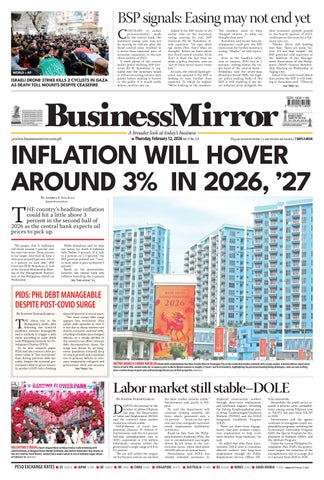
THE country’s headline inflation could hit a little above 3 percent in the second half of 2026 as the central bank expects oil prices to pick up.
“We project that it [inflation] will hover around 3 percent over the next two years. Three percent is our target. And then we have a tolerance around 3 percent, which is 1 percent on each side,” BSP Governor Eli M. Remolona Jr. said at the General Membership Meeting of the Management Association of the Philippines (MAP) on Wednesday.
While Remolona said he does not worry too much if inflation falls “below 3 percent, if it falls to 2 percent...to 1.5 percent,” the BSP governor pointed out: “I worry more when it goes up beyond 3 percent.” Based on his presentation, however, the central bank sees inflation breaching the 3-percent
pace of economic expansion in the last three months of 2025. A week ahead of the central bank’s policy meeting, BSP Governor Eli M. Remolona Jr. signaled that the monetary board is still scrutinizing various data points before making it known to the public if it would really deliver another rate cut.
Asked if the BSP sticks to its earlier take on the monetary easing nearing its end, BSP Governor Eli M. Remolona Jr. told reporters: “Oo nga, akala nga namin [Yes, that’s what we thought]. Before we knew about this flood control scandal. Di ba [Isn’t it that] the last time we made a policy decision, wala pa ‘yun eh [that factor wasn’t there yet].”
As such, the central bank governor was quizzed if the BSP is looking to ease further than expected. To which he replied: “We’re looking at the numbers.
The numbers seem to have changed relative to what we thought they were.”
Remolona said recent data developments could give the BSP more room for further monetary easing. “Maybe,” he told reporters. Even as the headline inflation in January 2026 was at 2 percent—falling within the target band of the central bank—
Remolona said the seven-man Monetary Board (MB), the highest policy-making body of the BSP, is still studying if the latest inflation print alongside the
slow economic growth posted in the fourth quarter of 2025, could narrow the room for a February rate cut.
“Maybe. We’re still looking into that. There are many factors. It’s not that simple,” the BSP governor told reporters at the sidelines of the Management Association of the Philippines’ (MAP) General Membership Meeting on Wednesday in Taguig City. Asked if he could reveal which data points the BSP is still looking at, Remolona said: “[There’s]
By Justine Xyrah Garcia
THE sharp rise in the Philippines’s public debt following the Covid-19 pandemic remains manageable and is unlikely to trigger a debt crisis, according to state think tank Philippine Institute for Development Studies (PIDS). In its new research paper, PIDS said the country’s debt position today is “less worrisome” than during previous debt episodes, despite the national government’s debt-to-gross domestic product (GDP) ratio climbing
above 60 percent in recent years.
“The most recent debt surge appears less worrisome than earlier debt episodes in that it is not due to sharp interest rate shocks, excessive external debt, a buildup of hidden [non-budget] deficits, or a steady decline in the country’s tax effort. Instead, debt decomposition shows the surge was driven by an exogenous [pandemic-induced] drop in output growth and a resultant rise in primary deficits as revenues temporarily collapsed and government relief and recovery
By Justine Xyrah Garcia
DESPITE the increase in the number of jobless Filipinos last year, the Department of Labor and Employment (DOLE) said the country’s labor market conditions remain stable.
DOLE–Bureau of Local Employment Director IV Patrick P. Patriwirawan said the 4.2-percent full-year unemployment rate in 2025—equivalent to 2.14 million individuals—remains within the government’s target range of 4.8 to 5.1 percent.
“We are still within the targets set for the year, and we can say that
the labor market remains stable,” Patriwirawan said, partly in Filipino.
He said the department will continue holding monthly job fairs, which generated only a 14-percent hired-on-the-spot rate last year, alongside sustained youth employment facilitation initiatives.
Based on data from the Philippine Statistics Authority (PSA), the rise in unemployment was largely driven by job losses in the construction sector, which shed about 550,000 jobs on an annual basis.
Patriwirawan said DOLE has already extended assistance to
displaced construction workers through short-term employment and livelihood support, including the Tulong Panghanapbuhay para sa Ating Disadvantaged/Displaced Workers (TUPAD) and the DOLE Integrated Livelihood Program (DILP).
“These are short-term engagements that give workers temporary employment to help cover their families’ basic expenses,” he said.
He added that after these interventions, DOLE aims to transition affected workers into long-term employment through the Public Employment Service Offices (PE -
SOs) nationwide. Meanwhile, the youth sector remains a priority after unemployment among young Filipinos rose to 750,871 last year from 705,747 in 2024.
Patriwirawan said the agency continues to strengthen youth employability programs, including the Government Internship Program (GIP), the Special Program for Employment of Students (SPES), and the JobStart Program. Under the current Philippine Development Plan (PDP), the government targets the reduction of the unemployment rate to a range of 4 to 5 percent from 2026 to 2028.
By Andrea E. San Juan @andreasanjuan
METRO MANILA CONDO BACKLOG Newly
condominiums line New Seaside Drive in Parañaque
Tennis Association 125 event. During the pandemic, they added, Tieza provided funds for government’s vaccination program.
P9B target for 2026
THIS year, Tieza is targeting to collect some P9 billion in travel taxes, 50 percent of which it will retain for its operations and projects, while 40 percent will go to the Commission on Higher Education and 10 percent to National Commission for Culture and the the Arts. Last year, Tieza collected P8.7 billion in travel taxes.
Meanwhile, Tieza enumerated travel taxes collected by other countries in Asia and the Pacific, which are mostly used to fund tourism infrastructure, and the preservation of heritage sites and the environment:
n Cambodia. US$25 included in airline ticket price for all foreign passengers n Malaysia. Departure Levy ranging from RM8 to RM150 already included in the ticket price, aside from an Airport Tax n Thailand. 300-baht foreign tourist entry fee starting February 2026. n Laos. Fee of LAK 10,000 for arriving foreign tourists and Laotians departing the country.
n Indonesia (Bali). All international tourists pay a mandatory IDR150,000 levy.
n Australia. A$60 Passenger Movement Charge on all departing passengers n Japan. International Tourist Tax amounting to JPY1,000 on travelers departing the country, which will be raised to JPY 3,000 by July.
BOC to meet stakeholders to tackle port congestion
By Reine Juvierre S. Alberto @reine_alberto
AMIDcomplaints of congested ports in Luzon, the Bureau of Customs (BOC) pointed to outdated infrastructure and imbalance in container movements while it plans to integrate data systems with port authorities and operators.
Customs Commissioner Ariel F. Nepomuceno told the BusinessMirror on Tuesday that the BOC will meet with port users, operators, shipping lines and other agencies on Friday to reconcile and find immediate solutions in addressing port congestion.
“Their interests are different. Let’s accept it. When one asks for charges, the other one doesn’t want to. So, we will look at step one first,” Nepomuceno said.
For the BOC’s part, Nepomuceno said the bureau plans to integrate data systems with the private sector to have real-time information on where the containers are.
This move is meant to ensure there
is data available on container locations, empty container volumes and port utilization, Nepomuceno said.
Although the BOC provides updates on yard utilization, Nepomuceno said it comes with a lag time and would be better if it is in real-time.
“It needs cooperation [from the] Philippine Ports Authority, Maritime Industry Authority, port operators, then eventually trackers,” Nepomuceno told this newspaper.
The Manila International Container Port (MICP) is one of the busiest ports in Luzon, handling around 6,000 containers per day, and this is where the congestion is, Nepomuceno said.
Reasons for port congestion
PORT facilities were built a long time ago and their capacity may no longer be in line with population growth and economic activity, Nepomuceno explained.
There are also more empty containers still inside the ports, the BOC commissioner said, although there should be almost the same amount of containers coming in and going out.
“The container yards inside Metro Manila are almost full, but there are some outside of Metro Manila that are not being used. So, we are looking at that,” Nepomuceno said, noting that incidental expenses, toll and gasoline prices also discourage the use of distant yards.
Despite January being a “lean season,” congestion persisted as the ports became clogged in December last year, Nepomuceno added.
Worsening this obstruction is the early shipment of exporters in China anticipating for the Chinese New Year.
“In February, usually, our main trading partner, which is China, has no activity. A lot of people imported in advance,” Nepomuceno said. “So, they exported in advance while the ports were still clogged.”
As of February 09, 2026, the yard utilization rate at MICP is at 82.30 percent while it’s at 73.85 percent in the Port of Manila, according to the BOC.
percent in 2026, before easing to 65.7 percent by 2027.
spending accelerated,” PIDS said.
Data showed that the Philippines’s debt-to-GDP ratio rose sharply from 39.6 percent in 2019 to 54.6 percent in 2020, before breaching the government’s indicative 60-percent threshold at 60.5 percent in 2021 and 60.9 percent in 2022. The increase followed a collapse in economic activity and revenues as the government rolled out emergency spending and stimulus measures during the pandemic.
PIDS noted that the rise in debt was driven largely by an extraordinary external shock rather than deep-seated fiscal weaknesses.
PIDS said government revenues fell by about 9 percent in nominal terms in 2020, while expenditures expanded by 11.3 percent, widening the fiscal deficit to 7.6 percent of GDP, the largest shortfall since the mid-1980s.
Using standard debt sustainability analysis, the study projected that the Philippines’ debtto-GDP ratio will average at 66
The study earlier projected the debt-to-GDP ratio at 66.4 percent for last year, higher than the actual recorded level of 63.2 percent.
Despite the elevated debt path, PIDS said the burden remains structurally safer than in past crises.
Even under adverse scenarios—including weaker growth and higher interest rates—the study found no evidence of a debt explosion, with public debt remaining on a manageable trajectory.
“Under current conditions, the private sector’s medium-term fiscal outlook does not differ much from that of the public sector.
The consensus view is that GDP growth will normalize, fiscal deficits will trend downwards, and interest-growth differentials will remain negative, creating favorable conditions for debt reduction in the near to medium term,” PIDS added.
The think tank cautioned, however, that returning quickly to prepandemic debt levels would be difficult and potentially harmful to economic recovery.
Fiscal gap estimates showed that achieving a rapid reduction in debt would require large and abrupt fiscal adjustments, either through higher taxes or sharp spending cuts.
Instead, the study underscored the need for a credible medium- to long-term fiscal consolidation plan to anchor confidence while allowing sufficient space for the economy to recover.
“As smaller fiscal gaps are associated with longer debt reduction time horizons, achieving the debt target later than 2031 appears more feasible, especially given the need for further spending to prevent economic scarring,” it also said.
mark beginning in the second quarter until the last quarter of 2026. To further explain the inflation path in the coming months, Zeno Ronald R. Abenoja, the BSP Deputy Governor for the Monetary and Economics Sector (MES), told reporters that inflation could hit a little above 3 percent by the second half of the year.
Citing the BSP’s December 2025 Monetary Policy Report (MPR), Abenoja said: “It will move gradually close to 3 percent and then possibly a little above 3 percent by the second half. But after that [it will get closer to] 3 percent and then will stabilize around that area.” Abenoja admitted that inflation will be on the uptrend in the coming months due to the increase in the prices of oil, among others. “It will be on an uptrend, first half. Some of it, some of the electricity rates have already been adjusted. So we take that into account. Oil is a little bit higher also. And base effects, of course, also will work. But in the second half, it should be more stable,” added the BSP deputy governor. The BSP sees full-year average inflation to settle at 3.2 percent in 2026 and 3 percent in 2027. The country’s headline inflation edged up to 2 percent in January 2026, the fastest pace in 11 months.
According to a report recently published by Maybank, the inflation environment remains “broadly benign.”
However, it noted that upside risks persist from utility tariff adjustments, imported cost pressures, volatile global oil prices and peso movements.
still a lot [data points to look at]. There are many surveys that are indicators of confidence, ‘ yung mga ganun [things like that].”
Remolona explained to reporters, however, that the MB prioritizes looking at inflation data rather than growth figures.
“If we succeed with inflation, it should help growth,” the central bank governor said, adding, “When we try to maintain price stability, a factor in doing that is what’s called the output gap. So, growth matters but we don’t have a target for growth.”
“Usually, strong growth narrows the output gap. You can even make it positive, which is inflationary. The demand exceeds supply by too much,” added Remolona. During the December 2025 policy meeting of the BSP, Remolona signaled that the central bank may be approaching the end of its easing cycle after delivering its quarter-point cut, the fifth reduction in 2025. (See: https://businessmirror.com.
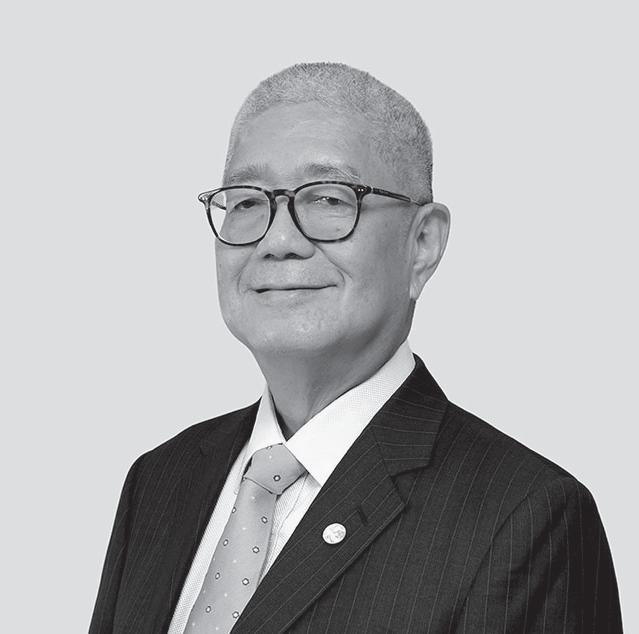
BSP Governor Eli M. Remolona Jr.
DOTr orders filing of cases vs ship owner in Basilan sinking
By Lorenz S. Marasigan @lorenzmarasigan
THE Department of Transportation
(DOTr) has directed the Maritime Industry Authority (Marina) to file administrative cases against Aleson Shipping Lines, the owner of MV Trisha Kerstin 3 that sank off Basilan province and claimed the lives of at least 52 people.
Transportation Secretary Giovanni Lopez said he also ordered the Marina to suspend the accreditation of Orient Shipping Lines, the thirdparty classification paraty that issued the vessel’s safety certificate.
The directives came after the Coast Guard and Marina completed their 15-day initial investigation into the incident, with initial findings pointing to overloading and crew incompetence as potential causes of the tragedy.
“We have instructed Marina to file administrative cases against Aleson Shipping Lines to determine whether or not to revoke their franchise,” he said in a news briefing.
“Administrative cases will also be filed against the crew of MV Trisha Kerstin 3, whose seamen’s identification documents have already been suspended,” Lopez added.
Fourteen Coast Guard and Marina personnel were also sacked.
“MV Trisha Kerstin 3 already has safety deficiencies; yet, it was still issued a seaworthiness certificate,” Lopez lamented.
Lopez also directed the DOTr’s legal team to coordinate with Marina and the PCG to study and prepare for the possible filing of criminal cases against the owners and crew members of Aleson.
The initial investigation report identified overcapacity and overloading as a potential cause of the sinking. Lopez explained that the combined weight of passengers and rolling cargoes may have exceeded the vessel’s actual carrying capacity.
“When there is overloading or overcapacity, cargoes, particularly rolling cargoes, can shift on the vessel,” he said.
The investigation also found that rolling cargoes such as trucks and motorcycles did not pass through the weighing bridge at the port, meaning authorities had no record of their actual weight.
“All we have are informal estimations,” Lopez said.
MV Trisha Kerstin 3 sank on January 26, approximately 2.75 nautical miles northeast of Baluk-Baluk Island in Basilan.
Senators push back at China’s ‘disrespect’
By Butch Fernandez @butchfBM
SENATORS on Wednesday pushed back at a Chinese embassy attempt to play down the impact of a Senate resolution that called out Chinese officials for taking issue with the statements of lawmakers and other Philippine officials.
Describing the embassy reaction as “disrespect,” Senate President Vicente Sottto III and Sens. Francis Pangilinan and Anna Theresia Hontiveros separately led the pushback against Chinese embassy remarks saying that the Philippine Senate can adopt 100 resolutions and this will have no impact on Beijing’s stance.
“A Senate resolution is a legitimate and appropriate tool for legislators to express concern over actions that affect Philippine laws, sovereignty, and national interests. We will not be silenced or deterred by statements from foreign actors,” Hontiveros said in a statement.
“We will continue to use lawful instruments, including resolutions, to put these matters on record, even if a million statements are issued to counter this. This is our constitutional duty,”
‘Joint
THontiveros said in a mix of English and Filipino.
She continued: “Indeed, we can file 100 resolutions and the situation won’t improve because the real problem facing the Philippines isn’t the Chinese Embassy descending to the level of the common internet troll. The real problem is the PLA [Peoples Liberation Army] Navy, Chinese Coast Guard, and maritime militia’s coercive behavior in the West Philippine Sea—water cannoning innocent fishermen, hindering freedom of navigation in our own exclusive economic zone, and ramming our vessels.”
While the Philippines is “always open to cooperation, exchange, and the peaceful resolution of disputes,” Hontiveros stressed that “the Chinese government in Beijing must first demonstrate good faith by ceasing its harassment
of our vessels in the West Philippine Sea.”
She also urged Filipinos to be vigilant against fake or misleading narratives peddled, unfortunately, by some Filipinos themselves. “The Chinese government’s propaganda, especially on social media, is as brazen as its harassment in our waters.”
Adoption of the Senate resolution, initially signed by 15 senators, had triggered hours long debates on the floor among senators, especially the main sponsor, Pangilinan, and Minority Leader Alan Peter Cayetano.
Reacting to the “Chinese Embassy’s undiplomatic and boorish response” to the approval of the resolution, Pangilinan noted that such a putdown of “the official act of the Philippine Senate” violated the Vienna Convention on Diplomatic Relations, and “only proves that China is indeed a bully, has no respect for International law and their acts deserving of condemnation.”
“We will never tolerate nor be cowed by foreigners disrespecting us in our own land.
“We reiterate our call for the DFA [Department of Foreign Affairs] to take the necessary diplomatic measures to uphold the dignity of the Republic of the Philippines and to ensure that relations with other States are conducted in accordance with international law and established principles of State relations,” Pangilinan said.
air patrols not linked to Taiwan-China row’
HE series of air drills conducted by Philippine and US military aircraft over the Luzon last week is not a reaction to the ongoing tensions between China and Taiwan.
“No. It’s purely [a joint] exercise,” the Air Force (PAF) spokesperson, Col. Ma. Christina Basco, said when asked by reporters if these exercises have something to do with the ongoing row between the two nations.
She also said that the February 2 to 6 air exercises between the PAF and US Pacific Air Forces (Pacaf) were “pre-approved and under the MDB-SEB [Mutual Defense BoardSecurity Engagement Board]” of the two countries.
“It was scheduled and it was conducted with our partners so that we can exercise operational readiness and interoperability. And it’s a usual
exercise po natin [of the PAF] with the Pacaf,” Basco said.
She added that escorting foreign planes entering Philippine airspace is part of protocol when asked about the role of the two FA-50PHs “Fighting Eagles” seen with the pair of US B-52 bombers during the drills.
“So pagka-may pumapasok po [once there are foreign aircraft entering our airspace], we usually send escorts. We escort any aircraft that are coming in especially from our partners,” she added.
On February 7, the PAF announced that Filipino and American planes conducted a series of exercises from Feb. 2 to 6 in various locations in Luzon as part of ongoing efforts to boost interoperability between two services.
“The bilateral engagement featured a series of coordinated air
activities aimed at strengthening cooperation and interoperability between Philippine and US forces,” Basco earlier said.
Units from the PAF and the US Pacaf “conducted a bilateral bomber air patrol and live drop exercise” from multiple locations which include Col. Ernesto Rabina Air Base in Tarlac City, and over the West Philippine Sea (WPS) via the Luzon Strait.
Support was also provided by the US Special Operations Command Pacific and Marine Corps Forces, Pacific.
First among the air drills, that took place Feb. 2, was a live drop exercise involving two PAF FA50PH fighter aircraft and two US Pacaf B-52 bombers.
See “Taiwan,” A13
Seven vie for vacant Antipolo Congress seat
THE Commission on Elections (Comelec) will upload on its official website the certificates of candidacy (COCs) of the seven aspirants seeking the congressional seat in Antipolo City’s Second District as the campaign period for the special election begins.
Comelec Chairman George Erwin M. Garcia said the move is meant to promote transparency and allow voters to scrutinize the qualifications and declarations of those running for Congress.
“We will be posting all of their COCs on our website for the voters to know who are vying for the position,” he said.
Garcia added that making the documents publicly accessible would also help screen possible misrepresentations and strengthen public confidence in the electoral process.
Seven individuals filed their COCs for the special polls, which Garcia described as a “magandang kinalabasan” that would make the race vibrant.
The final certified list of candidates may be issued after confirmation by the Comelec en banc, although the commission has yet to receive any petition to disqualify or cancel the candidacy of any of the seven aspirants.
With the start of the campaign period, election prohibitions are now in effect, including the strict ban on vote-buying and vote-selling.
Garcia reiterated that the distribution of money or anything of value in exchange for votes remains “bawal na bawal” under election laws.
He also reminded candidates that oversized campaign materials are prohibited in public spaces. Campaign materials posted on
China Bars Kalayaan officials as envoy courts Malacañang
By Malou Talosig-Bartolome
CHINESE Ambassador to the Philippines Jing Quan disclosed on Tuesday that he has met “several times” with President Marcos and First Lady Louise Araneta-Marcos in efforts to ease tensions over the West Philippine Sea, even as Beijing moved to bar local officials from Palawan under the principle of reciprocity.
Jing assumed his post as President Xi Jinping’s envoy to Manila only two months ago.
In an interview with the BusinessMirror at the sidelines of the embassy’s Chinese New Year reception in Taguig City, Jing emphasized that both Manila and Beijing share a common objective: to stabilize relations.
“I think the President wants to make the relations better, not worse. So, we share the same goal,” he said, noting that while differences remain, the immediate task is to “return to a normal track.”
He likened the bilateral relationship to both neighbors and a marriage, stressing that coexistence is essential even when differences persist. He explained that disputes are inevitable, but respect and cooperation must remain constant.
“We should always live together, work together, learn from each other, respect each other and most important, help each other,” he added.
Araneta-Marcos and Foreign Affairs Undersecretary Maria Theresa Dizon-de Vega joined the ceremonial festivities of the Chinese New Year reception at Shangri-La The Fort in Taguig.
Ban on Kalayaan officials
JING confirmed that the embassy had barred 16 municipal officials from Kalayaan, Palawan, from entering China, Hong Kong, and Macau.
The move was in response to resolutions passed by the Kalayaan council last month declaring him persona non grata.
Kalayaan, which administers Pag-asa Island and other Philippine-occupied features in the West Philippine Sea, had condemned the ambassador’s actions as violations of diplomatic protocol and affronts to Philippine officials, citing interference in domestic affairs and criticism
of legislators and Coast Guard officers.
“That’s called reciprocity, right? They don’t welcome us. We don’t welcome them. That’s the principle of diplomacy. How you treat us, then we should treat you in the same way,” Jing said. The ambassador outlined a roadmap for de-escalation, beginning with managing maritime disputes and resuming political dialogue. Talks had already restarted in Cebu late January after more than a year’s hiatus. “First to control and manage the maritime disputes, then resume political dialogue… then roadmap set up… then eventually more trade and investment, people-to-people exchange, solve crimes together,” he explained. Jing believes face-to-face contact is vital to dispelling misunderstandings, though convincing citizens to travel between the two countries remains a challenge. Visits dropped from nearly three million before the pandemic to fewer than 300,000 last year.
“Eventually they just like the other country and want to visit the other country,” he said, adding that more exchanges would help biases fade away.
Manila’s recent announcement of a 14-day visa-free entry for Chinese citizens is, he noted, a step in the right direction. He welcomed the policy as a boost to tourism and cultural ties, while stressing that both sides were working to strengthen law-enforcement cooperation against cross-border crime to ensure visitor safety.
Code of conduct
DURING the reception, Jing underscored Beijing’s commitment to fast-track negotiations on the long-delayed Code of Conduct (COC) in the South China Sea. With the Philippines holding the rotating chairmanship of the Association of Southeast Asian Nations (ASEAN) this year, he expressed hope that consultations could finally gain traction. “The COC has been under discussion for more than a decade. It is time to see real results,” he said. “Reaching an agreement would lay a solid foundation for managing maritime differences and advancing bilateral relations.”
Cases being built up vs financier of illegal Tarlac cigarette factory
By Rex Anthony Naval
HE National Police (PNP)
Tprivate property, however, will be respected by the poll body provided they have the property owner’s consent.
Garcia urged candidates to conduct orderly campaigns and avoid disturbing communities, particularly through the excessive use of loud sound systems or activities that could worsen traffic.
He also emphasized that the Comelec’s Anti-Discrimination Resolution remains in effect, warning candidates against below-the-belt attacks and discriminatory remarks during the campaign period.
While acknowledging that electoral contests can become intense, Garcia said the Commission does not expect the Antipolo special election to be unusually heated and expressed hope that candidates would focus on issues.
Mary Jade Jadormio
Chief, Gen. Jose Melencio Nartatez Jr., on Wednesday said investigators are now building up the cases against the financier behind a P47.5 million illegal cigarette operation uncovered in Tarlac.
In a statement, Nartatez also lauded the Criminal Investigation and Detection Group (CIDG) for their dedication and hard work to contain cigarette smuggling as he vowed to sustain the successful operations.
“This latest accomplishment against cigarette smuggling is proof of the PNP’s commitment to dismantle the entire network of illegal operations in the country. And this includes holding the financiers and all the other personalities involved in this illegal activity responsible,” he said.
CIDG operatives seized 683 master cases of illicit cigarettes during follow-up operations in barangay Tibag, Tarlac City, from February 9 to 10.
The cigarettes were found in
two unattended container vans after the suspected supplier failed to show up during what was supposed to be a buy-bust operation by undercover operatives.
Authorities are now tracking the supplier believed to be behind the operation.
Nartatez said the operation followed intelligence work that linked four suspects arrested on Feb. 8 in the same village to a larger smuggling network using the province as a logistics hub. He said initial investigations show that Tarlac was used as a transit and staging area for wider distribution.
“Our intelligence shows that Tarlac has become a strategic transit hub. While some of these products were likely meant for the local markets in Central Luzon, the volume suggests it was a staging point for distribution to Metro Manila,” Nartatez noted. Several billion worth of illicit cigarettes were seized by the PNP since late last year in various operations in Batangas, Malabon City, Bulacan, Davao del Sur, and Pampanga among others.
Dy calls for responsible AI governance, policy
By Samuel P. Medenilla
@sam_medenilla
SPEAKER Faustino G. Dy III
on Wednesday called on Association of Southeast Asian Nations (Asean) member countries to pass policies to prevent the misuse of Artificial Intelligence (AI) in terrorist activities in the regional bloc.
In his speech at the opening of a parliamentary training course on legislative and policy measures to address the use of AI and new technologies, the lawmaker raised concern on how AI-generated fake materials or deepfakes are spread by terrorist and extremists groups using automated social media accounts.
The deepfakes, the lawmaker said, are “weaponized to mislead, intimidate, and inflame tensions.”
“To confront them decisively, sustained cooperation among Asean member parliaments is essential, so that our laws, oversight, and shared standards move forward together,” he said.
“Terrorism and violent extremism do not stop at borders. Our resolve should not stop there either,” he added.
In the Philippines, he said deepfakes were used to sow fear, and undermine trust in public institutions during elections and emergencies.
Dy said the government has already initiated measures to
US-initiated
prevent the exploitation of AI using law enforcement action, legislative oversight and stronger law enforcement action.
He also said the Anti-Fake News and Disinformation Bill, which President Marcos wants to be passed by June, will impose more safeguards on AI use.
Such regulatory policies must also ensure the protection of rights and public trust.
“Public trust is built not only by preventing harm, but by ensuring that laws are fair, transparent, and accountable,” Dy said.
Through the parliamentary training course, Dy hopes other Asean parliaments will take similar steps, by be oriented on the legal frameworks, oversight tools, and real experiences of difference countries on AI use.
The Philippine House of Representatives, which is currently holding the presidency of the Asean Inter-Parliamentary Assembly, organized the training course with the theme “Parliaments Securing a Peaceful, Prosperous, and PeopleCentered Asean.”
“We hope this training leads to lasting outcomes. We support the development of shared takeaways and practical references materials that can guide future actions,” he said.
“We are also hopeful that his parliamentary training course will deepen cooperation within Aseanand beyond,” he added.
pact opens path for PHL minerals processing
By Bless Aubrey Ogerio
THE Philippines, by joining a United States-led initia -
tive on critical minerals, will create opportunities to expand domestic processing, attract investment, and strengthen trade ties with Washington and other partner countries.
Philippine Ambassador to the United States Jose Manuel Romualdez explained that the agreement signed last week in Washington DC, was intended to include the country among the 10 nations participating in the agreement facilitated by the US Secretary of State.
“What we did in Washington was to merely facilitate and make sure that the Philippines was included,” Romualdez said during a briefing in the US-Philippines Society event on Tuesday in Makati City.
The pact, signed on the sidelines of the inaugural Critical Minerals Ministerial Meeting, aims to secure stable and resilient supply chains for critical minerals and rare earths while promoting sustainable and responsible resource management.
It also aims to support local
capacity building, domestic value addition and high-value processing of minerals.
The Philippines, despite being a global leader in nickel production, has traditionally exported most of its minerals unprocessed, with around 90 percent of nickel shipped to China.
“That’s one area where we can have very good cooperation – with processing our nickel and other minerals,” Romualdez said, noting the potential to move up the value chain and capture more economic benefit domestically.
The agreement aligns with the government’s broader strategy to transition the country from raw ore exports to a high-value processing hub, led by the Department of Trade and Industry (DTI) and the Department of Environment and Natural Resources (DENR).
For its part, the Board of Investments (BOI) expressed its support for the initiative, attracting investment in mineral processing, refining, and downstream manufacturing, while facilitating technology transfer and workforce development.
See “US,” A13
DENR issues new ECC, CNC guidelines for new projects in Boracay
By Jonathan L. Mayuga @jonlmayuga
THE Department of Environment and Natural Resources (DENR) has issued stricter guidelines for the processing of Environmental Compliance Certificates (ECC) and Certificates of Non-Coverage (CNC) for all projects on Boracay Island.
DENR Order 2025-36 supports the rehabilitation and sustainable development of Boracay Island, a world-famous tourist destination in the town of Malay, Aklan.
The guidelines provide standards for evaluating carrying capacity and geological hazards in the review and processing of ECC and CNC applications. It applies to all existing projects, expansion projects, and new developments on the island that fall within the purview of the Environmental Impact Statement (EIS) System, as well as new and existing structures that qualify for the issuance of a CNC. Under the guidelines, proponents of existing structures without ECC, expansion projects, and new national government projects covered by the Philippine EIS System must secure an ECC. Requirements include an Environmental Impact Statement (EIS) or Initial Environmental Examination (IEE) Checklist, certification from the local government (LGU) confirming compatibility with existing land use plans, zoning certificates, or Sangguniang Bayan Resolution or both on Land Reclassification-Land Use Exemption- Land Use Conversion, project layout overlaid on a Google
project location map, and a Site Development Plan signed by registered professionals.
Proponents must also submit a Proof of Authority over the project site, whether it is public land, private land, or land under ancestral domains, and secure certification from the Provincial Environment and Natural Resources Office (PENRO) on land classification, as well as a Certificate of Compliance to beachfront easement and road easement requirements.
New projects are further required to submit an Engineering Geological and Geohazard Assessment Report endorsed by the Mines and Geosciences Bureau (MGB) or an MGB-issued Geohazard Verification Report, carrying capacity assessments endorsed by the Ecosystems Research and Development Bureau (ERDB), and LGU Clearance-Certification certifying compliance with Physical Carrying Capacity limits.
Meanwhile, projects that are not covered by the EIS System, including new National Government projects classified under applicable thresholds, as well as qualified family dwellings, small local businesses, places of worship,
Airbus helps Cebu students get head start in aviation
By Nonie Reyes
Mand minor public infrastructure, must secure a CNC. All CNC applications for Boracay projects shall be filed and processed manually at the Environmental Management Bureau (EMB) Region VI to allow proper validation and site inspection prior to issuance.
The DENR emphasized that only projects consistent with Boracay’s approved land use, zoning, and development framework are eligible to secure an ECC or CNC. No new government project or expansion may proceed without the required environmental clearances and permits.
For ECC applications based on an EIS or Environmental Performance Report and Management Plan, the Environmental Impact Assessment Review Committee shall include resource persons from the ERDB and the MGB. The ERDB will assess impacts on the island’s carrying capacity, while the MGB will evaluate geohazard risks.
Pursuant to the DAO, the DENR Regional Office is mandated to ensure compliance with key environmental safeguards, including proper treatment of all wastewater through established wastewater or sewerage treatment facilities, with no discharge of untreated or inadequately treated wastewater into island waters that could exceed National Water Quality Guideline Values for Class SB and SC waters.
The Regional Office must also ensure proper solid waste management in coordination with the Local Government of Malay, in accordance with the town’s 10-year Solid Waste Management Plan and Republic Act No. 9003. Coordination with the local government of Malay is likewise required to ensure adherence to Boracay’s traffic management plans and policies.
MGB suspends Woggle exploration permit
THE Mines and Geosciences Bureau (MGB) has suspended the exploration permit of British mining company Woggle Corporation in Dupax del Norte, Nueva Vizcaya, officials of the Department of Environment and Natural Resources (DENR) confirmed.
In a text message, Environment Undersecretary Juan Miguel Cuna confirmed the suspension order issued by the MGB, confirming reports circulating in the social media.
In a telephone interview, Director Michael Cabalda of the Mines and Geosciences Bureau (MGB) said the suspension order was issued to defuse the tension in the area and “prevent any untoward incident.”
“This is a preventive measure, and it is within the authority of the MGB Director to suspend a mining permit,” he told the BusinessMirror when asked of the legal basis of the suspension order.
He cited, for instance, an incident wherein a mining equipment of Woggle Corporation was burned, believed to be by anti-mining protesters who want the company out of Dupax.
He was referring to the burning of a heavy wheel excavator owned by Woggle
Corporation in December last year in sitio Upper Tacbao, Bitnong, Dupax del Norte.
The equipment was allegedly trapped by anti-mining protester barricades before being burned, with the company accusing locals of the action.
At least seven anti-mining protesters were also arrested by police on orders of a local court early this year. Despite the court’s order, anti-mining protests continue, creating tension between the police and defiant protesters.
Nevertheless, maintaining that the suspension of the exploration permit is temporary, Cabalda said, its lifting will depend largely on the situation in the future. “If the situation improves and there’s a change of position of the stakeholders in the area, then we might lift it,” he said.
From the point of view of the MGB, those who oppose mining are members of the community, adding that no indigenous people has ancestral domain claim over the mining tenement of Woggle Corporation in the area.
“If there’s an IP involved, we defer to the NCIP if a mining proponent needs to secure an FPIC. In the case of Woggle, there’s none,” he said. However, he maintained that
the chaotic situation calls for the MGB to step in, regardless of a recent court order that directed the National Police (PNP) to remove physical and human barricades that prevent the company’s personnel from doing exploration works,” he said.
He said Woggle Corporation was issued the exploration permit after complying with all the requirements under the Philippine Mining Act of 1995, but the strong opposition and chaotic situation call for a review of the permit on the part of the MGB, while a review of its strategy becomes imperative on the part of Woggle Corporation.
“What Woggle Corporation needs to do is win the hearts of the people in the community,” he said.
“If they ask our advise, we will tell them to strategize,” he said, adding that Woggle needs to do more lobbying to convince the community of the environmental safeguards and economic benefits of mining.
In the meantime, he said Woggle Corporation needs to rehabilitate “disturbed” areas caused by the exploration activities, including planting trees that correspond to the requirements of the law if it has already cut down trees in the area. Jonathan L. Mayuga
AJOR aircraft manufacturer Airbus is teaming up with Indiana Aerospace University (IAU) in Cebu to give Filipino students a head start in the aviation industry.
The agreement that was signed by the two entities during the high-profile Singapore airshow; it introduces the Airbus Competence Training (ACT) for academy solution to the IAU curriculum. This digital computer-based training suite is designed to bridge the gap between classroom theory and high stakes reality of the hangar. The program is designed to turn students into expert mechanics, specifically for A320, one of the most flown airplanes in the world.
Details of the agreement are: n 5000 students: That is how many aspiring engineers are expected to benefit from this training over the next five years. n Real-World Tools: Students will use the same digital systems professional Airbus mechanics use, moving beyond just reading textbooks.
Harold E. Toring, IAU’s chief executive officer, said the agreement will give students real-world experience, making it much easier for them to get jobs after graduation. IAU will add this Airbus Competence training to its classes by the middle of 2026. Anand Stanley, president of Airbus Asia-Pacific, highlighted the importance of academic-industry synergy. “Developing skilled aviation professionals is critical to sustaining the long-term growth of the industry,” Stanley said, and that the move supports the Philippines national education objectives. The deal underscores Airbus’ broader strategy to strengthen local capabilities within the Philippines. As travel demand continues to surge across Asia-Pacific, the need for certified, highly skilled mechanics and engineers has never been more pressing. By placing world-class tools in the hands of Cebuano students, the aircraft manufacturer and AIU are ensuring that the Philippine aviation ecosystem remains resilient and competitive on the global stage.
www.businessmirror.com.ph China. . .
Continued from A3
Jing also highlighted China’s role as the Philippines’ largest trading partner for ten consecutive years, and said he hoped to see more Chinese high-tech solutions adopted locally—from waste-to-energy and green energy to artificial intelligence and eco-agriculture.
He pointed to infrastructure projects as tangible proof of cooperation, citing the Bucana Bridge in Davao, which cut travel time from two hours to 20 minutes, and three bridges in Manila built with Chinese support
“Standing on the Bucana Bridge, I reflected that a true friend always feels compelled to share development,” he said.
The ambassador added that the Embassy had donated six basketball courts to schools in the past two years and was supporting scholarships and summer camps to bring Filipino students to China.
“In this Year of the Horse, let us take the lead and gallop forward together to put China–Philippines relations firmly back on track,” he concluded.
Recto hails late Speaker JDV as ‘hopeless optimist’ for reform
ACTING Executive Secre -
tary Ralph G. Recto de -
scribed the late former House Speaker Jose “Joe” de Venecia Jr. as a senior statesman, who was a “hopeless optimist” when it came to pushing for legislative reforms in Congress.
De Venecia died last Tuesday at the age of 89.
Recto said De Venecia demonstrated “grit and grace” while he led the House of Representative from 1992 to 1998 and 2001 to 2008 becoming the longest serving post war speaker.
“As a senior statesman, he continued to preach the politics of principles, so parties run on ideas, and not merely run by personalities,” De Venecia said in a statement.
“In JDV’s vision, enmity is set aside, yet debate is not silenced, as long as work animated by a common purpose is pursued by a ‘rainbow coalition’ of Filipinos of various beliefs who can come together for love of country,” he added.
De Venecia was known for authoring landmark laws, which initiated economic reforms such as the Dollar Remittance Program, the Bases Conversion and Development Act, the BuildOperate-Transfer Law, the Philippine Economic Zone Act, and the New Central Bank Act.
“Never content with the status quo, he championed reforms that broke down barriers, and overthrew conventions that hindered progress,” Recto said.
“Through the reforms he helped shepherd, he brought water to dry taps, light to dark homes, and filled the skies with more planes with cheaper seats,” he added.
The former senator also commended De Venecia for being among the pioneers of overseas contract before his stint as a lawmaker.
As an entrepreneur, he was among the first to see the potential of oil economies as an employer of our talent, whose remittances enabled millions of families to realize their dreams.
He also recognized De Venecia’s role in peace-building by facilitating peace talks with the RAM-AFP-YOU in 1995 and with the Moro National Liberation Front in 1996.
“As a young diplomat in a country splintered by war, he reached across battlefields and ideological fault lines to talk peace,” Recto said. Samuel Medenilla
‘Trillion Peso March 3’ slated on 40th EDSA anniversary
By Mary Jade Jadormio
THE 40th People Power Revolution anniversary along Epifanio delos Santos Avenue is set to be an avenue for the third “Trillion Peso March.” The protest condemning corruption and dynasty will start at 7 a.m. with a prayer vigil and culminate in a high mass at 6 p.m., presided over by Lingayen-Dagupan Archbishop Socrates Villegas.
See “EDSA,” A16
PHL corruption ranking dips in ‘25 CPI, expected to worsen before recovery amid govt crackdown
By Samuel P. Medenilla @sam_medenilla
THE country’s perceived corruption in the international community is expected to get worse before it gets better as the Marcos administration lays down the measures to prevent such anomalies, according to Malacañang.
Palace Press Officer Claire Castro issued the statement after she said they expected the significant drop in the country’s ranking in the Corruption Perception Index 2025 after President Ferdinand Marcos led in exposing the massive corruption in flood control projects last year.
“That was expected because the President raised the issue of corruption,” Palace Press Officer Claire Castro said in Filipino in a press briefing last Wednesday.
Created by the Germany-based non-profit organization, Transparency International, the Corruption Perception Index 2025 ranked 182 countries and territories worldwide in terms of their perceived public sector corruption.
Each country was given a scale of 0 or highly corrupt to 100 or very clean.
The Philippines got a score of 32 in the latest edition of the index, which is below the global average of 42. The country is now ranked 120th from its 114th rank in 2024.
Sandiganbayan
All Association of Southeast Asian Nations (ASEAN) countries, except Cambodia and Myanmar, which ranked 163rd and 169th, respectively, got higher rankings than the Philippines.
Singapore got the highest ranking at third place. It was followed by Malaysia (54), Brunei (63), Timor-Leste (73), Vietnam (81), Laos (109), and Indonesia (109).
The country which is perceived the least corrupt is Denmark, while those in the bottom of the list are Somalia and South Sudan--both were ranked 181th.
Marcos ordered a crackdown against anomalous flood control projects after his fourth State of
Sixth Division declares Zaldy Co as a fugitive from justice
Tthe Nation Address last year.
He created the Independent Commission of Infrastructure (ICI) to gather pieces of evidence against contractors as well as government officials and personnel, who were involved in the said irregularities.
The said investigations conducted by ICI, Department of Public Works and Highways and other government agencies has revealed billions worth of government funds, which were wasted in substandard or non-existent flood control projects.
While the said probes resulted to the filing of charges against those involved, it also caused concern business communities and
other stakeholders on presence of widespread corruption in the government.
Castro and government economic managers, however, said they are confident the said investigations will result in reforms, which will boost investor and public confidence.
“So, when there was an investigation, the things that were hidden before were revealed. That’s why the President is cleaning up what happened in the past. All the dirt of the past is being cleaned up now,” Castro said.
“And with this cleanup, they will see the changes which will prevent and eliminate corruption in the government,” she added.
PNP warns public on love scams
By Rex Anthony Naval
be foreigners or overseas Filipino workers.
By Joel R. San Juan @jrsanjuan1573
HE Sandiganbayan Sixth Division has declared Ako Bicol Party List Rep. Elizady “Zaldy” Co as a fugitive from justice and barred him from participating and seeking any judicial relief in connection with the malversation of public funds through falsification of public documents charges filed against for alleged involvement in the P289.5 million anomalous flood control project in Naujan, Mindoro.
In a 16-page resolution, the Sandiganbayan also held that Co is not entitled to notices until he voluntarily surrendered and submitted himself to the jurisdiction of the court.
“Similarly, although accused Co was shown to have left the Philippines on August 6, 2025 or around three months before the filing of the Information in the present case, his continued absence and his failure, if not refusal, to return, surrender, and disclose his whereabouts despite knowledge of the present case against
him clearly indicates his desire and intent to evade law enforcement and the judicial processes,” the resolution read.
“Thus, there is ground to consider accused Co a fugitive from justice,” it added.
The Sandiganbayan’s ruling partially granted the urgent ex-parte motion filed by the prosecution seeking to declare Co as fugitive from justice and to expunge from the record the entry of appearance of his counsels from the Rondain & Mendiola law firm and all their submissions.
The anti-graft court denied the prosecution’s prayer to prevent Co’s lawyers from entering their appearance on behalf of the former solon.
“Besides, no judicial relief from the Court was being sought in the said Entry of Appearance. It was filed merely to enable the officers concerned to effectively serve processes on the attorney of record, when warranted,” the resolution read.
The Sandiganbayan also directed the Division Clerk of Court to allow Co’s layers to photocopy the entire records of the cases.
It may be recalled that the Sandiganbayan Fifth Division has also declared Co
as a fugitive from justice last December following the cancellation of his passport.
The Fifth Division is hearing the graft case filed against Co and several others also in connection with the anomalous flood control project in Naujan.
It held that the prosecution was able to establish a pattern of non-compliance and avoidance that shows intent to evade prosecution by Co.
It noted that Co resigned as lawmaker instead of complying with the House of Representatives’ order to return to the country; his refusal to comply with subpoenas from the ICI; and his failure to file a counter-affidavit with the Office of the Ombudsman.
The anti-graft court also pointed out that Co left the country when investigations into alleged corruption in flood control projects were ongoing and formal charges against him were imminent.
The former solon and 17 others have been charged with graft and malversation through falsification of public documents before the Sandigabayan in connection with the Naujan flood control project.
Palace dismisses rumors of Marcos’ colon cancer as fake
news, says doctored photos sparked claims
were doctored.
MALACAÑANG has tagged the rumors, which are spreading online, that President Ferdinand Marcos has colon cancer as fake news.
Palace Press Officer Claire Castro issued the statement when asked about the said rumors, which allegedly proliferated, after former presidential spokesperson Harry Roque posted a picture of the President with a dark protrusion on his abdomen during the weekend.
Roque claimed the said protrusion was a colostomy bag, a water-proof pouch used by a person for temporary or permanent diversion of feces due to colorectal cancer.
Castro, however, said the former presidential spokesperson was a fake news peddler since the pictures of Marcos he posted
She noted this was backed by the videos of the recent events attended by Marcos, which showed the President did not have such a bulge in his abdomen.
“We saw the video, the entire video where the President himself raised his hands while waving to our countrymen, and it is clear that the alleged images posted by Harry Roque are all lies,” Castro said in Filipino in a press briefing.
In the video of Marcos’ participation in the ceremonial signing of the memorandum of agreement between the Department of Education (DepEd) and the local government units for classroom building last Wednesday, the President, who was wearing a white polo shirt, can be seen without
the said black protrusion on his abdomen.
Castro urged the public not to believe the claims of Roque and other fake news peddlers on the President’s health.
Such misinformation, she said, is detrimental not only to the President, but also to the government and the economy.
Concern on the Marcos’ health has increased after the chief executive was hospitalized last month after being diagnosed with diverticulitis, a medical condition where the large intestine is affected by inflammation and causes stomach pain.
After being diagnosed with the said medical condition, the chief executive deferred going to public events outside Malacañang for several days.
Samuel Medenilla
Solon: Illicit tobacco trade a growing threat to public health and revenue
ARIKINA 2nd District Rep. Miro
MQuimbo, Chair of the House Committee on Ways and Means, has raised alarm on the growing criminal activities linked to illicit tobacco trade, which he said is now as extensive as that from Philippine Offshore Gaming Operators (POGO). The surge in criminal activities attributed to POGO, which includes kidnapping, human trafficking, and prostitution, has prompted President Ferdinand Marcos to sign Republic Act No. 12313 or the Anti-POGO Act. During a congressional investigation last Wednesday, authorities revealed they have recently intercepted P2.6 billion worth of contraband tobacco products in Batangas
and Malabon.
“This would have amounted to nearly P1 billion in excise tax losses had these entered the market,” Quimbo said.
The lawmaker expressed concern on the “scale, frequency, and brazenness” of major criminal enterprises, which are involved in direct smuggling, transshipment, and illegal manufacturing of the said tobacco products.
Law enforcers reported that from December 2025 to February 2026, they were able to seize 782.1 million contraband cigarette sticks amounting to P1.84 billion in foregone revenues had it flooded the market.
Quimbo said such illegal activities depend on coordinated cross border supply chains,
AS more and more Filipinos goes to the internet to search for love, Philippine National Police (PNP) chief Gen. Jose Melencio Nartatez Jr. on Wednesday called on the public be wary of online love or romance scams as they could end up heartbroken and financially drained if victimized by these criminal syndicates.
He issued this warning three days before the country observes Valentine’s Day this Feb. 14.
“Scammers take advantage of loneliness, trust, and hope—especially online. We want the public to enjoy Valentine’s Day safely, without becoming victims of deception,” Nartatez said.
Love or romance scams typically begin with online connections where scammers pretend to
They invest time in building emotional attachment, often avoiding video calls, professing love too quickly, and eventually asking for money, travel funds for a supposed meet-up, or sensitive personal details such as bank information, one-time passwords (OTP), or identification cards.
“Once they ask for money or personal information, that’s your signal to stop and walk away,” Nartatez said.
Common targets include older individuals, those who are single, widowed, or emotionally vulnerable.
Authorities are reminding the public never to send money, intimate photos or videos, or personal information to people they have not personally met and fully verified.
Marcos witnesses signing of DepEd, LGUs MOA for 4,000 new classrooms
AN initial 4,000 classrooms will be built nationwide under the new memorandum of agreement (MOA) between the Department of Education (DepEd) and the local government units (LGU), which aims to address classroom shortages.
President Ferdinand Marcos witnessed the signing of the agreement to accelerate the construction of classrooms with the assistance of 82 provincial governments in Malacañang last Wednesday.
The MOA will enable LGUs to construct and rehabilitate classrooms within their jurisdictions, while DepEd will identify priority schools and issue standard classroom designs and technical specifications.
DepEd and LGUs will share responsibilities for funding, monitoring and long-term maintenance of the said classrooms.
Marcos welcomed the new agreement, which he said supports the education priorities of his administration, by helping reduce the classroom shortages, which reached 145,000 as of December 2025.
covert production facilities, and networks.
“The operation is widespread from Luzon to Mindanao, with foreigners involved, and Filipino backers,” Quimbo said.
The spread of such illicit products, he said, also has implications on public health by exposing more people, particularly children, to tobacco use.
Quimbo said despite continuous decline in excise tax collections from cigarettes year-on-year, youth smoking prevalence nearly doubled from 2.3 percent in 2021 to 4.8 percent in 2023 due to the affordability of tobacco products.
See “Solon,” A16
“This Administration has been finding all kinds of alternative ways that we can immediately close this yawning gap,” he said in his speech during the MOA signing ceremony.
“By giving the LGUs greater role in the implementation, we streamline the process. We reduce delays, and move faster in building schools that our children need,” he added.
“In total, the first tranche will deliver 4,000 new classrooms nationwide, which we hope will directly improve the daily learning and teaching experience,” Marcos said.
The chief executive said he is confident there will be no anomalies in the implementation of the new program similar to what has happened in hundreds of flood control projects of the Department of Public Works and Highways (DPWH) since they will be held to account by their constituents.
“That won’t work because they are dealing with the people themselves. If you don’t do a good job, you’ll be criticized every day- every night you’ll receive knocks on your door [from your constituents]. They’ll say, 'Fix the problem,” Marcos said.
He urged concerned agencies and LGUs to remain transparent in implementing the program to finally end the slow process in the construction of classrooms.
Aside from cooperating with LGUs, Marcos said the government is also eyeing more partnerships with the private sector to build more classrooms.
Based on its data, DepEd said the government was able to build 8,900 classrooms in 2022, 2,900 classrooms in 2023; 3,500 in 2024; and 4,700 in 2025.
The agency said it is targeting to build another 24,000 classrooms in the coming months.
Under the 2026 General Appropriations Act, P9.6 billion was allocated for the implementation of the program. Of the said fund, P4.1 billion will be allocated for the construction of approximately 1,200 classrooms and more than P5 billion for the procurement of prefabricated classrooms.
Samuel P. Medenilla
Editor: Angel R. Calso
Israeli drone strike kills 2 cyclists in Gaza as death toll mounts despite ceasefire
By Wafaa Shurafa & Edna Tarigan The Associated Press
DEIR AL-BALAH, Gaza Strip—An Israeli drone strike killed two Palestinians on bicycles Tuesday, hospital officials said, marking the latest deaths since an October ceasefire that hasn’t halted deadly attacks in the Gaza Strip.
Al-Aqsa Martyrs Hospital said the two men were hit near the ceasefire line that divides Gaza, with one half under Israeli military control. They were hit in eastern Deir al-Balah, the hospital said, adding that it also received the body of a woman who was killed by Israeli gunfire in central Maghazi refugee camp.
Israel’s military did not immediately respond to questions about either strike. It has previously said its forces respond to ceasefire violations or attacks on its soldiers.
Gaza’s Health Ministry on Tuesday reported 586 Palestinians had been killed since the start of the ceasefire, bringing the cumulative toll to 72,037 killed since the start of Israel’s offensive. The ministry, which is part of the Hamas-led government, maintains detailed casualty records that are seen as generally reliable by U.N. agencies and independent experts. But it does not give a breakdown of civilians and militants.
Deadly Israeli strikes have repeatedly disrupted the truce since it took effect on Oct. 10. The escalating Palestinian toll has prompted many in Gaza to say it feels like the war has continued unabated.
Yet parts of the agreement outlined in last year’s ceasefire are moving forward. After a chaotic first week, officials say more Palestinians are entering
and leaving Gaza for Egypt via the reopened Rafah crossing. Plans for an international peacekeeping force meant to provide security in Gaza are also beginning to take shape.
Indonesia—the world’s most populous Muslim-majority country—said Tuesday that its military had begun training personnel to serve in Gaza, specifically for reconstruction and humanitarian response. Its army chief of staff said between 5,000 and 8,000 troops were preparing to deploy.
Vahd Nabyl Achmad Mulachela, a spokesperson for Indonesia’s Foreign Affairs Ministry, said Indonesian troops would not take part in disarmament—one of the most contentious and unresolved elements of the peace plan.
Indonesia’s President Prabowo Subianto told the U.N. General Assembly in October that his country planned to contribute troops, even as details about the force’s role and mandate was unclear. The commitment came as Prabowo sought closer ties with US President Donald Trump.
Israel and Hamas remain divided over the timeline and scope of Israel’s withdrawal and the demilitarization of the enclave after nearly two decades of Hamas rule.
The temporary International Stabilization Force outlined last year in Trump’s 20-point peace plan—among the key components of the demilitarization effort— is envisioned as a later phase of the plan.
The war began when Hamasled militants stormed into southern Israel and killed around 1,200 people, mostly civilians, on Oct. 7, 2023. The 251 hostages taken in the attack were returned to Israel in various ceasefire agreements, with the remains of Israeli police officer Ran Gvili— the final body in Gaza—were found and returned in January, paving the way for the advance of the ceasefire agreement. The war has sparked worldwide protests and brought allegations of genocide that Israel denies.
Tarigan reported from Jakarta, Indonesia. Samy Magdy and Sam Metz contributed from Cairo and Ramallah, West Bank.
Shootings at school and home in British Columbia leave 10 dead including shooter
By Jim Morris & Rob Gillies Associated Press
VANCOUVER, British Columbia—A shooting at a school in British Columbia left eight dead including a woman whom police believe to be the shooter, while two more people were found dead at a nearby home, Canadian authorities said Tuesday. The Royal Canadian Mounted Police said more than 25 people are injured, including two who were airlifted to hospital with life-threatening injuries, after the shooting at Tumbler Ridge Secondary School. School shootings are rare in Canada. The town of Tumbler Ridge in the Canadian Rockies is more than 1,000 kilometers (600 miles) north of Vancouver, near the border with Alberta. The provincial government website lists Tumbler Ridge Secondary School as having 175 students from Grades 7 to 12. British Columbia Premier David Eby told reporters that police officers
reached the school within two minutes. They found seven people dead, local police said in a statement, including a suspect who appeared to have died of a “self-inflicted injury.” An eighth person died while being transported to a hospital, and two more were found dead at a home the authorities believe was connected to the attack.
RCMP Superintendent Ken Floyd told reporters that investigators had identified a female suspect but would not release a name, and that the shooter’s motive remained unclear. He added that police are still investigating how the victims are connected to the shooter.
Tumbler Ridge Mayor Darryl Krakowka said the whole community is grieving.
“I broke down,” he said, saying it was “devastating” to learn how many had died in the community of 2,700, which he called a “big family.”
“I have lived here for 18 years,” Krakowka said “I probably know every one of the victims.”
Pastor George Rowe of the Tumbler Ridge Fellowship Baptist Church went to the recreation center where the
victims’ families were awaiting more information.
“It was not a pretty sight. Families are still waiting to hear if it’s their child that’s deceased and because of protocol and procedure the investigating team is very careful in releasing names,” Rowe said.
“The big thing tonight was my having to walk away and the families still waiting to find out. It is so difficult. Other pastors and counselors are there so they are not alone.” Rowe once taught at the high school and his three children graduated from there.
“To walk through the corridors of that school will never be the same again,” he said.
Canadian Prime Minister Mark Carney said in a social media post that he was devastated by the shooting in Tumbler Ridge.
“I join Canadians in grieving with those whose lives have been changed irreversibly today, and in gratitude for the courage and selflessness of the first responders who risked their lives to protect their fellow citizens,” he wrote.
Gillies reported from Toronto.
PALESTINIANS carry the flag-draped bodies of two Hamas militants, Ahmed Sweilem, left, and Ibrahim Al-Za’anin, who were killed in an Israeli army strike, during their funeral in Gaza City, Tuesday, Feb. 10, 2026. AP/JEHAD ALSHRAFI
BOC Opens 2026 by Reaffirming Its Commitment to Integrity, Accountability, and Modernization
Commissioner Ariel F. Nepomuceno emphasized the Bureau’s continuing focus on personnel welfare and professional development.
THE Bureau of Customs (BOC) welcomed the New Year 2026 with its traditional New Year’s Call, bringing together the Commissioner, Assistant Commissioners, Deputy Commissioners, Service Directors, and District Collectors from all 17 ports, along with other key officials, in a meaningful ceremony symbolizing renewal, unity, goodwill, and a shared commitment to serving the Filipino people. The gathering is in line with the administration’s call for disciplined, results-oriented, and people-centered governance under President Ferdinand “Bongbong” Marcos Jr. Deputy Commissioner for the Enforcement Group, PBGen Nolasco K. Bathan (Ret.), opened the program by highlighting the history and significance of the New Year’s Call as a moment for reflection and recommitment among customs officials.
“At sa pagbubukas muli ng panibagong taon at yugto ng paglilingkod sa ating mga kababayan, nawa’y patuloy nating pagbutihin ang pagganap sa ating mga sinumpaang tungkulin—ang mas palakasin ang koleksyon ng tamang buwis, ang pagpapadali ng lehitimong kalakalan, at ang mas ma-
higpit na pagbabantay sa ating mga hangganan para sa isang Bagong Aduana, sa pangunguna ng ating Commissioner,” Deputy Commissioner Bathan said.
(“With the coming of a new year and chapter of service to the people, may we continue to fortify our role and promised duties—to strengthen the collection of proper taxes, to fast-track legitimate businesses, and to have a more stringent watch over our boundaries for a New Customs under the leadership of our Commissioner.”)
He reminded participants of the Bureau’s core duties: enhanc-
ing revenue collection, facilitating legitimate trade, and ensuring strict border protection in pursuit of a reformed agency. Customs Commissioner Ariel F. Nepomuceno addressed the gathering, expressing his gratitude to the ports and district collectors for their collective contributions to the Bureau’s revenue performance, improvements in complaint resolution, and strengthened partnerships with stakeholders, as part of the Bureau’s continuing efforts to deliver measurable outcomes consistent with the priorities set by the
Marcos administration.
He also emphasized the Bureau’s continuing focus on personnel welfare and professional development.
In his message, the Commissioner reiterated the Bureau’s priority reform agenda embodied in the “I A M” framework—Integrity, Accountability, and Modernization— which serves as the foundation of the BOC’s ongoing reforms.
Pagbubutihan natin sabaysabay sa Bureau, and you have my commitment that what I’m asking from you are the same things that my team and I will be do -
ing. We will pursue integrity in our jobs, we will be accountable for our decisions, and we will definitely modernize our Bureau of Customs. With your help, we will deliver this to our communities; we will deliver this to the Republic,” the Commissioner said.
In keeping with the spirit of unity and shared responsibility, officials from the 17 ports and the Central Office signed a collective pledge of commitment, affirming their support for the Bureau’s reform agenda anchored on integrity, accountability, and modernization.
BOC Sustains and Expands Good Governance Reforms Through IAM Program
Transparency safeguards were further enhanced through Memorandum No. 39-2025, which imposes stricter disclosure and conflict-of-interest rules.
THE Bureau of Customs (BOC) sustained and further strengthened the good governance reforms it initiated in 2025 as it moves forward in 2026 with the Integrity, Accountability, and Modernization (IAM) program under the leadership of Commissioner Ariel F. Nepomuceno.
Building on the gains of the previous year, the BOC institutionalized key policies and initiatives to prevent corruption, reinforce ethical standards, enhance citizen engagement, and improve organizational performance.
These reforms now serve as the foundation of the Bureau’s IAM program, ensuring that integrity-
driven and modernization-focused initiatives remain embedded in customs operations. Among the major accomplishments carried out and enhanced was the full implementation of the updated Integrity Action Plan (IAP) across all offices, with technical support from the World Customs Organization (WCO). Through corruption risk mapping and alignment with international integrity standards, the IAP strengthened transparency and accountability by modernizing customs processes, reinforcing audit and investigation mechanisms, and improving internal controls to reduce discretion, prevent fraud, and
The New Year’s Call ended on a note of renewed unity and shared purpose, with BOC officials reaffirming their commitment to continuous improvement, upholding good governance, and delivering faster, more effective, and citizenfocused public service throughout the year ahead.
The pledge underscored the officials’ resolve to advance good governance, strengthen institutional credibility, and deliver efficient and responsive customs services in line with the national development agenda.
promote ethical public service.
The Bureau also approved a revised Code of Conduct on 21 April 2025, aligned with existing national laws and the WCO Model Code of Ethics. Bureau-wide cascading sessions and the distribution of printed copies ensured institutional adoption, laying the groundwork for a stronger culture of integrity that continues to guide personnel behavior under the IAM framework.
Transparency safeguards were further enhanced through Memorandum No. 39-2025, which imposed stricter disclosure and conflict-of-interest rules. These measures bar customs personnel from engaging in business with customs brokers and require the declaration of familial ties, reinforcing impartiality and accountability in customs operations.
Citizen engagement initiatives introduced in 2025 continue to be strengthened in 2026. The launch of “Isumbong kay Commissioner” provided the public with a direct and accessible platform to report complaints and concerns, improving responsiveness and trust.
In September 2025, the rollout of the revised Citizens’ Charter clarified service standards, streamlined procedures, and reinforced transparency—key elements now integrated into the Bureau’s modernization agenda.
Complementing governance reforms, the BOC expanded its workforce, implemented meritbased human resource development policies, and invested in extensive local and international training programs.
Organizational restructuring efforts under the Government Optimization Act further enhanced operational efficiency and institutional sustainability, supporting the longterm goals of the IAM program. Through the continuity and enhancement of its good governance initiatives, the Bureau of Customs reaffirms its commitment to integrity, accountability, and modernization in 2026.
These reforms support President Ferdinand Marcos Jr.’s call for transparent, efficient, and accountable public service while advancing economic growth and safeguarding national interests.
Deputy Commissioner PBGen. Nolasco K. Nathan encouraged fortifying roles and commitments in his speech at BOC's New Year's Call.
Some members of the BOC personnel pose for a photo during the bureau's New Year's Call.
BOC Commissioner Ariel F. Neoomuceno expressed his gratitude to the BOC team's commendable performance, in his speech at the BOC New Year's Call.
124th Anniversary
BOC Boosts Trade Facilitation in 2025 Through Digitalization, Policy Reforms, and Stronger Partnerships
Reflecting measurable gains in efficiency, transparency, and modernization. The Philippines ranked second in ASEAN in the 2025 UN Global Survey on Digital and Sustainable Trade Facilitation.
THE Bureau of Customs (BOC) accelerated trade facilitation efforts in 2025 by strengthening digital customs services, streamlining policies, and deepening collaboration with stakeholders to ensure faster, more predictable, and transparent clearance of goods across ports of entry.
Upgrading Digital Tools for Faster Trade Central to these efforts was the BOC’s push for digitalization. The Bureau introduced the upgraded Online Tax Estimator, a more intuitive, web-based tool that helps importers anticipate duties and taxes with greater accuracy, even before lodging declarations.
The BOC also launched the Origin Management System (OMS), which automates the issuance and processing of the Product Evaluation Report (PER), a mandatory document for goods intended for export under Free Trade Agreements (FTAs), reducing processing times and promoting export competitiveness.
To strengthen regional interoperability, the BOC also implemented the ASEAN Electronic Document Exchange, enabling faster crossborder verification of trade documents and ensuring regional interoperability.
In addition, the agency proposed the integration of the Automated Export Declarations System (AEDS) across economic zones to support the future digitization of export submissions, with the potential to reduce errors and strengthen compliance.
The Bureau further improved processing for strategic and export-related goods through critical operational upgrades, including the streamlined clearance of aircraft parts at Clark International Airport and the full rollout of the electronic Certificate of Origin (e-CO) portal.
Reducing Trade Barriers through Policy Reforms
Alongside digital reforms, policy improvements in 2025 reinforced predictability and reduced administrative burdens for traders.
Importer accreditation validity was extended from one year to three years, allowing companies to plan operations with confidence and enabling BOC to focus on risk-based monitoring.
Nationwide standardization of offdock tariffs strengthened transparency and consistency in logistics costs. Clearance procedures for cross-border e-commerce goods were also streamlined to improve online trade efficiency.
Measures such as the temporary suspension of routine Green Lane scanning at airports and the effective implementation of a 60day rice import suspension
demonstrated the Bureau’s calibrated approach in balancing facilitation, border security, and market stability.
Digitizing Service Delivery
The BOC likewise enhanced service delivery through the Enhanced Tax Exemption System Lite (e-TES Lite), further digitizing the filing and processing of tax and duty exemption applications.
To expand trustbased facilitation, the BOC strengthened its engagement with compliant traders through the Authorized Economic Operator (AEO) and Super Green Lane (SGL) programs.
In 2025, eleven (11) companies were formally accredited under the AEO program, including Sony Philippines, Coca-Cola Europacific, Toyota Motor Philippines, Brother’s Industries, and Aboitiz Philippines, among others. Meanwhile, SGL membership grew to 273, continuing the Bureau’s efforts to reward low-risk traders through expedited customs processing and improved supply chain efficiency.
Amplifying Modernization Through Partnerships
Strategic partnerships further amplified the impact of BOC’s modernization initiatives. Collaborations with the Philippine Chamber of Commerce and Industry (PCCI) and Makati Business Club (MBC) supported technical guidance and the codesign of key digital upgrades.
Agreements with the Subic Bay Metropolitan Authority (SBMA) helped optimize customs operations within the freeport. Consultations with the Federation of Filipino Chinese Chambers of Commerce and Industry (FFCCCII) and the USASEAN Business Council strengthened the agency’s adherence with global best practices and improved the trade environment for investors and industries.
The Bureau also strengthened interagency coordination, including engagement with the Strategic Trade Management Office (STMO) and investment promotion agencies, to ensure seamless regulation of dual-use and strategic goods.
Improving Performance Through Data-Driven Reforms
In support of evidence-based improvements, the BOC advanced reforms through the National Time Release Study (TRS) developed with the World Customs Organization (WCO). The TRS enables the Bureau to identify bottlenecks, reduce cargo clearance times, and implement targeted interventions across processes and ports.
Reform momentum was further supported
by initiatives from ARISE Plus Philippines and the DIGIPINAS project, strengthening e-commerce processing and supporting enhanced digital risk assessment for cross-border goods.
Driving Fairer, Faster, and Transparent Trade
These efforts contributed to the Philippines’ strong regional performance, with the country ranking second in ASEAN in the 2025 UN Global Survey on Digital and Sustainable Trade Facilitation, reflecting measurable gains in efficiency, transparency, and modernization.
commitment to making trade faster, fairer, and more transparent, in line with President Ferdinand Marcos Jr.’s vision for a more competitive Philippine economy,” Commissioner Nepomuceno said.
“By leveraging digital tools, clear policies, and strong partnerships, we are ensuring that businesses can operate with predictability while safeguarding national interests,” he added.”
By advancing innovation, strengthening policies, and fostering collaboration, the BOC continues to make trade faster, fairer, and more accessible— supporting consumers, businesses, and overall economic growth. On November 28, 2025, BOC
“The reforms we have implemented reflect our
A12 Thursday, February 12, 2026
Intelligence chief: Russia won’t attack NATO soon but plans to mass forces on alliance’s eastern flank
By Emma Burrows The Associated Press
LONDON—Russia cannot launch an attack on NATO this year or next but is planning to increase its forces significantly along the alliance’s eastern flank, depending on the outcome of the war in Ukraine, a senior European intelligence official said.
Speaking in an online briefing with journalists, Kaupo Rosin, the head of Estonia’s foreign intelligence service, also told The Associated Press that Russian President Vladimir Putin currently has no desire to halt the nearly 4-year-old invasion of neighboring Ukraine and thinks he can “outsmart” the United States during talks on how to end the war.
Rosin said Russia’s plan involves creating new military units and multiplying the prewar force along its border with NATO by two to three times. But that will be heavily influenced by the outcome of discussions involving Moscow, Washington and Kyiv regarding a cessation of hostilities in Ukraine, he said. That’s because Russia will need to maintain a “significant portion” of its military inside occupied Ukraine and in Russia to prevent future Ukrainian action, he said. Currently there are “not enough resources available” for Moscow to launch an attack on NATO, but the Kremlin is concerned about
Europe rearming and being able to conduct military action against Russia in the next couple of years, the intelligence chief said. Russian officials, meanwhile, are playing for time in the talks with Washington and “there is absolutely no discussion about how to really cooperate with the US in a meaningful way,” Rosin said.
Estonia’s security assessment ROSIN spoke to reporters ahead of the publication of Estonia’s annual security report Tuesday. He said the information on how the Kremlin views the talks with the US is based on intelligence that NATO member Estonia gathered from “Russian internal discussions.”
He did not elaborate on how the information was obtained but said the discussions showed that Russian officials believe Washington remains Moscow’s “main enemy.” Russian officials have insisted publicly they want a negotiated deal but have shown little willingness to compromise and remain adamant their demands must be met.
US-brokered talks between envoys from Russia and Ukraine in recent weeks have been described by officials from both sides as constructive and positive, but there has been no sign of any progress on key issues in the discussions.
Putin, “in his head, still thinks that he can actually militarily win (in Ukraine) at some point,” Rosin said.
A White House official responded to the Estonian intelligence chief’s comments and said President Donald Trump’s negotiators had made “tremendous progress” on the talks to end the war. Although prisoner exchanges have happened sporadically since May, they pointed in particular to a recent agreement in Abu Dhabi reached by the US, Ukraine and Russia to release more than 300 prisoners.
That agreement was evidence that efforts to end the war are advancing, said the official, who was granted anonymity because they did not have permission to speak publicly.
In an indication that Trump wants to accelerate the momentum of those efforts, Ukrainian President Volodymyr Zelenskyy said last week that Washington has given Kyiv and Moscow a June deadline to reach a settlement. Trump over the past year has set several deadlines that have come and gone without apparent consequences.
Fiona Hill, a Russia expert and adviser to Trump in his first term, said Trump and his officials are spinning a story that depicts the US president as a peacemaker and, for that reason, they are not interested in changing their assessment that Putin wants to end the war.
She told AP that both leaders
“need their version of events to play out” and are hanging onto their version of the truth—Putin as the victor in Ukraine and Trump as the dealmaker.
More deadly Russian bombardments
ON Tuesday morning, Russian planes dropped seven powerful glide bombs on Sloviansk, in the Donetsk region of eastern Ukraine, killing an 11-year-old girl and her mother, according to regional chief Vadym Filashkin. He said that 16 others, including a 7-year-old girl, were injured in the attack that damaged 14 apartment blocks.
During the night, Russian drone attacks elsewhere in Ukraine wounded at least five people, including a toddler and two other children, regional authorities said.
Although Trump has repeatedly suggested that Putin wants peace, he has sometimes appeared frustrated with the Russian leader’s
lukewarm approach to talks.
From an intelligence perspective, Rosin said he doesn’t know why US officials believe Putin wants to end the war.
Hill, who served as a national intelligence officer under previous US administrations, said it’s unclear what intelligence information Trump gets on Russia—or if he reads it.
He relies heavily on his lead negotiators, special envoy Steve Witkoff and son-in-law Jared Kushner, who Hill said may struggle to believe that the damage to the Russian economy from the war is a price Putin is willing to pay for Ukraine.
Referring to reports that Witkoff has attended meetings with Putin without a US State Department translator, she questioned if Trump’s envoys understood what was being said in meetings and suggested officials may be “selectively” looking for what they want to hear.
Optimistic reports filter up to Putin
PUTIN is fixated on controlling all of Ukraine and the idea “is so deep in his head” that it takes priority over anything else, including the economy, Rosin said, suggesting the conflict will continue in some form for several years.
He said Putin’s position may change only if the situation in Russia, or on the front line, becomes “catastrophic,” threatening his power. For now, the Kremlin leader still believes he can take Ukraine and “outsmart everybody,” Rosin said. One reason Putin thinks he can win militarily in Ukraine is because he is “definitely” getting some incorrect information from his officials, the Estonian intelligence chief said.
Not all Russian officials, however, believe they are winning the war in Ukraine, Rosin said.
“The lower you go in the food chain,” the more people understand “how bad it is actually on the ground,” he said, whereas higher-level officials are more optimistic because they are given more positive reports. Rosin cited examples of officials being told Russian forces had captured Ukrainian settlements when that was not true.
The reports that arrive at Putin’s desk may be “much more optimistic” than the situation on the ground because Putin only wants to see success, Rosin said.
Hill said both Trump and Putin are probably being told what they want to hear by people who want to please them.
White House reporter Seung Min Kim in Washington and Illia Novikov in Kyiv, Ukraine, contributed.
WORKERS repair the DTEK company’s power plant destroyed by a Russian missile attack, at an undisclosed location in Ukraine, Monday, Feb. 9, 2026. AP/SERGEI GRITS
Basco added that the exercise continued with an air defense scenario on Feb. 4 over the West Philippine Sea, focusing on airspace coordination, command-and-control integration, and joint operational response. And on Feb. 6, the activity culminated in a joint bomber air patrol over the WPS Sea and Luzon Strait. Basco said this highlighting combined mission planning, airspace coordination, and operational readiness among PAF, Pacaf, and supporting US forces.
She added that these activities enhanced bilateral interoperability, operational readiness, and strategic cooperation through joint planning, coordination and execution in a realistic training environment.
Reject disinformation
THE Armed Forces (AFP) meanwhile warned the public against taking hook, line and sinker misinformation being peddled by “foreign-state-linked media” alleging that the government’s “Kadiwa ng Bagong Bayaning Mangingisda” (KBBM) is being used to push “Filipino fishermen at the frontlines [of the] China-Philippines disputes in the South China Sea.”
In a separate statement Tuesday night, the AFP denied claims the KBBM is a Philippine “propaganda effort or provocation.”
It also clarified that KBBM is a civilian-led livelihood and food security program, run by the Bureau of Fisheries and Aquatic Resources and the Coast Guard (PCG).
“[KBBM supports] Filipino fishermen operating lawfully within our exclusive economic zone, fully recognized under international law,” the AFP said.
It added that the Philippine government‘’s maritime presence ensures the safety of civilians and supports lawful activities, in line with the state’s constitutional and legal mandate.
“Disinformation threatens national security, public trust, and unity. The AFP calls on all Filipinos to verify facts, reject false narratives, and stand united in defending our sovereignty. Protecting our fishermen and exercising our rights in our own waters is not provocation—it is our duty,” the AFP said. PNA
Crucial Bangladesh election to shape democracy after Hasina’s 15-year rule
By Julhas Alam & Sheikh Saaliq The Associated Press
DHAKA, Bangladesh— Bangladeshis will cast ballots on Thursday in a crucial national election, the first since a mass uprising ended the 15-year rule of former Prime Minister Sheikh Hasina. Public expectation is running high that the vote could help reset democratic norms after more than a decade of disputed elections and shrinking political space.
The transition is being overseen by an interim administration led by Nobel Peace Prize laureate Muhammad Yunus, which has pledged a fair vote.
Here’s what to know about the polls in Bangladesh.
The election is being closely watched
Industry groups such as Philexport have welcomed the agreement, saying it will help pivot the country from raw ore exports to processed high-value commodities, enhance supply chain security, and support environmentally responsible mining.
Environment Secretary Raphael Lotilla underscored the agreement’s emphasis on sustainable resource management, technical know-how, and innovation across the minerals value chain.
The pact is also expected to provide access to US technical and financial support, including feasibility studies, joint geological mapping, and capacity-building programs.
By connecting Philippine minerals to a network of over 50 allied nations, the initiative aims to reduce dependence on a single buyer, create skilled jobs, and strengthen the country’s role in global clean-energy and high-tech supply chains.
The Philippines joins 11 countries in the agreement, including Argentina, Japan, the United Arab Emirates, and the United Kingdom.
Romualdez said more details on operational arrangements and investment opportunities are expected during an upcoming bilateral strategic dialogue with US officials.
THE election of a new Parliament will involve more than 127 million eligible voters in the nation of some 170 million people, with 1,981 candidates contesting parliamentary seats nationwide. The Yunus-led administration has stated that it is committed to holding elections that are free, fair and peaceful. To help ensure this, around 500 foreign observers will be present, including from the European Union and the Commonwealth, to which Bangladesh belongs.
The vote also introduces a significant procedural change. Bangladeshi citizens living abroad will be able to participate through a postal voting system for the first time. The move is intended to broaden electoral participation by including the country’s large expatriate population.
Bangladesh’s national legislature comprises 350 lawmakers.
Of these, 300 are elected directly from single-member constituencies, while an additional 50 seats are reserved for women. Elections are conducted under a first-pastthe-post system, and each Parliament serves a five-year term.
Polls are a test for Bangladesh’s democracy
THE election will also include a referendum for political reforms that include prime ministerial term limits, stronger checks on executive power and other safeguards preventing parliamentary power consolidation.
Whether the process delivers genuine institutional reform or continues to support existing power structures will shape Bangladesh’s domestic stability, which has been marked by periods of military rule and weak democratic
structures since its independence from Pakistan in 1971.
“The future of Bangladesh is in the hands of its citizens and elected leaders to ensure the country’s stability as a rights-respecting democracy,” said Catherine Cooper, staff attorney at the Robert & Ethel Kennedy Human Rights Center.
She said it is critical that the newly-elected government “prioritize and protect civic space, allowing civil society, the press, political opposition, and all citizens to speak without fear of repression.”
The election results will also serve as an important test of whether popular protest movements by young people can translate into durable democratic change. Nearly 5 million people are new voters and will be casting their ballots for the first time.
Zia’s son is expected to make a mark
BANGLADESH’S political land -
scape has for decades revolved around two rival dynasties. On one side is the Awami League, headed by Hasina, the daughter of the country’s founding president. Opposing it is the Bangladesh Nationalist Party, now led by Tarique Rahman, son of former Prime Minister Khaleda Zia, who died in December.
With the Awami League banned, the BNP has emerged as the frontrunner, positioning Rahman as the leading candidate.
Rahman returned to Bangladesh in December after 17 years in self-exile and has promised to rebuild democratic institutions, restore the rule of law and revive the economy.
Challenging the BNP is a broad 11-party coalition spearheaded by the Islamist Jamaat-e-Islami, which is seeking to expand its influence in national politics. Jamaat-e-Islami was banned under Hasina but has gained influence since her ouster.
The alliance also includes the newly formed National Citizen Party, created by leaders of the 2024 uprising.
First elections without Hasina in decades
THE election is going to be the first since the ouster of Hasina, who now lives in exile in India. She was sentenced to death in absentia last year by a special tribunal under the Yunus-led administration. The charges against her relate to crimes against humanity over the deaths of hundreds of people during the 2024 uprising. Hasina has denounced the trial, terming the court as a “kangaroo court.” In an interview with The Associated Press from her exile in India, she denounced the decision to exclude her party from taking part in the election.
During Hasina’s rule, elections were widely criticized by opposition parties and rights groups as lacking credibility.
Minority Hindus feel intimidated AN increasingly urgent concern in Bangladesh is the rising prominence of hardline groups. Their influence has raised alarms about the rights and safety of women and religious minorities. Minority communities, particularly Hindus, report increased intimidation and incidents of violence, deepening fears about their place in the Muslim-majority nation. There are growing concerns that the Islamist coalition could exploit these tensions to reassert political influence. Bangladesh is over 90% Muslim, while around 8% are Hindu.
JAMAAT-E-ISLAMI leader Shafiqur Rahman, center, and other leaders hold their election symbol during the last day of an election rally for Bangladesh Khilafat Majlis candidate Mamunul Haque, organized by the eleven party alliance in Dhaka, Bangladesh, Monday, Feb. 9, 2026. AP/ANUPAM NATH
A14 Thursday, February 12, 2026
Google, Meta, push back on addiction claims in landmark social media trial
By Kaitlyn Huamani & Barbara Ortutay AP Technology Writers
LOS ANGELES—Jurors in a landmark social media case that seeks to hold tech companies responsible for harms to children got their first glimpse into what will be a lengthy trial characterized by dueling narratives from the plaintiffs and the two remaining defendants, Meta and YouTube.
At the core of the Los Angeles case is a 20-year-old identified only by the initials “KGM,” whose case could determine how thousands of similar lawsuits will play out. KGM and the cases of two other plaintiffs have been selected to be bellwether trials—essentially test cases for both sides to see how their arguments play out before a jury.
Comparing social media platforms to casinos and addictive drugs, lawyer Mark Lanier delivered opening statements Monday in the Los Angeles Superior Court trial that seeks to hold Instagram owner Meta and Google’s YouTube responsible for addictive features and harms to children who use their products. Two other defendants, TikTok and Snap, have settled the case.
Meta lawyer Paul Schmidt spoke of the disagreement within the scientific community over social media addiction, with some researchers believing it doesn’t exist, or that addiction is not the most appropriate way to describe heavy social media use.
Trump EPA
Luis Li, the attorney representing YouTube and Google, delivered an opening statement on Tuesday focused on KGM’s user data, saying the five-year average of her watch time is 29 minutes per day. He said KGM’s average daily time spent on YouTube Shorts, watching vertical short form videos with the “infinite scroll” feature Lanier called into question Monday, was just 1 minute and 14 seconds.
He also told jurors that all of the YouTube features Lanier challenged in his opening statement could be disabled and modified to match users’ preferences.
“When you strip away all of the rhetoric ...what you are left with is a simple truth. Infinite scroll is not infinite,” Li said. “In some cases, in this case, before this court, before you, the jury, it’s as little as a minute and 14 seconds. It’s not social media addiction when it’s not social media and it’s not an addiction.”
‘Addicting the brains of children’
LANIER , the plaintiff’s lawyer,
delivered lively first remarks Monday, where he said the case will be as “easy as ABC”—which stands for “addicting the brains of children.”
He said Meta and Google, “two of the richest corporations in history,” have “engineered addiction in children’s brains.”
He presented jurors with a slew of internal emails, documents and studies conducted by Meta and YouTube, as well as YouTube’s parent company, Google. He emphasized the findings of a study Meta conducted called “Project Myst,” in which they surveyed 1,000 teens and their parents about their social media use. The two major findings, Lanier said, were that Meta knew children who experienced “adverse events” like trauma and stress were particularly vulnerable for addiction; and that parental supervision and controls made little impact.
He also highlighted internal Google documents that likened some company products to a casino, and internal communication between Meta employees in which one person said Instagram is “like a drug” and they are “basically pushers.”
Li was insistent that KGM is not addicted to YouTube, pointing to sworn testimony where she directly said she wasn’t addicted to it. He also displayed three large boxes containing about 10,000 pages of medical records, saying that within all of those records, jurors would not see a “single example” of KGM being addicted to YouTube.
The sole reference to YouTube within those records is an instance where her provider noted KGM was using a YouTube video to assist with sleep at night when feeling anxious, he said.
Plaintiff grew up using YouTube, Instagram KGM made a brief appearance on Monday during Lanier’s statement and she will return to testify later in the trial. Lanier spent time describing KGM’s childhood, focusing particularly on what her personality was like before she began using social media. She started using YouTube at age 6 and Instagram at age 9, Lanier said. Before she graduated from elementary school, she had posted 284 videos on YouTube.
The outcome of the trial could have profound effects on the companies’ businesses and how they will handle children using their platforms.
Lanier said the companies’ lawyers will “try to blame the little girl and her parents for the trap they built,” referencing the plaintiff. She was a minor when she said she became addicted to social media, which she claims had a detrimental impact on her mental health.
The attorney also drew comparisons between the social media companies and tobacco firms, citing internal communication between Meta employees who were
set to repeal scientific finding that serves as basis for
By Matthew Daly The Associated Press
WASHINGTON—The Trump administration on Thursday will revoke a scientific finding that long has been the central basis for US action to regulate greenhouse gas emissions and fight climate change, the White House announced.
The Environmental Protection Agency will issue a final rule rescinding a 2009 government declaration known as the endangerment finding. That Obama-era policy determined that carbon dioxide and other greenhouse gases endanger public health and welfare.
President Donald Trump and EPA Administrator Lee Zeldin will “formalize the rescission of the 2009 Obama-era endangerment finding” at a White House ceremony, White House press secretary Karoline Leavitt said Tuesday.
The action “will be the largest deregulatory action in American history, and it will save the American people $1.3 trillion in crushing regulations,” she said. The bulk of the savings will stem from reduced costs for new vehicles, with the EPA projecting average per vehicle savings of more than $2,400 for popular light-duty cars, SUVs and trucks, Leavitt said.
The endangerment finding is the legal underpinning of nearly
US climate change policy
all climate regulations under the Clean Air Act for motor vehicles, power plants and other pollution sources that are heating the planet. It is used to justify regulations, such as auto emissions standards, intended to protect against threats made increasingly severe by climate change—deadly floods, extreme heat waves, catastrophic wildfires and other natural disasters in the United States and around the world.
Legal challenges certain to come
LEGAL challenges are certain for any action that effectively would repeal those regulations, with environmental groups describing the
shift as the single biggest attack in US history on federal efforts to address climate change.
“The Trump administration is abandoning its core responsibility to keep us safe from extreme weather and accelerating climate change,’’ said Abigail Dillen, president of the nonprofit law firm Earthjustice. “There is no way to reconcile EPA’s decision with the law, the science and the reality of disasters that are hitting us harder every year. Earthjustice and our partners will see the Trump administration in court.”
EPA press secretary Brigit Hirsch said the Obama-era rule was “one of the most damaging decisions in modern history” and
said EPA “is actively working to deliver a historic action for the American people.”
Trump, who has called climate change a “hoax,” previously issued an executive order that directed EPA to submit a report on “the legality and continuing applicability” of the endangerment finding. Conservatives and some congressional Republicans have long sought to undo what they consider overly restrictive and economically damaging rules to limit greenhouse gases that cause global warming.
Zeldin, a former Republican congressman who was tapped by Trump to lead EPA last year, has criticized his predecessors in Democratic administrations, saying they were “willing to bankrupt the country” in an effort to combat climate change.
Democrats “created this endangerment finding and then they are able to put all these regulations on vehicles, on airplanes, on stationary sources, to basically regulate out of existence...segments of our economy,” Zeldin said in announcing the proposed rule last July. “And it cost Americans a lot of money.”
Peter Zalzal, a lawyer and associate vice president of the Environmental Defense Fund, countered that the EPA will be encouraging
concerned about the company’s lack of proactive action about the potential harm their platforms can have on children and teens.
Meta pushes back IN his opening statement representing Meta, Schmidt said the core question in the case is whether the platforms were a substantial factor in KGM’s mental health struggles. He spent much of his time going through the plaintiff’s health records, emphasizing that she had experienced many difficult circumstances in her childhood, including emotional abuse, body image issues and bullying.
Schmidt presented a clip from a video deposition from one of KGM’s mental health providers, Dr. Thomas Suberman, who said social media was “not the throughline of what I recall being her main issues,” adding that her struggles seemed to largely stem from interpersonal conflicts and relationships. He painted a picture—with KGM’s own text messages and testimony pointing to a volatile home life—of a particularly troubled relationship with her mother.
Schmidt acknowledged that
many mental health professionals do believe social media addiction can exist, but said three of KGM’s providers—all of whom believe in the form of addiction—have never diagnosed her with it, or treated her for it.
A reckoning for social media and youth harms
A SLEW of trials beginning this year seek to hold social media companies responsible for harming children’s mental well-being. Executives, including Meta CEO Mark Zuckerberg, are expected to testify at the Los Angeles trial, which will last six to eight weeks.
A separate trial in New Mexico, meanwhile, also kicked off with opening statements on Monday. In that trial, Meta is accused of failing to protect young users from sexual exploitation, following an undercover online investigation.
A federal bellwether trial beginning in June in Oakland, California, will be the first to represent school districts that have sued social media platforms over harms to children.
In addition, more than 40 state attorneys general have filed lawsuits against Meta, claiming it is harming young people and contributing to the youth mental health crisis by deliberately designing features on Instagram and Facebook that addict children to its platforms. The majority of cases filed their lawsuits in federal court, but some sued in their respective states.
TikTok also faces similar lawsuits in more than a dozen states.
Ortutay reported from Oakland, California. Associated Press Writer Morgan Lee in Santa Fe, New Mexico, contributed to this story.
Chile launches open-source AI model designed for Latin America
By Clara Preve The Associated Press
BUENOS AIRES, Argentina— Chile on Tuesday launched the first open-source artificial intelligence language model trained on the diverse cultures of Latin America, aiming to better reflect regional realities and strengthen the region’s presence in the global AI race.
Latam-GPT is the result of a two-year regional effort led by the National Center of Artificial Intelligence of Chile, CENIA, and supported by over 30 institutions across eight Latin American countries.
“Artificial intelligence is the greatest technological revolution of recent times, and from Latin America and the Caribbean, it is strategic and urgent that we play a role,” Chilean President Gabriel Boric said Tuesday after the launch, noting that the new system will be key to adding Latin American data and identity to AI.
Announced at the February 2025 Artificial Intelligence Action Summit in Paris, the project launched in early 2023 to address linguistic biases in models trained primarily on English data. Rather than competing directly with consumer tools like ChatGPT or Google Gemini, Latam-GPT acts as a foundational infrastructure for future regional applications.
“Latam-GPT is trained with a proportion of Latin American data
that previously did not exist online and was not included in existing models,” said Rodrigo Durán, executive director at CENIA. “This allows for more accurate, correct and efficient performance when it comes to Latin America and the Caribbean.”
Latam-GPT is trained on data from private sources obtained through strategic partnerships across the region, as well as synthetic data used to address areas identified as underrepresented, said Gabriela Arriagada, a researcher at CENIA and head of the project’s ethics team. Developing Latam-GPT required collecting more than eight terabytes of data, equivalent to millions of books.
“When we talk about incorporating Latin American culture, we are referring to a training approach designed to address data that reflects cultural realities, identifying where gaps exist in other models, understanding their shortcomings, and gradually building knowledge to improve that representation,” Arriagada added.
Latam-GPT is a “very important milestone for Latin America,” as it contains data that captures each country’s particularities, said Luis Chiruzzo, an engineering professor at the University of the Republic in Uruguay not involved with the project.
“That provides some assurance
SOCIAL media networking apps. ASANKA RATNAYAKE/GETTY IMAGES
WHITE House press secretary Karoline Leavitt speaks during a briefing at the White House, Tuesday, Feb. 10, 2026, in Washington. AP/EVAN VUCCI
Russian drone kills a father and 3 children in Ukraine, pregnant mother badly injured
By Illia Novikov The Associated Press
KYIV, Ukraine—A Russian drone smashed into a home in Ukraine’s northeastern Kharkiv region overnight, killing a father and his three small children and seriously wounding their mother who is 35 weeks pregnant, officials said Wednesday.
The strike completely destroyed the brick house and set it on fire, with the family trapped under the rubble, according to the Kharkiv regional prosecutor’s office.
The 34-year-old father and his three children—twin boys aged 2 and their 1-year-old sister—were killed, while rescue workers pulled the mother alive from the rubble, prosecutors said. She sustained blast injuries, a traumatic brain injury, burns and hearing loss, they said.
During the almost four years since Russia invaded its neighbor, and despite a new push over the past year in US-led peace efforts,
Ukrainian civilians have endured constant aerial attacks.
Last year was the deadliest for civilians in Ukraine since 2022 as Russia intensified its aerial barrages behind the front line, according to the U.N. Human Rights Monitoring Mission in the country.
The war killed 2,514 civilians and injured 12,142 in Ukraine in 2025—31% higher than in 2024, it said.
The drone that struck the Kharkiv town of Bohodukhiv was identified as a Geran-2, a Russianmade version of an Iranian Shahed drone.
“We lost what is most pre -
cious—our future,” Bohodukhiv mayor Volodymyr Bielyi wrote on his Facebook page. “There are no words to console the family; there is no prayer that could heal the heart of a mother who has lost her children.”
Bielyi said the mother is fighting for her life in hospital and announced three days of mourning, when national flags will be lowered and all entertainment and organized public events will be cancelled.
“We will endure. We will remember. We will never forgive this horror on our land,” Bielyi wrote.
Bohodukhiv had a pre-war population of 15,000. It is located some 22 kilometers (13 miles) from the Russian border. It wasn’t immediately clear whether there was any Ukrainian military infrastructure near the house.
“Each such Russian strike undermines trust in everything being done through diplomacy to end this war, and again and again proves that only strong pressure on Russia and clear security guarantees for Ukraine are the real key to stopping the killings,” Ukrainian President Volodymyr Zelenskyy said on social media.
Ukraine has accused Russian forces of committing countless war crimes since the start of the
war, and European institutions have made efforts to hold Russia accountable.
The International Criminal Court in The Hague has multiple outstanding arrest warrants for Russian officials for war crimes. They include President Vladimir Putin, who is accused of personal responsibility for the abductions of children from Ukraine.
Zelenskyy said late Tuesday that Ukraine is making “many changes” in the way it fights Russia’s aerial attacks,
especially with short-range air defenses. Training and replenishing new troops are also key issues, he said. Ukraine has been short-handed against Russia’s bigger army, though Moscow’s forces have made only creeping progress in their invasion.
Wide-scale desertions and 2 million draft-dodgers are among a raft of challenges for Ukraine, Defense Minister Mykhailo Fedorov said last month.
Zelenskyy has also pressed
Western partners to provide more sophisticated air defense systems and missiles to help defend Ukraine.
Military aid sent to Kyiv dropped by 13% last year compared with the annual average between 2022 and 2024, as US President Donald Trump stopped sending American weapons, according to Germany’s Kiel Institute, which tracks such support.
However, European countries have taken up much of the slack, increasing their military aid by 67% compared with the 20222024 period, the institute said in a report Wednesday. Foreign humanitarian and financial aid to Ukraine fell by 5% last year in comparison with the previous three years, it said.
Ukraine’s Air Force says Russia launched 129 long-range drones at Ukraine last night.
Meanwhile, a Ukrainian drone attack caused a fire at an industrial plant in the city of Volgograd, authorities said.
Volgograd region’s Gov. Andrei Bocharov said that drone fragments also damaged an apartment building.
Eight Russian airports briefly suspended flights overnight because of drone attacks, officials said.
Iran’s top security official visits Oman for nuclear talks amid domestic unrest
By Jon Gambrell The Associated Press
UBAI, United Arab Emirates —
DA top Iranian security official traveled on Tuesday to Oman, the Mideast sultanate now mediating talks between Tehran and Washington over the Islamic Republic’s nuclear program aimed at halting a possible American strike.
The visit by Ali Larijani, a former Iranian parliament speaker who now serves as the secretary to the country’s Supreme National Security Council, likely focused on what comes next after the initial round of indirect talks held last week in Muscat with the Americans. Meanwhile, people chanted against Iran’s theocratic government Tuesday night in the country’s capital Tehran, just ahead of the anniversary of the 1979 Islamic Revolution.
Larijani has meetings in Oman
LARIJANI’S entourage shared photos of him meeting with Omani Foreign Minister Badr al-Busaidi, the chief intermediary in the US-Iran talks, with what appeared to be a letter sheathed in plastic and sitting alongside the Omani diplomat.
Continued from A14
more climate pollution, higher health insurance and fuel costs and thousands of avoidable premature deaths. The EPA is focusing solely on industry costs while ignoring the rule’s climate and health ben -
Continued from A14
that, at the very least, everyone is included in the training,” Chiruzzo added.
For now, the project will operate primarily in Spanish and Portuguese, with plans to incorporate Indigenous languages in later stages.
Iran has in the past communicated its positions in writing when dealing with the Americans — and famously, Japan’s then-Prime Minister Shinzo Abe tried to hand Iranian Supreme Leader Ayatollah Ali Khamenei a letter from US President Donald Trump in 2019 that he refused to take.
Iranian media had said Larijani would deliver an important message. However, Iranian state television hours after that meeting described al-Busaidi as having “handed over a letter” to Larijani. It did not elaborate from where the letter came.
Al-Busaidi wrote on X that “we discussed recent developments, especially the IranUS talks.”
“Regional peace and security is our priority, and we urge restraint and wise compromise,” he wrote.
Larijani also met with Oman’s Sultan Haitham bin Tariq for nearly three hours, the state-run IRNA news agency reported. Neither Iran nor Oman offered any details on what had been discussed in Larijani’s meetings.
Larijani also met an official from Yemen’s Houthi rebels in Oman. The group is a member of Iran’s self-described “Axis of Resistance” that has attacked shipping in the Red Sea and engaged in hostilities
efits, he and other advocates said.
Zeldin’s push “is cynical and deeply damaging, given the mountain of scientific evidence supporting the finding, the devastating climate harms Americans are experiencing right now and EPA’s clear obligation to protect Americans’ health and welfare,” Zalzal said.
The development of Latam-GPT means the region now has the technical capacity to build AI models, according to Durán, the executive director at CENIA.
“The fact that Latin America has come together to form a collaborative group is a very positive sign. It shows that Latin America can develop and understand how to create this technology, which also has important implications
against both Israel and the US during the Israel-Hamas war in the Gaza Strip.
Larijani was later to travel to Qatar, which hosts a major US military installation that Iran attacked in June after the US bombed Iranian nuclear sites during the 12-day Iran-Israel war.
Speaking to Oman TV, Larijani said that before the war negotiations with the US “had seen gradual progress.”
Larijani “affirmed Iran’s readiness to engage in talks whenever they are realistic, noting that Iran’s stance in the first round
was positive,” the TV report added. “He suggested the next phase could offer opportunities for strategic de-escalation or, at a minimum, a political repositioning, depending on the dialogue’s outcomes.”
Iran talks a global focus
IRAN and the US held new nuclear talks last week in Oman. Foreign Minister Abbas Araghchi, speaking Sunday to diplomats at a summit in Tehran, signaled that Iran would stick to its position that it must be able to enrich uranium—a major point of
Supreme Court has upheld endangerment finding
THE Supreme Court ruled in a 2007 case that planet-warming greenhouse gases, caused by burning of oil and other fossil fuels, are air pollutants under the Clean Air Act.
Since the high court’s decision, in a case known as Massachusetts
for regulation, because you cannot regulate something you do not understand,” he added.
Chiruzzo believes it will be difficult for Latam-GPT to compete with larger corporations with greater resources.
“Still, it’s an important step forward and will make it possible to start positioning ourselves in the world of language models with our own voice,” Chiruzzo said.
v. EPA, courts have uniformly rejected legal challenges to the endangerment finding, including a 2023 decision by the US Court of Appeals for the District of Columbia Circuit.
Following Zeldin’s proposal to repeal the rule, the National Academies of Sciences, Engineering and Medicine reassessed the science
The race for AI leadership has led countries to rethink their policies and initiatives for developing AI technologies. The United States, China and the European Union have more than half the world’s most powerful data centers to develop and support AI systems, according to data published by Oxford University. Africa and South America have almost no AI hubs, according to the report.
contention with Trump. That war disrupted earlier rounds of nuclear talks between Washington and Tehran.
“The Muscat meeting, which was not a long one, it was a half-day meeting. For us it was a way to measure the seriousness of the other side, and to find out how we could continue the process. Therefore, we mostly addressed the generalities,” Iranian Foreign Ministry spokesman Esmail Baghaei told journalists at a news conference Tuesday in Tehran.
“Our principles are clear. Our demand is to secure the interests of the Iranian nation based on international norms and the Non-Proliferation Treaty and peaceful use of nuclear energy,” Baghaei said. “So as for the details, we should wait for the next steps and see how this diplomatic process will continue.”
Israeli Prime Minister Benjamin Netanyahu also arrived in Washington for talks with Trump. Iran is expected to be the major subject of discussion.
Larijani accused Israel of trying to play a “destructive role” in the talks.
“Americans must think wisely and not allow him, through posturing, to imply before his flight that ‘I want to go and teach Americans the framework of the nuclear
underpinning the 2009 finding and concluded it was “accurate, has stood the test of time, and is now reinforced by even stronger evidence.”
Much of the understanding of climate change that was uncertain or tentative in 2009 is now resolved, the NAS panel of scientists said in a September report.
Chile has been racing to expand its role in the AI boom over the past few years by attracting new talent and building new data centers. In June last year, President Boric said in his State of the Union speech that the country must embrace AI, adding that a “country that does not invest in artificial intelligence risks falling behind in tomorrow’s global landscape.” Latam-GPT was developed with
negotiations,” Larijani said in a post on X. Elsewhere, US Ambassador to Israel Mike Huckabee said there is “extraordinary alignment” between Washington and Israel over the talks with Tehran.
“Everyone would love to see something that would resolve without a war, but it’ll be up to Iran,” said Huckabee before he boarded a flight to Washington with Netanyahu.
The United States has moved the aircraft carrier USS Abraham Lincoln, ships and warplanes to the Middle East to pressure Iran into an agreement and have the firepower necessary to strike the Islamic Republic should Trump choose to do so. Already, US forces shot down a drone they said got too close to the Lincoln and came to the aid of a US-flagged ship that Iranian forces tried to stop in the Strait of Hormuz, the narrow mouth of the Persian Gulf. The US Transportation Department’s Maritime Administration issued a new warning Monday to American vessels in the strait to “remain as far as possible from Iran’s territorial sea without compromising navigational safety.” The strait, through which a fifth of all oil traded passes, is in Iranian and Omani territorial waters. Those traveling into the Persian Gulf must pass through Iranian waters.
“The evidence for current and future harm to human health and welfare created by human-caused greenhouse gases is beyond scientific dispute,” the panel said.
The Associated Press writers Seung Min Kim in Washington and Bill Barrow in Atlanta contributed to this report.
DOE updates hydrogen energy framework, clears path for fiscal incentives to boost sector growth
TBy Lenie Lectura @llectura
HE Department of Energy (DOE) has moved to improve the policy framework for the utilization of hydrogen in the energy sector, clearing the pathway for fiscal incentives for hydrogen projects.
Under the draft amendments to the 2024 circular on Hydrogen Energy Guidelines, the agency has introduced refinements to the outlined hydrogen value chain for incentives
provisions in alignment with the guidance of the Board of Investments (BOI).
The proposed amendments include the integration of the enhanced incentives framework introduced under the CREATE MORE Act, including the roles and processes of Investment Promotion Agencies (IPAs) in administering fiscal and non-fiscal incentives for qualified hydrogen projects. These incentives are available under the CREATE MORE such as enhanced deductions, income-tax holiday, duty free importation,
Sandiganbayan Third Division junks Revilla’s motion seeking inhibition of its chair from hearing the case
THE Sandiganbayan Third Division has denied the motion filed by detained former senator Ramong “Bong” Revilla Jr. seeking the inhibition of its chair Associate Justice Karl Miranda from handling the malversation complaint filed against him and several others in connection with the P92.8 million anomalous flood control project in Pandi town in Bulacan.
In a seven-page resolution, the Sandiganbayan held that Revilla’s camp failed to present valid grounds that would warrant the mandatory inhibition of Justice Miranda.
“In this case, Revilla failed to demonstrate any act or conduct that indicates Associate Justice Miranda’s bias or partiality. Other than the imputation of ‘lingering doubt’ on Associate Justice Miranda’s impartiality, Revilla failed to indicate any circumstance that Associate Justice Miranda exhibited bias and prejudice towards him,” the anti-graft court ruled.
Revilla sought Justice Miranda’s inhibition considering that the latter is the brother of lawyer Buenaventura Miranda, the lawyer who represented former Public Works and Highways Undersecretary Roberto Bernardo before the Senate Blue Ribbon Committee hearings. Bernardo, one of the state witnesses in the flood control scandal under the Department of Justice Witness Protection Program (DOJWPP), claimed that he delivered P125 million to Revilla’s residence in 2024, and another P250 million delivered by his staff before the 2025 elections in exchange for facilitating or endorsing flood control projects.
Revilla has since denied the allegations, claiming that he was just being used “to muddle the truth” in connection with the flood control mess.
The former senator said Justice Miranda must voluntarily inhibit from the case “to remove any lingering doubt on his impartiality.”
Meanwhile, the prosecution expressed opposition to Revilla’s motion.
In its comment to the motion, the prosecution
pointed out that Revilla did not provide any factual basis on the perceived partiality of Justice Miranda, and that not one of the grounds for the inhibition of a Sandiganbayan member is present in this case.
In denying the motion, the Sandiganbayan explained that a judge’s relationship with the witness, party or the accused will result in his mandatory inhibition only if the witness is the judge’s former associate; if the party or litigant is related to the judge within the sixth civil degree; or if the counsel if related to the judge within the fourth civil degree.
The said circumstances, according to the Sandiganbayan, are not present in the case.
It noted that Justice Miranda’s brother is neither a party nor a counsel to any of the parties in this case.
Likewise, Bernardo is not a party to the malversation case but is only listed as a witness in the Information.
“Should Usec. Bernardo be presented as a witness, it is also the prosecution, and not Atty. Miranda, who will be preparing his judicial affidavit and offering his testimony in court. Atty. Miranda’s assistance to Usec. Bernardo was rendered in a different forum at a different time,”
the Sandiganbayan said.
“Hence, absent any showing that the relationship of Atty. Miranda and Associate Justice Miranda influenced the latter’s acts, Revilla’s claim of Associate Justice Miranda’s impartiality is, at best, speculative,” it added.
The anti-graft court acknowledged that Section 1, Rule 137 of the Rules of Court and Section 11, Canon III of the 2025 Code of Judicial Conduct and Accountability both state that “a judge may in the exercise of his sound discretion, disqualify himself from sitting in a case, for just or valid reasons”.
Likewise, Section 8, Rule XIII of the 2018 Revised Internal Rules of the Sandiganbayan provides that a Justice may inhibit “for any compelling reason or cause.” Joel R. San Juan
BI arrests two Chinese nationals posing as Filipinos
THE Bureau of Immigration has arrested two Chinese nationals in separate operations for falsely representing themselves as Filipinos.
The operations were carried out by the BI Intelligence Division, in close coordination with the Armed Forces of the Philippines (AFP), the Philippine National Police (PNP), and government intelligence forces.
BI intelligence division chief Fortunato Manahan Jr. said operatives of the BI Regional Intelligence Operations Unit–5 (RIOU5) arrested Chinese national Jucan Hong in Barangay Bitano, Legazpi City last February 2. Jucan was arrested based on Intelligence reports showing Jucan had long been misrepresenting himself as a Filipino to secure government-issued identification, including a driver’s license indicating Philippine citizenship, and to engage in business activities in the area.
In a separate operation the following day, BI operatives from RIOU11, together with Intelligence Division personnel in Mindanao, arrested Chinese national Qingzhuang Ke in Barangay Cuambogan, Tagum City, Davao del Norte. Qingzhuang had been using the fake Filipino identity “Jimmy Reyes.”
Continued from A5
“This is because more people smoke contraband cigarettes that do not pay taxes,” he said.
Investigators discovered that Qingzhuang obtained a delayed registration birth certificate under a fictitious Filipino name, which he then used to acquire multiple Philippine IDs, open bank accounts, register vehicles, and operate a warehouse business under the guise of Filipino ownership. Following the arrest of the two Chinese nationals, BI Commissioner Joel Anthony Viado issued a strong warning against foreigners who attempt to undermine Philippine laws by pretending to be Filipinos. “Citizenship is not a costume that foreigners can wear when it is convenient. Those who falsely claim to be Filipinos to gain privileges, evade the law, or manipulate our systems will be arrested, prosecuted, and deported. The Bureau of Immigration will not tolerate this kind of deception,” Viado said. Viado added that identity fraud poses serious threats to public order, economic fairness, and national security.
The BI said the two Chinese are now under custody and facing cases for misrepresentation and other immigration violations. It added that deportation proceedings will follow after the resolution of their cases.
Joel R. San Juan
among others.
“The proposed amendments are being introduced to reflect the developments since the issuance of the Hydrogen Energy Guidelines in 2024.
“The aim is to ensure the guidelines remain relevant, up to date and responsive,” said DOE-Energy Utilization Management Bureau (EMB) Director Patrick Aquino when sought for comment.
Also, the agency wants to institutionalize the updated technical working group
(TWG) structure and establish a new hydrogen technical committee.
“The TWG shall be composed of DOE personnel designated to represent their respective bureaus or services in technical working group functions.
The HEIC (Hydrogen Energy Industry Committee) shall discharge its function on the TWG, with the designated Energy Utilization Management Bureau (EUMB) principal member, as TWG Head and the EUMB-Alternative Fuels and Energy Technology Division (AFETD) as the Technical
TSecretariat,” the draft circular stated.
Further, it said that the HEIC shall establish TWG, which shall be mandated to facilitate the policy development, review, adoption, and updating of implementing guidelines (IG) for the key areas identified as crucial to the Hydrogen Energy Industry.
The hydrogen policy framework is centered in four cornerstones—energy security, environmental sustainability, research and technological development, and access to financing and investments.
AMID reports of counterfeit and unregistered pharmaceutical products in the local market, more consumers are now doing a digital safety check, an official of the Food and Drug Administration (FDA) said.
FDA spokesperson Atty. Khay Ann Magundayao-Borlado said that their newly-enhanced Verification Portal is getting a positive response as they are intensifying their efforts to raise awareness of the portal, now powered by cloud-based technology.
At the moment, she said, they are already getting “good feedback.” With just a few clicks, anyone can check if a health product or establishment is FDA-registered by searching the product name, registration number, or company details.
In an interview with the B usiness M irror Atty. Magundayao-Borlado said that the Verification Portal is just one of the digital tools that strengthen consumer protection.
She said the FDA also has the Market Surveillance online monitoring platform and the e-Sumbong reporting mechanism, all of which may be accessed through the FDA website at www.fda.gov.ph.
These efforts, the spokesperson said, resulted in the removal of a significant number of illegal online listings during the final quarter of 2025, supporting the agency’s mandate to prevent the distribution of unsafe and unauthorized health products.
E-commerce sector
LIKEWISE , as the e-commerce sector is dominated by platforms like Shopee, Lazada, and TikTok, she said they are strengthening their monitoring of online platforms to curb the sale of unregistered, unsafe, or counterfeit medicines and medical devices, noting that only FDA-licensed, authorized online retailers/wholesalers are permitted to sell these products.
Atty. platforms Magundayao-Borlado
THE Commission on Elections
(Comelec) has flagged major operational challenges in the upcoming Bangsamoro Autonomous Region in Muslim Mindanao (BARMM) parliamentary elections following the passage of a new law amending the region’s election code.
The measure, known as BAA 88, effectively resets the accreditation of all political parties and sectoral organizations, forcing the poll body to start the process from scratch.
assured that they are also conducting their monitoring through their “dedicated online team.”
“Once our team found an unregistered products, we immediately inform the concerned online platform for them to take down the product,” she said.
She said they achieved a 72 percent takedown rate of illegal listings in October to December 2025.
To ensure a safe and secure shopping experience, Shopee, for its part, requires all sellers on the platform to comply with applicable Philippine laws and regulations, as well as Shopee’s Terms of Service and Prohibited and Restricted Items Policy.
“Compliance is enforced through a combination of seller vetting, contractual safeguards, penalty mechanisms, reporting channels, automated pre-screening of product listings, and both automated and manual reviews conducted on an ongoing basis,” Shopee said in a statement.
Shopee’s preemptive protection measures
AS part of Shopee’s long-standing and continuously evolving platform governance efforts, the company has invested heavily in preemptive protection measures designed to prevent prohibited listings from becoming visible on the platform.
These include automated detection tools, AI-enabled content moderation, and dedicated review teams that proactively identify and block potentially noncompliant or prohibited items before they are made available to users.
However, Shopee admitted that despite these safeguards, determined bad actors or fraudulent individuals continue to attempt to circumvent platform controls, often by altering terminology, using coded language, or adopting evolving forms of “street slang” to disguise illicit listings.
“When such listings are identified— whether through Shopee’s internal monitoring systems, user reports, or referrals from relevant authorities—Shopee acts promptly to investigate and remove them,”
showed that including roughly 190 sectoral candidates could stretch the ballot to nearly 60 inches, far exceeding the National Printing Office’s estimated 39-inch printing capacity. Hindi po ito nakasama sa original planning at sa budget ng Comelec,”
Chairman George Erwin Garcia said, highlighting the logistical and financial challenges posed by the expanded ballot.
Shopee assured, adding that given the evolving tactics used by bad actors, Shopee places strong emphasis on close coordination with government agencies.
Regulatory guidance and enforcement insights play an important role in helping platforms identify emerging risks, terminologies, and methods used to evade detection.
In line with this, Shopee continuously updates its review parameters using guidance from government partners, including the FDA, Department of Health (DOH), and the Philippine Drug Enforcement Agency (PDEA), to help identify high-risk product categories, brands, and ingredients for appropriate action.
“Shopee will continue to enforce its platform policies diligently and to engage constructively with regulators and stakeholders as part of our broader efforts to protect public health and safeguard Filipino consumers in the digital marketplace,” it added.
Protection
MEANWHILE , the FDA encourages everyone to make verification part of their routine before buying or using any health product. A quick visit to https://verification.fda.gov. ph/ can help protect you and your family.
The FDA reiterated that all consumer health products must be FDA-registered, properly labeled, and fully traceable at all times.
The agency also stressed that the promotion or advertising of unregistered health products is prohibited under Republic Act No. 9711, and consumers were urged to purchase only registered health products from FDA-licensed establishments.
Both the DOH and the FDA have warned that counterfeit pharmaceutical products’ effectivity is unverified and questionable.
“They may worsen illness and disease. They may cause serious adverse health consequences, another disease, drug resistance, or worst, death,” the agencies said.
“none of the above” option and lower the representation threshold from 4 percent to 2.5 percent, affecting ballot structure and seat allocation.
To address potential ballot length issues, Comelec is studying possible workarounds, including issuing two separate ballots—one for parliamentary district and political party candidates, and another for sectoral representatives.
HE country is set to launch its first halal economic zone, aiming to attract investment from Middle Eastern countries and ASEAN members. Philippine Economic Zone Authority (PEZA) group manager Aleem Guiapal said that only products certified halal will be allowed within the ecozone, ensuring compliance with Islamic standards.
The initiative is modeled after similar zones in Penang, Malaysia, Brunei, and several locations in the United Arab Emirates, which have successfully drawn investors and promoted halal industries.
He noted that Mindanao is a priority area for the ecozone, building on the region’s existing economic infrastructure under the Bangsamoro Autonomous Region.
“We always tell the investors, even the manufacturing companies, that when they are located in the Philippines, there are many venues for improvement,” Guiapal told reporters on the sidelines of the USPhilippine Society Event in Makati on Tueday. During his previous tenure at the Department of Trade and Industry, where he was the Program Manager for Industry Development and Investments Promotions Group, he said to engaged with potential investors from Saudi Arabia, the United Arab Emirates (UAE), Canada and Malaysia, reaching out to roughly 10 to 20 companies. To facilitate investment, the government is exploring a one-stop shop system, similar to the model used by PEZA, where investors can secure halal certification alongside other business requirements.
Currently, 12 bodies accredited by the National Commission of Muslim Filipinos are authorized to certify halal products.
President Ferdinand Marcos Jr. has consistently highlighted the need to develop the halal sector, while House Bill 1373, filed in July last year, seeks to create a comprehensive framework for halal certification. The Philippine Halal Industry Development Strategic Plan 2023-2028 aims to double sector-certified output, generate 120,000 jobs, and attract P230 billion in investments.
Today, the country has over 3,000 halalcertified products and a growing reputation in Muslim-friendly tourism, particularly in areas such as Quiapo. Bless Aubrey Ogerio
EDSA. . .
Continued from A5
The main program is set to begin at 3 p.m. at the People Power Monument along EDSA, bringing together civil society groups, youth organizations, and volunteers.
“This year, we want to honor history while speaking to the challenges of the present,” said Kiko Aquino-Dee, co-convenor of the “Buhayin ang People Power Movement.” This year’s march follows two previous rallies last year on Sept. 21 and Nov. 30, which drew thousands to Metro Manila and provincial cities.
Organizers said holding the march on Feb. 25 balances commemoration with ongoing calls for accountability and transparency.
The main program will feature speeches, cultural presentations, and symbolic gestures underscoring anti-dynasty advocacy.
The nationwide celebration will extend to 86 dioceses across the Philippines, allowing those unable to travel to EDSA to join the commemoration.
The march also aims to awaken civic responsibility among Filipinos, encouraging accountability not only from leaders but from citizens themselves.
Election timelines add further urgency, as the final list of candidates must be completed by June 1, with ballot printing scheduled to begin by July 1 for automated elections.
Garcia said the Commission will formally communicate its concerns to congressional committees on electoral reforms and consult stakeholders in the Bangsamoro to discuss operational impacts.
He said Congress will also “review whether current enforcement tools are sufficient, whether penalties deter large-scale operators, and whether coordination among agencies is effective given the increasingly complex nature of the threat.”
“Just like lung cancer caused by smoking, if we don’t treat illicit cigarette like cancer [that needs to be treated], this problem will spread and worsen,” Quimbo said. Samuel P. Medenilla
As an example, the lawmaker noted that 2 packs of legitimate tobacco products, which cost roughly P400, is the same price as one ream of contraband cigarettes. To address the situation, he called for the consolidation of government efforts to combat illicit tobacco trade.
Around 190 previously accredited sectoral organizations must reapply, while regional political parties must also undergo fresh accreditation before fielding candidates.
One of the most consequential changes under the new law is the direct election of sectoral representatives, who were previously chosen internally by their organizations.
This shift means the names of individual sectoral nominees must now appear on the official ballot, significantly expanding its size.
A sample layout prepared by Comelec
The law has yet to take effect pending official publication, and Comelec must still draft implementing rules and regulations before reopening accreditation and candidate filing.
Without accredited regional political parties, the Commission cannot accept certificates of candidacy, since national parties are barred from fielding candidates in the parliamentary elections.
The amendments also remove the
Ang agarang pagpasa ng batas ay makakatulong para masigurado na maayos ang eleksyon sa ikalawang linggo ng Setyembre,” Garcia said.
President Ferdinand Marcos, in a statement during the LegislativeExecutive Development Advisory Council (Ledac) meeting, said the reset of the BARMM elections is considered priority legislation and may be certified as urgent if needed. Mary Jade Jadormio
“It’s a very biblical number because 40 years of wandering in the desert, 40 days of the Lord’s spending time with the apostle. After that, 40 days of prayer and fasting. And if you look at the pattern, the 40 days would be a period of real transformation,” Caritas Philippines executive director Tito Caluag said.
As the country marks 40 years since the ousting of Ferdinand Marcos Sr., organizers said the event emphasizes the enduring relevance of People Power amid current governance challenges.
“People power is not just about remembering the past,” Aquino-Dee added. “It is about taking responsibility today and ensuring that future generations inherit a country built on justice and accountability.”
PHL to expand market access for high-value crops
THE Philippines will expand market access for high-value crops to the Middle East and Central Asia in 2026, according to the Bureau of Plant Industry (BPI).
BPI Director Gerald Glenn Panganiban said the Philippines will secure market access for commodities, such as fresh banana, pomelo, pineapple, avocado, mango, and mangosteen to Uzbekistan this year.
He said the agency will sign an agreement with its Uzbekistan counterpart as early as March.
“We have already discussed with the multinationals if it's possible, and they're seeing that it seems to have potential,” Panganiban told reporters on the sidelines of the agency’s 96thanniversary celebration in Manila on Wednesday.
In addition, Panganiban noted the agency’s bid to expand market access for commodities the Philippines already exports to the Middle East, including mango, banana, and pineapple.
He added that the country has an agricultural attaché who will be deployed to the region and focus on market access expansion.
“There’s a lot of Filipinos in the Middle East, and we’re discussing
with the supermarkets and chains there so we can supply to them,” Panganiban said.
“We already export mangoes, bananas, and pineapples to the region, but we will have to look for stable markets so we won’t be exporting in small quantities.”
Meanwhile, Panganiban said the Philippines has secured market access for jicama (singkamas) to South Korea albeit no volume of the crop has been exported yet.
“They already have a volume they’re looking at. We’ll just have to check with our production areas if they can supply that volume for export,” he said.
He expressed concern over the challenge with being able to secure market access to countries while local production for some crops remains uncertain due to weatherrelated shocks or the preference of farmers to the domestic market.
Panganiban said the BPI will meet with producers next week to see if they can meet South Korea’s demand for jicamas.
“But maybe when they see the value, since there’s great value for singkamas as a healthy food in Korea, that will encourage them to produce more,” he said. Ada Pelonia
New fungal biobank of plant diseases established at CLSU
CENTRAL Luzon State University (CLSU) opened a fungal biobank with the support of Japan International Cooperation Agency as part of the Science and Technology Research Partnership for Sustainable Development (SATREPS) Project for the Development of Novel Disease Management Systems for Banana and Cacao (BaCaDM).
The facility, inaugurated on February 9 in Nueva Ecija, will serve as a centralized repository of fungal isolates in Luzon linked to major diseases affecting high-value crops, mainly cacao. The isolates from bananas are currently conserved at Tamagawa University in Japan with the support of Department of Agriculture—Bureau of Plant Industry (DA-BPI).
The biobank is a key component of the BaCaDM project’s broader effort to build science-based disease management systems for high-value crops in the Philippines. The project equally highlights the importance of investing in research infrastructure alongside field-based interventions to strengthen agricultural resilience. By improving sample preservation, the biobank is expected to support better crop disease diagnosis, strengthen research continuity and improve disease management.
Attended by Jica Senior Representative Ide Soichiro, officials from CLSU, and partner institutions from both the Philippines and Japan, the opening event featured presenta -
₧214-M
tions on plant disease diagnosis for high-value crops and an overview of the fungal biobank’s functions and role in the BaCaDM project. Participants were also given a guided tour of the facility, providing a closer look at the laboratories, preservation systems, and operational processes that will underpin future research, diagnostics, and technology development.
CLSU also hosted the Fourth Joint Coordinating Committee (JCC) Meeting of the BaCaDM project, bringing together key Philippine and Japanese partners involved in its implementation, including representatives from CLSU, the Japan Science and Technology Agency (JST), Japan’s Tamagawa University, and JICA.
The meeting provided a platform to align research directions, promote coordination among stakeholders, and ensure that project outputs, such as the newly opened biobank, are linked to practical disease management solutions that can be sustained beyond the project period.
Since 2021, the BaCaDM project has worked closely with government, academe, and industry partners to improve disease management for banana and cacao. The inauguration of the fungal biobank signifies a major step forward, equipping researchers and farmers with enhanced diagnostic capabilities and affirming JICA’s support for improving crop productivity, value chain efficiency, and farming community resilience.
DA set to impose moratorium on fish importers’ accreditation
TBy Ada Pelonia @adapelonia
HE Department of Agriculture (DA) will assess importers of fishery products anew and impose a moratorium on the accreditation of new importers until end-March.
Agriculture Secretary Francisco Tiu Laurel Jr. signed Department Circular 3, which authorized the reevaluation and moratorium on the accreditation of new importers to comply with rules on food safety and traceability of inbound fishery shipments.
This, after the Bureau of Fisheries and Aquatic Resources (BFAR) issued Fisheries Administrative Order 275, stipulating
that every importer should secure a license from the agency before they could ship fresh, chilled, and frozen fish and fishery or aquatic products.
It added, however, that the existing accreditation or registration issued to importers under FAOs 195 and 259 should be cancelled within six months from the order’s issuance.
“The verification and validation of the existing importers under FAO 195 is indispensable in preparation for the full and effective implementation of FAO 275, series of 2025,” the DA said.
Under the circular, the DA ordered reevaluation of all importers accredited under FAO 195 to determine compliance with the prescribed standards
and requirements. The moratorium on the accreditation of new importers under FAO 195 would remain in place until March 31, it added.
“This order shall take effect immediately and shall remain in force until revoked in writing. All previous issuances inconsistent with the provisions of this order are hereby amended accordingly,” the DA said.
To secure a License to Operate (LTO) under FAO 275, the BFAR will verify and validate an importer’s application, inspect and determine the capacity of its facilities—including its cannery or processing plant—and the cold storage warehouse that will be used.
Once issued, the LTO will be
valid for three years, subject to annual inspection and verification of consistent compliance with the requirements.
The BFAR, however, warned that an LTO may be revoked, suspended, canceled, or terminated for non-compliance.
Last September, the DA approved the importation of 55,000 metric tons (MT) of frozen fish for wet markets and 22,000 MT of various frozen seafood to “provide a wider range of choices of affordable fish” and “cater to the market demand.”
The agency had extended the issuance of fish and seafood import permits until February 6 as part of efforts to ensure the continuity and ample supply of fish and fishery products.
WITH climate shocks disrupting farmers’ planting practices in Northern Luzon, the Food and Agriculture Organization of the United Nations (FAO) said stronger, climate-resilient practices are crucial.
The Green Climate Fund (GCF), along with representatives of the Department of Agriculture (DA), Pagasa, the Department of Finance (DA), and FAO recently visited the Cordillera Administrative Region (CAR) and Cagayan Valley.
The joint visit reviewed the progress and early performance of the GCF-supported Adapting Philippine Agriculture to Climate Change (APA) Project, FAO said.
It also highlighted the current challenges faced by Filipino farmers, as well as ongoing efforts by other local communities to implement climate adaptation and resilience, such as Climate Resilient Agriculture (CRA) interventions.
For one, the FAO said farmers in Sta. Victoria, Ilagan City, has shifted toward diversified farming through a small water impounding system.
Constructed with support from the Korean government, the organization said the system allows irrigation for two rice seasons annually, while mulching helps conserve soil moisture during the dry months.
“With water more readily available, farmers can also plant vegetables and sorghum. These measures ensure that families have food and income even when one crop fails,” the FAO said.
Furthermore, the FAO also stressed that farmers in the Ifugao Rice Terraces (IRT) also apply CRA practices, which enable them to plant fields with rice, taro, and vegetables. The IRT is an FAO-designated Globally Important Agricultural Heritage System (GIAHS).
NFA modern post-harvest facilities to rise in Ilocos Norte
AMODERNIZED warehouse, along with four units of mechanical dryers and a rice mill, will soon rise on the National Food Authority compound in barangay Saludares, Dingras, Ilocos Norte, following a simple groundbreaking ceremony on Wednesday attended by local officials and accredited farmers’ organizations.
With a project cost of around P214 million, the NFA’s modern post-harvest facilities in this rice granary town in the province are expected to be completed within eight months, or before the end of this year.
“It’s the first time for NFA to be given funds like this, and we thank our beloved President Ferdinand R. Marcos Jr. for this,” Veralew de Vera, NFA deputy administrator, said in Filipino during a media interview
after the groundbreaking rites. He said the modern warehouse, the third to be constructed this year in the Ilocos Region, will boost NFA’s buffer stocking and modernization program. Meanwhile, the recirculating mechanical dryers will have a capacity of 30 tons per batch, and the rice mill will have a capacity of 10 tons per hour.
This breakthrough project by NFA under the Marcos administration is expected to boost NFA Ilocos Norte’s palay-drying capacity, enabling it to purchase more wet palay from local farmers.
Conversely, the food agency’s long-term strategy involves installing mechanical dryers to upgrade its storage and processing capabilities, all while maintaining rice quality and food security.
“This project will bring more opportunities to us farmers in Ilocos Norte. It will help stabilize prices, and more importantly, we will no longer be hard up to dry our palay in the streets,” said Primo Francisco, president of the Zanjera Federation Namnama Inc. from Solsona, Ilocos Norte, as he also thanked the President for allocating a budget for the NFA modernization.
For his part, Ilocos Norte Vice Gov. Matthew Joseph Manotoc lauded the NFA officials for their efforts to modernize their services to benefit more farmers.
“I hope that this will truly be effective and efficient to secure our buffer stock and fast-track this processing center for the benefit of farmers,” he said in his speech during the program. PNA
Such practices include rice-fish farming using Japanese loach (yu-yu), which helps fertilize and aerate the soil and control pests. It also added a rice-duck system, with ducks helping prevent snail infestations.
Despite this, however, the FAO stressed that the terraces are under pressure from invasive species of rice eel (kiwet) and giant earthworms (kolang), causing water seepage and soil erosion along with golden apple snails (kuhol) that feed on young seedlings, reducing yield by up to 50 percent.
The average age of farmers in the area also stood at 68 years old, considered the stewards of valuable Indigenous Knowledge Systems and Practices (IKSPs).
The FAO warned that this knowledge and culture risk of being lost if not passed on to young farmers, who are very few.
For his part, FAO Representative in the Philippines Lionel Dabbadie committed to provide technical support to help preserve IKSPs, including an upcoming conference that will explore solutions to the terraces’
most pressing threats—kiwet, kolang, and kuhol.
“From water-saving systems in Isabela to centuries-old terrace farming in Ifugao, farmers show that resilience comes from both innovation and tradition,” the FAO said.
“With better climate information, sustainable practices, and strong partnerships–through the support of GCF and the APA Project–farming communities can protect their harvests and heritage despite climate challenges.” Ada Pelonia
Gold standard care: Senate unanimously passes Philippine Geriatric Center Act
THE Senate’s unanimous approval of the Philippine Geriatric Center (PGC) Act is more than just a procedural win; it’s a significant source of hope for millions of senior citizens and a long-overdue acknowledgment of our shared obligation to those who have contributed to our nation’s growth. Senator Risa Hontiveros aptly termed it a “happy bill,” and indeed, the prospect of a dedicated specialty hospital for the elderly is cause for genuine celebration and relief. (Read the BusinessMirror story: “Senate passes bill creating specialty hospital for seniors,” February 3, 2026).
For far too long, the specific and complex healthcare needs of our aging population have been an afterthought, often shoehorned into systems designed for younger demographics. The challenges of geriatric care—managing multiple chronic conditions, addressing frailty and dementia, providing palliative support—demand specialized expertise, facilities, and a holistic approach. The PGC promises to be that dedicated center of excellence, a place where lolos and lolas can receive care tailored to the unique journey of aging. The significance of the 23-0 vote cannot be overstated. In a political landscape often marked by division, the unanimous, cross-party support for the PGC Act speaks volumes. It underscores a rare and vital consensus: caring for our elders is not a partisan issue, but a fundamental societal obligation. Senators Hontiveros, Padilla, Cayetano, Go, and their colleagues deserve commendation for prioritizing this measure and thoughtfully crafting its provisions. Crucially, this bill learns from the painful lessons of past government projects. Senator Hontiveros’s amendment mandating a fully equipped and operational center within five to seven years is a vital safeguard against the specter of a “white elephant.” It imposes accountability and a clear timeline, moving beyond mere legislative intent to concrete action. The requirement for a physician-leader with proven expertise in both geriatrics and hospital management further ensures that the PGC will be guided by competence from day one.
Equally important are the amendments ensuring equity. Senator Padilla’s focus on prioritizing indigent and low-income seniors addresses a critical gap, guaranteeing that the most vulnerable among our elderly are not left behind. Senator Cayetano’s integration of social welfare and protection programs within the geriatric care model, alongside age-friendly facilities, recognizes that health in old age extends far beyond medical treatment to encompass dignity, social connection, and environmental support. This holistic vision is essential. However, the Senate’s resounding “yes” is only the beginning. The swift enactment of this bill into law by the President is now paramount. Its identification as a priority measure by the Legislative Executive Development Advisory Council and inclusion in the Department of Health’s agenda are positive signs, but momentum must be maintained. The real test lies in the allocation of sufficient, sustained funding and the unwavering commitment of the Department of Health to execute this mandate efficiently and transparently. The five-to-seven-year clock starts ticking upon enactment – there is no time for bureaucratic delay.
We owe our senior citizens immeasurably. They nurtured families, built communities, and contributed decades of labor to our nation. Their twilight years should be marked by comfort, dignity, and the highest quality care we can provide. The Philippine Geriatric Center Act is a monumental step towards fulfilling that sacred debt. Let us celebrate this legislative achievement, but let us also remain vigilant. We must demand its immediate signing into law and hold the government accountable for transforming this “happy bill” into a tangible sanctuary of health and hope for our beloved elders. The golden years truly deserve gold standard care, and the PGC is our chance to finally deliver it.
Don’t
Finvest like a drunkard
John Mangun
OUTSIDE THE BOX
ROM time to time, someone comes up with an idea that on first examination seems to make sense. And the better the slogan, motto, or “famous quote” that can be applied to that idea, the more people are inclined to become believers.
In 1798, English economist and cleric Thomas Malthus proposed a hypothesis in “An Essay on the Principle of Population.” The blurb that would have been posted on social media was “The power of population is indefinitely greater than the power in the earth to produce subsistence for man.”
Malthus believed that the more food a nation produced would create an increase in population that required more food production leading to more population and on and on to starvation. That idea sort of made sense. And we have been hearing that from every doomsday Malthusian since. However, reality proved Malthus wrong despite the catchy quote.
Popularized (or stolen) by Karl Marx from French socialist Louis Blanc in 1839 was “From each according to his ability, to each according to his needs.” Again, that seems fair and sensible as the character of the final utopian economic system. That “from and to” idea might have seemed temporarily reasonable
T. Anthony C. Cabangon
Lourdes M. Fernandez
Jennifer
on the factory floor in early 19th century England when looking at the job duties of a supervisor versus someone on the assembly line. But in the real world, only the most foolhardy would think that the society and economy are best served by a professor of medicine being compensated the same as a janitor.
San Miguel Corporation has a direct workforce of some 57,428 employees. Chairman/CEO Ramon S. Ang received compensation exponentially higher than the other 57,427 employees.
American economist, financial executive, and writer Burton Malkiel authored “A Random Walk Down Wall Street” in 1973. His thesis was that “A blindfolded monkey throwing darts at a newspaper’s financial pages could select a portfolio that would do just as well as one carefully selected by experts.”
I agree because a rising tide lifts all boats and a super typhoon sinks all boats. Further, which perhaps Malkiel missed because he is one, Stock Market experts and fund
We must stop trying to reduce the world to a single cause and effect. The Philippine economy is a cog in a global network. The PSE is another cog within the wheel. The truth is that the present determines the future, provided you are willing to look at the data rather than listen to the experts.
managers are only expected to meet the market, not necessarily “beat the market.”
Mr. Malkiel is the Chief Investment Officer of Wealthfront Corporation, a financial services company with $88 billion under management.
Speaking of those blindfolded monkeys, Wealthfront has a “Last 10 Years Annualized Return of 11.67 percent.” The Dow Jones Industrial Average has a “Last 10 Years Annualized Return of 11.8 percent.” Rising tide. Wealth managers. Monkeys.
Malkiel’s book has the basic premise that stock prices move in a “random walk” like a drunk trying to walk home making unpredictable turns and shortcuts, making it impossible for individual investors or even professional fund managers to consistently outperform the market through technical or fundamental analysis. Past movements are useless for predicting the future.
By arguing that it is impossible to consistently outperform the market through analysis, Malkiel provides
Booming Asian markets widen their lead over US and Europe
By Richard Henderson
IN what is shaping up to be another blockbuster year, Asia’s markets are outpacing peers in the US and Europe, drawing global investors as extreme swings rattle assets from tech stocks to metals.
Most equity benchmarks in the region have risen in 2026, currencies have shown resilience against external pressures, and demand for credit has pushed spreads to near record lows. While it’s still early days, and Asia hasn’t been immune to the global volatility, the region has several forces working in its favor. Its biggest tech firms are cementing their indispensability to the artificial intelligence supply chain, while countries from South Korea to Japan are taking steps to boost shareholder returns. A robust economic backdrop—reinforced by a weakening dollar—is adding to the allure, with the International Monetary Fund projecting that Asia
will contribute around 60 percent of global growth this year.
“Asia is really at a crossroad of three big thematics,” Aidan Yao, senior investment strategist for Asia at Amundi Investment Institute, said in a Bloomberg Television interview on Tuesday. The first is AI, second is a corporate reform story in many markets, and the third is improving fundamentals, he added.
Asia’s strength stands out when investors’ convictions in everything from tech stocks to precious metals and cryptocurrencies are being tested by shifting expectations for US interest rates and uncertainty over AI-driven disruption.
A gauge of Asian equities climbed
7.5 percent in January—the best monthly advance since 2023—and has extended gains to hit a fresh record on Wednesday. The moves compound a bumper year in 2025 and are helping the regional gauge outperform the S&P 500 Index as well as the STOXX Europe 600 Index.
Leading the charge are the techheavy markets of South Korea and Taiwan, as well as Japan—where optimism is riding high after Prime Minister Sanae Takaichi’s party just achieved the biggest post-war victory for a single party in a general election.
Asia is winning favor with investors as the global tech race is shifting from AI pioneers to the enablers of large-scale adoption. Regional firms control critical choke points —from advanced chips and memory to foundry services and assembly— supplying much of the hardware underpinning the AI build-out.
the perfect justification for his own company’s business model. It is a comforting thought for the lazy-minded. If the markets are a chaotic mess where the past holds no influence, then the intervention of governments and regulatory agencies becomes not only justified but necessary. It is the ultimate job security for the bureaucrats. Yet, as we have observed many times before, the gap between the theory and the reality of the Philippine Stock Exchange is wide enough to drive a provincial bus through. If the markets were random and unpredictable, the very foundation of civilization would crumble. We plan, we invest, and we plant crops based on the reasonable expectation that certain actions lead to predictable outcomes. We must stop trying to reduce the world to a single cause and effect. The Philippine economy is a cog in a global network. The PSE is another cog within the wheel. The truth is that the present determines the future, provided you are willing to look at the data rather than listen to the experts. If we continue to treat stock trading as a series of random accidents, we remain victims of the cycle. If we recognize the hidden order, we might actually get somewhere. But then again, that would put a lot of economic theorists out of work. Maybe that is not a bad idea.
E-mail me at mangun@gmail.com. Follow me on Twitter @mangunonmarkets. PSE stock-market information and technical analysis provided by AAA Southeast Equities Inc.
The greenback’s persistent decline provides another tailwind by easing pressure on Asian currencies and lowering the cost of servicing dollar-denominated debt. It’s also positive for emerging economies that rely heavily on imports priced in the currency.
The Bloomberg Dollar Spot Index fell in five of the last six months thanks to the so-called debasement trade—wherein investors flocked to gold, silver and other precious metals, seeking a store of value to withstand a downswing in currency and bond markets as public finances deteriorate. Late in January, the See “Booming,” A19
“We’ve been positive on Korea and remain so. We’re overweight— it’s one of our top markets,” Timothy Moe, chief Asia Pacific equity strategist for Goldman Sachs Group Inc., said on Bloomberg Television. “A significant part of it is this memory supercycle that we’re in which has very positive effects.”
Trump bridge threat came after Lutnick met rival crossing owner
By David Welch, Josh Wingrove & Thomas Seal
PRESIDENT Donald Trump’s threat to block a new bridge from Detroit to Canada followed a meeting between his Commerce Secretary and a billionaire who owns an existing border-crossing bridge just miles from the new span, according to two people familiar with the matter.
On Monday evening the president said on Truth Social he’d prevent the Gordie Howe International Bridge from opening until Canada “fully compensated” the US, and said the US should own 50 percent of the asset.
The social media post followed a Monday meeting between Howard Lutnick and Matthew Moroun, whose family owns and operates the Ambassador Bridge, currently the busiest crossing over the border between Detroit and Windsor, Ontario, the people said. Following the meeting, Lutnick called Trump.
The White House declined to comment. Representatives for Detroit International Bridge Co., the company which operates the Ambassador Bridge, and other companies where Moroun holds roles did not immediately respond to a request for comment. The New York Times first reported the talks. Construction of the C$6.4 billion ($4.7 billion) Gordie Howe bridge was paid for entirely by Canada. It’s largely complete and was due to open soon. In a deal agreed over a decade ago, Canada is set to receive toll revenues until it has recouped the construction cost, after which time that money will be split equally between Canada and Michigan. Both governments will co-own the asset. Both governments also appoint an equal number of members to an oversight body.
But the Morouns have long lobbied against Canada building a new bridge, which would rival their privately-held span.
In 2012, Matthew’s father Matty Moroun supported an unsuccessful statewide ballot in Michigan in an attempt to restrict the state’s ability to own or develop new international bridges. Matthew Moroun then lobbied Trump during his first term to rescind a waiver granted by President Barack Obama exempting the crossing from having to use only US steel. Matty Moroun died
gauge slid to its lowest level since 2022 as President Donald Trump indicated he was comfortable with the currency’s decline.
An index of Asian currencies is up another 0.6 percent in 2026 after rising more than 3 percent last year—its first annual advance in five years.
“A weaker US dollar is both a cause and a symptom of Asia’s outperformance,” said Kyle Rodda, senior financial market analyst at Capital.com. “The dollar would be higher if it weren’t for the political risk premium—the “sell America” trade—discounted into the currency.”
That said, risks remain. And with sentiment firmly bullish, the margin for error is narrowing. Any disappointment in chip demand or pricing power would ripple across markets given that stocks are pricing in high earnings expectations. More broadly, while effective US tariffs turned out to be lower than the initial announcements for most Asian economies, further escalation of trade tensions is a key concern, according to the IMF. And, a looming change of guard at the Federal Reserve is adding to policy uncertainty. Wall Street investors and strategists said last month that Trump’s pick of Kevin Warsh to lead the Fed is a relatively hawkish choice, which will support
Bangladesh vote tests Gen Z uprising, India-China balance
Tin 2020. Moroun companies have also filed lawsuits which would have obstructed the construction of the Gordie Howe bridge.
Trump’s involvement injects fresh uncertainty into the project.
The president wants to strike a deal with the Canadians over the Gordie Howe bridge, one of the people said. He spoke to Canada’s Prime Minister Mark Carney on Tuesday morning, who said Trump asked to involve his ambassador to Canada, Pete Hoekstra, who is from Michigan.
Trump’s broadside against Canada, the largest buyer of US exports, is the latest in a crescendo of tensions between the two countries as they prepare to review the economically critical US-Mexico-Canada Agreement trade deal, which Trump negotiated in his first term.
Trump’s rhetoric on Canada, such as calling for it to become a US state, had softened after Prime Minister Mark Carney replaced Justin Trudeau in an election last April. But it’s ramped up again since October, when Ontario Premier Doug Ford ran ads in the US quoting former President Ronald Reagan against tariffs. Trump terminated trade talks as a result, leaving in place large tariffs on key Canadian exports to the US like aluminum, steel and autos, as well as a 35 percent tariff on the small amount of trade not covered by USMCA.
The Washington-Ottawa relationship deteriorated further in the last month, after Carney struck a tariff detente with Chinese President Xi Jinping and gave a speech in Davos, Switzerland which many saw as a critique and rallying cry against US foreign and trade policy. Since October, Trump has threatened to increase his 35 percent tariff on Canada to 45 percent, then floated a 100 percent tariff, as well as a 50 percent tariff on Canadian-made planes. None of those taxes have yet been imposed. Bloomberg
the dollar and a steeper Treasury yield curve.
“If the Trump administration maintains more stable trade and foreign policy, the dollar should recover a bit,” said Rodda. “This could tighten financial conditions in Asia and potentially lean against upside in the region’s stocks.”
For now though, Asia’s credit markets too are going from strength to strength, and the AI trade has had a role to play here as well. Just as US chip demand is lifting Asian stocks, the AI build-out is tightening investment-grade credit spreads as investors favor high-quality issuers with durable cash flows and long order books.
A measure of Asian dollar-based investment grade credit has outperformed its US and European counterparts in recent months.
Global fixed income investors are showing signs of concerns about the scale of investment needed and levels of corporate debt issuance from so-called “hyperscaler” companies, according to Amy Xie Patrick, head of income strategies for Pendal Group Ltd. in Sydney.
“Over 50 percent of hyperscaler capex this year is expected to be funded from US investment grade issuance,” Patrick said, adding that worries about the rising issuance could spur a rotation away from US investment grade credit into corporate debt in markets like Australia.
With assistance from Abhishek Vishnoi, David Ingles, Annabelle Droulers and Finbarr Flynn/ Bloomberg
By Arun Devnath, Dan Strumpf & Swati Gupta
WO months ago, Tajnuva Jabeen was ready to hit the campaign trail for Bangladesh’s parliament. Her mother traveled 250 kilometers from the port city of Chattogram to join Jabeen in Dhaka, packing special sarees for public appearances and a new pair of sneakers to handle the dust and long days of street campaigning.
Jabeen, a first-time candidate and a leader of the National Citizen Party, had hoped to turn the energy of a youth-led uprising into electoral change. She ran on a promise to carry forward the “Gen Z” protest movement that swept Bangladesh a year earlier, ending the 15-year-rule of Prime Minister Sheikh Hasina’s and her Awami League, inspiring similar rebellions across the developing world.
Within a few days, though, she had resigned from the party and withdrawn from the race.
Jabeen, 40, said she could not accept the party’s decision to align with Jamaat-e-Islami, the country’s largest Islamist group—a move she described as a “planned entrapment” that blindsided many young activists. Her goal, she said, remained the creation of a genuine third force capable of breaking Bangladesh’s two-party dominance and pursuing constitutional reform.
“The space for centrist politics is still empty,” she said. “I will keep trying to fill it.”
Thursday’s election, the first since Nobel laureate Muhammad Yunus took over as interim leader following the uprising, marks one of the earliest electoral tests of whether Gen Z–driven protest movements, demanding greater economic opportunities for young people in developing countries around the world, can translate street power into durable governance.
The vote is also a geopolitical inflection point. The outcome will shape how the world’s eighth-most populous country balances ties with India and China at a moment when New Delhi is increasingly wary of Beijing’s expanding footprint along the Bay of Bengal, and Washington is recalibrating its South Asia strategy amid trade tensions and supplychain shifts.
For global investors and policymakers, the election will signal whether Bangladesh can restore stability, revive growth in its garmentled economy and remain a predictable partner in an increasingly fractured global order.
“Across the neighborhood, leaderships are coming to power and generally understanding…their own political survival is premised on economic growth, giving young people
jobs,” said Constantino Xavier, a foreign policy fellow at Brookings India. “And to do that, they need to attract foreign investment. Among those solutions, there are many—China, ASEAN and US—but first and foremost India. But of course selling this to the people is not easy.”
During Sheikh Hasina’s decade and a half in power, Bangladesh maintained close ties with India while also managing relations with China. But her flight to India after a violent crackdown on protesters— which observers say left hundreds dead—strained relations between the two nations. Since then, signs of warmer ties between the interim government led by Yunus and Beijing have alarmed officials in New Delhi.
For India, a win by the Bangladesh Nationalist Party, which represents the old-guard, will likely be the most stable outcome, according to Harsh Pant, professor of international relations at King’s College London.
The BNP, which was banned during Hasina’s rule and is now led by the son of former leader Khaleda Zia, is widely seen as emerging as the largest bloc in the country’s 300-member parliament.
“If the BNP comes to power, in full majority, it won’t be very worrying. BNP understands the compulsions of the geopolitics and the importance India holds in the region and for the country itself,” said Pant. “If it is a coalition government, it will be a problem for India. It will become a battle for the spoils of power. For Delhi, it will become difficult.”
At home, the student-led movement that helped topple Hasina has fractured. As idealism collided with electoral realpolitik, defections and internal rifts weakened the push for a centrist alternative. With the Awami League barred from the race, voters on February 12 will choose largely between the once-banned Islamist Jamaat-e-Islami and the Bangladesh Nationalist Party.
The moment highlights the broader challenges facing youth-led movements globally: converting protests against soaring living costs and authoritarian regimes into political power. Bangladesh was among the first countries shaken by such unrest in mid-2024, when demonstrations over the abolition of a popular job-quota system exploded into a
The political uncertainty comes as Bangladesh grapples with a deepening cost-of-living crisis and supply-chain upheavals that have damaged the country’s critically important garment industry. Inflation accelerated to 8.58 percent in January, driven by food prices, while non-food inflation remains close to 9 percent. Weak state investment has further strained the economy as more than 2.7 million people remain unemployed, nearly a million of whom hold university degrees, according to official data.
nationwide revolt in the Muslimmajority nation of 176 million where about 40 percent of people are under the age of 25.
“If it is a coalition government, it will be a problem for India.”
“If it’s a weaker BNP, there’s a greater chance that the BNP will have less capital to invest in normalizing relations with India,” said Xavier, who is also a senior fellow at the Centre for Social and Economic Progress. “Which means a weaker BNP is more beholden to the Jamaat, opposition and the sentiments on the streets, which are obviously deeply anti-India today.”
China, meanwhile, has emerged as one of Bangladesh’s most important external partners, and any government in Dhaka is likely to keep deepening that relationship to protect long-term economic security, Xavier said. “The real question is when does that clash with Indian interests,” he added, describing it as a familiar balancing act across South Asia—one that has played out in countries such as Sri Lanka and the Maldives.
China has quietly built economic, political and social capital in Bangladesh over time, creating leverage that New Delhi has struggled to counter, he said, adding that India, by contrast, has lost ground over the past year and a half, a deficit that could take years to rebuild.
The political uncertainty comes as Bangladesh grapples with a deepening cost-of-living crisis and supplychain upheavals that have damaged the country’s critically important garment industry. Inflation accelerated to 8.58 percent in January, driven by food prices, while non-food inflation remains close to 9 percent. Weak state investment has further strained the economy as more than 2.7 million people remain unemployed, nearly a million of whom hold university degrees, according to official data.
Some relief may be on the hori-
zon. The White House said Monday it would cut tariffs on Bangladeshi goods to 19 percent from 20 percent, with exemptions for certain textile products, and signaled expectations of new commercial deals, including purchases of US aircraft and billions of dollars of US energy and agricultural goods. Thursday’s vote has also drawn allegations of unfairness following the interim government’s decision last year to bar Hasina’s Awami League from participating. The BNP, led by Tarique Rahman has sought to cast itself as a centrist bulwark against what it describes as the radical agenda of its rivals. Analysts say its central challenge will be expanding support beyond party loyalists to include younger voters and former Awami League backers.
“The BNP’s prospects will depend on whether he can bring the party together and enhance its appeal to disillusioned younger voters,” Thomas Kean, a senior consultant at the International Crisis Group, wrote in a February report.
NCP chief Nahid Islam has defended the alliance with Jamaat as a tactical necessity, insisting it does not dilute the party’s founding ideals. “The struggle and demands for a new political settlement that we started with remain unchanged,” he said at a Jan. 30 media briefing. But the tie-up has further eroded the NCP’s credibility, said Navine Murshid, an associate professor of political science at Colgate University. “NCP was a new entity that people hoped would be a centrist formation,” Murshid said. “People now say the NCP is just a pawn of Jamaat.” All sides have sought to court younger voters. In a speech Monday, Rahman outlined a proposed $10 billion social welfare program that would prioritize female heads of households, provide temporary unemployment allowances for educated youth and expand support for farmers.
Jamaat leaders, too, have sharpened their outreach. In a televised address, party chief Shafiqur Rahman pledged education and economic reforms. “We want to place our youth in the cockpit of society,” he said. “They will fly the aircraft named Bangladesh.”
For many voters, however, the choice remains unsettled. Mohammad Dulal Miah, a 55-year-old rickshaw puller in Dhaka’s Segunbagicha neighborhood, said the absence of the Awami League has left him unsure whether to vote at all, as competition from battery-powered rickshaws eats into his income.
“I don’t even know if I will go to the polling center,” he said. Bloomberg
China’s factory deflation eases more than forecast at year start
CHINA’S factory deflation eased more than expected in January, as downward pressure on prices moderates thanks to higher commodity costs and a crackdown on excessive competition among companies.
Producer prices fell 1.4 percent last month from a year earlier, their smallest decline since July 2024, according to data released by the National Bureau of Statistics on Wednesday. The median forecast of economists surveyed by Bloomberg was for a decrease of 1.5 percent.
After dropping for 40 straight months, the improvement in PPI “could be a positive signal for the market if we suddenly see the light at the end of the tunnel of these deflationary pressures on the production side of the economy,” Alicia Garcia Herrero, chief economist for Asia Pacific at Natixis SA, told Bloomberg Television before the data release.
The consumer-price index rose just 0.2 percent in January from a year earlier—a slowdown caused largely by base effects—after a 0.8 percent rise in December. Core CPI, which excludes volatile items such as food and energy, climbed 0.8 percent, its lowest level in six months.
China remains in the grip of deflation that’s eating away at income and profits. The country’s gross domes-
tic product deflator declined for the third straight year in 2025, the longest streak since China transitioned toward a market economy in the late 1970s.
NBS statistician Dong Lijuan attributed the slower increase in CPI partly to the effect of a high base last year and said fluctuations in global oil prices contributed to a drop in domestic energy costs. The Lunar New Year, which tends to drive up spending by households, is a moving holiday that ran from January 28 to February 4 in 2025 but will fall entirely in February of this year.
Deflationary pressures have been present since the end of the pandemic, in large part as a consequence of a prolonged slump in housing and weak consumer demand.
A glut of production capacity in some industries has also led to oversupply, pushing firms to cut prices to survive. In response, the government has moved to curb cutthroat competition among companies—a campaign dubbed “anti-involution”—to stamp out the price wars that have been eroding corporate earnings in
industries from electric vehicles to food delivery.
Authorities are making some headway in containing deflationary pressure. Major restaurant and beverage chains in China, including KFC and Cotti Coffee, are raising prices on food delivery platforms, retreating from years of discounting after regulators launched a probe into subsidies in the sector.
In monthly terms, producer prices have been rising since October, their longest streak since early 2022. That reflects a combination of factors, including the global rally in metals prices, government efforts to curb competition, as well as increased demand in electronics related to artificial intelligence, NBS’s Dong said in a statement.
Prices of non-ferrous metal materials surged 16.1 percent in January from a year ago, and the output price of non-ferrous metals mining and processing industry soared 22.7 percent.
Bloomberg Economics expects China’s economy to start to reflate as soon as in mid-2026, thanks to subsidies to spur consumption and policies to curb involution-style competition.
“January’s softer consumer inflation doesn’t change our view that China will begin a modest reflation
in 2026. The early-year dip was expected. A high base—distorted by the Lunar New Year shifting to February this year from January last year— weighed on the data. We expect CPI to rise in February and remain in mild inflation afterward,” said Bloomberg economist Eric Zhu.
Chinese officials have signaled that maintaining a “reasonable recovery in prices” has become a key consideration for monetary policy in 2026, with the central bank suggesting it has room to further reduce interest rates and reserve requirements for lenders.
The inflation reading for the full calendar year of 2025 was zero, the lowest since 2009 and far below the official aim of around 2 percent.
The January figures are based on updated baskets of goods and services for CPI and PPI. The NBS refreshes the composition of those indexes every five years.
The latest revision for the CPI basket increased the weighting of dining out, transportation and communication, education and entertainment, health services as well as other goods and services. The share of clothing, housing and household services dropped, according to the NBS. With assistance from Linus Chua and Avril Hong/Bloomberg
Thursday, February 12, 2026
2nd Front
BusinessMirror
WANTED: INTEGRATED, DIVERSE MIX OF ENERGY SOURCES, INFRA
By Lenie Lectura @llectura
THE Institute for Cli -
mate and Sustain -
able Cities (ICSC) has stressed the importance of an integrated diverse portfolio of energy sources, storage, demand-side flexibility, and grid infrastructure to achieve a reliable, affordable, and climate-resilient power system in the Philippines.
“The goal of any power system should not be to eliminate variable resources, but to build a flexible system that can thrive amid this natural variability,” the ICSC said.
At present, the country’s energy mix remains heavily reliant on imported coal, which currently accounts for roughly 60 percent of electricity generation. ICSC said aging coal plants are becoming increasingly prone to forced outages caused by maintenance issues, equipment failures, or extreme heat.
“When large coal units go offline unexpectedly, the system must dispatch quickstart generators—mainly diesel-fired—at higher cost. These events can push electricity prices up and trigger yellow and red alerts, raising
concerns about grid reliability,” it said. According to the organization, effective system planning could address variability from all sources through “improved forecasting and operational planning, adequate ancillary services, demand-side measures” and investment in all forms of flexibility—including fast-acting generators, storage, grid modernization, and strengthened interconnections.
“The lesson for the Philippine power sector is clear: all resources, whether renewable and conventional sources, introduce variability. The key to reliability is not avoiding variability but managing it with a flexible system.
Ultimately, reliability for the Philippines will come from the transition toward a more flexible, diverse, and modern system—one designed for the realities of an archipelago and a changing energy landscape,” it said in its report.
The ICSC is a non-government organization that advances climate, energy, and low-carbon solutions to enable fair and climate-resilient development at the national and international levels.
Travel tax standard practice across AsPac–Tieza chief
By Ma. Stella F. Arnaldo Special to the BusinessMirror
DEPARTURE
levy or fees. That is what other countries in Asia and the Pacific call the taxes imposed on travelers leaving these countries. And Philippine tourism officials, while saying they will respect any decision by Congress to enact its abolition as requested by the Executive, are hoping that authorities identify alternative sources of funds for the types of projects financed by travel tax revenue.
In an interview, Tourism Infrastructure and Enterprise Zone Authority (Tieza) Chief Operating Officer Mark T. Lapid told the BusinessMirror that Cambodia, Malaysia, Thailand, Laos, Bali, and even Australia and Japan, all impose fees similar to the Philippines’s travel tax. “Although mostly called ‘fees’ or ‘levies’, those being collected by these other countries are similar to the Philippine travel tax. These are
departure charges collected from persons traveling outbound,” he said. Tieza is a government-owned and -controlled corporation (GOCC) that oversees the creation of tourism economic zones, and builds vital tourism infrastructure projects such as clean water and drainage systems for destinations like in Boracay Island; restores heritage sites like Magellan’s landing site and Burnham Park, and historic churches in Ilocos and
Truck makers back safety, ‘green’ tack
By Bless Aubrey Ogerio @blessogerio
AFTER stable truck sales last year, local truck manufacturers vow to support government programs related to “green” technology and road safety to strengthen their industry this year.
“This year, TMA [Truck Manufacturers Association Inc.] will take a more active role in participating on government programs and initiatives, particularly those focused on road safety, environ -
mental protection and possibilities to strengthen local truck manufacturing,” TMA President Robert Carlos said.
“Our member companies have been continuously innovating their products, while integrating advanced safety features and greener technologies—to help support national objectives while delivering dependable transport & business solutions for Filipino businesses nationwide,” he added.
The industry recorded sales of 6,783 Category III trucks, 3,690 Category IV trucks and buses, and
890 Category V heavy-duty trucks last year, combined data from TMA and the Chamber of Automotive Manufacturers of the Philippines Inc. (CAMPI) showed.
Compared with 2024, the TMA said overall sales were largely maintained, reflecting steady demand supported by ongoing infrastructure projects and fleet modernization.
Carlos noted that demand for trucks in 2026 is expected to rise, driven by continued government infrastructure projects, expanding logistics networks and invest -
ments in fleet upgrades.
“With sustained infrastructure development and vibrant economic activity, our member companies are well-prepared to meet the growing demand for reliable, efficient, and innovative commercial vehicles that support the country’s development goals,” he said.
The association also announced its leadership for 2026, with Vicente Mills Jr. of Hino Motors Philippines Corp. continuing as Chairman Emeritus, and Carlos assuming the TMA presidency.
Cebu damaged by earthquakes; and provides hyperbaric chambers in key dive sites such as Coron, Malapscua, and Dauin in Negros Oriental, among others.
The Philippines imposes a travel tax of P1,620 on economy passengers, and P2,700 on first class passengers. Departing overseas Filipino workers, students on government scholarships, and infants are exempted from paying the travel tax.
Funding from GAA
PRESIDENT Ferdinand R. Marcos Jr. has expressed support for the abolition of the travel tax to ease the financial burden on Filipino travelers, and assured that needed funding will be secured through the General Appropriations Act (GAA). Data from the Department of Tourism (DOT) show, however, despite the travel tax, there was an 11.6-percent increase in Filipinos who traveled abroad last year, reaching 7.65 million. This exceeded the 5.9 million foreign nationals who visited the country in 2025.
Lawmakers from both the House of Representatives and the Senate have proposed legislation to abolish the travel tax, which were endorsed by the Legislative-Executive Development Advisory Council to Marcos
Jr. Tourism Secretary Christina Garcia Frasco said: “The DOT respects the wisdom of the President and any legislative action of Congress on the travel tax, being a creation of law.” Lapid added, “We respect the will of the lawmakers. We hope they will identify what alternative fund sources we can tap to ensure the continuity of several important projects.” Among these major projects are the water and sanitation project for Coron, “and we are just waiting for the feasibility study of El Nido, so we can fund their water project,” he said. Many tourists have long complained about the poor water quality in El Nido, many of whom have fallen ill with diarrhea despite using bottled water for drinking and brushing their teeth. (See, “Celeste Legaspi sings the blues about El Nido,” in the BusinessMirror, June 8, 2025.) Industry analysts also shared that abolishing the travel tax will remove the “flexibility” of Tieza in responding to “emergencies” and funding shortfalls for tourism-related government projects, if it has to get its budget annually from the GAA. For instance, Tieza funded the recent Philippine Women’s Open, the first time the country hosted a Women’s
See “Tax,” A2
AMLC needs more tools to spot money laundering–BSP chief
By Andrea E. San Juan @andreasanjuan
THE country’s Anti-Money Laundering Council (AMLC) needs more tools to detect money laundering patterns in the country as it deals with “cunning” criminals, according to the Bangko Sentral ng Pilipinas (BSP).
At the General Membership Meeting (GMM) of the Management Association of the Philippines (MAP) on Wednesday, BSP Governor Eli M. Remolona Jr., who also chairs the AMLC, admitted that the Council would need more tools to detect money laundering patterns or the concealment of illicit money.
“We have some tools and we succeeded in using them. I would admit that we need more tools,” the BSP governor said at the MAP General Membership Meeting on Wednesday.
Remolona also noted: “We’re getting help from international organizations. But we do need to have better tools than what we have at the moment. It’s a learning process.”
The central bank governor said the BSP also talked to the banks and tried to figure out what has been done in the efforts to prevent the laundering of money.
“And so we have typologies so we can identify other people who seem to go through the same typology. We have red flags,” Remolona said, adding that these things are being developed further to make current tools more effective.
However, Remolona, as the chair of the Council tasked to ensure that the Philippines is used as a money laundering site for the proceeds of any unlawful activity, admitted: “We have limitations but we’re trying our best.” Moving forward, Remolona said the public should expect more money launderers to be identified this year.
“And I think we’ve made progress with that. We’ve identified something like over 800 individuals. I think about P25 billion in assets have been frozen, assets that belong to these individuals. These
guys, there are 800 of them, but they have something like 8,000 accounts,” added the BSP governor.
“So now we know how they do it, so I think we’ll be more effective going forward. And I think we can expect more individuals identified,” added Remolona.
The AMLC chief pointed out, however, that the problem is the Council can only do something if the money is in the bank.
Remolona added: “The money never goes to a bank. It’s stored in someone’s basement and then put on a plane and then delivered to Hong Kong in exchange for dollars. That’s very difficult.”
When asked on the issue of how hundreds of billions of cash got through the state-owned Land Bank of the Philippines without any red flags raised by regulators, the BSP governor said: “I wish to be as effective as you wish. You realize we’re dealing with cunning criminals and we have limited powers.”
For one, Remolona said the Philippines has the “most strict” Bank Secrecy law in the world.
“That makes it difficult for us to look into bank accounts. We can’t just look into your bank account. So, if we can revise the law [that would] allow us to have some access to bank accounts. But as I said, we’re doing the best we can with the tools that we have.”
A week ago, Remolona admitted to reporters that the Philippines is at risk of returning to the Financial Action Task Force’s (FATF) gray list.
“To be honest, we have a risk. We have a risk of returning to the gray list, although we’re doing what we can to prevent that,” the BSP governor told reporters in Dumaguete.
“And this is going to be a long process, so we have time to do what we need to do to show the fundamentals that we’re doing everything we can. We’re in the process of evaluation. The next evaluation, I think, will be next week,” added Remolona. (See: https://businessmirror.com.ph/2026/02/03/phlrisks-return-to-fatf-gray-liston-flood-mess/)
CHINESE NEW YEAR TOAST First Lady Louise Araneta-Marcos and Foreign Affairs Undersecretary Maria Theresa Dizon-De Vega join Chinese Ambassador to the Philippines Jing Quan at the ceremonial toast for the Chinese New Year reception at Shangri-La The Fort in Taguig City on Tuesday, February 10. At left is Zhao Qiping, chairman of the
right
Editor: Jennifer A. Ng
By Lenie Lectura @llectura
THE Power Sector Assets and Liabilities Management (Psalm) Corp. has significantly reduced its assumed debts from the National Power Corp. (Napocor) last year to P260.6 billion from P274 billion in 2024.
This improved financial standing is attributed to several transactions, including the receipt of the P36.3 billion purchase price for Caliraya, Botocan and Kalayaan (CBK) Hydroelectric Power Plants (HEPPs). Likewise, there was also the collections from the concession of the transmission assets and administration of Independent Power Producer Administration (IPPA) contracts and the privatization of select real estate assets. The state firm also posted a strong 92.28 percent collection efficiency, equivalent to P15.88 billion in power sales collections. In addition, Psalm successfully paid P20 billion in interest and other charges and remitted P9 billion dividends to the national government.
“These achievements strengthen Psalm’s financial position geared towards the completion of its mandate within its extended corporate life in support of the Philippine energy sector.
Psalm remains fully committed to further reducing its obligations through sustained privatization efforts and innovative asset and liability management strategies,” said Psalm President and CEO Dennis Edward A. Dela Serna.
As of end December 2025, Psalm has reduced its financial obligations by P980 billion, or 79 percent, compared to its peak debt level of P1.24 trillion in 2003. This major decline reflects the state firm’s effective financial management and long-standing strategy of channeling privatization proceeds toward debt reduction. To date, Psalm has generated P959.6 billion in privatization proceeds, with P888.7 bil -
lion already collected. Created by the Electric Power Industry Reform Act (Epira) of 2001, Psalm’s primary role is to manage and liquidate Napocor’s debts.
With its continued success in lowering obligations and implementing key asset privatizations, Psalm moves steadily closer to fulfilling its privatization mandate and and supporting a more resilient Philippine energy sector.
Psalm’s corporate life was extended for 10 years from the expiration of its original term on June 26, 2026.
“The extension of Psalm’s corporate life signals our firm resolve to complete the power sector reform agenda and fulfill the intent of the Epira. This reform is critical in achieving a financially viable and investor-friendly power industry that benefits Filipino consumers through reliable and affordable electricity,” said Dela Serna.
Globe to raise ₧25B from share offer
By Lorenz S. Marasigan @lorenzmarasigan
GLOBE Telecom Inc. is looking to raise as much as P25 billion from a preferred share offer after finalizing the pricing of the issuance, the telco said in a disclosure to the stock exchange. According to the filing, the company has priced its proposed public offer of P15-billion worth of cumulative, non-voting, non-participating, non-convertible, redeemable
AAwards and a Top 20 Asean ranking for corporate governance under the Asean Corporate Governance Scorecard. VG Cabuag
and re-issuable perpetual preferred shares, with an oversubscription option of up to P10 billion. The offer covers 7.5 million preferred shares under the base offer and up to 5 million more shares under the oversubscription option, divided into two series. The shares will be offered at P2,000 apiece. Globe said gross proceeds will reach P25 billion, assuming full exercise of the oversubscription option.
Under the final terms, Series A preferred shares will carry an initial dividend rate of 6.1179 percent per annum, while Series B shares will have an initial dividend rate of 6.7631 percent per annum.
The pricing follows the Philippine Stock Exchange’s Notice of Approval and listing notices issued earlier this month, as well as a preeffective letter from the Securities and Exchange Commission.
While the company did not detail in the filing the specific allocation
of proceeds, the fundraising is expected to support Globe’s ongoing capital expenditures, digital initiatives and liability management.
Globe reported a slight dip in net income in 2025 to P23.3 billion from P24.3 billion. It posted record consolidated service revenues of P165.1 billion for 2025, flat from the P165.0 billion in 2024.
For 2026, Globe anticipates “low to mid-single digit” revenue growth. Capital expenditure is expected to stay below $1 billion.
Acen powers NYK Line subsidiary
THE renewable energy solutions division of Acen Corp. (Acen RES) has been chosen to lead global supply chain provider Yusen Logistics Philippines Inc. in its transition to renewable energy (RE).
Under the supply agreement, Acen RES will power Yusen’s head office in Parañaque City with 100-percent RE, marking a significant step in the company’s environmental sustainability efforts.
Mitsutaka Matsubara, President of Yusen Logistics, said the company is moving steadily toward its climate goals, which include reducing its GHG emissions by 45 percent by 2030 and achieving Net Zero emissions for all its services by 2050. The transition is being facilitated
under the government’s “Green Energy Option” program, or “Geop.”
The program is a voluntary policy mechanism established under the Renewable Energy Act of 2008 that empowers eligible electricity endusers to directly choose and source 100 percent of their power requirements from licensed RE suppliers such as Acen RES.
“We are proud to welcome Yusen Logistics into our growing portfolio of partners committed to corporate sustainability. By choosing to source 100-percent renewable energy through the, Yusen Logistics demonstrates decisive leadership in decarbonizing the logistics sector,” Acen Corp. Vice President Sheila C. Mina said.
HE Manila Electric Co.
T(Meralco) has tapped Hubbell Inc. subsidiary and leading meter company Aclara Meters Philippines Inc. for the deployment of smart meters starting this year.
Meralco announced last Wednesday that its partnership with Aclara is part of the distribution utility’s push to modernize its operations.
Key executives of Meralco and Aclara recently entered into a smart meter-supply agreement during a ceremonial signing held at Meralco Operating Center in Pasig City.
The undertaking covers the supply of more than 72,000 Aclara smart meters to be deployed across Meralco’s franchise area.
“Our partnership with Meralco reflects our shared commitment to innovation that is practical, secure, scalable, and to operational excellence. We stand here today ready to commit the resources, people, and processes and technology so that we can ensure and assure Meralco of a reliable and smooth rollout of meters for deployment,” Aclara President and General Manager Waldo A. Darvin said. Aclara smart meters are designed to enable real- time monitoring, remote reading, and grid intelligence by transmitting usage data, detecting outages, and supporting smart grid applications.
Smart meters strengthen Meralco’s capability in measuring, monitoring, and understanding customer-level energy usage in real time. These give households and business-
es enhanced service efficiency and reliability by enabling remote meter reading, remote connection and disconnection, faster outage detection, and smarter energy management. This move supports Meralco’s “Advanced Metering Infrastructure” (AMI) program, through which the company plans to roll out around 12 million smart meters for all its customers over the next decade. Currently, Meralco has about 196,000 smart meters deployed across its franchise area.
Meralco Senior Vice President and Head of Networks Froilan J. Savet emphasized the critical role of AMI in the company’s planned Grid-Edge Operations and Control Center (GEOCC). Expected to be operational in the next few years, the GEOCC integrates low-voltage conditions into daily grid operations, allowing the system to adapt to customer needs as energy demands evolve.
“These technologies are designed to enhance secondary network visibility, particularly as distributed energy resources, residential batteries, and electric vehicle charging stations continue to expand across the grid,” Savet said, adding that the facility will complement Meralco’s System Control Center that focuses on highvoltage distribution facilities.
With Meralco’s AMI program driving customer-focused initiatives, electricity consumers are empowered with greater visibility, control, and insight into their energy use. Lenie Lectura
EEI opens training facility
CONSTRUCTION firm EEI Corp. announced last Wednesday the opening of its new EEI Training Academy, a new training facility of about three hectares in Tanza, Cavite. The training facility can accommodate up to 500 participants and offers holistic training and development aimed at equipping craft workers and professional staff with the skills, knowledge and competencies required for their construction-related roles and responsibilities. “While we are known to be experts at building physical foundations, we are equally committed to establishing a strong foundation for our human capital,” EEI Training Academy President Jesus Teodoro C. Reyes said. The academy will conduct industry-caliber workshops for welding, civil works and modular structures for mechanical and electrical works. Civil works training includes carpentry, masonry, tile setting and rebar works. Mechanical works training covers mechanical fitting, millwrights, storage and pressure vessel tank fitting, structural and steel works. VG Cabuag
Ayala names Kontempo artistic director
Acen RES is currently the dominant player in the program, holding a 57-percent market share as the top Geop supplier, according to the latest “Competitive Retail Electricity Market” report of the Energy Regulatory Commission.
Yusen Logistics Philippines is part of the Tokyo, Japan-headquartered Yusen Logistics Co. Ltd. group, which is a subsidiary of the Japanese shipping giant Nippon Yusen Kabushiki Kaisha (NYK Line). Established in 1992, the Philippine entity was formed through a partnership involving NYK and operates as a key provider of international freight forwarding and supply chain solutions. Lenie Lectura
THE Ayala Foundation Inc. announced last Wednesday of having appointed Reuben Keehan as artistic director of Kontempo, the center for contemporary art in Circuit Makati. Keehan’s appointment will take effect following the completion of standard clearance and compliance procedures. Keehan will relocate later this year to the Philippines from Australia, where he served as Curator of Contemporary Asian Art at Queensland Art Gallery | Gallery of Modern Art since 2011. Kontempo-Center for Contemporary Art, Philippines is situated along the Pasig River, historically a vital commercial artery and central to the life of Manila. The site aligns with the Philippine government’s revitalization of the 25-kilometre Pasig River Esplanade. VG Cabuag
First Balfour earns awards
FIRST Balfour Inc. announced earning two awards from the Malaysian Industrial Safety and Health Association (MiSHA) for demonstrating effective occupational safety and health (OSH) programs, as well as environmental stewardship and sustainable operational practices. First Balfour received the Diamond Award on OSH Principle of Prevention and the Gold Excellence Award on Environmental Management during the MiSHA Asia Excellence Awards held last month in Putrajaya, Malaysia, read a statement the company issued last Wednesday. Both recognitions from MiSHA represented First Balfour milestones as they were the first international recognitions for the company’s OSH programs and environmental performance.
Reminder on check writing guidelines
EARLIER this week, I requested someone to deposit a check for me. My bank, however, didn’t accept the check because it didn’t include centavos in the amount field.
I got reminded that the Philippine Clearing House Corp. (PCHC) implemented new check rules effective July last year, standardizing formats for automated check processing. The new format requires dates in MM-DD-YYYY numeric style. Amounts in figures should have centavos and no symbols should be written before or after the figures. When issuing a check, avoid symbols or spaces in the amount box, multiple payees, erasures as well as pre-signed checks, stables and stains. Old checks are also no longer accepted for clearing.
These guidelines are in line with prevailing clearing house standards and banking regulations to promote check processing accuracy. Checks that do not comply with the new format will be rejected or if returned, will be subject to fees and charges. Even as a banker, I overlooked and failed to double check before attempting to deposit the check.
The Bank Marketing Association of the Philippines (BMAP), hence, is reminding the banking public to always exercise diligence when issuing checks to avoid inconvenience, delays and bank-imposed charges for technical issues. The charges are around P1,000 to P2,200 for every returned check at most banks, plus additional daily penalties. Complying with the new guidelines will ensure that your checks are processed smoothly and without delay.
BMAP elects new set of officers
A NEW set of officers was elected recently and returning BMAP Director Catherine Santamaria, SVP and Chief Customer and Marketing Officer at BPI, takes the helm as new
Banking&Finance Tobacco tax collections post rebound after 4-yr decline
Tpresident. Other officers are Aileen Vallesteros (Chinabank) as Vice President, Judith Songlingco (Philippine Business Bank) as Secretary, Jean Valen Yu (RCBC) as Treasurer, Edelyn Castro (Maybank) as Auditor, Catherine Villanueva (LandBank) as Director for Programs, Eric Montelibano (CSBank) as Director for Membership, Jennifer Ng (PNB) as Director for Ways and Means, Angeline Marie Angeles (GoTyme) as Director for Publicity and Digital Marketing and Yayu Javier (Avanza, Inc.) as nonbank Director and Election Chair. I will continue to serve as the Director for Industry Relations, Banking Code and Financial Inclusion.
We thank Eric for his leadership last year.
With four new and eight returning directors this year, we are excited to build on the strong foundation of the BMAP and bring fresh energy, collaboration and meaningful programs this year for its members. We look forward to roll out initiatives that will engage, support and benefit the banking industry, which include the “200 Years of Banking” coffee table book, the Great Bank (Fun) Run, the Bank Marketing Academy course offerings in partnership with Asian Institute of Management, well-thought-out learning sessions and continuing collaboration and partnership with the Bangko Sentral ng Pilipinas.
On to the new year!
Mai Gacilo Sangalang is a past president of the Bank Marketing Association of the Philippines (BMAP) and currently its Director for Industry Relations, Banking Code and Financial Inclusion. Sangalang is the Head of Corporate Affairs, Brand and Marketing of Standard Chartered Bank Philippines. She can be reached by emailing maigsangalang@ yahoo.com. The writer’s views do not necessarily reflect those of Standard Chartered Bank, the BusinessMirror and the BMAP.
HBy Reine Juvierre Alberto @reine_alberto
HE government collected P122.152 billion in excise taxes from tobacco products from January to October last year, pushed up by revenues from cigarettes and vapor products, according to an official of the Department of Finance (DOF).
In his presentation to the House Committee on Ways and Means on Wednesday, Finance Undersecretary Karlo Fermin S. Adriano said tobacco excise tax collections rose by 20.74 percent from the P101.166 billion raised in January to October 2024. Adriano, undersecretary for the DOF’s Fiscal Policy and Monitoring Group, noted that collections had been on a declining trend from 2021 to 2024 but rebounded in 2025 due to higher revenues from cigarettes and vapor products.
Data from the DOF showed that cigarettes accounted for the bulk
of tobacco excise taxes, generating P118.804 billion as of October 2025, up by 18.98 percent year-on-year from P99.849 billion. Collections from vapor products, meanwhile, surged by 289.93 percent year-on-year to P2.285 billion from P586 million.
The uptick in tobacco excise tax collections was due to the implementation of stamp taxes on vapor products implemented last June 2024 and the ban on online selling of vapor products in July 2024, Adriano said.
The volume of removals on cigarettes, likewise, increased to 1.819
billion packs as of October 2025 from 1.592 billion packs a year ago. Removals of vapor products more than tripled to 246 million packs from 73 million.
The upswing comes on the heels of government’s move to curb illicit tobacco trade that the state say undermines its revenue and public health goals.
During the hearing, Marikina City 2nd District Rep. Romero Federico “Miro” S. Quimbo asked whether the divergence between rising tobacco consumption and previously declining collections raised concerns at the DOF.
“Definitely, it raised a red flag in the [DOF]. That’s why we improve our tax administration and enforcement,” Adriano replied.
He noted, however, that vapor products were untaxed before 2024 and used as a substitute for traditional cigarettes.
“So when we fully implemented the stamp taxes on vapor products, as you can see in 2025, both traditional cigarettes and the collections in vapor products significantly increased compared to the 2024 figures,” Fermin explained.
Assistant Finance Secretary Euvimil Nina R. Asuncion said the il-
Emutual benefit associations (MBAs) rose by 14.10 percent year-on-year to P502.643 billion in 2025 from P440.531 billion. About P403.220 billion were accounted for by the life insurance sector, while P82.483 billion and P16.939 billion were contributed by the non-life sector and MBAs. Meanwhile, the insurance industry paid out a total of P164.159 billion in 2025, up by 2.37 percent year-on-year from P160.352 billion. The life insurance sector disbursed P121.88 billion in benefits, while the non-life insurance industry paid out P34.05 billion.
licit tobacco trade is a direct threat to fiscal stability and public health.
“Since these taxes are earmarked for a universal health care program, every smuggled pack represents a direct theft from the health care funds meant for the Filipino people,” added Asuncion of the DOF’s Revenue Operations Group.
Internal Revenue Commissioner Charlito Martin R. Mendoza said the illicit tobacco trade directly challenges its duty to collect what is due to the government and to protect the revenue base by enforcing tax laws.
“Illicit tobacco also eschews the market, putting law-abiding businesses that pay the correct taxes at an unfair disadvantage. Those who obey the law should not have to compete with those who break it,” Mendoza said. According to him, the Bureau of Internal Revenue has seized 13.675 million packs of cigarettes so far, with excise tax liabilities amounting to P949.794 million. The amount, Mendoza said, is higher compared to the 10.129 million of cigarette packs seized in 2025 alone, which were equivalent to P670.064 million in unpaid excise taxes.
By Butch Fernandez @butchfBM
SENATOR Francis Pancratius “Kiko” N. Pangilinan filed Senate Bill (SB) 1740, seeking to extend the period of estate tax amnesty availment to December 31, 2028.
The proposed measure seeks to amend Republic Act (RA) 11213, as amended by RA 11569 and RA 11956.
Pangilinan aims to extend the estate tax amnesty, which expired on June 14, 2025, to December 31, 2028 for the estate of decedents who died on or before December 31, 2024 and whose estate taxes have remained unpaid or have accrued as of December 31, 2024.
The measure said that the executor or administrator, legal heirs, transferees, or beneficiaries of the estate who want to avail themselves of the amnesty must file either electronically or manually a sworn Estate Tax Amnesty Return by December 31, 2028. In the bill’s explanatory note, the senator recognized the “persistent challenges” faced by many Filipino families in settling their estate tax obligations and formalizing ownership of inherited properties.
Key market indicators also pointed to improved access to insurance and increased demand for insurance protection, the IC noted. As of end-2025, insurance penetration, or the share of the sector of the country’s gross domestic product, reached 1.79 percent, slightly up from 1.67 percent in 2024. Insurance density, or the average spending of an individual on insurance, reached P4,414—the first time it has exceeded P4,000 in the past decade.
Stronger balance sheets supported the industry’s capacity to meet policyholder needs as its capacity grew.
The insurance industry’s total assets jumped by 7.93 percent to P2.662 trillion in 2025 from P2.466 trillion a year earlier.
Total invested assets also rose by 8.01 percent year-on-year to P2.383 trillion from P2.206 trillion. However, liabilities of the sector also posted a 7.54-percent increase to P2.131 trillion in 2025 from P1.982 trillion in 2024. Reine Juvierre S. Alberto
“[This underscores] the industry’s growing importance as a financial safety net amid economic uncertainties,” a statement issued by the IC read. “This financial resilience further strengthens confidence that insurers can continue supporting beneficiaries when they need it most.”
XECUTIVE Secretary Ralph G. Recto convened all 17 Metro Manila mayors on February 10, 2026, to provide a comprehensive briefing on the Local Government Support Fund (LGSF) and align national and local priorities.
The 2026 LGSF features the largest allocation in history for local government units, demonstrating President Ferdinand R. Marcos, Jr.’s commitment to ensuring that inclusive growth reaches every barangay, municipality, and city.
The Executive Secretary consulted and
POOR and fiscally weak local government units (LGUs) have been allocated P11.3 billion this year to cope with devolved functions through the Growth Equity Fund (GEF), according to the Department of Budget and Management.
Acting Budget Secretary Rolando U. Toledo’s Local Budget Circular 166 prescribes how the fund will be distributed among provinces, cities, municipalities and barangays.
According to the circular, one province will receive P100 million, while nine cities will be allotted a total of P675 million, or P75 million each.
Meanwhile, 274 municipalities will divide among themselves a to -
worked closely with the mayors to plan locally driven, high-impact programs and projects tailored to their communities’ needs.
The meeting ensured that resources will be deployed efficiently, transparently, and on initiatives that deliver immediate, tangible benefits to Filipinos.
The Metro Manila mayors reaffirmed their full support for the Marcos, Jr. administration’s development agenda, and thanked to the President for the historic rollout and expanded access of the LGSF.
tal of P8.220 billion, or P30 million each, and 591 barangays will receive a combined P2.304 billion, or about P3.900 million each.
The circular states that the GEF “shall be used as financial assistance to the identified poor, disadvantaged, and lagging LGUs and those with fiscal gaps arising from the devolution.”
It is also meant to augment provincial resources for inter-municipal programs and projects, in order to gradually enable the full and efficient implementation of the functions, services and facilities devolved to the LGUs, the circular reads.
Only LGUs classified as fourthincome and fifth-income class based
Further, “[D]espite prior extensions, many Filipinos continue to struggle with compliance due to practical, economic, and external factors. These include financial hardships, documentation gaps in long-unsettled estates, and complex probate requirements that demand legal expertise and resources often beyond the reach for middle- and low-income families.”
The proposed measure will free Filipino families from civil, criminal, and administrative liabilities, as well as allow installment payments of the estate taxes for up to two years without civil penalty and interest.
“This measure addresses longstanding barriers to timely settlement of estates. By providing a clear, fair, and flexible pathway to compliance, the bill supports the orderly transfer of ownership and promotes the regularization of property rights,” Pangilinan added.
on the Department of Finance’s guidelines are eligible for the assistance. Barangay beneficiaries must also be located in low-income cities and municipalities and classified as underserved communities for primary health care. Local roads, school buildings, water and sanitation systems, health facilities, electrification, and food security, including the distribution of rice, are among the two projects that LGUs are permitted to finance with their allotted funds.
Before the funds may be used, all projects must be part of the authorized Local Development Investment Programs and Annual Investment Programs of the LGUs. The allocations will be released
directly to beneficiary LGUs through the Bureau of the Treasury, following the issuance of budget and cash authorities. Once credited, LGUs must comply with documentary
THIS February 10, 2026, photo shows Executive Secretary Ralph G. Recto during a meeting with Metro Manila mayors. CREDIT: OFFICE OF THE EXECUTIVE SECRETARY
Health&Fitness
Financial, resource gaps mar UHC implementation—study
By Rizal Raoul S. Reyes Contributor
CONSTANT financing shortfalls, weak fund pooling mechanisms and inefficient purchasing systems continue to hamper the full implementation of the Philippines’ Universal Health Care (UHC) Act, limiting its impact on health service delivery across the country. This was the finding of a newly published study by researchers from the Ateneo Center for Research and Innovation (ACR) and the University of the Philippines–Manila.
The study, titled “Financing and Resource Constraints Hindering the Optimal Implementation of the Universal Health Care Act in the Philippines,” was published in the peer-reviewed journal Health Systems & Reform in 2025. It was led by Theo Prudencio Juhani Capeding, with co-authors Vincent Christian Pepito, Leonard Thomas Lim, Ruth Shane Legaspi, Madeline Mae Ong, Arianna Maever Loreche and Manuel M. Dayrit.
The study got inputs from policymakers, health workers and patients, providing a ground-level assessment of why universal health coverage remains uneven after the law’s passage. Further, the study analyzed data from 17 focus group discussions and 19 indepth interviews conducted between September 2023 and May 2024 across multiple regions in the Philippines. Participants included national and local government officials, public and private health providers and health service users.
Critical weaknesses USING the World Health Organization’s health financing framework, the researchers identified critical weaknesses across three core areas: Revenue raising. Local government units reported insufficient and unpredictable funding for health services. Collecting insurance contributions from workers in the informal sector remains a major challenge, weaking the financial base of the UHC system; Pooling of funds. The Special
Health Fund, intended to consolidate national and local health resources, has been underutilized due to unclear operational guidelines and delayed fund releases, limiting effective risk sharing across regions; and Purchasing of services. Health facilities cited slow procurement processes and delayed PhilHealth reimbursements, resulting in shortages of medicines, operational bottlenecks and disruptions in service delivery.
The authors pointed out that these issues are interconnected, with weaknesses in one area amplifying problems in others, particularly within the country’s decentralized health system.
Expand medical access
ADDRESSING these constraints are vital, the authors note, in order to expand medical access and restore faith in the public health system. Without these fixes, sustaining the momentum of long-term healthcare reform will remain a significant challenge.
The study recommends:
n Improving the predictability and adequacy of health financing;
n Clarifying guidelines and accountability mechanism for pooled funds;
n Reforming PhilHealth’s contribution collection and reimbursement processes; and
n Streamlining procurement and purchasing systems to reduce delays at the facility level.
Since the UHC Act was signed into law more than five years ago, the findings manifested that legislation alone is not sufficient. It pointed out that the success of the UHC depends on stable financing, efficient resource management and stronger coordination between national and local health systems.
As the Philippines continues to pursue universal health care, the authors stressed that closing these financial and resource gaps are necessary to ensure that the law’s promise translates into real, equitable health gains for all Filipinos.
Healthway Cancer Care Hospital completes program to prevent infection, medication error
By Candy P. Dalizon Contributor
HEALTHWAY Cancer Care Hospital (HCCH), the nation’s first cancer specialty facility, has officially completed the Becton Dickinson-Joint Commission International (BD-JCI) Preventing Risks of Infections and Medication Errors (PRIME) Program. HCCH is the first specialty hospital in Southeast Asia to achieve this global patient safety initiative.
The program’s closing ceremony was held recently at the HCCH in Taguig City. The event brought together leaders from the Healthway Medical Network (HMN) and HCCH, along with BD Leaders, and JCI consultants who participated virtually to celebrate this achievement in clinical excellence. Among the BD leaders in attendance were Anand Menon, Country Site Leader for the Philippines, and Dr. Jayant Giri, Director for Medical Affairs, Greater Asia.
Elevating oncology care through safety
THE PRIME Program is a global initiative developed by Becton, Dickinson and Company (BD) and JCI to reduce risks associated with intravenous (IV) therapy. The initiative leverages the expertise of BD, a global leader in medical technology, with JCI, a worldrenowned accreditation body that ensures healthcare institutions meet the most rigorous international standards
for quality and patient safety. For HCCH, this program is particularly vital because cancer patients often face compromised immune systems and complex medication regimens making them highly vulnerable to infections and complications. By implementing the PRIME Program, HCCH minimizes the risks of IV-related errors and infections, ensuring safer treatment protocols and significantly improving outcomes for those undergoing chemotherapy and other injectable treatments.
HCCH began its PRIME journey on July 16, 2025. Over the course of six months, the hospital underwent a rigorous patient safety initiative that included structured training by JCI experts through webinars and teleconsultation; together with process improvements focused on goal setting and clinical audits; and standardized practices, such as uniform IV therapy protocols directly at the
patient’s bedside.
A dedicated group of HCCH staff were chosen as PRIME Program Leads and Champions. They underwent specialized training spanning five core modules: Preparing Medications, Initiating Medication Therapy, Administering Medications, Maintaining Vascular Lines, and Surveillance for Unintended Outcomes.
Commitment to international standards
HCCH has demonstrated significant measurable improvements in clinical safety and staff competency since the launch, bolstering not only the hospital’s compliance with international safety standards but also reinforcing its reputation as a leader in specialized cancer care.
During the PRIME Program Closing ceremony, BD and HCCH leaders presented certificates and special awards to the staff who spearheaded
the initiative.
Joining the event virtually, JCI consultant Dr. Monnie Abraham expressed her delight in collaborating with HCCH, commending the leadership’s steadfast commitment.
“I would also recommend that your successes, lessons learned, and organizational changes be presented within your hospital, as well as at national and international levels, in conferences, workshops and nursing programs,” said Dr. Abraham.
Tireless vigilance
FOR her part, Dr. Maria Gina Nazareth, HMN Vice President for Medical Affairs and Patient Safety and Quality Management, thanked partners from BD and JCI for their guidance and support, as well as the HCCH team for their tireless vigilance.
“You have made our network safer today than it was six months ago,” said Dr. Nazareth.
“This program has elevated our reputation as a leader in cancer care and critical care practices. May this success be the spark that drives every hospital in our network to reach this same level of clinical labor,” she continued.
“We are very grateful to BD and JCI [for the PRIME] Project, which helped us develop a culture of safety and quality. These past two years have been very important in our growth, and you have helped us take these first steps,” said Dr. Manuel Francisco Roxas, HCCH Chief Operating Officer.
DOH urges timely medical attention for suspected breast cancer cases
By Claudeth Mocon-Ciriaco
ONE in 13 Filipinos can develop breast cancer, according to the World Health Organization’s International Agency for Research on Cancer (WHO-IACR).
Data from the GLOBOCAN 2022 of WHO-IARC showed that breast cancer is the most frequently diagnosed cancer in the Philippines and is the 3rd most common cause of cancer-related mortality in the Philippines. Around 33,000 Filipinos were diagnosed with breast cancer in 2022.
However, the Department of Health (DOH) said that early detection is crucial for improving survival rates and ensuring better health outcomes for women affected by this disease.
Early breast cancer detection can improve survival rates up to 99 percent for Stage 1 and more less 90 percent for Stage 2 patients, the DOH said.
“ Patunay na ang maagang breast cancer screening mula breast selfexamination hanggang mammogram ay nagdudulot ng mas maagap at mas magaan na gamutan,” the DOH said.
[“There is proof that early breast cancer screening from breast selfexamination to mammogram leads to earlier and easier treatment,” the DOH said.]
The DOH has released Memorandum 2024-0359, outlining the Interim Operational Guidelines for the Implementation of Breast Cancer Early Detection Services.
These guidelines emphasize the importance of timely medical attention, urging women who suspect a breast
mass to visit their nearest primary care facility for evaluation, screening, and referral to a higher facility.
The DOH also encouraged the public to check in the list of operational BUCAS centers, offering free cancer screening or visit: n linktr.ee/DOHCancerSupport n https://bit.ly/BUCASviewing
Numerous types of breast cancer
THE DOH said that breast cancer is a cancer that starts from the cells of the breast.
There are numerous types of breast cancer, but cancer that begins in the milk ducts (ductal carcinoma) is the most common type. Men can also develop breast cancer.
The exact cause of breast cancer is unclear but several risk factors increase the likelihood of developing the disease, including genetic predisposition, an unhealthy diet high in fat, salt, and sugar, obesity, smoking, alcohol consumption, and late or no pregnancies.
Common signs and symptoms include lumps, changes in breast size or shape, skin puckering, nipple retraction, and sores on the nipple.
Treatment options include local therapies like surgery and radiation, as well as systemic therapies such as hormone therapy, chemotherapy, and targeted therapy.
The DOH reminded that while breast cancer cannot always be prevented, especially for those with a family history, maintaining a healthy diet, regular exercise, and routine screenings can help reduce contributing risk factors.
DBy Patrick Villanueva Contributor
EPRESSION affects millions of Filipinos, and for many, recovery is not always as simple as taking medication.
By taking part in the 52nd Annual Convention of the Philippine Psychiatric Association (PPA), Praxismed Technologies Inc. helped raise awareness of a newer treatment option that offers hope to patients who continue to struggle.
During the convention, Praxismed introduced Transcranial Magnetic Stimulation (TMS), a non-invasive treatment for depression that does not involve surgery or medication. Instead, it uses gentle magnetic pulses to stimulate areas of the brain linked to mood regulation. For some patients, especially those who have not experienced enough relief from antidepressants, TMS may offer another path toward recovery, under the guidance of a mental health professional.
The event, held from January 20 to 23, 2026, at Crowne Plaza Manila Galleria, brought together psychiatrists and mental health practitioners from across the country under the theme “Empowering, Uniting and Healing: Our Collective Journey Towards National Well-Being.” Praxismed’s participation highlighted the importance of giving both doctors and patients access to up-todate, evidence-based care options.
Targeted approach
RESEARCH on TMS has expanded worldwide, including studies from Stanford University, which explored faster and more targeted approaches for treating depression. These developments have helped make TMS a trusted option in many countries, particularly for patients with treatment-resistant depression.
Today, this FDA-cleared technology is becoming available in the Philippines through major healthcare institutions such as the National Center for Mental Health, Rizal Medical Center, and other hospitals nationwide—bringing care closer to home for Filipino patients.
“For people living with depression, knowing that there are other options can make a real difference,” said Charmaine Lou German, President and Chief Executive Officer of Praxismed Technologies Inc.
“Our goal is to help patients and clinicians become more aware of safe, non-invasive treatments that may support recovery and improve quality of life.”
By working closely with the psychiatric community, Praxismed hopes to reduce stigma, encourage informed conversations about mental health, and help Filipinos understand that seeking help— and exploring new treatment options— is a step toward healing, not a sign of weakness.
Praxismed raises awareness of new treatment option for depression in PHL New
By Rory Visco | Contributor
WHEN Quezon City moved to in -
stitutionalize textile circularity, the discussion was not only about waste diversion or greener fashion. The city’s latest ordinance also frames fabric waste as a public health issue, one that cuts across concerns such as urban sanitation, air quality, livelihood security, and community well-being.
With its passage, City Ordinance SP3472, S-2025, also known as the Textile Sustainability and Circularity Ordinance of Quezon City, allows the local government to formally establish the QC Textile Sustainability and Circularity Program, where textile waste is treated as both an environmental and health concern.
Textiles, from discarded clothing to production offcuts, comprise a growing portion of urban solid waste. When dumped in landfills or burned, they contribute to air pollution, microplastic contamination,
and the proliferation of disease-carrying pests. For dense urban centers like Quezon City, these downstream effects can lead to respiratory and even cardiovascular risks, sanitation challenges, and added strain on public health systems. In an article that appeared on Faircado. com, the website of Berlin-based startup Faircado, which developed Europe’s first AIpowered second-hand shopping assistant, it noted that “only a small portion of the estimated 92 million tons of textile waste produced each year worldwide is recycled or used for other purposes. The remainder is disposed of in landfills or burned, which increases greenhouse gas emissions and environmental degradation.”
Circularity hubs as spaces to protect health
CENTRAL to the ordinance is the creation of Circularity Hubs, dedicated facilities where textile materials are collected, sorted, repaired, repurposed, and recycled. Beyond
reducing landfill volume, these hubs help prevent harmful practices such as the open burning of fabric waste, which releases toxic fumes.
The city’s pilot Circularity Hub in Barangay Payatas, launched last year, offers a tangible example of how environmental action can also serve as a health safeguard. Historically associated with waste-related health hazards, Payatas now hosts a facility equipped with weaving looms, cutting machines, and a production and showroom area. Artisans transform upcycled scraps into usable and marketable products, reducing residents’ exposure to unmanaged waste while creating safer, indoor livelihoods.
The hub was established in partnership with Cebu-based social and cultural enterprise ANTHILL Fabric Gallery, whose model emphasizes ethical production and cultural preservation. For community members, especially women and informal workers, this translates into income opportunities that do not rely on hazardous
waste scavenging or polluting practices.
Livelihood, dignity, mental well-being
PUBLIC health experts increasingly recognize livelihood security as a social determinant of health. Stable income reduces stress, improves access to nutritious food and healthcare, and supports mental wellbeing. By integrating livelihood generation into its textile circularity framework, Quezon City’s program addresses health outcomes beyond the physical.
Mayor Joy Belmonte underscored this dual impact, noting that the ordinance ensures fabric scraps do not end up in landfills but are transformed into “useful and fashionable products,” while simultaneously opening doors for aspiring entrepreneurs and artisans.
“The enactment of this ordinance is a great way to commemorate Zero Waste Month,” Belmonte said. “With a program on textile waste in place, we can ensure that scrap fabric will not end up in landfills but will be repurposed and upcycled, while at
the same time providing opportunities for aspiring entrepreneurs and artisans.”
Cleaner environments, healthier cities
TEXTILE waste is often overlooked in discussions of urban pollution, yet synthetic fabrics shed microfibers that contaminate soil and waterways. Over time, these pollutants can enter food systems and pose longterm health risks. By promoting responsible textile consumption and production, the ordinance helps curb these less visible—but equally concerning—hazards.
The city also plans to strengthen partnerships with government agencies, civil society groups, and academic institutions to advocate sustainable textile practices. Incentives will likewise be offered to businesses that actively support the circular textile economy, aligning private-sector participation with public health and environmental goals.
A Textile Sustainability and Circularity Committee, chaired by Belmonte, with the Climate Change and Environmental Sustain -
ability Department and the Small Business Cooperatives Development and Promotions Office as co-vice chairpersons, will oversee the program’s implementation. Among its key mandates is the formulation of a fiveyear Textile Sustainability and Circularity Action Plan to guide policy direction and ensure measurable outcomes.
A model for preventive health policy
AUTHORED by Councilors Aly Medalla, Dorothy Delarmente, and Vito Sotto Generoso, and passed by the Quezon City Council under Vice Mayor Gian Sotto in December 2025, the ordinance reflects a broader understanding of health governance that prioritizes prevention over cure. In a city where public health risks are often traced back to pollution and poor waste management, Quezon City’s textile circularity program reframes prevention at the community level—reducing toxic exposure, creating safer livelihoods, and keeping waste out of neighborhoods.
Editor: Anne Ruth Dela Cruz
PHL & Jordan kick off 50 years of 2-way ties with textile exhibit
THE Philippine Embassy in Amman opened “KatHABI’t Ugnayan: A Textile Exhibit” on February 4, coinciding with the 50th anniversary of the country’s diplomatic ties with Jordan.
The event marked the year-long milestone celebration of the establishment of diplomatic cooperation between the Republic of the Philippines and the Hashemite Kingdom of Jordan.
The exhibit at the Jordan National Gallery of Fine Arts–Building 2 was mounted under the Royal Patronage of Princess Wijdan Al Hashemi, in partnership with the Jordan National Gallery of Fine Arts, Department of Science and Technology-Philippine Textile Research Institute (DOSTPTRI), HABI: The Philippine Textile Council, and the Museo Pambata.
A special performance by Kalinangan Amman served as the event’s highlight.
The opening ceremony was attended by members of the diplomatic corps, cultural leaders, government officials, artists, and members of the Jordanian communities.
According to the embassy, the exhibit underscored five decades of friendship woven together through diplomacy, culture, and enduring people-to-people ties.
In his welcome remarks, Ambassador Wilfredo C. Santos emphasized that Philippine textiles are “powerful expressions of identity, history, and community,” and serve as bridges connecting cultures.
For Santos, the exhibit reflects not
only artistic excellence, but also the shared values of heritage preservation, sustainability, and innovation.
Presence of the princess HIGHLIGHT of the evening was the presence of Her Royal Highness Princess Wijdan Al Hashemi, who expressed her admiration for the richness, craftsmanship, and cultural depth of Philippine textiles. She conveyed her appreciation for the intricate weaving traditions, as well as the seamless integration of heritage and innovation showcased in the exhibit.
The princess noted that the display reflected a living cultural tradition that continues to evolve while honoring its roots.
Distinguished members of the Philippine delegation present were Department of Science and Technology–Philippine Textile Research Institute Director Dr. Julius L. Leaño Jr., HABI: The Philippine Textile Council President Ma. Milagros C. Villanueva, Museo Pambata President Wilma Santos-Huang, DOST–PTRI Supervising Science Research Specialist Zailla F. Payag and Philippine Barangay Folk Dance Troupe Artistic Director Ronnie del Barrio.
Their participation highlighted the Philippines’ strong commitment to preserving indigenous weaving traditions, advancing textile research
through science and technology, and promoting creative industries as drivers of sustainable development.
A ceremonial presentation of a commemorative gift from DOSTPTRI, HABI, and Museo Pambata to the princess symbolized mutual respect and shared dedication to cultural heritage and international collaboration.
The program was further enriched by a special cultural performance by Kalinangan Amman, which brought movement and rhythm to the woven narratives displayed throughout the gallery.
Dynamic diplomacy
FOR the embassy, “KatHABI’t Ugnayan” presented a complete journey of Philippine textiles: from abaca, piña, cotton, and silk fibers to yarn development, traditional weaving processes, and masterfully crafted fabrics from various regions of the country. The exhibit demonstrated how indigenous knowledge and scientific innovation
converge to produce textiles that are globally relevant, environmentally sustainable, and economically empowering for local communities.
More than a cultural showcase, the embassy considers the successful opening as “a confident tone for a landmark year of commemorative activities celebrating 50 years of Philippines-Jordan diplomatic relations. It reaffirms that cultural diplomacy remains a dynamic and effective platform for strengthening mutual understanding and expanding avenues for cooperation.”
The exhibit is also part of the National Arts Month 2026 celebration and Pasinaya 2026, highlighting the power of the arts in strengthening truth, courage, and cultural solidarity across borders.
The exhibit will be open to the public until February 12 from 9 a.m. to 5 p.m., except Fridays, at the Jordan National Gallery of Fine Arts–Building 2, Husi Fareez Street, Building No. 28, Jabal Al-Luwaybdeh, Amman.
Indonesian envoy laid to rest; PHL and MNLF pay
By Malou Talosig-Bartolome
AMBASSADOR of Indonesia to the Philippines, the Marshall Islands, and Palau Agus Widjojo passed away in Jakarta on Sunday. He was 78.
On Monday afternoon, he was laid to rest with full military honors at the Heroes Cemetery Park in Kalibata, South Jakarta. The funeral was presided over by Foreign Minister Sugiono, who paid tribute to Widjojo’s lifelong dedication and service to the Indonesian nation.
A retired lieutenant general and one of Indonesia’s most respected military intellectuals, Widjojo was widely recognized for his pivotal role in steering the country’s democratic transition after the fall of President Suharto in 1998. His reformist vision helped depoliticize the armed forces, separate the police from the military, and end the Indonesian military’s reserved seats in parliament.
Born on June 8, 1947, Widjojo was the son of Major General Sutoyo Siswomihardjo—a national hero killed during the 1965 coup attempt.
The late envoy graduated from the Indonesian Military Academy in 1970, and went on to serve 33 years in the armed forces.
His career included international peacekeeping missions in Vietnam (1973) and Egypt’s Sinai (1978), command of the elite 17th Airborne Brigade, and leadership as Chief of Territorial Affairs from 1998 to 2001, where he restructured the military’s political-security doctrine. Beyond military service, Widjojo held key political and academic positions. He was vice chairman of the People’s Consultative Assembly (2001 to 2003), and later governor of the National Resilience Institute
(2016 to 2022). He also contributed to reconciliation efforts as part of the Indonesia–Timor Leste Truth Commission, and served as a senior fellow at CSIS Jakarta.
Appointed ambassador to the Philippines in 2022, Widjojo strengthened bilateral ties while continuing to advocate for democratic governance and post-conflict healing.
Tributes from PHL THE Embassy of the Republic of the Philippines in Jakarta conveyed its
respects
sincere condolences on the passing of Widjojo.
The Moro National Liberation Front also issued a statement of sympathy: “It is with a heavy heart that we extend our deepest condolences. His contributions as Indonesia’s ambassador to the Philippines will always be remembered,” wrote Ustadz Abdulkarim Tan Misuari, who serves as acting chair of the MNLF Central Committee and deputy speaker of the Bangsamoro Transition Authority’s Parliament in Cotabato City.
Senator Erwin Tulfo, the Senate Foreign Relations Committee chair, likewise expressed grief over Widjojo’s passing.
In a statement, Tulfo said, “Since his appointment as envoy to the Philippines in 2022, H.E. Widjojo has been a key figure in maintaining a collaborative relationship between our country and Indonesia. More than a seasoned diplomat, he was also a tireless advocate for regional cooperation. His wisdom and steadfast presence in the diplomatic corps will be profoundly missed.”
He added that the envoy will be remembered as “a man of honor who personified the principles of balance and Bhinneka Tunggal Ika [Unity in Diversity].”
Japan first secretary visits BARMM’s farm-to-school meals program sites
AUSTRALIA and the Philippines have reaffirmed their commitment to mutual recognition of seafarer certificates—a move aimed at reducing administrative barriers and supporting shipping and trade logistics between the two maritime nations.
Ambassador Marc Innes-Brown finalized the arrangement with Maritime Industry Authority (MARINA)
Administrator Sonia Malaluan.
Innes-Brown also announced Australia’s formal endorsement of the Philippines-led Manila Declaration on Seafarers’ Human Rights, Safety and Well-being.
The announcements follow the successful reelection of both Australia and the Philippines to the International Maritime Organization Council. This comes as the two countries celebrate 80 years of bilateral relations in 2026.
“This is not just about certificates—it is about people and prosperity,” affirmed Innes-Brown.
He explained that almost 95 percent of Australia’s two-way goods trade with the Philippines is seaborne. “In 2024 and 2025, respectively, [Philippine-flagged vessels made 52 port calls in Australia—the highest number in the past five years.]”
The envoy furthered that for his country, “these measures mean smoother trade and more efficient maritime operations supporting our ongoing ambitions under ‘Invested: Australia’s Southeast Asia Economic Strategy to 2040.’”
“At the same time,” he said, “we’re working to support the rights and livelihoods of Filipino seafarers, reaffirming the Philippines’ indispensable role in global shipping as a leading supplier of skilled maritime labor.”
“Together, Australia and the Philippines are building a partnership
that keeps our economies moving, and our seas connected.”
Malaluan commented that for the Philippines, the memorandum “reaffirms our commitment to maintaining a robust and internationally compliant system of training, assessment, and certification for Filipino seafarers, consistent with global maritime expectations.”
Australia has invested significantly in its trade and maritime links with the Philippines in recent years, promoting the two countries’ shared vision for a peaceful, stable and prosperous region. In 2024, Australia established a permanent Australian Border Force presence in its embassy in Manila to bolster civil maritime, border enforcement and trade facilitation engagement with the Philippine Coast Guard and Bureau of Customs. It is also partnering with the World Bank to support MARINA and the Department of Transportation to develop a roadmap decarbonizing inter-island ferry services, in line with MARINA’s “Maritime Industry Development Plan 2028.”
Getting the work done? Multilateralism in question
By Josue Raphael J. Cortez
MULTILATERALISM—the idea of countries working together to achieve shared interests— has always been a hallmark of international relations. Through time, despite various challenges in how states relate and collaborate with one another, its foundations have always proven that collective aspirations can be better realized through cooperation and enduring trust.
In recent years, however, the resurgence of longstanding global issues transcending the halls of the public sector—religious intolerance, ever-growing economic and digital divide, and democratic backsliding among others—have further enfeebled the already questioned global system.
With the rise of a more domesticoriented America—hailed since the fall of the Berlin Wall as the champion of democratic norms and institutions, and the gaining popularity of more nationcentric and transactional ways of furthering ties—is the challenge to multilateralism. There are even scholars who would argue that multipolarity, and how regional bodies today are gaining more vitality, suggest that the notion we have been convinced of since time immemorial is weaker than assumed.
Such assertions, however, cannot encapsulate the power of the multilateral order, nor its capacity to ascertain global peace and order. This is because the global system might have morphed into a different nature, yet its very cornerstone is still aligned with how multilateralism works.
The very fact that even the most developed nations continue to engage with likeminded ones, who in a way or another are essential toward their development, is a concrete testament to this truth.
Hence, what we witness today is not a total world order revamp, but simply an evolution of the time-honored character of multilateralism. After all, international relations —in general—itself has evolved through time. From closed-door meetings graced by the most powerful countries, to becoming more open to developing and less-developed ones, and now heeding to
the calls made by international organizations, transnational companies, and even civil society.
With multilateralism said to be in peril today, the Global South is taking the helm of global discussions to resolve our shared challenges. After all, it is their respective jurisdictions that are heavily affected by these perennial issues. Climate change and difficulties in the green transition are among these seemingly never-ending roster. Despite this, however, they never cease to believe in the power of working together. The Philippines is an example of this. Despite being a closer ally to one of the superpowers today, it remains open to furthering ties with like-minded nations. After all, this is how multilateralism works today: never ceasing to collaborate with countries on areas of common interests, despite diverse perceptions. There is no doubt that with the recent events unfolding within the global village, influence of the multilateral system will continue to be challenged. Predictions of when it will falter will not cease. However, at the end of the day, we also need to confront this single truth: it remains consistent in its promise to promote inclusivity, while ensuring that no one is left behind in the process.
(Cortez is a full-time faculty member of the De La Salle-College of Saint Benilde’s School of Diplomacy and Governance. Aside from teaching, he also serves as practicum coordinator of its Diplomacy and International Affairs Program. As someone who specialized in the European Union and Asean for his further studies at the Ateneo de Manila University, his research interests include regionalism, discourse on
DOST-PTRI Director Dr. Julius L. Leaño Jr. (from left), Museo Pambata President Wilma SantosHuang, Ambassador Wilfredo C. Santos, Princess Wijdan Al Hashemi, Princess Rajwa bint Ali and HABI President Ma. Milagros C. Villanueva
FAMILY members, diplomats, and military officials attend the funeral of Indonesian Ambassador to the Philippines Agus Widjojo, who was laid to rest with full military honors
AMBASSADOR Marc Innes-Brown (right) and Administrator Sonia Malaluan
CORTEZ
DHSUD, SHFC inspect housing projects in Caloocan, Valenzuela
The Social Housing Finance Corporation (SHFC), together with the Department of Human Settlements and Urban Development (DHSUD), conducted an inspection of High-Density Housing (HDH) projects in Caloocan City and Valenzuela City on January 30, 2026 as part of ongoing efforts to fast-track the delivery of safe, inclusive, and sustainable housing for Filipino families.
The inspection was led by DHSUD Secretary Jose Ramon Aliling and SHFC President and CEO Federico Laxa, covering the Genesis Ville Homeowners Association, Inc. in Barangay Camarin and the Alyansang Mamamayan ng Caloocan Housing Cooperative (AMCHC) in Barangay Bagumbong in Caloocan City, as well as the Balikatan Samahan ng Mapulang Lupa (BSML) project in Valenzuela City. Once completed, these housing developments are expected to provide permanent homes for more than 2,300 families.
The inspected housing projects were initiated under the administration of former President Benigno Aquino III, intended to benefit about 5,000 families but never fully completed. They are now being revived and improved under President Ferdinand Marcos Jr.’s Expanded Pambansang Pabahay para sa Pilipino (4PH) Program.
During the inspection, Aliling and Laxa underscored the need not only to fast-track project completion but
also to enhance construction quality to prevent further deterioration of existing structures. “You can expect that more similar projects will be awarded to beneficiaries under President Marcos, Jr.’s Expanded 4PH,” he said.
Laxa stressed that the HDH projects go beyond providing shelter. “We are not only building houses, we are building sustainable communities that uplift the quality of life of our beneficiaries, particularly in Metro Manila,” he said. “We will make sure that families can move into their own units as soon as possible.”
This development was met with jubilation among beneficiary-families.
Virginia Lorica, President of AMCHC, could not hide her emotion and excitement as her family prepares to finally move into their own homes, years after their house along the Tullahan River was destroyed by Typhoon Ondoy in 2009. “We thank the leaders of the SHFC and DHSUD for visiting our place,” she said. “We hope to move in to our unit
IMAGINE a kitchen where competition meets creativity, and where fried chicken isn’t just food; it’s at the heart of a culinary challenge. That’s exactly what Unilever Food Solutions (UFS) brought to Whitespace Manila on January 28, 2026: a first-of-its-kind live game show event, the “All-inOne Crispy Challenge,” with the newest UFS product, Knorr Crispy Breading Mix, as the star of the show. For culinary professionals, the event offered a unique opportunity to see the new product in action, demonstrating practical solutions that while streamlining prep time and optimizing costs ensures consistent crispiness.
Hosted by popular food creators Ninong Ry and Vanna Reyes, the event promised to be a high-energy, playful
experience where influencers, friends from the media and chefs went head-to-head in kitchen-inspired mini games. The twist? Each challenge was inspired by the core benefits of UFS’s newest product, Knorr Crispy Breading Mix: Madali, Matipid and Malutong.
For participants, it was more than just fun. They got a first-hand look at the realities of running a food business balancing taste, time, and cost while also discovering how Knorr Professional Crispy Breading Mix helps simplify operations and deliver consistently crispy chicken.
“To build a strong food business, operators need to manage costs, elevate their dishes, and work efficiently without spending all their time on prep,” said UFS Country
during the first quarter of 2026 so that all our members will be happy.”
In December, DHSUD officially integrated the HDH program into the Expanded 4PH. Implemented by SHFC, the HDH is a redevelopment strategy that accommodates a significant number of informal settler families in multistory residential buildings, particularly those residing along waterways and in danger zones in Metro Manila and nearby areas such as Bulacan.
The inspection allowed DHSUD and SHFC officials to assess project progress, construction quality, and site readiness, as well as identify areas for improvement to ensure timely completion and compliance with housing standards.
Joining Aliling and Laxa during the inspection were DHSUD Senior Undersecretary Edurdo Robles, Jr. and HDH Head Joseph Eisma.
SHFC is a Key Shelter Agency under the DHSUD. For more information about its programs, please visit www.shfc.gov.ph.
Executive Chef Kenneth Cacho. “We know the significant effort that chefs put in to perfect their Fried Chicken recipes. Knorr Crispy Breading Mix removes the guesswork and tedious preparation steps, so that chefs can focus on creating and serving delicious dishes to their clientele. With Knorr Crispy Breading Mix, we help make their operations madali, matipid, and ensure their fried dishes stay malutong.”
The “All-in-One Crispy Challenge” was designed to be interactive, encouraging participants to experiment, create, and compete, all while experiencing how the new product can make kitchen operations smoother and more consistent.
“We want our creators and media partners to really see and feel how our newest product makes life easier for food operators. With Knorr Professional Crispy Breading Mix, there’s no need for multiple ingredients or eggs just add water and you get consistently crispy chicken every time,” Cacho adds.
For Eduardo Jos, UFS Philippines Food Research and Development Manager, the launch reflected the brand’s ongoing commitment to food operators nationwide.
“Knorr Crispy Breading Mix helps operators work faster, manage costs better, and achieve the crispiness their customers love. At UFS, we are with our operators every step of the way to help them succeed and deliver consistent quality fried dishes.”
Through a fun game show-style launch, UFS not only showcased its newest product but also highlighted the fun, creativity, and practicality behind running a food business.
The All-in-One Crispy Challenge inspired food operators, encouraged trial, and made efficiency and quality a little more exciting one crispy dish at a time.
CHAMPIONS FOR A HEALTHIER PHILIPPINES. Ajinomoto Philippines Corporation (APC) executives join hands with officials from DepEd, DENR, and DA during the Eat Well, Live Well Youth Summit held in Tagaytay on January 31, 2026. The summit gathered 250 participants from CALABARZON to promote balanced nutrition and sustainable living. From left are Mika Makino, APC Director; Bea Menorca-de Jesus, APC Nutritionist; Johnalen Aira S. Soberano, DepED; Eduarda Zapanta, DepED Supervisor; Kristoff
Ajinomoto empowers the next
generation to lead a healthier Philippines through summit
JINOMOTO Philippines Corporation (APC)
Areaffirmed its commitment to long-term social and environmental value creation at its recent Eat Well Live Well Youth Summit, which emphasized the importance of nutrition, sustainable practices and the power of the youth as agents of change.
The 2026 Youth Summit, held in Tagaytay for the CALABARZON youth put primary focus on a simple yet powerful philosophy: Eat Well, Live Well. In a world of convenience, Ajinomoto is challenging the youth to realize that the pleasure of eating should not come at the expense of health or the planet.
APC President Koichi Ozaki elaborated, “Ajinomoto is committed to building a network of Wellness Champions. The youth are the best influencers of their social circles and communities. When a student learns how to cook a ‘Veggielicious’ meal or learns a mindful approach to food that minimizes waste and shares these with their loved ones and peers, that’s how we can spark change and create a healthier society.”
APC has brought the Youth Summit across Luzon, Visayas and Mindanao, engaging with students from different schools and communities. This was possible through the endorsement of national and regional offices of the Department of Education (DepEd) and support of the Department of Environment and Natural Resources (DENR) as well as Department of Agriculture (DA).
APC’s CALABARZON Youth Summit was attended by: DepEd Chief Education Supervisor of the Education Support Services Division Eduarda Zapanta; DepEd Region IV-A Nutritionist-Dietician II Johnalen Aira S. Soberano; DENR Regional Community Development Officer Elbert
DA OIC-
Head Felix Joselito H. Noceda; and former National Nutrition Council Deputy Executive Director Dr. Azucena
All of them echoed the sentiment that the future of Philippine wellness lies in the hands of a nutritionally and environmentally conscious youth.
About 250 participants from public and private schools were immersed in insightful panel discussions and engaging learning activities. APC’s Nutrition Advancement team spearheaded interesting talks about the fifth basic taste, umami, as well as its efforts in promoting vegetable consumption and understanding how umami seasoning or MSG can make nutritious food more delicious.
APC’s Sustainability team, on the other hand, highlighted the Ajinomoto Group’s “Too Good To Waste” initiative that incorporated easy to follow tips on consuming food mindfully - from choosing to eat more vegetables to cooking them deliciously with umami and minimizing waste.
The summit culminated in a heartfelt Ceremonial Pledge, where students, teachers, and stakeholders expressed their commitment to the “Eat Well, Live Well” mission.
Closing the event, APC’s Sales, Marketing & Public Relations Director Mika Makino challenged the student delegates to be catalysts for change. “Today is the beginning of your journey as Champions,” Makino stated. By integrating these mindful habits into your daily lifestyle, you are not only improving your own well-being but are also leading the change toward a more sustainable Philippines.”
Cleanfuel, Oben Group launch Cleanfuel Drive Card partnership
Pintig ng Pinas: The Biggest Nationwide Sagip CPR Rollout, Empowering Every Filipino Heartbeat
Aheartbeat is something we often take for granted— until it stops.
In the Philippines, heart disease remains the leading cause of death. Studies show that most cardiac arrests occur at home and in the presence of a family member. These are moments when loved ones are closest yet often feel powerless simply because they have never been trained to respond. In many cases of sudden cardiac arrest, survival does not depend on hospitals or doctors alone. It depends on the person standing nearest—the bystander who knows what to do and understands that even two hands can mean the difference between life and death.
This urgency is at the heart of Pintig ng Pinas, Bell-Kenz Pharma’s biggest activation to date of its Sagip CPR (HandsOnly CPR) advocacy. In celebration of February as Heart Month, Sagip CPR is staging a nationwide rollout of back-toback Hands-Only CPR training sessions across Metro Manila, Luzon, Visayas, and Mindanao. Since its inception in August 2025, Sagip CPR has
trained thousands of students, teachers, parents, uniformed personnel, local government units, and community volunteers—ordinary Filipinos equipped with a simple yet lifesaving skill. Under Pintig ng Pinas, Bell-Kenz Pharma will conduct around 15 Hands-Only CPR training sessions within February alone—making it the most extensive rollout since the program began. As the largest Sagip CPR initiative to date, Pintig ng Pinas brings together partners from the public and private sectors, local government units, health advocates, civic and medical associations, and volunteers who share a common goal of strengthening community response during cardiac emergencies. The program also supports broader national efforts to improve emergency preparedness and public health awareness.
By scaling up Hands-Only CPR education across the country—from Metro Manila and Central Luzon to Nabua (Camarines Sur), Polangui (Albay), Panay Island including Iloilo City, Roxas City (Capiz), Aklan and Antique, as well as General Santos City and North Cotabato in Mindanao—
Bell-Kenz Pharma is not just teaching a technique, but helping build confidence, readiness, and shared responsibility within communities.
Hands-Only CPR focuses on continuous chest compressions that help maintain blood circulation during cardiac arrest until professional medical help arrives. The approach is particularly recommended for cardiac emergencies and has gained wider adoption in recent years, as it does not require mouth-to-mouth resuscitation.
“This initiative reflects a deeper understanding of healthcare and the collaboration needed to generate meaningful impact. Medicines save lives—but so do prevention, education, and rapid response, “ said Patrick Larraga, Corporate Branding and PR Head of Bell-Kenz Pharma.
Being a Kaagapay sa Kalusugan, Bell-Kenz Pharma’s commitment to quality healthcare goes beyond the pharmacy shelf. Through Sagip CPR, it extends into classrooms, barangay halls, workplaces, and homes—
where real emergencies happen.”
Pintig ng Pinas underscores that nation-building can begin with something as fundamental as teaching people how to respond when a heartbeat falters—keeping someone alive until help arrives.
In a time when healthcare challenges can feel overwhelming, Sagip CPR offers a practical reminder: saving lives does not always require complex technology or specialized equipment. Sometimes, it begins with knowledge, preparedness, and the willingness to act.
“Our vision is clear,” said Dr. James Cayetano, President of the Bell-Kenz Foundation. “We want Filipino households to have at least one person who knows how to respond during the critical
of
Unilever Food Solutions debuts Knorr Crispy Breading Mix through live culinary showdown
SHFC President & CEO Laxa (middle right) updates DHSUD Secretary Aliling on the status of Genesis Ville in Caloocan City.
Basallote;
Field Operations
Milana-Dayanghirang.
The Knorr All-in-One Crispy Challenge brought together media and renowned Chef KOLs Chef Rosebud, Chef Boy Logro and Ninong Ry.
Valentine cocktail: Mik-Mik, homemade melon soda
TO celebrate Valentine’s Day, bar expert Mark Jaybriel
De Jesus Buenviaje elevates the classic melon drink into a mouthwatering cocktail perfect to be shared with loved ones. His tip: Add a dash of the childhood favorite Mik-Mik!
Buenviaje decided to look back on fond memories and reimagine familiar flavors through modern mixology. His entry: Milky Melon, a mouthwatering blend of clarified melon juice, crème de cacao, melon and apricot liqueur, and vanilla syrup. It is topped with Mik-Mik, a Filipino sweetened milk powder popular among ‘90s kids.
The specialist draws inspiration from the familiar comfort of his childhood days in Bulacan, wherein a soothing glass of fresh melon juice with evaporated milk symbolized time spent with his family, especially during summer vacations.
“For Valentine’s, this drink takes on a more intimate meaning,” he explains. “Its naturally sweet, creamy, and rejuvenating profile makes it perfect to be shared with someone you love – comforting and never overpowering.”
The International Hospitality Management graduate from the De La Salle-College of Saint Benilde specializes in Filipino-inspired cocktails combined with international techniques. The addition of Milk-Mik in this toothsome blend serves as a metaphor—and a reminder—that love, sometimes, is about the small joys.
Buenviaje served as a cocktail specialist for Chivas Regal and has worked as a bar consultant for Down the Block, a minimalist and modern café in Paombong, Bulacan. Currently, he represents Singha Soda Water, Angostura Rum, Espolòn Tequila, Montelobos Mezcal, Lark Whisky, Forty Spotted Gin, and Hoxton Gin as brand advocate.
MILKY MELON BY MARK DE JESUS BUENVIAJE
Glassware: Highball
FOR THE HOMEMADE MELON SODA:
Ingredients:
540 ml Clarified melon juice
(Fresh melon juice simmered with 2% agar-agar, then clarified)
200 ml Melon liqueur
135 ml Crème de cacao
60 ml Apricot liqueur
40 ml Vanilla syrup
4 g Citric acid
4 g Malic acid
Procedure: Combine all ingredients thoroughly. Carbonate using CO₂ at 40 PSI. Chill before use.
FOR THE MILKY MELON:
Ingredients:
120 ml Homemade Melon Soda
45 ml Angostura Rum
Top up with 60 ml Singha Soda Water Mik-Mik for garnish
Procedure: Build over ice in a highball glass. Gently stir to combine. Garnish with Mik-Mik powder, served on the side or rimmed depending on preference.
The choice of heart work: Love languages at home
WHEN we think of Valentine’s Day, we often think of flowers and grand gestures of love. But in a family, especially one with growing children, love develops with unique demands and emotional flow. It is listening after a long day, choosing patience during conflict, and showing up again tomorrow despite frustration. Love at home is not seasonal. It is “heart work”.
One question parents often ask me is: Why does it suddenly feel like my child has changed and become more distant? The reassuring truth is this: conflict with parents is not a sign of failure. It is part of development.
Longitudinal research on parent-child relationships shows that as children grow, especially from middle childhood into adolescence, conflict tends to increase slightly while closeness shifts, reflecting normal developmental change rather than relationship breakdown. Toddlers often assert independence through resistance, and school-age children test rules as their cognitive and social awareness expands. This is where understanding love languages in parenting becomes powerful. The idea of “love languages” was originally introduced by counselor and author Gary Chapman as five primary ways people give and receive love: words of affirmation, quality time, physical touch, acts of service, and gifts. Over time, many family counselors and parenting educators have adopted this
framework as a practical tool for observing emotional needs in children, while noting that it is a helpful lens rather than a formal diagnostic model.
The American Psychiatric Association notes that children who struggle with emotions may show patterns of defiance, arguing, or withdrawal when they cannot yet put feelings into words. Broader reviews of children’s behavioral and emotional disorders emphasize that behaviors like refusal, arguing, or “shutting down” can function as avoidance or distress signals rather than simple misbehavior. When we see behavior as communication, love becomes a tool.
Observing your child closely is key. A child who seeks attention through tantrums may actually be asking for quality time. A child who clings may need reassurance through physical touch. A child who argues constantly may be seeking words of affirmation that they are capable and valued. Parenting educators working with Chapman’s framework often describe these patterns as signs of an “empty love tank,” reminding parents that children’s bids for connection are signals, not manipulation. Practically, expressing love daily does not require grand gestures. It requires consistency. Here are simple ways parents can meet children where they are:
n For children who value quality time, protect small rituals—five minutes of undivided play, a nightly story, or a walk together. When I came home from work, it would be pretend play time for our toddlers. Meagan would always be ready with her “What’s your order, Mom?”
n For those who respond to words, speak encouragement aloud. Research on positive reinforcement shows that warm, specific praise can build children’s selfesteem, confidence, and resilience over time. Try socioemotional learning toys that help both you and your child identify and manage emotions.
n For children who feel love through acts of service,
helping with homework or preparing a favorite meal communicates care and support. When Meagan was older, she would prepare her special concoctions of fruit shakes or stir-fry dishes to surprise us when we got home.
n For those who need physical touch, a hug, handholding, or sitting close offers regulation and safety. Marcus loved my foot massages before going to bed.
n For children who appreciate gifts, small thoughtful tokens like notes or drawings can become symbols of connection rather than material reward. When I travel for business, I used to leave one note for each child every day that I am out just to greet them a good day in school or a simple “I miss you.”
Global child-health organizations highlight how powerful this kind of steady, responsive love can be. Guidance on responsive caregiving emphasizes that when caregivers respond appropriately and consistently to a child’s emotional and physical needs, they lay the groundwork for healthy social-emotional development and long-term well-being. Such responsiveness is linked with lower risk of later mental health difficulties, including anxiety.
Parent-child conflict peaks not because love is lacking, but because growth is happening. The goal is not to eliminate disagreements, but to stay connected through them. Love languages give parents a practical way to stay anchored in connection.
Valentine at home, then, becomes less about romance and more about rhythm. As parents, our children will not remember every rule we enforced or every lesson we taught. But they will remember how it felt to be loved consistently. And that kind of love—the quiet, faithful kind—is the heart work that lasts for our family far beyond February.
Advanced Happy Valentine’s Day, everyone!
Thoughtful gift ideas and Valentine workshops for kids, families
VALENTINE’S Day may be circled once on the calendar, but love does not have to be limited to just one day. It shows up in shared meals, quiet check-ins, and the thoughtful home and lifestyle finds that allow Filipinos to show love every day to friends, family, and ourselves. This Love Month, Australian home and lifestyle brand Anko is the one-stop shop for thoughtful gifts, offering affordable, stylish finds that make it easy to celebrate love in all its forms. Anko Club members can also join exclusive in-store workshops where they can create personalized keepsakes and handmade cards—making each gift feel more intentional.
FOR THE PLAYFUL AND CREATIVE KIDDOS
Because the sweetest gifts are the ones they helped make, make the little ones’ days brighter by encouraging their inner artist. Support their creativity with the Valentine’s Bear in a Flower Dome (P690), or by exploring Anko’s Play and
Create and Arts and Crafts aisles to spark their creativity. Treat your kids to a creative afternoon at Anko Club’s Valentine’s Card Making Workshop. Every weekend this February (2 pm – 5 pm), young artists can craft heartfelt cards for friends, parents and grandparents at Anko’s Glorietta, TriNoma, Ayala Malls Manila Bay, and Ayala Malls Feliz branches.
MakatiMed says this TikTok trend for babies is effective for adults too
TO moms with infants, “tummy time” is a TikTok trend that involves laying baby awake on its chest for a few supervised minutes at a time. Advisable for infants that are at least 3 months old, it is said to strengthen a baby’s neck, shoulders and back.
Given tummy time’s benefits to baby, experts figured that tummy time can help adults too. “In adult tummy time, you lie on your stomach, prop yourself up with your forearms, and keep your neck aligned with your spine,” explains Ma. Elena Lourdes R. Tan, MD, from the country’s top hospital Makati Medical Center (MakatiMed, www.makatimed.net.ph). “This helps improve posture by promoting spinal extension and strengthening your back and neck muscles. It also relieves you of ‘tech neck’ or the strain you feel on your neck and shoulders from sitting hunched forward and staring down at a cellphone or computer.”
“Think of adult tummy time as the opposite of slouching and leaning forward while you sit for hours,” adds the MakatiMed health expert.
IS ADULT TUMMY TIME FOR YOU?
ALTHOUGH lying on your belly may seem easy, adult tummy time
isn’t for everyone, says Dr. Tan. “If you have severe or chronic back pain, spinal stenosis, osteoporosis, or degenerative disc disease, skip adult tummy time until you get clearance from your physician. Certain health states, such as pregnant women, particularly those in their second and third trimesters, shouldn’t attempt it either, as do individuals who just underwent surgery may not be a target population for this exercise.”
ADULT TUMMY TIME, STEP-BY-STEP GOT the go signal from your doctor? Start slowly. Lie on your stomach on a sturdy surface like a mat on the floor. Prop yourself up with your forearms. Keep your shoulders relaxed, and make sure your neck is aligned with your spine and your abdomen is engaged. Hold the position for a few minutes, rest, then repeat until you’re strong enough to go longer. This, however, isn’t a test of endurance. “Staying in adult tummy time position for 30 minutes or more may do more harm than good,”
FOR BESTIES LOOKING FOR BONDING MOMENT ON VALENTINE’S DAY ALONGSIDE the Valentine’s Card Making Workshop for kids, Anko Club members are invited to an exclusive Galentine’s Workshop at Anko TriNoma on February 14. Galentine, by the way, is a “romantic-alternative to Valentine’s Day, focusing on empowering and supporting women through brunch, gift exchanges, and activities.” Anko Club members can join the session kicking off at 4 pm, featuring a Make Your Own Galentine’s Card activity in collaboration with the Weekend Watercolor Circle, plus a special Arrange Your Own Bouquet session. To make the day even sweeter, Anko Club members who will shop at Anko TriNoma between 2 and 5 pm and reach a minimum spend of P500 can enjoy our free candle calligraphy to personalize their favorite Anko candles. To join these exclusive workshops and discover more thoughtful gifts all year round, download the Anko app and sign up for the Anko Club at anko.com/anko-club.
PSA gives out Special Awards to ’25 achievers
THE gold medal winners in the Asian Youth and Para Games, a former Deputy Speaker now making waves in polo and a major benefactor of Philippine sports will be feted in the San Miguel Corp.Philippine Sportswriters Association 2025 Awards Night on Monday at the Diamond Hotel Manila. Asian track prince PI Durden Wangkay and triple gold medal winner para athlete Ric Daniel Pasadilla join former party list representative Mikee Romero and ArenaPlus as recipients of Special Awards from the country’s oldest media organization. Also to be recognized with the same honor in the celebration co-presented by the Philippine Sports Commission and ArenaPlus are Asian Youth and Para Games gold winners Kram Airam Carpio, Charlie Ratcliff, Lyre Anie Ngina, Zeth Gabriel Bueno, Jan Brix Ramiscal, Tyron Jamborillo, Isabella Joseline Butler, RJ Brucal, John Rey Diano, Raemond Adefuin and Mary Hannah Brianna Diesto.
Breakthrough Southeast Asian Games gold winners Philippine women’s football and Alas Pilipinas women’s beach volleyball teams, together with Alas Pilipinas men’s team, BPI/Globe, Fil-Am Golf Invitational, JR Quinahan and the Philippine Basketball Association complete the list of recepients of special awards and citations in the program backed by the Philippine Olympic Committee, Milo, Cignal, Premier Volleyball League, Philippine Basketball Association, Akari, Rain or Shine, Capital1 Solar Energy and Acrocity.
Wangkay ruled the 100 meters in the third edition of the multi-sports event among teenage athletes held in Manama, Bahrain, to lead a best ever seven gold medal romp for the Philippines.
Romero, also owner of former Philippine Basketball Association team Globalport-Northport, broke barriers by climbing to the top of the international rankings of polo—he’s the highestranked player from Southeast Asia. The 53-year-old businessmansportsman competed in prestigious tournaments such as the US Open Polo Championship behind his team GlobalPort-Passion For Polo.
TBy Josef Ramos
IM CONE’S confidence level went a proverbial seven feet and three inches higher with Kai Sotto now back in action after sitting out more than half a year recovering from an anterior cruciate ligament (ACL) injury.
“It’s great to see Kai [Sotto] healthy and playing again,” Cone told the BusinessMirror on Wednesday.
Race on to capture Gen Z, Alpha with AI
By Jay Cohen The
CAssociated Press
HICAGO—Trevor McOmber and his 14-year-old son, Tye, share a love for the Chicago Blackhawks. When Trevor was his son’s age, he watched the Blackhawks on TV, caught highlights on ESPN and read about the team in the newspaper. It’s a much different experience for Tye.
“I go to YouTube with Snapchat, or Google something if I just have an idea that I want to know,” Tye McOmber said while sitting next to his father at a recent Blackhawks game.
Tye McOmber is on the border of Generation Z, born roughly between 1997 to 2012, and Generation Alpha, approximately 2012 to 2024—a sprawling group of people with unique media habits and diverse attitudes on where sports fit into their lives.
Together, they form—potentially, at least—the next generation of sports fans, an almost constant topic of conversation in the offices of every major sports organization. And they have proven to be a tricky target.
According to a Morning Consult poll, 20 percent of Gen-Z adults identify as avid sports fans, compared to 33 percent
YOUNG New Orleans Pelicans fans react in the second half of the team’s National Basketball Association game against the Memphis Grizzlies recently in New Orleans. AP of Millennials and 27 percent of Generation X. One-third of the Gen-Z respondents said they do not follow sports at all. Even among those who are fans, the touchpoints for teams and leagues are changing constantly.
“Something that we might have done two or three years ago to capture this audience is changing based on how they consume, the way they consume, the way that content is packaged to them as well,” said Uzma Rawn Dowler, the chief marketing officer for Major
Sotto’s return gives Coach Tim added confidence
“We’re hoping to get him as a full participant in the window.”
Cone has always admitted that with Sotto in the lineup, Gilas Pilipinas possesses the ceiling it needs against taller opponents, especially against the country’s next two assignments in the second window of the FIBA Asia Cup World Cup Qualifiers—against world No. 25 New Zealand on February 26 and No. 6 Australia on March 1 both at
the SM Mall of Asia Arena.
Gilas Pilipinas is hoping to build on the momentum of a 2-0 start in the qualifiers after beating Guam, 87-46 and 95-71, last November.
“We start practicing on Monday,” said Cone, who just got back from his annual coaching camp with the Miami Heat.
Sotto returned to action last January 24 and played for only 10 minutes after spraining an ankle and
The Seahawks defense was both formidable and punishing as they thwarted and frustrated the vaunted New England Patriots. Six times they had sacked Golden Boy Drake Maye, pounding him all the way to render him powerless. He was intercepted twice, he fumbled. All told, Seattle had 54 tackles, six sacks, eight tackles for loss, 11 quarterback hits, one forced fumble, a fumble recovery and two interceptions, one of which led to a touchdown. Even Merciless Ming would have been envious.
Prior to the Super Bowl, sports books had really chosen the Seahawks to win (+150). But after a snowy day in Denver where New England beat the Broncos 10-7, the Patriots became Super Bowl favorites—but only for a few hours. The Seahawks beat the Los Angeles Rams and the needle swung in favor of Seattle again. A Patriots win in the Super Bowl would have made a charming and dramatic story. Here was a team that had been 4-13 the previous season suddenly flipping that record to 14-3 and running all the way to the Super Bowl.
Had they won, their coach Mike Vrabel would have been the first head coach to win a Super Bowl title while playing and coaching for the same team. Vrabel had won three Super Bowl titles with the Patriots (2001, 2003, 2004) as a linebacker. He had already made his
League Baseball. “And so we’re always constantly keeping up with the trends and of how we can continue to resonate with this audience in the right way.”
Gen Z, Gen Alpha and sports
MARK BEAL, a communication professor at Rutgers University, shows an image of a Zamboni during his presentations on Gen Z and Gen Alpha.
He asks his audience what the Zamboni is, and after a while, he provides his perspective.
went scoreless with three blocks, two assists and one rebound in the Koshigaya Alphas’ 88-81 victory over the Ibaraki Robots in the Japan B.League.
But he played better after that with with 14 points, 10 rebounds and six assists but in Koshigaya’s 81-88 loss to Levanga Hokkaido last January 31.
Samahang Basketbol ng Pilipinas executive director Erika Dy, meanwhile, is hopeful the Koshigaya Alphas will release Sotto for the qualifiers.
“That is a Gen-Z dream right there,” he says. “You put a Gen Z-er in that between period one and two of a game. By the time they get done...they’ve livestreamed it, they’ve shot it, they’ve put it out on TikTok.”
In their own distinct voice, too, one that often appeals to a large audience.
In the January 28 poll, social media (53 percent) and streaming services (38 percent) were the top choices for the Gen-Z respondents when it comes to where they go the most for sports content.
Media consumption for Gen Z and Gen Alpha “is unprecedented,” Beal said. The challenge is finding those eyes, and staying in front of them, especially when it comes to casual sports fans who are perhaps more interested in the latest celebrity post than highlights from games.
That means embracing unorthodox connections. Like kids celebrating basketball teams reaching 67 points as part of the “6-7” craze. Or the National Football League’s Buffalo Bills posting a video of its rookies identifying characters from Italian brainrot—a popular group of internet memes.
Gen Z and Gen Alpha gravitate toward personalities, so major sports organizations work with a group of creators to help spread
mark in New England by leading the Pats to a conference championship on his first year.
But perhaps the Seahawks’ storyline was even better. Seattle hadn’t won a title for the last 11 years. And this year seemed awfully special. Since their November 16 game against the Los Angeles Rams, they have been on a 10-game roll in both the regular and post seasons. Their coach, also named Mike (Macdonald) is the sixth head coach in the last 40 years to win the Super Bowl in his first or second NFL season. Just 38, he is now the third youngest head coach to win a Super Bowl.
The Seahawks’ defense was the stuff of legend. The defense didn’t let up all night and would have given the Great Wall of China a run for its money. The Patriots were held scoreless for three quarters. From Derick Hall to Devon Witherspoon to Uchenna Nwosu to Julian Love, the defense punished the Pats. Even rookie Rylie Mills contributed his share, a first-time-ofhis-career sack of Drake Maye.
The game was miserable for Maye and the Patriots all throughout. Seattle’s defense hit their ball carrier on the get-go and made it tough to inch forward.
The Pats rallied in the fourth quarter to finally chalk up something on the board, but it was a little too late. They had all
on Sunday, Shaina Nitura and Adamson University square off against Ateneo de Manila University at 1 p.m.
“As we open the second semester of UAAP Season 88, we are filled with excitement to once again witness our student-athletes compete at the highest level of collegiate volleyball,” said UAAP Season 88 president Fr. Rodel Casancio, OP, of UST.
“This season’s theme ‘Strength in Motion, Hope in Action’ reflects the purpose that our student-athletes bring onto the court—moving forward together while inspiring hope within our schools and communities,” he added. Also scheduled for the second semester are the 19-and-under basketball tournament, high school boys’ football, Halili beach volleyball, tennis, men’s and boys’ baseball, softball, fencing, judo, taekwondo, rapid chess, esports, 3x3 basketball and demonstration sport golf.
UAAP Executive Director Atty. Rene Saguisag Jr. emphasized the league’s continued commitment to holistic student-athlete development across multiple disciplines.
“Beyond volleyball, the second semester of UAAP Season 88 showcases the breadth of opportunities for our student-athletes to grow, compete, and represent their schools with pride,” he said.
been consumed by “The Dark Side.” At their 2010s peak, the Seahawks terrorized the opposition as the Legion of Boom. In 2026, the Dark Side speaks for that rough, relentless, unforgiving defense. Actually, New England had the ball on the Seahawks’ 44-yard line, less than
Nothing wrong with the picture Silver medalist Ben Ogden of the US does a back flip from the podium while gold medalist Johannes Hoesflot Klaebo and bronze medalist Oskar Opstad Vike (right), both of Norway, look on after the cross-country skiing men’s sprint classic at the 2026 Winter Olympics in Tesero, Italy, Tuesday.