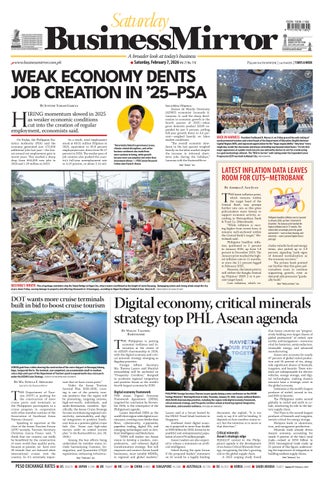

WEAK ECONOMY DENTS
JOB CREATION IN ’25–PSA
By Justine Xyrah Garcia
HIRING momentum slowed in 2025 as weaker economic conditions cut into the creation of regular employment, economists said.
On Friday, the Philippine Statistics Authority (PSA) said the economy generated just 172,000 additional jobs last year—the lowest annual net employment gain in recent years. This marked a sharp drop from 664,000 new jobs in 2024 and 1.29 million in 2023.
As a result, total employment stood at 49.01 million Filipinos in 2025, equivalent to 95.8 percent employment rate, down from 96.17 percent in 2024. The weaker pace of job creation also pushed the country’s full-year unemployment rate to 4.19 percent, or about 2.14 mil-

“Uncertainty linked to governance issues, climate-related disruptions, and softer business sentiment also made firms more cautious in hiring, while growth became more consumption led rather than investment driven.”—PIDS Senior Research
Fellow John Paolo R. Rivera
lion jobless Filipinos.
Ateneo de Manila University (ADMU) economist Leonardo A. Lanzona Jr. said the sharp deceleration in economic growth in the fourth quarter of 2025—when gross domestic product (GDP) expanded by just 3 percent, pulling full-year growth down to 4.4 percent—weighed heavily on labor market conditions.
“The overall economic slowdown in the last quarter weighed heavily on the labor market despite the increase in informal shortterm jobs during the holidays,” Lanzona told the BusinessMirror

DOT wants more cruise terminals built in bid to boost cruise tourism
By Ma. Stella F. Arnaldo
Special to the BusinessMirror
T
HE Department of Tourism (DOT) is pushing for the construction of more cruise ports and terminals as the Philippines participates in a cruise program in cooperation with other member nations of the Association of Southeast Asian Nations (Asean).
tant that we have cruise ports.”
Under the Asean Tourism Sectoral Plan 2026-2030, cruising is one of the priority tourism products that the region will be promoting, targeting retirees, high-net-worth individuals, and multi-destination travelers. Specifically, the Asean Cruise Strategy focuses on enhancing regional connectivity, sustainability, and digital integration to position Southeast Asia as a premier global cruise hub. (See, “Asean eyes high-value tourists under its unified tourism plan,” in the BusinessMirror, Jan. 30, 2026.)
Speaking to reporters at the close of the Asean Tourism Forum (ATF) recently, Tourism Secretary Christina Garcia Frasco said, “I think that our country can really be benefitted by the construction of more world-class quality ports, because at present, we have over 40 islands that are featured when international cruises visit the country. So it’s extremely impor- See “Cruise,” A2
Among the key efforts being undertaken by member states include harmonizing Customs, Immigration, and Quarantine (CIQS) regulations; enhancing infrastruc-




By Andrea E. San Juan
THE latest inflation print, which remains within the target band of the Central Bank, may prompt further rate cuts as this gives policymakers more leeway to support economic activity, according to Metropolitan Bank & Trust Co. (Metrobank).
“While inflation is moving higher from recent lows, it remains well-anchored within the Central Bank’s target,” Metrobank said.
Philippine headline inflation quickened to 2 percent in January 2026, up from 1.8 percent in December 2025. The January print marked the highest inflation rate in 11 months, or since the 2.1 percent logged in February 2025.
However, the latest print is still within the Bangko Sentral ng Pilipinas’ (BSP) 2 to 4 percent target band.
Core inflation, which ex-

rate in 11 months. This means that, on average, prices for goods and services—such as food, housing, and electricity—were 2 percent higher than a year ago.
cludes volatile
and
out further that
Digital economy, critical minerals strategy top PHL Asean agenda
By Malou TalosigBartolome
THE Philippines is putting economic resilience and innovation at the center of its ASEAN chairmanship in 2026, with the digital economy and critical minerals strategy emerging as flagship priorities.
Foreign Affairs Secretary Ma. Theresa Lazaro said Manila’s stewardship will be anchored on “Prosperity Corridors,” designed to accelerate regional integration and position Asean as the world’s fourth-largest economy by 2030.
Digital economy framework
THE Asean Digital Economy Framework Agreement (DEFA), targeted for conclusion by November 2026, is the centerpiece of the Philippines’s agenda.
Lazaro described DEFA as the world’s first region-wide digital economy pact, covering cross-border data flows, cybersecurity, e-payments, paperless trading, digital IDs, and emerging technologies such as Artificial Intelligence and blockchain.
“DEFA will realize our Asean vision to develop a modern, comprehensive, and coherent digital transformation strategy. This will empower and connect Asean-based businesses, most notably MSMEs, to regional and global markets,”

Lazaro said at a forum hosted by the ISEAS–Yusof Ishak Institute in Singapore.
Southeast Asia’s digital economy is projected to more than double to $560 billion by 2030, driven by its youthful and entrepreneurial population of over 670 million people.
Asean Leaders are also expected to release a statement on artificial intelligence.
Asked during the open forum if the proposed leaders’ statement on AI would be a legally binding
document, she replied, “It
but the intention is
in
Critical minerals: Asean’s strategic edge EQUALLY central to the Philippines’s agenda is the development of an Asean Critical Minerals Strategy, recognizing the bloc’s growing role in the global supply chain. A 2023 scoping study found
that Asean countries are “progressively holding ever-larger shares of global production” of nickel, rare earths, and manganese—resources vital for batteries, semiconductors, renewable energy, and advanced manufacturing.
Asean now accounts for nearly 47 percent of global nickel production and 35 percent of tin, alongside significant shares of bismuth, tungsten, and bauxite. These minerals are indispensable for electric vehicles, energy storage, and digital technologies, making Asean’s resource base a strategic asset in the global economy.
Indonesia is the world’s largest producer of nickel, second in tin, and fifth in bauxite.
The Philippines ranks second globally in nickel and sixth in cobalt, reinforcing its role in the battery supply chain.
Viet Nam is the second-largest producer of bismuth and tungsten, metals critical for energy storage.
Malaysia leads in aluminum, iron, and manganese production.
Minerals trade already drives Asean’s economy, accounting for nearly 9 percent of the bloc’s total trade—valued at $250 billion in 2018. Intraregional trade made up 21 percent of this figure, underscoring the importance of integration in building resilient supply chains.
PHILIPPINE Foreign Secretary Theresa Lazaro speaks during a news conference on the ASEAN Foreign Ministers’ Meeting Retreat in Cebu, Thursday, January 29, 2026. Lazaro outlined Manila’s 2026 ASEAN chairmanship priorities, including the region-wide digital economy framework, critical minerals strategy, and Prosperity
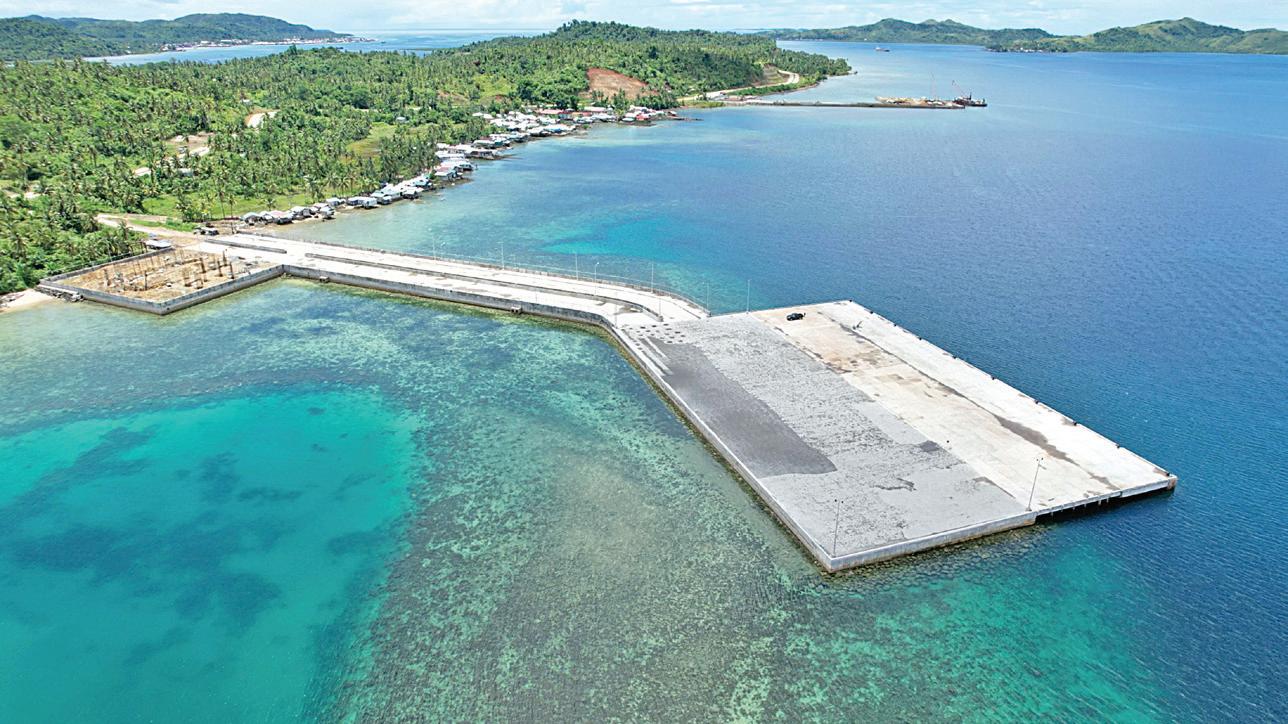
SCREEN grab from a video showing the construction of the cruise ship port at Barangay Jubang, Dapa, Surigao del Norte. The terminal,
BASYANG’S WRATH Piles of garbage and debris clog the Tubod Bridge in Iligan City, where waters overflowed at the height of storm Basyang. Rampaging waters and strong winds swept the city at pre-dawn Friday, causing damage to property and affecting thousands in 14 barangays, according to Iligan City Mayor Frederick Siao. Story in A3 PHOTO COURTESY OF ILIGAN CITY GOVT
Cruise… Asean…
Prosperity corridors deliverables
BEYOND DEFA and critical minerals, the Philippines is pushing a broad economic agenda that includes:
• Asean Leaders’ Declaration on Strategic Trade Management for secure regional trade
• Asean Power Grid
• Roadmap for semiconductors
• Asean Leaders’ Declaration on cross-border movement of digital workers
• Support for sustainable and resilient capital markets
• Conclusion of Asean-Canada Free Trade Agreement negotiations
• Expansion of MSME support through digitalization, capacity-building, and women-led development
• Asean Center for Excellence in Industries
• Asean Declaration on Advancement of Space Science, Technology and Innovation Cooperation
• Asean Investment and Tourism Outlook
Strategic context
THE Philippines’s chairmanship comes as Asean continues to grapple with geopolitical challenges in the South China Sea, Myanmar, and border disputes between Thailand and Cambodia. Lazaro emphasized that Manila’s economic agenda aims to strengthen Asean’s resilience while deepening integration.
“We will build systematic connections towards shared prosperity through economic integration, digital transformation, and inclusive and sustainable development that benefits all Asean peoples,” she said.
ture; and promoting sustainable, inclusive tourism to boost economic benefits for local communities.
No regional data was available on the number of cruise passengers, arrivals, or ports of call.
56K arrivals by sea FRASCO noted that the Philippine Ports Authority recently completed a cruise terminal in Brgy. Jubang, Dapa, Siargao, “thanks to the President.” The port can accommodate small-to-medium capacity cruise ships carrying 200-300 passengers. More cruise ports are being planned by the PPA, she added.
Local tourism stakeholders have long been urging the construction of a permanent cruise port and terminal for international cruise ships, to encourage more of the latter to visit the Philippines. Manila is often the first port of call by international cruise ships, but the terminal was originally built for cargo operations, with complaints from cruise passengers often rising due to the area’s cramped space.
Data from the Bureau of Immigration showed 136 cruise ship calls carrying 56,040 passengers and 15,071 crew members last year. Major ports of call were Manila, Puerto Princesa, and Boracay.
“This is an encouraging number especially that there were new cruises that visited us,” she added.
No comparative figure for 2024 was released, but in 2023, the bureau’s data showed 55,442 cruise passengers on 32 ships having arrived in the Philippines.
“Pushing for cruise tourism has been aan dvocacy of the Philippines since Day 1,” said Frasco.
“Singapore was also quite vocal in terms of wanting to further develop cruise tourism in the region,” she said about discussions during the ATF.
Manila cruise terminal back on track?
MEANWHILE , she said there have been “preliminary talks” between the Tourism Infrastructure and Enterprise Zone Authority (Tieza) and “a private proponent as far as the development of another cruise port still in the Manila area. These talks have been ongoing for a while and I think the onus is on the private sector now, hopefully to make this very significant investment in cruise [tourism].”
In 2018, ports and hospitality tycoon Enrique K. Razon’s Sureste Properties started seeking the necessary government permits to establish the Solaire Cruise and Yachting Center at the back of Solaire Resort. The proposed project, estimated to cost US$308 million then, had been submitted by the Tieza to Malacañang, with then President Rodrigo Duterte not posing any objections as long as Sureste secured necessary government permits.
However, Razon’s group held off on the project, continuing to assess market conditions before finalizing any decisions. The growth of the tycoon’s business is largely driven by international cargo port operations. (See, “Razon group holding off on cruise terminal project pending market conditions,” Dec. 21, 2023.)
BI instituted a Cruise Waiver Program in mid-2024 to attract more cruises to the Philippines, allowing passengers to visit the country for 30 days and simplifying the process by allowing visarequired foreign nationals to use the bureau’s e-services portal.

WEAK ECONOMY DENTS JOB CREATION IN ’25–PSA
on public construction projects.
Continued from A1 of Economy, Planning, and Development (DEPDev) said the government is looking to roll out policies aimed at accelerating job creation and strengthening the labor market.
The decline in December 2025’s underemployment, which eased to 8 percent or 3.93 million workers—the lowest single-digit reading since 2005—should not be taken as a sign of improving labor conditions, according to him.
“The increasing layoffs in the regular jobs have reduced those who have jobs and are looking for another one to meet their daily requirements. It’s a downward spiral where a precarious situation collapses into a total loss,” he said.
He added that this trend could continue, with him expecting that “regular jobs will continue to decrease while seasonal and lower quality will gradually increase.”
House think tank’s scenario
LANZONA’S assessment echoes an earlier study by the House of Representatives’ Congressional Policy and Budget Research Department (CPBRD), which flagged a “growth recession” last year as job losses mounted amid sluggish GDP expansion.
The report said the decline reflected weakening employment conditions, with job security deteriorating and employment becoming more volatile amid the growing prevalence of gig and platform-based work (See: https:// businessmirror.com.ph/2026/02/06/ tepid-gdp-growth-leads-to-job-volatility-in-2025-study/).
Construction joblessness
NATIONAL Statistician Claire Dennis S. Mapa said the downward trend in job creation was largely driven by the construction sector’s failure to contribute to employment growth.
PSA data showed that construction recorded the steepest annual decline, shedding 550,000 jobs. This was followed by transportation and storage (-258,000), fishing and aquaculture (-258,000), and manufacturing (-255,000).
Mapa said the contraction reflected the 41.9-percent drop in government spending for the last three months of 2025, particularly
In September last year, this newspaper reported that job losses in construction could worsen as the government’s investigation into flood control projects disrupted infrastructure works (See: https:// businessmirror.com.ph/2025/09/11/ construction-jobs-dipping-worseseen-amid-f-c-p-probe/).
This outcome runs counter to earlier expectations of the Department of Labor and Employment (DOLE), which previously identified construction as one of the key sectors expected to drive job growth in 2025, citing the government’s infrastructure flagship projects under the Build Better More Program (See: https://businessmirror.com.ph/2025/01/29/dole-listsconstruction-transportation-amongcritical-sectors-in-2025/) Philippine Institute for Development Studies (PIDS) Senior Research Fellow John Paolo R. Rivera said the contraction in construction employment underscored broader weaknesses in the economy, particularly slower investment and infrastructure spending.
“[This] reflects weaker overall economic momentum particularly slower investment and infrastructure spending, which tend to generate large employment multipliers,” Rivera told the BusinessMirror
“Uncertainty linked to governance issues, climate-related disruptions, and softer business sentiment also made firms more cautious in hiring, while growth became more consumption led rather than investment driven.”
Rivera said that even if public spending and private investment improve in 2026, employment growth is likely to recover at a modest pace.
“In the medium term, job creation will likely remain uneven unless the economy shifts back toward more investment- and productivity-driven growth, especially in construction, manufacturing, and higher value services,” he added.
Quality job creation
MEANWHILE , the Department

“As we make 2026 a rally point to revitalize [Philippine Development Plan] implementation, we will prioritize employment creation by restoring consumer and business confidence, reduce the cost of doing business, encourage innovation, and expand training and reskilling opportunities,” DEPDev Undersecretary Rosemarie G. Edillon said.
Edillon added that the government will resume and fast-track delayed infrastructure projects while prioritizing high-impact programs in key sectors.
She also said the administration would support the adoption of digital technologies to boost productivity in high-value sectors, including information technology and business process management (IT-BPM) industry and advanced manufacturing, to ensure more sustainable job growth.
“If we can expand global capability centers and develop specialized digital services, we can generate high-value jobs and enhance the country’s competitive position in the global market,” Edillon said.
Inflation…
Continued from A1
Metrobank noted that the main upward pressure came from housing, water, electricity, gas, and other fuels, driven by annual rental adjustments outside the National Capital Region and higher electricity rates.
Meanwhile, food inflation eased to 1.1 percent, helped by lower prices across most major food items and continued rice deflation, which helped temper overall price growth.
For the full year, Metrobank said it maintains its 2026 inflation forecast of 3.3 percent, citing “low base effects and recovering demand that may push prices higher in the second half of the year.”
“However, these are expected to be partially offset by softer consumer spending and supplyside factors such as the lifting of the rice import ban,” Metrobank noted.
Further monetary easing GIVEN the inflation backdrop, Metrobank expects the BSP to proceed with further monetary easing.
“The bank forecasts a cumulative 50 basis points of policy rate cuts in 2026, bringing the reverse repurchase (RRP) rate to 4 percent by year-end, as authorities balance growth support with price stability,” Metrobank said.
The private bank also noted that barring major supply-side shocks, the current inflation environment supports a “measured and data-driven” policy path, one that allows the economy to gain momentum without reigniting excessive price pressures.
While the January inflation print stays within the BSP’s target band, former Socioeconomic Planning Secretary Dante B. Canlas said the central bank should “go easy” in cutting interest rates to “avoid further weakening of the peso against the US dollar.”
For Philippine Institute for Development Studies (PIDS) Senior Research Fellow John Paolo R. Rivera, a possible weakening of the peso to P60 per dollar could result in a mild but persistent pass-through to inflation, mainly through higher import costs for “fuel, transport, and some food items.”
(See: https://businessmirror.com.ph/2026/02/06/expertsinflation-still-benign-despite-strongusd/)
www.businessmirror.com.ph
Saturday, February 7, 2026
A3
GCash lending arm Fuse gets ₧1.75-B ADB loan to aid MSME
By Reine Juvierre S. Alberto
FUSE
Financing Inc., the lending arm of GCash, was granted a P1.75-billion ($30 million) loan from the Asian Development Bank (ADB) to provide greater financial access to micro, small and medium-sized enterprises and women entrepreneurs in the Philippines.
In a ceremony on Friday, Fuse, GCash and ADB formalized their first-of-its-kind partnership in the Asean region in their bid to close the gap between traditional banking and the underserved.
Through the collaboration, GCash’s digital ecosystem will be used to provide collateralfree loans in high-poverty and rural areas.
“We value our partnership with ADB as it strengthens our ability to expand access to credit for MSMEs and women entrepreneurs, who are underserved by the market,” Mynt President and Chief Executive Officer Martha Sazon said.
“By combining our shared expertise and digital reach, we are advancing financial inclusion and helping more Filipinos grow their businesses,” Sazon said.
FDA conducts compliance verification visits to retailers
By Claudeth Mocon-Ciriaco
AS part of its ongoing efforts to protect consumers and promote transparency in the sale of health products, the Food and Drug Administration (FDA) on Friday conducted coordinated compliance verification visits to selected major retail establishments nationwide.
The simultaneous visits were carried out across Luzon, Visayas, and Mindanao through the FDA’s Field Regulatory Operations Office and its Regional Enforcement Units.
“Some inspections are coordinated to show compliance and assure the public, while others, particularly in markets, warehouses, and suspected distribution points, are conducted unannounced to support enforcement and casebuilding against illegal products,” said Director General Atty. Paolo Teston, who spearheaded the effort by personally joining verification visits at S&R Membership Shopping and Landers Superstore, both located in Bonifacio Global City. These visits formed part of a coordinated effort to demonstrate regulatory presence, transparency, and active oversight across major retail establishments.
The verification visits focused on checking product registration, labeling accuracy, storage conditions, and product traceability across a wide range of consumer health products available for sale. These activities were conducted to reassure the public that products circulating in the market comply with safety and quality requirements.
FDA verification portal
ON Wednesday, the FDA said that checking whether a product was truly FDA-registered is now made easy after they rolled out the enhanced FDA Verification Portal, now powered by cloudbased technology.
With just a few clicks, anyone can check if a health product or establishment is FDA-registered by searching the product name, registration number, or company details.
The FDA encourages everyone to make verification part of their routine before buying or using any health product. A quick visit to https://verification.fda. gov.ph/ can help protect you and your family.
The Verification Portal acts as your digital safety check—one place where official, updated records back up what you see online. While the portal continues to improve, the FDA assured that it is steadily refining and updating its data to make it more accurate and reliable over time. Through this initiative, the FDA continues to promote transparency, consumer protection, and shared responsi -
In addition, ADB will provide Fuse up to $125,000 in technical assistance to develop tailored financial products and deliver financial and digital literacy training for women, particularly those with limited formal education.
“This fintech partnership is the first-of-its kind for ADB in the Asean region and marks a significant step in advancing financial inclusion in the Philippines,” ADB Director General for Private Sector Operations Department Isabel Chatterton.
“By combining Fuse’s digital reach with ADB’s development
financing, we are building an inclusive digital financial ecosystem that expands access to finance for women-led and rural enterprises across the country,” Chatterton added.
The Mastercard Center for Inclusive Growth also extended funding support to Fuse in order to reach and serve the priority MSME segments.
“Through our partnership with ADB, with additional support from the Mastercard Impact Fund, we are strengthening our mission to make credit accessible to every Filipino who needs it most,” Fuse
Financing Inc. President and Chief Executive Officer Tony Isidro said.
Meanwhile, 10 MSMEs that the Department of Trade and Industry (DTI) had nominated received financial support to help them grow their businesses.
“More than the scale of financing, what makes this partnership meaningful is its intent: to ensure that capital reaches entrepreneurs who are ready to grow but have long been underserved by traditional systems,” Trade Secretary Ma. Cristina A. Roque said in her speech.
Alongside the partnership
launch, Fuse convened over 250 sari-sari store owners and women entrepreneurs to participate in financial literacy courses aimed at improving their ability to manage their money, borrow responsibly and create more sustainable businesses.
MSMEs account for around 40 percent of the country’s gross domestic product and 63 percent of total employment.
According to the DTI, there are 1.24 million registered business establishments as of 2024, over 99 percent of which are micro, small and medium enterprises.
Storm ‘Basyang’ roars off to Visayas after Mindanao roll
By Manuel T. Cayon
bility in keeping health products safe and trustworthy for everyone.
During the visits, Teston, together with FDA inspectors, utilized the agency’s newly enhanced Verification Portal to validate product registration status in real time.
Strengthen consumer protection
THE use of this digital tool demonstrated how technology is being integrated into field operations to strengthen consumer protection and improve verification efficiency.
No enforcement or seizure activities were undertaken during the visits, as these were coordinated compliance verification activities intended to promote transparency and public confidence.
Initial findings showed that a number of products were verified for compliance, while some items were flagged for further assessment, as they did not appear in the Verification Portal when checked.
“Both types of inspections are essential to protect public health,” Teston said.
The FDA reiterated that all consumer health products must be FDA-registered, properly labeled, and fully traceable at all times.
Regulatory action
THE Director General underscored that “establishments found selling unregistered, mis -
See “FDA,” A13
DAVAO CITY—Typhoon
Basyang left at least four dead and displaced more than 100,000 families as it rolled on most of northern Mindanao, the second early typhoon to enter the country this year.
The Office of Civil Defense reported at least four persons dead across the affected areas, from Surigao del Sur where the typhoon set foot Thursday evening and left northern Lanao del Norte by late morning Friday.
The OCD damage figures may still rise as authorities get the actual figures from the towns and villages which were mostly underwater by dawn of Friday, and rampaging waters were still seen across most of northern Mindanao by morning of Friday.
Quoted by several news outfits, the OCD said there could be more than 100,000 families across the Caraga Region, comprised by the two Surigao provinces and the two Agusan provinces. The OCD added that more than 30,000 families were affected in Region 10, or Northern Mindanao, including the cities of Cagayan de Oro and Iligan.
Specific reports for each area remained hazy as many local disaster risk-reduction and management offices were also temporary off line. Several posts were posted as early as pre-dawn Friday about strong winds and rampaging floods but the worst floods were reported in Iligan City, which appeared to be heavily affected by


the rising and rampaging waters.
Barangay Mahayahay, a mix of middle-class subdivision and informal settlers communities, was the center of disaster response as piles of garbage and debris clogged the Tubod Bridge, where waters overflowed. The bridge was at a higher level than most of the houses. A landslide was reported in Upper Hinaplanon.
Iligan City Mayor Frederick Siao told a television station-owned radio that as many as 2,000 residents were affected from 14 barangays. Images of overturned cars and clogged logs and trees were posted across Facebook and You Tube as coming from Iligan and Cagayan de Oro, and the Municipal Disaster Risk Reduction and Management Office of Cagwait, Surigao del Sur said frantic residents were calling
for rescue as strong winds and rising waters inundated their communities. It said the city government hoped that “this would be lesson to learn to heed early warning calls for preemptive evacuation.”
The Surigao City information office reported that clearing operations were underway by Friday morning, including the MapawaCapalayan section of the Quezon-Mapawa-Capalayan-EspinaNavarro Road, which sustained a minor landslide deposited rocks and debris along the road.
The DPWH Surigao del Norte 2nd District Engineering Office, with the City Government’s engineering and clearing teams, in coordination with the barangay LGU and partner agencies, carried out clearing operations to restore safe access for motorists and resi -
dents. Similar operations continue in other areas to ensure smooth and safe travel across the city. The Lanao del Norte Provincial Disaster Risk-Reduction and Management Office said there was one resident. It said the typhoon has moved upwards to the Visayas by late morning.
Storm closes airport HEAVY rains from Tropical storm Basyang have forced the temporary closure of Camiguin airport runway, grounded flights, and left dozen of passengers stranded on Friday.
The Civil Aviation Authority of the Philippines (CAAP) issued a Notice to Airmen (NOTAM) effective 9:52 am of Friday, February 6, after

See “Basyang,” A13
Saturday, February 7, 2026
House Sec-Gen formally transmits 2 complaints vs Sara to Speaker
By Jovee Marie N. Dela Cruz
OUSE Secretary General
HAtty. Cheloy E. VelicariaGarafil on Friday said her office has formally transmitted the two impeachment complaints filed against Vice President Sara Z. Duterte to the Office of Speaker Faustino “Bojie” G. Dy III.
Garafil said the transmission was made on Thursday afternoon, in accordance with the Constitution and the Rules of the House of Representatives.
“Upon receipt and verification of the complaints and their accompanying endorsements, the Office of the Secretary General forwarded the documents to the Office of the Speaker for appropriate action,” Garafil said, underscoring that her office performs a ministerial duty and administrative function, guided at all times by the Constitution, the Rules of the House, and longstanding protocol.
Overcharging of blood processing fees alarms Red Cross chief Gordon
HILIPPINE Red Cross Chair -
PAfter inclusion in the Order of Business, the plenary has three session days to transmit the complaint to the Committee on Justice, where a formal review will begin. Whatever decision the committee arrives at, it is required to submit a committee report to the plenary within 60 session days.
The first verified impeachment complaint against Duterte was filed by members of the Makabayan Coalition and endorsed by Party-list Representatives Antonio Tinio of the Alliance of Concerned Teachers (ACT), Sarah Jane Elago of Gabriela Women’s Party, and Renee Louise Co of Kabataan.
The Makabayan bloc cited betrayal of public trust on three grounds: Duterte’s alleged unchecked discretion in handling P612.5 million in confidential funds from late 2022 to the third quarter of 2023; her alleged gross
Under existing rules, once the Office of the Secretary General receives an impeachment complaint, it must immediately transmit it to the Office of the Speaker. The Speaker then has 10 session days to include the complaint in the Order of Business of the House plenary.
disregard for transparency and accountability by supposedly ordering subordinates to prepare implausible accomplishment reports supported by fabricated liquidation reports and falsified documents, which were then submitted to the Commission on Audit (CoA) to justify the questioned use of confidential funds in violation of law; and her alleged dereliction of official duty for willfully refusing to recognize Congress’ oversight role during budget deliberations and its authority to conduct inquiries in aid of legislation.
The Makabayan bloc cited a sworn affidavit executed by Duterte’s former aide, Ramil Madriaga, on November 29, 2025, which they said provides fresh details to House proceedings on the use of confidential funds under the Office of the Vice President (OVP) and the Department of Education (DepEd) from 2022 to 2023. Meanwhile, Party-list Representatives Leila de Lima of Mamamayang Liberal and Perci Cendaña of Akbayan endorsed the second
impeachment complaint filed by representatives of progressive organizations and civil society groups.
The complaint lists five articles of impeachment, including allegations that Duterte committed betrayal of public trust, culpable violation of the Constitution, graft and corruption, bribery, and other high crimes.
Among the grounds cited were Duterte’s alleged public admission of contracting an assassin and plotting to kill the incumbent president, first lady, and a former house speaker; alleged misuse and malversation of confidential funds while serving as vice president and education secretary; alleged distribution of monetary gifts to DepEd officials involved in procurement; alleged unexplained wealth and failure to fully disclose assets in her Statement of Assets, Liabilities, and Net Worth (SALN); and alleged involvement in other high crimes, including murder and conspiracy to commit murder.
PHL, US launch 80th anniversary logo marking diplomatic ties
THE United States Embassy in the Philippines Chargé
d’Affaires, a.i., Y. Robert Ewing and Philippine Ambassador to the United States Jose Manuel Romualdez launched on February 5
the logo commemorating the 80th anniversary of diplomatic relations between the United States and the Philippines in 2026. The event marks the start of a yearlong campaign led by the US


Embassy in the Philippines and the Philippine Embassy and Consulates General in the US to celebrate the unwavering ties between the two long-time friends, partners, and allies.
“Eighty years ago, our two nations formalized a partnership rooted in shared values, mutual respect, and a deep commitment to democracy and freedom. We are proud
of what we have accomplished side by side—balikatan—from standing shoulder-to-shoulder in times of conflict, to advancing economic growth, to joining forces on health, education, and disaster response priorities,” Ewing said at the launch of the commemorative logo at the SM Mall of Asia Globe in Pasay City.
“Logo,”


man Richard Gordon has raised concern over the reported overcharging of blood processing fees.
Over the years, the Philippine Red Cross has set its blood processing fees in accordance with DOH Administrative Orders, ensuring that blood remains affordable, accessible, adequate, and safe for patients. However, PRC Chairman and CEO Richard J. Gordon expressed concern over reports of possible overcharging of blood processing fees in some private hospitals during the 4th National Council on Blood Services (NCBS) meeting with the Department of Health (DOH).
Gordon emphasized that the PRC is committed to supporting both public and private hospitals nationwide, supplying safe and quality blood to save lives. However, he underscored that blood donation is a voluntary humanitarian act and should never be treated as a profit-driven commodity.
“When we give patients blood,
some hospitals conduct additional tests that accumulate charges, sometimes exceeding allowable fees and reaching amounts as high as P10,000. The Red Cross has done its part to ensure all blood we distribute is safe,” Gordon said. “These fees are unconscionable. We do not seek profit from blood; we follow all procedures set by the DOH.”
DOH Secretary Ted Herbosa underscored the concern, underscoring that the law applies to all facilities, regardless of classification, and proposed the opening of a complaint center for individuals accessing blood services, allowing the public to report any suspected overpricing or irregularities.
The Philippine Red Cross affirmed its commitment to working closely with the DOH, hospitals, and other stakeholders to ensure that blood services remain ethical, transparent, and aligned with national policies, while continuing its mission to serve humanity without discrimination.
Love scams abound ahead of Valentine’s; Senate’s eligible bachelor sounds alarm
AS Valentine’s Day approaches, Senator SherWin Gatchalian warned the public against a more sophisticated breed of ‘love scams’ that now leverage artificial intelligence (AI) and, in certain cases, even lead to the sexual exploitation of victims.
Gatchalian made the call following a warning from the Cybercrime Investigation and Coordinating Center (CICC) about the growing risk of AIdriven love scams targeting people seeking romantic relationships.
CICC data showed that in 2025, it received 123 formal complaints, with cases typically peaking from January to February, as well as in June and October.
“Despite the national ban on POGOs [Philippine Offshore Gaming Operators], criminal syndicates continue to exploit loopholes through various schemes, including love scams. Nakakalungkot
na hindi na lang basta naloloko ang ilan nating kababayan ng perang kanilang pinag-hirapan, ang iba ay nagiging biktima pa ng prostitusyon [It’s sad that some of our countrymen are not just being scammed of their hard-earned money; some fall victim to prostitution],” Gatchalian said.
The CICC said it has identified six scammer profiles, namely the ‘sad boy/sad girl,’ who shares dramatic problems before requesting money; the ‘seducer,’ who obtains compromising photos; the ‘investor,’ who proposes joint cryptocurrency schemes; the ‘serviceman,’ who poses as military personnel overseas; the ‘escort,’ who demands upfront payment; and the ‘slow burner,’ who cultivates longdistance relationships before borrowing money.
ScamWatch Philippines, which together with CICC had
See
A13
BusinessMirror
It’s
alright to think like a child again in old age

‘NAG-SE -SECOND childhood na siya,” is what people say in a chuckling, winking kind of way when a senior member of the family starts behaving like a child, either for the fun of it or because of presumed mental decline.
Second childhood may seem like a joke, but it turns out that reawakening the traits of a child made dormant in adulthood has been found to be actually good for people in their advanced years.
Rather than laugh at child-like behavior, it’s something that should be encouraged among our fellow seniors. It will not just slow down the clock for them, it will also promote well-being and vitality in later life and help prevent premature mental decline.
A child possesses many positive traits such as honesty, innocence, trustworthiness and so on. But there’s one good child trait to rekindle in old age. This attribute is, in a word, curiosity. Curiosity drives kids to try new things. As children, we like to seek out, explore, and immerse ourselves in situations for the fun, thrill and experience of it as well as to gain new information. We were fearless, because we didn’t know any better. But we learned from our mistakes or failures, especially those that had painful or hurtful consequences. Yet we did not cease to explore because as children, we were alive to the life around us.
This sense of wonder is the key to our vitality specially in our later years. Rather than submit completely to decline, find something or occupy yourself on something to summon anew our sense of wonder, allowing our child-like curiosity to lead us to new discoveries and learnings.
For one thing, it kills the boredom out of watching time.
In our casual chitchats, my fellow seniors tell me that they become oblivious to time when they’re engaged in something enticing and exciting. Their individual activities range from reading a good biography of an interesting person, painting with watercolors or oil, trying out a new recipe, building models or solving puzzles.
TimeOur Helping seniors safely navigate online services
looked at as the only locus of learning. The truth is we never lost the itch and yearning for learning. That capacity for boundless wonder has always been in us.
The late founder of Apple Corporation, Steve Jobs in one speech encouraged graduates to “Stay hungry, stay foolish.” For seniors, I’d like to add another point – stay curious.
deadlines. Not bound by the clock, he can no longer tell the difference between night and day.
In the same way, when I am writing a think piece like this one, for example, I get into a kind of zone in which time seems to be suspended. I don’t hear the ringing of phones, the incessant knocking on the gate by delivery riders, or my wife’s calls

to come to the dinner table. Sometimes, I get snippy or impatient when roused from those moments.
The term chronoception refers to the perception of time. In psychology and neuroscience, the sense of time is a subjective experience, measured by someone’s own perception.
Remember that popular song from “West Side Story”? Stephen Sondheim, the lyricist, had chronoception in mind when he wrote: “Tonight, tonight, I’ll see my love tonight/ And for us, stars will stop where they are/Today the minutes seem like hours/The hours go so slowly.”

Remember the absent-minded professor, a stock character of popular fiction? He becomes so engrossed in his thoughts, he fails to deal with the here and now, such as
As someone said: Curiosity is, in great and generous minds, the first passion and the last. Use your sense of wonder to open your eyes, your mind and your heart to new experiences and feelings.
There are many paths available for exploration. Look through your life, look to your inborn gifts or the personal interests you once had in youth but failed to pursue due to the demands of being a provider, husband and father in adulthood and middle age.
In my case, I join brainstorming sessions with young creative young minds. I learn new things from them, they keep me up to speed with emerging trends in the field of communications technology and marketing. It’s like being infused with fresh young blood, making me feel creatively recharged and revitalized. I never feel old because I can hold my own among young people who are with it so to speak.
This sense of wonder reawakened in old age grounds us in grateful living, feeling thankful for the gift of each day, a new opportunity to be enriched. The moment I wake up, my mind asks: what fresh new surprises await me today?

As psychologists keep telling us, it’s all in the mind. Chronoception implies that we can slow down subjective time.
Take your cue from Albert Einstein, the famous scientist. In a letter to a friend, he wrote: “People like you and me never grow old. We never cease to stand like curious children before the great mystery into which we were born.”
The key words are “curious children.” The trick is to awaken or rediscover that childlike curiosity in us. By doing so, we can grow old with the years without growing old.
“Isip bata” may not necessarily be a bad thing. “An old man is twice a child,” wrote William Shakespeare. Rather than fear “second childhood” why not embrace it and look at it in a positive new light? “Our first childhood” should not the be
Just a while ago, as I was gathering the scissored pieces of color paper my granddaughter left behind on a table after finishing her home project last night, my curiosity led me to see them as a figure puzzle or an artwork, in the same way Henri Matisse had cut a variety of papers and arranged them into lively compositions. An old bored mind will never be able to see it that way.
There is evidence that curiosity can play a vital role in maintaining cognitive functioning as well as physical health in older adults. This is why the more I grow old, the more I don’t feel old.
In Shakespeare’s play “The Tempest” the character of Prospero is an aging magician who has spent years in exile on a remote island. As he reflects on his past mistakes and seeks redemption, he undergoes a transformation that is reminiscent of a child learning and growing. Through his experiences on the island, Prospero gains a newfound sense of wisdom and self-awareness, much like a child coming of age.
So, it’s alright to explore life with childlike wonder anew even at our age. By all means, love and celebrate the gift of our second childhood. Not everyone can have the privilege of enjoying it in this lifetime. You have to grow old to merit it.
TBy Justine Xyrah Garcia
HE shift to online government services has opened new conveniences for many, but the Commission on Population and Development (CPD) said older people may need added support to adjust to the digital environment—including guidance on avoiding online scams.
CPD Executive Director Undersecretary Lisa Grace Bersales said digitalization has become an unavoidable part of government transactions, with services increasingly moving toward paperless and contactless systems.
As this transition continues, she noted that seniors must be helped not only to access online platforms but also to use them safely.
“There may still be gaps that we need to discuss. One thing I thought of is the effect of digitalization on older persons—perhaps we need to provide services to teach them how to avoid being scammed and how to learn to go online, because eventually government transactions will be paperless or contactless,” Bersales said, mostly in Filipino.
While the concern is preventive, Bersales said it is important to address it early, especially as the country prepares for a future where more services—from health care to social protection—are accessed online.
“Eventually, for us to transact with the government, it will already be online, so we really need to look at what impact this will have on senior citizens,” she added.
Recent data underscore why digital safety is becoming an important consideration.
A 2025 report by the Global Anti-Scam Alliance showed that more than 60 percent of Filipino adults

experience financial scam attempts each year, with incidents occurring nearly every other day on average. Reported losses reached close to P12,000 per person annually.
Older Filipinos were among the most affected. The study found that members of the Silent Generation— those aged around 71 and above— reported the highest prevalence of scam exposure, at 76 percent, suggesting that seniors face unique challenges as scams increasingly migrate to digital platforms.
Bersales said concerns such as online safety are among the issues being discussed in the CPD’s national consultation with the United Nations Economic and Social Commission
for Asia and the Pacific (UNESCAP) this week, which aims to review how prepared the country is for a steadily aging population.
She said the consultation aims to identify what may still be lacking in existing programs and policies for senior citizens, as agencies review how well current support systems are working.
Based on projections, Filipinos aged 65 and above accounted for about five percent of the population in 2020 but are expected to reach 7 percent by 2030—a threshold the United Nations (UN) considers as marking an aging society.
While the Philippines is aging more slowly compared to countries like Japan and Thailand, Bersales said early preparation remains crucial.
“This is important because the number of our older persons or senior citizens is increasing, and we need to discuss what policies we already have for them and what else we may still need to do,” the undersecretary said.
What local governments can do Bersales said the experience of Taguig shows the value of having dedicated and easily accessible services for senior citizens at the local level.
She said the presence of a dedicated space where most senior citizen services are located in one place makes it easier for older persons to access assistance and information, while also providing venues for them to take part in local activities.
Equally important, she added, is strong support from local chief executives, noting that full backing from mayors helps ensure that population offices are able to deliver quality services for senior citizens.
“Another thing we observed was that their population office is strongly supported by the mayor. We saw that when the mayor fully supports the population office, the services delivered to senior citizens are really good,” the undersecretary said.
NCSC: Magna Carta to address needs, safeguard rights of elderly
TBy Marita Moaje
HE National Commission of Senior Citizens (NCSC) is pushing for the passage of a Magna Carta for Senior Citizens as part of its Philippine Plan of Action for Senior Citizens (PPASC) to address the needs of the country’s rapidly growing elderly population.
At the National Consultation for the Promotion of Policies on Aging in the Philippines held in Pasig City on Tuesday, NCSC Acting Executive Director Ana Marie Calapit said the Magna Carta, currently under review in the Senate, aims to harmonize all laws affecting older Filipinos.
“So, it’s going to harmonize all of the laws related to senior citizens, the benefits, including discounts, and those related to health and socioeconomic opportunities,” she said.

By Darryl John Esguerra
THE National Commission of Senior Citizens (NCSC) is bringing back its radio program “Golden Heart: Puso para sa Seniors” as part of efforts to strengthen information access for older Filipinos, following a renewed partnership with the Presidential Broadcast Service–Bureau of Broadcast Services (PBS-BBS). The NCSC and PBS-BBS formalized the collaboration through a memorandum of agreement (MOA) signed on Wednesday by NCSC Chairperson and CEO Ma. Merceditas Gutierrez and PBS-BBS Director IV Fernando Amparo
Sanga. Under the agreement, the second season of “Golden Heart: Puso para sa Seniors” will air beginning Feb. 13 on Radyo Magasin 1278 kHz AM, with simultaneous streaming on the official Facebook page and YouTube channel of both NCSC and Radyo Magasin. Radio Magasin is the general informa-
will feature discussions on senior citizen benefits, government services, health concerns
and other issues affecting older persons.
Gutierrez said the revival of the program underscores the commission’s commitment to ensuring senior citizens remain informed about government programs and services designed for them.
“In an age where information moves rapidly, many of our senior citizens still rely on traditional and trusted platforms such as radio and government broadcasting,” Gutierrez said.
“Through
“We are hoping for stronger implementation of laws related to the benefits for senior citizens. Currently, the laws related to senior citizens need updating,” she added.
Aside from the benefits and incentives, Calapit said the Magna Carta would also cover social protection, healthcare, senior discounts, and economic opportunities.
In her presentation, she noted that the growing number of senior citizens should not be taken negatively, saying that they are assets.
Through the Magna Carta, she said the benefits for senior citizens would be enhanced.
“We can further increase the incentives we currently provide to senior
citizens. Plus, the opportunities for our senior citizens to participate in the labor force. We see that it’s a bit, how do I put it, not that you’re being told there’s discrimination, but when you’re an older person, your opportunities are really more limited,” she explained.
Meanwhile, Calapit said the PPASC, covering 2023 to 2028, positions aging as a development issue rather than solely a social concern. Anchored on four key result areas, she said the plan focuses on strengthening inter-agency coordination, promoting senior citizens’ economic and civic engagement, improving health and welfare services, and creating age-friendly environments.
Calapit said there are more than 1,000 senior citizen centers nationwide, providing health screenings, livelihood training, and social services to older Filipinos.
However, with the number of elderly persons and local government units, she also acknowledged the need to build about 700 more centers. Meanwhile, she also reported progress in implementing the Expanded Centenarians Act of 2024, which provides cash incentives to milestone and centenarian seniors. As of December 31, 2025, Calapit said more than 260,000 beneficiaries have received cash gifts, with the NCSC achieving a 96 percent budget utilization rate for













BusinessMirror
8 things to look for in a portable power station

CHANCES are, if you check the average Filipino’s bag, you will find at least three gadgets. Usually, a person would have two phones and a portable fan. Some would have one more phone, a tablet, and a laptop. These are average people just getting through the day, or those who work anywhere-at coffee shops, restaurants, or even parks.
Even the most technically challenged person has multiple gadgets when leaving the house. Charging is always a challenge even if they leave the house with the gadgets fully charged.
And then there are the typhoons. I live in Fairview where, I believe, the winds hit stronger during typhoons. One time, we did not have power for days because the winds knocked down two posts on our street and I managed to use up all our power banks.
Most of the work I do is remote so I can’t run out of power ever. During power outages at night, we also need power to recharge our portable fans.
The answer, I have realized, is not power banks but portable power. I am talking about generators. I am talking about something you can bring with you that does not look obnoxious, is quiet, and gets the job done. I also want something that’s powered by solar energy. Portable stations can range in price from a few hundreds to thousands of dollars. I don’t know the prices here in the Philippines but here are some things I am looking for, aside from the portable power station I get being powered by solar energy:
■ It needs to be easy to use, dependable, and should be flexible enough to do everything from charging small electronics (phones, laptops, modem, and headphones) to keeping appliances running (light

bulbs, fans, a small fridge, and maybe an induction cooker).
■ I do not need a full-on generator. I just want something that is quiet, stable, and predictable while it is working—meaning, I hope it does not overheat or malfunction.
■ I want something powerful but compact enough that I can transfer it from one location of the house to another or even carry it from place to place. I don’t mean it has to fit in my bag. I am good with being able to carry it by myself without the assistance of others.
■ I am looking at a power station that offers improved safety, and longer-term sustainability. An alternative to solar energy is sodium-ion technology, a type of rechargeable batteries that carry the charge using sodium ions (Na+). One advantage of sodiumion technology is that it works in colder weather. New generation batteries is a game-changer in the future of energy storage, as the planet faces the challenges
brought about by climate change.
■ Realistically, I want a portable power station with 2,000W power, 3,000W peak, and with a full recharge in under an hour because what is the point if you need to recharge it for four hours or more?
■ I need a power station with at least 10 output ports so it can charge or keep several devices or small appliances at once without the need for adaptors. I am looking for about three or more AC (alternating current) outlets for energy-hungry devices and also DC (direct current) outlets like a round port for car accessories.
■ A power station that’s weather-proof is good for a country like the Philippines, where it rains heavily even in the summer.
■ I am looking for a power station that’s aesthetically pleasing. It doesn’t need to have won design awards but hopefully it will be something good to look at.
PHL widest 5G network now on unlimited access
AS the demand for high quality connectivity reaches new heights, Globe Prepaid is reinforcing its leadership in the 5G space by upgrading its Go+ offers. Now customers subscribing to Go+ promos starting at Go+149 will enjoy free unlimited 5G access, a significant leap from the previous 8GB 5G allocation. This is designed to empower “data-savvy” prepaid users— digital natives who rely on seamless streaming, lag-free gaming, and highspeed productivity.\ By integrating Unlimited 5G into its Go+ promos, Globe is proactively rewarding its most active prepaid users, plus setting a new standard for affordable, pro-consumer 5G data services in the Philippines.
The launch aligns with the spirit of the Konektadong Pinoy Act,
emphasizing Globe’s commitment to making world-class internet accessible and affordable. As the provider with the widest 5G coverage in the country (as recognized by Ookla), Globe is ensuring that the benefits of 5G are not just available, but truly affordable for the everyday Filipino.
“Our goal has always been to lead the charge in 5G adoption by making it part of our customers’ daily
consumption, not a privilege nor a luxury,” said Darius Delgado, chief commercial officer of Globe.
“By upgrading our Go+149 and up promos to include Unlimited 5G, we are removing the barriers to high-speed data. This allows our prepaid customers to explore the
SEE “5G NETWORK,” A7
MLB THE SHOW 26 REVEALS GAMEPLAY WITH NEW TRAILER; AARON JUDGE AS THE COVER ATHLETE
BY PATRICK VILLANUEVA
FANS of MLB The Show should get thrilled as the latest gameplay trailer revealed exciting new features and upgrades for their latest installment, promising more control, deeper immersion, and more action on and off the field.
In a PlayStation blog for the game, it revealed several gameplay updates for MLB The Show 26. Starting with the success of Road to The Show— the career mode of the game—of the ‘25 version, MLB The Show 26 will create a more immersive experience by adding 11 new college teams to start your career prospect and projection, bringing the officially licensed NCAA Men’s College World Series format and bracket, and adding new goals for your career. Diamond Dynasty will have the World Baseball Classic content back, adding Tokyo Dome and Estadio Hiram Bithorn for WBC ballparks. It will also have mini-season overhauls, new rewards, programs, and collections. The storyline game mode adds Negro Leagues Season 4, returning with all-new legends,
uniforms, and new stadiums, celebrating impactful moments in the sport.
Franchising in the game incorporates a new Trade Logic System featuring the Trade Hub. It will also follow current trends to reflect on the logic of the game mode, including lineup, rotations, and bullpen games. Meanwhile, MLB The Show also announced the return of an amazing player as their cover athlete, the 3x American League MVP Aaron Judge.
Boosting governance through blockchain
BY RIZAL RAOUL REYES
PUSHING and scaling up the use of blockchain technology is crucial as several of the country’s challenges come from complex, multi-layered systems that are hard to coordinate, monitor and verify at scale, according to a youthful Filipino technopreneur.
“Major public programs, such as infrastructure, disaster mitigation, and social services, involve multiple agencies, contractors, and years of execution. When information is stored in isolated systems or updated manually, it becomes difficult to see the full picture in real time. Blockchain helps by creating shared, time-stamped records that different stakeholders can rely on, making coordination smoother and oversight more effective,” said Gelo Wong, chief growth officer of BayaniChain Tech, in an e-mail interview with BUSINESSMIRROR
Aside from pursuing good governance, the 23-year-old Wong said blockchain also supports economic inclusion and efficiency as it enables secure digital records, faster transactions, and lower operating costs, which benefit small businesses, local governments, and underserved communities. “This is especially relevant in a country with a large, mobile-first population and a growing digital economy,” he pointed out.
At the local government unit (LGU) level, Wong said the use of blockchain is vital as decisions directly affect people’s daily lives, yet many systems still rely on records that can be altered, lost, or disputed. He debunks a misconception that blockchain is not about crypto or experimentation but about creating a truth layer. “A permanent, verifiable record that does not depend on any single office, administration, or individual. When local governments see that transparency can be built into the system itself, rather than enforced through personalities or politics, it becomes a real institutional upgrade,” Wong explained.
He said the biggest challenge in deploying blockchain in LGUs is not technology but the readiness and alignment. With several LGUs at different stages of digitization, Wong said blockchain only adds value once data is already structured, standardized, and governed properly.
Another challenge is perception as blockchain is often misunderstood as complex or risky. Nonetheless, in reality it can operate quietly in the background as an integrity layer on top of existing systems. At present, he said multiple LGUs have formally expressed interest, with several already in active discussions or pilot stages. Wong said the interest usually accelerates once LGUs see real deployments working in government, not demos or whitepapers. Adoption tends to follow proof.
Wong pointed out that blockchain is not a silver bullet in the fight against corruption. Nevertheless, he said blockchain changes the rules of accountability and makes manipulation harder to hide, easier to detect, and impossible to erase after the fact. “Blockchain is not a silver bullet, and we have never positioned it as one,” he said.
YOUTUBER-LED INDIE HORROR FILM ‘IRON LUNG’ COMING TO PHL CINEMAS
AFTER the initial global success of his indie horror film Iron Lung, YouTuber Mark Fischbach, also known as Markiplier, has added several territories to showcase the film, with one of its stops being the Philippines.
Based on a 2022 horror game by David Szymanski with the same title, Iron Lung is a story of an unnamed convict venturing into the ocean of blood on a desolate moon inside the SM-13, more known as the Iron Lung. Here, the protagonist has to explore the blood ocean and take photographs of key locations, with a few threats of monsters and the collapse of the vehicle.
The eerie setup and ambiance of the game captured Markiplier’s


MLB The Show 26 welcomes his career from high school college, and to the world stage. His
MLB The Show 26 welcomes back the New York Yankees outfielder because they want to mirror his journey of hunger to have a Hall of Fame career,

and the drive to leave a mark on the field. They want reflected on the upcoming game his career from high school to college, minor to major, and to the world stage. His accolades prove so, including being the three-time AL MVP, seven-time All-Star, fivetime Silver Slugger award winner, AL single-season home run record holder with 62 homers, and the 2026 Team USA World Baseball Classic Captain. Pre-orders are now available on their website, priced at $99.99 for PlayStation, Xbox Series X|S, and Nintendo Switch. Early access to the game begins on March 13, 2026, with the full release slated on March 17.

office of over $17 million and international box office of over $3 million, according to Box Office Mojo.
Markiplier independently financed the film and starred in it. As such, its success was such a big deal for his fans. With its accomplishment, fans have been asking Markiplier to get his indie film screened in many countries. And with his latest YouTube stream, he teased that many Eastern countries will be getting that treat.
In his stream, he mentioned Singapore, Malaysia, Brunei, Cambodia, Indonesia, Lao PDR, Myanmar, Thailand, Vietnam, Hong Kong, Macau, South Korea, and the Philippines as possible destinations for the film.
While no local theater has yet to announce its showcase as of writing, he encouraged fans to message their local theaters so they could get the film’s screening. Booking inquiries are also available on the movie’s website.
Markiplier has been overwhelmed with support for his craft, as he did not expect the love that he got for this passion project. He consistently showed his gratitude during his streams, offering emotional and heartfelt thanks to his fans.
www.businessmirror.com.ph • businessmirror.lifestyle@gmail.com
Google’s quarterly results paint a picture of an internet powerhouse getting stronger in AI age
SAN FRANCISCO—Google’s latest quarterly report provided further evidence that its internet empire is withstanding an artificial intelligence shakeup that’s turning into another potential boon for the company. The numbers released Wednesday marked Google’s third consecutive quarter of digital ad growth of more than 10 percent from the previous year, while also posting more than 30 percent sales growth in its division that powers data centers for AI services.
Those increases during the October-December period propelled Google’s corporate parent Alphabet Inc. well past the earnings forecasts of stock market analysts.
Alphabet’s fourth-quarter profit rose 30 percent from the prior year to $34.5 billion, or $2.82 per share, while revenue climbed 18 percent to $113.8 billion.
The collective momentum of Google’s main business in search and advertising and the stillnascent AI field indicates a company born during the late 1990s internet boom is becoming even stronger during another technology phenomenon nearly 30 years later.
“Search saw more usage than ever before, with AI continuing to drive an expansionary moment,” Alphabet CEO Sundar Pichai said.
Google’s successful evolution has helped drive up Alphabet’s stock price nearly 60 percent in the past five months, giving it a $4 trillion market value. Even so, some investors are still skeptical whether Google will be able to sustain enough growth to justify the more than $300 billion that Alphabet will have spent from 2024 through the end of this year on expanding the computing capacity needed for AI features. Those worries caused Alphabet’s shares to see-saw between slight gains and declines during extended trading after Wednesday’s report came out.
Apple, also currently worth $4 trillion, thinks so highly of Google’s AI that the iPhone maker recently struck a deal to use Google’s Gemini technology in a long-delayed upgrade to its virtual assistant, Siri.
Google is also embedding more of its Gemini AI into its long-dominant search engine, Gmail and Chrome browser as it tries to avoid complacency and being outmaneuvered by up-andcoming companies such as OpenAI, Anthropic and Perplexity.
Google’s thriving digital ad business is helping to finance the spending spree. Its digital ad sales totaled $82.3 billion in the fourth quarter, up 14 percent from the previous year. Google Cloud, which oversees the data centers behind many AI services, posted revenue of $17.7 billion, a 48 percent increase. It looked like Google might be facing a potentially huge setback in 2024 when a federal judge condemned its search engine as an illegal monopoly in a case brought by the US Justice Department. To curb Google’s abuses, the Justice Department proposed a breakup that would have required the sale of its Chrome browser.
But US District Judge Amit Mehta rejected that idea and ordered less severe changes, partly because he believed the rise of AI would help rein in Google. Both the Justice Department and Google are appealing that decision. AP
network... CONTINUED FROM A6
full potential of the digital world without worrying about data caps.” The upgrade applies to the following Go+ promos: Go+149, Go+179, Go+250, and Go+400, providing a seamless upgrade for prepaid users who want worry-free 5G access without data caps.
With these promos, users get their standard highspeed data allowance for all sites, plus the new Unli 5G perk to be used in any Globe 5G-covered area. Globe’s successful 5G offers helped increase 5G adoption in the country and contributed to a significant rise in data usage last quarter. Customers can register for the upgraded Go+ promos via the GlobeOne app, GCash, or by dialing *143#. To experience Unlimited 5G, users must have a 5G-ready SIM and be using a 5G-compatible device in a 5G-covered area.
More information can be found at www.globe.com. ph/prepaid.
BusinessMirror
How stablecoins are reshaping Filipino remittances

IN the global financial landscape, the Philippines has long been a case study in resilience. Our economy is famously buoyed by the labor of millions of Filipinos working across every time zone, contributing to a remittance flow that recently hit a staggering $38.3 billion in a single year.
Yet, for decades, this massive pillar of our GDP has been funneled through an archaic infrastructure that treats digital money with the speed of physical mail. Once considered a niche digital asset, stablecoins are evolving into a new financial backbone for OFWs, valued less for hype and more for their ability to cut costs and move money faster than traditional banks.
Each month, the routine is the same. A nurse in the United States, a technician in the Middle East, or a seafarer between contracts sends part of their salary home. But what should be a simple click and send is often a gauntlet of long queues, high fees, poor exchange rates, and settlement delays that stretch into days. In emergencies, these inefficiencies have real consequences.
THE ANATOMY OF A FRICTION-FILLED SYSTEM
TO understand why stablecoins are revolutionary, we must first look at the “Correspondent Banking” model. When money moves from a bank in London to a rural bank in Pangasinan, it doesn’t travel in a straight line. It hops through a series of intermediary banks, each acting as a “toll booth.” Stablecoins operate on a 24/7/365 basis because the “ledger” is the blockchain—an automated, global, and transparent record that never sleeps.
HOW STABLECOINS WORK AT their core, stablecoins are essentially digital dollars. They are designed to maintain parity with the US dollar, ensuring that one dollar sent remains one dollar received. According to Amira Alawi, global marketing director of Coins.ph, the simplicity is what matters most. “Even though this technology seems intimidating as was the internet when it first took off, you don’t need to understand blockchain to benefit from it,” Alawi said. “What matters is that their money moves faster, costs less, and arrives reliably.”
For the uninitiated, not all stablecoins are created equal, and choosing the right “flavor” of digital dollar matters for security and utility. The two most widely used dollar-pegged stablecoins in the Philippine corridor are Tether (USDT) and USD Coin (USDC)— digital tokens designed to mirror the value of the US dollar. USDT is widely used across the digital asset ecosystem, while USDC—issued by Circle—has gained traction among regulated platforms like Coins. ph for its transparency and strong reserve backing.
FASTER TRANSFERS THROUGH
BLOCKCHAIN RAILS
IN the traditional system, money takes a long journey passing through multiple banks and processors, with each stop adding delays and fees. Stablecoins move differently. Funds travel directly over digital blockchain rails, bypassing many intermediaries. Through partnerships with remittance providers such as BC Remit and Remitly, Coins.ph has turned a three-to-five-day waiting period into transfers that settle in minutes. “When an OFW sends money through stablecoin rails, it’s almost instant,” Alawi explains. “There is no three- to five-day wait, and fewer fees are taken along the way. That difference matters when families are relying on every peso.” Speed alone isn’t enough. Liquidity is what makes stablecoin remittances reliably cheaper. “At Coins.
ph, we maintain deep liquidity for stablecoin-to-peso conversions,” Alawi said. “This ensures families receive their money without sudden rate changes or processing delays. Liquidity is what makes speed and affordability sustainable.”
This depth allows for precision pricing—as low as 3 basis points (0.03 percent) for USDT/PHP and USDC/ PHP trades—making the Philippine corridor one of the most efficient in the region. In practical terms, this is how Coins.ph consistently delivers the most competitive stablecoin rates in the country. Think of liquidity as fuel in the engine. Without it, even the fastest rails stall.
REDUCING
THE
COST OF REMITTANCES
THE savings are significant. World Bank data shows the global average cost of sending money is about 6.4 percent, more than double the UN’s 3 percent target. For an OFW sending $200, that’s roughly $12 lost to fees. Stablecoin-powered transfers can cut these costs by up to 80 percent, allowing more money to reach Filipino households. With personal remittances to the Philippines reaching a record $38.3 billion in 2024, even small reductions translate into billions of pesos staying with Filipino families.
BEYOND
REMITTANCES: THE FREELANCER’S EDGE
WHILE OFW remittances remain central to the Philippine economy, stablecoins are also gaining ground among Filipino freelancers working with global clients. Designers, virtual assistants, and developers are increasingly choosing to receive payments in dollar-pegged stablecoins like USDC or USDT, allowing them to avoid lengthy bank processing times and costly conversion fees.
Holding earnings in a dollar-denominated digital asset gives freelancers more control over when and how they convert funds into pesos. Instead of waiting days for withdrawals or losing value through multiple intermediaries, they can move money into local e-wallets only when needed. What once required corporate-scale financial access is gradually becoming available to independent workers armed with nothing more than a smartphone and a stable internet connection.
Stablecoins are no longer a future promise. This momentum was reinforced by Coins.ph’s recent integration with Circle’s global payments network, enabling peso payouts for cross-border settlements using USDC. Combined with longstanding partnerships across remittance providers, this infrastructure allows funds to move directly into Philippine bank accounts and e-wallets faster, cheaper, and with greater transparency.
Safety remains a common concern. But stablecoins used on licensed platforms operate under strict regulatory oversight. In the Philippines, Coins.ph is supervised by the Bangko Sentral ng Pilipinas (BSP) as a Virtual Asset Service Provider (VASP). This means stablecoin transfers are subject to robust antimoney laundering controls and consumer protection standards, aligning digital rails with the safeguards expected in traditional finance.
THE ‘LAST MILE’ AND THE ROAD AHEAD
THE final hurdle for any financial technology is the “last mile”—the moment digital bits turn into physical goods or services. In the Philippines, the integration of stablecoins with the broader retail ecosystem is the next frontier. We are moving toward a future where a recipient doesn’t even need to “withdraw” money from a bank.
With the rise of QRPH standards and the integration of crypto-wallets with bill payment systems, the goal is a seamless loop. Imagine a seafarer sending USDC from the Atlantic, which arrives in his wife’s digital wallet in Cavite. She then uses that digital balance to pay the Meralco bill or buy groceries via a QR code, bypassing the ATM queue entirely. However, as we embrace this efficiency, the responsibility of the user increases. Unlike a traditional bank where you can “forget” your password, blockchain involves a higher degree of personal accountability.

technology evolves, financial literacy must evolve alongside it.
REPLACING INEFFICIENCY, NOT REMITTANCE COMPANIES
STABLECOINS will not replace remittance companies. They will replace inefficiency. What is taking shape in the Philippines is not a speculative crypto use case, but a new financial backbone—one built for speed, liquidity, and lower costs. As regulated platforms and global remittance partners scale these digital rails, stablecoins are shifting from alternative infrastructure to default infrastructure.
The real story of stablecoins is not about the ‘blockchain’. It is about fixing a system that millions of Filipinos rely on and ensuring that the value of their work arrives in full, on time, and without unnecessary loss. Amira predicts that within the next three years, stablecoins will move from being a “niche” alternative to becoming the standard infrastructure for the Philippine remittance industry and beyond.
As pioneers like Coins.ph continue to educate and integrate with global partners, the days of our OFWs waiting in line and losing a day’s wages to fees will finally be a thing of the past.
CONTINUED FROM A6
“Corruption thrives in systems where records are fragmented, editable, and unverifiable. A truth layer ensures that once information is published, it becomes permanent and independently auditable,” he said. He said blockchain works best when combined with good governance, strong institutions, and public oversight. It is an enabler, not a replacement, according to Wong.
“Ultimately, scaling blockchain in the Philippines is about building a reliable digital infrastructure that improves service delivery, strengthens institutions, and supports long-term national growth, not about hype but about systems that work better for everyone,” Wong pointed out.
A8 Saturday, February 7, 2026
EDCOM 2 recommends radical reforms in teacher licensure exams
THE Second Congressional Commission on Education (EDCOM 2) formally called for urgent changes to Republic Act 7836, or the “Philippine Teachers Professionalization Act of 1994.”
During a Senate Civil Service Committee hearing, the commission’s officials cited a decade of chronic underperformance in teacher licensure examinations and a fundamental disconnect between teacher preparation and practice.
EDCOM 2 commissioner Sen. Win Gatchalian emphasized that the primary goal of amending the law is not just regulation, but improving student performance. He noted that, despite historic budget allocations, the Philippines still ranks poorly in global assessments.
“The quality of an education system cannot exceed the quality of its teachers... I think this is universally accepted and nobody can debate… this,” Gatchalian said. “Let’s use this once-in-a-lifetime opportunity [to actually] improve learner outcomes by making sure that we have highly qualified teachers joining the workforce.”
The committee hearing tackled Senate Bill 52 filed by Gatchalian, Senate Bill 308 by Sen. Loren Legarda, and Senate Bill 547 by Sen. Joel Villanueva who are all EDCOM 2 commissioners. They are part of the priority measures for the 20th Congress under the Legislative-Executive Development Advisory Council or LEDAC’s Common Legislative Agenda.
‘BLEPT behind?’
IN its final report: “Turning Point: A Decade of Necessary Reform,” the commission identified systemic fragmentation among the Commission on Higher Education (CHED), the Professional Regulation Commission (PRC), and the Department of Education (DepEd) as the primary driver of the consistently low passing rates in the Board Licensure Examination for Professional Teachers (BLEPT).
The commission’s review, supported by a study from the University of the Philippines’ Center for Integrative and Development Studies or UP-CIDS Assessment, Curriculum, and Technology Research Program revealed substantial technical deficiencies in the BLEPT’s design and administration.
A critical finding indicates that the current licensure blueprint is based on individual course syllabi, rather than the Philippine Professional Standards for Teachers (PPST). This means that the exam does not accurately measure the actual competencies expected of beginning teachers.
Furthermore, the exam has historically been structured only into “Elementary” and “Secondary” categories—a structural flaw that forces graduates of specialized programs to

EDCOM 2 Executive Director Dr. Karol Mark Yee
take generalist exams that do not test their specific expertise.
Inequitable results
THIS misalignment has led to inequitable outcomes. The EDCOM 2 analysis of the March 2024 BLEPT showed that graduates in specialized fields suffered significantly lower passing rates than the national average; specifically, 33.2 percent for TechnicalVocational graduates, and 42.1 percent for Early Childhood Education.
The study also noted insufficient empirical vetting of test items and inconsistent documentation, undermining the credibility of the exam as a high-stakes assessment.
“The study was very explicit in saying that by skipping the pilot testing stage, [the BLEPT] is unable to really make sure that there is quality assurance that is robust enough to make
sure that it is a quality assessment,”
EDCOM 2 Executive Director Dr. Karol Mark Yee said.
To address findings of substantial deficiencies in item development and insufficient empirical vetting, EDCOM 2 proposes explicitly authorizing and providing budgetary aid for the PRC and the Board for Professional Teachers (BPT) to engage qualified subject matter experts and practitioners as test item writers and reviewers.
The proposal aims to supplement the BPT’s current capacity by tapping individuals with demonstrated expertise in specific curriculum standards and educational assessment. This is particularly crucial for covering specialized fields like early childhood and special needs education where the current board may lack specific domain experts.
The recommendation includes mandating rigorous quality assurance protocols—such as pilot testing, independent expert reviews, and the publication of post-examination technical reports—to ensure the validity and credibility of the licensure examination while moving away from reliance on generalists.
“In many of our briefings in EDCOM, [it is clear that the PRC really lacks the manpower and support] in being able to do all of these steps,” Dr. Yee added.
Serious concern UPON hearing reports of examination leaks, Gatchalian expressed serious concern regarding the credibility of the profession: “I’m not happy with this, even though it’s an allegation—but I’m not happy [as] we spend so much in regulat -
ing these professions.”
The senator added that, “even though we have all of these regulations and laws…if we have unscrupulous people leaking—whether it’s through the administration or somewhere else…it doesn’t give us the confidence that we have professionals out there who are unqualified.”
To resolve these persistent issues, EDCOM 2 recommends amending Republic Act 7836 to modernize the BPT’s mandate. The proposed amendments seek to explicitly require that licensure examinations be aligned with the PPST and the teacher education curriculum while embedding mechanisms for empirical item validation and transparency in the licensure system.
The commission emphasizes the need to mandate joint standard-setting among CHED, PRC, the Teacher Education Council (TEC), and DepEd to ensure that preservice curricula and licensure requirements operate within a single, coherent standards ecosystem. Legislative measures are already progressing, with House Bill 9979 approved on third reading, and counterpart bills pending in the Senate.
“One of the recommendations that is explicit in the study and in our final report is to allow the PRC and the board to engage subject matter experts in developing test examinations,” Dr. Yee said. He added that, with current specializations, it is important to widen the pool of experts who write questions appropriate for assessments needed for implementation.
The study is accessible online.
Addressing the brain drain: SM group brings higher education to the regions Mapúa, Capcom S’pore, Prime Manpower to advance gaming, IP, digital talent dev’t
PASAY CITY—Home to more than 84,000 students, National University’s (NU) presence in seven cities outside of Metro Manila has not only expanded access to higher quality education, but also access to professional opportunities.
These seven provincial areas include NU-Bacolod—the university’s first campus in the Visayas, which employs 96 percent of locals; the remaining are from other campuses who moved to Bacolod. NU-Laguna has 99 percent local employees; NU-Baliwag has 98 percent local employees; NU-Dasmarinas has 96 percent, with the rest as transferees; NU-Lipa has 98 percent local employees; and NU-Clark has 97 percent. NU-Cebu, which opened this academic year, has 100 percent local hires.
NU’s distinct presence in the provinces allows professors and students to access quality education and employment without leaving their hometowns. The university’s standardized compensation package across its campuses attracts talent while helping address “brain drain” in the said areas.
“We bring talent back to the provinces, [because] NU offers a standardized salary matrix applicable to all our employees across the country,” the university’s president and CEO Dr. Renato Carlos Ermita said. “This approach has helped NU make our recruitment more appealing to applicants in provincial regions.”
Strengthening local ecosystems for work and enterprise by aligning education, labor, and development policies is necessary in combating the deepening inequality between urban and rural areas. SM’s expanding social footprint, where most NU campuses are located, helps local communities retain their education talent, reinforcing access and contribution to the social economy. This underscores the retail giant’s vision of responsible development of its host communities.
“NU is part of SM’s corporate social responsibility,” Dr. Ermita furthered. “By allowing the campus to be a part of the SM community, accessibility is achieved and affordability is maintained. Transportation hubs are also located near most of the mall-based campuses, allowing safety and convenience for the students and employees.” Back home IN NU-Cebu, one of the province’s returning locals is the campus’ executive director Johanna Minglana.
“We have all local hires…[Three of us returnees were based in NU-Manila] when NU Cebu was not yet opened,” Minglana said. “NU-Cebu gave me the opportunity to come full circle in my birthplace after decades of growing up in Manila while continuing my academic career.”
She relayed how her sentiment also resonates with the faculty and employees: “They shared how working at NUCebu has allowed them to pursue meaningful careers without having to leave their families or communities. They speak of a better sense of purpose: being able to contribute to nation-building through education while remaining rooted in the culture and values of their hometown.”
The official said that “our stories are not isolated—they reflect a broader impact of NU-Cebu’s commitment to regional development and talent retention.”
The Cebu campus, according to its executive director, is a testament to how NU embodies SM’s vision of being a catalyst for community development: “Having been in the NU system since 2012, I’ve seen how our goals align with SM’s broader purpose. What keeps me here is the opportunity to make a difference in the lives of our students, and to contribute meaningfully to the development of my hometown. It’s a privilege to be part of a transformative journey that uplifts not just individuals, but entire communities.”
For Minglana, NU-Cebu’s presence in a local community like Cebu goes beyond education: “It stimulates the local economy by creating jobs—not only within the university, but also in surrounding businesses such as food establishments, boarding houses, transportation services, and retail. Our students, faculty, and employees contribute to the [vibrant] local economy through their daily needs and activities in a fun, safe, and secure place.”
She was with the thousands of NU alumni who attended the university’s recent celebration of its 125th founding anniversary or quasquicentennial year at the SM MOA Sky. This, as NU aims to continue providing its students—eventually graduates—with world-class and life-ready education that will enable them to be competitive in whatever arena they are in—provincial or otherwise.

MAPÚA UNIVERSITY has officially solidified a groundbreaking and strategic tripartite collaboration with gaming powerhouse Capcom Singapore and industry linkage leader Prime Manpower through a memorandum of understanding (MOU) signed on January 26 at the Mapúa University Intramuros campus.
This milestone underscores the partners’ commitment to delivering industry-relevant and globally aligned education, while strengthening the Philippines’ role in the rapidly evolving gaming, digital content, and intellectual property (IP) sectors across the Southeast Asian region.
The ceremonial signing marks a pivotal shift in the country’s approach to digital creatives education, business management, and intellectual property. Mapúa is ensuring that Filipino creators are no longer just consumers of global media, but are actual architects behind it. The university fulfills this by bridging the gap between academic theory, the high-stakes world of international game publishing and preparing students for international careers by integrating real-world, industry-validated learning experiences into its academic and professional development frameworks, Industry leaders’ convergence
THE partners’ key representatives graced the landmark event, which signaled their high-level commitments behind the initiative.
They were led by Mapúa University president and CEO Dr. Dodjie S. Maestrecampo and his leadership team, Managing Director Ricky Bian Li of Capcom Singapore, Capcom Japan general manager Motoki Okuyama, Prime Manpower-Phil -

ippines president and CEO Rommel Roque, Prime Manpower-Japan’s Sangakuren Org chairperson Shinnosuke Miura and representative chairperson Hideaki Suzuki, as well as other senior delegates from Osaka Institute of Technology and partner institutions who joined the event via online conference call. Their presence underscored a unified vision to integrate realworld, industry-validated learning experiences into the university’s academic and professional development frameworks.
A key initiative under the partnership is the planned launch of a program focused on games, IP, and digital culture. The program is designed to address the increasing demand for professionals who possess not only technical and creative skills, but also a strong understanding of IP development, management, and commercialization within the global digital economy.
Dr. Maestrecampo highlighted
the institutional weight of the signing: “Today’s MOU signing represents a bold leap into the future of Philippine creative economy. By aligning Mapúa’s century-long academic excellence with Capcom’s expertise and mastery of global hits, and Prime Manpower’s access to vast opportunities and direct pathways to the worldwide economy, we will definitely be providing students with an unprecedented competitive edge.”
He added that at Mapúa, “we are not just training students for jobs; we are empowering Filipino innovators to own their craft and lead the digital culture and IP revolution across the globe.”
The detailed structure of the program—including curriculum design, special lectures, and learning modules—will be developed in consultation with Capcom and industry experts, ensuring alignment with global norms and emerging industry practices.
Editor: Mike Policarpio
Editor: Edwin P. Sallan
Tourism
THE ROAD TO SAPA
Exploring the summer capital of Vietnam
Story & photos
by Benjamin Locsin Layug
SAPA (or “Sa Pa”), the “Summer Capital of Vietnam,” has many things in common with Baguio, our own “Summer Capital.”
For one, both are located at the north of their respective countries, at an elevation of around 1,500 meters (1,542 meters for Sapa and 1,445.3 meters for Baguio).
Both were also founded, as “hill stations,” by their respective Western colonizers, to escape the heat of the lowlands, in the early 20th century (Baguio, by the Americans, in 1900 and Sa Pa, by the French, in 1903).
Both are also surrounded by stunning rice terraces created by mountain tribes (the Ibaloi and Kankanaey, of Baguio, and the Hmong, Dao, Tay and Glay of Sapa). What Sapa has (and Baguio doesn’t) is snow, Vietnam being one of a few Southeast Asian countries to experience it (December to January).
Our visit to the north of the country was never complete without a visit to the town. From Hanoi, the capital city, it was a six-hour drive, via coach, to this highland destination and it was already evening when we arrived. We still had time to tour Sapa Square, also called Love Square and site of the Sapa Love Market, a cultural event and traditional gathering where young men and women from geographically dispersed, the H’Mong and Dao, meet, socialize, and find potential partners or lovers through music and dance to show their love and affection.
In front of the square is the impressive Church of the Holy Rosary, also called the Sapa Stone Church, designed by a French architect and one of three significant buildings in Sapa that remain intact from the period of French rule (the other two are what are now Hoang Lien Hotel and the main Sapa


Tourism Information Centre). It is also one of the few remaining works to this day that still retains the original Roman Gothic architectural style which is boldly reflected in the pyramidal roof, bell tower, arches, and windows. Also around the square are Sun Plaza, Sapa Convention Center and Hotel Sapa Square, all modern buildings built in the French Colonial style. From the square, it was a short walk, along historic, vibrant and popular Cau May Walk-






trip up the 3,147-meter high Mount Fansipan, Indochina’s highest point, a musthave photo for every traveler. To get there, we first took the 4-minute long ride on the Muonghua Mountain Train, a 2-kilometer long scenic funicular railway, to the Hoang Lien Station and, from there, boarded the Sunworld Fansipan Legend Cable Car. Built by Doppelmayr/Garaventa, an Austrian/Swiss cable car manufacturer, this cable car system was registered, by Guinness World Records, as the tallest, longest and most advanced three-wire
cable car system installed for the first time in Asia. It has also been recognized with two world records – the most extended three-line cable car system in the world (6292.5 meters in length) and the highest altitude difference in the world (1,410 meters).
We were lucky as the temporary suspension of the funicular and cable car systems was to start from November 24, 2025, just 10 days after our ride, and the cable car would reopen on December 16 and the funicular two days later. Our cable car journey began at Hoang Lien Station,

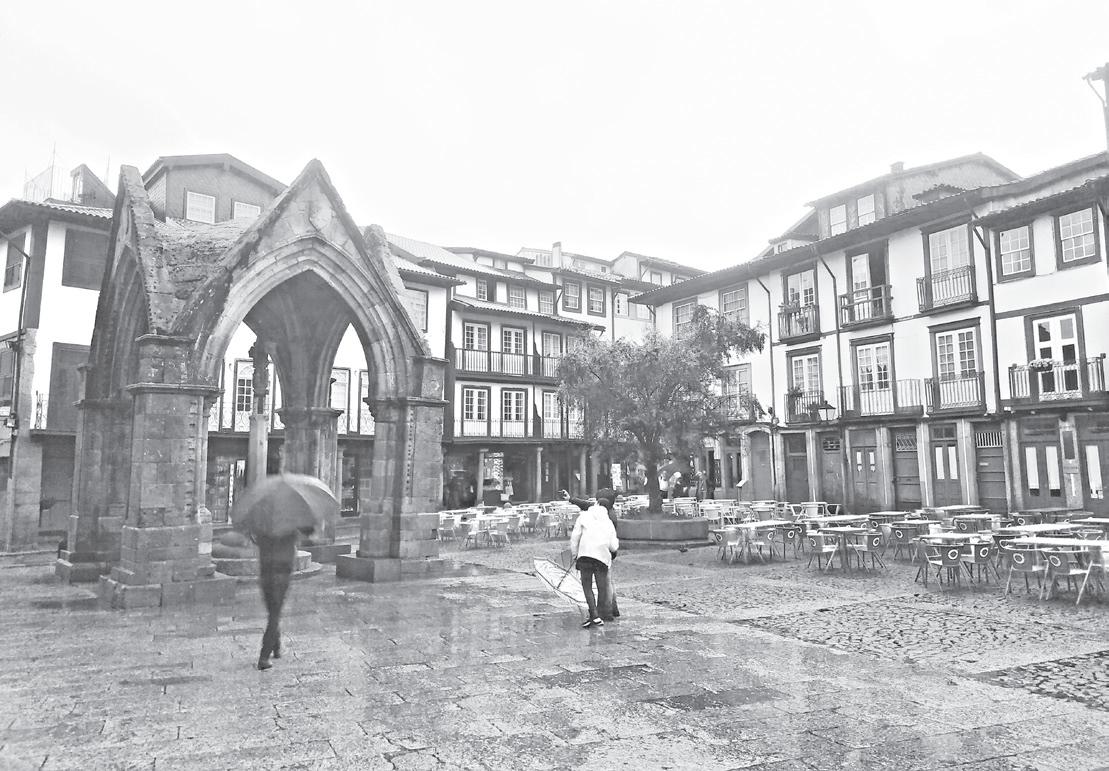


DISCOVER GUIMARÃES AND BRAGA
Prior to departing Sapa, we had Vietnamese coffee at the popular, internet-famous Moana Café. This themed photo zone is known for its scenic and panoramic views, on clear days, and numerous “Instagrammable” themed photo spots like a Bali-inspired Gate of Heaven, a golden hand, an infinity lake, and a Bali swing, with the misty weather sometimes creating a dreamy, magical effect while taking unique pictures against a stunning natural backdrop. Too bad we missed the snow in Sapa as it started exactly a week after our return to Manila.
ing Street (also known as Western Street, it is a cultural hub where locals and tourists can interact, stroll, explore the bustling night market, sample local street food, and relax at a bar), to Bora Hotel where we had dinner before checking in to our rooms. Come morning, after breakfast at the hotel, we again walked along Cau May Walking Street, to the square where we boarded coaches for the 9-kilometer drive to the highlight of our visit to Sapa - the located at the Fansipan Legend tourist area. Each cable car can accommodate 30 to 35 people per cabin and transfer 2,000 passengers between the 2 stations in 1 hour. During our journey, at the height of several thousand meters, we got a 360-degree, bird’s eye view of the picturesque and breathtaking scenery, including the poetic Muong Hoa and the majestic Hoang Lien Son mountain range. The 15-20-minute ride took us to the Fansipan cable car station and, to avoid the steep 600-step climb to the peak, took the 2-minute funicular ride, from Do Quyen Station to Truc May Funicular Station. Upon reaching Fansipan Peak, which is crowned with an iconic triangular steel landmark, we watched the 10:30 AM raising of the Vietnamese flag atop the 25-meter high flagpole, said to be the tallest in Indochina. We also explored the Thanh Van Dac Lo (Heavenly Gate Temple), Enlightenment Path of Thanh Van and the Bich Van Zen Monastery - Lower Pagoda. We also viewed, from afar, the Bohhisattva Avalokitesvara (Great Buddha Amitabha Statue), Grand Belfry (Vong Linh Cao Dai), and Kim Son Bao Thang Pagoda. At the Sun World Fansipan Legend Tourist Area, we had lunch at the Van Sam Restaurant and explored the Bao An Zen Monastery - Trinh Pagoda and the Ban May Cultural Village.
The other sides of Portugal
Berida
THE two most common and well-known destinations in Portugal are Porto and Lisbon. Two of the biggest cities in the country draw tourists from all over the world (myself included). Their historic churches, monuments, and old towns have a distinct aura around them that draws people. However, I ventured to two other places you might want to consider visiting, which are Guimarães and Braga.
In the Beginning there was Guimarães LISBON is the capital of Portugal but the country’s birthplace is Guimarães. The latter doesn’t have the same hustle and bustle and vibe of Lisbon or its importance as a commercial and financial hub. However, the country traces its roots to this quaint and charming medieval town. The founding of Guimarães took place in the 4th century. It became the capital in the 12th century. Portugal’s first king, Afonso I, was a native of Guimarães. He played an important role in shaping the country’s history and secured its independence during his reign. The significance of its historic center earned it a UNESCO World Heritage Site listing. While exploring Guimarães, I didn’t feel its importance. You’ll have to dig deep and research to discover its significance. The time I spent there went by slowly, its winding alleys and quaint historic center were quiet. It might’ve been the season but I didn’t mind this change of pace after exploring Europe’s bigger cities. The Castelo de Guimarães is the most prominent and famous landmark in the city. The Portuguese had it built to fend off the Moors cen -
turies ago. It was also Afonso I’s birthplace and residence. What you’ll see now is only a remnant of its former grandeur. The Largo da Oliveira and Praca de Sao Tiago are two of the loveliest areas in the city. It’s home to many centuries old buildings and churches. It’s a photogenic place to stroll around in. It also has a number of restaurants if you want something to eat or drink. Guimarães isn’t a place with plenty of attractions or things to do. It’s more of an atmospheric and historic destination wherein you soak in the ambiance. Its proximity to both Lisbon and Porto make it a noteworthy addition to your itinerary.
Braga: The Rome of Portugal BRAGA is much like Guimarães in terms of old world charm and history. It’s not usually included in itineraries for Portugal, which made it more appealing to me. As someone who likes to visit historic attractions and UNESCO World Heritage Sites, the main reason I visited Braga was to see the Sanctuary of Bom Jesus do Monte. Fortunately, Bom Jesus do Monte is easy to reach from Braga. It’s a bus ride away from the historic center. The construction and expansion of the church complex spanned 600 years. The elaborate Baroque staircase with its zigzag appearance grabs your attention as soon as you lay your eyes on it. As you explore the premises, you’ll see fountains and statues that depict figures, symbols, and events in Christianity. At the top of the stairs is a centuries old church. The sprawling sanctuary is not just a tourist attraction, but also a place to contemplate and feel at ease in. Braga has Roman roots hence the nickname the “Rome of Portugal.” The Romans called the city Bracara Augusta centuries ago. The Suebi,
Visigoths, and the Moors took the city during ancient times. Braga became an important religious center of Portugal in the 12th century and was the seat of the archbishops of the country. Braga’s Sé or cathedral is a historic building and prominent landmark. It dates to the 11th century and has undergone renovations and reconstructions over the centuries. It is one of the oldest cathedrals in the country. While exploring the historic center, you’ll most likely see the Arco da Porta Nova. It used to be the main entrance, now it’s a historic relic and a reminder of the city’s rich heritage. Like many other tourist destinations, you might want to take a photo with the “Braga” letter with the historic Igreja de Sao Marcos as your background. One of the things I appreciate about visiting big and small cities in Europe is the pedestrian-friendly avenues. One such place in Braga is Avenue da Liberdade. The latter is a main artery of the city where you’ll find shops, restaurants and historic buildings and landmarks. The Palacio do Raio is one of the city’s
Story & photos by Joshua
GUIMARÃES is also known as the birthplace of Portugal.
BOM Jesus do Monte is a UNESCO World Heritage Site.
THE historic Braga Cathedral
Monte has an instantly recognizable zigzag stairway.
CHURCH of Our Lady of the Rosary (Sapa Stone Church)
FANSIPAN Legend Cable Car and the rice terraces of Sapa MOANA Cafe’s Bali-inspired Gate of Heaven
Do Quyen Station with the Great Buddha Amitabha Statue in the background TRINH Pagoda at the Sun World Fansipan Legend Tourist Area
INDOCHINA’S tallest flagpole at Fansipan Peak
A10 Saturday, February 7, 2026
Editor: Angel R. Calso
US and Russia agree to reestablish military dialogue after Ukraine talks
By Kamila Hrabchuk & Emma Burrows The Associated Press
KYIV, Ukraine—The US and Russia agreed Thursday to reestablish high-level military dialogue for the first time in more than four years in another sign of warming relations between the two countries since President Donald Trump returned to office and sought to end the war in Ukraine.
High-level military communication was suspended in late 2021, as tension between Moscow and Washington rose ahead of the fullscale Russian invasion of Ukraine in February 2022. Trump then campaigned for a second term on promises that he would swiftly end the fighting. Many of his proposals for peace have heavily favored the Kremlin, including requiring Ukraine to cede territory to Russia. The restored communication channel “will provide a consistent military-to-military contact as the parties continue to work towards a lasting peace,” the US European Command said in a statement. The agreement emerged from a meeting between senior Russian

and American military officials in the capital of the United Arab Emirates.
US Gen. Alexus Grynkewich, who is the commander in Europe of both US and NATO forces, was in Abu Dhabi, where talks between American, Russian and Ukrainian officials on ending the war entered a second day.
Meanwhile, Moscow escalated its attacks on Ukraine’s power grid in an apparent effort to deny civilians power and to weaken public support for the fight, while hostilities continued along the roughly 1,000-kilometer (600-mile) front line snaking through eastern and southern parts of Ukraine.
An effort to ease tensions THE resumption of the military hotline marks an effort to ease tensions that soared after the start of the war and to avoid collisions between Russian and US forces.
In one such incident in March 2023, the American military said it ditched an Air Force MQ-9 Reaper drone in the Black Sea after a pair

of Russian fighter jets dumped fuel on it, and then one of them struck its propeller while flying in international airspace.
Moscow has denied that its warplanes hit the drone, alleging that it crashed while making a sharp maneuver. The Kremlin said its
American surveillance flights helped gather intelligence that allowed Ukraine to strike Russian targets.
NATO members have been increasingly worried about intrusions into allied airspace. Some European officials described the incidents as Moscow testing NATO’s response.
aircraft reacted to a violation of a no-fly zone Russia has established in the area near Crimea.
Moscow has repeatedly voiced concern about intelligence flights by the US and other NATO aircraft over the Black Sea, and some Russian officials charged that the
In September, a swarm of Russian drones flew into Poland’s airspace, prompting NATO aircraft to scramble to intercept them and shoot down some of the devices. It was the first direct encounter between NATO and Moscow since the fullscale invasion. Later that month, NATO jets escorted three Russian warplanes out of Estonia’s airspace. Russia, Ukraine exchange prisoners following talks THE delegations from Moscow and Kyiv were joined Thursday in Abu Dhabi by US special envoy Steve Witkoff and Trump’s sonin-law Jared Kushner, according
POLAND’S Prime Minister Donald Tusk, right, and Ukrainian President Volodymyr Zelenskyy
attend a commemorative ceremony at the Memorial Wall of Fallen Defenders of Ukraine in Kyiv, Ukraine, Thursday, Feb. 5, 2026. AP/EFREM LUKATSKY
Panama will not be threatened by China over canal court ruling, president says
PANAMA CITY—Panamanian
President José Raúl Mulino on Thursday said he hoped an ongoing legal battle with a Hong Kong firm over operations of Panama Canal ports would “not escalate,” but that Panama’s government would remain firm in its ruling against the company.
“Panama is a dignified country and will not allow itself to be threatened by any country on earth,” Mulino said in his morning press briefing, responding to re -
bukes by the Chinese government. Mulino’s comment comes a week after Panama’s Supreme Court ruled that a concession held by a subsidiary of Hong Kong’s CK


Hutchison Holdings in the Panama Canal was unconstitutional.
The court’s decision was seen as a win for President Donald Trump, who aims to block Chinese influence over the strategic waterway. The push by the US thrust the Central American nation into the center of a geopolitical tug-of-war.
China warned Panama would pay “a heavy price” if the Panamanian ruling was upheld.
Hong Kong’s CK Hutchison Holdings said it strongly disagreed with last week’s ruling, and on Wednesday its subsidiary announced it had started arbitration proceedings against Panama.
Mulino said that until the court’s ruling is executed—a period of time he did not specify— Panama’s Maritime Authority

would work with Panama Ports Company, the CK Hutchison subsidiary, to ensure continuing port

operations.
Once the concession is formally ended, a local subsidiary
of Danish logistics company A.P. Moller-Maersk will operate the ports in a transitional phase until a new concession can be bid and awarded, Mulino said.
The two Panama ports are part of a $23 billion sale of CK Hutchison’s 43 global ports to a consortium of buyers including US investment firm BlackRock. The deal, which was first announced last March, has been delayed by complications surrounding the Panama court case as well as elevated geopolitical tensions between Washington and Beijing. Analysts believe the Hong Kong conglomerate is likely to buy time with legal proceedings, such as the latest arbitration move, while looking for alternatives for the broader port deal. AP


A CARGO ship sails past the Panama Canal’s Port of Balboa, managed by CK Hutchison Holdings, in Panama City, March 13, 2025. AP/MATIAS DELACROIX
Cubans rendered powerless as outages persist and tensions with US escalate
By Dánica Coto The Associated Press

SANTA CRUZ DEL NORTE,
Cuba—The smell of sulfur
hits hard in this coastal town that produces petroleum and is home to one of Cuba’s largest thermoelectric plants. Yet, even as the plant cranks back to life, residents remain in the dark, surrounded by energy sources they cannot use.
As tensions deepen between Cuba and the US after it attacked Venezuela and disrupted oil shipments, so have the woes of Santa Cruz del Norte.
People in this town east of Havana are plunged into darkness daily and forced to cook with coal and firewood, but not everyone can afford this new reality.
Kenia Montoya said she recently ripped the wooden door off her bathroom in the crumbling cinderblock home that she shares with her children because she needed firewood, and they needed to eat.
“Things are getting worse for us now,” she said. “They don’t supply us with petroleum. They don’t supply us with food. Where does that leave us, then?”
A faded purple sheet now hangs over their bathroom. Nearby, only a handful of coal remains in a small bag.
The 50-year-old mother doesn’t know how she’ll cook once the coal runs out because supplies in the region have dwindled.
It’s one of many uncertainties gripping towns like this one across Cuba after US President Donald
Trump threatened to impose tariffs on any country that sells or provides oil to Cuba.
“Well, it’s a failed nation now,” Trump said this week. “And they’re not getting any money from Venezuela, and they’re not getting any money from anywhere.”
‘How are we going to live?’
NEAR the main entrance to Santa Cruz del Norte, a sprawling mural is emblazoned with the following message in all caps: “NO ONE GIVES UP HERE. LONG LIVE A FREE CUBA.”
But people wonder how long they can hold out.
The island’s crisis is deepening: severe blackouts, soaring prices and a shortage of basic goods.
Meanwhile, the Cuban government remains mum over its oil reserves, offering no word on whether Russia or anyone else would increase their shipments after oil supplies from Venezuela were disrupted when the US attacked and arrested its president.
On Thursday, Cuban President Miguel Díaz-Canel described the situation as “complex” as he called the US stance “aggressive and criminal,” saying it’s affecting things like transportation, hospitals, schools, tourism and the production of food.
He said that in a week, he would provide details about how Cuba will deal with the crisis.
Cuban officials recently lauded a phone call they had with Russian Foreign Minister Sergey Lavrov, although they did not share details. Meanwhile, Mexico has pledged to send humanitarian aid, including
food, after Trump said he asked that it suspend oil shipments to the island.
Many in Santa Cruz del Norte feel the worst is yet to come.
“With all those tariffs they’re going to impose on countries, no oil will come in, and how are we going to live?” said Gladys Delgado.
The 67-year-old had cracked open her front door on a recent chilly afternoon to get some fresh air as she sewed small, colorful rugs made of clothing scraps to make extra cash because her pension is only $6 a month.
A couple of houses down, Minorkys Hoyos dropped a handful of cassava cubes into an old pot she filled with water from a barrel and placed it over a tiny, makeshift grill inside her home.
“You live with what you have,” she said, noting she had no other food available at that moment.
The few rechargeable items that used to light her small, disheveled home have broken down, and she began to bump into things until a neighbor gifted her an improvised lantern made with fuel and a reused baby food jar.
“When it’s dark, I don’t see,” said the 53-year-old diabetic. It was late afternoon as she cooked, but her home was already dark.
Outside, two children sat on a dusty sidewalk. They stacked dominoes one atop the other to see how high they could go before the whole thing tumbled down.
‘If only we could do something’ FOR the past three months, Santa
Cruz del Norte had electricity while most of Cuba was hit with constant outages stemming from aging infrastructure and fuel shortages at power plants.
People like Iván Amores were wary of rejoicing, fearful they would be plunged into the dark again like most of last year. Their fears materialized a week ago, when the outages hit again.
“This used to be wonderful,” he recalled of his town when it had electricity. “Now, it’s truly torture.”
He uses a tiny, makeshift barbecue pit to cook for himself, his daughter and young granddaughter, buying pricier coal at $3 a bag because it generates less smoke inside their tidy home.
Amores also invested in a single tube light that a Cuban man in another town builds and sells; it can be charged and even comes with a USB port.
But even those kind of brilliant inventions Cubans are known for are out of reach for people like 67-year-old Mariela Viel; she and her husband still cannot afford to add a bathroom to their cinderblock home with a dirt floor.
Growing up, Viel said she never knew what a blackout was: “We were living well. We had food, money.”
She worked more than 40 years at the cafeteria of Cuba’s power company and now receives $8 a month in pension.
“What can I afford? Nothing. Not even a package of chicken,” she said.


an adjacent creek overflowed, spilling floodwaters onto Runway 07/25.
The closure is currently expected to remain in effect until 4:00 PM on Saturday, February 7.
Impact on Travelers
The flooding has already disrupted regional air travel. According to CAAP, two Cebu Pacific flights have been cancelled as a result of the closure:
n DG6695
n DG6696
A total of 67 passengers are reported to be affected by these cancellations.
Safety and coordination
AIRPORT authorities are closely monitoring the water levels as the storm continues to affect the region. In a statement released from its Pasay City headquarters, CAAP emphasized that the closure is a necessary precaution to ensure the safety of all flight operations. “CAAP urges passengers to coordinate with their respective airlines for updates on flight schedules and to prioritize safety in their travel plans.”
Travelers scheduled to fly in or out of Camiguin over the next 24 hours were advised to check their flight status online before heading to the airport. With Rex Anthony Naval & Nonie Reyes
health products were flagged for further review due to registration, labeling, or documentation concerns.
No to orphanages, protect seniors: PHL sets Asean People Agenda
By Malou Talosig-Bartolome
THE Philippines will place people-centered initiatives at the heart of its Asean chairmanship this year, with a strong push for family-based care systems for children and enhanced protection for senior citizens.
Foreign Affairs Secretary Ma. Theresa Lazaro, chair of the Asean ministerial meeting in 2026, said Manila’s sociocultural agenda will emphasize “people empowerment” alongside prosperity corridors, ensuring that Asean’s growth trajectory benefits its more than 670 million citizens.
orphanages to family-based care: Poverty and Family Separation: In Cambodia, Indonesia, Myanmar, and Vietnam, many children enter orphanages not because they are true orphans, but due to poverty-driven separations. Families often rely on institutional aid for food, healthcare, and schooling, while foster care struggles to compete against immediate survival needs.
branded, expired, or otherwise non-compliant products will face swift and decisive regulatory action, including seizure of products, suspension or closure of operations, formal prosecution, and the full penalties provided under the law.”
He added, “the FDA will actively monitor compliance across all retailers, large or small, local or national, and will not hesitate to take strong action against any establishment that endangers public health. Compliance is mandatory, and failure to follow the law will have immediate consequences.”
Based on the nationwide verification visits, about 500 consumer
“The next chapters will be written by the innovative young people who are already building on our shared legacy. We are confident that—as steadfast friends, partners in prosperity, and ironclad Allies—we will rise to even greater heights together for generations to come.”
“Tonight, as we launch the official logo for the 80th anniversary of Philippines-U.S. diplomatic relations, we are not simply unveiling a design. We are unveiling a story— eight decades of shared struggles, shared values, and shared aspirations. This logo represents a living partnership that has evolved with time and has grown, adapted, and deepened,” Romualdez for his part said. “What makes the PhilippinesUnited States relationship truly special is that it is not only anchored in treaties and institutions. It is anchored in people. In many ways, we are not just allies—we are family,” he added.
The United States and the Philippines established diplomatic relations on July 4, 1946.
Historic people-to-people ties are the bedrock of the U.S.-Philippines relationship. Around 375,000 Americans call the Philippines home while more than 4.6 million Filipinos and Filipino-Americans live, work, and study across the United States.
The economic partnership continues to deliver results for Americans and Filipinos. Through US investments and foreign assistance, the United States
raised the alarm on these six scammer profiles, explained: “These scams focus on specific profiles: adults seeking foreign partners, financially stable professionals, women pressured to marry, men struggling with rejection, and solo parents looking for companionship, showing that scammers are exploiting
Once verified to either be unregistered or non-compliant, the products will be subject to the appropriate regulatory action, such as inventory and seizure, as may be warranted.
The FDA encourages consumers to buy only FDA-registered products, verify items through the FDA Verification Portal, and promptly report suspicious products through official FDA channels.
The agency said it remains committed to safeguarding public health through consistent field presence, strong enforcement, and transparent regulation nationwide.
and the Philippines promote mutual prosperity by bolstering energy security, securing critical supply chains, driving private investment in the Luzon Economic Corridor, and addressing public health challenges.
This year also commemorates the 75th anniversary of the US-Philippine Alliance through the signing of the Mutual Defense Treaty. The Philippines is the United States’ oldest security treaty ally in the Indo-Pacific. Through large-scale exercises, joint disaster response operations, and a shared commitment to supporting freedoms of navigation and overflight, free trade and unimpeded commerce, and freedoms of economic opportunity for South China Sea littoral nations, US and Philippine forces work together to address shared challenges in the region.
“Eighty years of shared commitment to security, including 75 years as Allies, has enabled our countries to achieve peace through deterrence, protect our citizens, and advance an open, prosperous, and secure IndoPacific, including in the South China Sea,” Chargé d’Affaires Ewing added. In 2026, the United States also celebrates the 250th anniversary of US independence. Under the Freedom 250 campaign, the US Embassy in the Philippines is organizing a series of programs to showcase the values of freedom, democracy, and innovation—values that underscore the US-Philippines relationship.
The launch of the commemorative logo of the 80th anniversary of US-Philippine diplomatic relations was made possible with the partnership of SM Supermalls.
vulnerability, not ignorance,” de Guzman said.
CICC Acting Executive Director Renato Paraiso said scammers now use AI-generated photos and fabricated identities to create realistic online personas, while scripted and automated conversations allow them to communicate with multiple victims simultaneously in a consistent, emotionally calculated manner.
“These schemes are no longer isolated incidents but coordinated
Foster families over orphanages A FLAGSHIP proposal is the Asean-wide adoption of foster families as the primary care system for vulnerable children, moving away from reliance on orphanages.
Lazaro said the Philippines will advocate for the Asean Declaration on Strengthening Alternative Family-Based Care Systems. Studies consistently show that children in family-based care—such as foster or kinship households—develop stronger emotional bonds, better cognitive outcomes, and healthier long-term well-being than those raised in institutional orphanages.
Yet Southeast Asia faces significant challenges in shifting from
Military dialogue. . .
Continued from A10
to Rustem Umerov, Ukraine’s National Security and Defense Council chief, who was present at the meeting.
They were also at last month’s talks in the same place as the Trump administration tries to steer Russia and Ukraine toward a settlement.
Officials have provided no information about any progress in the discussions.
Following the talks on Thursday, however, Russia and Ukraine said they carried out a prisoner exchange.
The Russian Defense Ministry said it brought 157 Russian servicemen back from Ukrainian captivity, as well as three Russian nationals captured during Kyiv’s incursion into Russia’s Kursk region. Ukrainian officials said 150 Ukrainian servicemen and seven civilians returned from Russian captivity.
The Russian Defense Ministry said the released Russian soldiers are currently in Belarus, getting medical assistance, before being taken back to Russia “for treatment and rehabilitation.”
Ukrainian human rights ombudsman Dmytro Lubinets said that among the 150 service members who returned from Russian captivity, 18 were “illegally sentenced by Russia.” He said that “overall, those released are in a difficult psychological condition, and some are critically underweight.”
operations designed to emotionally groom victims before exploiting them financially,” Paraiso said. Some operations employ AIassisted or staged video calls to simulate real interaction and deepen trust, even if the person on screen is not who they claim to be.
Behind the scenes, organized scam hubs rotate faces and identities among operators, ensuring the scam continues even if one persona is exposed.
Weak Alternatives and Missing Records: Foster and kinship care are still far less developed than the orphanages run by governments and NGOs. Efforts to improve the system are slowed by poor information, and in places like Cambodia, Indonesia, and Myanmar, missing birth records make it harder to track children and place them with families.
Cultural and Migration Pressures: Longstanding preferences for orphanages, dependence on volunteer funding, and the impact of migration leave millions of children in “leftbehind” situations. Relatives caring for them face heavy burdens, while child labor, trafficking, and weak support for care leavers add to the strain on familybased systems.
By pushing for Asean-wide adoption of foster care, the Philippines aims to promote de-institutionalization, improve caregiving standards, and strengthen
Zelenskyy says 55,000 Ukrainian troops killed in the war UKRAINIAN President Volodymyr Zelenskyy said 55,000 Ukrainian troops have died since Russia’s invasion. “And there is a large number of people whom Ukraine considers missing,” he added in an interview broadcast late Wednesday by French TV channel France 2.
The last time Zelenskyy gave a figure for battlefield deaths, in early 2025, he said 46,000 Ukrainian troops had been killed.
Zelenskyy has repeatedly said his country needs security guarantees from the US and Europe to deter any postwar Russian attacks.
Ukrainians must feel that there is genuine progress toward peace and “not toward a scenario in which the Russians exploit everything to their advantage and continue their strikes,” Zelenskyy said on social media late Wednesday.
Last year saw a 31% increase in Ukrainian civilian casualties compared with 2024, the advocacy group Human Rights Watch said in a report published Wednesday.
Almost 15,000 Ukrainian civilians have been killed and just over 40,000 wounded since the start of the war through last December, according to the United Nations Human Rights Monitoring Mission in Ukraine.
In other developments: RUSSIAN troops have lost access to their Starlink satellite Internet terminals on the front line, Ukrainian Economic Minister
Those most vulnerable include “AFAM Forever”—adults aged 31 and above who use dating apps to seek long-term relationships with foreign partners—and “Azukal de Tito,” men aged 35 and above with stable careers and aspirational online lifestyles who are discreetly drawn into paid encounters that escalate into financial manipulation.
Also at risk are “D2M [Dateto-Marry],” single women in their mid-30s to early 40s who openly
social welfare systems that enable children to grow in nurturing environments.
Protecting senior citizens
THE Philippines will also champion the “Silver Economy,” a framework that leverages the capacities of older persons while ensuring age-friendly environments across the region. Lazaro said Asean must prepare for demographic shifts by protecting senior citizens and enabling them to remain active contributors to society.
Asean’s elderly population— currently about 56 million people aged 65 and above, or 8.1 percent of the bloc’s population—is projected to more than double to nearly 129 million by 2050. Within the next decade, Thailand is expected to have the oldest population in Asean, followed closely by Singapore and Vietnam. Indonesia, with its vast population, will have the largest absolute number of elderly.
Policies under the Silver Economy framework include promoting healthcare innovations, age-inclusive workplaces, and community systems that safeguard the dignity and well-being of older persons.
People-centered vision
TO advance these priorities, the Department of Social Welfare and Development (DSWD) will chair
Mykhailo Fedorov said Thursday, after Ukraine asked Elon Musk’s SpaceX to help deny Russia use of the service in Ukraine.
Russian forces have consequently lost command-and-control capabilities and navigation for drones, and assaults have stopped in many sectors, according to Fedorov’s adviser Serhii Beskrestnov. Russian officials made no immediate comment.
Ukraine is registering its civilian and military Starlink users on a database, allowing approved devices to function while unregistered terminals are disabled inside Ukraine.
Also, Polish Prime Minister Donald Tusk said during a visit to Kyiv that he agreed with Zelenskyy to develop the joint production of ammunition at plants in their countries.
Zelenskyy said Poland plans to increase supplies to Ukraine of liquefied natural gas, and the countries are exploring an exchange of weaponry, with Kyiv possibly receiving Polish MiG fighter jets and Warsaw receiving Ukrainian drones.
Russia fired 183 drones and two ballistic missiles at Ukraine overnight, according to the Ukrainian air force. Three people were injured, officials said.
The Russian Defense Ministry said its air defenses downed 95 Ukrainian drones overnight over several regions, the Azov Sea and Crimea, which Russia illegally annexed in 2014.
Burrows reported from London.
indicate marriage intent on their profiles, often under family or social pressure, and “WAFU,” men aged 31 and above who have experienced repeated rejection and struggle with self-confidence. Solo parents—widowed or separated individuals in their mid40s and above whose children are already independent and who are open to finding companionship— are also targeted.
Scam Watch Pilipinas and CICC urged the public to report cyber -
this year’s Asean Socio-Cultural Community (ASCC) Council.
DSWD Secretary Rex Gatchalian will host the ASCC Council Meeting on March 3–6 in Makati City, where he will confer with Asean counterparts on these people-centered initiatives.
Other Philippine initiatives under the socio-economic pillar of Asean include:
Family resilience and social protection: High-level meeting to combat hunger, protect vulnerable families, and strengthen welfare systems.
Education and learning: Asean Leaders’ Declaration on foundational learning to improve literacy, numeracy, and socio-emotional outcomes.
Youth empowerment: Leaders’ statement on youth development, climate action, and disaster resilience.
Climate and resilience: Asean Joint Statement on Climate Change to COP31, Asean Youth Statement on Biodiversity Conservation, Asean Climate Change Strategy and Action Plan, and Asean disaster resilience platform.
“We would like to build a people-oriented, people-centered Asean that is sustainable and resilient, driven by people empowerment,” Lazaro said during a forum hosted by ISEAS–Yusof Ishak Institute in Singapore.
When there’s power, she cooks rice and beans and listens to her favorite music: Cuban big bands.
Viel sat outside one recent afternoon, watching a couple neighbors walk briskly with buckets of warmed up water so their families could take showers during a cold snap that began in late January, with a record low of 32 degrees (0 degrees) recorded in a town southeast of Santa Cruz del Norte.
Celebrations also start earlier now, with one family organizing a boy’s 15th birthday—a milestone age across Latin America—midafternoon before he and his friends opted to finish partying outdoors under a big yellow moon. It glowed on a group of people nearby who danced and sang outside next to a scooter blasting music from its speakers to celebrate the birthday of Olga Lilia Laurenti, now 61.
“I’m telling you, whatever’s meant to be, let it be, because we can’t stop it,” she said as she paused dancing.
“You’re not going to waste part of your life on something that’s out of your control. If only we could do something, but what are we going to do? We can’t suffer. You need laughter, you need joy.”
crime-related incidents through the National Anti-Scam Hotline 1326, emphasizing that reports contribute to actionable intelligence for investigation and enforcement. The launch was held together with partner organizations including the Philippine National Police Anti-Cybercrime Group, Gogolook (developer of anti-scam app Whoscall), GCash, Meta, and Truth360. Butch Fernandez, with earlier report by Lorenz Marasigan
A14 Saturday, February 7, 2026
Huang tops PHL Ladies Masters
CHING HUANG closed with a 66 to win the International Container Terminal Services Inc.
Philippine Ladies Masters by four strokes on Friday at Summit Point Golf Club in Lipa City, Batangas.
Tied for second with Yeonseo Hwang at the start of the final round, one stroke behind Jeonghyeon Kang, Huang wasted little time asserting control. She came out firing, unleashing a stunning four-birdie blitz in the opening five holes. Huang finished with a commanding 11-under-par 205 total over 54 holes to claim the $30,000 top prize, evoking memories of her four-shot victory at the 2018 ICTSI Champion Tour at Tagaytay Midlands, another event defined by relentless winds and demanding setups.
“I’m really happy because I didn’t expect to win here again,” the 30-year-old Huang said after securing her fifth career title and first since 2018. “I just did my best in the first round and told myself that if I could sustain my game, I had a chance to become champion. Everything just clicked. With so many strong players in the field, I knew I had to play well to win.”
After a steady opening-round 70, Huang fired a 69 to move into contention before delivering the decisive blow with her explosive final round.
Kang and Hwang mounted one final charge with birdies on the par-5 14th to close within three, but Huang responded decisively, carding a birdie of her own on the next hole to extinguish any lingering hopes the Koreans carried into the closing stretch.
She punctuated her romp with another birdie on the 17th, matching the tournament-best six-under card
posted by Yunseo Lee in the first round.
“I was nervous,” said Huang. “I just focused on keeping my tempo, taking it one shot at a time, and trying to match how I played in the second round.”
Jeonghyeon Kang birdied the final two holes to salvage a 71 and finish second at 209, while Jisun Kang charged back with a 69 to tie Lee (70) and Hwang (71) for third at 210.
Daniella Uy matched par-72 to finish as the best Filipina performer, placing joint 12th at 216.
Chanelle Avaricio fought back with a 69 to tie for 24th at 219, while Princess Superal carded a 72 for joint 34th at 221.
Pauline del Rosario shot a 73, Mafy Singson had a 76 and Sarah Ababa submitted a 77 to tie for 37th with 222 totals.
Birdie on the ninth capped a flawless frontside 31, extending Huang’s lead as Kang could only manage an even-par card with two birdies against two bogeys, while Hwang also settled for a 36. From there, the back nine became less a battleground and more a coronation walk for the 33-year-old Huang.
Jahns, Ko tied for ninth; five other Pinoys through
TRAVIS SMYTH and three others share the lead after two rounds of the Philippine Golf Championship as Keanu-Jahns, Brycen Ko and five other Filipinos march on to the weekend play of the Asian Tour’s opening event at Wack Wack Golf and Country Club.
The 31-year-old Smyth, from Australia, fired an eagle-aided 69 in the second round on Friday for a fiveunder 139 total, which was matched by Koreans Jeunghun Wang and Wooyong Cho and overnight leader Sarut Vongchaisit of Thailand.
Ian Snyman of South African fired a 68 for a four-under 140 total and a share of fifth spot with Marcus Plunkett of the US, who shot a second straight 70. Jahns shot another 71, while Ko joined him in ninth spot after a 70 in the tournament backed by the Philippine Sports Commission. Also at 142 were Thailand’s Suteepat
THE Macau Black Bears Sports Club are taking part in the Philippine Basketball Association Commissioner’s Cup. Americans Damian Chongqui, Omari Peek-Green and Phoenix Shackelford are in the current roster. PBA officials and management of the Macau-based ballclub formally signed a Memorandum of Agreement making the Black Bears as the special guest team in the mid-season conference set to kick off on March 11. The contract signing was held in Macau on Friday with PBA Board Vice Chairman Alfrancis Chua and Commissioner Willie Marcial personally meeting the top brass of the Black Bears.
Prateeptienchai, who shot a 68, and Germany’s Marc Hammer, who had a 70. Carl Corpus, a winner on the Asian Development Tour, was in a big group at 18th spot including Fidel Concepcion.
The 23-year-old Corpus fired a 71 for a 144 total, the same as Concepcion’s after a 73. Rupert Zaragosa carded a 71, while Jhonnel Ababa submitted a 74 for a share of 42nd spot at two-over 146. Enrique Dimayuga was tied for 65th at 148 after a 72.
Former Philippine Open champions Clyde Mondilla and Angelo Que missed the cut by one.
Mondilla added a 72 to his opening 77, while had rounds of 77-72. Also ending up at 149 was amateur Rolando Bregente, a member of the Philippine Team to the Southeast Asian Games last year, who shot a second-round 75.
Zanieboy Gialon had a 74 and Mars Pucay shot a 76, both ending up at six-over 150.
Antonio Lascuna was at seven over after a 75.
Japan Tour player Justin de los Santos and ADT winner Aidric Chan shot 77s and wound up at eight over along with Justin Quiban (78), Gabriel Manotoc (75) and James Ryan Lam (75).
Smyth eagled the par-5 No. 14, hit three birdies and had two bogeys. Wang and Cho carded 70s as Vongchaisit shot a 71.
Aldrin Quinto


47) and Hong Kong Eastern (Season 48). Marcial said the same concessions given to Bay Area and Hong Kong
XLED and Capital One look to get a win run going when they clash on Saturday in the the Premier Volleyball League AllFilipino Conference at Ynares Center in Montalban, Rizal. The Chalemeons survived a five-set showdown with Farm Fresh and hope to get a more convincing win. Loaded with championship pedigree from the Petro Gazz pipeline, Nxled showed flashes of dominance behind Brooke Van Sickle, Myla Pablo and MJ Phillips, but also revealed vulnerabilities in rhythm, rotation and closing instincts.

Eastern will be applied to Macau.
The Black Bears previously campaigned in the defunct Asean Basketball League and currently play in the East Asia Super League.
Garrett Kelly serves as coach of Macau.
The narrow escape underscored the challenge of blending elite talent into a cohesive unit.
The Solar Spikers are coming off a four-set win over the Zus Coffee Thunderbelles and will also look to join early leader Cignal.
Rookie standout Bella Belen took over in the fourth set to silence the Thunderbelles.
With new recruits Shaya Adorador, Ysa Jimenez and Pauline Gaston, the Solar Spikers suddenly look battle-ready. On paper, Nxled’s depth and firepower give it the edge. But on court, the margins appear thinner. Capital1’s ability to extend rallies,


Obiena cautiously optimistic as Asian tourney gets going
By Josef Ramos
RNEST JOHN “EJ” OBIENA arrived in Tianjin on Wednesday for the 12th Asian Indoor Athletics Championships aware that he has a target on his back as the continent’s best male pole vaulter. “They are improving all the time, that’s why I can’t be complacent,” Obiena told BusinessMirror shortly after arriving in the Chinese port
Şeif Abdelsalam Heneida (5.75). If Obiena wins gold, it would be his first Asian indoor title after having won golds in outdoor competitions, including at the Hangzhou 2023 Asian Games. He opened the indoor season with various results—bronze at the ISTAF Indoor in Düsseldorf at 5.50m and a tie for the gold at 5.77m with Dutch Menno Vloon at the International Springer-Meeting in Cottbus, both in Germany, last January. He settled for fifth at the Perch’Xtrem with a 5.75m efffort at the Palais des Sports Caen la Mer in France last week. Down from a high world No. 2 to No. 11, Obiena’s event starts at 5:30 p.m. Saturday at the Tuanbo Sports Centre Athletic Arena. The Philippines’ Hussein Loraña, meanwhile, clocked one minute and 50.74 seconds for a third-place finish in one of the 800 meters heats on Thursday and failed to advance—only the two from each of the heats go further into the meet.

Tchallenge the Chameleons’
HE big guns hit the ground running for Philippine sports in 2026. World 10-ball titlist Carlo Biado played true to form in the
EJ Obiena
and
in Germany for a
to the
Billiards Hall of Famer Biado extended his dominance in the Asian 10-Ball Pool Championships in Jakarta, capping his golden run with an 11-7 victory over Hong Kong’s Robbie Capito in the finals. Two-time Olympian Obiena clinched his first triumph of the season, posting a season-best
CARLO BIADO delivers again for the Philippines. NONIE REYES
OBIENA
CHING HUANG ends a long title drought, capped by a celebratory water bath. NONIE REYES