media partner of the year
United nations
2015 environmental Media Award leadership award 2008
BusinessMirror A broader look at today’s business
www.businessmirror.com.ph
n
Friday, December 30, 2016 Vol. 12 No. 79
2016 ejap journalism awards
business news source of the year
P25.00 nationwide | 2 sections 12 pages | 7 days a week
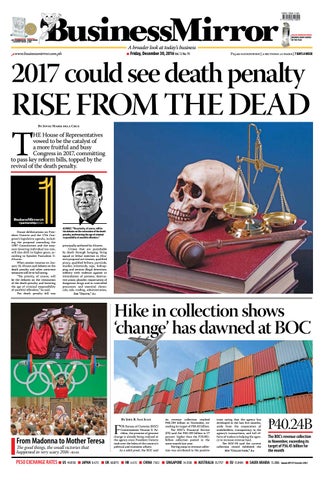
2017 could see death penalty
rise from the dead
T
By Jovee Marie dela Cruz
he House of Representatives vowed to be the catalyst of a more fruitful and busy Congress in 2017, committing to pass key reform bills, topped by the revival of the death penalty.
House deliberations on President Duterte and the 17th Congress’s legislative agenda, including the proposal amending the 1987 Constitution and the measure lowering individual tax rate, will also shift to higher gears, according to Speaker Pantaleon D. Alvarez. When session resumes on January 16, Alvarez said debates on the death penalty and other anticrime measures will be in full swing. “The priority, of course, will be the debates on the restoration of the death penalty, and lowering the age of criminal responsibility of youthful offenders,” he said. The death penalty bill was
ALVAREZ: “The priority, of course, will be the debates on the restoration of the death penalty, and lowering the age of criminal responsibility of youthful offenders.”
principally authored by Alvarez. Crimes that are punishable by death through hanging, firing squad or lethal injection in Alvarez’s proposal are treason, qualified piracy, qualified bribery, parricide, murder, infanticide, rape, kidnapping and serious illegal detention; robbery with violence against or intimidation of persons; destructive arson; plunder; importation of dangerous drugs and or controlled precursors and essential chemicals; sale, trading, administration, See “Death,” A2
Hike in collection shows ‘change’ has dawned at BOC
From Madonna to Mother Teresa The good things, the small victories that happened in very scary 2016 »B2-B3
PESO exchange rates n US 49.8130
F
By Joel R. San Juan
OR Bureau of Customs (BOC) Commissioner Nicanor E. Faeldon, the promise of genuine change is already being realized at the agency since President Duterte took over the helm of the country’s political and economic affairs. As a solid proof, the BOC said
its revenue collection reached P40.239 billion in November, exceeding its target of P36.45 billion. The BOC’s Financial Service (FS) said the P40.239 billion is 27 percent higher than the P29.061billion collection posted in the same month last year. The big jump in revenue collection was attributed to the positive
trust rating that the agency has developed in the last five months, aside from the cooperation of stakeholders, transparency in the agency’s transactions, and full efforts of traders in helping the agency to increase revenue haul. The BOC-FS said the current collection record exhibited the See “Collection,” A2
₧40.24B The BOC’s revenue collection in November, exceeding its target of P36.45 billion for the month
n japan 0.4251 n UK 60.8715 n HK 6.4212 n CHINA 7.1612 n singapore 34.3538 n australia 35.7757 n EU 51.8404 n SAUDI arabia 13.2806
Source: BSP (29 December 2016 )
A2
News
BusinessMirror
Friday, December 30, 2016
www.businessmirror.com.ph
Rizal’s felicitous 2017 could see death penalty vision of our future as a nation rise from the dead continued from A1
oday we are commemorating the 120th anniversary of the martyrdom of our national hero, Dr. Jose Rizal. In the early morning of December 30, 1896, after the Spanish military court found him guilty of conspiracy, sedition and rebellion, he took the firing squad’s bullets and dropped dead face up in Bagumbayan. Paeans to his heroism will not bring him back to life. We will do Rizal more honor remembering not only how he died, but how he lived.
dispensation, delivery, distribution and transportation of dangerous drugs and or controlled precursors and essential chemicals; and maintenance of drug den. Also punishable by death are the manufacture of dangerous drugs and or controlled precursor and essential chemicals; possession of dangerous drugs; cultivation or culture of plants classified as dangerous drugs; unlawful prescription of dangerous drugs; criminal liability of public officer for misappropriation; misapplication or failure to account for the confiscated, seized or surrendered drugs; criminal liability for planting evidence; and carnapping. The leadership of the lower chamber filed the bill to reinstate death penalty pursuant to President Duterte’s campaign promise of reimposing capital punishment for heinous crimes. But Alvarez said the lower chamber may change the scope of the death penalty bill, as they may focus only on illegal drugs-related crimes. “Our criminal justice system has had to make do with penal laws that are perceived to be less than dissuasive. There is evidently a need to reinvigorate the war against criminality by reviving a proven deterrent coupled by its consistent, persistent and determined implementation, and this need is as compelling and critical as any,” Alvarez added. But Bayan Muna Rep. Carlos Isagani T. Zarate, an ally of the President, vowed to block the passage of the bill at the plenary level. “It is a myth that with the death penalty, there would be no extrajudicial killings. In fact, they will continue until the same exploitative and corrupt justice system exists,” Zarate said. Liberal Party Rep. Kaka J. Bag-ao of Dinagat Islands also said the government cannot solve old problems using old solutions that it already rejected in the past. “The death penalty law already had its time in the Philippines when it was imposed for 12 long years since 1994. And this very same Congress had enough of it when it was abolished in 2006, since it was clear that it was not an effective deterrent to crime,” she said. Meanwhile, the bill seeking to lower the minimum age of criminal
T
In his most prescient essay, The Philippines A Century Hence, written in 1889 and in his December 15, 1896, memorandum for use by his counsel, Rizal made the following predictions: One, “the Philippines will one day declare herself independent”; two, “the great American Republic with interests in the Pacific...may one day think of acquiring possessions beyond the seas”; three, “the Philippines will defend with indescribable ardor the liberty she bought at the cost of so much blood and sacrifice”; four, “Japan will swallow us”; five, “[once liberated] the Philippines will, perhaps, establish a federal republic”; and six, “[the Philippines] will, perhaps, enter openly the wide road of progress and will work jointly to strengthen the Mother Country at home, as well as abroad…” All but two of his predictions had come to pass. Now Malacanang is vigorously pursuing federalism while Congress, as a constituent assembly, is poised to take it up. One wonders: Could Rizal’s felicitous last vision for the country been playing out in his mind even before he put it in writing? For sure, he attempted to give it teeth when he launched La Liga Filipina on July 2, 1892, seven days after returning from Hong Kong. The mutual aid society sought to unite the archipelago into a homogenous body, whose members were bound by a shared responsibility to defend it against injustice and promote the common good through education, agriculture and commerce, and the pursuit of sociopolitical reforms. Sadly, La Liga was short-lived. On July 6, 1892, Rizal was arrested for smuggling subversive antifriar leaflets into Manila. Without a trial, the Spanish authorities banished him to Dapitan on July 15, 1892. In Dapitan Rizal had no friends, no position of influence, no money. And the town was backwater poor. Despite these obstacles, he would transform Dapitan into a maquette for his ideal society. Lady Luck was on the hero’s side. His host, Dapitan governor and military commandant Capt. Ricardo Carnicero, who would later become his friend, a Spanish resident of Dipolog and he invested on a lottery ticket. They won the second prize. With his share of P6,200, Rizal sent P2,000 to his father in Manila and P200 to pay a debt to his friend Basa in Hong Kong. The rest of the money enabled him to move to Talisay, a coastal barrio off the Dapitan poblacion, where he bought a 16-hectare piece of land, big enough to accommodate a spacious house, a clinic and a school and dormitory for boys. The property also teemed with fruit trees and had ample space for growing rice and corn and raising livestock. Eventually, the hero, buying more land,
ROY DOMINGO
By Pablo S. Trillana III | Special to the BusinessMirror
turned the spread into a sprawling 70-hectare model farm. R izal taught farmers modern farming methods through the use of fertilizers, crop rotation and farm machines learned from his sojourns abroad. He introduced fishermen to scientific fishing methods to increase their catch. He taught people the European method of brickmaking, bought and sold copra and hemp, and formed a cooperative to break the Chinese trade monopoly in town. As Dapitan’s self-appointed de ve lopment tec h noc rat , he inspired the town to undertake public-works projects. The folk provided labor while local authorities, both government and religious, voluntarily provided funding. Together they built Dapitan’s first water systems made up of clay and bamboo pipes, introduced street lighting using coconut oil, dredged canals to control malaria and beautified the town plaza replete with flowers and a map of Mindanao. In his one-doctor hospital, he performed surgeries. He treated the poor gratis but made the rich pay so that he could buy medical supplies and instruments. He anchored his school on a strong liberal-arts curriculum to enrich the mind. He taught his young wards fencing, boxing, wrestling, hunting, swimming and sailing and took them on dangerous excursions. He instructed them on agriculture to learn the practical arts, to collect butterflies, bugs, shells and reptiles to love nature, and to render community service to become sensitive to the needs of others. In short, he inspired in his pupils the concept
of the “whole man”, one courageous and fit to stand up to the unpredictable world outside the classroom where intelligence was needed most. All the while, Rizal, the polyglot and polymath, continued corresponding with friends both in the Philippines and abroad and wrote poetry, a vocabulary and history. On July 31, 1896, Rizal left Dapitan for Cuba to serve as doctor for the Spanish army fighting Cuban rebels. Nearly the entire town and its marching band saw off the man who had empowered them to live better lives. They knew they would never see their “doctor” again. When the band played Chopin’s funeral march, they wept. Going back to his felicitous last prediction: “[the Philippines] will, perhaps, enter openly the wide road of progress and will work jointly to strengthen the Mother Country at home, as well as abroad…” In Dapitan Rizal turned his prison without bars into a microcosm of a happy, progressive community. Perhaps, the time has come for his felicitous prediction to be realized on a national scale. This is no idle musing. It is supported by hard data. According to the London School of Economics Professor Danny Quah, “… by 2050 the world’s economic centers of gravity, a theoretical measure of the focal point of global economic activity based on GDP, will have shifted eastward to lie somewhere between China and India.” Concurs the Economist Intelligence Unit (EIU): “53 percent of the world’s GDP will be generated in the [Asian] region.”
Collection…
better performance of the agency’s leadership in the months covering July to November. In August the BOC also almost achieved its revenue-collection target in the amount of P34.308 billion. It collection reached P32.653 billion, or 95.2 percent of its target. Significantly, however, the revenue collection for August was much higher compared to the P26.895billion haul in the same month last year. Faeldon also embarked on a constant consultation process with the country’s 11,000 importers, the general public and the so-called netizens on some strategic cooperation to boost the government’s efforts to curb corruption and smuggling for the purpose of correctly collecting duties and taxes. More efforts were also exerted to enhance transparency in the bureau, such as the signing of a memorandum of agreement (MOA) with civil-society organizations
liability from 15 to 9 is still pending before the House Subcommittee on Correctional Reforms. Alvarez said setting the age of criminal accountability to 15 years old has resulted in “the pampering of youth offenders who commit crimes knowing they can get away with it.” He said criminals make use of youth below 15 years old to commit crimes, such as drug trafficking, knowing that children below 15 years old cannot be held criminally liable. Alvarez added children 9 years old and above in this age of Internet and digital media are already fully informed and should be taught that they are responsible for what they say and do.
Federalism
Alvarez also said the lower chamber may also start tackling Charter change this year, or after the drafting of the draft of a new Charter by the constitutional commission (Con-con). The speaker assured the public that all amendments to the 1987 Constitution that will be drafted by the Con-com will be presented to the public through massive information campaign. “After the approval of final draft of the new Constitution, we should explain all the amendments to the people. However, for now, we’ll wait for the constitutional commission to do their job,” Alvarez said. According to the Speaker, free and open public debates on the issue of constitutional reforms, especially on federalism, must be encouraged before Congress—acting as constituent assembly (Conass)—focuses its attention on the growing consensus of adopting a federal system. Earlier, Duterte has signed Executive Order 10, creating a committee that will review the Constitution. The committee will be composed of 25 experts from the country. Alvarez said the Con-com will be given six months starting next year to draft the new Constitution before Congress convenes as Conass to debate and finalize the draft of the new Charter to be submitted by the commission. Alvarez said creating a Concom will help Congress, acting as Con-ass, in amending the present Constitution to change the present
unitary form of government to a federal system.
Tax reform
For his part, House Committee on Ways and Means Chairman and Liberal Party Rep. Dakila Carlo E. Cua of Quirino said his committee will start deliberations on the comprehensive tax-reform package, which seeks to lower personal income-tax (PIT) rates and impose additional taxes on certain commodities, in January next year. Cua said the Department of Finance (DOF) has already resubmitted the draft of the tax-reform package to the Congress on December 14. “The DOF [has recently] submitted the new draft. I already asked the staff to review it,” the lawmaker said. Cua, who refused to give details of the new bill, is expected to file the new DOF version of the bill when session resumes in January. “Most likely it will pass the panel in January next year and the plenary in the middle of 2017,” he said. The imposition of excise tax on petroleum, removal of valueadded tax (VAT) exemptions for senior citizens and person with disabilities and ad valorem tax on automobiles are among the offsetting measures being pushed by the DOF in its first proposed bill—but was opposed by lawmakers—to cover for the estimated P159 billion in foregone revenues from the planned tweaking of the PIT rates. Cua said lawmakers are expecting the finance department to retain the VAT exemptions for senior citizens and PWDs. Cua added that the lower chamber wants to include a provision on revenue-collection efficiency in the tax-reform package instead of removing the VAT exemptions for senior citizens and PWDs as the DOF wants. He said lawmakers also want the DOF to exempt workers earning P25,000 monthly, or P300,000 annually, and below from the PIT. However, the DOF proposal seeks to exempt from PIT only workers with a monthly salary of P20,833, or P250,000 annually. In the current setup, those earning P10,000 or less per month pay a 5-percent income tax, while those with yearly earnings of P500,000 and above pay a 32-percent income tax.
continued from A1 Coalition of Clean Air Advocates of the Philippines (CCAAP), United Filipino Consumers and Commuters (UFCC), Green Team Luntiang Pangarap and Santinig Philippines. The MOA assures civil-society groups that the BOC’s records of transactions are open to them and to the public in general, pursuant to President Duterte’s executive order on the freedom of information. Also, as part of the anticorruption campaign of the government, the Department of Finance (DOF) ordered the conduct of a lifestyle check on officials of the BOC. Faeldon said the DOF order is a welcome move for the BOC, since it is has been “tracking officials of the agency believed to be very corrupt.” “The fight against graft and corruption could not be done successfully by the singular effort of the Bureau of Customs. We need the collaboration of all stakeholders and those concerned. Only by working together we can
fight corruption,” he explained. As a result of its intensified anticorruption campaign, 18 cases involving employees of the bureau have been investigated, with 14 cases already forwarded to the Department of Justice. Also, the Customs Intelligence and Investigation Service has acted on 22 complaints filed by stakeholders. To further enhance transparency, the BOC has installed CCTV cameras in the bureau’s offices to curb various forms of corruption. Currently, there are 158 operational CCTV cameras installed in and around the Port of Manila and Office of the Commissiioner building—including Faeldon’s own office. Livestreaming was also made available online to make camera feeds accessible to the public. “This is a problem that we are fixing. And we have to show the public that we are very transparent,” Faeldon said.
The World BusinessMirror
www.businessmirror.com.ph
Friday, December 30, 2016
A3
Political upheavals may herald trouble for megadeals in 2017
A
s companies brace for the impact of 2016’s political shocks and looming elections next year, global appetite for megamergers may slow amid the prospect of increased protectionism.
The biggest transactions mostly involved buyers and sellers from different countries: Bayer AG’s acquisition of Monsanto Co. in the US; China National Chemical Corp.’s bid for Syngenta AG; and SoftBank Group Corp.’s purchase of ARM Holdings Plc. Cross-border deals accounted for more than half of acquisitions larger than $25 billion announced this year, according to data compiled by Bloomberg. They also made up nearly half of the $3 trillion in total announced deals, the data show. But the sources of international mergers and acquisitions (M&A) are becoming more inward looking and protective, and it’s still unclear how political changes will affect businesses. Chinese firms are facing regulatory scrutiny abroad, with growing opposition in the US and Europe, and restrictions on megadeals at home. In the West the US elected Donald J. Tr ump as its next president—a decision with potential implications for US companies’ tax bills and the reception that bidders, especially Chinese, could get when they target assets in the country. In the UK, which voted to leave the European Union (EU) Prime Minister Theresa May has said the country needs a “proper industrial strategy” that could be used to defend strategic industries and companies like drugmaker AstraZeneca Plc. Next year, Europe will also see elections in the Netherlands, France and Germany that could unseat incumbent leaders and strengthen populist, nationalist movements across the continent. These votes could have ramifications for the EU and euro zone, causing more instabilit y and volatility in the currency bloc. Here’s what’s on the minds of dealmakers as they head into 2017.
Regulation
The largest acquisitions already saw a decline this year. There were 13 deals above $25 billion announced in 2016, slightly below a year earlier, according to data compiled by Bloomberg. The value of total transactions announced is down about 18 percent from last year. “Lack of confidence is never good for dealmaking,” said Hernan Cristerna, global cohead of mergers and acquisitions at JPMorgan Chase and Co. in London. “If CEOs are trying to gauge the benefits of a big deal and don’t know how the regulatory environment will play out, some may be hesitant to push the button.” More than $580 billion in deals were terminated this year, according to the data, some of which can be attributed to a stricter regulatory landscape. The largest failed deal was Pfizer Inc.’s $160-billion attempt to take over rival drug maker Allergan Plc. That was quashed when US regulators proposed new rules to limit so-called tax-inversion deals, in which a company gets an address in a more favorable tax regime as part of an acquisition. The US also blocked deals that it saw as a threat to its national interests, including Chinese-backed Grand Chip Investment GmbH’s plan to buy German chipmaker Aixtron SE, which supplies American defense companies. The outcome of the US elections and Brexit will result in more protectionism in both countries, said Ying Zhang, associate dean for China at the Rotterdam School of Management at Erasmus University. There could be “huge resistance” to foreign acquirers as a consequence, she said.
Asia
China, whose companies spent more than $200 billion on overseas deals this year, more than double last year’s record, is planning curbs
$3T
The amount of total announced cross-border deals on its companies’ foreign acquisitions that will last until September, people with knowledge of the matter said last month. That includes barring most investments of $10 billion or more. “The impact of capital-control rules introduced in China has to be assessed, as Chinese companies were among the most active drivers of M&A in the last few years,” said Thomas Piquemal, global head of mergers and acquisitions at Deutsche Bank AG in London. Japan, which could fill the gap left by Chinese firms’ clipped merger ambitions, represents “the greatest cross-border opportunity,” JPMorgan’s Cristerna said. A shrinking population and stagnant economy at home have pushed businesses in the country to look for growth abroad, he said. Japanese companies agreed to spend more than $84 billion acquiring foreign assets this year, up 23 percent from 2015. SoftBank’s $32-billion purchase of ARM Holdings in the UK was the largest of those deals, while brewer Asahi Group Holdings Ltd. was one of the most acquisitive, snapping up European assets sold off as part of Anheuser-Busch InBev SA’s merger with SABMiller Plc.
President Trump
As Trump prepares to take office in 2017, several of his proposals could have sweeping implications for companies that want to do business and deals in the US. He’s called for tax breaks that could lead to the repatriation of US companies’ funds held overseas and lower tax bills. That could free up billions of dollars for M&A in the country, as well as dividends and share buybacks. “This would free up cash for M&A and fuel a wave of deal activity,” LionTree Advisors CEO Aryeh Bourkoff said in a year-end letter to staff. “Repatriation could be of particular benefit to Apple, Microsoft, Alphabet, Cisco and Oracle, which are holding a combined estimated
China turns to $503-B rail expansion to boost growth
C
hina plans to spend 3.5 trillion yuan ($503 billion) to expand its railway system by 2020 as it turns to investments in infrastructure to bolster growth and improve connectivity across the country. The high-speed rail network will span more than 30,000 kilometers under the proposal, according to details released at a State Council Information Office briefing in Beijing on Thursday. The distance, about 6.5 times the length of a road trip between New York and Los Angeles, will cover 80 percent of major cities in China. The plan will see high-speed rail lines across the country expand by more than half over a five-year period, a boon to Chinese suppliers of rolling stock, such as rail construction companies, including China Railway Construction Corp. (CRCC) and China Railway Group Ltd. Earlier this year, China turned to a private company for first time to operate an intercity rail service on the mainland, part of President Xi Jinping’s push to modernize the nation’s transport network amid slowing growth in the world’s second-largest economy.
China will also add 3,000 kilometers to its urban rail transit system under the plan released on Thursday. At the end of 2015, China had 121,000 kilometers of railway lines, including 19,000 kilometers of high-speed tracks, according to a transportation white paper issued on Thursday. The US had 228,218 kilometers of rail lines as of 2014, according to latest available data from the World Bank. The Chinese government will invite private investment to par ticipate in funding intercity and regional rail lines, Yang Yudong, administrator of the National Railway Administration, said at the briefing. CRRC shares advanced as much as 1.5 percent in Hong Kong trading. Shares of China Railway Construction climbed as much as 2.1 percent, and China Railway Group rose 0.8 percent in Hong Kong. Further rail investments will be made in the poorer western cities despite unprofitable operations, Yang said. “We believe these railway lines will break even over time as the flow of people and
goods experience fast growth,” he said. The government plans to “adjust” fares to ensure rail businesses nationwide are viable, the official said, without being more specific. The rail reforms, including raising ticket prices and allowing private investment, would help ease some financial burdens of state-run China Railway Corp. The rail operator incurred a loss after tax of 5.57 billion yuan in the first nine months of 2016 and its liabilities totaled 4.29 trillion yuan as of September 30, according to its third-quarter audited report. The company spent more than 600 billion yuan on railrelated infrastructure in the past two years. Guangshen Railway Co. could see profits rise as much as 68 percent if average longdistance rail fares climb 30 percent, Yang Xin, an analyst at China International Capital Corp., wrote in a note on December 26. The company is the only one among three listed rail operators in China to focus on passenger transport. It operates railways along the Pearl River Delta region and is cooperator with MTR Corp. for the line linking Hong Kong to the mainland. Bloomberg News
Donald J. Trump at Iowa campaign rally Bloomberg News
$500 billion in cash overseas.” Trump’s hard line on China could also lead to increased scrutiny of investments from the country into the US. He’s nominated former Goldman Sachs Group Inc. partner Steven Mnuchin as Treasury secretary, a post that would make him chair of the Committee on Foreign Investment in the US. CFIUS has the power to review foreign takeovers of American companies and, if its mandate is broadened, could be used as a tool raise barriers if it opens a path to reject Chinese investments. Trump also picked Peter Navarro, a University of California at Irvine economics professor and a critic
of China’s trade practices, to lead the newly formed White House National Trade Council.
Optimism
Still, some upheaval has created opportunities for buyers. Foreign acquirers spent more on European assets this year than they have since at least 1990, according to data compiled by Bloomberg, taking advantage of weaker currencies that cheapened deals. And going into 2017, some in the industry remain optimistic. “Trump’s election has injected enormous confidence into the markets, and nothing is more important to M&A than confi-
dence in the future,” said John Reiss, head of the global M&A practice at law firm White and Case Llp. “We remain very optimistic for 2017 dealmaking and expect it to be more active than in 2016, but less so than 2015.” US companies especially could be big beneficiaries. “If Trump continues to be perceived as willing and able to implement his pro-business agenda, it will increase the ability of US companies to make acquisitions around the world, and increase the attractiveness of the US to non-US acquirers,” Reiss said. “Overall, the US will be perceived as a relatively good place to do deals.” Bloomberg News
A4
Friday, December 30, 2016
The World BusinessMirror
www.businessmirror.com.ph
S. Korea probers look into alleged artist blacklist
S
Part of the Israeli settlement of Beit El, near the West Bank city of Ramallah. Tax records show the family of US president-elect Donald J. Trump’s son-in-law, Jared Kushner, has donated tens of thousands of dollars to Israeli settlement institutions in the West Bank in recent years. AP/Nasser Nasser
Two-state plan shelf life nears its end
J
ERUSALEM—Even before Secretary of State John Kerry issued his scathing critique of Israeli policies on Wednesday, President-elect Donald J. Trump essentially told Prime Minister Benjamin Netanyahu to ignore it.
“Stay strong Israel,” Trump wrote on Twitter. “January 20th is fast approaching!” Netanyahu responded warmly. “President-elect Trump, thank you for your warm friendship and your clear-cut support for Israel!” he wrote, adding Israeli and American flag emojis. Kerry’s much-anticipated Middle East speech brought together four giant personalities representing two radically divergent worldviews in one momentous clash. On one side was Kerry, venting years of frustration on behalf of President Barack Obama and himself at what they consider Israeli intransigence. On the other were Netanyahu and Trump, firing back at what they deemed a hypocritical betrayal of America’s closest friend in the Middle East. If Obama and Kerry were playing for history, Netanyahu and Trump were playing for time. The departing administration intended for the speech to lay out a path to peace that they had tried to take, hoping to salvage some scrap of a legacy on the issue. The incoming administration and its Israeli ally were busy counting
$38B The amount the US pledged to Israel’s defense over the next 10 years.
the days until the old team will be swept from the stage and a new Israeli-American alignment redefines the politics of the region. Obama and Kerry have painted Israel into a corner, providing ammunition to its critics and effectively isolating it on the world stage after a UN Security Council resolution last week criticizing Israeli settlements and the secretary’s sharp assessment on Wednesday. But in three weeks, Netanyahu expects unstinting support from Trump, who, so far, appears to be promising it. Amid the harsh exchanges was the increasing sense that the twostate solution to the PalestinianIsraeli conflict favored by much of the world no longer seems plausible, at least for now. When Kerry outlined six principles for
a final land-for-peace agreement, he largely tracked longstanding US orthodoxy. But unlike when President Bill Clinton did something similar 16 years ago, it sounded more like a requiem than a plan. “The positions he lays out are well known to all of us,” said Michael Herzog, a member of the Israeli negotiating team during the latest round of failed talks, led by Kerry in 2014. “There were no major surprises. The question is, does it really matter?” Indeed, among the blaring, polarized responses to Kerry’s speech, the one conclusion that drew agreement across political lines was that the two-state solution may be all but buried. “This will go down in history as an eloquently delivered eulogy to the two-state formula, which is in itself a recipe for disaster,” said Oded Revivi, the chief foreign envoy of the Yesha Council, which represents Israeli settlers. “John Kerry just gave an eloquent eulogy for the two-state solution,” said Ali Abunimah, a Palestinian-American activist who helped found the Electronic Intifada, a web site focused on the Palestinian side of the conflict. While Netanyahu still formally supports a two-state solution, few believe his heart is in it, and voices on the far sides of the conflict are increasingly talking about a one-state solution, albeit one conceived in starkly different ways. From his right flank, Netanyahu faces calls within his coalition to give up the two-state formula and instead annex parts of the West Bank. From the other side, some Palestinians now advocate
a single state from the Mediterranean Sea to the Jordan River in which everyone has an equal vote, knowing that Palestinians wou ld u lt imately out number Jewish citizens in such a country. The rift between Obama and Trump may further polarize a debate that has divided the world for decades. With such a harsh assessment by the departing Obama administration, Israel has for the moment lost its staunchest defender in the international arena, and its critics may feel emboldened to press for more action against it in the form of sanctions, boycotts or legal cases. Conversely, the impending arrival of Trump and his unqualified support for Israel have already inspired the Israeli right to press for more aggressive policies that would move the country even further from compromise. After nearly eight years with Obama, Netanyahu for the first time may feel little or no US pressure to make concessions. The status quo in the meantime is an uneasy coexistence with no obvious resolution in the near term. Palestinians live under milit a r y occ upat ion su r rou nde d by miles of wa l ls and fences. Israelis build more homes for t hemselves whi le t heir forces raid communities, control movement t hrough c hec kpoints and respond to provocations w ith decisive force. Israelis live under the constant threat of ter ror ism, endur ing somet i mes d a i ly a ssau lts by attac kers w ield ing k nives or dr iv ing cars into crowds. Pa l-
estinian author ities venerate such “martyrs” and compensate their families financia l ly. It is against that backdrop that the struggle of the four major figures in the twilight of an expiring presidency has played out in recent days and weeks. Underlying it was a deep divide over who was to blame for the long impasse in this part of the world. Obama and Kerry, while careful to call on the Palestinians to curb terrorism and incitement, seem to save most of their emotional energy for denouncing Netanyahu, who has come to grate on both of them. To the extent that the United States has presented itself as an honest broker in the conflict over the years, Obama and Kerry are viewed by many in Jerusalem as tilted to the Palestinian cause—despite the $38 billion they pledged to Israel’s defense over the next 10 years. Netanyahu has reacted to the UN resolution and Kerry’s speech as if they were “a declaration of war,” a phrase he reportedly used before the Security Council vote last week in trying to persuade New Zealand to drop the measure. Trump, after initially saying he wanted to be a neutral figure in the Israeli-Palestinian conflict, has thrown in his lot w it h Ne t a ny a hu — e s p e c i a l ly since the election, perhaps, encouraging the prime minister to castigate the departing president and secretary. “Israelis do not need to be lectured about the importance of peace by foreign leaders,” Netanyahu said after Kerry’s speech. NYTNS
Debbie Reynolds, daughter Carrie Fisher linked by death
L
OS A NGELES —Debbie Rey nold s embod ied t he sunshine of postwar America on the screen as she matched steps with Gene Kelly in Singin’ in the Rain. Carrie Fisher brought the sarcasm and cynicism of the Baby Boomers to her movies, books and stage shows, even when she was playing a princess in Star Wars. T he mother and daughter, separated by so many differences both personal and generational, are likely drawn closer in the public memory after their deaths on successive days.
Reynolds died on Wednesday at age 84, just as she and the rest of the world were starting to mourn her daughter Fisher, who died on Tuesday at 60, days after falling ill on a flight. Even after a year of shocking and constant celebrity deaths, the one-two punch of Fisher and Reynolds brought a staggering finale to 2016. Reynolds’s son Todd Fisher said his sister’s death was “ just too much” for his mother. “She said, ‘I want to be with Carrie,’” Fisher told The Associated Press by phone from Cedars-Sinai
Medical Center, where Reynolds had just died after being rushed there earlier in the day. “And then she was gone.” No cause of death has been revealed for either woman. Both mother and daughter enjoyed t he heights of show business success and endured the depths of personal troubles. T hei r re l at ionsh ip for yea rs ranged from strained to nonexistent, a theme frequently explored in Fisher’s writing, but late in life they became allies and close confidantes in their struggles. Reynolds lost one husband to
Elizabeth Taylor and two other hu sba nd s plu ndered her for millions. Fisher struggled from early in life with addiction and mental illness. “There have been a few times when I thought I was going to lose Carrie,” Reynolds said when Oprah Winfrey interviewed both mother and daughter in 2011. “I’ve had to walk through a lot of my tears. But she’s worth it.” As Fisher tried to distance herself from Reynolds, she barely spoke to her mother for nearly a decade. “It’s very hard when your child doesn’t want to talk
to you and you want to talk to them, and you want to touch them, you want to hold them,” Reynolds told Winfrey. “It was a total estrangement.” Reaction to Reynolds’ death was swift and emotional. “Debbie Reynolds, a legend and my movie mom. I can’t believe this happened one day after Carrie,” Albert Brooks, who played opposite Reynolds in Mother, said on Twitter. “I can’t imagine what Carrie Fisher and Debbie Reynolds’ family are going through this week. I send all of my love,” Ellen DeGeneres tweeted. AP
EOUL, South Korea—South Korean investigators on Thursday summoned the country’s ambassador to France as they widened their inquiry into a corruption scandal involving impeached President Park Geun-hye to include allegations that her administration blacklisted thousands of artists for their political beliefs. The special prosecution team was planning to question Mo Chulmin over a supposed blacklist of 9,000 artists deemed unfriendly to Park’s administration and allegedly denied government support. Mo served as Park’s senior secretary for education and culture in 2013 and 2014. South Korea’s opposition-controlled parliament impeached Park on December 9, weeks after state prosecutors accused her of colluding with a longtime confidante to extort money and favors from companies and allow the friend to interfere with government affairs. The political turmoil came after years of frustration over Park’s heavy-handed leadership style that critics blamed for setbacks in freedom of speech. Her government pushed to dissolve a leftist party and arrested union leaders, while journalists were pressured with legal and other threats. Artists have complained about censorship. In 2014 organizers of the Busan International Film Festival clashed with the city’s mayor who unsuccessfully tried to block a documentary on a ferry sinking earlier that year that killed more than 300 people, a disaster partially blamed on government incompetence and corruption. The mayor of another city, Gwangju, recently acknowledged he was pressured by the government to exclude a painting satirizing Park from an art fair in 2014. Park’s alleged backlist reportedly included some of South Korea’s most famous cultural figures, including Oldboy film director Park Chan-wook and poet Ko Un, whose name frequently surfaces in discussions for the Nobel literature prize. They had signed statements criticizing the government for its handling of the 2014 ferry disaster and supporting opposition candidates during presidential and mayoral elections, according to Do Jong-hwan, an opposition lawmaker who broke the list to the media. Artists’ groups say the allegedly blacklisted individuals, including actors, painters and musicians, have been inexplicably denied financial support available under government programs and prevented from using state venues. Former Culture Minister Yoo Jinryong, who stepped down in 2014 amid a fallout with Park, said in a recent radio interview that the blacklist was passed to the ministry through Mo or another presidential secretary. C ho Yoonsun, t he cur rent culture minister who was Park ’s senior secretar y for politica l affairs from June 2014 to May 2015, denied Yoo’s accusation that she was involved in creating the list, telling lawmakers she has never seen such a list. The special prosecution team began investigating the blacklist allegations following a complaint submitted by a group of artists. Investigators also summoned Kim Jae-youl, chief of the sports marketing unit of Samsung Group, as they look further into allegations that the business giant sponsored the president’s jailed friend, Choi Soon-sil, to receive government favors. They asked a Seoul court to issue an arrest warrant for former Health Minister Moon Hyung-pyo. AP
news@businessmirror.com.ph • Editor: Lyn Resurreccion
The World BusinessMirror
Friday, December 30, 2016
A5
How China built ‘iPhone City’ with billions in perks for Apple’s partner
Z
HENGZHOU, China—A vast, boxy customs center acts as a busy island of commerce deep in central China. G over n me nt of f icers r ace around wooden pa l lets pi led h i g h w it h b ox e s — cou nt i n g , weighing, scanning and approving shipments. Unmarked trucks stretch for more than a mile awaiting the next load headed for Beijing, New York, London and dozens of other destinations. The state-of-the-art facility was built several years ago to serve a single global exporter: Apple, now the world’s most valuable company and one of China’s largest retailers. The well-choreographed customs routine is part of a hidden bounty of perks, tax breaks and subsidies in China that supports the world’s biggest iPhone factory, according to confidential government records reviewed by The New York Times, as well as more than 100 interviews with factory workers, logistics handlers, truck drivers, tax specialists and current and former Apple executives.
Building the nest
The package of sweeteners and incentives, worth billions of dollars, is central to the production of the iPhone, Apple’s best-selling and most profitable product. It all centers on Zhengzhou, a city of 6 million people in an impoverished region of China. Running at full tilt, the factory here, owned and operated by Apple’s manufacturing partner Foxconn, can produce 500,000 iPhones a day. Locals now refer to Zhengzhou as “ iPhone City”. T he loca l gover nment has proved instrumental, doling out more than $1.5 billion to Foxconn to build large sections of the factory and nearby employee housing. It paved roads and built power plants. It helps cover continuing energy and transportation costs for the operation. It recruits workers for the assembly line. It pays bonuses to the factory for meeting export targets. All of it in support of iPhone production. “We needed something that could really develop this part of the country,” said Li Ziqiang, a Zhengzhou official. “There’s an old saying in China: ‘If you build the nest, the birds will come.’ And now, they’re coming.”
500K The number of iPhones China-based Foxconn can produce each day
Secretive competition
U.S. officials have long decried China’s support of its state-owned companies, calling the subsidies and other aid an unfair competitive advantage in a global marketplace. But the Zhengzhou operation shows the extent of China’s effort to entice overseas multinationals to set up production in the country. Local and provincial officials have courted manufacturers with incentive packages that make it easier and cheaper to do business. Beijing, for decades, has encouraged such efforts at the national level, by developing special economic zones that offer tax breaks to multinationals and exempt them from costly and cumbersome rules. In this way, China is not unlike other countries, including the United States, where states and cities vie for companies. To compete in the era of globalization, multinationals, which face pressures from shareholders and customers, must seek the best opportunities, increasingly by relying on a highly interconnected supply chain spread across the world. In China the competition for companies is secretive and rarely exposed to public scrutiny or debate—and it is often focused on manufacturing partners, rather than multinationals themselves.
Fattest profit margins
While Apple came later than many technology companies, it now generates nearly a quarter of its revenues from sales in China and has some of the fattest profit margins in the business. As such, the Zhengzhou operation provides an especially illustrative look at China’s importance to US technology companies—and specifically iPhone production and, more
Foxconn workers leave at the end of the day shift through the gates of the Zhengzhou bonded zone in China on June 13. A hidden bounty of perks, tax breaks and subsidies in Zhengzhou, home to the world’s biggest iPhone factory, is core to the production of Apple’s most profitable product, a New York Times investigation found. Gilles Sabrie/NYT
recently, Apple’s consumer sales. A 32-gigabyte iPhone 7 costs an estimated $400 to produce. It retails for roughly $649 in the United States, with Apple taking a piece of the difference as profit. The result: Apple manages to earn 90 percent of the profits in the smartphone industry worldwide, even though it accounts for only 12 percent of the sales, according to Strategy Analytics, a research firm. It is difficult to tally the total value of government benefits for the Zhengzhou operation or to determine the exact effect on the profits of Foxconn or Apple. The subsidies aren’t disclosed by the Chinese government or Foxconn. They aren’t available in public records. And Apple says it was not a party to Foxconn’s negotiations.
Largest private employer in China
As China’s largest private employer, Foxconn, a Taiwanese company, has enormous leverage in the negotiations for those incentives. The company’s size and scale is connected to Apple. Foxconn is Apple’s largest supplier. Apple is Foxconn’s largest customer. The two companies are intertwined in Zhengzhou. W hen the factory opened, Apple was Foxconn’s only customer here. Even now, the US technology company accounts for almost all of the production at the Zhengzhou plant, where about half of the world ’s iPhones are made. Apple is also the main exporter using the customs facility here. A growing backlash against globalization puts Apple and
other big multinationals directly in the sightlines of two increasingly combative giants: the United States and China. P resident - e lec t Don a ld J. Trump has vowed to bring down the full force of the government on US companies that move jobs overseas, threatening punitive tariffs on the goods they sell back at home. Apple has been a frequent target of Trump. China, under the leadership of President Xi Jinping, is growing less tolerant and more suspicious of Western inf luence, particularly US technology companies and the huge influence they have over Chinese consumers. A stateowned publication called Apple one of the “guardian warriors” that have “seamlessly penetrated” China and may pose a threat to national security.
World’s factory floor
China, no longer content with just being the world ’s factory floor, is moving aggressively to develop its own technology giants. Beijing is pressuring local governments to cut subsidy programs that the country heartily encouraged just a few years ago. And big exporters, courted and protected for decades by Beijing, now face broad scrutiny. Regulators shut down Apple’s iTunes Movies and iBooks Store last spring. The Chinese authorities fined the technology giant for failing to pay ta xes. And Apple went through a national security review in China for the iPhone 6, delaying its release
S. Korea govt cuts 2017 growth projection to 2.6% from 3%
T
he South Korean government cut its growth projection for next year to 2.6 percent, from 3 percent, reflecting tepid domestic consumption and weak exports. The government will maint a i n loose f i sc a l pol ic y a nd pressure state-run companies to spend more in an effort to shore up sagging consumer and business sentiment, the Ministr y of Strateg y and Finance said on Thursday in its report on 2017 economic policy. It also cut its projections for Asia’s fourth-largest economy this year to 2.6 percent, from 2.8 percent. South Korea is already struggling with record-high youth unemployment, record household debt and job-shedding corporate restructuring. Businesses are reluctant to invest ahead of a likely national election next year, while
structural challenges include rapid aging. Frustration over the economy helped fuel a series of massive antigovernment protests over the past two months, leaving potential successors to impeached President Park Geun-hye focused on offering solutions to problems, such as rising inequality and the dual labor market, with some calling for breaking up the country’s chaebol, or family-controlled conglomerates. If the Constitutional Court upholds Park’s impeachment, South Koreans should go to the polls to elect a new president by mid-2017. The new official growth projection is in line with other recent estimates. The state-run Korea Development Institute cut its forecast for 2017 to 2.4 percent, from 2.7 percent earlier this month, and LG Economic Research Institute
pegged growth at 2.2 percent in a report last week.
Bolstering spending
The finance ministry said on Thursday it will spend the biggest portion of the yearly budget in the first quarter to respond to possible downside risks to the economy. It said it will also mobilize stateowned companies to fill the spending gap left by the private sector. The companies could increase investments in earthquake-proof engineering, infrastructure and environmentally friendly businesses, the government said.
Jobs
In the 40-page report, the ministry also introduced plans to address one of the fastest-growing problems for the nation’s $1.2-trillion economy: inequality in employment and wealth.
The ministry said the government will provide more jobs in the public sector next year. The government will closely look into practices in the job market, including whether businesses comply with legal minimum wages and will offer tax benefits to companies offering full-time jobs to temporary workers, the ministry said. In a countr y where almost seven in 10 high-school graduates advance to college, unequal pay between regular and temporary workers has generated anger toward the government. Temporary workers, who make up some 35 percent of the work force, earn only about half of what regular employees make for working the same number of hours in the same jobs, according to the Statistics Korea’s Korean Social Trends 2016 report. Bloomberg News
in the country. Apple is now engaged in the corporate version of shuttle diplomacy. In December the company’s chief executive, Timothy D. Cook, along with other Silicon Valley executives, met with Trump in New York, part of an effort to build bridges with the incoming administration. It followed a similar goodwill tour in China in August, when Cook sat down with the country’s vice premier at Zhongnanhai, the government’s walled leadership compound in what was once part of Beijing’s Imperial City. The two countries are playing a high-stakes game. Apple, like many mu ltinationa ls, depends on a vast globa l supply cha in t hat inc ludes mu ltiple companies and countr ies, each w ith its ow n ex per tise and advantages—a complexity that is
often lost in the politica l debate over trade. T he iPhone is a col lection of intr icate par ts that are made around the world and assembled in China, spurring employment in many countr ies; Apple says it suppor ts 2 mil lion jobs in the US. As China and the US both brandish a new form of economic nationalism, they risk disrupting the system, without necessarily achieving their goals. And multinationals and their manufacturing partners would face serious financial trade-offs. As the Zhengzhou operation shows, China not only provides a large pool of labor; it also offers incentives that would be difficult to replicate in the US or any where else. The benefits i n Z he ng z hou f low t h rou g h the production process for the iPhone, from the factor y f loor to the retail store. Foxcon n receives a bonu s when it meets targets for exports. T hose subsidies, according to the gover nment records, tota led $56 mil lion in the first t wo years of production, when t he f a c tor y w a s e x c lu s i v e l y dedicated to the iPhone. The Zhengzhou government eliminated corporate taxes and value-added taxes that Foxconn pays for the first five years of production; they are half the usual rate for the next five. The city lowered Foxconn’s social insurance and other payments for workers, by up to $100 million a year. The customs operation is also in a so-called bonded zone, an area that China essentially considers foreign soil, subject to different import and export rules. This setup allows Apple to sell iPhones more easily to Chinese consumers. NYTNS
A6 Friday, December 30, 2016 • Editor: Angel R. Calso
Opinion BusinessMirror
editorial
Is the ‘Ministry of Truth’ coming?
A
N issue that has become front-page news in the past months may become a critical problem in 2017, but not in the way you might think. The term “fake news” was originally coined to describe the content of certain web sites that specialized in satire. But now fake news has become a propaganda tool, especially in politics, because people are unable or unwilling to differentiate truth from fiction. In Tom Clancy’s 1984 novel—The Hunt for Red October—he describes a Soviet Union stealth technology for submarines. Several members of the US Congress called for an investigation as to why the Soviets had it and not the US. Of course, the breakthrough technology was all from Clancy’s imagination. The initial problem with this seemingly unending supply of fake news is that it can be globally disseminated within minutes before anyone can verify its veracity. As Winston Churchill once said, “A lie gets halfway around the world before the truth has a chance to get its pants on”. Except, American author Mark Twain was credited with saying the exact same thing in 1919, even though he died in 1910. Before that, in 1846, a British magazine—Brownson’s Quarterly Review—labeled the expression as a Chinese proverb. American founding father Thomas Jefferson was credited in a Washington, D.C., newspaper in 1840 for saying the same thing. But fake news goes back to the 15th century, when the Catholic Church controlled not only religious dogma but also information on secular events. The Catholic Bible was copied by hand in monasteries and cost the equivalent of four years’ income. It was the original media cartel as the gatekeeper of what was true and false, and selling copies of the Bible was also a big moneymaker. The local priest was the medieval newsanchor, relaying information that the Church and the government wanted the people to know. But in 1440 Johannes Gutenberg invented the first printing press. Now, Bibles and books could be sold cheaply to the mass audience. By 1522 excommunicated priest Martin Luther was giving Bibles away in Paris for free. But even Luther was a “gatekeeper,” deciding on which biblical books to include in his Bible printings. The Church responded exactly the way some people are responding today with “there is fake news everywhere” as its teachings were challenged. The inevitable happened. In January 1535 French King Francis I signed into law the death penalty for using a printing press at all. The justification was—as recorded in preserved legal logs—to “prevent the spread of misinformation and false news”. Sounds familiar? So now with government approval and encouragement, the king of social media—Facebook—will begin flagging fake news stories. However, a few days ago, Facebook itself was responsible for falsely suggesting that there was an explosion in Bangkok, Thailand. It linked back to the 2015 story about the Erawan Shrine bombing. The government of Germany is considering a law to fine social-media sites €500,000 for each day the platform does not delete a fake news story. The danger of government “protecting” the public from fake news is obvious. Look at the rigid government censorship in China. The Chinese government decided it needed to protect its citizens from news of the arbitration decision brought by the Philippines until the proper time. It is dangerous being so ignorant or so lazy to separate the truth from lies. But much more dangerous is the government deciding what “truth” is. Government-mandated “fact-checking” is a major first step down the slippery slope of censorship.
Since 2005
BusinessMirror A broader look at today’s business ✝ Ambassador Antonio L. Cabangon Chua Founder
Publisher Editor in Chief Managing Editor Associate Editor News Editor City & Assignments Editor Senior Editors
T. Anthony C. Cabangon Jun B. Vallecera Max V. de Leon Jennifer A. Ng Dionisio L. Pelayo Vittorio V. Vitug
Ruben M. Cruz Jr. Angel R. Calso
Creative Director Chief Photographer
Eduardo A. Davad Nonilon G. Reyes Judge Pedro T. Santiago (Ret.) Benjamin V. Ramos Adebelo D. Gasmin Marvin Nisperos Estigoy Aldwin Maralit Tolosa Dante S. Castro
BusinessMirror is published daily by the Philippine Business Daily Mirror
HOM
Publishing, Inc., with offices on the 3rd floor of Dominga Building III 2113 Chino Roces Avenue corner De La Rosa Street, Makati City, Philippines. Tel. Nos. (Editorial) 817-9467; 813-0725. Fax line: 813-7025. (Advertising Sales) 893-2019; 817-1351, 817-2807. (Circulation) 893-1662; 814-0134 to 36. E-mail: news@businessmirror.com.ph.
www.businessmirror.com.ph
Printed by brown madonna Press, Inc.–San Valley Drive KM-15, South Superhighway, Parañaque, Metro Manila MEMBER OF
Tito Genova Valiente
annotations
S
everal years from now, perhaps 50 or even more years, people will be looking back at this year. The year 2016 has been declared as the Year of the Rebirth of the New Fascism and the New Racism. Madonna has the wisest words for how to regard this year that is going: F__k off 2016! In the local world of culture and cinema, a new group of people has overhauled the annual film festival that, in the process, removed the blockbuster films declared by cultural workers and critics, including this writer, as dumb shows that make the Filipino audiences dumber. Those were not the exact words but memory, like history, is never the better judge. But I am going ahead with the title of this ranting. When at last December came and the announcement of films was released, the initial reaction was dismay and not celebration. The films were labeled “indie”, a mark that is the kiss of death in any affair with
the big audience. I was in the province when the film festival started. Off to the cinema I went and there saw, together with the selected Metro Manila Film Festival entries, was the film of Vice Ganda, heretofore and hereinafter, the avatar of bad taste. Shunned from the film festival, it showed itself at the box office and heralded another film festival. With the “official” festival at hand, the Vice Ganda film, like the storm that gathers heat and strength as it moves across the sea and into the land, became even stronger. More people were queueing for that film than for those that were aimed at the viewers’ soul.
What is it in the films of Vice Ganda and Vic Sotto that attract viewers? We cannot ignore this phenomenon by saying these films are nonsense. If we do so, then are the people loving them nonsense? We cannot legislate good taste, we often say. Examine that sentence and find there the death sentence of culture. We cannot assume corrupt officials to have good taste, do we? Who then shall instill the good taste? Years from now, books on culture will be discussing films that, by then, had been seen only by a few. Those comic films that, as their supporters and box-office results had validated, will not be written about. They will not be even part of footnotes, unless some pop-culture academic will be talking about “Films That Are So Bad They Are Already Beautiful.” Now, that is the problem of history. It cannot be a judge, because it is a remembrance of things past, and all depends on the historian at hand and the archives available. What we see as history really judging is the present. If we are treading on the present that is about to go, the last gasps of this horrid 2016, then it is the future looming that will be looking back, and not history for it is of the past. Some nights back, my high-school
Divine Mercy devotees to converge in Philippines for Wacom 4 Rev. Fr. Antonio Cecilio T. Pascual
Lorenzo M. Lomibao Jr., Gerard S. Ramos Lyn B. Resurreccion, Efleda P. Campos
Online Editor Social Media Editor
Chairman of the Board & Ombudsman President VP-Finance VP Advertising Sales Advertising Sales Manager Group Circulation Manager
History is never the better judge and heart attacks do not happen always in the early morning
SERVANT LEADER
A
fter the Papal visit in January 2015 and the 51st International Eucharistic Congress in January 2016, the Philippines is once again privileged to hold another international spiritual gathering, this time the Fourth World Apostolic Congress on Mercy (Wacom 4), where thousands of delegates from all over the world are expected to gather in the country from January 16 to 20, 2017. With the theme “Communion in Mercy; Mission for Mercy,” Wacom 4 aims to accelerate the culture of mercy in the Church and in the world, and as the bastion of Christianity in Asia and the world’s third-largest Catholic population, the Philippines is presenting this international congress as a “Pilgrimage of Mercy” that will bring delegates to different holy places each day. This congress offers an opportunity for all to be oriented to the Filipinos’ lived faith in Jesus,
the Divine Mercy Incarnate. The international gathering will commence with a Eucharistic celebration to be presided by Most Rev. Giuseppe Pinto, DD, papal nuncio to the Philippines Eucharist, with Manila Archbishop His Eminence Luis Antonio Cardinal Tagle, DD, as homilist at the Manila Cathedral on January 16. Day Two (January 17) is dedicated for the reflection on the benevolence of God who abundantly nurtures His
children with His love and mercy, which will be held at the University of Santo Tomas. The National Shrine and Parish of Padre Pio in Santo Tomas, Batangas, will be the venue for the third day of the congress (January 18), where delegates may avail themselves of the Sacrament of Reconciliation, with 120 priests scheduled to hear confessions. The fourth day (January 19) will be a grand day of festivities showcasing the typical Filipino hospitality at the National Shrine of the Divine Mercy in Marilao, Bulacan. In the morning, delegates will be brought to 15 designated “Places of Mercy” in various locations in Bulacan, where they will witness the corporal and spiritual services given to the less fortunate. To follow is the blessing and dedication of the 100-foot statue of the Divine Mercy, the world’s tallest atop a four-story multipurpose building, to perpetuate the memory of Wacom 2017. The last day of the congress (January 20) will be held at the Diocese of Balanga in the historic place of Bataan. A mission sending ceremony
batchmates were talking of personal histories. Amazing it is how, in a small circle, remembrances are disparate. Louie, the lawyer, insisted that Arnel, the honored government servant, died before noon. This was to prove the lawyer’s theory that heart attacks never happen in the afternoon, but, as the old song goes, in the wee small hours of the morning and even up to 10. Heart attacks are like histories. When they happen, they not ruled by the past but watched over by the grieving present and the future waiting in the wings. We never learn from the attacks. We never learn from histories, because we never see them coming and, by the time we look back, something else has taken over the horizon, like more killings and stronger fear that someone will die in our family and a government could just go on with what it is doing, and people are shrugging their shoulders because there are millions out there still liking the administration. People are waiting for some histories to judge all these events, including a festival that terrifies people because it is, for the first time, screening films that are good for the mind, but not for the season. E-mail: titovaliente@yahoo.com.
by the sea, where all the delegates will come together to receive the mandate to spread to the world the joy, the privilege and the opportunity to proclaim the unfathomable mercy of God! The Wacom is an international gathering of Divine Mercy devotees and promoters, such as bishops, priests, religious brothers and sisters, and the laity convened every three years. The Vatican first introduced it from April 2 to 6, 2008, in Rome, Italy. It coincided with the third death anniversary of Saint Pope John Paul II. The second Wacom was held in Krakow, Poland, from October 1 to 5, 2011; and the third was held in Bogotá, Colombia, from August 14 to 18, 2014. To know more about Wacom 2017, visit the official web site, www.WACOM4.com. To know more about Caritas Manila, visit www.caritasmanila.org.ph. For your donations, please call our DonorCare lines 563-9311, 564-0205, 0999-7943455, 0905-4285001 and 0929-8343857. Make it a habit to listen to Radio Veritas 846 in the AM band, or through live streaming at www.veritas846.ph. For comments, e-mail veritas846pr@ gmail.com.
mirror_sports@yahoo.com.ph
LEBRON JAMES is chosen as The Associated Press 2016 Male Athlete of the Year, an award he won previously in 2013. AP
Sports BusinessMirror
Friday, December 30, 2016 A7
KING OF 2016! LeBron James collected 24 first-place votes, beating out a pair of Olympic legends: Michael Phelps (16) and Usain Bolt (9), the fastest men in water and on land who are not accustomed to finishing behind anyone.
C
By Tom Withers The Associated Press
LEVELAND—LeBron James was jolted forward when the massive crowd swelled from the sidewalks and into Cleveland’s streets, surrounding the convertible that he and his family were riding in. This wasn’t supposed to happen. James looked at his wife, Savannah, their baby daughter and two sons and feared for their safety. “We were kind of afraid for a second,” James said. Then relieved. Scanning the crowd, James spotted people dangling from lamp posts and traffic lights, even a few straddling window ledges to get a glimpse of the champion Cavaliers, who were being honored with a once-in-a-generation downtown parade after their comeback in the National Basketball Association (NBA) Finals. James was awe-struck, and any concerns quickly melted away when he looked at the spectators’ faces and saw only smiles, laughter and tears of joy. “Everybody was just rejoicing in grace and happiness,” James said, fondly reflecting on the picture-perfect day in June when Cleveland was transformed into a giant block party. “It was more than I could have ever imagined. It was unforgettable, unbelievable.” And he had made it possible. James, who ended 52 years of sports heartache by bringing Cleveland a championship and used his superstar platform to address social causes, was chosen as The Associated Press (AP) 2016 Male Athlete of the Year, an award he won previously in 2013. Results of the vote by 59 editors from AP member-newspapers and customers were announced on Tuesday. James collected 24 first-place votes, beating out a pair of Olympic legends: Michael Phelps (16) and Usain Bolt (9), the fastest men in water and on land
who are not accustomed to finishing behind anyone. Chicago Cubs third baseman Kris Bryant, the National League Most Valuable Player who led his team to its first World Series title since 1908, tied for fourth with Golden State star guard Stephen Curry, last year’s winner. Cristiano Ronaldo, Von Miller and Andy Murray also received votes. James joined Michael Jordan as the only NBA players to win twice. Jordan won it three straight years from 1991-1994. US Olympic gymnast Simone Biles was named AP’s top female athlete on Monday. A rabid sports fan, James was flattered to be in the same class with Phelps, the 23-time gold medalist who added five more to his record collection at the Rio Olympics. “To be that dominant in your respective sport, to see what he’s been able to do over the years, what he does in that water, man, it’s tremendous and very inspiring,” James said. “When you have that type of tenure to be able to dominate, when you know that the entire competition is gearing up to beat you—and only you—and you’re still able to come away No. 1 or always be at the top of the food chain, that’s very inspiring.” That James received the honor in an Olympic year underscores the weight of his accomplishments. His third NBA crown was for Cleveland, delivering on a promise James made to a city that hadn’t celebrated a major championship since 1964 and had endured many torturous sports moments since. James, whose game shows no signs of aging as he approaches his 32nd birthday in a few days, came up short in 2015, leading an injury-depleted Cleveland team to the finals where they lost to the Warriors. And although James posted the best statistical series of any player in history, his critics were quick to point out his 2-4 record in the finals compared to Jordan’s 6-0. The Cavs got a rematch with the recordsetting, 73-win Warriors. Led by Curry, the league’s
unanimous MVP choice, Golden State was being talked about as potentially the best team ever, an argument that gained steam when it took a 3-1 lead. James, though, wasn’t going to be denied again. He scored 41 points in Games Five and Six and posted a triple-double in an epic Game Seven that will be remembered for his chase-down block of Andre Iguodala in the closing minutes—a defensive gem that stands as the signature play of his magnificent career. After the final horn, James collapsed on the floor and when asked moments later about his emotions, the Ohio native who proudly says he’s “just a kid from Akron,” screamed at the TV camera: “Cleveland, this for you!” “At that moment,” James said, “I felt fulfilled. To know the history of our sports here and how heartbreaking at times it was for all those years that our fans had to go through, and the circumstances that we came back from, it was so fulfilling.” James’s journey to his greatest triumph coincided with the passing of another great—the greatest of all—as Muhammad Ali died on June 4. During the playoffs, James watched tapes of Ali’s fights for motivation. It was in the spirit of the boxing legend and global ambassador that James stood on stage with close friends Dwyane Wade, Chris Paul and Carmelo Anthony at the ESPYs in July to decry violence against unarmed black men and encourage fellow athletes to do more to support local police and improve communities. James later donated $2.5 million for a Smithsonian exhibit honoring Ali, and he’s producing a documentary on the champ. “He’s definitely a person I’m inspired to be like, to have a social conscience about things,” James said. “What I always saw in Ali was that he was always educated about everything he was speaking about. He was never just talking to be talking. There was a method to the madness. “Ali definitely showed me the way.”
Sports WIGGINS RETIRES BusinessMirror
A8 | F
December 30, 2016 mirror_sports@yahoo.com.ph Editor: Jun Lomibao Asst. Editor: Joel Orellana
By Steve Douglas
riday,
YUTO- CARL DUO AHEAD
Y
uto Katsuragawa bucked a bogey opening and a double-bogey finish with a cluster of birdies for a three-under 65, while partner Carl Corpus carded a 70 as they pooled 135 in aggregate play to grab the lead in the second round of the National Golf Association of the Philippines National Doubles Amateur Golf Championship at the Camp Aguinaldo Golf Club in Quezon City on Thursday. Counting their 66 in the four-ball on Wednesday, Corpus and Katsuragawa assembled a 201 for a four-shot lead over Ryan Monsalve (74) and Lanz Uy (67), who combined for a 141 and a 205 heading to the final round of the 54-hole championship.
...and so does Ivanovic L
ONDON—Ana Ivanovic retired from tennis at age 29 on Wednesday, ending a career in which she was ranked No. 1 in 2008 but can no longer play at the highest level because of injuries. In a live broadcast on Facebook, Ivanovic said, “It was a difficult decision, but there is so much to celebrate.” The Serb won 15 tour titles, including the 2008 French Open, and is now ranked No. 63. “It’s been well-known that I’ve been hampered by injuries.... I can only play if I can perform up to my own high standards and I can no longer do that,” she said. “So it’s time to move on.” Ivanovic became a United Nations Children’s Fund (Unicef) national ambassador for Serbia in 2007 and says that position will figure in her plans. “I will become an ambassador of sport and healthy life. I will also explore opportunities in business, beauty and fashion, among other endeavors,” she said on her Facebook page. “I will also have more time for my philanthropic
activities with my work with Unicef. I’ve lived my dreams and I really hope to help others do so, as well.” A finalist at Roland Garros in 2007 and the Australian Open in 2008, Ivanovic lost in the first round of this year’s US Open to 89th-ranked Denisa Allertova of the Czech Republic. It was her second consecutive exit in the first round at Flushing Meadows. Ivanovic announced a week later she would take the rest of the season off because of wrist and toe injuries, saying she had a recurring wrist injury and would also have surgery on a toe she broke at the Australian Open in January 2015. “Ana is a true champion and a great ambassador for the sport of women’s tennis,” Women’s Tennis Association CEO Steve Simon said in a statement on the tour’s web site. “She has contributed greatly to the entire sport, both in her home country of Serbia and across the globe.” AP
» FORMER world No. 1 Ana Ivanovic calls it quits at 29. AP
B
The Associated Press
RADLEY WIGGINS announced his retirement from cycling on Wednesday, ending an illustrious career in which he won a British-record eight Olympic medals and became his country’s first winner of the Tour de France. The 36-year-old Wiggins posted a statement on his Facebook and Instagram pages, alongside a picture of his collected race jerseys, medals and trophies. “I have been lucky enough to live a dream and fulfill my childhood aspiration of making a living and a career out of the sport I fell in love with at the age of 12,” Wiggins wrote. “[The year] 2016 is the end of the road for this chapter, onward and upward.” Wiggins is Britain’s most decorated Olympian with five golds in a haul of eight medals across five games, capped this year when he led the British pursuit team to victory at the Rio de Janeiro Games. The summer of 2012 was the pinnacle of Wiggins’s career, when he completed a rare double by winning the time trial at the London Olympics
soon after his Tour triumph amid a joyful atmosphere described as “Wiggomania” by the British press. A lanky athlete with a strong appetite for fine clothing and British rock music, Wiggins was subsequently honored with a knighthood by Queen Elizabeth II. In recent months, he has found himself under scrutiny for his use of therapeutic use exemptions (TUEs) earlier in his career, after hackers leaked that he got intramuscular injections of a strong corticosteroid days before three big races, including the 2012 Tour. Wiggins’s treatment was approved by cycling authorities and there has been no suggestion any rules have been broken over the TUEs. But the revelations cast a shadow over one of the strongest advocates of the antidoping fight. Both Wiggins and Team Sky, his former team, have denied any wrongdoing over the rider’s approved use of the treatment. Wiggins’s father, Gary, was making a living in Belgium as a professional cyclist when Bradley was born in the country. A hard-drinking Australian, Gary left his English wife and son when Bradley was 2 years old, with Bradley moving to London where he lived on a working-class estate. Wiggins took to cycling at 12 and collected his first Olympic medal eight years later at the Sydney Games, winning bronze in the team pursuit. He added three more in Athens in 2004, with gold, silver and bronze in three different events, becoming the first British athlete in 40 years to win three medals at a single Olympics. Wiggins had more success at the 2008 Beijing Games, winning gold in the team and individual pursuits. After shedding some weight, Wiggins realized during the 2009 Tour
that he was capable of competing for the overall win, achieving his best-ever finish with a fourth place. He crashed out of the Tour with a fractured collarbone in 2011 and fulfilled his dream of winning cycling’s most grueling race a year later. Like his father, who died in 2008 after struggling with alcohol and drug addiction, Wiggins had to overcome drinking problems after his early successes in the velodrome. He wrote in his autobiography that he suffered from depression after the Athens Olympics and indulged in binge drinking as he struggled to cope with his celebrity status. “Apparently it’s a well-known phenomenon, but Olympic gold medalists usually only lose the plot for a month or so,” Wiggins wrote. “My bender [drinking] after winning three medals, including my first gold, in Athens in August 2004 lasted a good eight or nine months and I wasn’t quite right for at least a year... For a while my life threatened to spiral out of control.” Wiggins pulled himself together after the birth of his son, Ben, in March 2005, and had a daughter a year later with his wife, Catherine.
BRADLEY WIGGINS: 2016 is the end of the road for this chapter, onward and upward. AP