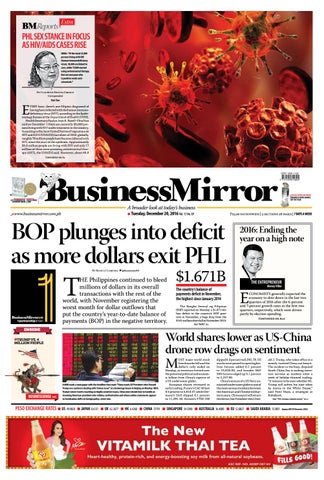
BMReports PHL SEX STANCE IN FOCUS AS HIV/AIDS CASES RISE UBIAL: “Of the total 33,000 persons living with HIV [human immunodeficiency virus], 18,000 are linked to care, while 17,000 started using antiretroviral therapy. But not everyone who is positive needs antiretrovirals.”
By Claudeth Mocon-Ciriaco Correspondent
E
Part Two
VERY hour, there’s one Filipino diagnosed of having been infected with the human immunodeficiency virus (HIV), according to the Epidemiology Bureau of the Department of Health (DOH). Health Secretary Paulyn Jean B. Rosell-Ubial has said on December 1 there are currently 33,000 persons living with HIV under treatment in the country. According to the Joint United Nations Programme on HIV and AIDS (UNAids) fact sheet of 2016, globally, roughly 78 million people have become infected with HIV, since the start of the epidemic. Approximately 39.8 million people are living with HIV and only 17 million of them were accessing antiretroviral therapy (ART), the UNAids said. Moreover, about 40.8 Continued on A2
media partner of the year
United nations
2015 environmental Media Award leadership award 2008
BusinessMirror
www.businessmirror.com.ph
A broader look at today’s business n
Tuesday, December 20, 2016 Vol. 12 No. 69
BoP plunges into deficit as more dollars exit PHL
T
By Bianca Cuaresma
@BcuaresmaBM
he Philippines continued to bleed millions of dollars in its overall transactions with the rest of the world, with November registering the worst month for dollar outflows that put the country’s year-to-date balance of payments (BoP) in the negative territory.
inside
$1.671B The country’s balance of payments deficit in November, the highest since January 2014
The Bangko Sentral ng Pilipinas (BSP) reported on Monday a $1.671-billion deficit in the country’s BoP position in November, a huge drop from the $141-million shortfall in November 2015.
business news source of the year
P25.00 nationwide | 5 sections 28 pages | 7 days a week
2016: Ending the year on a high note
the entrepreneur Manny Villar
E
conomists generally expected the economy to slow down in the last two quarters of 2016 after the 6-percent and 7-percent growth rates in the first two quarters, respectively, which were driven partly by election spending. Continued on A10
See “BOP,” A2
World shares lower as US-China drone row drags on sentiment
Trump Vs. 4 Million People
M businesssense
2016 ejap journalism awards
e1
A man reads a newspaper with the headline that reads “China wants US President-elect Donald Trump use caution in dealing with Taiwan issue” at a brokerage house in Beijing on Monday. With Trump’s latest tweets touching on highly sensitive issues, China must decide how to handle an incoming American president who relishes confrontation and whose online statements appear to foreshadow shifts in foreign policy. AP/Andy Wong
PESO exchange rates n US 49.9020
ost major world stock benchmarks fell and the dollar’s rally ended on Monday, as investors fretted over the potential political and economic fallout from China’s capture of a US underwater glider. European shares retreated in early trading. France’s CAC 40 lost 0.4 percent to 4,813.47, while Germany’s DAX slipped 0.1 percent to 11,391.50. Britain’s FTSE 100
dipped 0.3 percent to 6,991.78. US stocks were poised to open higher. Dow futures added 0.2 percent to 19,828.00, and broader S&P 500 futures edged up 0.1 percent to 2,257.90. China’s seizure of a US Navy unmanned underwater glider is one of the most serious incidents between the American and Chinese militaries in years. China says it will return the device, but President-elect Don-
ald J. Trump, who takes office in a month, tweeted China can keep it. The incident in the busy, disputed South China Sea is making investors nervous as markets enter a week of holiday-thinned trading. “It remains to be seen whether Mr. Trump will soften his tone when he moves to the White House,” said Piotr Mays, a strategist at Rabobank. See “US-China drone row,” A12
n japan 0.4231 n UK 62.2677 n HK 6.4260 n CHINA 7.1791 n singapore 34.5390 n australia 36.4085 n EU 52.0827 n SAUDI arabia 13.3051
Source: BSP (19 December 2016 )
A2 Tuesday, December 20, 2016
BMReports BusinessMirror
www.businessmirror.com.ph
Phl sex stance in focus as Hiv/Aids cases rise Continued from A1
million people have died from Aids-related illnesses since the start of the epidemic. In the Philippines, as of June 2016, a total of 34,999 cases were recorded since the first case of HIV was diagnosed in January 1984. Of the total cases, 83 percent were reported from January 2011 to June 2016. Ubial said that, of the total number of persons who tested HIVpositive, 18,000 are linked to care, while 17,000 started using ART. But Ubial has said “not everyone who is positive needs antiretrovirals.”
Therapy
LIFElong ART is available to those registered in HIV treatment hubs. According to the World Hea lth Organization ( W HO), “standard ART consists of the combination of antiretroviral [ARV] drugs to maximally suppress the HIV and stop the progression of HIV disease.” ART also prevents onward transmission of HIV, the WHO said on its web site. The WHO “recommends ART for all people with HIV as soon a s p o s s i b l e a f t e r d i a g no s i s without any restrictions of CD4 [cell] counts.” Next year’s budget of the Philippines for ART will leap from P900 million (roughly $18 million) to P1 billion ($20 million). The budget, Ubial said, will allow the DOH to provide ART to over 39,000 individuals. This means the government would spend around P25,641 ($512.80) for each individual. One A RT dr ug, called Nu-
BOP. . .
Continued from A1
It is now the largest monthly deficit since the United States Federal Reserve decided for the first time to scale down its then stimulus program in January 2014.
Blood samples are ready for testing in a local clinic, report said there is concern on the growing number of young Filipino infected by acquired immune deficiency syndrome. NONIE REYES
cleoside Reverse Transcriptase Inhibitors (NRTIs), costs from $54.00 (P2,701.08) to $1,197.32 (P59,889.95), according to the US Department of Health and Human Services (HHS). The US Centers for Disease Control and Prevention has pegged a treatment program costing at $500,000, or P25.01 million, every year. Nevertheless, Ubial is confident the fresh funding will help the DOH achieve one of their goals set in the sixth edition of
the country’s AIDS medium term plan (MTP). The Philippines’s Aids MTP aims to increase knowledge in HIV transmission, prevention and services among 15- to 24-year-olds to 90 percent. It also seeks to prevent new HIV infection among 15 to 24-year-olds. The plan also targets to test and treat 90 percent of people living with HIV and eliminate mother to child transmission of HIV in the country.
Investments
January 2014’s deficit of $4.48 billion was also aggravated, according to central bank officials, by the heavy importation for the then-Yolanda rehabilitation. November’s huge BoP deficit erased all the gains of the country’s transactions with the rest of the world for the entire year, bringing
the total BoP position of the country to a deficit of $206 million. This is a reversal of the $2.136-billion surplus seen in the same 11-month period in 2015. November was the month of global financial market volatility, when the confluence of the US President-elect Donald J. Trump’s
victory and uncertain policies, the then concerns on the timing of the US Federal Reserve interest-rate hike and the political noise coming from President Duterte’s rattled investors that brought the peso to several year lows. Also just last week, the BSP admitted of a weaker BoP position,
ACCORDING to United Nations Secretary-General Ban Ki-moon, “with the right investments, the world can get on the fast-track to achieve our target of 30 million people on treatment by 2030.” In a statement, Ban said “access to HIV medicines to prevent mother-to-child transmission is now available to more than 75 percent of those in need.” While there is clear progress, he emphasized that gains remain fragile.
“Young women are especially vulnerable in countries with high HIV prevalence, especially in SubSaharan Africa,” Ban was quoted in a statement as saying. “Key populations continue to be disproportionately affected by HIV. New infections are on the rise among people who inject drugs, as well as gay men and other men who have sex with men.” According to the UNAids, the AIDS epidemic is increasing in Eastern Europe and Central Asia, fueled by stigma, discrimination and punitive laws. Globally, people who are economically disadvantaged lack access to services and care. Criminalization and discrimination foster new infections each day. Women and girls are still especially hard-hit. The 2030 Agenda for Sustainable Development was adopted with a promise to leave no one behind. Nowhere is this more important than in tackling AIDS. “Supporting young, vulnerable and marginalized people will change the course of the epidemic,” Ban said. He cited that the UNAids strategic framework is aligned with the UN Sustainable Development Goals, “which highlight how the work against HIV is linked to progress in education, peace, gender equality and human rights.”
Actions
BAN cited the UN and the UNAids’s commitment “to finding new and better approaches to end this epidemic.” “During its first decade, affected groups refused to accept inaction, mediocrity and weakness in the AIDS response,” Ban was albeit believing that the Philippines’s external position will remain afloat with the revision of its full-year projection from $2-billion surplus down to $500 million. While other subcomponents of the BoP are yet to be released, the central bank earlier said foreign portfolio invest-
quoted as saying. “Their courage drove progress on securing women and children’s health, lowering the costs of lifesaving drugs and giving voice to the voiceless.” Meanwhile, the Philippine Red Cross (PRC) recently launched a “workplace policy” information campaign to address the HIV/AIDS pandemic in the country. According to PRC officials, the campaign underscores the need to ensure that the rights of people living with HIV/AIDS (PLHIVs) are protected across the PRC workplace. The policy emphasizes the process that the PRC will follow in terms of scope and responsibility to protect PLHIVs from discrimination, recruitment and screening processes, code of conduct, reporting procedures, risk management and right definition of terms about HIV/AIDS. “This Workplace Policy aims to keep a continuous approach to the prevention of HIV/AIDS among PRC employees and their families, as well as to impart knowledge and information on how to provide care and support of employees and any and all persons involved in all PRC projects, programs and operations who are living with HIV/AIDS,” PRC Chairman Richard J. Gordon said during the launch on December 1. Gordon, who is also a member of the Philippine Senate, said the PRC has been conducting awareness campaigns and advocacies to halt not only the spread of the disease but also the stigma and discrimination attached to PLHIVs among communities, especially in workplaces. To be concluded
ments (FPIs)—or more popularly known as “ hot” or “speculative” money—also drew significant outf lows amounting to $607.31 million in November alone. The BSP said the November slump in hot money was due to the unexpected result of the presidential election and the then widely anticipated interest-rate adjustment in the US, as well as the weak local corporate-earnings reports for the third quarter of the year. Overseas Filipino remittances —also a large part of the country’s BoP, particularly in its current account—fell 3 percent in October, latest data showed. The country’s current account is the core component of the BoP position—or the summary of the country’s transactions with the rest of the world. The current account has been in surplus position since 2003, providing cushion to the Philippines in times of external stress, such as economic crisis in the global economy that usually affects those with weaker current-account surpluses. Moody’s Analytics economist Jack Chambers also painted a gloomy picture of the country’s current account in the short term. The negative investor sentiment has also been blamed for the local currency’s underperformance in the fourth quarter of the year. ING Bank economist Tim Condon said they blame the “Duterte Effect” for the peso’s weakness since September. This, however, is “transitory,” as compared to the persistent risk posed by a potential current-account deterioration. Condon said they are reviewing the forecast of 49.70 to a dollar in the first quarter of 2017 for revision. The local currency on Monday neared the 50 territory anew to close at 49.96 to a dollar. The central bank earlier said it will adjust its foreign-exchange assumption for the year, as the local currency recently plummeted out of its target range earlier following political and economic developments. The BSP said the direction of the foreign-exchange assumption adjustments is likely to move toward the more prudent side.
The Nation BusinessMirror
news@businessmirror.com.ph
Fishermen recover cocaine in Albay
Senators vow to vote down Duterte plan to abrogate VFA
S
By Rene Acosta
@reneacostaBM
T
WO fishermen found on Sunday 18 bricks of cocaine that were floating on the waters off Tiwi, Albay, the local police report to the National Police general headquarters at Camp Rafael Crame, Quezon City, said. The report said that the bricks that were found in a “netfull” and in “ brick-like” form and wrapped in a brown packaging tape were spotted by fishermen Manuel Comota and Razel Bragais floating at around 10:30 a.m., off Sugod, Tiwi, Albay. The two immediately informed Teresita Cericos, chairman of barangay Sugod, about their recovery. The illegal drugs were eventually turned over to the Tiwi police, under Senior Insp. Jan King Calipay, which turned it over to the Albay police under Senior Supt. Antonino Cirujales. Cirujales said the recovery of the drugs proved that Oplan Double Barrel Alpha, the ongoing police campaign against illegal drugs, is working in the province. He said the campaign has forced drug syndicates to devise other ways just so they could continue with their illegal activities. Cirujales said the seizure of
DELA ROSA: “After this, just proceed to my office and get your gifts from President Duterte. Get your Christmas gift ranging from P400,000 and the lowest, P100,000, for the star-rank.”
the cocaine was the result of the “relentless efforts of Police Regional Office 5 on Project Double Barrel Alpha to fully eradicate the proliferation of illegal drugs in the region.” It was the first time that a cocaine was seized not only in the province of Albay, but even in the whole Bicol region. Meanwhile, Duterte gave police star-rank officers various amounts, from P100, 000 to P400,000 in Christmas gifts. The cash gift for the police generals was announced by the National Police chief, Director General Ronald M. dela Rosa, during the force’s Christmas party on Monday. “After this, just proceed to my office and get your gifts from President Duterte. Get you Christmas gift ranging from P400,000 and the lowest, P100,000, for the star-rank,” dela Rosa said. “For those who are not starrank, P50,000. Is that already okay with you, yes?” dela Rosa added.
Editor: Dionisio L. Pelayo • Tuesday, December 20, 2016 A3
By Butch Fernandez
@butchfBM
ENATORS are firming up an early consensus to vote down President Duterte’s expressed wish to abrogate the Visiting Forces Agreement (VFA) between the Philippines and the United States, which took effect after its ratification by the Senate in 1999.
But Senate sources indicated they would likely have to contend with Sen. Alan Peter Cayetano, Duterte’s defeated running mate, who returned to the Senate after losing his vice-presidential bid and now chairs the Senate Committee on Foreign Relations with oversight jurisdiction on matters involving international agreements. Duterte over the weekend voiced
plans to pursue drastic changes in foreign relations and national defense policies, including possible abrogation of the VFA. Sen. Panfilo M. Lacson, however, promptly made known his opposition to the President’s plan, with other senators voicing similar sentiments. Lacson, in an interview, declared he would vote against VFA abroga-
tion should the issue be submitted for plenary voting in the Senate. “I will most likely vote against abrogation of the VFA to give meaning to our long-standing Mutual Defense Treaty with the US,” Lacson said. He added that the Philippines needs rotating US military presence here “to maintain a balance of power in the West Philippine Sea.” Moreover, Lacson noted that the training and joint military exercises between the Armed Forces and visiting US troops “are important components of our troops’ combat readiness.” Lacson said “there is a lot to learn from those exercises, which we have nurtured over a long period of time.” He also noted that it is “mutually beneficial” for both countries to maintain such an alliance. At the same time, Sen. Leila M. de Lima expressed hope that Duterte would not make rush decisions in-
volving foreign policies, like terminating the VFA with the US. She suggested that such matters should not be decided precipitously or carelessly without any clear alternatives, precisely because of what the President calls “the changing politics” in the West Philippine Sea. De Lima warned that Duterte “might be throwing us out of the pan and into the fire.” She pointed out that “so much at stake here,” citing the “lives of Filipinos, their well-being, security and even our very sovereignty.” She aired hopes that Duterte would avoid “sacrificing those interests as easily as he sacrifices the lives of the people who are being killed on a daily basis because of his so-called war on drugs.” De Lima asserted that foreign relations and diplomacy should not be turned “into a grudge match, where the Filipinos’ welfare is just a pawn for him to sacrifice.”
Atienza urges release of inmates who’ve overserved sentences
A
SENIOR official of the House of Representative urged on Monday the release of jail inmates who may have already been detained longer than the court ordered in their cases. “In the spirit of the Christmas season, Senior Deputy Minority Leader Lito Atienza said President Duterte should order the Bureau of Jail Management and Penology to immediately conduct an inventory of inmates and release those who may have already overserved their sentences. “Many inmates have already served their sentences but continue to languish in jails all over the country, owing to the slow pace of our justice system, and with no
lawyers keeping an eye on their cases,” Atienza said. “This is one of the reasons we are absolutely against the death penalty. Because of our defective and disjointed criminal justice system, only the poor who cannot afford lawyers will be sentenced to death. While the moneyed criminals buy their way through the corruption network and go scotfree,” Atienza said. He also reminded the government to focus not only on political detainees, but more so on prisoners who are suffering from subhuman conditions inside jails. He invoked Article III, Section 19 of the 1987 Constitution, which provides that “The employment
of physical, psychological, or degrading punishment against any prisoner or detainee or the use of substandard or inadequate penal facilities under subhuman conditions shall be dealt with by law.” The lawmaker also cited Article I of the International Convention on Civil and Political Rights, which provides that “All persons deprived of their liberty shall be treated with humanity and with respect for the inherent dignity of the human person.” Atienza, likewise, pointed out that the slow pace of the justice system has been depriving thousands of inmates of a speedy trial, as provided for under Article III, Section 16 of the Constitution, which states that, “All persons shall have the right
to a speedy disposition of their cases before all judicial, quasijudicial, or administrative bodies.” “Many inmates who were supposed to serve short sentences end up being imprisoned for extended periods. This is contrary to what the Constitution guarantees. This is a classic case of justice delayed is justice denied,” Atienza said. “Kaya nananawagan tayo kay Pangulong Duterte na bigyan ng kaukukulang pansin ang kaso ng libo-libo nating mga kababayan. Ang mabilis na pag-review sa kanilang mga kaso at pagpapalaya sa kanila ngayong Pasko ay isang malaking regalo na maibibigay ng ating Pangulo sa kanilang mga pamilya,” Atienza stressed. Jovee Marie N. dela Cruz
Party-list group urges DENR: Be fair to small-scale miners By Marvyn N. Benaning Correspondent
A
PARTY-LIST group on Monday asked the Department of Environment and Natural Resources (DENR) to help alleviate the situation of small-scale miners “instead of threatening them of losing their decades-old source of livelihood.” Party-list Rep. Carlos Isagani Zarate of Bayan Muna, who chairs the House Committee on Natural Resources, issued the call during a gathering of small- and large-scale miners in Itogon, Benguet. In the meeting, Zarate described the Mining Act of 1995 as being “lopsided in the favor of large-scale mining corporations.” “The DENR cannot just dismiss the operations of small-scale miners as illegal and demand them to stop. This is livelihood for thousands of people, and it has been so for generations, especially here in the Cordillera.” “Secretary Regina Paz L. Lopez must heed the plight of the ordinary small-scale miners. Instead of closing them down, it must push for the modernization of our
“Secretary Regina Paz L. Lopez must heed the plight of the ordinary small-scale miners. Instead of closing them down, it must push for the modernization of our small-scale mining industry and support more healthful and ecological practices in mining.”
small-scale mining industry and support more healthful and ecological practices in mining,” Zarate said. “The DENR is forcing small-scale miners to supposedly legalize their operations but under a regime that requires very stiff requirements, with little to no support at all from the government. Meanwhile, large-scale mines, mostly foreign, have wrought havoc and destruction to our lands for decades with all incentives given to them. We cannot treat our people this way. The Filipinos and our quest for national industrialization must be the primary beneficiaries of our rich mineral
resources,” he added. In a petition submitted to the Bayan Muna lawmaker, the 20,000-strong Benguet Federation of Small Scale Miners (BFSSM) also bewailed the DENR’s stringent requirements, since the same are “designed to abolish small-scale mining.” They also called on Zarate’s committee to initiate “meaningful legislative remedial measures to alleviate their sad condition.” “We seek the support of our smallscale miners for the crafting of a more progressive, pro-people and pro-environment mining law that will help propel our country to industrialization and, at the same time, also gives due support and recognition to small-scale, traditional miners that had eked out a living from our minerals for centuries,” Zarate added. The Committee on Natural Resources is deliberating on comprehensive mining bills to replace the Mining Act of 1995. It is also looking into amending Republic Act 7076, also known as the Small-Scale Mining Act, to incorporate the concerns of BFSSM and other groups of small mining elsewhere in the country.
Lifetime achievement
The Philippine Red Cross (PRC) Board of Governors’ Secretary Corazon Alma de Leon receives the 2016 Volunteer Lifetime Achievement Award during this year’s Search for Oustanding Volunteers (SOV). SOV is a platform that recognizes the excellent performance and dedication of Filipino volunteers and their great contributions to development and nation-bulding. The award was given to de Leon for her exemplary commitment in sharing good practices in volunteering, and support in promoting various activities and programs of the PRC, as well as her volunteering activities outside the Red Cross.
Eroding islet threatens 38,500 seabirds in Tubbataha Reefs By Keith Anthony S. Fabro Philippines News Agency
P
UERTO PRINCESA CITY— Some 100 species of birds in the Tubbataha Reefs Natural Park (TRNP) in Cagayancillo, Palawan, are at risk of losing their breeding ground following observations that the bird islet on the North Atoll is progressively eroding. “If the erosion of the islet continues, we might lose it, and the birds
will no longer have a home, a place for breeding,” Retch Pagliawan, Tubbataha Management Office (TMO) researcher told the Philippine News Agency in a chance interview over the weekend. Pagliawan said the islet’s vegetation area has also decreased, thus speeding up the erosion. “The main impact of that is actually for the breeding birds,” she said, adding that Tubbataha is the last intact seabird habitat in the Philippines.
The erosion, particularly on the northeastern part of the 1.5-hectare islet, has alerted the TMO, prompting it to seek help from the University of the Philippines-Marine Science Institute (UP-MSI). An oceanographer and geologist from UP-MSI will conduct a study in April 2017, and will propose biodiversity-friendly measures that would halt the erosion, Pagliawan added. She explained that this natural phenomenon, caused by the move-
ments of waves and currents was already observed in 2004, when TMO started measuring the islet. Latest TMO data shows that the two islets in TNRP—the Bird Islet at North Atoll and South Islet at South Atoll—now support at least 38,500 seabirds. It is the main rookery and breeding ground of the seabird species Red-footed Booby, Brown Booby, Great crested Tern, Sooty Tern, Black Noddy and Brown Noddy.
The TMO also noted that “it is the only known breeding area of the worcestri subspecies of Black Noddy, one of the few breeding areas of Sooty Tern and Brown Noddy” in the country. The critically endangered Christmas Island Frigate bird (Fregata andrewsi), regularly occurring with up to five individuals at a time, as well as the Chinese Egret, Swinhoe’s Storm Petrel, Eurasian Curlew and Blacktailed Godwit, also seek refuge in the
islets on TRNP, according to TMO. Believed to be locally extinct for more than 20 years, the Masked Booby reappeared again on the bird islet on May 11, 2016. Considering most of the seabird species breeding at TRNP are threatened at national or regional levels, since last year it has been included in the East Asian-Australasian Flyway Partnership, an international network created to conserve migratory birds and its habitats.
Economy
A4 Tuesday, December 20, 2016 • Editors: Vittorio V. Vitug and Max V. de Leon
BusinessMirror
news@businessmirror.com.ph
WESM price lowest in last 5 years–PEMC
E
By Lenie Lectura
@llectura
nergy price in the Wholesale Electricity Spot Market (WESM) went down to P2.27 per kilowatthour (kWh) for the November billing period, the lowest in five years. “Such a sharp decline in the market price is welcome, as long as wholesale customers, like distribution utilities, pass on the historically low market prices to their end-users,” Philippine Electricity Market Corp. (PEMC) President Melinda Ocampo said. The decrease in WESM prices, she added, was driven by higher energy-volume offers in the market and colder temperature. The next lowest market price in the electricity market was recorded in September 2015, at P2.28 per kWh. Ocampo also said wholesale customers sourced 19 percent of their power-supply requirements in the spot market during the November 2016 billing month, which is the highest since March 2009. Generation mix reflects that coal resource accounts 47.42 percent in November 2016, while renewableenergy sources, including large hydropower and geothermal, contribute 26.25 percent. “The recent developments in the electricity market, underpin PEMC’s efforts in establishing a competitive, efficient, transparent and reliable market, where prices are governed as practicable by commercial and market forces,” Ocampo said. “The coming year will also see PEMC’s involvement of retail competition, and the establishment of WESM in Mindanao,” she said. PEMC is operator of the WESM. WESM prices this year, she said, are on a downward trend mainly on account of higher energy volume, coupled with lesser demand. “Aside from these two, we’ve had a colder temperature, and there’s a lot of re-
₧2.27/kWh The WESM price for the November billing period newable energy also,” the PEMC official said. For next year, Ocampo is hoping that the downward trend will continue. “Hopefully, it will continue because there are many power generators. Moreover, demands for January and February are always less,” she said. Ocampo added that WESM truly works, as it provides a viable option for wholesale customers in the provision of electric supply to end-users. It also ushers in transparency in a liberalized regime, where spikes in prices provide signals on tightness of supply condition due to forced and planned outages. The WESM began commercial operations in Luzon in June 2006 and in the Visayas in December 2010. In June 2013 PEMC launched and integrated the Retail Competition and Open Access into the WESM. The WESM is a centralized venue for buyers and sellers to trade electricity as a commodity where its prices are based on actual demand and availability supply. The WESM was created by Republic Act 9136, the Electric Power Industry Reform Act of 2001. This provided for the establishment of an electricity market that reflects the actual cost of electricity and lowers its price through more efficient production through competition.
DENR, UP forge pact to create models of integrated area devt By Jonathan L. Mayuga @jonlmayuga
T
he Department of Environment and Natural Resources (DENR) will create models of integrated area development to promote social justice and sustainable human development. Environment Secretar y Regina Paz L. Lopez said, initially, the DENR and the University of the Philippines (UP) are eyeing to enhance the Ninoy Aquino Parks and Wildlife Rescue Center (NAPWC) in Quezon City, promising to turn the 25-hectare park into an “ecological paradise” and “tourist attraction.” The NAPWC is one of the few remaining “patches of green” in the city, which is also a repository of rescued wildlife. Currently, the NAPWC is under the management and administration of the Protected Areas and Wildlife Bureau, an office under the DENR by virtue of Proclamation 723, dated October 25, 2004, signed by former President Gloria Macapagal-Arroyo. T he proclamation reestab lished the park as a protected area and a component of the National Integrated Protected Areas System (Nipas). A long w ith UP Chancel lor Michael Tan, the DENR signed a memorandum of understanding during a news conference last Thursday formalizing the collaboration between the DENR and UP. The DENR and UP vowed to do
“many things” together, starting with the NAPWC. “It is good for the DENR and good for UP,” Lopez said of the newly signed pact. Lopez said they plan to put up innovative environmental technologies and turn the park into “an extension of the educational experience of students.” “The DENR can offer UP an exciting arena where they can parley their educational know-how, their skills, including community development, including architecture, agriculture, engineering and even housing,” Lopez added. She said a series of meeting between the DENR and UP will ensue starting next year. Tan, for his part, said the collaboration aims to make “a model for development,” and prove that “environmental conservation is compatible with other needs for human communities.” “We will draw up the different plans next year,” Tan said. Lopez said the park will also be used for various research and development, including, among others, renewable energy technologies. She said the Protected Areas Management Board (PAMB) of the Ninoy Aquino Parks, which is a Protected Area, is involved in the planned transformation that will take place starting next year. Lopez said she is hoping that what will transpire in the Ninoy Aquino parks will be replicated in other areas with the help of other learning institutions.
Bargain hunt
With less than a week before Christmas Eve, people from all walks of life flock to Carriedo Street on Monday, a traditional mecca for shoppers in Manila, in the hunt for bargain deals, ranging from fruits and clothes to toys and much more. PNA/Jess M. Escaros Jr.
Taiwan port execs eyeing partnership with SBMA
S
UBIC BAY FREPORT—Port operations in the country’s premier free port is expected to experience increased activities as the Taiwan government expressed keen interest in building partnership with the Subic Bay Metropolitan Authority (SBMA). Lawyer Randy Escolango, SBMA officer in charge (OIC) administrator, said executive officials from Taiwan Maritime and Port Bureau, in their recent visit here, are keen to the possibility of creating partnership in transshipment. “We are hoping that this partnership with the Port of Taiwan will come to reality. Because this is in
line with the priority programs of President Duterte’s administration making the Port of Subic to become a major port in Asia,” Escolango said. The partnership aims to increase the volume of container traffic between the Port of Subic Bay and Taiwan Ports, through Yang Ming Shipping Line. “I even suggested to the Director General of Taiwan Port Bureau to encourage industries in Taichung to use the Port of Subic as gateway in the region,” he said. The “Southbound Policy” of the Taiwan government has initiated concrete measures in prioritizing countries south of Taiwan, includ-
ing the Philippines, in the area of trade and investments. Due to this paradigm shift, the Philippines is taking advantage of this opportunity to capture the matured growth of industries in Taiwan in the fields of high-value manufacturing, innovation, logistics and transshipment, renewable energy, e-commerce and financing. Escolango noted that Taiwan is the Philippines’s sixth trading partner with $7.85 billion worth of bilateral trade in 2015. At present, there are 52 Taiwanese companies in Subic Freeport, mostly inside the Taiwanese-run Subic Bay Gateway Park, with over
$500 million worth of investments generating 12,500 direct employment and hundreds more in indirect jobs, such as transport service and catering. Meanwhile, Escolango said that the Port of Subic has undergoing development and improvement projects in anticipation of increased port activities next year. Projects completed under the 2015 infrastructure budget include the improvement of road networks inside the Naval Supply Depot, which is being utilized as unloading, warehousing and stockpiling area of imported bulk grains, containerized and noncontainerized items. PNA
Lawmaker lists PHL’s 10 top positive economic events in 2016 under Duterte
W
ith 2016 just about to close, what positive prospects can Filipinos look forward to next year and the years ahead? Albay Rep. Joey S. Salceda, a noted economist, said Filipinos have good reasons to feel good and be optimistic of the years ahead based on significant positive gains registered by the national economy during the first six months of the Duterte administration. The Albay lawmaker has identified the “top 10 positive economic events of 2016” under President Duterte. First in his list was the “peaceful, orderly and democratic power transition following Mr. Duterte’s landslide victory last May 2016 elections; investors hate uncertainty.” Duterte garnered some16.6 million votes in the last elections, beating his closest rival by 6.6 million. “The outcome cemented the stunning populist victory, founded on his promise to eradicate crime and corruption. It brought back people’s belief in good governance, and restored investors’ confidence,” Salceda noted. Second on his list is Duterte’s empowered Cabinet of solutionsdriven practitioners and economic managers, including Budget Secre-
tary Benjamin E. Diokno, Finance Secretary Carlos G. Dominguez III, Trade Secretary Ramon Lopez, and Socioeconomic Planning Secretary Ernesto M. Pernia. “This team of battle tested men hauled from both government and the private sector has shown a decisive posture early on and gives Duterte’s economic team and clarity of purpose and doable objectives,” he pointed out. Third is the “formation of supermajorities in the House of Representatives and the Senate, the closest to a government of national unity,” and a viable response to Duterte’s pledge of clean government which is the popular public clamor. Fourth in Salceda’s list was the demonstrated seriousness of the President’s dynamic Cabinet, which “hit the ground running with 10 full Cabinet meetings and two Legislative-Executive Development Advisory Council consultations in the first five months. This means faster and better results,” he stressed. In fifth place are the peace talks and indefinite cease-fire with the Communist Party of the Philippines-New Peoples’ Army and the Moro Islamic Liberation Front, started immediately in the first months of the Duterte regime, com-
pared to the years of preparation by former administrations. Sixth is the huge business potential from Duterte’s China pivot and the forging of an independent foreign policy, all in one instance, debunking long-held myths about Philippines-US relations, and highlighting a promising Philippines-China’s partnership. In seventh place is the Philippines’s registered fastest economic growth in Asia and the resurgence of the country’s manufacturing industry. The country posted 7.1 percent on-year JulySeptember hike—its most robust growth pace in three years. The figure surpassed the 6.7-percent median growth estimate of 15 economists survey by Bloomberg and matched an estimated 1.2 percent GDP rise against the previous quarter. It also stacked favorably against China’s thirdquarter growth rate of 6.7 percent and Vietnam’s 6.4 percent. Eighth is the rollout of AmBisyon Natin 2040, our new 10-point economic agenda and the preparation of 2017-2022 development plan. AmBisyon 2040 represents the collective long-term vision and aspirations of the Filipino people for themselves and for the country in the next 25 years. It describes
the kind of life Filipinos want to live and how the country will be by 2040. As such, it is an anchor for development planning across at least four administrations. The substantial improvement in peace and order with 80-percent reduction in drug volume and 39percent drop in crime, makes it to ninth spot in Salceda’s list. The peace and order gains represents a decisive effort at ridding the country of specific crime problems never before given so much and serious attention. Tenth in the list is the government’s commitment to deploy funds with 83-percent increase in infrastructure spending and improved absorptive capacity. Salceda said thrust could drive the Phi lippines’s GDP to hit 9 percent in three years, with Duterte’s policy strengths and a blueprint for growth hinged largely on infrastructure. “This could usher in a golden age of infrastructure,” he said. Based on economic forecast models developed by a group of econometricians, Salceda said the country can hit 9 percent GDP growth by 2019, with “infrastructure spending from 5 percent of GDP to 6 percent, funded by new taxes and tax efficiencies.” PNA
A6
11th Anniver
Business
Tuesday, December 20, 2016 | www.businessmirror.com.ph
BUSINESSMIRROR EXTRAORDINAIRE
A
T 11, BusinessMirror continues to be a vanguard of innovative journalism, one that is always hinged on its mantra of providing a wide range of readers (from young executives to decision makers, from medium enterprises in provinces to companies in the Asean) a broader look at today’s business. As the only business daily in the country hit another milestone toward the close of the year, the BusinessMirror celebrated this field-day with its valued business partners who made all these years for both the paper and its clientele productive and mutually beneficial, what with proactive collabs that very well sum up the winning thematic party sound bite Partnership-driven at 11. It was one that glamorized strength in numbers and joint ventures, as well as public-private partnership approach in investments, and then some twin strategies in business and political-economy. It was one that, in this age where information is dispersed digitally every which way at a drop of a hat,
celebrated the people who believe in the printed word and everything it is that it represents. For one, the BusinessMirror brought out the champagne for one of its big-ticket highlights of the year: its partnership with the European Chamber of Commerce of the Philippines (ECCP) in staging a forum on federalism, where several groups have come to the BusinessMirror to discuss possible partnerships on staging all these fora. Believing what the ECCP believes, BusinessMirror Publisher T. Anthony Cabangon said, “We want big business and industry leaders to know how the Duterte administration’s federalism initiatives will affect the business sector. We don’t want to just be content reporting the news, but also create a newsworthy event that we can bring to our readers firsthand.” Moreover, the BusinessMirror also partnered with Unilab/ RiteMed/United Bayanihan Foundation to recognize noteworthy civic organizations and seniorcitizen associations that are tirelessly coming up with beneficial
programs for the elderly through the annual The Dakilang Adhikain ng Ating Lahi Awards. Global brands and prestigious international news organizations, such as The New York Times and Harvard Business Review, have done a content partnership with the BusinessMirror, bringing to the table a diversified set of news of international standard that resonates well with its ideals. To wit: we annually publish, at the top of it all, the original yearahead licensed magazine by The New York Times, Turning Points, which features exclusive content on global figures who share their perspectives on how our world and our lives may change in the years to come. On the flipside, more than concerted efforts and strengthened partnerships, the celebratory party also acknowledged its competitive edge personified by its veritable raft of young and seasoned reporters, who, this year, swept industry awards ceremonies. Specifically, the BusinessMirror recognized its bevy of prized reporters who were conferred with accolades at the Eco-
nomic Journalists Association of the Philippines Awards, otherwise called the Oscar Awards for business reporting: Cai U. Ordinario (Macro economy), Mary Grace Padin (Agriculture), Lenie Lectura (Energy), Lorenz Marasigan (Best Feature Story). To clinch it all, BusinessMirror was hailed Business Newspaper of the Year by Ejap. Meanwhile, Special Features Editor Leony Garcia’s story on Lasallian education won Best Feature at the 2016 Lasallian Scholarum Awards, while BusinessMirror Properties and Motoring Editor Tet Andolong was feted the 2016 Gawad Sulo Prestigious Seal Award for Real Estate Journalism. With all the challenges of the digital age and hundred and one methods of information dissemination staring print in the face, this is the BusinessMirror’s thrust in staying relevant as it rides the next decade as a newspaper extraordinaire, with the selfsame mantra in mind which has made it a comprehensible and trusted source of local and international business news for all these years.
rsary Special
ssMirror
www.businessmirror.com.ph | Tuesday, December 20, 2016
A7
A8
Tuesday, December 20, 2016
briefs
Japan Emperor has a cold, cancels year-end banquet
TOKYO—Japan’s Emperor canceled an annual year-end palace banquet on Monday because of a cold. The Imperial Household Agency said the decision was because Emperor Akihito had developed a fever last week and is still recovering. Akihito turns 83 years old on Friday. Plans for his birthday celebration have not been changed. Akihito had invited Prime Minister Shinzo Abe and other top officials for Monday’s banquet. Akihito expressed an apparent wish to abdicate in a rare public address in August, citing concerns that his age and health conditions may start limiting his ability to fulfill official duties. AP
Confidante of disgraced SOUTH Korean president denies using ties
SEOUL, South Korea—The jailed confidante of disgraced South Korean President Park Geun-hye denied on the first day of her trial on Monday that she used her ties to the presidential ties to extort money from powerful companies. The short, hourlong hearing at the Seoul Central District Court was the first public appearance in weeks for the woman at the heart of a scandal that led to Park’s impeachment. Choi Soon-sil, Park’s friend of 40 years, wore black glasses and bowed deeply to the three judges before her lawyer, Lee Kyoung-jae, denied that Choi conspired with an expresidential adviser to pressure companies to donate money to foundations controlled by Choi. “I’m sorry for causing trouble. I’ll faithfully engage in [my] trial,” Choi said. AP
Jet-setting Hungarian actress Zsa Zsa Gabor dies at age 99
Zsa Zsa Gabor, the jet-setting Hungarian actress and socialite who helped invent a new kind of fame out of multiple marriages, conspicuous wealth and jaded wisdom about the glamorous life, died on Sunday at her home, her husband said. She was 99. The middle and most famous of the sisters Gabor died of a heart attack at her Los Angeles home, Frederic von Anhalt said. Gabor had been hospitalized repeatedly since she broke her right hip in July 2010 after a fall at her home. She already had to use a wheelchair after being partly paralyzed in a 2002 car accident and suffering a stroke in 2005. Most of her right leg was amputated in January 2011 because of gangrene and the left leg was also threatened. Her misfortunes were duly reported to the media by von Anhalt. AP
The World BusinessMirror
www.businessmirror.com.ph
Robonomics to run Japan’s Rust Belt assembly lines
A
withering factory town in Japan’s Rust Belt is looking for revival through a dose of Prime Minister Shinzo Abe’s “robot revolution”. Kadoma’s population has declined 13 percent as the nation ages, prompting mergers among elementary schools and emergency services departments. Factories can’t find enough people to run assembly lines, further threatening an industrial base that includes titan Panasonic Cor p. and sma l ler businesses, like Izumo Co., a maker of industrial rubber. Yet, Izumo President Tsutomu Otsubo doesn’t believe the solution involves finding more people. He’d rather find more machines to do the work so his company can capitalize on Abe’s plan to quadruple Japan’s robotics sector into a ¥2.4 trillion ($20 billion) industry by 2020. “We want to create a mass-production system run by robots and tap into the global market,” said Otsubo, in the prefabricated office that’s tacked to the side of his aging factory. “We are a small company, but that’s the kind of perspective we have to have in this era.” The open embrace of robots in Japan’s Rust Belt is in stark contrast to other parts of the industrialized world like the US, where automation is seen as yet another threat to working-class jobs in manufacturing. It also reflects Japan’s aversion to immigration, and a hope that machines can keep its factories competitive versus rivals like China with lower labor costs. Japan’s unemployment rate of 3 percent is the lowest since 1995, making it a challenge for businesses to find workers. The ratio of available jobs per applicant rose to 1.4 in October, the highest in more than 25 years, according to the labor ministry. Abe called for a “robot revolution” last year, urging companies to distribute the machines into “every corner of our economy a nd so c iet y ”— i nc lud i ng t he manufacturing, health-care and service industries. His government aims to double the market for manufacturing robotics to ¥1.2 trillion by 2020. For service robots, he calls for ex-
$20B The quadrupled value of the robotics sector, which Prime Minister Shinzo Abe plans to achieve by 2020
panding their market twentyfold to ¥1.2 trillion.
US perspective: How the Rust Belt helped Trump
Japan also could export its robot revolution to China, which has made robotics a focus of its industrial policy and is the world’s biggest buyer of machines. China, host to manufacturing giants, such as iPhone assembler Foxconn Technology Group, wants to employ 150 robots for every 10,000 factory workers—triple the current ratio. The development and deployment of robots—and the software to control them—is expected to save 5.7 million Japanese jobs through March 2031, according to the economy ministry. Robots also could shave 25 percent off factory labor costs in Japan, according to a report by Boston Consulting Group Inc. “Japan’s robot technology is advanced compared with other nations, so expectations are high for that to fill the hole of a declining labor force,” said Toshihiro Nagahama, chief economist at Dai-Ichi Life Research Institute in Tokyo. “Having robots is likely to boost Japan’s productivity.” Two of the world’s top 4 industrial-robot makers—Fanuc Corp. and Yaskawa Electric Corp.—are in Japan, where cultural affection for animé characters like Astro Boy help make machines more acceptable as part of the workplace, said Hirofumi Katsuno, an associate professor of anthropology at Doshisha University in Kyoto. Astro Boy, a child android who
SoftBank’s “Pepper” robot unboxed Bloomberg News
fights evil and injustice, first appeared in manga series in 1952. He starred in several TV series and feature films, and is cited by SoftBank Group Corp. founder Masayoshi Son as inspiration for the company’s humanoid robot “Pepper”. Doraemon, a robot cat who travels back from the future to help his owner’s ancestors, first appeared in a 1969 manga and is also much loved in Japan. The portrayals contrast with those in the US, where Hollywood typically depicts robots as killers in movies, such as the Terminator franchise and labor unions say industrial robots are job killers. “We don’t fear using robots, thanks to the Astro Boy and Doraemon,” said Kadoma Mayor Kazutaka Miyamoto, 46. Restrictive immigration policies also make it easier to hire machines. Japan’s government allows a limited number of unskilled workers to enter the country temporarily, reflecting a cultural belief that a mass influx of foreigners will erode the nation’s identity. Many of the world’s industrial robots are made at Fanuc’s sprawling factory complex at the base of Mount Fuji. In cavernous yellow buildings surrounded by forest, Fanuc’s assembly lines are populated by machines that spawn more machines, with most of the human workers in the control room monitoring and programming them. The company had an operating margin of 35 percent in the year ended March 31, and its shares have risen in six of the past seven years. Its customers include Samsung Electronics Co., Toyota Motor Corp. and General Motors Co., according to data compiled by Bloomberg.
US President-elect Donald J. Trump has vowed to boost domestic manufacturing, providing more opportunities for Fanuc and primar y competitor Yaskawa. Fanuc appeals to US customers via a web site called “Save Your Factory,” which offers a way to grow while cutting costs. Some service businesses are adapting to the new era. At a hotel in Nagasaki run by Huis Ten Bosch Co., an amusement park operator, a female robot and dinosaur robots welcome guests in multiple languages. A robotic arm stores their bags. Another industry desperately in need of more hands in Japan is elderly care, with a shortage of some 377,000 workers expected by 2025. About 60 percent of the people polled by the government in August 2013 said they were willing to use robots with elderly care. Besides SoftBank, Toshiba Machine Co. and Honda Motor Co. also make humanoid robots. Cyberdyne Inc. in Tsukuba northeast of Tokyo has created bionic suit called HAL to help those who receive and give care. It detects signals from the wearer’s brain to their muscles and helps with tasks, including lifting patients. Back in the drab, four-story Kadoma city office, Mayor Miyamoto said he hopes local manufacturers can overcome demographic decline and become leaders once again. “We have a strong sense of crisis,” Miyamoto said. “The manufacturing industry is moving toward using more AI [artificial intelligence] and robots. I hope manufacturers in this city can be the front-runners of the trend.” Bloomberg News
France, Russia reach compromise as Aleppo rescue uncertain
B
EIRUT—France struck a compromise on Sunday with Russia on a UN resolution that it said would prevent “mass atrocities” in besieged areas of Aleppo, where thousands of trapped civilians and rebel fighters await evacuation in freezing temperatures. On the ground, prospects for swift evacuations from Aleppo and other besieged areas were thrown into doubt again on Sunday after militants burned buses assigned to the rescue operation, although one convoy of five buses was reported to have reached safety from the city late on Sunday. The Aleppo evacuations were to have been part of a wider deal that would simultaneously allow more than 2,000 sick and wounded people to leave two pro-government villages that have been besieged by Syrian rebels. Most villagers are Shiite Muslims, while most rebels are Sunni Muslims. Six buses that were among those poised to enter the villages of Foua and Kfarya on Sunday were set on fire by unidentified militants, presumably to scuttle any deal. A video posted online showed armed men near the burning buses as celebratory gunshots rang out. “The buses that came to evacuate the apostates have been burned,” the narrator of the video said. He warned that no “Shiite pigs” would be allowed to leave the towns. The video could not be verified independently, but was in line with The Associated Press reporting from the area. Earlier on Sunday, pro-Syrian government TV stations showed dozens of buses on standby at a crossing near eastern Aleppo, reportedly poised to resume evacuations from the opposition’s last foothold in the city. Later, a Syrian opposition war-monitoring group said the first civilians and fighters to evacuate eastern Aleppo in over 48 hours arrived safely in the countryside from the city. The Britain-based Syrian Observatory for Human Rights said shortly before midnight on Sunday that government forces allowed five buses to leave Aleppo. Evacuations were suspended two days earlier amid mutual recriminations after several thousand people had been ferried out of the war zone. Thousands more desperate civilians are believed to be trapped in the city. About 2,700 children were evacuated in the first rescue mission earlier this week, but hundreds more “are now waiting in freezing temperatures, close to the front lines,” said Shushan Mebrahtu of the UN agency for children, United Nations Children’s Fund. “We are deeply worried.” The troubled evacuations are throwing into disarray an Aleppo deal that was brokered last week by Syria ally Russia and opposition supporter Turkey. The deal marked a turning point in the country’s civil war. With the opposition leaving Aleppo, Syrian President Bashar al-Assad has effectively reasserted his control over Syria’s five largest cities and its Mediterranean coast nearly six years after a national movement to unseat him took hold. AP
Modi’s cash ban may have been in vain as India outlook dims P rime Minister Narendra Modi needs a new narrative for his banknote ban. He’d touted the surprise move to scrap high-value bills as India’s biggest step against unaccounted cash, which the government estimated at 5 trillion rupees ($74 billion). The bulk of this money has already been deposited with two more weeks to go before the deadline lapses, meaning the shock to the system may have been in vain. The decision sucked out 86 percent of currency in circulation, akin to withdrawing all US dollar bills except about half of the $1 notes. Only 50 percent of this is projected to be replaced by the year-end, leaving authorities scrambling to push digital payments as public anger rises. “India’s ‘own goal ’ currencyswap initiative has put a crimp on the cash-dependent economy,” said Singapore-based Paul Gruenwald, chief economist for Asia-Pacific at S&P Global. The government’s “well-intentioned,
but poorly thought through, demonetization program” is driving down the pace of economic activity, he said. Finance Minister Arun Jaitley on Friday said there’s no official estimation of black money, the local term for unaccounted cash. He submitted a written reply to a lawmaker’s question about a month after the government’s lawyer told the Supreme Court that Indians won’t deposit about 4 trillion rupees to 5 trillion rupees of bank notes of the 15.4 trillion rupees invalidated by Modi’s move, implying that this was “ black ”. The top court was hearing petitions questioning the rationale behind Modi’s decision after Modi in his November 8 speech to the nation said “the specter of corruption and black money has grown,” without providing figures.
Growth
As investors try to assess the impact of Modi’s move, all eyes will
be on the government’s forecast for the year through March—due on January 7. The central bank and private economists have lowered their projections for the economy where 98 percent of consumer payments are made in cash.
Factory output
The Nikkei purchasing managers’ index signals a contraction in the key services sector, which accounts for about 60 percent of GDP. Car purchases, a main indicator of manufacturing demand, grew at the slowest pace in nine months in November, while sales of motorcycles and scooters— where about 65 percent of payments are in cash—fell for the first time in almost a year.
Loan growth
Commercial credit sank to a 19-year low as backlogs piled up at factories and banks stayed busy with the task of exchanging currency notes. Meanwhile, deposits surged, pushing the credit-deposit
ratio to a six-year low. “For a cash dependent economy, a cash crunch is not good,” said Madhavi Arora, Mumbai-based economist at Kotak Mahindra Bank Ltd.
to 100,000 jobs from his industry.
Inflation
The trade deficit widened to a 16-month high as export growth slowed in November and imports surged. Most worryingly, gold shipments jumped 26 percent in November, triggering speculation that consumers were converting their cash into nonproductive holdings of the precious metal.
As demand dips for goods, price pressures are easing. The benchmark consumer inflation gauge plunged more than estimated to below the mid-point of the central bank ’s target. However, this wouldn’t be the first time that economists have been surprised and it may not open much room to ease policy. So-called core inf lation—excluding food and fuel—is sticky, the central bank said this month.
Jobs
Ratings
Trade
Export numbers also hinted at the employment outlook. A decline in gems and jewelry, a sector that depends on unorganized manual labor, suggested the cash crunch was affecting employment, said Kapil Gupta, an analyst at Edelweiss Securities Ltd. Rafeeque Ahmed, chairman of the council for leather exports, said Modi’s move has slashed about 75,000
India’s currency clampdown won’t impact the nation’s credit ratings, according to S&P Global Ratings. However, the company said Indian corporates and banks would face short-term “ execution and adjustment risks.” Fitch Ratings called the demonetization a “one-off event” and said that while the short term hit will be significant, people will find “inventive
ways” around the cash crunch. Moody’s Investors Service placed on negative watch three microfinance lenders, indicating that their ratings may be downgraded.
Digital payments
Data on card transactions indicate plastic is taking the place of currency usage at a faster pace. With the data incomplete, conclusions are tentative, but the analysis strengthens Bloomberg Intelligence Economics’ view that demonetization will not deal a major blow to growth.
Consumer sentiment
A central bank survey of 4,686 respondents also pointed to robust consumer sentiment despite the cash ban. Perceptions of general economic conditions and financial situations have improved, the central bank said on December 7, adding that the surveys were conducted between October 27 and November 13 and more data must be analyzed to draw conclusions. Bloomberg News
AseanTuesday BusinessMirror
news@businessmirror.com.ph
Shuttered gold mine shows risks of Thailand power grab
Editor: Max V. de Leon • Tuesday, December 20, 2016 A9
Rupiah’s fortunes seen fading as Indonesia’s tax amnesty nears end
government-commissioned report had offered a “scientific rebuttal of unsubstantiated and vexatious allegations,” according to an April filing.
Election doubts
W
A view of a mine site in Thailand. Bloomberg News
hen Thailand’s junta leaderturned-prime minister used his absolute power to suspend gold mining—prompting an Australian miner’s shares to plummet 19 percent in a single day—he complicated efforts to attract foreign investors already spooked by military rule.
Prime Minister Prayuth ChanOcha announced the order last week, saying that gold mining will be suspended from the start of the year in a bid to address health and environmental concerns. By issuing the order under Article 44 of the constitution enacted when his junta toppled the elected government in 2014, Prayuth ensured it was “ lawful, constitutional and final.” The most immediate loser is Australia’s Kingsgate Consolidated Ltd., which, through its subsidiary, operates Thailand’s largest and only commercially viable gold mine. Its shares dropped as much as 19 percent on Wednesday and are down nearly 40 percent since May 10, when Thailand announced the Chatree mine might close amid complaints of arsenic and manganese contamination in nearby villages. The bigger loser may be Thailand’s economy itself, which is already growing at a slower rate than neighbors at an expected 3.2 percent this year. Exports have steadily fallen, dropping the most in three months in October. Foreign direct investment fell to $10.8 billion in 2015, down
$10.8B
Thailand’s FDI in 2015, considerably down from $16.7 billion in 2013
from $16.7 billion in 2013, according to UN figures. Neighbors Indonesia and Malaysia attracted higher amounts last year, the data shows.
‘Arbitrary rule’
“The Kingsgate gold mine in Phichit is far from a clear-cut case, and the firm can hardly be surprised by this latest development,” said Michael Montesano, cocoordinator of the Thailand Studies Programme at the ISEAS Yusof Ishak Institute in Singapore. “Nevertheless, investors must realize that the country has fallen under utterly arbitrary rule. Large investments in even potentially sensitive sectors will then be subject to the whims of a dictatorship whose mentality few outside investors will be prepared to understand.”
Prayuth has used his powers under Article 44 dozens of times, from banning protests to giving soldiers authority to make arrests to removing and replacing officials across the country—including Bangkok’s elected governor. Officials have previously touted the article’s ability to cut through red tape, with the transport ministry saying it wanted to use it to fast-track approval of a new runway at Bangkok’s main airport and separate rail projects. Finance officials said it could be used speed up trade talks.
‘Power to do anything’
The clause, which Prayuth has in the past boasted gives him “power to do anything,” has affected local businesses before. He’s gone after those seen overcharging for lottery tickets, selling alcohol near schools and universities and running socalled “zero-dollar” tour operations accused of taking advantage of Chinese visitors. But Kingsgate is seen as the first big foreign investor directly impacted by the use of Article 44. “This has got major ramifications,” Kingsgate Chairman Ross Smyth-Kirk said by phone last week. Thailand’s government doesn’t “seem to understand the harm that they are doing to themselves as a destination for international investment.” The Chatree mine, which opened in 2001, will be placed into care and maintenance at the end of the month. Already about 1,000 staff and contractors have left the operation, Smyth-Kirk said, adding that the company would be seeking compensation from the Thai government. Kingsgate has repeatedly rejected the allegations of environmental abuse and has argued that a
Government Spokesman Werachon Sukondhapatipak said he needed to do more research on why Article 44 was used for the gold mine before commenting. He said the article wasn’t meant to cause fear and was only used constructively, including to cut red tape and facilitate trade and investment. Mining accounts for 2.8 percent of Thailand’s economy, based on the latest data from the National Economic and Social Development Board. Sometimes, the existing laws “reduce the ability to compete or the competitiveness of the country so, therefore, we cannot wait to have the law passed,” Werachon said. “It could take six months or years. Article 44 is used as the best option in order to make everything happen quicker.” The junta’s plan to hold an election late next year is “increasingly in doubt,” BMI Research report said on December 14, adding that the vote would be “largely ceremonial” due to controls on political parties and the need to adhere to a military drafted 20-year reform plan. In the shortterm foreign investors would likely welcome greater stability, it said, but in the longer term the business environment would likely suffer from the heavy centralization of economic power and a lack of political freedom.
‘Special nation’
Whether Thailand has a civilian government or not is less important to the private sector than whether it can take steps to make it more competitive in the region, including following through in 2017 with planned infrastructure development, said Stanley Kang, chairman of the Joint Foreign Chambers of Commerce in Thailand. “Thailand is a very special nation in that economics is economics, politics is politics,” Kang said. “If they do the infrastructure investment in the right way, the good way, foreign direct investment will come.” Attracting investment and managing the economy is something the military government is ill equipped for since its biggest priority is maintaining its own power, said Watana Muangsook, a former commerce minister and industry minister who is allied with the ousted government and has been a vocal critic of the junta. The use of absolute power without checks and balances undermines the rule of law in the eyes of foreign investors, he said. Watana said he was also concerned about whether an upcoming military-backed constitution and its accompanying core laws would allow future governments to have the tools needed to stimulate the economy. Yet, there would be one major positive, he said: “When you have an elected government, Article 44 will disappear.” Bloomberg News
T
he rupiah’s reign as Southeast Asia’s best currency is set to be short-lived, as the supportive inflow from a $12.3-billion tax-amnesty program is about to be slammed shut. The currency will weaken more than 2 percent by March 31, as the market’s focus returns to Indonesia’s current-account deficit and as rising US interest rates lure money away from emerging markets. Bank of Tokyo-Mitsubishi UFJ Ltd. says the rupiah will suffer as the dollar strengthens, while Standard Chartered Plc. predicts the currency will drop through the first half as the deficit widens. “A significant portion of funds under the tax amnesty would be repatriated by the end of December, which would ease some supporting flow for the rupiah,” said Teppei Ino, an analyst at Bank of Tokyo-Mitsubishi in Singapore. “We are also likely to see the somewhat strong dollar trend remain in the first quarter.” The rupiah strengthened for four straight quarters through September as the amnesty and a slew of economic reforms overshadowed the current account that’s been in deficit since 2011. The authorities expect the program will bring in as much as 165 trillion rupiah ($12.3 billion) before it ends on March 31, compared with the 100 trillion rupiah it had attracted as of December 9. Bank of Tokyo-Mitsubishi predicts the rupiah will weaken to 13,700 per dollar by March 31, matching the median forecast in a Bloomberg survey of 31 analysts. The decline of 2.3 percent would make it the worst performer in Asia over the period, based on a Bloomberg survey of analysts. The currency has gained 3 percent this year, more than four times as much as the second-placed Thai baht. It rises 0.1 percent today to 13,383 per dollar. “The macro environment won’t be weak for Indonesia with the tax revenue from the amnesty program to be used for infrastructure development,” Bank of Tokyo-Mitsubishi’s Ino said. “The weaker rupiah forecast is more driven by the dollar story.”
Top forecaster
Not everyone is negative. TMB
A significant portion of funds under the tax amnesty would be repatriated by the end of December, which would ease some supporting flow for the rupiah.” —Bank of Tokyo-Mitsubishi Bank Pcl., the top rupiah forecaster in Bloomberg rankings for the third quarter, predicts the currency will fall as low as 13,500 per dollar this quarter before recovering to 13,000 by the end of March due to “robust economic activity” and a halt in the dollar’s rally. Southeast Asia’s biggest economy expanded 5.02 percent in the third quarter from a year earlier, the government said last month. Bank Indonesia has lowered interest rates six times this year to spur lending and stimulate domestic demand. “We expect to see the Indonesian economy perform well in 2017,” said Jitipol Puksamatanan, a strategist at TMB Bank in Bangkok. “GDP growth should exceed 5 percent with robust support from many fiscal and monetary policies.” Standard Chartered forecasts the rupiah will weaken to 13,500 by the end of March and slide to 13,700 by June as the current-account deficit widens and demand for the dollar rises. “While central bank intervention and likely repatriation related to the tax amnesty may provide a near-term respite for the rupiah, we expect any dips in dollar-rupiah to be shallow,” Divya Devesh, a foreign-exchange strategist at Standard Chartered in Singapore, wrote in comments last month that he confirmed last week. “Lower real policy rates remove an important buffer for the rupiah during periods of market stress, particularly in an environment of higher US real rates,” he said. Bloomberg News
Amnesty International warns Myanmar over treatment of Muslim Rohingya
T
he actions of Myanmar’s military may constitute crimes against humanity, humanrights group Amnesty International has warned, based on accounts of violence against the country’s Muslim Rohingya minority. Myanmar has come under heavy criticism for its army’s forceful treatment of the Rohingya, and international human-rights groups, such as Amnesty, have accused the military of mass murder, looting and rape. “The Myanmar military has targeted Rohingya civilians in a callous and systematic campaign of violence,” said Rafendi Djamin,
Southeast Asia director for Amnesty International. “The deplorable actions of the military could be part of a widespread and systematic attack on a civilian population and may amount to crimes against humanity.” Amnesty released a report on Monday outlining its accusations. The report comes as Myanmar leader Aung San Suu Kyi is set to meet fellow members of the Association of Southeast Asians Nations at a Monday meeting in Yangon. The military sweeps were sparked by an October 9 attack on police outposts in Rakhine state that killed nine officers. Rakhine, located in Myanmar’s
west, has long been home to simmering tensions between the Rohingya and the country’s Buddhist majority population. The last major outbreak of violence in 2012 left hundreds dead and drove 140,000 people into internal displacement camps. Amnesty cautioned that the scale and extent of the violence is unclear, as the military has closed Rakhine to outside observers, including aid workers. But eyewitness accounts detail specific cases of murder, looting and rape. In one incident on November 12, following an alleged skirmish between the army and villagers
armed mostly with swords and other simple weapons, helicopter gunships descended on a village and sprayed bullets indiscriminately, killing civilians fleeing in a panic, Amnesty said. This was corroborated to an extent by Myanmar army officials, who said helicopters opening fire that day and killed six people, who officials said were insurgents. Refugees told Amnesty that the military is torching villages. Satellite images Amnesty obtained show 1,200 burned structures, which they say is in line with images released by Human Rights Watch in November that showed 1,500 burned homes.
Amnesty’s report follows concerns voiced in an International Crisis Group report released last week that repressive government policies are radicalizing the Rohingya, and sharp criticism from the UN’s High Commissioner for Human Rights Zeid Ra’ad al-Hussein. “Myanmar’s handling of northern Rakhine is a lesson in how to make a bad situation worse,” al-Hussein said in Geneva on Friday. “The results have been catastrophic, with mass displacement, the nurturing of violent extremism, and everybody ultimately losing.” The border attacks were coor-
dinated by a new insurgent group calling itself Harakah al-Yaqin, or the Faith Movement, according to the Belgium-based International Crisis Group. Organized by a network of Rohingya in Saudi Arabia and bankrolled by wealthy donors, the militant group is being called a “game changer” for drawing Muslims disillusioned and desperate from years of disenfranchisement by the Myanmar government. Amnesty is urging the government to immediately cease hostilities, open Rakhine for humanitarian aid groups, and allow independent investigations. AP
A10 Tuesday, December 20, 2016 • Editor: Angel R. Calso
Opinion BusinessMirror
editorial
Heroes’ homecoming
I
n the Philippines, the overseas Filipino workers’ (OFW) month is celebrated in December. No wonder why. One look at the long lines at the immigration arrival counters at the Ninoy Aquino International Airport (Naia) and one won’t miss the thousands of OFWs coming home to spend the Christmas holidays with their families. Christmas, after all, is a time for bonding and reunions, all the more special for our OFWs, as they get to spend precious little time with their loved ones.
To all the OFWs who are home for the holidays, we extend our warmest welcome and best wishes for a happy Christmas, as well as our sincere appreciation for your invaluable contribution to our country. The money you send home far outweighs any government pump-priming measure, foreign aid or foreign direct investment in terms of its worth to the economy. Averaging almost 10 percent of the country’s GDP, OFW remittances have been a lifeline, not only for millions of Filipino families, but for the entire country, making our economy virtually recession-proof, even during hard times. Large remittance flows are a major source of foreign currency and boost private consumption, which comprises about 70 percent of the country’s GDP. Latest data from the Bangko Sentral ng Pilipinas (BSP) showed that money sent home by overseas Filipinos in the first 10 months in 2015 reached $22.1 billion. Personal remittances reached $24.4 billion for the same period in 2016. These billions of dollars help offset the lack of economic activity in certain areas and industries. They support the continuous expansion of the country’s economy and serve as a hedge against external shocks, like high oil prices. We commend the Duterte administration’s earnest efforts to show its appreciation to our OFWs in concrete ways. For instance, in response to President Duterte’s order to streamline government services, the Philippine Overseas Employment Administration (POEA) starting September exempted OFWs going home from securing overseas employment certificates (OECs) if they are returning to the same employer at the same job site, after their vacation. OEC renewals usually peak during the Christmas season, precisely because of the surge in the number of returning OFWs. And lining up at renewal counters for hours, not to mention paying for them, has always been a major headache for OFWs who see the process as some form of legalized shakedown by the government. Hence, scrapping the OEC requirement for returning OFWs is certainly a big deal. Another welcome relief provided by the Duterte administration is the Customs bureau’s tax exemption on balikbayan boxes, which is set to take effect on Christmas Day. Still another is the possibility of scrapping the P550 terminal fee, known as the International Passenger Service Charge (IPSC), starting March 2017. We support this move. It is not fair for OFWs to be forced to line up for a refund of the terminal fee they are not even supposed to pay under our law. Many OFWs simply abandon their quest for a refund because of the hassle involved. Besides, fee integration has failed to ease congestion at the Naia terminals, which was the original intention of the policy. Perhaps Duterte could also push for lower bank remittance charges so that more money can be saved for the families of our OFWs. And he could also move to substantially reduce processing fees for firsttime OFWs. Migrante International, in a study, estimated that a newly hired OFW has to spend an average of P30,000 for POEA processing, including payments for the Philippine Health Insurance Corp. premium, National Bureau of Investigation clearance, e-Passport fees, barangay clearance, mandatory contributions to Pag-IBIG, the Overseas Workers Welfare Administration, mandatory insurance and other requirements. When he was still Davao City mayor, Duterte once said the government should stop treating OFWs like milking cows. Now that he is President, he can very well walk that talk by abolishing if not substantially reducing prohibitive fees and tedious requirements, which make homebound OFWs feel like they are being fleeced in their own country. This move will also help a lot of firsttime OFWs who become debt-ridden, even before they leave their families to work in a foreign land.
Since 2005
BusinessMirror A broader look at today’s business ✝ Ambassador Antonio L. Cabangon Chua
2016: Ending the year on a high note Manny B. Villar
THE Entrepreneur Continued from A1
T
he expectation was understandable, because it happened in 2010, when growth in terms of GDP slowed down to 6.5 percent in the third quarter, after posting 7.3-percent and 7.9percent growth rates in the first two quarters, which were also influenced by spending for the presidential election in that year. In contrast, GDP growth in the first quarter of this year beat expectations. Instead of slowing down, growth accelerated to 7.1 percent, higher than the first two quarters, which were the last six months of the Aquino administration. This brought GDP growth to 7 percent for the first nine months of the year, already matching the high end of the government’s full-year target of 6 percent to 7 percent. The economy’s performance in the third quarter has prompted multilateral agencies, rating firms and economists to raise their
forecasts for 2016. The Asian Development Bank (ADB), in its third revision for this year, now expects the Philippine economy to grow by 6.4 percent, up from an earlier forecast of 6 percent. The International Monetary Fund (IMF), which raised its forecast to 6.4 percent, from 6 percent last September, said it would make another upward revision because the economy’s performance in the third quarter exceeded the IMF’s expectations. According to IMF Resident Representative Shanaka Jayanath Peiris, the Philippines could grow
Editor in Chief Managing Editor Associate Editor News Editor City & Assignments Editor
person or institution can be said to be credible when one or both of the following factors are achieved. First, credibility comes from consistency of action. More specifically, when an entity does what it says it is going to do.
In November 2008 the Fed began its policy of trying to manage the US economy by lower interest rates from 4.25 percent to 0.25 percent. Further, it started Quantitative Easing— buying primarily government debt—theoretically injecting money into the banking system and, therefore, the economy to stimulate economic growth.
Senior Editors
A plan can, of course, be altered due to a change in circumstances. A father may say that taking the family to a movie this weekend must be postponed to next week. But credibility comes from having confidence that created expectations will be fulfilled as best as possible and that information will be always forthcoming. The second way credibility is established is from results. The plan of action may change, but a credible person or institution can be expected to achieve the objectives and goals that it sets forth. The global central banks and particularly the US Federal Reserve (the Fed) have virtually lost credibility. In November 2008 the Fed began its policy of trying to manage the US economy by lower interest rates
est rate in December 2015 as I had predicted it would all year long, in spite of continuing pronouncements that a rate increase could come at any time. With that announcement came the plan to raise interest rates four times in 2016. Again as predicted, the Fed raised rates only once this year, coming last week. The Fed excused its inaction by saying the economic data was not per their parameters. However, both the unemployment rate and the core inflation rate met both the Fed’s requirements as early as 2015. No credibility. Once again, the Fed is saying that we should expect three rate increases in 2017. Increasing US interest rates will accelerate capital inflows to the US, raising both the value of the dollar and the stock markets. But consum-
T. Anthony C. Cabangon
Lorenzo M. Lomibao Jr., Gerard S. Ramos Lyn B. Resurreccion, Efleda P. Campos
Online Editor Social Media Editor
Ruben M. Cruz Jr. Angel R. Calso
Creative Director Chief Photographer
Eduardo A. Davad Nonilon G. Reyes
Chairman of the Board & Ombudsman President VP-Finance VP Advertising Sales Advertising Sales Manager Group Circulation Manager
Judge Pedro T. Santiago (Ret.) Benjamin V. Ramos Adebelo D. Gasmin Marvin Nisperos Estigoy Aldwin Maralit Tolosa Dante S. Castro
BusinessMirror is published daily by the Philippine Business Daily Mirror
HOM
Publishing, Inc., with offices on the 3rd floor of Dominga Building III 2113 Chino Roces Avenue corner De La Rosa Street, Makati City, Philippines. Tel. Nos. (Editorial) 817-9467; 813-0725. Fax line: 813-7025. (Advertising Sales) 893-2019; 817-1351, 817-2807. (Circulation) 893-1662; 814-0134 to 36. E-mail: news@businessmirror.com.ph.
www.businessmirror.com.ph
Printed by brown madonna Press, Inc.–San Valley Drive KM-15, South Superhighway, Parañaque, Metro Manila MEMBER OF
John Mangun
Jun B. Vallecera Max V. de Leon Jennifer A. Ng Dionisio L. Pelayo Vittorio V. Vitug
stronger than 6.4 percent for the whole year. Other institutions monitoring the Philippine economy have also raised their forecasts: Japanbased Nomura revised its forecast to 6.9 percent from 6.7 percent, Barclays to 6.8 percent from 6.6 percent, and Hongkong Shanghai Banking Corp. to 6.8 percent from 6.5 percent. Budget Secretary Benjamin E. Diokno says that with strong government spending, GDP growth in the third quarter could hit 6.9 percent. The National Economic and Development Authority estimates that the economy needed to grow by 3.4
Interest rate increases for 2017
Founder
Publisher
The International Monetary Fund, which raised its forecast to 6.4 percent, from 6 percent last September, said it would make another upward revision because the economy’s performance in the third quarter exceeded the IMF’s expectations. According to IMF Resident Representative Shanaka Jayanath Peiris, the Philippines could grow stronger than 6.4 percent for the whole year.
OUTSIDE THE BOX
A
from 4.25 percent to 0.25 percent. Further, it started Quantitative Easing—buying primarily government debt—theoretically injecting money into the banking system and, therefore, the economy to stimulate economic growth. The dismal failure to stimulate economic growth is blatantly evident. Since 2009, the US economy has increased by $3 trillion from $15 trillion to $18 trillion in 2015. However, the Fed balance sheet recording its ownership of US government debt has gone higher by the same amount —from $1 trillion in 2008 to $4.4 trillion in 2016. In other words, all net US economic growth came from the Fed in effect printing money rather than from genuine economic productivity. The Fed raised its base inter-
percent in the fourth quarter to reach the low-end target of 6 percent for the whole year, and 6.9 percent to hit the high-end target of 7 percent. I’m very optimistic that the economy will end 2016 better than the 5.8-percent posted in 2015. As I said in a previous column, the 7.1-percent growth in the third quarter showed that the Duterte administration had defied the election jinx (third-quarter slowdown in an election year). In addition, we continue to enjoy advantages that allow the Philippines to ride over the weakness in the global markets: the continuing growth of the business process outsourcing industry, sustained increase in remittances from overseas Filipino workers, stable banking system and a low-interest environment, among others. I’m not proposing an exact figure but I think full-year growth will be around 7 percent. Hitting the 7-percent figure is welcome, but slightly less will still be okay. Any figure around 7 percent is a confirmation that President Duterte hit the ground running. Let’s all have a Merry Christmas! For comments, e-mail mbv.secretariat@gmail. com or visit www.mannyvillar.com.ph.
ers will be hit with larger debt-servicing payments as banks raise their interest rates. This may slow down economic growth. However, combined with a potential large increase in government spending for infrastructure and policy initiatives that will encourage if not force companies to “invest in America”, this may offset any economic slowdown. The biggest losers if the Fed raises rates will be Europe as the euro depreciates against the dollar; China will see prices for their exported goods become higher in spite of their currency devaluation; and nations, like South Korea and Malaysia, with lower bank lending rates. But the financial markets have spoken since July, raising the effective interest rate on 10-year US government bonds, from 1.358 percent to the current 2.575 percent, or by 90 percent. This time, I agree with what the Fed is saying and there should be at least two interest rate increases in 2017. The rest of the world is going to have to figure out how to cope with it. E-mail me at mangun@gmail.com. Visit my web site at www.mangunonmarkets.com. Follow me on Twitter @mangunonmarkets. PSE stockmarket information and technical analysis tools provided by the COL Financial Group Inc.
opinion@businessmirror.com.ph
Opinion
Destabilization plan
A buoyant economy
BusinessMirror
Cecilio T. Arillo
database
T
HE warning actually came late as the “destabilization plan” was already being implemented. This subject deserves longer discussion, inasmuch as it led to a long, high-voltage meeting between Ninoy and Mrs. Marcos in New York in December 1980. In December 1979, government agents discovered this destabilization plan, which was separate from (but synergetic with) the armed struggle being waged by the Communist Party of the Philippines through its New People’s Army. Eduardo B. Olaguer, then 44, a geodetic engineer who was a professor at the Asian Institute of Management, authored the master plan. Psinakis described it as “a well-studied, longterm and complete plan for the overthrow” of the martial-law regime. On December 14, 1979, while Ninoy was on his Yuletide furlough, American citizen Ben Z. Lim, then 61, went to the Manila International Airport to retrieve a piece of luggage. There, intelligence operatives arrested him while carrying the luggage packed with explosives and incendiary materials. In his 1981 book Two Terrorists Meet, Psinakis portrayed Lim as an almost inoffensive man, a Boeing engineer who had been medically retired. Journalist Sylvia Mayuga, however, wrote that Ben “Nonoy” Lim was, indeed, “one of the Filipino immigrants who trained for terrorism in Arizona with other members of the Movement for a Free Philippines [MFP].” The MFP was founded in the US by former Sen. Raul S. Manglapus in May 1973, with himself as chairman. Psinakis at least admitted that he knew both Nonoy Lim and Olaguer. The retired engineer, whom Olaguer introduced to him in 1978 in San Francisco, California, had implicated him as the supplier of the explosives. That, Psinakis did not admit. Lim’s revelations also led to the capture of Olaguer and other members of the “Light-a-Fire Movement” in the Philippines. At the time, they had been operating in Manila for “barely eleven months,” according to Mayuga. When the charges of terrorism and subversion were filed on May 30, 1980, Steve Psinakis, in absentia, was included among the respondents.
Targets for assassination
The charges were amended on July 30, 1980, and specified the following: Unlawful possession of explosives and incendiary devices; Conspiracy to assassinate President and Mrs. Marcos; Conspiracy to assassinate Cabinet members Juan Ponce Enrile, Francisco “Kit” Tatad and Vicente Paterno; Conspiracy to assassinate the late Agriculture Secretary Arturo Tangco, the late Local Governments Secretary Jose Rono and Education Secretary Onofre Corpus; arson of nine buildings; attempted murder of Commission on Election Chairman Leonardo Perez and Manila Times columnist Teodoro Valencia and Armed Forces Chief Generals Romeo Espino and Presidential Security Command head Fabian Ver; and Conspiracy and proposal to commit rebellion and inciting to rebellion. While pleading “not guilty,” Olaguer bravely admitted his role when the trial started on August 14, 1980, 10 days after Ninoy’s Asia Society speech. Olaguer declared before the military tribunal: “I solemnly declare that I have taken up arms against the corrupt and illegal dictatorship of Ferdinand Marcos.” His point was, rebellion wasn’t a crime at all, but a duty (he should have reminded Cory so, during the series of coup attempts against her). Olaguer and his chief lieutenant, Othoniel Jimenez, the designer of the crude incendiary contraptions used in the arson campaign, revealed their Movement’s links to Manglapus’s MFP. He also admitted that their campaign to destabilize the
On December 14, 1979, while Ninoy was on his Yuletide furlough, American citizen Ben Z. Lim, then 61, went to the Manila International Airport to retrieve a piece of luggage. There, intelligence operatives arrested him while carrying the luggage packed with explosives and incendiary materials. government was, as Mayuga wrote, “originally approved by Manilabased opposition elders Lorenzo Tañada, Francisco ‘Soc’ Rodrigo and Jovito Salonga.” On December 4, 1984, Olaguer and his codefendants were sentenced to death by electrocution. Fortunately for them, while the issue was pending in the Supreme Court on the basis of petitions, the Edsa rebellion took place. The revamped Supreme Court of the Cory Aquino regime on May 22, 1987, disregarded the verdict of Military Commission No. 34, as well as those of all other military tribunals where the defendants were civilians. This ruling became known as the Olaguer Doctrine. This controversial doctrine also provided a basis for overturning the death-by-musketry sentence imposed on Ninoy by Military Commission No. 2, clearing his name posthumously. The arrest of virtually all the “operators” of the Light-a-Fire Movement did not spell the end of Olaguer’s “Destabilization Plan.” Mayuga wrote: “Later, Ninoy Aquino and Steve Psinakis adapted and continued the plan in what would be known as the April 6 Liberation Movement [A6LM] [Othoniel] Jimenez continues.” The change came in the terrorist genre used: from arson to bombings. The A6LM was professional while the Light-a-Fire Movement was amateurish. Olaguer’s AIM colleague, Gaston “Gasty” Z. Ortigas, who was a strategist for the Light-aFire Movement, escaped to America, but wisely “kept his distance from the Psinakis-Aquino operation.” The man Psinakis deserves some discussion. According to the Truth and Justice Foundation, his having become a journalist, apparently, was dictated not just by an urge to defame the Marcoses, but to access official information from various American offices, and to establish influential contacts in American government and institutions. He professed to have been in the import-export business during the time, but was apparently too preoccupied with his MFP activities that he made no mention of the items he was importing and exporting. Psinakis used to be the operations engineer of the Manila Electric Co., when it was still one of Don Eugenio Lopez Sr.’s corporate assets. Psinakis had married Presentacion “Pressy” Lopez, the only daughter of the oligarch, and one of Mrs. Marcos’s “Blue Ladies” in the 1960s. In his book Two Terrorists Meet, Psinakis made it appear that the falling out between the Marcoses and Don Eugenio Lopez started after the arrest of Eugenio “Geny” Lopez Jr. on November 27, 1972. The elder Lopez would later denounce the Marcoses and Romualdezes for allegedly using front men to take over his business empire. Geny Lopez, Psinakis and Sergio Osmeña III had all been implicated in a series of assassination plots against President Marcos in 1972. To be continued
Edgardo J. Angara
G
ood news about the Philippines abounds. The Asian Development Bank (ADB) recently raised its 2016 growth forecast for the country to 6.8 percent GDP growth from 6.4 percent—as it trimmed its economic projections (from 5.7 percent to 5.6 percent) for the 45 countries that it considers as “developing Asia.” The bank cited the country’s increased public and private investment and the unexpectedly strong thirdquarter performance for the upward revision. They even revised the 2017 growth forecast—from 6.2 percent to 6.4 percent—amid expectations that the Duterte administration’s infrastructure buildup and the robustness
of consumer demand will continue. The World Bank followed suit, upgrading its 2016 outlook for the Philippines also to 6.8 percent. The multilateral agency listed high investor and consumer confidence as the main reason for the upgrade and, like ADB, expects our economy to keep on growing to even outperform others
Tuesday, December 20, 2016 A11
in the coming years. Without doubt, these positive projections will raise our own people’s morale. Between the first quarter of 1998 and third quarter of 2016, our economy had grown for 71 consecutive quarters at an average 5.1 percent per quarter. And between the first quarter of 2012 and third quarter of 2016, our economy grew for 18 consecutive quarters at an average rate of 6.5 percent. Such growth clearly explains why the October 2016 Grant Thornton International Business Report found that ours was the world’s third most optimistic economy in the world—with an 84-percent optimism rate among Philippine businesses, much higher than the global average of 42 percent. Meanwhile, the government is whipping itself up to shape and improving the country’s ease of doing business. Recently, the National Competitiveness Council (NCC) launched its second Repeal Day, where 25 gov-
Power industry: Collateral damage? Ernesto M. Hilario
ABOUT TOWN
I
S the power industry ending up as collateral damage in the controversy following the reported suicide of an Energy Regulatory Commission (ERC) official?
According to sources in the power sector, industry giants are now wondering whether the reported suicide is being used as an excuse by some vested political interests to create a negative public perception of them. It will be recalled that some political personalities had insinuated that the suicide of the late ERC Director Francisco “Jun” Villa Jr. may have been caused by pressure from industry players for approval of their contracts, particularly the so-called power-supply agreements. They said they now want an investigation, not so much about the reason for Villa’s death as purportedly explained in a suicide note, but of the contracts of power generators and distributors. We have no objection should there be an investigation of these contracts. After all, transactions between power generators and distributors impact on the pockets of ordinary Filipinos. The facts established so far in the aftermath of Villa’s death is that his
alleged suicide had nothing to do with power-supply contracts. The fact is that Villa, who headed a bids and awards committee, had nothing to do with the evaluation and approval of these contracts. Based on reports trickling out of the ERC, Villa’s task was to bid out and procure office supplies and equipment. According to those who have read the reported three suicide notes written by Villa, the pressure on him came from small procurements, not from the multimillionpeso transactions between power generators and distributors. For example, Villa reportedly questioned the process by which ERC Chairman Jose Vicente Salazar wanted to procure an audio-visual project, which had a budget of something like P490,000. He was also reportedly bothered by an information caravan project that the ERC is doing with members of media and which had a budget of about P250,000.
These are reportedly the items now being looked into by the Commission on Audit upon the request of Salazar himself. These must also be the issues being probed by agents of the National Bureau of Investigation whom Energy Secretary Alfonso G. Cusi Jr. had asked to step into the matter. It will be good for these political personalities to take a look first at the alleged suicide note before jumping into conclusion and using Villa’s demise to demonize power sector players. Sources said the supposed suicide notes have been published online by CNN Philippines. A thorough reading of the said notes would reveal Villa was apparently going through much pressure from work and compounded by several life issues. Based on the said notes, Villa appeared to have been worried by physical ailments as indicated by planned visits to a nephrologist (a kidney doctor). The notes also portrayed a man who wished to retire from work but who was worried that to do so would clip his ability to provide for the financial and material needs of his family. They also painted an image of an individual who could no longer stand the pressure of everyday work. The issues raised regarding that P490,000 audio-visual project and the P250,000 media education project appear to have merely aggravated the situation of a man going through so much emotional pain in life.
ernment agencies repealed up to 1,062 outdated or redundant department orders, regulations, issuances and memorandum circulars. Walter van Hattum, European Union Delegation to the Philippines head of trade, recently said he expects the Philippines will become an uppermiddle economy by 2021 if more reforms are pursued and the right policies continue to be implemented. The strong economic performance also points to a buoyant labor market as unemployment is at its lowest in roughly a decade, according to the government’s October 2016 Labor Force Survey (LFS). In the midst of growing protectionism and the emergence populist leadership in both the United States and Western Europe, these positive signals about the Philippines provide a measure of hope and optimism during the holiday season.
E-mail: angara.ed@gmail.com.
Based on these notes, it can be concluded that Villa had not accused the power industry of colluding with the ERC in a bid to cheat power consumers. Insinuations to that effect is a clear attempt at riding on the wave of public anger in the wake of Villa’s sad demise. Salazar is now being investigated in connection with the audio-visual project and the media education project. Those were the issues raised against him and the ERC in the alleged suicide notes. Salazar should be made to explain regarding those items. The public wants to know whether or not precious taxpayer money has been wrongly spent on those two projects, and what is the status of the audiovisual project in question. The public also wants to understand why two projects with a combined cost of P740,000 should cause the late Villa so much anguish. For now, these are the issues that must be brought to light by the ongoing investigations. If any person wants to raise doubts regarding the dealings of power firms with the regulatory agency, such issues should be raised and probed separately. It would be unfair to make the power industry collateral damage in this controversy. It would be unfair to the memory of a decent man who ended his life when the pain became unbearable.
E-mail: ernhil@yahoo.com.
Trump has made Russia the top foreign-policy issue Albert R. Hunt
BLOOMBERG VIEW
F
or 40 years after World War II, the dominant national-security issue for any new US administration was dealing the Soviet Union. After a quarter-century hiatus, it’s deja vu.
Donald J. Trump has praised President Vladimir Putin and nominated a secretary of state and a national security adviser with Russian connections. The president-elect has consistently rejected most criticism of Putin, including highlevel intelligence reports that Russia illicitly hacked into private e-mails to try to affect US elections. This has overshadowed the most pressing short-term challenge—battling Islamic terrorism—and the biggest long-term concern, dealing with China, the other 21st-century superpower along with the US. But the most pressing question after Inauguration Day will be Russia and the intentions and motives of the new US president. For secretary of state, Trump ended up picking Rex Tillerson, the Exxon Mobil CEO, who has done a lot of business with Russia and who was awarded the Order of Friendship by Putin. The runner-up for the
job was Mitt Romney, who described Russia as America’s “No. 1 geopolitical foe” when he was the Republican presidential candidate in 2012. (The potential Romney appointment may have been a setup: A Trump confidant said the president-elect just wanted to “torture” Romney, who had criticized him during the campaign.) It is indisputable that Trump is enamored of Putin. He really believes the Russians, who also face a threat from Islamic terrorists, can be important allies in that fight. Moreover, the president-elect likes authoritarian figures. He has indicated that he believes the world would be less dangerous if Saddam Hussein and Muammar Qaddafi were still in power and that he would have no problem with a Syria deal that keeps the dictator Bashar al-Assad in control. Putin has become a folk hero to
right-wing white nationalists in Europe and America; many in this group also like Trump. Trump says he wants to “get along” with Russia and expresses little support for the tough economic sanctions that President Barack Obama and the European Union imposed after Putin annexed Crimea and invaded eastern Ukraine. Even some supporters of those actions cite the need to bolster US-Russian relations, now at the lowest point since the Cold War. The US and Russia have the biggest nuclear arsenals and are both major players in the Middle East, so it’s hard for them to avoid one another. Sure, Putin is a thug, but so were the Soviet dictators that every president from Franklin Roosevelt to Ronald Reagan dealt with. Dimitri Simes, a Russian emigre, former top adviser to Richard Nixon and an advocate of closer ties, argues that “major irritants” in the relationship could be lifted thanks to the president-elect’s aversion to democracy-promotion programs, military interventions and skepticism about the North Atlantic Treaty Organization’s mission. Nonetheless, there are fears that Trump’s excessive eagerness to do a deal could result in an agreement that disproportionately favors Russia: for example, phasing out the sanctions in return for Putin’s reiteration of a commitment to align with the US in the war against terrorism. Michael McFaul, the US ambassador to Moscow from 2011 to 2014 and now
a Russia scholar at Stanford University, says any arrangement along those lines “would be a bad deal for America and a fantastic victory for Putin. He annexed and invaded another country and got away with it.” Rather than focus on getting along better, McFaul said the US “should figure out what outcomes we want and when that would involve getting along and when it would involve confrontation.” The US and Russia both face threats, but have some significantly different approaches to Islamic terrorism and other issues. In Syria, Putin’s forces are killing anti-Assad rebels that America considers the preferred opposition. And, of course, there are the overwhelming indications that the Russians, probably under Putin’s direction, interfered with the US presidential election by hacking into the e-mails of the Democratic National Committee and top party officials and leaked negative information. Trump has dismissed these intelligence findings. These tensions will be aired during the Tillerson confirmation hearings where the nominee will have to go beyond simply differentiating between the role of CEO and that of America’s top diplomat. If he continues to take a soft line on the economic sanctions and if he plays down Russian hacking, his approval could be jeopardized. In the 1980s, Ronald Reagan’s policy in dealing with the Soviet Union was “trust but verify.” Putin critics fear Trump may neglect the second part.
2nd Front Page BusinessMirror
A12
Tuesday, December 20, 2016
BSP may start tweaking monetary policy in 2017 @BcuaresmaBM
he Bangko Sentral ng Pilipinas (BSP) is expected to make no changes in its last monetarypolicy meeting this year. However, 2017 will be a different picture for the country’s central monetary authority, an international economist said. Singapore-based DBS Bank economist Gundy Cahyadi said the main policy rates of the BSP would remain unchanged this Thursday, as inflation starts to trend back to the target range in the last few months. The BSP will have its meeting on Thursday. “Core inflation has bottomed out in the second quarter of 2016. Underlying domestic demand remains strong and inflation expectations have inched up going into
2017. Note that inflation in the housing/utilities and transport components of the CPI [consumer price index] are already back in the positive since the third quarter of 2016. This upward trend will be sustained next year, as crude-oil prices inch higher,” Cahyadi told reporters in an e-mail, citing reasons behind the forecast. Latest data earlier this month showed the growth of consumer goods’ prices came faster than the
central bank’s expectation in November, hitting its highest acceleration since December 2014. The Philippine Statistics Authority (PSA) reported a 2.5-percent inflation print for November this year, bringing the average inflation rate of the country in the first 11 months of the year at 1.7 percent, still below the 2-percent to 4-percent target range of the government for the year. The November inflation is the highest growth of prices in the country since December 2014 when it hit 2.7 percent. It also matched the inflation in February 2015. Cahyadi also expects inflation to
average within target in 2017 to hit 2.7 percent, which would broaden the BSP’s room to maintain rates at current levels. The BSP Monetary Board has been maintaining policy rates since 2014, now at 3 percent for the overnight repurchase facility. However, for 2017, Cahyadi said the BSP will likely shift to a tighter monetary-policy stance. “Not only there is the anticipated upward pressure from global rates, but BSP is also likely to be watching the growth-inflation dynamics very closely. Indeed, given investment growth staying in the double-digits, the BSP may find the need to slow
Not only there is the anticipated upward pressure from global rates, but BSP is also likely to be watching the growth-inflation dynamics very closely.”—Cahyadi
Avian influenza outbreak prompts ban on Japanese, German poultry
T
he government has imposed a temporary ban on the importation of poultry meat, day-old chicks, eggs and domestic and wild birds from Japan and Germany. The Department of Agriculture (DA) said it made the decision after Japan and Germany reported to the World Organization for Animal Health (OIE) that there were outbreaks of the highly pathogenic avian influenza (HPAI) virus in their respective regions. “[The ban is being imposed] to prevent the entry of HPAI virus to protect the health of the public and the local poultry population,” Agriculture Secretary Emmanuel F.
Piñol said in Memorandum Orders 30 and 31, copies of which were obtained by reporters on Monday. Japan’s Ministry of Agriculture, Forestry and Fisheries reported to OIE on November 29 that there were HPAI (H5) virus outbreak in Aomori-shi, Aomori and Sekikawamura, Niigata, Japan, affecting ducks and layers as confirmed by Aoori Livestock Hygiene Service Centre and Niigata Livestock Hygiene Service Centre. Meanwhile, Germany’s bundesministerium für Ernährung und Landwirtschaft reported to the OIE on November 11 and 14 that there were outbreaks of HPAI (H5N8) virus in Mecklenburg-Vorpommern
US-China drone row. . . Continued from A1
“Based on his previous remarks it is reasonable to assume that the relationship between the US and China will be completely different under Trump’s presidency, which may have serious implications for the markets due to potentially significant changes in global trade policies and geopolitical risk.” Investors are sitting tight as they watch for the outcome of the Bank of Japan’s final monetary-policy meeting of the year, which wraps up onTuesday. Central bankers may revise their outlook for Asia’s second biggest economy based on recent data, including import and export figures released on Monday that showed a surplus for the third month in a row. New government forecasts show a bigger Australian budget deficit than expected as growth in the resourcesdriven economy slows to 2 percent, more than previously forecast, as the China-powered mining boom falters. However, that means policy-makers are under no pressure to follow the Fed’s lead and tighten up on monetary policy, which could derail the stock market. Japan’s benchmark Nikkei 225 index slipped 0.1 percent to end at 19,391.60, while South Korea’s Kospi edged 0.2 percent lower to 2,038.39. Hong Kong’s Hang Seng shed 0.9 percent to 21,832.68 and the Shanghai Composite index dipped 0.2 percent to
3,118.08. Australia’s S&P/ASX 200 rose 0.5 percent to 5,562.10. Benchmarks in Taiwan, Singapore, Indonesia, Thailand and the Philippines retreated. The dollar eased to ¥117.49 from 117.91. The euro rose to $1.0465 from $1.0452. Crude oil rose 44 cents to $52.34 a barrel in electronic trading on the New York Mercantile Exchange. The contract rose $1 to settle at $51.90 a barrel on Friday. Brent crude, the international standard, rose 25 cents to $55.46 a barrel in London.
and Schleswig-Holstein, Germany, affecting chicken, duck and turkey farms, as confirmed by the Friedrich-Loeffler Institute. With the ban in place, the government has suspended the processing, evaluation of the application, and issuance of sanitary and phytosanitary import clearance of domestic and wild birds and poultry products from the Netherlands. The DA warned that it will confiscate all shipments of the banned commodities originating from Flevoland, the Netherlands. The ban does not cover heat-treated products. “Frozen poultr y meat with slaughter/process date of 21 days prior to the HPAI outbreaks are al-
lowed to enter the country subject to veterinary quarantine rules and regulations,” Piñol said. Manila usually imposes a temporary ban on poultry products from areas where there are HPAI outbreaks as a preventive measure. Currently the Philippines is one of the few countries in Southeast Asia that remains free from the dreaded avian influenza virus. The virus, which resurfaced in Asia in 2003, crippled poultry industries in neighboring countries, such as Vietnam. Earlier, the DA said the country’s bird flu-free status will allow poultry producers to access major markets for poultry products, such as the Middle East. Jasper Emmanuel Y. Arcalas
would be returned failed to quiet US critics—including Trump, who initially denounced the snatch-and-grab move and then reversed himself hours later. Trump said on Twitter on late Saturday “we should tell China that we don’t want the drone they stole back —let them keep it!” Asked about the tweet, Jason Miller, communications director for the Trump
transition, said on Fox News Channel that China was likely to return “a chunk of metal and maybe a bag of wires” after holding the drone for several days. McCain said China’s seizure was “a gross violation of international law,” echoing the US response to the move and Trump’s initial blast via a tweet. The president-elect told his 17.5 million Twitter followers: “China steals United
IMPROVED DEMAND, PRICES DRIVE UP OUTPUT OF CROPS
file photo
T
By Bianca Cuaresma
www.businessmirror.com.ph
T
he country’s cassava output in the third quarter grew 1.4 percent to 608,060 metric tons (MT), from the 599,390 MT recorded in the same period last year, according to the latest report of the Philippine Statistics Authority (PSA). In its report, titled “Major Vegetables and Root Crops Quarterly Bulletin for July to September 2016,” the PSA said the growth in cassava production could be attributed to the increase in area harvested in Cagayan Valley due to sustained demand for cassava for industrial use and provision of marketing assistance from private companies, such as San Miguel Corp. (SMC), “and more area harvested in Bohol due to resumption of operation of Liwayway Marketing Corp. [LMC].” The Autonomous Region in Muslim Mindanao remained as the country’s top cassava producer, contributing 43.58 percent of the total production. However, the region’s production declined 3.1 percent to 364,994 MT, from the 273,593 MT recorded for the same period last year. In the same report, the PSA said four other major vegetable and root crops in the country posted growth in the July-to-September period: cabbage (up 4.2 percent), eggplant (up 0.8 percent), tomato (up 1.6 percent), mongo (up 9 percent). “[The growth] was brought about by the increase in area planted on rainfed palay areas in Cagayan due to good market price, planting of mongo instead of palay in some areas in Davao del Norte due to its higher resistance to dry weather and more area harvested in Agusan del Sur due to lesser occurrence of rains,” the PSA added. The PSA said cabbage production in the July-to-September period grew slightly by 4.2 percent from 17,280 MT in 2015 to 18,010 MT this year. The growth may be attributed to the shifting of some areas in Benguet from white potato production due to good market price, while bigger heads were also harvested in Mountain Province and Cebu due to sufficient rainfall, the PSA said. Tomato production in the third quarter reached 26,500 MT, 1.6 percent higher than the 2015 level of 26,070 MT, according to the PSA report. Eggplant production also grew in the said period to 41,060 MT from 40,750 MT recorded in the same period last year, the PSA said. Meanwhile, the country’s production for onion, peanut and sweet potato posted decline in the July-to-September period. Sweet potato production declined to 133,941 MT, 2.5 percent lower than the 137,366 MT recorded in the same period last year. Peanut production decreased to 3,717 MT from 3,754 MT. Jasper Emmanuel Y. Arcalas
States Navy research drone in international waters—rips it out of water and takes it to China in unprecedented act.” That broadside hit hours after the Chinese government said it had been in touch with the US military about the December 15 incident. The Pentagon said China will return the vehicle after “direct engagement” between Washington and Beijing.
‘Appropriate’ return
China’s ministry of defense pledged an “appropriate” return of the drone on its Weibo social media account, while also criticizing the US for hyping the incident into a diplomatic row. It followed assurances from Beijing that the governments were working to resolve the spat.
AP, Bloomberg News
US secrets stolen
A top US lawmaker said China may be poring over a seized underwater drone to unearth secret information about Navy technology, hours after President-elect Donald J. Trump suggested Beijing should “keep it.” “The Chinese are able to do a thing called reverse-engineering, where they are able to— while they hold this drone, able to find out all of the technical information. And some of it is pretty valuable,” Sen. John McCain of Arizona said Sunday on CNN’s State of the Union. The comments by McCain, who leads the Senate Armed Services Committee, underscored the US political tensions touched off by China’s decision to scoop up the submersible in international waters in the South China Sea. Assurances from China that the vessel
HAPPY CHRISTMAS Las Piñas residents enjoy the colorful Christmas display at the Las Piñas City Hall that was launched by Mayor Imelda “Mel” Aguilar (right photo) to perk up the city’s holiday spirit. NONIE REYES