D
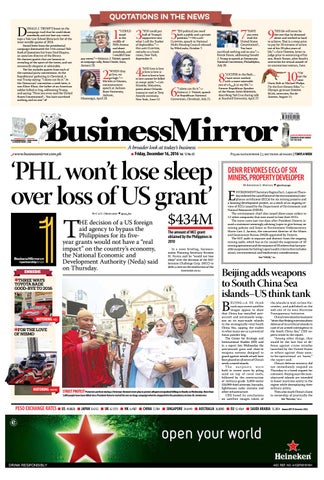
onald J. Trump’s boast on the campaign trail that he could shoot somebody and not lose any voters tops a Yale Law School librarian’s list of the most notable quotes of 2016. Sound bites from the presidential campaign dominated the 11th annual Yale Book of Quotations list from Fred Shapiro, an associate director of the library. He chooses quotes that are famous or revealing of the spirit of the times, and not necessarily eloquent or admirable. The list includes quotes from each of the national party conventions. At the Republicans’ gathering in Cleveland, it was Trump saying: “I alone can fix it.” At the Democrats’ convention a week later, it was Khizr Khan, the father of an American soldier killed in Iraq, addressing Trump, and saying: “Have you even read the United States Constitution?... You have sacrificed nothing and no one.” AP
media partner of the year
United nations
2015 environmental Media Award leadership award 2008
1
3
“I could stand in the middle of Fifth Avenue and shoot somebody, and I wouldn’t lose any voters.”—Donald J. Trump, speech at campaign rally, Sioux Center, Iowa, January 23.
“You could put half of Trump’s supporters into what I call the ‘basket of deplorables.’”— Hillary Clinton, remarks at a fundraiser, New York, September 9.
5
“[In politics] you need both a public and a private position.”—Hillary Clinton, speech to National Multi-Housing Council released by WikiLeaks, October 7.
4
“And love is love is love is love is love is love is love is love cannot be killed or swept aside.”—LinManuel Miranda, poem about Orlando massacre read at Tony Awards ceremony, New York, June 12.
2
“When they go low, we go high.”— Michelle Obama, commencement speech at Jackson State University, Jackson, Mississippi, April 23.
6
“I alone can fix it.”— Donald J. Trump, speech at Republican National Convention, Cleveland, July 21.
7
“Have you even read the United States Constitution?... You have sacrificed nothing and no one.”— Khizr Khan, addressing Donald J. Trump in speech at Democratic National Convention, Philadelphia, July 28.
8
“Lucifer in the flesh.... I have never worked with a more miserable son of a b__h in my life.”— Former Republican Speaker of the House John Boehner, describing Ted Cruz during talk at Stanford University, April 27.
9
“His life will never be the one that he dreamed about and worked so hard to achieve. That is a steep price to pay for 20 minutes of action out of his 20-plus years of life.”—Dan Turner, letter to judge prior to sentencing of his son, Brock Turner, after Brock’s conviction for sexual assault of an unconscious woman, June.
10
“I’m not the next Usain Bolt or Michael Phelps. I’m the first Simone Biles.”— Olympic gymnast Simone Biles, interview, Rio de Janeiro, August 11.
BusinessMirror
www.businessmirror.com.ph
A broader look at today’s business n
Friday, December 16, 2016 Vol. 12 No. 65
‘PHL won’t lose sleep over loss of US grant’ $434M T By Cai U. Ordinario
@cuo_bm
he decision of a US foreign aid agency to bypass the Philippines for its fiveyear grants would not have a “real impact” on the country’s economy, the National Economic and Development Authority (Neda) said on Thursday.
inside
The amount of MCC grant obtained by the Philippines in 2010
In a news briefing, Socioeconomic Planning Secretary Ernesto M. Pernia said he “would not lose sleep” over the decision of the Millennium Challenge Corp. (MCC) to defer a vote on the reselection of the Continued on A2
Three ways Toyota bade good-bye to 2016
motoring for the love of nismo
motoring
e2-E3
STREET PROTEST Protesters perform during a Christmas-themed street play to protest alleged extrajudicial killings in Manila on Wednesday. More than 5,000 people have been killed since President Duterte started his war on drugs campaign when he stepped into the presidency on June 30. AP/Aaron Favila
PESO exchange rates n US 49.8020
business news source of the year
P25.00 nationwide | 5 sections 28 pages | 7 days a week
DENR revokes ECCs of SIX miners, property developer
E
By Jonathan L. Mayuga
@jonlmayuga
NVIRONMENT Secretary Regina Paz L. Lopez on Thursday ordered the cancellation of the environmental compliance certificates (ECCs) for six mining projects and a housing-development project, as a result of an ongoing review of ECCs issued by the Department of Environment and Natural Resources (DENR). The environment chief also issued show-cause orders to 12 other companies that now stand to lose their ECCs. The move came just two days after President Duterte issued a statement seemingly advising Lopez to give leeway on mining policies and listen to Environment Undersecretary Mario Luis J. Jacinto, the concurrent director of the Mines and Geosciences Bureau (MGB) appointed by Duterte. The ECC audit is separate and distinct from the ongoing mining audit, which has so far caused the suspension of 10 mining operations and the issuance of 20 others that face possible suspension for failing Lopez’s audit criteria that includes social, environmental and biodiversity considerations. See “DENR,” A2
Beijing adds weapons to South China Sea islands–US think tank
B
e1
2016 ejap journalism awards
EI J I NG — A US t h i n k tank says recent satellite images appear to show that China has installed antiaircraft and antimissile weapons on its man-made islands in the strategically vital South China Sea, upping the stakes in what many see as a potential Asian powder keg. The Center for Strategic and International Studies (SIS) said in a report late Wednesday the anti-aircraft guns and close-in weapons systems designed to guard against missile attack have been placed on all seven of China’s newly created islands. The outposts were built in recent years by piling sand on top of coral reefs, followed by the construction of military-grade 3,000-meter (10,000-foot) airstrips, barracks, lighthouses radar stations and other infrastructure. CSIS based its conclusions on satellite images taken of
the islands in mid- to late-November, and published on the web site of its Asia Maritime Transparency Initiative. China’s new island armaments “show that Beijing is serious about defense of its artificial islands in case of an armed contingency in the South China Sea,” CSIS experts wrote in the report. “Among other things, they would be the last line of defense against cruise missiles launched by the United States or others against these soonto-be-operational air bases,” the report said. China’s defense ministry did not immediately respond on Thursday to a faxed request for comment. Beijing says the manufactured islands are intended to boost maritime safety in the region while downplaying their military utility. They also mark China’s claim to ownership of practically the
n japan 0.4252 n UK 62.5115 n HK 6.4187 n CHINA 7.2104 n singapore 34.6449 n australia 36.8983 n EU 52.4564 n SAUDI arabia 13.2834
See “Beijing,” A12
Source: BSP (15 December 2016 )
BMReports BusinessMirror
A2 Friday, December 16, 2016
www.businessmirror.com.ph
‘PHL won’t lose sleep over loss of US grant’ Continued from A1
Philippines for a second compact. On Thursday the MCC Board of Directors deferred a vote on the second compact pending “further review of concerns around rule of law and civil liberties.” “Its really more symbolic in terms of the confidence of those behind the MCC, rather than that thing having real impact on the economy. It’s not going to be that significant. [Considering] the amounts of investments that many countries are interested in putting in, I would not lose sleep
DENR. . .
Continued from A1
At a news conference, Lopez said the ECCs the DENR has decided to revoke are those of Austral-Asia Mining Corp. for its nickel mine in Mati, Davao Oriental, while denying MRL-Egerton Gold Philippines’s ECC application for its mining project in Lobo and San Juan towns in Batangas. The decision to cancel the ECCs of Austral-Asia and MRL-Egerton came following an evaluation of the rich biodiversity in the areas where the mining companies plan to operate. “Biodiversity is like gold. We are not sacrificing our rich biodiversity because of profit,” Lopez said. Austral Mining Corp. operates a nickel mine situated in between two heritage sites, the Pujada Bay and a bonsai forest in Mount Hamiguitan Range, home to the nesting Philippine Eagle, a national symbol and
over that,” Pernia said. The MCC provided the Philippines a grant of $434 million in September 2010. Among the projects financed by the MCC grant include the Secondary National Road Development Project and the Kapit-Bisig Laban sa Kahirapan-Comprehensive and Integrated Delivery of Social Services. Neda Deputy Director General Rolando G. Tungpalan said he has recently met with representatives from Japan, China, Korea, Austria, Italy and Spain who are keen on investing and extending official development assistance to the country.
listed as critically endangered or in the brink of extinction. MRL-Egerton’s copper and gold mine, which has completed its exploration and a step short before starting commercial operation, are in towns along the Verde Island Passage, which scientists have declared as the center of the shorefish’s biodiversity in the world. The DENR also revoked the ECCs of United Paragon Mining Corp.’s Longos Mining Project in Sitio Longos, Paracale, Camarines Norte; Ipilan Nickel Corp.’s Ipilan Nickel Project in Barangays Ipilan, Mambalot, Maasin and Calasaguera in Brooke’s Point, Palawan; Core Copper-Gold Corp.’s Lupon Mining Project in Marayag and Calapagan, Lopon, Davao Oriental; and Lebach Mining Corp.’s Nickel Deposit Mining Project in Barangay Ipilan, Broooke’s Point, Palawan. Maria Paz Luna, DENR undersecretary for Legal Affairs, said the projects are dormant mining projects, which failed to meet the various
Tungpalan said he has held discussions with the Asian Development Bank (ADB) and World Bank on possible projects they can finance. Pernia added that the Jin Liqun, president of the China-led Asian Infrastructure Investment Bank (AIIB), had also reached out to him. “He was trying to sell AIIB assistance really, trying to say they’re going to be different from the World Bank and the ADB in terms of speed of approval,” he said. He said that, while the World Bank will take three years to process, they can do it
conditions under their ECCs. Those issued with show-cause orders and given seven days, meanwhile, are mostly ECCs for mining and quarry projects, a logging and wood manufacturing company, and resort development projects. These are SMTC Chromite Mining and Trading Project of Sinophil Mining and Trading Corp. in Barangay Luban, Mati, Davao Oriental; consolidation of the quarry projects of Mindanao Portland Cement Corp./LaFarge in Kiwalan and Dalipuga, Ilaigan City, Lanao del Norte; iron-ore pelletizing plant project of the Philippine Sinter Corp. in Katipunan Villanueva, Misamis Oriental; proposed limestone, pozzolan and associated minerals quarry project of Century Peak Corp. in Pinamungajan, Cebu; cement-plant and power plant project of Century Peak Corp. in Barangay Sacsac, Pinamungajan, Cebu; Bulalacao coal mining project of Filipinas Systems Inc. in Cambunag Bulalacao in Mindoro Oriental; Iron Ore Mining Corp. of Ore Asia Mining
in six months or less than a year. He was practically offering us on a silver platter the assistance they provided at AIIB,” Pernia added. Earlier, the Neda said the Philippine government is seeking to finance P378.89 billion worth of projects through Chinese loans. The Neda told the BusinessMirror that there are 15 projects being proposed for funding through ODA loans from China. The Philippines has submitted a list of 23 projects to China under its feasibility study support scheme. The Neda said
and Development Corp. in the town of Doña Remedios Trinidad, Bulacan; Sacobia Sun Valley Resort of Donggwang Clark Corp. in the Clark Special Economic Zone in Mabalacat, Pampanga; smelting-plant project of Wan Chiong Steel Corp. in San Isidro, San Simon, Pampanga; Wellex Area II mining project of Wellex Mining Corp. in Loreto, Dinagat Island Province; Barobo alluvial gold-mining project of PhiGold Metallic Ore Inc. in Barobo, Surigao del Sur; and veneer manufacturing expansion of Hantex Manufacturing Corp. in Canayugan Bayugan, Agusan del Sur. Meanwhile, Lopez said they have decided to nix the appeal of Century Properties Corp. and decided to revoke the company’s ECC for its Nova by Century Project within the La Mesa Watershed for good. Lopez said the project stands to affect the watershed, the source of water for 12 million Filipinos, particularly those living in Metro Manila. Luna said that, while Century
the list includes transportation, irrigation and water supply facilities development, fish-port development and energy cooperation projects. Together with the Department of Finance, the Neda said the list of projects were submitted to National Development and Reform Commission (NDRC) and Ministry of Commerce (Mofcom) in a letter dated November 29. The letter was sent following the Mofcom and NDRC missions to the Philippines in November and President Duterte’s state visit to China in October.
was able to meet other minor conditions in their ECC, it is bound to fail in securing a tree-cutting permit from the DENR because of Presidential Proclamation 1336, which declared the La Mesa Watershed a critical watershed. Century plans to build 97 housing buildings at a 58-hectare property in an elevated portion of the watershed. Lopez said wastewater coming from these housing buildings threaten to contaminate the water source. “Our decision is based on the principle of social justice and the common good. Our Constitution is anchored on social justice and the common good. Protecting our watershed and environment is for the common good,” Lopez said. Lopez believes her decision is precisely what President Duterte wants to happen when he declared war against mining companies that destroy the environment for profit. The DENR chief has been twice bypassed by the powerful Commis-
sion on Appointments (CA). Duterte was quoted in news reports as saying Lopez may not be able to get the CA’s nod. Lopez said the campaign to weed out irresponsible mining under her watch will continue, declaring the campaign aims to promote social justice and prevent people from suffering because of development projects. Lopez said next year, the DENR will announce the result of the mining audit, which is still being deliberated on by the DENR-MGB. Lopez added that she is personally overseeing the audit procedure with former MGB Director Leo L. Jasareno already out of the picture. She said her point person in the conduct of the audit is MGB Assistant Director Manny Uykieng—not Jacinto, whose appointment as DENR undersecretary and MGB director was seen as a moral-booster by mining industry’s big players. Aside from the mining audit, the DENR is reviewing over 800 ECCs.
The Nation
A3 Friday, December 16, 2016 • Editor: Dionisio L. Pelayo
BusinessMirror
news@businessmirror.com.ph
Comelec assailed for ‘incompetence, recklessness’
T
By Joel R. San Juan
@jrsanjuan1573
HE camp of former Sen. Ferdinand R. Marcos Jr. on Thursday assailed the Commission on Elections (Comelec) for blaming the delay of the return of the vote-counting machines (VCMs) poll body leased from Smartmatic on the electoral protest it filed. Marcos’s Spokesman Vic Rodriguez branded as the “height of incompetency and recklessness” the commission’s failure to anticipate the filing of elections protests in signing the lease contract with Smartmatic for the VCMs. Rodriguez said the Comelec should have provided a stipulation in its agreement that in case an election protest is filed, this would naturally warrant a delay in the return of the machines. The Marcos camp was reacting to reports that Smartmatic is demanding from the Comelec the payment of P2 billion after the government supposedly failed to return on time over 97,000 VCMs. The machines were supposed to be returned by December 1, but there is an option to purchase in the contract. Elections Commissioner Rowena V. Guanzon earlier said Smartmatic already deemed the machines “good as sold” after the turnover was delayed. Marcos has also filed a protest before the Presidential Electoral Tribunal against Vice President Maria Leonor G. Robredo. The Senate Electioral Tribunal, on the other hand, is look-
MARCOS
ing into the electoral protest filed by senatorial candidate Francis N. Tolentino against Sen. Leila M. de Lima. Bautista said the problem started with the precautionary protection order (PPO) that came with the cases filed by Marcos and Tolentino. “This is another example of how the Filipino people have again been shortchanged by Smartmatic and the Comelec through the many contracts they have concluded on the conduct of the elections. Contracts entered into with foreign entities should contain provisions that would protect the Filipino people at all costs,” Rodriguez said. “Given our flawed electoral system, it is difficult to believe that the Comelec was not able
Telco, donor bring Christmas cheer to remote Bukidnon Catholic school
S
AINT Isidore High School is a Catholic school in a remote agricultural village called Zamboanguita in Bukidnon. It is more than 50 kilometers from the nearest city, Malaybalay, and almost 140 kilometers from Cagayan de Oro City. Getting access to technology that can aid learning is thus difficult. But with the help of generous sponsors, the students—some of whom belong to lumad tribes—can now use digital tools and content to enhance their education. An executive of mobile operator Smart Communications, Debbie Tan, used her budget for Christmas gifts to donate a School-in-a-Bag to Saint Isidore High School. Launched early this year by Smart, the Schoolin-a-Bag is a backpack containing a solar panel for electricity, a laptop, tablet, mobile phone, pocket Wi-fi with starter load, LED TV and digital learning modules. The School-in-a-Bag is one of Smart’s initiatives under its umbrella corporate social responsibility program, Smart Communities. This aims to use technology to develop different social sectors, including education. Linking the peripheries to the global knowledge economy. “We are truly grateful for this early Christmas gift to our school. With the School-in-a-Bag program, our students and teachers here in Zamboanguita are able to expand their horizon of knowledge. Our lessons become more relevant and interesting,” school Director Fr. Ernald M. Andal SJ said. “As in all gifts, we receive it with a responsibility to share its benefits to the bigger community. We hope to strengthen a culture that sees technology not just as a vital tool for today’s academic instruction, but as a link for those in the peripheries to reach out to the center and vice-versa,” Andal added. This year Smart has donated 10 School-in-a-Bag units to remote schools in Luzon, the Visayas and Mindanao. It hopes to get people and organizations to add to this number via sponsorships. One School-ina-Bag unit costs P100,000. This already includes the devices, learning modules aligned with the K to 12 curriculum, training for the teachers and delivery of the unit. Each bag will benefit hundreds of students in its expected working life span of five years.
Sponsors needed
“RIGHT now there are 3,000 schools in the Philippines—serving more than a million students—without electricity. There are still a lot of Filipino students who have not seen, much more used, a television, computer, or tablet that could help enhance their learning,” Smart Public Affairs Senior Manager Stephanie Orlino said. “We don’t want children in remote areas to be left behind. We want to help them gain access to the wealth of knowledge out there through digital learning tools. But we cannot do this alone, which is why we encourage companies, alumni associations, rotary clubs, local governments and individuals to pitch in. Let us give these children a fighting chance for a better future,” Orlino added.
to anticipate [the filing of election protests]. The right to vote is guaranteed by our Constitution. So is the right to ensure that our votes are counted,” he added. Rodriguez also expressed alarm over the statement made by Guanzon that the implementation of the “option to purchase” will be conducted in a closed-door meeting with Smartmatic. Rodriguez also took exception on a
supposed statement made by Comelec Chairman Andres D. Bautista that they already made a “constructive delivery” or a paper delivery on November 29 of the machines used in the elections. He also noted that Bautista was also quoted as saying that on December 1 the poll body announced that it had turned over 97,366 optical mark reader machines and the Election Management Systems but retained
151 OMR machines. “Did the Comelec inform, much less ask permission, from the Supreme Court, sitting as the Presidential Electoral Tribunal, for the return the OMRs given the still existing precautionary protective order, which enjoins the Comelec to preserve all elections materials used in the May elections?” Rodriguez asked. The Comelec had previously ap-
proved and conducted stripping activities of supposedly “unused” VCMs upon the request of Smartmatic despite the existence of the PPO. Rodriguez claimed that many of the SD cards taken from the “unused” VCMs were found to contain data, which validated their position that those machines should not have been touched in the first place while Marcos’s election protest is still pending.
A4
Economy
Friday, December 16, 2016 • Editors: Vittorio V. Vitug and Max V. de Leon
BusinessMirror
news@businessmirror.com.ph
PHL economy may breach 6.5% to 7% 2016 growth goal–Neda
T
By Cai Ordinario
DOE okays GIS for 5 proposed power projects By Lenie Lectura
T
@cuo_bm
he Philippine economy could exceed its growth target this year if fourth-quarter performance will be higher than expected, according to the National Economic and Development Authority (Neda). During a news briefing on Thursday, Socioeconomic Planning Secretary Ernesto M. Pernia said exceeding a growth of 7 percent will depend on the fourth quarter. Pernia said if the economy grows between 7.2 percent and 7.3 percent in the October-to-December period, exceeding the 6.5-percent to 7-percent target for the year is possible. “Drivers are public spending, exports are picking up, consumption is still strong, especially the coming holidays. On the supply side, agriculture is expected to improve because of the rains, manufacturing is also picking up,” Pernia said. The country’s growth outlook for 2017 is 6.5 percent to 7.5 percent and annually between 2018 and 2022, 7 percent to 8 percent. Despite the rosy outlook, Pernia said external risks could still dampen these projections, particularly next year and in the medium term. External risks, such as the slow revival of the European and Japanese economies, as well as the slowdown in China’s growth could spillover to the Philippines through trade. Neda Undersecretary Rosemarie Edillon also said the transition period in the United Kingdom, which recently voted to exit the European Union will add to the mix of external risks. Internal risks, Pernia said, include the nonpassage of the tax policy-
7.2% to 7.3% The growth target for the fourth quarter of the year
reform program and the incomplete implementation of the Responsible Parenthood and Reproductive Health (RPRH) Law. Other risks include weather disturbances and failure in the attempts of the President to bring peach with Muslims and rebel groups. “These are real risks and are manmade internal risks. That, hopefully, can be surmounted with the strong hand of the President and his popularity,” Pernia said. Meanwhile, the World Bank has upgraded its economic outlook for the Philippines for 2016 to 2018 as part of its quarterly forecast exercise, considering recent trends. The bank now projects the Philippine economy to grow at 6.8 percent in 2016, compared with the 6.4-percent forecast released in October (World Bank Philippines Economic Update October 2016). The World Bank also revised upward its growth projection for the Philippine economy in 2017 to 6.9 percent, compared with its October forecast of 6.2 percent. In 2018 the economy is expected to expand at 7 percent. “Recent economic trends illus-
Stamps exhibit
Philatelists view a stamp collection that are part of the “Voyage of philately Christmas stamps, world’s most expensive stamps in 1930s,” an ongoing exhibit at the lobby of the Manila Central Post Office in Lawton, Manila. ALYSA SALEN
trate the high confidence among investors and consumers, and provide the foundation for a more optimistic outlook for the remainder of 2016 and for 2017,” said Birgit Hansl, World Bank lead economist for the Philippines. “The economy’s strong performance in October and November, and continued policy commitment to an increase in public infrastructure spending are expected to carry the economy’s growth momentum over to 2017 and 2018,” Hansl said. The World Bank explained that growth in the third quarter of 2016
was higher than expected with accelerating investment and private consumption growth. This continued the strong growth performance of the Philippines economy in the first half of 2016, which was driven by the government’s preelection stimulus. Growth in capital investment is projected to remain the Philippine economy’s primary growth engine. Despite an expected increase in interest rates in 2017, monetary policy is expected to remain supportive of growth, resulting in continued expansion in credit.
The implementation of large infrastructure investments is projected to lead to significant spillover effects into consumption growth next year. Accompanied by robust credit growth to households and healthy remittances, this is expected to fuel consumption. As the global economy is slowly adjusting, with the growth momentum shifting away from advanced economies back toward emerging markets and developing economies, Philippine exports are expected to grow in 2017 at a similar rate as in 2015 and 2016.
@llectura
HE Depar tment of Energy (DOE) has recently cleared five proposed power projects for the conduct of a grid impact study (GIS). The proposed projects are expected to generate a total installed capacity of 566.7 megawatts (MW) of power capacity. A clearance for the conduct of a grid impact study is necessary for a power firm before it can proceed with the construction of its power project. The DOE issued the green light for the conduct of the said study to the following power projects: 4.5MW Sawaga River mini-hydropower plant, 6.2-MW Katipunan River minihydropower plant, 500-MW liquefied natural gas (LNG)-fired power barge, 24-MW biogas power plant and 32MW SPC power barge 104. REPower Energy Development Corp. is undertaking the two hydropower projects in Bukidnon. It secured the agency’s clearance on November 11. The gas project in Batangas City, meanwhile, will be undertaken by Vires Energy Corp., which secured the DOE’s go ahead for the conduct of a study on November 24. Vires earlier said it tapped a Norwegian company for the construction of the LNG project. It signed early this year a technology license agreement with Sevan Marine’s subsidiary HiLoad LNG AS for an LNG receiving and regasification terminal. Vires also signed a separate engineering service contract with HiLoad LNG for design and engineering work. The LNG receiving and regasification terminal, called floating regas dock, provides a competitive alternative to floating, storage and regasification unit for smaller volumes, ranging typically from 50 million to 200 million standard cubic feet per day. The biogas project will be in Lal-lo, Cagayan, and will be undertaken by Natures Renewable Energy Development Corp. The DOE’s green light for the conduct of a grid impact study for this project was issued on November 25. SPC Power Corp. also secured the agency’s go ahead for its power barge in Subic on November 28. In 2015 over 13,000 MW of power capacity from various power projects were approved by the DOE for the conduct of the said study.
New BCDA chief Singapore MI outlines benefits eyes dissolution of methanol-fuel use to consumers of Northrail Corp.
T
he newly appointed head of Bases Conversion Development Authority (BCDA) is mulling over the dissolution of the North Luzon Railways Corp. (Northrail). BCDA President and CEO Vivencio B. Dizon told reporters on Thursday that Northrail is no longer serving a purpose and only exists as an entity to serve as a party to an ongoing arbitration case with a Chinese contractor. “On the part of BCDA, we are already studying the possibility of dissolving North Rail as a corporation. The only purpose now of the company is to be a party to the arbitration case. The previous administration stopped the operations of the corporation. There are still people working there but not for the implementation of the project. We’re doing the diligence on the financials of Northrail for the preparation for possible dissolution,” Dizon said at a news conference on Thursday. The Northrail was created to implement the Northrail project, which sought to connect Central and Northern Luzon. The project had been saddled with numerous controversies and undergone several changes in the project terms since the Arroyo administration, culminating in the cancellation of government’s contract with the Chinese state-owned contractor China National Machinery and Engineering Group. According to Dizon, the case is still under arbitration with the Chinese contractor will be pursued. The final ruling will determine if the Philippines will still pay the remaining amount of $106 million, from the total $316 million claim of the contractor. Dizon said they’ll be making a decision in 2017 to dissolve Northrail definitively. Meanwhile, the connector railway project itself has been transferred to the Department of Transportation to ensure the long-awaited project can finally gain ground. “I think the most important thing is, the project finally happened. The priority of the administration is to complete the project during President Duterte’s term,” the BCDA head said. Catherine N. Pillas
S
ingapore-based Methanol Institute (MI) said methanol use in the Philippines can benefit consumers through development of higher-quality, lower-cost and environmentally beneficial fuel solutions. This, after the Department of EnergyOil Industry Management Bureau (DOEOIMB) conducted inspections of liquid petroleum products in gasoline stations and retail outlets nationwide to test the presence of methanol and to ensure compliance with Philippine National Standards for fuels. It was discovered that methanol was being added illegally to gasoline—in concentrations ranging from 1 percent to 14 percent—while gasoline was being transported to individual filling stations. According to MI, methanol is a liquid chemical that can be derived from natural gas, coal, sustainable biomass, municipal solid waste and captured carbon dioxide. Global methanol demand in 2016 is forecast to reach approximately 80 million metric ton, of which, 7 million tons is used for blending into gasoline. Direct methanol fuel blending has increased at an annual growth rate of 23 percent between 2009 and 2015. Like all fuels, methanol must be used and handled with care, according to MI. Methanol is used safely as a transportation fuel in a number of countries, where stakeholders develop methanol-gasoline blends under approved government standards. MI and its members commit significant resources to ensuring methanol safe handling and use throughout the supply chain. They work closely with their customers and government partners to monitor, track, and ensure proper distribution and use of methanol throughout the supply chain.
MI said methanol’s success in transportation fuels has been due to its economically competitive costs, octane-enhancing properties and environmental benefits. In China, it added, millions of drivers fuel their cars with M15 fuel, a blend of 15percent methanol and 85-percent gasoline with cosolvents and corrosion inhibitors. These M15 blends are sold at the pump as regular gasoline for use in the existing fleets of passenger cars. MI also said use of methanol fuels and development of methanol vehicles are also growing outside of China. Israel will introduce an M15 car in 2017 and an M85 car in two years. The European Union allows for up to 3-percent methanol in gasoline, and it is being blended in the UK and the Netherlands fuel pools. “Development, therefore, of Philippine government-approved fuel standards and related policies will also be vital for the safe and effective use of methanol in gasoline blends,” according to statement from MI. The Philippines currently imports approximately 130,000 tons of methanol annually for use primarily in the production of biodiesel fuel of which methanol typically accounts for 10 percent to 15 percent of biodiesel content. Nonetheless, MI expressed support to the efforts to ensure high-quality, safe petroleum products for consumers and their vehicles in the Philippines. “MI and the methanol industry look forward to working with DOE-OIMB and related stakeholders, to develop opportunities for the local production of renewable methanol, and for methanol to be used safely and effectively in transportation fuels and related chemical and energy applications throughout the Philippines,” it said. Lenie Lectura
Agriculture/Commodities BusinessMirror
news@businessmirror.com.ph
DENR declares moratorium on fish cage operation in Laguna de Bay
T
By Jonathan L. Mayuga
@jonlmayuga
he Department of Environment and Natural Resources (DENR) has declared a one-year moratorium on the issuance of permits for fish cage operation in Laguna de Bay starting next year. According to Environment Secretary Regina Paz L. Lopez, the DENR, through the Laguna Lake Development Authority (LLDA), will no longer renew the permit issued to fish cage operators. The permits to operate fish cages expire this month. Lopez said the fish-cage operators will be allowed to harvest their stocks until March.
The DENR chief met with fishcage and fish-pen operators to notify them of the decision. To recall, President Duterte expressed dismay that the Laguna de Bay has become congested and occupants are mostly large fishing corporations which deprive fishermen access to their traditional fishing grounds. “I talked to one of the fish-cage
operators and I asked him how big is his fish cage. He told me 40 hectares. Forty hectares? My God, that is a very big area,” Lopez said. She said the President wants to prioritize small fishermen to benefit from the lake by fishing in open waters or aquaculture production, by awarding of contracts to operate fish cages in designated areas. In implementing Duterte’s orders to clear the Laguna de Bay of illegal structures, Lopez said they plan stop all fish-cage operation to allow the lake to recover from decades of environmental degradation for at least one year. “We will no longer issue permits starting next year. But we will allow them to harvest their stocks then after that, there will be a moratorium on fish-cage operation for one year,” Lopez said. Undersecretary Art Valdez, head of the National Anti-Environmen-
tal Crime Task Force, said the owners of the structures would be asked to voluntarily dismantle their fish cage and fish pens to allow them to salvage materials. Otherwise, he said the DENR and LLDA would be forced to demolish the fish cages and fish pens. “With no permit to operate, their structures and operation becomes illegal. But no need to press charges against them. We just want them to remove their own fish cage or we will demolish them,” he said. According to Valdez, the lake’s carrying capacity is roughly 9,000 hectares but the total area occupied by fish cages and fish pens is estimated to be around 13,000 hectares. Laguna de Bay is a major aquaculture hub where the bulk of Metro Manila’s bangus and tilapia supply are grown.
Editor: Jennifer A. Ng • Friday, December 16, 2016
A5
Govt bans poultry meat, eggs from Flevoland, Netherlands By Jasper Emmanuel Y. Arcalas @jearcalas
T
he government has imposed a temporary ban on the importation of poultry meat, day-old chicks, eggs and domestic and wild birds from Flevoland, the Netherlands. The Department of Agriculture (DA) said it made the decision after the Dutch Ministry of Economic Affairs confirmed to the Office Internationale des Epizooties (OIE) the outbreak of the highly pathogenic avian influenza (HPAI) in a duck farm in Biddinghuizen, Flevoland. The Dutch agency’s report, which was issued on November 28, was confirmed by Wageningen Bioveterinary Research, Lelystad. “[The ban is being imposed] to prevent the entry of HPAI virus to protec tthe health of the public and the local poultry population,” Agriculture Secretary Emmanuel F. Piñol said in Memorandum Order 29, a copy of which was obtained by reporters on Thursday. With the ban in place, the Philippine government has suspended the processing, evaluation of the appli-
cation, and issuance of sanitary and phytosanitary import clearance of domestic and wild birds and poultry products from the Netherlands. The DA warned that it will confiscate all shipments of the banned commodities originating from Flevoland, the Netherlands. The ban does not cover heat-treated products. “Frozen pou ltr y meat w ith slaughter/process date of 21 days prior to the HPAI outbreaks are allowed to enter the country subject to veterinary quarantine rules and regulations,” Piñol said. Manila usually imposes a temporary ban on poultry products from areas where there are HPAI outbreaks as a preventive measure. Currently the Philippines is one of the few countries in Southeast Asia that remains free from the dreaded avian influenza virus. The virus, which resurfaced in Asia in 2003, crippled poultry industries in neighboring countries, such as Vietnam. Earlier, the DA said the country’s bird flu-free status will allow poultry producers to access major markets for poultry products, such as the Middle East.
A6
Friday, December 16, 2016
briefs
Iran sanctions renewal becomes law without Obama signature
WASHINGTON—In an unexpected reversal, President Barack Obama declined to sign a renewal of sanctions against Iran but let it become law anyway, in an apparent bid to alleviate Tehran’s concerns that the US is backsliding on the nuclear deal. Although the White House had said that Obama was expected to sign the 10-yearrenewal, the midnight deadline came and went on Thursday with no approval from the president. White House Press Secretary Josh Earnest said Obama had decided to let it become law without his signature. “The administration has, and continues to use, all of the necessary authorities to waive the relevant sanctions” lifted as part of the nuclear deal, Earnest said in a statement. Under the Constitution, the president has 10 days after Congress passes a bill to sign it, veto it or do nothing. If Congress has adjourned, failing to sign it is a “pocket veto” that prevents the bill from becoming law. But if Congress is still in session, the bill becomes law with no signature. Although lawmakers have returned home for the holidays, Congress technically is still in session and holding “pro-forma” sessions this week. AP
34 deported Afghan asylum-seekers return from Germany
KABUL, Afghanistan—A Kabul airport official says 34 Afghan asylum-seekers returned home after being deported from Germany the previous day. The Kabul airport chief of police, Mohammad Asif Jabarkhil, says the deportees—all young men without families—landed around 5 a.m. Many expressed disappointment over their deportation, saying they had lived and worked in Germany for years and were now forced to come back without any job prospects. Sidiq Kuchai, a 23-year-old from northern Baghlan province who was in Germany for seven years, says he “had a good job and was working in a restaurant in Cologne. Kuchai, who was among those who returned on Thursday, said that in Afghanistan he has “no job and no security.” He added: “I am not happy, everything is different for me here.” AP
Eurozone business activity ends year on upbeat note
LONDON—A survey shows that business activity across the 19-nation eurozone is growing at a relatively strong pace at the end of the year, thanks to an upturn in manufacturing. The purchasing managers’ index, a gauge of activity in the manufacturing and services sectors, held at 53.9 points in December, the same as in November. The index, published on Thursday by IHS Markit and subject to revision, is on a 100-point scale, with 50 marking the threshold between growth and contraction. The findings show that inflows of new business, employment and backlogs of work remained strong. An acceleration in growth in manufacturing also offset a slight slowdown in services. Chris Williamson, chief business economist at IHS Markit, said the index points to quarterly growth of 0.4 percent in the eurozone, which shares the euro currency. AP
The World BusinessMirror
Editor: Lyn Resurreccion • www.businessmirror.com.ph
Trump’s top diplomat would carry Chinese baggage from Exxon days
P
resident-elect Donald J. Trump’s pick for top US. diplomat comes with Chinese geopolitical entanglements. In his favor is years of dealing with some of the country’s biggest oil companies. As CEO of Exxon Mobil Corp. since 2006, Rex Tillerson has seen his company snared in territorial disputes in the South China Sea. An exploration venture with Vietnam has brought it into the cross hairs of China, one of the countries claiming the disputed waters. Tensions over energy rights last came to the fore in 2014, when China parked an exploration rig near Vietnam, setting off clashes at sea with its coast guard vessels and fishing boats. The fight for access to fishing grounds, oil and gas in the South China Sea remains one of the biggest potential f lash points in the western Pacific, amid a broader tussle between rising power China and established power the US for inf luence. Still, the South China Sea issue presents both a risk and opportunity for Chinese-US ties should Tillerson pass a potentially fraught confirmation process for secretary of state. With more than a decade of experience interacting with Chinese state-owned companies and their leaders—many of them senior Communist Party officials—Tillerson could bring a fresh perspective to the region’s territorial spats.
‘Very careful’
“He’s clearly going to have to be ver y careful in negotiations around any thing directly involving Ex xon Mobil,” said Ian Bremmer, president of Eurasia Group, a New York-based political risk consultancy. “ There’s going to be massive scrutiny around that,” he said. “ The USChina relationship is one to watch carefully in the first few months of the administration.” W hoever takes the role of secretary of state faces an unpredictable environment with the potential for sudden policy swings. Trump’s protocol-break-
$4.5B
The cost of the joint-venture refinery in the eastern province of Fujian, which opened in 2009, where Rex Tillerson spoke when he was the chief executive officer of Exxon Mobil Corp.
ing phone call w ith Taiwan’s president this month, and his attacks on China on Twitter, have sparked friction between the world ’s two biggest economies before he even takes office. Amid Trump’s recent remarks, China f lew a bomber through the South China Sea in what it called a normal f light operation. Under President Barack Obama, the US has beefed up its military presence in the western Pacific and restarted “freedom of navigation” operations in the South China Sea, which challenge unilateral claims to sovereignty. China has undertaken large land reclamation on disputed reefs in recent years to expand its military footprint. Tillerson has rarely commented directly on the South China Sea, or on broader China matters. The company has sustained its exploration ties with Vietnam in the face of China’s efforts to get Vietnam to cede ground on territorial matters. China warned Exxon on several occasions about its activities, including in June 2008, according to leaked US diplomatic cables released by WikiLeaks. Still, Tillerson has regularly visited China and met the heads of state-run oil companies, according to Chinese state media. He went to China mid-year and saw Wang
Rex Tillerson Bloomberg News
Yilin, chairman of China National Petroleum Corp. (CNPC). The company’s web site showed a photo of them shaking hands and smiling. “ He’s prag m at ic, dec i sive, and has a good reputation in the Chinese oil industry,” said Lin Boqiang, an adviser to the National Energy Administration of China and director of Xiamen University’s energy economics research center.
Exploration blocks
Exxon has been doing business in China for more than a century. Its predecessor Standard Oil sold kerosene there in the 1890s. It was one of the first multinational companies to jump when China opened its door to foreign investment in the late 1970s. There will be some focus on how Tillerson approaches the South China Sea if he ends up as Trump’s top diplomat. That’s because in 2009 Exxon bought the rights to jointly explore almost 14 million acres (5.7 million hectares) off the coast of Vietnam, according to the WikiLeaks cables. Some of that area is claimed by China. Exxon’s work is focused on a field in undisputed territory about 80 kilometers offshore from central Vietnam, spokesman A aron Str yk said in response to e-mailed questions. He declined to comment on reports China warned Exxon against exploring in disputed areas. “Border issues a re a mat ter for gover n ment s to add ress through appropr iate channels,” St r yk sa id. “ We have a successf u l h istor y of work ing
w ith var ious gover nments and pa r t ners a rou nd t he world to ma x im i ze t he va lue of hyd ro ca rbon resou rces.”
‘Economy diplomacy’
Fu Mengzi, vice president of t he State Secur it y Ministr ybacked China Institutes of Contemporary International Relations, said a Trump-Tillerson team would shift the US from the “security diplomacy” of the Obama administration toward “economy diplomacy.” “This type of diplomacy believes in mutual business interests and transactional equality, which holds value for China,” Fu said. Foreign Ministry Spokesman Geng Shuang, speaking at a regular briefing on Tuesday, said China was willing to work with whoever became secretary of state. “We hope that departments in charge of foreign affairs of our two countries can enhance communication and cooperation,” Geng said. Ex xon has l imited investments in ex ploration and drilling in China, and invests in chemica l companies in severa l prov inces. Til lerson spoke at the opening ceremony of a $4.5 billion joint venture refiner y in the easter n prov ince of Fujian in late 2009, when then-Vice P resident X i Ji npi ng sent a congratu lator y message. “Exxon’s presence in China is not strategic, but I can’t see Tillerson supporting a deep undermining of relationships with China,” said Philip Andrews-Speed, a fellow at the Energy Studies Institute in Singapore. “That would be counter-productive.” Bloomberg News
US factory production drops for first time in 3 months
U
.S. factory output dropped in November for the first time in three months, showing an anemic recovery in manufacturing after an extended slowdown. Production at factories, which make up 75 percent of all output, fell 0.1 percent, a Federal Reserve report showed on Wednesday. The median forecast in a Bloomberg survey called for a 0.2-percent drop. Total industrial output, which includes mines and utilities, decreased 0.4 percent, the biggest decline since March, as utility use slowed with warmer-than-usual temperatures. American manufacturing is barely expanding as global demand and domestic business investment remain uninspiring. While factory customers have made progress trimming bloated inventories and consumer spending is holding up, a recent spike in the value of the dollar represents a new challenge for the nation’s producers. “The manufacturing sector is flat to positive, on trend,” David Sloan, senior economist at 4CAST-RGE in New York, said before the report. “The exports outlook isn’t very strong, but exports have been reasonably resilient.” Estimates in the Bloomberg survey for manufacturing output, which accounts for about 12 percent of the economy, ranged from a 0.8-percent decline to an increase of 0.2 percent. The previous month’s reading was revised to a 0.3-percent gain, from 0.2 percent.
Industrial output
F o r total industrial production, the Bloomberg sur vey of 80 economists showed estimates ranging from a decrease of 0.8 percent to a rise of 0.5 percent. The prior month was revised to a 0.1-percent increase, after being initially reported as little changed. Capacity utilization, which measures the amount of a plant that is in use, eased to 75 percent in November, the weakest since March, from 75.4 percent the prior month. Utility output decreased 4.4 percent after October’s 2.8-percent decline. Last month was the second-warmest November for the contiguous US in records dating to 1895, according to the National Oceanic and Atmospheric Administration. Mining production, including oil drilling, climbed 1.1 percent in November after a 1.9-percent increase. Drilling of oil and gas wells rose 5.3 percent. The US rotary rig count has been steadily rising for six months after a relentless slide that started at the end of 2014, according to Baker Hughes Inc. data. Rebounding energy prices are giving a lift to the count. The number of rigs increased to 624 in the week ended on December 9 from 597 in the prior period. Consumer durable goods output dropped 1.6 percent last month after a 0.8-percent gain in October. Business equipment production was down 0.3 percent following a 0.1-percent increase. Bloomberg News
Aleppo cease-fire unravels, raising specter of bloody end
B
EIRU T—A cease -f ire to evacuate rebel fighters and civilians from the remaining opposition-held neighborhoods of Aleppo unraveled on Wednesday, once again raising the specter of a bloody end to the battle for Syria’s largest city as residents reported the resumption of shelling and brutal bombing runs. Opponents of President Bashar al-Assad accused the government and its allies of scuttling the deal by adding new conditions, including the lifting of a rebel siege on two pro-government Shiite villages in nearby Idlib province. However, hours after it crumbled, the rebels said the deal was back on. There was no comment from the government or its allies, and minutes after the new ceasefire was to take effect at 11:30 p.m. local time, there were still reports of shelling in the few blocks of the city under rebel control. The media arm of Lebanon’s militant Hezbollah group says overnight negotiations have reinforced a cease-fire deal to allow Syrian rebels and tens of thousands of civilians to leave the besieged eastern city of Aleppo.
It says Syrian rebels will likely begin leaving their last holdout in Aleppo “in the coming hours.” T hu rsd ay ’s a n nou ncement by Hezbollah’s Military Media came after the cease-fire deal, mediated by Ankara and Moscow, unraveled amid fighting the previous day. Shiite Hezbollah militiamen are fighting in the Syrian civil war on the side of President Bashar Assad’s forces. Damascus and its allies have not commented on the cease-fire being back on. The Britain-based Syrian Observatory for Human Rights said the fighting stopped in the city around 4 a.m. Three rebel spokesmen said the first group of wounded people and civilians were to be escorted out of the city early on Thursday morning. Rebels would follow, they said, adding that the conditions had not changed and that they had even agreed with the Russians on the exact number of buses and convoys to be deployed in the rescue. T he Sy r i a n m i l it a r y med i a denied a n ag reement had been reached and said in a statement t hat t he negot iat ions were “compl icated ”. The evacuation
was to have begun at dawn on Wednesday, but quickly derailed, descending into terrifying violence. Residents said government buses arrived in the pre-dawn hours at agreed upon meeting points, where the wounded were first in line to be evacuated after surviving weeks of intense fighting amid destroyed medical facilities and depleted supplies. But they were turned away by pro-government militias manning the checkpoints. Then violence erupted: shelling and then air strikes. The rebels retaliated, at one point shelling the pro-government villages of Foua and Kfraya in Idlib and detonating a car bomb in a frontline area. Residents, activists and medical staff described mayhem in the tiny sliver of Aleppo still under opposition control as volleys of shells rained down on the area where tens of thousands of civilians were trapped alongside rebels in gutted apartment buildings and other shelters. Videos shared online by residents huddling indoors recorded the sounds of war—deafening explosions that highlighted fears of
a bloodbath. Rescuers were overwhelmed and a comprehensive casualty toll was impossible. “They began to strike as if there’s no such thing as a cease-fire or civilian evacuation,” said Mahmoud Raslan, a local media activist. Mohammed Abu Jaafar, head of forensics in eastern Aleppo, said residents felt “duped.” “People have left their shelters....to be ready for the evacuation. I can’t describe it,” Abu Jaafar said. “Since the morning, they started to target the areas where people have gathered. ... These people were walking to the crossings designated for exit.” The initial evacuation deal was mediated late on Tuesday by Turkey and Russia as the rebel enclave rapidly dissolved, ceding more and more territory in the face of the brutal advance by Syrian forces, backed by Russia and Shiite militias from Lebanon, Iraq and Afghanistan. Along with Russia, Iran backs Assad’s government and has committed advisers and elite Revolutionary Guard forces to the government side. Turkey backs some of the rebel groups fighting to topple Assad.
It was an effective surrender by the rebel fighters who had held onto nearly half of Aleppo for more than four years. Rebel spokesman Bassam Haj Mustafa accused the Syrian government and Iran of foiling the deal by imposing new conditions on the rebels, including lifting the opposition’s months-long siege of the Shiite villages of Foua and Kfraya in Idlib province. Calling that an “excuse,” he added: “They want a massacre and not concessions.” Osama Abo Zayd, a legal adviser for the rebels, said that in talks to salvage the deal, the rebels offered to evacuate the wounded in the two towns, but said that was another matter to be dealt with later, along with the future of two Sunni towns besieged by government forces. He said Russian pressure rescued the deal. Rami Abdurrahman, the head of the Britain-based Syrian Observatory for Human Rights, said the Syrian government and its allies also wanted the release of their fighters taken hostage by the rebels as well as the handover of over 250 wanted militant fighters. AP
Technology Newsmakers A BusinessMirror Special Feature
www.businessmirror.com.ph
Selfie-generation smartphone
G
By Leony R. Garcia
ONE are the days when people seek professional photographers, have their hair and makeup done, and their clothes meticulously arranged for a portrait in the photo studio. Today, with just a smartphone handy (or better with a selfie stick), anyone can shoot photos anywhere, anytime to his or her heart’s content. Since Oxford Dictionaries has hailed “selfie” as the word of the year for 2013, it has spawned herds of images on social media from mundane things to the most important events of our lives. Even babies and cute pets have selfies, which, for sure, they know nothing about at all. And the smartphones we use to take selfies is always at hand. We carry our phone closer to our bodies than anything else. We accessorize it. We customize its interface. We keep it with us 24/7. Doing the selfie is as easy as 1,2,3—grab your phone, put on your best duck face and celebrate—by doing a self-portrait and sharing it to social-media web sites,such as Facebook, Twitter or Instagram.
Young people say it’s just for fun —capturing the moment and sharing it. However, some describe selfie as the most embarrassing phenomenon of the digital age. Take these examples that most of us are guilty of: selfies of our new hairdo, a stylish manicure, our night on the town, or a brand-new outfit. Sharing these photos is a great way to express how good we feel about ourselves or (let’s be honest) to brag about the unique experiences we’ve had. Still, for some, selfies aren’t just about showing others where they’ve been or what they’ve done; selfies are their own personal “mirror, mirror on the wall” narcissistic egoSee “Selfie generation” on A8
Friday, December 16, 2016 A7
Technology Newsmakers A BusinessMirror Special Feature
Friday, December 16, 2016
A8
www.businessmirror.com.ph
All-day calls and music in one with new intelligent stereo headphones from Jabra D
ESIGNED for those who want a great calling experience, music on-the-go and the ability to switch easily between the two, the new Jabra Halo Smart wireless headphones have been developed with voice and call-quality top of mind. Jabra Halo Smart delivers a superior call experience, thanks to high-quality microphones with integrated wind-noise protection, enhanced voice capabilities via a dedicated Google Now/Siri button and immersive, full-spectrum sound through its 10mm speakers. With the addition of up to 17 hours talk time or 15 hours of music listening with just one charge, Jabra
Halo Smart is intended to be used all-day, every day. The intelligence of Jabra Halo Smart lies in its ability to let the user manage calls, music and media with just one device. According to recent Jabra insights*, 79 per cent of users would like to have one set of headphones for both calls and music, but believe the call experience on most music devices is poor. Jabra Halo Smart allows you to accept a call by separating the two earbuds as they rest around your neck, and use one earbud for phone calls or both for listening to music. It also lets you access Siri or Google Now at the touch of a button and keeps you
connected and informed in a number of ways. A subtle vibration in the neckband alerts you to incoming calls, whilst Android users can expect read outs of calendar notifications, e-mails, text messages and social-media messages. “We are all doing more with our smartphones than ever before, whether it’s making and taking calls, listening to music on-themove or watching a movie clip during a break. So we wanted to develop a set of wireless headphones that delivers amazing sound whatever you’re doing whether taking calls or listening to music”, explains Calum MacDougall, SVP at Jabra. When it comes to basics like
Selfie generation...
EASY SHOPPING WITH LENOVO HOLIDAY PROMOS
Continued from A7
feeding machine. People from all walks of life (even the famous and high-profile individuals can’t resist the appeal of the selfie.) In fact, world leaders Barack Obama’s and David Cameron’s selfie with Helle Thorning-Schmidt during a memorial service in Johannesburg for South African leader Nelson Mandela in December 2013 has caused an outrage among the netizens. Many deemed inappropriate the whimsical mobile photo given the nature of the occasion. The three leaders appeared to momentarily forget the solemnity of the occasion, adopting the mandatory cheesy grins. The Cameron-Obama-Thorning-Schmidt selfie was one of the most viral photos online. While earning a backlash from some who felt it was unbecoming of the three leaders, many also remarked that they were simply joining in the South African spirit of celebrating, rather than mourning, Mandela They added that the leaders took advantage of the unusual number of dignitaries gathered in one place to pose for a self portrait with the beauteous Danish prime minister who is also the daughterin-law of Neil Kinnock, the revered British Labour Party politician. Back home, even President Rodrigo Duterte has become the most celebrated personality with people wanting to have a selfie with him. The newest leader in the Association of Southeast Asian Nations (Asean), was reported to be a rockstar during the Asean Summit in September when other foreign ministers and delegates have scrambled to get a selfie with him. Even diplomats could not resist the temptation of taking selfies with the new President of the Philippines during the diplomatic reception following his oath-taking ceremony on June 30. Ambassadors dropped formality and flocked around Duterte and took pictures of themselves with the President with their smartphones. In fact, there was a change in protocol in doing a selfie with Duterte after a near fall when wellwishers mobbed him in Davao after winning the May 2016 presidential election. A strict screening process, a holding room for the media, a byappointment-only access and a limited number of guests at any one time were some of the changes that police authorities implemented at the Matina Enclaves where Duterte received well-wishers and visitors prior to his inauguration.
The rise of selfie experts smartphones
IT was in 2012 when the word of the year began its ascent to digital fame, Oxford said. “Language research conducted by Oxford Dictionaries editors reveals that the frequency of the word selfie in the English language has increased by 17,000 percent since this time last year,” Oxford wrote in justifying its choice in 2013. Since then, selfie has also been
battery life, Jabra Halo Smart removes the hassle of constantly charging your headphones. Unlike other solutions, it discretely incorporates a 230mAh battery into the back of the neckband using bendable “flex zones” to provide up to 17-hour talk time (or 15 hours of music listening) with just one charge. Moreover, by using the Jabra Assist app provided, you can track exact battery usage, receive alerts when the battery is getting low and get notifications about when you next need to recharge (based on historical usage).
W
ITH Christmas just around the corner, Filipinos are flocking into malls in the hope of catching lastminute gift ideas for friends and loved ones. If last year’s Christmas is flooded with memories of panic attacks and hasty purchases, take it easy this year with Lenovo’s sweet price downs and freebies— your friends and loved ones will definitely grin ear to ear when they unwrap your Christmas present, and your wallet will thank you for it, too!
ChristMax entertainment
WHAT better way to binge-watch your favorite TV series and movies this Christmas other than experiencing them all in virtual reality? Featuring Lenovo TheaterMax technology, Lenovo VIBE K5 Note and Lenovo VIBE K5 deliver a widescreen cinematic experience pow-
busy pumping out offspring in its namesake. It has given birth to “helfie”—a photo of one’s own hair; “belfie”—a snapshot of one’s own backside; and “welfie”—a selfie taken while working out, aka the most annoying kind; “groupie,” appropriately for group shots. There’s also the “drelfie”—a photo of yourself when you’re drunk. Fitting, since a drelfie in Australia was the first selfie that ever bore the name. With the rise of the selfie generation, cellular phone manufacturers also scrambled to produce the expert selfie smartphone. Oppo has cemented its place to be the best and smartest selfie expert this year. Undoubtedly, the Tech Newsmaker of the Year, Oppo is a global electronics and technology service provider that delivers the latest and most exquisite mobile electronic devices in over 20 countries, including the United States, China, Australia and many countries throughout Europe, Southeast Asia, South Asia, the Middle East and Africa. Oppo Electronics Corp. is a Chinese electronics manufacturer based in Dongguan, Guangdong, globally registered in 2001 and founded in 2004. It is a subsidiary of BBK Electronics Corp. which markets smartphones under the Oppo, OnePlus and Vivo brands. It is ironic that the Chinese people have created the selfie expert where their homeland strictly prohibits Facebook, the number one website where selfies are uploaded. The Oppo F1s sports a 5.5inch display with fairly slim bezels. There is also the fingerprint scanner for added security—making sure that your selfies aren’t easily accessible by just anyone. The scanner is in between two capacitive buttons with back light when pressed. Armed with a 16-megapixel front camera, Oppo is also equipped with an F2.0 aperture so it could still perform well even under low light areas. As a selfie-focused handset, it comes with the company’s Beautify 4.0 feature that tweaks the skin
tone using a slider. It goes from ‘Fair’ to ‘Rosy’ that adds a bit of red color to the skin and also has a 10-level beautification that basically blurs the details of your face—hiding any blemishes for that perfect #wokeuplikethis post. Vanity aside, the Oppo F1s sports a 1.5GHz MediaTek MT6750 octa-core CPU with MaliT860 MP2 in the graphics department. This tandem, in addition to its 3GB RAM, keeps things running smoothly even when you use the device to play games like NBA 2K16, browse the internet, check our social media sites, and edit photos using Snapseed. Priced competitively at P12,990, you get a pair of nice cameras, capable processor, ample 3GB RAM, and dual-SIM plus an extra space for a microSD card. It’s no wonder the F1s got sold out only three days after its availability in the Philippines in August this year. Meanwhile, the Plus version of the F1 mobile phone has 16MP selfie camera on the front that is clubbed with screen flash for better selfies in low light conditions and it also has good f/2.0 aperture and 78.1 degree wide-angle lens. The F1 Plus Primary camera is a 13MP shooter that has an F2.2 aperture and phase detection auto focus PDAF. It can also record videos in 4K resolution. With the season of gift-giving around us, Oppo easily comes to mind as the best gift for the funloving selfie generation. Its famous endorsers, artists Sarah Geronimo and Alden Richards, also add excitement to the marketing campaign of the selfie expert. Richards who just joined Oppo as brand ambassador is the endorser for the F1s limited edition smartphone, nicknamed ‘Selfie Expert’ for its 16 MP front camera which was unveiled on November 9. Oppo said the two were chosen in keeping with their philosophy to be “hard working, always rooted on the ground, and successful in what they do.”
ered by Virtual Reality technology, for immersive visuals and sound in the palm of your hand. Packed with QualcommSnapdragon octa-core processors (for Lenovo VIBE K5 Plus) and a Premium 64-bit Helio octa-core processor (for Lenovo VIBE K5 Note), both smartphones redefine “fast and furious”. Both capture the best photos and play the finest videos: aside from having a 13 MP rear camera, both feature frontal cameras—an 8MP fixed-focus front camera for the Lenovo VIBE K5 Note and a 5MP front camera for Lenovo VIBE K5 Plus—to help users have more fun with selfies. Lenovo VIBE K5 Plus and Lenovo VIBE K5 Note retail at P8, 999 and P11,999 respectively. And with Lenovo’s ChristMax Entertainment promo, both come with a free virtual reality entertainment package worth P3, 500
from Lenovo: this includes a VR headset, VR Controller, and Bluetooth headphones with built-in MP3 player. Lenovo has also slashed as much as Php3,000 off the price tag of some entry-level Lenovo smartphones. Lenovo A6010, which boasts of Dolby Atmos Twin Speakers, now retails at P4,999, down from its original SRP of P7,999. Lenovo A7000 Plus, which delivers an immersive 360-degree sound with Dolby Atmos technology feature, is now priced at P7,999 instead of P8,499; and Lenovo VIBE K4 Note, one of Lenovo’s first Virtual Reality Technology-enabled smartphones, is now priced at P9,999, down from P10,699. All three smartphones come with free audio headsets. Lenovo VIBE K4 Note additionally comes with a free VR headset for a more immersive virtual reality experience.
Vivo Y55 good impression I
By Faye Pablo
AM not fond of using Android smartphones because of past experiences in using them. The Vivo Y55, however, may be getting back my trust on Android phones. Here are my reasons: You will love the Vivo Y55 phone because it only weighs 142 grams. You might think you forgot it a top your drawer when you already leave home for the office, in the end, finding out that it was in your bag all along. The Vivo Y55 just doesn’t consume too much space, as it measures 147.90 x 72.90 x 7.50 (height x width x thickness). If you’ve always wanted to have an iPhone but can’t afford to buy one, try Vivo Y55. From afar, it almost looks like an iPhone because of its shape and lining. The problem here is that other people might also think you have an iPhone and try to steal it from you. And just like the iPhone, the Vivo Y55 is available on gold, rose gold and space gray. Who doesn’t love a long-lasting battery life? This phone takes a whole day and a half before getting totally low on juice. Your friends will hate you for having a half battery life while they are already plugging-in their phones to their power banks. It is battery life-saver phone. We are obviously in the selfie generation, and Vivo Y55 would be a favorite tool in taking selfies. It has many features, like one-tap makeover, beautification adjustment and different filters to enhance your selfie. It has also watermarks wherein you can put the name of the place, the date
and time, your statement or even greetings. You’ll hate it because you just can’t stop yourself from taking selfies. Vivo Y55 has only 2 Gigabytes (Gb) random access memory (RAM). Small space for selfies and music, huh? The good thing about this is that, it is expandable up to 32 GB. Normally, in some of the android phones that I used, the memory is small and not expandable, causing the device to lag and work very slow. Because the RAM of the Vivo Y55 is expandable, you can store more files, selfies and music files. A powerful chip. Even though you don’t expand the Y55’s RAM, it will not lag or work slowly because of its 1.4-Gigahertz (gHz) octacore
chip. Modern octacore chips, meanwhile, simply have two sets of quadcore processors, which split various tasks between them, according to type. Most of the time, the lower-powered set of cores will be employed. When advanced tasks are needed, however, the faster set of four cores will kick in, according to the Trusted Reviews web site. Maybe you’ll just hate your phone’s memory when you have too many stored memories that need to be deleted, but you can’t. This is the best feature that I ever experienced in using an Android phone: the lock screen. Likewise, the Y55 offers two password settings: one exclusive for the user and a guestuser password. The latter allows your friend to use your phone but have limited access to your files. One example is hiding your last #TGIF photos from your mom who suddenly borrows your phone for no reason. Your mom would just hate you for not sharing the pictures with her, I guess. Again, this is a life-saver phone. You will love the Vivo Y55 more because it is only worth P7,990. It is very affordable but offers a way lot many than other expensive phones. The Vivo phone sounds like the word “bibo,” which means to impress. And the Y55 phone is really making pa-bibo in select aspects.
news@businessmirror.com.ph
AseanFriday BusinessMirror
Editor: Max V. de Leon • Friday, December 16, 2016 A9
Thai fishing boats sail far to avoid regulations
B
ANGKOK—The six men lay in red body bags, lined up on a concrete dock. The first died almost three weeks before his ship reached Thailand; the last almost made it alive, but died the day before the ship docked.
They were Thai and Cambodian fishermen who had succumbed to beriberi, a disease better known for striking sailors more than a century ago. But their deaths, says a Greenpeace report released on Thursday, are part of an all-too modern scourge—Thai fishing fleets operating thousands of kilometers (miles) from home in unregulated
waters to dodge government oversight over illegal fishing and onboard human-rights abuses. Thailand has responded to problems in the industry by grounding its overseas fleet and ordering tracking equipment installed on the vessels. The two ships carrying the dead had left Thailand in the first few
months of 2015, according to an earlier Thai government report. They parked themselves off the coast of Madagascar, where they stayed for months. They transferred their catch to “reefers”, refrigerated cargo ships, to avoid government regulators, while still getting their fish to market. Supply ships brought the
fishermen fresh food once every couple of months. But they didn’t come often enough. An inspection found “there was no fresh food,” Thai government investigators concluded after searching one ship, the Somboon 19. “The rest of the kitchen had eggs, vegetable oil and white rice. No fresh vegetables or meat.” AP
A10 Friday, December 16, 2016 • Editor: Angel R. Calso
Opinion BusinessMirror
editorial
President Obama’s legacy of disaster
A
S the sun sets on the US presidency of Barack Obama, the world and the region is left with a legacy of foreign-policy catastrophes. The list of failures is “impressive”; North Africa, Ukraine and Crimea, Syria and the South China Sea. Perhaps, the only “success” is that Kim Jong Un has not nuked South Korea yet, no doubt because of the 10year effort of the new US Ambassador to the Philippines, Sung Y. Kim. The latest development in the region is the Reuters news service report two days ago that new satellite imagery—analyzed by the Asia Maritime Transparency Initiative (AMTI) at the Center for Strategic and International Studies—shows China has pushed forward to the next level of militarizing its artificial islands. Reuters: “AMTI said it had been tracking construction of hexagonal structures on Fiery Cross, Mischief and Subi reefs on the Spratly Islands since June and July. These gun and probable close-in weapons systems (CIWS) emplacements show that Beijing is serious about defense of its artificial islands in case of an armed contingency in the South China Sea. This is militarization. The Chinese can argue that it’s only for defensive purposes, but if you are building giant anti-aircraft gun and CIWS emplacements, it means that you are prepping for a future conflict.” AMTI concludes: “Now, they have all the infrastructure in place for these interlocking rings of defense and power projection.” The United States allowed this to happen. The argument could be made that there is not much that the US could have done to stop China from turning the South China Sea into its own forward military base. But if that is the case, then it supports the position that US military might is less of a deterrent than hoped for and expected. Further, China’s military expansion also shows that US influence in the region to determine outcomes is being ignored at least by China, which is actually all that matters. Already, the critics of President Duterte are pushing the idea that this has been caused, at least in part, by the President’s nasty reaction to US criticism about the war on drugs. This naïve attitude ignores the fact that since 2010 the Aquino administration was more accommodating to the US perhaps since the Marcos administration. Relying on the US to counter China’s regional moves was the correct, if not the only sensible, decision. Unfortunately, like the other US foreign-policy initiatives, it failed. With these new facilities combined with the existing military-grade runways and soon-to-be operational air bases, China controls the South China Sea. While President-elect Donald J. Trump appears to be taking a stronger approach toward China on this issue, as well as trade, than President Obama, the damage is done. The US response is not comforting. In a speech last Wednesday in Australia, Adm. Harry Harris, head of the US Pacific Command, said: “We will not allow a shared domain to be closed down unilaterally no matter how many bases are built on artificial features in the South China Sea. We will cooperate when we can but we will be ready to confront when we must. Our forces stand ready to fight tonight.” Where does the Philippines go from here? Since 2005
BusinessMirror A broader look at today’s business ✝ Ambassador Antonio L. Cabangon Chua Founder
Publisher Editor in Chief Managing Editor Associate Editor News Editor City & Assignments Editor Senior Editors
T. Anthony C. Cabangon
Lorenzo M. Lomibao Jr., Gerard S. Ramos Lyn B. Resurreccion, Efleda P. Campos Ruben M. Cruz Jr. Angel R. Calso
Creative Director Chief Photographer
Eduardo A. Davad Nonilon G. Reyes Judge Pedro T. Santiago (Ret.) Benjamin V. Ramos Adebelo D. Gasmin Marvin Nisperos Estigoy Aldwin Maralit Tolosa Dante S. Castro
Publishing, Inc., with offices on the 3rd floor of Dominga Building III 2113 Chino Roces Avenue corner De La Rosa Street, Makati City, Philippines. Tel. Nos. (Editorial) 817-9467; 813-0725. Fax line: 813-7025. (Advertising Sales) 893-2019; 817-1351, 817-2807. (Circulation) 893-1662; 814-0134 to 36. E-mail: news@businessmirror.com.ph.
www.businessmirror.com.ph
Printed by brown madonna Press, Inc.–San Valley Drive KM-15, South Superhighway, Parañaque, Metro Manila MEMBER OF
spox
T
en days after the elections, 12 senators-elect and 46 winning party-list organizations were proclaimed by the commission en banc, sitting as the National Board of Canvassers. This marked the first time that the proclamation of all national election winners, save for the positions of President and Vice President, took place on the same day. In the past, it was not unusual for senatorselect to be proclaimed more than a week before the completion of the canvass for party-list representatives.
These facts about the 2016 elections now form part of the Commission on Elections’s (Comelec) benchmarks for future elections. However, as we near the end of this watershed year, it would not be out of place to also consider the broader historical and sociopolitical context of the elections in the year that was. It has become trite to refer to an election as historic, and to characterize it as being the most important. Almost by definition, all synchronized elections necessarily fall within those parameters. What sets the synchronized elections of 2016 apart, however, is that its historical importance must be considered intertwined with the entirety of the overarching and trailblazing experience of the
Comelec in the use of automation on such a grand scale. Historically, the 2016 national and local elections was the first election under the mandatory biometrics regime established in 2013 by Republic Act 1037, or the Mandatory Biometrics Registration law. It was also the third electoral exercise to be conducted with the nationwide use of automation for various phases of the process. And in that particular respect, the Comelec acquitted itself particularly well. The elections, which logged the highest voter turnout in recent history, at 81 percent of eligible voters, were bookended by two recordbreaking performances: the shortest period for ballot printing, with 56.7 million ballots printed in just
49 days; and the highest and fastest transmission rate to the transparency server, at 96.4 percent. Perhaps, most significantly, 2016 saw—for the first time in history— the issuance of “voting receipts” to every single voter, and under such circumstances that it required critical 11th-hour changes to the Comelec’s operating timetables and procedures. Gauging the impact of 2016, therefore, does not require reliance on some nebulous notion of momentousness, but on tangible measures of technological proficiency and administrative acumen. Sociopolitically, and perhaps unsurprisingly, 2016 was widely characterized as a referendum on the previous government, both by the alliance of incumbents and those who stood in opposition. For the former, the promise of 2016 was the potential for continuity; for the latter, the elections presented an opportunity to chart a different course for the nation. In this sense, 2016 developed into a contest between two competing “ideologies”—staying the course versus charting new directions. This perception of the 2016 elections contributed heavily to the polarization of the electorate and the population at large while, at the same time, generating massive public interest in the coming electoral contest. These two factors—passionate public support for the contending ideologies and
Christmas and new beginnings
Max V. de Leon Jennifer A. Ng Dionisio L. Pelayo Vittorio V. Vitug
BusinessMirror is published daily by the Philippine Business Daily Mirror
HOM
James Jimenez
Jun B. Vallecera
Online Editor Social Media Editor
Chairman of the Board & Ombudsman President VP-Finance VP Advertising Sales Advertising Sales Manager Group Circulation Manager
A brief overview of the 2016 elections
Jenny Lind Elmaco, PhD
Women Stepping UP
J
ust like in the Philippines, Christmas is the most wonderful time of the year in many parts of the world. We have a lot in common with other countries on how we celebrate the season. The French also have their Noche Buena called the Le Réveillon de Noël, in which families eat a special meal to celebrate the very beginning of Christmas Day. In Japan they also exchange gifts and have a Hoteiosho, who closely resembles Santa Claus. In Denmark, meanwhile, the jolly bringer of gifts is known as Julemanden and arrives in a sleigh drawn by reindeer, with a sack over his back. Children leave out saucers of milk or rice pudding for them, and are delighted to find the food gone on Christmas morning. From Spain, we got the tradition to go to Midnight Mass, or La Misa del Gallo (“The Mass of the Rooster”). It is called this because a rooster is supposed to have crowed the night that Jesus was born.
Yet, as we celebrate this season with the rest of the world, the end of the year is also a time for reflection. A time to remember. A time to hope. And a time to come together. The past months have torn many of us apart—not only by politics but also by the challenge to our common history and our collective memory as a people. Is it going to be a Merry Christmas and a Happy New Year for the Philippines? That is up to us to decide–together as one nation. For the contentment and happiness of society is directly connected to social and political
realities. It can only be truly achieved when there is not only progress, but also when there is no discrimination and oppression, and when people work together as one country, and as citizens of one world. There will be disagreements, for sure, but we can also promise to always find what brings us together and to work hand-inhand for what is best for all of us. Building an awareness of togetherness for us Filipinos today has been a slow process. Not impossible, but quite frustrating. Yet, while there are still some people who don’t think much about our common past or present, and our future, I believe that the attitude is changing. There is an effort to once more engage, to have a political belief in change and to have an answer to the question, “What do we stand for?” We, Filipinos, all know that it isn’t by bread alone that a man or woman lives—that we have to have something to be proud of to convince us that our country is worth the struggle and the sacrifice. It isn’t some abstract pie in the sky statistic but something beautiful and real that we can hold on to. We do have a reason to have
high levels of public anticipation of the outcome—created the perfect environment for the emergence of individual voter participation and engagement as a force to be reckoned with. The year 2016 was also unique in Philippine political experience as being the first presidential election in the flowering of the age of social media. As such, the conduct of the elections was not subject only to the traditional challenges posed by the application of guns, goons and gold, but also to the neverbefore-experienced complications arising from the unbridled use by the deeply partisan public of a publishing platform that is at once accessible and pervasive, to an extent unprecedented in history. The jury is still out on the question of how to characterize the impact of social media on elections, but one thing is clear: Political observers would do well to recognize that 2016 was the year that redefined, for good or ill, “public participation” in elections. There is no turning back. In many ways—technologically, politically and in terms of the nature of public participation, just to name a few—the 2016 elections marked the beginning of a new age of elections in the Philippines. And the fun is just beginning. James Arthur B. Jimenez is director of the Commission on Elections’s Education and Information Department.
happy holidays because even after everything we have been through, we are here as one people. We not only survive, we flourish. Christmas is the time when we close our book of grievances against each other and find ways to plant seeds of goodness. It is a moment to forget what we think we are owed and, instead, concentrate on what we can do for others. It is the instance when we go beyond what we can see and listen to what our hearts are saying. What I love most of all in our Christmas is that despite a hard day, we go home to our communities with so much love. We make time to sing our hearts out and we always find a reason to smile and share a laugh. As the late author and columnist Burton Hillis had once said, The best of all gifts around any Christmas tree is the presence of a happy family all wrapped up in each other. And that is what we are: family. That is something we should never forget this December and always. Merry Christmas and a Happy New Year, Filipinos. Jenny Lind Elmaco, PhD, is executive director of SPARK Philippines and a board member of Business and Professional Women Makati.
Opinion BusinessMirror
opinion@businessmirror.com.ph
Friday, December 16, 2016 A11
Making manufacturing work for everyone Alvin P. Ang
EAGLE WATCH
I
n the midst of the different political noises, the Department of Trade and Industry (DTI) successfully convened the Manufacturing Summit on November 28 and 29. Through the efforts of the team of Trade Secretary Ramon M. Lopez, headed by Assistant Secretary Rafaelita M. Aldaba, the successful event brought together policy-makers, industry leaders and manufacturers working together to direct the manufacturing sector as a major engine of sustainable economic growth and job creation. There were two major highlights of the summit. The first was the inspiring sharing by successful entrepreneurs, including keynotes by Diosdado Banatao and Jaime Zobel de Ayala. The second was the culmination of consultations between the government (national and regional) and private sector (business and industry associations, manufacturers, value-chain participants and development partners) in identifying the most urgent reforms needed to push manufacturing to its full potential. The top 5 recommendations from each strategic area of concern were voted upon by the participants for action by the pertinent government agencies. There were seven strategic areas of concerns that were discussed. These were competition and innovative industries; labor and skills; infrastructure; ease of doing business; small and medium enterprises; incentives and government support; and international trade policies. Together with Dr. Mario Lamberte, former president of the Philippine Institute for Development Studies (PIDS), we served as moderators of the group that discussed incentives and government support. The group was composed of industry members from garments, semiconductors, mining, agriculture, cement, handicrafts, jewelers, natural food and furniture. Other participants were from Congress, Philippine Economic Zone Authority (Peza), Board of Investments (BOI), Japan International Cooperation Agency and the American Chamber of Commerce. Let me share my observations on what the different industries and enterprises are asking as forms of incentives to move their businesses. First, it appears that our incentive regime up to today has been encouraging exporters and foreign investors only. The majority of the participants shared the view that the Philippine domestic market is a large market. There should be no distinction of prioritization. In line with this, there was a proposal to create a domestic economic zone to agglomerate the SMEs. Second, incentives are supposed to be “icing” and not the main purpose of attracting investments and/ or expansions. To the participants, the most critical issue that the government should address is the overall climate of doing business that significantly affect costs. This includes power, training and harmonization of policies, among others. The incentives that the government give will work better if these aspects are addressed first. Finally, the group also observed that there are a number of government agencies giving incentives. Their incentives are not standardized and are biased for large investments. Thus, the current mechanism does not support SMEs directly. Indeed, the session showed the need for a critical review of our incentive mechanisms. We know that our manufacturing sector is more productive than agriculture and services. However, it employs the fewest workers and in terms of ratio to GDP, this has, in fact, remained stagnant for the last 20 years. This,
Manufacturing needs an enabling environment first before it can consider looking at incentives. In a way, the current incentive environment is reflective of the condition that the country is not able to standardize such an enabling environment. This is why the Peza and other economic zones have been created. While they are not necessarily wrong, they have created the impression that for incentives to operate, they have to be contained in a highly coordinated, simplified administrative enclave and area. in effect, is its disconnect in making manufacturing a sustainable engine of growth and job creation. In their final recommendations, the group did not ask for more incentives. They asked the following: a) that the government remove the biases for domestic market focused businesses; b) that the road maps for the different industries should be benchmarked abroad and that they be made multiagency; c) simplification of processes for SMEs in availing themselves of incentives; d) standardization, simplification and coordination between and among investment agencies, such as the Peza, BOI and Bureau of Internal Revenue, in the implementation of incentives; and e) incentives should be time-bound, performance based and highly targeted. Clearly, manufacturing needs an enabling environment first before it can consider looking at incentives. In a way, the current incentive environment is reflective of the condition that the country is not able to standardize such an enabling environment. This is why the Peza and other economic zones have been created. While they are not necessarily wrong, they have created the impression that for incentives to operate, they have to be contained in a highly coordinated, simplified administrative enclave and area. Thus, my view of the above recommendations is for the government to magnify and improve the existing mechanisms that are in place in economic zones. This is not a simple task. First, the government has to take stock of all the existing investment agencies that it has created. It will require a substantial effort to harmonize all the rules and regimes offered by each agency and including also those at the local government levels. Second, the government has to develop a critical institutional capacity in understanding needs of industries. This means that their role is beyond planning and regulation, but to a certain extent provide directions at different levels of governance. The recommendations of a multiagency road map that is not only for planning, but also monitoring requires an active government partner working closely with industries in sustaining growth and creating jobs. The sharing of the successful entrepreneurs will be for a later column.
Bob Dylan in my dreams Tito Genova Valiente
annotations
T
his isn’t a metaphorical dream: I did dream of Bob Dylan. It was days after he received the Nobel Prize for Literature, an honor he shares now with names like Harold Pinter, Mario Vargas Llosa, William Faulkner and Ernest Hemingway.
Those are writers whose works we read in school. We did not read Bob Dylan; we listened to him. But now that the reputedly highest honor a writer in any language can get has been given to Dylan, we look back and find that we have been listening to the words of his songs Bob Dylan is no ordinary singer. As a singer, he does not sing melodiously. In fact, when his songs are covered by other musicians, we begin to hear a catchy rhythm, an infectious beat, and a melody sweet even, and bitter in the romantic mode unheard in the original version. Bob Dylan does not sing; he rants. That is why we have listened to him
and we continue to worship his music, or play the tune not in a party, but in a protest, sing those angry lines not for people, but against mighty establishments. This will sound presumptuous but allow me to presume anyway. I got to know Bob Dylan through another singer. Not by talking to this great folksinger but by listening also to her songs and her words. It is through Joan Baez that I always think of Bob Dylan as the “Unwashed Phenomenon”. The good thing about calling Bob Dylan with a name that refers to his unkempt rebel of a personality is that, I believe, his fans and he himself will not mind. But call
him by his real name—Robert Allen Zimmerman and all his rage and all his passion against a monolithic society and the cruelties it can nurture and the wars it has spawned will disappear. Bob Dylan is Bob Dylan. This is the person who asks Mr. Tambourine Man to play a song for him: “Let me blindly here to stand still not sleeping/My weariness amazes me, I’m branded on my feet/I have no one to meet/And the ancient empty street’s too dead for dreaming.” Like most, if not all, of his songs, “Mr. Tambourine Man” was seen as a metaphor for something else other than the man on the title. Some thought it was about a drug deal. Dylan then explained that the song is really about, well, Mr. Tambourine Man. Bob Dylan has sung how “the times are A-changin’” and how “the times have changed.” The singerwriter-composer-actor has denied his songs are protest songs. For all his denial, some songs became anthem to antiwar movement. Think of “Blowin’ in the Wind”. In my dream, Bob Dylan was right in front of me. “Goodness,” I muttered to myself upon recognizing him. I should have a photo with him. In my dream and in reality, the
Serve God by serving His people Rev. Fr. Antonio Cecilio T. Pascual
SERVANT LEADER
I
would like to express my profound gratitude to JCL Senate Philippines and ANSA Foundation for recognizing our work in the non-governmental organization and cooperative sectors for almost 30 years. Being one of the recipients of The Outstanding Filipino (Tofil) Award 2016 is an inspiration to all of us in our struggle to fight poverty. According to the Philippine Statistics Authority (PSA), more than 26 million Filipinos remain poor, with almost half, or a little more than 12 million, living in extreme poverty. We believe that poverty is evil. It is not God’s will that Fili-
pinos are poor, that’s why we are extending our hands to our underprivileged kababayan. We believe in helping the poor help themselves. As a principle, we don’t adhere to dole outs. The poor are not lazy; they just lack the opportunity to discover
their God-given potentials for selfdetermination and self-respect. As Pope Francis said in his Apostolic Exhortation, Evangelii Gaudium, “Each individual Christian and every community is called to be an instrument of God for the liberation and promotion of the poor, and for enabling them to be fully a part of society. This demands that we be docile and attentive to the cry of the poor and to come to their aid.” I also believe in the power of servant-leadership. To be a leader is to be powerful and as you know, power corrupts and absolute power corrupts absolutely. This is why we promote servant-leadership, a kind of leadership that shares the power, put the needs of others first and enriches the lives of the people by helping them develop and perform as highly as possible. As Francis said, authentic power is service.
Public-school students become globally competitive with DepEd’s K-12 Program By Helen Grace Ramiro
P
rimary and secondary education in the Philippines used to entail only 10 years of schooling, of which the first six years covered elementary school and the last four years covered high school. With the adoption of the K to 12 Program, however, basic education now covers 13 years, with the following key stages: Kindergarten to Grade 3; Grades 4 to 6; Grades 7 to 10 (compulsory junior high school); Grades 11 and 12 (senior high school). The full implementation of the
K to 12 Program by the education department opens a wide opportunity for students to choose a career path they want as early as Grade 10. This program has the national government’s full backing and funding, as it paves the way for educators to make public schools competitive with higher quality of learning. The rigorous K to 12 Program uses high-standard instructional programs to build student’s knowledge and skills in different subject areas, including courses that make them employable as they finish high school. Gone are the days when students finish their college
diplomas even as young as 20 years old but cannot compete with their Asian neighbors. With the K-12, Filipino students stand to benefit from betterequipped teachers as the government has lined up continuous trainings and seminars for their professional development. More empowered school personnel and principals are now more effective, as we advance to a technical and student-centered system of teaching and learning designed for the students of the next millennium. The Department of Education (DepEd) announced that the
camera of my mobile phone is not too high end. I looked around and saw a woman: it was Patti Smith, who received the award for Dylan and who sang, and stopped halfway because she was nervous, but came back to finish the song. As I kept on worrying about, perhaps, a selfie with Bob Dylan, he stood or moved out of where we were. I looked at Bob Dylan leave and as I continue to watch him, I saw that he was a dwarf! I am not keen about knowing the meaning of the dream. I wish Bob Dylan has asked Joan Baez to stand for him. It has been rumored that they were lovers. After the breakup, Joan Baez, it is said, composed the song, “Diamond and Rust”. In that song, she called Bob Dylan: “Already a legend/The unwashed phenomenon/The original vagabond.” Then she said: “You strayed into my arms/ And there you stayed.” But they could deny all this, as Bob Dylan denied the rage in those songs. I can understand that now. Why borrow the rage of others, the pain in their songs? We should sing our own anger. That would make us laureates all…and not dwarfs.
E-mail: titovaliente@yahoo.com.
In behalf of the thousands of volunteers, management team, donors and partners in Caritas Social Services and Development Ministry pastoral development, social enterprises and cooperative movement in the country, I humbly share this Tofil Award 2016 with all of them. The Topil Award, conceived by the JCI Senate Philippines in 1988, sought to institutionalize public recognition of men and women, 41 years of age and over, whose exemplary achievements are worthy of emulation.
To know more about Caritas Manila, visit www. caritasmanila.org.ph. For your donations, please call our DonorCare lines 563-9311, 564-0205, 0999-7943455, 0905-4285001 and 0929-8343857. Make it a habit to listen to Radio Veritas 846 in the AM band, or through live streaming at www.veritas846.ph. For comments, e-mail veritas846pr@ gmail.com.
country is prepared for a big shift in the educational system. In fact, it has worked to fulfill the gaps in terms of the number of classrooms, teachers, and textbooks. With the new curriculum, the DepEd promised to offer higher quality education through tracks. Each track will give students enough time to master a field and enhance their skills. In the end, K to 12 graduates will become globally competitive and ready for the expanding labor market. The author is Principal 1 at Dacal-Pukel Elementary School in Sanchez Mira, Cagayan.
2nd Front Page BusinessMirror
A12
Friday, December 16, 2016
www.businessmirror.com.ph
PHL, Cambodia sign tourism pact By Ma. Stella F. Arnaldo
T
@akosistellaBM Special to the BusinessMirror
DBCC seen ‘fine-tuning’ rates due to Fed hike
HE Philippines and the Kingdom of Cambodia signed on Wednesday an agreement to breathe new life into the tourism relations between the two countries.
The Implementing Program of Tourism Cooperation of 2016 to 2020 was signed between Philippines Tourism Secretary Wanda Corazon T. Teo and Cambodian Minister Dr. Thong Kon. It was one of four agreements between both countries signed during the state visit of President Duterte to Phnom Penh. Teo, in a news statement, said she hoped this tourism cooperation pact would lead to increased visitor arrivals from Cambodia. From January to September 2016, visitor arrivals from Cambodia rose 5 percent to a meager 2,662. In contrast, Filipino tourists to Cambodia reached 70,680 in the first half of 2016, and 84,677 for the entire 2015, mostly to visit Angkor Wat in Siem Reap. Direct flights exist between Manila and Siem Reap, but not to Phnom Penh, the capital of Cambodia. “Now is the best time to involve our Cambodian friends in our tourism programs and initiatives,” said Teo. “We would be happy to help them further, as they promised to do the same for us.” According to the tourism cooperation pact, priority will be given to air access and route development between both countries. “Coordination with respective airline companies and civil aviation authorities will be undertaken toward the launch of direct flights from Manila to Phnom Penh and Siem Reap,”
the tourism chief explained. An implementation program signed between the Department of Tourism and Cambodia’s Ministry of Tourism in January 2016, set up technical working groups (TWG) that would craft joint promotion and marketing efforts to sell both Cambodia and the Philippines, not only within Asean, but to other international tourists. Wednesday’s agreement was the protocol to implement the agreed programs from the recent TWG meetings between both countries, according to Tourism Undersecretary Rolando Cañizal. In an interview with the BusinessMirror iduring his visit to Manila, Khon said: “We want to increase more flights [between the Philippines and Cambodia] because there are a lot of outbound Filipino [travelers] who want to fly direct to Siem Reap. But also, we have 1 million outbound Cambodian [tourists] every year. So they also want to visit the Philippines.” He said the flights of Cebu Pacific from Manila to Siem Reap, currently at four times a week, “are not enough.” He was also hopeful that there would be direct flights between Manila and the Cambodian capital of Phnom Penh “in the future”, as there are some 5,000 Filipinos who live and work there, mainly as nurses, musical performers or are employed by nongovernment organizations.
PERNIA: “That has been largely anticipated so it’s not really a surprise. The central bank, and the financial community has been prepared for that.” By Cai U. Ordinario
T Tourism Secretary Wanda Corazon T. Teo (left) and Cambodian Minister of Tourism Dr. Thong Kon shake hands after signing the implementation program of a tourism cooperation agreement between the two countries during the state visit of President Duterte. Looking on are officials of the Cambodia and the Philippines. Photo courtesy DOT
(See “Cambodia seeks more flight frequencies with PHL,” in the BusinessMirror, January 26, 2016). Published reports in Phnom Penh news sites said, however, direct flights by other Philippine carriers to the Cambodian capital and to Siem Reap were being stalled by the Vietnam government, which refuses to give the carriers layover rights to pick up passengers from Saigon or Hanoi, on the way to Cambodia and on the return trip to Manila. The cooperation pact also mandates the creation of a joint working group that will serve as platform for both countries to present their cor-
responding environmentally sustainable and socially responsible tourism development and cultural preservation programs, as well as experiences in the governance of the tourism industry, enforcement of tourism laws and regulations, and conservation of cultural heritage sites. The implementation program sprang from an earlier offer by t he C a mbod i a n gover n me nt to help the Philippines restore its heritage churches in Bohol, which were damaged by a massive earthquake in October 2013. Cambodia has some of the world’s most experienced restorers for ancient structures, many of whom
are looking after Angkor Wat. A temple complex originally built in the 12th century, the Angkor Wat is on the list of Unesco’s World Heritage Sites. Teo said it was agreed that the third TWG meeting will be held in Siem Reap in June 2017, while the fourth meeting will take place in the Philippines in the last quarter of 2017. To strengthen awareness of tourism destinations and products in both countries, familiarization tours and exchange programs for tourism and hospitality students and professionals will be further enhanced, according to the agreement.
NEDA BATS FOR NEW INFRA PROGRAM FOR DUTERTE ADMIN T ₧6.58T
he National Economic and Development Authority (Neda) said there is a need to create a new Comprehensive and Integrated Infrastructure Program (CIIP) for the Duterte administration. Neda Assistant Secretary Ruben S. Reinoso Jr. told the B usinessM irror that this will allow the government to monitor whether the government’s infrastructure targets are being met. Reinoso said these will be included in the next meeting of the interagency committee Infrastructure Committee (Infracom) alongside approvals of the Three-Year Rolling Infrastructure Program (TRIP) and the Core Investment Program (CIP). “We will still go for a CIIP. We need to because the CIP and the TRIP does not cover the entire infrastructure investment. Otherwise, we will not be painting the correct picture,” Reinoso said. The CIIP is a consolidated list of all
Beijing. . .
Continued from A1
entire South China Sea, its islands, reefs and other maritime features. Taiwan, Vietnam, the Philippines, Malaysia and Brunei Darussalam also claim territory in the waterway through which an estimated $5 trillion in global trade passes each year, while the US Navy insists on its right to operate throughout the area, including in waters close to China’s new outposts. China has strongly criticized such missions, formally termed Freedom of Navigation Operations.
infrastructure programs of the government including Official Development Assistance (ODA) loans, General Appropriations Act (GAA), corporate budget, PPPs/JVs, and those funded purely by the private sector. Based on the CIIP 2013-2016 the priority programs and projects for the infrastructure sector comprises a total of 3,077 projects with total investment requirements amounting to about P6.58 trillion. Neda officials also said there is a need to speed up infrastructure project implementation. They said the agency is prepared to cut the approval validity of infrastructure projects. If government line agencies do not speed up various infrastructure projects, the Neda said it is prepared to cut the approval validity of these projects. In a briefing on Thursday, Neda Deputy Director General Rolando G. Tungpalan said the validity of the Investment Coordination Com-
The US has committed to beefing up its military presence in the area, although new uncertainty has been introduced by incoming President Donald J. Trump who broke longestablished diplomatic protocol by talking on the phone earlier this month with the president of China’s longtime rival Taiwan. Trump has called for a reconsideration of its commitments to its Asian allies, including Japan and South Korea, while simultaneously criticizing Chinese trade policy toward the US, along with its new territorial assertiveness. Trump referred to China’s manmade islands in a tweet earlier this
The amount required to finance infrastructure projects under the 20132016 CIIP
mittee’s (ICC) approval for projects is 18 months. However, if agencies fail to implement projects immediately or at least within a year after ICC approval, the Neda could revise its approval validity policy for all infrastructure projects. “We can’t afford any further delay. As you are aware we have an 18-month expiry of ICC approval so we are serious that we can shorten that so that people are compelled to act more expeditiously,” Tungpalan said. Tungpalan said the Neda has
month, saying Beijing didn’t ask the US if it was OK to “build a massive military complex in the South China Sea.” “The timing is significant in that these first clear images come amid Trump’s challenging comments about China and its South China Sea fortresses,” said Alexander Neill, a senior fellow for Asia-Pacific security for the International Institute for Strategic Studies based in Singapore. In all, China has reclaimed more than 1,295 hectares (3,200 acres) of land in the southeastern South China Sea. The US says the building doesn’t give China any additional
already made changes to the ICC process that could further facilitate the evaluation and approval of various projects. These changes include the laws pertaining to right-of-way acquisitions and the law that will allow the country to conduct diggings and tunnels for subterranean infrastructure. The Neda is also banking on the approval of the emergency powers for the President that will allow the Department of Transportation to fast- track its transportation projects and other functions. “We don’t want a repeat of previous Neda Board approvals that were not implemented,” Tungpalan said. “We will hold government agencies accountable because we committed to speed up the approval process at the same time we hold them accountable for implementation.” Socioeconomic Planning Secretary Ernesto M. Pernia said speeding
territorial rights and an international arbitration panel in The Hague ruled over the summer against China’s historical claim to ownership of waters within the South China Sea. Beijing has ignored the ruling. China has sought to emphasize the usefulness of the island developments for civilian navigation in the area, while also asserting its right to equip them with whatever means deemed necessary for their defense. Chinese President Xi Jinping said on a visit to the US last year that “China does not intend to pursue militarization” of the area, prompting some foreign experts to accuse China of going back on its
up project implementation would be easier if the President were involved. In the next Neda Board meeting, which is chaired by the President, Pernia said the Neda Secretariat will present a list of projects that have already been approved. To date, Tungpalan said only four projects are ongoing and three are slated to begin, out of the 17 projects recently approved by the Neda Board. “In the next Neda Board meeting we will give the President a status report of where all these approved projects are so that he will show his impatience and tell the implementing line agencies to move faster,” Pernia said. The Neda Board is the country’s premier social and economic development planning and policy coordinating body. The Board is composed of the President as chairman and Pernia as vice-chairman. Cai U. Ordinario
word with its new deployments. Despite that, China considers it vital to equip the islands with defensive means given their distance—1,600 kilometers (1,000 miles)—from the Chinese mainland, together with the nearby presence of forces from rival claimants, such as Vietnam, said Yue Gang, a retired colonel and military analyst. “As the matter of fact, these occupied islands have been armed and fortified for a long time,” Yue said. “No country in the world would only commit to providing civil services without considering its own security safety.” AP
@cuo_bm
he Development Budget Coordination Committee (DBCC) could adjust its interest assumptions given the recent decision of the Federal Reserve (the Fed) to raise interest rates, according to the National Economic and Development Authority (Neda). In a news briefing on Thursday, Socioeconomic Planning Secretary Ernesto M. Pernia said these adjustments will be made once the DBCC meets next week. The US Fed announced on Wednesday (US time) that it will increase the benchmark rate by 0.25 percent to 0.50 percent to 0.75 percent. “That has been largely anticipated so it’s not really a surprise. The central bank, and the financial community has been prepared for that,” Pernia said. “In terms of impact in economy, I guess we will have to do some fine tuning in interest assumptions when we have the DBCC meeting on December 20,” he added. Ned a Deput y Director General Adoracion Navarro said the impact of the Fed rate hike, such as depreciation of the peso, is something the government will have to prepare for. To minimize the risks of a higher US interest rates Navarro said one feasible strategy is to increase production, particularly of farm goods, so that there will be sufficient supply for the domestic market. This will also remove the need to import key farm commodities. She added one other impact of higher US interest rates is the expansion of private sector debt. But, Navarro said, she is not worried because the Philippine corporate sector is still in a “goldilocks zone.” “The Philippine corporate sector is still in what we may call the goldilocks zone, neither hot nor too cold. In the aggregate, it’s still manageable but of course the corporate sector needs to watch out how this will play out,” Navarro said. Pernia said that, in terms of the peso-dollar exchange rate, he is confident that even if the Philippine peso depreciates further to around 52 to the dollar, the economy will still be able to absorb it. He said that, while the peso has already depreciated 56 to the greenback a few years ago, this will not likely happen because of the country’s “strong macroeconomic fundamentals.”