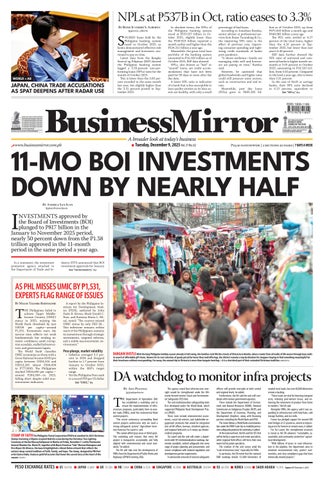
2025 period, nearly 50 percent down from the P1.58 trillion approved in the 11-month period in the same period a year ago.
By Reine Juvierre S. Alberto @reine_alberto
SOURED loans held by the Philippine banking system eased in October 2025, as banks demonstrated effective risk management and borrowers continued to pay on time.
Latest data from the Bangko Sentral ng Pilipinas (BSP) showed the Philippine banking system logged a 3.33-percent non-performing loans (NPLs) ratio for the month of October 2025.
This is lower than the 3.60 percent recorded in the same month last year, but slightly higher than the 3.31 percent posted in September 2025.
In absolute terms, the NPLs of the Philippine banking system stood at P537.027 billion in October 2025, slightly lower than the P538.923 billion reported a month earlier and higher than the P524.311 billion a year ago.
Meanwhile, the gross total loan portfolio of the banking system amounted to P16.103 trillion as of October 2025, BSP data showed. NPLs, also known as “bad” or “soured” loans, are credit accommodations that have not been paid for 90 days or more after the due date.
A lower NPL ratio is indicative of a bank that is less susceptible to loan quality erosion as its loan assets are healthy, with only a small
percentage of bad loans. According to Jonathan Ravelas, senior adviser at professional services firm Reyes Tacandong & Co., the improving NPL ratio is the effect of previous cuts, improving consumer spending and tightening credit standards of banks post-pandemic. “It shows resilience—banks are managing risks well and borrowers are paying on time,” Ravelas said.
However, he cautioned that global headwinds and higher rates could still pressure some sectors, such as construction and real estate.
Meanwhile, past due loans (PDLs) grew to P685.585 bil-
lion as of October 2025, up from P675.603 billion a month ago and P640.881 billion a year ago. The PDL ratio settled at 4.27 percent of the total loans, higher than the 4.16 percent in September 2025, but lower than last year’s 4.40 percent. BSP data further showed the NPL ratio of
By Malou Talosig-Bartolome
THE Philippines failed to achieve Upper MiddleIncome Country (UMIC) status in 2025, missing the World Bank threshold by just USD26 per capita—around P1,531. Economists warn the narrow miss reflects not weak fundamentals but eroding investor confidence amid corruption scandals, stalled infrastructure, and governance lapses. The World Bank classifies UMIC economies as those with a Gross National Income (GNI) per capita between USD4,516 and USD13,205 (about P266,000 to P777,000). The Philippines reached USD4,490 per capita— around P264,500—in 2025, falling short despite solid macroeconomic indicators.
A report by the Philippine Institute for Development Studies (PIDS), authored by John Paolo R. Rivera, Mark Gerald C. Ruiz, and Ramona Maria L. Miral, noted: “The country missed UMIC status by only USD 26… This milestone remains within reach if the Philippines sustains its momentum through strategic investments, targeted reforms, and a stable macroeconomic environment.”
Peso plunge, market volatility
Inflation averaged 3.2 percent in 2024 and dropped further to 1.7 percent from January to October 2025, within the BSP’s target range. Yet the Philippine Peso sank to a record P59 per US dollar
TBy Ada Pelonia @adapelonia
HE Department of Agriculture (DA) has established a watchdog unit to ensure the implementation of infrastructure programs, particularly farm-to-market roads (FMRs), amid the controversial flood control projects.
“The recent controversy surrounding flood control projects underscores why we need a strong safeguards system,” Agriculture Secretary Francisco Tiu Laurel Jr. said.
“We cannot afford gray areas or blind spots.
This watchdog unit ensures that every DA project is transparent, accountable, and fully aligned with environmental and social standards,” he added.
The DA will take over the development of FMRs from the Department of Public Works and Highways (DPWH) starting 2026.
The agency noted that infrastructure oversight would be strengthened under the DA’s newly formed Interim Social and Environmental Safeguards (SES) Unit.
The unit institutionalizes safeguarding tools first developed under the World Bank, which supported Philippine Rural Development Project (PRDP). These tools include environmental assessments, social risk reviews, and stakeholder engagement protocols that would be integrated into all DA offices, bureaus, attached agencies, and regional field units as it ramps up climateresilient programs.
Tiu Laurel said the unit will create a department-wide SES institutionalization roadmap, harmonize standards, embed safeguards into every stage of project planning and procurement, and ensure compliance with national regulations and development-partner requirements.
A nationwide network of trained safeguards
officers will provide oversight at both central and regional levels, he added.
Furthermore, the DA said the unit will coordinate with various government agencies.
These include the Department of Environment and Natural Resources (DENR), National Commission on Indigenous Peoples (NCIP), and the Department of Economy, Planning, and Development (DepDev), along with financing partners including the World Bank and IFAD.
The move follows a World Bank recommendation under the PRDP Scale-Up to establish permanent safeguards positions for continuity, it added.
At the national level, the DA said the SES Unit will be led by a supervisor and senior specialists, while regional field offices will form their own teams led by junior specialists.
The creation of the unit comes amid the “scale of enormous task,” especially for FMRs.
In particular, the DA noted that the national FMR roadmap details 131,000 kilometers of
needed rural roads, but over 60,000 kilometers remain a backlog.
“These roads are vital for lowering transport costs, reducing post-harvest losses, and enhancing the movement of produce from farms to markets,” the DA said. Alongside FMRs, the agency said it was expanding its infrastructure with food hubs, cold storage facilities, and rice mills.
France has pledged support for around 300 steel bridges in 52 provinces, aimed at improving access for farmers in remote areas, it added. For Tiu Laurel, the strengthened structure is crucial as the DA advances “sustainable, accountable, and community-protective” agricultural development.
“With billions of pesos in rural infrastructure in the pipeline, the department aims to minimize environmental risks, protect communities, and close compliance gaps that have historically slowed projects.”
P61.065 billion, in October 2025.
This is down from 6.42 percent and 6.84 percent, respectively, a month and a year ago.
Digital banks also saw their NPL ratio improve, at 6.77 percent or P4.091 billion, in October 2025, from 7.32 percent in September 2025 and 10.57 percent in October 2024. Latest NPL data available for rural and cooperative banks was for September 2025, where the NPL ratio stood at 8.89 percent, worth P18.448 billion.
DOLE tracks OSH adoption across firecracker industry
By Justine Xyrah Garcia
ASfirecracker manufacturers and distributors prepare for their peak holiday operations, the Department of Labor and Employment (DOLE) has reminded industry players that production must move in step with strict occupational safety and health (OSH) rules.
Continued from A12
The firm noted that strong backing for the hike reflects public focus on “gut issues” such as food prices and basic household needs.
“Even when presented many issues, these “gut issues” affecting daily life really matter to ordinary Filipinos, and it explains why support for raising wages is so strong. This is evident even across all income classes and regions,” it explained.
Several bills seeking a legislated nationwide wage hike are now pending in the 20th Congress.
In the previous Congress, both the Senate and the House of Representatives pushed separate measures to raise the minimum wage but failed to pass a unified version.
In Labor Advisory No. 18 Series of 2025, the agency said all pyrotechnic establishments are required to comply with Republic Act 11058, Department Order (DO) 252 Series of 2025, and DO 134 Series of 2014. These issuances form the core
Continued from A12
strengthening local energy planning in their respective localities.
Capongcol also affirmed the DOE’s commitment to support LGUs’ energy
regulatory framework that governs safety standards in a sector long recognized for its high-risk production processes.
Under these rules, establishments are required to craft an OSH policy that directly addresses the hazards
transition efforts through the implementation of the Department’s key programs, such as the Green Energy Auction Program (GEAP) and deployment of mobile energy systems (MES).
“At the heart of this transformation are strong local leaders and champions. Across the Philippines, we see communities stepping up and driv-
present in pyrotechnic worksites.
The corresponding program must outline concrete measures for hazard prevention and control, provide regular capabilitybuilding for safety committee members, and ensure workers have access to appropriate medical and welfare services as required under existing OSH guidelines.
DOLE said its regional directors, working with the Bureau of Fire Protection (BFP), Philippine National Police (PNP), and local government units (LGUs), will keep a close eye on how these requirements are implemented on the ground.
“[They] are hereby directed to monitor establishments’ compliance with the aforementioned and other related issuances to
ing initiatives that protect their constituents,” said Angelo Kairos dela Cruz, Executive Director of the Institute for Climate and Sustainable Cities (ICSC).
“These localities prove that when communities actively shape their energy systems, renewable energy becomes a tool for climate resilience, inclusive development, and social equity. Indeed, the future of energy is local,” he added. With the Philippines serving as chair of the Association of Southeast Asian Nations (Asean) in 2026, the country is in a position to champion renewable energy as a driver of resilience, energy security, and shared prosperity, said Secretary Robert Borje of the Climate Change Commission (CCC).
“This moment calls for decisive action. The technologies are advancing, investment needs are clear, and the benefits of cooperation across the region are stronger than ever. It is time to take calculated risks—smart,
Continued from A12
rallied outside the Tacoma detention center, carrying signs that read “Stop medical violence.”
They urged ICE to transfer Sorio to a hospital instead of placing him on a plane to the Philippines. Around 6:16 p.m., Sorio—on crutches—was escorted into a vehicle by plainclothes officers, prompting tears and consoling among supporters. He was expected to board a 9:30 p.m. flight that evening for a 20-hour journey to Manila.
Community leaders accused both US and Philippine authorities of neglect.
“We’re saying that they have blood on their hands and that they need to intervene,” Noah Ajeto of the Tanggol Migrante Movement said, joined by BAYAN WA, Malaya Movement Tacoma, and labor union UFCW 3000.
Protesters claimed pleas to the Philippine Consulate had gone unanswered.
DFA statement
THE DFA, however, stressed that it had monitored Sorio’s medical condition, conducted welfare checks during his hospitalization, and coordinated with ICE officials to ensure he received treatment and medication.
The consulate had repeatedly appealed for humanitarian consideration for Sorio to “substantially recover” from his medical condition prior to deportation. But ICE’s Health Services Corps deemed him medically cleared for removal.
“The Department notes that,
prevent workplace accidents under Department Order No. 238 Series 2023,” DOLE stated.
Regional directors are also directed to submit to the Bureau of Working Conditions a list of monitored establishments by January 15.
The advisory was issued following the death of a worker in an unlicensed firecracker factory in Norzagaray, Bulacan after an explosion in October.
A child living near the factory also died, while five other individuals were injured. In November, the department issued a separate directive requiring all establishments to adopt a “comprehensive and responsive” OSH program, which must be updated at least once a year or after any major incident.
forward-looking decisions that will pay off not just for today’s consumers, but for generations to come,” added Frederic Tesfay, GIZ Philippines’ Team Lead for Energy Projects.
On the sidelines of the Dialogue, local chief executives from select provinces and municipalities of Eastern Visayas pledged to support the advancement of a just energy transition through crafting and adopting energy transition plans and local RE ordinances in their localities.
“We aim to build our resilience and address the climate crisis by accelerating just energy transition,” the declaration stated, which was signed by Mayor Lovell Ann M. Yu of Alang-alang, Leyte; Mayor Roy C. Ador and Vice Mayor Adolfo Mugas of Oras, Eastern Samar; Mayor Annaliza Gonzales-Kwan of Guiuan, Eastern Samar; Vice Mayor Eunice Babalcon of Paranas, Samar; and Eastern Samar Governor Ralph Vincent Evardone.
through the Legal Assistance Fund, it previously provided funding for his legal representation. However, the US Immigration Court has nonetheless issued an Order for his removal. A recent Application for Stay of Removal was likewise denied by ICE,” the DFA explained in a statement.
The DFA intends to provide Kuya G with the necessary assistance upon his arrival in the Philippines.
“The Department respects this decision and recognizes the sovereign right of the United States to determine who may be allowed to remain in its territory,” the DFA said. It then reiterated its broader commitment in helping Filipinos overseas, “in accordance with relevant conventions and international agreements, and with due respect for applicable local laws and regulations.”
Filipinos in the US and deportation trends
• There are about 4.6 million Filipinos living in the United States, making them the third-largest Asian- origin group.
The Philippine Embassy reported 24 Filipinos deported in early 2025, with around 80 more facing deportation proceedings.
Advocacy groups estimate that 300,000 undocumented Filipinos could be at risk under US immigration enforcement.
Sorio is originally from Lingayen, Pangasinan. He migrated to the US in 2007 on a green card.
His partner and two children, all US citizens, live in Kodiak, Alaska.
to November 2025 reached P816.81 billion across 261 projects. It is worth noting that the value of investments approved in the 11-month period is still less than half or 46.69 percent of the BOI’s target of P1.75 trillion investment pledges for 2025.
With two more weeks remaining in 2025, however, Trade and Industry Secretary Cristina A. Roque said the BOI is still assessing 10 more bigticket, strategic projects worth over P1 trillion.
Roque, who also sits as BOI chairman, unveiled the 10 projects worth P1 trillion which are still in the pipeline: “These include 3 hydro electric projects with combined 2.4GW capacity; 4 Off-shore Wind projects with 3.7GW combined capacity; 2 air transport service projects; and 1 transport infrastructure project.”
“As we are a prudent administrator of incentives, we carefully evaluate these projects according to the requirements of the Strategic Investment Priorities Plan and its Guidelines,” Roque explained in a statement on Monday.
While the investment promotion agency is “working double-time,” the Trade chief admitted: “We are unsure if all of these can be approved for registration this year. But what this signifies is the pipeline of strategic investments remain to be strong.” As such, Roque said that with two more regular BOI Management Committee and Board meetings for the year, the Project approvals “definitely will still increase.”
“But we cannot predict yet whether the increase will be enough to reach the P1.75 trillion we targeted for 2025,” added Roque. On the investments still in the pipeline, Roque said, “We do not want to rush nor preempt their assessment by our Technical Services teams—precisely because these are Strategic bigticket projects and we have to be very prudent in evaluation.”
The BOI said the P816.81-billion approved projects from January to November this year are expected to generate 32,864 direct jobs for Filipinos.
Singapore as top investor MEANWHILE, data from the BOI noted that top sources of investment in the said period were Singapore, which poured in P74.78 billion worth of capital; Thailand, with P7.75 billion and United States, with P5.38 billion. In terms of sectors, the Energy and Electricity sector captured the largest share of approved investments at P479.78 billion, equivalent to a 58.74-percent share of the investments approved; followed by airports and seaports, P195.69 billion; manufacturing, P58.99 billion; mass housing, P37.55 billion; and information and communication, P21.27 billion.
‘Cautious’ investment environment ASKED on whether the current political environment is affecting the investment approval levels, Roque said that while it is an “important consideration” for any investor, BOI strategic projects typically have medium to long-term gestation period.
“And as such, investors attach greater importance to long-term factors such as economic fundamentals and structure, market demographics, and direction of policy reform,” added Roque. In an earlier statement, the BOI said investment approvals in 2025 have seen a slowdown, noting that this trend is “expected and reflects the natural cycle of investment activity.”
“The majority of previously approved large-scale projects have now entered their implementation phase,” the agency said in May of this year, adding that external factors such as tighter global financial conditions and heightened geopolitical uncertainty have contributed to a “more cautious investment environment, signaling a temporary shift from rapid expansion to execution and policy consolidation.” In 2024, the BOI approved P1.62 trillion in investments, the highest level of investment approvals in the investment promotion agency’s 57year history.
This amount of approved investments also surpassed the agency’s P1.5 trillion target last year.
Groups oppose planned highway ban on e-bikes
By Lorenz S. Marasigan @lorenzmarasigan
TRANSPORT advocacy groups have strongly opposed the government’s plan to ban electric bicycles (ebike) and electric tricycles (e-trike) from national highways starting January, arguing that the policy contradicts existing law and unfairly targets vulnerable commuters.
In a letter addressed to the Land Transportation Office (LTO) chief, Assistant Secretary Markus Lacanilao, the Move As One Coalition and 37 other organizations questioned the legal basis for the proposed ban, citing Republic Act 11687 or the Electric Vehicle Industry Development Act (Evida).
According to the groups, Evida explicitly states that “light electric vehicles which shall be for exclusive private use shall not be required to register with the DOTr [Department of Transportation] and its attached agencies.”
Only electric vehicles used for public transport are required to register and obtain franchises under the law.
The coalition argued that the LTO’s plan to automatically impound unregistered e-bikes and e-trikes would violate Evida’s stated policy “to provide an enabling environment for the development of electric vehicles, including options for micromobility as an attractive and feasible mode of transportation to reduce dependence on fossil fuels.”
“Why are e-bike and e-trike users being targeted by the LTO when cars are the primary vehicles involved in road crashes?” the statement read further.
Citing Metropolitan Manila Development Authority (MMDA) data, the coalition noted that bikes, e-bikes, and pedicabs accounted for only 1.52 percent of road crashes in 2024, while cars were involved in 54 percent of crashes.
The organizations further criticized the apparent lack of public consultation on the policy.
“The welfare of citizens who bought these ‘low emission’ vehicles to use for their daily trips and to save on fare and gasoline should not be ignored. It’s important for the LTO to hear their voices,” the statement read.
Among the 38 signatories are cycling advocacy groups, commuter organizations, disability rights groups, and environmental advocates including Bicycle Friendly Philippines, Pinay Bike Commuter Community, National Confederation of Transportworkers Union, Life Haven Center for Independent Living, and Komyut.
“Why does the LTO want to push an unjust measure that would deprive citizens of their fundamental right to mobility?
This is the key to everyone having access to work, education, recreation, and public services, and to fulfill other important tasks. This right will enable them to achieve their dreams, support their families, and dedicate their efforts to the motherland,” the statement read.
The groups said they are willing to work with the LTO to achieve a transportation system that is safe, humane, and accessible to all, but emphasized they will consider the ban merely a plan until the agency conducts thorough consultations and issues clear guidelines.
CA nixes Puerto Princesa plea against electric coop
THE Court of Appeals (CA) has junked the petition of the Puerto Princesa city government to reverse the dismissal by a local court of the complaint for injunction and damages it filed against an electric cooperative for its alleged negligence that resulted in frequent power outages in the city.
In a 12-page decision written by Associate Justice Emilio Rodolfo Legaspi III, the CA’s Fourteenth Division held that the petition should be dismissed for lack of merit.
“The assailed orders of the RTC were not shown to be patently erroneous or done in a capricious or whimsical exercise of judgment. Rather, the same were issued in obedience and consistent with pertinent rules and existing jurisprudence, thus, the court a quo cannot be said to have gravely
abused its discretion,” the CA declared.
The appellate court held that Branch 52 of the RTC in Puerto Princesa has no jurisdiction over the petition since it is the National Electrification Administration (NEA) which has the power of supervision and control over electric cooperatives under Section 5 (q) of Republic Act 10531 or the NEA Reform Act.
“Verily, since petitioner’s claim primarily hinged on respondents’ alleged gross negligence, inaction and/or failure to provide to its consumers, a stable, adequate and uninterrupted supply of electricity, a cause which is purely administrative in nature, the RTC correctly ruled that the case should have been lodged with the NEA, as it is the very agency which is mandated
NFA triples palay procurement
TBy Lenie Lectura @llectura
By Ada Pelonia @adapelonia
HE National Food Authority (NFA) purchased over 9,000 metric tons (MT) of palay in August, a near threefold jump year-on-year, but still fell short of its procurement target.
In its latest accomplishment report, the NFA said it procured 188,528 50-kilo bags or 9,426.4 metric tons (MT) of palay in the reference month, up by 193 percent from the 64,199 bags or 3,209.95 MT it bought last year.
Despite the surge in procurement levels on an annual basis, the volume of palay that the agency
procured in August was only 40.41 percent of its target of buying 23,325 MT from local farmers.
“The decrease in the harvested volume may be attributed to seasonal lull in harvest activity. Most of the wet season crops were still maturing during August,” the NFA said.
The grains agency buys clean
and dry palay at P23 to P30 per kilo, while the price of fresh and wet palay ranges from P17 to P23 per kilo. This scheme changes weekly per province.
At the end of August, the NFA had a total expected milled rice inventory of about 448,655.17 MT, noting that its stockpile accounts for almost 20 percent of the national rice inventory.
Meanwhile, the agency said it distributed 215,177.49 bags or 10,758.87 MT of milled rice during the reference month.
It allotted some 6,621.62 MT of rice to the Department of Social Welfare and Development (DSWD), Office of Civil Defense (OCD), legislators, and local governments for relief operations and calamity response.
About 3,890.42 MT of rice were distributed to government agencies and local governments’ (LGUs) rice requirement under
the Executive Order 51 program, the NFA said.
The NFA added allocating 165 MT to LGUs under the food security emergency program, which was declared to fast-track the release of rice stocks held by the agency. At least 81 MT were released under the government’s One-Time Rice Assistance, the NFA said.
The NFA earlier decided to lower the floor price of aging rice stocks by at least P2 per kilo to attract more bidders in its auction this month and free-up its warehouses for the upcoming harvest. This, after the agency conducted the first auction of aging rice stocks in October, but NFA Administrator Larry Lacson said it failed as only a few participants joined the bidding.
The NFA noted that the country’s buffer stock stood at 460,000 MT as of mid-November, which is good for 12 days.
DA bans pork from Taiwan due to ASF
THE Department of Agriculture (DA) has slapped a temporary ban on pork shipments from Taiwan owing to a confirmed African swine fever (ASF) outbreak.
Agriculture Secretary Francisco Tiu Laurel Jr. signed Memorandum Order 74, which authorized the ban on the entry of live pigs and all pork-derived commodities, including semen used for artificial insemination (AI).
Manila imposed the ban following a report by Taiwanese veterinary authorities to the World Organization for Animal Health (WOAH) on October 25,
which confirmed ASF cases affecting domesticated pigs in Taichung City.
“We have to be vigilant in preventing further ASF infections to protect jobs and investments in the swine industry and ensure food security and consumers’ health,” Tiu Laurel said, noting the potential economic fallout should ASF infect local farms again.
He noted that the move is crucial to protect the country’s multibillion-peso hog industry from the highly contagious disease. Under the order, all previously approved Sanitary and Phytosanitary Import Clearances (SPSICs)
for pigs and pork-related products from Taiwan are automatically revoked.
Applications for new import clearances for the affected items are suspended until further notice, it added.
The agency also directed veterinary quarantine officers at all major ports to stop and confiscate any shipments containing restricted commodities.
“The swift action reflects lessons learned from previous ASF waves, which caused massive losses for local hog raisers and pushed pork prices higher nationwide,” the DA said.
“While pockets of ASF remain under control in parts of the Philippines, agriculture officials say preventing the entry of new strains is vital to stabilize the sector and restore investor confidence.”
The DA said industry groups should support the ban, as it serves as a necessary safeguard for both producers and consumers. Currently, the agency noted that authorities are tightening biosecurity and monitoring regional developments, determined to keep the country’s pork supply secure. Ada Pelonia
Prepare for success in 2026 and beyond
By Henry J. Schumacher
AS we are about to enter 2026 and beyond, it makes good sense to look around the corner to greater challenges and opportunities. We stand now where two roads diverge. But... they are not equally fair:
The road we have long been traveling is deceptively easy, a smooth superhighway on which we progress with great speed, but at its end may not lie success. The other fork of the road—the one less traveled, offers our chance to reach a destination that assures to reach the target we all want.
When you set a big goal running a marathon, writing a book, or mastering a new language - it’s exciting, but daunting. There are painful points along the way, like the famous “wall” in marathons, or moments of self-doubt. But when you get there, the feeling is amazing. All the training and late nights were worth it. It inspires you to shoot higher—maybe a triathlon this time? It’s exciting to feel like you have more in you.
Focus on the long-term, blow-up boundaries and set big goals, build deep trust, partner in dramatically new ways with all stakeholders, tackle the “elephants” that nobody wants to face, and develop a strong culture that will take you far.
You have increased the good your business does for all stakeholders, and you’re seeing new growth and excitement
among employees. You have credibility and the trust of stakeholders. Your business is stronger and the world is a better place because you and your company are in it. You are ready for more, and you’d better be.
With expectations running high and the world moving fast, this level of performance will increasingly become the norm. It will get you invited to the party, but it’s not quite enough.
Here’s the main question: If companies move forward, will we have changed the systems enough to create a thriving, equitable, just, healthy, and desirable world that works for all, now and for generations to come?
Maybe not, but we have ideas on how to get there and what issues to address. The ‘elephants’ in the room, such as taxes, corruption, corporate power, and human rights, create risk for any company. You can’t build a positive business and society without tackling them.
These issues are also increasingly draining financial and moral capital from business. The issues we take up here, including reforming capitalism and defending democracy and science, go even further beyond business and the economy: the cost of inaction is reduced freedom and a dysfunctional society. You better become able to drive the changes that need to come. You have to be more resilient and contribute even
more to the larger good. You’ll also get a better look around the corner at what’s coming in the future and receive an ‘invitation’ to help design it. We cannot shy away from the biggest of challenges, the ones that society increasingly expects business to help solve. There are big forces at play, and we have to push on. We must work to build a greater positive world.
See more rules that increase efficiency in transportation and buildings, promote nature-based solutions for farming and forests, regulate product end-of-life and circularity, mandate the mix of renewable energy on the grid, and more. At the company level, commitments on everything from carbon emissions to diversity levels are proliferating rapidly.
Going through this process, companies will be best positioned to match the moment. The leaders will create continuously growing positive impacts and see consistent improvements in their performance, their connections to stakeholders, and their opportunities for
growth. As the work to build a positive world gains speed, like a train moving out of the station, it will leave behind those that don’t jump on. We started this journey with five key principles of a future positive company: take responsibility for your full impacts; work for the long-term benefit of society; create positive outcomes for all stakeholders; improve shareholder return as a result (not an objective); and embrace transformative partnerships. We address here six societylevel challenges that you will take on:
n Be even more responsible for broader impacts (do more good)
n Challenge consumption and growth
n Rethink the measures and structures of success (such as GDP)
n Improve the social contract: focus on livelihoods
n Bend the curve on capitalism and overhaul finance
n Defend democracy and science, two critical pillars of society.
In the course of history, there comes a time when humanity is called to shift to a new level of consciousness, to reach a higher moral ground. A time when we have to shed our fear and give hope to each other. That time is now. Yes, it is!!
Govt must not waver in fighting corruption–Lacson
By Butch Fernandez @butchfBM
SAYING there’s no turning back in the monumental task of fighting one of the biggest corruption scandals in the Philippines, Senate President Pro Tempore Panfilo M. Lacson said on Monday that everything must be done to build on the gains of the Independent Commission for Infrastructure (ICI), such as legislating its potential successor.
The government, Lacson stressed, must not waver in its enthusiasm to fight the corruption behind anomalous infrastructure projects – including through a proposed Independent People’s Commission (IPC) to succeed the ICI, much criticized of late for having limited powers and resources while fighting very powerful forces.
Despite its limited powers, Lacson pointed out that the ICI has managed to flush out useful information and complement the Ombudsman and Department of Justice in building solid cases against those responsible.
“I wonder why Malacanang’s enthusiasm is lost all of a sudden. I still believe that the ICI is serving its purpose in flushing out useful information, to say the least, for the Ombudsman and DOJ to
proceed with their preliminary investigation and come up with solid cases against those responsible in the plunder of public funds,” he said.
“This, even when Congress has taken positive steps to follow the lead of the President in getting to the bottom of the unprecedented infrastructure anomalies never unearthed before by any of the past administrations,” he added.
Lacson was referring to reports quoting Palace Press OfficerClaire Castro as saying the creation of the IPC may duplicate the work handled by the Ombudsman and DOJ.
Lacson noted the IPC bill is part of the steps Congress has taken to follow President Ferdinand Marcos Jr.’s lead to look into the anomalies hounding flood control
China’s new ambassador to the Philippines: Jing Quan, veteran of US-China diplomacy
By Malou Talosig-Bartolome
BEIJING has tapped a senior diplomat from Washington DC as its new envoy to Manila, in a bid to recalibrate ties with the Philippines amid prolonged tensions over the West Philippine Sea. The Chinese Embassy in Manila confirmed that Ambassador Jing Quan arrived on Saturday, December 6, to formally assume his post. He was welcomed at the airport by officials from the Department of Foreign Affairs and the Chinese Embassy.
In a statement, Jing acknowledged the challenges ahead but expressed confidence in his role as
a stabilizer in bilateral relations.
“As ambassador, I will firmly safeguard national interests and dignity, while also playing a bridging role to stabilize rather than deteriorate China-Philippines relations, and to bring the people of both countries closer rather than drift apart. My task is arduous, but I am confident and look forward to everyone’s strong support,” the Embassy quoted him as saying in its Mandarin-language release.
Jing succeeds Ambassador Huang Xilian, whose six-year tenure spanned the final years of the pro-China Duterte administration and the first half of President Marcos’s term, marked by a tougher stance on Beijing.
The Embassy has yet to release Jing’s full background details.
Before his Manila assignment, Jing Quan served as deputy chief of mission at the Chinese Embassy in Washington DC, effectively the embassy’s second-in-command.
Over the past two decades, he has built a career navigating US-China relations through various posts in the Ministry of Foreign Affairs and the embassy in Washington.
William Yang, senior analyst for Northeast Asia at the International Crisis Group, noted that Jing’s long experience in Washington makes him a seasoned negotiator.
“Jing was described by observers and insiders as ‘an experienced
America hand’ who is hard-working and down to earth. Manila appears to be looking for ways to recalibrate between asserting territorial claims and maintaining vital bilateral ties with China,” Yang wrote on X.
Jing also held a fellowship at the Brookings Institution in Washington DC from 2004 to 2005.
International law firm Harris Sliwoski added that Jing was a fixture in US-China trade negotiations under the Trump administration.
“He was well-spoken, humorous, and open, but he was also unapologetic about China’s position,” the firm said.
House awaits SC resolution on Sara impeachment
By Jovee Marie N. dela Cruz
@joveemarie
THE House of Representatives is now awaiting the Supreme Court’s resolution of its motion for reconsideration (MR) concerning the impeachment proceedings against Vice President Sara Duterte, a key lawmaker said on Monday.
and other infrastructure projects.
Earlier, Lacson expressed support for the swift passage of Senate Bill 1512 creating the IPC, which would potentially have the teeth the ICI lacked – including witness immunity and protection, rendering whistleblowers vulnerable to potential counter-charges and even harassment suits.
“The ICI sorely needs more powers and a wider authority, including for immunity of witnesses. That is why it can only refer cases to other agencies and not file them,” he said in a mix of English and Filipino in an interview on radio.
He also said ICI head Andres Reyes Jr. had voiced concerns to him about the possibility of witnesses being subjected to countercharges.
Lacson added that while the ICI has subpoena powers, it cannot cite in contempt those who ignore the subpoenas—such as Davao City Rep. Paolo Duterte, who declined the ICI’s invitation because it supposedly had no jurisdiction over him.
“It will greatly help if the House and Senate can pass the bill all the way to the bicam, and if the President certifies the bill as urgent. I believe the Senate President and House Speaker may need to write the President to certify the measure as urgent,” he said.
One of the key members of the ICI, former public works secretary Rogelio Singson, has since resigned, saying the pressure of doing such a huge cleanup with limited resources was taking its toll on his health.
PSA reports slower hike in wholesale price in Oct.
By Bless Aubrey Ogerio
THE slower annual increase in the price of crude materials was a key factor in the slowdown of the General Wholesale Price Index (GWPI) in October 2025, the Philippine Statistics Authority (PSA) reported.
The GWPI, which measures price changes of goods sold in bulk to intermediaries, rose 2.6 percent year-on-year in October, down from 2.9 percent in September.
In comparison, the index increased 2.1 percent during the same month last year.
Crude materials, inedible except fuels, recorded a 42.9 percent increase in October, down from 54.8 percent in September.
Slower growth was also observed in food (1.9 percent from 2 percent), beverages and tobacco (4.1 percent from 4.2 percent), mineral fuels and lubricants (4.2
percent from 4.5 percent) and chemicals, including animal and vegetable oils and fats (8.8 percent from 9.7 percent).
On the other hand, the index for miscellaneous manufactured articles rose 0.4 percent, up from 0.1 percent the previous month. Indices for manufactured goods classified chiefly by materials, as well as machinery and transport equipment, maintained their September growth rates. Regionally, Luzon’s GWPI slowed to 2.6 percent from 2.8 percent, while the Visayas recorded 2.7 percent, down from 3.1 percent. Mindanao’s index rose 2.5 percent, easing from 3 percent in September.
The GWPI serves as an important gauge of price trends in the wholesale sector and is also used in national accounts to remove the effects of inflation and reflect real values.
“We urge the Supreme Court to decide on the matter with finality, in order for constitutional bodies such as the House and the Senate, as well as the public, to determine their next course of action on public officers who may only be removed through impeachment,” he said.
He explained that only after the Supreme Court resolves the MR can the House resume its direct inquiry into the alleged impeachable acts of the Vice President.
Party-list Rep. Terry L. Ridon of Bicol Saro, chairman of the House Committee on Public Accounts and member of the House Committee on Justice, said the chamber cannot move forward until the High Court issues a final ruling.
“If the MR is resolved in favor of the House, the impeachment will proceed to trial in the Senate. If resolved against the House, a new complaint may be filed against the Vice President in February, under the new Supreme Court impeachment guidelines,” he said.
Ridon emphasized that impeachment cases must always hinge on “facts, evidence, and principle.”
“The House will proceed against each and every impeachable officer if they commit impeachable offenses such as betrayal
of public trust, culpable violation of the Constitution, graft and corruption, and other high crimes, among other grounds for impeachment as stated in the 1987 Constitution,” Ridon said.
He affirmed that the House remains prepared to perform its constitutional mandate.
“The House of Representatives will perform its constitutional mandate on impeachment against any and all impeachable officers, as soon as verified impeachment complaints are filed for our resolution,” he added.
‘Have right intentions, achieve better outcomes in life’
By Samuel P. Medenilla @sam_medenilla
AS the country celebrated the Solemnity of the Conception of the Blessed Virgin Mary, President Marcos urged
Filipinos “to have the right intentions so they can achieve better outcomes in life.”
In a statement issued on Monday, the Chief Executive noted how Mary being born without sin has paved the way to humanity’s salvation since it allowed her to be the mother of Jesus Christ.
“The Immaculate Conception reminds us that the way we begin matters. Our intentions shape our outcomes, and the spirit in which we start a mission influences the fruit it bears,” Marcos said.
He warned how endeavors which were initiated by pride and deceit can result in division and distrust.
“But if we begin with truth, humility, and compassion for the least among us, we can build a more just and peaceful Bagong Pilipinas: a nation where integrity, service, and a common good guide our ever action,” he said.
He also highlighted how Mary intercedes on behalf of Filipinos and serves as model for other with her purity, devotion, and unwavering faith.
“Through her intercession, may our leaders be guided by wisdom and discernment, our institutions purified at the root, and our people united in hope,” Marcos said.
“Let us draw strength from her life as we continue building a nation that places God at its center and holds fast to the dignity of every Filipino,” he added.
Republic Act 10966 declared December 8 as a special non-working holiday for the commemoration of the Feast of the Immaculate Conception of Mary, the Principal Patroness of the Philippines.
Based on the census conducted by the Philippines Statistics Authority in 2020, over 85 million of the country’s 108 million population are Roman Catholics.
House Visayan bloc backs Dy
THIRTY NINE lawmakers from the Visayas have issued a manifesto declaring their full support for Speaker Faustino G. Dy III, making the Visayan bloc the latest major force in the House of Representatives to align with his reform-oriented leadership.
Deputy Speaker Ferjenel Biron of Iloilo, Senior Deputy Majority Leader Lorenz Defensor of Iloilo and Reps. Alfredo Benitez of Bacolod City and Vincent Frasco of Cebu led the signatories of the manifesto.
Continued from A3
to enforce performance standards of electric cooperatives and its officers,” the CA declared.
“Notably, the resolution of such issues would necessarily call for the knowledge, experience and expertise of the NEA. Thus, it was but proper, out of fidelity to the doctrine of primary jurisdiction, for the RTC to dismiss petitioner’s complaint,” it added. The case stemmed from the 2019 complaint filed by Puerto Princesa City Mayor Lucilo R. Bayron against the Palawan Electric Cooperative (Peleco) and board officials identified as Jeffrey Y. Tan-Endriga, chairman; Maylene D. Ballares, Moises R. Arzaga, Marrieta S. Seratubias, Julieta C. Magbanua, Rodolfo D. Garceron, Rodantes C. Onda, Sr., Nicolas P. Contreras and Atty. Raymund U.
The Visayan bloc’s declaration builds on the earlier endorsements from 30 Metro Manila district representatives; 67 members of the Mindanao bloc led by Senior Deputy Speaker Ferdinand Hernandez of South Cotabato; the 39-member Northern Luzon Alliance led by House Majority Leader Ferdinand Alexander Marcos III of Ilocos Norte with Deputy Speakers Kristine Singson-Meehan of Ilocos Sur
See “Dy,” A5
Acosta, board members; and Nelson A. Lalas, acting General Manager of Paleco. In its complaint, the city government is seeking P1 million in damages from Paleco the unrelenting power outages in Puerto Princesa. It claimed that the alarming and extensive power outages resulted in the disruption of government service and transactions; damage to the tourism industry and breakdown of home appliances. The city government said the respondents failed to provide adequate, regular and reliable electricity to the residents of Puerto Princesa City and that the failure. However, in a ruling issued on August 28, 2020, the RTC dismissed the petition for lack of jurisdiction. The trial court also denied the motion for reconsideration of the city government in an order issued on September 5, 2022. Joel R. San Juan
House panel approves bill easing restrictions on
By Jovee Marie N. dela Cruz @joveemarie
THE House of Representatives has taken a major step toward strengthening the Marcos administration’s anticorruption efforts with the committee-level approval of a long-overdue bill easing restrictions under the bank secrecy law.
Deputy Majority Leader Luigi Villafuerte said the House Committee on Banks and Financial Intermediaries has approved a consolidated measure amending Republic Act 1405, or the Secrecy of Bank Deposits Law, to grant the Bangko Sentral (BSP) authority to examine bank accounts of individuals or corporations when there is reasonable ground to believe they are involved in fraud, serious irregularities, or unlawful activities.
The bill—passed by the panel chaired by Manila Rep. Irwin Tieng—also seeks to relax the 70-year-old provision that bars bank officials from disclosing account details without the depositor’s consent, except in cases of impeachment or court orders in graftrelated litigation.
The approved measure consolidates eight proposed amendments to RA 1405, including House Bill (HB) 1786, authored by Villafuerte along with Camarines Sur Reps. Migz Villafuerte and Tsuyoshi Anthony Horibata, and Bicol Saro Rep. Terry Ridon. Villafuerte noted that a similar Houseapproved bill stalled in the Senate in the previous Congress owing to the absence of a counterpart measure.
He stressed that the proposal is among the 44 priority bills under the Common Legislative Agenda (CLA) endorsed by President Marcos and the Legislative-Executive Development Advisory Council (Ledac) during its meeting at Malacañang on September 30.
“The congressional approval of this proposed amendment to RA 1405 is timely, given that it is among the priority bills of the Marcos administration in the 20th Congress and is in step with Malacañang’s efforts to double down on its anti-graft drive,” Luigi Villafuerte said.
“Lifting the secrecy of bank deposits will certainly complement the government’s drive for greater transparency with the recent decision by Ombudsman [Jesus Crispin] Remulla to restore public access to the SALNs [Statement of Assets, Liabilities, and Net Worth] of both appointed and elected public officials,” he added.
He said that the measure also responds to the call of business groups—such as the Organizationof Financial Executives (Finex), Makati Business Club, and the Management Association of the Philippines—for stronger transparency and accountability mechanisms to curb corruption.
“The approval of this bill further addresses the push by business groups for the government to strengthen transparency and accountability in government as a better means to combat
bank secrecy
official corruption,” Luigi added.
Meanwhile, Migz Villafuerte said HB 1786 seeks to exempt the BSP from bank secrecy restrictions when exercising its supervisory powers, allowing it to examine accounts when there is reasonable ground to suspect fraud or unlawful activity.
Migz, who chairs the House committee on information and communications technology (ICT), said that with the advancement of technology, financial transactions have become easier, faster, more efficient, and more accessible through mobile banking, agent banking, and fintech platforms.
He said that, “There are even banks that allow online deposits of their checks, which means that depositing money in bank accounts can now be accessible with just a few clicks of the mobile phones of depositors, making money flow in the economy faster as well.”
Lawmakers said that there are individuals or corporations that use RA 1405 to their advantage, being aware that even if they deposit bank checks fraudulently, they are protected by this law on bank secrecy, especially its specific provision barring banks from examining deposits without the consent of their depositors.
They added that HB 1786 upholds the provision of RA 1405 that all deposits are considered as of an absolutely confidential nature and may not be examined, except upon written permission of the depositor, or in cases of impeachment, or upon order of a competent court in cases of bribery or dereliction of duty of public officials, or in cases where the money deposited is the subject matter of the litigation.
However, HB 1786 amends this provision by stating that the ban can be lifted upon the Monetary Board’s determination that “there is a reasonable ground to believe that fraud, serious irregularity, or unlawful activity has been or is being committed by the above mentioned persons and that it is necessary to look into the deposit to establish such fraud, serious irregularity, or unlawful activity.”
This bill provides, too, that this proposed new authority of the BSP to examine deposits “shall also apply in the course of its investigation of closed banks as used in this Act; deposits shall refer to money or its equivalent received by a bank in the useful course of business and for which it has given or is obliged to give credit to a commercial, checking, savings, time, or thrift account …”
HB 1786 states that the results of the inquiry or bank examination shall be for the “exclusive use” of the BSP and “shall not be made available to any person or entity, whether public or private, except to the Securities and Exchange Commission [SEC], Anti-Money Laundering Council [AMLC], Department of Justice [DOJ], and the courts.”
The sharing of information on deposits with the SEC, AMLC, DOJ, and the courts is premised in the bill on the necessity of examining such bank accounts to prevent or prosecute any offense or crime.
Cops ready for transport strike
THE National Police (PNP) has mobilized sufficient personnel and resources to assist in maintaining peace and order during the three-day transport strike starting on Tuesday.
In a statement on Monday, the acting PNP Chief, Lt. Gen. Jose Melencio Nartatez Jr., said police commanders were also instructed to coordinate with local governments and other government agencies for a unified response to cushion the effects of the transport strike.
“Our personnel will be on the
ground not only to secure the protest action but also to conduct assessment on areas that need mobility assets for our kababayan that may be stranded,” Nartatez said.
This is in line with the directive of President Marcos to guarantee public safety, maintain smooth mobility, and ensure that essential services remain uninterrupted during major public activities such as transport strikes.
“Our goal is to make sure that the protest action will be done peacefully and orderly similar to the same activities in the past,”
he added.
Nartatez said police officers will be deployed to key transport hubs, main thoroughfares, and affected routes to ensure peace and order.
Police vehicles will also be placed on standby to provide immediate assistance to commuters who may experience delays or difficulty finding transportation.
He assured the public that the PNP remains committed to work closely with transport groups and other stakeholders to prevent disruptions and ensure a peaceful and orderly conduct of the strike.
Transport group Manibela announced a nationwide transport strike from December 9 to 11 to protest what it described as excessive penalties and the slow processing of government documents. It has indicated the possibility of extending the strike but Nartatez assured that the PNP’s security and assistance measures will remain in place for as long as necessary. In previous strikes, no untoward incidents were reported due to the close coordination and cooperation between transport groups and authorities. PNA
House extends help to Pinoy victims of HK fire
THE House of Representatives has extended assistance to Filipino workers affected by the November 26 fire at the Tai Po residential complex in Hong Kong.
Rep. Bryan Revilla, Committee on Overseas Workers Affairs chairman and nominee of the Agimat party-list group, visited the affected Filipino workers over the weekend to personally convey the House’s sympathies and support.
“Even if you are far from home, we are here to help you,” Revilla told the workers, emphasizing that fires often leave a deeper
emotional toll than other disasters. Around 60 Filipino workers were displaced by the blaze.
Among those he met was Rhodora Tañacao, who was recovering in the hospital for smoke inhalation. Tañacao had arrived in Hong Kong only on the day of the incident and bravely remained inside the burning complex to protect her infant ward until help arrived. Revilla praised her courage, calling it a testament to the Filipino spirit of compassion and service.
Revilla’s visit was made upon the directive of Speaker Faustino Dy III, who instructed him
to check on the condition of Filipino workers and provide assistance. Dy also authorized the release of financial aid to each affected worker, with the funds to be deposited directly into their accounts.
The Office of the Speaker will likewise extend financial assistance to the family of Mary Ann Esteban, the overseas Filipino worker (OFW) who died in the incident.
Revilla said her remains will be repatriated to the Philippines within the week at no cost to her family.
In addition to financial support, Revilla’s team brought volunteer mental health
professionals to help the OFWs process trauma from the incident. He stressed the importance of caring not only for physical well-being but also for emotional and mental health.
Revilla expressed gratitude to OFWs in Hong Kong for inspiring him to pursue more legislative measures that will benefit overseas workers. He assured them that the House remains receptive to their concerns, including those affecting their families in the Philippines.
“If you need anything or have any concerns, please let us know. We are here to help you,” he said.
Jovee Marie N. dela Cruz
Sen. Bong Go underscores collaboration with local leaders, stronger health services during 103rd National Assembly of the League of Vice Governors
SENATOR Christopher “Bong” Go joined vice governors from across the country on Friday, December 5, during the 103rd Year-End National Assembly of the League of Vice Governors of the Philippines held at Conrad Hotel in Pasay City, where he expressed gratitude for their continued partnership and reaffirmed his commitment to support local governments through accessible health services, social programs, and responsive governance.
Go emphasized his long-standing relationship with the League, recalling how he had been supportive of them, including attending their gatherings even before becoming senator. “Unang una, kanina po sabiko…sainyongnational president, sabiko hindipoakopwedenghindipumuntangayon kasi yearly talaga, halos nung hindi pa ako nagingsenador,iniimbitahann’yotalagaako. ‘Yungiba,gobernadornangayon.”
He reminded them that, despite limited resources, what matters most is sincerity and compassion in public service.
Health Centers as key initiatives under his health reforms crusade.
Malasakit Centers are one-stop shops aiming to support impoverished patients in reducing their hospital costs to the least possible amount. Go is the principal author and sponsor of Republic Act No. 11463, or the Malasakit Centers Act of 2019, which institutionalized the Malasakit Centers program.
Continued from A12
The consecutive WTA distinctions notwithstanding, the Philippines has failed to attract a sizeable number of foreign visitors after it reopened to the world in 2022. Last year, just 5.95 million foreign nationals visited the country, missing the DOT’s target of 7.7 million.
Continued from A4
and Francisco Paolo Ortega V of La Union; and the 44-member Party-list Coalition Foundation Inc.
In their manifesto, Visayan lawmakers said the House is at a crucial moment that demands moral recovery, humility, and the courage to confront uncomfortable truths.
Lawmakers emphasized that Dy’s leadership—defined by “clean hands,” independence from ongoing controversies, and a firm commitment to accountability— offers the stability and integrity needed to rebuild public trust shaken by flood-control corruption scandals.
“Speaker Dy has no involvement, no stake, and no entanglement in the controversies that have shaken public confidence. His distance from these scandals is not merely a personal advantage—it is an institutional necessity. The House cannot hope to regain credibility if the person leading its reforms is compromised by the very wrongdoing we aim to confront,” the bloc said.
Armed with a P1-billion branding campaign budget next year, the DOT said it will be asking private tourism stakeholders to help direct tourism marketing and promotion efforts. (See, “DOT brings back private sector role in marketing PHL tourism,” in the BusinessMirror, Dec. 5, 2025.)
The lawmakers said Dy has shown the moral clarity required to lead reforms in an institution that “must admit that mistakes were made, that systems were abused, and that the House must change if it hopes to serve the Filipino people with honor.”
“Speaker Dy has opened the doors to accountability. He has encouraged transparency. He has signaled that no one is above the process,” it said.
“These are not easy decisions. But they are the right ones – and the Visayan Bloc believes the House must stay on this path,” the bloc said.
The Visayan bloc said it stands united “for moral recovery, for accountability, and for a House worthy of the trust of our people.”
“With full responsibility to our constituents and fidelity to our oath, we declare our support for Speaker Faustino ‘Bojie’ G. Dy III and the reforms he has set in motion. We believe that under his leadership, the House can restore its moral compass, reclaim its credibility, and return to its duty of serving the Filipino people with integrity,” the bloc said. Jovee Marie N. dela Cruz
He expressed deep appreciation for the trust given to him by local officials. “Wag kayong magpasalamat sa akin. Ako po ang dapat magpasalamat sa inyo dahil binigyan n’yo po ako ng pagkakataon muli na makapagserbisyomuli sainyobilanginyong senador.Ginawan’yopaakongnumber one sainyongmgalugar.Maraming,maraming salamat po sa inyong lahat.”
The senator reflected on his respect for the work of vice governors, noting the similarities between their duties and his experience as a legislator. “Malapitnaman posapusokoangmga vice governor. Halos pareho po tayo ng trabaho. Ngayon ko narealize after ngterminoniformer President [Rodrigo] Duterte, mahirapmag-isa.‘Yung walakangibangresources. Pero‘yungsipag nalangangpwedemongipagmalakioialay sa Pilipino.”
in October 2025, before stabilizing at P58/ USD in November.
The stock market slumped as corruption probes triggered capital flight.
The PIDS paper warned: “The abrupt currency weakness, linked by market analysts to capital flight triggered by renewed corruption allegations and eroding investor confidence, has heightened uncertainty for both import-dependent industries and financial markets.”
Business confidence fell sharply, with the BSP reporting the index dropped to 23.2 percent in Q3 2025, down from 28.8 percent in Q2.
“Kapag bumaba ka sa vice governor pareho tayo ng trabaho legislator. Pero huwag ho nating limitahan ang sarili natin kahit wala na tayong resources, ang puhunan natin dito yung sipag at pagmamahal at pagmamalasakit sa Pilipino. Diyan nila nakikita yan e. Alam mo ang Pilipino matatalino naman po yan. Alam nila kung sino yung totoong nagseserbisyo at nagmamahal nang totoo sa kanila,” he said.
“Huwag ho nating limitahan ang ating sarili bilang vice governor, bilang presiding officer. Legislator tayo ngunit ang pinakaimportante yung ating constituency at representation. Tayo po ang bumaba sa kanila sa panahon ng kanilang pangangailangan. At mas alam nyo po itong trabaho. You are superstars in your own rights, alam na alam nyo po yan,” Go added.
Go did not shy away from addressing corruption and waste in government funds, stressing the moral obligation to ensure that
Flood-control
scandal stalls growth
THE flood control program controversy became the clearest example of how corruption undermines development.
Investigations uncovered 252 ghost projects, prompting deferred fund releases and stalled construction.
Originally touted as a flagship initiative— with more than 5,500 flood control projects reported completed in 2024—the program collapsed under allegations of irregular procurement and substandard implementation.
This governance drag has immediate consequences:
n Public spending slowed, weakening domestic demand.
n Infrastructure durability suffered,
public resources are spent properly. “Rest assured, I am one with the Filipino people in this fight and crusade against corruption in government. Pagodtayongpumayagnaganun lang po ang gagawin nila. Alam n’yo ilan pongpasyenteangmatutulungansana‘yung sinayang nila doon…ilang health centers, ilang hospital, ilang classrooms na po ang pwedengnaipagawanoon,ilang evacuation center na po ang pwedeng napagawa sa sinayangnapondonilasa flood control.”
He urged that those responsible must be held accountable. “‘Wag po tayong pumayag na hindi talaga managot ‘yung dapat managot…T umbukin natin ang dapat tumbukin ito talagang mastermind dito sa kalokohang ito. Naaawa ako sa Pilipino ‘pag bumababa ako,nagmamakaawa,humihingingtulong, mgapasyente,nangangailanganngtulong. Heto, sinasayang, pera po. Pera ng taong bayan‘yan ang sinasayang.”
He then reaffirmed his long-standing advocacy to bring health services closer to the people, citing his legislative record as proof of sustained public service. He highlighted the Malasakit Centers and Super
especially against typhoons and floods.
n The economy risks being trapped in a middle-income trap, where growth stalls without productivity gains.
As the PIDS report cautioned: “Delays in governance reforms translate to lost competitiveness, weaker investor sentiment, and missed opportunities for long-term development.”
Despite these setbacks, GDP is projected to grow 5.0 percent in 2025 and 5.3 percent in 2026. But analysts stress that output remains below capacity due to institutional bottlenecks.
Call for decisive accountability LIQUIDITY remains ample and fundamentals solid. Yet the decisive challenge is restoring trust in governance.
As of now, 167 Malasakit Centers are operational across the country, poised to assist with patients’ medical expenses. The Department of Health (DOH) reports that the Malasakit Center program has already provided aid to more than 17 million Filipinos.
Meanwhile, Super Health Centers are designed to focus on primary care, consultation, and early disease detection, further strengthening the healthcare sector in the country, especially in grassroots communities.
Through the concerted efforts of Go, fellow lawmakers, the DOH, led by Secretary Teodoro “Ted” Herbosa, and local government units, adequate funding was allocated for establishing more than 700 Super Health Centers nationwide. As he concluded, Go lauded the League’s theme, “Vice Governors Leading with Integrity, Strengthening Provincial Oversight, Transparency and Fiscal Stewardship,” calling it both relevant and necessary. “Bilang mga pangalawang pinunongatingmgaprobinsya,nasainyong balikat ang malaking responsibilidad na tiyakin ang tamang paggamit ng pondo, maayos na pagbabalangkas ng pulisiya at patas na paglalatag ng direksyon ng lokal na pamahalaan.”
The PIDS report concluded: “The true constraint lies in confidence. There is a deep erosion of trust in governance, policy credibility, and the rule of law, exacerbated by the recurring spectacle of corruption scandals.”
To anchor investor confidence, the path forward requires “credible enforcement of the law and uncompromising integrity in public service.”
Accountability, the authors emphasized, is no longer optional: “Penalize corrupt officials and their accomplices swiftly, visibly, and without exception.” Only through demonstrable justice can the Philippines unlock sustained investment and accelerate its long-delayed goal of achieving Umic status.
2025 National Exporters’ Week: innovation, and comprehensive
By Vincent Peter Rivera
DESPITE the significant economic headwinds—mainly the new U.S. tariffs—the Philippines remains resolute in driving export growth. The nation’s determination to reinforce its trade position and formally recognize key drivers of success is the central focus of this year’s National Exporters’ Week.
Established under the Presidential Proclamation 931, s. 1996 and House Resolution No. 33, the National Exporters’ Week (NEW) is an annual event recognizing the combined efforts of the government and the private sector to sustain the country’s export development and promotion.
It is organized by the Department of Trade and Industry–Export Marketing Bureau (DTI-EMB), the Philippine Exporters Confederation, Inc. (PHILEXPORT), and the Export Development Council (EDC), together with partner trade regulatory agencies and business support organizations.
W hile the National Exporters’ Week is formally designated as an annual observance, the contribution of Philippine exporters—both local and abroad—is a continuous, daily source of national pride.
PHILEXPORT President Sergio R. Ortiz-Luis Jr. underscored that these contributors, often succeeding despite the limited governmental assistance currently available, consistently deliver excellence and represent the best qualities of the country and its people on the global stage, making them worthy of yearround recognition for their ongoing efforts.
“It is but fitting that we try to help them be more productive
and resilient by building up and strengthening the ecosystem within which they operate,” said Ortiz-Luis Jr. “We consistently say that exports remains our best bet and we need to look at developing exports and MSMEs as investments rather than an expense. The National Exporters’ Week and Congress provides a good venue and reminder about the game changing importance of supporting our export industry and MSMEs (Micro, Small, and Medium Enterprises).”
Reinforcing progress through inclusivity and recalibration
Held from December 1 to 4, NEW served as the country’s pivotal platform for reinforcing its trade position. Under the theme “Making Waves: Exporters Driving the Nation Forward,” the four-day event underscored the significant role of Philippine exporters as the “breakers, crests, and ripples” that sustain the momentum of achievements under the Philippine Export Development Plan (PEDP) 2023–2028.
The opening ceremony, led by DTI Secretary Cristina A. Roque and PHILEXPORT President Sergio Ortiz-Luis Jr. and coorganized by the DTI-EMB and the EDC, officially launched a four-day convention dedicated to strengthening national export competitiveness.
A key focus, as emphasized by DTI-EMB Director Bianca Pearl R. Sykimte, was inclusivity, aiming to make the NEW an empowering experience for all.
“ We want NEW 2025 to be an empowering experience for all—whether you are a seasoned exporter, an MSME taking your first steps into the global market, or an institution enabling trade. Our goal is for the NEW to be a platform for learning, discovery, building connections, and creating opportunities,” said Sykimte.
Staying true to this advocacy, DTI recently launched the “Bagong Pilipinas MSME Hub” at the Ground Floor of the DTI Filinvest Building in Makati City. R ecognizing the difficulty MSMEs have in penetrating mainstream retail due to costly operational needs and limited networks, this new project addresses these challenges by offering entrepreneurs a premium, permanent retail space.
A s stated in a DTI news release, this space allows them to “showcase products, observe realtime market behavior, and refine strategies based on credible retail performance.”
S eparately, the DTI official website clarified that the week’s activities were structured around the strategic goals designed to boost the country’s exports, known by the acronym S.U.R.G.E. Th is includes: Showcase Philippine products and services through a public export exhibit; Understand industry trends, tools, and solutions through the National Export Congress (NEC) and Usapang Exports sessions; Reach new partners and networks during business matching and networking events; Grow by accessing services of export enablers and trade facilitation partners; and Empower exporters and institutions to innovate, achieve excellence, and embrace best practices.
From these, a holistic four-day program was built to guide businesses through the essential stages of the
Government officials and industry leaders gather at the 2025 National Exporters’ Week opening ceremony (L-R): Department of Trade and Industry Undersecretary Ceferino Aldeguer-Roque; Brandexports Philippines, Inc. President and CEO Mr. Thomas Medina; Philippine Exporters Confederation (PHILEXPORT) President Sergio Ortiz-Luis KTNET President Jean Koh; KIAT Vice President Jae Hak Jung; Deputy Executive Director - Export Development Council Elsa D. Valenzuela; DTI-EMB Director Bianca Pearl and DTI – Competitiveness Bureau Director Lilian Salonga at Shangri-La Hotel on December 2, 2025.
Department of Trade and Industry Secretary Cristina AldeguerRoque opens the National Exporters Week 2025 by highlighting the good news in the export industry, such as Free Trade Agreements with the EU, Chile, and United Arab Emirates emphasizing the opportunities to open new and expand our global markets.
Speaking for the private sector, PHILEXPORT President Sergio R. Ortiz-Luis Jr. highlights the use of export tools such as the Origin Management System (OMS) to help maximize Free Trade Agreements and strategies such as innovation and digitalization towards higher competitiveness and sustainability.
Exporters 2025
Week: Celebrating inclusivity, comprehensive programs on PHL exports
focused on progressive skill development and market penetration: Day 1 (Surging Ahead: Breaking Barriers) concentrated on topics allowing new and would-be exporters to address initial challenges and establish global networks.
Th is was followed by Day 2 (Charting the Course: Building Strong Foundations for Export Success), which concentrated on fundamental topics necessary for building a strong, sustainable export base.
The focus then shifted to growth on Day 3 (Riding the Wave: Innovating, Leading, and Expanding into Global Markets), which was dedicated to helping established exporters scale up and penetrate new international markets.
The week culminated on Day 4 (Take-off: Celebrating Wins and Charging Ahead) with the annual National Export Congress. This final, crucial event provided a platform to formally review the highlights of the midterm implementation of the PEDP 2023–2028 and set the strategic course for the plan’s remaining years, effectively transitioning the focus from immediate learning to long-term national policy direction. Especially with the recent report about the revision of the export revenue targets, as cited in a BusinessMirror report, Sykimte announced that two years of supply chain disruptions, coupled with the Washington-imposed tariffs, had forced the government to adjust the trade figures to “more realistic” goals.
Sykimte explained that the global economy’s volatility necessitated the revisions, noting, “Our frontliners have been navigating a global economy that is volatile in its pace
of change, uncertain in its direction…”
Consequently, the initial 2025 target of $163.6 billion was revised downward to a range of $110.8 billion to $113.4 billion, with corresponding adjustments extending through 2028.
This move, which introduced both upper- and lowerband targets to create “flexibility,” was welcomed by PHILEXPORT President Sergio R. Ortiz-Luis Jr., who called the new goals “more realistic” given the persistent challenges from the US tariffs and global route disruptions like the Panama Canal drought and Houthi attacks.
Incorporating digital innovation and trade facilitation
More than just the culmination of the week, the NEC became the launching pad for two digital initiatives aimed at simplifying trade and boosting the global reach of Filipino businesses. Both projects—the Origin Management System (OMS) and PHX Source— represented a significant leap forward in the government’s trade facilitation and digital transformation efforts.
The OMS is a web-based system designed to tackle one of the most persistent hurdles for exporters: origin compliance. Developed in partnership between the Department of Trade and Industry (DTI) and the Korea Institute for Advancement of Technology (KIAT), the OMS digitalizes and streamlines the application and issuance of the Product Evaluation Report (PER). This report is essential for exporters seeking to avail of preferential tariffs under the country’s Free Trade Agreements (FTAs) and Generalized System of Preferences (GSPs). According to a news
release from the Department of Trade and Industry (DTI), the OMS officially launched during the NEC to automate and modernize origin determination, certification, and document management.
Th is system, developed through the Philippines-Korea partnership, was specifically designed to reduce processing time and help MSMEs navigate complex FTA requirements. By replacing manual processes, the OMS directly addresses existing constraints, allowing exporters to more easily access preferential trade arrangements and maintain their price competitiveness globally.
In parallel, the DTI, in collaboration with QSweep Tech
Services, also officially launched an online export directory called, PHX Source. The DTI news release stated that this comprehensive platform features over 6,000 Philippine exporters and their products and services for global buyers.
PHX Source aims to enhance visibility and expand market access for Philippine exporters, especially MSMEs, by connecting them with international buyers through a unified directory, real-time analytics, and engagement tools.
Sykimte summarized the initiative: “Our goal is to provide exporters with the right tools and digital platforms to help them thrive in the global marketplace... to
strengthen our exporters’ capacity to compete, connect, and collaborate across borders.”
Beyond the digital tools, the DTI-EMB presented its comprehensive export promotion programs and initiatives planned for 2026, all aligned with the remaining three years of the Philippine Export Development Plan (PEDP) 2023–2028.
The celebration was capped off by the Exporters’ Awards Night, which formally recognized companies whose excellence, resilience, innovation, and export performance have significantly contributed to the national economy.
Th is focus on both digital innovation and policy support reinforces the core belief shared by
an
rather than an expense.”
U ltimately, the 2025 National Exporters’ Week served as more than just an annual gathering; it was a pivotal recalibration point for Philippine trade policy. By confronting severe global headwinds, hosting comprehensive sessions about the different concepts concerning exports, launching crucial digital tools (like the OMS and PHX Source), and officially setting more pragmatic export targets at the National Export Congress, the Philippines signaled its enduring commitment to the export sector.
PHILEXPORT President Sergio OrtizLuis Jr., who stated that supporting the export industry and MSMEs should be viewed as
“investment
Ceferino S. Rodolfo ; Korean Ambassador to the Philippines Lee Sang Hwa; DTI Secretary Cristina Ortiz-Luis Jr.; PHILEXPORT Chairman and Trustee William S. Co; PHILEXPORT Trustee William Tui Lim; Pearl R. Sykimte; PHILEXPORT Executive Vice President & Chief Operating Officer Senen M. Perlada
A8 Tuesday, December 9, 2025
Japan, China trade accusations as spat deepens after radar use
By Sakura Murakami & Alastair Gale
BEIJING and Tokyo traded complaints against each other as their simmering diplomatic spat intensified over the weekend after Chinese fighter aircraft allegedly trained their fire-control radar systems on Japanese military jets.
A senior Japanese Foreign Ministry official reprimanded China’s ambassador to Japan on Sunday over the alleged use of the radar on the Japanese military aircraft, while China’s Foreign Ministry said Japan was making “false accusations” and lodged counter protests with Tokyo.
Japan’s top government spokesman Minoru Kihara emphasized Monday morning that Tokyo “will continue to respond calmly and resolutely” and keep communicating with Beijing. Kihara also said no changes had been observed in China’s controls on rare earths so far, following a local media report that Japanese companies are facing delays in getting Chinese clearance to import minerals amid the diplomatic stalemate.
The incident over the weekend happened over the high seas southeast of Okinawa, where J-15 fighter jets launched from the Chinese aircraft carrier Liaoning intermittently locked radar on Japanese F-15 fighter jets that were monitoring the activity of the Chinese jets, according to a statement by Japan’s Defense Ministry.
Unlike radar systems used by military aircraft and ships to monitor for potential threats over a wide area, a fire-control radar is used to track a specific object and lock weapons systems on it. Engaging a fire-control radar is considered a hostile act since it is a step taken before the launch of weapons against the target.
China’s Foreign Ministry issued a statement Sunday disputing the claim and accusing Tokyo of attempting to sow discord, with Japanese jets in the area having jeopardized flight safety.
“The Japanese side, by hyping up the so-called issue of ‘radar illumination,’ is deliberately making
a false accusation against China to build up tension and mislead the international community,” the statement said.
Tokyo and Beijing have been at loggerheads after Japanese Prime Minister Sanae Takaichi said a month ago that if China fought to take control of Taiwan, it may amount to a “survival-threatening situation” for Japan — a classification that would provide a legal justification for Tokyo to deploy its military alongside other countries if they chose to respond.
Beijing has since retaliated with a series of economic and diplomatic reprisals, with warnings to its citizens to avoid travel to Japan and letters to the United Nations accusing Japan of violating the UN Charter. Those reprisals appeared targeted toward Tokyo’s economy and diplomatic standing, but the most recent radar incident suggests a broadening of the spat to include areas of defense.
Beijing has sought a retraction of Takaichi’s comments on Taiwan. Takaichi has refused to do so, while also asserting that Japan’s long-standing position on Taiwan hasn’t changed.
While the spat simmers, Tokyo has urged for restraint and dialogue with Beijing. Last week, a coalition of Japanese lawmakers promoting friendship with China met with China’s ambassador Wu Jianghao in Tokyo, signaling efforts to ease tensions.
The weekend action was condemned by former Japanese Defense Minister Tomomi Inada.
“It was persistent and incredibly dangerous,” Inada, a Liberal Democratic Party lawmaker, said Monday. “Japan should make clear to the broader international community how dangerous this was and what the issues are, given it is a hugely problematic act that
could lead to the threat of force.”
Japanese vice-minister for foreign affairs Takehiro Funakoshi summoned Wu to the Japanese Foreign Ministry, where he “made a strong protest that such dangerous acts are extremely regrettable and strongly urged the Government of China to ensure that similar actions do not recur,” according to a statement by Japan’s Foreign Ministry.
Wu said via a post on X that he complained to Funakoshi about what he said were Japanese military planes “interfering” in the Chinese naval exercises.
It is unclear if the radar lock was ordered by Chinese military officials as a tactical move related to the current diplomatic dispute. Still, there appears to be a precedent. In a previous spat between China and Japan over the sovereignty of uninhabited islands in the East China Sea, a Chinese ship locked its fire-control radar on a Japanese destroyer in January 2013.
Japan said it observed around 100 takeoffs and landings by fighter jets and helicopters from the same Chinese aircraft carrier near Japan’s southern islands over the weekend.
The Chinese aircraft carrier Liaoning and four other warships sailed in international waters between the Japanese islands of Miyako and Okinawa on Saturday before turning northeast and sailing parallel to the Ryukyu islands, Japan’s Joint Staff Office said in a press release late Sunday.
Japan monitored the activity from a destroyer and fighter jets, the Joint Staff Office said, adding that around 50 takeoffs and
landings each day from the Liaoning were observed on Saturday and Sunday.
Launching aircraft is a core training exercise to improve the ability of carriers to quickly deploy fighters and other aircraft. American aircraft carriers can typically launch multiple aircraft in a few minutes, and may conduct dozens of launches over the course of a training day.
Chinese aircraft carrier activity around Japan has intensified in recent years, including the first sighting of two carriers operating simultaneously near Japanese islands in June.
In the diplomatic quarrel over the disputed islands in the East China Sea that started in 2012, Beijing also limited Tokyo’s access to rare earths.
A move by China to slow or restrict Japan’s access to rare earths this time round would mark an important escalation of its reprisals against Tokyo. The critical minerals are key materials for a wide range of products including cars and batteries. Beijing has also used rare earths to gain leverage against the US during negotiations this year over trade.
In his comments Monday, Kihara noted that Japan has been coping with export control measures related to rare earths since before the spat erupted.
The measures “are having a serious impact on the global supply chain,” he said. “We will continue to closely monitor the situation while taking necessary measures in coordination with relevant countries.” With assistance from James Mayger, Yasufumi Saito, Yoshiaki Nohara and Lucille Liu /Bloomberg
Editor: Angel R. Calso • www.businessmirror.com.ph
Thai-Cambodia border conflict reignites with airstrikes as blame game continues
By Jintamas Sasornchai & Sopheng Cheang The Associated Press
ANGKOK—Thailand
Blaunched airstrikes along the disputed border with Cambodia on Monday as both sides accused the other of attacking first.
Tensions have simmered since the Southeast Asian neighbors signed a truce agreement in October pushed by US President Donald Trump after their territorial disputes led to five days of combat in July that killed
of soldiers and civilians.
Thai army spokesperson Maj. Gen. Winthai Suvaree said the Cambodian troops fired first into Thai territory in multiple areas. He said one Thai soldier was killed and four other soldiers were wounded, and civilians were being evacuated from the affected areas.
Thailand used aircraft “to strike military targets in several areas to suppress Cambodian supporting fire attacks,” he said.
Cambodian Defense Ministry spokesperson Maly Socheata said the Thai military attacked the Cambodian troops first. She said Cambodia did not retaliate during the initial attacks Monday.
“Cambodia urges that Thailand immediately stop all hostile activities that threaten peace and stability in the region,” she said.
The Cambodian Education Ministry said several schools along the border were ordered closed Monday. Photos and videos posted on its Facebook page showed young students running out of classes to their parents. Some rode on motorcycles while
others were seen walking away hurriedly.
The US-brokered ceasefire that ended July’s fighting was threatened last month after Thai troops were injured by land mines, leading Thailand to announce that it would indefinitely suspend implementation of the agreement. Both sides continue to trade accusations over responsibility, even as they are supposed to be cooperating in getting rid of the mines.
A brief firing incident along the border occurred Sunday, after which both sides said the other fired first. The Thai army said Cambodian fire injured two Thai soldiers, and Thai troops retaliated, resulting in an exchange of fire that lasted around 20 minutes. Cambodia, however, said that the Thai side fired first and that Cambodian troops did not retaliate.
Trump said in mid-November he’d stopped a war between the two countries as the tensions simmered.
Thailand and Cambodia have a history of enmity going back centuries, when they were warring empires. Their modern territorial claims stem largely from a 1907 map drawn when Cambodia was under French colonial rule, which Thailand has argued is inaccurate.
The International Court of Justice in 1962 awarded sovereignty to Cambodia over an area that included the 1,000-yearold Preah Vihear temple, which still rankles many Thais.
The ceasefire does not spell out a path to resolve the underlying basis of the dispute, the longstanding differences over where the border should run.
Netanyahu says Israel and Hamas will enter ceasefire’s second phase soon
By Melanie Lidman & Kirsten Grieshaber
TThe Associated Press
EL AVIV, Israel—Israeli Prime
Minister Benjamin Netanyahu said Sunday that Israel and Hamas are “very shortly expected to move into the
second phase of the ceasefire,” after Hamas returns the remains of the last hostage held in Gaza.
Netanyahu spoke during a news conference with visiting German Chancellor Friedrich Merz and stressed that the second phase, which addresses the disarming of
Hamas and the withdrawal of Israeli troops from Gaza, could begin as soon as the end of the month.
Hamas has yet to hand over the remains of Ran Gvili, a 24-year-old police officer who was killed in the Hamas-led Oct. 7, 2023, attack that sparked the war. His body was taken to Gaza.
The ceasefire’s second stage also includes the deployment of an international force to secure Gaza and forming a temporary Palestinian government to run day-to-day affairs under the supervision of an international board led by US President Donald Trump.
A senior Hamas official on Sunday told The Associated Press the group is ready to discuss “freezing or storing or laying down” its weapons as part of the ceasefire in a possible approach to one of the most difficult issues ahead.
Netanyahu says second phase will be challenging NETANYAHU said few people believed the ceasefire’s first stage could be
achieved, and the second phase is just as challenging.
“As mentioned to the chancellor, there’s a third phase, and that is to deradicalize Gaza, something that also people believed was impossible. But it was done in Germany, it was done in Japan, it was done in the Gulf States. It can be done in Gaza, too, but of course Hamas has to be dismantled,” he said.
The return of Gvili’s remains—and Israel’s return of 15 bodies of Palestinians in exchange—would complete the first phase of Trump’s 20-point ceasefire plan.
Hamas says it has not been able to reach all remains because they are buried under rubble left by Israel’s two-year offensive in Gaza. Israel has accused the militants of stalling and threatened to resume military operations or withhold humanitarian aid if all remains are not returned.
A group of families of hostages said in a statement that “we cannot advance to the next phase before Ran Gvili returns home.”
Meanwhile, Israeli military Chief of Staff Lt. Gen. Eyal Zamir on Sunday called
the so-called Yellow Line that divides the Israeli-controlled majority of Gaza from the rest of the territory a “new border.”
“We have operational control over extensive parts of the Gaza Strip and we will remain on those defense lines,” Zamir said. “The Yellow Line is a new border line, serving as a forward defensive line for our communities and a line of operational activity.”
Germany says support for Israel is unchanged
MERZ said Germany, one of Israel’s closest allies, is assisting with the implementation of the second phase by sending officers and diplomats to a US-led civilian and military coordination center in southern Israel, and by sending humanitarian aid to Gaza.
The chancellor also said Germany still believes that a two-state-solution is the best possible option but that “the German federal government remains of the opinion that recognition of a Palestinian state can only come at the end of such a process, not
at the beginning.” The US-drafted plan for Gaza leaves the door open to Palestinian independence.
Netanyahu has long asserted that creating a Palestinian state would reward Hamas and eventually lead to an even larger Hamas-run state on Israel’s borders.
Netanyahu also said that while he would like to visit Germany, he hasn’t planned a diplomatic trip because he is concerned about an arrest warrant issued by the International Criminal Court, the UN’s top war crimes court, last year in connection with the war in Gaza.
Merz said there are currently no plans for a visit but he may invite Netanyahu in the future. He added that he is not aware of future sanctions against Israel from the European Union nor any plans to renew German bans on military exports to Israel. Germany had a temporary ban on exporting military equipment to Israel, which was lifted after the ceasefire began on Oct. 10.
Grieshaber reported from Berlin.
JAPANESE Prime Minister Sanae Takaichi. KIYOSHI OTA/BLOOMBERG
IN this photo released by Royal Thai Army, a wounded Thai soldier is carried to be transferred to a hospital in Sisaket province, Thailand, Sunday, Dec. 7, 2025, after Cambodian troops fired into Thai territory, according to a Thai army spokesperson.
Sopheng Cheang reported from Phnom Penh, Cambodia.
PNP boosts ops vs POGOs, Internet Gaming Licensees
By Rex Anthony Naval
THE Philippine National Police (PNP) on Monday announced that it has further beefed up its campaign against illegal Philippine Offshore Gaming Operators (POGOs) and Internet Gaming Licensees (IGLs).
This was after acting PNP chief Lt. Gen. Jose Melencio Nartatez Jr. commended the Criminal Investigation and Detection Group (CIDG) Southern Metro
Comelec
Manila District Field Unit and the Southern Police District, in coordination with the Presidential Anti-Organized Crime Commission (PAOCC), for swiftly enforcing a warrant of arrest that uncovered an illicit POGO/IGL hub operating behind the façade of an IT-BPO firm in an establishment in Upper McKinley Hills, Taguig City.
He emphasized that such operations highlight attempts by syndicates to continue illegal gaming
logs over
800K voter applications for 2026 BSKE
By Justine Xyrah Garcia
MORE than 800,000 individuals have so far registered for next year’s Barangay and Sangguniang Kabataan Elections (BSKE), the Commission on Elections (Comelec) said on Monday.
Consolidate data from the Comelec’s Election and Barangay Affairs Department showed that the poll body has processed a total of 877,422 voter applications nationwide.
Of this figure, 195,154 are new Sangguniang Kabataan voters aged 15 to 17, while 240,743 are new regular elections voters aged 18 and above.
A significant portion of the remaining applications came from voters updating their records.
255,041 individuals sought transfers from another city or municipality, 54,205 applied to transfer within the same locality, and 50,189 requested corrections of entries or changes of name.
In terms of location, the Comelec said the Region IV-A (CALABARZON) recorded the highest number of voter applications at 188,239.
This was followed by the National Capital Region (NCR) with 106,770 and Region III (Central Luzon) with 104,633.
Cordillera Administrative Region (CAR), meanwhile, posted the lowest number of new applicants at 11,942, traile by Region VI (Western Visayas) with 24,904 and Region IV-B (MIMAROPA) with 25,682. The Comelec earlier said it is targeting around 1.4 million new registrants ahead of the November 2026 BSKE.
Voter registration runs until May 18, from 8 a.m. to 5 p.m., Mondays to Saturdays, including holidays.
Aside from local Comelec offices, applications may also be filed through special registration sites, which the commission regularly announces on its social media pages.
Last week, the Comelec also signed a memorandum of agreement with major mall operators—including SM Supermalls, Robinsons Malls, Ayala Malls, Megaworld Lifestyle Malls, Fora Filinvest Malls, CityMall, and WM Shopping Center—to host voter registration activities.
DAR honors top ARBO products at Agraryo Trade Fair 2025
Coffee CAR Region
TBy Jonathan L Mayuga @jonlmayuga
HE Department of Agrarian Reform (DAR) recognized the best products of agrarian reform beneficiaries (ARBs) and ARB organizations (ARBOs) during the Agraryo Trade Fair (ATF) 2025.
In a statement, DAR Secretary Conrado Estrella III praised the dedication and resilience of ARBs and ARBOs who continue to build thriving, competitive, and sustainable enterprises that contribute to national food security and rural development.
The Agraryo Trade Fair is a celebration of excellence, innovation, and the growing strength of agrarian reform communities nationwide. It provides a venue for business-minded farmers to showcase their processed agricultural products and by-products, “Your hard work strengthens our rural economy. I also thank our partners and organizers for making this celebration of agrarian productivity and creativity possible,” Secretary Estrella said. With the theme “Gawang ARBO, Tatak Agraryo,” ATF 2025 showcased the ingenuity and diverse offerings of ARBOs from across the Philippines.
Undersecretary for Support Services Josef Angelo Martires led the closing ceremony at Gateway Mall 2 in Quezon City.
ATF 2025 Category Winners:
n Coffee: Premium Arabica Ground
activities despite the national ban.
“The instruction to us is clear: Identify, validate and shut down all the remaining POGOs, particularly those that hide behind the names of BPOs or IT solution companies. We have been complying and we will continue to do so until all of them are gone,” Nartatez said.
He also confirmed emerging trends involving foreign nationals attempting to revive underground gaming hubs.
Nartatez added that authorities are not discounting the possibility that some of these operators are tied to larger cross-border criminal networks.
The PNP and CIDG, he said, are coordinating with foreign counterparts to strengthen case build-up.
“If there are still individuals or groups planning to run POGOlike operations, they should stop because we will find you, we will shut you down, and we will file the strongest possible charges,”
Nartatez warned.
Last Dec. 1, the CIDG Southern Metro Manila District Field Unit, together with the PAOCC and Southern Police District, conducted a manhunt operation that led to the arrest of a Chinese national wanted for estafa.
During the operation, authorities discovered an alleged illegal online gaming hub posing as an ITBPO company. Seventeen foreign nationals—12 Chinese, four Malaysians, and a Vietnamese—were
arrested for operating the “pin77. com” platform without authorization from PAGCOR. Eighty-three Filipino employees said they were victims and that the company misrepresented itself as a legitimate business. The suspects were charged with violations of PD 1602 for illegal gambling, Republic Act 10175 or Cybercrime Prevention Act of 2012, and RA 11934 or the Subscriber Identity Module (SIM) Registration Act.
Napoles handed 2 more life terms for ₧40M PDAF scam
Tn Wine: Roselle Wine Region III
n Health Drinks: Ginger Brew with Turmeric CALABARZON Region
n Non-Food: Bariw Mat with Handle Region VI
n Spreads and Sauces: n Artem Chili Vinegar CAR Region
n Pineapple Jam with Watermelon Region XI
n Snacks: Arrowroot Cookies MIMAROPA Region
n Cacao: Cacao de Biao Region XI
The trade fair heightened market exposure for ARBO-made goods. It encouraged buyers, investors, and the public to support local agripreneurs while learning about DAR programs empowering farmers to become successful entrepreneurs.
Among the featured ARBOs was the Tublay Organic Farming Practitioners Agriculture Cooperative (TOFPA-COOP) from Caponga, Tublay, Benguet (Cordillera Administrative Region), whose Premium Arabica Coffee earned the top award in the Coffee category.
This year’s fair brought together over 1,000 products from 85 ARBOs representing regions nationwide—from the Cordillera to CARAGA, including the Bangsamoro Autonomous Region in Muslim Mindanao (BARMM).
DAR reaffirmed its commitment to strengthening ARBO enterprises through market expansion, investment support, and digital commerce initiatives to ensure continued livelihood improvement for Filipino farmers.
By Joel R. San Juan @jrsanjuan1573
HE Sandiganbayan has sentenced pork barrel fund scam mastermind Janet Lim Napoles to two more terms of reclusion perpetua along with several others after they were found guilty of diverting more than P40 million Priority Development Assistance Fund (PDAF) of the late-Benguet congressman Samuel Dangwa to fake projects from 2007 to 2010.
In a 165-page decision penned by Associate Justice Ronald Moreno, the Sandiganbayan’s Third Division found Napoles and several others guilty for six counts of graft and sentenced them from six to 10 years of imprisonment for each count.
Aside from Napoles, also found guilty for graft charges
were former Technology Resource Center (TRC) director general Dennis L. Cunanan, Mylene Tagayon Encarnacion, Ma. Rosalinda Masocsoc Lacsamana, Erwin Cagas Dangwa, Gondelina Guadalupe Amata. Meanwhile, Napoles was also sentenced to suffer the penalty of imprisonment of reclusion perpetua in two or the six malversation of public funds cases filed against her and several others. Also meted with reclusion perpetua were her co-respondents in two of the malversation cases namely Cunanan, Encarnacion and Amata.
In one of the malversation cases, Napoles, Cunanan and Encarnacion were ordered to pay a fine of P10 million each.
They were also held liable, jointly and severally, to return to the Bureau of Treasury (BTr)
the amount of P10 million with legal interest of six percent per annum.
On the other hand, Napoles and Amata were ordered to pay a fine of P9 million in another malversation case.
They were also held liable jointly, and severally, to return and reimburse to the government, through the BTr the amount of P9 million with legal interest at the rate of six percent per annum upon the finality of the decision until fully paid.
In the other malversation cases, Napoles and her co-respondents were meted the penalty of imprisonment from seven to 17 years.
“It is clear that the funds were misappropriated through these fictitious projects, as no actual services or goods were provided to the intended beneficiaries,” the Sandiganbayan said.
“Instead, the funds were funneled to non-functional organizations with no capacity to implement the projects,” it added.
The Dangwa’s PDAF, according to the CA, were transferred to Napolesaffiliated non-government organizations without any oversight or legitimate project execution.
“These actions constitute a deliberate scheme to defraud the government, and misappropriate public funds. Therefore, the court finds that accused public officers conspired with Napoles and her associates, to unlawfully misappropriate public funds derived from Cong. Dangwa’s PDAF allocations,” the anti-graft court said. Napoles is currently detained at the Correctional Institution for Women after being sentenced to various prison terms in connection with the PDAF scam cases.
Marcos declares ‘National Pulmonary Rehabilitation Day’ to boost lung care
By Samuel P. Medenilla @sam_medenilla
TO help enhance public awareness on the importance of lung care, President Ferdinand Marcos has declared the third Wednesday of each June as “National Pulmonary Rehabilitation Day.”
Under Proclamation No. 1104, the Chief Executive directed the Department of Health (DOH) to lead in the observance and celebration of the said event.
It will coordinate with other non-governmental organizations
DEPARTMENT of Agrarian Reform (DAR) Secretary Conrado M. Estrella III underscored the importance of shared responsibility in ensuring meaningful, life-improving reforms for agrarian reform beneficiaries (ARBs).
The DAR recently held the National Conference of Provincial Agrarian Reform Coordinating Committee (PARCCOM) Chairpersons, gathering leaders from all 76 PARCCOMs nationwide.
In the keynote message of DAR Secretary Conrado M. Estrella III, delivered by Undersecretary for the Finance, Management and Administration Office (FMAO) and the Office for Mindanao Affairs (OMA) Amihilda J. Sangcopan, the DAR chief said: “As we convene for the CY 2025 National Conference of PARCCOM Chairpersons, we mark another meaningful milestone in our shared commitment to building a just and equitable society. This gathering is not only a moment for learning and connection, but also a celebration of our unwavering dedication in pursuing the welfare of the very heart and soul of the CARP, which is the agrarian reform beneficiaries (ARBs) and transforming our rural communities.”
With the theme “Strengthening
such as the Philippine College of Chest Physicians, private sector, and local government agencies in the said endeavor, which aims to raise awareness on pulmonary rehabilitation.
Pulmonary rehabilitation is a comprehensive intervention, which aims to improve the quality of life of patients with chronic respiratory diseases (CRDs).
The new issuance also reinforces the government’s campaign against smoking and vaping advocacy, which causes CRDs.
“The DOH emphasizes the need to raise public knowledge and ap -
PARCCOMs for Responsive, Transparent and Inclusive Agrarian Reform Governance,” the conference aims to fast-track land tenure improvement, enhance monitoring and problem-solving mechanisms, and accelerate rural development through data-driven and collaborative approaches.
The Conference aims to strengthen PARCCOMs role as frontline oversight bodies in agrarian reform implementation and improve delivery of services to agrarian reform beneficiaries (ARBs).
PARC Council Secretary and Undersecretary for the Field Operations Office, Atty. Kazel C. Celeste led the ceremonial opening, underscoring the government’s continued commitment to advancing social justice, modernizing land administration systems, and enhancing coordination among agencies and local structures involved in the Comprehensive Agrarian Reform Program (CARP).
The three-day event features plenary sessions and technical discussions featuring operational updates, accomplishments, and policy directions from PARCCOMs and CARP Implementing Agencies (CIAs). Agencies such as the Department of Environment and Natural Resources (DENR), National Irriga-
preciation of pulmonary rehabilitation as a well-established and effective standard of care for CRDs, particularly those linked to smoking and vaping, to promote prevention, treatment, and rehabilitation efforts, and to reinforce the government’s anti-smoking and anti-vaping advocacy given the direct link between smoking and CRDs,” the two-page Proclamation 1104 read.
Based on data from the Philippine Statistics Authority (PSA), chronic lower respiratory diseases was the seventh leading cause of death in the country from Janu -
tion Administration (NIA), Land Registration Authority (LRA), Land Bank of the Philippines (LBP), and the Department of Trade and Industry (DTI).
These consolidated reports offer a national outlook that will guide policy adjustments and strengthen coordination, quicker resolution of land-related issues, better credit and support services access, and stronger ARB organizations across provinces in the year ahead.
To strengthen local implementation, participants also received briefings on priority programs, including the Support to Parcelization of Lands for Individual Titling (SPLIT) Project, the Value Chain Innovation for Sustainable Transformation in Agrarian Reform Communities Project (VISTA), Certificates of Condonation with Release of Mortgage (COCROMs), enhanced monitoring tools for land distribution, and expanded support services for ARBs.
Updates from the DAR Support Services Office, Financial Management Service, and Planning Service provided operational data and policy directions to further improve PARCCOMs’ advisory and coordinating roles at the provincial level.
A highlight of the conference was the field visit to the Cruz -
ary to August 2024. Over 10,700 people died from the disease during the said period. The Presidential Communications Offices (PCO) was tasked to help in the information dissemination related to the National Pulmonary Rehabilitation Day. The new celebration will be held during the commemoration of “No Smoking Month,” which is also held every June under Proclamation No. 183, series of 1993. Marcos issued Proclamation 1104 last Thursday through Acting Executive Secretary Ralph G. Recto.
ian Multipurpose Cooperative to the Cruzian Multipurpose Cooperative in Barangay Sta. Cruz, Magalang, Pampanga a model agrarian reform beneficiaries’ organization (ARBO) showcasing advanced technologies such as the Rice Processing System III, capable of processing up to 5 tons of palay per hour. The learning visit demonstrated how sustained investment, innovation, and strong leadership translate to increased productivity, income, and resilience among agrarian communities.
The event concluded with the election of Adelberto A. Baniqued, PARCCOM Chairperson of Zamboanga del Sur, as the new National Chairperson—tasked to strengthen representation, communication, and unified policymaking among PARCCOMs nationwide.
DAR emphasized that empowering PARCCOMs is crucial for transparent land governance, food security, and sustainable rural development. Policy recommendations emerging from the conference will guide ongoing reforms and reinforce the government’s commitment to delivering responsive, accountable, and inclusive agrarian reform services nationwide. Jonathan L. Mayuga
The real accountability behind the ghost flood control project plunder
THE recent revelations of billions plundered through ghost flood control projects, allegedly funded by unprogrammed appropriations sourced from Government-Owned or -Controlled Corp. dividends, have rightly sparked public outrage. However, in the rush to assign blame, a dangerous misdirection is occurring: the implication that the Executive Department or the foundational Republic Act 7656 (the GOCC Dividend Law) are at fault. This is not only incorrect but risks undermining a vital mechanism for national revenue generation while letting the actual decision-makers off the hook.
Under RA 7656, the Department of Finance’s mandate is singular: to ensure GOCCs remit at least 50 percent of their net earnings to the National Treasury. This is not discretionary; it is a legal obligation. There’s a need to administer this collection of funds efficiently, transforming profitable state enterprises like LandBank, the BSP, and Pagcor—entities that could easily become selfserving fiefdoms—into significant contributors to the national coffers. These remittances, which hit a record high P137.26 billion in 2024, directly offset the need for higher taxes on ordinary Filipinos.
The critical point, lost in the furor, is how these specific GOCC funds became linked to the unprogrammed appropriations that were plundered. Records show that it was Congress itself in 2024 that introduced and identified GOCC funds beyond the mandatory dividends as a source for these unprogrammed funds. It was Congress that instructed the Department of Finance last year to consolidate idle balances from various GOCCs, including the contentious PhilHealth fund, which was initially viewed as a fiscal measure. The DOF, acting consistently with the legislative mandate provided by Congress, facilitated the collection of these additional remittances. It did not, and constitutionally cannot, dictate how Congress chooses to appropriate funds.
Government revenues, whether from taxes, fees, or GOCC dividends, flow into a single pool—the Treasury Single Account. Attributing a specific expenditure like a flood control project to a specific revenue source like a Pagcor dividend, for example, is functionally impossible and conceptually flawed. It is the Department of Budget and Management (DBM) and, crucially, Congress through the General Appropriations Act (GAA), that control the faucets—deciding which agencies receive allocations, for what programs, and crucially, funding unprogrammed items based on identified sources. The identification of GOCC balances as a source for unprogrammed funds in 2024 was a congressional initiative.
The call by some quarters to amend RA 7656 represents a misdiagnosis that threatens a healthy revenue stream, as the law has effectively compelled GOCCs to contribute significantly to national development, alleviating the tax burden on citizens. Additionally, it prevents misuse by mandating remittance, thereby stopping GOCCs from hoarding profits for excessive executive perks or unauthorized expenditures.
The ghost projects scandal highlights a systemic failure not in RA 7656’s fund collection, but in subsequent processes: Congress’s decision in 2024 to divert additional GOCC funds into unprogrammed appropriations created the opportunity; budget execution and oversight flaws within implementing agencies (like DPWH) and the DBM allowed ghost projects to be identified, funded, and crucially, failed to detect them before or during implementation; ultimately, the breakdown in post-release accountability, whether through negligence or complicity, enabled the massive diversion of funds after Congress allocated and the DBM released them.
The systems that failed to safeguard allocated public funds urgently need to be reformed.
Opinion
TJohn Mangun
OUTSIDE THE BOX
HERE is one book from which I have learned the most practical advice for navigating almost any situation. Its lessons on strategy, preparation, conflict management, and competitive behavior reach far beyond ancient warfare. They shape how people plan and maneuver inside modern systems, including those meant to serve the public.
It is almost sadly funny that Sun Tzu’s The Art of War has found some of its most devoted modern readers not just in boardrooms or military academies, but in the hidden corners of the Philippine bureaucracy. The book’s ideas work naturally for anyone who aims to maximize private advantage while keeping public responsibility cornered. Over time they become part of the operating culture.
The Master’s relevance is not an academic note. It is a steady frustration. Long before multinational companies used ‘The Art of War’ principles for leadership seminars, the practitioners of state corruption had already recognized its usefulness. They unofficially saw it as a guide for manipulating weak institutions. Where a healthy state should protect the public interest, networks built on patronage and
Ambassador Antonio L. Cabangon Chua
T. Anthony C. Cabangon
Lourdes M. Fernandez
Jennifer A. Ng Vittorio V. Vitug
Lorenzo M. Lomibao Jr., Gerard S. Ramos Lyn B. Resurreccion, Dennis D. Estopace Angel R. Calso, Dionisio L. Pelayo
Ruben M. Cruz Jr.
Eduardo A. Davad Nonilon G. Reyes
D. Edgard A. Cabangon Benjamin V. Ramos Aldwin Maralit Tolosa Rolando M. Manangan
BusinessMirror is published daily by the Philippine Business Daily Mirror Publishing, Inc., with offices on the 3rd floor of Dominga Building III 2113 Chino Roces Avenue corner De La Rosa Street, Makati City, Philippines. Tel. Nos. (Editorial) 817-9467; 813-0725. Fax line: 813-7025. (Advertising Sales) 893-2019; 817-1351, 817-2807. (Circulation) 893-1662; 814-0134 to 36. E-mail: news.businessmirror@gmail.com www.businessmirror.com.ph
self-interest use strategy to extract resources while staying insulated from scrutiny.
Deception sits at the center of Sun Tzu’s philosophy. “All warfare is based on deception,” he wrote. Investigations into public works make this plain. Year after year, inquiries reveal inflated budgets, questionable bidding processes, and familiar lists of projects that exist only on paper. The real infrastructure may never appear but the documentation arrives complete with signatures, stamps, and staged photographs. The strategy is simple. Create the illusion of progress, secure the release of funds, and keep the accountability machinery confused, overworked, or stalled.
Sun Tzu advised leaders to attack an enemy’s strategy rather than their fortress. This fits the Philippine bureaucracy with uncomfortable preci-
sion. You do not need to dismantle a government agency to control it. You only need to weaken its systems. Oversight bodies and legislative committees have repeatedly highlighted the lack of coherent longterm planning for major projects.
Agencies release billions without a unified master plan, making evaluation almost impossible. This environment rewards those who know how to hide questionable spending inside complexity.
Even as institutions like the Bangko Sentral ng Pilipinas work to tighten controls on illicit international money flows, it is the internal leakages that weaken the state and that begins long before money enters the financial system.
Officials know that once a project is labeled urgent or technically complex, oversight tends to soften. Requirements become flexible. Documentation becomes negotiable. Those who understand the system’s blind spots do not need to exert force. They simply let the weaknesses operate on their behalf.
The consequences reach far beyond budget lines. Corruption works like a slow tax on national resilience. When large sums intended for flood control, transportation, health systems, or agricultural support disappear into poor-quality work or fabrication, communities pay the price. Homes flood. Roads collapse. Local economies stall. Investors notice these patterns and read them as signals of risk. Higher risk raises
Art as tribute to Andres Bonifacio
THE nationwide anti-corruption rallies on November 30 coincided with the birth anniversary of Andres Bonifacio. Bonifacio was the founder and eventual Supremo of the Katipunan, a secret society that triggered the Philippine Revolution of 1896 against the Spanish colonizers.
However, Bonifacio and his brother Procopio were executed on May 10, 1897 in the mountains of Maragondon, Cavite due to charges of sedition, treason, and conspiracy for allegedly organizing against the revolutionary government led by Emilio Aguinaldo. If Andres Bonifacio were alive today, he would likely be an easy target of red-tagging on social media.
Due to his popular role in Philippine history, Bonifacio is a popular subject of artworks – monuments, paintings, books and films. Often identified as Bonifacio, a ge-
neric Katipunero monument can be found in front of the Vinzon’s Hall at the University of Philippines (UP) Diliman campus.
The monument named “El Grito del Revolucion” created by sculptor Ramon Martinez was unveiled in Balintawak on September 3, 1911 and later became famous as a commemoration site of the Cry of Balintawak.
But it was unceremoniously removed from its original place in the late 1960s when the intersection of Balintawak where the monument stood was renovated to give way to
an interchange. It was dumped on the roadside.
Student groups pushed to keep the discarded statue and was later installed in front of Vinzons Hall on November 29, 1968 and was called “Monument to the Heroes of 1896.”
A panel depicting Bonifacio is included in Carlos “Botong” Francisco’s mural, “Filipino Struggles Through History,” which is located at the National Museum of Fine Arts.
Written in the mural is the iconic line from the patriotic poem Pag-ibig sa Tinubuang Lupa: “Aling pag-ibig pa ang hihigit kaya/Sa pagkadalisay at pagkadakila/Gaya ng pag-ibig sa tinubuang lupa?/Aling pag-ibig pa?
Wala na nga, wala.”
Filipino art historian Alice G. Guillermo described the Bonifacio section as one of the most dynamic sections of the mural.
“Calling his men to arms, the heroic figure rises above the massed group of Katipuneros and, straining upward and sideward with outstretched arms, seems to break out of the confines of his space, with the billowing red flag behind him enhancing the forward thrust of his torso. Dynamic movement is further heightened by
the cost of capital. Over time this pressure touches prices, wages, and opportunity. This strain carries into fiscal policy. A government that loses resources to mismanagement must borrow more. Additional borrowing increases vulnerability to currency swings and pressure. Confidence becomes fragile because of a predictable pattern of internal loss. Sun Tzu stressed the value of knowing both the enemy and oneself. The architects of systemic corruption understand their environment well. They know the weaknesses of fragmented oversight bodies and the power of patronage, personal loyalty, and informal alliances. These networks create a sense of inevitability that discourages citizens from expecting improvement.
The system stays standing, yet its capacity thins year after year. The challenge is not identifying the problem. It is confronting the evil stability that corruption has created. Disrupting it demands political will and public pressure that can last longer than a month of protests. The Republic must decide whether it is willing to disturb that stability. Without that disruption, the country will continue fighting an internal war it has never fully acknowledged and never truly tried to win.
E-mail me at mangun@gmail.com. Follow me on Twitter @mangunonmarkets. PSE stock-market information and technical analysis provided by AAA Southeast Equities Inc.
the long bamboo spears. The sense of movement is also dramatized by the varied positions of the figures. Their background space is defined by a stonewall suggesting fortified Intramuros, seat of colonial authority, which must be broken down.” I recently saw the 2025 meta-docufiction film “Lakambini: Gregoria de Jesus” at the UP Film Center, which is a tribute to Bonifacio’s wife Gregoria de Jesus, also known as “Oriang,” and her role as a leader and “Lakambini” (woman leader) of the Katipunan. Andres was 29 and Oriang was 18 when they met in 1892 during the early years of the Katipunan and fell in love with each other. Oriang’s quest for justice mirrors the film’s journey to reclaim the legacy of a forgotten heroine. In her letter called Kasulatan, Oriang expresses bitterness over Aguinaldo declaring himself president at the Tejeros Convention and over Bonifacio’s subsequent execution. The letter provides personal and political context surrounding the split between Bonifacio and Aguinaldo and the events leading up to Bonifacio’s death.
Dennis Gorecho
South Korea retail traders ‘livid’ over won slide blame game
By Susie Kang, Haram Lim & Youkyung Lee
SOUTH Korean retail investors’ $31 billion record purchases of US stocks this year have turned them into scapegoats for the country’s weakening currency. They are furious.
Asia’s worst performer this quarter, the Korean won came close to hitting a 16-year-low in recent weeks. Officials, including the Bank of Korea governor, have blamed the retail traders’ appetite for overseas equities for hurting the currency.
The accusation “stunned” many of the country’s estimated 14 million mom-and-pop investors, said office worker Park Eun-hye, who has been buying US stocks for years. People were “absolutely livid” that they were being held responsible for the won’s slide, she added. Small investors are “easy targets” for blame, Park said, when in fact “excessive liquidity and other broader factors could play a much bigger role.”
Priced out of Seoul’s red-hot real estate and fed up of lackluster returns on the Kospi—which had languished for a decade before 2025’s unusual bull run—South Korea’s army of retail investors have turned to high-risk options, from crypto to leveraged overseas exchange-traded funds, in a bid to create wealth. But their industriousness is now frustrating Seoul’s top financial policymakers.
Korean retail investors have snapped up an unprecedented net $31 billion worth of US equities this year, according to Korea Securities Depository data. That’s nearly triple the amount they bought in 2024 and more than 12 times the level in 2019.
One prominent local paper ran a headline decrying a possible “foreign exchange crisis”—which the government has roundly denied. Official data showed equities outflows totaled about $18 billion in October, the bulk of which was linked to retail investors, versus roughly $3 billion coming in.
“If more money flows out of the country than comes in, it can drive the won weaker or limit its strength,” said Stephen Lee, economist at Meritz Securities, adding that Koreans’ overseas equity investments were “a natural outcome” of the expected returns.
The “trend” of young South Koreans piling into overseas stocks is concerning, BOK Governor Rhee Chang Yong said late last month, and authorities are tightening rules on leveraged buying of ETFs listed offshore.
But Koreans are not buying “foreign stocks just because it is cool,” extrader and portfolio manager turned YouTube financial influencer Syuka said on his widely-watched channel. Such purchases resulted from a decade of stagnation in the local market, he said.
The outflows have persisted even as the Kospi Index has risen more than 70 percent to become one of
Oriang searched for his body for 30 days, even calling spirits to help her find her husband.
Oriang’s sorrow, intense grief and trauma endured since there was a lack of closure as Bonifacio’s body has never been found.
One of the interesting scene was when the old Oriang heard from the radio that Emilio Aguinaldo lost to Manuel L. Quezon in the 1935 presidential election.
She chews slowly the “Nganga,” and spits—not in anger, but in vindication. And she whispers the line from scripture “Walang lihim na hindi mabubunyag.” (Nothing concealed will not be revealed”)
She sarcastically smiled while crying as if it was a form of revenge on Aguinaldo’s misdeeds to her life. A central plot point of the 2025 Bayaniverse trilogy film “Quezon” is
Opinion
Hong Kong posts second-lowest election turnout on record as city mourns
HPriced out of Seoul’s red-hot real estate and fed up of lackluster returns on the Kospi—which had languished for a decade before 2025’s unusual bull run—South Korea’s army of retail investors have turned to high-risk options, from crypto to leveraged overseas exchange-traded funds, in a bid to create wealth. But their industriousness is now frustrating Seoul’s top financial policymakers.
the world’s best performers this year, thanks in part to optimism about corporate reforms and President Lee Jae Myung’s repeated pledge to boost market value.
Targeted government efforts are key to fixing the won’s weakness, said Jung Eui-jung, head of the Korea Stockholders Alliance, adding that officials should “self-reflect” and scrutinize their policies, not “shift blame” to retail investors.
Even some officials have taken a softer line on the issue, with Financial Supervisory Service Governor Lee Chan-jin saying he could “empathize” with Korean traders’ desperate hunt for returns.
“Blaming the exchange rate rise solely on retail investors investing overseas is overinterpretation,” said 27-year-old retail investor Won Jung Yeon who runs a financial tips YouTube channel.
He started trading stocks after realizing he’d never get rich off a salary alone and said all “retail investors make investment decisions solely for profit.”
If the incentives were right, more investors like Park Minyeol, a Seoulbased public official in his 30s who has invested heavily in overseas stocks, said they could be lured home. He’s “considering putting about 10–20 percent of my money into domestic equities,” due to his interest in Korean robotics stocks.
Meanwhile, South Korea is reviewing whether risks are excessively concealed in retail investors’ overseas investment activities as part of its response to the won’s weakness, according to Kim Yong-beom, the president’s policy chief.
Authorities are also examining private firms’ overseas profit transfers and the National Pension Service’s investments abroad, including asset allocation and currency hedging, Kim said at a briefing on Sunday. Kim said the government has “appropriate” measures ready to be deployed in response to bets on a weakening won. With assistance from Soo-Hyang Choi/Bloomberg
the tumultuous presidential campaign. The film depicts Quezon using the controversy surrounding Aguinaldo’s past actions, specifically his link to the deaths of Bonifacio and Antonio Luna, as a political weapon during the campaign.
Together with Emilio Jacinto and Gregorio del Pilar, ‘Oriang’ is one of the three heroes being commemorated this year on their 150th birth anniversary. They were all 22 years of age during the 1897 revolution.
Another manifestation of the Bonifacio-Aguinaldo rivalry is the five pesos paper bill. Bonifacio’s portrait appeared from 1967 up to 1985 while Aguinaldo’s appeared from 1985 until June 1995 when the note was replaced by coins.
Peyups is the moniker of the University of the Philippines. Atty. Dennis R. Gorecho heads the Seafarers’ Division of the Sapalo Velez Bundang Bulilan Law Offices. For comments, e-mail info@sapalovelez.com or call 09175025808 or 09088665786.
By Kiuyan Wong
ONG Kong posted its second-lowest turnout on record in elections for the legislature, held shortly after the city’s deadliest fire in decades stoked a level of public anger not seen since major street protests about six years ago.
About 31.9 percent of eligible voters cast a ballot on Sunday to choose Legislative Council members from government-vetted candidates screened for loyalty to China. While higher than the record low of 30.2 percent in the previous race, the number of voters fell as more people skipped registration, including those who seek to boycott a system seen as favoring Beijing loyalists.
That 2021 vote was the first after Beijing revamped the city’s electoral system in an overhaul that effectively removed the opposition. The change also saw directly elected seats slashed to 20, leaving the bulk of lawmakers chosen by small groups of electors representing the business community and other interest groups.
Turnout for the 2016 LegCo vote, held before the revamp, was at 58.3 percent, according to government data.
As of Monday 7:30 a.m., final results had yet to be released but the vetting of candidates all but assured LegCo would back the pro-Beijing establishment.
After turnout numbers dropped even more to 27.5 percent in separate local council elections in 2023,
authorities were now offering incentives ranging from retail discounts to free swimming pool access to get people out to polling stations.
Chief Executive John Lee, who pledged to launch an independent committee over the fire that tore through a high-rise estate and killed at least 159 people, said he decided to proceed with the vote as scheduled to “safeguard social stability.”
The city observed three days of mourning and suspended election campaigns after the blaze broke out on November 26, drawing international headlines and prompting Chinese President Xi Jinping to order officials to prioritize rescue efforts.
“The whole city is still so sad that there is no use predicting the results and turnout,” said Emily Lau, former chair of the Democratic Party and an ex-legislator of 25 years, who agreed the election should continue.
“People will justify the turnout in their own way, and we all know the truth inside.”
Hong Kong’s election chief on Saturday urged the public to go out and vote, saying it was in the city’s interest to elect lawmakers who
About 31.9 percent of eligible voters cast a ballot on Sunday to choose Legislative Council members from government-vetted candidates screened for loyalty to China. While higher than the record low of 30.2 percent in the previous race, the number of voters fell as more people skipped registration, including those who seek to boycott a system seen as favoring Beijing loyalists.
would be able to drive reforms to prevent disasters like the fire at Wang Fuk Court.
Appearing on broadcaster RTHK on Saturday, Electoral Affairs Commission head David Lok said voters should “approach their civic responsibilities with more seriousness” at such a difficult time and get out and cast their ballots.
The city’s anti-graft authority on Sunday arrested four people for allegedly inciting others not to vote or to cast invalid votes, raising the total of such arrests to 11.
Several political heavyweights, including Executive Council Convener Regina Ip and Legislative Council President Andrew Leung, declined to seek re-election, citing old age. Some outspoken younger incumbents also did not run.
John Burns, professor emeritus at the University of Hong Kong’s Department of Politics and Public
Administration, said in a written interview ahead of the vote that the fire would likely dampen turnout.
“Low turnout could reflect Hong Kong’s current public sentiment,” he said, adding that this includes shock, disappointment and even anger that is focused elsewhere and not on the election. In attempts to boost participation, voting hours were extended to 16 hours, while 37 additional polling stations have been set up for designated groups, including civil servants, healthcare staff, elderly home residents, and voters near the Chinese border. Major corporations have pledged days off for staff who provide proof of voting.
The government increased the election budget by 52 percent to HK$1.28 billion ($164 million), from HK$841 million in 2021. The rise reflects higher spending on publicity, IT support, venue rentals and staff remuneration, according to an official document. The surge has drawn little public scrutiny, with incumbents focused on campaigning and outgoing lawmakers less inclined to ask hard questions, Lau said.
“It will be even harder to estimate how well the upcoming class of lawmakers will perform,” she said. “Most of them only look upon Beijing and wait for directions. They don’t even have the freedom to speak their own mind.” With assistance from Julia Fioretti, Venus Feng and Alan Wong/Bloomberg
Trump to unveil $12B in long-awaited farm aid program
By Skylar Woodhouse & Gerson Freitas Jr.
THE Trump administration on Monday plans to unveil a longawaited farm aid package, according to a White House official, offering $12 billion in assistance to a key base of support hit hard by low crop prices and the impact of the president’s tariff policies.
The aid will include up to $11 billion in one-time payments to crop farmers under the Department of Agriculture’s newly designed Farmer Bridge Assistance program, while the remaining is reserved for crops not covered under the FBA, according to the official, who asked not to be identified as the information isn’t public.
The aid comes amid rising frustration among farmers on the slow pace of Chinese purchases, which Beijing clamped down on earlier this year in retaliation for Trump’s escalating tariff barrage.
President Donald Trump plans to announce the package around 2 p.m. in Washington during an event with corn, cotton, sorghum, soybean, rice, cattle, wheat and potato farmers, alongside Treasury Secretary Scott Bessent and Agriculture Secretary Brooke Rollins, according to the official.
The action echoes support Trump offered during his first term, when the US and China were also locked in a trade war, and comes amid mount-
ing frustration from lawmakers in the president’s own party over the economic pain farmers are experiencing and growing calls to address the issue ahead of next year’s midterm elections.
Farming communities, which voted overwhelmingly for Trump in the 2024 election, have seen export markets for many crops dry up, particularly soybeans as Chinese purchases stalled earlier this year.
While the administration has scaled back federal safety net programs in the president’s second term, it included fresh funds for farmers in Trump’s signature government spending bill earlier this year.
Soybean purchases have since gradually ramped up after an agreement in late October between Trump and Chinese President Xi Jinping. China last month made its biggest daily buy of American soybeans in two years, and the total volume sold to the Asian nation since October 30 has so far amounted to 2.25 million tons, according to the US Department of Agriculture.
The aid comes amid rising frustration among farmers on the slow pace of Chinese purchases, which Beijing clamped down on earlier this year in retaliation for Trump’s escalating tariff barrage.
But current quantities are still short of what American farmers are hoping to ship abroad, and far behind the 12 million tons of US soybeans the US said China will buy by the end of February—a target Bessent last week said Beijing is on track to meet. Last year, the US made up one-fifth of China’s soybean imports, worth more than $12 billion.
US Trade Representative Jamieson Greer said in a television interview Sunday that China has been complying with the terms of their trade agreement, adding that Beijing is about “a third” through its soybean purchase commitments for this growing season.
The funds for the new program have been authorized under the Commodity Credit Corporation Charter Act and will be administered by the Farm Service Agency, according to the official.
Trump had earlier floated a plan to use tariff revenue for the program, the announcement of which had been delayed by a government shutdown.
During his first term, Trump handed out $28 billion to farmers in 2018 and 2019 to make up for losses from a tariff spat with China. While the aid gave producers shortterm financial relief, the trade war had lasting consequences, pushing China to gradually deepen its reliance on Brazil to meet its soybean demand over the past few years. Even with a runup in soybean futures over the past month on China trade hopes, crop prices are still close to the lowest levels since 2020, eroding farmers’ income at a time when costs including fertilizers are climbing.
In March, the USDA announced a plan to pay farmers as much as $10 billion under the so-called Emergency Commodity Assistance Program, which was authorized by Congress in late 2024 to help mitigate the impact of increased input costs and falling commodity prices. More than $9 billion has been paid out as of Nov. 23, with corn and soybean farmers receiving the bulk of the funds, according to USDA data. Trump has also criticized his predecessor, former President Joe Biden, of doing nothing to “enforce” a soybean purchase agreement that was included in a so-called Phase One trade deal with China. That deal was negotiated during Trump’s first term. With assistance from Enda Curran, Ilena Peng and Ramsey Al-Rikabi/Bloomberg
World Bank says Myanmar growth to be limited by weak demand
By Khine Lin Kyaw
MYANMAR’S economic growth remains constrained due to weak domestic demand, labor shortages and frequent power outages, with the nation only seeing moderate signs of recovery in the first half of the current fiscal year, the World Bank said in its latest country report Monday.
The development lender projected Myanmar’s gross domestic product to shrink by 2 percent in the year ending March, compared with its previous estimate of 2.5 percent contraction. That’s in contrast to the military government’s growth forecast of 3 percent. Inflation has eased but is expected to remain above 20 percent in the near-term, maintaining pressure on living costs, the World Bank said. The local currency, the kyat,
has steadily strengthened following a sharp depreciation last year, while companies operated at higher capacity and freight transport volumes increased in recent months, according to the report.
“These early signs of recovery are encouraging,” Melinda Good, division director for Thailand and Myanmar, said in a statement accompanying the report. “However, Myanmar’s economy continues to face formidable obstacles, including constrained
The development lender projected Myanmar’s gross domestic product to shrink by 2 percent in the year ending March, compared with its previous estimate of 2.5 percent contraction. That’s in contrast to the military government’s growth forecast of 3 percent.
tion in stages, with the first phase set for December 28, in an effort to regain stability and international recognition.
The World Bank forecasts a moderate rebound in the next fiscal year, with growth driven primarily by post-earthquake reconstruction and continued assistance for affected people. It noted that fiscal challenges will persist, with the deficit projected to reach 5 percent of GDP in that period. Persistent conflict has worsened humanitarian needs and disrupted markets, with intensification of food insecurity affecting 12.4 million people, and 22 million in need of humanitarian aid. Power shortages resulted in a decline of economic activity, particularly in manufacturing, the World Bank said. Bloomberg
Tuesday, December 9, 2025
2nd Front Page
DESPITE TOE AMPUTATION, U.S. DEPORTS PINOY ‘KUYA G’
By Malou Talosig-Bartolome
THE Department of For-
eign Affairs (DFA) confirmed the impending deportation of Filipino national Greggy Valerio Sorio, 37, a longtime US green card holder detained at the Northwest ICE Processing Center in Tacoma, Washington.
Sorio, known in the Filipino community as “Kuya G,” underwent a toe amputation and was hospitalized for weeks for chronic inflammatory bowel disease before being deemed medically cleared for removal.
His case has drawn widespread attention because of both his criminal convictions and serious health complications during detention.
According to a March 6 post by ICE Seattle, Sorio was arrested in Alaska after being convicted of multiple offenses, including assault, theft, burglary, reckless endangerment, and violation of a domestic violence protective order. His criminal record, dating back to 2010, includes reckless injury, reckless endangerment, fourth-degree assault, and burglary — the latter jeopardizing his permanent resident status.
In October, an immigration judge ordered his deportation,
and his request for a stay of removal was denied last weekend.
Despite his criminal history, Sorio’s case has galvanized migrant rights groups and health care advocates who argue he is too ill to withstand deportation.
Seattle Times reported that Sorio was hospitalized in late October after suffering anemia, internal bleeding, and severe stomach pain.
He was diagnosed with chronic inflammatory bowel disease and underwent a toe amputation due to a bone infection. His attorney, Louise Carhart, said Sorio now uses a wheelchair and requires ongoing medical care.
Protests in Tacoma ON Sunday, at least 60 advocates
BusinessMirror
‘FIT
not consumers’ burden, even boosts public savings’
By Lenie Lectura @llectura
FEED-in-Tariff
(FIT), a price subsidy mechanism designed to accelerate renewable energy (RE) investments in the country, is not a burden to consumers, according to energy expert Atty. Jay Layug.
In fact, consumers were able to save P40 billion for the period 2014 to 2020 in electricity costs because these RE power facilities displaced expensive conventional power plants, the former undersecretary of the Department of Energy (DOE) said. Layug said that since its implementation in 2012, the FIT system has contributed to reducing electricity costs to consumers especially during the significant global increase in cost of coal and oil in 2022. “Due to their must-dispatch nature and based on a study conducted by the Philippine spot market operator, the FIT power plants
displaced expensive conventional power plants for particular WESM (Wholesale Electricity Spot Market) periods by P0.09 per kilowatt hour (kWh), or an aggregate net avoided cost of P40 billion for the period of 2014 to 2020,” Layug, a senior partner at Divina Law, said in a recent talk.
The savings are expected to increase for the period 2022 to 2024 because prices of oil, gas, and coal have shot up. “The P40 billion is as of 2020. IEMOP [Independent Electricity Market Operator of the Philippines] needs to calculate 20202024 and likely the net avoid cost and savings to consumers will be
NWPC slams ‘fake
By Justine Xyrah Garcia
THE National Wages and Productivity Commission (NWPC) on Monday denounced a fake quote card circulating online, stressing that Executive Director Maria Criselda R. Sy never made any statement belittling minimum wage earners.
The viral post falsely claims Sy said she studied hard “para hindi maging minimum wage earner” (to avoid becoming a minimum wage earner) and frames minimum wage earners as “lazy.”
The NWPC said the material is “entirely fabricated” and distorts Sy’s remarks during the budget hearing.
“At no point were minimum wage warners criticized, demeaned or compared negatively. The circulat-
ing post removes context and inserts statements that are entirely fabricated,” the commission said in a statement.
The NWPC clarified that the real exchange occurred during the September 5 budget hearing, when Kamanggagawa Party-list Rep. Eli San Fernando asked Sy whether she had ever worked as a minimum wage earner. Sy explained that she had not, noting that she came from a poor family and worked hard academically to improve her chances in the labor market. Hindi po, sapagkat ako ay nag-aral nang mabuti. Mahirap lang po kami noon at nagsikap ako para maging competitive,” Sy said. The commission warned the public against sharing unverified or altered materials and urged them to
rely solely on official NWPC communications for accurate information.
BMP hits back LABOR group Bukluran ng mga Manggagawang Pilipino (BMP), however, pushed back, saying Sy’s background shows she does not understand the realities faced by minimum wage earners.
“Because she has never experienced the hardships faced by minimum-wage earners, she has no concern for them and looks only after the interests of business,” BMP said in a response to NWPC’s public statement.
The BMP also renewed its longrunning call to dismantle the regional wage board system, arguing that it entrenches unequal pay across regions.
“It is only right to abolish the provincial wage rates, repeal the Wage Rationalization Act, and for Congress to enact an across-the-board national minimum wage of P1,500 per day as a step toward achieving a living wage,” BMP added.
At present, the National Capital Region has the highest minimum wage at P695, while the lowest is P411 in the Bangsamoro Autonomous Region in Muslim Mindanao. Research firm WR Numero earlier reported that most Filipinos believe current wages can no longer keep up with the rising cost of living, with eight in ten respondents supporting a P200 daily wage increase (Related: https://businessmirror.com.ph/2025/10/13/ poll-wages-cant-keep-pacewith-rising-costs/).
bigger than P40 billion,” Layug said in an interview.
FIT is a system mandated by the Renewable Act of 2008 to boost RE, where the Energy Regulatory Commission (ERC) sets guaranteed fixed rates for RE developers selling power to the grid, funded by a small charge on all consumers called the FIT-All (Feed-in-Tariff Allowance).
The FIT-All is a uniform charge billed to all on-grid electricity consumers, reflected as a separate component in monthly electricity bills, to cover payments to RE developers who are assured of a fixed rate per kWh for electricity generated by their projects over 20 years.
The ERC recently increased the FIT-All to P0.20 per kilowatt hour from P0.11/kWh. This increase may appear to be a burden to consumers who actually pay for it.
If the average price of FIT across all technologies for a particular year is expected to be at P7/kWh, and the WESM spot price average is only P6.80/kWh, then the difference of P0.20/kWh would be collected from consumers in the form of FIT-All.
RE the way forward
MEANWHILE , DOE Undersecretary Mylene Capongcol said during
the Philippine Energy Transition Dialogue that RE is not only the path to a cleaner and more resilient energy system but also the way forward for inclusive economic development, community empowerment, and a sustainable future. Capongcol and over 120 representatives from national government agencies, local government units (LGUs), and civil society organizations discussed the potentials and urgency of localized energy transition efforts, emphasizing how deploying RE is equitable, resilient, and economically beneficial for communities across the Philippines.
“Together, we can ensure that the energy transition delivers clean, affordable, and secure energy for every Filipino, across every community, and for generations to come,” said the DOE official.
Local chief executives and officials from the provincial governments of Iloilo, Leyte, Eastern Samar, and Ilocos Norte; city governments of Butuan and Quezon City; and municipal governments of Guiuan, Eastern Samar and Paranas, Samar shared their first-hand experiences in adopting RE and
PHL scores big, gets WTA honors for diving city, island destinations
By Ma. Stella F. Arnaldo Special
to the BusinessMirror
THE Philippines was accorded three top honors at the recent World Travel Awards (WTA) for diving, city, and island destinations. Unlike previous years, however, privately run destinations and properties failed to get clinch any awards.
With its awarding ceremony held in Bahrain on December 6, the WTA handed the World’s Leading Dive Destination award for 2025 to the country, known to scuba divers for its vibrant coral reefs, a diverse array of marine creatures, historic World War II shipwrecks, and warm tropical waters all-year round.
The Philippines beat the Azores Islands in Portugal, Belize, Bonaire Island in the Caribbean, the Cayman Islands, Fiji, the Galápagos Islands, the Great Barrier Reef of Australia, Mexico, Seychelles, St. Kitts, and the islands of Tahiti.
This is the seventh consecutive year the Philippines has received this distinction. In a news statement, the Department of Tourism (DOT) said the award, “reinforces the country’s role as a hub for marine biodiversity supported by dive operators, guides, conservation partners, and coastal communities who sustain high-quality underwater experiences.”
WTA also recognized Manila as the World’s Leading City Destination 2025, despite its recent tag as among the riskiest tourist destinations in the world. This is the third consecutive time the city has won this award, and this year, it edged out Bogotá, Buenos Aires, Cancún, Cape Town, Doha, Dubai, Hanoi, Hong Kong, Las Vegas, Lisbon, London, Marrakech, Melbourne, Miami Beach, New York City, Porto in Portugal, Quito, Santiago, Seattle, and Sydney.
DOT said, “The distinction reflects the capital’s strengthened cultural landscape, culinary offerings, heritage districts, and improved readiness for meetings, incentives, conferences, and exhibitions.” Manila landed fifth on Forbes
Advisor’s list of “Most Risky Cities For Tourists” in a piece on travel insurance companies on July 11, 2024. The city was given an overall score of 91.49 out of 100, and ranked behind Caracas, Valenzuela; Karachi, Pakistan; Yangon, Myanmar; and Lagos, Nigeria. (See “Manila listed among riskiest tourist sites,” in the BusinessMirror, July 17, 2024.) Despite its sluggish foreign arrivals, Boracay Island was recognized anew as the World’s Leading Luxury Island Destination 2025, prevailing over Jersey Island in the English Channel, Mustique in St. Vincent and the Grenadines, and the Bahamas. “The win spotlights Boracay’s refined visitor experience, sustainability practices, and its strong mix of high-end accommodations and services shaped by community engagement,” the DOT noted.
Total tourists in Boracay slipped slightly to some 2.08 million last year from 2.15 million in 2023. Of total arrivals on the island in 2024, foreign nationals comprised 412,803; overseas Filipinos were 24,096; and domestic travelers accounted for the bulk at 1.64 million. At the WTA, destinations, properties, and travel-related companies nominate themselves in any of the over 100 categories. These are then shortlisted by the organizer using various metrics. Winners are decided from online votes cast by qualified executives within the travel and tourism industry, as well as consumers.
“We extend our warmest gratitude to the travelers and tourism professionals who voted for the Philippines,” said Tourism Secretary Christina Garcia Frasco. “These World Travel Award distinctions raise our country’s visibility and encourage the millions of Filipinos who work in tourism and contribute daily to our national development….We will continue to strengthen tourism infrastructure, connectivity, and visitor services so that these recognitions translate to wider opportunities for our people,” she underscored.
MARIAN DEVOTION Catholic devotees gathered at the Immaculate Conception Cathedral of Cubao in Quezon City on Monday, December 8, 2025, to mark the Solemnity of the Immaculate Conception of the Blessed Virgin Mary. The annual observance, celebrated as the Feast of the Immaculate Conception, drew the faithful in prayer and thanksgiving as the Church honored Mary’s sinless conception. NONOY LACZA
See “‘Kuya g’,” A2
KUYA G's photo from Migrante sa US FB account
Editor: Jennifer A. Ng
More ports ready to handle offshore wind farms—DOE
By Lenie Lectura @llectura
TWO ports will be ready next year to handle as many as 33 offshore wind (OSW) power projects starting 2028, an official of the Department of Energy (DOE) said last week.
DOE Undersecretary Giovanni Carlo Bacordo said his office was informed by the Philippine Ports Authority (PPA) that the 40-hectare Pambujan port in Camarines Norte and the Sta. Clara Port in Batangas will be operational in the first quarter of 2027.
“They’re looking at the Port of Pambujan to be operational by the first quarter of 2027. Likewise, the Port of Sta. Clara, Batangas will be operational by the first quarter of 2027.
For the port of Pambujan, they already published the terms of reference. They intend to have the opening of the bids this December. And then, they say ,they can do it in 15 months, focusing on a 16-hour workday,” said Bacordo.
The development cost for the
Pambujan port, which can be expanded to 160 hectares, may reach P4.8 billion, the DOE official said. “For Sta. Clara, they’re looking at a public-private partnership (PPP) scheme of development. There is no cost yet. That really depends on the outcome of this PPP, which is between the PPA and whoever will be the joint partner.”
A third priority port has been identified to be suitable for floating OSW technology. This is the port of Currimao in Ilocos Norte.
“There’s no fully functioning port for offshore wind. But the PPA has already identified the Port of Pambujan, that is in Mercedes, Camarines Norte. And then the Sta. Clara in Batangas. And then the third is the Port of Currimao.
These are the three priority ports for offshore wind. The only port that will not be ready by that time is the Port of Currimao because it is designed for floating offshore wind technology,” said the DOE official.
The DOE has released the notice of auction (NOA) and terms of reference (TOR) for the country’s first ever OSW auction, which will offer 3,300 megawatts (MW) of capacity. These will be offered via the Fifth Round of the Green Energy Auction (GEA-5) for delivery between 2028 and 2030.
“It’s going to be PPA that will conduct the bidding for the ports. I believe that the PPP Center will have a role also there in the selection process and they will be guided by the rules of the PPP
NPPGC to build transmission facility
NORTHERN Palawan Power Generation Corp. (NPPGC) is seeking the approval of regulators to put up a transmission facility that will connect its 145-megawatt peak (MWp) Cawag solar power project (SPP) to the 230-kilovolt (kV) Subic substation of the National Grid Corporation of the Philippines (NGCP).
According to the subsidiary of Emerging Power Inc., the approved project cost for the dedicated pointto-point transmission facility is P1,048,781,300.90.
“The approval to connect the Cawag SPP of NPPGC to the grid through a direct connection to the NGCP Subic 230-kV substation will redound to the benefit of the electric-
UNILEVER Plc’s spinoff The Magnum Ice Cream Co. was valued at €7.8 billion ($9.1 billion) in its market debut on Monday, after a separation aimed at giving the world’s biggest ice cream company a platform to revive its performance as a standalone firm.
Magnum shares opened at €12.20 in Amsterdam on Monday, before rising to trade slightly above the technical reference price of €12.80. Shares also opened in London, and were set to start trading in New York later Monday as part of the triple listing. The reference price is a figure calculated by Magnum and Unilever’s advisers that was used as a indicative price ahead of the start of trading.
The company, which owns the Ben & Jerry’s and Cornetto brands, is debuting a month later than initially planned after the listing was delayed by the US government shutdown. Magnum is planning to use its newfound independence to focus on boosting its growth, after having been Unilever’s least profitable division.
“Our mission is very clear: the business was not growing fast enough. It needed to grow 1 percent to 2 percent faster and profitability
ity consumers in terms of continuous, quality, reliable, and efficient power supply as mandated by Section 2 of the EPIRA,” the ERC said in its 25-page decision.
NPPGC has tapped TBEA Subic Inc. to construct and develop the transmission facility. However, the entry of the Cawag SPP requires the expansion of NGCP’s Subic 230-kV substation. As such, the ERC has directed NGCP to complete the 3rd 1000-MVA transformer unit at Castillejos substation, as well as the completion of the Castillejos 230kV substation project and Western Luzon 500kV backbone (stage 2) project.
The 145-MWp Cawag SPP in Subic Bay Freeport Zone will be ready by May 2026.
was 400, 500 basis points too low,” Magnum’s Chief Executive Officer Peter ter Kulve said in an interview Monday morning before markets opened.
Magnum’s market capitalization was lower than some analysts expected. Analysts at Barclays Plc wrote in an October note that the firm could be valued between €10.1 billion ($11.8 billion) and €10.8 billion, valuing it at 9 to 9.5 times its expected 2026 earnings before interest, taxes, depreciation and amortization.
For Unilever’s shareholders, the spinoff comes after years of lackluster share price performance. Its stock opened trading at £43.42 per share in London on Monday. Investors are being handed one share in Magnum for each five shares they own in the parent company.
Unilever decided to split off its ice cream unit last year as part of efforts to streamline its business and revive growth. The ice cream business’ high production and storage costs have weighed on margins in recent years. Magnum is targeting annual organic sales growth of 3 percent to 5 percent from next year, broadly in line with the global
“The capacity of Cawag SPP will help address the increasing energy demand and the same is consistent with the government’s call to accelerate the exploration and development of renewable energy resources,” NPPGC said, adding that the power generated by NPPGC’s Cawag SPP is intended to be dispatched through the Wholesale Electricity Spot Market.
For NPPGC to commence commercial operations of its Cawag SPP, there should first be a connection to the grid. Thus, the development of the facility is necessary to enable the said connection and allow NPPGC to supply power to the grid.
The ERC has also directed NPPGC to pay a permit fee worth P7.86 million. Lenie Lectura
market, and free cash flow of between €800 million and €1 billion in 2028 and 2029.
The ice cream category is “perceived to have challenges” from health-conscious consumers and weight-loss drugs, as well as being a capital-intensive business, Jefferies analysts including David Hayes wrote in a note last week. But they see the management team as “well regarded” and say the company can now reinvest in growth, after focusing on returns and cash under Unilever.
The debut bring a lengthy separation process for Magnum to a close. The unit was briefly considered for a sale to private equity in 2024, then Unilever settled on a threeexchange spinoff that was further delayed because of the US government shutdown.
Trading could be impacted by technical selling over the coming days. Unlike Unilever, Magnum is unlikely to be included in the UK’s FTSE 100 index or the Stoxx Europe 50 index, which could lead funds designed to track those benchmarks forced to sell the shares, JPMorgan Chase & Co. analysts led by Pankaj Gupta wrote in a note. Bloomberg News
Center. The DOE’s roles is more on collaboration. Port development, port operations is not the cup of the Department of Energy. Our thrust here, our line of effort, is really collaboration with the PPA, with the Department of Transportation, with the PPP Center, and the private sector.
The role of DOE, especially after this Green Energy Auction 5, is we will be in charge as to who will be the priority in the use of these ports,” he said.
Bacordo also said there are 11 OSW service contracts that will utilize the port of Pambujan in Camarines Norte and about 18 to 22 service contracts for the Santa Clara port.
“For the port of Sta. Clara, they’re looking at initially for 40 hectares, which can accommodate two developers at a time. The requirement of one developer for a period of 2-3 years is about 20 hectares. The same rule applies for the Port of Batangas. It really depends on the layout of the port. By the rule of thumb, one offshore wind developer requires about 20 hectares for their use for a period of 2 to 3 years during the development stage.”
THE Securities and Exchange Commission (SEC) has launched its upgraded online ticketing system that now covers all services and allows for the real-time tracking of the status of inquiries or complaints.
The agency has upgraded its web-based ticketing system called iMessage for managing and processing public inquiries, complaints, incidents and requests.
The system centralizes the online submission of queries and complaints to the SEC, providing a unified workflow for the efficient assignment, monitoring and resolution of inquiries, service requests, as well as complaints.
It enables users to track the status of their tickets in real-time and features an option that allows them to directly contact the divisions or departments where their requests are pending.
“Streamlining our requirements and processes has been one of our top priorities as part of our commitment to further improving the ease of doing business in the country and elevating the quality of the public services we deliver,”
SEC Chairman Francis E. Lim said.
“iMessage helps the SEC process requests, inquiries, reports and
complaints in a more organized and efficient manner, allowing us to deliver our services to our stakeholders without delays while promoting transparency and accountability in every step.”
At the same time, Lim said iMessage allows the transacting public to track the status of their inquiries, requests or complaints in real time, and ensure that their transactions are processed within the prescribed periods and in accordance with the established procedures.
To access iMessage, users are required to sign in using their account under the Electronic SEC Universal Registration Environment, or eSECURE. Once logged in, the user needs to enter the service they want to avail and fill out the rest of the form.
To check the ticket status, the user needs to go to the tickets tab to view the list of every ticket filed. By clicking the ticket reference number, the user can access the thread which contains the entire history of the request.
The system also features a reply option which allows the user to send a message directly to the department assigned for their query, and attach files, as needed. VG Cabuag
after receiving multiple accolades from the Bureau of the Treasury (BTr) at its 128th anniversary celebration.
Banking&Finance
Good valuation, admin boost BOC’s Nov take
By Reine Juvierre Alberto @reine_alberto
THE Bureau of Customs (BOC)
credited higher valuation and strengthened enforcement for an uptick in its collections last month.
Preliminary data from the BOC showed the agency collected P75.218 billion in November 2025, a 3.8-percent or P2.777-billion increase compared to the P72.441 billion generated during the same month last year.
The BOC’s revenue collection includes import duties and taxes, value-added tax on imports and excise taxes raised from the fuel-making program.
“The growth in revenue was main-
Are your valuables safe at home? Why you should consider a safety deposit box
WE all have something we want to protect—important documents, family heirlooms, or that expensive piece of jewelry we only wear on special occasions.
While many of us store these at home in drawers or cabinets, the question is: are they truly safe there? In a time when breakins, house fires, and flooding are very real risks, more Filipinos are turning to safety deposit boxes as a smart way to safeguard their valuables.
What exactly is a safety deposit box?
A SAFETY deposit box is a small, secure container typically stored inside a bank vault. You rent it for a yearly fee, and it can only be accessed by you—or someone you authorize—with a key or code. Think of it like a private mini-vault that isn’t inside your home. These boxes come in different sizes and are typically stored in highly secure areas of banks, protected by alarms, cameras, and strict protocols.
What can you keep inside one?
A safety deposit box is ideal for storing documents that are difficult to replace, such as land titles, birth certificates, and original contracts.
It’s also a good place for expensive jewelry, rare collectibles like old coins or stamps, and digital backups of important files. Some people also store photographs, small family heirlooms, or even a USB with personal or financial records.
However, it’s not meant for everything. You shouldn’t store items you might need in an emergency, like passports, ATM cards, or cash. Also, while you can keep a copy of your will, it’s not advisable to keep the original unless your lawyer or executor knows how to access it. Remember, you can only open the box during banking hours.
Why use a safety deposit box?
SECURITY is the main reason.
Unlike at home, where burglars or disasters like fire or floods can destroy your valuables, a safety deposit box offers a more secure environment. It’s also private: only you and authorized persons can open it. For many, it brings peace of mind, especially when traveling or living in areas prone to natural disasters. It’s also cost-effective. Most
banks in the Philippines offer a safety deposit box for an annual fee that starts at just a few thousand pesos. That’s a small price to pay for the safety of items that could be worth hundreds of thousands—or even millions.
Things to keep in mind
THERE are a few limitations.
First, your access is limited to bank hours. So if you suddenly need something during the weekend or a holiday, you’ll have to wait. Second, the contents are not automatically insured by the bank. If you want full protection, you’ll need to get private insurance for the items inside.
Also, be sure to inform a trusted family member or legal representative that you have a safety deposit box and provide them with proper authorization, in case something happens to you. Losing the key or forgetting the code can be a hassle; and gaining access without the proper paperwork can be a long process.
Are there alternatives?
IF you don’t want a safety deposit box, a fireproof home safe is another option. Just make sure it’s bolted down and hidden well. Some people also use cloud storage for digital files and scanned copies of documents. However, nothing beats the peace of mind that comes with knowing your physical items are protected in a secure facility.
Final thoughts
IF you’ve ever worried about losing important documents or valuables due to theft or calamity, then it might be time to consider renting a safety deposit box. It’s a practical and relatively affordable way to protect the things you can’t afford to lose. In the end, it’s not just about keeping things safe—it’s about being prepared.
Fitz Villafuerte is a Registered Financial Planner of RFP Philippines. The views he expressed in this article do not necessarily reflect those of the BusinessMirror’s. To learn more about personal financial planning, attend the 114th RFP program this January 2026. E-mail info@rfp.ph or visit rfp. ph to learn more about the program.
ly driven by the higher valuation of non-oil imports, which effectively offset the adverse effects of lower import volumes and a decline in the oil price index,” the BOC said.
Despite the higher year-on-year take, this is still 5.95-percent lower than the BOC’s revenue target of P79.98 billion for the month of November.
Sought for comment, Customs Commissioner Ariel F. Nepomuceno said the BOC still managed to achieve collection efficiency by ensuring that higher valuation will be used through the correct classification of imports.
Rate
T“We continuously exert efforts to prevent technical smuggling or assessment mistakes. We also strengthened our enforcement,” Nepomuceno told the BusinessMirror
“We’re still far from achieving full reform, but we are working towards BOC’s modernization,” he added, noting that collection efficiency is being pursued through basic good governance and management.
“We are grateful for the increments that our personnel also provide towards good governance. Slowly, we are transforming [the] BOC,” he said.
Since the start of the year, the BOC has collected revenues worth P859.851 billion as of end-November. This is 1.15 percent higher than the P850.002 billion raised in the same period last year.
As the second-largest revenuegenerating agency under the Department of Finance, the BOC is tasked with collecting P958.7 billion this year.
Despite falling short of its monthly collection targets, further affected by the extended rice import ban that lessens the BOC’s take by about P3 billion a month, Nepomuceno said the bureau remains determined
Nepomuceno told the BusinessMirror that the BOC is searching for other sources of revenue, such as petroleum products, that can compensate for expected losses amid the extension of the rice import ban.
“We will do our best to hit the targets despite the extended rice importation ban. We will pursue having a more efficient collection effort,” he added.
cut, lackluster GDP indirectly hit non-bank lenders
By Rizal Raoul S. Reyes @brownindio
HE impact of muted interest rates and a lackluster economy is considered idiosyncratic to non-bank lenders, according to a player in the consumer lending sector.
In a recent news briefing, Tala Financing Philippines Inc. General Manager Moritz Gastl said that a decline in gross domestic product (GDP) is not a direct impediment to providing lending services, particularly for financial technology (fintech) firms.
Gastl noted that companies like Tala do not see GDP growth or contraction as “super-tightly coupled” with their business. He pointed out that a drop in GDP is a lagging indicator; meaning its full impact on the immediate consumer base might not be felt right away.
He said that the real challenge for their customers, many of whom live paycheck to paycheck, is the impact of mild inflation on basic goods.
“When the cost of basic necessities rises significantly, customers have
less ability to pay back debt, regardless of the overall GDP figures, Gastl said during the briefing organized by the Consumer Lending Association of the Philippines (CLAP).
He said that instead of tightening credit, the strategy for fintechs to absorb such shocks is to provide maximum flexibility.
“The core belief is that Filipinos possess a willingness to pay back their loans, provided they are given enough flexible options, especially during times of crisis like natural disasters or economic downturns,” Gastl said. The economy is working out a way to handle a low-interest rate regime as the gross domestic product (GDP) in the third quarter (4 percent) hit below the projected 5-percent to 5.5-percent target.
The Bangko Sentral ng Pilipinas (BSP) has implemented substantial policy rate reductions—a total of 175 basis points—which typically lower the cost of borrowing, according to Gastl. However, the transmission of these rate cuts to the lending rates of non-bank fintech institutions is not direct, he added.
BSP to issue clearer rules vs aberrant RTGS players
THE Bangko Sentral ng Pilipinas (BSP) is proposing clearer grounds for suspending Peso Real-Time Gross Settlement (RTGS) participants due to penalties, insolvency or security threats, as well as their permanent removal through withdrawal, regulatory closure or merger.
In a draft memorandum, the BSP said participation in the RTGS may be temporarily suspended if there is an imposition of a penalty following disciplinary proceedings or when an institution is placed under insolvency, bankruptcy, or rehabilitation.
The BSP may also suspend access if it determines that preventive suspension is necessary to address risks, such as unauthorized access, data breaches, malware attacks or other cyber threats.
Suspension involves the temporary deactivation of a participant’s settlement account and clearing member ID, which restricts access for its authorized users.
Meanwhile, permanent cessation of participation in the RTGS system may occur through voluntary withdrawal, involuntary withdrawal, closure of operations or merger and consolidation.
Voluntary withdrawal applies when a participant applies to exit the system or surrenders its secondary license, which is subject to BSP approval.
Participants must submit a letter at
CLAP President Arianne Dominique T. Ferrer said fintechs are often not banks and, therefore, do not have direct access to capital from the central bank.
“They primarily fund their balance sheets through their own capital or partnerships. Consequently, BSP’s policy rate adjustments do not immediately or directly impact their cost of funding or their interest rates,” Ferrer added.
She said fintechs like Tala operate on a dynamic interest rate or risk-based pricing model, which is primarily driven by artificial intelligence (AI) and payment data.
This model rewards good borrowers with lower interest rates and higher loan amounts over time. The adjustments are based on the borrower’s individual payment behavior and risk profile, not on the central bank’s policy rate. While the BSP’s rate cuts can indirectly boost the economy and consumption, the core mechanism of lending for non-bank entities remains independent of the BSP’s rate changes. The use of AI and
least 30 calendar days before the requested withdrawal date and settle all outstanding financial obligations with counterparties, including clearing switch operators, sponsored participants and co-participants.
For institutions facing disciplinary proceedings, they are barred from withdrawing until all issues and penalties are resolved.
Involuntary withdrawal, meanwhile, results from the final decision to impose the penalty of termination after disciplinary proceedings.
The BSP will likewise terminate participation when the Monetary Board or any lawful authority revokes the license of the participant to do business in the Philippines.
When mergers or consolidations happen, the participation of the absorbed entity in the RTGS system ends once the Monetary Board or relevant authority approves the transaction.
The surviving or newly consolidated institution must apply anew for participation if it is not already an RTGS participant.
For financial market infrastructures and clearing switch operators linked to the RTGS system, suspensions or terminations will be handled on a case-by-case basis, with the BSP issuing advisories as needed. The BSP is gathering stakeholder comments until December 12, 2025. Reine Juvierre S. Alberto
machine-learning technology is the core competence that allows these institutions to risk-assess accurately and operate efficiently across all economic conditions, including downturns, Ferrer explained. Interestingly, the fintech industry notes an inverse relationship between economic stability and application volume: For example, fintechs experience an uptick in loan applications when there is an economic downturn or natural calamities, she added. Ferrer said fintechs in the CLAP offer products designed specifically to address emergency or “vegetative control purposes,” providing a financial lifeline when traditional means may be unavailable. The “beauty of fintechs” is its ability to quickly and accurately riskassess which positions non-bank lenders to be key players in providing accessible credit to the underserved segments of the population, thereby fostering financial inclusion and serving as a critical buffer against personal economic shocks, even as the country’s GDP declines, she added.
SBMA tops 2025 GOCC FOI awards
By Henry Empeño
UBIC BAY FREEPORT—
SThe Subic Bay Metropolitan Authority (SBMA) topped this year’s Freedom of Information (FOI) awards among government-owned and -controlled corporations (GOCCs) across the country.
Chairman and Administrator Eduardo Jose L. Aliño said last week that the SBMA was conferred the honor by the Presidential Communications Office (PCO) on November 28.
SBMA Office Services Department (OSD) OIC-Manager Jaime H. Menor, along with fellow FOI Receiving Officer (FRO) Angelo M. Mañalac and FRO Randy D. Canlas, received the award on behalf of the agency.
Canlas was also recognized in the event as one of the “Best FRO” nationwide, placing him among frontliners who ensure efficient, transparent and citizen-friendly access to public information.
The SBMA released its FOI manual recognizing the public’s right to information and
detailing procedures for FOI requests under the administration of then Chairman Wilma T. Eisma. The manual was released after the signing in July 2016 of Executive Order 2, which operationalized the State’s policies of full public disclosure and transparency in the public service. The 43-page manual was updated in 2023. A proposed FOI Law is still pending in Congress.
Aliño said the recent award confirmed the agency’s “commitment to openness, proactive information sharing and active public engagement.” He added that transparency remains a cornerstone of effective and democratic governance in the Subic Bay Freeport. The FOI Awards recognizes efforts in institutionalizing FOI, improving public participation and ensuring data accessibility for sustainable development. It honors FOI accomplishments in categories like “Top Performing Agencies,” “FOI Champions” and “Open and Transparent LGUs [local government units]” to promote accountability and digital access.
Crypto exchange Binance secures licenses from Abu Dhabi’s financial regulator
BINANCE has won three separate licenses from Abu Dhabi’s financial regulator, giving the crypto exchange giant one of its most comprehensive regulatory footholds yet. The approvals, issued during Abu Dhabi Finance Week, cover Binance’s regulated exchange, clearing infrastructure and broker-dealer arm. Together, they permit the firm to run a trading venue, handle custody and settlement and offer off-exchange services from Abu Dhabi. Binance has close ties to Abu Dhabi after the crypto exchange landed a $2 billion investment in March from AI investor MGX, which is chaired by Sheikh Tahnoon bin Zayed Al Nahyan. The crypto exchange has yet to decide on a location for its global headquarters, but Co-CEO Richard Teng said during last year’s finance week
that the UAE is an
PERSONAL FINANCE
Fitz Gerard Villafuerte
Art BusinessMirror
Marge Organo: Glass maker, rule breaker
IT was impossible to miss visual artist Marge Organo at Galerie Joaquin Rockwell last week.
Granted that she was the woman of the hour at her solo exhibition’s closing reception—an event that also launched her first coffee table book—and that she was radiant in a fiery Francis Libiran ruffled cocktail dress, Organo stood out with her mere presence. It felt commanding but, somehow, also inviting; powerful yet amiable—qualities that, of course, distinguish her stunning glass works as well.
“Maybe I’m born this way,” the artist said of her tenacity. She immediately recalls an instance when it was on full display, dealing with racial discrimination entering the US, where an officer inquired about her dealings with the construction industry. She was asked to show her hands, and the officer said she didn’t look like she was working in construction. Without missing a beat, Organo retorted, “I’m not a
construction worker. I own the business.”
“And hindi pa ako umalis no’n, bumalik ako talaga,” she added, her chin now slightly lifted, her eyes proud. Nagulat siya sa akin eh. Di ako natatakot sa inyo.” Organo’s signature glass sculptures are in equal parts products and reflections of her inherent defiance. She has always been unapologetic about who she is, as do her stunning, precious pieces that exude boldness and vibrancy. The latest set of these were featured in the artist’s recently concluded solo exhibition, titled A Look into the Prism. The show served as a physical manifestation of its namesake coffee table book, Organo’s first, which was launched during the event. Published by South East Asian Heritage Publications Inc., A Look into the Prism: The Art of Marge Organo is a 234-page hardbound anthology that covers everything from the artist’s earliest experiments to her latest achievements.
Organo began her artistic career relatively late, with painting as her entry point. She then moved to figurative sculpture, first with resin and bronze. Her love for the medium grew to an extent that she pursued further studies in 2015 at the internationally renowned Studio of the Corning Museum of Glass in New York, this time focused on her bread-and-butter today, glass sculpture. During her second year in the prestigious institution, she was awarded a scholarship. After Corning, Organo got accepted at Kamenicky Senov in Czech Republic, the oldest glassmaking
A monumental new book on Sansó launched
A LANDMARK in Philippine art publishing has arrived—and it is already being called essential. Sansó: Prized and Personal, a sweeping, 464-page volume from Fundacion Sansó, brings together more than 600 full-color artworks by Juvenal Sansó, many never exhibited or published, making it the most extensive visual compendium on the artist to date. For scholars, collectors, curators and enthusiasts, this book is not merely desirable; it is indispensable.
The book assembles a decade of rare interviews with Sansó conducted by some of the Philippines’ most respected cultural figures: Ray Albano, Cid Reyes, Ambeth Ocampo, and Thelma Sioson San
school in the world where she learned glass casting under the tutelage of top Czech artists. Organo coupled the established techniques around the world with her own experimentations to come up with a unique brand of glass sculpture that’s decidedly hers. The artist visualizes different concepts and themes with technical mastery and a masterful play of light and color. The same applies to one of the key highlights in Organo’s recent solo, the new series titled “Balloon Dog sculptures,” inspired by the iconic creations of American artist Jeff Koons. It’s a creative and natural addition to Organo’s oeuvre, which communicates her intention to reinvent herself in exciting new ways.
Also presented in A Look into the Prism are the other, more established Organo series. There are the Santo Niño creations as well as the famous series inspired by Marian imagery. A devotee of both religious figures, she never intended to create artworks inspired by Santo Niño or Mama Mary, in fear of being limited to the label of a religious artist. She simply created a Santo Niño glass sculpture for her personal collection, which, somehow, one collector saw and instantly decided to purchase. Organo created more and realized that collectors still treat them as art, which just happened to be something that they can also pray to.
See “Marge Organo,” B5
Juan. These conversations—intimate, long out of circulation, and now gathered for the first time— offer direct access to Sansó’s artistic mind, revealing ideas and memories that shaped his remarkable career.
“This is the kind of book that defines an artist’s legacy,” says Fundacion Sansó director Ricky Francisco. “It shows the full breadth of Sansó’s achievements—his voice, his vision, the collectors who believed in him, and the scholarship that anchors his place in Philippine art history.”
Art lovers and the public can order Sansó: Prized and Personal at fundacionsanso.shop/products/ sanso-prized-personal, or inquire through @fundacionsansomuseumshop on Instagram. Visit Fundacion Sansó at 32 V. Cruz St., Brgy. Sta. Lucia, San Juan, Monday to Saturday, 10 am - 4pm.
finish what you start. Let your energy flow freely and efficiently as you strive to achieve your goals. A creative endeavor will offer a lesson that helps you to overcome any reservations regarding your skills or benchmarks you want to conquer. Romance is favored. HHHHH f
VIRGO (Aug. 23-Sept. 22): Spend more time at home dealing with domestic matters and personal investments. Consider what will make your life easier and implement the changes that will put your mind at ease. Forward-thinking and executing your plans with discipline and detail will make a difference in how others treat you. HHH g
LIBRA (Sept. 23-Oct. 22): Get moving. The more you fit into your day, the better. Travel, attend events and reunions or sign up for something motivational. The people you encounter will offer insight into potential opportunities to improve your life. Self-improvement projects will turn out well, and romance will be in the stars. HHH
h SCORPIO (Oct. 23-Nov. 21): A change of heart is likely, but first, understand the consequences. Avoid unsafe situations that can endanger your health or physical well-being. Stick to what and who you know and focus on projects that you find exciting. A networking or social event will lead to a beneficial encounter. HHH
i
SAGITTARIUS (Nov. 22-Dec. 21): Take pride in what you do; shortcuts won’t pay off, and relying on someone else to do as good a job as you will fall short of your expectations. Build assets by investing in yourself and your home. Updating your look will be uplifting and encourage physical and emotional growth. HHHHH
j CAPRICORN (Dec. 22-Jan. 19): Work behind the scenes to avoid drama and those trying to force their will on you. Map out your route before you head out. Preparation will allow your intuition to take over and lead you down the path most likely to suit your needs. Personal updates will boost your confidence. HH
k
AQUARIUS (Jan. 20-Feb. 18): Refuse to let what others decide to do
GMA Network’s
Angela Javier Cruz leads Philippine jury at 5th Southeast Asia Video Festival for Children
GMA Network Vice President and Head of Corporate Affairs and Communications Angela Javier Cruz led the Philippine Jury at the 5th Southeast Asia Video Festival for Children (SEAVFC). The event was held from November 13 to 16 in Bangkok, Thailand.
With Javier Cruz at the helm, the Philippine jury reviewed exceptional child-focused content, spotlighting stories that uplift young audiences, spark the imagination, and encourage authentic expression while reflecting the experiences of today’s youth.
“It’s a privilege to be a voice that encourages the creativity of children. Giving support and a platform for children are just among the meaningful ways we can nurture their imagination and confidence,” says Javier Cruz. “At GMA Network, we believe that every child has a story worth telling, and we are committed to producing programs and other content that are child-friendly, innovative, informative, educational, and highly engaging.”
Among the distinguished guests and personalities at SEAVFC were Anak TV President Elvira Yap Go, who also serves as the Convenor and Founding Chairperson of the festival; multi-awarded broadcast journalist Jessica Soho, host of the top-rating Kapuso Mo, Jessica Soho; and Unang Hirit host Suzi Entrata-Abrera.
In her speech at the opening of the video festival, Yap Go encouraged children in the audience to hold on to their strength: “Humanity can only move forward on the strength of your courage, your compassion, and your vision. That vision is not some faraway story. It begins the moment you believe you are an author. So, write boldly, write beautifully, and let the magic of peace be the ink that fills your pages.”
The Southeast Asia Video Festival for Children was established in the Philippines in 2017, rooted in the passion of Elvira Yap Go, whose Anak TV tirelessly promotes television literacy while advocating for child-sensitive and family-friendly television in the country.
SEAVFC is an advocacy-driven festival that brings together video enthusiasts, TV industry professionals, aspiring video makers, and children from across the 10 ASEAN member states. It features screenings of the finest children’s works, panel discussions, talks by international media luminaries, and children’s workshops.
This year’s SEAVFC had the theme “Magic of Peace,” showcasing the power of storytelling to inspire harmony, unity, and understanding among children in the ASEAN region. The winning entry from the Philippines under the Children Videomakers (16-17 years old) category is “Ang Batong Hindi Ibinato” from Pasian National High School in Monkayo East, Davao de Oro.
More information can be found at www. GMANetwork.com.
Balance is always key for Richard Gomez
IT has been seven years since Richard Gomez last acted for film and he admits that he misses it very much. He topbills the movie Salvageland, which is still showing in cinemas nationwide.
The film, directed by Lino Cayetano from the script of Shugo Praico, had its special screening just recently in Ormoc City.
“I am very happy that the people of Ormoc and the nearby towns got the chance to see the film and I am elated that Mon Confiado, one of my co-actors, took time off from his very busy schedule to fly to Ormoc and be with us,” mused Gomez, who is currently the Congressman of the fourth district of Leyte.
It was the script that finally convinced Gomez to make time to make movies again. “I am one actor who really values the work created by our screenwriters. The script is the heart of any movie and when I finally got hold of the script of Salvageland, I told myself that ‘This is a good one.’ It was also a wonderful opportunity for me to work with a new set of actors, production team and director.”
Timing also played a vital part in Gomez’s return to acting. “I checked my schedule, and I was happy to find out that shooting for a film could be worked out. Plus the fact that the offer came at a time when the general political atmosphere of the country was chaotic, turbulent and too noisy. I needed to balance things so I guess it was a very good decision to accept the offer and embark on the project.”
Gomez added, “Initially, I had to warm up because I had not faced the cameras for a long time. I needed
to be ready to get into my character, to memorize my lines and settle in comfortably into being an actor. I have to admit that the first two days were challenging especially about memorizing the lines.”
Soon to be a senior, Gomez is one of the very few actors turned politicians that have spent years working diligently, learning to grow more in politics, and understanding how all the gears work together to run his office and serve his constituents in Leyte, specifically Ormoc City and the nearby towns of Kananga, Isabel, Albuera, Matag-ob, Merida and Palompon.
Even before he and his lovely wife Lucy Torres entered politics, they were aware that politics is already dramatic. And we reckon that Gomez entered the frame when he was truly ready, and his new career brought him a kind of celebrity status not in the way of glamor but through a way in which age and authority are looked upon as a benefit, not a detriment, for the wisdom that he showed that aids to solidify reallife leadership skills.
For this holiday season, the central plaza in Ormoc City has been transformed into a storybook of light. According to the famous designer and world-class artist Kenneth Cobonpue, the holiday tree of light’s glowing tiers unfold like living ecosystems of sky, land and sea, honoring Ormoc’s nature, culture and its people.
“At its heart stands the bouquet of light, adorned and crowned by the Kalachuchi, a symbol of the city’s gentle character, quiet strength and enduring beauty. We pay tribute to these amazing elements of nature—the sea that provides, the land that sustains, and the sky that nurtures. And watching over them are beautiful pineapple fairies, the pineapple being a symbol of Ormoc’s agricultural abundance and prosperity.”
“We are very happy that Kenneth Cobonpue agreed to showcase his immense artistic and design skills with us in Ormoc through this very special tree this Christmas!” Gomez enthused.
As the year comes to a close, Gomez is thankful that he finds fulfilment in the things he sets his mind and heart to. “I always try to find the balance in everything. At this time, my commitment to my district is my utmost priority, and of course my role as
a husband to Lucy and as a father to Juliana (who is in Thailand with the national fencing team to compete at the ongoing SEA Games). I don’t mind being categorized as a part-time actor at this time because really, I am. But being an actor is in me and I cannot turn my back from it completely. I’m glad that I was able to do Salvageland this year. And if there is another good material that comes along, why not?”
UP Symphony Orchestra rings in season with Handel’s ‘Messiah’
THE University of the Philippines Symphony Orchestra (UPSO) invites the public to a glorious celebration of the season where the spotlight will be on refreshingly new voices performing George Frideric Handel’s timeless oratorio Messiah on December 12, 2025, 7:00 pm at the University Theater (Villamor Hall) in UP Diliman.
Under the seasoned baton of its musical director, Professor Emeritus Josefino Chino Toledo, UPSO promises a solemn yet jubilant retelling of the Nativity story via excerpts from a masterpiece that has moved listeners across generations.
Toledo adds a wistful note to this year’s UPSO gift package that reads, “Handel with Care”—teasing a colorful repertoire he has sprinkled with Christmas-themed music from the movies, an audience sing-along, and a
folksinger known as “Ginoong Jason” as light-hearted counterpoints to the Messiah’s solemnity.
“The free Christmas concert of our Orkestra ng Bayan and choirs has become a revered university tradition to ring in the spirit of hope and joy,” said UP College of Music dean Patricia Brillantes-Silvestre. As seats are limited, Dean Silvestre announced that online registration is required at upsopasko2025.eventbrite.com to secure seats to the free concert.
Messiah is a blend of devotional text and soaring Baroque music, particularly its signature “Hallelujah” chorus. The English libretto by Charles Jennens provides the biblical arc which Handel sets to music. The oratorio was completed in a remarkably short span of 24 days and first performed in Dublin on April 13, 1742, before reach-
ing London audiences the following year. Though not an immediate runaway success, it steadily grew in popularity and is now one of the most frequently performed choral works in Western music.
This year’s performance will showcase emerging talent from the UP College of Music, led by four voice majors making their Messiah debuts as lead soloists: Krisleen Andya Bareng, soprano; Andrey Sto. Domingo, countertenor; Mark Nicholson Jaluag, tenor; and Jhon Michael Mauricio, bass. The concert also features the 2025 chorus class mentored by renowned conducting department faculty members Beverly Shangkuan-Cheng, Jai Sabas Aracama, and Mark Anthony Carpio. The chorus students will perform alongside the UPSO Symphonic Chorus led by UPSO assistant conductor Noemi Binag.
Bad reviews didn’t scare off the ‘Five Nights at Freddy’s 2’ audience. It even broke a record
FIVE Nights at Freddy’s has powered up the box office once again. The sequel opened in 3,412 theaters in the US and Canada this weekend and far surpassed expectations with $63 million in ticket sales, according to studio estimates Sunday. S eemingly immune to widely negative reviews, Five Nights at Freddy’s 2 notched the biggest opening ever for the weekend after Thanksgiving, which usually is a more muted buffet of leftovers. It’s also the biggest opening of the year for a PG-13 rated movie and the second biggest horror opening, behind The Conjuring: Last Rites. The movies and the game are about a family restaurant, Freddy Fazbear’s Pizza, whose anthropomorphic robots turn murderous at night.
“ There’s been a lot of doom and gloom about the industry overall, but this movie helped drive the industry to the biggest first weekend post-Thanksgiving ever,” said Jim Orr, who heads domestic distribution for Universal. The first film, also a Blumhouse production, was a surprise hit two years ago. It opened to $80 million in October 2023, despite also being available to stream on Peacock. Universal decided to open the sequel exclusively in theaters. With a reported production price tag of only $36 million, Five Nights at Freddy’s 2 is on its way to being another smash. It’s another reminder of the potential mas-
sive upside of theatrical releases as many in the industry and out wonder what Netflix’s acquisition of Warner Bros. will mean for moviegoing. The sequel, written by the game’s creator Scott Cawthon, saw the return of cast members like Josh Hutcherson, Matthew Lillard and Elizabeth Lail as well as director Emma Tammi. Reviews were dismal, even worse than the first. Mark Kennedy, in his zero star review for The Associated Press, called it an “incoherent mess.” But horror f ans have been known to turn out for opening weekends regardless of reviews. This audience had a decidedly more positive take. According to PostTrak polling data, 70% of ticket buyers said they would “definitely” recommend Five Nights at Freddy’s 2 to their friends.
Paul Dergarabedian, the head of marketplace trends for Comscore, said that the teen video gamer audience is sometimes underestimated and this weekend proves once again that given the right film, will come out to the movie theater for that communal experience with fellow fans. It was also enough to push the more family-friendly Zootopia 2 into second place in its second weekend in t heaters, where it added $43 million in North America. But the Disney film isn’t hurting after its record Thanksgiving opening. With $219 million from 52 territories i nternationally, including China, the running global total is an eye-popping $915.8 million. It’s officially pushed Walt Disney Studio releases over the $5 billion mark globally—the only studio to do so this year. Wicked: For Good, also a Universal release, landed in third place in its third weekend with $16.8 million from 3,985 theaters, brining its domestic total just shy of $297 million. Fourth place went to Gkids’ anime Jujutsu Kaisen: Execution which opened to an estimated $10.2 million, while Lionsgate’s Now You See Me: Now You Don’t rounded out the top five with $3.5 million, pushing its running global total to $210 million.
Kill Bill: The Whole Bloody Affair was close behind with $3.3 million from 1,198 theaters. Quentin Tarantino combined Kill Bill: Vol. 1 and Vol. 2 into a four-hour and 35-minute epic (including a 15-minute intermission). The Lionsgate release got a rare A+ CinemaScore from an audience that was 72% male. According to the studio, most of the 70mm and 35mm showings were sold out. Due to the demand for the film prints, the studio is exploring an extended run. Kill Bill star Lucy Liu had a big weekend at New York’s AMC Lincoln Square where the independent drama Rosemead made $50,243 from one screen.
A filmed version of the Tony-winning revival of Merrily We Roll Along, starring Jonathan Groff, Daniel Radcliffe and Lindsay Mendez and released by Sony Pictures Classics, opened just outside of the top 10 with $1.2 million from 1,084 screens. The running annual domestic box office just this weekend surpassed $8 billion. Since the pandemic, it’s only surpassed $9 billion once, in 2023, when Barbie topped the year. Prior to 2020, it would regularly hit $11 billion.
“It’s not impossible, but every movie is going to have to overperform in some way if we’re going to get to the $9 billion threshold,” Dergarabedian said. AP
Marge Organo...
Continued from B4
“They put it together with the other sculpture pieces na talagang art talaga siya, and it’s not just an altar piece,” she said.
“We’re a Catholic country, and art is art,” added Jack Teotico, owner and president of the Galerie Joaquin Group. During the closing reception of Organo’s show at the gal-
lery’s Rockwell space, Teotico gave high praise to the artist, saying she ticks all the boxes of what makes a good artist. Organo, he said, is creative, absorptive, brave, open, and is a bona fide visionary. Teotico even hinted at the possibility of recommending Organo as a National Artist someday. Meanwhile, Organo is focused on building her case. She wants to be remembered as someone who did not back down and was not afraid of anything. “Every artwork that I make is something that symbolizes my personality as a brave and daring person,” Organo said, describing herself as a “very colorful person.”
“I’m always out of the ordinary; I’m always outside the box,” she added.
“That’s why I like art—because there are no rules.”
Wilcon Depot, OWWA empower OFWs to build better homes with MyWilcon Loyalty App
Many Filipinos have one goal when they decide to work overseas: to create a better life for their families. The silent sacrifices of caring for loved ones back home while working abroad often go unspoken. The Overseas Filipino Workers (OFWs) dedicate years of hard work to secure brighter opportunities, and it is time to recognize their perseverance and bravery.
With the geographical challenges and planning dilemmas that OFWs face, Wilcon Depot, in partnership with the Overseas Workers Welfare Administration (OWWA), launched the MyWilcon OWWA+ Loyalty Program. This aims to ease the process by offering more convenient, accessible ways to rack up rewards and reap benefits when shopping at Wilcon.
Through the program, members gain early access to discounts on a wide selection of high-quality home solutions and renovations designed to serve their loving families for many years to come.
Every purchase earns loyalty points that can be redeemed for exclusive benefits and special discounts. It is a worthwhile investment that helps reduce the fees,
stress, and time consumed by OFWs while working abroad to provide a convenient living for their families.
To avail of the MyWilcon OWWA Plus rewards, simply visit any Wilcon Depot store and present a valid Alagang OWWA OFW e-card along with employee IDs. Download the MyWilcon App from the Google Play Store or Apple App Store and enter the required registration details. The process takes only a moment, and once completed, everything is set. Each checkout will have a discount while also gaining loyalty points, which can be redeemed for the next purchase.
Every spend counts. Save more and enjoy greater rewards with the MyWilcon app. For OFW and OWWA customers, Wilcon is the companion in every home-building journey.
Learn more about the MyWilcon OWWA+ Program: https://wilcon.local/ mywilcon-owwa/.
For more information about Wilcon, visit www.wilcon.com.ph or follow their social media accounts on Facebook, Instagram, and TikTok, or subscribe and connect with them on Viber Community, LinkedIn, and YouTube. Or you may contact Wilcon Depot Hotline at 88-WILCON (88945266) for inquiries.
Enchanted Kingdom welcomes Christmas with its Enchanting Season of Family campaign
ENCHANTED Kingdom, the first and only world-class theme park in the Philippines, invites Filipinos to experience even more magic during the holidays with the launch of its Enchanting Season of Family campaign this December.
As part of EK’s 30th anniversary, this year’s campaign highlights the family as the heart of every Filipino’s Christmas tradition. Apart from its over 30 rides and attractions, the month-long festivities offer exciting holiday experiences, including new seasonal shows, festive displays, and breathtaking spectacles that will allow countless Filipino families to create even more forever enchanting memories together.
The magical pre-Christmas event on November 29, 2025 set the festive mood through the carol performances by invited guests and choir. This magical celebration was also graced by the presence of Santa Rosa City Vice Mayor Arnold B. Arcillas, who encouraged everyone to embrace hope and joy this holiday season.
Park guests had a magical time singing their favorite Yuletide carols, trying out exciting activities, and winning enchanting prizes at the Caroloke Christmas Caravan, a special holiday truck brought by Coca-Cola at the Spaceport Grounds.
EK Storyverse characters joined in the festivities as they greeted guests in front of Eldar’s Theater prior to the annual lighting of EK’s 22-foot Grand
Parol. Aside from this, 100 other colorful parols lit up the AGILA The EKsperience: SARIBUHAY.
EK also introduced Eldar’s Evergreen Topiary, a never-been-seen greenery installation featuring the iconic figure of EK’s jolly and wise wizard. Set to become a yearround attraction, this one-of-a-kind display is a part of EK’s ongoing efforts to create magical and sustainable experiences at the Park, especially during seasonal celebrations. Eldar the Wizard topped off the night with the Forever Enchanted Fireworks Show, synchronized to the tune of EK’s 30th
anniversary theme song written and sung by the theme park’s homegrown P-pop girl group, SMS.
Filipinos can create even more enchanting memories with their loved ones this Christmas as the Park opens daily starting December 13, 2025 until January 4, 2026.
Guests can continuously enjoy EK’s over 30 rides and attractions, including the iconic Space Shuttle and AGILA The EKsperience: SARIBUHAY, which were relaunched as part of EK’s 30th anniversary last October.
Aside from the vibrant decors and displays, EK will continue to bring enchantment through its new zone shows and other special Christmastime performances around the Park this December.
Nighttime at Brooklyn Place will come to life with colorful lights dancing to the tune of popular Christmas songs at Eldar’s Symphony of Lights and Sounds.
Ultimately, Echoes of Enchantment Parade is set in making its return with a holiday twist, leveling up the in-park night experience through a series of vibrant floats accompanied by the EK Storyverse characters as it makes its way across the Park’s themed zones.
For more information and updates regarding this along with EK’s other forever enchanting events and offers, visit https:// www.enchantedkingdom.ph and EK’s official social media accounts @enchantedkingdom. ph for Facebook and TikTok, and @ek_ philippines for Instagram.
Fuji-Haya Electric showcases power protection excellence at
50th IIEE Annual National Convention
FUJI-HAYA Electric Corporation of the Philippines proudly joined the 50th Institute of Integrated Electrical Engineers (IIEE) Annual National Convention and 3E XPO held at the SMX Convention Center, Pasay City, from November 26 to 29, 2025. Marking the golden anniversary of the IIEE, this milestone event brought together thousands of electrical practitioners, innovators, and industry leaders from across the country.
As one of the Philippines’ trusted providers of power protection and electrical distribution solutions, Fuji-Haya Electric showcased an impressive lineup of products designed to support safe, reliable, and energy-efficient infrastructures. The booth featured the AIDA Automation System, Ring Main Unit (RMU), Transformers, Uninterruptible Power Supply (UPS), Fully Type-Tested Low Voltage Switchgear (LVSG) and Medium Voltage Switchgear (MVSG), Busducts, highlighting the company’s commitment to delivering world-class electrical solutions for modern developments.
Carrying its 2025 corporate theme, “Beyond Expectations: Powering Progress, Expanding Horizons,” FujiHaya celebrated 46 years of dedicated service in the Philippines. The theme reflects the company’s mission to push beyond traditional standards and continue developing advanced power technologies
that enhance system reliability and sustainability.
Throughout the four-day convention, the Fuji-Haya booth drew strong interest from engineers, project managers, and industry professionals who engaged with the company’s technical specialists and explored its innovative product displays. These interactions further solidified FujiHaya Electric’s reputation as a dependable partner in energy efficiency, power system protection, and engineering excellence.
The company’s participation in the IIEE’s landmark 50th year underscores its ongoing commitment to support the engineering community and contribute to the advancement of the Philippine electrical industry. With its long-standing legacy and forward-looking vision, Fuji-Haya Electric remains steadfast in delivering solutions that power industries, protect infrastructures, and drive progress— beyond expectations.
Two travel groups unite to provide mental health support for disaster survivors in Cebu
IN a groundbreaking initiative, the Philippine IATA Travel Association (PIATA) and Pacific Asia Travel Association (PATA) are joining forces to extend vital mental health support to communities in Liloan, Cutcut, Toledo, and Bogo in Cebu, areas severely impacted by Typhoon Tino and the Bogo earthquake.
For the first time in the industry, the two organizations will deploy a team of therapists and counselors to directly address the growing cases of post-traumatic stress disorder (PTSD) among children and adults. Survivors continue to grapple with anxiety, fear, and emotional distress that, if left untreated, may lead to depression.
The Philippines, located in the Pacific Ring of Fire and a typhoon belt, is highly vulnerable to natural disasters such as earthquakes, typhoons, and severe weather disturbances. While Filipinos are often celebrated for their resilience, PTSD and other psychological impacts are frequently overlooked. Piata and PATA’s initiative aims to break this cycle by acknowledging the mental health toll and offering professional care.
Maria Paz Alberto, PIATA President and PATA Chairperson said “This is not just about rebuilding homes; it’s about rebuilding lives. We want survivors to know that their emotional well-being matters just as much as their physical recovery,” To further uplift spirits and raise awareness, a benefit concert featuring Lou Bonnevie, one of the country’s most acclaimed singers and performers, will be held on December 10, 2025 at RJ Dusit. The concert will serve as both a
celebration of resilience and a call to action for continued support of mental health initiatives in disaster-stricken communities. This meaningful event is made possible through the generous support of PAGCOR, SABRE, Bluewater Resorts, and China Airlines. Their commitment to community healing and mental health advocacy is instrumental in bringing this initiative to life.
This pioneering effort underscores the importance of integrating mental health care into disaster response. Piata and PATA invite stakeholders, partners, and the public to join hands in supporting this mission, ensuring that survivors not only recover physically but also thrive emotionally.
AIM-ASITE Celebrates 8th Anniversary with Forum on ‘Catalyzing Innovation and Industry Evolution’
any country, and that’s Typhoon Haiyan (Yolanda).”
He added that the founders hoped to transform this painful moment into purpose: “Our hope is that by creating a school like this, we will be able to redefine history and realize that there are routines we can do through human ingenuity, through entrepreneurship, through innovation, through technology, that can change that.”
The date serves as a reminder that resilience should not mean enduring the same hardships without change. It represents the kinds of complex national challenges, such as climate events, disruptions, and national-scale risks, that require stronger innovation capabilities, deeper technical expertise, and leaders who can apply technology and entrepreneurship to solve real problems. ASITE was built on the belief that true resilience comes not only from endurance, but from transformation.
From this foundation, ASITE has become one of the Institute’s most dynamic centers of excellence. Monterola noted that “ASITE is now home to more than half of the total AIM growth in student population,” describing it as a thriving ecosystem of technologists, innovators, and entrepreneurs.
In his keynote, he emphasized how breakthroughs in computation, particularly the 2017 introduction of the transformer architecture, triggered major shifts in data and AI. This development, he explained, allowed models to “ingest data very efficiently, and interpret that information in a very brilliant way,” fueling what
he described as a global technological renaissance. As data accelerates and computing power becomes widely accessible, he underscored the need for leaders who understand both technology and entrepreneurship, a combination ASITE was intentionally built to cultivate.
The anniversary forum featured three distinguished ASITE alumni whose work demonstrates how innovation can strengthen resilience, transform industries, and address real-world challenges.
Matthew A. Cua, Master in Innovation and Business alumnus and humanitarian entrepreneur, shared his journey from environmental science to humanitarian drone operations following Typhoon Yolanda. The disaster redirected his career. As he recalled, “Typhoon Yolanda happened, and my life changed. I became a humanitarian at that time.”
Operating in devastated areas when information was scarce, Cua developed drones at a time when the Philippines had limited access to satellite data. These tools enabled faster mapping and assessment, which is critical for disaster response. His work later intersected with emerging connectivity technologies such as Starlink, which he helped introduce to the country. By enabling high-speed connectivity in remote or hard-hit areas, Starlink supports more resilient communication systems during crises—an extension of the same humanitarian spirit shaped by Yolanda.
Reflecting on ASITE’s role in nurturing innovation, he described the school as a “platform for good ideas
that might just work.”
Jefferson Tan, Master of Science in Data Science alumnus, discussed the realities organizations face in adopting data and AI. He shared, “There is a lot of tech and innovations that we want to carry and there’s a lot of frustrations and roadblocks that you will encounter.”
Dom Subang, Master in Entrepreneurship alumnus, offered the perspective of a traditional industry undergoing profound change. Reflecting on his early exposure to AI, he said, “My first question about machine learning is, ‘Huh? Can a machine learn?’” As a banana and coffee grower, he faced labor shortages that worsened during the pandemic. His team turned to agricultural drones to mechanize farm operations and eventually expanded the technology to support other farmers. Subang articulated their mission clearly: “Our goal is to make the farmers sexy...body, brain, and beauty.” This meant equipping farmers with modern tools (body), training and data-driven knowledge (brain), and improved yields and livelihoods (beauty). He stressed that innovation requires humility and purpose, noting, “We value mission over ego.” Taken together, these alumni stories show how innovation, whether in disaster response, connectivity, organizational transformation, or agriculture, advances the Institute’s and ASITE’s founding purpose: to build leaders who turn adversity into action and develop solutions that strengthen the resilience of communities, industries, and the nation.
Maria Paz Alberto, PIATA President and PATA Chairperson
In the photo are, from left, Prof. Benjur Emmanuel Borja, Prof. Enrique Pablo Caeg, Prof. Christopher Monterola, PhD, Prof. Christian Alis, PhD, Matthew Cua, Jefferson Tan, Dom Subang, Prof. Kenneth Co, PhD
Eyewitnesses report atrocities from beheadings to rapes as Russia’s Africa Corps operate in Mali
By Monika Pronczuk & Caitlin Kelly The Associated Press
DOUANKARA, Mauritania—A new Russian military unit that replaced the Wagner mercenary group is carrying out abuses including rapes and beheadings as it teams up with Mali ‘s military to hunt down extremists, dozens of civilians who fled the fighting have told The Associated Press.
The Africa Corps is using the same tactics as Wagner, the refugees said, in accounts not reported by international media until now. Two refugees showed videos of villages burned by the “white men.” Two others said they found bodies of loved ones with liver and kidneys missing, an abuse the AP previously reported around Wagner.
“It’s a scorched-earth policy,” said a Malian village chief who fled. “The soldiers speak to no one. Anyone they see, they shoot. No questions, no warning. People don’t even know why they are being killed.”
West Africa’s vast Sahel region has become the deadliest place in the world for extremism, with thousands of people killed. The military governments of Mali, Burkina Faso and Niger have turned from Western allies to Russia for help combating the fighters affiliated with al-Qaida or the Islamic State group.
When the Africa Corps replaced Wagner six months ago, weary civilians hoped for less brutality. The United Nations says they have been abused by all sides in the conflict.
But refugees described a new reign of terror by Africa Corps in the vast and largely lawless territory, and legal analysts said Moscow is directly responsible.
The AP gained rare access to the Mauritanian border, where thousands of Malians have fled in recent months as fighting intensified. It spoke with 34 refugees who described indiscriminate killings, abductions and sexual abuse. Most spoke on condition of anonymity for fear of retaliation.
“They are the same men, paid by the government, and continue the massacres. There is no difference between Wagner and Africa Corps,” said the village chief.
Malian authorities have never publicly acknowledged the presence of Wagner or Africa Corps. But Russian state media in recent weeks have published
reports from Mali, praising Africa Corps for defending the country from “terrorists,” and Russia’s Foreign Ministry has confirmed that the unit is active “at the request of the Malian authorities,” providing ground escorts, search-and-rescue operations and other work.
Russia’s Defense Ministry did not respond to AP questions.
Calling locals ‘dogs’ in Russian IT was early morning and Mougaloa was preparing sweet black tea when she heard gunshots. Seconds later, two cars pulled up in front of her tent, filled with masked white men shouting in a foreign language.
A herder from northern Mali, she has witnessed her share of horrors over the last decade of violence—but she said no one had been as ferocious as these men.
Armed men had come before, Mougaloa said. Usually, the family would flee when they heard them coming. But three months ago, they were caught.
She said the men arrived with Malian soldiers and grabbed her 20-year-old son, Koubadi. The Malians asked him whether he had seen militants. When he said no, they beat him until he fainted.
Then the men slit his throat as Mougaloa watched, powerless.
She said the family fled but the armed men found them again in late October.
This time, they didn’t ask questions. They wore masks and military uniforms. They took everything the family had, from animals to jewelry.
And they kept repeating one word, “pes”—a derogatory term for dog in Russian.
They dragged Mougaloa’s 16-year-old daughter, Akhadya, as she tried to resist. Then they spotted Mougaloa’s older daughter, Fatma, and lost interest in Akhadya. They took Fatma into her tent. Without thinking, Mougaloa took Akhadya’s hand and started running, leaving
Because Africa Corps is directly embedded in Russia’s Ministry of Defense, it can be treated as an organ of the Russian state under international law, Freeman said. “That means any war crimes committed by Africa Corps in Mali are, in principle, attributable to the Russian government under the rules on state responsibility.”
Fatma behind. They have not heard from her since.
“We were so scared,” Mougaloa said, trembling. “We are hoping she will get here at some point.”
Experts say it’s impossible to know how many people are being killed and assaulted in Mali, especially in remote areas, while journalists and aid workers have increasingly limited access to the country.
“There is a lot of people raped, attacked, killed. Families are separated, there is no doubt about that,” said Sukru Cansizoglu, the representative in Mauritania for the U.N. refugee agency. But “it is sometimes difficult to really pinpoint who are the perpetrators.”
Civilians, under pressure from both the militants and the Africa Corps and Malian fighters, are “between a rock and a hard place,” said Heni Nsaibia from the Armed Conflict Location & Event Data Project, or ACLED.
If people don’t follow JNIM evacuation orders, they face reprisals, Nsaibia said. But if they flee, Mali’s army and Africa Corps consider them JNIM accomplices.
Mougaloa’s family experienced it firsthand.
“If you don’t tell the army you saw jihadists, the army will kill you,” she said. “But if you do tell them, the jihadists will find you and kill you.”
Questions around the Africa Corps REPORTED abuses against civilians intensified when Wagner joined the underfunded Malian army in 2021. According to private security analysts, Mali paid Russia about $10 million a month for Wagner’s assistance. While the group was never officially under the Kremlin’s command, it had close ties to Russia’s intelligence and military.
Moscow began developing the Africa Corps as a rival to Wagner after its leader Yevgeny Prigozhin was killed in a plane crash in 2023 following his brief armed rebellion in Russia that challenged the rule of President Vladimir Putin.
It is unclear whether the terms of Mali’s agreement remain the same for Africa Corps. Much is unknown about its operations, including the number of fighters, which analysts estimate at around 2,000.
Not all Africa Corps fighters are Russian. Several refugees
Africa Corps and Malian forces have increased their joint offensives in northern Mali, home to substantial gold reserves, according to the Critical Threats project by the American Enterprise Institute.
While civilian deaths blamed on the Russians have dropped this year—447 so far compared with 911 last year—the numbers might not reflect the full scale, Nsaibia said: “People are more scared to report, in order to avoid putting their own safety on the line.”
Fewer outsiders are watching.
A U.N. peacekeeping mission withdrew from Mali in 2023 under government pressure. Mali’s withdrawal this year from the International Criminal Court has further complicated efforts to track abuses. The ICC has been investigating serious crimes committed in Mali since 2012, when fighting with armed groups began.
Eduardo Gonzalez Cueva, a U.N. independent expert on human rights in Mali, told the AP he asked the country’s military authorities twice this year for permission to visit, and sent them a questionnaire. They did not respond.
Mali’s government considers investigations into alleged abuses “inconvenient and harmful to the morale of the troops,” Cueva said in his latest report to the U.N. Human Rights Council in March, noting that “the escalation of serious human rights violations and abuses by all
actors is accelerating due to impunity.”
‘Only the name has changed’ WHEN Wagner announced its departure from Mali, some refugees decided to return home. Many found that nothing had changed.
“It was the same thing,” said one, Bocar, who spoke with resignation as he cradled his youngest son. He said he had seen bodies with organs missing.
He said he had counted all the men killed or abducted by Wagner and Mali’s army in his hometown of Lere before he first fled in 2023. He said the list reached 214 people.
“Only the name was changed,” he said of Africa Corps. “The clothes, the vehicles, the people stayed the same. The methods stayed the same, and even became worse. So, we left home again.”
Other refugees described being so terrified of the Russians that at any noise resembling an engine, they would run or climb the nearest tree.
One woman said she was so frantic to flee Wagner fighters that she once left her 3-monthold baby at home. When she returned hours later, her daughter was laying in front of the house, her tiny hands clenched into fists.
“I was so scared, I forgot I had a baby,” the woman said, clutching her daughter.
Legal experts said the shift from Wagner to Africa Corps makes the Russian government directly accountable for fighters’ actions.
“Despite the rebranding, there is striking continuity in personnel, commanders, tactics and even insignia between Wagner and Africa Corps,” said
Lindsay Freeman, senior director of international accountability at the UC Berkeley School of Law’s Human Rights Center, which has monitored the conflict in Mali.
Because Africa Corps is directly embedded in Russia’s Ministry of Defense, it can be treated as an organ of the Russian state under international law, Freeman said. “That means any war crimes committed by Africa Corps in Mali are, in principle, attributable to the Russian government under the rules on state responsibility.”
‘Life has lost its meaning’ WHEN white men came to the village of Kurmare less than a month ago, Fatma said everyone fled but her.
At the sound of gunshots, her 18-year-old daughter had a seizure and fell, unconscious. Fatma stayed with her as the men looted the village and shot at people running away. The men went from house to house, taking women’s jewelry and killing men. When they entered Fatma’s house, they thought her daughter was dead and left her alone.
Fatma did not want to talk about what the white men did to her.
It
“stays between God and me,” she muttered, trembling. When they left her village hours later, she found the body of her son, who was shot at his shop. Then she found her injured brother. As she set off for Mauritania, her daughter, who continued having seizures, died as well.
“Before the conflict erupted, I had strength, I had courage,” Fatma said faintly. Now, “life has lost its meaning.” Her family is with the Fulani ethnic group, which Mali’s government accuses of being affiliated with the militants. Some Fulani, long neglected by the central government, have joined the fighters. Civilians are often targeted by both sides.
But Fatma said no one killed or injured in her village belonged to any armed group. “I don’t know what we did to deserve it,” she said.
Now, in Mauritania, the memories haunt her. She has trouble sleeping and breathing, and clutched repeatedly at her chest. She spends her time looking at the only photograph s he has of her daughter.
“I am just someone who is alive and appears as a person that I was—but is not, in fact, living,” she said.
told the AP they saw Black men speaking foreign languages. The European Council on Foreign Relations in a recent report said the unit recruits from Russia, Belarus and African states.
FULANI community members who have recently fled violence in Mali, take refuge in Makhal Oulad Zeid, Mauritania, Wednesday, Nov. 5, 2025. AP/CAITLIN KELLY
FATMA holds a photo of her daughter who died when fleeing their Malian village, in Douankara, Mauritania, where Fatma has found refuge, Thursday, Nov. 6 2025. AP/CAITLIN KELLY
Pinoy batters rip Malaysians for third straight win in Thailand
Bin Tuesday, December 9, 2025
By Jun Lomibao
BANGKOK—The men’s baseball team put on another devastating show in men’s baseball in Pathum Thani at the 33rd Southeast Asian Games—a 21-0 rout of Malaysia in only five innings. A five-run first inning followed by eight in the second made the win look so easy for the Filipinos to stay perfect in the seven-team competition at the Queen Sirikit Baseball Stadium.
Coach Orlando Binarao’s squad won despite only making 11 hits as it capitalized on 11 walks and three errors committed by Malaysia to win the abbreviated contest because of a 15-run mercy rule.
We try to treat every game like it’s championship game so we never relax as we try to get the gold medal,” said Binarao, whose team won the last staging of the event on home soil in 2019.
PHL off to promising start
dominating the 574-event, 50-sport competitions.
“ The goal is to match the output in Cambodia,” Philippine Olympic Committee president Abraham “Bambol” Tolentino told members of the POC Media Pool in a press conference after the SEA Games Federation Council Meeting at the Grand Four Winds Convention Hotel on Monday.
Philippine Sports Commission (PSC) chairman Patrick Gregorio, speaking from the satellite competition city of Pattaya just hours after arriving in Thailand, went a notch higher by predicting that the delegation would crack into the top four.
“ For me, it’s about finishing better than the last SEA Games,” said Gregorio after he watched the Philippines face Vietnam in men’s handball at the Indoor Athletics Stadium Pattaya.
delegation of 1,666 athletes and coaches, Filipino sports officials are setting modest goals in these games that open on Tuesday at the Rajamangala National Stadium with the hosts making their intentions
L iam de Vera made four RBIs in the rout, providing enough run support for winning pitcher Clarence Caasalan, who struck out six batters in three innings.
Team Philippines previously beat Indonesia, 14-0, and Singapore, 17-3, in seven innings due to a 10-run mercy rule.
Up next is Vietnam on Tuesday in what will serve as a warmup before its big clash with host Thailand the day after.
We’re preparing for the hosts because they have Thai-Americans on their team,” Binarao said. “And they evev have Thai-Japanese.” A merican and Japanese baseball players are traditionally among the best in the world.
The single-round eliminations concluded on Thursday, with the top two teams facing off for the gold on Friday. Jun Lomibao
Manginsay named flag-bearer in Asian Youth Para Games
PARA table tennis athlete Lhey Marie Manginsay has been selected to carry the Philippine flag during the opening ceremony of the 2025 Asian Youth Para Games in Dubai, United Arab Emirates on December 10. The opening ceremony will be held at the Dubai Club for People of Determination Stadium, with competition also set to start on the same day until December 14.
A n ative of Zamboanga Sibugay, Manginsay has been one of the country’s fast-rising para athletes, delivering a breakthrough performance at the 2025 International Table Tennis Federation World Para Future Taipei in Taiwan last June where she and Jan Wildfreed Redulla topped the mixed doubles class XD17-Group 1, the country’s lone gold medal in the meet. L ast year, she turned heads after beating a national team player for the singles gold medal in the 8th Philippine National Para Games (PNPG), while adding two silver medals. “ I’m grateful for being chosen as the flag bearer for Team Philippines,” Manginsay said.
But it’s difficult to set targets because the other countries have also set their own goals—so for me, it’s about the rankings at the end of the day.
The Philippines harvested 58 golds, 86 silvers and 116 bronze medals for a fifthplace finish behind Vietnam (136-105114), Thailand (108-96-108), Indonesia (87-80-109) and Cambodia (81-74-127).
A record-breaking Philippine delegation of Olympic medalists— including gold winner weightlifter Hidilyn Diaz—rising global stars and the defending champions in men’s basketball, challenges the region’s best in the games gather 12,506 athletes from 11 nations in two main hubs— Bangkok and Chonburi.
Tolentino, however, cautioned about the combat sports results going Thailand’s favor as the host are expected to go all out to dominate the games.
We’re sure about that so I told our athletes in combat sports to go for the knockout, submission or a decisive victory,” he said.
W ith lockdowns being imposed hours before the 6 p.m. (local time) opening ceremony, the Philippines will be parading 140 athletes—but, according to Tolentino, tennis sensation Alexandra “Alex” Eala and volleyball star Bryan Bagunas will be bearing the flags for their teammates during the parade of nations wearing fashion designer and sports advocate’s Avel Bacudio’s “Laro ng Lahi” collection.
Tolentino also stressed only Filipino athletes will join the march.
“ It’s their time, it’s for our athletes,” he said.
LHEY MARIE MANGINSAY leads the 48-strong Philippine delegation in the Dubai Games. PSC
This is not just an honor, but a responsibility because as a flag-bearer, I am also carrying the hopes and stories of every Filipino para athlete, especially the youth who dreams of being in this position someday,” she added. P ara sports classification began on Sunday and will continue until Tuesday, December 9.
M anginsay is one of the four Filipino para table tennis players, and forms part of the 48-player Philippine delegation which will compete in nine of the 11 sports. A round 1,500 para athletes from 35 Asian countries are competing in the fifth edition, with the Filipinos hoping to maintain or surpass their previous haul of one gold, six silver and two bronze medals held in Manama, Bahrain in 2021.
The bulk of the Philippine delegation departed for Dubai on Sunday, with the remaining athletes scheduled to follow on Monday.
By Josef T. Ramos
BANGKOK—Philippine Olympic Committee president Abraham “Bambol” Tolentino is confident that the Southeast Asian Games remains completely safe despite the ThaiCambodian border clashes near Ubon Ratchathani province, affirming that all participating countries and their athletes are fully secure throughout the event.
Tolentino attended the SEA Games Council meeting on Monday and told reporters at the Grand Four Wings Convention hotel that there is nothing
to worry about, with Ratchathani and Sisaket 615 kilometers away, more than an eight-hour drive from the capital city. The SEA Games features 9,366 athletes from 11 countries.
We never talked about it [the clashes] and it has nothing to do with the SEA Games,” Tolentino said. “I cannot comment more because we did not discuss it. It is not the topic there. I believe we are safe and secured from here.”
Border disputes
THAILAND launched airstrikes along the disputed border with Cambodia
The Philippines, meanwhile, continued its rampage in men’s baseball after defeating Malaysia, 21-0, in five innings at the Queen Sirikit Baseball Stadium. A f ive-run first inning followed by eight in at the Queen Sirikit Baseball Stadium in Bangkok—a fitting follow-up to similar onesided wins over Indonesia, 14-0, and Singapore, 17-3, in seven innings. Up next is Vietnam on Tuesday and the single-round eliminations concludes on Thursday, with the top two teams facing off for the gold on Friday. Tolentino also expressed confidence that the games remain completely safe despite the Thai-Cambodian border clashes near Ubon Ratchathani province. “ We never talked about it [clashes] and it has nothing to do with the SEA Games,” Tolentino said. “I cannot comment more because we did not discuss it. It is not the topic there. I believe we are safe and secured from here.” The conflict areas—Ratchathani
other of breaking a ceasefire that halted fighting earlier this year.
PSC chief Gregorio hopeful PHL can crack SEAG Top Four
BANGKOK—Philippine Sports Commission chairman Patrick “Patò” Gregorio arrived at noon in Thailand on Monday but immediately motored to Pattaya to show his support to the men’s handball team that played Vietnam at the Indoor Athletics Stadium Pattaya. A sked about the country’s chances in the games that kick off with the opening ceremony at the Rajamangala National Stadium in the capital, he said he’s hoping for a top four finish in the medal tally. The Philippines hauled 58 golds, 86 silvers and 116 bronze medals for a fifthplace finish behind Vietnam (136-105114), Thailand (108-96-108), Indonesia (87-80-109) and Cambodia (81-74-127). For me, it’s about finishing better than the last SEA Games,” Gregorio said. “But it’s difficult to set targets because the other countries have also set their own goals—so for me, it’s about the rankings at the end of the day.”
Gregorio sees a strong Team Philippines, but is also glad that that
on Monday as both sides accused the other of breaking a ceasefire that halted fighting earlier this year.
L ongstanding border disputes erupted into five days of combat in July that killed dozens of soldiers and civilians. US President Donald Trump pushed the Southeast Asian neighbors to sign a truce agreement in October, but tensions have continued to simmer.
T he Thai army said that more than 50,000 people have left areas near the border for shelters, while Cambodia’s Information Minister Neth Pheaktra said that tens of thousands of
the 1,600-strong delegation is also composed of some of the future stars that would represent the country in major competitions for years to come. But as I’ve said, right from the start when we sent a very, very good delegation, we know exposure is very important, aside from the medal haul—‘let’s prepare for the SEA Games, as we prepare for the Asian Games and as we prepare for the Los Angeles Olympics,’” he said. “That’s what’s important…in sports, sometimes, it’s the opportunity to compete first.” Gregorio is looking forward to Tuesday’s opening ceremony at the Rajamangala National Stadium, where the Philippine team will be clad with uniforms designed by Avel Bacudio,” he said.
residents had been displaced from several villages near the border. The latest round of clashes has killed at least one Thai soldier and four Cambodian civilians, officials said. Th ai Prime Minister Anutin Charnvirakul said in a televised speech that military operations would be carried out as necessary to defend the country and protect public safety. Thailand has never wished for violence. I’d
as
B asketball has
3-point emphasis direct comparisons with past generations always carry some era-context nuance. Durant’s crossing of 31,000 career points is more than a number, it is a testament to his elite skill, consistency, and longevity. It puts him among the most prolific scorers in NBA history and underscores that
REPRESENTATIVES from Team Philippines attend the flag-raising ceremony at the Hua Mak Sports Complex in Bangkok on Monday. POC MEDIA POOL
PITCHER Clarence Caasalan does his thing for Team Philippines. POC MEDIA POOL
PHILIPPINE Olympic Committee president Abraham “Bambol” Tolentino sets a modest finish in Thailand. POC MEDIA POOL