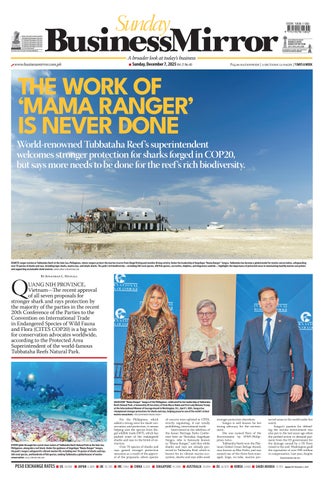
World-renowned Tubbataha Reef’s superintendent welcomes stronger protection for sharks forged in COP20, but says more needs to be done for the reef’s rich biodiversity.
By Jonathan L. Mayuga
QUANG NIH PROVINCE, Vietnam—The recent approval of all seven proposals for stronger shark and rays protection by the majority of the parties in the recent 20th Conference of the Parties to the Convention on International Trade in Endangered Species of Wild Fauna and Flora (CITES COP20) is a big win for conservation advocates worldwide, according to the Protected Area Superintendent of the world-famous Tubbataha Reefs Natural Park.
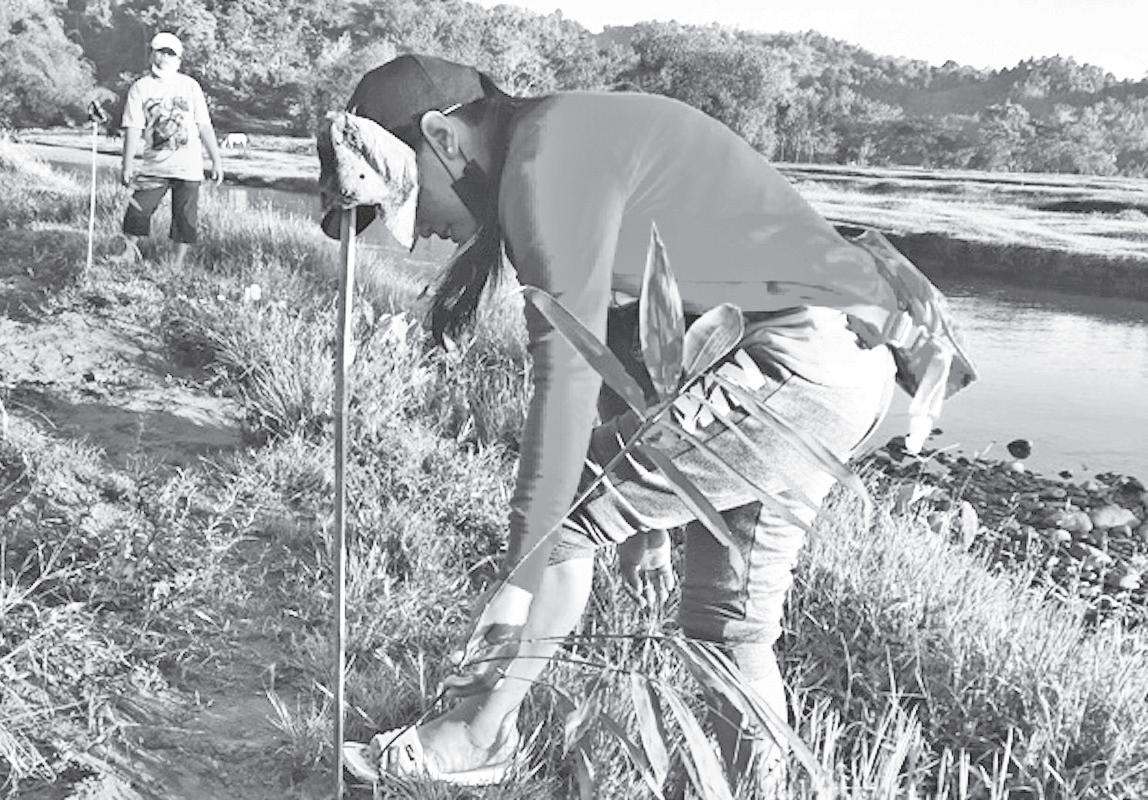
Tubbataha Reefs in the Sulu Sea, Philippines, where rangers protect the marine reserve from illegal fishing and monitor diving activity. Under the leadership of Angelique “Mama Ranger” Songco, Tubbataha has become a global model for marine conservation, safeguarding over 70 species of sharks and rays, including tiger sharks, manta rays, and whale sharks. The park’s rich biodiversity—including 360 coral species, 600 fish species, sea turtles, dolphins, and migratory seabirds—highlights the importance of
areas in
marine ecosystems and supporting sustainable shark tourism. SIMON GURNEY | DREAMSTIME.COM
ANGELIQUE “Mama Ranger” Songco of the Philippines, celebrated for her leadership at Tubbataha Reefs Natural Park, is honored by US Secretary of State Marco Rubio and First Lady Melania Trump at the International Women of Courage Award in Washington, D.C., April 1, 2025. Songco has championed
for sharks and rays, helping preserve one of the world’s richest
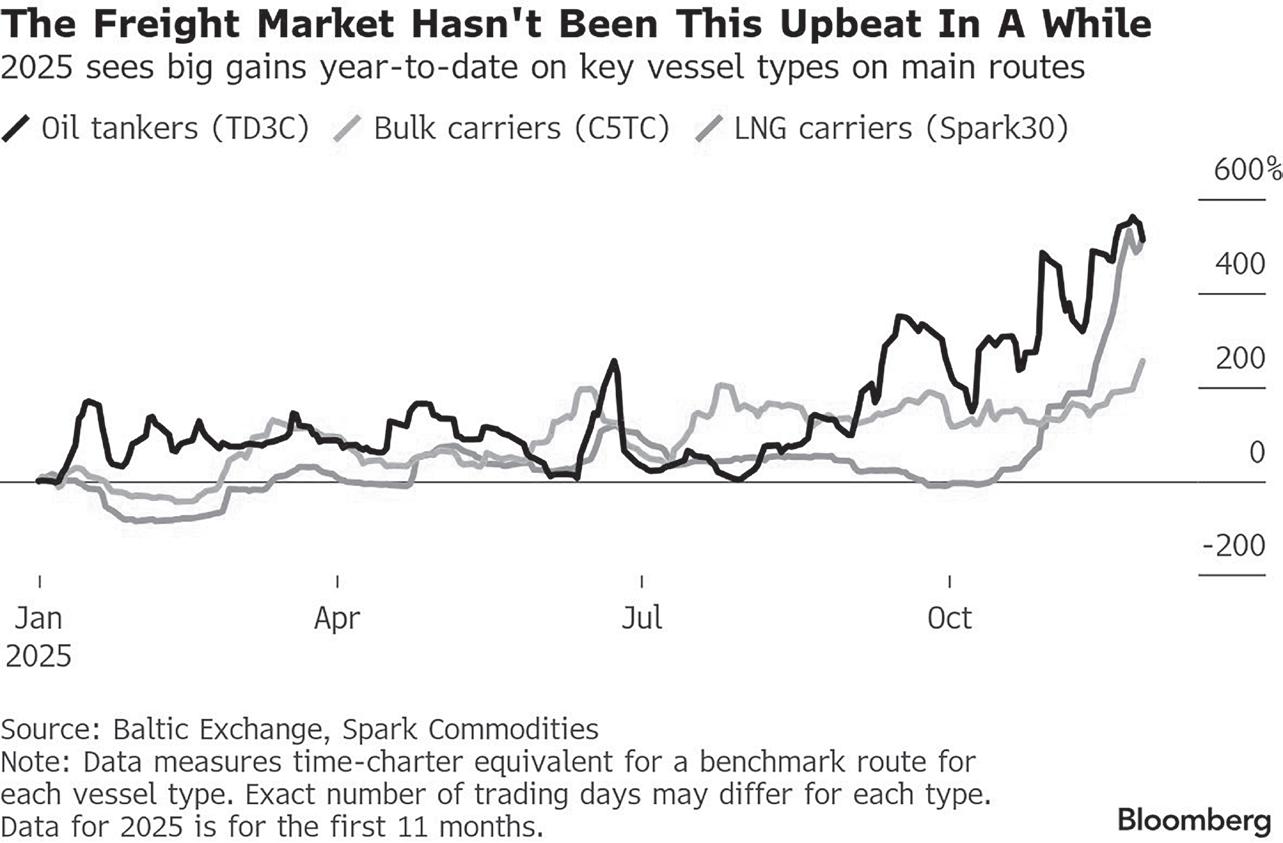
Shipping rates spiking 467% marks upended trade across commodities
By Weilun Soon | Bloomberg
RATES to ship commodities from energy to bulk ores across the world’s oceans are heading for a rare year-end surge as conflicts, sanctions, and swelling output upend global supply lines.
Daily earnings to transport crude on key routes have seen the biggest jump this year, up 467%, while rates to ship liquefied natural gas and commodities such as iron ore have increased more than fourfold and twofold, respectively. Freight costs typically dip at year-end due to seasonal weakness in demand.
Vessels are spending more time at sea transporting cargo, contributing to the spike, and several shipping executives expect tightness in the broader market
to continue at least through early next year.
“We’re seeing an old school, extremely tight physical shipping market,” Lars Barstad, the chief executive officer of Frontline Management AS, which operates a fleet of oil tankers, including very-large crude carriers, said on an earnings call late last month. “We’re not seeing any kind of weakness.”
For crude tankers, rates rallied following a ramp-up in Middle Eastern production, along with higher Asian demand for their bar-
HOUTHI attacks on ships in the Red Sea have pushed some vessels to sail around
longer than usual.
rels after US sanctions on two Russian oil giants. Meanwhile, the cost to ship LNG from the US to Europe recently climbed to the highest level in two years as new projects in North America tied up more vessels to deliver the fuel.
A benchmark measure for ships hauling bulk commodities, including grain and ore, rose to a 20-month high at the end of November as anticipation grew over a major iron ore project in Guinea coming online and weather-related delays off China squeezed supply.
More broadly, hostilities around key routes have contributed to an overall increase in costs. Attacks by Iran-backed Houthis in Yemen on merchant
cargoes are
ships in the Red Sea have forced some vessels to transit around Africa, increasing so-called ton-miles — a key metric of demand that multiplies the cargo volume by de -
livery distances — signaling cargoes are being transported longer than usual.
Freight rates have eased slightly from a peak at the end of November, but elevated costs are reverberating across the shipping market. Buyers of US LNG have contemplated delaying cargo loading, while some owners of oil tankers are seeking to maximize earnings.
In recent weeks, supertanker operators have focused on longer journeys to lock in higher profits, forcing some Indian refiners to use two smaller vessels — rather than the usual one — to get their Middle Eastern crude purchases delivered on time, according to shipbrokers. However, even as shipping companies enjoy a rare boom after years of bruising earnings, many are cautious about investing in the rejuvenation of fleets, or making big strategic decisions. New ships are expensive, while rates could plunge with more vessels and the potential reopening of the Red Sea.
“If you’re a shipowner, you have made money, you are not under distress,” said Jayendu Krishna, a director at Drewry Maritime Services.
“But you’re not in a great party like mood,” due to the uncertain industry outlook, he added.
(With assistance from Sing Yee Ong and Yasufumi Saito / Bloomberg)
The work of ‘Mama Ranger’ is never done
Continued from A1
her role in demanding accountability from Washington, the US government awarded her for her work in conserving biodiversity.
Sharks exposed to risks ACCORDING to Songco, sharks, especially those that migrate and travel great distances, are exposed to risks of being caught by fishermen, either by accident or as the primary target, for their meat, fins and other body parts.
“When they are no longer in a Protected Area, they become vulnerable,” Songco said.
Sharks and rays indicate the health of marine ecosystems, says ACB coastal and marine ecosystem expert Dr. Vincent V. Hilomen.
“The presence of sharks and rays—being apex predators— means the ecosystem is healthy.
He said their presence signifies a balanced food web as apex predators control populations of other species.
The declining populations of sharks and rays due to overfishing and habitat loss can signal a stressed or collapsing ecosystem, underscoring the need for stronger protection of these species and their habitats.
Tubbataha Reefs Natural Park in Palawan (TRNP), situated in the middle of Sulu Sea, is both a Unesco World Heritage Site and Asean Heritage Park, one of the country’s 14 protected areas that earned the distinct title.
Across Asean, there are a total of 69 AHPs.
The AHPs are protected areas of high conservation importance within Southeast Asia that are designated to preserve the region’s representative ecosystems and
raise awareness for biodiversity conservation.
These parks are part of a regional network that encourages cooperation among Asean member states to protect their shared natural heritage. The TRNP boasts of rich coastal and marine biodiversity.
Before being declared as a Unesco World Heritage Site and Asean Heritage Park, Tubbataha Reef was declared a national marine park and protected area in 1988 through Presidential Proclamation No. 306. The proclamation established it as the Philippines’ first national marine park and a no-take zone. The area has since been given further legal protection through the enactment of the Tubbataha Act of 2009.
Rich biodiversity
TUBBATAHA is known for its remarkable biodiversity. It has 360 species of corals, almost 90 percent of all coral species in the Philippines, and about 72 percent of all known coral species worldwide; around 600 species of fish, including healthy populations of the threatened species like the Napoleon wrasse, 23 species of sharks and rays, including the white-tip reef sharks, which have the highest known population densities here globally.
It also has 13 species of dolphins and whales, and the endangered sea turtles.
More than 1,200 total marine species have been identified, including 7 species of giant clams, 18 species of sea cucumbers, and 66 species of algae in Tubbataha Reefs.
Tubbataha is also an important bird sanctuary. It is critically important for migratory and resi-
dent seabirds, serving as one of the last great seabird sanctuaries and a major breeding ground in the Philippines and possibly all of Southeast Asia. Experts attribute the remarkable biodiversity richness of Tubbataha to its geographical location and the protection of the protected area against poachers and destructive human activities.
As approved by the parties, some of the sharks that gain stronger protection are found in the Philippines, including the oceanic white-tip shark, all manta and mobula rays, whale shark, wedgefish and giant guitarfish, deepwater gulper sharks, and houndsharks.
“I think that the value of the protection of the sharks elsewhere is also in the potential attractions that the other sites will have. In Tubbataha, it’s a no-take zone, and sharks are already protected. But it shouldn’t be the only place in the Philippines where you see a large number of sharks. All our dive sites, all our marine parks, should have the same attributes,” she said. According to Songco, shark tourism is a big dollar earner for the Philippines. Other Protected Areas could generate funds from shark tourism, she said.
She said Tubbataha boasts of having tiger sharks, which are rarely seen in other areas nowadays.
A study conducted by Tubbataha Reefs Natural Park through geotagging and monitoring of shark behavior, she said, indicated that sharks, like other marine species, are migratory.
“Outside protected areas, the possibility of being caught is high even for sharks,” she said.
She said about eight gray reef sharks and tiger sharks have been tagged as part of the study, and noted that one of the sharks disappeared. While gray reef sharks are not moving away from Tubbataha, it is the other way around for tiger sharks.
She shared that one of the tiger sharks disappeared and was later found to have been caught by a fisherman. Since tiger sharks are not protected outside designated marine areas, there was nothing they could do to save it. She expressed hope that tiger sharks and other shark species found in the Philippines, including rays and other marine life, will soon enjoy stronger protection measures.
Editor: Angel R. Calso
Lee looks to spur South Korea’s markets a year after martial law
By Soo-Hyang Choi
Ayear after South Korea was shaken by its former leader’s disastrous attempt to impose martial law, President Lee Jae Myung has restored stability and is now using his popularity to press ahead with investor-friendly moves.
Since taking office in June, Lee has outperformed expectations on the global stage—winning concessions from President Donald Trump, calming outrage over the arrests of hundreds of Korean workers in Georgia, and mounting a robust response to Washington’s barrage of tariffs and investment demands.
At home, his approval ratings are high and stocks are on a tear, signs he points to as evidence that his agenda is working as he promises to lay the groundwork for even bigger gains.
But as he tries to convince voters and investors that a bright future awaits in one of the world’s premier semiconductor-making hubs, he risks overlooking the concerns of the average person on the street. Frustrations over rising property prices, soaring costs associated with raising kids and perceptions of political scoresettling may start to whittle away at his support.
The turmoil over the past year has raised questions about the resilience of South Korea’s political system. Former president Yoon Suk Yeol was impeached over his martial-law attempt, and before that, another former leader, Park Geun-hye, was removed from office in 2017 following a corruption scandal.
Lee has pledged to amend the constitution to allow future presidents to serve two consecutive four-year terms instead of stepping down after a single five-year stint — a change touted as a way to bring greater continuity to the presidency. Yet so far, no serious effort at reform has materialized.
“Two presidential impeachment processes in eight years is not a sign of a healthy democracy,” said Andrew Yeo, a senior fellow at the Brookings Institution.
Stock performance
ONE of Lee’s first moves was to push through changes aimed at boosting shareholder rights. The Democratic Party has already revised the Commercial Act twice since his election, steps seen as improving the appeal of South Korean equities for long-term in -
vestors. The party is pushing for another amendment by year-end that would require companies to cancel their treasury shares.
Investors have welcomed the news. The benchmark Kospi index, which started the year around 2,400, has surged 68%, making it one of the world’s best-performing markets and putting it on track for its strongest annual gain in a quarter century. Lee has even vowed to drive it to 5,000.
But linking political success to stock performance carries risks, as US President Donald Trump discovered in his first term. He was quick to claim credit when markets rose, but started blaming the Federal Reserve when stocks tumbled in the latter half of 2018.
Still, South Korea’s economy looks in better shape than many expected when Trump unleashed sweeping tariffs earlier in the year. The trade and investment deal Lee cut with Trump has helped lift sentiment. Consumer confidence hit an eight-year high in November and exports have held up thanks to robust demand for semiconductors and autos. The Bank of Korea last week raised its 2026 growth outlook to 1.8% from the 1.6% projected in August.
“Private consumption is gathering steam, supported in part by a wealth effect from rising stock prices,” Bloomberg economist Hyosung Kwon said. “Even so, structural factors such as demographic change and the buildup of household debt are weighing on households’ propensity to consume, limiting the potential for sustained acceleration.”
Lee’s approval rating six months into his term is holding at 60% or higher—about twice the level Yoon recorded at the same stage in 2022, even before the backlash over the Halloween crowd crush that killed more than 150 people in a Seoul nightlife district.
Meantime, the main opposition People Power Party has yet to recover the confidence of voters, with a recent Gallup Korea survey showing its support rating at 24%. That compared with 43% for Lee’s ruling party.
“Much of his first six months
focused a lot on issues that were somewhat easier to forge a broader political consensus around,” Yeo said, noting that the debate over constitutional reform have largely stayed on the back burner. “I suspect we will see these points becoming more prominent in Lee’s discourse as his administration progresses and as he thinks about his legacy.”
Lee has made AI a central pillar of South Korea’s growth strategy. He has pledged to remake the country’s industrial base, defense capabilities and public services by more than tripling AI-related investment to 10.1 trillion won ($6.85 billion) next year.
But it will take time for those ambitions to deliver results, and there are growing concerns that the recovery is leaning too heavily on an AI-fueled chip boom. If momentum in the sector cools, the fallout could be severe.
The Bank of Korea has also flagged concerns over the won’s prolonged weakness since that could push inflation higher. The won has tumbled almost 5% this quarter, making it the worst performer in Asia.
Another imminent test for Lee
is reining in the property market, which he described as a “ticking bomb” in an October interview with Bloomberg News. Prices for apartments in the capital advanced for a 44th week in the period ended Dec. 1, despite a raft of government measures aimed at cooling demand.
“With local government elections scheduled in June, keeping the housing market stable is critical,” ING economist Min Joo
Kang said. “Historically, sharp fluctuations in property prices have served as a factor in regime change.”
Foreign policy
ON the foreign policy front, Lee has built on the trilateral cooperation with Washington and Tokyo that Yoon championed, avoiding the sharp about-face on Japan that has sometimes accompanied a change of president in Seoul.
He has even gone further, securing a deal with Trump to build a nuclear-powered submarine and collaborate on uranium refinement. Still, it remains unclear whether he can fend off US demands for larger South Korean contributions to hosting American forces.
One of the clearest breaks from Yoon is Lee’s approach to diplomacy on the peninsula. He aims to revive engagement with Pyongyang, similar to past liberal presidents, but has made little progress so far as North Korean leader Kim Jong Un grows increasingly emboldened by closer ties with Russia and China.
While direct traction with North Korea may be difficult, Lee’s conciliatory tone could help him facilitate talks between Trump and Kim. This week, Lee floated reviewing Seoul’s joint military drills with Washington if it would help bring Kim back to the negotiating table.
“Ending the war, overcoming division, and establishing a lasting peace are essential steps toward strengthening our democracy,” Lee said on Tuesday. With assistance from Youkyung Lee and Susie Kang Bloomberg
By Amir Vahdat & Jon Gambrell
The Associated Press
TEHRAN, Iran—When it comes to financial security for Iran’s jittery public after the 12-day war with Israel, all that glitters is gold—and for many, it remains the most trusted hedge against inflation, sanctions and a weakening rial currency.
Traders in Tehran’s Grand Bazaar say every new headline about United Nations “snapback” sanctions, the rial’s fall or renewed regional tensions have sent waves of people into buying so-called “valuepreserving assets.” Those include dollars, gold, silver, diamonds, cryptocurrencies and, to a lesser extent, equities.
Such portable wealth can hold value when local assets depreciate—and be
easily carried in case of a crisis, something on Iranians’ minds for months as many fear another war with Israel breaking out.
Mansour, a 28-year-old gold and jewelry merchant in the bazaar, said he had never seen such demand.
“In the past two weeks I’ve sold 6 kilos (13.2 pounds) of gold to ordinary people—a new experience for me,” said Mansour, who spoke on condition only his first name be used for fear of reprisals.
“People are rushing to buy because they fear their savings will lose value,” he added. Behzad Rashvand, a 57-year-old grandfather, said he viewed gold as the only protection against rampant inflation in Iran.
“Right now, I see gold as the best way to preserve value,” he said. “Whenever I make money, I turn it into gold.”
Iranians seek portable wealth as hedge against falling currency after Israel war See “Iranians,” A4
A4
Sunday, December 7, 2025
China sticks to manufacturing-led growth amid calls for consumption shift at policy meetings
By Bloomberg News
CHINA’S leaders are widely expected to stick with its manufacturing-led growth strategy in key policy meetings this month, even as calls grow at home and abroad for a more urgent shift toward consumption.
The Communist Party’s decision-making Politburo typically convenes in early December, followed within days by the Central Economic Work Conference. While the meeting statements won’t contain specific policy measures, they serve as a useful guide to understand policymakers’ priorities.
This year’s gatherings come amid signs of significant weakness in domestic demand. Authorities have tried to boost consumption with incremental measures like childcare subsidies, but are probably not facing enough pressure yet to make major moves such as expanding the social safety net.
The world’s second-biggest economy is emerging largely unscathed from its second trade war with the US. The recent deescalation of tensions with the Trump administration, coupled with China’s surprisingly strong export strength this year, will probably keep its leadership’s focus on advanced manufacturing and technology even at the risk of worsening the imbalances in global trade.
“The broad picture will be that policymakers are pretty happy with the way things went this year, particularly on the trade front,” said Duncan Wrigley, chief China economist at Pantheon Macroeconomics, during a webinar on Wednesday. The key message will be that “the basic path of upgrad -
ing manufacturing and pursuing technology is working and that’s what they are going to do more of,” he said.
Offsetting economic weakness at home, exports have boomed in spite of US President Donald Trump’s launch of a trade war early in 2025, with the year-todate surplus clocking a record of almost $965 billion.
At the same time, retail sales are coming off the longest stretch of slowdowns since 2021, investment just shrank by a record amount and the property market is in such dire shape that two private data agencies were told to withhold sales figures, a Bloomberg report showed.
Some prominent Chinese economists have called for Beijing to take steps such as adopting a stronger exchange rate or embracing a 2008-style stimulus package. Foreign officials including US Treasury Secretary Scott Bessent have urged forceful action to boost domestic consumption and reduce reliance on overseas markets. But, in the wake of Trump standing down from his most aggressive actions against China, economists warn against expecting any big rebalancing by President Xi Jinping and his team.
“In broad terms, we don’t expect any break from current policy settings, with a roughly steady— and stimulative—fiscal stance, incremental monetary easing and
redoubled efforts to curb excessive competition and the property slump. The details will reveal important contours that will shape the growth outlook,” said Bloomberg economists Chang Shu and Eric Zhu.
Authorities attending the work conference will back a 2026 growth target of around 5% for 2026—the same as for this year—according to 10 of 13 projections from banks and research institutions compiled by Bloomberg News. That gross domestic product goal will only be officially unveiled in annual legislative sessions in March.
Moving the target lower—potentially to a range of 4.5% to 5%— is still a possibility for some analysts. One downside: That could weaken already-fragile sentiment in the economy, with home values at their weakest in years.
Given that 2026 marks the start of the next five-year planning period, officials may be motivated to ensure growth is off to a good start. China is also aiming for an ambitious increase in per capita GDP by 2035.
Aside from any public statements from the Politburo and works conference confabs, further signals on the growth target will emanate from provinciallevel goals typically announced in January.
The following is a look at what economists are anticipating from specific policy areas from the upcoming gatherings:
Fiscal stance
AUTHORITIES will likely stick with the current “more proactive” setting for next year— keeping it expansionary to counter stubbornly weak household and business confidence.
Many economists expect Beijing to set the official budget deficit at around 4% of GDP, the same as in 2025.
Other closely watched metrics include guidelines for the issuance
of bonds, the proceeds of which are used to support spending or alleviate debt burdens. Officials are seen boosting the quotas for special sovereign and local bonds.
Even so, the leadership is likely to reiterate its determination to contain local debt risks as the government’s 10-trillion-yuan ($1.4 trillion) program to refinance hidden liabilities heads into the third year.
Beijing is also likely be ready to add stimulus later in 2026 as the year progresses, to address any challenges that emerge—such as renewed trade tensions with the US.
Monetary policy
LAST year’s Politburo meeting saw a major switch in language, with policymakers adopting a “moderately loose” monetary stance, and they’re expected to keep that terminology for 2026. Despite the signaling shift a year ago, substantial monetary easing failed to materialize this year—amid strong export growth.
The People’s Bank of China has delivered just one 10-basis-point cut to the policy interest rate since the start of the year—notably less than the 40 to 60 basis
points many expected. That’s the smallest amount of rate reductions since 2021.
The PBOC faces several constraints in cutting rates, even amid entrenched deflationary pressures. For one, the key rate is now so low that it’s raised questions about the health of the banking sector, along with concerns about fueling bubbles in some asset markets. The central bank recently signaled more caution toward easing.
Officials might in the first quarter lower the ratio of reserves that banks must keep locked up at the PBOC against their deposits, with a policy rate cut in the following quarter, according to Standard Chartered Plc.
Consumer boost
A 300 billion-yuan program to subsidize the purchase of consumer goods could get extended into next year, Citigroup Inc. economists said.
Others expect the focus may shift toward services. Coupons or subsidies for service consumption could be offered nationwide, as a short-term measure to avoid a sudden pullback in household spending, according to Shen Jianguang, chief economist at JD.com.
The Citigroup team, including Xiangrong Yu, sees a “strong case” for the government to start setting a target to boost the share of consumption in GDP by one percentage point in 2026, as the nation aims to “significantly lift” that ratio over the next five years.
Aid for property
CHINA’S real estate market has been plunging for four years now, and economists broadly expect the contraction to extend into 2026. Many have urged Beijing to ramp up aid for the sector to mitigate the downward pressure it puts on the economy.
Policymakers may unveil measures such as a property stabilization fund and government purchases for low-cost housing to reduce unsold inventory, Citic Securities Co. economists including Ming Ming wrote in a note this week.
Other analysts anticipate authorities will provide mortgage subsidies for homebuyers. Morgan Stanley calculates that it would take government spending of almost 400 billion yuan a year to turn around market sentiment. Battling ‘involution’ COUNTERING excessive competition, or involution as it’s become known, is almost certain to continue being a focus for 2026, given China’s continuing worries about deflation and profit margins getting squeezed so much that it limits companies’ capacity to invest and innovate.
But the government will have to strike a careful balance, as any move to aggressively cut back on industrial capacity could exacerbate the slowdown in investment and lead to significant job losses. The campaign is still largely opaque and targeted at specific industries. While some raw material prices saw a surge earlier this year, the impact of efforts taken so far has been limited. Bloomberg News
UK shipyards stage multibillion-dollar comeback amid European rearmament
By Kate Duffy & Olivia Fletcher
IN 1976, welder Phil McClean won “Apprentice of the Year” at Harland and Wolff’s shipyard in Belfast, Northern Ireland. He was following in the footsteps of his father and grandfather, who also worked in the docks famous for building World War II warships and the Titanic.
Now, it’s McClean’s generation behind the UK’s shipbuilding ambitions, fueled by a multibillion-dollar European rearmament campaign meant to counter threats from enemies including Russia.
After years of stagnation in UK shipyards, the next challenge is building warships fast enough, and finding enough workers to do the job.
Iranians. . .
Continued from A3
Gold sales spike in Iran’s capital OVER the summer, 1-gram, 18-karat gold bars traded at around 115 million rials— about $100 as the rial now trades at over 1 million to $1. Gold coins were over $1,000 and 1-kilogram silver ingots were nearly $2,000. On Saturday, the price of a gold coin in Iran exceeded 1.2 billion rials for the first time in the country’s history. Small silver bars from 100 grams have become a new, entry-level investment for middle-class families, Iranian media reports suggest.
Fatemeh Parsa, a 47-year-old mother of two, now regrets using an inheritance to buy an
“We can generate the capacity,” said Babcock Chief Executive Officer David Lockwood. “I wouldn’t say it exists today.” As the London-listed defense company pursues several international warship deals, including with Sweden, Denmark and Indonesia, it’s looking to invest in and expand its UK shipyards, Lockwood said in an interview after the company’s latest earnings.
The UK in September signed a £10 billion ($13.3 billion) deal with Norway to build at least five Type 26 frigates. UK Prime Minister Keir Starmer said he hopes the order will be the “first of many,” signaling a push for more defense contracts.
Turkey and the Netherlands could also clinch deals with the UK for warships.
During the late 1930s, the UK’s shipbuilding
apartment in Tehran. While real estate remains valuable in some Tehran neighborhoods, bank loans and people’s savings have not kept pace with sky-high prices.
“With global gold prices rising, I sometimes wish I had bought gold instead— my assets would have grown much more than real estate,” she said. “Now, it seems that investing in silver could be valuable, especially for my children’s future.” Reports of mass layoffs in Iran’s economy, stemming from problems with electricity, consumer demand and sanctions, also have circulated for months. Amir Ramezani, a top gold trader in Tehran, said that some families from more well-to-do families have begun selling parts of their assets to cope.
“Their incomes today don’t match
industry boomed amid the pressure on the Royal Navy to expand and modernize. Shortly after World War II, orders slowed down, and later competition from Japan and Korea’s bigger shipyards forced the sector into decline.
The navy has also shrunk as defense spending slid from a record 7% of GDP in 1955 to an expected 2.4% today.
“A century ago, Britain was a worldleading shipbuilding nation,” said Andrew Lambert, a professor of naval history at King’s College London. “Chasing cheap ships and delaying warship orders has disrupted that system.”
Last year, the entire UK shipbuilding industry generated £2.7 billion in economic output, accounting for 0.1% of total UK GDP, according to a House of Commons Library report. But that was an increase of 72%
the lives they built,” Ramezani said. “To sustain the same lifestyle, many are selling valuables—gold, jewelry—just to keep up.”
Gold and silver particularly gained prominence as the US began cracking down on Iranian cryptosellers, which had been one avenue Iranians sought to secure their finances.
“Whenever I have enough money to save, immediately convert it into gold,” said Hamid Safari, who sells audio equipment.
“Throughout history, gold has not only held its value but also increased in worth. We should learn from history if we want to build a better life.”
Portability also a concern as tensions high in region
MEANWHILE , wealthier investors are
from 2019, the report said.
Babcock has invested more than £200 million in its Rosyth shipyard in Scotland over the past decade.
This year, BAE Systems Plc opened a shipyard in Glasgow big enough to build two of the 150-meter Type 26 frigates side-by-side under cover instead of outside in the Scottish weather. The £300 million investment has increased BAE’s capacity, improved production efficiency and created a better workplace, said Jen Blee, manufacturing director for naval ships at BAE Systems.
“It’s been over the last five years that these big investments have come into fruition,” Blee said. “We’ve certainly got enough capacity in our shipyard for our current order book.”
turning to diamonds and other gemstones as discreet, portable stores of value.
Jewelers in Tehran and Mashhad report rising demand for small-carat investmentgrade stones—a niche traditionally favored by traders but now expanding to upper-middle-class buyers.
Iran’s broader economy remains under severe pressure from international sanctions that have cut off investment and limited access to global finance. Years of restrictions have weakened domestic industries and left key sectors struggling to modernize. And for those wanting to get money out abroad, hard currency and jewelry remains some of the only ways to do so.
There’s also another reason that Iranians
BAE also has 650 apprentices at its shipbuilding academy and expects to have about 850 early career employees when the Type 26 program reaches its peak, a spokeswoman said.
Navantia, a Spanish shipbuilder, is spending £115 million on modernizing its British shipyards. It rescued Harland and Wolff’s four UK yards in January for £93 million ($126 million). A UK government contract to build three 216-meter Fleet Solid Support ships for £2 billion is projected to keep those yards busy until at least 2031.
To avoid delays while the shipyards are renovated, Navantia is doing some of the work on the first Fleet Solid Support ship in Spain. The company will increase the UK share of production for the second two ships to offset this, it said. Assembly, integration
remain reluctant to discuss—being able to have the money portable in case of another war. Tens of thousands of Iranians living in Tehran are believed to have fled the capital during the 12-day war, heading out into the countryside of Iran or north to the coast of the Caspian Sea. When they did, they found some areas overwhelmed by newcomers and ATMs either out of cash or nonfunctional. Many brought whatever savings they could immediately put their hands on with them. There’s precedent for this in Iranian history as well. Many who fled the cities
and delivery, the most valuable phase of production, will happen in Belfast for all three vessels.
The competition for European orders is fierce. Italy’s Fincantieri SPA, France’s Naval Group SA and other global shipbuilders are also revitalizing yards and signing foreign contracts.
“Britain must avoid boom and bust approaches to shipbuilding,” Lambert said. “A steady program of long term building and refitting, with capacity to meet foreign orders, would be the spring board for a revival.” The state of the UK shipbuilding industry echoes the US shipbuilding industry, which is also struggling to ramp up and train enough workers in the face of China’s growing dominance in shipping.
Bloomberg News
PHL forest scents eyed for commercial perfume launch
by Bless Aubrey Ogerio
LStory &
AOAG CITY—Perfume blends drawn from Philippine forest crops could reach the market as early as next year as researchers move to shift the initiative from laboratory development to commercial production with the help of private perfumers and community growers.
Project Leader Edmark Kamantigue, Science Research Specialist at the Forest Products Research and Development Institute (FPRDI), said the fragrance line is being positioned for market entry through partnerships designed to secure long-term sourcing and supply sustainability.
The initiative remains under the Department of Science and Technology’s (DOST’s) research and development but is already testing market readiness through direct feedback from industry partners.
“That’s why we have partners from the industry so that we can get inputs on how our strategies can be sustainable,” Kamantigue told reporters on the sidelines of a forest products innovation forum during the National Science, Technology and Innovation Week in November.
“Sustainability is not a one-year project. So we have partners, the com -
munity-based forest management, so that our efforts to propagate the forest products are continuous,” he added. The project, titled “Green Fragrance with Purpose,” is funded by the DOST’s Philippine Council for Industry, Energy and Emerging Technology Research and Development.
It aims to convert underutilized forest crops into high-value fragrance materials using eco-friendly extraction methods.
The team uses supercritical fluid extraction to recover essential oils in higher quality and yield. While previous studies of similar forest resources focused on medicine and flavoring, the perfume segment was identified as a commercially promising application.
About the fragrances SEVEN fragrance prototypes have been developed in the project’s initial batch created through what
Kamantigue described as a “personal creative approach.”
Some of the prototype names include Cotton Kisses, Dapit-hapon, The Island I Remember, Sweet Sunset and Cream Soda.
“The lineup of the seven fragrances is the personal inspiration of the FPRDI researcher,” he said. “The approach of the fragrance must be personal…. We will translate the story based on the combination of the materials.”
Raw materials currently come from farming communities in Central Luzon and the Bicol Region, which are selected for favorable growing conditions.
One of the most promising inputs, based on industry feedback, is local Philippine cinnamon, with plantations in Negros expanding propagation.
“The cinnamon leaves and cin -
namon bark are the oils that we are recovering here,” he said, noting that intercropping strategies are being adopted to maintain supply.
The products are not yet available to the public, but the team is targeting a commercial launch next year in collaboration with perfumer Oscar Mejia, a previous international competition finalist and currently affiliated with Sensories Inc.
“He is the brain behind the creative side of our fragrance formulation,” Kamantigue said. “The theme is Filipino culture.”
Limitations
MATERIAL availability remains one of the initiative’s key challenges. “But we have strong partners with farmers so we have readily available materials,”
PTRI: In a changing market, PHL textiles struggle to keep up
LAOAG CITY—THE local textile and garment sector continues to lose ground in the global market as local manufacturers remain confined to low-value production, according to the Philippine Textile Research Institute (PTRI).
PTRI Executive Director Julius Leaño said the loss of approximately 50,000 garment jobs over the last three years signals a deeper competitiveness gap, one rooted in the industry’s outdated position in the production chain. (See: https://businessmirror. com.ph/2025/09/05/garmentssector-pay-hike-tariffs-spellperfect-storm/)
“The decline across the years is very symptomatic that what we are doing is not relevant to what the market needs,” Leaño told reporters on the sidelines of the Philippine Handloom Weaving Festival during the 2025 National Science, Technology, and Innovation Week in this city last month.
“We’re still on the cut, make, trim [CMT] regime. It means we are just stitching and putting things together. You are not part of the value chain,” he added.
At a Senate hearing in August, Executive Director Maritess Agoncillo of the Confederation of Wearable Exporters of the Philippines similarly described the sector as being caught in a “perfect storm” of local and global pressures.
This vulnerability, Leaño noted, becomes most apparent when buyers shift production to cheaper CMT locations abroad.
“If they find a cheaper place to get this done, they will load out.
We will lose jobs,” he said.
In the same hearing, Agoncillo said that wage hikes alone cut the industry’s 2024 export performance by $260 million, or about 25 percent, with some major brands already pulling out of the country.
Labor-intensive products, such as garments, were among the first to be affected by the US reciprocal tariffs, according to the Philippine Exporters Confederation Inc. It said orders from American buyers have already begun to decline since the duties took effect.
For Leaño, the downturn highlighted how the Philippines has yet to establish its position in the global textile supply chain.
“This is not just an economic issue or a job-loss issue. It’s because we are not oriented to being a viable, valuable player in the textile supply chain. And I’m referring to the global value chain,” he said.
“There’s just one market. The quality you have here should be the quality you can send out,” he pointed out.
Interventions
said PTRI is pushing programs to help manufacturers move beyond basic assembly work—such as developing brands, tapping local natural fibers and embedding sustainability standards increasingly as required by international buyers.
“The language of the new market is sustainability— environmental sustainability, carbon footprint, and the story behind what you’re selling,” he said.
Global buyers, he added, now “want to buy fabric with a story,” which puts value on origin narratives and locally grown fibers.
And while these efforts may not immediately reverse job losses, Leaño said they are designed to strengthen the textile ecosystem and enable firms to compete in higher-value segments.
PTRI, he said, is now working more closely with exporters and garment makers for regular feedback on market gaps and product requirements.
“You need to know directly from the exporters, from the garment manufacturers: What is the problem?” he said. “When you [learn] the feedback, you can design your programs to answer it.” In addition, the Institute is also refining the role of regional weaving and textile hubs to prevent overlapping outputs and align each center with a specific market segment.
“Many of these centers develop skills and designs. But how is it aligned to the market need?” he said. “We make sure that if there’s a new weaving center, they are catering to a certain demographic, a certain location, a certain market so they don’t overlap.”
While research is easier to carry out, Leaño reiterated that research and development (R&D) must remain grounded in real conditions in weaving and fiber communities.
“R&D should be responsive. It cannot be something only scientists thought of,” he said. Other issues, including logistics and pricing, remain but are manageable, he added. “Those are welcome challenges because that’s how a market develops.”
One key government measure to rebuild the domestic textile industry is the proposed Philippine Textile Revitalization Act, which outlines a long-term strategy for industry development.
Also being pushed are the Handloom Weaving Industry Innovation Act and the Academic Regalia Act, which will require state universities and colleges to use locally woven fabrics for ceremonial garments.
PTRI has also begun addressing the lack of formal training in textile production. The agency recently partnered with the University of the Philippines to pilot short courses on textiles and weaving innovation.
Bless Aubrey Ogerio
Kamantigue said, adding that plantations are being maintained to ensure a steady biomass flow.
Funding continuity is another concern, as work is tied to project cycles.
“It’s project-based so we want a continuous momentum,” he said.
“We must not be limited to the project already being done. The direction of DOST should be continuous as a program because the flavors and fragrance market is very promising here in the Philippines,” he added.
Eyeing the niche segment
THE fragrance line is likely to occupy a niche sector of the perfume market, Kamantigue said. “It’s a unique market segment where you target a particular market that hasn’t been catered to yet,” he said.
He added that the initiative could generate additional employment in rural areas.
“Yes, especially that we have identified materials and we have a lot of promising perfume artists competing in the international market…it can create a more harmonious and more unique fragrance scent product,” he said. Beyond perfume, the team plans to expand into personal care and cosmetic applications using forestderived materials.
“FPRDI is also focusing on the cosmetic and cosmeceutical applications of our forest products,” Kamantigue pointed out. “From the fragrance, we are expanding to other products like personal-care products.”
DOST to overseas scientists: Country needs your expertise
FILIPINO scientists overseas are being urged by the Department of Science and Technology (DOST) to bring home the expertise they have built through years of work abroad.
During a recent media forum, DOST Balik Scientist Dr. Joyce Porto said the people who have worked so hard to reach this far are the people who are needed by our country. She noted how in her personal experience, the government provides support for returning researchers “practically, economically as well.”
“It’s very good to come home but I think you should also consider staying and really making a mark in our country,” she added.
Porto is working on a pioneering neurogenetics program at Quezon Memorial Medical Center.
The Balik Scientist Program is a government initiative launched in 1975 to encourage
Filipino experts abroad to return.
The DOST strategy framework for 2023 to 2028 identifies the program as key to advancing national goals in human wellbeing, wealth creation, wealth protection and sustainability. So far, a total of 674 scientists have come back under the program since its creation, according to the science agency figures. Further, most Balik Scientist commitments from 2015 to 2024 have been short-term, with long-term arrangements still scarce. Medium-term partnerships have only begun to appear in 2019. Across sectors, 43.7 percent of participating scientists were engaged in industry, energy and emerging technology; 28.4 percent in agriculture, aquatic and natural resources; and 27.9 percent in health. Bless Aubrey Ogerio
Ateneo study: Sea salt contributes to Metro Manila air pollution
THE naturally-occurring components of sea salt—sodium and chloride— combine with Metro Manila air and contribute to the metropolis’ pollution, a new study revealed.
The new research—co-authored by Ateneo de Manila University-Manila Observatory and University of Arizona researchers—points to sea salt particles in the air (aerosols) as an important, chemicallyreactive contributor to air quality when their components interact with the already polluted city air, particularly in Metropolitan Manila during the worldwide shutdown of human activity under the Covid-19 pandemic, said Danika Geronimo, Ateneo de Manila University Research Communications, in a news release.
The researchers’ findings offer potential implications for human health, climate, and urban policymaking by highlighting the complicated dynamics of urban pollution.
The study “Day-Night Shifts in WaterSoluble Ions of Size-Resolved Aerosols before and after the Covid-19 Lockdown in a Coastal Megacity: Metro Manila, Philippines” is published in ACS Earth and Space Chemistry in October 2025. It is also published in https://archium.ateneo.edu/ manila-observatory/26/
The researchers showed that sea salt particles and urban pollution do not simply
mix when they meet in the atmosphere; pollutants chemically react with and transform the sea salt particles, with potentially negative effects on the air people breathe. The researchers examined the chemical composition of city air in both daytime and nighttime, pre-lockdown and post-lockdown. They gathered aerosol samples over continuous 48-hour intervals and found that the concentrations of chloride and sodium actually increased post-lockdown.
Metro Manila’s heavy pollution before the lockdown was found to be very potent at stripping away the chloride component of sea salt in the air—a process called “chloride depletion.”
After lockdown, the reduced pollution allowed more naturally-occurring sea salt components to persist: when emissions from vehicles and industries dropped, the air became less acidic and, therefore, less able to deplete airborne chloride.
They researchers recommend further studies to measure gas emissions and weather conditions together, and in greater detail, towards more effective, evidence-based government interventions. The researchers were Grace Betito, Paola
photo
Executive Director Julius Leaño of the Philippine Textile Research Institute speaks on November 19 at the Philippine Handloom Weaving Festival during the 2025 National Science, Technology, and Innovation Week in Laoag City, Ilocos Norte. BLESS AUBREY OGERIO
Angela Bañaga, Rachel A. Braun, Maria Obiminda Cambaliza, Melliza Templonuevo Cruz, Alexander B. MacDonald, James Bernard Simpas, Connor Stahl, and Armin Sorooshian.
THE materials from forest crops and fragrance prototypes are on exhibit during the 2025 National Science, Technology and Innovation Week in Laoag City, Ilocos Norte.
A6 Sunday, December 7, 2025
‘Rome came to me’: OFW Loren Capobres’ testimony moves Pope Leo XIV in Lebanon
By Malou Talosig-Bartolome
WHEN Loren Capobres, a Filipino domestic helper based in Lebanon, was denied a visa to attend the Jubilee of Migrants in Rome last October, she thought her dream of meeting Pope Leo XIV had ended.
Sponsored by her bishop, she had prepared to join thousands of migrants at St. Peter’s Basilica. But the Italian Embassy in Beirut rejected her application, closing the door on what seemed like a once-in-a-lifetime opportunity of meeting the pope.
Two months later, the unimaginable happened: the pope came to her.
On December 1, Pope Leo XIV visited Lebanon, and Capobres was chosen to deliver the migrant testimony before bishops, priests, consecrated persons, and pastoral workers at the Marian Shrine of Harissa.
Her words, drawn from years of sacrifice and service, moved the pontiff to tears—and resonated far beyond the shrine’s stone walls.
From Bicol to Beirut: A migrant’s journey CAPOBRES , 54, hails from Goa, Camarines Sur. Like many overseas Filipino workers (OFWs), she left the Philippines not out of desire but necessity. For 17 years she has worked in Lebanon for a Lebanese-American family, following seven years with them in Dubai, she told the BusinessMirror in an interview.
Her life, like that of more than 200,000 OFWs in Lebanon, is bound by the kafala system, which ties workers to their employers. Yet she considers
herself fortunate: her employers are liberal, allowing her freedom to attend church and volunteer.
Her monthly salary of $400 to $600 has sustained her three children’s education back home. She entrusted their care to her parents after her marriage collapsed.
“Let’s not talk about my husband,” she quipped in Filipino. “He’s in another house already.” Despite personal trials, she has remained steadfast, channeling her energy into faith and service.
A voice for the voiceless CAPOBRES’ path to the pope’s altar began with Bishop Cesar Asayan, who first heard her speak during World Migrants Day in October. Impressed by her storytelling, he recommended her to represent migrants during the papal visit.
She only learned of the assignment a week before the event. With her employers’ consent, she traveled to Harissa for rehearsals.
Her testimony was not a polished speech crafted by professionals. It was the lived experience of a migrant worker who had endured war, displacement, and the quiet burdens of domestic labor.
She spoke of volunteering with Couples for Christ Lebanon, the Arrupe Migrant Centre, and her parish, Saint Joseph Tabaris—communities that became her second home.
Bearing witness to suffering IN her testimony, Capobres recounted the harrowing story of James and Lela (not their real names), a Sudanese couple trapped by their
employer during bombings.
Abandoned, they escaped despite the risk of losing their jobs and residency under the kafala system. With a newborn and a toddler, they walked for three days to reach the church shelter.
“When I saw them, my heart broke,” Capobres told the pope. “Imagine: a mother who had just given birth walking for three days, carrying her newborn, with her husband and their three-year-old son. In their courage, I saw God’s light shining even in the darkest moments.”
Her words echoed the struggles of countless migrants who, in times of war, find themselves excluded from shelters because of nationality.
During last year’s conflict in southern Lebanon, she witnessed migrants flocking to churches, desperate for refuge. With the help of the Jesuit Refugee Service, their parish became a sanctuary.
A sacred encounter
WHEN Capobres approached the altar and laid her hands on Pope Leo, she described the moment as transcendent.
“Napaka -peaceful. Wala kang maririnig sa kapaligiran mo. [It was very peaceful. You couldn’t hear anything around you] Holiness, peacefulness. Hindi ko ma-explain [I could not explain]. I was speechless,” she told the Business Mirror.
The pope’s words to her were simple yet profound: “Be strong.”
For Capobres, those few minutes felt like eternity. “ Parang nawala lahat ng tao. Kami lang dalawa [It was like everybody were gone. Only the two of us there],” she recalled. The encounter crystallized years of sacrifice into a single moment of recognition.
Pride of a community
H ER testimony reverberated across Lebanon’s Filipino community. Filipino priest Fr. Henry Ponce
Abp. Garcera assumes CBCP presidency
ARCHBISHOP Gilbert Garcera of Lipa on December 1 assumed the presidency of the Catholic Bishops’ Conference of the Philippines (CBCP).
Garcera, elected during the CBCP’s 130th plenary assembly in July, succeeds Cardinal Pablo Virgilio David of Kalookan, who served two terms, or a total of four years.
David is currently the vice president of the Federation of Asian Bishops’ Conferences.
As president, Garcera will lead the conference, oversee its work, and serve as its main spokesperson. He heads the CBCP Permanent Council, which manages day-to-day affairs, and implements decisions made by the plenary assembly of bishops.
The president also represents the Philippine Catholic Church at national and international events, including meetings with the Vatican and other bishops’ conferences.
Garcera has long been involved in the CBCP. As priest, he served as assistant secretary general and as executive secretary of the Episcopal Commission on Mission. He was appointed bishop of Daet
in 2007 and later chaired the CBCP’s Episcopal Commission on Mission and the Episcopal Commission on Family and Life.
Before his election as president, he was a member of the CBCP Permanent
Council as regional representative for Southeast Luzon.
Garcera, who has been archbishop of Lipa since 2017, will work closely with Archbishop Julius Tonel of Zamboanga, the CBCP’s new vice president.
The 10 regional representatives of the CBCP Permanent Council also assumed their posts Monday.
For Luzon, they are Archbishopdesignate David William Antonio of Nueva Segovia, and bishops Roberto Mallari of Tarlac, Elias Ayuban of Cubao, Euginius Canete of Gumaca, and Herman Abcede of Daet.
Representing the Visayas are bishops Marvyn Maceda of San Jose de Antique and Isabelo Abarquez of Calbayog.
Mindanao’s representatives are bishops Cosme Almedilla of Butuan, Jose Colin Bagaforo of Kidapawan, and Glenn Corsiga of Ipil.
Their term runs from December 1, 2025, to November 30, 2027. CBCP News
Sri Lanka: Christian communities offer aid to victims of cyclone
AS flooding and landslides continue to devastate Southeast Asia, Catholic and Christian parishes and organizations step up to offer support and “together to alleviate the suffering of the victims.” Southeast Asia continues to reel from devastating floods and landslides over the last few weeks. The death toll from cyclone-induced flooding across four countries—Indonesia, Sri Lanka, Thailand, and Malaysia—has reached about 1,300 people. In Sri Lanka, Cyclone Ditwah struck the country on November 27 and caused landslides and flooding in the following days. The government declared a state of emergency as the heavy and relentless rains led to dam breaches and destruction. More than 300 people have died and more
than 200 are missing—making this one of the worst natural disasters in recent years. The Sri Lanka Disaster Management Centre reported some 20,000 houses have been damaged and over 100,000 people, including those internally displaced, have sought shelter in emergency lodgings organized by the civil defense. One third of the country is reportedly without running water and electricity.
Universal care, no matter the denomination FR . Basil Rohan Fernando, a priest from Colombo, also serves as the National Director of the Pontifical Mission Societies in Sri Lanka. He described to the Vatican’s Fides agency how the country is “under water…We are seeing much suffering and
people who have lost everything.”
The eastern region was hardest hit and the Mavil Aru dam was damaged. Colombo and other important economic areas are also enduring considerable loss.
Over 24,000 police officers and soldiers are helping in the rescue efforts, yet aid has not been able to reach every area impacted.
In response, Fernando stressed the importance of being united as a country.
“All the country’s health forces and people of goodwill are working together to alleviate the suffering of the victims,” he explained. This includes religious communities, churches, parishes, and Catholic institutions which have found housing for those who have been displaced.
The Colombo priest shared that Caritas has launched its network at various levels.
“Volunteers are working tirelessly in the dioceses and parishes, and the Catholic communities have made all their resources and skills available to help the displaced—of course without distinction of ethnicity or faith,” Fernando explained. On top of that, different Christian communities of all denominations are also giving humanitarian aid to those in need and continue to be involved in providing emergency relief—shelter, food, water, and hygiene supplies—for the victims.
Support for those affected by the disasters is both psychological and spiritual, Fernando pointed out.
“A gesture of love, affection, and closeness means a great deal in such situations; listening and human warmth are a testament to God’s love for every person.”
of the Arrupe Migrant Centre said:
“Parang dala-dala niya kaming lahat [It was like she carried all of us]. She’s the perfect representation of the Centre because siya ang babad dito [she has immersed here].”
International and local media soon sought her story, amplifying her voice beyond Harissa.
Capobres’ children, unaware she would speak before the pope, expressed pride. Her daughter Nikka wrote: “We are so blessed and grateful for having her as our mother. Though she is miles away, she never failed being our mother—and a mother too to all the migrants at the shelter during the war.”
The pope’s pesponse POPE Leo XIV, visibly moved, he praised the migrants’ courage.
“Their suffering touches us profoundly,” he said. “It shows how war destroys innocent lives and calls us to act with compassion and courage. Whoever knocks at the doors of our communities must never feel rejected, but welcomed with the words Loren herself stated: ‘Welcome home!’”
He warned against indifference, citing Pope Francis’ call to embrace displaced people.
“Migrants are not just workers,” Capobres had told him. “We are contributors who care for families, support parishes, and carry hope despite hardship.”
The pope echoed her words, affirming that migrants’ resilience “speaks to us of God’s light even in suffering.”
Virgilio Cardinal Pablo David, former president of the Catholic Bishops’ Conference of the Philippines, said
Capobres’ testimony was “a heartfelt plea.” He added: “Her quiet testimony helped shape the pope’s strongest words against war and for displaced families. It is a small sign of how the peripheries are speaking to the center.”
A message to fellow Filipinos FOR Capobres, the encounter was surreal, but her message to fellow Filipinos was clear: “Open yourself to serve and love in any circumstances. Always have faith, especially in times of uncertainty—when you wouldn’t know when the next bomb would hit you.” Her story embodies the paradox of migrant life: the pain of separation, the dignity of labor, and the strength of faith.
It is also a reminder that the voices of domestic helpers, caregivers, and construction workers—often unheard—can shape the words of a pope.
‘I couldn’t go to Rome, so….’ DENIED entry to Rome, Loren Capobres found herself instead at the center of a papal visit. Her testimony, rooted in lived experience, became a mirror of migrant suffering and resilience. In Harissa, before 1,700 laity and the pope himself, she spoke not only for herself but for millions of migrants worldwide. Her words—“Welcome home”— captured the essence of the Church’s mission: to embrace the displaced, to shelter the vulnerable, and to remind the world that migrants are not burdens but bearers of hope. For Capobres, Rome did not remain a distant dream. In her own words: “I couldn’t go to Rome, so Rome came to me.”
Young priest sees during motortaxi ride how political lies shape public opinion
ASHORT motorcycle taxi ride in Manila on November 29 turned into a lesson on how political lies shape daily life, a young priest said, after a driver repeated claims he called “fake news.”
Fr. Francis Baasis of the Diocese of Antipolo shared the story online, saying the driver told him protests at the EDSA People Power Monument involved “NPA” (New People’s Army) groups preparing to rally.
Baasis said he replied, “Those aren’t NPA, kuya [elder brother],” explaining that priests, bishops and parish groups organized the demonstrations to demand accountability in public funds.
The driver insisted the clergy were “paid” to attack Vice President Sara Duterte—a claim Baasis said reflected how widely false stories spread through social media.
“The Church does not want to bring down the government,” Baasis said, adding that Church groups only want wrongdoing exposed and public funds protected from abuse.
Baasis said the driver then softened, admitting, “I voted for Bongbong [President Ferdinand Marcos
Jr.] before… but now I no longer support him,” after hearing reports that troubled him. He wrote that the man shared confused accounts about “term sharing,” which the priest said illustrated how powerful groups shape public opinion by manipulating the “truth” for political gain.
Baasis eventually told the driver he is a priest, adding he would never accept money to attend protests and that he speaks out only “for truth and justice.” He then asked, “Those who spread fake news… would they be willing to stake their souls?”—a question that brought sudden silence from the driver, said Baasis, who is also former director of the Antipolo diocese’s social communications ministry. The priest said the driver remained quiet until the trip ended, and he hoped it meant the man was rethinking the stories shaping his views on national issues.
Baasis said he left believing “a small crack” in false beliefs can let light in, especially at a time when truth and accountability matter to many Filipinos. CBCP News
POPE Leo XIV talks to Filipino domestic helper Loren Capobres after she delivered her testimony about migrants at the Marian Shrine of Harissa in Lebanon. Capobres described the encounter with the Holy Father as “very peaceful,” she “could not explain” and turned her “speechless.” PHOTO CREDIT TO VATICAN MEDIA
ARCHBISHOP Gilbert Garcera of Lipa ARCHDIOCESE OF LIPA
FR . Francis Baasis
Editor: Lyn Resurreccion
Mining firms help environment through watershed stewardship
By Jonathan L. Mayuga
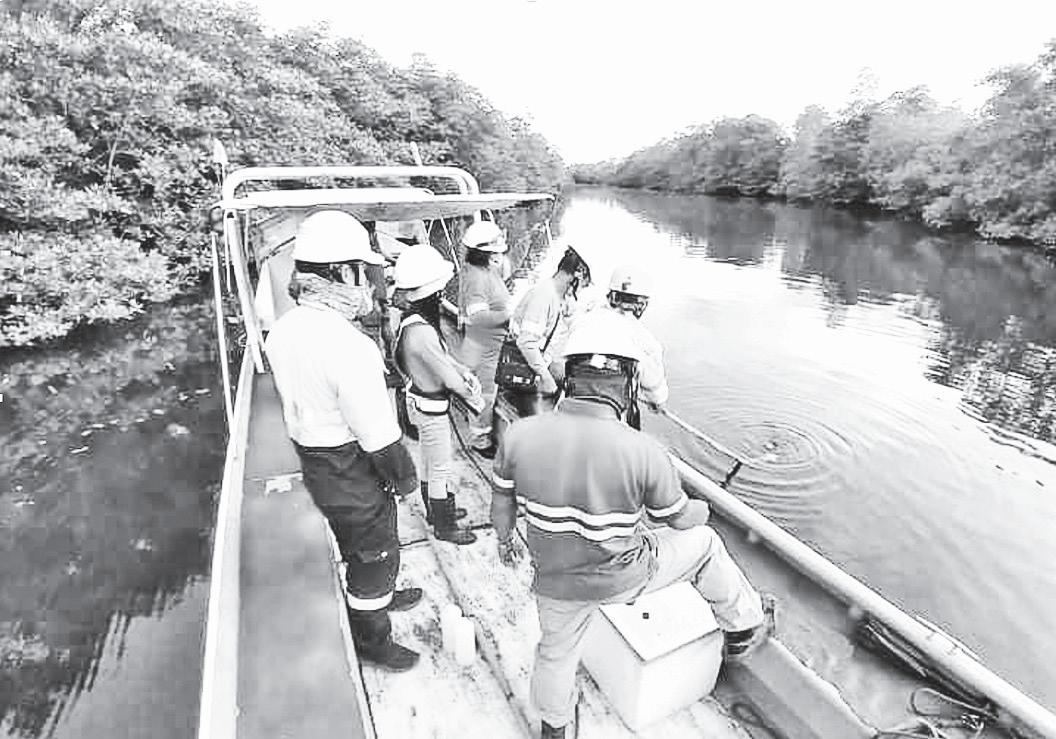
WATER is essential to mining operations. It is used in mineral processing, dust suppression, cooling, and wastewater treatment. Its heavy demand places the industry in competition with agriculture, households, and other critical sectors.
As the Philippines positions itself as a key supplier of transition metals for the global green economy, responsible water management has become a core measure of sustainable mining. Government regulations reflect this priority. Under the Department of Environment and Natural Resources (DENR) Administrative Order 2015-07, all mining companies are required to secure ISO 14001:2015 certification, ensuring their environmental management systems minimize ecological impacts and meet legal requirements.
Mandatory for COMP members
TO elevate standards further, the Chamber of Mines of the Philippines (COMP) has made the Towards Sustainable Mining (TSM) program mandatory for all its operating members.
TSM is a globally recognized system with rigorous protocols covering tailings management, community engagement, worker
health and safety, biodiversity protection, and, crucially, water stewardship.
Under the program, all companies operating mines undergo regular self-assessment and periodic independent external verification, with full public reporting.
Three mines stand out DURING the 2024 and 2025 TSM external verification cycles, three mining operations—TVI Resource Development Philippines Inc. (TVIRD), Rio Tuba Nickel Mining Corp. (RTNMC), and OceanaGold Philippines Inc. (OGP)—were cited for demonstrating best practices in water stewardship.
Their performance was highlighted at the 2025 Mining Philippines Conference and Exhibition, where President Ferdinand Marcos Jr. reiterated his support for responsible mining aligned with downstream processing and the country’s renewable-energy transition.
TVIRD: Zero water-related incidents AT TVIRD’s Balabag Gold-Silver Project in Zamboanga del Sur, water management is anchored on an ISO-certified system. In 2023, the company recorded zero water-related incidents, supported by a robust water management plan that anticipates
potential impacts on receiving water bodies.
Interviewed via e-mail on November 28, Jjam Cutillas, manager of TVIRD’s Mine Environmental Protection and Enhancement Office, said ISO 14001 has helped the company “develop the creative skills of its employees in devising innovative ways to fulfill the three pillars of mining: economic viability, environmental balance, and protection of life.”
In 2024, TVIRD allocated P101.8 million for its Environmental Protection and Enhancement Program (EPEP), covering rehabilitation, run-off control, and pollution mitigation.
That same year, it secured the AAA rating—TSM’s highest distinction—for water stewardship.
Cutillas said that TVIRD spent P56.3 million specifically for water stewardship initiatives, adding that these efforts “go beyond compliance” and help ensure the safety of surrounding communities.
Rio Tuba: Watershed restoration and community water security IN Palawan, Rio Tuba likewise achieved TSM’s highest Water Stewardship rating during the 2025 verification. Its programs include extensive water-quality monitoring, siltcontrol mechanisms, and ensuring the potability of water in 11 drinking stations in Barangay Rio Tuba.
RTNMC Resident Mine Manager Ronel Suguitan, meanwhile, told the BusinessMirror via e-mail on November 28 that the company’s biggest benefit comes from “reducing water-related risks to communities and the environment.”
By heavily relying on recycled water from settling ponds, the mining firm “minimized competition for local water resources” while meeting environmental discharge standards and safeguarding public health.
It’s long-term watershed restoration have become one of its defining strengths. The company has permanently rehabilitated 243.89 hectares within its tenement and planted 1,091,440 native trees.
Its mangrove reforestation—428 hectares (about 10,000 basketball courts!) with 2.7 million young mangrove seedlings— is one of the largest in the region.
Additional upland and lowland rehabilitation efforts, under DENR programs, such as the Adopt-a-Mountain and the National Greening Program, have broadened ecological recovery.
Suguitan emphasized that these combined initiatives have supported more than 85,000 residents, including Indigenous peoples in Bataraza.
In 2024, RTNMC allocated P26.45 million for its EPEP, funding the maintenance of
settling ponds, silt-collector sumps, water-flow monitoring, and silt containment structures.
Its community water checks ensured that drinking water remained safe and compliant with standards for metal concentration and harmful bacteria.
OceanaGold: High recycling efficiency, automated water controls AT the Didipio Mine in Nueva Vizcaya, OceanaGold demonstrated equally strong performance under TSM.
The company recycled about 70 percent of its processed water in 2024—about 108,000 cubic meters—reducing freshwater withdrawals and supporting long-term water availability for communities. That water volume can fill roughly 43 Olympic-sized swimming pools.
It uses an automated distributed control system to track water inputs and outputs in real time, ensuring efficiency and compliance across its three operational water-treatment facilities.
The company’s work is aligned with TSM and the Responsible Gold Mining Principles, OGP President and General Manager for External Affairs and Social Performance Joan D. Adaci-Cattiling told the BusinessMirror through email on November 29.
“Through our initiatives that go beyond compliance, we set a model for safe and responsible mining, helping ensure that current and future generations will benefit from a safe and healthy environment,” she said. In 2024, OGP allocated P164 million for its EPEP, supporting environmental monitoring, rehabilitation activities, and its nursery that produces 200,000 seedlings annually. The company is also operating a bioreactor and plastic densifier that convert waste into fertilizer and eco-bricks.
A shared commitment to responsible water use ACROSS all three companies, the 2024–2025 TSM external verification confirms strong progress. TVIRD maintained zero incidents and invested heavily in prevention.
On the other hand, RTNMC achieved significant watershed rehabilitation and community protection. OGP, for its part, maximized water recycling and advanced real-time monitoring. With TSM now mandatory across COMP’s membership, these three operations show that high-level water stewardship is both achievable and already being practiced in Philippine mining—setting a credible benchmark for the industry’s future.
Growing exotic pet trade drives illegal sales online, pushes for tighter rules
AGROWING exotic pet trade has conservationists calling for stronger regulations to protect the reptiles, birds and other animals in the wild that are increasingly showing up for sale on internet marketplaces and becoming popular on social media.
The two-week Convention on International Trade in Endangered Species (CITES) of Wild Fauna and Flora was set to run through last Friday in Samarkand, Uzbekistan. Several proposals related to the pet trade will be considered. Participants have proposed tighter regulations or complete bans on the trade of several species, including iguanas from the Galápagos Islands, more than a dozen species of Latin America tarantulas and an odd-looking turtle from Africa.
“What we’re seeing is the pet trade much more looking at reptiles, amphibians. People want rare species and they don’t have to go into a pet shop,” said Susan Lieberman, vice president for international policy at the nonprofit Wildlife Conservation Society.
“They go online and there are thousands of animals, including endangered species, illegally obtained species, all available on the internet.”
Internet drives illegal trade IN the past, the trade was dominated by sales in animal parts like elephant ivory and tiger bones.
But Matt Collis, the senior director of international policy at the International Fund for Animal Welfare (IFAW), said live animals for the pet trade are increasingly turning up on the internet.
“The dramatic growth in online marketplaces has put consumers directly in touch with wildlife traders and criminals around the world,” Collis said. “In today’s society where pretty much anything can be bought with a click of a button and shipped anywhere in the world in a matter of days, no wildlife is safe.”
Social media influencers, who have made owned exotic pets cool, are also contributing to the problem, Collis said.
Several of the species proposed for greater protection at the CITES conference are in Latin America, where an IFAW report last year found illegal trade is on the rise.
The report, covering 18 Spanish speaking Latin American countries, says there were more than 100,000 animals seized or poached from 2017 to 2022, with seizures increasing every year.
The report found the live pet trade accounted for a growing piece of the trade, with reptiles representing about 60 percent of the animals, while nearly 30 percent were birds and more than 10 percent were amphibians.
Many animals were traded locally or regionally but there also was evidence of animals shipped to collectors in Europe, Asia and the United States.
More than 90 percent of the seized wildlife destined for Europe were live animals, confirming the demand for pets was a key driver of the illegal trade, the report said.
Tortoise, vipers up for protection
AMONG the reptile species up for tighter trade controls is Home’s hinged-back tortoise, a critically endangered turtle found in West
Africa that has a unique hinge on its back allowing it to close off its back legs and tail.
A commercial ban on the trade in the turtle was approved at the Convention.
There are proposals to regulate the trade in two vipers species endemic to Ethiopia, two species of rattlesnake found mostly in Mexico, the leaf-tailed gecko from Australia and two species of sloths from South America, which are increasingly turning up in sloth-themed cafes in Asia.
A ban on the commercial trade in the vipers was approved Tuesday but the rattlesnake proposal was rejected. The gecko and sloth proposals are expected to be considered.
A proposal from Ecuador would ban the trade in marine and land iguanas from the Galapagos, which are listed by the International Union for Conservation of Nature as critically endangered or vulnerable.
There are concerns that the illegal trade
could further destabilize the population, which already faces threats from invasive species, rising tourism and fluctuations in weather associated with El Nino.
In its CITES proposal, Ecuador said it doesn’t permit commercial export of iguanas and collecting them from the Galapagos has been prohibited for decades.
But Ecuador raised concerns that traders are capturing and transporting young iguanas by boat or overland to ports and evading authorities by mislabeling them as captive bred.
Most of the iguanas are destined for Japan and other Asia countries and can sell for as much $25,000 on the black market.
The United States supports the iguana, sloth, viper, tortoise and gecko proposals but is opposed to the rattlesnake listing.
CITES permits abused
A SPECIES can be banned for trade in its home range but sold online by traders
who abuse the CITES permitting process and captive breeding rules and then take advantage of importing countries that don’t bother to check if the animals come from the wild, Collis said.
“In theory, under CITES rules, the countries issuing those export permits should be checking that these animals, and crucially their parentage all the way back to the founder stock, were legally acquired in order for an export permit to be granted,” Collis said. “But that is not happening.”
Countries issue permits without verifying animal origins, which helps traffickers launder animals from illegal sources, “undermining the very framework meant to protect these species,” he said.
The CITES proposals draw attention to a long-running problem with captive breeding of exotic species, according to Lieberman of the Wildlife Conservation Society.
“When the treaty was drafted in the early 1970s, there wasn’t a lot of captive breeding and people thought, ‘Well, if they’re bred in captivity, it’ll take pressure off the wild,” she said. “Sounds good, except it doesn’t work that way. Breeding in captivity also creates a market, but they’re cheaper from the wild. And also it’s a great way to launder.”
Pet traders fear proposals go too far
A PROPOSAL that was rejected would have regulated the trade in more than a dozen species of tarantulas.
Bolivia, Argentina and Panama note they are “among the most heavily traded groups of invertebrates” with more
than half all species available online. The proposal would have permitted the trade in the spiders as long as there is proof the sources are legal, sustainable and traceable.
“Some tarantula species are particularly vulnerable to overexploitation due to their long life span, limited geographic range and low reproductive rate,” according to the proposal.
“Alarmingly, most of them are not regulated internationally, despite the high availability of hundreds of species in international trade.” The United States Association of Reptile Keepers opposed the tarantula listing, calling it “incongruous” for rolling many species into a single proposal. The association, which advocates for responsible private ownership and trade in reptiles and amphibians, suggested other reptile proposals reflect government overreach, noting the proffered changes to iguana sales are unnecessary since current regulations “provide adequate protection.”
“Most species have limited trade in captive bred specimens which is not a threat to wild populations,” David Garcia, the organization’s legal counsel and its delegate at the CITES conference, said in a statement.
“Unfortunately, many countries, groups, and individuals take the nonsensical position that the way to limit threats to wild populations is to make the captive reproduction of those species more difficult,” Garcia said.
Michael Casey/Associated Press
VASQUEZ
WATER quality monitoring at Rio Tuba River RIO TUBA PHOTO
Messi’s plans for World Cup? ‘A day at a time’
ESPN Argentina. “This year I felt very good.” The Inter Miami star added playing in the United States will make it easier for him to consider playing at the tournament being co-hosted by the US, Mexico and Canada. It starts on June 11 in Mexico City and would be Messi’s sixth World Cup.
“It catches us at a different point in the season than in Europe. We’re going to start a tough preseason in January and we’re going to have a lot of games in a row with the league and the CONCACAF Champions League,” Messi said.
Messi and Inter Miami are preparing to face Vancouver in the Major League Soccer (MLS) Cup final on Saturday
If they play at the next World Cup, Messi and Cristiano Ronaldo, who recently qualified with Portugal , would surpass greats like Germany’s Lothar Matthäus, who played in five editions.
The eight-time Ballon d’Or winner said he has regular conversations with Argentine national team coach Lionel Scaloni about the role he could play.
“He always tells me that he’d like me to be in whatever position I’m assigned. We have a very trusting relationship, and we can talk about everything,” Messi said.
For Messi, the MLS Cup final on Saturday will represent some endings. And, quite possibly, a new beginning.
Messi and Inter Miami will take on Thomas Muller—one of his longtime rivals—and the Vancouver Whitecaps for the MLS championship—it’s the first final for both clubs, which means MLS is about to have a first-time champion.
US bets wear Ralph Lauren in Milan Cortina Olympics
“We know it’s going to be a very, very tough game.... It’s going to be a very, very special final,” Messi said in remarks distributed by the team.
But for Messi, it’s the end of a couple eras. It’s the last match planned at Inter Miami’s current home, with the team set to move into a still-underconstruction stadium near Miami International Airport next season. And barring some serious changes of heart, it’ll be the last time he gets to play with longtime teammates Jordi Alba and Sergio Busquets—they’re both retiring after Saturday—and possibly Luis Suarez as well. AP
Equipment
Saved by the wedge
NEW YORK—Ralph Lauren revealed Team USA’s Milan Cortina Winter Olympics looks before the weekend, complete with Americana knit sweaters and plenty of vintage call-backs.
The formal opening ceremony look pairs a patterned red, white and blue knit sweater with tailored cream trousers and a matching wool coat.
Moving sportier, the closing ceremony outfit features a graphic puffer coat inspired by vintage ski kits over a colorblocked sweater.
“We are creating something that we know has to become timeless and has to be something that people will wear forever and appreciate forever,” said David Lauren, the Chief Branding and Innovation Officer at Ralph Lauren. “So in creating jackets like this and creating things, we’re looking at the things that we most cherish. Things that are already enduring parts of the Ralph Lauren lexicon, and then we’ll build on that.”
Beyond the ceremony looks, a Team USA collection, which will also be given to athletes as Olympic village wear, became available to public.
The collection follows similar design themes as
the opening and closing ceremony looks, with classic red, white and blue patterning on lots of knits, and includes Ralph Lauren’s versions of winter staples like bomber jackets and hockey jerseys.
The process of creating these looks is a long one. The Ralph Lauren team, which has been designing Team USA’s Olympic apparel since 2008, starts on each Olympics’ looks about two-and-a-half years out from the Games, meeting with athletes and brainstorming ideas for the kits.
As Milan-Cortina’s looks are unveiled, Lauren said the looks for the 2028 Los Angeles games are already months in the making.
He knows the cultural importance each Olympics’ outfits holds, and the attention they garner in the fashion world and among American consumers.
“The fact that we know people will want them and collect them and chase them down across eBay, is just an exciting part of the game,” he said.
Sometimes, even international Olympic athletes are on the lookout for them. Beyond being an addition to an American athlete’s Olympic wardrobe, the pieces are also sometimes used as bargaining tokens in the Olympic village. Para snowboarder Brenna
Huckaby and snowboarder Red Gerard explained to The Associated Press that there’s a tradition of swapping team sweaters and jackets with other nations at the Olympics, if there’s a certain country’s design that catches an athlete’s eye. That’s only if there’s a piece of their collection that they’re willing to let go of, that is.
“I rarely trade, because I almost always love every single piece of Team USA stuff,” said Huckaby, modeling the color-blocked closing ceremony sweater that she said “is going to be on rotation after.”
“But every now and then there will be some random thing that another country has. And it’s so hard to sit with all my bags, all my stuff open, like, ‘OK, what am I willing to part with?’ That is probably, aside from competing, the hardest part of the Games,” she said. AP
ASK any decent golfer and more often than not, the area which contributes most to their scores will be around the greens. When mortals like us don’t hit approaches on the dance floor, the higher lofted clubs do the most work.
Whether you prefer to bump and run it, hit towering lob shots, or make the ball skip and check from off the green, your short game determines whether you save par or make bogey or worse.
A few decades ago, a standard set of golf clubs used to include two wedges—a pitching wedge and a sand wedge. In the early 90s when I started, my very first set was my dad’s old Ping Karsten 2. The set was composed of 3 iron to sand wedge. My second set, also pre-loved from dad, was a set of TaylorMade Tour Preferred blades, purchased in the early 90s, also in 3 iron to sand wedge. Up until the early 2000s, I think most sets would be sold either as a 3-sand wedge or 4-sand wedge. Today, sets usually top out at 5 iron, with golfers using 4 or 3 irons becoming a rarity, often opting for hybrids and highlofted fairway woods. Another change is that the highest loft that comes in a standard set would be a pitching wedge. Gap wedges, and sand wedges
so these are comfortable full swings that produce consistent distances for me.
I don’t hit full shots with my 60-degree wedge. I only use it in bunkers and when I need to hit high lob shots, which is very rare. I would rather hit lower shots that roll than high-risk flop
shots. So for gapping purposes, I only really use three wedges.
With each of my three wedges (PW, 52, 56) , I have choked down full swings that fly lower and 10 yards less, ¾ swings that go 20 yards less, and half swings that go even less.
With these lofts and swing combinations, I can cover distances between 120 yards to 40 yards, in 10-yard increments. Sounds confusing? It actually just means that with my three wedges, I know I have a club and a swing that goes 40, 50, 60, 70, 80, 90, 100, 110 and 120 yards. Like I said above, my fourth wedge (60-degrees), is only used in bunkers.
So in conclusion, choosing wedges will always depend on your yardages from pitching wedge. Search for your pitching wedge’s loft if you don’t know it, and then get wedges that provide yardage gaps that work for you.
The bounce THE bounce on wedges determines how the sole of the club interacts with the turf. In my case, I don’t play well enough, and don’t play in greatly varying conditions to need very specific bounces on my wedges. I just chose standard bounces for my wedges. Standard is around 10-14 degrees.
As a quick guide though , low bounce wedges are ideal for hard ground conditions and high bounce wedges are ideal for soft conditions. Why is this so? From the
Brenna Huckaby
MILANO Cortina Organizing Committee president Giovanni Malago (right) and Italian Olympic medalist tennis player Jasmine Paolini hold
It’s time to unpack Spotify Wrapped
Here’s how the music streamer compiled your 2025 recap
DECEMBER 7, 2025 | soundstrip.businessmirror@gmail.com
CHAMPIONING PINOY PRIDE
ALAMAT takes centerstage at Cheer’s Kitchenpalooza
Story and photos by Vincent Peter Rivera
Shortly after the release of their second album, “ DESTINO ,” ALAMAT returned to the limelight—not for another musical comeback, but as representatives of a homegrown brand.
On November 29, 2025, the six-piece P-Pop boy group officially headlined the Filipino kitchen hygiene brand Cheers’ activation event, “Cheers Kitchenpalooza”—serving as the brand’s first official ambassadors.
In an interview, group member Jao expressed the group’s excitement about being the first-ever ambassador for Cheers.
“[We’re] super excited knowing na Cheers has been around for a long time now, tapos kami ‘yung first ambassador nila,” Jao said, noting the brand’s established history.
With the campaign “Cheers to Happymess,” the brand aims to shed a new light on the notion of “mess.” It portrays mess as signifying care and shared experiences, offering a reimagination of “the familiar spills, splatters, and kitchen chaos as meaningful moments of connection,
Publisher :
T. Anthony C. Cabangon
Editor-In-Chief :
Lourdes M. Fernandez
Aldwin M. Tolosa
Concept :
Y2Z Editor :
SoundStrip Editor : Group Creative Director : Graphic Designers :
Jt Nisay
Edwin P. Sallan
Eduardo A. Davad
Niggel Figueroa
Chow Jarlego
Contributing Writers :
Tony M. Maghirang
Rick Olivares
Jingo Zapata
Reine Juvierre S. Alberto
John Eiron R. Francisco
Ica Hontiveros-Cheng
Ana Zoe V. Davad
Justine Xyrah Garcia
Ginger Franz S. Ocampo
Trixzy Leigh Bonotan
Bless Aubrey Ogerio
Photographers :
Bernard P. Testa Nonie Reyes
Y2Z & SOUNDSTRIP are published and distributed free every Sunday by the Philippine Business Daily Mirror Publishing Inc. as a project of the
The Philippine Business Mirror Publishing, Inc., with offices on the 3rd Floor of Dominga Building III 2113 Chino Roces Avenue corner
Dela Rosa Street, Makati City, Philippines. Tel. Nos. (Editorial) 817-9467; 813-0725. Fax line: 813-7025
Advertising Sales: 893-2019; 817-1351,817-2807. Circulation: 893-1662; 814-0134 to 36. www.businessmirror.com.ph
celebration, and togetherness.”
“Our campaign is all about celebrating ‘mess’,” said Jazel Ramos-Yeo, Marketing Manager of Sanitary Care Products Asia, Inc. (SCPA). “Mess is inevitable, and we shouldn’t let them stress us out … When there’s a mess, it means there is life.”
Thus, with its various offerings of kitchen hygiene products such as tissue, non-tissue, and chemical categories, Cheers aims to be a companion of every Filipino household and transform it into convenient and enjoyable moments.
Elevating household cleaning with music
As the inaugural public event of the campaign, Cheers Kitchenpalooza reinforced its mission by installing different booths that showcase the brand’s kitchen hygiene products along with the festive mood brought by ALAMAT’s diverse music.
Particularly with the campaign’s banner song, “Happymess Anthem,” originally sung and performed by ALAMAT, the campaign successfully portrayed a central message: there is joy in everyday kitchen routines.
Championing Filipino roots
The synergy between ALAMAT and Cheers extends beyond just an event; it lies in their shared advocacy for Filipino culture and heritage. Since their debut, ALAMAT has consistently championed Filipino roots, evident in their music where lyrics blend various Philippine languages and in music videos rich with nuances and symbolisms of Filipino tradition.
This cultural alignment was a key factor in the partnership. Jao stated that the collaboration felt natural: “It aligns with our concept which is to promote Filipino culture. And Cheers promotes household items, household essentials that we do in the Filipino household.”
This cultural pride was echoed by Ramos-Yeo, who emphasized the brand’s mutual respect for heritage.
“That’s why we also got ALAMAT because we’re also proud, the same way that they are also proud of our heritage. They really do believe in Filipino culture,” she explained. “Us, as well. So in our company, we are very passionate about our products, which are Filipino-made, and as they said, we should support it.”
She further explained: “We also got ALAMAT because even though they’re as a group, they’re as one, but they also have different personalities that really resonate with the brand. So that’s why we wanted to celebrate it.”
Arriving with a more personal sound
During the Cheers Kitchenpalooza, the P-Pop group turned up the heat on stage, treating the audience to an energetic set that included an earlier track, “Day and Night,” and “LuzViMinda.”
The latter is a song from their recently released second album, “DESTINO,” in which the members had the opportunity to participate more heavily in the production
and songwriting processes.
When asked to name their favorite track from the album, the members admitted to having a more difficult time answering now that they have a deeper, personal connection with each song.
The votes were split: Alas and Jao favored “LuzViMinda,” while R-Ji and Taneo chose “Hapag.” Finally, Tomas and Mo agreed on “Sinigang,” showing a clear split among the group’s preferences for their deeply personal new work.
While producing their second album was not an easy road, the group mentioned that releasing a song they thoroughly worked on themselves provides a unique feeling.
Jao explained the dedication involved: “I think, iba talaga kapag gawa mo ‘yung output. Hindi ka papayag na lalabas siya na gano’n-gano’n lang.”
Alas described the hard work of creating the album as a “good pressure.” Despite the uncertain feedback that new music might receive, he found the process bearable thanks to the strong support system provided by his fellow members.
“Medyo mabigat talaga [creating own songs]. Pero nagiging magaan lang siya kasi andito silang lahat, kumbaga nagtutulungan kami,” Alas stated.
The hard work quickly paid off. According to the
group’s official Instagram account, the track “LuzViMinda” gained over 200,000 streams on Spotify just three days after DESTINO’s release.
Thus, when they took the Cheers Kitchenpalooza stage, ALAMAT’s goal was nothing less than for their supporters, the Magiliw, to enjoy their performance and new sound, acknowledging that the fans were integral to their success.
“Gusto namin iparating sa kanila na parte sila ng success namin, with Cheers. Kasi hindi naman kami makakaabot dito kung hindi rin dahil sa fans. Kabilang sila sa success namin,” emphasized Tomas.
And finally, Mo linked their music and the campaign’s core message: “Gusto namin iparating na maging proud tayo sa roots natin and sa culture natin. I-promote natin kung ano ‘yung gawa sa atin.”
Following the success of the Cheers Kitchenpalooza, ALAMAT assured fans that there is much more to watch out for, both in their DESTINO promotions—which they teased to have more music videos soon—and in their ongoing role as ambassadors for Cheers.
Ultimately, the collaboration between ALAMAT and Cheers is more than just an endorsement and a promotion; it is a shared testament to supporting Filipino pride, both through music and through celebrating the messy yet happy daily moments of life.
ALAMAT as brand ambassadors of Cheers.
ALAMAT performs at Cheers Kitchenpalooza.
BETWEEN ALASKA AND THE WORLD
How going off-grid shaped Portugal. The Man’s SHISH
Story by Justine Xyrah Garcia
There has always been something unmistakably Alaskan about Portugal.
The Man—not in the postcard sense, but in the attitude.
The band built its identity far from the traditional centers of American music, growing out of a DIY community in Wasilla and Anchorage, where everyone had to be self-sufficient, flexible, and ready to pitch in.
It’s a place where storms hit harder than deadlines, and where people don’t care how many awards you’ve won if a neighbor still needs help building a roof.
That ruggedness, that instinct to survive and adapt, has traveled with the band through two decades, multiple albums, and a Grammy.
And it threads through SHISH, their newest release, which arrives after years of touring and a long stretch of studio experimentation.
The album carries a tension that feels familiar to anyone who has lived far from a city and later found themselves in the middle of one.
While frontman John Gourley is the only member who grew up fully off-grid—no electricity, no phone, surrounded by woods—the outlook that shaped him gradually seeped into the band’s creative rhythm.
Early Portugal. The Man shows were held in community halls, garages, and makeshift venues where resourcefulness mattered more than polish. That background stayed with them, even as their sound evolved and their circle of collaborators expanded.
In talking about SHISH, John often returns to the contrast between the quiet he grew up with and the constant stimulation the world now demands.
"The album to me feels like Picking up a phone and setting it back down That's what it feels like when you set it back down. It's like melody It's very melodic," John said in an exclusive interview with BusinessMirror's SoundStrip.
For him, the album moves between those two sensations—anxiety on one side, a kind of calm on the other.
Tracks like “Tanana” linger in a soft melancholy, while songs such as “Denali” hit with the force of a punk riff, mirroring that shift.
A big part of that dynamic came from recording differently this time. Instead of entering the studio with outlines or carefully built demos, John walked in with drummer–producer Kane Ritchotte and simply started playing.
"He came up and we just started jamming. I haven't done that in a long time just because of the nature of the way we make records and the nature of how we tour... so we never really had a break to sit down and and write in a studio," John recalled.
The momentum of those sessions—loud, loose, and unplanned—became the spine of the record.
Kane’s energy pushed the songs into heavier, more immediate territory, a return to the spontaneity that once defined their early days before major-label structure entered the picture.
Weight of a sled
Even with the album’s rawness, there’s a sense of intention beneath it. John doesn’t dictate how listeners should interpret SHISH, but he speaks about it using a metaphor that feels unmistakably Alaskan.
He imagines a sled—something every household in remote areas depends on—and asks what he would pack if he were heading into the woods today.
The answer is straightforward: the things that matter, the things that keep you alive, and the things you refuse to leave behind.
This album to me represents the things I would put into a sled if I were if I were going to go into the woods today...things I would take with me. My daughter is one of those things like she's coming with me and there are practical things in that sled to like what do you need to survive?" John explained.
"These are the things that I hope you think about and I hope you leave with."
It’s not a dramatic statement, just an honest one. The idea of carrying essentials, both emotional and practical, runs through the album.
Some songs feel like tools; others feel like memories. Together they form a collection that mirrors how people move through uncertainty—light enough to keep going, but sturdy enough to hold meaning.
Remembering what matters
That framework also reflects the kind of environment the band came from. Alaska’s sense of community remains strong for them, and John notes that achievements carry little weight back home.
“You go back and they’ll say, ‘cool,’ then ask if you’re ready to pick up a hammer,” he said.
The expectation to contribute—to show up when needed—has stayed with the band even after relocating to Portland and touring internationally.
More than two decades into their career, Portugal. The Man continues to move with that rhythm. They tour regularly, work with different musicians, and avoid locking themselves into a single method of writing or performing.
John connects this adaptability to his upbringing, describing a childhood marked by frequent moves and limited time in any one school or community.
"I’ve always just written my music and liked playing with other people,” he said.
It is a process that has allowed the band to adjust easily to changing circumstances.
Audience reaction is another element he pays attention to. John describes it in direct terms.
“As long as there are people enjoying what we’re doing, I want to see that,” he said.
For him, observing how songs land in a room remains a practical part of performing rather than a commentary on direction.
Although SHISH draws heavily from Alaska—its quiet, sense of distance, and emphasis on essentials— the album is not confined to one reference point.
It reflects the contrast John often talks about: the calm he knew growing up and the fast-paced environment he works in today.
He does not frame the record as an attempt to resolve the difference, only as something shaped by both.
Toward the end of the conversation, he mentioned wanting to spend more time off-grid again, whether through fishing, camping, or other outdoor activities when time allows.
The interest aligns with many of the ideas that surfaced during the making of SHISH: the pull toward stillness, the value of space, and the practicality learned from living in remote areas.
It’s time to unpack Spotify Wrapped
Here’s how the music streamer compiled your 2025 recap
By Wyatte Grantham-Philips The Associated Press
THE end of 2025 is almost upon us. And it’s time to unpack Spotify Wrapped.
On Wednesday, the music streaming giant delivered its annual recap—giving its hundreds of millions of users worldwide a look at the top songs, artists, podcasts and other audio that filled their ears over the past year (give or take a month and some change).
Spotify isn’t the only platform—or music streamer—to roll out a yearly glimpse of data collected from consumers’ online lives (see related story—Ed.). But since its launch about a decade ago, Wrapped has become one of the most anticipated. And Spotify is billing the 2025 edition to be its biggest yet, with a host of new features it hopes may address some disappointments users had last year. So, what goes into pulling together Wrapped, and what’s new this year? Here’s what to know.
How much of the year does Spotify Wrapped cover?
TO compile Wrapped, Spotify collects listening data from January 1 through around mid-November.
That gives the company time to solidify finishing touches and deliver its recap to users by early December. But it also means your late November and December streaming habits won’t be included, which may be why your favorite holiday songs aren’t on the list, or other year-end hits.
What goes into getting top songs, artists and more?
FOR top songs, artists and—for the first time this year—albums to show up on Spotify Wrapped, the platform looks at a mix of what you stream and how long you listen for. According to Spotify, users must listen to
Here’s some of the biggest platforms that have already released their 2025 recaps (covering data for at least the majority of the year)—and where to find them. Most instruct users to download the latest version of their apps to get the best experience.
Spotify Wrapped SPOTIFY released its Wrapped on Dec. 3. The platform will prompt users to view their annual “year in audio”—recapping the top songs, artists, podcasts and
repeat the podcast this year but is introducing another feature, Archive, which uses a large language model to break down your listening on specific days.
That’s the most AI-focused part of 2025’s Wrapped, Hazan said. But the technology is still more broadly supplemented across Spotify’s technical operations today, including in scaling the reach of its annual recap.
THE look and feel of Wrapped evolves each year, and Marc Hazan, senior vice president of marketing and partnerships at Spotify, notes the development of the 2025 edition was largely driven by last year’s feedback.
at least 30 tracks for over 30 seconds each to get top songs. For artists, users need to listen to at least five unique artists for over 30 seconds. And for top album, users need to have listened to at least 70 percent of the tracks on one album.
The company confirmed that data is collected evenly across all platforms—and that streaming in “offline” mode will also be counted, as long as the device connects back to the internet a few weeks before Wrapped’s launch. Listening using Spotify’s “private mode” features, meanwhile, won’t contribute to any rankings, but will still count toward total time spent on the platform. And Spotify says “background sounds,” like white noise, are filtered out.
When does Spotify start building Wrapped each year?
What’s new in 2025?
MARC HAZAN, senior vice president of marketing and partnerships at Spotify, said his team started thinking about 2025 Wrapped the day last year’s recap was launched.
“It’s a full year production that touches, without question, every function within Spotify,” Hazan told The Associated Press. On day one, he noted, that includes looking at what users think of the Wrapped that just dropped.
Many Spotify subscribers were quick to share disappointments about 2024’s recap—with some complaining that Wrapped was too minimalist last year. Others took to
social media with memes mocking features that didn’t seem to hit the mark.
The look and feel of Wrapped evolves each year, and Hazan notes the development of the 2025 edition was largely driven by last year’s feedback.
“We’ve really taken the feedback to heart—and fueled what we think is the freshest, most action-packed Wrapped experience we’ve ever done,” he added.
That includes returning music genres, which were missing in 2024’s Wrapped. The platform is also introducing top albums and audiobooks, as well as play counts for each song that makes your annual playlist. And the experience is more gamified this year. There’s a prompt for users to guess their top song before it’s revealed and a “listening age”—which takes a stab at guessing how old your music taste is, based on when your favorite tunes were released.
Spotify has also unveiled “Wrapped Party,” a feature that allows users to compare their listening habits with friends who also use the app—and win their own award-like titles within the group.
How is AI used?
AMONG other backlashes Spotify received last year was speculation over how much artificial intelligence played a role in compiling Wrapped.
The most visible use of AI in Spotify’s 2024 Wrapped was an accompanying podcast powered by generative AI. Spotify didn’t
“Rooted into Wrapped is human creativity,” Hazan said, stressing that hundreds of people work on pulling together the recap each year. Technology like AI, he noted, helps “fast track” and “enhance” the product so it can reach the platform’s more than 700 million users.
What does Wrapped say about data tracking more broadly?
SPOTIFY is far from the only company to track what users do on its platform—and feed back some of that data, with a nostalgic twist, at the end of the year.
Streaming rival Apple Music rolled out its annual “Replay” on Tuesday. And YouTube this week unveiled its new “Recap,” which similarly breaks down its listeners’ music habits. Social media platforms, Google search and even dictionaries also offer their own year-end reflections.
These recaps may signal more transparency for users, because they can see some data in their hands. And products like Wrapped have become particularly popular because they’re personalized and now designed to share online—leaving many to look forward to it as an “annual ritual” of sorts, notes Yakov Bart, a marketing professor at Northeastern University.
Still, one concern is the normalization of now-constant “tracking of digital footprints that consumers leave online,” he added.
“What Spotify Wrapped is able to do is essentially package this tracked data into the form of entertainment,” Bart said. “It reframes all this digital tracking that’s constantly happening behind the scenes into something that’s fun … And so, instead of kind of feeling under surveillance, users (are) basically feeling seen.”
How to find Spotify Wrapped, YouTube Recap and more as 2025 comes to a close
more they streamed the most in 2025 (or, more specifically, January through mid-November). You can otherwise click on “Wrapped” on the top banner on the app to view your stats and download your yearly playlist. This year, the music streamer is also introducing “Wrapped Party”—a feature that allows you to compare listening habits with friends who use Spotify, too. Wrapped Party is only available on Spotify’s mobile app. You can start it within Spotify’s Wrapped hub or searching for “Wrapped Party” within the app.
YouTube
Recap
GOOGLE’S streaming giant unveiled its new “YouTube Recap” on Dec. 2, starting in North America. Recap gives an overview of YouTube users’ watch history over the last year—including top artists and songs if you listened to music on the platform. YouTube said Recap would roll out worldwide over the first week of December. According to the platform, it can be found on the YouTube homepage or under the “You” profile tab on the mobile app or desktop. You must be signed into
the platform and have the latest update.
Duolingo Year in Review LANGUAGE-LEARNING app Duolingo also released its annual “year in review” in early December—giving users a look at how many lessons, streaks, minutes and more they spent on the app this year. Duolingo may prompt you to look at your 2025 recap once you open the app. But in the bottom corner of the home navigation page, there’s also a small logo you can click on to watch the review. AP
n Cover and inside photos by cottonbro studio on Pexels.com