media partner of the year
United nations
2015 environmental Media Award leadership award 2008
BusinessMirror
www.businessmirror.com.ph
E
A broader look at today’s business n
Sunday, August 27, 2017 Vol. 12 No. 318
By Michael R. Strain
arlier this week, Gallup released the result of its poll that showed Filipinos are the most accepting people in Southeast Asia for migrants, obtaining a score of 6.77 out of a perfect score of 9 in the Migrant Acceptance Index (MAI).
Pinoy’s cupcake creations delight America
T
it to be among the world’s top 20 migrant-friendly countries. This is in the face of a campaign in the US that demeans peoples of other countries that are now pursuing the American dream in the land of the free. Bloomberg columnist Michael R. Strain aired his disgust over this
PESO exchange rates n US 51.0500
Nuvolanevicata | Dreamstime
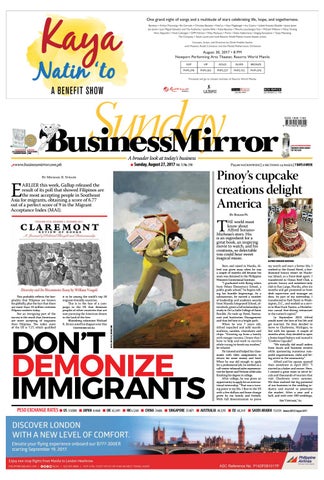
Don’t demonize immigrants Continued on A2
business news source of the year
P25.00 nationwide | 2 sections 14 pages | 7 days a week
By Roger Pe
he world must know about Alfred SorianoMicheau’s story. His is an ingredient for a great book, an inspiring movie to watch, and his creations, so delectable you could hear sweet magical music.
This probably reflects the hospitality that Filipinos are known for globally, plus the fact that there are more than 10 million overseas Filipino workers today. But an intriguing part of the survey is the result that Americans are more accepting of migrants than Filipinos. The index score of the US is 7.27, which qualified
2016 ejap journalism awards
Born and raised in Manila, Alfred was given away when he was a couple of months old because his mom was detained in the Philippine Women’s Correctional Institute. “I graduated with flying colors from Pelaez Elementary School, a public grade school,” he begins telling his humble beginnings. As a salutatorian, he earned a number of leadership and academic awards from Maceda Integrated School, afterwhich, given a full scholarship to study in De La Salle College of Saint Benilde. He took up Hotel, Restaurant and Institution Management and that led him to a bright path. When he was 7 years old, Alfred repacked and sold marshmallows, candies, chocolates and chips. “Growing up from a family with meager income, I knew that I have to help and work to survive while trying to finish my studies,” he related. He tutored and helped his classmates with their assignments in return for some money and food. When he was old enough to apply for a professional job, he worked as a call-center inbound sales representative for Sprint and Verizon while also finishing his degree in college. After college, he was given an opportunity to apply for an international internship. “That was a turning point in my life. I flew to the US with a few dollars and loose change given by my family and friends. With full determination to prove
Alfred Soriano-Micheau
my worth and start a better life, I worked at the Grand Hotel, a fivediamond luxury resort on Mackinac Island, as a front-desk agent. I transferred to Ocean Reef Club, a private, luxury and members-only club in Key Largo, Florida, after six months and got promoted as front desk supervisor and manager on duty. As part of my internship, I transferred to Park Hyatt in Washington, D.C., and worked as a server in Blue Duck Tavern, a Michelinstar casual fine-dining restaurant in the nation’s capital.” In September 2013 Alfred would meet the love of his life and get married. He then decided to move to Charlevoix, Michigan, to live with his spouse. A couple of months after, they decided to open a home-based bakery and named it “Cre8tive Cupcake”. “We initially did small orders from locals and business owners while sponsoring numerous nonprofit organizations, clubs and being active in the community.” Alfred and his spouse opened their storefront in April 2017. “I started as a baker and owner. Here, I created a great team to serve locals and thousands of tourists that visit Charlevoix every summer. We then realized the big potential of our business in the wedding industry and started to penetrate the market. After a year and a half, and with over 200 weddings, See “Cupcake,” A2
n japan 0.4660 n UK 65.3491 n HK 6.5260 n CHINA 7.6606 n singapore 37.4871 n australia 40.3295 n EU 60.2441 n SAUDI arabia 13.6134
Source: BSP (25 August 2017 )
NewsSunday BusinessMirror
A2 Sunday, August 27, 2017
www.businessmirror.com.ph
Don’t demonize immigrants Continued from A1
in his recent column, with a Filipino worker cited as a model immigrant in the US: “Whenever I’d see George, the first thing I always noticed was his shoes. He loved Jordans. He must have had two dozen pairs. The bright colors contrasted with the uniform he wore at the restaurant he managed, adding personality. George was great at his job. He knew what my wife and I wanted to drink without asking, and had the drinks at the table a few minutes after we’d sit down. He always made sure there was a table available for his regular customers. My family went to George’s restaurant for weeknight dinners, to celebrate new jobs and promotions, when family and friends came to visit, when we brought our baby son home from the hospital. He worked hard, holding down a second job as a waiter at another restaurant down the street. It wasn’t until a few weeks before he left the US earlier this summer to return to his native Philippines that I learned he had been sending money home to his family for many years, at great personal sacrifice. To provide for his children, he would go years without seeing them. I thought of George when I saw this summer’s edition of the Claremont Review of Books, a conservative journal. The cover art depicts immigrants as men with masks holding knives, Hispanics wearing sombreros, ominous looking Asians, men with turbans and Muslim women in burqas, all shrouded in gray. They surround a worried-looking Uncle Sam holding a pennant reading, “Welcome.” It illustrates the alarmist and nationalist lead essay, titled “Diversity and Its Discontents.”
Portraying immigrants this way is shameful, and is a sad reflection of the ugly nationalism and xenophobia that apparently reaches further into the mainstream of the political right than we conservatives would have thought possible just a few years ago. The public face of the right wasn’t always so hostile. Rather than succumb to base emotions and fear of “the other” following the traumatic attacks of September 11, 2001, President George W. Bush called on Americans to be their best selves. Upon hearing that some Muslims felt intimidated by other Americans, Bush went to a mosque six days after the terrorist attack and said: “Those who feel like they can intimidate our fellow citizens to take out their anger don’t represent the best of America. They represent the worst of humankind.” He also said: “Women who cover their heads in this country must feel comfortable going outside their homes. Moms who wear cover must be not intimidated in America. That’s not the America I know. That’s not the America I value.” President Ronald Reagan, standing at New York harbor, said of the immigrants who passed under the Statue of Liberty: “They brought with them courage, ambition and the values of family, neighborhood, work, peace and freedom. They came from different lands but they shared the same values, the same dream.” I am not advocating policy by sentiment. The appropriate number of immigrants allowed into the US is a subject on which people of good will can disagree. And there are real issues with immigration: the wages of some native workers might decrease, the pace of assimilation may be slower than some would like, lo-
cal resources might be stretched. But advocates of reducing immigration should realize that demonizing immigrants is counterproductive. When I see a picture like the one in the Claremont Review, my gut reaction is that immigration should be increased, not decreased. More important, it’s wrong. Immigrants are our neighbors, and they deserve respect. It’s immoral to stoke fear and anxiety. It encourages bigotry. It violates American values. The dignity of the human person should be a central concern of public policy. But policy is often abstract. To grasp its meaning, it helps to put a human face on its impersonal constructs. I’ve recently tried to put a face on labor-market policies by discussing the invisible victims those policies create. With immigrants, the faces are visible— you can pick one. Is the image on Claremont’s cover your choice? I hope not. For me, the face is George’s. I am in awe of his courage. He left his home, traveled thousands of miles, and built a career on our shores. People like George help make America great. I am grateful that my country, and my family, got to share in George’s success. And I am proud that of all the nations in the world, George wanted to come to America. I hope that the lamp’s light beside our nation’s golden door never fades.” The MAI aims to gauge people’s acceptance of migrants based on increasing degrees of personal proximity. The index is based on three questions that Gallup asked in 138 countries in 2016 and the US in 2017. “The most accepting countries for migrants are located in disparate parts of the globe,” Gallup said. “A common thread tying many of the
most accepting countries together is their long history as receiving countries for migrants.” The Philippines and Vietnam, which had a score of 6.08, were the only Southeast Asian countries that bested the global average score of 5.29 out of 9. Southeast Asian countries Singapore posted a score of 5.21; Indonesia, 3.93; Cambodia, 3.65; Myanmar, 2.96; and Thailand, 2.69. However, the top Asian country in terms of accepting migrants is Bangladesh, with a score of 7.45, pushing it to the list of top 20 countries that are most accepting of migrants in the world.
Cupcake... satisfied couples, clients, customers and blessing from other business owners, chefs, mavericks of the food industry, we decided to take the responsibility and named myself as Executive Pastry Chef.” Alfred patiently waited because he knew the responsibility that came with it, and the hard work that he had to go through to take the position. What made him decide to go into the cupcake business? Here is a personal interview on how his entrepreneurial streak has given him much excitement and lifechanging opportunities. “Even when I was young, I always have that love and passion for cakes and desserts. However, I know that I cannot afford to study culinary arts even with my full scholarship because of the trips, projects and exposures that they do. I remember peeping and watching culinary arts students during their ‘BAKIPA2’ classes while making cakes and pastries. I also watched them a couple of times practicing for competitions. I was so amazed by their talents and eye for details. “Growing up, I didn’t experience getting big cakes or even a cupcake on most of my birthdays. It wasn’t a big deal at all. I always look back on those days that I wished I had a chance to blow a candle on top of a cake for my birthday. I believe a cupcake is more affordable than a big cake. Most people can buy it. Stick a candle on top of it and make a celebration extra special.” “Cupcakes are handy, a finger food that there is no certain rule on how to eat it. With this generation, everyone has his own food preference. Some people like vanilla, chocolate, red velvet, carrot, peanut butter, some want it glutenfree, nut-free, vegan and organic,” he said. “Cupcakes are also personal. Every single cupcake that I make is made with love, hand-piped to perfection and well presented. It is something that one can personally devour or be shared to the ones they love.” Did you make a market study before you went into this business? I learned in college the importance of market study and its positive effect to any business. We absolutely did it before we decided to open the storefront with a little twist. Instead of doing a traditional market research, we did it by sponsoring events, organizations, nonprofit clubs and donating to the community. We also did some random door-to-door and delivered for the community for their feedbacks. Before we know it, people were ordering every week, asking us to consider opening a storefront and providing us with help and tons of positive comments. Today, Cre8tive Cupcake is a well-known brand in Northern Michigan. Not only serving locals but also hundreds of thousands tourists that visit our amazing town. I believe that it is a successful brand, a great product, amazing business model and a big part of the wedding industry in this part of the world.
It is worth noting that the Philippines serves as the home of many foreign nationals, too, and they certainly don’t get the rough treatment. Based on the 2010 Census of Population, there are 177,365 foreigners living in the Philippines as of May 2010. They comprised 0.2 percent of the total household population. Three in 10 foreign citizens (31.1 percent) were residing in the National Capital Region (NCR) at the time of the census. Those residing in the Autonomous Region in Muslim Mindanao made up 22.3 percent of the total foreign citizens. Region 3 had 9 percent, Re-
continued from A1 We were featured in numerous locals and US-based magazines and newspapers for our products and business. We served over 400 brides to date and extremely thankful for the success and opportunity to have such an amazing support and love from our locals and tourists.” What kind of cupcakes do you make? What’s so special about them? We proudly serve baked-fresh cupcakes every day. We usually come to the bakeshop at 5 a.m. to bake our cupcakes that are made from scratch using the finest quality ingredients. We use Madagascar vanilla bean, fresh and organic eggs, 100-percent butter, we do not use shortening on any of our creams, we also use 100-percent dark chocolate from Belgium, our jams and fillings are all made from scratch on our kitchen. We also do not serve frozen cupcakes and cakes. We know how important for our clients to taste nothing but the best on the cupcake that they are eating. In our bakeshop, we all believe that we are only as good as our last performance so we have to give our best on every product that we make. We have two signature cupcakes, Death by Chocolate, which is a decadent dark-chocolate cupcake with fluffy chocolate buttercream frosting, semisweet and sweet chocolate chips, chocolate sprinkles, chocolate malt ball and chocolate ganache (seven different brands and flavors of chocolate). My personal favorite and one of our best-sellers is our Strawberry Shortcake. It is a Madagascar vanilla bean cupcake filled with homemade strawberry jam and topped with light strawberry infused homemade whipped cream. The other special and really a big hit for the kids is our “Build Your Own Cupcake”, wherein we let kids and kids-at-heart frost and decorate their cupcakes. What market segment buys your product? I would say the majority of our clients are women, families with kids and the youth. I honestly think that cupcakes target everyone. No matter what your race, gender, age or income. It is for everyone. For someone who is celebrating a birthday, to a person who wants to surprise a loved one, a family who wants to treat the kids something sweet and to men who wanted a quick sweet fix. I have found that our storefront attracts the market and the people we want to come in. When we had a crazier, feminine and bright-colored paints, a lot of kids came in as they like the ambiance. When we toned it down and added some rustic touch, more cozy and relaxing atmosphere, we attracted even the male clients. How do you market them and create awareness? I believe that we have a very unique and creative way of marketing our products. One of which is sponsoring and donating to events, joining nonprofit organi-
gion 4A had 8.4 percent and Region 7 had 6 percent of the total foreign citizens. Region 9 had the least proportion at 0.5 percent. The largest number of foreign citizens in the country came from the US (29,959 persons). The next largest numbers came from China (28,750 persons), Japan (11,583 persons) and India (8,963 persons). With Bloomberg Views (Michael R. Strain is a Bloomberg View columnist. He is director of economic policy studies and resident scholar at the American Enterprise Institute. He is the editor of The US Labor Market: Questions and Challenges for Public Policy and the co-editor of Economic Freedom and Human Flourishing: Perspectives from Political Philosophy.)
zations and providing complimentary cupcakes during special local open houses. On top of which, we are very active with our social media. We have a great and informative web site (www.cre8tivecupcake. com). On top of that we also have a really interactive Facebook and Instagram, where we post our latest creations and update about the business and our community. Our clients also find us from different venues as a preferred service provider and also being promoted by different restaurant and businesses. And, most important, we have a really good reputation, so the most powerful marketing tool for us is the word of mouth and recommendations from our previous and current clients. We pride ourselves on not only providing great-tasting and aesthetically looking products but also exceeding our guest’s expectations with our service and promptness. What’s your marketing style? We are very flexible with our style. Varying from loud, colorful and cheery to attract the youth. I even once wore a pink tuxedo and pink top hat to promote our business and once wore a prince suit to an event. We also have a subtle, relax and soft approach to attract men. And for our brides, we have several sophisticated ways of promoting and advertising to them. With cupcakes and cakes that we serve, we can be quirky, crazy, fun, elegant, classy, refine, high end and extravagant. But what we are always proud about is our sincere service in creating delectable products. How do you keep up with the best in your own product category? I practice every day. After decorating cupcakes in the morning, e-mailing our brides and following up with orders, I always make time to watch YouTube videos. Search the newest trend in cupcakes, cakes and wedding designs and flavors and not settle for less. Do you follow trends or you make your own product? I get inspiration for some of the newest trends and use it to better our existing products. Sometimes a lot of change can hurt the business, especially with food. I always keep everything simple and, at the same time, add a couple of flavors here and there so our tourists and locals can try them. We have 15 to 20 flavors that are signature and what we serve daily, and we have specials to give a little twist to our foodies and food adventure seekers. If you are going to advertise your product what would your unique selling proposition be and why do you think your target market should buy them? The strongest selling point of our products: They are baked fresh on the day of the pickup. No matter how early or late the pickup will be, we guarantee that it is fresh and we only use the freshest and best ingredients available. We do not cut down on our ingredients even if the prices go up and down. We use the same and do not settle for less. Every bite you will feel and taste the difference and the love that we put on our cupcakes. It is absolutely worth every penny.
www.businessmirror.com.ph
The World BusinessMirror
Oil holds gains above $48 as US crude stockpiles extend drop
O
il held gains above $48 a barrel as US crude stockpiles extended declines during a period of seasonally strong demand, trimming an inventory overhang. Futures were little changed in New York after advancing for a second session on Wednesday. Crude stockpiles slid by 3.33 million barrels to the lowest level since January 2016, while gasoline supplies fell for the first time in three weeks, according to the Energy Information Administration. Oil production expanded further to the highest level since July 2015. Oil in New York has fluctuated below $50 a barrel this month, as investors weigh rising global output against supply cuts by members of the Organization of Petroleum Exporting Countries and its allies. Libya’s Sharara field, the nation’s biggest and shut since last Saturday, is yet to resume pumping crude, despite the reopening of a pipeline linking it to the coast. “Sentiment is favoring the upside after good draws in
crude and gasoline, although, the increase in output moves production closer to the alltime high,” said Michael McCarthy, a chief strategist at CMC Markets in Sydney. “It’s one of the reasons why there is a cap on oil prices.” West Texas Intermediate (WTI) for October delivery was at $48.35 a barrel on the New York Mercantile Exchange, down 6 cents, at 7:51 a.m. in London. Total volume traded was about 57 percent below the 100-day average. Prices gained 58 cents, or 1.2 percent, to $48.41 on Wednesday. Brent for October settlement fell 1 cent to $52.56 a barrel on the London-based ICE Futures Europe exchange. Prices climbed 70 cents, or 1.4 percent, to $52.57 on Wednesday. The global benchmark crude traded at a premium of $4.22 to WTI. US gasoline inventories dropped by 1.22 million barrels to 229.9 million last week, the EIA reported on Wednesday. Crude output increased by 26,000 barrels a day to 9.53 million, expanding for a second week. Bloomberg News
Sunday, August 27, 2017
A3
Stagnant investment and sluggish spending hold back UK economy
U
nited Kingdom consumer spending barely grew in the second quarter, business investment stagnated and trade added nothing to growth, leaving the economy struggling to keep up momentum. The 0.1-percent increase in household expenditure was the weakest since 2014 and is a further sign of how support from the consumers is waning. The economy grew 0.3 percent in the three-month period, unrevised from an initial estimate and leaving growth in the first half of the year at its worst since 2012, when the economy was last shrinking. The data reinforce the view the economy has moved into a slower growth phase, with expansion well below its average in recent years. The change is partly related to the pound ’s depreciation since the Brexit vote, which has boosted inf lation and reduced spending power, while confidence has f lagged, amid a lack of clarity on what type of trade deal the UK will agree with the European Union (EU).
That’s stripping the economy of its most consistent and important support over the past two years, and tallies with Bank of England (BOE) Gov. Mark Carney’s warning earlier this month that consumers are in the “teeth ” of a squeeze on their pockets, which they’re going to have to ride out for the rest of the year. Recent reports have shown that shoppers are flagging, and
the Confederation of British Industry said on Thursday that retail sales fell the most in more than a year this month. There’s a chance that consumer spending could perform better this quarter, however, as the March-to-June figures were skewed by a drop in car sales related to a tax change. Thursday’s report from the Office for National Statistics showed that exports and imports both rose 0.7 percent in the second quarter. The government spending rose 0.7 percent, and was the main driver of growth. One positive was a pickup in services—the largest part of the economy— which ended the quarter with the fastest growth in 10 months. “ This data confirms the pict u re of a moderat ion i n U K growth that we expect to continue through the second half of the year,” said John Hawksworth,
This data confirms the picture of a moderation in UK growth that we expect to continue through the second half of the year.” —Hawksworth
chief economist at PwC. “But we don’t think this slowdown should turn into a recession.” Brexit talks are due to resume next week, and the UK government has published a series of papers in the past fortnight to demonstrate it is making progress. But if worries of a “bad deal” rise among consumers and businesses, that could further damage UK growth prospects. Carney said this month that the fortunes of the economy depend heavily on how Brexit proceeds. While the dire economic predictions made before the referendum haven’t come to pass, the economy has, in the words of the statistics office “slowed markedly.” Economists surveyed by Bloomberg see expansion cooling to 1.5 percent this year and 1.3 percent in 2018, down from 1.8 percent in 2016. The latest data may also raise concerns within the BOE, which has said that investment and exports may partially offset a slowdown in consumer spending. The drop in the pound since the UK voted to leave the EU has helped to lift exporters’ profits, but reports have indicated that uncertainty is making some firms reluctant to commit to major projects. Bloomberg News
A4
The World BusinessMirror
Sunday, August 27, 2017
UK immigration declines as EU nationals leave after Brexit vote I
www.businessmirror.com.ph
Billionaire porn king reinvents himself as Japan’s start-up guru
L
ONDON—Net migration to Britain has fallen to a threeyear low as a growing number of European Union (EU) nationals left the country following last year’s Brexit referendum, according to official figures released on Thursday. The figures from the Office for National Statistics provide evidence that the uncertainty and economic jitters caused by Britain’s vote to quit the EU are having an impact on immigration. The statistics office said net migration—the difference between arrivals and departures— was 246,000 in the year to March 31, a fall of 81,000 from a year earlier. More than half the change was due to a decline of 51,000 in net migration from the EU. A total of 122,000 EU citizens left Britain in the year to March, up 31,000 from the year before and the highest outflow in nearly a decade.
246K
Total net migration, or the difference between arrivals and departures, in the year to March 31, a fall of 81,000 from a year earlier
There was a particularly sharp rise in departures from citizens of the “EU 8”—eastern European nations that joined the bloc in 2004. Hundreds of thousands
of Poles, Lithuanians and other easter n Europeans moved to Britain to work after 2004. EU citizens have the right to live and work in any member state, and more than 3 million nationals of other EU countries live in Britain. When Britain formally leaves the EU in March 2019, it will have the power to set restrictions on the movement of people from the EU, leaving many uncertain about their future rights. Nicola White, head of international migration figures at the statistics office, said the figures
“indicate that the EU referendum result may be influencing people’s decision to migrate into and out of the UK, particularly EU and EU8 citizens.” “It is too early to tell if this is an indication of a long-term trend,” she added. A slowdown in the British economy could be making the country less attractive to migrants. The statistics agency confirmed on Thursday that the economy grew by a modest 0.3 percent in the second quarter of 2017 from the previous three months, slower than any other Group of Seven economy. Bloomberg News
Ship collision exposes SEA territorial spat
K
UALA LUMPUR, Malaysia —The collision between the USS John S. McCain and an oil tanker has exposed a longsimmering dispute between Singapore and Malaysia over which country should control 197-foot wide guano-encrusted outcropping at the edge of the South China Sea. Malaysia and Singapore both say the accident happened in their territorial waters because of the competing claims to Pedra Branca. Barely an island, the rocks are home to utilitarian structures, including a communications tower meant to reinforce Singapore’s claim and lapped by waters often fouled by mini oil slicks in one of the world’s busiest shipping lanes. Despite being devoid of charms, the islet is a major political and economic prize for both countries. Singapore and Malaysia were quick to help when the guided-missile destroyer and oil tanker Alnic MC collided early Monday while the US ship was approaching Singapore on a routine port call. And both claimed to be the coordinator of the search and rescue effort for 10 missing Navy sailors. Malaysia has deployed four warships, multiple boats and aircraft along with more than 500 personnel, while Singapore contributed five helicopters, five aircraft, more than 300 personnel, including divers, and numerous ships. “ The subtext of both Singapore and Malaysia’s search and rescue efforts is about asserting and staking their claims to the disputed areas,” said Eugene Tan, associate professor of law at the Singapore Management University. The International Court of Justice awarded Pedra Branca—known in Malaysia as Batu Puteh, which also means white rock—to Singapore in 2008, but handed another rocky outcrop nearby to Malaysia. Earlier this year, Malaysia reignited the dispute with a fresh bid to review the court’s decision. Relations between the two countries have often been prickly since they split in 1965 after a brief union following the end of British
In this January 5, 2003, file photo, a Singapore Navy vessel passes an outlying island, known as Pulau Batu Puteh by Malaysia and Pedra Bianca by Singapore, just off the easternmost point of Singapore. The collision between the USS John S. McCain and an oil tanker has exposed a long-simmering dispute between Singapore and Malaysia over which country should control a 60-meter-wide guano-encrusted outcropping at the edge of the South China Sea. Malaysia and Singapore both say the accident happened in their territorial waters because of the competing claims to Pedra Branca. AP
colonial rule over what was then called Malaya. Despite strong economic, social and security ties, relations are often influenced by economic rivalry and mistrust. Located at the southern tip of peninsular Malaysia, Singapore is a speck next to its neighbor, yet has flourished to become a regional economic powerhouse and a global financial center. Its position at the eastern end of the Malacca Strait, a key waterway for global trade, has given the predominantly Chinese city economic and strategic importance. Muslim-majority Malaysia, despite its much larger population and land area, lags behind economically. It is rapidly developing its southernmost state of Johor, which faces Singapore, to vie for investment. Johor already has a large container port that has lured away clients from Singapore’s bustling port with lower costs and a sprawling regional oil and gas complex is underway in the state. The overlapping claims apparently haven’t hurt search and rescue efforts for missing sailors. Divers have found some remains in flooded compartments of the McCain, which is docked at Singapore’s naval base, but the Navy has not disclosed specifics. “The top priority is the search and rescue. Jurisdiction issues should not overshadow the main priority. This incident should be seen as a test of cooperation, rather than conflict,” said Bridget Welsh, a visiting professor at John Cabot
University. She said the two countries will eventually have to find a compromise. Adm. Scott Swift, commander of the US Pacific Fleet, has praised both countries for their help. At a news conference in Singapore on Tuesday, he dodged questions about which country is in charge, saying that the focus was on finding the sailors. Malaysia’s fresh bid to reclaim Pedra Branca is partly driven by the islet’s strategic location as an important access point to the South China Sea, which is key to security and defense, said Tan of the Singapore Management University. “Territory, in particular territorial waters, is another vital security and economic consideration. For both countries, ownership of Pedra Branca enables them to claim a larger territorial sea, adding to the fishery resources and seabed mining potential,” he said. Tan said Malaysia’s move could also be useful for embattled Prime Minister Najib Razak and his ruling coalition to stir nationalism ahead of general elections, due by mid-2018. Najib is under pressure over a multibillion-dollar financial scandal and faces his toughest test in the polls. His coalition won the 2013 polls but lost the popular vote for the first time to an opposition coalition. It is unclear which country will oversee the investigation. Singapore has released maps to support its assertion that the collision happened in its territorial waters. AP
magine the publisher of Pornhub.com being asked to address Harvard University undergraduates on the virtues of running a socially responsible business. That’s basically what happened in Japan this past December, when the country’s most prestigious private university extended an invitation to adultentertainment mogul Keishi Kameyama. After years of being rejected for bank loans and frozen out of business deals, the onetime pariah is now being embraced as an Internet pioneer, and even a role model. His ever-evolving media and technology empire, DMM.com, started with pornography, but has grown into a vast collection of enterprises that have made him one of Japan’s richest people. Kameyama got an important vote of confidence a few years ago when filmmaker “Beat” Takeshi Kitano agreed to appear in ads for his start-up incubator, and the endorsements have come quickly since. Last December there was the invitation from Keio University students to discuss his work investing in Africa and supporting young entrepreneurs. A month later Japan’s most popular weekly magazine hired him to write a column for its web site, Bunshun Online, offering parenting and relationship advice. In April undergraduates surveyed by the Nikkei newspaper picked him as one of Japan’s top 100 employers, ahead of IBM and Google. “We’re always trying new things, so people think: ‘If you work there, interesting stuff is going to happen.’ It’s like, ‘What’s he’s going to do next, shoot off a rocket?’” Kameyama said with a laugh during an extended interview in which he talked about his family, his finances and the complicated ethics of the business that made him wealthy. It may seem strange that the operator of an online mall for hardcore sex videos has won such public acceptance, but Japan has always had a sort of look-the-otherway tolerance for pornography. More significantly, Kameyama has expanded into an eclectic portfolio of businesses that now include a currency-trading platform, video games, an online English school and solar farms. Last year, porn was less than a third of the group’s $1.7 billion in sales. “People are starting to realize just how smart this guy is,” says Akira Ishihara, president at Tokyo-based consultancy Kiseki Keiei Risya, who featured Kameyama at a seminar on start-ups last year. “He’s extremely forward-looking and the way he puts cash to work is just very, very smart.” Married with two kids, the 56-yearold wears a stubbly goatee and an inconspicuous uniform of monochrome T-shirts. His ownership of DMM gives him a net worth of $3.5 billion, according to financial records disclosed for the first time to Bloomberg News and calculations from the Bloomberg Billionaires Index based on current earnings. Yet, Kameyama’s look and demeanor scarcely suggest wealth. Japan’s ninth-richest man rides a bicycle to work. Kameyama says he started giving interviews a few years ago in order to quash rumors he was a yakuza gangster. Still, he never allows himself to be recognizable in photographs—and asks magazines and internet sites to mask his face with a cartoon avatar. He says it’s to protect his privacy. In three decades of financing pornography, Kameyama says he hasn’t set foot on an adult movie set more than once or twice, and he doesn’t watch his own films. To him, porn is the proverbial widget—a thing to sell for more than it costs to make and market, no different from any other product. “I didn’t get into the adult-movie business because I was a fan,” he says. “But it was an experiment that worked and, once I had money, I wanted to try other things too.” Kameyama started producing porn in the late-1980s after discovering he didn’t have the money to finance a feature film of the nonadult variety. By 1998, when he launched Japan’s first web-streaming service (the same year Netflix got its start renting DVDs through the postal service), DMM was already Japan’s biggest producer of pornographic movies. Within a decade, more than a million Internet users were paying to stream Kameyama’s films. With all those eyeballs glued to his site, he began looking for other things his mostly male audience might want to buy. In 2009 Kameyama purchased a struggling online-stock brokerage and, after an overhaul that cost almost $100 million, turned it into Japan’s most popular platform for retail investors trading foreign currencies, according to marketing firm Forex Magnates. That made DMM into a kind of virtual Las Vegas, catering to some
of people’s most basic preoccupations: sex and money. From there, Kameyama branched out into more family-friendly ventures. Some of his best ideas, including the one for the hit video game “Fleet Collection,” have come through an online-submission window called “Kame-Direct,” where anybody can pitch him new products or businesses. Decisions to buy a Rwandan software developer, along with a stake in Rwanda’s biggest electronic-payments company, were inspired by a recent vacation Kameyama took to Africa. Kameyama won’t disclose his profits, but he says there’s enough to fund all the new business without having to take DMM public, unless he tries something huge like building an amusement park based on Japanese anime characters. “Imagine what people would say if Mr. Porn built a Disneyland?” he says. With DMM’s revenue growing about 30 percent annually, adult entertainment is becoming an ever smaller par t of its expanding universe. The DMM.com portal, which promotes all of Kameyama’s businesses, has 27 million registered users. A link to the site’s X-rated material is hidden away in a corner, like a secret doorway to a backroom. In March Kameyama moved 2,000 of his employees into new headquarters, occupying five floors high up in a new skyscraper. The lobby has a tropical-jungle theme, with life-sized projections of lions and exotic birds dancing across the walls. It’s a look Kameyama said he dislikes, but one of his top lieutenants convinced him it would be a good recruiting tool. “I hate it,” he says. “But if it works, great. If it doesn’t, we’ll try something else.” The porn industry’s labor practices have come under more scrutiny since the arrest last year of a film producer accused of using a deceptive contract to coerce at least one woman into per forming sex on camera. DMM wasn’t connected, but since it is Japan’s biggest shopping mall for adult entertainment, critics say Kameyama bears some responsibility for the industry’s abuses. “The company got where it is by choosing to ignore the many different ways that women are being forced into this,’’ says Shihoko Fujiwara, head of Lighthouse, a Tokyo-based non-profit organization working against sex trafficking. Kameyama says DMM never knowingly financed films that involved coercion, and the company removes products from its site when there are complaints. He says DMM had only one brush with the police in almost 30 years of producing adult films—an investigation last year into indecent exposure, which led to no charges. On the larger question of whether pornography exploits women, Kameyama admits he’s less sure. “I don’t think everything we do is right,’’ he says, “but in this business we’re better than most. If my own daughter told me she wanted to be an adult-film actress, I’d tell her, ‘look, there are risks, but it’s something for you to decide.”’ Growing up in the small seaside town of Kaga, Kameyama’s parents ran a cabaret, a club where men paid to enjoy the company of hostesses, mostly in hopes that one thing might lead to another. It wasn’t a brothel, but it wasn’t a world apart, either. The women often roomed in the house and shared the family dinner table. “Growing up like that, it taught me not to be prejudiced,’’ Kameyama says. After dropping out of accounting school sometime around 1980, Kameyama says he considered almost any work that promised to pay well. There was a very brief adventure as a seminude dancer at a gay Chippendale’s club. Once, he tried to get a job at a hospital washing cadavers. By the time he was in his late twenties, Kameyama was the owner of several rentalmovie shops. But when Japan’s version of Blockbuster Video set its sight on his town, he knew it wouldn’t last. To survive, Kameyama decided to try making movies instead of renting them. He set up his porn factory in an empty supermarket, where he used thousands of household-video recorders to copy from master tapes, running night and day. He was able to convince most video stores to stock his product by making them an offer too good to refuse: “Here’s a box of 100 tapes, pay me only for what you sell.” It was a deal that didn’t require an army of salesmen to pitch. And, because viewers rarely complained about picture quality, unsold tapes were easily re-used. Bloomberg News
Science
www.businessmirror.com.ph • Editor: Lyn Resurreccion
BusinessMirror
Sunday
Sunday, August 27, 2017 A5
Eclipse science: From giraffes to solar wisps
N
ASHVILLE, Tennessee—The giraffes ran in circles. The flamingos huddled together. And the rhinos just looked confused.
At the Nashville Zoo, visitors watched and recorded how the animals behaved when the sky turned dark during Monday’s total solar eclipse. And there was plenty to see when the moon slipped in front of the sun. The only trouble was with 7,000 visitors and lots of noise—drowning out the zoo animals, crickets and cicadas—zookeepers still have to figure whether the strange behavior was from the eclipse or the people there to watch the show. T he z o o pro je c t w a s one of many science experiments planned for the eclipse. Citizenscientists and their more professional counterparts loaded up on pictures, video, data and just weird experiences as the eclipse’s shadow crossed the US, especially paying attention to the edges flaring out of the darkened sun. Telescopes on the ground, a fleet of satellites and astronauts in space watched the eclipse unfold. High-altitude balloons were released across the country, carrying experiments and providing live video. Now, scientists have to figure out what it all means.
7,000
The number of visitors at the Nashville Zoo
“The balloon footage live was fantastic,” said Angela Des Jardins of Montana State University, who headed the balloon project. “You could really see the sunset effect. The shadow come across.” For the National Solar Observatory’s Citizen CATE project, everyday people were given telescopes and camera equipment and trained to record the eclipse as it moved from Oregon to South Carolina. “It was really successful,” said Matt Penn, an astronomer who ran the project. Skies were clear in at least 50 of the 70 sites, including the first and last locations on the coasts, he added. By the end of Monday night, Penn hoped to have a 70-minute movie stitched together. “We captured the right images
This eight-picture combo shows the path of the sun during a total eclipse by the moon on August 21 near Redmond, Oregon. AP/Ted S. Warren
of the science that we wanted,” he said. Astronomers concentrated on the plumes from the sun’s polar region to help understand why the solar wind speeds up so much, Penn said. The sun’s upper atmosphere, called the corona, or crown, was the focus of astronomers’ attention. It’s easier to study when the sun is blocked. Honor S. Hare, a freshman at the University of Kentucky, was
at an elementary school in Adairville, Kentucky, overseeing the observations there. “It has been a great opportunity, and I have learned so much,” she said. At the Nashville Zoo, the giraffes were the stars. Especially six-month-old Mazi and three-year-old Nasha. “ T h e y ’r e c r a z y r u n n i n g around,” said Nate Zatezalo, who came from Cleveland, where he volunteers at the zoo there.
3 innovation projects OK’d for prototype development By Manuel T. Cayon @awimailbox Davao Bureau Chief
T
he Department of Science and Technology (DOST) approved three projects for further enhancement and prototype development from their original design. The approved projects were the R-TAP, designed as a pressuremanagement system for water utilities, cacao by-products processing enterprise and mosquitorepellent textile products. The DOST Technology Application and Promotion Institute (Tapi) approved the projects under the Technology Innovation for Commercialization (Technicom) program, after finding them commercially viable. The approval would mean the projects would be granted “financial and technical assistance by fast-tracking the transfer and commercialization of research-based, locally developed technologies.” The approval would also allow the projects to get the funding assistance “ for prototy pe development, pilot-scale testing, technolog y validation and field testing.”
There would also be support for feasibility-study preparation and consultancy service for intellectual property for DOST-funded technologies. The DOST-Tapi said R-TAP “is an advanced pressure-management system that optimizes pump operation.” “ The technolog y helps water ut i l it ies sig nif ica nt ly reduce water loss and power consumption, especially in the light of climate change, including the reg u l a r we at her phe nome n a such as El Niño,” it added. The project was developed by one Stephen L. Larcia, CEO and cofounder of Hiraya Technology Solutions Inc., which holds office in Quezon City. The R-TAP was previously assisted by the DOST-Tapi under the Industry-Based Invention Development Program for the fabrication of the industrial grade of R-TAP deployed in Teresa Water Works, Angeles, Pampanga, the DOST said. The assistance would also cover the field testing in six locations to complete the market validation. On the cacao by-products processing enterprise, the DOST’S Technicom program would pro-
vide financial assistance “for the creation and feasibility study of the center, including the acceptability of cacao wine, vinegar, soft drinks and fuel briquettes in the market.” It was an engineer from the Philippine Center for Postharvest Development and Mechanization of the Department of Agriculture (DA-PhilMech) who conceptualized the project to derive and commercialize the other by products of cacao. Engr. Andres M. Tuates, Jr., science-research specialist II of PhilMech, “spearheaded the establishment of a cacao by-products processing enterprise in terms of economic viability, integrating all by-products into one complete processing system.” PhilMech said it has discovered cacao-pod husk to be a good alternative fuel to wood charcoal due to its sufficient combustion qualities needed for domestic cooking and industrial applications. The third project on mosquitorepellent textile products was found indispensable in the case of the Philippines, which has a recurring episode of mosquitoborne diseases, including the dengue virus.
The DOST cited a Department of Health report of 43,770 suspected cases of dengue across the regions over the January-to-July period this year. “ T he perennial problem of high dengue-case fatality rate, especially among school children, has led t he Phi l ippine Textile Research Institute of the DOST, the premier textile research and development arm of the government, in developing mosqu ito -repel lent te x t i les.” the DOST added. T he financia l assistance would allow the project “to proceed with the mosquito-repellent textile prototype, research of effective dosages and concentration of ingredients and duration for protection, assessment of rechargeability of the textile, and market testing”. “We see these projects viable and innovative enough for economic and social development,” the DOST said, quoting Marvin Eric O. de la Cruz, program manager of the Technicom program. “These innovations have relatively high potential growth when commercialized in the market.” The DOST said the projects would see their completion by 2019.
AgriMuseum to educate youth, attract future Asean farmers
I
n the 50th year of “One Asean”, cooperation among the 10 member-countries has never been tighter with the Asean Economic Community paving the way for a single market and production base, of which agriculture is an important component. Yet, employment and interest in agriculture has been in decline, even as it remains the main source of livelihood in the majority of Asean memberstates, with the exception of Brunei Darussalam and Singapore, though both are nonetheless dependent on agriculture for food and commerce. Seeing that the future of food and agriculture is hinged on attracting the youth to become a new generation and breed of
farmers, the Southeast Asian Regional Center for Graduate Study and Research in Agriculture (Searca) is poised to build an AgriMuseum as an alternative approach to educating the young populace and other publics on the importance of agriculture and its centrality to food security, sur vival and overall development of economies in the Asean region. The Southeast Asian AgriMuseum and Learning Center will not only showcase the evolution and changing face of agriculture, its interconnectedness across landscapes from the mountains to the sea and its shared characteristics and diversity among Southeast Asian countries but also articulate current issues and challenges,
game changers and innovations, and the envisioned futures of agricultural and food systems in the region. “Seeing t he A g r iMuseum’s value in drawing attention to agriculture as a field of study, a future career and a lucrative livelihood, it has already gained the support and endorsement of the education ministers of the 10 Asean countries plus TimorLeste,” affirmed Searca Director Dr. Gil C. Saguiguit Jr., who presented the museum’s concept in the biennial meeting of the Southeast Asian Ministers of Education Organization held in Jakarta, Indonesia, last month. He said it could be counted as Searca’s contribution to the celebration of Asean’s first 50 years
and to the future of agriculture in Southeast Asia. To rise adjacent to the Searca’s headquarters on the campus of the University of the Philippines Los Baños, the $1.8-million education facility will also be a major destination in the planned science ecotourism program of the Los Baños Science Community Foundation Inc. The Searca is a founding member and staunch supporter of the Los Baños Science Community. The AgriMuseum is envisaged to benefit not only the youth but also the development practitioners, policy- and decision-makers, researchers and media professionals. The Searca invites all interested stakeholders and parties to partner in establishing this important education facility.
During the full eclipse, all four giraffes ran. That’s not unusual for the two juveniles who scamper at twilight after the crowds leave. But the father giraffe, Congo, “usually doesn’t do anything other than being the dad” and is regal and above it all, said zoo volunteer Stephan Foust. But even the above-it-all dad got in on the running during darkness. Zookeepers repor ted t hat, before totality, the orangutans
climbed to the highest heights they’ve ever gone. Teresa Morehead of Indianapolis came to the zoo to help track the animals on an app called iNaturalist. She staked out the giraffes and rhinos. The rhinos wandered a bit, seeming to head to bed. “I was surprised to the see they were running,” she said, although noting that they seemed more confused than anything. AP
Eclipse failure: Energy traders misread the market badly
G
r id o p e r at o r s a n d traders thought they were totally prepped for t he h i s tor ic U S s ol a r eclipse. There was just this one thing they didn’t completely factor in: “irregular humanbehavior patterns.” That’s the technical definition, from the folks who manage the electricity network at the Southwest Power Pool, for the conduct of millions of Americans who were outdoors ogl ing t he moon shadowing the sun instead of cranking up the A/C in homes and offices. Demand, of course, tends to rise heading into the hottest part of a summer day. On Monday it developed a weird U-shaped dip over a two-hour period across the country. This was a bummer for traders who’d bet prices would jump as a whole load of solar-produced megawatts faded to black. “If anything, it was bearish from a trading perspective because people were more busy looking at the eclipse and talking about the eclipse,” said Tom Hahn, vice president of US power derivatives at brokerage ICAP Energy Llc. in Durham, North Carolina. Spot power in California fell to negative levels as the eclipse wiped out and restarted thousands of megawatts of solar power, and they also dipped from Texas to New York. While natural-gas demand rose to a one-month high on Monday, spot prices at several hubs weakened versus the US benchmark. The outage of renewable resources, fossil fuel or nuclear generation can send prices shooting up by hundreds of dollars within minutes. But grid operators, utilities and e lec t r ic it y generators h ad been planning for months to make up for big swings in supplies. Add that pesky human factor and, oops. “The eclipse was definitely
a distraction to the market,” Hahn said. Spot electricity at Northern California’s NP15 hub averaged $21.50 per megawatt-hour from 10 to 11 a.m., less than half the price for supply secured in advance for the hour in the dayahead market, according to grid data compiled by Bloomberg. Then at 11:50 a.m. local time—as the sun started to reappear from behind the moon— the ramp-up in solar power sent prices to a low of minus $15.97. While that was the most dramatic case of a power-price retreat, there were noticeable dips elsewhere. Cloud coverage in places like North Carolina, Texas and New Jersey had reduced solar output before the eclipse anyway, limiting the magnitude of the loss. The moon’s shadow also reduced temperatures a bit. And then there were all those people playing hooky from work and school. For the Southwest Power Pool, which manages a network stretching from North Dakota to Louisiana, electricity use came in 2,500 megawatts below the forecast. The dip was also “very evident” in New England, New York and the nearby 13-state grid managed by PJM Interconnection Llc., said Tom DiCapua, managing director at Con Edison Energy in Valhalla, New York. The network, which manages the largest US grid with 65 million people, saw demand fall by 5,000 megawatts, or as much as 3.8 percent, during the event. “People drove up the dayahead price thinking that prices would settle higher in real time,” DiCapua added. That was the wrong way to go. “The people who tended to be short tended to make money. You wanted to be short.” Remember that for the next total eclipse in the US: April 8, 2024. Bloomberg News
Faith
Sunday
www.businessmirror.com.ph • Editor: Lyn Resurreccion
A6 Sunday, August 27, 2017
Drug war turning Caloocan into ‘killing field’
A
Catholic bishop said that the Duterte administration’s war on drugs has turned his diocese into a “killing field.” Bishop Pablo Virgilio David of Caloocan said he was deeply bothered by the spate of extrajudicial killings in the diocese, which covers the cities of Caloocan, Navotas and Malabon. “To be honest, I have lost count. They are just too many…I have heard it many times during confession, which I cannot disclose to the public,” David said in a news briefing last Wednesday. The prelate noted that the number of victims from vigilante-style or unexplained killings is much higher compared to those from legitimate police operations. In the past, he said that 60 percent of the fatalities were victims of summary executions, while the remaining 40 percent were killed in encounters with police. Lately, however, he said the number of those killed by unidentified assailants already rose to 80 percent. “We don’t know who they are. They roam around our streets, especially in informal-settler communities almost every night. I don’t know why they are invisible,” David said. The incoming vice president of the Catholic Bishops’ Conference of the Philippines (CBCP) also called for witnesses and vital information to be able to help solve the murder cases. He said it’s about time to speak up and come out in the open by taking a cue from the family of slain Grade 11 student Kian Loyd de los Santos, who strongly fight for justice. “We plead with them to please
come out. But can I blame them if they are not willing to because of fear for their lives? But now, I am happy that at least there is one case where the witnesses are testifying,” he said. At the same time, he called on the police authorities to do their job as law enforcers and protector of human rights. “I will never condemn the whole institution for the mistakes of some…but they should cooperate because that means you are also preserving the integrity of your institution,” David added.
Call for end to ‘war on drugs’
An influential group of church leaders said the government’s hardline approach to stamping out illegal drugs, which claimed thousands of lives, should stop. With the rising number of “senseless deaths,” the Association of Major Religious Superiors (AMRSP) in the Philippines said there is a need for a more balanced and humane approach in fighting illegal drugs. “Extrajudicial killings assault the value of human life. We cannot be party to a war that kills and kills. We cannot accept a war that targets the poor and the powerless,” the AMRSP said. “ We implore the power ful to end this war on dr ugs, which is no other than an exter mination program of a section of our societ y,” it added. The religious superiors said that killing drug suspects is not desired by God, especially after the “execution” of de los Santos,
Families and relatives of people killed in police antidrug operations protest the killing of 17-year-old Kian Loyd de los Santos in Caloocan City on August 21. Vincent Go/ CBCPNews
a Cat hol ic-sc hool st udent of Caloocan City. “Thirteen thousand senseless deaths cannot be the wish of a merciful Father. This bloodbath cannot be the imperative of our faith,” they said. “This cannot be what our God wishes for us,” they added. Archbishop Socrates Villegas of Lingayen-Dagupan earlier said that the country has fallen into “chaos” amid the government’s ruthless war on drugs. R eac t i ng to t he u n abated killings, which recently saw its highest death toll in a week, he urged the public to bring back their humanity. “The country is in chaos!” Villegas said in a pastoral exhortation issued on August 19. T he prelate lamented how massive the number of killings
has become, as more families lose their loves ones and justice remains elusive for them. In contrast, he said those behind the killings have been afforded applauses, with some even getting rewarded. “The official who kills gets an award. Those killed get blamed. The dead cannot answer allegations because they ‘fought’ authorities. They can no longer say ‘I begged them, I did not put up a fight.’ Who will defend them?” he added. Police operations left at least 91 dead last week, including 32 people in Bulacan on August 15, the highest death toll in a day in the government’s antidrug efforts. Worst, the outgoing president of the CBCP pointed out that there appears to be no widespread outrage over this bloodbath.
Saint Monica, special patroness of married women By Corazon Damo-Santiago
or ig i n ated i n Persi a (now Ira n) in t he T h ird Cent u r y. It preac hed t he e x istence of t wo god s — good a nd e v i l . G oodness, wh ic h is impr isoned in ev i l mat ter, w i l l be resc ued by messengers, l i ke Jesus, and f ina l ly by Mani, was the prophet a nd t he fou nder of t he nowe x t inct Ma nic haeism. Augustine’s loss of faith saddened Monica. She prayed and fasted to bring him back to the faith. Her sorrow was compounded when she learned that her son fathered Adeodatus with a woman he lived with for 15 years in unmarried state. When Adeodatus died, Augustine sent back the woman to Africa.
O
urs is a world of instants. So the man of today is not as patient and persevering as his forefathers. To hasten request to high heavens, masses for supplications and novenas are preferred. Social and the print media are replete with people who expedite cases by putting the law in their hands. This is in contrast to the faith exemplified by Saint Monica. She dealt with utmost patience for a husband w ith irascible temperament, a mother-in-law who was disagreeable and meddlesome, and son, Augustine, who loved pleasure and idleness. With patience and prayerfulness, the three were converted to Christianity.
Answered prayers
Loving wife
Saint Monica was bor n in 333 of Christian parents in Tagaste, now A lger ia in Nor th A fr ica, a countr y that was par t of the Roman Empire. She grew up under the strict education and training of a family maid who was also his “father’s faithful nurse retainer.” At the age of 20, her parents ar ranged her mar r iage to Patr icius, a much older pagan officia l of Tagaste. She did not only contend lov ingly w ith an abu sive m a n w it h e x plosive temper, but also with a motherin-law who was habitua l ly il l humored and ir r itable. T hey had three children: Per petua, Nav ig us and Aug ustine. Her good disposition made her mother-in-law change her attitude toward her when she realized that the gossiping servants were the cause of her dislike for Monica.
Saint Monica by Benozzo Gozzoli, 1464-1465 Wikimedia Commons
Even her husband has changed for the better. He endeavored to learn about the faith by enrolling in a Catechumens class and was later baptized. One year after his baptism, he became ill. Monica cared for him and he died in peace, when Augustine was 17 years old. Augustine was also a catechumen awaiting baptism, but was enjoying all the vices of a carefree and self-indulgent man. W h i le st udy i ng sc ie nce a nd philosophy, Aug ustine became a bel iever of Ma nic hea n her esy, a rel ig ious du a l ism wh ic h
While she continued to pray for Augustine’s conversion, she sought the advice of a bishop who was formerly a Manichaean. She was glad to hear the words of reassurance of Augustine’s conversion. “Go now, it is not possible that the son of so many tears should perish.” She followed Augustine to Rome only to know that he went to Milan. Augustine became an admirer of Saint Ambrose, the then-bishop of Milan. He started to develop anxiety about his spiritual life. So when mother and son were reunited in Milan, Monica was joyful to know he was no longer a Manichaean and was awaiting baptism. For sometime, Monica was planning to arrange a suitable marriage for her son, but was overjoyed to know he had no plans to be married. In August 386 Augustine announced he had fully accepted the Catholic faith and to live a celibate
life. On Easter of 387 Augustine and some of his friends were baptized by Bishop Ambrose. On the same year, on their way back to Africa, Monica became ill in Ostia. Asked how she felt dying far from home, Monica replied, “Nothing is far from God neither am I afraid that God will not find my body to raise it with the rest.” Inspired by eternal wisdom that bound mother and son, Monica confided that living is no longer a pleasure. “There was one reason and one alone, why I wished to remain longer in this life, and that was to see you a Catholic Christian before I die. God has granted my wish.... What is left for me to do in this world?” “My son, I had but one object in life and that was to see you a Catholic. God has done more than I had dared to hope. He has taught you to despise all that the world can offer to follow him. Bury my body where you will. All I ask is that you remember me always at the altar of God.” A f ter f ive d ays in coma, she regained her consciousness a nd sa id, “Here you w i l l bu r y you r mot her.” She d ied peace f u l ly at t he age of 56 in t he a r ms of Aug ust ine. She was buried in Ostia and her relics are now in the altar of the blessed sacrament in the Church of Saint Augustine in Rome. Her feast is celebrated on August 27.
Santiago is a former regional director of the Department of Education-National Capital Region. She is currently a faculty member of Mater Redemptoris Collegium in Calauan Laguna and Mater Redemptoris College in San Jose City, Nueva Ecija.
“Something is wrong in the country. We need to correct it. The country has to repent. Let us ask God for forgiveness,” Villegas said.
‘Stop wasting human lives’
Manila Archbishop Luis Antonio G. Cardinal Tagle also spoke out against the new spate of killings, as he lamented the societal division caused by the drug war that claimed thousands of lives. In a letter read in all Masses in the archdiocese on August 21, he appealed for both a halt to illegaldrug trade and the killings of suspected drug pushers and users. “We knock on the consciences of those manufacturing and selling illegal drugs to stop this activity. We knock on the consciences of those who kill even the helpless, especially those who cover their faces with bonnets,
to stop wasting human lives,” Tagle said. The cardinal also offered to broker talks on the divisive issue amid the killing of de los Santos. “All Filipinos agree that the menace of illegal drugs is real and destructive. We must face and act upon together, as one people. Unfortunately, it has divided us,” he added. One of the reasons for the division, according to him, is because of one institution wrongly believing it has the best solution against illegal drugs. He also warned that the menace of illegal drugs is real and should not be reduced to a political or criminal issue. “Given the complexity of the issues, no single individual, group or institution could claim to have the only right response. We need one another. We cannot disregard each other,” Tagle said. “Let us invite families, national government agencies, local government units, people’s organizations, schools, faith-based communities, the medical profession, the police and military, recovering addicts…to come together, listen to each other and chart a common path,” he added.
Bell ringing
Church bells will toll throughout Pangasinan province for more than a month as the faithful reflect on the victims of crimes, including the thousands who were summarily executed. It started on August 22 and, continuing for 46 days until November 27, for Catholics to pray for the victims of crimes and summary executions. “Let us bring back our humanity. Let us bring back our pride in being Filipinos. Let the bells ring for the sanctity of life. Let the bell rings for the poor who are slain,” Villegas said. Roy Lagarde/CBCPNews
Irish church aims to end stigma for priests’ kids
V
ATICAN CITY—Bishops in Ireland have created detailed guidelines to address an issue the Roman Catholic Church has tried to keep under wraps for centuries: the plight of children born to Catholic priests and the women who bear them. The policy, approved in May and made public recently, states that the well-being of the child is paramount. It says the mother must be respected and involved in decisionmaking, and that the priest “should face up to his responsibilities—personal, legal, moral and financial.” Th e g u i d e l i n e s a re b e l i e ve d t o represent the first comprehensive public policy by a national bishops’ conference on the issue, which has long been shrouded in secrecy given the perceived scandal of priests having sex. While eastern rite Catholic priests can be married before ordination, Roman Catholic priests take a vow of celibacy. The policy is, in many ways, the fruit of a campaign by an Irish psychotherapist, Vincent Doyle, who discovered late in life that his father was a priest. With the strong backing of the archbishop of Dublin, Doyle launched Coping International, an online self-help resource for the children of priests and their mothers. The aim, he said, was to help eliminate the stigma he and others like him have faced, and educate them and the church about the emotional and psychological problems that can be associated with the secrecy often imposed on them. Those problems, which can include depression, anxiety and other mentalhealth issues, were the subject of an ex h a u s t i ve s e r i e s l a s t we e k i n The Boston Globe. There are no figures about the number of children fathered by Catholic priests. But there are some 450,000 Catholic priests in
the world and the Catholic Church forbids artificial contraception and abortion. Even without publicity, the Coping International web site has been accessed by 13,500 different people in 175 countries since its December 2014 launch, Doyle said. He insists that the exact number of priests’ children isn’t the major issue. “The issue is the mental health of children who are suffering,” he said in a telephone interview this week. “Even if I’m the only one, the church should do something,” he said. “Obviously I’m not. But what is the church doing?” Pope Francis addressed the issue in the 2010 book On Heaven and Earth, written with a Jewish rabbi friend, in which he said if one of his priests told him that he had fathered a child, he would persuade him that his obligations to the child trump his right to be a priest. “As a result, he should leave the ministry and care for the child, even if he decides not to marry the woman,” then-Cardinal Jorge Mario Bergoglio said. “Because the child deserves to have a mother, as well as a father with a face.” More recently, in the pope’s landmark 2016 document on Catholic family life, The Joy of Love, Francis said children should never be punished for the sins of adults. While he didn’t refer directly to children of priests, he wrote: “If a child comes into this world in unwanted circumstances, the parents and other members of the family must do everything possible to accept that child as a gift from God and assume the responsibility of accepting him or her with openness and affection.” The issue is likely to come up at two big church events next year: the World Meeting of Families, which Francis is expected to attend in Dublin in August 2018, and the meeting of the world’s bishops at the Vatican in October 2018 on how to better minister to young Catholics. AP
Sports BusinessMirror
Editor: Jun Lomibao • mirror_sports@yahoo.com.ph
Sunday, August 27, 2017
A BOARD displays odds for different bets for the Floyd Mayweather Jr.Conor McGregor fight. AP
TURKEY'S Ipek Soyluas prepares to serve as the clock ticks during a US Open qualifying match. AP
A7
A8
BusinessMirror
Sunday, August 27, 2017
www.businessmirror.com.ph
An Lalaki Ha Bus (waray)
L
By Raymund P. Reyes
unes hadto, kun san-o duro it trapik ha kakarsadahan, sanglit timprano ako nga gumawas ha balay. Pero pag-abot ko ha hurulatan han bus ha North Avenue, may pila na hin mga pasahero. Han pag-abot pa han sarakyan, puno na gihapon ini. Ngada han akon pakasaka ngan pakasulod, nakatukdaw na la ako ha butnga ngan naghuhuru-ut pa gud. Paandar na an bus han may kumablit ha akon. An nakada han lingkuran kun diin tiupay ako nga nakab-it han sadigan para diri ako mahuyang mintras natukdaw. “Upo ho kayo, ma’am.” Siniplatan ko an lalaki nga ginhahatag an iya lingkuran ha
akon. Hin ka guwapo niya, ini an una ko nga nasiring ha akon kalugaringon. Bagan empleyado hit iya sul-ot nga busag nga poloshirt ngan slacks pero batan-on it iya itsura puydi masaypan nga usa la nga estudyante ha kolehiyo. Hitaas it irong, higlarom it
mga mata, ngan hin kapula han iya magnipis nga mga im-im. Mas guwapo la hin gamay an aktor ha teleserye nga ako ginbabantayan kada gab-i. “ Sa l a m at ,” a n a kon baton nga may upod nga gamay nga hiyom. Pero an gusto ko unta igpakiana: Kay-ano hi ako? Kay mayda ako hadto kasapit nga babayi nga natindog gihapon. Mas bata ngan magasa pa gud. Mintras hi ako, medyo matambok, magka-kuwarenta y singko na ha sunod nga bulan, ngan ginbayaan han ak pinaka-urhi nga uyab lima ka tu-ig an naglabay kay nakatara hiya hin mas bata. Diri madidiwara haak itsura nga apal na—o ‘medyo idaran na’ para hadton mga diri makakasabot nga birhen-birhenan pa ako hasta yana. Diri ba nalooy la hiya ha akon? Kan mana nga idaran na nga natindog ha bus? Pero hadto nga mga takna, han tumindog an guwapo nga lalaki para ighatag an iya lingkuran ha akon ha bus, pag-abat ko hin kahuhusay ko na la.
Mintras padayon an andar han bus, naaabat ko hiya nga natindog ha akon sapit. Tungod nga huroot, diri mapudngan nga diri niya ako masabod hin gamay ha kada pag uy-og han sarakyan, an paghapyod han akon paa ha iya tuhod, akon bungkog ha iya bitiis. Pero diri ko makaya an humangad para masiplatan utro an iya guwapo nga nawong. Pag-abot ha may Kamuning, may lumusad nga mga pasahero. Bumalhin an lalaki ha puwesto nga hirani ha purtahan. Nanganugon ako han nahinabo pero naisip ko gihapon, bangin hirani na hiya lumusad. An maupay la, tungod nga may distansiya na kami nga duha, libre ko na hiya nga nakukulaw tikang ha akon ginlilingkuran nga tungod. Ngan dinhi nga higayon niya ako nadakop. Ginsusundan ko an linya han iya perpekto nga irong han tigda nala hiya bumirik hin gamay ngan nagtapo an amon mga siplat. Han akon pagkalisang, waray ako makabul-iw dayon. O bangin gintuyo
ko adto nga diri pag bul-iw kay naghihingyap ako, ginprupruybahan kun ano an iya magiging reaksyon hit akon ginhihimo. Usa, duha, tulo…lima ka bug-os nga segundo ugsa ako an mauna nga maawod ngan igbalhin an akon paniplatan ha iba nga direksyon. Damo nga mga pakiana an sumulod ha akon hunahuna: Hin-o daw ini hiya? May atraksyon ba gihapon ako ha iya? May girlfriendna ba ini hiya? Puydi ba maruyag iton sugad ha iya hin usa nga apal? Kay ano ba nga ka-guwapo niya? Leche! Umabat ako hin kapaso nga sinmaka ha akon mga aping. Paglabay hin mga pira ka minuto, sumiplat ako utro han lalaki. Nakadto na ha gawas han bintana an iya atensyon. Han pumara an bus ha may Farmer’s Market ha Cubao nakita ko hiya nga tipahaw-as. Waray na ako magruha-duha. Diri pa ako andam nga bul-iwan hiya. Siring ko, malusad ako para lanaton hiya. Pero pag-tukdaw ko may ulitawo ha akon luyo nga
na k ig bug i-ot paglusad ngan gin-unahan ako ha purta sanglit pakagawas ko han bus waray ko dayon kasundi kun diin nga direksyon kumadto an guwapo nga lalaki. Han akon pagpinamiling natad-an ko gihapon hiya. Nakasakay na hiya ha prente hin usa nga dyip tipa-Quiapo. Ngan tubtub na la dida. Waray na ako sumunod pa ha iya kay tigda ako nga umabat hin kaawod para ha akon kalugaringon. Dinhi nga higayon ko na hu na-hu na a n nga usa nga tinuyaw ini nga akon ginhihimo. Nag padara ako han akon imahinasyon ngan ilusyon. Ginkita ko an akon relo. Maaatrasar ako kun mabalik pa ako ha paradahan para maghulat utro hin bus. Nakikit-an ko gihapon an damo nga tawo nga naghuhulat ha paradahan. Kumadto ako ha MRT. Hilaba an pila, tubtob ha ubos han hagdan, pero nakipila na gihapon ako. Kinarawat ko nala nga maaatrasar ako ha trabaho hadto nga aga.
BusinessMirror
www.businessmirror.com.ph
Sunday, August 27, 2017
A9
Ang Lalaki sa Bus (Filipino Translation)
L
Tiningnan ko ang lalaking ibinibigay ang kaniyang upuan sa akin. Ang guwapo niya, ito ang una kong nasabi sa sarili ko. Matangos ang ilong, malalim ang mga mata, at ampula ng maninipis niyang labi.
Paandar ang bus nang may kumalabit sa akin. Iyong nasa upuan na ang sandalan ay mahigpit kong kinakapitan upang hindi mabuwal sa pagkakatayo. “Upo ho kayo, ma’am.” Tiningnan ko ang lalaking ibinibigay ang kaniyang upuan sa akin. Ang guwapo niya, ito ang una kong nasabi sa sarili ko. Mukhang empleyado sa kaniyang suot na puting poloshirt at slacks
baeng nakatayo. Mas bata at balingkinitan pa. Samantalang ako ay may katabaan, magkakuwarenta y singko na sa susunod na buwan, at iniwan ng huling nobyo limang taon na ang nakalilipas dahil nakahanap siya ng mas bata. Hindi maipagkakaila sa itsura ang pagiging matandang-dalaga—o ‘may edad na’ para doon sa mga hindi nakaaalam na birheng-birhen pa rin ako hanggang ngayon. Hindi kaya naawa lang siya sa akin? Sa mukhang matandang ale na nakatayo sa bus? Pero nang oras na iyon, nang tumayo ang guwapong lalaki para ibigay niya ang upuan niya sa akin sa bus, pakiramdam ko ang ganda-ganda ko. Habang patuloy na umaandar ang bus, ramdam ko siyang naka-
unes noon, kung kailan matindi ang trapik sa mga kalsada, kaya maaga akong umalis ng bahay. Pero pagdating ko sa antayan ng bus sa North Avenue, may pila na ng mga pasahero. Noong dumating pa ang sasakyan, puno na rin ito. Nang makaakyat ako at makapasok, nakatayo na lamang ako sa gitna at siksikan pa. pero sa batang mukha ay maaaring mapagkamalang estudyante lamang sa kolehiyo. Matangos ang ilong, malalim ang mga mata, at ampula ng maninipis niyang labi. Mas guwapo lang ng konti iyong aktor sa teleserye na sinusubaybayan ko gabi-gabi. “Salamat,” ang sagot ko na may kasamang kiming ngiti. Pero ang gusto ko sana ay magtanong: Bakit ako? May katabi rin kasi akong ba-
KuntaIton Uran (Waray)
By Raymund P. Reyes
Kunta iton uran, matam-is nga irimnon, o hinog nga prutas it rasa sugad hin mangga, mansanas, melon, saging o aranghita. Kunta iton uran, masustansiya nga gatas nga gin-ukay an hingamay nga tsokolate. Kay kun masusugad, dirinapag-iisgan ni Nanay kun hi ako makaridati pagawas ha kadapag bunok, parakumarigo ngan maguru-ambak ha lasaw. Mahangad ako ha langit nga nigtatangab ha baba it tubig-uran nga, abadaw, hin karasa!
Sana Ang Ulan (Filipino translation) By Raymund P. Reyes
Sana ang ulan, matamis na inumin, o hinog na prutas ang lasa katulad ng mangga mansanas, melon, saging o dalandan. Sana ang ulan, masustansiyang gatas na hinaluan ng konting tsokolate. Dahil kung magkakaganun, hindi napagagalitan ng Nanay kung ako’y kakaripas palabas sa tuwing umuulan upang maligo at magtampisaw sa putik. Titingala ako sa langit at sasalukin ng bibig ang tubig-ulan na, ay naku, ang sarap-sarap!
tayo sa aking tagiliran. Dahil sa siksikan, hindi maiwasang hindi niya ako bahagyang masaling sa bawat pag-alog ng sasakyan, ang masagi ang aking binti ng kaniyangtuhod, ang balikat ko ng kaniyang binti. Pero hindi ako maglakas-loob na tumingala paramasilayang muli ang guwapo niyang mukha. Pagdating ng bus sa bandang Kamuning, may nagbabaang mga pasahero. Lumipat ang lalaki ng puwesto sa may malapit sa pintuan. Nanghinayang ako sa nangyari pero inisip ko rin, baka malapit na siyang bumaba. Ang mainam lamang, dahil medyo may distansiya na kaming dalawa, malaya ko na siyang natititigan mula sa kinauupuan ko.
At saka niya ako nahuli. Sinusundan ko ang linya ng kaniyang perpektong ilong nang bigla siyang umikot siya ng bahagya at nagtama ang aming mga mata. Sa taranta ko ay hindi ako nakabitiw agad. O siguro sinadya kong huwag bumitiw dahil nagbabakasali ako, tinatantiya kung ano ang magiging reaksyon niya sa ginagawa ko. Isa, dalawa, tatlo…limang buong segundo bago ako unang nahiya at ibinaling ang aking tinginsa ibang direksyon. Madaming tanong ang sumagi saaking isipan: Sino kaya siya? May atraksyon din ba ako sa kaniya? May girlfriend na kaya siya? Magkakagusto kaya ang tipo niya sa mas matandang babae? Bakit ang guwapo niya?Leche! Nararamdaman ko ang init na umaakyat sa aking mga pisngi. Makaraan ang ilang minuto, idinako ko ulit ang aking tingin sa lalaki. Nakatuon naang pansin niya sa labas ng bintana. Nang tumigil ang bus sa bandang Farmer’s Market sa Cubao, nakita ko siyang akmang bababa. Hindi na ako nag-atubili. Hindi pa
ako handang bitawan siya. Ani ko, bababa ako para sundan siya. Pero pagtayo ko ay nakipaggitgitan sa pagbaba ang isang binatang nasa likuran ko at inunahan ako sa pintuan kung kaya’t pagkapanaog ko ng bus ay hindi ko agad nasundan kung saang direksiyon tumungo ang guwapong lalaki. Sa paghahanap ay nakita ko rin siya. Nakasakay na siya sa harapan ng isang dyip papuntang Quiapo. At hanggang doon na lamang. Hindi ko na siya sinundan dahil bigla akong nakaramdam ng hiya sa sarili. Noon ko napagtanto naisang kalokohan ang ginagawa ko. Nagpadala ako saaking imahinasyon at ilusyon. Tiningnan ko ang relos ko. Mahuhuli ako kung babalik pa ako sa sakayan para maghintay ulit ng bus. Nakikita ko rin na kumpol ang mga taong nag-aabang sa paradahan. Tinungo ko ang MRT. Mahaba ang pila, hanggang sa baba ng hagdan, pero nakipila na rin ako. Tinanggap ko na lamang na mahuhuli ako sa trabaho ng umagang iyon.
Tourism&Entertainment BusinessMirror
A10 Sunday, August 27, 2017
Editor: Carla Mortel-Baricaua
A lofty makeover
for san agustin church
T
By Bernard L. Supetran
ucked in the Walled City of Intramuros majestically stands San Agustin Church, the country’s oldest parish church that has been a mute witness of Philippine history as it unfolded for over four centuries. Declared a Unesco World Heritage Site in 1993 and National Cultural Treasure by the National Museum, this baroque church is a magnificent masterpiece that is a confluence of architecture, sculpture, painting, literature, ecclesiastical art and sacred music. Every nook and cranny of this house of worship, from the door to the altar, and from the loft to the convent, is a historic item or a work of art.
But one of its lesser-known portions is the choir loft, located at the upper rear part of the church, from where heavenly liturgical music emanates accompanied by the 18th-century pipe organ. The latter got a much-deserved restoration in the late-1990s and was inaugurated at the first-ever San Agustin International Music Festival. But the face-lift of the loft, where
Present during the inauguration are (from left) Dr. Jaime Laya; Juan Pita of AECID; Esperanza Gatbonton; Fr. Ricky Gallardo; OSA; Fr. Peter Casiño, OSA; Ambassador Antonio Luis Calvo; and Fr. Blas dela Sierra, OSA.
AN Escuela Taller trainee works on a panel of the choir chair
Restoration of the trompe l’oeil ceiling mural
Escuela Taller trainees restore the sillerias
E
cotour ism a nd ocea n preservation would be the centerpiece of the Department of Tour ism (DOT ) and Philippine Freediving Ambassador Guillaume Néry’s drive as it position the country as Asia’s Freediving capital. “One of the big challenges for the Philippines to become a worldwide top freediving destination is to promote ocean preservation. People need to realize that the oceans are endangered and we need to protect them,” said Néry, who is a staunch supporter of Campagne des Ecos Gestes and Antinea Foundation, which specializes in ocean conservation. Among the highlights of the monthlong Philippine freediving expedition of Néry was his stopover at El Nido, Palawan, for the Sulubaaï Environmental Foundation Pangatalan Island project,
the prayer life of the Augustinian priests revolved during the Spanish era, has been on the backburner for years, until recently. Thanks to the efforts Escuela Taller de Filipinas Foundation Inc. and its benefactors—Spain’s Ministry of Labor through the Agencia Española de Cooperación Internacional para el Desarrollo (AECID) and former Sen. Pia S. Cayetano— the much-awaited makeover has been consummated. Spanish Ambassador Luis Calvo and Escuela Taller Chairman Jaime Laya presided at the inauguration rites of the restored loft. According to Dr. Esperanza Gatbonton, head of the choir loft conservation project, the restoration was completed after some 30 months of painstaking work by the artisans of Escuela Taller. The Intramuros-based entity is a training center for underprivileged youth trained in carpentry, ironwork and masonry, with focus on restoration of heritage structures. P ut t i n g t h e i r c r a f t s m a n ship training in carpentry and woodwork ing into work , t he trainees and graduates worked on the centuries-old sillería or wooden high-backed choir stalls, repairing the termite-damaged parts of the 68-piece intricately carved chairs. Missing fragments were meticulously carved and replaced, and chairs were refitted and realigned to make them look as close as the original. Directed by a pool of heritage
consultants, works were also applied on the first bay of the church’s arched stone vault to ensure its structural integrity, which had been painted several times after the trompe l’oeil work. The restoration project also included the “reinterpretation” by artist Guy Custodio of the ceiling trompe l’oeil mural, an impressive three-dimensional Greek and Roman-style painting that depicts Biblical accounts of God’s revelation to man. Done by Giovannie Alberoni and Cesare Dibella in 1875, it is the finest religious art of its kind in the country and has undergone two restorations. Gatbonton said the choir loft is Escuela Taller’s most challenging project thus far, and has been an excellent learning experience for its trainees and graduates to take their craftsmanship and artistry to the next level. The loft, which is part of the San Agustin Museum, is an intriguing section of the church because of it being a repository of liturgical music of the parish through the centuries. And with a new lease on life, that traditional role will definitely be carried on for the generations to come. She enthused that the completed work is a testimony to the effectiveness of the center’s mission in providing the Filipino youth the opportunities through capacity-building, which can lead them to be gainfully employed in conser vation or general construction. Dubbed as the “Protectors of Built Philippine Heritage,” the center conducts urban revival projects for Intramuros to invigorate the walled community socially and economically. It is also involved in the establishment of the Vigan Conservation Complex, rehabilitation of the Ifugao Rice Terraces, and the restoration of heritage churches and bridges across the country, the latest of which is the Watch Tower of the Our Lady of Assumption Church in Dauis, Bohol, that was damaged by the earthquake in 2013.
and Natural Resources-Biodiversity Management Bureau (DENRBMR), Department of the Interior and Local Government (DILG), and National Economic and Development Author it y (NEDA) among other government agencies in the full implementation of the National Ecotourism Strategy (NES) 2013-2022. “Under the National Ecotourism Strategy, we are developing ecotourism sites, including marine sanctuaries accessible to divers and freedivers for low-density tourism activities,” Bengzon added. Néry joined the coral-reef restoration efforts at Pangatalan Island before gracing the grand opening of Sulubaaï Environmental Foundation, a nonprofit organization that aims to establish more sustainable projects in Palawan. Two-time TED talk presenter explained the role of education in
By Mark Go
O
n its sixth year, Cebu Pacific Air’s Juan for Fun Backpacker’s Challenge has once again echoed the call of adventure for young college students, who came in hordes and submitted applications to join the country’s premier adventure competition. In the end, five teams were chosen to partake in the final leg, comprising of seven days of crosscountry backpacking trip covering almost all cities serviced by Cebu Pacific flights. Armed with P40,000 in pocket money, Boreas backpacks and Oppo camera phones provided by Cebu Pacific, this year’s teams managed to experience more than 300 fun activities in over 25 locations, in just seven days—the most number of activities registered in Juan for Fun history.
Team Juanton for the win
Team Juanton of Davao City— composed of 18-year-old Gloria Andrea Mendoza, and 19-yearolds Christian Dominic Ang and Chyn Ira Crisostomo, edged out other competing teams, Team Phu n of Bacolod C it y, Tea m Malackai of Baguio City, Team Patsada of Cagayan de Oro and Team Barbie from Metro Manila. K icking off their itinerar y a rou nd D u m a g uete a nd t he mystical island of Siquijor, the young trio went island hopping and scuba diving before heading to chase waterfalls in Cebu, and capped off their epic adventure trip with an AUV ride over the lahar trails of Mayon Volcano in Legazpi. Through their feat, they garnered the most number of fun activities completed and places visited during the challenge. The reward for team Juanton’s exploits includes a Cebu Pacific Travel All-You-Can pass for unlimited local and international shorthaul destinations for one year, plus pocket money from copresenters GetGo and UnionBank.
More of discovering than competing
The restored high-backed silleria
a 4.2-hectare marine-protected area surrounded by coral reefs, mangroves and seagrass meadows. T he env ironment advocate Néry stressed the importance of developing a sustainable way of doing tourism, specifically ecotourism. “It’s not just about consuming the place. It’s also about having an experience, protecting and respecting every place we go,” Néry said. “We at the department are conscious for the need of sustainable practices and programs as we develop the freediving segment. Our own master plan cites the need for the preservation of the environment and promotion of climate-change adaptation,” DOT Undersecretar y for Tourism Development Benito Bengzon Jr. said. The DOT is working closely with the Depa r t ment of Env i ronment
Juan for Fun 2017 finalists rejoice after seven days of experiencing the best of the Philippines.
Remaining true at heart with
supporting ocean conservation at the same time promoting freediving in the country. “If the young generation is aware about the dangers and the problem, it will change the way we are interacting with nature. That’s why I’m here, that’s why I’m gonna go to many places and that is what I’m trying to teach also when I’m here and I do freediving workshops,” Néry explained. Néry conducted two workshops in Mactan and Moalboal, Cebu, in collaboration with Freediving HQ and Freediving Planet. “Freediving clubs and shops also have this role to show ecotourism to these people coming. So it’s the responsibility of everyone to protect the environment, to make people more conscious and open-minded about all those problems as we develop the Philippines as the freediving capital of Asia,” Néry said.
Cebu Pacific’s vision of promoting the beauty of the Philippines and encouraging young people to embrace traveling at an early age, the Juan For Fun Backpacking Challenge also became the avenue for the young participants to discover and get to know their country more. The challenge also provided opportunities to experience the Philippines’s pulsating cultural identities visible in the country’s regional cuisines, try varying modes of transportation and participate in local traditions, while channeling these experiences to their followers on social media by posting engrossing images and video clips. “The Philippines is a beautiful country and many Filipinos have not had the opportunity to explore their own country. Juan For Fun is our way of advocating travel within our own country— especially for young Filipinos. There is much to see and do in the country and this is one of the reasons we continue to expand and offer flights to destinations in the Philippines. We want to make air travel easy, affordable and accessible for every Juan,” said Charo Logarta-Lagamon, Cebu Pacific Air corporate communications director, as she congratulated the finalists. Before jetting off for the seven-day backpacking challenge, the five team finalists were given expert travel tips and strateg ies by know n socia l-media personalities deeply engaged in world travel: travel writer Jude Baca lso, inter nationa l travel blogger Sabrina Iovino of JustOneWayTicket.com, YouTube vlogger Wil Dasovich, Becoming Filipino advocate Kyle Jennermann, and Beautiful Destination social-media strategist Ren Sapitan. As these five teams return home from an experience of a lifetime, rest assured they will be taking not only fond memories but heaps of newfound knowledge as well—because traveling isn’t merely the act of moving from one place to the next, it is also a process of amassing bigger awareness and a wider understanding of the world around us.
Néry steered the coral-reef restoration efforts at Pangatalan Island, employing the Sulu-Reef Prosthesis method by fixing unstable coral fragments on reinforced concrete structure placed in strong reef structures.