the broader look
Leaders weigh costs, benefits of federalism; models cited »a6-A7
media partner of the year
United nations
2015 environmental Media Award leadership award 2008
BusinessMirror A broader look at today’s business
www.businessmirror.com.ph
n
Thursday, August 25, 2016 Vol. 11 No. 320
D.E.N.R. VOWS REVIEW OF NEW PROJECTS DESPITE CRACKDOWN
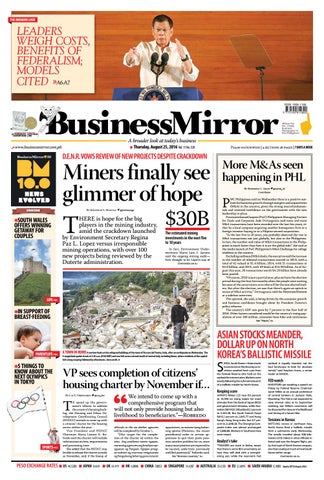
Miners finally see glimmer of hope $30B T By Jonathan L. Mayuga
INSIDE
here is hope for the big players in the mining industry, amid the crackdown launched by Environment Secretary Regina Paz L. Lopez versus irresponsible mining operations, with over 100 new projects being reviewed by the Duterte administration.
south wales offers winning getaway for couples
life
@jonlmayuga
The estimated mining investments in the next five to 10 years
In fact, Environment Undersecretary Mario Luis J. Jacinto said the ongoing mining audit— first thought to be Lopez’s way of Continued on A2
d1
in support of breast-feeding
parentlife
More M&As seen happening in PHL By Roderick L. Abad
Contributor
@rodrik_28
P
wC Philippines said on Wednesday there is a positive outlook for business growth through mergers and acquisitions (M&A) in the country, given the strong macrofundamentals and renewed confidence on the government with the new leadership in place. PricewaterhouseCoopers (PwC) Philippines Managing Partner for Deals and Corporate Jade Divinagracia said more and more M&A transactions have been recorded over the last few years, either by a local company acquiring another homegrown firm or a foreign investor buying in to a Filipino-owned corporation. “In the last five to 10 years, you probably observed the rise in M&A transactions not just globally, but also in the Philippines. In fact, the number and value of M&A transactions in the Philippines is much faster than how it is on the global side,” she said at the media launch of PwC Philippines’s M&A Challenge for college students in the country. Excluding outbound M&A deals, the executive said the increase in the number of inbound transactions started in 2013, with a total of 42 valued at $1.4 billion; 2014, with 51 transactions at $4.8 billion; and 2015, with 49 deals at $14.98 billion. As of August this year, 26 transactions worth $4.18 billion have already been posted. “Of course, 2016 is just a partial year, plus we have the election period during the first five months when the people were waiting because of the uncertainty as to who will be the new elected leaders. But after the election, we saw that there’s again an uptick in terms of M&A activity,” Divinagracia told the BusinessMirror at a sideline interview. The uptrend, she said, is being driven by the economic growth and business confidence brought about by President Duterte’s policy reforms. The country’s GDP rate grew by 7 percent in the first half of 2016. Other factors considered would be the country’s rising population of over 100 million, consumer-base hike and continuous See “M&As,” A2
d4
5 things to know about the next olympics in tokyo
A TOWN IN RUINS A survivor looks at the collapsed buildings of the town of Pescara del Tronto, Italy, after an earthquake on Wednesday. The 6-magnitude quake struck at 3:36 a.m. (0136 GMT) and was felt across a broad swath of central Italy, including Rome, where residents of the capital felt a long swaying followed by aftershocks. Story on A8. AP
VP sees completion of citizens’ housing charter by November if… By Cai U. Ordinario
T
sports
P25.00 nationwide | 4 sections 28 pages | 7 days a week
c1
@cuo_bm
o speed up the government’s efforts to address the country’s housing backlog, the Housing and Urban Development Coordinating Council (HUDCC) intends to come up with a citizens’ charter for the housing sector within the year. Vice President and HUDCC Chairman Maria Leonor G. Robredo said the charter will include information on fees, requirements and processing time. She added that the HUDCC may be able to release the charter as early as November, only if the lineup of
PESO exchange rates n US 46.5200
We intend to come up with a comprehensive program that will not only provide housing but also livelihood to beneficiaries.”—Robredo officials in the six shelter agencies will be completed by October 1. “[Our target for the completion of the charter is] within the year. Ang problema namin ngayon, maraming agencies ang hindi pa naaappoint ng Pangulo. Ngayon pinagsa-submit ng courtesy resignation ng Pangulo ang lahat ng government
appointees, so marami iyong bakanteng opisina [However, the recent presidential order to certain appointees to quit their posts presents another problem for us, since many more position are expected to be vacated, aside from previously unfilled positions],” Robredo said. See “Housing charter,” A2
Asian stocks meander, dollar up on North Korea’s Ballistic missile
S
EOUL, South Korea—Asian stocks meandered on Wednesday as investors awaited fresh cues from the Federal Reserve (the Fed) on the outlook for interest rates. Markets were steady following the submarine launch of a ballistic missile by North Korea.
Keeping score
Japan’s Nikkei 225 rose 0.6 percent to 16,590 on rising hopes for more stimulus from the Bank of Japan (BOJ) and government stimulus, while Australia’s S&P/ASX 200 added 0.2 percent to 5,564.40. But South Korea’s Kospi fell 0.2 percent to 2,045.77 and Hong Kong’s Hang Seng index lost 0.7 percent to 22,848.38. The Shanghai Composite index was almost unchanged at 3,088.88. Markets in Southeast Asia were mixed.
Analyst’s take
“Traders are stuck in limbo, aware that there is some BOJ uncertainty on how they will deal with a strengthening yen; while the near-term Fed
outlook is equally clouded, not the best landscape to look for absolute trends,” said Stephen Innes, a senior trader at OANDA.
FED watch
Investors are awaiting a speech on Friday by Federal Reserve Chairman Janet Yellen at an annual conference of central bankers in Jackson Hole, Wyoming. The Fed is not expected to raise interest rates at its September meeting, but Yellen’s comments will be dissected for clues on the likelihood and timing of a future hike.
Tensions in Koreas
Rattling nerves in northeast Asia, North Korea fired a ballistic missile from a submarine early Wednesday. The missile traveled about 500 kilometers (310 miles) in what officials in Seoul said was the longest flight, yet, by that type of North Korean weapon, one that could put much of rival South Korea within range. Continued on A2
n japan 0.4641 n UK 61.4111 n HK 6.0006 n CHINA 7.0053 n singapore 34.4287 n australia 35.4250 n EU 52.6095 n SAUDI arabia 12.4083
Source: BSP (24 August 2016 )
BMReports BusinessMirror
A2 Thursday, August 25, 2016
Miners finally see glimmer of hope Continued from A1
curbing mining operations in the country—will eventually benefit large-scale miners who responsibly do business in the Philippines. Jacinto said the Mines and Geosciences Bureau (MGB) is now reviewing more than 100 mining applications that were put on hold by the Aquino administration. “We will, on the basis of existing operations, submit our policy recommendations and the directions to take [on the review of new applications]. On the basis of that, then a review of the permitting processes will have to be undertaken and then deliberate decision on how to proceed with it; what is allowed, what should be restricted will be put in place,” he said. In 2012 then-President Benigno S. Aquino III signed Executive Order (EO) 79 effectively putting on hold the processing of new mining projects until a new revenue-sharing measure has been put in place by Congress. “We have rich mineral resources, we have large ecosystem, so it is a fragile ecosystem. We have resources that are God-given, so we must make very deliberate decisions on how to best utilize them. And what will be the best land uses for all the areas,” Jacinto added. The applications for exploration, transport, export and all other mining-related permits including agreements, already reached “hundreds” since the moratorium was imposed, the Department of Environment and Natural Resources (DENR) official said. “We are now doing the assessment; we are waiting for the results of the audit first then we can take it from there,” Jacinto added. The government, through the DENR-MGB, is doing an audit on all mining operations in the country, which already led to the suspension of 10 large-scale mines.
“We now expect to get the comments in the audit and the recommendations and then it should turn out to be a good jump-off point for industry monitoring,” Jacinto said. Data from Chamber of Mines of the Philippines (COMP) showed that the mining sector could infuse around $20 billion to $30 billion to the economy over the next five to 10 years with the inclusion of new projects. The group’s latest breakdown showed that the combined mining investments expected this year stands at $2.25 billion. The country is also anticipating projects with a combined value of $6 billion in 2017. In 2018 mining investments are expected to go as high as $14.75 billion. This year, the projects that are expected to be operational are those of Asiaticus Mining Corp. in Davao Oriental and Global Ferronickel Holdings Inc. in Palawan. To be followed by Philex Mining Corp.’s Silangan project in Surigao del Norte, Nadecor’s Kingking project in Davao del Norte, the Balabag Gold-Silver project of TVI Resource Development Philippines Inc., which are all expected to take off in 2017. In 2018 projects targeted for operation are the Tampakan Mine development of Sagitarius Mines in South Cotobato, the project of Intex Resources in Mindoro, the Masbate gold project of Philsaga Mining Corp., the nickel-mine project of San Miguel Corp., through Philnico in Surigao del Sur, and the Balatoc Mines project of Benguet Corp. As of now, the sole project expected in 2019 is the Far South East Gold project of Lepanto Mning Corp. in Benguet. Jacinto advised investors to make sure that they are compliant before investing in mining in the Philippines. “If you put in that kind of investment, then you also make sure that you are compliant. Because it is useless if you put that
kind of investment and you are not compliant,” he said. There are four considerations for mining operations to continue in the Philippines under the Duterte administration, he said. “It should be technically feasible; it will be environmentally compliant, socially acceptable and financially viable. Any of the imperatives absent, then it means it is not time to mine,” he added. He said there are companies that existed for almost half a century and they have complied with the highest standard of mining, which other mining companies can emulate. The mining audit, he said, will be completed by the end of the month. The DENR chief, he said, will always have the final say whether a mining operation should continue or stop, based on the new mining audit criteria. Jacinto represented President Duterte in the ongoing Mining Philippines 2016 Conference and Exhibition in Pasay City. During his speech, Jacinto said, while news headlines over the past weeks highlighted alleged environmental violations of miners, suspensions of mining operations and show-cause orders, he sees the audit as “a blessing in disguise to responsible miners who have religiously followed and are compliant of mining and environmental laws, rules and regulations.” “Those who have clearly violated the terms and conditions of their contracts; taken shortcuts; largely ignored the adverse impact of their operations to their host communities; polluted waterways so essential to the productivity of farmers and fisherfolks; and threatened the very survival of people who should benefit from mining from these economic activities are the ones who have to face sanctions for their irresponsible acts,” he said. Jacinto’s remark referring to COMP participants as “responsible
miners” receive loud applause from conference participants. “It was an excellent speech,” said Jose Leviste, president of OceanaGold (Philippines) Inc. COMP Vice President for Legal and Policy Ronald Recidoro said apparently, “Jacinto knows the language of responsible miners.” COMP President Benjamin Philip G. Romualdez remains optimistic of the prospects of responsible miners under the Duterte administration. Romualdez, the president of Benguet Corp., assured Jacinto that the COMP will follow the law, and we will engage in responsible mining, using only the best practice available to ensure that our host communities and the environment will thrive under our care. “We are not afraid of the ongoing audit of the DENR. We welcome it! We welcome this purging of illegal and noncompliant mining operations. We have always operated under some of the strictest laws and we believe that if you cannot obey these laws, you should not be in this industry,” he said. However, he said the mining industry does not need a new law, adding that the existing mining law is one of the best in the world today, because it already integrates stringent rules on the environment and caring for the local communities. “What is needed is strict and fair enforcement of a stable policy regime that promotes the long term stewardship of our environment and natural resources,” he said. He said COMP has always maintained the highest standard of professionalism in the conduct of business. “As a highly regulated industry, we seriously follow the Mining Act and all regulatory rules of the DENR.” Romua ldez said of the 21 member-companies of the COMP currently operating today, 17 have already secured ISO 14001 certification for their environmental management systems.
Asian stocks meander, dollar up on North Korea’s missile Continued from A1
Wall Street
U.S. stocks posted modest gains on Tuesday, after a report of a big jump in sales of new homes last month. The Dow Jones industrial average rose 0.1 percent to 18,547.30. The
Standard & Poor’s 500 index rose 0.2 percent to 2,186.90 and the Nasdaq composite rose 0.3 percent to 5,260.08.
Oil
Prices rose overnight after Iran signaled it might support other Organization of Petroleum Export-
ing Countries member in production freezes. But prices fell back on Wednesday on news of rising inventories. Benchmark US crude fell 53 cents to $47.57 per barrel in electronic trading on the New York Mercantile Exchange. The contract rose 69 cents to $48.10
a barrel on Tuesday. Brent crude, used to price oil internationally, lost 42 cents to $49.54.
Currencies
The dollar gained to ¥100.36, from ¥100.30, while the euro fell to $1.1299, from $1.1304. AP
www.businessmirror.com.ph
Housing charter. . .
“Hindi kami maka-proceed kung kulang pa ang tao. Hopefully by September nakapag-appoint na ng tao para makasimula na kami. Hopefully, October 1, puno na iyong lahat ng shelter agencies within one month malalabas na namin ang Charter [We may find it difficult to proceed if no appointments are made within our time frame, but, hopefully, by October 1, when all slots under these shelter agencies have been filled, we may be able to come up with the charter as we envision],” she added. The charter will help in the HUDCC’s efforts to speed up document processing of socialized housing to only 15 to 30 days, from the current processing of two years. Robredo added that the creation of the charter will help the HUDCC in its plan to create a one-stop-shop for property developers who want to go into socialized housing. The envisioned one-stop-shop is one solution that Robredo intends to create to prevent property developers from waiting for two to four years before they are granted permits to undertake their socializedhousing projects. “Kasi ngayon ang sinasabi ng karamihan, nawawalan sila ng ganang pumasok sa socialized housing kasi hindi business friendly ang proseso. [Some people say they have lost the drive to enter the socialized-housing business, saying that the process is so tedious and not so business friendly],” Robredo said. Apart from this, Robredo also plans to provide construction training to relocatees to provide them jobs and enable them to work on other socialized-housing projects of the government, similar to that of Thailand. Robredo aims to turn carpenters, plumbers, masons and other local handymen in poor communities into a pool of community builders and provide them training in advanced construction of buildings. “So ito, parang kumprehensibo ang programa. Hindi mo lang binibigyan ng pagkakataon na magkaroon ng bahay, pero binibigyan mo ng pagkakataon magkahanap-buhay [We intend to come up with a comprehensive program that will
M&As. . .
Continued from A1
not only provide housing but also livelihood to the beneficiaries],” Robredo added. Meanwhile, Robredo said the Social Housing and Finance Corp. (SHFC) and the Housing and Land Use Regulatory Board (HLURB) recently signed a memorandum of understanding (MOU) to streamline the processes of application for housing in both government agencies. Under the MOU, the SHFC and HLURB will reduce documentary requirements for clearances, permits and/or licenses and processing time and expediting of procedure through establishment of common or accessible offices. The MOU also called for the establishment of common and dedicated data bank to facilitate verification of documents and approval of applications and identify priority projects and local government units. “Natutuwa tayo na kasama natin ang SHFC and HLURB sa pangarap na mas mapabilis ang pagpoproseso ng mga pabahay para sa ating mga kababayan [I am glad that SHFC and HLURB will be together to fast track the process of owning a home],” Robredo added. Earlier, Robredo said the government does not have an inventory of available lands for mass housing and a comprehensive list of homeless Filipinos making it difficult to jump-start a housing program in the country. She said she wants to deal with the country’s housing problem through a “comprehensive and integrated” way. But this would be difficult without the needed data. Robredo said that, while the Land Registration Authority has commissioned a study to determine the available lands for mass housing, it has not yet been released, as the government has yet to pay for it. The Vice President said she has requested the Department of Budget and Management to release the payment to the entity, which she did not identify. In terms of the list of homeless Filipinos, particularly in cities, Robredo said that so far only Las Piñas, Quezon City and Valenzuela have come up with an updated listing.
Continued from A1
flow of remittances from both the overseas Filipino workers and business process outsourcing industry. “So w ith the money going around, people are really just spending on food and other basic necessities. Apart from that, people are also starting to look at what we call ‘capital investments,’” Divinagracia said. “Also, the interest-rate environment [is] very low, so people are not afraid to borrow.” On the political side, the executive lauded President Duterte’s appointed Cabinet members “who are experienced people and very business savvy.” “I’m really happy to see that they’ve decided to continue on the economic policies of the past administration, which they believe would continue to work well for the country,” she said. Duterte’s hard-line stance on drugs, while ensuring national security, she said, helps the growth of M&As in the marketplace here. “I hope the President will be successful in terms of really addressing the peace-and-order situation in the country because it’s also a very important decision point for investors to come to the Philippines,” Divinagracia added. “If we’re able to project the country to be a safe place for both residents and businesses, then, I think there will be more people coming in. As we see now, the confidence is very positive.” The managing partner for deals and corporate of PwC Philippines also noted the prev ious pronouncement of President Duterte to cut red tape and ensure the ease of doing business here. More importantly, she emphasied the in-
tention of the new administration to lower income and corporate taxes, as Mr. Duterte announced during his recent first State of the Nation Address. “If that happens, then, we will be more competitive, as there’s already interest in the country,” she said. Divingaracia noted, though, that other business concerns, such as the high power rate and poor infrastructure must be addressed in order to lure more investors. “Still, we can see businesses coming in because there’s something we can offer in the Philippines. How much more if we address those things that are bugging us now,” she added. While the country had a slow start this year due to the elections, she is optimistic the M&A marketplace will remain upbeat by end of 2016. “If not equally as big as in 2015, but close to last year’s achievement, as we see a lot of these transactions happening. We only have four months left and, normally, things shut down towards the end of the year, like [in] December, [because of the] holidays. So maybe, that’s what is going to reduce the probability of having more transactions compared to last year,” Divinagracia said. “By next year, I think that would be more positive because you’re starting with less uncertainty, there’s no more election fever, [and] people will be more focused in terms of what they want to do, rather than think of what’s going to happen next. So next year, I think, would be a good year for M&A,” she added.
news@businessmirror.com.ph
BMReports BusinessMirror
Thursday, August 25, 2016 A3
Piñol starts talks with South Korean firms seeking to buy high-value goods from PHL
D
EPARTMENT of Agriculture (DA) officials said they are in talks with big South Korean conglomerates that expressed interest in importing high-value products from the Philippines.
“These are big conglomerates that expressed interest in our high-value products,” Agriculture Secretary Emmanuel F. Piñol told the BusinessMirror in a telephone interview, referring to
South Korean companies engaged in shipbuilding and agriculture that sent representatives to a forum in Baler, Aurora, on Tuesday. In that forum held between the Aurora Pacific Eco-Zone Man-
agement and the group of South Korean investors, Piñol said he presented to both parties the highvalue products that the Philippines could offer to South Korea. “As a sample, I allowed them to get a bite of the organic coco chips being manufactured in Laguna province by a company owned by Philip Leach and his son, along with Filipino partners,” Piñol said. “Carrying the brand name ‘Radical Organics’, the coco chips were a hit among the Koreans, who immediately asked how they could buy it for South Korean market.” Piñol said that DA officials have yet to talk again with the
interested South Korean investors. “They expressed interest, but I don’t know how they will do it, but I think this is a good opening for the Philippines,” Piñol said, adding that the DA is currently discussing the plans and proposals regarding the South Korean’s interest over the country’s high-value products. He also said that the South Ko-
rean companies will donate three patrol boats to the Bureau of Fisheries and Aquatic Resources, to strengthen the agency’s campaign against illegal fishing. Piñol added that the offer was made directly to former Senate President Eduardo J. Angara, after the South Korean investors got pleased by DA’s program to stop illegal fishing in all
These are big conglomerates that expressed interest in our highvalue products.”—Piñol
waters of the country. “I just opened a huge market for Philippine organic products and most of all, the campaign against illegal fishing will soon receive a big boost with the grant of three patrol boats from the South Korean investors for the country’s fisheries agency,” he added. Early this month, Piñol proposed to Korean Ambassador Kim Jae -shin the possibility of the Philippines exporting organic chicken to South Korea, following the latter’s accreditation of two poultry facilities under San Miguel Foods Inc. to export chicken meat to their country. Jasper Emmanuel Y. Arcalas
How to stay rich in Europe: Inherit money for 700 years L
amberto Frescobaldi sets two wine glasses atop a wooden barrel in the spacious cellar of his company’s winery in a 1,000-year-old castle not far from Florence. Uncorking a bottle of Nipozzano, he takes a sip and nods. The red that his family supplied to Michelangelo and Pope Leo X still tastes pretty darn good. To Frescobaldi, 53, directing the family business is something of a trust. It’s a way to preserve a dynasty that began with wool traders in about the year 1000 and made its
money financing the English crown almost 200 years later. “You have to feel that what you have inherited, you actually do not own,” he said, seated on a wine cask. “You only have to run it properly, and to carry on to something else.” Maintaining inherited wealth has worked for generations of Frescobaldis over 700 years, and it has let the descendants of Jakob Fugger in Germany continue to run the social-housing complex the Emperor’s banker founded almost half-amillennium ago. It’s less of a blessing
for Europe as a whole, where family fortunes are more prevalent than in the US or Asia. Their relatively high level is a sign of the continent’s low social mobility, keeping education, income and social connections from evolving over generations. The richest Florentine families today were already at the top of the socioeconomic ladder almost 600 years ago, according to a recent study by the Bank of Italy. And research by the Organisation for Economic Co-operation and Development shows that in many European coun-
tries, not only wealth and income, but even occupations tend to be “sticky,” passed on from generation to generation. More than one-third of Italy’s richest people inherited their fortunes, compared with just 29 percent in the US and 2 percent in China, according to a 2014 study of the world’s billionaires by the Peterson Institute for International Economics. Germany has the highest share of inheritor-billionaires among developed economies, 65 percent. Overall, heirs and heir-
esses make up about half of Western Europe’s billionaires. Europe’s income classes aren’t much more rigid than in the US. The lack of social mobility is more of a concern, though, because economic output and the number of available jobs are smaller. The US has grown 9.9 percent in real terms since 2007; the comparable figure for the European Union (EU) over the same period, based on Eurostat data, is 2.8 percent. GDP per capita in the EU is almost one-third lower than in the US, when adjusted for pur-
chasing power; the unemployment rate is nearly twice that of the US. Because America’s economy is expanding, “they need more engineers, more chemists, more economists, more analysts, more bankers than in Europe,” said Antonio Schizzerotto, professor emeritus of sociology at the University of Trento and scientific director of the Research Institute for the Evaluation of Public Policies in the same city. “The number of positions open is higher than the number of ‘sons and daughters of.”’ Bloomberg News
BMReports BusinessMirror
A4 Thursday, August 25, 2016
news@businessmirror.com.ph
Duterte continues to pick fights here and abroad 50 days later P By Recto L. Mercene
December, aims to limit warming to below 2 degrees Celsius (36 degrees Farenheit) and strive to keep global temperatures at 1.5 degrees Celsius above preindustrial levels. The country accounts for less than 1 percent of the world’s emissions, and has not ratified the deal. Lucille Sering, a former climate negotiator, said the country’s action plan had always been contingent on financial and technology support. The President’s remarks were “probably taken out of context,” she tweeted.
@rectomercene
RESIDENT Duterte might have missed reading, or probably he has forgotten since he is familiar with history, the ancient Chinese military strategist Sun Tzu, who wrote in his book, The Art of War: “So, it is said that, if you know your enemies and know yourself, you will not be put at risk even if you have a hundred battles.”
“If you only know yourself, but not your opponent, you may win or may lose. If you know neither yourself nor your enemy, you will always endanger yourself.” Duterte, who said he would rather be called “Mayor Rody,” disdaining the word “President,” but has been dubbed “DU30” and “Digong” by his close associates, has been waging a multifront war before and after he bagged the presidency.
Arrows from everywhere
Foreign Secretary Perfecto R. Yasay Jr. has been staggering from the sheer number of arrows he has had to deflect so as not to unduly impair his boss. Despite promises made before the May 2016 elections, that he would mend his ways, and avoid cussing, Duterte continues in his merry way and has always spoken out of turn. There lies the pitfall of this wayward tongue. Buoyed by the landslide victory of 16 million votes, 6 million more than his closest rival former Interior Secretary Manuel A. Roxas II, Duterte made true his promise to wage a relentless war against illegal drugs. But in his attempt to pursue his personal war on the drug menace, Duterte has also alienated a lot of supporters here and abroad.
United Nations
The latest victim of his indignation is no less than the United Nations (UN). He threatened to leave the world body after UN Special Rapporteur on Summary Executions Agnes Callamard criticized the spate of alleged summary executions in the country. Callamard suggested that Philippine officials could be held liable, saying in a recent statement that “claims to fight illicit-drug trade do not absolve the government from its international legal obligations and do not shield state actors or others from responsibility for illegal killings.” Responding to the criticisms, Mr. Duterte pointed to the haunting image of a bloodied child being pulled from the rubble of a missilestruck building in the Syrian city of Aleppo to note the inability of the United States and the UN to stop such deadly conflicts, complaining that he comes under fire for the killings of criminals. “Maybe we’ll just have to decide to separate from the United Nations. If you’re that rude, son of a bitch, we’ll just leave you,” Duterte told reporters in Davao, where he first built a reputation for his tough crime-busting style while serving as the southern city’s longtime mayor. “Why would the United Nations be so easy to be swayed into interfering into the affairs of this republic?” he asked. “There are about just 1,000 dead and there are a lot of people—innocent women, children, young women, young men and old women—being killed else-
where in the world,” Duterte said in a midnight news conference in Davao City. He said he has not heard the United Nations or the UN chief complaining publicly about the higher Middle East death tolls or criticizing “the countries who are into it and bombing villages and communities, killing everybody there, including the goats and the cows and the dogs.” He also lashed out at the US police killings of black men in his latest umbrage against critics of his antidrug campaign, which has left hundreds of suspects dead. After the UN rapporteur expressed her desire to come, mistaking Duterte’s comment as an invitation, Yasay voiced his objection. He said the Philippines is not inclined to invite the UN rapporteur who made disparaging remarks about the way Mr. Duterte is addressing the country’s drug problem. “They may come but what is the point, the damage has been done… that is like putting the cart before horse, if they want, they can do that but they already made a conclusion,” Yasay said. At the same time, however, Yasay said the Philippines is not leaving the UN “despite our frustrations with this agency.” “But I can assure you that he [Mr. Duterte] remains committed to the United Nations, of which the Philippines is one of the founding members, and to the purposes and objectives of which this august body stands for.” Yasay calls on the global community to support the Philippines war on drug, “not to simply provide lip service in eradicating this urgent international problem toward uplifting the quality of life of the community and families, and assure a bright future for their children.” He added that media reports may serve as their lead, but such reports do not constitute prima facie evidence of fact. “It is highly irresponsible on their part to solely rely on such allegations based on ‘information’ from unnamed sources without proper substantiation. Furthermore, they are not acting in accordance with existing procedures in engaging and cooperating with member-states.”
Global isolation?
Because of t he P resident ’s uncalled-for remarks about the UN, a former top diplomat to the world body warned the Philippines risks “global isolation.” Lauro Baja, who served as Philippine permanent representative to the UN under former President Gloria Macapagal-Arroyo, said pulling out of the UN would be difficult and entails serious implications. “We stand to lose many benefits, aside from being isolated in the community of nations,” Baja was quoted on GMA News Online. “The implications of a UN withdrawal
Ban Ki-moon
DUTERTE
AP
If you only know yourself, but not your opponent, you may win or may lose. If you know neither yourself nor your enemy, you will always endanger yourself.”—Sun Tzu are too serious to even consider.” Some in the media calls President Duterte a “political loose cannon” who has lacked campaign support from the country’s major parties or the political elite in Manila and has never held national office.
The pope
One of the first casualties of his cutlass-sharp tongue was Pope Francis, whom he cussed for adding to an already horrendous traffic in Metro Manila during the Papal visit here in January. It appears that it took Digong five hours to reach a mall from his hotel during the pope’s visit. During a campaign in Manila, Mr. Duterte joked before the crowed in the local language: “Pope, you son of a b _ _ _ h, go home. Don’t visit here anymore.” Duterte refused to apologize to Francis, the leader of more than 1 bilion Roman Catholics. The Philippines is 85-percent Roman Catholic. He said his anger was directed at the government for causing too much disruption to people’s lives through their handling of the historic visit. But despite his outrageous comments, President Duterte continues to be supported by his followers, mostly the 11.4 million poor tallied by the SWS survey firm, who are sick and tired of a succession of democratically elected presidents before him who have failed to tackle crime, corruption, poverty and other burning issues.
The Church
The Pope Francis issue has yet to die down when Mr. Duterte again put his foot in his mouth in May this year. He lambasted the Catholic Church, labeling it the country’s “most hypocritical institution.” He said he is ready to take on senior Filipino bishops in a debate about their wrongdoings before he takes office in June. “I will lecture until June 29 the sins of the Catholic Church and whether or not you are still relevant,” President Duterte told reporters in Davao City, where he used to be the mayor.
Mr. Duterte said the bishops who had condemned him during his campaign had been asking for help from the government. “You asked so many favors, even from me,” he said.
The Chief Justice
In his speech before Army troops in Camp General Edilberto Evangelista in Cagayan de Oro City earlier this month, a visibly irate President Duterte lambasted Chief Justice Maria Lourdes A. Sereno for ordering Executive Secretary Salvador C. Medialdea to submit formal complaint affidavits against the four judges that the President linked to the drugs trade within seven days and furnishing the judges with a copy of the complaint. Mr. Duterte even threatened to declare martial law if Sereno continues to block his efforts to address the country’s problem on illegal drugs. In a resolution, the Court ordered the conduct of a fact-finding investigation on the alleged involvement of four incumbent judges in the country’s illegal-drugs trade. Sereno earlier said only four out of the seven judges on the “war on drugs” list are still active.
De Lima
The President did not forget an “old grudge” against Sen. Leila M. de Lima, accusing her of having links in the alleged New Bilibid Prison drug operations and even an illicit affair. Communications Secretar y Martin M. Andanar said the recent broadsides against de Lima originated years back when the senator tried to link President Duterte to the Davao Death Squad. “She tried, but failed. And now it’s [Mr.] Duterte who has the information.” When asked the basis for President Duterte’s claim and if the President could be obliged to reveal them, Andanar said, “It’s only [Mr.] Duterte who is holding those information.”
The Australians
Duterte also got the goat of Australian citizens when he remarked that an Australian rape victim, was so beautiful “the mayor should have been the first.”
Robin Haines Merill, the sister of the Australian rape victim denounced the then candidacy of President Duterte, including Australian TV presenter, Paul Murray of Foxtel Network, who called Mr. Duterte “an evil b _ _ _ h,” while Australian Ambassador to the Philippines Amanda Gorely said in a tweet “jokes must not be made about victims of rape and murder.” President Duterte’s remarks have made headlines in international news organizations, such as BBC, CNN and the Washington Post.
The United States
One diplomatic faux pax Mr. Duterte recently committed was when he showed his anger against US Ambassador to the Philippines Philip Goldberg, calling him bakla (gay), for commenting negatively against him on the Australian rape case. As a result, the US summoned Patrick Chuasoto, the diplomat in charge of the Philippine Embassy in Washington, D.C., to clarify the President’s remark. US State Department Press Office Director Elizabeth Trudeau said: “We’ve seen those inappropriate comments made about Ambassador Goldberg. He’s a multitime ambassador, one of our most senior US diplomats.” As the US State Department summoned Chuasoto, Trudeau also said the US was concerned about the extrajudicial killings of drug suspects in the Philippines.
Unnamed envoy
Shortly after assuming the presidency, President Duterte said he got mad at an unnamed ambassador who called on him in Davao to discuss the Philippines plan to cut the country’s greenhouse-gas emissions. “I’m mad at this ambassador. I want to kick him,” adding that limits on carbon emissions for the Philippines were “nonsense.” “You who have reached your peak and along with it spewed a lot of contaminants, emissions.… Good for you. We are here, we have not reached the age of industrialization. We are on our way to it.”
The climate deal
HE said he will not honor the country’s commitments made under the Paris climate-change deal, adding in a speech: “You are trying to stifle us. That’s stupid, I will not honor that. You signed.… That was not my signature.” The UN pact, agreed by 195 countries, including the Philippines, last
Not one to ignore a slight, Mr. Duterte chided UN SecretaryGeneral Ban Ki-moon in June and the UN Office on Drugs and Crime earlier this month of President Duterte’s “apparent endorsement of extrajudicial killings, which is illegal and a breach of fundamental rights and freedoms.” “For those who are killed by drug syndicates we can only investigate, but do not attribute the acts of other criminals upon my government,” he said. He added that when the police engaged in a shooting war with a criminal, “it takes only one bullet to put down a criminal, why do the police have to wrap him in plastic, that takes too much work, the police don’t do that.”
‘50 first days’ (and enemies?)
This is all happening while Mr. Duterte celebrates his first 50 days in office this moth, calling it a huge success. He bragged about his administration’s successful campaign against illegal drugs, as well as supporting transparency through the issuance of an executive order on Freedom of Information. Other achievements include the exposés against local executives, police generals, judges and other top officials in the government. The Palace’s theme, “50 First Days,” takes off from the movie 50 First Dates, a 2004 film featuring Adam Sandler and Drew Barrymore. This is a departure from the 100 days “honeymoon” that a Chief Executive used to enjoy with the media, sparing him from criticism within that period.
‘Endo,’ drugs, oligarchs
PRESIDENT Duterte has also started to implement change in streamlining the bureaucracy, ending the contractualization in private firms, as well as increase in the allowance of Filipino athletes who went to the Rio Olympics, highlighted by the silver medal of weightlifter Hidilyn Diaz. Apart from going after narcopoliticians, the President also went after irresponsible mining firms and the “oligarchs” who put the country in peril for failing to pay the right taxes. Despite Duterte’s tirade against Goldberg, the government remains optimistic that the bilateral relations between the US and the Philippines will remain strong. But as if all these distractions on his drug campaign is about to end, the brash-talking former mayor criticized the United Nations for condemning the spate of killings of suspected drug criminals in his country, while allegedly keeping silent on deadlier violence in the Middle East. According to the National Police count, as of last week, more than 500 have been killed in gunfights with police and nearly 8,000 have been arrested in the government anti-illegal drugs campaign. The local media and other groups have higher tallies, some nearly 1,000, and have included apparent victims of summary killings.
Asean
BusinessMirror
www.businessmirror.com.ph
Where will investments go in Asean? Asean-EU Perspective
HENRY J. SCHUMACHER
Editor: Max V. de Leon • Thursday, August 25, 2016 A5
Junta opponents staggered by support for status quo
I
t is important to invite international companies to invest in the Asean Economic Community (AEC), which started on January 1, 2016. Asean has achieved worldwide recognition for being one of the most dynamic and integrated regions. The growing purchasing power of the 600 million consumer market and the ongoing progress of the regional community offer an integrated market and production base for both business and consumers. Foreign direct investment (FDI) is a key component of resource flows to Asean countries. Over the last decade, FDI flows into Asean members grew at an annual average rate of 19 percent. Within the overall framework, each Asean country has adopted its own strategy to attract FDI. As in the European Union, efforts to create a “level playing field” between the countries in the single market leaves national governments with freedom to provide their own tax and other incentives to investors. While the Philippines is still debating whether fiscal incentives should be offered to investors and to what extent the economy should be opened to foreign investors, Indonesia, Thailand and Vietnam are taking a much more aggressive approach in courting investors into their markets. Thailand has become the ninth-biggest car producer in the world: China 22.1 million manufactured cars in 2013 USA 11.0 Japan 9.6 Germany 5.7 South Korea 4.5 India 3.9 Brazil 3.7 Mexico 3.1 Thailand 2.5 Source: OICA The daughter company of Audi, Ducati, is building more motorbikes in Thailand than in Bologna. Only in 2012, Ducati started with a capacity of 8,000 units in Thailand; now they have started an expansion to 35,000 units per annum. These examples of successful investment in manufacturing show that Asean is getting ready and the Philippines has to make up its mind whether it wants this kind of investment and, if yes, with what kind of incentives. Given the talks in the Philippines on federalism, decentralization and regionalization, it is also necessary to come up with ideas where investments should be located, what kind of incentives will be made available and what kind of infrastructure will be provided. Other areas in which manufacturing investments are planned in the region are aerospace, machinery and components, life sciences and mobile technologies. It has to be understood that there is competition within Asean, but China is also watching the “next wave” of manufacturing to allow continuous growth. Again, for the Philippines, the government has to look at the role it wants to play in driving this kind of FDI targeted at “inclusive growth” and has to adjust its economic policies. This is certainly not the time to cut back on investment incentives! Important for all Asean countries is the development of skilled labor. In this context, it is essential that universities, companies and the government work together, not only in the development of engineers and scientists but also in technicians and skilled workers, through apprenticeship and dual technical education. The “shopfloor R+D” that Department of Science and Technology and the European Chamber of Commerce of the Philippines in Cebu developed should be part of this process, to promote the classroom studies into applied practical use.
Singapore reviews venture capital regime for start-ups
S
ingapore is reviewing the rules for venture capital (VC) firms as it attempts to draw more capital to the country’s financial technology start-ups, according to the head of Singapore’s central bank. Though Singapore rivals other major fintech centers, such as Silicon Valley, London or New York, in terms of start-up activity and innovation, it still lags behind in terms of the firms’ access to capital, said Ravi Menon, managing director of the Monetary Authority of Singapore (MAS). “I think we can solve our financing problems, because of the rate we are encouraging VC funds to set up here, and we are also reviewing some other regulatory requirements that we place on VC funds,” Menon said. “We just started the review so I can’t say more, but, hopefully, this will facilitate more of them to come here,” he added. Singapore is trying to encourage investment in financial technology to boost its role as a regional banking hub. Last year MAS set up a FinTech & Innovation Group to promote the sector, hiring former
Citigroup Inc. banker Sopnendu Mohanty to head the in-house unit. The central bank has also committed to invest S$225 million ($167 million) over five years in fintech projects. Menon was speaking at a Wednesday event to launch a new MAS initiative, known as “Looking Glass,” which is aimed at helping entrepreneurs build their businesses with help from regulators, lawyers, bankers and others. “Money is one thing, but how does the entrepreneur navigate the system?” Menon said. The MAS wants to improve the flow of capital to entrepreneurs, but it is also mindful of the opposite danger, that local start-ups are flooded with funds, a process that typically leads to inefficiency and misallocation of capital. “We don’t want too much money chasing too few ideas, we need to be mindful of that,” Menon said. “Civil servants can be better at giving money, but you can’t tell a start-up how to run a business, you need people who have run a business to tell them that.”
Bloomberg News
In this August 7 file photo, former Thailand Prime Minister Yingluck Shinawatra poses as she casts her vote in a national referendum on a new constitution at a polling station in Bangkok. AP
I
N the two years since Thailand’s army seized control of this Southeast Asian nation in a coup, prodemocracy activist Rangisman Rome has repeatedly risked jail time to do something few here have done: speak out against the junta.
The 24-year-old law student has taken part in peaceful demonstrations that saw security forces drag him away by the hair. He’s undergone forced “attitude adjustment” sessions at military camps in Bangkok. In all, he’s spent 24 days in custody—most recently for urging Thais to vote against a new constitution that will strengthen the army’s already powerful hand in politics for many years to come. The charter was easily approved this month, in a vote that underscored just how lonely Rangisman’s struggle has become. The result carried with it an implicit message: After a decade of political turmoil, the Thai electorate values the forced stability the military has imposed far more than democracy and freedom of speech. The referendum “was wrong on so many levels,” Rangisman said, noting that open debate was quashed so intensely, criticizing the draft was punishable by up to 10 years in jail. Rangisman was detained four times and has three court cases pending against him on various charges. He added, however, “We have to accept the will of the people to decide what they want for their country, and this is what they wanted.” Opponents of Thailand’s military dictatorship seem at a loss over what to do now. One minister ousted in the coup compares their situation
to waiting out a storm. Yet, that wait could be quite long indeed. The next major step will be elections, which could be held as early as November 2017, but the army won’t go away at that point. The new constitution mandates a five-year transition to civilian rule and a military-appointed Senate—with seats reserved for top commanders—that will serve as a check on the elected lower parliament. Other governing bodies, including the courts and the bureaucracy, will also remain under military influence. In the long run, though, Thailand “still has to come to grips with the sources of the political turmoil that have driven the conflict for a decade,” said Matthew Wheeler of the International Crisis Group. “Two years of military rule haven’t really resolved any of the fundamental problems...and the constitution won’t succeed in doing that either,” he said. “The day of reckoning is just being delayed.” Turnout for the referendum was relatively low—55 percent—and few of those who did vote actually read all of the charter’s 279 articles. Analysts believe some of those who voted “yes” did so out of a sense of resignation, or a desire to speed the army’s departure by clearing a hurdle to the eventual restoration of civilian rule. The unease that permeates Thai
[The referendum] was wrong on so many levels.” —Rangisman society is often difficult to detect. Life can seem utterly normal despite a junta ruling with absolute power. Foreign tourists still flock to the nation’s idyllic beaches. Shoppers still pack into Bangkok’s gargantuan luxury malls. The city’s streets are still clogged with traffic, and few soldiers are in sight. A wave of bombings less than a week after the vote, however, made clear that Thailand’s problems are not over. The attacks, which killed four people and wounded dozens more, are suspected to have been carried out by Muslim separatists in the south who are waging a war for greater autonomy that remains unresolved. The reality is that Thailand remains “deeply paralyzed,” said Puangthong Pawakapan, associate professor of political science at Bangkok’s Chulalongkorn University. “Nothing has been done to address the conflict boiling just below the surface,” she said. “And when it bursts, people will be out on the streets again.” A broader political divide has torn Thai society apart since the military staged an earlier coup in 2006. In the years since, mass demonstrations by rival protesters have shut down the government and at times turned bloody. The worst upheaval, in 2010, ended with a military crackdown that killed dozens and left Bangkok’s glittering skyline darkened by the smoke of burning buildings. At its heart, Thailand’s conflict
is about wealth and power, and how to distribute it. The country remains split between a poor, rural majority in the north and northeast striving for a greater share of the economic pie, and an elite minority in Bangkok allied with the military and southern supporters who see northern ascendancy as a threat. To the latter, Thailand’s former democracy only paved the way for what they call “the tyranny of the majority.” A spokesman for the government, Maj. Gen. Weerachon Sukhondhapatipak, said Thais had “too much freedom” before the coup. They were “exploited by influential political groups, by hate speech and misinformation, by people who were instigating violence,” he said. “That kind of environment can’t be fixed in one or months, or one or two years. “The military needs to stay until the country is ready,” he said. “It will take time, but it won’t take forever.” The transition is taking place amid profound anxiety over the succession of 88-year-old King Bhumibol Adulyadej, who marked his 70th year on the throne from a hospital bed and has not appeared in public in months. Bhumibol is the world’s longest reigning monarch, and while he is widely loved, his son and heir apparent, Crown Prince Maha Vajiralongkorn, has not yet garnered the same respect. The military, which sees itself as the principal defender of the monarchy, is keen to ensure succession goes smoothly. The new constitution was drawn up with little input from the junta’s opponents, and critics say it was designed to neutralize the power of politicians the government sees as corrupt. No. 1 on that list is Thaksin Shinawatra, who was ousted in the 2006 coup and now lives in selfimposed exile in Dubai. His Pheu Thai Party and previous incarnations of it have won every election here for more than a decade, most recently in 2011 when his sister Yingluck Shinawatra became prime minister. The new charter, however, establishes a voting system that will make it tough for any one party to secure a parliamentary majority. Chaturon Chaisang, a Pheu Thai member who served as Yingluck’s education minister, said the constitution’s approval was a serious setback, and party leaders are struggling to understand why so many of their constituents voted for it. That, combined with repressive junta policies that significantly curtail political activity, means “there is little anyone can do” but wait until elections. “We need to regroup and strategize, but it’s clear now that our party’s role will be quite limited, and remain so for some time,” Chaturon said. “It’s like waiting out a thunderstorm. Nobody can do anything until the skies clear.” Rangisman, a Thammasat University student who helps lead a civil society network called the New Democracy Movement, said the prodemocracy forces were not giving up. “But this made us realize that without more people, more support, more funds, we’re doomed to fail.” The junta has “succeeded in creating an atmosphere of fear” that inhibits free discussion of the conflict. And Thai culture, he said, plays perfectly into that. “Our culture tells us to avoid confrontation, to avoid discussing our problems,” he said. “So people don’t want to talk about it or get involved. It’s up to our generation to change that.” AP
TheBroa
Business
A6 Thursday, August 25, 2016
Officials are optimistic changing the Constitution and the form of Philippine gov
Leaders weigh costs, benefits By Butch Fernandez, Cai U. Ordinario, David Cagahastian, Jovee Marie N. dela Cruz, Catherine N. Pillas & Jasper Y. Arcalas
T
HREE times various forces wanted to take Manila. Now, officials want to move forces outside of the capital. “For a long time, the powers reside in Manila,” Aquilino Q. Pimentel Jr. said. “Everything awaits approval of the government in Manila.” Speaking at a forum hosted by the BusinessMirror and the European Chamber of Commerce of the Philippines (ECCP), the former Senate president cited the “powers of government are too concentrated in Manila” as one of the reasons for the country’s move to a federal form of government. But at least, as many hope, the move to diffuse Manila’s power in decision-making and resource allocation would not be as bloody as the 1945 Battle of Manila. And while the first two Battles of Manila, in 1762 and in 1898, were about gaining symbolic power over the archipelago, the current “battle” between those for and those against tinkering with the Constitution at least agrees on one thing: It would not be easy. But there are costs, according to local and foreign leaders at the forum on Tuesday at the Marriott Hotel.
Centralized power
ACCORDING to Deputy Speaker Ferdinand L. Hernandez, who represented Speaker Pantaleon D. Alvarez in the forum on Tuesday, development has only been centralized in the National Capital Region (NCR). “Poverty incidence for families in the NCR as of 2015 is around 4 percent,” Hernandez said. “It is the only place in the Philippines that has a single-digit percentage of poverty incidence[s].” Sans citing the source of his data, Hernandez said next to the NCR is Region 4A, a cluster of provinces near the NCR, which has a poverty incidence at 10.4 percent. “The ARMM [Autonomous Region in Muslim Mindanao] is last, with a devastating percentage of 53.4 percent,” he said at the forum. “Economic progress has evidently failed to trickle down where it is needed the most.” PDP-Laban Rep. Alfredo B. Benitez of Negros Occidental has noted during the forum that economic development and delivery of basic social services are concentrated in Metro Manila. While admitting that poverty incidence has decreased in the past 20 years, Benitez said the country is still far from achieving its goal to cut poverty incidence by half, saying “poverty remains prevalent in the Visayas and Mindanao.”
Curious case
HERNANDEZ noted during the forum that the Philippines has continuously lagged behind its neighbors despite the country’s potential and the efforts of the best and brightest of Filipinos. “The Philippines is a curious case,” he said. “It is overflowing with hardworking and talented people, more than 100 million to be precise, 10 percent of whom are overseas, working as part of the backbone of foreign economies.” Reading from a prepared speech of Alvarez, Hernandez said that, while the country’s GDP is one of the strongest in the region, “the size of the Philippine economy is more or less equivalent to that of Singapore,
a country that is 430 times smaller than the Philippines, with hardly any natural resources and a population of just around 5 million.” “There is an evident disconnect between our country’s potential and its actual performance,” he added.
Location, location
FOR Benitez, the issue is where economic development is felt. “For the past 30 years, the economy has been growing,” Benitez said. “But let’s look at it from where it is growing.” He shares Hernandez’s view that the Philippine economy has experienced steady growth, especially in recent years, becoming one of the fastest-growing economies in Asia. “However, you can see it [the results of this development] is really concentrated in one area [Metro Manila],” Benitez said. “There is glaring disparity between the share of the NCR and other regions in the GDP.” Sans citing the source of his data, Benitez added at least 37 percent of the GDP in 2014 was concentrated in the NCR. In the Philippines’s current form of government, all funds are centralized in the NCR, and the provinces need to remit their income to the National Treasury, Hernandez explained. “Why is NCR developing?” Benitez added in the same forum. “Because most of the budget goes to the NCR.” Benitez said Metro Manila alone gets 15 percent of the 2016 national budget. Meanwhile, Luzon gets 20 percent, the Visayas gets 9 percent and Mindanao gets 13 percent.
Raison d’être
ACCORDING to Hernandez, the Duterte administration and the leadership of the 17th Congress are now trying to address the underdevelopment by changing the country’s form of government. “We have tried to solve this riddle of underdevelopment. Policies have been crafted and implemented,” Hernandez said. “[These policies] started as promising, but soon lost momentum and eventually died.” Reading from Alvarez’s speech, Hernandez said “observers have reasonably asked if the Philippines is destined to repeat this cycle.” Accordind to Hernandez, such question prompted government officials “to examine the present structure we have.” For lawmakers like Hernandez, the first thing they realized is that “the Philippines is structured as a highly centralized unitary state.” “Power is centralized in the national government.” Hernandez, sans citing the source of his data, said estimates show that the national government has exclusive rights over 80 percent of all taxes. The remaining 20 percent are left to the local governments,” Hernandez explained. “The national government then decides how the revenue it has collected will be budgeted and spent.”
Frederick Alegre, VP for corporate affairs, BusinessMirror; Henry Schumacher, senior advocacy adviser, ECCP; former Makati Rep. Teddy Boy Locsin; Rep. Alfredo B. Benitez; Former Senate President Aquilino Q. Pimentel Jr.; T. Anthony C. Cabangon, publisher, BusinessMirror; Julian Payne, president, Canadian Chamber of Commerce of the Philippines; and Laurent Le Godec, chargé d’affaires, Embassy of France, during the BusinessMirror breakfast forum on “Federalism/ Presidential Parliamentary System Decentralization: What Will It Do To Business.” NONOY LACZA
High costs
FOR Germans, however, the Philippines must brace itself for the high costs. In a presentation at the BusinessMirror’s forum, Konrad Adenauer Stiftung (KAS) Head Benedikt Seemann said a federal form of government is not free. In the experience of Germany, there are various kinds of taxes that often become points of contention in government. Seemann also said a federal government works well under a parliamentary system. Only the United States has been successful in having a presidential system in a federal government. “Actually, federalism comes at a cost,” Seemann said. “Federalism does not come for free.” He added that “federalism cannot stand alone” and that it “works best in parliamentary systems.” Seemann explained that in terms of taxes, Germany has corporate taxes, value-added and/or sales tax, income tax and death/ inheritance tax. The share of the federal government, Länder or Bundesländer (federal states), and local government units (LGUs) are always a poignant topic among local officials and citizens. In terms of corporate taxes, the share of the federal government and the Bundesländ is at 50 percent each while in terms of the VAT, the feder-
al government receives 53.9 percent, Bundesländ 44.1 percent and LGUs only 2 percent. The share of the federal government in terms of income taxes is at 42.5 percent; Bundesländ, 42.5 percent; and LGUs, 15 percent. Proceeds from death/inheritance tax all go to the Bundesländ, Seemann added.
German model
WITH the recent influx of refugees in Germany, Seemannn said LGUs have claimed they are experiencing a tight fiscal space to accommodate these immigrants because of a small share in public funds. Germany has 16 Bundesländer or federal states, each with a state assembly and a parliamentary system of government. These states also have 16 different constitutions, since federalism is not merely an administrative arrangement. These states have exclusive powers and also share powers with the federal government. But aside from issues surrounding the sharing of public funds, Seemann said having a parliament in a federal government can help stem graft and corruption better than a presidential form of government in a federal country. Seemann said having enough checks and balances will help the country lift millions from poverty. He said corruption is one of the major reasons for high poverty in-
cidence nationwide. “In general, parliamentary system provides better checks and balances and is less prone to corruption, and it is so by design,” Seemann said. “And, I think, corruption and governance is one of the root causes of poverty here in the Philippines.”
French model
FRENCH Embassy Chargé d’Affaires Laurent Le Godec clarified the French government is not a federal form of government, but is a unitary form of parliament that has a president and features some of the advantages of a federal form of government. The French model was the one President Duterte earlier referred to that the Philippines should follow. “We’re honored to be referred to by your President as the model that should be emulated,” Le Godec said. “But we would like to clarify that we are not a federal country at all.” According to Le Godec, his people “made the choice in the French Revolution that we will be a unitary country to unify the nation and destroy the old feudal powers.” Still, he suggested that the French system of government, in allowing the local governments to flourish and develop, could be a good example for the Philippines to follow, since France, at one point in time, also had to contend with the inequality in the economic develop-
ment of Paris and the countryside. He said there are many measures that France adopted to boost local economic development and strengthen the powers of the local governments, such as creating administrative units, which advise and control the way the local governments work, and the establishment of regional courts of audit, which audit how the local governments spend their budget. “The main objective is to boost local economic development and strengthen the powers of the local government. But we did not feel the need to shift to federalism,” he said.
Checks, balances
A distinct advantage that the federal system can lend to a political system is a stronger avenue for checks and balances through strong LGUs, the head of the Canadian Chamber of Commerce of the Philippines (CanCham) said. Julian Payne, president of CanCham, pointed out the need for provinces to put in place a system of checks and balances in line with the national government. “The federal government cannot make laws in areas of provincial jurisdiction and, second, it also cannot unilaterally change the Constitution,” Payne said. “In both the US and Canada, the federal government is a check on some areas, such as education and health.” He explained that the checks
aderLook
sMirror
www.businessmirror.com.ph | Thursday, August 25, 2016
a7
vernance system can even out economic development
s of federalism; models cited Constitution amendments will be made by the Senate and the House of the Representatives. However, the Constitution does not specify whether Congress shall vote as one body or separately. Pimentel said it is better that the Senate and House of Representatives will vote separately. “Because if Congress will vote as one, then the Senate will be outnumbered by the House.” Benitez said Con-ass is under the scrutiny of the public, given the possible interference by the legislators’ personal agenda during the assembly. “There’s a trust issue perceived by the public that members of Congress will include their personal agenda than what’s good for the country in a Con-ass,” Benitez said. He added that “the easier, faster and cheaper way of revising the Constitution” should be the choice of the government. “Look at the end product: What are the provisions to be amended and, basically, will [it] end in the same format either through a convention or assembly,” Benitez said. “At the end of the day, we are still going to have a referendum.”
Inching closer
and balances are more a function of the decentralization of power. Payne said federalism can accomplish the following: allows customization of policy programs within regions based on cultural, linguistic and geographical differences; provides a level of elected government, closer to the people in the provinces and territories; provides equalization of financial resources; and last, the system provides a system of checks and balances on the national government “for activities where the state has jurisdiction.”
US, Canada
SIMILAR to the US federal system, there are powers exclusive to the federal government, there are those exclusive to the states and there are shared powers, as well, according to Payne. But the chamber president argued that three of the four objectives can also be attained by proper decentralization of institutional powers— save for the last objective. “Historically there’s always been pressure for certain countries to decentralize via federalism. These are usually for large countries with dispersed population, or archipelagic countries, or multitribal and linguistic countries. For most, it’s the alternative but not the only one,” he said. “However, it is usually considered the alternative for a specific
reason: because dominant bureaucratic and economic elites tend to resist decentralization because this cut into their power. Federalization is seen as a way to actually ensure effective decentralization,” he added. The CanCham president posited that the success of the federal system in the Philippines will depend on the following: the jurisdictional split, which will entail a major change in the financial allocation between the provincial and the federal governments; if the Philippines adopts a parliamentary or congressional form of government; and third, the amount of power vested on the head of state.
Gaining advantage
FOR former Finance Secretary Margarito B. Teves, there might be a need to provide subsidies for the poorer regions, either from the national government or from the richer regions, at the start of the shift to a federal form of government. Teves said he believes these subsidies are needed to jump-start the development in the previously neglected regions of the Philippines. “We might need to give more revenues to the poorer regions because, otherwise, we would have the same situation wherein the poor regions will remain poor,” Teves told the BusinessMirror at the sidelines of the forum. “But it will result eventually in more
investments because if I’m a businessman, I don’t have to be confined to the richer regions to make investments, because I might as well try to see if I can make more money in the other regions than I ever thought before.” For Pimentel, another option could be what he calls “equalization payments.” He said these payments could be made to the poorer regions to allow them to catch up in infrastructure spending. “There should be an equalization fund, raised from the mandated contributions from the federal states,” Pimentel said. “The equalization fund would be the share of the funding which may be needed by some federal states that are lagging behind in development.”
Pimentel proposal
PIMENTEL is proposing the creation of 11 federal states in the Philippines, with Metro Manila becoming only a federal administrative region. Pimentel, who has been advocating the shift to federalism since the 1980s, said amendments to the Constitution should be enacted to truly stimulate development in the countryside, as the Local Government Code (LGC) only devolved powers from the Department of Agriculture, the Department of Health and the Department of Social Welfare and Development. Although these functions
have already been devolved, he said there are still many instances where the national government asserts jurisdiction over these functions, especially during times of natural calamities. “There must be a streamlining of government, allowing concerned departments to transfer or realign themselves under the new system of government,” Pimentel said. “There is talk to merely amend the LGC—to expand the powers to the other departments not covered by the original scope.” “But in that case,” he added, “the central government can still do the same and arrogate the powers that have already been devolved.” According to Pimentel, the government must “move forward in addressing this by changing the fundamental law.”
Charter change
FOR Pimentel, a constitutional assembly (Con-ass) “can do the job” to amend the Constitution as long as Mr. Duterte “keeps an eye on what Congress is doing.” “As I tried to point out, he has since apparently changed his [President Duterte] mind from constitutional convention to Con-ass,” Pimentel said. “He feels that revising the Constitution by Con-ass will be easier and faster. The Con-ass is convened by the bicameral congress of the country, meaning the passage of the
LAWMAKERS are inching closer to fulfilling Mr. Duterte’s main agenda of transitioning to a federal form of government, with leaders of Congress agreeing to start joint deliberations on the proposal early next year. However, the issue on the two chambers voting separately or not is again emerging as the deal-breaker. Senate Majority Leader Vicente C. Sotto and Pimentel indicated that the two chambers of Congress need to resolve first whether they would vote jointly or separately. Sotto said legislators could start tackling the Palace-endorsed proposal earlier as soon as the 2017 national budget law is passed before the congressional year-end recess. The House could start deliberating on the initiative by October, after its work on the 2017 budget. The Senate would then do its part on the national appropriations law, with the passage of the new budget expected by December. Sotto also confirmed a bicameral consensus is firming up in both chambers of Congress favoring early passage of legislation to start the process of amending the Constitution to shift to a federal system, as conveyed by House leaders in a recent meeting with their Senate counterparts. “There is strong support in the House for [the two chambers to convene as] a constituent assembly to do the task” of amending the Charter.
Deal-breaker
SOTTO admitted a possible dealbreaker would be on how members of the two chambers (300 congressmen and 24 senators) will vote to adopt the revisions leading to a federal system; with senators firm on separate voting. Sotto affirmed that on the part of the Senate, “we insist on voting separately.” He pointed out that the 1987 Constitution contains four provisions, which specified the Senate and the House would vote separately, adding that the only time the two chambers would be voting jointly is when the President declares martial law and lawmakers are called to “vote jointly in special session to revoke such declaration.” The Senate Majority leader cited Article VI, Section 23 of the Constitution, which provides that “Congress, by a vote of two-thirds of both Houses in joint session assembled voting separately, shall have sole power to declare the existence of a state of war.”
Key provisions
SOTTO added that Article VII, Section 4 of the same Constitution, likewise, states in part: “the person having the highest number of votes shall be proclaimed elected, but in case two or more shall have an equal and highest number of votes, one of them shall forthwith be chosen by the vote of majority of all members of Congress voting separately.” Moreover, Section 9 of Article VII also provides that in case of vacancy in the Office of the Vice President, the President shall nominate from among senators and congressmen “who shall assume office upon confirmation of a majority vote of all members of both Houses of Congress voting separately.” In addition, Sotto cited Section 11, which provides that if Congress is notified that the President is unable to discharge his duties, the members of Congress, within 10 days of receipt of such notice, shall “determine by two-thirds vote of both chambers voting separately” that the President is indeed unable to discharge his duties and the Vice President shall act as President.”
Resource share
PIMENTEL agreed that the Senate and the House should vote separately on the proposal to amend the Constitution to pave the way for a federal system he had long espoused as founding chairman of the Partido ng Demokratikong Pilipino-Laban ng Bayan (PDPLaban), which is also the party of President Duterte. Pimentel pointed out that the Senate and the House can deliberate jointly on the proposal to amend the Charter, “but they should vote separately.” “It stands to reason that the opinion of both the Senate and the House will be taken” in the process of amending the Constitution, he added. As for the sharing of the country’s resources, Pimentel proposed the 80-20 income-sharing scheme—80 percent of the state’s income is for them to keep while the remaining 20 percent goes to the federal government. On top of the 80-20 scheme, Pimentel also said the government should also adopt an equalization fund program that would aid the poorer states. In the equalization fund scheme, the federal government shells out funds in the form of loans to states that are in dire need of development funds, Pimentel said. “This will be administered by a loan commission composed of representatives from all the federal states,” Pimentel said.
Justifying federalism
BENITEZ, chairman of the House Committee on Housing and Urban Development, pointed to the failure of achieving the inclusive growth touted by the previous administration as the reason for changing the country’s system of government. “[Poverty and uneven development] are the reasons why most of the Filipinos want to change the Constitution,” Benitez said. “When Filipinos don’t feel the benefit of economic growth down to the grassroots level then, definitely, we have people clamoring for change.” “Why do we need to amend the Constitution? Is it because the President wants it?” the lawmaker from Negros Occidental said. “Or are there other reasons like the delivery of social services and promotion of better life?” According to Hernandez, “restructuring [the government] and decentralization concept that we have been advocating will be a good valid reason.” “Devolving more powers and responsibilities to local governments will cut the process of securing projects and delivery of basic services for local communities.”
A8
Thursday, August 25, 2016 • Editor: Lyn Resurreccion
The World BusinessMirror
Strong quake rattles central Italy: ‘The town isn’t here’
A
MATRICE, Italy—A strong earthquake struck central Italy early Wednesday, collapsing homes on top of residents as they slept. At least 10 people were reported dead in two hard-hit towns that were partially demolished.
6.2
The magnitude of the earthquake that struck at 3:36 a.m. in central Italy on August 24
“The town isn’t here anymore,” Amatrice Mayor Sergio Pirozzi said. The 6-magnitudequake struck at 3:36 a.m. and was felt across a broad swath of central Italy, including Rome, where residents of the capital felt a long swaying, followed by aftershocks. The hardest-hit towns were Amatrice and Accumoli near Rieti, some 80 kilometers northeast of Rome. T he center of Amatrice was devastated, with entire pa la zzos razed to the
ground. Rocks and metal tumbled onto the streets and dazed residents huddled in piazzas as aftershocks continued into the early morning hours. As daylight dawned, residents, civil-protection workers and even priests began digging out with shovels, bulldozers and their bare hands, trying to reach survivors. The Italian Geological service put the magnitude at 6.0. The US Geological Sur vey reported the magnitude at 6.2, with the epicenter at Norcia, a b out 170 k m nor t he a s t of Rome, a nd w it h a rel at ively shallow depth of 10 km. The mayor of the quake-hit town of Accumoli, Stefano Petrucci, said at least six people had died there, including a family of four, and two others. “There are deaths,” he told state-run RaiNews24. In Amatrice, the ANSA news agency reported two bodies had been pulled from one building. The Rev. Fabio Gammarota told
ANSA another three were killed in a separate collapse. Pirozzi told state-run R AI radio and Sky TG24 that residents were bur ied under col l apsed buildings, that the lights had gone out and that heavy equipment was needed to clear streets clogged with debris. The office of Premier Matteo Renzi tweeted that heavy equipment was on its way. I n 20 0 9 a 6 . 3 - m a g n it ude earthquake struck in the same region and killed more than 300 people. The earlier earthquake struck L’Aquila in central Italy, about 90 km (55 miles) south of the latest quake. A 1997 quake killed a dozen people in the area and severely damaged one of the jewels of Umbria, the Basilica of Saint Francis in Assisi, filled with Giotto frescoes. The Franciscan friars who are the custodians of the basilica reported no immediate damage from Wednesday’s temblor. AP
China setting sights on new global export: nuclear energy
B
EIJING—On a seaside field south of Shanghai, workers are constructing a nuclear reactor that is the flagship for Beijing’s ambition to compete with the United States, France and Russia as an exporter of atomicpower technology. The Hualong One, developed by two state-owned companies, is one multibillion-dollar facet of the Communist Party’s aspirations to transform China into a creator of profitable technology from mobile phones to genetics. Still, experts say Beijing underestimates how tough it will be for its novice nuclear exporters to sell abroad. They face political hurdles, safety concerns and uncertain global demand following Japan’s Fukushima disaster. China’s government-run nuclear industry is based on foreign technology, but has spent two decades developing its own with help from Westinghouse Electric Co., France’s Areva and EDF and other partners. A separate export initiative is based on an alliance between Westinghouse and a state-owned reactor developer. T he industr y is g row ing fast, with 32 reactors in operation, 22 being built and more planned, according to the World Nuclear Association, an industr y group. China accounted for eight of 10 reactors that started operation last year and six of eight construction starts. Abroad, builders broke ground in Pakistan last year for a power plant using a Hualong One, supported by a $6.5 billion Chinese loan. Also last year, Argentina signed a contract to use the reactor in a $15-billion plant financed by Chinese banks.
Financing
SALES come with financing from state banks, a model that helped Chinese companies break into the market for building highways and other public works in Africa and the Middle East. State-owned companies also are lining up to invest in nuclear-power plants in Britain and Romania. “This is generating significant buildup of skills and industrial experience,” said Mycle Schneider, a nuclear-energy consultant in Paris, in an e-mail. Still, Beijing is “seriously underestimating” how hard global sales will be, Schneider said. He said obstacles include strict quality controls, regulations that differ from country to country and competition
In this June 10, 2005, file photo, workers walk past a part of the Qinshan No. 2 Nuclear Power Plant, China’s first self-designed and self-built national commercial nuclear-powerplant in Qinshan, about 125 kilometers southwest of Shanghai, China. Beijing wants to compete with the United States, France and Russia as an exporter of atomic-power technology. AP
from the falling cost of wind and solar. “There is simply no market out there,” Schneider added. At home, Beijing faces public unease about nuclear power, following an avalanche of industrial accidents and product-safety scandals. This month, thousands of residents of Lianyungang, north of Shanghai, protested after rumors spread that a facility to process nuclear waste might be built there. Authorities said the city, home to one of China’s biggest nuclear-power plants, was only one of several being considered. After more protests, they announced the search for a site was suspended.
Overseas
OVERSEAS, China’s nuclear companies face questions over their status as arms of the state. British Prime Minister Theresa May ordered a security review of plans to allow China General Nuclear Power Corp. (CGN) to become a minority investor in the planned Hinkley Point C power station being built by EDF. In response, China’s ambassador to London wrote in The Financial Times newspaper that a delay might harm official ties. The Hualong One under construction in Fuqing, near the southeastern city of Fuzhou, is a hybrid created by CGN and its main rival, China National Nuclear Corp. (CNNC), after they were ordered in 2011 to merge two competing reactors into a single export product. Based on Frenc h systems of t he 1970s a nd 1980s, it belongs to t he indust r y ’s t h ird generat ion of reactors, w it h more adva nced
sa fet y feat u res a nd work ing l ife of 60 yea rs, instead of t he prev ious generat ion’s 40.
Secrecy
CNNC is installing two Hualong One reactors at the Fuqing Nuclear Power Plant, due to go online in 2019 and 2020. The power station also has two Areva units and is building two more. CGN is building its own version in Fangchenggang on the southern coast near Vietnam and says it wants to seek British regulatory approval of the Hualong One design for possible use in a power plant in Bradwell on Britain’s east coast. China’s nuclear industry has yet to report a major accident, but reflexive official secrecy makes it hard for outsiders to assess its safety. Changes in Chinese-designed models based on foreign technology, such as making reactors bigger, while using cooling techniques for smaller units, “raise questions about safety and the good judgment of Chinese reactor engineers,” said Edward Lyman, a nuclear-power specialist for the Union of Concerned Scientists in Washington, D.C., in an e-mail. “It is crucial for countries importing Chinese nuclear technology to rigorously conduct their own oversight over the products they are buying,” Lyman said.
Leverage
CHINA’S first commercial nuclear plant went online in 1991 in Qinshan, south of Shanghai in Zhejiang province. Over the next decade, Beijing tested competing technologies by buying reactors
from US, Russian, French and other suppliers. Chinese companies couldn’t export models they developed because foreign companies owned the underlying technology. So last year, Beijing declared nuclear power one of 16 “national science and technology projects,” with generous financial support to develop homegrown know-how. The ruling party’s latest fiveyear development plan calls for China to have 58 gigawatts (GW) of nuclear generating capacity by 2020 and another 30 GW under construction. By 2030, it wants 120 to 150 GW of nuclear capacity supplying 8 percent to 10 percent of China’s power. China’s status as an important market for global suppliers gives Beijing leverage in acquiring technology. Westinghouse, which was acquired by Japan’s Toshiba Corp. in 2006, Areva and France’s EDF have had partnerships with Chinese researchers since the early 1990s. “I see them as customers, competitors and partners,” said Jeff Benjamin, Westinghouse’s senior vice president for new plants and major projects.
Suppliers
OTHER global suppliers include GE H it ac h i Nuc le a r Ene rg y, South Korea’s KEPCO, Canada’s Candu Energy Inc. and Russia’s Atomstroyexport. Westinghouse transferred technology for its latest reactor, the AP1000, to China’s State Nuclear Power Technology Corp. (SNPTC) in 2007, as part of a transaction that included the sale of four reactors. T he A P1000 became the basis for f uture Chinese reactor d e v e l o p m e n t a n d We s t i n g house agreed to sel l reactors with SNPTC. The Chinese partner, which merged w ith another state company to for m the State Power Investment Cor p. (SPIC) last year, also developed it s ow n bi g ge r ve r s ion , t he C AP1400. The two companies are in talks with Turkey about selling four reactors based on the AP1000. T he A P10 0 0 has been ap proved by US and British regulators, Benjamin said, while the C AP1400 is just beginning the review process. “We look forward to participating in the China market for many years to come,” he said. A broad , “t here w i l l be m a r kets either SPIC, on their own, or Westinghouse, on our own, might not have access to, but together we can gain access.” AP
www.businessmirror.com.ph
Storms led to deaths of millions of monarchs in Mexico—Experts
In this November 12, 2015, file photo, a guide holds up a damaged and dying butterfly at the monarch butterfly reserve in Piedra Herrada, Mexico State, Mexico. Storms caused a big spike in the number of trees blown down or lost to heavy branch damage in forests where migrating monarch butterflies spend the winter in central Mexico, experts reported on August 23. AP
M
EXICO CITY—Storms earlier this year blew down more than a hundred acres of forests where migrating monarch butterflies spend the winter in central Mexico, killing more than 7 percent of the monarchs, experts reported on Tuesday. Rain, cold and high winds from the storms caused the loss of 54 hectares of pine and fir trees in the forests west of Mexico City, more than four times the amount lost to illegal logging this year. It was the biggest storm-related loss since the winter of 2009 to 2010, when unusually heavy rainstorms and mudslides caused the destruction of 106 hectares of trees. This year’s storm also appears to have frozen or killed about 6.2 million butterf lies, almost 7.4 percent of the estimated 84 million butter f lies that w intered in Mexico, said Alejandro del Mazo, the attorney general for environmental protection. “Never had we observed such a combination of high winds, rain and freezing temperatures,” monarch expert Lincoln Brower said of the storms, which struck on March 8 and 9. Two big storm losses within five years may suggest changes in the climatic conditions that have allowed the survival of patches of mountaintop forests. An additional 6.5 hectares of trees were lost to drought this year. “This points up just how fragile these forests are, and how fragile the monarchs are, and it makes clear the importance of reforestation efforts,” said Omar Vidal, director of the conservation group World Wildlife Fund Mexico, which carried out the forest survey, along with experts from Mexico’s National Autonomous University and the government. The monarchs depend on finding relatively well-preserved forests, where millions of the orange-and-black butterflies hang in clumps from the boughs. The trees, and the clumping, help protect the butterflies from cold rains and steep drops in temperature. That is why illegal logging in the 13,551-hectare nucleus of the reserve is so damaging. Conservationists have tried to convince the largely impoverished farm and mountain communities, which actually own most of the land, that the forest is worth more to them in terms of tourism when left standing, instead of being cut down. In April Mexico’s government announced it would create a special national police squad to
patrol nature reserves and fight env ironmental crimes. W hile the force has not yet formally deployed, illegal logging in the monarch reserve dropped this year, from almost 20 hectares in 2015 to about 12 hectares. Unlike in past years, when most logging was done in the fa r m ing commu n it ies, about three-quarters of the tree-cutting this year occurred on public lands in the reserve’s core area— precisely the kind of terrain that environmental police could most effectively protect. “This is why we insist that illegal logging in the reserve has to be eliminated, and that the destruction of [the butterfly’s] milkweed habitat in the United States has to be stopped, so that the monarchs have the ability to better respond to these extreme climate events,” like the March storms, Vidal said. Brower criticized authorities’ decision to quickly approve “salvage” logging of trees downed by the stor ms, sug gesting it strengthened logging interests and disturbs the forest’s chances for natural regrowth. He wrote that the “decision to authorize the very extensive salvage logging was possibly the worst management mistake that could have been made.” Environmentalist and author Homero Aridjis said, “The negative impacts of this logging on the forest cover will become all too apparent when the monarchs begin arriving [usually in November] just as the ‘salvaging’ comes to an end.” “ T he Mex ican gover nment should be taking measures to mitigate the probable effects of climate change on the reserve, instead of turning a blind eye to illegal logging, such as the virtual clear-cutting” of the forest on governmentowned land, Aridjis wrote. The damage comes after a rebound for the monarch. The area covered by the butterflies this winter was more than three-anda-half times that of a year earlier. They clump so densely in the pine and fir forests that they are counted by the area they cover rather than by individual insects. The number of monarchs making the 5,500-kilometer migration from the United States and Canada had been declining steadily before recovering in 2014. This winter was even better. In December the butterflies covered about 4 hectares, compared to 1.13 hectares in 2014 and a record low of 0.67 hectares in 2013. That is still well below the 18 hectares they covered 20 years ago. AP
The World BusinessMirror
www.businessmirror.com.ph
Thursday, August 25, 2016
Turkey in cross-border operation to liberate Syrian town held by IS
A
NKARA, Turkey—Turkey’s and the US-backed coalition forces on Wednesday launched an operation to clear a Syrian border town from Islamic State (IS) militants, the office of the Turkish prime minister said.
The operation began at 4 a.m., with Turkish artillery launching intense cross-border fire on the town of Jarablus, followed by Turkish warplanes bombing IS targets in the town, the state-run Anadolu Agency reported. It was not immediately clear i f a n y Tu r k i s h o r Tu r k i s h backed Syrian opposition forces crossed the border to take part in the operation. The news agency said the operation aims to clear Turkey’s border of “terror organizations” and increase border security, as well as “prioritize and support” Syria’s territorial integrity. The assault followed Turkish Foreign Minister Mevlet Cavusolgu pledge on Tuesday of “every kind” of support for operations against IS along a 100-kilometer stretch of Syrian frontier. T he development puts the North Atlantic Treaty Organization (Nato) member on track for a confrontation with US-backed Kurdish fighters in Syria, who have been the most effective force
1,500 The total number of Syrian fighters massed on the Turkish side of the border, one rebel told the BBC.
against IS and who are eyeing the same territory.
Support
CAVUSOLGU said Turkey would support twin operations stretching from the Syrian town of Afrin in the northwest, which is already controlled by Kurdish forces, to Jarablus, in the central north, which is held by the IS group. Earlier, the Britain-based Syrian Observatory for Human Rights monitoring group said some 500 Syrian rebels were massed on the Turkish side of the border in preparation for an assault, including
local fighters from Jarablus. One rebel at the border told the BBC the number was as high as 1,500 fighters. The Syrian town of Jarablus, which lies on the western bank of the Euphrates River where it crosses from Turkey into Syria, is one of the last important IS-held towns standing between Kurdishcontrolled areas in northern Syria. Located 20 miles from the town of Manbij, which was liberated from IS by Kurdish-led forces earlier this month, taking control of Jarablus and the IS-held town of al-Bab to the south would be a significant step toward linking up border areas under Kurdish control east and west of the Euphrates River.
Advisers
IN recent days Turkey has increased security measures on its border with Syria, deploying tanks and armored personnel carriers. On Tuesday residents of the Turkish town of Karkamis, across the border from Jarablus, were told to evacuate after three mortars believed to be fired by IS militants landed there, Turkey’s Dogan news agency said. Turkey has vowed to fight IS mi litants at home and to “c leanse” the g roup f rom its borders after a weekend suicide bombing at a Kurdish wedding in souther n Turkey k il led at least 54 people, many of them children. Turkish officials have blamed IS for the attack. A n k a r a i s a l so concer ned
about the growing power of USbacked Syrian Kurdish forces, who it says are linked to Kurdish groups waging an insurgency in southeastern Turkey. The Kurdish-led group known as the Syria Democratic Forces (SDF), recaptured Manbij from IS earlier this month, triggering concerns in Ankara that Kurdish forces would seize the entire border strip with Turkey. The US says it has embedded some 300 special forces with the SDF, and British special forces have also been spotted advising the group.
Proxy
SYRIAN activists, meanwhile, said that hundreds of Turkish-backed Syrian opposition fighters were gathered in the Turkish border area near Karkamis in preparation for an attack on Jarablus. Nasser Haj Mansour, an SDF official on the Syrian side of the border, said the fighters gathering in Turkey include “terrorists,” as well as Turkish special forces. He declined to comment on whether the SDF would send fighters to the town, but an SDF statement said the Syrian Kurdish force was “prepared to defend the country against any plans for a direct or indirect occupation.” The reports and rhetoric appeared to set up a confrontation between the SDF, the most effective US proxy in Syria, and Nato ally Turkey. Abdel-Sattar al-Jader, a rebel commander affiliated with the
Lions, tigers and poodles? Dogs a big draw at Pyongyang zoo
P
YONGYANG, North Korea— Lions, tigers and poodles? North Korean leader Kim Jong Un’s latest gift to the residents of Pyongyang, the renovated central zoo, is pulling in thousands of visitors a day with a slew of attractions ranging from such typical zoo fare as elephants, giraffes, penguins and monkeys to a high-tech natural history museum with displays showing the origins of the solar system and the evolution of life on Earth. But one of the most popular attractions might come as a surprise to foreign visitors. Just across from the hippopotamus pen and the reptile house, dozens of varieties of dogs—including schnauzers, German shepherds, Shih Tzus and Saint Bernards—are on display in the “dog pavilion.” One, a King Charles spaniel, was presented as a gift to Kim’s father, Kim Jong Il, by “the US company Tapco” in 1995. According to plaques above their pens, which—dog lovers will be relieved to know—are spacious and clean, Kim Jong Un himself chipped in by giving the zoo its schnauzers, poodles, German shepherds and a Chihuahua. Former South Korean President Kim Dae-jung, who pursued a sort of detente with Pyongyang called the “Sunshine policy,” presented the North with a Jindo dog that now resides in the zoo. North Korea’s own national dog—yes, it has one, the puffy white Pung San breed—lives in a pen next to it.
Dog meat
THOUGH somewhat shocking to those accustomed to thinking of dogs as companions or household pets, the zoo display may actually ref lect an increasingly fond attitude toward dogs in North Korea. W hile dog meat is still a common dish in the North, and in China and South Korea, as well, a small but growing number
SDF was k il led late Monday, shor t ly a f ter broadcast ing a statement announcing the formation of the so-called Jarablus Militar y Council and vow ing to protect civilians in Jarablus from Turkish “aggression.” A l-Jader had pledged to re si st Tu rk i sh ef for t s to t a ke cont rol of t he c it y a nd wa r ned A nkara against further ag gress ion . T he Ja r a blu s M i l it a r y Cou nc i l bl a med t he k i l l ing on Tu rk ish sec u r it y agents.
Outsized
THE Kurds’ outsized role in the Syrian civil war is a source of concern for the Syrian government, as well. Fierce clashes erupted between the two sides over control of the northeastern province of Hasakeh last week, and Syrian warplanes bombed Kurdish positions for the first time, prompting the US to scramble its jets to protect American troops in the area. The Syrian government and the Kurds agreed on a cease-fire on Tuesday, six days after the clashes erupted. The Kurdish Hawar News Agency said government forces agreed to withdraw from Hasakeh as part of the truce. Syrian state media did not mention any withdrawal, saying only that the two sides had agreed to evacuate the wounded and exchange detainees. Government and Kurdish forces have shared control of Hasakeh since the early years of the Syrian war. AP
of North Koreans are keeping canines as pets. People walking dogs on leashes can now be seen from time to time in Pyongyang and some other cities. And instead of suggesting recipes, signs in the dog pavilion describe the best way to train a pet dog, suggesting that patience and kindness work better than harsh words. Aside from the dogs, another unique feature of the zoo is the posting of signs above many of the animal habitats noting where the “gift animals” came from—which is intended to remind visitors of how much North Korea’s leaders are loved and respected by leaders abroad. The signs also are meant to emphasize the benevolence of Kim Jong Un, who, along with the dogs, donated tigers, giraffes and many other animals at the zoo.
Pyongyang’s central zoo actually dates back to 1959, when Kim Il Sung, the nation’s first leader and the grandfather of Kim Jong Un, ordered it built on the outskirts of the city.
Socialist heroes
ACCORDING to an official history, the zoo started off with only 50 badgers. That same year, however, it got its first “gift animals,” elephants donated by fellow socialist leader Ho Chi Minh of Vietnam. Fittingly, the elephants, according to the zoo, were heroes in the socialist revolutionar y movement because they helped the Vietnamese by carrying war materiel in the fight against French colonialism. Another “gift animal” elephant was donated by Lao PDR. Zebras
and ostriches at the zoo were donated to Kim Il Sung by the leader of Tanzania, and orangutans were donated by the late President Suharto of Indonesia. The mayor of Kyoto, Japan, gave the old zoo a jaguar. Renovations for the new zoo began in 2014 as part of Kim Jong Un’s efforts to create more modern and impressive structures and leisure centers around the capital, including several major high-rise housing areas, an equestrian center, a sprawling new shooting range and a giant water park in the city’s center. Though Pyongyang is far ahead of other North Korean cities, not to mention rural areas, in terms of development, there has been some growth elsewhere also, including the Masik Pass luxury ski resort near the port of Wonsan on the country’s east coast. AP
Montenegro’s Luksic drops out of race to be UN chief
U
NITED NATIONS—Montenegro’s Foreign Minister Igor Luksic withdrew from the race to be the next UN secretar y-general on Tuesday, leaving 10 candidates vying to succeed Ban Ki-moon. General Assembly President Mogens Lykketoft sent a letter from Montenegro’s UN Mission to all UN member-states announcing Luksic’s withdrawal—and included a letter from the foreign minister. Luksic came in last in the second informal poll, which was topped by Portugal’s former Prime Minister Antonio Guterres. The next “straw” poll is scheduled to take place on August 29. Ban’s second five-year term ends on December 31. According to the UN Charter, the secretary-general is chosen by the 193-member General Assembly on the recommendation of the Security Council. In practice, this has meant that the council’s five permanent members—the US, Russia, China, Britain and France—have veto power over the candidates. By tradition, the job has rotated among regions. Asia, Africa, Latin America and Europe have all held the world’s top diplomatic post. East European nations, including Russia, argue that they have never had a secretary-general and it is their turn. There has also never been a woman secretary-general and a group of 56 nations are campaigning for the first female UN, chief. In his letter, Luksic said “for the sake of equal ownership of all the regions within the UN I hope the Eastern European argument will prevail when it comes to the final decision.” AP
Japan, China, S. Korea ministers slam missile test by North Korea
T
North Koreans wait at the gate of the newly opened Pyongyang Central Zoo in Pyongyang, North Korea, on August 23. AP
A9
OKYO—The foreign ministers of China, Japan and Sout h Korea cr it ici zed North Korea’s latest submarine missile test on Wednesday during their annual talks that were held amid lingering frictions over territorial disputes and wartime history. Japanese Foreign Minister Fumio Kishida, who chaired the meeting with China’s Wang Yi and South Korea’s Yun Byung-se, said that North Korea’s missile launch is a “provocation that simply cannot be tolerated.” North Korea fired a ballistic missile from a submarine into the Sea of Japan, South Korean and United States officials said. Seou l of f icia ls condemned the launch as an “armed protest” against the start of annual South Korean-US military drills that North Korean calls an invasion rehearsal. The launch was also the latest in a series of missile, rocket and other weapon tests by North Korea, which is openly pushing to acquire a reliable weapon capable striking targets as far away as the continental US. Kishida said Tokyo lodged a protest to the North over the missile, and urged his counterparts to step up cooperation as they face the latest development. “I hope to coordinate closely in order for Japan, China and South Korea to lead the efforts of the international community,” he said. Yun said North Korea’s repeated missile tests this year “demonstrated a rapid advancement of capability” and that he shared the concern over the “urgent situation” with his counterparts. He said the three countries should show unity in tackling the
problem. Wang said the three neighbors, despite problems and difficulties among them, should work together to deal with regional threats, like North Korea’s missile and nuclear ambitions. “China opposes North Korea’s nuclear and missile process, actions that cause tension on the Korean Peninsula,” Wang said in a joint news conference. The three countries have quarreled on a number of issues, and their foreign ministers’ meetings resumed only last year after a twoyear hiatus because of strained Chinese-Japanese relations. Tensions between Tokyo and Beijing also remain high over disputed East China Sea islands, while China and South Korea also have frayed recently after Seoul approved the deployment of a US missile defense system against North Korea’s threats that Beijing says will harm its security. Dur ing Wednesday’s talks, the ministers apparently focused more on the areas where they can cooperate, including disaster prevention, people exchange and the environment, rather than discussing the thorny issues, which are expected to come up at their separate bilateral talks later in the day. While expectations for concrete achievements at the talks were low, Japan was to offer details about the ¥1-billion ($1-million) fund that Tokyo promised as a way to atone for its wartime sexual abuse of South Korean women. The fund is part of the landmark agreement reached by the two sides last December in a bid to resolve their decades-old row stemming from Japan’s wartime actions. AP
A10 Thursday, August 25, 2016 • Editor: Angel R. Calso
Opinion BusinessMirror
editorial
Change is here, can we give it a chance?
I
sn’t it wonderful to have a leader like President Duterte, who can make the hard decisions necessary to put order to a country in chaos? When Mr. Duterte decided to run for president he was forthcoming in his promise to bring change, wasn’t he? Isn’t change what the whole Philippines wanted then, which is why millions of voters embraced him? Now, change is here, but why are some people adamant to give it a chance? Did they expect change to be easy?
Repeatedly, the President has declared his intention to rid the government of corruption and promised that his will be a clean administration, isn’t it? Can’t people see the President’s sincerity? For example, President Duterte’s campaign promise to wage war against illegal drugs—was that just hot air, or are we seeing results? Didn’t he name so many drug-trade protectors? Didn’t we see or hear that hundreds of thousands of drug peddlers and users nationwide have surrendered to authorities? Even the President—who openly declared he hates drugs—admitted he was surprised by the magnitude of the country’s drugs problem, didn’t he? Aren’t we grateful to have a President who has accomplished so much in just two months in office? Didn’t he sign an executive order on the Freedom of Information in his first month in Malacañang? Aren’t people glad that Emergency 911 hot line and 8888 for corruption-related reports were launched as promised? Isn’t it important for us to note that crime rate is now down by 49 percent? On the China-Philippines row at the West Philippine Sea, aren’t we happy to hear that our fishermen are no longer being harassed? By appointing former President Fidel V. Ramos as special envoy and negotiator, can’t we appreciate the President’s wisdom? Do we dare question his strategy to allow Ramos to communicate with his Chinese “old friends”? Don’t we also subscribe to the notion that building mutual trust is important to the long-term relationship between the Philippines and China? We won our case at the Permanent Court of Arbitration at The Hague, but can we realize our maritime entitlements without bilateral talks with China? Do we expect the Philippines and China to sit on the negotiating table when trust between the two countries is lacking? Given the President’s comprehensive peace road map, is it too much for us to expect that peace talks with the Communist Party of the Philippines-New People’s Army-National Democratic Front and the Bangsamoro peace deal will finally pay peace dividends? Many sectors of society have their own reasons to be thankful to have Mr. Duterte in Malacañang, right? But are we ready to do our part to have meaningful change? Are we willing to give change a chance?
Since 2005
BusinessMirror A broader look at today’s business ✝ Ambassador Antonio L. Cabangon Chua Founder
Publisher Editor in Chief Managing Editor Associate Editor News Editor City & Assignments Editor Senior Editors
T. Anthony C. Cabangon Jun B. Vallecera Max V. de Leon Jennifer A. Ng Dionisio L. Pelayo Vittorio V. Vitug Lorenzo M. Lomibao Jr., Gerard S. Ramos Lyn B. Resurreccion, Efleda P. Campos
Online Editor Social Media Editor
Ruben M. Cruz Jr. Angel R. Calso
Creative Director Chief Photographer
Eduardo A. Davad Nonilon G. Reyes
Chairman of the Board & Ombudsman President VP-Finance VP-Corporate Affairs VP Advertising Sales Advertising Sales Manager Group Circulation Manager
Judge Pedro T. Santiago (Ret.) Benjamin V. Ramos Adebelo D. Gasmin Frederick M. Alegre Marvin Nisperos Estigoy Aldwin Maralit Tolosa Dante S. Castro
BusinessMirror is published daily by the Philippine Business Daily Mirror
HOM
Publishing, Inc., with offices on the 3rd floor of Dominga Building III 2113 Chino Roces Avenue corner De La Rosa Street, Makati City, Philippines. Tel. Nos. (Editorial) 817-9467; 813-0725. Fax line: 813-7025. (Advertising Sales) 893-2019; 817-1351, 817-2807. (Circulation) 893-1662; 814-0134 to 36. E-mail: news@businessmirror.com.ph.
www.businessmirror.com.ph
regional offices n DXQR -93dot5 HOME RADIO CAGAYAN DE ORO E-MAIL ADDRESS: homecdo@yahoo.com ADDRESS: Archbishop Hayes corner Velez Street, Cagayan de Oro City CONTACT NOs.: (088) 227-2104/ 857-9350/ 0922-811-3997 n DYQC -106dot7 HOME RADIO CEBU E-MAIL ADDRESS: homecebu@yahoo.com ADDRESS: Ground Floor, Fortune Life Building, Jones Avenue, Cebu City CONTACT NOs.: (032) 253-2973/ 234-4252/ 416-1067/ 0922-811-3994 n DWQT -89dot3 HOME RADIO DAGUPAN E-MAIL ADDRESS: homeradiodagupan@ yahoo.com ADDRESS: 4th Floor, Orchids Hotel Building,
Rizal Street, Dagupan City CONTACT NOs.: (075) 522-8209/ 515-4663/ 0922-811-4001 n DXQM – 98dot7 HOME RADIO DAVAO E-MAIL ADDRESS: home98dot7@gmail.com ADDRESS: 4D 3rd Floor, ATU Plaza, Duterte Street, Davao City CONTACT NOs.: (082) 222-2337/ 221-7537/ 0922-811-3996 n DXQS -98dot3 HOME RADIO GENERAL SANTOS E-MAIL ADDRESS: homegensan@yahoo.com ADDRESS: 2nd Floor, Penamante Clinic Tiongson Street, General Santos City CONTACT NO.: 0922-811-3998 n DYQN -89dot5 HOME RADIO ILOILO E-MAIL ADDRESS: homeiloilo@yahoo.com
ADDRESS: 3rd Floor, Eternal Plans Building, Ortiz Street, Iloilo City CONTACT NOs.: (033) 337-2698/ 508-8102/ 0922-811-3995 n DWQA -92dot3 HOME RADIO LEGAZPI E-MAIL ADDRESS: homeradiolegazpi@ yahoo.com ADDRESS: 4th Floor, Fortune Building, Rizal Street, Brgy. Pigcale, Legazpi City CONTACT NOs.: (052) 480-4858/ 820-6880/ 0922-811-3992 n DWQJ -95dot1 HOME RADIO NAGA E-MAIL ADDRESS: homenaga@yahoo.com ADDRESS: Eternal Garden Compound, Balatas Road, Naga City CONTACT NOs.: (054) 473-3818/ 811-2951/ 0922-811-3993
Printed by brown madonna Press, Inc.–San Valley Drive KM-15, South Superhighway, Parañaque, Metro Manila MeMBer of
08252016
Who is more important: JLY or JAP? John Mangun
OUTSIDE THE BOX
J
anet Louise Yellen—JLY—is the chairman of the United States Federal Reserve (the Fed) and, perhaps, the most powerful and influential person on planet Earth. She does not command a single soldier. No one prays to her image. Parents are not even inclined to name their children after her. Yet, when she speaks, otherwise serious, highly educated and well-connected people hang on each word. After Yellen has finished, videos are played again and again for some clue in body language of what she might have tried to conceal in her words. We are told, at least weekly, that stock prices from Manila to Brazil are moving one way or another because of something JLY said or did not say. Even something the good woman may have talked about last month that shows up in the official transcript—minutes—of a meeting is big news. Jesus Christ had to raise people from the dead and walk on water in
front of his 12 Apostles to change the world. Janet Yellen and her 12 “apostles” (yes, there are 12 members) on the Federal Open Market Committee only have to talk about what they think they might do months in the future. Maybe it is all because of the Internet. “JAP,” on the other hand, is one of many medium to large players on the Philippine Stock Exchange
We are told, at least weekly, that stock prices from Manila to Brazil are moving one way or another because of something JLY said or did not say. Even something the good woman may have talked about last month that shows up in the official transcript— minutes—of a meeting is big news.
(PSE). More active at some times than others, JAP has been around for a long time and is representative of other like-minded individuals with colorful names and initials. These are the men and women who put real money on the stock-market table for the purpose of making real profits. Unlike JLY, JAP does not just talk about the future. JAP invests for the future. The other day the PSE index was down, and the experts told us this was because investors were keeping a close tab on signs from the US Fed
on whether it would soon raise rates. First, as I have been correctly saying for almost two years now, there is not going to be any interest-rate increase any time soon. If you lose money on that analysis, you can have my firstborn son. Second, the person who said investors were “keeping that close tab” is probably the only “expert”—outside of a few high-level bank traders—who would know or care how to quickly access the Fed information anyway. Perhaps, a better analysis of the fact the PSE was down 46 points would have been “JAP and the heavy hitters took some morning profits and stayed on the sidelines during the afternoon session while they watch the Senate hearings.” The truth is— and you know this is if you actually follow and trade the PSE—investors are keeping tabs on what “Jap” is doing on a daily basis, not on “JLY.” E-mail me at mangun@gmail.com. Visit my web site at www.mangunonmarkets.com. Follow me on Twitter @mangunonmarkets. PSE stockmarket information and technical analysis tools provided by the COL Financial Group Inc.
For a well-informed and empowered citizenry Ariel F. Nepomuceno
DECISION TIME
O
n July 23, 2016, the President signed Executive Order (EO) 2 (Series 2016), operationalizing in the Executive branch the people’s constitutional right to information and the state policies of full public disclosure and transparency in the public service. The EO recognizes the fundamental role of a free and open exchange of information in a democracy, meant to enhance transparency and accountability in government official acts, transactions or decisions.
Under this law, the Executive branch covers the national government and all its offices, departments, bureaus, including governmentowned or -controlled corporations, and state colleges and universities. It does not cover Congress and the Judiciary. Each government office is mandated to prepare its own Freedom of Information (FOI) manual within 120 days from the date of its effectivity. Interestingly, the people’s right to information is balanced by the law’s express mention of the Data Privacy Act of 2013, which, on the other hand, guarantees the human right of privacy and confidentiality. The legal presumption is in favor of
access. Any request for information shall not be denied, unless it is under the exceptions listed in the inventory of the Office of the President.
Commitment to transparency
While it only covers the Executive branch, it demonstrates the Duterte administration’s commitment to its campaign promise to ensure the general public’s access to government information that are typically used for government policy-making. It is an invitation for the public to dialogue with the government and to participate actively in the way all of us are governed. Clearly, a whiff of fresh air that not only assures but empowers the ordinary Filipino.
This bold and brave display of transparency by the Chief Executive should obviously be matched by Congress in order to institutionalize and embed a culture of openness in other branches of government. Access to government records enshrines freedom of expression; enables the people’s exercise of democratic rights; facilitates citizens’ involvement in decision-making; fortifies institutions; curbs corruption; and promotes good governance.
This bold and brave display of transparency by the Chief Executive should obviously be matched by Congress in order to institutionalize and embed a culture of openness in other branches of government. Access to government records enshrines freedom of expression; enables the peoples’ exercise of democratic rights; facilitates citizens’ involvement in decision-making; fortifies institutions; curbs corruption; promotes good governance; and, at the end of the day, results to a more accountable and trustworthy leadership. The net effect would be sociopolitical and economic advancement.
Fear and paranoia
Some of the rabid critics of this law
fear that government data may be utilized by criminal syndicates, terrorists and other dangerous groups to further their nefarious activities. But this particular concern can be addressed by Congress if it passes a comprehensive law that would provide grounds for denial of a request for information. In other jurisdictions, valid exceptions cover records pertaining to personal privacy, national security, diplomatic relations, law enforcement, trade secrets and privileged communication, in general.
Patriotic call
Our legislators will do us a tremendous favor if they craft a law that further provides for the specifics regarding who is covered by the Act; what and when information is covered; who can make a request; processes for refusing and receiving; obligations of parties getting information; and the agencies involved in implementing FOI. The right to information is enshrined in Article 19 of the Universal Declaration of Human Rights. As such, it is, in fact, regarded as a touchstone of all other freedoms. Information is ours, and the government is merely entrusted to hold it for us. We precisely gave our mandate to our current leaders to protect and preserve our freedoms. We deserve no less. Let FOI flourish.
Opinion BusinessMirror
opinion@businessmirror.com.ph
Garments industry on the brink of extinction
Prodigal generosity Msgr. Sabino A. Vengco Jr.
Alálaong Bagá
Val A. Villanueva
Businesswise
I
n days gone by, the garments industry was so vibrant that it was one of the country’s major dollar-earners. Optimism ran high last year when efforts were initiated to cause a boom that would restore the industry to its former glory.
More companies were expected to cash in on the Philippines’s inclusion in the new Generalized System of Preference (GSP+) scheme being implemented by the European Union (EU). Such arrangement, it was anticipated, would afford developing countries duty-free access to EU markets for as long as they complied with international conventions concerning human rights and sustainable development. In 2014 we were the only member-country of the Association of Southeast Asian Nations (Asean) to be included in the GSP+ scheme. This should have given our garment firms a modest lead over our competitors in the region. To achieve this, the government and private stakeholders should bring the garments industry back to globally competitive standards. The struggle is far from easy. Since its peak in the 1990s, the industry has been survived by those who had no other recourse but to engage in contract manufacturing. From a cottagetype industry in the early 1950s, the garments industry evolved into a leading nontraditional export sector. Government data show that, from $36 million worth of garments and textiles exported in 1970, the industry prospered and breached the billion-dollar mark in 1987. But the move of the World Trade Organization in 1995 to set a 10-year phaseout of the Multi-Fiber Agreement (MFA) proved daunting for the industry. The agreement put a cap on quotas and preferential tariffs on garments and textile items imported from developing countries by the United States, Canada and some European nations. Opening the playing field to markets with proficiency in manufacturing huge volumes at much lower costs, such as China, practically sidelined small countries such as ours. In 2000 the industry had its most productive year when its earnings broke the $3-billion mark. Revenues slid to $1.9 billion in 2006, the year after the MFA was tussled, decelerating further to $1.2 billion in 2010. There was a minor pickup in 2011, however, to $1.5 billion. In November 2014 garments were just the eighthbiggest export of the country, with $132.14 million in earnings for the month. At its peak in 1991, the industry was ranked third among Philippine exports. It provided employment to about a million people, with the number dwindling to 660,000 by 2005, and further receding to half a million by 2011. But hope springs eternal, so they say. Economists projected in September 2015 that the sector’s export share would double due to the big demand from the country’s two biggest markets, Europe and America, although all indicators showed otherwise. The industry was the biggest loser in 2015, decreasing by almost 50 percent year-on-year, according to Philippine Statistics Authority (PSA) records. Agency data from January to June 2016 reveal no entry for clothing and apparel, and was seemingly lumped under other manufacturers (loser at average of -26 percent) due to its negligible output for this year. Officials in the PSA revealed that clothing and apparel was delisted in the roll of export industries. This is an appalling turn of events for what was once the nation’s greatest labor-producing sector. Today’s pitiful state of the garments industry baffles economists, because it negated their
bullish predictions resulting from the inclusion of the Philippines in the GSP of two major markets of the world, not to mention the economic integration in the Asean region. Industry players attributed the sudden business slump to the previous government’s move to abruptly stop the grant of tax incentives for downstream manufacturing industries. These are those involved in knitting, weaving and textile finishing. The withdrawal of tax incentives forced many companies to completely abandon local production. When the Philippine government, through the Department of Trade and Industry, negotiated for preferential tariff privileges to enter the lucrative European market, the request was granted, but with the provision that local garment manufacturers should produce a certification that the fabrics they used in making the finished products were locally sourced and manufactured. So when the orders started to come in, the downstream industries that would have provided the much-needed locally manufactured products were forcibly shut down by the policies of another agency of the government, the Department of Finance (DOF), which argued that these downstream companies were involved in some unspecified irregularities and unilaterally suspended their access to incentives provided for under Executive Order 226. The suspension of tax incentives created a domino effect. Garment manufacturers could not comply with the criteria to export under the preferential tariff provisions, and were forced, along with their subcontractors, to shut down operations. Export sales dropped, massive layoffs occurred, and potential investors in the sector simply walked away. Industry representatives are now in the thick of talks with the new dispensation. They are requesting President Duterte to look into the problems of the tax credit center by completing whatever audit had to be done, and to remove the suspension of incentives due to the imposition of new documentary requirements in midstream. These impositions, industry leaders believe, are in direct violation of the President’s pronouncement during his inaugural speech, admonishing government officials who are involved in the grant of concessions to simplify procedures and not to change the rules midway. There were enough warnings given by the industry to the previous government. In November 2014 they cautioned that the actions of DOF officials in indiscriminately suspending the grant of tax credits would cause the downfall of the garments sector. News items were distributed; letters of appeal were sent, and suits were filed, but all remained unheeded. Cases against responsible finance officials gathered dust in the Office of the President, thereby putting the industry in peril in 2015. This year the industry is virtually gasping for breath. If the scam allegations were true, the closure of these downstream industries should have had no impact at all on the country’s garment-export production. The DOF had taken the position that these downstream firms were never in operation, and shutting them down would have left the garments sector unharmed. The numbers now belie that postulation. For comments and suggestions, e-mail me at mvala.v@gmail.com
G
od’s blessings are showered on all, especially the forsaken, in a manifestation that the Creator is also the Savior (Psalm 68:4-5, 6-7, 10-11). Those humble of heart are the ones truly capable of receiving God’s undeserved gifts (Luke 14:1, 7-14).
You have made a home for the poor Psalm 68 is a hymn of victory and its selected verses begin with a description of the praise God receives from the just. The righteous are joyful, jubilant and exultant before the Lord, emphasizing the extent of the delight they have in God, before whom and in whose presence they gather in cultic celebration. The call to sing praise refers to God’s holy name, hence to make music in His honor. Then the psalmist depicts two different images of God in history and in creation: first, as the protector of the vulnerable and, second, as the creator and source of life.
Portrayed as the father of orphans and the defender of widows, God is clearly the covenant partner of the chosen people whose two most vulnerable members are the orphans and widows, categories of people in a patriarchal society who have no protection. The Lord is their paternal protector. And in the Promised Land, God gives His desolate people a home to live in, and later from captivity He leads them as prisoners back home to prosperity. And upon His people as His inheritance, God with might as Creator rains down abundant lifegiving water, so that the land given to His people may flourish and they as His flock who settle there may be
Thursday, August 25, 2016 A11
prosperous. In His power as creator and in His goodness as protector of the poor, God has indeed provided the land for the needy.
Divine goodness to the marginalized
Invited to eat the Sabbath meal in the house of one of the Pharisees following the synagogue service, Jesus is both the observed and an observer. His keen observation are bits of wisdom for all to hear and to keep. The jockeying among the guests for seats of honor near the host reminded him of the Old Testament admonition: “Claim no honor in the king’s presence, nor occupy the place of great men, for it is better that you be told, “Come up closer!” than that you be humbled before the prince” (Proverbs 25:6-7). But more vital than etiquette and social status in the eyes of others is good standing before God. The widespread practice of inviting the rich and the famous to one’s affairs in order to add to one’s honor, or choosing one’s own types who could and would return the favor by inviting you in turn to their own homes and celebrations is a social give-and-take that for Jesus misses the opportunity for what really one needs to be
doing. Jesus drives home the point with the shocking proposal that one invites the poor, the handicapped and the likes who cannot possibly reciprocate the favor nor add luster to one’s affairs, but which reflects divine goodness to the marginalized (Luke 4:18; Isaiah 61:1-2). Alálaong bagá, the person who brashly asserts his own importance over and against others in a world of man-eat-man may indeed get his reward, though dubious and fleeting because there will always be someone else more ambitious and pretentious. But the person who lives in truth recognizes the greatness of God, as well as his own lowliness and need. God’s exquisite generosity is both boundless and universal; His blessings showered on all like the rain. Recipients are the needy and humble ones who have no way to repay the favors given them. To be prodigal in our generosity to others as God does to us is the call of the gospel: to open our hearts and our tables to those who are unable to repay us. Join me in meditating on the Word of God every Sunday, 5 to 6 a.m. on dwIZ 882, or by audiostreaming on www.dwiz882.com.
Streamlining the processing of duty drawbacks and value-added tax/excise-tax claims in the BOC Atty. Esther M. Weigand
Tax law for business
P
resident Duterte has always emphasized his administration’s drive to streamline front-line government services. As a result, Customs Commissioner Nicanor E. Faeldon issued Customs Special Order (CSO) 36-2016 on August 3, dissolving the Tax-credit Secretariat (TCS) of the Bureau of Customs (BOC).
The BOC’s TCS was created pursuant to CSO 56-2013 to receive and process duty drawbacks and valueadded tax (VAT)/excise-tax refunds, endorsed either by the Bureau of Internal Revenue (BIR) or by the One-Stop-Shop of the Department of Finance (OSS-DOF). Once the secretariat determines that a refund or that a tax credit certificate should be issued, it would endorse the same to the commissioner of Customs for his or his duly designated tax-credit approving authority’s signature. The signed indorsement will be forwarded to the Accounting Division, Financial Management Office (FMO) of the BOC, which will then prepare the
refund or the tax-credit certificate. As it now stands, CSO 36-2016 provides that claims for duty drawback endorsed by the OSS-DOF or approved claims for refund of VAT and/or excise tax indorsed either by the OSS-DOF or the BIR will now be received at the Office of the Commissioner of Customs. Such will first be recorded and, thereafter, forwarded to the Revenue Accounting Division (RAD) for payment verification and checking of documents. The RAD will then issue a certification attesting to the payment of duties and taxes on shipments subject of the duty drawback or refund of VAT/excise tax and their remittance
to the Bureau of Treasury. In case of VAT/excise-tax refunds, the RAD will indorse the entire docket of the claim to the Accounting Division, FMO of the BOC for confirmation of the amount due as refund, based on a certification to be issued by the RAD. The Accounting Division will then prepare the Disposition Form and Tax Credit Certificate (TCC), in the amount due for refund, and forward the same to the Office of the Commissioner of Customs for his signature, or any of his authorized representatives. The RAD is also authorized to issue tax debit memos (TDMs) under the BOC’s E2M System for TCC utilization, in addition to processing of claims for duty drawbacks and VAT/ excise-tax refunds. Because of this additional function, the chief of the RAD is given immediate access to the BOC’s E2M system. To keep track of the processing of such claims, the chief of the RAD is required to submit to the Office of the Commissioner a monthly report on all claims received and processed by his office, including TCCs, which have already been approved to utilization, and the amounts thereof. Under CSO 36-2016, all offices
Is China’s superbus a scam? By Adam Minter | BloombergView
I
t looked like the future: a wide, elevated Chinese bus that would speed atop tracks straddling the road while multiple lanes of traffic flowed below. And the future looked surprisingly near. In early August, a prototype of the Transit Elevated Bus—or TEB—was tested in northern China. Just as international excitement began to build, however, the TEB story went off the rails. According to China’s state media organs, previously big boosters of the project, the TEB was little more than a publicity stunt—one of the dozens of peer-topeer lending scams that have duped retail Chinese investors in recent years by promising unreal annual returns. The bus bust has thus become a symbol of a different—and far more damaging—kind of Chinese ingenuity. The TEB’s promoters promised investors 12-percent returns on their money, despite the fact that the prototype bus seemed likely to tip over, couldn’t clear most urban bridges and wasn’t tall enough to accommodate most vehicles underneath it. They could get away with it in part, because those kinds of numbers are par for the course in China’s P2P
lending industry, which averaged returns of 13.3 percent in 2015. Demand for such loans has exploded in recent years, growing in volume from $4.3 billion in 2013 to $71 billion in 2015. The appeal is twofold. First, China’s big state-owned banks have traditionally focused their attention on other companies in the state sector, at the expense of consumers and small businesses. A budding entrepreneur, or a young couple looking to pay for a wedding, often had to rely on the goodwill and deeper pockets of friends and family, loan sharks and, more recently, unregulated “shadow” lenders that specialized in expensive, short-term loans. Meanwhile, cash-rich Chinese are anxious to find yields higher than the anemic rates paid by China’s state banks, which typically fall below 3 percent. China’s dodgy stock markets aren’t a terribly appealing alternative, while the attractiveness of Chinese real estate varies by region. In big cities where property can still produce good returns, the price of entry is oftentimes too rich for China’s middle classes. And for retirees looking for little more than a steady income, it’s too much of a gamble. On the surface, P2P products seem
like a tantalizing investment alternative, especially when they’re linked to glitzy projects such as high-end real estate or futuristic, road-straddling buses. But as far too many investors have learned in recent years, the opportunities for abuse are rife, with many lenders collecting funds before they ever have a targeted loan—or any intention of lending. In those cases, P2P might be better described as peer-to-Ponzi. Late last year, China’s top banking regulator warned that over 1,000 of the country’s P2P lenders were “problematic.” Not long after, Ezubo, once of the biggest, collapsed, taking $7.6 billion invested by 900,000 Chinese with it. The idea for an elevated bus was cooked up long before anybody had heard of online P2P. In 2010 its inventor claimed that the TEB was about to undergo a much-touted trial in Beijing. That test was canceled amid doubts about the technology and the integrity of the people behind it. Lacking funds, the TEB disappeared until the technology was acquired last year by Bai Zhiming, a property developer with no background in mass transit. He resuscitated the project using a P2P lending platform, Huaying Kailai, that raised $26 million promising high
and units of the BOC involved in the processing of claims for duty drawbacks and VAT/excise-tax refunds are reminded to strictly observe the timelines provided under existing laws, rules and regulations. Any complaints received by the BOC as a result of unreasonable delays in the processing of duty drawbacks and VAT/excise-tax refunds will be dealt with accordingly. With this new development in procedures, it is apparent that the BOC is headed toward an era where the interest of the service is reinforced rather than being placed on the back burner. It is hoped that such a drive would continue, not just in the BOC, but in all other government agencies, as well. The author is a junior associate of Du-Baladad and Associates Law Offices (BDB Law), a memberfirm of World Tax Services (WTS) Alliance. The article is for general information only and is not intended, nor should be construed as a substitute for tax, legal or financial advice on any specific matter. Applicability of this article to any actual or particular tax or legal issue should be supported, therefore, by a professional study or advice. If you have any comments or questions concerning the article, you may e-mail the author at esther.weigand@bdblaw.com.ph or call 4032001, local 340.
returns to be paid out years in advance of any potential deployment of the technology. According to an executive at Huaying Kailai, at least 200 investors have now requested refunds. As such scandals spread, the potential for a backlash among angry investors has Chinese leaders deeply worried. Earlier this year, the government began demanding that local officials shut down retail P2P storefronts and suspend registration of companies with finance-related names. State media is reporting that further regulations are in the works, including caps on loan size. Yet, frauds keep turning up, in part because the P2P industry isn’t just a local problem. Lenders operate across cities, regions and provinces, and tackling them requires a legal and technical sophistication that’s beyond the capabilities of many local governments. Ultimately, officials in Beijing are going to have to bring to bear the kind of regulatory firepower they already apply to the state-owned banking sector. That’ll erode some of the dynamism that’s made Chinese P2P lending so attractive, not to mention bring down those ludicrous returns. Some innovations, though, can ride a bit too high.
2nd Front Page BusinessMirror
A12
Thursday, August 25, 2016
www.businessmirror.com.ph
Lacson: Lift bank-secrecy rights of drug dealers
A
By Butch Fernandez
@butchfBM
bill has been filed in the Senate allowing scrutiny of bank accounts, deposits and records of pushers, manufacturers, cultivators, importers and financiers of illegal drugs, in compliance with the country’s commitment under the United Nations Convention Against Illicit Traffic in Narcotic Drugs and Psychotropic Substance, also known as the Vienna Convention.
Authored by Sen. Panfilo M. Lacson, Senate Bill 1025 empowers the courts and other competent authorities to “order bank, financial or commercial records [to be] made available or be seized.” It aut hor i z e s t he Ph i l i p pine Drug Enforcement Agency (PDEA), Philippine National Police (PNP) and the National Bureau of Investigation (NBI) to “seek written court orders for the examination of bank records of a person against whom probable
cause is established.” According to Lacson, drug pushers, manufacturers, cultivators, importers and financiers can no longer hide their ill-gotten money in banks once the bill is enacted into law, effectively stripping drug dealers their rights under the Bank Secrecy Act. In filing the bill, the senator explains that the proposed law aims to “strengthen the Comprehensive Dangerous Drugs Act of 2002, it being “a proactive move to support
the government’s unrelenting war against illegal drugs.” “Experiences of the past tell us that our country’s high regard to the secrecy of bank deposits results to law enforcers’ limited authority in terms of confiscation and forfeiture of money or proceeds of the sale or trade of illegal drugs,” Lacson said of the bill, titled “An Act Authorizing the Examination of Bank Deposits, Accounts and Records of Pushers, Manufacturers, Cultivators, Importers and Financiers of Dangerous Drugs, Amending for the Purpose Republic Act No. 9165 and for Other Purposes.” The bill provides that special divisions of the Court of Appeals (CA) issuing such court orders shall be designated by the Supreme Court, one each for Luzon, the Visayas and Mindanao. While the written order by the authorizing division of the CA, the original ex-parte application and the written authorizations from the heads of the PDEA, PNP or the NBI shall be “deemed classified information,” the bill grants the person whose bank accounts have been examined or frozen has “the right to be informed of the
acts done by the authorities.” It further provides that bank data and information obtained via the examination of records shall be deposited with the authorizing division of the CA in a sealed envelope or package, and orders that the sealed envelope or package shall not be opened unless authorized in writing by the authorizing division of the CA. Lacson, likewise, warned it “shall be unlawful for any person, police officer or custodian of the bank data and information obtained after examination of deposits, placements, trust accounts, assets and records to copy, to remove, delete, expunge, incinerate, shred or destroy in any manner the items enumerated above in whole or in part under any pretext whatsoever.” The senator affirmed that all information acquired from the examination of the bank deposits shall not be used in the prosecution of offenses not related to the antidrug law. “Anyone who copies, removes, deletes, expunges or destroys such items may be penalized with imprisonment from six to 12 years,” he warned. Lacson added that any law-
enforcement official or judicial authority who fails to notify in writing shall face six to eight years in jail. Moreover, he said, unauthorized or malicious examination of bank data may net 10 to 12 years, in jail. Bank officials and employees defying a court-authorized examination face imprisonment of 10 to 12 years as well. Similarly, false statements or misrepresentation of facts may net 10 to 12 years in jail. The Lacson bill directs that seized, sequestered and frozen bank deposits and assets shall be deemed as property held in trust by the bank or financial institution for the person and the government while the investigation or trial is ongoing. “If the person is found innocent or is acquitted,” Lacson said the
seizure will be deemed lifted and the bank deposits deemed released. “But if the person is convicted, the seized assets are forfeited in favor of the government.” He added that unjustified refusal or delay in restoring the seized assets may net 10 to 12 years in jail. Loss, misuse, diversion or dissipation of seized assets may net 10 to 12 years in jail. The Dangerous Drugs Board (DDB), meanwhile, admitted that illegal drugs have victimized 4.8 million Filipinos nationwide. DDB Chairman Felipe Rojas, citing the agency’s 2015 nationwide survey, said some 4.8 million, aged between 10 and 69, are lifetime users or those who have used drugs at least once in their lifetime. With Jovee Marie N. dela Cruz
“Experiences of the past tell us that our country’s high regard to the secrecy of bank deposits results to law enforcers’ limited authority in terms of confiscation and forfeiture of money or proceeds of the sale or trade of illegal drugs.”—Lacson
Tesla unveils world’s fastest production car: 0 to 60 in 2.5 seconds [For the first T time], the esla’s Model S was already the fastest four-door sedan in the world. In “Ludicrous Mode,” it had the speediest zero-to-60 jump of any car under $200,000. But this, apparently, wasn’t ludicrous enough. On Tuesday Tesla CEO Elon Musk released a new, 100-kilowatt-hour battery pack for the dual-motor versions of the Model S and Model X. The upgrade makes the Model S the first all-electric sedan with a range of more than 300 miles, and it cuts the zero- to 60-mileper-hour interval to just 2.5 seconds. Only a few cars can compete with that, including the LaFerrari and Porsche’s 918 Spyder. Those cars, however, are limitedrun supercars that cost $1.4 million and $845,000, respectively. For the first time, Musk said, “the fastest car in the world, of any kind, is electric. In the future, people are really going to look at gasoline cars in the same way we look at steam engines today: They’re quaint, but it’s not really how you get around.” Here are the specs on the new Model S, which is big enough to seat five and is available now, starting at $134,500: What may be even more impressive is the upgrade for the Model X SUV. The Model X seats seven people, has two trunks, and can now get to 60 mph in 2.9
fastest car in the world, of any kind, is electric.”—Musk seconds, faster than a Lamborghini. The new P100D Model X starts at $135,500. Squeezing another 10 kilowatt-hours out of what was already the world’s largest car battery has posed a difficult challenge, Musk said. The new battery packs use the same Panasonic cells as previous Teslas but require new wiring and changes to the seats to ensure safety, given the additional weight. Production will initially be limited to about 200 packs a week and will only be available to the performance models equipped with Ludicrous Mode, at least for the first few months. Musk said the battery packs are reaching performance and capacity limits for the current round of battery cells. The company will be shifting to a new, larger cell with the launch of the Model 3, enabling additional gains for the entire Tesla lineup in the future, he said. AP
BELLO, SALALIMA TO ADDRESS PHILPRINT MEDIA SHOW RITES T
wo secretaries of President Duterte’s Cabinet are slated to address the ceremonies of the value-packed show of the seven unified major associations of printing and allied industries from September 2 to 4 at the World Trade Center in Pasay City. Secretary Rodolfo A. Salima of the Department of Information and Communication Technology is expected to speak on the prospects and challenges of the printing industry, while Secretary Silvestre H. Bello III of the Department of Labor and Employment will dwell on the role of the printing and allied industries in the creation and generation of employment opportunites. Bello, aside from cutting the ceremonial ribbon, will also speak about the development of skills and competitiveness of the Filipino manpower resources. Under the theme“Unified Philippine Printing Industry Towards Asean Integration,” the show unites for the first time in years seven major associations. The association, with their respective leaders who worked together to mount the“show of shows” are Association of Law Book Writers of the Philippines, Dr. Edgardo Paras, president;
Association of Paper Traders of the Philippines, Dennis Tan, president; Filipino-Chinese Printers Association, Michael Yao, president; Philippine Educational Publishers Association, Jose Mario Policarpio, president; Philippine Printing Technical Foundation Inc., Atty. Dominador D. Buhain, president; Printing Industries Association of Davao Inc., Iladio Aviola, president; and Screen Printing and Imaging Digital Graphics Association of the Philippines, Nestor Coralde, president. The Printing Industry Board Foundation Inc., headed by the dynamic and visionary industry leader Buhain, is the convener of the three-day event. Aside from the comprehensive array of print and media products and services, such as printing machines, publishing, paper and substrates, graphic designand screen printing, etc., the show will present exhibition from auxiliary industries, including banking and real estate, financial and legal consultancy, as well as on-the-spot essay contest, photography, training programs and performances to entertain and educate both the exhibitors and visitors. And just for fun, the show’s got something for everyone.