“I’ve known both of them for a long time. They’re terrific people, they’re winners, they’re champs, and we need to win it.”—Republican presidential nominee Donald Trump, after he shook up his campaign staff again by bringing in Stephen Bannon of Breitbart News as CEO and promoting pollster Kellyanne Conway to campaign manager. AP
media partner of the year
“This moved so fast. It went from ‘have you heard there’s a fire?’ to ‘mandatory evacuation’ before you could take it all in. This is a tight little community up here. Always in rally mode. Suddenly it’s a ghost town.—Darren Dalton, 51, who, along with his family, had to get out of his house in Wrightwood, California, as wildfires devoured ranchlands east of Los Angeles. AP
“I’m not going to lie, I cried uncontrollably. But you have to push forward and make it through. Like everybody says, you still have your family.”—David Key, who used a small boat to get to his house in flooded Prairieville, Louisiana. AP
BusinessMirror
United nations
2015 environmental Media Award leadership award 2008
A broader look at today’s business
www.businessmirror.com.ph
n
Friday, August 19, 2016 Vol. 11 No. 314
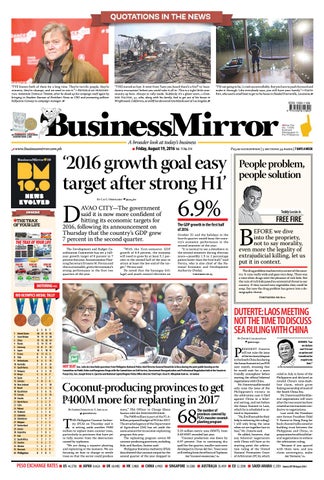
‘2016 growth goal easy target after strong H1’
D
the trax of your life Motoring BusinessMirror
Henry Ford Awards Best Motoring Section 2007, 2008, 2009, 2010 2011 Hall of Fame
Editor: Tet Andolong
Friday, August 19, 2016
E1
The Trax of your life P
Story and photos by Patrick Tulfo
The Trax is Chevrolet’s entry in the subcompact utility vehicle (CUV) segment and first saw light at the 2012 Paris Auto Show as a concept. Its final form, or the model bound for production, was previewed at the 2013 North American International Auto Show and, thereafter, it was already available for a test drive at the Montreal Auto Show in Canada with four models to choose from. It was initially available in Canada, Germany, Mexico, Lebanon, United Arab Emirates
and Europe in 2013 and the early part of 2014. In Australia it was known as the Holden Trax, while in Russia and South America it carried the name Tracker. The Trax came to our shores in the late 2014, together with China and Indonesia, as well. Surprisingly though, US buyers were only able to get their hands on it after GM’s announcement on April 14 last year that it was coming to US soil as a 2015 model. I w a s lu c k y e nou g h t o b e one of t he f i r s t fe w t o h av e
t r ie d it out . He re i n t he cou n t r y, it comp e te s d i re c t ly w it h t he l i k e s of Ford E co s p or t , Hond a H RV, M it s u b i s h i A S X and Nissan Ju ke. At f irst s i g ht , one w i l l i m me d i at e l y not ic e it s pu d g y a nd c hu n k y st yl i ng. It appea rs l a rger t h a n it re a l l y i s . The husky styling Trax is put into good use as it also translates into a roomy interior, giving all passengers ample space and comfort for long outof-town trips. D a s h b o a rd e r go no m i c s i s very similar to other offerings of Chevrolet in the country to date. It’s a bit Spartan, but controls are placed logically, so that the driver does not need to take his eyes away from the road. The motorbike-inspired instrument c lu ster w a s obv iou sly t a ken from its brother, the Sonic. It displays the tachometer, electronic speedometer, fuel gauge, transmission indicator and even the distance before empty indicator complete with an amusing graphic. Continued on E4
The Development and Budget Coordination Committee has set a fullyear growth target of 6 percent to 7 percent this year. Socioeconomic Planning Secretary Ernesto M. Pernia said this is attainable, given the economy’s strong performance in the first two quarters of the year.
THe pudgy styling sets it apart from its competitors.
Motoring
@cuo_bm
AVAO CITY—The government said it is now more confident of hitting its economic targets for 2016, following its announcement on Thursday that the country’s GDP grew 7 percent in the second quarter.
INSIDE
ARDON the pun but this scribe couldn’t help use the title to catch your attention. It was taken from a title compilation of love songs that I saw several years ago while rummaging through old CDs in a record store.
By Cai U. Ordinario
“ Wit h t he f irst-semester GDP growth of 6.9 percent, the economy will need to grow by at least 5.1 percent in the second half of the year to attain at least the low end of the target,” Pernia said. He noted that the barangay (village) and youth council elections on
6.9%
The GDP growth in the first half of 2016 October 31 and the holidays in the fourth quarter would buoy the country’s economic performance in the second semester of the year. “It is normal to see a slowdown in the second semester during election years—possibly 1.5 to 2 percentage points lower than the first half,” said Pernia, who is also chief of the National Economic and Development Authority (Neda). Continued on A5
E1
rio olympics medal tally
1 United States 2 Great Britain 3 China 4 Russia 5 Germany 6 Japan 7 France 8 Italy 9 Netherlands 10 Australia 11 South Korea 12 Hungary 13 Kenya 14 Spain 15 Jamaica 16 New Zealand 17 Brazil 18 Kazakhstan 19 Canada 20 Croatia 21 North Korea 22 Cuba 23 Poland 24 Thailand 25 Colombia 26 Uzbekistan 27 Belgium 27 Switzerland 29 Greece 30 Argentina 31 Iran 32 South Africa 33 Sweden 33 Ukraine 35 Denmark 61 Philippines
G 30 19 19 12 12 10 8 8 8 7 7 6 4 4 4 3 3 3 3 3 2 2 2 2 2 2 2 2 2 2 2 1 1 1 1 0
S 32 19 15 14 8 5 11 9 4 8 3 3 3 1 0 6 5 3 2 2 3 2 2 2 2 1 1 1 1 1 0 5 4 4 3 1
B 31 12 20 15 9 18 12 6 3 9 6 4 0 2 2 1 4 6 9 0 2 4 3 2 0 4 2 2 1 0 2 1 2 2 5 0
T 93 50 54 41 29 33 3 23 15 24 16 13 7 7 6 10 12 12 14 5 7 8 7 6 4 7 5 5 4 3 4 7 7 7 9 1
P25.00 nationwide | 5 sections 34 pages | 7 days a week
People problem, people solution Teddy Locsin Jr.
free fire
B
EFORE we dive into the propriety, not to say morality, even more the legality of extrajudicial killing, let us put it in context.
The drug problem reaches every corner of the country. It runs really wide and goes very deep. There was a time when drugs were the pleasure of rich kids. But the ruin of rich kids posed no existential threat to our country. If they turned into vegetables they could be soup. But now the drug problem has grown into a demographic threat. Continued on A11
Duterte: Laos meeting not the time to discuss sea ruling with China By David Cagahastian
HOT SEAT Sen. Leila de Lima fields questions from Philippine National Police chief Director General Ronald de la Rosa during the joint public hearing on the Committee on Public Order and Dangerous Drugs with the Committees on Civil Service, Government Reorganization and Professional Regulation held at the Senate in Pasay City. Sen. Joseph Victor G. Ejercito and National Capital Region Police Office director Chief Supt. Oscar D. Albayalde look on. ROY DOMINGO
Coconut-producing provinces to get ₧400M more for replanting in 2017 By Jasper Emmanuel Y. Arcalas
T
@arteliterary
he Philippine Coconut Authority (PCA) on Thursday said it is setting aside another P400 million to replant more coconut trees, particularly in provinces that have yet to fully recover from the destruction caused by typhoons. “We are doing a massive planting and replanting at the moment. We are focusing on how to change to senile trees so that the sector could produce
PESO exchange rates n US 46.3730
more,” PSA Officer in Charge Glenn Santos told the BusinessMirror. The P400 million is part of the P1.4billion proposed budget of PCA for 2017. The attached agency of the Department of Agriculture (DA) has set aside the same amount for its coconut-replanting program this year. The replanting program covers 68 coconut-producing provinces, including Sulu and Basilan, Santos said. Philippine Statistics Authority (PSA) data showed that coconut output for the second quarter of the year dropped to
68
The number of provinces covered by PCA’s massive coconutplanting program
3.19 million metric tons (MMT), from 3.43 MMT recorded last year. “Coconut production was down by 6.97 percent. Due to continuing dry spell for the quarter, smaller nuts were developed in Davao del Sur. Trees were still reeling from the effects of Typhoon See “Coconut-producing,” A2
P
@davecaga
resident Duterte will not raise the issue of the territorial dispute in the South China Sea during the Asean Summit in Lao PDR next month, stressing that he would wait for a more friendly atmosphere before starting the official bilateral negotiations with China. Mr. Duterte said he would only raise the issue of the Philippines’s v ictor y in the arbitration case it filed against China in a bilateral setting, and not before the Asean Summit in Laos, which he is scheduled to attend in September. “No, [I will not ask for their help in enforcing the ruling]. I will only bring the issue when we are together face to face,” Mr. Duterte said. He added, however, that any bilateral negotiation with China will have as its starting point the arbitration ruling of the United Nations’ Permanent Court of Arbitration (PCA), which
DUTERTE: “Can we declare war? It is not an option and I would not be stupid to do that.”
ruled in July in favor of the Philippines and declared as invalid China’s nine-dashline claim, which gives Beijing ownership of most of the South China Sea. Mr. Duterte said the bilateral negotiations will start after the two countries have created an environment conducive to negotiations. Last week the President sent former President Fidel V. Ramos to Hong Kong for back-channel talks aimed at building trust between the Philippines and China, in preparation for official bilateral negotiations to enforce the arbitration ruling. “Because if you quarrel with them now, and you claim sovereignty, make
n japan 0.4626 n UK 60.4982 n HK 5.9805 n CHINA 6.9903 n singapore 34.5500 n australia 35.4939 n EU 52.3598 n SAUDI arabia 12.3701
See “Duterte,” A2
Source: BSP (18 August 2016 )
BMReports BusinessMirror
A2 Friday, August 19, 2016
Recto sees early passage of bills lowering income, corporate taxes
S
By Butch Fernandez
@butchfBM
enate Minority Leader Ralph G. Recto said he expects bills seeking to lower income and corporate taxes to breeze through Congress, even as he predicts rough sailing for counterproposals to offset the revenue gap.
Coconut-producing. . . Nona in Eastern Visayas and this resulted in decreases in the number of bearing trees,” the PSA said. Santos said he is hopeful that coconut output for the remaining two quarters of the year would post positive growth, but he did not provide an estimate. “We will coordinate with the other stakeholders to assure growth.” Santos also said they are studying new coconut varieties that would yield more nuts per year. “We are studying new varieties that would yield more than the usual 45 to 50 nuts per tree per year,” he said. Santos said they are crafting a road map that would address the growth of the industry in the years to come. “We really have to plan this seriously. There
“It will be easy to pass measures lowering taxes for individuals and for corporations,” Recto told reporters when asked how soon Congress is likely to pass the remedial legislation. However, Recto admitted the same cannot be said for separate measures seen to cover the foregone revenues from lowering income and corporate taxes, such as hiking the value-added tax (VAT). “It’s more difficult to pass measures to increase taxes,” the senator said. At the same time, he cautioned Congress against rushing passage of bills increasing taxes, saying law-
Continued from A1
are a lot of factors to consider. We have to focus on fixing the trees being planted and assure the growth of produce,” he added. Agriculture Secretary Emmanuel F. Piñol earlier said he wants the country to regain its status of being the top coconut producer in the world. The Philippines is the second top coconut-producing countr y in the world. In 2014 the countr y produced 15.35 million metric tons (MMT), according to data from the Food and Agriculture Organization. India topped the list, producing 18.3 MMT during the same period. “We are still No. 1 in some aspects. But we will see to it we will be No. 1in all coconut aspects again by 2017. That’s the plan,” Santos said.
makers need to carefully consider such measures. But Recto allayed concerns that administration allies in Congress plan to railroad the passage of higher VAT rates as one of the countermeasures to cover the revenue loss from lower-income taxes and, instead, push for the reduction of VAT exemptions. But the Chairman of the Senate Ways and Means Committee Sen. Juan Edgardo Angara, who will endorse the remedial measures for plenary approval, has yet to confirm the schedule for committee hearings on the pending bills.
Duterte. . .
Continued from A1
noise here and there, they might not just even want to talk. So, Ramos is there paving the way for the good offices of anybody or any other country, but you know, we maintain good relations with China. Let us create an environment where we can sit down and talk directly, then that is the time that I would say: ‘We proceed from here. We proceed from this judgment,’” he said. Mr. Duterte also reiterated his earlier stand against an all-out war with China over the disputed territories in the South China Sea. “If we quarrel with them and they refuse to talk, can we do anything? We can’t do anything. Can we declare war? It is not an option, and I would not be stupid to do that. It could only be a massacre for all. Maybe many for us, some of them, but still war is not an option nowadays,” he said.
www.businessmirror.com.ph
House leadership sticking to Con-ass in amending 1987 Charter—Nograles By Jovee Marie N. dela Cruz
T
@joveemarie
he House of Representatives sees no other mode to amend the Constitution than the constituent assembly (Con-ass), a leader of the lower chamber said on Thursday. In a news conference, House Committee on Appropriations Chairman Karlo Alexi Nograles of Davao City said the government did not allocate budget for Charter change (Cha-cha) because its focus is on the “affordable” Con-ass. There are three modes of amending the Constitution: Con-ass, constitutional convention (Concon) and people’s initiative. Under Con-a ss, Cong ress, through its “constituent power,” constitutes itself into a body and would perform the task of amending the Charter. Altering the Constitution via Con-con will require the election of delegates. Registered voters may also launch a petition to change the Constitution. It should be signed by 12 percent of the 54.4 million registered voters, or 6.6 million. “It’s better to do this through Con-ass. If through Con-con, we need a separate budget for that,” Nograles said. Speaker Pantaleon D. Alvarez has said President Duterte now wants Congress to constitute itself into a Con-ass to amend the 1987
Constitution. He said President Duterte prefers the “cheaper” Conass over the Con-con to jump-start the country’s shift to a federal form of the government. The Speaker said Con-ass is “cheaper and faster” than Con-con, which could cost up to P7 billion. However, Nograles said should President Duterte opt for Con-con again, a supplemental budget would be needed. “Right now, we are looking at the Con-ass as mode. But, if for reasons we will have to do Concon and we need budget, and the 2017 has already passed [by that time], we have no choice but to do a supplemental budget. However, the question is can we afford this?” Nograles added. In submitting the 2017 national budget, Budget Secretary Benjamin E. Diokno has said there will be no allocation for Cha-cha, as they will do it via Con-ass. Also, Alvarez said Congress’s annual budget can be used to fund the Con-ass initiative. In the proposed 2017 budget, the government allocated P14.12 billion to Congress. Alvarez said the leadership of the 17th Congress will pass first the P3.35-trillion national budget for 2017 and other priority measures before focusing on the proposed Charter change. The lawmaker said they will tackle the proposed constitutional revisions in January.
BMReports BusinessMirror
news@businessmirror.com.ph
Friday, August 19, 2016 A3
Hope abounds for Manila’s main airport By Recto L. Mercene
T
@rectomercene
Conclusion
HE country has offered various incentives so that “new entrants,” air carriers flying into the Philippines for the first time, could land on outlying airports, “but the airline industry is market-driven and carriers fly to where the market is,” Civil Aeronautics Board (CAB) Executive Director Carmelo L. Arcilla said.
“The airlines go to the airport where the market is, while the passengers go to the primary airports because there are more options there,” he said, saying that if a certain passenger goes to an airport without daily flight, the option would be to proceed to an airport with daily schedule because that is a safer bet. On the other hand, he said air
carriers would normally fly out of airports where there are many options, “where there are many operators, where there is a market, that is where they are going.” “So it’s a challenge for the government and airports, it happens all over the world. It’s hard to entice operators to developmental gateways, that is why we do everything.”
“Kasi talaga it remains to be a market enterprise, it’s a challenging task, I hope we can do more to be able to encourage them,” Arcilla added. He cited as a successful model the Mactan-Cebu International Airport (MCIA). “Look what is happening to Mactan-Cebu [MCIA], they are marketing, promoting, because it is a private entity...profit-driven. Running an airport is a business, so they think out of the box, meron silang enticement program, improved technology,” Arcilla said. He said MCIA is offering checkthrough baggage, and even their kiosk is state of the art. “What we really need is to distribute connectivity, which is very vital to the economic well-being of a region.” Arcilla said the vacant slots are in the early morning, but only China Eastern accepted this opening, flying out of the Ninoy Aquino International Airport (Naia) seven times a week between Shanghai and Manila. Arcilla added that new applicants have to course their applications for new flights to an independent body called Airport
Coordination Australia (ACA), which approves or disapproves applications. “We hired ACA, they are the one who knows the slots, but all the slots are taken,” he said. According to the CAB headman, network airlines, such as Philippine Airlines (PAL) or Cathay Pacific, and most Middle East airlines cannot operate anytime because they service other places abroad, which should be synchronized. These airlines need certain specific slots because they have networks to serve and so, finding that the Naia could not provide them the slots needed, some airlines have shied away from flying out of the Naia. To ease the congestion at the Naia, Transportation Secretary Arthur P. Tugade has reportedly asked PAL, Cebu Pacific and AirAsia to allow those coming from Tacloban to land at Clark instead. The airlines have initially agreed, albeit with reservations and already, a business group in Tacloban is against the idea of being flown to Clark instead of the Naia. Arcilla said the proposal is under close scrutiny, and after we craft certain policies, we will
consult the stakeholders, business groups, travel associations in Tacloban, it’s an ongoing process.” When told that the three airlines concerned have initially agreed, Arcilla said: “Yes, but the devil is in the details, how many routes.” Lawmakers from the Eastern Visayas Bloc at the House of Representatives opposed the plan to transfer all Tacloban flights landing at the Naia to Clark International Airport in Pampanga. Liberal Party Rep. Ben Evardone of Eastern Samar said the plan of the transportation agency would “kill tourism and other industries in the region.” Evardone said the 14 -man Eastern Visayas Bloc, which is composed of 12 regular district congressmen of Leyte, Samar provinces, Biliran and Southern Leyte, and party-list groups An Waray and A-Angat Tayo also opposed the plan. “The Eastern Visayas Bloc in Congress strongly opposes the plan of the DOTr [Department of Transportation] to transfer all Tacloban flights to Clark,” Evardone said in media reports. But Arcilla justified the plan,
saying that there are many passengers from Northern Luzon, northern Manila, Camanava and Bulacan who wanted Clark because it is nearer to them. At the same time, he agrees that the $2.4-billion North-South Commuter Railway (NSCR) Project, connecting Bulacan to Manila, would be a big boon to Clark passengers. “I am sure, under this administration, things will move faster, kasi noon puro drawing lang, eh [then it was mostly promises].” On the other hand, Arcilla said those new carriers already operating in the country simply add more flights to their current schedules. He said Ethiopian Airlines, which started in July 2016 with three flights, have now four flights to connect Manila to Addis Ababa, the capital. This is also true with Qatar A irlines, which used to have eight f lights per day but has now 14 daily f lights between Manila and Doha. He said there are more, but couldn’t remember them at the moment and promised the Busin e ssM i r ror to prov ide t he figures.
A4 Friday, August 19, 2016 • Editor: Max V. de Leon
AseanFriday BusinessMirror
Rupiah set for biggest drop in two weeks as policy review looms
I
ndonesia’s rupiah fell, headed for the biggest decline in two weeks, before a central bank meeting on Friday when policy makers are forecast to cut interest rates for a fifth time this year.
Trading in the rupiah resumed after a holiday on Wednesday, when most emerging-market currencies in Asia declined. Bank Indonesia Governor Agus Martowardojo will lower the reference rate by 25 basis points to 6.25 percent, according to five of nine economists in a Bloomberg survey. The remaining four expect the central bank to remain on hold. The rupiah has strengthened for the past three quarters and foreign ownership of Indonesian government debt is at a record high as President Joko Widodo’s reforms gather pace. “The anticipation of further rate cuts may be weighing on the rupiah a little bit,” said Stephen Innes, a senior trader at Oanda Asia Pacific Pte. in Singapore. “It has had a stellar run, so maybe there’s some lingering profit-taking going on.” The rupiah weakened 0.2 percent to 13,114 per dollar as of 10:51 a.m. in Jakarta, according to prices from local banks compiled by Bloomberg. It climbed to 13,068 on August 1, the strongest since March, and was the only Asian currency along with the rupee to weaken on Thursday, as speculation that US interest rates will remain low for longer, buoyed regional assets.
Economic reforms
Widodo has initiated a raft of economic reforms and laid out an infrastructure blueprint, which includes building ports, roads and railways to spur growth to 7 percent by the end of his term. In June lawmakers passed a bill for a tax amnesty that lasts until March 2017 and which the central bank estimates will spur 560 trillion rupiah ($43 billion) of inflows over an unspecified period. Bank Indonesia has room to reduce borrowing costs further if the economy requires a boost, Deputy Governor Perry Warjiyo told CNBC on August 1.
The anticipation of further rate cuts may be weighing on the rupiah a little bit.” —Oanda Asia Pacific Pte. Indonesia’s 10-year government bonds were little changed, with the yield steady at 6.84 percent, according to prices from the Inter Dealer Market Association. The yield on five-year notes fell three basis points to 6.64 percent. But the best rupiah forecaster is predicting the currency will achieve its first gain in six years, as global investors get behind Indonesia’s economic overhaul. The rupiah will end the year at 13,300 per dollar, a 3.7-percent gain for 2016, according to Ebury Partners Ltd., the most-accurate forecaster in Bloomberg rankings over the past four quarters. While the projection is 1.4 percent weaker than 13,118 as of 9:41 a.m. in Jakarta on Thursday, the London-based firm has raised it from an earlier estimate of an annual decline to 13,800. The rupiah’s 5.1-percent gain in 2016 is driven by $11 billion of inflows into government bonds and stocks as President Joko Widodo made progress cooling inflation, passing a tax-amnesty law and revamping his Cabinet, including luring back a seasoned finance minister. While Ebury sees risks to the rally from Bank Indonesia intervention and US interest-rate increases,
strategists are forecasting total returns of 3.2 percent by June 30, 2017. “The rupiah should continue to hold up well during the remainder of 2016,” said Enrique Diaz-Alvarez, chief risk officer in New York at Ebury. “However, Bank Indonesia has continued to stress its desire to maintain a stable exchange rate, and we think that it will not hesitate to intervene should a sustained appreciation of the rupiah materially affect the country’s export competitiveness.”
Bank Indonesia
The central bank doesn’t want sharp currency gains and will smooth out moves to keep it from strengthening too much due to inflows related to the tax amnesty, Nanang Hendarsah, head of financial market development department, told reporters on July 28. Malayan Banking Bhd., the second most-accurate rupiah forecaster last quarter, has lowered its year-end forecast for the rupiah to 13,300 per dollar from 13,150, betting the greenback will strengthen on expectations the Federal Reserve (the Fed) will raise rates by December. Third-ranked ING Groep NV predicts 13,150. The forecasts are
more bullish than the 13,400 median estimate of strategists surveyed by Bloomberg.
Friday, according to 11 of 22 economists surveyed before the scheduled policy meeting.
‘Positive sentiment’
Economy, inflows
“Keeping the rupiah elevated against the dollar is the positive sentiment attributable to the taxamnesty law,” said Saktiandi Supaat, head of foreign-exchange research at Malayan Banking in Singapore. Beyond this quarter, the Fed outlook will support the dollar, though “strong positive factors” will cap rupiah losses, he added. The rupiah on Thursday was about 1 percent weaker than a 10-month high of 12,978 set in March, and a one-month gauge of expected swings in the currency was near the lowest level since December 2014. The country’s local-currency sovereign notes have returned 18 percent this year, according to Bloomberg World Bond Indexes, the most in Asia and the highest after Brazil and Peru among developing nations. The bonds have rallied as the slowest inflation in at least six years gives Bank Indonesia room to add to four interest-rate cuts this year. The authority will lower its new benchmark to 5 percent from 5.25 percent on
Jokowi this week forecast a growth rate of 5.3 percent next year, well below the 7 percent he said would be achieved within three years of coming to office in October 2014. Three weeks ago he revamped his economic team, bringing back former World Bank Managing Director Sri Mulyani Indrawati as finance minister. Global funds have pumped a net $8 billion into Indonesian sovereign bonds this year, surpassing the $7.6 billion of inflows in 2015. The nation’s main equities gauge has surged 18 percent as stocks attracted almost $3 billion, reversing a $1.6billion outflow last year, exchange data show. “The rupiah seems well supported at 13,100, which I infer is due to official support,” said Tim Condon, Singapore-based head of Asia research at ING. “The authorities would view further rupiah appreciation from today’s level as too much of a good thing. I expect them to accommodate rupiah depreciation pressure when it arises, subject to it remaining orderly.” Bloomberg News
Vietnam lifts ban on Australian commemoration of 1966 battle
U
nder pressure from top Australian officials, Vietnam on Thursday lifted its sudden ban on veterans who had traveled to the country to mark the 50th anniversary of Australia’s most costly battle of the Vietnam War, with the government allowing low-key commemorations. More than 1,000 Australian veterans and their families traveled to Vietnam to commemorate the anniversary of the Battle of Long Tan at a cross marking the site where 18 Australian soldiers and hundreds of North Vietnamese and Viet Cong troops died in a rubber plantation on August 18, 1966. The reversal over the ceremony, which drew some Australian veterans back to the communist country for the first time since the war, comes after Vietnam told Australia late Tuesday that the event was canceled. That decision prompted urgent talks between foreign ministers of both countries, with Australian Prime Minister Malcolm Turnbull speaking to his Vietnamese counterpart by phone. On Thursday the Australian Department of Foreign Affairs and Trade said in a statement that small groups of people would be allowed into the site, but visitors were banned
from wearing medals or uniforms and from carrying banners or flags. Groups of up to 50 people were taking turns entering the site, and were allowed to stay for no longer than 15 minutes. The Australian Ambassador to Vietnam, Craig Chittick, and two other embassy officials were scheduled to lay a wreath at the cross. “Our hope is now that our veterans and their families will be able to travel to the site and pay their respects to the fallen and to all those who served in a very dignified way,” Veterans’ Affairs Minister Dan Tehan told Australia’s Nine Network. Australian Ernie Gimm, who served at Long Tan as an air controller in 1966 and 1967, planned to visit the cross on Thursday, saying he felt it was still worthwhile for him to pay his respects despite the strict conditions. “We are not here to celebrate, but to remember those who died at war, from both sides,” said Gimm, of Queensland state. On Wednesday Tehan said Vietnam’s abrupt cancellation of the ceremony was “a kick in the guts.” He told reporters the veto reflected “deep sensitivities” within Vietnam and was not a response to problems in the bilateral relationship.
Security officers guard the entrance to the Long Tan Cross in Ba Ria City, Vietnam, on Thursday. Australia is making top-level appeals to Vietnam on Wednesday to lift a sudden ban on Australian veterans returning to Vietnam to commemorate the 50th anniversary of Australia’s most costly battle of the Vietnam War. AP
The Long Tan anniversary is Australia’s official Vietnam Veterans Day and has been commemorated by Australians at the battle scene since 1989. In the fighting, a company of 105 Australian soldiers plus three New
Zealanders supported by artillery survived a rain-drenched, threehour battle by driving off wave after wave of attacks by more than 2,000 enemy troops. On Thursday hundreds of veterans and their families gathered in
the Australian capital to mark the anniversary at the Australian War Memorial. Australia deployed more than 60,000 military personnel to Vietnam between 1962 and 1973, of whom 521 were killed. AP
news@businessmirror.com.ph
Malaysia going after all 1MDB defrauders
M
alaysia will take legal action against those who allegedly defrauded its state investment company 1Malaysia Development Bhd. (1MDB) as the government seeks to defend its reputation and credibility. The government is taking the US Department of Justice’s civil complaint that mentions some Malaysians “very seriously” amid references to funds embezzled from 1MDB, Minister in the Prime Minister’s Department Paul Low said in the text of a speech prepared for delivery on Thursday. “Should it be established that funds were taken out from 1MDB, the government will take legal action against the individuals named, or anyone else who is complicit in the scheme to allegedly defraud 1MDB,” Low said. “The money—if stolen from us—must be recovered in full, and those guilty punished in accordance with our laws and those of the countries where the money was laundered.” 1MDB is at the center of several international investigations into alleged corruption and money laundering by public officials. Prosecutors in at least four countries —Singapore, Switzerland, Luxembourg and the US—are looking into money flows from the investment vehicle, which was established for national development.
Artwork, properties
More than $3.5 billion was misappropriated from 1MDB, and about $1 billion was laundered through the US banking system, the US Justice Department said last month, laying out its case in a dozen filings. The alleged scheme of international money laundering and misappropriation stretched from 2009 to 2015, and money went to buy luxury real estate in the US, pay gambling expenses in Las Vegas and acquire $200 million in artwork, it said. The US complaint mentioned Prime Minister Najib Razak’s stepson, Riza Aziz, and a Malaysian financier, Low Taek Jho, who is known as Jho Low. Riza partly owns Red Granite Pictures, a Hollywood production company that backed The Wolf of Wall Street movie. The Justice Department is trying to seize royalties from the film, which it said was financed with money that originated from 1MDB. The US did not name any individuals as defendants. Jho Low has said he provided consulting to 1MDB that didn’t break any laws and previous efforts to reach him were unsuccessful. Red Granite has said it’s confident that Riza and the company didn’t do anything wrong.
Top official
US prosecutors also referred to a top Malaysian official who controlled accounts that received hundreds of millions of dollars. The official isn’t accused of wrongdoing. The anonymous description lines up with that of Najib, who until a few months ago served as the chairman of 1MDB’s advisory board. Najib has previously acknowledged receiving almost $700 million in his personal bank accounts before the 2013 general election. He said the money was a personal donation from the Saudi Arabian royal family and most of the money was later returned. He was cleared by the attorney-general of any graft over the case. Najib has said the Justice Department’s action should be allowed to run its course and those accused should be permitted to defend themselves. “The government’s credibility and reputation are in question, and therefore appropriate action must be taken against the perpetrators of the crime,” Low said. “Our enforcement agencies and the Attorney General must cooperate fully with all international agencies to deal with the matter in an appropriate manner in order to allay negative perception and restore the trust and confidence of the people for the government.” Bloomberg News
news@businessmirror.com.ph
BMReports BusinessMirror
Friday, August 19, 2016 A5
‘2016 growth goal easy target after strong H1’ continued from a1
“[But] the smooth transition of power and assurance of macroeconomic policy consistency and continuity by the new administration will likely keep business and consumer confidence strong,” he added. A possible threat to growth is La Niña, but the Philippine Atmospheric, Geophysical and Astronomical Services Administration said it is expected to be mild. The agriculture sector usually suffers the brunt of weather phenomena, such as El Niño and La Niña. The prolonged dry spell was tagged as the single biggest reason behind the 2.34-percent contraction in farm output in the second quarter of the year. Pernia made an assurance that the government’s recovery efforts will continue to get the agriculture sector back on its feet. The country’s economic performance in the second quarter placed the Philippines as one of, if not the, fastestgrowing economies in Asia. Pernia said the country’s growth in the second quarter eclipsed that of China’s 6.7 percent. The Philippines also bested Vietnam, which grew by 5.6 percent; Indonesia, 5.2 percent; Malaysia, 4 percent; and Thailand, 3.5 percent. Data from the Philippine
Statistics Authority (PSA) showed that Services and Industry expanded by 8.4 percent and 6.9 percent, respectively. However, Agriculture declined by 2.1 percent, faster than the 0.1 percent recorded in 2015. Net Primary Income (NPI) from the Rest of the World improved by 6.2 percent compared with 2.5 percent in 2015. This pushed Gross National Income (GNI) to expand by 6.8 percent from the previous
year’s 5.4 percent. For the first semester of 2016, GDP grew by 6.9 percent, NPI by 8.0 percent, and GNI by 7.1 percent. These growth rates are all higher than the 5.5 percent, 1.5 percent and 4.8 percent respective growth rates posted in the first semester of 2015. With the country’s projected population reaching 103 million in the second
quarter of 2016, per-capita GDP and per-capita GNI grew by 5.2 percent and 5.1 percent, respectively. These are both higher than the respective growth rates of 4.2 percent and 3.6 percent in 2015.
Inclusive growth
Economists, such as Luis F. Dumlao, a senior fellow of the Ateneo Eagle Watch, are also confident that growth in the
second semester would remain robust. The bigger challenge, according to Finance Secretary Carlos G. Dominguez III, is how to ensure that this growth will trickle down to the poor. “We still have a big task ahead of us to lower the poverty rate that have been stuck at 26 percent of our population,” Dominguez said in a statement. Dominguez said that to make growth truly inclusive, the Duterte administration would invest heavily in developing the country’s human resources, “to empower poor families to be active contributors in developing the economy.” He said the government will also fully implement the Reproductive Health Law to cut poverty rate to 17 percent by the time President Duterte steps down from office. “Mr. Duterte has put in place a 10-point socioeconomic agenda on inclusive growth at the start of his presidency to fulfill his electoral mandate to spread peace and prosperity to all sectors across all regions,” Dominguez said. “But for government to do that, it must first sustain the growth momentum by way of a stimulus program anchored on accelerated spending on infrastructure, human capital, and social protection,” he added. The Makati Business Club
(MBC) hailed the government’s thrust for social infrastructure and its plan to provide quality public education and healthcare. “[These] are two of the most critical elements that would help us achieve inclusive growth, as both have direct impacts to knowledge- and skills-building and improved productivity,” MBC Executive Director Peter V. Perfecto said in a statement. The group hopes to strengthen the cooperation between the public and private sectors, especially in eliminating red tape, which was highlighted by the President in his 10-point economic agenda and State of the Nation Address. The MBC said the government should continue to be open to listen to the pressing concerns of businesses amid its effort to stamp out drugs and criminality in the country. “This public-private cooperation will help achieve the administration’s socioeconomic agenda—for example, their target to reduce the bottlenecks and cost of doing business in the country,” Perfecto said. “ T his cannot be achieved w ithout meaning f u l consu ltation w ith businesses, micro, sma l l and medium enter pr ises, and cor porations, a like,” he added. With Catherine N. Pillas and Jasper
Emmanuel Y. Arcalas
A8
The World
Friday, August 19, 2016 • Editor: Lyn Resurreccion
BusinessMirror
California wildfire brings destruction, uncertainty
S
AN BERNARDINO, California— A ferocious wildfire had swallowed up many homes as it spread across 40 square miles of mountain and desert east of Los Angeles. Exactly how many, however, and to whom they belonged, remained uncertain.
Firefighters were faced with the difficult task of tallying that damage while still battling the huge, unruly blaze. That left evacuees in a cruel limbo, forced to spend another night wondering whether anything they owned was still intact. They included Shawn Brady, who had been told by a neighbor that flames had raged down their street. But he was waiting for official word. “What I’ve been told is that flames are currently ripping through my house,” said Brady, a dockworker who lives on the outskirts of the evacuated town of Wrightwood with his mother, sister and a dog. “I’m trying to remain optimistic,”
Brady said as he sat outside a shelter for evacuees in Fontana. “It’s the not knowing that’s the worst.” San Bernardino County fire officials could only confirm that dozens of structures had burned, and that big numbers are likely. “There will be a lot of families that come home to nothing,” county Fire Chief Mark Hartwig said on Wednesday after flying over a fire scene he described as “devastating.” “It hit hard. It hit fast. It hit with an intensity that we hadn’t seen before,” he said. Firefighters had at least established a foothold of control of the blaze the day after it broke out for unknown reasons in the Cajon Pass near
34,000 The estimated number of homes and about 82,000 people who were under evacuation warnings
Interstate 15 (I-15), the vital artery between Los Angeles and Las Vegas. The fire was 4-percent contained on Wednesday. The California Highway Patrol planned to reopen I-15 late on Wednesday night, while the southbound side remained closed. Those assessing damage were also looking for dead and injured, but none had been reported yet. Cadaver dogs were searching the ruins for anyone who was overrun by the flames. Five years of drought have turned the state’s wildlands into a tinder box, with eight fires currently burning from Shasta County in the far north to Camp Pendleton just north of San Diego. Residents like Vi Delgado and her daughter April Christy were also among those wondering whether
their home was intact, though they had found out that their pets and the shelter animals they take care of had been saved. They had been through earlier wildfires, but nothing like this one. “No joke, we were literally being chased by the fire,” Christy said in a voice choked with emotion in a minivan outside the Fontana evacuation center. “You’ve got flames on the side of you. You’ve got flames behind you.” More than 34,000 homes and about 82,000 people were under evacuation warnings, as firefighters concentrated their efforts on saving homes in the mountain communities of Lytle Creek, Wrightwood and Phelan. They implored residents not to think twice if told to leave, but it appears many were staying. “From reports that we were hearing, possibly up to half didn’t leave,” said Lyn Sieliet, a US Forest Service spokesman. “It does change the way that we can fight fire,” she added, “Now we have to worry about the people in there, as well as trying to protect the structures and trying to build a line of defense as the fire comes toward that area.” A fleet of 10 air tankers and 15 helicopters and an army of 1,500 firefighters took on the blaze, many of them coming fresh from other wildfires around the state. AP
news@businessmirror.com.ph
briefs Merkel: No link between Islamic extremism, refugees BERLIN—Chancellor Angela Merkel has dismissed suggestions that the influx of refugees over the past year has brought Islamic extremism to Germany. German news agency dpa quotes Merkel as saying that “Islamist terrorism by IS [Islamic State] isn’t a phenomenon that came to us with the refugees, it’s one that we had before, too.” Merkel was speaking late on Wednesday at a political rally in Mecklenburg-Western Pomerania, where her Christian Democrats face strong competition from the nationalist Alternative for Germany party in state elections on September 4. The country has been shaken by a string of attacks, two of which were the first in Germany claimed by IS. In those, only the attackers—both asylum-seekers—were killed. In an unrelated attack, a German teenager killed nine people in Munich. AP
Police: Notes urging violence vs Muslims a hate crime WESTBROOK, Maine—Typewritten notes urging violence against Muslims discovered at an apartment complex in Maine are being investigated as a hate crime, but there is no evidence of an immediate threat to residents’ safety, the police said. An Iraqi man went to Westbrook police on Wednesday morning and told officers that he had found a piece of paper that said “All Muslims are terrorists, should be killed,” Westbrook Police Chief Janine Roberts said at an afternoon news conference. The police responded to the apartment complex just outside of Portland and found a second identical note. They also were told that two additional notes had been discovered by Iraqis living there. One was spotted on the windshield of a car, the other three were found on the ground. The threats are being treated as a hate crime. “The people who have come forward have all been Iraqi,” Roberts said. “We have done a canvas of the complex and of those people that we’ve made contact with, only the Iraqi community has any information in relation to the threats.” AP
U.N.: Extremists foiling governments with encryption UNITED NATIONS—Increasing numbers of foreign fighters for the Islamic State group and al-Qaeda are returning home, potentially to carry out attacks, and are using the “dark web” or encrypted messaging that the most sophisticated intelligence agencies can’t penetrate, United Nation experts said in a report circulated on Wednesday. The experts monitoring sanctions against the extremist groups said governments highlighted the challenge to national security from the communication methods being used by these “foreign terrorist fighters” and people being radicalized at home who need to be monitored and investigated. They said the rise in the use of the dark web—a collection of thousands of web sites which use tools to maintain anonymity—and especially encrypted messaging “has closed off the ability of even the most sophisticated agencies to penetrate huge quantities of messages.” AP
Syrian boy rescued from Aleppo rubble
IN this frame grab taken from video provided by the Syrian antigovernment activist group Aleppo Media Center, a child sits in an ambulance after being pulled out of a building hit by an air stirke in Aleppo, Syria, on Wednesday. Syrian opposition activists reported an air strikes on the al-Qaterji neighborhood in Aleppo late on Wednesday. AP
B
EIRUT—Sy rian opposition activists have released haunting footage showing a young boy rescued from the rubble in the aftermath of a devastating air strike in Aleppo. The image of the stunned and weary-looking boy, sitting in an orange chair inside an ambulance
covered in dust and with blood on his face, encapsulate the horrors inflicted on the northern city and is being widely shared on social media. The boy is identified by doctors in Aleppo as 5-year-old Omran. They say he was treated for head injuries. In the video posted
late on Wednesday by the Aleppo Media Center, a man carries the boy away from the rubble following an air strike on the rebel-held district Qaterji. The man places the stunnedlooking boy in the ambulance and later wipes the blood from his face. AP
Diplomat’s defection poses PR problem for Pyongyang
T
OKYO—The defection of a North Korean senior diplomat in London poses a major problem for Pyongyang on a number of fronts—not least of which is how to publicly respond. As of Thursday, Pyongyang hadn’t made a public statement about the defection. But when—or if—it does, its response will likely be ferocious and accusatory. Seoul’s Unification Ministry announced on Wednesday that Thae Yong Ho, minister at the North Korean Embassy in London, has arrived in South Korea with his family and is under the protection of the South Korean government. Thae was the second-highest official in North Korea’s embassy and is the most senior North Korean diplomat to defect to the South. Seoul, which doesn’t always divulge defections, was quick to seize on this one as evidence of growing dissent within the North’s ruling elite. Its Unification Ministry claimed Thae
defected because of his disgust with the Kim Jong Un regime and worries about the future of his children. A spokesman for the ministry further said the defection is a sign of weakening unity within the North’s ruling class. Extrapolations about the bigger significance of individual defections should be taken with a grain of salt. Seoul and Pyongyang have strong political and propaganda motivations for the way they handle announcements about defections. Analysts generally agree there are no significant signs Kim’s regime is weakening. Moreover, previous defections of officials from the North have, by and large, been isolated incidents that did not lead to a chain of more choosing to flee. Thae himself has not yet spoken in public about his motives and details about the context of his defection remain sketchy. Defectors are referred to by the North in the harshest of terms.
“Human scum” is a common epithet, along with “criminals” or “traitors.” Pyongyang often accuses the South of tricking or paying its citizens to defect, or claims that they have simply been kidnapped. In April, 13 North Koreans working at a North Korean-operated restaurant in China defected to South Korea in the largest group defection since Kim took power in late 2011. The North responded furiously to the South’s account of the flight of the restaurant workers, alleging repeatedly that the women—12 waitresses and their manager—were tricked into thinking they were being transferred to work at another restaurant in Malaysia. It has also presented the colleagues and parents of the waitresses to North Korean and international media in Pyongyang to appeal for their release. Seoul categorically denies any wrongdoing. Thae’s case presents a more difficult conundrum for Pyongyang. AP
The World BusinessMirror
news@businessmirror.com.ph
Friday, August 19, 2016 A9
A TESTING TIME FOR DEPUTY CROWN PRINCE MOHAMMED BIN SALMAN Japan’s July exports dropped 14% in biggest fall since 2009
J
apan’s exports declined the most since 2009, with shipments down for a 10th consecutive month. The continued drop highlights the difficulty of kick-starting growth and pulling Japan’s economy out of the doldrums.
Key points
Overseas shipments fell 14 percent in July from a year earlier, the Ministry of Finance said on Thursday. The median estimate of economists surveyed by Bloomberg indicated a 13.7 percent decline. Imports dropped 24.7 percent, leaving a trade surplus of ¥513.5 billion ($5.2 billion).
Big picture
Weak exports have been a drag on Japan’s growth, with net exports cutting 0.3 percentage point off gross domestic product growth in the second quarter. The yen has surged about 20 percent since the start of the year, making exports less attractive and businesses more hesitant to invest. However, that has failed to deter tourists, who flocked to Japan in record numbers in July, continuing the boom in tourism from China, South Korea and other countries.
Economist takeaways
“I think the bad economic conditions in the US in the first half of the year are probably still having an effect,” said Masaki Kuwahara, senior economist at Nomura Securities in Tokyo. “For now, I don’t think the strong yen is having much effect,” he said. “Certainly the numbers up to July have been concerning, but globally we’re seeing recovery in manufacturing sectors in the US, Taiwan and South Korea. Globally manufacturing is recovering, so I think that will likely happen in Japan, too.”
The details
Exports to the US fell 11.8 percent in July from a year earlier, while those to the EU dropped 6.5 percent and shipments to China, Japan’s largest trading partner, fell 12.7 percent. Export volume fell 2.5 percent in July. A drop in exports of automobiles, ships and steel were the most significant contributors to the decline in export value. Bloomberg News
Saudi austerity starts to bite R IYADH—Fahad bin Raja sells cars for a living in Saudi Arabia’s capital. Abdullah Saeed drives them. In the kingdom’s new age of austerity, both men are finding it harder to make ends meet.
Saeed, 63, says his monthly rent of about 2,000 riyals ($560) is covered by social-insurance payments, but that leaves the cost of supporting his wife and five of his nine children who live at home. He drives a taxi and his wife sells homemade perfumes. As higher fuel and utility bills eat into his income, he says “it’s getting very hard to earn money in Riyadh.” Saudi consumers are getting squeezed by the government’s master-plan to rein in spending and reduce dependence on energy exports after a two-year oil slump. Subsidies for gasoline, electricity and water have been slashed, and there’s more to come. Deputy Crown Prince Mohammed bin Salman, the program’s architect, is promising to curb publicsector wages, and visa fees have been increased, raising the cost of importing home help. That’s a reminder that austerity is a relative term: Saudi handouts remain generous—and gasoline cheap—by global standards; domestic help is still inexpensive, while in most of the Western world it’s a luxury or an anachronism. Still, the changes are a radical shift for a ruling family that gives its citizens no say in public affairs, instead offering welfare in exchange for their loyalty. Any changes to that formula represent a gamble—in this case, by Prince Mohammed. “The risk is that the reform package will not reduce Saudi dependence on oil income, which it almost certainly won’t,” said Bruce Riedel, a senior fellow at the Brookings Institution who spent 30 years at the Central Intelligence Agency. “Then the kingdom remains vulnerable to sharp drops in the price of oil. That could create instability.” Consumer-spending growth is already weakening as the fiscal retrenchment bites. It’s forecast to slow to between 2 percent and 3 percent in 2017 and 2018, from 6 percent to 7 percent during the past decade, according to London-based Capital Economics. Imports from the European Union dropped by about 10
2% and 3%
The percentage of forecast decrease in consumer spending in 2017 and 2018 in Saudi Arabia percent in the first quarter. ATM cash withdrawals and point-of-sales transactions also fell, central bank data show. In a giant used-car lot in the capital’s Ash Shifa neighborhood, Bin Raja and his fellow dealers complain that fewer people are showing up for daily auctions, and prices are sliding. “The economic situation has gotten bad,” he said, citing the Saudi-led war in Yemen as a drag on the kingdom’s economy. Sitting in a 2004 GMC Suburban, lined up alongside hundreds of other models stretching the equivalent of city blocks, he said its sale price has dropped 43 percent in the last six months. The 33-year-old is from a generation more accustomed to abundance than their parents. Adjusted for exchange-rate, annual GDP per person soared from $29,500 in 1990 to $53,624 last year, according to International Monetary Fund (IMF) data. The oil windfall changed the face of major cities, with shopping malls springing up and shops offering luxury brands from Hugo Boss to Louis Vuitton. The ranks of the public sector swelled with millions of Saudi nationals, many paid more to do less. This year the economy is forecast to grow 1.5 percent, according to data compiled by Bloomberg. Excluding the 2009 global recession, that’s the slowest pace for more than a decade. The IMF estimates medium-term growth would settle around 2.5 percent, hardly enough to lower one of the world’s highest youth unemployment rates. The effect could have been worse. “The Saudis have avoided a crisis so far because of large reserves,” Riedel said.
U.S. Secretary of State John Kerry sits with Prince Mohammed bin Salman, Saudi Arabia’s minister of defense, after meeting with King Salman bin Abdelaziz Al Saud of Saudi at the Royal Court in Riyadh, Saudi Arabia, on May 7, 2015. State Department/Wikimedia Commons
The kingdom burned through about $175 billion of the central bank’s foreign assets since they peaked at $737 billion in August 2014, as the government sought to finance a budget deficit that reached 16 percent of economic output. It was the sheer pace at which reserves were disappearing that made action so urgent, according to Prince Mohammed and his team. Their National Transformation Program envisages cutting public wages to 40 percent of spending by 2020, from 45 percent today. Other elements include selling shares in state companies—including the crown jewel, oil giant Saudi Aramco—setting up the world’s biggest sovereign wealth fund, and a bonfire of regulations that hold back private business. The plan, announced with much fanfare over four days in June, was greeted with some skepticism— and not just overseas. Jameel alTheyabi, editor in chief of local newspaper Okaz, dismissed the ministers’ presentations as empty verbiage. A cartoon by Abdullah Jaber in Makkah newspaper showed a Saudi official presenting a citizen with a house then gleefully rescinding the offer. Businessmen are also concerned. Over a recent dinner in Riyadh, a group complained privately that it was becoming more difficult to operate after the government started delaying payments to contractors.
If that mood spreads, it could spell trouble for the 31-year-old Prince Mohammed. He heads the Defense Ministry, making him responsible for the bogged-down war with Shiite rebels in Yemen, as well as the Economic and Development Affairs Council. Failure to achieve the plan’s targets, or rapid adjustments that provoke a backlash, could hurt his image among the Saudi public and also within the Al Saud dynasty. The prince is widely thought to be the power behind his 80-year-old father’s throne, but he’s not the heir to it; that’s his cousin, Interior Minister Mohammed bin Nayef. “I think that the risks are more intra-family,” said Gregory Gause, a professor of international affairs at Texas A&M University. Prince Mohammed “has had two high-profile portfolios. The Yemen war isn’t going that well. If he does not succeed here, my assumption is that his standing in the family goes down.” That may not matter now but “it could be very important once his father leaves the scene,” Gause said. Gause cites examples in the Middle East of austerity plans that have backfired. In oil-rich Algeria in the mid-1980s, the IMF imposed spending cuts during an energy-price crash. That triggered protests and helped the country’s Islamist opposition party win municipal elections. When they looked like repeating the victory in
a national vote, the army stepped in “and we got a decade of violence,” Gause said. That’s an unlikely scenario in Saudi Arabia, which is richer, more stable, and has the bedrock of a decades-old alliance with the US Still, authorities have signaled they’re alert to the risk of popular resentment. Prince Mohammed said in April that the government wanted to limit the effect of subsidy cuts on poorer citizens. After public complaints about price increases, the water minister was sacked. In the end, it may be younger Saudis who’ll determine if Prince Mohammed’s plan stands or falls. Almost 60 percent of the country’s 21 million citizens are under the age of 30. Successful job-creation would make sacrifices worthwhile. For now, young people are noticing the changes too. “At home we’ve started to feel a bit of a sting in the day-today costs,” 20-year-old college student Aisha Saad said in an interview in Riyadh. Taxi-driver Saeed, who served in the Saudi National Guard for 17 years, says he wouldn’t mind if utility prices go up or down, if he could earn enough to pay them. He remembers a time in Riyadh when life was much easier and less expensive than it is today. “I care about being able to support myself and my family,” he said. Bloomberg News/TNS
Xi seeks to address concerns over S. Korea’s power ‘bomb’ giving a mother nightmares China’s new ‘Silk Road’ plan I
C
hinese President Xi Jinping is seeking to assuage international concern that his three-year-old signature initiative to revive an ancient trading route linking China and Europe is only about serving his nation’s interests. Speaking at a conference on the “One Belt, One Road” initiative in Beijing on Wednesday, Xi called for a step up in the implementation of projects to provide “a solid sense of gain” to all the countries involved. He also requested better risk assessment and security for the projects along the route that passes through countries prone to wars, terrorist attacks and political instability. The initiative, first proposed by Xi in 2013, aims at reviving the route that connects China and Europe via Central Asia and the Middle East, as well as a path through Southeast Asia and Africa. Critics, from countries, including Kazakhstan and India, say the main purpose of the plan is to boost China’s geopolitical influence and export China’s excess industrial capacity to overseas countries. Doubts also exist over the feasibility and security risk of the initiative. “This is a mid-stage taking stock of the situation,” said Xue Li, director of international strategy at the government-backed Chinese Academy of Social Sciences’ Institute of World
Economics and Politics. “The past three years have seen no shortage of skepticism and criticism from the international level, which mainly coalesced to viewing it as a new form of China threat. This was a proper time for Xi to make a response to these concerns, and he summed up major problems that popped up and mapped out some future direction.” Xi is expected to seek wider recognition of the initiative next month at the Group of 20 summit in the Chinese city of Hangzhou. More than 100 countries and international organizations are already participating in the initiative, with over 30 countries signing formal agreements and more than 20 countries have joined in “production capacity cooperation” in areas such as railway construction and nuclear power, Xi said. The export of China’s production and construction capacity could help participating countries push forward with industrialization and will help stabilize the world economy, Xi added. The meeting was attended by the heads of the top national economic planning body, the foreign ministry, several entrepreneurs and scholars, and senior officials from the key provinces involved in the project, such as Fujian, Shaanxi, Guangdong and Xinjiang. Bloomberg News
t’s not the searing heat sweeping across South Korea that’s keeping Park Hana awake at night, but the cost of electricity she’s using to keep cool. The 31-year-old says she dreads receiving poktan utility receipts at her 83-square-meter home in Gyeonggi province, using the local word for bomb, as the air conditioner roars to shield her toddler from one of the worst heat waves in the North Asian nation. Park’s household is among those paying more per unit of power than factories, under a program started during the mid-1970s to encourage then-fledgling industries. “I can’t turn the air conditioner off because my kid won’t be able to sleep, and I can’t resist it either as my whole body soaks with sweat after walking home from work,” Park said. “One night I had a nightmare about receiving my bill that stated I had to pay 3 million won [$2,700].” While the South Korean government last week temporarily cut household electricity rates amid record demand, Park says that’s an “act to calm down angry citizens.” This debate over power prices is playing out in different ways across the globe, as governments and utilities cope with consumers disgruntled over costs. Britain’s antitrust authority concluded a two-year investigation in June, saying UK customers are overpaying energy firms by £1.4 billion a year. In Zambia the state utility reversed an increase of more than 200 percent in prices after President Edgar Lungu said consumers couldn’t afford it. California is facing shortages amid abnormally high temperatures, with prices rising in July to a near two-year high.
Progressive increases
IN South Korea a policy by the state-owned utility that charges residential customers progressively higher rates as usage increases has fueled protests across Asia’s fourth-biggest economy. Indus-
Smokestack discharging a plume of smoke from a power plant in South Korea. Bloomberg News
trial users get a flat rate from Korea Electric Power Corp. (Kepco) and also pay less for their consumption during off-peak hours. Residential users paid 123.69 won per kilowatt-hour for electricity from Kepco last year, higher than 107.41 won by industrial consumers, data from the company’s web site show. For a household that uses 600 kWh of electricity a month, putting it among the highest-tier users, the bill would work out to be about 191,200 won. That’s about 5 percent of the average monthly disposable income at the nation’s households in the first quarter of 2016, according to government data. After the temporary price cut, the equivalent of only about $30 would be shaved off the expense, Bloomberg calculations based on data from the energy ministry show. Bloomberg News
A10 Friday, August 19, 2016 • Editor: Angel R. Calso
Opinion BusinessMirror
editorial
5
Human-rights hypocrisy
T
he Church of San Joaquin is the Roman Catholic parish church of the town of San Joaquin in Iloilo province. Built in 1869, the church is unique for its bold depiction on the façade in bas-relief of the Battle of Tetuán, when the Spanish army defeated the Muslim forces of the Moroccan army.
The San Joaquin Church is built on broad plain, overlooking the sea. The bell tower was designed as a watchtower for guards to look for and warn of attacks by Moro slavers from Mindanao who would raid the area from time to time to take captives. Here is the irony and hypocrisy. The church itself was built under the Spanish law that allowed for—if not slaves—forced labor. Various barangays were given quotes for gathering raw materials and flogging for failure to deliver was common. Then, as now, wealthier members of the community could pay someone else to do their work. In late 2014 University of Chicago law professor specializing in international law and author Eric Posner wrote a rather lengthy article for the Guardian newspaper titled, “The Case Against Human Rights.” In it he argues that while international human-rights law is considered one of the greatest moral achievements, there is little evidence that it is effective. He cites Brazil—not considered a great human-rights violator—where “every year more than a thousand killings by police—very likely summary executions, according to Human Rights Watch—take place in Rio de Janeiro alone.” He goes on to conclude that despite six major human-rights treaties, “more than 150 countries [out of 193 countries that belong to the United Nations] engage in torture. Backlashes against LGBT rights have taken place in countries as diverse as Russia and Nigeria” and are nonexistent in Middle Eastern Muslim countries. The human-rights issue has taken on particular significance in light of the intense criticism of the Philippines since President Duterte took office. Yet, since the issue was pushed by US President Jimmy Carter in the late 1970s, it has been a “Do as I say; Not as I do” situation. The US press has slammed the Philippines for not adhering to the human right of “due process of law”. Yet, by its own admission, the US government has carried out 424 “extrajudicial” drone strikes in Pakistan alone killing up to 4,000, including 966 civilians and 207 children, all in the name of the “war on terror.” Where’s the outrage from the Fil-Am audiences that Vice President Leni Robredo spoke to in the US? The hypocrisy never stops. Posner: “And while non-governmental organizations do press countries to improve their behavior, they cite the human rights they care about and do not try to take an impartial approach to enforcing human rights, in general.” “With the benefit of hindsight, we can see that the human-rights treaties were not so much an act of idealism as an act of hubris by western governments, with more than a passing resemblance to the civilizing efforts undertaken by western governments in the 19th century, which did little good for native populations.” Or just another form of colonialism.
Since 2005
BusinessMirror A broader look at today’s business ✝ Ambassador Antonio L. Cabangon Chua Founder
Publisher Editor in Chief Managing Editor Associate Editor News Editor City & Assignments Editor Senior Editors
T. Anthony C. Cabangon Jun B. Vallecera Max V. de Leon Jennifer A. Ng Dionisio L. Pelayo Vittorio V. Vitug Lorenzo M. Lomibao Jr., Gerard S. Ramos Lyn B. Resurreccion, Efleda P. Campos
Online Editor Social Media Editor
Ruben M. Cruz Jr. Angel R. Calso
Creative Director Chief Photographer
Eduardo A. Davad Nonilon G. Reyes
Chairman of the Board & Ombudsman President VP-Finance VP-Corporate Affairs VP Advertising Sales Advertising Sales Manager Group Circulation Manager
Troglodytes
ince it’s been one of the pegs for the Commission on Elections’s preparations for the October 31, 2016, barangay and Sangguniang Kabataan elections, I’ve found myself thinking a lot about the concept of gender equality lately. More specifically, I’ve been wondering about the role men can play in that field.
Worse, because many men don’t truly recognize the need for gender equality, they actually end up being the greatest, if unwitting, stumbling blocks toward its achievement. Take the recent episode from the Rio Olympics where a female swimmer wins silver and receives a marriage proposal right there on the winners’ podium.
Most men I’ve asked have said that they think gender equality is best served by opening up more opportunities for women. They joke that there should be more women scaling utility poles to repair phone lines, or that there should also be more female construction workers. And grudgingly—condescendingly even—they agree with me that we should see more women holding elective positions within the barangays. And that’s the rub. For too many men, the idea of gender equality rarely ever involves more commitment than is necessary to imagine women doing hard manual labor. This reveals both the stranglehold of
that’s a sorry state of affairs, especially considering that women and LGBTQs together make up more than half the voting population. Worse, because many men don’t truly recognize the need for gender equality, they actually end up being the greatest, if unwitting, stumbling blocks toward its achievement. Take the recent episode from the Rio Olympics where a female swimmer wins silver and receives a marriage proposal right there on the winners’ podium. Sweet, no? Romantic? Definitely. But the reportage of the event focused almost exclusively on the man’s marriage proposal rather on the woman’s achievement. People
James Jimenez
spox
S
stereotypes and dichotomies, and a tragic lack of understanding, which only serves to both distance and absolve individual males from the struggle for gender equality. Indeed, it betrays the deeply misogynistic belief that women are good only for some things and need only be tolerated when they try to excel in others. And the truly funny thing is, most men don’t even realize they are being troglodytes. More than anything else, this cluelessness effectively puts the struggle for gender equality on the shoulders of women and LGBTQs (lesbian, gay, bisexual, transgender, queer) alone. And
People problem, people solution
Judge Pedro T. Santiago (Ret.) Benjamin V. Ramos Adebelo D. Gasmin Frederick M. Alegre Marvin Nisperos Estigoy Aldwin Maralit Tolosa Dante S. Castro
Teddy Locsin Jr.
Free fire
BusinessMirror is published daily by the Philippine Business Daily Mirror
HOM
Publishing, Inc., with offices on the 3rd floor of Dominga Building III 2113 Chino Roces Avenue corner De La Rosa Street, Makati City, Philippines. Tel. Nos. (Editorial) 817-9467; 813-0725. Fax line: 813-7025. (Advertising Sales) 893-2019; 817-1351, 817-2807. (Circulation) 893-1662; 814-0134 to 36. E-mail: news@businessmirror.com.ph.
www.businessmirror.com.ph
regional offices n DXQR -93dot5 HOME RADIO CAGAYAN DE ORO E-MAIL ADDRESS: homecdo@yahoo.com ADDRESS: Archbishop Hayes corner Velez Street, Cagayan de Oro City CONTACT NOs.: (088) 227-2104/ 857-9350/ 0922-811-3997 n DYQC -106dot7 HOME RADIO CEBU E-MAIL ADDRESS: homecebu@yahoo.com ADDRESS: Ground Floor, Fortune Life Building, Jones Avenue, Cebu City CONTACT NOs.: (032) 253-2973/ 234-4252/ 416-1067/ 0922-811-3994 n DWQT -89dot3 HOME RADIO DAGUPAN E-MAIL ADDRESS: homeradiodagupan@ yahoo.com ADDRESS: 4th Floor, Orchids Hotel Building,
Rizal Street, Dagupan City CONTACT NOs.: (075) 522-8209/ 515-4663/ 0922-811-4001 n DXQM – 98dot7 HOME RADIO DAVAO E-MAIL ADDRESS: home98dot7@gmail.com ADDRESS: 4D 3rd Floor, ATU Plaza, Duterte Street, Davao City CONTACT NOs.: (082) 222-2337/ 221-7537/ 0922-811-3996 n DXQS -98dot3 HOME RADIO GENERAL SANTOS E-MAIL ADDRESS: homegensan@yahoo.com ADDRESS: 2nd Floor, Penamante Clinic Tiongson Street, General Santos City CONTACT NO.: 0922-811-3998 n DYQN -89dot5 HOME RADIO ILOILO E-MAIL ADDRESS: homeiloilo@yahoo.com
ADDRESS: 3rd Floor, Eternal Plans Building, Ortiz Street, Iloilo City CONTACT NOs.: (033) 337-2698/ 508-8102/ 0922-811-3995 n DWQA -92dot3 HOME RADIO LEGAZPI E-MAIL ADDRESS: homeradiolegazpi@ yahoo.com ADDRESS: 4th Floor, Fortune Building, Rizal Street, Brgy. Pigcale, Legazpi City CONTACT NOs.: (052) 480-4858/ 820-6880/ 0922-811-3992 n DWQJ -95dot1 HOME RADIO NAGA E-MAIL ADDRESS: homenaga@yahoo.com ADDRESS: Eternal Garden Compound, Balatas Road, Naga City CONTACT NOs.: (054) 473-3818/ 811-2951/ 0922-811-3993
Printed by brown madonna Press, Inc.–San Valley Drive KM-15, South Superhighway, Parañaque, Metro Manila MeMBer of
Continued from A1
D
rugs now go for P50 or even P20 per sachet or by tingi. This means two things: (1) The drug habits of the rich, together with investments from the Sino-Sinaloa Cartel, financed the organization of nationwide drug distribution networks reaching the most vulnerable Filipinos. The ones who, if addicted, cannot afford rehab, which is the seasonal recreation of the addicted rich. And (2) The drug problem is an existential threat to our democracy and the state. Remember that Great Britain systematically addicted over a hundred million Chinese to put China under British tutelage. The Japanese did that to China when it was their turn. Chinese have not forgotten. Chinese are now teamed up with the Sinaloa Cartel. If the drug problem (of the present scale and growing) continues, the drug people can buy our Congress, our police and elect our president. That is the drug menace. And this is what that drug
problem is made up of: (1) People with the money to source and supply drugs. (2) People who sell it, who are said to number 100,000 to 300,000. And (3) Their customers numbering 1.8 million to 3 million people, all in: sellers, takers, and both to pay for their addiction. This problem has no roots in social inequality. It is, in fact, a leveling social factor. Rich and poor in BGC nightclub or alley elsewhere feel the same: good. Good enough to rape a young woman, I am told. The problem cannot be blamed on economic underdevelopment. It
As with the heads, the only solution is to cut off, the limbs in this case. There are more limbs than heads. So expect more poor people than rich drug lords killed. But so far Bato’s people have only talked to, rather than shot at, club owners, and got them merely to promise to behave. So the drug problem is a people problem. And since a real solution must be permanent, you must address the people who are the problem. might even be a sign of economic progress. The poor can now fork out P50. This then is a personal problem multiplied by the number of people in it—a personnel problem, so to speak. And for that we turn to human resources: people willing and able to take out the garbage, again, so to speak. Look, I am not endorsing this. I am just attempting one explanation of the problem and the solution it seems to cry out for because the court system is too slow to handle it. All that being so, what is the solution? Remember, it is not a solution if it is not permanent. You gotta make
even deliriously tweeted about how “you can really have it all,” as though a marriage proposal might be the pinnacle of achievement, instead of winning a freaking silver medal at the freaking Olympics! Now I’m sure the guy didn’t exactly think of it in those terms, but it is that kind of inattention precisely that helps keep women from being taken seriously, and consequently from being considered as much a de facto candidate for “best man for the job” as men are. So, what role can men play in achieving meaningful gender equality? Men need to pay more attention to the things they do and say by perceiving those things from a woman’s perspective. We need to quit zooming in on how men traditionally define chivalric behavior toward women, and start appreciating more the abilities and skills they bring to the table. It’s a small enough task, but it’ll go a very long way in re-orienting the way we think about women and LGBTQs, and in making our society the best it can possibly be. James Arthur B. Jimenez is director of the Commission on Elections’s Education and Information Department.
the problem go away forever. Since it is a people problem it is people who must be made to go away. How do you do that? Try decapitating the problem. But most heads cannot be reached for severance in Macau or Mexico. But some are right here in prison from where they continue to do business. It is baffling that they do not meet fatal accidents in there. Are the walls cushioned? Cannot faulty wiring jazz up Jacuzzis in there? I guess money talks even now. Then there is the vast network composed entirely of many poor people who are selling to even more poor people. As with the heads, the only solution is to cut off, the limbs in this case. There are more limbs than heads. So expect more poor people than rich drug lords killed. But so far Bato’s people have only talked to, rather than shot at, club owners, and got them merely to promise to behave. So the drug problem is a people problem. And since a real solution must be permanent, you must address the people who are the problem. And that is what has been happening. Can anyone suggest another way to address a people problem than make people go away? And that is the case for what is happening today.
opinion@businessmirror.com.ph
Opinion
China’s empty oceans
The vanishing month of August
BusinessMirror
Adam Minter
Tito Genova Valiente
annotations
BLOOMBERG VIEW
O
n Wednesday Indonesia celebrated its Independence Day with a bang—blowing up several Chinese boats that had been caught fishing illegally in its waters and impounded. China doesn’t dispute Indonesia’s territorial claims, but Chinese fishermen have more pressing concerns. According to reports in Chinese state media this week, overfishing and pollution have so depleted China’s own fishery resources that in some places—including the East China Sea—there are virtually “no fish” left. That’s a frightening prospect for an increasingly hungry country: China accounted for 35 percent of the world’s seafood consumption in 2015. Seeking catches further afield —including in Indonesian waters —isn’t really a solution; fish stocks in the disputed South China Sea have themselves fallen by as much as 95 percent from 1950s levels. If China doesn’t want the rest of Asia’s fisheries to suffer the same fate as its own, it’s going to have to think much more ambitiously about how to create a sustainable food supply for the region. As in other developing countries, China’s ascent up the income ladder has been accompanied by an improvement in quality and quantity of diet. Seafood—once a pricey luxury in much of the country—has become commonplace, even inland; China is now the world’s biggest seafood consumer and exporter. The economic impact has been extraordinary. Between 1979 and 2013, China’s fleet of motorized fishing vessels grew from 55,225 to 694,905 boats, while the number of people employed in the fishing industry exploded from 2.25 million to more than 14 million. Meanwhile, the average fisherman’s income increased from around $15 per month to nearly $2,000 per month. Today, the fishing industry generates more than $260 billion annually, accounting for around 3 percent of Chinese GDP. But in pursuing growth (and catch) at all costs, China’s fishermen have exacted a terrible environmental toll. Today, the Yangtze River, which supplies 60 percent of China’s freshwater catch, produces less than a quarter of the fish it did in 1954, and most of the 170 species in the river are on the verge of extinction. The situation is no better offshore. The government acknowledges that Chinese fishermen routinely exceed annual sustainable catch limits in Chinese territorial seas by 30 percent or more. A visit to any Chinese seafood market will turn up large inventories of undersized fish that should never have been hauled in in the first place. Blame for this state of affairs falls on both the fishing industry and the government, which spent $6.5 billion on fisheries subsidies in 2013 alone. Nearly all of that money paid for cheap fuel that allowed and arguably encouraged Chinese fishermen to venture further from shore, often into the comparatively unplundered exclusive economic zones of countries, such as Indonesia. Worse, the Chinese military has openly abetted those efforts by subsidizing everything, from ice to GPS on Chinese fishing boats. The goal: to solidify China’s claim to “historical fishing
According to reports in Chinese state media this week, overfishing and pollution have so depleted China’s own fishery resources that in some places—including the East China Sea—there are virtually “no fish” left. That’s a frightening prospect for an increasingly hungry country: China accounted for 35 percent of the world’s seafood consumption in 2015. rights” in the vast and deeply contested South China Sea. Chinese regulators are fighting a losing battle against these other wings of the government. In 1999 China imposed a seasonal fishing ban in the South China Sea, and in 2002 regulators did the same in sections of the Yangtze River. But the continued deterioration of both fisheries only underscores how ineffective those restrictions have been. In response, in 2013 one Chinese scientist proposed an outright 10year moratorium on fishing in the economically essential Yangtze. This week Chinese officials signaled they were open to the idea and were even considering a wholesale culling of China’s fishing fleet. While both measures would be a boon to Asia’s fisheries, they’re only a start. To make a real difference, China would need to demilitarize its fishing fleets and end the ruinous military-funded fuel subsidies that are encouraging unregulated catches, not to mention raising geopolitical tensions. Fishing fleets should be regulated by civilian marine and agricultural authorities, not generals with little interest in environmental sustainability. Equally important, China should explicitly link the task of reviving and preserving fisheries to the clean water and other environmental initiatives in its economic planning documents, including the government’s five-year plans. Doing so would raise them to a national priority akin to cleaning up Beijing’s air. Those priorities could then be extended to trade agreements, including the Regional Comprehensive Economic Partnership China’s currently negotiating with other Asian nations, as well as bilateral deals with other claimants in the South China Sea. The goal should be to make China a leader—and perhaps even a brand—in sustainable seafood. With luck, that would buy China not just more fish to eat, but a reputation as a responsible global citizen.
V
anished fruits seem to be the concern of many people, as well (see Annotations, BusinessMirror, August 12, 2016). Readers sent in list of fruits they miss.
I wanted this column to be on vanished, as well as vanishing fruits again—a state of affairs that is more a concern of the heart than of laboratory and nurseries. The morning of Wednesday, a full day before this deadline, I woke up to a morning that was misty and touched with a bit of chill. It is August and the days of this month do not look like they belong to this month at all. August used to be a parched month, a relief from the heat of May and the rains of June and July. The rains begin in September and the cold days come after it. August has always been an anomaly, a season that was neither here nor there. Things have changed. Climate change is the most vulgar excuse for this shift in season and timereckoning. The month of August in Philippine history is a month of strange and significant assassinations. The New York Times of 1897 headlines the killing of the Spanish Premier Canovas del Castillo. The killer was described as an Italian anarchist who did the act to avenge the Barcelona anarchist and the execution of Jose Rizal. August 21 is Ninoy Aquino Day, commemorating his death, which led to the end of martial rule. And the
rest is history. It was also in August when Corazon C. Aquino died of colon cancer. And the rest is history. August 21 is a full month ahead of September 21, the day democracy died officially in the country with
D
I am! They’ll have to try much harder to block me!” If and when new leaks are publicized, that’s sure to renew questions about what the Kremlin’s motives might be. Is Russian President Vladimir Putin, as many believe, trying to pave the way for a Donald Trump presidency that would look the other way as the Kremlin tramples through Europe? Is he getting back at Hillary Clinton for what he insists was her meddling with Russian politics in 2011 while she was secretary of state? Kremlinology 101 tells us that Moscow’s true aims are usually heavily insulated and difficult to fish out. What
the declaration of martial law by the Marcoses. And the rest is sordid history. It is in this month of August that the country is on a debate with itself. The issue is whether to bury Ferdinand Marcos in the “Libingan ng mga Bayani,” a place reserved for heroes... and presidents. The assumption is that all Philippine presidents die as heroes. Some 40 years ago, I was an exchange student working in the ABomb Peace Center in Hiroshima. The city has the bleak reputation of being the first city on which was dropped the atomic bomb. It was in the month of August in 1945, a sunny day, documented by the bombers as just the right weather for dropping a bomb. No one knew
really how strong the A-bomb was until it hit the target. Nagasaki, the city of Christian martyrs, followed after Hiroshima. In August the emperor of Japan, descended from the Sun Goddess Amaterasu, declared surrender. Japan lost the war in August. Today, it has regained many things, including a heritage envied by cultural leaders. It has reinvented its folkways into works of technologies that dominate the world once more. In August our country remembers many things that are lost. They include fruits and freedom, or our sense of it and vanishing bravery to fight for it.
E-mail: titovaliente@yahoo.com.
How women entrepreneurs help women communities Imelda Canuel
Women Stepping UP
W
hen I think of women entrepreneurs—may they be designers, manufacturers, or professionals (with businesses on the side), and women communities, what comes to mind is my experience working with women entrepreneurs and communities as project officer of ECHOsi Foundation Inc., and my interactions with members of Business and Professional Women (BPW) Makati. A commonality is their desire to reach out and help other women, make this interaction a part of their business strategy, and create a win-win situation among businesses and communities. I find that women entrepreneurs inspire women in communities by sharing how they started in their businesses and how they overcame the challenges that they encountered. As one woman in the Iloilo community said about designer Len Cabili, when the latter shared how she started her upscale clothing brand Filip+Inna, “I can relate [with] what she shared, even if I am not in New York or selling beautiful clothes like her. I understood the challenges of starting a business, and keep faith in what I am doing.” Women entrepreneurs take the time to learn the production process of women communities, and suggest improvements and sets standards
for women in the communities. They show women in communities how to expand their business by the introduction of systems (from the professionals of BPW) to make their businesses more organized and efficient; they give access to materials and components lacking in their locality; and they coach the women on the art of negotiation. Women entrepreneurs may also share valuable input through the design and development of a new product. In this process, there is sharing of new practices and components, widening the know-how and capabilities of women in communities. We see designers and entrepreneurs who do this directly.
Hacking the Democrats: What is Putin’s real motive? emocrats are bracing for another wave of embarrassing disclosures unleashed by what the United States intelligence community asserts is a Russian-engineered hacking attack. Guccifer 2.0, the hacker (hackers?) believed to be tied to Russian intelligence, posted on August 12 internal Democratic Party documents with e-mail addresses and cell-phone numbers for nearly 200 lawmakers. Guccifer also talked of plans to turn over to WikiLeaks another trove of sensitive material hacked from Democratic Party computers. “Keep following…” the hacker said on Twitter. “Here
Friday, August 19, 2016 A11
is clear, however, is Putin’s penchant for meddling with the politics of other countries. Case in point: what Germany calls the Lisa Affair. In January Russian state-owned media put out a story about Lisa, a 13-yearold Russian-German girl in Berlin who claimed she had been gang-raped by Arab migrants. The story whipped up animosity among thousands of ethnic Russians in Germany toward Prime Minister Angela Merkel, who has held fast on her open-door policy toward migrants and asylum-seekers. There was just one problem with the story—German investigators determined it was false. German
officials say the Kremlin’s propaganda producers worked up the tale. The motive? To weaken Merkel, an European Union (EU) stalwart and a strong proponent for sanctioning Russian aggression in Ukraine, as she readied her party for regional elections. Across Europe, the Kremlin has been wangling its way into politics to stoke Euroskepticism. In France a Russian-owned bank lent Marine Le Pen’s far-right, anti-EU National Front $11 million ahead of her 2017 presidential campaign. Elsewhere, Russia has nurtured ties with ultranationalist organizations, such as Hungary’s Jobbik Party,
bag designer Zarah Juan, designers Tes Pasola and Reena Francisco, and artist Jeannie Javelosa. The highlighted indigenous tribes from Mindanao are the Bagobo Tagabawa tribes, and the T’boli and Subanen groups. Community groups supported include the Davao Female Correctional Dormitory, Gawad Kalinga communities and urban-poor single mothers. All members of the GWB Collective—be they designers, women enterprises and communities—are vetted under inclusive criteria that support both the development of programs and the commercialization of products. From August 26 to 28, Great Women and its members—Anthill Fabric Gallery, Nooks, Gkonomics, Tadeco and Zarah Juan—will be bringing this inclusive and empowering value chain to life and will be participating in the Marte Fair: Evolving the Filipino Craftsman, at the penthouse of 8Rockwell, Hidalgo Drive, Rockwell, Makati City. Be part of the transformation, and we hope to see you there!
Women entrepreneurs also show women in communities how to expand their markets by being their customer, and by introducing the women communities to their network. When women reach out to other women, the transformation happens to both women in communities and women entrepreneurs as agents of change and empowerment. Meanwhile, women in communities have gained a voice and have expanded their roles in the community, along with expanding their production capacities and employing more people. We have seen how women entrepreneurs have stepped up, bringing women in the communities to step up with them and creating that chain reaction of other women stepping up in their business and in their communities. A case study/example is the Great Women Collective, which supports an inclusive supply-value chain of the Great Women Brand. The GWB Collective is composed of women entrepreneurs, designers and artists who each have a community or group of women in respective value chains. Initial Great Women Collective members (as of July) include Anthill Fabric Gallery, Brownroots Creatives, ECHOstore Sustainable Lifestyle, GKonomics, Greenleaf EcoBags, Ilaw ng Tahanan, Nooks, QPELA, Tadeco, The Leather Collection; jewelry designer Wynn Wynn Ong, fashion designer Happy Andrada,
Imelda Canuel is a development consultant working with several women communities nationwide through projects on product and business development and market matching. Business and Professional Women (BPW) Makati is a member of BPW International and a nonprofit organization aligned with the United Nations Women Empowerment Principles. For more information, e-mail bpw. makati@gmail.com
regarded in Europe as a neo-Nazi group. Frothing up a Euroskeptic frenzy fits with Putin’s overall aim of weakening the EU and North Atlantic Treaty Organization, which he has always seen as an existential threat to Russia. If indeed the Kremlin is behind hacking into the Democratic Party, its motives aren’t nearly as clear-cut. Putin openly accused Clinton of fomenting Russian protests against the former KGB leader in the winter of 2011, during Russian parliamentary elections. The hacking of assorted Democratic email accounts or databases could be Putin’s way of firing back—or of flat-out intimidating her: See how easily I can
mess with you? Or, he could be harboring visions of a Trump White House that would prove naïve and pliable. If it’s the latter, Trump should think twice about a Trump-Putin reset in US-Russian relations. Maybe Trump envisions a relationship between two magnates—a brass tacks, let’s-getdown-to-business partnership built on pragmatism rather than ideals. What Trump probably doesn’t realize is that Putin’s skill set reaches far beyond the corporate boardroom: He’s an artful tactician who relies on subterfuge and no-holds-barred aggressiveness to get what he wants. TNS
BusinessMirror BusinessMirror BusinessMirror
Federal Federal PhiliPPines PhiliPPines P rising? P P rising? resident duterte, in his first State of the Nation Address (Sona); Senate President Aquilino resident in his first Stateand of the L. Pimentelduterte, III, in his inaugural speech; Speaker Nation Address (Sona); Senate President Aquilino Pantaleon D. Alvarez, in his acceptance speech, L. Pimentel III, in his inaugural speech;to and Speaker made reference to a federal form of government boost the resident duterte, in his first State of the Pantaleon D. Alvarez, in his acceptance speech, Philippines’s bid for inclusive economic growth. Alvarez outlined Nation (Sona); Senate President Aquilino made to aAddress federal form government to boost thatreference “Federalism will allow theofautonomous regions tothe realize their L. Pimentel III, in his inaugural speech; and Speaker Philippines’s bid for inclusive economic growth. Alvarez outlined full potentials as self-governing units that are directly answerable Pantaleon D. Alvarez, in his acceptance that will allow the autonomous regions speech, to realize their to“Federalism their respective constituents.” made reference to a federal form of government to boost the full potentials as self-governing units that “models” are directly answerable We are aware that there are several of federal states, Philippines’s bid forconstituents.” inclusive economic growth. Alvarez outlined to their respective such as Canada, Germany, Switzerland, the United States, Malaysia thatWe “Federalism will allow the autonomous regions to realize their are aware that several “models” of federal states, and many more; andthere that are there are forms of parliamentary systems full potentials asGermany, self-governing units that directly answerable such as Canada, Switzerland, theare United Malaysia with strong “presidents,” like France (Mr. DuterteStates, referred to that in to their respective constituents.” andhis many more; and that there are forms of parliamentary systems Sona, too). are aware that there several “models” federal to states, withWe strong likeare France (Mr. Duterteofreferred that There“presidents,” is no doubt that much more information is needed oninthe such as Canada, Germany, Switzerland, the United States, Malaysia hisvarious Sona, too). forms of federalism, and what federalism will do to the way andThere manyismore; and that forms of parliamentary systems nodone, doubt thatthere muchare more information needed the business is interaction with government isisdone on aon national with strong “presidents,” like France (Mr. Duterte referred to that in various forms of federalism, and what will federalism willattractiveness do to the way and local level, and how federalism affect the of his Sona,istoo). business done, interaction with government is done on a national the Philippines as a destination for foreign investment. is no and doubt that much more is needed on of the andThere local how federalism willinformation affect the attractiveness It islevel, in this context that the BusinessMirror, the leading various forms ofasfederalism, andfor what federalism will do to the way thebusiness Philippines a destination foreign investment. paper in the country; and the European Chamber of business isthis done, interaction with government is done on a national It is in context that the BusinessMirror, the leading Commerce of the Philippines (ECCP), being the bridge between and localpaper level, and how federalism willEuropean affect theChamber attractiveness business in the country; and the of of European business and Philippine business—in both directions— the Philippines as a destination for foreign investment. Commerce of the being the bridge between since 1978, havePhilippines partnered (ECCP), to start the dialogue/discussion/ It is in this context that the BusinessMirror, thedirections— leading European business and on Philippine business—in both information process federalism/on “models” of federalism/on business paper the country; and the dialogue/discussion/ European Chamber of since 1978, haveinpartnered to start best practices and on “bad” practices, with the aim that there will Commerce ofprocess the Philippines (ECCP), “models” being theof bridge between information on federalism/on be better understanding where we are heading, federalism/on what timeframe is European business and Philippine business—in boththat directions— best practices and on “bad” practices, with the aim there will realistic, and to what extent business will have to adjust. since 1978, have partnered to start the dialogue/discussion/ be better understanding where we are heading, what timeframe is information federalism/on “models” ofadjust. federalism/on realistic, andprocess to whaton extent business will have to best practices and on “bad” practices, with the aim that there will be better understanding where we are heading, what timeframe is realistic, and to what extent business will have to adjust.
Federalism/Presidential Federalism/Presidential Parliamentary system/ Parliamentary system/ decentralization: Federalism/Presidential decentralization: What Will it do to Business Parliamentary system/ What Will it do to Business decentralization: PROGRAM What Will it do to Business PROGRAM 23 August 2016 | 8:30 a.m.-12 nn | Marriott Manila
23 August 2016 | 8:30 a.m.-12 nn | Marriott Manila 7:30-9:00 a.m. registration & Breakfast 9:00-9:10 a.m. Welcome and opening remarks BusinessMirror/eccP 7:30-9:00 a.m. registration & Breakfast 23 August 2016 | 8:30 a.m.-12 nn | Marriott Manila 9:10-9:30 a.m. Keynote address Rep. Pantaleon D. Alvarez 9:00-9:10 Welcome BBruce Opening 9:00-9:10 Remarks a.m. and opening remarks usinessWinton Mirrorof/eccP Welcome anda.m. speaker the house of PROGRAM General Manager 9:10-9:30 Rep. Pantaleon D. Alvarez 9:00-9:10 a.m. a.m. Keynote address representatives 7:30-9:00 a.m. registration & Breakfast Marriott Manilaof speaker ofHotel the Seemann house 9:30-9:45 a.m. case study—Federal republic of Germany Benedikt usinessMM irror /ECCP 9:00-9:10 a.m. Welcome and opening remarks Brepresentatives usiness irror /eccP head 9:10-9:30 Keynote address Rep. Pantaleon D. Alvarez 9:30-9:45 a.m. case study—Federal republic of Germany Benedikt Konrad Seemann adenauer Foundation speaker of the house of head 9:45-10:00 a.m. case study—canada Julian Payne representatives Konrad adenauer Foundation President 9:30-9:45 a.m. case study—Federal republic of Germany Benedikt Seemann 9:45-10:00 a.m. study—canada Julian Payne canadian chamber of head President commerce of the Philippines Konrad adenauer Foundation canadian chamber of 10:00-10:15 a.m. case study—France Laurent Le Godec 9:45-10:00 a.m. case study—canada Julian Payne commerce the of Philippines deputyofhead mission President 10:00-10:15 a.m. case study—France Laurent Le Godec embassy of France to the canadian chamber of deputy head of mission Philippines commerce the Philippines embassy ofofFrance to the Jr. 10:15-10:30 a.m. the Philippine scenario Aquilino Q. Pimentel 10:00-10:15 a.m. case study—France Laurent Le Godec Philippines Former senate President deputy head of mission Jr. 10:15-10:30 a.m. the Philippine scenario Aquilino Q. Pimentel 10:30-10:45 a.m. the Philippine scenario Rep. Alfredo B. Benitez embassy of France to the Former senate President house of representatives Philippines 10:30-10:45 a.m.a.m.the Panel Philippine scenario Forum Rep.Teodoro AlfredoL.B.Locsin Benitez 10:30-11:30 discussion/open Jr. 10:15-10:30 a.m. the Philippine scenario Aquilino Q. Pimentel house of representativesJr. President 10:30-11:30 a.m. Panel discussion/open Forum at 845-1324 orFormer Teodoro L. Locsin Jr. For inquiries/registration, contact Julie Coronado e-mailsenate Julie.coronado@eccp.com 10:30-10:45 a.m. the Philippine scenario Rep. Alfredo B. Benitez houseJulie.coronado@eccp.com of representatives For inquiries/registration, contact Julie Coronado at 845-1324 or e-mail 10:30-11:30 a.m. Panel discussion/open Forum Teodoro L. Locsin Jr. For inquiries/registration, contact Julie Coronado at 845-1324 or e-mail Julie.coronado@eccp.com