MEDIA PARTNER OF THE YEAR
UNITED NATIONS
2015ENVIRONMENTAL MEDIA AWARD LEADERSHIP AWARD 2008
BusinessMirror
www.businessmirror.com.ph
A broader look at today’s business n
Saturday, August 18, 2018 Vol. 13 No. 308
2016 EJAP JOURNALISM AWARDS
BUSINESS NEWS SOURCE OF THE YEAR
P25.00 nationwide | 2 sections 20 pages | 7 DAYS A WEEK
Can Manila get a good joint exploration deal with China in the West PHL Sea?
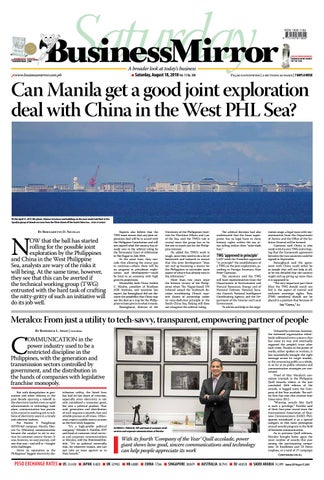
IN this April 21, 2017, file photo, Chinese structures and buildings on the man-made Subi Reef at the Spratlys group of islands are seen from the Thitu Island off the South China Sea. AP/BULLIT MARQUEZ
N
By Bernadette D. Nicolas
OW that the ball has started rolling for the possible joint exploration by the Philippines and China in the West Philippine Sea, analysts are wary of the risks it will bring. At the same time, however, they see that this can be averted if the technical working group (TWG) entrusted with the hard task of crafting the nitty-gritty of such an initiative will do its job well.
Experts also believe that the TWG must ensure that any joint exploration deal will be in accord with the Philippine Constitution and will not imperil what the country has already won in the arbitral ruling by the Permanent Court of Arbitration in The Hague in July 2016. At the same time, they concede that allowing the status quo to continue—where there will be no progress in petroleum exploration and development—could be fatal to an economy with high growth projections. Meanwhile, both Victor Andres C. Manhit, president of Stratbase ADR Institute, and maritime law expert Jay Batongbacal did not discount the possibility that China may use the deal as a trap for the Philippines to later give in to what it wants. Batongbacal, director of the
University of the Philippines Institute for Maritime Affairs and Law of the Sea, said the TWG’s role is crucial since the group has to be the one to watch out for the Philippine interest. He added the TWG’s work is tough, since they need to do a lot of homework and research to ensure that this joint development “does not end up becoming a means for the Philippines to surrender some aspect of what it has already won in the arbitration.” More than two years since the historic victory of the Philippines when The Hague-based UN tribunal issued the landmark decision invalidating China’s massive claims of ownership under its nine-dash-line principle in the South China Sea, Beijing still does not recognize the arbitral ruling.
The arbitral decision had also underscored that the Asian superpower has no legal basis to claim historic rights within the sea areas falling within their “nine-dash line.”
TWG ‘approved in principle’
LAST week the President approved “in principle” the establishment of a TWG on the joint exploration, according to Foreign Secretary Alan Peter Cayetano. The secretary said the TWG will have representatives from the Departments of Environment and Natural Resources, Energy and of National Defense; National Security Council; National Intelligence Coordinating Agency; and the Department of the Interior and Local Government. To advise and help in the nego-
tiation stage, a legal team with representatives from the Department of Justice and the Office of the Solicitor General will be formed. Cayetano said China is also ready with its own TWG and is hoping that the framework agreement between the two countries could be signed in September. Batongbacal said the agreement with China could either be so simple that will not help at all, or be too detailed that the country might end up giving up more than it is supposed to. “The very important part there [that the TWG should watch out for] is the aspect of control and exclusive sovereign rights. They [TWG members] should not be placed in a position that because of See “China,” A2
Meralco: From just a utility to tech-savvy, transparent, empowering partner of people
C
By Roderick L. Abad | Contributor
OMMUNICATION in the power industry used to be a restricted discipline in the Philippines, with the generation and transmission sectors controlled by government, and the distribution in the hands of companies with legislative franchise monopoly. But with deregulation in generation and other reforms in the past decade spurring a takeoff in the electricity market even as rapid advancements in technology took place, communication has proven to be crucial in reaching out to millions of electricity users in a timely and coherent fashion. For Manny V. Pangilinan (MVP)-led company Manila Electric Co. (Meralco), communication became the catalyst to set in motion its customer-centric thrust. It was, however, no easy journey, and one that was – and still is – fraught with challenges. Given its reputation as the Philippines’ biggest electricity dis-
tribution utility, the listed firm has had its fair share of criticism, especially since electricity is not only considered a consumer good, but also a political product. That said, generation and distribution of such requires a smooth, fast and reliable process at all times. Otherwise, expect a public outcry as soon as the first hitch happens. “It’s a high-profile political company,” Alfredo S. Panlilio, SVP and head of customer retail services and corporate communications at Meralco, told the BusinessMirror. “It’s so political externally that, for whatever reason, one can just take an issue against us to their benefit.”
PESO EXCHANGE RATES n US 53.4430
ALFREDO S. PANLILIO, SVP and head of customer retail services and corporate communications at Meralco
With its fourth ‘Company of the Year’ Quill accolade, power giant shows how good, sincere communications and technology can help people appreciate its work
Unfazed by criticism, however, the esteemed organization relentlessly addressed every concern that has come its way and eventually regained the people’s trust after each crisis. Thanks to the power of words, either spoken or written, it has successfully brought the right message across its target market, or the consuming public as a whole, in so far as its public relations and communication strategies are concerned. Proof of this: Meralco’s consistent triumph in the Philippine Quill Awards, where, at the just concluded 16th edition of the awards, it bagged anew the Company of the Year accolade. The utility firm has won this citation four times since 2012. “Winning awards like Quill is such a privilege,” Panlilio said of their four-peat record since the International Association of Business Communicators (IABC) Philippines introduced it as a special category in this most prestigious annual awards program in the field of business communication. As in previous Quill editions, Meralco brought home again the most number of awards this year among the participating companies: 14 Excellence and 13 Merit trophies, or a total of 27 campaign Continued on A2
n JAPAN 0.4820 n UK 67.9902 n HK 6.8085 n CHINA 7.7566 n SINGAPORE 38.8479 n AUSTRALIA 38.7943 n EU 60.8128 n SAUDI ARABIA 14.2499
Source: BSP (August 17, 2018 )
News
BusinessMirror
A2 Saturday, August 18, 2018
www.businessmirror.com.ph
Meralco: From just a utility to tech-savvy, transparent, empowering partner of people Continued from a1
awards, for different corporate functions—public information, internal communication, local government affairs and special projects, safety communication, sports and youth advocacy, corporate technology and transformation, investor relations, marketing, corporate social responsibility, and networks. The company’s payment subsidiary, Bayad Center, also contributed to the collection.
Secrets of success
SIX years ago, when Meralco was given the highest distinction by the IABC, naysayers took it only as a “beginner’s luck”. But when the company bagged it anew in 2016 and retained it up to the present—a pioneering accomplishment in the Quill Awards’ 16-year history—everyone now agrees that it truly is a force in the PR and communication fields to reckon with. “It’s really an honor and privilege to win this award for three straight years,” Panlilio exclaimed as he sat down with BusinessMirror recently for an interview. Pressed if ever they keep a “magic formula” to success, he stressed that it’s neither sheer luck nor any charm or amulet that accounts for their supremacy “I don’t know whether it’s a secret, but it really boils down to focusing on who is the reason for our being. And the reason for our being is really our customers,” he declared. “Our objective really is to put programs in place that help our customers.” The power utility firm’s successive wins, according to him, also serve as a validation of their hard work and dedication to strengthen their business communication excellence.
Well-informed customers
TO better serve every Juan with
China… Continued from a1
this deal we will be unable to continue exploring and developing our own resources without China and we might end up being locked in this kind of deal,” he said. Batongbacal said he doesn’t rule out that possibility, adding that China doesn’t have an urgent need for these resources. For Manhit, there is a need for strong safeguards in forging this deal with China, such as the possibility of filing cases against China if they deviate from what was agreed upon. “There is a saying that the greatest equalizer among nations is international law. Because we are small compared to them, they’re big so you have to build on the contract, on the strength of the law. What can we do if we don’t put that safeguard? Then we basically sell ourselves out. We have to protect our nation’s interest,” he said. Manhit hopes the government will be mindful of its actions that can affect future generations. “I hope that our government [officials] remember that they are accountable to the Filipino people and their actions today will have an effect [beyond] the term of office of this administration,” he said. “I use the word accountability. They will be made accountable by the Filipino people or the Philippine republic, so they need to take that into consideration, just like anyone who negotiated for Shell Malampaya,” he added, referring to the gas field in Palawan operated by a foreign-led consortium of experienced petroleum players, with a revenue-sharing scheme between the private companies and the Philippine government. In Manhit’s view, negotiations for the Shell Malampaya went well, because they satisfied the profit requirements of Shell and its consortium partners, but more so, the Filipino people. Furthermore, no money was spent by Philippine taxpayers in that joint exploration, while they got a stable energy source and a substantial revenue stream. For the country to avoid be-
the right information, particularly on the movement of electricity rates, for instance, Meralco has issued advisories on a regular-basis since 2013. “It was due to the fact that we just want to communicate and be more transparent publicly,” the top executive explained. Panlilio admitted that they are involved in a very complicated industry, wherein the consumers are not privy to the generation, transmission and distribution components that contribute to the amount of power consumption. He explained that for every peso that they have billed over the last eight years, only 16 percent to 18 percent of the total due would actually go to Meralco. “The rest are pass-through charges,” Panlilio said. “In the past three years, our distribution rates have not moved at all. But generation charges go up and down. That’s why we basically communicate to the public what is the reason for the changes. Also, half of it is explaining the rates; the second half is what tips can we give to the public.” In partnership with the Department of Energy, Meralco has also led in educating consumers on the cost of operating their appliances on a per-hour or per-day basis through the Orange Tag campaign.
Intelligent tech for convenience, savings
IN this day and age, technology has a pivotal role in how enterprises do business. Cognizant of this, Meralco embraces technological advancements not only to revolutionize the organization, but the entire energy sector as well. “Technology also plays a huge role in our business,” Panlilio said. “When I came here, our chairman also pushed for technology innovaing trapped in a bad deal, Manhit stressed the importance of consulting with the Philippine lawyers who built the case that brought the country victory in The Hague in 2016. “They would understand the limits or what we got from the arbitral award since they studied it already,” he said. “It’s best to consult them [to ensure] that we are not violating any award we got from the arbitral decision in 2016.” These lawyers, he noted, are some of the best legal minds, and are committed to protect the interest of the Filipino people. They are not beholden to China and are not politically affiliated with either President Duterte or Chinese President Xi Jinping. There are urgent reasons for extracting resources and there is nothing wrong with working with China, Manhit said, as long as it does not violate any part of the UN arbitral decision and the deal works within the bounds of Philippine laws. “China should be welcomed just like any investment from China, Japan or any other country, just like Shell Malampaya. This is a consortium of Western nations. We’re happy to serve them but it is within the laws of the Philippines,” he said.
Other players
MANHIT and Batongbacal both believe the Philippines could also work with other countries aside from China. For Manhit, it would be best for the country to also explore possible contracting or exploration with other big nations that have the technical and financial capacity, but the same rules should apply—everything is done in accordance with Philippine laws. “I always believe that we should be open to anyone who can give us the best deal or partnership. At the end of the day, what we should keep in mind is we are here for the interest of the Filipino nation,” he said. “What’s best for the Filipino nation today in the long term is more important than what is best for the political concern of certain individuals. So what’s best for the Filipino nation should be our primary goal.” Batongbacal said China is not just the “only kid in town” when it
MERALCO made a historic win at the Philippine Quill Awards with its 3-peat Company of the Year award—a first in the awards show’s 16-year history. Customercentric programs from across corporate functions contributed to the company’s 14 Excellence and 13 Merit Awards.
tion, aside from communication. We are looking at initiatives where we can really bring better service to the marketplace.” Launched in 2013, the company introduced smart metering. Initially coming in the form of prepaid electricity, otherwise known as “Kuryente Load”, this is patterned after that of the telco industry, which allows customers to buy a load of electricity within their means, anytime and anywhere. Proven effective in energy conservation, this solution also comes to petroleum development, as the government can tap other countries and corporations, if it has the political will to do it. It is not a matter of life and death for the country to push through with the joint exploration, he said, but added that a power crisis will ensue if there is no progress on petroleum exploration and development, particularly to fill in what the country will lose from Malampaya when it shuts down around 2024 or 2025. “There are other ways to fill in that gap, but more likely it’s going to be more expensive and more environment-costly,” he said.
‘Only way forward’
BECAUSE of the suspension of all petroleum exploration, which has not been lifted until now, the joint exploration track seems to be the “only way to move forward.” The track record of China in joint exploration deals is also “not really encouraging,” Batongbacal said, noting that its deals with Japan, Korea and Vietnam were not successful for various reasons. Assuming the PhilippinesChina joint exploration deal will be successful, Batongbacal said this will be a new thing. Cayetano has since defended the decision on the joint exploration, saying that the country will not allow the oil and gas to be harvested “unilaterally.” He earlier noted that the Philippines will not agree unless the resulting deal is as good as, or better than the Malampaya agreement. The Philippine government and the Malampaya consortium have a 60-40 sharing of revenues for the gas deposits off the shore of Palawan. Given that the Duterte administration boasts friendlier ties with China compared to the previous administration, getting a comparative or even better deal than the Shell Malampaya should be a realistic goal. Cayetano has since said both parties have to temporarily set aside their claims to both territory and sovereign rights for the joint exploration to push through. To be sure, the work of any TWG will not be easy or simple, but the challenge should be enough motivation to move forward.
empowers Meralco customers, providing users with regular updates on their consumed amount via their mobile phones. This, in a way, teaches them how to utilize energy wisely and, at the same time, eliminates the so-called “bill shock” often associated with postpaid services. “So imagine the benefit that they are getting from just understanding consumption; [it] is so great that their savings on a monthly basis is from 15 percent to 18 percent because they know their actual consumption on a daily basis,” said Panlilio. To date, Meralco has installed about 100,000 smart meters nationwide; and 140,000 applications have been approved. Even though these are a fraction of the company’s total accounts of 6.5 million —of which 91 percent or 5.9 million are mass market residential customers—Panlilio is confident that they will hit the 3.3 million smart meters target by 2024 as part of their long-term smart grid roadmap. “Kuryente Load is just one product of smart metering. It can also be for postpaid,” he said of its future application across their franchise area. “We’re looking at a smartphone application, wherein you’ll know the consumption per appliance. So we can give you analytics on the major contributors to your usage, which we hope will change your utilization for the better.” Meralco also keeps on advancing its distribution management systems to provide better service to customers. Through this project, which also forms part of its smart grid plan, the utility firm integrates “smart intelligence” into its distribution network to better manage the electricity consumption of its clients.
Improved customer experience
NEW digital solutions have given today’s consumers unprecedented access to information about products and services, thus, giving them more choices. With this in mind, businesses now look for ways to better respond to and satisfy the evolving market requirements. Addressing the needs of the consuming public, therefore, is always a top priority for Meralco. “We’re embarking on a customer experience transformation program, wherein we’re going to digital platforms for customer service,” Panlilio said. The company is set to launch its customer experience engine (CXE), an undertaking that was conceived after the firm conducted a survey on the four pain points of consumers: Application process, payments, restoration, and feedback. “So based on those pain points, we created a platform where you can now apply online or via your smartphone. Your bill can be presented online and you can also pay online. You can also advise us of any outage,” he noted. “In the future, hopefully, we will have chatbots answering your queries.”
Cost-efficient strategies
BY and large, successful PR and communication strategies require a huge investment. This, however, is not the case for a multi-awarded organization like Meralco. When it comes to their advertising budget, Panlilio estimated that it’s even less than half of the allocation of most companies similar to their size. “Of course we still do the traditional media—the radio, television and print,” he said, without citing the exact amount of their ad expenditures. “But it’s very small because we’re regulated.” Accessibility and accountability, according to him, make a big difference. He cited his team’s availability to the press whenever an issue concerning the interest of their customers and stakeholders needs to be addressed. “If there’s a problem, we don’t hide from the media,” he said, citing Meralco AVP for Public Information Joe R. Zaldarriaga as the company’s spokesperson to the media. “I told him that we need to
be more aggressive to really communicate more. With one issue, it’s so easy to blame us.”
Customer satisfaction index
THAT mindset, eventually, changed the reputation and image of Meralco as a brand. Proof of which is the company’s latest record-breaking rating in the Customer Satisfaction Index (CSI), which measures its fulfillment of client expectations on its service process and offerings. “We have an all-time high in the last three years,” Panlilio said of their improved CSI performance, which used to be on a range of 6 and 7 points. “Over the last month, it’s 8.2 out of a scale of 10.” The good relation they have established with the local press is reflected in the extensive trimedia mileage, mostly positive reports on the company, as compared to their ad placements. “We’re very serious also in creating a very transparent annual report because we want to make sure that we’re accountable for our numbers and, at the same time, transparent to the public [about] what we’re into,” added the top executive.
Social media
ANOTHER factor that enables Meralco to sustain the top Quill citation is its maximized use of social media. Five years ago, he recalled their team’s plan on how to expand their presence in Facebook (FB) and Twitter. “I’m glad we decided to go ahead because initially there were some negative comments and tweets, but we were able to answer them directly and they were able to get feedback. It became a positive engagement, rather than negative.” At present, Meralco’s followers on Twitter and FB have reached 2.2 million and 550,000, respectively. Given this, analytics think tank Socialbakers has recognized the company as among the top utility firms involved in these platforms. “These are the things that we’re exploring to reach out to our customers via their computer or smartphone,” Panlilio stressed.
Effective communication amid business disruption
SEEING the advent of manifold technological breakthroughs in the enterprise world at present, the power giant, like any established business in the country, is still vulnerable to these changes, as acknowledged by Meralco’s senior executive. “That’s why as early as now, we’re looking at how we can futureproof Meralco,” Panlilio said, in anticipation of the emergence of the so-called “prosumers” (producers and consumers) as renewable energy adoption in the domestic market is seen to accelerate soon. Proactively, the utility firm has already established Spectrum, a new subsidiary focusing on solar power. What’s more, it has formed an entity that deals with electricvehicle (EV) operation. “That’s a future business model, I think, that will also help Meralco aside from the charging [of EVs],” Panlilio said, while disclosing their recent filing with the Land Transportation Franchising and Regulatory Board of an application for a route, either for an e-tricycle or ejeep, from Mandaluyong City Hall to Buendia LRT station. These and other “green” initiatives have not only spoken highly of Meralco’s responsible corporate citizenship, they also brought it many excellence awards. “So those are the major threats that we ourselves are trying to disrupt ourselves,” he said. “Many of the wins we have were actually disruptive communication.”
Maverick leader
BEYOND innovative programs in place, Meralco’s winning streak in the Quill Awards in recent years may also be attributed to the man behind its sterling PR and communication campaigns. A CEO Excel awardee of IABC way back in 2013, Panlilio’s professionalism and expertise have enabled him to turn around the company’s image and improve its
relationship with the public. No wonder he’s considered an industry trailblazer both by his coworkers and contemporaries in the field. “As a leader, he inspires all of us,” Zaldarriaga said of Panlilio. “He brings the best in each and everyone of us, which resulted in Meralco getting the three-peat Company of the Year award.” The SVP and head of customer retail services and corporate communications moved to Meralco from its affiliate telco provider in 2010, initially, with a goal to improve the entity’s business. As a result of this, the company posted a year-to-date growth of 6.2 percent in energy sales on the back of strong market demand for electricity. “I went into customer segmentation,” he said of his course of action that helped the firm bolster its financial performance and understand better its target markets, such as corporate partners, BIZ clients (small and medium enterprises) and residential patrons. “And then we wanted to energize earlier because the more we energize, the [better] for us. Any delay affects business,” he added, while referring to Meralco’s improved customer base—rising by about 4.8 percent from 3.5 percent eight years ago. Taking a cue from the company’s previously challenged image, Panlilio’s second objective was to appease the negative public notion of the firm, saying that he wanted to “make it appear softer and kinder.” “Whenever they see this iconic building in Ortigas, they probably wonder if there are actually people there. In other words, if the firm has a heart,” he emphasized. “Malasakit is among our corporate values. So everybody here works hard. Everybody here wants to satisfy the customers.” Asked for advice to PR and communication practitioners, Panlilio’s suggestion was short and simple: tell the truth, be honest and transparent about whatever challenge one’s organization is faced with. “It’s really just being truthful to the public and accountable. If you commit a mistake, say that you made a mistake. You have to be very proactive on issues because that’s the only way the people can see what you’re doing and, hopefully, their view of your company will change,” he said.
Keep the ball rolling
INCEPTED in 1903, Meralco has remained the country’s largest private sector electric distribution utility company, serving 36 cities and 75 municipalities, including Metro Manila. Its franchise area spans 9,685 square kilometers, covering the core of the nation’s industrial, commercial and population centers. Even if it’s viewed as an unchallenged monopoly that no longer requires any publicity stunt to maintain its staying power and relevance to the market, there’s still no stopping the 115-year-old homegrown power firm from communicating constantly with the consuming public, shareholders and stakeholders. “That’s not in our mindset. Our mindset is really customerfocused,” said Panlilio, who is also a sports executive and a head honcho of the Samahang Basketbol ng Pilipinas and the MVP Sports Foundation. Despite the company’s continuous success in the Quill Awards under his leadership, the former athlete vowed to sustain it in the coming years. “We appreciate the awards, but it will not make us lax or complacent because a lot of work was done to achieve that. We will continue to have to work harder not because we want to win another award, but I think, again, for our customers to see what we’re trying to do to serve them better,” he said. “I hope they see us or they trust us as their partners. We want to become their end-to-end energy solutions provider. Truly, ‘may liwanag ang buhay, ang negosyo, ang bukas’ [There is light in life, the business, and the future],” Panlilio concluded.
ExecutiveViews BusinessMirror
A3 Saturday, August 18, 2018
AN ENTERPRISE THAT KEEPS ON GIVING A
By Marane A. Plaza
ccess to clean water is not just people’s necessity, but a common human right. It is also a business opportunity that empowers a person financially and provides income so he or she can afford to sustain his or her other needs in life. But what if you can have both - access to clean and high quality water and a thriving business opportunity? Isn’t that a sweet deal? ALKAVIVA, the company that offers water treatment machine installations and opportunities for people to have their water refilling stations, allows Filipinos across the country to have a chance of drinking clean, standard, world-class water and to have their own businesses. Founded by husband and wife Engr. Louie Cristobal and Engr. Grace Cristobal in October 2011, ALKAVIVA has bettered the lives of Filipinos by installing various water treatment machines and water refilling stations sourced from different countries, in different provinces, from north to south of the Philippines. Even our fellowmen from rural corners of our country no longer need to depend on natural water from spring and deep well with the aggressive and wide reach of ALKAVIVA. Inspired by their goal of maintaining a healthy lifestyle, female entrepreneur Engr. Grace Cristobal, together with her husband Engr.Louie Cristobal, built a water refilling station to have better access and start a lucrative business by producing alkaline water. In an interview with Business Mirror, Engr. Grace shared that “We really do not have authentic alkaline water here, as genuine alkaline water can be sourced from melting snow, and we know we do not have snow here in the Philippines. However, there’s a technology that can produce the same characteristics of the alkaline water, such as zero acid content and higher pH level, and that’s through water treatment advancements. These water characteristics are good for one’s health, because they allow your body to absorb well the minerals we can get from vitamins and medicine. And our goal to have access to that kind of water is what brought life to our very own water refilling station in October 2011.” But just like any other budding entrepreneur, the couple Engr. Grace experienced some hardships right at the beginning of their business. “My husband and I are very technical people, as I worked as a Network Operations Engineer for Broadband ZTE, while he worked as a technical engineer for Apple. So, as we went on using the first ever machine installed for us, we noticed right away that the water treatment machine installed in our water station was sub-standard. We would always pay service fees to the technician of our former water refilling station installer. It came to a point that all of our money were just going to the technical maintenance fees of the machine,” she said. Since the couple are both Electronics and Communications licensed engineers, they used their technical backgrounds in testing other water treatment machines and doing their own research online to further widen their knowledge of the technology of their then new venture. True enough, they learned that te c hnic ians would make them change and pay for some replacement parts of the machine, even if
there was no need for it to be fixed at all. That’s when they realized that the headache of paying for the technicians’ service fees might go on if they won’t do anything about it. In February 2012, just three months after ALKAVIVA's inception, the couple decided to avail of a new water treatment technology sourced outside of the country which has guaranteed high quality functions and “no shortcut procedures” into its water filtration process. “This new technology is at par with the standard set by the Food and Drug Administration and the Department of Health, and this gave us all the more reasons to use it for our business,” she said. A light bulb moment happened almost immediately that same month of February, as Engr. Grace did not want for other water refilling station owners to experience what they had experienced from their previous transactions with their first water treatment supplier. She thought that she might as well help other entrepreneurs to save a lot of money by helping them avail of the same high quality water filtration technology from abroad. “We trained ourselves to be the water treatment installers ourselves, since we are really technical people. We decided to offer installations to these aspiring entrepreneurs who also want to have their own water supply business. This time, ALKAVIVA is an installer company. We would improve the process of installing the machines and show clients how they should handle situations by giving them technical know-how seminars so they themselves can understand how the machines work. That way, they would save a lot of money since they do not have to pay for customer service fees, technician’s service fee, and unnecessary machine parts for so-called `maintenance`. We wanted to empower them to grow their businesses themselves so they would dodge the bullet of having a lot of financial woes,” said Engr. Grace. ALKAVIVA offers very affordable business packages for those who want to pursue a water refilling business. For only a down payment of 30,000php from the total contract price of 151, 000php, anyone can start building their own business. Business owners can pay the balance thru a monthly fee of 3, 362php for a period of three years. Yes, now you can have your own business and access to high quality water- be it alkaline, mineral or purified, through an easy installment plan. “We are not into franchising, we just install the machines. I want each of my clients to have his or her own brand name so they can be known for their own business, too. You can earn as much as your monthly obligations from ALKAVIVA.” As of December 2017, ALKAVIVA has already installed about 5, 278 high quality imported water treatment machines sourced outside of the country. There's more than 5, 000 thriving entrepreneurs and water stations that give access to clean water all over the country.
Water is Life
“We have gone through a lot of financial and health issues before, and clean water literally saved our lives. So as much as possible, we want to empower our fellowFilipinos through entrepreneurship and clean water,” Engr. Grace said. “Filipinos are even more cautious when it comes to water and are thus more aggressive now in terms of starting a business. We are thankful that some even fly to Manila all the way from Mindanao just to meet us, while some just fully entrust and pay the down payment through bank transfers because we have built the credibility of our brand and product.” To this day, Engr.Grace, with her supportive husband Engr. Louie continue to empower fellow-entrepreneurs, regardless of age, status, attainment. “We always do weekly seminars about the technical know-how’s and people management for all of our clients, so they can sustain their income,” she said.
“Because if they are doing well, then they can pay us properly as well. It is give and take. We need to help them too. I always encourage them to have good management of their business and resources. You do not have to stay in your water station 24 hours a day. If you have strong influence over your employees because they respect the way you do things in a good manner, then you can manage your employees well and efficiently anywhere you are. Your employees will follow you out of respect and concern. They will help your business grow. The system and management that I apply with my own employees, is what I also teach our clients.” Clearly an empowered woman who always gives much more and pays it forward. From September 2017, ALKAVIVA is committed to give away two water refilling stations to deserving communities. Engr. Grace and her husband Engr.Louie revealed a hearttugging incident. “Last September, we had a Facebook promo wherein I asked our followers to write us a letter and send us some photos to prove why they deserve to have their own water refilling stations for free. One 17-year-old college girl`s testimony from Inarawan, Antipolo really touched me. I did not know that there’s still undeveloped areas in Antipolo, and that they do not have good roads or safe, potable, quality water for personal use. They get their water from a spring which they are not sure if it is safe or clean. They were drinking water direct from the same spring and right above it is the area where there were construction sites. We gave her her own water refilling station, and that was not just for her own sake, but also for the benefit of her entire community. Now, their entire town have access to clean water, and everyone can earn money from it through a cooperative system. I also gave away two-year course college scholarships to some children there." ALKAVIVA`s founders also gave away a free water station to the victims of typhoon Yolanda who are now relocated in Rosario, Cavite. “We thought, since the lives and livelihood of these Yolanda victims were destroyed by water, then water should be the one to raise them up, too. So we installed a water treatment technology and station there too, for that entire community to start anew. We did not give it to just one individual, because we want them to help each other as a community. Everyone in that town can drink from and earn money from their Alkaviva business,” she said. “We also gave them the same scholarship grants.” As of this writing, some 300 scholarship grants nationwide have been awarded as part of the couple`s advocacy.
Learning from the Best
What can Engr. Grace and husband Engr. Louie Cristobal share to aspiring entrepreneurs? “First, you should make it a habit to have a positive mindset. Positive thinking helps you instinctively pray for knowledge and wisdom from God, for peace of mind so that you won’t need to worry about the financial aspect of things because you know that God provides. You are also led to pray to have smooth transactions, and as you have faith in the power of prayers, the Lord will also lead you to the right people to work with,” she said. “Second, win over your clients with your heart’s good intentions. Third, build a good management system and sound marketing strategy. Trust that even if a competitor exists nearby, ALKAVIVA water can win, hands up. Because superior quality never runs out of customers who want value and quality. And since water is a basic human necessity, it will sell by itself. Your relationships with your employees and customers is what you consistently need to nurture,” she concluded.
ExportUnlimited
A4 Saturday, August 18, 2018 • Editor: Efleda P. Campos
BusinessMirror
PHL trade exec sees opportunities in ‘Fourth Industrial Revolution’
T
RADE Undersecretary Nora K. Terrado shared various implications of the fourth industrial revolution to trade and investments during the 2018 Philippines-Korea Copyright Forum held on August 8 in Makati City. “This revolution will disrupt status quo and create new businesses —heralding the transformation of systems of production, management and governance,” Terrado said. The forum, a joint initiative of the Intellectual Property Office of the Philippines and the Korea Copyright Commission, discussed various challenges at the onset of new technologies, such as artificial intelligence (AI), big data and the Internet of Things tagged collectively as part of the Fourth Industrial Revolution (4IR). Being among the key speakers of the event, Terrado discussed insights in coping with the various opportunities provided by the changing world and discussed initiatives of the government in assisting Philippine businesses and industries. Terrado cited the Global Innovation Index 2017 report which laid out areas of strength and improve-
ment for the Philippines. Knowledge and technology outputs and business sophistication are two of the identified strengths of the country while areas of improvement include institutions, human capital and research, infrastructure, market sophistication and creative outputs. Terrado noted as high in the discussions of strategies the observable change in consumer expectations that reflect the increased importance and emphasis on privacy, ownership, concepts of time and the changing modes of commerce. She explained the roles of product and services enhancement, collaborative innovation and organizational reforms. For the Department of Trade and Industry, Terrado cited the overall goals of building the innovation and entrepreneurship ecosystem, removing obstacles to growth, attracting more investments, strengthening domestic supply chains and deep-
A call to action for social entrepreneurship By May Nina Celynne P. Layug
W
TRADE Undersecretary Nora K. Terrado delivers a presentation during the 2018 Philippines-Korea Copyright Forum held on August 8 in Makati City.
ening the country’s participation in regional and global value chains. She discussed the Inclusive, Industrial, Innovation Strategy (i3S) being implemented by the Department as part of its efforts to transform the country’s economy in the new digital age. With i3S, the DTI aims to present new industrial policy, bolder trade policy and intensive investment promotion initiatives. Meanwhile, IPOPHL mentioned in a published release that the 4IR is an opportunity in making the administration of intellectual property
more efficient. As patent information and libraries are being digitized, AI can aid in search of prior art, and can be used as tools for patent examiners to speed up research and to facilitate litigation for IP cases. “From the software, to the actual device carrying the software, to the business created from it, intellectual property can come in terms of copyright, or patent, or a trademark. IP will be at the center of this Fourth Industrial Revolution,” IPOPHL Director General Josephine R. Santiago said.
T
PHILIPPINE Trade and Investment Center-Jakarta Commercial Attaché Jeremiah Reyes is joined by some participants during the nursing education fair held on July 30 and 31 in Medan, Indonesia.
ticipating schools like UST and CEU established partnerships with Indonesian universities. Matching sessions among Philippine nursing universities, Indonesian schools and associations were also conducted at
market development update
Philippine Trade and Investment Center-San Francisco
DTI launches nursing education fair in Indonesia
HE Department of Trade and Industry successfully co-organized the nursing education Fair on July 30 and 31 in Medan, Indonesia. The fair was organized with the assistance of the Philippine Trade and Investment Center in Jakarta (PTIC-Jakarta) and the Embassy of the Philippines, together with the top Philippine universities and accredited institutions in the field of nursing. Participated in by more than 300 Indonesian students, faculty and school administrators from Medan and North Sumatra, the event provided an opportunity for Philippine nursing schools to assess the Indonesian space for expansion, as well as forge academic partnerships, student exchange and capacity building for faculties. PTIC-Jakarta shared that part of its strategic initiatives in Indonesia is the promotion of Philippine education services through school visits and road shows. Top Philippine nursing schools joined the fair, including University of Santo Tomas (UST), Centro Escolar University (CEU), Far Eastern University (FEU), San Pedro College Davao (SPC), University of Perpetual Help Dalta (UPHD) and Saint Louis University (SLU) in Baguio. During the two-day event, par-
Sari Mutiara University for prospective students and possible memorandum of understanding (MOU). “The fair aimed to further the cooperation between the Indonesian and Philippine nursing educational
institutions. By promoting the educational services sector, we hope to provide more opportunities in the country that will eventually lead to job generation,” PTIC-Jakarta Commercial Attaché Jeremiah Reyes said.
E have been fortunate to host, together with the Philippine Consulate General in San Francisco and the Department of Tourism (DOT), Mr. Thomas “Tom” Graham, Founder of MAD Travel, author of the book The Genius of the Poor: An Englishman’s Life Changing Journey in the Philippines, and an advocate for social tourism. I first bumped into Tom during my business development trip to Los Angeles as I was finishing up my meeting with the Los Angeles branch of the DOT for alignment and collaboration that focus on tourism and trade. As brief as the introduction was, one would already see the passion and affiliation of Tom for Filipinos. He shared with me his book with a personal note “Time for adventures that matter in the Philippines. Walang iwanan.” Where did such love for the Philippines come from, more so from an Englishman? Curious, I took on his challenge and started by reading his stories of the Filipino communities that changed his outlook in life and even did a 360-degree turn on his career. A British journalist assigned to explore and produce business reports on one of the fastest-growing economies in Southeast Asia, Tom visited the Philippines in 2012. Tom’s impressions of the Philippines were a view from the top and the scene before him seemed to say it all—a booming metropolis, with impressive new towers. But, his eye also captured the “growing pains” of a developing country and delved deeper in search of the “missing middle.” That led him to Tony Meloto of Gawad Kalinga, who brought him to an incredible journey through the eyes of the Gawad Kalinga communities that forged forward in making better lives for themselves in partnership with the Gawad Kalinga volunteers. I emphasize partnerships that led to the discovery of the Filipino’s capacity for fun, resilience in adversity, strong sense of family, the gift of hospitality, a propensity to collaborate and resolve to overcoming the odds. These are Filipino characteristics that we as Filipinos often take for granted. It is humbling to have this sense of pride rekindled by Tom’s stories. Tom’s journey inspired him to establish Make a Difference (MAD) Travel, a social enterprise that creates opportunities for and with marginalized communities through sustainable social tourism. MAD Travel creates alternative travel experiences that bring together people from different walks of life, immerse them in local culture and inspire them to make a difference. We have seen the potential for synergy between the DOT and the Department of Trade and Industry (DTI) on trade and tourism. I have met many foreign business owners in the Philippines sharing with me their stories of visiting the Philippines as a tourist. Enamored by its beauty, they decided to
set up their businesses. They stayed on as business owners sharing the Philippines’s growth story. There is also much alignment with advocacies on Filipino cuisine and the creative economy. But social tourism is a collaboration we are all excited about. Social tourism is a platform that foster social entrepreneurship. MAD Travel is a concrete example of how a social immersion inspired an individual to engage in social entrepreneurship. I believe that social entrepreneurship is a concept better understood through the stories of those who engage in such endeavors like Tom’s. Human Nature, now the Philippines’s leading brand of natural, locally sourced and processed health-care products; Bayani Brew which thrives through partnerships with farming communities and is now in mainstream grocery stores in the Philippines; Gourmet Keso, whose local and natural ingredients are enjoyed even by Gawad Kalinga’s cheese-loving French interns, referring to it as “French-approved” cheese; and Plush and Play, which offer quality stuffed toys and the source of income for 500 families by 2017, are among the stories of transformation through social entrepreneurship. More and more people are beginning to see the Philippines as a viable destination to discover their purpose and passion as social entrepreneurs. Since its inception, MAD Travel has arranged visits for 1,500 visitors mostly from France, the United Kingdom and other Asian countries that contributed to between 200-percent and 300-percent income increase for the 18 livelihood sources. Through the DTI’s Trabaho, Negosyo, Kabuhayan (TNK) “OFIs [overseas Filipino investors] as Catalysts for Growth” program and the Philippine Consulate General in San Francisco’s Spark Connect Empower (SCE) Movement, the 3.7 million Filipinos in the United States and Filipino-American organizations can all be catalysts for growth and transformation. I now echo Tom’s call to action to our TNK and SCE partners “time for adventures that matter in the Philippines.” TNK is a new government blueprint for decent job creation through employment and entrepreneurship. It was a joint effort of the DTI and the Department of Labor and Employment. The DTI and DOLE’s advocacy is to create 7.5 million jobs in 2016 to 2022 and support incomegenerating opportunities. Spark Connect Empower or SCE is a movement intended to spark love and passion among all Filipinos (including those of Filipino lineage)—both at home and abroad—about their Filipino culture and heritage; connect them with one another, and in the process, empower them as individuals and as a community.
For comments and questions, you may reach out to siliconvalley@dti. gov.ph. Know more about MAD Travel at http://madtravel.org
DTI targets start-up firms to provide tech innovations via info session By Sara Grace C. Fojas Writer, DTI-KMIS
T
HE Department of Trade and Industry recently conducted the Innovation Circle Startup 101 Info Session to increase the awareness of DTI officials and employees on the start-up industry. Organized through the Export Marketing Bureau (EMB), the session was held at the QBO Innovation Hub located at the Ground Floor, DTI International Building, 275 Sen. Gil J. Puyat Avenue, Makati City. Sessions during the event discussed
the elements of a start-up and how to start one, its ecosystem in the Philippines, as well as its difference from micro, small and medium enterprises (MSMEs). It was held in partnership with QBO, JP Morgan and IdeaSpace. “We want to create more startups. We in the EMB and the whole department want to support start-ups and push them to go global or probably expand their market reach. We are looking at start-ups who already passed certain stages and have the willingness to go beyond where they are,” EMB Assistant Director Agnes R. Legaspi said.
Under the Philippine Export Development Plan (PEDP), which provides the business environment support in trade, growth and innovation, the DTI developed the five-point Startup Ecosystem Development Program (SEDP) to foster inter-enterprise linkages among MSMEs and strengthen collaborative works. With this program, the government aims to create highgrowth and high-impact start-ups that will nurture innovation, sustain economic growth and generate largescale employment opportunities. The five-point program is divided across the following areas of develop-
ment: increase culture and collaboration; address legal and regulatory barriers; support through government services, capital and resources; create a national start-up business council; and establish a Philippine start-up economic zone. During the event, participants were quizzed about the state of the start-ups in the Philippines during the QLITANwithQBO. Together, they learned that some start-ups are thriving and can be successful here in the Philippines as exemplified, for instance, by the fintech company Lendo, the EdTech start-up Edu-
kasyon.ph, Consumer start-up Zap and the HealthTech start-up Medix. “The Philippines is a cradle for what’s going to happen next. The rest of the region like Indonesia and Singapore already have their billiondollar companies. In the Philippines, people solve problems that they know. The Philippine ecosystem is relatively young but it is also growing pretty quickly. There’s no reason we can’t have it but I hope we are optimistic. There are no guarantees with start-ups but it’s worth a shot,” QBO Director Katrina R. Chan said. Chan said Philippine start-ups
have a competitive advantage in creating tech solutions to address emerging market needs. They create solutions for issues that affect a large majority of the global population and have the potential to create hundreds of jobs and impact even more lives. “The call is really for our country to gear up and we see that it is important that we create start-ups and provide innovative solutions. We believe that ICT is the way to go, that’s why we want to continuously improve our online database ecosystem. We have to embrace it and challenge traditional solutions,” Legaspi said.
Sports BusinessMirror
Editor: Jun Lomibao | mirror_sports@yahoo.com.ph
A5
LET THE GAMES BEGIN!
J
Saturday, August 18, 2018
By Jun Lomibao
AKARTA—Jordan Clarkson—to be clad in a silk Barong Tagalog hastily shipped from Manila and hoped to fit his 6-foot-5 frame—will carry the country’s colors in the traditional march of athletes during the opening ceremony that will kick off the 18th edition of the Asian Games Indonesia is hosting only for the second time on Saturday night at the 80,000-seat Gelora Bung Karno Stadium. Richard Gomez, the actor-sportsman turned mayor and Chief of Mission of the 272-athletes strong Team Philippines here—made sure all oversized Barong Tagalog tailored for the Filipino athletes for the opening ceremony, reach the sprawling Athletes’ Village for the most celebrated member of the delegation to try out on Friday. “One of them should fit JC [Jordan Clarkson],” said Gomez with full confidence—at least one should because he himself stands above 6 feet. The specifics for the opening ceremony program remained unavailable for the media and everyone else as of late Friday afternoon but what could be guaranteed by the Indonesia Asian Games Organizing Committee is a program that beats them all—especially for an edition of the quadrennial Games that gathered 11,500 athletes, about a thousand more than a regular Summer Olympics. Philippine Olympic Committee (POC) President Ricky Vargas and Chairman Rep. Abraham Tolentino had to wait at least half a day before they land in Jakarta. Their flight on Friday morning—which included Team Philippines Press Attache Ed Picson— was bumped off by a Xiamen Airways Boeing plane that short of crash landed at the Naia. But Vargas, who will be parading with a Team Philippines as head of the country’s top sports body, wished all Filipinos good luck in what could be another
struggle to surpass the lone gold medal BMX cycling’s Daniel Caluag won in Incheon four years ago. “It is a privilege and a distinct honor to proudly march together with our Filipino athletes on the opening night parade of the 18th Asian Games,” said Vargas, who will be welcomed here by his secretarygeneral, Patrick Gregorio. “This is an experience I will forever cherish.” Philippine Sports Commission Chairman William Ramirez, who flew in on Thursday afternoon and was accorded with appropriate welcome exercises also at the Athletes’ Village, also boosted the Filipino athletes’ morale. “Go and fight for flag and country,” Ramirez said. And speaking of morale, Clarkson and the men’s national basketball team composed of the core of Rain or Shine would need many of that as they wait four days before facing off with powerhouse China to end the group stage. A day after demolishing Kazakhstan, 96-59, on Thursday to secure a slot in the knockout quarterfinals,
WANTED: ‘BARONG’ TO FIT FLAG-BEARER JORDAN Fil-Am player had to try six new barongs to find one that fits him for Saturday opening rites
J
AKARTA—Filipino-American Jordan Clarkson is the designated flag-bearer for Team Philippines at Saturday night’s opening ceremony at the Gelora Bung Karno Stadium here. And he has to look good doing the historic task. The National Basketball Association player from the Cleveland Cavaliers had to try out six new Barong Tagalog to fit his size—he is an athletic 6-foot-5. “Those were the only oversize ones left so we shipped them out as fast as we can,” said national team chef de mission Richard Gomez, who returned here on a Philippine Airlines flight Friday night together with a handful Filipino
athletes, of the national costume designed by noted couturier Randy Ortiz. “I hope one of those fits Jordan.” The silk Barongs had an embroidered harimanok design and sun on both breasts and will be worn by most of the 272-member contingent. The ceremony is set at 7 p.m. (8 p.m. in Manila) on Saturday at the 80,000-seat stadium. Gomez bared that he had endorsed Clarkson as the flag-bearer to Philippine Olympic Committee Secretary-General Pato Gregorio “because Clarkson is a good role model who has reached the pinnacle of being a Filipino basketball athlete by playing in the NBA. He will
NO ‘TANIM BALA’, THIS
PHL shooter Topacio being forced to yield ammo bought from home; shuttling woes and endless waits just some of Palembang’s challenges
J
AKARTA—The Philippine Airlines flight from Manila to the Indonesian capital went “bumpy” because of turbulence. But for the shooting team, the ordeal wasn’t over even after they have landed close to midnight on Friday. Trap shooter Hagen Topacio had to surrender P15,000 worth of ammo he bought at home because they were not reflected on the manifesto that shooters could carry bullets for their competition in Palembang. “I was informed earlier by organizers that there would be no ammunition for sale at the shooting range so I took the precaution of bringing my own,” said Topacio, who also
saw action in the 2010 Guangzhou and 2014 Incheon Asiad Games. Topacio, whose family is in the arms business back home, shrugged off the expense and said he would just buy bullets at the shooting range after learning they are available there. Hitches in organization reared their ugly head for the other members of the small Philippine delegation who had to transfer planes from here to Palembang. Arriving near midnight in the Indonesian capital, the Filipino bets were shuttled to the domestic terminal and had to cool their heels for another six hours, most of them hardly
inspire our other athletes here to do well.” He pointed out that bestowing the honor on a Fil-Am was also sending a message that “whether you are Filipino born overseas or locally, we are just one big sports family.” Clarkson will be taking off his Barong and will finally make his national team debut on August 21 against China in Group D of the Asian Games men’s basketball qualifiers—proudly wearing a Philippine jersey that undoubtedly will fit him to a T. Jun Lomibao getting a wink at the stuffy Asian Games lounge. The distance to the entrance to the luggage counter inside the terminal is close to a kilometer, double that for the gate to the connecting flight to Palembang. The lot of the five-man tennis squad, led by Coach Chris Cuarto, was just as trying after learning that all of them did not have the proper credentials, which would have barred them from entering the Athletes’ Village inside the Jakabaring Sports Complex. “Dati patawa-tawa lang ako, pero medyo nakakainis na [Before I could just smile at this but now I’m exasperated],” said the usually unflappable Cuarto. Making matters worse, Cuarto together with Alberto Lim Jr., Jeson Patrombon, Francis Casey Alcantara and Marian Jade Capadocia had to take an hour’s train ride to the Games Village, entering their quarters with “Guest Passes.” “Their formal ID’s are now being processed,” said Philippine Secretariat staff Liza Ner while looking on at the tired and haggard athletes. “This was [quite] a challenge but you can’t allow these circumstances to become toxic in your head,” noted Dr. Charles Corpus, the chief of the medical team here, with a wry smile. Let the succeeding Palembang-bound Asian Games participants be forewarned: the trip is definitely not for the faint of heart. Jun Lomibao MEMBERS of the taekwondo team strike a selfie upon their arrival in Jakarta on Thursday. NONIE REYES
the Filipino dribblers of Coach Yeng Guiao had to make do with a 50-minute—yes, not even one hour—of practice session on Friday. “Our only problem is the regular practice is arranged by the organizers, nakaka-practice namin si [Clarkson], 50 minutes lang,” Guiao said. Good thing Clarkson picked up Guiao’s plays fast. “High IQ talaga, he caught on the plays 35-40 minutes, picked them up really fast. We did not have to prolong practice because everybody’s tired. We just came from the game and he came from a 17-hour flight. Then, pahinga siya sandali, then pumunta ng practice. On Friday we will practice again and we will run the plays for him. We hope that by the China game, they become natural, automatic, our cohesiveness with him,” Guiao added.
The main hub of competition will be at the Gelora Bung Karno or GBK—that fabled stadium formerly called Senayan where many a Southeast Asian Games and other regional competitions were staged. This may be the Olympics of Asia, but with so much diversity and uniqueness—something an Associated Press report noted. For one, there are sports that make one go to Google to find out what they are—the Indian sport of kabaddi; kurash, a traditional martial art from Uzbekistan; and pencak silat, an Indonesian martial art. Esports will also be a demonstration sport that will join jet ski on the program. Put in sports climbing and skateboarding—events on the 2020 Tokyo Olympics program—as well as, brace yourself, contract bridge where age—the oldest here is 81—doesn’t really matter.
JORDAN CLARKSON fits well—and easy—with the team’s chemistry. NONIE REYES
FLAT TIRED
J
AKARTA—The Filipino wushu artists opted to watch the opening ceremony of the Jakarta Palembang 18th Asian Games on Saturday night from the comfort of their rooms at the Athletes Village as the team put more premium on their competition that starts on Sunday at the Jakarta International Expo. National sanda (sparring) Head Coach Jessie Aligaga said putting premium on the events would give his wards more time to prepare in their bid for the medals. “The atheletes are tired, and then they still have a weigh-in and training tomorrow [Saturday] so they can’t join the opening ceremonies,” Aligaga said in a mix of English and Filipino of his charges, who arrived here together with him close to midnight on Friday with some members of the fencing and softball teams. The opening ceremony is one of the most taxing in any international multisport competitions—the Olympics and Southeast Asian Games included. Delegations are required to be at the venue four hours
before the traditional 6 p.m.start and head back for the Village at close to midnight. Among those who won’t join the traditional parade of teams are 2014 Incheon Asian Games silver medalist Daniel Parantac and Agatha Krystenzen Wong, who bagged a gold and silver medal in taolu (forms) at the 2017 Malaysia Southeast Asian Games in Kuala Lumpur last year. A SEA Games gold medalist in the 2013 edition held in Myanmar, Aligaga cited the case of Jean Claude Saclag, an Incheon 2004 Asiad silver medalist, who went down to 48 kilos from his former 52-kilogram class so he could see action here. “Katulad ni [take for example] Jean Claude, gutom na gutom na ’yan [he’s quite hungry now] just to make his fighting weight for the weigh-in on Saturday, so [he can no longer attend the] opening ceremonies,” he said. Making her Asian Games debut is Wong, 21, a 2016 world junior champion in taolu, who said that she did not regret not being part of the inaugural ceremonies, saying: “As long I can do my very best here and make my country proud, I will be content.” The wushu exponents are aiming to surpass their previous haul of two silvers and one bronze medal in the Incheon edition four years ago. Jun Lomibao
A6 Saturday, August 18, 2018 | Editor: Mike Besa
More Trouble i
Kiradech Aphibarnrat.
Kiradech Aphibarnrat
Out of the frying pan
All fairways lead to the PGA Tour By Chuah Choo Chiang
Byeong Hun An
getty images
I
f all roads lead to Rome, it would be an apt sporting analogy to accede that all fairways meandering across the world of golf will steer the dreamers and gifted into golfing heaven that is known as the PGA Tour. Representing the pinnacle of professional tournament golf, the PGA Tour undoubtedly attracts the greatest golfers on the planet, which now includes a cosmopolitan lineup of 88 international players from 27 nations. Interestingly, each member has undertaken unique journeys beginning from different starting points but eventually reaching their ultimate destination. And many will attest that Tiger Woods has largely been a source of inspiration as they bid to shoot for the stars. For Asia, a growing legion of young and exciting talents from South Korea, China, Japan, India and Chinese Taipei are now realizing their American dream, with big-hitting Kiradech Aphibarnrat being the latest name on everyone’s lips. Kiradech has garnered sufficient FedExCup points as a nonmember to virtually become the first Thai golfer to earn a PGA Tour card for the 2018-2019 PGA Tour season. The 28-year-old Thai began his golfing adventure on the Asian Tour where his success led him on to the European Tour. From there, he secured multiple victories on both circuits to get into the World Golf Championships and two top-5 finishes in the WGC-Mexico Championship and WGC-Dell Technologies Match Play earlier this year have since paved his way to the PGA Tour. “I’m sure I’ll feel right at home. There are many Thai restaurants around in the US and I’ve also gotten used to American food like pizzas and lamb chops. More important, the American golf courses suit my kind of game and I’m confident I can settle down quickly. It’s a dream come true,” said Kiradech, ranked 32nd in the world. In the case of Japan’s rising son Hideki Matsuyama, the 26-year-old simply skyrocketed into the big league in 2013 after amassing six top-25s in seven starts to earn his card via the nonmember category. His talent was for all to see after he won the Asia-Pacific Amateur Championship twice (2010 and 2011) and he has since won five times on the PGA Tour, including two World Golf Championships tournaments. Other Asian aspirants have ventured on windier routes. One such golfer is South Korea’s Byeong Hun-an, known better as Ben An. He learned to play the game when he was five despite both parents being Olympic Games medalists in table tennis and as his interest in golf grew, he was sent to the United States when he was 15 years old to attend high school and undergo the golf program at the IMG Academy at Bradenton, Florida. In two years, not only did he learn to speak and write in English, An sensationally won the prestigious US Amateur, becoming the youngest champion in the tournament history. A college career at University of California-Berkeley ensued but the powerful South Korean cut short his college stint as he knew professional golf was his calling. An failed in his first attempt at PGA Tour Qualifying School and landed instead on the European Challenge Tour, sending him to the far reaches such as Kenya, Azerbaijan, Oman and Kazakhstan. However, the hard knocks on Europe’s secondary circuit toughened him up and An’s class eventually shone as he played his way onto the European Tour, and then breaking through with a win at the 2015 BMW PGA Championship at Wentworth. In the following year, he produced five top 25s in 14 starts to earn his PGA Tour card through the nonmember category and the amiable South Korean has continued to knock on the door to a first victory in America, coming agonizingly close in June when he lost in a playoff to Bryson Dechambeau at the Memorial Tournament and finishing second again at the RBC Canadian Open two weeks ago. “The PGA Tour is the ultimate. I was always prepared to move up slowly. I lost my European Challenge Tour card in the first year, went back to Q-school and then finished 30th and fourth to earn my European Tour card. And now I’m on the PGA Tour. It’s worked out,” said world No. 42 An. In contrast, Zecheng “Marty” Dou’s path began at home, with the PGA Tour Series-China, one of three development tours run by the PGA Tour, playing a pivotal role. As a six-year-old, he learned the game in Vancouver where he spent five years in Canada with his family as his father
wanted him and his sister to learn English and experience Western living. Dou started winning junior tournaments including the World Junior 13-14 age-group, represented China in the Asian Games, dreamed of playing alongside Tiger Woods and turned professional at a tender age of 17 after accepting an invitation to compete in the WGC-HSBC Champions in Shanghai. With the PGA Tour Series-China prospering, the teen phenom swept all before him in 2016, winning four times to earn playing rights on the Web.com Tour in the US His career continued to trend upwards as he made history by winning the Digital Ally Open outside Kansas City in July, which saw him become the first Chinese to win on the Web.com Tour. He finished 16th on the money list to become the first golfer from mainland China to earn a priceless PGA Tour card. “It’s like a dream come true as since I was young, I’ve always wanted to be on the PGA Tour. It’s been 12 years of practice and a lot of hard work. You have to give up a lot of your own things, your hobbies,” said Dou, who is an avid eSport gamer and a regular user of WeChat to keep in touch with family and friends in China. Chinese Taipei’s C.T. Pan, into his second season on the PGA Tour, also took the development tour route. Following a strong amateur career where he was a four-time All-American at the University of Washington, he competed on the Mackenzie Tour PGA Tour Canada and quickly won twice in 2015. After gaining “promotion” onto the Web.com Tour, the 26-year-old registered seven top 10s to finish 11th on the money list to secure his PGA Tour card. He enjoyed three top 10s in his rookie season last year and has eight top 25s to date in 2018. “I thought I had to spend a few years on Web.Com, but if you look at my pro career, it took me 15 months to get onto PGA Tour, which I’m happy about. It’s my dream. I always felt I belong on the PGA Tour,” said Pan. From growing up in cities like Taipei and Vancouver and then competing in destinations, such as Toronto, Muscat and Nairobi, the likes of Pan, An, Kiradech, Matsuyama and a growing band of Asian rising stars have shown there is more than just one way to get onto the PGA Tour. n Chuah Choo Chiang is the senior director for communications of the PGA Tour and is based in TPC Kuala Lumpur, Malaysia.
I
Story & photos by Mike Besa
n November of last year, I wrote a feature on the challenges facing the Orchard Golf and Country Club ahead of the Founder’s Cup, the club’s annual member-guest tournament. For those that haven’t read that piece, it detailed the degradation of the condition of Orchard’s two championship courses and the controversy surrounding the events that happened shortly thereafter. I used to refer to the Orchard as the best managed golf club in the country and have publicly acknowledged that this was one of the foremost reasons that I chose to invest in the club. Sadly, the management team that brought the club to the forefront of the golf industry are now gone. General Manager Rene Garrovillo, maintenance head Denis Nuevo, course superintendent Jelly Palmes were all let go because of allegations of malversation of funds stemming from the purchase of chemicals for the golf course. Even golf Director Raymund Sangil, who had no part in the maintenance of the golf course was relieved of his duties. It is unusual that, despite all the allegations of corruption and malversation of the club’s funds, no charges were filed against any of the outgoing team. If there were illegal activities perpetrated by members of management, should not charges have been filed? None were. In fact, the outgoing management team received full benefits upon their exit. Upon investigation, it turns out that the man that came forward and gave the information that led to the firing of the management team was a disgruntled former employee that was let go by Palmes for inefficiency. This casts suspicions on his credibility as a witness. But, what of the golf course? It’s been nigh on 10 months since so how has it fared? The greens are doing much better. They are still in the process of recovery, so the club hasn’t brought them back to the green speeds to which members are accustomed, but they are rolling very nicely. All well and good, but today, the fairways have issues. At the height of summer, having only one functioning water pump, the fairways all turned brown without water. For healthy turf grass, it would have been a dormant stage until the rains returned but Orchard’s fairways were apparently quite stressed, and the turf was far from healthy. During summer, there were large areas almost completely devoid of grass of any sort. When the rains came, many thought the fairways would recover but they have not. Where the bare spots once were, with the rains they are mud flats. Healthy turf grass is its own best defense against weeds and invasive endemic grasses. A strong root system prevents the invaders from taking a foothold, then taking over. Apparently, Orchard’s fairways were anything but healthy. From pristine, uniform fairways, Orchard’s are now dotted with invasive grasses. The pervasiveness of the endemics is such that only way to get rid of them would be to resod the fairways. I played two large tournaments over the last month at the Orchard and the fairways were quagmires. It was tough just walking in some
What was supposed to signal the course’s recovery has turned into a nightmare for the members.
of the muddy areas, playing the ball was almost impossible. The bare areas on most of the fairways of the Palmer Course haven’t recovered and even with a relief distance of one club due to the conditions, it was difficult to find a suitable spot from which to play the ball. It would be easy to blame the poor conditions of Orchard’s fairways on the amount of rain that fell, but the other Cavite golf courses aren’t suffering from the same issues. We played Riviera and Sherwood Hills around the same time and their fairways couldn’t have been further removed from the Orchard. Of course, the members have been vocal in their displeasure over the current conditions of the golf course. The mood in the golfers’ lounge used to be light and filled with laughter. Today, it is dour, and the post round talk revolves around the poor conditions of the golf courses and about how the club is being run. Members have taken to
social media to air their displeasure and the club’s response was frankly, shocking. Instead of being the voice of calm and reason, management went on the offensive. They have threatened to sue some members for libel over comments made and images shared on social media. They’ve put out the message that unwanted criticism will be dealt with harshly. Gone are the policies of inclusion and consultation and in their place, vindictiveness. This is not good management. It would have been much simpler to call a townhall meeting and hash out all the members’ issues. The club chose to retaliate instead. It isn’t just the members that are unhappy with the state of affairs; the conflicts in the club have boiled over and have begun to affect the employee morale. Another sure sign that something is amiss. I closed the first part of the November article on the Orchard on an optimistic note; hopeful that Orchard President Conrad Benitez and his team would
The duality of Stephen Curry from the PGA Tour
H
AYWARD, California—Most summers were the same for Stephen Curry growing up. When his father, 16-year National Basketball Association (NBA) veteran Dell Curry, would finally hang up his basketball sneakers for the season, he’d usually venture out to the nearest North Carolina golf course to try his hand at another sport. And his son Steph could almost always be found along for the ride. “When I was young my dad was just getting into the game, as well,” Steph Curry recalled. “And he would take me around. I’d drive the golf cart, chip and putt, learn the ropes, and eventually built some momentum and passion and a love for it myself. And [then] I was dragging him to the course.” Curry would eventually follow in his father’s footsteps. Not just on the hardwood, where he’s become a three-time NBA champion and two-time MVP, but on the course, as well. Curry’s love for golf will be on display next month in Hayward, California, where for the second straight season the Golden State Warriors guard will
play in the Web.com Tour’s Ellie Mae Classic. The tournament, hosted by TPC Stonebrae, will be played the week of August 6 to 12. “The players on the Web.com Tour welcomed me with open arms in 2017, and it was an amazing experience to play with upand-coming PGA Tour stars inside the ropes at TPC Stonebrae,” Curry said. “I have been fortunate to be a member of an incredible team in the Golden State Warriors, and I was elated to feel that same level of camaraderie onsite last year. Golf is a game that has provided wonderful experiences in my life, and I am excited to return to the Ellie Mae Classic in August.” Curry made his Web.com Tour debut at the event’s 2017 edition, posting rounds of 74-74—148 (8-over) while drawing tournament-record crowds. For 2018 Curry will again maintain his amateur status in the event and will compete on an unrestricted sponsor exemption. “We are thrilled to announce that Stephen Curry will once again compete in the Ellie Mae Classic at TPC Stonebrae,” said Tournament Director Trish Gregovich. “His debut in 2017 was a tremendous success for our event and
brought countless new golf fans to the Web. com Tour. Stephen is a role model for kids around the world and a pillar of the Bay Area community, and we are honored to have him play alongside the game’s rising stars in 2018.” Curry, a member of the Warriors since 2009, won the NBA’s Most Valuable Player Award in both the 2014-2015 and 20152016 seasons and has appeared in the last four NBA Finals, helping lead the team to Championships in 2015, 2017 and 2018. The 30-year-old is also currently the Warriors’ all-time leader in three-pointers made and owns four of the top 5 single-season three-point totals in NBA history, including a record 402 three-pointers in 2015-2016. Curry has been selected to four All-NBA Teams and has been a starter on the Western Conference All-Star team in each of the last five seasons. Over the last two years, the Ellie Mae Classic has delivered one of the most memorable weeks of the Web.com Tour season. In 2016 Germany’s Stephan Jaeger posted a PGA Tour-record 58 in the opening round on his way to a record-setting 30-under par 250 total and a seven-shot
victory. Last year Curry’s debut generated over 4,500 articles in 64 countries, while Martin Piller earned his sixth Tour title by one shot over Brandon Harkins. “The Ellie Mae family welcomes Stephen back to the Ellie Mae Classic. He’s a champion on the court and we look forward to seeing that Warriors spirit on the green,” said Jonathan Corr, president and CEO of Ellie Mae. “With Steph joining the field, he’ll play alongside some of the world’s greatest golfers while bringing the sport of golf to Bay Area sports fans who might not have come out to watch the tournament in previous years. We’re looking forward to a great event and to another great year supporting the tournament’s tradition of philanthropy.” Curry calls himself a “golf junkie,” immersing
do the right things, turn the club around and give the courses back to the members in better shape than ever. Although there has been progress since the transition, it seems my optimism was misplaced. Things have gotten worse and I am worried that they can only worsen amid the bickering and infighting. Most members used to view former General Manager Rene Garrovillo as aloof and not easily approachable in direct contrast to President Benitez who was usually quite gregarious. But the series of events leading to today have opened their eyes to the fact that it was Garrovillo that was the voice of reason at the Orchard that held the impulsive Mr. Benitez in check for the betterment of the club. The intervening months between my initial feature on the club until today have raised more questions than have been answered at The Orchard. Most had hoped that the courses would be well on their way to recovery about now. That is in fact, the assessment that Sky 72 course superintendent and
himself in the sport as often as possible. He once said he and his father watch and talk about golf more than basketball, somewhat surprising given what the latter has done for their respective careers. Perhaps it’s the adrenaline rush that comes with a critical birdie or a clutch par-save. “That’s what golf brings you,” he said. “It obviously humbles you as well, but you like those great moments you have.” He’ll look for more great moments again next month at TPC Stonebrae, where he hopes to add yet another achievement to his everexpanding trophy case. “You kind of morph my two worlds, my love for golf and the competitive environment of being an athlete, and it’s a pretty cool experience,” he said. “...The adrenalin rush is crazy out there.”
Stephen Curry is a man
www.pinoygolfer.com | Saturday, August 18, 2018 A7
in Paradise
n, into the fire
consultant to the Orchard, Jim Prusa gave me during our interview. Today, the golf course’s condition speaks for itself and is reflective of the situation at the club. Orchard remains a club embattled, with no real resolution in sight. This has not been an easy piece to write. It has become a habit to highlight the positive in every feature that produced for these pages. But we owe our readers the truth and, sometimes, that’s a bitter pill to have to swallow. The intramurals have not gone over well with the members. There is an election for the members of the board coming up soon, but the current board controls a sizeable number of shares and the members will have to coalesce to gain meaningful representation on the board. I had hoped that this piece would herald the return of Orchard to its place of prominence in Philippine golf, instead it is the second installment in a saga that is far from a conclusion.
n that enjoys his golf immesely. GETTY IMAGES
The bare fairways exposed by the searing heat of summer have turned into quagmires in the rain.
OurTime BusinessMirror
A8 Saturday, August 18, 2018 • Editor: Efleda P. Campos
Malabon City hires its older citizens to serve as barangay senior patrollers
A
THE City of Malabon has hired some of its older citizens to act as senior patrollers, mainly helping schoolchildren safely cross the city’s streets.
GING is a fact of life. While the “twilight years” are commonly associated with a sedentary phase of occasional discounted perks and health issues, the City of Malabon is championing an initiative that breaks the stereotypes of aging. It has hired its older citizens as active and vigilant safe keepers in its barangays. Formed last July 2 to help provide eligible elders with part-time jobs as barangay safety partners, the Senior Patrollers program currently has 336 active senior members assigned at the different schools and campuses throughout the city. Working an average of two hours twice a week except Fridays (with at least 12 persons assigned in pairs on a three-shift rotation per school), the senior patrollers’ main responsibilities include helping schoolchildren carry their bags and keeping them safe
while crossing the streets. Beyond their scope of work, senior patrollers more effectively function as crusaders of road safety, discipline and traffic rules; they also become the first responders during accidents and other mishaps. Technically meant to retire two years ago, Gregorio V. Lulu of Barangay San Agustin is more than enthusiastic in fulfilling his new role as senior patroller. “Before landing this stint, my typical day included fetching my
grandchild to and from the school, and buying supplies from the market. Now, I feel much healthier and active. I always excitedly look forward to my shift,” he said. A former security guard, Lola Lolita Sta. Maria, still active at 70, is elated to add another feather in her cap as she continues doing similar functions as a senior patroller at Dela Paz Elementary School in Barangay San Agustin. “I’m very happy to be given this opportunity. This made me realize that I still have the capacity to serve my community, that I still have a purpose in this life. Also, I’m pleased to know that Malabonian kids, even drivers, are more obedient, disciplined and respectful toward their elders. Schoolchildren, who would call me lola or nanay and make mano to us, learn about respect and values,” she said. While helping guard the schools and leading the kids to safe crossing as well as pedestrians and motorists in the streets is challenging, the “youngest” lola at 61, Lorna G. Lota of Barangay Tanong, regards patrolling as an enjoyable “pastime” that it no longer feels like a job. “We feel greatly appreciated, respected and loved. That I believe is
the most satisfying part of our job,” added Teresita N. Hernandez, 66, also of Barangay Tanong. Apart from the dignity in fulfilling their duties, the senior patrollers all have one thing in common: They are everyday “heroes” who strive to contribute to society whatever and whenever they can; eager to showcase their best to inspire, guide, and serve fellow Malabonians and the city in general. As of June, the population of Malabon seniors is at 41,162. To meet the needs of this segment of the population, the Malabon City government has implemented programs to create a nurturing environment for the elders. Seeing the significant strides and accomplishments of the elders, City Mayor Antolin Oreta III heaped praise on the senior patrollers. The ongoing program, he said, is part of his administration’s core development agenda to make Malabon a progressive, “agefriendly” city that not only takes care of the elderly, but recognizes their contributions to the community. “The Senior Patrollers program was inspired by our vacation in Japan. My wife Melissa and I saw old folks helping students cross the streets. From there, we thought, ‘Why not do it in Malabon, as well?’ This will add life to their years as well as years to their life, so to speak, as such program will change the way elders are seen, making them productive members of society once more,” he said. Wit h t he over whel m ing response toward the senior patrollers program, Oreta said they are looking at the possibility of hiring more older agents to watch over the day-care centers and high schools in the city. This move, he added, is a reminder for everyone, especially the younger Malabonian generation, to never disregard their elders, that despite their seeming frailty, the old carry with them abounding wisdom and experiences—a wealth of exemplary values that will benefit the entire Malabon community. “In this modern age, we should always remind our youth that they no longer need to look far and wide in search of an idol or a role model. They have our elders, like our valiant Senior Patrollers, as everyday heroes to look up to,” he said.
www.businessmirror.com.ph
Monsanto, CWL give help to abandoned elderly in Laguna
M
ONSANTO Philippines recently partnered with the Catholic Women’s LeagueImmaculate Conception Parish of Los Baños (CWL-ICP) to reach out to the abandoned elderly of Bahay ni Maria in Calamba, Laguna. Monsanto employees together with the officers and members of the CWLICP brought cheer to the elderly residents by giving love donations and serenading them with songs. Monsanto’s Corporate Engagement Lead Charina Ocampo said, “We exert effort to reach out to marginalized groups, such as the abandoned elderly and people with disabilities because they are an integral part of our society. We interact on a personal level and not just provide donations because they also have emotional and psychological needs.” The employees together with the members of CWL-ICP entertained the residents with a short program and shared a pleasant meal with them. Monsanto also donated hygiene kits, pillows and sacks of rice to the residents. Sister Queenie, one of the Missionary Sisters of Our Lady of Fatima who have been taking care of the lolas at Bahay ni Maria, said, “We are indeed thankful to Monsanto Philip-
pines and CWL-ICP for taking their time and effort to visit us and bring joy to our lolas.” The CWL is a Roman Catholic lay organization whose objectives are to be of moral and religious influence to society in general. President of CWL-ICP Los Baños Chapter Millet Catedrilla expressed her gratitude for the opportunity to partner with Monsanto Philippines for such a meaningful cause. “It is our first time to do an outreach activity in partnership with a private company and we are very glad we were able to extend assistance to the elderly residents of Bahay ni Maria with the help and initiative of Monsanto Philippines,” Catedrilla said. Monsanto Philippines sells Bt corn, a transgenic crop. In 2009 a Vatican study endorsed transgenic crops. The study stated “in light of eight years of experience with growing transgenic crops, many additional field trials, and many additional published research reports, the conference concluded the scientific evidence is overwhelming that transgenic crops improve the lives of the poor and offer additional significant improvements in their lives in the years to come.”
Brunei to face aging population from 2020
B
ANDARSERIBEGAWAN—Brunei will move towards an aging population after the year 2020, Haji Aminuddin Ihsan, the sultanate’s minister of Culture, Youth and Sports, said on Sunday. “According to statistics from the Department of Economic Planning and Development in 2016, the age group of those over 65 is approximately 6 percent of the total population, an increase by 0.1 percent from the previous year,” the minister was quoted as saying at a forum by local daily the Borneo Bulletin on Sunday. “This is in line with the United Nations Development Programme’s AsiaPacific Regional Human Development report of the same year that placed Brunei Darussalam in the middle of transition,” he said. “The report said the Sultanate will continue to see a large jump in the working-age population until 2020,
after which the increase will slow down and move toward an aging population. In other words, the demographic landscape of Brunei Darussalam is going to change soon,” the minister added. At the same forum, Hoon Chang Yau, director of center for advanced research at Universiti Brunei Darussalam, said the aging of the population looms large as a social challenge in Asian societies. “Japan was the first country that started to feel the pressure in East Asia, and in the coming decade, other countries in the region, such as China, South Korea, Singapore, as well as Brunei Darussalam will all face similar challenges,” he said. “The elderly population in Brunei Darussalam is projected to increase by 7.8 percent in 2021. This will qualify Brunei as an aging nation where older persons are in excess of 7 percent of the total population,” he added. Xinhuanet
SM Foundation gives Camp Ricarte station hospital makeover
P
FROM GREEN TO GOLD An older woman in Ilocos Sur sorts her harvest of tobacco leaves before they are dried. Tobacco growing remains a steady source of income for many families in the Ilocos region. LAILA AUSTRIA
10 elderly women killed in nursing home fire in Chile
S
ANTIAGO, Chile—A fire swept through a nursing home in southern Chile on August 14, killing 10 elderly women, officials said. Investigators were trying to determine the cause of the fire that broke out at around 3 a.m. in the women’s
dormitory at the Santa Marta nursing home in Chiguayante, about 320 miles (520 kilometers) south of the Chilean capital. Only three elderly women were rescued from the burning room. One was hospitalized. Aerial photos carried by the 24
Horas television station web site showed the women’s wing burned to the ground, with a few metal bed frames amid the charred ruins. “The entire country...is moved by this tragedy,” President Sebastian Pinera said after flying to the site. AP
UERTO PRINCESA CITY—SM Foundation has renovated and refurbished Camp General Artemio Ricarte Station Hospital (CGARSH), making it capable of providing basic ancillary services including ECG, x-ray, and laboratory services to enlisted men, their dependents and authorized civilians. CGARSH is the only Military Treatment Facility in Palawan servicing the entire Western Command. Wescom is the guardian of Palawan known as the nation’s last frontierm the defenders of the West Philippine Sea. It is considered the most strategic United Command in the Armed Forces. The rehabilitation and improvement of the station hospital also included the nurses’ station, treatment room, officers ward, military ward, pediatric ward, female/ob ward, physical rehab, recovery room, intensive care unit and the OR/ DR complex. It now has an improved pharmacy and central supply room. To ensure the comfort and convenience of the patients, SM Foundation built a Patients’ Waiting Lounge and a Changing Room which serves
as a dressing room for military patients to do their complete military uniform after consultation. At the same time a breastfeeding area is provided for nursing mothers, mostly dependents and authorized civilians. The 20-bed capacity hospital which can be expanded to 50 is licensed by the Department of Health and accredited by PhilHealth, it provides services in General Medicine, General Surgery, OB-Gyne, General Pediatrics, Anesthesia and EENT. Other services include Out-Patient Care, Physical Therapy, Physical Examination, Family Planning, Emergency Room Services, NP Screening, conducts Preventive Medicine Activities and renders Aero-medical Services to include Search and Rescue Operations and Mercy Missions. The hospital dispenses medical services to 6,000 military personnel and their dependents belonging to the Western Command, Task Force Peacock, I-Care and Joint Task Force West. Around 60 to 80 patients are treated in the hospital daily. Connie Angeles, SVP and execu-
tive director for health and medical programs of SM Foundation turned over the renovated facility to Lt. Gen. Rozzano D. Briguez, AFP, commander, Western Command. Also on hand to witness the turnover were BGen. Edwin Leo T. Torrelavega AFP, LTC Alekhine C. Tinio, commanding officer of the Station Hospital, LTC Rey Sixto R. Mangibin, DS (GSC), Darryl Sy, assistant mall manager of SM City Puerto Princesa and the entire management staff of SM City Puerto Princesa. Angeles said “the makeover is part of the Foundation’s health and wellness advocacy but more so, it is SM’s small way of honoring and acknowledging the tremendous effort of the military in nation-building On accepting the donation, Briguez said “the least that we can do to make this dynamic partnership work is to pay your generosity by delivering the best quality healthcare services to the military in their trying times.” The hospital is the 27th military health facility given a makeover by SM Foundation and the 146th Wellness Center nationwide.
BusinessMirror
Editor: Gerard S. Ramos • lifestylebusinessmirror@gmail.com
Saturday, August 18, 2018 A9
DEVANT CELEBRATES ANNIVERSARY WITH ‘15.15.15’ THIS year, homegrown TV brand Devant is celebrating its 15th year of providing high-quality TV products in the country. Entertainment has truly come a long way—from basic LCD TVs to the most recent feature-packed Quantum Ultra HD TVs—and Devant has been part of many Filipino households through these years of TV entertainment evolution by constantly providing a wide range of products that cater to the needs of the consumers. As technology advanced throughout the years, smart devices have captured the attention of today’s generation and have become popular sources of entertainment. Due to the convenience it provides, smart devices have become must-haves for every individual in the era of tech-savy consumers. However, this development somewhat created a “bonding with myself” attitude, especially among members of Filipino families. Rarely will you see them talk and bond with each other at the end of the day because most of their attention is focused on their own devices. Devant (www.facebook.com/devant.tv) has always believed that regardless of how their day ended, it’s important for family members to get together and enjoy common activities where they can share their feelings and other emotions while at the same time be entertained. The company has continually advocated that families remain bonded, with the TV at the center of their precious family moments to help keep their togetherness and promote a stronger family relationship. As its way of giving back to its Filipino consumers for 15 successful years in the Philippines, Devant announces its latest exciting TV promo. Its “15.15.15” anniversary promo aims to allow more families to own a big-screen TV and help keep family ties deeply rooted more than ever. From August 15 to August 19, customers may avail themselves of Devant’s 49DL541 49-inch Digital TV with ISDB-T antenna at a special promo price of only P15,000. The promo entitles one customer to one TV unit reflected in one invoice, and is available for straight or cash payment transactions paid in full amount within the promo period only. The TV product shall be a stand-alone unit, with no other premium items included. Other installment promos and cash discounts are not valid in this specific promo, and is also not applicable to business-to-business, institutional or corporate purchases.
EXCLUSIVE ONLINE DEALS WITH LOVE2CLICK
TODAY, more and more people prefer going online for everything they need. Whether it’s for shopping, travel, food or entertainment, it’s not only convenient but you also have millions of brands and options to choose from in just a few clicks anytime, anywhere. Making online shopping even more exciting, leading global bank Citi brings back Love2Click (www.citibank. com.ph/lovetoclick), its annual online sale. Now on its third year, Citi cardholders can look forward to more exciting online deals and discounts weekly from a wider range of online brands and services. Book a much-deserved vacation and enjoy up to 40-percent off at Anantara Hotel, Resorts and Spas; Avani Hotels and Resorts; and Tivoli Hotels and Resorts worldwide when you use promo code CITIPH. Book until September 30 for stays until November 30. Shop for all your beauty essentials at Sephora Philippines and get P200 off when you use promo code LOVE2CLICKQ3 until September 1. Turn memories of your vacation into beautiful pictures with SweetEscape and get $70 off plus 30 extra photos when you use promo code LOVE2CLICKQ3. Shop on the Lazada app on weekends and get 12-percent off for a minimum spend of P2,500 and a maximum discount of P500. Use promo code LOVE2CLICK500 from August 18 to 19 and August 25 to 26. Enjoy a 10-percent rebate on bookings from now until September 24 on hotel accommodations for your next vacation or staycation with Booking.com. New deals will be unveiled every week starting now until September 30.
CRYSTAL GONZALEZ (right), honestbee managing director, with Cat Avelino, brand and communications director
XANDRA ROCHA was the special guest during the honestbee-S&R partnership launch at Manila House.
Honestbee launches partnership with S&R Membership Shopping PRIMETIME
DINNA CHAN VASQUEZ @dinnachanvasquez luckydinna@gmail.com
I
N other countries, having groceries delivered efficiently and promptly is very common. Although I’m the type who would rather go to a supermarket or a store to check out what I’m going to buy, I do appreciate deliveries sometimes, particularly when I’m too busy to go to the supermarket. My daughter, who is 21, is very different. She orders everything, from milk tea to burgers, using her smartphone, paying for it with a debit or credit card. I wish I was like that but I’m not. I enjoy food and grocery deliveries but I do like going to the stores and restaurants most of the time. But let me tell you about one time that I appreciated a delivery more than going to a physical store. Honestbee, which lays claim to being Asia’s leading online concierge and delivery service, helps
you shop for groceries and basic household needs in the comfort of your own home, with its all-in-one, easy-to-use platform. Launched in the Philippines in 2017, honestbee is a service that many of my younger friends use a lot and to be honest, I wasn’t that into it until recently. So what changed my mind? Honestbee recently launched its partnership with S&R Membership Shopping and the best thing is that you don’t need to be a member to access S&R’s fresh produce, high-quality wines and spirits, baked goods and other international products. Not only that, you may also avail yourself of their famous New Yorkstyle pizza, chicken and churros through their app. I’ve been an S&R member a number of times but I feel it’s wasted on me. I hardly go to the stores as I don’t have a car, so it’s difficult to lug around stuff. So the honestbee-S&R partnership is just perfect in that it allows me to shop at S&R without needing to be a member and actually going to the store. “We are always looking for establishments to partner with to deliver your favorite food and grocery items straight to your doorstep,” said Crystal Gonzalez, managing director of honestbee Philippines. “We’re happy to have found one in S&R, which allows you to enjoy its world-class and highquality products and the freshest seafood, meats and vegetables to you with just a press of a button.” Honestbee takes pride in bringing convenience
with their promise of fast and reliable on-demand services. Currently in contact with nine S&R branches around Metro Manila to cater your orders, honestbee plans to expand to more stores in the coming weeks. There are in-store concierge “shopper bees” to ensure that items in your shopping cart are carefully handpicked, in good condition and with suitable expiration dates. Products are packed properly and transported by nearby “delivery bees” straight to you. Aside from groceries, honestbee also offers a food delivery service which includes S&R as one of its many partner food merchants. So when you’re craving for New York-style pizza or when it’s time to stock up your pantry, just honestbee. We tried honestbee’s S&R service twice and were very happy with the results. We were told that the delivery would be late because of the bulk of orders but it came in about an hour. They actually told us that the only available schedule for our area was at night. The groceries, including the meat and frozen items, arrived in perfect condition. Download the honestbee app for free on the Apple App Store or Google Play Store and sign up for an account now. All first-time users can enjoy P500 off with a minimum purchase of P2,500. Visit www. honestbee.ph for more information. S&R branches are at Bonifacio Global City, Congressional, Alabang, Aseana-Baclaran, Shaw, Imus, Nuvali, Commonwealth and Parañaque. ■
To fend off Netflix, movie theaters try 3-screen immersion LONDON—Sit at the back of the movie theater, and it’s possible to see the appeal of ScreenX, the latest attempt to drag film lovers off the sofa and away from Netflix. Instead of one screen, there are three—one at the front, and two on the sides—to add to the immersive experience you can’t get from the home TV. First adopted in South Korea in 2012, the system is being launched in the United Kingdom and theater chain Cineworld plans to add over 100 new screens to the worldwide count of 151. The technology is the latest attempt by cinema operators to attract film viewers amid the growing popularity of online subscription services like Netflix and Amazon Prime. They’ve ranged from 3D screens launched almost a decade ago to ultra-high resolution Imax projectors and 4DX—which features moving chairs and real-life
special effects like snow falling on the audience. The focus on innovation has helped in the past. Since 3D was popularized at big cinema theaters in 2009 with the release of films like James Cameron’s Avatar, revenue has grown. Global box-office revenue has increased by $14.4 billion in the past decade to $40.6 billion, according Motion Picture Association of America. But that growth seems to be fading and movie theaters are being overtaken by Internet video. Revenue from Internet video like Netflix is forecast to be the fastest growing part of the entertainment and media industry through 2021, according to consultancy PwC. Its estimated annual growth of 6 percent compares with a projected annual drop in cinema of 1.2 percent. It’s unclear whether this latest innovation will help
or stand out. Cineworld says the idea is “it makes you feel like you’re sitting in the action.” Robert Mitchell, a film journalist for Variety magazine, notes that was the point of 3D in the first place. “In 2009 when films like Ice Age and Avatar were coming out, it was the great new thing,” he says. “That lasted for a couple of years until people started to realize that some films were being made that didn’t really use the enhancements well. And it started to put people off going.” Love it or hate it, the number of cinemas that offer these new types of experiences grows globally every year. “We’re really confident that by offering customers as much choice as possible, that it’s going to bring people into the cinemas,” says Kelly Drew, an operations director at Cineworld. AP
Tinder founders, execs file suit against IAC and Match Group NEW YORK—The founders of the dating app Tinder, along with current executives and some of its employees, filed a lawsuit on Tuesday against IAC/ InterActiveCorp and its Match Group subsidiary for allegedly bilking them by manipulating financial information to create a lowball estimate of Tinder’s value. They are seeking at least $2 billion
in the lawsuit against Match and IAC, which is controlled by media mogul Barry Diller. IAC and Match Group, of which Tinder is now part, called the allegations in the lawsuit “meritless.” The lawsuit claims that there were written contracts between IAC and Match and Tinder employees, including founders Sean Rad, Justin
Mateen and Jonathan Badeen. The contracts required Tinder be valued on specific dates in 2017, 2018, 2020 and 2021, and that the workers be allowed to exercise their stock options and sell them to IAC and Match. The lawsuit alleges New York-based IAC and Match instead created false financial information, delayed new products and used other tactics to try
to keep Tinder’s valuation low. Tinder was then merged into Match Group, which the lawsuit says was a pretext to extinguish Tinder employees’ stock options. IAC and Match Group said the lawsuit was a case of “sour grapes” on the part of Rad and Mateen at seeing Tinder’s “enormous growth” since their departures from the company. AP
A10 Saturday, August 18, 2018
BusinessMirror
www.businessmirror.com.ph
Google tracks your movements, like it or not /
A MOBILE phone displays a user’s travels in New York. Google records your movements even when you explicitly tell it not to. An Associated Press investigation shows that using Google services on Android devices and iPhones allows the search giant to record your whereabouts as you go about your day. AP
S
BY RYAN NAKASHIMA The Associated Press
AN FRANCISCO—Google wants to know where you go so badly that it records your movements even when you explicitly tell it not to. An Associated Press investigation found that many Google services on Android devices and iPhones store your location data even if you’ve used a privacy setting that says it will prevent Google from doing so. Computer-science researchers at Princeton confirmed these findings at the AP’s request. For the most part, Google is upfront about asking permission to use your location information. An app like Google Maps will remind you to allow access to location if you use it for navigating. If you agree to let it record your location over time, Google Maps will display that history for you in a “timeline” that maps out your daily movements. Storing your minute-by-minute travels carries privacy risks and has been used by police to determine the location of suspects—such as a warrant that police in Raleigh, North Carolina, served on Google last year to find devices near a murder scene. So the company lets you “pause” a setting called Location History. Google says that will prevent the company from remembering where you’ve been. Google’s support page on the subject states: “You can turn off Location History at any time. With Location History off, the places you go are no longer stored.” That isn’t true. Even with Location History paused, some Google apps automatically store time-stamped location data without asking. (It’s possible, although laborious, to delete it.) For example, Google stores a snapshot of where you are when you merely open its Maps app. Automatic daily weather updates on Android phones pinpoint roughly where you are. And some searches that have nothing to do with location, like “chocolate chip cookies,” or “kids science kits,” pinpoint your precise latitude and longitude—accurate to the square foot—and save it to your Google account. The privacy issue affects some 2 billion users of devices that run Google’s Android operating software and hundreds of millions of worldwide iPhone users who rely on Google for maps or search. Storing location data in violation of a user’s preferences is wrong, said Jonathan Mayer, a Princeton computer scientist and former chief technologist for the Federal Communications Commission’s enforcement bureau. A researcher from Mayer’s lab confirmed the AP’s findings on multiple Android devices; the AP conducted its own tests on several iPhones that found the same behavior. “If you’re going to allow users to turn off something called ‘Location History,’ then all the places where you maintain location history should be turned off,” Mayer said. “That seems like a pretty straightforward position to have.” Google says it is being perfectly clear. “There are a number of different ways that Google may use location to improve people’s experience, including: Location History, Web and App Activity, and through device-level Location Services,” a Google spokesman said in a statement to the AP. “We provide clear descriptions of these tools, and robust controls so people can turn them on or off, and delete their histories at any time.” Google’s explanation did not convince several lawmakers. Sen. Mark Warner of Virginia told the AP it is “frustratingly common” for technology companies “to have corporate practices that diverge wildly from the totally reasonable expectations of their users,” and urged policies that would give users more control of their data. Rep. Frank Pallone of New Jersey called for “comprehensive consumer privacy and data security
legislation” in the wake of the AP report. To stop Google from saving these location markers, the company says, users can turn off another setting, one that does not specifically reference location information. Called “Web and App Activity” and enabled by default, that setting stores a variety of information from Google apps and web sites to your Google account. When paused, it will prevent activity on any device from being saved to your account. But leaving “Web & App Activity” on and turning “Location History” off only prevents Google from adding your movements to the “timeline,” its visualization of your daily travels. It does not stop Google’s collection of other location markers. You can delete these location markers by hand, but it’s a painstaking process since you have to select them individually, unless you want to delete all of your stored activity. You can see the stored location markers on a page in your Google account at myactivity.google.com,
although they’re typically scattered under several different headers, many of which are unrelated to location. To demonstrate how powerful these other markers can be, the AP created a visual map of the movements of Princeton postdoctoral researcher Gunes Acar, who carried an Android phone with Location History off, and shared a record of his Google account. The map includes Acar’s train commute on two trips to New York and visits to The High Line park, Chelsea Market, Hell’s Kitchen, Central Park and Harlem. To protect his privacy, the AP didn’t plot the most telling and frequent marker—his home address. Huge tech companies are under increasing scrutiny over their data practices, following a series of privacy scandals at Facebook and new dataprivacy rules recently adopted by the European Union. Last year the business news site Quartz found that Google was tracking Android users by collecting the addresses of nearby cell-phone towers even if all location services were off. Google
changed the practice and insisted it never recorded the data anyway. Critics say Google’s insistence on tracking its users’ locations stems from its drive to boost advertising revenue. “They build advertising information out of data,” said Peter Lenz, the senior geospatial analyst at Dstillery, a rival advertising technology company. “More data for them presumably means more profit.” The AP learned of the issue from K. Shankari, a graduate researcher at UC Berkeley who studies the commuting patterns of volunteers in order to help urban planners. She noticed that her Android phone prompted her to rate a shopping trip to Kohl’s, even though she had turned Location History off. “So how did Google Maps know where I was?” she asked in a blog post. The AP wasn’t able to recreate Shankari’s experience exactly. But its attempts to do so revealed Google’s tracking. The findings disturbed her. “I am not opposed to background location tracking in principle,” she said. “It just really bothers me that it is not explicitly stated.” Google offers a more accurate description of how Location History actually works in a place you’d only see if you turn it off—a pop-up that appears when you “pause” Location History on your Google account web page. There the company notes that “some location data may be saved as part of your activity on other Google services, like Search and Maps.” Google offers additional information in a popup that appears if you reactivate the “Web & App Activity” setting—an uncommon action for many users, since this setting is on by default. That popup states that, when active, the setting “saves the things you do on Google sites, apps, and services...and associated information, like location.” Warnings when you’re about to turn Location History off via Android and iPhone device settings are more difficult to interpret. On Android, the pop-up explains that “places you go with your devices will stop being added to your Location History map.” On the iPhone, it simply reads, “None of your Google apps will be able to store location data in Location History.” The iPhone text is technically true if potentially misleading. With Location History off, Google Maps and other apps store your whereabouts in a section of your account called “My Activity,” not “Location History.” Since 2014 Google has let advertisers track the effectiveness of online ads at driving foot traffic, a feature that Google has said relies on user location histories. The company is pushing further into such location-aware tracking to drive ad revenue, which rose 20 percent last year to $95.4 billion. At a Google Marketing Live summit in July, Google executives unveiled a new tool called “local campaigns” that dynamically uses ads to boost inperson store visits. It says it can measure how well a campaign drove foot traffic with data pulled from Google users’ location histories. Google also says location records stored in My Activity are used to target ads. Ad buyers can target ads to specific locations—say, a mile radius around a particular landmark—and typically have to pay more to reach this narrower audience. While disabling “Web & App Activity” will stop Google from storing location markers, it also prevents Google from storing information generated by searches and other activity. That can limit the effectiveness of the Google Assistant, the company’s digital concierge. Sean O’Brien, a Yale Privacy Lab researcher with whom the AP shared its findings, said it is “disingenuous” for Google to continuously record these locations even when users disable Location History. “To me, it’s something people should know,” he said. ■
Celebration of tech, gadgets and gaming SM Supermalls (www.smsupermalls.com) takes game geeks and gadget lovers on an experiential journey this August with Cybermonth, a monthlong celebration of the latest gadget trends, exclusive tech deals and gaming events at SM malls nationwide. “The Cybermonth celebration will be extraordinary with fun on-ground gaming activities, the latest gadget finds and great cyber deals,” said Jonjon San Agustin, SM Supermalls senior vice president for marketing. Gadget lovers will enjoy monthlong promos and discounts on the latest gizmos at the Gadget Sale with up to 50-percent discount in participating stores. All
weekends of the month will become more delightful as shoppers experience a tech-citing showcase of the newest gadgets at the Tech X-hibit. Cosplay fans will feast their eyes on the country’s top anime characters as they come to life in a series of competitions and parades at the Cosplay Festival happening on all weekends of the month. Game geeks can show off their skills on all Saturdays of August as the Gamer’s Corner indulges them with experiential mobile, PC and console gaming tournaments and popular video games. On all Sundays of August, drop by the Digital Photography Workshops where you can discover
different tips and tricks of flying drones and mobile photography. Shoppers can go on a fun #AweSM Logo Hunt, an augmented reality-powered activity to collect as many #AweSM logos on August 25 and 26 to win exciting freebies and discounts. On top of all these, as part of SM’s #AweSM 60year celebration and Cybermonth, #AweSM tech finds and deals will give shoppers more value from August 24 to 26 at SM Supermalls. Shoppers can experience 60-themed deals, such as pay only 60 percent, less P60, or pay only P60, on #AweSM items in participating stores.
www.businessmirror.com.ph
BusinessMirror
Saturday, August 18, 2018 A11
AXA Philippines opens training facility for the digital age
Tech giants still stumbling in the social world they created
N
BY BARBARA ORTUTAY The Associated Press
EW YORK—Who knew connecting the world could get so complicated? Perhaps some of technology’s brightest minds should have seen that coming. Social media bans of conspiracy theorist Alex Jones have thrust Facebook, YouTube, Twitter and others into a role they never wanted—as gatekeepers of discourse on their platforms, deciding what should and shouldn’t be allowed and often angering almost everyone in the process. Jones, a right-wing provocateur, suddenly found himself banned from most major social platforms this week, after years in which he was free to use them to promulgate a variety of false claims. Twitter, which one of its executives once called the “free speech wing of the free speech party,” remains a lonely holdout on Jones. The resulting backlash suggests that no matter what the tech companies do, “there is no way they can please everyone,” as Scott Shackelford, a business law and ethics professor at Indiana University, observed. Facebook’s Mark Zuckerberg, Twitter’s Jack Dorsey and crew, and Google’s stewards of YouTube gave little thought to such consequences as they built their empires with lofty goals to connect the world and democratize discourse. At the time, they were the rebels aiming to bypass the stodgy old gatekeepers— newspaper editors, television programmers and other establishment types—and let people talk directly to one another. “If you go back a decade or so, the whole idea of speech on social media was seen as highly positive light,” said Tim Cigelske, who teaches social media at Marquette University in Wisconsin. There was the Arab Spring. There were stories of gay, lesbian and transgender teens from small towns finding support online. At the same time, of course, the companies
were racing to build the largest audiences possible, slice and dice their user data and make big profits by turning that information into lucrative targeted advertisements. The dark side of untrammeled discourse, the thinking went, would sort itself out as online communities moderated themselves, aided by fast-evolving computer algorithms and, eventually, artificial intelligence. “They scaled, they built, they wanted to drive revenue as well as user base,” said technology analyst Tim Bajarin, president of consultancy Creative Strategies. “That was priority one and controlling content was priority two. It should have been the other way around.” That all got dicier once the election of President Donald J. Trump focused new attention on fake news and organized misinformation campaigns—not to mention the fact that some of the people grabbing these new social-media megaphones were wild conspiracy theorists who falsely call mass shootings hoaxes, white nationalists who organize violent rallies, and men who threaten women with rape and murder. While the platforms may not have anticipated the influx of hate speech and meddling from foreign powers like Russia, North Korea and China, Bajarin said, they should have acted more quickly once they found it. “The fact is we’re dealing with a brave new world that they’ve allowed to happen, and they need to take more control to keep it from spreading,” he said. That’s easier said than done, of course. But it’s particularly difficult for huge tech companies to balance public goods such free speech with the need to protect their users from harassment, abuse, fake news and manipulation. Especially given that their business models require them to alienate as few of their users as possible, lest they put the flood of advertising money at risk. “Trying to piece together a framework for speech that works for everyone—and making sure we effectively enforce that framework—is challenging,”
wrote Richard Allan, Facebook’s vice president of policy, in a blog post on Thursday. “Every policy we have is grounded in three core principles: giving people a voice, keeping people safe and treating people equitably. The frustrations we hear about our policies—outside and internally, as well—come from the inevitable tension between these three principles.” Such tensions force some of the largest corporations in the world to decide, for instance, if banning Nazis also means banning white nationalists—and to figure out how to tell them apart if not. Or whether kicking off Jones means they need to ban all purveyors of false conspiracy theories. Or whether racist comments should be allowed if they are posted, to make a point, by the people who received them. “I don’t think the platforms in their heart of hearts would like to keep Alex Jones on,” said Nathaniel Persily, a professor at Stanford Law School. “But it’s difficult to come up with a principle to say why Alex Jones and not others would be removed.” While most companies have policies against “hate speech,” defining what constitutes hate speech can be difficult, he added. Even governments have trouble with it. One country’s free speech is another country’s hate speech, punishable by jail time. Facebook, Twitter, Google, Reddit and others face these questions millions of times a day, as human moderators and algorithms decide which posts, which people, which photos or videos to allow, to kick off or simply make less visible and harder to find. If they allow too much harmful content, they risk losing users and advertisers. If they go too far and remove too much, they face charges of censorship and ideological bias. “My sense is that they are throwing everything at the wall and seeing what sticks,” Persily said. “It’s a whack-a-mole problem. It’s not the same threats that are continuing, and they have to be nimble enough to deal with new problems.” ■
ONE of the leading insurance companies in the country, AXA Philippines recently inaugurated its AXA Academy, a state-of-the-art facility conceived for training local insurance professionals in today’s digital age. Housed at the 11th floor of the Bank of Makati Building on Ayala Avenue extension in Makati City, the AXA Academy stands close to 1,000 square meters, and is equipped with six training rooms and two meeting rooms that can handle up to eight ongoing sessions, with a maximum capacity of over 300 participants. AXA Academy includes a business station that allows agents and employees to carry out business functions seamlessly, even during training sessions. It also features fast Internet connectivity and advanced audiovisual presentation systems, among other amenities. Also, AXA Philippines rolls out its innovative paperless e-Policy system to make policy issuance and delivery easier and more convenient for customers. With the e-Policy, customers can view their policies easily and in real time, even when they are on the go. They can also save the e-Policy on their digital gadgets, send them to their beneficiaries, or print a copy only when they need it. Customers can get a copy of their AXA e-Policy through these simple steps: register an account on MyAXA, then log in to that account. Go to “My Policies” to view the policy and other documents. The proprietary digital platform MyAXA is an online portal accessible on a desktop or tablet. There is also an app available for download, but the e-Policy is currently only available on the Web portal. The e-Policy is generated and available through MyAXA Web after a policy is issued. The e-Policy becomes the digital version of the hard copy of a new insurance policy. The electronic document is legal, valid and approved by the Insurance Commission. “The introduction of the e-Policy is our way of elevating the overall AXA customer experience,” says Rahul Hora, AXA Philippines president and chief executive officer. “Our new customers will now be able to get a copy of their policies right away, all through MyAXA.” For information, visit www.axa.com.ph/myaxa/.
/
FROM left: AXA Philippines Chief Transformation and Technology Officer John Hilson, Chief Customer Officer Amor Balagtas, Chairman Solomon Cua and Insurance Commissioner Atty. Dennis B. Funa
/
FROM left: Chief Distribution Officer Marie Raymundo, President and CEO Rahul Hora, Chief Operating Officer Malet Lepatan and Chief Human Resource Officer Jaspreet Kakar
Digital gaming developer expands PHL operations with new studio in Laguna BY RODERICK L. ABAD Contributor AS part of its expansion program, Ubisoft Philippines unveiled over the weekend its latest studio that will serve as the company’s base of operations nationwide. Located inside the De La Salle University (DLSU) campus in Santa Rosa, Laguna, it is the first and only facility codeveloping “AAA” games in the country. Apart from highlighting its corporate value of “serious about fun,” the design of the new studio provides employees an environment that encourages creativity and collaboration, as well as spaces to relax. This is in line with the team’s ambition of developing “the most memorable experiences for players,” according to Ubisoft Philippines Studio Manager Chip Go. The studio boasts of game stations, a pantry, breakout spaces/lounge areas per floor, a ping-pong table, a giant slide for going between floors and a full roof deck for events. “At Ubisoft Philippines, we take fun seriously and our new studio is the embodiment of this motto.
Our staff pushes the quality bar to international standards, and we are more than happy to provide them with an environment that is conducive to creativity, collaboration and self-expression,” she said. “This is reflected in our office architecture, such as the open-floor design and the breakout spaces which promote communication and foster teamwork,” she added. Ubisoft Philippines was established in 2016. Since then, the team has grown to 100 professionals codeveloping flagship franchises, such as “Assassin’s Creed: Odyssey,” “Assassin’s Creed: Origins,” “Skull & Bones,” “For Honor” and “The Crew 2.” It has tied up with the academe and become involved in the community to help grow the game development industry not only in the country but all throughout Southeast Asia. Current openings are available for artists, programmers, project managers and more, said Ubisoft Philippines Talent Acquisition Manager Suzy Belizario. The gaming giant, she bared, is hiring up to 200 game developers in the coming years. Competitive compensation and benefit packages await
them. The company develops its employees to be at par globally and regularly conducts training sessions with international experts in the studio. There are also different overseas training opportunities at Ubisoft locations around the world. Over the last two years, Ubisoft Philippines has sent dozens of employees to international studios in Paris, Montreal, Singapore and Chengdu. “Filipinos looking to get into game development now have the opportunity to work for a world-class game developer right on home soil. We are always looking for fresh talent who can contribute to our team’s continued success, and who can be a part of the AAA games we are developing,” said Belizario. Aside from providing job opportunities, Ubisoft Philippines has also undertaken several community partnerships to develop further the local gaming sector. The firm now works with DLSU with the offering of various game development courses to help build the next generation of Filipino game developers. It also collaborates with Passerelles Numeriques, a nongovernment organization that specializes
in providing information technology training to underprivileged youth in Cebu. To date, 10 students have been sponsored under this program. “Growing up in Cebu and seeing poverty all around me, I have always wanted to give back to my community. This partnership with Passerelles Numeriques is very personal to me and I’m looking forward to seeing our first batch of graduates in 2019,” Go stressed. The Philippine subsidiary is part of multinational Ubisoft, a leading global creator, publisher and distributor of interactive digital entertainment and services, with a rich portfolio of world-renowned brands, including “Assassin’s Creed,” “Just Dance,” Tom Clancy’s video game series, “Rayman,” “Far Cry” and “Watch Dogs.” Its international network of studios and business offices are committed to delivering original and memorable gaming experiences across all platforms, including consoles, mobile phones, tablets and personal computers. For the 2017-2018 fiscal year, Ubisoft generated sales of €1,732 million.
Editor: Gerard S. Ramos • lifestylebusinessmirror@gmail.com
BusinessMirror
Saturday, August 18, 2018 A12
In pursuit of bezel-less THE TECHNIVORE ED UY
whereiseduy@gmail.com
T
HE first time I saw the leaked ads of the F9, I honestly thought Oppo was finally going to release its very first water-proof (or at least splash-resistant) phone. As it turns out, those layouts that prominently featured water was an allusion to the F9’s new take on the notch—which they call the waterdrop display. Barely four months after the well-received F7, Oppo has revealed its successor, the F9, on Wednesday night at the Shangri-La Fort with celebrity endorsers Joshua Garcia, Julia Barretto, Glaiza de Castro, Robi Domingo, Gretchen Ho and Sanya Lopez. Aside from the waterdrop notch, the F9 also boasts of several major upgrades, including fast charging, bigger RAM and dual rear camera setup. Also worth mentioning are its stunning gradient color combinations—Sunrise Red, Twilight Blue and Starry Purple. The brand say they utilized a special spraying technique to achieve the refined gradient partnered with a flower petal pattern in the phone’s body. Just like what they did in the Find X with the stealth cameras, I must say the waterdrop is another pretty neat concept to create that all-screen phone. Inspired by the water droplet, it gives the F9 an almost entirely bezel-less screen with an extremely high screen-to-body ratio of 90.8 percent. Its impressive 6.3-inch screen has a resolution of 2340x1080 and an aspect ratio of 19.5:9. For its cameras, the F9 is the first in the F series to be equipped with AI-enhanced dual rear cameras (16MP + 2MP). The two cameras work together to create a depth of field and achieve a great bokeh effect. Sixteen independent and 800 combined scenes can be recognized by AI Scene Recognition. And because Oppo is a “selfie expert’s” dream phone, the F9 comes with a 25MP front-facing camera with a reinvented “Sensor-HDR” technology. This feature dramatically improves backlight selfies and allows users to check high dynamic exposure live effects in real time. The F9 can accurately collect 296 feature points for each subject, referencing them against its massive database of facial images and analyzing features before making enhancements that are customized for each subject. The AI Beauty
Technology can provide users with 8 million different beautification effects, personalizing selfies in the most attractive way possible while keeping the natural look of each human subject. In addition, the F9 supports multiple interesting camera features such as AR Stickers, vivid mode and slow-motion video. No time to charge? No worries as Oppo’s VOOC Flash Charge Technology provides a charging speed of up to four times faster than regular charging. This means that a quick five-minute charge is enough to enable two hours of talk time. Oppo was actually one of the first to introduce fast charging via VOOC in 2014 and has gained over 500 patents used by over 90 million consumers. VOOC utilizes an intelligent five-layer protection system from the adaptor to the port and interior of the phone. VOOC replaced the voltage reducing circuit with an MCU, effectively preventing the mobile phone from overheating while charging and making VOOC an ingenious fast-charging technology. Even better is that you can use your phone and still keep the speed of fast charging, which a high-voltage fast charge can’t do. Finally, the F9 sets a new standard for midrange smartphones as it now comes with a 6GB RAM + 64GB. It also supports two sim cards slots and one 256GB storage card slot. “The launch of the Oppo F9 serves as a major milestone for the company as it debuts the world’s first technologies like the VOOC Flash Charge, gradient body, and waterdrop screen design,” said OPPO Philippines Vice President of Marketing Jane Wan. “It has also made leaps in its rear and front cameras, hardware and overall user experience, which we know are very important features for Filipino smartphone users. The F9 represents how our consumers inspire the brand to push boundaries and develop innovations that not only carve out trends in a technology-driven world, but also help these consumers make the most of their digitally savvy lifestyles.”
OPPO F9 SPECS: ■ MediaTek octa-core Helio P60 processor ■ ARM Mali-G72 MP3 GPU ■ 6GB RAM ■ 6.3-inch 19:9 aspect ratio Full HD+ LTPS IPS display, 2280 x 1080 resolution ■ 64GB of expandable storage ■ 16-megapixel f/1.8 and 2-megapixel rear cameras PDAF with LED flash ■ 25-megapixel front camera with f/2.0 aperture, SONY IMX576, AI beautification ■ Dual SIM ■ 3G, LTE ■ WiFi, Bluetooth, GPS, A-GPS, fingerprint sensor ■ 3500mAh battery with VOOC quick charging ■ Android 8.1 Oreo with ColorOS 5.2 UI
The F9 will be initially available in Sunrise Red and Twilight Blue for P17,990 (6GB RAM). Freebies include an Oppo Backpack, Game Holder, Ring Holder and a Bluetooth Headset. Additionally, consumers may avail themselves via Home Credit at zero-percent interest for nine months. It is also available with Smart at GigaX Plan 1299. Preorder starts on August 24 until August 30, where customers can get freebies worth up to P3,490.
SMART WAY TO OWN THE NOTE 9 ANOTHER phone that debuted this week was the Samsung Galaxy Note 9. Revealed at the muchanticipated Unpacked event in New York City on August 9, the new super powerful Samsung Galaxy Note 9 is designed for heavy multitaskers who strive for unstoppable excellence. The S-Pen now has Bluetooth and lets you take photos and selfies, direct presentations and control voice recording. The Samsung Galaxy Note 9 also offers the next evolution of Samsung Dex, allowing you to connect the smartphone to a monitor, keyboard and mouse for a convenient desktop experience while you access your apps, files and documents. Samsung’s latest flagship comes with a 6.4-inch Quad HD+ Infinity display—the Korean giant’s largest Infinity display yet—for a more immersive and richer mobile entertainment experience, plus an advanced AI-assisted camera with super slow motion and dual aperture for professional-level photography. Moreover, it features a long-lasting 4000mAH battery to power all your mobile activities across your favorite apps throughout the day. Having used the first five Notes, I’d say this one packs a lot of cool upgrades. However, it also comes with a very high price tag. So if you really want the Note 9 you might want to get it via a Smart GigaX plan. Under Smart’s data-packed GigaX Plans, you can get the Galaxy Note 9 at P2,799 per month, inclusive of monthly 15GB data that comprise of 10GB video streaming and 5GB for surfing web sites and enjoying online apps. The plan also includes monthly unlimited texts to all networks, and 60 minutes of calls to all networks under a 24-month contract. As an awesome bonus, consumers who preorder on or before August 19 can also enjoy up to P18,000 worth of Samsung freebies to complement your Samsung Galaxy Note 9 experience: Gear Fit 2 Pro, Gear IconX wireless earbuds, and a one-year Nanofixit screen protection with the 512GB variant. If you opt for the 128GB variant, you get a free Gear Fit 2 Pro plus Nanofixit screen protection. By leveling up to the new Smart GigaX Plans, you can optimize Samsung’s latest flagship smartphone powered by the country’s fastest LTE network, based on the latest Speedtest report by Ookla, the global leader in Internet testing and analysis.
Drawing from a sampling of over 2.1 million userinitiated LTE-capable handsets in Q1-Q2 2018, Ookla cited Smart as fastest network in the Philippines, delivering average download speeds of 17.25 Mbps and average upload speeds of 7.65 Mbps.
BOOMING SOUNDS AND A TRIP TO VEGAS IF you’ve been reading my previous columns and my blog (www.whereiseduy.com), you know that I’m such sucker for speakers and headphones; and that if I ever win the lotto, I’d probably build a separate room and fill it with all sorts of audio equipment. I’m not much of an expert, but I do love to listen to my favorite songs with the volume at max just to enjoy the booming sounds that reverberate with all the thud, clatter and tinkles. One of the speakers I’ve been checking out is the JBL Boombox. This powerful and portable Bluetooth speaker delivers enormous sound and the hardesthitting bass to bring the roar and the rumble of your music all day. With just a single charge, you can party all day, all night, thanks to its humongous 20,000mAh battery. You can even use it to charge your phone or tablet while you rock to the music. It’s also ruggedly designed so you can bring it almost anywhere. The IPX7 waterproof casing makes it an ideal all-weather speaker for your indoor or outdoor parties: by the garden, the beach or at poolside. With a few button pushes, you can switch modes to optimize sound quality, with deeper, richer bass in enclosed spaces, or stronger and capacious sound when you bring it outside. And if in case the JBL Boombox is not enough, the JBL Connect+ feature lets you add more speakers within Bluetooth range. If the boombox is a bit too big for you, you might want to check out the JBL GO2. Despite its small form factor, it packs a punch with with its signature JBL sound. So you can stream your music from your phone or tablet, or use it as a speakerphone and still enjoy crystal-clear sound. It also has an IPX7 waterproof design and you can even choose from 12 colors designs. If you are planning to get a new speaker, now might just be the perfect time to do it because JBL is raffling off a trip to Las Vegas. From now until August 31, purchase any JBL, Harman Kardon or AKG products at all participating JBL concept stores, kiosks or authorized dealers in the country and you get the chance to win a trip to Las Vegas for the JBL Fest 2018. This year the JBL Fest will be headlined by PitBull and Ellie Goulding. To qualify, go to www.jblfest.com.ph and register to get a raffle entry that corresponds to the amount of product purchased. The JBL Fest 2018 promo is open to all JBL customers in the Philippines and should have a valid passport and US visa. ■