BusinessMirror
ROTARY CLUB OF MANILA JOURNALISM AWARDS
2006 National Newspaper of the Year 2011 National Newspaper of the Year 2013 Business Newspaper of the Year 2017 Business Newspaper of the Year 2019 Business Newspaper of the Year 2021 Pro Patria Award PHILIPPINE STATISTICS AUTHORITY 2018 Data Champion
www.businessmirror.com.ph
A broader look at today’s business
n
Tuesday, August 18, 2026 Vol. 21 No. 308
EJAP JOURNALISM AWARDS
BUSINESS NEWS SOURCE OF THE YEAR
(2017, 2018, 2019, 2020, 2021) DEPARTMENT OF SCIENCE AND TECHNOLOGY
2018 BANTOG MEDIA AWARDS
P25.00 nationwide | 2 sections 20 pages | 7 DAYS A WEEK
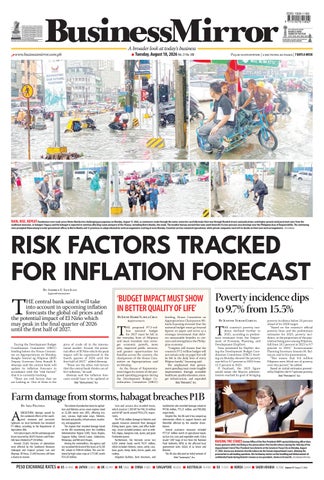
RAIN, RISE, REPEAT Floodwaters turn roads across Metro Manila into challenging passageways on Monday, August 17, 2026, as commuters wade through the water, motorists carefully make their way through flooded streets and pedestrians seek higher ground amid persistent rains from the southwest monsoon, or habagat. Pagasa said the habagat is expected to continue affecting Luzon and parts of the Visayas, including Metro Manila, this week. The weather bureau warned that rains could intensify if a low-pressure area develops near the Philippine Area of Responsibility. The continuing rains prompted Malacañang to order government offices in Metro Manila and 12 provinces to adopt alternative work arrangements starting at noon Monday. Essential services remained operational, while private companies were left to decide on their own work arrangements. ROY DOMINGO
RISK FACTORS TRACKED FOR INFLATION FORECAST
T
By Andrea E. San Juan @andreasanjuan
HE central bank said it will take into account in upcoming inflation forecasts the global oil prices and the potential impact of El Niño which may peak in the final quarter of 2026 until the first half of 2027. During the Development Budget Coordination Committee (DBCC) briefing before the House Committee on Appropriations on Monday, Bangko Sentral ng Pilipinas (BSP) Deputy Governor Zeno Ronald R. Abenoja said the central bank will update its inflation forecasts in accordance with the “risk factors” that it is currently tracking. “There are risk factors that we are looking at. One of them is the
price of crude oil in the international market. Second, the potential effect of El Niño which the peak impact will be experienced in the fourth quarter of 2026 until the first half of 2027,” added Abenoja. “Those are the other risk factors that the central bank thinks can affect inflation,” he said. Abenoja said the inflation forecasts would have to be updated at See “Inflation,” A2
‘BUDGET IMPACT MUST SHOW IN BETTER QUALITY OF LIFE’ By Jovee Marie N. dela Cruz
T
@joveemarie
HE proposed P7.2-trillion national budget for 2027 must be felt in the everyday lives of Filipinos and must translate into stronger economic growth, more jobs, improved public services, and greater opportunities for families across the country, the chairperson of the House Committee on Appropriations said on Monday. As the House of Representatives began its review of the proposed spending program during the Development Budget Coordination Committee (DBCC)
briefing, House Committee on Appropriations Chairperson Mikaela Suansing stressed that the national budget must go beyond figures on paper and serve as a strategic investment that delivers measurable benefits to citizens and strengthens the Philippine economy. “Congress will ensure that the country’s P7.2-trillion budget will not remain only on paper but will be felt in the daily lives of every Filipino family,” Suansing said. She emphasized that government spending must create tangible improvements through accessible healthcare, quality education, stronger infrastructure, and expanded
Poverty incidence dips to 9.7% from 15.5% By Justine Xyrah Garcia
T
HE country’s poverty incidence declined further in 2025, according to preliminary estimates from the Department of Economy, Planning, and Development (DepDev). Data presented by DepDev during the Development Budget Coordination Committee (DBCC) briefing on Monday showed the poverty rate fell to 9.7 percent in 2025 from 15.5 percent in 2023. If finalized, the 2025 figure would mean the Marcos administration reached its goal of bringing
poverty incidence below 10 percent ahead of its 2028 target. “Based on the country’s official poverty lines and the preliminary estimates for 2025, poverty incidence, or the proportion of the population being poor among Filipinos, fell from 18.1 percent in 2021 to 9.7 percent in 2025,” Socioeconomic Planning Secretary Arsenio M. Balisacan said in his presentation. “This means that 8.8 million Filipinos were lifted out of poverty over this period,” he added. Based on initial estimates presented by DepDev, the 9.7-percent poverty See “Poverty,” A2
See “Budget,” A2
Farm damage from storms, habagat breaches ₧1B
A
By Ada Pelonia
GRICULTURAL damage caused by the combined effects of the southwest monsoon and successive typhoons on local farmlands has breached P1 billion, according to the Department of Agriculture (DA). In its latest report, the DA said damage and losses incurred by 30,073 farmers and fisherfolk have climbed to P1.03 billion. Around 25,662 hectares of plantations were affected by the Southwest Monsoon (habagat) and tropical cyclones Luis and Maymay. Of these, 21,440 hectares still have a chance to recover.
The volume of production losses to agriculture and fisheries across seven regions stood at 25,280 metric tons (MT), affecting rice, corn, cassava, high-value crops, fisheries, livestock and poultry, infrastructure, machinery, and equipment. The regions that recorded damage based on the DA’s monitoring were the Cordillera Administrative Region (CAR), Ilocos Region, Cagayan Valley, Central Luzon, Calabarzon, Mimaropa, and Western Visayas. Among the commodities, the agency said rice sustained the brunt of the losses at 16,105 MT, valued at P589.44 million. This was followed by high-value crops at 7,772 MT, worth P313.07 million.
Corn and cassava also recorded losses, which stood at 1,309 MT for P46.24 million and 84 MT worth around P954,270, respectively. The P9.26-million damage to fisheries and aquatic resources stemmed from damaged fishing boats, gears, tanks, and office buildings. Losses included produce, such as milkfish, tilapia, mangrove crab, oyster, and giant freshwater prawn. Furthermore, the livestock sector lost 6,036 animal heads worth P6.91 million, which included chickens, swine, cattle, carabaos, goats, sheep, ducks, horses, quails, and turkeys. Irrigation facilities, farm structures, and
machineries also recorded damage valued at P47.86 million, P15.21 million, and P80,000, respectively. Despite this, the DA said it has ramped up intervention efforts to support farmers and fisherfolk affected by the weather disturbances. Several assistance measures included P177.67 million worth of agricultural inputs such as rice, corn, and vegetable seeds. It also issued 1,007 bags of rice from the National Food Authority (NFA) to the affected local government units (LGUs) of La Union and Batanes. The DA also allocated an initial amount of See “damage,” A2
RAISING THE STAKES Former Office of the Vice President (OVP) special disbursing officer Gina Acosta gestures while testifying as the prosecution’s first hostile witness during the 16th day of the impeachment trial of Vice President Sara Duterte at the Senate in Pasay City on Monday, August 17, 2026. Acosta was declared a hostile witness by the Senate impeachment court, allowing the prosecution to ask leading questions. Her testimony centers on the handling and disbursement of confidential funds during Duterte’s tenure as vice president. Stories in A3 and A9.. ROY DOMINGO/SPPA POOL
PESO EXCHANGE RATES n US 61.4100 n JAPAN 0.3855 n UK 83.1491 n HK 7.8265 n CHINA 9.1083 n SINGAPORE 48.0216 n AUSTRALIA 43.4783 n EU 71.0391 n KOREA 0.0434 n SAUDI ARABIA 16.3586 Source: BSP (August 17, 2026)
News
BusinessMirror
A2 Tuesday, August 18, 2026
‘VP Sara ordered ₧125M transfer to security officer’ Continued from A9
Presiding Officer Sen. Francis “Chiz” Escudero also asked whether spending confidential funds was part of a security officer’s duties. “No, Your Honor. That is the responsibility of the disbursing officer,” Acosta answered. Acosta said Lachica’s role was focused on implementing confidential operations rather than formally disbursing the funds. She testified that after receiving the money, Lachica would submit utilization reports and liquidate the funds after the completion of the activities. The P125 million released in December 2022 was the first of four tranches of confidential funds amounting to P500 million allocated to the OVP in 2022 and 2023. The transactions are being examined under Article I of the impeachment complaint against Duterte, which involves allegations concerning the alleged misuse of P612.5 million in confidential funds from the Office of the Vice President and the Department of Education. Acosta, who handled the P500 million in confidential funds as OVP Special Disbursing Officer, is currently testifying as a hostile prosecution witness in Duterte’s impeachment trial.
www.businessmirror.com.ph
DOLE files MR asking court to lift wage hike injunction
T
By Mary Jade Jadormio
HE Department of Labor and Employment (DOLE) has filed a motion for reconsideration seeking to lift the injunction that halted the P85 minimum wage increase in Metro Manila. In its motion before Pasig Regional Trial Court Branch 152, DOLE asked the court to dismiss the case for lack of jurisdiction and failure to state a cause of action. It also sought the denial of the petitioners’ application for a writ of preliminary injunction. DOLE maintained that the petition-
ers bypassed the administrative remedies provided under the Labor Code before bringing the dispute to court. Labor Secretary Francis N. Tolentino said the department is challenging the ruling on several grounds, including the court’s jurisdiction and its treatment of Articles 123 and 126. “We filed a motion for reconsidera-
Inflation…
MB’s previous policy meeting. As of the June 18,2026 monetary policy meeting, BSP sees headline inflation averaging at 6.4 percent in 2026; 4.5 percent in 2027 and 3.1 percent in 2028. The target of central bank remains at 3-percent average inflation plus or minus 1 percentage point tolerance range.
Continued from A1
the upcoming rate-setting meeting of the Monetary Board (MB), the highest policymaking body of the central bank, as the current inflation forecasts were updated last June 18, the
tion to strongly challenge the decision of Branch 152,” Tolentino said. “We are basically saying that the court has no jurisdiction, administrative remedies were not exhausted, Article 126 was disregarded, and compliance with Article 123 was not established,” he added. Under Article 123, appeals involving regional wage orders are brought before the National Wages and Productivity Commission (NWPC). Meanwhile, Article 126 prohibits courts, tribunals or other entities from issuing temporary restraining orders or injunctions against proceedings before the NWPC or regional wage boards. At stake is Wage Order No. NCR-
27, which would grant an additional P85 in daily pay to minimum wage earners in Metro Manila. Around 1.1 million workers were expected to benefit from the increase, which was scheduled to take effect last month before its implementation was stopped by the court. DOLE said the wage order went through the prescribed tripartite wage-setting process involving labor, employers and government. Tolentino filed the motion on Monday together with Assistant Solicitor General Jane E. Yu and officials from DOLE and the NWPC. Implementation of the P85 wage hike remains suspended while the court considers DOLE’s bid to overturn the injunction.
The Monetary Board’s next scheduled rate-setting meeting is on August 27,2026. At the DBCC briefing on Monday, BSP Governor Eli M. Remolona Jr. emphasized that, consistent with its mandate, “We worry about inflation because it diminishes the purchasing power of Filipino families.” “Low inflation also supports sustainable growth,” Remolona pointed out. The chief of the central bank said BSP is “encouraged” to report that inflation has eased somewhat over the last three months. However, he said inflation remains well above its target of 3 percent. The BSP governor noted that the recent above-target inflation readings were due largely to global supply shocks and their spillover effects on prices in the domestic economy.
“As you know, oil price shocks are not just about energy, they are also about food prices because oil is also the source of much of our fertilizer,” Remolona explained. As such, to contain price pressures, the central bank had to tighten monetary policy twice this year. He said these were “carefully calibrated moves” to help slow down inflation, anchor inflation expectations, while recognizing the “temporary weakness in growth.” “Over the medium term, we expect inflation to ease gradually. However, risks remain tilted to the upside,” added Remolona. As the monetary board is set to meet next week to decide on the next policy action, Remolona, who’s also the chairman of the MB, said: “We look at all evidence and we are prepared to take further steps as necessary to ensure that inflation returns to target.”
Poverty…
Balisacan cautioned, however, that the gains remain vulnerable to elevated inflation, particularly among poor and low-income households, which spend a larger share of their budgets on food. Based on PSA data, food accounts for 51.38 percent of the inflation basket of the bottom 30 percent of income households. Rice alone carries a weight of 17.8 percent in their basket, nearly double its 8.87 percent share in the basket for all income households. Food inflation was recorded at 5.3 percent in July, reversing the 0.5 percent deflation recorded in the same month last year. Rice inflation, meanwhile, stood at 19.3 percent, the highest since July 2024. “If inflation remains elevated, it could slow or even reverse our recent gains in poverty reduction,” Balisacan said. Preliminary results of the 2025 Family Income and Expenditure Survey (FIES), which will serve as the basis for the final poverty incidence estimates, are expected to be released later this month.
Continued from A1
rate was based on a national poverty threshold of P14,634 per month for a family of five, higher than the P13,873 threshold in 2023. The preliminary threshold for the National Capital Region was higher at P16,842 per month, while the food poverty threshold was estimated at P554 per day for a family of five. Balisacan said the poverty line is intended primarily to track changes in poverty over time as the threshold is adjusted for inflation. He also stressed that the threshold should not be interpreted as the amount required for a decent standard of living. “It’s not so much to say that a threshold like P554 is enough to meet a decent living,” he said. DepDev said the decline in poverty reflected the recovery in incomes and employment as well as the continued implementation of social protection programs.
Farm damage from storms… Continued from A1
P35.67 million for the indemnification of 5,005 insured affected farmers and fisherfolk through the Philippine Crop Insurance Corporation (PCIC). Loan offers of up to P25,000 from the Survival and Recovery (SURE) Loan Program of the Agricultural Credit Policy Council (ACPC) are also available. These come with a three-year repayment term, interest-free.
Budget…
Continued from A1
employment opportunities that directly contribute to economic development. “Filipinos should see its impact through more accessible healthcare, higher-quality education and better classrooms, more employment opportunities, and improved roads that will help farmers transport their products faster and connect them to markets,” she added. Suansing said the House supports the economic framework presented by the Development Budget Coordination Committee for the 2027 national budget, anchored on “PeopleCentered Growth for an Inclusive and Resilient Future.” She said the framework recognizes that sustainable economic growth depends on investments in human capital, public services, infrastructure, and workforce development. “We affirm the framework presented by the DBCC in crafting the 2027 National Budget. This means prioritizing investments in quality education, healthcare services, and workforce upskilling,” Suansing said. The lawmaker said the impact of the national budget should be measured not only by the amount of government spending but also by its ability to generate economic activity, improve productivity, create jobs, and expand opportunities for Filipino workers and businesses. She added that every allocation must deliver value to taxpayers by supporting programs that address national priorities and strengthen the country’s longterm economic resilience. “Every peso in this budget comes from the hard work and sacrifices of Filipino taxpayers. That is why Congress will conduct thorough deliberations in the coming months to ensure that every peso is directed toward programs that genuinely respond to the needs of our citizens and strengthen the future of our country,” Suansing said.
Cooperation
SUANSING also highlighted the importance of cooperation between Congress and the executive branch in developing a budget that responds to the country’s economic needs and development goals. She cited the President’s Budget Message, saying the proposed spending plan represents more than a financial program but an investment in the Filipino people and the nation’s future. “More than just a financial plan, this budget is a strategic investment in the Filipino people and in the future of our nation. It converts national priorities into concrete actions, ensuring that every public resource strengthens institutions, expands economic opportunities, and improves the quality of life of every Filipino,” Suansing said. She said the House will continue examining the proposed appropriations to ensure that government funds support programs that encourage inclusive growth, improve competitiveness, and create better opportunities for communities nationwide. Suansing said accountability and transparency will remain central to the budget process to protect public resources and maintain taxpayers’ trust. “We will establish sufficient safeguards in the budget to ensure that it cannot be abused. Congress will make sure that the 2027 budget is one that the Filipino people can trust,” she said. “These reforms reflect Congress’ commitment to removing secrecy from the budget process and showing where every peso from Filipino taxpayers goes,” Suansing said. As the country moves toward another record-level spending plan, Suansing emphasized that the true measure of the budget will be whether it produces stronger economic growth, more opportunities, and improvements that Filipino families can experience in their daily lives. The proposed budget is 6 percent higher than the P6.793-trillion allocation for 2026 and is equivalent to 21.7 percent of the country’s gross domestic product. The House has begun its scrutiny of the proposed 2027 national budget through the DBCC briefing, where lawmakers will examine economic assumptions, fiscal targets, and government spending priorities.
www.businessmirror.com.ph
Tuesday, August 18, 2026
With steady rains from 2 storms, habagat, DSWD says govt on top of disaster response
T
HE Department of Social Welfare and Development (DSWD) on Monday assured the public that it remains on heightened disaster response readiness as continuous rains from Tropical Cyclones (TCs) Maymay and Luis, along with the southwest monsoon or habagat, continue to threaten affected communities, ensuring the sustained delivery of relief assistance and social protection services to families in need. As of Monday, August 17, the DSWD reported that more than 4.3 million family food packs (FFPs) are prepositioned nationwide, while P1.36 billion worth of food and non-food items (FNFIs) remains available at the agency’s disaster resource centers and Field Office warehouses for immediate deployment. Assistant Secretary Irene Dumlao of the DSWD Disaster Response Management Group (DRMG) said the agency’s Field Offices are continuously monitoring affected areas and coordinating with local government units (LGUs) and partner agencies to ensure that assistance reaches communities
that may need additional support. “We continue to coordinate with our local government units [LGUs] and other partner agencies to ensure that not only relief assistance, but also the necessary social protection interventions, are delivered to our fellow Filipinos affected by Tropical Cyclones Luis and Maymay,” Dumlao said. The DSWD’s continuing response comes as thousands of families remain displaced due to the impact of TCs Maymay and Luis. Based on the latest Disaster Response Operations Monitoring and Information Communication (DROMIC) report, 6,949 families or 24,181 individuals are still staying in evacuation centers. To date, the agency has provided more than P690.911 million worth of assistance, including 1,015,417 family food packs, 12,710 nonfood items, 16,971 ready-to-eat food boxes, and other food assistance to affected families. The DSWD Field Offices have also extended P2.253 million worth of financial assistance to See “DSWD,” A8
A3
₧125M in OVP confidential funds given sans physical, financial plans By Jovee Marie N. Dela Cruz
T
@joveemarie
HE Office of the Vice President secured the release of P125 million in confidential funds in late 2022 using a physical and financial plan that did not identify specific surveillance operations, locations, costs or numerical performance targets, according to testimony before the Senate Impeachment Court on Monday. Gina Acosta, the OVP’s former special disbursing officer and the official identified as accountable for the plan, acknowledged that the document placed the entire allocation under the broad heading “Good Governance Program” and contained only generic descriptions of how the money would be used. P r i v a t e p r o s e c u t o r A t t y. Amando Virgil Ligutan initially established that the plan was a
prerequisite for release. After he asked whether confidential funds could be released without a physical and financial plan, Acosta replied: “That is correct, Your Honor.” The circular requires confidential and intelligence fund allocations to be supported by a physical and financial plan indicating the proposed amounts for programs, activities and projects. It also requires cash advances to be used for
specific legal purposes connected with confidential or intelligence activities and calls for expenditure details to be reflected in accomplishment reports. Acosta said she prepared and signed the OVP plan with inputs from then-security officer Col. Raymund Dante P. Lachica, whom she described as the person with operational expertise. “I worked with our security officer, Your Honor, because I asked him for inputs or guidelines in preparing the physical and financial plan,” she said. Under questioning, Acosta said the “Good Governance Program” covered various OVP initiatives, including free rides, tree planting, and financial and medical assistance. She said she had no personal knowledge of whether studies had been conducted in developing the program. Asked why the plan did not contain an itemized list of activities, Acosta said: “I did not include the details, Your Honor, because the Joint Circular does not state that they have to be itemized.” The plan referred to areas where surveillance would supposedly be conducted and monitored and to the percentage of
activities implemented without security incidents. But no numerical targets were entered for either measure. A sked whet her t he ac t u a l figures appeared in the plan, Acosta answered: “Not yet, Your Honor.” According to her testimony, the more specific activities appeared later in the accomplishment and liquidation documents submitted after the funds had already been released. Acosta also confirmed that the physical and financial plan had been presented to Duterte. “It was approved,” she said, when asked whether the Vice President approved the program. Acosta separately testified that tree planting was among the activities treated as part of the OVP’s good-governance program and funded through confidential funds. She maintained that activity details were contained in attachments eventually submitted to COA and were based on information supplied by Lachica. Her testimony came after the impeachment court formally declared her a hostile witness. See “OVP,” A8
A4
Tuesday, August 18, 2026
www.businessmirror.com.ph
DILG backs Arta’s anti-fixer drive DOS and DON’TS–on the way to the top JOB By: Henry J. Schumacher
By Jonathan L. Mayuga
T
@jonlmayuga
HE Department of the Interior and Local Government (DILG) has ordered all its offices nationwide to put up prominent displays of “Bawal ang Red Tape” materials where business transactions are being facilitated. The directive is in support of the Anti-Red Tape Authority’s (Arta) intensified campaign against fixers and fixing activities. Through a memorandum, the DILG directed the display of the anti-red tape signage in strategic and conspicuous areas of its central and regional offices, as well as on the Department’s website and official
social media channels, as part of a broader information campaign against fixing and illegal government transactions. “Red tape has no place in the DILG. We, therefore, want these signages seen by everyone as part of our commitment to efficient public services,” the DILG said. Following Arta’s latest directives on
the Campaign Against Fixers and Client Satisfaction Measurement, DILG offices were also urged to intensify public awareness of existing anti-red tape policies, particularly measures against fixers, while strengthening transparency in government transactions. The Department likewise ordered the display of updated anti-fixing information, education, and communication (IEC) materials and the official harmonized Client Satisfaction Measurement (CSM) survey in conspicuous areas to encourage the public to provide direct feedback on government services. “As the government heightens awareness of safeguards against corruption, we also encourage the public to report incidents of illegal transactions to combat fixing through Arta’s channels,” the DILG said. The intensified campaign comes as the DILG recorded a 99.50-percent client satisfaction score in its 2025 CSM Report, reflecting positive public reception of the Department’s implementation of streamlined services for both internal and external clients.
The DILG said strict compliance with the guidelines forms part of Arta’s Report Card Survey (RCS) 2.0, which measures government agencies’ implementation of Republic Act No. 11032, or the Ease of Doing Business Law, and their compliance with service procedures under their respective Citizen’s Charters. “All of these will be tracked by the Compliance Monitoring and Evaluation Office [CMEO] through surprise inspections and spot monitoring to ensure sustained compliance with the law and the related guidelines,” the DILG said. The Department said the campaign aims to make legitimate government transactions easier and more transparent while closing opportunities for fixers and other illegal practices. “With these mechanisms in place, we remain committed to safeguarding public trust in government through upholding swift, hassle-free, and customer-friendly service delivery for the Filipino people,” the Department added.
I
AM following with great interest the desires of young people to get top jobs. Millennials and even Gen Zers are asking how and how fast can I get to the top. I have discussed with many colleagues around the world who made it to the top their learning curves from low positions to the top. Of course, I have my own experience along that avenue. Today, I would like to share the Dos and Don’ts that were raised by my discussionpartners with you, to help you on the way to the top job:
Act smarter, faster and broader
YOU have to stand out as someone who has potential. Simply put: think more, look at things from a broader perspective, share more ideas, and find smarter, faster, and more efficient ways of doing things.
Find the right supervisor
IF your manager is weak, you will never advance in your career. B-class people never promote A-class people. And it is difficult to get noticed by the higher levels of management while going around your own boss.
If you want to become a CEO, behave as if you are one
ONCE you have already been identified as what we might call a ‘high-potential employee’, someone on the list of people being considered for future leadership, you should start behaving like a potential CEO and have the courage to distinguish yourself from your peers. But please, do so without arrogance, or acting like a knowit-all. The rule is: Don’t make yourself the best employee. THE Marcos administration’s economic managers grace the Economic Journalists Association of the Philippines’ (EJAP) annual economic forum on August 14, 2026, at the Bangko Sentral ng Pilipinas (BSP) Assembly Hall. (In photo, L-R) EJAP, Inc. Director Louella D. Desiderio, Department of Economy, Planning and Development Secretary Arsenio M. Balisacan, BSP Governor Eli M. Remolona, Jr., Finance Secretary Frederick D. Go, Acting Budget Secretary Kim Robert C. De Leon, and EJAP, Inc. President John Ted O. Cordero. PHOTOS COURTESY OF BRILLIANT JERK PRODUCTION
The Marcos administration’s economic managers answer questions from reporters at the 2026 Economic Journalists Association of the Philippines Economic Forum on August 14 at the Bangko Sentral ng Pilipinas (BSP) Assembly Hall. (In photo, L-R) Department of Economy, Planning and Development Secretary Arsenio M. Balisacan, BSP Governor Eli M. Remolona, Jr., and Acting Budget Secretary Kim Robert C. De Leon. Manila Bulletin Assistant Business Editor Ben Arnold O. De Vera moderates the panel.
Eco managers push for growth, resilience at EJAP forum
T
HE country’s economic managers pushed for policy reforms and transparent fiscal management to drive faster economic growth and strengthen resilience amid headwinds during the 2026 Economic Journalists Association of the Philippines (EJAP) Economic Forum. Held on August 14, 2026, at the Bangko Sentral ng Pilipinas (BSP) Assembly Hall, the forum featured the theme “Strengthening Economic Resilience in an Era of Uncertainty.” Finance Secretary Frederick D. Go said that the government remains focused on its objectives and pursuing reforms. Reforms to encourage investments in the country include the Public-Private Partnership Code, CREATE MORE Act, Investors’ Lease Act, Accelerated and Reformed Right of Way Act, the Enhanced Mining Fiscal Regime Act, Capital Markets Efficiency Promotion Act and the Green Lane Initiative. “This administration has moved from setting the stage to execution, turning policy into investment and investment into jobs and opportunities for the people,” Go said. Following the Philippines’ transition to upper-middle income status, Department of Economy, Planning and Development
Secretary Arsenio M. Balisacan said that the country needs to diversify its growth drivers by going beyond consumption and services to sustain growth and become a high-income economy. He said the economy needs to generate more investments, strengthen exports and revitalize agriculture and industry. “The next two years for us are really about speeding up the implementation of programs and projects, and the completion, especially, of strategic programs and projects. And of course, keeping inflation in check is a very high priority,” Balisacan said. While external supply shocks that have pushed inflation are beyond the government’s control, BSP Governor Eli M. Remolona, Jr. said that the central bank is mitigating second-round effects. “With the growth numbers and the inflation numbers, I think we need a more convincing downward trend for inflation before we can relax. Of course, the weaker growth that we’re seeing means we can be less aggressive in trying to tame inflation. But in the face of an unpredictable opponent - oil prices, for example - we need to keep our eye on the ball,” Remolona said. Department of Budget and Management Acting Secretary Kim Robert C. De Leon
emphasized the importance of transparency and accountability in every stage of the budget process to support growth. “Behind every peso is a person. Behind every allocation is a choice. And behind every budget decision should be a better life for a Filipino,” De Leon said. Private sector representatives from the fintech and manufacturing sectors stressed the importance of public-private sector alignment in implementing reforms. Michelle S. Fernandez, vice president and head of corporate sustainability and communications at GCash, said digital finance is becoming an important economic infrastructure, particularly in disbursing aid during shocks. “The real test of digital social protection is not whether a transfer can be sent in seconds. It’s when support arrives, not in a vacuum, but into an ecosystem where it can immediately improve a life,” Fernandez said. Maya Philippines Head of Corporate Affairs Kristoffer M. Rada advocated for shared standards and open competition to ensure digital financial access leads to productive results. “The Philippines has already built much of the infrastructure for digital financial access. Our next task is to make sure that
access is economically meaningful,” Rada said, adding that this requires the government and the private sector to agree on common infrastructure, common standards and strong safeguards. JTI Philippines Fiscal and Regulatory Affairs Director Mario T. Zinampan noted that economic resilience requires resistance against illicit trade. “A resilient economy resists illicit trade, and the Philippines is not starting from zero. The destination principle is already embedded in various Philippine laws and regulations,” Zinampan said. The 2026 EJAP Economic Forum was supported by gold sponsors Maya Philippines Inc., GCash and JTI Philippines and silver sponsor BDO Unibank Inc. SM Investments Corp., Prime Infrastructure Capital Inc., Filinvest Development Corp., Metropolitan Bank & Trust Co., Rizal Commercial Banking Corp., Philippine National Bank, Security Bank Corp., EastWest Banking Corp. and Asialink Finance Corp. were bronze sponsors. EJAP is the country’s premier organization of business and economic reporters dedicated to promoting excellence in journalism and fostering professional development among its members.
Mansalay town gearing to jumpstart renewable energy shift in Mindoro
M
INDORO Island is gearing to transition to renewable energy, starting with the town of Mansalay, Oriental Mindoro, to champion accessible and affordable electricity for the people of Mindoro. Mindoro Island is shared by two adjoining provinces–Oriental and Occidental Mindoro. To jumpstart its transition to renewable energy, various groups spearheaded by the Renew Mindoro will hold a caravan in Mansalay, Oriental Mindoro in collaboration with environmental advocates, the Church, civil society, financing institutions, renewable energy suppliers, and local government, towards solarizing vulnerable communities in Mindoro. The event on September 5 at the Mansalay Municipal Gymnasium involves key solar power suppliers and private
financing institutions. REnew Mindoro said the caravan will provide opportunities to engage with solar power providers and to engage with financiers. “Mindoro’s communities are vulnerable to [expensive] and unreliable electricity because of their dependence on diesel, which accounts for the vast majority of energy capacity in the island. The Department of Energy (DOE) indicates that the island has renewable energy potential at 343 MW, but our study with Climate Analytics shows a potential of 1,140MW for rooftop solar power alone. That potential for renewables must be maximized, because solar is the most practical and affordable alternative for powering Mindoro,” said Gerry Arances, Executive Director for the Center for Energy, Ecology, and Development (CEED). See “Mansalay,” A8
Say goodbye to your office friends
WHEN the application period for the
CEO is underway, it naturally attracts envious and jealous people. Be more introverted and draw energy from within yourself with focus on thinking, observing and reflecting.
Endure loneliness
DISTANCE from former colleagues is part of the process. You have to be able to handle that. ‘It gets lonely at the top’ – this statement is often dismissed as a cliché. However, it describes a structural reality that has nothing to do with isolation or being disliked, but rather with a lack of equality. Every decision creates interest.
Decide faster and braver than your colleagues
THE higher you climb, the more uncertainty, consequences, and time pressure surround decision making. The focus then shifts from identifying the best option to choosing between imperfect ones.
Go out and let the world inspire you
MOST truly, new ideas don’t originate within the organization. They arise at the interfaces between industries, technologies, cultures, and markets. Anyone who doesn’t know the world outside won’t be an innovative manager.
Seize this opportunity
IN every career, there are perhaps a dozen, probably fewer, opportunities where you can See “Integrity ,” A8
Grads of Cebu college top LET By Carmel Pedroza
C
EBU CITY—For Eurica Labapiez, reaching the national Top 10 of the 2026 Licensure Examination for Professional Teachers (LEPT) is more than a personal academic triumph—it is a promise fulfilled to her family and proof that a student from a mountain barangay can rise to the top with determination and opportunity. Labapiez, a graduate of Cebu Eastern College (CEC) and a Cebu City government scholar, placed 10th nationwide in the 2026 LEPT conducted in March, becoming the first topnotcher from barangay Toong, a mountain barangay in Cebu City. Her achievement was celebrated Friday, Aug. 14, during CEC’s 2026 PACECGARBO, where she joined fellow CEC graduates Jessa Junio and Jenny Rose Daro, who placed third
and fifth nationwide, respectively. Each of the three topnotchers received P100,000 from CEC as an incentive for their outstanding performance. For Labapiez, the road to the national rankings began with a simple inspiration— a teacher she admired and her own love for teaching. She pursued elementary education because she wanted to follow the example of the teacher she looked up to and because, as she put it, “I love teaching kids.” Her journey was also made possible through the Cebu City Government Scholarship Program, which allowed her to pursue college without a maintaining grade requirement. As the eldest child in her family, Labapiez said one of her motivations was See “LET,” A8
Yellow alert over Vis-Min grids to persist till next week–DOE By Lenie Lectura @llectura
T
HE Department of Energy (DOE) said Monday that the yellow alert hoisted over the Visayas and Mindanao power grid will persist next week, with possible red alerts during the evening. ”So, for next week, what we are seeing is that we will remain to have yellow alerts in the afternoon for both Visayas and Mindanao, but we might have as well red alerts during the evening time. So, it just depends on how long they are extended. “Normally, a red alert takes effect at 5p.m., but it may start earlier depending on power demand,” said DOE undersecretary Mario Marasigan. A red alert status is issued when power supply is insufficient to meet consumer demand and the transmission grid’s regulating requirement. A yellow alert is issued when the operating margin is insufficient to meet the transmission grid’s contingency requirement. As of press time, the National Grid Corporation of the Philippines (NGCP) placed the Visayas grid on red alert from 5pm. to
8pm. and yellow alert from 4pm to 5pm. and from 8pm to 9pm. The grid’s available capacity stood at 2,334 megawatts (MW) while peak demand was at 2,413MW. Six power plants are on forced outage this month, one plant since July, three plants since June, seven plants since May, one plant since March, three plants since 2025, two plants since 2024, two plants since 2023, and one plant since 2021, while 14 plants are running on derated capacities, for a total of 810.3MW unavailable to the grid. “The Visayas grid was placed under yellow and red alerts because of major generation outages and limited power transfers from neighboring grids. Several major coal-fired generating units remain unavailable. Today, capacity support for Visayas from the Luzon and Mindanao grids i also limited-as Mindanao’s demand is high,” said Garin. “Our teams are working with system operators and generators to restore available capacity, manage the tight supply situation, and keep electricity flowing across the Visayas,” added Garin.
A BusinessMirror Special Feature
14th Cabuyao Cityhood Anniversary
Tuesday, August 18, 2026 A5
www.businessmirror.com.ph
BEYOND THE FACTORY GATES: CABUYAO WIDENS THE REACH OF BUSINESS GROWTH C
ABUYAO, Laguna’s economic story has long been written by factories, industrial parks, and the tax payments of some of the country’s biggest manufacturers. Increasingly, however, another story is emerging alongside it. It can be seen in the online seller registering a business for the first time, the neighborhood retailer securing a mayor’s permit, or the worker learning a new skill for a job available within the city. From January to July 2026, Cabuyao recorded nearly 800 new business registrations, compared with around 300 during the whole of the previous year, according to the city’s Business Permits and Licensing Office. Most of the new registrants were micro and small enterprises engaged in retail, online selling and other consumer-oriented services. For Mayor Dennis Felipe C. Hain, the numbers point to a broader economic strategy: preserve the industrial base that has long sustained Cabuyao while opening more pathways for ordinary residents to participate in the city’s growth. Large companies remain crucial to the local economy. But Cabuyao is also lowering barriers for smaller businesses, expanding skills training and using the revenues generated by economic activity to strengthen public services. The goal is to make business growth felt beyond the factory gates.
Opening the formal economy
Cabuyao has long been home to major manufacturers, distributors and industrial locators. City Treasurer Jovita E. Bienes said consumer goods manufacturing remains the strongest contributor to the city’s business tax collections. Among the city’s leading taxpayers are Procter & Gamble, Nestlé Philippines, Wyeth Philippines, Zuellig Pharma, and Ginebra San Miguel Corp. Their continued presence has given Cabuyao a stable industrial foundation even as the city competes for investments with neighboring economic centers such as Santa Rosa, Biñan and Calamba. That industrial base carries substantial fiscal weight. Bienes said business taxes account for around 60 percent of Cabuyao’s local tax revenues and between 50 and 60 percent of its total locally sourced revenues. But for the city government, being business-friendly is no longer only about retaining large corporations or attracting new industrial locators. It also means making the formal economy more accessible to residents already earning from online selling, tutoring, neighborhood retail and home-based services but who have yet to register their businesses. Atty. Ryan John C. Cancio, officerin-charge of the BPLO, said some small entrepreneurs remain apprehensive about approaching government because they expect the process to be expensive, complicated or punitive. “Some fear that it might be expensive. Others still have this old mindset of being afraid to approach the government, perhaps because of unpleasant experiences they may have had in the past,” Cancio said. To reduce one of those barriers, Cabuyao began granting waived mayor’s permit fees to qualified enterprises with capitalization of no more than P300,000. For a microentrepreneur, the amount otherwise spent on local permit fees can instead go to inventory, equipment or operating expenses. But reducing the cost of registration addresses only part of the problem. Cabuyao has paired the waiver with a business one-stop shop, a simplified Citizen’s Charter and a help desk that guides applicants through the requirements. An entrepreneur with complete documents may obtain a permit within one to three days, depending on the clearances required from offices handling zoning, building, environmental, health, and fire-safety regulations. Instead of going from office to office, applicants submit their requirements through an integrated process, with the concerned departments conducting their evaluations in the background. The city has also launched its electronic business one-stop shop, or eBOSS, allowing entrepreneurs to register or renew permits, complete business-related transactions and make payments digitally. The objective is not to remove regulation but to make compliance easier. Businesses must still satisfy health, sanitation, zoning, environmental and fire-safety requirements intended to protect workers, consumers and
surrounding communities. At the same time, the city has stepped up inspections of establishments operating without proper registration. The approach combines assistance with enforcement: make compliance simpler and less costly, while protecting legitimate enterprises from competitors that remain indefinitely outside the formal system. Cancio said Cabuyao had around 5,000 to 6,000 registered businesses in 2025, while the number of establishments operating informally may also be substantial. Bringing even part of that informal economy into the system could have effects beyond increasing permit issuances. Formal registration can allow entrepreneurs to access training, financing and government programs that require proof of a legitimate enterprise. It can also help them transact with larger clients, participate in formal supply chains and build a business record that supports future expansion. “Once a business becomes legitimate, more opportunities become available, including grants from banks and the national government,” Mayor Hain said. The city hopes to record around 1,000 new businesses in 2026 and end the year with approximately 7,000 to 7,500 registered establishments. For Cabuyao, that would mean an economy still anchored by major industries—but with more residents participating in it directly.
From collections to trust
While smaller businesses enter the formal market, Cabuyao’s established industries continue to provide much of the revenue that supports city programs. Business tax collections reached P755 million as of the end of July, according to BPLO’s Archeeno Diaz. The city projects around P955 million in collections for the full year.
Those numbers formed part of the backdrop of the 2026 Cabuyao Taxpayers’ Night, where the city recognized its leading business taxpayers, real-property taxpayers, new investors, and sole proprietors. The inclusion of new investors and sole proprietors alongside established corporations reflected the broader business community Cabuyao is trying to cultivate. The event honored companies that have long sustained the city’s tax base while acknowledging that smaller and newer enterprises also have a role in its next stage of development. “Tonight is not about taxes. Tonight is about trust,” City Administrator Atty. Dan Rafael H. Palis said during the ceremony. That trust, he said, is built on a partnership. Businesses invest, operate and employ in Cabuyao. Government, in turn, is expected to convert the revenues generated by that activity into services that residents can see, feel, and use. “When your business grows, our city grows with you,” Palis told the awardees. “Your achievements remind us that responsible businesses and good governance are not competing forces. They are partners in building a better city.” That relationship is central to Cabuyao’s economic strategy. Taxes are not treated simply as collections. They become part of a cycle in which businesses generate economic activity, government expands services and infrastructure, and a stronger city creates conditions for further investment.
Turning revenues into services
The return on that partnership is most visible in the public services residents encounter in their daily lives. In healthcare, Cabuyao has opened a new emergency center and expanded the capabilities of Cabuyao City Hospital as the city works toward upgrading the facility into a Level 2 hospital.
at the time of the interview. Rather than immediately build and operate a training institution of its own, the city works with 36 technical-vocational partners. The arrangement gives residents access to a wider range of courses and allows programs to adjust more quickly to the changing requirements of industries. PESO consults companies about the work performed in their facilities and the competencies they expect from applicants. “We are campaigning for the right skills for the right industries,” Hain said. The city also conducts targeted job fairs for sectors that may face additional barriers to employment, including persons with disabilities and their families as well as Alternative Learning System graduates. Participating companies are selected based on their willingness to consider applicants with the qualifications of the intended beneficiaries. The approach is intended to address one of the persistent challenges facing both workers and employers: skills mismatch. Residents gain training connected to jobs that actually exist. Companies gain access to a larger pool of workers whose competencies are closer to what their operations require. For Cabuyao, the arrangement also strengthens the connection between its industrial economy and the people who live around it. Factories and businesses should not merely operate inside the city. Their demand for labor should create realistic pathways to employment for Cabuyeños.
Preparing for the next wave
The hospital has added equipment, medical specialists and other capabilities to accommodate a growing number of patients. Residents facing hospital expenses may also seek financial assistance through the HAIN Center. Qualified beneficiaries who previously had to wait three to four weeks may now receive assistance more quickly, allowing the city to respond to urgent medical and financial needs. Education is another major area of investment. More than 10,000 students have received support through the Iskolar ng Bagong Cabuyao program, while the city has invested in new school buildings and facilities, including those at Pamantasan ng Cabuyao and Marinig National High School. Graduates of Pamantasan ng Cabuyao also receive P5,000 in cash assistance to help with expenses as they prepare to enter the workforce. Other investments are less dramatic but equally visible in communities. The city has installed additional streetlights, established a new command center to strengthen emergency and security response, and invested in sidewalks, drainage systems and the rehabilitation of local roads.
“The collected taxes go to these programs. As industries and businesses grow, the city sees what residents need and translates those gains into its priority programs,” Cancio said. The beneficiaries are not limited to business owners or employees of industrial companies. Better healthcare, schools, roads, drainage, public safety and other services extend the benefits of economic activity to residents across the city.
Building the local workforce
For businesses, however, permits and infrastructure are only part of what makes a city competitive. Companies also need workers who possess the skills their operations require. Cabuyao is therefore using its relationships with local industries to shape technical and vocational training programs around actual employer demand. Since July 2022, around 5,600 residents have graduated from city-supported technical and vocational programs, according to Public Employment Service Office head Jose Karlo B. Hain. More than 600 completed training in 2026, while around 200 others were undergoing courses
The city is also looking ahead to the additional economic activity expected from two major national infrastructure projects: the NorthSouth Commuter Railway and the Laguna Lakeshore Road Network. Both are expected to improve Cabuyao’s access to surrounding markets and open additional areas for investment. Mayor Hain said the city is already preparing for how greater connectivity could affect traffic, development, infrastructure, and public services. “By 2031 or 2032, the face of Cabuyao will be very different, and that is what we are preparing for,” Hain said. “We are preparing our infrastructure, strengthening flood control and traffic management, and also preparing our wastemanagement system.” The larger test, however, will not be whether Cabuyao simply collects more taxes or issues more business permits. It will be whether newly formalized enterprises survive and grow. Whether residents trained for industry find stable employment. Whether established companies continue to invest. And whether roads, healthcare, schools and other public services keep pace with a city whose economy continues to expand. Cabuyao’s industrial giants will remain pillars of that economy. But the city is trying to make their impact travel farther—into smaller businesses residents can build, jobs they can qualify for, and services their families can rely on. That is what it means for business growth to move beyond the factory gates.
A6
Tuesday, August 18, 2026
DICT adopts ‘Scam Watch Pilipinas Quad Model’ as national anti-scam strategy
T
By Lorenz S. Marasigan
@lorenzmarasigan
HE Department of Information and Communications Technology (DICT) will adopt the Scam Watch Pilipinas Anti-Scam Quad Model as the country’s national anti-scam education and awareness strategy, providing a unified framework for scam prevention at no cost to the government. DICT Secretary Henry Aguda said the agency saw no need to build a new program from scratch when a working framework—anchored on public education and private sector collaboration— already exists. “Why reinvent the wheel? Let’s adopt it. If the program works, why shouldn’t we use it? It comes at no cost to the gov-
ernment, it benefits the public, and it is built on public-private partnership,” Aguda said. The adoption shifts the government’s anti-scam education approach from reactive alerts about emerging scams toward building long-term protective behavior among Filipinos, while positioning the Philippines as a regional
leader in anti-scam awareness. “With the Anti-Scam Quad Model as our national education and awareness strategy, we can put the Philippines at the forefront of anti-scam education and awareness in Southeast Asia. We want Filipinos to be not only informed about scams but equipped with the right behavior and tools to prevent them,” Aguda said. The Quad Model rests on four components: behavioral change through the “Kontra-Scam Attitude,” a volunteer watcher program, cross-sector collaboration, and technology-enabled reporting. At its core is the Kontra-Scam Attitude, which promotes four behaviors when dealing with suspicious messages, calls, and online offers: Magdamot, Magduda, Mang-isnab, and Magsumbong sa 1326—the government’s dedicated scam-reporting hotline. The second component mobilizes and trains volunteer anti-scam advocates to bring awareness directly to communities, schools, workplaces, and
vulnerable sectors. The third pushes for tighter coordination among government agencies, law enforcement, financial institutions, telecommunications companies, technology platforms, and civil society groups. The fourth promotes digital reporting channels to make it easier for the public to flag suspicious activities and scam incidents. Scam Watch Pilipinas co-founder Jocel de Guzman said the DICT’s commitment could move anti-scam education beyond simply warning the public whenever a new scheme surfaces. “Scam prevention should not stop at telling people what the latest scam is. We need to build the right behavior so Filipinos instinctively know what to do when confronted by suspicious messages, calls or offers,” De Guzman said. He said a common national framework would allow government agencies, communities, and private organizations to sustain prevention efforts rather than mount piecemeal campaigns.
Prosecution: AI image in impeachment trial was ‘visual aid,’ not evidence
T
HE House prosecution panel clarified on Monday that the AI-generated image shown during Vice President Sara Z. Duterte’s impeachment trial was only used as a visual aid and was not presented as actual evidence of the P125 million in cash withdrawn by the Office of the Vice President (OVP). The prosecution said the image and physical mock-ups of bundled money were presented during the testimony of former OVP special disbursing officer Gina Acosta to help the Senate Impeachment Court and the public understand the physical size and volume of the amount involved. Prosecutor Amando Ligutan admitted that the image was AI-generated because the prosecution did not have access to P125 million in cash to photograph. House prosecution spokesperson Benjamin S. Tolosa Jr. denied that the presenta-
tion was intended to mislead the public. He explained that the purpose of the image was not to claim that the exact bags, cash bundles, or arrangement shown were the actual ones used, but to provide a visual representation of the amount of money being discussed. “If you used AI or whatever, it’s immaterial,” Tolosa said. “The point is simply to show how much money we are talking about here—the actual volume and scale of the bundles of cash being discussed.” According to Tolosa, the important issue was whether the demonstration reflected what Acosta experienced when she received and transported the cash after encashing the OVP’s P125-million Landbank check on December 20, 2022. Acosta testified that the displayed bags were different from the four bags she used, particularly in their shape and zipper design, but she confirmed that P125 million could fit inside four bags and that
the simulated bundles were similar to the cash she handled. Earlier Landbank testimony confirmed that Acosta encashed four OVP checks amounting to P125 million each between December 2022 and July 2023. A former Landbank branch manager described the withdrawals as unusual but legitimate and not suspicious. The central issue of the impeachment case is what happened to the public funds after their withdrawal and whether their handling and liquidation followed government rules, said the prosecution. Manila Rep. Bienvenido M. Abante Jr. said he expected Duterte’s defense team to challenge the presentation but maintained that the visual display showed why the P125-million transaction required further explanation. He renewed his call for Duterte to personally appear before the Impeachment Court to address the allegations, although the decision to testify remains with the defense after the prosecution completes its presentation. Meanwhile, the prosecution also raised questions regarding Acosta’s difficulty answering in Filipino during her impeachment
trial testimony despite previously responding in Filipino and English during a 2024 House inquiry. House prosecutor Ysabel Maria Zamora said the prosecution noticed the difference in Acosta’s communication style after SenatorJudge Erwin Tulfo questioned why the witness appeared to struggle with Filipino and repeatedly answered in Cebuano. Tulfo cited Acosta’s previous testimony before the House Committee on Good Government and Public Accountability, where she was able to respond in Filipino, English, and a mixture of Visayan languages. Tulfo asked the presiding officer, Senator Francis Escudero, to require Acosta to answer in Filipino. Escudero acknowledged the concern and instructed private prosecutor Ligutan to continue the questioning. Acosta, who remains an OVP employee, previously served as Duterte’s special disbursing officer and handled P500 million in confidential funds from the OVP during 2022 and 2023. She was declared a hostile witness by the prosecution as questioning began regarding the management, use, and liquidation of the confidential funds. Jovee Marie N. Dela Cruz
Erwin Tulfo pushes 20% student discount on load and internet
A
S the shift to online classes has become the norm in most schools with alternative delivery modes of learning kicking in each time severe weather conditions hit, a 20-percent discount on mobile prepaid load, mobile postpaid plans, and mobile internet packages for all enrolled Filipino students should be legislated to ease the learners’ burden. With this in mind, Senator Erwin Tulfo is pushing for Senate Bill No. 2275 or the “Student Load Discount Act,” to alleviate the financial burden on families struggling to keep up with the data demands of modern education. “We have to slash this added expense from students which too often prevents our students from keeping up with their online classes. This is our way to somehow level the playing field,” Tulfo said. He added: “We cannot expect students, especially those who come from indigent families to seamlessly transition into digital learning without the government lending them a helping hand.” Under the proposed legislation, the discount covers all Filipino citizens currently enrolled in authorized elementary, secondary, technical-vocational, or higher education institutions, excluding postgraduate studies.
The mandatory 20-percent price cut will remain available year-round, including weekends and holidays, ensuring continuous academic access. To claim the discount, students need only present a valid school identification card or proof of enrollment alongside a birth certificate to verify citizenship. Telecommunications companies will be legally required to grant the discount across all eligible services, with non-compliant providers facing strict penalties. Tulfo, who chairs the Senate Committee on Social Justice, Welfare and Rural Development, pointed out that because of the adverse impacts of climate change and the lessons from the pandemic, the traditional concept of class suspensions has fundamentally changed. “Before, when classes are suspended, there were simply no classes. But this time around, most schools immediately shift to online modality to avoid academic backlogs,” Tulfo said. “It is our duty in the government to guarantee access. A student’s potential to learn should never be halted simply because they cannot afford mobile data or an internet connection. No student must be left offline when everyone else should be online,” he then concluded. Butch Fernandez
Only 30%–35% of regional projects make it to national budget–DepDev
O
NLY around 30 to 35 percent of priorities identified by Regional Development Councils (RDCs) are eventually reflected in the General Appropriations Act (GAA), according to the Department of Economy, Planning, and Development (DepDev). Socioeconomic Planning Secretary Arsenio M. Balisacan said the share remains low as the government seeks to better connect regional investment priorities with the national budget process. “Of the RDC priorities identified at the various regional levels, of those priorities, about 30 to 35 percent [are] reflected in the GAA… so it’s a bit low,” Balisacan said on Monday. He said raising the proportion to around 66 percent would already represent a “major
improvement.” The issue was raised during the Development Budget Coordination Committee (DBCC) briefing amid questions over how projects endorsed through the local and regional planning process are eventually selected for inclusion in the National Expenditure Program (NEP). Budget Secretary Kim Robert C. de Leon said that under the proposed 2027 budget, expenditure ceilings are currently set only at the department or agency level. This means agency central offices determine which projects are ultimately included in their proposals submitted to the Department of Budget and Management (DBM), even after projects have gone through the RDC process. Justine Xyrah Garcia
Editor: Dennis Estopace
TheWorld
Israel strikes Lebanon as US prepares new Iran measures By Arsalan Shahla, Magdalena Del Valle & Alisa Odenheimer Bloomberg News
L
EBANON saw its deadliest day of fighting in months, heaping pressure on stalled US-Iran negotiations while Washington prepares fresh economic measures. The Israel Defense Forces said last Sunday that it killed Abu Hassan Alaa, a senior Hezbollah commander, in southern Lebanon a day earlier. Eleven people died in the Israeli strikes, making them the deadliest since the sides agreed to a ceasefire at the beginning of June. Israeli Prime Minister Benjamin Netanyahu said the strikes were in retaliation for a Hezbollah attack that injured three soldiers last Saturday. Israel said last Sunday it would strike the Iranian proxy group again if threatened. The fighting threatens a US-brokered ceasefire that calls for Hezbollah’s disarmament, an eventual Israeli withdrawal from occupied territory and the Lebanese army taking responsibility for security. It may also complicate deadlocked US-Iran negotiations as their ceasefire expires Monday with no apparent path forward on the Strait of Hormuz and Washington readying an “economic isolation” plan. President Donald Trump told Fox News last Friday that the US plans to hit Iran’s economy hard and that he didn’t care whether the conflict ends before the November US midterm elections, which will hinge on voter perceptions of the economy. It’s unclear what additional measures the US could implement without resorting to secondary sanctions. China buys more than 90 percent of Iranian oil, but sanctioning Beijing could prompt retaliation, risking blowback on the US economy and greater uncertainty over global energy prices. “Unless the president decides to prioritize addressing the Iran threat over all other issues, and namely China, it’s unlikely any action they take is going to materially change Iran’s calculus,” Bloomberg Economics Analyst Chris Kennedy said. Iran’s economy has been badly hit, with much of its industrial capacity damaged and crude exports severely curtailed by a US naval blockade. Waves of sanctions have failed to force Iran to bend on its nuclear program or relinquish control over the Strait of Hormuz. The waterway is a “God-given geopolitical asset for the Iranian nation and this leverage will never return to its former state,” Iran’s semi-official Fars news agency cited Army Commander-in-Chief Amir Hatami as saying Sunday. “We will protect this capacity with all our power.”
About a fifth of the world’s oil and gas transited Hormuz before the war. Brent crude rose almost 6 percent last week as attacks on vessels underscored the continued threat to energy flows. Brent was little changed and traded below $89 a barrel on Monday in Asia. Iran has used the relative lull in fighting to prepare for a potentially broader confrontation, the Wall Street Journal reported, citing Iranian and Arab officials. Tehran has given the Islamic Revolutionary Guard Corps greater influence over the military, installed hard-line veterans in key security posts, accelerated missile and drone production and strengthened coordination with allied militias across the region, it said. Iran and Oman appear to be finalizing a “shipping map” as part of a broader agreement on how to govern traffic in the strait, but the US is not involved in those discussions and is unlikely to agree to terms that don’t restore free passage through the waterway. Middle Eastern producers continue to shuttle large volumes of crude out of the Persian Gulf, helping contain global prices and inflation concerns. Trump already warned the ceasefire agreement was effectively “over” in July, when the US and Iran traded tit-for-tat strikes, and Iran has long argued that Israeli strikes on Lebanon are in violation of the agreement. Attacks continued in and around the Strait of Hormuz, with UK Maritime Trade Operations reporting a projectile struck the hull of a bulk carrier on Saturday. Two Abu Dhabi National Oil Co. vessels were struck while transiting Hormuz on Thursday and another on Friday, according to the UAE’s state-run wam news. Tensions also surfaced with mediator Qatar after Iran’s state-run IRNA reported that Doha barred an Iranian delegation from investigating three pilots who crashed there during the war. Qatar’s Foreign Ministry spokesperson in a post on X denied detaining Iranian pilots and called the allegations misleading amid efforts to de-escalate the conflict. Israel is also clashing with Iran-backed Hamas in Gaza, while the Houthis have attacked ships in the Red Sea. US peace envoy Jared Kushner discussed ways to accelerate the second phase of the Gaza ceasefire with mediators Egypt, Turkey and Qatar ahead of a planned trip to Israel on Monday, according to Egyptian and regional reports. A Hamas politburo member said Kushner had confirmed the roadmap was final and wouldn’t be reopened for negotiations, though Israel must agree to the deal without violations. The official spoke to Bloomberg on condition of anonymity because Hamas wasn’t making the discussions public before the mediators.
Tuesday, August 18, 2026
A7
Asian refiners ask to pick up Saudi oil outside the Red Sea By Yongchang Chin
S
Bloomberg News
OME Asian refiners are pushing back against Saudi Aramco’s request that they pick up their oil at Yanbu on the Red Sea, due to the difficulty of finding ships willing to sail through the dangerous waterway. Recent attacks on tankers and energy infrastructure by Iran-backed Houthi militants in the Red Sea region have raised risks for shipowners and opened up another front in the Middle East conf lict. Yanbu became crucial to Saudi Arabia’s efforts to keep shipping large volumes of crude after the war snarled traffic through the Strait of Hormuz and choked off
supplies from the Persian Gulf. At least two Asian refiners have asked Aramco if they can take their purchased oil cargoes from Egypt’s Mediterranean port of Sidi Kerir instead, according to traders who asked not to be named as they’re not authorized to speak to media. The request relates to cargoes that are scheduled to be collected in September under long-
term contracts with Aramco. Still, at least one of the refiners may decide to skip its monthly allocation due to the higher costs associated with shipping crude from Sidi Kerir around Africa to Asia, the traders said. Some shipments of Saudi crude had already been diverted to Sidi Kerir prior to Aramco’s September sales. As part of its allocations next month, Aramco asked Japanese and South Korean refiners to pick up their cargoes from the Eg y ptian port, according to the traders. Most processors in China, Taiwan and India were asked to collect their oil from Yanbu, they added. Aramco declined to comment. Refiners buy Saudi oil under longterm contracts that are agreed on an annual basis. A set amount of crude is purchased over the year, but there is f lexibility on when those volumes can be taken, allowing a buyer to reduce or skip its monthly allocation if needed.
The overall volume allocated by Aramco for next month isn’t clear, but traders said the amount sold to refiners in countries outside of China were broadly in line with recent months. Prior to the Houthi threats, all of the Saudi oil that went to Asia was loaded at Yanbu and typically sailed through the narrow Bab el-Mandeb strait at the southern end of the Red Sea. Two Chinese-owned tankers transited Bab el-Mandeb carrying Saudi crude with their transponders on last month, but many ships are going dark in an effort to avoid detection and potential attacks. For September, Aramco cut its main crude price for Asian customers, with the current discount putting levels at the lowest since 2020. Prices, however, are for oil loaded from Ras Tanura inside the Persian Gulf, and the final prices that refiners pay for supply loading elsewhere are higher due to the added logistics costs of bringing the crude further out.
China growth woes deepen with poor start to 2nd half
C
HINA’S economy got off to a sluggish start in the second half, as industrial output, consumption and investment fared worse than expected. Industrial production expanded at a slower rate for the first time in three months by gaining 4.5 percent in July from a year earlier, according to data released by the National Bureau of Statistics on Monday. The median forecast of economists surveyed by Bloomberg was 5 percent. Retail sales growth slowed to 0.6 percent, performing less than expected. Fixed-asset investment fell more than forecast at a pace of 6.7 percent yearon-year in the first seven months, after shrinking 5.7 percent in the first half. The surveyed urban jobless rate climbed to 5.2 percent from 5 percent in June. The NBS said that while the economy has remained “stable” so far this year, the external environment is “complicated and volatile” and domestic demand has stayed weak. “Some companies are facing operational difficulties, and the foundation for the economy to stabilize and improve still needs to be consolidated,” it said in a statement accompanying the data release. Lackluster domestic demand and disruptions caused by extreme weather are setting back an economy already weakened by
months of fiscal austerity. Growth slid below the government’s annual target of 4.5 percent-5 percent in the second quarter despite booming exports, with Bloomberg Economics estimating momentum weakened further at the start of August. Heavy rainfall and strong winds swept through large swathes of China last month, temporarily shutting down factories and ports, leading to power outages and forcing tens of thousands of people to evacuate. While the disruption may have only a temporary impact, policymakers are likely monitoring the data closely as they assess whether more aid is needed for the economy to ensure their growth goal is within reach. Originally slated for publication at 10 a.m., the data release was delayed for five hours after the statistics agency revised its schedule in a break with recent practice. A government ceremony marking the 100th anniversary of late former President Jiang Zemin’s birth was being held in the morning, headlined by a speech from Chinese leader Xi Jinping. Top leaders struck a more supportive tone on the economy at a key policy meeting last month but stopped short of announcing fresh stimulus. Instead, they said the government will plan and introduce “pragmatic and effective” new measures in a
timely manner. Chinese authorities now face a daunting task of reviving business and household spending whose downturn has left the economy reliant on exports to sustain growth. Underscoring a pronounced imbalance in
domestic demand, both consumer and producer inflation slowed more than expected in July as the oil shock from the Iran war subsided, sparking concern that deflationary pressures could re-emerge soon. Bloomberg News
A8
News
Tuesday, August 18, 2026
Defense: New perjury complaint against witness won’t impact impeachment trial
D
EFENSE spokesperson lawyer Michael Poa on Monday said that the filing of the second perjury complaint by Vice President Sara Duterte against Ramil Madriaga, who claimed to be her former bagman, does not have a major impact on the impeachment trial. In a press briefing shortly after the Day 16 of the trial, Poa stressed that the defense remain focused on upcoming cross-examinations in the impeachment proceedings, even if the prosecution plans to include Madriaga, who faced the second perjury complaint filed by Duterte at the Taguig City Prosecutor’s Office. “We don’t see any major impact pagdating sa atin, we don’t see any major impact on the impeachment trial. Meaning, ang ibig sabihin non, if they are not present...we will have to crossexamine in accordance with our plan,” Poa said. “ Sa atin naman, yan naman ay nakahain pa lang sa fiscal no? So for evaluation pa ‘yan. So sa atin, we will just go on with our plan na kung ipepresent naman sila [Madriaga], meron kaming plinano diyan pagdating sa crossexamination,” he furthered. Madriaga faced another perjury complaint, under Article 183 of the Revised Penal Code, in connection with his supplemental affidavit dated April 11, 2026. The first perjury complaint against Madriaga was filed in March. In an affidavit submitted to the Office of the Ombudsman, Madriaga claimed he had delivered large sums of money to various individuals, as instructed by the Vice President. Duterte denied giving Madriaga “instructions of any kind” and that she visited him in prison, nor have spoken to him. Claudeth Mocon-Ciriaco
Integrity. . . Continued from A4
not only distinguish yourself but also position yourself with the right people: the board of directors, the supervisory board, headhunters. And at that moment, you have to say the right thing and strike a chord with the other person. Sometimes it’s a matter of milliseconds. That’s when your path is decided: do you continue climbing or are you eliminated from the race? It’s impossible to plan.
Take care of yourself
YOU don’t have to be pale, sick or overworked
LET. . . Continued from A4
the desire to eventually help her parents shoulder the educational expenses of her two siblings. Now that she has completed college and earned a place among the country’s top-performing examinees, she said she can begin fulfilling the promise she made to her parents.
Mansalay. . . Continued from A4
REnew Mindoro is pushing for the declaration of Mansalay as potentially the first “renewable energy municipality” in the province. Mansalay is poised to be the frontrunner for the island province’s energy transition, with REnew Mindoro noting that it will be the role model for other municipalities to make the shift.
DSWD. . . Continued from A3
individuals and families affected by the disasters. Beyond relief distribution, the agency continues to provide social protection interventions to address the emotional and
Palace: BARMM elections still on for Sept. 14 despite ambush on Chief Minister Macacua
D
By Samuel P. Medenilla
@sam_medenilla
ESPITE the recent ambush targeting Bangsamoro Autonomous Region in Muslim Mindanao (BARMM) Interim Chief Minister Abdulraof Macacua, Malacañang has confirmed that the autonomous region’s first-ever regular election will push through as scheduled. “As mentioned in the President’s message, this will not hinder any plans for continuous reform aimed at establishing a democratic government within the BARMM community,” Palace Press Officer Claire Castro said in Filipino in a press briefing last Monday.
Quoting the Commission on Elections (Comelec), she said preparations for the BARMM polls in September are still ongoing. The poll body also noted that except for the recent attempt on Macacua’s life
by still unidentified gunmen last Saturday afternoon in Datu Odin Sinsuat, Maguindanao, the security situation in BARMM remains peaceful. During the weekend, Marcos ordered all concerned government agencies to intensify security in BARMM and to hold accountable those responsible for the said attack. The Chief Executive also called for calm in the region in the aftermath of the said ambush attempt. “However, we will leave the operations to identify those behind this to the PNP, and we cannot disclose the details of their ongoing investigations and operations to the public,” Castro said. The BARMM election is scheduled to be held on September 14, 2026. It was originally set to be held in May 2022, but it was deferred multiple times because of the pandemic and decision from the Supreme Court. Comelec earlier said it has spent P63 million to complete the printing of 2.3 million ballots, which will be used in said polls.
Emergency jobs opened for 3,700 Legazpi workers amid rainy season
N
E A R LY 3,800 disadvantaged workers in Legazpi City will be given temporary jobs as heavy rains increase the need for drainage clearing, sanitation and repairs in local communities. The Department of Labor and Employment (Dole) said 3,786 beneficiaries will work for 10 days under its Tulong Panghanapbuhay sa Ating Disadvantaged Workers (Tupad) program. The project has a total cost of P18.74 million, with each worker set to receive P4,550 for the 10-day work period, along with personal protective equipment and group accident insurance. Beneficiaries will be deployed across 35 barangays to declog canals and drainage systems, maintain community gardens and tourism sites, and conduct sanitation and
dengue-prevention activities. Others will undertake minor repair and maintenance work in school facilities. The emergency employment initiative comes as heavy rains and other weather disturbances heighten the risk of clogged drainage systems and create sanitation and safety concerns in communities. Weather disturbances can also affect classrooms and other public spaces, prompting the government to use temporary employment both as income support and for cleanup work. Labor Secretary Francis N. Tolentino led the orientation of beneficiaries of the Kalinigan Para sa Ligtas na Legazpi 2026 project at the Embarcadero de Legazpi on August 17. “Tupad means the government is fulfilling its commitment to help you with your
livelihood,” Tolentino told beneficiaries. Tolentino also urged beneficiaries to extend the spirit of the program beyond the government-funded work by helping their own communities. “We need to unite—help our fellow barangay residents, help our neighbors, help our families, and most of all, help our one beloved nation, the Republic of the Philippines,” he said in Filipino. DOLE said the project is part of the government’s disaster preparedness and recovery efforts, using emergency employment to provide immediate income while helping restore safe and functional public spaces. The agency also said it is working with the Technical Education and Skills Development Authority (Tesda) to help individuals in the province establish small businesses.
to demonstrate your full commitment. On the contrary, exhaustion makes you more defensive, risk-averse, and less clear in your communication. One misses the opportunity to qualify for the race for higher positions.
Be humble
Get help
Don’t even try to deceive
IT sounds banal, but I have experienced it all before. Even in the top league, you can’t afford to be late for an interview. One candidate recently declined a phone appointment, saying she was in the middle of a busy day. Of course, she is not considered anymore.
SOMETHING no one tells you beforehand. A CEO can never openly discuss doubts, weaknesses, or mistakes in this role. An independent sparring partner is needed.
www.businessmirror.com.ph
PBBM. . . Continued from B8
District Representative Ferdinand Martin G. Romualdez, the chief executive’s cousin. The relationship between Marcos and Duterte became strained after the chief executive allowed local authorities to cooperate with the International Criminal Police Organization (Interpol) in serving the warrant of arrest against the Vice President’s father, former President Rodrigo R. Duterte, from the International Criminal Court (ICC) in March 2025.
Wawa Dam. . . Continued from B8
Rizal and Marikina City by capturing excess rainfall. With a 262-square-kilometer watershed, a 120-million-cubic-meter reservoir, and features such as a stepped chute and stilling basin, the dam regulates downstream flows, reduces erosion, and lowers flood risks for nearby communities. Recent rains that caused Upper Wawa Dam to reach overspill levels highlighted the importance of timely monitoring, information sharing, and close coordination among water authorities and local government units to help downstream communities stay prepared during severe weather events. Upper Wawa Dam commonly reaches its Full Supply Level (FSL) of 135 meters above sea level (masl) during the rainy season, particularly during typhoons and periods of intensified southwest monsoon (habagat) activity, often resulting in overspill conditions. Overspill occurs when water naturally flows through the dam’s spill structure once the reservoir reaches its designated operating capacity. This is a normal part of dam operations designed to safely manage excess inflows during periods of heavy rainfall. The recent intensification of Habagat prompted heightened monitoring of reservoir levels and watershed conditions, allowing WawaJVCo and relevant government agencies to closely track developments and provide timely updates to communities and stakeholders. “Events like these underscore the value of having robust monitoring systems and clear communication channels in place. The ability to continuously monitor conditions and promptly share information helps support
THE job of a CEO is to be emphatic towards their own organization. In other words: he/she must be able to sense what he/she is capable of, and what not. This intuition must be demonstrated even as a candidate.
Some of you may miss advice how to deal with politics, with politicians, influential business dynasties, etc. Well, those decisions can only be made after the top position has been achieved. I sincerely wish you success on the way to the top job by following some or all the above recommendations. I look forward to your comments; contact me at hjschumacher59@gmail.com
Her message to other students is rooted in the fears and challenges she herself had to overcome. “Ayaw kahadlok sa inyong gustong makab-ot. Buhata ang tanan bisan nahadlok ka or ikaw ra usa, ayaw pagkawala sa paglaum [Don]t be afraid to pursue your dreams. Give it your all, even if you’re scared or have to face the journey alone. Never lose hope],” Labapiez said. Labapiez’s achievement was part of an unprecedented showing by CEC, which
placed three graduates on the 2026 LET national Top 10 list. Junio secured third place, Daro ranked fifth, while Labapiez finished 10th. The feat also marked the second consecutive year that CEC produced a topnotcher in the teacher licensure examinations, reinforcing the institution’s growing record of performance in teacher education. CEC Board of Trustee member and Vice President Dwight Choachuy said the achievement demonstrates that a student’s
potential should not be measured by financial circumstances. “Talent knows no economic status. Intelligence is not measured by one’s financial capacity. And greatness is never limited by the challenge of life,” Choachuy said during the PACECGARBO program. He also underscored the impact of scholarships, saying educational assistance can help students break cycles of hardship and create opportunities not only for themselves but for their families and future generations.
“Mansalay is only the beginning, with the Parish of St. Catherine of Alexandria using a solar power system since March. Parishes across the island are also switching to solar under our Diocesan Energy Transition Roadmap. The Church has been steadfast in strengthening the momentum to protect Mindoro’s ecology and to ensure affordable, clean, and democratized energy for all, especially the vulnerable and indigenous communities across the island,” said Bishop Moises Cuevas of the Diocese of Calapan.
REnew Mindoro said their push for renewables shall likewise promote the protection of local wildlife and ecosystems surrounding the province. “By switching to solar and ridding our diesel dependence, we let go of expensive and dirty electricity. The Verde Island Passage [VIP] has endured all manner of pollution spewed by fossil fuel use. When we transition to renewables, we thus protect the marine wildlife and the coastal communities that consider the VIP as their
home and livelihood,” said Rev. Fr. Edwin Gariguez, Lead Convenor of Protect Verde Island Passage (Protect VIP). To further strengthen Mindoro’s switch to renewables, the Mansalay local government unit (LGU) has committed to solarizing the municipal complex, public markets, the fishing port, and barangay halls. Their contributions shall showcase to the public and to other LGUs that renewable energy equates to lower costs, reliable electricity, and better public service delivery. Jonathan L. Mayuga
Presiding Officer Sen. Francis “Chiz” Escudero granted the prosecution’s motion after Acosta confirmed that she remains employed by the OVP in a coterminous position and that Duterte is her superior. Escudero also cited the position Acosta had taken in a counteraffidavit filed before the Office of the Ombudsman, in which prosecutors said she maintained that Duterte had complied with rules governing confidential funds. The hostile-witness declaration allows Ligutan to use leading questions during his examination, although Escudero stressed that misleading questions remain prohibited. Acosta is the first witness formally declared hostile in Duterte’s impeachment trial. The prosecution said it intends to establish that Duterte directed Acosta to encash P500 million in OVP confidential funds in four tranches and turn over the cash to an OVP security officer, and that the money was not properly liquidated. Those assertions remain allegations being presented by the prosecution and are subject to testimony and cross-examination by the defense. The P500 million forms part of the P612.5 million in confidential funds covered by Article I of the impeachment complaint—P500 million released to the OVP and P112.5 million released to the Department of Education while Duterte was education secretary. Earlier Monday, the impeachment court also took judicial notice of official House
psychosocial needs of disaster-affected communities. Field offices in the Cordillera Administrative Region (CAR) and Region 4-A (Calabarzon) have provided services through Child-Friendly Spaces, Women-Friendly Spaces, and Psychological First Aid sessions. These interventions served 739 individuals through Child-Friendly Spaces, 31 through
Women-Friendly Spaces, and 210 individuals through Psychological First Aid. Dumlao emphasized that disaster response goes beyond the distribution of relief goods, particularly for children, women, and other vulnerable groups who may experience stress and trauma during emergencies. The agency has also deployed three mobile
kitchens that have provided meals to 1,629 individuals in affected communities. Meanwhile, DSWD Field Offices continue to conduct relief operations in various areas. Additional family food packs were distributed in Pangasinan by Field Office 1, while Field Office 2 provided additional food and non-food items to affected families in Claveria, Cagayan.
In the National Capital Region (NCR), additional family food packs were released to affected residents in several cities, including Caloocan, Las Piñas, Makati, Malabon, Manila, Marikina, Muntinlupa, Navotas, Parañaque, Pasay, Pateros, Taguig, and Quezon City. The DSWD said it will continue monitoring weather conditions and coordinating with concerned agencies to ensure that emergency
SUPERVISORY boards are becoming more cautious in their personnel decisions because mistakes are punished more severely these days. Some people I initially liked in the interviews have turned out to be autistic dictators. And anyone who talks too enthusiastically about their current job for half an hour, leaves only one conclusion: they are just there to test their own market value.
Be emphatic and not bold
OVP. . . Continued from A3
The former chief executive is currently facing crimes against humanity at the ICC for the deaths of 6,000 suspects in the war against illegal drugs of his administration. Castro, however, reiterated that Marcos has not ruled out reconciling with Duterte or any other people, who have any disagreement with him. “The President is open [for a reconciliation] to all our fellow citizens and to everyone,” she said. The Presidential Communications Office undersecretary, however, earlier said that such reconciliation must not violate any law. preparedness efforts among local government units and communities,” said Joe Costales, General Manager of WawaJVCo. As part of its operational protocols, WawaJVCo closely coordinates with concerned local government units, disaster risk reduction and management offices, and other stakeholders whenever significant changes in reservoir conditions are observed. When water levels approach elevations that may have implications for downstream areas, hourly advisories are issued to concerned LGUs to support timely decision-making and appropriate response measures. The company also emphasized the importance of monitoring conditions across the broader watershed, particularly during periods of intense rainfall. The Upper Wawa watershed receives inflows from several tributaries, while downstream river conditions are influenced by various waterways connected to the Marikina River system, including the Puray River, Manga River, Nangka River, Ampid Creek, and Burgos Creek. Rainfall across these areas, together with reservoir and river conditions, contributes to the overall water situation experienced by communities downstream. According to WawaJVCo’s monitoring parameters, a reservoir elevation of 136 masl may result in corresponding effects on downstream river monitoring stations depending on prevailing weather and watershed conditions. This highlights the need for continuous monitoring and coordination, particularly during prolonged rainfall events. With the rainy season in full swing, Manila Water encouraged residents to follow official advisories issued by local government units and disaster management offices. It reiterated the importance of preparedness, vigilance, and adherence to guidance from local authorities during periods of heavy rainfall. records related to congressional investigations into the confidential funds after Duterte’s defense agreed to stipulate to their custody and transmission. Escudero clarified that the court was recognizing the existence of the documents and their inclusion in official House records, not accepting the truth or relevance of their contents.
Lachica’s role
ACOSTA also testified that Lachica provided key inputs for the OVP’s confidential fund plans, expenditure details, and liquidation reports, but his role was not identified in documents submitted to the COA. Acosta said Lachica, then OVP security officer, provided guidelines on confidential operations and the categories of expenses for the funds. Although Acosta was listed as the accountable officer and preparer of the 2022 Physical and Financial Plan, she said the document was based on Lachica’s operational inputs. She also testified that liquidation reports relied on utilization reports submitted by Lachica. Acosta said she accepted all reports provided by Lachica because he had direct knowledge of implementing confidential activities. For the 2023 plan, she again sought Lachica’s guidance in preparing the program details. Asked whether any OVP documents submitted to COA had showed Lachica provided the inputs and implemented the activities, Acosta answered: “None.” assistance and protection services are immediately provided to communities affected by continuous rains. As weather systems continue to bring rainfall in several areas, the agency urged communities to remain alert and coordinate with local authorities for updates and emergency assistance when needed. Jovee Marie N. Dela Cruz
www.businessmirror.com.ph
2nd Front Page BusinessMirror
AD HOC INFRA PANEL TOLD: FIX ‘ABSORPTIVE CAPACITY’ By Samuel P. Medenilla
P
RESIDENT Ferdinand Marcos Jr. has tasked the ad hoc infrastructure committee of the Economy and Development (ED) Council to fix the “absorptive capacity” issues now dragging down infrastructure projects, according to Malacañang. Last week, the chief executive expressed his concern on the matter, which is preventing government agencies and contractors due to lack of capacity, from completing all the pending infrastructure projects. “We now have an ad hoc subcommittee on project implementation and results monitoring for the infrastructure projects currently underway. We also have the InfraCom [Infrastructure Committee], which can oversee this matter and ensure that projects are awarded to the right contractors,” Palace Press Officer Claire Castro said in Filipino in a press briefing on Monday. InfraCom is under the ED, which is chaired by the Department of Economy, Planning, and Development (DEPDev) and the Department of Public Works and Highways (DPWH). It is tasked to create infrastructure strategies and masterplans. Government economic manag-
ers linked the slowdown in economic growth earlier this year to the Marcos administration’s crackdown on anomalous flood control projects, which started in the third quarter of last year. The Department of Budget and Management (DBM) said the campaign has resulted in delayed government spending as it conducts stringent audit and validation for infrastructure payments. It is now banking on infrastructure spending to boost the country’s economic growth in the second half of the year. “That is why the government—under the leadership of the DBM and Secretary Kim de Leon—is currently pushing hard to ramp up public spending, with a primary focus on infrastructure,” Castro said. The Presidential Communications Office undersecretary, however, assured the public that DBM will remain cautious when it comes to spending infrastructure funds. “The fact that we are working with urgency does not mean we will forgo the assessment or evaluation of the programs and projects to be implemented; due diligence remains in place, but the release of funds is now faster, provided the project is proven to be sound,” Castro said.
Tuesday, August 18, 2026
A9
‘VP Sara ordered ₧125-M transfer to security officer’
A
By Jovee Marie N. Dela Cruz @joveemarie
FORMER Office of the Vice President (OVP) special disbursing Officer (SDO) on Monday testified that Vice President Sara Z. Duterte personally instructed her to release the entire P125 million in OVP confidential funds to her security officer after the money was withdrawn in cash on December 20, 2022.
Former Office of the Vice President (OVP) Special Disbursing Officer (SDO) Gina Acosta made the disclosure on Monday while appearing as a hostile witness before the Senate impeachment court, identifying Duterte as the official who directed the transfer of the funds to Duterte’s security officer Col. Raymund Dante Lachica. “The person who instructed me to release the P125 million to the
security officer, Col. Lachica, was Ma’am Sara Duterte,” Acosta said. She testified that she contacted Lachica after encashing the check because she had received instructions from Duterte, whom she identified as her head of agency. “There was an instruction from my head of agency that once I encashed the check, I should release it to Sir Lachica,” Acosta said. During the proceedings, private prosecutor Atty. Amando Virgil
Ligutan presented Acosta’s previous sworn testimony before the House Committee on Good Government and Public Accountability, where she explained why she released the entire amount to Lachica despite being the accountable disbursing officer. “Because Ma’am Inday Sara instructed that it should be released to him because he was the one who knew how to implement the programs and activities related to confidential activities,” Acosta previously testified. Acosta affirmed the statement before the impeachment court and said she would not have handed over the funds to Lachica without Duterte’s approval. “There was approval from Ma’am Inday Sara,” she said. When asked if she would have released the money without Duterte’s approval, Acosta answered, “No, Your Honor.” Acosta also testified that Lachica was the person responsible for implementing the confidential activities funded by the OVP in 2023 because of his experience and access related to security operations. When asked whether Lachica
implemented the confidential activities, Acosta replied, “That is correct, Your Honor.” Acosta admitted that she herself did not have the operational knowledge required to conduct such activities. “I did not know how to do it; I was not an expert in implementing various confidential activities or operations on the ground,” she testified. However, during questioning, Acosta acknowledged that she could not identify any provision under the government’s confidential fund rules that authorized a security officer to disburse confidential funds. Ligutan asked whether Joint Circular No. 2015-01 contained any provision allowing Lachica, as a security officer, to release confidential funds. “None, Your Honor,” Acosta replied. She clarified that the responsibility for fund disbursement belonged to her as the designated Special Disbursing Officer. “My responsibility was that I was the disbursing officer,” Acosta testified. See “P125-M,” A2
Uniqlo shows the way, heeds DOT’s push for indigenous heritage By Ma. Stella F. Arnaldo Special to the BusinessMirror
T
TOURISM Secretary Ma. Bernadita Angara-Mathay joins Japan’s Ambassador to the Philippines Endo Kazuya, SM Retail Inc. Chair Teresita Sy-Coson, Ayala Corp. Chair Jaime Augusto Zobel de Ayala, and Education Secretary Sonny Angara for a celebration of the 70th year of Philippines-Japan friendship and 14th anniversary of Uniqlo Philippines. The event highlighted Uniqlo’s fabric patches sewn by Filipino indigenous communities. Story at right. PHOTOS BY DOT/UNIQLO PH
PHL-EU FTA ‘ratchet’ clause explained By Joel R. San Juan
T
@jrsanjuan1573
HE Department of Justice (DOJ) has ruled that the Executive Department has the authority to include “ratchet” provisions in the ongoing Philippines-European Union Free Trade Agreement (PHL-EU FTA) negotiation subject to the foreign ownership limits under Article XII of the Constitution. In a five-page legal opinion signed by Justice Secretary Fredderick Vida, the DOJ also stressed that consultations with relevant stakeholders should be conducted before the country’s trade negotiations commit to a ratchet provision in the PHL-EU FTA. Under a ratchet mechanism provision, parties to an FTA commit to maintain any further openings in their respective markets that they may unilaterally decide upon. The DOJ explains that if a party commits to allowing 40 percent foreign ownership in a particular
sector, and subsequently, unilaterally allows a higher percentage, said party cannot revert to the previous rules, pursuant to the ratchet mechanism. In other words, a party can no longer adopt and implement measures to revert to the previous restrictive regulations it has implemented. While the Executive branch has the authority to bind the Philippines to a non-reversible baseline of liberalization, the DOJ stressed that the ratchet provisions cannot contravene the mandatory thresholds established under Article XII of the 1987 Constitution (National Economy and Patrimony). “We trust that consultations have been made with the relevant stakeholders before the country’s trade negotiators would commit to a ratchet provision in the PHLEU FTA or in any other FTA, and that trade negotiators must ensure that sectors subject to the ratchet clause must comply with explicit constitutional caps,” the DOJ said.
Furthermore, the DOJ said the PHL-EU FTA would need the concurrence of the Senate for it to be valid and effective since it imposes permanent international obligations and alters domestic regulatory space. The Justice department noted that the existing free trade agreements such as the Philippines-Japan Economic Partnership Agreement (PJEPA), PHL-European Free Trade Association FTA, PHL-Korea FTA and the Regional Comprehensive Economic Partnership (RCEP) are all classified as treaties, thus, were submitted to the Senate for concurrence to be valid and effective. “In sum, this Department confirms that the Executive Department possesses the requisite legal authority to include ratchet provisions in the PHL-EU FTA to position the Philippines as a competitive investment destination, in harmony with the Philippine Development Plan (PDP) 2023– 2028,” the DOJ said.
“To ensure that the PHL-EU FTA withstands any future legal or constitutional challenge, the negotiators must ensure that the liberalization baselines locked in by the ratchet provisions strictly respect the economic ceilings in Article XII of the Constitution, and the final text of the agreement is duly submitted to the Senate for formal ratification and concurrence,” it added. The DOJ issued the legal opinion upon the request of Department of Trade and Industry-Undersecretary for International Trade Group Allan Gepty. In his letter-request, Gepty sought the DOJ’s confirmation of the DTI’s understanding that committing trade liberalization in the services and investments, specifically the inclusion of ratchet provisions in the PHL-EU FTA negotiations, is a policy matter that the Executive branch may consider and enter into, subject to the necessary consultations and constitutional limitations.
HE Department of Tourism (DOT) recognized the Philippines’s local tribal cultures and their contributions to the world, as it joined the global celebration of the International Day of the World’s Indigenous Peoples on August 9. In a news statement, Acting Tourism Secretary Ma. Bernadita Angara-Mathay said these local indigenous communities’ vibrant identities “are woven into the tapestry of the country’s tourism.” She enjoined the public to “celebrate their invaluable contributions and continue building a tourism industry where every culture is respected, every story is valued, and where there is always more to discover and love in the Philippines.” Angara-Mathay also paid homage to Filipino indigenous communities, whose textile designs and weaves were introduced by popular Japanese clothing store Uniqlo through its Re.Uniqlo Artisan Patch project. The initiative, under the guidance of Uniqlo Philippines’s Art Director Wilson Limon, transforms scraps of fabrics into clothing patches woven with traditional Filipino designs. According to the DOT, the project was developed after Angara-Mathay encouraged the Japanese company to showcase Filipino craftmanship by collaborating with local indigenous weavers and textile communities.
Recycling fabric scraps
“ABOUT a year ago, while serving as the Philippines’s Commercial Counselor in Japan, I approached four of Japan’s leading retailers with a proposal.... I invited them to work with us on co-creation projects inspired by Philippine icons, our natural resources, our creatives, and our shared commitment to innovation,” she said during the recent celebrations of the 70th anniversary of the Philippines and Japan’s diplomatic ties, and Uniqlo’s 14th year in the Philippines. The DOT said these textile patches were hand-embroidered by indigenous communities from Abra, Iloilo, and South Cotabato on Uniqlo fabric scraps, ensuring that each piece is unique, distinct, and meaningful to each culture. The limited-edition patches are available at select Uniqlo stores in the country for P300 each, inclusive of service fee. The patches may be sewn instore only on Uniqlo clothes, even if these are not newly
purchased pieces. The patches are available until the end of August. On its website, Uniqlo said that all proceeds from this initiative, implemented in partnership with the ABS-CBN Foundation, “will help sustain the Schools of Living Traditions of the Itneg [Abra], Panay Bukidnon [Iloilo], and T’Boli [South Cotobato], supporting the preservation of Filipino traditional arts, crafts, and cultural heritage.” The DOT chief expressed her appreciation to Uniqlo for supporting initiatives that promote Filipino traditions, creativity, and education while strengthening the longstanding friendship between the Philippines and Japan.
Preserving heritage, culture
“I WOULD like to congratulate Uniqlo for showing that retail can help preserve culture and heritage. Around the world, you have demonstrated that innovation and heritage can thrive together,” said Angara-Mathay. Uniqlo also partnered with Salcedo Auctions on creating three art installations celebrating the long friendship between the Philippines and Japan, again another initiative by the DOT chief’s time in Japan. Angara-Mathay had introduced Richie and Karen Lerma, owners of Salcedo Auctions, to the clothing company. The installations feature the distinct landscapes and iconic landmarks of Luzon, Visayas, and Mindanao with traditional Japanese symbols.The installations also highlight sustainability and local craftsmanship. The DOT added that each installation is constructed from Japanese poplar wood sourced from responsibly managed forests, and thus certified by the Forest Stewardship Council. The artwork also incorporate handcrafted origami elements created by artisans from Nueva Ecija, blending Japanese artistry with Filipino craftsmanship. Uniqlo Philippines is co-owned by Japan’s Fast Retailing Co. Ltd. and SM Retail Inc. under a joint venture called Fast Retailing Philippines Inc. It opened its first store in Manila in 2012 and currently operates 81 stores in the country. According to its Chief Operating Officer Geraldine Sia, the company is looking to open more retail shops across the Philippines, and “making sure that LifeWear [Uniqlo’s everyday apparel concept] is available and accessible to our Filipino customers.” (See, “Uniqlo details long-term retail strategy in PHL,” in the BusinessMirror, July 30, 2026.)
A10 Tuesday, August 18, 2026 • Editor: Angel R. Calso
Opinion BusinessMirror
www.news.businessmirror@gmail.com
editorial
₧50 billion vanished: How remittance fees drain OFW earnings
T
HE figures are staggering yet strangely invisible: P50 billion— yes, billion with a “b”—vanished from the pockets of Overseas Filipino Workers and their families in 2024 alone. Not lost to fraud, not stolen through theft, but quietly extracted through foreign exchange markup fees that most recipients never even knew they were paying. (Read the BusinessMirror story: “OFWs lost P50B from forex markup fees—fintech exec,” August 13, 2026). Our OFWs have long been celebrated as “modern-day heroes,” and for good reason. Their remittances constitute a critical lifeline for the economy, consistently ranking among the largest sources of foreign currency inflows and keeping millions of households afloat. Yet while we honor their sacrifice with rhetoric, we have allowed a predatory practice to flourish that siphons off a significant portion of their hard-earned income before it even reaches their families. The mechanics of this extraction are deceptively simple. When an OFW sends $1,000 home, traditional banks and remittance institutions apply a markup of 3 to 5 percent on the exchange rate—pocketing roughly P3,000 that should have gone to groceries, tuition, or medicine. Across millions of transactions annually, these percentages compound into the estimated P40 billion lost by personal customers, with another P10 billion disappearing from MSME transactions. What makes this situation particularly egregious is the veil of opacity surrounding it. According to Wise Philippines, only 21 percent of Filipinos engaged in international transactions are aware that these markups exist. The vast majority remain in the dark, believing they are receiving the “real” exchange rate while institutions quietly pad their margins. The argument from traditional financial institutions—that these markups represent legitimate costs of currency conversion and risk management—rings hollow in an era of real-time global transactions and digital clearing systems. The 3 to 5 percent premium may have been justifiable decades ago when international transfers required manual processing and significant hedging. Today, fintech shows cross-border transfers can be done for a fraction of these costs; persistent margins suggest institutional inertia—protected by consumer ignorance and regulatory indifference. The economic implications extend beyond individual households. That P50 billion represents purchasing power permanently removed from the Philippine economy—money that could have stimulated local consumption, funded small businesses, or spent for education. The multiplier effect of this lost capital across thousands of communities is incalculable. So what is to be done? First, the BSP and relevant financial regulators must mandate transparency in remittance pricing. Financial institutions should be required to disclose the total cost of transactions—including the exchange rate markup. Second, financial literacy programs should also cover how international transfers work. OFWs attend pre-employment orientation seminars—an ideal chance to teach them how to compare remittance options and spot hidden fees. Knowledge is the best protection against exploitation. Third, policymakers should explore frameworks that promote competition in remittances. Fintechs like Wise, which offer transparent mid-market exchange rates, show that lower-cost options are available. Lowering barriers to entry for qualified providers with strong security standards would pressure traditional institutions to cut markups or risk losing market share. Finally, OFWs and their families must vote with their wallets. The P50 billion figure represents collective power—power that can be redirected toward institutions that offer fairer rates. Comparing remittance services should be as routine as checking prices at the local market. Our modern-day heroes deserve better than to have their sacrifice diminished by hidden fees and opaque practices. It is time to address this issue head-on and ensure that every peso an OFW sends home goes directly to the family who earned it.
Since 2005
BusinessMirror A broader look at today’s business ✝ Ambassador Antonio L. Cabangon Chua Founder Publisher Editor in Chief Associate Editor News Editor
T. Anthony C. Cabangon Lourdes M. Fernandez Jennifer A. Ng Vittorio V. Vitug
Senior Editors
Lorenzo M. Lomibao Jr., Gerard S. Ramos Lyn B. Resurreccion, Dennis D. Estopace Angel R. Calso, Dionisio L. Pelayo
Online Editor
Ruben M. Cruz Jr.
Creative Director Chief Photographer
Eduardo A. Davad Nonilon G. Reyes
Chairman of the Board President Advertising Sales Manager Group Circulation Manager
D. Edgard A. Cabangon ✝ Benjamin V. Ramos Aldwin Maralit Tolosa Rolando M. Manangan
BusinessMirror is published daily by the Philippine Business Daily Mirror Publishing, Inc., with offices on the 3rd floor of Dominga Building III 2113 Chino Roces Avenue corner De La Rosa Street, Makati City, Philippines. Tel. Nos. (Editorial) 817-9467; 813-0725. Fax line: 813-7025. (Advertising Sales) 893-2019; 817-1351, 817-2807. (Circulation) 893-1662; 814-0134 to 36. E-mail: news.businessmirror@gmail.com
www.businessmirror.com.ph
Printed by BROWN MADONNA Press, Inc.–Sun Valley Drive KM-15, South Superhighway, Parañaque, Metro Manila MEMBER OF
Publishers Association of the Philippines Inc.
The strait that lost its leverage John Mangun
OUTSIDE THE BOX
O
N April 8, 2026, Iran and the United States signed a twoweek ceasefire that required Tehran to guarantee safe passage through the Strait of Hormuz. The ink was barely dry before Iran began charging for that passage anyway, one US dollar per barrel, payable in bitcoin within seconds of assessment. The toll violated the ceasefire’s own terms, and Trump denounced it within a day.
The dispute resurfaced in a June 17 truce, its toll language vague enough that Iran read it as preserving the right to charge fees later. Trump pre-empted that reading, declaring there would be “NO TOLLS in the Hormuz Strait for 60 days during the Cease Fire Period, and there will be NO TOLLS after the 60 day period has expired, unless they are imposed by and for the United States of America.” Iran struck a ship in the strait within the week, and by early July the two sides were exchanging fire again. The precedent for the Hormuz closure worth remembering is the Suez. When President Gamal Nasser nationalized the canal in 1956, and Egypt closed it again in 1967, the shipping industry did not wait for Cairo to sort out its politics. It built bigger ships. The supertanker, designed to round the Cape of Good Hope rather than pay Egypt’s toll, became the industry standard within
a decade. Suez reopened in 1975, but it never fully recovered its former leverage, because the world had spent nine years building an alternative to needing it. Iran is watching that history repeat on a Gulf-wide scale. Saudi Arabia’s East-West pipeline, the Petroline, moves crude 745 miles to the Red Sea port of Yanbu at up to 7 million barrels a day with Riyadh weighing an expansion of 1 million to 2 million barrels a day more. The UAE’s Habshan-Fujairah pipeline bypassing the Strait itself is being fast-tracked to double its capacity to 3.6 million barrels a day by mid-2027, an acceleration ordered personally by Abu Dhabi’s crown prince. Iraq is running two projects that converge on the same patch of desert. The Kirkuk-Baniyas line, a 500-mile route to Syria’s Mediterranean coast being revived by a Chevron-led consortium, was built in 1952 around the K-3 pumping/hub station in Ha-
Chokepoints do not forgive procrastination. They only wait to see who blinks first, and this year, everyone with the capital to do something about it blinked at once, everyone except the country that still imports nearly all its fuel and calls the resulting inflation an external shock.
ditha, shut during the Iran-Iraq war, and killed off by the 2003 invasion. The new Basra-Haditha pipeline runs to that same K-3 junction. It stretches 685 kilometers, cost US$4.6 billion to build, and carries a capacity of 2.25 million barrels a day, financed through an oil-for-infrastructure deal with China. Both Iraqi lines fall inside seven Gulf pipeline schemes Goldman Sachs counted, estimated to carry 14 million barrels a day by 2028, against a pre-war Hormuz total of non-Iranian oil of roughly 18 to 18.5 million barrels a day. In chess, the pipeline build up would be a move that creates a situation called “check.” However, none of this makes Hormuz irrelevant. Rystad Energy has called the buildout a hedge rather than a replacement. Fujairah’s port took Iranian drone fire even as Abu Dhabi announced its expansion, and a pipeline terminus is no harder to find than a tanker in open water. But that misses what Iran actually lost. A chokepoint’s value lies in the credibility of the threat to close it, and in the absence of alternatives.
Iran spent the first in a ceasefireera toll grab Washington overruled within a day. It is watching the second condition evaporate at roughly two and a half years a project, across three Gulf states at once. The Philippines has no strait to weaponize and no pipeline to build, but it carries a smaller version of Iraq’s exposure. The country sources roughly 98 percent of its crude from the Middle East, and every disruption in the Gulf moves directly into diesel prices and the inflation basket the Bangko Sentral ng Pilipinas (BSP) has spent two years trying to tame. Manila did not create this dependency. It has, however, done remarkably little to mitigate against it. LNG terminal capacity has stalled for years on permitting delays and grid bottlenecks. Total dependence on imported fuel is the argument for building the best infrastructure on the planet, not an excuse for thin infrastructure. Riyadh, Abu Dhabi, and Baghdad looked at their exposure and started pouring concrete. Manila has mostly waited for the next BSP meeting. Chokepoints do not forgive procrastination. They only wait to see who blinks first, and this year, everyone with the capital to do something about it blinked at once, everyone except the country that still imports nearly all its fuel and calls the resulting inflation an external shock. E-mail me at mangun@gmail.com. Follow me on Twitter @mangunonmarkets. PSE stock-market information and technical analysis provided by AAA Southeast Equities Inc.
‘Horrific’ conditions grip UK hospitals unprepared for heat ORRIFIC, horrendous, unbearable, unsafe.” That’s how medical professionals describe the impact of this year’s heat waves on Britain’s healthcare system, in response to a survey by the Doctors’ Association UK. In hospitals built for a cooler climate, staff are now dealing with patients too sweaty to receive intravenous drips, medication at risk of degrading in high temperatures and colleagues collapsing on the job with heat fatigue, according to accounts shared with Bloomberg News.
Conditions are “inhumane,” the Royal College of Nursing said on Thursday. It cited examples of members physically buckling under the strain. One nurse working in an unventilated ward ended up needing emergency treatment at the same hospital after collapsing from dehydration.
The past few months have revealed the extent to which Britain’s healthcare system appears unprepared for the profound change in climate already underway. The fear now is that temperatures are rising too fast for the UK to adapt. Britain’s hospitals and care homes were set up “with a core assumption that the climate was going to be stable,” says Nick Watts, the former chief sustainability officer of the National Health Service in England. “That’s just turned out to not be a good assumption.” Some 90 percent of England’s hospital buildings are vulnerable to overheating, according to the UK
air-conditioned rides on London’s Underground become unbearable. Train tracks are buckling and schools have had to close. Last month, the London Fire Brigade received a record of 27,580 emergency calls. During one of the heat waves in June, the London Ambulance Service fielded over 53,000 calls, surpassing the number received when the Covid-19 pandemic was at its height in March 2020. Matt Lee, a resident doctor and sustainability lead at the Doctors’ Association UK who shared details of the June survey, says members are voicing “concerns about patient safety.”
By Olivia Rudgard
‘H
Health Alliance on Climate Change. The upgrades needed “are pretty expensive,” says Watts, who now runs the Centre for Sustainable Medicine, a research institute in Singapore. “The budget of the NHS and the capital allocations for the NHS were never intended to cover this sort of cost,” he said. Extreme heat is now challenging almost every corner of Britain’s infrastructure. On Thursday, bus drivers in London announced strikes over the coming months because they’re sick of enduring heat waves without air conditioning. Banks including JPMorgan Chase & Co. have allowed workers to stay home as un-
In the survey, 83 percent of NHS staff described their workplace as “very hot” or “dangerously hot” in the June heat wave. More than twothirds said the heat had affected patient safety. Conditions are “inhumane,” the Royal College of Nursing said on Thursday. It cited examples of members physically buckling under the strain. One nurse working in an unventilated ward ended up needing emergency treatment at the same hospital after collapsing from dehydration. Another said that hospital management had banned fans and portable air-conditioning units because of problems with the electrical supply. Yvette Cooper, the UK’s health and social care secretary, said in an emailed response to a request for comment that NHS staff are “doing a remarkable job” in light of the extreme heat. “But I have also been clear that the NHS now needs to plan for summer pressures in the way we currently plan for winter pressures,” she said. See “Horrific,” A11
www.news.businessmirror@gmail.com
Opinion BusinessMirror
Tuesday, August 18, 2026 A11
Moving up the silicon What are the refundable taxes? ladder: Pax Silica and Atty. Mabel L. Buted the Philippines’ ultimate TAX LAW FOR BUSINESS industrial catalyst By Michael Ricafort
T
HE global economy is going through a massive structural reorganization driven by artificial intelligence, and the Philippines stands at a decisive crossroads. The choice is wholly our own. We can either remain a passive consumer on the sidelines or step directly into the high-value manufacturing core with the opportunities in front of us. Since the ’70s, the Philippine economic growth story has been built on a familiar blueprint: consumption, remittances, and the service sector. We excelled at consuming high-tech products and delivering tech-enabled services, but when it came to the critical physical hardware of the global economy, our role remained largely peripheral. We exported raw minerals like unrefined nickel and copper, only to buy them back as marked-up microchips and high-end hardware. Our non-binding sign-on to the Pax Silica Declaration in April 2026, joining a 30-partner network including the US, Japan, South Korea, and Singapore, is our most viable launchpad towards hopefully becoming a real player in the global technology value chain.
Unlocking the multiplier effect
THE real economic prize of Pax Silica lies in the physical development mapped out for New Clark City. The designation of a dedicated 1,620-hectare Industrial and Innovation Ecosystem within the Luzon Economic Corridor sets a concrete target for high-value manufacturing. The vision of Pax Silica in New Clark City is to build an integrated innovation district where research institutions, advanced manufacturers, technology firms, logistics providers, universities, housing, commercial centers, and green public spaces operate as a single ecosystem. The economic potential is significant. The Philippine government, through the Bases Conversion and Development Authority (BCDA), estimates an initial investment target of US$10 billion, which could scale to US$40 billion to US$70 billion once the development is fully built out. The agency estimates that the project could generate 130,000 to 190,000 direct jobs, alongside another 500,000 to 800,000 indirect and induced jobs across the wider economy. BCDA also estimates up to US$200 billion in export potential and P68 billion to P75 billion in annual withholding-tax potential at full development. But from where I am standing, the bigger opportunity is what these numbers could mean for Filipino talent. Because the project carries much potential for brain gain, that is, creating opportunities for engineers, researchers, computer science graduates and other highly skilled Filipinos to build careers at home rather than having to leave the country for the industries they helped power abroad. Beyond the direct site in New Clark City in Capas, Tarlac, the capital expenditure needed for this industrial push will create an immediate ripple effect across our domestic financial system. Foreign direct investment at this scale requires a vast ecosystem of local joint ventures, corporate financing, structural loans, and commercial credit lines. Construction firms, local component suppliers, and service providers will see sustained balance-sheet growth, while domestic banks stand ready to fund the extensive supply chains feeding into this hub. Where does the Luzon Economic Corridor come in? High-tech manufacturers do not exist in isolation. When top-tier semiconductor packaging, AI component, and EV hardware firms establish a base, their global suppliers, and even their direct market competitors, naturally cluster around them. This ecosystem effect will turn Central and Northern Luzon into an economic powerhouse. The movement of raw materials and finished
tech components along the logistics line will spur commercial real estate and service hubs from Clark down to Subic and Manila. It turns logistics routes into high-value economic corridors. However, international capital moves where friction is lowest. Investors look at real capabilities and not just pledges. To capture this momentum, our domestic policy agenda must match the ambition of Pax Silica. Pax Silica-related investments would also consider certainty and continuity of investment-related policies in view of the next Philippine presidential elections in May 2028. And that’s precisely Manila’s role in delivering on prerequisites for growth. Capitalizing on Pax Silica requires us to execute structural reforms with discipline. We must rapidly align our education sector with market demands. Expanding technical-vocational tracks and specialized university STEM curricula directly tied to semiconductor packaging, material science, and AI hardware architecture is non-negotiable. High-tech manufacturing demands uninterrupted power and reliable utilities. The BCDA has said that it is also planning dedicated infrastructure to support the hub’s resource requirements, including a proposed 500-MW solar facility and a surfacewater harvesting system designed to provide up to 120 million liters of water per day. BCDA has said these measures are intended to support the project’s industrial requirements without relying on community water supplies or placing additional pressure on the existing power system. Lastly, investor sentiment relies heavily on stability and institutional governance. As far as the ease of doing business, we must continue reducing administrative red tape under the Anti-Red Tape Authority, modernizing foreign ownership frameworks, and ensuring a predictable, transparent regulatory environment.
Moving beyond the raw mineral trap
HISTORY shows that transformative industries rarely grow in isolation. Silicon Valley, Hsinchu Science Park in Taiwan, and One-North in Singapore became engines of national growth because they concentrated talent, capital, research, and enterprise in one place. Pax Silica in New Clark City aims to create the conditions for a similar ecosystem to emerge in the Philippines. For too long, the Philippines has occupied its humble spot in the lower rungs of the resource ladder, mining raw nickel and copper, shipping them out, and ultimately losing out on the most profitable stages of production. But Pax Silica gives us the bridge to process those raw minerals locally into high-value components for AI systems, energy storage, and semiconductor assemblies. By integrating public land assets held by the Bases Conversion and Development Authority under secure long-term leases rather than land sales, the state maintains sovereign ownership while providing world-class infrastructure to international locators. Beyond just an industrial expansion, the integration of Pax Silica into the Luzon Economic Corridor is an overdue structural upgrade for our national economy. By securing our position within global tech supply chains, we build a more resilient, high-income industrial base for the future. The opportunity is on our table; our task now is to build for it. Michael Ricafort is the Chief Economist of Rizal Commercial Banking Corporation
T
AXES, including penalties, that are erroneously or illegally received can be refunded by the Bureau of Internal Revenue (BIR). These include (a) national internal revenue taxes erroneously or illegally assessed or collected, (b) penalties collected without authority, (c) amounts which have been excessively or in any manner wrongfully collected without authority, and (d) sums alleged to have been excessively or in any manner wrongfully collected. Recovery is allowed only if the taxes and penalties are erroneously or illegally collected by the tax authority. An “erroneous or illegal tax” is defined as one levied without statutory authority, or upon property not subject to taxation or by some officer having no authority to levy the tax, or one which, in some other similar respect, is illegal (GR 188497, April 25, 2012). For a claim for refund to prosper, there must be wrongful payment of an amount that is not due (GR 187485, February 12, 2013). The tax court had the occasion to expound on this further in a recent
case (CTA Case No. 11028, June 23, 2026). The case involves an application for refund of excise taxes paid on tobacco products. The Court of Tax Appeals (CTA) dismissed the claim, holding that the excise taxes were not erroneously or illegally paid and collected. So, the taxes cannot be refunded by the BIR. In the case, the products of the taxpayer were damaged by a typhoon after the taxes had been paid and affixed on the excisable articles. The damage rendered the goods unfit for sale or consumption. So, the taxpayer sought to recover the taxes
paid on the products. The taxpayer’s claim for refund is premised on the argument that excise taxes are imposed on goods that are to be sold, consumed or disposed of domestically. Following this, the taxpayer believes that the local sale component for the imposition of excise tax was not satisfied when the products can no longer be delivered and sold after they had been destroyed by the typhoon. The CTA disagreed and ruled that sale is not a pre-condition in the imposition of excise tax. The tax court explained that excise taxes are due and paid before the removal of the goods from the place of production. The excise taxes are payable, even though the articles are removed merely for storage in some other place. In other words, excise taxes are not imposed on the basis of sale, and they are due to be paid even if the products are not actually sold or consumed. The law also provides that, upon payment of the taxes, the ownership of the products is transferred in favor of the taxpayer. Any damage to or loss of the goods after release or removal from the place of production is the responsibility of the local manufacturer. The taxpayer shoulders and
accounts for the loss. Besides, the BIR can also refund only the value of internal revenue stamps when they are returned in good condition, or redeem or change unused stamps that have been rendered unfit for use. Here, not only did the taxpayer use and affix the internal revenue stamps. More importantly, the taxpayer had rightfully paid the said taxes. Otherwise, it could not have removed or released the subject articles from the place of production for subsequent sale and consumption. In short, there was no erroneous or illegal payment of tax. Therefore, no taxes can be refunded. The taxpayer bears the value of the loss on the articles damaged by the typhoon. The author is a partner of Du-Baladad and Associates Law Offices (BDB Law) (www.bdblaw. com.ph). The article is for general information only and is not intended, nor should be construed as a substitute for tax, legal, or financial advice on any specific matter. Applicability of this article to any actual or particular tax or legal issue should be supported, therefore, by a professional study or advice. If you have any comments or questions concerning the article, you may e-mail the author at mabel.buted@ bdblaw.com.ph or call 8403-2001 local 160.
Malaysia’s DAP hands Anwar reprieve with vote to stay in cabinet By Ram Anand
M
ALAYSIA’S Democratic Action Party voted on Sunday to remain in Prime Minister Anwar Ibrahim’s cabinet, giving him a reprieve after a string of electoral setbacks and turmoil within his own party. Of the 2,099 delegates who cast ballots at the party’s conference in Putrajaya, 1,857 supported staying in the administration, according to results announced at a briefing. The DAP is the biggest component party in Anwar’s ruling coalition. “Some critical views were presented,” Anthony Loke, the DAP’s secretary-general, said in the briefing. “They wanted the party to be more assertive. With the mandate given by delegates, we will continue to carry out our role within the government.” The outcome spares Anwar another cabinet reshuffle at a time when he is trying to revive support by promising to speed up the pace of reforms and strengthen an anti-corruption drive. His term ends by February 2028 and he has indicated that he
Horrific. . .
Continued from A10
“That includes making sure buildings are more resilient in these new extreme heat conditions as well as responding to additional patient needs.” Britain’s health service, which is paid for through taxation, is already struggling to keep up with demand due to outdated facilities and infrastructure after decades of underinvestment. In England, the NHS faces a £15.9 billion ($21.5 billion) bill to make overdue fixes needed to return buildings to a minimum acceptable standard, according to its own disclosures. Wales and Scotland have maintenance backlogs of about £1 billion each. In 2024, an independent review of the NHS found a £37 billion shortfall in capital investment in England’s health service, relative to spending in peer countries during the 2010s. That’s resulted in disruption to services in “crumbling buildings,” 20 percent of which predate the founding of the nationalized health service in 1948, the review found. As Britain’s healthcare workers wait for upgrades, they’re struggling to protect their patients. Fiona Brennan, a consultant anesthetist working in Cardiff, south Wales, says the conditions she experienced during Britain’s June heat wave were “far worse” than during the Covid pandemic of 2020. In the hottest week of June, she
is in no rush to call a snap election after his Pakatan Harapan alliance fared poorly during local elections in Sabah, Johor and Negeri Sembilan. Despite differences among the parties in government, the DAP doesn’t want to create further instability and will continue pressing for cost-of-living issues to be addressed in the cabinet, Loke added. The DAP’s move also reduces pressure on Anwar to call an early election, particularly from Barisan Nasional, which is his partner in the federal government but a rival in state polls. Barisan and its allies won supermajorities in Johor and Negeri Sembilan, giving it an incentive to seek an earlier national vote. But Barisan holds only 30 seats in parliament and Anwar would still have a simple majority without its was part of a team carrying out radiology surgeries, which are procedures for patients suffering from cancer, stroke and other potentially lifethreatening conditions. Surgeries are normally carried out in a room with less than 60 percent humidity and temperatures of about 20C to reduce the risk of infection, says Brennan. “We were up to 27C and humidity was really high,” she said. “We were wearing lead coats, and that’s a weight. It’s heavy. I was literally sat dripping in sweat. It was absolutely miserable. I felt really sick.” At those temperatures, basic procedures become much more difficult. Intravenous cannulas weren’t sticking to one patient because of the sweat, Brennan said. “Everything was peeling off” and “we were just constantly having to keep looking at them and making sure they weren’t slipping out. I think that alone is such a patient safety issue.” Clare Wade, director of nursing for the surgery clinical board at Cardiff and Vale University Health Board, said in a statement that the hospital is looking at installing window film in heavily glazed buildings and improving air-conditioning availability in the worst-affected areas. “We fully recognize that many colleagues worked in extremely difficult conditions during the recent period of exceptional heat,” she said.
‘Unsustainable’ pressure
LESS urgent operations and procedures were postponed to keep patients safe. At the end of June, the
The outcome spares Anwar another cabinet reshuffle at a time when he is trying to revive support by promising to speed up the pace of reforms and strengthen an anti-corruption drive. His term ends by February 2028 and he has indicated that he is in no rush to call a snap election after his Pakatan Harapan alliance fared poorly during local elections in Sabah, Johor and Negeri Sembilan.
support, limiting its ability to use the threat of withdrawing support to force an early election. For the DAP, the vote followed mounting concern over its own performance at the ballot box. The party, which draws much of its support from ethnic Chinese voters, suffered setbacks in all three recent state contests, raising questions about whether Pakatan is losing ground among a traditionally loyal voter base. The DAP has also struggled to University Hospitals Sussex NHS Foundation Trust said that “challenges maintaining safe temperatures in some of our hospital theaters and certain facilities” meant appointments had to be delayed. The Royal College of Physicians said doctors were experiencing “severe, unsustainable pressure” from heat. In one case, according to the group, a member said machinery used to treat cancer was failing due to the heat, as were the hospital’s IT servers. Staff are working in buildings that are difficult to shade and ventilate, with blinds that are broken and windows that barely open, according to the Doctors’ Association UK. Its June survey included reports of doctors who weren’t able to switch off radiators even as temperatures soared above 30C. Less than 5 percent of respondents said they had consistent access to air conditioning. Leah Hazard, a midwife working in Scotland, said her unit is windowless. “Many hospitals in the NHS estate are not designed to have really efficient central ventilation,” she said. “If the temperature in one of these hospitals rises from 25C to 30C, it’s not just like things get a bit tougher. Everybody gets a lot sicker, everybody gets much more dehydrated, more stressed, more uncomfortable, so it’s like a magnifying effect.” Midwives generally aren’t free to control the temperature in the wards in which they work, and in some cases they’re not even allowed to open windows or use fans, Hazard said.
make inroads among Malay Muslims, who make up about two-thirds of Malaysia’s population, with rivals frequently portraying it as a threat to their interests. Loke, who is the country’s transport minister, lost his state assembly seat in Negeri Sembilan on August 1. Anwar’s difficulties extend to his own People’s Justice Party, or PKR. Three lawmakers—including former cabinet minister and ex-PKR deputy president Rafizi Ramli—have resigned their seats to form a new party called Bersama this year. Anwar’s daughter Nurul Izzah Anwar, who defeated Rafizi in a controversial contest for the deputy presidency last year, went on sabbatical from the leadership earlier this month. The political slide comes despite a resilient Malaysian economy, underscoring Anwar’s struggle to turn stronger headline numbers into votes. Households remain concerned about the cost of living, while some longtime supporters have grown frustrated with what they see as slow progress on promised reforms. Bloomberg
“We need windows that open. We need fans and air-conditioning units,” she said. But “a lot of midwives and nurses are still being told that it’s unprofessional to drink on the shop floor, to have water or a mug at the desk.” This isn’t the first year in which extreme heat has upended Britain’s ability to care for its most vulnerable citizens. Jane Dennett-Thorpe, whose father Sid was dying in a specialist home for older people in Cambridge in August last year, said she was stunned by the temperatures he was expected to endure. “It was insanely hot,” she said. For more than a week, she sat with her father in a south-facing room worrying about how to keep him cool. The building had no fans or air conditioning, so she bought a fan herself from a local electronics store. DennettThorpe, a civil servant who works in the energy sector, said that as a result, her final moments with her father were tainted by “stress and discomfort” that “made me not think about those 10 days as a peaceful passing.” Extreme heat ultimately risks leaving medical professionals too unwell to look after patients, Hazard said. “Staff go off sick, or they burn out and they leave,” she said. “If we’re going to have more periods of extreme heat in the coming years, then it would behoove the government and individual health boards to start planning for this.” With assistance from Emma Court /Bloomberg
A12 Tuesday, August 18, 2026 | mirror_sports@yahoo.com.ph
Sports BusinessMirror
Editor: Jun Lomibao
ALAS GIRLS RISE BEYOND RANKINGS By Aldrin Quinto
S
ANTIAGO, Chile—For the Alas Pilipinas Girls, the biggest takeaway from the historic run in the FIVB Volleyball Girls’ U17 World Championship can’t be found in the rankings. Over two grueling weeks, the Alas Girls discovered things about themselves, each other and what it means to compete for the Philippines on the world stage. As Alas Pilipinas Girls endured the pressure of the world championship, Resty Olaguir realized her teammates were true fighters, and she had to be one, too. “I discovered that I’m more focused than I thought I was. I used to lose focus easily in tight situations, especially in big matches,” Olaguir said. “But I saw my teammates and how competitive they were. That’s when I realized I also had to step up.” Madele Gale echoed the sentiment, praising her teammates for their fighting spirit. “No matter how difficult things were, we kept on fighting. We had to go up against players who were taller and stronger, and we learned a lot from those matches,” she said. For Xyz Rayco and Princess Khaira Manzano, the experience was tough but worth it, and both said they’d do it all over again. “I’m happy because even with all the challenges the Lord has given us, it was all worth it,” Rayco said. “Making it to the last 16 is already such a huge achievement for us. And even though we faced so many challenges along the way, we still fought through and gave our all.” “I’d do it all again for flag and country,” she added. The grueling run was a rollercoaster of joyous wins and heartbreaking losses, all unfolding halfway around the world and thousands of miles
A
PHILIPPINE team snatched five gold, seven silver and 13 bronze medals in the recent Southeast Asian Fencing Federation (SEAFF) Junior and Cadet Championships at the Arena TSH OCM in Kuala Lumpur, Malaysia. Oscar del Castillo led the charge with a gold medal in the 17-andunder cadet men’s epee which he complimented with a silver medal in the 21-and-under junior men’s epee. The 16-year-old del Castillo bowed to Singapore’s Benjamin Lee, 15-11, in the junior men’s epee final, but rebounded with a convincing 15-8 win against Do Dang Khoi of Vietnam in the cadet men’s gold medal play. Willa Galvez, on the other hand,
from home. Still Manzano said she’d do it again if it meant pushing the Philippines further up the table. “Just being here in the top 15 is already a once-in-a-lifetime experience for me,” Manzano said. “So it would be better if I could help move the country up the top five. I’m willing to work hard for the team all over again.” Celis noted that while every moment of the tournament was special, nothing beats the feeling of winning. “We learned a lot from every game, even when we made mistakes,” Celis said. “The bus rides were cool, and we really enjoyed spending time together at the dining hall. We got to bond, and it helped build our team chemistry.”
“But the victories were for sure the most fun we had here,” she said. Meanwhile, Jello Mauricio, one of the youngest in the group at 14, believes aspiring national team members need to have the right mindset to make it to the international stage. “If you want to make it to the national team, you have to learn not to worry about what other people say and not let yourself be influenced by them. Yo have to stay strong. “To make it to the international stage, yo have to be strong-minded. Don’t worry about what other people say, and don’t let them influence you. Most importantly, don’t let yourself get discouraged.”
Finishing with a flourish
BUILT on just days of preparation and modest financial support, Alas Pilipinas featuring Jhaynna Bulandres and Irish Mahinay, reached uncharted territory. In Chile, Alas Pilipinas showed the talent and resolve to compete among the best, entering the tournament ranked no. 25 and finishing in 15th spot. The Alas Pilipinas Girls closed the tournament on a high, shaking off early troubles to defeat Czechia, 21-25, 2522, 25-14, 25-22, on Sunday at Parque Estadio Nacional. The victory capped a
campaign that included a historic berth in the Round of 16 and gave the Philippines its best finish in any volleyball world championship. Celis noted that while every moment of the tournament was special, nothing beats the feeling of winning. “We learned a lot from every game, even when we made mistakes,” Celis said. “But the victories were for sure the most fun we had here.” Celis, who scored 25 against Czechia, had a tournament average of 18 points per match. She matched the tournament’s third-highest total score of 162 and was fourth in total attack points at 141.
MEMBERS of the Alas Pilipinas Girls—(from left) physiotherapist Hannah de Luna, Resty Olaguir, Jhenica Sadia, Nadeth Herbon, Xyz Rayco, Madele Gale, Jhaynna Bulandres, Sharina Lleses, Caera Celis and Jello Mauricio and (front) Taj Teves and Khaira Manzano—are the best-placed Philippine team at No. 15 in a world volleyball championship. VOLLEYBALL WORLD
Young Filipino fencers make mark in Kuala Lumpur
MEMBERS of the Philippine fencing team pose for posterity after their successful campaign in Southeast Asian junior and cadet championships in Kuala Lumpur. TEAM PHL PHOTO earned a bronze medal in junior women’s foil individual, while Hagia del Castillo settled with a silver in the
cadet class with Victoria Ebdane and Yuna Canlas clinching a bronze medal each in women’s individual foil.
Special One endures JOSÉ MOURINHO has never been an ordinary football manager. Even before he became one of the most recognizable figures in world football, there was something different about him. He did not have the glamorous playing career of many great managers. Instead, Mourinho built his reputation from the touchline, learning the game through coaching, studying tactics and absorbing knowledge from some of football’s finest minds. What followed was an extraordinary rise and his breakthrough at Porto changed everything. Mourinho took a talented but unfancied side and turned them into European champions. Winning the Champions League in 2004 was the moment the wider football world realized that this confident Portuguese coach was not simply another promising manager. He was special. Mourinho’s arrival at Chelsea the following year transformed English football. He walked into Stamford Bridge with enormous confidence and immediately gave the club something it had been missing: belief. Chelsea became physically powerful, tactically disciplined and extremely difficult to beat. The Premier League titles followed. So did the controversies. That has always been part of Mourinho’s story. He understood that football is played on the pitch, but he also understood the psychological battle surrounding it. His press conferences became almost as famous as his teams. He knew how to
put pressure on opponents, defend his players and create an us-against-the-world mentality. Sometimes it was brilliant. Sometimes it became too much. That contradiction followed Mourinho throughout his career. At Inter Milan, however, he produced arguably his finest managerial achievement. The 200910 season was extraordinary. Inter won Serie A, the Coppa Italia and the Champions League, completing a historic treble. That Champions League campaign demonstrated everything Mourinho believed about football. Inter were organised, disciplined and prepared to suffer for the result. They were not interested in winning style points. They were interested in winning football matches. And they did. Real Madrid was a completely different challenge. Mourinho arrived at one of the world’s biggest clubs and immediately found himself in the middle of one of football’s greatest rivalries: Real Madrid against Barcelona. His Madrid team won La Liga in spectacular fashion, scoring freely and collecting an extraordinary points total. Yet his time at the club also demonstrated the danger of Mourinho’s
Galvez—supported by Nickel Asia Corp., Converge, NLEX Corp., Rain or Shine, MVP Sports Foundation, Strong Group Athletics, Pocari Sweat and Icons Sports Management Services—beat Singapore’s Sita Naidu Maaravis, 15-14, in the quarterfinals but dropped a 15-8 decision to eventual gold medalist and Malaysia national team member Suraya Rizzal. Del Castillo missed the gold medal following a 15-7 defeat to Oo Chin Yu of Malysia in the final after beating Ebdane in the semifinals 15-3, while Canlas
personality. His battles with opponents, officials, the media and sometimes people within his own club became almost impossible to separate from the football. That has been the recurring theme of his career. Mourinho can create an incredible bond with his players. He can make them believe they are part of something bigger than themselves. But once that relationship begins to deteriorate, the same intensity that helped create success can become a problem. Chelsea experienced both sides of Mourinho and so did Manchester United, Tottenham and Roma. But Roma also gave Mourinho another special moment. Winning the Europa Conference League in 2022 gave the club its first major European trophy and added another unusual achievement to his résumé. There is an argument that Mourinho’s career should be judged less by the clubs where things eventually went wrong and more by the clubs where he achieved something extraordinary. Porto. Chelsea. Inter. Real Madrid. Manchester United. Roma. At each stop, there were trophies, memorable nights and players who became deeply influenced by him. Mourinho’s legacy is therefore complicated. He is not universally loved. He has made enemies. He has fallen out with players and executives. His methods have sometimes appeared outdated as football has evolved. But football history is rarely kind to people who are merely successful. It remembers personalities. And Mourinho has personality in abundance. He has always understood the theatre of football. He knows that supporters want more than results.
suffered a 15-5 loss to Oo in the other semifinals bracket. Don Geronimo (men’s epee), Jethro Chan (men’s foil) and Papina Torre (women’s epee) earned bronze medals in cadet individual categories. In team events, Galvez and Ebdane teamed up with Jodie Tan to secure the junior women’s foil gold, before Ebdane and Tan joined hands with Canlas and del Castillo to take home the cadet women’s foil gold. National athlete Khiane Felipe connived with Vito Coching, Drake Chung and Matthew General in ruling the sabre junior men’s team event, while del Castillo starred with Joaquin de Silos, Jacob Mayo and Li Jiashu to win the epee cadet men’s team title.
They want stories. They want rivalries. They want characters. They want someone who will stand up at a press conference and say what everyone else is thinking. Mourinho gave them that. At his best, he was a master tactician, an exceptional motivator and a manager who could convince a team that almost anything was possible. At his worst, his greatest strength became his greatest weakness. That is perhaps why his career has been so fascinating to watch—Mourinho has never simply managed football clubs. He has left an imprint on them. Football has changed since he first burst onto the European scene. The game is faster, younger and increasingly obsessed with data and tactical detail. Yet Mourinho remains relevant because his greatest weapon was never simply a formation. It was his understanding of people. He understood confidence. He understood fear. He understood pressure. Most importantly, he understood what it meant to make footballers believe. That is why, decades after Porto announced him to the world, José Mourinho remains one of football’s defining characters. The trophies are part of the story. The controversies are part of the story. The unforgettable press conferences are part of the story. But the enduring legacy is simpler. Mourinho changed how football managers were perceived. He became the manager as celebrity, strategist, psychologist and antagonist all at once. And whether supporters love him, dislike him or simply enjoy watching him, one thing remains difficult to argue with: The Special One endures.
NORTH Lisa Sarines (left) and South’s Tashanah Balangauan lead their respective teams in the girls’ 15-18 division. JPGT PHOTO
North vs South Pueblo de Oro Finals duel on
T
HE North and South teams brace for a high-stakes showdown as the International Container Terminal Services Inc. Elite Junior Philippine Golf Tour Finals blasts off Tuesday at the Pueblo de Oro Golf and Country Club in Cagayan de Oro City. Both sides are coming off a long, grueling campaign highlighted by six legs of regional qualifying and now bring their best young players into a Ryder Cup-style showdown that will test not only their shot-making but also their composure under pressure. And with four-ball matches opening the Finals, getting off to a strong start could prove crucial. Day I will feature the best-ball competition, with both sides expected to field their strongest partnerships in the 7-10, 11-14 and 15-18 age categories—each player will play his or her own ball, with the better score of the pair counting on each hole. Day 2 shifts to the challenging foursomes (alternate shot), before the deciding singles matches are played on Thursday. North coach Joey Anciano knows the opening exchanges could set the tone for the entire showdown, but stressed that staying composed in pressure-packed moments will ultimately separate the winner from the loser. “Staying calm under pressure. Both teams are good, but the side that handles the close moments and makes key putts will win,” Anciano said. The North boasts considerable depth in the 7-10 division led by girls Winter Serapio, Jaicee Cervantes, Andrea Dee and Jehanne Mendoza and boys Zach Guicio, Zoji Edoc, Kenzo Tan and Kingston Ching. South, however, has plenty of firepower of its own, with Soleil Molde, Ana Marie Aguilar, Vanya Go and Akeisha Yocte leading the girls’ side, while Ethan Lago, Stephen Clementer, Lucas Revilleza and Darren Ong banner the boys’ contingent. The 11-14 division promises another riveting battle, with North leaning on girls Cailey Gonzales, Georgina Handog, Mavis Espedido and Quincy Pilac, while Chan Ahn, Vito Sarines, Javie Bautista and Jacob Casuga make up the boys’ contingent.
Magsayo fights Cortes in Vegas
M
ARK “MAGNIFICO” MAGSAYO squares off with American Andres Cortes in a lightweight clash under the Ryan Garcia-Conor Benn World Boxing Council (WBC) welterweight title fight on September 12 at the T-Mobile Arena in Las Vegas, Nevada. The 31-year-old former World Boxing Council (WBC) featherweight champion told the BusinessMirror that he has researched his opponent deep enough to get a win and a possible world title shot and the Zuffa lightweight crown. “I am really expecting this to happen after my last victory against Feargal McCrory,” Magsayo, 29, said. “But this fight is so crucial because I really want to have a chance at the Zuffa belt and I and we do not expect this fight to be so easy.” The Zuffa Boxing belt is a proprietary championship title introduced by Dana White and Turki Alalshikh—it rejects traditional boxing sanctioning bodies in favor of a streamlined, UFC-style promotional hierarchy where champions advance to fight for the Ring Magazine belt. Cortes packs a 25-0 record with 13 knockouts and relies on great timing and spectacular footwork although he lacks world championship experience unlike Magsayo. Magsayo—29-2 won-lost with 19 knockouts—has been chasing world titles in the featherweight and super featherweight divisions but found his groove in his lightweight debut that resulted to a fifthround technical knockout against Ireland’s Feargal McCrory last April 5 in Las Vegas. International matchmaker Sean Gibbons said Magsayo could be back in the world title picture if Magsayo wins.
Editor: Jennifer A. Ng
Companies BusinessMirror
Tuesday, August 18, 2026
B1
San Miguel H1 profit plummets despite higher revenues By VG Cabuag @villygc
C
ONGLOMERATE San Miguel Corp. (SMC) said Monday its net income plunged by 44 percent to P37.7 billion in the first half from the previous year’s P66.76 billion as foreign exchange effects and non-core items dented its financial result during the period. Core net income for the period, which stripped off these one-offs and forex changes, reached P54.2 billion, up 48 percent from last year’s P36.69 billion, as the company said
its underlying businesses remained resilient despite volatile global markets, higher costs and cautious consumer spending. Last year’s result also benefited from a P21.9-billion gain from the chromite transaction which involved the de-consolidation of certain power assets, the company said. Consolidated revenues rose 34 percent to P964.1 billion from the previous P718.2 billion, driven by higher volumes and prices in its fuel and oil business, stronger contributions from power and continued growth in food.
“Our businesses performed well in the first half despite a more challenging operating environment. While cost and market pressures may continue, our underlying operations remain sound. We will stay disciplined on costs, continue improving efficiency, and invest in areas that support our long- term growth and the country’s broader economic development,” San Miguel Chairman and CEO Ramon S. Ang said. SMC Infrastructure posted firsthalf revenues of P20.5 billion, up 3 percent from the previous year’s P19.85 billion as average daily traffic
dipped 1 percent to 1.07 million vehicles. Elevated fuel prices weighed on road travel demand. Operating income was flat at P11.1 billion. San Miguel Global Power posted first-half revenues of P101.9 billion, up 27 percent from the previous year’s P80.14 billion, while operating income rose 90 percent to P42 billion from the previous year’s P22.12 billion. The company’s cement business, which includes Eagle Cement Corp., Northern Cement Corp. and Southern Concrete Industries Inc., posted first-half revenues of P18.2 billion,
up 2 percent from the previous P17.82 billion. Higher sales volumes and market share gains offset lower average selling prices amid intense competition and continued pressure from cement imports, the company said. Operating income declined 9 percent to P3.2 billion from the previous P3.49 billion. San Miguel Food and Beverage Inc. (SMFB) posted revenues of P205.3 billion in the first half, up 2 percent, as growth in its Food business helped offset softer consumer spending and disruptions in some
export markets. EBITDA slipped 1 percent to P38.8 billion, while operating income and net income both declined 4 percent to P28.8 billion and P22.1 billion, respectively. Food revenue rose 5 percent to P99.3 billion, driven by growth in feeds and sustained demand for branded products, including Magnolia dairy and coffee products, Purefoods Luncheon Meats and Pinoy Favorites, as well as its more affordable product lines. Operating income went up by 2 percent to P8.8 billion, while net income rose 8 percent to P6.4 billion.
‘PHL A PROMISING MARKET FOR BYD NEW ENERGY VEHICLES’ By Bless Aubrey Ogerio @blessogerio
T
HE Philippines is emerging as a key market for new energy vehicles (NEVs) in the region, according to BYD Co. Ltd. Chairman and President Wang Chuanfu, as demand for electrified vehicles (EV) continues to expand locally. Wang said BYD was encouraged by the pace of electrification in the country and the efforts of its local partner, Ayala-led ACMobility, to expand access to electrified vehicles. “The Philippines has become one of the most exciting and promising markets for new energy vehicles in the region,” Wang said during his recent visit to the Philippines. “At BYD, everything begins with our customers—understanding their needs, investing continuously in research and development, and creating technology that genuinely improves people’s lives.” T he Chinese automaker, which operates in the Philippines through ACMobility, sold 26,122 vehicles in the country in 2025, a 446-percent increase from the previous year, according to the company. BYD’s local network currently has 81 dealerships, while its premium brand DENZA has four dealerships nationwide. The company said, however, that further dealership expansion is no longer its immediate priority, as it is now more focused on scaling up its charging infrastructure. For his part, BYD Cars Philippines Managing Director Bob Palanca said Wang’s visit underscored the company’s view of the Philippine market as it expands its local operations. “It reflects the progress we have achieved together over the past three years and reinforces our
commitment to making worldclass electrified vehicles more accessible to Filipinos,” Palanca said. “As demand continues to grow, we remain focused on expanding our line up to deliver innovative products for every Filipino driver and providing exceptional ownership experience.” Meanwhile, ACMobility CEO Jaime Alfonso Zobel de Ayala said the company’s push into electrified mobility is also tied to the cost of transportation for Filipino households. “The cost of mobility has long been a pain point for Filipino households, and our view is that new energy vehicles address it directly.” ACMobility has expanded its charging network to more than 200 locations nationwide and is targeting more than 1,000 charging points by the end of 2026. Zobel said the company’s investments since its partnership with BYD began in 2023 have covered vehicle distribution and retail, charging infrastructure and after-sales services. “That conviction is what brought us to BYD in 2023, and it is why we have deployed resources across the entire ownership journey, whether that be distribution and retail, charging solutions, or after-sales support.” BYD and DENZA Philippines Country Head Adam Hu said the expansion of charging infrastructure would be important to making electrified vehicles more practical for consumers. The company’s Philippine push comes as the government implements its Electric Vehicle Industry Strategy, which aims to increase the adoption and local production of electric and electrified vehicles. BYD, which is listed on the Hong Kong and Shenzhen stock exchanges, reported more than ¥804 billion in revenue in 2025.
FGen parent thumbs down offer of KKR
L
OPEZ-LED First Philippine Holdings Corp. (FPH) on Monday said it rejected the offer of Kohlberg Kravis Roberts and Co. L.P. (KKR) to acquire a portion of FPH’s shareholding in First Gen Corp. KKR earlier has offered to purchase 8.43 percent of FPH’s common shares in First Gen Corp. (FGen) and launch voluntary tender offer for FGen’s public float, both at P35 per share. FPH is the parent company of First Gen. “After careful deliberation and consideration, FPH has determined that KKR’s proposal does not represent FGen’s true value,” FPH said in its disclosure. KKR proposed to acquire an additional 20 percent stake in First Gen by initially acquiring an additional 8.43 percent from parent firm FPH
at P35 per share for a total amount of P10.6 billion. KKR intends to launch a tender offer for 11.67 percent of First Gen’s outstanding shares at the same price at P35 apiece to support a potential voluntary delisting from the Philippine Stock Exchange. First Gen’s shares closed Monday at P27.20, while FPH shares closed at P102 apiece. The Lopez Group’s clean and renewable energy provider said last week that its attributable recurring net income was nearly flat at P8.7 billion in the first half compared with the previous year’s P8.6 billion. The company’s revenues jumped 73 percent to P41.1 billion in January to June from P23.7 billion in 2025. FGen said this was due to the higher prices of electricity sold by its power plants during the period. VG Cabuag
EXPERIMENTAL DRUG
AstraZeneca Plc is stopping a clinical trial of the experimental drug volrustomig after it didn’t look set to help fight lung cancer better than existing therapies. The medicine wasn’t faring better than the blockbuster Keytruda for people with metastatic non-small cell lung cancer whose tumors express low amounts of a protein called PD-L1, Astra said Monday, prompting the independent panel overseeing the advanced trial to recommend ending it. Both were administered with chemotherapy. Astra shares rose 1.4 percent in early London trading as the company also published two positive late-stage studies testing already approved treatments in lung cancer. Photo shows the AstraZeneca headquarters in Cambridge, United Kingdom. PHOTOGRAPHER: JASON ALDEN/BLOOMBERG
Shell Pilipinas swings to net loss on volatility, weak peso C
CREC H1 profit surges by 92%
S
By Lenie Lectura
@llectura
HELL Pilipinas Corp. (SPC) said it posted a net loss of P2.7 billion in the first half, a reversal of last year’s P970-million net income, due to inventory losses, compressed margins, and soft demand. “The first half tested the resilience of energy supply chains across the industry. Our priority was clear: keep fuel available, support our customers and trade partners, and help keep the Philippine economy moving,” said Lorelie Quiambao Osial, president and CEO of Shell Pilipinas. During the period, the oil firm generated P2.4 billion in free cash flow driven by strong liquidity and supply reliability despite significant market volatility. “By leveraging Shell’s global trading and supply network, local infrastructure, and strong customer relationships, we maintained reliable supply through one of the most
volatile market environments in recent years. While these conditions materially affected earnings, improving trends in May and June reinforce our confidence in the resilience of our business as we navigate a still-volatile environment,” added Osial. The oil firm said it faced “severe” margin compression and a net loss due to the Middle East conflictdriven oil price volatility and a weak peso. Despite these, Shell Pilipinas said it maintained fuel availability by leveraging its integrated supply chain and active government coordination. While high prices caused a 4 per-
cent decline in mobility volumes, commercial fuels saw a 4-percent growth, while lubricants provided stable earnings. “As we move into the second half, our focus is to restore profitability, strengthen cash generation, and further improve Shell Pilipinas’ competitiveness. The actions we have taken position us to continue serving the country’s energy needs while creating long-term value for our shareholders,” Osial added. Last March, SPC said its net income soared by 69 percent yearon-year to P2.1 billion in 2025 due to higher sales. Its core earnings jumped 28 percent year-on-year to P3.3 billion. The country’s second largest oil firm also ended 2025 with a free cash flow of P2.1 billion, reversing the P1.6-billion deficit it recorded in the previous year. Income from operations also went up to P6.46 billion from P6 billion. SPC’s fuels business delivered a 2-percent volume growth for the full year, supported by stronger contributions from B2B and commercial segments, a “healthier” product mix, and “more efficient” supply chain.
ITICORE Renewable Energy Corp. (CREC) on Monday reported a 92-percent increase in net income to P1.2 billion in the first half from P630 million in the same period last year, driven by highmargin contributions from newly energized power facilities. “The significant improvement in our margins demonstrates the strength and scalability of our growing operating portfolio. We are building on this momentum as we continue working to bring more projects online, expand our capacity, and strengthen our contribution to the country’s clean energy transition,” said CREC President Oliver Tan. CREC has installed a total of 1.2 gigawatts (GW) of solar capacity, fulfilling its commitment to the Department of Energy (DOE) ahead of schedule. It is advancing new projects and expanding ones to achieve its 5 GW in 5 years. “We are encouraged by the progress we have made in expanding our operating portfolio. Reaching 1.2 GW in installed capacity is an important milestone for CREC, and we acknowledge that there is significant room to grow. Our next phase will be about translating this scale into capacity as we work toward our 5-GW target,” added Tan. Lenie Lectura
B2
Companies BusinessMirror
Tuesday, August 18, 2026
PSE STOCK QUOTATIONS
August 17, 2026
Net Foreign Stocks Bid Ask Open High Low Close Volume Value Trade (Peso) Buy (Sell) FINANCIALS
ASIA UNITED BDO UNIBANK BANK COMMERCE BANK PH ISLANDS CHINABANK EAST WEST BANK METROBANK PB BANK PBCOM PHIL NATL BANK PSBANK RCBC SECURITY BANK UNION BANK BRIGHT KINDLE COL FINANCIAL DOMINION HLDG FIRST ABACUS FERRONOUX HLDG MANULIFE NTL REINSURANCE PHIL STOCK EXCH SUN LIFE VANTAGE
50 125.9 10.32 106.7 53.1 11.02 68.65 6.95 14.78 65.45 52.5 23 66.85 25.1 0.49 1.46 14.92 0.54 3.98 2,600 0.98 206 4,850 0.78
50.4 126.3 10.4 106.9 53.8 11.04 68.75 7.08 14.8 65.7 52.8 23.25 67 25.4 0.5 1.49 14.94 0.57 4.13 2,700 1 206.8 4,860 0.8
48.95 126 10.48 103.8 53.4 11.04 68.95 7.08 14.8 63 52.55 23 67.4 25.7 0.49 1.39 14.48 0.52 4.2 2,700 0.99 206.8 4,850 0.8
50 126.5 10.48 107.8 53.8 11.04 69 7.08 14.8 65.75 52.8 23 67.4 25.7 0.5 1.49 15.18 0.56 4.2 2,700 0.99 207 4,850 0.81
48.8 125.5 10.32 103 53.1 11 68.45 7.08 14.8 63 52.5 23 66.5 24.15 0.49 1.39 13.6 0.52 4.14 2,700 0.98 206 4,850 0.77
50 125.9 10.44 106.9 53.1 11.02 68.65 7.08 14.8 65.7 52.8 23 66.85 25.1 0.5 1.49 14.94 0.56 4.15 2,700 0.99 207 4,850 0.77
8,500 902,950 6,700 1,314,560 141,960 91,100 2,977,710 100 1,000 493,820 310 12,700 74,930 159,100 120,000 592,000 4,165,400 56,000 7,000 10 216,000 15,640 150 703,000
419,865 113,697,158 69,852 140,275,347 7,566,010 1,004,716 204,745,148 708 14,800 32,150,751 16,322 292,100 5,014,986 3,936,200 59,790 833,330 60,066,164 29,880 29,060 27,000 212,820 3,222,334 727,500 545,900
19,580 -28,745,881 68,080,152 -61,613 -559,590 16,855,474 17,825,008 2,620 -1,178,173 1,187,400 -100 -265,370 1,624,160 -1,720 12,296 727,500 40,810
INDUSTRIAL ACEN CORP 2.91 2.92 2.93 2.94 2.9 2.91 4,793,000 13,972,030 -36,320 ALSONS CONS 0.79 0.8 0.81 0.82 0.77 0.8 1,582,000 1,256,850 78,360 0.76 0.77 0.76 0.78 0.75 0.77 5,275,000 4,020,770 -885,100 ALTERNERGY HLDG 44.2 44.8 45 45.15 44.1 44.8 902,800 40,343,610 17,163,800 ABOITIZ POWER RASLAG 1.08 1.03 1.05 1.03 1.03 1.03 160,000 168,890 33,990 0.111 0.113 0.111 0.112 2,900,000 322,660 108,780 BASIC ENERGY 0.113 0.113 4.53 4.63 4.65 4.65 4.51 4.63 47,000 215,170 -27,640 CITICORE RE FIRST GEN 27.2 27.25 25.2 28.8 24.9 27.2 13,672,500 373,494,255 -9,667,050 102 102.2 94.35 102 92.05 102 385,400 37,721,042 5,339,871 FIRST PHIL HLDG 500 503 490.8 504 488 500 198,740 99,301,245 6,196,300 MERALCO MANILA WATER 35 35.2 34.9 35.95 34.2 35.2 1,767,800 61,881,795 2,549,870 MAYNILAD 18.44 18.3 18.38 18.04 17.94 18.3 1,884,700 34,436,340 3,093,184 2.35 2.36 2.34 2.36 2.33 2.35 497,000 1,166,550 56,600 PETRON PETROENERGY 4.48 4.12 4.24 4.2 4.11 4.24 815,000 3,465,610 -34,500 PRYCE CORP 14.9 15.06 14.7 15.06 14.7 15.06 63,600 941,576 234,490 9.6 9.99 9.5 9.6 9.06 9.6 3,900 37,056 REPOWER ENERGY SEMIRARA MINING 18.4 18.44 18.44 18.8 18.3 18.44 1,386,000 25,574,154 3,563,584 SYNERGY GRID 27.8 27.8 27.7 27.35 27 27.8 978,400 27,078,575 5,281,270 8.09 8.24 8.4 8.4 7.99 8.24 1,360,000 11,018,532 -5,793,771 SHELL PILIPINAS 9.5 9.8 9.5 9.7 9.5 9.5 48,100 459,555 -11,980 SPC POWER SP NEW ENERGY 1.28 1.29 1.26 1.3 1.26 1.29 19,539,000 25,135,710 -6,837,880 1.69 1.69 1.64 1.69 2,210,000 3,671,980 471,460 TOP LINE 1.7 1.7 2.86 2.87 2.88 2.85 2.88 253,000 721,700 -256,650 AXELUM 2.88 CENTURY FOOD 33.5 33.6 33 33.8 33 33.5 526,000 17,573,785 2,034,170 3.83 3.86 3.83 3.83 3.83 3.83 6,000 22,980 DEL MONTE DNL INDUS 3.63 3.65 3.57 3.66 3.56 3.64 8,212,000 29,796,590 6,323,920 EMPERADOR 15.32 15.02 15.08 15.2 14.96 15.02 2,116,700 31,828,790 -8,281,448 48.6 48.5 48.3 48.65 108,300 5,251,560 -4,980,230 SMC FOODANDBEV 48.65 48.65 0.61 0.62 0.62 0.65 0.61 0.62 491,000 301,520 18,300 FIGARO GROUP FRUITAS HLDG 0.65 0.65 0.64 0.65 0.64 0.65 106,000 68,580 243.6 GINEBRA 237.4 243.4 236.4 236 237.4 70,970 16,966,034 -7,886,494 159.4 159.5 155 159.7 154.8 159.5 863,340 25,728,617 136,841,918 JOLLIBEE KEEPERS HLDG 1.9 1.93 1.89 1.94 1.89 1.93 458,000 881,440 632,710 LIBERTY FLOUR 22.5 22.5 21.5 22.2 21.5 22.5 10,200 222,350 28,620 6.08 6.1 6.1 6.1 400 2,440 MACAY HLDG 6.1 6.1 MONDE NISSIN 7.12 7.13 7.12 7.17 7.08 7.13 1,288,000 9,193,621 4,024,165 SHAKEYS PIZZA 5.78 5.8 5.85 5.85 5.78 5.8 4,500 26,206 -9,887 2.5 2.6 2.57 2.7 2.3 2.5 63,000 166,480 ROXAS AND CO RFM CORP 5.31 5.34 5.35 5.3 5.32 654,000 3,475,338 -1,425,129 5.33 SWIFT FOODS 0.059 0.063 0.067 0.07 0.054 0.064 10,970,000 681,500 580 62.95 63 62.2 63.2 62.2 63 989,450 62,198,011 4,230,598 UNIV ROBINA 0.49 0.5 0.5 0.5 210,000 105,000 VITARICH 0.5 0.5 CONCRETE A 55.95 55.95 51.6 55.95 55.95 55.95 30 1,679 51.5 58.95 55.1 55.1 55.1 55.1 10 551 CONCRETE B CONCREAT HLDG 1.22 1.23 1.12 1.27 1.1 1.22 11,141,000 13,309,920 751,340 EEI CORP 1.95 2.03 1.99 1.99 1.95 1.95 288,000 568,190 -556,490 MEGAWIDE 4.69 4.63 4.65 4.7 4.6 4.69 1,392,000 6,479,840 -550,800 14.78 14.8 14.8 14.8 25,000 370,000 PHINMA 14.8 14.8 CROWN ASIA 1.92 1.92 1.91 1.9 1.9 1.92 175,000 333,440 -11,520 EUROMED 1.1 1.1 1.05 1.1 1.1 1.1 2,000 2,200 5.11 5.24 5.24 5.24 300 1,572 5.24 5.24 MABUHAY VINYL CONCEPCION 11.34 11.2 11.3 11.34 10.82 11.3 6,500 72,074 14,300 GREENERGY 0.158 0.161 0.158 0.163 0.155 0.161 440,000 70,000 -1,560 7.08 7.1 7 7.37 6.97 7.1 2,309,700 16,343,498 -1,142,099 INTEGRATED MICR IONICS 33,916,410 2.07 2.1 1.96 2.15 1.96 2.09 16,384,000 2,565,760 PANASONIC 7.63 7.38 7.5 7.48 7.37 7.5 8,000 59,549 1.36 1.37 1.38 1.45 1.29 1.37 7,830,000 10,866,050 -996,300 CIRTEK HLDG 2.1 2.1 2.1 2.1 2.1 2,000 4,200 -2,100 STENIEL 2.15
HOLDING & FRIMS
ABACORE CAPITAL 0.33 0.34 0.33 0.34 0.325 0.34 3,980,000 1,325,400 -184,800 ASIABEST GROUP 52.4 52.5 53.1 53.5 51.75 52.5 475,600 24,874,106 10,395,897 495 502 511 511 495 495 123,870 61,753,372 -26,039,878 AYALA CORP 36.05 36.55 36.3 36.65 36.05 36.05 701,600 25,409,500 -5,270,470 ABOITIZ EQUITY ALLIANCE GLOBAL 9.72 9.73 9.46 10.32 9.26 9.72 22,292,200 226,824,141 -14,673,656 17.32 17.5 17.38 17.5 17.3 17.5 96,800 1,685,724 273,000 ANSCOR 1.06 1.09 1.04 1.15 1.04 1.09 2,871,000 3,130,770 -194,560 ANGLO PHIL HLDG COSCO CAPITAL 8.39 8.4 8.31 8.39 8.3 8.39 187,700 1,573,170 1,209,854 7.92 7.93 7.89 8.01 7.88 7.93 2,498,800 19,845,683 -4,648,152 DMCI HLDG 3.53 3.63 3.64 3.64 3.52 3.52 5,000 17,960 FILINVEST DEV FJ PRINCE A 2.76 2.97 2.76 2.98 2.76 2.97 24,000 68,060 FJ PRINCE B 2.19 2.89 2.91 2.91 2.91 2.91 1,000 2,910 510 514 515 518.5 509 510 55,240 28,331,840 1,778,695 GT CAPITAL HOUSE OF INV 5.2 5.4 5.44 5.44 5.2 5.2 10,400 56,552 JG SUMMIT 22.4 22.75 22.7 22.9 22.4 22.4 474,200 10,707,360 -307,025 0.34 0.335 0.33 0.365 320,000 113,600 -7,100 LODESTAR 0.365 0.365 LOPEZ HLDG 5.95 6 6.1 6.1 5.7 6 1,939,300 11,491,306 -36,000 LT GROUP 14.92 15 14.9 15.06 14.86 14.92 1,281,200 19,185,232 -1,159,894 0.8 0.83 0.8 0.8 0.8 0.8 1,000 800 800 PACIFICA HLDG 1.1 1.07 1.07 1.11 109,000 118,380 PRIME MEDIA 1.11 1.11 REPUBLIC GLASS 3.02 3.14 3.15 3.15 3.14 3.14 114,000 359,070 1.19 1.22 1.19 1.21 1.19 1.21 65,000 77,410 -3,630 SOLID GROUP 591 595 601 603 591 591 208,060 123,871,780 -34,501,245 SM INVESTMENTS SAN MIGUEL CORP 65.3 65.35 64.9 65.35 64.85 65.3 230,070 15,021,077 -965,855 2.01 2.26 2.18 2.18 2 2 990,000 2,030,300 SEAFRONT RES TOP FRONTIER 53.25 57 57 57 20 1,140 57 57 ZEUS HLDG 0.08 0.075 0.062 0.08 0.062 0.08 11,480,000 881,360 PROPERTY ARTHALAND CORP 0.43 0.46 0.43 0.43 0.43 0.43 20,000 8,600 -8,600 AYALA LAND 15.18 15.3 15.6 15.62 15.14 15.18 7,675,200 116,664,980 -38,388,550 1.21 1.22 1.18 1.22 1.18 1.21 22,000 26,580 AYALA LAND LOG ALTUS PROP 11.06 11.88 11.9 11.9 10.92 10.92 7,300 86,772 ARANETA PROP 0.27 0.285 0.28 0.285 0.28 0.285 70,000 19,650 37.55 37.85 38 38.2 37.55 37.55 893,300 33,832,325 -12,561,940 AREIT RT 0.7 0.71 0.71 0.73 69,000 49,590 A BROWN 0.72 0.73 CITYLAND DEVT 0.6 0.6 0.58 0.58 0.56 0.59 113,000 64,850 -600 0.086 0.089 0.086 0.086 300,000 26,160 CROWN EQUITIES 0.089 0.089 CEB LANDMASTERS 2.19 2.2 2.2 2.21 2.19 2.2 107,000 235,720 35,040 CENTURY PROP 0.74 0.75 0.76 0.76 0.73 0.75 1,418,000 1,058,060 -36,250 CITICORE RT 3.38 3.39 3.38 3.4 3.36 3.38 1,601,000 5,411,050 -493,380 12.1 12.12 12 11.9 12.12 751,100 9,090,220 -1,595,522 DOUBLEDRAGON 12.14 DDMP RT 1.04 1.04 1.03 1.04 1.03 1.03 4,291,000 4,428,240 -25,910 DM WENCESLAO 4.9 5.09 4.9 5.09 4.9 5.09 2,000 9,990 0.027 0.029 0.029 0.029 100,000 2,900 0.029 0.029 EVERWOODS EMPIRE EAST 0.103 0.103 0.101 0.1 0.1 0.103 1,610,000 163,330 -19,570 FILINVEST RT 2.95 2.96 2.96 2.97 2.95 2.95 996,000 2,940,430 -295,980 0.68 0.69 0.69 0.69 0.68 0.68 404,000 275,130 -155,060 FILINVEST LAND 0.58 0.6 0.58 0.58 2,000 1,180 -600 GLOBAL ESTATE 0.6 0.6 JACKSTONES 1.77 1.95 2.05 2.05 1.95 1.95 3,000 5,950 2.5 2.6 2.5 2.64 2.5 2.5 8,000 20,230 KEPPEL PROP MEGAWORLD 2.29 2.32 2.29 2.32 2,783,000 6,415,610 1,837,780 2.32 2.32 MRC ALLIED 0.69 0.7 0.71 0.71 0.69 0.7 3,896,000 2,716,690 7,620 13.44 13.58 13.84 13.84 13.44 13.44 12,423,300 167,953,380 8,467,072 MREIT RT 0.103 0.104 0.103 0.103 0.103 0.103 700,000 72,100 OMICO CORP PRMIERE HORIZON 0.16 0.163 0.162 0.17 0.162 0.164 1,370,000 224,730 -88,020 0.355 0.355 0.355 0.375 50,000 17,950 10,450 PHIL ESTATES 0.375 0.375 1.07 1.08 1.07 1.07 154,000 165,690 5,400 PREMIERE RT 1.08 1.08 PRIMEX CORP 1.1 1.1 0.95 1.1 1.1 1.1 2,000 2,200 RL COMM RT 7.24 7.26 7.3 7.3 7.2 7.26 4,122,300 29,915,979 -1,561,535 17.8 17.82 17.6 17.8 17.34 17.8 698,800 12,421,844 3,939,566 ROBINSONS LAND ROCKWELL 3.09 2.99 3.02 3 2.95 3.01 1,416,000 4,254,310 -620 SHANG PROP 3.28 3.32 3.25 3.31 3.25 3.28 227,000 748,230 85,800 1.88 1.98 1.9 2 1.8 1.88 271,000 500,740 12,070 STA LUCIA LAND SM PRIME HLDG 18.18 18.22 18.3 18.38 18.16 18.18 12,312,000 224,097,680 -120,098,412 SUNTRUST RESORT 0.405 0.415 0.405 0.405 0.405 0.405 80,000 32,400 50 54.5 50 50 50 50 10 500 PTFC REDEV CORP WELLEX INDUS 0.285 0.305 0.305 0.31 0.285 0.285 300,000 92,350 SERVICES ABS CBN 4.06 4.07 4.4 4.4 3.91 4.06 2,862,000 11,674,020 GMA NETWORK 4.41 4.42 4.42 4.47 4.4 4.42 128,000 566,060 0.74 0.75 0.74 0.76 0.73 0.74 11,034,000 8,218,780 -98,180 DITO CME HLDG 1,721 1,728 1,740 1,740 1,720 1,721 18,305 31,647,530 -4,555,480 GLOBE TELECOM PLDT 1,199 1,187 1,191 1,172 1,172 1,187 65,995 78,583,830 -2,968,005 0.0065 0.0062 0.0062 0.0065 711,000,000 4,555,000 222,000 APOLLO GLOBAL 0.0066 0.0066 9.63 9.66 10.04 9.63 9.63 9,645,500 93,360,151 -34,952,676 CONVERGE 10.06 DFNN INC 0.71 0.71 0.68 0.7 0.7 0.71 34,000 24,090 0.86 0.98 0.88 0.86 0.86 100,000 87,340 0.88 IMPERIAL ISLAND INFO 0.121 0.123 0.126 0.127 0.12 0.123 3,180,000 389,660 NOW CORP 0.485 0.495 0.5 0.5 0.485 0.495 390,000 190,350 -29,100 TRANSPACIFIC BR 0.117 0.117 0.115 0.115 0.115 0.117 850,000 97,970 0.86 0.88 0.89 0.85 0.87 254,000 223,680 0.88 CHELSEA CEBU AIR 28.7 28.7 28.65 28.7 28.65 28.7 23,700 679,230 -125,955 INTL CONTAINER 963 967.5 981 981 962 963 314,980 304,802,100 -41,039,420 0.66 0.7 0.65 0.65 3,000 2,050 LORENZO SHIPPNG 0.7 0.7 MACROASIA 3.82 3.82 3.78 3.81 3.73 3.82 344,000 1,295,630 523,050 METROALLIANCE B 0.98 0.83 1.1 0.83 0.98 8,000 7,820 2.1 2.12 2.07 2.13 229,000 483,200 -27,130 2.13 2.13 PAL HLDG 1.07 1.08 1.06 1.07 1.04 1.07 1,944,000 2,071,180 89,030 HARBOR STAR BOULEVARD HLDG 0.031 0.031 0.03 0.029 0.029 0.031 5,300,000 155,500 0.92 0.93 0.85 0.92 0.85 0.92 11,000 9,700 4,600 DISCOVERY WORLD 0.395 0.395 0.395 0.395 0.395 60,000 23,700 WATERFRONT 0.405 CENTRO ESCOLAR 14.64 14.68 14.8 14.9 14.52 14.68 7,100 104,242 800 805 800 805 800 805 1,140 912,050 FAR EASTERN U IPEOPLE 6.92 7.11 7.11 6.91 6.92 10,000 69,170 8,292 7.33 STI HLDG 1.23 1.23 1.22 1.23 1.22 1.22 117,000 142,750 67,100 1.16 1.19 1.19 1.19 1.16 1.17 2,091,000 2,444,650 -780,100 BELLE CORP 2.31 2.38 2.42 2.29 2.32 19,150,000 44,702,170 2,430,820 2.32 BLOOMBERRY PACIFIC ONLINE 1.8 1.8 1.75 1.8 1.8 1.8 120,000 216,000 10.04 DIGIPLUS 10.02 9.91 10.42 9.86 10.02 3,638,000 36,872,644 6,911,683 14.5 14.74 14.8 14.34 14.58 2,286,700 33,435,536 12,412,410 PHILWEB 14.58 METRO RETAIL 1.03 1.04 1.05 1.05 1.03 1.03 110,000 114,670 40.95 40.95 PUREGOLD 40.85 40.95 39.8 40.85 1,084,500 44,181,540 -17,853,440 33.65 34 33 34 33 34 46,100 1,555,470 721,975 PHIL SEVEN CORP SSI GROUP 2.04 2.05 2.02 2.05 2.02 2.05 218,000 444,050 101,000 UPSON INTL CORP 0.75 0.77 0.75 0.77 0.75 0.76 414,000 311,100 211,500 6.15 6.16 5.97 6.17 5.97 6.16 2,130,100 12,983,913 1,818,718 WILCON DEPOT 0.105 0.112 0.112 0.112 0.112 0.112 10,000 1,120 APC GROUP MEDILINES 0.223 0.22 0.22 0.22 0.22 0.22 70,000 15,400 3.53 3.55 3.46 3.53 70,000 249,300 -171,610 3.66 3.66 PAXYS MINING & OIL 2.08 ATOK 1.79 1.9 1.9 1.9 1.9 187,000 366,220 15,200 14.82 14.84 14.5 15.1 14.42 14.84 5,102,400 76,017,490 3,521,686 APEX MINING 15.98 15.38 15.2 16 3,145,800 49,498,598 5,394,464 ATLAS MINING 16 16 BENGUET A 6.62 6.99 6.9 6.99 6.9 6.99 3,300 22,878 6.61 6.98 6.6 6.61 51,100 337,308 -330,698 6.98 6.98 BENGUET B 2.1 1.81 1.81 2.3 3,000 6,410 -490 CENTURY PEAK 2.3 2.3 DIZON MINES 4 4.2 4 4 4 4 2,000 8,000 2.05 2.07 2.03 2.11 359,000 751,820 -3,650 2.11 2.11 FERRONICKEL 0.093 0.094 0.096 0.088 0.093 710,000 66,380 GEOGRACE 0.096 LEPANTO A 0.229 0.23 0.223 0.233 0.223 0.23 39,100,000 8,931,410 LEPANTO B 0.223 0.234 0.218 0.239 0.211 0.235 1,660,000 358,970 0.0074 0.0077 0.0075 0.0076 0.0074 0.0074 88,000,000 667,600 MANILA MINING A MANILA MINING B 0.0072 0.0076 0.0078 0.0078 0.0076 0.0076 15,000,000 115,100 0.75 0.75 MARCVENTURES 0.74 0.74 0.72 0.75 776,000 574,600 -5,080 0.345 0.36 0.36 0.345 0.345 890,000 313,350 -100 NIHAO 0.355 NICKEL ASIA 4.05 4.06 4 4.1 3.92 4.06 3,112,000 12,591,490 -407,160 OCEANAGOLD 37.15 37.15 36.85 36.7 36.5 37.15 583,200 21,550,310 -3,940,295 0.465 0.48 0.485 0.485 0.48 0.48 40,000 19,250 ORNTL PENINSULA PX MINING 10.22 10.24 10.2 10.44 10.2 1,944,700 -2,975,532 10.24 20,041,176 UNITED PARAGON 0.0071 0.0075 0.0074 0.0074 0.0074 0.0074 5,000,000 37,000 3.32 3.64 3.36 3.65 3.35 3.64 25,000 85,980 20,400 ENEX ENERGY 0.013 0.014 0.013 0.014 0.013 0.013 13,100,000 170,600 ORNTL PETROL A ORNTL PETROL B 0.013 0.014 0.014 0.014 0.013 0.013 275,700,000 3,584,600 0.0081 0.0082 0.0081 0.0081 78,000,000 640,900 0.0083 0.0083 PHILODRILL PXP ENERGY 3.09 3.1 2.8 3.49 2.79 3.1 13,146,000 42,702,350 -1,201,830 PREFFERED ACEN PREF B 1,030 1,046 1,046 1,046 1,046 1,046 305 319,030 104,600 AC PREF B3R 1,942 1,959 1,959 1,959 1,959 1,959 5 9,795 1,949 1,968 1,950 1,950 1,950 1,950 285 555,750 AC PREF B4R ALCO PREF D 481.8 499 499 499 499 499 20 9,980 BRN PREF B 101 103 103.9 103.9 103.9 103.9 10 1,039 103 103.5 103.8 103.8 103.5 103.5 30 3,108 BRN PREF C CPG PREF B 98.5 99 99 99 99 99 3,050 301,950 DD PREF 93.4 93.4 93.35 93.4 93.35 93.4 4,830 451,072 96.05 96.8 96 96.05 96 96.05 2,970 285,236 EEI PREF B FDC PREF B 990 1,019 992 992 992 992 20 19,840 GLO PREF ANV 1,960 1,999 2,000 2,000 1,970 1,970 2,035 4,009,400 GLO PREF BNV 1,970 1,989 2,000 2,000 1,990 1,990 185 368,200 982.5 999 990 990 990 990 100 99,000 GTCAP PREF B JFC PREF B 985 998 990 990 990 990 1,120 1,108,800 MWIDE PREF 6A 98 100 98 98 98 98 17,440 1,709,120 102.6 105 102.5 102.5 102.5 102.5 10 1,025 MWIDE PREF 6C MWIDE PREF 7A 99.75 101 101 101 101 101 10 1,010 MWIDE PREF 7B 100.5 102.8 100.5 100.5 100.5 100.5 30 3,015 971.5 1,003 1,003 1,003 1,003 1,003 100 100,300 PCOR PREF 4B PCOR PREF 4C 990 998 993 993 993 993 120 119,160 SMC PREF 2O 80.15 80.2 81 81 80.2 80.2 150 12,054 -1,604 72.5 75.5 74.95 74.95 74.95 74.95 100 7,495 SMC PREF 2P SMC PREF 2Q 73.5 75 75 75 75 75 840 63,000 SMC PREF 2R 75 77 75 75 75 75 2,290 171,750 74.1 75.6 74.9 75 74.9 74.9 1,650 123,687 SMC PREF 2S SMC PREF 2T 73.5 76.45 76 76 76 76 2,650 201,400 SMC PREF 2U 74.85 76.95 76.95 76.95 76.95 76.95 130 10,004 79.3 80.4 80.7 80.7 80.5 80.5 3,520 284,050 SMC PREF 2V SMC PREF 2W 78.65 79.7 79.7 79.7 79.6 79.7 4,270 340,304 SMC PREF 2X 79.85 80 80 80.1 79.85 80 7,630 610,239 TECH PREF B2D 6.9 7.4 6.9 6.9 6.9 6.9 100 690 100.1 100.2 100.1 100.1 100.1 100.1 1,170 117,117 TOP PREF A1 TOP PREF A2 101.7 101.9 101.7 101.9 101.7 101.9 190 19,343 -
PHIL. DEPOSITARY RECEIPTS ABS HLDG PDR GMA HLDG PDR
WARRANTS
AGI WARRANT
3.55 4.17 3.6 3.6 3.5 3.55 44,000 157,250 4.08 4.41 -
-14,300 -
1.1
SM A L L, M ED I U M & EM E R G IN G
CTS GLOBAL HAUS TALK ITALPINAS KEPWEALTH XURPAS NEXGEN ENERGY
0.345 1.38 0.68 1.35 0.206 2.72
1.16
1.16
1.17
1.05
1.17
137,000
152,600
-56,800
0.355 1.41 0.69 1.36 0.21 2.75
0.35 1.4 0.68 1.35 0.221 2.7
0.35 1.47 0.69 1.36 0.224 2.76
0.345 1.4 0.68 1.35 0.21 2.7
0.35 1.47 0.69 1.36 0.21 2.76
220,000 64,000 45,000 29,000 710,000 3,000
76,050 89,670 30,890 39,250 152,460 8,220
20,750 -
EXHANGE TRADE FUNDS FIRST METRO ETF
106
106.5
106.3 106.9 106 106 2,650 281,693 12,858
www.businessmirror.com.ph
ABS-CBN net loss widens on absence of election ads in H1
A
By Lorenz S. Marasigan
@lorenzmarasigan
BS-CBN Corp. saw its net loss more than double in the first semester, as the absence of election-related advertising, weaker consumer sentiment, and a thinner slate of films and live events dragged down revenues.
The listed media conglomerate reported a consolidated net loss of P1.83 billion for the January-toJune period, wider than the P852million loss it booked in the same period last year. Consolidated revenues fell 17 percent to P6.88 billion, with the company attributing most of the drop to its cable TV and broadband
businesses. Its core content production and distribution segment generated P5.76 billion in revenues, 9 percent lower year-on-year, as the comparable 2025 period benefited from political advertising tied to the midterm elections. The company said global developments this year have also weighed on consumer sentiment and the domestic economy.
Excluding political advertising and one-off items in both years, the segment’s recurring net loss narrowed by 1 percent, while recurring earnings before interest, taxes, depreciation, and amortization (EBITDA) rose 2 percent. The first half of 2025 was likewise boosted by BINI’s sold-out concert at the Philippine Arena and the box-office performance of “My Love Will Make You Disappear,” events that had no equivalent this year. ABS-CBN said the decline was partly offset by higher consumer sales and growth in international syndication and co-productions. Consolidated operating expenses improved by 5 percent, or P482 million, to P8.46 billion. The company expects revenues to recover in the second half. Last week, ABS-CBN announced that it is raising P6 billion in new equity from members of the Lopez family and a private investment
firm, fresh capital meant to shore up a balance sheet battered by six years of losses since the network went off free television. Crème Investment Corp., Mantes Corp., and Presta Holdings Company Inc.—representing three branches of the Lopez family—committed to subscribe to a combined P2.2 billion worth of ABS-CBN shares using personal resources. I&C Holdings Corp., a 100-percent Philippine-owned private investment holding company, will take the largest tranche at P3.5 billion, while Lopez Inc. will subscribe to an additional P300 million. Proceeds will strengthen the company’s balance sheet and fund its transformation into a content-led media and entertainment business. The investments are subject to definitive agreements and regulatory requirements. The infusion is ABS-CBN’s biggest capital event since Congress rejected its franchise renewal in 2020.
GCash seen raising ₧5B from users By VG Cabuag @villygc
M
YNT INC., the parent company of fintech behemoth GCash, may attract at least P5 billion in investments from its more than 90 million users once it kicks off its initial public offering (IPO). Philippine Stock Exchange President and CEO Ramon S. Monzon said acquiring shares from Mynt would be easy for GCash account holders as investing is just a few clicks away via its application. “The investment in the Gcash IPO, we hope to get to encourage more stock trading among retail investors,” Monzon said during the PSE STAR investor day. For foreign participation in the local market, Monzon said the bourse is making sure that its platforms are updated with the latest features to provide more products with them. “I think the key component or ingredient for their investing decision, what really is the factor behind their decision to invest in a market or in a country is really confidence. So we really have to build up their confidence not only in the market but the whole Philippine economy.” The PSE is expecting only two IPOs this year—the P92.3-billion capital raising for Mynt and PLDT Inc.’s Vitro REIT (real estate investment trust) valued at around P24.2 billion. The bourse is also expecting one
listing by way of introduction, that of PNB holdings Corp. scheduled for September. “Companies will continue to need capital. So, they will continue to try to raise capital in the equities market. Sometimes these efforts are postponed because of the volatility of the market. But inevitably, they will have to come back and raise capital from the equities market. They cannot be financing their operations purely on that,” Monzon said. He said there is also a pending application from a company that has no listed common shares on the PSE to list some P9 billion in preferred shares. This has never been done before, according to the PSE. For next year, the PSE is expecting the merged tollway firms of San Miguel Corp. and Metro Pacific Tollways Corp. to conduct a maiden share sale, which could be another “blockbuster” offering. “So, while we cannot control external factors like the geopolitical problems or even domestic problems like confidence or lower GDP growth rates for the first two quarters, as an exchange, I think our mission is to make sure that our market remains up to date in its technology,” Monzon said. He said PSE also continues to find ways to make it easier for companies to list and introduce more products that can attract more retail investors. “And basically, again, make sure that we have a deeper capital market.”
Geely auto profit jumps on export boom in Q2
G
EELY Automobile Holdings Ltd. reported a surge in second-quarter profit as robust exports helped the carmaker weather sluggish demand in China, and announced a revamp of its executive lineup including the resignation of Li Shufu as chairman. Li has been appointed honorary chairman for life, allowing him to devote more time to his other businesses and helping with succession planning, the company said Monday. He will continue to serve as chairman of parent Zhejiang Geely Holding Group, indicating
he’ll maintain oversight over his sprawling auto empire. The announcement followed an earnings report that showed net income rose 36 percent to 4.9 billion yuan ($727 million) in the three months ended June 30, meeting analyst expectations. Half-year profit fell 1.8 percent to 9.09 billion yuan, though topped estimates. Geely Auto shares closed 4.8 percent higher in Hong Kong. With domestic momentum slowing, Geely is looking to expand its overseas footprint. The carmaker said it raised its 2026 export target 23 percent to 920,000 units. Bloomberg News
MUTUAL FUNDS
August 17, 2026
NAV ONE YEARTHREE YEAR FIVE YEAR Y-T-D PER SHARE RETURN* RETURN STOCK FUNDS PRIMARILY INVESTED IN PESO SECURITIES (SHARES) ALFM GROWTH FUND, INC. -A218.45 -1.03% 1.73% 0.66% -2.26% 2.04% ATRAM ALPHA OPPORTUNITY FUND, INC. -A 2.2186 8.08% 15.43% 9.28% 4.36% 2.64% ATRAM PHILIPPINE EQUITY OPPORTUNITY FUND, INC. -A 2.8953 -1.68% 0.05% -0.08% -4.17%1.55% CLIMBS SHARE CAPITAL EQUITY INVESTMENT FUND CORP. -A 0.7768 1.46% 4.63% 1.05% N.A5.8% FIRST METRO CONSUMER FUND, INC. -A 0.5164 -12.9% -6.7% -6.52% N.A -7.14% FIRST METRO SAVE AND LEARN EQUITY FUND, INC. -A 4.4273 -4.15% -1.37% -1.13% -2.2% 1.25% FIRST METRO SAVE AND LEARN PHILIPPINE INDEX FUND, INC. -A 0.6686 -0.3% -0.93% -0.88% N.A4.05% MBG EQUITY INVESTMENT FUND, INC. -A 77.75 -0.97% -2.18% -4.4% N.A -13.09% PAMI EQUITY INDEX FUND, INC. -A 43.7387 2.05% 0.86% 0.39% -1.96% 5.75% PHILAM STRATEGIC GROWTH FUND, INC. -A 458.36 -1.29% 1.34% 0.17% -2.17% 1.97% PHILEQUITY DIVIDEND YIELD FUND, INC. -A 1.6226 7.51% 11.52% 7.47% 2.02% 3.93% PHILEQUITY FUND, INC. -A37.1613 5.34% 3.49% 2.63% -0.26% 7.93% PHILEQUITY MSCI PHILIPPINE INDEX FUND, INC. -A 0.9939 9.93% 5.43% 3.41% N.A 11.96% PHILEQUITY PSE INDEX FUND, INC. -A 4.7335 2.96% 1.95% 1.42% -1.06% 5.9% PHILIPPINE STOCK INDEX FUND CORP. -A 778.47 2.53% 1.55% 1.11% -1.29% 5.92% SOLDIVO STRATEGIC GROWTH FUND, INC. -A 0.7182 3.13% 2.02% 1.25% -2.69% 2.29% SUN LIFE PROSPERITY PHILIPPINE EQUITY FUND, INC. -A 3.2509 -5.22% -0.82% -0.98% -2.78%1.29% SUN LIFE PROSPERITY PHILIPPINE STOCK INDEX FUND, INC. -A 0.8729 2.37% 1.15% 0.74% -1.55%5.93% UNITED FUND, INC. -A3.72999.45% 6.7% 3.86% 0.48% 13.46% PRIMARILY INVESTED IN PESO SECURITIES (UNITS) COL EQUITY INDEX UNITIZED MUTUAL FUND, INC. -A 1.0929 2.48% 1.58% N.A N.A 5.81% COL STRATEGIC GROWTH EQUITY UNITIZED MUTUAL FUND, INC. -A 1.0849 0.95% N.A N.A N.A 3.97% PHILEQUITY ALPHA ONE FUND, INC. -A 0.9436 -1.18% -2.54% -2.25% N.A -0.07% PHILIPPINE STOCK INDEX FUND CORP. -A 939.31 2.53% 1.34% N.A N.A 5.96% EXCHANGE TRADED FUND (SHARES) FIRST METRO PHIL. EQUITY EXCHANGE TRADED FUND, INC. -A,C 106.2182 2.77% 1.77% 1.44% -0.87%6.21% PRIMARILY INVESTED IN FOREIGN CURRENCY SECURITIES (SHARES) ATRAM ASIAPLUS EQUITY FUND, INC. -B $1.2609 31.11% 15.14% 1.21% 3.36% 23.07% SUN LIFE PROSPERITY WORLD VOYAGER FUND, INC. -A $2.4937 18.81% 16.66% 6.33% 9.02% 12.11% PRIMARILY INVESTED IN FOREIGN CURRENCY SECURITIES (UNITS) PHILEQUITY GLOBAL FUND, INC. -A,2 1.0876 N.A N.A N.A N.A N.A BALANCED FUNDS PRIMARILY INVESTED IN PESO SECURITIES (SHARES) ATRAM PHILIPPINE BALANCED FUND, INC. -A 2.211 3.51% 1.11% 0.55% -0.85% 3.3% ATRAM UNICAPITAL DIVERSIFIED GROWTH FUND, INC. -A 1.7311 8.28% 5.72% 0.83% -0.66%5.79% FIRST METRO SAVE AND LEARN BALANCED FUND, INC. -A 2.5287 0.37% 0.53% 0% -0.61% 2.71% FIRST METRO SAVE AND LEARN F.O.C.C.U.S. DYNAMIC FUND, INC. -A 0.2327 0.95% 6.62% 4.56% N.A0.34% NCM MUTUAL FUND OF THE PHILS., INC. -A,1 2.0262 2.89% 1.18% 1.19% 0.39% 1.18% PAMI HORIZON FUND, INC. -A3.8144 1.79% 3.18% 1.21% -0.24% 0.64% PHILAM FUND, INC. -A16.1175-0.9% 1.9% 0.03% -0.82% 0.67% SOLIDARITAS FUND, INC. -A2.1453 1.27% 2.34% 1.36% 0.01% 2.14% SUN LIFE OF CANADA PROSPERITY BALANCED FUND, INC. -A 3.4626 -1.55% 1.12% 0.11% -1.2%1.14% SUN LIFE PROSPERITY DYNAMIC FUND, INC. -A 0.9092 -2.3% 0.94% 1.1% -0.95% -0.16% PRIMARILY INVESTED IN PESO SECURITIES (UNITS) BPI WEALTH BUILDER MULTI-ASSET MUTUAL FUND, INC. -A,3 10.76 N.A N.A N.A N.A N.A SUN LIFE PROSPERITY ACHIEVER FUND 2028, INC. -A 0.983 0.85% 1.99% 0.43% N.A 0.43% SUN LIFE PROSPERITY ACHIEVER FUND 2038, INC. -A 0.8489 -1.27% 0.59% -0.42% N.A 0.84% -1.63% SUN LIFE PROSPERITY ACHIEVER FUND 2048, INC. -A 0.8185 0.09% -0.78% N.A 0.9% PRIMARILY INVESTED IN FOREIGN CURRENCY SECURITIES (SHARES) COCOLIFE DOLLAR FUND BUILDER, INC. -A $0.03379 2.18% 1.47% -2.47% -0.65% -1.49% PAMI ASIA BALANCED FUND, INC. -B $1.1686 -1.46% 9.65% 1.29% 2.18% -3.42% SUN LIFE PROSPERITY DOLLAR ADVANTAGE FUND, INC. -A $5.7431 12.05% 12.18% 3.64% 5.91%7.58% SUN LIFE PROSPERITY DOLLAR WELLSPRING FUND, INC. -A $1.2134 4.89% 6.95% 0.4% 2.37% 2.54% BOND FUNDS PRIMARILY INVESTED IN PESO SECURITIES (SHARES) ALFM PESO BOND FUND, INC. -A 424.21 2.64% 3.26% 2.6% 2.52% 1% ATRAM CORPORATE BOND FUND, INC. -A 1.9841 2.25% 1.19% 0.6% 0.43% 1.31% COCOLIFE FIXED INCOME FUND, INC. -A 3.6067 1.79% 3.06% 2.18% 3.22% 0.19% EKKLESIA MUTUAL FUND, INC. -A 2.4415 0.88% 3.11% 1.52% 1.38% -0.45% FIRST METRO SAVE AND LEARN FIXED INCOME FUND, INC. -A 2.5098 -1.29% 1.37% 0.53% 1.11%-2.3% PHILAM BOND FUND, INC. -A4.5224 -0.37% 2.73% 0.13% 0.66% -1.9% PHILAM MANAGED INCOME FUND, INC. -A 1.5422 3.18% 4.6% 3.19% 2.93% 1.46% PHILEQUITY PESO BOND FUND, INC. -A 4.3196 1.47% 3.05% 1.63% 1.84% 0.15% SOLDIVO BOND FUND, INC. -A1.1307 2.49% 2.89% 1.7% 1.63% 0.91% SUN LIFE OF CANADA PROSPERITY BOND FUND, INC. -A 3.4554 -1.69% 2.36% 1.42% 1.86% -2.41% SUN LIFE PROSPERITY GS FUND, INC. -A 1.8336 -1.48% 2.01% 0.91% 1.28% -2.7% CORPORATE DEBT VEHICLE (UNITS) ATRAM UNITIZED CORPORATE DEBT FUND 2 -A,5 1.0065 N.A N.A N.A N.A N.A PRIMARILY INVESTED IN FOREIGN CURRENCY SECURITIES (SHARES) ALFM DOLLAR BOND FUND, INC. -A $532.9 2.06% 2.88% 1.79% 1.94% 0.72% ALFM EURO BOND FUND, INC. -A Є223.29 0.35% 1.87% 0.26% 0.55% -0.22% ATRAM TOTAL RETURN DOLLAR BOND FUND, INC. -B $1.0561 -1.82% 0.44% -2.57% -0.64% -1.76% FIRST METRO SAVE AND LEARN DOLLAR BOND FUND, INC. -A $0.0259 -1.15% 2.15% -0.23% 0.27%-2.26% PAMI GLOBAL BOND FUND, INC. -B $1.0478 -1.56% 7.7% 0.07% -0.62% -1.15% PHILAM DOLLAR BOND FUND, INC. -A $2.4326 -0.19% 3.12% -0.73% 0.52% -1.91% PHILEQUITY DOLLAR INCOME FUND, INC. -A $0.0636859 -0.24% 1.69% 0.19% 1.13% -1.18% SUN LIFE PROSPERITY DOLLAR ABUNDANCE FUND, INC. -A $2.8713 -0.82% 2.13% -2.12% -0.73%-2.09% MONEY MARKET FUNDS PRIMARILY INVESTED IN PESO SECURITIES (SHARES) AIB MONEY MARKET MUTUAL FUND, INC. -A 1.185 2.73% N.A N.A N.A 1.59% ALFM MONEY MARKET FUND, INC. -A 152.44 4.21% 4.08% 3.15% 2.84% 2.4% FIRST METRO SAVE AND LEARN MONEY MARKET FUND, INC. -A 1.222 3.44% 3.76% 3% N.A 2.03% SUN LIFE PROSPERITY PESO STARTER FUND, INC. -A 1.5136 3.72% 3.59% 2.97% 2.76% 2.17% PRIMARILY INVESTED IN PESO SECURITIES (UNITS) ALFM MONEY MARKET FUND, INC. -A 116.8 4.18% 4.31% N.A N.A 2.5% PRIMARILY INVESTED IN FOREIGN CURRENCY SECURITIES (SHARES) SUN LIFE PROSPERITY DOLLAR STARTER FUND, INC. -A $1.1938 2.54% 3.3% 2.44% N.A 1.49% FEEDER FUNDS PRIMARILY INVESTED IN PESO SECURITIES (UNITS) ALFM GLOBAL MULTI-ASSET INCOME FUND, INC. -A 48.3204 8.32% 4.14% N.A N.A 4.79% MBG ASIA FRONTIER FEEDER UMF, INC. -B,4 1.8506 N.A N.A N.A N.A N.A SUN LIFE PROSPERITY WORLD EQUITY INDEX FEEDER FUND, INC. -A 2.564 30.84% 22.32% 13.67% N.A18.15% SUN LIFE PROSPERITY WORLD INCOME FUND, INC. -A 1.2017 12.79% N.A N.A N.A 7.71% PRIMARILY INVESTED IN FOREIGN CURRENCY SECURITIES (UNITS) ALFM GLOBAL MULTI-ASSET INCOME FUND, INC. -A $0.8184 0.71% 1.62% -3.74% N.A 1.04% A - NAVPS AS OF THE PREVIOUS BANKING DAY. B - NAVPS AS OF TWO BANKING DAYS AGO. C - LISTED IN THE PSE. 1 - EFFECTIVE OCTOBER 1, 2025, ITS FUND MANAGEMENT IS WITH BPI WEALTH. 2 - LAUNCH DATE IS FEBRUARY 2, 2026. 3 - LAUNCH DATE IS DECEMBER 18, 2024. MEMBERSHIP WITH PIFA WAS OFFICIALLY APPROVED ON SEPTEMBER 12, 2025. 4 - MEMBERSHIP WITH PIFA WAS OFFICIALLY APPROVED ON MARCH 26, 2026. 5 - LAUNCH DATE IS APRIL 17, 2026, AND IT REPRESENTS THE SECOND TRANCHE OF THE ATRAM UNITIZED CORPORATE DEBT VEHICLE, INC. “While we endeavor to keep the information accurate, the Philippine Investment Funds Association (PIFA) and its members make no
warranties as to the correctness of the newspaper’s publication and assume no liability or responsibility for any error or omissions. You may visit http://www.
pifa.com.ph to see the latest NAVPS/NAVPU.”
www.businessmirror.com.ph
Banking&Finance BusinessMirror
Editor: Dennis D. Estopace • Tuesday, August 18, 2026
B3
Govt debt-to-GDP ratio jumped 56.8% in ’25
T
By Reine Juvierre Alberto
@reine_alberto
HE country’s general government’s (GG) debt as a share of gross domestic product (GDP) rose to 56.8 percent by the end of 2025, Finance Secretary Frederick D. Go told lawmakers last Monday.
That GG debt-to-GDP ratio level is higher than the 53.9 percent recorded by the end of 2024, when GG debt hit P14.248 trillion, Department of Finance (DOF) data showed.
The GG debt includes national government (NG) with bond sinking fund (BSF), social security Institutions and local government units (LGUs) less intrasector debt holdings.
Understanding investments and goal-based investing
A
RE you a young professional thinking about how to grow your wealth? Or perhaps you’re a businessman wondering how to preserve what you’ve built and pass it on to the next generation? Creating wealth and maintaining wealth are two different disciplines. That is exactly why it matters to understand not just how to build assets, but how those assets can be structured to protect your family and be passed on well. True success, as they say, is not just about accumulation. It’s about empowering the generation that comes after you. Over the years of working with clients across different life stages, from young professionals just starting their careers to business owners thinking about legacy, I’ve noticed the same principles keep showing up, regardless of income level or industry. Let me walk you through three of them. 1. Pay yourself first. Every wealth-building journey starts with the same simple habit: setting aside a portion of your income before you spend it. It sounds basic, and it is, but it’s also the step most people skip. We tend to save whatever is left over after expenses, and more often than not, there’s nothing left. Flipping that order, treating savings and investing as a non-negotiable line item rather than an afterthought, is what separates people who build wealth from people who simply earn income. This doesn’t require a large amount to start. What matters more is consistency. A modest amount set aside every month, invested with intention, compounds into something meaningful over time. The goal isn’t to find the perfect moment to start. The goal is to start, then stay consistent long enough for time and compounding to do their work. I often tell young professionals that the specific number matters less than the habit itself. Whether it’s five percent or twenty percent of your income, what counts is that it happens automatically, before lifestyle creep has a chance to claim it. Automate it, and let discipline do the rest. 2. Know which asset protects and which asset transfers. Not every investment serves the same purpose, and this is where many Filipinos get stuck. Some assets are built for growth. Others are built for protection. And some are specifically structured to transfer wealth smoothly to the next generation, without the delays, taxes, and disputes that can come with an unplanned estate. This is why it’s important to understand what each asset in your portfolio is actually for. Insurance, for instance, protects your income and your family’s future in the event something happens to you. Investment funds help you grow your capital over the long term. And certain vehicles, when structured properly, allow you to pass on assets efficiently to your heirs.
Karlo Biglang-Awa
PERSONAL FINANCE I’ve seen business owners who spent decades building a successful company, only to have that success threatened by the lack of a clear plan for what happens next. Families who plan early, on the other hand, are able to transition wealth across generations with far less friction. The difference almost always comes down to preparation done years in advance, not decisions made in a hurry. 3. It’s not about getting rich quickly. Investment is about disciplined, patient building. If there’s one thing I always tell clients, it’s this: wealth building rewards patience, not speed. We live in a time where get-richquick schemes and overnight success stories dominate our social media feeds. But real, lasting wealth is rarely built that way. It is built through disciplined, consistent decisions made over years, sometimes decades. It is built by people who understood their goals, chose the right vehicles for those goals, and stayed the course even when the market was uncertain or the returns felt slow. Goal-based investing also protects you from one of the biggest threats to long-term success: your own emotions. When your investments are tied to a clear purpose and a clear time horizon, market swings become far less frightening. You’re no longer reacting to headlines. You’re following a plan built around what actually matters to you and your family.
The next generation
WHETHER you’re a young professional taking your first steps into investing, or a business owner thinking about how to preserve what you’ve built, the principles remain the same. Set aside a portion of your income consistently. Know which assets protect you and which ones help you pass on your wealth. And above all, commit to the slow, disciplined path rather than the fast one. None of these principles are complicated. What they require is commitment, and often, the guidance of someone who can help you translate them into a plan suited to your specific goals and season of life. Because in the end, true wealth isn’t measured only by what you accumulate in your lifetime. It’s measured by what your family is able to carry forward long after you’re gone. Karlo Biglang-awa is a Registered Financial Planner of RFP Philippines. The views and opinions he expressed herein do not necessarily represent the BusinessMirror. To learn more about personal financial planning, attend the 117th RFP program this August. Email info@rfp.ph or visit rfp.ph to learn more about the program.
Nonetheless, Go told congressmen during the Development Budget Coordination Committee’s briefing that the country’s debt levels “remain sustainable” and is “within a manageable range compared to other emerging economies.” He didn’t cite which emerging economy he is referring to. The ratio is below the 70 percent threshold set by the International Monetary Fund-World Bank (IMFWB) for Debt Sustainability for emerging market and middle-income economies, according to Go. The ratio is projected to increase to 60.2 percent this year and decline gradually to 59.9 percent in 2027 and 59.2 percent in 2028, based on the IMF’s latest “Fiscal Monitor” report.
Meanwhile, the NG debt-to-GDP ratio settled at 63.2 percent in end2025. Despite this, the level rose to a 22-year-high of 66 percent in the second quarter this year, the highest since 2004, according to the latest Treasury data. Go said finance officials “have maintained a prudent debt mix, predominantly domestic debt, predominantly carrying fixed interest rates, and predominantly structured with long repayment terms.” Broken down, 68.4 percent of the NG’s debt is sourced from domestic lenders while 31.6 percent has been sourced externally, including commercial bonds and official development assistance.
The mix, according to Go, “reduces our exposure to foreign exchange risks, while also supporting the continued development of our local capital market.” About 90 percent of the government’s debt also carries fixed interest rates, providing certainty in debt servicing costs and shielding it from sudden increases or fluctuations in global interest rates, Go added. Most, or 84.1 percent, of the government’s debt also has long-term repayment periods. “This longer maturity profile reduces our refinancing risks and gives us greater predictability in managing our debt obligations,” Go told lawmakers.
For 2027, the government will allocate P1.143 trillion for debt servicing, covering interest payments on outstanding obligations and net lending to government corporations, among others. This is higher by 17.3 percent from this year’s P974 billion allotment. “A higher interest bill does not by itself mean that our debt has become unmanageable. Our debt remains manageable,” Budget Secretary Kim Robert C. De Leon echoed Go during the same briefing. “We are pursuing a strategic and gradual fiscal consolidation path that allows us to honor our obligations, maintain fiscal credibility, and continue investing in our people and our economy,” De Leon added.
Digital payments volume exceeded 2025 target By Andrea E. San Juan
T
HE volume of digital payments already reached 64.7 percent of retail transactions in 2025, surpassing the targets set under the government’s economic blueprint, according to the Bangko Sentral ng Pilipinas (BSP). At the Development Budget Coordination Committee (DBCC) briefing before the House Committee on Appropriations last Monday, BSP Deputy Governor for Monetary and Economics Sector Zeno Ronald R. Abenoja said the central bank has observed that more Filipinos continue to participate in the formal financial system. According to Abenoja, central bank data shows increasing use of payments through InstaPay, PESONet, and person-to-merchant QRPh. He said the increased use highlights the “continued momentum” on the adoption of electronic payments channels in the country. Equally important, Abenoja said, is that the growing adoption
of digital payments generates what the BSP called “network externalities.” He explained the latter means that the value and convenience of domestic electronic payment channels increase as more consumers, more merchants, and more financial institutions participate in the financial ecosystem. The chart presented by Abenoja during the briefing showed that the share of digital payments to total retail payments by volume grew from 20.1 percent in 2020 to 30.3 percent in 2021, 42.1 percent in 2022, 52.8 percent in 2023, 57.4 percent in 2024 and 64.7 percent in 2025. Under the Philippine Development Plan (PDP) 2023-2028, the government set the following targets for the share of volume of digital payments to total retail transactions: 50 percent for 2023; 52 to 54 percent for 2024; 54 to 58 percent for 2025; 56 to 62 percent for 2026; 58 to 66 percent for 2027; and 60 to 70 percent for 2028. A separate statement issued by the central bank Monday after-
Rate hike bets prompt T-bill yields to decline
M
OST Treasury bill (T-bill) yields dropped in Monday’s auction as investors anticipate a further increase in local policy rates this August. Demand for short-term debt papers was solid, with the auction 3.6-times oversubscribed as investors submitted bids worth P167.016 billion. The Bureau of the Treasury’s auction committee upsized the amount of bids it awarded to P54.8 billion, above the initial P46-billion offering. The committee increased the awarded 91-day T-bill to P24.0 billion and doubled the accepted noncompetitive bids for the 182- and 364-day T-bills to P12 billion and P5.6 billion, respectively. Michael L. Ricafort, chief economist at the Rizal Commercial Banking Corp., said T-bill yields fell after the Bangko Sentral ng Pilipinas (BSP) leaned toward hawkishness following the 2.3-percent economic growth print in the second quarter, the slowest since the fourth quarter of 2009, outside of the pandemic years. With weaker-than-expected growth, BSP Governor Eli M. Remolona Jr. said the central bank may become less aggressive in terms of raising the policy rate to also tame inflation. “But in the face of an unpredictable opponent, oil prices for example, we need to keep our eye on the ball,” Remolona, who serves as chairman of the Monetary Board, said last week. (See: https://businessmirror. com.ph/2026/08/15/bsp-trackingnot-just-inflation-growth/) The BSP has raised the key interest rate by a total of 50 basis points since the start of the conflict in the Middle East on February 28, delivering two separate quarter-point rate
hikes. The next rate-setting meeting is on August 27, Thursday.
T-bill yields
THE 91-day securities capped at an average yield of 5.008 percent, up by 1.3 basis points from the 4.995 percent in the previous auction. Yields for the 91-day tenor ranged from a low of 4.9 percent to a high of 5.026 percent. Meanwhile, the 182-day debt papers slipped by 10.3 basis points to 5.442 percent from 5.545 percent in the last auction. The Treasury accepted yields ranging from 5.4 percent to 5.463 percent. Investors’ asking yields for the 364-day securities averaged at 5.613 percent, down by 11 basis points from 5.723 percent previously. The tenor fetched yields ranging from 5.595 percent to 5.633 percent. Compared with secondary market levels, average yields of the 91day and 182-day T-bills, except the 364-day tenor, were higher than the current Philippine Bloomberg Valuation (PHP BVAL) rates. The PHP BVAL rates for the comparable tenors were as follows: 4.968 percent for three-month, 5.347 percent for six-month and 5.699 percent for 1-year. This Tuesday, the Treasury will offer 4-year and 10-year Treasury bonds to borrow as much as P50 billion. The government is set to borrow P2.733 trillion this year and will follow a 70:30 financing mix, in favor of domestic sources. Outstanding debt of the national government climbed to a new record high of P19.065 trillion as of the end of June, or 66 percent of the gross domestic product in the second quarter. Reine Juvierre S. Alberto
noon quoted BSP Governor Eli M. Remolona Jr. as saying that “a lot of the growth is due to our insistence on interoperability, ensuring that a growing number of businesses and service providers are on one system.” “That brings in more users, which makes the network more valuable for everyone in it, including consumers, businesses, banks, e-wallets, and other platforms,” Remolona added. Data from the BSP’s “2025 Report on the Status of Digital Payment in the Philippines” showed that the continued growth of digital payments in the country was supported by a 69.4-percent increase in digital payment accounts and a 36.3-percent rise in merchant locations or business outlets that accept digital payments. Likewise, the central bank said that QR Ph transactions exceeded debit and credit card transactions for the first time in 2025, “reflecting a growing preference for interoperable, account-based payments.” A total of 2.47 billion QR Ph transactions worth P1.16 trillion were
processed during the year, the BSP statement read. The BSP added that PESONet transactions have surpassed check payments, reflecting the “growing use” of electronic fund transfers for business and personal transactions. “The BSP expects the momentum for digital payments to continue, aided by policies meant to make electronic payments more accessible and affordable,” read the central bank’s statement. One of these policies is embodied in BSP Circular 1238. The latter pushes for reasonable transfer fees, requiring that fees charged for transferring funds from one bank or e-wallet provider to a different financial institution “should not be materially different” from the fees charged for transfers within the same institution. Remolona said the BSP continues to work closely with industry and government partners to expand digital payments “to benefit more Filipinos and the economy as a whole.
briefs ➔ SSS offers loan program in storm-hit areas THE Social Security System (SSS) announced that members affected by Tropical Storm Maymay and the enhanced southwest monsoon may avail themselves of the existing emergency loan program. SSS President and CEO Robert Joseph M. de Claro was quoted in a statement as saying the program remains available to qualified members nationwide and serves as a readily accessible source of financial assistance for those experiencing financial hardship due to calamities and other emergency situations. De Claro added that under the program, which has been in effect since May 1, the required number of monthly contributions has been reduced from 36 to 18, provided that the member has at least six posted contributions in the last 12 months. ➔ Atram, DragonFi ink deal ATRAM Trust Corp. (Atram) announced mid-August that it has entered into an agreement with DragonFi Securities Inc. (DragonFi) “aimed at making professionally managed investment solutions more accessible to Filipino investors through a seamless digital experience.” The collaboration brings together DragonFi’s technology-driven investment platform and Atram’s expertise as a leading independent asset and wealth manager in the Philippines, read a statement Atram issued. The partnership comes amid growing investor demand for international investment opportunities. Nearly two-thirds of investments sourced through the DragonFi platform have been directed toward the “Atram Nasdaq Equity Opportunity Feeder Fund.” ➔ Standard Chartered donates to quake victims THE Standard Chartered Bank (SCB) announced its employees donated P1.5 million to provide relief and recovery assistance to hundreds of indigenous Lumad families in the upland barangays of Maasim, Sarangani Province, particularly members of the T’boli and Blaan communities affected by the devastating 7.8-magnitude earthquake in June. A statement by the lender read that volunteers helped distribute relief and recovery kits to more than 280 households to help them rebuild and regain access to essential food, hygiene, shelter and daily-use items following the earthquake. The donation and volunteering “reflect the compassion and solidarity of our colleagues in the Philippines,” bank executive Mai Sangalang was quoted in the statement as saying. ➔ BPI gets 4 major awards THE Bank of the Philippine Islands (BPI) announced last Friday it received four major recognitions—including “Best Managed Bank in the Philippines” and “Best Bank CEO in the Philippines” for BPI President and CEO Jose Teodoro K. Limcaoco—from Singapore-headquartered publisher TAB Global Pte. Ltd. BPI was also named “Best Retail Bank in the Philippines” and “Best SME Bank in the Philippines” under the “TAB Global Excellence in Retail Finance Awards 2026,” read a statement the lender issued. “These recognitions reflect the collective efforts of our people and the trust our customers continue to place in BPI,” Limcaoco was quoted as saying in the statement.
B4
Tuesday, August 18, 2026 • Editor: Gerard S. Ramos
Art
BusinessMirror
businessmirror.lifestyle@gmail.com • www.businessmirror.com.ph
TODAY’S HOROSCOPE
AAA’s At 25: Artists’ Early Worlds: Part II is on view in Hong Kong until October.
By Eugenia Last
CELEBRITIES BORN ON THIS DAY: Madelaine Petsch, 32; Andy Samberg, 48; Jacob Vargas, 55; Edward Norton, 57. HAPPY BIRTHDAY: Choose a creative project that offers an outlet for your emotional energy. It’s better to immerse yourself in something you enjoy doing than to spend too much time analyzing things you have no control over. Your mission this year is to think outside the box and to focus on what makes you happy and what makes your lifestyle and your home more convenient, affordable and relaxing. Your numbers are 4, 15, 22, 27, 36, 41, 48.
ARIES (March 21-April 19): Restraint is necessary when dealing with financial or medical issues. Too much of anything will work against you. Limit what you agree to do, and look out for your best interests when dealing with partnerships or self-help projects. Broaden your scope and qualifications to meet demands and ensure advancement. Take control instead of letting someone else call the shots. ★★★
TAURUS (April 20-May 20): Take a break, sit back and observe. Refrain from emotional discord and imprudence. A lifestyle change that points you in a healthier direction or fitness and dietary improvements will pay off personally and professionally if you put in the time and effort. Let go of the past and embrace the future with enthusiasm. ★★★
Asia Art Archive caps off question-driven 25th anniv program series
GEMINI (May 21-June 20): A change of pace and scenery will elevate your curiosity and encourage you to up your game and pursue knowledge and skills. Make prominent connections with individuals who can help you further your agenda. Social events will lead to someone who motivates you to be yourself and to follow your heart. Love is on the rise. ★★★
CANCER (June 21-July 22): Put your energy toward something that challenges you to look and feel your best. Engage in competitive activities or spend time with motivating individuals who offer positive support. Refuse to let your sorrows infiltrate your psyche, causing scenarios that ripple into every facet of your life. Concentrate on personal reevaluation, self-help and healing, and something good will transpire. ★★★★★
‘W
HAT were you doing at 25?” The evocative question guides Asia Art Archive (AAA)’s 25th anniversary program series, with its concluding chapter on view at the AAA library in Hong Kong, featuring established artists and an enduring art collective. AAA is an independent, non-profit organization co-founded by arts leaders Claire Hsu and Johnson Chang in Hong Kong. Anchored on the idea that “art is knowledge,” the group serves as “a catalyst for new ideas that enrich our understanding of the world through the collection, creation, and sharing of knowledge around recent art in Asia.” It has built a valuable growing collection of materials on the recent history of art from Asia, freely available from its website (www.aaa.org.hk) and onsite library. In celebration of AAA’s 25th anniversary, the organization launched a two-part program series, titled At 25: Artists’ Early Worlds. The exhibition centers on the introspective premise of what the region’s most respected artists were doing at that age when “life and career are usually just beginning,” reads the exhibit note. “Whether that year was exceptionally meaningful or seemingly ordinary, we see it as a moment worth close observation, a unique point in both history and life,” the note continues. “Using rare archival materials and original artworks as its warp and weft, this exhibition weaves together intimate personal narratives and wider cultural contexts, presenting an unusual perspective on some of Asia’s leading contemporary artists and their early worlds.” The first part of AAA’s At 25: Artists’ Early Worlds ran from March to June this year. The show explored
how foundational practices shaped the creative identities of four renowned Asian artists: Ho Tzu Nyen of Singapore, Tehching Hsieh of Taiwan, Araya Rasdjarmrearnsook of Thailand, and Zhang Xiaogang of China. For its second run, ongoing until October, the show once again applies a curatorial approach deeply engaged with art history and archival research. At 25: Artists’ Early Worlds: Part II features Salima Hashmi of Pakistan, Holly Lee of Hong Kong, Bahc Yiso of South Korea, and Raqs Media Collective, which was formed in India in 1992. Hashmi (b. 1942) is a Pakistani artist who has played a significant role in Pakistan’s art ecology since the 1960s, wearing multiple hats as a photographer, performer, educator, curator, and writer. Meanwhile, Lee (1953 - 2024) was a Hong Kong photographer with a background in literature and visual arts. Her works are held in the collections of M+ and the Hong Kong Heritage Museum, among other institutions. Bahc (1957 - 2004) was an artist, curator, critic, and educator who carved out a distinctive position in the Korean contemporary art scene through his conceptual practice and role as a cultural translator. Lastly, Raqs Media Collective was formed in 1992 by Jeebesh Bagchi, Monica Narula, and Shuddhabrata Sengupta, with its members living and working in Delhi, India, and London, the UK. The collective has curated numerous exhibitions, including Hungry for Time (Paintings Gallery, Academy of Fine Arts Vienna, 2022) and Afterglow (Yokohama Triennale, 2020), among many others. At 25: Artists’ Early Worlds: Part II presents the early life trajectories and art practices of the featured artists, bringing together “rare archival materials, organized and gathered from [them], their families, and various institutions, alongside early works and newly commissioned pieces, to recreate [their] intimate worlds at the age of 25.” Part II also macros on how artistic practices, in general, often extend beyond artmaking into areas such as education, writing, and advocacy. According to the exhibit note, the show “shapes a multilayered vision of art history that includes broader sociocultural contexts, as well as emotional personal recollections, stories of the departed told by loved ones, and new works born from the interplay between
historical reflection and artistic inquiry.” “[The exhibit also] showcases Asia Art Archive’s distinctive collections, research methodologies, and the evolving network of artists and institutions it has built since 2000, spanning across Asia and beyond.” At 25: Artists’ Early Worlds: Part II is on view at the CCG Library, Asia Art Archive, 11/F Hollywood Centre, 233 Hollywood Road, Sheung Wan in Hong Kong. A series of curator-led tours will begin tomorrow, August 19, and run until October 21. The events are free and open to the public with registration.
Box office... CONTINUED FROM B5 released Paw Patrol movie since 2021. The opening weekend audience gave it an “A” CinemaScore. Globally, it has a running total of $69 million. The Katseye documentary Katseye: Wild Hearts rounded out the top five with $4 million from only 724 screens. Several other newcomers also managed to get places in the top 10: Six: The Musical Live opened in sixth place with $3 million, followed by The Brink of War with $2.7 million. The Tamil-language romance Vishwanath & Sons made $1.6 million to take 10th place. The Matthew McConaughey crime thriller The Rivals of Amziah King opened outside of the top 10 with just over $1 million from 632 theaters. The young Anthony Bourdain biopic Tony, meanwhile, made $706,676 from 37 theaters in its second weekend. The A24 release is expanding in the coming weeks. The box office is strong with the summer season, now over, accounting for over $4.2 billion in ticket sales—about 5.7 percent ahead of the pre-pandemic summer of 2019. Paul Dergarabedian, the head of marketplace trends for Rentrak, noted that the number to date is only about $130 million shy of the record 2013 summer, which was led by Iron Man 3 and Despicable Me 2. While this summer might not surpass 2013, which ended with just under $4.8 billion, Dergarabedian said, “This is going to be a top five summer of all time.” The year overall is just under $6.9 billion. AP
LEO (July 23-Aug. 22): Think big, but know your limits. Set boundaries and implement discipline, and what you achieve will be a learning experience that helps you propel what you want to present and promote. A partnership that offers the support you need to master and reach your goals will require designated responsibilities to ensure reliability. Keep life doable and simple. ★★
VIRGO (Aug. 23-Sept. 22): Revise your schedule and rearrange your routine. How you set things up will reflect how well you do. Knowing exactly what’s available mentally, physically and financially will put your mind at ease. Pay attention to deadlines, subscriptions and expiration dates, and you’ll save yourself from penalties. Showing discipline and paying attention to detail will help lower your overhead. ★★★★
LIBRA (Sept. 23-Oct. 22): Take any negativity you encounter and turn it into sunshine. Where there’s a will, there’s a way. Choose the path that allows you the freedom to be yourself and to distance yourself from those who don’t have your best interests in mind. Invest time in research and mapping out the path that leads to your comfort zone. Do what makes you happy. ★★★
SCORPIO (Oct. 23-Nov. 21): Refuse to let situations escalate, costing you your position, reputation or relationship with an associate or loved one. Put more time and effort into money management, contracts and medical issues. Use your imagination to find a unique alternative to a crossroad you encounter. A creative or social event will lead to a change of heart. ★★★
SAGITTARIUS (Nov. 22-Dec. 21): Take pride in how you live. A well-run home can propagate an attitude that makes your life easier. Address clutter and unfinished business, and you’ll alleviate pressure. Use your intelligence and intuition to sort out what you want and how to get it. Life, love and happiness are within reach. If you do your best, you’ll feel your best. ★★★
CAPRICORN (Dec. 22-Jan. 19): Put your discipline and energy into cleaning up any mess that is crowding your space. Dig in and go above the call of duty to ensure you offer the best assistance. Use your strengths and knowledge to associate with people who are in a position to help you achieve your objective. ★★★★
AQUARIUS (Jan. 20-Feb. 18): Don’t wait for change to manifest itself. If something new is what you need, make it happen. Leave nothing undone or in someone else’s jurisdiction. Set a budget, put a flexible plan in place, and put your energy into results that offer less worry and better cash flow. A chance meeting will offer a unique perspective regarding someone of interest. ★★
PISCES (Feb. 19-March 20): Spend more time on comfort and convenience, but don’t let emotions lead to financial or health issues. Time at home working to lower your overhead and putting a financial plan in place that offers less stress and more time having fun will be conducive to growth. Physical activity will lead to a healthy body, mind and soul. ★★★★★ BIRTHDAY BABY: You are outspoken, entertaining and adaptable. You are indulgent and profound.
‘record crowd’ BY MATTHEW LUTER AND GEOFFREY SCHORKOPF The Universal Crossword • Edited by David Steinberg/Anna Gundlach/Jared Goudsmit/Andrian Johnson/Taylor Johnson
ACROSS 1 Colbert’s ex-network 4 Flop ___ (period of failure) 7 Inputs, as data 13 Expand 15 Bluish-purple 16 *Fictional Spanish playboy 17 Be in cahoots (with) 18 Sportage maker 19 *Shortstop nicknamed “Mr. November” 21 Artist Matisse 23 “Guilty,” for one 24 Bygone “before” 25 Like an offline meetup, for short 26 Leafs through 29 Regarding 30 Radio silence 32 Outdo 34 *”The Smashing Machine” star 39 Drug in some psycho-therapy 40 Instruments for Hawaii’s Israel Kamakawiwo’ole and Jake Shimabukuro 42 Iconic plumber with a red hat 45 Young’un
46 What the fish said after swimming into a wall? 47 Midwesterner’s “Oops” 48 Pushup muscle, for short 49 Desires 51 *Mythic seafarer with a “locker” 55 “Or ___ thought” 56 Pastries from the French for “lightning” 57 Zhane hit about a party VIP ... or a casual hello to each starred clue’s answer? 61 “Prove it” 62 Supervise 63 Court sport 64 Energy 65 Gobble up DOWN 1 ___ oil (dispensary offering) 2 Negotiated, as a deal 3 Chris Pratt, vis-a-vis Arnold Schwarzenegger 4 Part of a prof’s email 5 The “R” of TL;DR 6 Hathaway of “Mother Mary” 7 Awaken, as emotions
8 “American ___ Warrior” 9 Color or voice quality 10 Privileged groups 11 Go back 12 Dual-channel audio 14 Cracked open 17 Animation stills 20 LP speed 21 Didn’t seek? 22 Exasperated parent’s “reason” 27 Sort or type 28 It’s all the rage! 29 Basilica nook 31 “Lobster Telephone” surrealist Salvador 32 Land hard 33 Like a stove, while caramelizing onions 35 Apple product ... or Apple power 36 Approved 37 Origin of “they” 38 “Good thought!” 41 No-frills texting initials 42 Like an “Aw, shucks” vibe 43 Geronimo’s people 44 Super Lustrous Lipstick maker
45 Ryan, Simu, et al., in “Barbie” 48 Dermal openings 50 Tingling sensation initialism 52 (I’m NOT entertained!) 53 Guitar hero Hendrix 54 Boutique 58 All Hallows’ ___ 59 “Heard” 60 Jacuzzi feature
Solution to today’s puzzle:
www.businessmirror.com.ph • businessmirror.lifestyle@gmail.com
Show BusinessMirror
Editor: Gerard S. Ramos • Tuesday, August 18, 2026
B5
The timeless music of Jesse Lucas continues to leap into the future
ADAM DRIVER
ADAM DRIVER WILL PLAY MISTER SINISTER AND INDE NAVARRETTE WILL GO ROGUE IN MARVEL’S ‘X-MEN’ REBOOT
ANAHEIM, California—Adam Driver will make a longanticipated entrance into the Marvel Cinematic Universe to play super villain Mister Sinister, and Obsession breakout star Inde Navarrette will play Rogue in Disney’s forthcoming film reboot of X-Men. Driver and Navarrette were among the new cast members announced on Friday night at Disney’s D23 convention by Marvel Studios President Kevin Feige, along with Driver’s Girls castmate Christopher Abbott as Professor Charles Xavier and Maya Boyd as Storm. The film is slated for release in May 2028. The announcements were the biggest news to emerge from Disney Entertainment’s D23 presentation that also brought updates on its forthcoming Star Wars titles and a song-and-dance that went sideways from the stars of Frozen 3. Driver’s name was often rumored and often dismissed as an X-Men possibility. Many thought he’d be playing the antihero Magneto. The rest of the cast appeared on stage at the Honda Center arena in Anaheim, California, while Driver appeared on a big screen. “Kevin and I had been talking for years about my joining the Marvel Cinematic Universe, and I think we finally found the perfect film,” Driver told the crowd of 12,000 via video. “So I’m very excited to be playing the role of Maaagneto!” he said before pausing, taking it back and saying, “even better, Nathaniel Millbury,” an alias for Mister Sinister. Also on stage were previously announced cast members Samara Weaving, who is playing Emma Frost; Kit Connor, who is playing Scott “Cyclops” Summers; and Sadie Sink, whose role as Jean Grey was revealed by her appearance in this summer’s Marvel megahit Spider-Man: Brand New Day. The castmates were as new to each other as they were to the fans. “They’ve just met backstage for the very first time,” Feige said. Navarrette had also been heavily rumored to have a role after fast becoming one of Hollywood’s most soughtafter actors for her striking performance as a spellbound girlfriend in the indie horror hit Obsessed earlier this year. The X-Men joining the MCU became possible with Disney’s 2019 acquisition of Fox’s film studio. Director Jake Schreier is heading the reboot, and two writers from prestige TV—Beef creator Lee Sung Jin and The Bear co-showrunner Joanna Calo—are working on the script. Gosling cosplays as Kade Auberon in Star Wars presentation. Marvel veterans also took the D23 stage as past and future Avengers stars Chris Evans, Robert Downey Jr. and Hayley Atwell introduced a new trailer for Avengers: Doomsday, to be releasedon December 18. The footage shows Downey, now playing Dr. Doom having shed his Iron Man suit, beating back Chris Hemsworth’s Thor and his hammer, and shows Evans, who is returning as Captain America, holding a baby. And it shows Ian McKellan as a long-haired, haggard, struggling version of Magneto. Hugh Jackman appeared on the big screen to tell Feige he’s willing to appear in Doomsday as Wolverine. Whether he’ll be in the movie has led to heated fan speculation. His answer wasn’t definitive, but most bets are now switching to yes. AP
T
HIRTY years after it was first staged at the main theater of the Cultural Center of the Philippines (CCP), Philippine Ballet Theater’s Andres KKK will be revisited and performed by a new generation of all-Filipino ballet artists. Three very special performances are scheduled this weekend at the Rockwell Proscenium Theater, and major artistic collaborators Gener Caringal (choreography) and Jesse Lucas (music) are expected to grace the much awaited shows, with highly anticipated performances by the exceptional dancers of the highly-touted Philippine Ballet Theater. And for the mostly student population in the university belt, there will also be special free shows on August 26 and 27 at the University of the East Theater, to be performed by the members of the UE Silanganan Dance Troupe. Multi-awarded composer Jesse Lucas shared that he was only 27 years old when Caringal sought him out to create the music for this historical production on the life and times of Philippine hero Andres Bonifacio. “It was the beginning of our long creative partnership, and the many years of our many wonderful collaborations also strengthened our friendship and solidified our respect for each other’s artistic pursuits and undertakings.” Unforgettable ballet productions of the LucasCaringal tandem include Sarimanok, Chanted Journeys and Darangen ni Dantugen for Philippine Ballet Theater, and the widely praised dance-musical of Ballet Philippines in 2003 which we were able to watch, Darna. Lucas believes that music, whether created for theater, film or ballet, becomes timeless when it is able to blend authenticity and universal human experiences with a strong narrative. “Music has the power to shift the perspectives of people and communities. When music corresponds with a particular scene, whether it is on the big screen or a performance stage, and it allows the audience to be immersed in that particular moment and its setting, then it becomes truly effective because the emotions are raw and real, and the music allows these emotions and the other visual components to resonate with
the audience.” Lucas, his compositions and musical creations have been recognized locally and overseas, including the Gawad URIAN, the Young Critics Circle, Aliw Awards, and the Gawad Tanglaw. In 2010, he was elevated to the FAMAS Hall of Fame in the Film Music category. He also took home the Best Music trophy at the 2005 Screamfest International Film Festival in California. For Andres KKK, which premiered at the CCP in 1996, Lucas took off with the basic narrative structure that Caringal gave him, including the important timestamps. “My inspiration built up as I worked on the music, where I combined chants, indigenous local instruments and synthesizers, at a time when
electronic technology in music was still relatively new.” Lucas said that he is more than excited to watch a new generation of ballet dancers interpret the music he created, under the artistic direction of Ronilo Jaynario, with choreography by Caringal. From the early days when he first took on the challenge of creating music about one of the Philippines’ most colorful historical heroes, Lucas has made sure that his compositions remain relevant and relatable to both performers and audiences alike. And just like how art, dance and music evolve, who knows when the next great leap for the well-loved and celebrated composer Jesse Lucas will come.
GMA NETWORK, ABS-CBN STUDIOS OPEN AUDITIONS FOR ‘PINOY BIG BROTHER COLLAB 3.0’ ANOTHER milestone unfolds for GMA Network and ABS-CBN Studios as the iconic Pinoy Big Brother house opens its doors once again, this time for ordinary Filipinos for Pinoy Big Brother Collab 3.0, starting August 14, 2026. During It’s Showtime earlier on August 14, OG Boarder ni Kuya Bianca Gonzalez, Next Door Ka-Bonding Ni Kuya Kim Chiu, and Kapuso IT Girl and Sparkle artist Gabbi
Garcia teased the upcoming season, giving every Filipino worldwide aged 18 to 35 the chance to fulfill their dream of becoming a Pinoy Big Brother housemate. The announcement also featured PBB Celebrity Collab Edition housemates Mika Salamanca, Will Ashley, Klarisse De Guzman and AC Bonifacio, alongside PBB Celebrity Collab Edition 2.0’s Lella Ford,
Joaquin Arce, Marco Masa and Ashley Sarmiento. The PBB hosts also teased that the auditions—which officially opened during 24 Oras—are just one of many big revelations from Big Brother. Viewers can expect more news in the coming weeks, including details of the new house of Kuya. For its 14th season, Pinoy Big Brother, together with GMA Network and ABS-CBN Studios, aims to celebrate Filipino values and
culture while fostering meaningful connections. Filipinos worldwide can join the auditions by visiting joinnow. ph/PBBCollab for the complete mechanics. Aspiring housemates just need to upload a one-minute video introducing themselves and answering why they should become a new housemate for the new season. Entries will be accepted from August 14 until August 31, 11:59 pm.
‘Spider-Man’ stays on top while two dino movies battle for third
TWO very different dinosaur movies devoured a modest chunk of the North American box office this weekend, although neither came close to unseating Spider-Man from its perch atop the charts, nor managed to steal second place from The Odyssey. Paw Patrol: The Dino Movie and The End of Oak Street, one targeted to very young children and the other an original PG-13 rated action movie, battled for third place in their first weekend in theaters. According to studio estimates on Sunday, the Anne
Hathaway and Ewan McGregor movie had the slight edge, with a projected $21 million to the animated pups’ $20.5 million. Neither stood a chance for first, however, while Spider-Man: Brand New Day continues to cast its sticky web around audiences three weekends into its historic run. The Sony Pictures release added another $70 million from theaters in the US and Canada, bringing its domestic total to a staggering $785.8 million, making it the fourth-biggest domestic release ever. With $118.7 million from overseas markets, it surpassed $2 billion globally, only the eighth movie ever to achieve that landmark (not accounting for inflation) and the second-fastest to do so. Avengers: Endgame did it in 11 days in 2019. Brand New Day took about 18. The Odyssey, now in its fifth weekend, also managed to stay in second with a $23.2 million weekend that pushed its domestic total to $504.7 million. With $98 million from international showings, propelled by $36.6 million from its first few days playing in China, Christopher Nolan’s epic has now made over
$1.2 billion globally. The End of Oak Street came in ahead of expectations with around $21 million from 3,446 locations. It also made $26 million from international screenings, adding up to a $47 million global opening against a reported $80 million production budget. The film, written and directed by David Robert Mitchell, stars McGregor and Hathaway as suburban parents in 1982 whose neighborhood is mysteriously transported to prehistoric times. It was well-received by critics and currently carries an 86 percent on Rotten Tomatoes, but audiences gave it a less enthusiastic “B” CinemaScore. According to PostTrak exit polls, just over half the opening weekend audience said they would “definitely recommend” to friends. Family audiences showed up for Paw Patrol: The Dino Movie, which Paramount Pictures released in 3,545 theaters in the US and Canada this weekend. Carrying a PG rating, it’s the third theatrically
See “Box office,” B4
STARRING Anne Hathaway and Ewan McGregor, The End of Oak Street opened in third place in North America as the new Spider-Man movie refused to yield its dominance.
B6
Tuesday, August 18, 2026
Cebuana Lhuillier takes top honors at 2026 Marketing Excellence Awards
C
ebuana Lhuillier earned multiple honors at the 2026 Marketing Excellence Awards, with its wins recognizing three distinct strengths behind its marketing efforts: strategic leadership, meaningful customer experiences, and the collective work of its marketing organization. For Jean Henri Lhuillier, President and CEO of Cebuana Lhuillier, the recognition reflects the creativity and dedication behind the company’s marketing efforts. “I am proud of how our team continues to make Cebuana Lhuillier more relevant and relatable while strengthening our connection with the communities we serve. This recognition reflects the passion and hard work of the people behind our brand.” At the center of the wins was Emirosco Michael Sena, First Vice President and Chief Marketing and Communications Officer, who was named Marketing Leader of the Year. Sena’s recognition highlights his role in shaping the company’s overall marketing direction, bringing together brand strategy, creativity, communications, and purpose to support Cebuana Lhuillier’s evolving financial services portfolio. As the company expands its ecosystem of solutions spanning pawning, loans, money transfers, savings, insurance, business support, and investments, his leadership has helped ensure that the brand remains relevant and accessible as customers’ financial needs evolve. “This recognition is a testament to what we can achieve when strategy, creativity, and purpose come together,” said Sena. “At IMCG, we challenge ourselves to create work that does more than capture attention, we want every campaign to strengthen the brand and create value for the people we serve. I share this award with the entire team
Cebuana Lhuillier’s Integrated Marketing and Communications Group (IMCG) wins Bronze as Marketing Team of the Year at the Marketing Excellence Awards 2026. Led by Mike Sena, First Vice President and Chief Marketing and Communications Officer, who also won Gold as Marketing Leader of the Year, the award recognizes the team’s impactful marketing efforts. whose passion and ideas continue to push our marketing forward.” While Sena’s award recognized the leadership behind the strategy, Cebuana Lhuillier’s Pasasalamat initiative was recognized for how that strategy was translated into a meaningful customer experience, earning Silver for Excellence in Event Marketing. Pasasalamat turns the return of pawned items into a moment of gratitude and reconnection, giving selected customers the opportunity to reclaim personal and sentimental belongings they had pawned during financially difficult times. Rather than treating the initiative simply as an event, Cebuana Lhuillier used it to deepen its relationship with customers and bring the human purpose of its financial services to life. Meanwhile, the Integrated Marketing and Communications Group (IMCG) was awarded Bronze for Marketing Team of the Year, recognizing the collective strength behind the company’s marketing and communications work. The team award reflects the organization’s ability to bring together different disciplines
and capabilities to build consistent, relevant communications across Cebuana Lhuillier’s growing financial services ecosystem. It recognizes not one campaign or individual, but the collaboration and execution required to sustain the brand across multiple products, audiences, and platforms. Taken together, the three honors illustrate different but connected parts of Cebuana Lhuillier’s marketing approach: leadership that sets the direction, campaigns that create meaningful customer connections, and a team that turns strategy into sustained brandbuilding work. Now in its sixth year, the Marketing Excellence Awards Philippines, organized by MARKETING-INTERACTIVE, recognizes the country’s leading marketers and industry trailblazers, with entries evaluated by an independent panel of industry leaders and senior marketers across 46 categories. For Cebuana Lhuillier, the recognition comes as its marketing organization continues to play a critical role in making an expanding financial services ecosystem easier to understand, more relevant to Filipinos, and more closely connected to the communities it serves.
International Meeting of Women Searchers opens call for participants
B
ARCELONA will host the International Meeting of Women Searchers from March 6 to 10, 2027. Organized by the International Catalan Institute for Peace (ICIP), the meeting will bring together women searchers of enforced disappearances from around the world to exchange experiences and strengthen the global struggle against enforced disappearances. The call for participants is open until September 13, 2026. In the absence of truth, justice and reparation that so often characterizes cases of enforced disappearance, many women take on the search for their loved ones and become leading actors in the defense of human rights and peacebuilding. This work, however, is not without risks: searchers frequently face institutional indifference, stigmatization, criminalization and, in some cases, threats or attacks. To create a space for exchange and mutual learning among women searchers from different contexts, ICIP is organizing this meeting as part of the Barcelona for Peace (BCN4Peace) project and in collaboration with a broad network of organizations and institutions. The initiative seeks to foster the sharing of knowledge, challenges and common strategies in response to a phenomenon that affects thousands of people around the world. The meeting follows up on one of the calls to action emerging from the World Congress on Enforced Disappearances (Geneva, 2025), and also forms part of the commemorations of 20th anniversary of the Committee on Enforced Disappearances (CED20), marking the 20th anniversary of the International Convention for the Protection of All Persons from Enforced Disappearance. The meeting is conceived primarily
as a working space among participants, featuring contributions by women searchers themselves, training workshops and collaborative knowledge-building activities, complemented by events open to the public. It will also include a dedicated discussion on the gendered impact of enforced disappearances, drawing on the General Comment of the Committee on Enforced Disappearance on this issue. Besides women searchers, participants will include representatives of international organizations, experts and individuals accompanying search processes. Women searchers interested in taking part are invited to submit their applications by visiting https://surl.lt/kurnab by September 13, 2026. Participants will be selected on the basis of diversity criteria, including geographical context, age and experience. Previous participation in projects promoted by ICIP or partner organizations will also be taken into consideration. Priority will be given to applicants who are able to participate in Spanish, English or French, the working languages of the meeting. The preparation of the meeting is currently supported by Baketik Fundazioa, Peace Brigades International – Colombia, Casa Amèrica Catalunya, CEDI, CEPAD, OIDHACO, REDS, SODEPAU, SOS Bebés Robados Catalunya, and Taula per Mèxic. ICIP also invites other organizations to join this initiative by providing financial support, funding travel costs, contributing to the conceptual development of the meeting or helping disseminate the call for participants. For further information, either about the application process or opportunities for collaboration, please contact icip@icip.cat.
Where luxury meets the untamed beauty of Davao de Oro
T
HERE are island escapes that promise tranquility, and then there are destinations that completely redefine it. Just off the coast of Davao de Oro, where emerald coconut groves meet crystalline waters, lies Dusit Thani Lubi Plantation Resort, an exclusive private island retreat where sophisticated luxury, immersive experiences, and sustainable living exist in perfect harmony. Accessible within minutes by catamaran from the resort’s welcome center, the journey itself signals a departure from the ordinary, transporting guests into a sanctuary where time slows and every moment is thoughtfully curated. More than just a beachfront resort, Dusit Thani Lubi Plantation Resort invites travelers to embrace a slower, richer way of experiencing paradise. “At Dusit Thani Lubi Plantation Resort, we believe true luxury is about creating meaningful experiences that connect our guests with nature, local culture, and the people they travel with. Every stay is thoughtfully designed to deliver authentic Thai-inspired gracious hospitality while preserving the natural beauty of our island for future generations. We invite every guest to discover not just a destination, but a place where unforgettable memories are created,” said Thanthita Nithimetheesanont, General Manager, Dusit Thani Lubi Plantation Resort. Surrounded by the calm waters of the Davao Gulf, the resort is home to just 77 elegantly appointed accommodations, from ocean-facing rooms to expansive private villas with their own pools. Spacious interiors, tropical-inspired design, and uninterrupted views create an atmosphere that feels both intimate and indulgent, allowing every guest to reconnect with nature, loved ones, and themselves. Whether waking up to the gentle rustling of coconut palms or watching the sky transform into shades of gold from a private balcony, every stay is defined by effortless luxury. Dusit Thani Lubi Plantation Resort is a destination where families can create meaningful moments together while embracing the restorative rhythm of island life. Whether spending leisurely days on the beach, exploring the island’s natural beauty, embarking on water adventures, or gathering over exceptional dining experiences, every generation can discover something to enjoy. Adventure awaits at every turn—from kayaking through tranquil waters and paddleboarding along the coastline to snorkeling among vibrant marine life and setting sail on an island cruise. Younger guests and families can also enjoy an array of recreational experiences, including game zones, a recording studio, mini golf, and thoughtfully curated activity spaces that transform every stay into an unforgettable shared adventure. Spend the afternoon by the Sunrise Pool, watch
the horizon glow from the Sunset Pool, indulge in bespoke treatments at The Island Spa by Namm Spa, or sink into the rhythm of the sea. Here, every experience is designed around wellbeing rather than schedules. Dining at Dusit Thani Lubi Plantation Resort is as much about the setting as it is about the cuisine. Authentic Thai flavours come alive at Ga-Ti, where Dusit’s celebrated culinary heritage takes center stage through expertly crafted dishes. At The Mill, guests embark on a journey across Asia with Filipino favourites, Southeast Asian classics, and Korean specialties served in a vibrant social atmosphere. Those seeking relaxed beachfront dining can savour premium steaks, handcrafted burgers, and comforting Western fare beside the pool, while al fresco evenings unfold over craft beers, curated wines, and island sunsets at Tarictic. From sunrise breakfasts to intimate in-villa dining beneath the stars, every meal becomes part of the destination itself. What truly distinguishes Dusit Thani Lubi Plantation Resort is its belief that exceptional hospitality and environmental responsibility should never exist separately. Sustainability is thoughtfully woven into every aspect of the Dusit Thani Lubi Plantation Resort experience, reflecting a long-term commitment to preserving the island’s natural beauty for generations to come. At the heart of this commitment is a 1-megawatt solar farm comprising 1,836 solar panels, which supplies approximately 50 percent of the resort’s energy requirements. This renewable energy initiative helps reduce the resort’s carbon footprint by an estimated 985 metric tons annually—the equivalent of planting around 45,000 trees each year. Complementing these efforts are advanced desalination and reverse osmosis systems that provide sustainable water independence, on-site drinking water bottled in reusable glass containers, solar-heated swimming pools that reduce energy consumption, and an organic composting program that returns nutrients to the island’s lush tropical landscape. Beyond infrastructure, the island protects what makes it extraordinary. A dedicated turtle sanctuary safeguards endangered
Hawksbill turtles, while protected coral reefs preserve the rich marine ecosystem surrounding the resort. Native landscaping, mangrove restoration, sustainable food production and strong community partnerships demonstrate that every stay contributes to a larger purpose. Scattered across the island are striking contemporary art installations created by some of the Philippines’ most celebrated artists. Thoughtfully integrated into the landscape, these works encourage guests to slow down, reflect, and engage with the island beyond its breathtaking scenery. From sculptural installations that interact with wind and light to living artworks that evolve alongside nature, the resort transforms every walk into a cultural journey where creativity and the natural environment exist in quiet conversation. The most memorable weddings aren’t defined by lavish decorations or elaborate programs. They’re remembered by the feeling of being somewhere extraordinary. At Dusit Thani Lubi Plantation Resort, celebrations unfold on an exclusive island where nature becomes the grandest backdrop. Couples exchange vows in an elegant seaside chapel before celebrating beneath tropical skies, while guests enjoy an immersive island escape filled with exceptional dining, beachfront activities, relaxation, and luxurious accommodations. Instead of a single day, weddings become an unforgettable weekend. Instead of simply attending, guests experience paradise. Long after the flowers have faded and the music has stopped, what remains is the memory of celebrating love on an island where every sunrise, every sunset, and every shared moment feels timeless. For organizations seeking a destination that inspires both performance and connection, Dusit Thani Lubi Plantation Resort sets a new benchmark for corporate gatherings. The resort offers a distinctive setting for corporate retreats, executive meetings, incentive travel, and team-building experiences where the exclusivity of a private island enhances creativity, collaboration, and meaningful engagement. Complemented by gracious Thai-inspired hospitality, bespoke event planning, and enriching island experiences, every corporate event becomes an occasion that leaves a lasting impression. Whether seeking a romantic escape, a family holiday, an inspiring corporate retreat, or an unforgettable celebration, Dusit Thani Lubi Plantation Resort welcomes guests to experience one of the Philippines’ most exclusive private island destinations, where luxury, sustainability, and gracious hospitality come together. In an age where travelers seek meaningful experiences over mere destinations, this private island proves that true luxury isn’t about escaping the world. It’s about finding a better way to experience it.
Isometric Diagonal Scheme, Philippines, Inc. donated multiple boxes of assorted items for Segunda Mana.
Caritas Manila Segunda Mana advances environmental sustainability through charity
S
INCE 2008, Segunda Mana, the donation-in kind arm of Caritas Manila has been extending the lifecycle of clothes, furniture, books, toys, electronics and other items to benefit the environment. Called circular economy, it is an economic model that stops waste and protects the Earth. It cuts manufacturing emissions and resource extraction. In the first half of 2026 alone, Segunda Mana has diverted 269 tons of materials initially destined for the landfills. These affordable, quality, secondhand items are then sold to the public through Segunda Mana’s 27 charity outlets including those in Market Market, Starmall EDSA, and Fairview Terraces. An additional 20 bazaars were held in the first six months of this year. Segunda Mana also expanded its community engagement by conducting 53 donation drives with the participation of 33 condominiums and 20 villages across Metro Manila and nearby provinces. The business model has generated P798 million in the last 18 years. The money helps fund Caritas Manila’s flagship project, YSLEP or Youth Servant Leadership and Education Program. This provides college scholarships to around 5,000 underprivileged Filipino youth at any given school year. It also supports the livelihood of 80 active sako buyers or “ukay-ukay” resellers, and provides employment opportunities to nearly 100 vulnerable individuals, including persons with disabilities (PWDs) and senior citizens. “We call this environmental stewardship the 3Rs or Reduce, Reuse, Recyle,” says Caritas Manila Executive Director Fr. Anton Pascual. “We should all counter the culture of
waste. Buying is the new way of giving.” Caring for the earth is a constant church teaching. In his papal letters, the late Pope Francis has repeatedly called the attention of the faithful on what has become of our environment. “The Earth, our home, is beginning to look more and more like an immense file of filth.” (Laudato Si’, no 21). He called out materialism and the ensuing single-use phenomena. “This ‘throwaway culture’ tends to become the common mentality.” He then lastly reminded all that “Living our vocation to be protectors of God’s handiwork is essential to a life of virtue,” (Laudato Si’, no 127). Caritas Manila invites everyone to continue supporting Segunda Mana by donating pre-loved items, shopping at its charity outlets and bazaars, or participating in its donation drives. Drop off your donations at designated Segunda Mana Boxes located in partner malls, parishes, schools, and villages. Donations are regularly collected by Segunda Mana logistics team. Bring or send your donations to Caritas Manila Headquarters at 2002 Jesus St., Paco, Manila, Monday to Sunday, from 9:00AM to 6:00PM. For large or bulk donations, send pickup requests through Caritas Manila’s Facebook page or call 8562-0020 to 25 loc. 141/142, or call and text 0929-834-3857, 0945-9712292. To know more about Caritas Manila and Segunda Mana’s upcoming donation drives, bazaars, and list of charity outlets, follow Caritas Manila and Segunda Mana on Facebook and TikTok, or visit https:// caritasmanila.org.ph/donation/goods/.
World Features BusinessMirror
www.businessmirror.com.ph • Editor: Dennis Estopace
Ferrari electric car fetches record $40M at auction
F
ERRARI NV’s first all-electric vehicle defied criticism to sell for $40 million, making it the most expensive new car ever sold at auction. The Sotheby’s charity auction of the “tailor-made” Luce at Monterey Car Week in California over the weekend broke a record posted last year, when Ferrari’s customized Daytona SP3 sold for $26 million, the carmaker said in a statement. The buyer wasn’t identified. Ferrari in May unveiled the Luce, priced at €550,000 ($636,356), to a wave of criticism and a drop in the company’s share price. The vehicle marks a break from Ferrari’s heritage of combustion-engine sports cars. Ferrari shares rose as much as 1.4 percent last Monday in Milan. Through Friday, the stock had risen 13 percent year-to-date, as pricey models like the $3.6 million F80 hybrid boost profit. The company hasn’t given detailed sales figures for the Luce, whose smooth lines depar t from Ferrari’s typically muscular styling. Ferrari is expected to sell out its initial run of several hundred units, buoyed by a
marketing approach that relies on scarcity, rewarding repeat buyers with access to the most sought-after new models. Demand for used models on the secondary market will be a key gauge of the EV’s lasting appeal. “Tailor made” cars are one-of-a-kind vehicles customized to a buyer’s precise specifications. The model was designed with LoveFrom, the studio founded by Jony Ive, Apple Inc.’s former design chief and a key figure behind the iPhone and iMac. The car combines more than 1,000 horsepower with four doors. Ferrari’s CEO Benedetto Vigna said in May that the model was getting orders from old and new customers. “The Ferrari Luce has nothing to do with electric cars you have seen from other players,” he said at the time. “You have to see it and drive it to understand that it wasn’t copied—not the interiors, not the exterior, not the performance.” Ferrari raised its full-year guidance late last month, citing demand for limited-run models like the F80 and a more expensive version of its Purosangue four-seater. Bloomberg News
Covert Middle East oil flows keep global prices in check
M
IDDLE Eastern oil producers are pressing ahead with shuttling large volumes of crude out of the Persian Gulf, helping keep a lid on prices and assuaging fears of an energy-driven inflation spike, even as the Iran war drags on. The trade of ferrying oil through the Strait of Hormuz undetected to transfer the barrels onto tankers in the Gulf of Oman is running at full tilt, despite recent attacks on vessels, people with knowledge of the shipments said. The incognito crossings of the world’s most vital energy chokepoint have become a major lifeline for global markets that were bracing for a much worse supply shock when the Iran war broke out. For producers in the region, the situation is far from normal, however, with ships subject to repeated hostility even though they have some military protection, the people said. The shuttling has been ongoing for months, but tracking how much oil those “dark” ships are moving is a challenge for traders and analysts alike because vessels are protecting themselves by giving little clue about their locations. The volumes are running higher than market estimates of 4 million barrels a day, the people said, without specifying by how much. They spoke on condition of anonymity given the sensitivity of the matter. Before the Iran war, about 20 million barrels a day crossed Hormuz, roughly a fifth of the world’s oil supply. Last week, US Energy Secretary Chris Wright said that 9 million barrels a day crossed Hormuz over the previous seven days — a figure that surprised many traders and would be on the high end of estimated flows, at almost half of pre-war rates. The embattled shipments are one of the reasons that Brent oil futures have spent much of August trading between $80 and $90 a barrel, traders and analysts say. That’s far from the most alarming levels foreseen at the onset of the conflict if the Iran war lingered through the summer. Some were bracing for $150 oil. The dark shuttle transits have combined with pipeline workarounds, stockpile releases and reductions in demand across the world to limit the economic hit from the war. “Despite the repeated targeting of our vessels, we are determined to continue meeting our responsibility to safely deliver energy to global markets and to meet our customer commitments and needs as much as possible,” the United Arab Emirates’ state oil giant Abu Dhabi National Oil Co. said in response to a request for comment for this story. “Like other energy companies in the region, we continue to bear the direct consequences of unprovoked attacks on our people, our ships and our facilities — attacks that place employees, contractors and seafarers at increased risk while disrupting critical energy flows.” In addition to the UAE, barrels from Iraq, Qatar and Kuwait have all been ferried through Hormuz, according to vessel-tracking data compiled by Bloomberg, as well as Kpler and Vortexa data. The shuttle trade shows up clearly outside the Strait of Hormuz off the coast of Oman, where around 150 ships from giant oil tankers to bulk commodity carriers are floating — compared with roughly 40 in January, based on data from the European Union’s Sentinel 1 satellite. Many are waiting for cargo transfers from the vessels that are sailing in and out of Hormuz with their transponders turned off.
People with knowledge of the UAE’s shipments said there was little indication of a slowdown, even after it reported more Iranian attacks on its ships in recent days. Adnoc has already sold about 135 million barrels of crude to buyers across the world and issued another round of sales last week. Still, exporting large amounts of oil in the middle of a war is far from straightforward. The people with knowledge of Hormuz transits said there had been more incidents involving vessels than were publicly recognized, including both attacks on merchant ships and defensive actions by western forces targeting vessels that harass freighters trying to cross the waterway. They offer a reminder that the cost of keeping energy prices low across the globe isn’t without risk—several seafarers have died transiting Hormuz and there are a growing number of regional oil spills. One appeared in satellite images in the Gulf of Oman last week, but there was no sign of where it came from, underscoring the clandestine nature of transits. Since the beginning of the conflict, 23 of Adnoc’s vessels have been attacked while transiting Hormuz, resulting in one fatality and 20 injuries to crew members, the company said, adding the impact was also felt by businesses and households around the world. “An attack on the infrastructure that keeps energy flowing is not simply an attack on a company,” it said. “The disruption in the Strait of Hormuz is inflicting profound damage far beyond those directly impacted in this region.” The attacks can occasionally delay shipments, and while hold-ups are usually brief, they add to market uncertainty, buyers in Asia said.
Saudi shipments
ONE country that hasn’t yet been shuttling large volumes of its own barrels is Saudi Arabia. However, there are tentative signs of more activity from the kingdom’s ports inside the Persian Gulf, now that its alternative Red Sea route is being threatened by Yemen’s Iranbacked Houthi militants. Two ships were seen loading at Saudi Arabia’s giant Ras Tanura export hub in the Gulf last week, while the nation’s tanker company Bahri has been steadily positioning vessels off Oman’s coast, where the transfers from shuttling vessels are carried out. In total, 16 supertankers are there now, with three more on the way in the coming days. Collectively they can haul 38 million barrels. Oil producer Saudi Aramco declined to comment. Bahri didn’t respond to a request for comment. Elsewhere, a handful of companies have recently been buying Iraqi barrels and shuttling them out of Hormuz, providing an outlet for one of the Gulf countries that has struggled most to move its barrels during the war. In addition, vessel-tracking data compiled by Bloomberg, as well as Kpler and Vortexa data, show that cargoes from Qatar and Kuwait have also left Hormuz under shuttling arrangements. Insurers say that they’re seeing a steady stream of requests for business from a range of Gulf producers, too. “It’s a dark trade,”said Pankaj Khanna, chief executive officer of Heidmar Maritime Holdings Corp. “It’s the only option right now as not all owners are willing to take the risk.” Bloomberg News
Tuesday, August 18, 2026
B7
AI driving up treasury yields: ‘It just touches everything’ By Davide Barbuscia, Ye Xie & Michael MacKenzie
A
Bloomberg News
N age-old economics tenet posits that excessive government borrowing can leave little room for companies to tap financial markets and drive up their interest rates to punishing levels. It’s called the “crowding out” theory.
Now, as the so-called hyperscalers embark on a borrowing binge for artificial intelligence that’s hitting the market with a record flood of bonds, hoovering up hundreds of billions of dollars, some are wondering if the opposite is starting to happen. That’s not to say that a reversecrowding-out effect is forcing the US government to rein in its spending. In fact, it’s spending more than ever, running deficits that are unprecedented outside of a crisis. And that, along with the surprising resilience of the economy and inflationary jolt from the war in Iran, is largely seen as the primary force behind the relentless rise in bond yields that has pushed the Treasury’s long-term borrowing costs to a 25-year-high and elevated rates across the financial system. But as the AI borrowing spree keeps accelerating, blowing past Wall Street’s forecasts, the spillover effect is, many investors and analysts agree, playing a growing role by taxing the market’s ability to absorb so much debt. “W hoever’s issuing, be it a government or a hyperscaler or a non-hyperscaler credit, is now competing with more borrowers,” said Tony Rodriguez, head of fixedincome strategy at Nuveen Asset Management. “And therefore yields have to be higher.”
No signs of slowing
ALREADY this year, investmentgrade companies have sold nearly
$1.5 trillion of bonds, a 36 percent jump from a year earlier, putting them on pace to eclipse the record from 2020, when businesses were rushing to seize on near-zero interest rates. Nomura Securities estimates the roughly $200 billion of borrowing by the biggest tech companies alone is equivalent to roughly 25 percent of the US Treasury’s net issuance of notes and bonds to private investors, five times more than it was in 2025. There are no signs that the AI debt deluge is slowing. Amazon. com Inc. and Alphabet Inc. both recently increased their spending forecasts, while chipmaker Nvidia Corp. announced it is working with Wall Street firms to raise another $500 billion for AI. As the slew of longer-dated bonds keeps hitting the market, some investors have sold US Treasuries. That freed up cash to buy higher-yielding debt from immensely profitable companies like Alphabet, whose recent 30year debt was issued at a yield of nearly 6.4 percent, 1.15 percentage points more than comparable Treasuries. Last month, a bond that’s financing a data center tied to Meta Platforms Inc. paid over 7.5 percent. “When these new issues come into the market, there’s a premium that comes into play,” said Olumide Owolabi, a senior portfolio manager for Neuberger Berman, whose $1.1 billion core bond fund has bought debt sold by Oracle Corp.,
Meta and Alphabet, among others. “Selling Treasuries to go buy corporates doesn’t mean I do not like Treasuries. It just means I have a better opportunity.”
Biggest story
ACCORDING to Morningstar Inc., bond funds that are limited to investment-grade US debt dialed back their Treasury holdings this year and increased their average allocations to corporate bonds to 30 percent, a three-year high. A similar shift has been seen among overseas investors, long a key source of funding for the federal government. That’s complicating the Trump administration’s effort to ease the pressure on the Treasury market and, in turn, pull down the rates on mortgages and consumer loans. While Treasury Secretary Scott Bessent once expressed confidence that Trump’s fiscal policies would do that by taming the deficit, the government has continued to spend nearly $2 trillion more than it brings in each year, keeping the national debt growing far faster than the economy. To avoid pushing up longerterm rates even more, Bessent has relied heavily on sales of shortterm debt to finance the deficit instead. That has allowed him to keep the size of 10-year and 30year bond sales steady. Barclays last month estimated that the move will curb the net supply of new Treasury notes and bonds to about $1.2 trillion this year, about $440 billion less than in 2025. But the surge in new AI debt— much of which is also long-dated—has more than filled the breach: According to Barclays, the net supply of corporate bonds is expected to swell by $474 billion, much of it because of sales by the tech giants. Alex Payne, a senior portfolio manager at Vanguard Group Inc. who focuses on Treasuries and mortgages, said AI spending has become the top issue during his firm’s daily discussions because of how much it’s affecting the
pace of economic growth and new debt sales. “AI has been the biggest story in markets for the last couple years,” he said. “It just touches everything.”
Crowding-out effect
QUANTIFYING the precise impact on interest rates is difficult and estimates vary. But in a note to clients on Friday, Bank of America Corp.’s economists said the AI borrowing is “potentially crowding out long-end Treasury demand” and has played a major role in the rise of bond yields. They estimated that the surge in corporate-debt sales—along with a rise in issuance of mortgage-backed securities—pushed up 10-year rates by about 0.3 percentage point this year. That is likely problematic for the Treasury, according to Jonathan Cohn, head of US rates desk strategy at Nomura. A growing supply of long-dated debt from AI-related companies could force the Treasury to reduce the size of its own long-term debt sales to avoid higher borrowing costs. While such scenario is not Cohn’s base-case scenario, he said it has become a real possibility. “For Treasury, the sheer amount of duration supply forced onto the market, notably at the long-end, should be a concern,” he said in a note to clients. By some estimates, the AI boom is really just beginning. JPMorgan Chase & Co. strategists expect that spending on the infrastructure for it will total $5.5 trillion through 2030. Greg Peters, the co-chief investment officer of PGIM, said the borrowing needed to pay for much of it will continue to keep longerterm rates elevated, regardless of what policymakers do. “That is a crowding-out effect,” he said during an appearance on Bloomberg Television. “It is important to remember that we are just starting,” he said. “This hyperscaler debt issuance story has really just begun.”
Ebola outbreak becomes Congo’s deadliest as United Nations warns virus is ‘winning’ By Jason Gale Bloomberg News
E
BOLA deaths were recorded at a rate of one every 28 minutes in Democratic Republic of Congo last week, making the outbreak the country’s deadliest on record as authorities struggle to contain the rapidly spreading disease. The death toll reached 2,325 after another 365 fatalities were recorded last week, surpassing the 2,299 deaths during Congo’s previous worst Ebola outbreak in 20182020. Almost 5,000 confirmed infections have been reported since the current outbreak was declared in May, the National Institute of Public Health said Sunday. The epidemic is doubling about every 20 days, Tom Fletcher, the United Nations’ Under-SecretaryGeneral for humanitarian affairs and emergency relief coordinator, said Friday, and the response needs to expand substantially to regain ground. Authorities and aid groups need to double the number of teams conducting safe burials, triple treatment capacity, improve contact tracing and deploy more experienced managers, according to Fletcher. “Ebola is winning in the Democratic Republic of the Congo,” he
A DOCTOR tends to an Ebola patient at a treatment center in Bunia, Democratic Republic of Congo. BENEDICTION MURHABAZI/AFP/GETTY IMAGES
said. “We cannot let the virus outrun our response.” Fletcher announced an additional $30.5 million from the UN’s Central Emergency Response Fund on Friday, on top of $24 million already allocated to Congo and neighboring countries. The UN has deployed another 20 humanitarian staff to the outbreak’s epicenter, while the World Food Programme is expanding food assistance at Ebola treatment centers. The pressure is spilling into or-
dinary hospitals and clinics. Dedicated beds for suspected Ebola patients in North Kivu province were fully occupied by Saturday, while suspected cases in Butembo, Masereka, Vuhovi and Kalunguta were being isolated in existing health facilities that weren’t designated transit centers, Congo’s public health institute said. The virus poses particular risks for health workers. Ebola had infected at least 155 of them and killed 45 by August 9, the World
Health Organization said in a report last Friday. The infections highlight persistent weaknesses in infection prevention and control, particularly outside designated Ebola treatment centers, the agency said. Ebola is hitting a health system already weakened by years of conflict and mass displacement, with recent cuts to humanitarian funding adding to the strain. Hospitals and health centers in parts of North and South Kivu are operating with fewer staff, medicines and supplies, while some have suspended operations because of violence, Médecins Sans Frontières said. Measles, cholera, malaria and other health emergencies risk being neglected as resources are mobilized against Ebola, the aid group added last week. Congo had recorded 108,643 suspected measles cases and 1,394 deaths through July 19, as well as 35,464 suspected cholera cases and more than 1,050 deaths, according to MSF. Fear of Ebola is also deterring some people from seeking care, potentially delaying treatment for other illnesses, the group said. “We are putting the world on notice that the Ebola crisis is real,” Fletcher said. “This is now everybody’s problem.”
Tuesday, August 18, 2026
B8
www.businessmirror.com.ph
PBBM, ‘open’ to reconciling with Sara amid talk of private meeting By Samuel P. Medenilla
M
@sam_medenilla
ALACAÑANG said President Ferdinand Marcos Jr. is still open to reconciling with Vice President Sara Duterte amid rumors she sought a private meeting with the chief executive amid her ongoing impeachment trial in the Senate.
Palace Press Officer Claire Castro, however, did not confirm or deny if there was such a request received by the Office of the President. “We cannot confirm anything regarding that matter, as no information has been relayed to us indicating that such an event is actually taking place,” she said in Filipino in a press briefing on Monday. During the weekend, there were posts on social media which
claimed that Duterte was seeking a closed-door meeting with Marcos for an undisclosed reason. Duterte is cur rently being impeached for her alleged misuse of government confidential funds, unexplained wealth, discrepancies in her Statement of Assets, Liabilities and Net Worth (SALN), and threatening the lives of Marcos, First Lady Louise “Liza” A. Marcos and Leyte 1st See “PBBM,” A8
Water level at Wawa Dam under tight watch, reports Manila Water By Jonathan L. Mayuga @jonlmayuga
A
FTER days of typhoon-induced rain aggravated by the prevailing southwest monsoon, Manila Water Corporation, Inc. said it has strengthened monitoring and coordination efforts in Upper Wawa Dam and downstream communities. Nonstop rain across Luzon triggered landslides and massive f loods, claiming the lives of 23 people, the National Disaster Risk Reduction and Management Cou nc i l ( NDR R MC) reported.
Through its subsidiary WawaJVCo, Manila Water said it continues to strengthen efforts to support public safety and resiliency, especially in communities downstream of Upper Wawa Dam. Beyond water security, the Upper Wawa Dam, located in Montalban, Rizal, highlights the role of modern infrastructure in building climate resilience and safeguarding communities. While designed as a water supply source, it has also become an important flood mitigation measure, helping reduce f looding in See “Wawa Dam,” A8
Comelec: Resolution of BSKE schedule issue needed ahead of candidacy filing By Mary Jade Jadormio
U
NCERTAINT Y over the holding of barangay and Sangguniang K abataan elect ions shou ld be resolved before the filing of certificates of c a nd id a c y i n S e pt e m b e r, the Commission on Elections (Comelec) said. Comelec Chair man George Garcia said the poll body is ready to proceed with the elections under the existing law, but Congress should “ideally” decide on any postponement before the filing period begins.
“Hopefully, by the end of September, we will already know whether the elections will be postponed or not because this is a question the public is already asking,” Garcia said. He said allowing the uncertainty to stretch into the filing period could leave prospective candidates unsure whether the elections would push through. “It would be difficult to reach that date without knowing whether the barangay and SK elections will push through,” Garcia said. However, Comelec is not taking a position on proposals to either
postpone or proceed with the polls, he added. Garcia said preparations would continue unless Congress changes the law, noting that materials already procured could still be used if the elections are eventually reset. About P8 billion of the P19billion budget for the elections has already been spent, he said. Meanwhile, some expenses could be lost if the polls were pushed back, including printed voters’ lists and election supplies that may expire or become unusable as voter records change. Garcia cited ballpens and indel-
ible ink among the materials that could no longer be used depending on how long the elections are postponed. Apart from possible wastage, Comelec may need another P2.5 billion to P3.5 billion if higher personnel and transportation
costs persist amid the current crisis. Garcia said every P1,000 increase in the honorarium of around one million teachers who will serve during the elections would require an additional P1 billion, while higher oil prices could further raise
the cost of deploying election materials nationwide. Comelec is still determining the exact additional funding requirement, with Garcia stressing that the P2.5-billion to P3.5-billion estimate remains subject to further assessment.