US flags PHL as a China transshipment ‘enabler’ By Bless Aubrey Ogerio
T
SUBIC PORT RIDES RICE IMPORT BOOM A vessel unloads cargo at the Subic Bay seaport, where port operations generated P874 million in consolidated gross income in the first half of 2026, up 8 percent from the same period last year. Bulk and break-bulk cargo volume surged 24 percent, while rice imports handled at Subic jumped 88 percent. The Subic Bay Metropolitan Authority said the growth came despite P81 million in discounted fees and shares extended to help cushion trade disruptions arising from the Middle East conflict. Story on B1. PHOTO COURTESY OF SBMA
ROTARY CLUB OF MANILA JOURNALISM AWARDS
2006 National Newspaper of the Year 2011 National Newspaper of the Year 2013 Business Newspaper of the Year 2017 Business Newspaper of the Year 2019 Business Newspaper of the Year 2021 Pro Patria Award PHILIPPINE STATISTICS AUTHORITY 2018 Data Champion
HE Philippines has been tagged by the Trump administration as a potential weak link in the rerouting of China-linked goods into the United States, putting the country under greater scrutiny as Washington ramps up its crackdown on tariff evasion. In a report released last week, the White House placed the Philippines among more than 40 countries and economies it identified as potential links in what it called the “Great Transshipment Scam,” a system allegedly allow-
ing Chinese goods to slip into the US market through third countries under different national identities. The Philippines was included in the report’s third tier, or the group of “Small, Opportunistic Chinese Targets,” which the White House said have lower absolute volumes of potentially illegal transshipment but possess characteristics that could make them attractive rerouting points. These include low-cost labor, free zones, port access, bonded warehousing, assembly capabilities, preferential US market access or limited customs enforce-
ment, according to the report. The report also specifically grouped the Philippines with Bangladesh, Cambodia, Laos and Sri Lanka as Southeast Asian “micro hubs” for light assembly, export processing, relabeling and re-export of China-linked goods. The White House’s classification does not by itself establish that Philippine companies are illegally transshipping Chinese goods. Rather, it identifies the Philippines as a potential node based on its trade and logistics characteristics. For the US, the concern is that Chinese-origin inputs could un-
dergo limited processing, assembly, testing, packaging or relabeling in a third country before being exported to the US, without undergoing the substantial transformation generally required to change their country of origin for customs purposes. The report estimates that potential transshipment or related trade-transfer activity could involve between $40 billion and $303 billion worth of goods globally each year, potentially costing the US between $19 billion and $26 billion in tariff revenue annually.
BusinessMirror A broader look at today’s business
See “‘Enabler,’” A2
EJAP JOURNALISM AWARDS
BUSINESS NEWS SOURCE OF THE YEAR
(2017, 2018, 2019, 2020, 2021) DEPARTMENT OF SCIENCE AND TECHNOLOGY
2018 BANTOG MEDIA AWARDS
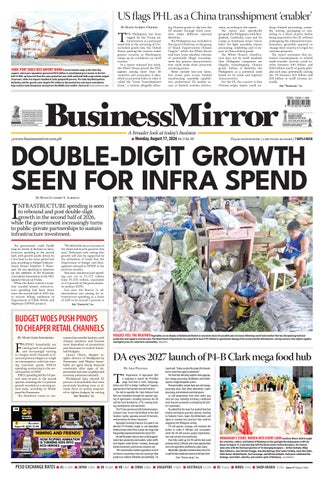
DOUBLE-DIGIT GROWTH SEEN FOR INFRA SPEND www.businessmirror.com.ph
n
Monday, August 17, 2026 Vol. 21 No. 307
P25.00 nationwide | 2 sections 20 pages | 7 DAYS A WEEK
By Reine Juvierre S. Alberto
I
NFRASTRUCTURE spending is seen to rebound and post double-digit growth in the second half of 2026, while the government increasingly turns to public-private partnerships to sustain infrastructure investment. The government could finally snap its streak of declines in infrastructure spending in the second half, with growth partly driven by a low base in the same period last year, according to Budget Undersecretary Romeo Matthew T. Balanquit. He was speaking to reporters on the sidelines of the Economic Journalists Association of the Philippines’s forum on Friday. When the flood control corruption scandal leaked, infrastructure spending had been down since the second half of 2025 due to stricter billing validation of Department of Public Works and Highways (DPWH) projects.
“We definitely see an increase in the third and fourth quarters this year,” Balanquit said, noting that growth will also be supported by the utilization of funds that the Department of Budget and Management released to DPWH in the previous months. This year, infrastructure spending was cut to P1.272 trillion from P1.558 trillion, equivalent to 4.2 percent of the gross domestic product (GDP). Last year, the Marcos Jr. administration was aiming for infrastructure spending as a share of GDP to be around 5 percent in See “Growth,” A2
BUDGET WOES PUSH PINOYS TO CHEAPER RETAIL CHANNELS By Mary Jade Jadormio
F
ILIPINO households are cutting back on purchases and increasingly turning to cheaper retail channels as financial pressure begins to weigh on consumption, with fast-moving consumer goods (FMCG) spending contracting in the second quarter of 2026. FMCG spending fell by 0.8 percent year-on-year in the second quarter, reversing the 1.6-percent growth recorded on a moving annual basis, according to Worldpanel by Numerator. The slowdown comes as con-
»B8
sumers buy smaller baskets, seek cheaper products and become more dependent on promotions and discounts to stretch household budgets. Laurice Obana, shopper insights director of Worldpanel by Numerator, said Filipino households are again facing financial constraints after signs of improvement last year as global and economic pressures intensify. Worldpanel data showed 81 percent of households that were previously breaking even or already short on money responded to tighter budgets by cutting See “Budget,” A2
BusinessMirror
BM Freshly Brewed
August 10, 2026 | 10 AM
‘MIMING AND FRIENDS’ HOW FILIPINO ANIMATION IS TURNING KIDS INTO ECO-HEROES JOHN EIRON FRANCISCO RAMON DEL PRADO Co-creator of ‘Miming and Friends’
BusinessMirror Multimedia Producer
VEGGIES FEEL THE WEATHER Vegetables are on display at Balintawak Market as consumers brace for possible price increases following recent bad weather that has disrupted agricultural production and supply in several areas. The Department of Agriculture has reported at least P197 million in agricultural damage from recent weather disturbances, raising concerns over tighter supplies and higher prices for some farm commodities. NONIE REYES
DA eyes 2027 launch of ₧4-B Clark mega food hub
T
By Ada Pelonia
HE Department of Agriculture (DA) is targeting to launch the P4-billion mega food hub in Clark, Pampanga, before end-2027 to bridge “inefficient” logistics gaps between farm production and markets. The bid to expedite the Clark National Food Hub was formalized through the separate signing of agreements, including between the DA and the Food Terminal Inc. (FTI), covering funding, development, and operations. The FTI also partnered with Clark International Airport Corp. to erect the food hub at the Clark Aviation Capital, spanning around 40 hectares, with provisions for future expansion. Agriculture Secretary Francisco Tiu Laurel Jr. has directed FTI President Joseph Lo and Agriculture Undersecretary Arrey Perez to have the mega food hub partially operational before the end of 2027. He said the project aims to close a critical gap between farm production and markets, where inefficient logistics erode farmers’ earnings, discourage private investment, and increase consumer cost. “We cannot build a modern agriculture sector if our farmers can produce more but cannot get their products to markets efficiently and profitably,” Tiu
Laurel said. “Today, we give this project the foundation to move from paper to pavement.” The food hub will bring together food aggregation, storage, processing, distribution, and marketing into a single integrated system. Planned facilities include food and cold storage, processing areas, food safety laboratories, export processing, and wholesale and retail spaces. Lo said preparations have been under way since last year, including recruiting a dedicated team focused exclusively on designing the facility’s operations. He added that the team has studied food hub models and logistics practices abroad, traveling to Thailand, France, Spain, the Netherlands, and Japan to examine best practices that could be adapted to the Philippine setting. FTI will operate, manage, and maintain the facility to make it efficient and sustainable, while the DA will oversee project implementation and construction monitoring. Once fully scaled up, the DA said the hub could generate about 2,500 jobs and create opportunities across the agriculture and fisheries value chains. Meanwhile, Agriculture Undersecretary Arrey Perez said the hub would raise incomes at the farm level. See “Food hub,” A2
MINDANAO’S STORY, WOVEN INTO EVERY LOOK Southern Weave 2026 brought the creativity, culture, and fashion of Mindanao to the spotlight this Kadayawan at SM City Davao on August 14. In partnership with the Davao Junior Fashion Designers, the runway came alive with the fresh perspectives of 10 emerging designers—Arthur Andrade, Milpe Blass Palmares, Jane Christin Ponggo, Jena May Quitoga, Bien Cedric Catubig, Jason Bon Gilles, Sittie Anwar, Roland Boyles, Assi Castanaga, and Alfredo Antipolo. Each piece celebrated the heritage, local fabric, identity, and creative spirit of Mindanao. SM SUPERMALLS
PESO EXCHANGE RATES n US 61.2890 n JAPAN 0.3842 n UK 82.6850 n HK 7.8107 n CHINA 9.0866 n SINGAPORE 47.8820 n AUSTRALIA 43.2394 n EU 70.6662 n KOREA 0.0432 n SAUDI ARABIA 16.3263 Source: BSP (August 14, 2026)
News
BusinessMirror
A2 Monday, August 17, 2026
‘Enabler’…
Continued from A1
The crackdown comes as Washington continues to target China-linked supply chains following the imposition of US tariffs on Chinese goods in 2018. For the Philippines, however, the designation adds another layer of scrutiny to an already closely watched trade relationship with the US. The country is separately subject to a 12.5-percent additional tariff under a US Section 301 action over its failure to prohibit and effectively enforce a ban on forced-labor imports, which took effect in July. For its part, the Department of Trade and Industry (DTI) has been seeking the removal of the duty, while Philippine agencies have also moved to strengthen controls on goods produced using forced labor. Also last month, the DTI, the Department of Labor and Employment and the Department of Finance signed a joint administrative order establishing rules for investigating and prohibiting the import of goods produced wholly or partly through forced labor. On the other hand, during a visit to New Clark City in May, US Undersecretary of State for Economic Affairs Jacob Helberg told reporters that Washington would continue to push for fair competition and reciprocal trade while seeking stability in its relationship with China. “We want to make, we continue to stand for fair competition and for our companies’ reciprocal trade. And so our economic policies haven’t changed,” Helberg said.
www.businessmirror.com.ph
₧6.182T of ’26 budget has been released as of end-July
A
By Reine Juvierre S. Alberto
TOTAL of P6.182 trillion of this year’s national budget has been released in the first seven months of the year as the government tries to pick up the pace in spending and improve budget execution. The Department of Budget and Management (DBM) disbursed 91 percent of this year’s P6.793-trillion budget as of end-July, according to its Status of Fiscal Year 2026 Budget report. The release rate was slower than the 93.8 percent recorded in the same period last year, although the amount released was higher than the P5.936 trillion made available through July 2025. Under the 2026 General Appropriations Act (GAA), the DBM allocated P3.356 trillion, or 91.4 percent, of the P3.671-trillion allotment for line departments, including agencies in the Executive branch, Congress, the Judiciary and other constitutional offices. About P497.668 billion, or 69.2 percent, of the P719.074-billion program was also distributed as special purpose funds (SPFs), which are budget-
ary allocations for specific socioeconomic purposes. These include the Contingent Fund, Miscellaneous Personnel Benefits Fund, National Disaster Risk Reduction and Management Fund, Pension and Gratuity Fund, as well as budgetary support to state-run corporations and allocation to local government units. Meanwhile, a total of P2.158 trillion, or 89.9 percent, of the P2.402 trillion allotted for automatic appropriations had been released as of end-July. The DBM has fully released the P1.190 trillion in National Tax Allotment, P93.982 billion in block grants, P480,000 in pensions for former presidents or their widows, P42.229 billion for the Special Account in the General Fund and P14.5 billion for the Tax Expenditures Fund.
An additional P186.554 million was also issued in July to augment the P82.194 billion originally allotted for retirement and life insurance premiums of government employees, bringing total releases for the item to P83.108 billion. Another P21.525 billion was released for net lending, while P712.5 billion was made available for interest payments. Beyond the 2026 GAA, the DBM released P49.898 billion to line departments and SPFs under continuing appropriations from the 2025 budget. Some P2.063 billion was also released in July for unprogrammed appropriations—particularly P23.787 million for the Department of Health, P654.760 million for the Department of Public Works and Highways and P1.384 billion for the Department of Transportation. The additional allotments brought total releases to P87.716 billion. Unprogrammed appro-
priations are standby appropriations that authorize additional agency expenditures for priority programs and projects when revenue collections exceed the resource targets or when additional grants or foreign funds become available. Meanwhile, P32.515 billion was disbursed for other automatic appropriations, which include grants, special accounts in the general fund, the Armed Forces of the Philippines’s Modernization Program and the tax expenditures fund. For 2027, the government has proposed a P7.2-trillion national budget, 6 percent higher than this year’s allocation and equivalent to 21.7 percent of gross domestic product. The DBM separately submitted the 2027 National Expenditure Program to the House of Representatives and the Senate last week, beginning congressional review and deliberations on the proposed budget.
Budget…
surged by 40 percent in the second quarter from a year earlier, while sari-sari stores posted 2-percent growth and convenience stores edged up by 1 percent. By contrast, supermarkets and hypermarkets recorded a 5-percent decline, market stalls fell by 4 percent, groceries dropped by 4 percent and drugstores registered the steepest contraction at 14 percent. Worldpanel said proximity remains important in determining where Filipinos shop, but consumers are increasingly weighing product assortment and value as they become more selective about where they spend. Household sentiment also deteriorated sharply following the onset of the Middle East conflict on February 28: those expecting their finances to worsen over the next 12 months increased by 26.7 percentage points from the January-to-March period, while pessimism over the country’s socioeconomic outlook rose by 33 points. Grocery and fuel prices remained among households’ biggest concerns, alongside fuel shortages, broader economic conditions, geopolitical conflict, climate change and food shortages. For retailers, the shift means growth will increasingly depend on giving cash-strapped shoppers a clear reason to return as consumers trade down, trim their baskets and become more deliberate about every peso they spend.
Continued from A1
spending, far exceeding other coping strategies such as looking for extra work (at 29 percent) or borrowing from relatives and friends (24 percent). That restraint is already changing how households divide their money, with average spending per buyer virtually flat between the first and second quarters at P130,091 and P129,822, respectively. Households maintained or increased spending on necessities such as fresh food, meat and produce, transportation, education and utilities while reducing allocations for grocery items, recreation and travel, savings, fashion, beauty and wellness and digital services. Nearly half, or 49 percent, of the average Filipino household budget in the second quarter went to essentials, while FMCG accounted for 10 percent and discretionary expenses took up 34 percent. Food has remained particularly difficult to cut, accounting for more than 75 percent of take-home FMCG spending as households prioritize products consumed at home. Pressure on household finances, however, is reshaping where those purchases are made, with discounters emerging as the fastest-growing retail channel during the period. Spending through discounters
Growth…
Continued from A1
the medium term. What matters now, Balanquit said, is to increase the infrastructure spending-to-GDP ratio and not by relying indefinitely on higher government spending to meet its infrastructure needs. “In fact, we are trying to unbundle and release that burden from DPWH. When it comes to schoolbuilding infrastructure, the Department of Education is now trying to tap local government units and also the private sector through public-private partnerships [PPP],” Balanquit said. This is the direction the government is undertaking right now, Balanquit said, as they have seen greater private-sector appetite for infrastructure projects, with the PPP pipeline now exceeding 500 projects, compared with fewer than 100 before the enactment of the PPP Code. The projects are also becoming more diversified, from traditional
transport infrastructure such as roads and railways to social-sector infrastructure, he noted. This strategy of tapping private investors will continue despite the recovery in public infrastructure spending, Balanquit added. “What’s great about this is that even the private sector is also becoming involved in investment in these long-term projects.” The rebound in infrastructure spending could also boost economic growth in the second half, particularly as the government sticks to its full-year growth target of 3.5 to 4.5 percent, Balanquit said. However, the economy would need to expand by around 6 percent in the second half to reach the upper end of the government’s target, he added. “I think that’s manageable,” he said. “I honestly believe we will be doing well in terms of public construction.” As of end-May, infrastructure spending and other capital outlays contracted by 42.9 percent to P268.4 billion from P471.5 billion in the same period a year ago.
EV…
Continued from A9
base could also generate jobs beyond factories, including in after-sales services, he added. Solidum said DOST is continuing to engage businesses that can invest in manufacturing facilities or adopt technologies developed through government-supported research as the country builds its EV industry.
HOR…
Continued from A9
“The congressman can identify what project he would like to have, but of course he does not own the appropriation. He can only propose,” Abante said. He added that implementation of approved infrastructure projects, including the selection of contractors, should remain with implementing agencies such as the DPWH and should undergo the prescribed procurement process. Abante also said allegations involving a supposed congressional “leadership fund” should be supported by documents before conclusions are made. He said he had no personal knowledge of such a fund despite previously serving as vice chairman of the House Committee on Appropriations. “The proper questions should be: What particular appropriation are we referring to? Where does it appear in the budget? When was it introduced? What public purpose does it serve? And which agency will implement it?” Abante said. He said scrutiny should focus on the actual appropriations, their public purpose, implementing agencies, and whether any lawmaker exercises prohibited control over funds after the General Appropriations Act has been enacted. “Documents first, facts then, we make the legal conclusion on this,” Abante said.
First, DBCC
THE House Committee on Appropriations will formally open the budget discussions with a briefing from the Development Budget Coordination Committee (DBCC) on the sources of financing, expenditure levels, and proposed allocations for government departments, agencies, and corporations. The DBCC briefing will include officials from the Department of Budget and Management, the Department of Economy, Planning and Development, the Department of Finance, and the Bangko Sentral ng Pilipinas. The committee-level deliberations will continue over the succeeding weeks, with the House Committee on Appropriations reviewing the budget proposals of various government agencies until September 8, 2026. The official schedule shows that hearings will begin on August 17 and conclude on September 8, covering major departments and constitutional bodies. Following the opening DBCC briefing, lawmakers will hear from the Philippine Amusement and Gaming Corporation and the Philippine Charity Sweepstakes Office on August 18. Subsequent hearings will cover key government offices, including the Department of Environment and Natural Resources, Department of Science and Technology, Department of Justice, Department of Trade and Industry, Department of National Defense, Office of the Ombudsman, Commission on Audit, Department of Public Works and Highways, Department of Migrant Workers, and other agencies. The deliberations will continue in September with discussions on agriculture, health, energy, transportation, education, social welfare, labor, and other priority sectors. The Department of Agriculture and National Irrigation Administration are scheduled for September 1, followed by the Department of Health and energy-related agencies on September 2. The Department of Transportation, Department of Agrarian Reform, Department of Tourism, and Commission on Human Rights will appear on September 3, while the Department of Education, Department of Information and Communications Technology, the Judiciary, and Department of Foreign Affairs will be heard on September 7. The final scheduled hearings on September 8 will focus on the Department of Social Welfare and Development and the Department of Labor and Employment.
Food hub… Continued from A1
“Our dream here is simple: to put more money in the pockets of our farmers and fisherfolk. At the Clark Hub, they will have a direct way to sell their harvest to markets and buyers, with fewer layers in between,” Perez said. “This is not just about buildings and warehouses—it is about building a system that makes life easier and more profitable for those who feed our nation,” he added. In 2025, the DA announced that it would earmark around P14 billion to build two food hubs. (See: https:// businessmirror.com.ph/2025/03/27/da-eyes-p14b-food-hubs-to-bolster-farm-supply-chain/) One will be located in Clark, Pampanga, to serve as a market channel for the provinces in North Luzon, and the other in Quezon province to cater to those in Southern Tagalog and Bicol.
www.businessmirror.com.ph
Monday, August 17, 2026
‘Impeachment trial won’t delay budget deliberations’
A
LEADER of the House of Representatives on Sunday assured that the impeachment trial of Vice President Sara Z. Duterte will not disrupt Congress’ review of the proposed P7.2-trillion national budget for 2027, while maintaining that actions she took as Education secretary remain subject to impeachment scrutiny because she was still the country’s Vice President. As the House of Representatives begins deliberations on the 2027 National Expenditure Program (NEP), Rep. Bienvenido Abante Jr. of Manila said the schedule of the Senate Impeachment Court allows lawmakers to continue performing their legislative duties, including reviewing the government’s spending priorities for next year. “The Impeachment Court only runs for four hours. It starts in the morning, and by three o’clock, deliberations begin, so I don’t think it will be affected,” Abante, vice chairman of the Committee on Good Government, said.
The Senate, sitting as an Impeachment Court, is currently hearing the four Articles of Impeachment filed against Duterte by the House of Representatives. The proceedings have covered allegations involving threats against President Ferdinand R. Marcos Jr., First Lady Liza Araneta-Marcos, and former Speaker Ferdinand Martin G. Romualdez, as well as the alleged misuse of P612.5 million in confidential funds from the Office of the Vice President (OVP) and the Department of Education (DepEd). Abante, an endorser of the impeachment complaint against Duterte, said the proceedings should continue alongside Congress’ other responsibilities, including the examination and approval of the proposed national budget. He expressed confidence that the impeachment trial and the budget deliberations can proceed simultaneously, adding that lawmakers must remain focused on their constitutional duties.
Gatchalian vows ‘strict Senate oversight’ over Pax Silica By Butch Fernandez @butchfBM
T
HE Senate, which on Friday opened hearings on the proposed Pax Silica initiative, will exercise strict oversight over the ambitious, albeit controversial project touted to help the country transition to industrialization and create thousands of jobs along the way. Sen ate P resident Sher w i n Gatchalian gave the assurance at the weekend to ensure that Pax Silica becomes a transformative economic opportunity for the country while ensuring concerns over its environmental impact are sufficiently addressed. “It is important for the Senate to have oversight and ensure that we respond to the risks and concerns,” Gatchalian said. The Pax Silica initiative, he added, should deliver long-term economic gains for the country
without compromising environmental safety, constitutional sovereignty, and the rights of local communities, including farmers and Indigenous Peoples. While the initiative presents a “once-in-a-lifetime” opportunity for the country to shift from lowvalue semiconductor assembly and vulnerable entry-level Business Process Outsourcing (BPO) jobs to high-value technology sector that could generate 200,000 direct jobs and up to 800,000 job opportunities during its construction phase, such economic prospects should be balanced with uncompromising vigilance. He said Senate oversight would be maintained throughout all phases of the project. The Senate Environment committee on Friday opened hearings on the ambitious Pax Silica complex in Central Luzon, touted to See “Pax Silica,” A4
BuCor trust fund officer back at work By Joel R. San Juan @jrsanjuan1573
B
U R E AU of Cor rec t ions’ (BuCor) trust fund officer Bianca Ramos has finally reported back to work and vowed to cooperate in the ongoing investigation on the allegedly missing P6 million trust fund of persons deprived of liberty (PDLs). Ramos, the trust fund officer at the Correctional Institution for Women (CIW), had been absent without leave (Awol) since July 21 or for almost three weeks. This prompted Corrections Director General Gregorio Pio P. Catapang Jr. to seek the assistance of Muntinlupa Police Station in determining Ramos’ whereabouts. On Saturday, CIW Acting Superintendent Lariza Martin informed Catapang that Ramos arrived at the CIW in response to the return to work order sent to her. Ramos was accompanied by her three sisters—Haydee Lynn, Ma. Sheena, and Nikki Rose—as well as her lawyers, Jennalyn P. Magtabog and Frisian Gail B. Descallar. She assured her readiness to officially resume work on Monday, and submit herself for investigative proceedings. During the meeting, Ramos
also offered her sincere apologies for any inconvenience her absence may have caused, especially to personnel directly or indirectly affected at the institution. She explained that her absence was not to evade the investigation but stemmed from considerable emotional distress and concerns about her personal safety at the time, which hindered her ability to respond appropriately. She also affirmed her full willingness to cooperate with the ongoing investigation and provide all necessary information or clarifications as required during the process. Catapang earlier ordered the relief of CIW Superintendent Daisy Sevilla-Castillote and her deputy Marites Lebardo in connection with the trust fund mess. He also directed BuCor’s Chief of the Internal Audit Service Unit Edgardo Virtudazo to conduct an internal audit concerning the alleged mishandling of trust funds. The BuCor chief also directed Directorate for Intelligence and Investigation chief-lawyer Ferdinand V. Balduman to conduct a parallel investigation to determine the extent of culpability among both former and current CIW officers.
A3
Palace orders heightened security across BARMM By Jovee Marie N. dela Cruz
M
@joveemarie
ALACAÑANG has ordered government security and law enforcement agencies to further strengthen security across Bangsamoro communities and conduct an exhaustive investigation into the attack on the convoy of Interim Chief Minister Abdulraof Macacua of the Bangsamoro Autonomous Region in Muslim Mindanao. Palace Press Officer Claire Castro said on Sunday that President Marcos wants authorities to determine who was behind the attack and ensure that those responsible are held accountable.
Related stories on page B8 “President Ferdinand Marcos Jr. is calling on ever yone to remain calm and uphold compassion and respect for the rights, especially the lives, of ever y
Filipino,” Castro said. “The President has directed all concerned government agencies to further strengthen security in the Bangsamoro community and conduct a thorough investigation to identify and hold accountable those behind this attack,” she added. Castro said Marcos strongly condemned the violence against Macacua and his companions, stressing that the incident would not weaken the national government’s commitment to ensuring a peaceful and orderly democratic transition in the Bangsamoro Autonomous Region in Muslim Mindanao. The Palace also appeals for calm and heightened security comes at a critical period for the region, which is preparing for its first regular parliamentary elections on September 14. The election date is set under Republic Act No. 12317 and reflected in Commission on
Elections preparations for the historic polls. For his part, Lanao del Sur Rep. Zia Alonto Adiong, likewise, condemned the attack, describing it as a threat not only to Macacua but also to the broader Bangsamoro peace process. “ We strongly condemn the brazen attempt on the life of BARMM Interim Chief Minister Abdulraof Macacua. We demand justice through a swift, thorough, and complete investigation of this reprehensible crime,” Adiong said. He called for the immediate identification, arrest, and prosecution of those responsible, saying the Bangsamoro people deserve the full truth and accountability. Adiong warned that the timing of the incident was particularly alarming with the parliamentar y elections less than a month away. See “BARMM,” A8
NDRRMC: Confirmed landslide, flood deaths now 23 By Jonathan L. Mayuga @jonlmayuga
T
HE number of confirmed deaths caused by raininduced landslides and f loods in Luzon has reached 23, with three other persons reported missing, the National Disaster Risk Reduction and Management Council (NDRRMC) reported on Sunday. Latest data on the combined effects of tropical cyclones Luis, Maymay and the southwest monsoon as of 6 a.m. on Sunday revealed that 15 of those killed were from Benguet province, including 10 from Baguio City, which was also severely affected by flash floods. Two of the fatalities are from La Trinidad, and three from Atok—all because of landslides. The other fatalities are one each from Luna, La Union, and Candelaria, Quezon, due to drowning; and three each in Rizal and Batangas due to various reasons. NDRRMC said 17 persons were injured while 3 others are still the subject of search and rescue operations. The number of affected families also increased to 1.4 million, or close to 5 million people, with reports from various local DRRMCs continuing to come in. The government continues to provide shelter to affected families, with the number now growing to 9,101, or 31,456 persons. According to the NDRRMC, they are currently being provided care in a total of 407 evacuation centers. Meanwhile, the NDRRMC said flooding, flash floods, and landslides damaged a total of 1,845 houses, with damage to public and private infrastructure now reaching P3.36 billion and damage to agriculture estimated at P690 million. See “Landslide,” A8
A4
Monday, August 17, 2026
www.businessmirror.com.ph
Lacson wants clarification on ‘questionable’ lump-sum items in proposed 2027 budget By Butch Fernandez
D
@butchfBM
ESPITE ongoing budget reforms triggered by last year’s multibillion flood-control fund scandal, there are still “questionable” lump sum appropriations for infrastructure projects of a government agency in the P7.2-trillion proposed national budget for 2027, Sen. Panfilo M. Lacson said. Lacson said he will demand an explanation or clarification from the officials concerned, as he flagged some item at the weekend, adding that he may raise the issue at the briefing of the Development Budget Coordination Committee (DBCC), initially scheduled on August 27. “We spotted lump-sum appropriations that we don’t think should be lump sum. When we say lump-sum appropriations, an aggregate amount is appropriated for a project, activity or program [PAP], or group of projects without detailing the breakdown of the cost of each PAP,” he said in English
and Filipino in a radio interview. “I will seek clarification on the details of these lump sum appropriations. Lump-sum appropriations are allowed for calamity funds because we cannot predict when calamities occur. But it becomes questionable if it’s for infrastructure projects. That is what I saw and I will ask for details on the matter,” he added. Lacson and his staff have started poring over the National Expenditure Program (NEP), after it was transmitted to both houses of Congress last week. He said they will also check the NEP for possible special provisions
that may potentially abuse the unprogrammed appropriations. He cited a past General Appropriations Act where the bicameral conference committee at the time added two additional and “highly questionable, even unconstitutional Special Provisions.” Such provisions had included those allowing the executive branch to transfer the funds of government-owned and controlled corporations (GOCCs) such as the Philippine Health Insurance Corp. (PhilHealth) to the national treasury; and Foreign Assisted Projects, “which could have been disastrous, if disbursed for purposes other than what it was intended.” These were removed in subsequent national budgets. Lacson also reiterated they will maintain the reforms initiated by the Senate and adopted all the way to the bicameral conference committee by then Senate Finance committee chairman and now Senate President Sherwin Gatchalian, including livestreaming the proceedings of the bicameral conference committee and posting online all documents related to the budget process. This early, he said Finance committee Chairman Jose Victor Ejercito assured him he will not allow insertions in the bicameral conference committee, if they are not in the Senate or House versions of the General Appropriations Bill.
“I hope this year that under Sen. JV’s chairmanship, he will fulfill his promise not to allow insertions in the bicameral level,” he said. L acson sa id suc h a pol ic y would address a longstanding problem in the bicameral conference committee, where provisions that do not appear in either the Senate or House versions of the General Appropriations Bill have, in the past, been inserted during the final stages of the budget process. Senators have been somewhat split on the matter of “insertions,” with several of them stressing that the “insertions” they were accused of introducing were actually part of their work as people’s representatives, championing urgent, even life-saving initiatives that had long been ignored. The matter reached a high point last week when Majority Leader Juan Miguel Zubiri took the floor—and was later supported by several peers—and took issue with reports that he was in control of a multibillion “Leadership Fund” that allowed senators to divert funds to pet projects. As then Senate President when the so-called fund alluded to by former Public Works Secretary Manuel Bonoan was introduced, Zubiri said he had been “hands off ” specific budget items and directed all requests to the then chairman of the Finance committee.
Business leader calls for basin-wide approach to Pampanga River flooding By Ashley J. Manabat
M
ABALACAT CITY, Pampanga – A s f looding eased in parts of Pampanga, agricultural and fisheries damage climbed to an estimated P748.8 million, a local business leader prompted a call for a broader, basin-wide approach to the province’s recurring flood problems. In a statement, Capampangan business leader Rene Romero said the province should look beyond its annual cycle of flooding, dredging and repairs, and examine how water moves through the entire Pampanga River Basin. Romero acknowledged the role of dredging, desilting, dikes, drainage improvements, pumping stations, and other f loodcontrol measures but expressed doubts if such inter ventions, when pursued separately, can address a problem that crosses municipal boundaries.
Romero said flooding should increasingly be treated as a riverbasin and water-management issue because water does not stop at barangay, municipal, or provincial boundaries. PDR R MO assessed that f looding in Pampanga is being driven by several factors, including continued rainfa l l, high tide, overf low ing rivers a nd c re e k s, upst re a m w ater f lows, drainage problems, and the province’s low-lying terrain. Candaba remained among the hardest-hit areas, with 32 flooded barangays. Water reached six feet in some areas and as high as 14 feet in others, according to the PDRRMO. Masantol had 26 flooded barangays, while Guagua and Macabebe each had 25. The Pampanga R iver Basin assessment placed t he water level in Candaba at 6.20 meters, above the reported 5-meter critical level. Water levels in Arayat,
Sasmuan and Zaragoza, Nueva Ecija, had reached the orange, or near-critical, level. Gov. Lilia Pineda also called for a review of ongoing flood-control projects and said some may not have been completed. Pineda said the government should consider temporarily stopping some flood-control works to assess whether they were addressing persistent flooding in low-lying towns. The governor said low-lying towns continued to experience f looding and that f lood-control projects should be studied before add it iona l const r uct ion proceeds. Romero, likewise, urged authorities to look beyond simply moving floodwater downstream and consider where excess water can be temporarily stored during extreme rainfall. He cited detention and retention basins, reser voirs, wetlands, f loodplains and, where scientifically appropriate, mult ipu r p o s e d a m s a s p o s s i bl e components of a broader f lood-
Pax Silica. . . Continued from A3
prime the economy and provide jobs, but saddled with criticism that it would pollute and displace communities and disrupt already scarce water and energy supplies in the region. Officials of the Bases Conversion and Development Authority (BCDA) assured senators that all investors in the massive initiative are aware of the regulatory guidelines for their projects and have been told no shortcuts will be tolerated. The investors have included projects to source their ow n power and water supplies, officials added.
management system. He also urged greater attention to natural flood-storage areas such as the Candaba Swamp which can temporarily accommodate large volumes of water. “Perhaps the better question is not where should we dredge next? But how should we manage the water from the time it falls downstream until it safely reaches the sea?” Romero said. “A drainage project in one town should not simply transfer water to the next town. A dike should not protect one community while unintentionally worsening flooding somewhere else,” he added. According to Romero, the central proposal is a long-term, integrated flood and water-management roadmap for the Pampanga River Basin. Romero arg ued combining engineered infrastructure with nature-based measures, including the protection or restoration of wetlands and floodplains where appropriate. He also pointed to rapid development as part of the flood-management discussion. “We hope that these hearings can be the venue for full transparency,” Sen. Paolo Benigno Aquino said in his opening statement at the hearing, presided over by Environment panel chairman Sen. Raffy Tulfo. While Tulfo began committee hearings in consideration of the timeline—a planned signing in November—several other committees, including Aquino’s Committee on Trade and Industry, had expressed interest to look into the matter and ease people’s worries about Pax Silica’s adverse impacts. Government has said the core of the undertaking is the setting up of mineral processing facilities that will end the country’s failure to use its abundant resources to
Local govts get greater financial capacity, flexibility, Recto says By Jovee Marie N. dela Cruz
@joveemarie
T
HE national government is giving local governments greater financial capacity and flexibility to respond directly to the needs of their communities, with a record level of funding intended to strengthen the delivery of basic services, infrastructure, and social assistance across the country, the Executive Secretary said. Executive Secretary Ralph G. Recto said the Marcos administration is placing LGUs at the center of development by ensuring that provinces, cities, municipalities, and barangays have the resources to implement projects and respond quickly to the needs of their constituents. “The President wants people to feel the presence of the government all the way down to every town and barangay. When people need help, LGUs should have the capacity to act and provide assistance immediately,” Recto said during his recent visit to Cebu. A key source of this support is the P57.87-billion Local Government Support Fund (LGSF) for 2026, the largest allocation for the program so far. The fund may be used by qualified LGUs for priority projects such as roads, farm-tomarket roads, water systems, health facilities, and multipurpose buildings that can also serve as evacuation centers during disasters. Recto said the government has also simplified the process for requesting assistance under the LGSF by reducing requirements and improving procedures to speed up the release of funds. He urged LGUs to promptly complete and submit their requirements through the Ugnayang Bayan portal so that approved projects can move forward without unnecessary delays. The administration is also looking at further expanding the program if LGUs demonstrate that the funds are being effectively translated into projects and services on the ground. Recto said the LGSF could receive an even larger allocation in 2027 if this year’s implementation proves successful. LGUs are also expected to receive substantially greater fiscal support through their National Tax Allotment. In 2027, the NTA of local governments is projected to reach P1.4 trillion, the highest level on record and about 11 percent higher than this year’s allocation. Recto said the increased resources reflect the national government’s push to empower local officials, who are often in the best position to identify the most urgent needs of their communities and deliver programs directly to residents. He also praised Cebu’s local officials for working closely with the national government in implementing programs involving food security, infrastructure, health, and other essential public services. According to Recto, strong coordination between the national and local governments is crucial in ensuring that government assistance reaches communities faster. Among the programs being implemented through strengthened national-local cooperation is the Bagong Pilipinas Rice Program, which aims to provide 10 kilograms of free rice every two months to nearly eight million low-income Filipino families nationwide. During his Cebu visit, Recto led the distribution of free rice to around 120,000 families in the province and assured beneficiaries that the assistance would not be limited to a onetime distribution. “This is not a one-time, big-time program. Rice will be distributed every two months. The President’s instruction is simple: no Filipino family should go hungry,” Recto said. He added that the program is designed not only to support vulnerable households but also to provide income opportunities for Filipino farmers by sourcing the rice from local producers. “The benefit is twofold: families have rice on the table, while farmers earn from their harvest. The government is helping both families and farmers,” Recto said. process ores and be able to sell high-value products, instead of merely exporting low-value, unprocessed minerals. Aquino asked officials to answer questions on how many farmers will be affected, how many indigenous peoples (IP) communities could be banished from their ancestral domain. “With our goals towards industrialization, providing more jobs, advanced manufacturing,” there is a need “to make sure that there’s a better way forward when it comes to progress in our country.” It is vital to modernize key industries, he acknowledged, “but we must make sure no one,” especially the “most vulnerable and marginalized” like farmers and the IP, are not left behind
Sen. Francis Pangilinan acknowledged the “potential opportunities” earlier cited by Gatchalian, especially the chance to graduate from being mere exporters of raw minerals to being part of advanced manufacturing and artificial intelligence or AI enterprises. He said the prospect of creating thousands of quality jobs and boosting the country’s position in strategic global supply chains is a decisive consideration in Pax Silica. But, he added, there is a need to ensure this early that the grand promises don’t turn out to be empty ones. The promised technology transfer, the safeguards against pollution, displacement and environmental disruptions must be carried out.
Monday, August 17, 2026
A5
PHL reopens borders to canned pork imports By Ada Pelonia
T
@adapelonia
HE government has reallowed the importation of canned pork products, but exporters must comply with a number of conditions prior to shipment of the food items to the Philippines. Agriculture Secretary Francisco Tiu Laurel Jr. signed Department Circular (DC) 42, which lifted the temporary ban slapped on the importation of industri-
ally manufactured, hermetically sealed, and heat-treated canned pork products. The Department of Agriculture (DA) said its decision followed an
Bill aims to fortify PHL farm insurance scheme By Jovee Marie N. Dela Cruz
@joveemarie
T
HE House of Representatives has approved a measure seeking to strengthen and expand the country’s agricultural insurance system to provide Filipino farmers and fisherfolk with greater protection against typhoons, floods, droughts, diseases, and other threats to their livelihoods. House Speaker Faustino G. Dy III, one of the authors of House Bill (HB) 10365, underscored on Sunday the importance of the measure, noting that a single calamity can wipe out not only a farmer’s harvest but also months of investment and the resources needed to resume production. “When a farmer is hit by a typhoon or flood, it is not only the crops that are lost. Their capital, their family’s income, and their ability to plant again are also put at risk,” Dy said. “We need an insurance system that helps our farmers get back on their feet instead of forcing them deeper into debt. This measure will ensure that the people who feed our nation have something to fall back on when disaster strikes.” HB 10365, which was approved on third and final reading last Wednesday with 201 affirmative votes, no negative votes, and no abstentions, seeks to strengthen the Philippine Crop Insurance Corp. (PCIC) by expanding its services and the agricultural activities eligible for insurance coverage. “Agriculture has changed significantly, along with the risks faced by our farmers and fisherfolk. Our agricultural insurance system must keep pace with those realities,” said Dy, who served three terms as governor of Isabela, one of the country’s major food-producing provinces. “For a farmer, one typhoon can mean losing the crop, the money spent on seeds and fertilizer, months of labor, and the income the family was counting on. Without adequate protection, one disaster can become years of debt.” Under the bill, PCIC insurance coverage would extend beyond traditional palay and corn crops to include high-value crops, livestock, aquaculture and fishery products, agroforestry crops, and forest plantations. Coverage may also include agricultural machinery, equipment, transport facilities, and related infrastructure, as well as life and accident term insurance for farmers and fisherfolk. The measure further provides that agricultural insurance should, as far as practicable, cover production inputs, the market value of labor provided by farmers or fisherfolk, their household members and hired workers, as well as a portion of the expected yield. The PCIC would also be authorized to offer parametric or index-based insurance and other innovative insurance products. HB 10365 would allow the PCIC to enter into public-private partnerships, joint ventures, and similar arrangements with agricultural cooperatives, farmers’ associations, and other private-sector participants. It also retains government premium subsidies for qualified subsistence farmers cultivating no more than three hectares, subject to periodic review, while requiring that any premium share they pay remain reasonably affordable. Dy said the expanded insurance protection would help farmers and fisherfolk recover more quickly and return to production, strengthening both family livelihoods and the country’s food security. The Speaker said insurance is not merely compensation for losses. “Insurance is not simply compensation after a loss. It can mean having the resources to plant again, repair equipment, restore a livelihood, and continue producing food for our communities,” he said. “When our farmers and fisherfolk are protected, they can recover more quickly. And when they recover more quickly, our country’s food production also becomes more resilient.”
import risk analysis (IRA) conducted last January, which showed that biosecurity risks are reduced to a negligible level when trade is strictly limited to industrially manufactured, hermetically sealed pork products. However, the products employ heat levels that “aggressively exceed” the World Organisation for Animal Health (WOAH) baseline requirement of 70 degrees Celsius for 30 minutes. This stemmed from an article in WOAH’s Terrestrial Animal Health Code (TAHC), which outlines a procedure for the inactivation of African swine fever (ASF) virus in meat. “Heat treatment for at least 30 minutes at a minimum tem-
perature of 70° C, which should be reached throughout the meat; or any equivalent heat treatment which has been demonstrated to inactivate ASFV in meat.” Furthermore, the agency said WOAH’s principle of Safe Commodities states that specific industrial treatments, specifically hermetic sealing and thermal sterilization, effectively neutralize ASF virus. Under DC 42, the entr y of canned pork products into the Philippines is allowed, provided that the pork products have undergone heat treatment in a hermetically sealed container with an F0 value of 3.0 equivalent or greater; are industrially manufactured; and hold valid
registration in the Philippines. “All import transactions for the aforementioned commodities must strictly comply with the existing rules and regulations of the Department of Agriculture.” The government issues temporary import restrictions as part of efforts to safeguard animal health and protect the local swine industry, which continues to grapple with the lingering effects of ASF since its detection in 2019. Last Febr uar y, Agriculture Undersecretary Constante Palabrica expressed optimism that hog production will recover this year, owing to government interventions that curbed the spread of ASF.
G over n ment d at a showed that the country’s swine inventory stood at 8.79 million heads in 2025, a slight increase from the 8.75 million heads recorded in 2024. “The rebound is possible this year because we’ve minimized the transmission of the disease through the deployment of various checkpoints,” Palabrica told reporters on the sidelines of the International Farmers Summit 2026. In 2024, the DA deployed several livestock checkpoints across Luzon to curb the spread of ASF following the disease outbreak in Batangas. The agency said the outbreak may have been exacerbated by “unscrupulous hog traders selling diseased pigs.”
Higher prices spur jump in H1 milk production–report
L
OCAL milk output surged to a record 25.38 million liters in the first half as price increases encouraged farmers to expand their production capacity, according to the National Dairy Authority (NDA). Data from the Philippine Statistics Authority (PSA) showed that local milk production jumped by 21.2 percent to 25.38 million liters in January to June, from 20.94 million liters in the same period last year. Historical data showed that this was the highest level recorded in the period since the time series started in 1981. The value of dairy output at constant 2018 prices also leaped by 21.4 percent to P975.73 million as of June, from last year’s P804.04 million. The country’s dairy herd expanded to 165,858 heads, up by 6.5 percent from 155,662 heads in the previous year, which reflected the continued expansion of the country’s dairy production base, according to NDA. NDA Administrator Marcus
BUSINESSMIRROR
Antonius Andaya said the latest figures indicate the growing productive capacity of the local dairy sector and the availability of more opportunities for Filipino dairy farmers. “Our farmers are becoming more confident in investing in their farms because they see a growing and reliable market for their milk,” he said. “With the support provided by the NDA and the increased demand
generated by government nutrition programs, farmers are encouraged to expand their herds, invest in quality feeds, and increase milk production.” The government is providing milk to Filipino children through the Department of Education’s (DepEd) School-Based Feeding Program, the Department of Social Welfare and Development’s (DSWD) feeding initiatives, and local government feeding programs
for daycare children. “The government’s procurement of locally produced milk through the Sagip Saka Act further gives our farmers the confidence that there is a ready market for their growing output,” Andaya said. The NDA said it will continue implementing programs focused on herd build-up, genetic improvement, dair y enter prise development, animal nutrition, milk processing, market development, and other inter ventions to further increase productiv ity and strengthen the dair y value chain. The agency attached to the Department of Agriculture noted the importance of sustained government demand for locally produced milk in encouraging farmers to invest more in farm productivity. With the dairy industry sustaining growth across key indicators in the first half, the NDA said it remains committed to supporting a stronger and more productive Philippine dairy sector. Ada Pelonia
Lawmaker wants a national ‘gulayan’ program By Butch Fernandez @butchfBM
S
AYING communities, especially school learners, should not go hungry or make do with foods that harm rather than nourish them, Senator Francis Pangilinan said he is working for a firmer program and funding commitment for the government’s Gulayan sa Barangay at Paaralan Program. His goal: institutionalize the program to help address hunger, malnutrition, and stunting while strengthening food security at the community level. Filed on August 4, Senate Bill 2380, which will be known as the Gulayan sa Barangay at Paaralan Act, aims to improve food access and strengthen household food security by institutionalizing communityand school-based gardens that produce fresh and nutritious vegetables and other products.
“It is unjust to leave some barangays or school learners hungry, especially when we have the capacity to plant and harvest food in our own communities. This program has showcased the success of the barangays and schools that carried it out,” the senator said, speaking mostly in Filipino. “In lawmaking, we will ramp up this program that enhances our bayanihan or sense of community. Neighbors will plant on their available lots and spaces for community gardens, and from this, they can all share in the nutritious produce.” Under Pangilinan’s proposed measure, every barangay will be required to designate an area for community farming. Public schools, when there are available lots, will also be tasked to implement the program. Currently, the program relies on administrative orders, but the senator pointed out how this would lead to
inconsistencies in the program’s implementation across localities and whenever government policies shift. “This should not be a one-time project to fight hunger. It must be sustained, organized, and part of our national program for food security.” If passed, the measure will mandate the Departments of Agriculture, the Interior and Local Government (DILG), and Education (DepEd) to oversee the program. Funding for it will also be sourced from the current budget of the three agencies. Appropriations for the program must subsequently be included in the annual national budget. A long-time advocate of food security and rural development, the senator pointed out that household food insecurity continues to be a “serious concern,” citing a 2023 Department of Science and TechnologyFood Nutrition Research Institute (DOSTFNRI) report that showed 31.4 percent
of Filipino households were classified as moderately to severely food insecure. The government’s current Gulayan sa Barangay at Paaralan Program has already covered 44,965 schools nationwide, the DepEd said, while 94 percent of public schools have active garden interventions. The DILG likewise reported that over 4.3 million households were already planting fruits and vegetables through similar community-based initiatives. Pangilinan said there is a need to invest government resources in critical programs that address food insecurity, saying that a truly just and progressive society will leave no Filipino hungry, malnourished, or stunted. “There is no true progress when there are families who go hungry and children who don’t mature properly because of stunting caused by lack of food. The true measure of success is when all of us have access to nutritious and affordable food.”
White sugar rally adds to already-steep refining margins W
HITE sugar futures in London rose for a third straight week, slightly outpacing raw sugar and keeping refining margins near their highest levels in two years. A blistering rally, mirroring other crop markets at risk from El Niño, has both raw and white sugar up more than 10 percent so far this month. But prices for the processed sweetener rose more this week as raw supplies remain abundant in top producer and exporter Brazil, prolonging a trend
this year of a widening premium for refined sugar over raw. The most-active white sugar contract fell on Friday but still gained more than 1 percent this week. The spread is a key gauge of refining profitability, with levels above $100 a ton typically providing a strong incentive to keep processing. White sugar’s premium settled near $150 a ton early last month before falling, but has started to rise again in recent trading sessions. Both raw and white sugar markets have surged this month as
potentially the strongest El Niño in decades threatens top producers. Supporting interest in refined sugar, the outlook is particularly stark in Europe—where multiple heat waves have parched crops, including the continent’s sugar beets that are processed directly into white sugar. Europe’s sugar output may fall to the lowest in more than a decade as a result. “ There had been hope that perhaps the EU might see some relief before they begin harvesting beets, but instead, they get
yet another heat wave,” said Mike McDougall, an analyst at McDougall Global View. Analysts are increasingly expecting tighter supplies in the 2026-27 season that starts in October. And the global shortfall may widen further in the 202728 season on lower cane and beet plantings, according to Czarnikow analyst Gerard Horner. Open interest has also risen alongside prices, suggesting the moves aren’t driven solely by speculators covering bearish bets, but
also by new buying, according to Paris-based brokerage Deepcore. Hedge funds were more bullish on white sugar than any other period on record over the week ending August 11, according to data released after market close. The shift was driven in large part by speculators opening new long positions rather than closing existing shorts. Still, challenges remain for the market, especially for raw sugar. Brazilian raw sugar remains plentiful, and subdued import demand has left supplies available in the near
term. The recent price gains also mean that sugar commands a sizable premium over ethanol, which may incentivize mills to produce more of the sweetener. In other softs, arabica futures fluctuated on Friday. A deadly earthquake this week in Colombia, the world’s second largest producer of the premium bean, has upended trading logistics at a time when stockpiles are already low. But the country has since partly resumed coffee exports through the Buenaventura port. Bloomberg News
A6
Monday, August 17, 2026
BusinessMirror
www.businessmirror.com.ph
www.businessmirror.com.ph
BusinessMirror
Monday, August 17, 2026
A7
A8
The World
Monday, August 17, 2026
Editor: Dennis Estopace
Powerful quakes rock Indonesia, 48 dead By Eddie Spence & Shamim Adam Bloomberg News
P
RESCUE workers remove rubble from the Cantabria building in Cali, Colombia on Thursday, August 13, 2026. NATHALIA ANGARITA/BLOOMBERG
$10B earthquake bill imperils Colombia austerity drive By Oscar Medina and Mie Dahl
L
an economy near full employment. Finance Minister Miguel Gómez has called the fiscal situation the worst in the republic’s history. And that was before Monday’s earthquake reduced entire tower blocks to rubble. Gómez told lawmakers that the government plans to declare an economic emergency to free up funding and bolster its response. That would give De la Espriella temporary authority to issue economic and tax decrees without the need for congressional approval. Investors are meanwhile closely monitoring how the new government intends to rein in borrowing after years of widening deficits. S&P Global Ratings downgraded Colombia to BB- this year, its lowest-ever rating, on concerns over a persistently large fiscal deficit and high debt burden. Across western Colombia, at least 172 buildings collapsed and more than 10,000 homes were left uninhabitable in Monday’s earthquake, which killed at least 287 people and left many more missing. Luis Fernando Mejía, a former head of the national planning department, estimates reconstruction will
cost 1 percent to 2 percent of GDP, though he cautioned that the figures, based on previous Colombian disasters, remain “very preliminary.” “The enormous challenge is that this fiscal shock finds the government in a highly fragile position,” Mejía said in a post on X. Jalil and Mejía estimate the government will have to cover about two-thirds of the cost, with overseas aid and private donations making up the rest. Still, it could take weeks or months to determine the full scale of the damage. The UN Development Program, which is working with Colombia’s disaster agency to tally direct economic losses using satellites and field surveys, said their assessment would take six to eight weeks. José Ignacio López, president of economic research center ANIF, also said the government will need extra revenue because the reconstruction bill is too large to cover simply by redirecting money from other programs. That would threaten De la Espriella’s promises to eliminate several taxes, including a 0.4 percent levy on financial transactions, the wealth tax and levies on sugary drinks and ultra-processed foods. After the quake, Colombia was offered emergency financing by the World Bank, and humanitarian aid from several Latin American nations, as well as from the US, Europe, the Middle East and Asia. Colombia turned away some offers of foreign rescue teams, including some from Mexico, while requesting help from the US, Israel, Ecuador and El Salvador. Critics alleged that Colombia favored conservative governments ideologically aligned with De la Espriella, while Colombian officials said teams had to meet international standards.
secure the area and support the ongoing investigation. Moreover, Brig. Gen. Christopher Abecia, BARMM police chief, branded the ambush a lawless act of violence. “We consider this act of violence unacceptable and a serious threat to peace and security in the Bangsamoro region,” Abecia said, adding that the investigation is ongoing to identify those responsible and determine the motive behind the incident.
Muslimin Sema, chairman of one of the factions of the Moro National Liberation Front (MNLF), likewise condemned the attempt on Macacua’s life, describing it as a direct strike against regional stability. “At a delicate moment when our region works tirelessly to consolidate progress, such lawless acts threaten to undermine the hard-won gains of the peace process that cost decades of sacrifice,” Sema, who is also the concurrent BARMM labor minister, said. PNA with Rex Anthony Naval
Authorities have also intensified enforcement of the election gun ban. At least 12 individuals have been arrested for violations, although gun-related violence remains a persistent concern, with at least 10 incidents recorded during the first half of August. The CCAA said the increased security presence has helped stabilize several high-risk areas in the immediate term. But the latest flare-ups demonstrate the limits of relying solely on security deployments to contain deeply rooted local conflicts. For peacebuilding advocates, the CCAA said the challenge extends beyond keeping polling centers secure on election day. In addition, the CCAA said the recurrence of rido reflects longstanding disputes over land, political influence, family rivalries and local authority. These conflicts can remain dormant for years before being reignited by political competition or other triggers.
As the elections draw closer, CCAA said temporary security measures may help prevent further escalation, but they cannot by themselves resolve the underlying disputes. The CCAA said a credible and peaceful electoral process in BARMM will therefore require sustained conflict-resolution and reconciliation efforts alongside security operations. “Such mechanisms will be essential not only to protect voters and candidates during the elections, but also to prevent displaced communities from becoming trapped in recurring cycles of violence long after the ballots have been counted,” the CCAA explained. “The latest clashes serve as a reminder that for many communities in BARMM, election security is inseparable from the broader challenge of building lasting peace. Without addressing the structural causes of rido, the immediate calm created by heightened security could prove only temporary,”said the CCAA.
Bloomberg News
ESS than half an hour before the first market open of his presidency, Abelardo de la Espriella’s fiscal plan was shattered by the earthquake that devastated western Colombia. He had pledged to slash spending by about $6 billion this year to reassure investors and ratings agencies alarmed by soaring government debt. BTG Pactual estimates earthquake reconstruction could cost $9.6 billion, or about 1.5 percent of GDP, spread over the next two to three years. De la Espriella may now have to shelve promised tax cuts, and even raise revenue to finance reconstruction, according to Munir Jalil, BTG’s chief economist for the Andes. “Never before in Colombia’s history has a disaster spanned such a vast area, affecting so many municipalities,” Jalil said by phone. “Without new revenue, financing this will be very difficult.” The disaster response is an early political test for De la Espriella, threatening to cut short his honeymoon if it is seen as bungled, or strengthen his narrow mandate if handled effectively. Colombia’s public finances were already under severe strain before the quake hit. The government expects a fiscal deficit of 7.8 percent of GDP this year—on par with the pandemic-era shortfall but extraordinary for
Ambush. . . Continued from B8
government personnel, or civilians is unacceptable and must not undermine peace, security, and stability in the Bangsamoro region,” Brig. Gen. Ricky Bunayog, acting commander of the 6ID, said. Bunayog assured the public that the militar y is actively coordinating with the police and local authorities to
Rido. . . Continued from B8
Residents displaced by violence may find it difficult or unsafe to return to their communities, campaign activities may be curtailed, and voters could face obstacles in reaching polling centers on election day. The CCAA said these conditions raise the possibility that violence could affect not only public safety but also voter participation and the ability of candidates to campaign freely. Authorities have responded by increasing security in areas considered vulnerable to election-related violence. The Commission on Elections (Comelec) has designated at least 100 areas as election hotspots, prompting the deployment of additional military and elite police personnel in high-risk communities.
OWERFUL earthquakes struck opposite ends of the Indonesian archipelago on Saturday, leaving at least 48 people dead in the remote island of Flores and damaging hundreds of buildings. A magnitude 7.7 quake struck off Flores island around 6 a.m. local time, according to the US Geological Survey, triggering a tsunami warning that was later lifted. Ende, near the epicenter, is about 500 miles (800 kilometers) east of Bali and roughly twice that distance from capital Jakarta. About 13 hours later, a 6.9 magnitude earthquake jolted Pematangsiantar in North Sumatra province, about 830 miles northwest of Jakarta. There were no initial reports of casualties or damage from the Sumatra temblor. The quakes are the latest in a series of disasters to strike Southeast Asia’s largest economy. The country is battling a surge in forest fires as a developing El Niño threatens to bring even drier weather and intensify risks at the peak of its dry season. Floods and landslides on Sumatra late last year killed more than 1,000 people and displaced more than 1 million. Major quakes around the world since June have caused thousands of deaths and billions of dollars in destruction. Saturday’s tremor was one of the largest to hit Flores since 1992, when one with a 7.5 magnitude caused significant damage as well, Wijayanto, a director at the Indonesian Meteorology, Climatology and Geophysics Agency, said at a briefing televised on local media.
BARMM. . . Continued from A3
“This attack strikes not only at the life of the Chief Minister but also at the very foundation of the Bangsamoro peace process,” Adiong said. “We cannot and will not allow violence, intimidation, or fear to undermine what generations have struggled and sacrificed to achieve,” Adiong said. He urged all groups to settle grievances through dialogue, democratic institutions, and the rule of law rather than violence. Macacua, meanwhile, said the attack would not derail his duties or the Bangsamoro government’s preparations for democratic transition. He urged the public to remain calm and avoid speculation while authorities investigate the incident. The incident has also drawn condemnation from security forces and the Office of the Presidential Adviser on Peace, Reconciliation, and Unity, as authorities work to determine the circumstances and motive behind the attack. The Palace maintained that the assault would not derail the government’s objective of helping BARMM complete its transition toward a fully elected and democratic regional government.
Landslide. . . Continued from A3
The government continues to assist the affected families, with estimated cost of assistance now reaching slightly over P654 million. While weather generally improved in many areas, monsoon rain is expected to affect several Luzon provinces in the next foue to five days. These include Ilocos Sur, La Union, Pangasinan, Benguet, Zambales, Bataan, Occidental Mindoro, Zambales, Bataan, Tarlac, Pampanga, Cavite, Batangas and Antique, in the Visayas. In its weather advisory issued at 11 a.m. on Sunday, the Philippine Atmospheric, Geophysical and Astronomical Services Administration (PAGASA) said localized flooding is possible in highly urbanized areas, low-lying areas, or areas that are near rivers. Landslide, according to the weather bureau, continue to threaten areas experiencing rains, especially those that are considered highly susceptible to landslides.
www.businessmirror.com.ph
2nd Front Page BusinessMirror
ERC, WITH OVERSIGHT OF P3.19-T INDUSTRY, CITES PRIORITIES By Lenie Lectura
T
HE Energy Regulatory Commission (ERC) outlined its priorities for a resilient and competitive Philippine energy sector, highlighting oversight of a P3.19 trillion industry. During the American Chamber of Commerce (AmCham) Annual 9th Energy Forum held last week, the agency shared regulatory measures and priorities during the forum, emphasizing the need for regulation to keep pace with the evolving needs of the country’s energy sector. “The ERC oversees an industry valued at approximately P4.19 trillion, covering generation, transmission, distribution, and supply,” ERC Market Operations Service (MOS) Director Sharon O. Montañer said. She added that the ERC strategy focuses on strengthening grid reliability, expanding consumer choice through 100-kilowatt (kW) retain competition open access (RCOA), promoting investment, and facilitating the energy transition. To strengthen power system reliability, the ERC is advancing measures such as the proposed Philippine Grid Code 2026, transmission development and the timely connection of new generation resources, strengthened reliability performance rules, and renewable energy (RE) integration in off-grid areas. On competition, the ERC is expanding opportunities for consumers to participate in the competitive electricity market through the implementation of the 100kiW contestability threshold under RCOA and the Retail Aggregation Program (RAP). The commission is likewise pursuing reforms to promote a more predictable invest-
ment environment, including the rationalized rules for setting distribution wheeling rates and the streamlining of regulatory processes, while advancing reforms in distributed energy resources and behind-the-meter technologies to facilitate greater consumer participation in the energy transition. Montañer emphasized that these initiatives are interconnected. They form part of the ERC’s broader objective of building an electricity sector that supports economic growth, promotes competition, attracts investment, and remains adaptable as the country transitions toward a cleaner and more resilient energy future. “Resilience is not simply the ability to recover from disruption. Resilience is the ability to emerge from disruption with a stronger system than before,” Montañer said. The ERC’s urgent tasks were broadened with the recent State of the Nation Address (Sona), where President Ferdinand Marcos Jr. directed the removal of the system loss charge from the electricity that users are billed for, as well as the value added tax imposed on it. The ERC has proposed a draft resolution to remove the 12-percent VAT on system loss charges, aiming to lower electricity bills for consumers. It also required all distribution utilities to submit their system loss data from 2021 to 2025 and every year thereafter. In particular, the data required for submission include the generation purchased cost, transmission cost, energy output, energy input, subtransmission and substation, feeder technical loss, non-technical loss, and kilowatt hour (kWh) shouldered by the DU in excess of the feeder loss cap, if any.
Monday, August 17, 2026
A9
There’s room to localize more EV parts, says DOST
D
By Bless Aubrey Ogerio @blessogerio
IPOLOG CITY—THE Philippines can expand local production of electric vehicle (EV) parts as the government rolls out its strategy to attract more investment into the sector, the Department of Science and Technology (DOST) said.
Science Secretary Renato Solidum Jr. told the BusinessMirror that the country could build domestic capabilities in several parts of the EV supply chain even as manufacturers remain dependent on imports for components that are not yet produced locally. “There are certain parts that are still abroad. We can’t do anything about it; that’s how the global supply chain is,” Solidum said in an exclusive interview on the sidelines of the opening of the DOST Regional Science, Technology and Innovation Week in Region 9 last week. “But there are many parts that
can be locally sourced,” he added. He cited vehicle chassis and body components as areas where local manufacturers could potentially expand, including through the use of composite materials made from Philippine tropical fibers. “For example, we can design chassis. We can do it here...the shell of vehicles. We can use composite materials using tropical fabrics. So there are a lot of things we can do,” Solidum said. The Board of Investments (BOI), for its part, has identified several automotive components that can be manufactured locally, including
chassis and sub-frames, body panels, bumpers, instrument panels, electrical systems, automotive glass and seats. The country is also seeking to develop its battery manufacturing capability. In September 2024, Australian firm StB GIGA Factory inaugurated a lithium-iron-phosphate battery manufacturing facility in New Clark City, with a planned production capacity of up to 2 gigawatt-hours annually by 2030. However, battery manufacturing remains a gap in the country’s export development strategy, with limited domestic processing of minerals needed for battery production despite the Philippines’ substantial nickel resources. Yet, Solidum said DOST has received proposals involving technologies. “But there are a lot of proposals for batteries. Different batteries,” he said. The push to build local EV manufacturing is being pursued alongside the government’s Electric Vehicle Industry Strategy (EVIS), which provides incentives intended to attract investments in EV and component manufacturing. For the science chief, developing the local supply chain will require
more than attracting vehicle assemblers. The country also needs stronger research and development (R&D), charging infrastructure and manufacturing capacity. “We already have an R&D center, but hopefully the other private sector would have their own R&D,” he said, referring to the E-Mobility Research and Development Center established under DOST’s Niche Centers in the Regions for R&D program. Private-sector participation in R&D would help expand the technologies available for local EV manufacturing, he said. The country also needs a wider charging network as EV adoption grows. While charging equipment may be imported, DOST is also developing local charging technologies and working with local governments, he said. Beyond technology and components, Solidum said the country needs capital to establish factories capable of producing EVs at scale. “That’s what we need, capital, investment, to build plants that will support local production to create more jobs,” he said. A larger domestic EV manufacturing See “EV,” A2
HOR vows transparency as deliberations begin for ₧7.2-T 2027 budget By Jovee Marie N. Dela Cruz
T
BAYANI SA NEGOSYO Five Filipino MSMEs were recognized as the inaugural DITO BizBayani Awardees, honoring entrepreneurs for their resilience, innovation, digital transformation and
contributions to their communities. From left: Ariestelo Asilo of Varacco, BizBayani in Industry Impact Award; Rio Pomer of St. Pio (Bridges Autism App), BizBayani in Innovations Award; Anna MagalonaGo of But First, Coffee, BizBayani in Employer Excellence Award; Felix Veroya of Ask Lex PH Academy, BizBayani in Digital Impact Award; and Bobby Adan of Prutasan ni Adan, BizBayani in Growth Excellence Award. The awards come as MSMEs remain a critical pillar of the Philippine economy, accounting for about 99.5 percent of registered businesses and generating significant employment nationwide, according to the Department of Trade and Industry. BusinessMirror has also highlighted the growing push for MSMEs to embrace practical digital transformation to improve productivity, operations and competitiveness. NONIE REYES
DBM releases ₧9.75B for SUCs’ FHE funding gaps By Reine Juvierre S. Alberto
T
@reine_alberto
HE Department of Budget and Management (DBM) has disbursed P9.75 billion to settle funding deficiencies of 108 state universities and colleges (SUCs) implementing the government’s Free Higher Education (FHE) program. A statement issued by the DBM on Sunday said the funds were released to the Commission on Higher Education (CHED) and will cover arrears for academic years 2022 to 2023, 2023 to 2024 and 2024 to 2025. CHED, through the Unified Stu-
dent Financial Assistance System for Tertiary Education (UniFAST), will distribute the funds to the beneficiary SUCs under existing guidelines. The funding is intended to reimburse costs that SUCs had previously covered using their own institutional resources to implement the FHE program, with the universities required to claim reimbursement for tuition and miscellaneous fees from CHED. The deficiencies stemmed from funding allocations that failed to keep up with rising enrollment and higher operating costs at SUCs. The DBM said the funding helps ease the financial pressure on SUCs
and gives greater fiscal room for other priorities, including academic and research programs, student services, laboratories, libraries, information technology resources and campus facilities, subject to existing budgeting, accounting and auditing rules. “Our responsibility is to make sure that limited government resources are directed where they are most needed, without compromising other equally important programs and services,” Budget Secretary Kim Robert C. De Leon was quoted as saying. “With this release, we are making nearly P10 billion available to address funding requirements of
our state universities and colleges while maintaining that careful fiscal balance,” he added. The amount released is chargeable against the agency’s built-in appropriations under the FY 2026 General Appropriations Act and the Special Account in the General Fund–Higher Education Development Fund (SAGF-HEDF), the DBM noted. The FHE program was established under Republic Act No. 10931, or the Universal Access to Quality Tertiary Education Act, which provides free tuition and other school fees for eligible students in SUCs and CHED-recognized local universities and colleges.
HE House of Representatives will begin deliberations on the proposed P7.2trillion national budget for 2027 on Monday, with House leaders assuring the public that the process will be transparent and that key proceedings, including reviews of budget amendments, will be livestreamed. The House Committee on Appropriations will open the hearings with a briefing by the Development Budget Coordination Committee (DBCC) on the government’s sources of financing, expenditure levels, and proposed allocations for departments, agencies, and government corporations. The committee-level budget hearings will run until September 8 before the proposed spending plan is brought to the plenary for deliberations. The House is targeting approval of the 2027 General Appropriations Bill on its third and final reading by October 9. Appropriations Committee Chairperson and Nueva Ecija Rep. Mikaela Suansing said the House intends to make the deliberations transparent, with hearings of the Committee on Appropriations and the Budget Amendments Review Subcommittee, or BARC, to be livestreamed. Bicameral conference committee meetings are also expected to be open to the public as lawmakers seek greater transparency in the handling of public funds. Manila Rep. Bienvenido Abante Jr. said taxpayers should be able to see how the government proposes to spend public money. “I am grateful to the leadership of the House of Representatives for ensuring that our deliberations are transparent. The public needs to know where the government budget goes because it is taxpayers’ money,” Abante said. “There should be no secrets in the budget. The public has the right to know all of these matters,” he added. President Ferdinand R. Marcos Jr.’s proposed P7.2-trillion spending plan, contained in the National Expenditure Program (NEP), was submitted to the House last week through acting Budget Secretary Kim Robert De Leon. The proposed budget is 6 percent higher than the P6.793-trillion allocation for 2026 and is equivalent to 21.7 percent of the country’s gross domestic product. Abante stressed that the NEP remains an executive proposal and will only become the national budget after Congress completes its constitutional deliberations and the resulting General Appropriations Bill is signed into law. “I should emphasize the constitutional role of
Congress in the budget process. The NEP is the executive’s proposed budget. It is not yet the national budget,” Abante said. If the House and Senate approve different versions, a bicameral conference committee will reconcile the conflicting provisions. The reconciled measure will then be submitted to both chambers for ratification before being sent to the president for signature.
Education gets biggest share
EDUCATION will receive the largest allocation under the proposed budget, with the Department of Education allotted P976 billion, or about 13.55 percent of the total spending program. The Department of Public Works and Highways is second with P644 billion, followed by the health sector with P353.8 billion. The Department of the Interior and Local Government is proposed to receive P332.5 billion, while the Department of National Defense will get P328.8 billion. The transportation sector is allotted P302.2 billion; agriculture, P261.7 billion; the Department of Social Welfare and Development, P241.6 billion; higher education, including the Commission on Higher Education and state universities and colleges, P176.5 billion; and the Judiciary, P86.3 billion. The 10 largest recipients account for about P3.703 trillion, or 51.4 percent of the proposed budget. By sector, social services will receive the biggest share at P2.456 trillion, followed by economic services at P1.833 trillion, general public services at P1.317 trillion, debt burden at P1.143 trillion, and defense at P452.4 billion. De Leon said the 2027 spending plan is focused largely on completing ongoing government programs and projects. The proposal also contains P111.984 billion in unprogrammed appropriations, equivalent to about 1.5 percent of the expenditure program, while the government expects a P1.7-trillion budget deficit to be financed through borrowing.
‘Amendments, not insertions’
AS scrutiny of the spending plan begins, Abante also urged the public to distinguish legitimate congressional budget amendments from what are commonly described as “insertions.” “Actually, the proper term for that should be amendments, not immediately insertions,” he said. He said Congress has the constitutional authority to examine and amend the Executive’s spending proposal, but individual lawmakers do not own or personally control public appropriations. See “HOR,” A2
A10 Monday, August 17, 2026 • Editor: Angel R. Calso
Opinion BusinessMirror
www.news.businessmirror@gmail.com
editorial
The stolen future: How young workers got left behind
T
HE message is brutal: the global economy has turned its back on young people. According to the International Labour Organization’s latest report, youth unemployment has climbed to 12.4 percent while adult joblessness continues to fall. The gap between these two figures—now a staggering 3.4-to-1 ratio—signals a fundamental breakdown in the social contract that has long promised each generation a fair shot at economic security. (Read the BusinessMirror story: “Youth bear brunt of weak job creation— ILO report,” August 13, 2026).
The ILO’s findings should alarm policymakers worldwide. After a brief post-pandemic recovery, youth employment has stalled, with 67 million young people now unemployed and an additional 257 million classified as NEETs— not in employment, education, or training. These numbers represent squandered potential, deferred dreams, and a ticking time bomb of social instability. The report’s findings on developing economies reveal an uncomfortable truth: low unemployment rates in these regions mask a different crisis—one of underemployment and informality. When nearly nine in 10 young workers in low-income countries toil in informal employment, and two-thirds remain trapped in precarious work well into their late 20s, the unemployment rate becomes a meaningless metric. These young people are not “employed” in any meaningful sense; they are merely surviving. Most troubling is the technological dimension. The report identifies 6.1 percent of youth-held jobs as highly exposed to AI-related disruption. While the ILO cautions that the ultimate impact remains uncertain, the warning is clear: the entry-level positions that historically served as economic springboards—clerical work, sales, trades, machine operation—are evaporating just as millions of young people need them most. Meanwhile, growth concentrates in high-skilled sectors that require credentials and connections many young people cannot access. This is not a temporary market fluctuation. It’s a structural transformation with profound implications. When societies cannot integrate their young people into productive economic life, they don’t just lose potential tax revenue or GDP growth points. They lose social cohesion. History teaches us that generations excluded from economic opportunity become breeding grounds for political extremism, social unrest, and mass emigration. The ILO’s prescription—more employment creation, stronger education systems, apprenticeships, lifelong learning, and social protection—is sensible but hardly revolutionary. The problem is not a lack of policy ideas; it’s a lack of political will. Governments have known for decades what works: targeted job creation programs, vocational training aligned with labor market needs, subsidies for first-time hiring, and aggressive anti-discrimination enforcement. What they lack is the urgency to implement these measures at scale. The report’s title, “Back to the Future,” carries an unintended irony. For millions of young people, there is no future to return to—only an increasingly precarious present. The world is witnessing the emergence of a “lost generation” not because solutions don’t exist, but because those in power have chosen other priorities. The cost of this neglect will compound over decades. Today’s unemployed youth become tomorrow’s struggling middle-aged workers, lacking the experience, networks, and savings that smooth economic transitions. The 257 million young NEETs represent not just a current crisis but a future liability—a generation less healthy, less educated, and less economically secure than their parents. The ILO has done its job by documenting the crisis. Now it’s time for governments, employers, and civil society to do theirs. The alternative—continuing to leave young people behind—is not just economically foolish. It is morally indefensible. The question is whether anyone with the power to change course is paying attention.
Ninoy’s courage, and ours Atty. Jose Ferdinand M. Rojas II
RISING SUN
O
N Friday, we will be celebrating the life of Benigno “Ninoy” Aquino Jr. He was assassinated 43 years ago, on August 21, 1983, and today, Filipinos are being asked once again to sit with why that death still matters, and what it should still be asking of us. His most famous act of courage happened in front of cameras. He knew what boarding that plane in 1983 might cost him, and he came home anyway. History remembers him because the moment was witnessed. But the version of courage the Philippines actually runs on, most days, is the kind nobody photographs. This has been a hard year to feel
✝ Ambassador Antonio L. Cabangon Chua Founder Publisher Editor in Chief Associate Editor News Editor
T. Anthony C. Cabangon Lourdes M. Fernandez Jennifer A. Ng Vittorio V. Vitug
Senior Editors
Lorenzo M. Lomibao Jr., Gerard S. Ramos Lyn B. Resurreccion, Dennis D. Estopace Angel R. Calso, Dionisio L. Pelayo
Online Editor
Ruben M. Cruz Jr.
Creative Director Chief Photographer
Eduardo A. Davad Nonilon G. Reyes
Chairman of the Board President Advertising Sales Manager Group Circulation Manager
D. Edgard A. Cabangon ✝ Benjamin V. Ramos Aldwin Maralit Tolosa Rolando M. Manangan
BusinessMirror is published daily by the Philippine Business Daily Mirror Publishing, Inc., with offices on the 3rd floor of Dominga Building III 2113 Chino Roces Avenue corner De La Rosa Street, Makati City, Philippines. Tel. Nos. (Editorial) 817-9467; 813-0725. Fax line: 813-7025. (Advertising Sales) 893-2019; 817-1351, 817-2807. (Circulation) 893-1662; 814-0134 to 36. E-mail: news.businessmirror@gmail.com
www.businessmirror.com.ph
Printed by BROWN MADONNA Press, Inc.–Sun Valley Drive KM-15, South Superhighway, Parañaque, Metro Manila MEMBER OF
Publishers Association of the Philippines Inc.
ing. It’s just that it is usually unwitnessed. So this year, as we remember Ninoy once more, the useful question is whether you’d still do the honest version of your job, the honest version of your vote, the honest version of your small daily choices, on a day when absolutely no one is watching or checking. That’s the less glamorous form of courage, a decision made privately and repeatedly by millions of people who will never be named in a headline, but who keep being decent anyway. Ninoy’s courage got a name, a monument, a holiday. Ours mostly won’t. But his was never meant to be the only kind that counted. It was meant to be the spark, not the whole fire. Forty-three years on, the fire is still made of the same unglamorous material. Ninoy’s courage bought this country a second chance. Ours is what we do with it when nobody’s asking us to.
Commending PBBM and Commissioner Nepomuceno for promoting level playing field among businesses
Since 2005
BusinessMirror A broader look at today’s business
proud of institutions. Investigations drag on, trust gets rationed out carefully, and it’s easy to read the news and conclude that integrity has become a rare commodity. But it’s also worth noticing what most of us may be missing: the country hasn’t actually been kept standing by its most visible people. It’s been kept standing by the ones we do not witness. It’s in the local engineer who
signs off on a project only after actually inspecting it, knowing no one would catch her if she didn’t. It’s in the OFW nurse in a foreign hospital ward, still homesick after a decade, wiring money home on a reliable schedule. It’s in the volunteer who shows up with a boat during the fourth typhoon of the month, when the news cameras have moved on, but the water hasn’t. The part of Ninoy’s story that gets remembered and reduced to a single image is his fall on the tarmac. The harder, less cinematic truth is that he spent years building toward that moment in exile, writing, organizing, staying convinced our country and his people were still worth the trouble, long before there was any evidence that the ending would be worth it. Most Filipinos who keep this country functioning are doing the same right now, not the tarmac part, but that doesn’t mean it’s less important or less demand-
Dr. Jesus Lim Arranza
MAKE SENSE
A
T the General Membership Meeting of the Federation of Philippine Industries on August 13, I reported to our domestic manufacturers, allied industries, and partners several developments that helped boost the level playing field for businesses in the country.
I particularly cited the Office of the President and the Bureau of Customs for displaying effective governance. I commended the administration of President Ferdinand Marcos Jr. Through the Office of the President, Presidential Management Staff, Office of the Executive Secretary, and the concerned departments—PBBM has been responding to the concerns and proposals that we brought to his attention, both through my letters and column here in the BusinessMirror. Notably, PBBM took cognizance of the following: 1) Illegal importation of palm olein— The Office of the President directed the Department of Agriculture to work with us in addressing the duty-free importation of palm olein purportedly for compounding of animal feeds. This was also investigated by the NBI and BIR. Eventually, this illegal importation, which robbed the government of an estimated P45 billion in revenues over a period of five years, was stopped and an importer has been penalized. 2) Illegal collectors and smelters of
used lead acid battery (ULAB)— PBBM’s office ordered the DENR to act on our complaint and investigated the smelters who lack the necessary permits and licenses while operating their environmentally hazardous facilities in San Simon, Pampanga. Their operations were stopped, although one is still doing guerilla smelting. 3) Cigarette smuggling—Our advocacy against the proliferation of smuggled cigarettes in the market continues to bear fruit as various agencies—the NBI, PNP, BOC—have been raiding and seizing millions of pesos worth of smuggled cigarettes. 4) LPG cylinders—We reported to the government that importers are declaring the value of their imported LPG cylinders at only P400/cylinder but refillers are collecting deposits from consumers ranging from P1,400 to P1,900. 5) Imported goods being sold with no Import Commodity Clearance—This is a continuing campaign as despite actions taken by concerned agencies, including raids conducted by the DTI, NBI, and PNP, we continue to see imported prod-
ucts in the market that do not bear the ICC mark, which means they did not pass the requirements prescribed by law. 6) SRA’s order to put additional bureaucratic red tape on the entry of “other sugars”—We acted on the complaint of our members in the confectionery and beverage industries that the SRA’s memo would gravely affect their operations. We wrote to the President and also held press conferences. The SRA administrator eventually withdrew his order. 7) Substandard imported automotive batteries—Through our coordination with the NBI and DTI, about P100 million worth of substandard imported automotive batteries were seized in Quezon City, which, to date, is the biggest haul of DTI’s Task Force Kalasag in its campaign against substandard and counterfeit products. 8) BPS order to replace mandatory testing of imported LPG cylinders with factory audits — We campaigned against this memo from the BPS because it runs counter to laws and issuances concerning product standards and mandatory testing by independent third-party testers to protect the consumers. 9) Appeal to issue EO extending inter-agency campaign on smuggling of agricultural products to also include industrial goods to protect domestic industries—the Office of the President wrote a letter to all concerned departments to submit their comments/response to our letter to the President. 10) MOA with the BOC for close coordination with FPI — We have signed a memorandum of agreement with the BOC, strengthening our partnership and creating avenues for better coordination. 11) Assist the steel industry in fasttracking the elimination of PNS 49:2020 with PNS 49:2026— The 2026 Standards
for Reinforcing Steel Bars removes all non-seismic grades. Its immediate implementation means that only seismic bars can be manufactured and sold locally. 12) TRO vs product standards— The Supreme Court has already acted on our petition to include in the Rules of Civil Procedure a provision that only the Supreme Court can issue an injunction order against the implementation of product standards by the DTI and FDA. The Supreme Court has already ordered both the DTI and FDA to submit their comments within 30 days from receipt of the order. This is an offshoot of the TROs issued against the standards of flat glass. I am also happy to report that the FPI and BOC, under the leadership of my friend, Commissioner Ariel F. Nepomuceno, have strengthened their partnership. I was having lunch with Ariel in Greenhills about one week before he became BOC Commissioner; that was when he informed me of his transfer from the OCD. I was very excited because the BOC is very important to us domestic manufacturers, and Ariel, leading that agency will be a major boost for us. And we have seen measurable progress. From July 2025 to June 2026, the Bureau of Customs conducted 1,090 enforcement and intelligence operations, resulting in the seizure of approximately P40.47 billion worth of illicit goods. The BOC also filed 30 cases involving Customs fraud, smuggling, and unlawful importation. These figures matter to local manufacturers because every illegally imported or fraudulently undervalued product removed from the market helps restore fair competition.
See “Arranza,” A11
www.news.businessmirror@gmail.com
Opinion BusinessMirror
Counsels, approach the bench Siegfred Bueno Mison, Esq.
THE PATRIOT
‘C
OUNSELS, approach the bench.” A sitting judge usually calls lawyers to approach the bench when their conduct in the courtroom needs correction, a reminder, a warning, and occasionally a stern rebuke. In Philippine courts, trial judges have not hesitated to censure lawyers when their behavior threatens to derail proceedings with unnecessary arguments, theatrics, or personal attacks. The ultimate objective of litigation including this impeachment trial of VP Sara Duterte is the proper administration of justice. I am sure norms of conduct are taught to every law student in legal ethics. Under the Code of Professional Responsibility and Accountability (CPRA), which took effect in April 2023, every lawyer, “as an officer of the court, assists in the administration of justice and as a client’s representative, acts responsibly upon a fiduciary trust.” An ethical lawyer is expected to embody integrity and act “with independence, propriety, fidelity, competence and diligence, equality and accountability.” Against this backdrop, what I find dumbfounding in the ongoing impeachment trial is the apparent disregard by some lawyers on both sides for the very standards they are professionally bound to observe. Lawyers from the prosecution and defense and even senator-judges have made statements, both in court and outside it, that arguably fail to uphold the dignity of the profession and have also resorted to language that appears abusive, offensive, or otherwise improper, the conduct spe-
cifically addressed by Canon II of the CPRA. Whether as part of litigation strategy or simply grandstanding, I have seen instances where opposing counsel and even witnesses appear to be unnecessarily harassed, belittled, or insulted. But perhaps the most troubling practice is the extensive use of media platforms by lawyers from both sides to comment on matters pending before the impeachment court. Press conferences, interviews, and social media posts may be useful in explaining what is happening in the impeachment court. But there is a thin line between informing the public and trying the case in the court of public opinion. Section 19, Canon II of the CPRA addresses this concern. Lawyers should not publicize or comment on matters pending before a court in a manner that may cause prejudgment, sway public perception, tarnish the integrity of the tribunal, impute improper motives to its members, or create a widespread perception of guilt or innocence be-
fore a final decision. For me, there is simply too much talking. And all lawyers ought to know the meaning and spirit of the sub judice rule. One of the House prosecutors, Congressman-lawyer Ridon, has argued that the public has a right to understand what is happening in the impeachment trial. His point is that the proceedings involve technical legal concepts and that lawyers on both sides have a responsibility to explain the evidence and rules to the public. I understand the argument. But I disagree that lawyers necessarily have to become public commentators on every development in the case. The public certainly has a right to know what happens in a public trial. Lawyers can explain procedure and clarify legal terminology. What they should not do is use the media to litigate what they could not accomplish in court. And that is exactly what is happening and will continue to happen in this impeachment trial. Every statement by any lawyer is immediately dissected, amplified, weaponized, and converted into political ammunition. What begins as an explanation can quickly become advocacy, and advocacy becomes propaganda in this case that has polarized the country to an extraordinary degree. Unless lawyers, even those designated as spokespersons or so-called analysts, are willing to discipline themselves as in limit their public comments to legitimate explanations of procedure and avoid influencing public sentiment, I would rather see the presiding judge issue a reminder, or even a directive, concerning the sub judice rule. “Counsels, approach the bench.” Someone needs to remind all law-
US military option for Cuba fades as Trump focuses on sanctions By Eric Martin
T
HE Trump administration’s Cuba strategy is increasingly focused on ramping up sanctions and economic pressure rather than deploying military force to break the island’s Communist leadership, people familiar with the matter said. US attention is now centered on cutting off all revenue sources for the regime rather than any military or special forces operation similar to the January raid that seized Venezuelan leader Nicolás Maduro, according to the people, who asked not to be identified to detail the administration’s thinking. The strategy is aimed at creating fractures in the ranks and room for negotiation in a government that’s rejected US calls for change after almost seven decades of one-party rule, the people said. While the US has maintained a trade embargo on Cuba since the early 1960s, officials led by Secretary of State Marco Rubio concluded more could be done to cut off funds flowing to the powerful Castro family and military leaders, the people said. While it’s been weeks in the making, the approach echoes a recent shift in
Arranza. . .
Continued from A10
Just as important to FPI is the renewed partnership between the Bureau and our Federation. Under the BOC-FPI agreement, accredited Industry Technical Experts can assist Customs in monitoring and inspecting high-risk shipments nationwide. The BOC has committed to act on ITE reports within seven days, while a joint monitoring committee meets quarterly to review implementation. Commissioner Nepomuceno has also made legitimate trade easier. Customs valuation processing has been shortened from five days to three days, while importer, exporter, and customs broker registrations have been extended from one year to three years. At the same time, stronger postclearance audits generated about P3.07 billion, reinforcing compliance even after shipments have been released. In one sector alone, illicit tobacco, the
strategy toward Iran that’s focused less on military force and more on squeezing Tehran economically. On Thursday, Treasury Secretary Scott Bessent said the US would soon impose what he said were “measures that have never been seen in the history of economic isolation on a country” against Iran. However, it’s unclear whether the new Cuba strategy can yield a breakthrough after more than half a century of controversial economic sanctions and no credible political opposition. There’s also no agreeable political leader to install, as the US did in Venezuela and as President Donald Trump has said he wanted to do in Iran — where the regime has also held out against US pressure. Asked to comment, a US official said the Trump administration is open to a new chapter in its relationship with Cuba and that the only thing standing in the way is the nation’s current leadership. The official said a failed state in Cuba is a threat to US national security and that almost every left-wing militant group in the Western Hemisphere has relied on Cuban support at some point. “As with any foreign policy topic, President Trump has many options at his disposal,” the State Department said in a
BOC conducted 187 enforcement operations in just five months, seizing approximately P13.5 billion worth of smuggled cigarettes and tobacco products. For FPI and its members, the most important accomplishments of Commissioner Nepomuceno are not simply higher Customs collections, which, for the first seven months of the year, reached P587.711 billion, the highest collection ever recorded for the Januaryto-July period. More meaningful to us at FPI are the reforms that increasingly address a longstanding concern of Philippine manufacturers: A local manufacturer that pays the correct taxes, follows Philippine standards, employs Filipino workers, and complies with government regulations should not have to compete against imported goods that enter the country through smuggling, undervaluation, misdeclaration, or other fraudulent practices. The combination of stronger enforcement, better valuation, the reinstatement of FPI Industry Technical Experts,
statement. “The United States will continue to use every tool available to both address the national security threats posed by the Cuban Communist regime, and to drive the economic and political reforms to give Cuba a better future.” The ramped-up US measures on Cuba include a naval quarantine of oil deliveries to the nation’s government that has led to repeated blackouts and warnings that ever-tighter sanctions risk a humanitarian crisis. Cuban officials have condemned the sanctions as “genocidal,” saying they’re willing to make economic reforms and negotiate but that the island’s political system is not up for debate. Since using the military to capture Maduro, Trump has repeatedly raised the prospect that Cuban leaders could be “next,” and hinted at possible military operations. Republican lawmakers from Florida, where there is a large Cuban diaspora, have also raised expectations of kinetic action. Representative Carlos Gimenez has suggested Trump and Rubio could “annihilate” the Cuban regime in “a matter of seconds,” and cast doubt on a report that Republican senators were cautioning Trump against an attack given the war in Iran. Bloomberg industry data-sharing, digitalization, faster processing, tougher internal controls, and closer government-industry cooperation helps move us toward that level playing field. We don’t really need to be pampered or be protected, like some would call us THE FEDERATION OF PROTECTED INDUSTRIES. We just want a level playing field. And we are happy because Commissioner Nepomuceno is taking the time to meet with us regularly to help ensure we achieve that level playing field. In closing, I want to congratulate the directors, officers, and members of the FPI on a highly successful General Membership Meeting. Your strong turnout underscores our shared commitment and re-energizes our collective fight against smuggling and all forms of illicit trade.
Dr. Jesus Lim Arranza is the Chairman Emeritus of the Federation of Philippine Industries and concurrent Chairman of the Anti-Smuggling and AntiIllicit Trade Committee.
yers, myself included, that we are not merely political advocates but we are officers of the court. The standards imposed in the CPRA go with us wherever we go. Section 2 of Canon II reminds lawyers not to “behave in a scandalous manner, whether in public or private life, to the discredit of the legal profession.” Section 3 likewise prohibits conduct that creates or promotes an unsafe or hostile environment, including online. In an age when outrage attracts attention and rude language generates clicks, there appears to be a temptation among some lawyers to play to the audience. Crassness is mistaken for courage. Insults are mistaken for advocacy. Grandstanding is mistaken for legal brilliance. For me, it is none of these. A lawyer can be forceful without being offensive, passionate without being abusive, and vigorous in defending a client without sacrificing professional dignity. I do not expect the Supreme Court to initiate disciplinary proceedings against every lawyer who may have crossed the line during this impeachment trial. But I do hope the lawyers themselves will exercise some measure of self-policing. The Integrated Bar of the Philippines (IBP) should remind its members that professional accountability is not merely a provision in a code. It is a responsibility owed to the profession, the courts, the clients, and ultimately to the administration of justice. Self-policing is indispensable to every profession. A handful of bad eggs can give the entire profession a bad name. If lawyers themselves refuse to call out misconduct within their ranks, who will? “Counsels, approach the bench.” There is, interestingly, a parallel
Monday, August 17, 2026 A11
in the Christian life. Believers are called ambassadors of Christ: “We are therefore Christ’s ambassadors, as though God were making his appeal through us.” (2 Corinthians 5:20) An ambassador represents someone greater than himself. Whatever he says or does reflects upon the one he represents. The same is true of a Christian. But Christians, like lawyers, are far from being perfect. Peter was one of Jesus’ closest disciples. Yet when Jesus was arrested, Peter fled and later denied three times that he even knew Jesus. Peter failed miserably. But his failure did not become the end of his story. He recognized his sin, repented, was restored by Christ, and eventually became one of the most courageous witnesses or advocates of the Gospel. Christianity does not teach that believers will never fail. It teaches that believers must recognize their failures, repent, and return to Christ. The greater danger for believers and lawyers alike is not falling but becoming comfortable with the fall and after it. A lawyer cannot invoke professional ethics only when convenient. He cannot demand strict compliance from colleagues while excusing his own violations. Likewise, a Christian cannot selectively obey Scripture, as in embracing commands that are convenient while ignoring those that are uncomfortable. This is the danger of being lukewarm. Christ’s warning in Revelation is severe: “Because you are lukewarm - neither hot nor cold - I am about to spit you out of my mouth.” (Revelation 3:16) A lawyer who repeatedly disregards professional responsibility may face suspension or disbarment. A Christian who repeatedly and con-
sciously treats Christ’s commands as optional faces a far more profound question, not merely whether he has violated a rule, but whether his professed faith is genuine. There is a difference between a believer who falls and one who refuses to get up. Peter fell. Peter repented. Peter was restored. The lesson for lawyers is equally simple. We may argue vigorously and defend our clients passionately. But we cannot abandon the rules that make us professionals in the first place. The impeachment trial will eventually end. The lawyers will leave the courtroom, the senators will cast their votes, and the cameras will move on. But the dignity of the legal profession will remain. So, for all lawyers, may they be reminded of the CPRA, in whatever way, shape, or form. And to those of us who profess to follow Christ, may we be reminded of the tenets in the Bible. Lawyer behavior may face sanctions from an earthly judge (Supreme Court or the IBP), but the conduct of believers will be measured by the One before whom every one of us will ultimately stand. Let us all hear from within ourselves—“Counsels, approach the bench,” before it gets too late! Siegfred has a diversified set of education and experiences which has made him a game changer and a servant leader in organizations. His professional degrees came from the United States Military Academy at West Point in New York, Ateneo Law School, and University of Southern California, Los Angeles, USA. His corporate experiences include stints as general counsel for the country’s flag carrier, a food exporter with manufacturing plants in Davao and in Laguna, and a sports distributor company. Siegfred is a former soldier and a lawyer by profession, a teacher and inspirational speaker by passion, and a book author and a writer with a mission.
Building infrastructure together: The citizen’s role in waste management LITO GAGNI
E
VERY time the rains come, the country is confronted by a familiar and rather embarrassing sight. Floodwaters rise. Waterways overflow. And from canals, creeks and drainage systems emerges a procession of plastic bags, bottles, discarded packaging and household refuse—the accumulated evidence of what we have thrown away and subsequently forgotten. Until the rain returns it to us.
President Ferdinand Marcos Jr. was confronted by precisely this problem when he inspected clearing operations at the Redemptorist waterway last Wednesday. The mountains of waste recovered from waterways tell us that flooding is not merely an engineering problem. Part of it is also a waste-management problem. And in that visit, the President provided us a better way of looking at the mountain of garbage: it is not a crisis but it could be a harbinger of something worthwhile pursuing. He provided a lens to a new way of looking at that mountain. What if some of what we have been treating simply as garbage could become part of the country’s infrastructure? That possibility is beginning to take physical form in New Clark City. The Bases Conversion and Development Authority and a FilipinoIndian consortium composed of ATD Waste to Energy Corp., Global Heavy Equipment and Construction Corp., and India-based Uttamenergy Ltd. are developing a P4-billion wasteto-energy facility on a four-hectare site there. The numbers tell part of the story. The facility is designed to process about 600 metric tons of waste a day and generate approximately 12 megawatts of electricity, enough to supply the equivalent needs of more than 10,000 homes in Clark and surrounding communities. It is expected to reduce the volume of waste requiring final disposal by as much as 80
In a sense, waste should not be viewed merely as garbage but as a resource that, when responsibly managed, can help power homes and support economic activity. There is an elegant circularity to the proposition. The waste that helps clog the waterways can instead help generate the electricity that powers the city. to 90 percent through controlled thermal treatment. But those numbers are not what make this project particularly interesting. The more important development is the change in thinking behind them. For generations, our economic relationship with garbage has essentially ended at disposal. We consume something, discard what remains, collect it, transport it and then spend money finding somewhere to bury it. In that model, waste is purely a liability. Waste-to-energy asks whether part of that liability can be converted into an economic asset. That is a profound distinction. Instead of merely paying to transport waste to increasingly scarce landfills, properly managed residual waste can potentially become feedstock for electricity generation. Something occupying land and threatening waterways acquires another possible economic use. In a sense, waste should not be viewed merely as garbage but as a resource that, when responsibly managed, can help power homes and
support economic activity. There is an elegant circularity to the proposition. The waste that helps clog the waterways can instead help generate the electricity that powers the city. There is an interesting diplomatic footnote in the upcoming WtE plant in New Clark City. The project traces part of its momentum to President Marcos’s state visit to India in August last year, when waste-to-energy technology figured in discussions between Philippine and Indian business interests. A state visit, therefore, need not end with communiqués, handshakes and photographs. Its real measure comes later— when an idea discussed across a conference table becomes steel, machinery, employment and electricity at home. New Clark City offers an appropriate laboratory for that proposition. It was conceived as a smart, green and future-ready metropolis. And now, it will have the country’s first waste-to-energy plant. But there is something that citizens should take into account. If waste is to become a resource, it must first be properly separated, collected and managed. Citizens therefore become participants in the infrastructure even though they may never see the turbines inside the plant. That may ultimately be the most interesting aspect of the New Clark City experiment. Infrastructure is usually something we imagine government building for us. Waste management is something the government must build with us. The difference is participation. Perhaps someday, when heavy rains again descend upon our cities, fewer mountains of garbage will come floating back to remind us of what we have discarded. Not because we have simply found a better place to hide our waste. But because we finally learned that the things a nation throws away can reveal something about the way it thinks. For decades, we looked at garbage and saw something without value. New Clark City is attempting something different. It is asking us to look at what we throw away—and see what it might still become.
Sports BusinessMirror
A12 Monday, August 17, 2026
ALAS Pilipinas Girls (from left) Xyz Rayco, Frances Ramos, Caera Celis, Khaira Manzano, Irish Mahinay and Jhaynna Bulandres celebrate a point against Venezuela. VOLLEYBALL WORLD PHOTO
mirror_sports@yahoo.com.ph | Editor: Jun Lomibao
Alas Girls discover more dimensions to build on By Aldrin Quinto
S
ANTIAGO, Chile—Alas Pilipinas is emerging from the FIVB Volleyball Girls’ U17 World Championship with a much better idea of what it can become. The girls are still discovering new dimensions to its game even as its breakthrough campaign comes to a close with Megan Hernandez, Jello Mauricio and Jhenica Sadia, who had seen varying amounts of court time, combining with established scorers Xyz Rayco and Caera Celis to give Alas Pilipinas a different look on offense. The process had been tough for the recently-reassembled squad, but team manager Karl Chan believes the experience will ultimately make the team better. “What matters is that we learn from every game and use those lessons to get
EALA BACK WINNING IN CINCINNATI OPEN A LEX EALA improved to 8-1 won-lost matches in her North American hardcourt swing after Elena-Gabriela Ruse retired with an ankle injury while trailing 6-1, 3-0, in the Cincinnati Open on Saturday in Mason, Ohio. “I think that I was playing well, I think I felt the ball good, was really focused and tried to keep myself in the zone, I think I did a good job of that,” Eala, seeded 17th in the tournament, told the media. “Of course, nobody likes to finish a match with a retirement, first and foremost, I just want to wish Gabriela-Ruse a speedy recovery, injuries
aren›t fun, so I hope she recovers soon.” The Filipina has won eight of her past nine matches—she captured her first Women’s Tennis Association singles title in Washington before reaching the fourth round of the National Bank Open in Toronto. This marks her first career win in Cincinnati. “I do think that my days have gotten a little more packed with the commitments and spending time with you guys, but obviously in a very good way, and I’m enjoying it a lot,” Eala said about her run over the past few weeks. “I think it’s a good sign, and it’s helping me become, I guess, a stronger player and be more kind of established on tour.”
Eala will next face No. 9 seed American Amanda Anisimova—who defeated Zeynep Sonmez, 6-2, 6-3, earlier in the day—in the third round on Monday. This will be the first meeting between Eala and Anisimova. Novak Djokovic’s stay at the Cincinnati Open, meanwhile, was a short one—It also might be his last. The 24-time major champion fell to Thiago Agustin Tirante, 2-6, 6-4, 6-4, on Saturday in a match that took twp hours and 44 minutes in hot and humid conditions. A 25-year-old from Argentina, Tirante is ranked No. 50 in the world.
Djokovic—a three-time Cincinnati champion and No. 5 in the rankings— was playing for the first time since his loss to top-ranked Jannik Sinner in the semifinals at Wimbledon. Up next for Djokovic is the US Open, which starts August 30 in New York. Djokovic appeared to struggle physically in the heat and had his 10-match winning streak in Cincinnati snapped and the 39-year-old told reporters that an unspecified health condition made it difficult for him to play in hot and humid weather. WTA News and AP
Patino, Madis back to defend Gentry Open crowns North mission: Pressure South
T
EAM North will open its title defense in the International Container Terminal Services Inc. Elite Junior Philippine Golf Tour (JPGT) Finals with a simple formula: Play clean, stay patient and keep the pressure on until host South cracks. But with South armed with a homecourse familiarity, a deeper pool of battle-tested qualifiers and a determined bid to avenge last year’s defeat, North knows it cannot afford to take anything for granted when the Ryder Cup-style championship gets under way Tuesday at Pueblo de Oro Golf and Country Club in Cagayan de Oro City. Coach Joey Anciano has stressed teamwork and smart decision-making as the keys to North’s campaign, particularly in the opening four-ball and foursomes matches where partnerships and momentum can quickly swing the complexion of the competition. “Our main focus is teamwork and keeping the pressure on. In both formats, we want our players to play smart, stay patient, and trust their partners,” Anciano said. “But the goal is to play clean golf and let them make the mistakes.” That approach will be tested immediately as North faces a South side determined to turn its local knowledge into an early lead. The defending champion North stormed to a commanding 26 1/2-21 1/2 victory over South in last year’s inaugural showdown at The Country Club, and Anciano’s charges are confident they have enough depth and firepower to reprise that performance. With points at a premium across all age groups, including the 7-10, 11-14 and 15-18 categories, North knows that depth could prove just as important as star power.
A
RTHUR CRAIG PATINO returns to defend his men’s open singles title in the 2026 Gentry National Open Tennis Championships scheduled from August 20 to 30 at the Colegio San Agustin courts in San Jose del Monte, Bulacan. A total of 1,300 players from around the world are enterted in the weeklong competition presented by Honor Philippines— titles are at stake in the men’s and women’s singles and doubles open a ass well junior singles categories. “Gentry, the biggest tennis open tournament in the Philippines on its second year, gives every player the hope of being recognized and compete against the best,” Gentry Open and Gentry Timepieces President Hayb “Pareng Hayb” Anzures told a press conference at the BGC on Saturday. “There are many Filipino tennis players not just here in the country but also from the United States who are coming to compete in the event and there are some players around
ALEX EALA has won eight of her nine matches in her North American campaign. WTA PHOTO
GENTRY Open president and Gentry Timepieces founder Hayb “Pareng Hayb” Anzures (center) makes the No. 1 sign with (from left) Philippine Bottling Beverages General Manager Thor Mutuc, Beauty Elements Ventures Inc. Brand Manager Nana Borja, Honor Philippines Vice President Stephen Cheng and Skywarrior Philippines coach Yathart Vidrohi Bharwadj. GENTRY PHOTO
Asia like in Singapore who will also see action,” Anzures said. “This is going to be a low-key competition for Filipinos against the world.” Patino will have his hands fall with the country’s No. 1 AJ Lim, who he beat in the final last year, also coming back, as well as reigning women’s titlist Tennielle Madis.
With Patino in the press conference were Philippine Bottling Beverages General Manager Thor Mutuc, Skywarrior Philippines Yathart Vidrohi Bharwadj, Honor Philippines Vice President Stephen Cheng, and Beauty Elements Ventures Brand Manager Nana Borja. Anzures announced that a total of P3
million in cash are stake with the men’s singles open winner taking home P400,000—an increase from last year’s P300,000— and the women’s open singles winner getting P200,000—double that of last year’s prize. He added that they are still finalizing other categories before making the announcement in the junior, inter-school, Class B and legends divisions. “We really want to continue our mission of building the future of Philippine tennis, one match at a time,” Anzures said. “We just want to build a sustainable platform at home to give Filipino tennis players more opportunities to compete and develop and inspire the players who will follow them.” Patino beat Lim in the final, 2-6, 5-7, 6-4, 3-1 (ret.), while Madis defeated Stefi Aludo, 6-2, 6-0, on the women’s side.
Debunking fallacies behind Ateneo tragedy WHEN a sports team (or in the case of the Ateneo Blue Eagles) goes through a team building “boot camp” in preparation for a tournament or upcoming season, one of the primary objectives is for the players to bond and develop a form of understanding and chemistry. The team building lasts several days with follow up sessions in the intervening weeks. And a part of this is the toughening up process where a team goes through rigorous training and even cross training in other sports. I have shared a video of the Philippine Men’s National Football Team playing foot tennis while in preparation for the 2010 Suzuki Cup. While there is no record of our current Filipina wunderkind Alex Eala doing cross training, tennis players usually engage in jump rope and cycling among others for high intensity interval conditioning (among others) to mirror the stopstart nature of the game. When the Ateneo Blue Eagles went into the shallow waters on the beaches of Dipaculao, in the early afternoon of June 8, it was to train without putting stress on their joints. Water buoyancy supports body weight and prevents
impact injuries. Water resistance helps build muscle strength as well. The waters were calm (and that can be checked on tide-forecast.com) that afternoon, but sadly, two rogue waves swept the team and took the lives of Divine Adili and Rene Baterbonia. The team was briefed on the rip currents and how to combat it. But was it adequate? And sadly, safety devices for the activity were woefully inadequate. In the wake of the tragedy, many non-sports fans wondered why train in the water? Hindi naman Navy Seals training ang pinasok nila kung hindi basketball. So, what does running in the water have to do with basketball especially in an area such as Dipaculao? Why not train in the pool where it is safer? They were in Dipaculao not just to train in the water, but there were other activities. Furthermore, Ateneo isn’t the only schoolbased team that trains in the shallow water of beaches. You might be surprised which teams do or have done that. Let me go back to that inane “Navy Seals” remark.
While in preparation for the 1999 Brunei Southeast Asian Games and the qualification for the 2000 Sydney Summer Olympics, our national taekwondo team did exactly something that approximates Navy or even Marine training. A few of the members of the national team were from the Navy and Marine branches and they were tasked in preparing a training program that approximated their training—and get this—for eight days. Yes, every single member of that team including the coaches participated. They were dumped some distance from the shore and had to swim back to the beach. Not everyone knew how to swim so there were trained servicemen to assist them in case of trouble. They even had to rappel down a wall lizard-style meaning headfirst with a rifle on their backs!
better,” Chan said. “Alas Pilipinas has played well despite having so little time to build chemistry.” “This team had been together for only about a week before we left for Chile, while you can see that the other teams have had much more time to play and develop together,” he added. The latest discovery came in the rematch against Venezuela on Saturday as Mauricio helped provide the needed third-set spark on the right side—the 14-year-old lefty finishing with nine points for her biggest output in the championship. Hernandez and Sadia also came up with timely contributions in that stretch, although the Philippines’s comeback bid ultimately fell short, 2225, 15-25, 25-20, 22-25. Whether those discoveries will translate to another competitive performance will be tested against No. 22 Czechia in the battle for 15th place on Sunday at Parque Estadio Nacional. Czechia is coming off a five-set loss to Peru and will also try to finish with a flourish.
Still the best finish for Alas
THE Alas Pilipinas Girls have learned that having the firepower to upset some of the best and being prepared to sustain that level in the demanding grind of a world championship are two entirely different things. Coach Edwin Leyva and the rest of the coaching staff reminded the Alas Pilipinas Girls that they have done what nobody saw coming by reaching the Round of 16—on the strength of victories over No. 8 Mexico and No 20 Tunisia—and that the losses that followed, also against higher-rated foes, don’t diminish what they had accomplished. By making the Round of 16, this A las Pilipinas squad has achieved the best finish ever by a Philippine volleyball team in any world championship. The Bryan Bagunas-led squad fell just short of the Round of 16 in the FIVB Volleyball Men’s World Championship last year in the Philippines, while a team placed 18th in the 1974 FIVB Women’s Volleyball World Championship in Mexico. Entering the tournament No. 25 in the world, the Philippines is the secondlowest-ranked team in the 24-team field, ahead of only No. 27 Spain. Alas Pilipinas Girls—backed by the Philippine Sports Commission, Philippine Olympic Committee and Asics—have punched well above their weight. They were determined to turn the tables on Venezuela after losing in five sets in pool play, and even had the edge in blocks, 7-5, and serves, 11-7, in Saturday’s playoff. But the young Filipinas couldn’t match Venezuela’s attacking output, with the South Americans dominating, 59-45. Rayco, the top scorer for the Philippine team that earned its place in this world championship through the Asian Volleyball Confederation U16 Championship, showed the way for Alas with 15 points on 11 attacks, three aces and a block. Caera Celis continued her solid play and scored 14 on 13 attacks and a block. Megan Hernandez delivered five points and Jhenica Sadia added three.
Now what does that have to do with taekwondo? It was meant to toughen the team up as well as bond through adversity and hardship. The result? Taekwondo had the biggest haul for any Philippine team to the 1999 SEA Games with four gold, four silver and six bronze medals. As for Sydney, four of our taekwondo practitioners qualified. Training camp in Dipaculao for the Ateneo Blue Eagles ended immediately after two teammates drowned. They were not able to achieve most of the training objectives for obvious reasons. But one crucial aspect was achieved albeit in a most unexpected and painful way—the team bonded in a shared tragic experience for everyone. They lost no one to defections. In fact, they are often together on and off the court. They feel more at ease with each other because no one outside the team remotely knows what that tragedy felt like. Now, their physical training has begun. As for those who claim that they should not be playing because of the ongoing process, well, the sitting Vice President has a number of stacked legal cases against her. And there is an impeachment hearing going on. Does her office stop what it is doing? I thought so.
Editor: Jennifer A. Ng
Companies BusinessMirror
‘RAMON ANG TO BECOME CHIEF EXEC OF MEGA TOLLWAY FIRM’ By Lorenz S. Marasigan @lorenzmarasigan
S
AN Miguel Corp. (SMC) President Ramon S. Ang will serve as chief executive officer (CEO) of the planned “mega tollway” company that will be formed through the merger of the country’s two largest toll road operators, Metro Pacific Tollways Corp. (MPTC) Chairman Manuel V. Pangilinan said. “Mainly in Ramon’s hands. He will be the CEO,” Pangilinan told reporters when asked how management of the combined entity would be divided between the two groups. Pangilinan confirmed that San Miguel will hold a majority 55-percent stake in the merged company, with his group taking the remaining 45 percent — although he noted the split “could change on the final valuation.” The MPTC chief said both camps are working to fast-track the transaction and expressed confidence it could still be concluded within the year. “We’re trying to expedite it. Things move slowly in this coun-
try, right? So, we’re just keeping pace,” he said. Asked if the deal could still close in 2026, Pangilinan said: “Kaya pa. There’s a lot of goodwill on both sides.” Pangilinan also reiterated that the consolidation will cover only the two groups’ domestic toll assets, excluding MPTC’s operations in Indonesia and the rest of Southeast Asia. The disclosure firms up the leadership and ownership structure of a deal that has been in the works since November 2023, when the two conglomerates began talks to combine their tollway portfolios. Negotiations stalled in early 2025, with Pangilinan saying discussions were being “deferred” as MPTC focused on raising equity to pare down debt, before regaining momentum this year. MPTC operates the North Luzon Expressway (Nlex), Nlex Connector, Subic-Clark-Tarlac Expressway (Sctex), Cavite Expressway (Cavitex), Cavite-Laguna Expressway (Calax), and CebuCordova Link Expressway (Cclex), along with toll road investments in Vietnam and Indonesia.
Monday, August 17, 2026
B1
Transmission charge rises on spike in AS rates–NGCP
T
By Lenie Lectura
@llectura
HE transmission component of electricity bills has gone up due to a sharp increase in ancillary service (AS) rates, according to the National Grid Corporation of the Philippines (NGCP). AS rates—pass-through costs for power supplied by power generators who provide ancillary services during supply-demand imbalance—jumped by 30.85 percent to P1.0391 per kilowatt hour (kWh) in the July billing period from P0.7941 per kWh in June. This is reflected in the August electric bills of consumers. NGCP said it does not earn from AS and does not benefit from any change in AS prices, as these are remitted directly to generation com-
panies with bilateral contracts with NGCP and to the Independent Electricity Market Operator of the Philippines (IEMOP) for AS sourced from the Reserve Market (RM). Meanwhile, NGCP’s transmission wheeling rate, or the fee for delivering power through the transmission grid inched up to P0.5436/kWh in July from P0.5044/kWh in June. Overall, the equivalent average transmission rate for distribution utilities (DUs) and electric coopera-
tives (ECs) for the July billing period they will charge to consumers this August went up by 22.22 percent to P1.7560/kWh, from June’s P1.4367/ kWh. NGCP reiterates that bulk of the overall transmission rate is attributable to charges for AS. “As system operator, NGCP’s responsibility is to ensure grid stability and reliability, especially during periods of supply-demand imbalance. NGCP does not earn from Ancillary Service charges. These payments are remitted to the service providers that supply the reserves needed to keep the power system secure and reliable.” NGCP holds the sole and exclusive concession and franchise for the operation of the country’s power transmission network, which links power generators and distribution utilities to deliver electricity nationwide. Synergy Grid & Development Philippines Inc., a consortium led by tycoons Henry Sy Jr. and Robert Coy-
‘Real estate firms selling non-core assets’
SBMA port operations revenue hits ₧874M
P
ROPERTY developers in the country are beginning to divest their non-core assets in their bid to have leaner balance sheets, real estate consultant Property Interactive Marketing Enterprise Realty Corp. (Prime Philippines) said. As of said, it said asset rationalization has become close to a standard practice among the sector’s biggest names in both institutional and midsized developers. “This has exposed a bifurcation between highly leveraged and financially stable entities, with the former pushing ‘good deal’ acquisitions and the latter divesting properties to service debts,” Prime said. The sellers, some of which have acquired their properties during 2018 to 2019, are likely to dispose these assets at a loss as commercial land values have reverted to 2017 levels. This was compounded by elevated taxation that stemmed from zonal values that now exceeded market prices between 10 percent to 20 percent. “Headwinds are real. Inflation shocks, slowing growth, political noise and environmental risk continue to weigh on sentiment.” Debt financing has also become harder to secure for those who can afford to look for asset acquisition, renovate developments or service existing debt. Meanwhile, real estate non-performing loan ratios have exceeded the overall industry rate, as banks become cautious on extending credit to the property companies. Nationwide demand for office spaces in the first half fell 15 percent, as the share of business process outsourcing (BPO) sector dropped more than 21 percent. The BPOs were overtaken by government agencies and traditional firms mostly from professional services and wholesale and retail. Prime said the drop in BPO’s share was caused by the resolution to raise the allowable workfrom-home scheme to 90 percent from the previous 50 percent, while industry estimates puts automation from artificial intelligence exposure at about 80 percent for customer service roles and 75 percent for data processing. VG Cabuag
iuto Jr., controls 60 percent of NGCP while State Grid Corp. of China owns the remaining 40 percent. It announced last month that it is on track to complete 10 projects worth P30.88 billion this year. If successful, these additions will bring the company’s total completed projects for the year to 15, with a combined value of approximately P38 billion. The projects that are up for completion in the second half of the year are the relocation of steel poles along Hermosa-Duhat 230 kilovolt (kv) transmission line, Nabas-CaticlanBoracay transmission line, Luzon voltage improvement project-3, New Antipolo 230-kV substation, North Luzon substation upgrading project 1, Tuguegarao-Lal-lo 230-kV transmission line, Amlan-Dumaguete 138-kV transmission line, PanayGuimaras 138-kV interconnection, Mindanao substation expansion 4, and Nasipit substation bus-in project. These projects are valued at P30.887 billion.
By Henry Empeño
S
CHEAPER MISSILES
Major defense contractors are trying to produce cheaper missiles more quickly, as the Iran war exposes stressed inventories of crucial Patriot interceptors and smaller firms offer more affordable options. The so-called defense primes are retooling designs and manufacturing processes and partnering with some smaller firms to offer options beyond the costly, complicated and slow-to-produce “exquisite” projectiles that can cost more than $4 million each. Boeing Co., Lockheed Martin Corp., Northrop Grumman Corp. and RTX Corp.’s Raytheon were among those pitching their plans this week at the Space and Missile Defense Symposium in Huntsville, Alabama. This Bloomberg photo shows the Lockheed Martin Corp. stand at the Defence and Security Equipment International 2025 exhibition in London. Bloomberg
Prime Infra fast-tracking Wawa PSHPP
T
HE 600-megawatt (MW) Wawa pumped storage hydroelectric power plant (PSHPP) project of Olympia Violago Water & Power Inc. (OVWPI) will be ready in the first quarter of 2030. “Before the due date, the due date is 2030. We hope to finish earlier than that. Hopefully, sometime, no later, in the first quarter of 2030. We are trying to be pragmatic about these things. There’s a lot of work to be done. Our goal is very simple: to deliver on our promise. We are doing well so far,” Prime Infrastructure Capital Inc. President Guillaume Lucci said during a site visit at the pumped storage facility over the weekend. OVWPI is a subsidiary of Razonled Prime Infra. The $2.57-billion PSHPP project in Rizal province is currently 18 percent complete. The construction includes dams, an upper reservoir, an underground pow-
erhouse, tunnel water conveyance systems, and a switchyard. Essentially, the project integrates with the Upper Wawa Dam to provide 6,000 megawatt-hours (MWh) of daily energy storage capacity, intended to supply mid-merit and peak power to the Luzon grid, reduce reliance on fossil-fuel generation, and improve grid flexibility. “The bulk water is completed and has been operating for a while. The pumped storage is about 17 (percent) to 18 percent completed,” said Lucci. “The pumped storage facility started construction about a year and a half ago. We have another three and a half years to go.” Department of Energy (DOE) Secretary Sharon Garin, who joined the site visit, said the PSHPP project is “ambitious, impressive, and high-tech.” A high-tech pumped storage plant acts as a giant water battery for the electrical grid. It uses two water
pools at different heights. When power is cheap, it pumps water up. When power is needed, it lets water fall through smart turbines to make electricity “This is one of the most impressive projects that we’ve seen, because it’s not just about power. The efficiency of the civil works is quite impressive. It’s a feat of engineering, actually,” said Garin. “Only one year and a half into construction and yet so much has been accomplished for a project this big, especially on time, or even earlier than due date.” Prime Infra noted that pumped storage hydro absorbs energy at times of low demand and releases it when demand is high. It stands as a significant player in the energy landscape by enabling the continued dispatch of variable renewable energy as it stores excess capacity when there’s an oversupply and dispatching the same when the supply goes back down.
“Whenever you need more power, you can call on the pumped storage to bring it. So, it’s like a battery, you can store the excess and bring it in when it is needed. It complements the renewable energy,” added the energy chief. This project is part of Prime Infra’s 2-gigawatt (GW) PSHPP portfolio. Another subsidiary, Ahunan Power Inc., is currently constructing the 1,400-MW Pakil PSHPP in Laguna. The projects, which are both certified Energy Projects of National Significance, support the government’s target to increase the share of renewable energy in the Philippines’ generation mix to 35 percent by 2030 and 50 percent by 2040. Prime Infra secured last March two financing agreements amounting to P273.47 billion, featuring P214.87-billion project loan and a P58.6-billion letter of credit facility, to finance the Pakil and Wawa PSHPP projects. Lenie Lectura
ubic Bay Freeport – The Subic Bay Metropolitan Authority (SBMA) reported an P874million consolidated gross income from port operations in the first half, driven by a 24- percent surge in bulk and break-bulk cargo volume and an 88-percent surge in rice imports. SBMA Senior Deputy Administrator for Port Operations Ronnie Yambao said the first-semester revenue represented an 8-percent increase over the P806-million income record for the same period last year. Yambao said the Seaport Department contributed the bulk of the first-half operations income at 78 percent, the Airport Department 14 percent, while the Trade Facilitation and Compliance Department (TFCD), which handles import and exports processing, monitoring, and logistics support, accounted for the remaining 8 percent. The Seaport Department reportedly generated P683 million—a 10-percent hike in its gross income— primarily due to an 18 percent rise in non-containerized cargo, particularly bulk and break-bulk cargo, which increased by 24 percent. This was driven by an 88-percent jump in rice imports handled in Subic, one of the only 17 ports of entry in the country authorized by the Bureaus of Plant Industry and Customs for milled rice imports. Yambao also said that while Subic airport operations income fell by 3 percent due to a slowdown in military logistics services, a 17-percent revenue increase recorded by the TFCD with the implementation of a new policy for the admission of trucks, heavy equipment, and regulated goods, adequately shored up the aggregate group income. Yambao said the SBMA Port Operations Group achieved the record growth despite discounts on vessel charges, cargo charges, storage fees, and SBMA shares in response a directive from President Marcos last March to mitigate trade disruptions due to the Middle East conflict.
B2
Companies BusinessMirror
Monday, August 17, 2026
PSE STOCK QUOTATIONS
August 14, 2026
Net Foreign Stocks Bid Ask Open High Low Close Volume Value Trade (Peso) Buy (Sell) FINANCIALS
ASIA UNITED BDO UNIBANK BANK COMMERCE BANK PH ISLANDS CHINABANK EAST WEST BANK METROBANK PB BANK PBCOM PHIL NATL BANK PSBANK RCBC SECURITY BANK UNION BANK BRIGHT KINDLE COL FINANCIAL DOMINION HLDG FIRST ABACUS FERRONOUX HLDG MANULIFE NTL REINSURANCE PHIL STOCK EXCH SUN LIFE VANTAGE
48.65 125.7 10.3 104 53.35 11.04 68.7 7 14.78 62.7 52.2 23 67.2 25.15 0.495 1.32 14.6 0.5 4.05 2,600 0.99 206.2 4,850 0.8
48.95 126 10.32 105.3 53.5 11.12 68.9 7.08 14.8 63 52.5 23.25 67.4 25.5 0.5 1.36 14.62 0.56 4.06 2,700 1.01 206.8 4,876 0.81
48.55 125.5 10.46 106.9 54.05 11.12 68.95 7 14.76 65 52.7 23 68 25.05 0.5 1.35 15.4 0.56 4.1 2,600 1 206.2 4,800 0.8
49.45 126.9 10.46 106.9 54.05 11.12 68.95 7.08 14.84 65.1 52.7 23 68 25.6 0.5 1.36 15.56 0.56 4.23 2,600 1.01 207 4,876 0.8
48.5 125.1 10.32 104 53 11.04 67 7 14.76 63 52.2 23 66.25 25.05 0.5 1.32 14.42 0.56 4.05 2,600 0.99 206.2 4,800 0.8
48.95 126 10.32 104 53.5 11.04 68.9 7.08 14.78 63 52.5 23 67.4 25.15 0.5 1.36 14.62 0.56 4.06 2,600 0.99 206.2 4,876 0.8
57,700 684,330 16,600 916,590 727,440 204,500 2,086,760 600 3,700 509,550 1,680 5,200 193,710 14,100 95,000 95,000 5,188,000 1,000 110,000 105 182,000 380 115 120,000
2,801,690 86,369,737 171,928 96,268,891 38,953,352 2,266,798 143,284,110 4,208 54,814 32,299,167 87,957 119,600 12,943,708 355,965 47,500 129,050 77,312,014 560 449,380 273,000 181,930 78,390 552,760 96,000
329,805 -2,787,904 63,074 -5,591,002 1,984,143 -8,370 67,530,376 3,675,015 -34,139 2,250,518 -140,925 -123,680 -4,069,990 48,960 273,000 10,000 480,000 -
INDUSTRIAL ACEN CORP 2.93 2.95 2.97 2.99 2.89 2.93 16,726,000 48,802,310 -22,635,490 ALSONS CONS 0.79 0.8 0.82 0.84 0.75 0.8 6,850,000 5,504,220 -64,680 0.76 0.77 0.76 0.76 361,000 274,620 1,520 ALTERNERGY HLDG 0.77 0.77 45 45 44.6 45.2 900,700 40,654,685 4,406,955 ABOITIZ POWER 45.2 45.2 RASLAG 1.02 1.02 1 1.01 1.01 1.02 44,000 44,870 0.113 0.112 0.112 0.114 2,020,000 228,720 -1,120 0.114 0.114 BASIC ENERGY 4.58 4.67 4.58 4.69 4.58 4.67 103,000 476,480 -9,210 CITICORE RE FIRST GEN 30.65 30.7 28.25 31.85 28.2 30.7 16,543,400 511,959,445 35,702,600 103 104 98 106 97.65 103 664,700 67,537,652 5,966,509 FIRST PHIL HLDG 490 492.2 493.8 489 490 147,900 72,526,006 -27,024,682 MERALCO 490.8 MANILA WATER 34.65 34.8 33.5 34.9 33.5 34.8 5,623,700 193,000,480 21,821,710 MAYNILAD 18.12 18 18.1 18.2 18 18 2,113,300 38,158,212 -6,688,468 2.3 2.34 2.3 2.34 2.28 2.34 1,341,000 3,077,180 -25,370 PETRON PETROENERGY 4.18 4.19 3.9 4.19 3.8 4.18 900,000 3,621,420 40,000 PRYCE CORP 14.7 14.98 14.72 15.04 14.7 14.7 47,200 694,088 18.44 18.48 18.34 18.7 18.22 18.44 1,090,200 20,066,420 -857,288 SEMIRARA MINING SYNERGY GRID 27.3 27.35 27.75 28.05 27 27.35 1,056,100 28,864,085 5,855,605 SHELL PILIPINAS 8.4 8.51 8.68 8.68 8.17 8.4 1,556,000 13,119,072 -1,658,170 9.47 9.5 9.5 9.6 9.34 9.5 187,000 1,775,255 1,096,382 SPC POWER 1.25 1.26 1.25 1.28 1.24 1.26 20,561,000 25,806,470 6,768,020 SP NEW ENERGY TOP LINE 1.68 1.69 1.73 1.8 1.64 1.69 6,319,000 10,592,140 -2,806,900 19.2 20.65 20.65 20.65 1,500 30,975 10,325 VIVANT 20.65 20.65 2.88 2.9 2.86 2.84 2.88 222,000 635,530 -88,640 AXELUM 2.88 BALAI FRUITAS 0.315 0.32 0.315 0.315 0.315 0.315 30,000 9,450 32.85 33 32.6 33.75 32.6 32.85 846,400 27,856,685 -20,300,605 CENTURY FOOD 3.76 3.8 3.76 3.76 3.76 3.76 1,000 3,760 DEL MONTE DNL INDUS 3.54 3.56 3.57 3.57 3.51 3.54 2,526,000 8,942,200 386,920 15.08 15.24 15.14 15.02 15.08 2,460,900 37,115,108 -29,517,148 EMPERADOR 15.44 48.3 48.5 48.6 48.65 48.1 48.5 121,500 5,882,015 -4,102,005 SMC FOODANDBEV FIGARO GROUP 0.62 0.64 0.65 0.65 0.61 0.62 1,838,000 1,138,070 44,640 FRUITAS HLDG 0.66 0.67 0.67 0.67 0.65 0.67 69,000 45,240 -6,700 236.4 236.6 244 236 236.4 141,130 33,590,960 245 -18,209,476 GINEBRA JOLLIBEE 145,000,406 154.8 155 153.6 155.5 153.2 155 938,780 42,389,812 KEEPERS HLDG 1.89 1.9 1.88 1.89 1.84 1.89 2,436,000 4,552,570 420,120 22.2 22.3 23.1 23.45 22.25 22.3 3,200 71,890 2,350 LIBERTY FLOUR MACAY HLDG 6.1 6.1 5.7 5.7 5.46 5.7 2,500 15,054 -93 MAXS GROUP 2.09 2.09 2.08 2.08 2.07 2.09 88,000 183,090 10,450 7.12 7.14 7.13 7.21 7.1 7.12 2,656,100 18,919,257 8,736,075 MONDE NISSIN 5.85 5.87 5.95 5.95 5.78 5.85 22,400 130,318 25,925 SHAKEYS PIZZA ROXAS AND CO 2.4 2.54 2.45 2.69 2.4 2.54 109,000 277,410 5.33 5.32 5.3 5.34 350,000 1,861,541 -485,912 5.34 5.34 RFM CORP 0.062 0.067 0.052 0.076 0.052 0.067 9,400,000 561,640 -3,290 SWIFT FOODS UNIV ROBINA 62.1 62.2 62 62.95 61.5 62.1 779,160 48,426,502 -2,224,172 0.485 0.49 0.51 0.51 0.49 1,252,000 614,920 -25,760 VITARICH 0.485 0.415 0.43 0.415 0.415 0.415 0.415 30,000 12,450 ATN HLDG A ATN HLDG B 0.415 0.435 0.415 0.415 0.415 0.415 30,000 12,450 55.95 55.95 CONCRETE A 53.75 55.95 55.95 55.95 30 1,679 1.12 1.15 1.15 1.17 1.12 1.12 5,001,000 5,714,890 -73,000 CONCREAT HLDG EEI CORP 2.02 2.02 1.97 2.01 1.95 2.02 545,000 1,081,040 -484,970 MEGAWIDE 4.69 4.56 4.63 4.6 4.57 4.65 1,207,000 5,577,990 36,010 1.86 1.88 1.87 1.88 352,000 661,690 197,410 CROWN ASIA 1.9 1.9 EUROMED 1.12 1.05 1.11 1.05 1.05 1.05 50,000 53,060 13,650 MABUHAY VINYL 5.24 5.24 5 5.06 5.06 5.24 16,200 82,023 11.06 11.34 11.34 11.34 100 1,134 11.34 11.34 CONCEPCION GREENERGY 0.158 0.158 0.157 0.154 0.154 0.158 490,000 76,160 INTEGRATED MICR 7.19 7.21 7.25 7.44 7.05 7.19 2,544,100 18,434,113 -6,245,879 1.93 1.94 1.47 2.05 1.47 1.93 32,691,000 59,177,910 -440,670 IONICS 7.38 7.5 7.5 7.48 7.48 1,900 14,246 PANASONIC 7.48 CIRTEK HLDG 1.37 1.38 1.19 1.45 1.16 1.37 23,414,000 30,631,900 1,422,730 2.01 2.1 2.01 2.01 19,000 39,090 -21,000 STENIEL 2.1 2.1
www.businessmirror.com.ph
Globe pushes for policy on underground conduit infra
G
By Lorenz S. Marasigan
@lorenzmarasigan
LOBE Telecom Inc. said over the weekend it has submitted a proposal for a unified national policy on underground conduit infrastructure, a move aimed at eliminating fiber theft and fiber cuts after the telco recorded more than 14,000 fiber cut incidents in 2025. The proposal, filed under the Private Sector Advisory Council (PSAC) Digital Infrastructure sector, calls for a coordinated national framework to guide the planning, construction, and governance of underground conduit systems across the country.
It seeks to address the fragmented implementation of conduit projects across local government units (LGUs) by establishing national technical standards, designating a lead agency to oversee nationwide deployment, and assigning accountability for
the maintenance of digital infrastructure. Froi Castelo, Globe general counsel and president of the Philippine Chamber of Telecommunications Operators (PCTO), said the proposal is “timely” given the Dig Once Policy under Section 17 of the Konektadong Pinoy Act, or Republic Act 12234. “A common policy for shared use of underground conduit infrastructure will give the industry a common framework for planning, deployment and long-term management,” he said. “Clear governance and consistent national standards will accelerate network rollouts, improve resilience to service disruptions and optimize investments that ultimately benefit consumers and the country’s digital economy.” =Castelo noted that climate-related disasters, as well as accidental and intentional fiber cuts, continue to disrupt connectivity even as the
country’s digital economy expands. Globe reported that it completed more than 1,500 kilometers of underground fiber facilities, which it said contributed to a significant reduction in fiber cut incidents in covered areas. “Digital infrastructure is now as essential as roads infrastructure and power systems. A unified underground conduit framework can help the country build networks that are more resilient, and better equipped to support the Philippines’s growing digital economy,” said Joel Agustin, Globe SVP for service planning and engineering. The proposed policy also encourages closer coordination between national government agencies and LGUs in developing a National Underground Conduits Master Plan, establishing common technical standards, and creating a governance framework for the long-term operation and shared use of underground infrastructure.
HOLDING & FRIMS
ABACORE CAPITAL 0.325 0.33 0.33 0.33 0.325 0.33 3,220,000 1,048,350 ASIABEST GROUP 53.1 53.15 53.8 54 52 53.1 651,160 34,478,881 8,220,272 505 511 502 511 499 511 119,710 60,989,087 15,591,240 AYALA CORP 36.25 36.6 37 37 36.25 36.3 1,556,900 56,964,695 14,933,960 ABOITIZ EQUITY ALLIANCE GLOBAL 9.45 9.49 9.15 9.7 9.04 9.45 3,751,900 35,748,185 -3,228,385 17.24 17.26 17.36 17.24 17.26 39,200 676,320 ANSCOR 17.36 ANGLO PHIL HLDG 1.01 1.04 1.09 1.09 0.99 1.01 3,904,000 4,033,590 -78,070 COSCO CAPITAL 8.39 8.39 8.31 8.09 8 8.31 165,400 1,370,648 573,298 7.88 7.89 8 8.07 7.88 7.88 4,713,400 37,354,339 -16,417,088 DMCI HLDG 3.54 3.55 3.51 3.64 3.51 3.64 12,000 43,070 -3,640 FILINVEST DEV FJ PRINCE A 2.32 2.75 2.6 2.76 2.6 2.76 25,000 67,430 GT CAPITAL 514 514.5 506.5 515 500 514 207,700 106,253,990 8,180,165 5.21 5.75 5.13 6 5 5.2 462,600 2,579,165 1,232,240 HOUSE OF INV JG SUMMIT 22.65 22.7 22.25 22.9 22.25 22.65 444,200 10,062,180 2,363,640 LODESTAR 0.345 0.335 0.35 0.35 0.335 0.335 310,000 104,000 6.11 6.18 6.26 6.4 6 6.11 1,426,200 8,779,204 -512,742 LOPEZ HLDG LT GROUP 14.88 14.9 14.94 15.1 14.88 14.88 1,115,600 16,668,920 -1,629,150 PACIFICA HLDG 0.79 0.84 0.77 0.82 0.77 0.79 3,000 2,380 -50 1.05 1.07 1 1.09 1 1.07 122,000 129,470 PRIME MEDIA SOLID GROUP 1.19 1.23 1.19 1.26 1.18 1.18 922,000 1,129,300 -7,710 SM INVESTMENTS 600 605 610 610.5 600 600 165,980 100,278,325 -27,286,890 64.75 65.15 65.8 66 64.7 64.75 230,010 14,901,218 -1,693,388 SAN MIGUEL CORP 53.05 54.2 54.2 57 90 4,906 TOP FRONTIER 57 57 ZEUS HLDG 0.062 0.065 0.063 0.063 0.062 0.062 40,000 2,490 PROPERTY ARTHALAND CORP 0.43 0.465 0.435 0.465 0.425 0.465 1,030,000 439,250 -4,650 AYALA LAND 15.58 15.6 14.98 15.66 14.8 15.6 24,791,300 383,850,656 -71,978,018 1.18 1.21 1.21 1.22 1.18 1.18 464,000 554,580 -40,090 AYALA LAND LOG 10.74 11.9 10.7 10.74 10.7 10.74 20,100 215,870 12,888 ALTUS PROP ARANETA PROP 0.27 0.28 0.265 0.27 0.26 0.27 780,000 203,400 37.5 38 38.45 38.5 37.5 37.5 841,200 31,961,110 -13,255,680 AREIT RT 0.68 0.7 0.7 0.71 13,000 9,120 A BROWN 0.71 0.71 CITYLAND DEVT 0.56 0.6 0.61 0.61 0.55 0.55 253,000 144,950 550 0.087 0.086 0.085 0.089 2,020,000 173,340 CROWN EQUITIES 0.089 0.089 CEB LANDMASTERS 2.2 2.21 2.21 2.21 109,000 240,890 2.21 2.21 CENTURY PROP 0.76 0.76 0.74 0.76 0.73 0.76 3,111,000 2,319,570 -161,320 CITICORE RT 3.36 3.37 3.38 3.39 3.37 3.37 841,000 2,840,750 -917,610 11.8 12.1 12 12.1 11.7 12.1 542,700 6,533,820 -1,666,778 DOUBLEDRAGON DDMP RT 1.04 1.04 1.03 1.04 1.03 1.03 854,000 881,890 -2,110 DM WENCESLAO 5 5.1 5 5.5 4.85 5.1 27,700 135,955 -88,200 0.026 0.029 0.029 0.029 100,000 2,900 EVERWOODS 0.029 0.029 EMPIRE EAST 0.096 0.1 0.096 0.096 0.096 0.096 100,000 9,600 FILINVEST RT 2.95 2.96 2.97 2.99 2.95 2.96 834,000 2,470,110 -408,840 0.68 0.69 0.69 0.69 0.67 0.69 1,210,000 827,590 7,540 FILINVEST LAND 0.59 0.6 0.61 0.61 0.61 0.61 5,000 3,050 GLOBAL ESTATE JACKSTONES 2.06 1.77 1.77 2.05 1.77 2.05 9,000 17,700 -9,620 2.5 2.59 2.5 2.59 2.5 2.59 11,000 27,590 KEPPEL PROP MEGAWORLD 2.31 2.31 2.29 2.32 8,638,000 19,914,380 5,911,650 2.32 2.32 MRC ALLIED 0.7 0.71 0.7 0.72 0.69 0.71 59,860,000 42,205,600 -703,830 13.62 13.86 13.92 13.98 13.62 13.62 10,693,000 146,069,796 6,136,690 MREIT RT 0.102 0.102 0.102 0.104 160,000 16,340 OMICO CORP 0.104 0.104 PRMIERE HORIZON 0.157 0.16 0.155 0.161 0.153 0.159 850,000 133,120 8,000 0.35 0.375 0.385 0.385 0.355 0.355 7,060,000 2,506,600 3,550 PHIL ESTATES 5.01 5.36 PHIL RACING PREMIERE RT 1.08 1.08 1.07 1.07 1.07 1.08 63,000 67,670 1.12 1.12 PRIMEX CORP 0.94 1.12 1.12 1.12 26,000 29,120 7.29 7.3 7.31 7.39 7.29 7.3 3,560,400 26,093,631 7,377,125 RL COMM RT ROBINSONS LAND 17.34 17.6 17.3 17.8 17.3 17.6 237,600 4,163,938 3,552,416 PHIL REALTY 0.086 0.092 0.084 0.084 0.084 0.084 30,000 2,520 3.02 3.09 3.12 2.97 3.03 277,000 841,300 -60,430 3.03 ROCKWELL SHANG PROP 3.25 3.28 3.21 3.29 3.19 3.25 115,000 368,850 28,710 STA LUCIA LAND 2 2.05 2.04 2.05 1.9 2.05 38,000 76,850 18.28 18.3 18.32 18.9 18.28 18.28 13,761,900 252,891,578 -110,784,454 SM PRIME HLDG SERVICES ABS CBN 4.28 4.38 4.36 4.55 4.22 4.28 1,235,000 5,403,060 GMA NETWORK 4.41 4.42 4.5 4.53 4.42 4.42 450,000 2,000,530 0.176 0.194 0.199 0.199 0.176 0.176 80,000 14,550 MANILA BULLETIN MLA BRDCASTING 5.1 5.2 5.2 5.2 100 520 5.2 5.2 DITO CME HLDG 0.74 0.75 0.73 0.75 0.73 0.74 7,745,000 5,712,190 -889,850 1,750 1,737 1,725 1,750 62,700 109,278,405 -39,124,375 GLOBE TELECOM 1,751 1,751 1,170 1,172 1,200 1,141 1,170 417,205 487,211,060 -91,001,025 PLDT 1,200 APOLLO GLOBAL 0.0061 0.0062 0.0062 0.0063 0.0061 0.0062 433,000,000 2,680,600 161,200 10.02 10.02 10.08 9.86 10.04 3,203,100 32,064,406 -8,301,611 CONVERGE 10.04 0.69 0.71 0.67 0.7 0.67 0.7 452,000 310,680 DFNN INC ISLAND INFO 0.123 0.127 0.12 0.129 0.12 0.127 4,900,000 606,580 0.495 0.495 NOW CORP 0.49 0.49 0.485 0.49 245,000 120,285 -58,800 0.115 0.116 0.116 0.116 160,000 18,560 TRANSPACIFIC BR 0.116 0.116 CHELSEA 0.88 0.83 0.87 0.85 0.83 0.87 564,000 492,650 28.7 28.7 CEBU AIR 28.65 28.7 28.65 28.7 29,100 834,525 384,050 979 982 960.5 982.5 960.5 982 475,860 463,535,950 9,663,485 INTL CONTAINER LBC EXPRESS 6.54 7.03 6.54 6.54 6.54 6.54 400 2,616 0.7 0.7 LORENZO SHIPPNG 0.69 0.69 0.69 0.7 100,000 69,990 3.74 3.8 3.75 3.73 3.8 293,000 1,099,540 473,710 3.82 MACROASIA 0.83 0.85 0.85 0.83 0.83 14,000 11,760 METROALLIANCE B PAL HLDG 2.1 2.12 2.12 2.12 2.1 2.12 300,000 630,750 -497,740 1.04 1.06 1.1 1.1 1.04 1.06 2,406,000 2,565,920 164,450 HARBOR STAR 0.029 0.03 0.03 0.032 0.029 0.029 18,100,000 543,200 -3,200 BOULEVARD HLDG GRAND PLAZA 5.03 5.03 5.02 5.03 5.03 5.03 600 3,018 0.385 0.4 0.4 0.395 0.395 40,000 16,000 -3,950 0.405 WATERFRONT 14.7 14.7 14.7 14.74 500 7,366 CENTRO ESCOLAR 14.74 14.74 FAR EASTERN U 800 805 800 805 800 805 30 24,050 6.91 7.33 6.95 6.95 6.91 6.91 16,000 110,669 IPEOPLE STI HLDG 1.2 1.21 1.2 1.22 1,599,000 1,931,620 1,572,690 1.22 1.22 BELLE CORP 1.18 1.19 1.16 1.19 1.15 1.18 1,595,000 1,849,520 10,810 BLOOMBERRY 117,291,720 2.37 2.38 2.07 2.44 2.05 2.38 50,841,000 16,482,420 1.8 1.86 1.8 1.8 1.8 1.8 150,000 270,000 PACIFIC ONLINE DIGIPLUS 45,891,298 9.92 9.96 9.84 10.1 9.84 9.92 4,598,600 6,136,274 PHILWEB 14.7 14.7 14.68 14.46 14.2 14.7 2,294,700 33,359,830 4,167,122 1.04 1.05 1.07 1.07 1.04 1.05 54,000 56,860 1,050 METRO RETAIL PUREGOLD 40.95 40.65 41 41.5 40.25 40.95 1,394,900 57,143,595 8,193,820 PHIL SEVEN CORP 32.6 33.6 33.75 33.75 33 33 221,000 7,430,365 -1,071,270 2.03 2.04 2.03 2.06 2.03 2.04 637,000 1,304,700 1,167,600 SSI GROUP 0.73 0.75 0.73 0.77 0.73 0.75 324,000 236,940 221,920 UPSON INTL CORP WILCON DEPOT 5.91 5.97 5.9 6.01 5.9 5.97 439,800 2,627,476 -252,553 0.11 0.112 0.113 0.113 0.102 0.112 350,000 38,090 -1,100 APC GROUP 0.205 0.22 0.22 0.206 0.22 770,000 169,000 MEDILINES 0.222 PAXYS 3.64 3.49 3.6 3.31 3.31 3.51 644,000 2,225,350 -504,250 1.62 1.62 1.62 1.62 1.62 50,000 81,000 -81,000 PHILCOMSAT 1.65 MINING & OIL 1.99 ATOK 1.81 1.9 1.99 1.9 1.9 13,000 24,930 -3,800 14.14 14.16 14.52 14.52 14.04 14.14 3,298,800 46,921,612 1,142,720 APEX MINING 14.98 15 15.4 15.4 14.78 15 2,338,500 35,137,654 -6,243,310 ATLAS MINING BENGUET A 6.61 6.95 6.8 6.9 6.8 6.9 300 2,050 2.11 2.2 2.2 2.3 14,000 31,570 18,170 2.3 2.3 CENTURY PEAK 4 4.3 4 4 4 4 10,000 40,000 DIZON MINES EC VULCAN 0.265 0.285 0.265 0.285 0.265 0.285 40,000 10,800 2.07 2.1 2.15 2.05 2.07 296,000 618,840 -135,340 2.17 FERRONICKEL 0.091 0.107 0.108 0.09 0.096 5,140,000 469,080 GEOGRACE 0.095 LEPANTO A 0.22 0.222 0.22 0.223 0.215 0.222 21,010,000 4,592,460 LEPANTO B 0.219 0.225 0.228 0.228 0.217 0.22 1,620,000 357,920 -32,550 0.0073 0.0075 0.0074 0.0074 0.0073 0.0073 31,000,000 226,800 MANILA MINING A MARCVENTURES 0.75 0.74 0.76 0.76 0.72 0.74 1,503,000 1,115,760 0.365 NIHAO 0.35 0.36 0.37 0.35 0.36 520,000 186,850 3,500 3.99 4 4.05 4.07 3.88 4 6,358,000 25,164,700 3,880,090 NICKEL ASIA OCEANAGOLD 36.65 36.7 36.5 36.8 36.25 36.7 1,022,500 37,482,555 1,211,985 ORNTL PENINSULA 0.48 0.48 0.465 0.48 0.48 0.48 90,000 43,200 10 10.04 10.14 10.16 9.92 10 3,433,700 34,310,994 -12,591,315 PX MINING 0.007 0.0076 0.0075 0.0075 0.0075 0.0075 3,000,000 22,500 UNITED PARAGON ENEX ENERGY 3.01 3.36 2.9 3.07 2.88 3.07 60,000 176,990 41,410 0.013 0.014 0.013 0.013 0.013 0.013 16,100,000 209,300 ORNTL PETROL A ORNTL PETROL B 0.013 0.014 0.014 0.014 0.014 0.014 400,000 5,600 PHILODRILL 0.0082 0.008 0.0081 0.0081 0.0081 0.0081 2,000,000 16,200 2.71 2.73 2.69 2.75 2.63 2.73 428,000 1,157,020 -42,990 PXP ENERGY PREFFERED ACEN PREF A 985 1,025 1,009 1,009 1,009 1,009 5 5,045 ACEN PREF B 1,030 1,046 1,030 1,046 1,030 1,046 2,995 3,085,810 1,941 1,949 1,949 1,960 1,949 1,960 500 979,065 -165,665 AC PREF B3R 1,949 1,960 1,950 1,950 1,950 1,950 60 117,000 AC PREF B4R BRN PREF B 101 103.9 103.7 103.9 103.7 103.9 120 12,463 29.55 30.1 29.55 29.55 29.5 29.55 1,100 32,500 CEB PREF CLI PREF A1 1,000 1,005 1,005 1,005 1,005 1,005 5 5,025 CLI PREF A2 1,012 1,035 1,020 1,020 1,010 1,010 320 324,410 98.05 99 99 99 98 99 4,100 402,641 CPG PREF B DD PREF 93.3 93.4 93.3 93.4 9,690 904,678 93.4 93.4 EEI PREF B 95.7 98.3 98.4 98.4 95.25 95.25 210 20,633 FDC PREF A 903 990 990 990 990 990 30 29,700 990 992 992 992 990 990 30 29,720 FDC PREF B GLO PREF ANV 1,970 1,990 2,000 2,000 2,000 2,000 15 30,000 GLO PREF BNV 2,010 2,012 2,010 2,010 2,010 2,010 5 10,050 985 999 983.5 983.5 983.5 983.5 500 491,750 -491,750 GTCAP PREF B JFC PREF B 985 995 982.5 985 982.5 985 1,020 1,003,450 -512,200 MWIDE PREF 6A 99 100 100 100 100 100 5,000 500,000 -124,000 101 101.5 101 101 101 101 10 1,010 MWIDE PREF 7A MWIDE PREF 7B 100.2 100.5 100.5 100.5 100.5 100.5 360 36,180 PCOR PREF 4A 975.5 995 995 995 995 995 40 39,800 77.7 79 77.65 79 77.65 79 10,030 792,331 SMC PREF 2L SMC PREF 2O 80.8 81 79.3 81.5 79.2 81.5 49,200 3,973,055 SMC PREF 2Q 74.9 75.6 74.95 75 74.95 75 910 68,230 74.8 79 74.9 75 74.9 75 5,770 432,423 SMC PREF 2R SMC PREF 2S 74.9 75 74.9 74.9 74.9 74.9 420 31,458 SMC PREF 2U 74.85 76.9 77 77 76.95 76.95 160 12,316 80.65 80.7 79.35 80.8 79.35 80.7 12,400 995,902 SMC PREF 2V SMC PREF 2W 79.7 79.8 79.5 79.7 79.5 79.7 4,870 387,705 SMC PREF 2X 79.8 80 80 80 80 80 8,680 694,400 TECH PREF B2D 6.89 7.4 6.88 6.88 6.88 6.88 1,900 13,072 100 100.1 100.1 100.3 100.1 100.1 920 92,124 TOP PREF A1 TOP PREF A2 101.7 101.9 101.5 101.7 101.5 101.7 370 37,609 -
PHIL. DEPOSITARY RECEIPTS ABS HLDG PDR GMA HLDG PDR
WARRANTS
AGI WARRANT
3.6 3.75 3.65 3.85 3.6 3.6 176,000 650,860 4.13 4.23 4.07 4.07 4.07 4.07 1,000 4,070
1.08
SM A L L, M ED I U M & EM E R G IN G
CTS GLOBAL HAUS TALK ITALPINAS LFM PROP XURPAS NEXGEN ENERGY
0.35 1.37 0.65 0.023 0.221 2.75
1.13
1.06
1.17
1.06
1.08
874,000
986,420
-
0.36 1.4 0.69 0.024 0.223 2.8
0.36 1.37 0.65 0.026 0.191 2.75
0.36 1.41 0.7 0.026 0.229 2.75
0.36 1.37 0.64 0.024 0.174 2.68
0.36 1.4 0.69 0.024 0.221 2.75
10,000 45,000 285,000 2,700,000 6,000,000 5,000
3,600 62,480 188,230 67,500 1,226,200 13,680
-131,430 -
EXHANGE TRADE FUNDS FIRST METRO ETF
105.5
-62,660 -
106.3
106.3 106.3 104 106.3 23,450 2,458,184 143,873
STOCK-MARKET OUTLOOK LAST WEEK SHARE prices inched up despite mixed corporate earnings result and on expectations that the Bangko Sentral ng Pilipinas (BSP) may pause rate hikes during its next meeting this month. The benchmark Philippine Stock Exchange index gained 6.95 points to close at 6,297.30 points. Broker 2TradeAsia said margin discipline has been the main highlight across second quarter earnings season. “Weighted projection for listed firms points to roughly 8 percent to 12 percent fullyear earnings growth for the year, an assumption that we see as sector-specific, rather than broad-based,” it said. Average volume of trade was still depressed as it averaged only P5 billion. Foreign investors, who cornered 42 percent of the trades, were net sellers at P3.66 billion. Other sub-indices ended mixed, led by the broader All Shares index that gained 20.77 points to 3,439.17, the Financials index rose 49.04 to 1,942.68, the Industrial index lost 21.65 to 8,108.49, the Holding Firms index added 77.61 to 4,542.24, the Property index was down 9.43 to 1,906.11, the Services index fell 58.05 to 3,417.18 and the Mining and Oil index shed 302.37 to 18,002.93. For the week, gainers led losers, 125 to 80 and 39 shares were unchanged. Top gainers were First Gen Corp., Swift Foods Inc., Ionics Inc., Paxys Inc., Cirtek Holdings Philippines Corp., Dominion Holdings Inc., Prime Media Holdings Inc. and ABS-CBN Corp. Top losers, meanwhile, were Anglo Philippine Holdings Corp., Island Information and Technology Inc., Cityland Development Corp., Converge Information and Communications Technology Solutions Inc., Semirara Mining and Power Corp., Shell Pilipinas Corp. and Macay Holdings Inc.
THIS WEEK SHARE prices may remain depressed this week as investors are advised to maintain a defensive bias and resist the urge to chase high-beta cyclicals on global rate-cut headlines that may not translate into BSP action. It will be a four-day work week as August 21 is a public holiday for Ninoy Aquino Day. Broker 2TradeAsia said a softer United States employment data, with its July nonfarm payrolls slowing to 114,000 and unemployment rate at 4.3 percent, has reignited aggressive US Federal Reserve’s rate-cut expectations, increasing expectations of “no move” from the BSP at its next Monetary Board meeting on August 27. “We feel this assumption overlooks local realities. First, inflation eased to 6.2 percent in July but remains well above the 2- to 4-percent target, and the peso is trading near P61.40 per dollar,” it said. “That leaves little room to exit the BSP’s current hawkish position at the 4.75 percent policy rate without risking renewed currency pressure. Our base case is a hold with very hawkish language attached, which should keep equity multiples capped until the Fed moves with more conviction, by around September.” The broker said portfolio weightings should stay anchored in well-capitalized banks with strong deposit franchises and high-yield utilities or conglomerates offering dividend visibility that rival bond yields. “Use metal-driven rallies in local resource counters for quick gains, and keep dry powder ready for clarity once the August 27 decision lands.”
STOCK PICKS BROKER Regina Capital Development Corp. gave a trade the range on the stock of SM Investments Corp. (SMIC) as its stock price is holding above its rising 9-day and 50-day moving averages at P596.50 and P594.49, respectively, which have converged and turned supportive. “However, the price remains below the still-descending 100-day SMA at P603.61, which caps immediate upside. Trade the range for now, buying support near P590 and taking profit into resistance just above the 100-day MA around P605, with a decisive close above that level needed to confirm a fresh trend reversal.” SMIC’s shares closed last week at P600 apiece. Meanwhile, it gave a buy on pullback advise on the stock of Jollibee Foods Corp. as its stock price closed above its short- and medium-term moving averages. It also pushed right up against the still-elevated 100-day MA, which is the last hurdle before a full trend reversal. “Momentum favors chasing strength here too, buying pullbacks toward consolidation levels in the P150s and the creation of higher lows may warrant a further upside momentum.” Jollibee’s shares closed Friday at P155 apiece. VG Cabuag
MUTUAL FUNDS
August 14, 2026
NAV ONE YEARTHREE YEAR FIVE YEAR Y-T-D PER SHARE RETURN* RETURN STOCK FUNDS PRIMARILY INVESTED IN PESO SECURITIES (SHARES) ALFM GROWTH FUND, INC. -A218.73 -1.36% 1.85% 0.66% -2.28% 2.17% ATRAM ALPHA OPPORTUNITY FUND, INC. -A 2.239 7.18% 15.33% 9.63% 4.59% 3.59% ATRAM PHILIPPINE EQUITY OPPORTUNITY FUND, INC. -A 2.9015 -2.15% 0.26% -0.14% -4.17%1.77% CLIMBS SHARE CAPITAL EQUITY INVESTMENT FUND CORP. -A 0.7778 1.25% 4.7% 1.09% N.A5.94% FIRST METRO CONSUMER FUND, INC. -A 0.5179 -13.03% -7.04% -6.61% N.A -6.87% FIRST METRO SAVE AND LEARN EQUITY FUND, INC. -A 4.4309 -4.79% -1.36% -1.16% -2.27% 1.33% FIRST METRO SAVE AND LEARN PHILIPPINE INDEX FUND, INC. -A 0.6676 -0.96% -0.9% -0.97% N.A3.89% MBG EQUITY INVESTMENT FUND, INC. -A 76.86 -2.73% -2.63% -4.62% N.A -14.08% PAMI EQUITY INDEX FUND, INC. -A 43.6674 1.33% 0.87% 0.26% -1.99% 5.58% PHILAM STRATEGIC GROWTH FUND, INC. -A 458.79 -1.66% 1.47% 0.15% -2.18% 2.06% PHILEQUITY DIVIDEND YIELD FUND, INC. -A 1.6234 7.28% 11.64% 7.64% 2.01% 3.98% PHILEQUITY FUND, INC. -A37.073 4.47% 3.47% 2.53% -0.28% 7.67% PHILEQUITY MSCI PHILIPPINE INDEX FUND, INC. -A 0.989 8.85% 5.31% 3.26% N.A 11.41% PHILEQUITY PSE INDEX FUND, INC. -A 4.7253 2.22% 1.95% 1.34% -1.07% 5.72% PHILIPPINE STOCK INDEX FUND CORP. -A 777.22 1.83% 1.56% 0.98% -1.31% 5.75% SOLDIVO STRATEGIC GROWTH FUND, INC. -A 0.7202 2.43% 2.21% 1.17% -2.68% 2.58% SUN LIFE PROSPERITY PHILIPPINE EQUITY FUND, INC. -A 3.2519 -5.74% -0.78% -0.99% -2.78%1.32% SUN LIFE PROSPERITY PHILIPPINE STOCK INDEX FUND, INC. -A 0.8715 1.63% 1.14% 0.63% -1.56%5.76% UNITED FUND, INC. -A3.66315.85% 6.07% 3.38% 0.24% 11.43% PRIMARILY INVESTED IN PESO SECURITIES (UNITS) COL EQUITY INDEX UNITIZED MUTUAL FUND, INC. -A 1.0913 1.8% 1.58% N.A N.A 5.65% COL STRATEGIC GROWTH EQUITY UNITIZED MUTUAL FUND, INC. -A 1.0877 0.73% N.A N.A N.A 4.24% PHILEQUITY ALPHA ONE FUND, INC. -A 0.943 -1.84% -2.7% -2.39% N.A -0.14% PHILIPPINE STOCK INDEX FUND CORP. -A 937.8 1.82% 1.34% N.A N.A 5.79% EXCHANGE TRADED FUND (SHARES) FIRST METRO PHIL. EQUITY EXCHANGE TRADED FUND, INC. -A,C 106.0476 2.06% 1.81% 1.31% -0.88% 6.04% PRIMARILY INVESTED IN FOREIGN CURRENCY SECURITIES (SHARES) ATRAM ASIAPLUS EQUITY FUND, INC. -B $1.2554 32.44% 13.52% 0.87% 3.46% 22.54% SUN LIFE PROSPERITY WORLD VOYAGER FUND, INC. -A $2.4796 18.92% 15.89% 6.26% 9% 11.48% PRIMARILY INVESTED IN FOREIGN CURRENCY SECURITIES (UNITS) N.A PHILEQUITY GLOBAL FUND, INC. -A,2 1.0899 N.A N.A N.A N.A BALANCED FUNDS PRIMARILY INVESTED IN PESO SECURITIES (SHARES) ATRAM PHILIPPINE BALANCED FUND, INC. -A 2.2122 3.15% 1.19% 0.54% -0.88% 3.36% ATRAM UNICAPITAL DIVERSIFIED GROWTH FUND, INC. -A 1.7267 8.18% 5.68% 0.83% -0.73%5.52% FIRST METRO SAVE AND LEARN BALANCED FUND, INC. -A 2.5302 0.1% 0.55% -0.02% -0.66%2.77% FIRST METRO SAVE AND LEARN F.O.C.C.U.S. DYNAMIC FUND, INC. -A 0.233 1.08% 6.66% 4.68% N.A0.47% NCM MUTUAL FUND OF THE PHILS., INC. -A,1 2.0247 2.58% 1.18% 1.18% 0.36% 1.11% PAMI HORIZON FUND, INC. -A3.812 1.64% 3.2% 1.17% -0.28% 0.58% PHILAM FUND, INC. -A16.1069-1.1% 1.91% -0.01% -0.84% 0.61% SOLIDARITAS FUND, INC. -A2.1431 0.96% 2.37% 1.32% 0% 2.04% SUN LIFE OF CANADA PROSPERITY BALANCED FUND, INC. -A 3.4589 -1.99% 1.11% 0.06% -1.25%1.03% SUN LIFE PROSPERITY DYNAMIC FUND, INC. -A 0.909 -2.56% 1% 1.22% -0.93% -0.19% PRIMARILY INVESTED IN PESO SECURITIES (UNITS) BPI WEALTH BUILDER MULTI-ASSET MUTUAL FUND, INC. -A,3 10.76 N.A N.A N.A N.A N.A SUN LIFE PROSPERITY ACHIEVER FUND 2028, INC. -A 0.9826 0.72% 2.05% 0.41% N.A 0.39% SUN LIFE PROSPERITY ACHIEVER FUND 2038, INC. -A 0.8486 -1.63% 0.62% -0.48% N.A 0.81% SUN LIFE PROSPERITY ACHIEVER FUND 2048, INC. -A 0.8188 0.14% -0.83% N.A -2.06% 0.94% PRIMARILY INVESTED IN FOREIGN CURRENCY SECURITIES (SHARES) COCOLIFE DOLLAR FUND BUILDER, INC. -A $0.03363 2.06% 1.05% -2.53% -0.71% -1.95% PAMI ASIA BALANCED FUND, INC. -B $1.1682 -0.32% 8.83% 1.16% 2.18% -3.45% SUN LIFE PROSPERITY DOLLAR ADVANTAGE FUND, INC. -A $5.717 12.2% 11.53% 3.59% 5.89%7.09% SUN LIFE PROSPERITY DOLLAR WELLSPRING FUND, INC. -A $1.2098 5.14% 6.43% 0.38% 2.35%2.23% BOND FUNDS PRIMARILY INVESTED IN PESO SECURITIES (SHARES) ALFM PESO BOND FUND, INC. -A 424.14 2.67% 3.29% 2.61% 2.52% 0.99% ATRAM CORPORATE BOND FUND, INC. -A 1.984 2.25% 1.17% 0.59% 0.41% 1.3% COCOLIFE FIXED INCOME FUND, INC. -A 3.6048 1.84% 3.08% 2.18% 3.22% 0.14% EKKLESIA MUTUAL FUND, INC. -A 2.4407 0.92% 3.14% 1.51% 1.33% -0.49% FIRST METRO SAVE AND LEARN FIXED INCOME FUND, INC. -A 2.5083 -1.19% 1.38% 0.51% 1.1%-2.36% PHILAM BOND FUND, INC. -A4.5172 -0.28% 2.74% 0.07% 0.59% -2.01% PHILAM MANAGED INCOME FUND, INC. -A 1.5415 3.17% 4.58% 3.17% 2.93% 1.41% PHILEQUITY PESO BOND FUND, INC. -A 4.3188 1.58% 3.08% 1.63% 1.7% 0.13% SOLDIVO BOND FUND, INC. -A1.13 2.49% 2.86% 1.68% 1.61% 0.85% SUN LIFE OF CANADA PROSPERITY BOND FUND, INC. -A 3.4542 -1.61% 2.39% 1.41% 1.76% -2.44% SUN LIFE PROSPERITY GS FUND, INC. -A 1.8329 -1.4% 2.04% 0.9% 1.16% -2.73% CORPORATE DEBT VEHICLE (UNITS) ATRAM UNITIZED CORPORATE DEBT FUND 2 -A,5 1.0062 N.A N.A N.A N.A N.A PRIMARILY INVESTED IN FOREIGN CURRENCY SECURITIES (SHARES) ALFM DOLLAR BOND FUND, INC. -A $532.74 2.08% 2.85% 1.8% 1.94% 0.69% ALFM EURO BOND FUND, INC. -A Є223.2 0.41% 1.81% 0.25% 0.54% -0.26% ATRAM TOTAL RETURN DOLLAR BOND FUND, INC. -B $1.0558 -1.75% -0.07% -2.56% -0.63% -1.79% FIRST METRO SAVE AND LEARN DOLLAR BOND FUND, INC. -A $0.0259 -0.77% 2.01% -0.15% 0.27%-2.26% PAMI GLOBAL BOND FUND, INC. -B $1.0471 -1.59% 7.46% 0.11% -0.62% -1.22% PHILAM DOLLAR BOND FUND, INC. -A $2.4299 0.06% 2.81% -0.7% 0.51% -2.02% PHILEQUITY DOLLAR INCOME FUND, INC. -A $0.0636564 -0.19% 1.68% 0.18% 1.14% -1.23% SUN LIFE PROSPERITY DOLLAR ABUNDANCE FUND, INC. -A $2.8676 -0.42% 1.64% -2.09% -0.75%-2.22% MONEY MARKET FUNDS PRIMARILY INVESTED IN PESO SECURITIES (SHARES) AIB MONEY MARKET MUTUAL FUND, INC. -A 1.1849 2.73% N.A N.A N.A 1.59% ALFM MONEY MARKET FUND, INC. -A 152.41 4.21% 4.09% 3.15% 2.84% 2.38% FIRST METRO SAVE AND LEARN MONEY MARKET FUND, INC. -A 1.2219 3.45% 3.78% 3% N.A 2.02% SUN LIFE PROSPERITY PESO STARTER FUND, INC. -A 1.5132 3.7% 3.59% 2.96% 2.76% 2.14% PRIMARILY INVESTED IN PESO SECURITIES (UNITS) ALFM MONEY MARKET FUND, INC. -A 116.77 4.18% 4.32% N.A N.A 2.47% PRIMARILY INVESTED IN FOREIGN CURRENCY SECURITIES (SHARES) SUN LIFE PROSPERITY DOLLAR STARTER FUND, INC. -A $1.1937 2.54% 3.31% 2.44% N.A 1.48% FEEDER FUNDS PRIMARILY INVESTED IN PESO SECURITIES (UNITS) ALFM GLOBAL MULTI-ASSET INCOME FUND, INC. -A 48.2385 8.44% 3.96% N.A N.A 4.62% MBG ASIA FRONTIER FEEDER UMF, INC. -B,4 1.8492 N.A N.A N.A N.A N.A SUN LIFE PROSPERITY WORLD EQUITY INDEX FEEDER FUND, INC. -A 2.5498 31.45% 21.49% 13.74% N.A17.5% SUN LIFE PROSPERITY WORLD INCOME FUND, INC. -A 1.1946 13.46% N.A N.A N.A 7.07% PRIMARILY INVESTED IN FOREIGN CURRENCY SECURITIES (UNITS) ALFM GLOBAL MULTI-ASSET INCOME FUND, INC. -A $0.8184 0.6% 1.39% -3.74% N.A 1.04% A - NAVPS AS OF THE PREVIOUS BANKING DAY. B - NAVPS AS OF TWO BANKING DAYS AGO. C - LISTED IN THE PSE. 1 - EFFECTIVE OCTOBER 1, 2025, ITS FUND MANAGEMENT IS WITH BPI WEALTH. 2 - LAUNCH DATE IS FEBRUARY 2, 2026. 3 - LAUNCH DATE IS DECEMBER 18, 2024. MEMBERSHIP WITH PIFA WAS OFFICIALLY APPROVED ON SEPTEMBER 12, 2025. 4 - MEMBERSHIP WITH PIFA WAS OFFICIALLY APPROVED ON MARCH 26, 2026. 5 - LAUNCH DATE IS APRIL 17, 2026, AND IT REPRESENTS THE SECOND TRANCHE OF THE ATRAM UNITIZED CORPORATE DEBT VEHICLE, INC. “While we endeavor to keep the information accurate, the Philippine Investment Funds Association (PIFA) and its members make no
warranties as to the correctness of the newspaper’s publication and assume no liability or responsibility for any error or omissions. You may visit http://www.
pifa.com.ph to see the latest NAVPS/NAVPU.”
Explainer BusinessMirror
www.businessmirror.com.ph
Monday, August 17, 2026 B3
BLAME IT ON BIDEN: A look at Trump’s tendency to avoid blame when things go awry
I
By Will Weissert The Associated Press
T is among the most famous phrases in presidential history: “The buck stops here.” Except with President Donald Trump, it almost never does. Concerns about a weak economy and still-high inflation? His predecessor, Joe Biden, saddled him with that, he says, even though the Democrat has been out of office for 18-plus months and despite Trump once promising an immediate turnaround. The problem-plagued revamp of the Lincoln Memorial Reflecting Pool? That was marred by vandalism, the Republican president insists, even though the office of a prosecutor he put in the job has said the damage was due to shoddy workmanship. The increasingly unpopular war in Iran that has kept oil prices high, Trump’s approval rating low and sent shock waves through the global economy? Actually, this was Trump making up for timid earlier presidents who, he argues, squandered nearly 50 years of opportunities to curb Tehran’s nuclear ambitions. Pithy slogans aside, all modern presidents shift responsibility onto others to some degree, frequently blaming the commander-in-chief who preceded them, Congress—or both. But Trump has taken it to a new level, effectively embracing a de facto political strategy of being in charge of everything but responsible for nothing when things go badly. “Taking responsibility being a characteristic of presidential leadership—or any kind of leadership—is absolutely true,” said Nicole Anslover, a history professor at Florida Atlantic University and author of “Harry S. Truman: The Coming of the Cold War.” Trump’s tendency to point fingers at others is increasingly in the spotlight before November’s midterm elections, when Republicans are trying to retain control of Congress. His unwillingness to accept blame sometimes leads him to deny that there are problems at all, and could leave GOP leaders in tight races with little reassurance for voters that their concerns are being addressed. The White House counters that Trump is working to correct longfestering challenges, not simply throwing up his hands and ignoring them. The president is “rightfully addressing the failures of his predecessors while taking action to deliver big wins for the American people,” spokesperson Taylor Rogers said, pointing to a series of policies that she said Republicans can run on, including tax cuts, efforts to lower prescription drug prices, cracking down on immigration and the U.S.-Mexico border, increasing domestic energy production and a strong stock market.
Ducking responsibility dates to Trump’s first term TRUMAN famously kept a “The Buck Stops Here” sign on his desk as president. That came from “pass the buck,” which, according to Tru-
man’s presidential library, dates to frontier times, when poker players would pass a buckhorn handle knife to the person whose turn it was to deal the cards. “The president, whoever he is, has to decide,” Truman said during his farewell address in 1953. “He can’t pass the buck to anybody. No one else can do the deciding for him. That’s his job.” T he underst a nd ing of t he phrase has broadened over the years to include taking responsibility for the outcome of tough decisions. Trump used to espouse similar beliefs, saying back in 2013 that in running a business, “Whatever happens, you’re responsible. If it doesn’t happen, you’re responsible.” Accepting the 2016 presidential nomination, Trump said, “Nobody knows the system better than me, which is why I alone can fix it.” But as president, he has often suggested that the solution and blame rest elsewhere. “The buck stops with everybody,” Trump said in 2019, during a lengthy government shutdown. In 2020, on the same day he declared the coronavirus pandemic a national emergency, he said, “I don’t take responsibility at all” for a lack of COVID-19 testing. Anslover said Truman took full responsibility for dropping atomic bombs on Japan even though he was not informed that the U.S. was developing such weapons until his predecessor, Franklin Delano Roosevelt, died. John F. Kennedy saw his approval ratings rise after he acknowledged he was to blame for the failed Bay of Pigs invasion in Cuba. Ronald Reagan said he was sorry for any involvement he may have had in the Iran-Contra scandal even while saying he wasn’t sure he was to blame. “The buck stops here with me,” he said then. At his final news conference in early 2009, George W. Bush listed a series of mistakes he had made, including failing to find weapons of mass destruction in Iraq. His successor, Barack Obama, said, “I screwed up,” after his nominee for health chief, Tom Daschle, withdrew because of unpaid back taxes. Presidents before Trump “really usually take accountability,” Anslover said.
‘We inherited a total catastrophe,’ Trump says THE president acknowledged in a recent Punchbowl interview that voters are angry, but he said they are not mad at him but at congressional Republicans. Trump believes his party can hold its congressional majorities after November, but he was clear that if Republicans lose, it won’t be his fault—echoing his comments before the 2018 midterms that he would not accept blame if his party lost control of the House, which it did.
PRESIDENT Donald Trump speaks at the David Mack Center for Training and Intelligence, Friday, Aug. 14, 2026, in Garden City, N.Y. AP/JULIA DEMAREE NIKHINSON
Trump’s approval rating on the economy, once seen as among his strongest issues, has fallen throughout his time in office, from 40 percent in March 2025 to 32 percent in July, according to Associated Press-NORC Center for Public Affairs Research polling. About 6 in 10 U.S. adults say Trump’s economic policies have made economic conditions worse, according to Pew Research Center polling. “The public certainly expects the president to be concerned about, and focused on, making life more affordable,” Republican pollster Frank Luntz said. Trump instead points to Biden, under whom inflation hit a four-
decade peak of 9.1% in 2022 as the pandemic was still roiling the world economy, before declining to 2.7 percent by November 2024. Last month, pressured by the Iran war, it was 3.4 percent. “When we took office, we inherited a total catastrophe,” Trump said at a recent rally, later adding, “I inherited those high prices, just so you understand.” Andrew Bates, a Democratic strategist and former Biden White House spokesperson, noted that Trump no longer mentions his campaign promise to “immediately end inflation” on Day One. “He may not remember having made those promises, but swing voters sure as hell do,” Bates said.
Trump has shown the same pattern with Iran and the Reflecting Pool THE president has characterized the Iran war as “a little excursion” or “detour.” To play down how long it has lasted, he frequently notes that U.S. wars in Vietnam and Afghanistan dragged on for years, though the Iran conflict—which he initially said would be over in four weeks to five weeks—is now in its sixth month with no clear end in sight. Trump has sought to shift blame to the past on the Reflecting Pool, falsely suggesting that Biden and Obama spent “hundreds of millions of dollars” trying unsuccessfully to fix it.
But Trump’s main defense has been vandalism. And, so far, at least four cases alleging that, including the most prominent case against an Olympic canoeist, have been dropped because of a lack of evidence. Anslover said that, after 11plus years in politics, Trump has proved he is not afraid to violate norms of presidential comportment. Lots of his core supporters do not seem bothered. “For many Americans, it has either been a shift in how they view the presidency, or, like with so many things, they just feel empowered to say, ‘These are my priorities. My priority is not the facts,’” she said.
B4
Banking&Finance
Monday, August 17, 2026 • Editor: Dennis D. Estopace
BusinessMirror
www.businessmirror.com.ph
High deposits, loans boost PHL financial system
D
By Andrea E. San Juan
ESPITE headwinds, the Philippine financial system enjoyed higher deposits and loan expansion, propelling the sector’s total resources to a new record high.
Data from the Bangko Sentral ng Pilipinas (BSP) showed that the combined funds and assets of banks (excluding the central bank) and non-bank financial institutions (NBFIs) climbed as of end-June to a record P38.31 trillion, up 8.93 percent from the P35.17 trillion as of June last year. BSP data showed that on a month-onmonth basis, total resources held by the country’s financial system increased by 1.78 percent from the P37.64 trillion as of end-May 2026. Banks accounted for the bulk, or 83.43 percent of total resources, while NBFIs held the remaining 16.57 percent share. Resources held by banks climbed 9.95 percent to P31.96 trillion as of end-June from P29.067 trillion in end-June 2025 while those held by non-banks climbed 3.93 percent to P6.345 trillion as of the first half of the year. “Despite a more challenging environment marked by elevated inflation and softer economic growth, the data shows that liquidity in the financial system remains ample and confidence in formal financial institutions remains intact,” Jonathan L. Ravelas, senior adviser at Reyes Tacandong & Co. said. Ravelas said the growth in the total resources to a record high reflects the “continued strength” of the banking sector, which remains the primary driver of asset growth. Michael L. Ricafort, chief economist at Rizal Commercial Banking Corp. (RCBC), said the growth in the country’s financial system resources could be “largely attributed to the continued growth in banks’ assets, especially driven by banks’ loan growth consistently near 10 percent in recent months amid some hedging activities before borrowing costs go up further as a matter of prudence.” Ricafort said the growth in resources within the financial system could have also been driven by banks’ deposits especially since the “doubling of deposit insurance that increased confidence by the depositing public.” Further, he said the sustained large net
income/earnings of banks that are added to banks’ capital also drove the financial system resources.
Total resources
BROKEN down, universal and commercial banks (UKBs) continued to dominate the sector, holding 92.77 percent of total banking resources, or P29.65 trillion. This is higher by 9.29 percent from P27.13 trillion as of June 2025. Thrift banks accounted for 4.74 percent of all resources in Philippine banks, at P1.515 trillion as of June2026, posting a 10.22 percent increase from P1.369 trillion as of end-June 2025. Resources of rural and cooperative banks also grew 38.15 percent to P587 billion as of June 2026, representing 1.84 percent of the banking system’s assets from P424.9 billion in the same period in 2025. Digital banks posted the largest growth in resources, surging by 46.66 percent to P208.4 billion as of end-June 2026, compared to the P142.1 billion as of June 2025. The share of resources held by digital banks, however, is only equivalent to .65 percent of the total resources held by banks. Ravelas said the “encouraging takeaway” from the latest data proves that funds are available to support economic activity. However, he pointed out anew that the bigger challenge now is “ensuring that this liquidity is channeled into productive investments, infrastructure, business expansion, and job creation.” Ravelas added that “looking ahead,” he expects “financial system resources to continue growing at a high single-digit pace, supported by slightly elevated interest rates(hopefully sustainable inflation condition persists), healthy bank balance sheets, and steady deposit growth.” The foreign exchange analyst also emphasized that the focus should not simply be on the size of financial resources but on how effectively these resources are transformed into “stronger, more inclusive and sustainable economic growth.”
FINANCE PHL
This August 13, 2026, photo courtesy of TAB Global Pte. Ltd. shows Bankers Association of the Philippines President Ana Aboitiz Delgado providing the welcome speech for the “Finance Philippines 2026” in Taguig City. The event convened regulators, banks, digital banks, fintechs, technology providers and corporates to examine the forces transforming the country’s financial ecosystem. CREDIT: TAB GLOBAL PTE. LTD.
DBP to push for deposit expansion
T
HE Development Bank of the Philippines (DBP) announced it is undertaking an aggressive deposit generation campaign to widen its funding base to support its various lending activities. DBP President and CEO Michael O. de Jesus announced that the state-owned lender has launched a “Save 2 Win” promotion to generate fresh deposits from both individual and institutional depositors to expand in financing activities geared towards high-impact developmental projects. According to De Jesus, the campaign is expected to widen DBP’s deposit base, which grew by 15.51 percent to P413.41 billion in the second quarter of the year from P357.91 billion for the same period last year. He added that the campaign offers cash prizes of up to P250,000 to winning individual depositors and gift certificates to winning institutional depositors, which
also aims to promote greater financial inclusion, especially among underbanked and unbanked segments of the population. “We believe every deposit entrusted to DBP will help strengthen its capacity to finance transformative projects that will support economic growth, create jobs, and improve the lives of communities across the country,” de Jesus was quoted in a statement as saying. “We hope to inspire more Filipinos to save not only for achieving their personal financial goals but also for contributing to nation-building and achieving sustainable progress,” he added. The “Save 2 Win” promo is open to eligible depositors in all DBP branches nationwide and will run until December 31, 2026. Mechanics of the promotion can be accessed through the DBP website, read the lender’s statement.
www.businessmirror.com.ph
Banking&Finance BusinessMirror
Monday, August 17, 2026
B5
‘Weak growth pace may prompt rate hike pause’
W
By Andrea E. San Juan
ITH the economy’s gears moving far from full capacity and inflation expectations remaining anchored, Standard Chartered Bank expects monetary authorities to keep policy rate unchanged for the rest of the year, but noted that the central bank may be leaning towards a hawkish hold, rather than completely relaxing given upside risks to inflation. “In terms of the [Bangko Sentral ng Pilipinas] BSP itself, at the moment, my call, which I think is probably nonconsensus, is I don’t expect the BSP to hike in August or for the rest of the year, for this year,” Standard Chartered Bank Plc Senior Economist Jonathan Koh said during a virtual briefing last Friday. While Koh expects the key interest rate to be kept unchanged at 4.75 percent, he recognizes “that it’s going to be a very close call.” “I think the BSP is still going to remain hawkish,” added Koh, also the lender’s foreign exchange analyst for Asean. Because growth is “really slow” and demand inflation is soft, Koh said the central bank could look past supply-side driven inflation as long as inflation expectations remain anchored. “So from that perspective, because the output gap is negative, I do expect the BSP to remain on hold,” added Koh.
Output gap
AS earlier explained by the central bank, output gap—measured as the difference between the actual and potential
output—is a summary indicator of the relative demand and supply. That gap is being monitored by the BSP to assess the degree of demand-based inflation pressure. The central bank explained that if the output gap is positive over time, prices will begin to rise in response to demand pressures. Similarly, if actual output falls below potential output over time, reflecting “economic slack,” prices will begin to fall to reflect weak demand relative to supply. In his explanation during a forum last Friday, BSP Governor Eli M. Remolona Jr. cited the 3.2 percent gross domestic product growth in the second quarter, which is way below the 2.3 percent outturn. “What’s also true is we’re below potential. Our potential [growth] may be 5 percent to 6 percent; close to 5.8 percent. Because we’ve been doing 5.8 percent in recent years, …we have what’s called an output gap: the difference between our potential and our actual growth. That matters for monetary policy.” Remolona thus noted that with a negative output gap, this means that
monetary authorities have “become less aggressive in terms of raising the policy rate in order to tame inflation.” “So we take account of both the weakness of our growth as well as our expectations of inflation,” the BSP chief added. According to Koh, the weak second-quarter GDP outturn points to increasing downside risks to domestic demand and raises the potential growth cost of further tightening. Meanwhile, July inflation provided “nascent” signs that price pressures may be moderating, with headline inflation easing to 6.2 percent year-on-year from 6.4 percent and core inflation moderating to 4.2 percent from 4.4 percent.
Toss-up
KOH opined, however, that one month of softer inflation “does not yet establish a sustained disinflationary trend, particularly as both measures remain above BSP’s target range.” “We therefore expect a close decision between a hike and a pause,” he added. Koh said the August decision may depend on global oil prices and the performance of the Philippine peso in the upcoming weeks, “as renewed pressure on either could worsen the inflation outlook and increase the risk of second-round effects.” At the June meeting of the Monetary Board (MB), he said the BSP governor noted that de-anchoring of inflation expectations was not a “significant” concern at that time. As such, Koh said the recent slight
moderation in inflation may provide the BSP some room to assess the effects of its April and June rate increases. “However, persistent above-target inflation and upside risks to inflation from El Niño and minimum wage increases (suspended until 13 August) mean its communication is likely to remain hawkish,” he added.
Unpredictable opponent
DURING the same forum last Friday, Remolona said the central bank is looking at inflation expectations and how other items in the consumer price index respond to the continuing global shocks. He said these will affect the central bank’s policy strategy. But with the growth and inflation numbers, Remolona said he thinks monetary officials “need a more convincing downward trend for inflation before we can relax.” “Of course the weaker growth that we’re seeing means we can be less aggressive in trying to tame inflation. But in the face of an unpredictable opponent, oil prices for example, we need to keep our eye on the ball,” the central bank governor added. The BSP has raised the key interest rate by a total of 50 basis points since the start of the conflict in the Middle East on February 28, delivering two separate quarter-point rate hikes at the MB’s rate-setting meetings held on April 23 and June 18. These policy actions brought the target reverse repurchase rate to 4.75 percent.
The pursuit of modern harmony: Preserving heritage amid changes
F
RESH air, trees, open roads, and a simpler way of life are often the first images that come to mind when we think of the provinces. These familiar scenes reflect traditions and ways of life that continue to endure despite the rapid pace of globalization, digitalization, artificial intelligence, and constant innovation. While society continues to evolve, our heritage and culture remain evident through local traditions, community celebrations, craftsmanship, and everyday practices passed from one generation to the next. Much of this cultural heritage continues to be preserved through the stewardship of Indigenous Peoples (IPs). According to the United Nations (UN), there is no single universallyaccepted definition of IPs in international law and policy because it may fail to capture their diversity within a narrow description. Instead, the UN emphasizes their right to selfidentification, alongside key criteria including community recognition, historical continuity with pre-colonial or pre-settler societies, strong ties to ancestral lands and natural resources, distinct social, economic, political, cultural, and linguistic systems, and a commitment to preserve their ancestral environments and identities. Latest estimates from international organizations indicate that there are approximately 476.6 million IPs worldwide. Representing only around 6.2 percent of the global population, they continue to be excluded from
national and international decisionmaking processes. Urbanization, industrialization, and infrastructure projects have frequently overlooked their rights to ancestral lands, territories, and natural resources, proceeding without proper consultation and collaboration. This places them at greater risk of poverty and social marginalization, often leading to disruptions in their way of life, such as loss of livelihood, forced relocation, and the potential loss of cultural practices and identity. Similarly, as the Philippines is home to an estimated 17 million IPs, they also experience these unfortunate circumstances. In the country, there are notable cases involving the construction of dam projects, opposition to mining activities, and other business-related disputes. Guided by international policies, the government has protected their rights through the implementation of Republic Act (RA) 8371, or the I Indigenous Peoples’ Rights Act (Ipra) of 1997, which recognizes and promotes the rights of Indigenous Cultural Communities/IPs (ICCs/IPs). The main purpose of this law is to safeguard their rights to ancestral lands and domains, respect their customs, traditions, and economic and political systems, and ensure equal access to basic government services such as education, employment, and health. An important provision of RA 8371 secures the right of IPs to “free, prior and informed consent,” ensuring that before any activity that may affect their lives, communities, lands, territories, natural resources, or traditional knowledge commences, they are provided with all relevant information and are able to give their voluntary consent free from coercion, manipulation, or intimidation. The law also enables IPs to participate in decision-
making and policymaking through the “Indigenous Peoples Mandatory Representative” mechanism, ensuring their representation in local government. One example of this was the successful implementation of the FPIC process during the Angat Water Transmission Improvement Project, where approximately hundred members of the Indigenous Dumagat community and representatives of the Philippine government participated in six consultation meetings before reaching a consensus. The agreed terms included community benefits and livelihood support, demonstrating that infrastructure development can uphold IPs’ rights while contributing to socioeconomic development. Protecting the rights of IPs extends beyond promoting fairness and respect—it also recognizes their important contributions to the country’s culture and environment. Despite their relatively small population, IPs have played a significant role in preserving cultural heritage and sustainably managing natural resources for future generations. Their long-standing stewardship of forests, mountains, and marine ecosystems has enabled them to develop traditional ecological knowledge that supports biodiversity conservation and sustainable resource management. One example is the traditional lapat system practiced by Indigenous communities in the Cordillera region, which regulates natural resource use through temporary area closures. This demonstrates how traditional environmental stewardship can complement modern efforts to address climate change and conserve biodiversity. As business operations increasingly overlap with ancestral domains, companies are expected to assess the social and cultural impact of their ac-
tivities on indigenous communities. This requires conducting appropriate due diligence and stakeholder engagements to understand how operations may impact their rights, territories and communities. Failure to respect these rights may expose businesses to legal, regulatory, and reputational risks, as well as potential disruptions to business operations. R.G. Manabat & Co. (KPMG in the Philippines) can support organizations in navigating these challenges by identifying affected communities across the value chain, evaluating actual and potential risks and impacts, and providing guidance on relevant regulatory and disclosure requirements. The firm can also assist in developing strategies to strengthen collaboration with IPs and mitigate potential community impacts. There are still many efforts needed to achieve a better life for the Indigenous people. While modernization is essential for societal growth, it should not come at the expense of Indigenous Communities as it can never replace their value and contributions to the world. Business expansion and modernization should be pursued responsibly to help create an environment where tradition and innovation can coexist and support sustainable development. © 2026 R.G. Manabat & Co., a Philippine partnership and a member firm of the KPMG global organization of independent member firms affiliated with KPMG International Ltd., a private English company limited by guarantee. All rights reserved. This article is for general information purposes only and should not be considered as professional advice to a specific issue or entity. The views and opinions expressed herein are those of the author and do not necessarily represent KPMG International, R.G. Manabat & Co. or the BusinessMirror. For more information, you may reach out through ph-kpmgmla@kpmg.com, social media or visit www.home.kpmg/ph.
PDIC to auction off 68 Luzon properties in September
T
HE Philippine Deposit Insurance Corp. (PDIC) announced it is set to offer for sale 68 properties in Luzon, including three commercial properties, through electronic public bidding, with bid submissions accepted from 9:00 am on September 16, 2026, until 1:00 p.m. on September 17, 2026, and the opening of bids set at 2:00 p.m. on the September 17, 2026. According to PDIC, the three prime commercial assets are located
in Malolos City, Bulacan; Calamba City, Laguna; and Alaminos City, Pangasinan. The property in Malolos City provides access to the city’s commercial and urban centers. On the other hand, the Calamba City property is located along MayapaCanlubang Road, a corridor connecting industrial areas such as the Silangan Industrial Park. Finally, the property in Alaminos City, which is situated along OlongapoBugallon Road, provides access to the
national highway and connectivity to business hubs in Pangasinan. The e-bidding will also offer 65 other assets, comprising 34 properties classified as agricultural, 22 properties classified as residential, and 9 properties classified as mixed residential/agricultural. With lot areas ranging from 189 square meters to 3.9 hectares, these properties offer options for individual buyers, developers, agribusiness investors, and commercial enter-
prises alike. These properties are located in Albay, Aurora, Bataan, Batangas, Benguet, Bulacan, Ilocos Norte, Isabela, Laguna, La Union, Palawan, Pangasinan, Rizal, Tarlac, and Zambales. Properties are sold on an as-iswhere-is basis and as such, bidders are encouraged to perform comprehensive due diligence covering property condition, status, and ownership prior to submitting bids read the statement the PDIC issued last Friday.
www.businessmirror.com.ph businessmirror.lifestyle@gmail.com B6 Monday, August 17,• 2026 • Editor: Gerard S. Ramos
Style
BusinessMirror
www.businessmirror.com.ph businessmirror.lifestyle@gmail.com Editor: Gerard S. Ramos • •Monday, August 17, 2026 B5
Watsons x Mober: A sustainable partnership
LUKE THOMPSON
KEIRA KNIGHTLY
RALPH LAUREN AT WIMBLEDON RALPH LAUREN welcomed guests to The Ralph Lauren Centre Court Suite at The Championships, Wimbledon, in July. Guests were invited to experience the newly debuted The Polo Bar by Ralph Lauren at Centre Court, bringing the sophisticated warmth of the New York institution to the tournament’s historic grounds for the first time. Guests enjoyed classic cocktails and thoughtfully curated details throughout while watching the Gentlemen’s Singles Semi-finals. Notable guests include, Dustin Hoffman, Keira Knightley, Richard E. Grant, Kento Kaku, Lesley Manville, Felicity Jones, Luke Thompson, Joe Locke, Rashida Jones, Ezra Koenig, Ananya Panday, Mia Armstrong, Bassel Khaiat. All the guests were dressed in Ralph Lauren. In the Philippines, Polo Ralph Lauren is exclusively distributed by Stores Specialists Inc., and is located at Shangri-La, Greenbelt 5, Rustans Makati, Solaire, and the newly opened Rustans Cebu Store. Polo Ralph Lauren is also available online through www.lazada.ph, www.shopee.ph, www.zalora. ph, and www.rustans.com.
W
ATSONS, the international health and beauty brand, reinforces its retail philosophy in the Philippines of championing more sustainable ways of doing business while working with partners to explore solutions that can be “practical, scalable and impactful.” On August 14 at its distribution center at the Laguna International Industrial Park in Biñan, Watsons signed a partnership with Mober, the Philippines’ pioneer in 100-percent electric logistics. This means that electric vehicles will be integrated into Watsons’ delivery operations. “Every day, products make their way from distribution centers [in Laguna, Pampanga and Cebu] to stores and, ultimately, to the customers and communities that Watsons serves [nationwide],” said Sharon Decapia, senior AVP for marketing, PR and sustainability of Watsons Philippines. “With Mober, Watsons is taking a step toward making these deliveries more sustainable by using electric vehicles, helping reduce carbon emissions while supporting the continued movement of health, beauty and wellness products. It is a practical step toward making better choices for people, communities and the planet,” added Decapia. In 2002, AS Watson Group joined hands with SM, the country’s leading shopping-mall developer. The partners opened the first Watsons stores in SM Megamall and The Podium (Ortigas). Since then, Watsons has grown to 1,200 stores all over the Philippines.
service that Watsons’ customers expect from the brand. “We see this [partnership] as an important step and opportunity to explore what more we can achieve together. Because creating a more sustainable business requires more than good intentions,” said Watsons managing director Danilo S. Chiong. “It requires action, innovation, and partnerships that turn commitments into everyday practice. And this is closely aligned with what Watsons stands for: Look Good, Do Good, Feel Great.” Dennis Ng, the chief executive officer of Mober, also lauded Watsons’ introduction of EVs into its logistic network. “More importantly, this initiative also creates opportunities for women to take the wheel and build careers in an industry that are mostly dominated by men. I added this because in Mober, we are very conscious of inclusivity,” explained Ng. “Currently, Mober has eight female truck drivers in the barricade. Eventually, we’ll deploy more here in Watsons. Driving EV is easier than driving an ice truck. We are proud that many drivers will be part of this journey, showing that women can lead not only in the workplace but also on the road,” Ng noted.
INNOVATIVE, INCLUSIVE PARTNERSHIP
PILLARS OF SUSTAINABILITY
THE collaboration with Watsons and Mober demonstrates how sustainability can be translated into practical everyday action by finding better ways to operate while continuing to deliver the quality
DECAPIA underscored that Watsons’ sustainability programs are classified into three pillars: The Planet Initiatives, People Initiatives, and Product Initiatives. “So, this [partnership] is part of our Planet
Initiatives to reduce our carbon footprint. In fact, we have started thinking or planning about this several years back already because in the other Watsons markets, especially in Europe, it’s already the standard,” she said. Unfortunately, in the previous years, it was still not feasible in terms of availability and cost. But starting with Mober, navigating through the requirements of a 100-percent electric vehicle to deliver products will be much easier. “Then we have the second pillar, which is People. Apart from taking care of our own employees, we have programs for the community. So, our focus is medical missions three times a year, like the Operations Smile Partnership, which provides free surgery for kids with cleft lip and cleft palate conditions. These initiatives are very transformative,” Decapia proudly shared. For Products, which are sold both online and in physical stores, the brand has dedicated spaces for sustainable choices. These are products that are considered under Clean Beauty, products with better ingredients, with better packaging, and, most importantly, the refill packs which they are pushing for. “The refill packs are good for the planet because they use or consume 75 percent less energy versus the bottled version,” Decapia concluded. “And it also allows our customers to save. So. it’s good for the planet, and it’s good for the budget, as well.”
WATSONS SAVP for marketing, PR and sustainability Sharon Decapia, managing director Danilo S. Chiong, Mober chief executive officer Dennis Ng, and Watsons SAVP for supply chain Jessie Calinog
THE COLORIST PH EXPANDS MAKEUP PORTFOLIO WITH ITS FIRST FILIPINO BRANDS: EVER BILENA AND CARELINE THE Colorist PH is growing its brand lineup with the addition of Ever Bilena and Careline—the first Filipino brands to join the multi-brand beauty retailer’s shelves in the Philippines. The move broadens The Colorist’s assortment beyond the international labels it is known for, giving shoppers homegrown color cosmetics to browse and compare alongside global names in the same store. Both brands are now available at seven The Colorist PH branches: Ayala Vertis North, Ayala Fairview, Ayala Festival Mall, SM Bicutan, Choice Market Pasig, Robinsons Las Piñas, and Southwoods Mall. Ever Bilena is the No. 1 local color cosmetics brand in the Philippines,
CARELINE stall at The Colorist PH
EVER Bilena stall at The Colorist PH
known for top-tier, reliable, and functional makeup that all Filipinos love. Careline, on the other hand is a Gen Z-focused beauty brand, known for its mind-blowing campaigns and trend-driven launches aimed at younger makeup users. “This is a proud moment for Filipino beauty. Ever Bilena has spent decades proving what local makeup can do, and standing on the same shelf as international brands inside The Colorist shows how Filipino brands can stand its ground versus global players” says Denice Sy, chief sales and marketing officer of Ever Bilena Cosmetics Inc. “We hope this is just the start, and that more Filipino brands are highlighted in the same way, too.
Sunnies Face launches fragrance collection
IT’S very clever of Sunnies Face to launch a fragrance collection with the product name in colors. Red is a floral with amber and fruit notes. Pink is a fresh floral and by that description, you’d think it’s something only a teenager would like. It’s actually very wearable. Cream is a cotton musk. Brown is a woody brown gourmand. Yellow is a fresh citrus. Green is green and earthy, while Blue is an aquatic. Beige, one of the more popular fragrances, is a skin
scent. Sunnies is a multi-brand company that started with eyewear 13 years ago. It has since grown into a group of brands spanning beauty, drinkware, retail, and experiences. Each category serves a different purpose but each one aims to “bring beauty in everyday things.” Thus, fragrance seems to be a natural extension of this vision. “Every category we enter begins with the same question: How can we make an everyday moment feel more special?” said Jess Wilson, co-founder and brand manager of Sunnies Face. “Fragrance is one of the most personal parts of someone’s routine. It felt like a natural extension of what we have always wanted to create.” When Sunnies Face started to develop its first fragrance collection, the brand started with the question: What if you could smell color? Each scent does live up to the color it was named after. Sunnies Blue has notes of amber, musk, sandalwood, citrus, apple, coconut, plum, and fig.
Sunnies Red has sandalwood, white amber, musk, orchid, violet, jasmine, blackberry, and bamboo leaf. Sunnies Cream has ambroxan, musk, sandalwood, lily of the valley, peony, cotton, bergamot, mandarin, and lemon. Sunnies Beige has pink pepper, ambrette, musk, orris, and woody. Sunnies Brown has cinnamon, milk, cedarwood, cream, coconut, sandalwood, cashmere, vanilla, and musk. Sunnies Yellow has vetiver, tonka, cedarwood, neroli, ylangylang, bergamot, lemon, petitgrain, and tarragon. Sunnies Green has tomato leaves, geranium, and patchouli. My favorites are Sunnies Green and Sunnies Beige. But I think Sunnies Brown is a very unique gourmand worth checking out. Each scent is available in two formats. Eau de Parfum (₱995/50ml) offers a more concentrated and lasting fragrance experience, while Hair and Body Mist (₱595/80ml) is lighter and can be used to refresh scent throughout the day. The fragrances are available in all Sunnies Face stores and online channels.
SUNNIESTHESIA is not just a launch but an experience that brings The Scent of Color to life through sight, scent, sound, taste, touch, mood, and memory. PHOTO FROM SUNNIES FACE
Marketing BusinessMirror
www.businessmirror.com.ph
Monday, August 17, 2026 B7
THE GRIT TO PREPARE, THE AGENCY TO DELIVER
n ALEX EALA AND
THE CREATIVE POWER OF POSSIBILITY
BEYOND THE COURT, THE FILIPINA TENNIS STAR IS GIVING THE YOUTH A NEW VISION OF WHAT IS POSSIBLE.
FOR years, stories of Filipinos succeeding on the global stage have been told through familiar lenses—from entertainment and beauty pageants to sports and performance, where trailblazing individuals become household names through television and popular culture. Filipina tennis star Alexandra “Alex” Eala, however, is writing a different type of success story. The tennis court may be Alex’s arena, but possibility is the space where she evolves. With every milestone, she brandishes young Filipinos with a new blueprint for success, reaching beyond familiar paths and into places where they have rarely seen themselves represented. At only 21 years old, Alex has accumu-
lated a series of firsts that have transformed her from a promising young athlete into a figure of imminent cultural relevance. In 2025, she became the first tennis player from the Philippines to reach a WTA 1000 semifinal and the first Filipina to enter the WTA Top 100. She later became the first Filipina to step into a WTA Tour singles final. A year has passed, and the milestones keep coming. She became the first Filipina to reach the third round of a Grand Slam in the Open Era before making an even bigger statement at Wimbledon, where she defeated defending champion Iga Swiatek to become the first player from the Philippines to enter the second week of a singles major. Recently, she defeated top-seeded American tennis player and world No. 4 Jessica Pegula 4-6, 6-4, 6-0 and won the Mubadala Citi DC Open, becoming the first from the Philippines to capture a WTA Tour-level singles title. Consequently, the victory pushed her toward a career-high world ranking of No. 20. Although these wins are historic, the larger significance of Alex’s rise lies somewhere beyond the scoreboard.
The creative act of imagining differently
CREATIVITY is often associated with people
ROBERTA SA | CANVA
G
RIT and agency are not soft skills. They are the difference between a firm that can only perform to the brief it was given, and one that can perform to the brief it should have been given. Every PR practitioner will tell you the job is about relationships, storytelling, media relations, and brand strategy. All true. But underneath all of it sits a more basic requirement, one rarely named in job descriptions: the willingness to do unglamorous, unwitnessed work long before it’s needed, and the instinct to act the moment the ground shifts, without waiting for permission. The first is grit. The second is agency. Knowing your craft gets you in the room. These two qualities are what get you through it. The industry doesn't test this in theory. It tests it in real time, usually at the worst possible moment, usually without warning. Nobody tells you when you've missed the memo. You just watch everyone else in the room act like they got one. We’d been invited to what was billed as an exploratory sit-down with the team on a new project. First meeting, low stakes, the kind where people throw around ideas and agree to reconvene once things are further along. So my colleague and I did what any team worth its salt does before walking into a room like that. We read up. Searched around, checked the sentiment, made sure we weren’t walking in cold. We got to the restaurant. The table was set for 20. That should have been our first clue.
The client arrived, and not long after, the event team pulled out laptops and printed decks and began walking the room through a full concept presentation: layout, entertainment, program flow, all of it. There was nothing exploratory about it. This was a working session dressed up as a courtesy call, and everyone else at that table had come prepared to perform. We did not have a deck. Somewhere between the appetizers and the first course, it became clear that a presentation would be expected of us, whether or not we had one ready. There are two kinds of people in that moment. One kind quietly panics, hopes the moment passes, and prepares an apology for later. The other kind excuses themselves from the table, gets on the phone, and starts pulling together whatever can be pulled together: figures, inclusions, past materials that can be reshaped for the client in front of them. Not from nothing. From what the team already knew, already had, already owned. That is agency. Not waiting to be told what to do. Just
deciding what needed to happen, and making it happen. And then it was our turn. Still no deck, and nothing to show. The presentation happened anyway, verbally, over a sizzling plate that kept interrupting at the worst possible moments, walking the room through the media strategy, the realistic timelines, the philosophy behind who gets invited to a launch and why. Not a slide in sight. Just command of the material, delivered with enough conviction that nobody noticed anything was missing. My colleague then gave a thumbs up from across the table. Laptop already open, ready to go. A silent signal that simply said: It’s done. We have a deck. What followed was a presentation, screenshots, timelines, levels of engagement, the whole architecture of a campaign, built with such command of the room that it read as something prepared weeks in advance. It was built in less than 60 minutes after the team realized what the meeting actually was. Nobody at that table walked
away doubting the agency's readiness. If anything, the opposite happened. What could have been an embarrassment became a quiet demonstration of exactly the kind of partner this client was signing up for. What the room didn't see: six more people, at home, on their laptops, pulling old decks and numbers together while we sat through dinner. Two of us held the table, but it took a full team to give us something to hold it with. People use grit and agency interchangeably. They shouldn’t. The deck built at the eleventh hour was not grit. That was agency, decisive action under pressure. The grit was everything that made that possible: months of unremarkable, unwitnessed work, building templates, staying current on client accounts, maintaining materials nobody thought would be needed on a random Tuesday dinner. Grit is invisible until the moment it gets tested. It is the reserve. Agency is the withdrawal. And I’ll say the quiet part out loud: talent like this is getting
who make things, including artists, designers, filmmakers, writers, and musicians. However, creativity can also mean imagining possibilities that were not deemed available, and having the courage to pursue them. In that sense, Alex’s career is a creative act as she is not simply succeeding within an established narrative of Pinoy achievement; rather, she helps create something anew. There is something powerful about seeing a Filipina walk onto Centre Court at Wimbledon, compete against some of the biggest names in women’s tennis, and carry the Philippines with her. When Alex defeated Iga in July, she reflected on the emotional weight of the moment by acknowledging herself as a young girl in the Philippines, training after school with her brother and grandfather. “This achievement may seem small, but for someone who grew up in the Philippines…this is everything,” she said during her speech. “You know I went to train with my brother and grandfather every day after school with my ruffled socks and my lightup shoes, and my chubby cheeks, so to her this is everything,” she added. Essentially, that perspective matters because representation is more than recogni-
tion. It is the moment an unfamiliar possibility begins to feel within reach. When people break through a space where they have rarely been seen, they leave behind more than a record; they leave a path. For young Filipinos watching Alex compete on the world’s biggest courts, that path can begin to look less distant. Professional tennis, elite sports, or even a career in a field where Filipinos remain underrepresented no longer feels like an idea reserved for someone else. There is now a face, a story, and a point of reference.
At Wimbledon, Alex spoke about staying true to herself while navigating the pressure that comes with competing on the world’s biggest stages. For her, helming the weight of representation begins with something more personal: staying true to herself. “This is my journey,” she said, acknowledging the people who have followed her rise and chosen to be part of it. “My whole story is very genuine. It’s very close to my heart.” That sense of authenticity has become an anchor as her profile continues to grow. Alex is not trying to embody an idea of what a champion should look like, nor is she attempting to become someone else’s version of success. Instead, she remains grounded in her values, allowing the person behind the achievements to remain visible alongside the athlete. “I’m not trying to be anyone who I’m not. I’m not trying to stray from my values. So I think that makes it easier for me to carry myself, and for me to handle these situations,” she said. For a young Filipina navigating a world that constantly dictates who she should be, Alex offers another lesson on how success does not require leaving oneself behind. The pressure, she admits, is unavoidable.
Confidence through competence
THERE is another lesson in Alex’s story that goes beyond visibility—confidence does not always precede success. Sometimes, confidence is built by repeatedly proving to yourself that you can handle what comes next. Alex’s rise has been marked by preparation, discipline, and the ability to perform under pressure. Her career has not been a straight line of victories. It has included losses, difficult draws, ranking fluctuations, and moments when expectations became heavier because of what she represented. Yet her approach has remained grounded in the work.
harder to find. Not the kind that can quote frameworks in an interview; there's no shortage of that. I mean the kind that stays calm when the ground shifts, reaches for the phone before anyone tells them to, mobilizes after hours to deliver what is needed, and can be trusted with a presentation on nothing but a thumbs up. You don't stumble into that. You build it, hire by hire, over years. Plenty of people in this industry know their craft. They can recite theory, quote case studies, walk you through a textbook campaign structure. But knowing your craft is only half the job. The other half is what you do when the brief changes mid-dinner, when the meeting isn't the meeting you were told it would be, when there is no time left to ask for one. Some people freeze in that moment. Others reach for the phone, open the laptop, and get to work. This industry doesn’t always reward the most prepared person in the room. It rewards whoever can still deliver once preparation runs out, the one who treats a curveball as just another task, not a crisis. Clients remember that. They remember the team that delivered composure at the exact moment composure was hardest to fake. We don't always get the lead times we'd like. Few in this business do. What we get, instead, is the choice of how we respond when the runway disappears. Grit builds the reserves. Agency spends them at the right moment. Put those two together, and you get the kind of PR person—and the kind of PR firm— that clients keep coming back to, long after the details of any one dinner are forgotten. PR Matters is a roundtable column by members of the local chapter of the UK-based International Public Relations Association (IPRA), the world’s premier association for senior professionals around the world. Noel Rene Nieva, president and CEO of Perceptions, Inc., one of the country’s leading PR counsels, is the immediate past national chair of IPRA Philippines. “There’s pressure in everyday life, and even more so as a competitive athlete. I think in that regard, everybody, you have had to find your way to work around pressure. So it’s no different with me.”
The legacy is bigger than tennis
ALEX’S recent WTA title is a landmark for Philippine tennis. But its cultural impact could extend much further. Her rise arrives at a moment when women are seen occupying spaces of leadership, expertise, and influence across industries. Alex adds another possibility to that landscape: the Filipina as an elite athlete, global competitor, strategist, and leader. Before someone pursues an unfamiliar career, they have to believe that career belongs somewhere in their future. Before they challenge an established expectation, they have to imagine a world in which that expectation can be challenged. Alex is helping make that world visible, and that is probably the most creative aspect of her success. She is not simply winning in the world as it exists. With every match, every milestone, and every new space she occupies, she is helping young Filipinos imagine a world that is bigger than the one they were handed.
B8
News
Monday, August 17, 2026
www.businessmirror.com.ph
political violence threaten ‘Ambush will not deter pursuit of peace’ ‘Rido,’ integrity of BARMM elections
B
ANGSAMORO Autonomous Region in Muslim Mindanao (BARMM) Interim Chief Minister Abdulraof Macacua reiterated on Sunday that the attempt on his life will not stop him from pursuing peace in the region.
This came as police and military officials separately issued statements condemning Saturday’s 4:45 p.m. ambush of Macacua’s convoy on the national highway in barangay Bitu, Datu Odin Sinsuat, Maguindanao del Norte. “This incident will not derail our commitment to democratic progress,” Macacua said in a statement. “It does not weaken our resolve to hold the first Bangsamoro Parliamentary Elections; if anything, it strengthens our determination to ensure that the voice of the people, rather than the force of arms, dictates the future of our region.” Macacua and his staff were unharmed during the ambush. However, three of his luxury vehicles, including the one he was riding in, sustained bullet holes. “This tragic attempt underscores a painful reality: our society still has much work ahead to
F
achieve true, lasting peace and maturity,” he said.
Thorough, impartial investigation
THE presidential peace adviser, Secretary Mel Senen Sarmiento, strongly condemned the attack, adding that the incident must not derail the long-standing peace process. In a statement, Sar miento said the Comprehensive Agreement on the Bangsamoro and the Bangsamoro Organic Law provided the framework for democratic aspirations. With the region’s first regular parliamentary polls scheduled for September 14, he reminded stakeholders that they share a joint responsibility to protect candidates and voters alike. Sarmiento, head of the Office of the Presidential Adviser on Peace, Reconciliation and Unity (Opapru) said peaceful, credible, and demo-
cratic elections will strengthen confidence in Bangsamoro institutions, consolidate the gains of the peace process, and contribute to greater stability and economic opportunity. “We urge everyone to exercise restraint and respect the rule of law. No individual or group should take the law into their own hands or allow political differences, anger, or unverified information to create further tension or violence. The investigation must be allowed to establish the facts independently and objectively,” he added. Sarmiento said the Opapru remains committed to working with all stakeholders, without political distinction, to protect the gains of the peace process and preserve democratic space in the Bangsamoro. “As directed by President Ferdinand R. Marcos Jr., we call on all sectors to support the Comelec [Commission on Elections] in ensuring peaceful, orderly, and credible elections and our security forces in safeguarding communities, candidates, and voters,” he said. Sarmiento expressed relief that Macacua and his delegation were unharmed. “We call on everyone to remain calm, refrain from speculation or assigning responsibility, and allow the proper authorities to conduct a thorough and impartial investigation. Those responsible must
be held accountable in accordance with the law,” he added. For his part, Comelec Chairman George Garcia directed the National Police (PNP) and the Armed Forces (AFP) to immediately identify and arrest the suspects behind the incident. “Whether this is election related or not, the maintenance of peace and order in the area is of utmost importance,” he said in a statement. “No stone should be left [unturned] just to ensure that the trust and confidence of the people will remain. However, respect for constitutional rights is paramount to ensure the rule of law.”
Broad condemnation
IN a separate statement, Moro Islamic Liberation Front (MILF) chairman Al Haj Murad Ebrahim condemned the attack against Macacua’s convoy. “We reiterate our opposition to violence and intimidation and call for an immediate, impartial, and thorough investigation of the reported attack, including identifying those responsible and determining the circumstances and motives surrounding the incident,” Ebrahim said. T he A rmy’s Si xth Infantr y “Kampilan” Division (6ID) also denounced the incident. “ T he 6ID emphasizes that any attack on public officials, See “Ambush,” A8
By Rizal Raoul Reyes @brownindio
R
ENEWED clan and political violence in parts of the Bangsamoro Autonomous Reg ion in Muslim Mind anao (BARMM) is raising fresh concerns over the safety of communities and the integrity of the electoral process, as longstanding local disputes escalate ahead of the elections. In its the latest bulletin, the Climate Conflict Action Asia (CCAA) said renewed firefights in the town of Kadayangan in the Special Geographic Area (SGA) and Sultan sa Barongis in Maguindanao del Sur, underscored the persistent security risks posed by rido—a cycle of clan-based conflict that can be deeply intertwined with political rivalries, land disputes and local power struggles. In Kadayangan, fighting reignited on August 4 between forces aligned with the mayor of Nabalawag and a Moro Islamic Liberation Front (MILF) commander. The clashes displaced about 1,850 people, many of whom had already been forced from their homes by earlier violence. Although the latest fighting was not explicitly attributed to the elections, the CCA A said the opposing factions are closely associated with rival political parties. It said the violence has consequently severely restricted
campaign activities, with candidates and supporters reportedly fearful of possible retaliation. CCAA described the situation as similarly volatile in Sultan sa Barongis, where a longstanding land dispute between two families erupted into heavy gunfire on August 5. One family is linked to the barangay chairperson of Tugal, while the other has ties to a former Moro Islamic Liberation Front commander. The politically prominent family had also survived a targeted ambush in June, highlighting the growing risks as local electoral contests approached. For civilians caught in these conflicts, the CCAA said the security crisis has been compounded by severe flooding. It said families fleeing firefights have had to contend simultaneously with displacement caused by natural disasters, placing additional pressure on already vulnerable communities and local authorities. CCA A warned that conf lict and natural disasters can create a compounded humanitarian crisis, with civilians bearing the brunt of both identity-based violence and environmental hazards. The think tank said the convergence of conf lict, displacement and f looding also creates risks forthe electoral process. See “Rido,” A8
‘Miming and Friends’: Filipino animated series brings eco-awareness close to home
By Francine M. Marquez
or children, learning often begins with a story, a song or a colorful character that captures their imagination. For one Filipino couple, these simple elements became the foundation for an animated series that teaches young viewers not only how to count and identify colors, but also why caring for the environment matters.
In a recent episode of "Freshly Brewed," BusinessMirror's weekly podcast, Ramon del Prado, co-creator of “Miming and Friends,” spoke with BusinessMirror multimedia producer John Eiron Francisco about how the homegrown series uses creativity to make environmental education fun, accessible and meaningful for Filipino children and families. Back in 2020, Dumaguete-based animator and storyteller Ramon and Meryll del Prado created and produced a YouTube animated series titled “Miming and Friends.” At the heart of the series is Miming, a catfish, along with a lovable cast of oceaninspired characters who teach children how to sing, count and identify colors. Beyond these early learning lessons, the series also introduced environmental topics such as waste segregation, plastic recycling, composting and climate change in a fun, engaging and ageappropriate way. Before the pandemic, the couple worked as multimedia artists and ran their own studio. Meryll was the producer, while Ramon served as the technical director and artist behind the creations produced by the studio. When the pandemic lockdown began, the
studio closed, leaving them without clients. “We finally had the time to create something that we’ve always wanted. So that became the start for ‘Miming and Friends,’” said del Prado. Like many Filipinos, the del Prados grew up watching cartoons produced abroad. “We all grew up watching cartoons, but were they our cartoons? They were somebody else’s. We admired the stories, the skill set in creating them, but these were not Filipino characters,” he said. In 2022, two years after launching the series on YouTube, Mondelēz International Philippines and Save Philippine Seas invited the del Prados to create a five-episode sustainability series that would bring together science, creative storytelling and industry support to make environmental education more relatable and enjoyable for Filipino children—and even adults who are still young at heart.
Creative process
DEVELOPING a concept is the most exciting part of the process, noted del Prado. “Before we started collaborating with Mondelēz, the earlier episodes were about what would be interesting lessons that we
Ramon del Prado, co-creator of "Miming and Friends," talks about how he uses his characters on the YouTube series to make lessons on sustainability, waste management, climate change and caring for our planet fund and accessible for young minds, with John Eiron Francisco, BusinessMirror's Multimedia content producer. want our characters to teach. And now, how do we introduce these characters to a worldwide audience?” Observing that Filipinos are multilingual, the couple were also inspired to imagine a world where people spoke different languages while remaining connected. As the series expanded, so did the complexity of producing it. More characters were introduced with each succeeding episode, requiring more time and effort to animate. “There are more characters, and with each succeeding episode, the characters just keep adding up. So, the number of characters to animate keeps adding, especially for the latest one where we added eight more new characters into the picture,” he said.
A passion project grows
THE del Prados are first-time parents with a baby daughter, so balancing work and childcare has become a constant challenge. Producing the series can be time-consuming and takes up much of their waking hours. “Mostly, there’s lack of sleep. I’m not as young as I used to be, so I need to rest. There are times like that,” he said. “But then we also look at the bigger picture—we’re doing something very different, and it’s something we’ve always wanted to do.” Del Prado credits his supportive partner as the fuel that keeps him going. “Meryll’s a very good cheerleader, especially when things get really tough. She’s seen me in my million stages of grief that an artist goes through when creating a certain episode.”
Ramon del Prado, co-creator of "Miming and Friends"
John Eiron Francisco, BusinessMirror's Multimedia content producer
Milestones and Miming
ON YouTube, “Miming and Friends” has
surpassed 100,000 subscribers and earned the Silver Play Button, a coveted distinction among content creators. The series has likewise become a learning resource for schoolteachers, NGOs and government agencies. Aside from Mondelēz and SPS, the del Prados also have a formal agreement with the Department of Environment and Natural Resources (DENR) for a shared initiative on environmental education. The development still surprises its creators, who initially wanted to produce content that would complement homeschooling during the pandemic. “When we created it during the lockdown period, homeschooling was a big thing. We were in a teacher’s group wherein parents confessed they were getting homeschool fatigue. They were running out of activities. We wanted to help by providing educational content. You can select different episodes and put them together to make the homeschool lessons a bit more interesting.” From that homeschooling group, the animated series caught the attention of the Department of Education office in Tanjay City, Negros Oriental, which asked the del Prados if the episodes could be screened in schools. USAID has also tapped them to create episodes on the life cycle of fish and marine-protected areas. “It’s actually a dream come true that we hope would keep going because our goal, for one, is to have our initial childhood goal of creating one’s own animated show. And, two, we’re also very in touch with the environment. We want to do what we can in our capacity,” he said. Through their partner organizations, the series has been shown across the country,
reaching viewers in rural schools and even fishing communities. Although “Miming and Friends” is a children’s show, it has also become an enjoyable watch for parents. “I think the co-viewing experience with the family is important because you have that bonding moment. The colors and the songs are there for the children. But then we insert a bit of character development to make the plot a bit more complex to keep the adults entertained as well.” With guidance from SPS, topics such as recycling non-biodegradable materials and composting had to be explained from a child’s point of view—either through a song or as part of the story. “In recycling, for instance, we found a way to simplify the industrial process and the right kind of plastic used. We found a way to simplify that complex process, break it down into four different parts to be sung by a hermit crab and that the general public can understand.”
Island awakening
THE five-episode “Miming and Friends” begins with three friends—Miming, Buboy and Anacorn—on a tropical island getaway. But their vacation is interrupted by a distress call from one of the sea animals who needs their help. The experience becomes an awakening for the three as they confront the problems facing the ocean. Del Prado revealed that the fifth and final episode was the most challenging to create because of the number of characters appearing in it. “We wanted to create this finale where everyone just comes back and all the
information that we talked about—from the waste segregation in the first episode, to the other topics like recycling, composting, and greenhouse gas. We had to bring all of that back and sung by all these characters in the fifth episode,” del Prado revealed. The enlightening finale reunites the original three—Miming the catfish, Buboy the flying lizard and Anacorn the unicorn—with Darling the dugong, Aling Ermi the hermit crab, Basilyo the bacteria and Ghregoryo the Greenhouse Monster, along with more song-loving and environmentally aware sea creatures. Caring for the environment is a fundamental value that should be nurtured in children, in the same manner that respect, honesty, gratitude and kindness are taught at an early age. “Children are actually the most vulnerable and empathetic to issues such as these. They’re not yet jaded, and they have the spirit to make a difference. Whereas adults may already think, ‘We can’t do anything about it anymore. It’s a very big issue,’” reflected del Prado. “But if the children start doing it, then as they grow, they keep those values in them. Hopefully, when they become adults themselves, those values will stay with them,” he added. Del Prado sees hope in teaching children the value of protecting the environment early on. “I think we’re slowly getting there. We’re becoming more aware of waste segregation and caring for the environment. The younger generation now are becoming more vocal when there are things that are affecting the environment even if it’s outside their house,” he said.
Proudly Filipino
LOOKING back, del Prado has gained a lot of insights not only as a creator but also as a Filipino storyteller. “Growing up, we used to think that creating an animated show can only be done in Hollywood or in Japan. But seeing what we’ve done today, we’ve created a show wherein we got people’s attention, and we got Mondelēz and, now, the DENR on board,” he said. On July 14 and 15 this year, the del Prados traveled to Tokyo, Japan, where “Miming and Friends” represented the Philippines at the UNIDO Southeast Asian Creator event, also known as the SEA Creators Meet-up 2026. What began as a pandemic-born passion project has grown into an educational resource reaching children and communities across the Philippines. Proudly made by Filipinos and for Filipino children, “Miming and Friends” is a testament to what Filipino storytellers can create—and to how stories made close to home can inspire children to care for a world that belongs to all of us. • Watch the full interview on BusinessMirror’s YouTube channel. Catch new episodes of Freshly Brewed every Monday at 10 a.m. on BusinessMirror’s YouTube channel, Facebook page, and website.