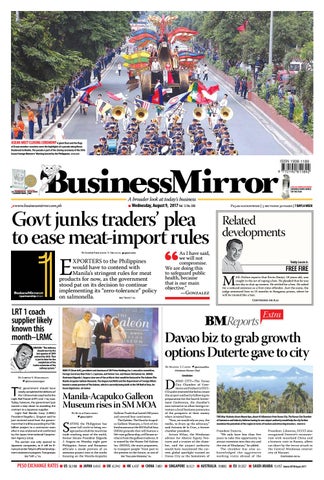
A farmer walks along a path of a rice field at the foot of Mount Arayat in Pampanga. NONOY LACZA
ASEAN MEET CLOSING CEREMONY A giant float and the flags of Asean member-countries were the highlights of a parade along Roxas Boulevard in Manila. The parade is part of the closing ceremony of the 50th Asean Foreign Ministers’ Meeting hosted by the Philippines. ALYSA SALEN
media partner of the year
United nations
2015 environmental Media Award leadership award 2008
BusinessMirror A broader look at today’s business
www.businessmirror.com.ph
n
Wednesday, August 9, 2017 Vol. 12 No. 300
Govt junks traders’ plea to ease meat-import rules
E
By Jasper Emmanuel Y. Arcalas
@jearcalas
xporters to the Philippines would have to contend with Manila’s stringent rules for meat products for now, as the government stood pat on its decision to continue implementing its “zero-tolerance” policy on salmonella. See “Govt,” A2
LRT 1 coach supplier likely known this month–LRMC SINGSON: “The delivery should start by the last quarter of 2019 and end by 2020. That is just in time for the completion of the Cavite extension of the railway system.” By Lorenz S. Marasigan @lorenzmarasigan
T
he government should have nearly completed the delivery of the 120 new train coaches for the Light Rail Transit (LRT) Line 1 by now. Today, however, the government just moved a step closer to awarding the contract to a Japanese supplier. Light Rail Manila Corp. (LRMC) President Rogelio L. Singson said he just received word from the government that it will be awarding the P30billion project to a contractor soon after it was endorsed and confirmed by the Japan International Cooperation Agency (Jica). The auction was only opened to Japanese companies, as it will be financed under Tokyo’s official development assistance program. Two groups See “LRT 1,” A2
As I have said, we will not compromise. We are doing this to safeguard public health, because that is our main objective.” —Gonzalez
2016 ejap journalism awards
business news source of the year
P25.00 nationwide | 5 sections 30 pages | 7 days a week
Related developments Teddy Locsin Jr.
free fire
M
AIL Online reports that Kevin Simiyi, 18 years old, was caught in the act of raping a hen. He pleaded that he was too shy to chat up women. He settled for a hen. He asked for a reduced sentence as a first-time offender. Just the same, the judge sentenced him to 15 months in Bungoma prison, where he will be treated like a hen. Continued on A10
BMReports
Davao biz to grab growth options Duterte gave to city HANS SY (from left), president and chairman of SM Prime Holdings Inc.’s executive committee, Foreign Secretary Alan Peter S. Cayetano, and former Sen. and Museo Del Galeon Inc. (MDGI) Chairman Edgardo J. Angara view one of the artifacts that would be featured in The Galeón (The Manila-Acapulco Galleon Museum). The Angara-led MDGI and the Department of Foreign Affairs hosted a sneak preview of The Galeón, which is currently being built at the SM Mall of Asia, for Asean dignitaries. ROY DOMINGO
Manila-Acapulco Galleon Museum rises in SM MOA By Butch Fernandez
S
@butchfBM
AYING the Philippines has come full circle in being recognized as a hub for maritime trade reaching most of the world, former Senate President Edgardo J. Angara on Monday night gave Philippine, Asean and European officials a sneak preview of an awesome project now in the works focusing on the Manila-Acapulco
PESO exchange rates n US 50.3100
Galleon Trade that lasted 250 years and covered four continents. The Galeón: The Manila-Acapulco Galleon Museum, a first-of-itskind museum at the SM Mall of Asia (MOA) grounds that will feature a life-size galleon ship, will house artifacts from the galleon trade era. It is touted by the Museo Del Galeon Inc. (MDGI), the main proponent, to transport people “from past to the present to the future, in one of See “Galleon Museum,” A2
By Manuel T. Cayon
@awimailbox Mindanao Bureau Chief
D
Conclusion
AVAO CITY—The Davao City Chamber of Commerce and Industry (DCCCI) said it renewed the bid to create the airport authority following its preparation for the fourth Investment Conference, the chamber’s own initiative to allow foreign investors a local business panorama of the prospects of their money when invested here. “Now, we would rely on you, the media, to drum up the advocacy,” said Antonio de la Cruz, a former chamber president. Arturo Milan, the Mindanao adviser for Aboitiz Equity Ventures and a trustee of the chamber, said the airport authority would have maximized the current global spotlight trained on Davao City as the hometown of
This May 18 photo shows Mount Apo, about 45 kilometers from Davao City. The Davao City Chamber of Commerce and Industry believes having its own airport authority would help the city further maximize the potentials of the region in terms of tourism and attracting investors. Nonie Reyes
President Duterte. “We only have less than five years to take this opportunity to attract investors into this city and the rest of Mindanao,” he added. T he c ha mber has a lso ack nowledged t he ag g ressive work ing v isits abroad of the
President. Likewise, DCCCI also recognized Duterte’s reconnection with mainland China and a historic visit to Russia, albeit cut short by the terror attack in the Central Mindanao interior city of Marawi.
Continued on A2
n japan 0.4543 n UK 65.5942 n HK 6.4337 n CHINA 7.4851 n singapore 36.9221 n australia 39.8002 n EU 59.3557 n SAUDI arabia 13.4157
Source: BSP (8 August 2017 )
A2 Wednesday, August 9, 2017
BMReports BusinessMirror
Davao biz to grab growth options Duterte gave to city Continued from A1
Proponents of the airport-authority advocacy, however, would not mind while the proposal lingers in Congress, this city and the rest of Mindanao are getting the infrastructure attention it longs for all these decades. The President’s visits yielded results for this dream, which started three decades of lobbying for even a third of the national budget, and currently drawing in multimillion dollar financing to infrastructure-starved Mindanao.
‘Build, build, build’ THE European Chamber of Commerce in the Philippines (ECCP) web site quoted a City Information Office dispatch, stating that Chinese Vice Premier Wang Yang had said “Beijing was willing to fund the P40billion Davao City International Airport Development Project.” The same commitment was made on the proposed P218-billion 830-kilometer Mindanao Railway Project. Further, the ECCP cited Ma. Lourdes Lim, the director of the National Economic and Development Authority (Neda), as
Duterte. . .
Continued from A12
income, thus the need for us to request our budget from the GAA [General Appropriations Act] is not actually needed.” Under Republic Act 9353, otherwise known as the Tourism Act
Govt. . .
Continued from A1
The National Meat Inspection Service (NMIS), which issued Memorandum Circular (MC) 9-2008-5, is adamant that the policy should remain in force despite the appeal of meat importers and processors to review it and make it consistent with international standards. “As I have said, we will not compromise. We are doing this to safeguard public health, because that is our main objective,” NMIS Executive Director Ernesto S. Gonzalez told the BusinessMirror in an interview. “We set the guidelines; we set the policy, so [meat importers and processors] would have to comply with that. If they cannot, then I am sorry,” Gonzalez added. The NMIS chief said meat processors and importers could consider raising the matter of reviewing the zero-tolerance policy with Agriculture Secretary Emmanuel F. Piñol. “The NMIS recommends policies and it is up to the secretary whether he would approve it or not,”Gonzalez said. In an earlier interview, Piñol said he is open to the possibility of discussing the government’s zero-tolerance policy with stakeholders in the local meat industry. “We cannot just implement what [meat industry stakeholders] are recommending. We need to study the recommendation; we cannot
PHL. . .
Continued from A12
Shepherding development
confirming the commitment, adding that the project includes the construction of a parallel taxiway and the expansion of the passenger-terminal areas. Lim also confirmed that Wang had pledged to send in a team that would study the Mindanao Railway Project and other proposed infrastructure projects to be undertaken in Mindanao. Under the proposal, the first phase of the railway project will connect the Davao cities of Tagum in Davao del Norte, Davao City, and Digos in Davao del Sur. Under the government’s most aggressive multitrillion-peso infrastructure spending, Mindanao’s two major airports in Davao City and Laguindingan, Misamis Oriental, and the railway project were included, along with three other projects. The Laguindingan and Davao airports are among the 25 airports in Mindanao, many of them awaiting improvement or further multipurpose use to be improved from their occasional utilization as airstrips for agriculture and forestry use. According to Katherine Zenith Geldore, technical staff of the Mindanao Development Authority (MinDA) research
and planning division, the two airports were included in the national government’s “Build, Build, Build” program. The other projects include the Panguil Bay Bridge, to connect Lanao del Norte with the Misamis Occidental and the rest of the Zamboanga Peninsula, and which is currently being serviced by a barge. Projects also include the Davao expressway system and the flood control project in Ambal-Simuay, which is part of the larger Mindanao River Basin. Aside from these “Build, Build, Build” projects, the MinDA would also lobby for inclusion of what are called “additional catalytic projects” that include transferring of the Zamboanga International Airport to another location with expansion capability (P9.87 billion). Other additional catalytic projects include the Mindanao River Basin Flood Control Project (P9.5 billion) to address the perennial flooding in Cotabato City and the rest of Central Mindanao and the Polloc Freeport Development (P1.8 billion) to significantly reduce transport cost of products and spur economic activities in the South Central Mindanao Development Corridor.
opment across Mindanao is a fruit worth seeing ripening as optimism continues to run high on the potential of the country’s largest island group. The airport authority may have been a bright opportunity to do it but for areas around the Davao region. But the chamber would look at its approval as, indeed, a faster way to shepherd global attention and actual investment in Davao City, and to the rest of Mindanao. The opportunity has presented itself immediately even as Duterte was awaiting his oath of office. When before the Davao region would get only an average of P8 billion to P12 billion in actual investments, from investment leads of P30 billion, the Board of Investment has recorded as much as P800 billion in investment leads. The airport authority may wait. But the business and tourism community agreed that the infrastructure development across most of Mindanao should now be pursued “while the iron is hot”, so the cliché goes.
of 2009, Tieza (formerly the Philippine Tourism Authority) derives its funds from travel taxes (50 percent of collections), collections of the DOT Office of Resource Generation, income from projects managed by the Tieza, subsidies or grants from local and foreign sources that may be received by said GOCC.
The DOT’s marketing arm, the Tourism Promotions Board (TPB), has a proposed allocation of some P1.7 billion, a slight increase of 3.23 percent from the P1.64 billion it received in FY 2016. The DBM failed to give the TPB any budget last year. In total, the DBM documents show a proposed budget of P6.55
billion for the tourism sector in FY 2018, up 61 percent from the P4.07 million allotted last year. Other agencies the DBM lumped under the tourism sector expenditure program were the Cultural Center of the Philippines (P806.09 million for FY 2018) and the Development Academy of the Philippines (P592.34 million for FY 2018).
just change policies overnight,” he said. Earlier, both the Philippine Association of Meat Processors Inc. (Pampi) and Meat Importers and Traders Association (Mita) urged the Department of Agriculture (DA) to reconsider its zero-tolerance policy as it is “inconsistent” with international standards. Pampi and Mita made the appeal after the DA banned Brazilian meat imports. The ban was imposed following the release of laboratory results, which indicated that some shipments had salmonella. Mita President Jesus C. Cham told the BusinessMirror that the tests conducted by DA on meat imports under its zero-tolerance policy are not in accordance with the Codex Alimentarius, or Food Code. “With regard to MC 9-2008-5, our view is that it has erroneously classified fresh frozen meat and offal as being under two separate cases—Case 1 and Case 10. It has also classified fresh frozen comminuted meat under two separate cases—Case 1 and Case 4,” Cham said in a letter to Gonzalez dated July 13. “Obviously, it is physically impossible for meat and offal to be both raw and cooked at the same time. It has to be one or the other. As well, mechanically deboned meat [MDM] of chicken is not fish,” he added. The Mita asked the DA to amend MC 9-20085 so it would adhere to the recommendations of the Codex Alimentarius Commission.
“As a logical consequence, we request that the zero-tolerance policy on salmonella on raw meat be discontinued,” Cham said. Meanwhile, Pampi warned that the government’s decision to ban meat imports from Brazil could increase the retail price of some processed-meat products sold locally. “We support 101 percent that there should be zero tolerance for salmonella in finished products, but not for raw materials, which undergo a kill process”, Pampi Director Rex E. Agarrado earlier told the BusinessMirror. Agarrado noted that other countries and renowned institutions, such as the North American Meat Institute, has ruled out that salmonella in ground beef and chicken mechanically deboned meat that are intended to be cooked “does not constitute a violation of federal rules since cooking destroys this”. He also said the United Kingdom does not have standards for salmonella in minced beef or MDM. “Likewise, Australia recognizes—and uses the word politically—an unavoidable levels of salmonella in raw chicken or material,” he said. “In a baseline study in 2010 they found that raw poultry that is being sold in the market is likely to be contaminated with salmonella.” Sought for comment regarding Pampi’s warning, Gonzalez said: “Let it be. As I have mentioned, food safety is our priority. They have to comply with our policies. We cannot do anything about it [price spikes]”.
Gonzalez said the DA will immediately lift the ban imposed Brazilian foreign meat establishments (FMEs) once they are declared free of any salmonella incidence. He added that it could probably take about a month to complete the inspection and release the results. The NMIS chief said the government’s investigation team would likely leave for Brazil on August 12. While salmonella is easily killed when cooked at a temperature of at least 70 degrees centigrade, Gonzalez said all strains of salmonella are “harmful” to humans. “All strains of salmonella are harmful to humans, that doesn’t change. The effect depends on the amount of contaminated food you have consumed,” he said. “If you eat a chicken that is heavily infested with salmonella, you can even die.” The NMIS, however, made an assurance that Philippine markets remain free of salmonellatainted meat products. Gonzalez said the agency has also not recorded any new cases of shipments contaminated with the bacteria since July. The NMIS, an attached agency of the DA, is the sole national controlling authority on all matters pertaining to meat inspection and hygiene. Data from the Bureau of Animal Industry showed that the country’s meat imports in the first half of the year declined by nearly 13 percent to 280,269.056 metric tons (MT), from 322,013.273 MT a year ago.
Bersales, who is also part of the global expert group on SDGs. Irawan said this is also one of the reasons the Asean stats decided to turn to
the Philippines to lead the regional effort in crafting indicators for member-states. “I think the Philippines is more advanced than others. You came up with,
I think, SDG indicators. We will request the Philippines to lead the discussion, especially next year in the technical working group,” Irawan said. In a presentation at the forum, PSA Assistant National Statistician Candido J. Astrologo Jr. said the Philippines is one country in the Asean that has one of the highest statistical capacities. Based on data from the World Bank, the Philippines ranked third in the Asean in terms of overall statistical capacity between 2004 and 2016. However, the country’s performance declined from its top ranking between 2008 and 2013. In 2014 the Philippines was outranked by Indonesia and Thailand and shared the same position with Vietnam in 2016. One of the reasons cited for the decline in the country’s performance in statistical capacity was the outdated base year of the National Income Accounts (NIA). Astrologo said, ideally, the country needs to have a base year of 10 years for the NIA. However, the country is still using a base year of 2000 instead of 2007. He said one of the reasons this cannot be done is the lack of staff at the PSA to do the annual rebasing of the NIA. “The next step is to continue to invest in statistics, invest in statisticians and invest in statistical offices,” Astrologo said. “We need investments in statistics to attain our vision for the statistical system for the next five years, or 2018 to 2023.”
THE DCCCI said the infrastructure devel-
www.businessmirror.com.ph
LRT 1. . .
Continued from A1
have submitted their bids for the multibillion-peso contract: the South Korean-Japanese camp of Hyundai Rotem and partner Marubeni, and the Spanish-Japanese tandem of Grupo Caf and Mitsubishi. Should the government proceed with the opening of the bids on Friday, the contract could be awarded sometime this month, following an almost two-week evaluation. “The delivery should start by the last quarter of 2019 and end by 2020. That is just in time for the completion of the Cavite extension of the railway system,” Singson said. Based on the concession agreement signed between the government and the private company, the state should have started receiving the new train coaches in December last year. It should have been completed by October this year. However, the first round of auction for the train-supply contract was declared a failure because of the “increased demand for train coaches in Japan due to the 2020 Tokyo Olympics”. When procured, these 120 light-rail vehicles (LRVs) will be configured in 30 four-car train sets, to allow the rail line to accommodate up to about 750,000 passengers daily. The winning bidder will cover the technical design of the coaches, procurement of materials required for manufacturing the LRVs, and ensure compliance with technical specifications through testing. The contractor will be required to submit a project-management plan, design and development plan, as well as an inspection, testing and commissioning plan, to allow smooth implementation. “The delivery should have started in December last year, that is why we had to make do with what we have, and see what we could upgrade—that is a big challenge,” Singson lamented. Just recently, the company ventured into a P1-billion restoration program for 25 of its train cars. With this initiative, the railway system has immensely improved its operations with 104 train coaches running. With the expanded fleet, a new train timetable was implemented, thereby increasing the number of trips on weekdays from 498 to 554 trips daily. This has helped shorten queuing time and reduced headway for the passengers. “We added 50 trips daily, and because of that, load factor during peak hours has been reduced. We used to hit more than 100-percent load factor per train during peak hours. It tapers off during off peak,” he said. Load factor refers to the difference between the capacity of a facility and
the number of people using it. “Now, on the daily average, we are hitting an average of about 85-percent load factor. It used to be more than 90 percent because of the fewer number of trains,” Singson added. He noted that his group is also rehabilitating 16 more coaches. A team of engineers and finance experts are set to go abroad to look for spare parts from original equipment manufacturers, some of which are owned by different entities today. “But definitely, the new trains are very important because they can help keep the load factor to 85 percent, which is the optimum number,” Singson said. The new trains will mean there will be more trips on the railway facility, which will be extended to an additional 50 percent of its current length. “The additional 120 LRVs will come in very handy. Ideally, we should have 55 trains with four LRVs per train, so that’s a total of 220 working coaches,” Singson said. Hopefully, he added, these new coaches will come in very soon so the operator can have a 10-percent reserve throughout its operations. These new train cars are needed to complement the construction of the new train stations in Cavite. Targeted for completion in about four years after the delivery of right of way, the 11.7-kilometer Cavite Extension will connect into the existing system immediately south of the Baclaran Station and run in a generally southerly direction to Niyog, Cavite. It will consist of elevated guideways throughout the majority of the alignment, except for the guideway section at Zapote, which will be located at grade. Eight new stations will be provided with three intermodal facilities across Pasay City, Parañaque City, Las Piñas City and Cavite. The new stations are Aseana, MIA, Asia World, Ninoy Aquino, Doctor Santos, Las Pinas, Zapote and Niyog. The intermodal facilities shall be located at Doctor Santos, Zapote and Niyog. The new stations will be accessible to and from nearby community facilities, such as shops, schools, stadium, park, etc., and be located to suit passenger flow routes from residential areas. Pedestrian access to all new stations will be direct, safe and easy. Details, such as lighting to distinguish access points, pedestrian cross striping and curb cuts for handicapped access, will also be provided. LRMC holds the concession for the operations, maintenance and the extension of the train line. It signed the agreement with the government in October 2014. The company will operate and maintain the oldest train system in the Philippines for 32 years.
Galleon Museum. . . the most exciting and pivotal moments in the maritime history of the Philippines and the whole world.” Both Angara, the MDGI chairman, and Foreign Secretary Alan Peter S. Cayetano, who led guests coming from the ongoing Asean meet ings nea rby, repeated ly referred to the Philippines’s past as being at the heart of some of the most lucrative trade routes in the world. They said it is no accident of history that the Philippines and Asean these days are striving, with their neighbors from both East and West, to keep the trade routes safe for all and settle their differences through rules-based systems. Angara singled out for praise as well Hans Sy, SM Prime Holdings Inc. chairman, for the generous donation of the site at SM MOA and making it possible to build the museum. He noted how Chinese artisans had worked alongside Filipino shipbuilders, many from Cavite, in building the galleons during the Spanish era in the Philippines. He quipped that the Filipino-Chinese businessman had a “very Spanish name” (Sy), because in Spanish, “Si” means “Yes”. When the project is completed, the center of the museum will feature a life-size replica of the Nuestra Señora del Pilar de Zaragoza, an 18th-century galleon built at the Cavite naval shipyard.
Continued from A1
The museum itself will serve as a workshop for the renewal of traditional shipbuilding skills, and audiences can “witness the galleon rising from the museum’s main floor over a span of two years”. The MDGI said the top portion of the life-size ship is seen to fit right inside the curved shell of the museum. The galleon to be built “will pattern the authentic building manner of the early Caviteños, who fashioned the vessel purely out of wooden panels and pegs.” The museum will also host budding historians, as it dedicates an area for research center. Culminating the Monday night rites, the foreign ministers who were guests, along with the ambassadors of Spain and Mexico, joined Cayetano and Angara in releasing an array of currencies from their respective countries into an ancient wooden chest that, Angara said, had been crafted by Maranao artisans and taken by Augustinian priests to Spain. An MDGI briefing material said the act of releasing currencies symbolized the notion that, “if it weren’t for the age of trade, the countries may not have developed the unshakeable union they carry today.” The Monday night sneak preview was hosted by the Angara-led MDGI with the Department of Foreign Affairs.
The Nation BusinessMirror
news@businessmirror.com.ph
AFP’s Año cautions US on drone plan By Rene Acosta
@reneacostaBM
T
he military on Tuesday welcomed a reported plan by the US to be directly involved in ongoing operations against terrorists in Marawi City, but cautioned the Pentagon such a degree of involvement should first go through a process. “We appreciate Pentagon’s reported desire to help the Philippines in the fight against Daesh-inspired Maute Group because terrorism is a global menace that the community of nations must unite to fight against,” Armed Forces Chief of Staff Gen. Eduardo M. Año said. “However, such proposition, if any, has to undergo a process. And a covenant must be had between the commanders in chief of both nations before that option may be adopted,” he added. The top military chief reacted on Tuesday over reports by the US media that the Pentagon is considering conducting drone air strikes against members of the Maute-IS group still holed out in four barangays in Marawi. Año said the air strikes remains a plan until it is officially communicated to the Armed Forces of the Philippines (AFP), especially President Duterte. “As reported in media, this is [just] a plan being considered. We at the AFP is yet to receive any formal notice or offer for such air capability deployment,” he said. The chief of staff, however, noted that the US involvement in direct military operations in the country is not covered by the defense treaty with the Americans, unless Manila is attacked by another country. “The existing Mutual Defense Treaty provides that only technical assistance and training may be allowed under the Mutual Defense Board-Security Engagement Board,” Año said. “Direct military actions may only be allowed during actual invasion of the Philippines by another state actor,” he added. Meanwhile, the government is already mulling over at resuming classes at the Mindanao State University (MSU) in Marawi, following recommendations by local, school and even military officials. M i l it a r y of f ic i a l s, fac u lt y members and other officials of the MSU met on Monday wherein security arrangements for the school and its date of opening of classes were discussed. Classes at the MSU had been suspended since May 23 as a result of the rebellion in the city. Aside from the school, officials were also considering opening establishments around the university, which were also shut down, still due to the rebellion. “The Mindanao State University is the symbol and life of Marawi City. This is the bastion of knowledge
AÑO: “We appreciate Pentagon’s reported desire to help the Philippines in the fight against Daeshinspired Maute Group because terrorism is a global menace that the community of nations must unite to fight against.”
and we will have to open classes the soonest,” Armed Forces Western Mindanao commander Lt. Gen. Carlito Galvez Jr. said. “The opening of the university is a challenge, but we have to test the waters and come up with means to bring back the life of Marawi through the opening of this revered institution,” he added.
Legality
PARTY-LIST Rep. Carlos Isagani T. Zarate of Bayan Muna has slammed the reported US plan to conduct supposed “antiterror air strikes” in Philippine territory, saying it constitutes “blatant trampling of our national sovereignty”. The US plan to conduct drone strikes on Philippine soil apparently does not need the consent of Duterte, since what was deemed necessary by the Pentagon was its “legality” under US law. By undertaking these extraterritorial forays, the US is invoking “collective self-defense” to justify the use of its MQ-9 Reaper drones and other unmanned aircraft to attack the Maute Group in Marawi City and other Moro armed group, as well. In reaction, Fidel V. Agcaoili, chairman of the negotiating panel of the National Democratic Front of the Philippines, said, “We condemn any such agreement to allow US to intervene militarily with air strikes and the use of drones.” “Obviously, the US would want to turn the Philippines into another Yemen, or worse, Iraq or Syria, to justify outright stationing of bases and troops in its war posturing against China,” Agcaoili alleged. Last month the vice chairman of the US joint chiefs endorsed the idea of naming the mission in the Philippines, saying it is needed to secure more funding. “In every case where we see the resurgence of terror networks,” Gen. Paul Selva said in testimony before the Senate Armed Services Committee, “particularly in the fragile areas of the southern Philippines, I think it’s worth considering whether or not we reinstate a named operation, not only to provide for the resources that are required, but to give the Pacific Command commander and the field commanders in the Philippines the kinds of authorities they need to work with indigenous Philippine forces to actually help them be successful in that battle space.” With Marvyn N. Benaning
Editor: Vittorio V. Vitug • Wednesday, August 9, 2017 A3
Senate sets probe into Comelec chief’s ₧1-billion ‘hidden wealth’
T
By Butch Fernandez
@butchfBM
he Senate Blue Ribbon Committee probers open an inquiry into the alleged P1-billion “hidden-wealth” case exposed by the wife of beleaguered Commission on Elections (Comelec) Chairman Andres D. Bautista, following Majority Leader Vicente C. Sotto III’s filing of a resolution paving the way for a Senate investigation. Senate President Pro Tempore Ralph G. Recto and Minority Leader Franklin M. Drilon affirmed the Blue Ribbon, also known as the Committee on Accountability Public Officers, will have primary jurisdiction over the impending investigation should a senator move to Comelec chief’s unexplained wealth. Drilon, however, cautioned that if the Senate conducts an inquiry ahead of an impeachment filing against Bautista in the House of Representatives, it might end up in an awkward position of senator-judges sitting in an impeachment trial later, on the same issues tackled by the Senate panel inquiry. But Drilon’s view was disputed by Sen. Grace Poe, who recalled that Senate probers had already been conducting investigations into graft allegations against then-President Joseph E. Estrada way before an
impeachment complaint was filed in the House and later endorsed for trial by the Senate as an impeachment court. For his part, Bautista told reporters in a news conference on Tuesday he is ready to face possible charges arising from his estranged wife’s disclosure of his alleged hidden wealth, including undeclared bank accounts and real properties abroad. In his defense, Bautista expressed doubt that the evidence, consisting of bank passbooks and ledgers, among others, presented to media by his estranged wife Mrs. Patricia Paz Bautista as proof of his “hidden wealth” is not likely to stand in court. “These documents were stolen, doctored and fabricated,” he said. “I don’t know if these are genuine or not.” The Comelec chief added: “She
[Mrs. Bautista] said it was turned over to [the] NBI [National Bureau of Investigation], but I don’t know what they are. I’m not saying all documents are fake, but I want to see them.” He voiced suspicion that his accuser was tampering with evidence, saying, “It looks they are padding the amount as part of an extortion and squeeze play by her lawyers.” Bautista appealed to his estranged spouse to just bring back the documents that his wife divulged to media as proof of his hidden wealth. “She should return the documents... The case is affecting our children but we have to face it,” he said. “She is spreading lies, so I prefer that we face each other in court.”
Leave of absence
AN election watchdog, meanwhile, urged Bautista to take a leave of absence following allegations of having unexplained wealth. “By taking a leave of absence, Bautista will not be able to use his position at the Comelec to influence the outcome of the probe, which we maintain should not just be limited to the issue of ill-gotten wealth,” Kontra Daya Convener Danilo Arao said in a news statement.
Transcending the seemingly salacious and scandalous, it is imperative that any investigation of Bautista include issues surrounding the conduct of the 2016 elections under Bautista’s watch, as in the case of the leakage of personal information of voters,” he said. Arao believed that the allegation “is worth investigating, especially in the performance of his job not just at the Comelec but also at the Presidential Commission on Good Government.” He added, “Much as the media and the public are tempted to look at other details of his personal life, it is our hope that we don’t lose sight of the bigger issue of alleged corruption, conflict of interest and abuse of power while in office.” When asked if the poll body did not accede to the call, Arao said whatever the outcome of the probe will be questionable. “The result of the probe would be put in question as Bautista will be vulnerable to accusations of interference. Of course, the Comelec, as an institution, would suffer in terms of morale and whatever remains of its credibility, no thanks to how Bautista has mismanaged the 2016 polls,” he added. With PNA
She [Mrs. Patricia Paz Bautista] should return the documents.... The case is affecting our children, but we have to face it. She is spreading lies, so I prefer that we face each other in court.”—Bautista
SC affirms legality of FM’s burial in heroes’ cemetery By Joel R. San Juan @jrsanjuan1573
T
HE Supreme Court (SC), voting 10-5, has affirmed its ruling that allowed the burial of strongman Ferdinand E. Marcos at the Libingan ng Mga Bayani (LNMB). During Tuesday’s regular en banc session, the 15-man High Tribunal voted to deny the motion for reconsiderations filed by various individuals and groups of its decision issued on November 8, 2016. The 10 who voted to dismiss the motions for reconsideration were Associate Justices Presbitero Velasco Jr., Teresita Leonardo-de Castro, Diosdado Peralta, Lucas Bersamin, Mariano del Castillo, Jose Mendoza, Estela Perlas - Bernabe, Samuel Martires, Noel Tijam and Andres Reyes Jr. The five who again dissented from the majority ruling were Chief Justice Ma. Lourdes A. Sereno, Senior Associate Justice Antonio
10-5 The assets accumulated by RSBS under President and CEO Norman Legaspi’s stewardship
T. Carpio and Associate Justices Marvic Leonen, Francis Jardeleza and Benjamin Caguioa. The petitioners, led by Rep. Edcel C. Lagman of the First District of Albay and former Party-list Rep. Satur C. Ocampo of Bayan Muna, t hrough t he Nat iona l Union of Peoples’ Lawyers and several other victims of humanrights abuses during the Marcos regime, filed separate motions for reconsideration seeking a reversal of the said decision. They argued that the “hasty”
burial of the late strongman at the LNMB on November 18, 2016, does not render their appeal moot and academic. They argued that contrary to the Court’s ruling, the late President’s burial at the LNMB would not lead to closure and national healing. The petitioners also sought for the exhumation of Marcos’s remains. The Court also denied the petitioners’ plea to cite the respondents for indirect contempt for allowing the Marcos burial, despite the pendency of the filing of an appeal via a motion for reconsideration is also dismissed by the high court. Named respondents in the case were Rear Adm. Ernesto C. Enriquez, deputy chief of staff for Reservist and Retiree Affairs; Retired Armed Forces of the Philippines Chief Gen. Ricardo R. Visaya, Defense Secretary Delfin N. Lorenzana, and the heirs of the late strongman, represented by his spouse, Rep. Imelda R. Marcos of the Second District of
Ilocos Norte and children Imee, Bongbong and Irene. In its November 8 decision, the SC held that the order of President Duterte for the Marcos burial at the LNMB is well within his presidential power provided under Article VII, Section 17 of the Constitution. The ruling penned by Associate Justice Diosdado Peralta held that Marcos possessed the qualifications to be interred at the LNMB as a “former president and commander in chief, a legislator, a secretary of national defense, a military personnel, a veteran and a Medal of Valor awardee”. The SC ruled that there is no law prohibiting Marcos’s burial at the LNMB. It also rejected the claim of petitioners that Duterte’s decision was motivated by his debt of gratitude and payback to the Marcoses for supporting his presidential candidacy in the elections last May, saying they failed to establish factual basis for this.
Economy
A4 Wednesday, August 9, 2017 • Editors: Vittorio V. Vitug and Max V. de Leon
BusinessMirror
BOI and Peza investment pledges jumped 40% from January to July
I
By Jovee Marie N. dela Cruz
@cuo_bm
nvestment pledges registered at the country’s two largest investment-promotion agencies—the Board of Investments (BOI) and the Philippine Economic Zone Authority (Peza)—have increased by 40 percent in the first seven months of 2017, Trade Secretary and BOI Chairman Ramon M. Lopez said on Tuesday.
During the proposed 2018 budget hearing of the agency, Lopez said the BOI and Peza combined investments have reached P393 billion from January to July 2017. This is higher than the P280 billion approved investments of the BOI and Peza in January to July
2016, Lopez added. “We’re happy to report that, due to successful presidential visits that our President [Duterte] has led in several countries, a lot of investments and trade commitments were generated,” Lopez told lawmakers. Earlier, Presidential Spokesman
₧393B The total amount of combined investment pledges registered by the BOI and Peza in the first seven months of the year, according to Lopez
Ernesto C. Abella said Duterte’s visit to China has resulted in $4billion investment. Abella added the Chief Executive’s visits to Japan and Russia have produced investment commitments of $1.85 billion and $2.5 billion, respectively. Moreover, Lopez also said the government plans to ramp up infrastructure spending make the Philippines attractive. As much as P1.097 trillion has been allocated for the government infrastructure projects next year under the 2018 P3.7-trillion na-
tional budget. It is 29.5 percent, or P249.8 billion, higher than the 2017 national budget’s allocation for public infrastructure. According to Lopez, the investment-registration figure is a clear indication of the continued confidence of domestic and foreign investors in the country’s sound economic policies and attractive business environment. The Department of Trade and Industry also said the increase on committed investments can also be credited on start of implementation of the 2017 Investment Priorities Plan. During the same hearing, Lopez also said exports have reached positive double-digit growth rates, from negative last year. “Another bright point is the exports, which now posted 16.3percent growth from January to May 2017, which is a turnaround coming from negative performance in 2016, so we are trending positive double-digit growth rates for exports,” the trade secretary told lawmakers.
news@businessmirror.com.ph
DA, DOLE aim to attract OFW money in agriculture ventures By Jasper Emmanuel Y. Arcalas @jearcalas
T
he government is now eyeing to entice Filipino migrants to invest in the agriculture sector through a program that seeks to offer “minimal” investment risks. Agriculture Secretary Emmanuel F. Piñol said the Department of Agriculture (DA) is now crafting a memorandum agreement (MOA) with the Department of Labor and Employment (DOLE) that would roll out an adopt-a-farm program wherein overseas Filipino workers (OFW) would finance identified local farmers to boost their output productivity. “He [Labor Secretary Silvestre H. Bello III] asked the Department of Agriculture and Fisheries to prepare a memorandum of agreement, which we will both sign,” Piñol said in a Facebook post on Tuesday, August 8. “The MOA will set the guidelines on the program and identify the roles and responsibilities of our respective departments.” Piñol added he pitched the investment program to Bello before the start of the 17th Cabinet meeting on Monday. “I explained to him that following a successful model of an OFW
investments program between Don Bosco Multipurpose Cooperative and Dubai-based Filipino overseas workers, the agriculture department is looking at tapping other OFWs to provide financing to rice and corn farmers,” he said. Under the prospective investment program, Piñol added, OFWs would be allowed to invest up to P20,000 per hectare at a 6-percent interest rate per harvest. The financing from OFWs would then be used to buy seeds, fertilizers and other farm inputs needed by the farmers, according to Piñol. “The OFWs’ investments will earn an interest of 6-percent per harvest, with guaranteed two harvests every year or earnings of P2,400,” he said. “The program is expected to improve food production in the country while, at the same time, offer safe investments for the OFWs earnings.” The DA chief added there is a “very little” investment risks for the OFWs, as the farmers that will be participating in the program shall be covered by crop insurance of the Philippine Crop Insurance Corp. “What I have in mind is to identify and accredit farmers associations and cooperatives in every province and ask the OFWs where they would like to invest their money in,” Piñol said.
Group to Duterte: Delay additional tax on SSBs
T
Airport check An enforcer of the Land Transportation Franchising and Regulatory Board (LTFRB) checks
on the registration documents of a taxicab in one of the passenger terminals of the Ninoy Aquino International Airport in Pasay City. The LTFRB and the Manila International Airport Authority recently inked a memorandum of agreement to jointly ensure taxicab compliance to land and airport transport rules and regulations for passenger safety and convenience. NONIE REYES
he impending tax law on sugarsweetened beverages (SSBs), currently being studied by both houses of Congress, is seen to grossly impact the C, D and E classes of society. Formerly known as the Comprehensive Tax Reform Package and now called the Tax Reform for Acceleration and Inclusion (TRAIN, or House Bill [HB] 5636), the latest proposal to impose taxes on SSBs has been an ongoing issue and various sectors are appealing to President Duterte to reconsider. A news statement, quoting a study done by the Philippine Chamber of Food Manufacturers Inc. (PCFM), said the proposal to impose an excise tax of P10 per liter of volume capacity on sugar-sweetened beverages (SSBs) will not only be the highest in the world: It will also hit the poor the most. If the TRAIN is approved and the proposed new tax is passed, a 3-in-1 coffee sachet, currently priced at P5, will be P8; a 1-liter bottle of juice concentrate currently priced at P9 will have a retail price of P30; a 1-liter bottle of tea currently priced at P20 will be P30; carbonated drinks currently being sold for P15 per liter, will cost P25; and a 1-liter tetra pack of ready-to-drink juice. The products covered by the TRAIN, or HB 5636, will include all sweetened juice drinks; sweetened tea; sweetened coffee; all carbonated beverages with sugar, including those with caloric and noncaloric sweeteners; flavored water; energy drinks;
sports drinks; powdered drinks not classified as milk, juice, tea and coffee; cereal and grain beverages; even nonalcoholic beverages with sugar. The government’s vision for the TRAIN is to create “a tax system that is simple, fairer and more efficient, characterized by low rates and a broad base that promotes investment, job creation and poverty reduction.” However, this impending tax measure, based on the study of the PCFM is seen to increase prices of the usual commodities commonly purchased by the C, D and E classes of society. This has led to the ongoing sentiment that the TRAIN is now increasingly seen by those who will be directly impacted as anti-Filipino and anti-poor, specifically on sari-sari store owners, whose biggest income apparently comes from the selling of SSBs. “A typical sari-sari store owner earns an average of P1,000 per day, 30 percent to 40 percent of the total, around P300 to P400, comes from the sale of coffee, juice and carbonated drinks, so almost half of our net income is from the sale of sweetened beverages. I therefore appeal to our good President, as well as to all our congressmen and senators, to please carefully reconsider the passing of this new tax measure into law or, at the very least, delay it until a better alternative is available,” Philippine Association of Stores and Carinderia Owners (Pasco) President
Victoria Aguinaldo said. “I think they need to revisit this proposal again and possibly make the necessary adjustments and improvements to ensure that it won’t be as detrimental to the poor, more specifically the sari-sari store and carinderia owners, as it is right now,” she added. Based on the latest statistics on the number of registered sari-sari stores in the country, there are currently 1.3 million sarisari stores nationwide. It is estimated that 91 percent of all retail stores in the country are sari-sari stores and to cite the latest statement of the Department of Trade and Industry (DTI), “Sari-sari stores form part of the economic backbone of the country. Providing them more opportunities can only mean greater economic development for our nation as a whole,” Trade Secretary Ramon M. Lopez said at a gathering held recently. If the TRAIN is passed into law, it is feared that at least half of the current number of sari-sari stores nationwide will eventually close shop because it will no longer serve as a viable source of additional income for the family household. It will, therefore, directly or indirectly translate to around 133,750 jobs lost; an increase of 1.5 percent in the unemployment rate; a P20-billion decline in beverage sales; around a P2.4-billion loss in value-added tax; a P7-billion loss from affected industries; and more than P130billion investment losses for the Beverage Industry Association of the Philippines.
Web-based recruitment in PHL grew 6% in June By Roderick L. Abad Contributor
H
@rodrik_28
IRING activities on the web grew in the Philippines by 6 percent in June 2017 from the same period last year on the back of the strength of growth industries that continue to propel the country’s economy. The results showed the sixth positive annual growth for the country since January of this year. Compared to a total of 97 job listings in June 2016, last month had 103. “The Philippines has been on an upward economic trend for some time now, and this doesn’t look likely to slow down. In fact, Moody’s Investor rating has suggested positive economic performance in the months ahead, thanks to the nation’s robust private consumption, as well as the healthy BPO [business-process outsourcing] sector,” said Sanjay Modi, managing director of Monster. com–Asia Pacific and the Middle East. “Manufacturing, BPO and agricultural sectors are likely to be the key driving forces behind the Philippines’s booming economy, in line with the country’s nation reform plans,” he added. Based on the latest report of Monster Employment Index (MEI), there’s no stopping the BPOand information technology-
enabled services (BPO/ITES) sector as the top employment provider for the month of June this year, with 132 job placements online, or 18 percent higher than 112 in the same period in 2016. This is 12 percent lower, however, than the 30 percent YOY increase in this sector reported in May. There are currently 1.2 million people employed in the BPO sector. As per the Information Technology-Business Process Association of the Philippines (IT-BPAP) Roadmap 2022 report, their number is expected to grow further to 1.8 million in the next five years. Still in the second slot for the top growth industries, logistics, courier, freight, transportation, import, export and shipping rose by 15 percent, from 111 to 128. This was followed by retail, up 13 percent, from 120 to 135; banking, financial services and insurance, or BFSI, up 8 percent, from 113 to 122. Hospitality came in at the fifth spot, with a hike of 5 percent, from 103 to 108. Consumer goods/fast-moving consumer goods, food and packaged food, home appliance, garments/textiles/leather, gems and jewelry continued to belong to the sectors with snail-pace growth at 2 percent only, from 84 to 86; and production/manufacturing, automotive and ancillary, up 1 percent,
from 88 to 89. Registering negative 1-percent growth were advertising, market research, public relations, media and entertainment, from 110 to 109; as well as health care, from 96 to 95. The engineering, construction and real-estate sector recorded the sharpest fall at -9 percent, from 89 to 81. As regards the occupational groups monitored by the index, customer service talents continued to be in-demand as they led in online hiring, from 115 to 145, or 26-percent YOY growth. While posting only a slight growth of 1 percent, sales and business developments (from 100 to 101), as well as software, hardware and telecom (from 113 to 114) remained on the lookout for new recruits. Less in-demand jobs were health care, -2 percent, from 95 to 93; hospitality and travel, -2 percent, from 84 to 82; marketing and communications, -3 percent, from 118 to 115; engineering, production and real estate, -6 percent, from 87 to 82; and human resources and admin, -13 percent, from 111 to 97. The MEI is a monthly gauge of online job-posting activity, based on a real-time review of millions of employer job opportunities culled from a large representative selection of career web sites and online job listings across the nation.
A6
Wednesday, August 9, 2017 • Editor: Lyn Resurreccion
The World BusinessMirror
www.businessmirror.com.ph
Oil trades near $49 as Russia, Kuwait question producers on output cuts
O
IL traded near $49 a barrel, as officials from Russia and Kuwait conducted meetings in Abu Dhabi with producers to examine why some are shirking their commitment to reduce output.
Futures lost 0.2 percent in New York after dropping 0.4 percent on Monday. Talks are being held separately with representatives from Iraq, the United Arab Emirates and Kazakhstan through Tuesday, according to people familiar with the matter. US crude stockpiles probably declined by 2.1 million barrels last week, a Bloomberg survey shows before government data on Wednesday. Oil in New York was unable to hold its first advance above $50 a barrel since May as signs of rising global supply eroded optimism that output curbs by the Organization of Petroleum Exporting Countries (Opec) snd its partners are rebalancing the
market. Compliance by Opec members slid to 78 percent in June, according to the International Energy Agency (IEA). “The market will look for confirmation that the group will continue to abide by their cuts,” said David Lennox, a Sydney-based analyst at Fat Prophets. “Oil prices will probably do some work between $45 and $55 for some time.” West Texas Intermediate (WTI) for September delivery was at $49.29 a barrel on the New York Mercantile Exchange, down 10 cents, at 7:45 a.m. in London. Total volume traded was about 24 percent below the 100-day average. Prices lost 19 cents
to $49.39 on Monday. Brent for October settlement dropped 14 cents to $52.23 a barrel on the London-based ICE Futures Europe exchange. Prices slid 5 cents to $52.37 on Monday. The global benchmark traded at a premium of $2.81 to October WTI. Findings from the meetings will be presented to the Joint Ministerial Monitoring Committee, which oversees the agreement to cut production, the people said, asking not to be identified because the talks are private. Iraqi compliance slumped to 29 percent in June, its lowest so far, while the UAE made just 60 percent of its cuts, according to the IEA. China’s crude imports in July fell to the lowest in six months after heavy buying earlier in the year, according to data from the General Administration of Customs released on Tuesday. Saudi Arabia is said to have cut crude sales for next month to some buyers in Asia, limiting sales to prized customers as part of its pledge to curb exports and shrink a global glut. Libya’s biggest oil field Sharara is “back to normal” after a disruption caused by protests in the politically fragmented country, the state National Oil Corp. said. Bloomberg News
Hedge fund sues to have Puerto Rico’s bankruptcy case thrown out
Protesters outside the US Courthouse in Hato Rey, Puerto Rico, on June 17. The hedge fund Aurelius Capital sued on August 7 to have Puerto Rico’s bankruptcy case thrown out, arguing that the federal oversight board now guiding the island’s financial affairs was unconstitutionally established. Angel Franco The New York Times
A
hedge fund sued on Monday to have Puerto Rico’s bankruptcy case thrown out, arguing that the federal board guiding the island’s financial affairs was unconstitutionally established. In a lawsuit filed in US District Court in San Juan, Puerto Rico, the hedge fund, Aurelius Capital, cited the “appointments clause” of the US Constitution, which calls for all principal officers of the federal government to be appointed by the president, and then confirmed by the Senate. That did not happen when the seven members of the Financial Oversight and Management Board for Puerto Rico were selected, Aurelius said in its motion to dismiss the bankruptcylike proceedings. The board members were instead “hand-picked by individual members of Congress,” it said, through “an intricate system of
Balkanized lists, designed to severely constrain the president’s appointment powers.” No Senate confirmation proceedings occurred, although senators of both parties were among the members of Congress who made recommendations last year to President Barack Obama for the board. The oversight board was established last year, when Puerto Rico was sinking under $123 billion of public debt and pension obligations that it amassed by years of borrowing to plug deficits. The federal bankruptcy code bans Puerto Rico from declaring bankruptcy, and by 2016, it was defaulting haphazardly on payment after payment, without any way to take shelter from the many resulting creditor lawsuits. Congress last year enacted a law called Promesa, which gives
insolvent territories a way to seek court protection from their creditors. Title III of Promesa gives Puerto Rico the power to abrogate contracts unilaterally—but it has no access to Title III without the oversight board’s authorization. Aurelius sued just days after the governor of Puerto Rico, Ricardo Rosselló, defied the oversight board for his own reasons. He said last Friday that the board’s five-year fiscal-reform plan was excessively harsh and that he would shut down much of the government two days every month for the rest of the fiscal year to save money and streamline operations. Aurelius Capital sued in its capacity as a holder of Puerto Rico’s general obligation bonds. W hen those bonds were issued, Puerto Rico’s Constitution, in effect, g uaranteed them. New York Times News Service
Work visa program spells gains for US, India–study T
HE controversial H-1B visa program, widely criticized for costing American workers their jobs, has actually provided economic benefits for both the US and India, according to a new study from researchers at the Center for Global Development and the University of Michigan. The combined incomes for the two countries as a result of the US visa program rose by about $17.3 billion or 0.36 percent, and the total information-technology (IT) output from both countries rose by about 0.45 percent in 2010, said researchers Gaurav Khanna of the Center for Global Development and Nicolas Morales at the University of Michigan. While recognizing negative repercussions for some workers, the study said that, on the whole, US-born employees were wealthier by about $431 million in 2010 because of the program.
“The average worker in each country is better off because of immigration, and US native workers have made big gains because of the H-1B visa program,” Khanna said. The research report, titled “The IT Boom and Other Unintended Consequences of Chasing the American Dream”, is an indepth look at the H-1B visa program and its impact on the US and Indian economies since the early 2000s. The visa program allows companies in the US to employ skilled foreign workers in specialty occupations. India’s outsourcing companies, including Infosys Ltd., Tata Consultancy Services Ltd. and Wipro Ltd., have been the leading recipients of H-1B visas, which they use to send employees to work at customer sites in the US. The program has been instrumental in the rise of India’s $155-billion IT services industry.
But the approach has come under fire in recent years in the US, including from President Donald J. Trump. In April his administration announced new measures to curtail the program’s use and eliminate what he called “widespread abuse”. The program is often criticized in India, too, for causing a brain drain. But the authors took issue with that assertion also, arguing that Indian workers migrating to the US have led to the dramatic expansion of India’s own technology industry and contributed to a growing skilled work force in the country. More students switched to computer science and engineering fields because of better prospects and those who did not migrate helped boost the Indian IT services industry. Some H-1B visa holders returned with additional knowledge to improve the sector. Bloomberg News
news@businessmirror.com.ph
The World BusinessMirror
Wednesday, August 9, 2017 A7
Health-insurance officials seek backup plan
P
HILADELPHIA—Congress is on vacation, but state insurance commissioners have no time off. They have spent the past three days debating what to do if President Donald J. Trump stops subsidies paid to insurance companies on behalf of millions of low-income people.
For administration officials and many in Congress, the subsidies are a political and legal issue in a fight over the future of the Affordable Care Act (ACA). But for state officials, gathered here at the summer meeting of the National Association of Insurance Commissioners, the subsidies are a more immediate, practical concern. The insurance commissioners are frustrated with the gridlock in Washington, which they say threatens coverage for consumers and the solvency of some insurers. Without the payments, they say, consumers will face higher premiums in 2018, and more insurers will pull back from the individual insurance market. Trump has repeatedly threatened to cut off the payments, which reimburse insurers for reducing the deductibles, copayments and other out-of-pocket costs for low-income people. If the government continues providing funds for the subsidies, insurers will have “a small profit,” said Craig Wright, the chief actuary at the Florida Office of Insurance Regulation. “If the subsidies are not funded, carriers would face the prospect of large financial losses, which could increase the risk to their solvency.” “It could be very damaging,” Wright said. “Our market wouldn’t recover.”
No clarity
WITH no guidance or clarity from the Trump administration, state officials are agonizing over what to do. Many expressed a sense of urgency, saying they needed to make decisions soon on rates to be charged in 2018. Trump administration officials were invited to speak to state insurance regulators and were listed in the program for at least one public session, but they did not show up at that event to provide the promised update on federal policy. “Most of us are hoping and praying that this gets resolved,” said David Shea, a health actuary at the Virginia Bureau of Insurance. “But that’s not the case right now.” Without the federal subsidies, insurers would need to get the money—estimated at $7 billion to $10 billion next year—from another source. And that means higher premiums, state officials said.
Silver plans
THE officials here are wrestling with several questions: How much should premiums be increased? Who should pay the higher premiums? Is there any way to minimize the effect on low-income people? Is it better to assume that the cost-sharing subsidy payments will or will not be made in 2018? What happens if state officials guess wrong? State officials said they would allow insurers to impose a surcharge on premiums if the federal government cuts off funds for the cost-sharing subsidies. Paul Lombardo, a health actuary at the Connecticut Insurance Department, said officials there might direct insurers to spread the cost across all of their health plans, both on and off the insurance exchange created under the ACA. By contrast, Florida has asked insurers to load all of the extra cost into the prices charged for midlevel “silver plans” sold on the exchange. The federal government would then absorb almost all of the cost through another subsidy program, which provides tax credits to help low-income people pay premiums, Wright said. The tax credits generally increase when premiums rise.
Gargantuan risk
J.P. Wieske, the deputy insurance commissioner in Wisconsin, said that two companies, Anthem and Molina Healthcare, were leaving the state’s marketplace in 2018 and that two others, Humana and UnitedHealth, exited in previous years. As a result, he said, more people will be enrolled in smaller local health plans that could be more affected by a termination of federal subsidy payments. “Carriers left in the Wisconsin market are smaller, local plans,” Wieske said. “Particular carriers could have huge surges in population, going from 7 percent or 8 percent of their business in the individual market to 30 percent or 40 percent. If that’s the case, if it’s 30 percent or 40 percent of their business in the individual market, that’s obviously a gargantuan risk.” The risks for consumers are also high, Wieske said. “Consumers,” he said, “could be stuck in a zombie plan, an insurer that is essentially no longer able to do business in the worst-case scenario, or consumers may have to move to another insurer with different health care providers.” Officials in many states must decide this month on insurance rates for next year. “We are holding off making those decisions until the very last possible minute,” said Julie Mix McPeak, the Tennessee insurance commissioner. “In doing so, we are really making it difficult for consumers who need information about open enrollment—who’s participating in the market and what the rates might be. We don’t know the answers to any of those questions.”
Somewhat inequitable
THE uncertainty stems not only from the White House and Congress, but also from federal courts. House Republicans challenged the cost-sharing payments in a lawsuit in 2014. A federal judge ruled last year that the Obama administration had been illegally making the payments, in the absence of a law explicitly providing money for the purpose. The case is pending before the US Court of Appeals for the District of Columbia Circuit,
which has held it “in abeyance” at the request of House Republicans and the Trump administration. The administration has been providing funds for cost-sharing subsidies month to month, with no commitment to pay for the remainder of this year, much less for 2018.
“I am very fearful that we’ll have insurers make a decision to leave markets as a result of the uncertainty,” said McPeak, who is the president-elect of the National Association of Insurance Commissioners. “It’s somewhat inequitable to ask insurers to sign a contract that binds them but may not
bind the federal government.”
Different approaches
THE ACA requires an annual review of health insurance rate increases, and states are taking different approaches. Nebraska initially told insurers to file 2018 rates on the assumption
that the cost-sharing subsidies would continue. But “because of the confusion in Washington,” said Martin W. Swanson of the Nebraska Insurance Department, the state later told insurers to assume that they would not receive the subsidy payments. New York Times News Service
A8
Banking&Finance
Wednesday, August 9, 2017 • Editor: Jun B. Vallecera
BusinessMirror
news@businessmirror.com.ph
IMF scales back projected 2-year PHL growth path
T
By Bianca Cuaresma @BcuaresmaBM
he International Monetary Fund (IMF) scaled back its forecast expansion of the economy this year and next, but said the Philippines should still prove as one of the standout economies no matter the volatilities at home and abroad.
At the news briefing conducted at the close of its so-called Article IV consultations with the Philippines, the IMF said local output growth measured as the GDP was likely to hit 6.6 percent this year or lower than the earlier projected 6.8 percent expansion. That same expansion will hit 6.8 percent next year, also slower than the earlier 6.9-percent projection. IMF Mission Head Luis Breuer said in the global context of slow global growth recovery, the Philippines stands out as a place “that continues to do very well economically”, citing strong growth and low inflation. An IMF Article IV visit is an annual “health check” on the economies of member-states around the world. Breuer and his team had been systematically evaluating Manila the past two weeks by meeting with government officials, private-sector representatives, bankers and businesspeople to get an accurate picture of the country’s health. Breuer said the IMF is confident of the
country’s macroeconomic underpinnings viewed against regional and global standards and from the point of view of both the private and public sectors. Breuer said the less robust growth forecasts this year and next was based in part on lower-than-projected growth outcome in the first quarter. “Overall, we are very optimistic about growth in the Philippines. It’s true, as you point out, that our growth projection was revised a little bit from 6.8 percent to 6.6 percent. The reason for that was basically math,” Breuer said. “Growth in the first quarter was lower than anticipated and, as you know, growth is measured relative to the same period last year, when during electoral cycle there was higher spending which led to temporarily higher growth. When you combine these factors, growth in the first quarter was a bit slower than expected,” Breuer said. To help preserve the country’s strong growth momentum, the IMF said the reform areas the government bared earlier
should prove crucial to continued expansion. These include the tax- and budgetreform plans and adoption of the proposed Bangko Sentral ng Pilipinas (BSP) Charter changes. “If we see a tax reform that generates around two percentage points [more revenues as percent] of GDP in all of its phases over the medium term, we would say that’s a very successful tax reform. We have to wait to see what happens in Senate,” Breuer said. “…We believe [in] the BSP Charter and amendments that are in Congress…. We believe that these are important amendments, that if approved will serve Philippines well for many, many years. There’s a need to modernize the legal framework that guides the actions of the BSP both on the supervisory, the policeman of financial sector area and on the policeman against inflation. This new law or amendments to the law provide a number of tools that are very important for the BSP to catch up with the rapidly changing economy,” he added. The IMF also believes that, while a higher interest-rate regime is inevitable, the BSP need not make rate adjustments for now. “We think the monetary stance is appropriate today. But when we look at the world, we do see interest rates are going to increase, and this is most likely going to have an impact on the Philippines. We would expect higher interest rates in the Philippines down the road, in line with global tightening of financial conditions. But we don’t see the need to tighten the monetary-policy stance today,” Breuer said. The Monetary Board will next meet on Thursday, its first with BSP chief Nestor A. Espenilla Jr. as chairman.
BTr sold all P15B in sevenyear bonds as rate falls H
aving previously disposed just a fraction of its inventory of sevenyear Treasury bonds (T-bonds), the Bureau of the Treasury (BTr) sold all P15 billion worth of the IOUs at the auction on Tuesday as bid rates finally proved to the agency’s liking. According to National Treasurer Rosalia V. de Leon, Tuesday’s bids were finally in line with conditions in which the policy rates of the US Federal Reserve (the Fed) and that of the Bangko Sentral ng Pilipinas (BSP) were seen kept at levels where they are at present. As consequence of that mind-set, the Treasur y auction committee received robust demand for the reissued security whose average rate this time around fell 0.9 basis point to 4.51 percent. “[We saw] healthy demand for the tenor today. Then we also see the rates have fallen. Well, we see the anticipation on the policy-rate meeting [outcome] on Thursday. Again, the rates would be put on hold [and] that’s coming from the Central Bank already,” de Leon told financial reporters. The Treasury received bids amounting to P33.885 billion or more than twice over-subscribed, forcing the auc-
tion committee eventually to reject P18.885 billion. Apart from a stay on the policy rates of the US Fed and the BSP, de Leon, likewise, said the domestic inflation environment “continues to be very benign” and, thus, the need to thwart attempts by market players to bid the sevenyear money higher should that actually come to pass. De Leon also said there had been indications from the US Fed that the so-called unwinding of the bond holdings would be done gradually. “So I think this all converge for the local market to see that the rates should really be lower. There’s really no reason to hike the rates again,” she added. The T-bond has a remaining life of six years and eight months, and awarded in full as a result of bid rates aligning with internal estimates of the BTr. At the sale of the same seven-year IOUs in May this year, the Treasury reported bids aggregating only P12.81 billion or lower than the anticipated sale of P15 billion. In that exercise, the Treasury made a partial award of only P4.046 billion and the rejection of P8.825 billion worth of offers. Rea Cu
PSBank posts ₧1.18B net income in H1 2017
P
hilippine Savings Bank (PSBank), the thrift-bank arm of the Metrobank Group, saw its net income increase by 2 percent to P1.18 billion in the first half of the year, from P1.16 billion a year ago, mainly driven by an 18-percent annual growth to P6.06 billion in core income. Stable demand for consumer loans continued to fuel the bank’s lending portfolio, which grew to P137.01 billion, from P121.35 billion. Auto loans further solidified the bank’s market position, recording a 20-percent growth in the first half of 2017. On the funding side, total deposits rose 32 percent to P183.61 billion, from P139.34 billion, with low-cost Casa increasing by 16 percent. “Our first-half results validate our core banking strategy anchored on customer experience
and digitalization. We continue to post a strong financial performance with our retail business growing organically by double-digits, without increasing our brick and mortar branch network. We continue to innovate products and services and develop operational efficiencies while observing prudence. All these things, we do for our customers and stakeholders,” PSBank President Vicente R. Cuna Jr. said. The bank’s total capital-adequacy ratio stood at 14.2 percent and Tier 1 ratio at 11.3 percent, above the Bangko Sentral ng Pilipinas’s benchmark of 10 percent and 9.3 percent, respectively. Nonperforming loans ratio remains in check at 1.1 percent as of end-June. PSBank currently has 250 branches and 613 automated tellers machiness strategically located nationwide.
High logistics cost in Philippines
O
N August 1 I was invited by the Department of Trade and Industry (DTI) Competitiveness Bureau Supply Chain and Logistics Management Division to attend the presentation of Dr. Ruth Banomyong of the World Bank-International Finance Corp., entitled “Understanding Logistics Performance in the Philippines”. The event was well attended and filled up the ballroom of Hotel Jen. Banomyong certainly had a well-prepared presentation and the results came as no surprise to me. Among the countries included in the presentation, the Philippines had the highest logistics cost as a percentage of sales at an amazing 27.16 percent. This was broken down to 10.71 percent for transportation, 5.20 percent for warehousing, 8.78 percent for inventory carrying and 2.47 percent for logistics administration. In comparison, Thailand had the lowest at 11.11 percent, followed by Vietnam at 16.3 percent and Indonesia at 21.40 percent. It is interesting to note that the International Labor Organization (ILO) in their 2014 report on unemployment rates, correlates very well with logistics cost. The Philippines had the highest unemployment rate (excluding underemployment) in Asean at 7.3 percent and also had the highest logistics cost at 27.16 percent, followed by Indonesia with a 6-percent unemployment rate and a 21.40-percent logistics cost. Vietnam with a 1.9-percent unemployment rate has a 16.3-percent logistics cost, while Thailand, with an unemployment rate of only 0.8 percent, only has a logistics cost of 11.11 percent. Do these figures make sense? It certainly does, and you do not need to be an economist to understand the correlation of unemployment with uncompetitive costs. A closer look at the largest component of logistics cost is transportation, in the case of the Philippines this is at 10.71 percent, while Thailand is at only 5.57 percent. Is it any wonder why Thailand has more foreign investments than the Philippines? Under the ongoing tax-reform program, we have to laud our government for taking steps to
FINEX free enterprise George S. Chua ease the burden on the common Filipino tax payer by lowering the tax rates and increasing the tax brackets at least for those that need it the most. However, to compensate for this, there is the move to raise the taxes elsewhere, particularly in the transport sector, where additional excise taxes on fuel has already been approved by Congress. As an example, diesel, which used to have no excise tax, will now be taxed at P3 per liter starting January 1, 2018, P5 by January 1, 2019, and P6 by January 1, 2020. Of course there are other tax measures included in the package, such as excise tax on vehicles and sugary drinks, but that is another story. What does this mean? This will make Philippine industries less competitive and taking into account that we already have the highest logistics cost in Asean, such tax measures will only add to our lack of competitiveness. While it remains to be seen what this will do to the unemployment rate in the country, we all know for sure these taxes will not generate more employment. It seems like a paradox that the initial intent of the government to help ease the burden on the common worker, will end up in taking away his job! Perhaps, our leaders in the government can still review their planned tax-reform program and raise the funds elsewhere, like from those that are not paying the correct taxes or not paying taxes at all! Such as from smugglers… Comments may be sent to georgechuaph@yahoo.com.
www.businessmirror.com.ph
Singapore Day A BusinessMirror Special Feature
Wednesday, August 9, 2017
A9
#OneNationTogether
SINGAPORE CELEBRATES 52 YEARS OF INDEPENDENCE
2
017 marks 52 years of independence for Singapore. This year’s National Day Parade (NDP), on 9 August, celebrates Singapore’s strength in unity, and rallies Singaporeans to remain united in times of uncertainty and challenges. The theme this year, #OneNationTogether, is a call-to-action for Singaporeans from all walks of life to take pride in our achievements, and to be confident in our collective future as
we overcome all odds together. For the first time, we have incorporated the hash symbol (#) into an NDP theme, #OneNationTogether, enabling Singaporeans
Aerial view of Jewel Changi Airport
to share the rally call through social media.
NDP 2017 LOGO–FOUR HANDS INTERLOCKED IN UNITY AND STRENGTH!
THIS year’s NDP logo features four hands clasped and interlocked with each other in unity, inspired by the iconic image on Singapore’s first $10 note in 1967. The interlocked hands symbolize Singaporeans from all walks of life setting aside their differences, and coming together with the conviction to build a better Singapore. It also reflects the important role that racial harmony has played in our 52 years of nation building. The image of our island, nestled in the centre of the four hands, represents the special place that Singapore holds in the hearts of all Singaporeans.
A Special Tribute to NS50
AS Singapore celebrates 50 years of National Service (NS50) this year, the National Day Parade will pay special tribute to national servicemen in recognition of their contributions as well as to their families and employers for their steadfast support for NS. NS has involved all Singaporean males who, from 18 years of age, join the Singapore Armed Force (SAF), Singapore Police Force (SPF) or Singapore Civil Defence Force (SCDF) to build a strong force for the nation’s defense and security. With the theme “From My Generation to Yours”, we aimed to continue to strengthen NS as a shared legacy across generations–the passing down of the commitment and duty to defend and safeguard our nation from fathers to sons–for the future and security of Singapore.
Terminal 4’s Departure Transit Hall
A special Salute from the Nation will be performed where marching contingents will salute our national servicemen, their families and employers, with spectators at the parade invited to stand to join the salute in unison.
An Engaging Viewing Experience for Those Abroad and at Home
FOR audiences abroad and at home, NDP 2017 aims to provide a more engaging experience through 360o video livestreaming on YouTube on mobile devices. The virtual reality (VR) mode will also be enabled during the livestream. Using VR goggles, audiences can immerse themselves in first-person points-of-view during selected segments of the parade, e.g., getting a first-person perspective of the Red Lions parachute team jumping out of the aircraft. Access the
official NDP YouTube page (https:// www.youtube.com/user/NDPeeps) on 9 August to view the 360o video livestreaming! Singaporeans are also encouraged to join the NDP 2017 conversation by tagging their photos, well-wishes, reflections or stories on their personal social media platforms and/or NDP social platforms such as Facebook (www. facebook.com/ndpeeps), Instagram (@ndpeeps_2017) and Twitter (@ NDPeeps), with the following hashtags: #OneNationTogether, #NDP17, and #SG52. Selected hashtagged photos, well-wishes or stories will be compiled and published on the official NDP website (www. ndp.org.sg). For information on NDP 2017, visit www.ndp.org.sg or download the official NDPeeps mobile app available in the Apple App Store and Google Play Store.
Majestic Rain Vortex
Singapore – a Global Aviation Hub S
INGAPORE has come a long way from our earlier days as a technical stop between Europe and Australia. From the outset, our aviation policies emphasised open skies, and our airport was designed to facilitate hassle-free connections between flights. Today, Changi Airport serves nearly 7,000 flights every week, connecting passengers to more than 380 cities worldwide.
Transforming the Aviation Sector
The Civil Aviation Authority of Singapore (CAAS) is working with stakeholders to build an even more vibrant air hub. Unveiled in April 2017 by Second Minister for Transport Ng Chee Meng, the Air Transport Industry Transformation Map (ITM) provides a roadmap for the future of Singapore aviation through a pipeline of initiatives.
The target is for the aviation sector to achieve real value-added growth of 16% from 2015 to 2020, boost productivity by 3 – 4% per annum, and create an additional 8,000 good aviation jobs by 2025. This will be done through four key thrusts.
Thrust 1: Innovation
To encourage businesses to pioneer novel solutions to solve pressing issues facing aviation today, CAAS will set up test-beds and support companies’ experimentation with new technology and processes.
Thrust 2: Productivity
The ITM will seek higher productivity by accelerating the use of technology, redesigning work processes and encouraging new ways of doing business, in order to overcome manpower and resource constraints. For instance, airport companies such as
ground-handling company SATS are exploring the use of autonomous vehicles, both within the terminals and on the apron. These will allow workers to be redeployed from routine driving to higher value-added roles, such as managing fleets of these unmanned vehicles and ensuring timely and accurate aircraft departures. With the implementation of Fast and Seamless Travel (FAST) at Changi Airport, self-service processes are now offered at key passenger touch points. Automated check-in and bag-drop facilities can already be found at Terminals 1, 2 and 3. A full suite of FAST automated options with biometric integration for check-in, bag-drop, immigration clearance and boarding will be implemented at the new Terminal 4 when it opens later this year. This will greatly reduce manual passenger processing.
Thrust 3: Jobs and Skills
To keep pace with growth, the aviation sector will also need to deepen the skills of the workforce. Schemes for skills upgrading, such as the SkillsFuture Study Awards for the Air Transport Sector, encourage Singaporeans to develop and deepen career-related specialist skills, while the Professional Conversion Programme makes it easier for mid-career workers to take up aviation jobs. CAAS will also be developing a new air transport degree programme, which offers opportunities for internships and work-study stints to facilitate graduates’ seamless entry into the sector.
Thrust 4: Enterprise
Last but not least, CAAS will provide opportunities for local businesses to grow. For example, CAAS will be issuing a Call for Proposals (CFP) to collaborate with end-users and drone companies to test out innovative use cases for drones.
Contributing to International Civil Aviation
Singapore is actively engaged with the international civil aviation community through our participation in global and regional bodies. Singapore is currently a member of the Council of the International Civil Aviation Organization (ICAO), ICAO’s Air Navigation Commission, and over 110 ICAO expert bodies. Singapore chairs 18 of these expert bodies and has seconded experts in the fields of air navigation, aviation safety and aviation security to the ICAO Secretariat at its Montreal Headquarters and the Asia-Pacific Regional Office in Bangkok. Singapore is also a key member of the Civil Air Navigation Services Organisation. In support of the push towards an ASEAN Single Aviation Market, CAAS chairs the ASEAN Aviation Regulatory Monitoring System, which seeks to align the regulatory systems of ASEAN Member States with ICAO Standards and Recommended Practices. In another initiative, CAAS has teamed up with Air Navigation Service Providers (ANSPs) from
Terminal 4’s Departure Hall PHOTOS COURTESY OF MINISTRY OF TRANSPORT, REPUBLIC OF SINGAPORE other Asia-Pacific countries to trial Distributed Multi-Nodal Air Traffic Flow Management (ATFM). This information-sharing framework among airspace users, airport operators and ANSPs aims to regulate the departures of flights to cut airborne holding times and minimise delays on arrival. It will reduce imbalances between air traffic demand and capacity at key airports, as well as fuel burn and carbon emissions. Operational trials to validate the ATFM concept have been ongoing since 2015, in partnership with China, Hong Kong, Indonesia, Malaysia and Thailand, and have yielded positive results. A three-day operational trial in August 2016 at Changi Airport, involving a total of 112 flights, saw a reduction in airborne holding times by approximately six minutes on average, which equates to aggregated fuel savings of approximately S$100,000.
Capturing Passenger Mindshare with Jewel Changi Airport
Even as we work to enhance the safety, security, efficiency and sustainability of Changi Airport, we are mindful that an enjoyable passenger experience is also key to its success. To further elevate the Changi Experience, Jewel Changi Airport is under construction. Jewel sits in the middle of and connects Changi Airport Terminals 1 to 3, and provides not just facilities for airport operations such as expanded arrival and baggage claim halls for
Terminal 1, dedicated services for fly-cruise and flycoach passengers, and early check-in facilities, but also unique lifestyle offerings, including gardens and other attractions, retail and dining options, and a hotel. Jewel will open in 2019. Located at Jewel’s topmost level, the Canopy Park will feature three iconic attractions that blend into lush greenery–Sky Nets, Canopy Mazes and Discovery Slides. In addition, there will be open areas where children will be able to wander amidst the greenery. One such area, Foggy Bowls, will incorporate mist to simulate the experience of playing amongst clouds. Emphasising Singapore’s aim to be a City in a Garden, Jewel will house one of the country’s largest indoor plant collections, with Canopy Park boasting over 1,400 trees and palms. Nestled amongst winding walkways, the Topiary Walk will surprise visitors with its animal-shaped topiaries at every turn, while the Petal Garden will showcase seasonal floral displays. The highlight of Canopy Park is the 50-metre long Canopy Bridge, which provides visitors with an excellent vantage point to enjoy the breath-taking 40-metre high Rain Vortex, which is slated to be the world’s tallest indoor waterfall. Suspended 23 metres above ground, the Canopy Bridge will incorporate glass panel flooring in its centre for visitors to look right through to the ground floor of Jewel. With these unique offerings, Jewel promises to strengthen Changi Airport’s appeal as one of the world’s leading air hubs.
A10 Wednesday, August 9, 2017 • Editor: Angel R. Calso
Opinion BusinessMirror
editorial
Govt must help farm equipment makers
T
he Philippine Center for Postharvest Development and Mechanization (PhilMech) recently released the results of a policy study on the local agricultural equipment-manufacturing industry. Titled, “The Role of the Machinery Manufacturers and Distributors in the Grains Postharvest Mechanization,” the study revealed that despite the fact that there are 400 local manufacturers of agricultural equipment, the Philippines remains a net importer of farm machines. The importance of agricultural equipment in increasing the productivity of farmers, particularly those planting corn and rice, cannot be overstated. Sans the assistance of farm machines, PhilMech said it would take at least 20 men one whole day to plant rice seedlings over a hectare of land. With the use of mechanical transplanters, only five workers can get the job done. The use of mechanical transplanters in rice fields would increase harvest by as much as 2 metric tons (MT) per hectare. Expanding the level of mechanization in the rice sector alone would allow the Philippines to significantly reduce its reliance on imports. If harvest is raised by 2 MT in just 1 million hectares, unmilled rice production would expand by 2 million metric tons (MMT). This volume translates into 1.3 MMT of milled rice, enough to wipe out the country’s imports. Currently, data from the PhilMech showed that the average farmmechanization rate of the Philippines is at 1.23 horsepower/hectare (hp/ha), with the rice and corn sectors registering the highest level of farm mechanization at 2.31 hp/ha. The country’s level of farm power, however, lags behind Japan (7 hp/ha), South Korea (4.11 hp/ ha), China (4.10 hp/ha) and Vietnam (1.56 hp/ha), according to data from the attached agency of the Department of Agriculture (DA). The DA wants to increase this to as much as 4 hp/ha before President Duterte steps down from office. Under a business-as-usual scenario, local agricultural equipment manufacturers cannot take advantage of this opportunity. The DA has its own farm mechanization program, but the PhilMech study noted small- and medium-scale manufacturers could not participate because of “financial constraints”. It also does not help that many of their workers lack formal educational background on machine fabrication. As Congress is now in the middle of scrutinizing the budget of government agencies, lawmakers should consider urging the DA to put in place a financial and credit assistance package for small- and medium-scale farm-equipment manufacturers. The DA had proposed to set aside P50 billion for a credit assistance program for farmers and fishermen. Loans under this program, according to Agriculture Secretary Emmanuel F. Piñol, may be availed at low-interest rates. The DA could include small- and medium-scale manufacturers in its credit assistance program. Reviving this industry makes sense, as local farmers would no longer be reliant on equipment we import and made by foreign manufacturers. A vibrant agricultural equipmentmanufacturing industry would also help the Philippines retain its skilled professionals, such as engineers. Since 2005
BusinessMirror A broader look at today’s business ✝ Ambassador Antonio L. Cabangon Chua Founder Publisher
T. Anthony C. Cabangon
Editor in Chief
Jun B. Vallecera
Managing Editor Associate Editor City & Assignments Editor
Max V. de Leon Jennifer A. Ng Vittorio V. Vitug
Senior Editors
Lorenzo M. Lomibao Jr., Gerard S. Ramos Lyn B. Resurreccion, Efleda P. Campos Dennis D. Estopace
Online Editor Social Media Editor
Ruben M. Cruz Jr. Angel R. Calso
Creative Director Chief Photographer
Eduardo A. Davad Nonilon G. Reyes
Chairman of the Board & Ombudsman President VP-Finance VP Advertising Sales Advertising Sales Manager Group Circulation Manager
T
La Viña’s recommendation that vacant positions should be posted in a newspaper of general circulation is a landmark proposition. Not only because the SSS Board will adopt it, its justness and reasonableness being beyond question, but also because other government-controlled corporations are predicted to follow suit.
Manned by five commissioners, the GOAC has the authority, among other functions, to review and comment on the fitness or unfitness of preliminarily appointed or promoted applicants and endorse the records of the said applicants to the commission en banc for confirmation. Processing, interviews and assessments are initially made by the Local Screening Committee for Managerial Positions headed by the group head where the vacancy is. This screening committee then endorses the records and its choice or choices to the Personnel Selection Board for Managerial Positions headed by the SSS president. Ideally, the SSS president endorses the records and its choices to the GOAC, which then endorses the records and its comments to the commission en banc for confirmation. Vacancies, as required by the Civil Service Commission (CSC), are posted in the SSS and CSC web sites. During the GOAC’s regular meeting on August 1 at the SSS Quezon City Boardroom, SSS management submitted to the GOAC members a list of 20 personnel promoted to top
tion is a landmark proposition. Not only because the SSS Board will adopt it, its justness and reasonableness being beyond question, but also because other government-controlled corporations are predicted to follow suit. The 20 names submitted by SSS management to the SSS Board for confirmation of their promotions all came from the SSS roster of employees. No outsider bothered to apply, which may have been probably due to the nonannouncement of the vacancies to be filled up in a newspaper of general circulation. True, the vacancies may have been posted in the SSS and CSC web sites, but since not everybody is using the Internet, the newspapers are still the most effective means of information. The La Viña proposition comes, therefore, as the singular available alternative in the horizon for a just, noncartelistic, expansive manner of filling up vacant positions in government offices and agencies. Although the 20 promotees who climbed up the SSS ladder need not undergo the process of publication, as no such rule existed when they were chosen, subsequent SSS appointees or promotees will have to undergo the process of publication.
Predictably, the SSS Board will adopt the much fairer procedure to fill up the vacancies as espoused by La Viña. The procedure is hoped to be employed not only by the SSS but by all government offices as well. The SSS should lure highly qualified people from the private sector to its fold. Moreover, it would be heartwarming to find Muslim men and women and indigenous Filipinos dotting government offices not only in Mindanao but in Luzon and the Visayas as well. Observably, to date, appointments to government positions, other than presidential appointments, of course, are made by heads of offices. Canvass one or two government agencies, and you will disappointingly discover that appointees of the head of office come from his municipality, city or province, or are his favorite employees’ near or distant relatives. The abuse of the employee-selection process through the malevolent and manipulative screening of applicants other than favored ones, or cartelism, unfairly deprives qualified applicants from the general public of the opportunity to be employed in government offices of their choice. It paves the way for the appointment of the incompetent and the unqualified. It encourages corruption, abuse and wrongdoing, since the cartelistic appointees will understandably be reluctant to tell on their benefactors. Fortunately, there is no concrete evidence of cartelism in the SSS today. Nonetheless, publication in a newspaper of general circulation of vacancies in the SSS (and other government offices for that matter) will surely be a step in the right direction toward good governance.
high level of poverty, I am afraid to approach women. Women are very expensive,” Kevin said. I think a male judge would have understood. If he was here, where the price of chicken is rising, he’d have attempted it on a mouse, which is more elusive. But another lawyer would say that he has been done in the testimony of Judith Nasimiyu, the hen’s owner. She told the court that the bird died of exhaustion as veterinarians collected evidence against Simiyi. At that point I would have stood and shouted, “If your honor please” and pointed at the vets, “there, there are the killers.” In a related development, a 40-year-old Thai man was caught in the act of having sex with a cow. Horrified villagers called the police.
In his favor, he pleaded the irresistible attraction to the cow. In favor of the villagers, they admitted he had been gazing a long time at the cow. Again in his favor, he was caught in the act alongside a very busy road. He clearly could not control himself. Again in his favor, the villagers said they saw him groping the cow and kissing it on the snout. Again in his favor, he was gentle with her. The brown cow was unhurt and carried on grazing. The Thai man had no record of taking drugs. Clearly the allegation that drugs turn you into a raving sex maniac is a lie. And guys who try sex, be they drunk or high, will tell you it’s no fun with your mind flying all around and you being unable to get it up, let alone there.
Art Amansec
All About Social Security he Governance, Organization and Appointments Committee (GOAC) is one of the working committees of the Social Security System (SSS) Board. The other working committees are the Collection, Coverage and Related Matters, Information Technology, Investments, Investments Oversight, Audit, Risk Management and Media Affairs committees. managerial positions for confirmation by the Board. Queried by Commissioner Pompee La Viña whether the vacant positions were posted in a newspaper of general circulation, management answered that they were not, as it was a procedure in the SSS not to do so. Management said that, moreover, compliance with the CSC’s minimum requirement to post the vacancy in the SSS and CSC web sites has been dutifully made. At which point, Commissioner La Viña made the proposition that the vacancies should have been posted in a newspaper of general circulation in order to invite highly qualified applicants from the general public. Commissioner Gonzalo T. Duque conformed with La Viña’s position. La Viña also required management to submit to the Commissioners the documents used in assessing the merits of the appointees. Members of the GOAC, finding wisdom in La Viña’s recommendations, indicated their conformity thereto. La Viña’s recommendation that vacant positions should be posted in a newspaper of general circula-
Related developments
Judge Pedro T. Santiago (Ret.) Benjamin V. Ramos Adebelo D. Gasmin Marvin Nisperos Estigoy Aldwin Maralit Tolosa Rolando M. Manangan
BusinessMirror is published daily by the Philippine Business Daily Mirror Publishing, Inc., with offices on the 3rd floor of Dominga Building III 2113 Chino Roces Avenue corner De La Rosa Street, Makati City, Philippines. Tel. Nos. (Editorial) 817-9467; 813-0725. Fax line: 813-7025. (Advertising Sales) 893-2019; 817-1351, 817-2807. (Circulation) 893-1662; 814-0134 to 36. E-mail: news@businessmirror.com.ph.
www.businessmirror.com.ph
Printed by brown madonna Press, Inc.–San Valley Drive KM-15, South Superhighway, Parañaque, Metro Manila MEMBER OF
Publication of vacant posts a must–Comm. Pompee La Viña
Teddy Locsin Jr.
Free fire Continued from A1
H
e pleaded he did not talk to women because they were expensive. That didn’t help. He needed a better lawyer. For example, he pleaded guilty. “Yes, I did it.” Mitigating. He added, “I was caught defiling the hen by its owner.” Even more mitigating. Anybody using the elegant verb “defiling” deserves extra consideration. He also introduced the exculpatory circumstance of social injustice,
which covers a multitude of sins like drug dealing. “Because of the
Opinion BusinessMirror
opinion@businessmirror.com.ph
Can we change the corrupt Willis Towers Watson customs at the bureau? Dennis B. Funa
INSURANCE FORUM
Michael Makabenta Alunan
on the contrary
T
he recent P6.4-billion shabu smuggling at the Bureau of Customs (BOC), now under investigation in Congress, has brought to fore again the question: Can we rid the agency of its custom, or culture of corruption? Culture of corruption and corruption of culture. By all indications, corruption at the BOC has not improved, but may have worsened, which is a big challenge the Duterte administration must hurdle to wipe out or reduce corruption substantially. Corruption has taken root in the bureau and has even gained momentum, even defying former President Benigno S. Aquino III’s battlecry of tuwid na daan (straight path) with smuggling trebling from $7.9 billion in 2009 to $26.6 billion in 2014, say reports from the International Monetary Fund (IMF) by subtracting total imports recorded from total exports to the Philippines declared by all our trading partners. Total value smuggled may probably be over $30 billion by now. Worst, the culture of corruption has become so ingrained at the bureau that it has resulted in the corruption of the culture. Even the last Social Weather Stations (SWS) survey shows that BOC recorded the worst negative rating of -68 percent in terms of sincerity to fight corruption among government agencies. Land Transportation Office (LTO) was the second worst at -47 percent; House of Representatives, -28 percent; the Bureau of Internal Revenue, -27 percent; the Department of Transportation, -25 percent; the Department of Public Works and Highways, -22 percent; Philippine National Police, -13 percent; and the Department of Budget and Management, -10 percent. Why not incentives instead of penalties? The entire governance in the bureaucracy has always been based on varying penalties, depending on the Nature and intensity of violation. For enforcers, there are no incentives for doing their job right, which makes corruption an incentive. Let’s take a simple traffic violation, for instance, with the cheapest penalty of P150. An enforcer gets no incentive at all or a mere incentive of 5 percent, equivalent to only P7.50, although it varies per city. With bribes at P50 or P100 for the lowest violation, the incentive to be corrupt is higher than the incentive to do good. What if we make the incentive, say, 50 percent of the penalty, do you think he will still be tempted to be corrupt? They will become overzealous enforcers that will force motorists to follow traffic rules. To correct possible abuse by law enforcers, stiffer countervailing measures must be imposed with strict onestrike policy, which means enforcers are punished and fired automatically at first abuse. Perhaps, we can apply the same system at Customs. Top studes vs corruption. As government is subsidizing tuition at the state universities and colleges (SUCs), top graduates, say 2,000 of them, can be mobilized to clean up corruption at Customs. A friend, Dave Garcia, suggests a minimum salary of, say, P20,000, with P15,000 released every month and the remaining P5,000 by the end of the year if they perform effectively and honestly. This carrot-and-stick approach is effective because if they foul up they lose the accumulated P60,000 in forced savings, lose their jobs, tarnish their names and be barred from future employment as they get blacklisted. This will cost only P40 million a month or P480 million a year, but could potentially recover $30 billion of yearly smuggled value. The huge lost revenues can be channeled to fund productive impact projects.
The culture of corruption has become so ingrained at the Bureau. The last Social Weather Stations survey shows that BOC recorded the worst negative rating of -68 percent in terms of sincerity to fight corruption among government agencies. Land Transportation Office was the second worst at -47 percent; the House of Representatives, -28 percent; the Bureau of Internal Revenue, -27 percent; the Department of Transportation, -25 percent; the Department of Public Works and Highways, -22 percent; Philippine National Police, -13 percent; and the Department of Budget and Management, -10 percent. These young graduates can, indeed, change the customs of the people at the bureau. Apart from actual physical inspection, they can also cross-reference the differences in value between the export documents from other countries with our import manifests. Cementing concrete policies on imports? Meanwhile, the debate between freer trade and imports versus the equally important need to regulate import abuses continues. One concrete example is Trade Secretary Ramon M. Lopez’s recent Department Administrative Order (DAO) requiring import commodity clearance (ICC) on imported cement. A friend, Nick Ferrer, a PR guy, claims certain importers want the lifting of this ICC on cement imports, claiming this will open the doors to rampant smuggling of cheap inferior cement, without passing through post-import product standards, and thus, affect the administration’s “Build, Build, Build” infrastructure program. He claims the ICC system protects consumers as it guarantees quality and identifies sources, unlike open imports, “whereby importers don’t put their company names and addresses, cement brands and origins. And if something bad happens, we cannot file cases against manufacturers in countries like Vietnam, China and Indonesia, where most of imports come from.” I told Nick I don’t know anything concrete about cement, but generally I would favor local cement factories as they contribute more to local value-added, earnings, job generation, etc. However, my support stops when it can mean too much rent-seeking protectionism at the expense of consumers and the development of the local industry itself. On either side of the controversy, there is big money involved and I do not want to be a part of either side, but I just want to please a friend who must be up to his neck in pressure. While we seek ways to stop corruption, involving mostly imports at Customs, perhaps the government, led by the Department of Trade and Industry (DTI), must initiate more lasting programs that will strengthen the local cement industry through technological upgrades, financing support and innovative but aggressive marketing mechanisms to enable the industry to compete effectively against imports. What is important is that the government and industry can cement better ties and do concrete programs that will redound to the benefit of the economy and the people in general. E-mail: mikealunan@yahoo.com
W
illis Towers Watson (WTW) is an insurance advisory and insurance broking company serving more than 140 countries and with over 40,000 employees worldwide. It not only is engaged in insurance broking and risk management but it also renders management consultancy and other advisory services that it describes itself as a “solutions company”. WTW is the resulting entity when insurance broker Willis Group Holdings (Public Ltd. Co.) based in London and Towers Watson & Co. based in Arlington, Virginia, US, merged on January 5, 2016. WTW is domiciled in Ireland but with headquarters in London, England. The merger was originally announced on June 30, 2015. Post-merger, the resulting equity was valued at $18 billion. Willis Group shareholders eventually owned 50.1 percent, while Towers Watson shareholders owned 49.9 percent of the merged company. Its 12 board seats were shared equally between the two companies. The leading rivals of WTW in the industry are Marsh & McLennan
Cos. with the biggest 2016 revenue at $13 billion, followed by Aon Plc. with revenues of $11.6 billion, and Gallagher & Co. at $5.5 billion. Towers Watson ranks fourth with revenues of $4.9 billion. Willis Group originally had its incorporation in Bermuda but transferred to Ireland in September 2009 for tax purposes, among
Wednesday, August 9, 2017 A11
other reasons. It was in 1828 when Henry Willis began his career as a merchant selling imported goods in London. In 1841 Henry Willis & Co. was established as an insurance broker, primarily dealing on the commodities he sold, as well as in marine insurance. In 1896 Willis & Co. gained access to the US market after establishing a relationship with Johnson & Higgins in the US. Eventually, Willis & Co. would become the Willis, Faber & Co. In 1928, it would become the Willis Faber & Dumas after a merger with Dumas & Wylie Limited. In 1971, Willis would become the insurance broker for the Moon Buggy—the land vehicle used during the moon explorations. In 2001 it will be listed on the New York Stock Exchange. In 1878 Reuben Watson established the R. Watson & Sons, the world’s oldest actuarial firm. In the 1910s R. Watson & Sons would become the lead advisor to the UK government on national insurance programs following the passage of the National Insurance Act of 1911.
In 1995 Watson & Sons would consolidate with The Wyatt Co. to form Watson Wyatt. In 2000 it too would be listed on the New York Stock Exchange. In 1934 Towers, Perrin Forster & Crosby was established. It was engaged in reinsurance brokerage, pensions and employee benefit plans. In the 1960s it would expand its portfolio of services to include health care, compensation and organizational consulting. In 1987 the firm would be renamed as Towers Perrin. In a 2010 merger of equals, Towers Perrin and Watson Wyatt would form Towers Watson. In 2016 Willis Group and Towers Watson would merge to become Willis Towers Watson. The four business segments of WTW are: Corporate Risk and Broking; Exchange Solutions; Human Capital and Benefits; and Investment, Risk and Reinsurance. In the Philippines the firm is headed by James Matti. Atty. Dennis B. Funa is the current insurance commissioner. Atty. Funa was appointed by President Duterte as the new insurance commissioner in December 2016. E-mail: dennisfuna@yahoo.com.
Why shirtless Putin is having the last laugh Leonid Bershidsky
BLOOMBERG
I
t’s August, and Russian President Vladimir Putin has been to Tuva—the place where he is usually photographed shirtless. The slow news cycle certainly accounts for some of the attention that the latest Kremlin-released photo session has received from global media. But something else accounts for most of it: Putin’s incredible success as a troll.
Not just the paparazzi-loving tabloids published whole photo galleries from the selection: The New York Times, The Washington Post and Time did, too. Few heads of state could boast of similar success with their government news products. The achievement is especially impressive given that Putin was already photographed shirtless in the South Siberian region on the Mongolian border in 2007 and 2009 (on another fishing trip to the region, in 2013, it was probably too cold for the shirt to come off, but Putin still got the social networks excited by kissing a large pike he’d caught). All of Putin’s famous shirtless pictures—on horseback, pole-fishing, swimming the butterfly stroke —come from vacations in Tuva, the birthplace of his Defense Minister Sergei Shoigu. The region’s natural beauty and remoteness—no one can see him who’s not supposed to—appear to bring out a kind of macho, outdoorsy romanticism in the paleskinned Saint Petersburg native, who’s lived in big cities his whole life. But why does the Kremlin keep publishing the photos, and why do the global media lap them up so? The obvious answer to the first question is that Putin is selling his impressive physique—particularly for a man of 65 with a sedentary
job—to the domestic audience. As safe as he may feel about the 2018 election, which will be a mockery of democracy like many before it, he seems interested in convincing voters that he remains the virile man who took over the government some 17 years ago. Indeed, there’s no sign of physical deterioration in the latest photos compared with the 2007 one, at least according to MK, the Moscow tabloid. Last Sunday it compared Putin sarcastically to Indiana Jones, concluding wryly, “How can one not vote for such a torso?” But then, both Putin and his news service know that Russians, even the majority who aren’t opposed to Putin, will take the images with a grain of salt. They usually cause outbreaks of hilarity on the social networks; many of the jokes and memes are unflattering (my favorite one from the latest batch has Putin preparing to dive into an enormous muddy puddle on the edge of some Russian city, with school kids wading nearby, up to their ankles in water). Even official publications often join the fun. After Dmitry Peskov, Putin’s news secretary, said Putin had chased this year’s Tuva pike for two hours before spearing it, the Russian government’s newspaper, Rossiyskaya Gazeta, teased the news on Twitter with a collage of sprinter Usain Bolt
It appears increasingly likely that the Kremlin comes out with the macho imagery mainly for Western audiences’ sake. They appear to be fascinated by shirtless Putin, and Western media use the images for years to illustrate stories about the Russian president; even the most sycophantic pro-Kremlin media have stopped recycling the 2007 and 2009 pictures.
with a pike’s head. Even Russia’s fishing enthusiasts, of which there are many, didn’t hesitate to call Putin an amateur for a number of reasons: chasing a fish is not the best tactic; a pike is best taken with a pole, not a spear; that Putin’s catch was smallish; and that his underwater swimming technique left much to be desired. Putin isn’t impressing too many Russians with these exploits, not with his hockey goal-scoring prowess nor with his carefully staged judo displays. Russians are used to leaders presenting themselves as superhuman in various ways; I was raised on stories about how Vladimir Lenin’s brain had a different physical structure that made his extraordinary level of genius possible. A near-universal sarcastic attitude toward this kind of deification has survived the Soviet era and persists today. Putin doesn’t run Russia on the basis of a personality cult, but rather by force and cunning. The Kremlin doesn’t publish the pictures in an attempt to create such a cult: It’s done so before and it knows the tepid domestic effect. It appears increasingly likely that the Kremlin comes out with the macho imagery mainly for Western audiences’ sake. They appear to be fascinated by shirtless Putin, and Western media use the images for years to illustrate stories about the Russian president; even the most sycophantic pro-Kremlin media have stopped recycling the 2007 and 2009 pictures.
There’s a song about Putin on Randy Newman’s latest album, with lyrics that go: And when he takes his shirt off, He drives the ladies crazy. When he takes his shirt off, Makes me wanna be a lady. That’s irony, of course, but a very different kind from those memes in Russia. Westerners don’t think of Putin preparing to dive into a car-sized pothole filled with water. They appear to be mesmerized by what they see as a display of machismo and bad taste, but also bad-boy physical power. The images reinforce Putin’s image as the man Western media love to hate. At any rate, that’s what it looks like to people who run the Kremlin propaganda machine. “I read the NYT report about Putin’s vacation,” Margarita Simonyan, head of the propaganda channel RT, tweeted. “It’s love, of course. A frustrated, angry kind. Because it’s unrequited.” I doubt that too many Americans are interested in comparing muscular Putin with nearly obese Donald J. Trump, who eats junk food and likes to ride in a golf cart even on the green. After all, Americans who like Putin mainly voted for Trump. But Russia’s communication with the Western world is not about creating an attractive image. It’s about mockery and trolling. A shirtless Putin in dark glasses, floating in the middle of a remote Siberian lake, is not a guy who cares much about US Congress’s latest sanctions. While US intelligence services worry about Russian spearphishing as a way of getting into American networks, Putin spearfishes for pike. Western media don’t have to play along. But it’s August—and perhaps there’s a little of that unrequited love. Come on, colleagues, you can do better than that—how about a spread of Angela Merkel’s holiday pictures? Putin doesn’t need any more propping up.
The scandalous persecution of a Greek whistle-blower
T
he statistician who exposed the true extent of Greece’s fiscal collapse must think that doing the right thing was the worst decision he ever made. Andreas Georgiou has been vilified at home and charged with multiple violations of the country’s civil and criminal law. An appeals court has just upheld his conviction for a minor procedural offense, giving him a suspended sentence, and with more serious charges still pending, his protracted legal ordeal isn’t over yet. This officially sanctioned persecution is disgraceful and ought to stop. The European Union (EU) has
criticized the Greek authorities for their actions in the case, but to no great effect. That needs to change. Georgiou was recruited in 2010 from the International Monetary Fund (IMF) to clean up Greece’s public accounts. For years, Greek politicians had leaned on national statisticians to disguise the extent of public borrowing. When Athens asked the EU and the IMF for help, they demanded an accurate accounting. Georgiou found that the budget deficit was 15.4 percent of GDP, higher than previously thought. That number prompted allegations that Georgiou had manipulated the figures, siding with foreign credi-
tors against his country. His persecution at the hands of the press and his own government began. The appeals court found Georgiou guilty of failing to consult the board of the statistical agency he led. (Georgiou suspended board meetings after finding that one of its members had hacked into his e-mails.) Further appeals are possible so the conviction may yet be overturned. Meanwhile, much more serious charges of cooking the books and acting against the national interest have not been resolved. Throughout Georgiou’s time in charge, the EU’s own statistical agency, Eurostat, approved his work.
That work was undertaken in the first place because the EU deemed it essential. The Greek government, under EU pressure, is paying only part of his heavy legal costs, and the administration of Prime Minister Alexis Tsipras continues to make him a scapegoat for Greece’s economic disaster. This travesty has gone on far too long. The Greek government should recognize Georgiou as a brave civil servant who did his job, indemnify him for his legal costs and press for a prompt resolution of the remaining issues. And the EU should insist more firmly on all of the above. Bloomberg View
2nd Front Page BusinessMirror
A12 Wednesday, August 9, 2017
Duterte seeks 184.6% increase in roads budget for tourism areas By Ma. Stella F. Arnaldo
T
@akosistellaBM Special to the BusinessMirror
HE Duterte administration has proposed a higher budget for the construction of more roads and infrastructure to improve access to major tourism areas in the country.
In his letter to Congress on July 24, upon submission of the proposed national expenditure program for fiscal year 2018 (FY 2018), President Duterte wrote: “By enhancing access to tourism gateways, service centers and economic zones, we will provide the impetus for expanding opportunities in the countryside through jobs creation. For this purpose, we will support the P35-billion convergence project of the DOT [Department of Tourism] and DPWH [Department of Public Works and Highways] to build access roads leading to declared tourism destinations, a very significant increase of 184.6 percent from only P12.3 billion in 2017.”
The DOT-DPWH convergence program was conceived by the Aquino administration in January 2012. Most of these new roads and infrastructure will be constructed in tourism development areas in nine primary gateway clusters identified under the administration’s National Tourism and Development Plan (NTDP) for 2016-2022. These gateway clusters, which have international airports, include the Ilocos region; Central Luzon; Metro Manila and environs; Laguna, Batangas and Quezon; Bicol; Palawan; Western Visayas; Central Visayas and Negros Island; Cagayan de Oro coast and hinterland; and Davao Gulf and coast. Under the NTDP, the government
₧35B The proposed budget for the DOT-DPWH convergence project for 2018
is targeting to attract 7.4 million foreign visitor arrivals in 2018, from 6.5 million in 2017; increase domestic travelers to 76.3 million in 2018 (from 73.3 million); and raise the number of employed in the tourism sector to 5.6 million (equivalent to 13.4 percent share to total employment) in 2018 (from 5.3 million, or 13.2 percent to total employment). Visitor receipts are also targeted to rise to P2.6 trillion in 2018, of which, P564 billion will come from inbound travelers and P2.13 trillion from domestic travelers. This compared to this year’s goals of P2.36 billion in total visitor receipts, of which P407 billion are from inbound travelers, and P1.95 billion from domestic travelers. Meanwhile, DOT officials are scheduled to defend the agency’s proposed budget for 2018 before members of the House Committee on Appropriations
today (Wednesday). According to documents obtained from the Department of Budget and Management (DBM), the proposed budget for the DOT for FY 2018 has been increased to P3.38 billion, up by 32 percent from the P2.56 billion in FY 2017. Of the proposed DOT budget for FY 2018, budget increases were also allocated for its attached agencies, such as the Intramuros Administration at some P52.5 million (up some 24 percent from last year’s P42.4 million), and the National Parks Development Committee at P284.23 million (up some 30 percent from P218.8 million in 2017). The Office of the Secretary of Tourism itself has been proposed to receive P3.04 billion, up 32 percent from the P2.3 billion it was allocated in FY 2017. The same documents also show no “budgetary support” for FY 2018 for the Tourism Infrastructure and Enterprise Zone Authority (Tieza), a government-owned and -controlled corporation (GOCC) that functions as the infrastructure arm of the DOT. The GOCC received an allocation of P20 million in FY 2017. Tieza Chief Operating Officer Pocholo Paragas explained to the BusinessMirror: “We have our See “Duterte,” A2
www.businessmirror.com.ph
PHL TO ASSIST ASEAN MEMBERS IN CRAFTING NATIONAL SDG METRICS By Cai U. Ordinario @cuo_bm
T
he Asean will ask the Philippines to take the lead in crafting the region’s Sustainable Development Goals (SDGs), according to the Asean Secretariat. At the sidelines of the Asean Statistical Forum on Tuesday, Asean Secretariat (ASEANstats) Statistics Division Senior Officer Puguh B. Irawan told the BusinessMirror the Philippines is in a position to help other Asean member-nations because it already has its own set of indicators to monitor SDG performance. The Philippine Statistics Authority (PSA) said the country has already identified 155 indicators to monitor the Philippines’s performance in the SDGs— the first country in the Asean to do so. “From my communication with colleagues from the PSA, they have already come up with a concrete number of national priority SDG indicators just recently. We are not sure about the other Asean members. Maybe we will wait until the end of the year for them to come up with their indicators,” Irawan said in an interview. Of the 155 indicators identified
155 The number of indicators set by the Philippines in monitoring its Sustainable Development Goals performance
by the PSA, around 103 indicators came from the global SDG indicators. The remaining 52 indicators were obtained from other sources and were added to the list to meet the SDGs. The global SDG has 232 indicators needed to meet 17 goals. However, there are global indicators that are not applicable or relevant to local settings and, as such, require countries to come up with their own indicators to achieve the goals. The Philippines was able to craft its own indicators through the PSA under the guidance of National Statistician Lisa Grace See “PHL,” A2