ROTARY CLUB OF MANILA JOURNALISM AWARDS
2006 National Newspaper of the Year 2011 National Newspaper of the Year 2013 Business Newspaper of the Year 2017 Business Newspaper of the Year 2019 Business Newspaper of the Year 2021 Pro Patria Award PHILIPPINE STATISTICS AUTHORITY 2018 Data Champion
BusinessMirror A broader look at today’s business
www.businessmirror.com.ph
n
Sunday, August 9, 2026 Vol. 21 No. 299
EJAP JOURNALISM AWARDS
BUSINESS NEWS SOURCE OF THE YEAR
(2017, 2018, 2019, 2020)
DEPARTMENT OF SCIENCE AND TECHNOLOGY
2018 BANTOG MEDIA AWARDS
P25.00 nationwide | 2 sections 12 pages | 7 DAYS A WEEK
AUSTRALIA RULING COULD IMPACT PHL GIG WORKERS
E
By Malou Talosig-Bartolome
VERY weekday for nearly two years, Joanna Pascua worked from her home in the Philippines at “times that matched business hours in Australia.” She logged into a company “pbx phone unit which made it appear when she used her phone that she was in Australia,” and signed her emails with a signature block that “identified her as a paralegal for MyCRA Lawyers.” She also chased the same daily Key Performance Indicators (KPIs) any employee would: to “Complete a minimum of 20 productive tasks per day... OR 4 hours per day billable.”
On paper, though, Pascua wasn’t an employee at all. The contract she signed in July 2022 was headed “Independent Contractor’s Agreement,” and the company noted that the agreement used the term “independent contractor” 52 times against just five mentions of the word “employee”. To her employer, MyCRA Lawyers—which is owned by the Doessel Group Pty Ltd—she was an independent contractor providing services. That distinction mattered enormously in March 2024, when Doessel Group’s founder summarily terminated her over a Skype call and a follow-up email, asserting that she had breached her contract by “unlawfully copying company information and client informa-
tion to her personal drive”. Pascua denied the allegation and filed an application for an unfair dismissal remedy with the Fair Work Commission (FWC). Doessel Group fought to have the case thrown out, raising a “jurisdictional objection on the basis that Pascua was an independent contractor under a contract for services and not an employee”. The FWC disagreed. Deputy President Tony Slevin, guided by recent High Court precedents, found that the contract’s label was not determinative; instead, the assessment must evaluate “the legal rights and obligations established by the contract”. He ruled that “the nature of the work required under the
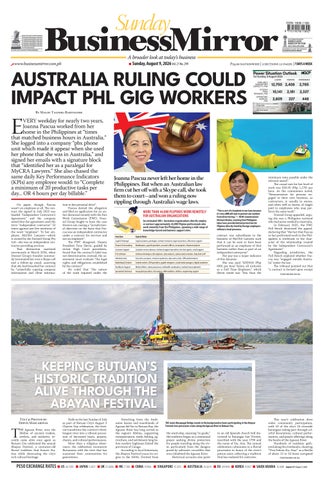
Joanna Pascua never left her home in the Philippines. But when an Australian law firm cut her off with a Skype call, she took them to court—and won a ruling now rippling through Australia’s wage laws. MORE THAN 44,000 FILIPINOS WORK REMOTELY FOR AUSTRALIAN ORGANIZATIONS An estimated 300+ Australian organizations directly employ or contract approximately 44,000 Filipino professionals who work remotely from the Philippines, spanning a wide range of knowledge-based and business support roles. Function
Typical Roles
Legal & Paralegal
Legal assistants, paralegals, contract reviewers, legal researchers, eDiscovery support
Finance & Accounting
Bookkeepers, payroll specialists, accounts officers, tax preparers, financial analysts
Customer Support
Customer service advisors, technical support specialists, live chat agents, email support
IT & Software
Software developers, QA engineers, data analysts, cybersecurity monitors, help desk staff
Administrative
Executive assistants, virtual receptionists, data entry clerks, CRM administrators
Marketing & Creative
Content writers, SEO specialists, graphic designers, social media managers, digital marketers
Healthcare Support
Medical billers, claims processors, telehealth coordinators, medical transcriptionists
Specialized Technical
Geospatial specialists, GIS analysts, BIM modellers, drafters, engineering support
“This is sort of a loophole in our laws because it’s very difficult now to protect our workers from direct hiring.”— NLRC Commissioner Herman Nicdao, warning that Philippine labor laws provide limited protection for Filipinos directly hired by foreign employers without a local presence.
contract was subordinate to the business of MyCRA Lawyers such that it can be seen to have been performed as an employee of that business rather than as part of an independent enterprise”. Her pay was a major indicator of this dynamic. She was paid “AUD$18 (Php 680) per hour Salary all inclusive as a Full Time Employee,” which Slevin noted was “less than the
minimum rates payable under the relevant award”. The casual rate for her level of work was $30.95 (Php 1,170) per hour. As the commission noted, “Remuneration for persons engaged in their own business, as contractors, is usually in excess, and often well in excess, of wages paid to employees who may perform the same work”. Doessel Group appealed, arguing she was a Philippine national who had never worked in Australia. In February 2025, the FWC Full Bench dismissed the appeal, declaring that “the fact that Pascua in fact performed work in the Philippines is irrelevant to the character of the relationship created by the Independent Contractor’s Agreement”. Regarding jurisdiction, the Full Bench explored whether Pascua was “engaged outside Australia” under the law. The tribunal pointed out that “a contract is formed upon receipt Continued on A2
KEEPING BUTUAN’S HISTORIC TRADITION ALIVE THROUGH THE ABAYAN FESTIVAL Text & Photos by Erwin Mascariñas
T
HE Agusan River, once the lifeline of ancient traders, settlers, and seafarers, recently came alive once again as Butuan City celebrated the annual Abayan Festival, a centuries-old fluvial tradition that honors Sta. Ana while showcasing the city’s rich cultural heritage.
Held on the last Sunday of July as part of Butuan City’s August 2 Charter Day celebration, the festival transforms the country’s thirdlongest river into a vibrant procession of decorated boats, prayers, chants, and cultural performances. More than a religious observance, the celebration reconnects Butuanons with the river that has sustained their communities for generations.
Stretching from the freshwater basins and marshlands of Agusan del Sur to Butuan Bay, the Agusan River has long served as the region’s lifeline, supporting transportation, trade, fishing, agriculture, and settlement long before modern highways linked the provinces of Caraga. According to local historians, the Abayan Festival traces its origins to the 1600s. Derived from
THE iconic Macapagal Bridge stands in the background as boats participating in the Abayan Festival river procession cruise along the Agusan River in Butuan City.
the word abay, meaning “to guide,” the tradition began as a communal prayer seeking divine protection for people traveling along the river, particularly from the dangers posed by saltwater crocodiles that once inhabited the Agusan River. Historical accounts also point
to an old Spanish church bell discovered in Barangay San Vicente, inscribed with the year 1796 and the name of Sta. Ana. The annual celebration culminates in a fluvial procession in honor of the river’s patron saint, reflecting a tradition that has endured for centuries.
This year’s celebration drew wider community participation, with 19 of the city’s 24 riverside barangays taking part through colorful decorations, cultural performances, and prayer offerings along the banks of the Agusan River. Hundreds of residents gathered along the riverbanks, chanting “Viva Señora Sta. Ana!” as a flotilla of about 15 to 20 boats navigated Continued on A2
PESO EXCHANGE RATES n US 60.7020 n JAPAN 0.3831 n UK 81.6806 n HK 7.7388 n CHINA 8.9906 n SINGAPORE 47.3015 n AUSTRALIA 42.6614 n EU 69.9469 n KOREA 0.0427 n SAUDI ARABIA 16.1686 Source: BSP (August 7, 2026)
News BusinessMirror
A2 Sunday, August 9, 2026
www.businessmirror.com.ph
Keeping Butuan’s historic tradition alive through the Abayan Festival
RESIDENTS line the banks of the Agusan River as a flotilla carrying the image of Sta. Ana leads the annual Abayan Festival in Butuan City. Dating back to the 1600s, the celebration commemorates the river that sustained generations of traders, settlers, and communities while reaffirming Butuan's rich cultural and maritime heritage. PHOTOS BY ERWIN MASCARINAS Continued from A1
the river’s strong current. Leading the procession was the vessel carrying the image of Sta. Ana. “As we look back, it’s the connection with our city’s history that has not only given the identity of its people but the character of its culture. It is very important because it celebrates the deep faith of the people of Butuan while highlighting the community spirit of the Butuanons,” said Kevin Jay Hinaloc, acting head of the Butuan City Tourism Office. Hinaloc said the Abayan Festival remains one of the city’s most community-centered cultural events because it brings together religious organizations, local artists, and riverside barangays in a shared celebration. “While we showcase the vibrant decorations on the participat-
ing boats, our barangays, who took part in the celebration along the riverbanks, also danced and offered prayers to our patron saint, Sta. Ana. Many people in our community are involved in this festival, giving it significant cultural value,” he said. For visitors, Hinaloc believes the celebration offers a uniquely Butuan experience. “I think the fluvial parade is unique, and also the dances and chants along the riverbanks. It is a good showcase of our cultural heritage in the city,” he said. Beyond preserving tradition, the city is also positioning its cultural heritage as a cornerstone of tourism development. Hinaloc said Butuan’s longterm vision is to reconnect with its identity as one of the country’s ancient maritime trading centers by promoting heritage-based tourism centered on the Agusan River.
“Connecting to our heritage and roots links us to activities that are really related to promoting our waterways and the pre-Hispanic vessels highlighting our historic past,” he said. Among the initiatives being pursued are pilot runs of the Agusan River cruise, which the city hopes to establish as a regular tourism attraction. “Our ultimate goal is to use Balangay-inspired vessels for cruises along the Agusan River. We are also developing a marina along the riverbank that will serve as the terminal or hub of the river cruises,” Hinaloc added. He expressed optimism that these initiatives would help position Butuan City as one of the country’s leading cultural tourism destinations. Department of Tourism-Caraga Regional Director Ivonnie B. Du-
madag said the Abayan Festival also highlights the broader importance of the Agusan River, not only as part of the city’s cultural heritage but as a vital resource that sustains communities throughout Caraga. “The river is home to internationally significant wetlands, particularly the Agusan Marsh. It connects people, supports livelihoods, and provides a habitat for Caraga’s rich biodiversity. By keeping the mighty river healthy, we also help sustain
communities that depend on it for farming, fishing, transportation, and ecotourism,” Dumadag said. She emphasized that preserving traditions such as the Abayan Festival is just as important as developing new tourism attractions. “Many destinations invest heavily in building new attractions. But in Butuan, what we already have are rich historical stories and cultural narratives that are deeply rooted in the community. These are treasures
that the people already own, and the city government’s efforts are meant to recognize and preserve that heritage,” Dumadag said. As Butuan continues to celebrate its Charter Day and strengthen its identity as one of the Philippines’ oldest settlements, the Abayan Festival remains a living reminder that the Agusan River is more than a waterway. It is a symbol of the city’s faith, history, culture, and enduring connection to its people.
AUSTRALIA RULING COULD IMPACT PHL GIG WORKERS Continued from A1
by the offeror of communication of its acceptance by the offeree.” “Where a contract is formed by means of email communications, the position that appears to have been adopted is that the contract is made where the electronic communication is received,” the FWC said in its ruling. For an Australian company, this means the contract is legally “formed in Australia” and brings the offshore worker under Australian protection. (Note: The tribunal stopped short of a final jurisdictional ruling purely on this point because the exact evidence of how Pascua returned her contract was incomplete, but the legal pathway was clearly established.) The FWC ultimately ruled Pascua’s dismissal was “harsh, unjust, and unreasonable,” and awarded her “A$10,800 (P408,200) in compensation for unfair dismissal” (equivalent to 15 weeks of pay), along with back-payments to Australian minimum wage standards. Pascua’s case is now the reference point for a question far bigger than one law firm, serving as “the most consequential Australian employment law decision affecting
offshore staffing arrangements in recent memory”. Based on industry data, “more than 300 Australian organizations directly employ or contract approximately 44,000 Filipino professionals who work from the Philippines”. The stakes for these arrangements have recently risen dramatically. Under Australia’s new wage theft laws effective January 2025, “intentional underpayment can result in fines or imprisonment,” turning a misclassification issue into a “criminal compliance problem” where company directors can face personal liability. Additionally, new “Payday Super” rules taking effect on July 1, 2026, require that a 12 percent superannuation contribution “must be paid simultaneously with wages,” increasing the financial risk of these arrangements being scrutinized. With these overlapping reforms, the “compliance cost of misclassification has moved from administrative to criminal”. Taken together, employment advisers say the reforms make misclassifying a Filipino remote worker as a contractor a far costlier gamble than it used to be. Many expect, and some are already seeing, a shift away from direct hiring altogether, with Australian firms routing their Philippine hires through employer-of-record providers or traditional business process outsourcing agencies instead. Those intermediaries formally employ the worker in the Philippines, handle local statutory obligations such as SSS and PhilHealth contributions, and absorb the
compliance risk that direct engagement now carries. For Pascua, the case closed with a payout and public vindication of the years she spent proving her work was never really freelance at all. For the Philippine outsourcing industry, it left something bigger: fewer direct-hire arrangements, perhaps, but a stronger case for the tens of thousands of Filipinos still doing this work to insist they be treated — and paid — like the employees they actually are.
Legal ‘loophole’ for Filipino remote workers
PHILIPPINE labor laws have a “loophole” that limits protection for Filipinos directly hired by foreign companies with no physical presence in the country, according to National Labor Relations Commission (NLRC) Commissioner Herman Nicdao. “This is sort of a loophole in our laws because it’s very difficult now to protect our workers from direct hiring,” Nicdao said. The issue has become more pressing with the rise of freelancers, virtual assistants and other Filipinos working remotely for overseas companies that have no branch or office in the Philippines. This leaves labor authorities facing an immediate jurisdictional hurdle, particularly in determining how legal processes may be served on an employer located entirely abroad. “The first question is, how do we get jurisdiction over that company?” Nicdao said. The commission is studying whether service through email could be used as an alternative means of acquiring jurisdiction over foreign employers. However, securing jurisdiction would only address part of the problem since a favorable ruling may still be difficult to enforce against a company with no property or presence in the country. “The next question is that, assuming that we acquired jurisdiction over the employer and the employee won in the case, how are we going to enforce the decision?” Nicdao said. To address the enforcement gap, he proposed requiring foreign companies that directly hire Filipino remote workers to maintain a bond or bank account in the Philippines that could be garnished in cases of illegal dismissal or other labor violations. With a report by Mary Jade Jadormio
The World
www.businessmirror.com.ph
Sunday, August 9, 2026
A3
China’s trade boom survives extreme rains as AI race lifts sales
C
HINA’S exports and imports managed to ride out the disruptions caused by extreme weather in July, as a global investment supercycle in artificial intelligence powers tech demand overseas and at home.
Shipments abroad climbed more than forecast and grew 23.9%, their second straight month of gains in excess of 20%, according to data released by the General Administration of Customs on Friday. Imports advanced 27.5%, leaving a trade surplus of $112.5 billion and putting it on track to exceed last year’s record level. “Exports remain the main growth engine,” said Lynn Song, chief economist for Greater China at ING Bank NV in Hong Kong. “This year’s K-shaped divergence in China looks like it will continue in the months ahead as external demand is clearly much stronger than domestic demand.” After absorbing the shocks of Donald Trump’s tariffs and the war in the Middle East, the world’s biggest manufacturing nation is pulling through a
period of heavy rains. Typhoon Bavi became the strongest storm to hit the powerhouse economy of Zhejiang province in nearly eight decades and some of the country’s busiest ports suspended operations temporarily. Soaring overseas shipments for AI-related electronics as well as other cutting-edge products like electric vehicles have cushioned growth from a deeper slowdown this year. At the same time, the boom in trade is widening a persistent divide within the economy and reducing the need for Chinese officials to step up support to domestic consumers despite weak demand at home. What Bloomberg Economics Says... “China’s trade data continue to show a widening divide between
the old and new economies. Robust import and export growth in July demonstrated the strength of tech-related manufacturing, while exports of traditional products lagged well behind the headline pace. We expect that pattern to persist, with tech-related sectors staying strong and supporting overall exports.” — David Qu, China economist
The rising dominance of Chinese companies across the global value chain has also led to rising tensions with Europe and the US, especially in areas like carmaking and more recently hardware for data centers. China’s swelling trade surplus has also prompted a heated discussion among economists over the role the domestic currency played in protecting the country’s manufacturing edge. Chinese officials have been pledging to achieve “balanced trade” and boost purchases from abroad since early this year. Imports did surge this year, though price factors played a more important role. In a sign that even soaring imports are struggling to catch up with strong exports, China’s year-to-date trade surplus in July exceeded its level from the same time last year for the first time since February. Surging prices for chips and commodities like oil and
metals have inflated China’s trade figures, with exports and imports rising less in volume terms. And as trillions of dollars pour into AI, a shortage for semiconductors and other electronics has sent some chip prices soaring as much as 700% over the past year. Export prices rose 8% from a year ago in June, according to the latest official data, increasing for the third straight month after nearly three years of declines. The prices of imports surged 25% in June, the fastest increase since data began in 2006. In volume terms, imports grew just 4% in June. The extreme weather may have contributed to a slight slowdown in trade last month. Several consecutive typhoons including Bavi created a jam at ports during a peak season for exporters. A gauge tracking outbound container shipping costs surged to the highest level since September 2024. “Stepping back, exports remain very strong, with the slight deterioration last month partly due to temporary disruptions to port operations from recent typhoons,” said Julian Evans-Pritchard, head of China economics at Capital Economics.
Putin looks to FSB hardliners to keep his wartime elite in line
M
ANY of Russia’s elite increasingly fear the Federal Security Service is out of control as President Vladimir Putin tasks the agency with maintaining his grip on power amid growing unease over the war in Ukraine. A terrorism charge against billionaire Telegram co-founder Pavel Durov is the latest indicator of an intensifying wave of repression by the service, known as the FSB, according to people close to the Kremlin, asking not to be identified discussing sensitive issues. While the president has long ruled by balancing between security hardliners and more moderate, economy-focused groups among his officials, many within Kremlin circles feel that Putin now leans consistently toward advocates of harsher control over business and society, the people said. That’s stirring tensions as the FSB expands its reach with no obvious checks on its power, while senior officials including Sergei Kiriyenko, Putin’s powerful domestic policy chief, are losing influence, according
to assessments of people close to the Kremlin and the government. Kiriyenko has drawn blame recently for setbacks in Russia’s political operations in Armenia, Moldova and Hungary. “The FSB has become the management company of the country,” said Andrei Kolesnikov, a Moscowbased political analyst. “The political administration, the Foreign Ministry, and the financial-economic bloc have been reduced to mere technical staff serving decisions made with a secretservice bias.” A bomb attack in central Moscow last weekend has likely only strengthened the FSB’s arguments with Putin for tighter security. That’s left other Kremlin factions with little ability to resist a tougher crackdown despite concerns it could erode the president’s public support that has already slipped to its lowest since the 2022 full-scale invasion of Ukraine began. Kremlin spokesman Dmitry Peskov didn’t respond to a request for comment. See “Putin,” A4
See “China,” A4
PACK, FLY, EXPLORE
T R AV EL ESSEN TIA L S F O R FA M I LY G E TAWAYS
F
By Edwin P. Sallan
AMILY getaways are always special. From the equally exciting planning stages to arriving at your target destination and then discovering new places together, memories that last a lifetime document the experience all together.
But as every seasoned traveler knows, a smooth vacation often comes down to packing the right essentials. Thankfully, SM Store has more than enough travel companions that will make it a lot easier to organize your luggage, stay comfortable during long flights and ultimately explore your destination with ease.
Everything you need to bring
For starters, smart packing begins with the Heys Xero Elite 2.0, an ideal travel companion for families who need reliable luggage. Combining ultra-lightweight recycled materials with durability and functionality, this baggage makes airport transfers and hotel check-ins a lot less stressful. To keep everything organized, use the Heys Ecotex 5pc Packing Cube Set. These packing cubes make it easy to separate outfits, kids’ essentials, accessories, and even laundry. Not only do they save valuable suitcase space, but they also make unpacking at your destination effortless.
For long flights
Even the most excited vacationers can be subjected to unnecessary stress during long travel hours or even days. To ensure rested arrivals, the Travel Sentry Contouring Eye Mask, designed with a contoured shape and 3D nose bridge that blocks out light while remaining comfortable around the eyes. While sleeping, the Travel Sentry Full Comfort Neck Pillow provides ergonomic support with its memory foam construction and 360-degree design. There’s also the Travel Sentry Carry-On Toiletry Bag that helps streamline airport security checks. Its transparent and reusable design keeps travel-sized liquids neatly organized while reducing reliance on single-use plastic bags.
For walks around the city
Getting to your destination is only the beginning. Once you get there, comfort and safety naturally become priorities. The Travel Sentry RFID Money Belt offers peace of mind by protecting
passports, cards, and personal information with RFID-blocking technology. Worn discreetly under clothing, it adds an extra layer of security while sightseeing. Built for all-day adventures, rain or shine, is the Merrell Accentor 3 Waterproof shoe. Its Waterproof material helps keep feet dry, while the Air Cushion heel and EVA foam midsole provide lasting comfort whether you're navigating city streets, nature parks, or scenic walking trails. Packing the right essentials means less time worrying about logistics and more time enjoying the moments that matter. Go get these travel must-haves at SM Store and make your next family getaway more comfortable, organized, and memorable.
A4
Sunday, August 9, 2026
The World
www.businessmirror.com.ph
China can’t get enough of this smelly fruit as farmers fight extreme weather to feed the craving
K
ARAK, Malaysia—Malaysian durian orchard owner Stephen Chow’s workers spend hours in the fields in the dead of night, donning headlamps to collect freshly ripened fruit coveted by Chinese consumers. But the hard work may not be enough to keep Chow out of the red.
Durian lovers prize the Malaysian premium varieties such as Musang King and Black Thorn, but their growers face a harsher reality. Climate change, caused by the burning of oil, gas and coal, is making it costlier for growers like Chow to produce quality durians, adding pressure as they compete with Thailand and Vietnam, which dominate a booming export market to China. Extreme weather has dealt repeated blows to Chow’s orchard, which is in Karak, a small town about an hour drive from Kuala Lumpur. In 2021, heavy rainfall triggered flooding that damaged about 100 of his durian trees and his machinery. Over the following three years, persistent rain during flowering season caused pollination failure, cutting into his yield. And now, Chow is facing other challenges. “Breaking even would already
be very good. Most likely there’ll be a loss this year,” Chow said. Between February and April, afternoon temperatures hit 33 to 35 degrees Celsius (91 to 95 degrees Fahrenheit), and rain fell mostly at night, he said. Such weather favored flowering, and Chow responded by pruning to prevent deformed or small fruit while stepping up watering and fertilization because of the heat. A rise in fuel and fertilizer prices because of the Iran war, however, meant those extra efforts came at a higher cost. An oversupply of durians in Malaysia—driven by hot and dry weather and more orchards reaching maturity—also pushed prices down. Grade A Musang King durians from his orchard sold for the equivalent of $8.6 per kilogram (about 2.2 pounds) in local currency in early July, about half compared to the same period last
year and roughly one-third of the peak price in 2024.
China’s love for durians fueled boom
DURIANS’ overpowering smell is fragrant to those who love it and foul to those who don’t. Beneath a spiky shell, their flesh offers a rich, creamy texture with varying flavors. Some taste like sweet custard with fruity flourishes, others carry a hint of bitterness, an alcohol tinge or even a peanut butter-like flavor. Official data showed Malaysia’s durian crop covered 92,100 hectares (227,600 acres) in 2024, up almost 40% from 2016, a size even larger than the total land area of Singapore, the city-state island just south of Malaysia. During that period, Malaysia’s production grew nearly 90% to 568,800 tonnes. The boom was fueled by China beginning to import whole frozen Malaysian durians in 2019. Fresh durians followed in 2024, as Beijing expanded what has been dubbed “durian diplomacy” by welcoming more Southeast Asian countries to export the fruit. T he Food a nd A g r ic u lt ure Organization of the United Nations said China procured about 95% of global durian exports between 2020 and 2022. It imported 1.87 million tonnes of fresh durians worth $7.5 billion in 2025, with the volume jumping six times in the past
decade, accord ing to China’s customs data. Consumers there can find the fruit in supermarkets, grocery stores and durian specialty shops. Shanghai resident Song Xiaohua, in her 30s, said she would eat durians once a week instead of once a month if it weren’t for the high calorie count. To her, durians taste creamy and are like both fruit and dessert. “It feels like celebrating Lunar New Year every time I have a durian,” Song said. Malaysia lags far behind Thailand and Vietnam in exports to China. But the Malaysian industry touts its durians as higher quality. Unlike their counterparts, Malaysian growers typically do not harvest early, instead collecting only naturally ripened fruit.
Delivering quality durians requires resilience
AS global average temperatures rise, extreme weather events like heat waves, floods and droughts are becoming more frequent and intense worldwide, often forcing farmers to scramble to adapt. Peninsular Malaysia recorded a significant jump in average temperature from 1969 to 2025, with an increase of 0.24 degrees Celsius (about 0.43 degrees Fahrenheit) per decade, according to the country’s meteorological department. Ooi Teik Hock, whose orchard in Perak state is near the border with Thailand, said there were fewer
Europe sugar output set for 10-year low amid tight world supply
E
UROPE’S sugar output is set to fall to the lowest in more than a decade as hot weather damages an already smaller beet crop, tightening global supplies under pressure from a powerful El Niño. Production in the European Union and the UK is set to fall to about 15 million tons, the lowest level since the 2015 season, according to data from S&P Global Energy. A series of heat waves this summer have battered yields for the current season after acreage had already declined for a second straight year as producers curbed output after bumper crops depressed prices. That adds to mounting concerns about a potential worldwide deficit as the El Niño weather pattern looms over cane production in several key Asian producers including
India and Thailand. That fear has already sent sugar futures in London and New York up about 5% so far this month. “The lower crop will contribute to deficits in the first and second quarter of next year and that’s already being priced in the market,” said Claudiu Covrig, lead analyst at Covrig Analytics. With exports from Europe missing or at least reduced to a minimum, “prices will go further north.” The European Commission’s MARS cropmonitoring unit last week cut its forecast for EU beet yield to 76 tons per hectare, down 7% from a year earlier, citing unfavorable weather. While that’s near the five-year average, the prolonged heat has eroded any cushion for the crop, potentially pushing the EU to turn into a net importer of the sweetener,
StoneX analyst Pedro Antiquera said in a note. The outlook could deteriorate even more as weather forecasts continue to point to above-normal temperatures and limited rainfall, worsening already depleted soil moisture levels, according to Marina Malzoni, principal analyst for soft commodities at S&P Global Energy. Covrig Analytics has cut its output forecast for the EU and UK to 14.7 million tons, the lowest since 2022 when high temperatures hurt output and sent prices soaring. The European Commission expects output in the EU alone to slip to 14.1 million tons. “With acreage continuing to contract, the sugar beet crop has become increasingly vulnerable to yield shocks,” said Malzoni. “Prices are expected to increase in the
near term as the supply-demand balance tightens.” That could be a silver lining for European processors after two consecutive bumper harvests when the region was awash with sugar and a price slump squeezed their margins. Sugar prices in the region have risen as much as 9% since June, lifting the premium that white sugar futures command over raw sugar, according to Arnaud Lorioz, chief executive officer of Paris-based brokerage Deepcore. Still, a sustained recovery for processors will require a further reduction in supplies because Europe could still produce a small surplus, Stephan Büttner, chief executive at Austrian sugar producer Agrana, said in an earnings call last month. Bloomberg News
Iran wants to bar US, Israeli ships from Hormuz in peace accord
I
RAN will seek to bar US and Israeli ships from the Strait of Hormuz and require compensation from hostile countries before they’re allowed to sail through it, according to local media reports on a proposed Iran-Oman deal to manage the crucial waterway. The agreement has become key to expectations for a reopening of Hormuz and a resumption of energy flows that have been throttled since the US and Israel attacked Iran in February. “That’s clearly not going to go down well in Washington,” said Thomas Warrick, a former State Department official who is now a nonresident senior fellow at the Atlantic Council. “Instead of both sides making concessions,
both sides are increasing demands.” But asked during a White House event on Thursday evening about the negotiations, President Donald Trump responded: “Moving along good.” There aren’t many US- or Israeli-flagged commercial ships globally, and few have sailed in and out of the Persian Gulf since the war started. It remains to be seen how broadly Iran might interpret such a ban, as the complex nature of vessel ownership and management means some shipping companies with US or Israeli ownership or investment could be viewed as having links to those countries. In any event, Trump would be unlikely to agree to such a concession after months
of insisting that American armed forces had essentially defeated Iran. Midterm elections that will determine control of both houses of Congress are just months away, and polls have found that the war has become deeply unpopular. The text of the agreement is now under review in Iran’s parliament, the semi-official Fars news agency said. Fars reported other details including a proposed ban on cargo related to Israel, and a fee structure covering services like insurance and environmental costs. Separately, Fars said Iranian naval forces had struck “hostile targets” at the entrance to the Strait of Hormuz, citing an unnamed source and without giving additional details. Oil extended gains after reports that
Iran sought to keep US ships out of the strait and reports of Iranian attacks in the critical waterway. Brent rose above $83 a barrel, after gaining almost 4% in the previous session, while West Texas Intermediate was near $78. Both US and Iranian officials have been signaling in recent days that some kind of accord on Hormuz is close. Trump, who stepped back from his most recent threats to resume military attacks on Iran, said earlier Thursday that the US was involved in negotiations, but declined to say whether an agreement had been reached. “We control it, but they can always shoot something,” Trump said of the vital waterway earlier Thursday. Many previous claims of an imminent deal have proven unfounded, and it’s not clear if the Iran-Oman proposals will be enough to get traffic flowing again. On Thursday, a key Iranian negotiator mocked the White House for repeatedly making threats and then climbing down, calling it “theater diplomacy on loop.” The US has insisted on free transit through Hormuz, and broadly called for a return to the pre-war status quo. Any temporary routes through the strait won’t be subject to approvals, permissions, tolls or charges, a US official said Thursday in response to reports on the latest proposals. Bloomberg News
fruit quality problems when temperatures were lower two decades ago. Concerned about the heat, he moved his orchard from the plains to the highlands about 10 years ago, where nights are cooler and air is more humid. Still, global warming remains a threat, fueling the proliferation of once-rare pests and forcing Ooi to use pesticides more frequently, which he said have jumped some 30% in price from three years ago. For the first time, Ooi didn’t see fruit bats, a main pollinator, at his orchard during this year’s flowering season. He said it could be a result of extreme heat or the widespread use of pesticides for pest and disease control. The weather changes also affect overall quality, especially for the Musang King variety, which is sensitive to weather conditions, said Lim Chin Khee, an adviser to the Durian Academy, which trains durian growers in Malaysia. Too much rain during the fruit’s rapid development period can cause white and grayish patches on golden yellow flesh, while water shortages during that time can cause some black spots around the flesh, he said.
Some growers turn to technology
WITH expectations that El Nino, a periodic warming of Pacific Ocean that leads to warmer temperatures, could bring Malaysia recordhigh temperatures between March
China. . . Continued from A3
The latest data added to a picture of an economy whose reliance on high-tech and AI-driven exports makes it less vulnerable to intense weather events. Exports of chips and computers kept soaring in July thanks to higher prices, climbing 117% and 67% from a year ago, respectively. Overseas sales of cars jumped
Putin. . . Continued from A3
Putin, a former KGB agent and FSB chief, is placing his faith in his security service to safeguard his rule as the war becomes more visible to ordinary Russians. Ukrainian strikes on oil refineries, defense plants and logistics warehouses extend deep inside the country, undermining Kremlin claims that he has the situation under control in the fifth year of a conflict that shows no sign of ending. Russia’s military has incurred enormous battlefield casualties, while its economy is straining under the pressure of massive state spending, high real interest rates and negligible growth amid unprecedented Western sanctions. In particular, the FSB’s Second Department, responsible for combating terrorism and upholding Russia’s political order, has been given free rein to investigate anyone with little or no accountability, according to three of the people. It’s behind the push to charge Durov with terrorism as part of efforts to restrict Telegram, those people said. That’s despite objections from senior Kremlin officials responsible for managing September’s parliamentary elections, who warn a clampdown on the popular messenger risks a backlash from voters. Durov, who has lived outside the country for years, dismissed the charge on his Telegram channel, saying Russia had declared him a terrorist “for refusing its demands for mass surveillance and censorship.” Even relatively marginal critics have been ruthlessly pursued. Ilya Remeslo, a former pro-Kremlin blogger who turned against Putin, was sent to a psychiatric clinic after being arrested in St. Petersburg on charges of spreading “fake news” about
and May, Lim advised farmers to expand water reservoirs or prepare to install tube wells as a backup if their ponds dried up. He said producing good fruit depends equally on the weather and the farmer’s effort. Extreme weather events would reduce supply while simultaneously driving up prices, he said. “So for those farmers (who) are well prepared, actually when any disaster strikes, that is an opportunity,” he said. Grower Kie Kim Hwa learned how to farm durians from his grandfather at a young age. When he took charge of the orchard in Penang Island off Malaysia’s western coast, he chose to do things slightly differently than previous generations. He installed sensors and instruments to track rainfall, humidity and wind speed, among other data, which was sent to a cloud drive for him to review anywhere and keep a record. Some were placed among the trees and grass, and others deep in the soil. Not everything required high technology: he also checked the surface of a bucket of water for insects to gauge pest levels. The data allowed Kie to intervene early before problems arose and ultimately control fruit quality and quantity to match market demand. “We live and die by the weather,” he said. “But we can still prepare.” AP 60% while ships surged 92%. The growth for general machinery accelerated to 31% from 15% in June. And while tensions with major trading partners have escalated, China’s trade surplus with the European Union is still climbing, reaching a fresh record of $33.8 billion in July. China continued to curb its imports of crude oil, though their decline in volume terms narrowed to 24% from a year earlier versus 41% in June. Bloomberg News the military, the state-run Tass news service reported July 26. Boris Nadezhdin, an anti-war politician who was barred from challenging Putin in the 2024 presidential election, was convicted of “extremism” for displaying a photograph of the late opposition leader Alexey Navalny. He announced this week that he’d fled to France after being declared a “foreign agent.” Business tycoons are also being targeted by investigators and prosecutors amid a sweeping wartime asset grab that’s redistributing properties to people close to or loyal to the authorities. Russia’s cultural and science sectors haven’t escaped scrutiny, either. The Second Department has opened cases against dozens of physicists and aerospace researchers on “treason” charges for participating in past state-sanctioned international symposiums. It maintains unofficial blacklists of actors, musicians and directors deemed to be unpatriotic, imposing ideological conformity using laws against “extremism” and “discrediting” the military. Putin on Tuesday signed new legislation to punish anti-war Russians who’ve fled into exile and been convicted in absentia. Their assets in Russia will be frozen, they’ll be banned from using state and banking services online, and they’ll be refused the right to renew their passports abroad. The Second Department has a track record of targeting Putin’s most prominent opponents. The US sanctioned its chief, General-Colonel Alexey Sedov, over the 2020 poisoning of Navalny, the UK imposed similar measures on its agents for poison attacks on Vladimir Kara-Murza, and the department was tracking former Deputy Prime Minister Boris Nemtsov prior to his 2015 assassination on a bridge next to the Kremlin. Bloomberg News
www.businessmirror.com.ph • Editor: Lyn Resurreccion
Sunday, August 9, 2026 A5
DOST-PCAARRD brings climate-smart agricultural innovations closer to the public
T
HE Department of Science and Technology and Philippine Council for Agriculture, Aquatic and Natural Resources Research and Development (DOST-PCAARRD) showcased climate-smart agricultural technologies that help farmers improve productivity and adapt to climate-related challenges during the Technology to People (T2P) Media Conference that was held in Tarlac recently. Unlike previous T2P conferences held in function halls, this year’s event brought journalists directly to farms, allowing them to witness firsthand how the DOST-supported innovations are applied in actual farming conditions. The field demonstrations highlighted how years of R&D are translated into practical solutions that address the country’s growing need for climateresilient agriculture. Featured during the media conference were technologies under the Industry Level Collaborative Research and Development to Leverage Philippine Economy (i-Cradle) Program, and Project Sarai (Smarter Approaches to Reinvigorate Agriculture as an Industry in the Philippines), two DOST-funded and DOST-PCAARRDmonitored initiatives that promote science-based, climate-smart innovations for agriculture. One of the featured technologies
under the i-Cradle Program was the combined application of the Automated Furrow Irrigation System (AFIS), developed by Dr. Marvin M. Cinense of the Central Luzon State University (CLSU), and Nutrio biofertilizer, developed by Dr. Virginia M. Padilla of Fullmight Agricultural Corporation. Implemented in partnership with the Sugar Regulatory Administration (SRA), the project was piloted in lowyielding sugarcane farms in Luzon, Visayas, and Mindanao, where average production ranges from only 40 ton-cane to 55 ton-cane per hectare, which is below the national average of 60 tons per hectare. Among the sugarcane farms identified by SRA were from North Cluster Producers Cooperative (NCPC) in Tarlac. The technology package produced promising results in the NCPC farm in Tarlac, increasing sugarcane yield by
(TOP) Part of the technology of Automated Furrow Irrigation System developed by Dr. Marvin M. Cinense (bottom, left) of Central Luzon State University. (Bottom right) Dr. Virginia M. Padilla shows the Nutrio biofertilizer product, which was applied in the sugarcane plantation of the North Cluster Producers Cooperative. IMAGE CREDIT TO ACD, DOST-PCAARRD 54.7 percent, sugar recovery by 19.2 percent, and overall sugar production by 83.2 percent. Farmer-beneficiary Marlon Gamboa admitted that he initially hesitated to adopt the innovation. As a precaution, he left one hectare of his sugarcane field untreated while applying the technology to the rest of his farm. However, the higher yield from the treated area convinced him of the effectiveness of AFIS and Nutrio biofertilizer, encouraging him to adopt the technologies with greater confidence. Complementing these productivityenhancing technologies was the project Sarai’s technology, the Automatic Weather Station (AWS) developed by the University of the Philippines Los Baños (UPLB).
MARLON GAMBOA, chairperson of the North Cluster Producers Cooperative and owner of the sugarcane plantation in Tarlac, where AFIS and Nutrio biofertilizer are applied. IMAGE CREDIT: TO ACD, DOST-PCAARRD
Project Sarai is currently being rolled out nationwide through the program, Sarai Centralized National Hub for Regional Operations (Sarai CeNtro). The AWS, which was also featured in the T2P, provides farmers with realtime weather information, including rainfall, humidity, wind speed, wind direction, soil temperature, and soil moisture data. These science-based advisories enable farmers to make timely decisions on irrigation, planting schedules, and other farm operations. “Agriculture today can no longer rely on traditional practices alone, but must be complemented by science, technology, and innovation,” said DOSTPCAARRD Executive Director Dr. Reynaldo V. Ebora.
Ateneo study reveals continent-wide driver of extreme monsoon rains
W
EATHER scientists have long known that typhoons even hundreds of kilometers away from the Philippines can interact with the southwest monsoon, resulting in days-long heavy rains. But the exact dynamics of this relationship have remained largely unknown until recently. A new study spearheaded by the Ateneo de Manila University VORTEX Research Lab and the Manila Observatory together with Pagasa and Tokyo Metropolitan University sheds light on this complex phenomenon—and may even pave the way for accurately forecasting heavy monsoon rains up to several days in advance, said Danika Geronimo of Ateneo Research Communications. Every year, the southwest monsoon—locally known as Habagat—brings rain across the western parts of the Philippines. Many welcome the first showers with relief after months of intense heat. But the monsoon has also been known to bring relentless downpours that produce flooding. It is interesting to note that the analysis of over four decades of extreme Habagat events has revealed that the country’s heaviest southwest monsoon rains are driven not by a
A SNAPSHOT of the moisture conveyor belt in action during the July 2024 Habagat event, enhanced by Super Typhoon Gaemi (local name: Carina). The image shows an elongated corridor of enhanced moisture transport extending from the Arabian Sea across Southeast Asia to the Philippine Sea. PHOTO CREDIT TO OLAGUERA ET AL., 2025
single weather event but by a combination of atmospheric conditions that come together across thousands of kilometers. The researchers analyzed 53 cases of extreme Habagat rainfall linked to tropical cyclones between 1981 and 2023. They looked for weather patterns that appeared repeatedly across different cases.
They identified a recurring setup: a strengthened Habagat; a tropical cyclone northeast of the Philippines; and other atmospheric conditions that allowed large amounts of moisture to flow toward the country. These factors form what is known as the “moisture conveyor belt”(MCB) that transports water vapor from the Indian Ocean across
Southeast Asia to the Philippines. When these conditions are in place, they often lead to prolonged periods of intense rainfall. The researchers found that the buildup to these severe rainfall events takes several days. As the Habagat strengthens over the northern Indian Ocean, it helps establish the MCB that repeatedly, in many of the cases analyzed, indicates that the country’s most severe southwest monsoon events follow a common pattern rather than occur purely by chance. Beyond explaining how extreme Habagat events develop, the findings could help scientists better recognize the atmospheric conditions that favor these episodes. The researchers also found that existing operational weather forecasts capture many of these large-scale patterns, providing a foundation for further improving predictions of high-impact southwest monsoon events. Researchers Alwin Andriel L. Bathan, Lyndon Mark P. Olaguera, Faye Abigail T. Cruz, Jose Ramon T. Villarin, John A. Manalo, and Jun Matsumoto published their research, Synoptic conditions favoring tropical cyclone-enhanced southwest monsoon high precipitation events in the Philippines, in the July 2026 issue of the journal, Atmospheric Research.
Sun’s new image show rippling strange feathery patterns
N
EW YORK—Scientists have captured images of the sun’s surface in the finest detail yet, revealing a strange and dynamic facade. It’s dangerous to look directly at the sun without proper eye protection. But researchers were able to peek at its scorching surface with the help of the National Science Foundation’s Daniel K. Inouye Solar Telescope, located on the island of Maui in Hawaii. Scientists originally took the images for a different reason: to fine-tune and test the limits of the telescope. But when they looked at the results, they realized they’d photographed the sun’s bright outer shell at higher resolution than ever before. What’s more, they saw strange feathery
patterns rippling across the surface. “That reminds me of famous paintings, like the swirling skies in Van Gogh’s Starry Night,” said solar physicist Ruizhu Chen with Stanford University, who was not involved with the new research. Researchers saw ripples of instability on the sun’s surface caused by bits of magnetized plasma moving past each other at different speeds—similar to waves that stir when a gust of wind blows over water. It’s a well-known phenomenon that guides how fluids move. This has been glimpsed on Earth and other planets like Jupiter and Saturn, but “it has not been observed ever at that level on the solar surface,”according to study co-author Friedrich Wöger with the National Solar Observatory. Adithi Ramakrishnan, Ap Science Writer
This undated image provided by the NSF National Solar Observatory on August 3, shows the sun’s surface. NATIONAL SCIENCE FOUNDATION NATIONAL SOLAR OBSERVATORY VIA AP
He added that the T2P Media Conference allows media partners to witness firsthand how DOST’s research outputs are helping farmers overcome challenges that limit agricultural productivity—a tangible manifestation of “Agham na Ramdam.“ These innovations were products of years of research and development, according to Dr. Juanito T. Batalon, DOST-PCAARRD deputy executive director for R&D. Project Sarai started as an R&D initiative in 2013 by UPLB and DOSTPCAARRD. Batalon said that the application of Nutrio biofertilizer and A FIS started in 2023, but the development of each technology started years earlier, demonstrating that each
technology goes through a rigorous process of evaluation and testing prior to commercialization. During the open forum, members of the media raised concerns on how farmers can be encouraged to adopt new technologies despite their hesitation to depart from conventional farming practices. Science Undersecretary for R&D Dr. Leah J. Buendia acknowledged that uncertainty is experienced not only by farmers but also by innovators introducing new technologies. “The first thing to do when we’re afraid is to take the first step,” Buendia said, emphasizing the importance of embracing innovation to strengthen Philippine agriculture. Zoe Maureen P.
Tomaub/S&T Media Services
EU joins Philippine Space Week ‘Navigating Tomorrow’
T
HE European Union (EU) joins for the third time the Philippine Space Week 2026, which will be held from August 8 to 14 with the theme “Navigating Tomorrow.” The EU and the Philippines share a strong partnership under the Global Gateway, focusing on leveraging the expertise and technology of Copernicus, the Earth Observation (EO) component of the EU’s space programme, having established in the Philippines the first Copernicus Data Centre in Southeast Asia, which is now becoming a regional center. To mark the celebration of the Philippine Space Week, the EU will contribute with the following trainings on Earth Observation: n August 5 and 6: EO land cover and forest mapping with the National Mapping and Resource Information Authority n August 10: Ground motion monitoring with the Philippine Institute of Volcanology and Seismology n August 12: Workshop on Strengthening EU–Philippines Earth Observation Collaboration; Lessons from CopPhil and EUPH Digital Economy Package; Info Planning Session by EU and Finland n August 13: Crop mapping with the Bureau of Soils and Water Management of the Department of Agriculture On 9 August, the EU Copernicus Booth will give
visitors the opportunity to learn more about the Copernicus Data Centre at Quantum Skyview, Gateway Mall 2, Araneta City. The EU and PhilSA will host a careers panel on Earth Observation with the Space Generation Advisory Council, aiming to encourage students and young professionals to explore opportunities in the Earth Observation and space sector in the country. The EU Copernicus Philippines program is funded by the EU with a €10 million grant (P624 million), in partnership with the Philippine Space Agency and the Department of Science and Technology, implemented by the European Space Agency, as part of the EU Global Gateway Strategy. It supports the adoption of EU Earth Observation technology to help local public administration, institutions and companies prevent natural disasters, protect the environment and manage national resources. The project involves three elements: developing a Copernicus data center in the Philippines; EO services showcasing the practical applications of Earth Observation data (ground motion monitoring; land cover, forests and crop mapping, and marine environment monitoring) and supporting the country to strengthen local capacities and promoting education in the field of Earth observation.
A6 Sunday, August 9, 2026
Faith
Sunday Editor: Lyn Resurreccion • www.businessmirror.com.ph
From Industrial Revolution to AI: Catholic principle guiding popes through tech upheavals
P
OPE Leo XIV recently found himself in a position many of today’s students can relate to: having his writing tested for signs of artificial intelligence use. Proudly Human, a tech company that analyzes creative work, announced on July 21, that it had reviewed a collection of Leo’s speeches. In general, algorithms to sniff out AI aren’t always accurate. Fortunately for the pope, though, the company declared his writing to be “human-authored.” In a way, it was fitting. Since the start of his papacy, Leo has spoken about the risks AI presents for broad swaths of society. As a computer scientist interested in how Catholic teachings can shape digital technology, I’ve followed his statements closely. In May, he released his first encyclical,“Magnifica humanitas” (“Magnificent humanity”), which describes how the Catholic Church should respond to the AI era. While the technology might be new, the principles guiding the pope’s perspectives have deep roots. In particular, the encyclical invokes the concept of “subsidiarity,” a core tenet of Catholic social teaching that has guided the church’s response to technological upheavals for almost a century. Simply defined, subsidiarity means that, whenever possible, decisions should be made by the people most affected by them. In the United States, for instance, the Department of Education may set federal assessment guidelines, but cities and states are in charge of many aspects of public education. AI increasingly shapes the lives of Americans, whether we want it or not. Yet platforms such as Gemini, Claude and ChatGPT are proprietary black boxes, under full control of the corporations behind them. What “Magnifica humanitas” suggests is putting control of AI at the “closest level possible to the persons involved” in its use.
Tech revolution
SUBSIDIARITY has a long history in Catholicism, extending back to Pope Pius XI. In 1931, he released an encyclical called “Quadragesimo anno,” or “In the 40th year.” The title was a reference to the first encyclical on Catholic social teaching, written by Pope Leo XIII in 1891. Although the earlier encyclical did not mention subsidiarity by name, it advocated for harmony between dif-
ferent levels of society—an idea that Pius would further develop into the full-fledged concept. Both texts were responding to their era’s own technological inflection point: the Industrial Revolution. Church leaders were deeply troubled by a new, unrestrained form of capitalism that left laborers with few options other than working on mechanized assembly lines, under harsh terms set by corporate managers. In Pius’ words, “Free competition has destroyed itself; economic dictatorship has supplanted the free market; unbridled ambition for power has likewise succeeded greed for gain; all economic life has become tragically hard, inexorable, and cruel.” Pius feared that this new economic system undermined human flourishing and the common good, and drew on the Catholic Church’s intellectual tradition for solutions. Writings by St. Thomas Aquinas laid the groundwork for subsidiarity back in the 13th century, but the Industrial Revolution prompted theologians to refine the idea and develop Catholic social teaching. “Quadragesimo anno” recommended that societies be restructured to prevent entire economies from falling into the hands of just a few very powerful corporations. This involved fair wages, workers’ participation in decision-making, and eliminating unfair competition that squeezed small- and medium-sized businesses out of the market. In 1932, when Franklin D. Roosevelt was running for president, he embraced the encyclical ’s call for subsidiarity. During a speech in Detroit, he declared the pope’s encyclical “as radical as I am.” Quoting Pius’ words, he rejected a world where “immense power and despotic economic domination are concentrated in the hands of a few”—views that trickled into his New Deal policies, although Roosevelt himself belonged to the Episcopal Church. Other politicians looking to give more voters a voice in technology and the economy embraced subsidiarity as well. In Europe, political parties affiliated with the Christian democracy movement incorporated it as a major plank of their platforms.
My journey towards the truth: Heaven is like a man who sowed good seed in his field (‘Matt. 13:24-30’) By Soo Oh
L
POPE Leo XIV’s “Magnifica humanitas” was published on the 135th anniversary of the encyclical “Rerum novarum” by Pope Leo XIII (pictured). PHILIP DE LÁSZLÓ, HUNGARIAN NATIONAL GALLERY/WIKIPEDIA PUBLIC DOMAIN
Human dignity
IN recent years, the Vatican has continued developing the idea of subsidiarity to respond to AI and the concentration of Silicon Valley power behind it. Toward the end of his papacy, Pope Francis became concerned about AI, which he believed would “increasingly influence the way we live, our social relationships and even the way we conceive of our identity as human beings.” The Vatican’s department of culture and education convened a group of scholars at the beginning of the AI boom to discuss its impact. The book they published in 2023 sees subsidiarity as a way for people on the margins of society to help shape AI instead of being harmed by it. AI labs frequently fail to account for the needs of customers with disabilities and train their systems with massive datasets organized and annotated by lowpaid workers in the developing world. The book also argues that subsidiarity can decrease the threat of moral deskilling: degrading our own decisionmaking by relying on chatbots. For example, a chatbot could be configured to not provide guidance if users ask it to make decisions about their personal relationships. Similar ideas worked their way into “Antiqua et nova,”or “Ancient and new,” a Vatican document issued in 2025. Harkening back to Pope Pius’ encyclical, published almost 100 years before, “Antiqua et nova” condemns the monopolization of AI by powerful corporations. It recommends that everyday users, nonprofits, governments and international organizations also have a voice in creating technology that “promotes human dignity” and “the common good.”
“Magnifica humanitas” is the most recent attempt to reconcile AI systems with Catholic social teaching. AI should “not be imposed from above in an opaque and unilateral manner,” Leo writes, “but instead be directed toward the common good with transparency, accountability and meaningful forms of participation.”
Subsidiarity in practice
IN a practical sense, what does this look like? On the business side, I believe subsidiarity would require alternatives to Silicon Valley’s offerings. Some AI startups, such as the Catholic company Longbeard, align their values with particular faith communities. Truly open-source AI projects could give users transparent and reconfigurable access to the technology. For example, a parent could turn off the platform’s ability to do a child’s homework or to generate sexually suggestive imagery. Some faith leaders and computer scientists, including my own team, are developing frameworks for how software engineering and product design could be guided by subsidiarity. Developing AI products typically involves harvesting training data by pervasively monitoring users, which many people are unaware is occurring. But it’s possible to train platforms in less invasive ways that give users more control, such as by using only information in the public domain or Creative Commons data. These efforts highlight how subsidiarity could give more people a voice in a world that AI is rapidly changing. Walter Scheirer, University of Notre Dame/The Conversation (CC) via AP
‘Just Javier’ offers inspiring glimpses of a future saint By Edwin Galvez
B
ORN into privilege and wealth, but later chose to thread a camino (path) of sacrifices, simplicity, and prayer, Javier Sartorius Milans del Bosch found his purpose and offered his life back to God. The biographical documentary “Just Javier” (also known as “Solo Javier”), which opens at select cinemas in the Philippines on August 12, explores the extraordinary life of mission, “brutal” conversion, and contemplation of the Spanish aristocrat. Produced by Adauge for Bosco Films, the 91-minute film tackles what drove Javier to search for a deeper meaning to one’s existence not externally but from within. “He tried everything and lived everything. He had relationships with women and with some men. He experienced it all. He used to say, “‘From the menu of life, I’ve tried everything, but nothing fills the heart. Nothing truly fills my heart,’” said Jordi Bosch Codina, president of the Javier Sartorius Association working toward opening his cause for canonization, in an interview with EWTN Vatican. The film presents a complete canvas
JAVIER SARTORIUS and fellow seminarians from Ajofrin in Toledo, Spain, met Saint John Paul II in Rome on May 23, 1992. ROSA MUGUIRO/ACI PRENSA/EWTN VATICAN
of Javier’s inspiring journey—from his early wild and restless life in Madrid to a promising paddle tennis and sales career in Los Angeles that he abandoned to pursue missionary work with abandoned and sick children in Cuzco, Peru, to his priestly formation in Toledo, then a life of poverty, silence, and solitude at the mountaintop
Sanctuary of Lord in the Pyrenees, down to his last breath at the Cistercian monastery of San Miguel de Dueñas in León, Spain. While he suffered from “a bleeding ulcer in his intestine,” according to a report by EWTN’s ACI Prensa, Javier spoke nothing about his pain and suffering even during his last phone conversation with Rosa Muguiro,
his first cousin, a day before he passed. She said he left everything all up to God. Javier died in on June 21, 2006 at age 44, before he was to be ordained a Catholic priest. The film’s director, Josepmaria Anglès said in the same report that Javier’s story that he portrayed in the film “is not simply something to remember—it is something meant to awaken the heart.” “Javier’s life is a relentless search for a life of fulfillment, a life of meaning—a life that isn’t just about accumulating pleasures and experiences, but about truly experiencing love and encountering God,” Anglès said. Tomás Farrell, who played Javier Sartorius in the film, considers the film “very thought-provoking” for young people. “I feel it’s a very beautiful project because, in the end, Javier Sartorius can be someone who, when he becomes known, when people, especially young people, start to get to know him, I think, can ultimately help us see a life example that says, ‘Hey, go for it.’ That is, if you have a calling in your heart, something good, go for it,” Farrel shared in a statement given to the Archdiocese of Granada.
AST time, we shared about the secrets of the kingdom of heaven. Why are the prophetic books so difficult to understand? Through the Scriptures, we confirmed that prophetic books are written in parables (Hosea 12:10), and that they were written in parables to hide the secrets of the kingdom of heaven from the enemy, the devil. However, when the prophecy is fulfilled, the hidden parables of prophecy are no longer parables; their true meaning and reality are revealed through the true pastor. We call this the revealed word (Amos 3:7; Isaiah 29:9-13,18; Matthew 13:13-17). This was precisely how God’s revelation (the word testifying to the fulfillment of Old Testament prophecies) was testified through Jesus at his first coming (John 3:31-33; John 8:44-45). We call this revelation from heaven, truth, or the gospel. There is a season when this revealed word falls like rain from heaven (Deuteronomy 32:2). It is when the words of prophecy are fulfilled. That season was Jesus’ first coming, and although he gave them words of life like refreshing rain, they neither listened to nor saw those words, acting like the deaf and the blind. Bound to their own denominations, they abandoned Jesus’ words and remained tied to human teachings and traditions (Matthew 13:13-17; Mark 7:6-9). This, too, was prophesied and came to pass according to the prophecy. Furthermore, because they had never heard this new teaching of Jesus before (Mark 1:27; Acts 17:19), they ultimately persecuted and killed Jesus and his disciples (John 15:18–16:4). Though both claimed to be believers of God, the difference between Jesus and his disciples versus those who persecuted and killed them comes down to the SEED. That seed is the beginning of all creation, the source of life, and the word of God (John 1:1-4; Luke 8:11). Depending on this seed, one can become either a child of God or a child of Satan. While both children possess the exact same Bible, the children of God are those who receive the revealed word (truth) given from heaven, whereas the children of Satan are those who receive the seed of lies—interpreting the same Bible in their own way (Proverbs 30:6; John 8:44-45). God’s children hunger and thirst for the truth and search for God’s word through the Bible. Then, at the appointed time to receive the truth (Habakkuk 2:3), they do not harden their hearts, but hear the word with a good and noble heart. They engrave that word on their hearts and overcome with endurance, no matter what persecution, difficulty, or suffering comes their way. They testify to God’s word engraved on their hearts—the fruit of their lips—and put into practice love—the fruit of their actions (evangelism that saves lives). In the Bible, this is expressed as being born again of an imperishable seed to love sincerely (1 Peter 1:22-23), those given birth through the word of truth to become the first fruits (James 1:18), or being born again of water and the Spirit (John 3:3-6). Only these people are God’s true children who can call God their Father. However, the children of the devil take the exact same Bible and receive the seed of lies from false pastors who sit in their respective denominations and churches like kings, interpreting the Scriptures as if they are the masters (Matthew 23:2; 2 Thessalonians 2:4). These people are already full; they have no hunger or thirst for the truth of God’s word (John 8:37). They do not understand the parables of prophecy and have no interest in the reality of how prophecy is fulfilled. Therefore, their faith consists of mere words. Though they say with their lips that they believe in the Lord, but inside them, there is neither faith nor love (John 14:29). Outwardly, they look holy and clean, but inside, they are like tombs for dead souls (Matthew 23:27). The fruit of their mouth is packaged with love, forgiveness, and blessing to sound sweet, but inside, like the venom of a serpent, it puts souls to sleep and brings them to death (Matthew 23:33). Though they call God their Father, their father is the devil, the father of lies, and they are the devil’s children who have received the devil’s seed—lies, human teachings, and traditions (John 8:44). We call today the end times, and many believers speak of Jesus’ second coming. If this is the end times, the time of the Second Coming (Daniel 12:4), do I possess the knowledge of the true meaning and reality of the prophecies (the truth)? Or am I practicing a sleeping, blind faith built on lies that add to or subtract from the prophecy (Revelation 22:18-19)? Do I have a faith acknowledged by the Lord (John 14:29; Luke 18:8)? Or am I living out a faith centered on my own desires? We must truly reflect on this before the word of God. Now is the time to choose between life and death (Deuteronomy 30:19). May the Lord be with you as you meditate on the topic today (Matthew 13:24-30, 37–43). Next month, we will share about the Tree of Life and the Tree of the Knowledge of Good and Evil based on the Bible. Soo Oh is with the Zion Christian Mission Center, the theology arm of Shincheonji Church of Jesus and it offers a full theology course for free. You can sign up here to download the ZCMC SPS (Self-Paced Study) app and start your journey today.
Biodiversity Sunday BusinessMirror
Asean Champions of Biodiversity Media Category 2014
Sunday, August 9, 2026 A7
Editor: Lyn Resurreccion
Fighting illegal wildlife trade, championing biodiversity
CRITICALLY endangered hawksbill turtle is being sold at a curio shop in Manila. PHOTOS BY GREGG YAN
K
By Jonathan L. Mayuga
EY law enforcement agencies and individuals were recognized for their exceptional work in fighting illegal wildlife trade (IWT) and protecting biodiversity in the Philippines in Quezon City on July 29. The second Wildlife Sentinel (WiSe) Awards 2026 recognized the Philippine National PoliceMaritime Group for Impact and Leadership; Police Major Arnel C. Anino of the PNP Maritime Group for Innovation; Department of Environment and Natural Resources Caraga Enforcement Division for Integrity; and DENR National Capital Region Enforcement Division for Collaboration. The awards recognized the different roles of individuals and government institutions that have helped deliver tangible results against wildlife crime in the Philippines that are fought in villages, offices, ports, courtrooms and command centers. First held in 2024,WiSe Awards were organized by wildlife conser vation nonprofit TR AFFIC International.
Quiet, unglamorous act
“EVERY arrest made, every case filed, every operation carried out with integrity—these are the quiet, unglamorous acts that help ensure the survival of these precious [wildlife] beings. I am certain we can build a world that gives all creatures, especially our endangered species, a fighting chance,” said Quezon City Mayor Josefina “Joy” Belmonte. “Behind every arrest, wildlife rescue or seizure, is a quiet hero working behind the scenes. We salute the remarkable dedication and commitment of these countless wildlife defenders,” said Director Kanitha Krishnasamy of TRAFFIC Southeast Asia in a media release on July 29.
T he WiSe Awards are part of TR AFFIC’s “Taking Charge: Strengthening Criminal Justice Response to Wildlife Crime in the Philippines” project, which is funded by the United States Department of State’s Bureau of International Narcotics and Law Enforcement Affairs.
4th most lucrative business
ACCORDING to the Philippine Clearing House Mechanism, the official government-led network and online platform that facilitates the sharing of data, policies, and information regarding conservation and sustainable use of biodiversity, illegal wildlife trade is estimated at $10 billion to $23 billion a year, making wildlife crime is the fourth most lucrative illegal business after narcotics, human trafficking, and arms. While the Philippines has been exerting efforts to combat illegal wildlife trade, having been a party to the Convention on Biological Diversity (CBD) since 1992 and other international treaties, the country remains a consumer, source, and transit point for IWT, threatening endemic species populations, economic development, and biodiversity.
IWT in the Philippines
THE value of IWT in the Philippines is estimated at P50 billion a year, including the market value of wildlife and its resources, their ecological role and value, the damage to habitats incurred during poaching, and loss in potential ecotourism revenues. Besides its membership in the
CRITICALLY endangered Philippine pangolins apprehended by Environment department officers in Cavite.
WHITE rhinoceros, like this in Kenya, are hunted in East Africa for their horns.
CBD, the Philippines is also a member state of the Convention on International Trade in Endangered Species of Wild Fauna and Flora, which regulates international trade in close to 35,000 species of plants and animals. The Philippine government also passed legislations, instituted policies and programs, and created inter-agency groups to combat the trade in illegal wildlife.
Asean Wildlife Enforcement Network, I likewise underscored the importance of strong transboundary cooperation among Asean member states. Recognizing that the Philippines can serve as a source, transit point, and destination for illegally traded wildlife, we strengthened partnerships among enforcement agenc ies across Southeast Asia to disrupt trafficking routes, dismantle transnational syndicates, and discourage the region from being exploited by international wildlife smugglers,” she pointed out.
Driver of biodiversity loss
IWT plays a devastating role in global biodiversity loss. In the Philippines as well as other biodiversity hotspots, overexploitation—including poaching and illicit trafficking—is considered a major driver of biodiversity loss and one of the single, major drivers of the global extinction crisis, outpacing even climate change for many vulnerable species. Many of the country’s iconic and revered species, including the Philippine eagle, Philippine tamaraw, Philippine tarsier, and Philippine crocodiles are being pushed to the brink of extinction. International biodiversity expert Dr. Theresa Mundita S. Lim said the Philippines, together with the other Asean member states, has long recognized illegal wildlife trade as one of the major drivers of biodiversity loss. “Unsustainable and indiscriminate collection of wildlife, at rates far exceeding the ability of natural populations to recover inevitably, leads to population decline and, if left unchecked, may ultimately result in species extinction,” Lim, the executive director of Miriam College’s Environmental Studies Institute, told the BusinessMirror via Messenger on August 2 A former director of the DENR’s Biodiversity Management Bureau (DENR-BMB), and executive director of the Asean Centre for Biodiversity (ACB), Lim said the growing demand for exotic pets, wildlife-derived pharmaceutical materials, and other industrial products continues to fuel illegal extraction and poaching. “While biodiversity resources may be accessed for legitimate and
sustainable purposes, this must always be governed by science-based regulations that ensure such use is nondetrimental to wild populations and that the benefits arising from these resources are shared fairly and equitably,” she said.
Combating wildlife crimes
WILDLIFE law enforcement remains one of the most effective means of combating w i ld life crime, Lim said. However, for enforcement to create lasting and meaningful impact, she pointed out that it must be both collaborative and innovative. “Success depends not only on the dedication of enforcement officers, but also on the collective efforts of policymakers, scientists, prosecutors, the judiciary, local communities, and the public,” Lim said. “At the same time, enforcement strategies must continuously evolve, as wildlife traffickers increasingly exploit digital technologies, online marketplaces, encrypted communications, and transnational criminal networks to facilitate their illegal activities,” she added.
Evolution of IWT
LIM, who was among the judges of the second WiSe Awards and a presenter during the awarding, noted that she witnessed the evolution of IWT first hand. “During my tenure as director of the [DENR-BMB], I witnessed this evolution firsthand. Wildlife enforcement gradually shifted from traditional confiscation and inspection operations in physical establishments to intelligencedriven investigations targeting online wildlife trade, digital transactions, and reports generated through social media and concerned citizens,” she said. The transformation, she explained, demonstrated that effective wildlife enforcement is no longer confined to the field—it also requires digital vigilance, strategic intelligence gathering, and interagency coordination. “As former chairperson of the
Asean declaration on IWT
DURING her term as ACB executive director, Lim said the adoption of the Asean Ministerial Declaration on IWT in 2019 further reinforced the region’s collective commitment to addressing wildlife crime. “The Declaration enabled the ACB to strengthen its support for cross-border coordination, capacity building, and collaborative efforts to protect wildlife habitats and Asean Heritage Parks from illegal exploitation,” she said. Lim said it is encouraging to witness the continuing progress of wildlife law enforcement in the region. As a judge for the WiSeAwards, she said she “was pleased to see enforcement initiatives that increasingly emphasize intelligence-led operations, scientific evidence, technological innovation, and multi-sectoral collaboration. “These approaches reflect the direction that wildlife conservation must take in order to effectively address complex environmental crimes increasingly,” she said, adding that the Miriam College-Environmental Studies Institute joins the nation in congratulating the winners of the Awards. “ T heir [awardees] achievements demonstrate that innovation, collaboration, and unwavering commitment are essential ingredients in protecting our country’s rich biodiversity and in combating wildlife crimes that threaten our natural heritage and affect sustainable economic
growth,” she added.
Silent crisis
ENVIRONMENTALIST Gregg Yan said on August 3 that while most of the world’s forests and coral reefs might appear well-protected, many are actually facing a silent crisis. “Coined by biologist Kent Redford in the 1990s, the ‘empty reef or forest syndrome’ is driven by the multi-billion-dollar illegal wildlife trade or IWT,” noted Yan, founder and executive director of Best Alternatives, a global movement to promote sustainable and ethical alternatives to a host of illegal and destructive practices. He said that IWT, being among the top-tier transnational crimes, “it trades everything from tiger bones and dried seahorses to pangolin scales and live plants plucked straight out of our rainforests.” “Often, criminal syndicates exploit systemic vulnerabilities— weaponizing poverty to lure marginalized communities like Indigenous [communities] into doing the high-risk poaching for them,” Yan said.
Deterrence, economic empowerment
ACCORDING to Yan, to effectively weaken IWT, it must be attacked on two fronts: punitive deterrence and economic empowerment. “Aggressive law enforcement should make high-profile examples of offenders. Local communities should be presented with best alternatives to poaching—such as sustainable ecotourism, upland farming or mariculture,” he said. “There’s a best alternative for nearly every illegal plant or animal product trade. Illegal trade of rhinoceros horns can be replaced by water buffalo horns. Pangolin scales can be replaced by cowherb seeds. Wild-caught exotic pets like birds or herps [reptiles and amphibians] can be replaced by certified captive-bred animals with strict lineage tracking or domestic alternatives. I could go on and on about this, but rest assured that there are best alternatives to everything around us,” Yan said.
Shincheonji Volunteers, govt agencies, youth groups partner for Rizal reforestation
S
HINCHEONJI Volunteers (SCJ Volunteers) recently brought together government agencies, youth, educators, the military, and local communities for a reforestation in Sitio Parawagan, Barangay San Rafael, Rodriguez, Rizal, where they planted and distributed 250 narra seedlings to support the municipality’s environmental conservation efforts. With the theme “50K Trees: Green Shields Save Lives,” the treeplanting activity brought together the Municipal Environment and Natural Resources Office (Menro), the Bureau of Jail Management and Penology (BJMP), the Philippine
Army’s 80th Infantry Battalion, Peacemaker International Christian Academy (PICA), and residents of the Parawagan community to restore the forest cover and strengthen environmental stewardship. Of the 250 narra seedlings, 155 were planted, while the remaining 95 seedlings were turned over to community for planting and longterm care, extending the reforestation effort beyond the day’s activity. The tree-planting engaged 23 SCJ Volunteers, alongside senior high-school students, teachers, PICA personnel, Menro, BJMP, the Philippine Army, and community residents.
Participants welcomed the collaborative effort, recognizing its contribution to environmental protection, youth engagement, and community safety. The activity also marked SCJ Volunteers’ third tree-planting effort in Rodriguez and its first as lead organizer under the “50K Trees: Green Shields Save Lives” campaign. It builds on the organization’s continuing collaboration with Menro, following its participation in the tree-planting led by the BJMP and another under the Oplan Busilak Program in celebration of the 125th Founding Anniversary of the province of Rizal.
Speaking on behalf of Mayor Ronnie Evangelista, Menro Emma Liwliwa S. Baradi-Medina said the activity complements the Rodriguez local government’s continuing env ironmental programs, which promote forest restoration, biodiversity conservation, and greater community participation in protecting natural resources.
New partnership strengthens volunteerism
BEFORE the tree-planting activity, SCJ Volunteers and PICA signed a Memorandum of Understanding, laying the foundation for future volunteer-driven initiatives.
T he ag reement prov ides a framework for jointly planning community programs, mobilizing volunteers, promoting public participation, coordinating resources, and advancing environmental and social responsibility through sustained collaboration. The tree-planting served as the first environmental project under the new partnership. Following the successful collaboration, SCJ Volunteers is exploring additional partnerships with the Menro and BJMP to expand future environmental conservation and volunteer programs. As a global nongovernment
organization affiliated with the Shincheonji Church of Jesus, SCJ Volunteers advances community welfare through volunteerism, with programs focused on environmental protection, livelihood support, and educational and social development. Through campaigns, such as “50K Trees: Green Shields Save Lives,” the organization continues to work alongside government agencies, educational institutions, and local communities to strengthen volunteerism, promote environmental stewardship, and build more resilient communities.
Sports BusinessMirror
A8 Sunday, August 9, 2026
mirror_sports@yahoo.com.ph | Editor: Jun Lomibao
GOLF IN CEBU & MUCH MORE THE tournament kicks off at Alta Vista with NUSTAR Executives and VIP guests. NUSTAR PHOTO
Lopez, 4 others grab wrestling golds in Danang
Y
ANI ALEXII LOPEZ won one of five gold medals to help the Philippine team to a second-place finish in the United World Wrestling (UWW) Asian and Oceania Grappling Championships recently in Danang, Vietnam. Lopez defeated Malaysia’s Alison Mae Nicolson, 2-1, in the women’s 57 kgs final to highlight a successful campaign that saw the Philippines finish behind Kazakhstan, which had a 17-10-5 gold-silver-bronze haul and ahead of India (two silvers and three bronzes). Charlie Ratcliff (56 kgs), Travis Ratcliff (62 kgs), Abe Del Rosario (57 kgs) and Denzel Alipio (62 kgs) also won gold medals, while Lucas Aguilar (66 kgs) and Nathaniel Nama (63 kgs) took silvers and Alo Turingan (73 kgs), Lucian Salud (76 kgs) and Joaquin Marte (66 kgs) bagged bronzes. “I am thrilled to bring another continental gold medal home,” said the two-time Asian champion whose gold in the 57 kgs class was three divisions above her 44-kg normal category. “Jumping up three divisions was an unexpected challenge and I am blessed to take the top spot on the podium,” said the Deftac HQ athlete. Lopez thanked wrestling association president Alvin Aguilar as well as coaches Maybelline Masuda, Michael Sayson Tabamo, Bill Sullivan, Melchor Tumasis and Emily Buyco who steered the team in the tournament. She beat Malaysian Liyanne Hedger, 1-0, in the semifinal round.
YANI ALEXII LOPEZ frolics in Danang’s beach to celebrate her gold medal. DEFTAC HQ PHOTO
A
SK any golfer, and they’ll probably tell you that golf trips are some of the best times to be had. From packing your gear to heading to faraway places with your treasured clubs, there’s something special about taking a trip specifically to play golf. Last week, BusinessMirror, along with friends from print and online media were treated to a Cebu getaway to experience hospitality like no other. NUSTAR Resort’s Cebu property is destination in itself. Luxurious rooms, a world-class casino, fine dining options, and a mall with shops and amenities to rival those in Europe and Asia’s top destinations. Add a golf tournament to the mix and we were in for an amazing four days.
The warmest Cebu welcome
NUSTAR Resort Cebu is the crown jewel of Universal Hotels and Resorts Inc. Situated at an ideal coastal area of Cebu City, it features unparalleled views overlooking the Cebu Straight and the Cebu-Cordova Bridge. On clear days, Bohol is even visible in the distance. This self-contained luxury peninsula just outside the city center is a hub for luxury shopping, dining, and gaming. It’s my first time on the property and embarrassing as it is to
T
HE Philippine National Anti-Doping Organization (PHINADO) conducted the inaugural rollout of its Regional Anti-Doping Education Program (ADEP) in Cebu City, marking a significant milestone in expanding anti-doping education across the country and reinforcing the Philippines’s commitment to promoting clean sport at the grassroots level. As a signatory to the World Anti-Doping Code 2021, PHI-NADO continues to strengthen its nationwide anti-doping education initiatives by bringing World Anti-Doping Agency (WADA)-
steaks, as well as authentic Italian dishes. Fina, an upscale Filipino restaurant, takes care of local fare. Guests that are craving for regional Filipino food need to look no further as Fina offers local cuisine done right.
NUSTAR Golf 2026 at Alta Vista
admit, my first time in Cebu. Yes, I’ve never been to the Queen City of the South, shame, shame. Anyway, the Cebu welcome was well worth the wait as the NUSTAR team pulled all the stops to ensure we were pampered the entire time we were there. NUSTAR alongside Fili Hotel, are two of Cebu’s top accommodations. At NUSTAR where we stayed, the rooms were opulent without being over the top. Service was also topnotch, and the staff were courteous and warm, always ready to assist and always with a smile. Dining options at NUSTAR are worth the trip on their own. Mott32, the Michelin-awarded modern Chinese restaurant features signature dishes like the Applewood Smoked Peking Duck and my favorite, the Smoked Black Cod. The dishes are familiar Cantonese, Beijing and Shanghai classics, given a modern interpretation. The result is an elevated Chinese
R
dining experience that is hard to match. Il Primo, an Italian steakhouse, covers any carnivore cravings with their selection of prime
PHI-NADO launches education program in Cebu compliant education closer to athletes and sporting communities beyond Metro Manila. The Regional ADEP aims to to equip athletes, athlete support personnel and key stakeholders with the knowledge, values and practical tools needed to make informed and ethical decisions in sport. Recognizing Cebu as one of the country’s premier sporting hubs, the program supports PHI-NADO’s goal of establishing a sustainable and culturally grounded anti-doping education system at the local government unit (LGU) level. Through the collective efforts of athletes,
Young karatekas shine in Asian youth tourney OMEO VICTOR ENRIQUEZ topped the under-10 male kumite category and Wifredo Apelledo retained his under-14 male kata title in the recent Third Asian Karate Youth Open Championships and Training Camp in Hangzhou, China. A fourth-grader at Ateneo de Manila, Enriquez, 9 and fighting out of Fight Alliance Sports Team (FAST)-International Shutokan Federation (ISKF) also finished in the top five of the under-10 male kata (+40 kgs) event. Apelledo, 11 of AAKR Karatedo, also claimed
MOTT32’S signature Applewood Smoked Peking Duck. NUSTAR PHOTO
the silver medal in the under-12 male kumite (-45 kgs) in the tournament that also saw 13-year-old Raphael Mariano Herrera, a Grade 7 student at Abba’s Orchard, winning a second straight under-14 male kata bronze medal. Ten-year-old Ripley Borromeo of Keys School Manila, meanwhile, was in the top five of the under-12 female kata and seventh in the female kumite. “We are extremely proud of what these young athletes,” said the team’s coach, Engene Dagohoy, a Southeast Asian Games medalist. “Their medals are the result of countless
coaches, educators, healthcare professionals, parents, and local officials, the initiative seeks to cultivate a shared responsibility in protecting the integrity of sport and building clean sport communities across the region. The two-day program—held July 31 to August 1—brought together 200 participants each day, representing athletes, coaches, athlete support personnel, medical professionals, teachers, school administrators, parents and LGU officials under the theme“Building Clean Sport Communities.” Participants engaged in comprehensive
NOW we get to the golf! NUSTAR Golf 2026 was held at Alta Vista Golf and Coutry Club, the exclusive club overlooking Cebu City. Nestled atop the hills and mountains just minutes from the city center, Alta Vista provides stunning vistas and unique challenges. The tournament, played in scramble format made for a fun day out for guests that included VIP guests, NUSTAR executives, business partners and friends from the media. Not even constant rain could dampen the spirits and camaraderie among the participants. To cap off the event, the awards dinner at NUSTAR ballroom featured great entertainment, awesome food, free flowing drinks, and for the winners, premium prizes. The NUSTAR experience is something every golfer and their family can surely enjoy. It’s a great excuse to head south for a weekend and feel the warmth of Cebuano hospitality. Golf, food, and fun for the whole family—a break every golfer dreams of.
discussions on the fundamentals of antidoping, athletes’ rights and responsibilities, the doping control process, the Prohibited List, Therapeutic Use Exemptions (TUEs), supplement risks, food-first approach and the importance of values-based education in fostering ethical decision-making. Cebu City Sports Commission (CPSC) chair Dr. Rhoel Dejaño underscored the importance of strengthening anti-doping education at the local level to safeguard the future of Philippine sports. Philippine Sports Commission Commissioner Edward Hayco, meanwhile, highlighted the profound influence of sports in shaping the character and values of children and young athletes. hours of disciplined training, sacrifice and unwavering determination.” The tournament drew athletes from China, Chinese Taipei, Hong Kong, India, Indonesia, Malaysia, Macau, China, Kazakhstan, Singapore and Uzbekistan. “The future of Philippine karate is in good hands. These children have shown they can compete—and win—against the best young karatekas in Asia,” Dagohoy said. NATIONAL team coach Engene Dagohoy (fourth from left) with (from left) Raphael Mariano Herrera, Colin Paolo, Ellis Sebastian Canoza, Ripley Tate Borromeo and Romeo Viktor Enriquez. FAST PHOTO
BusinessMirror
What the panic over Gen Z’s reading habits gets wrong
August 9, 2026
2
BusinessMirror AUGUST 09, 2026 | soundstrip.businessmirror@gmail.com
HIS TURN TO SING
Miguel Mendoza finally sings his own story
F
Story and photos by Bless Aubrey Ogerio
OR much of the past two decades, Miguel Mendoza has been more familiar to listeners through other people's voices than his own.
His songs have been performed by some of the country's biggest artists—Sarah Geronimo, Regine Velasquez, Erik Santos, Jed Madela and Katrina Velarde among them—while Miguel quietly built a career behind the scenes as a songwriter, producer and creative collaborator. Now, he is stepping back into the spotlight, not with a new composition, but with one that has already become part of Filipino pop culture. For the first time, Miguel has recorded “Isa Pang Araw” himself, nearly eight years after writing the song for the 2018 film Miss Granny. OriginallyrecordedbySarahGeronimoasthemovie's official theme, the ballad went on to win the 2019 Awit Award for Best Song Written and Performed for a Movie, TV or Stage Play and earned a nomination for Best Original Song at the 67th FAMAS Awards.
Publisher : T. Anthony C. Cabangon Editor-In-Chief : Lourdes M. Fernandez Concept : Aldwin M. Tolosa Y2Z Editor : Jt Nisay SoundStrip Editor : Edwin P. Sallan Group Creative Director : Eduardo A. Davad Graphic Designers : Chow Jarlego Niggel Figueroa Contributing Writers
: Tony M. Maghirang Rick Olivares Jingo Zapata Reine Juvierre S. Alberto John Eiron R. Francisco Patrick Villanueva Ana Zoe V. Davad
Justine Xyrah Garcia
Ginger Franz S. Ocampo Trixzy Leigh Bonotan Bless Aubrey Ogerio Photographers
: Bernard P. Testa Nonie Reyes
Y2Z & SOUNDSTRIP are published and distributed free every Sunday by the Philippine Business Daily Mirror Publishing Inc. as a project of the
The Philippine Business Mirror Publishing, Inc., with offices on the 3rd Floor of Dominga Building III 2113 Chino Roces Avenue corner Dela Rosa Street, Makati City, Philippines. Tel. Nos. (Editorial) 817-9467; 813-0725. Fax line: 813-7025 Advertising Sales: 893-2019; 817-1351,817-2807. Circulation: 893-1662; 814-0134 to 36. www.businessmirror.com.ph
The new recording is not intended to replace the version audiences already know. Instead, it allows the songwriter to return to words that were born from one of the most difficult chapters of his own life and finally tell the story in his own voice.
The ‘quiet architect’
LONG before he became known as a songwriter, Miguel was always a singer. He first entered the national spotlight as a finalist in the inaugural season of Philippine Idol, before later becomingthethirdStarDreamerofPinoyDreamAcademy Season 2. Yet, despite those early breaks, opportunities as a recording artist became increasingly difficult to find. "To answer you honestly, yes," Miguel said when asked whether there was a time people struggled to accept him as a singer. "That's why I embraced the back end—songwriting. I thought maybe this was really where God wanted me." "For years, you question yourself. You question your talent. But you just have to fight through it and believe in yourself." That willingness to keep going eventually opened doors beyond songwriting. Away from television, he worked in production, handled teleprompters, directed live events and even tookonjobsfarremovedfromtheentertainmentindustry, including working overseas as a seafarer, performing as a singer aboard a cruise ship, and, at one point, as a mascot. Rather than seeing those experiences as detours, he now considers them part of the education that shaped him.
Miguel Mendoza
Returning to ‘Isa Pang Araw’
THE story behind Isa Pang Araw has long been known among music fans. Miguel wrote the song after his first submission for Miss Granny was rejected. Drawing from grief following his father's passing, he wrote another piece—one that eventually became the film's theme song. But writing the lyrics and singing them turned out to be two very different experiences. "When I was writing the song, I acknowledged the feelings but I wasn't really allowing myself to feel them," he explained. At the time, he was focused on dealing with practical responsibilities left behind after his father's death. The emotions existed, but they remained buried beneath everything that needed to be done. Recordingthesongyearslaterchangedthat.Throughout thesessions,Miguelsaidhefinallyallowedhimselftobecome vulnerable, guided by his collaborators at FlipMusic. "I cried during the recording sessions," he recalled. "For nine years, I had kept all of that inside. It felt good to finally let it out." Even the lyric that resonates with him most has changed over time. When he first wrote the song, the bridge carried the greatest emotional weight. Today, it is the opening verse (Sa libong-libong taong nangangarap, binigyan mo ako ng pagkakataon) that affects him most
"FlipMusic gave me another chance," he said. "I don't even know anymore if this is my third, fourth or fifth chance."
A new beginning
MIGUEL has officially signed with FlipMusic Records as a recording artist, while his compositions will now be published under FlipMusic Publishing, making him part of the label's roster both as a performer and songwriter. He describes it not as a one-off project, but as the beginning of a new chapter. Plans are already underway for a full-length album next year, one that will allow him to write and record music intended for his own voice. "I'm excited because this time I get to write for myself," he said. He also hopes to collaborate with fellow FlipMusic artists and songwriters as he develops new material. Also, interestingly, after years of becoming known for emotional ballads, Miguel said he is ready to explore a lighter side of songwriting. Among the projects lined up this year is a Christmas song, one he promises will be far more joyful than listeners might expect. "I don't want to dwell on heavy emotions all the time anymore,"hesaid."Iwanttowriteabouthappinessandjoy."
YOUR MUSI
IC
AUGUST 09, 2026 | soundstrip.businessmirror@gmail.com
3
OCTOBER MUSICFEST
BUSINESS
‘Finale’ may be her last big concert but Regine Velasquez is not ready to retire Story and photos by John Eiron R. Francisco
A
sia’s Songbird Regine Velasquez-Alcasid (often billed as Regine Velasquez or simply Regine) clarified that she has no plans to retire yet from the entertainment industry despite billing her upcoming October show as her "finale concert." The veteran singer explained that while the concert, set for October 17, along with a special free concert on October 18 at the SM Mall of Asia Arena, will mark the end of her large-scale productions, she remains open to staging smaller shows, saying they are less physically demanding and come with less pressure. "I'm not retiring yet. This finale concert will be my last big concert. I guess because... you have to understand that I have been doing concerts since I was 17 years old. I haven't stopped," VelasquezAlcasid said during a media event in Makati City on Wednesday. The 56-year-old singer recalled that the only time she took a break from performing concerts was when she became pregnant with her son, Nate, who is now 14 years old. She resumed performing shortly after. "I have to say though that doing or not being able to do a big concert or deciding not to do a big concert anymore is like saying goodbye toa part of me," she said. "It's also not an easy thing to say goodbye to." VelasquezAlcasid admitted that stepping away from major concert productions has been a difficult decision after spending nearly four decades on stage.
Regine Velasquez-Alcasid
"I've gotten used to doing this, but at the same time, it's getting harder for me because of the pressure," she said. She also acknowledged that age has changed the way she performs. "I have to accept also that my voice has changed. I've gotten older and it's much harder now to move," Velasquez-Alcasid said. Having worked since she was 12 years old, Velasquez-Alcasid said she now welcomes the idea of slowing down and spending more time as a wife and mother. While she still plans to take on projects, she hopes to focus more on her family, travel, and enjoy simple activities, including watching Korean dramas. “That’s why we prepare, right? We keep working and we try to save up for the future. Future meaning our retirement, so that we won’t be a burden to our kids,” she said. She added that she hopes to enjoy retirement while she is still healthy enough to do the things she loves. “We’re hoping for that. I want to be able to travel while we’re still able. While we can. And yeah, just lie down and be a vegetable,” she said.
‘SONGBIRD’ documentary
During the same event, Velasquez-Alcasid also unveiled SONGBIRD, a documentary project chronicling her life, career and personal journey. Produced by iMusic Entertainment in partnership with GOAT Creative Studios, the film is slated for release in 2027. “I’vedonemany,manyinterviews about how I started, about my life, about my love life— everything and anything about how my career came to be. But nothing like this because this is about me. They always ask me how I started, but this is the full story of my life,” she said. VelasquezAlcasid said the documentary will allow
audiences to see her story from a different perspective, adding that she has never shared her life in this way, especially at this stage of her career. “I realized that I have struggled a lot…in the beginning, in the middle, and now nearing the end,” she shared. “There were so many ups and downs.” “And the reason why I want to tell my story is because maybe someone will be inspired by it. That’s the whole purpose of it,” she added. According to Emmy Award-winning producer Michael Carandang, president of GOAT Creative Studios, the documentary follows the journey leading up to Velasquez-Alcasid's finale concert
in October. According to Emmy Award winnign producer Michael Carandang, GOAT Creative Studios president, the documentary is about the journey of putting up the finale, which is going to be in October. Carandang said the production has already begun filming, with the launch event marking its second shooting day. He explained that the documentary will follow the preparations behind the concert and conclude with its second day, giving audiences a behindthe-scenes look at one of the biggest milestones in the singer's career.
What the panic over Gen Z’s reading habits gets wrong By Kathi Inman Berens & Rachel Noorda
A
The Conversation
TROVE of recent articles bemoan the collapse in recreational reading among younger Americans, with COVID-related reading declines, artificial intelligence and social media often described as causes.
But as the authors of How Gen Z Discover and Consume Books, we think many claims about Gen Z’s reading behaviors miss the mark. Some long-standing, influential studies aren’t designed to capture how Gen Z often reads: multimodally–bouncing between print, e-book and audiobook for the same book–and on web platforms such as Wattpad, Webtoon, Kindle Unlimited, DC Universe Infinite and Marvel Comics online. In fact, according to our 2025 data, a growing proportion of Gen Z (66 percent) is identifying as readers, up 14 percentage points from 2022. In the previous 12 months, 65 percent of Gen Z read at least one print book, up from 59 percent in 2022. These findings roughly correspond with those of the Pew Research Center for the general population across all ages. In other words, Gen Z shows us that reading isn’t dying. It’s changing.
A post-digital generation of readers
GEN Z is the first generation to grow up with internet access from an early age. Kids born from 1997 to 2012 came of age during what researchers describe as the post-digital condition, where the option to be online is constantly and perva-
sively available. Nowadays, no matter your age, engaging with printed books and other physical media–vinyl records, film cameras, DVDs–represents a deliberate choice rather than the only way to access media. To Gen Z, physical books carry a different meaning than they do for older generations. A longing for “digital detox” is a part of why print books are Gen Z’s top preferred reading format, according to our data. Perhaps that’s because printed books don’t ping or track you. They look great when posted on Instagram or in BookTok, TikTok’s influential online reading community. You can loan books or give them as gifts. And used books bear the traces of other humans. You could argue that these physical qualities actually make books more alluring than they were in the days before the internet and social media. Across three nationally representative surveys–conducted in 2020, 2022 and 2025–we collected data about a wide swath of Gen Z’s reading behavior. It ranged from reading text messages, game chats and emails to reading
The market appears to be responding: The American Booksellers Association notes a 70 percent increase in independent bookstores in the past five years. In 2026 alone, Barnes & Noble plans to open 60 new stores across the U.S.
Post-digital doesn’t mean postliterate
CURRENT methods to measure recreational reading aren’t capturing data that reveals the full scope of how Gen Z reads. In a 2025 journal article that describes a decline in recreational reading over two decades, one of the co-authors, Jill Sonke, calls an annual 3 percent drop in the time that Americans spend reading as “not just a small dip–it’s a sustained, steady decline.” This “loss,” she adds, is “significant and deeply concerning.” The study’s authors, however, used an imperfect tool to analyze this decline: the American Time Use Survey. That survey records respondents’ activities over one 24-hour “diary day.” The survey’s
‘Reading is certainly changing, but it’s far from dead.’ printed books, manga and fan fiction. We asked respondents about book “engagement,” which gave them permission to include reading that isn’t intended to be finished, such as cookbooks and travel guides. We also asked them questions about their uses of social media, AI and libraries. In 2025, Gen Zers visited bookstores and public libraries more than they did in 2022. About 36 percent of Gen Zers said they found a book through a librarian, up from 15 percent in 2022. We also asked about their experiences of loneliness, with 85 percent saying they wanted to find another place to relax outside their home. Gen Zers who didn’t visit libraries had higher loneliness scores than those who did. Nearly one-third bought a book in a physical bookstore, which was their preferred place to find new books, ahead of Amazon.
definition of reading includes time spent reading printed books or magazines, reading on a Kindle or other e-reader, and listening to audiobooks. But it doesn’t capture platformbased reading or the book-related activities that happen online: reading and writing fan fiction; BookTok and Bookstagram; and reading or writing online reviews for Goodreads. These activities are known as post-digital reading practices, and they’re almost never addressed in reading surveys. In her August 2026 cover story, “The End of Reading is Here,” Atlantic staff writer Rose Horowitch goes further, arguing that the U.S. has become “post-literate.” She focuses on one very specific form of literacy: sustained close reading of complex literary texts. Throughout the essay, she treats this ability as encompassing all forms of literacy.
When she points to a study of students who struggled to interpret the opening pages of Charles Dickens’ Bleak House, she concludes that many “didn’t even know how to go about figuring out what they didn’t understand, or they didn’t bother.” But literacy researchers have long argued that literacy involves far more than reading novels or parsing Victorian prose. It includes the ability to interpret, evaluate and create meaning across a range of texts, media and social contexts.
Make it a party
IDENTIFYING as a reader used to mean sitting alone with a book. That is less true for Gen Z than any previous generation. Gen Zers are more likely to experience reading as a social activity. The growing popularity of silent reading parties, where groups of people come together to read quietly and independently, suggests that Gen Zers enjoy finding community around books, even as they immerse themselves in a largely solitary act. We also note how some young people are bridging the distance between story worlds and real life by participating in literary cosplaying, in which readers dress up as characters from their favorite books and gather at conventions or themed events. Then there’s “book excerpt aesthetics”–a social media trend in which readers post memorable passages and quotations from books. That’s all on top of annual book festivals across the U.S. that bring together readers of all ages. The 2025 Portland Book Festival, headlined by romantasy author Rebecca Yarros, sold out for the first time ever. Reading is certainly changing, but it’s far from dead. And with Gen Zers still eager to see themselves as readers who discover, discuss and share books with one another, we think the future for bookworms is bright. n Authors Kathi Inman Berens and Rachel Noorda are with Portland State University as Professor of Book Publishing and Digital Humanities, and Associate Professor of Publishing, respectively. n Cover photo by Ambam Gorilla on Pexels.com
‘Philippine Native Trees 404’ tells the story of the forests—and ourselves The 4th edition of the definitive guide to the country’s native trees goes beyond taxonomy, revealing how science, culture, and memory intertwine in the Philippine landscape By Lito B. Zulueta
‘A
TREE is more than a biological organism,” Federico R. Lopez reflected at the launch of Philippine Native Trees 404. It is “a repository of memory” that teaches belonging, resilience, and continuity. In an age of ecological uncertainty, he added, “remembering what is native is itself a form of resilience.” That conviction lies at the heart of the newly released fourth edition of the country’s most comprehensive reference on indigenous trees. Published by Green Convergence with the continuing support of First Philippine Holdings and the Lopez family, the 924-page volume combines scientific taxonomy with essays by botanists, foresters, conservationists, and nature writers, making it as much a cultural chronicle as a botanical handbook. Organized by plant families, it documents 455 native tree species, incorporates six newly described species, and reflects the latest advances in botanical classification. For Lopez, the project is also a tribute to memory. He recalled the late botanist Leonard L. Co, whose passion transformed every forest walk into “a community of living and breathing individuals,” where every tree possessed “a
name, a story, and a purpose.” Lopez fondly remembered accompanying Co through the forests of Palanan, Isabela, where the botanist excitedly discovered a previously unknown Vaccinium species that he later named Vaccinium oscarlopezianum in honor of Lopez’s father, Oscar M. Lopez. He likewise paid tribute to his father, whose lifelong commitment to reforestation and conservation shaped the family’s environmental vision. Editor Victoria M. Segovia describes the new edition as both an update of botanical knowledge and a tribute to Co’s enduring legacy, while co-editor Jayson A. Mansibang reminds readers that taxonomy remains an evolving science, with Philippine forests still yielding species awaiting discovery. What distinguishes “404” is that it treats trees not merely as specimens but as companions in everyday life. Forester Bonifacio Pasion introduces Coffea mabesae, a rare Philippine coffee whose leaves are traditionally brewed into tea in Biak-na-Bato. Carmen Odulio celebrates the remarkable Gardenia mutabilis, whose blossoms change from white to gold and orange as they mature, while Dr. Edwin Tadiosa calls attention to the critically endangered Greeniopsis megalantha, threatened by habitat loss and
4 BusinessMirror
indiscriminate cutting. Equally engaging are essays that illuminate the intimate relationship between people and plants. Roxanne Carano-o recounts how kabogao flavors Bantayanon’s kinilaw, protects expectant mothers from the mythical aswang, and accompanies local mourning rituals. Nellie Go Chiu writes about biasong as both a prized citrus and a haven for butterflies, while Geronima Amazona recalls finding relief from insomnia beneath the shade of a native coffee relative. The volume reaches an emotional crescendo in Kenneth Haw’s essay, written while he was battling terminal illness. Walking beneath the ipil and tindalo trees of Mount Makiling, he envisioned a Philippines where healthy forests nurture healthier lives. Haw passed away in 2025, leaving behind a poignant meditation on nature’s restorative power. Environmentalist Angelina Galang closes the volume with a call to reject the persistent belief that “imported is better” and to value the country’s own botanical inheritance. Her appeal echoes the book’s central message: conserving native trees is not only an ecological imperative but also an act of preserving memory, identity, and the nation’s living heritage.
AUGUST 9, 2026