SNAP DECISION One of four saltwater crocodiles rescued by the Department of Environment and Natural Resources (DENR) over the weekend is safely secured after separate operations in San Felipe, Zambales, and Magalang, Pampanga. Three crocodiles were extracted from a resort in Zambales, while a 3.1-meter female was rescued in Pampanga following a citizen’s
THEBy Reine Alberto @reine_alberto
Department of Finance (DOF) is pushing for a new comprehensive tax reform package, dubbed the “Progress Bill,” which could generate P191.77 billion in net revenues in the next four years by expanding sin taxes while providing tax relief for the middle class and small businesses.
Finance Undersecretary Karlo Fermin S. Adriano on Monday briefed reporters on the
6-yr low in domestic consumption growth seen
By Justine Xyrah Garcia
THE country’s domestic consumption growth may slow to its weakest pace in six years in 2026 as elevated prices continue to erode Filipinos’ purchasing power, according to the World Bank.
In its midyear Philippines Economic Update, the World Bank said domestic consumption, long considered the economy’s main growth driver, is projected to expand by a mere 3.5 percent this year.
If realized, this would be slower than the 4.6-percent growth recorded last year and the weakest since the pandemic-induced contraction of 8 percent in 2020. Excluding the pandemic years,
it would also mark the slowest consumption growth since the 3.6 percent recorded in 2010.
World Bank Senior Country Economist Jaffar Al-Rikabi said higher prices have weakened household purchasing power, while persistent core inflation indicates that price pressures are spreading beyond volatile food and fuel items.
Headline inflation averaged 4.8 percent in the first half of the year, while core inflation remained elevated at 3.5 percent, according to the World Bank.
The lender expects inflation to average 5.8 percent this year, sharply higher than its earlier forecast of 2.5 percent.
“When inflation goes up, this erodes people’s income and so it
weakens the purchasing power of households,” Al-Rikabi said during a briefing on Monday.
The impact was already evident in the first quarter, when private consumption growth slowed to 2.2 percent, roughly half the pace recorded during the same period last year.
Al-Rikabi said the slowdown is significant because household spending accounts for about P7 to P8 of every P10 of economic growth in the Philippines.
“We’re forecasting for the full year that consumption growth is at 3.5 percent compared to 4.6 percent [last year],” he said.
IBy Andrea E. San Juan @andreasanjuan
MPROVING the country’s corruption perception index and ease of doing business ranking should be prioritized instead of focusing on trade liberalization and leaning towards a “stronger peso” to prop up manufacturing in the country, according to Bangko Sentral ng Pilipinas (BSP) Governor Eli M. Remolona.
“So those are the things that go beyond just exchange rate and go beyond just trade liberalization,” added Remolona. The central bank governor said this against the backdrop of the competitiveness of the country’s manufacturing sector.
“The lesson is that trade
“If you look at the corruption perception index, we’re near the bottom. The perception of us by foreign investors is we’re corrupt. If you look at the ease of doing business indices, we’re in the middle of the pack. We could be higher, I think,” Remolona said in a televised interview on Sunday.
Al-Rikabi also linked the slowdown in consumption to a weakening labor market, as fewer employment opportunities and higher prices further constrain household spending.
The World Bank estimated that the number of unemployed Filipinos increased by approximately 594,000 from January to May. More than six in 10 of the newly unemployed were young workers aged 24 and below.
Despite the weaker outlook this year, the World Bank expects economic growth to rebound strongly in 2027 as inflationary pressures ease and broader economic conditions normalize.
Weak household spending is also among the factors expected to pull Philippine economic growth down to 3.7 percent this year, alongside contracting investment and sustained inflation.
By
Samuel P. Medenilla & Mary Jade Gale Jadormio
Wage hike…
proceedings that determine whether NCR Wage Order No. 27 can take effect.
Partido Manggagawa (PM) said the intervention would question the RTC’s jurisdiction, citing the Labor Code and Republic Act No. 6727, which it said bar courts from issuing injunctions against wage-board proceedings and decisions.
The group argued that allowing employers to halt wage orders through litigation could weaken the authority of regional wage boards and prolong the period before workers receive approved increases.
“This case exposes not only the legal infirmity of the TRO but also the weakness of the country’s wage-setting system,” PM said in a statement.
Meanwhile, Sentro raised a separate due-process issue, saying minimum-wage workers were not heard before the court suspended an order that directly affected their income.
“We are in court because workers deserve what they were denied from the beginning: the right to be heard before decisions are made that directly affect their livelihoods,” Sentro Secretary General Josua Mata said. Kilusang Mayo Uno (KMU) said the impact could extend beyond Metro Manila if companies elsewhere adopt the same legal strategy against wage orders issued in their regions.
“This might set a precedent for other wage increases in other regions,” KMU said.
KMU Chairman Jerome Adonis said the court should weigh the effect of the suspension on workers already dealing with rising household expenses.
“The impact of the crisis on workers should have carried greater weight than the interests of a few businesses earning millions,” Adonis said.
Labor Secretary Francis Tolentino said DOLE continued to support the increase and had assigned lawyers to assist the Office of the Solicitor General in representing the government in the case.
“I am your ally in tripartism. I am your ally in raising wages and in advancing the dignity of Filipino workers,” Tolentino told labor representatives who rallied outside the DOLE Central Office on Monday.
The case has also renewed labor calls to replace the regional wage-setting system with a legislated national increase, with several groups pushing for a P200 wage hike while KMU maintained its demand for a P1,200 daily living wage.
Additional 30% safeguard duty on imported rice urged
By Mary Jade Jadormio
FARMgroups pressed for an additional 30-percent safeguard duty on rice imports after shipments exceeded the country’s supply gap and slashed farmers’ incomes by about P50 billion a year.
The Federation of Free Farmers (FFF) and Magsasaka Party-list formally submitted the proposal to the Tariff Commission (TC).
The proposed levy would be imposed on top of the current 15-percent tariff on imported rice.
Rice arrivals reached 2.9 million
Bill…
[Progress Bill] in terms of tax relief is really the middle-income classes,” Adriano said. “The main problem that we’re trying to solve here is the declining purchasing power and creeping taxes.”
metric tons in the first half of 2026.
That volume was already equivalent to almost 83 percent of the average annual imports recorded in the previous seven years.
FFF and Magsasaka said the surge pushed supply beyond the country’s actual shortfall and weighed on farm-
Short for “Promoting Growth, Revenue, and Equity toward Socio-economic Sustainability,” the bill seeks to increase disposable income by overhauling the personal income tax system while exempting micro and small enterprises from the minimum corporate income tax.
The bill is projected to generate P518.71 billion in revenues from various excise and wealth taxes from
gate prices.
“Admittedly, we have to import rice because our local production is not enough,” FFF national manager Raul Montemayor said.
“The problem is that we are importing much more than we need. This results in oversupply which in turn brings down palay prices for farmers,” he added.
Annual rice imports averaged 3.446 million metric tons after the Rice Tariffication Law took effect in 2019.
The volume was nearly three times the average posted in the years immediately before the policy shift.
Imports now account for an
2027 to 2030, offsetting P326.92 billion in losses from personal and corporate income tax relief.
Income taxes
THE DOF is proposing to exempt those earning not more than P350,000 annually from personal income tax to raise the threshold from the current P250,000.
The second and third brackets would also see adjustments, with individuals earning between P350,000 and P450,000 paying 15 percent of the excess over P350,000. Those earning between P450,000 and P800,000 would also face a reduced fixed base tax of P15,000 plus 20 percent of the excess over P450,000.
By rationalizing the tax brackets, income earners above the P350,000 threshold can expect a fixed annual tax saving of P17,500. Those in the P250,000 to P350,000 range are projected to see a maximum saving of P15,000.
However, the income tax overhaul would reduce government revenues by P300.33 billion from 2027 and 2030. Exempting micro and small businesses from the minimum corporate income tax would trim another P26.6 billion, bringing the total projected revenue loss to P326.92 billion.
Revenue loss solution
TO counterbalance the P326.92 billion in foregone revenues from the proposed revenue-eroding reforms, the DOF is suggesting to expand sin and wealth taxes, while revisiting its earlier plans to tax plastic products and update the motor vehicle road user tax (MVRUT).
For one, the DOF and the Department of Health want to increase the excise tax on beverages containing caloric or non-caloric sweeteners to P20 per liter from P6, while drinks using high-fructose corn syrup would be taxed P40 per liter, with an average indexation rate of 5 percent for both.
Edible ices, such as ice cream, sorbets and frozen yogurt, are also being considered to be taxed, while the exemption for soy milk and 100 percent natural fruit and vegetable juices is eyed for removal.
The proposed increase and expansion of sugar-sweetened beverages could yield P296.97 billion for the government from 2027 to 2030.
Excise taxes on distilled spirits would also be increased, with annual indexation of 6 percent beginning in 2031, generating P31.26 billion over the same period.
The DOF is likewise proposing higher taxes on e-cigarettes, a new levy on vape devices and novel tobacco products, which together are expected to bring in P33.06 billion.
A unified excise tax rate of P72.9 is proposed for all e-cig-
average 23.5 percent of the country’s total rice requirement.
Local farmers’ market share fell to an average 76.5 percent from about 89.5 percent before the law took effect.
Magsasaka Chairman Argel Joseph Cabatbat said the proposed safeguard would raise the landed cost of imported rice to roughly the wholesale price of local rice sourced from palay bought at P25 per kilogram.
The two groups also proposed a modified Minimum Access Volume system to give the government tighter control over import arrivals.
The TC is expected to submit its findings and recommendations by September.
arettes starting in 2027, with 5 percent indexation starting 2028.
Vape devices would face a new P150-per-unit excise tax, while novel tobacco products would be taxed P72.90 per two grams or two milliliters.
The DOF also revived its proposal to tax plastic products, including “sando” bags, “labo” bags and sachets, at P150 per kilogram, with annual indexation of 5 percent.
The measure is projected to generate P52.19 billion while discouraging the use of plastic packaging.
Taxes for the rich TO address unequal taxation, the DOF is also pushing for a higher tier for excise tax on automobiles, which will now include a 75-percent tax rate for vehicles worth more than P8 million and include private jets among non-essential goods subject to excise taxes.
This proposed measure could generate P15.64 billion for the government from 2027 to 2030.
Finally, the MVRUT will likewise be adjusted based on cumulative inflation to fund road maintenance, as rates have not been updated for over two decades. By doing this, the government is expected to raise P89.58 billion over the next four years.
Adriano said the proposed measure would leave middle-income taxpayers better off overall, despite higher taxes on products such as sugar-sweetened beverages, tobacco and plastics.
“The savings they will get from personal income tax are higher than the additional spending for sugar-sweetened beverages, tobacco and plastics,” he added. “At the same time, the increase in expenditures is for products that are technically vices.”
DBM chief: Think about the budget WHILE economic managers support the administration’s tax relief package, it must be implemented without undermining fiscal sustainability, said Budget Secretary Kim Robert C. De Leon.
“It’s a balancing act if we will have an additional tax relief,” De Leon said. “Definitely, it will have an impact on our revenues so we really have to check whether our expenditures will still be sustained given that we also have fiscal consolidation measures.”
Asked whether the tax cuts could make it more difficult to finance future budgets, De Leon said he was not concerned as the government is implementing “corrective measures” while closely monitoring key fiscal indicators.
Government spending would continue to be funded primarily through revenues, with borrowings covering the financing gap as part of the government’s regular financing program, he added.
For the recovery to take hold, however, the lender said the government must continue protecting poor and near-poor households from elevated prices through targeted assistance while keeping fiscal consolidation on track.
The World Bank also urged the government to keep inflation expectations anchored and restore investment through better infrastructure governance.
Al-Rikabi said this would require improving the governance of public infrastructure projects, reducing policy uncertainty, and creating a more predictable business environment to encourage private investment and job creation.
“This is about execution of existing plans and existing policies that are already in place, and should this execution be improved, we should expect faster, more inclusive growth and job creation,” he also said.
liberalization wasn’t enough. You needed other things,” Remolona said.
For instance, he pointed out:
“When our car manufacturers moved to Thailand, it wasn’t because of trade liberalization. It wasn’t because of the exchange rate.”
Remolona added: “We had Intel here. Intel moved to Penang. That was not about the exchange rate.” The BSP chief emphasized the importance of looking beyond trade liberalization and exchange rate dynamics, saying: “We look at things narrowly. I think the important thing is to figure it out.”
Remolona said this when he revealed that other central banks in the region look at the BSP as a central bank with an “appreciation bias.”
“Whereas they would say, at home, we have this depreciation bias,” the BSP governor said, adding that in the Philippines’s bias, there’s a kind of “money illusion.”
He explained that some of the Philippines’s neighbors keep their currency weak on purpose to promote exports which he said “has been the source of growth for them.” Director Bianca Pearl R. Sykimte of the Department of Trade and Industry (DTI) Export Marketing Bureau earlier explained to this newspaper that when the peso depreciates, this increases peso revenues for Philippine exporters. However, she explained that exporters who rely on imported inputs such as electronics assembly, garments using imported textiles, face higher input costs, which can “erode the advantage of peso depreciation.” Economists from the De La Salle University (DLSU), in a report released in May, argued that currency depreciation is not a “sensible” development strategy.
The experts emphasized that while exporters earn more peso per dollar of sales when the local tender depreciates, the imported content, energy, machinery and other inputs also become more expensive.
In the report, the DLSU economists said instead of relying on currency depreciation, they have always advocated upgrading and diversifying the country’s export basket and moving in the direction of exporting products with a higher income elasticity of demand for exports and more complex (i.e., higher quality, more attractive in foreign markets, more knowledge intensive).
“This is what all successful economies have done,” the DLSU economists emphasized.
COA auditor identifies ‘Mary Grace Piattos’ among recipients of Sara’s confidential funds
ABy Jovee Marie N. Dela Cruz | @joveemarie
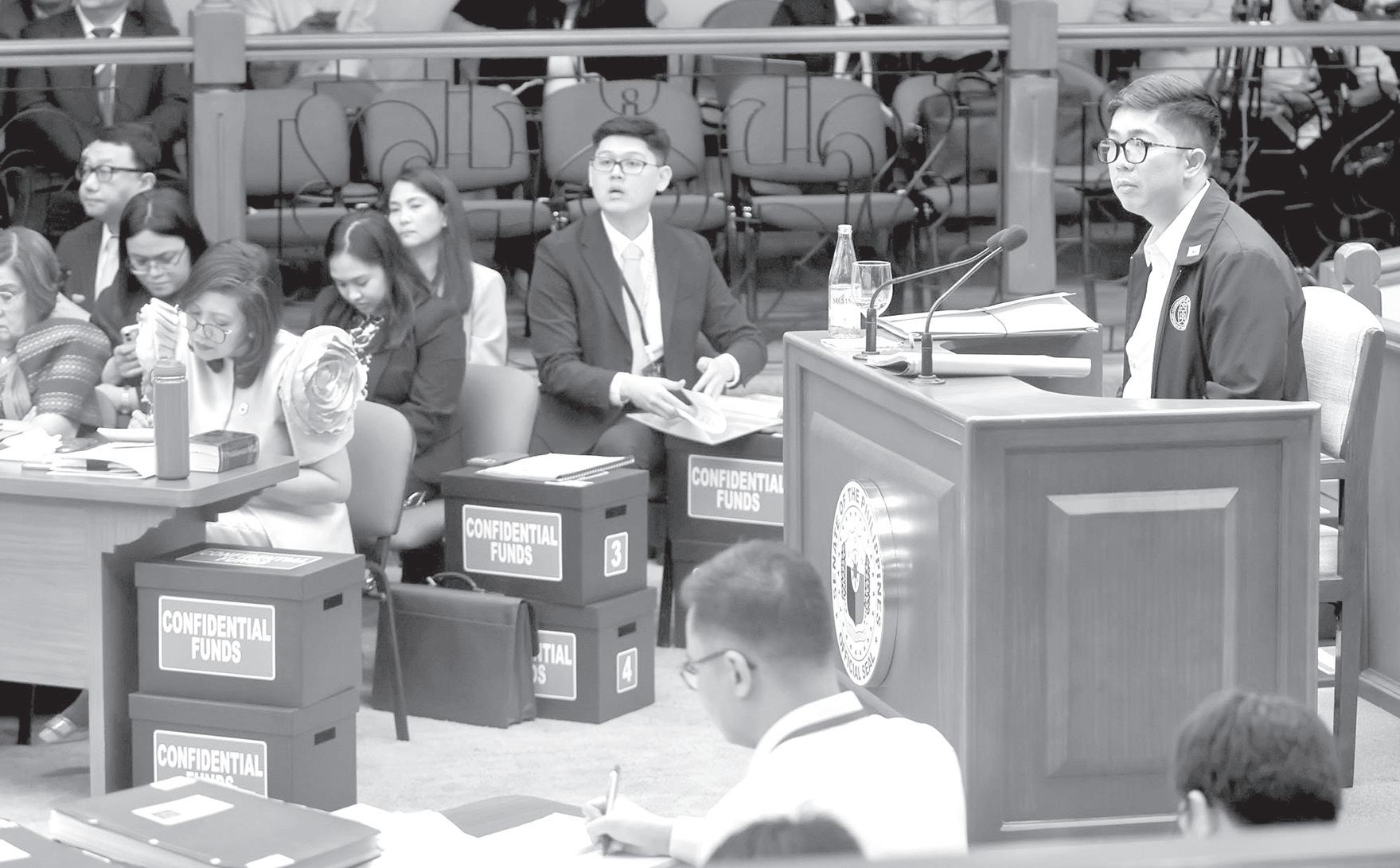
FORMER Commission on Audit Intelligence and Confidential Funds Audit Office (COA-Icfao) state auditor on Monday identified an acknowledgment receipt bearing the name “Mary Grace Piattos” as one of 845 receipts submitted by the Office of the Vice President for its P125-million confidential fund in December 2022.
Former COA-Icfao state auditor
Roderick Wamil identified the receipt as one of 845 acknowledgment receipts (ARs) he examined in auditing the OVP’s P125-million confidential
Child influencers, parents now covered by work-permit rules
By Mary Jade Jadormio
CHILDREN below 15 who appear in vlogs, social media posts and other online content are now required to secure work permits under new rules issued by the Department of Labor and Employment (Dole).
L abor Advisory 12 clarified that Republic Act 9231 covers not only television, cinema, theater and advertising but also digital content in which children perform or participate.
Under the law, children younger than 15 are generally barred from employment, subject to limited exceptions involving family-run work or participation considered essential to public entertainment or information.
Even under those exceptions, an employer must first secure a working child permit from Dole before engaging the child’s services.
O nline activities covered by the advisory include social media posts, vlogs, digital advertisements, web series, streaming productions, podcasts and educational or “edutainment” content.
Permit requirements will depend on whether the child or the activity falls within existing Dole guidelines for children engaged in public entertainment or information.
Th is means the nature of the child’s participation, rather than the platform alone, will determine whether the activity is treated as work covered by child-labor rules.
Parents or legal guardians will be held accountable when a child works under their direct responsibility in entertainment or online content creation.
T he rule may apply to familymanaged pages and channels where children regularly appear in sponsored, promotional or incomegenerating content.
C overed parties must observe limits on working hours, rules on the child’s income and safeguards protecting access to education, training and essential services.
E xisting prohibitions against the worst forms of child labor and children’s participation in certain advertisements will also apply to digital productions.
Employers, advertisers, content creators and parents may be investigated for possible violations, which may be reported to Dole or other appropriate authorities.
T he advisory broadens the enforcement of child-labor rules as more commercial content shifts from traditional entertainment to online platforms.
fund for December 21 to 31, 2022. This AR is among the acknowledgment receipts submitted by the OVP to Icfao,” Wamil testified after private prosecutor Lorna Kapunan presented
NBI
the document bearing Piattos’ name.
T he receipt stated that Piattos received P70,000 for “payment of rewards,” with “medicines” written in parentheses.
Wamil said the receipt alone did not explain the exact purpose of the payment. He added that informer rewards must be supported by documents proving the success of informationgathering or surveillance activities.
H e also did not testify on whether Mary Grace Piattos was a real person because the audit focused only on compliance with documentary requirements.
Wamil’s tabulation of the 845 receipts totaled P125.15 million, which was P150,000 higher than the P125 million cash advance.
Discrepancy
HE said this showed a discrepancy between the acknowledgment receipts and the OVP’s accomplishment report.
A nother receipt presented to the
court was under the name Renan Piatos for P110,000. It carried a December 27, 2023 date, one year after the stated Dec. 21-to-31, 2022 coverage of the cash advance.
A receipt under Miko P. Harina for P295,000 in purchased supplies was likewise dated Dec. 31, 2023. Wamil said the OVP submitted no other document identifying the supplies apart from the acknowledgment receipt.
Wamil said the OVP also failed to submit documents identifying the supplies purchased under the Harina receipt.
He said the suspension was issued after the OVP’s explanations and submitted documents were found insufficient to address audit concerns.
For his part, House prosecution spokesperson Robert Ace Barbers said Wamil’s testimony strengthened allegations of improper liquidation and documentation of the OVP and Department of Education’s confidential funds.
Barbers stressed that confidential
summons Leviste, Paras in ‘honey trap’ investigation
By Joel R. San Juan @jrsanjuan1573
THE National Bureau of Investigation (NBI) has issued subpoenae against Batangas Rep. Leandro Leviste and former congressman Jacinto Paras to shed light on the allegation t hat they were behind the supposed plot to besmirch the reputation of Executive Secretary Ralph Recto. I n an interview with reporters, NBI Director Melvin Matibag said the subpoenae have been signed since Friday but were set to be served only on Monday to the parties.
T he NBI has scheduled the appearance of Leviste and Paras for investigation on Thursday but clarified that t he two are not being charged yet of any wrongdoing.
THE Department of National Defense (DND) on Monday kicked off the month-long observance of the 77th International Humanitarian Law (IHL) Month at the National D efense College of the Philippines (NDCP) Academic Building in Camp General Emilio Aguinaldo, Quezon City. Representing Defense Secretary Gilberto Teodoro Jr., Defense Senior Undersecretary Irineo Espino underscored the importance of upholding International Humanitarian Law, emphasizing that respect for human dignity must remain at the core of all actions, particularly during armed conflict.
BBy Rizal Raoul Reyes
RIBERY has emerged as the leading impeachment allegation that Filipinos consider the most serious against Vice President Sara Duterte, according to the latest Tugon ng Masa nationwide survey conducted by Octa Research.
T he research group pointed out that the findings suggest that while the public recognizes multiple grounds cited in the impeachment complaint, allegations involving bribery stand out as the issue that resonates most strongly across the country.
O cta Research said Filipinos hold different perspectives on the impeachment allegations. Moreover, the survey found that respondents differentiate among the various charges and assign dif -
“As of now, as we speak, they are not yet considered to have committed any wrongdoing,” Matibag pointed out.
The investigation stemmed from the arrest of talent manager Lito de Guzman and five female talents during an antihuman trafficking operation conducted by agents of the NBI at a five-star hotel in Malate, Manila last week.
D uring investigation, de Guzman allegedly confessed that Paras had contacted him offering to pay P5 million to recruit four women who were w illing to come up with affidavits accusing Recto of forcing them to engage in sex and use illegal drugs.
D e Guzman also claimed that Leviste was the financier of the plot. Both Paras and Leviste have denied the accusations.
M atibag is urging Leviste and
International Humanitarian Law is founded on a simple yet powerful principle: respect for human dignity. It seeks to protect those who are not, or are no longer, taking part in hostilities and to limit the suffering caused by armed conflict,” Espino said.
A nchored on this year’s theme, “Pinalakas na Ugnayan at Pagkakaisa sa Pagsulong ngIHL,”Espinoemphasizedthatadvancing respect for International Humanitarian Law is a shared responsibility that requires stronger collaboration among government agencies, institutions, and other stakeholders.
“No single agency, organization, or in-
fering levels of importance to each, suggesting that public opinion on the impeachment is more nuanced than a simple expression of support for or opposition to the constitutional process.
W hile bribery ranked first nationwide, the survey showed that alleged misuse of confidential funds remains a major concern for many Filipinos. It emerged as the leading allegation in several regions, including Region I, Region II, Mimaropa (Mindoro, Marinduque, Romblon and Palawan) and Region XIII, highlighting regional differences in how the impeachment complaint is viewed. Meanwhile, respondents in the National Capital Region, the Visayas and Mindanao, and respondents across socioeconomic classes, age groups, genders and both urban and rural areas ranked bribery as a major concern.
Paras to heed the summons issued by the agency and to cooperate with the investigation.
He also assured that the two will be accorded due process during proceedings.
The NBI chief added that the agency will proceed with the assessment of the evidence to determine if there is basis to file charges in the event that the two would decide to ignore the subpoenas.
If they will not attend, we have to deal with it according to the evidence that will be given to us. Anyway, there is already an admission and confession from the subjects. That is why they are being subpoenaed to clear the light as to their alleged participation,” Matibag said. “ If there is no evidence and these people are simply making things up, we are willing to help prosecute these individuals,” he added.
dividual can do it alone. It requires strong partnerships, effective coordination, and a collective commitment to protecting human life and dignity,” he added.
T he DND reaffirmed its commitment to promote respect for IHL by st rengthening partnerships with government agencies, civil society, and development partners.
Th rough sustained collaboration, the DND continues to support initiatives that uphold humanitarian principles, reinforce the rule of law, and contribute to lasting peace, security, and the protection of human dignity.
Rex Anthony Naval
T he survey found particularly strong concern among respondents aged 25 to 34, more than half of whom identified bribery as the most serious allegation.
Octa said the prominence of bribery underscores the importance Filipinos continue to place on issues of corruption and public accountability. It added that the continued focus on the alleged misuse of confidential funds suggests that financial accountability remains a significant public concern, particularly in certain regions and among specific demographic groups.
The nationwide survey, conducted from July 4 to 11 among 1,200 adult respondents through face-to-face interviews, found that 43 percent identified bribery as the most serious allegation or the charge that should receive the highest priority during the impeachment proceedings. It
operations may remain secret, but their transactions and liquidation must still comply with COA rules.
Government-allotted confidential funds may be confidential as to their purpose, but their utilization, transactions, and liquidation must still comply with COA rules,” Barbers said, citing Wamil’s testimony before the Senate impeachment court.
Distinction
DURING the hearing, Wamil explained the distinction between confidential activities and the procurement of items charged to confidential funds.
What is confidential is the intended use, not the source from which it will be purchased. Those are two different matters,” Wamil told the senator-judges.
B arbers said Wamil confirmed that confidential funds may be spent only for purposes authorized under existing rules and that compliance is determined through the documentary evidence submitted to auditors. Barbers said the House prosecution panel will continue presenting documentary evidence and witness testimony to support its case before the Senate impeachment court. M oreover, Wamil testified that Duterte’s signature under “Approved by” indicated that she approved the contents of the OVP accomplishment report.
A nother document bearing her signature under “Attested” meant that she confirmed and verified the truthfulness of its contents.
A ccording to Barbers, Wamil testified that state auditors identified alleged gaps in documentation supporting portions of the P612.5 million confidential funds, including acknowledgment receipts and other liquidation records. He added that auditors also examined the reported rapid liquidation of substantial confidential fund releases within a relatively short period.
See “COA,” A8
Bonoan remains as Estrada’s co-accused in graft case
THE Sandiganbayan Second Division on Wednesday denied the Ombudsman’s motion to drop former Public Works Secretary Manuel Bonoan as a co-accused of Sen. Jose Pimentel Ejercito alias Jinggoy Estrada in the graft case filed against them for allegedly conspiring to perpetrate an illegal kickback scheme from appropriated budget for flood control and infrastructure projects amounting to P573 million.
In a 12-page resolution, the Second Division held that Estrada will be prejudiced if the prosecution were allowed to amend the information and exclude Bonoan as his-co accused.
T he anti-graft court noted that Estrada had already been arraigned on June 4, thus, dropping Bonoan as his co-accused would alter the theory of the prosecution “from one involving concerted criminal action to one involving a lone criminal actor.”
The Second Division added that Bonoan’s exclusion will force Estrada to prepare a different defense.
Instead of focusing on an allegation of collective criminal responsibility, accused Estrada will confront a different theory that focuses exclusively on his personal acts and omissions,” the resolution read.
“Hence, it would appear inequitable to sanction the tactical movement at this stage of the controversy,” it added.
I n its motion for leave to file amended information filed on June 29, 2026, the prosecution sought to
was followed by the alleged misuse of confidential funds at 28 percent, while unexplained wealth and grave threats were each cited by 10 percent of respondents. Eight percent said they could not identify which allegation they considered most serious.
Accountability, evidence
THE House of Representatives impeachment trial spokesperson, Rep. Zia Alonto Adiong, said survery finding that the people are concerned most with the bribery accusation places accountability and evidence at the center of the proceedings. The July 2026 Tugon ng Masa survey by Octa Research found that 43 percent of adult Filipinos identified bribery as the most serious allegation against Duterte. The alleged misuse of confidential funds followed at 28 percent, while unexplained wealth and grave
amend the information by excluding Bonoan from the present case in order to secure his cooperation and testimony in the investigation and prosecution of related offenses.
T he prosecution argued that since the former Public Works secretary has not yet been arraigned, the amendment sought is allowed under Rule 110, Section 14 of the Rules of Court.
The prosecution further argued that the amendment sought will not change the factual allegations constituting the offense and would not prejudice Estrada who was already previously arraigned.
T he motion was opposed by Estrada’s camp, arguing that the amendment sought is of a substantial nature since it removes Bonoan from the information as a co-conspirator and deletes the allegations of conspiracy, leaving him as the lone criminal defendant. At this state of the proceedings, the Court finds that the exclusion of accused Bonoan would unduly restrict the defenses available to accused Estrada,” the Sandiganbayan stressed.
T he Sandiganbayan, however, clarified that the prosecution is not barred from subsequently seeking Bonoan’s discharge as a state witness “at the appropriate stage of the proceedings, provided that the requisites under the rules are met.”
Both Estrada and Bonoan are also facing plunder cases in connection with the alleged kickback scheme. Joel R. San Juan
threats each received 10 percent.
A diong said the results indicate that Filipinos are not treating all the allegations as equally significant. Instead, the public appears to be examining the individual charges and deciding which issues deserve the closest scrutiny.
“ This tells us that Filipinos are looking closely at the charges and weighing them carefully. They want the facts, and they want the evidence to be heard,” Alonto Adiong said. He said the findings strengthen the need for the Senate Impeachment Court to hear the evidence fully and complete the constitutional process without unnecessary distractions.
“ The Constitution provides a process for determining the truth. The prosecution will continue presenting its evidence, and we trust the impeachment court to decide the case based on the facts,” he said.
Economy
BusinessMirror
Manufacturing shakes off second-quarter slowdown
Bless Aubrey Ogerio
THE manufacturing sector expanded at its fastest pace in five months in July as stronger demand lifted production and new orders, although companies continued to grapple with rising costs, supply chain disruptions and weaker hiring, Standard & Poor’s (S&P) Global Market Intelligence said.
The Philippines Manufacturing Purchasing Managers’ Index (PMI) rose to 51.8 in July from 50.9 in June, marking its highest reading in five months. The index has now improved for three consecutive months and remained broadly in line with its long-run average.
production requirements, firms increased their purchasing activity,” S&P Global Market Intelligence economist Maryam Baluch said.
The stronger demand, however, coincided with renewed pressure on supply chains and production costs.
A ccording to the report, supplier delivery times deteriorated sharply in July, with average lead times lengthening at the fastest pace since December 2024. Manufacturers commonly linked the delays to disruptions associated with the war in the Middle East.
To meet rising sales, firms drew down both pre-production and finished goods inventories as stock levels declined during the month.
hiring,” Baluch said.
Employment declined moderately during the month after remaining unchanged in June. Firms attributed the reduction in payrolls to voluntary resignations and the decision not to replace departing workers, according to S&P Global.
L atest data from the Philippine Statistics Authority showed the country’s employment rate slipped to 95.2 percent in May from 96.1 percent a year earlier and 95.3 percent in April. The labor force participation rate also eased to 63.8 percent from 65.8 percent in May 2025.
Despite the stronger PMI reading, manufacturers remained cautious about the outlook.
Senate asked to pass new building code
By Jovee Marie N. Dela Cruz @joveemarie
RECENT fatal disasters involving collapsing buildings have s trengthened calls for the Senate to pass a modernized National Building Code, with lawmakers saying President Marcos could finally break the legislative impasse by endorsing the measure.
Deputy Majority Leader Vincenzo Luigi Villafuerte and Camarines Sur Rep. Miguel Luis Villafuerte said the collapse of an unfinished nine-story building in Angeles City in May and the destructive earthquake that struck Mindanao in June underscored the urgency of replacing the country’s nearly five-decade-old building regulations.
I n his fifth State of the Nation
725 infrastructure facilities was estimated at P1 billion.
T he tremor also affected about 54,000 houses, including 9,900 that were destroyed and roughly 44,000 that sustained partial damage.
L uigi said HB 6615 seeks to climate-proof Philippine buildings and make them more resilient against earthquakes, fires, floods, landslides, typhoons, volcanic eruptions, and other hazards.
T he measure is also intended to prepare Metro Manila and nearby provinces for the feared “Big One”—a magnitude 7 or stronger earthquake along the Marikina Valley Fault that experts warn could destroy thousands of structures and cause massive loss of life.
S &P Global said the stronger reading reflected faster growth in production and new orders as manufacturers reported improved demand conditions following the softer performance seen during the second quarter.
Minimal rollback in fuel prices this week
By Lenie Lectura @llectura
AFTER increasing fuel price by multiples of pesos in the past weeks, oil companies are set to roll back pump price on Tuesday—by less than a peso for gasoline and diesel.
The Department of Energy (DOE) announced on Monday that oil companies are expected to rollback gasoline prices by P0.73 per liter, diesel by P0.60 per liter, and kerosene by P2.09 per liter.
The new pump price adjustments will take effect from August 4 to 10, the agency added.
For liquefied petroleum gas (LPG), the DOE said there will be an increase of P3.57 per kilogram (kg) or P40.38 per 11kg cylinder.
O il companies adjust their pump prices every week to reflect movements in the world oil market. Since the Middle East conflict began in February of this year, the DOE that has been announcing weekly oil price adjustments ahead of the oil companies.
T he country’s fuel supply remains healthy, according to Energy Undersecretary Alessandro Sales. As of July 31, the country’s gasoline supply is expected to last for 40 days; diesel, 47 days; kerosene, 132 days; jet fuel, 68 days; fuel oil 46 days; and LPG, 35 days.
The government has expanded access to the P10-per-liter fuel subsidy program (FSP) by including all liquid fuel retail outlets nationwide, allowing eligible public utility jeepney and UV Express drivers to claim their fuel benefits at more stations.
“Production and new order growth strengthened as a result, rising at a solid pace that was the fastest since the outbreak of the war in the Middle East. Encouraged by growing
I nput costs also accelerated after easing in the previous survey period, reflecting a renewed pickup in inflationary pressures.
Despite the improvement in sector conditions, confidence remained historically muted. More notably, payroll numbers fell in July, suggesting that firms may need clearer signs of a sustained improvement in economic conditions before resuming
Why we are hopeful?
By Henry J. Schumacher
CORRUPTION isn’t static; it’s constantly evolving. Today, it cannot be understood without confronting a global threat: the concentration of power. Elite groups have accumulated unprecedented economic and social power—and they’re using it to reshape politics.
Co rporate leaders use their wealth to influence government decisions in their favor. Political leaders abuse office to rewrite rules, accrue personal gain, and escape accountability.
But it’s ordinary people who pay the price of laws not implemented, controls not set, and hidden influences.
W hen corruption flourishes, governments fail to provide reliable electricity and affordable healthcare, and public resources don’t reach those who need them. In many countries, speaking up against wrongdoing means risking retaliation.
Yet year after year, Transparency International’s Annual Report shows reasons for optimism. Not naive hope. Evidence-based optimism. Together with its 111 chapters and partners, the movement is constantly proving that change is possible.
B eyond the headlines, it has provided protective measures to support colleagues operating in very difficult conditions—in many places, those who challenge corruption face smear campaigns, office break-ins, and physical threats.
So, a lot of people will question the headline—why should we be hopeful?
MY response: Hope is choosing to believe that the future holds possibilities worth striving for, even when you
cannot yet see the outcome.
A nd consider what happens when there is no hope?
W hen there is no hope, we often experience more than sadness. We feel that nothing they do will make a difference or that the future has nothing meaningful to offer. This can affect emotions, thoughts, behavior and even physical health. It can lead to despair, apathy, helplessness, emptiness and withdrawal. Do we want that? I prefer hope!
What’s ahead
THE new UNCAC resolution on political finance is only the beginning. The priority now is ensuring it drives change on the ground. They are working to push governments to turn this standard into national laws.
Dirty money still flows freely across borders because the gatekeepers— banks, lawyers, accountants—face almost no accountability. Pushing for change is needed to strengthen regulation and supervision of the professionals who enable illicit financial flows.
A s I have mentioned in an earlier column, dirty money rarely travels alone! It needs introductions, property deals, signature bank accounts and people willing to look away. Behind almost every corruption scandal sits a quiet, well-dressed industry: the enablers. They can help stolen wealth disappear from public view
Bribery…
Continued from A3
The survey also showed regional differences in how Filipinos viewed the allegations. Bribery ranked highest in several areas, including the Cordillera Administrative Region, Central Visayas, the Negros sland Region, Soccsksargen (South Cotabato, Cotabato, Sultan Kudarat, Sarangani and General Santos City) and the Davao Region. Meanwhile, the alleged misuse of confidential funds emerged as the leading concern in the Ilocos Region, Cagayan Valley, Mimaropa (Mindoro, Marinduque, Romblon and Palawan) and Caraga. Adiong said the varying regional results demonstrate that the public is paying at-
B usiness confidence recovered from June’s five-month low as firms expressed optimism that improving demand would support production over the next 12 months.
However, S&P Global said overall sentiment remained among the weakest recorded over the past year as geopolitical uncertainty and its impact on prices continued to weigh on business expectations.
and reappear as a luxury apartment, an art piece or an offshore company with no obvious owner
I ’m particularly excited about this work on technology and artificial intelligence. AI can be a powerful tool for exposing corruption, but it’s also creating new risks. Technology companies have unprecedented capacity to shape public debate, influence legislation, and gain privileged access to decision-makers. How this movement should respond to this governance challenge is some of the most important work that needs to be done in the years ahead.
W hy all this matters: THE shared vision of a world free from corruption isn’t an end in itself. It’s a means of shaping societies where everyone has access to public services, receives fair treatment from justice systems, and can safely challenge those in power.
W hile the Integrity Initiative is excited about these developments and definitely is hopeful. I think it is still necessary to ask, whether the hope that we have versus corruption is genuine. Are these initiatives enough to answer corruption? How are we sure that these initiatives are also not run by the same corrupted body? (Think of an official investigating themselves). What would be the something “tangible” that we’ll have so we can say that we are winning? Are the people close to a class revolution so we do not commit this same mistake again?
I n conclusion, we should be hopeful that genuine change can be created. We need to fight for it; and we need to demonstrate that we stand for effective change!
I l ook forward to your responses; please contact me at hjschumacher@ gmail.com
tention to the different issues raised in the impeachment complaint rather than viewing the case only through a political lens. “ The message from the public is clear. Let the evidence speak, let the process continue, and let accountability prevail,” Adiong added.
D uterte has denied the allegations against her and has described the impeachment effort as politically motivated. The charges remain subject to d etermination by the Senate sitting as an impeachment court.
T he non-commissioned Octa Research survey was conducted from July 4 to 11 through face-to-face interviews with 1,200 adult Filipinos nationwide. It has a ±3 percentage point margin of error at the 95 percent confidence level. With Jovee Marie N. dela Cruz
Address, Marcos called for private infrastructure to meet higher standards of quality, durability, and disaster resilience.
Likewise, all private infrastructure must meet high standards of quality and durability. Every building in our country must be prepared and capable of remaining strong and standing against any threat posed by disasters and calamities,” Marcos said.
He added that amending the National Building Code was necessary to bring t he country’s construction standards in line with modern requirements.
W ith this, lawmakers expressed hope that the presidential endorsement would prompt senators to review t he 1977 National Building Code and pass their counterpart to House Bill No. 6615, or the proposed “New Philippine Building Act.” The House of Representatives approved HB 6615 in December 2025. Counterpart measures remain pending in the Senate as the 20th Congress begins its second regular session.
“ The recent loss of lives and widespread damage should be more than e nough reason for the Senate to act,” Miguel Luis said.
The mixed-use under construction building in barangay Balibago, Angeles City, collapsed before dawn on May 24 following strong winds and heavy rains.
At least 30 people were reported killed and eight others injured after workers were trapped inside the structure, which was still undergoing finishing work.
T he June 8 tectonic earthquake off Maasin, Sarangani, meanwhile, reportedly left 61 people dead and around 1,400 injured. Damage to
M iguel Luis and Vincenzo Luigi are among the authors of HB 6615, which consolidates several proposals seeking to replace Presidential Decree 1096, the current National Building Code issued by then-President Ferdinand Marcos Sr. in 1977.
T he move for the bill’s passage is spearheaded by Surigao del Sur Rep. Romeo Momo Sr., chairman of the House Committee on Public Works and Highways, who has argued that existing building regulations are no longer adequate amid rapid urbanization, climate change, and worsening environmental hazards.
A mong the consolidated measures was HB 2396, also called the “New Philippine Building Act,” introduced by the V illafuertes together with Camarines Sur Rep. Tsuyoshi Anthony Horibata and Bicol Saro Rep. Terry Ridon. The House had similarly approved a replacement measure, HB 8500, during the 19th Congress, but the proposal failed to become law.
Vincenzo Luigi noted that the last major revisions to the implementing rules of the National Building Code were introduced in 2005, leaving many provisions unable to address present-day construction technologies and disaster risks.
He also cited international assessments recommending that the Philippines update its building regulations to include stronger standards for wind and flood resilience, retaining walls, seismic isolation systems, confined masonry structures, and traditional timber buildings. The Villafuertes said modernizing the Code has become increasingly urgent as the Philippines continues to rank a mong the countries most vulnerable to natural disasters.
Needed: Policy that results in delivery of cheaper houses faster—experts
By Rizal Raoul Reyes
THE housing challenge is not simply about building more homes, but it is about creating a policy environment that enables both government and the private sector to deliver housing faster, more efficiently, and at lower cost.
C hamber of Real Estate and Builders’ Associations (Creba) president N oel Cariño and urban planner Nathaniel von Einsiedel argued that addressing the growing housing backlog re quires comprehensive regulatory reforms, more predictable policies, and stronger collaboration between government and the private sector.
The proposals of Cariño and Einsiedel come as the government pushes a head with the Pambansang Pabahay para sa Pilipino (4PH) Program while grappling with a housing deficit projected to reach 22 million units by 2040.
For Creba, Cariño said the primary obstacle to expanding housing production is not the willingness of developers to participate but the cumulative impact of regulatory delays, shifting policies, financing constraints, and compliance costs that undermine project viability.
He said developers continue to face lengthy approval processes, outdated financing parameters, rising construction costs, limited access to developable land, and an incentive structure that discourages long-term private investment.
He called for the establishment of regulatory “green lanes,” the restoration of decentralized processing by Department of Human Settlements and Urban
Development (DHSUD) regional offices, rationalized documentary requirements, improved financing mechanisms, and adjustments to housing price ceilings and loanable amounts to better reflect current market conditions.
“ Most importantly, the sector needs stability. Frequent policy changes create uncertainty that discourages long-term investments,” Cariño said. C reba said reducing approval timelines would not only speed up housing delivery but also lower financing and carrying costs that are eventually passed on to homebuyers, making affordable housing more attainable.
A mong the industry’s biggest concerns isDepartment of Human Settlements and Urban Development (DHSUD) Memorandum Circular 202514, which centralized the processing and approval of housing applications— including development permits and licenses to sell—from regional offices to the agency’s central office. The policy prompted Sen. Joseph Victor Ejercito to convene a Senate Committee on Urban Planning, Housing and Resettlement hearing following complaints from developers about mounting approval bottlenecks. We cannot do it alone; we need the developers to produce socialized housing and other housing needs,” Ejercito said during the hearing, emphasizing the indispensable role of private developers in addressing the country’s housing shortage.
Defense refuses to stipulate on ₧125M OVP cash receipts, citing ‘issues’
By Claudeth Mocon-Ciriaco @claudethmc3
THE defense panel refused to confirm the OVP received P125 million in confidential funds on December 20, 2022, citing “issues” with acknowledgment receipts from December 21–31. The refusal came on the 11th day of the impeachment trial.
The court tackled the Article 1 of the impeachment complaint, alleging that Vice President Sara Duterte misused the confidential and intelligence funds of the Office of the Vice President (OVP) and the Department of Education (DepEd).
Defense counsel Michael Poa refused to stipulate on more than 900 acknowledgement receipts dated December 21 to 31, 2022, after the prosecution presented former Commission on Audit (COA) state auditor Roderick Wamil, who conducted the audit on the OVP”s liquidation of confidential and intelligence funds, as their witness.
“The defense is willing to stipulate on the list of documents provided except for the acknowledgment receipts for the period covering December 21 to 31, 2022. There are issues concerning these acknowledgment receipts that I believe will also be touched upon by other witnesses in the future,” Poa said.
“We mark them separately, and there are, again, issues concerning these acknowledgement receipts,” he reiterated, wherein the OVP reportedly spent 125 million pesos in confidential funds in just 11 days in December 2022.
Meanwhile, Poa also requested for a 5-minute suspension before the impeachment court to be able to “concur with the prosecution panel to check exactly what documents they would want to stipulate.”
“Because, your honor, we have no problem stipulating but we also, due to the voluminous nature of the documents, we just want to make sure while ensuring the rights of our clients,” Poa said. Presiding Officer Senator Francis “Chiz” Escudero granted the request of the defense.
In a press briefing shortly after the impeachment trial was adjourned, Poa explained that their refusal to stipulate, stressing that for them, there are explanation for the 11 days, and that they can conduct a cross-examination for the matter.
“Kaya di pa tayo pumayag sa stipulation, but as to the other documents, including the official documents of COA, maliban sa acknowledgement receipts, di na natin dinispute yun katulad noong ginawa natin sa mga tseke sa LandBank na na-discuss kamakailan,” he said.
“We really have to protect the rights of our client too. We really have to take a hard line, we have to be diligent din in our duties as her counsel. We cannot risk sa dami ng documents. But we are not saying na may pineke or something, what we are saying is we don’t know, so ayawnatinmag stipulate sa ganoong karaming documents, lalo na acknowledgement receipts,” Poa added. During the trial, Poa objected to House private prosecutor Lorna Kapunan after making a remark on two of the recipients of confidential funds: “Andy Lim” and “Alejandro Pitik.”
Poa also objected after Kapunan said before the court, “Kung merong Andy Lim siguro dahil Pikit nakapikit.”
I’m sorry but I’ve been giving leeway to the opposing counsel, but I think she’s been coloring the contents of the documents,” Poa stated.
Manufacturing PPI slows to 3 percent in June as fuel price gains moderate
By Justine Xyrah Garcia
FACTORY gate prices of manufactured goods eased slightly in June as the increase in petroleum product prices moderated, according to the Philippine Statistics Authority (PSA).
The Producer Price Index (PPI) for manufacturing rose by 3 percent year on year in June, slightly slower than the 3.1 percent increase recorded in May. A year earlier, the index contracted by 0.2 percent.
From January to June 2026, the PPI posted an average annual growth of 2.3 percent.
The PSA attributed the slower growth in manufacturing prices mainly to the manufacture of coke and refined petroleum products, where pricegrowth eased to 2.4 percent from 3 percent a month earlier.
Other sectors that contributed to the slowdown in overall price growth were computer, electronic and optical products, whose PPI growth eased to 5.6 percent from 5.9 percent, and basic metals, which slowed to 5.5 percent from 5.9 percent.
Of the remaining 19 industry divi-
BFAR to file motion before SC on tracking of commercial fishing
By Mary Jade Jadormio
THE removal of mandatory vessel monitoring for commercial boats could weaken enforcement against illegal fishing and disrupt catchtraceability efforts, the Department of Agriculture (DA) said.
Through the Bureau of Fisheries and Aquatic Resources (BFAR), the DA said it would file a motion for reconsideration of the decision striking down Fisheries Administrative Order No. 266 as unconstitutional.
The regulation required Philippineflagged commercial fishing vessels to install monitoring devices and submit electronic catch reports.
Without the system, regulators may have to rely more heavily on reports submit -
ted by fishing operators instead of real-time vessel and catch data.
Agriculture Secretary Francisco P. Tiu Laurel Jr. said electronic monitoring remains the government’s most effective tool against illegal, unreported and unregulated fishing.
“We are fairly confident the Supreme Court will reconsider the ruling and allow us to use this internationally recognized vessel monitoring system,” Laurel said.
Vessel data allows authorities to determine whether commercial boats enter restricted waters or continue operating during closed fishing seasons.
Such restrictions are imposed in spawning and nursery grounds to protect fish stocks during critical reproductive periods.
Electronic catch reports also help verify
the origin of fish products, support investigations and provide data for science-based fisheries management.
BFAR maintained that commercial fishing licenses are privileges granted by the state and may be subjected to conservation and enforcement requirements.
“BFAR respects the decision of the Supreme Court and we are filing a motion for reconsideration,” the bureau said.
While seeking a reversal, BFAR said it would review the regulation’s implementing mechanisms to address constitutional safeguards and concerns raised by commercial fishing operators.
DA said the case might also carry trade implications, as export markets and international fisheries agreements require stronger catch traceability and action against illegal, unreported and unregulated fishing.
Villar strongly condemns fatal stabbing in Las Piñas school, renews call for passage of Ligtas Act
By Butch Fernandez @butchfBM
THE fatal stabbing of a Grade 9 student inside Las Piñas National High School, only the latest in a string of violent incidents in schools, is a heartbreaking tragedy that underscores the urgent need to further strengthen safety and security measures in schools, a lawmaker said as he pushed for passage of the Ligtas Act measure for that purpose.
“Our schools must always be places of safety, learning, and hope—not places where our children are exposed to violence and danger. No student should ever have to fear for their safety while pursuing their education and dreams,” said Senator Mark A. Villar in a statement on Sunday.
The senator condoled with the victim’s family, while his office continues to provide assistance and support to the bereaved family as they cope with this tragic loss. He also called on concerned local
authorities and government agencies to conduct a swift and thorough investigation to ensure accountability, while also implementing stronger security measures to prevent similar incidents from happening again. He likewise urged schools, parents, teachers, and the wider community to work together in promoting a culture of respect, empathy, and peaceful conflict resolution among the youth.
The incident highlights, Villar said, the importance of immediately advancing his proposed Senate Bill No. 2321, or the Learning Institution’s Guaranteed Threat Avoidance and Safety (LIGTAS) Act, which seeks to establish stronger safeguards in schools through increased police visibility, coordinated threat assessments, direct emergency hotlines with police, fire, and response units, immediate notification of parents during student emergencies, adequate first-aid and emergency equipment, and trained medical personnel and security guards.
The measure also provides for the strategic installation of CCTV cameras and appropriate security screening systems, as well as comprehensive safety and security training for students, teachers, and school personnel.
“Hindi na natin maibabalik ang buhay na nawala dahil sa masakit na trahedyang ito, ngunit hindi tayo maaaring manatiling walang ginagawa. Kailangan nating kumilosnangmaiwasanangganitongmga pangyayari at tiyaking ligtas ang bawat paaralan para sa ating mga anak. Ang bawat batang Pilipino ay may karapatang makapag-aralsaisangkapaligirangligtas, protektado,atmalayamulasaanumanguri ng karahasan,” Villar said.
[We cannot bring back the lives lost in this tragedy, but we must not stand idle. We must move to avoid a repetition of such incidents and ensure the safety of children in schools. Every child has the right to an environment that is safe, protected, and free from all kinds of violence].
Angara lauds PNP for swift arrest in school hoax threat cases
EDUCATION Secretary Juan Edgardo
Angara on Monday commended the Philippine National Police (PNP) following the swift arrest of individuals behind online school threat hoaxes.
Angara stressed that disruptive online pranks carry legal and administrative penalties under a whole-of-society effort for campus safety, and that there is a need of a necessity of a unified approach involving law enforcement, local government units (LGUs), parents, schools, and communities to maintain safe, orderly, and uninterrupted learning environments. Recent police operations have led to criminal proceedings across several provinces.
In Magalang, Pampanga, police brought seven 15-year-old learners before the Office of the Provincial Prosecutor for inquest proceedings over a social media post threatening to harm learners of Tinajero
National High School Annex. Joint police operations led to the arrest of an 18-year old suspect in Jaen, Nueva Ecija for circulating online bomb threats against multiple public and private schools in San Ildefonso, Bulacan. Police authorities also arrested another 18-year-old learner who admitted to posting a hoax threat aimed at suspending classes at San Felipe Integrated School in Nueva Ecija. In Tanza, Cavite, law enforcement operatives implemented a warrant to search, seize, and examine computer data against a woman in Barangay Paradahan I following an online threat aimed at a local school. Officers seized 16 digital devices for examination in connection with violations of Article 282 (Grave Threats) of the Revised Penal Code and Republic Act No. 10175 or the Cybercrime Prevention Act of 2012.
Beyond criminal liabilities under Presidential Decree No. 1727 or the Anti-Bomb Joke Law and Republic Act No. 10175, the Department of Education (DepEd) reiterated that its initiatives to address school-related concerns are heavily focused on prevention. Under DepEd Order No. 006, s. 2026, or the Guidelines on Ensuring a Safe and Motivating Learning Environment (ESMLE), bomb threats and bomb jokes are classified as third-level offenses due to the grave risk they pose to safety and learning continuity. A first infraction results in non-readmission and referral to appropriate government interventions, while a second infraction carries the penalty of exclusion, referral to the proper authorities, and necessary interventions. Spreading false reports or fake news that create confusion is classified as a first-level offense, subject to written reprimand, of-
ficial parent conferences or administrative measures. SalamatsaPNPatsaatingsecuritysector sa mabilis na pag-aksyon para matukoy at mapanagotangmganagpapakalatngonline threat sa ating mga paaralan. Alinsunod na rin ito sa direktiba ni Pangulong Bongbong Marcos na siguruhing ligtas at protektado ang ating mga mag-aaral at guro sa bawat sulokngbansa,” Angara said.
DepEd is also strengthening its Active Human-induced Threats protocol to ensure school readiness and effective response during emergency incidents.
Likewise, DepEd urged parents, educators, and the public to promote responsible digital citizenship among the youth and to immediately report any suspicious online activity or security threats to school authorities or emergency services through Hotline 911. Claudeth Mocon-Ciriaco
sions, 16 posted annual increases, while three recorded declines.
The sectors that registered price increases were food; transport equipment; chemicals and chemical products; beverages; other non-metallic mineral products; machinery and equipment; tobacco; other manufacturing and repair and installation of machinery and equipment; rubber and plastic products; basic pharmaceutical products and pharmaceutical preparations; fabricated metal products; wood, bamboo, cane and rattan articles and related products; leather and related products, including footwear; furniture; printing and reproduction of recorded media; and wearing apparel.
Producer price growth for
Remulla calls on youth to protect democracy, hold govt accountable
By Jonathan L. Mayuga @jonlmayuga
UNDERSCORING the indispensable role of the youth in advancing transparency, accountability, and meaningful citizen participation, Department of the Interior and Local Government (DILG) Secretary Juanito Victor Remulla urged participants of a forum to be vigilant, protect democracy, and hold government accountable.
In his brief speech during the Open Government Partnership (OPG) Localization Forum at the De La Salle University (DLSU) Manila Campus recently, the DILG chief said the country’s democratic institutions will only remain strong if young Filipinos actively demand accountability and participate in governance.
“Open Government can be achieved if the youth exercises their right to demand accountability,” he said.
Addressing the students and faculty, the DILG chief challenged the youth to become active participants in nationbuilding by questioning government actions, speaking out against practices that weaken public trust, and ensuring that conversations on good governance remain alive.
“You must make us hear your voice...You must make us feel that, or nothing will change,” he said.
Remulla emphasized that open government is not sustained by transparent institutions alone but by citizens who are informed, vigilant, and willing to engage. He, likewise, encouraged academic institutions to continue serving as platforms for critical discourse and policy innovation.
The DILG Secretary also reminded the audience that the freedoms enjoyed by Filipinos today were won through
the sacrifices of those who fought for democracy, urging the younger generation to safeguard those hardearned rights by exercising them responsibly.
Remulla also shared his longstanding commitment to transparency, citing Cavite's recognition as the country›s first ISO-certified provincial government during his tenure as governor.
He also outlined key reforms being pursued by the DILG to strengthen accountability in public service, including eliminating anomalous budget insertions, curbing procurement irregularities, and intensifying anticorruption efforts within the Bureau of Fire Protection (BFP).
Among the Department’s transparency initiatives is the livestreaming of public bidding, which enabled the DILG to procure 224 vehicles at approximately P100 million below the projected cost, demonstrating how open and accountable processes can deliver greater value for public funds.
During the forum, the DILG formally accredited the DLSU–Jesse M. Robredo Institute of Governance (DLSU-JRIG) as a partner in implementing empowerment programs for civil society organizations (CSOs) and the OGP Localized Program nationwide, further strengthening collaboration between government, academe, and civil society in promoting open governance.
Also present during the event were DILG Assistant Secretaries Lilian M. De Leon, Elizabeth N. Lopez De Leon, and Atty. Brian Mey R. Tomas; DLSU Vice President for Research and Innovation Dr. Raymond R. Tan; DLSU-JRIG Director Dr. Francisco A. Magno; and Sci&Tech Philippines President Dr. Alvin B. Culaba.
Nationwide crime rate for July down by 36.12 percent–PNP chief Nartatez
PHILIPPINE National Police (PNP)
chief Gen. Jose Melencio Nartatez
Jr. on Monday announced that the nationwide crime rate for July has declined by 36.12 percent for this year.
In a press briefing at Camp Aguinaldo, Quezon City, Nartatez said this means that only 2,209 focus crimes were recorded in July for this year, significantly lower than the 3,458 incidents reported in the same period in 2025.
Focus crimes are murder, homicide, physical injury, rape, robbery, theft, motor vehicle theft, and motorcycle theft.
This decline was reported across all focus crime categories, with rape posting the highest decline at 56.93 percent, followed by motor vehicle theft by 46.15 percent, and motorcycle theft by 42.59 percent.
“These results reflect the continuing efforts of the PNP, together with our
communities and partner agencies, to prevent crime, strengthen police visibility, and keep our neighborhoods safe,” Nartatez said.
In July alone, Nartatez said the PNP conducted 5,526 anti-drug operations, resulting in the arrest of 6,368 individuals and the confiscation of illegal drugs with a total standard drug price exceeding PHP387 million.
And for its campaign against wanted persons, Nartatez said the PNP arrested 8,199 wanted individuals, including 2,352 most wanted persons and 5,847 other wanted persons. Meanwhile, for its anti-smuggling campaign, Nartatez said the PNP conducted 2,927 operations against economic offenses that resulted in the arrest of 656 individuals and the confiscation of cash and various articles valued at more than P628 million. Rex Anthony Naval
A6
Tuesday, August 4, 2026
Southeast Asia’s factory activity rebounds from 11-month low
By Srinidhi Ragavendran Bloomberg News
SOUTHEAST Asia’s manufacturing sector rebounded in July, bucking the trend in China, as growth in new orders and production accelerated to their fastest pace since the Middle East conflict began.
The region’s manufacturing purchasing managers’ index rose to 52.8 in July from the 11-month low of 50.5 it posted in June, moving further above the 50-point threshold that separates expansion from contraction, according to S&P Global on Monday.
Firms increased purchasing
activity and employment, the data showed. Business confidence strengthened, with manufacturers the most optimistic about production growth in over three years.
Thailand led Southeast Asia with a reading of 54.2, followed by Vietnam at 52.9. All Asean economies
posted expansionary readings except Myanmar with a print of 49.3.
“The Asean manufacturing sector appears to have moved past the softer patch seen between March and June, when activity was still heavily affected by the ongoing conflict in the Middle East,” said Maryam Baluch, economist at S&P Global Market Intelligence.
“Performance in now on par with that seen at the turn of the year, but softer than the record-level seen back in February,” she added.
Meanwhile, the PMI of major manufacturing hubs in North Asia remained firmly in above-50 territory in July. Factories cited an easing of Middle East tensions and the continued demand for AI-related electronics for the rise in new orders.
The latest data out of Asia is in contrast with the readings in China, whose manufacturing slump is reinforcing signs of an economic slowdown.
Factory activity of export-oriented firms eased to a four-month low of 50.9 in July, according to RatingDog China data on Monday. Official figures released Friday showed broader factory activity unexpectedly contracted, while construction slumped to the lowest since the start of the pandemic.
In India, manufacturing activity also softened though remained well above the 50-waterline. Its PMI fell to a near five-year low of 53.5 in July as growth in new orders, input purchasing and employment slowed.
As Middle East tensions reignite, “manufacturers appear to be rebuilding buffers: inventories of both inputs and finished goods increased alongside a rise in purchasing volumes, suggesting firms are securing supply and limiting exposure to potential disruption,” said Pranjul Bhandari, chief India economist at HSBC Holdings Plc.
Editor: Dennis Estopace
Chinese tea chains brewing a new American obsession
BBy Erinn Gardner
ROOKLYN resident Steven Sparling didn’t expect a cup of tea to be worth standing in line for two hours. But a new Heytea location on New York’s Upper East Side convinced him.
“Once we got in, I realized why there was that big wait,” the 51-year-old publicschool teacher said while sipping on guava green tea on a recent summer afternoon. “I’m not so much into tea, but I’m getting more into it now.”
A wave of Chinese tea chains including Heytea, Teapulse and Mixue are winning converts from coffee as they rapidly expand in New York and beyond. They’re building on the bubble tea craze of recent years while capitalizing on strong demand for new beverages and flavor profiles—as well as a growing interest in everything Chinese.
Customers are enamored with hardto-get ingredients such as the perfume lemons, imported from China and found at Heytea, and osamanthus tea at Teapulse. The brightly colored beverages that look fantastic on Instagram and TikTok are also part of the draw.
Alexa Lantin, who was visiting Heytea with her husband and baby, said she’s looking for new flavors, noting that everyone seems to love ube at the moment. “People
want that unique flavor,” the 31-year-old said of the vibrant purple yam that tastes like a milder sweet potato. Her husband, Adrian Apolonio, said he preferred the atmosphere over big coffee houses, where he sees “more people using it as a workspace.” At Heytea, “there’s a lot of people who come here with friends, so they’re usually chatting and sitting down for a while.”
In addition to tea drinks fused with fruit, all of the chains offer milk-based options, and many sell cheese teas—served cold with a cheese-based foam topping. Mixue specializes in teas paired with soft-serve ice cream in flavors such as brown sugar pearl sundae and classic cone.
Heytea’s beverages range from $4 for the original cloud jasmine tea to a cloud matcha latte that tops out at about $8, while Mixue’s run from $2 for lemonade to the $5 mango pomelo taro fruit tea. Tea’s perceived health benefits also draw customers. Alejandro Rios, Sparling’s partner, says Heytea’s drinks are healthier than those served at larger US-based chains, listing seed oils in mixed beverages in particular as something he’s looking to avoid. “That’s something you don’t need. And here’s something that’s clean,” he said while celebrating his 50th birthday with his laptop open and a classic matcha latte in hand. Bloomberg News
‘SIBOL’ takes root: ₧120M CHED fund cultivates student agri-entrepreneurs
THE Commission on Higher Education (CHED) has earmarked P120 million for the SIBOL: Student Technology Business Incubation Program for the Agri-Aqua Sector. The funding has attracted proposals from 24 state universities and colleges (SUCs) across the country seeking to participate.
Through the Higher Education Development Fund (HEDF), a Ceremonial Awarding for Student Incubatees was held on July 30.
Each approved SUC will receive P5 million over the two-year project implementation. CHED has allocated a total of P120 million for the program, equivalent to P60 million annually, to help student innovators transform research outputs and innovative ideas into viable startups.
The participating SUCs have existing AgriAqua Technology Business Incubators under the National Agri-Aqua Technology Business Incubation Network of the Department of Science and Technology–Philippine Council for Agriculture, Aquatic and Natural Resources Research and Development.
The initiative supports the directive of President Ferdinand R. Marcos Jr. for government agencies to expand opportunities for Filipinos to build and grow their businesses, particularly to empower youth and women entrepreneurs. By turning student innovations into enterprises, SIBOL aims to address the needs of the agriculture and fisheries sectors, create jobs, and strengthen universities as centers of innovation.
“Every year, our students and faculty produce promising research and technologies. However, many remain as theses, capstone projects, or course requirements because they lack opportunities for further development into products, services, or startup ventures that can benefit our communities and industries,” CHED Chairperson Shirley C. Agrupis said.
Each participating SUC will support 10 student innovators through mentorship, capacity-building, access to facilities, technical and financial assistance, and industry linkages. These interventions will help students strengthen their technologies, validate their ideas, and connect with potential partners and investors.
The program targets the establishment of at least 200 new local enterprises, with participating student startups expected to complete business registration by the end of the two-year implementation period.
Claudeth Mocon-Ciriaco
‘Help us, PBBM’: Motorcycle taxi riders beg President to halt strict allocation rules
By Lorenz S. Marasigan @lorenzmarasigan
AMOTORCYCLE taxi riders’ group has asked President Ferdinand R. Marcos Jr. to intervene in the rider allocation or “capping” system being enforced by the Land Transportation Franchising and Regulatory Board (LTFRB), warning that thousands of riders stand to lose their livelihood once platforms hit their allowable rider ceilings.
The Nexus Riders Alliance also urged the regulator to revisit its prohibition on multi-apping, the practice that allows riders to accept bookings from more than one platform when demand on a single app is weak.
“PBBM, help the moto-taxi riders. Protect our livelihood. The riders who will be affected by the cap are not just numbers. They are fathers, mothers and breadwinners who depend on riding to feed their families,” Nexus Riders Alliance chairman Renato Embiado said in a statement in Tagalog.
The group said it remains unclear what happens to riders left out once a platform reaches its allocation, and how they can continue earning under the new provisional authorities being issued by the board.
“Our question is simple: if the number of riders a platform can take in is limited, where do those excluded from the allocation go? If the LTFRB approves more provisional authorities, how do riders earn a living if there is no platform they can join? This is the biggest fear of riders right now,” Embiado said.
He added that what is at stake is not a headcount but household income.
“We are not asking for special favors. All we are asking for is the chance to earn a living,” he said.
Currently, the LTFRB allows a total of 45,000 motorcycle taxis in Metro Manila, divided equally among three players: Angkas, JoyRide, and Move It.
On multi-apping, the group argued that allowing riders to switch between platforms stabilizes daily earnings and does not create safety or accountability gaps, since a rider cannot physically take trips on two platforms at the same time.
“Multi-apping is not the problem. It helps riders earn more consistently,” Embiado said. “In a system where they are free to choose, platforms will compete to provide better bookings, incentives and protection for their riders.”
The chairman said barring the practice could weaken riders’ ability to adjust to shifting demand and road conditions, which could in turn affect the reliability of motorcycle taxi ser -
vices for commuters. The alliance clarified that it is not opposing regulation, saying it supports safety and accountability measures in the industry. It maintained, however, that implementation must be clear, practical and humane, and responsive to actual rider and commuter needs—particularly as the existing cap, it said, is no longer sufficient to meet growing demand.
“We are not against regulation. What we are asking for is a policy crafted with riders, not one where we are heard only after the rules have been issued and enforced,” Embiado said.
The group is seeking a dialogue with Marcos, Transportation Secretary Giovanni “Banoy” Lopez, the LTFRB, motorcycle taxi platforms and rider community representatives.
“Our fight is not against government. Our fight is for the livelihood of thousands of riders and the families who depend on them,” Embiado said.
Pact seen to unlock stronger economy, regional growth for Cebu and Bohol
CEBU CITY—A landmark sisterhood agreement between Cebu and Bohol is expected to accelerate economic growth, strengthen food security, and deepen cooperation in governance, tourism, agriculture, and infrastructure, with national and provincial leaders describing the partnership as a blueprint for a more competitive Central Visayas.
The SugBohol Sisterhood Agreement was formally signed on July 31 by Cebu
Governor Pamela Baricuatro and Bohol
Governor Erico “Aris” Aumentado during ceremonies at the New Provincial Capitol in Tagbilaran City.
Department of Economy, Planning and Development (DEPDEV) Secretary Arsenio Balisacan welcomed the initiative, saying the alliance has the potential to elevate both provinces into economic powerhouses not
only in the Visayas but across the country.
“My sincerest congratulations on the Sisterhood Agreement, and I second the aspirations of our two governors to transform the performance of the region,” Balisacan said during the SugBohol Regional Development Council Capacity Building and Networking Fellowship in Panglao, Bohol.
He said the partnership reflects the two provinces’ shared commitment to regional development and could position Cebu and Bohol as national leaders in economic performance.
For Baricuatro, the agreement represents a commitment to pursue development through collaboration rather than competition.
“Through the landmark Sisterhood Agreement signed between the Province of Cebu and the Province of Bohol just this
morning, we reaffirm that our destinies are shared. We do not progress in isolation; we advance, build, and thrive together toward a secure and resilient future,” she said.
The Cebu governor added that the partnership, supported by DEPDEV’s expertise in socioeconomic planning, can transform shared goals into concrete projects that will benefit communities in both provinces.
She also emphasized that bringing together local chief executives, sector leaders, and national government officials creates opportunities to turn regional priorities into programs that improve people’s lives while encouraging innovation and knowledge sharing.
Aumentado described the agreement as the realization of a vision first discussed during the historic joint legislative session between Cebu and Bohol in November 2024.
Shared and authentic: Cebu pushes unified tourism brand
CEBU CITY—Tourism, business and government stakeholders in Cebu have joined forces to develop a unified destination brand aimed at presenting the province’s diverse tourism offerings through a shared and authentic story.
The Cebu Chamber of Commerce and Industry (CCCI) gathered representatives from the public and private sectors for the Project Mango Shake Workshop on July 29 at the Fili Ballroom of NUSTAR Resort & Casino, continuing consultations for the initiative that seeks to strengthen Cebu’s identity as a tourism and MICE destination.
CCCI President Regan Rex King said the challenge for Cebu is not the absence of a compelling identity but the abundance of stories that could be told about the province.
“The challenge is not that we lack a story. The challenge is that we have many great stories, and we need to bring them together,” King said.
Project Mango Shake was launched during the MICE Tourism Summit held as part of Cebu Business Month 2026. It aims to bring together government agencies, local governments, businesses, tourism organizations and other stakeholders in creating a destination brand that can be collectively embraced and promoted.
In his welcome message, King urged participants to set aside their organizational roles during the workshop and approach the
discussions simply as Cebuanos. He said Cebu’s tourism identity should be rooted in the experiences of its people—from its food, festivals and heritage to its islands, mountains, communities and hospitality.
“The best tourism brand is not created in a boardroom. It is created from the authentic experiences of the people who live it every day,” King said.
He said the goal is not to select a single aspect of Cebu to represent the destination but to weave its many stories into one compelling narrative.
The concept behind Project Mango Shake is anchored on the idea that “One Visit is Never Enough,” reflecting the range of experiences available to visitors, including beaches, heritage attractions, festivals, cuisine and adventure.
King said creating a strong destination brand would require the participation of various sectors, including airlines that connect Cebu to other destinations, hotels and tourism establishments that welcome visitors, businesses that create tourism experiences, local governments that develop communities, and residents who share their home with visitors.
“This workshop is about one important question: How do we tell Cebu’s story to the world?” he said. NUSTAR Resort & Casino hosted the workshop, with Vice President for Commercial Sales Daniel Kipping welcoming
the participants and expressing the property’s support for initiatives aimed at advancing Cebu’s tourism industry.
NUSTAR General Manager Udo Wittich also joined the event.
Among those who attended were Philippine Chamber of Commerce and Industry Vice President Melanie Ng; Cebu Chamber Vice President for Business Mobilization Bernard Vonn I. Sia; PCCI Lapu-Lapu President Anthony Noel; Mandaue Chamber of Commerce and Industry Immediate Past President Mark Ynoc; and Talisay Chamber of Commerce President Carl Cabusas. Carmel Pedroza
“This is not a casual meeting of neighboring islands. This is the culmination of a vision sparked during our historic joint legislative session in November 2024. Today, we officially transform that shared dream into an unbreakable bond,” he said.
He said the partnership revives the spirit of the historic Sandugo, symbolizing that Cebu and Bohol are linked not only by geography but also by a shared commitment to mutual respect and regional progress.
Aumentado also stressed that the agreement is intended to be more than a ceremonial document.
“As local chief executives and legislators, our administrative problems transcend physical borders. By synchronizing our policies, we elevate public service for every single Boholano and Cebuano. This sisterhood agreement is not a passive document to collect dust in our archives. It is a living blueprint for an empowered, unified Central Visayas,” he said.
Following the ceremonial signing, officials from both provinces held an initial planning meeting to identify areas for collaboration. Among the priorities discussed were strengthening food security, expanding agricultural production, improving supply chains, and enhancing trade between the two provinces. Under the proposed collaboration, Cebu will focus on corn production and the development of a Mega Food Hub, while Bohol will further boost its rice industry and promote its Ubi Kinampay. The two provinces also plan to work together to increase fish supply by maximizing their strategic locations as major shipping hubs in Central Visayas. Carmel Pedroza
Tuesday, August 4, 2026
Ebdane: Infra projects key to integrated tourism ecosystem in Region III
By Henry Empeño
SAN ANTONIO, Zambales—
Strategic government infrastructure projects that expand global gateways, revolutionize mass transit, unlock multi-hub corridors, and integrate local destinations will drive Central Luzon into a tourism powerhouse, Gov. Hermogenes Ebdane Jr. told regional tourism officers and stakeholders here on Friday.
Speaking at the 2026 convention of the Association of Tourism Officers of Central Luzon (ATOCEL), Ebdane, who also chairs the Regional Development Council of Central Luzon (RDC-3), said the government is aggressively pursuing key infrastructure projects that will integrate the industry
Contingents.
multinational warfare exercise, as Rimpac 2026 exercise officially ended on July 31 at the Ford Island Conference Center (FICC) in Hawaii.
“The Commander, Combined Task
COA.
Continued from A3
Wamil also said the OVP’s 2023 Physical and Financial Plan failed to identify the specific confidential programs, activities, and projects required under Joint Circular No. 2015-01. Because the activities were not listed, the expected outcomes, physical targets, locations, and number of surveillance areas were also incomplete.
Wamil also testified that Duterte was the only Vice President and the only Department of Education (DepEd) secretary whose confidential funds he audited during his assignment with the COA Intelligence and Confidential Funds Audit Office (Icfao).
No intel, confi funds for Binay, Robredo
WAMIL, who served with Icfao from September 2014 to February 2024, said former Vice Presidents Jejomar Binay and Leni Robredo did not receive confidential fund appropriations during that period.
He also said DepEd received confidential funds only during Duterte’s tenure as
Houses. . .
Continued from A4
Creba said the circular replaced what had been simultaneous processing across 16 regional offices with a single nationwide approval pipeline.
According to Cariño, this could delay project approvals by six to twelve months, tying up capital, increasing financing and construction costs, slowing project completion, and ultimately reducing housing affordability.
To address the issue, Creba proposed a hybrid approval framework under which regional offices would continue handling standard housing developments while the central office would focus on large-scale and technically complex projects.
The group, likewise, urged the government to eliminate redundant documentary requirements, recognize certifications already issued by local government units and national agencies, implement post-audit mechanisms, strengthen the Ease of Doing Business Act’s zero-contact policy, establish objective evaluation standards, and clearly define accountability throughout the approval process.
and bring about economic and social transformation.
“Tourism cannot thrive in isolation,” Ebdane pointed out, noting that global geopolitical volatility, fluctuating energy prices, supply chain disruptions, changing international travel behaviors, and the accelerating impacts of
Force, Vice Adm. Jeffrey Jablon, congratulated the contingents from participating nations for a job well done amid the successful conduct of the Rimpac 26 exercise. All heads of the delegation were also given a chance to share their experiences and challenges during the exercise,” the PN said in a statement. Selected officers and enlisted personnel
Education secretary.
“Vice President Sara Duterte was the only vice president whose confidential funds I audited,” Wamil said during direct examination by private prosecutor Lorna Kapunan.
Wamil audited P500 million in Office of the Vice President (OVP) confidential funds released from the fourth quarter of 2022 to the third quarter of 2023. He also audited P112.5 million released to DepEd during the first three quarters of 2023.
His testimony supports Article I of the impeachment complaint, which alleges that Duterte misused P612.5 million in confidential funds from the OVP and DepEd.
Strict compliance
Wamil testified that confidential funds must strictly follow accounting and auditing rules because they involve public money and are vulnerable to misuse.
He explained that Icfao conducts a compliance post-audit after the funds have been disbursed. Auditors determine whether expenses are properly supported and whether they are legal, regular and proper.
Wamil identified Joint Circular 2015-01 as the primary standard for auditing confidential
Real Estate Brokers Association of the Philippines President Carla Abegail Calleja echoed these concerns, arguing that centralization merely shifts opportunities for corruption rather than eliminating them.
Beyond regulatory reform, Creba called for changes in the implementation of the Balanced Housing Development Program under the Urban Development and Housing Act.
The organization expressed support for House Bill 1268, which seeks to institutionalize an incentivized compliance scheme allowing developers to partially satisfy balanced housing obligations through escrow contributions for local government housing projects.
However, Creba said the measure could be strengthened by lowering mandatory non-recoverable contributions, expanding flexible compliance options, introducing fiscal incentives, allowing pooled compliance among accredited developers, improving cost recovery mechanisms, accelerating permit approvals, and addressing financing constraints that leave completed housing units unsold.
According to the group, compliance should evolve from a regulatory obligation into a performance-based partnership that rewards developers actively contributing to
climate change threaten the stability of the tourism industry.
“These are not distant problems,”he stressed. “They directly affect visitor footfall, operational costs for our local micro, small, and medium enterprises, and the environmental integrity of our local destinations.”
As building a stable tourism industry requires seamless access, reliable power, clean environments, and safe communities, Ebdane said RDC-3 is aggressively pushing infrastructure projects like airport expansion, railway and road network construction, and multi-hub corridors to build an integrated tourism ecosystem.
He said the ongoing expansion of the Clark International Airport and Airport City positions Region III as the premier international entryway for Central and North Luzon, thus expanding direct reach to global markets.
At the same time, the North-South Commuter Railway (NSCR) and its pipeline extension to New Clark City will dramatically reduce travel times between Metro Manila, Bulacan, Pampanga, and Clark, and create a seamless flow of domestic and international visitors to Central Luzon provinces, Ebdane said.
The proposed Subic-Clark-Manila-Batangas Railway will also establish a high-speed mobility pipeline linking key industrial, economic, and
of NTG 84 attended the US Navy-hosted dinner reception in conjunction with the closing ceremony of Rimpac 2026 aboard the aircraft carrier USS Theodore Roosevelt (CVN-71).
A joint booth of the PN and the PCG was set up to showcase Filipino food and products during the activity.
With the theme “Partners, Integrated,
and intelligence funds. It requires strict compliance and strong internal controls.
“We strictly comply with the rules because public funds are involved. Accounting and auditing procedures must be rigorously followed to prevent the misuse of funds,” Wamil said.
Allowable expenses include purchasing information related to national security and peace and order, renting vehicles, maintaining safe houses, obtaining supplies and equipment for confidential operations, and paying qualified informers.
Rewards to informers require approval from the agency head, proof of successful informationgathering or surveillance, and a direct connection to a specific confidential activity.
The circular prohibits using confidential funds for salaries, overtime, allowances, fringe benefits, representation, consultancy, entertainment, and the construction or acquisition of buildings.
Wamil testified that Duterte signed the OVP liquidation report certifying that the purpose of its P125-million confidential fund cash advance had been accomplished.
He also identified her signature on the disbursement voucher, accomplishment report and an OVP certification.
housing production.
Creba also renewed its call for greater transparency in the use of escrow funds. It noted that approximately P15 billion has reportedly accumulated since 2018, but only around P2 billion has been utilized. The organization argued that the unused funds could have financed thousands of housing units and the supporting infrastructure needed by beneficiary communities.
Creba, likewise, reiterated its appeal to raise the VAT exemption threshold for residential properties to P4.2 million, saying the existing threshold no longer reflects prevailing property prices and rising construction costs. It argued that updating the threshold would improve housing affordability while helping absorb the current oversupply of condominium units.
Creba also expressed support for transitoriented development, saying developers remain prepared to invest in integrated housing communities if the government can reduce project costs through strategic land provision and supporting infrastructure investments.
Einsiedel, however, the housing challenge extends beyond regulation and requires the government to revisit policy recommendations
tourism hubs into an interconnected network, he added.
Meanwhile, the government also seeks to open up coastlines and agri-tourism belt with the Luzon Eastern Seaboard Road Network and the recently completed Central Luzon Link Expressway Phase 1. These will unlock coastal tourism destinations along the Pacific side, bolster east-west connectivity, and open up emerging farm and eco-tourism sectors in the heart of the region, Ebdane said.
Meanwhile, here in Zambales, Ebdane cited the ongoing Capas-Botolan Road and the Daang Kalikasan network projects that will cut crossborder travel time between Zambales, Tarlac and Pangasinan and the rest of Region III.
Ebdane said the RDC-3 has aligned its 20232028 Regional Development Plan with the overarching objective of achieving comprehensive economic and social transformation.
“We envision Central Luzon as a vibrant agri-industrial heartland, a global gateway, and a premier sustainable tourism destination where our people enjoy a comfortable, secure, and resilient life,” Ebdane said.
“By leveraging strategic infrastructure, adopting smart technologies, and asserting decisive local governance, Region Ill will transform global uncertainties into unbeatable local tourism opportunities,” he added.
Prepared,” Rimpac 2026 was participated in by 30 nations, 30 ships, five submarines, 15 national land forces, more than 190 aircraft, and more than 30,000 personnel.
As the world’s largest international maritime exercise, Rimpac provides a unique training opportunity while fostering and sustaining cooperative relationships among participant countries.
The liquidation report showed that the P125 million was disbursed from December 21 to 31, 2022, although the Physical and Financial Plan covered the entire fourth quarter.
Wamil said Duterte’s signature indicated that she certified or approved the contents of the documents. However, the accomplishment report did not identify the specific confidential activities conducted by the OVP.
Without those details, COA could not determine whether the expenses fell under the allowable purposes in Joint Circular No. 2015-01.
Because of the missing details, lack of documentary evidence of payment and inconsistent periods stated in the records, Wamil prepared an Audit Observation Memorandum.
Wamil also noted that one certification was dated January 10, 2022, even though it concerned fourth-quarter 2022 funds and was notarized on January 16, 2023. He described it as a date discrepancy but said no other violation was found in that certification.
House minority delivers ‘contra-SONA,’ presses admin on inflation, corruption, and service gaps
THE House Minority bloc on Monday said the government’s reported economic achievements must be measured by their impact on ordinary Filipinos, citing the rising cost of living, corruption concerns, and gaps in public services as issues that continue to require urgent attention.
In his Contra-SONA following President Ferdinand Marcos Jr.’s 5th State of the Nation Address, House Minority Leader and 4Ps Party-list Rep. Marcelino C. Libanan said the opposition’s response was not intended to dismiss the administration’s accomplishments but to provide an assessment of remaining challenges. Libanan used the analogy of a doctor examining a patient, saying that while improvements should be recognized, unresolved problems must also be addressed to prevent further complications.
The minority leader acknowledged several government initiatives highlighted in the President’s SONA, including economic growth, infrastructure development, healthcare improvements, digital government services, and increased investments.
He cited the reported P1.94 trillion in approved investments, employment growth, and ongoing infrastructure projects as positive signs of economic resilience.
H owever, he stressed that national progress should not be based solely on economic indicators.
“Growth, by itself, is not enough,” Libanan said, emphasizing that economic gains should be reflected in families’ ability to afford basic needs, workers’ access to decent wages, improved livelihood opportunities for farmers and fisherfolk, and better prospects for young Filipinos.
The minority bloc also expressed support for proposed reforms to the Electric Power Industry Reform Act (EPIRA) and tax relief measures but urged careful implementation to ensure that government revenues for education, healthcare, agriculture, and infrastructure would not be affected.
“We welcome the administration’s efforts to diversify our country’s energy mix. As Congress studies the proposed amendments to EPIRA, we must ensure that reforms achieve three objectives: affordable electricity, energy security, and consumer protection,” he said.
He clarified that these deficiencies did not necessarily prove that no confidential activities occurred. However, the submitted records did not contain enough information and evidence for COA to verify whether the P125 million was spent on allowable confidential expenses. Crocodiles.
“Tax relief must be accompanied by
that have remained largely unimplemented for years.
He noted that many proposals presented during the 2018 Housing Summit remain relevant, yet only a limited number have been adopted.
Among the most significant, he said, was the recommendation to identify idle and underutilized national government lands that could be converted into socialized housing.
Einsiedel said inventories of these government-owned properties had already been submitted to both the Duterte and Marcos administrations but have seen little progress toward implementation.
He argued that policymakers should examine why these recommendations stalled despite their potential to significantly expand the supply of land for affordable housing.
He also cautioned against treating the private sector as a single stakeholder.
The housing ecosystem, he said, includes large and small developers, urban poor communities, people’s organizations, non-government organizations, financial institutions, and other housing advocates whose priorities and responsibilities often differ.
The fourth reptile, which measured 3.10 meters long, was safely secured by the DENR on Saturday in barangay San Agustin, Magalang, Pampanga, following a tip from a concerned citizen of its presence.
Roger Encarnacion, Pampanga DENR head, said the Wildlife and Water Resources Management Section and the Forest Protection, Surveillance and Intelligence Section of DENR-Pampanga coordinated with San Agustin village officials for the rescue.
He said the reptile was assessed to be in good condition and was later transported and turned over to the Global Zoo and Theme Park Alliance Inc., an accredited wildlife rescue center at the Clark Freeport.
There, it will also get veterinary assessment, proper care, and rehabilitation in accordance with established wildlife conservation standards, Encarnacion added.
sound fiscal management, more efficient tax administration, and stronger efforts to curb tax evasion and smuggling. In this way, we can provide immediate relief to taxpayers while preserving our capacity to invest in our nation’s future,” Libanan added. Libanan also called for more inclusive development outside major economic centers, highlighting the need for investments in transportation, ports, digital infrastructure, and resilient communities in regions such as the Eastern Seaboard.
On governance, the minority welcomed the administration’s anti-corruption commitments but said stronger accountability measures are needed to restore public confidence. Libanan cited the Philippines’ ranking in the 2024 Corruption Perceptions Index as a reminder of continuing challenges in addressing corruption.
Meanwhile, House Senior Deputy Minority Leader Rep. Leila de Lima said the President’s SONA was “masarap pakinggan, mahirap panghawakan,” stressing that government promises must be measured through actual outcomes experienced by citizens.
De Lima supported efforts to lower electricity costs, remove additional consumer burdens, and amend EPIRA but called for further evaluation of their effects on power distributors and consumers.
She also raised concerns over the proposed expansion of nuclear power and major investments such as the Pax Silica project, citing the need to consider environmental protection, public health, and the rights of affected communities and indigenous groups.
“Investment of this scale must come with a clear account of its environmental and social costs. Projects involving mineral processing, manufacturing, and data infrastructure can consume vast amounts of land, water, and electricity. They can disturb watersheds, affect farms and fishing grounds, and place ancestral domains under pressure. T hese cannot simply be set aside because of promises of progress,” she said.
De Lima further pointed to continuing issues in education, healthcare, agriculture, flood control, human rights protection, and political reforms, including the need for stronger support for the Commission on Human Rights and renewed efforts toward an anti-political dynasty law.
The DENR said, however, that it remains a protected species under Republic Act 9147, or the Wildlife Resources Conservation and Protection Act, which promotes the conservation and protection of the country’s native wildlife species and their habitats, and strictly regulates the possession, transport, and maintenance of wildlife.
Following the crocodile rescues, DENR Regional Executive Director Ralph Pablo reminded the public that wild animals should never be captured, harmed, or kept as pets, and emphasized that only trained personnel are equipped to respond safely to wildlife encounters.
“We encourage everyone to immediately report sightings of wild animals to the nearest DENR office or local government authorities. Timely reporting enables us to take the appropriate action while ensuring the safety of both the public and the wildlife,” Pablo added.
The saltwater crocodile (Crocodylus porosus) is regarded to be the largest living reptile on Earth, with the bigger males reaching up to 1,000-15,000 kilograms in weight and up to six meters in length. A native to saltwater habitats, brackish wetlands, and freshwater rivers across Southeast Asia, the saltwater crocodile has been listed since 1996 as of “least concern” in the Red List of the International Union for the Conservation of Nature (IUCN).
Jovee Marie N. Dela Cruz
D.O.E GEA-7 WILL CUT UCME CHARGES BY HALF–GUEVARA
By Lenie Lectura @llectura
THE subsidy paid by all electricity
consumers could be reduced by half once plans to launch a dedicated competitive green energy auction for off-grid areas served by the National Power Corporation (Napocor) succeed.
Under the seventh round of the green energy auction (GEA-7) program, the government will offer 2,020 megawatts (MW) of solar rooftop, ground-mounted solar capacities and 120 MW of run-ofriver hydro capacities for Mindanao. This move is meant to stimulate investments in the region, address growing energy demand, and promote a more balanced and resilient power system across the country.
DOE Undersecretary Rowena Guevara said on Monday that these new renewable capacities will help reduce the universal charge for missionary electrification (UCME) paid by on-grid consumers.
UCME is a monthly charge collected from on-grid electricity end-users used to subsidize the cost of power in off-grid areas. The role of the Napocor, meanwhile, is to provide electricity to remote and island areas not connected to the main grid through the Small Power Utilities Group (SPUG) plants.
However, most of the SPUG plants rely on diesel fuel, which is more expensive now due to the ongoing conflict in the Middle East. As such, the Napocor is shifting to a hybrid operational mix of RE and diesel by 2028 while the DOE beefs
up the GEA-7 for the Napocor. “We have not started the computation yet, but to give you an idea, the true because of generation in our islands, under Napocor, is P18 per kilowatt hour. On grid, the average generation costs about P5 to P8 per kilowatt hour.
“So the difference is about P12 per kilowatt hour. But then there is a premium to sending this, you know, the logistics of putting up renewable energy plus batteries, or energy storage systems in the islands.
“We imagine that if we put all that together, our UCME might be halved, if we put it all together. But our initial target is 20 islands first,” explained Guevara.
Under the draft terms of reference (TOR), the DOE is proposing to set a target of 500MW of installed capacity for ground-mounted solar + battery energy storage system (BESS) for each year starting 2027 to 2030. This integration is expected to improve dispatch ability and address the intermittency of solar energy, supporting a more secure and flexible power system.
For solar rooftop, the target installation capacity is five MW per year during the same period.
For hydro, a total of 120MW of capacity is targeted for delivery from 2028 to 2030.
The DOE wants these RE facilities to be RPS (renewable portfolio standards)-eligible. RPS is a market-based policy that mandates electricity suppliers to source an agreed portion of their energy supply from eligible RE sources.
BusinessMirror
Construction, non-essential SMEs in bad-loans debacle
By Andrea E. San Juan @andreasanjuan
SMALL and medium enterprises
(SMEs) in the construction and non-essential sectors were the most affected in terms of loan repayment capacity due to the flood control mess and the Middle East conflict, according to Bank of the Philippine Islands’ (BPI) Head of Business Banking.
BPI Head of Business Banking Dominique Ocliasa said in a briefing on Monday that bad loans of small and medium enterprises (SMEs) grew significantly to around 12 percent in June 2026 compared to the 7 to 8 percent in June of last year due to macroeconomic conditions and political issues.
“We were in the 7 to 8 percent area last year [in non-performing loans ratio] about June. So now we’re doing about 12 something,”
BPI Head of Business Banking
Dominique Ocliasa told report -
ers on the sidelines of BPI’s media briefing on Monday.
“When we did our root cause attribution, we saw that the waves, meaning new NPL formations, followed major macros in political events. It’s really more of the flood control,” Ocliasa also noted.
The head of the bank’s business banking division revealed that the sectors that were most sensitive to the developments over the last 12 months were construction and non-essentials.
“In fact, between the two of
Peso
stays strong, back at 60 to $1
By Andrea E. San Juan
THE Philippine peso strengthened for the second straight trading day, moving back to the 60-per-dollar level on Monday after the dollar weakened against major Asian currencies following US and Japan’s “coordinated intervention” to rescue the Japanese currency, coupled with the renewed “diplomatic hopes” in the Middle East. Analysts pointed this out after data from the Bankers Association of the Philippines (BAP) showed that the Philippine peso moved back to the 60-per-dollar level on Monday, closing at P60.93 against the greenback. The rate is 31 centavos stronger than its previous finish of P61.24 against the dollar on Friday, July
31,2026. The last time the local currency touched the 60-per-dollar level mark was on June 19, 2026 when the peso closed at P60.775 against the greenback.
Jonathan L. Ravelas, senior adviser at Reyes Tacandong & Co. explained that the local currency strengthened “after the dollar softened against major Asian currencies following coordinated intervention by the US and Japan to support the yen.”
This sentiment was echoed by Philippine Institute for Development Studies (PIDS) Senior Research Fellow John Paolo Rivera, who attributed the strengthening of the peso to the “sharp strengthening of the yen after coordinated US-Japan intervention also con-
tributed to broader dollar weakness across currency markets.”
Explaining the intervention by Japanese and US authorities, Michael L. Ricafort, chief economist at Rizal Commercial Banking Corporation (RCBC) said the United States sold euros to buy yen, which resulted in the decline in the US dollar against the Japanese yen to “new 2.5-month lows,” also leading to lower US dollar against other major Asian currencies.
Ricafort said the peso may have also strengthened after global crude oil prices declined to $83 per barrel, which he said is the lowest level in more than two weeks or since July 15,2026. Meanwhile, Rivera said the peso also likely benefited from “im-
proved global risk sentiment following renewed diplomatic hopes in the Middle East.”
However, Rivera said he expects the peso to remain “volatile but relatively more stable” if oil prices continue to ease and the dollar weakens.
“But risks from geopolitical tensions, US interest rates, trade uncertainty, and domestic inflation remain. Key is whether the appreciation can be sustained rather than viewed as a 1-day movement,” added Rivera.
Ravelas said: “Expect USD/PHP to trade within the 60.90-61.30 range in the near term.”
Within Monday’s session, the local currency traded from as strong as 60.87 to as weak as 61.08 against the greenback.
them, I would say they’re the fastest growing in terms of stress in the books,” Ocliasa said, adding that this was the reason the bank “held off” starting in March.
Ocliasa explained that the bank had to hold back to make sure that it could “stabilize delinquencies” before it starts to reopen and look at pockets of opportunity to grow.
The BPI’s head of business banking said this trend started way back in the third quarter of 2025, immediately following the “chilling effect” of the flood control mess.
“We noticed that the construction companies that were affected were the smaller ones. And then as this lingered in the first quarter then going into the second quarter of this year, construction exposures were going bad also for...it was starting to affect even the bigger ones,” added Ocliasa.
Heading towards the second quarter of this year, he said the growth in the non-performing loans was “also amplified by the fact that we started to be more cautious.”
Ocliasa said, however, that the bank already had interventions
as early as in February when it started to notice the growth in bad loans.
When the Middle East conflict transpired, particularly in March, he said the bank implemented “even more interventions” in terms of both credit underwriting standards and then the originations.
“When I talk about origination, these are the prequalified programs. We started to tweak them. So, the next task is to be able to ensure that we are able to manage the collection effort,” added Ocliasa.
Moving forward, the BPI’s head of Business Banking said a lot of the effort now is going into building that capability, adding more.
“In fact, on top of our organic collectors, we’re now starting to increasingly outsource to help out on the collections efforts.Once that gets stable, we’ll start turning into an expansion mode once again,” Ocliasa explained further. The stress in the book in the last six months, he added, has forced the bank to “take stock of the way we do credit, our underwriting processes, as well as our origination processes.”
‘Pax Silica to retain skilled Pinoys here with high-value jobs’
By Samuel P. Medenilla and Justine Xyrah Garcia
THE Philippine government is banking on the proposed US-backed Pax Silica project to help retain Filipino talent by creating more high-value jobs in the country, according to the Department of Economy, Planning, and Development (DepDev).
DepDev Undersecretary Rosemarie G. Edillon said the country continues to produce a large pool of highly skilled workers, but many leave after pursuing graduate studies abroad because of limited employment opportunities in the Philippines.
“We are producing a lot of our high-tech engineers, the scientists, and the problem we’re seeing is that we’re not giving them enough opportunities for employment here in the Philippines,” Edillon said.
“So what usually happens is after graduation, they get their master’s, we send them for scholarships abroad and then they don’t come back because there’s not much opportunities here.”
She said attracting technology-intensive investments through Pax Silica could help address this gap by creating jobs that match the skills of Filipino graduates.
“It’s a way really of making sure that the talent is retained here,” she said.
Beyond generating employment within the proposed innovation hub, Edillon said the government wants the project’s gains to extend to the Luzon Economic Corridor and eventually to other parts of the country.
“Of course, what we’re interested in is to be able to diffuse that development even outside of the Pax Silica. First, the Luzon Economic Corridor, of course, and then overall the country,” she said.
Farmers’ concerns eased
MEANWHILE , amid concerns some farmers will be displaced from the New Clark City for the Pax Silica project, Malacañang said that 6,000 hectares of the said area will be dedicated for green spaces, forest reserves, and upland farming.
Palace Press Officer Claire Castro made the assurance after Senator Imee Marcos called for an investigation on the project, which she said will affect 92 farmers and members of the indigenous communities.
The 1,600 hectares will serve as a hightechnology manufacturing and innovation hub, which include data centers.
“There should no longer be farmers in this area, as it has already been approved as a build-
able zone,” the Presidential Communications Office (PCO) undersecretary said in Filipino in a press briefing last Monday.
As for those who will be affected, Castro said the government has 6,000 hectares of land reserved for open spaces, forest reserves, and upland farming.
Concerns of the sectors and communities will be heard by the Bases Conversion and Development Authority (BCDA) in its ongoing stakeholder consultations for the Pax Silica project, she added.
Environmental advocates as well as labor and farmer groups rejected the Pax Silica project, particularly the data centers it may host, due to its potential harm to the environment and local communities.
Those backing the project, including President Ferdinand Marcos Jr., see the initiative as a means to bring in more advanced technologies and productions in the country. The BCDA is set to sign the framework agreement for the project in November.
Concerns acknowledged THE government acknowledged concerns over the project’s potential demand for power and water resources.
To mitigate these, DepDev’s Edillon said Pax Silica investors will be required to generate part of their own electricity requirements, with a portion expected to come from renewable energy sources.
Investors will also be expected to partly provide their own water supply through measures such as rainwater harvesting and other technologies.
She said these requirements are already part of the project’s framework, although the government has yet to finalize the minimum percentages for self-generated power, renewable energy, and water. According to Edillon, the final requirements will be determined after evaluating stakeholders’ concerns and the availability of sciencebased and technological solutions.
“If there’s actually a science-based solution, a technological solution to it, then it will be a matter of negotiation with the investors,” she said. According to the Bases Conversion and Development
Law of the seabed: Manila’s calculated strategy in the West Philippine Sea editorial
THE Philippines has made a significant and deliberate move on the international legal stage. By formally submitting its claim for an extended continental shelf in the West Philippine Sea to the United Nations Commission on the Limits of the Continental Shelf (CLCS), Manila has reasserted its rights under international law. Led by UN Ambassador Enrique A. Manalo and Namria Administrator Peter N. Tiangco, this submission marks a major milestone in securing the nation’s maritime domain. (Read the Businessmirror story: “PHL draws new seabed line in West Philippine Sea,” July 29, 2026).
The move is both scientifically grounded and diplomatically nuanced. Backed by 15 years of hydrographic and geological surveys, the submission demonstrates that the seabed in the West Palawan Region is a continuous prolongation of the underwater “Palawan-Mindoro Microcontinent.” Under the United Nations Convention on the Law of the Sea (UNCLOS), proving this geological link allows a coastal state to extend its rights over seabed resources—such as minerals, oil, and gas—beyond the standard 200-nautical-mile Exclusive Economic Zone (EEZ).
Crucially, the filing reflects a sophisticated legal strategy tailored for a highly volatile region by carefully separating seabed rights from complex territorial sovereignty disputes. In its executive summary, Manila explicitly isolates the seabed and subsoil from the water column and features above them, declaring the claim “without prejudice” to existing territorial seas or land sovereignty over high-tide features like Pag-asa Island, Mischief Reef, or Itu Aba. This legal distinction allows the Philippines to assert its long-term sovereign rights to subsea resources without directly triggering new confrontations over island ownership.
Complementing this legal precision is a notable display of diplomatic restraint. Rather than pushing its claim to the maximum 350-nautical-mile limit permitted under UNCLOS, the Philippines deliberately pulled back its outward boundaries to avoid encroaching on the 200-mile entitlements of neighboring Southeast Asian nations like Vietnam and Malaysia. Together, these moves signal Manila’s commitment to regional stability and constructive maritime diplomacy while still firmly securing its legal footing.
However, this legal maneuver is expected to trigger immediate diplomatic blowback from neighboring claimants. When Manila signaled its intent in 2024, neighboring claimants—including China, Vietnam, and Malaysia—raised objections before the UN. Yet, Manila’s firm stance, anchored in UNCLOS and the landmark 2016 South China Sea Arbitral Award, demonstrates that adherence to a rules-based order remains the most effective tool for smaller and medium-sized nations against unilateral expansionism.
This strategy is not without precedent. In 2009, the Philippines submitted a partial claim for the Philippine Rise (Benham Rise) in the Pacific. That submission was validated by the CLCS in 2012, successfully expanding the nation’s seabed territory by over 135,000 square kilometers.
By returning to the UN with rigorous scientific data and careful legal precision, the Philippines reinforces a key principle: enduring stability in contested waters is achieved not through force or coercion, but through international law, science, and peaceful diplomacy.
Opinion
Buying the dogs of war
GOUTSIDE THE BOX
ERMANY’S defense minister said it plainly again this year: Germany, and by extension Europe, must become “kriegstüchtig” or war-ready. Less than two weeks ago, China ran live-fire drills near Fujian. The United States continues bombing Iran as shipping disruptions push Brent crude higher.
These events had no connection to each other except one: each was proof that governments are no longer building temporary responses to temporary crises. They are building permanent capacity, the kind that keeps running long after the leader who ordered it has left office.
Think of a small machine shop that once filled the routine orders that came in. Over the years it adds lathes, hires more workers, signs multi-year supply contracts and expands its floor space until the operation is built for volume. Even if the owner insists it is all just casual growth, the equipment does not agree. The owner who once bragged about staying lean signs five-year steel contracts without blinking, because a shop built for volume cannot simply decide, next year, to shrink back to what it used to be. Once the floor is built for volume, it runs at volume.
T. Anthony C. Cabangon
Lourdes M. Fernandez
Jennifer A. Ng Vittorio V. Vitug
Lorenzo M. Lomibao Jr., Gerard S. Ramos Lyn B. Resurreccion, Dennis D. Estopace Angel R. Calso, Dionisio L. Pelayo Ruben M. Cruz Jr.
Eduardo A. Davad Nonilon G. Reyes
D. Edgard A. Cabangon Benjamin V. Ramos Aldwin Maralit Tolosa
Rolando M. Manangan
BusinessMirror is published daily by the Philippine Business Daily Mirror Publishing, Inc., with offices on the 3rd floor of Dominga Building III 2113 Chino Roces Avenue corner De La Rosa Street, Makati City, Philippines. Tel. Nos. (Editorial) 817-9467; 813-0725. Fax line: 813-7025. (Advertising Sales) 893-2019; 817-1351, 817-2807. (Circulation) 893-1662; 814-0134 to 36. E-mail: news.businessmirror@gmail.com www.businessmirror.com.ph
Global military expenditure now resembles that shop, reaching nearly $2.9 trillion in 2025, according to the Stockholm International Peace Research Institute, the 11th consecutive year of growth. The US, China and Russia account for roughly half of it. Once a shop retools at this scale, it does not retool down.
Manila’s own answer to this global environment arrived earlier this year, when the US war secretary suggested Asian allies raise military spending to 3.5 percent of gross domestic product. The Philippines, budget officials explained, is a lowincome country and cannot afford it, a claim made weeks after the country had formally graduated into uppermiddle-income status. The 2026 defense allocation, at P423.7 billion, is 12 percent higher than the year before, which sounds respectable until set against GDP: 1.4 percent, short of the Armed Forces of the Philip -
pines’ own 2 percent target and far short of what Washington wants. The country has, in effect, decided to keep running the old equipment while every shop on the block upgrades around it.
That decision would be a private matter if the Philippines could close its doors to the neighbors, but it cannot. A homeowner who declines to buy fire insurance still burns if the house next door goes up in flames and burns even faster if his own roof was never repaired. The country is exposed to every shock the global rearmament produces, in its currency, its fuel import bill and its inflation targets, whether or not it contributes a peso to the buildup causing them. Underspending does not reduce that exposure. It only means the country arrives at the fire without a water hose.
The fire has already reached the property line more than once this year. Second Thomas Shoal and Scarborough Shoal sit inside the same West Philippine Sea that Beijing patrols with a fleet built on three decades of budget growth. Nearby, Taiwan raised its own defense budget 14 percent last year and Japan 9.7 percent, both citing the same pressure. A live-fire exercise near Taiwan or a tanker strike in the Strait of Hormuz needs no permission from Manila. But those move the peso, the PSE, and the inflation rate. None of it was decided in Manila, and all of it is billed to Manila.
Nor is the country’s defense
spending dignified even where it happens. The BrahMos cruise missile systems, the FA-50 jets, the radars, all arrive fully built from India, South Korea, and Israel, with little beyond a token technology transfer clause standing in for a genuine domestic industry. Meanwhile the Philippines exports the nickel and copper that feed other countries’ defense manufacturing and imports the finished product back at retail. It is a shop that ships out ore and buys back tools. And that is the definition of being an economic colony. Foreign money has noticed the pattern. The Philippines slipped to 18th out of 25 emerging markets in Kearney’s 2026 investor confidence index, trailing Thailand, Malaysia, Indonesia, and Vietnam. At least the Philippines beat Cambodia and Myanmar. Investors are watching the same numbers the country is and drawing more negative conclusions from them.
The Philippines cannot afford to remain a passive bystander while global rearmament reshapes its backyard. Refusing to build domestic defense capacity while remaining fully exposed to foreign supply shocks is not neutrality; it is vulnerability. Unless Manila stops exporting raw metals only to import finished security, it will keep helping pay for others’ war.
E-mail me at mangun@gmail.com. Follow me on Twitter @mangunonmarkets. PSE stock-market information and technical analysis provided by AAA Southeast Equities Inc.
AI isn’t a catch-all trade for stocks in this earnings season
By Sagarika Jaisinghani & Joel Leon
EQUITY investors are learning a harsh lesson this corporate earnings season: Not all artificial intelligence trades are created equal.
While profits at S&P 500 and Stoxx Europe 600 constituents as a whole are tracking one of the best quarterly increases in years, traders have been much more discerning about how much cash is being spent on developing generative AI.
Shares of tech heavy-hitters such as Meta Platforms Inc. and Alphabet Inc. have been penalized after the companies signaled even more capital expenditure, while the likes of Microsoft Corp. have been rewarded for preserving their cash reserves.
The semiconductor supply chain has also felt the ripple effects, with Lam Research Corp., Schneider Electric SE and Prysmian SpA among the outperformers on robust demand for their technology that enables AI.
“Earnings have remained resilient, but investors have become much more disciplined about paying ever higher valuations for large-cap
technology,” said Violeta Todorova, senior research analyst at Leverage Shares. “On the other hand, Europe has quietly delivered improving profit expectations across a broader range of sectors.”
S&P 500 firms are on track to post a 29% surge in second-quarter earnings per share, among the highest on record outside of post-crises recovery years, according to data compiled by Bloomberg Intelligence. And yet, the S&P 500 has gone nowhere since the season began in mid-July, weighed down by the largely underwhelming response to big tech.
On the other hand, European stocks are seeing the boost from strong results as they have a lower concentration of tech heavyweights.
The Stoxx 600 has advanced 1.3%, and briefly hit a record, as its members posted a 19% surge in profits, according to Barclays Plc data, af -
Shares of tech heavy-hitters such as Meta Platforms Inc. and Alphabet Inc. have been penalized after the companies signaled even more capital expenditure, while the likes of Microsoft Corp. have been rewarded for preserving their cash reserves.
ter earnings barely rose in the past two years.
“We had reduced our exposure to the US and rotated partially to Europe prior to the earnings season,” said Amelie Derambure, a senior multi-asset portfolio manager at Amundi SA. “We weren’t comfortable with the weight and concentration on the broad AI theme, but we were expecting Europe to deliver on demanding expectations in terms of earnings—and it did.” Tech divergence THAT skepticism about AI has shown up in the reaction to Big
results this season.
reported the lowest free cash flow in years, a sign of ballooning expenses for AI bets.
On the other hand, Microsoft soared 16% to add nearly half a trillion dollars in market value, the most by any stock in a single day. The catalyst: The fastest cloud growth in four years and indications that the company would hold the line on new capital spending this year. Amazon.com Inc. shares jumped 15% after the company reported upbeat cloud-computing revenue, easing concerns about the payoff from huge expenditure on AI.
“At some point, investors are going to get weary of all the spending by the hyperscalers,” said Bob Lang, founder and chief options analyst at Explosive Options. “It should come as no surprise to see a firm rewarded for backing away.” Global stocks in the AI supply chain as well as those that enable and adopt the tech also appear to be back in favor.
A UBS Group AG basket of so called AI winners rallied 11% in the past two sessions after a slate of reassuring earnings reports. The See “AI,” A11
John Mangun
Antonio L. Cabangon
Ugly month in emerging markets may be a taste of what’s ahead
By Abhinav Ramnarayan & Selcuk Gokoluk
INVESTORS’ hopes of a stellar year in emerging markets are being tested by a bruising July that may offer a taste of the headwinds ahead.
While stocks bounced sharply on Friday, a deep skepticism remains among investors over the enormous sums being pumped into the artificial intelligence buildout. Those fears are whipsawing the chipmaking hubs of South Korea and Taiwan, these markets comprise about 45 percent of MSCI’s emerging equity index, leaving the whole complex hostage to swings in a handful of semiconductor stocks.
A fresh dose of that turbulence came on Friday as the Kospi benchmark surged a record 18 percent, after tumbling by almost the same amount in the previous three days.
As chip heavyweights SK Hynix Inc. and Samsung Electronics Co. rallied by as much as a third, the MSCI index notched its best day since 2008.
Yet the AI-led swings are compounding broader macro pressures. Oil prices jumped by a fifth in July as the Middle East war flared up again. At the same time, investors face the prospect of higher US interest rates as doubts emerge over the Federal Reserve’s commitment to battling inflation.
Taken together, it’s an “ugly backdrop” for emerging markets, according to Roger Mark, an emerging markets analyst at Ninety One Asset Management. He’s concerned the blockade of the Strait of Hormuz shows no sign of ending as the US-Iran war starts to spread across the Middle East.
“There are lots of unknowns and you can paint a picture where things get uglier quite easily,” Mark said. “But from an EM perspective, the main risk is on the energy side: what happens if the energy flows don’t resume and what that means for inflation and central bank behavior.”
Veteran market strategist Ed Yardeni recently downgraded his emerging-stocks stance to market weight. “Four separate shortterm headwinds are converging at once” he said, naming oil prices, a hawkish Fed, dollar strength and AI fatigue.
After Friday’s rebound, MSCI’s emerging equity index is about 18 percent higher on the year. That’s well below the 28 percent gain notched between January and June, but still more than double the S&P 500’s advance in 2026.
Some investors such as Chandan Khanna, a portfolio manager at William Blair Investment Management, see the recent AI selloff as an opportunity.
“We’ve just had an air pocket in terms of normalization partly because of retail leverage coming off, which long term perspective is quite healthy,” Khanna said.
Many investors will remain cau-
gauge, which includes the likes of Sandisk Corp., ASML Holding NV and Taiwan Semiconductor Manufacturing Co., had sold off in July on worries about ballooning valuations.
Earnings optimism
ONE bright spot is a strong showing from sectors beyond technology. Financial, energy and healthcare are among the standouts in both the US and Europe in terms of the number of companies beating analyst estimates for the second quarter, data compiled by BI show. Profit expectations are still rising, both in the US and Europe, underscoring optimism around economic growth and easing inflation despite lingering concerns around geopolitics. Companies on both sides of the
Opinion
Wall Street’s favorite bet comes undone as chips whipsaw market
TTaken together, it’s an “ugly backdrop” for emerging markets, according to Roger Mark, an emerging markets analyst at Ninety One Asset Management. He’s concerned the blockade of the Strait of Hormuz shows no sign of ending as the US-Iran war starts to spread across the Middle East.
tious. Friday’s bounce is attributed to raft of regulatory measures and signs leveraged exchange-traded fund bets—which exacerbated previous declines—have run their course. While foreign investors bought $5 billion of Korean stocks, locals continued selling, offloading a record $5.8 billion worth of shares.
Treasuries, inflation pain BEYOND equity turmoil, policymakers across the developing world will be watching Treasury markets with unease after the Fed kept interest rates unchanged, despite elevated inflation.
The decision raised questions about Chairman Kevin Warsh’s inflation-fighting resolve, sparking a selloff in Treasuries. Some investors expect further increases in 10-year yields, which are already up some 65 basis points since the war started.
Higher yields in developed nations usually erode the appeal of emerging debt by narrowing the premium investors demand for the additional risk. That spread is now near a record low, according to indexes compiled by Bloomberg.
Morgan Stanley strategist Simon Waever says emerging debt will be most vulnerable if the Fed embarks on a sustained tightening cycle because “tight spreads leave materially less protection, particularly for lower-rated sovereigns and weaker corporates.”
Meanwhile, inflation concerns are fueling expectations of tighter policy in emerging nations. Derivatives pricing for rate hikes has added 10 basis points on average in the past month, according to UBS Group AG, with more than three hikes seen in some markets like India. Bloomberg
That could pressure local-currency bonds, which have returned about 2% this year.
A potentially greater risk is the weather-roiling El Niño, the strongest in more than 75 years, according to UBS strategist Manik Narain, who notes that food prices are a bigger inflation driver for poor nations than fuel. He’s advising clients to be “very selective” in emerging bonds. Bloomberg
Atlantic have boosted guidance at one of the strongest rates in recent years, Barclays strategists said. US earnings revisions — the number of analysts raising their estimates minus those cutting them — have also seen net upgrades for 15 weeks in a row, the longest streak since 2022, according to a Citigroup Inc. index. In Europe too, the highest number of analysts have boosted expectations since 2021. For some investors, that resilience is providing hope that the worst reaction to earnings may be over.
“Good earnings were not good enough initially for many,” said Ken Mahoney, chief executive officer of Mahoney Asset Management. “Now that we have gotten past a lot of these earnings and seen some pretty significant corrections in individual names, we are watching to see if they
By Ryan Vlastelica
HE one-way trade in semiconductor stocks that has defined equity markets this year is coming unglued, triggering stomach-churning volatility as investors grow increasingly concerned that the fire-hose of artificial intelligence spending won’t continue.
The Philadelphia Stock Exchange Semiconductor Index, or SOX, plunged 21 percent in July for its worst month since October 2008, the midst of the global financial crisis. On nearly half the trading days last month, the index, which tracks 30 of the world’s biggest chipmakers, closed up or down by least 4 percent. And all 22 sessions had intraday swings of at least 2 percent, something that hasn’t happened since 2020.
“The volatility really speaks to the level of general uncertainty and how no one knows how this is going to play out,” said Stephen Evans, chief investment officer at Pave Finance.
“I think the cycle still has a way to go, and that investors can stay long,” he added. But “you have to be able to stomach a Disney World kind of ride.”
Much of the volatility is a result of greater scrutiny being placed on big-tech capital expenditure plans, casting doubt on the sustainability of the spending. Add in growing competition and the proliferation of open-source AI models—which can be cheaper and more efficient to run, requiring less infrastructure—and investors are starting to question whether the best days for chip stocks may already be in the past.
Even after a two-day 8.3 percent rally to end the month, the SOX is still down 23 percent from its record high hit on June 22. Every stock in the
index is in the red over that stretch, and more than half have lost at least 25 percent.
Some investors think the selloff has become so extreme that it has created a short-term dip buying opportunity. Over the longer-term, however, the prospects for chip stocks is dicey.
“It wouldn’t surprise me if, after this selloff, we saw a pretty solid bounce from chips, but I think it is unlikely that they will lead the next leg of the bull market,” said Charles Lemonides, chief investment officer at Valueworks. “They’ve had their day in the sun.”
Fallout from the swift decline in stocks across the AI landscape in July has already begun to rear its head.
Situational Awareness, the hedge fund led by Leopold Aschenbrenner, was forced to sell billions of dollars of tech shares to meet margin calls after those bets rapidly lost value. The fund had been an investor in companies tied to the AI boom, including semiconductor maker Sandisk Corp., which lost almost half its value in July after soaring 858 percent in the first half of the year.
Obviously, with those kinds of gains, investors are taking profits in stocks that have doubled, tripled or even quadrupled this year. But the stark shift in investor enthusiasm is an indication of the growing skepticism about the central thesis
that had powered the rally.
Still, the industry’s growth outlook over the coming year remains rosy, with analyst calling for earnings to continue to balloon at firms like Nvidia Corp. and Broadcom Inc.
Last week, Amazon.com Inc. and Microsoft Corp. reaffirmed their commitments to spending hundreds of billions of dollars on AI over the next year alone, with much of that cash earmarked for the makers of chips used in data centers.
The problem is the fundamental picture beyond that is coming into question. Chip stocks, particularly those that specialize in memory, are notoriously cyclical, with regular booms and busts based on rising and falling demand. And many on Wall Street remain steadfast in their belief that this cycle won’t be any different.
“The earnings explosion we’ve seen is just not sustainable,” Valueworks’ Lemonides said.
“The bigger question is whether margins can be sustained,” he added.
“Margins are so out of sync with historic norms that it is reasonable to expect them to come in. The question is when, and what stocks do about it.”
Here are three chart that chronicle the wild month that was chip stocks:
Spiking volatility
A GAUGE of realized volatility for the SOX over the last 60 days has soared to its highest reading since the start of the Covid pandemic. The only other time it reached a similar level in the last two decades was during the global financial crisis.
Value destruction THE July selloff erased $2.2 tril-
lion from the SOX’s market capitalization. Particular losers included American depositary receipts of Taiwan Semiconductor Manufacturing Co., which fell 15 percent in July, erasing more than $380 billion in market value. The company raised its spending and revenue outlooks in the middle of the month. TSMC was followed by Micron Technology Inc., where a 29 percent drop—its steepest monthly drop in more than a decade—erased $374 billion in valuation.
Finally, Intel Corp. sank 35 percent over the month, erasing about $247 billion. Intel’s monthly drop was its biggest since September 2000. In a reflection of how divergent chip performance has been, some major names rose over the month, including Nvidia and Broadcom.
Dip buying retail THE volatility in chip stocks was met with a historic level of activity from retail traders, according to Bloomberg Intelligence. Individual investors poured a record $12 billion of net inflows into semiconductor-related exchange-traded funds in the last week alone.
“Semiconductor ETFs have never seen this level of activity in either flows or trading volume,” BI analyst Eric Balchunas wrote. “The $12 billion of inflows wasn’t only a record, but also accounted for 25% of net inflows into all ETFs over the past five days, even though semiconductor ETFs represent just 1% of total ETF assets.” A fund dedicated to memory chipmakers as well as a triple-leveraged semi fund saw particular interest. Bloomberg
India’s IPO boom cools as weak markets force issuers to cut back
By Rajesh Mascarenhas
INDIA’S initial public offering boom is fading, with proceeds down by a fifth from a year earlier as companies cut deal sizes, accept lower valuations and delay listings, raising doubts about sustaining momentum after two record years.
Companies have raised about $5.78 billion through public offerings so far in 2026, compared with $7.32 billion in the year-earlier period, data compiled by Bloomberg show. That follows record fundraising of $22.36 billion in 2025 and $20.65 billion in 2024.
Several closely watched IPO candidates, including Temasek-backed Manipal Health Enterprises Ltd., IndoMIM Ltd. and Juniper Green Energy Ltd., have cut the size of their offerings to get deals done. Rapid-commerce firm Zepto Ltd. has opted for a pre-IPO placement, while Sify Infinit Spaces
Ltd. has put its offering on hold and Walmart Inc.-backed PhonePe Ltd. has deferred its listing plans.
The deterioration reflects a broad weakening in India’s capital markets. Companies that only months ago were pursuing lofty valuations are now dialing back their ambitions. Local institutions, which have emerged as the dominant buyers amid subdued foreign participation, are driving tougher negotiations on pricing, investment bankers said.
“Rather than accept greater equity dilution at lower valuations, many companies are choosing to
raise less capital,” said Dharmesh Mehta, Managing Director and Chief Executive Officer at DAM Capital Advisors Ltd. The smaller deal sizes could hurt India’s prospects of posting another record year for IPO fundraising, he said.
The reductions in deal sizes have been significant. Manipal Health, which had initially planned to raise more than $1 billion, cut the size to $960 million. Indo-MIM, which had targeted as much as $700 million earlier this year, ultimately raised about $396 million last week, though the issue was subscribed more than 72 times.
Juniper Green Energy cut its planned IPO size from $314 million to $188 million. Zepto on Saturday said it agreed on a private share sale to major investors. The move follows investors assigning the company a valuation that was sharply lower
than its peak of $7 billion, Bloomberg previously reported.
Not every large deal has been derailed.
Billionaire Mukesh Ambani’s Jio Platforms Ltd. and the National Stock Exchange of India Ltd., expected to be the only Indian IPOs exceeding $1 billion this year, remain on track. Both companies filed draft prospectuses with the market regulator in July and are expected to launch their offerings in September or October, if current plans hold.
“Investors are becoming selective amid weaker risk appetite, heightened volatility in secondary markets and mixed post-listing performance of recent IPOs,” said Pratik Loonker, Managing Director and Head, Equity Capital Markets at Axis Capital Ltd. “The combination is prompting issuers to prioritize deal execution over maximizing fundraising or achieving lofty valuations.” Bloomberg
China factory slump reinforces signs of economic slowdown
CHINA’S manufacturing activity for export-oriented firms unexpectedly slowed in July, according to a private survey, adding to signs of economic weakness.
The RatingDog China manufacturing purchasing managers index fell to 50.9 from 51.7 in June, according to a statement released on Monday. While the gauge remained in expansion territory for the eighth straight month, it fell short of analysts’ median forecast of an acceleration to 52.
“The manufacturing PMI is expected to remain in expansionary territory in the near term, though the pace of growth may become more moderate,” said Yao Yu, founder of RatingDog. “The reduction in purchasing activity and ongoing accumulation of input stocks warrant attention.”
Official figures released Friday showed factory activity unexpectedly contracted for the first time in five months and construction slumped to the lowest since the start of the pandemic. The contraction was partly due to disruptions caused by
summer heat waves, flooding and heavy rainfall in several areas.
The data reinforce signs of a slowdown after second-quarter growth weakened and domestic demand remained soft. Falling home prices, sluggish investment and weak retail spending have increased pressure on Beijing to deliver targeted support measures.
“The sharp drop in factory activity this month is beyond just seasonality. Domestic demand dropped significantly and local government fiscal situation is likely the biggest drag,” said Zhaopeng Xing, senior China strategist at Australia & New Zealand Banking Group, reacting to Monday’s data. “As the Politburo vowed to accelerate spending, we will see a weak recovery of growth in the next few months.”
Economic growth slowed to 4.3
The data reinforce signs of a slowdown after second-quarter growth weakened and domestic demand remained soft. Falling home prices, sluggish investment and weak retail spending have increased pressure on Beijing to deliver targeted support measures.
growth in more than three years.
Growth in the first half of the year was 4.7 percent after a strong first quarter, within this year’s official target range of 4.5 percent to 5 percent.
While recent data point to a weak start to this quarter, weather-related disruptions that worsened the construction slump “should prove temporary,” said Julian Evans-Pritchard, head of China economics at Capital Economics. The smaller decline in the RatingDog PMI compared to its official counterpart points to better factory activity in eastern provinces that depend more heavily on exports, he added. Top officials pledged to “roll out
pragmatic and effective new policies in a timely manner,” during a key policy meeting last week, but stopped short of introducing any fresh stimulus measures. Concerns over the health of the world’s second-largest economy have been intensifying since April as growth weakened and became more unbalanced. Trade tensions also remain as risks. The US recently imposed new tariffs on major trading partners and tightened curbs on some foreignmade robots and inverters, a move that risks widening its tech confrontation with Beijing. German officials, meanwhile, are identifying Chinese economic vulnerabilities that they could exploit if the European Union finds itself in a trade war with the world’s second-largest economy, Bloomberg earlier reported. The private poll tends to reflect activity in smaller and more exportoriented firms. The RatingDog survey results have tended to be stronger than those from the official poll over the previous year as exports stayed strong. Bloomberg
ALAS GIRLS LOOK BEYOND WINS, PODIUM DREAMS
FAR Eastern University (FEU) is setting the tone as host of Season 89 University Athletic Association of the Philippines (UAAP) to celebrate not only athletic excellence but also the people and communities that make up collegiate sports.
A nchored on the theme
#ForEveryoneUAAP, FEU envisions a season where every member is equally essential to the success and legacy of the UAAP.
While student-athletes remain at the heart of the league, the theme also recognizes the coaches, officials, member universities, student journalists, volunteers, alumni, partners and fans whose dedication and support have shaped the UAAP through the years.
For FEU, #ForEveryoneUAAP is more than a campaign but a commitment to foster a season defined by sportsmanship, respect, collaboration and belonging.
I nspired by the University’s institutional mantra, “Be Brave,” the season calls on the entire UAAP community to compete with integrity, support one another, and strengthen the ties that unite the league.
Hosting the UAAP is both a privilege and a responsibility. As this season’s host, FEU wants #ForEveryoneUAAP to be more than a theme,” said Rowena Capulong Reyes, PhD, Vice President for Corporate Affairs of FEU. “We look forward to bringing everyone together through a season that celebrates excellence, sportsmanship and the shared spirit of the UAAP.”
FEU will soon roll out the Spotlight Series which is an episodic content series on student-athletes alongside their vital support community— coaches, friends, professors and maintenance and support staff.
Season 89 opens on September 12 at the SM Mall of Asia Arena.
ATS the Alas Pilipinas Girls embark on a world-stage debut, coach Edwin Leyva reminded the players of the mission beyond wins and podium dreams at the FIVB Volleyball Girls’ U17 World Championship in Chile. They are now the ambassadors of the country. I want them to make other countries realize the Philippines is starting to grow in volleyball,” Leyva said. M egan Yesha Hernandez of the University of Santo Tomas, National University’s Xyz Ellen Rayco, Sharina Rhyza Lleses of King’s Montessori School, Cristina Madela Gale of Bacolod Tay Tung, and Caera Celis of St. John’s Institute Bacolod City headline the roster as the Philippines steps onto the global stage. Other countries are noticing. The Philippines has become more competitive,” Leyva said. After an impressive run in the Asian Women’s U16 Volleyball
HE Aboitiz Football Cup opened its 26th season recently at the Dynamic HerbBorromeo Sports Complex in Talisay City in Cebu with Sugbu Calidad Football Club winning the Players 8 division championship. Sugbu Calidad Football Club won the title at the expense of SHS-AdC Magis Eagles with CFC Academy finishing third. SHS-AdC Magis Eagles bounced back with a victory in the Players 6 division, followed by Giuseppe Football Club and CFC Academy in the country’s longest-running grassroots football league with more than two decades of developing young Filipino athletes and expanding a grassroots football platform in Cebu, Batangas, Davao and Tarlac. Philippine Football Federation generalsecretary Angelico Gelix Mercader joined Cebu Regional Football Association officials Rodney Orale, Jose Guy Ceniza and Nimrod Quiñonez, as well as Aboitiz leaders and league partners, for the ceremonial kickoff led
Balse,
Alapag, NLEX battle Reyes, TNT
JIMMY ALAPAG’S brilliance as a coach undergoes a crucial test when his NLEX Road Warriors stake their unbeaten record against the TNT Tropang 5G and his former mentor, Chot Reyes, on Tuesday night at the resumption of the Philippine Basketball Association Governors’ Cup at the Ninoy Aquino Stadium.
But for Alapag, who wore TNT’s jersey for 12 seasons and won four championships under Reyes, it’s one of those games that he would treat professionally.
It’s just going to be another day in the office,” the top rookie in 2003 at TNT told the BusinessMirror on Monday.
But nostalgia has a place in the game for the former TNT captain who brought his smarts to the National Basketball Association as a player development coach for five years with the Sacramento Kings.
Just to continue the nostalgia on Tuesday,” Alapag said. “Obviously, a lot of history there, a lot of great memories because some of the guys are still there like Jayson [Castro], Ranidel [de Ocampo], Kelly Williams and Ryan Reyes but again, we have a job to do for NLEX.” Reyes’s all praises for Alapag, who, alongside
by AboitizPower Distribution Utilities Chief Operating Officer Anton Perdices.
The Aboitiz Football Cup has always been about creating opportunities for young athletes to grow—not only as football players but as individuals,” Perdices said.
The Aboitiz Football Cup has evolved from a Cebu-based tournament into a national grassroots platform and earlier this year, it launched the inaugural Aboitiz Football Cup Champions League that featured champion teams from Cebu, Batangas, Tarlac and Davao at the Aboitiz Pitch in Lipa City.
T he tournament also continues to promote environmental stewardship through the “Tapon to Ipon” campaign in partnership with Coca-Cola Europacific Aboitiz Philippines.
After the World Cup, what better way to deepen your love for football than by supporting local football—and that’s the Aboitiz Football Cup,” Songalia said.
highlighted by victories over Iran, Hong Kong and Thailand, the Philippines climbed to No. 25 in the world rankings and now look to build on that momentum. I’m looking forward to this world championship, because with the experience we had in the AVC, I think we can do much better,”
Castro, were a 1-2 punch at the point when the Philippines clinched silver in the FIBA 2015 World Cup Qualifiers that sent the country back on basketball’s biggest stage in Seville.
It’s an honor to meet coach Jimmy, a legitimate NBA coach,” Reyes said. “I am proud of what he has been doing, and it is going to be a huge challenge for us. I hope we will be deserving to compete with them.”
R eyes acknowledged Alapag’s huge accomplishment—a 6-0 start in the conference to TNT’s 3-2 (won-lost)—and stressed on the challenge they face.
“ Not only they are unbeaten, but they are playing in a very high level, higher than any other team in the league to be very honest,” Reyes said. “But we will focus on what we can control and what is in front of us.
G ame time is 7:30 p.m. after the Titan Ultra Giant Risers and Macau Giant Pandas opener at 5:15 p.m.
A w in by NLEX would replicate the effort Magnolia coach LA Tenorio pulled off on Sunday night when he beat Barangay Ginebra San Miguel and his former coach Tim Cone, 88-73. Josef Ramoss
PSC Executive Director Atty. Guillermo Iroy (standing, fifth from left) sends off the Alas Pilipinas Girls U17 team—(from left, standing) Irish May Mahinay, Nadeth Faye, Jhenica Sadia, Sharina Rhyza Lleses, Jello Andrea Mauricio, Megan Yesha Hernandez, Xyz Ellen Rayco, Cristina Madele Gale, Jhaynna Love Bulandres, Frances Dianne Ramos and Caera Celis and (seated, from left) Princess Khaira Manzano, Taj Arkhea Teves, Resty Jane Olaguir, Asst Coach Oliver
team manager Karl Chan, assistant coach Wynnette Bernardo and physical therapist Hannah De Luna. PSC PHOTO
By Aldrin Quinto
Official merchandise distributor Philippine Basketball Association (PBA) Commissioner Willie Marcial (third from left) welcomes UET International Corp. owner Tommy Moose (fourth from left) and his team during the presentation of UET International as official licensed distributor of PBA socks and caps recently at the Mall of Asia Arena. Also in photo are (from left) team representative Jacque Ruby and Erick Arejola, general manager of PBA properties. PBA IMAGES
Editor: Jennifer A. Ng
B1 Tuesday, August 4, 2026
San Miguel beefs up capital via ₧30-B follow-on offering
CBy VG Cabuag @villygc
ONGLOMERATE San Miguel
Corp. (SMC) has raised P30 billion from its follow-on offering, through the issuance of preferred shares that were listed on the Philippine Stock Exchange (PSE) on Monday.
The said securities were listed under the ticker symbols SMC2V, SMC2W, and SMC2X.
S.
PSE President and CEO Ramon
Monzon commended San Miguel for its successful preferred shares issuance and for having raised the biggest amount from follow-on offerings in the last seven years. “SMC has raised the most capital from follow-on offerings in the market since 2020. Including the shares to be listed today, SMC has raised a total of P146.65 billion from the issuance of 11 preferred share subseries spanning five FOOs,” he said. “With a track record like that,
ABOITIZ UNIT STARTS BUILDING N. OCCIDENTAL SOLAR FACILITY
By Lenie Lectura @llectura
BOITIZ Renewables Inc.
Ahas broken ground on its 239-megawatt peak (MWp) Luna solar power plant in Negros Occidental, which will expand its solar capacity to a total of 471-megawatt peak (MWp) and include a 65-megawatt (MW) battery energy storage system (BESS).
This is the first integrated renewable energy (RE) and storage system of the RE arm of Aboitiz Power Corp. (AboitizPower) on Negros Island, strategically located for its high solar irradiance.
The Luna project follows the 172MWp Calatrava solar power plant and the 59-MWp SacaSun facility.
“Our solar journey began here in Negros Occidental with SacaSun, our very first solar plant in San Carlos City. As we break ground on project Luna, which will surpass even Calatrava once in operation, in operation,” said Aboitiz Renewables President Jimmy Villaroman in a statement.
“Returning to this island is a deliberate choice as Negros Occidental has proven itself an ideal hub for RE, not only because of its
natural potential but because of the proactive local policies that allow clean energy projects to move forward with confidence.”
With Luna Solar, Aboitiz Renewables’ growing clean energy portfolio is now at 45 RE facilities across the country, spanning solar, hydro, and geothermal , as well as energy storage. It continues to expand its presence, backed by a development pipeline of more than 1,800MW in solar, hydro, and wind projects.
Aboitiz Equity Ventures Inc., (AEV) the listed holding company of the Aboitiz Group said its income jumped 62 percent to P13.6 billion in the first half from the previous year’s P8.38 billion, mainly on the recovery of its power business.
AboitizPower contributed a huge chunk of AEV’s income at P10 billion. For the period, it strengthened its generation capacity through the integration of the 797-megawatt CalirayaBotocan-Kalayaan hydroelectric power plant complex, one of the country’s most important pumped-storage hydroelectric facilities that helps balance the power grid and support the integration of renewable energy.
Ayala Land now part of sustainability yearbook
PROPERTY developer Ayala
Land Inc. on Monday said it has been included in in the 2026 S&P Global Sustainability Yearbook, in recognition of the company’s leadership in sustainability in the real estate management and development industry.
Ayala Land scored 68 out of 100 in the 2025 S&P global corporate sustainability assessment. This score earned Ayala Land its place as a member in the 2026 Sustainability Yearbook, alongside global sustainability leaders in real estate, evaluated on environmental, social and governance performance. Organized by S&P Global in collaboration with the Philippine Stock Exchange Inc., the event brought together leaders from government, business, and the investment community to discuss how sustainability considerations—including nature, biodiversity, and supply chain resilience—are increasingly shaping enterprise risk management and long-term value creation.
Ayala Land’s ESG performance is underpinned by “concrete sustainability initiatives” and measurable results across its portfolio.
The company has committed to achieving net-zero greenhouse gas
SMC might as well stand for ‘stock market champion’ – at least in terms of fundraising. Further cementing this title is the market’s consistent overwhelming demand for SMC’s Preferred Shares; this specific offering alone was oversubscribed by 3.27 times.”
San Miguel’s SMC2V, SMC2W, and SMC2X carry dividend rates of 8.0401 percent, 8.3570 percent and 8.6483 percent, respectively.
The company earmarked up to P5 billion of the proceeds to inject
into its infrastructure arm within 12 months of the issuance.
The capital will primarily fund the New Manila International Airport and surrounding aerotropolis infrastructure projects in Bulakan, Bulacan.
The bulk of the capital, however, will be deployed toward debt management.
Assuming the oversubscription option is fully exercised, San Miguel will allocate P6.31 billion to pare down short-term loans with BDO
By Bless Aubrey Ogerio @blessogerio
emissions by 2050, reinforcing its contribution to global climate goals and to the Philippines’ transition to a low-carbon economy.
Ayala Land has accelerated its transition to renewable energy over the past decade.
About 98 percent of its commercial properties are powered by renewable energy or supported by renewable energy certificates. The company has installed more than 15 megawatts (MW) of solar capacity across its mall portfolio and plans to expand it to 34 MW by 2027.
Beyond energy, Ayala Land continues to mainstream sustainability across the design and operation of its developments.
62 properties in its portfolio are certified under globally recognized LEED, EDGE, or WELL standards, promoting energy and water efficiency, climate resilience, resource optimization, and occupant well-being.
The company reported last February that its net income jumped by 38 percent to P39.1 billion in 2025 from the P28.23 billion recorded in 2024, driven mostly by the sale of the Alabang Town Center and the company’s expanding leasing and hospitality segment. VG Cabuag
HOLCIM Ltd. has signed an agreement to sell its controlling stake in Holcim Philippines Inc. to China’s Huaxin Building Materials Ltd. in a deal valued at $807 million.
The transaction is expected to be completed in the first half of 2027, subject to regulatory and customary approvals.
Under the agreement, Holcim will sell its 67.623-percent stake in Holcim Philippines for $527 million.
The Swiss building materials company will then dispose of its remaining shares within three to five years for a minimum of $280 million, bringing the transaction’s total value to at least $807 million.
According to Holcim, the final valuation could increase depending on incremental value creation during the transition period.
“We confirm that Holcim has signed an agreement to transfer its shares in Holcim Philippines to Huaxin Building Materials Ltd.,” the company said in a statement.
For his part, Holcim Philippines President and CEO Mohit Kapoor said Huaxin is well- positioned to continue expanding the business.
“Huaxin is a strategic and trusted partner and best positioned to further grow our business in the Philippines for the long term.”
“With a strong track record of performance and growth, Huaxin brings with it the industrial technology, technical talent, and the plans to further grow the existing platform in the Philippines.”
Kapoor added that Huaxin has committed to investing in the company’s future expansion as part of its international growth strategy.
“Holcim Philippines’ market position and long-term market potential are promising, and Huaxin is committed to investing in its future
growth as part of its international strategy,” he said.
The transaction marks Holcim’s largest divestment since it sold its Nigerian business to Huaxin in a $1-billion deal completed in December 2024.
Holcim has been reshaping its portfolio while pursuing acquisitions in other markets. Last year, the company said it had allocated between $3.72 billion and $4.95 billion for acquisitions through 2030.
It added that it could raise as much as $7.41 billion through divestments and additional borrowing to finance larger transactions and share buybacks.
Holcim continues to evaluate acquisition opportunities across Latin America, Europe and parts of Asia, the Middle East and Africa, including larger transactions.
Further, Holcim Philippines operates cement manufacturing facilities in La Union, Bulacan, Misamis Oriental and Davao, as well as aggregates, dry-mix and technical support facilities.
According to its profile with the Philippine Stock Exchange, the company markets seven cement products and also sells clinker, aggregates and dry-mix mortar products.
LISTED OceanaGold (Philippines) Inc. has allocated P768.43 million under its Final Mine Rehabilitation and Decommissioning Plan (FMRDP) for the Didipio Mine. The Didipio Mine is a major underground gold and copper mine in the upland town of Kasibu, Nueva Vizcaya, in the northern Luzon region of the Philippines.
The company said it has already deposited P551.4 million in a trust fund as of 2026. The trust fund will continue to grow in accordance with the required annual provisioning schedule as OGP advances its rehabilitation and closure preparations while the mine remains operational.
“Responsible mining means planning for rehabilitation throughout the life of the mine and closure long before operations eventually conclude. By progressively rehabilitating our operating areas and steadily building the rehabilitation fund while operations continue, we are ensuring the resources, systems and plans are in place to support a safe, responsible and sustainable transition beyond mining,” said
ACQUISITION
plans to
the
Banking&Finance
BPI’s outstanding loans for EVs grew 157% to ₧17B
By Andrea E. San Juan
GIVEN the rise in oil prices, Ayala-led Bank of the Philippine Islands (BPI) said its outstanding loans for electric vehicles grew by 157 percent year-on-year, one of the lender’s top executive told the BusinessMirror.
Riding the technology wave without losing your footing
EVERY few months, a new headline convinces Filipino investors that they are missing out: artificial intelligence, semiconductors, cloud computing, electric vehicles. The names change, but the pull is the same: a fear that if you are not invested in the next big technology trend, you are being left behind. That fear is not irrational. Technology has genuinely reshaped how the world works, and the companies at the center of it have delivered some of the strongest returns of the past decade. But chasing a trend and building wealth are two different disciplines, and confusing them is how many investors end up buying high, panicking low, and walking away from the market entirely.
The question is not “should I invest in technology funds?” The better question is “how do I hold technology exposure in a way that still lets me sleep at night?”
Growth is the engine, not the whole car—technology-focused equity funds belong in a long-term portfolio. They give you access to the companies driving productivity gains, innovation, and structural shifts in how business gets done globally. For a Filipino investor building wealth over 10 years, 20 years or 30 years, having zero exposure to this theme means missing a meaningful share of where global growth is actually coming from. But an engine without a chassis does not get you anywhere safely. Technology funds are, almost by design, more volatile than the broader market. A sector that can rise 40 percent in a year can also fall 30 percent the next. If your entire portfolio is built around that single engine, every downturn becomes an emotional event, and emotional investors make expensive decisions.
This is where the rest of the portfolio earns its place.
Fixed income and dividend payers: the ballast, not the afterthought. I have written before about the three-layer portfolio architecture I use with clients: a cash and protection layer for near-term needs and emergencies, a fixed income layer for stability and predictable income, and an equity layer for long-term growth. Technology funds live in that third layer. Fixed income instruments and dividendpaying companies live in the second, and increasingly, they deserve more attention than most growthfocused investors give them. Fixed income, whether through bond funds or income-oriented multi-asset funds, does two jobs at once. It cushions the portfolio when equities fall, since bonds and equities do not always move in the same direction. And it provides a return stream that does not depend on a single sector staying in favor.
Dividend-paying companies do something similar but from within the equity sleeve itself. These are typically mature, cash-generative businesses—banks, utilities, consumer staples, telecoms that may not double in a year, but that pay out a portion of their earnings regularly regardless of what the market
is doing on any given day. That cash payout is not just income. It is a form of discipline. It forces a business to be honest about its cash generation, and it gives an investor a tangible return even during a year when share prices go nowhere. Put together, fixed income and dividend payers are not the boring half of the portfolio. They are the ballast that lets you actually stay invested in the exciting half long enough for it to compound.
What this looks like in practice
FOR a Filipino investor thinking about this today, the framework is straightforward, even if the temptation to overweight technology is strong:
n Start with your goal and time horizon. Technology exposure makes the most sense for money you will not need for at least seven to ten years, since that is roughly the time needed to ride out a full sector cycle.
n Size the position deliberately. A technology or innovation-themed fund can be a meaningful satellite position, but it should rarely be the majority of your equity allocation. Let broad-based equity and incomegenerating assets form the core.
n Let fixed income do its job. Even in a portfolio built for growth, a fixed income or income-fund allocation reduces the odds that a bad year in technology becomes a bad year for your entire net worth. n Rebalance instead of reacting. When technology has a strong run and grows to dominate your portfolio, trim it back toward target. When it falls sharply, that is often the moment to add, not exit. A predetermined rebalancing rule removes the guesswork and the emotion.
The point of exposure is not excitement, it is participation - There is nothing wrong with wanting a piece of the technology story. It is one of the defining forces of this generation’s economy, and Filipino investors deserve a seat at that table. But the goal of investing is not to feel the thrill of a trend. It is to build wealth steadily enough that it is still there when you need it, whether that is a child’s education, a retirement fund, or a legacy for the next generation.
Growth gets you there faster. Income and stability make sure you actually arrive. A portfolio that holds both, in proportions that match your goals and your capacity for volatility, is not a compromise.
Karlo Biglang-awa is a Registered
ror that the bank’s “New Energy Vehicle” (NEV) outstanding loans are at P17 billion as of June.
Go added that the amount is equivalent to 13 percent of the BPI’s total outstanding auto loans worth P131 billion as of June.
Even with the significant growth in the NEV outstanding loans, the larger chunk of the auto loans pie is still cornered by outstanding loans for vehicles powered by internal combustion engine (ICE), she explained.
Given the rise in oil prices, Go said there has been a shift towards EVs in terms of the bank’s auto loans pie.
“We’ve seen a shift in EVs, NEVs
in particular. And that’s where we’re really seeing the growth of the entire auto industry,” Go said.
She added that the NEV segment “has been the source of our continued growth in our auto loans because the ICE segment has contracted; but it’s the NEVs that have continued to grow.”
Go said the bank is hoping to sustain the growth in NEV loans as more people are seeing the value of the NEVs with better infrastructure.
“In fact, some of our branches already have EV charging stations; in the malls you’ll have that. And then, of course, our plug-in options. These
are the ways and means by which EV can continue to be sustained.”
According to the bank executive, there are “quite a number” of [original equipment manufacturers] OEMs or car manufacturers who continue to bring in EVs “because they see the demand in the country.”
“The demand is there. And then the supply; as long as we are able to bring them in, because there’s still quite a waiting list, that would really be a source of growth. I think most OEMs have seen initially they were not as optimistic last year,” Go added. She said there is a strong interest while the infrastructure is improving.
“And people are really going to benefit in terms of fuel savings,” Go added. On a quarter-on-quarter basis, loans for EVs jumped 41.67 percent from the P12-billion total EV loan portfolio of BPI as of the first quarter of the year. Go told the BusinessMirror that NEV releases or new bookings grew 163 percent year-on-year to P7.4 billion as of June. She explained that releases are new loan bookings for the year, reflective of this year’s sales while outstanding loans are stock of all loans booked in the last 5 years because auto loans have 5-year tenors.
Insurance regulator chief hit with suspension
By Joel R. San Juan @jrsanjuan1573
THE Office of the Ombudsman has placed Insurance Commissioner Reynaldo A. Regalado under a six-month preventive suspension without pay pending the resolution of the administrative charges filed against him for alleged “conflict of interest” and “manifest partiality” over the approval of the accreditation of insurance providers under the Personal Passenger Accident Insurance Program (Ppaip) for public utility vehicles (PUVs).
The suspension order was signed by the Ombudsman on July 28, based on “sufficient grounds.”
Regalado has been charged for grave misconduct, violations of Re-
public Act (RA) 6713 or the “Code of Conduct and Ethical Standards for Public Officials and Employees” and RA 11032 or the “Ease of Doing Business and Efficient Government Service Delivery” law.
Based on the complaint, Regalado approved the accreditation of a third insurance consortium despite questions over its memberships and timely filing of application.
The complaint also raised possible conflict of interest against the commissioner for serving as senior counsel with the law firm that represents the accredited consortium.
“Regalado was listed as Senior Counsel of AAQ Law. [His] participation in any proceeding involving AAQ Law’s clients casts serious doubt
T-bill yields dip as global oil
prices, tensions
By Reine Juvierre Alberto @reine_alberto
YIELDS on Treasury bills (T-bills) continued to dip for a fifth consecutive day as global oil prices fell and tensions in the Middle East eased.
Michael L. Ricafort, chief economist at Rizal Commercial Banking Corp. (RCBC), said T-bill yields edged lower after global crude oil prices declined to new 2-week lows. Ricafort added the latter could “somewhat ease concerns on inflationary pressures.”
The Bangko Sentral ng Pilipinas (BSP) expects July inflation to settle within the range of 5.6 percent to 6.6 percent on higher domestic petroleum pump prices, electricity rates and fish prices, as well as the weakening of the peso against the US dollar. (See: https://businessmirror.com.ph/2026/08/01/bspsees-july-inflation-at-wider5-6-6-6-range/ ).
Inflation peaked at 7.2 percent in April, then fell to 6.8 percent in May and slowed further in June at 6.4 percent. The July inflation data will be released on Wednesday, August 5.
The decline in T-bill yields could be reversed, Ricafort said, noting BSP Governor Eli M. Remolona Jr.’s signal of a possible policy rate hike in the Monetary Board’s, the BSP’s highest policy-making body, meeting this August 7.
“Major catalysts for the global and local financial markets would be developments or any progress, or lack thereof, on the negotiations for a more permanent US-Iran peace deal until around August 17, 2026, especially in tackling key issues on the Strait of Hormuz,” added the RCBC executive.
The easing in global tensions came after US President Donald Trump said last Sunday he abandoned plans for a large-scale attack on Iran on the prodding of Middle Eastern allies. The latter, which includes the King -
ease
dom of Saudi Arabia, urged him to pursue negotiations instead, Bloomberg reported. Trump said an agreement to reopen the Strait of Hormuz could be near and vowed to continue efforts to curb Iran’s nuclear program.
At Monday’s auction, the Bureau of the Treasury fully awarded bids for T-bills, raising a total of P50 billion for the government.
Strong investor demand pushed total tenders to P167.742 billion, which is 3.4 times the Treasury’s offering.
The 182-day T-bills received the most bids at P66.154 billion, while tenders for the 91-day and 364-day tenors reached P58.410 billion and P43.178 billion, respectively.
The 91-day T-bills capped at an average yield of 5.037 percent, down by 2.2 basis points from 5.059 percent in the previous auction. Yields for the tenor ranged from a low of 4.975 percent to a high of 5.052 percent.
Meanwhile, investors’ asking yields for the 182-day debt papers slipped by 1.9 basis points to 5.652 percent from 5.671 percent previously. Awarded yields ranged from 5.6 percent to 5.670 percent.
The 364-day government IOUs likewise fell by 3.8 basis points to 5.912 percent from 5.950 percent in the last auction. The Treasury accepted yields ranging from 5.898 percent to 5.938 percent.
For the month of August, the Treasury plans to raise as much as P330 billion through the auction of T-bills and Treasury bonds.
This is part of the government’s borrowing plan this year, which is set at P2.682 trillion following a 70:30 financing mix in favor of domestic sources.
The government’s outstanding debt reached a new record high of P19.065 trillion as of end-June, exceeding the P19.06trillion current full-year debt projection.
as to his impartiality,” the Ombudsman’s order read. The suspension order also cited allegations of manifest partiality against Regalado by approving the accreditation of an insurance consortium despite the consortium having allegedly violated the Insurance Commission’s own regulations governing the Ppaip accreditation process.
Likewise, the Ombudsman noted Regalado’s alleged failure to respond to requests seeking documents related to the accreditation and refusing to release records necessary for an appeal. The IC chief also allegedly excluded the complainant’s lawyers from a conference with the regulatory body.
“This Office finds sufficient
FDC
grounds for the issuance of an ‘Order for Preventive Suspension’ against Regalado considering that there is strong evidence showing his guilt; the charges against him constitute grave misconduct; his continued stay in office may prejudice the investigation of the case filed against him; and, in order to preserve documents and evidence pertaining to this case which he has control and custody, and to avoid Regalado’s commission of further malfeasance and/or misfeasance in office,” the order read. The suspension order is immediately executory.
Regalado is also facing a criminal charge for violating provisions of the “Anti-Graft and Corrupt Practices” law or RA 3019.
flags Marcos SONA for omitting debt burden
By Justine Xyrah Garcia
WITH President Ferdinand R. Marcos Jr. omitting the increasing debt in his fifth State of the Nation Address, the Freedom from Debt Coalition
(FDC) warned that burden became a “ticking time bomb” amid a faltering pace in the economy’s growth.
During a recent news briefing, the coalition’s leaders said Marcos failed to confront the fiscal risks arising from continued borrowing even as the economy falls short of official growth targets.
According to documents provided by the FDC, the omission left unanswered how the government intends to keep its debt manageable if economic expansion remains too weak to generate sufficient revenues and improve the country’s capacity to repay its obligations.
As of end-June, the National Government’s outstanding debt stood at P19.065 trillion, up 10.41 percent from P17.267 trillion a year earlier, according to the Bureau of the Treasury.
The latest figure has already exceeded the government’s fullyear projection of P19.057 trillion, based on the 2026 “Budget of Expenditures and Sources of Financing.”
“They keep telling us not to worry about the size of the debt because the economy will continue to grow rapidly,” FDC Secretary General Rovik Obanil said.
“But now that growth is slowing, where will we get the money to pay our debts?” Obanil added.
The Philippine economy expanded by 2.8 percent in the first quarter of 2026, while the debtto-gross domestic product ratio stood at 65.2 percent during the January-to-March period.
The FDC warned that the country’s debt trajectory could deteriorate further if borrowing continues to rise while economic growth remains subdued.
“This is a serious problem. It is a ticking time bomb, and we do not know when it will explode,”
Obanil said.
The coalition also warned against a repeat of the debt crisis the Philippines experienced in the 1980s, when the government faced difficulty servicing its obligations and economic growth stagnated.
“We went through a severe debt crisis in the 1980s,” Obanil said. “That is why we are here now—to make the public aware of how serious the problem has become. If we do not address it, there is a strong possibility that it will blow up.”
FDC President Rene E. Ofreneo said the issue goes beyond the size of the country’s obligations, arguing that the government has failed to translate its borrowings into stronger and more broadly shared economic growth.
“A large part of the borrowings appears to have been used for improper projects,” Ofreneo said.
“What we have is socialized borrowing but privatized use of the loans.”
He added that public debt is contracted in the name of Filipinos, who ultimately bear the cost of repayment regardless of who benefits from loan-funded projects.
“When the government borrows, every Filipino takes on a share of that debt,” Ofreneo said.
“When the government or the central bank borrows, it is still the public that will have to pay.”
The coalition said the absence of a clear discussion on debt in the SONA was particularly concerning as the administration continues to seek financing for big ticket projects.
Earlier, the Department of Economy, Planning, and Development confirmed that the Marcos administration is seeking to fast-track the approval of 20 to 30 additional infrastructure and social-sector projects eligible for concessional financing.
The government aims to secure the cheaper loans before the Philippines’ recent upgrade to upper-middle-income country status begins to limit its access to concessional funding.
On the sidelines of a news briefing the lender held last Monday, BPI Head of Consumer Banking Maria Cristina L. Go told the BusinessMir-
PERSONAL FINANCE
Karlo Biglang-Awa
Kublai Millan rounds out his story in ‘Other Half’
AS illustrious as Kublai Millan’s art career has been—spanning multiple decades of breakthrough titles, landmark artworks, and invaluable contributions to the local arts scene—he maintains that much of his story is yet to be told.
The rest of which he now bares in his ongoing exhibition at Art Lounge Manila, The Podium, running until August 13.
“I have already shared my story, but that is only half of it,” said Kublai, regarded as one of Mindanao’s most prolific and influential creatives. “This series is the other half.”
In the show, simply titled Other Half, the artist digs deep for an introspective presentation on the people, experiences, and moments who have helped shape all the narratives he has shared thus far. Kublai honors all those that played a part in defining his art, including the wins in life he savored and the failures he bounced back from. Everything, everyone has a place in the puzzle that only now he is ready to share the full picture of.
Born Rey Mudjahid Ponce Millan, Kublai is renowned for his vibrant paintings, monumental sculptures, and iconic public artworks. He studied Fine Arts at the University of the Philippines Diliman and returned to Davao after graduating. He created paintings and sculptures relating to the culture of his home island, which became a dominant subject matter of his oeuvre. Among his most recognizable monuments are the Durian Monument in the Francisco Bangoy International Airport, sculptures at People’s Park in Davao City, Christ the King Sculptures in Tagum City and the Agong House in Kapatagan, Digos City.
Aside from representing the southern Philippines in his art, he also pushed to promote its rich culture beyond the canvas. For one, Kublai founded Mindanao Art, which became one of the largest art events in the country. In 2022, he was given the Gador Award by the Cultural Center of the Philippines for his work in promoting Mindanao’s culture and arts. He also earned the Datu Bago Award, conferred by Davao City to its exemplary citizens “for their outstanding contributions to the growth, development, and cultural heritage” of the city. Meanwhile, in 2010, Kublai was commissioned to make the Nativity Scene at St. Peter’s Square in the Vatican, becoming the first non-Italian artist to earn the distinction.
For his ongoing exhibition, Kublai presents a visual account of his 20-year journey toward wholeness. Serving as a central metaphor in the show is the imagery of the moon, alluding to its ever-changing phases. Like the moon, according to the artist, life moves through seasons; yet in every transformation lies an enduring completeness.
In the artwork titled Waxing Tide, we see the crescent moon at chest-level with a kneeling woman, her head tilted and hair flowing in a series of geometric forms and visual textures. In Radiant Arc, it hovers above a festive scene rendered in dancing vibrancy, symbolic figures, and layered narratives.
This is my moon phase,” Kubali says of the exhibit.
“The changing of light cast in the days, nights, months, and years of searching for meaning.”
■■■
BRINGING an art exhibition to a mall is one thing; ensuring that people pay attention to the showcase is another.
Last month, Art Lounge Manila collaborated with SM Aura Premier and its “Art for Everyone” initiative for the massive group exhibition, titled Art in Aura: An Art Market of Next Gen Visionaries. The show’s goal was to reimagine how everyday people experience Philippine visual arts, including making sure that even passers-by pay more than a glance to the featured artworks.
“Democratizing art means going beyond passive viewing,” says Susanne Tiausas, managing director of Art Lounge Manila. Thus, to make art appreciation truly interactive, the team partnered with Gaming Library for a Modern Art Board Game Demo Day, set
on July 18 and 19.
“By stepping into the shoes of museum curators through hands-on tabletop play featuring Filipino art icons, mallgoers unlocked the mechanics of art valuation and curation and trade in a fun and friendly setting,” Tiausas said. “Ultimately, this partnership proves that art isn’t just something to be admired from behind a glass case; it is a living, accessible conversation meant to be shared, enjoyed, and experienced together.”
Aside from this interactive initiative, the showcase presented a diverse lineup of established and emerging artists. According to Tiausas, the multi-generational lineup bridged art history with contemporary culture, “offering seasoned connoisseurs iconic masterworks while inviting younger, first-time art enthusiasts to explore styles that felt modern, approachable, and deeply relatable.”
Part of the fold were acclaimed names including Larry Alcala, Federico Alcuaz, Abdulmari Imao, Raul Lebajo, and Juvenal Sansó, alongside more than 60 contemporary artists representing diverse styles, mediums, and creative perspectives.
The curated roster reflected the richness and diversity of Philippine contemporary art—from painting and sculpture to mixed media and experimental practices—offering visitors an engaging cross-section of today’s evolving creative landscape.
Box office...
CONTINUED FROM B5
with a running total of $18.2 million.
Paul Dergarabedian, the head of marketplace trends for Rentrak, said the Spider-Man effect could help the summer movie season surpass the $4 billion mark for the first time since the Barbenheimer summer of 2023, and the third-ever billion dollar August.
“This is perhaps the most important summer moviegoing season in the history of the business,” Dergarabedian said. August, he added, “could set up a home stretch of the box office year like no other and one that could push us over that $10 billion mark.”
LEO (July 23-Aug. 22): Stretch your imagination, learn from your mistakes and turn your ideas into a reality. Place your energy where it has the most value. Set your emotions on the back burner and put your ego aside. It’s time to make a difference and to connect with those willing to walk beside you. Choose your words wisely and your actions with restraint. ★★★★★
VIRGO (Aug. 23-Sept. 22): A change may tempt you, but before you make a move, take a closer look at what you might lose. Reach out to someone you trust to tell you the truth and suggest alternatives. Patience is necessary if you want to avoid backtracking, and too much of anything will be your downfall. Keep your life simple and actions doable, and maintain a positive mindset. ★★★
LIBRA (Sept. 23-Oct. 22): You’ll be pulled in different directions, all of which need consideration. Partnerships, routine and schedules will require finetuning and a lifeline of their own. Don’t neglect what’s right in front of you—the friends, family and associates looking to you for answers. If you let your mind wander, you’ll find the words to defuse fury. ★★★
SCORPIO (Oct. 23-Nov. 21): Brainpower is your weapon. Size up situations and think matters through. Refuse to let anyone pressure you to make snap decisions or to allow them to take control of your life. When your comfort zone is under fire, know enough to walk away and rethink your best way forward. Use your memory and golden touch to distance yourself from harm’s way. ★★★
SAGITTARIUS (Nov. 22-Dec. 21): Put everything in context and do what’s best. Don’t put yourself in harm’s way physically or where relationships are concerned. Proceed with caution and charm. Walk away from manipulators, and don’t depend on others to do things for you. Your strengths come from being clever when it comes to how you earn your living and run your household. ★★★★★
CAPRICORN (Dec. 22-Jan. 19): Take care of yourself, your reputation and your future. Invest more time and money in upgrading your skills and qualifications and connecting with people who can help you get ahead. Refuse to let minor setbacks and competition derail your plans or your position. Focus on the here and now and the best way to get what you want. ★★
AQUARIUS (Jan. 20-Feb. 18): If you want control, be prepared to follow through. Opportunities are apparent; if you don’t take advantage, you won’t get a return. You are overdue for a change, so buckle up and see what’s available, but don’t gamble—what you encounter will be good and bad. Know the difference, especially when dealing with new acquaintances. ★★★★
PISCES (Feb. 19-March 20): Having proper eating habits, exercising and staying away
BIRTHDAY BABY: You
‘real numbers’ BY SHMUEL SCHMELL The Universal Crossword • Edited by David Steinberg/Anna Gundlach/Jared Goudsmit/Andrian Johnson/Taylor Johnson
Celeste Cortesi shares her truth in 8-part docuseries
‘Celeste Unscripted’
AFTER a challenging journey in Philippine pageantry, Miss Universe Philippines 2022 Celeste Cortesi is now ready to reclaim her voice and speak her truth in the reality docuseries Celeste Unscripted Making its free TV premiere on GTV on August 8 and a global premiere on August 15 via GMA Life TV, Celeste Unscripted follows her as she redirects her life toward love, business, motherhood, and her journey from beauty queen to beauty mogul behind the brand ASUL.
As a celebrity, Celeste is not new to criticisms and speculations. She has chosen to leave the limelight for some time, not until now. Braver, bolder, more candid, and unscripted, Celeste is opening a part of her life to the public to show who she really is.
In an Instagram reel posted by Celeste Unscripted Official, she expresses her excitement about this project. Celeste says, “It’s sort of a documentary about my life, most especially after Miss Universe. We’re filming many aspects of my life—work, leading my brand ASUL, my relationship—everyone will know now.”
The docuseries also teased interesting and juicy conversations with some of the most important people in Celeste’s life—Benj, her best friend, and Marky, her right-hand man at ASUL.
Fans must also stay tuned as Celeste and British businessman Jonathan Sterling finally put an end to the controversies surrounding their relationship. Together, they share their love story, work and leisure travels, and their journey to parenthood.
In a teaser clip from the show, Jonathan explains why he agreed to open up about their lives, “I’d rather they see it for themselves than hear it secondhand from somebody else who doesn’t know, and then a bunch of rumors will spread.”
The series is created by Emmy-winning producer Michael Carandang, president and CEO of Goat Creative Studios that develops reality series, documentaries, and formats built to travel.
Celeste Unscripted airs every Saturday, 10:30 pm, on GTV and GMA Life TV.
By Lindsey Bahr The Associated Press
North American opening ever with
on
in
It was
sales, according
Endgame which
The
of
to $357 million in
$355
73,500
Show BusinessMirror
Princess Aliyah is ready to start her young adulthood adventure
FOR most teenage girls, 18 is a year overflowing with contradictions. Most of them cannot wait to be called a grown-up, yet something inside them wants to be a child forever. Upon turning 18, many teens will feel a combination of excitement and fear about the future.
Promising GMA young actress and Sparkle contract artist Princess Aliyah is turning 18 this week. and like many teenage girls crossing over to young adulthood, she is filled with mixed feelings.
“I guess it’s very natural for young girls to entertain all the surge of emotions because turning 18 is like entering a huge door filled with a lot of possibilities and life doesn’t offer us a lot of guarantees. I am just happy that I have my loving family’s unconditional support and continuous encouragement, and I am so grateful that I also have both Sparkle and GMA to guide me every step of my budding career in show business,“ she told us recently.
Not many know that Princess started work very young.
Her first big break as a child actress came by way of the Peque Gallaga movie Magikland. Since then, she has been warmly cared for by GMA Network, which continues to chart her career and assigns her very worthwhile and strategic acting jobs.
Princess got the attention of both network executives and television viewers alike in programs like Forever Young, Royal Blood, and Sparkle U, and she was recommended to enter the Big Brother house for the special celebrity edition which allowed the public to know her deeper and in a more personal manner.
Princess ended her stint as part of the Big Four and she admits that she matured a lot in those few months that she was part of that special edition of Pinoy Big Brother (PBB). “I think I grew up a lot during my stay there, and I learned so much about myself and other people, too.”
She maintained, “I learned to love and value myself more, perhaps also highly due to the love and respect that the other housemates accorded me. We are all unique in our special ways, and in order to earn the respect and the trust of others, we also have to give respect amid all their complexities and uniqueness, their strengths and flaws.”
With her rising popularity after PBB, Princess immediately bagged an important role in the recent hit miniseries You’re My Favorite Song, produced and put together by the hardworking production and creative people of GMA’s Public Affairs division.
movie of all time, not accounting for inflation. It was also the first movie since the beginning of the pandemic to cross the $1 billion mark. But the triumph of Brand New Day also comes on the heels of another major movie featuring Holland and Zendaya: Christopher Nolan’s The Odyssey, which slid to second place in its third weekend in theaters with $51 million. Their combined might helped propel the biggest weekend of all time for North American movie theaters, with an estimated $430 million in total ticket sales, according to Rentrak.
Spider-Man: Brand New Day started strong, with a record $168 million opening day from 4,487 theaters in the US and Canada, besting Avenger: Endgame’s $157 million on Friday. The studio predicted it would lead to a $325 million opening weekend, which would still have beaten the second-place record. It takes the place of Spider-Man: No Way Home which opened to $260 million in December 2021. In the realm of best opening weekends in North America, they’re followed by Avengers: Infinity War ($257 million in 2018) and Star Wars: The Force Awakens ($247 million in 2015).
from
with China contributing $121 million alone, adding up to a $927 million worldwide debut that is second only to Endgame ($1.2 billion). Tom Holland’s run as the comic book webslinger has been a mighty one. No Way Home, his third standalone Spider-Man
Expectations were always high for Brand New Day, which was directed by Destin Daniel Cretton and cost a reported $225 million to produce, not including marketing expenses. But there were worries it wouldn’t attract the same level of mass audience enthusiasm as its predecessor which integrated past Peter Parker actors Tobey Maguire and Andrew Garfield into the mix. In reality, interest was higher
love and success. She started as a singer and she would like to give that aspect a good try too. “I believe that every gift and talent bestowed on us should be maximized. I’d love to focus my energy in both acting and singing, aware that there are many artists that came ahead of me who worked hard to succeed in both fields.”
pilot someday, a dream she’s had since her childhood. She told us that after graduating from senior high, she plans on pursuing a course in aeronautical engineering and hopefully finish her course in due increased freedom and happiness, along with feelings charge, make her mark, and create her own happiness.
than ever. Brand New Day also received strong reviews from critics and audiences. It currently has a 90% on Rotten Tomatoes; audiences gave it an “A” CinemaScore and a five-star rating on PostTrak. Ticket buyers were predominately male (about 61%) and many were on the younger side, with slightly more than half the audience under the age of 25, according to PostTrak exit polls. The biggest group was between the ages of 18 and 24, which made up 36% of the audience; 27% were between the ages of 25 and 34. The box office analytics company EntTelligence estimates that about 24.1 million people attended Spider-Man: Brand New Day this weekend.
It’s also the biggest ever opening for Sony Pictures. Tom Rothman, the chairman and CEO of Sony Pictures Motion Picture Group, praised “the incomparable Tom Holland” in a statement. Rothman famously pushed back the production of the movie to allow Holland to act in The Odyssey as well.
Cries about the death of the superhero movie have been looming since Endgame with more than a few high-profile flops in the years since, including several from the once-impenetrable Marvel Studios. Still, when they work, they really work, most notably with No Way Home and Deadpool & Wolverine, which made over $1.3 billion.
Marvel Studios president and Spider-Man producer Kevin Feige said in a statement, “This debut reflects the enduring power of Marvel’s characters, and the connection they continue to have with fans around
the world—and, as audiences saw, it sets up exciting things to come.”
Producer Amy Pascal added that it “reinforces that moviegoers are hungry for stories that are both spectacular and deeply human.”
This year has also seen a resurgence of moviegoing from younger audiences, who have made hits out of movies like Obsession, Backrooms and The Drama, which also starred Zendaya.
They’re also helping blockbusters soar, and in a business that is partly propelled by momentum, Spider-Man had the benefit of coming after The Odyssey, which fell only 43% in its third weekend. The Odyssey has now earned $395.5 million domestically, bringing its global total to $911.4 million. The film will soon open in South Korea (August 5), China (August 14) and Japan (September 11). Its studio, Universal, also became the first this year to surpass $4 billion globally thanks in part to Michael, which it distributed internationally, and The Super Mario Galaxy Movie. A slew of animated PG-rated holdovers rounded out the top five: Toy Story 5 was in third place with $6.3 million, followed by Minions & Monsters in fourth and Moana, in fifth. And there were bright spots further down the chart as well. In sixth place with $2 million, Hadestown: The Musical surpassed Hamilton to become the highest grossing live theater capture release ever
“Box office,” B4
Vista Residences presents metro portfolio at Lamudi-DOT Property Connect 2026
Vista Residences recently sponsored Connect Manila 2026, organized by Lamudi and supported by DOT Property, bringing together national developers, real estate brokers, and salespersons for a dialogue on market activity, metropolitan demand, and investment opportunities influencing the capital’s residential landscape.
A panel discussion focused on shifting residential requirements and evolving preferences across the capital, regional cities, and growth corridors. Featured speakers Analyn Hernandez, Head of Business Development at Lamudi Pro; Tanya Yu, Country Manager of DOT Property Philippines; and Joey Roi Bondoc, Colliers Philippines Director, provided datadriven perspectives on demand dynamics, property appreciation, and the relevance of locations supported by commercial concentration, infrastructure investment, and metropolitan mobility.
Substantiated by the Colliers Philippines Property Market Report, the discussion highlighted how accessibility, inventory, and flexible ownership arrangements drive Metro Manila property purchases in major hubs and CBDs.
The program also underscored the strong market advantage of ready-foroccupancy (RFO) condominium units. These completed developments offer immediate value, allowing buyers and investors to physically inspect the actual unit, amenities, and neighborhood before finalizing options for occupancy, leasing, or long-term ownership.
Vista Residences team welcomed brokers, salespersons, and industry partners at Connect Manila 2026, presenting a portfolio of vertical communities situated within Metro Manila’s central business districts, transport hubs, and university clusters.
Vista Residences introduced its Readyto-Move (RTM) Deals for select RFO highrise developments, including Wil Tower, The Symphony Towers, and Pinecrest in Quezon City; Vista Shaw in Mandaluyong; and Trevi Towers in Makati. This payment pathway supports those wanting to enter ownership with a manageable upfront cost. Also highlighted was the University Series, vertical communities near educational institutions in Manila and Quezon City. Eleven high-rise developments are located around Taft Avenue and España Avenue, with three situated along Katipunan Avenue. These include Vista Taft, Vista GL Taft, Plumeria Heights, Sky Arts Manila, and Kizuna Heights near De La Salle University, De La Salle–College of Saint Benilde, and St. Scholastica’s
All transactions no fees, kaya BDO Pay Mo Na!
fees on all transactions. BDO Pay Mo Na is your everyday pass to free and quick payments, exclusive deals, and exciting rewards.
LIFE moves fast. Your payment app should too—without the extra fees and unnecessary fuss. In a world where you can do almost anything with a tap, digital payments shouldn’t cost you extra just to access your money. That’s what BDO Pay is all about: a payment app built around handling everyday finances with ease, saving more on fees, and enjoying the satisfaction of doing it all in one app. Skip the extra fees and unnecessary steps. BDO Pay gives you more ways to seamlessly manage your money in one app:
TSend money for free to any BDO account, other banks, and e-wallets via InstaPay or PesoNet. Pay bills to over 2,200 billers and buy load for free.
Scan QR codes for free—whether paying at stores via QRPh with your BDO Debit Card, using Scan to Pay with your BDO Credit Card, withdrawing or depositing cash at QR-enabled ATMs, or sending money via InstaPay QR. Paying shouldn’t feel like an added item on your long list of tasks, yet many Filipinos still find themselves juggling different apps, cashing in funds, or paying extra fees just to
College; Crown Tower University Belt, 878 España, Vista Recto, Bradbury Heights, Vista Heights, and Tennyson Heights around the University Belt. In Katipunan, Vista 309, Vista Pointe, and Hawthorne Heights are near Ateneo de Manila, Miriam College, and the University of the Philippines Diliman. Sponsoring Connect Manila 2026 reinforces Vista Residences’ active role in the Philippine real estate market. This engagement fosters professional networks and productive industry exchange, supporting its mission to build vertical communities that combine strategic locations with resilient, long-term value. Learn more about Vista Residences’ vertical communities. Visit www.vistaresidences.com. ph and follow @VistaResidencesOfficial.
complete everyday transactions.
To get more value from your transactions, BDO Pay also lets you pay directly from your linked BDO account or credit card, no cash-in needed. It also helps you make the most of your spending with available deals, discounts, and cashback offers, while keeping your rewards points easy to view, track, and redeem in one place.
You deserve a payment experience that works for you, not the other way around. With a payment platform like BDO Pay, every transaction is designed to be simple and rewarding—making it easier to go about your day with effortless confidence.
You can introduce your family and friends to the ease and benefit of BDO Pay while earning rewards together.
From July 1 to September 30, 2026, you can turn referrals into cash. Simply share your referral code through the app. Once your loved one signs up and enters the code, you’ll receive P100 cash credits, and they’ll get P50 cash credits too. Here’s how: Open the BDO Pay app, tap More, then select Refer a Friend.
Copy your referral code or tap Invite Friends to share it.
Choose a messaging app and send the referral code to your friend.
Your friend can then download and sign up for BDO Pay, enter the referral code during signup, and complete the registration process.
It’s not only easy; it’s a thoughtful way to help the people you care about enjoy cashless advantage—and get rewarded while you do.
The era of paying extra for convenience is coming to an end. If you’re ready to simplify your payment transactions with zero fees, BDO Pay Mo Na! Download on the App Store (iOS), Google Play Store for Android, or Huawei AppGallery for HarmonyOS.
Four top culinary masterminds gather to display their ultimate blueberry creations to create the ultimate USA blueberry masterpiece, while a celebrity dietitian shared the science-backed health perks of U.S. blueberries. Enderun Estancia in Pasig hosted this highly anticipated media gathering that challenged four of the metro’s most innovative culinary masterminds to showcase their creativity and see who can truly Go BIG with USA blueberries: Chef Sau del Rosario {Café Fleur}, Chef Sonny Mariano (The Matcha Tokyo and Angrydobo), Chef Wado Siman (Brutal, Atina Café, and Wadoughs Cake Studio), and Chef Ivory Yat-Vaksman (Chef Ivory
Catering). Print and social media VIPs had an exclusive treat as these prolific chefs battled it out. Alongside the kitchen fireworks, renowned Registered Dietitian Jo Sebstian, was on deck to dish out science-backed nutrition facts, proving exactly why incorporating USA blueberries into daily diets is a giant leap for wellness. USA blueberries—available in fresh, frozen, and dried formats—are fast becoming a kitchen staple across the Philippines. From brilliant breakfast creations to savory entrees and delectable snacks, this nutrient-dense superfood is steadily winning the hearts and
ManilaMed, Benilde collaborate to promote inclusive healthcare for the Deaf
PROPELLED by their mutual pursuit of championing inclusive healthcare, education, and community service, the Medical Center Manila, Inc. (ManilaMed) and De La Salle-College of Saint Benilde (DLS-CSB) School of Deaf Education and Applied Studies (SDEAS) recently formalized a partnership through the signing of a Memorandum of Understanding (MOU).
ManilaMed was represented by Dr. Eduardo S. Eseque, President and CEO, along with Tyne A. Dignadice, Jr., Human Resources and Organization Development Director. Benhur A. Ong, MBA, Benilde Chancellor; Angelo Marco U. Lacson, Vice Chancellor for Academics; and Dr. Marian Patricia Bea U. Francisco, SDEAS Dean, stood for Benilde. Francisco highlighted the significance of this initiative in the lives of the deaf community. She likewise cited some of the joint efforts between the two institutions, such as providing interpreting access to deaf people in healthcare seminars and employing Deaf individuals.
“By bridging the worlds of inclusive education and accessible healthcare, we are contributing to the Sustainable Development Goal 3, good health, and well-being, especially for Deaf people,” Francisco shared.
“Moreover, this is also a step towards the implementation of one of the aspects of Filipino Sign Language (FSL) law, the Republic Act 11106, which actually states
deaf people should have equal access to healthcare,” she added.
Experiential learning placements within ManilaMed, scholarship opportunities, and grants will likewise be explored. The collaborative endeavor seeks to advance volunteer opportunities, internships, and employment for deaf people.
Other areas for cooperation include educational visits to ManilaMed facilities, industry exposure programs, immersions, capacity-building activities, and inclusive workplace development initiatives.
The two institutions will also pursue patient accessibility, use of FSL in medical and clinical settings, scholarship orientations, webinars, workshops, and outreach activities.
“As part of the corporate social responsibility of the hospital, it’s been quite a while that we are partnering with institutions and communities around the hospital,” Eseque explained. “We have already partnered with military services, the police, Coast Guard, schools, media outfits, and even orphanages.”
In his speech, Lacson noted previous collaborations with ManilaMed included programs which covered Deaf awareness orientation and health forums with FSL interpretation.
“We’ve seen how our two institutions share the same commitment, ensuring that quality healthcare is inclusive and is also accessible to every member of the community,” Lacson stated.
Veronica Lim Yuyitung, 91
SURROUNDED by family, Veronica Lim Yuyitung passed away peacefully in Toronto, Canada on July 23, 2026, at the age of 91. She was born on January 13, 1935, in Aparri, Cagayan in the Philippines as the ninth of ten children to Mariano Lim and Marciana Ho Chian.
Veronica was a gifted artist who excelled in her Fine Arts studies at the University of Santo Tomas and received numerous awards for her paintings. Her work was featured in exhibitions that traveled around the world and was a highly sought-after portrait artist. Her paintings and sculptures are a testimony to the love, care and attention she poured into her art. Devoted wife of the late Rizal Yuyitung, they had a loving partnership for over 49 years. Veronica’s creative and passionate nature was complemented by Rizal’s serious and thoughtful presence.
During the years of martial law, she raised her children while simultaneously fighting for the release of her wrongfully imprisoned husband. Veronica was an independent and strong-willed woman who was never afraid to speak her mind. She will be greatly missed by her children and their spouses, Kent and Rosalind, Penn and Brenda, Leah, Tom and Maria, Red, Gayla and Bernie, Ipi and James; and her grandchildren, Matthew, Christopher, Sam, Celeste, Eric, Alexander, Aidan, Jake, Kiera, William, Ian, Victoria, and Trent. No immediate service will be held at this time. At a later date, we will gather on the west coast of British Columbia, Canada to celebrate her life and the many ways she touched those around her. Her ashes will be scattered in the Pacific Ocean to join Rizal’s, allowing them to journey freely between the places they called home.
The
In the photo are, from left, SDEAS Dean Dr. Marian Patricia Bea U. Francisco, Benilde Chancellor Benhur A. Ong, MBA, ManilaMed President and CEO Dr. Eduardo S. Eseque, Benilde Vice Chancellor for Academics Angelo Marco U. Lacson.
HE U.S. Highbush Blueberry Council (USHBC) recently hosted an elite, star-studded culinary showdown at Enderun Estancia, Pasig. Four celebrated local chefs competed
The world crossed a major solar milestone. No one noticed
By Akshat Rathi Bloomberg News
THE rapid deployment of solar power is one of the greatest stories of the 21st century.
After crossing the 100-gigawatt mark in 2012, it took the world 10 years to deploy 1 terawatt of solar power. An additional 1 terawatt, enough to meet all of US power demand at its peak, took less than three years to build. Not even two years later in 2026—the precise timing is subject to debate among analysts—the 3-terawatt threshold was reached. No one really noticed. That makes sense. For most people, the increased deployment of solar isn’t perceived in figures,
but in other ways. “Take a train anywhere, say in the UK, and you’re likely to spot solar panels,” said Lara Hayim, head of solar research at BloombergNEF. The visual signal is only going to get stronger. Forecasters are so bullish about solar that, in just a few years, the 3-terawatt milestone will seem almost insignificant. BNEF expects the world to deploy more than 9 terawatts of solar by 2036. But dig in a little deeper and you’ll find interesting stories. The first terawatt was mostly
Iran says Hormuz talks underway after Pres. Trump calls off strikes
IRAN suggested negotiations to get more ships moving through the Strait of Hormuz are making progress, after President Donald Trump called off what he said was a major attack on the Islamic Republic.
Oil fell on Monday, with Brent crude down about 4.5% to just over $83 a barrel, after Iran’s foreign minister, Abbas Araghchi, said discussions between Tehran and Oman over management of the strait are in the final stages.
Trump said last Sunday that a deal to open the waterway may be close and that new unspecified talks with Iran would begin on Monday.
Still, there’s little clarity on the Iran-Oman negotiations and no sign the Islamic Republic is willing to allow vessels free passage through the waterway, which Trump has demanded. Instead, Iran said it’s talking to Oman about a new route and not about whether the strait as a whole will be open or closed.
The discussions with Oman are about a “temporary” route to ensure the safety of ships, Esmail Baghaei, an Iranian foreign ministry spokesman, said on Monday. “We are not currently negotiating with the United States.”
Last week, Bloomberg reported that Muscat and Tehran were discussing reopening the so-called middle passage through Hormuz. It has, however, been mined by Iran, according to people familiar with the matter, and could have to be cleared before vessels use it on a regular basis.
The chokepoint, a vital conduit for supplies of oil, liquefied natural gas and other commodities such as fertilizers, remains all but shut. Hardly any ships are sailing through, at least with their transponders turned on. Most that do are going on a northern route close to Iran’s shores with Iranian permission, or on a southern one nearby Omani territory.
Trump, early on Sunday Iran time, said he had canceled strikes—the likes of which he claimed have “not seen since World War II”—after lobbying from Iran and Middle Eastern countries. He later said Saudi Arabia, the United Arab Emirates and Qatar had all urged him to give diplomacy more time.
Saudi Arabia’s Crown Prince Mohammed bin Salman held a call with Trump over the weekend. The kingdom’s de facto leader “stressed the need to prioritize
rich countries subsidizing the installation of solar, with China and poor countries still finding photovoltaics too expensive. That story changed going into the second and third terawatt, with China taking the baton from rich countries.
The result is that, even as the world has added solar power at an accelerated pace, the share of deployment going to poor countries has largely stalled since 2020. China has clearly been the main driver of the global story, said Hayim. But disaggregate the numbers, and “you can now see solar booms in other countries too.”
In the past few years, countries like Pakistan, Nigeria and the Philippines have seen an extraordinary increase in the amount of solar power installed on rooftops. Some smaller markets, such as Cuba and
Lebanon, have also seen rapid uptakes. It’s why the number of countries with at least 1 gigawatt of solar installed has grown to as many as 74 last year, up from 42 in 2020. China’s solar deployment has been faster than the buildout of supporting infrastructure, such as transmission and batteries. That’s leading to more curtailment of solar production during peak hours, and thus a waste of resources. So analysts expect deployment in China to slow down. In its latest five-year plan, the country announced a series of measures to increase renewables consumption, rather than production, by more than 50 percent.
BloombergNEF expects that poor countries’ share of solar deployment will start growing again from this year onward. Most developing countries are
starting with very low amounts of solar penetration in the grid and won’t hit the limits that China and other big adopters are facing now. By 2036, more than a quarter of all solar deployed will be in developing countries, with rich countries’ share falling to about 20 percent.
The boom in solar power has happened as countries have overcome local issues, from a lack of skilled workers to challenges of managing a grid with intermittent renewables.
Still, Hayim says the main constraint for developing countries continues to be the lack of accessible financing.
There is, however, a theoretical upper limit to how much solar can be added to the grid. That’s because, once solar power meets all the demand during the daytime, adding more is of no value. Countries such as Australia
and regions like California, which have among the highest solar penetration, regularly set negative electricity prices during the daytime, signaling there’s too much solar power on the grid. Lithium-ion batteries can help extend the solar boom for some time, absorbing excess power in the day and releasing it later in the evening. That’s what Australian policymakers have helped encourage through subsidies for home batteries. It’s also what’s starting to happen, regardless of policy support, in developing countries like Pakistan and the Philippines, where a battery boom is following a solar boom. Without battery energy storage, the solar revolution is unlikely to continue. “Without enough energy storage, you cannot maximize solar’s potential,” said Hayim.
Diamond buyers are freaking out in Vietnam after scandal
By Nguyen Kieu Giang, Francesca Stevens & Cao Ban
dialogue to reduce escalation and the importance of making every possible effort to achieve calm,” according to the main Saudi news agency.
Gulf Arab states are allies of the US but have become exasperated by the continuation of the war, now in its sixth month. They are concerned that any escalation would see Iran lash out by firing more drones and missiles at them, damaging their infrastructure and hurting their economies.
Iran has regularly attacked the likes of Kuwait and Bahrain in the past two months, during skirmishes with the US. Saudi Arabia, the UAE and Qatar have suffered less, but have seen their ships hit near Hormuz. Saudi Arabia has also been attacked by Iran-backed militias in Iraq and by the Houthis, based in Yemen, in the past two weeks.
Trump signaled he wouldn’t wait long for a diplomatic resolution and urged mediators and Iran to “rapidly make a deal.” It must include, he said, the “immediate, complete, and total opening” of the strait, as well as “an end to Iran’s nuclear threat.”
The US, he said, remains “locked and loaded.” He suggested the weekend strikes would have been carried out with Israel, which isn’t known to have struck Iran since a first ceasefire deal in April.
While implying the attacks would have been the biggest since the Iran war erupted in late February, Trump said he is “not looking to kill people.” US embassies across the region on Saturday had warned Americans to be prepared for flight cancellations and airspace closures.
The president previously said he would step up the intensity of bombing until Iran reopened the strait. He threatened to eventually hit the country’s civilian infrastructure and power plants, something Tehran has warned it would retaliate against fiercely.
Israel, which launched the war alongside the US but wasn’t party to an initial WashingtonIran peace deal in June, is waiting out the latest diplomatic push, according to a member of Prime Minister Benjamin Netanyahu’s security cabinet, Zev Elkin.
There’s “some kind of vector toward an agreement between Iran and Oman,” he told local Army
HO Chi Minh City’s bustling jewelry quarter has fallen unusually quiet. Customers aren’t browsing for engagement rings or necklaces anymore, instead they’re clutching old receipts and certificates, hoping to sell diamonds they no longer trust.
The discovery of what appears to be Vietnam’s biggest-ever diamond smuggling network has rippled through the industry.
Investigators allege more than 30,000 stones worth over 1.5 trillion dong ($57 million) were brought into the country over the past two years, hidden in luggage, shoes and clothing after being sourced in India and routed through Hong Kong.
In gem-certification labs, diamonds were stripped of their original Gemological Institute of America laser inscriptions before being re-engraved and issued with reports that overstated their quality, police said, allowing them to be sold at far higher prices. Authorities are still investigating how widely the stones spread through the market, while dozens of jewelry percents have temporarily closed.
“I’m truly worried,” Thanh Hang, an online clothing percent owner who purchased her diamond ring in Ho Chi Minh City, said. The stone had been graded by PNJ Laboratory, one of the companies under investigation.
Hang had sought a refund at the retailer in question, but found the branch was shut. In Vietnam, it’s common for jewelry stores to offer a buyback program as a sort of sales tool — it gives buyers
confidence they’ll have an exit route at some point in the future, while encouraging them to return to the same jeweler when they want to upgrade or resell.
The response Hang received when she eventually got hold of the company wasn’t encouraging. “We’ll settle the payment next year,” was the best they could do, she said.
What began as a criminal investigation is now reverberating through Vietnam’s diamond trade, prompting calls for tougher regulation of the industry after it ensnared two of the country’s most well-known jewelry brands.
Phu Nhuan Jewelry (PNJ) JSC, the country’s largest listed jeweler, has insisted that none of the tainted diamonds entered its retail network after police detained the former head of the company’s gem certification subsidiary. The PNJ said the allegations relate to the former executive, not the company.
Still, CEO Phan Quoc Cong acknowledged the developments have “become a crisis moment for the entire industry.”
The fallout has been swift: nearly half of PNJ’s market value has been wiped out, authorities have widened inspections of the jewelry market, and consumers are increasingly questioning whether the diamonds they bought are worth what they thought.
The manager of Tam Luxury Diamond, also in Ho Chi Minh City, where much of the country’s gem trading takes place, said some days he gets up to 100 clients coming back wanting to trade in their precious stones. New customers, meanwhile, are in short supply.
A wave of arrests of prominent
jewelry percent owners in midJuly triggered several well-known retailers, including Kim Ly Gold percent, to suspend operations.
A monthlong trade ministryled inspection of the broader gemstone and precious metals markets has been set for August, with a focus on product origin and labeling.
Another major chain, Saigon Jewelry Co. (SJC), came under pressure after police detained a further four people over a related smuggling ring that allegedly supplied more than 3,400 lower quality diamonds worth about 500 billion dong to its retail network between 2022 and 2024.
The SJC hasn’t said anything publicly and didn’t respond to a request for comment.
The government needs to implement a “proper regulatory framework for the diamond market,” Huynh Trung Khanh, vice chairman of the Vietnam Gold Traders Association, said. Despite its name, the body also deals with silver and other gemstones and its members include some of the industry’s biggest names, including PNJ and SJC.
“An independent gem certification authority is needed to strengthen oversight and bring greater transparency and accountability to the market,” Khanh said.
Until that happens, the rush of concerned customers making a beeline to retailers’ doors is unlikely to let up.
PNJ has limited daily payouts for buybacks, saying the immediate priority is to preserve liquidity, maintain operations and protect the company’s longterm value. It also plans to hire international firms to assess its
diamond inventory in a bid to bolster its credibility.
For many Vietnamese families, diamonds are more than just a luxury purchase, they’re a store of wealth and prestige. The nation imported more than $122 million of diamonds during the first half of 2026, most from India and then Belgium, customs data show. That predilection is rooted partly in history.
Decades of war, inflation and Vietnam’s former centrally planned economy, where investment options were limited and confidence in financial assets was often weak, encouraged households to hold tangible assets, like gold, that could be easily stored and passed down through generations. The preference remains deeply embedded today, even as the economy has modernized.
“If people are smuggling diamonds, however large or small numbers into Vietnam, the likelihood is they’re smuggling other stuff as well,” Kenneth Scarratt, the vice president of the World Jewellery Confederation, said. “Rubies, sapphires, emeralds… it’s probably time the customs and excise authorities in Vietnam looked a little inward and started to sort it out.” A global surge in synthetic diamonds, of which China is the largest producer, is also complicating the picture. It’s not clear whether synthetic diamonds are part of the problem in Vietnam but they’ve become so convincing, even experts can struggle to tell the two apart.
“There’s no way a normal jeweler can just look and separate” them simply by eye alone, Bangkok-based Scarratt said. For now, the immediate challenge is restoring confidence. With customers more cautious, retailers will have to place a greater emphasis on authenticity, certification and product provenance, Nguyen Thi Sony Tra My, a senior analyst at Maybank Investment Bank, said.
“Smaller and less-established jewelry percents could face greater challenges in maintaining customer trust and liquidity, particularly in the current environment,” she said.
Some Vietnamese are trying to eschew retailers altogether.
“I’ve been posting my diamond
Tuesday, August 4, 2026
Yellow power alert raised again in Visayas
By Carmel Pedroza
CEBU CITY—The National Grid Corporation of the Philippines (NGCP) on Monday extended the yellow alert over the Visayas grid by an additional hour after another decline in available generating capacity, as the Department of Energy (DOE) warned that the region’s power system remains vulnerable owing to prolonged outages at several major power plants.
In its latest advisory issued at 1:15 p.m., NGCP said the yellow alert will now be in effect from 5 p.m. to 9 p.m., an extension from the earlier advisory that covered only until 8 p.m.
The grid operator projected available capacity at 2,462 megawatts
Contingents to foreign military exercises due home
By Rex Anthony Naval
PHILIPPINE contingents to military exercises in Australia and in Hawaii are on their way home with the conclusion of the events they participated in.
The Army (PA) on Monday said that Australia’s Exercise Carabaroo 2026 formally concluded on July 29 during closing ceremonies held at the Townsville Field Training Area in Queensland.
Aside from the PA and the Australian Army soldiers, US marines took part in the drills scheduled from July 14 to 29.
“A combined defensive live-fire drill served as the highlight of the exercise, showcasing the Philippine and Australian armies interoperability in conducting effective firepower and maneuvers amid enemy attacks. Other key training drills that were part of the exercise included close-quarter battle [CQB] drills, K-9 operations, assault operations, and trilateral mortar live-fire drills with the US Marine Corps,” the PA statement added.
Exercise Carabaroo is an advanced combined arms interoperability of both the PA and Australian Army.
The exercise is also testament to the strong strategic partnership between Philippines and Australia to ensure a free and open Indo-Pacific Region, the Army statement added.
Exercise Carabaroo, which is hosted by the Darwin-based 1st Brigade of the Australian Army, bolsters the PA’s capability development and active transition towards external security operations, the statement added.
Rimpac ends
THE Navy (PN) Task Group (NTG) 84 and its Coast Guard (PCG) component is now sailing home after participating in the multination Rim of the Pacific (Rimpac) maritime exercise in Hawaii.
The Navy contingent capped off its fifth and another outstanding participation in the world’s largest
(MW) against an expected peak demand of 2,262 MW. NGCP said the alert was extended following the unavailability of CPPC Unit 10, which removed 6.3 MW from the grid, and a further reduction in the output of LeyteA, whose capacity dropped to 312
MW from 328 MW.
The grid operator also reported that 16 generating units are operating on derated capacities, while multiple plants remain on forced outage, leaving 1,071.9 MW unavailable to the Visayas grid. These include three plants that went offline in August, three since July, three since June, seven since May, one since March, three since 2025, two since 2024, two since 2023, and one since 2021.
A yellow alert is declared when the operating reserve falls below the level required to withstand the sudden loss of the largest generating unit connected to the transmission system.
Earlier in the day, Energy Undersecretary Mario Marasigan attributed the tightening supply mainly to the recent outage at Toledo Power Corp. (TPC), which tripped over the weekend.
“In Toledo Power, apparently they had a tripping just the other day. So, expected to return by August 6. That’s what they’re
looking at,” Marasigan said during an online press briefing.
They are still examining and doing an assessment with the power plant,” he added.
Marasigan said the shutdown of the Toledo facility came on top of the continuing outage of Therma Visayas Inc. (TVI) Units 1 and 2, which have remained offline since May after engineers discovered abnormal thermal conditions affecting their main turbines.
“They found out that they have common problems with two of their units. Their problem is that they have abnormal thermal problems with their main turbines. So, they have to complete their repair,” he said.
He added that Cebu Energy Development Corp. (CEDC) had initially planned a preventive maintenance shutdown, but the activity was eventually canceled.
“The reason why we are alert today is because of Toledo Power’s outage just the other day,” Marasigan said.
The DOE official said the Visayas continues to depend heavily on imported electricity through the country’s inter-island transmission links.
Marasigan said the Mindanao-Visayas Interconnection
Project is capable of supplying about 400 MW during the afternoon and up to 450 MW in the evening, while the LuzonVisayas interconnection can deliver around 250 MW.
“So, if we look at it, without the transfer from Mindanao, as well as from Luzon at 250 megawatts, Visayas will always be on red alert,” he said.
Marasigan, however, noted that electricity demand in Mindanao has also been rising, limiting the amount of excess power that can be exported whenever reserves tighten in the Visayas.
To improve grid reliability, the DOE has directed the NGCP to negotiate emergency auxiliary service contracts for the Visayas.
The agency has identified about 270 MW of battery energy storage projects that can be deployed, including around 50 MW already undergoing testing and commissioning. The DOE is, likewise, pursuing additional contingency measures, including the planned transfer of a 50-MW power barge to Cebu.
“The company has already started preparing for the transfer. It engaged, including permits. But we’re looking at possibilities that before the end of the year, fully transferred and ready for testing and commissioning there,” Marasigan said. He added that the department continues to evaluate other proposals for emergency generating capacity while pursuing longterm supply additions under Task Force 200, which has already completed 45 power projects totaling more than 1,900 MW, with another 31 projects expected to provide an additional 1,800 MW before the end of the year.
‘Govt execs obliged to uphold PHL position in WPS dispute’
DEFENSE Secretary Gilberto Teodoro Jr. clarified that his call for resignation of government officials, who are unwilling to uphold the Philippines’ position on the West Philippine Sea (WPS), is rooted on their legal obligations, not their personal or political beliefs.
In a statement, Teodoro said no public official can be asked to step down “just because of a belief,” stressing that his earlier remarks were based on existing laws and policies governing the WPS.
“I was careful in using as basis Administrative Order 29 series of 2012, concerning the West Philippine Sea. Since the AO was issued in pursuance of and under law, it forms part of the law of
the land,” he said, referring to Administrative Order 29 signed in 2012 designating the maritime areas on the western side of the Philippine archipelago as the WPS.
Teodoro said all public officials, especially those elected into office, are sworn to uphold the Constitution and laws of the country.
“Public officials are sworn to obey and uphold all laws and regulations issued in accordance with law,” he said.
Teodoro, a lawyer and Bar topnotcher, added that officials who disagree with the country’s legal position have recourse through the courts, but cannot simply disregard existing laws while remaining in office.
“If a public official cannot uphold these, then the duty is clear. Uphold or file an action to declare the rule or law unconstitutional. Until that time, there is no option but to uphold the law,” he said.
“If a public official cannot conform to these requisites, then the only option is to resign.”
Teodoro also cited the Philippines’ recent submission before the United Nations of information supporting its extended continental shelf claim, including waters surrounding Bajo de Masinloc, saying the move further reinforces the country’s legal position in the WPS.
“And so in Panatag Shoal, etc. These areas form part of the West Philippine Sea under AO 29. Are they not supporting this? If not,
then what is their sworn duty?” he said.
He warned that any public official opposing the country’s maritime claims should make their position clear.
“If they do, they must state this clearly and by doing so they will have left a mark in our history and they will be remembered by future generations, our people, soldiers, and most especially...in Masinloc, Zambales, where the fishermen are most affected by China’s illegal and fabulist activities,” he said.
Teodoro, likewise, pushed back against what he described as misleading reports about his earlier remarks.
“Fake news once again has reared its ugly head,” he said.
“Please do not rely on headlines,
Moro indigents get Bangsamoro Card for cashless aid
By Manuel T. Cayon @awimailbox
DAVAO CITY—Indigents at the Bangsamoro region will now enjoy faster receipt of cash assistance by using the Bangsamoro Card that was distributed to them late last week, the autonomous region’s Ministry of Social Services and Development (MSSD) said.
The initial distribution of the card was conducted on Thursday in the town of Sultan Kudarat, Maguindanao del Norte.
Under the MSSD initiative, beneficiaries will receive customized social protection cards powered by GCash, which function as both identification and cashless payment tools, allowing holders to receive assistance, withdraw funds, make purchases, and access essential financial services even without a smartphone.
Bangsamoro Automous Region in Muslim Mindanao Cabinet Secretary Mohd Asnin Pendatun, MSSD Director General Mohammad Muktadir Estrella, and GCash for Business General Manager Paul Vincent Albano led the launching ceremony at the Provincial Capitol Gymnasium in Sultan Kudarat town.
The Bangsamoro Card is implemented under the Financial Assistance System Transformation (FAST) project of the BARMM and it will cover other MSSD’s flagship cash assistance programs,
including the Kabataan Tungo sa Karunungan (ABaKa), Bangsamoro Sagip Kabuhayan (BSK), and Bangsamoro Critical Assistance to Indigents in Response to Emergency Situations (BCARES), among others.
Social Welfare Minister Raissa Jajurie said the ministry will continue to invest in digital transformation to improve the delivery of social protection services all over the Bangsamoro region.
“What was once only a concept is now becoming a reality,” Jajurie said. “It is a long-term and strategic investment that strengthens public service delivery beyond any transition. A true win-win for those the government and the
people deserve.”
“We demonstrated that technology is not meant to eliminate other people. We use technology to empower them, and we look forward to more partnerships that aim to empower our target beneficiaries,” Pendatun said.
“I have been a witness to the struggles, as well as the small victories, and this is just one of the long lists of victories that you can be proud of, and you can say truthfully that you are empowering the people that you are off to serve,” he added.
Albano said the initiative marks an important step toward making government services more accessible, efficient, and
responsive to the needs of every Bangsamoro.
“At GCash, it’s a huge privilege for us to be part of this mission, not only as a financial technology partner but as partner of government to deliver service that is faster, more secure and more convenient for every Bangsamoro,” he said.
The Bangsamoro Information Office cited single parent beneficiary Odin Macacua, 55, a farmer and fisherman from Pahamuddin in the Special Geographic Area, expressing thanks to the Bangsamoro government over its assistance to her children’s education and daily needs. Odin raises seven children alone.
which attempt to frame my statements. To do so would be an injustice to our people and to patriotic Filipinos.”
The clarification came days after Teodoro said government officials who side with China on the WPS issue should either uphold the country’s position, challenge it before the Supreme Court if they believe it is unconstitutional or resign from office.
His remarks followed renewed tensions in the West Philippine Sea, including recent confrontations near Ayungin Shoal and continuing Philippine efforts under the Marcos administration to assert the country’s sovereign rights through diplomacy, international law, and the 2016 Arbitral Award. Rex Anthony Naval with PNA
Four crocodiles rescued in Zambales, Pampanga
By Henry Empeño
SAN
FELIPE, Zambales—
Four saltwater crocodiles were turned over to local accredited wildlife rescue centers by the Department of Environment and Natural Resources (DENR) following separate rescues in Zambales and Pampanga over the weekend.
Three of the four reptiles were rescued from the El Zamba Resort at sitio Liwliwa, San Felipe, Zambales, on Friday, said Edward Sernadilla, head of the DENR Community Environment and Natural Resources Office (Cenro) in Olongapo City.
Following extraction conducted by the provincial and community offices of the DENR with the assistance of resort staff and technicians from Zoobic Safari, the crocodiles were turned over to Zoobic, a wildlife park in the Subic Bay Freeport.
Sernadilla said the rescued reptiles will undergo comprehensive veterinary assessment, receive specialized medical care, and be placed under long-term management at the park, which has a secure facility designed for large reptiles.
BANGSAMORO Autonomous Region in Mindanao (BARMM) officials and social welfare workers as well as recipient of the new Bangsamoro Card pose during the distribution of the GCash-powered cash card in Sultan Kudarat, Maguindanao del Norte.