
Banks’ end-Feb total assets up 8.3% to ₧29.2T
By Reine Juvierre S. Alberto @reine_alberto
rose to P29.196 trillion as of the end of February, data from the Bangko Sentral ng Pilipinas (BSP) showed. The P29.196 trillion end-February figure is up by 8.32 percent from P26.952 trillion in the same period last year.
Compared to the previous month, bank assets marginally increased by 0.29 percent from P29.111 trillion.

THEBangko Sentral ng Pilipinas (BSP) should tighten the key policy rate to fulfill its mandate of keeping prices stable as shocks from geopolitical tensions in the Middle East become embedded in the price system, according to an economist.
By John Eiron R. Francisco
PHILIPPINE scientists are also grappling with the effects of ongoing power and fuel supply pressures, as rising costs continue to strain research budgets and increase the expense of conducting scientific studies.

Dr. Rachel June Ravago-Gotanco, professor at the Marine Science Institute of the University of the Philippines Diliman, said the situation has directly increased research expenses, particularly for field-based work. Drawing from her personal experience, she said activities such as field visits and data

“The rise in banking sector assets reflects healthy, disciplined growth,” Jonathan A. Ravelas, senior adviser at Reyes Tacandong & Co., said. “Loans are expanding alongside steady economic activity, while banks are also increasing investments in government securities to manage liquidity amid still- elevated interest rates.”
Net total loan portfolio (TLP) of banks grew 9.53 percent year-onyear to P16.083 trillion as of endFebruary from P14.683 trillion. Moreover, net total investments of banks also increased by 12.74 percent year-on-year to P8.747 trillion as of end-February 2026
from P7.758 trillion. The net real and other properties acquired (ROPA) likewise climbed by 20.48 percent to P140.339 billion as of end-February from P116.478 billion in the same period last year. Banks’ other assets also jumped by 10.61 percent year-on-year to P2.237 trillion from P2.022 trillion in end-February 2025.
Liabilities up MEANWHILE, total liabilities of the Philippine banking system grew at a similar pace to bank assets. Liabilities jumped by 8.34 percent year-on-year to P25.503
trillion as of end-February from P23.539 trillion. This also posted a 0.43-percent increase from the previous month’s P25.394 trillion. Deposit liabilities amounted to P21.524 trillion, of which P17.776 trillion consisted of peso liabilities and P3.748 trillion of foreign-currency liabilities. Liabilities due to banks declined by 9.50 percent year-on-year to P152.097 billion as of end-February from P168.079 billion. Banks’ unsecured subordinated debt also dropped by 67.38 percent to P2.651 billion from P8.129 billion as of end-February last year.




TBy Ada Pelonia @adapelonia
HE construction of the P33billion farm-to-market road (FMR) projects for 2026, slated to begin this April, has been stalled due to the ongoing global oil crisis, according to the Department of Agriculture (DA).
Agriculture Undersecretary Arrey Perez said 1,605 FMR projects covering more than 2,000 kilometers earmarked in this year’s budget are yet to be bid out, as the current oil price swing hinders them from deriving a per-kilometer cost.
“Our challenge right now is that due to the rising oil prices, we cannot finalize the costing per kilometer of our roads,” Perez told report-
ers on Tuesday. He added that they are closely coordinating with the Department of Public Works and Highways (DPWH) to standardize the cost of FMR per kilometer.
“We are currently at the stage where we are adjusting the parameters so that we can proceed with the bidding,” Perez said.
Despite this, the DA official expects construction to likely start by May, noting that projects remain on target despite the delay due to the budget’s two-year validity.
“By May, we will start the procurement for all these bids. But the implementation of the existing FMRs by government agencies is ongoing,” he said.
Prior to the Middle East war—
triggered by the February 28 air strikes by the United States and Israel on Iran that prompted disruptions in the Strait of Hormuz, a global chokepoint for oil trade— the DA said per-kilometer funding had stood at P14 million.
The DA has assumed the development and implementation of FMR projects following the controversial infrastructure projects by the DPWH.
To tighten oversight on agricultural infrastructure, the DA launched the FMR Watch, a transparency and monitoring portal by the Bureau of Agricultural and Fisheries Engineering (BAFE).
The platform allows the public to track projects from proposal to completion by integrating official
records with budget data, construction milestones, geotagged photos, and citizen feedback. On the website, the FMR Watch has tracked 4,810 projects between 2021 and 2025. These have a combined investment of P76.52 billion, covering nearly 2,400 kilometers of roads nationwide. Of these, 3,135 projects have been completed. Last month, the agency secured a €350-million loan from France to bankroll the construction of bridges for FMR projects, which are critical in improving a road’s efficiency. The agency is banking on the construction of these FMRs to lower production costs, raise farmers’ incomes, reduce food prices, and support long-term rural development.
By Reine Juvierre S. Alberto
“This is not about choosing between coal and renewables. It is about ensuring the lights stay on, businesses remain competitive, and households are protected from rising costs,” PCCI energy director David Chua said.
The chamber, however, stopped short of presenting coal as a solution on its own, instead calling for a broader energy mix that includes natural gas, liquefied natural gas and renewables.
It said transition fuels could help bridge supply gaps while the country scales up cleaner energy sources.
For policymakers, PCCI told them to move faster on long-standing reforms, including expanding grid capacity, improving energy storage, and accelerating renewable deployment—areas that industry groups have repeatedly cited as ‘“bottlenecks.”
Policy adjustments, according to Ferrer, should reflect current conditions. However, he warned that short-term fixes would not be enough to address underlying vulnerabilities in the energy sector.
“Energy security is national security,” he said. “We must be flexible enough to adapt our policies to the realities of 2026. Lifting this moratorium provides the essential bridge we need to keep the lights on and the factories running while we continue to build our renewable capacity.”
CAB raises fuel surcharge ceiling to a notch below max
By Lorenz S. Marasigan
TRAVELERS
booking flights until April 30 will pay nearly triple the fuel surcharge they were charged just weeks ago, after the Civil Aeronautics Board (CAB) raised the surcharge ceiling from Level 8 to Level 19—just one step below the maximum under its own pricing matrix—as jet fuel costs surge amid the ongoing Middle East crisis.
On a short domestic route of up to 200 kilometers, such as Cebu to Tagbilaran or Cebu to Bacolod, the fuel surcharge a traveler pays will jump from P253 to as much as P627 per passenger, per segment. For longer domestic routes exceeding 1,000 kilometers—such as Manila to General Santos or Manila to Zamboanga—the surcharge climbs from P787 to P1,834 one way. Passengers on round trips will pay the surcharge twice.
Unfortunately, the impact is steeper on international routes. Travelers
Platts Singapore (MOPS) benchmark. The highest ceiling is currently set at Level 20.
Level 8, the previous ceiling, applied when jet fuel was priced between P42 and less than P45 per liter—a range that has since been blown past as Middle East tensions continue to disrupt global supply.
Fuel surcharge is collected on top of base airfare and is charged per passenger, per segment. Infants not occupying seats are exempt.
Data from the International Air Transport Association (Iata) as of April 17 show global jet fuel aver -
flying from the Philippines to Middle East destinations, the epicenter of the supply disruption driving the price spike, will see their fuel surcharge rise from P2,873 to P7,125 per passenger one way—a 2.5-fold increase.
Those bound for destinations in North America, the United Kingdom, or the Netherlands face surcharges of up to P15,397, up from P5,913 at Level 8.
Under the regulator’s 15-day surcharge cycle, Level 19 corresponds to a jet fuel price range of P75 to less than P78 per liter under the Mean of

Still, 72 percent of its respondents continue to operate, but 18 percent have already reduced their hours of operations, and 7 percent have reduced their staff or shifts. “The industry is absorbing the pressure for now, but this is not sustainable,” the survey indicated.
All these cost pressures are
aging $184.63 per barrel—down 6.7 percent in a single week, 0.5 percent above the prior month’s average, and more than double the price seen a year ago.
Passengers who have already purchased tickets and need to rebook should note that under existing CAB rules, the fuel surcharge will be adjusted to the rate prevailing at the time of rebooking—not the rate when the original ticket was purchased.
Those with unused, fully refunded tickets are entitled to a full refund of the fuel surcharge collected.
already impacting the industry’s employment: 63 percent of survey respondents have frozen their hiring of new staff, while 19 percent have reduced staff.
According to the Philippine Statistics Authority’s Annual Business Survey of Philippine Business and Industry in 2022, there were 26,832 registered restaurants/mobile food services and beverages service outlets in the country, which account for a lmost 87 percent of the food/accommodation sector.
gathering have become around 25 percent more costly.
Ravago-Gotanco, who was named a 2026 National Academy of Science and Technology (NAST) Philippines awardee on Wednesday, told reporters in a side interview that even basic laboratory consumables have become more expensive, putting further pressure on already limited research funding.
She clarified, however, that even before the energy and fuel crisis, research in the country was already operating under structural constraints, including gaps in infrastructure and procurement systems. Many scientific reagents and supplies, she noted, are not locally produced and still need to be imported, which adds to overall costs, particularly for government-funded research.
“It is generally a challenging environment to conduct research in the Philippines, especially research that involves advanced technologies,” Ravago-Gotanco said. “I’m not saying this applies to all types of research, but more technical studies tend to be at a disadvantage in terms of cost because they are more expensive.”
Despite these constraints, she said researchers continue to meet targets and deliverables by becoming more resourceful. However, some activities have to be scaled back to stay within budget.
“It is more challenging on the part of researchers because we really have to find ways and make do with our available resources,” she added.
Such an approach, it said, would allow for more effective crisis response, particularly in situations where economic shocks cut across borders but have uneven regional impacts.
Looking ahead, Amro said it would continue to engage with its counterparts to deepen policy dialogue and operational coordination, as uncertainties in the global economy persist.
Banks’ derivatives with negative fair value held for hedging likewise declined by 59.16 percent year-on-year, from P12.604 billion to P5.147 billion.
Further, banks’ total capital accounts increased by 8.22 percent
“We remain committed to continued dialogue and collaboration with our partners to support resilience, stability, and sustained growth across our regions and beyond,” it also said.
to P3.693 trillion as of end-February from P3.412 trillion in the same period a year ago.
While higher bank assets reflect that confidence remains intact, Ravelas said banks are also becoming selective and risk-aware.
“Moving forward, asset growth should continue but at a more measured pace—focused on quality lending and balance -sheet strength,” he added.
the price system,” Guinigundo said.
meeting of the Monetary Board,” Guinigundo said.
A minimum 25-basis-point increase in the key policy rate is justified, with readiness to follow through as conditions evolve, Guinigundo said.
“The cost of acting late will far exceed the cost of acting now. Monetary policy must move ahead of the curve, not behind it,” he added.
Supply shocks from geopolitical tensions in the Middle East have now crept into the demand side—evident in the elevated fuel prices, cascading into higher transport, freight and logistics costs, Guinigundo said.
“While initial shocks were supply-driven, the window to preempt second-round effects has narrowed. Delay now risks embedding inflation further into wages, contracts, and expectations,” he added.
Second-round effects have spread through goods and services, with utility rate adjustments becoming imminent and restoration of rice tariffs compounding risks, he added.
“These are not isolated shocks; they are becoming embedded in
“More concerning is the behavior of expectations,” he added, noting that business and consumer outlooks are deteriorating and inflation expectations risk are becoming unanchored.
The early signs are already visible, Guinigundo said, noting that core inflation rose to 3 percent in the first quarter of 2026 from 2.4 percent, which signals underlying and persistent price pressures.
“This is not demand strength— it is price-driven spending that will ultimately erode real purchasing power and trigger demand destruction,” he noted.
Moreover, Guinigundo said market signals are pointing in one direction, with financial indicators, including credit default swaps, suggesting that tightening is both expected and necessary, with a growing number of economists now supporting a rate hike.
“The BSP’s mandate is clear: preserve macroeconomic stability through price stability,” Guinigundo said.
“It has already supported growth by easing policy earlier, but transmission has been uneven, constrained by procyclical bank behavior, governance weaknesses, and external volatility. These factors do not argue for inaction—they strengthen the case for restoring policy credibility,” he added.
Meanwhile, NAST Philippines president and academician Dr. Jaime Montoya said that despite the crisis, what researchers need most is the drive, passion, and interest to continue their work. He added that resourcefulness remains essential.
“If we let external factors like the cost of fuel and what is happening now really control our lives, I think that would be a problem,” he said.
Montoya expressed confidence that Filipino researchers are already accustomed to working in low-resource and difficult settings, allowing them to continue pursuing their research agendas despite challenges.
“They will do it. Of course, it will be more difficult, but it can still be done,” he said.
He acknowledged that rising transport costs affect field-based studies, while laboratory research also faces indirect impacts from the higher prices of reagents and other supplies. However, he said these challenges should not significantly affect research output.
“In fact, we have to do more in terms of being creative and innovative in how we conduct research, and in finding funds to maximize our limited resources for the studies we want to pursue,” he added.
Asked how the science department is helping researchers amid tighter resources, Montoya said the agency remains flexible in adjusting project budgets within allowable limits to ensure studies can continue.
He added that DOST programs remain focused on building research capacity and continuously training young scientists to sustain the country’s pipeline of researchers. These initiatives include scholarships, research grants, and partnerships with institutions such as NAST Philippines.
“The Appeals Chamber’s interpretation ensures an appropriate balance between the ability of States to effectively withdraw from the Statute and the responsibilities that States accept upon ratification,” it added.
The final ruling ensures that the “war on drugs” campaign remains under international scrutiny for alleged actions taken between 2011 and 2019.
AMLC flags P6.77-B bank transactions of VP Sara, husband
By Samuel P. Medenilla | @sam_medenilla
THE Anti-Money Laundering Council (AMLC) on Wednesday revealed that bank accounts tied to Vice President Sara Duterte and her husband, lawyer Manases Carpio, had been repeatedly flagged for suspicious and covered transactions from 2006 to 2025 worth a total of P6.77 billion.
Testifying before the House of Representatives Committee on Justice, AMLC Director Ronel Buenaventura confirmed that certain transactions of the couple had been flagged by the agency.
Yes, there are suspicious transactions and covered transactions in our system, database, or record,” Buenaventura told the committee.
He said the AMLC identified 313 covered transactions and 17 suspicious transactions in Duterte’s accounts, and 317 covered transactions and 16 suspicious transactions in those of her husband.
T he flagged transactions totaled P3.77 billion linked to Duterte’s accounts, and P2.99 billion to Carpio’s accounts.
B uenaventura said the records showed an inflow of P1.83 billion into Duterte’s accounts and P2.59 billion
into Carpio’s, for a total of P4.43 billion in deposits.
O n the outflow side, he said, P1.21 billion was withdrawn from Duterte’s accounts and P343.32 million from Carpio’s accounts. The AMLC also identified P791.1 million in transactions that could not be clearly determined based on available records.
The AMLC also noted a marked increase in the historical trend of Duterte’s bank transactions, which surged to P208.15 million in 2007.
T he volume further intensified between 2009 and 2013, with annual totals averaging more than P400 million.
Specific figures included P704.93 million in 2009, P597.15 million in 2011, and P648.58 million in 2010.
O verall, the AMLC recorded a total of P3.92 billion in 417 transac-
tions from 2005 to 2026, noting that financial activity tapered in the most recent years.
B uenaventura explained that covered transactions refer to bank deposits of more than P500,000 in a single day, which are automatically reported to the AMLC.
Suspicious transactions, meanwhile, are those flagged by banks due to red flags or doubts over their legitimacy, including possible links to unlawful sources, regardless of the amount.
He also cited Section 3 of the AntiMoney Laundering Act, which defines suspicious transactions as those with no underlying legal or trade obligation, involving improperly identified clients, or amounts inconsistent with a client’s business or financial capacity.
Buenaventura added that suspicious transactions also cover transactions that appear structured, linked to unlawful activity or money laundering, show deviations from a client’s normal behavior or profile, or fall under any analogous circumstances indicating possible irregularity.
The AMLC furnished the Justice Committee with two sets of documents: a report on covered transactions involving Duterte and her husband, and another on suspicious transactions from 2006 to 2025, as indicated in the subpoena. It also submitted financial intelligence and investigation reports.
‘Forensic truth’
THE chairman of the House of Representatives Committee on Justice, Batangas Rep. Gerville Luistro said on
Wednesday that the panel is entering the “territory of forensic truth” in the impeachment proceedings against Duterte.
Th is phase, Luistro said, centers on statements of assets, liabilities, and net worth (SALN), Bureau of Internal Revenue (BIR) submissions, and AntiMoney Laundering Council (AMLC) records rather than oral testimony.
Luistro said the April 22 hearing is a turning point from witness-based testimony to a document-and-data confrontation over the Vice President’s alleged unexplained wealth.
She said the hearing was moving into a phase where the committee would study records “that are harder to spin and harder to evade.”
Luistro stressed that this stage of the proceedings would test discrepancies through hard records, not competing narratives.
“And numbers, unlike people, do not have motives. Numbers do not lie,” she stressed.
Luistro said the stakes are heavier because the figures under review involve public money entrusted by taxpayers who expect every peso to be used lawfully.
She added that if the Vice President will not speak before the committee, the numbers will do the talking for her.
Kung ayaw magsalita ng tao, kung ayaw humarap ng Bise Presidente, hayaan natin na ang mga numero ang magkuwento,” she said.
Luistro said the committee would follow the evidence wherever it leads and would not be distracted by arguments made outside the hearing room.
Rising wealth, zero cash
THE House Committee on Justice turned to the paper trail as it examined Vice President Sara Z. Duterte’s Statements of Assets, Liabilities and Net Worth (SALNs), zeroing in on a striking pattern: she repeatedly declared no cash on hand or bank deposits in her most recent filings even as her net worth steadily increased.
D uring the panel’s second impeachment hearing on determining probable cause, Manila Rep. Joel Chua, chairman of the Committee on Good Government and Public Accountability, asked the Ombudsman to confirm Duterte’s declared net worth and reported cash across her SALNs — from her tenure as vice mayor (2007-2010), mayor (20102013 and 2016-2022), to her current term as vice president (2022-2024).
O mbudsman Central Records Division officer in charge Karen Batu told the panel that Duterte’s declared net worth during her tenure as vice mayor was as follows:
P7.25 million
P18.49
C hua noted that Duterte declared roughly P2 million in cash on hand and bank deposits from 2007 to 2009, which rose to P3.66 million in 2010 and P4.32 million by 2012.
W hen Duterte returned as Davao City mayor in 2016, her net worth stood at P34.89 million. Within a year,

‘Green landgrabs’ deepen crisis for farmers–group
By Jonathan L. Mayuga | @jonlmayuga
THE Kilusang Magbubukid ng Pilipinas (KMP) on Wednesday warned that the aggressive push for so-called “green” investments is driving a new wave of land and resource grabbing, displacing farmers and rural communities under the guise of climate action.
I n an Earth Day statement on Wednesday, KMP said the global climate agenda is increasingly shaped by “monopoly capital and inter-imperialist competition,” as major powers compete for control over energy, minerals, and strategic resources.
“Current climate pledges alone are estimated to require more than one billion hectares of land worldwide, or around 7 percent of total global land area. This is accelerating the expansion of mining, renewable energy projects, and carbon offset schemes, largely imposed on countries in the Global South,” KMP said.
A ccording to the group, the demand for so-called “critical” and “transition” minerals such as nickel, cobalt, copper, and rare earth elements has surged, with around 70 percent of these resources located in the Global South. In the Philippines, this has translated into intensified mining expansion. The country’s estimated P1 trillion worth of mineral reserves and over nine million hectares identified as having high mineral potential are being opened to large-scale extraction. K MP noted that under the Marcos administration, policies have been
Job fair of Malabon
rolled out to accelerate foreign access to these resources, including fiscal incentives for large-scale mining and streamlined permitting processes. Thousands of hectares have already been opened for exploration and extraction, threatening agricultural lands and ancestral domains.
A t the same time, the government is aggressively promoting renewable energy investments by allowing full foreign ownership and fast-tracking approvals through socalled “green lanes.”
A s of 2025, at least 208 strategic projects worth P5.2 trillion have been approved, nearly 80 percent of which are in renewable energy.
K MP underscored that renewable energy projects are themselves becoming large-scale drivers of land conversion. Solar and wind farms now occupy vast tracts of land, often overlapping with productive agricultural areas.
Floating solar projects in Laguna Lake alone are projected to cover over 2,000 hectares and affect around 100,000 families and 13,000 fishermen.
O ffshore wind developments are also expanding, threatening coastal livelihoods.
I n Ilocos Norte, the Buhawind project is expected to affect more than 6,000 registered fishers. In Calabanga, Camarines Sur, a pro -
local govt offers more than 6k openings
MALABON Mayor Jeannie
Sandoval, together with the City Government of Malabon, launched the Mega Job Fair 2026 at the Malabon National High School Auditorium in barangay Hulong Duhat, bringing 6,176 job opportunities c loser to job-seeking Malabueños amid the declared State of National Energy Emergency.
The initiative supports Sandoval’s nine-point agenda, “Ekonomiyang Lalong Lalakas,” which aims to strengthen the local economy by generating more employment opportunities.
It is also part of the celebration of Malabon’s 25th Cityhood Anniversary on April 21 and 427th Founding Anniversary on May 21.
S andoval emphasized that the Mega Job Fair is one of the city’s key responses to the rising cost of oil and other basic commodities.
Ito po ay isang programang inilunsad sa pangunguna ng Public Employment Service Office upang matiyak ang seguridad ng bawat tahanan sa pagtugon sa kanilang pang-araw-araw na pangangailangan Sa gitna ng krisis sa iba t ibang panig ng mundo, mahalagang masiguro ng bawat pamilya ang kanilang kabuhayan Ang pamahalaang lungsod ay nananatiling handa upang mapanatiling matatag ang ekonomiya at maitaguyod ang kaunlaran ng bawat pamilya,” she said.
T he Public Employment Service Office (Peso) partnered with 30 local and two overseas companies, offering a total of 6,176 job vacancies. Positions available include factory workers, drivers, service crew, cashiers, machine o perators, marketing officers, social media associates, HR officers, graphic artists, supervisors, production managers, logistics staff, restaurant managers, cooks, bakers, receptionists, store

clerks, and promodisers, among others.
The event was held in collaboration with the Department of Labor and Employment—CaMaNaVa Field Office (Dole-CFO) and the Department of Migrant Workers (DMW).
A O ne-Stop Shop was also set up to assist applicants in processing preemployment requirements through agencies such as the Social Security System (SSS), PhilHealth, Pag-IBIG Fund, Philippine Statistics Authority (PSA), National Police (PNP), Dole, DMW, and the Technical Education and Skills Development Authority (Tesda).
P rocessing of pre-employment documents for first-time jobseekers is free of charge in compliance with Republic Act 11261, or the First-Time Jobseekers Assistance Act.
C ity Administrator Alexander Rosete highlighted the city’s commitment to uplifting residents through employment opportunities.

S a pagbubukas ng Mega Job Fair na ito binibigyang - priyoridad natin ang pag-unlad ng bawat pamilya Ito ang nagbibigay ng pagkakataon sa bawat Malabueño na maabot ang kanilang pangarap at mapabuti ang kanilang pamumuhay Naririto ang pamahalaang lungsod upang sumuporta sa kanila—dahil sa ating lungsod sama - s ama tayo sa pag-ahon,” he said.
posed one-gigawatt offshore wind project will cover more than 23,000 hectares of marine area.
Beyond energy and mining, carbon offset schemes are emerging as a new frontier of landgrabbing. Large-scale projects, including monoculture plantations and so-called “climatesmart agriculture,” are being developed to generate carbon credits for corporations, often displacing food production and undermining genuine agrarian reform, KMP added.
KMP stressed that the Philippines has only 12 million hectares of agricultural land, with just 6.2 million hectares actively used for farming. The rapid conversion of these lands for mining, energy, and carbon projects poses a direct threat to food security amid rising food prices and deepening rural poverty.
K MP maintained that while the climate crisis is real, the solutions being imposed are false and dangerous, as they prioritize profit and foreign control over farmers’ rights and national food security.
K MP called for a people-centered approach to climate action anchored in genuine agrarian reform, national industrialization, and environmental protection, asserting that pro-people climate solutions must be rooted in social justice and the defense of land, livelihoods, and national sovereignty.
Erwin Tulfo proposes imposition of itemized hospital billing system
By Butch Fernandez @butchfBM
PATIENTS continue to face hospital bills that are not fully itemized, particularly on professional fees and other charges, making it difficult for families to verify and understand the full cost of medical care.
To address the problem, Sen. Erwin Tulfo has filed Senate Bill 1987, which seeks to require health care providers to issue a standardized and itemized statement of account, amending Republic Act 11223 or the Universal Health Care Act.
There must be a higher standard when it comes to medical institutions. Yes, we understand that hospitals operate within financial constraints and must remain fiscally responsible, but accountability in billing should never be compromised,” he said in a privileged speech he delivered earlier.
The measure directs hospitals to provide a complete itemized billing statement covering facility charges, medicines, laboratory and diagnostic services, and professional fees of attending health care professionals, including their names, specialties, and services rendered.
U nder the bill, the Department of Health (DOH), in coordination with PhilHealth, is tasked to set a standardized billing format to ensure transparency.
Tulfo said that the lack of a standardized billing system weakens patient protection and limits DOH and PhilHealth’s ability to properly assess hospital charges and align benefit coverage.
He said the measure aims to protect patients from unexpected and unclear medical expenses.
In the end, the measure of a healthcare system is not found solely in its equipment, facilities, or balance sheets, but in how it treats the weakest among us,” he said.
The bill is currently pending under the Committee on Health and Demography. It was filed on March 17, 2026, four days before the session break.

New ID system aims to fix creator attribution gaps
By Bless Aubrey Ogerio
THE Intellectual Property Office of the Philippines (IPOPHL) and the Department of Trade and Industry (DTI) have partnered to expand Filipino creators’ access to a global identification system that improves attribution and royalty tracking across platforms.
Under a pact, the two agencies will implement a six-month initiative that aims to assign more than 5,700 International Standard Name Identifier (ISNI) numbers and issue copyright registration certificates to qualified applicants at no cost.
The ISNI system provides creators, including authors, musicians, visual artists, photographers and journalists, with a unique 16-digit code that functions as a digital identifier. This allows works to be accurately linked to their creators across different platforms, markets and formats.
IPOPHL, which serves as an official ISNI registration agency, said the system is expected to help ensure creators receive proper compensation by improving the tracking and distribution of royalties, particularly in digital environments where content is widely shared and reused.
B eyond payment tracking, the identifier is also intended to reduce
cases of misattribution and strengthen recognition of original work, especially online, where copyright violations remain a concern. It can also help distinguish human-created content from material generated by artificial intelligence.
T he initiative forms part of the “Wanna Make It Right with ISNI and Copyright Project,” a program under the Malikhaing Pinoy initiative of the DTI. It also includes training sessions and awareness campaigns aimed at helping industry players better understand intellectual property rights and compliance.
O fficials said the program is anchored on Republic Act 11904, which mandates stronger protection for intellectual property rights in the country’s creative sector. F urther, it also supports broader government efforts to strengthen the creative economy under the Philippine Development Plan 20232028, they said.
G lobally, ISNI has already registered more than 16.5 million individuals and organizations, and is integrated into major digital and content platforms such as Apple Music, Amazon, Meta and YouTube, as well as by publishers and national libraries.
Unresolved questions linger over P96 million flood control project in Angeles
By Ashley J. Manabat
ANGELES CITY—Water is now flowing through a disputed section of the Sapangbalen River in barangay Pampang, Angeles City, but key government documents that could establish the creek’s original alignment and legal boundaries have not been made public.
Th is leaves unresolved questions over a nearly P96-million flood control project.
A recent site inspection showed water moving through the channel where a slope protection structure was built under a Department of Public Works and Highways (DPWH) project completed earlier this year.
T he presence of flowing water contrasts with earlier claims by landowner Ruperto Cruz that there was no active creek in the area.
H istorical satellite images reviewed through Google Earth did not clearly show a defined waterway within portions of Cruz’s property in previous years.
Satellite imagery also shows that the Cuayan Bridge along Fil-Am Friendship Road appeared uneven as early as October 2018, prior to the current flood control works. Construction activity near the bridge was visible in March 2020 images.
C ruz has alleged that flooding from upland areas previously affected nearby residential developments and that the waterway may have shifted over time. A nearby subdivision was established in 2006, according to a media report.
C ruz said the issue is not the presence of water but the location of the channel. He added that flooding in nearby areas may have influenced changes in water flow over time.
“ The alignment is wrong,” Cruz said during an interview on April 20. “That creek should not be inside my property. It was never there in the first place.”
“ They kept moving the waterway toward my property without my knowledge,” he said. “There are sacred cows and they have been favored. They know I will oppose it for sure that’s why I had no knowledge of it.”
The waterway runs perpendicular to Cuayan Bridge along Fil-Am Friendship Road and passes near commercial and residential properties. A visible current connects the channel to a broader drainage system.
Physical conditions at the site show the channel running at an angle rela-
tive to surrounding property lines. The Cuayan Bridge appears slightly misaligned with the current flow of water, while concrete embankments and slope protection structures indicate a defined path that differs in some areas from surrounding terrain. Cruz said his property has historically been dry land and maintained that no creek existed within his titled lot.
“ They need to compensate me,” he said. “There was no active creek there. I bought four hectares of dry land.” He said he plans to commission a geodetic engineer to conduct an independent survey to determine property boundaries and whether the channel overlaps his land. Cruz also said he would seek compensation if encroachment is confirmed.
C ruz said he has yet to receive responses from national officials, including President Ferdinand Marcos Jr., the Senate Blue Ribbon Committee and Public Works Secretary Vince Dizon, following his earlier request for an investigation.
T he DPWH maintains that the project involved rehabilitation of an existing waterway, which it considers part of a state-owned river system, and said no realignment was conducted.
“ We didn’t move anything other than the waterways. We just rehabilitated,” DPWH project engineer Joafram King David said.
The waterways were already existing before we moved there. Based on drone shots before we did anything, there was already damage to the old slope protection. We just fixed it.”
A s of April, the DPWH has not publicly released parcellary surveys, right-of-way documents or technical plans establishing the creek’s exact alignment in relation to nearby private property.
U nder the Water Code of the Philippines, waterways are considered state property and are subject to easements allowing flood control and related infrastructure.
H owever, construction that extends beyond legally defined easement zones into private property generally requires right-of-way acquisition, expropriation or compensation under applicable laws.
W ithout publicly available technical documents to establish the creek’s legal boundaries, it remains unclear whether the project is fully within an existing waterway or overlaps private property. The dispute remains unresolved.
SC orders Marcos to answer petition for mandatory drug and health tests
THE Supreme Court on Wednesday directed President Ferdinand Marcos Jr. to answer the petition for mandamus filed by several individuals ,led by former House Speaker Pantaleon Alvarez, seeking to compel him to submit himself to physical and mental examination, including a hair follicle drug test.
The petition, which also named Executive Secretary Ralph Recto, also asked the Court to direct Marcos to disclose to the public the results of the examination.
The Court, “without necessarily giving due course to the petition,” gave the President a non-extendible period of 10 days upon receipt of notice to submit his comment.
Aside from Alvarez, the other petitioners in the case are retired military general Virgilio Garcia, Raymundo Junia and Juan Raña. They filed the petition in their capacity as registered voters and taxpayers and invoked their “personal and substantial interest” on the issue.
The petitioners cited the fundamental principles of “public accountability, the people’s right to information, and the requirement that the President must at all times be capable of performing the functions of his office,” under Article VII, Section 12 and Article II, Section 7 of the Constitution.
Article VII, Section 12 mandates that the public be informed of the state of the President’s health in case of serious illness while Article III, Section 7 upholds the people’s right to be informed of matter of public concern.
“The provisions in relation to one another are intended to not only prevent rumors and speculations. Rather, they are designed to ensure government functionality and uphold the public’s right to know the disposition of the chief executive’s physical and mental state of well-being,” the petitioners said.
The petitioners anchored their petition on the President’s “disturbing behavior and impressions” during his public interviews and public appearances which include slurring speech, incoherent statements and apparent weakness in his physical demeanor.
They also cited media reports about alleged hospitalization of the respondent for serious but undisclosed health conditions.
“Despite the gravity of such reports, there has been no official confirmation, denial or medical bulletin issued by competent medical professionals to clarify the matter. The lack of transparency has caused widespread public uncertainty and concern,” the petition read.
The petitioners also noted the previous statement of presidential sister, Senator Imee Marcos about the respondent’s long-standing addition to illegal drugs.
The senator’s statement, according to the petitioner, “constitute credible and material indications” that should compel Malacañang to come up with a statement on the real status of the respondent’s health and mental condition.
The petitioners said the attempt of Marcos to dispel rumors about his weakening health condition by performing jumping jacks and a short jog around Malacañang palace grounds only bolstered their observation as he appeared uncomfortable and out of breath after doing the physical activity.
“The petitioners are of the general observation that the respondent President is in a bad if not, worsening state of physical and mental health,” the petition read.
“Any reasonable doubt as to the President’s capacity undermines public trust, weakens democratic institutions, and poses a serious risk to national stability,” it added. Joel R.
DepEd greenlights classroom construction in 14 provinces under new agreement
By Claudeth Mocon-Ciriaco @claudethmc3

FOURTEEN provinces across the country may now start procurement for classroom construction projects following the official signing of supplemental Memorandum of Agreement (MOA) under the Department of Education’s (DepEd) Classroom Building Program.
The qualified provinces, namely Ifugao, Sorsogon, Mt. Province, Abra, Quezon, Samar, Ilocos Sur, Pangasinan, Oriental Mindoro, Biliran, Dinagat Island, Misamis Oriental, Southern Leyte, and Siquijor, may now begin their respective procurement processes.
Sa pamamagitan ng paggamit ng lokal na kapasidad at kaalaman, mas mabilis nating magagawa ang mga silid-aralan na kailangang-kailangan ng ating mga guro at mag-
aaral,” Education Secretary Juan Edgardo “Sonny” Angara said. DepEd recently held two online technical workshops with local government units (LGUs) to share programs of work, detailed engineering and architectural designs, procurement timelines, and sample bidding documents to ensure seamless transition.
An additional 37 more supplemental agreements are set to be signed in the next few weeks, with DepEd targeting the completion of agreements for all remaining provinces and cities in the next round.
In preparation for the rollout, several other LGUs and schools division offices have already undertaken market scoping and validation of potential school sites to ensure project viability.
This massive infrastructure push is anchored on the
2026 General Appropriations Act, which empowers DepEd to partner with the Department of Public Works and Highways (DPWH), LGUs, the Armed Forces of the Philippines Corps of Engineers and the private sector to accelerate the delivery of learning spaces.
Since assuming office in July 2024, Secretary Angara initiated the flexible downloading of funds to LGUs to accelerate classroom building efforts, decentralizing procurement and construction management while maintaining DepEd’s oversight in monitoring implementation to ensure shared accountability.
Earlier this week, President Ferdinand R. Marcos Jr. ordered the release of P17.27 billion to fund the construction of 4,960 classrooms nationwide, including essential furniture, to bring
DENR banks on nature-based solutions to help ease burdens on Filipinos
By Jonathan L. Mayuga @jonlmayuga
EPARTMENT of Envi -
Dronment and Natural Resources (DENR) Secretary Juan Miguel Cuna urged Filipinos to observe Earth Day by making choices that prioritize nature-based solutions.
The DENR chief said that when multiplied across households and barangays doing so will translate into safer homes, steadier incomes, and cleaner neighborhoods.
“A family in a rural barangay wakes before dawn to fetch water from a distant spring; a farmer tills land he does not legally own and cannot invest in better crops; children in crowded neighborhoods have nowhere safe to play; every storm threatens the roof and the harvest. These are the everyday costs in time, money, and peace of mind that nature-based solutions can ease,” Cuna said in his Earth Day message.
As the nation marks Earth Day under the theme “Our Power, Our Planet,” the DENR framed the day as both a call to action and a promise: that everyday environmental choices, supported by community programs and local leadership, can
turn policy into tangible relief at the household level.
The DENR is actively developing a national policy to institutionalize Nature-based Solutions (NbS) as a core strategy for climate adaptation and disaster risk reduction, moving beyond traditional, rigid infrastructure. Key initiatives focus on ecosystem restoration, specifically watershed management, forest restoration, and mangrove protection to build community resilience against climate change.
Cuna outlined how naturebased programs under the administration of President Ferdinand Marcos, Jr. are designed to deliver those community and household benefits: Reforestation and watershed rehabilitation restore springs and improve local water availability, reducing the hours families spend fetching water and lowering reliance on costly alternatives. Community-based agroforestry and forest management help smallholder farmers diversify crops and stabilize incomes while protecting soil and water.
Coastal protection and the strengthening of marine protected areas help rebuild fish stocks so fisherfolk can bring home more
reliable catches with fewer trips to distant grounds. Meanwhile, implementation of the Extended Producer Responsibility framework aims to reduce plastic leakage, strengthen recycling systems, and create livelihoods in waste recovery.
“These programs are not abstract targets,” Secretary Cuna said. “They are practical, community-driven actions that put time back in a parent’s day, food on the table more reliably, and a safer roof over a family’s head when storms come.”
Secretary Cuna called on local governments, communities, businesses, and households to treat Earth Day as a reminder that collective action begins with daily choices. Secretary Cuna urged barangays to integrate nature-based solutions into local development plans, encouraged families to support community planting and coastal stewardship activities, and asked businesses to comply with waste-reduction responsibilities that create local jobs.
“Collaboration is our power,” he said. “When families, local leaders, and industry act together, the benefits land directly in Filipino homes: less time spent on basic needs, lower out- of - pocket costs, and stronger, more resilient livelihoods.
DAR distributes tilapia fingerlings to CamSur ARBs
THE Department of Agrarian Reform (DAR) said it has distributed 107,470 tilapia fingerlings to Agrarian Reform Beneficiaries (ARBs) in Barangays Mangayawan and Iquin, Canaman, Camarines Sur, providing them with an immediate source of food and additional income.
The fingerlings, provided by the Bureau of Fisheries and Aquatic Resources (BFAR), in partnership with the DAR Camarines Sur II, were released into fishponds located on lands awarded to the ARBs. Within four months, the
fish are expected to reach market size, ready for both family consumption or for sale.
Many farmers and fisherfolk continue to feel the effects of rising oil prices, which increase the cost of transportation, production, and food. Through this kind of assistance, the government helps ease financial burdens while boosting local food supply.
The same group of beneficiaries also received 27,140 fingerlings in 2023, which helped augment their food and income. However, some fishponds were later damaged by ty-
phoons, affecting their production. This year’s distribution brings renewed hope to the ARBs, whose fishponds span a total of 37,829 square meters. Similar initiatives are also being implemented in other towns in Camarines Sur to sustain productivity and improve livelihoods despite economic and climate challenges.
The program supports the directive of DAR Secretary Conrado M. Estrella III to strengthen farmer livelihoods and ensure food security through continuous support programs. Jonathan L. Mayuga
immediate relief to overcrowded schools.
Under the supplemental MOA, participating provinces and cities act as the procuring entities responsible for construction, fund management and compliance with procurement and building laws.
The agreement mandates LGUs to open and maintain separate trust accounts to ensure the transparent handling of education funds.
LGUs are further required to submit monthly and quarterly financial reports to maintain accountability throughout the construction phase. DepEd retains its role as the technical authority, overseeing project designs and conducting validation inspections to ensure all classrooms meet national building standards and depart -
mental specifications. To further expedite classroom building, DepEd has formalized its partnership with the DPWH through a MOA to ensure technical validation and infrastructure quality.
DepEd has also opened the bidding for the first three contract packages of the PublicPrivate Partnership for School Infrastructure Project Phase III (PSIP III). This phase focuses on the construction and maintenance of 3,563 classrooms across 329 project sites in regions including the National Capital Region, Cordillera Administrative Region, and Regions I through V. This unified commitment between the national government and local leaders seeks to provide safer, more conducive environments for millions of Filipino learners.
PHL and American troops take part in TCCC drills in Tacloban
By Rex Anthony Naval
FILIPINO and American troops, part of this year’s “Balikatan” exercises, are training on how to deal with combat related casualties, the Armed Forces of the Philippines (AFP) said on Wednesday.
“The AFP, in partnership with the United States Armed Forces, successfully opened the Tactical Combat Casualty Care [TCCC] Training in Daniel Z. Romualdez Airport in Tacloban City, Leyte, as part of a three-day activity under Exercise ‘Balikatan’ 4126, scheduled from April 20-22,” it added.
The AFP said the TCCC brought together personnel from the Artillery Regiment of the Philippine Army and their counterparts from the United States Army.
TCCC focused on enhancing lifesaving skills in combat environments, equipping troops with critical competencies to respond effectively to battlefield medical emergencies.
“Through initiatives such as the TCCC training under Exercise ‘Balikatan’ 41-26, the AFP and US Armed Forces reaffirm their commitment to developing more capable, adaptive, and people-centered military forces. The activity underscores a shared priority to ensure the protection and preservation of human life in all aspects of military operations,” the AFP said.
This year’s “Balikatan” will run from April 20 to May 8 with around 17,000 military personnel from the Philippines, US, Australia, Japan, Canada, France, and New Zealand taking part.
Persons on Most Wanted list fall into dragnet of Zamboanga cops
By Manuel T. Cayon @awimailbox
DAVAO CITY— Some 31 persons in the top ten list of wanted persons fell into the dragnet of police in the first half of the month as the Zamboanga Police Regional Office (PRO) IX mounted its sustained operation against criminality across Western Mindanao.
Two of them fell recently to a police drive in the town of Ipil, Zamboanga Sibugay and in Zamboanga City.
In Ipil, police arrested on April 20 the number 9 wanted person in the region for murder when police trapped the 46-year-old male in Purok Petrotex, Barangay Poblacion, Ipil. The suspect resides in another barangay of the same town.
On that same day, the Zamboanga City Police arrested the city’s most wanted person in Santa Cruz Bagsakan, Barangay Sta. Maria. Between April 2 and April 15, the PRO IX reported it arrested a total of 85 persons, 29 of whom were in the top ten list of wanted persons in the regional, provincial or municipal watch list of criminals.
“Of the total arrested, 29 were listed as Most Wanted Persons, while 56 were classified as Other Wanted Persons, reflecting the relentless and focused efforts of PRO 9’s operating units in tracking down fugitives and ensuring that individuals facing criminal charges are brought before the courts of law,” said Police Regional Director, Brig. Gen Edwin A. Quilates
PAF flies aerial recon mission for Homonhon Island grass fire
Han aerial reconnaissance mission on April 21, 2026, to assess the extent and behavior of the ongoing grass fire in Homonhon Island, Guiuan, Eastern
Samar,” Air Force spokesperson Col. Ma. Christina Basco said. She added that the mission was done in coordination with the Office of Civil Defense and the Bureau of Fire Protection- Guiuan Fire Station.
Basco said the activity aimed to enhance situational awareness in support of continuing response operations.
“The PAF is set to conduct additional sorties utilizing heli-bucket operations to support aerial fire
suppression and contain the ongoing fire. The PAF remains committed to supporting inter-agency efforts to mitigate the incident and ensure the safety of affected communities,” she added. Rex Anthony Naval


Ex-ambassadors’ paper on WPS triggers debate
By Lorenz S. Marasigan | @lorenzmarasigan
ACONTESTED interpretation of the Philippines’ 2016 arbitral victory over China is fueling a policy debate with direct implications for the country’s oil and gas development in the West Philippine Sea–and raising alarm among legal experts over what they warn is a dangerous misreading of the ruling.
A
By Joel R. San Juan @jrsanjuan1573
HE Philippine high-level delega-
Tment, if accepted, could strip Manila of its exclusive right to exploit energy resources within its Exclusive Economic Zone (EEZ) and undermine the international legal order underpinning the country’s maritime entitlements.
T he paper, titled “Diplomacy as the Linchpin for Protecting Philippine Rights in the West Philippine Sea,” was authored by nine former envoys, including Raul Rabe, Jose Syjuco Jr., Nelson L aviña, Generoso Calonge, Jesus Yabes, George Reyes, Lamberto Monsanto, Lourdes Morales, and Virgilio Reyes Jr.
T he authors drew a distinction between “maritime rights”—defined as relating to passage and resource exploitation—and “sovereign rights,” limited to law enforcement authority, concluding the 2016 ruling handed down by an United Nations Convention on the Law of the Sea (Unclos) tribunal in The Hague solidified only the former.
T hey also called for joint development of oil and natural gas in the R eed Bank area with China as part of a broader rapprochement strategy to ease regional tensions.
Carpio rejected that reading outright.
The Award did not say this because this would mean the utter destruction of Unclos,” he said in a statement. “This ‘conclusion’ of the paper written by retired diplomats is laughable.”
Central to his objection was the paper’s conflation of resource rights with passage control.
Under international law, a coastal state holds the exclusive right to exploit resources within its EEZ – including the oil and gas deposits that make areas like Reed Bank strategically significant – but has no authority to restrict the movement of other nations’ vessels or aircraft t hrough that zone.
T reating those resources as a
DOJ-led delegation leaves for Prague
tion to Prague is set to leave on T hursday to meet with Czech authorities in a bid to facilitate the return of former congressman Zaldy Co to the country to face trial for his alleged involvement in the multi-billion anomalous flood


control projects of the government. I n an ambush interview, acting Justice Secretary Fredderick Vida, who is leading the delegation, told reporters that Chief State Counsel Dennis Chan will be part of the delegation but pointed

bargaining chip with Beijing, Carpio implied, surrenders ground the Philippines has already won in law.
The retired justice further stressed that claiming the right to “control passage” within an EEZ – a power reserved only for the 12-nautical-mile territorial sea – compounded the misrepresentation of the Arbitral Court ruling and threatened the broader architecture of Unclos.
Freedom of navigation and overflight, he noted, applies across all EEZs for all states, whether coastal or landlocked.
Jeffrey Ordaniel, president and CEO of the West Philippine Sea Institute, cautioned that the diplomats’ approach risked replacing established legal principles with what he called “power-based accommodation.”
“Despite a lack of actual progress, those episodes of giving China preferential treatment handed Beijing propaganda materials to manufacture a false atmo-
out that other details of the mission are still being finalized.
“ Tomorrow I’ll fly,” Vida said.
V ida also, however, could not provide details as to how long the team would stay in Czech Republic and which officials they would be meeting.
The details will come along as soon as possible,” he added.
V ida earlier maintained that Co has been taken into custody by Czech authorities but for still unclear reasons.
He added that they are eying the possibility of moving for Co’s deportation or extradition.
sphere of cooperation and compromise w hile evading accountability for its continued coercion,” Ordaniel said. R enato de Castro, trustee and program convenor of the Stratbase Institute, warned that diplomacy-only approaches amounted to appeasement. Relying solely on diplomacy to pursue a policy of hedging is simply appeasement that emboldens China to be more expansionist and aggressive in the West Philippine Sea,” he said.
C arpio has long maintained that the Philippines must encourage other nations to conduct Freedom of Navigation O perations (Fonop) in the South China Sea as the most effective mechanism for enforcing the 2016 ruling. He argued that the international community’s right to pass freely through these waters is precisely what prevents the South China Sea from becoming, in his words, a “China Lake.”
V ida said they are also considering invoking the United Nations Convention Against Corruption (UNCAC) in seeking Co’s return to the country. Vida noted that both the Philippines and Czech Republic are signatories in the convention, thus, are obliged to assist each other in holding individuals involved in corruption accountable. Co has standing arrest warrants for graft and malversation cases pending before the Sandiganbayanin connection with the P289.5 million anomalous project in Naujan, Oriental Mindoro, undertaken by Sunwest Corporation, the construction company being linked to the fugitive former legislator. He is also facing plunder charges before the DOJ.
‘PHL’s archipelagic defense framework not aimed at China’
ARANKING Navy (PN) officer said the Comprehensive Archipelagic Defense Concept (CADC) is designed to enable the country to defend its maritime domain and is not aimed against China. CADC is not designed against any particular country. CADC is designed to give the AFP [Armed Forces of the Philippines] the modest capability to be able to secure and to protect our maritime domain, not only up to the EEZ [exclusive economic zone] but even the extended continental shelf,” the PN spokesperson for the West Philippine Sea, Rear Adm. Roy Vincent Trinidad, said. Trinidad made the statement in response to questions on whether the CADC, which was operationalized in January 2024, aims to counter Chinese aggression in the WPS. E arlier, Defense Secretary Gilberto Teodoro Jr. said CADC calls for the AFP to defend all of the country’s territories, including its 200 nautical mile EEZ, and so-called sea lanes of communications. He said the CADC will allow the AFP to protect and guarantee “Philippine nationals, Philippine corporations, and those authorized by the Philippine government the unimpeded and peaceful exploration and exploitation of all natural resources within our EEZ and other areas we have jurisdiction.” PNA
Editor: Angel R. Calso
Iran attacks container ship in Strait of Hormuz, complicating diplomatic efforts to resume talks
By Jon Gambrell & David Rising
The Associated Press
UBAI, United Arab Emirates—
DIran opened fire on a container ship Wednesday in the Strait of Hormuz, underscoring the danger to commercial vessels in a waterway crucial to global energy supplies as plans for ceasefire talks between Tehran and the United States in Islamabad faltered.
The morning assault by Iran’s paramilitary Revolutionary Guard came after US President Donald Trump indefinitely extended the ceasefire with Iran due to expire within hours, giving Tehran time to come up with a “unified proposal” ahead of possible negotiations.
A second ship came under fire in the strait a short time later with no reported damage, according to the British military’s United Kingdom Maritime Trade Operations Center.
The maritime monitoring center did not immediately identify who fired on the second vessel, but suspicion immediately fell on Iran, whose leaders appear poised to drive a harder bargain with American negotiators this time after two other rounds of talks with the Trump administration ended in open warfare.
Hardline supporters of Iran’s theocracy held rallies across the country late Tuesday that included the Revolutionary Guard moving missiles and launchers into public places for the first time since the ceasefire
started in a sign of defiance to Israel and the US, which devoted much of their airstrike campaign to destroying the county’s ballistic missile arsenal.
While American and Israeli airstrikes have stopped in Iran—and Tehran’s missile attacks no longer target Israel and the wider Middle East—Wednesday’s attack in the strait and earlier American interdictions of Iranian ships suggest the threat remains at sea. Without any diplomatic agreement, those attacks may continue and further squeeze global energy supplies.
Trump said the US would continue its blockade of Iranian ports, which Iran has called “unacceptable,” and has indicated was a reason it had not yet agreed to join talks in Islamabad.
The Revolutionary Guard vowed Wednesday to “deliver crushing blows beyond the enemy’s imagination to its remaining assets in the region.”
Iran claims ship ignored warnings before attacked
WEDNESDAY’S attacks in the Strait of Hormuz came after the US seized an Iranian container ship after shooting it this past weekend and boarded an oil tanker associated with Iran’s oil trade in the Indian Ocean.
The UKMTO, the monitoring agency that first reported the attacks, said the first ship was attacked at 7:55 a.m. by a Revolutionary Guard gunboat that did not hail the ship before firing. It added that nobody was hurt in the attack.


Iran’s Nour News, however, reported that the Guard only opened fire on the ship after it had “ignored the warnings of the Iranian armed forces.” Iran’s semiofficial Fars news agency described the attack as Iran “lawfully enforcing its control over the Strait of Hormuz.
In peacetime, about 20% of the world’s oil and natural gas transits the strategic waterway, which leads from the Persian Gulf to the open oceans and was fully open until the US and Israel attacked Iran on Feb. 28 to start the war.
Since then, Tehran has throttled shipping traffic through the strait, causing oil
prices to skyrocket and impacting global economies.
In early trading on Wednesday, Brent crude oil, the international standard, was trading at close to $98 a barrel, up more than 30% since the day the war started.
Pakistan forges ahead with diplomatic efforts PAKISTAN has been working tirelessly to bring both sides together for a second round of talks.
So far, Iran has not committed but Pakistani officials there have expressed confidence that Tehran will send a

delegation to resume negotiations. The first round on April 11 and 12 ended without an agreement.
Over the weekend, Iran said that it had received new proposals from Washington, but also suggested that a wide gap remains between the sides. Issues that derailed the previous round of negotiations included Iran’s nuclear enrichment program, its regional proxies and the strait.
Following Trump’s announcement of the ceasefire extension, U.N. Secretary-General António Guterres said he hoped it would create “critical space for diplomacy and confidence-building between Iran and the United States,” according to his spokesman, Stephane Dujarric.
One killed in drone attack in Lebanon IN Lebanon, where between Israel and the Iran-backed Hezbollah broke out two days after the US and Israel launched joint
strikes on Iran to start the war, the state-run National News Agency said a morning
drone strike on the village of Jabbour killed one and wounded two others. Israel’s military denied that it had attacked the area.
Since a 10-day ceasefire went into effect there on Friday, there have been several Israeli strikes while Hezbollah claimed its first attack on Tuesday. Since the war started, at least 3,375 people have been killed in Iran, according to authorities. More than 2,290 people has been killed in Lebanon, 23 people have died in Israel and more than a dozen have died in Gulf Arab states. Fifteen Israeli soldiers in Lebanon and 13 US service members throughout the region have been killed.
Rising reported from Bangkok. Melanie Lidman in Tel Aviv, Israel and Bassem Mroue in Beirut contributed to this report.

TANKERS and bulk carriers anchored in the Strait of Hormuz, Saturday, April 18, 2026. AP
Sobering projections: PIDS warns of economic fallout from Middle East tensions
THE numbers are sobering. As geopolitical tensions flare in the Middle East, the Philippine Institute for Development Studies (PIDS) projects that up to 3 million additional Filipinos could be pushed into poverty if global oil prices surge unchecked. For a nation still recovering from the economic aftershocks of the pandemic and stubborn inflation, this is a looming humanitarian challenge. (Read the BusinessMirror story: “Middle East war-induced crisis to make 3 million Pinoys poor,” April 16, 2026).
Yet the PIDS policy note offers something equally valuable as the warning: a clear-eyed, evidence-based path forward that defies the usual political reflexes.
The study breaks down three grim scenarios. At $105 per barrel with moderate pass-through, 1.34 million fall into poverty. At $125, that figure rises to 2.35 million. And in a worst-case $145-per-barrel scenario with 85 percent pass-through, an astonishing 3.5 million Filipinos could join the ranks of the poor—raising the national poverty rate from a baseline of 13.2 percent to 16.3 percent.
These are not abstract projections. They reflect a brutal arithmetic: poor households already spend over 57 percent of their income on food. Because food supply chains are energy-intensive, every fuel price hike travels directly to the dinner table. The “new poor” will not be the destitute but the near-poor—families living just above the line, one price shock away from falling over it.
But here is where the PIDS analysis distinguishes itself from conventional wisdom. When fuel costs rise, the instinctive political response is to cut excise taxes on gasoline and diesel. It feels fair, immediate, and decisive. The think tank, however, cautions against this approach—and the data backs them up.
Cutting fuel excise tax is deeply regressive. Wealthier households consume far more fuel, meaning they capture roughly four times the absolute benefit of any tax cut compared to low-income families. In other words, a policy marketed as relief for the poor would actually hand the largest checks to those who need them least.
Instead, PIDS makes a compelling case for targeted cash transfers. Their proposed Suplementaryong Ayuda Para sa Apektadong Tahanan (SAPAT) would provide around P6,000 per affected household, building on existing systems like the 4Ps program and social pensions. Even a limited rollout costing P64.6 billion could reduce the poverty impact from 16.4 percent to 15.8 percent, keeping approximately 754,000 Filipinos out of poverty.
This is not just economically sound—it is morally precise. When a global crisis, not local mismanagement, drives oil prices higher, the response should shield the most vulnerable without wasting fiscal space on blanket subsidies that benefit the well-off.
The challenge, of course, is implementation. Targeted transfers require updated social registries, efficient delivery mechanisms, and political will to resist populist but inefficient tax cuts. Yet the country has already demonstrated, through the 4Ps program, that conditional cash transfers can work at scale.
As tensions persist in the Middle East and oil markets stay unstable, the time to prepare is now. Waiting for prices to actually hit $145 per barrel before acting would be a policy failure of the highest order. The PIDS study has given policymakers the roadmap. The only remaining question is whether they have the courage to follow it—and to explain to the public why the most compassionate response is not the one that feels easiest, but the one that works.
2005
BusinessMirror
Ambassador Antonio L. Cabangon Chua
T. Anthony C. Cabangon
Lourdes M. Fernandez
Jennifer A. Ng Vittorio V. Vitug
Lorenzo M. Lomibao Jr., Gerard S. Ramos
Lyn B. Resurreccion, Dennis D. Estopace
Angel R. Calso, Dionisio L. Pelayo
Ruben M. Cruz Jr.
Eduardo A. Davad
Nonilon G. Reyes
D. Edgard A. Cabangon Benjamin V. Ramos Aldwin Maralit Tolosa
Rolando M. Manangan
BusinessMirror is published daily by the Philippine Business Daily Mirror Publishing, Inc., with offices on the 3rd floor of Dominga Building III 2113 Chino Roces Avenue corner De La Rosa Street, Makati City, Philippines. Tel. Nos. (Editorial) 817-9467; 813-0725. Fax line: 813-7025. (Advertising Sales) 893-2019; 817-1351, 817-2807. (Circulation) 893-1662; 814-0134 to 36. E-mail: news.businessmirror@gmail.com www.businessmirror.com.ph


The new logic of American power

MJohn Mangun
OUTSIDE THE BOX
OROCCO was among the first nations to open its ports to American ships in 1777, and the Treaty of Friendship signed in 1786 remains the longest unbroken bilateral agreement in American diplomatic history.
Last week, the two countries signed a 10-year defense roadmap covering cybersecurity, advanced capabilities, and joint operations. Morocco gets security architecture. America gets a reliable anchor in a turbulent corner of North Africa where the Saharan frontier begins. And Morocco’s Spanish neighbor across the Strait of Gibraltar gets a lesson in geopolitics.
That is the new logic of American foreign policy, and every government from Rabat to Tokyo is learning to
live with it.
In 1898, the United States paid Spain $20 million for the Philippines under the Treaty of Paris. It was not ideology. It was a transaction. Territory for cash, influence for access. More than a century later, Washington is again behaving like a buyer and seller in a hard market, not a supervisor of global order.
The old order ran on what you might call cathedral logic—grand, slow, expensive to build, designed to last forever, and administered by aco-
The Philippines should be in Washington with a specific ask. Not gratitude, not goodwill, not another joint statement. A concrete deliverable: preferential tariff treatment for Philippine exports, accelerated technology transfer under the arms framework, or direct US investment commitments to Subic Bay and Cagayan. The bazaar rewards the specific and ignores the general.
lytes who believed the architecture itself was the point. Treaties, multilateral frameworks, values-based conditionality, and alliance solidarity are now ends in themselves. And no one talks about “promoting democracy” because no one is asking. The Biden foreign policy was cathedral logic’s most elaborate expression. The Trump foreign policy version is a bazaar, a tiangge. It is loud, bilateral, transactional, and entirely indifferent to aesthetics.
Mideast crises divide Europe with rising fuel costs and tensions over Israel policy
By Sam Mcneil & Virginia Mayo | The Associated Press
LUXEMBOURG—Buoyed by the election of a new leader in Hungary, Europe’s top diplomats are meeting in Luxembourg to forge plans of action on multiple crises from the ongoing war in Ukraine, Russian hybrid attacks, and economic instability as the war in Iran drives up energy prices worldwide.
But it is the European Union’s policy toward Israel—and how to pressure Prime Minister Benjamin Netanyahu as security deteriorates in the Palestinian territories of Gaza and the occupied West Bank, as well as in Lebanon—that is dividing the 27-nation bloc.
The EU has an Association Agreement, signed in 2000, that regulates trade and cooperation with Israel. Spain, Slovenia and Ireland have proposed suspending it in total, a move which likely does not have the unanimous support among EU nations required.
However, a partial suspension targeting just the trade aspects could have enough political support, said Spanish Foreign Minister José Albares.
“The European Union has to say today very clearly to Israel that a change is needed,” he said.
The EU has found indications Israel had violated that agreement in its military campaign in Gaza.

Irish Foreign Minister Helen McEntee said the expansion of Israeli settlements in the West Bank, Israel’s recent adoption of the death penalty for some Palestinians, and ongoing
fighting in Lebanon should push EU nations to ramp up pressure on Israel.
“We need to act. We need to make sure that our fundamental values are protected. And we need to make sure that any agreement that we have with any other country that country is fulfilling and upholding their obligations,” McEntee said.
Swedish Foreign Minister Maria Malmer Stenergard said that France and Sweden have brought forward a plan to curtail trade with Israeli settlements in the West Bank.
Lebanon’s Prime Minister Nawaf Salam spoke at the meeting in Luxembourg about the fragile ceasefire between Lebanon and Israel, disarming the Hezbollah militant group, and the need for EU assistance for the war-torn nation.
“Lebanon today needs its European partners more than ever,” Salam posted on X on Tuesday.
While now mainly headquartered in Brussels, EU institutions are also spread out in northern Europe like the European Court of Justice in Luxembourg, the European Central Bank in Frankfurt, Germany and the European Parliament in Strasbourg, France. Lawmakers, diplomats and
The EU has an Association Agreement, signed in 2000, that regulates trade and cooperation with Israel. Spain, Slovenia and Ireland have proposed suspending it in total, a move which likely does not have the unanimous support among EU nations required.
officials regularly move between the cities for meetings.
The Luxembourg meeting comes a day after 60 nations sent representatives to a Palestinian peace conference in Brussels with Palestinian Prime Minister Mohamed Mustafa and Bulgarian diplomat Nikolay Mladenov, who heads the Board of Peace set up by US President Donald Trump.
Meanwhile, one of the loudest dissenting voices within the EU is shortly leaving office.
Hungary’s outgoing Prime Minister Viktor Orbán routinely obstructed EU action on issues ranging from support for Ukraine in its war against Russia’s invasion to sanctions on Israelis accused of violent extremism.
The EU’s foreign policy chief Kaja Kallas said that Orbán’s defeat by pro-European opposition leader Péter Magyar in Hungary’s recent election could accelerate action.
“A lot of issues...have been blocked” by Hungary, she said. “We are reopening the discussions and hope that we get a positive result.”
You bring something to the table or stay outside.
Morocco is not the only country learning the new logic. Washington has moved with unusual speed across the Indo-Pacific. Indonesia committed to purchasing several billion dollars in energy, aircraft, and manufactured goods. Japan deployed more than $36 billion into American energy and nuclear sectors. The Philippines saw a trilateral defense framework with Japan formalize, and is now joining Pax Silica—a USled initiative to build a 1,620-hectare industrial hub anchoring AI and semiconductor supply chains. The pattern is identical in every case: a concrete American economic or military ask, met with a concrete deliverable, sealed bilaterally. Indonesia came with something to sell. Jakarta eliminated tariffs on more than 99 percent of American exports and in return got a formal defense partnership. No permanent bases—Indonesia’s constitution and political culture made that
See “Mangun,” A11
On Iran, EU diplomats called for diplomacy as a ceasefire struck between Tehran and Washington was set to expire Tuesday. Kallas called on the ceasefire to be extended “until there is a diplomatic solution.”
“The ceasefire is very fragile, but diplomacy should have a chance,” she said.
Germany’s foreign minister called on Iran to send negotiators to Islamabad to meet with US Vice President JD Vance.
“Iran should now take this outstretched hand in the interest of its own people,” Johann Wadephul said.
The war in Iran has throttled global oil and gas markets and rattled the EU as a major importer of energy.
While foreign ministers meet in Luxembourg, EU transportation ministers discussed on video conference how to protect consumers at home and at the pump after the head of the International Energy Agency warned that Europe has “ maybe six weeks “ supply left of jet fuel. Since the war between Israel, the US and Iran started, fighting has killed at least 3,375 people in Iran and more than 2,290 in Lebanon. Additionally, 23 people have died in Israel and more than a dozen in Gulf Arab states. Fifteen Israeli soldiers in Lebanon and 13 US service members throughout the region have been killed. McNeil reported from Brussels
Apple’s next CEO is the quiet engineer in the room
By Troi Santos Conclusion
TERNUS was the new variable. As he accumulated responsibil ity for more hardware lines, and as Apple‑silicon Macs landed cleanly, analysts and reporters started saying the quiet part out loud: this is what grooming a successor looks like. With Williams edging toward the phase of a career where boards think in five‑ and ten‑year increments, the younger hardware chief began to look like the more logical long‑term bet.
Apple is not a company that likes surprises. By the time the company formally announced that Cook would become executive chairman and Ter nus would be CEO, it felt less like a twist than an acknowledged real ity. The machine had been quietly routing itself toward this outcome for years.
On paper, the obvious move in 2026 might have been to elevate a services, AI, or operations execu tive. Apple’s services revenue has exploded under Cook; the company’s future differentiation will be defined at least as much by what happens in software and models as by what’s machined out of aluminum.
But Apple is not a cloud company that happens to make hardware. It is a hardware company that uses soft ware and services to make its devices more valuable. The iPhone is still the sun in the Apple solar system. The Watch, the Mac, the iPad, AirPods, whatever comes after Vision Pro— they orbit around a core belief that you can win on design and integra tion, not just raw compute and price. Choosing a hardware engineer as CEO in 2026 is a statement that this identity is not up for renegotiation. It is also a statement about where Apple thinks the next decade of com puting is going. Generative AI has made the cloud feel magical again, but it has also made latency and pri vacy newly painful. There’s a reason Apple talks so much about “on‑device intelligence”: the company wants to handle as much as possible locally, on chips it designs, under power and privacy constraints it understands. The person who has spent years wres tling with thermal envelopes and board layouts is well positioned to understand what “AI on your wrist” or “AI in your glasses” actually en tails—not as a slogan, but as a set of hard trade‑offs between battery capacity, heat, and model size.
a non starter—but military mod ernization, joint operations, and a geographic position that sits across every maritime route connecting the Pacific to the Indian Ocean, and Washington knows exactly what that is worth. The Americans locked in a 19 percent tariff on Indonesian im ports regardless. The bazaar does not promise equal weights on both sides of the scale.
Japan’s situation illustrates the burden sharing demand even more starkly. Tokyo has committed invest ment tranches north of $36 billion, is deploying advanced US weapons systems on its territory, and is being pressed to consider a naval role in the Strait of Hormuz. The alliance continues. The bill, however, is now itemized.
Against this backdrop, the Phil ippines’ position may be becoming more advantageous. Balikatan ex ercises now include Japanese forces. The Luzon Economic Corridor is at tracting American infrastructure capital. Washington’s new arms transfer executive order explicitly rewards partners who invest in self defense and contribute to US indus trial output, a description the Marcos administration’s defense procure ment trajectory fits reasonably well. The risk for the Philippines though is complacency masquerad ing as confidence. Being strategically valuable is not the same as being strategically compensated. Morocco, Indonesia, and Japan all extracted
The hidden cost of work: Why psychosocial risks matter in the Philippines
TThe job Ternus is walking into is larger than any single product line. As CEO, he will have to navigate regulators who want to pry open the App Store, governments that de mand data access, and a supply chain still deeply entangled with China as geopolitical tensions shift. He will be asked about labor practices at over seas factories, about climate targets, about misinformation traveling through devices his company makes. He will also have to decide what “next” means. Apple is famously late and then very good. It rarely races to be first into a new category, prefer ring to watch competitors take the initial hits, then arrive with a ver sion that feels finished. In an era of AI‑infused everything, though, the timeline for “finished” is compress ing. His first years in the top job will collide with a run of high‑stakes launches—from Apple’s long‑ru mored foldable iPhone to more af fordable spatial‑computing hard ware—all expected to lean heavily on on‑device AI. The future he has to design for is one where people expect their devices to anticipate, adapt, and respond almost invisibly. If John Ternus succeeds, the sto ry of Apple under his watch may not have an obvious plot twist. It will look, from a distance, like a series of incremental engineering deci sions: a more efficient chip here, a thinner display there, a new sensor tucked into a familiar form factor. Look closer, though, and you may see something else: an engineer who never stopped thinking about bodies and machines—about how we wear our computers, how we look through them, how much of our lives we entrust to their silent decisions—quietly steering one of the world’s most powerful compa nies toward a future where the most radical thing it can do is make that power feel invisible.
concrete deliverables—market ac cess, investment commitments, technology transfers—before sign ing. A tindera in Divisoria is better at haggling than the government.
The Philippines has geography that the US Indo Pacific command considers irreplaceable. That is le verage. Leverage expires when you forget to use it.
The BSP is managing a peso un der pressure from a strong dollar and elevated global risk premiums. The PSEi is pricing in uncertainty without fully pricing in the upside of being America’s most geographically critical ally in the first island chain. OFW remittances—the economy’s ballast—flow through a global dollar system that Trump’s bilateral trade reordering is reshaping corridor by corridor. None of these are passive conditions. They are negotiating variables.
The Philippines should be in Washington with a specific ask. Not gratitude, not goodwill, not another joint statement. A concrete deliver able: preferential tariff treatment for Philippine exports, accelerated technology transfer under the arms framework, or direct US invest ment commitments to Subic Bay and Cagayan. The bazaar rewards the specific and ignores the general. Cathedral diplomacy is in ruins. The bazaar is open. Bring something to sell, know its price, and do not leave without getting paid.
By Khalid Hassan
HE issue is not simply how many jobs we create, but the con ditions under which people work.
In coastal communities, fishers and aquaculture workers endure long and unpredictable hours, often isolated and under pres sure to meet production demands. In mining areas, workers face hazardous conditions alongside intense economic pressure and un certainty.
Across many households, when income is unstable and work becomes unsustainable, families are forced into difficult choices—including sending children to work to help make ends meet.
These are not isolated situations. They reflect a deeper reality in the Philippine labor market—one that remains largely invisible: psychoso cial risks at work.
On World Day for Safety and Health at Work 2026, we are re minded that workplace safety is not only about physical hazards. Increasingly, the more serious risks are those we do not see—stress, long working hours, job insecurity, isolation, and exposure to violence or coercion.
A recent International Labor Or ganization report, The psychosocial working environment: Global devel opments and pathways for action highlights the scale of the problem. Psychosocial risks are linked to more than 840,000 deaths globally each year and millions of lost years of healthy life.
In Asia and the Pacific, nearly half of workers work more than 48 hours per week—significantly higher than in other regions. This reflects the reality faced by many Filipino workers today.
This is reinforced by national evidence. Recent surveys indicate that around 60 percent of workers in the Philippines report that poor mental health affects their produc tivity, while as many as 75 percent believe that speaking openly about mental health could limit their career prospects. Stigma remains a major barrier, keeping risks hidden until they become crises.
Psychosocial risks are often treat ed as secondary concerns. In reality, they sit at the center of some of the most serious labor challenges.
In sectors such as fishing, aqua culture, and mining—where work can be remote, informal, and weakly regulated—psychosocial pressures combine with economic vulnerabil ity to create conditions where ex ploitation can take root. Isolation, debt, unstable income, and pressure to produce can trap workers in abu sive situations. Where oversight is weak and workers lack voice, the line between poor working condi tions and forced labor can become dangerously thin.
At the household level, the con sequences are equally serious. When adults are unable to secure stable and decent work, children are often drawn into labor—particularly in agriculture, small scale mining, and
In sectors such as fishing, aquaculture, and mining—where work can be remote, informal, and weakly regulated—psychosocial pressures combine with economic vulnerability to create conditions where exploitation can take root. Isolation, debt, unstable income, and pressure to produce can trap workers in abusive situations. Where oversight is weak and workers lack voice, the line between poor working conditions and forced labor can become dangerously thin.
informal services.
Psychosocial risks are therefore not only about stress—they are part of the pathway that can lead to forced labor and child labor.
The Philippines has already taken an important step by ratifying the Violence and Harassment Conven tion, 2019 (No. 190). This is a clear commitment to ensure that work is free from violence and harassment— whether physical, psychological, or economic.
Philippine labor and occupational safety and health laws increasingly recognize that protecting workers’ health includes both physical and mental well being. The challenge is ensuring this is consistently applied in practice.
This means strengthening labor inspection, ensuring safe reporting mechanisms, and extending protec tion to workers in informal and re mote sectors. Without this, progress risks remaining uneven.
The ILO’s message is clear: psy
Top law firm apologizes to bankruptcy judge for AI hallucination
By Reshmi Basu & Steven Church
ONE of Wall Street’s prominent law firms, Sullivan & Crom well, wrote to a bankruptcy judge to apologize for a court motion that included inaccurate citations generated by artifi cial intelligence, according to a filing in the US Bankruptcy Court for the Southern District of New York.
In the April 18 apology, Andrew Dietderich, founder and co head of Sullivan’s restructuring group, said the firm had been made aware of errors in an emergency motion filed in the bankruptcy of Prince Global Holdings.
“The inaccuracies and errors in the Motion include artificial intel ligence (“AI”) “hallucinations,” ac cording to the letter, which added that the firm had not followed its protocols in preparing the docu ment.
“We sincerely regret the errors
in the Motion and the burden they have imposed on the Court and the parties, and I apologize on behalf of our entire team,” Dietderich wrote in the letter. The firm said it is taking steps to ensure the accuracy of all submissions.
The law firm represents liqui dators overseeing actions against Prince Group, a Cambodia based conglomerate.
Messages left with Sullivan were not immediately returned.
It is very rare for big law firms such as Sullivan & Cromwell to in
It is very rare for big law firms such as Sullivan & Cromwell to include AI-generated errors in a court filing, said Damien Charlotin, who oversees a database tracking court cases in which an AI hallucination has been verified by a judge or acknowledged by the lawyers involved. More often, the mistakes are made by solo practitioners in cases involving many parties, said Charlotin, who is also a senior research fellow at French business school HEC Paris.
clude AI generated errors in a court filing, said Damien Charlotin, who oversees a database tracking court cases in which an AI hallucination has been verified by a judge or acknowledged by the lawyers in
chosocial risks are not inevitable. They arise from how work is designed and managed.
Excessive workloads, unpredict able schedules, lack of control, and weak support systems are not acci dents. They are decisions—and they can be changed.
Prevention requires fair working time, realistic demands, safe and respectful workplaces, and respon sible business practices across sup ply chains.
Addressing psychosocial risks re quires collective action. Government must strengthen policy and enforce ment. Employers must take respon sibility for how work is organized. Workers must be able to speak up and be heard. Social dialogue is essential.
The Philippines has made impor tant commitments. But in today’s global economy, commitments alone are not enough. Labor conditions are increasingly linked to trade, investment, and sup ply chains. International partners are paying closer attention—not only to laws on paper, but to how work is experienced in practice. Psychosocial risks, forced labor, and child labor are now part of that scrutiny.
Work must not come at the cost of dignity. Ensuring this is not only a social obligation—it is essential for strengthening labor market perfor mance, sustaining investor confi dence, and maintaining the Philip pines’ credibility in an increasingly standards d riven global economy.
Khalid Hassan is the Director of the International Labor Organization Country Office for the Philippines.
volved. More often, the mistakes are made by solo practitioners in cases involving many parties, said Charlotin, who is also a senior re search fellow at French business school HEC Paris.
The number of such cases has grown in recent years as AI use has spread, he said. His database shows more than 900 US cases, only a handful of which are in bankruptcy court.
The errors underscore growing concerns about how law firms are using AI and what safeguards they have in place. Judges have repri manded lawyers in some cases. Last year, a bankruptcy judge publicly reprimanded a former Gordon Rees Scully Mansukhani senior counsel for submitting filings with arti ficial i ntelligence generated fake citations, although the firm itself avoided court sanctions. Bloomberg
Solomon quips US recession risk could be ‘one tweet away’
By Todd Gillespie
THE risk of a US recession could rise suddenly depending on how the administration reacts to the Iran war on social me dia, Goldman Sachs Group Inc. Chief Executive Officer David Solomon said.
A larger or smaller risk of an eco nomic downturn could be “only one tweet away,” Solomon said, drawing laughter, in an interview at the Paley Center for Media in Manhattan. He added that current forecasts for a recession remain fairly low.
The remark points to a broader reality in financial markets, which have whipsawed on social media posts by President Donald Trump, who often communicates via his Truth Social platform. Last week, he posted about Iran agreeing to never close the Strait of Hormuz—a decla ration that hadn’t been confirmed by Iran—which sent the stock market rallying and oil prices falling.
“Anyone watching the interview
knows David was obviously making a joke,” Goldman Sachs spokesperson Tony Fratto said by phone.
Solomon’s comments come less than a year after he became the tar get of Trump’s ire on Truth Social fol lowing a Goldman forecast that said US consumers would need to absorb much of the economic impact of the administration’s tariffs.
“I think that David should go out and get himself a new Economist or, maybe, he ought to just focus on be ing a DJ, and not bother running a major Financial Institution,” Trump wrote in his post.
Goldman’s economists are now forecasting chances of a recession this year at about 30 percent, com
The remark points to a broader reality in financial markets, which have whipsawed on social media posts by President Donald Trump, who often communicates via his Truth Social platform. Last week, he posted about Iran agreeing to never close the Strait of Hormuz—a declaration that hadn’t been confirmed by Iran—which sent the stock market rallying and oil prices falling.
pared with the 15 percent that Solo mon said is their base case in a “be nign environment.”
The CEO said it’s a reasonable possibility that oil prices will remain around $80 to $100 per barrel for the next three to six months, but warned that a severe escalation could push prices to $170 a barrel.
Benchmark crude futures have rallied about 30 percent since the war began. They spiked near $120 a
barrel in March, though are trading around $95 now on signs that Iran will attend talks with the US to end the conflict.
Solomon also warned that last ing high energy prices will likely impact economic data released later in the year. “If this continues, even in this unsettled state for another three to six months, you will see it in the economy,” Solomon said, referring to the impact of the war in Iran on oil prices. “That doesn’t mean we have to have a horrible recession or a hor ribly messy economy, but it will slow growth, it will create friction, it will af fect people here in the United States.” In the interview with Kelly O’Grady, the co host of CBS Saturday Morning, Solomon said concern about troubles in private credit were overblown, add ing that the volume of lending to risky borrowers was only a very small por tion of the
Thursday, April 23, 2026
STRONG REGIONAL ENTITIES, KEY TO GLOBAL CRISIS–AMRO
By Justine Xyrah Garcia
THE Asean+3 Macroeco -
nomic Research Office
(Amro) sees regional cooperation as a critical pillar of financial stability amid rising global economic uncertainty.
Amro said that on the sidelines of the 2026 International Monetary Fund (IMF)-World Bank Spring Meetings last week, it discussed shifts in the global economy and affirmed its commitment to stronger inter-regional cooperation.
The regional organization noted that the global economy is entering a more complex phase, with persistent geopolitical tensions, elevated inflation risks and rapid digital transformation reshaping the policy environment.
These overlapping pressures, it said, require responses that are more agile, coordinated and tailored to regional conditions.
“Amid these shifts, our discussions highlighted that the stability of the global economy increasingly depends on the strength and connectivity of its regional foundations,” Amro said in a statement on Wednesday.
While the IMF remains at the center of the global financial
safety net, Amro emphasized that regional institutions bring on-the-ground expertise and a deeper understanding of local vulnerabilities.
It pointed out that strengthening linkages among these institutions could improve the timeliness and accuracy of risk detection, particularly in areas such as debt sustainability and climate-related financial risks.
Greater information-sharing and alignment of analytical frameworks, it added, would help policymakers respond more quickly to emerging shocks.
The think tank also highlighted the need to advance crossborder financial connectivity, citing ongoing efforts under the Group of Twenty (G20) to improve global payment systems.
Enhancing interoperability and common technical standards, it said, could support more seamless and inclusive financial transactions across regions. At the same time, Amro underscored the importance of a “multi-layered” global financial safety net, where cooperation between the IMF and regional financing arrangements is institutionalized and well-coordinated.
ICC maintains authority over Duterte despite PHL exit
THEBy Malou Talosig-Bartolome
International Criminal Court (ICC) Appeals Chamber on Wednesday affirmed that the tribunal retains jurisdiction over the investigation into the “war on drugs,” despite the Philippines’s withdrawal from the court in 2019.
In a decision reached on April 22, 2026, the five-judge panel rejected the appeal filed by former President Rodrigo Duterte, confirming that the ICC has the legal right to prosecute alleged crimes against humanity committed while the country was still a member.
Presiding Judge Luz del Carmen Ibáñez Carranza announced the decision in open court, joined by Judges Tomoko Akane, Solomy Balungi Bossa, Gocha Lordkipanidze, and Erdenebalsuren Damdin.
Duterte was represented by his legal counsel.
The ruling means the ICC’s au-

thority is final regarding the period from November 1, 2011, when the Philippines joined the Rome Statute, until March 16, 2019, the day before its withdrawal took effect.
“Having rejected the entire appeal, the Appeals Chamber considers that the defense request for the immediate and unconditional release of Mr. Duterte is moot... In the present case, the appeals chamber by majority confirms the impugned decision,” Judge Ibáñez said.
Obligations remain after withdrawal
THE core of the ruling addressed
whether a country could avoid investigation by leaving the treaty.
The judges explained that Article 127(2) of the Rome Statute ensures that a state’s prior obligations do not vanish upon withdrawal.
The Chamber stated that allowing a state to leave to avoid a probe would defeat the purpose of the court.
“It would be incompatible with this object and purpose to enable a State Party to evade its responsibilities...by depositing a written notice of withdrawal once it discovers that alleged crimes...are being examined by the Prosecution,” the Chamber stressed.
Preliminary probe vs. formal investigation
DUTERTE’S defense had argued that the ICC lost jurisdiction because the case was only at the “preliminary examination” stage when the Philippines left. However, the judges ruled that this phase is an official part of the court’s work.
“The Appeals Chamber observes that the preliminary examination phase has a clear basis in the court’s legal texts...the specific prelimi-
Rising fuel costs drain PHL restos, hurt sales
By Ma. Stella F. Arnaldo Special to the BusinessMirror
POPULAR Silang destination-restaurant Asador Dos Mestizos shocked its patrons recently when it announced it was “closing temporarily until further notice.”
Owned by Chef Jose “Binggoy” Remedios, who originated the well-loved Spanish-Filipino restaurant on Boracay Island, the Silang branch where Tagaytay habitues like to spend their Saturdays having “Tapas x Pintxos” announced on Facebook that it was pausing its service for now “in the light of the current events,” i.e. energy crisis. Fortunately, its Boracay outlet remains open.
Asador Dos’s situation is not unique. Other restaurants in the country are struggling to remain open and cope with the rising fuel prices, which are also compounded by higher rent, if located in malls, and the increased cost of utilities, such as power and water.
This was confirmed by RestoPH president David P. Sison to the BusinessMirror : “Our members are feeling [the energy crisis] across the board. Foot traffic is down especially in mall and nonmall based concepts, and we are seeing clear trading-down behavior: smaller group sizes, fewer add-ons, and a shift toward value meals and solo dining options. Average check sizes have softened noticeably since the first quarter of the year.”
He added: “The Middle East situation is compounding existing pressures. LPG costs are still elevated, and consumer confidence hasn’t fully recovered. Diners are eating out less frequently, and when they do, they’re being more deliberate with their spend.”
RestoPH members number 230 across Metro Manila, 49 percent of which are small restaurant operators with one to five branches, and whose patrons now spend “below P500” (42 percent), and between “P501 and P1,000” (34 percent.)
10-30% drop in sales
SISON noted that 79 percent of RestoPH respondents in a recent
internal survey reported a moderate sales drop of 10–30 percent due to energy-related costs, 12 percent reported a slight drop below 10 percent, while 6 percent have recorded a drop of more than 30 percent. He added, only 3 percent did not experience any impact from higher fuel prices, and no members reporting sales growth.
“The bottom line is, 85 percent of RestoPH members are seeing measurable sales declines, with the majority in the 10–30 percent range,” said Sison, who is also general manager of the soughtafter Italian food chain, Mama Lou’s.
Since the Middle East conflict broke out in late February, LPG prices had surged to as high as P1,600 per 11-kilogram tanks (or P7,000 per 50-kg tank) in Metro Manila alone, from just some P954 per 11-kg tank (P3,300 per 50-kg). Suppliers announced this week a rollback of P3.36 per kg due to the suspension of the excise tax.
A mid-sized restaurant consumes about three 50-kg LPG tanks a week, now spending about P84,000 a month since the energy crisis.
To help boost sales, Sison said RestoPH members are doing a mix of the following: “Launching value-driven bundles and set meals, leaning harder into delivery and takeout to offset dine-in softness, running loyalty promos to drive repeat visits, and in some cases, trimming menus to reduce waste and protect margins.”
Higher rent, utilities THE energy crisis, however, has also compounded the margins squeeze experienced by many of RestoPH members from high rent paid at their mall locations, and rising cost of utilities. In the survey, 53 percent of respondents are based in malls and thus face high rent and high cost of utilities. “Only 26 percent said their costs are manageable,” and as such, “the Mall model is becoming increasingly unsustainable under current energy pricing.”
“Fuel,” A2
nary examination carried out in the Philippines situation properly qualifies as any matter which was already under the consideration of the Court,” they said. The judges added that there is “no strict separation” between a preliminary look at the facts and the opening of a formal investigation, describing them as “two components of an integral legal procedure.”
Defining ‘The Court’
THE Chamber also dismissed the defense’s argument that “the Court” only refers to judges and excludes the Prosecutor’s office.
“The appeals chamber finds that the statute employs the term ‘the court’ in distinct senses...the defense has failed to show how the Pre-Trial Chamber erred in finding that the term the court includes the office of the prosecutor,” the ruling stated.
The judges concluded that their decision maintains a balance between a nation’s right to leave the ICC and the legal responsibilities it accepted when it first signed the treaty.
PCCI: Coal moratorium a ‘stopgap’ solution
By Bless Aubrey Ogerio
THE country must adapt its energy policies to current realities, warning that uncertainty continues to weigh on economic stability, according to the Philippine Chamber of Commerce and Industry (PCCI).
Earlier, Energy Secretary Sharon Garin said their agency is reviewing the 2020 moratorium on new coal-fired power plants, citing risks to supply linked to geopolitical tensions and rising energy prices. For PCCI, lifting the ban could help address near-term supply concerns as global fuel markets remain volatile, though it acknowledged the country still faces deeper structural issues in securing stable and affordable electricity.
“Our economy cannot run on uncertainty. While the transition to renewable energy remains our longterm goal, our immediate priority must be the stability and affordability of our power grid,” PCCI President Ferdinand Ferrer said.
Still, the chamber’s support comes with conditions. It said any new coal capacity should rely on more efficient technologies, even as questions persist on whether these can significantly offset environmental costs or long-term price risks.
PCCI pointed to recurring grid alerts and supply tightness as signs that existing capacity may not be enough to meet demand, particularly as industrial activity expands. It also argued that dependable “baseload” power remains critical, especially for manufacturers that rely on uninterrupted operations. At the same time, the group flagged electricity costs as a continuing drag on competitiveness, noting that high power rates remain a barrier for investors and a burden for local businesses.
PCCI acknowledged that reliance on imported fuel exposes the country to price swings, with recent global developments pushing up costs and complicating planning for both government and industry. See “Stopgap,” A2
See
Editor: Jennifer A. Ng
Exec: ACEN weighs options for beefing up RE war chest

By Lenie Lectura @llectura
ACEN Corp., the power arm of conglomerate Ayala Corp., is considering the possibility of raising additional equity capital this year to finance its renewable energy (RE) goals.
“To support its long-term growth ambitions while maintaining a strong and resilient balance sheet, the company is evaluating options to raise additional equity capital within the next 6 to 12 months,” said ACEN President Eric Francia during the company’s annual meeting held on Wednesday. He did not say how much but it could be less than the planned P30billon stock rights offering (SRO) that had been put on hold.
“A stock price offering remains one of the potential avenues under consideration. However, the
company is also actively exploring a broader range of equity sources to ensure flexibility and optimal execution. Timing and structure will ultimately depend on prevailing market conditions.”
Details for the planned capital raising could be finalized middle of this year. “There are ongoing reviews on all levels. So, we’re looking at ongoing possibilities. But hopefully, within the middle of the year, we’ll make a decision,” added Francia.
The company said it continues to closely monitor external factors, in-
cluding geopolitical developments in the Middle East, inflation trends, interest rate movements, and overall capital market sentiment.
“We believe that this measured approach allows ACEN to remain opportunistic while ensuring that any capital raise is aligned with shareholder value and long-term strategic objectives,” Francia said.
In 2025, ACEN reached a key milestone of over 7 gigawatts (GW) in attributable renewable capacity.
In Australia, ACEN’s Stubbo Solar was completed on time and on budget, becoming one of the largest operating solar farms in the country. Strategically located in the CentralWest Orana Renewable Energy Zone in New South Wales, Stubbo marks ACEN’s entry into one of Australia’s most important clean energy hubs.
In Southeast Asia, the Monsoon Wind project in Lao PDR was also completed ahead of schedule and within budget.
In the Philippines, Francia said the company remains focused on strengthening operational resilience and advancing pipeline.
“Financially, 2025 presented a more challenging operating environment. Weather-related disruptions, including typhoons in the Philippines, affected asset availability. Lower irradiance in key markets and softer spot market conditions also weighed on generation and revenues. Accounting provisions further impacted reported earnings,” he said.
Despite these headwinds, ACEN said it delivered “resilient core performance.” Core net income after tax reached P6.3 billion last year, up 4 percent year-on-year, while core attributable EBITDA went up by 17 percent to P22.5 billion.
“Our expanding base of operating assets, together with our geographically diversified footprint and increased contracting, helped mitigate volatility and improve the quality of our earnings,” said Francia.
“As we scale, execution becomes even more critical. Our ability to deliver projects reliably—on time, on budget, and safely—will define the strength and sustainability of our growth.”
Villa Escudero forays into retail sector
VBy VG Cabuag @villygc

ILLA Escudero Corp., the owner of the iconic tourist destination in Tiaong in Quezon province, on Wednesday has broken ground a mixed-use commercial hub in its vast property, as the Escudero family forays into retail operations.
The development, dubbed the Central, is envisioned to become “the southern gateway of progress for the Quezon-Laguna-Batangas corridor” as the property is less than 200 meters from the South Luzon Expressway (Slex), which will have an exit in Tiaong.
Daniel Escudero, the company’s business development strategist
and the sixth generation of the family, said the company plans to build two 600-square meter buildings within total lot area of the development of 2.14 hectares.
Lot sizes involved vertical ready pads from 500 square meters to 2,400 square meters. The area is master planned and provisioned for direct utility activation.
He said there will also be a tenant that will put up a 1,600-square meter restaurant in the property. Escudero did not name the restaurant, but said it will be an international brand.
He said the property will be operational within the third quarter, in time for the opening of the Tiaong exit in Slex by the fourth quarter.
“We want to give the Tiaong local community and other travelers passing to have space for retail, commercial, food and beverage,” Escudero said.
He said the company will develop the next phase of the development, involving about 7 to 9 hectares, by 2027.
It will also have commercial spaces, but there will be no highrise condominium as the local government prohibits such type of developments in the area.
The company said The Central at Villa Escudero is designed to stimulate local enterprise, generate employment opportunities, and provide a platform for both local and national brands.
It addresses the growing de -
mand for modern commercial spaces while supporting the increased flow of logistics and travel brought about by major infrastructure developments, the company said.
“The Central at Villa Escudero is a testament to what is possible when vision meets strategic infrastructure. With the Slex TR-4 bringing the world to our doorstep, we are proud to offer a space that serves as a catalyst for local employment and commerce.
To our partners in the Provincial and Local Government, and to our future tenants: today we open more than just a project, we open a new era of opportunity for the Southern Tagalog corridor,” Rosalie Escudero, president and CEO of Villa Escudero, said.
‘PHL must stop using spaghetti wires’
SINGAPORE-BASED cloud firm Velox recently said the Philippines needs to shift from “spaghetti wires” to cloud-based systems as part of modernizing its legacy infrastructure.
“The reliability problems businesses experience with legacy infrastructure in the Philippines are fundamentally a hardware problem. Copper lines corrode. Physical exchanges fail. When a typhoon damages overhead cables, entire districts lose connectivity until someone physically repairs the damage,” Martin Nygate, founder and CEO of Velox Networks, told the BusinessMirror in a recent email interview.
He noted that cloud telephony is the superior option because it eliminates single points of failure. According to Nygate, their platform utilizes geographically distributed data centers w ith built-in redundancy. If a node fails, calls are automatically rerouted through another. Unlike traditional systems, he said there is no single cable that can disable the entire network; the platform is engineered to remain operational even during localized network disruptions.
For a long time, Nygate pointed out that businesses have settled for the “normal” frustrations of copper lines—the static, the dropped calls, and the patchy mobile handoffs. “It’s time for a change.”

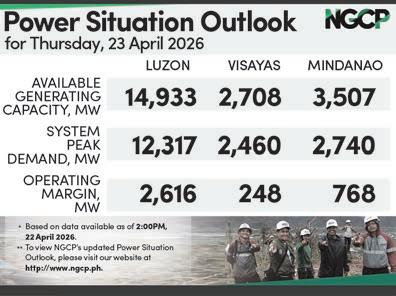

CUSTOMERS of the Manila Electric Co. (Meralco) will get a refund of P0.2511 per kilowatt hour (kWh), bigger than the existing P0.1189 per kWh, after it was ordered by the Energy Regulatory Commission (ERC) to implement a shorter refund period of 12 months instead of 36 months.
ERC Chairperson and CEO Francis Saturnino C. Juan said this move provides “immediate relief” to Meralco customers given the expected rise in generation charges due to the Middle East conflict.
“The ERC’s mandate is to protect consumers while ensuring a stable and predictable regulatory environment. By expediting the refund, we are providing more immediate relief to Meralco consumers, particularly in the face of rising electricity costs driven by global and domestic factors.”
It can be recalled that Meralco was ordered by the ERC in March 2025 to refund its customers P19.95 billion at a rate of P0.1189/kWh per month for 36 months starting April 2025. The amount represents over-recovery of rates for the lapsed period from July 2022 to end-December 2024.
The March 2025 decision stemmed from the commission’s confirmation of the approved distribution rates charged to consumers, which are compared against the computed Actual Weighted Average Tariff (AWAT) for Meralco. This tariff is based on Meralco’s actual revenues and electricity sales during the period. This mechanism ensures that consumers are charged fairly-neither more nor less than what is permitted under the ERC’s regula-
tion governing the lapsed years when it was not able to conduct a rate reset of the private utilities under performance-based regulation. The refund appears as a separate line item labeled “AWAT (Refund)/ Collect,” allowing consumers to see the amount being returned to them each month.
In its latest order dated April 22, 2026, the ERC has mandated that the remaining amount of P14.17 billion be refunded over a shorter period of 12 months instead of the original 36 months. This change results in a higher average refund rate of P0.2511/kWh, which will be reflected in the Meralco consumers’ electricity bills.
“In view of the partial implementation of the refund, the Commission resolves that the remaining unrefunded balance amounting to P14,172,358,349.00 shall be refunded to customers over a period of 12 months, corresponding to an average refund rate of P0.2511 per kWh,” the 24-page order read. For households and businesses, the decision translates to lower electricity bills over the next 12 months. The higher refund rate means consumers will feel the benefit more quickly, helping offset recent increases in generation charges and other cost components. Residential customers, in particular, are expected to see more noticeable reductions in their monthly bills, as the refund rate for this class is highest. The ERC will continue to closely monitor the implementation of the refund and require regular reporting from Meralco until the full amount has been returned. Lenie Lectura

BLOOMBERG NEWS
Precision over speed: The new rules of automation in banking
Banking&Finance Fund transfers via InstaPay, PESONet doubled in March

EVERY year, I sit in planning sessions where one word dominates the agenda: scale. Scale acquisition. Scale personalization. Scale engagement. Inevitably, the conversation turns to automation as the mechanism to accelerate it all. In banking, I’ve learned to pause when that word is used too casually. Automation is powerful. It helps us move faster and operate smarter. But it is not neutral. When you scale automation, you also scale responsibility.
In less regulated sectors, a flawed automation rule might mean a dip in conversions or an underperforming campaign. In financial services, the stakes are different. Automated systems are tied to sensitive data, required disclosures, and customer trust. A mistake does not just affect a dashboard. It can quickly create regulatory and reputational risk.
For bank marketers, the “new” rule is that the competitive advantage no longer belongs to who automates the most, but who automates with the most intent.
At GoTyme Bank, automation is scaled deliberately. Before activating any journey, we apply a three-question stress test: Can we trace the data and validate consent? Is there clear ownership of the decision logic? Can we articulate the rationale behind the communication to regulators, auditors, or our board?
If those answers are unclear, scale stops being an advantage and becomes exposure.
There is a persistent belief that compliance slows innovation. In practice, governance enables speed when embedded early. When guardrails such as pre-approved frameworks, structured disclosures, and defined review thresholds are built into system design, marketing teams move faster with confidence and clarity.
Personalization is where this discipline is tested. Automation allows
Tus to respond to behavioral signals in real time. In banking, those signals often reflect meaningful financial moments, whether a customer is building savings, managing a tight month, or preparing for a major purchase.
The responsibility has evolved from targeting customers to supporting them. Long-term growth depends on that shift from conversion to confidence.
Success metrics must reflect that reality. Open rates and conversions matter, but they are incomplete. Optout trends, complaint volumes, and regulatory feedback deserve equal weight. Strong models balance commercial performance with customer protection.
Automation is more than a marketing tool. It is an enterprise capability requiring coordination across marketing, compliance, data, technology, and risk. With shared accountability, automation becomes infrastructure that supports both scale and control.
The banking sector continues to accelerate its digital capabilities, and customers expect responsiveness that rivals leading tech platforms. But in a regulated world, you do not win by automating the most. You win by automating with clarity, control, and discipline.
When designed thoughtfully, automation does more than improve efficiency. It reinforces the most valuable asset any bank has: trust. In the end, that is the only scale that truly sustains growth.
For more information, visit bmap. org.ph or facebook.com/BankMarketingAssociationPH
Angeline Angeles is the Marketing Director of GoTyme Bank and Director for Publicity and Digital Marketing of the Bank Marketing Association of the Philippines (BMAP). She may be reached at angeline.angeles@gotyme.com.ph. The views expressed are solely those of the author and do not necessarily reflect those of BusinessMirror , GoTyme Bank, or the BMAP.

EBy Reine Juvierre Alberto @reine_alberto
LECTRONIC fund transfers made through InstaPay and PESONet posted double-digit increases as the total value of transactions reached P2.766 trillion in March.
Latest data from the Bangko Sentral ng Pilipinas (BSP) showed that the combined value of transactions surged by 50.16 percent from P1.842 trillion in the same month last year. Broken down, the value of InstaPay transactions soared to P1.351 trillion, a 63.61-percent year-on-year
TOTAL insured bank deposits sharply rose to P5.2 trillion by the end of 2025, protecting almost all of the deposit accounts across the country.
The Philippine Deposit Insurance Corporation (PDIC) reported on Wednesday that P5.2 trillion in deposits have been insured, up by 40.9 percent from P3.7 trillion in end-2024.
Recall that the maximum deposit insurance coverage (MDIC) was doubled to P1 million from P500,000 last March 15, 2025,
By Justine Xyrah Garcia
HOMEOWNERS will be granted temporary relief from housing payments after the Department of Human Settlements and Urban Development (DHSUD) announced a threemonth moratorium.
According to the DHSUD, around 50,000 member-beneficiaries of the National Home Mortgage Finance Corp. (NHMFC) are expected to benefit from the measure.
Under the program, eligible borrowers nationwide will automatically be covered from May 1 to July 31, 2026, without the need to apply.
During the period, borrowers may defer their monthly housing amortizations without penalties or additional
increase from P825.74 billion.
For PESONet, the value of transactions increased by 39.13 percent year-on-year to P1.415 trillion from P1.017 trillion.
As per the volume of transactions, combined payments in the two systems grew by 2.5 times to
which drove the increase in insured deposits.
“This sharp increase not only reflects sustained public confidence in the banking system but also signals a significantly stronger financial safety net for depositors,” read a statement the PDIC issued last Wednesday.
The increase accounted for P1.3 trillion or 86.1 percent of the total increase in insured deposits, according to the PDIC.
“As a result, a greater share of savings is now better protected,
interest, with the loan term extended by the duration of the moratorium.
Housing Secretary Jose Ramon P. Aliling said last Wednesday the initiative forms part of the government’s broader whole-of-government response to cushion households from the impact of the energy crisis.
“Amid the energy crisis we are experiencing, it is important that we provide even a bit of relief to our fellow Filipinos—particularly in their housing payments. DHSUD will continue to pursue programs that will help ease the impact of the crisis on our people,” Aliling said, mostly in Filipino.
Beyond the moratorium, migrant workers affected by the Middle East crisis may also tap additional support through the Home Development Mutual Fund
704.060-million transactions in March from 205.035 million in the same month a year ago.
About 693.013 million in transactions were conducted through InstaPay, up by 254.45 percent year-on-year from 195.517-million transactions.
The volume of PESONet transactions, likewise, increased by 16.06 percent to 11.047 million from the 9.518 million in transactions last year.
As of end-March 2025, PESONet participants reached a total of 124, consisting of 40 universal and commercial banks, 20 thrift banks, 46 rural banks, five digital banks, and 12 EMI-non-bank financial institutions. Meanwhile, there are a total of 93 InstaPay participants, consisting of 85 senders and receivers, as well as
giving depositors enhanced peace of mind and stronger assurance that their hard-earned money is secure under the PDIC’s deposit insurance system,” the state deposit insurer added.
Fully insured accounts rose by 20.9 percent to 169.2 million as of end-2025 from 140.0 million in the same period in end-2024.
These accounts now represent 98.8 percent of all deposit accounts nationwide, PDIC added.
Overall domestic deposit growth remained robust, with total domestic
eight receivers only. PESONet and InstaPay are automated clearing houses (ACHs) under the BSP’s National Retail Payment System (NRPS), which is expected to bring down costs to consumers as more and more of them use the system. Launched in 2017, the PESONet can be considered an electronic alternative to the
deposits reaching P21.7 trillion by end-2025, up by 7.1 percent yearon-year.
Individual depositors continued to drive this growth, contributing P812.1 billion or 56.4 percent, followed by private corporations with P334.8 billion or 23.2 percent.
“These positive developments highlight the PDIC’s critical role in strengthening financial stability, deepening public trust, and delivering enhanced protection for depositors across the banking system,” the insurer said. Reine Juvierre S. Alberto
(Pag-IBIG Fund), including early withdrawal of savings and a separate threemonth housing loan payment deferment without penalties or interest.
The agency said these measures form part of a broader effort to cushion Filipino households from the economic strain caused by the energy crisis, while extending targeted assistance to vulnerable sectors.
Compliance window
MEANWHILE, the housing agency also said it is granting developers a longer compliance period for the Balanced Housing Development Program (BHDP), effectively allowing up to 36 months to meet requirements.
DHSUD said Aliling approved a request from developer groups, including the Subdivision and Housing Developers Association (SHDA) and the Organization of Socialized Housing Developers of the Philippines, to provide more flexibility in both the timeline and mode of compliance. Under the adjustment, projects with approved timelines of at least 30 months will be given an additional six months—bringing the maximum compliance window to 36 months, longer than the 30 months originally requested by developers.
During this period, developers may choose how to comply with BHDP requirements under Republic Act 7279 through direct participation in socialized housing projects or by availing of incentivized compliance options allowed by law.
By Rizal Raoul S. Reyes @brownindio
HE Security Bank Corp. an -
nounced last Wednesday its top executives set a target to reduce the lender’s Scope 1 and Scope 2 emissions-intensity from its own operations by 62 percent by 2035.
Announced in line with Earth Day 2026, the commitment focuses on the bank’s Scope 1 and Scope 2 emissions, covering fuel and electricity use across the bank’s nationwide network of offices and branches, read the lender’s statement.
According to the bank, it measured the target using an emissions intensity approach, expressed as tonnes of carbon dioxide equivalent (tCO₂e) per full-time employee.
“This ensures projected growth is accompanied by improved efficiency and lower carbon impact.”
For financial institutions, the majority of emissions sit in the financed portfolio. Security Bank is taking a deliberate approach. It starts with what it directly controls, while continuing to build its broader portfolio decarbonization strat-
BITCOIN jumped along with equities on Wednesday, hitting an 11week high after President Donald Trump said he would extend a ceasefire with Iran, bolstering market confidence.
The original cryptocurrency rose as much as 3.6 percent, briefly topping $78,400, its highest price since February 3. It was trading around $78,109 in early morning in New York. Other cryptoassets also advanced, with Ether climbing as much as 4.2 percent.
“BTC’s near-term direction remains highly dependent on developments in
the macroeconomic and geopolitical landscape,” said Paul Howard, senior director at market maker Wincent. “In the absence of a clear external catalyst, traders focused on positioning around low-volatility conditions are likely to view the $72,000 area as a key support zone, with upside constrained by a potential resistance and profit-taking ceiling around $79,000.” Contracts for the S&P 500 Index were also up by more than 0.6 percent, while Brent crude was up around 0.8 percent to above $99 a barrel. Bitcoin has weathered the war with
egy, the statement reads. “Climate action has to show up in how we operate day to day,” Security Bank Chief Financial Officer Allen Alexander P. Reyes was quoted in the statement as saying. “This is about disciplined execution and exploring innovations that will reduce emissions while maintaining strong returns. O ur actions today support a resilient and sustainable future.”
According to the US Environmental Protection Agency (EPA), Scope 1 emissions “are direct greenhouse (GHG) emissions that occur from sources that
Iran better than many assets, including the traditional safe haven of gold. Bullion is down roughly 10 percent since Feb. 27, while Bitcoin is up more than 15 percent over the same period. “Crypto has been in a bullish mood in the past few weeks, often shrugging off bad news and climbing on good news,” said Caroline Mauron, co-founder of Orbit Markets. “The $75,000 level should hold as solid support from here, and a clean break above $80,000 would unlock significant further upside.” Since the outbreak of the war at the
are controlled or owned by an organization (e.g., emissions associated with fuel combustion in boilers, furnaces, vehicles).”
A page on the EPA Center for Corporate Climate Leadership reads that Scope 2 emissions “are indirect GHG emissions associated with the purchase of electricity, steam, heat, or cooling.”
“Although scope 2 emissions physically occur at the facility where they are generated, they are accounted for in an organization’s GHG inventory because they are a result of the organization’s energy use.” (See https://www.epa.gov)
end of February, Bitcoin has largely traded between $65,000 and $75,000. The holding pattern has been a reprieve from months of declines that has seen the token shed roughly 40 percent of its value from its $126,000 high in October, when a sharp selloff sent crypto markets spiraling. In recent weeks, inflows have returned to US-listed spot Bitcoin exchange-traded funds. The 13 funds have seen more than $250 million in net inflows so far this week, after investors poured $996.4 million into the funds last week. Bloomberg
THE Insurance Commission (IC) announced recently that it has revoked the insurance broker’s license of Winternitz Associates Insurance Brokers Corp. (Winternitz) for failing to comply with regulatory requirements.
Insurance Commissioner Reynaldo A. Regalado issued a notice to the public stating that the company is no longer authorized to act as an insurance broker following the revocation of its license. Winternitz is also barred from soliciting, negotiating or placing insurance business, according to the notice.
“The public is hereby advised to exercise caution in transacting with the Company,” the notice read. Moreover, the regulator also designated a qualified soliciting official, required under existing rules and regulations.
Under IC Circular Letter
2018-52, the Commissioner has the authority to revoke a license if the licensee has willfully violated any provision in the Insurance Code, misstated information when applying for a license, or committed fraud in obtaining their license. The IC may also revoke their license if a final court of judgment found them guilty of fraud or dishonesty, misuse of their clients’ money, or has not demonstrated trustworthiness and competence to transact business.
Winternitz was established in 1968, founded by its now Managing Director and President George Winternitz.
Latest available data from
B4
Thursday, April 23, 2026 Editor: Jennifer A. Ng •
PHL rice imports may hit new record this year
TBy Ada Pelonia @adapelonia
HE country’s rice imports could reach a new record high as spikes in fertilizer and fuel prices and El Niño could cut palay output this year, according to the Department of Agriculture (DA).
Agriculture Assistant Secretary Arnel de Mesa said palay production this year could fall to a range of 18.6 million metric tons (MMT) to 18.8 MMT if fertilizer and pump prices will continue their upward momentum, citing a revised outlook from the National Rice Program which initially projected an output of 20.28 MMT for this year prior to the price shocks.
The latest outlook is the lowest in 10 years, dashing hopes that Philippine rice output would again reach the 20-MMT mark.
De Mesa said rice importation “naturally responds” to market challenges, noting the all-time high rice arrivals of 4.81 MMT in 2024, driven by the severe El Niño that ravaged local plantations.
“The market—the importers
Hormuz standoff to make food costly until 2027—FAO
HIGHER food commodity prices and retail food inflation are likely in the next few years if the standoff in the Strait of Hormuz does not end soon, experts from the Food and Agriculture Organization of the United Nations (FAO) warned.
FAO experts noted that exports of between 20 percent and 45 percent of key agrifood inputs rely on sea passage through the Strait of Hormuz. If farmers produce with fewer inputs, there will be lower yields later this year and in 2027.
“The clock is ticking,” and crop calendars put poorer countries most at risk of scarce and pricey fertilizer and energy inputs, FAO Chief Economist Maximo Torero said in a recent podcast with David Laborde, director of the UN agency’s Agrifood Economics Division.
“The last thing we want is lower crop yields and higher commodity prices and food inflation for the next year,” Torero said, noting that would likely force countries to put policies in place to lower domestic food prices, triggering higher interest rates and as a result potential slower economic growth around the world.
The latest FAO Food Price Index covered the month of March and was relatively stable thanks to ample supplies of most food commodities, especially cereals. But pressure is rising in April and will intensify in May as “farmers will make decisions” on whether to
switch planting choices to adapt to fertilizer availability as well as whether to allocate more land and resources to biofuels to benefit from higher oil prices but curtailing global food supplies.
“We are in an input crisis; we don’t want to make it a catastrophe,” said Laborde. “The difference depends on the actions we take.”
FAO urged all countries to closely ponder biofuel mandates and above all to avoid export restrictions on energy and fertilizers.
If the standoff in the Strait of Hormuz is not quickly ended, FAO experts said anticipatory actions should be considered, in particular asking multilateral institutions to provide financing to countries at risk of losing access to basic fertilizer inputs given their planting has started.
“The International Monetary Fund’s balance of payment facilities, and the Food Shock Window, following the Food Import Financing Facility FAO’s suggested in 2022, could be used as an input-financing facility allowing countries that need fertilizers today to get them quickly without triggering distorting subsidy competitions,” Torero said.
FAO said it has already developed a crop calendar-based prioritization of countries based on when and how much fertilizer they need.
“The risks are very clear,” Torero said. “If we don’t accelerate…, the risks will exacerbate.”
Ada Pelonia
and traders—will respond when they see that production is low, they will import more,” he told reporters last Tuesday. “Given the current pressures, it’s possible (for rice imports this year to reach 4.8 MMT rice imports) or more.”
Rice arrivals reached 1.26
MMT as of April 9, surging by over a third from the 917,853 MMT in the same period last year, based on the latest government data.
De Mesa noted that fertilizer prices already average P2,500 per 50-kilo bag. In Ilocos Region, a key rice-producing area, the price of the input has shot up to a high of P2,900 per bag.
He said fertilizer application is critical, particularly during the wet planting season.
“If you reduce (fertilizer) a bit, the drop in rice field productivity will be exponential. That’s why it’s important for them to really get support when it comes to fertilizer.”

State weather bureau Pagasa on Wednesday issued an alert noting the 79 percent chance of El Niño emerging in June-July-August, adding that it will likely persist
until early 2027. BMI, a unit of Fitch Solutions, recently said the looming El Niño in the second half of 2026 threatens to exacerbate the Middle East
war’s impact on the global agriculture sector.
A recent forecast of the National Oceanic and Atmospheric Administration (NOAA) for the El Niño-Southern Oscillation (ENSO) showed that El Niño could emerge with a 62-percent probability over June to August 2026 and persist until the end of the year. It also assigns a 33-percent likelihood of a “strong” El Niño to develop in the fourth quarter of 2026. The research firm warned that further risks would rise under an El Niño scenario in the second half of 2026, as elevated input costs brought by the war could coincide with drought-and flood-related output losses.
“The US-Iran war is heightening agricultural price risks by introducing a cost shock that could overlap with weather-related production stress if El Niño materializes.”
Govt gives nod to ₧727-M ‘mega FMR’ project in Zambales
By Henry Empeño
ASINLOC , Zambales –
MA P727-million farmto-market road (FMR) project has been approved under the Department of AgriculturePhilippine Rural Development Project (DA-PRDP) to provide year-round access to upland agricultural communities near the former Coto Mines in this town.
The DA-Region III office announced the project on Tuesday, April 21, following approval by the Central Luzon Project Advisory Board (RPAB-3), and described it as a “transformative infrastructure subproject” that will unlock agricultural growth in the area.
Covering the 26-kilometer stretch of gravel road between Barangay Baloganon and Sitio Coto in Barangay Taltal and including the construction of 11 bridges, the “mega” FMR will be the longest and the largest subproject in terms of cost under the World
Bank-funded PRDP Scale-Up program, the DA said.
The FMR, which was designed to address long-standing problems in accessibility and connectivity, will directly benefit over 1,500 mango and rice farmers, as well as 4,500 households in the area.
Prior to RPAB-3 approval, a rigorous feasibility study and deliberation was made by key national government agencies to ensure compliance with technical, economic, environmental, and social safeguards, the DA added.
The Baloganon-Coto road was built during the heyday of mining in the area, which produced about 15 million metric tons of refractory chromite under operation by Benguet Corp. from 1956 to 2006.
When the mines ceased operation in 2013, the road was left largely unattended, so that travel along the 26-kilometer stretch normally took up to two hours of jaunty, bone-jarring ride. Public transport to the area, as a result,
had to be scheduled to just two trips a day because of poor road conditions.
The DA said the proposed improvements include concreting dilapidated and poorly graveled road sections, upgrading drainage systems, and replacing 11 steel bridges to enhance year-round accessibility, especially during adverse weather.
Masinloc Mayor Hazel Lim said the approval by DA-PRDP took three years of waiting. “That’s how meticulous they are with projects under the PRDP,” she told Masinloqueños in a social media post on Tuesday. Liom said the earliest timetable for the implementation of the FMR project is September or October this year.
She said the DA would still have to wait for a letter of “no objection” from the World Bank before it can proceed with formal procurement.
The next step would be the bidding process, then a second letter
of “no objection” to the awarding of contract to the winning bidder, and finally, the notice to proceed and actual physical implementation of the project.
The PRDP is a six-year, World Bank-funded national project undertaken by the DA to develop a modern, climate-smart, and market-oriented agri-fishery sector. It aims to increase rural incomes, improve farm productivity, and enhance market access through climate-resilient infrastructure and enterprise development in partnership with local government units. The current PRDP Scale-Up program, with 148 subprojects and some P24 billion in funding, was introduced in 2023 to expand on the success of the original PRDP set in 2013-2023.
The DA said that upon completion, the P727-million Masinloc FMR will significantly reduce travel time and hauling costs, and enable local farmers to transport their produce more efficiently.
Central Luzon top agri producer in 2025—PSA report
CENTRAL Luzon was the top contributor to agriculture and fisheries production in terms of value last year, data from the Philippine Statistics Authority (PSA) showed. Figures from the PSA indicated that Central Luzon accounted for the lion’s share of the P1.79-trillion value of production in agriculture and fisheries last year at 13.8 percent or P246.38 billion among the 18 regions.
It was followed by Northern Mindanao with P182.35 billion and Calabarzon with P138.25 billion, accounting for 10.2 percent
and 7.7 percent, respectively.
PSA said Western Visayas recorded the highest year-on-year growth at 9.3 percent due to the improvements in the value of crops, poultry, and fisheries production.
The biggest declines, however, were registered in Bicol Region at 4.9 percent, Central Visayas at 2.6 percent, and Soccsksargen at 2 percent, according to the agency.
In terms of the value of crop production, the PSA said Northern Mindanao recorded the highest value at P120.15 billion, as it shared 12 percent.
Cagayan Valley trailed behind
with P106.73 billion or 10.7 percent and Central Luzon with P94.99 billion or 9.5 percent.
For livestock, the PSA said Calabarzon posted the highest value of production at P33.47 billion (13.8 percent). This was followed by Central Luzon at P31.04 billion (12.8 percent), and Northern Mindanao at P28.61 billion (11.8 percent).
Central Luzon also registered the highest value in poultry production, worth P78.77 billion or 25.9 percent. Calabarzon came next with P63.37 billion or a 20.8-percent share, while Northern Mindanao recorded P26.81
billion for an 8.8-percent share. For fisheries, PSA said Central Luzon accounted for the largest share at P41.57 billion or 17 percent. It was followed by Western Visayas with P25.94 billion or 10.6 percent and Soccsksargen at P22.12 billion or 9 percent. Across major island groups, the PSA said Luzon accounted for the largest share of the total value of production in agriculture and fisheries at 46.1 percent, followed by Mindanao with 36.3 percent and Visayas with 17.5 percent.
Ada Pelonia
Commodity traders reap billions in profit as war upends markets
THE world’s biggest energy traders are reaping a fresh profit bonanza as the war in Iran causes unprecedented disruption to oil markets.
It’s too early to say if 2026 will rival the industry’s record haul in the wake of Russia’s full invasion of Ukraine in 2022-2023, but several of the biggest commodity traders are already seeing the highest profits since then, according to executives and financiers.
Vitol Group, the world’s largest oil trader, told banks it made about $2 billion in the first quarter, Bloomberg reported earlier this week. Trafigura Group, the
second-largest oil trader and leading metals trader, has enjoyed two of its best-ever quarters in January-March and October-December, when copper and gold prices soared, according to a person familiar with the matter. A spokesperson for Trafigura declined to comment.
Gunvor Group has said it made more in the first quarter than in all of the previous year, while Mercuria Energy Group Ltd. Chief Executive Officer Marco Dunand on Tuesday said his company was on track to make a return on equity at the upper end of a historic 25 percent to 50 percent range. That
would imply profits of $2.3 billion to $3.2 billion, compared with a record $3 billion in 2022.
The results are an early indication that the commodity traders, which are mostly owned by small groups of senior executives, are some of the major beneficiaries of the war. The profits have been driven by huge dislocations across energy markets, with immediately-available cargoes of oil and fuel products trading at huge premiums after the near-closure of the Strait of Hormuz triggered a global race to secure physical oil.
One executive, who asked not to be identified discussing confi -
dential details, said his company had made profits of as much as $20 to $30 a barrel on some crude oil trades. That’s highly unusual in a high-volume, low-margin business where profits are typically measured in cents per barrel.
“You saw Dubai trade at $160 a barrel, you saw jet fuel trade over $200 a barrel,” Gunvor CEO Gary Pedersen said in an interview on the sidelines of FT Commodities Global Conference in Lausanne.
“The physical businesses were able to manage that and help balance those markets.”
To be sure, the war has also created major headaches for the
commodity traders. Vitol suffered losses in its derivatives team when the war broke out, Bloomberg has reported. And the disruption of supplies from the Middle East has led to force majeure declarations from producers, hitting those who had contracts to buy from them.
Vitol CEO Russell Hardy described a period of “triage” in the first two to three weeks of the conflict, as the industry responded to the interruption of oil flows from the Middle East.
Still, “generally performance has been good — which I think is something that has been suggested with most companies,” Hardy added. Several executives cautioned it was too early to forecast the full impact of the crisis, with the outcome of the war still uncertain and oil prices vulnerable to wild swings on the back of social media posts from Iranian and US leaders.
“There’s a huge amount of risk out there, a huge amount of volatility out there,” said Trafigura CEO Richard Holtum. In addition to the disruptions from the war, traders also profited from a cold snap in the US earlier in the year, as well as from soaring metals prices, some of the executives said. Bloomberg News
THIS BusinessMirror file photo shows farmers planting palay during the wet season in Iba, Zambales.
Health&Fitness
Editor: Anne Ruth Dela Cruz
Pharmacists take lead in tackling Peripheral Neuropathy across APAC
By Patrick Villanueva
MANY serious health conditions develop quietly, often going unnoticed until they become more difficult to manage. Peripheral Neuropathy (PN) is one of them. PN is a condition that affects the nerves, usually in the hands and feet, and may show up as numbness, tingling, or a burning or “pins and needles” sensation.
While it may seem minor at first, it can lead to more serious complications if left unaddressed.
“PN is a widespread and often debilitating condition with high prevalence among diabetic patients across APAC or Asia Pacific—Philippines [58 percent], Indonesia [58 percent], Malaysia [54 percent], Thailand [34 percent], Singapore [28 percent], and Australia [21 percent],” said Yolanda R. Robles, lead author and chairperson of the initiative, during her presentation. She is also a professor at the University of the Philippines College
of Pharmacy and president of Federation of Asian Pharmaceutical Associations. In response, leading Asia-Pacific pharmacy experts, in collaboration with Procter & Gamble Health, have released the region’s first consensus guidelines to help community pharmacists identify, assess, and manage patients who may be experiencing PN.
First point of contact
SHRADDHA VOHRA , Vice President for Personal Health Care Asia Pacific at P&G Health Singapore, emphasized that
FBy Claudeth Mocon-Ciriaco
ILM is a powerful tool for social change and driving awareness.
That is why the Parents Against Vape (PAV), together with youth leaders from the Province of Sorsogon and with the support of the Provincial Youth Development Office, are strengthening their call for a total vape ban and smoke-free and vape-free local policies through the “TobaccOFF NOW! Film Festival: Sorsogon Film Screening.” The film screening is their way of protecting children and young people from the harms of nicotine and emerging tobacco products.
“Through this initiative, we are empowering the Sorsoganon youth to take action and protect their peers, while advancing policies toward a smoke-free and vape-free future,” said Judy Delos Reyes, Project Manager.
Storytelling
THE recent event gathered over 400 young leaders, learners, educators, and community stakeholders from various schools and municipalities. Youth advocates are using storytelling to raise awareness and spark conversations on the risks of vaping among minors.
“As a young filmmaker, I believe storytelling is a powerful way to open conversations that matter. Through our film, we hope to raise awareness and remind fellow youth that our choices today shape our future, and that we all have a role in protecting our generation from the harms of nicotine addiction,” said Mark Rynell Mirabueno, director of the film “Hangos.” PAV emphasized that the increasing accessibility and appeal of vape products pose serious risks to the health and future of young Filipinos, making youth protection a shared responsibility.
Severe health conditions WHILE often marketed as a safer alternative to tobacco, PAV stressed that vaping can cause severe health conditions such as EVALI or e-cigarette or vaping product use-associated lung injury, condition causing severe lung damage, breathing difficulties, coughing, and chest pain.
They added that vaping is also linked to increased heart rate, higher blood pressure, and potential cardiovascular disease or stroke.
The event also served as a platform to officially launch the partnership between PAV and the Provincial Youth Development Office of Sorsogon.
“At the Provincial Youth Development Office, we continue to support initiatives that aim to protect our youth. Together with various sectors, we stand committed to advancing action and policies that will provide a smoke-free and vape-free future for every young Sorsoganon,” said Julius Edma, representing the youth sector.
Calls for action
THE initiative reinforces both local and national calls for action, advancing smoke-free and vape-free local policies across Sorsogon, while supporting a total vape ban at the national level to protect children and youth from nicotine addiction and long-term health risks.
The TobaccOFF NOW! Film Festival Regional Premiere in Sorsogon was organized by PAV, in collaboration with Amber Studios, Provincial Youth Development Board of the Province of Sorsogon, Computer Communication Development Institute, and local stakeholders.
The event was supported by the Campaign for Tobacco-Free Kids. Representatives from the Department of EducationSorsogon City, Department of Health Bicol Center for Health Development, Sangguniang Kabataan, and the local council of Sorsogon were also present during the event.
pharmacists are often the first point of contact for patients, especially those who tend to dismiss symptoms such as numbness, tingling, burning, or “pins and needles” sensations as nothing serious.
“Pharmacists are uniquely positioned to recognize symptoms early, guide patients to appropriate care, and help prevent progression,” she said.
The guidelines, titled “Empowering Community Pharmacists: Expert Consensus Guidelines for the Effective Management of Peripheral Neuropathy with Neurotropic B Vitamins,” aim to provide a practical framework for pharmacists. They standardize pharmacy-based screening, counseling, and step-by-step management, while taking into account cultural nuances across the region.
To aid early detection, Navin Kumar Loganadan, contributing author and head of Ambulatory Pharmacy and the Diabetes Medication Therapy Adherence Clinic in Malaysia, introduced the reminder M-E-D-I-C: Medication, Elderly, Diabetes, Infection, and Chronic conditions. This serves as a quick guide for pharmacists to identify patients at risk of PN.
Culture appropriate approaches THE guidelines also highlight the importance of culturally appropriate approaches, recognizing that patient behavior and healthcare practices vary across countries. A full version will be made accessible to APAC pharmacists through P&G’s Nerve Connect platform. “Behavior change is never easy. Our recent pharmacist survey in the Philippines showed that those who completed five or more training sessions demonstrated significantly better knowledge of the appropriate dosing of B vitamins for PN,” Robles noted. “P&G Health’s Nerve Connect provides an always-on, omnichannel education solution—transforming paper-based guidelines into practical, everyday pharmacist tools,” she added.
The presentation was led by Robles, Lusy Noviani, Navin Kumar Loganadan, Grace Chew, Kenny James P. Merin, Shraddha Vohra, and Inna Eiberger.
Pharmacists and healthcare professionals may access the guidelines and educational resources through the Nerve Connect platform.


By Candy P. Dalizon Contributor
HOW often do women meticulously plan every detail of their lives—careers, families, and finances—yet leave their own health out of the blueprint?
In a recent gathering that blended art with advocacy, women from diverse backgrounds came together for an afternoon of creativity and meaningful conversation in Common Ground Rockwell, Makati.
“Because She Can,” a creative wellness experience organized by MSD’s Guard Against HPV campaign, brought together young professionals, mothers, and advocates to explore a powerful truth: that women have the power to shape their own lives, starting with their well-being.
The afternoon featured a handson session with Tahanan Pottery Shop and Studio, where participants learned the fundamental techniques of molding, refining, and shaping raw clay into unique, functional mugs.
Artistic process AS the clay took form under their fingers, it became clear that the artistic process served as a profound metaphor for life itself. Each mug reflected its maker’s specific intention, with some appearing highly structured and others more expressive and imperfect, yet all possessing a shared resilience.
rather as the very foundation that makes a full life possible.
The “Because She Can” initiative reframes healthcare as a proactive choice rather than a reactive necessity, positioning health maintenance as an everyday ritual similar to the use of a favorite mug.
Dr. Galang-Escalona emphasized that health is not a topic to be addressed only when something goes wrong; it must be protected early and consistently to ensure women can continue showing up for the futures they are building. Participants were encouraged to see that they have the agency to stay informed and consult healthcare professionals long before risks become realities.
True empowerment requires a grounded understanding of the health risks that can alter a woman’s life path, specifically regarding the Human Papillomavirus (HPV). Data indicates that approximately 80 to 90 percent of sexually active individuals will contract HPV at least once in their lives, and while many infections clear naturally, persistent high-risk types are responsible for 95 to 99 percent of cervical cancer cases. The local impact remains severe, with roughly 12 Filipinas losing their lives to cervical cancer every single day. By acknowledging that these cases are largely preventable, women can shift the narrative from fear to action, recognizing that awareness is the first step in taking control of their long-term wellness.
By John Eiron R. Francisco
ACCESS to healthcare services at St. Luke’s Medical Center–Quezon City (SLMC-QC) is expected to become more efficient as a new hospital building rises, aiming to reduce the need for patients to move between multiple service areas.
During the topping-off ceremony of the 13-storey North Hospital Building on April 20, 2026, SLMC-QC Senior Vice President and Medical Director Dr. Deborah Ignacia Ona said the facility, which can accommodate 132 well-designed patient rooms, follows a patient-centered design that ensures care remains seamless regardless of a patient’s condition.
She said that, unlike the current setup where patients transfer between departments for different procedures, the new building places key services in one area to create a more efficient patient experience.
“Most of the areas that are high traffic are going to be in this build -
Science, skin and sun: Tips for a safe summer season

By Dr. Pia Receno
long and busy days. Wearing the right clothes is also important. Light and breathable fabrics like cotton or linen help air move through and keep you cool. I prefer wearing light-colored clothes because they reflect heat and make me feel more comfortable outside. Choosing the right outfit is a simple way to protect your body from too much heat while staying comfortable all day. Freshly cooked food EATING healthy and making sure your food is clean and safe are essential, especially if you are always on the go. When I travel or eat outside, I make sure my food is freshly cooked and handled
ing. And it’s made in such a way that we wanted it to be a smart building,” she said.
The facility will house 80 percent of the hospital’s existing services, including key areas such as operating rooms (ORs), intensive care units (ICUs), and diagnostic laboratories, placing essential services within a single area. It will also connect to the main hospital through a dedicated passageway designed to maintain privacy between inpatients and those who visit for outpatient services.
“The planning has been very extensive. It involves both the stakeholders, our doctors, the ones who use the space, as well as our patients,” Dr. Ona emphasized. “It was planned in such a way, with the patient and the doctor in mind, so that they can do what they need to do best: treat our patients.”
The new vertical hospital building is located beside St. Luke’s College of Medicine along Sta. Ignaciana Street and is slated for completion in 2027.

“We shape it and it goes through all these stages and challenges but still it is transformed into a stronger material,” said Prof. Rita Badilla-Gudiño, Program Director of Tahanan Pottery Shop & Studio.
Dr. Mary Ann Galang-Escalona, Country Medical Lead of MSD in the Philippines, observed that just as these women were actively shaping clay, they were also the primary architects of their own destinies. She noted that while women are constantly planning for their professional goals and families, building that future requires the intentional choice to stay healthy enough to actually enjoy it. In this context, proactive prevention becomes the essential tool for protecting the life a woman envisions for herself.
Preventive care
AS the creative session unfolded, the conversation shifted toward the realization that preventive care should never be viewed as an interruption to a busy life, but
Regular screening
TAKING the lead on one’s health narrative involves a combination of regular screening, informed lifestyle choices, and vaccination, which together significantly reduce the risk of HPV-related diseases. Dr. Galang-Escalona shared that the tools to reduce these risks are readily available, and the most important step is simply making them a part of routine health decisions through open dialogue with doctors.
At the conclusion of the session, the finished mugs stood as tangible reminders of the participants’ power to mold their own well-being. Empowerment begins with the recognition of choice, and choosing prevention is a meaningful way to safeguard the milestones a woman is working toward. For more information about HPV prevention, visit https:// guardagainsthpv.ph or follow Guard Against HPV on social media.
try them: https:// shopee.ph/skinsunph. Staying protected should be easy, so you can move with confidence and comfort wherever your day takes you. Dr. Pia Receno is an Internal Medicine Specialist at Asian Hospital and Medical Center.
St. Luke’s Medical Center Quezon City officials led by Senior Vice President and Medical Director Dr. Deborah Ignacia Ona (center) conduct the topping-off ceremony of the North Hospital Building. PHOTO BY
SKIN & Sun Sunscreens
“Because She Can” is a creative wellness experience organized by MSD’s Guard Against HPV campaign. It brought together young professionals, mothers, and advocates to explore a powerful truth: that women have the power to shape their own lives, starting with their well-being.
April 23, 2026
PBBM seeks stronger ties with 6 nations through new non-resident ambassadors
PRESIDENT Ferdinand R. Marcos Jr. received the credentials of six nonresident ambassadors-designate in a ceremony at the President’s Hall in Malacañang Palace.
The envoys who presented their credentials on April 14 were Ermal Muca of the Republic of Albania, Ramil Abil oglu Rzayev of the Republic of Azerbaijan, Gbolie Desire Wulfran Ipo of the Republic of Côte d’Ivoire, Hreinn Palsson of Iceland, Tornike Nozadze of Georgia, and Ali Mohamed Abukar of the Federal Republic of Somalia.
In his brief speech, Muca highlighted the strong potential to expand
cooperation between the Philippines and Albania across trade and investment, innovation, tourism, education, people-to-people exchanges, and sustainable development and human capital growth.
For his part, Rzayev said Azerbaijan “highly values” its friendly ties with the Philippines. As both countries mark the 35th anniversary of diplomatic relations next year, he noted opportunities to deepen

cooperation in trade, investment, education, and cultural exchange.
The envoy also congratulated the Philippines on its Asean chairship
this year, and wished the government success in “advancing regional cooperation and prosperity.”
Meanwhile, Ipo conveyed warm
Locsin leads $90K donation to IMO for its capacity-building activities
LONDON—The Philippines
donated $90,000 to the International Maritime Organization for its technical cooperation and capacity-building programs related to climate change, the promotion of the IMO’s Women in Maritime Program, and South-South cooperation.
Permanent Representative to the IMO Teodoro L. Locsin Jr. presented the donation to Secretary-General Arsenio Dominguez on April 15 at the IMO Headquarters in the United Kingdom’s (UK) capital. The donation was coursed through the Integrated Technical Cooperation Program (ITCP) of IMO’s Technical Cooperation and Implementation Division (TCID). It will be used to fund training on the implementation of the organization’s Strategy for the Reduction of Greenhouse Gas (GHG) Emissions from Shipping, such as development of seafarers’ training and skills pro -
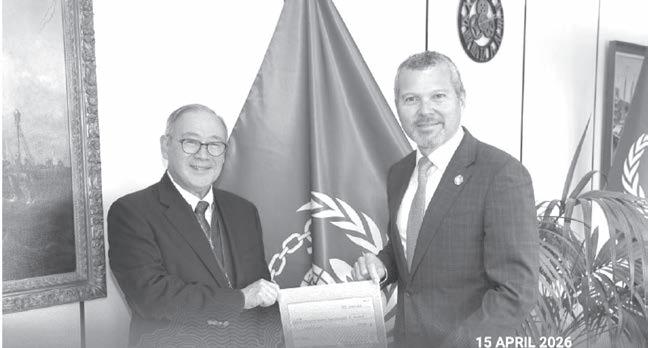
grams, among others. It can also be used to assist delegates from developing countries, particularly from Small Island Developing States (SIDS) and Least Developed Countries (LDCs), as well as to promote increased participation of women in seafaring, a traditionally maledominated profession.

Phil. Consulate General-NY, PAL strengthen ties to boost tourism
TAirlines (PAL) officials at the Philippine Center in New York for a courtesy visit and discussed areas of cooperation to promote Philippine tourism.
Maria “Chema” Alvarado, and
account manager for New York Aleana Sol Cruz. Alvarado assumed his post in February 2026, and over-
sees PAL operations across the United States and Canada. Mangalile conveyed his appreciation for PAL’s continued support to the Filipino community in the US. Both sides affirmed the importance of close coordination to support tourism promotion and strengthen engagement with the Filipino diaspora in North America. They reaffirmed the strong and growing partnership between the Philippine Consulate General in New York and the country’s flag carrier.
In presenting the donation, Locsin—who is the country’s ambassador to the UK—emphasized that “the Philippines prioritizes IMO projects that promote sustainable practices at sea, such as the reduction of GHG emissions from ships and assisting fellow developing countries—in particular, LDCs and SIDS—in our
efforts to combat climate change.”
Furthermore, the ambassador emphasized that “the Philippines is a gender champion, and we recognize the need to empower women and increase their ranks in terms of the seafaring population and to ensure that all ships are safe spaces free from harassment and violence.”
Locsin closed the meeting by affirming that “the Philippines values its strong partnership with the IMO, and remains committed to supporting its initiatives.”
The IMO is the United Nations’ specialized agency on maritime affairs, focused on promoting maritime safety, maritime security, and marine environmental protection. The Philippines is a member of the organization’s 40-seat council, having been reelected to a seat in November 2025 under Category C, or “countries with a special interest in maritime transport or navigation.”
PHL, China eye deeper economic, tourism, energy, security cooperation

THE Philippines and China are seeking stronger cooperation in key areas such as trade, tourism, energy, and security.
This followed a meeting between Executive Secretary Ralph Recto and Ambassador Jing Quan of China at Malacañan Palace on April 14 to discuss ways of enhancing bilateral relations. In their meeting, Recto and Jing noted the resumption of dialogues aimed at improving ties and expressed hope for more high-level visits this year.
“Both countries also discussed tourism, people-to-people ex -
changes, more direct flights between Philippine and Chinese cities, fighting transnational crimes, and overall economic relations, as well as the current energy situation,” the Office of Executive Secretary said in a statement.
The Philippines’ Asean chairship and China’s hosting of the Asia-Pacific Economic Cooperation Forum in 2026 were also tackled.
The two officials hoped for mutual support in the two upcoming regional engagements.
Officials from the OES and the Department of Foreign Affairs were also present during the meeting.
Ruth Abbey Gita-Carlos/PNA
greetings and well wishes for the continued prosperity of the Filipino people, and also expressed confidence that the bond between the two nations will grow stronger through mutual understanding and fruitful partnership.
Palsson, for his part, is committed to strengthening ties between the Philippines and Iceland by boosting people-to-people connections and expanding mutually beneficial trade ties.
He also cited opportunities for agreements in air transport, taxation, and investment, as well as ongoing cooperation in geothermal energy.
Nozadze noted the “steady development” of relations between the Philippines and Georgia, built on mutual respect and shared principles, as the two nations mark 34 years of diplomatic ties.
He committed to working closely with the government to deepen dialogue and advance cooperation in areas of mutual interest, such as trade, education, tourism, and cultural exchange.
Lastly, Abukar expressed willingness to learn from the Philippines in the fields of good governance, disaster risk reduction, community development, and to strengthen collaboration in rural livelihoods, education, and public health.
In his remarks, Marcos wished the envoys a fruitful and productive tenure, and expressed hopes of further deepening relations and expanding cooperation in mutually beneficial areas. He emphasized the need to deepen relations and expand cooperation in mutually beneficial areas.
Philippines and Senegal at 50: From dialogue to partnership
By Ambassador Leslie J. Baja
THIS year marks the 50th anniversary of diplomatic relations between the Republic of the Philippines and the Republic of Senegal. Over five decades, our two countries have built a relationship grounded in mutual respect, constructive dialogue and a shared commitment to sovereignty and national development.
On March 15, 1976, the two countries formally established diplomatic relations. For many Filipinos, Senegal may seem far—a country on the westernmost edge of Africa, facing the Atlantic. Yet the decision to establish ties arose from a particular historical moment that drew our countries together: the question of Muslim populations in Mindanao, in the south of the Philippines.
In 1972, the situation of Muslims in southern Philippines became an agenda item at the Organisation of the Islamic Conference. In 1973, the OIC created a Quadripartite Ministerial Commission—the “Committee of Four”—composed of Libya, Saudi Arabia, Somalia and Senegal. The committee visited the Philippines in August 1973 to conduct an on-the-spot survey of Muslim Mindanao and Sulu. Senegal, represented in the delegation by Ambassador Moustapha Cissé, thus became directly engaged in an issue touching on Philippine sovereignty and territorial integrity.
As international attention grew, the Philippines undertook broader diplomatic outreach to OIC member states. The objective was to engage constructively with the Islamic world and the Global South in dialogue rather than isolation. It was within this context that diplomatic relations with Senegal were established in March 1976.
Wider visibility
PHILIPPINE-SENEGAL relations gained wider visibility in June 1990, when Senegalese president Abdou Diouf paid a state visit to Manila. Philippine newspaper coverage noted that former president Corazon Aquino and Diouf were set to discuss the issue of Muslim populations in Mindanao, reflecting Senegal’s continued interest, as an OIC member state, in developments in Mindanao.
In June 1998, former president Fidel V. Ramos traveled to Dakar to receive UNESCO’s 1997 Félix Houphouët-Boigny Peace Prize. He shared the award with Nur Misuari, who was the chair of the Moro National Liberation Front and Autonomous Region of Muslim Mindanao governor, in recognition of the 1996 Final Peace Agreement with the MNLF. The ceremony held in Dakar, with Diouf’s

support, described the Philippine accord as a “historic moment”—ending a quarter-century of armed conflict. The symbolism required no elaboration: A country that had once engaged the Philippines in dialogue on Mindanao was now host to the recognition of a Philippine peace process. What began in dialogue evolved into partnership.
Expanded relations OVER five decades, Philippine-Senegal relations have expanded beyond their original context. Trade relations, while modest in scale, were meaningful. Senegal imported rice from the Philippines, while we imported phosphates. The first Philippine commercial office in Africa was established in Dakar.
People-to-people exchanges also flourished. Among the Filipinos in Senegal is Sister Charito Calangi, who has devoted many years of service at La Pouponnière in Dakar—a home for children in need. Through her work and engagement with the Filipino community, she has become a quiet bridge between our two societies, often bringing Filipinos together during Christmas and other community gatherings.
In the Philippines, Maodo “Malick” Diouf, a Senegalese basketball player, has come to call the country home. He helped lead the University of the Philippines to the University Athletic Association of the Philippines’ men’s senior basketball championship in 2022. In March 2026, the Philippine Senate passed on third and final reading a bill granting his naturalization, which would enable him to represent the country as a member of the national basketball team. Beyond trade and diplomacy, these people-to-people exchanges have served as the most concrete expression of relations between our two countries.
Five decades on, the thread connecting Manila and Dakar remains strong. It rests on the shared determination of Filipinos and Senegalese to unite toward common goals—advancing national development while supporting the aspirations of our peoples. That continuity, from 1976 to 2026, is not only a measure of the past fifty years. It is a
tion for the
THE President (right) welcomes Ambassador Nasser Said Abdullah Almanwari in a courtesy call. PCO
AMBASSADOR Teodoro L. Locsin Jr. and Secretary-General Arsenio Dominguez
AMBASSADOR Baja
CONSUL GENERAL Senen T. Mangalile (third from right) DFA/MARIANNE OLFINDO
EXECUTIVE Secretary Ralph Recto (left) and Ambassador Jing Quan OFFICE OF THE EXECUTIVE SECRETARY
WHY SAVING MONEY ALONE WON’T GUARANTEE A WORRYFREE RETIREMENT

FOR many Filipinos, retirement still feels like a distant idea tied to a modest savings account and the hope of finally slowing down. But new findings from InLife, the country’s first and largest Filipino life insurer, suggest that preparing for life after work is far more layered and uncertain than most people imagine.
InLife recently introduced its InLife Retirement Index, a more holistic way of measuring how ready Filipinos are for their later years. The result was a sobering 47 out of 100, revealing that retirement readiness is not just about putting money away, but about building a life that can remain secure, healthy and meaningful over time.
The study shows that retirement preparedness is shaped by six interconnected realities: life stage, personal finances, health, pension participation, retirement sentiment, and social support. Together, these paint a fuller picture of what it really takes to step into retirement with confidence.
One of the clearest insights is the generational divide. Generation X emerged as the most prepared, posting a score of 54. This is largely tied to where they are in life: more established in their careers, earning more steadily, and often carrying family responsibilities that naturally push financial planning higher on their list of priorities. At the other end, Gen Z scored the lowest at 36. While younger Filipinos, especially Gen Z and younger millennials, tend to have a clearer vision of the future they want, that vision has not yet fully translated into concrete retirement plans.
An area of concern is the growing number of Filipinos in informal or gig-based work. Without access to statebacked pension systems such as SSS or GSIS, many remain especially vulnerable, with fewer built-in safety nets to rely on later in life.
For Abigail A. Magtibay, InLife strategic marketing and brand experience head, one of the most important takeaways from the study is that retirement should not be seen as a financial finish line. It is also about health, emotional wellbeing, and the support systems people build around themselves. She emphasized the need for more open family conversations around retirement, noting that many interviewees could not say exactly when they expected to retire because their plans remained tied to supporting loved ones for as long as needed. Her message was simple: talk to your family about the future, define what retirement looks like for you, and start with small but concrete actions, even something as straightforward as taking the Retirement Index Quiz to understand your next steps.
Before launching the Retirement Index, InLife had already released a white paper titled Retire Without Worries: Your Roadmap to Living Life to the Fullest which highlighted how urgent retirement planning has become in the face of rising healthcare costs, longer life expectancy, and shifting family structures that leave many older Filipinos more financially exposed. It also reinforced the idea that government pensions alone are no longer enough. Today, retiring with dignity and independence means planning deliberately and creating lifelong income streams that can support the lifestyle one hopes to keep.
Rampver financials chairman, author, and financial speaker Rex Mendoza pointed out three common misconceptions people have about retirement. The first is assuming they will not live that long, even as life expectancy continues to stretch. The second is thinking they will spend less in retirement, when in reality travel, leisure, and even the joy of spoiling grandchildren can put additional pressure on savings. The third is believing they can simply keep working through consultancy or side businesses, when research shows that only one in three retirees is able to find work after retirement, partly because companies tend to favor younger workers.
In response to these gaps, InLife introduced solutions designed to make retirement feel less like a source of worry and more like a season of assurance. InLife Retire Assure, one of the company’s products described as the first true retirement insurance product in the Philippines, moves beyond the usual lump-sum benefit model by providing stable monthly income from age 60 up to age 100, with the added possibility of growth through cash dividends.
InLife chief product and innovation officer Jose Eduardo O. Ang said one of the most important steps people can take is to know their “magic number,” or the amount they need to prepare in order to live comfortably in retirement. He encouraged Filipinos to work closely with a financial advisor to map out future monthly expenses, and to use tools such as InLife’s retirement calculator to better understand how much they need to set aside today for the kind of life they want tomorrow.
More of information on the InLife Retire Without Worries research paper can be found at bit.ly/RAWhitepaper.
The gift of imperfection–Part I

SCHOOL is ending or has already ended for our children. It made me think of graduations and end-of-the-year report cards and recognitions. When our child brings home an assessment from school, how eager are we to see a 100 or a perfect score? Does a low test score, a game lost, a forgotten task of our child’s feel heavier than it should? Somewhere along our parenting journey, we began to believe that parenting meant getting things right all the time. Studies show that parental perfectionism is rising globally, and it is directly linked to increased anxiety in both parents and children. A study published in Frontiers in Psychology found that children of highly perfectionistic parents are more likely to develop self-critical tendencies and emotional distress. The American Psychological Association also notes that perfectionism is associated with burnout, depression, and anxiety when expectations become unrealistic. If we are feeling this pressure, our children are carrying it, too.
Over the years, I have come to understand that there is a quiet but important difference between raising children for perfection and raising them for fulfillment. Perfection is outcome-driven. It asks, “Did you win? Did you get the highest score?” Fulfillment asks something deeper: “Did you grow? Did you
learn? Did you become better?” Perfection is about proving. Fulfillment is about becoming.
And the bridge between the two, in my opinion, is: growing through mistakes.
In the work of developmental psychologists Kathy Hirsh-Pasek and Roberta Golinkoff, they introduced the 6 Cs of 21st century learning—collaboration, communication, content, critical thinking, creative innovation, and confidence. These are the skills our children need to thrive not just in school but in life. None of these are developed in a straight line. They are built through trial, error and reflection.
A child does not learn collaboration without conflict. A child does not build confidence without failure. A child does not develop critical thinking without making wrong decisions first. It starts as early as our child’s toddler years. When they tip their glass of water and spill something, how do we react? Do we say, “It happens, let’s get a tissue and wipe ourselves dry?,” or do we flare up and say, “What are you doing? Can’t you be more careful?” Mistakes are not interruptions to learning. They are the process itself. It is what makes them find deeper meaning in life and what allows them to set a unique path for themselves.
I learned this early on, even if I did not fully understand it at the time. Growing up, grades mattered. They felt like the clearest measure of success. But over time, I realized that the lessons I remember most were not the perfect scores, but the moments I struggled—when I had to adjust, ask for help, or try again.
In Girl Scouts, I learned leadership not from getting things right the first time, but from trying new tasks and learning along the way—like how to read a compass and how each patrol might get to a place in a different way, because you can get lost along the way, and it’s okay. It allowed me to look forward to planning something that might not work
but was fun navigating through my troop’s dynamics, as well as learning accountability. It taught me to respect and value what each person brought to the table, and be proud as a group when we stepped outside to the bigger scouting community. One of my most memorable experience was leading one of the Philippine scouting troops in Tainan, Taiwan, when I was in my second year of high school. Some in my closest circle of friends up to today are my friends from scouting who also became my volleyball teammates. Today, I see the same journey unfolding in my children.
In fencing, Meagan had to first face the reality of starting a sport late. She started as a basketball player, then shifted to fencing at age 13. Since then, she has fenced as a Cadet, Junior and Senior National team player, and today continues to joyously fence for a Division I Collegiate fencing team in New York. When I look at her journey, the principle is simple: she really wanted to get better...after every training, every bout, every competition. She did not get fencing as easily as others, but she was humble enough to research on her own and listen to her coaches and more experienced players in fencing. She put in the hours in training, and formed long-lasting bonds with players and coaches, hinged on authenticity, not utility. I remember when she first represented the country in Uzbekistan at the Asian Juniors, she finished second to the last. She was so devastated because she felt it was so expensive to have traveled that far for a competition. But that night, we celebrated a good steak dinner with her Coach Eric and Kuya Sandro. I told her that putting herself out there and exposing herself to the rigor of a high-level international competition is a win. Anything that teaches her to stand back up again, for me, is always a win.
Next week, I will share more stories, as well as my tips and tools on our journey through loving mistakes as parents and as a family.
Why ‘unretired’ seniors are picking up gig work to pay the bills
PLAINVIEW, New York—Before Stu Goldberg begins his night shift driving for Uber, he pulls out a notebook to read a handwritten list of reminders. “No tickets. Full stops,” he’d scrawled in the book. “Careful backing up. Watch for pedestrians and bikes.”
With a Ph.D in neuropsychology and decades of experience running his own business, Goldberg, 74, didn’t picture chauffeuring strangers around when he retired. But financially, things didn’t go as planned. So he makes the best of his situation shuttling passengers through New York City at night.
“I like the freedom. I like the flexibility. I like meeting people,” Goldberg said. “I like that most of the time I can get, once or twice a day, a good conversation with somebody.”
Goldberg is one of a growing number of Americans who have “unretired” in recent years. After concluding decades-long careers at hospitals, universities and corporations, they returned to the workforce due to insufficient retirement savings, rising living costs and a desire to stay active.
SOME ARE FINDING GIG WORK, OR CONTRACT
JOBS, THROUGH APPS OR DIGITAL PLATFORMS
WE’RE living longer, so people are working longer because they have to fund those extra years,” said Carly Roszkowski, vice president of financial resilience at the nonprofit organization AARP. “And this concept of retirement for most people as like a cliff or a day they’re working towards really isn’t a reality for most.”
Goldberg wanted to teach after winding down his software and telemarketing company. But he needed to earn more money than what the occasional adjunct professor job teaching statistics would pay.
“Uber came up, and it was not a bad choice for me
because I was comfortable driving people,” he said.
“I felt it could be a good way to make money and keep most of it.” About 1 in 5 Americans over age 50 who aren’t retired say they have no retirement savings, according to a survey the AARP conducted in January 2025. Retirees and employment experts say gig work has advantages and downsides, including limited job protections and wages that may be insufficient to cover on-the-job expenses. Here are some factors to consider.
STAY ACTIVE, BUT KNOW YOUR LIMITS
BARBARA BARATTA, 72, retired as a pediatric nurse in 2018. But she got restless after a few years and signed up with the pet care app Rover, which connected her to jobs walking dogs and using her nursing skills to administer medications to cats. The work keeps her active. “I get my steps in and do hill climbing,” she said. Baratta likes the physical nature of dog walking. She ran two half-marathons in the past year but notices that “being older and not having knees that are totally great” makes steep or uneven terrain a challenge even for her. She advises people in her age group to be careful about which pets they agree to walk. Driving can be hard on the back and legs, and the challenge of finding restrooms to use on the go becomes difficult to deal with as you age, Goldberg cautioned.
A SOCIAL BUZZ
DAYS can feel long and lonely after one retires. Working part-time can provide social interaction. Baruch Schwartz, 78, was a wedding photographer for decades until the work became too physically
demanding to do full-time. He started driving for Uber and Lyft and derives satisfaction from feeling needed. “I feel like I’m on a mission,” he said after taking a passenger home from a kidney dialysis appointment.
FLEXIBILITY—FOR A PRICE
ONE of the draws of working for gig platforms is the ability to set your own hours. Baratta’s schedule allowed her to babysit her grandchildren. Goldberg appreciated the flexibility of setting his own hours when there was a recent death in his family. But between that unplanned trip and a root canal, and no vacation or sick days offered by his job, he went several days without income.
“When that happens, even though you have the flexibility, which you like, and you don’t have to call anybody and say ‘I’m not driving today,’ you still don’t make the money that day. And you’re still paying insurance,” Goldberg said.
MAKE SURE THE WORK IS WORTH IT BEFORE investing time into gig work, research what percentage the company takes from workers’ earnings. “The house always wins, so the amount of money you are going to get as a driver or delivery worker is very much controlled by the platform,” said Alexandrea Ravenelle, a sociologist and gig economy researcher at The University of North Carolina at Chapel Hill. “There are no workplace protections, so if you get injured on the job, if you have any types of problems, if you have a car accident, for instance, you are entirely out of luck.”
Goldberg hit three nasty potholes in three weeks, paying $144 each time to replace the tires. He lost money those weeks, despite working, he said. AP
B8 Thursday, April 23, 2026
Gregorio to Pinoy athletes: Fight hard, lift up our spirits
By Aldrin Quinto
SANYA,
China—Philippine
Patrick “Pató” Gregorio rallied the Filipino athletes to push to their limits at the Asian Beach Games, noting that sports uplift nations and bring hope during challenging times.
I congratulate our athletes in advance, so they can really excel and gain medals for the Philippines. Especially now, the world is in chaos, there are many problems, we need to focus. What can lift up our spirits? Sports,” Gregorio said on Wednesday ahead of the opening ceremony.
A long-time advocate of sports tourism, Gregorio stressed as athletes gear up for the future so do officials as they lay the groundwork for hosting major international competitions.
T he Olympic Council of Asia will formalize the agreement for the hosting of the 7th Asian Beach Games to be held in Cebu with a signing ceremony with the Philippine Olympic Committee (POC) on Monday.
We are working with the Philippine Olympic Committee and the Olympic Council of Asia, and we are very happy, very proud that the Philippines is really positioning itself as a sports tourism destination,” Gregorio said.
We will be here to see how
they are doing it in China, so that we can prepare well.
Cebu was first in mind, Gregorio said, noting that beach event venues, travel and accommodation are already in place for a continental competition such as the ABG featuring 45 countries. “ Cebu is perfect for the Asian Beach Games.”
Gregorio recalled that International World Games Association president Jose Perurena Lopez of Spain told him during the World Games in Chengdu that the hosts of sporting events following those held in China should not feel pressured to replicate them: “‘They have their own style, the Philippines will have its own style.’”
It’s not about making it big, the important thing is to show we have prepared well and give them a warm welcome, a hassle-free stay,” Gregorio added.
We know that China is a really rich country, when it comes to fireworks, and dances, they’ll have a cast of thousands.
But let’s show that the Philippines is ready, we already have facilities, there is an airport, there are good hotels.”
And the athletes must be ready, that’s the most important thing we need to prepare for.”
Gregorio stressed that hosting is also an investment for athlete development and talent identification.
“ The benefit in sports is huge,

because the children, the grassroots, that’s where they’ll see it, this is the level of international competition…
This is how good the China team, the Korea team, the Japan team are. You let the young people observe what international competition is like.
“Secondly, we have more Filipino athletes as hosts. You’re boosting the confidence of our athletes.”
So that’s a great plan.”
Bacolod Tay Tung gets a win run going in Girls VIL
PERENNIAL contender Bacolod Tay Tung breezed past Canossa Academy, 25-10, 25-9, for backto-back wins in the Shakey’s Girls Volleyball Invitational League (SGVIL) Rising Stars Cup Division 1 on Wednesday at the La Salle Green Hills Gym. The two-time runner-up provincial squad displayed balanced scoring, with veteran Rhose Almendralejo leading the way, as the Thunderbolts improved to a 2-0 win-loss record for solo lead in Pool B. A lmendralejo had 11 points on eight kills and three aces, Cristina Gale added seven, Faith Banguia scored six, while Alexa Bertolano finished with five points for Bacolod Tay Tung.
We know our capabilities and we’re just handling the pressure well,” Bertolano said.
B acolod Tay Tung, which lost to NUNS in a five-set thriller in the finale last season, opened its campaign with a 25-19, 26-28, 18-16 victory over Perpetual Help on Tuesday.Briana Diaz scored eight points for Canossa Academy, which dropped to a 0-2 record. K ing’s Montessori evened its record at 1-1 after blanking Lyceum of the Philip pines University-Cavite, 25-19, 25-19, in Pool A of the country’s biggest grassroots volleyball league backed by Shakey’s Pizza Parlor, Peri-Peri Charcoal Chicken, Potato Corner and R and B Milk Tea.
Bugna dominates Roxas netfest
KATHLYN BUGNA continued to separate herself from the pack, delivering another commanding performance to lead the Capiztahan Juniors Age-Group Tennis Championships winners on Monday at the Villareal Stadium in Roxas City. R iding the momentum of a doubletitle romp in Bacolod, the 15-year-old Batang Onay/RSB standout ruled the girls’ 16-and-under field, surrendering just three games across four matches. She capped her run with a 6-1, 6-0 demolition of Tori Deocampo in the finals. Bugna, from La Carlota, proved just as clinical in the 18-and-under division, once again overwhelming Deocampo, 6-1, 6-1, to complete a twin-title sweep. The latest feat adds to her growing
Taking Flight

KATHLYN BUGNA shares center stage with fellow MVP Francisco De Juan III. With them is coach Ronald Martin. PPS PHOTO collection of crowns, including her recent triumphs in the Palawan circuit legs over the past four months. Francisco De Juan III also dominated the boys’ side of the Group 2 tournament presented by Dunlop and sanctioned by Philta and Universal Tennis Ranking.
COLLEGIATE sports are really spreading some peacock tail these days.
B oth the University Athletic Association of the Philippines (UAAP) and the National Collegiate Athletic Association of the Philippines (NCAA) are debuting a new sport this season as a demonstration sport.
How about some golf, folks?
The UAAP will unveil its inaugural golf tournament at Tagaytay Midlands May 11 to 14 at the Tagaytay Midlands. The NCAA will hold its own golf tournament at the Wack Wack Golf and Country Club on May 20.
W hy golf all of a sudden?
It’s the league’s response to the request of Philippine Sports Commision Chairman Patrick Gregorio for college leagues to introduce sports that are most likely to get medals for the country in international competitions,” said Emmanuel “Nongnong” Calanog, De La Salle University’s representative to the UAAP’s Board of Managing Directors. De La Salle is the sub-host of the golf tournament in the current season.
It’s about honing global talent from the youth, from the grassroots, so this is so much aligned with what we

Stunner Phoenix guard Ricci Rivero rises for a shot over Rain or Shine forward Jaylen Johnson in Tuesday’s PBA game at the Ninoy Aquino Stadium. The Fuel Masters (5-3) scored a 87-84 win, dealing the Elasto Painters (7-1) their first loss in the Commissioner’s Cup.

have in NCAA—golf as a discipline, as a sport of integrity, and of toughness, and a means towards international representation,” Atty. Jord Valenton of event host San Beda University told GMA News.
The overall goal is to develop and hone young golfers in their chosen sport so they can well represent the Philippines in future international competitions. Golf is one of the sports where the Philippines performs well in international competitions.
“ It directly supports the mandate to offer Olympicaligned sports to develop world-class athletes. Our goal here is continuity: to build a clear pathway from grassroots participation, through collegiate competition, and onward to the world stage,” said PSC Chairman Gregorio.
But isn’t golf an elitist sport?
“ That’s the perception,” said Nongnong. “Most probably because country clubs [where golf is played] are exclusive. But there are many public golf courses like Camp Aguinaldo, Veterans Memorial, Philippine Navy Golf Club, Intramuros and more. There are opportunities for everyone to play the sport.”
Nongnong noted that many golf greats like the legendary golf champion Ben “Bantam Ben” Arda started out as a caddy.
H istory also notes that in 1929 Larry Montes became the first Filipino to compete in major Philippine tournaments and achieve greatness in the sport. He caddied for American military and naval officers as a teener at the Muni Golf Course
Cool Smashers eye quick finish as Super Spikers try to regroup
CREAMLINE looks to score a sweep as Cignal searches for answers in the Premier Volleyball League All-Filipino title series.
Eyeing their 11th crown in the pro league, the Cool Smashers look to finish off the Super Spikers in the second match of the best-of-three series on Thursday at the Araneta Coliseum.
The match is set at 5 p.m. M eanwhile, PLDT also goes for a sweep in the series for bronze against Farm Fresh.
C ool Smashers coach Sherwin Meneses sees the short turnaround as an advantage.
“Of course, we’re very happy because we beat Cignal in three sets. It’s a big benefit since we only have one day to prepare,” he said. The 25-22, 2518, 25-16 victory on
Tuesday allowed Creamline to conserve energy and focus on small improvements rather than major changes.
Meneses emphasized rest and fine-tuning, while warning against complacency.
We’ll be able to rest well and still train because the match isn’t over. We’ll work on our lapses, but we can’t relax.
Cignal won’t give up.” C ignal struggled in its first finals appearance, committing 22 errors—10 more than Creamline.
“Maybe we executed well, and the players’ chemistry keeps improving,” Meneses said. “This is the time when everything starts to come together—in the finals.”
To extend the series, Cignal must stabilize reception, limit unforced errors, and match Creamline’s composure. We shouldn’t pressure ourselves too much—just play our true game,” Cignal coach Shaq de los Santos said.

ABG serves up sizzling volley action in Sanya
SANYA, China—One of the premier drawcards in beach events, both in sports and entertainment, volleyball brings high energy to the Asian Beach Games program and expected to be a major crowd
“
the
Federation Internationale de Volleyball, noted that the resurgence of the ABG marks a crucial step in strengthening the continent’s presence in the
Our momentum doesn’t stop
Later this year, in September, we will
to Shangluo, China, for the Asian Beach Volleyball Continental Championship. As our biggest biennial tournament it will be the ultimate showcase of Asia’s best and a massive stepping stone on our Road to Olympics LA2028.
We are firmly committed to building a stronger, highly professional future for Asian beach volleyball on the global stage,” Suzara said. The ABG, featuring around 1,790 athletes from the 45 member countries of the Olympic Council of Asia, officially opened on Wednesday at the Sanya International Sports Park. Volleyball competition gets going on Thursday. The men’s and women’s fields featuring eight groups each in the preliminaries, with the top two from each pool advancing to the knockout rounds.
S unny Villapando, a member of the champion quartet in the Southeast Asian Games in Thailand in December, will play with Grydelle Joanice Matibag as the tournament ninth seeds in the 28-team field. They were drawn in Pool H against teams from Mongolia, Macau and Kazakhstan.
T he Philippines other pair of Khylem Progella and Sofia Pagara is ranked 10th in the field, drawn to play in Pool G with Kazakhstan, Uzbekistan and Macau. Technical director Kritsada Panaseri of Thailand said everything is in place for the event.
“ Everything is good. China has prepared things beyond the standards,” Panaseri said. China, the CVA [Chinese Volleyball Association] was quick to iron out the small issues we had and now we’re all set for the start of the tournament.”
C hina’s Dong Jie and Jiang Kaiyue, champions of the Beach Pro Tour Haikou just north of Hainan, are in Pool A with Qatar and Sri Lanka.
Multiple BPT champions Japan’s Ren Matsumoto and Non Matsumoto head Pool B with Korea and Qatar.
C hina’s Zhou Mingli and Halaiti Kadeliye, runners-up in Haikou, are in Pool C with teams from Korea and Kyrgyzstan.
in Intramuros and learned the game by himself, without benefit of coaches, trainers, theory or training. He went on to win the Philippine Open a record 13 times.
PSC chairman Patrick Gregorio shares a moment with members of the Philippine team at the Sanya Athletes Village. POC-PSC MEDIA
BERNADETH PONS and the Cool Smashers are a win away from the title. PVL PHOTO