
Palace won’t suspend excise tax on diesel, gas
By Samuel P. Medenilla
In
on Tuesday, Department of Finance (DOF) Undersecretary Karlo S. Adriano disclosed the DBCC has proposed to limit the suspension of excise tax to kerosene and LPG, which are mostly used for cooking, since it would be beneficial for the country’s poorest.
Citing the results of the 2023 Family Income and Expenditure Survey (FIES) of the Philippine Statistics Authority (PSA), he said around 50 percent of the consumption of kerosene come from the poorest households.
As for LPG, he said 56 percent of its utilization comes mostly from low income households.
“The suspension of LPG and kerosene excise tax is a direct help to our Filipinos and our small businesses like karinderyas. And accord-


THEBy Reine Juvierre S. Alberto
International Monetary Fund (IMF) significantly slashed its growth outlook for the Philippines to 4.1 percent this year, due to the fallout from the flood control scandal and spillovers from the Middle East war.
In its latest World Economic Outlook (WEO) published on Tuesday, the IMF said the Philippine economy is now expected to expand by 4.1 percent in 2026, a steep cut from the 5.6-percent forecast in its January WEO update. This falls below the government’s 5 to 6 percent target set by the Development Budget Coordination Committee (DBCC). In a separate development, Moody’s Ratings said the Philippines is facing slower growth and faster inflation over the next two years, as it revised its projections amid rising oil prices caused by the Middle East conflict.
The IMF said the growth downgrade reflects weaker-than-expected growth in late 2025 and base effects. The Philippine economy posted a disappointing growth of 3 percent in the fourth quarter of 2025, while full-year growth slowed to 4.4 percent. On top of this, the Philippines is also dealing with lingering confidence concerns stemming from the flood control corruption scandal and the ongoing Middle East conflict, the IMF said. “Risks to growth are tilted to the downside while inflation risks are
By Reine Juvierre S. Alberto @reine_alberto
IN line with a directive of President Ferdinand Marcos Jr., the Bureau of Internal Revenue (BIR) has extended the deadline for the filing and payment of annual income taxes to May 15 to give taxpayers additional relief amid the ongoing energy crisis.
Internal Revenue Commissioner
Charlito Martin R. Mendoza issued Revenue Memorandum Circular No. 030-2026 on Tuesday, moving the deadline from April 15 for the filing of 2025 annual income tax returns (AITR) and payment of taxes due.
The extension follows the issuance of Executive Order No. 110, series of 2026, which declared a State of National Energy Emergency and authorized a unified support package for livelihoods, industry, food, and transport.
The BIR said the order was issued to provide taxpayers more time to
ing to the estimate, the savings for LPG will be around 36.96 pesos per 11 kilogram cylinder; and for kerosene, it’s around 5.6 pesos per liter,” Adriano said. This is not the case for diesel and gas, which he said is mostly used by the high-income households, according to Adriano.
Another factor that DBCC considered in its recommendation on the implementation of RA 12316 was its impact on government revenues.
Adriano said the three-month suspension of the excise tax on LPG and kerosene will cost the government P4.1



properly file their returns, settle their obligations and submit the required attachments without the imposition of penalties, “particularly at a time when the effects of rising oil prices are being felt.”
Taxpayers may file their returns through the BIR’s electronic filing platforms and pay their taxes via electronic payment platforms or manually through Authorized Agent Banks, regardless of their Revenue District Office jurisdiction.
“In line with the directive of President Ferdinand R. Marcos Jr., this extension is meant to make tax compliance easier for taxpayers at a time when many are managing added strain from the ongoing energy crisis,” Mendoza said in a statement.
The BIR seeks to collect P499.104 billion this April, the highest for the year, since annual taxes are settled during the month. (See: https://businessmirror.com.ph/2026/04/02/
By Andrea E. San Juan
THE Securities and Exchange Commission (SEC) said it is in the middle of transferring its jurisdiction over financing and lending companies to the Bangko Sentral ng Pilipinas (BSP) in pursuit of a “secure, interoperable and trustworthy” credit ecosystem. At a Symposium hosted by the Consumer Lending Association of the Philippines (CLAP) on Tuesday, SEC Commissioner Rogelio V. Quevedo said: “I have mentioned I think more than twice to Governor Remolona and to the General Counsel. But it is in the law…
because financing and lending companies are part of the serious headaches of the SEC.” Quevedo added: “So we are trying to establish a secure, interoperable, and trustworthy credit ecosystem. I have always maintained that since this is credit, it should properly belong to the BSP.” The existing law, however, placed it with a joint regulatory ecosystem of the SEC and the BSP. As to the progress of transferring the entire finance and lending department from SEC to the country’s central bank, Quevedo said he has already submitted a position paper to

bir-scales-up-april-take-target-tonearly-%e2%82%b1500b/).
Almost half, or P228.479 billion, of the BIR’s April collection target will come from taxes on net income and profit. This is higher by 10.77 percent than last year’s target of P206.258 billion.
For the 2025 full-year target, the BIR aims to collect P3.579 trillion, 10.74 percent higher than last year’s revised target of P3.232 trillion.
Moreover, Raymond A. Abrea, founder and chief tax advisor of Asian Consulting Group, urged the BIR to provide immediate relief measures to help the middle class and micro, small and medium enterprises (MSMEs).
The BIR must impose a moratorium on penalties, suspend MSME audits and shift toward high-risk enforcement to ease the burden on taxpayers, Abrea said.
More importantly, efforts against tax evasion and unexplained wealth must be intensified, Abrea stressed, particularly among politically exposed individuals and entities linked to anomalies in public funds.
“This is not just about enforcement—it is about fairness,” Abrea said. “Every peso recovered from corruption strengthens public services, restores trust, and reduces the need for new taxes. Tax evasion is not merely a technical violation—it is a betrayal of public trust.”
Abrea added that while proposals such as value-added tax reductions, fuel tax suspensions, and subsidies dominate public discourse, these measures may only delay rather than resolve the underlying problem.
After rollback, govt mounts fuel price discount for PUJs
By Lenie Lectura @llectura
AFTERTuesday’s big-time diesel price rollback led by Shell Pilipinas Corp., the government launched a fuel price discount program to assist public utility jeepneys (PUJ) drivers and commuters cope with rising oil prices.
Energy Secretary Sharon Garin, in a social media post on Tuesday afternoon, said there will be a P10 per liter discount on diesel for PUJs, buses and
TNVS for every 150 liters of diesel every week. This is equivalent to P1,500 savings per week or P6,000 per month. “Testing pa lang. We’re doing the pi-
lot in Metro Manila this week and hopefully the rest of the country by next week,” said Garin. Shell’s retail station in Pasig City implemented the pilot program. There are 52 gasoline stations in Metro Manila that are targeted to participate in the program.
Oil firms on Tuesday reduced pump prices. Shell Pilipinas implemented the largest rollback at P23 per liter for diesel, P6.50 per liter for gasoline, and P11.50 per liter for kerosene.
Other oil firms reduced their diesel price anywhere from P20.89 to P20.90 per liter, gasoline by P4.43 per liter and kerosene by P8.50 per liter. Meanwhile, cooking gas prices
IMF, Moody’s cut 2026 PHL growth…
tilted to the upside, reflecting the risk of a prolonged war in the Middle East, further escalation of geopolitical tensions, and higher trade policy uncertainty,” an IMF spokesperson said. Domestic risks, it added, stem from the impact of corruption allegations
Continued from A1
tied to flood-control projects, extreme climate events and weaker-than-expected reform momentum.
Despite the downgrade, the IMF retained its growth forecast of 5.8 percent for 2027.
Inflation, meanwhile, is project-

ed to quicken to 4.3 percent in 2026—above the DBCC’s inflation target of 2 to 4 percent.
The IMF said this is due to higher global energy and other commodity prices, but inflation will ease to 3.2 percent in 2027.
“An accommodative monetary policy stance remains appropriate amid a widening negative output gap,” the IMF spokesperson said.
However, the Bangko Sentral ng Pilipinas should stand ready to tighten monetary policy should inflation expectations become unanchored, the spokesperson added.
Moody’s: high inflation, low growth IN its latest credit opinion, Moody’s lowered its economic growth projections to 4.9 percent from 5.5 percent for 2026 and to 5.3 percent from 5.6 percent for 2027.
Inflation, meanwhile, is projected to rise to 3.7 percent from 3.0 percent for 2026 and to 3.5 percent from 3.2 percent for 2027.
With inflation seen to remain above the target range of the BSP, Moody’s said this limits room for rate cuts, even as weak growth and a negative output gap justify a broadly accommodative stance in the near term.
“The conflict in the Middle East has increased downside risks to the Philippines’ economic outlook by raising global energy prices and external cost pressures,” Moody’s said.
Expensive energy and import costs will erode real incomes, weaken consumption, slow industrial activity and strengthen
are going down after the government decided to suspend the excise tax on liquefied petroleum gas (LPG) and kerosene.
According to Arnel Ty, president of Republic Gas Corp., the reduction will amount to P3 per kilogram (kg), resulting in roughly P37 less per tank.
Kerosene prices are also expected to decrease by around P5.65 to P5.60 per liter. However, there is no announcement yet from the oil companies.
Garin said the other day that the country’s fuel inventory will last for an average of 50 days. Of which, gasoline is 54 days, diesel is at 48, kerosene is 104, jet fuel is 67, fuel oil at 45, and LPG 36.
inflation pressures, it added.
“Persistently elevated energy prices would further constrain monetary easing, while slower remittance growth amid weaker host economy conditions would pose additional downside risks to household consumption,” Moody’s said.
The Philippines maintains a ‘Baa2’ credit rating, with a “stable” outlook, from Moody’s.
The government’s response to the Middle East crisis, including the rollout of targeted subsidies and suspension of excise taxes on petroleum products, should mitigate the risk of significant supply disruptions, Moody’s said.
“Looking ahead, domestic demand and industrial activity are expected to remain subdued as elevated energy costs and fuel shortages, together with lingering trade uncertainty and climate risks, continue to weigh on activity,” it added.
Public investment recovery will likely be gradual, Moody’s said, and is expected to pick up only in the second half of 2026.
Recall that the Philippine economy grew slower-thanexpected at 4.4 percent in 2025 from 5.7 percent in 2024, due to weak investments caused by the flood control corruption scandal, weather disruptions and global uncertainty.
The current account deficit is also seen to widen, pressured by higher energy import bills amid rising prices and peso depreciation, coupled with slower remittance growth.
“Over the long run, the Philippines’ young and growing population underpins its economy’s robust growth potential, and reduces the burden of aging-re
lated costs on the economy and government finances,” Moody’s said.
Congress. For the central bank’s part, BSP General Counsel Roberto L. Figueroa explained to reporters on the sidelines of the symposium that there’s an “overlapping jurisdiction” right now with the SEC having authority over financing and lending companies.
Figueroa explained: “I think as far as the BSP is concerned, we’re also not against that move. It’s just that we want to be sure that we’re ready when we take over. Because what we don’t want to happen is you gave it to us and then now there are no details yet or the specifics on how we’re going to regulate them.”
Under the amended BSP charter, the central bank’s general counsel explained that BSP has jurisdiction over banks, other financial institutions, non-banks, and then payment system operators and “a phrase called credit granting entities.”
With this, Figueroa explained the overlapping jurisdiction between SEC and BSP on “credit-granting entities.”
“So credit granting entities, that would conceivably cover financing and lending companies because what these companies do is they lend, right? They lend money, but of course, they’re not banks.And that’s why, from a legal perspective, both regulators, BSP and SEC, can legally claim that they have jurisdiction over these entities,” added the BSP general counsel.
According to Figueroa, the SEC has special laws that they can rely on that expressly state that they are the “primary regulator” of lending companies, financing companies.
“But on the other hand, the BSP can rely on its own charter, which says that BSP has jurisdiction over credit granting entities,” Figueroa said.
While the BSP has been in talks with SEC regarding this matter, Figueroa said the concern of the central bank on taking charge of the credit granting entities lies in the ambiguity of the text of the BSP charter.
“The BSP charter does not really provide the specifics or the details how exactly are we going to regulate them. Because if you look at the BSP charter, most of the provisions there would talk about banks, the usual regulated entities of BSP. So there’s really no extensive discussion on how these lending or credit granting entities, which include lending and financing companies, how can they be regulated, how exactly will they be regulated by the BSP,” Figueroa underscored.
Moving forward, the BSP’s general counsel said the central bank may have to issue “supplemental circulars” to provide the details.
“But in terms of power, in terms of jurisdiction, we have that provision of the BSP charter. But again, to prevent conflict between these two regulators, what the SEC and the BSP has done, is to talk. We’re talking, both parties are talking to each other and see how we can move forward on this,” added Figueroa.
on LPG and kerosene takes effect as soon as President Ferdinand Marcos issues the necessary Executive Order for its implementation.
“It [EO] will be out soon since the President already announced [the excise tax suspension for LPG and kerosene,” Adriano told reporters in an interview.
HOR leader: Suspend VAT on petroleum
MEANWHILE , the chairman of the House Committee on Ways and Means is pushing for a two-month suspension of the valueadded tax (VAT) on petroleum products once collections hit a specified threshold, saying this could offer immediate relief to consumers amid rising global oil prices.
House Ways and Means Committee
Chairperson Miro Quimbo described the proposal as a feasible and calibrated intervention, noting that the benefits to consumers may outweigh potential revenue losses, especially given uncertainties tied to the ongoing conflict in the Middle East.

Quimbo added that foregone revenues could be offset by gains already posted in the first quarter.
“A two-month suspension of VAT on oil products will ease the burden on Filipinos, providing immediate breathing room while the government works on longer-term solutions for this crisis,” Quimbo said. With Jovee Marie N. dela Cruz
Energy Ministers ahead of the planned Special Asean Ministers on Energy Meeting (AMEM) on April 30. To react swiftly to evolving crises, officials are exploring a new Asean Foreign Ministers’ crisis communication protocol to enable rapid information-sharing and policy coordination. The ministers stressed that surviving the economic fallout of the Middle East conflict requires deeper integration across Asean’s political, economic, and sociocultural pillars. These coordinated strategies— spanning petroleum security, power grids, gas pipelines, food systems, and crisis response—will be consolidated by senior officials and presented for adoption at the 48th Asean Summit in May 2026.
‘I delivered bags of money for Sara’
IMPEACHMENT

By Jovee Marie N. dela Cruz @joveemarie
resource person
Ramil L. Madriaga on Tuesday described in detail how he allegedly transported duffel bags of cash on the direct instructions of Vice President Sara Z. Duterte, including a December 2022 operation that he said involved tens of millions of pesos sourced from confidential funds.
In a 24-page sworn supplemental affidavit, Madriaga said the operation began with a phone call from Duterte on the morning of December 20, 2022.
“In the morning of December 20, 2022, Sara called me, and she said, ‘Sir Ram, please coordinate with Col. [Dennis] Nolasco. Meron tayong deliver sa San Pablo, Laguna, sa Nightstrip, at sa Ombudsman,’”
DICT welcomes Roblox safety measures, but...
By Lorenz S. Marasigan @lorenzmarasigan
THE Department of Information and Communications Technology (DICT) said on Tuesday it welcomes online gaming platform Roblox’s rollout of mandatory facial age verification and new age-tiered account types, calling it a significant step toward stronger child protection online—but vowed to monitor its implementation closely.
Roblox said it will introduce two new account types—Roblox Kids and Roblox Select—designed to place users in age-appropriate environments based on verified age data.
The age-check system will automatically assign children younger than 9 years old to a Roblox Kids account, while users aged 9 to 15 will be placed under Roblox Select.
Under the new structure, chat will be disabled by default for users below 9, while those aged nine to 15 will have access only to filtered chat with similarly aged peers and approved “Trusted Friends.”
Roblox will also now require age verification to access any games beyond those rated for its youngest users. Furthermore it is expanding its parental controls to allow Filipino parents to block specific games and manage chat settings for children aged 9 to 15. These features are expected to be rolled out on the platform in the coming months.
“Roblox’s introduction of enhanced safety features is a welcome development in addressing the risks faced by young users online. However, these measures
See “Roblox,” A8
Madriaga said in the affidavit. Madriaga said Duterte also told him, “ Bawal tayo sa kanila ,” and later sent a text message containing delivery locations and contact numbers.
He said he was subsequently instructed by Nolasco—whom he described as a former Presidential Security Group officer and later part of the Vice Presidential Security
and Protection Group—to proceed to the Department of Education (DepEd) Central Office in Pasig City for what was described as a “transport” operation.
Madriaga explained that “transport” referred to the movement of large sums of cash, allegedly carried out upon Duterte’s instructions.
He said he went to the DepEd compound with several individuals, including Richard Peralta Babagay, Arman Villanueva, and others, using several vehicles, including a Toyota FJ Cruiser and a Toyota Grandia bearing a political sticker.
While waiting near the entrance, Madriaga said they were informed that a red Mazda sedan would also be used for part of the delivery.
At around mid-afternoon, he said two government vehicles with red plates entered the compound.
“At around past 3:00 or 4:00 pm, two government vehicles with red plates entered the DepEd compound,” he said.
He added that Col. Raymund Dante Lachica, head of the Vice Presidential Security and Protection
Group, arrived with a woman he identified as Special Disbursement Officer Gina Acosta.
Bags of cash
MADRIAGA said four large bags were unloaded from the vehicles— three large dark bags and one smaller light-colored bag. He claimed each contained around P30 million to P35 million in cash.
The bags were allegedly divided among their vehicles for delivery to different locations, including Laguna and Quezon City.
Madriaga said one large bag and a smaller bag were later transferred to a red Mazda sedan, which then proceeded to his residence in Cainta, Rizal.
He also alleged that before leaving DepEd, he was told to take a portion of the cash.
“Before leaving the DepEd Central Office, Col. Nolasco told me to get my share… hence, I took P1 million for myself,” he said.
Madriaga added that this was the moment he personally confirmed the contents of the bags were bun-
Rubbish fire in Navotas landfill enters fourth day
By Jonathan L. Mayuga @jonlmayuga
IREFIGHTERS from Calo -
Focan, Malabon, and Valenzuela cities continue to augment Navotas firemen in the race to extinguish the rubbish fire at a landfill in Navotas.
The fire, that entered fourth day on Tuesday, continues to produce thick smoke, making it hard for firefighters to pinpoint specific locations of the fire.
The fire at the Navotas landfill broke out around 7:56 p.m. on Friday. As of Tuesday, authorities have intensified sand burial operations to suppress the underground fire, despite having been declared “under control” on April 12.
The Navotas Fire Station has not declared the fire “un -
der control” yet.
Senior Fire Officer 1 Kristine Ison of the Navotas Fire Station also said the rubbish fire has not affected or set on fire nearby residences, explaining why no Alert Level or Alarm Level is declared.
“We call it a positive rubbish fire because it is a garbage fire. We only declare an alarm or alert level if the fire has affected residential or commercial structures,” she said.
Nevertheless, she said firefighters from nearby cities in the Camanava District are currently responding to the fire.
“As of today, the operation is still ongoing,” Ison said.
She added that the fire is scattered over the landfill, and it is difficult to completely extinguish the fire because of the
thick smoke that engulfed the mountain of garbage.
Meanwhile, San Miguel Aerocity Inc. (Smai) said it is supporting efforts to respond to the fire at the Navotas Sanitary Landfill Facility (NSLF) by deploying heavy equipment, barges, and tankers in coordination with local authorities and other relevant government agencies.
The company clarified, however, that it does not operate or manage the landfill.
Although it acquired the property through a court-approved expropriation in 2023, SMAI said it entered the area only in February 2025 to allow for a proper transition, considering the landfill’s role in Metro Manila’s waste disposal system.
Cyanide investigations finding not fake–Navy
By Rex Anthony Naval
THE Philippines did not conjure up its investigation and report regarding the cyanide those traces were found in bottles found in Chinese sampans loittering near BRP Sierra Madre (LS-57) in Ayungin Shoal, West Philippine Sea (WPS), a ranking Navy (PN) official said on Tuesday.
“We did not disclose this intentionally considering that we would like all our reports to be based on science. So we had to ask the NBI [National Bureau of Investigation] to check to confirm if indeed these containers contain cyanide. And the reports of the NBI validated our suspicion that the containers had cyanide. This is
also evidenced by the destruction of the coral reefs around BRP Sierra Madre,” PN spokesperson for the WPS, Rear Adm. Roy Vincent Trinidad, said in a press briefing.
He also said that cyanide is an illegal compound that not only stuns and kills fishes but also causes irreparable damage to the coral reefs.
Trinidad made this comment in response to reports claiming that the investigation was staged and a mere fabrication.
“Number one, our actions in the WPS are designed to secure and to protect our sovereignty and sovereign rights and that would include protecting the environment. Number two, all of our actions are based on scientific evidence. We do not fabricate
news. It took more than a year to be able to have this liquid checked to confirm that indeed it contains cyanide,” the said.
And as further proof, Trinidad said the area around BRP Sierra Madre shows irreparable damage to the coral reefs in the area.
“We have pictures for that. Not only actually cyanide but even other illegal fishing methods like the use of fine mesh nets and even larger nets on the entrance of Ayungin Shoal which are designed to impede or to hamper our Rore [rotation and resupply] emissions. These nets also aided in the destruction of the coral reefs. We reject any statement that these are fabricated news,” Trinidad said.
dles of cash in one-million-peso stacks.
He said the group later proceeded to deliver the money, initially intended for San Pablo, Laguna, but later redirected to Cabuyao.
Upon arrival, he said a recipient took one of the bags from their vehicle.
He also described a subsequent delivery to Nommu Basho on Tomas Morato Avenue, Quezon City, which he referred to as the “Nightstrip,” where he said the handoff occurred inside the establishment.
Madriaga claimed he personally saw a man receive the bag and that lawyer Reynold Munsayac was present during the encounter.
After the deliveries, he said they regrouped and later met again in Cainta.
He disputed earlier reports that P125 million in confidential funds had been spent over 11 days, insisting the transactions he described occurred within less than 24 hours.
“A few years later, I read from several media reports that the One Hundred Twenty-Five Million
Pesos [PhP125,000,000.00] OVP confidential funds in 2022 were reportedly utilized in just eleven [11] days. This is wrong because I personally disposed of the money in less than twenty-four [24] hours,” Madriaga said.
Tears
CONFESSED “bagman” Madriaga broke into tears during a House Committee on Justice hearing as he recounted Duterte’s decision not to run for President in the 2022 elections.
Madriaga described being informed on September 29, 2021, that Duterte would withdraw her presidential bid and instead run as the vice presidential candidate of then-presidential aspirant Ferdinand Marcos.
He said the decision disappointed members of Social Justice, Innovation, and Progress Pilipinas (ISIP Pilipinas, Inc.), a group he founded, which had been supporting Duterte’s presidential run. He also
Duterte ‘bagman’ bares Marcos step-down plan
IMPEACHMENT resource person Ramil
L. Madriaga claimed that discussions involving former President Rodrigo Duterte, Vice President Sara Duterte, and their allies included an alleged plan for President Marcos to step down by 2025 to pave the way for a Duterte presidency, with contingency measures allegedly prepared if the arrangement failed.
In his sworn supplemental affidavit, read before the House Committee on Justice on Tuesday, Madriaga said the alleged agreement was relayed to him by the former President prior to the 2022 elections, during meetings that also involved members of the Marcos family.
“Sometime in November 2021, PRRD mentioned to me that Ferdinand ‘Bongbong’ Marcos Jr. will run for President while Sara will serve as his running mate,” Madriaga said, adding that Marcos and Sen. Imee Marcos had earlier met with Duterte to discuss a possible alliance.
He said the alleged understanding included a commitment for Marcos to voluntarily step down in 2025 to allow Duterte to assume the presidency.
“During this meeting, BBM was able to convince PRRD to have Sara as BBM’s vice president. However, they also agreed that by 2025, BBM will voluntarily step down to give way for a Sara presidency,” he added.
Madriaga added that the arrangement was allegedly intended to position Duterte for a future presidential run in 2028.
He further claimed that after Duterte assumed the vice presidency, discussions took place involving retired military officials on possible scenarios to remove Marcos if he did not honor the alleged agreement.
“The general objective was to ensure that BBM will only serve less than four years of his term as president so that Sara, upon assumption of the presidency, will still be eligible for the presidency in 2028,” he added.
Madriaga also alleged that plans included efforts to weaken the Marcos administration from within, including exposing alleged corruption that could
serve as a basis for an impeachment complaint.
In more extreme claims, he said options discussed—if Marcos refused to step down—included civil unrest, mass resignations, and even coup scenarios.
“I remember that one of the plans considered was to sabotage BBM’s administration by using some of BBM’s own men [either recommended by PRRD for appointment or allied with the Duterte’s] to reveal supposed corruption issues that will serve as a precursor for an impeachment complaint,” he said.
“In the event that BBM will not voluntarily step down or hand over the presidency to Sara, extraordinary measures of overthrowing BBM will be considered, which include assassination, mass resignation of government officials, civil disobedience, and even an armed assault of Malacañang Palace,” Madriaga said.
“It was also considered by PRRD to arrange assassinations or armed hits of several government officials in order to cause massive civil unrest. The resulting civil unrest will be used as a basis to organize a group of military officers to stage a coup,” he added.
Madriaga said he was given a role in the alleged plans.
“One of my assignments was to recruit civil groups, school clubs, fraternities, criminal groups, and syndicates,” he said. Ties
MADRIAGA alleged that his connection with Sara Duterte began through a personal introduction by former President Duterte in 2018 in Davao City.
He said the introduction took place at Duterte’s residence on Taal Street, Bangkal, during a meeting about local political plans.
“Sometime in 2018, PRRD asked Sara to go to his home in Taal St., Bangkal, Davao City, to discuss the upcoming local elections in Davao City, where Sara was going to
Senator pushes stricter accountability among digital gaming platforms
ABy Butch Fernandez @butchfBM
“We
“Risa”
of seven youths in Laguna who were influenced by online games to commit acts of violence. “These instances remind us that these risks are real, immediate, and deeply concerning,” she added. Hontiveros, likewise, raised concerns over the misuse of internet intermediaries such as Facebook, where age-verified accounts are reportedly being bought and sold. She warned that minors may use these accounts to access content intended for adults, while
See “Impeach,” A4
See “Bagman,” A4
See “Fire,” A8
A4
April 15, 2026 www.businessmirror.com.ph
Caritas warns vs lifting coal moratorium
By Mary Jade Jadormio
CARITAS Philippines has expressed “grave concern” over proposals to lift the country’s coal moratorium and allow the use of lower-grade fuels, warning that such measures could worsen long-term vulnerabilities in the energy sector.
The Catholic social action arm issued the statement following discussions raised during a Senate hearing on April 13, where policymakers floated the proposals in response to rising global fuel costs.
Framing the move as a shortterm fix, Caritas said the proposals risk reinforcing the country’s dependence on fossil fuels, particularly at a time when global
Impeach. . .
Continued from A3
recalled organizing a video call with her to appeal for her reconsideration and later posting it on social media.
As he read his statement, Madriaga became visibly emotional, prompting the House Committee on Justice chairperson, Batangas Rep. Gerville Luistro, to ask if he was crying.
The moment was formally noted on record. “May I just put it on record that while reading these portions of the affidavit, the resource person Ramil Madriaga is breaking into tears,” Luistro said.
Asked by Luistro to explain his reaction, Madriaga responded briefly.
Malungkot lang po. Malungkot lang po,” Madriaga said.
Drug case
MADRIAGA also testified that he was previously involved in efforts allegedly requested by the Duterte family to help facilitate the release of Bureau of Customs-confiscated “construction equipment,” which later turned out to be magnetic lifters containing illegal drugs.
He said he later discovered that the equipment contained methamphetamine hydrochloride or shabu worth around P4.3 billion and had been seized as a “hot item.”
He said former President Rodrigo Duterte had instructed him to assist lawyer Manases “Mans” Carpio, Sara Duterte’s husband, sometime between 2017 and 2018. Duterte was President at the time, in the thick of his war on illegal drugs.
“We later decided to meet in front of a coffee shop in Burgos Circle in Bonifacio Global City [BGC], Taguig City. During our conversation, he asked me to assist in facilitating the release of what he called ‘construction equipment,‘’ which was flagged and confiscated by the BOC,” Madriaga said.
Madriaga also claimed Sara Duterte visited him at a detention
conflicts continue to disrupt energy markets.
“When energy systems rely on these volatile sources, every international conflict quickly becomes a domestic crisis,” the group said. The statement comes as tensions in the Middle East have contributed to higher global fuel prices, prompting governments to consider stopgap measures to stabilize energy supply. Caritas, however, warned that such responses may deepen structural issues rather than resolve them, particularly for vulnerable sectors.
“Energy policy must not sacrifice the poor and the planet for the illusion of immediate relief,” it said.
The group stressed that coal
remains a harmful energy source, citing its contribution to air pollution, ecosystem damage, and the acceleration of the climate crisis.
It pointed to communities in Atimonan, Quezon, and parts of Zambales, where residents have long experienced health risks and livelihood disruptions linked to coal operations.
“These are not distant projections; they are the daily lived experiences of our people,” Caritas said.
The organization also raised concern that so-called temporary measures could lock the country into a prolonged cycle of dependence on fossil fuels.
Instead, Caritas urged the government to pursue long-term energy security through renewable
sources such as solar, wind, geothermal and marine energy.
It emphasized that these alternatives are already viable and could help insulate the country from global price shocks tied to geopolitical conflicts.
The group called on authorities to reject further coal expansion, accelerate the transition to renewable energy, and implement safeguards for communities affected by existing coal projects.
Caritas also urged policymakers to adopt a “just transition” framework to ensure that shifts in energy policy do not disproportionately impact workers and marginalized groups.
“When oil and coal are entangled with conflict, the poor suffer first and longest,” the group said.
Pork producers oppose reduction, elimination of tariff on meat imports
By Carmel Pedroza
CEBU CITY—The Pork Producers Federation of the Philippines Inc. (ProPork) has reiterated its opposition to proposals to reduce or eliminate import tariffs on pork and chicken, warning that such a move could undermine domestic production and threaten national food security.
In a letter to President Marcos and Agriculture Secretary Francisco Tiu Laurel Jr., the group said cutting tariffs in response to global tensions, including the ongoing Middle East crisis, is neither necessary nor effective under current local conditions.
“We simply oppose further reduction of the import tariff for pork and chicken products as it will have a disastrous effect on local production that would weaken Philippine food security amidst the Middle East crisis,” the federation said.
ProPork emphasized that domestic supply remains sufficient, supported by both local production and existing imports, while farmgate prices have stayed stable.
The group stressed that lowering tariffs would not guarantee lower retail prices and could instead lead to revenue losses and greater dependence on imported goods.
“Reducing tariffs carries major risks. It would undermine our country’s food security by increasing our dependence on imports, weaken local producers already burdened by high production costs, and expose the market to

oversupply and dumping risks,” the federation warned.
Logistics costs
ROLANDO TAMBAGO, vice chairman of ProPork, underscored that rising retail prices are not due to supply shortages but to increasing logistics costs.
“The President is serious on bringing down to zero tariff imported pork despite enough supply of local pork and chicken and local farm gate prices remain stable. What triggers spike in retail is the cost of logistics from farm to market due high cost of fuel,” Tambago said in message sent to the BusinessMirror.
He further explained that transportation expenses across the supply chain—from farms to slaughterhouses and markets, as well as delivery of feed to farms— are key drivers of price increases.
“The one that triggers spike in retail price is the transport-logistics of farm products like hogs and poultry to slaughterhouse and market and also the trasport of feed to farms from feedmillers. Thus triggers increase on retail price. Target subsidy on these areas to stabilize retail prices to consumers markets,” he added.
Tambago noted that elevated fuel prices continue to push transport costs higher, ultimately affecting consumers.
Instead of reducing tariffs, ProPork is urging the government to implement targeted measures to support the local agriculture sector.
These include subsidies for hog
producers to offset transport, logistics, and feed costs, with assistance directed specifically to farmers rather than intermediaries.
The group also proposed imposing a cap of 500,000 metric tons on pork imports to prevent oversupply and protect local producers.
In addition, ProPork called for a government procurement program that would source fresh, locally produced food—including meat, fish, eggs, fruits, and vegetables—for distribution to vulnerable communities, expanding beyond the usual reliance on canned goods.
The federation highlighted ongoing challenges faced by farmers, including weakened consumer purchasing power due to rising fuel and household energy costs.
Transport disruptions have also limited market access, with some operators halting services that resulted to financial losses.
“The government must step in decisively to remedy and balance the market—ensuring that producers can sell their goods while consumers can access affordable food,” the group said.
ProPork concluded that importdriven solutions such as tariff reductions fail to address structural issues in the supply chain, urging instead for policies that strengthen local production, stabilize prices, and secure long-term food supply.
“We trust in President Marcos’ leadership in advancing policies that truly protect both our agricultural sector and the Filipino people,” the federation said.
LTFRB opens online platform for govt service contracting program applicants
By Lorenz S. Marasigan @lorenzmarasigan
THE Land Transportation
Franchising and Regulatory Board (LTFRB) said on Tuesday it is opening an online platform for operators seeking to apply for the government’s service contracting program (SCP), as the agency moves to accelerate assistance to commuters amid rising fuel prices driven by the Middle East war.
LTFRB Chairman Vigor D. Mendoza II announced the shift to digital application processing, saying the agency is committed to deliver “the fastest and most convenient way of reaching out to our clients” even during difficult times.
“Today, the government will start the initial service contracting program with a budget of P800 million for land transport,”
Transportation Secretary Giovanni Lopez told lawmakers that under that budget, the program can run for two weeks.
The Department of Transportation (DOTr) is now seeking an additional P5 billion to allow the program to run
Bagman. . .
Continued from A3
run for re-election as mayor. During this meeting, PRRD introduced me to Sara and told me, “Ram, ikaw na bahala kay Inday,” Madriaga said.
Madriaga said that after the introduction, he began having regular direct interactions with the Vice President, including discussions conducted mostly via phone calls, as allegedly instructed.
He also traced his earlier involvement with the Duterte circle to the 2016 elections, saying he previously worked as a political officer handling intelligence-related tasks before being brought into Duterte’s campaign network.
Madriaga claimed he later served in a counterintelligence capacity linked to the National Security Council, though he said he was never formally employed by any government agency.
until either June or July. The SCP is now open to applicants for buses that will serve the Edsa Carousel and feeder routes.
The program is also available for UV Express and modern jeepney operators nationwide, as well as modern and traditional jeepney operators in Metro Manila and urban areas in the provinces.
Qualified operators may apply through the LandBased Service Contracting Program (LBSCP) Registration System. Requirements include consent to LTFRB terms and conditions, a bank account under the operator’s name, the vehicle plate number and case number, and a Global Positioning System (GPS) provider. In areas without cellular signal, manual monitoring may be arranged upon determination by the LTFRB. Mendoza said the agency is committed to evaluate and onboard approved applicants within 24 hours of receiving their application. Operators will be notified of their start of operations schedule through the LBSCP registration system.
He also alleged receiving monthly cash payments through a police officer identified as his handler.
Among his other claims, Madriaga said he was assigned to monitor certain political figures and to profile individuals around the vice president. He further alleged involvement in the formation of a political group supporting Duterte’s 2022 presidential bid, which he said later became the Initiative for Social Justice, Innovation, and Progress Pilipinas (ISIP Pilipinas).
Madriaga also claimed that large amounts of cash were funneled into the group’s operations, including P175 million linked to Lin Wei Xiong, whom he identified as the financial officer of Pharmally Pharmaceuticals, and another P100 million from Maestrado Lim, whom he said they referred to as “Tanda.” He maintained that his sworn statements directly contradict Duterte’s earlier denials of any ties to him.
“However, her denial of any affiliation with me is absolutely false. She lied under oath in her perjury complaint against me,” Madriaga said. Jovee Marie N. dela Cruz
CSC secures land for training complex in Clark
By Bless Aubrey Ogerio
THE Civil Service Commission (CSC) and the Bases Conversion and Development Authority (BCDA) have formalized an agreement to establish a national training and development center for government workers at New Clark City, Tarlac.
The pact granted CSC access to a one-hectare property inside the emerging government district for 50 years, subject to possible extension upon mutual agreement.
The training center is designed to include modern and sustainable
facilities, such as a plenary hall that can accommodate around 300 to 500 participants, along with breakout rooms, classrooms, conference and board rooms and a data processing center.
It will also feature lodging facilities for trainees, an executive lounge, dining areas, wellness and gym spaces, and renewable energy components, including solar power systems. Under the agreement, CSC is required to submit a development plan within six months after receiving the planning documents from BCDA.
The agency will also oversee the
construction of the facility, which must align with the New Clark City Comprehensive Master Development Plan, design standards, and guidelines.
BCDA, for its part, will assist in shaping the project’s concept and layout, including architectural and structural planning, and may also support operations and maintenance once the facility is established.
BCDA President and Chief Executive Officer Joshua Bingcang said the project is part of efforts to position New Clark City as a hub for public institutions and innovation, particularly in strengthening
the capacity of the civil service.
“When we strengthen the capability of our civil servants, we improve how services are delivered to every Filipino,” Bingcang said.
“In New Clark City, we are creating a national hub that helps make that happen.”
Meanwhile, CSC Chairperson Marilyn Yap said the project goes beyond physical infrastructure, describing it as part of a broader push to modernize and strengthen the public sector workforce.
“May this be the beginning of a long and productive partnership between the CSC and the BCDA,” she said.
DOH warns Metro Manila residents: Wear masks, stay indoors as air quality turns ‘very unhealthy’
By Claudeth Mocon-Ciriaco @claudethmc3
IF you have to go outdoors, the Department of Health (DOH) advises wearing a mask.
Health Undersecretary Albert Domingo warned the public about air pollution, particularly fine particulate matter (PM 2.5), especially after a fire at the landfill in Navotas broke out on Friday.
“We want to avoid inhaling PM 2.5 as it can lead to respiratory irritation especially in people with asthma, emphysema, and other respiratory conditions,” Domingo said.
Domingo also advised those living near the source of pollution to stay indoors, keeping doors and windows closed while using damp cloths to seal off gaps.
“If there is a need to go outside, wear N95 or KN95 masks. In the absence of those, double surgical masks or a wet clean cloth over the nose and mouth may help,” he reiterated.
“Stay hydrated; those with respiratory conditions should be ready with their rescue medications [inhalers, etc]. For any difficulty of breathing, consult the nearest emergency room,” he added.
Meanwhile, the Office of Civil Defense – National Capital Region (OCD-NCR) advises all residents in Metro Manila to wear face masks when going outdoors due to deteriorating air quality in several areas, with levels reaching “unhealthy” to “very unhealthy.”
“Vulnerable groups, including individuals with respiratory conditions, children, the elderly, and pregnant women, are strongly encouraged to remain indoors as much as possible. Those who need to go outside are advised to wear face masks and limit prolonged exposure to polluted air.”
Residents are also encouraged to keep windows closed when air quality is poor, stay hydrated, and seek medical attention if experiencing symptoms such as coughing, difficulty breathing, or throat irritation.
As of April 13, 2026, air quality at the Ateneo de Manila University campus in Quezon City is classified as “very unhealthy” for sensitive groups, according to the Environmental Management Bureau- NCR.
The school strongly advised their community to take extra precautions, especially those with “medical conditions or of extreme ages.”
Angara orders faster release of funds for disaster-resilient classrooms
AIMING to address the nationwide classroom backlog with rapid and cost-efficient solution, Education
Secretary Juan Edgardo “Sonny” Angara has ordered the acceleration of the disbursement of funds for Learning Continuity Spaces (LCS), prioritizing the construction of disaster-resilient classrooms in schools with the most urgent needs through the Basic Education Facilities Fund (BEFF).
“BilangtugonsautosniPangulongBongbong Marcos, bibilisan natin ang paglalabas ng pondoparasamgaclassroomsnakayang tumagalsasakuna.Angmahalagarito,hindi maputolangpag-aaralngmgabata.Bahagiito ngplanongadministrasyongMarcosnasiguruhingmabilismakaratingangtulongatmga de-kalidadnapasilidadsamgalugarnahirap sakakulanganngsilid-aralan,” Angara said.
The LCS program has been granted a P3.5 billion allocation for Fiscal Year 2026 to deliver classrooms to schools dealing with severe shortages, condemned or unsafe structures, or immediate need for learning spaces.
To ensure swift implementation, Angara said the Department of Education (DepEd) is downloading funds directly to Schools
17,000+ troops from 7 nations to join PHL’s largest ever ‘Balikatan’ drills as Japan debuts combat role
By Rex Anthony Naval
AROUND 17,000 plus military personnel from the Philippines, the United States, Australia, Japan, Canada, France and New Zealand are expected to take part in this iteration of “Balikatan” exercises which is scheduled from April 20 to May 9 this year.
Philippine “Balikatan” spokesperson Marine Col. Dennis Hernandez said this is the number of the participants as of this time.
“[The ]‘Balikatan’ exercise is already a pre-planned activity, and the force commitment is there. So there are no permanent figures right now, but that figure still holds, 17,000 plus,” he said when asked for a breakdown of the number of participants.
Hernandez also added that this “Balikatan” will cover the air, land, maritime and cyber space domains.
And when asked on how Japan’s first active participation in
Division Offices (SDO) for immediate procurement and construction.
He emphasized the flexibility of the LCS strategy, noting that sourcing most materials and labor locally makes it easier to adjust to the specific needs of each site. Except for specialized components like sandwich panels, most materials will be bought from local hardware suppliers, boosting local economies while avoiding logistical delays.
Angara encouraged field offices to replicate the successful implementation models used in Masbate, Davao, and Bogo City.
Unlike traditional construction, each LCS unit can be installed and fully functional within one to two weeks.
Built to meet strict standards, these specialized structures can withstand local environmental hazards. They offer a more economical alternative to permanent buildings without compromising safety or climate-resilience benchmarks.
This streamlined approach, DepEd said, ensures that learners in vulnerable areas can return to safe, functional learning environments without delay.
Claudeth Mocon-Ciriaco
PhilSA, NIA partner to use space data to boost irrigation, water management
By Jonathan L. Mayuga @jonlmayuga
THE Philippine Space Agency (PhilSA) and the National Irrigation Administration (NIA) have signed a memorandum of understanding (MOU) to apply space technology to improve irrigation systems and water resource management across the Philippines.
Philsa is the central government agency of the Philippines that plans, develops, and promotes the national space program in line with the Philippine Space Policy. At the same time, NIA is a government-owned and controlled corporation primarily responsible for irrigation development and management.
PhilSA Ad Interim Director General Gay Jane P. Perez and NIA Administrator Eduardo Eddie G. Guillen signed the agreement, which sets the stage for using satellite data and analytics to support planning, development, and monitoring of irrigation systems, for proactive and real-time management of water resources
across the country. Under the partnership, the two agencies will collaborate on research, development, and utilization of satellite data, and training to strengthen technical capacity within NIA.
The two institutions will also develop space-enabled tools to support faster, datadriven decision-making in irrigation management. PhilSA’s programs will be tapped to enhance NIA’s capabilities and promote sustainable agriculture.
Following the signing of the MOU, PhilSA and NIA are set to further advance their collaboration through a memorandum of agreement (MOA), which will outline specific projects and implementation details of the partnership.
The MOU will be in effect for three years, with an option for extension.
The collaboration highlights the growing role of space technology in addressing national priorities, particularly food security, water sustainability, and climate resilience.
“Balikatan” will benefit the Philippines, Hernandez said this will provide the country the capability to operate with its other allies.
“So we really have to integrate those systems in order to have a one common operating picture, information, and real-time information that we can decide on in a matter of minutes,” he said.
The exercises will “rehearse warfighting skills in maritime security, coastal defense, and the integration of combined and joint fires,” according to US statement.
US Colonel Robert Bunn said the drills underline Washington’s commitment to its allies amid the Iran war. “The lessons that we learn working together have dramatic effects across the region,” Bunn told a briefing on Tuesday.
Japanese troops will participate in the combat drills for the first time under Tokyo and Manila’s reciprocal access agreement that took effect last year.
Tokyo’s Defense Minister Shin -
jiro Koizumi will observe a drill in May in which Japanese, US and Philippine forces will sink a decommissioned ship in northern Philippines near Taiwan, according to Philippine Col. Hernandez.
Japan will use its Type 88 surfaceto-ship missile, he said.
The record military turnout comes as conflicts from Ukraine to Iran, along with China’s military buildup, lead policymakers to improve their defense preparedness.
The US and Israeli war on Iran continues, with President Donald Trump on Monday beginning a US naval blockade of the Strait of Hormuz in a bid to pressure Tehran to reach an agreement.
The annual Balikatan war games underscore the Philippines’ shift to external defense amid territorial disputes with Beijing in the resource-rich South China Sea.
The Philippines over the weekend said Chinese forces fired flares at a coast guard aircraft on routine monitoring over two reefs located in disputed waters where Beijing
has built artificial islands with military infrastructure.
On Monday, Manila said Chinese boats were dumping cyanide in the Second Thomas Shoal, which officials warned could compromise the structural integrity of its military outpost there. Beijing called Manila’s accusations “neither credible or worth refuting.”
Ships from the Philippines, US, Japan and Canada will participate in a multi-day multilateral maritime exercise along the west coast of the Philippines which faces the South China Sea, according to the US Marines. They will conduct deck-landing qualifications, live-fire gunnery, anti-submarine warfare, and search and rescue training.
Hernandez acknowledged that Beijing might view the drills as provocative. “Our stance is in a defensive mode. Every country has a right to defend its territory. We are not targeting any country,” he said. With Bloomberg
Manila seeks US nod to extend waiver, keep Russian oil supply window open
By Samuel P. Medenilla @sam_medenilla
THE Department of Energy (DOE) is now seeking the extension of the 30-day waiver from the United States, which lapsed during the weekend, to allow the Philippines to continue buying Russian oil and petroleum products.
In a press briefing last Tuesday, Department of Energy (DOE) Secretary Sharon S. Garin coordinated with the Department of Foreign Affairs (DFA) to communicate to Washington the said request.
“So, they have communicated this with our ambassador in the US. We are awaiting their response, but we are very positive on getting this other window [for buying Russian crude],” she said.
She said they are still waiting for DFA on the status of their extension request.
The DOE chief, however, said they have alternative sources for petroleum products if Washington will decide not to extend the said waiver.
DOE said it is considering countries in South America such as Colombia and Argentina, as well as Canada and the US as alternative sources of crude oil.
“There are different types of crude oil, but their refined products can still be used even in nearby countries like Brunei, India, we have other options,” Garin explained.
“We wanted to open the Russian window because we wanted more options. Diversification is necessary so that we are not dependent on just one country,” she added.
Last month, US President Donald Trump issued the waiver to allow countries to buy Russian petroleum products after US and Israeli forces launched airstrikes against Iran last February resulting in a disruption in the global oil supply chain.
The said disruption caused by Iran’s restricting ships from accessing the Strait of Hormuz, where 20 percent of the world’s oil passes through, triggered a spike in the price of petroleum products in the international market.
Trump has imposed sanctions against Russia’s petroleum products to force it to stop its attacks in Ukraine.
A shipment of 2.48 million barrels of Russian crude oil procured by Petron Corp. arrived in the country last month while the said waiver from Washington was still in effect. Petron currently has the country’s only remaining oil refinery which can process crude oil.
Aside from the waiver extension, Garin said they will also hold talks with Iranian and US officials after Trump announced the US military blockade of Iran’s ports and partial blockade of the Strait of Hormuz.
The new measure, which took effect last Tuesday, is part of Washington’s attempts to stop Iran from exporting its oil to other countries.
“We would see how that pans
out but I’m suppose to be scheduled to meet them tomorrow, but there are complications... but yes, we are continuously holding dialogues with the other embassies including the US also I
think within the week,” Garin said. DFA and DOE were able to successfully negotiate with Iran last month for the safe passage of Philippine-bound ships in the Strait of Hormuz.

A6 Wednesday, April 15, 2026
The World
Editor: Angel R. Calso
US blockade takes effect as Tehran threatens regional strikes, Pakistan pushes for new talks
IBy Munir Ahmed & Sam Metz
The Associated Press
SLAMABAD—The standoff between the United States and Iran deepened Tuesday as the US declared it had blockaded Iran’s ports, Tehran threatened to strike targets across the region, and Pakistan said it was racing to bring the sides together for more talks.
Though last week’s ceasefire appeared to hold, the showdown over the strait risked reigniting hostilities and deepening the region-wide war’s economic fallout.
Talks aimed at permanently ending the conflict—which began Feb. 28 with US and Israeli strikes on Iran—failed to produce an agreement last weekend, though Pakistan has proposed hosting a second round in the coming days.
Two Pakistani officials, who spoke on condition of anonymity because they were not authorized to discuss the matter with the press, said the first talks were part of an ongoing diplomatic process rather than a one-off effort.
Two US officials who spoke on the condition of anonymity to discuss sensitive diplomatic negotiations, said on Monday that discussions were still underway about a new round of talk. They said while
the venue, timing and makeup of the delegations had not been decided and that talks could happen Thursday.
The war, now in its seventh week, has jolted markets and rattled the global economy as much shipping has been cut off and airstrikes have torn through military and civilian infrastructure across the region.
The fighting has killed at least 3,000 people in Iran, more than 2,000 in Lebanon, 23 in Israel and more than a dozen in Gulf Arab states. Thirteen US service members have also been killed.
Blockade takes effect
THE US military said on Monday that the blockade applied to vessels going to and from Iranian ports. The blockade could restrict the passage of the few ships that Tehran considers friendly, which have been permitted to traverse the Strait of Hormuz as Iran has curtailed maritime traffic since the start of the war.
Most commercial vessels have avoided the waterway amid Iranian threats, apart from the few allowed to pass through lanes between Iran’s islands and coastline.
Both the nature of enforcement and the the extent to which ships will comply remained unclear during its first full day in effect on Tuesday. But there were early



A MAN flashes a victory sign as he carries an Iranian flag in front of an anti-US billboard depicting American aircraft into the Iranian armed forces fishing net with signs that read in Farsi: “The Strait of Hormuz will remain closed, The entire Persian Gulf is our hunting ground,” at the Eqelab-e-Eslami, or Islamic Revolution Square in downtown Tehran, Iran, Monday, April 13, 2026. AP/VAHID SALEMI
signs of hesitation: at least two tankers approaching the strait on Monday turned around shortly after it took effect, vessel tracker MarineTraffic said in a Monday post on X.
Iran’s effective closure of the strait, through which a fifth of global oil transits in peacetime, has sent oil prices skyrocketing, pushing up the cost of gasoline, food and
other basic goods far beyond the Middle East. The blockade is intended to pressure Iran, which has exported millions of barrels of oil, mostly to Asia, since the war began. Much of it has likely been carried by socalled dark transits that evade sanctions and oversight, providing cash flow vital to keeping the country running.
Trump on Monday said Iran’s control



of the strait amounted to blackmail and extortion as the US blockade took effect. He said in a social media post that Iran’s navy had been “completely obliterated” but still had “fast attack ships.” He warned that “if any of these ships come anywhere close to our BLOCKADE, they will be immediately ELIMINATED.”
Iran threatened to retaliate against Persian Gulf ports if attacked.
“If you fight, we will fight,” Iran’s parliamentary speaker, Mohammad Bagher Qalibaf said in a statement addressed to Trump.
Israel and Lebanon scheduled for talks
MEANWHILE , direct talks between Israel and Lebanon were set to begin in Washington on Tuesday, the first such negotiations in decades.
Israel has pressed ahead with its air and ground campaign since last week’s ceasefire in Iran, insisting it does not apply to fighting in Lebanon. It has, however, halted strikes in the country’s capital since last Wednesday, after a deadly bombardment that hit several crowded commercial and residential areas in central Beirut, sparking an international outcry and threats by Iran that it would end the ceasefire.
After more than a year of near-daily strikes in southern Lebanon, Israel escalated its offensive in the early days of the war following Hezbollah launching rockets into Israel. The fighting has carved a path of destruction from agricultural towns near the border to Beirut, killing more than 2,000 people and displacing over 1 million, according to Lebanese authorities. The talks are expected to be preliminary, focused on setting parameters rather than resolving core issues. Lebanese officials have pushed for a ceasefire, while Israel has framed the negotiations around Hezbollah’s disarmament and a potential peace deal, without publicly committing to halting hostilities or withdrawing its forces. Israel wants Lebanon’s government to assume responsibility for disarming Hezbollah, much like was envisaged in a November 2024 ceasefire. But the militant group has survived efforts to curb its strength for decades and said on Monday that it will not abide by any agreements that may result from the talks.
Metz reported from Ramallah, West Bank. Aamer Madhani and Matthew Lee contributed from Washington, and Farnoush Amiri contributed from the United Nations.

Pope Leo returns to Christianity’s African roots, following St. Augustine’s footsteps
By Nicole Winfield The Associated Press
ALGIERS, Algeria—Pope Leo XIV is following in the footsteps of his spiritual father, St. Augustine, making a pilgrimage to the archaeological ruins of eastern Algeria where the fifth century titan of early Christianity lived, died and wrote some of the most important works in Western thought.
Leo’s visit to Annaba, the modern-day Hippo, is a spiritual homecoming for the American pope on his second full day in Algeria. He arrived Monday on the firstever papal visit, against the backdrop of the US-Israel war in Iran and his calls for peace that have sparked a feud with US President Donald Trump.
Leo proclaimed himself a “son of St. Augustine” on the night of his election and has cited Augustine prolifically in his first year, making clear he is the guiding inspiration of Leo’s pontificate. For this trip,
where he is aiming to press a message of peace and Christian-Muslim coexistence, he is focusing on Augustine as a bridge-builder.
But the visit is also drawing attention to the North African origins of Augustine, who only spent five years in Italy but is often considered through a Eurocentric lens as one of the greatest Western thinkers of Christianity for his writings on truth, evil, creation and grace.
Leo’s Augustinian religious order was founded in Italy in the 13th century, inspired by the saint.
A life in North Africa, looking to Rome ST. Augustine was born in 354 to a Berber mother and Roman father in Thagaste, today the Algerian city of Souk Ahras near the border with Tunisia. At the time, the swath of North Africa was part of the Roman Empire, including Carthage in today’s Tunisia, where Augustine was educated and taught rhetoric.
He left North Africa for Rome in 383 and then Milan, where he converted to Christianity. He returned to his homeland soon thereafter, founded a monastery at Hippo, became a bishop and there wrote some of the most important works in the Western canon, including “Confessions” and “The City of God.”
A new book, “Augustine the African,” by Catherine Conybeare, an Augustine scholar at Bryn Mawr college in Pennsylvania, explores Augustine from his perspective: As a North African, looking to Rome as the center of his universe but feeling insecure there about his Punic-accented Latin.
“One of the most important thinkers in the Western intellectual tradition actually came from Africa, spent almost his whole life in Africa,” Conybeare told The Associated Press. “How does that change things?”
“Of course, because his successors—the people who carried on his heritage—were in Europe, they got to tell the story,” she said. And Europe got his body: After dying

in Hippo, Augustine’s body was taken eventually to Pavia, Italy, though a forearm remains in the basilica in Annaba.
In welcoming Leo on the first-ever papal visit to Algeria, President Abdelmadjid
Tebboune expressed the “immense pride” Algerians feel over St. Augustine. He called him “a cherished son of this land, which having been his first cradle, proudly became his initial resting place.”
A personal visit for Leo LEO made clear en route to Algeria and even in his remarks to Algerian authorities how deeply personal and important this visit is to him, because of his spiritual connection to St. Augustine. He had visited twice before, while he was superior of the Augustinian order.
“This journey, which is very special for several reasons, was supposed to be the first of my pontificate,” Leo told reporters on the papal plane. “As early as last May, I had said that on my first journey, I would like to visit Africa. Several people immediately suggested Algeria because of St. Augustine.”
In the end, other trips intervened, but he kept the appointment.
The saint, he said, represents “a very
important bridge in interreligious dialogue” that the world could use.
“We must always seek bridges to build peace and reconciliation,” he said. “This journey, then, truly represents a valuable opportunity to continue with the same voice, with the same message, that we wish to convey: to promote peace, reconciliation, respect and consideration for all peoples.” While in Annaba, Leo was to visit the archaeological ruins of the
city of Hippo, including its theatre, market and thermal baths. The Vatican said the site includes the ruins of the basilica where Augustine preached and the
baptistry. Leo was also to visit an order of nuns and the small community of Augustinians in Annaba. He was finishing the day by celebrating Mass at the Basilica of St. Augustine, built in the late 1800s, which contains the relic of the saint. Thousands of pilgrims visit the basilica each year, including Muslims.
Fury and fear mix as Kabul’s water crisis worsens under Taliban rule
By Elena Becatoros The Associated Press
KABUL, Afghanistan—The woman was furious. Standing in the muddy lane sloping up the hill in one of the Afghan capital’s poorer neighborhoods, she pulled her headscarf aside to reveal thick grey-white hair.
“You see this hair? Even I with my white hair, I have to carry water,” said Marofa, 52, a resident of Kabul’s Deh Mazang neighborhood who, like many Afghans, goes by one name. “These containers are heavy. We have no strength left in our backs, no strength left in our legs.”
A mosque down the hill has its own well that provides free water, but it is undrinkable—yellow and brackish—and has to be carried. Potable water is trucked into the neighborhood on three-wheeled motorcycles and sold. For many, the price is too steep.
“We have no money for food. How can we get water?” said Wali Mohammad, 90, another local resident who didn’t hide his rage. Both said that a few months after the Taliban seized power in Afghanistan in 2021, the new authorities cut pipes some residents had laid to siphon water from a communal well to their homes.
“They cut off our water. They are powerful and they don’t even give us a reason why,” Mohammad said.
But another resident, 32-year-old Najibullah Rahimi, said the pipes to people’s homes made the well’s water level drop, leaving those living higher up the hill with no water at all. “So the government came and cut the pipes.”
Kabul’s dwindling water resources NESTLED in a high-altitude valley of the Hindu Kush mountains, Kabul is rapidly running out of water. Its population relies mostly on groundwater extracted from wells. But the groundwater has been receding at an alarming rate, and some wells have to be dug as deep as 150 meters (nearly 500 feet) to reach it.
An April 2025 report by the aid group Mercy Corps said the level of Kabul’s aquifers had plunged by 25-30 meters (about 80-100 feet) over the past decade. Aquifers hold massive amounts of water deep under land surfaces. Water in them collects slowly over years as precipitation seeps in. Too much extraction from aquifers, or changes to the climate bringing less water, leads to depletion.
“Without large-scale changes to Kabul’s water management dynamics, the city faces an unprecedented humanitarian disaster within the coming decade, and likely much sooner,” it said.
Climate change, mostly caused by the burning of gasoline, oil and coal, has played its part. Repeated droughts have reduced snowfall, whose gradual melting can replenish groundwater. Instead, Kabul sees more sudden, heavy rainfall that leads to flooding but not enough of it reaches the aquifer.
A long developing crisis THE changing climate has only compounded what has long been a growing crisis, said Najibullah Sadid, a Germany-based water resources and environment expert with the

Afghanistan Water and Environment Professionals Network.
“Even without climate change Kabul would have seen this crisis, with the enormous, unprecedented increase in population and urbanization,” Sadid said.
The city has more than doubled in size over the past two decades. Kabul saw a major influx of Afghans returning from neighboring countries after the fall of the Taliban in 2001. It is seeing another now, since Pakistan and Iran began expelling Afghans in 2023. From a population of around 2.5 million in 2001, Kabul now holds an estimated 6 million people.
In some parts, shallow aquifers have already run dry, Sadid said. And recent rains have little effect as Kabul is now so built up there is little unpaved, natural ground where water can penetrate.
“Even if it is raining every day, it will not impact groundwater levels anymore, because there is no place to impact the groundwater,” Sadid explained.
Mismanagement of water resources has compounded the problem, he said, singling out beverage companies and greenhouses that use large amounts of groundwater.
Water management efforts AUTHORITIES are acutely aware of the problem.
“The water situation in Kabul city is in a critical state,” said Ministry of Water and Energy spokesman Qari Matiullah Abid. “The main reasons are that the population has increased significantly, rainfall has decreased and consumption has increased.”
He said the government is taking action. It imposed restrictions on groundwater


extraction by beverage companies, farmers and other commercial users. Water meters have been installed and quotas imposed on businesses such as car washes and large buildings, and those exceeding their limit are told to move out of Kabul. To help replenish groundwater, check dams – small, temporary structures across waterways – have been constructed in Kabul’s 14 districts, and thousands of absorption wells that help manage stormwater have been dug, Abid said.
He also pointed to the completion of Kabul’s Shah wa Arous Dam, inaugurated in 2024 and designed to hold 10 million cubic meters (353 million cubic feet) of water, and the removal of millions of tons of sediment from the Qargha Dam, increasing the reservoir’s capacity. But those are not enough.
Potential solutions are still out of reach TWO major projects which could significantly alleviate the crisis have been delayed. One is a roughly 200-kilometer (124mile) pipeline from the Panjshir River north of Kabul, and the other is a planned dam and reservoir known as the Shah Toot Dam about 30 kilometers (18 miles) southwest of the city. Together, they could provide water for around 4 million people, according to the Mercy Corps report.
“A combination of both would be a sustainable solution for the future,” said Sadid. Although constructing the dam would take several years, the pipeline could be completed relatively fast, he said.
Abdul Qahar Afghan in Kabul contributed

POPE Leo XIV meets the Algerian Community in the Basilica of Our Lady of Africa in Algiers, Monday, April 13, 2026, on the first day of an 11-day apostolic journey to Africa. AP/ANDREW MEDICHINI
A8
Wednesday, April 15, 2026
Senate Blue-Ribbon panel pushes ban on allocables, leadership fund
By Butch Fernandez @butchfBM
THE Senate Blue-Ribbon committee’s investigation into anomalous flood control projects has listed key emerging recommendations, including the abolition of the system of allocables and the “leadership fund” from the national budget.
Also emerging as a recommendation is the strengthening of transparency in the budget process, and expansion of the powers of the Office of the Ombudsman to pursue corruption cases.
Senate President Pro Tempore and Blue-Ribbon committee Chairman Panfilo M. Lacson listed the emerging recommendations on Tuesday. These, he said, are aside from the Blue-Ribbon committee’s hearings being instrumental in the ongoing preliminary investigations of the Department of Justice and the Ombudsman into key figures involved in the scandal— including former and incumbent lawmakers—as well as the trial happening at the Sandiganbayan. Lacson pointed out that “almost all the recommendations in the partial committee report have already been overtaken by events as they are already being undertaken and in fact the said preliminary investigations are nearing completion if not completed already.”
“[Kasama sa rekomendasyon ng komite ang] ibawal ang allocables at leadership fund. Ito ang reporma tungkol sa budget. Tapos gawing transparent, of course ginawa namin sa 2026 budget, transparent ang entire budgeting process [Among the committee›s recommendations are to ban allocables and the leadership fund as part of reforms in the budgeting system. And make the crafting of the budget transparent, similar to what we did for the 2026 General Appropriations Act],” Lacson said in a radio interview. Lacson said the committee is also recommending stronger powers for the Office of the Ombudsman, including giving it its own law enforcement arm that can apply for search warrants; and allowing the Ombudsman to deputize private lawyers, “subject to screening and vetting.”
E arlier, Lacson branded allocables as the new pork barrel as they allow the funding of projects before they are identified.
He said their initial findings showed that in the 2025 national budget, the House leadership got at least P143.5 billion in allocables. Party lists and even non-legislators including former Department of Public Works and Highways (DPWH) Sec. Manuel Bonoan also had allocables, including P30.5 billion in 2025 alone.
Documents from the camp of the late Public Works Undersecretary Catalina Cabral and from the DPWH itself showed at least five Cabinet members and even some undersecretaries had allocables or non-allocables or both amounting to billions of pesos in the 2025 budget.
On the other hand, Lacson said the “leadership fund” allowed lawmakers to tinker with the National Expenditure Program (NEP) by accommodating lawmakers’ proposals. Former Public Works secretary Manuel Bonoan had claimed they allowed such insertions in the NEP to “avoid complications” at the bicameral conference committee. Lacson noted this violates the budgeting process, where the role of lawmakers is not in the crafting of the NEP as it is the exclusive jurisdiction of the Executive branch, but in the authorization phase or during the congressional deliberations on the budget bill.
Meanwhile, Lacson defended the gains of the panel’s investigation into anomalous flood control projects, amid what he described as efforts to belittle the probe’s findings.
He said evidence gathered by the committee’s hearings have been instrumental in helping the Department of Justice and Office of the Ombudsman build cases
against some personalities.
“Hello, did the Blue-Ribbon [panel] really achieve nothing? We have achieved much. We have contributed much to the cases some personalities are facing in the Sandiganbayan. I am not bragging but much of the evidence came from the Blue Ribbon hearings, or my two privilege speeches on the subject,” he said.
The committee’s job, he stressed, is not to prosecute but to hold an inquiry in aid of legislation and to investigate. “On the aspect of investigation, we provided files to the DOJ and Ombudsman. Where did Sally Santos, Henry Alcantara and Roberto Bernardo come from? Weren’t they from the Blue Ribbon committee’s hearings? Yet some chose to insult the committee by saying it achieved nothing and tried to cover up for some people,” he added, speaking partly in Filipino.
Lacson pushed back as well against some sectors for insinuating he is trying to cover up for some personalities, saying he has not asked—nor plans to ask—for favors from Malacanang.
Also, he pointed out some of his own colleagues are angry because the panel recommended that they undergo preliminary investigation.
In the meantime, Lacson said he remains optimistic the committee’s partial report can gather at least five more signatures so it can be filed and discussed in plenary.
He said those who have reservations or plan to interpellate can still sign the partial report and raise their issues once the report is tackled on the Senate floor.
NFA can continue buying farmgate palay at ₧30/kilo
Twww.businessmirror.com.ph
Enforce anti-hazing laws more strictly–lawmaker
ALEGISLATOR on Tuesday called for stricter implementation of anti-hazing laws following a series of recent hazing incidents, including a reported case at the Philippine National Police Academy (PNPA).
This comes after the Philippine National Police Chief, Gen. Jose Melencio Nartatez Jr., approved the pre-charge evaluation of nine PNPA officials over an alleged hazing incident on April 3.
Those being investigated include six officers and three nonofficers, among them two colonels, two police majors, two senior master sergeants, one chief master sergeant, one brigadier general, and one major general. The recommendation for pre-charge evaluation came from the Criminal Investigation and Detection Group (CIDG) and the Directorate for Investigation and Detective Management (DIDM).
Authorities said three cadets are currently in custody, while four others have been identified and will face charges for violating Republic Act 11053 or the AntiHazing Act of 2018.
The suspects allegedly subjected more than 20 PNPA underclassmen to a drain cleaner and muriatic acid “bath” during hazing, resulting in burns and injuries.
Earlier, Party-list Rep. Jose Teves Jr. of TGP also expressed his deepest sympathy to the family of 19-year-old maritime student Mark Kenneth Alcedo, who died following a fraternity initiation rite in Dasmariñas, Cavite.
Teves stressed the urgent need to strengthen the implementation of the Anti-Hazing Law to prevent similar tragedies.
He disclosed that he met with Interior Secretary Jonvic Remulla, Albay Rep. Adrian Salceda and TGP Party-list group Secretary General Louie Aseoche to discuss concrete measures to curb hazing-related violence.
membership should never result in harm or death.
Teves said he has long advocated a strict no-hazing policy, recalling that he spearheaded an anti-hazing orientation seminar in 2016 during his term as vice governor. As national chairman of the Tau Gamma Phi and Tau Gamma Sigma Alumni Organization, he has pushed for a “no-paddle policy” and nationwide anti-hazing education campaigns.
He also cited Republic Act 11053, principally authored by Rep. Alfredo Garbin Jr., which strengthened legal safeguards against hazing. Teves likewise filed House Bill Nos. 7434 and 7780 to further promote awareness of the law and hold organization leaders accountable for violations.
“In 2023, we, together with fellow legislators, signed a manifesto of compliance to Republic Act 11053. This reflects our firm commitment to ensure that hazing has no place in our organization,” Teves said.
Teves urged those involved in hazing incidents to cooperate with authorities and take responsibility.
“It is time we reflect and act to uphold the true meaning of brotherhood,” he said.
Alcedo died from injuries sustained during a fraternity initiation, where he and other neophytes were reportedly subjected to prolonged physical abuse. An autopsy showed he succumbed to blunt force trauma and multiple injuries.
Authorities said the hazing may have lasted several hours before Alcedo was brought to a hospital in General Trias, where he was declared dead on arrival. Initially believed to be a hit-and-run case, investigations later revealed the alleged fraternity initiation behind his death.
By Ada Pelonia @adapelonia
HE National Food Authority
(NFA) can sustain a P30 per kilo palay buying price nationwide should the need arise to compete with traders, as farmgate prices jump by 28 percent ahead of the peak harvest season.
NFA Administrator Larry Lacson said the grains agency has sufficient funds to bankroll a P30-buying price for clean and dry palay in all rice-producing regions until the end of dry season harvest depending on the movement of
Impeach. . .
Continued from A4
facility in October 2025 while he was held at the BJMP Annex 2 in Camp Bagong Diwa, Taguig City.
Madriaga said he saw Duterte through a passageway railings as he was brought to the jail warden’s office. “She smiled and waved at me,” he said. He also claimed he later spoke to her over the phone inside the warden’s office, where she allegedly asked about his condition and apologized for her inability to help with his case.
Madriaga said the encounter contradicts Duterte’s denial of any personal or professional ties to him, insisting she had direct involvement in his activities over the years.
He also reiterated allegations linking his kidnapping case to former presidential spokesperson Harry Roque, whom he accused of retaliation over his alleged exposure of land-grabbing and Pogo (Philippine Offshore Gaming Operations)-
farmgate and retail prices.
“We have enough funds if we think there’s a need to make the P30 per kilo buying price nationwide. It’s only in selected areas as of the moment,” Lacson said.
He stressed that the NFA has to raise its buying price to compete with traders and replenish their stocks.
The grains agency has approved the P30 per kilo buying price effective April 13 in Bulacan, Nueva Ecija, Sorsogon, Dumalag, Balete, Calape, Mabini, Guihulngan City, Canlaon, and in all its branches in Southern Mindanao.
linked activities in Bataan. The notary public who handled Madriaga’s affidavit confirmed before the House Committee on Justice that the resource person personally appeared and swore to the document on November 29, 2025.
Lawyer Cynthia Viñas-Pantonal said the affidavit was properly registered in her notarial book and verified in accordance with the 2004 Rules on Notarial Practice. For her part, Party-list Rep. Leila de Lima of Mamamayang Liberal said the impeachment complaints are supported by documents, audit records, and a pattern of transactions that warrant deeper examination. She said the allegations point to possible misuse of confidential funds and are not isolated incidents but part of a broader pattern of questionable disbursements. De Lima stressed that the inquiry is not meant to determine guilt but to assess whether there is sufficient basis to proceed with impeachment.
Manila Rep. Bienvenido Abante, meanwhile, said testimony from Madriaga suggests possible move -
Other branches also started to purchase palay from local farmers at a range of P25 to P29 per kilo, an increase from its previous P21 per kilo average procurement price for dry palay.
The NFA’s move comes at a time when farmgate prices of palay jumped by 28 percent to P23.91 per kilo in March, from P18.68 per kilo a year ago, based on Philippine Statistics Authority (PSA) data.
The highest increase was recorded in Caraga, where farmgate price soared by 56.9 percent to P25.95 per kilo in the reference month, from P16.54 per kilo in
ment of public funds outside audit safeguards, describing the allegations as serious enough for further scrutiny.
Abante said the committee’s role is to determine probable cause, not to convict, and defended its authority to issue subpoenas and ask clarificatory questions. He added that witness credibility should be tested during hearings, while stressing that accountability measures are not harassment but part of constitutional oversight.
Duterte is accused of culpable violation of the Constitution, betrayal of public trust, graft and corruption, and other high crimes over the alleged misuse of P612.5 million in confidential funds, bribery, unexplained wealth, and death threats issued against President Marcos, First Lady Liza Araneta-Marcos, and former Speaker Ferdinand Martin G. Romualdez.
Within powers
AMID renewed efforts to halt the impeachment proceedings against Duterte through petitions filed
the previous year.
This was followed by Soccsksargen (South Cotabato, Cotabato, Sultan Kudarat, Sarangani and General Santos) where palay prices leaped by 46.7 percent yearon-year to P25.04 per kilo from P17.07 per kilo, based on PSA data.
Earlier, Lacson acknowledged that the NFA “couldn’t keep up” with traders’ high buying prices, which prompted them to also raise theirs.
Under the grains agency’s Pricers program, the buying price ranges from P23 to P30 per kilo for clean and dry, and P17 to P23 per kilo for wet palay.
before the Supreme Court (SC), the House Committee on Justice maintained that the Constitution clearly defines where the process begins and which Chamber has authority over it.
Luistro emphasized that the House is acting strictly within its constitutional mandate.
“We are the first to act. We set the direction. As the youth would say, ‘We hold the beat,’” Luistro said in her opening remarks.
“As I said earlier, we have the exclusive power to impeach,” Luistro stressed.
Luistro stressed that the term “exclusive” is clear under the Constitution, meaning the impeachment process starts in the House of Representatives.
“The House initiates. The Senate decides,” she said.
She clarified that the committee is not conducting a trial.
“What we are doing here is not a trial,” she said. “The only question is: Is there enough basis for the process to move forward?”
According to Teves, Remulla emphasized that hazing must be completely eradicated, stressing that fraternity or sorority
Continued from A3
Until then, Philippine Ecology Systems Corp. (PhilEco), the landfill’s operator under a concession agreement with the Navotas City Government, continued operating the facility until the agreement expired in August 2025.
PhilEco also continued to occupy the area afterward, but did not implement the landfill’s safe closure and rehabilitation plan.
The Environmental Compliance Certificate (ECC) for the NSLF makes clear that PhilEco
Continued from A3
must translate into real, measurable protection, and we will continue to monitor their implementation closely,” Information and Communication Secretary Henry Aguda said.
He added: “Online safety, especially for minors, is a shared responsibility. Through Digital Bayanihan, we call on platforms and parents alike to work with government in ensuring a secure and trusted digital environment for every Filipino child.”
Aside from the new safety controls, Roblox also provided the Cybercrime Investigation and Coordinating Center (CICC) and the police a “green lane” to receive and act on complaints and grievances
Police have identified several suspects, with some already surrendering while others remain under investigation.
Jovee Marie N. dela Cruz
remains responsible for complying with its obligations under the ECC and Republic Act 9003, or the Ecological Solid Waste Management Act, including the implementation of the Safe Closure and Rehabilitation Plan approved by the Department of Environment and Natural Resources’ Environmental Management Bureau. Amid the ongoing situation, Smai said it remains focused on helping contain the fire, protect public safety, and work with relevant government agencies to address the incident as quickly and safely as possible.
involving the platform through the CICC’s hotline.
“Because of the green lane that Roblox granted to the CICC and the National Police, parents and guardians can now report any Roblox concerns to our Hotline 1326, particularly the cases involving harmful contents and encounters with threat actors within the platform,” said CICC Executive Director Renato Paraiso.
He urged parents and guardians to take an active role in monitoring their children’s online activities, not only on Roblox but across all digital platforms, and to report concerns to the hotline around the clock.
Last month, the government issued a warning against Roblox due to reports of child safety issues.
DepEd to campus journalists amid AI rise: Stay steadfast in truth and accountability
AS artificial intelligence (AI) reshapes the media landscape, the Department of Education (DepEd) urged campus journalists during the opening of the 2026 National Schools Press Conference (NSPC) to remain steadfast in pursuing truth and accountability.
This year’s NSPC, organized by DepEd in collaboration with the Local Government of Ormoc City, opened on Monday with a call for young journalists to take on a more critical role in combating misinformation and disinformation.
“Now more than ever, the role of the student-journalist is vital, for they are called to lead in factchecking and to stand as defenders of verified, credible, and truthful information for the public,” said DepEd Undersecretary for Learning Systems Strand Carmela Oracion, who represented Education Secretary Juan Edgardo “Sonny” Angara in this year’s gathering.
Oracion also highlighted how the speed of information today has increased both opportunity and risk.
She stressed the importance of principled journalism in shaping public understanding, urging student-journalists to uphold accuracy and integrity.
More than 3,400 delegates from 18 regions gathered at the Ormoc City Superdome.
This year’s NSPC, themed “Mapanuri, Mapanindigan, at Mapanagutang Pamamahayag,” features competitions in writing, visual journalism, and broadcast and multimedia, reflecting the evolving demands of the profession.
These include news, feature, editorial, sports, science and technology, and column writing, as well as copyediting and headline writing, photojournalism, editorial cartooning, radio and TV broadcasting, online publishing, and mobile journalism.
The conference serves not only as a venue for competition but also as a platform to reinforce the role of campus journalism in nationbuilding. Claudeth Mocon-Ciriaco
DA secures one-month toll waiver for farm trucks to ease fuel cost burden on logistics
TBy Ada Pelonia @adapelonia
RUCKS carrying farm goods will not pay to cross major expressways for a month to reduce the burden of pump price hikes on logistics costs, the Department of Agriculture (DA) said.
Agriculture Secretary Francisco Tiu Laurel Jr. said tollway operators have agreed to waive toll fees of trucks delivering farm products for one month.
“The toll operators we’ve talked to have agreed to remove the toll fees on trucks delivering agricul -
tural products,” Tiu Laurel told reporters on the sidelines of the P20 per kilo rice launch in Makati City on Tuesday.
He added that the agency is waiting for the toll operators’ respective announcements on when this will be implemented.
Tiu Laurel noted that the DA is also in talks with the Philippine Ports Authority (PPA) and the Department of Transportation (DOTr) to prioritize agricultural goods in ports.
The move is among the raft of interventions that the government has issued as part of efforts to cushion the impact of global oil
prices on the agriculture sector.
Other interventions include fuel and fertilizer subsidies as well as cash assistance for farmers and fisherfolk.
In particular, the DA has started distributing P100 million worth of fuel subsidy wherein 14,439 farmers and 15,669 fisherfolk would receive P5,000 and P3,000 each, respectively.
The agency will receive the remaining P50 million balance on its budget once this allocation was disbursed. This additional budget would also be allocated to farmers and fisherfolk.
Furthermore, the DA’s P10-
TESDA empowers returning OFWs with tech-voc training for fresh start, new careers
By Claudeth Mocon-Ciriaco @claudethmc3
AN increasing number of re -
turning overseas Filipino workers (OFWs) and their families are turning to technicalvocational education and training (TVET) to rebuild their careers and adjust to shifting economic conditions, with the Technical Education and Skills Development Authority (TESDA) helping them begin anew.
TESDA said that tech-voc training is equipping for returning OFWs with new skills to launch businesses, earn extra income, and rebuild their careers back home.
Under the leadership of Secretary Jose Francisco “Kiko” Benitez, TESDA continues to strengthen its programs for OFWs, their dependents, and other displaced workers by providing pathways to sustainable careers.
During a recent visit to the Regional Training Center Central Luzon, Secretary Benitez engaged directly with trainees and assessed the delivery of training programs, facilities, and support services— including employment and entre -
preneurship pathways.
“TESDA remains committed to equipping every Filipino, especially our OFWs, with the right skills and opportunities to rebuild their lives and secure a more stable future,” he said.
For Francis Ramelo Roxas, who previously worked as a field engineer in Singapore, returning to the Philippines became an opportunity to start anew. Now enrolled in Photovoltaic Systems Installation NC II at the Regional Training Center Central Luzon, Roxas is preparing to launch his own business while expanding his expertise into a new field—thanks to the directive of President Ferdinand “Bongbong” Marcos Jr. to expand access to Training to Trabaho for OFWs.
“Gagamitin ko sana [yung skills training] para mag -start ng business at mag -upgrade na rin ng skills kasi different field ako sa communications,” he shared.
Similarly, Pol Christian Tarun, who works as a seafarer in Australia, is using his time between contracts to build new competencies. Also taking up Photovoltaic Systems Installation NC II, Tarun sees TESDA training as a practi -
cal way to stay competitive and productive.
“I-encourage ko po ang mga tao na i-try itong TESDA [training] kasi dito makakapag -upskill tayo [dahil] marami silang ino-offer na training,” he said.
For Janette Tan, who previously worked as an early childhood educator in Canada, TESDA training offers a pathway to additional income closer to home. Now enrolled in Events Management NC II, she is exploring opportunities for part-time work.
[Gusto] ko po ng part time and extra income,” Tan shared regarding her intentions for enrolling.
TESDA has also announced recently that 8,000 repatriated OFWs from the Middle East will receive free skills training, further expanding opportunities for returning workers to gain new competencies and secure employment locally or abroad.
Through these efforts, TESDA said that they continue to make world-class skills training more accessible, empowering OFWs and their families to turn their experiences into new beginnings and long-term success.
DAR, NCIP join hands to support farmers, IPs through VISTA Project
THE Department of Agrarian Reform (DAR) and the National Commission on Indigenous Peoples (NCIP) have teamed up to implement the Value Chain Innovation for Sustainable Transformation in Agrarian Reform Communities (VISTA) Project that would benefit 80,000 of farmers and Indigenous Peoples.
In a statement, the DAR said the partnership between the two institutions was formalized through the signing of a memorandum of agreement (MOA) held at the Emancipation Lounge of the DAR Main Building in Quezon City.
The six-year project, which will run from 2025 to 2030, is expected to benefit around 80,000 households, including 24,800 Indigenous Peoples (IPs) or about 30 percent of the beneficiaries.
The VISTA Project will focus on strengthen-
ing livelihoods in upland areas of the Cordillera Administrative Region (CAR) in Luzon and Region XII (SOCCSKSARGEN) in Mindanao, covering 112 agrarian reform communities (ARCs) in 10 provinces.
A key component of the project is ensuring that Indigenous communities are actively involved in development efforts while their culture, traditions and rights are respected.
Agrarian Reform Secretary Conrado M. Estrella III said the partnership highlights the importance of inclusive development.
“Through this project, we make sure that Indigenous communities are not only included in agrarian reform programs but are also recognized and respected for their rights, traditions, and contributions,” Estrella said.
For her part, NCIP Chairperson Nancy Catamco expressed strong support for the
initiative, noting that the VISTA Project reflects the shared commitment of DAR and NCIP to promote inclusive rural development and empower Indigenous Peoples.
Under the agreement, DAR will lead the overall management of the VISTA Project, provide staff support to NCIP, and ensure that Free and Prior Informed Consent (FPIC) is secured before project activities begin in ancestral lands.
Meanwhile, NCIP will lead the FPIC process, ensure the participation of Indigenous communities, give priority to IPs in projectrelated employment, and support their involvement in planning and implementation.
Both agencies will also work together to protect farmers’ rights, promote sustainable farming practices, train staff on Indigenous culture and rights, and establish committees
to guide and monitor the project. Project data and reports will be jointly managed by DAR and NCIP. However, Indigenous knowledge, traditions, and ancestral domain information will remain the property of Indigenous communities.
The VISTA Project, supported by the International Fund for Agricultural Development (IFAD), aims to transform agrarian reform communities by promoting innovation in agribusiness, strengthening food security, and ensuring that marginalized groups— especially Indigenous Peoples—are not left behind.
Through this collaboration, DAR and NCIP hope to help build more inclusive, resilient, and sustainable communities for farmers and Indigenous Peoples across the country.
Jonathan L. Mayuga
CA junks Teves’ plea, upholds search warrants in guns and explosives cases
Section 2, Article III of the Constitution.
The said provision mandates “no search warrant or warrant of arrest shall issue except upon probable cause” to be determined by the court.
covering explosives and firearms and ammunition allegedly being kept in the residential house of Teves and his two sons, Kuth Matthew and Axel, at Barangay Malabugas, Bayawan, Negros Oriental. The appellate court held that Teves failed to support his argument that Judge Enciso failed to comply with the constitutional requirements for the issuance of a search under
In particular, Teves questioned the judge’s appreciation of the testimonies of Lt. Col. Stefanio Andrenicus Rabino, who applied for the warrants, and his witness Gemuel Hobro. He said the respondent judge issued the warrants despite sufficient basis to conclude that Hobro’s affidavit, claiming the presence of firearms and explosives at his residence, were fabricated.
billion Presidential Assistance to Farmers and Fisherfolk Program (PAFFP) will also provide cash assistance worth P2,325 each to over 4 million in the sector starting April 15.
The Philippine Fisheries Development Authority (PFDA) has also temporarily suspended the collection of entrance fee in regional ports nationwide to “provide relief to fishermen, port users, and other stakeholders” amid the hike in fuel prices.
The DA warned that if nothing is done to mitigate the impact of the global oil crisis, the Philippines could incur P75 billion in losses
from the rice, corn, and fisheries sector.
With surging fuel and fertilizer prices, the agency said this could also drag local rice production to a low of 18 million metric tons (MMT) this year.
Tiu Laurel also acknowledged that if domestic rice output sharply contracts, imported rice may be used to support the government’s P20 per kilo rice program, which currently provides cheaper rice to the vulnerable sector, minimum wage earners, transport workers, and low- to lower-middle-income households.
Comelec backs poll postponement but rejects fund transfer proposal
By Mary Jade Jadormio
THE Commission on Elections (Comelec) said it is open to the postponement of the barangay and Sangguniang Kabataan Elections (BSKE) but raised constitutional concerns over proposals to realign its budget for other government programs.
Comelec emphasized that while Congress has the authority to reset the elections, the poll body cannot support moves that would transfer funds already allocated for the exercise.
The issue surfaced following proposals in the House of Representatives to use funds intended for the BSKE for social assistance or other government spending.
“Ang pagpapaliban ng halalan… ay isang absolute na discretion ng ating Kongreso. Hindi pwedeng makialam si Comelec,” Comelec Chairman George Erwin M. Garcia said.
However, Garcia stressed that transferring the allocated budget may violate constitutional provisions, particularly restrictions on reassigning appropriations.
Under the Constitution, funds appropriated for a specific agency or purpose cannot simply be redirected to another, especially in the case of constitutional bodies like Comelec.
Hindi po pwede na ilipat yung budget na nakalaan para sa barangay and SK election sa ibang ahensya ng pamahalaan,” the poll body chief said, describing such a move as a “cross-border” transfer.
However, the CA held that Teves’ claim that Hobro’s allegations were mere fabrications and perjuries, are purely evidentiary matter which should be assessed by the trial court.
The CA added that petitioner was also not able to prove that the respondent judge committed gross misapprehension of facts to warrant the grant of the petition.
“If indeed, Hobro’s statements were not true, the petitioner should present the necessary evidence to rebut his statements and duly offer them into evidence during the usual course of criminal procedure,” the appellate court added. Joel R. San Juan
Mis treated, recycled wastewater converted into potable drinking water using advanced technology. By passing treated effluent from wastewater treatment plants through modular treatment facilities using reverse osmosis and filtration, Maynilad transforms it into a safe, sustainable water source to boost supply during shortages.
The Valenzuela
The remaining funds, estimated at around P16 billion, have yet to be released to the poll body and remain under the custody of the Department of Budget and Management. If the elections are postponed, Comelec said any unused funds may instead be declared as savings and returned to the National Treasury, rather than reallocated directly to other agencies.
Officials noted that election preparations are ongoing, including the printing of around 90 million ballots, which can still be used even if the election date is moved. Comelec also assured that most procured materials, such as ballot boxes and other equipment, would not go to waste and can be utilized in a rescheduled election.
On the legal basis for postponement, the poll body acknowledged that current economic pressures, including rising oil prices linked to the Middle East conflict, may qualify as a “legitimate government interest.” “Ang crisis na nararanasan… lalo na yung gyera sa Gitnang Silangan… ay isang legitimate government interest,” the official said, citing its impact on fuel prices and basic goods. Still, Comelec maintained it will continue preparations under the existing law, which sets the elections on Nov. 2, unless Congress decides otherwise.
The poll body added that it will ultimately comply with any directive from Congress and the Executive, but reiterated the need to uphold constitutional safeguards in the use of public funds.
The Comelec said the total budget for the BSKE is about P19 billion, with roughly P3 billion already spent on preparations, including procurement of election materials.
Soaring fertilizer costs and El Niño threat could cut PHL rice output to a level last seen in 2016
THE government projected that rice production could fall to a level last seen in 2016 if fertilizers will continue to rise due to the conflict in the Middle East. (See “Urea prices soar as war strains supply chains,” in the BusinessMirror, April 13, 2026). Nations that depend on the imported input, such as the Philippines, are scrambling to find sources that could help beef up their fertilizer inventory. As the war drags on, supply will become scarce as countries that produce and export the critical farm input would prioritize their domestic food production.
A month after the United States and Israel launched airstrikes against Iran, prices of all fertilizer grades sold in the Philippines expanded by double digits. For instance, data from the DA indicated that the average price of prilled urea surged by 51.1 percent to P2,600 per 50-kilo bag as of April 3, from P1,720.74 per bag a month ago. Granular urea also soared by 49.23 percent to P2,500 per bag, from P1,675.23 per bag.
With fertilizer prices increasing up to P400 to P800 per bag, farmers have been forced to cut application rate, which threatens yield per hectare in the coming harvest. This prompted the DA to adjust its projected palay output in 2026 to 19.87 million metric tons, from the initial projection of 20.3 MMT based on standing crops as of February 1. If prices of urea skyrocket to P3,000 per bag and diesel prices remain at P150 per liter, Philippine rice production could plunge to 18.76 MMT.
Should the situation further deteriorate, the DA said potential palay losses could reach as much as 1.5 MMT. This would result in Philippine palay production dropping to 17.63 MMT, a level that was last seen in 2016, when El Nino dried up farmlands. What could further compound the woes of farmers is the projection of the state weather bureau that El Nino would again strike the Philippines sometime in the third quarter and persist until the end of the year.
Recent developments, however, do not indicate an immediate end to the crisis in the Middle East. In the meantime, the state should do more to boost the confidence of planters and other stakeholders in the agriculture sector that the government is capable of shielding them from its adverse impact. It must also be able to show planters that the state is prepared for extreme weather conditions, such as drought.
Government data showed that more than 2 million Filipino planters cultivate farms averaging just over one hectare, which means that they earn just enough to cover their production cost for the next planting season. The double whammy of soaring fertilizer prices and the threat of drought could result in more debts and even losses. Beyond cash aid, the state must look at other issues in the rice supply chain that it could immediately address to encourage farmers to continue planting the nation’s food staple during crises.

Managing inflation a PHL priority

PMark Villar
THE BUILDER
URSUING economic stability in a middle-income nation like the Philippines is a balancing act between rapid growth and maintaining predictable price levels.
In early 2026, this balance was disrupted as global geopolitical tensions in the Middle East rattled the local markets.
With inflation reaching a nearly two-year high in March and the peso weakening against the US dollar, the country needs to protect the welfare of its most vulnerable households.
Per the Philippine Statistics Authority (PSA), headline inflation climbed to 4.1 percent in March 2026 from 2.4 percent in February. The spike, the highest since July 2024, was led by volatile transport costs, food prices and the peso that recently hit record lows against the US dollar.
While the first-quarter average inflation of 2.8 percent remains within the government’s target range of 2 to 4 percent, the recent spike is a cause for concern.
The inflationary pressure is largely an imported one. The conflict in the Middle East has sent shockwaves through global energy markets, impacting the Philippines due to its heavy reliance on imported fuel.
The World Bank estimates that
T. Anthony C. Cabangon
Lourdes M. Fernandez
Jennifer A.
TDavad Nonilon G. Reyes
D. Edgard A. Cabangon Benjamin V. Ramos
Aldwin Maralit Tolosa
Rolando M. Manangan
BusinessMirror is published daily by the Philippine Business Daily Mirror Publishing, Inc., with offices on the 3rd floor of Dominga Building III 2113 Chino Roces Avenue corner De La Rosa Street, Makati City, Philippines. Tel. Nos. (Editorial) 817-9467; 813-0725. Fax line: 813-7025. (Advertising Sales) 893-2019; 817-1351, 817-2807. (Circulation) 893-1662; 814-0134 to 36. E-mail:


a $20 increase in crude oil prices typically raises Philippine inflation by 0.62 percentage points within six months.
This “energy shock” has prompted the World Bank to cut its 2026 Philippine GDP growth forecast to 3.7 percent from an earlier estimate of 5.3 percent.
Meanwhile, S&P Global Ratings revised the country’s credit outlook from positive to stable, citing increased external risks and fiscal pressures. The agency expects inflation to hit 3.4 percent for the full year, up from 1.7 percent seen in 2025.
The human cost of these figures is staggering. World Bank micro-simulations reveal that lower-income households suffer the most during price spikes, as they spend a larger share of their limited budgets on energy and transport.
A sustained 50 percent increase in fuel prices could translate into a 3 percent to 4 percent loss in total income for the region’s most vulnerable families, per the bank’s study.
The ripple effects are already
By Tom Wang
WO weeks after President Marcos declared a national energy emergency, the Department of Trade and Industry (DTI) announced a full-on switch to electric vehicle (EV) development. Long overdue as it is, this shift has not come too late.
The Philippines is dangerously dependent on imported fossil fuels, with estimates suggesting that more than 90 percent of the country’s oil supply is sourced from abroad. This dependence leaves the economy vulnerably exposed to global price shocks and geopolitical instability. Every global price volatility lands directly on Filipino consumers with no buffer. Since late February, when war broke out diesel prices in the Philippines have more than doubled—from under P60 per liter to over P150 today. Fishermen have stopped going out to sea; jeepney drivers are considering quitting the trade altogether. Against this bleak backdrop, it is good to hear about the announcement to start hybrid electric vehicle manufacturing with Japan’s Mitsubishi Motors in the Philippines.
Finance Secretary Frederick Go rightly called it “a landmark investment that will redefine the future of our automotive industry.”
Electrifying transport offers a strategic pathway for the Philippines to reduce its fossil fuel import dependence and grow its energy security. Unlike fossil fuels, electricity can be generated domestically and cleanly. From geothermal, solar, wind, and hydropower, the country already possesses such resources in abundance but has yet to fully harness. The upgrading of the transmission and grids naturally follows, which, in turn, could accelerate investments in distributed renewable energy systems—such as rooftop solar and community microgrids—particularly in an archipelagic nation where centralized infrastructure often struggles to reach remote islands. In
visible in the domestic market. National Statistician Dennis Mapa says that inflation in the transport index jumped to 9.9 percent in March from a slight decrease in February. Food inflation also picked up, led by a resurgence in rice prices.
The labor market is also showing signs of strain. The unemployment rate climbed to 5.1 percent in February 2026 from 3.8 percent a year ago. This has yet to fully capture the impact of the fuel price hikes in March and April.
Department of Economy, Planning and Development (DEPDev)
Secretary Arsenio Balisacan says the government plans “strategic, well-targeted and time-bound interventions.”
Central to this is Executive Order No. 110, which established the UPLIFT Committee (Unified Package for Livelihoods, Industry, Food and Transport).
The activation of an emergency fuel procurement program has secured 165.6 million liters of diesel.
Toll rebates for public utility vehicles (PUVs) and cargo trucks are being implemented to dampen the impact on commuters and logistics, he says.
The government has expanded the P20 rice program nationwide and issued anti-hoarding guidelines.
To lower “last-mile” costs, Ro-Ro terminal fees have been reduced for vehicles carrying agricultural products.
Cash assistance and fuel subsidies continue to be distributed to farmers, fisherfolk and PUV drivers to prevent a collapse of their purchasing power.
The potential economic upside is equally compelling. Establishing a domestic EV manufacturing industry could position the Philippines as a regional hub, creating jobs, attracting foreign investment, and integrating the country into global green supply chains. With the right policies, this could become a cornerstone of a broader industrial strategy—one that aligns economic growth with sustainability.
this way, EVs are not merely vehicles; they are a lever for modernizing the country’s entire energy ecosystem. There is also a more immediate and deeply personal benefit: cleaner air. As someone who cycles through Metro Manila often, I hate how each ride ends in a rushed long shower to wash away the grime and soot that settles in one’s nostrils. Transitioning to EVs could significantly reduce tailpipe emissions, offering not just environmental relief but a tangible improvement in daily quality of life.
Amid the crisis, the private sector is advocating for proactive stockpiling. The Philippine Chamber of Commerce and Industry (PCCI) urged the government to capitalize on a reported two-week reopening of the Strait of Hormuz—a critical artery for a fifth of the world’s oil. The PCCI said the limited window is a “crucial opportunity” to build buffer stocks of oil and fertilizer, shielding the country from further supply shocks. While short-term relief is essential, the government is also eyeing structural shifts. Secretary Balisacan noted that the crisis has accelerated the urgency of transitioning to renewable energy and electric vehicles. As the country moves into the second half of 2026, the hope is that geopolitical tensions will fade, allowing these strategic interventions to take root.
However, achieving lasting stability will require more than just short-term subsidies. It demands a disciplined execution of policy reforms and an accelerated shift toward energy independence. If the government can balance these immediate relief measures with long-term investments in renewable infrastructure and labor resilience, the Philippine economy will be well-positioned to emerge from this period of global uncertainty with a more robust and selfsustaining growth.
For feedback e-mail to senatormarkvillar@ gmail.com or visit our web site: https://markvillar. com.ph
The potential economic upside is equally compelling. Establishing a domestic EV manufacturing industry could position the Philippines as a regional hub, creating jobs, attracting foreign investment, and integrating the country into global green supply chains. With the right policies, this could become a cornerstone of a broader industrial strategy—one that aligns economic growth with sustainability. In light of these considerations, the country’s determination to enter the EV industry is a welcome initiative to chart a more comprehensive and integrated path forward. The fossil fuel crisis has cracked open a window of opportunity that we cannot afford to waste. But let us seize it wisely, and strategically. First and most immediately, EV adoption depends on infrastructure that the Philippines currently lacks. Charging stations are sparse to nonexistent. There are less than 1,000 publicly accessible charging stations all over the country. Range anxiety is not just a psychological barrier; it is a practical one. Without a robust and See “Electrifying,”
Islamabad and the shoes of the dead
By Pablo S. Trillana III
THEY went to Islamabad with briefing books and black clothes, but what sat at the table was larger than diplomacy: blood, oil, memory, pride, and the tired architecture of an old world that no longer obeys its old masters.
The talks between the United States and Iran on April 11–12, 2026 ended without a deal after about 21 hours of negotiation. The American side was led by Vice President JD Vance, joined by Steve Witkoff and Jared Kushner. The Iranian delegation came in mourning black and, according to Reuters and other reports, carried the shoes and bags of students said to have been killed in an American bombing of a school beside a military compound. Before a word was spoken across the table, the argument had already begun: one side brought state power, the other brought the relics of grief. No agreement emerged because the quarrel was never merely technical. Washington wanted binding concessions on Iran’s nuclear program and freedom of navigation through the Strait of Hormuz. Tehran wanted recognition of sovereignty, the release of frozen assets, reparations, and a broader political settlement. After the talks collapsed, President Trump said the United States would begin a blockade of ships paying tolls to Iran in Hormuz. The present ceasefire still stands, but only precariously, with its current term due to expire on April 22. That is not peace. That is a candle in a high wind. The old world will describe this as a failed summit. That is too small a reading. Islamabad was really a mirror. It showed that even heavily armed states now struggle to convert force into settlement. Bombs can wreck runways and depots. Fleets can threaten sea lanes. Sanctions can injure whole populations. But none of these, by themselves, can manufacture legitimacy. The old imperial instinct still believes that enough pressure will make reality kneel. Reality, stubborn as scripture, keeps refusing the sermon. Across the commentary of very different thinkers, one pattern stands out. Jeffrey Sachs argues that the path back is diplomacy and that a workable framework for peace still exists. Kishore Mahbubani calls the larger war in West Asia madness and says wars do not solve such problems; only magnanimous peace does. John J. Mearsheimer calls the American attack on Iran irrational because it rested on a flawed theory of victory. Douglas Macgregor says there will be no restoration of the old status quo ante. And Prof. Jiang Xueqin—whose warnings about Iran’s capacity to outlast US-Israeli war aims have even reached Philippine commentary—belongs to that growing chorus reading this conflict as a sign that the old script is
breaking down. These are not neutral dispatches; they are judgments. But they converge on one truth: the war has revealed limits—limits of force, limits of credibility, limits of the old command system.
Here in the Philippines, the first lesson is not theoretical but economic. Reuters reports that March inflation rose to 4.1 percent, pushed sharply by the fuel shock linked to the Middle East war. In war, the cannon fires far away; the poor hear it first at the pump, in the fare, and at the market stall.
What happens next? Not a clean peace. More likely, a jagged interlude. There may be another diplomatic attempt, because neither side has found an elegant exit and too many other states now have an interest in preventing total collapse. But there will also be more coercive signaling around Hormuz, more rhetoric of final offers and red lines, and more efforts by each camp to look undefeated before its own public. In such moments, history does not walk; it limps. Yet I do not think the horizon should be described only in the language of decline. History also knows another pattern. After long disorder, there sometimes appear quieter forces that do not conquer the ruins but consecrate them—small disciplines of memory, restraint, work, prayer, and peace that prepare the ground for a later rebirth. One thinks of the Benedictine instinct after civilizational dusk: not empire, not spectacle, but rule, labor, and the keeping of the lamp.
Perhaps that is the truer horizon now. Not an instant paradise. Not some triumphal new world order. Something humbler and more human: a world forced, by exhaustion and consequence, to relearn limits; a world discovering that security without justice is brittle, that victory without reconciliation is only an interval before the next funeral, and that memory always enters the negotiating room whether statesmen invite it or not. If that lesson takes root, then Islamabad may yet be remembered not only as a failed meeting, but as one of those hard thresholds through which humanity begins, however reluctantly, to move from domination toward wisdom.
Pray. Work. And make peace. That is how civilizations return from the edge.
Dr. Pablo S. Trillana III is the former chair of the National Historical Institute, which is now the National Historical Commission of the Philippines. He is a distinguished historian who has also served as the president of the Philippine Historical Association.
TAX LAW FOR BUSINESS
The evolving landscape of cross-border service taxation
By Atty. Ernesto N. Dayao Jr.
FOR decades, the rule for taxing services in the Philippines was straightforward: income was taxed where the service was physically performed. This means that if the service was performed abroad, it was not subject to Philippine income tax, regardless of where the contract was executed or where payment was made.
However, the recent issuance of Revenue Memorandum Circular (RMC) No. 5-2024 and subsequent guidelines have fundamentally disrupted this traditional framework, leading to a period of intense legal debate and judicial intervention.
The shift began with RMC No. 5-2024, which introduced a “benefit-based” or “consumption-based” approach to taxing cross-border services. Drawing from the Supreme Court’s landmark ruling in Aces Philippines Cellular Satellite Corp. v. CIR, the BIR began classifying services as Philippine-sourced income if they are utilized, applied, executed, or consumed within the Philippines, regardless of where the service is actually performed.
This means that even if a foreign service provider performed the work entirely outside the Philippines, the payment could still be subject to tax if the local recipient “benefited” from the services. Naturally, this raised alarm bells for businesses dealing with international IT, consulting, management fees, and others alike.
To mitigate the widespread confusion, the BIR issued RMC No. 382024 to address and clarify the uncertainty sparked by the earlier RMC No. 5-2024 regarding the taxation of
Electrifying. . .
continued from A10
accessible charging network—spanning urban centers, highways, and provincial areas—consumer uptake will remain limited. Infrastructure development must therefore proceed in tandem with vehicle production, not as an afterthought.
Second, and more fundamentally, EVs only make economic sense if electricity is affordable. At present, the Philippines has among the highest electricity rates in Asia—Meralco’s April 2026 rate stood at P14.35 per kilowatt-hour kWh) compared to roughly P5 to P8 per kWh in neighboring countries like Vietnam and Indonesia. Charging an EV with expensive, coal-dependent electricity merely swaps one form of fossil fuel dependence for another. That is why locally generated renewable energy is not a complement to the EV transition—it is a prerequisite.
Third, EVs do not solve the problem of traffic congestion. In fact, by lowering operating costs, they could inadvertently encourage more pri-
cross-border services.
However, the implementation of both RMC Nos. 5-2024 and 38-2024 still raised various concerns among taxpayers. Hence, the BIR issued RMC No. 24-2026 to further refine these rules and reduce the administrative burden on taxpayers.
With this, RMC No. 24-2026 offers three critical clarifications:
Firstly, there is no automatic taxation of cross-border services. The mere classification of a transaction as cross-border does not automatically render it taxable in the Philippines. The BIR clarified that the “benefits received” principle does not create a blanket tax; instead, the Revenue Officer must specifically establish that the income source is truly within the Philippines before imposing a tax. Notably, the RMC has clarified certain exclusions in the cross-border application, such as passive income, income from sale of goods, and pass-through payments to another non-resident for services rendered outside the Philippines.
Secondly, the BIR clarified who has the burden of proof in proving that the transaction is exempt from tax. While the Revenue Officer must justify the tax, the ultimate burden of proof remains with the
vate vehicle ownership, worsening Metro Manila’s already nightmarish gridlock. The real long-term and people friendly solution to urban mobility is not more cars—electric or otherwise—but a massive expansion of low-carbon public transportation: dedicated bike lanes, efficient train systems, and modernized jeepney fleets. EVs should be part of the solution, not an excuse to delay investments in mass transit.
Finally, there is the question of supply chains. The production of EVs relies on critical minerals such as lithium, cobalt, and nickel—resources that are often extracted under environmentally and socially problematic conditions. The Philippines is blessed with rich reserves of nickel, copper, and gold, which give it a natural advantage in serving supply chain needs. However, nickel mining in the Philippines, particularly in the Caraga Region and Palawan, has come under intense scrutiny for its severe environmental, climate, and human rights impacts.
A November 2025 report by Climate Rights International (CRI), titled “Broken Promises,” along
For now, the guidance in RMC No. 24-2026 remains a vital roadmap. Even with the injunction in place, RMC 5-2024 remains a valid issuance. Therefore, taxpayers are strongly advised to maintain meticulous documentation—including clear contracts and activity logs—to demonstrate that the “source” of services is outside the Philippines.
taxpayer. To avoid taxation on payments to non-residents, taxpayers must prove that the income was derived from sources outside the Philippines. This is typically done by presenting certified true copies of supporting documents, though the BIR reserves the right to inspect originals for verification.
Thirdly, the BIR clarified that no prior ruling is required. In a move toward efficiency, the BIR expressly stated that a confirmatory BIR ruling is not a condition precedent. A taxpayer can apply the correct tax treatment immediately, and the lack of a formal ruling cannot be used as the sole reason to deny their tax-exempt status. Although not mandatory, from a practical standpoint, taxpayers may still opt to file a request for confirmation or a tax treaty relief application to strengthen their position, particularly for complex arrangements. A ruling would still meaningfully manage the audit risk and uncertainty on the part of taxpayers.
But just recently, the Court of Tax Appeals En Banc , granted a
with investigations by Amnesty International and Electronics Watch, found that the scramble for nickel—a key component in electric vehicle (EV) batteries—has led to significant deforestation, water pollution, and human rights abuses in local communities. Another recent report Lead the Charge Auto Supply Chain Leaderboard authored by over 20 global climate groups have also raised concerns about the transparency and sustainability of supply chains in the automotive industry, with some Japanese manufacturers lagging far behind their international counterparts in responsible sourcing practices, with Toyota flailing at the bottom of the rankings. As the Philippines enters this industry, it must do so with eyes wide open. Strong regulatory frameworks, supply chain transparency, and adherence to environmental and human rights standards are non-negotiable if the transition is to be truly green.
preliminary injunction against the implementation of RMC No. 5-2024. This judicial order temporarily halts the enforcement of the circular’s expansive tax reach, signaling significant uncertainty regarding its legal validity. While the injunction does not overturn the Supreme Court’s Aces Philippines jurisprudence, it prevents the BIR from using RMC 5-2024 as a blanket authority to tax all cross-border services for the time being.
The question now is, how the BIR will respond to this injunction? While it is likely that the BIR will comply in the short term, this relief is only temporary as the legal battle over the validity of RMC No. 5-2024 remains pending in court. For now, the guidance in RMC No. 24-2026 remains a vital roadmap. Even with the injunction in place, RMC 5-2024 remains a valid issuance. Therefore, taxpayers are strongly advised to maintain meticulous documentation—including clear contracts and activity logs—to demonstrate that the “source” of services is outside the Philippines.
The author is a Senior Associate II of DuBaladad and Associates (BDB Law) (www.bdblaw. com.ph).
The article is for general information only and is not intended, nor should be construed as a substitute for tax, legal, or financial advice on any specific matter. Applicability of this article to any actual or particular tax or legal issue should be supported, therefore, by a professional study or advice. If you have any comments or questions concerning the article, you may e-mail the author at ernesto.dayao@ bdblaw.com.ph or call 8403-2001 local 340.
The government and industry must prioritize three key pillars. A shift toward low-carbon, public-oriented transportation systems that reduce reliance on private vehicles altogether; a decisive push for locally generated renewable energy to bring down electricity costs and enhance energy security; and, thirdly, the establishment of green, responsible, and transparent supply chains that align with global best practices. If approached thoughtfully, the EV initiative could unlock benefits far beyond the automotive sector. It could drive innovation, strengthen infrastructure, and position the Philippines as a model for sustainable development among archipelagic nations. More than just a response to a fuel crisis, it could become the foundation of a broader transformation—one that reimagines how energy, mobility, and industry intersect in the 21st century.
Tom Wang is the Executive Director of Manilabased climate advocacy non-profit group People of Asia for Climate Solutions.
The EV transition is certainly not a silver bullet. Careful planning and comprehensive reforms must complement for the Philippines to gain the most advantages from this first step.
China Evergrande founder pleads guilty to fraud in downfall
CHINA Evergrande Group’s founder has pleaded guilty to a number of charges including fundraising fraud and bribery in a Chinese court, cementing the downfall of a property tycoon who was emblematic of the country’s real estate boom and bust.
Hui Ka Yan, who rose from humble origins to turn Evergrande into a real estate giant that was at one time the world’s most indebted developer, had been accused of a litany of crimes including illegally absorbing public deposits and fundraising fraud, according to the official Xinhua News Agency on Tuesday.
Hui’s swift two-day trial came about three years after he was placed under police control on suspicion of criminal activity. The plea marks a crucial chapter in the aftermath of Evergrande’s collapse, which has left international bond investors and Chinese banks nursing billions of dollars of losses and raised troubling questions about when the real estate market will finally be able to return to health.
Once Asia’s second-richest man,
Hui is the latest in a long line of billionaire tycoons to be ensnared by Beijing’s widening crackdown. But his fall was more prominent than most: Evergrande, which had liabilities exceeding $300 billion at its height, has been cited as a key trigger for a prolonged slump in China’s property market, which went into a downward spiral in 2021. Hui was accused of bribery, embezzlement, unlawfully issuing loans, fraudulent issuance of securities, and illegal disclosure of material information. Evergrande was charged with fraudulent issuance of securities.
The company and Hui delivered their final statements, with Hui pleading guilty in court and expressing remorse, the report said. Hui’s sprawling Evergrande em-
pire stretched from property development to electric vehicles. Rising from humble beginnings, Hui became one of China’s most iconic rags - to - r iches stories during the country’s decades of rapid economic growth.
Also known as Xu Jiayin in Mandarin, Hui was born in Henan province in 1958 and grew up in poverty. Encouraged by the prospect of Deng Xiaoping’s economic reform plan, the son of a wood cutter quit his job at a steel firm in 1992 and later began developing property in Guangzhou, the provincial capital of Guangdong. He then founded Evergrande in 1996, riding the wave of China’s unprecedented real estate boom.
Evergrande, which means “permanence and greatness” in Chinese, relied on heavy borrowing to fuel its growth, becoming the largest dollardebt borrower among its peers and for a time the country’s biggest developer by sales. During its prime, the firm built more than 1,300 projects across 280 cities. Supercharged by
real estate riches, it also expanded its reach into industries ranging from bottled water to professional soccer and electric vehicles.
For a long time, Evergrande skirted liquidity scares by tapping tycoons in China and Hong Kong to buy the firm’s stock and bonds. Hui also turned to his own suppliers and retail investors for financial backing. But Beijing’s crackdown on the property sector since 2020 capped its borrowing capacity, effectively cutting Hui off from credit markets. Evergrande defaulted on its debt in late 2021. Following failed restructuring attempts, Evergrande was given a winding up order in Hong Kong in 2024, marking a significant escalation in the unraveling of the sector. Later that year, a mainland Chinese court accepted a liquidation application filed against one of its major onshore units. The company has since delisted.
In 2024, Chinese regulators accused Evergrande’s main onshore unit of inflating more than 560 bil-
lion yuan ($82 billion) of revenue by recognizing sales in advance, an alleged fraud that dwarfs that of Luckin Coffee Inc. and Enron Corp. China then suspended the operations of PricewaterhouseCoopers LLP, Evergrande’s long-time auditor, for six months and imposed fines.
China laid much of the blame on Hui, who allegedly instructed other personnel to “falsely inflate” annual results. He was fined 47 million yuan for that and other alleged violations, and banned for life from capital markets activities. Other former executives Xia Haijun and Pan Darong were also among people punished with fines and market bans.
Much of Hui’s known wealth is derived from his controlling stake in Evergrande and the cash dividends he’s received from the company since its 2009 listing in Hong Kong. Hui has pocketed more than $7 billion over the past decade, thanks to the firm’s generous payouts, according to Bloomberg calculations. Offshore, court-appointed liqui-
dators have escalated steps to recoup some of what creditors are owed. The liquidators have sought to recover $6 billion in dividends and remuneration paid by the company on the basis that financial statements were allegedly misstated for several years going back to 2017. They have filed lawsuits against Hui, his exwife Ding Yumei, former CEO Xia, former Chief Financial Officer Pan, among others. Hui’s downfall follows a long list of corporate magnates who have faced harsh punishment by Chinese authorities. Anbang Group Holdings Co.’s former Chairman, Wu Xiaohui, was sentenced to 18 years in prison for fraud and embezzlement in 2018. That same year, China Huarong Asset Management Co. Chairman Lai Xiaomin was
Wednesday, April 15, 2026
FPI FLAGS VOLATILITY, SAYS FUEL PRICE DROP A FLEETING RELIEF
By Bless Aubrey Ogerio @blessogerio
ARECENT rollback in fuel prices
offers temporary relief for manufacturers, but the Federation of Phiippine Industries (FPI) warned it does little to address deeper cost pressures tied to global volatility.
The FPI said the price decline was driven by geopolitical developments rather than structural changes in the energy sector, making it unreliable as a basis for longterm planning.
“This rollback is a correction driven by geopolitical circumstance, not structural reform. Philippine industry cannot plan around geopolitical windfalls—we need durable energy policy,” FPI chairperson Elizabeth Lee said in a statement.
A major fuel price rollback was confirmed, with diesel set to drop by up to P23 per liter, but prices may rise again next week following failed United States-Iran peace talks, even as the country maintains about 50 days’ worth of fuel supply. (See: https://businessmirror.com.
ph/2026/04/13/oil-firms-announcefuel-price-rollback/)
Fuel costs are embedded across the entire manufacturing process, from sourcing raw materials to running factories and delivering finished goods, making the sector highly sensitive to price swings.
For FPI, the series of fuel increases in recent months has already weighed heavily on manufacturers, compressing margins across industries such as food processing, chemicals, packaging, textiles, and con-
struction materials.
“A P20 rollback today can be reversed by a P20 hike next week if the ceasefire collapses and the conflict escalates or persists,” the group said, noting that current diesel prices remain well above pre-conflict levels.
Lee added that the broader impact of sustained high fuel costs, including lost or delayed export contracts, deferred investments, and workforce adjustments, cannot be undone by a single round of price cuts.
“Negative effects on manufacturing competitiveness due to the ongoing conflict…does not reverse overnight with a single price correction,” she said.
The rollback should be treated as an opportunity to push longer-term measures aimed at reducing vulnerability to external shocks, FPI said.
For them, these include strengthening domestic supply chains through a “buy local” strategy, providing targeted and timebound support to affected industries, and advancing energy transition efforts such as transport electrification and solar adoption.
If the conflict eases and fuel prices decline further, the group said that lower logistics and freight costs could gradually filter through supply chains.
“If and when the conflict is resolved… we may see reduced freight and logistics costs filter through supply chains down the line, perhaps within weeks,” Lee said, adding that this could eventually ease input costs and help stabilize retail prices.
BusinessMirror
Asean fast-tracks petroleum security pact amid ME crisis
By Malou Talosig-Bartolome
THE Association of Southeast Asian Nations (Asean) is accelerating efforts to finalize the updated version of the Asean Framework Agreement on Petroleum Security (APSA) as the bloc braces for the fallout of the Middle East oil crisis.
The pact, long in discussion but now gaining urgency, would establish a formal mechanism for member states to share crude oil and petroleum products during emergencies.
Foreign ministers, meeting in a special videoconference on April 13, underscored the need to “continue strengthening our cooperation and work more closely to respond more rapidly to the challenges impacting Asean,” Foreign Affairs Secretary Ma. Theresa Lazaro said.
“We underscored the importance of further strengthening our cooperation to ensure energy security through the Asean Framework Agreement on Petroleum Security (APSA), Asean Power Grid (APG), Trans-Asean Gas Pipeline (TAGP), and advancing our efforts towards alternative energy sources. The meeting also discussed prioritizing energy supply to fellow Asean
Member States in times of crisis,” Lazaro, who chairs the bloc’s foreign ministers this year, added.
Share oil during critical stage APSA builds on earlier agreements from 1986 and 2009, evolving into a regional framework that covers both shortages and oversupply scenarios.
Under its emergency sharing scheme, a “critical shortage” is defined as a deficit of at least 10 percent of normal domestic needs lasting 30 days or more.
In such cases, affected states may notify the Asean Council on Petroleum (Ascope) Secretariat to trigger assistance from oil-exporting members.
Supply commitments are calculated against production capacity, imports, contractual obligations, and domestic consumption.
Asean power grid, gas pipeline BEYOND APSA, Asean is also strengthening cooperation through the Asean Power Grid (APG) and the Trans-Asean Gas Pipeline (TAGP)—two flagship initiatives designed to integrate regional energy systems.
The APG, first conceptualized in 1997, aims to interconnect the power
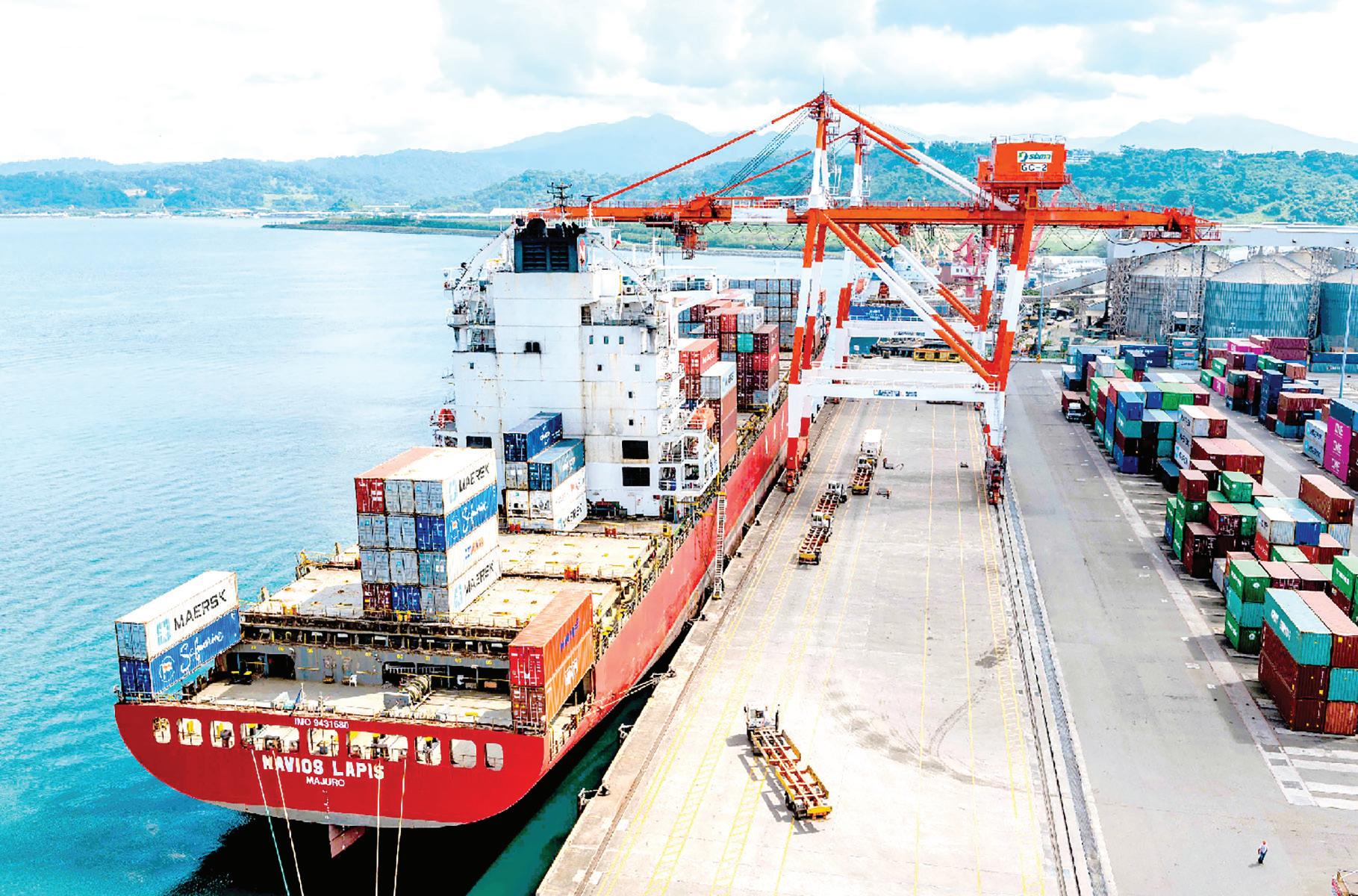
WFH boost gives IT-BPM cost relief
By Bless Aubrey Ogerio @blessogerio
THE Philippines’s IT and business process management (IT-BPM) industry is expected to get immediate operational relief following the government’s approval of expanded work-from-home (WFH) arrangements for registered firms, easing pressure from rising fuel costs and daily commuting expenses.
The IT & Business Process Association of the Philippines (IBPAP) welcomed the approval of up to 90 percent WFH flexibility for Registered Business Enterprises (RBEs) under Fiscal Incentives Review Board (FIRB) Resolution 005-2026,
calling it a timely response to current economic conditions.
The industry group said it had earlier proposed the measure to the Philippine Economic Zone Authority (PEZA) as a practical solution to help companies maintain operations while managing rising transport costs.
“This reflects how strong industry-government collaboration can translate into practical solutions for the IT-BPM sector’s evolving operational needs,” IBPAP president and chief executive officer Jack Madrid said.
The expanded arrangement allows firms to shift a significant portion of their workforce offsite, reducing the need for daily com-
muting at a time when fuel prices remain volatile.
IBPAP said the policy would help companies stay flexible while ensuring that employees, many of whom rely on public transport, are shielded from rising costs.
The group added that the measure also supports productivity and business continuity, allowing firms to sustain service delivery and meet client demands despite shifting operating conditions.
The move comes as the industry navigates a more uncertain environment, where cost pressures and global headwinds are testing its growth trajectory.
Earlier, IBPAP said the country’s position as a global IT-BPM hub will
depend less on past performance and more on how quickly policy adjustments can be implemented.
The sector remains one of the country’s largest employers, with around 1.9 million workers, and contributes about 8.2 percent to gross domestic product. It is projected to generate roughly $42 billion in revenues by the end of 2026. Despite near-term challenges, the industry is still aiming to meet its Roadmap 2028 target of $60 billion in revenues.
IBPAP said about 40 percent of future growth is expected to come from regional locations outside major urban centers, provided structural and regulatory constraints are addressed.
systems of all 10 member states via high-voltage transmission lines and subsea cables, enabling multilateral electricity trading, optimizing resource use, and integrating renewable energy sources such as hydropower and solar.
The Asean Interconnection Masterplan Study (AIMS III) has identified 18 priority projects, with eight already implemented, moving the bloc from bilateral exchanges toward a unified regional grid.
The TAGP, meanwhile, envisions a 4,500-kilometer network of natural gas pipelines and LNG “virtual pipelines” linking Asean’s major production fields to consumption centers.
With 13 bilateral connections already operational, the project is designed to balance supply and demand, enhance energy security, and reduce reliance on external imports.
Share rice in shortage, secure fertilizer FOREIGN ministers also discussed the crisis’s impact on food systems.
To improve resilience, Asean will enhance efforts to share information on supply disruptions, price movements, and policy responses.
Lazaro said ministers are “com-
mitted” to continue supporting existing agreements such as the Asean Plus Three Emergency Rice Reserve (Apterr) and the Asean Food Security Information System (Afsis). Apterr, an agreement between Asean, China, Japan, and South Korea, targets a reserve of 5–6 million tons of rice for rapid humanitarian response to disasters, shortages, or crises. It was operationalized last year in Cambodia and Laos. AFSiS, meanwhile, provides a platform for data-sharing, workshops, and advanced forecasting tools on rice and other commodities.
Ministers also agreed to explore joint approaches to securing fertilizer and other critical agricultural inputs, including a possible standby arrangement for food security and pharmaceutical products.
Coordinated response
THE meeting reiterated the importance of convening a Joint Asean Foreign Ministers’ Meeting (AMM) and Asean Economic Ministers’ Meeting (AEM) to address interconnected issues requiring crosssector coordination.
Ministers also expressed urgency in holding a special session of Asean
See “Asean,” A2
SBMA to halt new port fees, cut charges to stabilize costs
By Henry Empeño
UBIC BAY FREEPORT—
SThe Subic Bay Metropolitan Authority (SBMA) has announced a 5-percent reduction in tariff and cargo charges, as well as the suspension of new port-related fee increases, to help stabilize costs for the transportation and food sectors.
SBMA Chairman and Administrator Eduardo Jose L. Aliño said the cost-stabilizing measures will be temporarily implemented amid surging fuel prices and global trade disruption caused by the Middle East conflict.
The 5-percent tariff reduction will apply to charges on all commercial vessels, including harbor fees, berthing and anchorage fees, and harbor cleaning fees, and cargo charges like wharfage and storage fees, Aliño said in a statement on Tuesday, April 14.
He added the SBMA will reduce by 5 percent the agency shares in pilotage fee, tugboat services, line handling services, water tendering, bunkering services, hauling service, heavy equipment rental, chandling services, and cargo handling for containerized cargo.
At the same time, the SBMA will provide additional two days of free storage for non-containerized cargo. This will extend free storage for import cargoes from 10 days to 12 days; seven to nine days for export cargo; 10 to 12 days for transshipment; and two to four days for domestic cargo.
Under the strategic cost-stabilizing program, Aliño said the SBMA will also suspend the implementation of new policies for the following: collection of SBMA share from terminal operators and cargo handlers for liquid bulk cargo handling; implementation of 1-percent admission fee for liquid bulk; and implementation of a 10-percent increase on cargo handling and miscellaneous charges for noncontainerized cargoes.
“These initiatives, including reduced fees and extended free storage, provide a fiscal cushion
to reinforce investor confidence and prevent supply chain bottlenecks,” said Aliño. He said the measures will result in a cascading effect throughout the supply chain that will benefit port stakeholders like importers, suppliers, consignees, vessel owners, and consumers, as well as their respective counterparts in terminal operation, cargo handling, brokerage and consolidation, processing and ship management, as well as shipping. Aliño said the measures will take effect immediately upon approval and ratification by the SBMA Board of Directors. They will remain in force “until geopolitical tensions subside, at which point they shall be lifted via formal issuance by the Board,” he added.
SBMA Senior Deputy Administrator for Port Operations Ronnie Yambao, meanwhile, said the tariff reduction and other relief measures would provide financial relief to port stakeholders to the tune of P76 million in a oneyear period. Approximately P49 million will be saved through direct tariff reductions, Yambao said. The suspension of policies for fee increases, meanwhile, will save P25 million, and the extension of free storage periods will save P2 million, he added.
SBMA officials said in early April that the agency’s port operations revenue increased by 13 percent early this year due to a 47-percent surge in grains and petroleum products imported through the Port of Subic. They said the growth in SBMA’s port income reflected increased imports of rice, which grew by 484 percent, corn by 230 percent, wheat by 48 percent, soya by 3 percent, and petroleum products by 46 percent. These directly increased the agency’s share from port operations by 52 percent. Last year, SBMA’s port operations generated revenues totaling P1.77 billion, a 4.2 percent increase over the total collections of P1.7 billion recorded in 2024.
Editor: Jennifer A. Ng
Cebu Landmasters earnings nearly flat as revenues slide

By VG Cabuag @villygc
REGIONAL property developer Cebu
Landmasters Inc. (CLI) on Tuesday said its income last year was nearly flat at P4.03 billion, compared with the P3.99 billion recorded in 2024, due to lower revenues.
Revenues reached P18.5 billion, down by 7 percent from the previous year’s P19.97 billion, partly due to the timing of project completions and revenue recognition. The company said, however, that it is seeing “steady construction progress” across developments.
With the exclusion of lot sales, CLI real estate sales and related finance income remained the main revenue driver, reaching P17.3 billion, up 10 percent from P15.8 billion during the previous year.
“Our record sales reflect a clear focus on building where demand is real and delivering on our commitments. Even through periods of volatility, we continue to deliver as
‘First
Lplanned and build developments that meet market needs and create lasting value for the communities we serve,” company COO Jose Franco Soberano said.
Reservation sales surged 45 percent to a record P24.6 billion from the previous P16.9 billion.
This growth is fueled by sustained enduser demand across key Visayas-Mindanao markets and the strong performance of new residential launches.
CLI advanced its expansion beyond Visayas and Mindanao, securing a 70-hectare landbank in Dasmariñas, Cavite. This marks a key milestone in its entry into the Luzon market while
continuing to deepen its presence in core VisMin markets.
Strong sales were backed by an active launch pipeline, with more than 4,500 residential units rolled out during the year, carrying a combined value of around P31.3 billion across Cebu, Cagayan de Oro, Palawan and General Santos.
Projects such as One Manresa Place in Cagayan de Oro and Casa Mira Homes Gensan saw strong take-up days after market launch, helping drive a 91 percent sell-out rate across completed, ongoing, and newly launched developments, underscoring firm end-user demand.
Recurring income streams, meanwhile, continued to expand, with revenues from hospitality, leasing and management fees rising 57 percent to P735 million from P467 million a year earlier.
Hotel revenues grew 79 percent to P431 million, supported by higher occupancy and an expanded room inventory of 797 rooms from 640.
Leasing revenues rose 40 percent to P227 million as gross leasable area increased to 71,000 square meters from 41,000, driven by newly operational commercial assets.
Gen deal has leadership clause’
OPEZ-LED First Gen Corp. on Tuesday confirmed that its P62-billion hydropower deal with Prime Infrastructure Capital Inc. (Prime Infra) includes change of management control provisions.
In its disclosure, the company said the clause takes effect during the construction period of the Wawa and Pakil Projects and until the first anniversary of their commercial operations date.
“These contractual arrangements were requested by Prime Infra and show the level of trust and confidence that Prime Infra has in FRL [Federico “Piki” R. Lopez] and his management team,” the company said in its disclosure.
First Gen said that if a change in management occurs, it would sell its shares in Prime Hydropower Energy Inc. (PHEI) at a discount.
The discount is 25 percent of the purchase price of the hydro projects amounting to approximately P15.5 billion.
“Additionally, if Prime Infra exercises its right described above, it may also cause First Gen to sell its remaining shares in the gas plants to Prime Infra at the same discount of 25 percent, amounting to approximately P8 billion,” First Gen said in its disclosure.
A change of management control will
occur if Piki or his designee is not the CEO of First Gen, or the members of the executive committee of First Gen cease to be designees of Piki.
Another instance is that Piki is not the proxy of First Gen entitled to vote all of First Gen’s shares in the hydro project companies or Piki is not a director of First Philippine Holdings Corp.
One other condition is when designees of Piki no longer constitute at least a majority of the members of the board of First Gen or if Piki or his designees are not First Gen directors in PHEI.
“A designee means a person whom FRL (Piki) confirms in writing to be acceptable to him to occupy the relevant positions described above,” the company said in its disclosure.
“With regard to updates on the acquisition of a 33-percent equity interest in PHEI, following our disclosures dated February 13, 2026 and March 6, 2026, the parties have executed the necessary documents for the assignment and subscription of shares in PHEI and its holding and operating companies for the Pakil and Wawa Projects.”
The Lopez majority questioned both the substance of the provision and the manner in which the transaction was presented.
MIn a previous statement, they said they were informed of the deal only during a board meeting where it was allegedly taken up under “other matters” and discussed in executive session.
They also said details of the provision have not been fully disclosed to them or to the broader investing public.
Records of the same meeting, however, show that the transaction had been presented to and unanimously approved by the board, with all directors in attendance, including Manuel “Beaver” Lopez, who raised no objection at the time.
Questions regarding the transaction were only raised days later.
Also present during the meeting were several independent directors, including former Socioeconomic Planning Secretary Cielito Habito; Manolo Michael De Guzman, senior advisor at KKR and president of Philippines Clean Energy Holding Inc.; Edgar Chua, former country chairman of the Shell companies in the Philippines; and Alicia Morales, managing director of John Clements Consultants Inc.
The issue comes amid an escalating dispute within the Lopez group. The Lopez Inc. board earlier voted, 5-2, to remove Piki Lopez for cause and for alleged loss of trust and confidence, as allowed under its by-laws. VG Cabuag and Lenie Lectura
MPower to sell electricity to Starbucks Precision tool maker invests in ecozone
THE Philippine Economic Zone Authority
(Peza) has formalized the registration of Dream Precision Tech Corp. as an export enterprise, marking a new manufacturing investment in Batangas aimed at supplying precision components to global industries.
The Registration Agreement, signed last March 30, covers the company’s planned operations at the Lima Technology Center-Special Economic Zone (LTC-SEZ).
Carrying a total investment of P100 million, the Dream Precision Tech will manufacture, process, and sell a range of precision tools and metal products. These are expected to serve multiple sectors, including semiconductors, automotive, optical and medical devices, and industrial machinery.
The company’s output is also seen supporting emerging and specialized industries such as hydrogen energy systems, automation equipment and power generation. Bless Aubrey Ogerio
B1
April 15, 2026
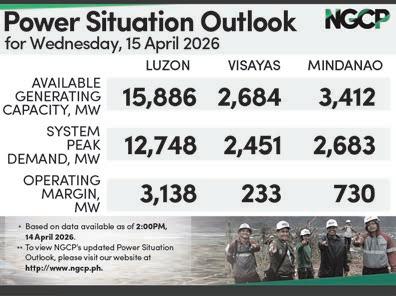
Grab to accelerate electrification push
SUPER app Grab Philippines has launched the Eco-Drive Initiative, a multi-stakeholder coalition aimed at helping transport network vehicle service (TNVS) driver-partners transition to electric and hybrid vehicles through preferential financing and exclusive vehicle discounts.
Eco-Drive organizes partners across three pillars: banking, automotive, and platform support.
On the financial side, BDO Unibank and Bank of the Philippine Islands (BPI) will offer preferential “green” auto loan packages that are structurally more competitive than standard vehicle financing.
Banks retain full and independent control over credit decisions, but Grab will share—with driver consent—verified earnings history, platform tenure, and service ratings as supplementary data to support faster loan processing.
On the automotive side, manufacturers Toyota, BYD, GAC, Dongfeng, Omoda, and Jaecoo, alongside dealer Autohub Group (Suzuki, Kia, MG) and distributor QSJ Motors Philippines (Bestune), have committed to exclusive discounts for Grab driver-partners on qualifying EV and hybrid models within agreed promotional periods.
Grab itself is offering drivers the option of daily installment repayments through
the Grab Driver Wallet—designed to match irregular earning rhythms rather than forcing a monthly lump-sum payment. Drivers who prefer conventional monthly repayment may arrange that directly with their bank.
“Rising fuel costs are eating into driver earnings every single day,” said Gines Barot, Grab Philippines General Manager for GrabCar and Fleet Solutions. “This coalition is designed to protect those earnings by lowering the cost of vehicle ownership and removing the financing barriers that have kept fleet electrification out of reach.”
The initiative replaces a traditionally fragmented financing process with a three-step system.
Grab first identifies driver-partners whose vehicles are nearing the end of their service life or existing loan terms, then reaches out with personalized options. Drivers can apply through a digital express form or at dedicated Express Lanes in Grab Driver Centers. Upon approval, they choose between daily wallet-based installments or traditional monthly payments.
Barot said Grab is working with partners to explore trade-in options for outgoing internal combustion engine vehicles and to eventually extend the program’s benefits beyond topperforming drivers. Lorenz S. Marasigan


By Lenie Lectura @llectura
POWER , the local retail electricity supplier of the Manila Electric Co. (Meralco), has been chosen by Rustan Coffee Corporation (RCOC) to supply power to 60 Starbucks branches across Metro Manila.
RCOC is the authorized licensee of Starbucks in the Philippines. Its partnership with MPower consolidates 60 stores with a combined demand of over 3 megawatts (MW) under the Retail Aggregation Program (RAP), enabling operational efficiencies for the coffee chain while supporting the company’s broader business and sustainability objectives.
“In today’s evolving business environment, it is important for companies like ours to continue exploring ways to operate more efficiently. Since transitioning, we have begun to see initial savings in our electricity costs,” RCOC President Noey Lopez said during the ceremonial signing of the agreement with MPower.
This initiative complements RCOC’s ongoing in-store practices, including water-saving fixtures, 100 percent LED lighting, energy-efficient air-conditioning systems, and improved waste management.
Meralco Senior Vice President and Head of MPower Redel Domingo, meanwhile,

pledged full support to RCOC’s decision to be part of the competitive retail market.
“By pioneering RAP within the food and beverage sector, it demonstrates how businesses with multiple facilities can access the benefits of the Retail Competition and Open Access (RCOA) framework.”
Last February, Meralco reported that it posted a record net income of P51.13 billion in 2025, 11 percent higher than the P45.86 billion recorded in 2024, driven by the strong performance of its distribution and generation businesses.
“Meralco had another record year in 2025, marked by a double-digit growth in our CCNI [consolidated core net income] and full-year profit that surpassed our target,” said Meralco Chairman Manuel V. Pangilinan.
At end-2025, Meralco also posted a 12-percent increase in its CCNI to P50.6 billion from P45.1 billion. Revenues went up 6 percent to P497.32 billion last year from P470.36 billion in 2024.

Pressure on peso eases on war talks
By Andrea Louise San Juan
THE Philippine peso rallied from its two-day losing streak against the dollar last Tuesday after Washington and Tehran signaled another round of negotiations for a longer-term ceasefire.
Data from the Bankers Association of the Philippines (BAP) showed the local currency closed at P59.87 after opening at P59.88 to the greenback on April 14. The rate is stronger by 26 centavos than the peso’s previous finish of P60.135 on April 13.
Michael L. Ricafort, chief economist at Rizal Commercial Banking Corp. (RCBC), explained the peso toughened up after reports the United States and Iran may hold another round of face-to-face negotiations before a 2-week ceasefire expires.
Within the trading session, the peso hit its strongest level at P59.74 and its weakest at P59.93.
Prior to sliding back to the 59-level last Tuesday, the local currency weakened for two straight days on the back of renewed geopolitical risks after failed talks between the United States and Iran.
However, Ricafort said he sees the blockage at the Strait of Hormuz by US forces “could potentially increase tensions with Iran and could potentially jeopardize/threaten the fragile 2-week ceasefire.”
Domini S. Velasquez, China Banking Corp.’s Group Chief Economist, earlier explained that the local currency’s weakness was largely sentiment-driven, adding that “a more fundamental exchange rate will emerge as geopolitical tensions reach a clearer resolution.”
The peso hit its weakest level on March 31 when it closed at P60.748 against the dollar.
briefs
➔ AMLC has new director
THE Anti-Money Laundering Council (AMLC) announced last Tuesday the appointment of Ronel U. Buenaventura as its new Executive Director effective April 14. In a statement, AMLC said Buenaventura previously served as Acting Deputy Director of the Commitments and Policy Group of the AMLC Secretariat. He is considered to having “played a key role” in securing the country’s exit from the Financial Action Task Force Greylist. Buenaventura was also Acting Legal Officer IV of the Office of the General Counsel and Legal Services at the Bangko Sentral ng Pilipinas (BSP). He holds a Master of Corporate Law degree from the University of Cambridge, graduating with First Class Honors, and a Master of Arts in Philosophy from the University of the Philippines in Diliman. Andrea Louise San Juan
➔ Chinabank bags award
THE Sy family-led China Banking Corp. announced receiving an award for “Human Capital Management Innovation and Implementation” at the recent “People Matters InfiniT Awards SEA 2026” in Singapore. The award is in recognition “of the bank’s digital transformation of its human resources ecosystem through SyncHROne, which it developed in partnership with Darwinbox and launched last year,” read a statement issued by the company. The artificial intelligence-powered, mobile-enabled SyncHROne streamlines HR operations and enhances employee engagement and productivity, it added. VG Cabuag
Banking&Finance
₧0.51B losses a month seen on tax pause

By Reine Juvierre Alberto @reine_alberto
THE suspension of excise taxes imposed on kerosene and liquefied petroleum gas (LPG) will result in a revenue loss of P510 million per month for the Bureau of Customs (BOC).
While this will “hurt” the BOC’s collection, Customs Commissioner Ariel F. Nepomuceno said the agency will fully support and abide by the President’s order.
President Ferdinand R. Marcos Jr. exercised his power of suspending the excise taxes levied on kerosene and LPG under Republic Act (RA) 12316, which takes effect on April 14. (See: https://businessmirror. com.ph/2026/04/14/marcoshalts-excise-tax-on-lpg-cuts-toll-
in-fish-ports/)
Nepomuceno said the suspension will result in a revenue loss of P500 million per month from LPG and P10 million per month from kerosene.
According to RA 12316, the suspension will last for a maximum of three months per implementation, but the total suspension cannot exceed one year in a calendar year.
The suspension will be lifted once the one-month oil price average drops below $80 per barrel or when
the three-month limit is reached. The President can exercise his authority only until December 31, 2028.
“The President wants to cushion the impact. We just have to support that,” Nepomuceno said. “We’re just hoping that our collection surplus, our reserves of almost P3 billion, will not be depleted,” he added.
The BOC managed to post a P2.994-billion surplus in the first quarter of the year after exceeding its collection target of P236.060 billion by 1.3 percent.
Despite the loss, Marcos said the suspension of excise tax on LPG will result in savings of P3.36 per kilo or almost P37 per tank. As for kerosene, the suspension is expected to reduce its price by P5.65 per liter.
Nepomuceno remains optimistic that the BOC will still be able to hit its P1.003-trillion revenue target for the year, even if the excise tax suspension will have a “big” impact on its collections.
As of March 2026, the BOC has collected P54.105 million in excise
Financial resources’ growth to moderate
THE total resources held by the Philippine financial system may see a “more cautious” growth amid geopolitical tensions, higher inflation and weaker growth momentum.
“Growth in total resources is likely to remain positive but may moderate. Geopolitical tensions, higher inflation, and slower growth can dampen credit demand and asset expansion, while also increasing risk aversion,” Philippine Institute for Development Studies (PIDS) Senior Research Fellow John Paolo R. Rivera told the BusinessMirror last Tuesday.
Still, Rivera said the financial system remains “broadly stable” adding he expects “continued but more cautious growth rather than a reversal.”
Jonathan L. Ravelas, senior adviser at Reyes Tacandong & Co. said geopolitical risks, inflation and softer growth mean banks and non-bank financial institutions (NBFIs) will stay conservative—favoring quality borrowers and liquid assets.
Experts raised these even after data from the Bangko Sentral ng Pilipinas (BSP) showed that combined funds and assets of banks (excluding those held by the BSP) and non-bank financial institutions (NBFIs) increased by 9.16 percent to P36.784 trillion as of end of Febru-
Strong
ary 2026, from P33.696 trillion in February 2025.
According to Ravelas, “total resources grew to nearly P37 trillion because liquidity stayed inside the system—deposit growth remained strong, lending continued but was selective, higher interest rates boosted bank earnings, and NBFIs attracted steady inflows as Filipinos looked for safer, inflation-beating options.”
Looking ahead, he noted that growth in financial resources will “likely moderate, not reverse.”
While banks and NBFIs are seen to stay conservative, he said the system remains “well-capitalized and domestically funded, so liquidity stays ample.”
“In short, the financial sector is playing defense, but from a position of strength—and that’s a good starting point for the next upcycle once conditions stabilize,” added Ravelas.
Rivera said the growth in the total resources of the financial system in February 2026 is supported by “still resilient domestic demand, financial deepening, and increased intermediation as more funds flow through the formal financial system.”
Michael L. Ricafort, chief economist at Rizal Commercial Banking Corp. (RCBC) said the growth in total resources “could again be largely
investor demand marked T-bonds auction
THE Bureau of the Treasury (BTr) made a full award of 5-year Treasury bonds (Tbonds) despite investors demanding higher returns amid “higher-forlonger” domestic and global risks.
At Tuesday’s auction, the government decided to award the full P30 billion offered by the Treasury, backed by strong investor demand.
The auction was 2.3 times oversubscribed, with tenders for the securities totaling P70.365 billion.
Yields accepted by the Treasury’s auction committee ranged from as low as 6.293 percent to as high as 6.329 percent.
The average annual rate rose by 61.1 basis points to 6.328 percent from the previous auction rate of 5.717 percent posted last March 3, 2026.
However, this is lower than the secondary market rates under the Bloomberg Valuation Service (BVAL) at 6.414 percent for the same tenor.
The T-bonds bore a coupon rate of 8 percent, with a remaining life of five years and three months.
According to Jonathan L. Ravelas, senior adviser at Reyes Tacandong & Co., T-bond yields edged higher as the market prices in global and domestic “higher-for-
longer risks.”
“US yields are up, inflation uncertainty remains, and investors want a bit more cushion before locking in money for five years,” Ravelas said.
While the strong oversubscription reveals that there is liquidity in the market, Ravelas said buyers are simply more disciplined on price.
“This looks like a healthy repricing, not a loss of confidence.”
Michael L. Ricafort, chief economist at Rizal Commercial Banking Corp., said the demand indicates strong market appetite to lock in relatively high yields before they decline.
The Treasury has yet to auction off 7-year and 10-year tenor T-bonds this month to meet the government’s domestic borrowing requirement of P248 billion. This will be raised through the issuance of T-bonds and Treasury bills.
This year, the government will borrow P2.682 trillion, with a 77:23 financing mix favoring domestic sources.
The national government’s outstanding debt rose to P18.159 trillion as of the end of February 2026, higher by 0.14 percent than the P18.133 trillion recorded a month ago. Reine Juvierre S. Alberto
taxes from kerosene and P1.767 billion from LPG, its data showed.
Go: Relief focused on most vulnerable
IN a separate statement on Tuesday, Finance Secretary Frederick D. Go said the tax suspension is focused on the most vulnerable since nearly half of total kerosene consumption is is attributed to the bottom 30 percent of households, while a majority of LPG users come from the bottom 70 percent.
“This means the benefits extend beyond the poorest households to also support middle-income families. For these families, every peso saved on fuel costs means more resources for food, education, and healthcare,” Go said.
Suspending excise taxes on diesel and gasoline “would not likely provide meaningful relief,” Go said, noting the Cabinet-level Development Budget Coordination Committee’s (DBCC) recommendation to the President.
Go said the reduction in retail
driven by banks, consistent with the continued growth in bank loans… amid the total decline in BSP policy rates by 2.25 percentage points since August 2024 and the total Fed rate cuts of 1.75 percentage points since September 2024 that reduced borrowing costs/financing costs.”
BSP data showed banks accounted for the bulk, or 83.07 percent of total resources, while NBFIs held the remaining 16.93 percent.
Resources held by banks climbed 10 percent to P30.558 trillion from P27.781 trillion in February 2025.
Broken down, universal and commercial banks (UKBs) continued to dominate the sector, holding 92.74 percent of total banking resources, or P28.344 trillion. This is higher by 9.17 percent from P25.963 trillion as of February 2025.
Thrift banks accounted for 4.81 percent of all resources in Philippine banks, at P1.469 trillion, posting a 26.20-percent increase from the P1.163 trillion recorded in the same period in 2025.
Resources of rural and cooperative banks also grew 7.19 percent to P565 billion as of February 2026, representing 1.85 percent of the banking system’s assets, from P527.1 billion in the same period in 2025.
Andrea Louise San Juan
pump prices would be “marginal” and largely offset by prevailing market dynamics.
“The DBCC will continue to closely monitor global oil market developments and stands ready to adjust its policy response as needed,” he said.
“At its core, this decision is about protecting Filipino families today, while safeguarding our fiscal stability for future generations,” he added.
Sources from BOC told BusinessMirror that the government stands to lose P12.7 billion every month if excise taxes on diesel and gasoline are suspended.
A P5.9-billion loss would come from diesel excise taxes, while P6.8 billion would come from gasoline.
“That’s an economic decision that we will follow and support,” Nepomuceno said, although the loss will be more significant.
Data obtained by BusinessMirror showed the BOC has collected P18.194 billion from diesel and P23.696 billion from gasoline as of April 13.
Importer accreditation made valid for 3 years
THE Bureau of Customs (BOC) has extended the validity of importer accreditation to three years and reduced accreditation costs for importers, in the government’s bid to reduce red tape and strengthen trade competitiveness.
Customs Administrative Order (CAO) 01-2026 extends the validity to three years to cut repetitive requirements and enhance overall transaction efficiency for businesses and stakeholders. The accreditation fee has been lowered from P2,000 annually to a one-time payment of P5,000 covering three years.
The BOC will also allow automatic renewal for importers with at least six consecutive years of good standing, as well as those enrolled under the Authorized Economic Operator and Super Green Lane programs.
Before the circular, importers had to renew the accreditation yearly. The rule requires repeated submissions and compliance procedures that resulted in delays, higher administrative costs and added burden for importers.
“We listened to our stakeholders and the public, and we acted. We are removing unnecessary burdens on compliant importers while strengthening our systems to ensure transparency
and fairness,” Customs Commissioner Ariel F. Nepomuceno was quoted in a statement as saying.
The reform complements existing policies, including CAO 5-2019, which grants customs brokers a three-year registration validity, aligning accreditation frameworks across key players and promoting a more streamlined regulatory environment.
On the part of importers, they are required to submit an Annual Reportorial Compliance within 30 days from their accreditation anniversary to ensure accountability and continuous compliance. Non-compliance may result in suspension or revocation. Renewal applications with complete documents will be processed through the Customer Care Portal System within seven working days.
“By extending the validity of importer accreditation, we are reducing red tape and enabling a more efficient trade system that can meet growing consumer demand and support local industries,” Secretary Go was quoted as saying.
The CAO will take effect fifteen days after its complete publication in the Official Gazette or in a newspaper of general circulation.
Reine Juvierre S. Alberto
SEC to resume licensing of lending firms
movements.
TBy Rizal Raoul S. Reyes @brownindio
HE chief of the Securities and Exchange Commission (SEC) announced last Tuesday may ease its strong-fist approach against predatory lenders as the regulator continues to grapple with a “trust crisis.”
Speaking at a recent forum organized by the Consumer Lending Association of the Philippines (CLAP), SEC Commissioner Rogelio V. Quevedo said the regulator plans to lift the long-standing moratorium on the licensing of financing and lending companies said it is set to before the second semester of the year, marking a pivotal shift toward “compassionate regulation” and enhanced digital security.
However, Quevedo emphasized that while the commission aims to foster innovation, it must aggressively address a “growing trust crisis” fueled by sophisticated financial scams. The moratorium, in place since 2021 as a stop-gap measure to curb predatory lending, was originally targeted for lifting last year. Quevedo noted that the SEC is now integrating extensive industry feedback into a revised Memorandum Circular.
“The latest deadline I mandated was April 1,” Quevedo said. “We are now integrating comments made by the industry to the SEC memorandum... that I hope will finally be released before the second semester
of this year.” The revised guidelines will likely introduce a tiered licensing system based on capitalization and territorial jurisdiction:
Brick-and-mortar
ACCORDING to Quevedo, companies with P1-million capitalization may be limited to “brick-and-mortar” operations at the barangay or municipal level.
For firms seeking to operate online lending platforms (OLPs), he said it will face higher capitalization requirements and a cap on the number of platforms—likely limited to three per corporation—to prevent the proliferation of “copycat” apps.
Quevedo warned that fraudsters have moved beyond victimizing the “poorest of the poor” and are now aggressively targeting the Filipino middle class. He identified several emerging threats:
He also warned the public of the reemergence of phoenix scams operators who shut down after enforcement actions only to re-emerge under new identities.
Quevedo said scammers are also using sophisticated tactics such as biometric scooping and social engineering where victims are manipulated into compromising their own accounts or providing voice recordings that can be used to authorize fraudulent transactions.
The SEC chief added they see a rising trend where legitimate accounts are hijacked for illicit fund
In Singapore, almost 50 percent of total crime involves financial scams, Quevedo noted, highlighting that a high level of financial literacy does not provide total immunity from criminals.
Socmed platforms
QUEVEDO, a former chief legal counsel of the PLDT Group, issued a stern warning to multinational companies operating the Google, TikTok, and Facebook platforms. He asserts the presence of these platforms in the Philippine advertising market subjects them to local regulation. Between 2023 and March this year, the SEC successfully removed over 500 unregistered OLPs from major app stores and social media platforms. However, Quevedo criticized the “alibi” that these companies are based abroad.
“We will not allow the likes of Facebook to continue doing business in the Philippines if they will not help us contain the proliferation of these unregistered OLPs,” he said. He added that the SEC is prepared to order takedowns of any platform used as a conduit for unfair collection practices. Quevedo also revealed that the SEC is also pushing for a “whole-ofecosystem” approach. He expressed a willingness to eventually transfer the oversight of financing and lending companies to the Bangko Sentral ng Pilipinas to create a more unified credit ecosystem.
PHOTO BY DYLAN GILLIS ON UNSPLASH
Calm confidence in crowded corridors

IHAVE always been introverted, but that changed when I stepped into the role of a teacher and later a corporate trainer. Facing a classroom and then a room full of professionals required constant interaction, quick thinking, and sustained presence. At first, it felt unnatural, yet over time it became a skill I could handle. Still, no matter how confident I grew, the need to recharge never disappeared. That journey taught me an essential lesson. You can meet social demands without losing yourself if you learn to manage your energy with care and intention. Even with that understanding, the challenge remains in everyday professional settings. You walk into a meeting already feeling half drained, even before a word is spoken. The room fills with quick exchanges, overlapping ideas, and constant eye contact. You listen well and think deeply, yet by the end you feel spent while others seem energized. If this sounds familiar, you are not alone. Managing introversion at work is not about changing who you are. It is about recognizing how your energy flows and learning to use it wisely.
Introversion is often misunderstood as shyness or lack of confidence. In reality, it is about how you gain and lose energy. You recharge in quieter spaces and through reflection, while busy and highly social environments can deplete you. Workplaces, however, often reward constant interaction. This creates a ten-

rather than resistance.
One practical way to manage your energy is to plan your social effort with the same care you give your tasks. Before a meeting or event, take a few minutes to prepare not only your talking points but also your mindset. Ask yourself what role you want to play. You do not need to dominate the room. You can aim to contribute one or two thoughtful insights that add value. This shifts the goal from quantity to quality, which aligns better with your natural strengths. You can also structure your day to protect your energy. If you know you have a series of meetings, try to schedule a buffer period afterward. Even 10 minutes of quiet can help you reset. Step outside, take a short walk, or sit in silence without checking your phone.
your energy from dropping too low.
Another useful approach is to create intentional one-on-one interactions. Large group settings can feel overwhelming, but smaller conversations often allow you to connect more deeply. Instead of forcing yourself to network in a crowded room, follow-up with a colleague later for coffee or a short chat. This allows you to build relationships in a way that feels natural and sustainable.
You may also need to communicate your working style with clarity and confidence. This does not mean labeling yourself in a limiting way. It means expressing what helps you perform at your best. For example,
Top hospital explains the factors that affect how often you go to the bathroom
ITS official term is micturition, but to us it’s simply urinating or peeing, a natural and necessary function of a healthy human body. “Urination helps cleanse the body of toxins, excess sodium and fluid, and metabolic waste,” says Rolando Guillermo O. Saulog, MD, a urology doctor at the country’s top hospital Makati Medical Center (MakatiMed, www. makatimed.net.ph).
On average, a person pees between 6 to 7 times a day, but if you are taking more (or less) trips to the bathroom, there’s no real need to worry. “If you go only four times in a 24-hour span, it is fine. And if you go 10 times, that’s okay too.” According to Saulog, the number of times you urinate per day depends on the following factors: ■ AGE. “As we grow older, our bladder (which stores

our visits to the bathroom more frequent. Menopause and the decreasing production of the estrogen hormone can also affect bladder function.”
■ WHAT AND HOW MUCH YOU DRINK. “Alcohol and caffeine are forms of diuretics, which prompt the kidneys to release extra fluid from the blood vessels. Consume copious amounts of coffee, tea, beer, or wine, and you can expect to spend a lot of time in the toilet.”
■ PREGNANCY. “Mothers-to-be can chalk up peeing often to hormonal changes (an increase of progesterone relaxes the muscles, including those in the bladder), extra fluid and blood produced by the body, and weakened pelvic floor muscles due to an expanding uterus.”
■ SPECIFIC MEDICAL CONDITIONS. “If you need to urinate often, only yield small amounts each time, you may have a urinary tract infection (UTI). Diabetes can also cause you to urinate frequently, as it is the body’s way of emptying the bloodstream of excess sugar. Low potassium, too much or too little calcium, an enlarged prostate, congestive heart failure, painful bladder syndrome, and kidney issues can also make you visit the bathroom several times.”
■ MEDICINES. “Diuretics in pill form are given to individuals with high blood pressure, heart failure, edema, kidney disease, and liver disease. Certain medicines for diabetes and mental health can also make you pee more than average.”
■ BLADDER SIZE. “A man’s bladder can hold as much as 700 ml of urine, while a woman’s bladder can store about 500 ml.”
On the flip side, MakatiMed says that oliguria or urinating only 1-2 times in 24 hours (that’s peeing less than 400-500 ml a day) could be due to dehydration, blockages in the

urinary tract, or infection.
When should you see your doctor? “Definitely when your peeing includes pain or a burning sensation, or when pain is felt in your lower back, pelvis, or genitals,” says Saulog. “Blood in the urine is also a cause for concern, as is incontinence or difficulty controlling your pee.”
Other signs that a consultation with a health practitioner is in order: urine that is cloudy, dark, and foul-smelling.
Tests help pinpoint the cause of your tendency to pee often or not enough. Results from a urinalysis will give your doctor an idea of the color, appearance, and microscopic contents of your sample. A kidney functioning test, which relies on a blood test and urine sample, can gauge how well your kidneys are working.
Imaging tests (x-ray, ultrasound, MRI, CT scan) will reveal if peeing too much or too little comes from a pre-existing or newly discovered medical condition. A uroflowmetry test (available in MakatiMed) is a simple, non-invasive test used to evaluate how the bladder is working, often to detect why a patient has frequent or urge to urinate, a weak or slow urinary stream, difficulty starting urination, or a feeling that the bladder is not empty after urinating.
“Healthy living ensures efficient and natural urination,” reminds Saulog. “Stay hydrated. Eat fruits and vegetables and foods rich in probiotics; they may help address recurring UTI. Avoid too much caffeine and alcohol. Pee and cleanse using an unscented soap after sexual intercourse to lower your risk of developing UTI. Women can also reduce the risk of UTI by wiping from front to back after peeing.”
“Most important: Do not hold back your pee. Go when you feel like it.”
By Eugenia Last

VIRGO (Aug. 23-Sept. 22): Get physical and fit. Join a gym, or sign up for an activity that will get you moving. Take pride in how you present yourself to others, and you’ll attract plenty of interesting suggestions and offers. Invest more time and money into what makes you happy. You have more choices than you realize. ★★★
LIBRA (Sept. 23-Oct. 22): You’ll gain insight into what’s available and how to take advantage of a situation that offers financial stability. A change of plans will favor you, and using your negotiating skills to get ahead will turn into a selling feature for those who want to pursue your talents. A relationship with someone special will offer long-term benefits. ★★★
SCORPIO (Oct. 23-Nov. 21): Engage in events that give you a platform to show your attributes. Stepping out, speaking up and physically taking control of whatever situation you face will pay off. Do your thing, take note of how others respond and set up meetings that will help you complete your purpose. Physical improvements will attract attention, and romance is favored. ★★★
SAGITTARIUS (Nov. 22-Dec. 21): Pull in the reins when it comes to spending on others or on pricey entertainment. Invest your money in something that has room to grow and will add to your comfort or enhance your skills. A positive change is heading your way, and the interactions you encounter will be the stepping stones to reaching your goals. ★★★★★
CAPRICORN (Dec. 22-Jan. 19): Stop, look, listen and be hesitant to buy into something you know little about. Misinformation, poor choices and following someone else instead of taking the path that suits your needs and budget will determine how far you get. Rely on yourself, not others, and adjust as you go to further your plans. ★★
AQUARIUS (Jan. 20-Feb. 18): Embrace change; put your energy toward meeting new people, changing your surroundings and setting up a routine that is cost-efficient, leads to greater opportunities and a unique approach to how you earn your keep and handle your finances. Let the journey begin, and past lessons and experiences lead you to a bright future. ★★★
PISCES (Feb. 19-March 20): Be secretive regarding any changes you want to implement. Put everything in place before you share or demonstrate your plans. Social and networking events will turn into a platform to advance your agenda and

www.businessmirror.com.ph

RELATIONSHIP CONFUSION
THE starlet is in a pickle. She can’t say that her yearslong relationship ended because she never admitted she was in one. She also can’t tell people she fell in love with someone else because she always said she was never in love and that the guy, her constant companion, was just a suitor. Now, people suspect that she cheated on him with a guy she met only recently and they are always together. This new guy was also at her recent birthday celebration, during which her “suitor” was also present. Meanwhile, the suitor can’t say anything because he and the starlet became a couple while she was still a minor.
ACTOR DOES IT AGAIN
SPEAKING of minors in a relationship, the actor is under fire for living in with a minor and allegedly getting her pregnant. The worst rumor about this relationship is that he allegedly made the girl get an abortion. Being with minors is nothing new to the guy. His past relationship was with a minor and it lasted for over nearly 10 years. Another reason why the actor is under fire is that the new girlfriend was spotted wearing a necklace given to him by his fans.
NO TO LOVETEAMS
SO the big project that would supposedly co-star the two young stars from a very successful reality show has been “adjusted” because the young female star does not want to work with the guy, who will be replaced. The guy will be given another project. Another project involving them was also rewritten so that they will be friends and not love interests. Many are wondering why the female young star seems so disinterested in the guy. One, she does not want loveteam fans who will be so fanatic that they will fight anyone. Two, the girl is young but the guy is young and immature and there’s nothing wrong with it. They’re just acting their age and shouldn’t be forced to act like adults. Right now, the girl is not interested in love, just her career. The guy is mildly interested in someone but she already has a boyfriend.
INVESTMENT
Show BusinessMirror

‘Severance’ executive producer Nicholas Weinstock encourages Filipino filmmakers
AMERICAN author and producer Nicholas Weinstock, executive producer of the Emmy Award-winning series shared insider insights and choice tips with aspiring Filipino filmmakers.
The masterclass was organized by the Directors’ Guild of the Philippines Inc. (DGPI), the Film Academy of the Philippines (FAP), and the De La Salle-College of Saint Benilde (DLS-CSB) at the Design + Arts Campus to bridge the academe and industry through meaningful dialogues and exchanges.
The participants, which included film practitioners and film students from different schools, colleges and universities, were equipped with an overview of best practices, real-world demands, requirements, and expectations.
FILIPINO celebrities attending a recent big event overseas seem to point to one thing: They want to be noticed by international brands so they’ll be included in future invites. The thing is that you need to be in the calendar, meaning if brands search for hashtags in the future, your account should be there. It’s actually a smart move that involves tens of thousands of dollars but this investment could pay off in the long run because international brands have unlimited budgets when it comes to events like this one.
Calm confidence in crowded corridors
Continued from B4
you can say that you do your best thinking when given time to reflect before responding. This encourages others to give you space to contribute meaningfully rather than expecting immediate answers.
It is equally important to challenge the belief that being quieter means being less capable. Your ability to listen carefully, observe patterns, and think before speaking is a strength in any professional setting. When you trust this, you stop trying to match the energy of others and start bringing your own steady presence into the room. There will still be moments when you feel stretched. During a long event or a demanding day, learn to pace yourself. You can step out briefly if needed or shift your focus from constant engagement to attentive listening. Give yourself permission to conserve energy without guilt. You are not withdrawing. You are managing your capacity so you can stay effective.
Preparation can also reduce the drain of social situations. If you anticipate a high-energy interaction, think of a few questions or topics in advance. This removes the pressure of coming up with responses on the spot. When you have a mental guide, you can participate with more ease and less fatigue.
Finally, end your day with a deliberate recharge ritual. This could be time alone with a book, a quiet meal, or a simple activity that helps you unwind. Treat this as essential, not optional. Just as your work requires effort, your energy requires care. Managing introversion in professional settings is not about becoming more extroverted. It is about working with your natural rhythm rather than against it. When you understand how your energy flows, you can show up with intention, contribute with depth, and build meaningful connections without exhausting yourself. In a world that often values constant noise, your quiet clarity can be a powerful advantage when you learn how to protect and direct it.
During the lively discussions, Weinstock walked the attendees through the business of development, plus the realities and perils of both production and post-production. He highlighted the significant role of film festivals for those who wish to branch out to international projects.
“I am a big advocate for going to as many film festivals as you can,” he said. “It is where you meet the world—the producers and the distributors you really want to work with.”

“If there is one happening in a place you can be, please go as a creative person,” he added. “You never know what is going to come out of it.”
He likewise noted how one’s attendance at these international events is an ideal platform to turn the spotlight on Filipino filmmakers and their works.
“We need more people to fall in love with Filipino filmmaking,” he stated. “At festivals, they are seeing sides of the Philippines they did not know existed.
And they are seeing great storytelling.”
The producer clarified nothing is too foreign when it comes to films, especially when it is done artistically and beautifully. He shared how he has made the most of his five-day of stay in the Philippines. Just a day before the talk, he attended a chicken fight tournament.
“The foreignness and the surprise will be an asset, and it will be fascinating,” he stated. “There is so much amazing cultural stuff to show. In a way, I’d say, the more foreign, the better. The more specific, the better. It is really interesting, colorful, impactful, and emotional—it is really exciting.”
With this in mind, he motivated young artists to create pieces which may put the Philippines on the global map. Think: Parasite by Bong Joon Ho. The blockbuster catapulted South Korea straight to the 2020 Academy Awards with four major Oscar wins.
“When you get the opportunity and the privilege to share your art with other people, you are doing
ambassadorial work,” he explained. “Your kids and grandkids would be proud that you represented the Philippines when you had the chance to do it.”
Weinstock admitted there is a challenge in distribution and revealed even high-end actors, writers, and directors still get “terrified” as nobody really knows what is going to sell. However, he stressed it is crucial to “get out into the world.”
“The real way you can do it, whether you are at a festival or sending it to a streamer, is to stand out from the pack,” he advised.
Weinstock championed the importance of unique concepts in this endeavor. It is not just about the budget, but what Filipino filmmakers can bring to the table. This can also be highlighted in the loglines, the one-to-two sentence summary. His tip: underscore what distinguishes the piece from the others. Quality, of course, remains star.
“Novelty, impact, originality, and freshness of the story—this is a really great way to get attention,” he stated. “Do not just say a ‘coming-of-age story’, but say what it’s about that’s never been seen before.”
The expert likewise acknowledged it is difficult to sell without the assistance of an agent. His recommendation is to reach out to possible executive producers, even big industry names or personalities, who can help promote the work.
“It is very hard to be a filmmaker, a writer, a
director, and just advocate for yourself,” he stated.
“You might be the most articulate salesperson in the world. You might be the most charming. But it is still the filmmaker begging and pleasing.”
“The expat Filipino community around the world, the diaspora of the Philippines, is so numerous and powerful. There are people from the Philippines all over who are filmmakers, actors, and actresses,” he added. “Tap a little bit of Filipino pride. Not everyone is going to say yes, but somebody is going to say yes.”
Weinstock likewise emphasized the power of multimedia and online platforms in this digital age. From film contests and distribution competitions to streaming websites, there are diverse options to just
He reiterated that while there is not much money in short films or even distributing work through global streamers, it still provides an ideal avenue for promotion. He shared that he is currently producing a feature-length film in India after falling in love with
“Your work is still getting to people—it is a calling card,” he said. “Your short film can be a huge boost to your career.” Weinstock encouraged creatives not to lose hope. It can be frustrating, he said, but he promised that unreleased works still play a role.
“It can live, even if it does not get distributed,” he stated. “You could show it to people years later, and they will want to finance your next movie as a result of seeing it. These films are useful in so many ways.”
The expert hoped that more and more “international conversations” such as the DGPI-led lecture would be held. He promised to go back to Hollywood and invite contemporaries to shoot in the Philippines.
“I had the best time,” he said. “There are so many amazing writers and filmmakers here.”
This, according to him, is an example of ambassadorial work, and it is more effective when it comes from actual people. “On-the-ground advocacy by creative people in the community is so effective,” he stated.
Weinstock is the founder and president of Invention Studios, which has produced films, such as Alex Strangelove, Bridesmaids, and Thelma. In addition to Severance, which has nabbed the Best Actress in a Drama Series and Best Supporting Actor in a Drama Series titles from the Emmy Awards, he is also notable for being the executive producer of Escape at Dannemora, In the Dark, and High Desert. He, likewise, founded Craft Services, a dynamic and diverse community which assists new screenwriters and writer-directors from around the world to launch their creative careers through workshops and mentorships.
John Rex delivers hope in the revival of ‘Umaasa Pa Rin’
GMA pop singer and The Clash Season 5 Grand Champion John Rex is back in the spotlight with a soul-stirring revival of the hit ballad “Umaasa Pa Rin,” now available on major streaming platforms under GMA Music. Originally a rock-infused track by The Mike Bon Gang and famously known as the theme song for the Philippine TV airing of the Koreanovela Reply 1997 on GMA, “Umaasa Pa Rin” undergoes a transformative twist in this 2026 rendition. Showcasing his signature vocals, John Rex trades the original’s grit for a slower, more emotional ballad arrangement. For John Rex, selecting the single was an
instant decision. “This is the first time that a song really pierced through me during a listening session,” he shared. “When GMA Music pitched it, I immediately said yes. I didn’t even need to hear other options. The moment I heard that chorus, I felt hope in the lyrics. If a song touches me, that’s when I know I can make the listeners feel it, too. There’s no need to fake the feelings; they are already there.”
While the song captures the silent yearning of romantic love, the singer emphasizes that the track carries a broader message of resilience.
“It’s not just about love. It’s about hope—hope we all have for our family, our
friends, and our future. We are all ‘umaasa’ (hoping) for the world to be okay, for relationships to mend, and for the love we deserve to have,” shared John Rex.
John Rex is the grand champion of The Clash Season 5. Known for his powerful vocals and soulful interpretations, he is a mainstay on GMA Network’s All-Out Sundays and continues to release hits under GMA Music.
“Umaasa Pa Rin” is now available for download and streaming on iTunes, Spotify, YouTube Music, and other digital platforms worldwide.
More information can be found at www. gmanetwork.com.

FROM left: Directors’ Guild of the Philippines Inc. (DGPI) president Keith Sicat, Film Academy of the Philippines (FAP) industry consultant Patti Lapus, Severance executive producer Nicholas Weinstock, FAP director general Paolo Villaluna, De La Salle-College of Saint Benilde Film Program chairman Alec Berame
SEVERANCE
executive producer Nicholas Weinstock
TMitsubishi Motors to participate in PHL govt’s Electric Vehicle Incentive Strategy Program
Mitsubishi Motors Corporation (hereafter, Mitsubishi Motors) has announced its intention to participate in the Philippine government’s electric vehicle promotion program, the Electric Vehicle Incentive Strategy (EVIS) in a meeting between President Marcos and Takao Kato, chief executive officer of Mitsubishi Motors.
Subject to the approval of Mitsubishi Motors’ application to join EVIS, Mitsubishi Motors Philippines Corporation (MMPC) — Mitsubishi Motors’ production and sales company in the Philippines — plans to begin production of a new hybrid electric vehicle (HEV) model at its plant in Santa Rosa City, Laguna, around the middle of calendar year 2028. In line with the start of production

Mitsubishi Motors Philippines Corporation plant with a capacity of 50,000 units per year of the new HEV model, MMPC is planning additional investments, including enhancements to its facilities to support electrification. These initiatives will contribute to expanding the local supply chain and generating employment opportunities in the region.
During the meeting, Takao Kato, chief executive officer of Mitsubishi Motors, said, “The Philippines has long
been one of our most important markets, where we have engaged in production and sales for many years. In cooperation with the Philippine government, we are honored to contribute to the advancement of vehicle electrification and industrial development through the EVIS program, as well as to support the further growth of the Philippine economy”.
VUL: The entrepreneur’s tool for wealth preservation

F
OR entrepreneurs, success is rarely linear. Income can peak in one season and soften in another, opportunities arrive without warning, and personal and professional risks are part of everyday decision-making. While building a business demands agility, preserving the wealth that comes with it calls for a different mindset, one anchored on protection, discipline, and long-term planning.
This is where Variable Unit-Linked (VUL) insurance becomes especially relevant for today’s entrepreneurs.
Entrepreneurs are wired to take risks, but not all risks should be left unmanaged. At its core, a VUL is a life insurance plan designed to provide financial protection for loved ones and dependents, while also offering access to professionally managed investment funds that support long-term goals.
top-ups can be,” Corcuera said. “They give entrepreneurs a way to put excess cash to work for the long term without having to restructure their entire plan.”
For entrepreneurs, wealth preservation is about more than accumulating assets. It involves managing risk, diversifying beyond the business, and ensuring that value is protected across generations. With a significant portion of net worth often tied to the enterprise itself, balance becomes essential.
A VUL introduces that balance by pairing guaranteed insurance coverage with access to professionally managed investment funds. While market movements are inevitable, a long-term perspective helps entrepreneurs avoid reactive decisions that could derail future plans.
SM Foundation makes healthcare more accessible in Bacolod City
ACCESS to essential healthcare moves closer to communities as SM Foundation turns over two upgraded Barangay Health Stations serving nearly 27,000 residents across multiple urban barangays.
The newly improved facilities, Barangay Mabini Health Station and ETCS Barangay Health Station, are part of SM Foundation’s growing network of community health facilities. Renovations designed to improve service delivery and patient experience include new LED lighting, modern appliances, and more comfortable, patient-centered furnishings.
In Mabini Health Station (Brgys. 22, 24, 25, 26, 28, 29, 37, 38) as well as the ETCS Health Station (Brgys. 13, 14, 15, 16, 34, 35, 36), fully air-conditioned facilities include a pharmacy equipped with a refrigerator to store vaccines and other medicines, consultation room, pre-natal room, breast feeding room, reception cum admission room, a lounge for seniors and a playroom for children.
Basic equipment included Hamilton beds for pregnant women, weighing scales, stethoscopes and blood pressure monitoring machines. The health stations were given laptops for teleconsultation, electronic medical record keeping and for PhilHealth YAKAP integration.
Barangay Health Stations have long been central to grassroots healthcare in the Philippines, dating back to their institutionalization in 1971. As communities transitioned into the formal barangay structure in the 1970s, these centers remained essential in ensuring that public health services, from vaccination drives to nutrition monitoring and family planning, reach the grassroots.
To date, the foundation has renovated 228 health centers nationwide.
By enhancing these community-based facilities, SM Foundation continues to help ensure that quality healthcare remains accessible, affordable, and responsive to the needs of Filipino families.
For business owners, this protection can spell continuity as it ensures that family finances remain stable, debts are covered, and the business has breathing room should something unexpected happen. While the fund value may fluctuate, the insurance benefit remains a constant layer of security.
Entrepreneurial life rarely means steady cashflows. Earnings can rise quickly during expansion phases and dip during periods of reinvestment. One of the defining advantages of a VUL is its ability to adapt to these shifts.
Premium structures and investment allocations can be reviewed over time, allowing the plan to evolve alongside changing financial priorities. When income increases or surplus funds become available, entrepreneurs may opt to add top-ups to strengthen the policy’s investment component.
“Many policyholders overlook how powerful
“Aside from growth, the starting point should always be protection,” said Ivan Corcuera, Head of Insurance Investments at Sun life Investment Management and Trust Corporation. “When coverage is aligned with real expenses and existing obligations, a VUL becomes a dependable safety net rather than just a financial add-on.”
HE spirits industry has long been seen as a maledominated field, but Myrna Delos Reyes has shown that women also occupy important roles in maintaining its heritage and shaping its future. As Tanduay’s Senior Vice President for Quality and Technical Operations, she leads the division that serves as the center for the company’s innovation and scientific excellence.
“I began my journey at Tanduay as a laboratory analyst, a role that gave me a deep foundation in the science behind every bottle. Over the course of my career, I’ve grown into my current position as SVP. It’s been a path built on curiosity, hard work, and a genuine love for what we do,” Delos Reyes shared.
Having been with Tanduay for more than 36 years now, she has proven that women can also build lasting careers and occupy one of highest positions in an industry that has been traditionally identified with men.
Becoming the SVP of a highly respected spirits company that has been in the industry for more than a century wasn’t easy. Delos Reyes recalled that when she first joined Tanduay, women in technical roles were a rarity.
“But that never discouraged me. If anything, it strengthened my resolve. Today, I’m glad to see more women entering the field, and I hope my journey inspires even more to do so,” Delos Reyes said.
For her, the biggest challenge that women face in a male-dominated field is earning the trust and respect of her peers.
“My approach has always been simple: let your work speak for itself. Demonstrating technical competence, staying prepared, and showing up consistently. That’s how you build credibility, regardless of gender,” she said.
Delos Reyes is grateful for having found a great and stable company in Tanduay.
“What truly makes it special is the family I’ve found here. The relationships I’ve built over 36 years, the shared struggles, the milestones, the laughter, are all irreplaceable. This company feels like home,” she said.
Delos Reyes is especially thankful for having the opportunity to work alongside Tanduay’s celebrated Master Blender, Maestro Faustino Munarriz.
“He was my mentor and, in many ways, my guiding light. He believed in my potential at a time when was still finding my footing, and his encouragement shaped the professional I became. I carry his lessons with me every single day,” she said.
Delos Reyes’ professional journey reflects that of many women who continue to redefine what it means to work in traditionally male-dominated industries.
“Women bring a different perspective to the table, one that values nuance, storytelling, and experience. In the rum industry, that translates to more thoughtful flavor profiles, more inclusive branding, and products that speak to a wider audience. Women aren’t just consumers; we are creators, innovators, and decision-makers shaping what rum means today,” she said.
“Short-term volatility is part of investing,” Corcuera shared. “What’s important is having a strategy you can commit to over time and making adjustments deliberately instead of reacting to every market swing.”
With proper planning, VUL can support long - range objectives such as education funding, retirement preparation, and legacy or estate considerations, areas that become increasingly important as businesses mature.
Since a VUL blends insurance and investments, clarity and guidance play a critical role in maximizing its value. Entrepreneurs who approach it with a clear understanding of its purpose are more likely to stay on track.
“VULs are not set-and-forget solutions,” Corcuera explains. “Regular check-ins with an advisor help ensure that protection remains sufficient and that the investment strategy still reflects where the client is in life and in business.”
With the backing of a trusted institution like Sun Life, entrepreneurs gain not just a financial product, but a long-term partner that supports them through changing markets and life stages.

Myrna Delos Reyes, Tanduay’s Senior Vice President for Quality and Technical Operations
These contributions are especially important for Tanduay as it moves toward premiumization.
“Women at Tanduay have been instrumental in driving quality and innovation, two pillars of premiumization. From product development to quality control to brand strategy, we bring precision, passion, and a commitment to excellence. As Tanduay reaches new markets and elevates its offerings, the contributions of women behind the scenes have been both quiet and profound,” Delos Reyes pointed out.


Hino announces new corporate logo reflecting evolution, long-term commitment
HINO Motors, Ltd. Japan has announced the revision of its corporate logo, the first update in 32 years, marking a significant step forward in the company’s evolution while staying true to its core values.
The refreshed logo represents Hino’s continued transformation as it adapts to the rapidly changing commercial vehicle industry, while maintaining its long-standing commitment to reliability, durability, and customer trust.
The updated design reflects a more modern and forward-looking identity, aligned with Hino’s vision of innovation and sustainability. Despite the visual change, the logo retains the essence of the brand, signifying consistency in delivering quality transport solutions worldwide.
For customers and partners in the Philippines, this evolution reinforces Hino’s dedication to being a dependable business partner supporting industries that rely on efficient logistics, mobility, and transport solutions.
The logo update comes at a time when the global commercial vehicle sector is undergoing major shifts, driven by sustainability and carbon neutrality initiatives, advancements in vehicle technology, and increasing demand for efficient and reliable transport solutions. Hino continues to respond to these changes by strengthening its global operations, improving product offerings, and enhancing customer support systems.
For Hino Motors Philippines, the new corporate identity signals a stronger alignment with global direction while reinforcing its local commitment: • Customer-Centric Approach – Continued focus
on aftersales support, parts availability, and service reliability
• Business Partnership – Supporting Filipino enterprises across logistics, construction, and transport sectors
• Future-Ready Solutions – Preparing for emerging technologies and sustainable mobility
“This new logo represents more than just a visual change; it reflects Hino’s continuous evolution to better serve our customers in a rapidly changing industry. In the Philippines, we remain steadfast in our commitment to support businesses with reliable, durable, and efficient transport solutions. As we move forward, our focus is clear: to strengthen partnerships, deliver greater value, and stay true to our promise of being truly built for the long haul.”, said Maki Yamazaki, President of Hino Motors Philippines.
As Hino evolves globally, its mission remains unchanged: to deliver vehicles and services that businesses can rely on for the long term.
The new logo stands not just as a visual update, but as a symbol
An entrepreneur making use of VUL, Sun Life’s tool for wealth preservation.
Editor: Tet Andolong

SUSANA HEIGHTS: HOW SM PRIME IS CRAFTING THE NEXT AYALA ALABANG OF THE SOUTH

By Rizal Raoul S. Reyes @brownindio
SM Prime’s Signature Series recently relaunched the prime residential enclave Susana Heights Village, upgrading existing amenities and introducing new facilities designed to elevate the resident experience of its wealthy residents.
Moreover, Jose Juan Jugo, Executive Vice President and Head of Signature Series, says Susana Heights has seen strong interest since its relaunch last November 2025, driven largely by its rare offering of lot-only properties ranging from 500 to 900 square meters. Jugo also points out that Susana Heights gives potential investors an opportunity to design a home within an established, premium, low-density community in suburban Metro Manila.
“We are seeing strong affirmation from buyers who recognize the value of entering at this stage,” says Jugo, “The fundamentals are already in place, and as the broader vision for the estate continues to take shape, buyers understand the long-term value of early par -

ticipation,” adds Jugo in a press statement.
In the near term, Jugo reveals the group will have an initial introduction of key lifestyle components, including an anchor supermarket, specialty restaurant, café, and a multi-purpose park. Jugo says these are early elements that will activate the estate and set the tone for the future retail environment. Notable improvements already ongoing are new guardhouses along the 5-kilometer Susana Avenue spine road and uplifted landscaping along the common spaces.
Jugo says the main clubhouse is going to be given a huge metamorphosis, with a new thoughtfully designed activity hubs like covered tennis courts, an indoor air-conditioned basketball court, a fitness gym, a social hall, and a chapel shall be developed over the coming months. Together, he adds these upgrades will elevate everyday living while preserving the character and legacy of the long-established community.

districts within and south of Metro Manila.
The 284-hectare Susana Heights estate will unleash a completely new, premium residential development that will be launched in time by Signature Series, key estate-focused amenities are likewise pipelined for introduction.
The ultimate vision for the northern tip of Susana Heights is an 8,000-square-meter neighborhood retail complex that will serve as the estate’s central lifestyle destination for homeowners and the surrounding community.
Envisioned as a curated, pedestrian-friendly hub, it will feature a thoughtful mix of specialty dining, everyday retail, open decks, landscaped spillover spaces, and integrated pathways that will soon create a seamless retail experience that blends naturally with its surroundings and fosters community interaction.
Directly linked to the South Luzon Expressway (SLEX) and the Muntinlupa-Cavite Expressway (MCX), the Susana Heights estate is strategically positioned to provide convenient access to key business and lifestyle
SHDA Golf Cup 2026 strengthens ties, spotlights top golfers from housing industry
OVER 100 housing and real estate stakeholders gathered for the Subdivision and Housing Developers Association (SHDA) Golf Cup 2026, a premier industry event combining meaningful networking and camaraderie, recognizing top golfers, and celebrating both their skill on the greens and excellence in housing development.
Centered on the theme “Driving Developments Forward,” the fourth edition of the tournament highlighted how strategy, focus, and discipline on the golf course underscore the demands of delivering sustainable, inclusive housing. Beyond the game, the event served as a platform for strengthening partnerships and fostering shared goals across the housing industry.
The tournament officially opened with a ceremonial tee-off led by Engr. Francis Richmond Villegas, SHDA Chairman of the Board; Mr. Kerwin Padua, SHDA President; and Mr. John Paul Dy, SHDA Central Luzon Chapter President and Golf Organizing Committee Chairman. They were joined by prominent figures, including Mr. Charlie Brown Tan, National President of the Organization of Socialized and Economic Housing Developers of the Philippines; Mr. Romarico Alvarez, Chairman of P.A. Properties; Mr. Eugene Lin, President of HCG Philippines; Mr. Jeffrey Cham, Area Manager of Pacific Paints (Boysen) Philippines, Inc.; and Ms. Audrey Belle Po, Operations Manager of World Home Depot Corp. More than a competition, the tournament reflects SHDA’s broader commitment to uniting developers, partners, and stakeholders in a shared effort to solidify collaboration, align priorities, and drive innovation across the sector.
“Events like the SHDA Golf Cup remind us that joint efforts and strategic planning are not only vital on the course but also in advancing the housing industry forward. Through initiatives like this, we aim to deepen our networks and collectively work toward innovative solutions that address the evolving needs in the real estate sector,” said Mr. John Paul Dy, SHDA Central Luzon Chapter President and Golf Organizing Committee Chairman. Participants showcased impressive skills across multiple categories. Vince G. Siy claimed the Low Net Champion, while Eugene Lin secured the Low Gross title. In Class A, Daboy Del Carmen emerged as champion, followed by Timothy Roxas as 1st Runner-Up and Jason Barcelon as 2nd Runner-Up. Class B was led by champion Romarico Alvarez,

with Juan Gabriel Siojo as 1st Runner-Up and Michael Paolo Bellosillo as 2nd Runner-Up.
Mary May Enriquez topped Class C, followed by Oca Balaoing as 1st Runner-Up, and George Mercado as 2nd Runner-Up.
Special awards highlighted precision and performance, with Matthew Roxas earning Nearest to the Pin at Hole 3, Timothy Roxas recording the Longest Drive at Hole 13, Carlo Villegas winning Most Accurate Shot at Hole 3, and Adrian Aquino posting the Longest Putt at Hole 18.
Moreover, industry leaders emphasized that beyond competition, the event reflects a shared commitment to raising standards and advancing solutions to meet the country’s housing gap.
“The tournament served as a platform where developers, investors, financial institutions, and industry partners exchanged ideas, built connections, and inspired innovation in housing,” said Mr. Kerwin Padua, SHDA President. “Just as each shot on the course requires strategy and focus, every housing development demands careful planning and commitment to quality.”
SHDA Chairman of the Board, Engr. Francis Richmond Villegas noted, “The discipline and focus showcased in this tournament mirror the same rigor we continuously apply in delivering quality housing developments nationwide. We celebrate the teamwork, discipline, and vision that drive the housing industry toward progress.”
Looking ahead, SHDA is set to celebrate its 56th anniversary and convene its annual National Developers Convention, underscoring its role in shaping industry dialogue and supporting initiatives to address the country’s housing backlog.
The SHDA Golf Cup 2026 was made possible through the support of its event partners, namely Avida Land Corporation, NOAH Business Applications/Forecasting and Planning Technologies, Cathay Land, Inc., and Malaya Business Insight. Its major sponsors included 8990 Housing Development Corporation, Manila Bulletin, Brand MCB Advertising, Citihomes Builders and Development, Inc., Phinma Property Holdings Corporation, SM Development Corporation, Wee Community Developers, Inc., Davies Paints, Inc., Pacific Paint Boysen Philippines, World Home Depot, China Banking Corporation, The Manila Times, WheninManila.com, Axeia Development Corporation, Homemark, Inc., Phinma Prism Property Development Corp., Lynville Land Development Corporation, P.A. Alvarez Properties and Development Corp., Proper
ty Company and Friends, Inc., Prominence Properties, Inc., Emerald Vinyl Corporation, Hafele Philippines, Inc., Hocheng Philip
pines Corporation, Shera Building Solution Philippines Corporation, Community Prop
erty Managers Group, Inc., Snapp Ventures, Inc., Home Development Mutual Fund, Keyland Corporation, Atlanta Industries, Inc., and Pontefino Hotel. The event was also supported by Red Oak Properties, Inc., and Philippine Guarantee Corporation.
As the leading organization representing the housing and subdivision development sect or, SHDA continues to welcome developers, suppliers, and industry stakeholders to join its growing network and participate in initiatives that shape policies and promote best practices.
For more information on SHDA membership and upcoming programs, visit https://shda.ph/, or you may contact the SHDA Secretariat at shda.secretariat@gmail.com.
As part of its ongoing development upgrades, enhancements to vehicular circulation are also being implemented at the estate’s main entry point, particularly at the interchange immediately after the SLEX Susana toll gate to help ensure a smoother and more seamless arrival experience for residents.
The foundations being strengthened within Susana Heights Village are a prelude to what Signature Series by SM Residences plans ahead for the Susana Heights estate.
The SM Group maintains a considerable land bank within the estate which is being designed as a completely new, premium, low-density residential community. Master planned from the ground up, the upcoming community will feature larger residential lots ranging from 700 to 1,100 square meters at approximately 6.5 lots per hectare, complemented by a fivekilometer greenway loop and country-clubinspired amenities designed to elevate the
estate’s lifestyle offering.
Meanwhile, Colliers Philippines research director Joey Roi Bondoc says Susana Heights Village could be the next “Ayala Alabang” the Signature series is going to be next “Ayala Alabang” given the size of cuts of the lots and its proximity to Southern Luzon. “Susana Heights will be an attractive investment option for investors because it has the potential to provide higher yields and is the gateway of Metro Manila to the Southern Luzon area,” says Bondoc.
Bondoc points out Susana Heights will be an attractive option for expatriates as a lot of them can possibly be assigned in the economic zones in the Laguna and Batangas. “When Signature Series launches the new development in time, capital values of Susana Heights Village’s ready-to-build lots are expected to increase even further and faster. This is a very good time to invest in and be part of Susana Heights Village,” Jugo explains.
Challenging path ahead: Energy crisis threatens to derail tourism’s early 2026 gains
THE Philippine tourism sector opened 2026 with cautious momentum, as foreign tourist arrivals for January to February posted a 3.09% year-on-year increase to 1.32 million visitors. Long-haul markets led the growth, with Taiwan and Japan providing short-haul support. However, the escalating energy crisis stemming from the Iran conflict has sharply altered the sector's outlook, with sustained oil supply disruptions driving airfare inflation, flight cancellations, and a rapid pullback in hotel demand across the country.
Key Highlights International Arrivals Record Modest Growth in Early 2026: Foreign tourist arrivals for the first two months of 2026 reached 1.32 million, a 3.09% increase from the same period in 2025. Long-haul markets grew 9.7%, led by the United States (276,394 arrivals, +3.4%), Canada (79,943, +14.1%), Australia (71,932, +11.5%), the United Kingdom (45,630, +10.4%), and France (30,142, +9.1%). Short-haul markets grew at a more moderate 3.4%, with Taiwan posting the strongest gain at 35.7% (52,745 arrivals) and Japan increasing 7.1% to 85,694. South Korea (-8.1%) and China (-19.4%) remained the primary drag on short-haul performance, although a Chinese recovery is expected by 3Q 2026 aided by the e-visa expansion.
Hotel Occupancy Flat Year-on-Year; ADR Gains
Mask Softening Demand: National hotel occupancy held at 60% in 2025, flat year-on-year and still eight percentage points below the pre-pandemic peak of 68% recorded in 2019. Metro Manila occupancy stood at 65%, while Cebu City and Mactan fell to 54%. Average daily rates (ADRs) increased modestly—the national ADR reached PHP 5,963 and Metro Manila held at P5,988— but Cebu's ADR softened to P5,586. The cancellation of 650 in-person ASEAN meetings and cost-cutting measures by government and private corporations are expected to further dampen room and event revenues.
Energy Crisis Reshapes the Tourism Outlook: The year opened with optimism, but the escalating energy crisis has fundamentally changed the sector's trajectory. Jet fuel costs have doubled in three weeks, with long-haul routes facing the steepest impact as ticket costs increased 25% to 50%. Destination transportation costs have already risen 20% to 30%. Travelers are expected to take fewer trips, shorten their stays, and gravitate toward cheaper, shorter routes. Booking patterns are reverting to pandemic-era practices, with shorter booking windows and greater demand for flexibility and refundability.
64% of Hotels Report Significant to Severe Operational Impact: According to the 2026 Energy Crisis Impact Survey conducted by the Philippine Hotel Owners Association and LPC, 64% of hotels reported significant to severe operational impact from the crisis. Resort destinations are disproportionately exposed, as they depend on diesel for power, rely on fuel-intensive flights and ferries to transport guests,
and lack the cost absorption capacity of city hotels. 80% of Hotels Already Experiencing Occupancy Declines: Eighty percent of surveyed hotels reported that occupancy declines are already underway or expected by April 2026. Two-thirds of properties anticipate more than 10% occupancy decline at peak impact, with 36% expecting declines of 11% to 20% and 22% expecting declines of 21% to 30%. The corporate and MICE segment is expected to be the most affected (48%), followed by international leisure (28%). In response, 30% of hotels are offering value-added packages instead of discounting, 28% are reducing rates to defend occupancy, and 28% are holding rates and absorbing the drop. Tourism Outlook Depends on Duration of the Energy Crisis: LPC has outlined three scenarios for the remainder of 2026. Under a favorable scenario—a ceasefire and Hormuz Strait reopening within weeks—occupancy could rebound by 3Q 2026, with the national average reaching 50% to 55% and DOT arrival targets missed by only 5% to 10%. Under a challenging scenario—a negotiated resolution within one to two months with uncertainty persisting through 2Q to 3Q—national occupancy is expected to fall between 45% and 50%, with full-year arrivals missing targets by 10% to 20%. Under a severe scenario—a protracted war with no resolution into 2H 2026—national occupancy could drop below 45%, the majority of hotels would operate at a loss, and full-year arrivals would miss DOT targets by more than 30%.
Market Outlook
THE tourism sector faces its most uncertain outlook since the pandemic. Early arrival gains have been overshadowed by the energy crisis, which is simultaneously increasing operating costs for hotels, inflating airfares, and suppressing travel demand. Domestic tourism is expected to remain the sector's backbone, particularly for driving-distance destinations, partially offsetting the decline in international arrivals. However, the duration and severity of the conflict will determine whether the industry experiences a temporary setback or a prolonged contraction. LPC sees a potential return to normal conditions by 4Q 2026 under a favorable scenario, but operators should prepare for a sustained period of margin pressure and demand softness through mid-year.
Industry Insight “PHILIPPINE hotels are entering their most challenging period since the pandemic. Occupancy is expected to fall sharply in April and May as the fuel crisis drives up airfares, dampens traveler confidence, and squeezes household budgets. With international arrivals under threat and domestic spending softening, the industry is bracing for a difficult second half of the year—and the outlook beyond that
SHDA Golf Cup 2026 CONCEPTUAL
Family day in Cebu: Lago, Go, Dy prevail

PEequally excited for the closing ceremony where the hosting rights for the 2028 edition of the ABG will be turned over to the Philippines.
“Everything and everyone’s ready from opening to closing,” Tolentino said. “And we’re also focused on the closing ceremony in Sanya where the Asian Beach Games flag will be turned over to representatives from 2028 host Cebu.”
Backed by the POC and the Philippine Sports Commission, two-time Beach Games jiu-jitsu gold medalist Annie Ramirez will lead the Filipino athletes’ campaign in the picturesque Chinese island resort.
Another jujitsu standout, Kaila Napolis, will see action in the continental showpiece with Team Philippines also pinning its hopes on the women’s beach volleyball team of Thailand Southeast Asian Games gold winner Sunny Villapando who will team up this time with Sofiah Pagara, Khyle Progella and Grydelle Matibag.
They have their work cut out for them but don’t sleep on the Pinoy bets that include formidable basketball 3x3 quartets and triathlon’s Raven Alcoseba and Erika Burgos in the women’s side and the men’s trio of Andrew Remolino, Inaki Lorbes and Matthew Hermosa.
Alcoseba (team relay and mixed team relay), Lorbes and Hermosa (team relay) and Remolino (mixed team relay) bagged mints in the last SEA Games. Predicting a medal haul isn’t coming in easy.
From there, Lago stayed in control under sweltering conditions and sealing the win in style with a birdie on the 16th—his even pair of 37s gave him a 74 and a 36-hole total of 150.
Revilleza, who opened with a 74 and looked poised to avenge his fivestroke loss to Lago in Mactan last week, never fully recovered from his shaky start. A late birdie on the 17th helped him salvage a 79 and a 153, while Darren Ong finished a distant third at 178 after a 92.
“I feel happy and proud of myself because I won back-to-back,” said Lago, 8, after nailing his fourth overall win in the JPGT. “Driving and putting were key.”
In the girls’ 7-10 division, Avery Go delivered one of the tournament’s most dramatic finishes, storming back with three consecutive birdies to snatch victory from Zoey Mascariñas.
Go turned a deficit into a two-shot win, closing with a 78 for a 153 total.
Mascariñas appeared headed for victory after carding five-over through 15 holes, but Go ignited her charge with a birdie on the 16th to tie
UNIVERSITY of Santo Tomas (UST) wielded the broom with a flourish in judo and clinched the men’s title in blitz chess to dominate a finals-laden University Athletic Association of the Philippines Season 88 weekend in various venues.
Far Eastern University (FEU) had its cake, too, by sweeping the boys and girls crowns and women’s blitz title of the chess tournament hosted by Adamson University. Janry Pamor ruled the men’s under 60 kgs class at teammate Juan Miguel Evangelista’s expense to lead
RBy Josef Ramos
AIN or Shine’s unbeaten in six games and up next for the Elasto Painters are the Terrafirma Dyip on Wednesday in the Philippine Basketball Association Commissioner’s Cup at the Ynares Sports Center in Antipolo City.
The Dyip started strong at 3-0 won-lost, but went down three straight games—and that’s a reason for head coach Yeng Guiao to be wary.
“We do not [distinguish] any team here, all of them are very dangerous, particularly the Dyip who have a better import who can score 50 points,” said Guiao—whose wards take on Terrafirma at 7:30 p.m.—referring to 7-foot Mubashar Ali.
“They also have great shooters like the Ahanmisi brothers—Jerrick and Maverick,” he added. Import Jaylen Johnson is playing cohesively with Rain or Shine’s locals resulting in victories over Macau, 116109; TNT Tropang 5G, 112-109; Meralco, 109-102; a record winning margin over Blackwater, 151-95; San Miguel Beer, 116-112; and Converge, 120-111.
But those victories aren’t convincing enough for Guiao.
“Most of their [Terrafirma] players
the match, followed by another on the 17th to seize the lead.
A third straight birdie on the final hole sealed the comeback, leaving Mascariñas to settle for pars down the stretch and a 77 for 155. Ana
Marie Aguilar placed third at 162, while Mactan leg winner Akeisha Yocte finished fourth at 164 after an 84.
“It feels good to win because you know you worked hard for it,” said Go, brimming with confidence after draining the first of her closing birdies.

She credited her strong driving for the surge that helped her bounce back from a challenging stint in Mactan.
Marqaela Dy continued her dominant run in the girls’ 11-14 category, capturing back-to-back titles with a 75 for a 147 total, thwarting Zuri Bagaloyos for the second straight time.
Although she stumbled early with three bogeys in the first six holes, Dy regained momentum with a crucial eagle on the par-5 seventh then capitalized on Bagaloyos’s miscues on the
UST’s men judokas to a championship-clinching 51 points on a 4-7-2 gold-silver-bronze medal haul, way ahead of second-place University of the Philippines (UP) with 18 points (2-0-4).
Kyan Ballecer added the under-90 kgs gold and was named men’s MVP in the judo competitions at the Rizal Memorial Coliseum where UST’s women’s squad—led by Mariah Lua’s under 70 kgs gold she won via ippon from a morote against Adamson
are playing like it is no tomorrow, they want to prove that they really belong in this league. If we relax, they might beat us,” Guiao added.
Johnson is averaging 28.2 points, 13.6 rebounds and 3.8 assists per game with Adrian Nocum—named Player of the Week—hitting 16.1 points and Gian Mamuyac adding 12.3 points per game.
Ali, on the other hand, is deliveruing 25.6 points and 18.5 rebounds and Jerrick

Ahanmisi’s 22.5 points and 4.8 assists per game for the Dyip.


back nine to stay in control.
Dy held her nerve with clutch pars and a birdie on the last to fend off Bagaloyos, who shot a 76 for 149—Brittany Tamayo and Isabella Espina tied for third at 154 after 74 and 78, respectively.
“It feels really good to score backto-back, especially with so many strong players in the field. During the practice round, my shots kept finding

Converge coach Delta Pineda, meanwhile, is hoping to end a five-game skid when the FiberXers battle the Titan Ultra Giant Risers at 5:15 p.m.
“We’ll try again and hopefully we get it [the win],” Pineda said.
“Every game counts and we cannot afford to lose. It will be exceedingly difficult if we lose our sixth straight game. But my players will fight so hard to achieve victory.”
The FiberXers are 1-5 won-lost while the Giant Risers are 2-3.
University’s Myles Casañas—emerged the season’s best with 35 points on a 4-1-4 haul. UP was second with 25 points (23-2) and University of the East was third with 17 points (1-2-4)
the hazard, so I really didn’t expect to win,” said Dy, reflecting on her 36–39 round she highlighted with a solid drive on the par-5 No. 7, followed by a second shot that landed within eight feet, setting up an eagle.
“I was able to play consistently and manage my mistakes well, which helped me save pars on several holes,” she added.
in judo action also dominated in all fronts in the high school division by UST.
UST got back the titles it lost in 2024 by running away with 40 points in the boys’ contest with a 4-2-6 harvest and doing the same in the girls’ side with 54 points on a 5-5-4 count.
Ateneo was a far second to the boys of UST—led by MVP’s Zachary Cabrera and Zkeana Valdez.
In chess, the España-based squad anchored its victory in men’s blitz on Jan Clifford Labog (Board 2), Christian Mark Daluz (Board 3), Chester Neil Reyes (Board 4) and Carl Daluz (Board 6) and Vince Pascual’s silver medal on Board 5 to pave its way to hoisting the biggest trophy of the season.


Tiger Woods as Grand Slam champions. After his second consecutive Masters triumph, McIlroy also became only the fourth man to score back-to-back Masters wins after Nicklaus in 1965-1966, Nick Faldo in 19891990 and Woods in 2001-2002 in the 90-year history of the tournament. At 36, McIlroy has now collected six majors to include the 2011 US Open, 2012 and 2014 PGA and the 2014 British Open. The Masters is arguably the most pristine of the four majors, which stands out over the pack as its venue—the Augusta National in Augusta, Georgia—is the only permanent host of a major event unlike the other three Slams where courses rotate. And, yes, the Masters, founded in 1934 by the legendary Bobby
Elite claycourt season battle on at Stuttgart
TBy Aldrin Quinto
HE claycourt season enters its crucial early stretch before
run in Linz, where she held early leads in the second round only to fall in straight sets to world No. 23 Ostapenko. The winner will be on track for a Round of 16 showdown with World No. 8 and tournament fifth seed Jasmine Paolini of Italy, who was to set take on a qualifier in the opening round. While Ostapenko broke through last year and Laura Siegemund famously rose from wildcard to winner in 2017, the Porsche Tennis Grand Prix has been traditionally won by seeded players.
A perennial showcase for tennis’ elite, the Porsche Grand Prix has seen multiple title runs by Maria Sharapova, Martina Hingis, Justine Henin and Angelique, with Swiatek continuing that tradition with back-to-back titles from 2022. Rybakina, won the title as fourth seed in 2024 and now enters as the top seed—after the withdrawal of world No. 1 Aryna Sabalenka due to an unspecified injury—is being tipped for a return to the crown. Second seed and two-time Grand Slam champion Coco Gauff is also among the strong contenders. Siegemund, 38, has advanced to the Round of 16 after defeating Viktoriya Tomova of Bulgaria, 4-6, 7-6(4), 6-1, and now faces a tough early showdown with a well-rested Swiatek. Rybakina takes on either Tamara Korpatsch of Germany or world No. 19 Diana Schnaider of Russia. Fourth seed and world No. 7 Elina Svitolina battles the winner of the match between Eva Lys of Germany or Paula Badosa of Spain. World No. 21 Liudmila Samsonova of Russia dispatched Antonia Ruzic of Croatia, 6-0, 6-4, and will take on Gauff in the Round of 16. Ostapenko begins her title defense against sixth seed and world No. 9 Mirra Andreeva.
ETHAN LAGO gets
THE Elasto Painters’ Adrian Nocum is the Player of the Week. PBA IMAGES