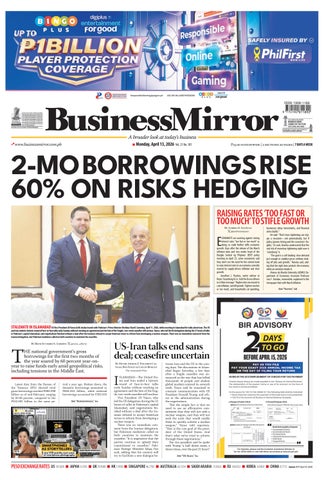
THE national government’s gross borrowings for the first two months of the year soared by 60 percent year-onyear to raise funds early amid geopolitical risks, including tensions in the Middle East.
The Associated Press
SLAMABAD— e United States and Iran ended a historic round of face-to-face talks early Sunday without reaching an agreement and the fate of the fragile, two-week ceasefi re still unclear.
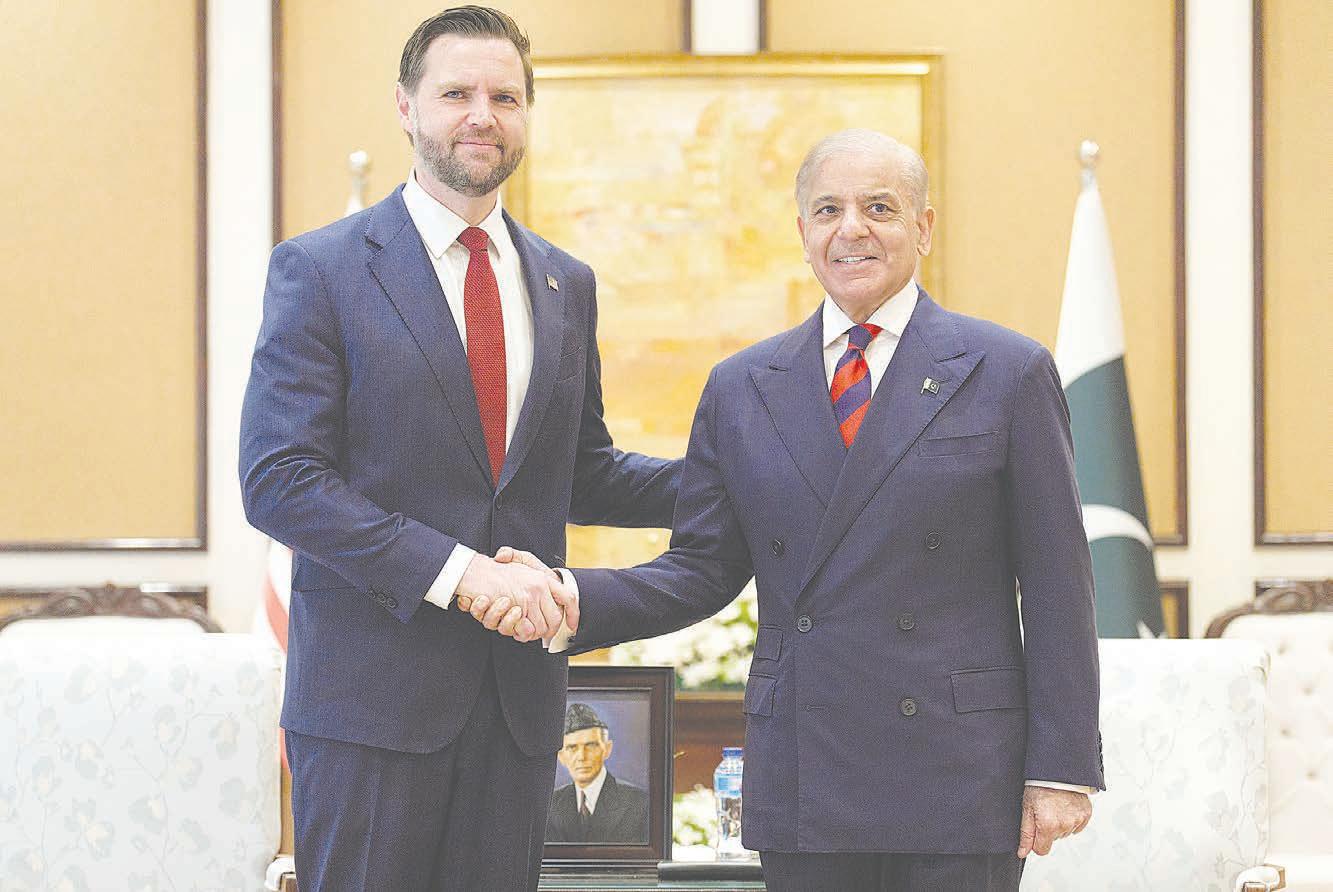
Vice President JD Vance, who led the US delegation during the 21 hours of talks in Pakistan’s capital Islamabad, said negotiations fi nished without a deal after the Iranians refused to accept American terms to refrain from developing a nuclear weapon.
ere was no immediate comment from the Iranian delegation, but Pakistani mediators called on both countries to maintain the ceasefi re. “It is imperative that the parties continue to uphold their commitment to ceasefi re,” Pakistan Foreign Minister Ishaq Dar said, adding that his country will try to facilitate a new dialogue be-
tween Iran and the US in the coming days. e discussions in Islamabad began Saturday, a few days after a fragile ceasefi re was announced as the war that has killed thousands of people and shaken global markets entered its seventh week. Vance said he remained in constant communication with US President Donald Trump and others in the administration during the negotiations.
“But the simple fact is that we need to see an affi rmative commitment that they will not seek a nuclear weapon, and they will not seek the tools that would enable them to quickly achieve a nuclear weapon,” Vance told reporters.
“ at is the core goal of the president of the United States. And that’s what we’ve tried to achieve through these negotiations.”
e vice president said he spoke with Trump “a half dozen times, a dozen times, over the past 21 hours”
ECONOMISTS are warning against raising interest rates “too fast or too much” as doing so could further sti e economic growth. Days after the release of the March in ation data and two weeks head of the Bangko Sentral ng Pilipinas’ (BSP) policy meeting on April 23, some economists said they don’t see the need for the central bank to raise interest rates in an economy currently marred by supply-driven in ation and slow growth.
Jonathan L. Ravelas, senior adviser at Reyes Tacandong & Co. told the BUSINESSMIRROR in a Viber message: “Higher rates are meant to cool in ation, not kill growth. Tighten too fast or too much, and households cut spending,
businesses delay investments, and nancial stress builds.” He said: “That’s how tightening can trigger a recession—not automatically, but if policy ignores timing and the economy’s fragility.” As such, Ravelas underscored that the real risk of monetary tightening right now is “overdoing” it.
“The goal is a soft landing: slow demand just enough to stabilize prices without choking o jobs and growth,” Ravelas said, adding that the right dose protects the economy while an overdose breaks it.
Ateneo de Manila University (ADMU) Department of Economics Associate Professor Luis F. Dumlao, meanwhile, explained to this newspaper that with March in ation
tion, called the con ict a “very bad example” of what happens when regions abandon neutrality, pointing to Middle Eastern nations su ering despite hosting US bases.
He contrasted this with Beijing’s diplomatic push, noting Foreign Minister Wang Yi’s mediation e orts with partners like Pakistan.
Asean’s response underscores its duality: collectively, the bloc has called for cease res and criticized the use of force.
Yet individual states act pragmatically. Malaysia has openly criticized US and Israeli actions, while the Philippines and Thailand issued narrowly focused statements prioritizing the safety of overseas workers in Iran. Kraft emphasized that the war is forcing even traditionally pro-US states to rethink their strategic calculations.
SOUTH CHINA SEA
STILL A FLASHPOINT
DESPITE US unpredictability dominating concerns, the South China Sea remains the top issue for claimant states like the Philippines, Vietnam, and Brunei. More than 51 percent of respondents cite China’s encroachment into EEZs as their primary worry.
As Asean works toward a Code of Conduct (COC) under Philippine chairship, respondents insist it must align with Unclos to uphold a rules-based order.
Yet skepticism persists: 16.5 percent doubt it will resolve disputes, and 12 percent believe it may never materialize due to Beijing’s claims.
ABOUT THE SURVEY
THE 2026 survey polled 2,008 opinion leaders across all 11 Asean states, including Timor-Leste for the rst time. Conducted from January 5 to February 20, 2026, it applied equal country weightage to ensure balanced representation. Respondents came from diverse sectors: private (42.9 percent), government (21.1 percent), and academia/research (19.5 percent).
Malou Talosig-Bartolome
Q1 Peza investments dip to P45.5B as risks multiply
THEPhilippine Economic Zone Authority (Peza) opened 2026 with steady project approvals in the first quarter, but softer investment value as P45.525 billion came in below last year’s level.
From January to March, the agency approved 78 new and expansion projects, up from 66 in the same period in 2025. Despite the increase in project count, total approved investments were lower than the P58.95 billion posted a year earlier.
For Peza director general Tereso Panga, the figures show continued investor interest in economic zones even as global conditions remain uncertain.
“ is performance reflects sustained investor confidence in the ecozones and in the Philippines as a competitive investment destination, even as global economic conditions remain volatile due to rising energy costs, supply chain adjustments, and geopolitical tensions,” Panga said.
US-Iran...
and also spoke with Secretary of State Marco Rubio, Treasury Secretary Scott Bessent and Adm. Brad Cooper, head of the United States
e agency, he said, is still aiming to meet its full-year target of P300 billion, although he acknowledged that prolonged geopolitical tensions, particularly in the Middle East, could affect global investment decisions.
“However, if the confl ict in the Middle East continues, I certainly believe that there will be global adjustments in the investment decisions of global companies,” he said.
Peza said the approved projects are expected to generate about $10.865 billion in exports and 8,496 direct jobs, signaling continued movement toward export-oriented and higher-value activities.
Manufacturing accounted for the largest share of approvals with 30 projects, followed by ecozone development (16), information
Central Command. “We were constantly in communication with the team because we were negotiating in good faith,” Vance said, speaking at a podium in front of a pair of American ags with special envoys Steve Witko and Jared Kushner to his side. “And we leave here, and we leave here with a very simple proposal, a method of understanding that is our nal and
technology and business process management (IT-BPM) (11), facilities (10), logistics (6), tourism (2) and utilities (1).
Investments remained heavily concentrated in Luzon with 67 projects, while the Visayas accounted for nine and Mindanao two.
e agency said foreign participation remained broad, led by investors from South Korea, Indonesia, the British Virgin Islands, Taiwan, and Japan. About 10 largescale projects worth more than P36 billion also anchored the quarter’s approvals.
Meanwhile, in March alone, Peza approved 26 projects worth P10.159 billion, higher than the P6 billion recorded in March 2025. While project numbers were relatively stable year-on-year, investment value rose sharply, driven by large-ticket approvals.
ese included ventures in ecozone development in Naga, solar cell manufacturing in Batangas, aircraft maintenance in Pasay, and facilities services in Cavite.
Calabarzon remained the top investment destination for the month with 14 projects, followed by the National Capital Region
best o er. We’ll see if the Iranians accept it.”
Two Pakistani o cials, who spoke on condition of anonymity because they were not authorized to brief the press, said a third round of discussions between the delegation heads had nished and the talks would resume after a break. Then the US vice president addressed the press, announced there was no agreement and went to the airport to leave Pakistan.
Trump had said he would suspend attacks against Iran for two weeks. Vance’s comments did not indicate what will happen after that time period expires or if the cease re will remain in place.
U.S.: DESTROYERS MOVED THROUGH HORMUZ
THE US military said two destroyers transited the Iran-gripped Strait of Hormuz ahead of mine-clearing work, a rst since the war began. Iran’s state media, however, said the joint military command denied that.
“We’re sweeping the strait. Whether we make a deal or not makes no di erence to me,” Trump told journalists as talks continued and the time approached 2 a.m. in Islamabad. He called negotiations “very deep.” Iranian state TV noted what it called “serious” di erences.
The US delegation led by Vance and the Iranian one led by Parliament Speaker Mohammad Bagher Qalibaf discussed with Pakistan how to advance the cease re already threatened by deep disagreements and Israel’s continued attacks against the Iranian-backed Hezbollah in Lebanon, whose health ministry said the death toll has surpassed 2,000.
Since the Islamic Revolution in Iran in 1979, the most direct US contact had been in 2013 when President Barack Obama called newly elected President Hassan Rouhani to discuss Iran’s nuclear program. Obama’s secretary of state, John Kerry, and counterpart Mohammad Javad Zarif later met during negotiations toward the 2015 Iran nuclear deal—a process that lasted well over a year.
Now the far broader talks featured Vance, a reluctant defender of the war who has little diplomatic experience and warned Iran not to “try and play us,” and Qalibaf, a former commander with Iran’s powerful Revolutionary Guard who has issued some of Iran’s most ery statements since ghting began.
IRAN SETS ’RED LINES’ INCLUDING COMPENSATION FOR STRIKES
IRAN’S state-run news agency said the threeparty talks began after Iranian preconditions, including a reduction in Israeli strikes on southern Lebanon, were met Iran’s delegation told state television it had presented “red lines” in meetings with Pakistani Prime Minister Shehbaz Sharif, including compensation for damage caused by US-Israeli strikes that launched the war on February 28 and releasing Iran’s frozen assets.
The war has killed at least 3,000 people in Iran, 2,020 in Lebanon, 23 in Israel and more than a dozen in Gulf Arab states, and caused lasting damage to infrastructure in half a dozen Middle Eastern countries. Iran’s grip on the
with six.
Central Visayas, Central Luzon, Bicol Region and Western Visayas recorded smaller shares. Monthon-month figures showed stronger momentum in March, with investment value rising by 68.93 percent and projected exports increasing by 89.13 percent.
According to Peza, global risks, including energy price pressures and shipping route vulnerabilities such as the Strait of Hormuz, may continue to influence manufacturing costs, trade flows and investor sentiment in the coming months.
e Peza chief said the agency has seen similar cycles in the past and expects resilience from investors despite external shocks.
“Looking back at our 30-year history in Peza, we have seen the same crises—the so-called boomand-bust cycle—that changed our investment landscape and ecozone environment and through each challenge, we have consistently demonstrated our ability to recover and grow,” he said. He added that the Philippines remains positioned to withstand external pressures, citing macroeconomic stability and ongoing policy reforms as key support factors.
Strait of Hormuz has largely cut o the Persian Gulf and its oil and gas exports from the global economy, sending energy prices soaring.
U.S. SENDING FORCES TO HELP MINE-CLEARING
IRAN’S closure of the Strait of Hormuz has proved its biggest strategic advantage in the war. Around a fth of the world’s traded oil had typically passed through on over 100 ships a day. Only 12 have been recorded transiting since the cease re. On Saturday, Trump said on social media that the US had begun “clearing out” the strait. “Today, we began the process of establishing a new passage and we will share this safe pathway with the maritime industry soon,” US Central Command commander Adm. Brad Cooper later said. The US statement about the destroyers added: Additional US forces, including underwater drones, will join the clearance e ort in the coming days.”
Iranian Foreign Minister Abbas Araghchi had said Tehran was entering negotiations with “deep distrust” after strikes on Iran during previous talks. Araghchi, part of Iran’s delegation in Pakistan, said Saturday that his country was prepared to retaliate if attacked again.
Iran’s 10-point proposal ahead of the talks called for a guaranteed end to the war and sought control over the Strait of Hormuz. It included ending ghting against Iran’s “regional allies,” explicitly calling for a halt to Israeli strikes on Hezbollah. The United States’ 15-point proposal includes restricting Iran’s nuclear program and reopening the strait.
ISRAEL, LEBANON WILL HAVE DIRECT NEGOTIATIONS
ISRAEL pressed ahead with strikes in Lebanon after saying there is no cease re there. Iran and Pakistan have disagreed. Negotiations between Israel and Lebanon are expected to begin Tuesday in Washington, Lebanese President Joseph Aoun’s o ce has said, after Israel’s surprise announcement authorizing talks despite the countries lack of o cial relations.
But as thousands in Lebanon protested the planned negotiations on Saturday, Prime Minister Nawaf Salam said he had postponed a planned trip to Washington “in light of the current internal circumstances.” His absence should not a ect talks as the rst round is expected to be at the ambassadorial level.
Israel wants Lebanon’s government to assume responsibility for disarming Hezbollah, much like was envisaged in a November 2024 cease re. But the militant group has survived e orts to curb its strength for decades.
Hezbollah joined the war in support of Iran in the opening days. Israel followed with airstrikes and a ground invasion. The day the Iran cease re deal was announced, Israel pounded Beirut with airstrikes, killing more than 300 people in the deadliest day in Lebanon since the war began, according to the country’s Health Ministry. (Castillo reported from Beijing, and Finley and Binkley from Washington. Josh Boak in Washington, Samy Magdy in Cairo, Cara Anna in Lowville, New York, and Christopher Weber in Los Angeles contributed.)
billion. e government’s debt from domestic sources for the two-month period expanded drastically by 133.56 percent year-on-year from P293 billion. is comes after the government frontloaded its local borrowings in the form of jumbo bond issuances, particularly the 10-year fi xed-rate Treasury notes, which raised P297.94 billion for the government in February. Of the two-month local borrowings, fi xed-rate Treasury bonds (T-bonds) accounted for P589.543 billion and Treasury bills (T-bills) at P94.800 billion. Meanwhile, external borrowings dropped by 21.96 percent from the P259.692 billion raised in the same period in 2025. is, despite the $2.75 billion generated from the 10-year and 25-year US dollar bonds issued in January. e two-month external borrowings consisted of project loans worth P12.446 billion, program loans (P28.923 billion) and global bonds (P161.286 billion).
According to Michael L. Ricafort, chief economist at Rizal Commercial Banking Corp., financing needs were not that high at the start of the year due to large bond maturities and government underspending since late 2025.
“But these were levels before the war on Iran/Middle East since February 28, 2026,” Ricafort noted.
Before the Middle East confl ict, Ricafort said the Philippine peso was stronger against the greenback and policy rates of the Bangko Sentral ng Pilipinas and the US Federal Reserve were lower, which reduced debt servicing costs back then.
e government “partly” anticipated the Middle East confl ict as there were already signals on it, as well as other geopolitical risks in recent months, such as on Venezuela, Greenland, among others, Ricafort added.
“Any frontloading/hedging of NG borrowings as a matter of prudence amid geopolitical risks could lead to more NG borrowings/debt, going forward, but could still be offset by NG underspending/more cautious spending,” Ricafort said. In February alone, the government’s combined gross borrowings amounted to P478.765 billion, up by 40.99 percent from last year’s P339.551 billion. Gross domestic borrowings for the month soared by 232.55 percent year-on-year to P468.244 billion from P140.8 billion.
For external gross borrowings, this posted a 94.70-percent decline in February, from the previous year’s P198.751 billion to P10.521 billion.
Looking ahead, Ricafort said borrowings could increase, driven by accelerated government spending to offset last year’s underspending and the impact of the Middle East war.
“[ is] could lead to higher infl ation, US dollar/peso exchange rate, and interest rates that could also reduce economic growth [and] could all lead to higher government spending and debt servicing costs,” Ricafort said. For this year, the national government has programmed its total gross borrowings at P2.682 trillion, higher by 3.15 percent than last year’s P2.6 trillion borrowing target.
A 77:33 fi nancing mix will be followed this year, in favor of domestic sources, to mitigate foreign exchange risks and foster the local capital market. Debt from external sources amounts to P627.104 billion, while domestic borrowings are pegged at P2.054 trillion. Outstanding debt of the national government hit a fresh record high of P18.159 trillion as of the end of February 2026, up by 0.14 percent from P18.133 trillion a month earlier.
A4 Monday, April 13, 2026 www.businessmirror.com.ph
Marcos: Big fuel price cut this week
PBy Lenie Lectura @llectura
RESIDENT Marcos on Sunday said the pump price of diesel will go down by more than P20 per liter while gasoline prices will be reduced by P4.43 per liter.
That of kerosene will be reduced by P8.50 per liter.
In a video message, Marcos said in Filipino that the reduction in fuel priceswill be a big help especially to drivers and commuters as well as all families who are affected by the high cost of fuel.
However, Marcos said, this is not enough. The government he said continues to find ways to ease the effect of high fuel prices on the people. “We will not stop until we have not decrease the cost of travel, food and the overall needs of out people.”
In the next days and weeks, he said, “I will announce more government programs and assistance from the government.”
Earlier, Energy Secretary Sharon Garin said there will be hefty reduction in fuel prices this week, “Based on the average of the last five days international prices and comparing that to the average of the previous week.”.
The DOE’s numbers are higher than what industry sources cited last week.
Sources said over the weekend that it is possible that diesel price will be reduced from at least P8.80 to as much as P10.80 per liter
while gasoline products could be sold P1.50 per liter cheaper. The sources’ estimates were also based on the average full-week trading of the MOPS (Means of Platts Singapore), which is a pricing benchmark for refined petroleum products, and foreign exchange rate averages. On Saturday, the DOE announced the country received another delivery of diesel—329,000 barrels or 52.311 million liters. Based on previous data, the country consumes roughly 33 million liters of diesel per day.
This is the second secured diesel shipment sourced from Malaysia. The first delivery of 142,000 barrels or 22.578 million liters from Japan, arrived in the country last March 26.
“This latest shipment from Malaysia further strengthens our supply position at a time when external risks remain and the situation in the Middle East continues to evolve,” said Garin said.
Aside from the newly-arrived diesel shipment, Garin earlier mentioned that there will be around 600,000 barrels of diesel more to arrive either from North Asia or India within the month.
The lower pump prices this week is an offshoot of the two-week cease-fire between United States and Iran.
As a net importer of petroleum products, the Philippines remains vulnerable to external developments that may affect both price and supply. The DOE has committed to strengthen
domestic supply buffers as global oil markets remain exposed to geopolitical risks linked to ongoing developments in the Middle East.
Garin had already dismissed plans for fuel rationing despite calls from the Senate to prepare such measures. “We never considered it,” the energy chief had said because the country has sufficient supply to last for approximately 50 days.
Also, the government is taking deliberate and forward-looking steps to build available supply. She, however, acknowledged that the ongoing conflict in the Middle East, fuel price rollbacks will be slower than the sharp, rapid price hikes in the past weeks. “I do not expect it to go down as fast as it went up,” she said.
Prior to the US-Iran war that erupted at end-February this year, a liter of diesel was sold anywhere from P45 to P74 per liter. Now, diesel is sold at around P140 to P160 per liter. From an average of P50 to P77 per liter of gasoline, today’s prices hover around P120 per liter.
Former energy chief Jericho Petilla said last week that pump prices are not likely to return to the level of P60 per liter level. “Diesel will be P100 or a little over P100, and then gasoline will be a little under P100 when everything normalizes because a lot of infrastructure has been damaged in our refineries and oil extraction in the Middle East,” he said, adding that “there is no clear end in sight.
Garin acknowledged the “permanent damage in the structure of the international oil community” since the war has been going on for more than four weeks now.
“For example, let’s say Strait of Hormuz is cleared and all the thousands or hundreds of vessels through it and deliver where they should deliver. There’s no assurance also of the availability of the supply from the Middle East because most of the structures have been destroyed. It will take about months or even years. In fact, years for energy to construct or to rehabilitate all these structures that are part of the Philippine oil industry since we sourced most of our supply from there.
So there has been damage already and sure enough the increase has been very quick. In a matter of one month, our price gone up to more than 100 percent increase. This is by far the fastest and the highest increase of our oil prices and that’s due to the war.
So there is a structural change already in the oil industry so I would go along with the point of former Secretary Petilla because if ever it goes down, it will take longer. It will not be one month,” Garin said.
The country imports 98 percent of its crude oil requirements from the Middle East and the remaining two percent in Asia. Petron is the lone refiner in the country. Other oil companies already import finished petroleum products from Asian countries which, in turn, also source crude oil from the Middle East.
DENR launches ‘Permitting on Wheels’
TBy Jonathan L. Mayuga @jonlmayuga
HE Department of Environment and Natural Resources (DENR) will go out and bring its permitting services to cities and towns once a month to assist applicants, to help cut travel time and costs for owners of small businesses and other parties, who need to transact business with the agency.
Starting April 14 to 15, 2026, the DENR will simultaneously deploy its personnel and mobile hubs to priority sites nationwide, with the national launch to be held at the City of Manila.
Simultaneous rollouts of the DENR “Permitting on Wheels” will also be done in key cities and towns nationwide.
Personnel from the Environmental Management Bureau (EMB) shall be onsite to guide and assist the entrepreneurs on permitting requirements for air quality management, chemicals management, environmental impact assessment and management, hazardous
waste management, and water quality management.
Entrepreneurs will also be able to file on the spot applications for tree cutting permits, permits to import chainsaws, certificate of transshipment, wildlife importation permit or a wildlife local transport permit.
“For years, securing environmental permits and clearances meant that entrepreneurs, facility and project proponents had to take days off work and spend heavily on transportation to reach distant regional government offices. Often, incomplete requirements led to multiple costly trips back and forth,” Environment Secretary Juan Miguel Cuna said.
“President Marcos’ directive is clear: the Government must reach the people, delivering visible action that brings real, measurable relief to our communities,” Cuna said.
“Today, instead of them going to the DENR regional offices, the agency’s permitting services are going directly to
the citizens, once a month, from one LGU to another,” he added.
Cuna shared that before this initiative, applicants in hard to reach towns, had to navigate alone the online permitting systems for Certificates of Non-Coverage (CNC), Wastewater Discharge Permits, or hazardous waste registrations, often facing delays due to missing documents.
“With DENR Permitting on Wheels, the process becomes hands-on and immediate,” he added, highlighting the cost efficiencies and expertise that can be derived by the mobile hub service:
n Time and Cost Saved: By bringing the services to local municipalities, business owners save on the high travel and accommodation costs previously required to visit regional centers.
n No More “Pabalik-balik”: The mobile service provides real-time validation of documents. If an application has deficiencies, technical staff are on-site to clarify and fix the issue, allowing businesses to secure their permits
faster and avoid the suspension of their operations.
n One-on-One Technical Assistance: Recognizing that not everyone is familiar with digital systems, the POW hubs are equipped with computers, laptops and high-speed internet. Technical staff will sit down with applicants to teach and assist them in uploading and filing their online applications.
The two-day event will also feature simplified lectures on environmental laws and system walkthroughs, ensuring that compliance is easy to understand and follow. For citizens unable to attend the physical sites, a two-day livestream will be available online to guide them through the streamlined procedures.
Following this nationwide launch, the DENR plans to institutionalize Permitting on Wheels as a permanent, monthly government service. This ensures a predictable rhythm of public service delivery, helping Filipino businesses thrive while protecting the environment.
MCWD won’t pass on fuel costs... for now
CEBU CITY—Metro Cebu Water District (MCWD) assured that it will not pass on additional charges to consumers for now, despite rising operational expenses driven by increasing fuel costs.
MCWD General Manager John DX Lapid, in an interview in Naga City, Cebu, over the weekend, said the agency continues to absorb higher fuel and power expenses, even as he admitted that they have felt its effects in their daily operations.
House set to institutionalize natl protection mechanism
By Jovee Marie N. dela Cruz @joveemarie
AMID escalating tensions in the Middle East that continue to drive global oil prices upward, House leaders are pushing for the institutionalization of a national protection mechanism designed to shield Filipinos from the ripple effects of fuel-driven crises.
Speaker Faustino G. Dy III and House Majority Leader Ferdinand Alexander A. Marcos have filed House Bill 8834, or the Komprehensibong Alalay sa Livelihood, Inflation, Negosyo and Goods Assistance (Kalinga) Act, which mandates the establishmen of a fast, targeted, and automatic government response system whenever fuel price shocks threaten to raise the cost of living.
Rather than serving merely as an emergency aid package, the measure proposes a national framework that allows the government to act early and in a coordinated manner before rising fuel costs trigger widespread increases in transport fares, food prices, electricity rates, and other basic goods.
“Just one movement in oil prices, and everything goes up—fares, food, electricity. There must be a clear system for a quick response,” Marcos said. “Under
the Kalinga Act, there is a trigger, there is action, and there is assistance.” At the heart of the proposal is the Kalinga Program, a whole-of-government response mechanism that will be automatically activated once key warning indicators are met, including sharp spikes in fuel prices, abnormal inflation levels, low fuel inventory, or a declared national energy emergency.
The program is composed of several components, including fuel price stabilization, energy supply and inventory management, targeted assistance for vulnerable sectors, logistics and essential goods stabilization, micro, small and medium enterprises (MSMW) energy relief and business continuity support, energy conservation and demand reduction, and flexible fiscal and regulatory interventions.
Beneficiaries include low-income households, minimum wage earners, transport workers, farmers, fisherfolk, MSMEs, overseas Filipino workers, and other vulnerable groups identified through data-driven assessments by an inter-agency task force. Under the Fuel Price Stabilization Component, the government may
Marina orders local shipping companies to adopt SOTS
By Lorenz S. Marasigan @lorenzmarasigan
THE Maritime Industry Authority (Marina) has issued rules requiring all domestic operators of inter-island passenger ships to adopt a Shipping Online Ticketing System (SOTS).
Memorandum Circular DS-2026-01, signed by Marina Administrator Sonia B. Malaluan, aims to modernize sea travel by ending ticket scalping, automating passenger manifests, and ensuring mandatory fare discounts for vulnerable sectors are applied automatically at the point of booking.
It covers all domestic shipowners and operators of inter-island passenger ships, including Roll-on-Roll-off Passenger (Ropax) ships and fastcraft.
Motorbancas, recreational boats, service boats, and vessels for company use not engaged in carrying fare-paying passengers are exempt.
The government branded the framework’s implementing platform as “SEAS,” or Ships E-ticketing Application System.
electronically book or secure seats, make payments, receive electronic tickets, and generate an electronic passenger manifest for each voyage.
“With SEAS, every Filipino passenger can finally travel with peace of mind,” Malaluan said. “No more scalpers, no more long lines, and automatic passenger manifests mean faster response in emergencies—making sea travel safer, fairer, and more convenient for everyone.”
The system is required to automatically apply mandatory statutory discounts for senior citizens under Republic Act 9994, persons with disabilities (PWDs) under Republic Act 7277, students under Republic Act 11314, and Medal of Valor awardees under Republic Act 9049. These discounts are non-discretionary and cannot be withdrawn, reduced, or substituted by alternative promotional schemes.
The SOTS must also incorporate seat and bunk mapping, real-time capacity controls to prevent overbooking, and the ability to generate an electronic passenger manifest that serves as the official document to be submitted to the Coast Guard (PCG) and other government agencies prior to vessel departure—without requiring a manual signature.
“For now, kaya pa siya ma-shoulder sa water district [For now, the water district can still shoulder it],” he said.
Instead, the agency has implemented cost-cutting measures, particularly in managing three wells that previously relied on generator sets.
Upon assuming office on March 16, Lapid
While the Local Water Utilities Administration (Lwua) has issued a memorandum allowing water districts to impose additional charges if power costs become unsustainable, Lapid emphasized that implementing such adjustments is neither simple nor immediate. He explained that any rate increase would require public hearings and approval processes, making it impractical at this time.
said there were still three major wells operating on diesel-powered generators, each consuming 16,000 liters of fuel a month.
These wells, Lapid explained, provide water supply to an entire community.
Within two weeks, MCWD moved to transition of two wells to main power sources, reducing dependence on diesel.
Under the circular, operators must implement SEAS or an equivalent SOTS—whether developed in-house, through a third-party service provider, or via subscription to an online booking platform—that enables passengers to
Dole starts temporary work program
By Justine Xyrah Garcia
AT least 134 jeepney drivers in Metro Manila will be tapped for temporary work under the Department of Labor and Employment’s (Dole) cash-for-work program, as the government moves to cushion income losses in the transport sector.
Director Leilani M. Reynoso of the Bureau of Workers with Special Concerns (BWSC) confirmed to the BusinessMirror that the Tulong Panghanapbuhay para sa Disadvantaged/Displaced Workers (Tupad) Tuloy Pasada program will initially cover 134 beneficiaries starting Monday.
Under the scheme, the Dole has partnered with the Department of Transportation (DOTr) and the Land Transportation Franchising and Regulatory Board (LTFRB) to provide participating public utility vehicle (PUV) drivers with wages equivalent to the prevailing regional minimum rate—effectively augmenting their income on top of the P5,000 fuel subsidy earlier extended to them.
“The assigned personnel will monitor and document the accomplishments, issues, concerns, and recommendations relative to project implementation and submit a report to concerned Dole Provincial Office,” Reynoso said in a text message. Reynoso also dismissed claims of leakages in the Tupad program, saying it is not being used for patronage or corruption and that beneficiaries are required to render actual work to receive wages. In a separate radio interview over the weekend, Reynoso said the selection of beneficiaries was done in coordination with the LTFRB, which identified drivers who experienced significant income losses following the oil crisis.
She also clarified that the program is separate from the government’s planned service contracting initiative for PUV drivers.
Beneficiaries will be paid the minimum wage for rendering six hours of work per day. They may choose between two shifts: 6 a.m. to 12 noon or 2 p.m. to 8 p.m. The program will also run for 10 to 30 days and may be only availed once. Amid concerns that the program could be politicized or abused, Reynoso said monitoring mechanisms are in place to ensure that beneficiaries complete actual work.
www.businessmirror.com.ph
Bulacan airport project cited at OECD forum
THE New Manila International Airport (Nmia) project in Bulacan was presented recently at the 12th OECD Workshop for Financial Institutions in Paris as a case study on how major infrastructure projects can align with international environmental and social standards.
San Miguel Aerocity Inc. (Smai), the project proponent, was invited to present Nmia before export credit agencies, commercial and development banks, development financial institutions, and specialist environmental and social consulting firms from across the OECD’s 38 member countries.
The project was taken up as a plenary case study, with the presentation focusing on its alignment with the IFC Performance Standards and Equator Principles, which are widely used by international lenders in evaluating large-scale infrastructure developments. Smai presented alongside Atradius DSB, the project’s export credit insurer, and Earth Active, one of its independent environmental and social consultants.
Smai said the presentation highlighted Nmia’s shift from local regulatory compliance to international lender-aligned environmental and social frameworks, including stronger internal management systems and the implementation of biodiversity and social risk measures for a challenging coastal site with critical habitat considerations.
Participants viewed the project as a credible and transparent example of infrastructure development under challenging environmental and social conditions. They also noted the company’s openness in discussing early challenges, capacitybuilding efforts, and adaptive management approaches, particularly in biodiversity offsets and social performance.
The project was also discussed as a practical reference for lender decision-making in emerging market infrastructure, showing how sponsors and lenders can work together to address gaps and strengthen environmental and social performance over time.
“The Nmia project is a clear example on how the cooperation of financial institutions and consultants can help project developers work towards compliance with International Standards. We carefully considered the project, and decided to support it. The results show that it was worth the effort,” Marije Hensen of Atradius Dutch State Business, the Dutch Export Credit Agency, said.
Separately, Smai said flooding, land stability, and environmental safeguards have been among the key considerations in Nmia’s technical and environmental review from the outset. These continue to be addressed through assessment, mitigation planning, and oversight under both Philippine regulations and international lender standards.
Nmia straddles five rivers in Bulacan and has been blamed for the incessant flooding in Bulacan and Pampanga whenever it rains.
Founded in 1961, the Paris-based OECD has played a leading role in developing policies and standards on corporate governance and sustainability, among others, with many of its frameworks adopted beyond member countries.
SMAI said its participation in the workshop reinforced its engagement with the international project finance and environmental and social practitioner community, while strengthening its position as a Philippine infrastructure developer capable of operating within OECD, export credit agency, and commercial lender governance frameworks.
DENR shuts down illegal mines in Surigao del Sur
TBy Jonathan L. Mayuga @jonlmayuga
HE Department of Environment and Natural Resources (DENR) has announced the arrest of 11 persons, including nine Chinese men and two Filipinos, and seizure of some P50.5 million worth of heavy equipment gold ores in a two-day anti-illegal mining operation at Carac-an River, barangay Lobo, Cantilan, Surigao del Sur.
The operation was carried out through the concerted efforts of the DENR Regional Enforcement Division, Community Environment and Natural Resources Office (Cenro) Cantilan, Mines and Geosciences Bureau (MGB) Region XIII, 1302nd Maneuver Company, Regional Mobile Force Battalion (RMFB), 2nd Surigao del Sur Regional Mobile Force Company (RMFC) of the National Police (PNP, Air Force (PAF)-Regional Intelligence Division (RID), and National Bureau
of Investigation (NBI-13). DENR Regional Executive Director Maritess M. Ocampo, said the operation began at around 9:00 p.m. on April 9 and concluded successfully at 9:30 p.m. on April 10. Authorities seized six heavy equipment units, including dump trucks, excavators, payloaders, and a pick-up truck, along with generator sets, fuel containers, and steel frames containing traces of gold.
The arrested individuals are currently detained at the Cantilan Municipal Police Station for documentation and inquest proceedings. They face charges for violations of Sections 102 and 103 of Republic Act 7942 (Philippine Mining Act of 1995), Section 20 of the Expanded National Integrated Protected Areas System (ENipa) Act, and Section 7 of the Chainsaw Act, covering illegal exploration, theft of minerals, unauthorized timber cutting within a protected area, and possession of unregistered chainsaws.
The DENR Caraga is coordinating closely with the PNP for the filing of criminal cases and with the Bureau of Immigration (BI) for the legal custody of the foreigners involved. Coordination is also ongoing with the Land Transportation Office (LTO) and intelligence units to trace the ownership of one abandoned dump truck and to place it under red alert status.
“This operation demonstrates the DENR’s unwavering commitment to enforce environmental laws and protect our natural resources from illegal exploitation,” Ocampo said.
“We will continue to strengthen interagency collaboration to ensure accountability and uphold the rule of law.”
The DENR reminds the public that illegal mining activities pose serious threats to ecosystems, water quality, and community safety, and urges continued vigilance and cooperation in reporting environmental violations.
MPC: What, conceal Marcos’ health?
THE Malacañang Press Corps (MPC) on Sunday denounced allegations circulating online that its members are being used or paid to conceal the true condition of President Marcos’ health.
In a statement, the MPC assailed what it described as baseless accusations, stressing that such claims are meant to undermine the credibility of journalists covering the Palace beat and mislead the public amid the spread of unverified reports on social media.
The group emphasized that the President’s health is a matter of public interest and national security, noting that Palace reporters have consistently raised questions and sought clarification from government officials during official briefings regarding
his condition.
The MPC also defended the accuracy and integrity of its reporting, saying that its members rely on verified information gathered through direct questioning of sources involved in the issue, as well as first-hand observation during official engagements. It added that all information is subjected to verification before being published or broadcast.
The press corps further criticized what it called coordinated attempts to discredit professional journalism, contrasting its work with online content that, it said, often spreads unverified claims without proper sourcing or accountability.
While acknowledging the growing vol -
ume of misinformation on social media, the MPC urged the public to exercise caution and critical judgment in assessing information, especially posts that lack credible sources.
Despite the attacks, the MPC vowed to continue its coverage of the Marcos administration, saying its members will persist in reporting developments fairly and independently, regardless of political pressure or online criticism.
It reaffirmed its commitment to truth and public service, stressing that responsible journalism remains essential in ensuring transparency in government, particularly in matters involving the president’s condition and official actions of the administration.
Jovee Marie N. dela Cruz
Legislator wants probe on water interruptions
By Jovee Marie N. dela Cruz @joveemarie
AMID soaring temperatures and growing water demand, a mem -
ber of the House Committee on Metro Manila Development is pushing for an investigation into the recurring water service interruptions by Maynilad Water Services Inc., which have been affecting households and businesses.
Muntinlupa Rep. Jaime Fresnedi raised alarm over the persistent outages, saying these have disrupted daily life across households, businesses, and even government offices—especially as residents struggle with the effects of intense heat.
Drawing from complaints of his constituents, Fresnedi highlighted growing frustration over what many perceive as slow and inadequate response during service interruptions. He stressed that emergency measures, such as the deployment of water
Continued from A4
implement targeted fuel subsidies, temporary adjustments or suspension of fuel excise taxes, fuel price smoothing mechanisms, and transport fare support programs. All interventions must be targeted, timebound, and subject to regular review to ensure fiscal sustainability. The Energy Supply, Security, and Inventory Management Component authorizes the government to secure an adequate fuel and energy supply through government-togovernment agreements, diversified import sources, minimum inventory enforcement, emergency procurement, and prioritization of critical sectors.
The measure also provides direct assistance under the Targeted Assistance Component, including cash aid for low-income families and minimum wage earners, fuel subsidies for transport workers and farmers, and fare subsidies for commuters, delivered through digital and national targeting systems where possible.
tankers, should be immediate.
The lawmaker recalled that Maynilad had earlier committed, during a town hall meeting, to closely coordinate with local officials to ensure prompt water tanker deployment. However, he said this has not been consistently carried out.
He said his office is now consolidating data in preparation for a formal resolution seeking a congressional inquiry, aimed at establishing accountability and improving service delivery.
Fresnedi underscored that the situation has forced many residents—particularly workers—to stay up late waiting for water, a burden worsened by the ongoing heat.
The congressman, also a member of the House Committee on Local Government, said he intends to push for stronger oversight and corrective action.
He also called on Maynilad to implement more effective and lasting solutions, noting that repeated outages—especially
Price, essential goods
TO stabilize prices and supply of essential goods, the Logistics and Essential Goods Component covers transport support, buffer stocking, cold chain systems, and priority fuel allocation for food and essential commodity distribution. For businesses, particularly MSMEs, the Energy Relief and Business Continuity Component provides targeted subsidies, credit guarantees, tax deferments, fee relief, energy efficiency incentives, logistics support, and temporary suspension of loan payments for qualified borrowers without penalties.
The Energy Conservation and Demand Reduction Component promotes workfrom-home arrangements, flexible work schedules, carpooling, public transport use, and energy-saving measures in government and private sectors, alongside initiatives supporting alternative fuels.
Meanwhile, the Flexible Fiscal and Regulatory Measures Component allows temporary suspension or reduction of fuel taxes and import duties, streamlined regulations, anti-hoarding enforcement,
during hot weather—have already caused significant stress, inconvenience, and lost productivity.
Fresnedi, likewise, questioned the company’s explanation that declining water quality from Laguna de Bay has contributed to the interruptions, saying such justifications fail to address the continuing impact of unannounced outages.
While Maynilad has said it is undertaking upgrades and operational improvements, the lawmaker noted that these have yet to result in noticeable service improvements.
He also urged the Metropolitan Waterworks and Sewerage System (MWSS) to take a more proactive regulatory role to ensure concessionaires deliver reliable and efficient services.
Earlier, Muntinlupa Mayor Ruffy Biazon and other city officials also pressed Maynilad to present a concrete service recovery plan to address the recurring water supply issues affecting residents, businesses, and government operations.
and enhanced price monitoring, subject to congressional notification and review within 60 days.
The bill also defines automatic triggers for activation, including sustained increases in global oil prices, a 30-percent rise in domestic fuel prices within 30 days, extraordinary inflation, fuel inventory falling below 30 days, supply disruptions, or a declared energy emergency.
It also grants the President emergency authority to implement the program, including fund realignment, emergency procurement, temporary tax relief measures, and compulsory inventory requirements, subject to constitutional limits and congressional oversight. These powers will automatically expire 60 days after enactment unless extended by Congress.
To oversee implementation, the measure creates a Kalinga Inter-agency Task Force, chaired by the executive secretary with key economic and sectoral agencies as members. It will monitor fuel prices, inflation, logistics, and supply conditions, coordinate interventions, and submit regular reports to Congress.
By Rex Anthony Naval
HE Association of Southeast Asian
TNations (Asean) has a major role to play in ensuring regional stability, Gen. Romeo Brawner Jr., Armed Forces chief of staff, said on Sunday.
“Asean has always drawn its strength from unity of purpose. That unity must continue to guide us not only in preserving what we have built—but in shaping what comes next,” he said.
Brawner made this comment during the Navy’s (PN) Maritime Security Symposium 2026 which has the theme “Maritime Security in Southeast Asia: Navigating Continuity and Change Through ASEAN” and conducted in Camp General Emilio Aguinaldo, Quezon City, late last week.
He underscored the importance of unity among Asean member states in regional stability.
Brawner also highlighted the role of the symposium as a platform for meaningful collaboration and collective action among regional partners.
“Let this symposium serve not only as a venue for dialogue, but as a shared commitment to act with clarity, to cooperate with purpose, and to uphold a maritime domain that remains a source of stability and connection for all,” he added.
The Maritime Security Symposium, launched by the PN in 2015 as part of its anniversary activities, serves as a vital platform for maritime stakeholders to exchange insights on emerging issues and strengthen cooperation toward a safe and secure maritime environment, while reinforcing the AFP’ commitment to safeguarding national sovereignty and promoting regional stability. Rex Anthony Naval
‘Asean plays major role in ensuring regional stability’ Senator urges upskilling drive for repatriated OFWs
By Butch Fernandez @butchfBM
BEYOND the rollout of one-time financial assistance, the government should provide upskilling programs as part of a medium- to long-term policy response for the reintegration of Overseas Filipino Workers (OFWs), more than two million of whom are based in the war-ravaged Middle East. That proposal was pitched by Sen. Sherwin Gatchalian, who also pressed the government to urgently roll out a coordinated interagency strategy to protect jobs and provide support to micro, small, and medium enterprises (MSMEs) reeling from the impact of the Middle East conflict.
Gatchalian chairs the Senate Proactive Response and Oversight for Timely and Effective Crisis Strategy (Protect) Committee tasked with crafting congressional initiatives to blunt the impact of the war on the hardest-hit sector.
His panel’s preliminary report on OFWs repatriated from the Middle East urges the Technical Education and skills Development Authority (Tesda) to expand reskilling and upskilling initiatives for displaced workers. Under the 2026 national budget, Tesda has been allocated P8 billion for the Training for Work Scholarship Program and P3.7 billion for the Special Training for Employment Program to help OFWs secure employment or pursue sustainable livelihood opportunities upon reintegration.
The senator’s analysis shows unemployment and underemployment could rise if OFWs are forced to return home in a conflict lasting up to 90 days. The scenario involves five affected countries, including Saudi Arabia, Qatar, and the UAE, which host the
Shift from reactive to proactive crisis management
SENATE Minority Leader Alan Peter Cayetano called at the weekend for a shift in how the government handles crises, urging stronger preparation, deeper review of past actions,
largest number of land-based OFWs based on 2025 data.
“Let’s make sure our OFWs are ready for the new opportunities they can find back here in the country so they can better stand on their own,” the senator said, speaking partly in Filipino. The proposed reintegration framework shall also include mapping of skills to domestic labor market demands, targeted job placement programs, and access to affordable financing.
Interagency strategy
PART of the short-term proposals crafted by the Protect ad hoc committee is an interagency strategy to protect jobs and provide support to MSMEs reeling from the impact of the conflict.
“Higher fuel costs could trigger more layoffs and hiring freezes, especially in sectors that rely heavily on transport, power, and delivery,” Gatchallian pointed out. He added that the government should provide concessional credit for MSMEs and temporary operating support for sectors heavily exposed to fuel price spikes. At least P1.965 billion in unobligated allotments under the Department of Trade and Industry’s MSME programs in the 2026 General Appropriations Act could be tapped to support MSMEs, according to him. Another P309.9 million in unobligated funds from the DTI’s 2025 continuing appropriations may also be used for MSME support programs. Such programs for MSMEs should be complemented by emergency support programs from the Labor Department and the TESDA, particularly in reskilling and upskilling displaced workers.
and a more deliberate approach before responding to emerging threats. Cayetano said effective governance should begin long before a crisis unfolds, stressing
CEBU CITY—Authorities have dismantled a large-scale illegal cigarette manufacturing operation in Lapu-Lapu City, Cebu, seizing more than P1.1 billion worth of counterfeit tobacco products and equipment and arresting several suspects, including four Chinese men.
Operatives of the National Police (PNP) in Central Visayas served a search warrant on April 10 at a warehouse facility located in an industrial park in barangay Basak.
Inside the compound, police found thousands of boxes of cigarettes bearing suspected falsified tax stamps, along with machines and raw materials used for production.
Five individuals were arrested during the operation, including four Chinese nationals and one Filipino.
The suspects are currently in police custody and are facing charges for falsification and use of falsified documents under Article 172 of the Revised Penal Code.
In a statement, the PNP Chief, Gen. Jose Melencio C. Nartatez Jr., said the successful operation underscores the police force’s intensified campaign against illegal manufacturing activities that undermine government revenues and erode public trust.
Hindi natin palalagpasin ang ganitong kalaking operasyon. Malinaw na panlilinlang ito hindi lang sa
gobyerno kundi sa mamamayan . We will go after those who think they can hide behind warehouses and illegal schemes,” Nartatez said.
He also warned the public and the business sector against participating in or supporting illicit trade.
Sa mga negosyante at mamimili, maging mapanuri tayo. Kapag masyadong mura o kahina-hinala ang produkto, malamang ilegal ito. Huwag nating tangkilikin ang ganitong gawain dahil lahat tayo ang naaapektuhan,” he added.
The PNP assured that operations targeting counterfeit and illegal goods will continue under its focused agenda, particularly through enhanced police operations aligned with the directive of Ferdinand Marcos Jr. to strengthen law enforcement and safeguard legitimate industries.
Fake perfumes
THE Bureau of Customs (BOC) on Friday seized some P705 million worth of assorted counterfeit perfumes and cosmetic products in a warehouse in Valenzuela City.
Customs Commissioner Ariel Nepomuceno, said the operation by the Customs Intelligence and Investigation Service of the Manila International Container Port stemmed from an intelligence report from his office, which was verified through inter-agency coordination.
He said the composite team conducted surveillance and intelligencegathering operations on the warehouse in Valenzuela City, suspected of storing counterfeit luxury perfumes and other unregulated cosmetic products.
On April 10, a letter of authority—approved by Nepomuceno—was issued, enabling the immediate conduct of the raid.
Initial inspection of the warehouse showed large volumes of counterfeit cosmetic items and luxury-inspired perfumes bearing the marks of such international brands as Dior, Chanel, Gucci, Versace, Prada, Yves Saint Laurent, Calvin Klein, Bulgari, Giorgio Armani, Lacoste, Ralph Lauren, Paco Rabanne, Issey Miyake, Jo Malone, Davidoff, Lanvin Éclat, and Victoria’s Secret, valued at P705.17 million.
“We made sure to act on the information immediately. Once the intelligence was validated and access to the warehouse was being delayed, we secured the necessary authority without hesitation so we could properly enter and inspect the premises,” Nepomuceno said.
“This kind of swift, coordinated action is crucial to prevent counterfeit goods from being moved or concealed.”
The team was supported by operatives of the Coast Guard (PCG) and the Criminal Investigation and Detection Group of the National Police (PNP). With PNA
DOE to hold virtual Asean energy meetings
TBy Lenie Lectura @llectura
HE Department of Energy (DOE)
said on Sunday that it will conduct virtual meetings for the remaining Association of Southeast Asian Nations (Asean) energy activities.
DOE made the announcement after the government decided to recalibrate the Philippines’ hosting of Asean-related activities toward more cost-efficient and energy-conscious approaches while keeping key sectoral deliverables on track.
The broader recalibration of Asean 2026 hosting was announced last month.
“Even as we adjust the format of our meetings, the Philippines remains fully committed to deliver a productive
House. . .
Continued from A4
that early recognition of risks allows the government to act more decisively.
“We know that if it’s not yet a fullblown crisis, the potential for crisis is there. That’s why many countries have created separate crisis committee because you have to continue governing, but you also have to have your contingency plans and the actual reaction—whether that’s relief or on-the-spot reforms,” he said. He emphasized the need to “review and rewind” before making decisions, and warned that failure to learn from past mistakes can lead to bigger problems.
Marina. . .
Continued from A4
Operators serving passengers with limited or no access to digital channels— including senior citizens, PWDs, pregnant women, and those encountering technical difficulties—must maintain an assisted online booking option at their ticketing offices outside port terminals. All assisted transactions must be synchronized in real time with the SOTS to prevent duplication or overbooking. All platforms are required be accessible 24 hours a day, seven days a week, except during scheduled maintenance periods.
and results-oriented Asean energy chairmanship,” said Energy Secretary Sharon Garin. “By moving the meetings online, we can use resources more prudently, remain responsive to current realities, and sustain close coordination with our fellow Asean Member States and partners.”
The shift covers the succeeding meetings under the Philippines’ 2026 chairship of the Asean energy sector, following the successful hosting of the Asean Special Senior Officials Meeting on Energy in Bohol from January 20 to 22 this year.
Under the Philippine chairmanship, the DOE will continue to lead a full calendar of Asean energy engagements in the months ahead, including sub-sector meetings in April and May, the Senior
“Review and rewind is important. Why? So that problems do not crop up again. Mistakes are not repeated. A problem should be met by a solution, not with a bigger problem,” he said.
Without this step, Cayetano said, the government risks repeating the same errors. He also underscored the importance of accurate data in both planning and response, noting that wrong information leads to flawed policies and poor delivery of aid.
“If we don’t learn our lessons, we’ll keep having bigger problems. If our facts are wrong, our conclusions will also be wrong,” he said.
Officials Meeting on Energy in June, and the Asean Ministers on Energy Meeting in September.
During its chairmanship, the Philippines will continue to advance regional priorities that strengthen energy security, enhance resilience, and support a more connected and future-ready Asean energy landscape. Key initiatives include the ASEAN Power Grid, the Asean Framework Agreement on Petroleum Security, and the Trans-Asean Gas Pipeline. The agency, likewise, affirmed its commitment to sustained engagement with Asean Member States, the Asean Secretariat, the Asean Center for Energy, and dialogue partners throughout the chairmanship period to ensure that discussions remain substantive, coordinated, and outcome-driven.
He added that preparation must reflect real conditions on the ground as challenges differ across regions, and shunned a ‘one size fits all’ approach. “It must be personalized, it must be focused on the experience on the ground,” he said. While the government’s crisis response is improving, the people are expecting a “coordinated, comprehensive” approach, Cayetano said. He added that preparation also requires focus and foresight, encouraging Filipinos to take part in building a more responsive system.
Within 30 days of the circular’s effectivity, covered operators must submit to the appropriate Marina Regional Office (MRO) a Readiness Report indicating their current SOTS implementation status—whether they already have a fully operational system, one under development, or an existing agreement with a third-party provider. A pilot implementation phase in selected ports will precede the full rollout, with Marina targeting a second-quarter pilot and a third-quarter rollout in selected ports. Full mandatory implementation is set at two years from effectivity for ports listed under Annex B
“Pray for specific points so that we will always be more prepared and we can plan better. That way, we can leverage and have a better response sa lahat ng problema ng ating bansa,” Cayetano added.
The World
Editor: Angel R. Calso
BusinessMirror
Monday, April 13, 2026 A7
‘Desperate scramble’ for crude grips oil market as ceasefire optimism hides looming shortages
By Robert Tuttle, Christopher Charleston, Archie Hunter & Alex Longley
WHILE investors focused on the fragile Iranian ceasefire last week, a desperate scramble for cargoes has been playing out in the oil market, as traders and refiners scour the globe for immediately available supplies.
In the North Sea, the world’s most important physical crude market, traders submitted 40 bids for cargoes last week, only four of which were met by offers. Cargoes for delivery in the coming weeks changed hands at unprecedented prices above $140 a barrel. Elsewhere, refiners have been hunting increasingly further afield for supplies, leading to a series of unusual trades and surging premiums for any oil that’s ready to ship right now.
Traders said the panicky moves across the world’s key physical oil markets demonstrated the scale of the shortfall in crude that’s due to be felt as the loss of supplies from the Middle East leaves a growing gap. Skyrocketing prices are signaling that some European refiners will likely need to follow those in Asia and cut back production, they said—a move that might help to balance the market for crude oil but would deepen the shortfalls in vital products like diesel and jet fuel.
“There is simply a shortage of crude,” said Neil Crosby, head of research at Sparta Commodities AS.
“Physical Brent is a mess and has now risen too far. At this rate even European refiners will have to lower utilization, perhaps as early as next month.”
The frenzy in the physical oil trade stands in contrast to the futures market, where oil for delivery in June dropped 13% last week to close at about $95 a barrel, amid optimism over the ceasefire.
There were some early signs of increased activity in the Strait of Hormuz on the weekend, with two Chinese supertankers and one from Greece moving through the waterway, but traffic still remains well below prewar levels. It takes weeks for crude from the Gulf to reach refineries in Asia and Europe.
In addition, peace talks between the US and Iran this weekend failed to reach an agreement, raising doubts over efforts to end the war and resume energy shipments.
“The final cargoes that transited
Continued from A4
At present, only one well remains
the Strait of Hormuz before the conflict are now arriving at their destinations. This is where the paper traded markets are meeting physical reality, and the 40-day gap in global energy flows is truly exposed,” Sultan al Jaber, chief executive office of Abu Dhabi National Oil Co., said in a Linkedin post on Thursday. That gap can be seen in the premium refiners are willing to pay to secure cargoes of crude that are available in the near term. Traders at some Asian refineries, speaking on condition of anonymity, said they were no longer focused on price, and were simply seeking to secure barrels of crude wherever they could to ensure energy security.
Dated Brent – the most important benchmark in the physical oil market used to price millions of barrels a day —hit a record $144 a barrel before the ceasefire, surpassing its 2008 highs even as futures remain far below their record levels.
By Friday it had dropped to $126 a barrel, still more than $30 above June delivery Brent futures, while traders including Trafigura Group and Gunvor Group were bidding more than $22 a barrel above Dated Brent for cargoes of oil in the North Sea for delivery in late April and early May. Supplies from Nigeria for loading next month have been offered as high as $25 per barrel above the benchmark, compared with less than $3 before the Iran war began.
Asian countries, the most reliant on the Strait of Hormuz for crude supplies, have moved beyond their traditional sources to scour the globe for barrels.
Japanese refiners have led a charge to buy up oil from the US, which is exporting at record levels. A buying spree by Chinese refiners has lifted oil shipments from Vancouver in Canada to a record high this month. And Indian refiners have been ramping up purchases from Venezuela. In the first week of April, tankers have loaded almost 6 million barrels for the South Asian country, which is double the volumes seen over the same period in March.
The focus is on barrels that are available as soon as possible—and refiners are willing to pay up for promptness. Japanese refiners have booked smaller-than-typical ships for their US oil purchases, so they can traverse the Panama Canal and get to Japan quicker.
On Saturday, President Donald Trump posted on social media about the “massive numbers” of oil tankers
heading to the US to load its oil. Midland WTI at Houston, known as MEH, has risen to a premium of nearly $4 a barrel to the US benchmark, roughly four times its level before the war. Traders said that the premium reflected the time value of the roughly five-day transit to Houston.
The yawning gap between physical crude and futures is partly a reflection of the same dynamic, with barrels commanding a huge premium the sooner they can be delivered—a market condition known as backwardation.
The extreme level of premiums for immediately deliverable crude is putting huge strain on the market, traders and analysts said. Smaller refineries are struggling with greatly increased financing needs due to the higher prices, as well as the challenge of hedging in a market where the physical crude oil they buy is much more expensive than the most liquid derivatives linked to it.
“It’s a massive price risk management headache—on paper the margins are fantastic, but the real cashflows of buying a cargo and deciding to refine it can be quite different,” Roberto Ulivieri, a consultant at Midhurst Downstream and former refining economist for Saudi Aramco.
Some refiners are starting to step back from the market as a result – and the consequence will be a reduction in their output, further squeezing the markets for oil products.
Already, jet fuel and diesel prices have soared to record or near-record highs above $200 a barrel. In the politically crucial US gasoline market, inventories have shrunk to the smallest in almost 16 years, according to the Energy Information Administration.
And as oil buyers descend on the US, analysts are warning that the market shortfall will be felt there next.
“Physical markets are not taking their cues from social media. Instead, they have strengthened relentlessly as disruptions have spread from Asia to the Atlantic basin,” said Amrita Sen, co-founder of consultant Energy Aspects. “If futures don’t catch up to the physical realities, US exports could easily remain elevated, vessel availability permitting, to the point where there isn’t enough crude left for US refineries.”
With assistance from Mia Gindis, Rachel Graham, Grant Smith, Bill Lehane, Lucia Kassai, Charles Gorrivan and Yongchang Chin/Bloomberg
P829.31. Commodity charges are also set at P28.64 per cubic meter for consumption between 11 to 20 cubic meters, P33.71 for 21 to 30 cubic meters, and P82.52 for usage beyond 30 cubic meters. MCWD said the adjustment will support system improvements, operational requirements, and service reliability initiatives. Carmel Pedroza MCWD. . .
FREIGHT train wagons at the Rhone Energies SAS oil refinery in Fos-sur-mer, France. PHOTOGRAPHER: JEREMY SUYKER/BLOOMBERG
Pope Leo denounces ‘delusion of omnipotence’ behind US-Israel war in Iran, calls for peace talks
By Nicole Winfield
The Associated Press
OME—In his strongest words yet, Pope
RLeo XIV on Saturday denounced the “delusion of omnipotence” that is fueling the US-Israel war in Iran and demanded political leaders stop and negotiate peace.
Leo presided over an evening prayer service in St. Peter’s Basilica on the same day the United States and Iran began face-to-face negotiations in Pakistan and as a fragile ceasefire held.
History’s first US-born pope didn’t mention the United States or President Donald Trump in his prayer, which was planned before the talks were announced. But Leo’s tone and message appeared directed at Trump and US officials, who have boasted of US military superiority and justified the war in religious terms.
“Enough of the idolatry of self and money!” Leo said. “Enough of the display of power! Enough of war!”
In the basilica pews was the archbishop of Tehran, Belgian Cardinal Dominique Joseph Mathieu. The US was represented in the diplomatic corps by its deputy chief of mission, Laura Hochla, the US Embassy said.
In the first weeks of the war, the Chicagoborn Leo was initially reluctant to publicly condemn the violence and limited his comments to muted appeals for peace and dialogue. But Leo stepped up his criticism starting on Palm Sunday. And this week, he said Trump’s threat to annihilate Iranian civilization was “truly unacceptable” and called for dialogue to prevail.
On Saturday, Leo called for all people of good will to pray for peace and demand an end to war from their political leaders. The evening vigil in Rome, which featured Scripture readings and meditative recitation of the Rosary prayers, was taking place as simultaneous local prayer services were being held in the US and beyond. Praying for peace, Leo said, was a way to
Iran war diverts US attention from Asia ahead of Trump’s summit with Xi Jinping
By Didi Tang The Associated Press
ASHINGTON—In 2011, President
WBarack Obama declared it was time for America to leave behind the wars in Iraq and Afghanistan and “pivot” to Asia to counter the rise of China. Fifteen years later, the US finds itself still at war in the Middle East and has pulled military assets from the Asia-Pacific as it aims to eliminate the threat posed by Iran’s nuclear and missile programs.
The demands of the Iran war also caused President Donald Trump to delay by several weeks his highly anticipated trip to China, deepening worries that the US is once again getting distracted at the cost of its strategic interests in Asia, where Beijing seeks to unseat the US as the regional leader.
Those skeptical of the US involvement in the Middle East say the war is preventing Trump from adequately preparing for his summit with Chinese leader Xi Jinping next month, when economic interests are on the line, and they warn that a failure to focus on Asia and maintain strong deterrence could lead to greater instability, if China should believe the time is ripe to seize the self-governed island of Taiwan.
“This is precisely the wrong time for the United States to turn away and be sucked into another intractable Middle East conflict,” said Danny Russel, a distinguished fellow at the Asia Society Policy Institute. “Rebalancing to Asia is highly relevant to America’s national interests, but it has been undercut by many bad decisions.”
Others defend the president’s approach, arguing that the forceful steps he is taking elsewhere, including in Venezuela and Iran, serve to counter China globally.
“Beijing is the chief sponsor for the adversaries that President Trump is dealing with sequentially, and it’s wise to do this sequentially,” Matt Pottinger, who served as
Rates...
Continued from A1
print being supply-driven and with the pace of economic growth already at “post-Covid low” in the fourth quarter of 2025, it is ill-advised to curb inflation through monetary tightening as this could risk further slowing growth or even trigger recession.
“The supply side shock will pressure growth to slow down even more. Adding monetary tightening risks driving growth to negative territory,” Dumlao also told this paper. For his part, Ateneo de Manila University (ADMU) economist Leonardo A. Lanzona Jr. pointed out that given the current situation, a recession will occur even without raising interest rates.
“Hence, raising interest rates will aggravate the situation. We are in a situation where easing the interest rate is also ineffective in influencing economic change. So, it is likely that they will keep the rate constant,” Lanzona told this newspaper. Lanzona further noted that the BSP faces a
a deputy national security adviser in the first Trump administration, said in a recent podcast.
NATO Secretary General Mark Rutte also said conflicts may not be confined to a single theater, suggesting that China could call upon its “junior partners” elsewhere to divert US attention if it should move against Taiwan.
“Most likely it will not be limited, something in the Indo-Pacific to the Indo-Pacific,” Rutte said, speaking Thursday at the Ronald Reagan Institute in Washington. “It will be a multi-theater issue.”
Repercussions in Asia of the Iran war
SEN . Jeanne Shaheen, the top Democrat on the Senate Foreign Relations Committee, recently led a bipartisan group of senators to Taiwan, Japan and South Korea, where they heard concerns about the impact of the war on energy costs and about the departure of US military assets, including missile defense systems from South Korea and a rapid-response Marine unit from Japan.
She sought to reassure them of the US commitment to deterring conflicts in Asia and shoring up regional stability.
“Failure is not an option,” Shaheen told The Associated Press after returning from Asia. “We know China has already said they intend to take Taiwan by force if they need to, and they’re on an expedited time schedule. And we also know that what happened in Europe, in the war in Ukraine, in the Middle East is affecting those calculations.”
Kurt Campbell, who served as deputy secretary of state in the Biden administration, said he’s worried that the military capabilities that the US had patiently accumulated in the Indo-Pacific region might not return in full even after the Iran war ends.
The longer the conflict goes on, the more it will pull resources and focus away from Asia, said Zack Cooper, a senior fellow at the American Enterprise Institute who studies the US strategy in Asia. He added that future arms sales to the
dilemma since the inflation is rising. However, because the source of inflation is “structural and not demand-driven,” it is possible that no change in policy rate will be made.
“The off-cycle meeting on March 26 is critical context here. The BSP kept the benchmark rate at 4.25 percent in an unscheduled meeting, signaling heightened vigilance while expressing reluctance to tighten, noting that inflationary pressures are largely supply-driven and may not respond effectively to higher interest rates anyway—and that raising rates at this time would delay the recovery,” Lanzona explained.
In a televised interview on Friday, BSP Governor Eli M. Remolona Jr. warned that the second-round effects or the transmission of oil shock into local prices of goods may start to come up sooner than expected.
“In the past it would be two to three months. But given how sharp the rise in oil prices has been, it may be quicker than that. So this is kind of a new experience,” BSP Governor Eli M. Remolona Jr. said in a televised interview on Friday.
Comparing the US-Iran war to the RussiaUkraine war in 2022, the Philippines’ central bank chief said: “This is actually quite different from 2022,” adding, “The sense of uncertainty,
“break the demonic cycle of evil” to build instead the Kingdom of God where there are no swords, drones or “unjust profit.”
“It is here that we find a bulwark against that delusion of omnipotence that surrounds us and is becoming increasingly unpredictable and aggressive,” he said. “Even the holy Name of God, the God of life, is being dragged into discourses of death.”
Leaders have used religion to justify their actions in the war. U.S. officials and especially Defense Secretary Pete Hegseth have invoked their Christian faith to cast the US as a Christian nation trying to vanquish its foes. Leo has said God doesn’t bless any war, and certainly not those who drop bombs. Leo presided over the service sitting off to the side of the altar on a white throne, wearing his formal red cape and liturgical stole and praying with a Rosary in his hands. Many of the priests
Navotas...
Continued from A12 heart or lung conditions,” the EMBNCR said.
region also will be negatively affected.
“The United States has expended substantial numbers of munitions in the Middle East and will have to keep an increased force presence there, some of which has been redirected from Asia,” Cooper said. “Meanwhile, Xi Jinping’s wisdom in preparing a ‘war time’ economy by stockpiling and adding alternate energy sources has shown itself to be beneficial.” Shaheen said the US defense industry will struggle to meet the demand to replenish the weapons stockpile. “We’re working on a number of strategies to improve that, but at this point, timelines for weapons delivery are slipping,” she said.
The senator from New Hampshire said she’s encouraged that Taiwan, Japan and South Korea are stepping up their own defense.
After 15 years and 3 presidents, pivot to Asia remains elusive OBAMA’S strategic rebalance to Asia reflected his understanding that the US must be a player in the Pacific to harness the region’s growth and ensure continued US leadership in the face of China’s rising influence.
“After a decade in which we fought two wars that cost us dearly, in blood and treasure, the United States is turning our attention to the vast potential of the Asia-Pacific region,” Obama said in a speech to the Australian Parliament. “So make no mistake, the tide of war is receding, and America is looking ahead to the future that we must build.”
But the strategy was set back when a proposed trade agreement known as the TransPacific Partnership with key US regional partners failed to get through the US Senate. After Trump first took office in 2017, he withdrew the US from the partnership and launched a tariff war with China.
AP writer Stephen Groves contributed to this report.
I think, is bigger now than before.”
Remolona pointed this out as he stressed anew that monetary policy tools are “demandside” tools which could not address inflation driven by supply shocks.
As such, he explained: “So for inflation, we usually weaken demand by tightening monetary policy. That would not have a lot of effect in the face of a supply shock.”
“So we’re waiting for spillover effects onto demand. When those effects appear, then we can do something with monetary policy. We kinda anticipate when they will appear. And so that’s how we’re making our decision,” added Remolona.
The BSP governor said the central bank had to “err on the side of caution” during the off-cycle policy meeting held by the Monetary Board on March 26 when it decided to keep the policy rate unchanged at 4.25 percent.
The central bank chief admitted that the Monetary Board, the highest policy-making body of the BSP, needed a few more weeks “to be clear about what needed to be done.”
Meanwhile, an environmental group on Monday warned that the Navotas sanitary landfill fire in Barangay Tanza, Navotas is part of a growing and dangerous pattern of waste catastrophes in the Philippines, underscoring the urgent need to address the country’s waste crisis at source, through reduction. Reacting to the incident, Greenpeace Philippines campaigner Marian Ledesma said: “This latest landfill catastrophe— the third so far this year—underscores how the government’s approach to waste is a total disaster. Waste disposal, whether in landfills or in burn facilities, does nothing to address the waste problem and, worse, poses serious risks to nearby communities.
“The fire at the Navotas Sanitary Landfill shows that disposal sites remain hazardous even after closure. Shutting down a landfill does not remove the threats it poses to communities and ecosystems.
“Landfill fires release toxic chemicals such as dioxins[2] and furans produced when plastics are burnt, and which are among the most dangerous persistent organic pollutants in the world. Exposure to these pollutants has been linked to cancer and other serious health impacts. These pollutants stay in the environment and do not break down. They settle into surrounding soil and water, contaminate ecosystems, and can accumulate in the food chain over time, threatening public health.
“The risks are especially concerning in Navotas, where the landfill is located near fishing grounds, aquaculture facilities, and dense residential areas. Pollution and toxic chemicals from the fire threaten marine ecosystems, food production, livelihoods, and the health of communities that depend on these waters.
“These recurring incidents persist because the Philippines continues to rely on weakly enforced and inadequate waste policies that focus on disposal over prevention. Existing laws like the Ecological Solid Waste Management Act recognize waste reduction and segregation, yet implementation remains poor. Moreover, critical gaps in policies like the Extended Producer Responsibility Act continue to allow corporate overproduction and dependence on single-use products and packaging, which are the main contributors to plastic pollution that is driving the increase in waste volumes.” It urged the government to “act on the waste crisis with urgency. Every delay in reducing waste at source and curbing plastic production deepens the health, economic, and environmental toll on Filipinos. The government must implement strong reduction measures, enforce strict segregation at source, and support a just transition to zero-waste systems like reuse, which can significantly reduce waste volumes.” Jonathan L. Mayuga
Urea prices soar as war strains supply chains
DBy Ada Pelonia @adapelonia
OMESTIC prices of urea, a fertilizer grade used by local planters to boost crops production, posted double-digit surges following the onset of the Middle East war, based on government data.
from P1,675.23 per bag in the reference period.
The DA warned that its weekly monitoring confirmed “rapid price escalation” across all six major fertilizer grades on a monthly basis.
Iran to restrict trade in the Strait of Hormuz, jacking up global oil and fertilizer prices. The Philippines is a net importer of these commodities.
With pump prices surging to P160 per liter, the DA said this places a strain on farmers as this makes mechanized irrigation and farm operations “financially unviable” for smallholders nationwide.
reducing fertilizer use and skipping irrigation cycles. This is no longer an input cost issue—it is an active production risk,” the DA said in its presentation on a recent Senate hearing.
“The data underscore that the triple shock is not theoretical. It is already embedded in current market prices.”
Granular urea also jumped by 49.23 percent to P2,500 per bag,
Figures from the Department of Agriculture (DA) showed that prilled urea soared by 51.1 percent to P2,600 per 50-kilo bag as of April 3, from P1,720.74 per bag a month ago.
Australia acts to secure urea amid supply risk from Iran war
AUSTRALIA set up a government working group with the fertilizer industry to safeguard urea supplies at risk from disruptions linked to the war in Iran, Agriculture Minister Julie Collins said.
About 60 percent of Australia’s urea—a key nitrogen fertilizer used to boost crop yields—typically passes through the Strait of Hormuz, a critical shipping route that remains constrained despite a US-Iran ceasefire that took effect April 8, Collins told Sky News Australia on Sunday.
The country has sufficient supplies in reserve and “on the water,” Collins said, adding the government is working with industry to secure longer-term availability. Australia is among the world’s largest exporters of wheat, beef, wool and dairy.
Domestic production is expected to begin in mid-2027 at the A$6.5 billion ($4.6 billion) Perdaman Urea Plant in Western Australia’s Pilbara region, she said.
Grocery prices may immediately rise 3 percent to 4 percent as higher fuel and fertilizer costs linked to the conflict feed through the economy, Collins said, citing Treasury estimates. Economic blow
AUSTRALIA is operating at level 2 of its four-tier National Fuel Security Plan, indicating supplies are continuing but under pressure. The government is bracing for a “long tail” of economic effects and working to shore up fuel supply, Infrastructure Minister Catherine King told ABC News on Sunday.
Western Australia is weighing a separate diesel reserve, highlighting concern that national stockholding rules may not ensure supply reaches all regions during disruptions, ABC News said in another report that cited the state’s Energy Minister Amber-Jade Sanderson. The state is in discussions to build a strategic stockpile to support agriculture and other industries, she said.
Some fuel held under federal minimum stock obligations isn’t stored in Western Australia, limiting its usefulness in a crisis, Sanderson said. A state-controlled reserve could release diesel into tight-spot markets and prioritize high-need areas.
The federal government is launching an A$20 million campaign—“Every Little Bit Helps”—to raise awareness of fuel price pressures, outline government actions and encourage households to reduce fuel use.
The government is considering further measures to support households and businesses, while advancing renewable energy and electrification, including domestic production of lowcarbon liquid fuels and sustainable aviation fuel, King said.
Meanwhile, King said that “it might not be the right time now,” to introduce planned changes to a national road user charge, adding that more work is needed. Bloomberg News
This includes rising prices of ammonium sulfate, up 17.52 percent to P1,030 from P876.45 per bag; complete, 7.12 percent to P1,800 from P1,680.42 per bag; ammophos, 9.65 percent to P1,642 from P1,497.45 per bag; and MOP, 2.39 percent to P1,800 from P1,757.94 per bag.
The United States and Israel launched airstrikes on Iran last February 28, which prompted
It added that fertilizer prices increasing up to P400 to P800 per bag have forced farmers to cut application rate, which threatens yield per hectare in the coming harvest.
“On the ground, farmers are
Palay output
IN the same presentation, the DA raised a caveat that escalating regional tensions could reduce the country’s local output by as much as 1.1 million metric tons (MMT).
The DA has adjusted its projected palay output in 2026 to 19.87 MMT, from the initial projection of 20.3 MMT based on standing crops as of February 1. In its worst-case scenario, the agency noted that if prices of urea skyrocket to P3,000 per bag and diesel prices remain at P150 per liter, the country’s production could plunge to 18.76 MMT. Should the situation further deteriorate, however, the DA stressed that potential palay losses could reach as much as 1.5 MMT. This would result in Philippine palay production dropping to a 10-year low of 17.63 MMT.
Typhoons, diseases hamper abaca production–report
SOURCING constraints, weather-related shocks, and plant diseases hinder the domestic abaca industry’s growth, according to a unit of the University of Asia and the Pacific (UA&P).
Abaca, also known as Manila hemp, is endemic to the Philippines, which remains the world’s largest exporter of the crop. Its fibers are harvested to produce apparel, ropes, furniture, and paper bills, among others.
Despite the industry’s critical role in the global economy and environmental sustainability, UA&P Center for Food and Agribusiness (CFA) research assistant Cy P. Reyes said abaca production had been on a downtrend.
Citing government data, Reyes noted that abaca output steadily declined over a five-year period to 39,089 metric tons (MT) last year, from 58,943 MT in 2021.
“The Philippine abaca industry faces a complex mix of biological, environmental, and structural challenges that have contributed to a sustained decline in production,” he said in a report.
Reyes attributed the plunge in abaca output to “core industry challenges,” among which were natural calamities like typhoons and slow recovery.
“Frequent typhoons remain the primary reason for declining production, particularly in key regions such as Bicol and Eastern Visayas,” he said. “These extreme weather events severely damage plantations, and recovery is slow due to abaca’s long maturation period.”
Persistent crop diseases, such as the abaca bunchy-top virus transmitted by aphids, also remain a critical threat to the industry, according to Reyes.
He added that this has plagued Eastern Visayas for decades, affecting roughly 60 percent of plantations in the region and slashing
the quality and yield of the fiber.
Furthermore, Reyes noted market coordination and sourcing gaps as a main concern.
“Despite being the world’s leading exporter, the Philippines faces a ‘sourcing paradox,’ where local firms import abaca fiber largely from Ecuador, due to weak coordination in domestic supply chains.”
Reyes said domestic output was further affected by limited access to high-quality planting materials and low prices for lower-grade fibers which discourages farmers from expanding their operations.
Recovery strategies
DESPITE this, Reyes said ongoing strategic interventions and emerging market opportunities help the industry’s recovery and long-term sustainability.
These strategies include government-led interventions, such as the Philippine Fiber Industry Development Authority’s (PhilFida) “adopta-farm” program, linking the private sector directly with farmers. This ensures a stable market for producers while securing a more reliable local supply chain for investors, Reyes added. He also noted that there is a “strong potential” to reduce the country’s reliance on imports by bolstering connections between local producers and domestic manufacturers.
“While the sector navigates environmental challenges, there is a significant room for growth by strengthening the linkages between local producers and private entities that currently rely on imports due to sourcing gaps,” he said.
“Supported by stable farmgate prices and a growing consumer market for homegrown handicrafts, the abaca industry remains a vibrant and essential component of the national economy with a promising path forward.” Ada Pelonia
Govt halts collection of entrance fee in regional ports
THE Philippine Fisheries Development Authority (PFDA) has temporarily suspended the collection of entrance fee in regional ports nationwide.
In an advisory posted online, the PFDA said the intervention followed Executive Order (EO) 110 signed by President Ferdinand Marcos Jr., which declared a state of national energy emergency.
“All clients and stakeholders of the PFDA and the public are hereby informed of the temporary suspension of the collection of entrance fees at all regional fish ports [RFPs] nationwide, starting April 9, 2026,” the agency said in Filipino.
The PFDA said this would ensure ample supply of fish at affordable prices for Filipino consumers.
“This measure aims to provide relief to fishermen, port users, and other stakeholders, and to ensure the continuous flow of fish supply in the market in line with the government’s goal of keeping prices affordable and ensuring food security amid the prevailing economic challenges.”
Last month, Marcos signed EO 110 in response to the imminent threat posed by the Middle East conflict to the country’s oil supply. (See: https://businessmirror.com.ph/2026/03/25/ government-declares-state-ofenergy-emergency/)
The order enables the Department of Energy (DOE) and other government agencies to implement the necessary measures to mitigate the economic impact of the global energy supply dis -
ruption caused by the war in the Middle East.
Galunggong catch
MEANWHILE , the PFDA said galunggong or round scad landings at the Navotas Fish Port Complex nearly doubled to 16,165.52 metric tons (MT) last month, from 8,161.92 MT in the same period in 2025.
The peak season for galunggong is expected to continue until the end of July, according to the agency.
Agriculture Secretary Francisco Tiu Laurel Jr. said the latest figures reflect the long-term benefits of sustained fisheries management.
“A decade of implementing the closed fishing season policy has contributed to the recovery of fish stocks, and we are now seeing the results in higher and more stable landings.”
Of the total volume, the agency said shortfin scad accounted for 9,731.68 MT, while bigeye scad reached 6,433.84 MT. The PFDA attributed the increase to the closed fishing season, which allowed stocks to replenish, and the early onset of El Niño, which possibly affected fish migration patterns and improved catch efficiency.
PFDA General Manager Glen Pangapalan noted that continued upgrades in cold storage, logistics, and post-harvest facilities remain essential to sustaining gains.
“Strengthening infrastructure will help minimize losses and ensure that increased landings translate into better quality fish and improved returns for stakeholders.” Ada Pelonia
Ban commercial fishing in municipal waters, local govts told
ENVIRONMENT group
The group said Alvarez also cited “alarming reports” from island municipalities in Palawan of large commercial fishing vessels coming from as far as Manila, Batangas, Mindoro, and Iloilo operating within five kilometers of their shores.
Quoting her statement released to the media, Alvarez said: “As larger
Oceana urged local governments to follow the lead of Palawan which banned commercial fishing in municipal waters, citing protection for small-scale fishers. Oceana made the pronouncement after Palawan Governor Amy Roa Alvarez signed Provincial Ordinance 3761 on March 26, which prohibits all commercial fishing activities within its municipal waters.
commercial fishing pressures continue to affect our waters, we need to make sure that the benefits of our marine resources are felt more by our local communities and across the Palawan economy.”
“At the same time, we recognize that behind these vessels are workers who are also trying to earn a living. I stand by this: fishing remains part of our bread and butter, but it must be sustainable,” she added.
With the surge in pump prices that places pressure on food supply, Alvarez noted that “this is no longer a distant issue but about tighter budgets, smaller catches, and the quiet worry of families trying to put food on the table.”
The ordinance declares as provincial policy the protection, conservation, and sustainable management of Palawan’s municipal waters, according to Oceana.
Violators stand to face administrative and criminal penalties.
The group said Palawan was the first province to enact a binding local law banning commercial fleets from the 15-kilometer municipal water zone and reserves it exclusively for small-scale municipal fishers.
“This development draws a clear and necessary line—Palawan’s municipal waters belong to its municipal fisherfolk. At a time when our national fisheries are on freefall decline, this is exactly the kind of bold, science-grounded local action that the Fisheries Code demands,” Oceana Vice President Von Hernandez said.
“We call on other provinces to
PHOTO of abaca tuxy from the Philippine Fiber Industry Development Authority
A manufacturing revival: Growth is welcome, but gaps demand attention editorial
THE latest data from the Philippine Statistics Authority delivers a much-needed dose of optimism. The 3.2 percent growth in the country’s manufacturing output in February is not merely a statistical uptick—it is a clear signal that Philippine industry is regaining its footing after a sluggish start to the year and a contraction in the same period last year. (Read the BusinessMirror story: “Manufacturing grows 3.2% in February on industry expansions,” April 8, 2026).
Equally encouraging is the parallel rise in the Value of Production Index, which accelerated to 4.6 percent, outpacing January’s gains and reversing a yearago decline. The turnaround in the manufacture of basic metals—from a 6.1 percent drop to an 18.7 percent surge—demonstrates what strategic recovery looks like. The steady expansion in food and beverage production, meanwhile, reminds us that domestic demand remains a reliable engine.
Yet to read these headline numbers as an unqualified success would be a mistake. Beneath the surface, the manufacturing sector tells a more uneven story—one that policymakers and industry stakeholders cannot afford to ignore.
Ten out of 22 industry divisions recorded declining output. The most alarming is the 40.1 percent collapse in the manufacture of basic pharmaceutical products and pharmaceutical preparations. This is not a minor sector. Access to affordable, locally produced medicines is a matter of public health and economic security. A drop of this magnitude suggests either severe supply chain disruptions, policy misalignments, or a troubling retreat of investment in a critical industry. The government must urgently investigate and address the root causes before the country becomes even more reliant on imported drugs.
Similarly, the 23.7 percent contraction in fabricated metal products and the 19.5 percent drop in coke and refined petroleum products point to weaknesses in sectors that support construction, infrastructure, and energy. These are not peripheral industries—they are backbone sectors. If they falter, the ripple effects will be felt across employment, public works, and the broader industrial supply chain.
On capacity utilization, the news is mixed. The nationwide average of 77.5 percent, while historically respectable, dipped slightly from January. More telling is that only 32.5 percent of establishments are operating at full capacity, while over a quarter are running below 70 percent. This implies significant idle potential—factories that could produce more but are not. The challenge for the administration is to identify the binding constraints: is it weak demand, high input costs, regulatory red tape, or energy unreliability?
The bright spots deserve celebration. Tobacco products, repair and installation of machinery, and wood-based manufacturing are operating at above 80 percent capacity, showing that certain niches are thriving. But a manufacturing renaissance cannot rely on a handful of winners while pharmaceuticals and refined petroleum languish.
The Marcos administration has rightly prioritized industrial development as a pathway to inclusive growth. The February data proves that recovery is possible. But the wide divergence between booming and bleeding sectors suggests that growth remains fragile and uneven. Targeted interventions—credit support for pharmaceuticals, infrastructure upgrades for metal fabricators, and energy cost relief for petroleum refiners—are not optional extras. They are necessities.
As the PSA continues to refine its Monthly Integrated Survey of Selected Industries, policymakers must use these flash indicators not merely for quarterly press releases, but as a real-time diagnostic tool. The 3.2 percent growth is a good headline. But a healthy manufacturing sector requires more than good headlines. It requires that no industry division is left to contract by 40 percent without a swift and serious response.
The gears of industry are turning again. It is now the government’s duty to ensure that every gear—especially the broken ones—gets the repair it urgently needs.
BusinessMirror
Business in the age of crisis: The retrenchment playbook
TRISING SUN
HE notice arrives without theater. A calendar invite, a closeddoor meeting, a carefully worded letter—and then it’s done. You are “let go.” Or, you are the one who stays, left to make sense of what just happened to your colleagues and what it means for you.
Nearly three million Filipinos were out of work in January 2026, the highest unemployment count since June 2022, according to the Philippine Statistics Authority. The number has since eased slightly to 2.66 million as of February, but that doesn’t change the fact that unemployment is rising year-on-year and job quality is deteriorating. This does not happen to strangers. This is the office next door, or your own.
So here is the playbook most HR departments will never hand you.
Before it happens. The most powerful move you can make is the one you make before you need it. Keep
your resumé current. Update it every quarter. Maintain at least three months of living expenses in liquid savings, but six is better. Know exactly what separation pay you are legally entitled to. Under the Labor Code, retrenched employees are entitled to at least half a month’s pay per year of service, or one full month’s pay, whichever is higher. Many Filipinos accept whatever they are given without checking the law. Do not be one of them.
Never let your professional network go dormant. The people who land new roles fastest after a layoff are not always the most qualified; they are the most connected. Rela-
tionships built in calm weather are the ones that hold in a storm. When it happens. Do not sign anything immediately. Employers will sometimes present a quitclaim alongside your separation documents, which, once signed, forfeits your right to contest the terms. Read everything. If the retrenchment was conducted without the legally required 30-day written notice, or if the separation pay is below the statutory minimum, you have grounds to file a complaint with the National Labor Relations Commission. You are not being difficult. You are exercising your right.
Control what you can control— your composure, your narrative. How you leave matters more than most people realize. The Philippine professional community is smaller than it looks, so try to avoid burning your bridges. After it happens. Give yourself a few days to feel whatever you feel, but don’t go beyond three days, if possible, because you need to start moving. File for SSS unemployment insurance within the first month, a benefit many displaced workers forget or don’t know exists. Audit your expenses ruthlessly and immediately, before your savings
erode. And resist the pressure to take the first offer that arrives out of desperation. A lousy job accepted in panic can set your career back further than the retrenchment should.
If you survived the cut. Survivor’s guilt is real, but so is survivor’s vulnerability. Studies on post-retrenchment organizations consistently show that productivity drops, trust erodes, and a second wave of voluntary exits often follows. So do not think you are safe because you were retained. Double down on visibility, document your value clearly, and update your own contingency plan. Know that the same problems that retrenched your colleagues have, most likely, not gone away. Remember that the retrenchment notice is not the end of the story. It only concludes a chapter. What you do in the next 30 days will write the next chapter in your professional journey. This column is part of Business in the Age of Crisis, a series of practical guidance for Filipino professionals and business owners navigating one of the most economically turbulent periods in recent memory. Clarity, not panic, is what gets people through.
When lies come in waves: Confronting manufactured panic in an age of viral deception
THE lies did not arrive quietly. They came in waves—urgent, alarming, engineered to provoke. One warned of an imminent “energy lockdown,” urging families to hoard supplies. Another whispered of failing health at the very top of government, casting doubt on leadership at a moment of national strain.
None of it was true. But that was never the point. Because in the age of viral deception, the objective is not accuracy—it is anxiety. Not clarity—but confusion. Not truth—but traction.
And it is precisely this convergence—of external pressure and internal deception—that makes the present moment so dangerous. For when a nation is tested by crisis, the last thing it needs is a manufactured panic masquerading as truth.
And today, those who peddle these fabrications are no longer mere rumormongers operating at the fringes. They are deliberate actors in a widening campaign to distort reality, destabilize public confidence, and exploit a nation already navigating the crosscurrents of a global energy crisis.
Consider the timing. As tensions in the Middle East ripple across global oil markets—driving up crude prices and
threatening domestic stability—false narratives begin to circulate at home. They do not inform; they inflame. They do not clarify; they cloud. They do not help; they harm. This is not a coincidence. It is coordination. There was a time when words passed through fire before they reached the public. In the old newsroom, truth had gatekeepers. A story did not simply appear—it arrived, having passed through the steady hands of the city editor, the discipline of the desk, and the collective interrogation of the story conference. At every stage, one question governed the craft: Is this true?
Even opinion—subjective, interpretive, sometimes provocative—was anchored on fact. Columnists could argue, but they could not invent. That was the covenant. That was the craft. Today, that covenant has been frac-
tured. It is a sad fact, a cruel reality that followed the explosion in shares and in reels in the social media.
Social media has democratized the voice—but in doing so, it has also diluted accountability. The lines between fact and fabrication have not merely blurred; they have been intentionally erased. What emerges is not a marketplace of ideas, but a battlefield of distortions. Consider the recent wave of disinformation—from fabricated reports about the health of President Ferdinand Marcos Jr. to alarmist claims of an “energy lockdown.” These are not random errors. They are coordinated narratives—crafted to provoke fear, sow confusion, and erode trust.
Fear spreads faster than fact. And in the age of the instant share, a lie needs only seconds to travel what truth may take days to reclaim. This is why the response must be swift—and it must be firm.
The decision of the Presidential Communications Office, under the watch of Secretary Dave Gomez, to pursue legal action against purveyors of fake newsß is not an overreach. It is a necessary defense. Because disinformation does not merely mislead—it destabilizes. It undermines public trust. It distorts markets. It weakens institutions. And in moments of crisis, it can push a nation from caution into panic.
Let us be clear: this is not about silencing dissent. It is about confronting deception. A democracy thrives on
debate—but it collapses under deceit. The law recognizes this distinction. False reporting, especially when weaponized online, is not protected expression; it is punishable offense. And when these fabrications are engineered to manipulate public behavior—hoarding supplies, spreading fear, triggering economic anxiety—the damage becomes not theoretical, but real. And so we arrive at a defining hour. Not an hour of war in the traditional sense—but an hour no less perilous, no less decisive. For the enemy we face does not march in uniform. It does not announce itself with drums or banners. It moves in whispers, in pixels, in poisoned posts—quietly corroding the foundations of trust upon which every nation stands. For if lies can be manufactured, then truth must be defended. If deception can be amplified, then integrity must be magnified. If confusion can be sown, then clarity must be cultivated—deliberately, decisively, and without delay.
Let those who traffic in falsehood understand this: The Republic is not so fragile as to be undone by rumor, nor so blind as to be led by fabrication. And let every Filipino remember this: The strength of a nation is not measured by the volume of its noise— but by the fidelity of its truth. So we stand—not as passive consumers of information, but as vigilant custodians of it. We stand— to question. We stand—to verify. We stand—to defend.
Atty. Jose Ferdinand M. Rojas II
Put tax accountability where it belongs: At the top
LJoel L. Tan-Torres
DEBIT CREDIT
Conclusion
AST week, I wrote that Revenue Regulations No. 3-2010 should not remain a forgotten attachment buried in the annual income tax filing package. That argument becomes even more relevant in the closing days of the 2026 filing season. As taxpayers move to beat the April 15 deadline, the issue is no longer simply whether the Statement of Management’s Responsibility (SMR) is attached to the return. The more important issue is whether senior management, tax practitioners, and the Bureau of Internal Revenue (BIR) are prepared to treat that statement as a real instrument of accountability rather than just a compliance ritual. The BIR’s own 2026 filing guidelines continue to include the SMR among the required attachments, which means the framework remains very much alive.
That is why this discussion should move beyond the technical and into the practical. The BIR’s annual reports have long shown that the bulk of collections comes from voluntary payments. That simple reality should remind us that the integrity of the tax system depends less on what happens after a BIR audit begins and more on the truthfulness, discipline, and seriousness with which taxpayers prepare and file their returns in the first place. In that setting, the role of senior management becomes decisive.
If that is so, then RR 3-2010 deserves to be viewed not merely as a filing requirement but as a governance mechanism. A signature on the SMR should not be seen as a courtesy to the accounting department for all its work throughout the year of complying with accounting and tax rules. It should be understood as a declaration that management has taken over the enterprise’s tax reporting.
That means asking difficult questions before the return is filed. Are all income streams properly captured? Are deductions sufficiently documented and defensible? Are withholding tax obligations fully accounted for? Are VAT positions backed by real invoices and real transactions? These are not mere technicalities. They are tests of whether the enterprise is serious about lawful tax behavior.
Let us view a few “what-if” scenarios.
What if every major taxpayer required its CFO, before filing season ends, to submit a short tax governance memorandum to the board or audit committee? Not a long legal brief, but a focused report: major tax positions taken, unresolved issues, key reconciliations, withholding exposures, VAT risks, and transactions that deserve closer review. That single practice could change the tone of compliance inside many organizations. Tax would stop being treated as a last-minute filing event and would become part of enterprise risk oversight and a year-long focus. What if chief executive officers and presidents truly understood that signing the SMR is not ministerial? It is an affirmation that management stands behind the truthfulness and completeness of the enterprise’s tax reporting. Once that understanding takes root, management is more likely to demand cleaner documentation, better internal controls, earlier issue escalation, and more disciplined tax planning and compliance.
What if boards and owners themselves began asking sharper questions every filing season? Before you sign, what exactly have you reviewed? What tax risks remain open? What weak deductions are still being claimed? What VAT positions may later become audit problems? Those questions alone could significantly improve the quality of tax declarations long before any deficiency assessment is issued. What if tax practitioners and advisers also changed their posture?
What family is all about
OThe best tax professionals do not merely help clients file on time or construct clever arguments after the fact. They help management understand the limits of defensible tax planning. They warn when deductions are weak, when VAT positions are vulnerable, and when aggressive structures may not withstand BIR scrutiny. If RR 3-2010 is taken seriously, the role of the adviser rises as well: not merely to minimize tax, but to strengthen tax governance. This is where the carrot-andstick approach becomes useful.
The carrot is straightforward. Enterprises that take management accountability seriously are more likely to have cleaner books, better documentation, stronger credibility, and fewer avoidable tax controversies. They are more likely to experience smoother audits and to defend their tax positions with greater confidence.
The stick is equally real. Management signatures cannot remain ornamental. If they are attached to materially false or carelessly prepared returns, accountability must follow. That is how a rule regains credibility.
For the BIR, the opportunity is larger than enforcement alone. The BIR can use RR 3-2010 as part of a broader compliance-culture strategy. It can remind taxpayers, especially during filing season, that an honest declaration begins at the top. It can engage boards, CEOs, CFOs, and tax advisers more directly. It can reinforce the message that a mature tax system is not one that depends only on deficiency assessments, but one that improves the quality of declarations before a BIR audit even begins.
That is the deeper significance of this year’s filing season. With the BIR under pressure to meet its collection goal, and with the revenue system still relying mainly on voluntary compliance, improving the integrity of declarations is not a side issue. It is central.
In the end, RR 3-2010 is not simply about attaching one more document to the annual return. It is about placing tax accountability where it truly belongs: at the level where business direction is set, risks are weighed, and ethical boundaries are either enforced or ignored. If senior management, tax practitioners, and the BIR give that principle renewed life, the rule can become more than a remnant of 2010. It can become a living reminder that in taxation, as in governance, the strongest collections begin with the strongest commitment to truth at the top.
Joel L. Tan-Torres was a former Commissioner of the Bureau of Internal Revenue. He has also held various positions, including Dean of the University of the Philippines School of Business, Chairman of the Professional Regulatory Board of Accountancy, Tax partner of Reyes Tacandong & Co., and SyCipGorres and Velayo & Co., and director of various corporate boards. He is a Certified Public Accountant who ranked
Siegfred Bueno Mison, Esq.
THE PATRIOT
N a recent trip abroad, I was warmly welcomed by family members and close friends. The typical Filipino hospitality genuinely transcends all borders, physical and familial. Cousins, first and even second, within the sixth degree of consanguinity, treated us very well. Special shoutout to the “Roces family connection” (Mima, Mig, and Rachel) who made our trip memorably heartfelt.
Truly, the extended family culture we have as a people allows us to accommodate our relatives to the fullest extent possible. But such is the unintended consequences when family members are in government. Most public servants I know who share the same name have this mindset of service to the family first. Public service can then become a family business leading to a dynasty if not an empire within a certain fiefdom. Yes, a significant majority of local governments are practically domains or bailiwicks of some powerful families. Due to this development, Congress proposes that spouses or relatives within the second degree of consanguinity or affinity shall not be allowed to run or hold public office either simultaneously or consecutively.
By sheer number of supporters in either House of Congress, this pending bill will likely turn into law. Senator Pangilinan, a supporter of this bill, linked dynastic prevalence to poverty and underdevelopment. On the other hand, Senator Hontiveros acknowledged that while earlier proposals covered up to the third or fourth degree, enforceability of this wider definition would be difficult, according to the Commission on Elections.
I cannot comprehend why it would be easier to enforce a second degree as opposed to fourth degree prohibition, aside from counting the sheer number of degrees of family relation-
ships. After all, the bill supposedly requires candidates to self-declare that no prohibited political dynasty relationship exists.
It is a matter of disclosure of relationships and civil law has an uncomplicated formula to determine the number of degrees. Owing to the Filipino extended family tradition, having relatives in key positions in government weakens checks and balances. It is wired in our society—family helps family. For the most part, family interest comes first before country and people. As a result, political dynasties perpetuate “personality-based politics.”
One study revealed that at least 18 provinces are considered to have “obese” dynasties where five or more relatives hold office simultaneously. And these relatives are part of the extended family of one powerful political scion who refuses to yield power to any other family except his/hers. The “anchorman” sees the position and power as a family heirloom, which can be passed on to generations and to other members of the family. Former senatorial candidate Atty. Alexander Lacson, however, thinks that the bill fails to democratize public service. The bill can still allow certain families to monopolize political power. He said that this approved consolidated House Bill still allows family members to occupy multiple elective seats simultaneously. The practice of “succession” and switching of positions among family members will still be allowed. The evil
Truly, the extended family culture we have as a people allows us to accommodate our relatives to the fullest extent possible. But such is the unintended consequences when family members are in government. Most public servants I know who share the same name have this mindset of service to the family first. Public service can then become a family business leading to a dynasty if not an empire within a certain fiefdom.
of perpetuating power within the family after reaching respective term limits is actually legislated in this bill. Lacson opined, to which I agree, that the current version of the bill will just institutionalize, not prohibit, political dynasties in our system.
A cross section of prominent nongovernment organizations such as the Makati Business Club, Institute of Corporate Directors, Bukluran Ng Manggagawang Pilipino, Philippine Institute of Certified Public Accountants, Philippine Chamber of Commerce and Industry, and Sanlakas, to name a few, has endorsed some kind of people’s initiative since the current version of the bill is abhorrently a pro-dynasty measure. Truly, most Filipino families I know who are in government and are connected by blood will always protect their mutual interests first. Unfortunately, this mindset is quite understandable in the context of family togetherness (just like my recent trip) but unforgivable when it comes to public service.
If and when members of political dynasties accept the call to come to Jesus, they do not necessarily abandon family interests in the pursuit of good governance. But when the choice comes down to doing what the family wants or being a disciple of Christ, true believers must confidently choose the interests of the much bigger family. We are all one family connected to God, country, and family, in that order, true to the aspirations in the Preamble of the 1987 Constitution of promoting the common good and securing to ourselves (not just our family, but to the entire Filipino nation) the blessings of a regime of “truth, justice, freedom, love, equality, and peace,” by imploring the aid of Almighty God.
Siegfred has a diversified set of education and experiences which has made him a game changer and a servant leader in organizations. His professional degrees came from the United States Military Academy at West Point in New York, Ateneo Law School, and University of Southern California, Los Angeles, USA. His corporate experiences include stints as general counsel for the country’s flag carrier, a food exporter with manufacturing plants in Davao and in Laguna, and a sports distributor company. Siegfred is a former soldier and a lawyer by profession, a teacher and inspirational speaker by passion, and a book author and a writer with a mission.
Common good goes beyond blood relatives after all. In the larger family of believers, Jesus taught His followers to pursue the common good in everything. Membership in this spiritual family is based on doing the will of Father God in heaven. Believers are instructed—“Do nothing out of selfish ambition or vain conceit. Rather, in humility value others above yourselves, not looking to your own interests but each of you to the interests of the others.” (Philippians 2:3-4). At the same time, there appears some preference when the apostle Paul said—“Let us do good to all people, especially to those who belong to the family of believers.” (Galatians 6:10). Preference of doing good to spiritual family members appear to be so, but, essentially, I was taught that spiritual connection through shared faith and obedience to God should outweigh blood relations. What we know as a church family entails a calling to love, support, and encourage one another. Those Filipinos in government who claim that they are part of or connected to God’s family are simply God’s people or Jesus followers. They are not just Dutertards, Liberals, Pinklawans, or the left. God’s people are those who are intimately connected to Christ and are filled with everything to glorify His name.
Empowering those who feed the nation: PBBM strengthens support for farmers and fisherfolk
IN a week defined by decisive and forward-looking action, President Ferdinand R. Marcos Jr. reinforced a clear national priority: empowering the Filipino farmers and fisherfolk who feed the nation. Amid rising oil prices, global uncertainties, and climate pressures, the administration mobilized resources to protect food production, support livelihoods, and make sure that affordable food reaches every household.
The Department of Agriculture led a whole-of-government approach, grounded in proactive interventions. Acting on the President’s directive, agencies are anticipating disruptions, aligning resources, and rolling out support mechanisms that directly benefit producers and consumers alike.
During times of great challenges, one must know where to start. In the Cordillera region, where significant volume of vegetables come from, the DA launched targeted interventions to address the urgent needs of vegetable farmers facing losses from high production costs.
Through market mapping and prioritization, the DA identified areas with harvestable produce requiring immediate marketing support. Initial data show that approximately 590 metric tons of vegetables from Sabangan, Tadian, and Bauko in Mountain Province, and Mankayan in Benguet, require urgent assistance. Further mapping has expanded the coverage to more farmers and additional volumes needing intervention.
After giving direct assistance, DA ensured that harvests will reach the marketplace. As fuel cost impact on logistics, the government is cushioning the burden by initially deploying targeted financial support. Under the Presidential Assistance for
Farmers and Fisherfolk (PAFF), P10 billion in aid is being rolled out to 4.175 million beneficiaries, each receiving P2,325 in financial support.
In addition, 50 farmers from the backlog of the FY 2023–2024 Fuel Assistance to Farmers Project have been validated and are set to receive a total of P157,500 in assistance.
Apart from fuel subsidies and cash aid, DA intensified its transport support by deploying trucks to key agricultural hubs such as Benguet. At least 45 trucks have been mobilized to assist in hauling and distribution in partnership with local government units and farmers’ cooperatives. Savings from reduced government energy consumption are being redirected to fund these logistics operations, maximizing resources while minimizing waste.
To further enhance logistic efficiency, “pasabay” transport arrangements were coordinated with the DSWD, the Department of Health, and the Regional Disaster Risk Reduction and Management Council. By optimizing backloading and shared transport systems, farmers can move produce more quickly and cost-effectively to market centers.
From farm to markets, through Kadiwa market linkages and coordinated selling activities, farmers have been connected directly to institutional buyers and local markets,
Beyond immediate relief, the administration is also investing in long-term solutions that build resilience and sustainability. In Santa Rosa, a new fertilization protocol is being piloted that combines targeted chemical inputs with organic alternatives such as fish amino acid. This regenerative approach aims to reduce dependence on costly imported fertilizers, lower production expenses, and improve soil health—supporting both productivity and environmental sustainability.
reducing crop wastage and improving earnings. From March 1 to April 10, 2026, these efforts generated more than P1.34 million in sales for farmers’ cooperatives and associations— demonstrating how strategic market interventions can translate to real income for farming communities.
But these efforts piloted generally in the Cordilleras will work in the assumption that livelihood and crop inputs remain strong and unmarred by the global energy situation—PBBM won’t settle for “good for now.” He wants stable and sustainable solutions.
Should the situation disrupt livelihood, the government is safeguarding agricultural jobs while supporting livelihood diversification through close collaboration with the Department of Labor and Employment and the Department of Social Welfare and Development. Farmers have expressed interest in expanding into alternative income
streams, prompting the identification of at least P15 million in potential livestock-related projects from 2026 budget savings.
Beyond immediate relief, the administration is also investing in longterm solutions that build resilience and sustainability. In Santa Rosa, a new fertilization protocol is being piloted that combines targeted chemical inputs with organic alternatives such as fish amino acid. This regenerative approach aims to reduce dependence on costly imported fertilizers, lower production expenses, and improve soil health—supporting both productivity and environmental sustainability. For consumers—particularly the most vulnerable—the government is strengthening programs that ensure affordable access to food. The Benteng Bigas Meron (BBM) Na program continues to offer rice at P20 per kilogram, with improved targeting and digital registration to ensure assistance reaches those who need it most, including 4Ps beneficiaries, senior citizens, and transport workers. This is complemented by the continued expansion of Kadiwa ng Pangulo sites, which connect farmers directly to consumers, reduce middle-layer costs, and stabilize prices. Taken together, these initiatives reflect a clear message: empowering those who feed the nation is not a one-time intervention, but a sustained commitment. Through strategic investments, inter-agency collaboration, and innovative solutions, the government is working to protect livelihoods, strengthen food systems, and ensure that Filipino families continue to have food on the table—no matter the challenges ahead. PNA
@lorenzmarasigan
THE Department of Transportation (DOTr) said over the weekend it is seeking an additional P5 billion to extend and expand its service contracting program for public utility vehicle (PUV) operators and drivers until the second half of 2026. Transportation Secretary Giovanni Lopez said this comes as the program—funded at P1 billion—is set to launch on Wednesday, April 15, as the government aims to reduce the effects of the rising oil prices driven by the Middle East war.
“We know that due to the continuing rise in oil prices, the trips made by our public vehicles have become limited. ey are already reducing their trips, and some are no longer operating at all. And if our public transport trips are limited, if no one is operating, then our operators, drivers, and passengers all lose,” Lopez said.
He added: “Commuters are doubly burdened—the lines are long, it is difficult to fi nd a ride, and their time is wasted—time that would have been better spent with their families.”
Under the existing P1-billion program, the government allocated P800 million for 823 road-based land transport routes nationwide and P200 million for maritime transport.
Lopez said the program is ex-
pected to benefit around 1,000 transport operators, 50,000 PUV units—covering traditional and modernized jeepneys, UV Express vehicles, city buses, and Edsa carousel buses—and an estimated 15 million commuters across the country.
Operators and drivers are compensated on a per-kilometer basis: P100 per kilometer for buses, P40 for modern jeepneys, and P30 for traditional jeepneys.
Commuters also benefit from a 20-percent all-day fare discount under the program. For students, senior citizens, and persons with disabilities (PWDs) already receiving a 20-percent discount, the service contracting program stacks an additional 20-percent reduction on top of the existing concession.
“ e President’s directive is clear: if we are to help operators and drivers, we must also help our passengers and commuters,” Lopez said.
To ensure proper implementation, all participating PUV units are to be equipped with GPS trackers. Monitoring will be conducted jointly by personnel from the Land Transportation Franchising and Regulatory Board (LTFRB), Land Transportation Office (LTO), Philippine Coast Guard (PCG), and the Metropolitan Manila Development Authority (MMDA).
Lopez said the P5-billion funding request aims to expand the program’s coverage and sustain it through July.
APROLONGED Middle East conflict—on the scale of the Russia-Ukraine war—could drag Philippine growth below 4 percent this year, a think tank said.
According to economists from the De La Salle University (DLSU)Carlos L. Tiu School of Economics, the country’s full-year gross domestic product (GDP) may slow to 3.79 percent if geopolitical tensions and uncertainty persist.
“We insist that if the war continues, the Philippine economy [already beset by corruption-induced pessimism and weak capital formation] will remain sluggish—even with Iran guaranteeing safe passage for Philippine vessels along the Strait of Hormuz,” the researchers said in their latest Philippine economy report.
Based on their analysis, quarterly growth is projected to come in at 2.69 percent in the fi rst quarter, rising to 3.47 percent in the second, 4.06 percent in the third, and 4.93 percent in the fourth. A modest recovery in the me-
dium term is expected thereafter, with GDP seen expanding by 4.23 percent in 2027 before easing to 4.17 percent in 2028. e report noted that still, all projections fall short of the Marcos administration’s targets—5 to 6 percent for 2025, 5.5 to 6.5 percent for 2026, and 6 to 7 percent by 2028—as the economy remains weighed down by a “prolonged period of subdued capital formation” that continues to cap growth beyond the immediate crisis.
Following a modest 0.5-percent expansion last year, gross fi xed capital formation is projected to contract by 7.07 percent in 2026, deepen to -8.08 percent in 2027, before slightly easing to -7.31 percent in 2028.
“Existing impediments to capital formation [e.g., high borrowing costs, policy uncertainty, and
weak private sector confidence are expected to persist longer than previously assessed,” the economists said.
SYMPTOMS OF STAGFLATION ECONOMISTS also warned that persistent price pressures could push infl ation in 2026 “near or above the upper bound of the target band” if the confl ict drags on, raising the risk of stagfl ation.
“Even if global conditions calm down, infl ation could remain elevated well into the second half of the year. e Philippine economy may start showing symptoms of stagfl ation,” the report stated.
e economists said stagfl ation, which is marked by high infl ation alongside weak growth, is rare but difficult to manage as it limits the effectiveness of conventional policy tools.
e report said the risk will depend mainly on the duration of the shock and the response of households, fi rms and policymakers.
“ is is crucial for the Philippines, where the energy shock could reinforce weaker growth prospects since 2025, following the corruption scandal, placing further downward pressure on the peso and increasing the cost of food and energy imports. If advanced economies falter, the Philippine economy will follow,” they explained.
Drawing from the experience of the 2021 to 2022 supply shocks, the report noted that disruptions initially seen as temporary can leave lasting effects. A prolonged energy shock could weaken growth, prompt tighter monetary policy, and heighten fi nancial stress, it added.
Still, the economists emphasized that higher energy prices alone do not constitute stagfl ation. A fullblown episode would depend on socalled second-round effects—particularly whether rising costs push wages higher and embed infl ation more deeply in the economy.
“At best, if the war ends soon [supply shock] and the damage is contained, the effects will show up in slightly higher infl ation, a modest drag on growth, a prolonged dislocation in the energy sector, and wider risk premia across markets,” it said.
“ e worst-case scenario is far darker: a severe global recession if the Strait of Hormuz does not reopen quickly, with significant destabilizing potential should markets turn decisively negative.”
e DLSU said the government should strengthen coordination between monetary and fi scal policy while ensuring targeted support for vulnerable sectors. It also urged a more active industrial policy to address structural bottlenecks in energy, food and logistics to reduce exposure to future shocks.
NARROW majority of Southeast Asians now say they would side with China over the United States if forced to choose, according to the State of Southeast Asia 2026 Survey Report by Singapore-based think tank ISEAS–Yusof Ishak Institute.
Support for Beijing is strongest in Indonesia, Malaysia, Singapore, Timor-Leste, Thailand, and Brunei, while the Philippines, Myanmar, Cambodia, and Vietnam remain more favorable
U.S.
LEADERSHIP
about US leadership under President Trump have become the region’s top geopolitical worry (51.9 percent), overtaking fears of Chinese aggression in the South China Sea. Former US Ambassador to Myanmar Scott Marciel said the ndings re ect “the rather dramatic change we’ve seen in US foreign policy under the second Trump administration.”
He cited high tari s, the rejection of longstanding policy traditions such as withdrawal from international agreements and elimination of USAID, and the transactional, unpredictable nature of Trump’s approach as drivers of regional uncertainty.
THE Environmental Management Bureau-National Capital Region (EMB-NCR) is conducting a rapid on-site validation and aerial drone assessments to identify areas affected by a massive fi re at the Navotas Sanitary Landfi ll, Navotas City. e Bureau of Fire Protection has declared the fi re “under control” after 20 hours. e fi re started around 7:59 p.m. on April 10.
It took fi refighters from Metro Manila, the Philippine Air Force, which deployed two helicopters and the BFP MFSAR Mandaluyong Fire Boat to help control the fi re.
e EMB-NCR said that while full mapping of the affected barangays is underway, it has issued an initial advisory to ensure the safety of residents in the immediate vicinity.
e EMB-NCR’s Ambient Air Unit was also deployed to identify the exact footprint of the affected areas and the direction of the
plume. At the same time, air quality monitoring is being conducted.
“We will release a list of specific affected barangays as soon as the drone validation is completed. Please stay tuned to our official social media pages for real-time updates,” the EMB-NCR said in a statement.
Moreover, to minimize exposure to potentially harmful air pollutants, it advised the public to stay indoors with windows and doors closed.
It also recommended the temporary suspension of outdoor activities, sports, and classes in areas where smoke or odors are prevalent.
“If you must go outside, use an N95 mask or an equivalent respirator. is is strongly advised for high-risk individuals, children and infants, elderly, pregnant women and individuals with pre-existing
Marciel added he was “actually surprised the numbers didn’t swing more” toward China given the turmoil.
KRAFT: NOT PRO-CHINA, BUT ANTI-UNCERTAINTY UNIVERSITY of the Philippines scholar Professor Herman Kraft echoed these concerns, stressing that unpredictability has “disrupted calculations across the region.”
Kraft argued the 52-percent alignment re ects anxiety rather than enthusiasm for Beijing: “It’s not so much that China is winning brownie points...but that the unpredictability of US policies is prompting Southeast Asians to look at China as a more stable partner.”
Experts caution the survey may understate current anxiety, as it was conducted before the US-Israel initiated war in Iran.
Marciel noted the con ict is “having a major impact economically on the region” and raising doubts about Washington’s global role. Kraft added that attitudes toward US leadership “might actually be hardening even more.” Chinese analysts have seized on the war to highlight the risks of alignment. Dr. Wang Huayo, founder of the Center for China and Globaliza-
Editor: Jennifer A. Ng
Companies
BusinessMirror
B1 Monday, April 13, 2026
‘FDC unit ready for headwinds’
By VG Cabuag @villygc
GOTIANUN-LED Filinvest Development Corp. (FDC) said the economic crisis caused by the war in the Middle East would have minimal impact on its real estate business as the company has halted new launches.
A. Huang, the company’s president and CEO, also noted that its real estate business has already been facing headwinds prior to the conflict in the Middle East as the country’s GDP growth rate has slowed in recent years.
“From 2024 to 2025, when GDP growth rate was at 5 percent, then less than 5 percent, you’ll feel that primarily in real estate,” she said. “All of the real estate companies have indicated large volumes of inventory. Let’s stay focused. This is
a period we review everything in terms of, we’re trying to do cost containment, austerity measures, everything that can help,” she added. “But in real estate, we’ve got inventory. Let’s focus on inventory.”
The country’s GDP grew 4.4 percent last year and 5.6 in 2024.
The company will not launch any new real estate projects this year, and will just “liquefy” its existing inventories.
She also said the company will conserve energy, and contain cost even in its capital expenditure, which Huang said will be allotted to those projects that can “potentially move the needle.”
FDC said it will spend some P27.6 billion this year, 11 percent higher than the previous year’s P24.8 billion, mainly on real estate and power projects.
On a per segment basis, 40 percent is going to power, 38 percent is for real estate and 10 percent is for banking.
It will spend some P2.67 billion this year for EastWest Bank.
Huang said she does not see the current crisis as a point of reset for the 71-year old company.
“We see it as a test of resilience, one that requires us to stay disciplined, focused, and deliberate in execution amid a more challenging operating environment,” she said.
“The groundwork laid in our earlier years continues to support us, and from here, the task is clear. Build on what is working, address what needs strengthening, and continue laying the foundations for sustained and relevant growth over the long term.”
PLDT ramps up fight against cable thieves
LEADING integrated telco network PLDT Inc. (PLDT) is further strengthening its onground partnerships with barangays in Metro Manila and nearby areas as part of intensified efforts to protect cables and telco equipment, especially amid the rise in cable cutting and theft incidents.
Recently, PLDT rolled out Project Bayanihan engagements in Barangay Longos, Malolos, Bulacan, and Barangay Alabang, Muntinlupa City, gathering barangay officials, security personnel, and community members for security dialogues aimed at safeguarding critical telecommunications infrastructure
and ensuring the uninterrupted delivery of connectivity and digital services.
“Protecting our network requires close coordination not just within PLDT, but with local government units and the communities we serve,” said Leo A. Gonzales, vice president and head of Property, Facilities,
and Asset Resiliency Management at PLDT.
“Together in ‘Bayanihan’, we continue to strengthen these partnerships on the ground, helping safeguard vital telco assets, promoting cyber safety, and ensuring that our customers continue to enjoy reliable connectivity and digital services.”
CHANGAN Philippines, the local subsidiary of Chinabased China Changan Automobile Group Co. Ltd., said new energy vehicles (NEVs), including pure electric and hybrid models, will account for 70 percent of its total sales in 2026.
Speaking on the sidelines of the 2026 Manila International Auto Show (MIAS) held in Pasay City last Thursday, Ryan Bermudez, brand head of Changan Philippines, noted that the trend became “undeniable” in March.
“March 2026 was a clear indicator of the shift,” Bermudez shared. “Previously, our sales split was roughly 50-50 between internal combustion engines (ICE) and NEVs. By the third week of March, the momentum shifted to 70 percent favoring NEVs.”
To sustain this momentum, Bermudez said Changan is aggressively expanding its lineup with a focus on “modern premium” design— balancing cutting-edge technology like wrap-around cockpits and 12.1-inch screens with competitive pricing.
This year, Changan is showcasing six vehicles “that reflect different ways Filipinos live and move”: the All-New CS35 Max, All-New Eado Plus, New CS55 Plus for preview, Nevo Hunter K50 REEV, Nevo Q05 PHEV, and Lumin BEV.
“Together, they paint a picture of a brand that is expanding beyond traditional motoring and into more personalized, more flexible mobility choices.”
The company said the newly launched All-New Changan CS35 Max speaks directly to young professionals and active individuals looking for an everyday vehicle with style, comfort, and confidence.
“With its bolder design, more spacious cabin, upgraded connectivity, and driver-focused features, the crossover is positioned as a companion for people constantly on the move—whether that means weekday meetings, after-hours plans, or spontaneous weekend drives.”
The CS55 Plus Plug-in Hybrid is expected to arrive by the third quarter and that the company is now accepting reservations.
Bermudez said the Changan Hunter, the world’s first RangeExtended Electric Vehicle (REEV) pickup, is proving to be “a breakout star.”
“In the first half of April alone, we’ve taken 40 to 50 orders for the Hunter,” Bermudez noted, comparing it to the previous average of 8 to 10 units a month. “It’s a strong teaching model in our line, priced properly at P1.699 million for the 4x2 and under P2 million for the 4x4.” Rizal Raoul Reyes
vivo’s Liu Lu on capturing the warm Filipino spirit with V70’s AI and smartphone photography
By Francine M. Marquez
Mobile technology continues to evolve according to the changing needs of today’s connected generation.
In a recent episode of “Freshly Brewed,”
BusinessMirror’s weekly podcast, multimedia content producer and host John Eiron Francisco sits down with vivo Brand Marketing director Liu Lu to talk about the smartphone company’s latest innovation: the vivo V70 that was created to elevate mobile photography with ZEISS-powered portraits and advanced AI imaging.
Nowadays, almost all smartphones are powered by AI, from cameras to managing battery life. The new V70 series gets ahead with its unique features.
“The AI features of the V70 are actually meant for everyday users. Actually, vivo is more focused on smartphone photography, which you can see in our X series, our topof-the-line smartphone.”
“On the other hand, the V series is something almost all people can afford, and it’s also good for photography on a smartphone. The V series is more than on the entry level, so it’s more for everyday use.”
Collaboration
ACCORDING to Lu, the biggest edge of vivo’s smartphone camera is its collaboration with ZEISS, a German-based global leader in the optics and optoelectronics industries.
The company’s legacy is the “Moon Lens” that was mounted in the Hasselblad
cameras used by the astronauts of Project Apollo to take high-definition shots of the lunar surface.
“It’s a professional lens, and vivo is a good smartphone brand. We have already been in the business for 30 years. The collaboration makes the smartphone stand out.”
The effect of this strong collaboration is seen in the V70 AI Stage Mode, where the 50 MP ZEISS Super Telephoto Camera produces high-quality, close-up portraits of up to 20x zoom. It’s suitable for concerts and fastaction moments.
“When we did our customer research, we found out that Filipinos really enjoy parties. And if you are in a celebration or party, you really need a good gadget to shoot the very special scenes so that you can have your special memories,” commented Lu.
Game changer
THE partnership with ZEISS was launched in 2020 and has since become a game changer in smartphone photography. Lu stated, “It’s really a very professional lens, which makes our camera phone one level in advance.
Before, you needed to have separate gadgets to take images. But with smartphones, you already have various features.”
Despite the premium lens in the
smartphone, the V70 is still positioned as a mid-flagship smartphone.
“The V70 is really the best value for everyone because of the special camera lens,” she added. The smooth, interactive experience of the vivo V70 is due to its Qualcomm Snapdragon processor, which speeds up app switching and multitasking.
Its Flip Card Wallpapers are a fun and interactive lock-screen feature that changes the lock screen visual when tilting the phone.
Lu also emphasized the long battery life of the series: a 6500mAh BlueVolt battery that provides reliable power for up to two days with moderate use. It also supports 90W FlashCharge that can go from zero to 100 percent in 30 minutes.
Dust-, water-resistant
BUILT to withstand the weather and accidents, it has IP68 and IP69 ratings (also described as “Top Rated Dust and Water Resistance”) that make the phone safe for submersion in up to 1.5 meters of static freshwater for up to 30 minutes. It can also survive high-pressure water jets at high temperatures.
Lu added that the V70 can also resist heavy rain, dusty environments, and hot water or steam.
“You use that as your companion, and you’ll be super strong for your daily work and your daily life,” declared Lu. Versatile and durable, Lu recommended
the V70 to professionals juggling time between the demands of their job and finding time for recreation. She noted, “How to make their life more balanced, that’s what we want to offer users. With V70, they can make their work more efficient and enjoy more out of life. That’s really our target.”
A notch above entry-level smartphones, price points are quite competitive, said Lu, “They say vivo is a bit pricey, but I would say the quality is deserved. What we put in the product is really the best material. We didn’t compromise anything just to make the price lower.”
For the vivo group, design gets the same focus as function. “In making the design, we do research first: What is the latest in fashion? What is the most popular color? We also create forecasts and conduct market research. For instance, what are the favorite colors of Filipinos, and how do they go about their daily life so that we can make the right decisions? And so far, when we started selling the V70, people loved the gold-colored Golden Hour and Alpine Grey. I think the trendy colors make it more special.”
Beyond function, the V70 aims to preserve the human touch and connection.
“(We want users) to feel the love and passion in our products. (And to feel that) It matches their personality. The phone is light at a comfortable level.
“We treat people as people, and we don’t put things in the air and just say, ‘This is good.’
Fun features
BESIDES its Portrait Pro System coengineered with ZEISS, the V70 is equipped with AI Magic Weather, which allows users to alter the weather or season in photos.
“The Philippines has no winter, so people go to Japan or go abroad to go skiing. Actually, our AI feature can support that experience by changing the image.”
“Or, sometimes in the Philippines, it’s raining, or it’s stormy. It’s a pity you won’t have a nice picture and, because of that, you don’t have anything to post on your social media accounts. But with AI, it can change the image to sunny weather,” said Lu. While the V70 is equipped with AI features capable of producing professionalquality images, it remains designed for everyone to use.
“The AI features are good for everyone. We’re not just catering to creators. You don’t need to have professional skills, and you don’t need to learn how to take photographs. You just need the gadget to shoot what you like. You really get better shots than others.”
Francisco commented that it’s a big plus when one can do mobile photography, see how the actual scene has been captured with natural colors and sharp details. The AI feature of vivo V70, he said, didn’t overtake his job as a photographer. Lu replied, “In Mandarin, the word love means wa ai ni. In Chinese, it is spelled as AI. And that’s my understanding of AI. It is only supposed to make people’s lives better, not to replace people. That’s how we make our products. We use the AI photo enhancement to make your deliverables better and not to replace you.” POP Mart collab CONNECTING
Liu Lu, Brand Marketing Manager of vivo, talks about the brand's latest
Rhoda
Banking&Finance
Interoperable Asean carbon mart forming
By Reine Juvierre Alberto @reine_alberto
THE Association of Southeast Asian Nations (Asean) is moving closer to establishing interoperable carbon markets across the region, in its bid to elevate climate finance as a “shared regional priority.”
A joint statement read that finance ministers and central bank governors of Asean member-states made progress on “advancing inclusive and sustainable growth and addressing climate-related risks.”
“We were pleased with the developments towards the regional Carbon Markets Forum, which will serve as a vital platform for policy convergence and technical cooperation,” read the statement issued following the 13th Finance Ministers’ and Central Bank Governors’ Meeting (AFMGM) on April 10.
The envisioned interoperable carbon market will be anchored on “robust national frameworks for carbon pricing instruments aligned with international standards,” while taking into account the respective national circumstances of each Asean member state. According to the officials the market “will be supported by building ecosystems, including strengthening capacity and technical cooperation on carbon pricing policies, market infrastructure and regulatory frameworks.”
In the Philippines, the Department of Finance is pushing for a pricing mechanism that allows individuals, companies and organizations to voluntarily buy and sell carbon credits to offset their greenhouse gas emissions.
Member-states such as Indone-
sia, Singapore and Vietnam are also in the process of developing carbon markets, while other countries have developed their own voluntary carbon market (VCM) mechanisms.
Establishing well-functioning carbon markets in Southeast Asia could generate up to $3 trillion in value by 2050.
The officials agreed they would “encourage the development of innovative financing structures, utilizing blended finance and de-risking mechanisms to mobilize private capital at scale.”
Officials also noted progress in the region’s sustainable finance agenda, including the publication of the Asean Capital Markets Forum (ACMF) VCM Development Plan and the Asean VCM Guidance, among other initiatives.
The ACMF is likewise set to release a compendium of financial instruments designed to support scalable projects, alongside efforts to further promote and operationalize the voluntary carbon market framework.
Meanwhile, Asean finance ministers and central bank governors reiterated the urgency of improving access of member-states to international climate funds, particularly concessional financing, capacity building and technology transfer.
These include facilities such as the “Adaptation Fund,” the “Green Climate Fund,” the “Fund for Responding to Loss and Damage” and the “Global Environment Facility.”
“By integrating these three pillars and synchronising efforts across other Asean tracks, we will pursue a collective and comprehensive approach that ensures our regional strategies address the full spectrum of climate risks and opportunities for
Asean finance execs, central bank chiefs seal cooperation
By Andrea Louise San Juan
FINANCE ministers and central bank governors of membercountries in the Association of Southeast Asian Nations (Asean) announced they are cooperating on measures toward deepening regional financial integration amid geopolitical instability in the Middle East.
The Asean finance ministers and central bank governors noted that to cushion the impact of global and regional developments, including the situation in the Middle East, they remain committed to deepening regional financial integration, strengthening regional financial cooperation and stand ready to take appropriate actions to safeguard macroeconomic and financial stability and reinforce Asean’s economic resilience.
One of these actions is the reestablishment of the “Asean Swap Arrangement” (ASA) by central bank governors.
Terminated in 2021 after the Chang Mai Initiative (CMI), the ASA is a short-term liquidity-support facility for participating countries suffering balance-of-payments difficulties. In May 2000, the arrangement was expanded to include the five new member countries under the CMI, and the total amount of the
facility was raised to $1 billion from the initial amount of $200 million, according to a Unescap document.
A joint statement issued by the officials read that Asean finance ministers and central bank governors acknowledged the importance of the ASA “as a key layer of the regional safety net arrangement and a reflection of Asean’s commitment to maintaining regional financial stability.”
The currencies available under the ASA are the United States dollar, the yen and the euro.
The officials also noted the ongoing implementation of the “Asean Local Currency Transaction (LCT) Framework” across member states. The framework seeks to facilitate the use of local currencies in crossborder transactions, expand financial access, and enhance liquidity management to support intra-Asean trade and investment.
They also recognized the comple-
the amended section noted.
tion of the review of the Asean Banking Integration Framework (ABIF) hatched in 2014 and the subsequent endorsement of the “ABIF Guidelines 2.0.” The latter aims to deliver “greater clarity and coherence whilst catering to differing levels of readiness across Asean Member States (AMS) by encouraging progressive integration.”
The leaders also noted through the statement the “enhancements” made to the “Capital Account Liberalisation” (CAL) Heat Map template. The statement read the template now adopts a “more granular and calibrated” methodology to more accurately capture liberalization measures.
This approach better reflects the nuances and phased adjustments in the AMS’s CAL-related regulations and policies, rather than relying solely on major policy changes, read the statement.
The officials, the statement read, welcomed the development of the Asean laddered training program on CAL and expressed support for its implementation within the year. They consider the move as “a concrete step toward increasing investment flows and advancing regional financial markets development while maintaining financial stability.”
The officials also touted the Asean Capital Market Forum (ACMF) Action Plan 2026-2030 as a roadmap to guide Asean’s capital market development in the next five years. The plan, they said, focuses on sustainability, inclusivity, integration, and digitalization.
They also noted the continued expansion of cross-border payment
linkages in the region, with 29 QR payments and person-to-person instant payment linkages established within Asean as of December last year. There was “substantial growth” in the volume and value of cross-border payment transactions in 2025, with QR code payments reaching 36.2 million transactions, equivalent to $716.4 million and P2P transfers reaching 1.6 million transactions, equivalent to $305.7 million.
“These developments underscore the importance of inclusive and usercentric payment solutions, including safe, affordable, and accessible remittance channels and digital financial services, in supporting inclusive growth and cross-border economic participation across the region,” the ministers noted.
The Asean finance ministers and central bank governors said they look forward to the continued collective action towards the development and expansion of “safe and efficient” payment systems in Asean, guided by the Roadmap for Instant Payment Connectivity (RIPC), through substantial policy exchanges to manage risks associated with cross-border payments, such as fraud and align oversight practices.
“We encourage our financial institutions and businesses to further leverage the benefits of cross-border payments connectivity, while building resilience against rapidly evolving threats such as scams and fraud. Together, these efforts will help foster a safer and more inclusive digital finance ecosystem, laying a solid foundation for financial health,” the statement read.
BSP wants banks to hike lending for resilient houses‘Removing VAT on fuel risks PHL credit rating’
THE central bank wants banks to lend not only for the installation of solar panels but more to help the country’s sustainable housing finance more sciencebased, robust and dynamic . This is the expected outcome of a draft circular issued by the Bangko Sentral ng Pilipinas (BSP) that would assign a credit risk weight of 20 percent to loans for housing.
“This is lower than the current 50-percent credit risk weight applicable to loans extended to individuals for housing purposes that are fully secured by a first mortgage on a residential property that is, or will be, occupied by the borrower,” the draft circular read.
The central bank is proposing this incentive as it recognized that the domestic market for sustainable housing loans remains “nascent,” with only a limited number of banks offering dedicated sustainable or green housing loan products, largely focused on renewable energy components, such as solar panel installations.
As such, BSP said this underscores the need for “targeted regulatory measures to encourage market de-
velopment and stronger alignment with national climate priorities.”
“By introducing a differentiated capital treatment, the measure aims to incentivize increased lending for climate resilient housing, support the mainstreaming of household-level climate action, and contribute to the achievement of the Philippines’s Nationally Determined Contributions (NDCs), 2023-2050 National Adaptation Plan (NAP) and the Philippine Development Plan (PDP), while upholding the BSP’s mandate to promote financial stability,” the central bank said.
Section 153 of the Manual of Regulations for Banks (MORB) on Sustainable Finance Framework will be amended to incorporate the assignment of risk weight for sustainable housing loans.
The amended section defines sustainable housing loan as a residential real estate loan granted to an individual borrower for the purchase, construction, or renovation of residential property, including the installation of solar panel, that significantly contributes to climate change adaptation and resilience and other environmental objectives un-
der the Philippines’s “Sustainable Finance Taxonomy Guidelines” (SFTG).
The SFTG serves as a tool to classify whether an economic activity is environmentally and socially sustainable and guides different stakeholders in making informed investment and financing decisions.
The proposed circular also laid out the eligibility criteria for a residential housing unit to be considered sustainable.
The circular said it shall satisfy any of the following eligibility criteria as may be applicable to purchase, construction, or renovation of the property including the installation of solar panels:
On “Physical Climate Risk Resilience and Site Sustainability,” the location of the residential property should be in areas with low or manageable climate and environmental physical risk exposures, as determined by using hazard maps or tools.
“The property should incorporate climate resilience or adaptation measures designed to reduce exposure or vulnerability to physical risks, such as elevated floor levels or any flood protection, improved drainage, or cool or reinforced roofing,”
It added that the property integrates sustainable design features and selects or uses construction materials with minimal adverse impact to the environment.
On Energy Efficiency, the framework noted that the property should demonstrate improved energy performance compared to conventional housing, through several measures.
The latter may be the installation of energy- efficient systems or technologies that can reduce household energy consumption, or the nstallation of on-site renewable energy generation for household use, such as rooftop solar photovoltaic (PV) system, or other small-scale renewable energy systems.
The framework also underscored that the property should incorporate water efficiency or conservation approach or measures such as efficient plumbing systems, rainwater harvesting or reuse, or other watersaving features.
The assignment of the 20-percent credit risk weight requires that at least one of the prescribed eligibility criteria is met, the BSP circular read. Andrea
Louise San Juan
Banks seen managing growing downgrade risks from war
PHILIPPINE banks face growing but still manageable downgrade risks from the Middle East conflict as increasing stress among consumers and small businesses could begin to test asset quality in the coming months, according to Fitch Ratings.
Fitch Ratings Head of Asia Pacific Banks Jonathan Cornish said in a recent webinar that the outlook for Philippine banks remains “stable” and there are still buffers and ratings headroom in place. However, if the Middle East conflict persists, then South and Southeast Asian banks face the “clearest” credit risk, Fitch said in a separate commentary.
“Higher energy prices, supply-chain disruption and weaker remittance flows would weigh most on emerging-market banking systems, where borrower re -
silience is lower and exposure to inflation and external shocks is greater,” the document reads.
Asset-quality pressure will first show up in micro, small and medium enterprises and consumer loan segments—areas where banks, particularly smaller banks, have been growing a larger percentage of their loan book in recent years, Cornish said. These banks have shown more volatility or vulnerability in the past, including during the Covid-19 pandemic.
“That’s where they will come through and you’d probably expect to see some of that deterioration more evident throughout the second half of this year,” Cornish said. He added that a more prolonged conflict would start affecting larger borrowers.
“But we don’t expect that to be the
case for the foreseeable future, even under this stress scenario,” Cornish said.
Fitch sees a longer conflict would put more pressure on countries with greater exposure to commodity prices and trade disruption, including the Philippines, India and Thailand.
In emerging Asia-Pacific, standalone bank profiles could come under pressure, as emerging-market “Viability Ratings” (VRs) are often more vulnerable than those in developed markets, Fitch added.
“VRs could weaken if operating conditions deteriorate beyond Fitch’s current scenarios, especially if higher fuel costs and supply disruption reduce borrower cash flow for long enough to push up impaired loans and credit costs,” it warned.
Refiners, chemicals, energy-intensive manufacturing and parts of retail
are the sectors most exposed since they have weaker pricing power and higher energy intensity, Fitch added.
“SMEs remain more vulnerable to an economic downturn than larger corporates, although support for state-owned or strategically important borrowers in some markets could limit bank losses indirectly,” it noted.
However, outright rating downgrades may be limited in the near term, as many banks’ ratings are supported by governments or parent entities, meaning weaker fundamentals do not automatically translate into lower ratings.
“A prolonged shock could pressure VRs or standalone assessments without necessarily resulting in immediate IDR downgrades,” Fitch said. Reine Juvierre Alberto
By Jovee Marie N. dela Cruz @joveemarie
THE chairman of the House Committee on Ways and Means warned that removing the value-added tax (VAT) on fuel could do more harm than good to the Philippine economy.
Instead, Marikina Rep. and Panel Chairman Romero Federico “Miro” S. Quimbo proposes implementing fuel price unbundling, emphasizing that greater transparency could help lower pump prices and support a transition toward a 50-percent shift to electric vehicles.
“The impact of that would not only be the loss of government revenue, but more importantly, what many fail to see is that it could affect our credit rating,” said Quimbo.
He explained that a lower credit rating could weaken the government’s ability to secure favorable loan terms, potentially resulting in higher interest rates. This, in turn, may impact ordinary Filipinos through increased costs for housing, car loans, and other personal or business financing.
“When our credit rating is low, the number one factor affected is your ability to repay,” he explained.
Congress recently approved the measure authorizing the president to suspend or reduce the excise tax on fuel products amid the ongoing oil crisis.
Unbundling
A SEPARATE statement issued by his office said the lawmaker is advocating for fuel price “unbundling,” a policy that would require oil companies to disclose a detailed breakdown of pump prices, including import costs, taxes, and profit margins.
Quimbo expressed strong support for the Department of Energy’s (DOE) directive requiring such disclosures, saying transparency could drive down fuel prices by fostering genuine competition among oil firms.
“We strongly believe that this measure should be able to bring down the price of gas,” he said.
The DOE order, backed by a Supreme Court ruling, compels oil companies to submit pricing details to regulators. The move aims to address concerns over the nearly identical price adjustments often observed across different firms.
While oil companies have raised concerns over the disclosure of proprietary data, Quimbo said safeguards such as confidential submissions are in place to protect sensitive business information. He emphasized that fuel, as a product imbued with public interest, should not be treated like an ordinary commodity, stressing the need to balance business interests with consumer protection.
Long term BEYOND immediate reforms, Quimbo also underscored the need for longterm solutions to reduce the country’s dependence on oil.
Among the proposals being studied by the House’s energy “mega-committee” is a plan to shift at least 50 percent of the government vehicle fleet to electric vehicles (EVs). The proposal was discussed during the initial hearing of the Legislative Energy Action Development (LEAD) Council, created under the leadership of Speaker Faustino D. Dy III. Dy stressed that the government must lead by example in transitioning to cleaner energy, noting that while the Philippines has relatively low dependence on diesel for power generation, the transport sector remains heavily reliant on petroleum.
The LEAD Council, composed of 13 House committees, is tasked with crafting both immediate interventions and long-term strategies to address the ongoing energy crisis and strengthen the country’s resilience against future oil price shocks. The House of Representatives is fast-tracking a package of measures to address rising fuel costs, with legislation expected to be ready when Congress resumes session on May 4. Congress has been on session break since March 21.
Monday, April 13, 2026
PRAY, CLICK, REPEAT
Inside the rise of AI-powered faith
By Krysta Fauria & Jessie Wardarski The Associated Press
CAMARILLO, California—For some evangelical Christians, faith is about having a personal relationship with Jesus. At $1.99 per minute, the tech company Just Like Me is taking that concept to a new level.
Users of the platform can join video calls with an avatar of Jesus generated by artificial intelligence. Like other religious AI tools on the market, it offers words of prayer and encouragement in various languages. With the occasional glitch, it remembers previous conversations and speaks through notquite-synced lips.
“ You do feel a little accountable to the AI,” CEO Chris Breed said. “They’re your friend. You’ve made an attachment.”
The rush to create faith-based generative AI is unsurprising, given the popularity of chatbots for everything from therapy and medical advice to companionship and romance. They range from alleged Hindu gurus and Buddhist priests to AI Jesuses and chatbots akin to OpenAI’s ChatGPT for Catholics.
A s religious AI tools become increasingly common, many people are reckoning with how these technologies shape their relationship to faith, authority and spiritual guidance.
A faith-based AI gold rush CHRISTIAN software engineer
Cameron Pak developed criteria to help believers interrogate apps designed for Christians — like that it must clearly identify itself as AI and “must not fabricate or misrepresent Scripture.” There are other deal-breakers: “AI cannot pray for you, because the AI is not alive.” Pak also developed a website featuring curated Christian apps that he believes meet the criteria, including a sermon translator and an AI coach designed to help users overcome lust. “AI, especially if you give it all the tools that it needs, it can be so helpful. But it also can be so dangerous,” Pak said. Some models have been shut down or overhauled because they generated misinformation or raised worries about data privacy, said Beth Singler, an anthropologist who studies religion and AI at the University of Zurich. Aside from practical concerns, people from many faiths are grappling
with larger philosophical questions about what sort of role, if any, AI should play in religion.
Islam, for example, has “prohibitions against representations of humanoids,” prompting discussions among some Muslims about whether AI in general should be “forbidden,” Singler said. For some companies, faithbased apps are proselytization tools, while others help digitize and sift through ancient texts.
Breed, who runs his tech company with co-founder and investor Jeff Tinsley from a Southern California mansion, said he seeks to share a message of hope with young people.
He said their model was trained on the King James Bible and sermons — though they haven’t identified the preachers — and was visually inspired by actor Jonathan Roumie of The Chosen. A package deal at $49.99 gets users 45 minutes per month.
With warm golden light accenting its shoulder-length hair, the avatar blinks slowly from a vertical screen, pausing before it answers a question about the relationship between AI and religion.
“I see AI as a tool that can help people explore Scripture,” the AI Jesus said to The Associated Press. “Like a lamp that lights a path while we walk with God.”
Integrating religion and AI comes with hope and fear
THE extent to which people are using religious AI tools is unclear, Singler said. But as AI becomes more integrated into society, concerns mount over its impact on mental
health and the need for guardrails and regulation. Recent lawsuits have alleged suicides linked to AI chatbot use.
Some developers fear religion will be exploited in this new frontier of tech. “There’s a lot of opportunism, I think, in the religious space. People see it’s a big market,” said Matthew Sanders, the Romebased founder of Longbeard, a tech company helping to digitize ancient Catholic teachings.
Sanders warns against what he calls “AI wrappers,” where companies put an interface catered to religious users on top of an existing AI model that hasn’t been trained on specific religious texts. “You call it a Catholic or Christian AI without any other scaffolding or grounding,” he said.
One of the company’s endeavors is Magisterium AI, a chatbot trained on 2,000 years of Catholic information, made in response to Christians using ChatGPT for religious guidance.
W hile Pope Leo XIV has acknowledged the “human genius” behind AI, he also deemed it one of the most critical matters facing humanity. Last year he warned artificial intelligence could negatively impact people’s intellectual, neurological and spiritual development.
Ethical questions surrounding the creation of religious AI platforms are among the reasons beingAI’s founder Jeanne Lim has not released its AI named Emi Jido — a nonhuman Buddhist priest — after years of training and development.
“She’s kind of like a little child,” Lim said. “If you give birth to a child,
you don’t just throw them out to the world and then hope that they become good people. You have to train them and give them values.”
The bot was ordained in a 2024 ceremony performed by Roshi Jundo Cohen, a Zen Buddhist priest who continues to train it from his home in Japan. He envisions the bot eventually becoming a hologram.
She’s just meant to be a Zen teacher in your pocket,” Cohen said. “It’s not meant to replace human interactions.”
Lim, who hopes to make Emi Jido publicly available for free, wants to help create more humane AI systems. She’d like to see more diversity, with AI’s future determined not just by a few companies informed by “Western values.”
Seiji Kumagai, a Kyoto University professor and Buddhist theologian, believed AI and religion were incompatible. But he put aside his doubts when challenged by a monk in 2014 to help combat a decline in the faith.
His team developed BuddhaBot, which was trained solely on early Buddhist scriptures, such as Suttanipāta. Its most recent iteration, BuddhaBot Plus, also incorporates OpenAI’s ChatGPT.
W hen talking to the bot, a simple Buddha icon appears, hovering over an image of a flowing river.
But chatbots lack the physicality crucial for Buddhist ritual. So in February, the university, collaborating with tech ventures Teraverse and XNOVA, unveiled Buddharoid, a humanoid robot monk meant to eventually assist clergy.
Like Emi Jido, these chatbots are functioning but not yet publicly
available. Kumagai says the product is available by request, and the reason why one group has access to it in Bhutan.
Concerns surrounding religious AI PETER HERSHOCK of the Humane AI Initiative at the East-West Center in Honolulu sees vast potential for these tools. But the practicing Buddhist also finds the relationship between spirituality and AI to be fraught.
“ The perfection of effort is crucial to Buddhist spirituality. An AI is saying, ‘We can take some of the effort out,’” he said. “‘You can get anywhere you want, including your spiritual summit.’ That’s dangerous.”
Some also worry about AI’s ability to manipulate or prey upon people, especially as the technology improves. Graham Martin, a podcast host and atheist, said he’s played around with some apps, including one called Text With Jesus. “It came up with very good answers,” he said. But Martin was alarmed when AI-powered Jesus started encouraging him to upgrade to a premium version. Though not a person of faith, he’s concerned some people will be duped by religious AI.
“I grew up with Southern US televangelism … Jim and Tammy Faye Bakker and all that crowd. And all they had to do was get on TV once a week and tell you to send money,” he said. “We’ve seen people around the world getting into emotional relationships with AIs. Now imagine that that’s your lord and savior, Jesus Christ.”
Pablo: The young and the restless
THERE’S a new retail player in town, and it’s the street luxury-edge brand Pablo.
Launched on April 9 at the Ayala Malls By the Bay, it lets you #DonYourLegacy.
Founded by Mags Cue, the woman behind her eponymous boutique label and the vice president for global and national search at Miss Universe Philippines (MUPH), and her son Paolo, the proudly Filipino brand’s collections were modeled with quiet confidence and bold expressions by some of the MUPH 2026 candidates.
THE PRACTICAL PIECES
GEARED primarily for the young and the restless, Pablo offers mostly unisex practical pieces focused on the cut, fit and texture for those with an energetic lifestyle:
n The Unisex Core Zip Up (₱1,600) has a classic zip-up silhouette reimagined in soft-washed cotton stretch. It has a clean neckline and low-logo finish, with comfort as the new statement.
n The Unisex Elevated Hoodie (₱2,300) is structured but soft, and made with luxe cotton blend with sharp seaming and tonal layering. It’s designed for presence—not performance.
n The Unisex Gravity Joggers (₱1,900) has a laidback structure with zero compromise on movement. It has a clean cut, deep pockets and ankle flow. It doesn’t just follow the wearer’s rhythm—it anchors it. This is where comfort meets clean geometry.
n The Power Muscle Tee Tank (P700) is made for those who carry power quietly.
n The Prime Men’s Cut (₱1,100) is a tailored tee with contour cuts and slight box fit. It’s minimalist on the outside, sculpted in silhouette. Its precision speaks volumes.
n The Prime Women’s Cut (₱1,000), meanwhile, is a tailored tee with angled cuts. It’s a mix of modern minimalism and timeless restraint. Power is quiet, as is this piece.
n The Rev Ride Suit (₱1,300) is for those who ride, run, or rest—a piece made to sculpt and support.
n The Vibe One Jumpsuit (₱1,700) is an interestingfit jumpsuit that hugs just enough, drops just right. It’s detailed with a subtle cinch and cloud-soft fabric.
THE PABLO PERSPECTIVE
PABLO, as explained in its website www.pablodylg. com), is legacy wear for restless minds—clothing designed for those who live boldly, think creatively, and embrace life without limits. Its pieces combine style, comfort and high-fashion aesthetics, built to move with the wearer through everyday life. Each garment supports clarity, depth, and focus, ensuring intentional self-expression.
The brand is divided into Base, Flow, and Elevate. Base is the essential pieces that anchor your wardrobe. It’s comfortable, versatile and stylish for everyday wear.
Flow is performance-driven athleisure designed for movement, energy and effortless style. It keeps up with an active, creative lifestyle.
Elevate is the premium, high-fashion pieces that make a bold statement. It is crafted for moments when you want to stand out and push your style to new heights.
Pablo assures that its garments are carefully made using premium materials. The brand works with select factories that meet its high standards for quality, ethical production, and sustainability, with each item undergoing rigorous checks before reaching your wardrobe.
THERE is a certain ease that comes with summer. A slower pace, a lighter mood, and a renewed appreciation for the simple pleasures of style and living well. This season, Rustan’s (www. rustans.com) captures that feeling with Beneath the Riviera Sun, their Summer 2026 campaign inspired by the warmth and quiet elegance of the Mediterranean coast.
The campaign comes to life on April 17 at Rustan’s Makati, where guests will step into an immersive environment that brings together fashion, beauty, and lifestyle in one cohesive narrative.
Across its stores, spaces will be transformed into a vision of seaside living. Sunlit textures, breezy silhouettes, and vibrant yet refined details will evoke the charm of coastal destinations, where style feels instinctive and quietly sophisticated. A setting designed for discovery and where every corner will entice guests to experience summer at Rustan’s.
Each floor offers a distinct expression of the Riviera spirit. Each will bring it to life through sound, movement and curated encounters. At the Women’s Floor, a series of live performances featuring playful jazz and coastal rhythms will energize the space, setting the tone for a vibrant, fashion-forward experience. The Men’s Floor will shift into a more relaxed tempo with acoustic performances, evoking the ease of seaside afternoons, while the Beauty Floor becomes a sensorial escape, elevated by ambient music and a curated DJ set, alongside live beauty moments that highlight ritual and indulgence. Guests will be invited to engage in a series
MELASMA is a chronic skin disorder characterized by brown or blue-gray patches or freckle-like spots. Often associated with aging, it’s actually very common in pregnant women. Melasma is common and harmless but bothersome because you find it usually on certain areas of the face.
Melasma and other skin discolorations are usually
To keep the pieces looking and feeling their best, Pablo gives these tips: Wash cold with similar colors. Avoid bleach or harsh detergents. Air dry or tumble dry on low heat. Iron on low heat if needed, avoiding prints and embellishments.
THE OPTIMISTIC PHILOSOPHY
PABLO is actually active streetwear. You can use it every day. We have hoodies, relaxed shirts, joggers, bucket hats, tote bags,” said Mags, speaking for her son Paolo. “Actually, the concept came from me. That’s my passion. My passion is really fashion. And I think my children followed,” explained Mags. “Paolo is an artist, so he expressed all his artistry, all his talents through clothing. Before, it was only painting. But now, it’s painting and clothing.”
One of the “Philippines’ Best Dressed Women,” Mags is not used to wearing streetwear.
“As you can see, my clothes [from the Mags brand] are a bit dressy,” she said. “But for Pablo, it’s for everyday wear like going to the mall and going to the gym. We can always wear Pablo. I think this will grow bigger than Mags because everybody wears everyday wear. Mine is very premium. My clothes are very dressy.”
The mother-and-son entrepreneurs chose Ayala Malls By the Way for the first Pablo store because they want a premium look for their inexpensive merchandise. A store will soon open in Cagayan de Oro, one of their home bases.
Pablo also welcomes collaboration with creatives, influencers and passionate individuals who share its founders’ values and vision. If you’re interested, reach out via its Contact Us page, for the brand to carefully review every opportunity to ensure alignment with the Pablo philosophy.
Indeed, though terribly shy, Paolo Cue the painter also waxes philosophical, as gleaned in the musings found in the brand’s website and social media pages:
“Pablo doesn’t offer the Red Pill of Rebellion or the Blue Pill of Comfort. We offer the Black Pill— not nihilism, but radical ownership. No excuses, no fantasy. Just you, your fire, and the weight of becoming. It’s not about escaping the system. It’s about building your soul inside it.”
of thoughtfully designed activities. Refreshing touches such as gelato carts and summer beverages bring a taste of the coast indoors, while interactive moments like Instax photo stations, sticker customizations, and personalized styling sessions encourage creativity and self-expression. Beauty consultations and quick makeovers offer a more intimate layer of the experience, complemented by lifestyle activations that invite guests to slow down and explore. Together, these elements create a dynamic yet seamless journey through the space.
Extending beyond the launch, Beneath the Riviera Sun unfolds as a month-long campaign
caused by genetics, sun exposure, hormonal changes, vascular changes, medical conditions, and even inflammation or trauma. A blister or burn can also cause temporary discoloration. Thankfully, melasma and other skin discolorations are treatable.
Commonly seen on the face, and appears as dark spots and patches with irregular borders, melasma affects mostly women.
However, some treatments, usually promising instant results, are not sustainable and progressive. These treatments can often lead to a “rebound,” where pigmentation comes back even darker.
Facial Care Centre’s (FCC) Project Pigment embraces “a kinder, more sustainable philosophy” toward melasma treatment. FCC believes melasma and other similar deep-seated discolorations are sensitive and don’t respond well to rushed or overly aggressive treatments. Project Pigment addresses discolorations one
across Rustan’s Makati, Shangri-La, Alabang, Gateway, and Cebu, offering customers an elevated retail experience shaped by exclusive privileges and curated selections.
On April 17, guests can enjoy x5 FSP points, alongside a special P1,000 off for every P15,000 purchase while 0% installment options of up to 12 months across selected brands with major bank partners will be available, making seasonal purchases even more accessible.
The momentum continues through April 18 to 19 with x3 FSP points across Rustan’s stores and participating SSI and SLCI brands, extending the excitement beyond the launch day.
Adding a layer of discovery, “Around the Coast” invites customers to explore the store through a curated journey across categories. By locating participating brands such as Clarins, Bimba Y Lola, American Tourister, Damiani, Mustela, and Christofle, the first 50 participants will receive exclusive prizes, turning the retail experience into an engaging and rewarding pursuit.
As the campaign unfolds, Rustan’s presents more than just a seasonal update. It offers a complete expression of summer living, where style, experience and atmosphere come together in a way that feels effortless, refined, and distinctly its own.
session at a time so the skin will have the time and space to heal, stabilize, and transform.
Melasma Peel helps lift surface pigmentation while encouraging skin renewal while the Melasma Shot helps support balanced pigment activity beneath the skin.
For more delicate areas, treatments like the Dark Undereye Peel and Sensitive Peel offer gentle options suited to where pigmentation can also appear.
Melasma and other skin discolorations are addressed session by session to allow the skin to respond steadily, helping improve the appearance of discoloration while keeping the skin balanced.
Visit tinyurl.com/347zrfad to know more.
“Our treatments are designed to fit naturally into your routine, allowing improvements to happen gradually and comfortably. This is especially important for melasma, where pigment sits in layers beneath the surface,” said Facial Care Centre.
LA Chicks brings the heat, wins at QSR Media Asia Awards 2026
As demand grows for more focused, scalable restaurant concepts, one local brand is gaining regional attention.
Metro Manila-based hot chicken chain LA Chicks was recently awarded “Best New Concept” at the QSR Media Asia Awards 2026, an annual Singaporebased program that recognizes restaurant brands designed for longterm viability across markets.
The win puts a spotlight on a model that prioritizes simplicity over variety. Instead of building a wide menu, LA Chicks centers its offering on a single product category: hot chicken, executed across a tight lineup that includes tenders, sandwiches, and bone-in options.
A key feature of the concept is its tiered heat system, where customers can choose between Naked, Mild, Medium, Hot, and Extra Hot. This built-in customization allows the brand to introduce variety without adding operational complexity, a balance that has become increasingly important for fast-growing food businesses.
The approach also translates well into expansion. In under a year, LA Chicks has opened five branches across Metro Manila, signaling a format that is relatively easy to replicate while maintaining consistency in both product and service.
Beyond operations, the brand has leaned into digital to build awareness. Its challenge-driven messaging, anchored on how much spice customers can handle, has helped generate organic engagement, particularly on social platforms where shareable food experiences continue to drive discovery.
Industry platforms like QSR Media have increasingly highlighted concepts
that combine clear positioning with efficient execution. LA Chicks’ recognition this year reflects a broader shift toward restaurant models that are not only
Astreamlined setups.
This enables both trainers and students to focus on developing real-world digital skills. One student shared that the NUC allows them to “start working immediately without delays,” maximizing hands-on learning. Fast-growing industries require reliable hardware with strong after-sales support.
A leading healthcare support solutions provider selected ASUS NUCs for their immediate availability, backed by a three-year warranty and nationwide Authorized Service Provider (ASP) coverage.
This ensures smoother scaling in the time-sensitive BPO sector, minimizing downtime during expansion.
ASUS NUCs feature VESA mount compatibility and versatile connectivity—including USB-C, HDMI,
attention-grabbing but also built to scale.
Visit the nearest LA Chicks branch today and see for yourself. How hot can you handle it?
DisplayPort, and 2.5GbE LAN—making them ideal for clean, space-efficient setups.
A prominent local BPO operation deployed ASUS NUCs to modernize its workspace, creating a more streamlined office environment. This reduces infrastructure complexity, maximizes desk space, and supports high-performance hybrid work.
For demanding workloads, ASUS NUCs deliver strong computing performance powered by Intel® Core™ Ultra processors, integrated Intel® Arc™ graphics, and up to 96GB of LPDDR5x memory.
A government agency specializing in 3D mapping and geodetic applications integrated ASUS NUCs into its workflow, achieving improved visualization accuracy and more efficient data processing.
With built-in AI acceleration, the systems handle complex workloads efficiently, demonstrating value beyond traditional office use.
With a compact 4x4-inch footprint (under 1L volume), ASUS NUCs are ideal for space-constrained environments.
One of the Philippines’ largest gaming establishments, spanning approximately 42,000 square meters, replaced traditional desktops with 250 ASUS NUC units.
This transition unlocked valuable floor space and improved thermal efficiency in high-density setups.
As digital transformation accelerates, the demand for flexible and efficient IT infrastructure continues to grow.
ASUS NUCs address this need by combining performance, efficiency, and scalability in a compact form, supporting industries such as BPO, retail, government, and technical services.
Explore ASUS NUC solutions and submit inquiries via the official ASUS Business Solutions page: https://www.asus. com/ph/event/BusinessSolutionInquiryPage/ You may also connect with Techtron Systems Corp. or authorized ASUS dealers nationwide for specifications, availability, and tailored deployment support.
Yamaha elevates adventure riding at FJ Moto Mountaincross Rally 2026
THE Yamaha Adventure Team takes on extreme terrain, showcasing the Ténéré 700 in a true test of endurance and capability
Yamaha Motor Philippines strengthens its presence in the adventure riding category as it takes on the FJ Moto Mountaincross Rally 2026, bringing a full-scale experience that highlights the brand’s commitment to performance, endurance, and exploration.
Set from March 26 to 29, 2026, with the rally beginning and concluding at the Cagayan De Oro Convention Center, the event transforms into a demanding multi-day off-road challenge that pushes both rider and machine to their limits. For Yamaha, this is more than participation. It is a statement of what its Sport Machines are built to do.
At the center is the Ténéré 700, the brand’s flagship adventure machine engineered for long-distance capability and extreme terrain performance.
Designed to endure unpredictable conditions while maintaining control and reliability, the Ténéré 700 stands as the ideal companion for riders navigating the rugged landscapes of the Mountaincross Rally. From steep climbs to technical offroad sections, it delivers the balance of power, agility, and durability required for true adventure riding.
Also, part of the action is the WR450F, reinforcing Yamaha’s off-road performance DNA and further showcasing the depth of its Sport Machines category.
Representing Yamaha Motor Philippines on the trail is the Yamaha Adventure Team, a group of experienced riders with proven credentials in offroad, enduro, and cross-country rally competitions.
The team is composed of Edrie Ocampo, Iñigo Rafael Pimentel, Marc Soong, Marc Abeno and John Hayson Sanchez. With multiple podium finishes and
championship-level experience, the team embodies Yamaha’s commitment to endurance riding and adventure excellence. Each rider enters the rally prepared to take on the terrain with precision, resilience, and control. Beyond the race itself, Yamaha delivers a comprehensive support system designed to elevate the experience for its riders and community.
A dedicated paddock area provides mechanical assistance, including suspension adjustments, tire pressure checks, and unit inspections, ensuring that every Yamaha rider is prepared before and after each stage. Complementing this is a riders’ lounge, offering a rest space and essential kits to support participants throughout the rally.
This integrated setup reflects Yamaha’s approach to adventure riding. It is not only about reaching the destination, but about enabling every step of the journey.
The FJ Moto Mountaincross Rally stands as one of the Philippines’ most demanding off-road events, requiring skill, strategy, and stamina across multiple days of riding.
For Yamaha, it presents the perfect environment to demonstrate what its machines and riders are capable of when pushed beyond the ordinary. Every climb, every descent, and every stretch of terrain becomes a proving ground for performance and reliability.
Through its participation, Yamaha continues to expand the reach of its Sport Machines category while capturing the essence of adventure riding through immersive content and real-world performance.
Because true adventure is not defined by distance alone, but by the challenges conquered along the way. And with Yamaha, every journey is built to go further.
Walking with purpose: Canon Philippines rallies behind Down Syndrome advocacy
CANON Marketing Philippines joined hundreds of advocates, families, and volunteers at Happy Walk 2026, the annual celebration organized by the Down Syndrome Association of the Philippines (DSAPI). Held at the SMX Convention Center at SM Mall of Asia, the Manila leg of the event drew around 8,000 participants in a vibrant show of solidarity, awareness, and community. Anchored on inclusion and acceptance, Happy Walk 2026 brought together families, students, and volunteers to celebrate the abilities of individuals with Down Syndrome and champion equal opportunities in every space. Canon executives, employees, and their families were on the ground as active participants, not just sponsors, adding to the energy and meaning of the day. “At Canon, inclusion is more than a value. It is a responsibility we embrace through meaningful action,” said Anuj Aggarwal, President and CEO of Canon Marketing Philippines. “Being part of Happy Walk 2026 means standing in solidarity with individuals with Down Syndrome and their families, and continuing to support initiatives that promote awareness, dignity, and equal opportunity for all.”
Elmer Lapena, Chairman of DSAPI, echoed the sentiment: “We are deeply grateful for Canon’s unwavering support. Partnerships like these create more opportunities for our members and bring us closer to a truly inclusive society.”
Now one of the most anticipated advocacy events in the country, Happy Walk 2026 is more than an annual walk. It is a growing movement that breaks barriers, shifts perceptions, and builds a more compassionate Philippines. Canon remains committed to this mission, grounded in its core values of diversity, inclusion, and social responsibility.
PR for PR: IPRA Philippines opens the year with stronger collaborations
THIS year marks the beginning of my chairmanship of the International Public Relations Association (IPRA) Philippine Chapter. IPRA Philippines is the local partner of the Londonbased IPRA, which was founded in the late 1940s by British and Dutch PR practitioners with the objective of raising the standards of PR practice worldwide. IPRA Philippines was established in 1972 and counts among its members some of the most seasoned PR professionals in the country. In September 2023, IPRA Philippines launched a book titled “PR Matters: A Communicator’s Guide to the Dynamic World of Public Relations”—a handy reference for students interested to pursue a profession in the field of communication and, at the same time, a compilation of best practices for PR professionals and young practitioners. IPRA Philippines is also the only PR organization that has a weekly column published every Monday in this paper. As I take the helm of IPRA Philippines for the next two years, a number of questions come to mind. How can an orga -
nization help shape an industry that is transitioning at lightning speed with the aid of technology, while at the same time preserving the values of the profession such as integrity and relevance? What can be realistically accomplished and sustained amid the fleeting attention of a diverse audience?
While opportunities are endless, the challenge of making genuine and measurable impact must always be considered.
Now more than ever, the role of public relations through strategic communications carries huge weight in any institution. The tools and mastery of technology, not to mention artificial intelligence, cast greater accountability for truth and credibility. Massive misinformation and disinformation are breaking through various channels that influence behavior, habits, mindset and decision-making. Credibility is no longer just defined by rigorous discipline and expertise but through the ability to connect to an audience by winning their attention, satisfying their need to be entertained, inspired, validated, or understood.
Incidentally, as I am writing this column, the Vatican just made an announcement that Pope Leo XIV appointed our very own Cardinal Luis Antonio Tagle, pro-prefect for the Dicastery for Evangelization, and San Pablo Bishop Marcelino Antonio Maralit, as members of the Vatican’s Dicastery for Communication—a role that further illustrates the significance of PR.
Spread the wings
TO be able to take off, it is im -
portant to acknowledge the need to spread the wings of an organization such as IPRA Philippines and fly together with like-minded individuals and institutions to pursue reforms or advocacy. Collaboration and alignment enable initiatives to be more achievable as these complement strengths, expertise, and resources.
Last week, the new set of IPRA officers was inducted by Sec. Dave M. Gomez of the Presidential Communications Office at the Malacanang Palace Compound. This begins the journey of our partnership to promote the ethical standards of journalism and PR. As a fellow communicator, Sec. Gomez shared that the privilege of being elected officers “carries the responsibility to uphold and elevate the standards of PR in our country and beyond.” In response, we shared our mutual support to serve and be part of the mission to safeguard the integrity of our industry by sustaining our efforts “in advancing the profession through thought leadership, capacity building, and fostering ethical practices that serve both private and public institutions.”
To be part of a national campaign aligns with IPRA’s global purpose to make an impact on our society today. Our current situation calls for a whole-of-nation approach that must be addressed with collective and synergized efforts. In her message last January, IPRA President 2026 Esther Cobbah said, “I challenge us, in this regard, to engage with other professionals in the technology space as well as policy makers in order to influence the course of
technology’s development and application. I have set as the goal of my Presidency projecting IPRA as a promoter of HUMANITY IN HARMONY. Through empathetic engagement and global collaboration, we must help achieve the wellbeing we all want.”
Beyond the global campaign, this active participation also lives up to the purpose of why IPRA Philippines was founded. I take pride in being in the company of respected individuals who continue to serve as beacons of excellence and professionalism. I also recognize the guidance and friendship of fellow IPRANs who have passed on, namely: Butch Raquel, Milen de Quiros, Rene Nieva, Romy Virtusio, Max Edralin, and Bong Osorio, who shared the same passion and concern for the industry.
As I look ahead, I am excited at the prospect of IPRA Philippines being a more active participant in dialogues and movements that will further elevate the significance of communicators in protecting the integrity of the industry and in preparing the emerging set of PR practitioners. It is indeed a huge endeavor—but a fulfilling one.
Claire D. Papa is the Chairman of IPRA Philippines for 20262028. She is the head of Unilab, Inc.’s Public Relations and Partnerships. Completing the new set of officers are:
Kane Choa Vice Chairman
Kane is the Vice President for Corporate Communications of ABS CBN Corp.
Dr. Rowena Capulong-Reyes
Secretary
Wen is the Vice President for Corporate Affairs of Far Eastern University.
Usec. Wilford Wong
Treasurer
Wil is Undersecretary of the Department of Budget and Management.
Noel Nieva Member, Board of Advisers
Noel is the President and CEO of Perceptions, Inc.
Joycelyn Buensalido Member, Board of Advisers
Joy is the Founder & CEO of Buensalido Public Relations and Communications.
Charisse Chuidian Member, Board of Advisers
Charisse is the Vice President for Public Relations of City of Dreams Manila.
PR Matters is a roundtable column by members of the local chapter of the United Kingdom-based International Public Relations Association (IPRA), the world’s premiere association for senior communications professionals around the world. Claire D. Papa is the Chairman of IPRA Philippines for 2026-2028. She is the head of Unilab, Inc.’s Public Relations and Partnerships.
PR Matters is devoting a special column each month to answer our readers’ questions about public relations. Please send your questions or comments to askipraphil@gmail. com.
A NEW set of IPRA officers is inducted by Sec. Dave Gomez of the Presidential Communications Office at the Malacañang Compound.
A NEW set of IPRA officers is inducted by Sec. Dave Gomez of the Presidential Communications Office at the Malacañang Compound.
IN his message, Secretary Gomez acknowledges IPRA’s significant role in upholding the standards of PR in the country.
NEWLY inducted IPRA Philippines Chairman Claire Papa underscores the importance of working collectively to address challenges faced by both the industry and society.
JOYCELYN BUENSALIDO, member of the Board of Advisers of IPRA Philippines, shares the history of the organization.
IPRA Philippines member Jingjing Romero discusses the organization’s recent initiatives to uphold high standards for the profession.
Marquee moment: Alex versus Leylah
By Aldrin Quinto
INTEREST in tennis among Filipino fans often spikes around international breakthroughs and the Porsche Grand Prix in Stuttgart provides another marquee moment as Alexandra Eala takes on Filipino-Canadian Leylah Fernandez in the first round.
World No. 46 Eala is looking to make up lost ground after a recent slide from her career-high 29th in the rankings. She tries to finally find the groove at Porsche Arena after early exits from hardcourt tournaments in Miami and Indian Wells, and last week on clay at the Upper Austria Ladies Linz. Fernandez, embraced by Filipino fans and celebrated on the local sports headlines during her sensational run to the 2021 US Open final as a 19-year-old rising star, is also looking to make a deep run after underwhelming starts this season.
T he world No. 25, Fernandez also couldn’t go far at the Miami Open and Indian Wells, and is coming off a quarterfinal finish in her first claycourt event of the season, the Women’s Tennis Association 500 Charleston Open at Hilton Head
Island in South Carolina.
The 20-year-old Eala and 23-yearold Fernandez have not faced off in singles, although they have met in a doubles match—Eala and Indonesia’s Janice Tjen won in three sets over Fernandez and Kristina Mladenovic of France early this year. At the Porsche Tennis Grand Prix, also known as the Women’s Stuttgart Open, Eala and Fernandez face an early test on Monday in a star-studded draw.
The winner will be on track for a Round of 16 showdown with World No. 8 and tournament fifth seed Jasmine Paolini of Italy, who was to set take on a qualifier in the opening round. They are on the upper half of the draw led by world No. 2 and tournament top seed Elena Rybakina of Kazakhstan.
I n the second quarter of the top half are third seed and world No. 4 Iga Swiatek of Poland and sixth-seeded Russian world No. 10 Mirra Andreeva— both familiar foes for Eala.
O ne of the most prestigious claycourt events on the calendar, the Porsche Grand Prix 2026 initially had the women’s world top four on the lineup but No. 1 Aryna Sabalenka of Belarus, who completed the Sunshine Double in March, withdrew last week
due to an undisclosed injury. World No. 3 Coco Gauff is the second seed and is joined in the lower half of the draw by No. 7 and fourth seed Elina Svitolina of Ukraine. E ala looks to reset after a heartbreaking result in Linz, where she held early leads in the second round only to fall in straight sets to world No. 23 Jelena Ostapenko of Latvia.
Tehran and the ceasfire Scenes in Tehran reflect a mixed atmosphere since the start of a ceasefire on April 8 with negotiations set to begin in Pakistan. In Iran’s capital, there is little sense of celebration as some mark 40 days since the killing of Supreme Leader Ali Khamenei. Elsewhere, people spend their weekend at a park, where unveiled women play volleyball and others cycle and walk their dogs. AP
Eldrew Yulo couldn’t get rhythm going in Osijek WC
ALEX EALA tries to make up lost ground as Leylah Fernandez aims make a deep run after underwhelming starts this season. AP
Tamayo, Saban back in the hunt in JPGT Cebu
SOUTH Cotabato’s Brittany Tamayo and Jared Saban return to the Junior Philippine Golf Tour (JPGT) lead the title chase in the 11-14 division of the International Container Terminal Services Inc. (ICTSI) Alta Vista Championship which begins Monday at the Alta Vista Golf and Country Club in Cebu City.
Dominant winners in last year’s series, Tamayo and Saban loom as immediate threats despite skipping the Mactan leg due to prior commitments—but their return comes with a stern test.
The Alta Vista layout presents a markedly different challenge from last week’s venue in Mactan— the par-72 course is known for its tight fairways, hazard-laden holes and small greens that could be complicated by the heat and unpredictable winds in the 36-hole tournament. Tamayo faces a stacked field in the girls’ 11-14 division as Mactan leg
champion Marqaela Dy is determined to extend her winning run with Zuri Bagaloyos, Margaux Espina, Anezka Golez, Aria Montelibano, Andrea Borromeo and Veneece Dumalaog equally eager to challenge the returning standout.
E liana Mendoza also seeks a stronger showing after placing eighth in her debut in the higher age category following a dominant stint in the 7-10 division last season.
I n the boys’ side, Saban braces for a fierce battle against a talented cast bannered by Miko Woo, Tobias Tiongko, Laurence Saban and Daven Dy, along with rising contenders Shaqeeq Tanog, Kvan Alburo and James Rolida.
O ver in Luzon, the second leg of the JPGT series unfolds Tuesday at the Summit Point Golf and Country Club in Lipa City with another strong field eager to gain early ground in the season-long race.
At stake in the JPGT regional series
organized by Pilipinas Golf Tournaments Inc. are crucial ranking points—each leg is part of a six-stage circuit with the top four players in each division earning spots on the North and South teams for the Elite Grand Finals set September 15 to 18 where the North squad will defend its title.
A keisha Yocte and Ethan Lago, meanwhile, aim for back-to-back victories in the 7-10 category, with Yocte facing familiar challengers Avery Go and Zoey Mascariñas. Ana Marie Aguilar, Cassandra Yu and Jayenne Mesina further deepen the girls’ field.
Bugna player to beat in Bacolod net tourney
KATHLYN BUGNA headlines the girls’ division of the Verde Aces Juniors Age Group Tennis Championships that got underway over the weekend at the Verde Aces and NOTA courts in Bacolod City. Coming off a brief rest, the 15-yearold standout from Batang Onay Tennis Club in La Carlota is widely considered the player to beat in both the 16- and 18-and-under categories of the Philippine Tennis Associationsanctioned Group 2 tournament.
True end of an era
Bugna’s confidence is riding high after a three-title sweep at the Governor Edwin Jubahib juniors tournament in Davao del Norte last month.
She also dominated this same event last year with twin victories, further solidifying her reputation as one of the brightest young stars in the circuit.
B ut this year’s field promises a sterner test and in the 16-andunder division, Bugna faces a strong challenge from Besper Zapatos, Isobel Alipo-on, Andrica Javellana,
ONE of my favorite Liverpool players of all time, Andy Robertson, is leaving the club following the end of the season. It was inevitable.
T he moment he came off the bench with Milos Kerkez taking his starting left back spot under coach Arne Slot, his days in a Reds uniform were numbered. And he isn’t the only one too. Club talisman Mohammed Salah is done too at the end of this campaign.
I f anyone had a motor for his lungs and legs, as well typified the incredible football under former Liverpool manager, it was Robertson. That one-man press against Manchester City? That is legend. C hange is normal. The club lost and retooled even during Klopp’s almost nine-year stay in Anfield that is one of the most successful in history where they won eight trophies. R obertson supplanted Alberto Moreno on Liverpool’s starting squad. Granted, Moreno
and
BRITTANY TAMAYO and Jared Saban return to the Junior Philippine Golf Tour action brimming with confidence.
Mikaela Chavez, Janine Chua, Keona Arguelles, Arissa Macapendeg and even from sibling Kathyrine Bugna.
The competition toughens up in the premier 18-and-under class where Tori Deocampo leads the contenders alongside Zapatos, Saze Nillama and Alipo-on in the five-day tournament, part of the nationwide talent-search backed by Palawan Pawnshop through president and CEO Bobby Castro.
M atthew Morris seeks to sustain his top form following a two-title
sweep in his hometown of Dumaguete City but he braces for a tougher challenge from Andrian Rodriguez, Rizzjun Labindao, Raza To-Ong, Ciaran Alipo-on, Kent Largavista, Tyronne Caro and Rafa Callao in the boys’ 16-and-under division.
R odriguez tops the seeding in the boys’ 18-and-under class with Labindao at No. 2, while Morris enters as one of the unranked players along with Jhon Pasco, Callao, Jake Jarqueo, Kirk Quanico and Seth Masicampo.
K ARL ELDREW YULO missed the men’s floor exercise podium in the fifth and final leg of the the International Gymnastics Federation World Cup—he finished seventh in the competition Saturday at the Gradski VRT Arena in Osijek, Croatia. But the 18-year-old Yulo’s first world championships stint in The Netherlands this October remained
The biggest culprit for me is the loss of veterans. Adam Lallana, also one of my favorite players and who was a mainstay in Jurgen’s rotation until an injury sent him to the
Coach Pat faces big challenge as head coach of Blackwater
By Josef Ramos
FORMER
Gilas Pilipinas Women’s program head coach Pat Aquino is up to the challenge at Blackwater in the Philippine Basketball Association (PBA).
As a good soldier, I accepted his [team owner Dioceldo Sy] offer to coach the team after they asked for my availability,” Aquino told the BusinessMirror on Sunday. “This is something that I haven’t done before.”
“ This is going to be tough, but they have my support,” he added.
A quino—who replaced the resigned Jeffrey Cariaso over the weekend—is in the same plane as a basketball head coach but in a different environment for one who was the country’s national women’s team coach for 12 years.
The resumé includes two Southeast Asian Games gold medals and was responsible for promoting the country to Division A status in youth and senior divisions at Fiba Asia.
A quino though is no stranger at Blackwater having been with the franchise and particularly Sy since its Philippine Basketball League days.
bench, was one of the first to leave (after the 2019/20 title year).
Take a gander at the starting eleven when Liverpool won the 2019/20 Premier League—Alisson Becker, Trent Alexander-Arnold, Virgil Van Dijk, Joel Matip, Fabinho, Jordan Henderson, Georgino Wijnaldum. Roberto Firmino, Sadio Mane, Robertson, and Salah. Other sometime starters and regulars included Joe Gomez, James Milner, Divock Origi, Alex Oxlade-Chamberlain, Diogo Jota, and Naby Keita.
O utside Salah and Robbo, the only ones left are Becker and Van Dijk. Oh, Klopp left too two seasons ago.
O f course, the line-up that also won the PL last season under Slot, are wholly Klopp’s team. Dominic Szoboszlai, Alexis Mac Allister, Cody Gakpo, Luis Diaz, Darwin Nunez, Ryan Gravenberch, Wataru Endo, and Ibrahim Konate.
T he loss of Hendo and Milner who were the team’s leaders in the locker room is massive. Has Van Dijk risen to their level? I wouldn’t know.
I feel bad about this season even before it began. The loss of Diogo Jota to a car accident was an omen. You lost two creative players in Diaz and Nunez and then Jota. That’s massive. They scored important goals and wreaked havoc on opposing defenses.
For all of Darwin Nunez’ missed chances, he was another player who brought chaos to opposing teams.
A s a result, the team lost two very good one-on-one operators. Why were they allowed to leave?
I g et the feeling that the team wanted a complete rebuild
H is mission now is to put life into the Bossing who’re 1-4 won-lost in the ongoing Commissioner’s Cup burdened with a forgettable 95-151 beating from Rain or Shine last March 31which went down as the largest winning margin in the 50-year-old Philippine Basketball Association. Besides winning games, the first marching order is to change the image of Blackwater to a competitive team in the league and prove that the team belongs in this level,” Aquino, 54, said. He also intends to eliminate Blackwater’s image as a farm team for the blue chip squads. Were not a farm team because our top picks are still here,” he said. He will have his hands full in his head coaching debut on against 7-foot3 Bol Manute Bol and TNT Tropang 5G—an 11-time PBA champion—at the Ynares Sports Center in Antipolo City. It’s difficult, but I am hoping everything will be fine,” Aquino said. A fter TNT, Blackwater meets Phoenix Super LPG on April 17, San Miguel Beer on April 22, Barangay Ginebra on April 24, Macau Black Knights on April 28, Meralco on May 3 and Converge on May 9 at the end of their elimination round campaign. Aquino said he’s retaining the coaching staff left by Cariaso, who coached the team for seven conferences in three seasons without a playoffs stint.
to also get away from Klopp’s shadow. It is very much like the Chicago Bulls breaking up their 1990s dynasty even before they lost. They got rid of many key players who won them six NBA titles and decades later, for the most part, they have lost their way and are still searching for that next NBA championship. I f it ain’t broke, don’t fix it. Yes, Jota’s passing has hung over the club. And Robertson was one of his best friends. S adly, in the space of one campaign, the fanbase has turned on Slot whether rightly or wrongly for the long stretch of poor performances, bad results, poor tactics, questionable man management. L ast year, in post-match interviews, he was dissecting the mistakes of other teams. Now, well, the shoe is on the other foot. How could he seem clueless after this time? I n fairness, I do have to give credit to opposing teams who have scouted Liverpool well and exploited their willingness to sit back as well as their lack of pace. F or me, the last two seasons of losing to teams like Paris Saint-Germain are shocking. The French giants always struggled against Liverpool. Of course, one does not stay on top forever.
It is just that this has been a terrible year, and it will take time for them to build a really good contender. So even before that line-up’s time was done, now it is a serious rebuild because Van Dijk and Becker are soon to leave.