
‘Upstaging’ among agencies hinders cyber security
By Andrea E. San Juan @andreasanjuan
THE Philippines still lags behind its Southeast Asian peers in terms of putting in place efforts to combat cyber attacks, as the country is currently trapped in a “political situation” where government agencies are “upstaging” each other instead of executing the cybersecurity plan, according to experts. At the General Membership Meeting of the Bank Marketing Association of the Philippines (BMAP), themed, “Secured Engagement: Turning Cybersecurity

to Customer Trust,” cybersecurity experts explained why the Philippines is still playing catch-up in ramping up efforts to ensure cybersecurity in the country.
Philip Kwa, Advisory Council Member at Philippine National Policy (PNP) Anti-Cybercrime Group, pointed out: “From a foreign perspective, I think, although the Philippines has improved, we’re still very far compared to Southeast Asian neighbors. But, frankly, the political situation doesn’t really help.” Kwa is also Academic Program Director for the Master of Cybersecurity at Asian Institute of Management (AIM).
“If you look at the cybersecurity ecosystem, is [Department of Information and Communications Technology (DICT) the one making the decision? Or is it CICC? Or is it [Philippine National Police] PNP? The cybersecurity agency here is actually a council. It’s a council of four or five different organizations. And when you have four or five different organizations, everybody wants to play the hero, right?” added Kwa.
Kwa emphasized that there is no “very clear cut mandate” within the Philippine government as to which agency has the mission to execute the main plan to address
cyber threats.
“That doesn’t really help...unless there is a mandate to come about and say: ‘Okay, DICT is responsible for this...a very clear-cut mandate,” Kwa said, adding: “Today we don’t see that. The plans are in place, but who is going to execute the plan?”
Moreover, the cybersecurity expert said leadership changes in key government agencies tasked to implement the country’s cybersecurity plan hinder the country from progressing. “And now you heard the news about the new secretary who just



PROLONGED
geopolitical tensions stemming from the Middle East conflict are expected to weigh more heavily on the Philippines’s economic growth, prompting an international research firm to downgrade its forecast.
BMI, a unit of Fitch Solutions, now expects the country’s full-year gross domestic product (GDP) growth to settle at 4.7 percent, down by 0.4 percentage points from its earlier projection of 5.1 percent.
The downgrade reflects BMI’s shift to its “extend to end” scenario, where the conflict is seen dragging on for several more weeks and keeping global oil prices elevated.
Under this scenario, crude prices could rise to between $130 and $150 per barrel in the near term before easing as supply disruptions begin to normalize.
The firm explained that these higher global oil prices have already started feeding into domestic fuel costs, with diesel and gasoline prices rising sharply compared to preconflict levels.
BMI warned that elevated fuel costs will likely have a spillover on household purchasing power, consumption and economic growth.
“Government measures to curb energy consumption—including four-day work week for public sector workers— will add further to this drag,” it added.
BMI noted that President Ferdinand Marcos Jr.’s declaration of a national


TBy Butch Fernandez @butchfBM
HE notion of a joint oil, gas exploration with China, as part of the administration’s options to deal with the ongoing risks to global oil supply arising from the conflict in the Middle East received support from a Senate leader at the weekend.
Senate President Pro Tempore Panfilo “Ping” M. Lacson had a “60-40 safeguard” qualifier, however, in his statement on Sunday saying the Marcos administration should consider exploring joint energy ventures with China, including in the West Philippine Sea. Any such arrangement, Lacson stressed, must strictly comply with the
By Bless Aubrey Ogerio @blessogerio
THE Philippine Economic Zone Authority (PEZA) has encouraged registered firms to apply for work-from-home (WFH) arrangements of up to 50 percent as the government moves to manage energy use amid rising geopolitical tensions in the Middle East. PEZA said locators may secure a Letter of Authority (LOA) to implement partial WFH setups while awaiting further guidelines from the Fiscal Incentives Review Board (FIRB) on arrangements that would allow more than half of employees to work remotely.
The move follows a directive from President Ferdinand Marcos Jr. to conserve energy and mitigate the potential impact of global developments on domestic supply, particularly as uncertainty over fuel availability persists.
PEZA has also formally requested the FIRB to allow up to 100 percent WFH arrangements, especially for companies in the information technology and business process management (IT-BPM) sector, which can operate remotely with minimal disruption. The proposed expansion is anchored on the business continuity provisions of the CREATE MORE law, which

By Justine Xyrah Garcia
DAWN OF HOPE Confetti flutters through the dark predawn “Salubong” at the Immaculate Conception Cathedral of Cubao. As the first light of Easter breaks, Filipinos reenact the meeting of the risen Christ and the Virgin Mary, a tradition celebrating life’s triumph over death. Amid rising costs and economic challenges, the scene reminds us of renewal, resilience, and hope for brighter days ahead. NONOY LACZA
ERC adopts modified pricing system…
administered price for the energy and reserve markets,” Juan said via Viber.
But for all the other technologies, the AP is based on the methodology in the WESM rules and market manuals.
“These are based on the previous four weeks’ same day, same interval market prices. We did not change the AP even for reserves,” he said.
However, natural gas, oil-based, battery energy storage, and pumped storage hydro plants are all eligible for additional compensation. The claims, said the ERC, must be filed 14 days from the issuance of the final WESM settlement bill.
“Coal has a fixed price of P6/kWh. After the priority and must-dispatch plants, they are the priority to be dispatched because they are cheaper compared to the LNG [liquefied natural gas],” added Juan.
He explained that they had to modify for coal “because if we apply the previous four weeks, prices were still low in January and February. As such, the AP for coal would be low and it would not be incentivized to really provide supply on a priority basis.”
The ERC said it will review the MAP to ensure it remains responsive to prevailing market conditions.
To protect Filipinos, leverage tech: AI Bill of Rights pushed
By Jovee Marie N. dela Cruz @joveemarie
LAWMAKERS urged the 20th Congress to pass a Bill of Rights on Artificial Intelligence (AI) to safeguard Filipinos against fake news, algorithmic bias, and privacy violations while ensuring the country maximizes the benefits of this self-learning technology.
“With AI rapidly becoming part of our daily lives at home, work, and school, it is Congress’ duty to ensure that this powerful technology is used responsibly, ethically, and safely,” said House Deputy Majority Leader Luigi Villafuerte.
“At the heart of this measure is the AI Bill of Rights, which is designed to protect every Filipino while helping our country fully maximize the benefits of AI,” he said. The proposed legislation is outlined in House Bill (HB) No. 2827, or the “Artificial Intelligence Development and Regulation Act,” coauthored by Villafuerte along with fellow Camarines Sur Reps. Migz Villafuerte and
Tsuyoshi Anthony Horibata, as well as Bicol Saro Rep. Terry Ridon.
At the core of the measure is the AI Bill of Rights, designed to protect every Filipino while enabling the country to fully leverage AI technologies. Among its key provisions are: protection from harmful and unsafe AI systems; safeguards against algorithmic discrimination, fake news, and AI-driven misinformation; the right to privacy and access to clear information; the right to opt for a human alternative and appeal AI-driven decisions; and support for workers displaced by AI, including assistance in re-employment for those involuntarily terminated.
HB 2827 is currently under deliberation in the House Committee on Information and Communications Technology (ICT).
This proposed Bill of Rights for AI will make sure of the “always accessible yet responsible and ethical integration of this disruptive innovation into public services across the pillars of government, technology, data, and infrastructure,” he said.
Under HB 2827, the regulatory framework proposes the creation of four offices to implement and oversee AI policies. The Philippine Council on Artificial Intelligence (PCAI) will serve as a DICT-attached advisory and policy-making body composed of AI experts.
The Artificial Intelligence Board (AIB), chaired by the DICT secretary with the DOST secretary as co-chair, will exercise regulatory and supervisory authority over AI systems, with powers to investigate violations, impose penalties, and initiate administrative or criminal cases. The National Center for Artificial Intelligence Research (NCAIR), attached to
the DOST, will be tasked with policy coordination and upskilling workers in sectors vulnerable to AI replacement. Lastly, an AI subgroup under the National Innovation Council (NIC) will promote collaboration among government, the private sector, and academe on AI development.
Authors stressed that regulating AI is essential with the proliferation of deepfakes and AI-generated misinformation, which pose serious social and political risks.
HB 2827 also mandates the Department of Labor and Employment (DOLE) to establish a Job Displacement Program, immediately assisting workers affected by AI-driven job losses.
The push for congressional approval comes as President Marcos recently launched DepEd’s Project AGAP-AI, a national AI skills program targeting 1.5 million Filipinos—including learners, teachers, and parents—set for phased implementation in 2026. The initiative aims to future-proof the economy while ensuring AI remains ethical and responsible.
Economic activity showed some resilience at the start of the year.
energy emergency, along with a law allowing the suspension or reduction of fuel excise taxes, could help partially contain price pressures.
Even so, BMI expects inflation to accelerate this year, revising its forecast to 3.6 percent from 3.2 percent. The estimate remains within the government’s 2-percent to 4-percent target range.
The higher inflation outlook also has implications for monetary policy.
BMI cited the central bank’s decision to keep interest rates unchanged in an off-cycle meeting. This suggests policymakers are willing to look past short-term, oil-driven inflation while maintaining a cautious stance.
It also indicates that the threshold for raising rates remains high, despite lingering inflation risks, the firm said.
“Taken together, this reinforces our view that there will be no further policy easing in 2026,” it added.
BMI estimates growth picked up to 3.6 percent in the first quarter, supported by stronger exports and steady manufacturing activity. However, the firm said this momentum is unlikely to be sustained.
“That said, subdued government capex continued to weigh on overall activity. Furthermore, the US-Iran conflict darkens our outlook for the rest of the year,” it said.
Latest estimates from the Department of Economy, Planning, and Development (DepDev) show that inflation could accelerate to between 4 percent and 8.6 percent this year, depending on the average price of Dubai crude.
At the same time, higher fuel costs, weaker remittances and softer tourism could drag growth, with growth projected to slow to between 3.5 percent and 5.3 percent.
The Development Budget Coordination Committee’s (DBCC) latest medium-term macroeconomic assumptions project GDP growth at 5 to 6 percent this year, lower than the earlier 6 to 7 percent target.
60-40 foreign ownership provision under the Philippine Constitution. “Yes. Four-square behind, sinusuportahan ko. Kasi sayang, eh. Yayaman tayo doon [Yes. I am supporting this, I’m four-square behind it. There is so much potential. We can benefit greatly from it],” he said in a radio interview, when asked if the Marcos administration should consider joint exploration.
Under Sec. 2, Art. XII of the 1987 Constitution, the State “may enter into co-production, joint venture, or production-sharing agreements with Filipino citizens, or corporations or associations at least sixty per centum of whose capital is owned by such citizens.” Lacson noted that while information shows the West Philippine Sea is rich in natural gas and oil that can help address our energy needs, the Philippines lacks the technical and financial resources to explore them on its own. In contrast, he said China has the technology and equipment for such operations.
He recalled that during the Duterte administration, he along with Senate President Vicente Sotto III and then Sen. Gregorio Honasan II discussed the matter with then President Rodrigo Duterte, who Lacson said was “very supportive of the initiative.”
Then Foreign Affairs Secretary Teodoro L. Locsin Jr. hammered out a working draft amid talks with his counterpart, Beijing’s Foreign Minister Wang Yi. However, Locsin later announced the proposed joint venture agreement was off, because certain provisions that China wanted would breach the Philippine Constitution.
Former Supreme Court Associate Justice Antonio Carpio said last week the government should revisit the proposal, and said he was endorsing it, but added it must be strictly based on the draft of Locsin, a Harvard-trained lawyer and former lawmaker. https://businessmirror.com.ph/2026/04/02/ carpio-backs-joint-oil-deal-withchina-but-based-on-locsin-draft/ On Sunday, Lacson said, “Ang mahalaga lang sa atin, on paper sa agreement, sa MOA or whatever na pipirmahan, maliwanag emphasized doon 60-40. Pag pumayag ang China, panalo na tayo dahil ibig sabihin nirerecognize nila ang sovereignty ng Pilipinas sa West Philippine Sea o kung saan man ang area na ma-explore. [What is important is that for us, at least on paper, the 60-40 provision is emphasized. If China agrees, it is a big win for us because it means they recognize our sovereignty in the West Philippine Sea and other areas of the Philippines that the joint exploration may cover],” Lacson said.
resigned from DICT, right? And then a new Sec. comes in, they will change things. Because they want to look good, they will do something else. And that doesn’t help in terms of sustainability,” added Kwa. Meanwhile, Luis A. Jacinto, President of Information Security Officers Group Inc. (ISOG), the country’s leading cybersecurity organization, noted that pieces of intelligence gathering information are currently not being shared between institutions.
“I included in my presentation one statement which actually considered the intelligence gathering information should be shared among these institutions. They never are. Especially if you start talking about anti-crime activities,” added Jacinto.
“I’m stating this as a fact... the [National Bureau of Investigation] NBI and the PNP never share information. They want to upstage each other. And that’s the problem we have in the country,” he emphasized.
According to an earlier story published by the BusinessMirror which cited data from cybersecu-
rity firm Kaspersky, the Philippines has emerged as a cybersecurity “hotspot” in Southeast Asia, ranking among the region’s “most at risk” countries for industrial cyberattacks—with nearly one in five Industrial Control System (ICS) computers encountering malicious activity in the second quarter of 2025.
In its Industrial Control Systems Cyber Emergency Response Team (ICS CERT) report, the company revealed that 19.09 percent of ICS computers in the Philippines had malicious objects blocked in the second quarter of 2025.
While this figure marks a slight decline from 22.27 percent in the first quarter, it still underscores the country’s high exposure to industrial malware within the region, according to Kaspersky Head of Sales for Asia Emerging Countries Sam Yan.
(See:https://businessmirror. com.ph/2025/10/21/phl-now-acybersecurity-hotspot-in-southeast-asia/?fbclid=IwY2xjawQ4btleHRuA2FlbQIxMQBicmlkETFjZGFwQld5ZjNXdlFSTHlNc3J0YwZhcHBfaWQQMjIyMDM5MTc4ODIwMDg5MgABHlHJbCmc6zdhAvScaCPCC58f2lQ_J5mt4ZB4-5tiu_GIbMGqoBfCm8RaLWpq_aem_ t6VsPi8afkpZQy_N0xSziA)
allows flexibility in work arrangements during emergencies or similar situations. FIRB, for its part, said it is working with PEZA to develop measures that would address the needs of registered business enterprises during the current situation, while ensuring that policies remain responsive to evolving conditions.
broader investor confidence and ongoing reforms aimed at improving the country’s investment climate.
“These investments will help spur regional growth and create more jobs for Filipinos,” Cagatan said. The BOI said investment momentum continues across emerging and priority sectors such as electric vehicles, smart manufacturing, semiconductors, high-technology agriculture and data center infrastructure.
‘Speed up LGUs’ interlink with natl digital network’
AS the government gears up to implement the E-Governance law, a House leader is pushing the Department of Information and Communications Technology (DICT) to work immediately with local government units (LGUs) to establish and interlink their electronic government platforms with the national digital network, aiming to make public transactions faster, more transparent, and potentially graft-free.
Camarines Sur Rep. Miguel Luis Villafuerte emphasized that the release of the implementing rules (IRR) for Republic Act 12254, or the E-Governance Act, “clears the path for DICT to engage local executives immediately in developing or upgrading their e-Government platforms, accelerating digital transformation and ensuring Filipinos’ easy online access to government services.”
He added that LGUs must join the national e-Gov network as soon as possible, since the IRR requires local governments, national agencies, and other state-run institutions to adopt common digital standards, strengthen cybersecurity, and redesign service processes for seamless, citizen-centered online service delivery.
Villafuerte, co-authored RA 12254 and chairs the House Committee on ICT, noted that DICT Secretary Henry Aguda described the nationwide e-Gov rollout as “removing friction, cutting red tape, and ensuring every Filipino, wherever they are, can access government services efficiently.”
Under the law, all LGUs are required to establish Electronic Local Government Unit (eLGU) portals. For LGUs unable to create their own portals, the DICT provides access to its eLGU system. Those with existing portals or who establish one within a year of RA 12254’s effectivity must be immediately connected to the national e-Gov network. The DICT also provides the necessary software and infrastructure to
unserved or underserved towns.
The same law states that the eLGU software or equivalent, including its necessary infrastructure, shall likewise be provided by the DICT to the concerned local governments for the effective use of the eLGU system in unserved and underserved municipalities.
The eLGU system includes an Online Public Service Portal, where citizens can request information, seek assistance for government services, or submit commendations, complaints, and feedback.
Existing mechanisms, such as the 8888 Citizens’ Complaint Center and government social media channels, will be integrated into this portal to ensure interoperability.
To guarantee timely service, all LGUs, national government agencies, government-owned and controlled corporations (GOCCs), and government financial institutions (GFIs) must coordinate with each other and with the Presidential Management Staff regarding citizen concerns submitted through the portal.
RA 12254 also mandates NGAs and LGUs to continuously improve their websites, create interactive e-Bulletin Boards, and provide mobile-friendly, regularly updated content.
The law establishes an e-Government Interoperability Fund (EIF), managed by DICT, to support government websites and the eLGU system. The fund is sourced from donations, fees, Spectrum Users Fees under the Free Public Internet Access Fund (RA 10929), and may also include grants, loans, or public-private partnerships.
Information and Communications Technology Secretary Aguda formally signed the IRR on March 24 at the Asian Development Bank headquarters in Mandaluyong City, emphasizing a wholeof-government approach to promote seamless coordination through shared digital systems. Jovee Marie N. dela Cruz
‘No darkness lasts forever’
‘THE Resurrection reminds us that no darkness lasts forever, and that faith leads us back to the light. May this Easter renew in us a deeper sense of peace, compassion, and unity,” President Marcos said in his Easter message that he posted in his social media account.
Easter, Marcos said, reminds Filipinos the importance of sacrifice, generosity, and unity to become “instruments of renewal” during times of adversity.
“For when we stand together guided by faith, bound by love for country, and driven by a shared vision, there is no challenge we cannot overcome,” he said.
“Together, let us move forward in building a Bagong Pilipinas where compassion and care for one another continue to define who we are as a people,” he added.
‘Resist hatred in time of war’
THE Roman Catholic Archdiocese of Manila urged the faithful to resist hatred and hostility as the ongoing war in the Middle East continues to bring widespread suffering, framing the Easter celebration as a call to confront violence with hope and moral responsibility.
In his Easter message, Manila Archbishop Cardinal Jose Advincula warned against what he described as a growing “globalization of indifference,” as conflicts around the world escalate and normalize destruction and loss of life.
The archbishop called on the faithful to reject hatred and hostility, and instead take part in efforts that promote justice, compassion, and peace.
“Easter is a summons to all peoples to reject the globalization of indifference and the normalization of genocide,” he said.
Amid the violence, the archbishop emphasized that the Resurrection of Christ stands in direct contrast to the forces of death and destruction seen in war.
“While drones and missiles continue to shake the ground of their targets, there is another earth-shaking event that has occurred today—the Resurrection of Jesus from the dead,” he said.
Advincula stressed that Easter should not be reduced to routine observance, but to be understood as a call to resist the normalization of violence and indifference.
“The Resurrection of Jesus is the most subversive and revolutionary message of Christianity,” he said.
He described it as a victory of life over death and a challenge to forces that seek to bury our joy and our future.
Advincula echoed the appeal of Pope Leo XIV to end what he described as a senseless war that has resulted in destruction and displacement, urging accountability and decisive action from leaders.
He also pressed for a stronger public response to the humanitarian crisis, particularly in addressing the needs of those most affected by conflict.
The Manila archbishop said the Easter celebration should awaken both personal and collective responsibility, encouraging believers to remain vigilant and responsive to the suffering of others.
“Let us not waste the sacrifice and offering of Jesus on the cross,” he said, as he urged the faithful to recognize the presence of hope even in times of crisis.
Advincula added that Easter is ultimately a call to renewal, inviting communities to move
‘Sara impeachment proceedings a litmus test for natl leadership’
By Jovee Marie N. dela Cruz @joveemarie

THE ongoing impeachment proceedings against Vice President Sara Z. Duterte are a critical“test of fitness”for national leadership, with far-reaching implications for governance, accountability, and the country’s standing in the global community, a House leader said on Sunday.
This was emphasized by Manila Rep. Joel Chua, chairman of the House Committee on Good Government and Public Accountability, also known as the House Blue-Ribbon committee.
Chua said the impeachment process is essential in determining whether a public official remains fit to hold office, especially as the country faces increasingly complex domestic and global challenges.
“This impeachment [proceeding] is a test of the fitness of our leaders,” Chua said in a television interview.
He warned that the actions and behavior of national leaders can influence not only the country’s internal affairs but also global dynamics.
“The actions of a country’s leader can affect not just the nation but the entire world, as we are seeing now with the ongoing oil crisis,” he said.
Chua also raised concerns over Duterte’s temperament and its implications for diplomacy, particularly if she seeks higher office.
“Can you imagine in 2028, if she runs for President? Isn’t it important that she clears her name?” he said.
“How can you face other nations if, when you don’t get what you want, you resort to outbursts and threats? That is not how a national leader should act,” he added.
Chua was referring to Duterte’s alleged threat during a November 2025 press conference to kill President Marcos, First Lady Liza AranetaMarcos, and former Speaker Ferdinand Martin G. Romualdez—an issue now central to the impeachment complaints.
The lawmaker also questioned Duterte’s handling of public funds, saying it reflects a leader’s capacity to manage larger responsibilities.
“If you are entrusted with P600 million in public funds and cannot be relied upon, how much more if you become President and are responsible for trillions?” Chua said.
The 2024 hearings of the House Blue Ribbon Committee, chaired by Chua, became a key basis for the impeachment complaints after flagging the alleged misuse of P612.5 million in confidential funds allocated to the Office of the Vice President and the Department of Education (DepEd) during Duterte’s tenure as secretary.
The panel also uncovered alleged irregularities in fund disbursements, questionable liquidation documents, and claims of bribery involving DepEd officials.
Duterte is now facing impeachment proceedings before the House Committee on Justice, which has found the two remaining complaints sufficient in form, substance, and grounds. The panel is currently determining probable cause and has begun receiving evidence as part of the next phase of the process.
Waives chance
FAILURE to appear before the House Committee on Justice, despite being given the opportunity, effectively amounts to a waiver of the right to respond to allegations in the impeachment proceedings against Vice President Duterte, according to Bukidnon Rep. Jonathan Keith Flores, vice chairman of the House Committee on Justice, as he reiterated this position when asked whether non-appearance could be treated as a waiver.
He stressed that due process is satisfied as long as the respondent is given the opportunity to be heard, regardless of whether that opportunity is exercised.
“As long as they were given the opportunity to be heard and they did not avail of it, due process is met,” he said.
The issue has become central to the ongoing debate surrounding the House proceedings, particularly after Duterte’s camp skipped the hearing while continuing to question its legitimacy outside the committee.
Flores also rejected claims that the House was compelling participation through subpoenas, clarifying that invitations to attend hearings are separate from decisions to summon individuals who may help clarify issues raised in the complaint.
“We are inviting them. The one subpoenaed was Atty. Michael Poa because a member believed he could contribute to the case,” Flores explained.
He added that the motion to subpoena Poa originated from within the committee after a member proposed hearing his testimony.
Flores said that, to his knowledge, the list of subpoenaed individuals remains limited, including Poa and certain officials from the Commission on Audit (COA), whose input may shed further light on the case.
No repeated witnesses
THE House Committee on Justice may no longer need to recall several personalities who have already testified in previous congressional hearings, as it moves to rely more on official transcripts and documentary evidence in reviewing the impeachment case.
Flores indicated that the panel is prioritizing records already on file rather than repeating testimonies.
“I think what they requested were the transcripts of the records,” he said.
This suggests the committee aims to avoid duplicating testimonies already documented in earlier proceedings, particularly on matters that have been extensively discussed.
Flores noted that only a limited number of individuals have been subpoenaed so far, including Poa and a Commission on Audit lawyer.
His remarks point to a more focused approach, with the committee concentrating on
Charges await peddlers of fake news
MALACAÑANG on Sunday warned that individuals spreading false information to exploit the country’s energy situation will face legal action, underscoring a “zero tolerance” policy against disinformation that could undermine public trust, disrupt the economy, and threaten national stability.
Presidential Communications Office (PCO) acting Secretary Dave Gomez urged citizens, media partners, and stakeholders to rely on official briefings and verified information disseminated to the public.
“Let us work together to prevent the manipulation of critical energy information for personal or political gain,” Gomez said in a statement.
“To every Filipino on social media: stop and think before you post or hit “share.” In these difficult times, sharing unverified posts can cause public harm. So, always verify information through official government channels before you spread it,” he added.
“In light of the current energy landscape,
we warn anyone who deliberately fabricates stories and spreads fake news online to exploit the situation that they will be held to account to the fullest extent of the law,” Gomez said Gomez reminded “users of social-media platforms that publishing ‘false news’ is punishable by up to six months imprisonment under Article 154 of the Revised Penal Code. When committed online, the penalty is doubled under the Cybercrime Prevention Act.”
The PCO acting chief noted that, “Spreading fake news and disinformation undermines public trust, destabilizes our economy, and threatens the welfare of every Filipino during this time of energy emergency.”
Gomez added that, “There will be zero tolerance for those who maliciously and deliberately commit these acts to advance their personal or political vested interest.”
“Any attempt to mislead the public about energy security, supply, or pricing to sow confusion will be treated as a serious offense. Our anti-fake-news desk, in coordination with the Department of Justice, will file charges
against those who flagrantly disseminate deceptive information or manipulate markets,”
Gomez noted.
“We are intensifying monitoring of social media and information ecosystems to detect and counter deliberate disinformation campaigns. This effort is conducted in close collaboration with our partners in the Oplan Kontra Fake News initiative of the Presidential Communications Office (PCO],” he added.
The PCO acting chief said the government remains steadfast in ensuring transparent, accurate, and timely communication about energy developments.
“Our ultimate obligation is to safeguard the stability of energy supply, protect consumers, and uphold democratic processes,” Gomez said.
The PCO acting chief added that the PCO will continue to deliver accurate, timely updates through verified platforms.
“We call on all citizens to reject disinformation, uphold truth, and stand united in resilience,” Gomez noted. Samuel P. Medenilla
existing records rather than reopening all issues through new hearings.
“Yes, what the committee wants are the transcripts,” Flores added. “We also subpoenaed records for those transcripts.”
‘Kangaroo court’
LANAO del Sur Rep. Zia Alonto Adiong pushed back against claims by Duterte’s camp that the impeachment proceedings are a “kangaroo court,” saying the process is being conducted in full compliance with a Supreme Court ruling on due process.
Adiong said the House is following the High Court’s directive to ensure due process in impeachment proceedings.
“When the Supreme Court issued its decision, it not only struck down the earlier impeachment route as unconstitutional but also introduced additional procedural requirements,” Adiong said. He noted that the ruling, penned by Associate Justice Marvic Leonen, emphasized the need for the House to strictly observe due process for respondents.
“That is exactly what we are doing now,” Adiong stressed.
He explained that, unlike before, the House is no longer proceeding directly to plenary action but is instead conducting preliminary inquiries to determine the validity of the complaints.
“This is in compliance with the Supreme Court ruling requiring that respondents be called during the preliminary inquiry to determine the grounds of the impeachment complaints,” he said.
Adiong pointed out that Duterte’s camp had previously welcomed the Supreme Court’s ruling.
“They even applauded the decision, saying it was correct,” he said.
“But now that we are following exactly what the Court instructed—ensuring due process— they are calling it a kangaroo court,” he added. Adiong underscored that respect for constitutional processes should not be selective or based on convenience.
By Jonathan L. Mayuga @jonlmayuga
AWASTE and pollution watchdog, on Sunday, decried uncontrolled littering that once again sullied some pilgrimage sites and public spaces as the faithful recalled the passion and death of Jesus Christ, particularly on Maundy Thursday and Good Friday.
According to EcoWaste Coalition, while most churches visited were found generally clean, littering marred the Maundy Thursday Alay Lakad (walk offering) to the International Shrine of Our Lady of Peace and Good Voyage in Antipolo City, the Good Friday procession of the Minor Basilica and National Shrine of Jesus Nazareno in Quiapo, Manila, and the Way of the Cross at the Our Lady of Lourdes Grotto Shrine in San Jose del Monte City.
Bangsamoro rejects forced marriage in rape cases
By Manuel T. Cayon @awimailbox
DAVAO CITY—The Bangsamoro’s highest policy-making body on matters involving Islamic faith has finally issued a ruling rejecting a centuries-old practice among nations that exonerates a rapist from his crime if he married the victim.
The Bangsamoro Darul Ifta (BDI) has declared under its Fatwa 5, series of 2026, “that forcing a rape survivor to marry her perpetrator is strictly prohibited under Shari’ah Law.”
The latest, and rare, issuance on the sensitive issue of rape, practically delisted the country as one of a score of countries that still adhere to this practice that women advocates have long protested as denigrating further the status of women in society.
Insisting that Islam’s Shari’ah Law has upheld the principle of consent as essential for a valid marriage in Islam, the BDI on February 26 rejected the notion on whether marriage could be used as a remedy in cases of rape. It said “consent is a fundamental requirement for a valid marriage in Islam and cannot be replaced or presumed in situations involving coercion or violence.”
“It is not permissible in Islamic Shari’ah to compel a woman to marry the man who assaulted and raped her,” the fatwa stated. Such practice, BDI said, “would further harm the survivor by binding her to the person who committed the abuse and imposes two heavy burdens: the trauma and harm caused by the rape itself and the lifelong ordeal of being married to the perpetrator—one of the
PNP chief to police commanders: Keep tight watch on homebound Holy Week travelers
A4
Monday, April 6, 2026
BPO sector: Silver lining in PHL’s dark clouds
By Justine Xyrah Garcia
THE business process outsourcing (BPO) sector is emerging as a rare bright spot that could help cushion the economy amid the ongoing Middle East crisis.
In an online commentary posted over the weekend, Ateneo de Manila University (ADMU) economist Alvin P. Ang said the government should fully leverage the industry’s strengths to sustain growth.
Ang noted that the BPO sector has become one of the Philippines’ key economic pillars, now generating more foreign exchange than remittances—reaching roughly $40 billion or about 8 percent of gross domestic product (GDP).
This surpasses cash remittances from overseas Filipinos, which stood at about $39.62 billion last year, according to the Bangko Sentral ng Pilipinas (BSP).
This resilience, Ang said, stems from the
industry’s relative insulation from oil price shocks, making it a stable source of income even as global energy markets remain volatile.
“Government and private sector should work together to ensure that power and telecommunications services are unaffected by the crisis,” Ang said.
Data from the IT and Business Process Association of the Philippines (Ibpap) show the sector could reach $42 billion this year while employing nearly 1.97 million.
Even so, the broader economic backdrop remains fragile. Ang said that even if a ceasefire were reached, supply chains will not normalize quickly, as disruptions in shipping and refining, along with damage to oil infrastructure, could keep prices elevated for months—possibly as long as a year.
That outlook is already feeding into growth risks. Latest estimates from the Department of Economy, Planning, and Development (DepDev) show that higher fuel costs, coupled with weaker remittances and softer tourism,
could pull gross domestic product (GDP) expansion down to between 3.5 percent and 5.3 percent this year.
This suggests that the country may struggle to meet its 5- to 6-percent growth target, depending on how long global oil prices remain elevated and how prolonged the tensions become.
Against this backdrop, Ang said the government should move faster in rolling out the telecommuting law, while supporting BPO workers through co-working subsidies and tax deductions for transport-related expenses.
Interventions
BEYOND supporting the BPO sector, Ang said the government must also rethink its broader response to the oil-driven shock.
“This means, we should not focus on subsidies as these measures will not be sustainable. They will only drain the very tight fiscal position that we already have,” he said. What is needed, he said, is a more targeted
approach. With global oil prices beyond government control, the focus should shift to managing limited supply and prioritizing its use.
“Since there is supply uncertainty even if the war ceases, we must understand that rationing is a possibility and we should start communicating it. The approach can be through tier rationing where priorities are defined on the use of scarce oil,” Ang said, adding that reduced workweeks or private travel should be deprioritized.
He also pointed to the need for deeper structural fixes, including revisiting the oil deregulation framework—particularly pricing mechanisms—by exploring less frequent price adjustments, such as biweekly or monthly, to reduce volatility.
Expanding strategic reserves beyond the current 60-day buffer and making these more transparent would also strengthen the country’s buffer against shocks, he said, while cautioning against piling on unnecessary regulations.
Over the longer term, Ang said reducing dependence on imported fuel will be key, with renewable energy investments needing stronger policy support through affordability measures and time-bound tax incentives.
He added that the peso’s recent slide, which saw it close at P60.69 against the dollar at end-March, should also be seen in context, noting that it is not among the worst-performing currencies globally.
More telling, Ang said, is what the currency signals about investor confidence— underscoring the need for the government to stay focused on medium- to long-term reforms rather than short-term, stopgap measures.
“What is important is that the government should acknowledge these options and help make the people understand the benefits and costs of these policy measures…For policy adjustments and calibration, it should not go the way of regulations and punishment—to the best that can be done, government should incentivize,” he also said.
Senator: Supplemental budget needed to help Pinoys displaced by Iran war
TBy Butch Fernandez @butchfBM
HE government should prepare for a supplemental budget to shield Filipinos from the economic fallout in the event the Middle East conflict persists, Sen. Sherwin Gatchalian said on Sunday. Gatchalian, chairman of the Senate Finance and Proactive Response and Oversight for Timely and Effective Crisis Strategy (Protect) committees estimated that an additional P60 billion to P400 billion is required for sustaining the
SBy Henry Empeño
UBIC BAY FREEPORT—A surge in cargo volume driven by a 47 percent increase in grains and petroleum products imports in this free port boosted port operations revenue for the Subic Bay Metropolitan Authority (SBMA) by 13 percent in January.
SBMA Chairman and Administrator Eduardo Jose L. Aliño said the agency’s Port Operations Group recorded a P113.7 million income in January, compared to the P100.4 million posted in the same period last year.
He said the growth in SBMA’s port income reflected increased imports of rice, which grew by 484 percent, corn by 230 percent, wheat by 48 percent, soya by 3 percent, and petroleum products by 46 percent.
“The bulk of the revenue continues to be driven by seaport operations, underscoring Subic’s strategic role as a key logistics and trade hub,” Aliño pointed out.
“The strong start in 2026 highlights Subic’s growing importance in handling bulk commodities and supporting national supply chains. Continued demand for agricultural products and energy imports is expected to sustain port activity in the coming months, reinforcing Subic’s position as a vital gateway for trade,” Aliño added.
The SBMA Port Operations Group broke down the agency’s total January port income into three: seaport operations, which contributed P97.7 million; trade facilitation and compliance services, which netted P11 million; and airport operations that came up with P5 million.
SBMA Senior Deputy Administrator for Port Operations Ronnie Yambao further traced the uptick in port revenue to a 52 percent increase in cargo handling services due a surge in non-containerized or dry bulk cargo, a 59 percent rise in vessel charges, and a 38 percent growth in cargo charges. He said Subic had recorded 149 ship calls in January, or up by 17 percent, due to increasing trade.
social amelioration program in a worstcase scenario if the Middle East conflict drags on. “ Kailangan talaga ng supplemental budget or Bayanihan 3. Halimbawa, puwedeng magbigay ng loan reprieve, sa credit card puwedeng hindi i-charge [A supplemental budget or Bayanihan 3 is really necessary. For example, a loan reprieve can be given, or the credit card not charging interest] for the next one or two months. There are several components for that,” the senator said. A preliminary report by Protect
submitted to Malacañang recommends a targeted relief package, including P1,500 monthly aid for 5 million minimum wage earners and MSME workers costing P7.5 billion. It also proposes P1,500 monthly cash top-ups for 3.5 million 4Ps beneficiaries costing P15.75 billion over three months. The report further calls for expanding support to near-poor and newly vulnerable households, with P3,000 monthly assistance for 1.4 million families costing P4.2 billion per month, alongside scaling up the Walang Gutom Program to strengthen food security with P3,000 monthly support for another
1.4 million families costing P4.2 billion monthly.
In the panel report, senators flagged the need to seriously consider, should the war drag on and global oil supply remains constricted, to mount a fuel rationing program that gives priority mainly to government and private entities providing essential services like food, health and security.
Gatchalian noted that Indonesia has already begun such rationing in order to avert chaos that could compromise or jeopardize essential public services.
Earlier, as developments showed no quick end to the crisis in the Middle East— sparked by the attacks on Iran by the United States and Israel—Gatchalian called on the government to immediately implement aggressive belt-tightening measures, warning that the continuing conflict in the Middle East could pose serious risks to the country’s economic stability.
Volatilities that continue to impact the global oil market and the country’s heavy dependence on imported fuel make the country more vulnerable to downside risks, Gatchalian said.
www.businessmirror.com.ph
No darkness. . .
Continued from A3 beyond apathy and take part in efforts that bring relief and dignity to those caught in war.
‘Easter brings message of hope, renewal’
CEBU CITY—Cebu Archbishop Alberto Uy on Saturday night urged the faithful to hold on to hope and renewal, emphasizing that God remains present even in life’s darkest moments, as Roman Catholics marked the Easter Vigil. In his homily, Uy described the Easter Vigil as “the most beautiful night” of Christian life, highlighting the movement from darkness to light as a reflection of God’s continuing work in humanity.
He reminded the faithful that God has never abandoned His people, pointing to the biblical narrative from creation to the life of Jesus Christ as a testament to divine fidelity.
Despite human struggles, sin, and suffering, Uy said God continues to guide and sustain His people, even if His presence is often overlooked. The archbishop also underscored the transformative power of the Resurrection, saying it “changes everything,” including humanity’s understanding of suffering and death.
“The tomb, once feared, has been filled with light,” Uy said, explaining that Christ’s victory over death affirms that darkness, sin, and evil do not have the final word. He acknowledged the personal struggles many endure—ranging from illness and financial hardship to grief and mental health challenges—likening them to “Good Fridays” in people’s lives.
Still, the prelate stressed that just as Easter followed Christ’s crucifixion, hope follows suffering.
Laguindingan airport gets new pavement markings, garbage bins
ABOITIZ InfraCapital Inc. (AIC), the infrastructure arm of the Aboitiz Group, said on Sunday that it has completed a fresh round of airside improvements at Laguindingan International Airport (LIA) in Misamis Oriental.
The upgrades, covering new apron markings and the deployment of additional foreign object debris (FOD) bins across the airport’s operational zones, are aimed at improving the safety and efficiency of ground operations.
“While these improvements take place
By Jovee Marie N. dela Cruz @joveemarie
Abehind the scenes, they play a critical role in delivering a seamless passenger journey at Laguindingan International Airport,” said AIC Vice President and Head of Airports Rafael M. Aboitiz. “Safer and more efficient airside operations translate to more reliable flights and an overall better airport experience.”
At the apron level—the paved area designated for aircraft parking—new and refreshed markings have been installed to provide clearer guidance for aircraft and ground personnel. The repainting is intended to streamline
aircraft movement on the ground, support faster turnarounds, and minimize potential delays.
The additional FOD bins, meanwhile, make it easier to keep operational zones free of loose materials that can pose risks to aircraft during takeoffs and landings.
The latest works build on a series of recently completed runway interventions at LIA, which included the repainting of apron bollards and pedestrian lanes, runway inspections, rubber removal, and crack repairs to maintain optimal surface conditions for flight operations.
LIA is one of three airports operated by AIC Airports, alongside Bohol-Panglao International Airport (BPIA) and MactanCebu International Airport (MCIA). The three gateways collectively served around 16 million passengers by end-2025, accounting for more than 20 percent of total passenger traffic in the Philippines.
AIC is undertaking development and modernization works at LIA and BPIA over the short- to medium-term beginning 2025, under multi-year concession agreements awarded by the government in 2024. Lorenz S. Marasigan
Legislator eyes automatic Bayanihan-style relief during natl emergencies
He added that the measure complements existing executive actions by providing a permanent statutory backbone for crisis response.
LAWMAKER is pushing for a bill seeking to institutionalize automatic Bayanihan-style relief that would be activated upon the declaration of a national energy emergency, aimed at protecting Filipino families, workers, and key sectors.
House Bill 8821, or the proposed National Energy Emergency Relief and Protection Act, seeks to establish a standing legal framework for ready-to-deploy assistance, eliminating the need to craft emergency measures from scratch during every crisis.
Party-list Rep. Robert Nazal of Bagong Henerasyon, author of the bill, said that the country is already feeling the effects of volatile fuel prices driven by tensions in the Middle East, highlighting the urgency of putting in place automatic relief once a national energy emergency is declared.
“The Philippines is confronting an energy shock with immediate consequences for transport costs, food distribution, business operations, and household welfare,” Nazal said in the bill’s explanatory note.
Petroleum, grains imports hike SBMA port revenue by 13% most unbearable situations a survivor can face in her married life.”
Yambao added that the bulk of SBMA’s share from port operations, which grew by 52 percent, was delivered by Mega Subic Terminal Services Inc. (MSTSI), Amerasia
“This bill does not duplicate that executive action. It provides what only legislation can firmly establish: a standing statutory framework for automatic relief, market stabilization, logistics continuity, labor protection, and targeted public support during any declared national energy emergency,” Nazal explained.
Modeled after the Bayanihan laws enacted during the pandemic but tailored for energy-related disruptions, the bill recognizes how fuel shocks ripple across the economy.
“In plain terms, a fuel shock does not stop at the pump. It spills into fares, food, electricity, logistics, and the cost of keeping businesses open,” Nazal said.
The measure offers a comprehensive package of financial assistance, livelihood support, and cost-of-living protections for vulnerable households and workers.
It also proposes a P100-billion Energy Emergency Relief Fund and the creation of a multi-agency council to oversee
implementation and ensure accountability.
Under the bill, qualified low-income families will receive emergency cash aid equivalent to at least two weeks of the regional minimum wage, along with targeted cash transfers and food support.
Displaced workers will be entitled to assistance equivalent to at least one month of the regional minimum wage, as well as access to emergency employment, retraining, and livelihood programs.
To help prevent layoffs, the measure establishes a wage subsidy program covering 50 percent to 100 percent of workers’ wages for up to three months.
Employers are also encouraged to adopt flexible work arrangements such as workfrom-home setups, staggered working hours, and company-provided transportation.
The bill mandates automatic financial relief for households once an energy emergency is declared.
These include a 60-day grace period on loan payments without penalties, a 60-day rent grace period with a temporary eviction ban, and at least a 30-day grace period on utility bills without disconnections or late payment charges.
A temporary moratorium on foreclosures and repossessions will also be enforced, covering residential properties and livelihood assets.
The measure, likewise, provides fuel subsidies, fare relief, and transport support to protect commuters and transport workers.
It strengthens anti-inflation safeguards through intensified price monitoring, stricter enforcement against hoarding, and strategic buffer stocking of essential goods.
Nazal also emphasized that exportoriented industries should be classified as essential to ensure the continued inflow of foreign currency and help stabilize the Philippine peso.
The lawmaker said the bill aims to ensure the continuity of livelihoods, essential services, and supply chains during energy disruptions.
“This is a practical measure for difficult times,” Nazal said.
“During an energy crisis, it is not enough for the law to merely respond. It must stand with the people, keep essential services stable, and help ease the burden carried by millions of Filipino families,” he said.
“There is always an Easter after every Good Friday,” he said, encouraging the faithful to persevere and trust in God’s timing. Uy also called on Catholics to reflect on their own lives as they renewed their baptismal promises, stressing that the celebration is not only about Christ’s resurrection but also about personal transformation.
He urged the faithful to “rise again” in their own ways—by strengthening their prayer life, practicing kindness, showing respect for others, and deepening their reverence for God and love for country and creation.
“Tonight, we remember what God has done, celebrate what Christ has won, and commit to becoming a people risen with Him,” Uy said. He concluded with a message of hope, reminding the faithful that their story continues under God’s guidance.
“Christ is risen. And because He is risen, we too can rise again,” he said.
Forgiveness, reconciliation, healing always possible WITH most of the world in tenterhooks due to the ongoing conflict in the Middle East and skyrocketing fuel oil prices, Office of the Presidential Adviser on Peace, Reconciliation and Unity (Opapru) Secretary Carlito Galvez Jr. said lessons of Easter Sunday states that “forgiveness, reconciliation and healing” are always possible.
“Amidst the challenges the world is facing today, let us remember that forgiveness, reconciliation and healing are always possible. With patience, understanding, and trust, we can overcome our divisions and move forward in purpose, unity and faith,” he said in a statement.
Galvez also said that Easter is a reminder to all of us that even in our most challenging moments, God is by our side.
“The resurrection of our Savior Jesus Christ embodies such an unwavering faith that endures hardship, embraces sacrifice, and rises up,” Galvez noted.
And as Filipino Christians celebrate Easter Sunday, Galvez hopes that Filipinos continue to carry this message of hope in their hearts by always choosing compassion, offering forgiveness, and working together to bring genuine and long-lasting peace to our nation.
“May this Easter embrace the world with peace, mercy, and God’s love. A Happy Easter to all!”Galvez noted. Samuel P. Medenilla, Carmel Pedroza and Rex Anthony Naval
“Rape has established rulings in Islamic Shari’ah that vary according to the nature of the act and how it occurred. It is one of the most heinous and dangerous crimes. Islamic Shari’ah came to protect honor, safeguard sanctity, and impose strict punishment on anyone who violates it in any form,” the fatwa said.
It reiterated and emphasized that the survivor “bears
Urea prices skyrocket due to Mideast conflict
IBy Ada Pelonia @adapelonia
NTERNATIONAL prices of urea—a fertilizer grade that the Philippines imports to boost its output of rice, corn and vegetables— surged to their highest level in nearly four years, according to a World Bank report.
World Bank figures showed that the average quotations for urea in March soared by almost 84 percent to $725.6 per metric ton (MT) from $394.5 per MT in the same month last year.
Historical data from the international organization indicated
that the latest figures were the highest since the $925 per MT recorded in April 2022, when the Russia-Ukraine war caused spikes in the prices of the critical farm input.
Also, the price of DAP averaged $658.3 per MT, up by 7.02 percent
PHL, other countries plant more than a dozen GM crops
By Manuel T. Cayon
MORE than 20 crops with edited genes have been cultivated in several countries since 2024, according to the International Service for the Acquisition of Agri-biotech Applications (Isaaa).
The Isaaa, which publishes information and update on biotechnology said that in 2024, “agricultural biotechnology continued to expand globally, with over 20 biotech/GM [genetically modified] crops cultivated across 31 countries”.
Including non-crops, the Isaaa has listed a total of 30 plants with gene modifications to suit or increase adaptability to certain weather conditions and ward off persistent pests.
The United States led the world by planting 79.9 million hectares of biotech/GM crops, the Isaaa added. The US is followed by Brazil, Argentina, India, and Canada. The other Central and South American countries planting multiple GM crops were Mexico, Costa Rica, Columbia, Honduras, Bolivia, Paraguay, Chile and Uruguay.
In Africa, gene-modified crops and non-crops are also being planted in Ghana, Nigeria, Kenya, Malawi, Eswatini, Sudan, Ehiopia and South Africa.
European countries like Spain and Portugal are cultivating mainly maize.
These plants are being cultivated for food and feeds for livestock in Pakistan, Bangladesh, Myanmar, China, Vietnam, the Philippines, Indonesia and Australia.
“The global agri-biotech landscape remained dominated by four primary biotech/GM crops: soybean, maize, cotton, and canola,” Isaaa said.
Soybeans alone accounted for over 100 million hectares, followed by maize. However, biotech/ GM cotton was the most widely planted with 19 countries adopting to date, it added.
The year 2024 also saw the debut of specialized traits, the Isaaa said, “ranging from climateresilient staples to decorative innovations.”
“Notable advancements include Nigeria’s drought-tolerant TELA maize, Australia’s TR4-resistant bananas, and Brazil’s high-yield eucalyptus. Beyond the field, consumer-targeted products such as the glowing petunia and the airpurifying pothos showcased the expanding role of biotechnology.”
These were the latest list of crops and plants cultivated with modified genes: soybeans, maize, cotton, canola, sugar beets, alfalfa, papaya, squash, potato, apple, eggplant, sugarcane, pineapple, safflower, petunia, creeping bentgrass, dry edible beans, wheat, rice, cowpea, tomato, brown mustard, Indian mustard, banana, blue carnation, blue petal roses, blue chrysanthemum, gypsophilas, eucalyptus, camelina sativa.
from the $615.1 per MT in the previous year.
Fertilizer prices started to rise after the United States and Israel launched an airstrike on Iran.
Iran then restricted trade in the Strait of Hormuz, a critical chokepoint for global oil and fertilizer trade, prompting concerns about potential supply disruptions that would dent local output of staple grains like rice and corn.
The Middle East supplies a critical share of the natural gas used in fertilizer production.
The war left import-dependent nations, like the Philippines, scrambling to secure additional supplies from other sources, with the Department of Agriculture (DA) banking on biofertilizers to reduce the country’s reliance on inorganic fertilizers.
Meanwhile, the average quotation for coconut oil, the country’s

top farm export, rose by 3.65 percent to $2,360 per MT in March from $2,277 per MT a year ago, according to the World Bank.
Industry sources in the Philippines said the average price of the tropical oil will post slower
increases owing to an expected rebound in local coconut production in 2026. The Philippines is a leading exporter of the crop.
The average quotations for metals and minerals also posted
year-on-year increases, based on World Bank figures.
Aluminum prices averaged $3,373 per MT in March, up by nearly 27 percent from $2,658 per MT recorded in 2025, while copper quotations jumped by 28.63 percent to $12,529 per MT from $9,740 per MT.
Iron ore quotations also posted an uptick in the reference month to $104.5 per dry metric ton from $100.1 last year.
Following previous declines, the World Bank report showed that the average price of nickel grew by 6.29 percent to $17,076 per MT from $16,066 per MT in the previous year.
Average tin and zinc prices also went up by almost 39 percent to $47,324 per MT from $34,048 per MT and 10.14 percent to $3,182 per MT from $2,889 per MT, respectively.
Report: PHL dairy imports fall as milk output hits record
THE country’s dairy imports in 2025 slid by 3 percent to over 3.38 million metric tons in liquid milk equivalent (MMT-LME), according to the National Dairy Authority (NDA).
The latest NDA report showed that dairy imports last year reached 3.388 MMT-LME, down from the 3.5 MMT-LME posted in 2024.
Of all products, skim milk powder (SMP) was the most imported dairy product in 2025, accounting for almost 40 percent of the total imported volume.
Despite this, SMP imports fell by 2.54 percent to 1.35 MMT-LME
Receipts
Efrom the 1.39 MMT-LME recorded in 2024.
Whole milk powder expanded by 5.54 percent to 142,050 metric tons (MT) LME from 134,590 MT-LME, while buttermilk powder dropped by 4.36 percent to 395,800 MT-LME from 413,840 MT-LME.
Meanwhile, imports of readyto-drink liquid milk grew by 8.66 percent to 134,680 MT-LME from 123,950 MT-LME in 2024.
In terms of value, total dairy imports in 2025 reached P87.09 billion, up by 8.76 percent from the previous P80.08 billion.
Based on the NDA data, the
dairy import unit cost last year stood at $0.45 per liter, higher than the $0.40 per liter in 2024.
In peso, a liter of imported milk cost P25.7 last year compared to P22.91 in 2024, the agency said.
Local production
THE country’s milk production surged to a record-high of 43.3 million liters in 2025, according to the Philippine Statistics Authority (PSA).
“The substantial growth in milk production reflects the effectiveness of our dairy development programs, particularly in animal nutrition, herd expansion, and farm management,” he said.
“These gains were achieved without dairy animal importation for the past 3 years, highlighting improvements in productivity and herd performance at the farm level.” Ada Pelonia
Data from the PSA showed that national milk output rose by 12.17 percent last year, from 38.6 million liters recorded in 2024. The value of dairy production also went up to P1.67 billion in 2025. NDA Administrator Marcus Antonius Andaya attributed the increase in milk output to government interventions.
from coco-based exports slide in February–PSA
ARNINGS from coconutbased exports declined by 2.1 percent in February due to lower revenues from coconut oil—the country’s top farm export, the Philippine Statistics Authority (PSA) said in a report.
Figures from the PSA indicated that the value of coconutbased exports fell to $569.25 million from the previous year’s $581.43 million.
Coconut oil accounted for the bulk of shipments at $442.97 million, down by 11.6 percent from $501.37 million recorded in the same period in 2025.
Despite the downtrend in earnings from the tropical oil, PSA data showed that export revenues from
Fighting US tariffs, Canada mulls
CANADIAN officials are considering unusual measures to protect domestic producers of vegetables and wood products from low-priced imports.
The move threatens to complicate Prime Minister Mark Carney’s efforts to fight US tariffs and strengthen Canada’s trade relationships with other countries, while also tackling cost-of-living challenges.
Finance Minister Francois-Philippe Champagne ordered an investigation last month into imports of frozen and canned vegetables to ensure Canadian industries “are not jeopardized by harmful trade diversion resulting from a rapidly changing trade environment.” He also said he’d received an “urgent” request for trade protection from makers of wood furniture, cabinets and flooring, adding that his department would respond soon.
The investigation into vegetables is a so-called “safeguard inquiry,” an emergency measure in trade. It’s a process that assesses whether damage is being caused by imports
that are still deemed fair trade. That makes it distinct from “unfair” trade cases like dumping, said Gajan Sathananthan, a trade and investment lawyer at McCarthy Tetrault LLP. It won’t necessarily result in trade restrictions.
“The use of safeguards is fairly unusual,” said Sathananthan, who worked on Canada’s last such case, a 2018 probe focused on the steel sector.
“But with this kind of volatility that we’re seeing in the market, think we may expect to see more of these kinds of inquiries in the future, just because these are the kinds of tools that are available to the government to try and help domestic producers.”
The potential for new trade barriers comes even as Canada has positioned itself as a vocal opponent of US President Donald Trump’s barrage of global tariffs. Canada has called some of those import taxes illegal and challenged them at the World Trade Organization.
The government said restrictions imposed by other WTO members appear
to have pushed significant volumes of vegetables into Canada, without naming any countries.
In 2025, China surpassed the US as the largest exporter of frozen vegetables to Canada by weight, according to Statistics Canada. The US has imposed tariffs on many Chinese products, including frozen vegetables, since Trump’s first term, raising the possibility they have been diverted to other markets like Canada. The European Union imposed anti-dumping duties on Chinese sweetcorn in February.
Any protections Canada implements would add to a growing list of trade controls it’s imposing, partly in response to knock-on effects from US moves. For example, since Trump’s steel tariffs began in March 2025, Canada has tightened its own measures—adding levies on US steel and derivative products and introducing tariff-rate quotas designed to curb steel imports from other countries.
But new moves to restrict goods from China could also jar with Carney’s recent push to deepen trade with the Asian
other coconut-based products grew on an annual basis.
The country’s outbound shipments of copra meal or cake jumped threefold to $24.89 million from last year’s $8.01 million.
Export earnings from desiccated coconut soared by 47.8 percent to $85.76 million in the reference period from $58.04 million in 2025, based on PSA data.
Revenues from other coconut products went up by 11.5 percent to $15.63 million from $14.01 million.
The United Coconut Association of the Philippines (Ucap) had warned that the ongoing Middle East conflict could damp -
en demand for coconut oil. (See: https://businessmirror.com. ph/2026/03/04/coco-oil-prices-soften-as-phl-output-rebounds/)
Ucap Chairman Marco Reyes noted that the disruption in the Strait of Hormuz would cause a spike in crude oil prices.
“Then, vegetable oil prices, like coconut, will go up, global inflation increases, purchasing power comes down, and demand comes down,” Reyes had told the BusinessMirror.
“However, if it is resolved soon, those fears will not happen.”
Meanwhile, PSA data also showed that the country’s revenues from fruits and vegetables exports in February jumped by
21.1 percent to $493.26 million from $407.44 million a year ago. Banana shipments led the category, as these inched up by 7.6 percent to $244.68 million from last year’s $227.31 million. All exports of pineapple-based products posted increments as of February, according to PSA data. Shipments of canned pineapple rose by 42.7 percent to $52.5 million from $36.8 million, while those of pineapple juice surged by 75.5 percent to $30.54 million from $17.41 million. Revenues from exports of pineapple concentrates more than doubled to $6.75 million from $2.78 million in the previous year. Ada Pelonia
its own as cheap imports surge
superpower. Carney signed a tariff detente with Chinese President Xi Jinping in January.
The probe into imports of frozen and canned corn, peas, beans and mixed vegetable products will be conducted by the Canadian International Trade Tribunal, a quasi-judicial board that investigates and rules on trade matters. It must report back by Sept. 9, and if it finds serious harm or the threat of it to Canadian producers, the government can implement restrictions.
“There will be some keen attention paid to this to see how it plays out, and other industries may look to it to see if this is a tool” to protect themselves, Sathananthan said.
The Canadian Association of Vegetable Growers and Processors said “temporary, rules-based safeguard measures will restore fair competition and allow Canadian growers and processors to compete on equal terms.” A spokeswoman declined to answer follow-up questions including about where the low-priced imports are coming from.
One factor that could temper protectionism: The government also asked
the food safeguard tribunal to consider affordability. Food prices rose by 5.4 percent in February compared with a year earlier.
But the cost of vegetables and vegetable preparations was up just 1.4 percent.
For its part, the US has criticized Canada for dairy industry protections and alleges that Canada subsidizes and dumps lumber, both sore points ahead of a looming review of the US-Mexico-Canada Agreement.
The group behind the appeal on wood products, the Canadian Wood Products Alliance, is seeking a temporary tariff of 100 percent to 125 percent for four years, representative Alain Ouzilleau said. The measure would apply to all imports except those from the US or Mexico, he added.
Canada stressed it’s considering action only “in accordance with international trade rules,” citing the WTO Agreement on Safeguards.
Ouzilleau, who owns cabinet-maker Groupe Cabico Inc. in Quebec, said his industry group had spoken with Champagne and he was optimistic the government would step in.
Canada wood-products manufacturers were already facing increased competition from China, he said, but US tariffs have now curbed access to their main export market as well. Wood harvesting in Canada has also become less economical because of escalating US duties and tariffs on the adjacent softwood lumber sector, he said.
Some of the competing imports use lumber from Russia, but also from Canada, Ouzilleau said, adding he didn’t know how they were able to price their products so low.
A CWPA spokesperson said the wood products industry represents more than 94,000 jobs but is seeing large-scale layoffs, with some 3,000 jobs lost in Quebec alone and 7,000 more at risk by 2028. Average capacity utilization has slumped by 15 percent, meaning some plants are “operating at dangerously low levels that cannot sustain long-term overhead.”
“We have companies and jobs that are being lost as we speak every week, companies closing doors every week,” Ouzilleau said. Bloomberg News
FERTILIZER granules. BLOOMBERG
Trump vows ‘all hell’ on Iran as Tehran shows defiance with updated ‘target list’
By Patrick Sykes & Jeff Mason
PRESIDENT Donald Trump’s threat to unleash “all hell” on Iran as early as Monday was met with defiance in the Islamic Republic as the US military continued its days-long search for an airman whose F-15E was shot down.
The Defense Department maintained its public silence about the downed aircraft—as well as the reported crash of an A-10 Warthog— while Trump posted that the 10-day deadline for Iran to make a peace deal with the US was running out.
“Remember when I gave Iran ten days to MAKE A DEAL or OPEN UP THE HORMUZ STRAIT,” Trump said in a social media post on Saturday. “Time is running out — 48 hours before all Hell will reign down on them. Glory be to God!”
Trump had extended a five-day deadline to April 6 as preliminary discussions for peace talks got under way in late March and as he searched for a way out of the expanding war.
Iran’s downing of the aircraft pierced the aura of invincibility Trump and top administration officials have sought to project as they try to stave off the increasing political risks.
Another signal that the war was no closer to ending in its sixth week is a US decision, reported by Bloomberg, to pull nearly its entire inventory of stealthy long-range JASSM-ER cruise missiles from the Pacific region and the US to be available to attack Iran, leaving only 425 available for conflicts elsewhere.
Trump has warned that if Iran doesn’t agree to his terms—which the government has rejected—and open the Strait of Hormuz to all shipping traffic out of the Persian Gulf, the US would bomb the country’s civilian energy infrastructure, strikes that could constitute a war crime under international law.
Iran announced Saturday that Iraq,
a major oil producer, would be exempt from its shipping restrictions in the strait, allowing as much as 3 million barrels a day of Iraqi oil cargoes. An Iraqi official struck a cautious note, saying the outflow depends on whether shipping companies are willing to risk entering the strait.
Strikes and counterstrikes continued unabated as the Israeli military said it hit a petrochemical complex in southwestern Iran Saturday, claiming that it produced military substances. Iran’s semi-official Mehr News Agency said five people died in the attack and 170 were injured.
Kuwait Petroleum Corp. said early Sunday that its headquarters caught fire after a strike by unmanned drones. The damaged building also houses the emirate’s oil ministry.
Hours before the attack, Iran’s Fars news agency announced an updated “target list” that included electrical, water and steam infrastructure, in addition to the oil, natural gas and chemical assets that already have been under fire. The list, which included Kuwait’s PIC fertilizer and polymer manufacturer, was announced after the Israeli assault on the petrochemical complex.
Missing airman
IN Iran, the US continued search-andrescue operations for a crew member from an F-15E fighter jet shot down by Iran on Friday, as Tehran offered a reward of about $66,000 for his capture.
It’s the first known combat loss of a US or Israeli plane since the two countries began attacking Iran on Feb. 28. Three US aircraft were downed by friendly fire in Kuwait early in the war, while others have been destroyed or damaged at airbases by Iranian drones and missiles.
The US rescued one of the F15E crew members, according to an American official who asked not to be identified discussing sensitive information. The status of the second person is unclear.
The lone pilot of the A-10 Warthog plane was safely rescued, the New York Times reported.

Strikes and counterstrikes OTHER attacks targeting the perimeter of Iran’s Bushehr nuclear power plant left one security staff member dead, Iran’s semi-official Tasnim news agency reported. The main sections of the facility, where Russia’s state nuclear company Rosatom has workers, were unaffected, Tasnim said. Iran fired missiles and drones across much of the Middle East. Dubai authorities reported that debris from an aerial interception fell on the facade of an Oracle Corp. building in Dubai Internet City on Saturday morning. They also reported debris hitting a building in the nearby Dubai Marina area. No fire or injuries were reported. Iran also sent more missiles toward Israel. There was damage to a parking lot in Tel Aviv and to buildings in several outlying towns, aut horities said, describing the impacts as caused by debris from interceptions. There were no immediate reports of casualties.
Iran has continued to hit key energy infrastructure in recent days. The UAE’s largest natural gas processing facility, Habshan, suspended operations after debris from a projectile interception sparked a fire. A drone attack set ablaze Kuwait’s Mina AlAhmadi oil refinery, which can process almost 350,000 barrels a day of crude.
The United Arab Emirates, of which Dubai is a member, said it detected 79 projectiles fired from Iran on Saturday, including 23 ballistic missiles. That was the highest number of projectiles since March 8, according to data published by UAE authorities, and continued a trend of more numerous attacks over the last three days.
The UAE, like other Gulf states and Israel, has intercepted the vast majority of Iranian attacks.
Peace efforts stall IRAN has shown little sign of accepting Trump’s demands for peace and has laid out its own conditions— most of them unacceptable to the US and Israel.
See “Trump,” A8
US aviator missing after Iran shot down fighter jet has been rescued
By Matthew Lee & Konstantin Toropin
The Associated Press
WASHINGTON—A US service member who has been missing since Iran shot down a fighter jet has been rescued, President Donald Trump wrote in a social media post early Sunday.
A frantic US search-and-rescue operation unfolded after the crash of the F-15E Strike Eaglejet on Friday, as Iran also promised a reward for anyone who turned in the “enemy pilot.” “This brave Warrior was behind enemy lines in the treacherous mountains of Iran, being hunted down by our enemies, who were getting closer and closer by the hour,” he wrote.
Iran shoots down 2 American military jets, escalating war and deepening energy crisis

By Tony Capaccio, Patrick Sykes, Arsalan Shahla & Courtney Subramanian
IRAN shot down a US F-15E fighter jet and a second US plane reportedly crashed in the Gulf region, incidents which marked a significant escalation in the five-week war that’s already triggered a global energy crisis.
The developments added to Iran’s stepped-up attacks Friday as the Islamic Republic targeted energy sites in the region hours after President Donald Trump renewed threats against Iranian infrastructure.
The US rescued one of the crew members of the F-15E fighter jet, according to a US official, who asked not to be identified discussing sensitive information. A search-and-rescue operation is underway for the second crew member, the official said. Trump was briefed on the incident, the White House said.
In an interview, Trump declined to discuss the search-and-rescue operations. He said the events wouldn’t affect the ongoing negotiations with Iran, according to an NBC News reporter.
A second combat jet, an A-10 Warthog attack plane, crashed in the Persian Gulf on Friday with the lone pilot safely rescued, the New York Times reported, citing two US officials.
The first known combat loss of a US or Israeli fighter jet marks a significant blow to the alliance and interrupts what fragile prospects remained for the US and Iran to strike a deal toward ending the conflict.
sources familiar with the matter.
Trump signaled this week he may be willing to pull US forces out of the conflict in two to three weeks, even if the vital Strait of Hormuz is still effectively shut. But he has vacillated in his messaging since then.
“With a little more time, we can easily OPEN THE HORMUZ STRAIT, TAKE THE OIL, & MAKE A FORTUNE,” Trump said early Friday in a post on Truth Social. US allies in Europe, the Middle East and Asia are stepping up efforts to ensure the waterway — through which one fifth of the world’s oil and liquefied natural gas supplies normally flow — is reopened soon. More than 40 of them met virtually on Thursday to discuss plans, in a signal to Trump of their concern about the crisis triggered by the closure, with prices of energy and other commodities soaring in the past month.
The group was clear any ceasefire talks with Iran needed to include a solution for Hormuz, people familiar with the discussions said. Still, the meeting showed the coalition of countries deem it necessary to begin preparations for having to reopen the strait without the US. Nations such as France and the UK have said military options are unlikely to work and a ceasefire is needed.
to continue to hit back.
Drones hit Gulf energy infrastructure
Trump said that the aviator is injured but “will be just fine,” adding that the rescue involved “dozens of aircraft” and that US had been monitoring his location “24 hours a day, and diligently planning for his rescue.”
The fighter jet was the first US aircraft to have crashed in Iranian territory since the conflict in late February.
Trump said last week that the US had “decimated” Iran and would finish the war “very fast.” Two days later, Iran shot down two US military planes, showing the ongoing perils of the bombing campaign and the ability of a degraded Iranian military
A second crew member was rescued earlier. “This brave Warrior was behind enemy lines in the treacherous mountains of Iran, being hunted down by our enemies, who were getting closer and closer by the hour,” Trump wrote.

IN Kuwait, an Iranian drone attack caused significant damage to two power plants and put a water desalination station out of service, according to the Ministry of Electricity. No injuries were reported from the attack, the ministry said.
In Bahrain, the national oil company said that a drone attack caused a fire at one of its storage facilities, which was extinguished. It said the damage was still being assessed and no injuries had been reported.
The war began with joint US-Israel strikes on Feb. 28 and has killed thousands, shaken global markets, cut off key shipping routes and spiked fuel prices. Both sides have threatened, and hit, civilian targets, bringing warnings of possible war crimes.
The other jet to go down was a US A-10 attack aircraft. Neither the status of the crew nor exactly where it crashed was immediately known.
Trump renews threat TRUMP renewed his threats for Iran to open up the Strait of Hormuz, a crucial waterway for global energy shipments that has been choked off by Tehran, by Monday or face devastating consequences, writing Saturday in a social media post: “Remember when I gave Iran ten days to MAKE A DEAL or OPEN UP THE HORMUZ STRAIT. Time is running out — 48 hours before all Hell will reign down on them.”
“The doors of hell will be opened to you” if Iran’s infrastructure is attacked, Gen. Ali Abdollahi Aliabadi with the country’s joint military command said late Saturday in response to Trump’s renewed threat, state media reported. In turn, the general threatened all infrastructure used by the US military in the region.
But Pakistan’s Foreign Ministry spokes -
person, Tahir Andrabi, told The Associated Press that his government’s efforts to broker a ceasefire are “right on track” after Islamabad last week said that it would soon host talks between the US and Iran.
Iran’s foreign minister, Abbas Araghchi, said that Iranian officials “have never refused to go to Islamabad.”
Mediators from Pakistan, Turkey and Egypt were working to bring the US and Iran to the negotiating table, according to two regional officials.
The proposed compromise includes a cessation of hostilities to allow a diplomatic settlement, according to a regional official involved in the efforts and a Gulf diplomat briefed on the matter. They spoke on condition of anonymity to discuss closed-door diplomacy.
Iran threatens to disrupt traffic in second key strait
IRAN’S parliamentary speaker, Mohammad Bagher Qalibaf, issued a veiled threat late Friday to disrupt traffic through a second strategic waterway in the region, the Bab el-Mandeb.
The strait, 32 kilometers (20 miles) wide, links the Red Sea with the Gulf of Aden and the Indian Ocean. More than a tenth of seaborne global oil and a quarter of container ships pass through it.
“Which countries and companies account for the highest transit volumes through the strait?” Qalibaf wrote.
More than 1,900 people have been killed in Iran since the war began.
Jon Gambrell in Dubai, United Arab Emirates; Samy Magdy in Cairo; Munir Ahmed in Islamabad; Dasha Litvinova in Tallinn, Estonia; and Seung Min Kim, Will Weissert, Michelle L. Price, Lisa Mascaro and Ben Finley in Washington, contributed to
Iran’s semi-official Tasnim news agency reported Friday that the country had shot down a “highly advanced American fighter jet.” Other Iranian media published photos showing what they said was wreckage of a downed jet.
The United Arab Emirates’ largest natural gas processing facility, Habshan, suspended operations after debris from a projectile interception sparked a fire. Hours earlier, a drone attack set ablaze Kuwait’s Mina Al Ahmadi oil refinery, with a capacity of 346,000 barrels a day.
Kuwait also reported damage to a power and water desalination plant after an attack early on Friday, and Saudi Arabia said it intercepted several drones in the early morning.
On Thursday, Trump posted a video of a destroyed bridge and said there would be “much more to follow” if Iran didn’t agree to a deal to end the almost five-week old conflict, which has caused a global energy crisis.
Iran remained defiant, with Foreign Minister Abbas Araghchi saying strikes on civilian structures “will not compel Iranians to surrender.” The country has shown little sign of accepting Trump’s demands for peace and has laid out its own conditions— most of them unacceptable to the US and Israel.
CNN reported that about half of Iran’s missile launchers are still intact—despite more than 12,000 US and Israeli strikes since they began the war in late February—and that thousands of one-way attack drones remain in Iran’s arsenal. The assessment may include launchers that are currently inaccessible even if they are not destroyed, CNN said, citing
Bahrain, supported by Jordan and Arab Gulf states, is proposing a United Nations Security Council resolution aimed at helping re-open Hormuz, according to the UAE. It would provide “a clear legal basis for all states to mobilize and support safe passage,” the UAE said in a post on X. Russia, an Iranian ally, pushed back on the initiative, with Foreign Minister Sergei Lavrov saying Friday the measure would “legitimize aggression against Iran.” The comments signal Moscow may use its veto power, as one of five permanent members of the UN Security Council. Hormuz remains all but shut. Iran appeared to tighten its grip on Thursday when its media reported that the government is drafting a protocol with Oman to monitor traffic. That would require shippers to pay tolls to Iran, according to the country’s deputy foreign minister. The passage is officially in international waters and any attempt by Iran to assert control over traffic will be strongly opposed by Western powers and Gulf Arab states.
A trickle of ships is managing to pass through. A container ship signaling French ownership recently exited the Persian Gulf, in what appears to be the first known transit by a vessel linked to Western Europe since the war began, Bloomberg reported. In another unusual move, an LNG tanker made the passage hugging the Omani coastline instead of taking the northerly route at Tehran’s behest. Trump has swung between casting diplomatic efforts as productive, and threatening further destruction—including on civilian and energy infrastructure. Earlier this week, he threatened to target Iran’s energy facilities and water desalination plants if the strait stays shut—a move that could constitute a war crime under the Geneva Conventions.
With assistance from Hadriana Lowenkron/Bloomberg
this report.
IRAN’S Minister of Science, Research and Technology Hossein Simaei Sarraf, center, visits the location that was hit during US-Israeli airstrikes Friday at Shahid Beheshti University in Tehran, Iran, Saturday, April 4, 2026. AP PHOTO/VAHID SALEMI
A US Air Force airman pushes a cart past an F-15E Strike Eagle at Bagram Air Field in Afghanistan on Oct. 17, 2009. AP PHOTO/MAYA ALLERUZZO
A long Middle East war could take away from Ukraine support, Zelenskyy tells AP
By Serra Yedikardes & Samya Kullab The Associated Press
ISTANBUL—Ukrainian President Volodymyr
Zelenskyy expressed concern that a prolonged US-Israeli war on Iran could further erode America’s support for Ukraine as Washington’s global priorities shift and Kyiv braces for reduced deliveries of critically needed Patriot air defense missiles.
Ukraine desperately needs more US-made Patriot air defense systems to help it counter Russia’s daily barrages, Zelenskyy said, speaking to The Associated Press in an exclusive interview late Saturday in Istanbul.
Russia’s relentless pounding of urban areas behind the front line following its full-scale invasion of Ukraine more than four years ago has killed thousands of civilians. It has also targeted Ukraine’s energy supply to disrupt industrial production of Ukraine’s newly developed drones and missiles, while also denying civilians heat and running water in winter.
“We have to recognize that we are not the priority for today,” Zelenskyy said. “That’s why am afraid a long (Iran) war will give us less support.”
A loss of focus on Ukraine
THE latest US-brokered talks between envoys from Moscow and Kyiv ended in February with no sign of a breakthrough. Zelenskyy, who has accused Russia of “trying to drag out negotiations” while it presses on with its invasion, said Ukraine remains in contact with US negotiators about a potential deal to end the war and has continued to press for stronger security guarantees. But, he said, even those discussions reflect a broader loss of focus from Ukraine. His most immediate concern, Zelenskyy said, are the Patriots—essential for intercepting Russian ballistic missiles—as Ukraine still lacks an effective alternative.
These US systems were never delivered in sufficient quantities to begin with, Zelenskyy said, and if the Iran war doesn’t end soon, “the package—which is not very big for us—I think will be smaller and smaller day by day.”
“That’s why, of course, we are afraid,” he said. Interlinked wars
ZELENSKYY had been counting on European partners to help make the Patriot purchases despite tight supply and limited US production capacity.
But the Iran war, now in its sixth week, has sent shock waves through the global economy and pulled in much of the wider Middle East region, further straining these already limited resources, diverting stockpiles and leaving Ukrainian cities more exposed to ballistic strikes.
For Kyiv, a key objective is to weaken Moscow’s economy and make the war prohibitively costly. Surging oil prices driven by Iran’s closure of the Strait of Hormuz are undermining that strategy by boosting the Kremlin’s oil revenues and strengthening Moscow’s capacity to sustain its war effort.
In his interview with the AP, Zelenskyy said Russia draws economic benefits from the Mideast war, citing the limited easing of American sanctions on Russian oil.
“Russia gets additional money because of this, so yes, they have benefits,” he said.
A renewed diplomatic push
TO keep Ukraine on the international agenda, Zelenskyy has offered to share Ukraine’s hard-earned battlefield expertise with the United States and allies to develop effective countermeasures against Iranian attacks.
Ukraine has met Russia’s evolving use of Iranian-made Shahed drones with growing sophistication, technological ingenuity and low cost.
Moscow significantly modified the original Shahed-136, rebranded as the Geran-2, enhancing its ability to evade air defenses and be mass produced. Ukraine responded with quick innovation of its own, including low-cost interceptor drones designed to track and destroy incoming drones.
Zelenskyy said Ukraine is ready to share with Gulf Arab countries targeted by Iran its experience and technology, including interceptor drones and sea drones, which Ukraine produces—more than are used up—with funding from Americans and its European partners.
In return, these countries could help Ukraine “with anti-ballistic missiles,” Zelenskyy said.
In late March, as the Iran war escalated, Zelenskyy visited Gulf Arab states to promote Ukraine’s singular experience in countering Iranian-made Shahed drones, leading to new defense cooperation agreements.
Associated Press writer Edith M. Lederer contributed from the United Nations
Mideast war reshapes global aviation: Europe rushes to fill Gulf capacity gap
By Kate Duffy, Siddharth Philip & Kyle Kim
FOR years, airlines in the US and Europe have gawked at the rise of Middle East carriers funneling ever more passengers through their gleaming hubs in Dubai and Doha at competitive prices with the latest jets.
Emirates, Qatar Airways and Etihad Airways offered a viable alternative in the Gulf, leveraging a perfect position between three continents—Europe, Africa and Asia.
That dynamic changed almost overnight when the Iran war broke out, shuttering airspaces, grounding planes and leaving regional airlines in disarray. While the loss of capacity from the Middle Eastern carriers has reduced long-haul flying overall, Western airlines are moving in to fill the gap.
Executives have sensed an opportunity to take advantage and regain ground, adding alternative routes to steal away business.
Deutsche Lufthansa AG, British Airways and Air France-KLM quickly redeployed jets into countries including India, Thailand and Singapore last month to capture passengers looking for new flights. The gains in share are small so far, however, and building something with lasting momentum isn’t simple.
Bloomberg analyzed widebody flights across 21 major airlines in the month before and after the war began, using data from tracking firm Flightradar24.
One issue will be whether this is a shortterm blip for global air travel or prove to be a more lasting change as places once considered safe are tainted with the long shadow of war.
For European carriers trying to steal a march on rivals, another challenge is surging fuel prices as the war disrupts energy markets. That means either fare hikes or absorbing those costs to lure in new customers, with little sense of how long the conflict will continue.
The Middle East airlines “won’t have shelved their ambitions to be global hubs,” said Rob Walker, an aviation analyst at consultancy ICF. “The Europeans, they’ve just got to try and make hay while the sun is shining.”
So far, the big increase in flight capacity has been in the US, though that reflects plans that were in motion before the Middle East disruption.
The biggest carriers, such as United Air -
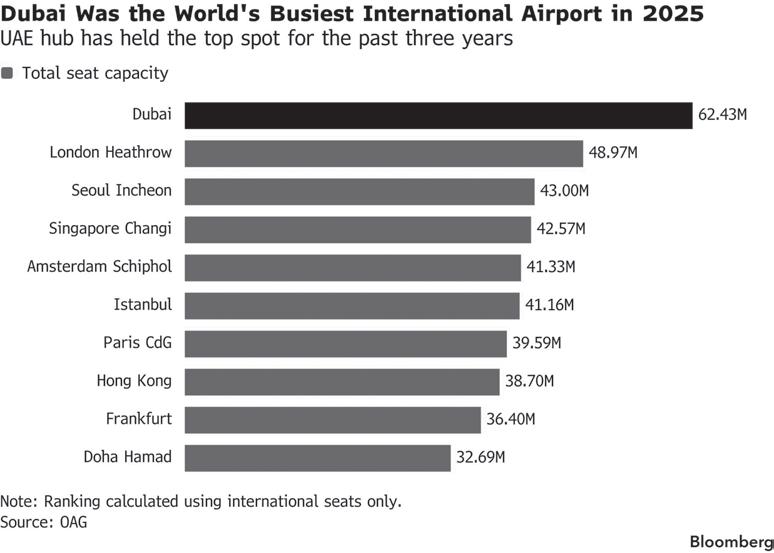
lines and Delta Air Lines have expanded longhaul widebody flying by 11% and 12%, respectively, according to tracker Flightradar24. They added flights to existing destinations in Europe, as well as new routes to cater to well-heeled American tourists.
Jet fuel
US airlines are more exposed to surges in jet fuel prices as they’re not hedged, though they enjoyed a bump in demand last month as passengers pounced to book before those costs pushed up fares.
On the Middle East disruption, nonstop flights from the US to Asia will benefit, as will transatlantic routes where US airlines code-share with European carriers, according to Walker.
The longer the war persists, the worse it will be for the carriers with bases in the Middle East. US President Donald Trump this week remained vague on the timeline of the war and pledged more aggressive actions against Iran.
Given its geographical advantage, Turkish Airlines also gained market share in the month after the war began, while Qatar Airways lost the most, according to the data analyzed by Bloomberg.
Lufthansa saw a pickup in short-term de -
mand, but wants to make these new route switches more permanent. Chief Financial Officer Till Streichert said there’s “absolutely” the potential to move capacity to Asia on a more lasting basis. Such moves aren’t always straightforward, particularly if there’s an aircraft mismatch. A single-aisle jet serving a European-Gulf route won’t necessarily be suitable for a longer-haul trip to Asia, and new, fuel-efficient widebody aircraft have years-long waiting lists. Plus, opening new routes takes months of preparation involving landing slots, schedules and staffing.
Meanwhile, worries about a jet fuel shortage have prompted Lufthansa management to ready crisis plans that could involve grounding planes.
Lufthansa shares are down 17% since the war began. British Airways parent IAG SA has fallen 13% in the same period, while Air France-KLM has dropped 27%. Morgan Stanley and UBS recently cut share-price targets on a number of European airlines, citing fuel costs.
Price war WHILE the end of the war remains unclear, what’s certain is that the Mideast carriers will
Aid groups warn Iran war is hindering food, medicine from reaching millions
By Sam Mednick & Samy Magdy The Associated Press
TEL AVIV, Israel—Aid groups are warning that the war in the Middle East has upended their ability to get food and medicine to millions of people around the world in need, and that the suffering will deepen if the violence continues.
Not only has the conflict cut off vital shipping routes, creating a global energy crisis, it’s also disrupting supply chains for aid groups, forcing them to use costlier, more time-consuming routes.
Key pathways such as the Strait of Hormuz have been effectively shuttered and routes from strategic hubs such as Dubai, Doha and Abu Dhabi have also been impacted. Transport costs have spiked with higher fuel and insurance rates, meaning less supplies can be delivered with the same amount of money.
The World Food Program says it has tens of thousands of metric tons of food heavily delayed in transit. The International Rescue Committee has $130,000 worth of pharmaceuticals intended for war-torn Sudan stranded in Dubai and nearly 670 boxes of therapeutic food meant for severely malnourished children in Somalia stuck in India. The U.N. Population Fund says it’s delayed sending equipment to 16 countries.
Steep US cuts to foreign aid already had hobbled many aid groups, who say the war is exacerbating the problem.
The United Nations says this is the most significant
supply chain disruption since Covid, with up to a 20% cost increase on shipments and delays as goods are rerouted. And the war is creating new emergencies, such as in Iran, and also in Lebanon where at least one million people have been displaced.
“The war on Iran and disruption to the Strait of Hormuz risk pushing humanitarian operations beyond their limits,” said Madiha Raza, associate director for public affairs and communications for Africa for the International Rescue Committee.
Even when the fighting stops, the shock to global supply chains could continue to delay lifesaving aid for months, she said.
Longer and more costly routes
THE war has forced organizations to find new ways to transport goods, with some bypassing the Strait of Hormuz and the Suez Canal and rerouting vessels around Africa, adding weeks to the delivery.
Others are using a hybrid of methods, including land, sea and air, increasing costs.
Jean-Cedric Meeus, chief of global transport and logistics for UNICEF, said his agency is using a mix of land and air routes to send vaccines to Nigeria and Iran in order to get them there in time for the vaccination campaigns, but the costs have soared.
Before the war, UNICEF sent vaccines to Iran by plane directly from vendors around the world. Now it’s flying the vaccines to Turkey and driving them into Iran, which has increased costs by 20% and has added

10 days to the delivery time, he said. Save the Children International, which would normally send supplies by ocean freight from Dubai to Port Sudan, will now have to truck the goods from Dubai through Saudi Arabia and then by barge across the Red Sea, it said. The route adds 10 days and increases costs by about 25%, at a time when over 19 million Sudanese face acute food insecurity. The delay puts more than 90 primary health care facilities across Sudan at risk of running out of essential medicines, it said.
The spike in prices also means organizations have to choose what to prioritize.
“In the end, you sacrifice either the number of children that you serve...or you sacrifice the number of items that you can afford to buy,” said Janti Soeripto, president of Save the Children for the United States. The group said it has stockpiles in countries where it works but some of those could run out within weeks.
Rising costs are also impacting people’s ability to seek help within their countries.
Doctors Without Borders said rising fuel prices across Somalia—where some 6.5 million people are experiencing acute food insecurity—have driven up transport and food costs, making it harder for people to get care. In Nigeria, the IRC says fuel prices have surged by 50% and clinics are struggling to power equipment, such as generators and mobile health teams have scaled back operations.
Hunger crisis could deepen ONE of the biggest concerns is the impact the war will have on global hunger.
WFP warns that if the conflict continues through June, 45 million more people will be acutely hungry, adding to nearly 320 million people facing hunger around the world.
Some 30% of the world’s fertilizer comes through the Strait of Hormuz and with planting season ahead in areas like East Africa and South Asia, small farmers in poor countries will be hard hit. Sudan imports more than half its fertilizer from the Gulf and Kenya approximately 40% from there, aid groups say.
The U.N. secretary-general has established a task force to facilitate fertilizer trade—modeled on the Black Sea Grain Initiative. But aid groups say that won’t be enough. If there’s no ceasefire, governments need to provide more funding for organizations to respond to the rising costs, they say.
return to the market hungry to regain ground, and pricing could come into play.
“I would expect the Gulf carriers to offer highly attractive fares to rebuild traffic via their hubs, so maybe the European carriers will only have a short window of opportunity to exploit high demand and high fares,” said Richard Evans, senior consultant at analytics firm Cirium.
The Middle East hub model saw Emirates and Etihad enjoy massive growth in recent decades. Emirates carried 55.6 million passengers in 2025, more than quadruple the number ferried just 20 years earlier.
That helped to make Dubai the world’s busiest international airport, but rivals say the airlines’ expansion was for years sustained by unfair subsidies.
“It drives me crazy when people say, ‘These Gulf carriers are so amazing, they’ve got brand-new airplanes, they’ve got fantastic new airports’,” Air France-KLM CEO Ben Smith said in an interview last month. “But when you’re in an unlevel playing field, you can produce that.” Asian airlines have boosted their long-haul trips too, with Singapore Airlines adding services to London and Melbourne, while Hong Kong’s Cathay Pacific Airways ramped up flights to Paris, Zurich and London. Air India said it’s introduced m ore services and Australia’s Qantas Airways is also trying to add capacity on European routes. Flying between Asia and Europe was already tricky because many Western airlines were forced to dodge Russian airspace following its invasion of Ukraine in 2022.
The Iran conflict has exacerbated that. With Iranian and Iraqi airspaces closed, aircraft are being routed through narrow strips over Georgia, Azerbaijan and central Asia.
“The issue for European carriers to Asia is airspace availability, and competing with Asian airlines that are more competitive and can fly over Russia,” said Conroy Gaynor, an analyst at Bloomberg Intelligence. “We think more capacity will end up on the Atlantic but have concerns on whether there is enough demand to absorb a significant increase.” Bloomberg

Housing market trends favor home shoppers, but Iran war clouds outlook for mortgage rates
By Alex Veiga AP Business Writer
OS ANGELES—The econom -
Lic fallout from the war with Iran is driving up the cost of buying a home, even as other housing market trends in many parts of the country favor home shoppers this spring.
Mortgage rates have been rising since the war began, as surging energy prices heighten worries about higher inflation, pushing up the yield on US 10-year Treasury bonds, which lenders use as a guide to pricing home loans.
As recently as the last week of February, the average rate on a 30-year mortgage dropped to just under 6%, its lowest level in more than three and a half years. It climbed this week to 6.46%, its highest level in nearly seven months.
The conflict is also injecting more uncertainty into the US economic outlook at a time when the job market is sputtering.
While rates are still down from a year ago, their recent upward trend has already led to a slowdown in mortgage applications. Further increases threaten to put a damper on home sales during what’s traditionally the busiest time of the year for the housing market.
“The war in Iran has seriously complicated the spring buying season,” said Joel Berner, senior economist at Realtor.com. “I expect that many buyers will be put off by rising rates and mounting economic uncertainty, choosing to bide their time rather than jumping on board for a purchase before rates go up.”
Home shoppers who can afford to buy at current mortgage rates this spring are likely to find a more

buyer-friendly housing market than this time last year. That means they’ll have more leverage when negotiating with sellers, who in many cases are watching their property go unsold for weeks, potentially making them more willing to lower their initial asking price or offer buyers money for closing costs, repairs or other concessions in order to get a deal done, real estate agents say. In the Dallas-Fort Worth metro area, lower listing prices and more homes on the market are forcing many sellers to price their home more competitively or consider offering some incentives to land a buyer, said Matthew Crites, an agent with Coldwell Banker Realty. “It’s been a really good buyer’s market to kind of start the year off with,” he said. The trends helped give home shopper Anne King a strong hand when she set her sights on a three-bedroom, two-bath ranch-style house in Fort Worth listed at $275,000. The contract administrator of -
fered $10,000 below the listing price.
She also asked that the seller kick in $5,000 toward closing costs. The seller accepted, and later agreed to throw in another $12,000 for repairs after a home inspection revealed roof damage.
“Fortunately for me, the seller was in a position they needed to sell,” said King, 57. The purchase was finalized in late February, just before the start of the conflict in the Middle East.
King had hoped mortgage rates would ease further before she bought the home, but decided it made sense to buy sooner, rather than risk having to compete this spring against more homebuyers who could potentially trigger a bidding war -- something she experienced last May when she bought a two-bedroom, two-bath townhouse in Arlington, Texas.
She locked in a 6% rate on her mortgage and plans to refinance to a lower rate whenever rates drop.
“I feel like I got a good deal on this property, and that’s all that matters,” she said.
Home shoppers gain more leverage WHILE the inventory of homes for sale nationally is still low by historical standards, active listings—a tally that encompasses all homes on the market except those pending a finalized sale—jumped nearly 8% in February from a year earlier, according to data from Realtor.com.
The increase varies across the US, with the West, Midwest and South far outpacing the Northeast. Still, some 43 of the 50 largest metro areas had more homes for sale in February than a year earlier, with listings up between 10% and 38.5% in many markets, including Seattle, Indianapolis, Las Vegas and Houston and Denver.
As homes take longer to sell, prices have started falling. The median listing price was down in February from a year earlier in just over half of the nation’s biggest 50 metro areas, including a nearly 9% drop in Austin and Memphis, and declines of more than 5% in Washington D.C., San Diego and Los Angeles.
In another sign that buyers may have the edge negotiating with sellers this spring, an analysis by Redfin estimates that there were about 46% more sellers than prospective buyers in the market nationally in February. That’s up from about 30% a year earlier and represents the largest gap between buyers and sellers on records going back to 2013, according to Redfin.
Miami, Nashville and Austin are among the metro areas where sellers most outnumber buyers, Redfin found.
A buyer’s market, if you can afford it
THE US housing market has been in a sales slump since 2022, when mort -
gage rates began to climb from pandemic-era lows. Sales of previously occupied US homes were essentially flat last year, stuck at a 30-year low. They have remained sluggish so far this year, declining in January and February versus a year earlier.
While the pace of home price growth has slowed or fallen in many metro areas, affordability hurdles remain daunting for many aspiring homebuyers because wage growth has not kept up with home prices.
Consider, the median price of an existing home sold in February was $398,000, according to the National Association of Realtors. That’s nearly five times the median household income. A historic rule of thumb was that homes generally cost three times the household income.
The recent increase in mortgage rates adds slightly to the affordability challenge. On a $400,000 home near downtown Dallas, for example, factoring in a 20% down payment and a 30-year mortgage at 6%, the buyer’s monthly payment would be about $2,248. At a 6.4% rate, that payment would climb to $2,331. And while mortgage rates are still lower than a year ago, making monthly payments more manageable, rates are still much higher than the sub-3% averages available to homebuyers during most of 2020 and 2021 as the weakened economy dealt with the coronavirus pandemic and its aftermath.
Sellers under pressure
3-year-old immigrant girl suffered alleged sexual abuse during months in federal custody, family says
By Valerie Gonzalez The Associated Press
McALLEN, Texas—For five months, the young father waited for his 3-year-old daughter’s release from federal custody after she crossed the US-Mexico border with her mother, hoping through delays for their safe reunion. Only when he turned to the courts as a last resort did he learn that the girl had suffered alleged sexual abuse at the foster home where she’d been placed after immigration officials separated her from her mother.
“She was so long in there,” said her father, who is a legal permanent resident in the United States. “I just think that if they would have moved faster, nothing like that would have happened.” He spoke to The Associated Press on condition of anonymity to prevent identifying his daughter as a victim of sexual abuse.
President Donald Trump’s administration began targeting detained immigrant children, like the man’s daughter, last year when it implemented new rules and procedures, which were immediately followed by a dramatic jump in detention times. The federal government intensified efforts to expand family detention indefinitely by motioning to terminate a cornerstone policy ensuring the protection of immigrant children in federal custody.
For months after the girl was placed in foster care, her father’s attempts to be reunited stalled as the government told him it couldn’t make an appointment to take his fingerprints.
During that time, according to court documents, the girl said she
was sexually abused by an older child staying with her in foster care in Harlingen, Texas. A caregiver noticed the child’s underwear was on backward, according to the lawsuit. The girl then told the caregiver she was abused multiple times and it caused bleeding. Federal Office of Refugee Resettlement officials told the father that there had been an “accident” and his daughter would be examined, he told the AP in an interview.
“I asked them, ‘What happened? I want to know. I’m her father. I want to know what’s going on,’ and they just told me that they couldn’t give me more information, that it was under investigation,” the father said.
The girl underwent a forensic exam and interview. Although the father wasn’t told of the outcome, the older child accused of the abuse was removed from that foster program, according to the lawsuit.
The girl was forensically examined and interviewed, according to the lawsuit. The abuse allegations were reported to local law enforcement, said Lauren Fisher Flores, the lawyer representing the girl. The Associated Press does not typically name people who have said they were sexually abused.
“To have your child abused while in the government’s care, to not understand what has happened or how to protect them, to not even be told about the abuse, it is unimaginable,” Fisher Flores said. “Children deserve safety and they belong with their parents.”
The ORR and its parent agency, the Department of Health and Human Services, were named in the child’s lawsuit but did not respond to emails seeking comment.
Trump administration changes release policies
THE girl and her mother illegally crossed the border near El Paso on Sept. 16 of last year. When her mother was charged with making false statements and they were separated, the toddler was sent to the custody of the ORR, which cares for immigrant children in shelter or foster settings. Children in ORR’s care are released to parents or sponsors who submit to a rigorous process that has grown more extensive under the Trump administration.
Stricter rules were imposed on documentation required for sponsors, border agents started pressuring unaccompanied children to selfdeport before transferring them to shelters and Immigration and Customs Enforcement started arresting some sponsors in the middle of the release process.
Legal advocates filed lawsuits challenging the policy changes, anticipating that they would result in prolonged detention.
Average custody times for children cared for by ORR grew from 37 days when Trump took office in January 2025 to almost 200 days this February. The total number of children in ORR custody fell by about half during the same time period.
Attorneys are now turning to habeas petitions, which function as emergency lawsuits, to expedite the release of children to their parents and sponsors.
Fisher Flores, legal director of the American Bar Association’s ProBar project, said that this year the organization has worked on eight habeas corpus petitions representing children who have been held in federal custody for an average of 225 days. They had not
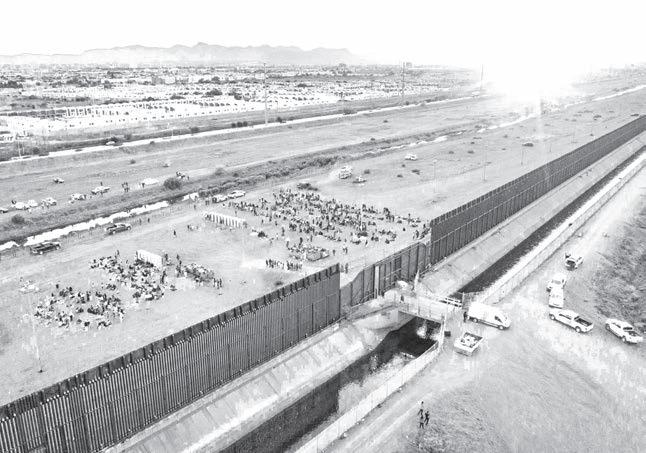
filed these kinds of petitions for children before the start of this Trump administration.
Fisher Flores said that legal intervention helped prompt the federal government to respond to the father’s sponsorship application.
Alleged abuse wasn’t immediately disclosed to the father
AFTER the monthslong delay, attorneys sent the government a letter in February and prompted them to allow the father to receive appointments for a fingerprinting background check, a home visit and a DNA test. Then ORR stalled again, offering no timeline on her expected release.
Attorneys filed the habeas petition in federal court and two days later, ORR released the girl to her father.
It was while the attorneys preared the lawsuit that the father realized that the “accident” officials had told him about was alleged sexual abuse.
“Increasingly, we have to turn to the federal courts to challenge these harmful legal violations and demand that children be released,” Fisher Flores said.
The fingerprinting policy was challenged during the first Trump administration by legal advocates including the National Center for Youth Law. Other nationwide lawsuits are opposing more recent changes affecting the custody and care of immigrant children.
“This represents yet another version of family separation,” Neha Desai, managing director at Children’s Human Rights and Dignity at the National Center for Youth Law, said of the 3-year-old girl’s case.
Jo Chavez, a Redfin agent in Kansas City, tells clients looking to sell to expect that their home probably won’t sell right away. She also advises them to be “reasonable” with how they price their home.
“We have a lot of sellers who have that idea of like, ‘well, my neighbors sold for this much, and so I think I should price $10,000 above them,’” said Chavez. “And that’s obviously not a logical approach, because there were less sales last year.” Kansas City is among the few metro areas where the median listing price isn’t falling. It rose 4.1% in February from a year earlier, according to Realtor.com. However, the number of homes on the market soared by nearly 20%.
Gail Sanders and her husband, David, put their four-bedroom, three-bath home in Olathe, Kansas, on the market in late February. But even after hosting a couple of open houses, and after lowering their asking price from $535,000 to $525,000, the couple had yet to receive any offers as March drew to a close. The couple wants to sell the house and buy a home in another Kansas City suburb closer to their three adult children and grandchildren. But until they find a buyer, those plans are on hold.
“We just didn’t think it was fair to somebody else to put a contingent offer on (another house), but then also lock ourselves into something when we weren’t sure how fast ours was going to move,” said Gail Sanders, a senior claims director. “I don’t want to be stuck with two house mortgages on the off chance.”
THE housing market has cooled considerably since earlier this decade, when rock-bottom mortgage rates set off a frenzy that sent home prices soaring. Back then, it wasn’t uncommon for a home to fetch well above the seller’s asking price after receiving offers from multiple buyers. While some sellers are still receiving multiple offers now, it’s far from the norm.
Continued from A6
The New York Times, citing US intelligence reports, said Iranian personnel have been digging out underground missile bunkers and silos struck by American and Israeli bombs and returning them to operation hours after attacks. That casts doubt on the US and Israel’s ability to destroy Iran’s missile capability—one of their key war goals. On Saturday, Turkish President Recep Tayyip Erdogan said in a social media post that he spoke by phone with Mark Rutte, secretary general of the North Atlantic Treaty Organization, saying the situation was heading for a deadlock and “urged the international community to step up efforts to end the war.” Bahrain, supported by Jordan and Arab Gulf states, is proposing a United Nations Security Council resolution aimed at helping re-open Hormuz, according to the UAE. It would provide “a clear
GAIL and David Sanders stand in front of their home which they have been trying to sell Wednesday, March 25, 2026, in Olathe, Kan. AP PHOTO/CHARLIE RIEDEL
Continued from A3
“Despite the oft-repeated reminders to leave only footprints, rampant littering again tarnished the Holy Week as if it has become a tradition in itself,” said Ochie Tolentino, Zero Waste Campaigner of EcoWaste Coalition. “As old habits die hard, we urge everyone, especially our faith leaders and the faithful, to persevere in promoting shared responsibility towards ecological conversion, so we dispose of practices that disrespect and harm Mother Earth.”
Devotees, estimated at over six million, who trekked to Antipolo City for penitential and thanksgiving walks left a trail of garbage that kept the waste and sanitation workers of at least four local governments (LGU) – Pasig, Cainta, Taytay, and Antipolo preoccupied, with the Tikling Junction as a particular littering hotspot, the group lamented.
In the early morning of Good Friday, the patio of the Antipolo Cathedral was teeming with litter, such as discarded plastic bottles and, of all things, religious literature distributed by non-Catholic groups to Alay Lakad participants.
Rampant littering was also observed in Quiapo District, particularly along Quezon Boulevard, Recto Avenue, and adjacent streets, as the 13-hour procession of the revered Black Nazarene drew over 500,000 devotees.
At the Our Lady of Lourdes Grotto Shrine, pilgrims who visited the site to perform the Way of the Cross left a load of rubbish, as evidenced by overflowing bins and Calvary Hill dotted with patches and piles of litter. The picnic area, in particular, was swarmed by visitors, some of whom simply tossed used food containers and plastic bottles on the ground.
While not as bad as in previous years, littering was also observed at the National Shrine and Parish of the Divine Mercy in Marilao, Bulacan.
For this year’s Lenten monitoring, the EcoWaste Coalition’s Basura Patrollers braved the scorching heat and visited at least 42 churches in Bataan, Batangas, Bulacan, Cavite, Rizal, and the National Capital Region, particularly in Caloocan, Makati, Malabon, Mandaluyong, Manila, Navotas, and Quezon cities.
Among the places that stood out for cleanliness at the time of monitoring were the Cathedral-Shrine and Parish of St. Joseph (Balanga City, Bataan), St. Catherine of Sienna Parish (Samal, Bataan), Minor Basilica of the Most Holy Rosary (Orani, Bataan), Archdiocesan Shrine and Parish of St. James the Greater (Ibaan, Batangas), Metropolitan Cathedral of St. Sebastian (Lipa City), Minor Basilica of St. Martin of Tours (Taal, Batangas), Saint Gregory the Great Parish (Indang, Cavite), St. Augustin Parish (Mendez, Cavite), and, most notably, the Holy Spirit Chapel at the SVD Seminary (Tagaytay City) where strict ecological solid waste management, including segregation at source, is enforced in line with RA 9003 or the Ecological Solid Waste Management Act. Also cited for being litter-free were the National Shrine and Parish of Our Lady of Aranzazu (San Mateo, Rizal), Mary Immaculate Parish Nature Church (Las Piñas City), St. Andrew the Apostle Parish (Makati City), San Bartolome Parish (Malabon City), San Felipe Neri Parish (Mandaluyong City), Santuario de Santo Niño (Mandaluyong City), and Santo Domingo Church (Quezon City).
The EcoWaste Coalition also recognized and thanked the local government and church waste workers and volunteers, as well as members of the informal waste sector, for their roles in keeping the pilgrimage sites and public spaces clean and in diverting recyclables and other useful resources away from dumps and landfills.
Agreement with Iran ‘meaningful gain’ but with no immediate effect–Garin
By Lorenz S. Marasigan @lorenzmarasigan
WHILE the bilateral arrangement secured with Iran to ensure safe passage Philippine oil ships through the Strait of Hormuz will not immediately bring down fuel prices, it already delivers a “meaningful gain” by reducing the risk of supply disruptions that could hammer the Philippine economy, a Cabinet official said over the weekend.
In a statement, Energy Secretary Sharon S. Garin clarified that the bilateral deal is primarily a risk management measure rather than a direct intervention on pump prices.
“This is not a perfect solution, and it does
not eliminate all risks. But it is an important step that improves our position in a highly uncertain global environment,” she said.
Garin said in a period of heightened geopolitical tension in the Middle East, securing “safe and preferential access” through one of the world’s most critical oil chokepoints is itself a significant policy achievement.
“In a time of global tension, risk reduction is already a meaningful gain,” she said.
Garin explained that even though the Philippines sources much of its fuel from regional hubs such as Singapore and South Korea, the crude oil behind those products frequently transits the Strait of Hormuz. She added that a disruption there sets
off a chain reaction across global supply chains, ultimately driving up pump prices for Filipino consumers.
Under the arrangement, Philippinelinked cargo will receive stronger protection, and Filipino seafarers aboard vessels in the area will benefit from improved safety conditions.
“This development will not immediately bring down fuel prices, nor does it resolve our long-term structural challenges in energy. Those remain priorities that we continue to address,” she said.
Fuel prices continued their sharp climb last week as oil companies implemented another round of increases, even as the government moved to shore up domestic supply.
Export council flags gains from customs changes
By Bless Aubrey Ogerio
RECENT reforms at the Bureau of Customs (BOC) are beginning to address long-standing operational bottlenecks, with export stakeholders saying the changes could help streamline cargo movement and improve the competitiveness of Philippine goods in global markets.
The Export Development Council (EDC), through its executive committee chaired by the Department of Trade and Industry (DTI) and the Philippine Exporters Confederation, Inc. (Philexport), said the measures signal progress toward a more modern and digitalized customs system.
Trade Secretary Ma. Cristina Roque said the pace of reforms needs to be sustained, particularly as global conditions continue to pose risks to supply chains and trade flows.
“In times of global crisis, we must fasttrack reforms that ease the burden on businesses,” Roque said, noting that the BOC’s recent actions could help exporters remain resilient despite ongoing disruptions.
Among the key changes cited was the exemption of certain exporters from the Electronic Tracking of Containerized Cargo
Continued from A4
available through the BWC and communitybased support groups.
These institutions provide a range of services such as legal assistance, psychosocial support, and protection interventions aimed at ensuring the safety of survivors and facilitating their access to justice, the BDI added.
The Bangsamoro Information Office said the Bangsamoro Women Commission (BWC) has welcomed the ruling, calling it a landmark step in upholding women’s rights and dignity, as the region marks National Women’s Month and continues efforts to strengthen protection for women and girls and promote survivorcentered responses to gender-based violence.
“The BWC extends its deepest gratitude and heartfelt appreciation to the BDI for issuing a historic fatwa affirming that no woman can be forced to marry her rapist,” the commission said.
(E-TRACC) system.
The policy, formalized through a Customs Memorandum Order, removes the requirement for exporters accredited as Authorized Economic Operators (AEOs) and registered as business enterprises, addressing concerns over added costs and delays.
Exporters have long raised issues over the system’s impact on turnaround time. Earlier, Philexport President Sergio R. Ortiz-Luis Jr. said the exemption allows firms to focus on meeting delivery schedules without the added administrative burden.
“But we also hope that the rest of the exporters can be covered, since their goods are outbound anyway and should be compliant with their buyers’ requirements,” Ortiz-Luis said.
Industry groups also pointed to improvements in processing, with Dan Lachica, Semiconductor and Electronics Industries in the Philippines, Inc. (Seipi) president, saying the group welcomed the exemption and efforts to speed up approvals for AEO accreditation.
The council also cited the issuance of Assessment and Operations Coordinating Group (AOCG) Memo 188-2025, which directs
As of 2021, the UN Population Fund (UNFPA) reported that approximately 20 countries still had laws allowing rapists to escape punishment by marrying their victims, a crowdsourcing Internet site has noted. It said that while several nations in the Middle East and North Africa have recently repealed these laws, “marry-your-rapist” provisions, which often stem from colonial-era penal codes, persist in various forms, particularly in parts of Asia and Africa
The same crowdsourcing site said that In 2017, the World Bank Group report claimed there were 12 countries left with marryyour-rapist laws: Angola, Bahrain, Equatorial Guinea, Eritrea, Iraq, Jordan (repealed in August 2017), Lebanon (repealed July 2017), Libya, Palestine, the Philippines, Syria and Tunisia (repealed in July 2017). It said an international wire agency also also listed Algeria, Kuwait and Tajikistan as among the other nations still practicing it.
Some 15 central and south American countries were also practicing it until 1997 when all finally repealed or abolished the practice.
ports to recognize Export-Oriented Enterprise (EOE) certificates issued by the DTI’s Export Marketing Bureau.
The directive clarifies procedures under Republic Act 12066, or the CREATE MORE Act, and standardizes implementation across ports.
Under the policy, exporters with at least 70 percent export sales may qualify for value-added tax exemptions on imports tied directly to export activities, without needing a separate endorsement from the Department of Finance.
The change is expected to reduce compliance steps and improve operational efficiency.
Another measure highlighted by the EDC is the stricter enforcement of the 90-day container dwell time rule under Customs Administrative Order 8-2019. The rule aims to ease port congestion by ensuring the timely clearance or disposal of overstaying containers.
The council said these steps, alongside ongoing digitalization efforts at the BOC, could help reduce trade frictions and improve the overall movement of goods, though continued coordination between government and industry will be needed to sustain gains.
Continued from A4
International Terminal Services, Inc. (AITSI), and Subic Bay Freeport Terminal Services, Inc. (SBFGTSI).
Last year, SBMA’s port operations generated revenues totaling P1.77 billion, a 4.2 percent increase over the total collections of P1.7 billion recorded in 2024.
Seaport operations also contributed the bulk of this income, with a P1.47 billion total.
Subic boasts of 15 operational piers and wharves, including the 300,000-TEU New Container Terminals 1 and 2, a bulk fertilizer terminal, a bulk grains terminal, and a general cargo terminal.
A P1.2-billion cruise ship berth and passenger terminal being planned by the SBMA and the redevelopment of the Boton Wharf here into a 12.8-hectare warehousing terminal are expected to further expand Subic’s port operations in the future.
Pump prices climbed further last week as oil companies implemented another round of increases. Seaoil raised diesel by P12.50 per liter and kerosene by P2 per liter, while temporarily pausing gasoline price adjustments without providing a reason.
Jetti Petroleum raised diesel by P12.90 per liter and gasoline by P1 per liter. Petron Corporation raised gasoline by P1.90 per liter, diesel by P11.90 per liter, and kerosene by P1.40 per liter.
These followed hikes
Davao City has secure, resilient sources of water
By Manuel T. Cayon @awimailbox
DAVAO CITY—This city is tapping two sources of potable water, with the surface water from its river system inside its northern watershed as the main source while resting its ground aquifer.
This dual sourcing of potable water makes this southern Philippine city of 1.9 million relatively secure and resilient in a world gradually pressed into water insecurity, said both the city’s water district and the corporate subsidiary tapped for the city’s bulk water supply extracted from the surface water.
The Davao City Water District has increasingly turned toward a balanced approach, combining surface water and groundwater sources, to strengthen resilience against these uncertainties of sourcing water, said Jovana Cresta Duhaylungsod, spokesman for the Davao City Water District.
“As of now, we can claim that Davao City has achieved what we call as climate resiliency in terms of water service, as demonstrated during the El Niño period when every place in the country was experiencing drought and water shortages. In contrast, Davao City’s scenario was the opposite; we had an abundant supply,” she said.
She was referring to the Davao City Bulk Water Supply Project (DCBWSP), which began extracting surface water sourced from the Tamugan River in 2022 to augment and eventually replaced the groundwater supply that was then the main source of water for several decades. The DCWD said the shift to extracting the surface water “demonstrated how surface water integration is helping ease pressure on aquifers while maintaining stable supply for the city.”
The bulk water supply extracted from the Tamugan River currently supplies 300 million liters of potable water daily and has reached more upland areas in the north that were then unreached when the city relied on its groundwater.
The Aboitiz-owned Apo Agua Infrastructura is the contracted supplier of the bulk water while DCWD maintains its operation as the distributor down to the households. It is the
subsidiary of Aboitiz InfraCapital (AIC), the infrastructure arm of the Aboitiz Group.
The Apo Agua said the Philippines “is fortunate to be endowed with abundant natural water resources – from surface water sources to productive groundwater aquifers that sustain communities across the country.”
With significant annual rainfall that varies from 965 to 4,064 millimeters annually and diverse watersheds, water availability has long supported growing cities and economies. However, it said that changing climate and increasing demand make it essential for cities to balance surface water and groundwater through integrated systems that protect supply even during dry periods.
“Yet across Davao, households and businesses experienced no noticeable disruption in supply. DCWD was able to maintain stability by balancing surface water delivery with groundwater production, demonstrating how diversified sources can absorb environmental fluctuations without affecting consumers,” it added.
The DCWD assured that the city’s local water utilization “offered a practical example of how redundancy strengthens resilience”. It said that it was resting the 36 production wells spread across the city underground aquifers, the DCWD would occasionally turn on some of them to augment scarce surface water supply.
The Apo Agua said this works to the advantage of the city as “around the world, groundwater depletion has become an increasing concern. Aquifers that once seemed limitless are now under pressure due to population growth and expanding economic activity.”
Besides, local and global environmentalists have been repeatedly warning of environmental catastrophes derived from depleted underground water, land subsidence among the major imminent risk, and sea water incursion to the water table as already experienced by a few coastal-located metropolises.
With dual water system resource, the DCWD said it can assure of supplying water to projected development projects and increased population.
Cebu ramps up measures as Middle East crisis threatens local economy
CEBU CITY—The impact of the Middle East conflict on tourism, employment, and the broader economy dominated discussions at the recent Regional Development Council (RDC) meeting, with Cebu City Mayor Nestor Archival warning of slowing economic activity and outlining urgent response measures.
Archival said rising global fuel prices are already affecting multiple sectors, potentially delaying investments and halting some construction projects due to higher costs. These disruptions, he noted, could trigger hiring freezes and push unemployment higher.
He added that tourism is expected to slow, which would affect hotels, vendors, and workers dependent on visitor spending.
Agriculture and fisheries are also feeling the strain, with farmers facing high fertilizer costs and limited supply, resulting in lower production. Micro, small, and medium enterprises (MSMEs) have likewise reported declining sales.
“All sectors are feeling the pressure, and we are already seeing a slowdown in economic activity,” Archival said. To cushion the impact, Archival said they have discussed key measures, including prioritizing cost-of-living controls, intensified price monitoring, and targeted subsidies.
Discussions are ongoing with the Department of Social Welfare and Development (DSWD) on the rollout of fuel subsidies, initially for drivers.
Efforts are also underway to protect jobs
and support MSMEs through temporary tax and fee relief, as well as, livelihood and reskilling programs backed by the national government.
Ensuring stable supply chains is another priority, with coordination ongoing with shipping and logistics sectors to prevent shortages and price spikes.
These measures are being reinforced by a broader public-private initiative led by the Cebu Chamber of Commerce and Industry (CCCI), which recently convened a high-level convergence meeting with government agencies, local government units, and industry stakeholders.
The meeting gathered around 120 participants from logistics, shipping, retail, tourism, and other sectors to strengthen
coordination amid rising fuel costs and supply chain pressures.
“The next one to two weeks are critical. What we do now will shape the flow of goods, the stability of supply, and the cost of living for every Cebuano family,” said CCCI President Regan King.
Key measures also agreed upon include the rollout of mobile grocery caravans for underserved communities, commitments from retailers to maintain stable prices and adequate stock, and stricter price monitoring by authorities.
Logistics interventions such as suspending truck bans, easing cargo movement restrictions, and introducing “green lanes” at ports were also proposed to ensure unhampered delivery of goods.
In the maritime and aviation sectors, stakeholders are pushing for reduced port charges and airline fees, as well as possible caps on cargo freight rates for essential goods.
Fuel subsidies, flexible work arrangements, and closer coordination with labor authorities are also being eyed to mitigate employment disruptions.
Long-term plans include establishing a centralized coordination mechanism, a dedicated logistics hotline, and stronger collaboration among transport, shipping, and regulatory sectors through CCCI’s Trade and Logistics Alliance.
Archival said local consultations with business groups and grocery operators indicate that supplies of basic goods remain
stable for the next three months, possibly until June. However, he urged the public to avoid panic buying, warning that it could disrupt supply and disadvantage other consumers. To improve access to affordable goods, the city continues to expand its rolling store program, currently operating in Barangays Agsungot and Babag, with plans to reach more areas after Holy Week. The city has also begun distributing P20-per-kilo rice, with 1,000 sets of 10 kilos rolled out
Fatwa. . .
Petroleum. . .
Recto’s equation: Cushioning the oil shock’s impact while staying on budget editorial
AS the conflict in the Middle East sends shockwaves through the global energy market, the Philippines finds itself in a precarious but familiar position. With over 90 percent of our crude oil and refined petroleum needs imported—much of it priced against Middle Eastern benchmarks—the country is effectively a passenger on a vessel buffeted by geopolitical storms. When the price of oil spikes abroad, the pain is felt almost instantly at the pump, in transport fares, and on the dining tables of Filipino families.
In the face of such external shocks, the instinct of any administration is to shield its constituents. President Ferdinand R. Marcos Jr. has responded by declaring a state of national energy emergency through Executive Order No. 110 and ordering a whole-of-government response, including targeted subsidies and assistance to vulnerable sectors. (Read the BusinessMirror story: “Government declares state of energy emergency,” March 25, 2026). These are necessary, humanitarian interventions. Yet, as the administration’s economic team knows all too well, relief is not free. Every peso spent to cushion the blow is a peso added to a national debt that already hovers above 60 percent of GDP. This is where Executive Secretary Ralph G. Recto enters the picture, not merely as a senior official, but as the administration’s chief pragmatist. Long before he became Executive Secretary, Recto built a reputation as a fiscal disciplinarian. His career has been defined by numbers that “refuse to cooperate with sentiment.”
As a central figure in the success of the UPLIFT (Unified Package for Livelihoods, Industry, Food, and Transport) Committee, Recto is less about political performance and more about a cold, hard balancing act.
Recto’s task—“not to eliminate pain but to distribute it or delay it where necessary”—strikes at the heart of responsible economic governance. In an import-dependent economy like ours, it is impossible to fully insulate the public from a global oil crisis. To promise zero pain would be a lie; to attempt it through unchecked subsidies would be fiscal suicide. Recto understands that short-term relief, if overdone, mutates into long-term instability in the form of runaway inflation or a debt crisis.
There is a quiet courage in this approach. During his time in the Senate, Recto earned the moniker “Mr. Taxman” for championing the E-VAT, a move that was politically costly but economically vital. He seems to understand that the discipline required now is arithmetic, not ideological. The Bangko Sentral ng Pilipinas has already adjusted its 2026 inflation forecast upward to 5.1 percent, a warning signal that the margin for error is thin.
Recent reports of Recto’s meeting with oil executives reveal the practical application of this philosophy. While he noted that “operational challenges” remain tolerable, he is ensuring contingency plans are in place. He is not merely hoping for the best; he is preparing for the worst, exploring alternative supply chains as instructed by the President. (Read the BusinessMirror story: “‘Operational challenges’ in importing oil ‘tolerable,’” March 14, 2026). His call for the private sector to help keep prices stable is not just a request for corporate social responsibility, but a recognition that the government cannot shoulder the burden alone.
Ultimately, the measure of this administration’s economic stewardship will not be in the total absence of discomfort, but in the prevention of catastrophe. Recto’s challenge is to manage the tension between relief and restraint. We tend to judge policies by their immediate popularity, but history judges them by the stability they preserve.
Crises eventually pass, but the way they are handled leaves lasting consequences. If Recto can distribute the hardship fairly and soften the impact where he can, he may not win public approval right away. Still, he will have accomplished the only thing that truly matters: keeping the ship steady until the storm passes.
BusinessMirror
Antonio L. Cabangon Chua

Business in the age of crisis: The
quiet power of financial minimalism

TRISING SUN
HE world is under pressure, and the Philippines is feeling it in every market, every household, and every business decision made. Fuel prices are soaring, and the peso is stretched thin. Consumer confidence is not stable.
In this climate, the old playbook needs rethinking. So I thought of writing a series of columns specifically on winning business and career moves for hard times like these: Business in the Age of Crisis. It’s not about catastrophizing, but about clarity.
Over the coming weeks, we’ll do an honest look at the moves that matter most when the margin for error is small and the stakes are high. It’s practical business and career wisdom for Filipinos who intend to come out of this stronger than they went in.
Today, we’ll begin with Financial Minimalism. There is a habit many Filipinos develop in hard times that looks like frugality but is actually something deeper; it’s a quiet, almost instinctive stripping away of everything that does
not truly serve survival or growth. Let’s call it financial minimalism. Not poverty and not deprivation, but intentionality.
In an economy where fuel prices dictate the cost of everything downstream—food, transport, logistics, electricity—the pressure on both households and businesses is relentless. And the natural human response to relentless pressure is one of two things: panic spending, where anxiety drives purchases that feel like control but are actually noise; or paralysis, where the numbers become so overwhelming that nothing gets decided at all. Financial minimalism is the third option, and it is the one that actually works.
The principle is simple: spend on what moves you forward, and cut what merely maintains appearances. For a small business owner, this might
What makes financial minimalism powerful is not the money saved, but the clarity gained. When you strip your finances down to what genuinely matters, you see your business or your household with new eyes. You see where the real risks are. You see which clients, which products, and which expenses are carrying their weight, and which ones are dead wood dressed up as assets.
mean renegotiating supplier terms before renewing a lease on a bigger space. For a professional, it might mean canceling three subscriptions that haven’t been opened in months and redirecting that amount into an emergency fund. For a family, it might mean honest conversation about what “needs” have quietly become “habits,” and whether those habits are worth their cost in this season. What makes financial minimalism powerful is not the money saved, but the clarity gained. When you strip your finances down to what genuinely matters, you see your business or your household with new eyes. You see where the real risks are. You see which clients, which products, and which expenses are carrying their weight, and which ones are dead
wood dressed up as assets. Walk through any mall on a weekend, scroll through social media, and you will see something curious: life, for many, appears to go on as if the crisis were happening to someone else. Restaurants and coffee shops are doing okay. Travel feeds are a parade of getaways and sunsets. This is not inherently wrong; rest is not a luxury, and joy is not irresponsible. But there is a difference between conscious enjoyment and unconscious spending, between choosing to celebrate because your fundamentals are solid and reaching for pleasure because the news is too heavy to sit with. The question that financial minimalism asks is not “should I enjoy my life?” The answer to that will always be yes. But the right question is “do I know, with certainty and honesty, whether I can afford to, and what I am trading for it?”
This is not a call to stop living, but a call to stop spending unconsciously, which, in a crisis, is the quiet killer of otherwise viable businesses and otherwise stable households. The crisis will pass. But the discipline you build while navigating it will outlast the headlines.
Begin with one honest question: If I lost 30 percent of my income tomorrow, what would I cut first? Whatever your answer is—cut it now, before the crisis decides for you.
From twilight to new dawn: The Malampaya revival that changes our energy security
Angel R. Calso, Dionisio L. Pelayo
Ruben M. Cruz Jr.
Eduardo A. Davad Nonilon G. Reyes
D. Edgard A. Cabangon Benjamin V. Ramos Aldwin Maralit Tolosa
Rolando M. Manangan
BusinessMirror is published daily by the Philippine Business Daily Mirror Publishing, Inc., with offices on the 3rd floor of Dominga Building III 2113 Chino Roces Avenue corner De La Rosa Street, Makati City, Philippines. Tel. Nos. (Editorial) 817-9467; 813-0725. Fax line: 813-7025. (Advertising Sales) 893-2019; 817-1351, 817-2807. (Circulation) 893-1662; 814-0134 to 36. E-mail: news.businessmirror@gmail.com www.businessmirror.com.ph



BURIED beneath the torrent of grim headlines about the Middle East war was an announcement from President Ferdinand Marcos Jr. that deserved far greater attention than it received. While global markets trembled over the widening conflict between Iran and the United States–Israel coalition, a quieter but far more consequential development was unfolding in Philippine waters: a second successful well in the expansion of the Malampaya Gas Field.
The discovery, known as Camago-3, followed months of exploration and testing led by Prime Energy Resources Development, the company that now leads the Malampaya consortium. For most Filipinos, the announcement might have sounded like another technical update in the energy sector. In reality, it carries far deeper significance. For more than two decades,
Malampaya has stood as the quiet pillar of the country’s energy security. At its peak, the offshore gas field supplied roughly a fifth of Luzon’s electricity, reducing the nation’s dependence on imported fuel and stabilizing the power grid of the country’s largest island.
Yet the field’s gradual depletion had raised fears that this strategic asset was nearing the end of its life.
For a country often portrayed as dependent on imported energy, the symbolism is powerful. While the world anxiously watches the geopolitics of oil—from the Persian Gulf to global shipping routes—the Philippines may have quietly rediscovered one of its own sources of resilience beneath the waters of Palawan.
Policymakers and industry players alike began preparing for a future in which Malampaya’s gas would run dry, forcing the country to rely increasingly on imported fuels. Those fears intensified as global tensions erupted into conflict in the Middle East, pushing oil prices sharply higher and threatening the flow of energy supplies across the world.
It was against this backdrop of anxiety that the first breakthrough arrived. Earlier this year, the Malampaya East-1 well revealed an estimated 98 billion cubic feet of natural gas—an encouraging discovery that
suggested the basin might still hold untapped reserves. The Camago-3 now strengthens that promise. According to the President, the new discovery contains recoverable gas volumes significantly larger than the earlier find and could extend the life of the Malampaya project by at least six years. In the middle of a global energy shock, that is no small development.
The significance becomes even clearer when the economics are examined. Electricity generated from indigenous Malampaya gas costs just over P4 per kilowatt-hour. Power produced using imported liquefied natural gas can cost more than twice as much. Every cubic meter of domestic gas therefore translates into savings not only for power generators but ultimately for Filipino households and businesses.
As the President noted, every unit of electricity produced from Malampaya instead of imported fuel represents money saved by consumers. In a world where energy markets can be
Atty. Jose Ferdinand M. Rojas II
Put tax accountability where it belongs: At the top

AJoel L. Tan-Torres
DEBIT CREDIT
S the 2026 tax filing season reaches its peak, this is not just another compliance cycle for taxpayers and the Bureau of Internal Revenue (BIR) alike. This is a regular tradition that contributes to the country’s development. Taxpayers are required to file and pay their 2025 annual income tax returns on or before April 15, 2026, while the BIR is hard-pressed to collect its target amounting to P3.431 trillion.
That pressure is magnified by one basic reality: the overwhelming bulk of BIR collections does not come from audit assessments, raids, or enforcement operations. It comes from the voluntary compliance of taxpayers. In its 2024 Annual Report, the BIR reported that voluntary payments contributed P2.772 trillion, or 97.19 percent of total revenues. That single figure should settle the matter. The country’s revenue system rises or falls primarily on whether taxpayers honestly declare, correctly compute, and timely pay their taxes. And because those decisions are shaped not only by the tax department but by the tone, priorities, risk appetite, and governance direction set by top management, the role of presidents, chief executive officers, chief financial officers, boards, and owners is not minor. It is indispensable.
I note that Revenue Memorandum Circular (RMC) No. 20-2026, which provides the guidelines in the filing of annual income tax returns, lists the Statement of Management’s Responsibility (SMR) among the required attachments to the AITR. The SMR was required as an AITR attachment in Revenue Regulations No. 3-2010.
For readers who may not readily recall RR No. 3-2010, a short background is in order. On February 23, 2010, I, as then BIR Commissioner, caused the issuance of this RR. The regulation was adopted to provide the rationale and guidelines for the submission of the Statement of Management’s Responsibility that must accompany the AITR. Its core premise is direct and far-reaching: the annual income tax return is primarily the responsibility of the taxpayer’s management. The regulation then goes further. It states that management is likewise responsible for the information and representations contained not only in the annual income tax return and the accompanying financial statements, but also in all the other tax returns filed for the reporting period, including VAT, percentage tax returns, withholding tax returns, and any other tax returns. It also requires the signatures of the President or Managing Partner, the Chief Executive Officer or equivalent, and the Chief Financial Officer or equivalent. RR 2-2010 also provides penalties for violations.
Even before RMC 20-2026, in the past years, the BIR had consistently indicated the submission of the SMR in its annual income tax filing issuances, annexes, eAnnual Financial Statements attachment rules, and tax return instructions. The 2026 circular should be viewed more as a continuation of an existing compliance framework than as a new requirement. However, I sense that in the tax community, this requirement of SMR attachment is not well-known and is just taken for granted by the senior management of taxpayers.
In that scenario, the BIR has not been able to adequately perpetuate the mindset among taxpayers that tax compliance is not just the concern of the tax manager, accountant, or outside adviser, but is the primary responsibility of senior management.
In that setting, the question of who truly owns tax compliance inside the enterprise becomes more than an administrative detail. It becomes a revenue, governance, and
The right war with a slow boil

TWhen a company adopts an aggressive tax posture, ignores weak documentation, or files tax returns without fully understanding the risks, that is not merely a technical lapse. It is a management problem. It reflects the tone at the top, the quality of governance, and the seriousness—or lack of it—with which senior management treats tax compliance.
credibility issue.
This is precisely why management accountability plays such a central role in tax compliance. If senior management and the broader tax community treat tax return declarations as a real commitment to truthful reporting and disciplined compliance, then better results become possible: better tax planning, better internal controls, fewer weakly supported deductions, more careful withholding tax compliance, more accurate value added tax reporting, and ultimately, more reliable collections. In a tax system where voluntary compliance drives more than 97 percent of revenues, management attention is not merely desirable. It is essential. Clearly, principled tax compliance does not begin and end in the tax department. They begin and must end in the boardroom.
When a company adopts an aggressive tax posture, ignores weak documentation, or files tax returns without fully understanding the risks, that is not merely a technical lapse. It is a management problem. It reflects the tone at the top, the quality of governance, and the seriousness—or lack of it—with which senior management treats tax compliance.
That is a governance principle whose time has come again.
For too long, many enterprises have treated tax as a compliance afterthought. The finance team closes the books. The tax group scrambles to reconcile figures. Advisers are consulted late, usually when an issue is already difficult. The return is signed mechanically. Management assumes that the experts have handled it. But what if RR 3-2010 were reinvigorated—not as an often-forgotten attachment, but as a real accountability device?
What if presidents, CEOs, CFOs, and boards began to treat the Statement of Management’s Responsibility as a genuine declaration to government, shareholders, lenders, and the public that the company’s tax affairs have been reviewed with diligence and integrity by senior management?
That one change in mindset can reshape behavior.
To be continued
Joel L. Tan-Torres was a former Commissioner of the Bureau of Internal Revenue. He has also held various positions, including Dean of the University of the Philippines School of Business, Chairman of the Professional Regulatory Board of Accountancy, Tax
Siegfred Bueno Mison, Esq.
THE PATRIOT
HE conflict in the Middle East is getting serious. Missiles, drones, rockets, and mines have dominated the headlines. Both Israel and the US claimed preemptive strikes against Iran are justified due to supposed nuclear build-up of the latter. Nato allies refused to provide assistance to the US, claiming that the war is not theirs and that the attacks were not only unprovoked but also not planned out.
Some US Army generals have been fired, likely out of differences in the ongoing campaign in Iran. Most of my former colleagues in the military believe that the US may not win this fight given the lack of clear objectives at the onset. Any attack or invasion without a clear strategy ends up foolishly costly. For any war to be right, it requires a slow boil that needs preparations, patience and even sacrifice. Back home, there is a war against incompetence. Some 232 police officers were reportedly dismissed from the Philippine National Police (PNP) in the first three months of 2026 over various infractions. If this report is accurate, such is an astounding number as the PNP supposedly stepped up disciplinary measures. Kudos to General Nartatez for initiating and/ or intensifying such disciplinary efforts. They should be sustained.
In the Bureau, my team and I took similar efforts to remove a few rotten eggs in the agency. We were successful initially, only to find out that those we disciplined were reinstated when we left in 2016. Well, as
a consolation perhaps, we managed to disrupt the nefarious activities of these scoundrels in the graft-ridden agency. All leaders need to underscore the importance of consistent accountability across all ranks, including the highest leaders of the country.
Whether you are a President or Vice President or members of the powerful Commission on Elections, our Constitution allows for an accountability procedure to fight the right war against incompetent, if not corrupt officials. For me, this is the right war if accompanied by a slow boil where each Filipino needs to respond with righteous anger and lingering patience. Continued vigilance is required by all who want to join the fight.
In celebrating Easter weekend, believers are reminded to engage in the right war. Fr. Jerry M. Orbos, in one homily, said that Holy Week is when “we are asked to boil all hell and ugliness out of ourselves.” He suggested that we should let ourselves to be confronted, to be questioned, and even
In our country filled with corrupt politicians and government officials, may every God-fearing Filipino find that boiling anger within and fervently pray for our government leaders to be servants first. May we continue to care for our country and our people by fighting the right war against apathy. And finally, may we share with others the story of Jesus—how he has conquered the world, not only during this Easter break, but every time we can. Pray. Care. Share.
to be “crucified” as part of the slow boil of ourselves. The best example of a slow boil in biblical history happened in the life of the apostle Paul. He was mocked, harassed, five times flogged by Jews, three times beaten with rods, once stoned, three times shipwrecked, and then imprisoned while fighting the right war against his former comrades in the Jewish council.
Paul knew that there will be suffering in fighting the right war. “In fact, everyone who wants to live a godly life in Christ Jesus will be persecuted, while evildoers and impostors will go from bad to worse, deceiving and being deceived. But as for you, continue in what you have learned and have become convinced of, because you know those from whom you learned it,” (2 Timothy 3:12-14). Every believer engaged in the right war ought to be fuming, not in anger, but in dogged determination, to “slow boil the hell out of our families and relationships and reach out to one another as brothers and
Trump’s victory rhetoric undercut by downed US jet in Iran war
By Jeff Mason
THE downing of a US aircraft and the dayslong search for a missing crew member has pierced the aura of invincibility that President Donald Trump has sought to project as he tries to stave off the increasing political risks of the Iran war he started five weeks ago alongside Israel.
Trump has repeatedly claimed dominance over Iranian airspace and used maximalist rhetoric to suggest the US has won and that Iran’s military capability has been eliminated in an effort to calm markets and an American public that is strongly opposed to the war.
“They have no anti-aircraft protection. They have no nothing. They don’t have anything,” Trump told reporters on Tuesday. “They’re not putting up a fight. They’re not even shooting at us, OK?”
Days later, on Friday, Iran shot down an American F-15E fighter jet, raising questions about Trump’s declaration of near-victory in the war the US and Israel launched some five weeks ago. An A-10 Warthog plane crashed in the Persian Gulf the same day, reportedly after being hit by enemy fire.
“This is just another indication that Iran has lots of cards that they continue to play,” said retired Brigadier General Steve Anderson. “Obviously that puts us at risk.”
Although analysts praised the work of the US military, they said
disrupted overnight by geopolitical events—from tensions in the Middle East to shipping risks in the Strait of Hormuz—such domestic supply provides a measure of protection that imported fuels simply cannot guarantee.
Yet the deeper story of Malampaya’s revival goes beyond economics. Since assuming leadership of the project, Prime Energy has placed strong emphasis on developing Filipino expertise within the industry.
the shooting cast doubt on Trump’s claim of air supremacy over the Middle Eastern country.
“I think he’s going to have a harder time now at least convincing the American people that Iran has been totally destroyed,” said Republican former US Representative Adam Kinzinger, a former Air Force pilot and longtime Trump critic.
“It’s definitely going to hurt him politically because it gives more fodder to those who say he went in there recklessly,” he said.
In a primetime speech to the nation on Wednesday night, Trump said the US would conclude the war in two to three weeks. But he has vacillated between saying that the US was enjoying victory and would leave opening the Strait of Hormuz to other countries and threatening to bomb civilian sites—a war crime under the Geneva Convention—if Iran didn’t do so on its own.
“Never in the history of warfare has an enemy suffered such clear and devastating large-scale losses in a matter of weeks,” he said. “Our enemies are losing and America, as
The operation of one of Southeast Asia’s most important offshore gas fields has increasingly become an all-Filipino effort, demonstrating the technical capabilities of the country’s own engineers and specialists. That confidence in Filipino talent helped fuel the renewed push for exploration in areas long considered exhausted. Where others had assumed that Malampaya’s productive years were nearly over, the new operators chose to test the possibility that the basin still held more.
Their bet is now paying off. With Camago-3 joining Malampaya East-1 and another well— Bagong Pagasa—
sisters again,” in the words of Father Orbos. The right war for believers is to keep caring for our families and loved ones and keep sharing the gospel with others until everyone can be united in spirit and in faith. It can be difficult just like a slow boil. But it can produce a great flavor, just like any food cooked with a slow boil. My pastor mentor warned and taught me that the suffering and death of Jesus Christ is a reminder that following Him is never easy. But, when Christ said, “it is finished” and armed with the powers of the Holy Spirit, believers should and could go beyond their comfort zone and follow Christ, just as the apostle Paul did. In our country filled with corrupt politicians and government officials, may every God-fearing Filipino find that boiling anger within and fervently pray for our government leaders to be servants first. May we continue to care for our country and our people by fighting the right war against apathy. And finally, may we share with others the story of Jesus—how he has conquered the world, not only during this Easter break, but every time we can. Pray. Care. Share.
Siegfred has a diversified set of education and experiences which has made him a game changer and a servant leader in organizations. His professional degrees came from the United States Military Academy at West Point in New York, Ateneo Law School, and University of Southern California, Los Angeles, USA. His corporate experiences include stints as general counsel for the country’s flag carrier, a food exporter with manufacturing plants in Davao and in Laguna, and a sports distributor company. Siegfred is a former soldier and a lawyer by profession, a teacher and inspirational speaker by passion, and a book author and a writer with a mission.
Trump has repeatedly claimed dominance over Iranian airspace and used maximalist rhetoric to suggest the US has won and that Iran’s military capability has been eliminated in an effort to calm markets and an American public that is strongly opposed to the war.
it has been for five years under my presidency, is winning, and now winning bigger than ever before.”
But continuing the contradictions that have marked his rhetoric since the war’s inception, Trump coupled his withdrawal pledge with a litany of additional threats if Iran did not agree to a peace deal, one day after saying a deal was not necessary for the US to leave.
“The president’s problems are his own words,” said Republican former US Representative Charlie Dent, criticizing Trump’s bombastic language and mixed messages.
The loss of the aircraft only added to Trump’s political problems, Dent said, as polls show a large majority of Americans oppose not only the war but also the president’s handling of it. His base—while supportive—has shown cracks and the GOP is worried about holding on to control of Congress after November. “This war is a political problem” for Trump and the party, Dent added.
planned for the future, the offshore field appears to be entering a new phase rather than approaching its twilight. Undersea pipelines are expected to deliver the newly discovered gas to shore, marking the first major expansion of Malampaya’s supply network in more than two decades. For a country often portrayed as dependent on imported energy, the symbolism is powerful. While the world anxiously watches the geopolitics of oil—from the Persian Gulf to global shipping routes—the Philippines may have quietly rediscovered one of its own sources of resilience
Trump has dangled the possibility of the war ending shortly with a claim of victory as a means to calm markets and reassure nervous members of Congress. But he has also repeatedly switched gears, roiling markets again this week as Americans and overseas allies questioned whether he would shift his already iffy timeline again.
On Saturday, Trump posted on social media that his April 6 deadline for Iran to make a peace deal or open the strait was coming close and if it didn’t comply, “all Hell will reign down on them.”
Rick Davis, a former adviser to the late Senator John McCain and a Bloomberg contributor, noted that former President Joe Biden, a Democrat, never recovered politically from what was viewed as his disastrous pullout of US forces from Afghanistan. He wondered if Trump would escalate beyond his bombing threats.
“Do you now make a decision to deploy troops?” Davis said.
Trump could face a similar political fate as Biden from the Iran war, he said, with the shooting down of a US plane casting doubt on Trump’s competency in the same way the end of the Afghanistan war did for some voters about Biden.
“I don’t think once people sour on you, they’re going to change their mind,” Davis said. With assistance from María Paula Mijares Torres/Bloomberg
beneath the waters of Palawan. The lesson is simple but profound. Energy security does not come only from buying fuel abroad. It also comes from the patience to explore what lies within one’s own shores. In an era defined by geopolitical shocks and volatile energy markets, the revival of Malampaya reminds us that national capability—when combined with persistence and faith in local talent—can still illuminate the path forward.
As the saying goes, it is better to light a candle than to curse the darkness. Malampaya, it seems, may still have several candles left to light.
Monday, April 6, 2026
2nd Front Page
BusinessMirror
ERC ADOPTS MODIFIED PRICING SYSTEM DURING MIDEAST CRISIS
By Lenie Lectura @llectura
THE Energy Regulatory Commission (ERC) has adopted a modified administered price (MAP) for the Wholesale Electricity Spot Market (WESM) meant to manage high electricity prices and ensure grid stability given the geopolitical conflict between the US, Israel and Iran.
ERC Resolution No. 10, released late Wednesday, stated that the MAP for coal-fired generation is P6 per kilowatt hour (kWh). This was the rate proposed by the Philippine Independent Power Producers Association Inc. (PIPPA).
The MAP was an offshoot of an earlier ERC decision, suspending the WESM operations in all grids.
“The MAP shall take effect starting from the dispatch interval at 00:05H on March 26, in accordance with ERC case no. 2026-018 MC Order, which declares a nationwide market suspension. The MAP shall remain in effect until the Commission lifts the market suspension,” the ERC resolution stated.
The ERC said this approach is necessary because the January and February market prices,
which would have been the bases of the administered prices under the prevailing rules, would not reflect current conditions marked by geopolitical tensions in the Middle East and fuel supply constraints.
ERC Chairperson Francis Saturnino Juan said it took into consideration PIPPA’s proposal. This had cited that during market suspension, where normal price discovery mechanisms are absent, the establishment of a single, fixed price for coal-fired power plants is necessary to eliminate incentives for economic withholding and to ensure that coal-fired plants operate at maximum available capacity.
“As promised, the ERC has finalized the modifications to the administered price today, April 1. This action safeguards the interests of both generators and consumers during this declared state of energy emergency by ensuring price stability in the WESM throughout the market suspension period, while also allowing for reasonable cost recoveries for the generators.
“The ERC will continue to monitor global fuel price movements and assess the need for any further adjustments to the See “ERC,” A2
Energy sector drives BOI’s ₧47-B early ’26 approvals
By Bless Aubrey Ogerio @blessogerio
THEenergy sector, particularly renewable energy, accounted for the largest share of investment approvals in the Philippines in the first two months of 2026, as total cleared projects reached P47 billion, according to the Board of Investments (BOI).
From January to February 2026, the BOI approved 35 projects worth P47 billion, an increase from eight projects during the same period in 2025. The jump represents a 338-percent rise in the number of approved investments.
Foreign investments also posted a steep increase, climbing 943.4 percent to P3.1 billion from P300 million in the same period last year.
For February 2026 alone, the BOI approved P36.5 billion worth of investments from 21 projects. This was higher than the P28.7 billion recorded in February 2025, reflect-
ing a 27.2-percent increase, while project approvals rose from six to 21.
The figures reflect continued investor interest in the country, particularly in sectors tied to longterm development needs, per Trade Secretary Ma. Cristina Roque.
“The strong increase in BOI-approved projects reflects growing investor confidence in the Philippines and the continued inflow of highvalue investments that support our economic priorities,” Roque, also the BOI chairperson, said.
She added that renewable energy
investments are increasingly central to both energy security and the country’s shift toward cleaner sources.
“The significant investments in renewable energy will play a crucial role in strengthening our energy security amid current challenges, while accelerating the country’s transition to a more sustainable and resilient energy future,” she said.
The energy sector, including renewable energy projects, accounted for P22.4 billion or 47.7 percent of total approved investments from January to February 2026.
It was followed by accommodation and food service activities at P7.6 billion (16.1 percent), real estate or mass housing at P6.4 billion (13.7 percent), manufacturing at P5.3 billion (11.4 percent) and transportation and storage, particularly ports, at P3 billion (6.4 percent).
For February alone, renewable energy dominated approvals, making up P20.4 billion or 55.9 percent of total investments for the month.
By source of foreign capital, Singapore led with P1.8 billion or 55.2 percent of total foreign-approved
investments from January to February 2026.
A large portion came from the 85 percent Singaporean-owned Intramuros Solar Energy Corp., which accounted for P1.7 billion in foreign equity. China followed with P500 million or 16.8 percent, while Canada, Australia and the United States each contributed about P200 million, with shares of 6.5 percent, 6.3 percent and 5 percent, respectively. Among regions, Central Luzon received the biggest share of approved investments at P21.5 billion, including a P16.4 billion solar project by Cleanenergy 2 Power Inc. Central Visayas was next with P8.2 billion, followed by: the National Capital Region (NCR) with P4.5 billion, and the Ilocos Region and Mimaropa, posting P3.7 billion and P2.9 billion, respectively. For February alone, Central Luzon remained the top destination with P21.5 billion in approvals, followed by NCR with P4.2 billion and Ilocos Region with P3.5 billion. Per BOI Investments Promotion Services Executive Director Evariste Cagatan, the approvals reflect
See “P47-B,” A2
AstraZeneca’s Lotis Ramin on Representation, Purpose, and Leading with Impact
The global pharma company’s first female country president in the Philippines believes that advocacy is crucial to driving change and movement. And CSR and healthcare are very much connected.
By Francine M. Marquez
Leadership in healthcare today goes far beyond numbers and performance metrics. It is increasingly defined by purpose, people, and culture, elements that shape not only organizations but also the lives they ultimately serve.
In this Women’s Month special, BusinessMirror's Health and Fitness Editor Anne Ruth Dela Cruz sits down with Lotis Ramin, Country President of AstraZeneca Philippines and PHAPCares Foundation, to discuss leadership, advocacy, and the evolving role of women in healthcare.
For Ramin, leading one of the country’s top pharmaceutical companies begins with a deeply personal foundation.
“There are three guiding principles that I’ve always followed,” she shares. “First is courage, the courage to think big, dream big, and take smart risks along the way. Second is curiosity, the constant desire to learn and explore new possibilities. And third is excellence, doing the very best that I can to deliver meaningful outcomes.”
These principles, she explains, have shaped her leadership journey and enabled her to steer AstraZeneca Philippines toward significant milestones in recent years. Under her leadership, the company has experienced steady growth, now employing around 400 people and expanding its reach to serve more patients nationwide. AstraZeneca continues to deliver innovative treatments across key therapeutic areas, including oncology, respiratory immunology, cardiovascular and

renal diseases, as well as rare conditions. As the company celebrates 50 years in the Philippines, it is also embarking on a new phase of growth, backed by a planned P7-billion investment from 2026 to 2028. This expansion includes the establishment of the country’s first pharmaceutical innovation hub through its newly inaugurated headquarters in Bonifacio Global City. “We’ve entered into meaningful partnerships to address the most pressing causes of death in the country,” Ramin says. “Our goal is to connect different layers of the healthcare ecosystem while improving early diagnosis and access to care.”
She adds that the company’s continued growth has also created opportunities for Filipino talent to gain exposure to global standards and resources— an important step in strengthening the local healthcare workforce.
A defining moment: The Covid-19 response RAMIN points to the Covid-19 pandemic as one of the most defining periods in her leadership journey.
During this time, AstraZeneca worked closely with both government and private sector partners to help ensure access to vaccines across the country.


“We were given the huge responsibility of enabling access to vaccines during the crisis, with the mission of saving lives,” she recalls. “At the same time, it was also about keeping the organization stable so we could continue serving patients.”
Beyond the operational challenges, her commitment to healthcare is deeply personal. She shares a pivotal moment in her life—the loss of her parents and brother to cardiovascular and kidney diseases within three consecutive years.
“That was a very painful experience,” she says. “It reminded me that the work we do in healthcare is not abstract. We’re talking about real people, not just numbers—fathers, mothers, siblings, and friends.”
For Ramin, this perspective fuels her purpose: to help deliver transformative outcomes that enable people to live longer, healthier lives.
Empowering women through leadership
AS the first female country president of AstraZeneca Philippines, Ramin acknowledges the significance of representation—but she is quick to shift the focus beyond herself.
“It’s really not about me,” she says. “It’s about the responsibility to empower other women who aspire to lead.”
She emphasizes that leadership milestones are rarely achieved alone, crediting the support of mentors, peers, and colleagues who have helped her along the way.
“Representation matters,” she adds. “When women see other women in leadership roles, it opens doors and expands what they believe is possible.”
Ramin cites a 2024 survey by Grant Thornton LLP, which ranked the Philippines highest among 28 countries in terms of women in senior management roles. According to the report, 43 percent of top executive
positions in the country are held by women.
“I was really glad to see that,” she says.
“It reflects an environment that supports equal opportunities and encourages more women to step forward and take on leadership roles.”
Still, she acknowledges that leadership, especially as a pioneer, comes with its own set of pressures.
“There are expectations from the role, from others, and even from myself,” she admits. “But choose to see pressure as a source of motivation, a driver to achieve greater things.”
Redefining leadership in a changing landscape
For Ramin, leadership today is no longer defined by hierarchy but by the ability to inspire and empower others.
“Leadership is about inspiring people to dream big,” she explains. “It’s about building highperforming teams and giving them the opportunities to grow, develop, and succeed.”
She also highlights the importance of fostering a culture of diversity, inclusion, and open communication—factors that are critical in driving innovation within organizations.
In healthcare, where decisions directly impact human lives, leaders must strike a delicate balance between strategy and compassion.
“At AstraZeneca, we put patients first,” she says. “Every decision we make is centered on addressing patient needs and closing gaps in their healthcare journey.”
Addressing challenges in Philippine healthcare RAMIN identifies several key challenges facing the healthcare sector in the Philippines, including
limited access to medical professionals and facilities, fragmented healthcare systems, and delays in accessing innovative treatments.
“A significant portion of the population remains underserved,” she notes. “There’s also a disconnect across the healthcare ecosystem, from awareness and early detection to diagnosis and treatment.”
However, rather than viewing these as obstacles, she sees them as opportunities for collaboration and innovation.
“By working with multiple stakeholders and leveraging the country’s talent and capabilities, we can address these gaps and improve healthcare outcomes,” she says.
Harnessing innovation and AI AS healthcare continues to evolve, Ramin underscores the growing role of digital technology and artificial intelligence in improving patient outcomes.
“We need to leverage digital tools and AI to address unmet needs,” she explains.
One example is AstraZeneca’s involvement in the Lung Ambition Alliance (LAA), a global initiative that uses AI-powered X-rays to enable earlier detection of lung cancer, the leading cause of cancerrelated deaths in the Philippines.
“Most patients are diagnosed at a late stage, which limits their chances of survival,” Ramin says. “But through early detection, we can give patients a better chance, more time with their families and the opportunity to create meaningful memories.”
The alliance brings together organizations such as the International Association for the Study of Lung Cancer, Guardant Health, the Global Lung Cancer Coalition, and AstraZeneca, all working toward improving access to screening, innovative treatments, and quality care.
Advocacy beyond the boardroom BEYOND her corporate role, Ramin is also deeply involved in advocacy through PHAP Cares Foundation, where she champions initiatives that promote accessible and sustainable healthcare.
“Advocacy is crucial in driving meaningful change,” she says. “As leaders, it’s our responsibility to champion causes that matter and inspire others to do the same.” The foundation has launched several impactful programs, including Healthy Youth, Healthy Future in Iloilo, which trains peer educators to promote health awareness and mental wellness among young people.
Another initiative, the WoW n’ WASH Project in Agusan del Sur, focuses on addressing schistosomiasis and soil-transmitted helminthiasis through community-based interventions.
PHAPCares has also supported vaccination drives, medical outreach programs, and disaster response efforts, demonstrating the critical link between corporate social responsibility and public health.
“Health is everyone’s business,” Ramin emphasizes. “Through these initiatives, we aim to contribute to more equitable access to healthcare, especially for underserved communities.” Finding purpose and thinking big FOR aspiring women leaders, Ramin offers a simple yet powerful piece of advice: find your purpose.
“Find what truly matters to you—not what sounds good, but what resonates deeply in your heart,” she says. “That will sustain you through challenges.” She also encourages women to set bold goals.
“I like to call it a BHAG—a big, hairy, audacious goal,” she shares. “That becomes your North Star.” Equally important, she adds, is confidence and self-awareness.
“Focus on your strengths and what you bring to the table. Don’t let limiting thoughts hold you back from opportunities.” Finally, she underscores the importance of self-care.
“Take care of yourself—physically and mentally,”
Lotis Ramin, Country President of AstraZeneca Philippines and President of PHAPCares, talks about representation, purpose and leading with impact, with Anne Ruth Dela Cruz, BusinessMirror's Health and Fitness Editor.
Lotis Ramin, Country President of AstraZeneca Philippines and President of PHAPCares. Anne Ruth Dela Cruz, BusinessMirror's Health and Fitness Editor.
Editor: Jennifer A. Ng
KKR puts on hold sale of stake in MPIC unit–exec

By VG Cabuag @villygc
GLOBAL investment firm KKR & Co. Inc. has postponed the sale of its stake in Metro Pacific Health Corp. (MPH), the country’s largest hospital group led by businessman Manuel V. Pangilinan (MVP).
“There’s no sale. They (KKR) postponed it,” Pangilinan said.
Pangilinan, chairman of Metro Pacific Investments Corp. (MPIC), said there have been reports that the KKR group is not going to sell its stake unless their price target is met.
“But the current environment
would keep you from (selling). The valuation that they want, it’s hard for them to get. Well, I guess with (the) Iran (war), it could be a little challenging.” He said, however, the current situation would be an opportunity for the MPIC unit to buy more hospitals and expand its network.
“You should go and buy those hospitals. Because again, people will get sick. It’s a very basic demand.”
KKR, or short for Kohlberg, Kravis Robert, and the Government Investment Corp., in December 2019 completed its investments in MPH, to own some 80 percent of the company. They invested a total of P35.3 billion in in the hospital group.
MPH has a nationwide network of 27 hospitals, 33 outpatient care centers, 2 allied health colleges and a centralized laboratory across Luzon, Visayas and Mindanao.
It was incorporated in 2007 and acquired Makati Medical Center as its first investment.
The company has targeted to buy two to three hospitals a year, to keep on expanding, but it had to rethink its strategy during the pandemic.
“Which for me is sad, because that was the right time to buy it, because it’s going to be cheap. Now they’re back on track, buying two hospitals more or less each year, which is fine,” Pangilinan said.
KKR, he said, needs to stay a few more years, expand the company and then sell the company at the price they want.
June Cheryl Cabal-Revilla, chief finance, risk and sustainability officer of MPIC, had said the plan is to continue to acquire hospitals.
Revilla said MPIC already made an offer to acquire an additional 30 percent of the hospital group from KKR.
“We all know that when a PE [private equity] investor comes in, it will not be forever. But MPIC has always been there, especially MVP, that’s his baby, MPH.”
First Gen: All deals undergo scrutiny
OPEZ-LED First Gen Corp.
Lon said over the weekend that all contracts it has entered into have undergone “transparent and rigorous evaluation.”
The company said “it observes with fidelity” the rights of all stockholders to equal access to material information by avoiding its premature and selective disclosure, as mandated by law.
“This holds true for the transactions with the Prime Infra Group, which all the members of First Gen’s board of directors — including chairman and CEO Federico ‘Piki’ R. Lopez and director Manuel L. Lopez—unanimously approved.”
The three Lopez factions representing a 71 percent majority stake in the family’s holding com -
Miner hikes community investments
FOLLOWING its strong financial performance last year, Oceana Gold Philippines said it is increasing its social investments to a combined total of P569 million this year. The company has allocated P250.24 million to its Community Development Fund (CDF), P125.12 million to its Provincial Development Fund, and P195.75 million to its Social Development and Management Program (SDMP). This represents a 29 percent yearon-year increase in CDF and PDF funding from P194 million and P97 million, respectively, in 2025, and a steady rise in SDMP funding compared to the previous year’s actual expenditure of P190.98 million.
The 2026 CDF, PDF, and SDMP portfolios include a wide range of community projects such as irrigation systems, farm-to-market and village roads, water distribution facilities, upgrades to health centers and child development centers, rehabilitation of multi-purpose buildings, livelihood support for farmers and other sectors, and comprehensive scholarship programs across the provinces of Nueva Vizcaya and Quirino.
The SDMP directly supports the Didipio Mine’s host community, Barangay Didipio, as well as 10 adjacent barangays neighboring the mine site. Jonathan L. Mayuga

Nascent battery gains attention

By Bless Aubrey Ogerio @blessogerio

THE Department of Trade and Industry (DTI) has highlighted the progress of a local battery technology firm as part of broader efforts to position the country in emerging energy industries amid shifting global supply conditions.
Nascent Technologies Corp. was included in the Volta Foundation’s Annual Battery Report 2025, where it was listed in the “2025 SodiumIon Battery Players by Region” map.
pany said they removed Piki as president and CEO of Lopez Inc. “for cause and for loss of trust and confidence.”
Lopez Inc. is the private, ultimate holding company of the Lopez family, who owns a broadcast company that no longer has a franchise, power plants and property development firm.
It said the company’s by-laws allow the removal of any corporate officer even without cause by a majority vote.
The majority said First Gen entered into transactions involving billions of pesos without informing Lopez Inc. and its board beforehand.
Many Lopez board members said they found out about the deals only
STOCK-MARKET OUTLOOK
LAST WEEK
SHARE prices went up despite the main index remaining at the 5,900-point level on hopes that the war in the Middle East would end in about two to three weeks.
The benchmark Philippine Stock Exchange index (PSEi) gained 25.85 points to close at 5,998.68 points. It was a three-day trading week and also the end of the first quarter.
“With this, the bourse was able to snap its 4-week losing streak. However, it still fell short of closing above the 6,000 line,” Japhet Louis O. Tantiangco, senior research analyst at Philstocks Financials Inc., said.
“The local market is still deemed to be at bargain levels. As of last Wednesday’s closing, the PSEi is trading at a price-toearnings ratio of 10.1 times, below its last 5 years’ average of 14.4 times,” he said. Average daily trading, reached P7.84 billion, with foreign investors, who cornered 56 percent of the trades, were net sellers at P3.46 billion.
Other sub-indices were mostly higher, led by the broader All Shares index that gained 17.74 points to close at 3,353.60 points, the Financials index dropped 7.61 to 1,881.24, the Industrial index shed 42.77 to 8,792.84, the Holding Firms index rose 102.03 to 4,723.64, the Property index was up 14.12 to 1,987.71, the Services index added 3.69 to 2,721.98 and the Mining and Oil index surged 1,012.46 to 16,773.34. For the week, gainers led losers 126 to 90 and 37 shares were unchanged. Top gainers were Dominion Holdings Inc., Atlas Consolidated Mining and Development Corp., Berjaya Philippines Inc., Integrated Micro-Electronics Inc., Robinsons Retail Holdings Inc., Harbor Star Shipping Services Inc. and Acesite (Phils.) Hotel Corp.
through media and only after Piki was pressed for information.
One of the transactions was basically a done deal when it was presented for discussion for an hour before the board. It was concealed under “other matters” in the agenda. Questions about the validity of the board approval were also raised, their statement read.
They were referring to the multibillion peso deal of First Gen with Enrique K. Razon Jr.’s Prime Infrastructure Capital Inc.
Prime Infra last year acquired a 60 percent controlling stake in First Gen’s natural gas business for P50 billion.
First Gen last month moved to acquire a 33 percent to 40 percent stake in Prime Infra’s pumped stor -
Top losers, meanwhile, Alliance Select Foods International Inc., Kepwealth Property Phils. Inc., Philweb Corp., Villar Land Holdings Corp., Phinma Corp., Empire East Land Holdings Inc. and NiHAO Mineral Resources International Inc.
THIS WEEK
SHARE prices may resume its downturn this week as uncertainties over the conflict in the Middle East are still expected to weigh on investors’ sentiment.
It will be another shortened work week as April 9 is a public holiday for Araw ng Kagitingan.
Tantiangco said the US military threats towards Iran, which risks further escalation of the conflict, cast doubts on the former’s claim that the war would end in two to three weeks.
“(But there are) encouraging developments with respect to the Strait of Hormuz including the Philippines’s safe passage through the Strait as granted by Iran.”
2TradeAsia said the government’s recent declaration of a national energy emergency enables faster alternative sourcing, including stockpiles from Russia, and short-term measures such as increased coal reliance, yet these steps provide only partial buffering.
“Headline inflation and BSP [Bangko Sentral Pilipinas] policy risks have ticked higher on the back of the shock; we maintain that the central bank’s room for maneuver is more constrained vs last year, making stimulus from that end supplementary at best,” it said.
“With demand destruction from elevated pump prices compounding supply-side pressures that cascade into grocery shelves and services, expectations are set for this summer season to post the weakest consumption and output figures since the pandemic.”
age hydropower portfolio for about P61.9 billion to P75 billion.
“First Gen expects its partnership with the Prime Infra Group to help sustain its growth, while reaffirming a declaration made 10 years ago by the Lopez Group to avoid coal investments and pursue First Gen’s transition into a 100-percent renewable energy company in the future,” it said in a statement.
“First Gen would also want to highlight that, under chairman and CEO Federico Lopez, the company’s operations continue to drive its consistent and growing profitability, resulting in record earnings last year. These earnings totaled roughly $2 billion over the past five years, directly benefiting investors.” VG Cabuag
The market’s support is still seen at 5,800 while resistance is seen at 6,000.
Next week, the local market may test both its 10-day exponential moving average and the 6,000 level, Tantiangco said.
STOCK PICKS
MAYBANK Securities said the war in the Middle East has presented opportunities in the stock market.
It said there is deep value emerging already with the likes of Ayala Land Inc. trading at a 74-percent discount to net asset value.
“These are deeper discounts than during the Covid lockdown. Banks such as BDO Unibank Inc. and BPI [Bank of the Philippine Islands] that could benefit from potentially stable rates, less pressure on net interest margins, are now trading below 1 time forward price to book ratio,” it said.
“Locking in yields above 7 percent for REITs [real estate investment trust] like AREIT (Inc.) and RCR [RL Commercial REIT Inc.] are attractive as well. Meanwhile, if people go out less due to high cost of transportation (and petroleum), then staying at home and having good broadband connection (telcos PLDT and CNVRG) will make more sense.”
The broker said investors should expect rough seas ahead as “people have yet to see the big wave of higher inflation.”
“But these tough times provide very good opportunities to snap up significantly undervalued stocks that can double in the medium term.” Last week, Ayala Land shares closed at P17 apiece,
The report is considered a key global reference for developments in battery technologies.
“Innovations such as those being pursued by Nascent are especially important given current global pressures on energy systems and supply chains,” Trade Secretary Ma. Cristina Roque said.
Such global presence of Filipino companies aligns with the Philippine Export Development Plan 2023-2028, which aims to expand high-value exports and improve competitiveness in advanced industries.
Nascent is currently developing sodium-ion (Na-ion) battery systems, positioning the technology as an alternative to conventional lithium-ion batteries.
The company is the only laboratory in Southeast Asia working on a full-cell Na-ion system, covering materials development, cell design and downstream applications.
Compared with existing technologies, Na-ion batteries are being promoted as a more sustainable and potentially lower-cost option.
Traditional lead-acid batteries used for starting, lighting and ignition (SLI) applications remain
widely used due to affordability but have lower energy efficiency, while lithium-ion batteries offer higher performance but at a higher cost.
Nascent is set to begin pilot testing of its Na-ion battery packs this year, initially targeting SLI applications for internal combustion engine vehicles.
Its development pipeline also includes battery solutions for motorcycles and battery energy storage systems for residential and commercial use.
The company is the only Philippine-based firm included in the Volta Foundation listing, alongside major global manufacturers such as Contemporary Amperex Technology Co. Ltd. and BYD Co. Ltd. It has also been recognized by international battery group UNIGRID.
Nascent also reported generating potential business leads exceeding $1 million during its participation in The Battery Show Asia and Mobility Tech Asia 2025 in Hong Kong. Trade Undersecretary and Board of Investments Managing Head Ceferino Rodolfo met with the company’s founders to discuss ongoing research, expansion plans and possible government support. This includes assistance for pilot production and access to innovation funding programs.
Rodolfo said the firm’s participation in global industry reports and international events reflects growing activity in the country’s research and development space, particularly in next-generation energy technologies.
Moreover, the DTI said it is exploring further participation in international exhibitions and trade missions next year to promote the country’s capabilities and strengthen integration into global value chains.
‘Mideast conflict has minimal impact on Vertiv operations’
DESPITE the Middle East conflict, global technology solutions provider Vertiv said recently that its Philippine and regional operations remain largely insulated, with measures in place to ensure minimal disruption to customers.
Jordan Koh, Vertiv’s senior director for enterprise sales in emerging markets for Asia, told the BusinessMirror that the company is closely monitoring developments in the region.
“We don’t see a direct impact, but we are making plans to ensure minimal disruption for our customers,” he said during a media roundtable in Pasig City.
“I think for the countries, the growth of emerging markets in Asia, we don’t see a pause at this point in time,” Koh said. He noted, however, that some clients have shown “nervousness and anxiety” over equipment availability, as the cost of key materials such as copper and aluminum has risen even in the absence of geopolitical tensions, whether it could delay their projects.
“At this point, we don’t see a pause in their plans, but it’s definitely a bit more of an intensified communication dialogue that’s happening with the customers.”
He added that Vertiv, which provides the power and cooling infrastructure that supports growing computing capacities, maintains constant communication and planning with clients who have ongoing investment projects to ensure that their operations in various countries stay on schedule and that any potential supply or equipment issues are addressed proactively.
By Andrea San Juan
THE
Bangko Sentral ng
Pilipi-
nas (BSP) is set to release a set of guidelines that are expected to help non-bank financial institutions (NBFIs) recover faster, support their borrowers and clients and maintain continued delivery of essential financial services during calamities.
Consistent with the central bank’s aim for [quasi-banks] QBs to strengthen operational resilience supported by their business continuity or disaster recovery measures, the regulatory relief package provides adequate support and enables calamity-affected QBs to adapt and continue delivering essential financial services amid disruption, read the proposed circular.
The key features of the circular include flexibility in extending financial assistance to officers and employees, temporary grace period for loan payments, deferment for agricultural loan payments, among others.
counts may be excluded from past due and NPL ratios for up to one year from the calamity’s inception date. This is to help ensure that temporary payment difficulties do not distort an institution’s financial indicators.
Meanwhile, BSP said allowance for credit losses and impairment losses from damaged physical assets may be booked over a maximum of three years, subject to the central bank’s evaluation and approval.
According to the BSP, identification requirements during calamities would also be relaxed.
“For a specified period, NBFIs may temporarily relax ID requirements for clients who lost their documents due to the calamity, subject to conditions such as transaction limits and customer certifications,” the central bank said.
BIR raises target for excise tax collection to ₧359.651B

By Reine Juvierre Alberto @reine_alberto
THE Bureau of Internal Revenue (BIR) aims to raise higher excise taxes this year to boost state coffers and deter the consumption of so-called “sin products.”
BIR said deprive the government of much-needed revenues.
About P132.073 billion in excise taxes will also be collected from alcohol products, up by 1.56 percent from the 2025 target of P130.038 billion.
This will be followed by sweetened beverages at P42.091 billion, a 7.15-percent increase from P39.279 billion in 2025.
In a memorandum issued by Internal Revenue Commissioner Charlito Martin R. Mendoza, the excise tax collection target for 2026 is set at P359.651 billion, 6.46 percent higher than last year’s goal of P337.797 billion.
(See: https://businessmirror.com. ph/2026/01/23/2026-revenuetargets-cut-on-slower-growth/).
The memorandum also showed that the bureau will raise P6.543 billion in automobile excise taxes, a marginal increase of 0.61 percent from the previous year’s P6.503 billion.
P1.831 billion of this will be distributed among revenue regions using a ratio-and-proportion approach based on their respective actual collections from mining last year, according to the BIR. Excise tax is levied on the production, sale or consumption of a commodity, as well as on services performed in the Philippines. It applies to goods manufactured or produced in the Philippines for domestic sale or consumption or for any other disposition, to imported goods and services performed in the country.
As to operational flexibilities, the BSP said NBFIs located in affected areas may notify the BSP of any changes in business hours or any temporary closure of branch, extension office, agency or service unit within 24 hours from such change, or “as soon as practicable depending on local conditions.”
BSP to ease rules to help NBFIs during calamities NG halved subsidies to state-run firms in Jan—BTr data
On providing flexibility in extending financial assistance to officers and employees, the proposed circular noted that the deadline for submitting requests for post-BSP approval of loans or credit accommodations to affected officers is extended from 30 calendar days to 90 calendar days.
The central bank is also providing “temporary” grace period for loan payments. Under this feature, the BSP said NBFIs may grant borrowers in affected areas a grace period of up to six months for loan repayments, starting from the calamity’s inception date, with no imposition of interest-on-interest or penalties during the grace period.
For agricultural loans, payments may be deferred for 6 months to 12 months or longer depending on production cycles, aligned with crop or sector recovery timelines, the circular reads.
Another key feature of the Circular noted that NBFIs may waive certain BSP documentary requirements needed for restructuring loans, provided “appropriate internal controls” are observed.
As to computing non-performing loans (NPL), the central bank said “eligible” calamity-affected loan ac-
Moreover, for non-stock savings and loan associations, the opening of previously approved service units located in affected areas may be deferred for a period not exceeding three years, consistent with the conditions set out under existing regulations.
The BSP said it is granting regulatory relief measures to quasi-banks affected by calamities as it recognizes the vulnerability of the Philippines to both natural and “human-induced” hazards, which can lead to certain areas being declared under a state of calamity.
“Such calamities can disrupt business operations and result in damages and losses, affecting income streams or cash flows, including paying capacity and risk profile of clients of banks,” the BSP said.
The proposed circular defines “state of calamity” as a condition that involves mass casualty, and/or major damages to property, disruption of means of livelihoods, roads, and normal way of life of people in the affected areas, as a result of the occurrence of natural or humaninduced hazard.
BOC urged to add exporters spared from tracking system
By Bless Aubrey Ogerio
THE Philippine Exporters Confederation, Inc. (Philexport) has called for the “expansion” of the number of firms exempted from the Bureau of Customs (BOC) “Electronic Tracking of Containerized Cargo,” or “e-Tracc,” system.
While Philexport President Sergio Ortiz-Luis Jr. admits the exemption helps ease operational pressures for covered exporters, he “hopes that the rest of the exporters can be covered, since their goods are outbound anyway and should be compliant with their buyers’ requirements.”
Ortiz-Luis’s group issued a statement after the BOC decided to exempt exporters accredited as “authorized economic operators” and those registered with Investment Promotion Agencies from the system.
Philexport, however, said the policy should go further.
While Philexport said it supports measures that improve transparency and facilitate trade, OrtizLuis stressed that policies must be calibrated to avoid unintended costs that could affect exporters’ competitiveness.
“Exporters operate on tight schedules and margins. Any additional requirement that affects turnaround time or increases costs can erode our competitiveness in the global market,” he said.
“This exemption is a step in the right direction toward balancing regulation with economic growth,” he added.
The exemption comes at a time when businesses are already dealing with high fuel costs, supply chain disruptions and tighter regulatory requirements.
Ortiz-Luis said the move allows affected exporters to focus on fulfilling orders without additional administrative procedures that could slow down shipments.
The e-Tracc system is a BOC web-based platform that uses GPS-enabled seals to monitor container movements in real time from port to destination. It is intended to strengthen cargo security, prevent diversion of shipments and reduce the need for manual escorting.
The exemption was discussed during the Export Development Council Executive Committee meeting on April 1, where Customs officials said the corresponding Customs Memorandum Order had already been signed but had yet to be formally released.
Philexport reiterated its call for continued dialogue with government agencies, saying broader consultation is necessary to ensure that trade regulations remain efficient and inclusive while supporting export growth and employment.
To recall, the country’s economic managers lowered the 2026 revenue target to P4.824 trillion, resulting in a 3.19-percent reduction from the initial goal due to expectations of slower economic growth.
SUBSIDIES handed out by the national government to staterun corporations were reduced by half in January compared to a year ago, according to the Bureau of the Treasury.
Latest data from the Treasury showed that subsidies extended to government-owned and -controlled corporations (GOCCs) dropped by 55.67 percent to P3.357 billion in January from P7.574 billion in the same month last year.
The bulk of the subsidies went to major non-financial government
The memorandum showed that most excise taxes will come from tobacco products, amounting to P166.566 billion, which is 11.84-percent higher than last year’s P148.920 billion.
According to the BIR, it has also been ramping up its enforcement operations against the illicit tobacco trade to plug tax leakages that the
corporations at P1.634 billion, while other government corporations received P1.348 billion.
Government financial institutions, particularly the Small Business Corporation (SBC), were also given P375 million. Leading the top recipients of subsidies among GOCCs is the National Food Administration (NFA) with P1.133 billion.
Following NFA is the National Irrigation Administration (NIA) with P414 million, SBC (P375 million), Philippine Crop Insurance Corporation (P240 million), Philippine Heart
An additional P501 million in excise taxes will be collected from miscellaneous sources, as well as P20 million from cosmetic procedures and P10 million from tobacco inspection fees.
Excise tax on minerals, however, is seen to decline by 7.71 percent to P11.847 billion this year from P12.837 billion last year. About
Center (P202 million) and Philippine Rubber Research Institute (P132 million).
State-run firms are provided subsidies by the national government to fund operations not covered by corporate revenues or to finance specific programs or projects.
Last year, GOCC subsidies dropped to P106.924 billion—the lowest level in nine years or the P103.190 billion recorded in 2016.
(See: https://businessmirror. com.ph/2026/03/30/subsidiesto-state-run-firms-dropped-to-
ADB’s new financing mechanism lets countries repurpose existing funds
By Justine Xyrah Garcia
THE Asian Development Bank (ADB) has introduced a new financing mechanism for its developingmember countries, including the Philippines, aimed at speeding up the release of funds during crises such as the ongoing conflict in the Middle East.
A statement issued by the ADB read the multi-lateral lender has approved the “rapid resource reprogramming and deployment option,” or “3RDO.” The option allows countries to quickly repurpose existing ADB funds to support immediate relief and early recovery efforts—without waiting for new financing to be arranged.
ADB President Masato Kanda said the crisis in the Middle East underscores how quickly geopolitical shocks can escalate and disrupt economies across the region.
“The Middle East conflict is a stark reminder that our region’s exposure to geopolitical and economic shocks can escalate with sudden intensity,” Kanda said.
“Speed is crucial to protect the economy and the most vulnerable during a crisis, and this new tool gives our developing members the means to act in days, not weeks or months, when their people need support the most,” he added.
Under the 3RDO, countries that meet pre-agreed conditions can tap a portion of their unused ADB funds—up to 10 percent of their existing portfolio, or as much as 25 percent for small island
states—and redirect these to emergency response projects that have already been preapproved by the ADB Board of Directors.
The facility allows governments to activate support within 24 hours of a request, the bank said.
The ADB also emphasized that the 3RDO serves as a “zero-cost option” that countries can activate during crises, alongside existing financing facilities.
The mechanism is intended to enhance governments’ readiness and speed of response, while complementing—not replacing—current crisis response tools.
The bank added that disaster risk management is integrated into the development process, encompassing risk reduction and preparedness, as well as timely response measures such as relief, recovery, and reconstruction.
According to the ADB, disaster risk management also forms part of the development process, spanning risk reduction, preparedness, and timely response such as relief, recovery, and reconstruction.
Data from the ADB showed that between 2020 and 2025, disasters across Asia and the Pacific caused over 106,000 deaths and an estimated $341 billion in economic losses. Of these, 62 disasters were declared under a state of emergency, accounting for 56 percent of total deaths and 23 percent of economic losses, the bank said.
Coordination group
MEANWHILE, the International Energy Agency, the International Monetary Fund, and the World Bank Group announced the formation of a coordination group to strengthen the global response to the economic impact of the Middle East conflict.
“At these times of high uncertainty, it is paramount that our institutions join forces to monitor developments, align analysis, and coordinate support to policymakers to navigate this crisis. This is especially the case for countries that are most exposed to the downstream impacts from the war and those confronting more limited policy space and higher levels of debt,” they said in a joint statement.
The group is expected to assess the severity of the conflict’s impact across countries and regions through data sharing and joint analysis. It will also help shape policy responses, including targeted advice, assessment of financing needs, and the use of risk mitigation tools.
It will also engage other multilateral, regional, and bilateral partners to deliver more coordinated and efficient support to affected countries.
“We are committed to working together to safeguard global economic and financial stability, strengthen energy security, and support affected countries and people on their path to sustained recovery, growth, and job creation through reforms,” read a statement issued by the institutions.
This year’s excise tax target will account for 10.04 percent of the BIR’s overall revenue collection goal of P3.579 trillion. The target is based on the Budget of Expenditures and Sources of Financing (BESF) approved by the Development Budget Coordination Committee (DBCC) during its 192nd meeting.
lowest-in-9-years/)
The NIA cornered the biggest allocation, receiving P47.239 billion or 44.17 percent of the total subsidies released during the year. For 2026, GOCCs will receive higher subsidies worth P149.654 billion, Of the amount, the Philippine Health Insurance Corp. will receive the biggest subsidy amounting to P53.262 billion, which will fund the annual insurance premiums of indigent beneficiaries.
MICI issued with cease, desist order
NON-life insurer Metropolitan Insurance Co. Inc. (MICI) has again been placed under conservatorship by the Insurance Commission (IC).
In a notice, Insurance Commissioner Reynaldo A. Regalado said the regulator issued a cease-and-desist order against MICI due to its inability to comply with the requirements of the Republic Act 10607, or the Insurance Code.
With the order, MICI is prohibited from taking any new insurance business of any kind or character.
At the same time, MICI has been placed under conservatorship, allowing the IC to be involved in the management until its viability is restored.
Lawyer John A. Apatan, division manager of the IC’s Conservatorship, Receivership and Liquidation Division, was designated as interim ex officio conservator of MICI. The IC is empowered by law to put an insurer under conservatorship if it deems it to be in a state of continuing inability or unwillingness to maintain a condition of solvency or liquidity deemed adequate to protect the interests of policyholders.
MICI was placed under conservatorship last March 2018 for its failure to comply with the capital requirements set by the IC.
The order was lifted last July 2019 after Hong Kong-based Streetcorner E-Commerce Ltd. (SCEL) infused additional capital to MICI.
Founded in 1933, MICI offers non-life insurance products such as motor car,
Latest data from IC showed that MICI’s net income dropped by 68.37 percent to P10.468 million in
Reine Juvierre S. Alberto
OUT OF THIS WORLD UFOs, aliens, and our human chaos
By Corey Williams The Associated Press
FOR generations, human beings have wondered: What would alien life from another planet be like? But we rarely ask the opposite: What would they think of us?

It’s a question that can produce some, well, uncomfortable answers if you happen to be an earthling.
If I were looking at Earth from a distance, I would be pretty disappointed,” theoretical physicist Avi Loeb says. “Most of our investing is dealing with conflicts to prevent other people from killing us or us killing others. Look at the Ukraine war over a little bit of territory. That is not a sign of intelligence.”
The debate on whether little green men or UFOs are among us escalated in February when former President Barack Obama, responding to a podcaster’s question, said aliens are “real,” but he “hasn’t seen them” and “they’re not being kept at Area 51.” President Donald Trump later announced on social media that he was directing release of government files because of “tremendous interest.”
Stepped-up interest in UFOs also is swirling as the United States heads back toward the moon with Wednesday’s launch of NASA’s Artemis II mission. The four astronauts aboard will do a fly-around of the moon before returning to Earth.
In a world riven by war, civil unrest, climate change and divisiveness, it’s easy to wonder what newcomers to Planet Earth might make of us and our struggles. Whatever the case, well over a majority of Americans echo the sentiment of the slogan from The X-Files: “The truth is out there.”
A 2021 survey conducted by the Pew Research Center showed about two-thirds of Americans said their best guess is that intelligent life exists on other planets. About half of US adults said UFOs reported by people in the military are “definitely” or “probably” evidence of intelligent life outside Earth. We don’t want to think this is the only place in this extraordinarily and incomprehensibly large universe where life and intelligence and even technology have emerged,” says Bill Diamond, president and chief executive of the SETI Institute in Mountain View, California.
“It sort of says about humans, ‘We don’t want to be alone.’”
Something is up there. But what? AMERICANS have been fascinated by the thought of life outside this planet following the recovery of debris in 1947 near Roswell, New Mexico. The military initial -
ly said the material was from a flying disc, only to reverse course and tell the public it was from a weather balloon.
Hollywood ran with it. Flying saucers, little green men and eventually humanoid gray aliens became part of popular culture. April 5 even is celebrated annually throughout the iconic Star Trek franchise as “First Contact Day” to mark the date in 2063 when humankind, in “Trek” canon, first made contact with Vulcans.
Much in the popular culture suggests any aliens might be aggressive. Priscilla Wald, who teaches about science fiction at Duke University, has a theory as to why.
“ It seems to me it’s a reflection on who we are, that we’re projecting onto aliens the way we treat each other,” Wald says. “So the aliens are coming down, they want to conquer us, they’re violent. Who does that sound like? It sounds like us.”
In 2024, the Pentagon released hundreds of reports of unidentified and unexplained aerial phenomena. However, that review gave no indications that their origins were extraterrestrial.
On two separate occasions, Debbie Dmytro saw things in the sky over Michigan’s southern Oakland County. The greenish object Dmytro says she saw March 1 in the sky over Royal Oak, Michigan, looked like neither plane nor helicopter. Dmytro, a 56-year-old medical professional, acknowledges that it could have been some type of commercial or delivery drone.
W hat she saw in 2023 in the same general area north of Detroit is not so easily explained.
“Four yellow lights, yellowish golden lights and they were all flying very, very low,” Dmytro remembers. She says the lights were about 100 feet (30 meters) up at their nearest.
I’ve never seen anything so low without any noise and flying in complete uniformity,” she says.
“Is it something man-made? Is it something that’s not manmade? Who knows?”
W ho knows indeed? UFOs, the term for unidentified flying objects, has in recent years given way to UAP — unidentified aerial phenomena or unidentified anomalous phenomena.
“Absolutely, there are such things” as UAPs and UFOs, says Diamond, whose SETI — Search




for Extraterrestrial Intelligence — seeks to explore, search and understand the nature of life and intelligence in the universe.
“People observe things in the sky that they can’t immediately identify or recognize as either human engineering such as planes or drones or helicopters, or animals, such as birds, and therefore they don’t know what they are,” Diamond says.
Time for the truth
LIKE so many, Dmytro wants to know what the government knows. “I think there’s more information out there. I’m open to learning more,” she says. “I have an open mind. It’s always about scientific proof.”
Retired Rear Adm. Timothy Gallaudet says evidence clearly shows there are UAP zipping around the airspace and in the oceans.
The nonhuman intelligence that operates them or controls them are absolutely real,” Gallaudet says. “We’ve recovered crashed craft. We don’t know if they’re extraterrestrial in origin.”
Gallaudet worked as acting administrator for the National Oceanic and Atmospheric Administration. He participated in a 2024 congressional hearing on UAP disclosure and says the release of government files promised by Trump is something people find of interest. He just hopes the president follows through.
There are billions of galaxies in the universe and each has billions of stars, so the likelihood life developed elsewhere is fairly high, according to University of Michigan Astronomy Professor Edwin Bergin, who teaches about looking for life elsewhere. He believes that if intelligent beings navigated vast distances to reach Earth they would make themselves known — despite humanity’s penchant for creating chaos.
I would think that they would look at us like we were crazy ... but they would come out,” he says. “I mean, why come here otherwise unless you’re going to sit and observe.”
L oeb, director of the Institute for Theory & Computation at Harvard and head of the university’s Galileo Project for the Systematic Scientific Search for Evidence of Extraterrestrial Technological Artifacts, believes in the likely existence of extraterrestrials. They might be laughing at us,” he says. “They might be watching us ... to make sure we will not become predators, that we will not become dangerous to them.”
In the interest of national security MUCH of the government’s secrecy around UFOs and UAP is tied to national security concerns, according to Diamond.
We have pretty advanced technologies, satellite, groundbased that are for various purposes mostly national security and defense that are pointing at the sky or things on board aircraft,” Diamond says. “Sometimes these pick up objects. The technology behind it is sensitive and protected.”
Government data, including a “trove ” of UAP video the Navy is sitting on, should be shared with scientists for research and a better understanding of the characteristics of the objects, says Gallaudet, who spent 32 years in the Navy and viewed classified UAP video.
When you look at these things in our airspace having near collisions with our aircraft, that’s a real valid concern,” he says. “We are just not sure of what they are and what they intend to do with their interaction with humanity. That could be a national security threat, or not.” When has ignorance ever been a good national strategy?” Gallaudet asks. “Whether it be scary, harmful or not, or a mix, I think seeking the truth is in our best interest.”
Meanwhile, Diamond doesn’t think any “true alien encounter could be kept secret.” If any civilization has mastered interstellar travel, they have technology and capabilities beyond our wildest comprehension,” he says. “If they want to interact, they will; if they don’t, they
won’t. If they want to be seen, they will be, and if not, they won’t be!”
A PEDESTRIAN passes by life-size models of characters “Klingon,” left, “Romulan,” center, and “Data,” from the Star Trek television show on opening day of the Museum of Television & Radio in Beverly Hills, Calif., on March 18, 1996. AP/CHRIS PIZZELLO
A PATRON passes a painting inside the International UFO Museum and Research Center in Roswell, N.M., on June 10, 1997. AP/ERIC DRAPER
MODEL ships hang at the entrance to the Star Trek Experience at the Las Vegas Hilton in Las Vegas on Aug. 25, 2008. AP/ISAAC BREKKEN
GEN. John “Jay” Raymond, Commander, US Space Command, left, and Chief Master Sgt. Roger Towberman, center, hold the Space Force Flag as President Donald Trump gestures to it during a presentation in the Oval Office of the White House in Washington on May 15, 2020. AP/ALEX BRANDON
Bolivian Vanessa Kraljevic trains in PHL for Miss World 2026

BOLIVIA, the landlocked country in central South America, is 12 hours behind the Philippines. As measured by www.geodatos. net, the shortest air travel distance between the former Spanish colonies, often referred to as “as the crow flies,” is about 12,014 miles (19,335 kilometers). The flight duration, including transfers, is between 30 and 33 hours.
Neither distance nor time difference served as a hindrance for Vanessa Kraljevic, the vivacious Bolivian beauty who visited the Philippines in late March with her mother Carla. She is the reigning Miss World Bolivia, a title she won representing the Bolivians living in the United Kingdom.
A graduate in Religion, Politics and Society from King’s College London, Vanessa is currently pursuing a second degree in Law at the University of Law in the UK. As per the Miss World website, Vanessa was “selected to represent all of Latin America during a special session at the British Parliament, where she presented a social project she helped design on education in rural areas of her country.”
On March 22, Vanessa met with pageant and lifestyle media in Quezon City, sharing her impressions of the country’s people, food and incredible talents.
“First of all, because as part of my advocacy, The Right to Real Education, we will be visiting a school and providing school supplies. So, that was the first and foremost reason [for coming here],” Vanessa revealed. “Moreover, Filipinos are truly talented when it comes to pageantry—many other things, of course—but I’m able to collaborate with different people here and different talents and designers.”
A fervent advocate of empowering underprivileged children through education, Vanessa visited Upper Bicutan Elementary School, where she donated materials to 106 students from the “Students in Needs” class. She also conducted a workshop called “The Importance of Self-Worth” and an interactive session for Grade 4 and Grade 6 students focused on building confidence.
POWER OF SPEECH
VANESSA is also in the country to collaborate with JV Canta, the renowned question-and-answer coach who trained Czech queens Miss Earth 2025 Natálie Puškinová and Miss World 2024 Krystyna Pyszková, and our own Maureen Montagne, The Miss Globe 2021, before they won their international titles.
“What I want to share with everybody is that what I love about Vanessa is that she has a very strong sense of justice. I think that pageantry is not just meant to be about beauty. We know that Miss World is about ‘beauty with a purpose,’” JV said.
“I am personally looking for a queen who has a purpose. As you know, Miss World is always about charity. So, I’m always looking for a girl who really has

THE only shoes I wear, aside from sneakers, are those from Renegade Folk and Vivaia. I’m very picky with the shoes that I wear. I want them to be sturdy and stable. I am describing these shoes like they are the most boring things but they’re not. Vivaia, for instance, is a Gen Z and millennial favorite. The shoes are very minimalist, chic and, best of all, made from sustainable materials.
One more thing I love about Vivaia shoes is that they are structured but when you put your foot inside every shoe, the feeling is so plush. And I have washed my Vivaia’s several times and after each washing (hand or machine), they look as good as new. Vivaia brings its signature eco-friendly innovation and effortless style to the south with the opening of

And, JV assured, that’s what Vanessa is all about:
“You can ask her any kind of questions right now and I can confidently say that she will give you the answers that a Miss World will say. So, that’s what I’m looking for. That’s why I’m helping her.”
BOLIVIA AT MISS WORLD
OF British-Cron-Bolivian ancestry, Vanessa, 23, was crowned in her hometown of Santa Cruz de la Sierra, the largest city and principal industrial center, in June last year, earning her the right to represent Bolivia at the 73rd Miss World finals set for September 2026 in Vietnam. With her sparkling personality, articulateness and statuesque beauty, Vanessa is the strongest Miss World candidate to emerge from her country. Some of her compatriots who have done well at the pageant are Neidy Andrea Forfori Aguilera, Top 25 and Beauty with a Purpose (Top 10) in 2014; Helen Aponte Saucedo, Top 20 and Miss Personality in 2003; Carla Patricia Morón Peña, Top 10 in 1995; Ana Maria Taboada Arnold, Top 15 in 1983; and Brita Margareta Cederberg, Top 15 in 1982.
BEAUTY WITH A PURPOSE
ACCORDING to Unesco, there were about 9.5 million children and young people who were out of

This was why Vanessa became involved with “The Right to Real Education,” which directly addresses educational exclusion among children without parental care by giving them access to high-quality digital learning and the tools needed to get out of scarcity. Through a partnership with Wonderly, they have secured 20,000 licenses that provide training in Animation, Introduction to Python, Web Design, Python Programming, Principles of Computing, and Fundamentals of AI (www.therighttorealeducation.com).
She explained further at her presscon: “I’ve been volunteering with a not-for-profit organization since I was 13 years old. And there I found my passion that is advocating for others. So, when I moved to London to study my second degree in law, I did so rightfully because I wanted to somehow help those children that I volunteered with when I was 13 years old.
“And that skill, that knowledge that I gained when I studied in London gave me the ability to start my social project called The Right to Education, which aims to give quality education to the most vulnerable children in Bolivia, meaning children who have no parental support.
“And thanks to my passion, I guess, we were able to deliver a speech at an event at the British Parliament. And this visibility and credibility gave us the opportunity to receive 20,000 scholarships for the
its newest and largest metro boutique at Festival Mall Alabang, launched alongside the global brand’s Spring 2026 Collection.
This is Vivaia’s fifth store in the Philippines after Glorietta 4, SM Megamall, SM Mall of Asia, and Power Plant Mall.
The Festival Mall store is designed with a light, calming atmosphere featuring natural tones, soft illumination, and plays a soothing soundtrack. There are multiple seating areas that encourage try-ons and immersion into Vivaia’s sustainable ethos.
Debuting in the new store is the Spring 2026 lineup, showcasing fresh colorways, updated comfort technology, and thoughtfully crafted designs made from recycled PET plastic bottles.
Among the standouts of the spring collection are the Carol Sneakerina, Margot Mary Jane, Myriel Mary Jane 3.0, and Cecily Mesh Mary Jane.
The Carol Sneakerina retains the satin sneaker look I love (I have the blue Sneakerina) but tweaks it with a bubble sole for added structure. The iconic Square-Toe Margot Mary Jane has been reimagined with French artist Léa Morichon’s styling. The Myriel has a bigger strap in black for an edgier look. My favorite is Cecily, which is made of breathable
with
and complimentary charms.
most vulnerable children in different subjects, STEM subjects, technological subjects, so that these children can have better opportunities in the future.
“[As for] my fellow beauty queens, I would love it if they could volunteer and participate. I actually have a couple of my friends who are personally volunteering and helping out in this whole journey, so it’s a real pleasure.”
BOLIVIAN
ACTIVISM
VANESSA’S activism can be credited to the woman she admires: Juana Azurduy de Padilla (July 12, 1780 - May 25, 1862), who is hailed as a heroine who fought for Bolivian and Argentine independence alongside her husband, Manuel Ascencio Padilla, earning the rank of lieutenant colonel. “I’m a person who has a family which is familiar with war. My [maternal] grandmother became an orphan due to war, and there was one phrase she would tell me all the time: ‘The only thing I’ve ever wanted was to receive quality education,’ and that quality education is what I think we need to understand because, as Mahatma Gandhi said, ‘An eye for an eye will just make the whole world blind.’
“So, in my case, I’m advocating for education, and I’m advocating through this platform, and that is pageantry.”
Where have we seen ‘Single’s Inferno’ star Choi Mina Sue before?
AS viewers around the world tune in to Netflix’s Single’s Inferno, one face feels strikingly familiar. Choi Mina Sue—the elegant Miss Earth 2022 titleholder, and the first ever Korean to hold that crown—may be captivating audiences once again, but many have seen her long before the reality show spotlight.
During the same year she made history as the first Korean to win the Miss Earth crown, Mina Sue became the face of Ever Organics, a widely loved K-beauty brand in the Philippines known for its fresh, skin-soothing formulations.
Among the products she championed, one stood out and quickly became a cult favorite: Ever Organics Aloe Vera Face Mist.
With its instantly calming, hydrating formula, the Aloe Vera variant earned a loyal following for delivering visible freshness in just a few spritzes. Lightweight, non-sticky, and perfect for tropical climates, it became a daily essential—tucked into handbags, gym kits, office drawers, and vanity shelves alike.
Mina Sue’s natural, glassy glow in campaign visuals perfectly embodied the product’s promise: effortless hydration and healthy-looking skin. Her clean, minimal aesthetic mirrored the simplicity and reliability that made the Aloe Vera line a consistent bestseller.
While her Miss Earth reign introduced her to global audiences, her presence as the face of a widely accessible skincare staple allowed her to connect with consumers in a more personal, everyday way.
Now, as Single’s Inferno sparks renewed interest in her story, many are realizing they’ve encountered her before—not only on the pageant stage, but in a product they’ve reached for time and time again.
From international crown to cult skincare essential to global streaming screen, Choi Mina Sue’s journey is a reminder that true recognition doesn’t always begin on Netflix or television. Sometimes, it begins in the small rituals of everyday self-care.

Sun Life Philippines, Wish 107.5 bring financial literacy aboard iconic Wish Bus
Sun Life Philippines has partnered with Wish 107.5 to bring meaningful conversations about money, music, and mindset to Filipinos through Live Bright Now: On Air, a unique financial literacy initiative held aboard the iconic Wish Bus.
The collaboration brings Sun Life’s advocacy for financial literacy and empowerment closer to communities by combining sound financial advice with the universal language of music, creating an engaging platform where stories, songs, and financial insights come together.
“At Sun Life, we believe financial literacy should be accessible, relatable, and grounded in reallife experiences,” said Carla Gonzalez-Chong, Chief Client Experience and Marketing Officer of Sun Life Philippines. “By partnering with Wish 107.5, we’re meeting Filipinos where they are – through music, stories, and conversations that resonate. Live Bright Now: On Air allows us to turn

Sun Life advisor Bea Pelayo-Landeras aka The Savvy Pinay at the live Bright Now on air segment at the SM Novaliches leg. everyday moments into opportunities to build confidence and empower people to take meaningful steps toward a brighter financial future.”
The initiative has already completed two successful legs in Metro Manila, with hundreds flocking to watch across both stops.
The first leg, a Stopover Session, was held on February 13, 2026 at SM Novaliches, headlined by P-pop girl group G22, with performances from rising local

FILIPINO globally renowned designer Chynna Mamawal unveiled its latest wedding and red carpet collection at IFAW 2026: Brides at Triton last March 22, 2026 at JPark Island Resort & Waterpark in Cebu City.
The showcase forms part of a landmark collaboration between The Brides at Triton Wedding Expo and the International Fashion & Arts Week, organized by Spotlight Couronne Internationale (SCI). This special edition highlights the growing intersection of bridal fashion and global couture, bringing together Filipino creativity and international influence in one platform.
Mamawal’s latest collection highlights a refined color palette anchored on white, beige, and black. The collection carries a design and visual identity rooted in tropical opulence, expressed through what the designer describes as architectural romance. Sculpted bodices, cascading silk, and intricate handmade florals define
artists Hakki, Vince Sarceda, Yes My Love, and Oh, Stella!
The second leg followed on February 25, 2026 at SM City Bicutan, featuring the muchanticipated Wish Bus comeback of singersongwriter Zack Tabudlo, who performed his latest single alongside Nateman, Robledo Timido, and Paul N Ballin. Local artist Bianca Lipana also took the stage during the roadshow.
Music also paved the way for some meaningful conversations about money through a fun game where the audience had to connect their favorite songs to their financial journey, while a Sun Life financial advisor gave practical financial advice.
Through these conversations, Sun Life reinforced the idea that there is no onesize-fits-all approach to financial wellness, and that progress, no matter the pace, is worth celebrating.
Sun Life Philippines’ Live Bright Now: On Air will continue throughout the year with more stops across Metro Manila, further expanding its reach to help Filipinos live brighter lives through meaningful conversations, sound financial advice, and moments that inspire confidence one song at a time.
To stay updated, follow @SunLifePH on Facebook, Instagram, and TikTok. Kickstart your financial journey today by visiting www. sunlife.co/LiveBrightNow.
the pieces, blending structure with softness. The collection also presents a dynamic mix of fluid gowns and sharply tailored, whimsical, and empowered suits, offering a modern interpretation of bridal and red carpet dressing. Her runway presentation featured a lineup of celebrity models including Jake Cuenca, Maxene Magalona, Tim Yap, Emmanuelle Vera, and Rere Madrid, who will present key pieces from the collection.
Mamawal shares, “Being part of IFAW 2026: Brides at Triton is meaningful to me because it brings together two things I value most, celebrating love and showcasing Filipino creativity on a bigger stage. This collection is my interpretation of tropical opulence. I wanted to explore architectural romance through sculpted forms, soft movement, and intricate details, while giving women pieces that make them feel both powerful and feminine, whether they are walking down the aisle or stepping into the spotlight.”
For the past five years, The Brides at Triton Wedding Expo has been held at JPark Island Resort & Waterpark and has become a recognized platform for couples planning their weddings in Cebu. The event continues to serve as a venue where industry professionals, families, and soon-to-be couples gather to explore ideas and services for their celebrations.
In 2026, the event expands its scope through its collaboration with the International Fashion & Arts Week. This development introduces a broader fashion perspective to the bridal showcase, featuring Global Filipino designers and creatives such as Chynna Mamawal. The participation of talented Filipino designers echoes the continued presence of Filipino talent in the international fashion scene. Chynna Mamawal Atelier’s latest collection reflects a continued focus on craftsmanship, refined silhouettes, and contemporary bridal and formal wear design. The showcase is expected to draw members of the media, fashion industry professionals, and invited guests.
Manny Pacquiao lauds BingoPlus games in historic DigiPlus partnership
M
ANNY Pacquiao praised the development of Pacquiao-inspired games on BingoPlus following a landmark partnership with DigiPlus Interactive Corp. Pacquiao, alongside DigiPlus Chairman Eusebio Tanco and top executives, formalized the partnership during a contract signing on Wednesday, March 25, 2026, at Shangri-La The Fort.
“This partnership with DigiPlus is special because it was created with our countrymen in mind. Whether it is through the games that tell my story, or handling payments with MannyPay, we are showing the world what Filipinos are capable of,” Pacquiao said during the press conference.
Among the titles introduced were Pacquiao Fortune, Manny Punch, Pacman’s Bingo Boom, Pacman’s Color Game, Super Ace Pacquiao, Boxing King Pacquiao, Gate of Manny Super Pacman, Fortune Gems Pacquiao, Wild Bounty Pacquiao, and Pacman Dropball Punch.
Outside the Bonifacio Hall, interactive booths from BingoPlus, ArenaPlus, and GameZone were set up for guests, all prominently featuring the Filipino boxing legend, who also serves as brand ambassador for ArenaPlus and GameZone.
The event likewise marked the integration of Pacquiao’s digital payment platform, MannyPay, across DigiPlus brands BingoPlus, ArenaPlus, and GameZone.
“Our primary objective at DigiPlus has always been to elevate digital entertainment into something that is consistently secure,

Manny Pacquiao with DigiPlus
Jasper Vicencio transparent, and rewarding,” Tanco said. “To achieve this, we seek out partners who represent the absolute best of the Filipino spirit, institutions and individuals who embody resilience and global excellence. By bringing Pacman into the DigiPlus family, we are not just reeling an ambassador,” he added.
Sari-Sari, Sama-Sama: Ajinomoto powers two years of community-led change through
IF you look at many Filipino neighborhoods, change often happens in the most familiar places and it usually starts small: a sari-sari store counter with carefully sorted sachets, and a responsible neighbor that drops off recyclables on the way home. When you multiply those by hundreds, you don’t just have a community; you have a movement.
This spirit of everyday bayanihan took the spotlight as Ajinomoto Philippine Corporation (APC) celebrated the second anniversary of SariCycle®, an innovative and flexible plastic waste collection initiative that empowers local micro-entrepreneurs, such as Sari-Sari store owners, to take a leading role in the community in reducing plastic waste and pollution. In two years, SariCycle® has grown from a promising pilot into a working model of circularity at the grassroots level. The program recovered over 27 metric tons or 27,000 kilograms of single-use plastics (SUPs) in 2025. Overall, that’s equivalent to approximately 54 million sachets, three times more of what was collected in 2024.
Behind the solid achievement are the more than 1,000 SariCyclers across 30 barangays, supported by APC’s significant collaboration with Basic Environmental Systems and Technologies Inc. (BEST) and Quezon City’s Climate Change and Environmental Sustainability Department.
At its heart, SariCycle® is a lifestyle program, as much as it is a sustainability initiative. Turning sari-sari stores into accessible eco-hubs encourages responsible waste behavior that is convenient and rewarding. When recycling is simpler and incentivized, more community members are likely to participate, and the continued collective effort is key to moving communities closer to a sustainable circular economy.
During the celebration, APC honored the best SariCycling Barangays and SariCyclers, whose consistent efforts essentially formed the backbone of this transformative program.
The top five SariCycling Barangays are: Barangay Pasong Tamo, Barangay Baesa, Barangay Talayan, Barangay Bagong Silangan, and Lunas HOA Litex in Barangay Commonwealth.
Stephanie Tricia Pilar, Barangay Captain of Pasong Tamo, shared her delight as their community took the first place, “Thank you very much to Ajinomoto and the Quezon City government for this wonderful program. Because it not only helps the environment, but also every resident and community.”
In addition, the program also recognized Carmen Ladisla as the Top SariCycler with her consistent dedication and outstanding collection efforts. Completing the Top 3 SariCyclers were Patria Uchi and Alicia Obedencia.
“With a little effort, we can save (sachets and garbage) to prevent floods and pollution. For a safer and more orderly life for our family,” Ladisla shared.
As part of the initiative’s success, a new award category was also introduced: the Aji Packaging Champions. This award recognizes the top collectors
Ride
with
pride
SariCycle®

for 2024 & 2025, Carmen Ladisla, APC Chief Sustainability Officer Ernie Carlos, QC CCESD Programs
Virgie Bangalan of Ajinomoto packaging, reinforcing the importance of shared responsibility across the value chain. Alicia Obedencia was recognized as the top Ajinomoto Packaging Champion, followed by Josephine Valdez and Naly Ramos, respectively. For APC, addressing plastic pollution isn’t a solo effort. The company recognizes it as a system built through partnerships to come up with innovations that are practical, scalable, and rooted in real-life behavior. This collaborative approach strengthens APC’s broader sustainability strategy and supports its 2030 Roadmap goal of reducing environmental impact by 50 percent.
“I believe we are on track, based on our numerical records. From our plastic collection, plastic reduction, even innovation in our packaging. In terms of greenhouse gas, our two factories, one in Bulacan and one in Cebu are now operating under 100 percent renewable energy,” stated Ernie Carlos, Chief Sustainability Officer of APC.
As SariCycle® enters its third year, APC remains committed to expanding its network of SariCyclers, empowering more store owners, engaging more households, and designing smarter and accessible ways for Filipinos to keep on recycling.
“For year three, we are very excited to announce that we will be expanding to several cities. We are hoping to have the same engagement in other communities as well, by applying the same strategies,” said Ayn Latorre, Sustainability Executive of Basic Environmental Systems and Technologies Inc. Because sometimes, the biggest environmental solutions don’t start in boardrooms or factories. They begin at the corner store, with neighbors, with shared purpose, and with everyone moving samasama (all together) toward a cleaner, more circular Philippines.
and discover
underrated summer scenic spots on two wheels

AS the summer season invites people to slow down, reflect, and explore, a ride on two wheels offers a refreshing way to rediscover nearby destinations, from quiet mountain roads to scenic coastal routes.
For riders who move between daily commutes and weekend escapes, the ADV160 makes every journey more rewarding. Built around the lifestyle concept “The SUV Pride,” this adventure-style scooter combines confident performance, smart technology, and everyday comfort, perfect for spontaneous rides beyond the city this summer. So, if you’re looking for places to visit during the reflective days of Holy Week, here are a few underrated destinations that are best experienced on two wheels, and why The ADV160 makes the journey even better.
Eusebio
AB
“DigiPlus is also bringing in a champion who will help usher a new era of entertainment for every Filipino.”
The partnership signals DigiPlus’ continued push to redefine online entertainment in the Philippines, with Pacquiao’s legacy now extending beyond the ring and into the rapidly evolving gaming space.
Antipolo, Rizal – A Meaningful Ride of Reflection A CLASSIC destination for both riders and pilgrims, Antipolo offers a peaceful escape from the city. Many travelers make their way to the Antipolo Cathedral during Holy Week, while others enjoy the cool mountain breeze and scenic roads leading up to the city. Powered by a 157cc eSP+ engine, The ADV160 delivers smooth acceleration for open highways, while the adjustable windscreen helps reduce wind fatigue during longer rides.
Batangas Coast – A Summer Ride by the Sea WHEN the heat of summer calls for the ocean, Batangas offers a refreshing coastal ride just a
few hours from Metro Manila. The roads toward Nasugbu or Calatagan open to stunning sea views and relaxing beach stops along the way. With The ADV160’s Subtank rear suspension and Anti-lock Braking System (ABS) with wavy disc brakes, riders can navigate Batangas winding uphill routes with confidence, safety, and comfort.
Dingalan, Aurora – A Hidden Adventure Facing the Pacific OFTEN called the “Batanes of the East,” Dingalan rewards riders with breathtaking views where mountains meet the Pacific Ocean. The winding roads leading to the coast make the journey just as memorable as the destination itself. Equipped with Honda Selectable Torque Control (HSTC) and fuel efficiency of up to 45.0 km/L (WMTC test method), The ADV160 provides the confidence and endurance needed for longer scenic rides.
Kaybiang Tunnel, Cavite – A Route Riders Love THE ride through Kaybiang Tunnel has become a favorite among riders seeking smooth curves and dramatic mountain scenery. The route offers a refreshing change of pace from city traffic, especially during early morning rides. With modern features like the new 5-inch TFT meter panel and Honda RoadSync connectivity, The ADV160 keeps riders informed and connected while navigating new routes.
The Ride That Leads to New Discoveries SOMETIMES the best journeys begin with a simple decision to ride somewhere new. Because in the end, every road holds the promise of discovery, and with The ADV160, riders can experience the freedom, confidence, and pride of owning a machine built for both the city and the adventures waiting beyond it. For more information, visit www.hondaph. com. Stay updated on HPI’s newest products and promos by following Honda Philippines, Inc. on Facebook at facebook.com/hondaph, Instagram at instagram.com/hondaph_mc/, YouTube at Honda Philippines_Motorcycle, and TikTok at tiktok. com/@hondaphilippines. For inquiries, contact (02)-8581-6700 to 6799, and 0917-884-6632.
In the photo are, from left, Jonalyn Penas, BEST Sustainability Programs Officer, BEST Sustainability Executive Ayn Latorre, Top 1 SariCycler
Officer,
Chynna Mamawal showcases latest wedding, red carpet collection at IFAW 2026: Brides at Triton
Interactive Corp Chairman
Tanco and
Leisure Exponent Inc President
FROM SOUNDBITE TO STORY: SPOKESPERSON TRAINING IN NEW MEDIA

AS communicators, one of our roles involves assisting spokespersons in media training. Spokespersons could be someone assigned in the company, an executive, and at times, even ourselves. This is a crucial job especially in crisis management, or when we want to spread good news.
In the past, Christine Reilly says in an article in PR News, most traditional media was built about landing the soundbite. This gets your message to. A tight, quotable sentence, bridge it back relentlessly, and don’t give the journalist anything they can squeeze.
But not anymore, in the age of new media when podcasts are the order of the day. Yet, as Reilly observes, the vast majority of spokespeople arrive in training sessions armed with three bullet-pointed messages, a set of bridging phrases and a deep instinct to answer and close, While these are all useful tools, these are not the right ones for a format built on openended conversation, genuine curiosity, and the kind of authentic exchange that audiences can immediately sense is being performed rather than lived.
What happens when soundbite trained spokespeople appear on long-form podcasts. Reilly notes that three patterns emerge reliably.
The first is bridge overcorrection. On a podcast, hosts notice, and spokespeople end up sounding like politicians. The spokesperson “might technically land their messages, but the interview feels transactional, and the credibility effect is the opposite of what was intended.”

WHY EVEN THE BEST BRANDS NEED BOTH IN-HOUSE AND EXTERNAL CREATIVES, ACCORDING TO PEPE TORRES IN today’s evolving marketing landscape, the question is no longer whether brands should work with internal or external creative teams—but how both can coexist to build something stronger.
At the recently held adobo LIA Masterclass on Creativity, Maya‘s Group Chief Marketing Officer, Pepe Torres, unpacked why complex, platform-driven brands require both and how each brings a distinct advantage to the table.
“I don’t want to talk about whether internal and external views can be equally capable,” he
said. “I just want to get that out of the way. I think the right people will always be equally capable.” Pepe suggests shifting the focus to what each side can uniquely contribute. The distinction lies in closeness versus objectivity—or what he describes as “proximity and perspective.”
While he admitted, “I realized I hated the words proximity on perspective,” the idea behind them remains critical. Internal teams bring an intimate understanding of the brand, while external partners offer fresh, unbiased thinking.
Platform brands need more than campaigns NOT all brands operate the same way. Pepe drew a clear line between product brands and platform brands. Product brands typically revolve around a single offering and rely heavily on marketing communications. Platform brands, however, are far more complex—span-

The second is silence aversion. While broadcast training teaches spokesperson to fill silence, on a podcast, especially one with a thoughtful host, silence is often an invitation, not a trap.
The third is the inability to course-correct in real time. A podcast host who senses their guest is being evasive will probe, rephrase, and come back, resulting in escalating awkwardness. Not somewhere where any comms professional wants to be. Reilly, a Senior Communication Strategist who offers media training programs for executives across and traditional media formats, shares with us some tips on how we can bridge traditional and new media training.
ning multiple products, services, and touchpoints.“Platform brands need both internal and external creators,” he emphasized. In these environments, creativity doesn’t just live in advertising—it shapes the entire experience, from product design to user journeys and even company culture. This is where internal teams thrive.
Internal creative teams, deeply embedded within the organization, are uniquely positioned to influence beyond campaigns. One of their biggest contributions lies in building cohesive brand systems.
This clarity extends to everything—from visual identity to tone of voice. Even seemingly small decisions, like shifting from a colorful palette to a more focused blackand-green system, can define how a brand shows up in the world. Such decisions are often easier to make internally, where teams can move quickly and confidently without over-deliberation.
n Story architecture over message discipline
THE goal isn’t to abandon key messages, but instead build them into narratives that earn their place in the conversation, says Reilly.
This is what she calls “story mapping” where you identify three or four genuine stories from a spokesperson experience that each carry a core message organically.
Rather than come out as a press release; “it carries like a conclusion the listener reaches alongside the speaker.” And what a difference and great impact it makes!
n Listening as a performance skill THE best podcast guests re -
Beyond identity, internal teams also shape product experiences. In one example, Maya’s team reimagined how to present a credit card installment feature—not just in terms of functionality, but language and user experience. Instead of accepting industry jargon, the team developed a more intuitive and user-friendly approach, aligning the product with the brand’s voice. This kind of integration—where branding, product, and communication work seamlessly—is only possible with close collaboration across departments.
Creativity that shapes culture INTERNAL teams also play a crucial role in shaping company culture. From internal campaigns to employee experiences, creativity becomes a tool for alignment and engagement.
Whether it’s reimagining company events or designing employee initiatives, these efforts reinforce what the brand stands for—not just
spond to what’s actually being asked, not to the version of the question they prepared for.
“Effective media training today includes active listening exercises, such as mock interviews where the ‘journalist’ deliberately pivots away from pre-briefed territory, and coaching spokespeople on how to follow up genuinely while finding their way back to substance,” says Reilly.
It’s closer to improve training than traditional media prep, she adds.
n Preparing for the host, not just the topic
IN the past, spokespersons were taught to research the journalist and the publication. But not anymore.
externally, but from within.
While internal teams bring depth, external agencies offer something equally valuable: distance. They challenge assumptions, introduce new ways of thinking, and elevate ideas beyond what may feel familiar. This balance is essential. “I don’t think it should be either or…” Pepe said.
In fact, the most effective collaborations blur the lines between the two. When done right, it becomes difficult to distinguish where one team’s contribution ends and the other begins.
“What I genuinely enjoy is when, at our best, you don’t want to know where the contribution of what ends and another location,” he said.
This kind of synergy doesn’t happen by accident—it requires strong leadership and a shared sense of purpose.
One team, one goal
ULTIMATELY, the success of this
“Listening to at least three full episodes before a training session—not to find the questions, but to understand the host’s worldview- has become a standard preparation step,” says Reilly. With this we can determine what they get excited about, where do they push back, what kind of tangent do they love. Understanding the difference is the work.
n Naturalness as a strategic asset. THIS for Reilly is perhaps the hardest mindset shift. Traditional training optimizes for control, but new media training goes for authenticity, which means getting “comfortable with imperfection.”
With this, “correcting yourself in mid-sentence isn’t a mistake on a podcast; it’s a signal of genuine thinking. Saying ‘I’m not sure, but here’s how I’d think about it’ builds trust with an audience far more reliably than a polished no-answer.”
All in all, the fast, transactional soundbite-driven media environment that most training was built around, isn’t disappearing. But for many executives and subject matter experts, it’s no longer the only game in town, and even the most important one. Reilly believes that the spokespeople who are going to win in this environment aren’t the soundbite savvy. They’re the ones “who’ve learned to tell a real story, listen with genuine curiosity, and to trust themselves—clearly confidently, and with a point of view- is enough.”
PR Matters is a roundtable column by members of the local chapter of the United Kingdombased International Public Relations Association (IPRA), the world’s premier association for senior professionals around the world. Millie Dizon, the Senior Vice President for Marketing and Communications of SM, is the former local chair.
We are devoting a special column each month to answer the reader’s questions about public relations. Please send your comments and questions to askipraphil@gmail.com.
model depends on alignment. Internal and external teams must operate not as competitors, but as partners working toward the same goal.
“There’s definitely some healthy internal competition,” he admitted, “but we always know we’re one game.”
When both sides are aligned, the result is a more holistic and effective creative output—one that spans campaigns, products, and experiences.
Pepe’s keynote concludes with a clear message: the future of creativity isn’t about choosing sides. It’s about integration.
“I don’t think this is about either or; it’s not about our internal themes, unthreatening.” Instead, it’s about recognizing the unique strengths of each and creating an environment where both can thrive.
For brands navigating increasing complexity, this dual approach isn’t just beneficial—it’s necessary.
RAZIHUSIN CANVA
Tour of Luzon’s P12M cash pot biggest ever
THE biggest cash pot ever in Philippine cycling history of P12 million will be up for grabs in the 2026 MPTC Tour of Luzon (ToL) with the rider wearing the yellow jersey at the end of the 14-stage race bringing home P1 million and the team that stands atop the podium rejoicing its way to the bank with P2 million.
“ Expect the battle for victory to rage on until the checkered flag waves,” said Arrey Perez, Chief Organizer and CEO of the Tour on Easter Sunday. “With the peloton neck-and-neck, every pedal stroke counts, and only the strongest will claim the top spot!’
end,” he said “Get ready for a heartstopping, adrenaline-fueled ride!”
The general classification winner, or individual champion, bags P1 million and the runner-up gets P500,000, a significant half-a-million difference.
The same with the race for the Tour of Luzon perpetual trophy—the team champion’s purse of P2 million is pegged at P.5 million more than the second placer of the race that kicks off in 25 days on April 29 at CaSoBe in Calatagan.
Santiago City (Isabela)—in 1995.
T he Marlboro Tour went on to hike the prize money to P500,000 for the individual champion in its last three years from 1996 to1998, after which the champion also got P500,000 in the summer sports spectacle’s Alberto Lina era.
T he pot hit P1 million in the inaugural edition of the Ronda Pilipinas.
clinch P350,000; the Sprint King (Green) P300,000; and the Best Young Rider (White, under-23) P200,000.
The Stage Winner (Purple) will be rewarded P10,000, Most Combative (Red) P3,000 for 11 stages and the Yellow jersey is worth P15,000 each day.

T“The race is expected to be tight and exciting to the very
By Josef Ramos
EMECULA, California—After dismantling Mexican challenger Gustavo Perez Alvarez last Saturday in his third defense of the International Boxing Federation (IBF) minimum weight belt, Pedro Taduran wants World Boxing Organization (WBO) champion Oscar Collazo in a unification fight next. He [Collazo] tells everyone that he is the king, but I am also declaring myself as a king of the minimum weight division,” Taduran told the BusinessMirror. “So to find out who’s the real king, we need to settle this in a unification fight.” Taduran, 29, showed he’s the boss when he knocked out Perez Alvarez in the
TThe goal is to be the champions— individual and team—because getting second place are miles and miles behind [in terms of cash prizes],” Perez said.
The total pot and champions purse are the biggest in the Tour that had its humble yet historic beginnings in the Manila-Vigan Race in 1954, with the richest being the 1995 race where Renato Dolosa won the second of his two trophies and P500,000 and a brand new car.
“Surely this Tour of Luzon will be a battle,” said Dolosa, now a road race commissaire. “Look at the difference in prizes between the champion and the runnerup, that’s a lot to fight for to the end.”
D olosa went down in Tour history as a champion who didn’t win any stage in the 1992 Marlboro Tour and ruled only one—Cabanatuan City to
The prizes for both team and general classification are scaled down in the race supported by the Philippine Sports Commission, MVP Group and title sponsor MPTC and raced under International Cycling Union regulations through sanctioning national federation PhilCyling.
The third-placed rider after 14 stages in gets P400,000; fourth P300,000; fifth P250,000; sixth P200,000, seventh P175,000; eighth P150,000; ninth P125,000; and 10th P100,000
The team prizes from third to 10th place are pegged at P1,000,000; P500,000; P400,000, P300,000; P250,000; P200,000; P150,000; P150,000; and P100,000.
The Eagle of the Mountain—the climber with the most King of the Mountain (Polka Dot) points—will

seventh-round at the Pechanga Resort and Casino last Friday (Saturday in Manila).
The two-time Filipino world champion didn’t start strong and lost the first two of the scheduled 12-ro under, but got his rhythm as the fight went on. Taduran went to Perez Alvarez’s body with the power of a champion,
forcing the Mexican to dance around the ring who was unable to escape the Filipino’s relentless attacks that resulted to four knockdowns from the fourth to the seventh rounds.
He landed a solid left that sent the Mexican down, forcing American referee Thomas Taylor to call it a night
Stage 1 on April 29 of the MPTC Tour of Luzon will be from CaSoBe (Calatagan) to Tagaytay City, Stage 2 team time trial from Clark Parade Grounds to New Clark City, Stage 3 from New Clark City to Palayan City, Stage 4 from Palayan City to Bayombong, Stage 5 from Santiago City to Tuguegarao City, Stage 6 from Tuguegarao City to Pagudpud and Stage 7 Pagudpud-Pagudpud the first of two individual time trial (ITT) races.
The rest day will be in Pagudpud on April 6 with Stage 8 set the next day from Pagudpud to Paoay, Stage 9 Laoag City to Candon City, Stage 10 Candon City to a first-ever Tour finish on Bessang Pass, Stage 11 from Candon City to San Juan in La Union, Stage 12 from Agoo to Daang Kalikasan in Mangatarem, Stage 13 ITT on the Baywalk in Lingayen and Binmaley in Pangasinan and the final Stage 14 from Lingayen to Scout Hill at John Hay Hotels in Baguio City.
at the 1:34 mark of the seventh round.
“ I made some adjustments in the third round and got him with crisp shots. I knew he was hurt so I pressed on,” Taduran said. “’Good thing was I able to cut him off to the chase. I handled his punches, too.”
Now, Taduran, dubbed as the “Kid General,” is after the unbeaten Puerto Rican titleholder Collazo (14-0 win-loss record with 11 knockouts) within the year. “ I want to rule another championship and be the king of the WBO division. But it is really up to my promoter Sean Gibbons and Sir Marty Elorde, my manager, what to do next for my career,” Taduran said. “I will savor this win first before going back to training hard to keep this title.”
Manny Pacquiao’s MP Promotions president Gibbons and Elorde are eyeing the unification fight within year with the 29-year-old Mexican who already defeated three Filipinos—Jayson Vayson, Melvin Jerusalem, and Vic Saludar. Taduran—who remained unbeaten in four fights for a 20-4-1 win-loss-draw record with 13 knockouts—will fly back to on Monday with trainer coach Carl Peñalosa and manager Marty Elorde via Philippine Airlines.

Filipinos could potentially excel in new sport teqball–Tolentino
THE Fédération Internationale de Teqball (FITEQ) vowed to support and develop in the Philippines the fast-growing sport that is now on the official programs of major international competitions.
Teqball has gained outstanding popularity recently and it’s one sport that Filipino athletes could potentially dominate,” said Tolentino, who welcomed FITEQ president Dr. Victor Huszár on Maundy Thursday at the Shangri La Makati.
Huszár is in town to strengthen the sport’s presence in the country through the Philippine Teqball Federation (PITEQ) headed by Victor Yap.
Teqball was played at the Southeast Asian Games in Thailand last December and is also on the program of the Asian
14
Games in Nagoya this September as well as the Riyadh Asian Indoor and Martial Arts Games, Tolentino said. POC secretary-general Atty. Wharton Chan joined Tolentino in welcoming Huszár, who was accompanied by PITEQ secretarygeneral Peter Paul Soliman and executive director Jovy Mamawal. Founded in Hungary in 2012, teqball combines football and table tennis and is played on a specially curved table called TEQ table—a lowimpact game focusing on technical skills with players using any part of their body except arms and hands to return the ball.
The PITEQ has its headquarters in Budapest and counts 124 member federations, including 36 countries in Asia.
young jins vie in world junior taekwondo tourney in Tashkent
THE mission is challenging and daunting but the Philippine Taekwondo Association (PTA) is convinced that the 14-player Smart/MVP Sports Foundation national team can pull off a big surprise in the 2026 World Taekwondo Junior Championships set to start this Thursday up to April 18 in Tashkent, Uzbekistan.
HE Junior Philippine Golf Tour (JPGT) unveils its two-series summer swing Monday with 80 young golfers trooping to of Mount Malarayat Golf and Country Club in Lipa City for the opening leg of the Luzon series. The Luzon and Visayas-Mindanao Series feature six legs each played across premier championship courses and featuring players aged 7 to 18 competing in a stroke-play format with competitions tailored to each age group—36 holes for the 7-10 and 11-14 divisions and 54 holes for the premier 15-18 category. A ll eyes will be on twins Mona and Lisa Sarines as they step up to the highly competitive 15-18 category after dominating the 11-14 class. They join a formidable field that includes Rafa Anciano, Alexie Gabi, Maven Pallasigui, Mena Dimaunahan, Samantha Abaya, Ysabel Lucido and Kendra Garingalao. The boys’ 15-18 division has multititled standouts Patrick Tambalque and Shinichi Suzuki, along with Marc Nadales, Jose Jacobo Gomez, Jose Carlos Taruc, Tristan Padilla, Geoffrey Tan, Enzo Cham, Ramon Fabie and BenHur Bang-i.
while the girls’ side sees Althea Bañez, Mavis Espedido, Maurysse Abalos, Quincy Pilac, Aerin Chan, Tyra Garingalao and Georgina Handog vying for top honors.
The boys’ 11-14 category has a stacked lineup led by Vito Sarines, Race Manhit, Chan Ahn and Ryuji Suzuki,
In the youngest 7-10 bracket, emerging talents such as Winter Serapio, a dominant force last year, Adrianna Cabrera, Elizabeth Laurel, Laura Pablo and MarieClaire Mendoza headline the girls’ field, while Asher Abad, Mavricks Abalos, Blake Sy, Kenzo Tan and Michael Matias lead the boys’ cast.




Two years ago in Chuncheon, South Korea, Tachiana Keizha Mangin made a significant impact in the global showpiece when she reigned in the 49kg division to end the country’s 28-year gold medal drought in the tournament. Tasked to keep the fire burning in the biennial event are Chuck Aeron Alariao (-63kg) and Juan Victorio Ongsiako Yamat (-48kg) in the boys’ side, while the girls’ campaign will be
spearheaded by the exciting duo of Rhiyanne Agatha Shat Cadilena (-46kg) and Felicity Jana Castel (-44kg). P TA Grand Master Hong Sung-chon and secretary-general Rocky Samson said their wards have what it takes to go toe-to-toe even against the very best having trained long and hard for the event that attracted athletes from more than 50 countries. The other members of the team headed by former Olympian Stephen Fernandez are Von Gabriel Polo Barbosa (-45kg), Jian Axl Khloe Liyad (-51kg), Matt Rejhan Lavestre (-55kg), Louis Andrei Lim (-59kg) and Von Ryan Romantico (-68kg). They are all determined to become world champions like Mangin and Alex Borromeo I 1996.

it is patience and self-reliance. “What I can control are my emotions and how I interact with people. How and when or if I train. Ikaw pa rin mag - desisyon sa mga gagawin mo.” T hose who aren’t fond
PHILIPPINE Olympic Committee (POC) president Abraham “Bambol” Tolentino (center) welcomes Fédération Internationale de Teqball president Dr. Victor Huszár (second from left) in a visit last Maundy Thursday at the Shangri-La Makati. With them are (from left) POC secretary-general Atty. Wharton Chan and PITEQ secretary-general Peter Paul Soliman and executive director Jovy Mamawal. POC PHOTO
THE members of the team strike a pose before a training session in Tashkent— (standing from left) Chuck Aeron Alariao, Von Ryan Romantico, Louis Andrei Lim, coach Christian Al Dela Cruz, coach Paul Romero, Juan Victorio Ongsiako, Matt Rejhan Lavestre, Jian Axl Khloe Liyad and VonGabriel Polo Barbosa and (kneeling from left) Mary Heart Capulong, Cheska
Paula Banawa, Felicity Jana Castel, Ryzza Anne Shyreen Cadileña, Rhiyanne Agatha Shay Cadileña, Princess Sarah Grace Pascual and EJ Gaa. PTA PHOTO
All’s well with Jimwell Jimwell Pacquiao is in good company—(from left) MP Promotions president Sean Gibbons and his eighth-division champion and Hall of Famer dad Manny Pacquiao—after his second-round knockout win over American Darrick Gates in a non-title lightweight four-rounder at the Pechanga Resort and Casino in Temecula, California, over the weekend. COURTESY JHAY OH OTAMIAS
PEDRO TADURAN proudly holds the country’s colors and his belt after defending his title. JOSEF RAMOS
ALL eyes are on twins Mona and Lisa Sarines as they step up to the highly competitive 15-18 category after dominating the 11-14 class. JPGT PHOTO