EMPEROR AKIHITO, PNOY SILENT ON ‘COMFORT WOMEN’ B D C
E
MPEROR Akihito and Empress Michiko of Japan on Tuesday started their four-day state visit to the Philippines, acknowledging the thousands of Filipino civilians killed during World War II, but silent on the issue of Filipino “comfort women.” In a departure statement in Tokyo, Emperor Akihito said “the tremendously large number of innocent Filipino civilians” who fell victims to the war must be borne in mind during his state visit. “Many Filipinos, Americans and Japanese lost their lives in the Philippines during the war. Especially in the battle in Manila, a tremendously large number of innocent Filipino civilians were victims. Upon making this visit, we need to bear this in mind at all times,” Emperor Akihito said in a statement released in Tokyo before departing for Manila. Contrary to prevailing sentiments of the Japanese people that Japan had already done enough to pay for its atrocities during World War II, Emperor Akihito issued the statement reflecting the traditional Japanese conciliatory stance toward countries like the Philippines, which they invaded during the war.
Many Filipinos, Americans and Japanese lost their lives in the Philippines during the war.... Upon making this visit, we need to bear this in mind at all times.”—Akihito
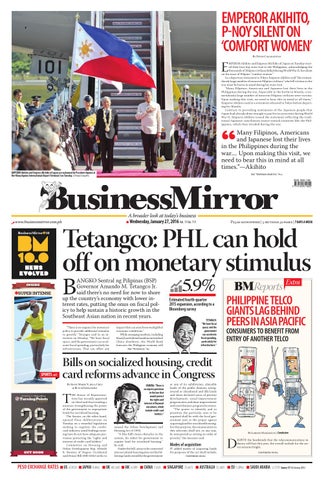
EMPEROR Akihito and Empress Michiko of Japan are welcomed by President Aquino at the Ninoy Aquino International Airport Terminal 3 on Tuesday. STEPHANIE TUMAMPOS
S “E A,” A
BusinessMirror
www.businessmirror.com.ph
A broader look at today’s business
n
B
SUPER INTENSE
“There is no urgency for monetary policy to provide additional stimulus to growth,” Tetangco said in an interview on Monday. “We have fiscal space; and the government can accelerate fiscal spending, particularly for infrastructure. That can offset any
C1
impact that can arise from weak global economic conditions.” While emerging markets, including Brazil, have faltered amid an entrenched China slowdown, the World Bank forecasts the Philippine economy will
5.9%
Estimated fourth-quarter 2015 expansion, according to a Bloomberg survey
TETANGCO: “We have fiscal space; and the government can accelerate fiscal spending, particularly for infrastructure.”
BMReports PHILIPPINE TELCO GIANTS LAG BEHIND PEERS IN ASIA PACIFIC
CONSUMERS TO BENEFIT FROM ENTRY OF ANOTHER TELCO
S “T,” A
Bills on socialized housing, credit card reforms advance in Congress B J M N. C B F
T
OUT SOON
P. | | 7 DAYS A WEEK
Tetangco: PHL can hold off on monetary stimulus
ANGKO Sentral ng Pilipinas (BSP) Governor Amando M. Tetangco Jr. said there’s no need for now to shore up the country’s economy with lower interest rates, putting the onus on fiscal policy to help sustain a historic growth in the Southeast Asian nation in recent years.
INSIDE
SPORTS
Wednesday, January 27, 2016 Vol. 11 No. 111
HE House of Representatives has recently approved on third and final reading a measure strengthening the power of the government to expropriate lands for socialized housing. The Senate, on the other hand, opened f loor deliberations on Tuesday on a remedial legislation seeking to regulate the creditcard industry amid findings existing laws do not have adequate provisions protecting the “rights and interest of credit-card holders.” Committee on Housing and Urban Development Rep. Alfredo B. Benitez of Negros Occidental said House Bill (HB) 6342 seeks to
PESO EXCHANGE RATES n US 47.8130
OSMEÑA: “There is no express provision in the law that would protect the rights and interest of financial consumers, which include credit-card holders.”
amend the Urban Development and Housing Act of 1992. “It [the bill] clears obstacles in the system, [in order] for government to acquire land for socialized housing,” he said. Under the bill, areas to be converted into socialized-housing sites are the following: lands owned by the government
or any of its subdivision; alienable lands of the public domain; unregistered or abandoned and idle lands and those declared areas of priority development; zonal-improvement program sites; and slum-improvement and resettlement-program locations. “The power to identify and to prioritize the particular area to be acquired shall be with the local government unit or the proper agency acquiring land for socialized housing. For this purpose, the enumeration in this selection shall not, in any way, be interpreted as setting an order of priority,” the measure said.
Modes of acquisition
IT added modes of acquiring lands for purposes of the act shall include, C A
B L M | Conclusion
D
ESPITE the headwinds that the telecommunications industry will face this year, the overall outlook for the sector remains bright. C A
n JAPAN 0.4042 n UK 68.1240 n HK 6.1389 n CHINA 7.2676 n SINGAPORE 33.4473 n AUSTRALIA 33.3401 n EU 51.8962 n SAUDI ARABIA 12.7539
Source: BSP (26 January 2016 )
A2 Wednesday, January 27, 2016
BMReports BusinessMirror
www.businessmirror.com.ph
PHL telco giants lag behind peers in Asia Pacific C A
Consumers, in particular, will likely benefit from the possible entry of a new market player that promises to provide Internet services with better quality than the incumbents. The threat of having another player to battle with will force the incumbent vendors to be more aggressive in terms of pricing and even content, said Mary Grace MirandillaSantos, an independent researcher on information and communications technology and telecommunications policies. “Incumbent telcos will be more aggressive in increasing capital investment and infrastructure upgrades, which can be a sign that telcos are feeling the threat of competition. This is important in any competitive-market environment. Even the possibility of a new entrant always keeps service providers on their toes. Consumers will benefit from this. What more with the actual participation of a new player?” she said. Telstra Corp. Ltd. has signified its interest of offering its mobile-broadband services in Manila through a joint venture with San Miguel Corp., which has significant holdings in telecommunications assets. The new mobile-service provider is expected to debut in the Philippines sometime this quarter through Bell Telecommunications Philippines Inc. National Telecommunications Commission (NTC) Deputy Commissioner Edgardo V. Cabarios said the possible entry of the new core player—meaning that it will build up capacity through its own infrastructure—will help consumers enjoy better services at lower costs. “There will be decreases in prices and/ or increasing in quality and speed of the Internet,” he said. “However, if you are a newcomer, you will have to expand the market and not rely on existing markets. The solution to this is to increase the base, which essentially means that you have to lower your prices to the level of affordability of the subscriber.” The deal between San Miguel and Australia has yet to be signed, but industry sources said the holding company for the new telco player will likely be established anytime soon. “There are huge opportunities for new entrants in various segments of the market. If the San Miguel-Telstra finally seals a deal, there’s a huge potential for the 4G mobile market that remains unserved,” she said. “The challenges would come from how aggressively the incumbent telcos respond to the entry of new players, whether by more fierce competition, using their advantage in terms of existing market share and economies of scale, or even legal means.”
Top player to beef up digital content, improve network THE two largest telecommunications providers in the Philippines are gearing up for the prospective entry of a new market player, which threatens to break the duopoly that has been lording over the sector for almost
half a century now. Experts believe that local telcos will continue to introduce more digital services —developed through internal innovation through partnerships and investments this year, as it prepares for the possible entry of a new player and the continuous global migration to the digital space. The Philippine Long Distance Telephone Co. (PLDT), in particular, will be more aggressive in beefing up its digital content through various partnerships with international content providers. It has also set up a holding firm for the acquisitions of Internet companies abroad. “Obviously, a new player will impact how we conduct our business. But it will not change our strategy. Our focus remains on improving the customer experience by providing a growing array of innovative digital services supported by a strengthened and expanded network,” PLDT Spokesman Ramon R. Ibserto said. Broadband, he said, is clearly the largest opportunity for his company, noting that his company will likely see its bottom line eroding due to its large legacy-service business.
₧43 billion
How much PLDT will likely spend this year to improve its network capacity, expand its base and build more sites for better customer experience “Data is clearly the biggest opportunity. At the same time, data also poses a major challenge, because of its negative impact on our text, international long-distance revenue streams. In any case, the shift to digital is unstoppable. So, we are focused on maximizing the opportunities and managing the challenges that this structural shift in the industry presents,” he said. Isberto noted this transition will allow the PLDT group to have “some unique advantages.” “The group occupies the leading position in both fixed and mobile businesses and is, thus, able to leverage its extensive fixed line and mobile networks to provide both consumer and enterprise customers converged fixed or wireless offerings,” he said. This means that the consumers will see the introduction of new digital innovations, which is part of the company’s adoption of a digital strategy. “You will see more innovative digital services. These include offers that combine or converge fixed and mobile services. At the start of this year, for example, PLDT HOME launched the country’s first data-sharing plan where customers can share 6 gigabytes of their 50 GB monthly data allocation with up to four Smart mobile phone lines bundled with the plan,” Isberto said. He added that the company will also focus on developing financial technology services through Voyager Innovations Inc., which
currently operates the virtual mobile wallet service PayMaya. “More financial technology or fintech service innovations from Voyager will be also part of the menu. There will also greater focus on improving customer experience as we step up our investments aimed at expanding network coverage, capacity and resiliency,” Isberto said. The largest telecommunications company in the country will likely spend more than P43 billion this year to improve its network capacity, expand its base and build more sites for better customer experience. This year the enterprise business groups of the telco led by Manuel V. Pangilinan are combining connectivity services with digital solutions that will enable companies to undertake their own strategic pivots as their own industries embrace more and more digital technologies. “To support this effort, we are beefing our data infrastructure. For example, we are opening up two state-of-the-art data centers this year in major business locations—Makati City and Clark. This will bring our group data-center count to eight with unparalleled capacity of over 8,000 racks,” Isberto said. “There are opportunities to help corporate customers to execute their own transition to the digital economy by offering such cutting- edge services as data analytics, cloud and data-center services—all of which the PLDT Group is well-positioned provide,” he said.
Globe commits to ‘change the Internet landscape in PHL’ GLOBE Spokesman Yolanda C. Crisanto said her company welcomes the competition, as
$800 million
Globe’s capital requirement for the year
Globe is now at the forefront of the battle in the digital space. “Globe has never shied away from competition before. And prior to having two major players currently, the Philippines had the experience of having many players in the market previously. In the end, market forces will prevail and customers will always have their say,” she said. This year Globe will continue to focus on its strategy of providing a differentiated superior-customer experience. “Globe Telecom is committed to change the Internet landscape in our country so that every Filipino will have a great Internet experience and enhance their digital lifestyle,” she said. “This year we see broadband products with more data capacity and faster speeds being bundled at affordable prices. We also anticipate more infrastructure build to future proof the network even more as customers become hungrier for data.” Demand, based on customer feedback, will spell out the very strategy that the company will likely adopt, she added. “As Internet consumption continues to increase at an exponential rate, we will continue to invest in upgrading our network infrastructure ahead of the trend to make sure that we provide the capacity and speed that will enable our customers to continue enjoying what they love doing online,” Crisanto said. Globe has set an $800-million capital
Bills on socialized housing, credit-card reforms advance in Congress C A among others, community mortgage, land swapping, land assembly or consolidation, land banking, donation to the government, joint-venture agreement, negotiated purchase and expropriation. The bill provides that all idle lands in urban and urbanizable areas will be expropriated unless the owner introduces improvements within one year of receipt of notice of acquisition. The measure also allows the expropriation of land even if its ownership is still the subject of a pending court litigation. Moreover, Benitez said the measure will help address the huge housing backlog in the country because it will relax rules in the acquisition of land for housing projects for poor and homeless families. The lawmaker said the country’s housing backlog is estimated at 6 million units.
Credit-card industry reforms
MEANWHILE, Sen. Sergio R. Osmeña III submitted for the chamber’s adoption HB 5417, entitled “An Act Regulating the Philippine Credit Card Industry,” as amended under Senate Committee Report 383 of the Committee on Banks, Financial Institutions and Currencies chaired by Osmeña.
Osmeña observed that presently, “there is no express provision in the law that would protect the rights and interest of financial consumers, which include credit-card holders.” He noted that, while refuge may be sought under Republic Act 7394, or the Consumer Act of the Philippines, this is silent with respect to the implementing agency that would oversee credit issues and/or financial consumer protection. “At present, the Bangko Sentral ng Pilipinas [BSP] has taken up the cudgels for credit-card holders solely on the strength of DOJ Opinion 69 which declared the BSP as the proper agency to enforce the provisions on consumer credit transactions of the Consumer Act,” the senator pointed out. Osmeña informed the Senate it was against this backdrop that he moved to sponsor the remedial legislation that, he said, would “not only strengthen the credit-card industry but also cure the apparent flaws in the system.” “ T he re h a s b e e n p e r s i ste nt clamour from the public for us legislators to take proactive action toward protecting the consumers from potential credit card excesses while nurturing the economic benefits from the same. I believe,
Mr. President, that the time has come for us to respond to that clamour, and I propose to respond straightforwardly and unequivocally.”
Bill’s features
OSMEÑA then proceeded to outline the salient features of the proposed remedial legislation which, he said, formally grants the BSP with “supervisory powers over all credit-card issuers and acquirers, and all creditcard transactions.” The Senator said BSP’s supervisory powers spelled out in the bill include: the issuance of rules of conduct; ascertaining compliance with laws and regulations through examination and overseeing; and determining the reasonableness of fees and charges and issuing regulations thereon. He added that the bill also sets disclosure and notification requirements from the credit-card issuers; mandates Confidentiality of Information; requires credit-card issuers to establish a Consumer Assistance Unit within its organization, which shall be responsible for providing prompt action for the resolution of complaints, inquiries and requests; and defines the appropriate collec-
tion practices and sets the responsibility upon the credit-card issuer for all the actions of its collection agents. Osmeña said the bill also aims to standardize the method of computing the base amount for imposing the interest and finance charge on the unpaid outstanding balance by excluding new purchases after the statement cut-off date; rationalizes the Late Payment Fee or Penalty for Late Payment considering that it is more in the nature of an administrative cost than a cost of credit. Moreover, the senator said it, likewise, provides a 90-day prior notice for changes in fees “and the computation, thereof, have been included in the bill to afford the credi- card holder an exit strategy and to exercise his right to terminate the account without penalty” in case he does not agree with the said changes. “These are just some of the many critical features that the bill aims to provide for our credit consumers. More than this, the end game for the bill is to be a catalyst that would establish a national policy on responsible credit services by the card issuers on the one hand and responsible debtmanagement for the card holders on the other,” Osmeña said.
requirement for the year, bulk of which will be devoted in enhancing bandwidth capacity to enable the company to “stay ahead of the curve amid growing proliferation of smartphone and data-intensive multimedia applications.” “The main challenge is having the right regulations and environment to help mobile operators like Globe to be more agile in building the much-needed Internet superhighway this country needs. Every year, we set aside substantial investments to build, but the government should enable us to build faster and easier so we can bring down the cost of the network to eventually benefit consumers,” she said. Globe President Ernest L. Cu said this includes the passage of legislations that are aimed at developing the digital economy in the Philippines, particularly a law that mitigates bureaucratic red tape and other political hurdles that stand in the way in the deployment of telecommunication and broadband infrastructure, such as cell sites. Specifically, an Open Access law for the telco industry would expedite the issuance of all the relevant permits for all telecommunications facilities at the local government level. Telecommunication companies are required to secure several permits, Cu said, adding that Globe has about 500 cell sites waiting to be built at any given time. “Prioritizing the Open Access law for the telco industry would help fast-track fiber builds that will increase Internet access and speeds in the country,” he said, as “a robust Internet infrastructure provides tremendous opportunities for business and greatly impacts economic growth.”
Competition to become stiffer
WITH all these plans waiting to be executed, Mirandilla-Santos advised consumers to be more intelligent in making decisions as to the services that will suit their lifestyles. “Consumers can expect telcos to develop more creative ways of luring them to subscribing to bundled services, such as cable broadband with exclusive content, broadband with on-demand Internet streaming media, among others,” she said. “They can also anticipate lower prices for broadband plans. However, with the shift from speed to volume-based plans, consumers should be more aware of their data needs and choose the best plan that suits them,” she said. Competition—be it a price war or a content war—will become more and more intense with the anticipated entry of a third player. This year, industry observers believe, that Globe will continue to outpace its competitor due to PLDT’s declining legacy business. “Globe today is reaping the benefits of the network upgrades that it had invested in over the past years. It’s slowly growing its market share in both mobile and data services, and revenue growth remains steady. I think PLDT needs to catch up in modernizing its infrastructure since it has the largest legacy network and the demand for broadband will likely keep growing exponentially,” Mirandilla-Santos said.
Tetangco. . .
C A
expand more than 6 percent this year until 2018, to remain among the fastest in the world. President Aquino, whose six-year term ends in June, is boosting spending to a record to help shield the nation as global demand weakens. “We are starting 2016 from a position of relative strength on the economic side—on the monetary side and the fiscal side,” Tetangco said in his office in Manila. “Domestic demand continues to be firm, driven mainly by consumption. The services sector, the construction sector, as well as the manufacturing sector, are showing signs of sustained growth.”
Liquidity tools
POLICYMAKERS can also redeploy liquidity tools they adopted during the 2008-2009 global financial crisis should it become necessary, the governor said. These measures included increasing the budget for lending to banks in pesos, allowing lenders to borrow in US dollars, and expanding assets accepted as collateral. “We can also deploy some of these tools again, if necessary, to stem market volatility,” Tetangco said. The BSP has room to hold its benchmark rate until the adoption of an interest-rate corridor is complete, Tetangco said. The central bank is preparing to shift to a multiple interest-rate regime by the second quarter, a move intended to strengthen its policy tools.
Manufacturing resurgence
REMITTANCES, outsourcing and manufacturing gains are boosting the economy, Tetangco said. Fourth-quarter expansion was probably 5.9 percent, according to a Bloomberg survey ahead of data due on Thursday. Full-year 2015 growth was forecast at 5.7 percent. “The manufacturing sector is re-emerging as a potential source of growth,” Tetangco said. “It’s recovering with the entry of more foreign investments, particularly from Japan.” Bloomberg News
BMReports BusinessMirror
news@businessmirror.com.ph
Wednesday, January 27, 2016 A3
Investing in Sustainable Development Goals makes good business sense–UNDP
I
B C U. O C N. P
NVESTING in innovations and new business models that will help countries attain the Sustainable Development Goals (SDGs) makes good business sense, according to the United Nations Development Programme (UNDP).
In a speech at the 45th Annual Membership Meeting of the Philippine Business for Social Progress (PBSP), UNDP Philippines Resident Representative Ola Almgren said businesses can contribute a lot to meeting the SDGs or Global Goals in 2030. “The challenge for the private sector is to move toward inclusive and sustainable business models—going beyond the concept of philanthropy and voluntary corporate social responsibility—without undermining profitability,” Almgren said. “We believe that within businesses themselves, solutions lie in innovation, new business models and the right leadership,” he added. Almgren said the costs of meeting the SDGs are high, and it is only through partnerships within
and among governments, private sector, academe and other stakeholders can the goals be achieved. He said the unmet investment needs of the SDGs are estimated at $3 trillion to $7 trillion per year in developing countries alone. But more than addressing the financing needs, Almgren said the SDGs can improve the way businesses operate, particularly in achieving their own goals to sustain their profits. “To me it is essential to see sustainable development as actually linked to the core business strategy of a corporation. Sustainability of profit over time is linked to sustainability of our environment, our natural resources and development for the people who make up the work force and customers of a corporation,” Almgren said.
As an organization, PBSP intends to respond to this call by crafting specific projects that will be geared toward attaining specific SDGs or their indicators. PBSP Executive Director Rafael C. Lopa said many of PBSP’s projects through the years have addressed not only specific Millen n iu m De ve lopment Goa l s (MDGs) but sustainable development concerns. The SDGs are composed of 17 goals and 169 targets. The first six goals are related to the eight MDGs and the rest include goals that aim to address climate change and overall sustainable development. “We agreed to meet up again to precisely figure out how to converge our efforts. As we presented in our report, PBSP is really actively convening stakeholders around very specific societal concerns. And a lot of them are
$7 trillion
Annual investment required to meet SDGs in poor countries in the SDGs,” Lopa said. “We’re involved in, of course, education, we’re also involved in water, we’re involved in tuberculosis control, in maternal-child care, these are very concrete advocacies that are falling in line with the SDGs,” he added. The Philippine government is currently working with the Manila-based Asian Development Bank (ADB) to develop a framework for identifying inclusive business (IB) companies and their accreditation. The IB model refers to core business models of commercially viable
The challenge for the private sector is to move toward inclusive and sustainable business models—going beyond the concept of philanthropy and voluntary corporate social responsibility—without undermining profitability.”–Almgren
companies that provide, in scale, solutions to the problems of poor and low-income communities. The Department of Trade and Industry (DTI) said this is in keeping with the government’s goal of strengthening micro, small and medium enterprises, and increasing job opportunities for the poor. Firms that will qualify may get fiscal and nonfiscal incentives. The ADB has earlier extended a loan of $250 million to the DTI for the project. Trade Secretary Adrian S. Cristobal Jr. said the government is keen on piloting the IB model in a number of business sectors, including manufacturing. The SDGs aim to end poverty and hunger; promote universal health; education for all and lifelong learning; achieve gender equality; sustainable water management; ensure sustainable energy for all; decent work for all; resilient infrastructure; and reduce income inequality between and among countries. Signatories have also pledged to create sustainable cities; ensure sustainable consumption and production; take action against climate change; conserve and sustainably use oceans and marine resources; reduce biodiversity loss; achieve peaceful and inclusive societies; and revitalize global partnership for development.
The government considered financial constraints as among the key challenges of the country in attaining the SDGs. This prompted the government to draw up a financial plan for funding the SDGs. Issues on availability and timeliness of data for goal monitoring also pose a challenge to achieving the goals. Data is crucial, given that the SDGs could have over 400 indicators. National statistician Lisa Grace S. Bersales earlier told the BusinessMirror that the Philippine Statistical System may require private-sector help to address data gaps on several of the SDGs. She said this is due to the lack of disaggregated data for many of the SDGs, as well as data on highly scientific indicators. Last year National Economic and Development Authority (Neda) Assistant Director General Rosemarie Edillon said the country must put in place periodic targets to enable the government to implement measures that will make it easier to meet the goals. Neda Social Development Staff Director Erlinda Capones also said the country needs to address the challenge posed by the devolution of certain social services, which was a major consideration in setting accountabilities for the MDGs.
A4
Wednesday, January 27, 2016
BMReports BusinessMirror
news@businessmirror.com.ph
Govt prods completion of 8-yr-old TRP to start implementation of agreements
T
B R M
HE government on Monday asked for the completion of the Tripartite Review Process (TRP) it has been conducting for the past eight years with the Moro National Liberation Front (MNLF) under the auspices of the Organization of the Islamic Cooperation (OIC). Presidential Adviser on the Peace Process Secretary Teresita Quintos Deles said at the opening of the two-day meeting “it is high time for the TRP—with the government and the Bangsamoro fronts in full and active partnership—to conclude the review and proceed to the implementation of the results.” She asked the representatives “to do justice to the long struggle of the Bangsamoro.” The OIC, which brokered the 1996 peace accord between the government and the MNLF, was asked to make its assessment of the progress made, as well as obstacles facing its full implementation with a particular focus on Phase II in 2006. At least four tripartite meetings and two ad-hoc high-level group meetings were conducted since the review process started in 2006. Since then, the process has resulted to several agreements, including the 42 consensus points, intended to be the amendatory provisions for Republic Act 9054, before they were integrated into the proposed Bangsamoro basic law (BBL). The fifth tripartite review process was initially scheduled on September 16, 2013. However, it was suspended by the OIC following the three-week Zamboanga siege, when rogue members of the MNLF attacked the southern port city. The ongoing meeting is set to tackle the two remaining issues related to the comanagement of minerals and natural resources and the full convergence of the final peace agreement (FPA) with the Comprehensive Agreement on the Bangsamoro (CAB) under the broad framework of the BBL. The Moro Islamic Liberation Front (MILF) signed the CAB
on March 27, 2014, after 17 years of negotiations, to the wide acclaim of the international community that has been extending financial and other assistance to Mindanao peace programs. In 2014 the OIC set up the Bangsamoro Coordination Forum (BCF) to unify the two fronts for the specific integration of the FPA with the BBL. MNLF factions are represented in the BCF through a so-called Jeddah formula. “A review is time-bound. A never-ending review means that agreements will never be implemented. It will mean endlessly looking backward instead of moving forward,” Deles said. “I am confident that the parties, the OIC, the government, and the MNLF, are ready to take all necessary actions, to surmount narrow, rigid interests and enter a new era of collaboration for lasting peace and progress,” she added. The MNLF, through the trio of peace advocates, would be given equitable representation in the Bangsamoro Transition Authority, as well as encourage them to field candidates for the elections in the Bangsamoro region. A monitoring committee will a lso be for med to super v ise the implementation of all TRP agreements and initiatives. Deles thanked OIC SecretaryGeneral Iyad bin Amin Madani for personally taking steps to push the TRP and the two fronts’ unification by making an unprecedented trip to the Philippines last year. During his visit, Madani met with the MNLF and MILF leaders in Davao City and held personal meetings with President Aquino and the leaders of Congress for the enactment of the BBL bill into law. Deles also underscored the
MUSLIM children join other Filipino Muslims during a rally near the presidential palace in Manila on February 9, 2011, to support the resumption of the peace talks in Malaysia between the Philippine government and the country's largest Muslim rebel group, the Moro Islamic Liberation Front. The sign at the back reads: “Peace in Mindanao.” AP/BULLIT MARQUEZ
A review is time-bound. A never-ending review means that agreements will never be implemented. It will mean endlessly looking backward instead of moving forward.” —Deles strategic implications of the completion of the TRP to the wider national and regional security. “The OIC is bending over and exerting extraordinary efforts to make this review process a way forward, another workable political paradigm for the world’s Ummah in the search for communal harmony and balance, an ideal to which we all also firmly aspire and commit to relentlessly pursue.” “With the completion of the review process, Mindanao stands on the threshold to open a new order of peace at a time when the entire
global system faces huge, hard challenges, especially in Asia and the Middle East,” Deles added. Her sentiment was echoed by Madani, who said the OIC “is very concerned” with the status of the Bangsamoro peace process, and is doing its best to help “bridge” the gaps to achieve lasting peace in Mindanao, and encouraged the international community, especially the ones in the Asian region, to continue doing what they can in helping the process. Deles said the review process is ready to proceed to the imple-
PIDS sees no faster than 6% growth in 2015 B C U. O
T
HE Phi l ippine Institute for Development Studies (PIDS) has significantly cut its growth forecast for the economy to a range of 5.7 percent to 6 percent in 2015. Worse, the state think tank said the May elections could drag further the country’s growth this year. Initially, the PIDS forecast a fullyear growth of 6.8 percent in its May 2015 announcement. But with the weaker-than-expected growth in the first semester and the impact of El Niño, the economy is now forecast to register even slower growth. The official full-year GDP data will be released by the Philippine Statistics Authority on Thursday. “The current Philippine leadership must fully utilize its remaining political capital to pursue difficult reforms covering trade facilitation and regulatory frameworks. It must continue to invest in both human and physical capital that will raise productivity in the future,” PIDS President Gilbert M. Llanto said. Llanto added that
6.8% Initial PIDS growth forecast for 2015
these investments will be crucial, especially in 2016, when the country is faced with major headwinds. He said the Philippines’s integration with its Asean neighbors, as well as the political uncertainty from the coming elections, may cut the country’s economic growth this year. Llanto said the slowdown in the economies of the Asean’s trading partners could spill over to the Philippine economy this year. “China’s slowing growth and recession in Japan do not bode well for the economy. Weaknesses among Asean’s major trading partners will also have negative spillover effects on Asean member-states like the Philippines,” Llanto added.
The negative spillover effects of the slowdown in China and Japan, which are also among the Philippines’s major trading partners, may slowdown the country’s trade performance this year. This is a concern, given that exports and imports growth have since been hampered by the country’s critical development constraints, such as poor infrastructure and connectivity. Llanto said the trade sector is also burdened with inefficient procurement processes and red tape. These are the same factors that affect the country’s overall business climate. While the current administration has put in place counter measures, Llanto said these are still insufficient, and President Aquino has less than six months before his term expires. Llanto added that this is the reason the political uncertainty caused by the presidential elections in May may also drag the economy this year. The PIDS president said there is a risk that the coming elections will again see personality politics at work. This poses a danger on the kind of leadership the country will have in
the next six years. “There will not be a lack of contenders in the political market who might put political expediency over difficult reform. This poses a danger to the economy because Philippine politics is already personalist and opportunistic. Many voters don’t vote on issues, but are mesmerized by personal charisma and [empty] promises made by political entrepreneurs,” he added. The PIDS is not the first institution to cut its growth forecast for 2015 and 2016. The latest one was the United Nations Economic and Social Commission for Asia and the Pacific (Unescap). In its Economic and Social Survey of Asia and the Pacific 2015: YearEnd Update, Unescap cut its growth forecast for the Philippines to 6.3 percent for 2016, from the initial estimate of 6.4 percent it made prior to December 2015. The lackluster public spending in 2015, Unescap added, likely caused Philippine GDP growth to slow to 5.9 percent last year compared to the UN agency’s previous estimate of 6.5 percent.
mentation phase. “Stepping up the level of convergence of the Bangsamoro fronts with the implementation of 42 consensus points of the review process and the operationalization of the Bangsamoro Development Assistance Fund and the monitoring committee will draw forth more enduring, longer-term international support for the cause of Bangsamoro selfdetermination,” she said. “We must view our present and immediate actions through the lens of such essentially long view.” This convergence will vindicate and validate all the truths and wisdom in the 1996 Final Peace Agreement as complemented and improved by the 2014 Comprehensive Agreement on Bangsamoro, and also, therefore, do justice to the long struggle of the Bangsamoro,” she added. “We look forward to reach a conclusion of the review process with our esteemed counterparts in the MNLF, under the
wise guidance and firm auspices of the OIC,” Deles said. The Philippine delegation is composed of National Commission on Muslim Filipinos Secretary Yasmin Busran-Lao; Department of Foreign Affairs Undersecretary Rafael Seguis; Undersecretary Nabil Tan of the Office of the Executive Secretary; Undersecretary Zabedin Azis of the Department of Justice; Undersecretary Jose Lorena of the Office of Presidential Adviser on the Peace Process; Deputy-Director General Zenonida Brosas of the National Security Council; Brig. Gen. Buenaventura Pascual of the Peace Process Office of the Armed Forces of the Philippines; lawyer Anna Tarhata Basman, head of the Legal Team of the GPH Peace Negotiating Panel for talks with the MILF; and Regional Governor of the Autonomous Region in Muslim Mindanao Mujiv Hataman and Deputy Regional Gov.Yusop Jukiri.
Ayala, DOTC ink P4-B ITS South deal B L S. M
A
YALA Corp., the country’s oldest existing conglomerate, and the Department of Transportation and Communications (DOTC) signed the P4-billion agreement for the Integrated Transport System (ITS) South Project. “With the ITS South connecting different modes of transportation and services, we can guarantee the public more efficient and seamless transfers. It will also improve traffic flow and reduce congestion in Metro Manila, as it will serve as a transfer point for provincial buses entering the metropolis,”Transportation Secretary Joseph Emilio A. Abaya said. Property developer Ayala Land I n c. wo n t h e p ro j e c t to b u i l d an integrated ter minal system inside the Food Terminal Inc. (FTI) Compound in Taguig in November last year, three months after the listed company topped the bidding for the deal in August. I t offered the lowest annual grantor payment of P277.8 million. Ayala Land will take care of the design, construction and
operations and maintenance of the terminal for a concession period of 35 years. The multibillion-peso project covers the construction of a terminal within a 5.7-hectare lot along FTI Compound in Taguig. It will connect passengers coming from the South, specifically the Batangas and Laguna area, to other public -utilit y vehicles that are serving inner Metro Manila. The deal also covers the construction of arrival and departure bays, public-information systems, ticketing and baggage facilities, and park-ride facilities. Ac c o rd i n g t o a n i n d i c a t i ve timeline, construction of the terminal should commence in September this year and will be completed in a year and a half. Operations of the terminal will be in full swing by February 2018. It is estimated that up to 4,000 buses and 160,000 passengers will feed into ITS South from the South Luzon Expressway every day. To date, the government has awarded 12 public-private partnership projects with an estimated total cost of roughly $4.83 billion.
AseanWednesday BusinessMirror
news@businessmirror.com.ph
Editor: Max V. de Leon • Wednesday, January 27, 2016 A5
Vietnam begins new era as Dung loses bid
Singapore’s 80-cent loans not enough for distressed funds
S
OUTHEAST Asia’s souring loans are becoming unpalatable even for some distressed-asset funds. SC Lowy Financial, an independent fixed-income firm founded by former Deutsche Bank AG employees, says secondary loan trading volumes are at the thinnest in a decade even with discounts near 20 percent for borrowers, including Singapore-listed Noble Group Ltd. and Mercator Lines Singapore Ltd. The primary market is also receding after Southeast Asia syndicated loan volumes slumped 39 percent to a fiveyear low in 2015. “The secondary loans market, in 2015 and continuing into this year, has been totally dead,” said Michel Lowy, cofounder and CEO of SC Lowy, which focuses on loans, bonds, trade claims and special situations. “It’s the lowest volume I have come across in over 10 years, mainly because there’s been a massive gap between the buyers’ and the sellers’ expectations.” Investors that buy loans, or portions of them, in the secondary trading market are being more discerning as some of Southeast Asia’s vulnerable borrowers endure a multiyear slump in commodity and shipping prices. China’s slowest economic growth in a quarter century, the lowest shipping rates in three decades and crude below $30 a barrel have pushed Asia’s bond risk to the highest in almost four months, based on creditdefault swap prices. Nonperforming loans in Indonesia, Singapore and Thailand are at their highest levels in at least five years, according to data from the nations’ central banks. Net troubled loans rose to 0.8 percent of all bank assets in Singapore in the third quarter of 2015, the highest for a three-month period since that ending March 2010, official data show. Asian junk bonds traded at a fouryear low this month, based on the average price in a Bank of America Merrill Lynch regional high-yield dollar debt index. The last 15 months has seen Indonesian coal producers PT Berau Coal Energy and PT Bumi Resources and Singapore-listed China Fishery Group Ltd. renege on their borrowings. Jurong Aromatics Corp., which took a $1.73- billion loan facility in 2011 to fund its petrochemical plants in Singapore, fell into receivership last September. Ratings for energy and mining companies have been put on review for downgrades. Commodity trader Noble Group’s credit rating was cut to junk by Standard & Poor’s this month, following a similar move by Moody’s Investors Service in late December, sending the price of its 2020 dollar bonds to 41 percent of their face value on Friday. The company’s loans are trading at a “very high” yield on the secondary market, with its unsecured facilities due in May being offered in the 80s, Lowy said. Its loans were seen at 89 cents to 92 cents in the dollar early December, having traded at 92 last October and 87 last September, according to Bloomberg-compiled prices. “Noble’s loans have seen very little trading,” Lowy said. “The spreads are widening. The offer prices are coming down and so are the bids. As a result, they don’t trade much at all.” Noble Group declined to comment on the prices of its loans in secondary trading in an e-mail on January 24. Mercator Lines Singapore has reported losses for the last 13 quarters and its CEO resigned last week. While its loans are more actively traded, they’re at “very stressed levels,” according to Lowy. The coal and crude shipper said a local court appointed Yit Chee Wah as its judicial manager on January 18, following an application by lender HSH Nordbank AG last September, according to stock-exchange filings.
Bloomberg News
R
EFORMIST Vietnam Prime Minister Nguyen Tan Dung is not on the candidate list for the Communist Party’s next central committee, indicating his bid to move into a senior party role has failed.
Congress delegates approved the withdrawal of Dung from nominations for the committee that will oversee the party’s affairs until 2020, three party officials said, asking not to be identified as the talks are private. Dung is reaching the end of his maximum two terms as premier, and without a key post his influence over Vietnam’s economic and security policies is set to diminish. Under party rules, Dung’s withdrawal of his nomination—a technical formality—had to then be rejected by congress delegates for him to stay in contention for party general secretary, one of the most influential roles in the country. Instead, party leaders have fallen behind current General Secretary Nguyen Phu Trong, who represents a more
If [Nguyen Tan] Dung is not a central committee member, he is out. He is retired. He will not be back. He did not have enough votes.” —Hung
conservative faction, in his efforts to secure another term. “If Dung is not a central committee member, he is out,” said Nguyen Manh Hung, professor emeritus at George Mason University in Virginia. “He is retired. He will not be back. He did not have enough votes.” Dung has opened the economy to greater market forces and expanded ties with the US, Vietnam’s former wartime foe, but also faced months of political infighting. At stake for the new leadership is how much— or how fast—Vietnam moves away from Communist neighbor China, with whom it has territorial disputes, and toward the US. Under Dung, Vietnam has backed a large US-led Pacific trade pact that does not include China. The congress voted on a new central committee on Tuesday, and that group will elect the new general secretary. President Truong Tan Sang also withdrew from the nominations for the committee, according to the party officials. Representatives of Dung’s office were unavailable for comment on Tuesday morning. Dung will probably opt to retire rather then risk weakening the party, said Le Hong Hiep, a visiting fellow at the Institute of Southeast Asian
Studies in Singapore. He is due to step down as premier after the National Assembly votes on his presumed successor, Deputy Prime Minister Nguyen Xuan Phuc, in May or June.
Destabilizing party
“I THINK one of the biggest concerns for him was if he kept fighting on, it would have destabilized the party system, and once the party system was unsettled, he and his family would suffer,” Hiep said. Vietnamese stocks on Monday posted the steepest advance since 2012 following Trong’s nomination for general secretary. Valuations last week sank to a five-month low amid political uncertainty. The benchmark index dropped 0.8 percent as of midday Tuesday. Trong’s influence over the politburo and party procedures made him a formidable rival, Hiep said. Still, his success caught some observers by surprise, given Dung retains his own supporters. “The party congress has spoken,” said George Mason University’s Hung, referring to Dung. “The next question is: will he be given an opportunity to represent Vietnam at the US-Asean Sunnylands summit and redeem himself with diplomatic success?”
California meeting
U.S. President Barack Obama will host leaders from the Association of Southeast Asian Nations next month in California, the first such gathering hosted in the US. The Obama administration is seeking to preserve America’s influence in the region against China’s growing military clout which is backed by its increased economic heft. Frictions rose this month after Chinese planes landed on a new airstrip on reclaimed islands in the Spratly islands chain, triggering protests from Vietnam. Vietnam said on January 19 it had demanded that China remove an oil rig it has parked in disputed waters. The party congress also sets the tone for economic policy. An online draft of the five-year economic plan calls for supporting the private sector with “equal access” to credit, land and other resources. Dung has pushed to speed up the privatization of state-owned companies, which often get preferential access to loans and land. While the nation is set to be one of the fastestgrowing economies in the world, local, private firms have struggled to benefit even as foreign manufacturers reap the export boom. Bloomberg News
VIETNAM’S Prime Minister Nguyen Tan Dung (from right), Vietnam Communist Party General Secretary Nguyen Phu Trong and President Truong Tan Sang prepare to take their seats on the podium prior to the opening ceremony of the Communist Party of Vietnam’s 12th Congress in Hanoi, Vietnam, on Thursday. AP
Lao PDR assures US it will help counter Chinese assertiveness
T
HE prime minister of communist Lao PDR assured US Secretary of State John F. Kerry on Monday that his small nation will help counter China’s assertiveness in the South China Sea. Laos this year takes the rotating chairmanship of the Association of Southeast Asian Nations (Asean), with the group’s heads of state scheduled to hold a special meeting next month in Sunnylands, California, at the invitation of President Barack Obama as part of his foreign policy to reach out to the region as a counterweight to China. Kerry’s visit to the landlocked nation of fewer than 7 million people was meant to pave the way for the summit, with a goal of making sure Laos holds the group together. Kerry arrived in the Laotian capital on Sunday. Prime Minister Thongsing Thammavong “was very clear that he wants a unified Asean; and he wants maritime rights protected; and he wants to avoid militarization and avoid the conflict,” Kerry told reporters. “And that will develop as we go into Sunnylands, and there will be a greater, I’m sure, articulation of that unity
going forward.” Asean nations, such as Vietnam and the Philippines, have become increasingly concerned about China’s territorial claims in the South China Sea, including its construction of man-made islands and airstrips in contested areas. But other Asean nations are more pro-China, including Cambodia, which blocked Asean from reaching consensus on the South China Sea during its 2012 chairmanship of the group. Cambodia is Kerry’s next stop on an around-the-world diplomatic marathon this week that will also take him to China. Murray Hiebert, a Southeast Asia expert at the Center for Strategic and International Studies in Washington, said “these statements by Laos leaders aren’t totally surprising.” He noted that a Communist Party congress in Laos last week removed a party chief generally considered as pro-Chinese and replaced him with one who appears to be more evenhanded in his views about China and Vietnam, Laos’s other big neighbor and fellow member of Asean. Later this year, Obama will become the first US president to visit
US Secretary of State John F. Kerry places an offering of flowers during a tour of the Pha Tha Luang in Vientiane, Lao PDR, on Monday. The massive gold stupa is the most important national symbol in Laos. Kerry is in Laos on the third leg of his latest around-the-world diplomatic mission, which will also take him to Cambodia and China. AP
Laos for the Asean summit. Laos is one of the last few communist nations in the world. The country has moved away from a hard-line communist system in the past two decades, but like its close ally Vietnam, it retains a one-party political system and its government has been criticized for being intolerant of dissent. Kerry said relations with Laos
are improving after a period of war and mutual suspicion. In addition to meetings with Thammavong and Thongloun Sisoulith, the deputy prime minister and foreign minister, Kerry toured That Luang, the golden-spired Buddhist structure that is Laos’s most sacred monument. Kerry also was scheduled to meet with members of Obama’s Young
Southeast Asian Leaders Initiative. Kerry and Laos’s leaders discussed increased US funding for a variety of projects here. That includes the removal of unexploded bombs dropped by American warplanes during the Vietnam War era, which still cause frequent casualties. Kerry, a Vietnam War veteran, also brought up a new $6-million child nutrition program, and a US-funded “smart infrastructure” for the Mekong River. “We still have concerns about human rights and freedom of expression and other issues, and I raised those,” Kerry said. “But it is also, you know, we are partnering on a wide range of issues.” Phil Robertson, the deputy Asia director for Human Rights Watch, said he hopes for more human-rights pressure on Laos as the country prepares to host world leaders all year. “The international community should demand Laos’s leaders end their restrictions on freedom of expression and assembly; stop their crushing censorship of the media; and permit freedom of association for workers to form independent trade unions,” Robertson said. AP
The W
Business
A6 Wednesday, January 27, 2016 | Editor: Lyn Resurreccion
Malaysian PM cleared in $700-M scandal
K
$620M
UALA LUMPUR, Malaysia— Malaysia’s attorney general said on Tuesday that nearly $700 million channeled into Prime Minister Najib Razak’s private accounts was a personal donation from Saudi Arabia’s royal family, and cleared him of any criminal wrongdoing.
MALAYSIAN Prime Minister Najib Razak delivers his opening speech at a conference in Kuala Lumpur, Malaysia, on Monday.
T he announcement capped months of uncertainty for Najib, who has come under intense pressure to resign over the financial scandal in his biggest political crisis since he took power in 2009. But the announcement by Attorney General Mohamed Apandi Ali did not clear up the mystery over the money, as he did not say why the Saudi royals made the donation to Najib or give details on what the
August 2013. He did not say what happened to the remaining $61 million. The anticorruption agency met and recorded statements from witnesses, including the donor, he said. There was no proof that the money was given as an inducement or reward to Najib in return for a favor, he added. “I am satisfied that there is no evidence to show that the donation was a form of gratification given corruptly,”
money was to have been used for. Apandi said investigations by the country’s anticorruption agency showed that no criminal offence was committed as the $681 million transferred into Najib’s accounts between March and April 2013 was “given without any consideration” by the Saudi royal family as a personal donation. He said Najib returned $620 million to the Saudi royal family in
Returned to Saudi royals, but unsure of what happened to $61 million
AP/JOSHUA PAUL
Apandi said. “Based on the evidence from witnesses and supporting documents submitted, I am satisfied that no criminal offence has been committed in relation to the said [$681 million] donation.” There was no immediate comment from Najib, who has been grappling with deep unhappiness over his leadership, with massive street rallies last August calling for his resignation after documents leaked last July suggested that about $700 million was deposited in his private bank accounts from ent it ies l in ked
to indebted st ate invest ment f u nd 1Ma l aysi a Development Berhad (1MDB). Najib has denied any wrongdoing and later said the money was a donation from the Middle East. He has reportedly told ruling-party events that the money was used for party and political reasons. Since then, he has replaced critics in his government with loyalists, sacked the then attorney general probing him and cracked down on the media that had helped kept him in power. Opposition lawmaker Tony Pua slammed Apandi’s decision, saying the fact it was a personal donation does not rule out corrupt motives or transaction. Pua said Apandi provided no new or convincing information to support his decision. The scandal started with investigations into 1MDB, which was set up in 2009 by Najib to develop new industries. But it amassed 42 billion ringgit ($9.8 billion) in debt after its energy ventures abroad faltered.
Critics have long voiced concern over its massive debt and lack of transparency. Najib still chairs its advisory board. The political scandal partly contributed to the Malaysian currency plunging to a 17-year low last August. Apandi also cleared Najib of graft at government-owned SRC International, a firm linked to 1MDB, over another 42 million ringgit ($9.8 million) from SRC that was deposited into Najib’s account between December 2014 and February 2015. He said there was no evidence to show Najib was aware of the money transfer, nor that he had given his approval. Apandi said Najib had thought that all payment made from his accounts came from the donation by the Saudi royal family. No further details were available. Support for Najib’s ruling coalition has eroded in the last two general elections. It won in 2013, but lost the popular vote for the first time to an opposition alliance. AP
Trail of cancer leads to tap water in NY area
H
A FLOAT showcasing the culture of the northern Indian state of Uttarakhand goes down Rajpath during the Republic Day parade in New Delhi, India, on Tuesday. French President François Hollande is the chief guest for this year’s celebrations which marks 66 years since the country adopted its Constitution. AP/ MANISH SWARUP
France’s Hollande views Indian Republic Day parade
N
EW DELHI—French President François Hollande was wrapping up his threeday visit to India on Tuesday by watching an elaborate display of Indian military hardware and marching bands taking part in India’s Republic Day celebrations. He was joined by Prime Minister Narendra Modi and other top officials for the anniversary of India’s democratic constitution taking force in 1950.
On Monday French and Indian officials signed over a dozen agreements including one on jointly combating terror but stopped short of a final deal on New Delhi’s desire to purchase 36 Rafale fighter jets. Both Modi and Hollande said that they hoped that a final agreement would be hammered out soon. Modi had first announced India’s intention to buy the French combat jets manufactured by Dassault Aviation in Paris last April.
Since then official on both sides have been discussing prices, offsets and servicing details. After viewing the parade, Hollande was expected to attend a reception at the Rashtrapati Bhawan, India’s sprawling presidential palace. The French leader arrived on Sunday in the northern city of Chandigarh, where Modi joined him and lauded France’s decision to invest $1 billion every year in India in various sectors.
C h a nd i g a rh w a s des i g ne d in the 1950s by Swiss-French Arch. Le Corbusier and is one of three places that France has pledged to help develop as socalled smart cities with clean water supplies, efficient sewage disposal and public transportation. Hollande and French business leaders met with their Indian counter parts to boost bilateral trade, which in 2014 totaled $8.6 billion. AP
Teen vaping leads to teen smoking, study suggest
N
EW survey results from high-school students suggest that health officials have good reason to fear electronic cigarettes (e-cigarettes): Teenagers who said they had used the vaping devices were far more likely than their nonvaping peers to try regular cigarettes over the next year. Among nonsmoking students who had vaped when they took an initial survey, 20 percent said they had smoked their first regular cigarette by the time they took the survey again a year later. Among nonsmokers who hadn’t used ecigarettes when they took the first survey, 6 percent had tried regular cigarettes a year later.
“E-cigarettes had a risk-promoting effect for onset of smoking,” researchers reported on Monday in the journal Tobacco Control. The study authors, led by Thomas Wills, a cancer-prevention expert at the University of Hawaii, surveyed more than 2,000 highschool students from around Oahu. In 2013 and again in 2014, the students were asked whether they had ever smoked electronic or regular cigarettes. Those who answered yes were asked whether they did so only once or twice, a handful of times, or used them monthly, weekly or daily. To encourage honest answers, the students were assured that their
survey responses would remain anonymous. The researchers also asked students a series of questions to gauge their rebelliousness and willingness to seek out new experiences, among other psychological and demographic factors. The results showed that 31 percent of the students had tried an e-cigarette by the time they took the first survey. Most of them were casual users at best—21 percent of the survey-takers said they had vaped no more than four times in their lives, while 2 percent said they vaped daily and 3 percent said they vaped a few times a week. All of these students were more likely to try regular cigarettes,
compared with their classmates who had never used e-cigarettes. It didn’t matter how much or how often they used e-cigarettes—all vapers were more susceptible to traditional smoking than their nonvaping counterparts, the study authors found. The researchers used a statistical model to see whether a history of vaping increased the risk of smoking independent of other factors. The results showed that among students who had never smoked in 2013, the risk of at least trying a cigarette by 2014 was 5 percent for those who hadn’t vaped and 14 percent for those who had. Los Angeles Times/TNS
O O SIC K FA L L S , Ne w York—After his factory work e r f at he r d ie d a painful death from kidney cancer at age 68 in 2013, Michael Hickey made it his mission to find out why so many people in his hometown along the Hoosic River were getting sick. Two years later, the US Environmental Protection Agency (EPA) has warned residents of Hoosick Falls not to drink or cook with water from municipal wells, and a plastics plant has agreed to install a $2-million carbon-filtration system at the village water treatment plant. Hickey’s campaign began with suspicion about industrial pollution in the factory village near the Vermont border. His father had worked for 35 years at a plant that made high-performance plastics similar to Teflon, so Hickey searched online for “cancer” and “Teflon.” What he found: Perfluorooctanoic acid (PFOA). PFOA, a water and oil repellent, had been used since the 1940s in products including nonstick cookware, stain-resistant carpeting and microwave popcorn bags. Manufacturers agreed to phase it out by the end of 2015, shortly after DuPont reached a $16.5 million settlement with the EPA over the company’s failure to report possible health risks associated with PFOA. A scientific panel that conducted health studies as part of a DuPont settlement of a West Virginia class-action lawsuit concluded there was a “probable link” between PFOA exposure and kidney cancer, testicular cancer, thyroid disease, high cholesterol, ulcerative colitis and pregnancyinduced hypertension. In Hoosick Falls, nobody has ever scientifically documented that the village has an unusually high cancer rate, but Hickey and a local doctor had heard enough anecdotal evidence that they felt it should be addressed. “There’s always been talk around town about how there’s a lot of cancer,” Hickey said. “When my dad, who didn’t drink or smoke, was diagnosed with kidney cancer, that made it more personal.” Dr. Marcus Martinez, the family doctor for many of the village’s 3,500 residents, added there certainly seemed to be a high rate of cancer there, particularly rare, aggressive forms. The 44-year-old Martinez himself is in remission from aggressive prostate cancer. When the two men suggested testing the village water supply, part-time Mayor David Borge at first refused, citing state guide-
lines. New York state classifies PFOA as an “unspecified organic contaminant” and doesn’t require testing for it. The EPA has a nonenforceable guidance level of 400 parts per trillion—roughly 4 teaspoons in enough water to fill a 10-mile string of rail tankers. Hickey used his own money in summer 2014 to have water from his kitchen tap and other sources tested. The results showed PFOA at 540 ppt from Hickey’s home, exceeding the EPA’s guidance. Village officials subsequently tested the municipal supply and found PFOA at similar levels. Sa int- Goba in Per for mance Plastics, part of a Paris-based global conglomerate, in 1999 became the fifth owner of a plastics factory in Hoosick Falls. It conducted tests in the summer of 2015 and reported a PFOA level of 18,000 ppt in groundwater under its plant, 500 yards from the village’s main water wells. “Saint-Gobain Performance Plastics is committed to helping the village of Hoosick Falls with this situation,” company Spokesman Car men Fer r ig no said. W hile the source of the PFOA cont a m i n at ion h a s n’t been identified, Saint-Gobain has been paying for bottled water for residents since November and has agreed to pay for filtration to remove the chemical from the public water supply, he said. Hickey and Martinez, along with Albany environmental lawyer David Engel, weren’t satisfied. They wanted people to be told not to drink the tap water, as well as a full investigation and remediation. Engel contacted Judith Enck, who heads the EPA region that includes New York. She issued a statement last December warning residents not to drink or cook with village water. Until then, state and village officials had told residents the water was unlikely to cause health problems. On January 14 Enck and a panel of leading EPA scientists addressed a standing-room-only crowd at Hoosick Falls’s high-school auditorium. The same day, New York officials asked the EPA to add the Saint-Gobain plant and other possible sources of contamination in Hoosick Falls to the Superfund priorities list. The State Health Department also recently announced plans to study cancer rates in the village and vicinity. “We are giving this contamination problem a high priority,” Enck said. “A very detailed study of groundwater is needed in Hoosick Falls to know what we are dealing with and how to best address it.” AP
World
news@businessmirror.com.ph | Wednesday, January 27, 2016 sMirror ‘THE SITUATION RIGHT NOW IS POTENTIALLY WORSE’ THAN THE REGIONAL TURMOIL IN 1997 AND 1998
A7
HK feels squeeze of slowing China, rising rates
A
S a premier Asian financial center parked at the doorstep of one of the fastest-growing economies on the planet, Hong Kong has long lived a charmed life.
The former British colony’s Western-style legal and regulatory system made it a magnet for global investors interested in buying listed Chinese stocks on the Hong Kong Stock Exchange. Its banks, insurance companies, ports and cargo carriers have made a nice living off their powerful neighbor. An added bonus: Since 2008, low global interest rates in the post-financial crisis era have powered a property market that has kept the $300-billion economy humming. Yet, now China’s economy is decelerating and just turned in its weakest full-year economic growth since 1990. Global investors are no longer gravitating to Hong Kong— they’re scrambling for the exits. T he Hang Seng Index has slumped 13 percent so far this year. Housing prices have fallen 8 percent from their September peak and are poised to drop as much as 30 percent this year, according to Bocom International Holdings Co. analyst Alfred Lau. The Hong Kong dollar peg is under pressure and short-term interest rates have spiked. Exports are falling and big-spending Chinese tourists are staying away. “Hong Kong is facing a wave of pressure,” said Kevin Lai, chief economist for Asia excluding Japan at Daiwa Capital Markets in Hong Kong, who likens the growing storm to the market gyrations of the Asian financial crisis. “The situation right now is potentially worse” than the regional turmoil in 1997 and 1998. Lai is particularly concerned about the rapid credit expansion over the past five years, as Chinese companies rushed to borrow in Hong Kong, leaving the city’s banks “massively leveraged and exposed.” Daiwa estimates that $237 billion in broad inf lows has poured into Hong Kong since 2005.
Capital flows accelerating
FOR Hong Kong, the worst-case scenario could play out like this: A sustained dive in the Hang Seng Index and heavy downward pressure on the local dollar triggers
30% Housing prices poised to drop by this much this year
a massive departure of capital, squeezing liquidity in the banking system and driving up interest rates. That, in turn, sparks a speculative attack on the local dollar peg, forcing the Hong Kong Monetary Authority to defend it by spending its foreigncurrency reserves. Or abandon the peg altogether. Capital flows out of Hong Kong appear to be accelerating. The Hong Kong dollar has traded at the lower side of its trading range against the US dollar, and recently touched a seven-and-a-half year low versus the greenback. Local interest rates have also surged: The three-month Hong Kong Interbank Offered Rate (Hibor) has jumped 30 basis points to 0.697 since the end of last year, exceeding the London Interbank Offered Rate on January 20. A sustained spike in Hibor could push mortgage rates higher, further hurting housing affordability, Morgan Stanley analysts led by Derrick Y. Kam wrote in a note. The bank said it cut its price targets for Hong Kong property stocks by an average of 17 percent. W hile global investors can quickly withdraw money from this Westernized financial center, local banks and investors face a tougher time pulling their cash out of the mainland economy. “It could take a matter of seconds for the rest of the world to draw money out from Hong Kong—but it would be a lot more difficult for Hong Kong to do the same from China,” Lai said. If the US Federal Reserve (the Fed), which raised rates last December for the first time in almost a decade, pushes up rates again
A MAN walks past an electronic board showing Hong Kong share index outside a local bank in Hong Kong on Thursday. The head of Hong Kong’s stock exchange says recent moves by Beijing to prop up sagging share prices were futile, but it won’t stop the exchange from expanding ties with mainland Chinese counterparts. AP/VINCENT YU
as expected later in the year, it could pull the rug out from housing prices that have surged more than 350 percent from their low in 2003. To maintain its peg with the US dollar, Hong Kong must match interest-rate hikes by the Fed, increasing borrowing costs to homeowners. “The property market in Hong Kong is going to go down the tubes when eventually the Americans will continue to increase interest rates,” said Andrew Freris, CEO of Ecognosis Advisory, a Hong Kong-based economic and financial consultancy. Meantime, Hong Kong developers with significant yuan-denominated cash holdings face greater currency risks from the yuan’s increasing volatility, according to Bloomberg Intelligence.
Retailers paying heavily
HONG Kong retailers are also paying heavily because of Hong Kong’s peg. The city is losing its luster as a
shopper’s paradise for mainlanders, who are instead flocking to Japan and South Korea in search of better bargains for Louis Vuitton handbags and Patek Philippe watches, thanks to those countries’ weaker currencies. Retail sales fell 3.1 percent in the first 11 months of 2015, with jewelry, watches and clocks, especially hard hit with a 15.4-percent decline. There have been other disappointments, too. The Shanghai-Hong Kong Stock Connect, a program allowing individual investors on either side of the border to invest in each other’s stock markets hasn’t delivered the boost to Hong Kong shares its architects had envisioned. Since its launch in November 2014, Chinese buyers have only reached the 10.5 billion yuan daily buying quota on two days, and total ownership has never reached the 250-billion yuan limit. That said, Hong Kong does have a track record of weathering market storms, and its bourse
S. Korea growth down off 5-year high as property boom cools
S
OUTH Korea’s growth rate retreated from a five-year high as a surge in property transactions that supported the economy earlier in 2015 fizzled out. GDP rose 0.6 percent in the fourth quarter from the previous three months, when it jumped by 1.3 percent as shoppers went back into stores following the Midd le East respirator y sy ndrome outbreak, according to data released by the Bank of Korea (BOK) on Tuesday. The economy expanded 2.6 percent in 2015 from a year earlier, the slowest pace since 2012. Tepid growth underscores the difficulties policy-makers face, rely ing on domest ic demand to shore up growth as China’s slowdown and global uncertainties hit export industries. While the central bank and the government both project that the economy will expand at least 3 percent this year, economists surveyed by Bloomberg estimate just 2.8 percent. “The economy in 2015 was supported by government policies to
boost domestic demand through consumption and the property market, while exports played a negative role,” said Park Sang Hyun, a Seoul-based economist for HI Investment and Securities Co. “I expect GDP growth in 2016 to be at 2.6 percent as domestic demand can lose its momentum on sustaining growth.” Construction investment fell 6.1 percent during the Octoberto-December period from the previous quarter, according to Tuesd ay ’s d at a. Pr ivate consumption expanded at 1.5 percent and government spending was up 1.2 percent, while exports rose 2.1 percent by volume. While housing transactions surged to a record 1.19 million units this year, supported by low borrowing costs, the pace slowed in the fourth quarter. Transactions fell 10 percent last December from the previous month, data from the land ministry showed. The housing market is being affected by tighter lending rules designed to curb debt growth. Construction also was hurt as
state-run organizations, which used up most of their budgets on building infrastructure earlier in 2015, cut back on investment. “Property transactions fell in the fourth quarter due to base effects from a surge in the first three quarters of 2015, and the government’s infrastructure investment also slowed,” Jeon Seung Cheol, a director general at the Bank of Korea, said in a briefing. “Consumption in the fourth quarter was supported by government agendas, including retail promotions and tax breaks.”
Government measures
PRIVATE spending may be weaker in 2016 as government measures, including temporary tax cuts on things like cars and large promotion events at retail stores, ended last December. Structural and demographic issues including high household debt, and an aging population are also affecting consumer spending. The economy’s rebound in the third quarter came as an outbreak of the Middle East respiratory syndrome in Korea
faded as shoppers returned and the government introduced temporary consumption tax cuts and an extra budget. Exports were the weakest point for the economy in 2015. They shrunk 7.9 percent in value terms from the previous year as lower oil prices cut the value of related products; the global economy slowed; and a change in China’s economic structure reduced demand for Korean components and intermediate goods. Overseas sales for the first 20 days of January fell 8.9 percent from a year earlier, data from the Korea Customs Service showed, poised for a 13th monthly decline. China is South Korea’s biggest trading partner and accounts for a quarter of its exports. Shipments to China dropped 5.6 percent in 2015. Net exports stripped 1.2 percentage points from 2015 GDP growth, while domestic demand, including private consumption and construction, added 3.7 percent, BOK’s statement showed. Bloomberg News
isn’t the only one suffering losses. The MSCI Asia Pacific Index is down 10 percent this year as oil’s slide and concerns over China’s economic outlook dents shares around the world. The city also has deep resources to respond to any attack. During the 1997-1998 Asian financial crisis, the Hong Kong Monetary Authority spent HK$120 billion buying up Hong Kong stocks, and successfully defending the dollar against speculators. In 2003 after the severe acute respiratory syndrome virus epidemic leveled the economy, Beijing created a free-trade deal with Hong Kong through the Closer Economic Partnership Agreement that gave its businesses a leg up over rivals in China. Easing of travel restrictions unleashed a flood of Chinese visitors and buoyed retail sales. Hong Kong’s $358.8 billion in foreign exchange reserves as of the end of December and a budget surplus give local authorities room to
maneuver. “The speculators right now want to make Hong Kong just like 1998,” said Banny Lam, cohead of research at the Agricultural Bank of China International Securities Ltd. in Hong Kong. Lam reckons that a key difference between now and the Asian financial crisis is that the system is flush with interbank liquidity, which means the speculators will be proven wrong. Yet, even if Hong Kong can pull through the current market turmoil, it faces bigger challenges ahead. David Dodwell, executive director of the Hong Kong AsiaPacific Economic Cooperation Trade Policy Group, says that going forward the city has to move beyond its position as the gateway to China by having its banks and professional services help Chinese companies establish their global operations using the city as their base. “For me, the litmus test is the f low of headquarters to Hong Kong,” Dodwell said. Bloomberg News
China steel-cut plan risks 400,000 jobs, instability
C
HINA’S plan to slash crude steel production capacity could eliminate 400,000 jobs and may fuel social instability, according to the state-run metals industry consultancy. Steel production capacity will be cut by 100 million tons to 150 million tons, China’s State Council announced on Sunday without specifying a time frame. That will translate into as many as 400,000 lost jobs, said Li Xinchuang, head of the China Metallurgical Industry Planning and Research Institute, according to a report by the official Xinhua News Agency on Monday. China will raise funds to help dismissed workers, Xinhua said. China’s leaders have vowed to reduce excess industrial capacity and labor in state enterprises even as they battle the slowest growth in a quarter of a century. They are grappling with a delicate balancing act as they strive to restructure the economy away from investment-led growth without tipping it into a deeper slump. “This is a positive sign for China’s adjustment to a slower, more
efficient economy, but we should wait to see how many of these job cuts are real,” said Andrew Collier, an independent China analyst and former president of the Bank of China International US. “The high levels of debt in China would be better used to support real and growing businesses.” Even more workers will be affected across related industries, Li said, according to Xinhua, and could potentially become a destabilizing force. “Large-scale redundancies in the steel sector could threaten social stability,” Li was quoted as saying by the state-run agency. China’s steel producers have faced slumping steel prices, and the industry lost an estimated $12 billion in 2015, according to Rajiv Biswas, AsiaPacific chief economist at IHS Global Insight in Singapore. The industry faces a long period of restructuring and consolidation with excess capacity of about 300 million tons, he said. Coal production capacity also is to be cut on “a relatively large scale,” according to the State Council statement on Sunday. Bloomberg News
A8 Wednesday, January 27, 2016
briefs
MALAYSIA: METAL ON THAI BEACH NOT FROM FLIGHT 370
KUALA LUMPUR, Malaysia—Malaysia confirmed on Tuesday that the piece of metal found washed up on a Thai beach last week was not from Malaysia Airlines Flight 370 that went missing almost two years ago in one of aviation history’s most-enduring mysteries. The confirmation came a day after a Japanese rocket maker said the piece is likely part of a rocket launched by Japan. Transport Minister Liow Tiong Lai said in a statement that Malaysian and Thai experts examined the debris and ascertained that the numbers engraved on the body, the wire bundle and the bolts do not match those of a Boeing 777, which Flight 370 was operating. The jetliner took off from Kuala Lumpur on March 8, 2014, for Beijing with 239 people on board. But it soon lost communications and made a sharp turn away from its destination before disappearing. It is presumed to have crashed in the southern Indian Ocean, far away from the western edge of Thailand. AP
The World BusinessMirror
Editor: Lyn Resurreccion • news@businessmirror.com.ph
Amnesty: Dozens of juvenile offenders face death in Iran
FRENCH SCHOOLS, TAXIS ON STRIKE PARIS—Paris taxi drivers protesting what they consider unfair competition from rival services, such as Uber, are joining teachers and other public servants in nationwide strikes and demonstrations. Air-traffic controllers are also on strike, and the civil aviation authority forecast 20 percent of flights would be canceled on Tuesday. Public servants are angry over a range of issues, including pay, education reforms and working conditions. Taxi drivers plan to block access to the capital’s two main airports and then stage a go-slow procession into the city center. The strike is the latest challenge to François Hollande’s Socialist government. AP
PAKISTAN CLOSES SCHOOLS IN PROVINCE AMID TALIBAN THREATS ISLAMABAD—Pakistani authorities have closed all the schools in the country’s largest province, Punjab, following an alert over possible militant attacks. A government memo obtained on Tuesday by The Associated Press says there is intelligence that 13 Taliban fighters from neighboring Afghanistan were planning suicide attacks on schools in Pakistan. The province’s Education Minister Rana Mashood Ahmad announced late on Monday that Punjab schools would remain closed till the end of the month. He didn’t cite the government alert but said the closures were due to harsh winter weather and heavy fog in the province. The warning comes a week after a breakaway-Taliban faction attacked a northwestern university and killed 21 people, mostly students. That university reopened briefly on Monday, but then closed indefinitely to give students time to recover from the incident. AP
IN this file photo, the feet of convicted man Mahdi Faraji is seen with shackle while he is being hanged at the city of Qazvin about 130 kilometers west of the capital Tehran, Iran, in 2011. AP/MEHR NEWS AGENCY, HAMIDEH SHAFIEEHA
D
UBAI, United Arab Emirates—Dozens of people who were arrested in Iran for crimes committed before they turned 18 remain at risk of the death penalty despite recent reforms, with many having already spent years on death row, according to a report by Amnesty International released on Tuesday. The London-based group also found that Iran has executed at least 73 juvenile offenders between 2005 and 2015, including at least four last year. Amnesty’s 110-page report intensifies pressure on Iran at a time when Tehran is working to rebuild relations with the West following last year’s landmark nuclear deal. The agreement came into force this month after Iran took steps to curb its nuclear program, leading to the lifting of crippling international sanctions.
On Monday Iranian President Hassan Rouhani arrived in Rome at the start of the first European trip by an Iranian president in almost two decades. The visit, which will also include stops at the Vatican and France, is expected to lead to a raft of business and trade deals. Iran is one of the world’s largest users of the death penalty, ranking second behind China in 2014, according to the most recent figures from Amnesty. Most executions overall in Iran are carried out
for drug smuggling. The country straddles a major narcotics trafficking route linking opium-producing fields in Afghanistan to Europe. Amnesty’s researchers were able to identify the names and locations of 49 juvenile offenders who face the death penalty, though the group notes that actual numbers could be higher. A 2014 UN report put the number of juvenile offenders at risk of execution at more than 160. The majority of the 73 juvenile offenders Amnesty identified, who were put to death over the past decade, were convicted of murder. Others, were executed for crimes such as rape, drug-related crimes and national security offenses, such as “enmity against God.” The group noted that reforms introduced in 2013 give judges more discretion to take into account juvenile offenders’ mental maturity and potentially impose less harsh punishments, and that the Supreme Court has since said juvenile offenders facing execution could have their cases retried. Additional reforms introduced last year require that cases involving juveniles must be heard in special juvenile courts. Still, Amnesty urged Iran to do more. “Despite some juvenile-justice reforms, Iran continues to lag behind
73
Juvenile offenders executed between 2005 and 2015
the rest of the world, maintaining laws that permit girls as young as 9 and boys as young as 15 to be sentenced to death,” Amnesty said. Iranian officials could not immediately be reached for comment. In late October the UN’s special investigator on the human-rights situation in Iran, Ahmed Shaheed, warned that executions in Iran have risen at an “exponential rate” since 2005 and could top 1,000 in 2015. He said Iran puts more people to death per capita than any other country, adding that the majority of executions do not conform to international laws banning the death penalty for juveniles and nonviolent offenders. The head of Iran’s Human Rights Council, Mohammad Javad Larijani, subsequently dismissed the UN report as “a collection of baseless accusations.” AP
UN Security Council to send peace monitors to Colombia
B
OGOTA, Colombia—Colombia’s goal of ending 50 years of civil conflict moved closer to reality on Monday when the United Nations Security Council voted to send hundreds of monitors to oversee a ceasefire and the disarming of leftist rebels if a peace agreement is signed. By a 15-0 vote, the Security Council approved the petition by the Colombian government and the Revolutionary Armed Forces of Colombia (FARC). The two sides have been negotiating in Havana since November 2012. Observers said the joint request for monitors meant a final peace agreement may be imminent. President Juan Manuel Santos and FARC leader Timoleon Jimenez had set a March 23 deadline for a deal. Calling the UN decision a “monumental step forward,” Bruce Bagley, a University of Miami international relations professor, said the Security Council has “bought into the notion that this is the end of hostilities and the end of the long-running guerrilla war.” He cautioned, though, that a peace agreement would still leave the country with significant challenges, including organized crime, drug-related violence and paramilitary groups. Recent polls show that a majority of Colombians are skeptical about terms of a peace deal, which would include amnesty and post-conflict political roles for the rebels. A final peace agreement would have to be put before Colombian voters for approval. The FARC rebels and the Colombian government have been at war since 1964 in the Western Hemisphere’s longest-running conflict. Peace negotiations from 1999 to 2002 ended in failure. A unilateral cease-fire by the FARC last summer has remained in effect. Britain played a key role in drafting the plan to send the monitors, which would come from several Latin American nations, including Colombia. The number of monitors to be sent to Colombia was unclear on Monday. Training of monitors will take several months, so the Colombian government was eager to start the process with the Security Council vote even though a final deal hasn’t been signed. In her address on Monday to the Security Council, Colombian Foreign Minister Maria Angela Holguin said the monitors would arrive in Colombia soon after the signing of a peace agreement and stay for a year. “The will of the council to work with Colombia on this matter is of fundamental importance to the success of the process,” Holguin said. The government and the rebels are still negotiating several issues, including how disarmament will be carried out. El Tiempo newspaper reported on Sunday that the rebel group wants to demobilize its 17,000 fighters and urban militia members in 63 different places across the nation. The government has proposed 30 sites. Another unresolved issue is how to pay for the peace process, which the International Monetary Fund has estimated will cost billions of dollars over 10 years. Los Angeles Times/TNS
2 S. KOREAN EXSEX SLAVES DEMAND DIRECT APOLOGY FROM JAPAN PM
CHINA RELEASES AND DEPORTS SWEDE DETAINED FOR AIDING RIGHTS GROUP
TOKYO—Two elderly South Korean women abused by Japan’s wartime military-run brothel system are in Japan to reject the recent settlement agreement between the two governments, and are demanding that Prime Minister Shinzo Abe give them a face-to-face apology and formal compensation. Lee Ok-sun, 88, and Kang Il-chul, 87, told reporters on Tuesday that the agreement neglected the victims’ feelings and was “wrong.” The December agreement included an indirect apology from Abe and Tokyo’s pledge of ¥1-billion ($8-million) fund for the South Korean victims. The two women are among tens of thousands of Asian women sexually abused in Japan’s military-run brothel system during the World War II. The Japanese government set up a fund in 1995 but that was not seen as sincere by some, especially in South Korea. AP
EIJING—The Chinese government has released and deported a Swedish man it accused of training and funding unlicensed lawyers in the country, leading to an extraordinary taped confession broadcast on state television. Swedish Embassy Spokesman Sebastian Magnusson confirmed on Tuesday that Peter Dahlin had left China but was unable to provide further details. Dahlin, cofounder of China Urgent Action Working Group, was featured in a 10-minute segment on state broadcaster CCTV last week in which he confessed to helping unlicensed lawyers take on cases against the government “in clear violation of the law.” He was arrested on January 3 on his way to Beijing’s international airport, becoming the first foreigner to become entangled in a wide-ranging crackdown on the country’s increasingly assertive legalrights movement. The Swedish Embassy issued a statement on Friday in which it expressed “deep
B
PETER DAHLIN, a Swedish cofounder of a human-rights group, speaks on camera in an unknown location in this file image made from undated video released by China Central Television. CCTV VIA AP VIDEO concern” over the cases against Dahlin and another detained Swedish national, Gui Minhai. “Many unanswered questions remain in both cases and we continue to request clarification of what our citizens are being accused of and the formal status of their arrests,” the statement said. In its broadcast, CCTV described how
Dahlin established an activist organization in Hong Kong with the help of employees from the human rights-focused Fengrui Law Firm in Beijing, whose lawyers have been charged with subverting state power. Dahlin’s group called the confession “apparently forced” and rejected accusations that it manufactured or escalated conflicts inside China. The group says it has been working since 2009 to help advance the rule of law by organizing training programs by lawyers for rights defenders focusing on land rights and administrative law. It also releases practical guides on the Chinese legal system. Under President and Communist Party leader Xi Jinping, China’s authoritarian government has aggressively pursued those attempting to use the legal system to assert basic rights, framing their advocacy as a challenge to state security. That campaign appears to have intensified over the past year.
Hundreds of lawyers have been rounded up and accused of stirring up hostility toward the government and manufacturing cases to enrich themselves. Dahlin’s group was not legally permitted to operate in mainland China. CCTV said it accepted foreign funding and paid lawyers and petitioners within China, who in turn provided negative information in order to tarnish the country’s image. In the CCTV program, Dahlin said the people his group supported had “gone on to do acts in clear violation of the law.” He apologized for hurting “the Chinese government and Chinese people.” The official Xinhua News Agency cited witnesses as saying Dahlin had been planted by “Western anti-China forces” to gather negative information about China and fan opposition to the ruling party. Gui, the other detained Swede, is a Hong Kong-based publisher of sensitive books banned on the mainland who disappeared in October from his apartment in Pattaya, a Thai beach resort.
He also reappeared last week on CCTV, saying he returned to China to turn himself in for an old crime. His friends insist Gui was forcibly taken away. Chinese authorities have since 2013 frequently used televised confessions of dissidents and activists on state TV to sway public opinion against them ahead of their trials. At least 18 such confessions have been made by high-profile activists, bloggers and journalists. The confessions have brought calls from journalists’ and human rights organizations for sanctions against CCTV, which has been pushing hard to build its brand internationally to compete with CNN and the BBC. “By knowingly peddling lies and statements [that] were presumably obtained under duress, CCTV and Xinhua [news agency] become mass propaganda weapons and cease de facto to be news media,” Benjamin Ismail, the head of Paris-based Reporters Without Borders’ Asia-Pacific desk said in a statement on Thursday. AP
news@businessmirror.com.ph
The World BusinessMirror
Wednesday, January 27, 2016
A9
Iran’s Rouhani begins 4-day European visit
R
OME—Italy’s premier said on Monday that Iranian President Hassan Rouhani, kicking off the first state visit to Europe by an Iranian president in nearly two decades, “can play a fundamental role in the stability” of the Middle East. Matteo Renzi told reporters after meeting privately with Rouhani that the landmark deal on curbing Iran’s nuclear activities “is just a first step for a new season of peace and prosperity, not just in Iran, but in all the region.” “If we reached a nuclear deal, we can reach a deal on Syria. We must reach a deal on Syria,” Renzi said. Rouhani’s four-day visit to Italy and France is part of efforts by Iran to reach out to its old partners following the implementation of the nuclear deal, and Rouhani is eager for foreign investments after the lifting of international sanctions. The trip was originally planned for November, but postponed by the attacks in Paris. After their meeting, Rouhani and Renzi looked on as government and business counterparts from the two countries signed a series of agreements for future cooperation, including one for high-speed trains, and two between Iranian gas companies and Saipem oil services. Rouhani told reporters the political talks leading to the nuclear deal could provide the blueprint for pursuing peace in the Middle East. “The question of security for our region can’t be resolved with military solutions,” he said. “We need to work through the political channels,” he said, calling for the European Union to contribute to a solution “to find peace and security for our region.” Europe was Iran’s largest trading partner before the sanctions, and a range of business and trade
€1.5B Trade between Iran and Italy during the sanctions, down from €7 billion before the sanctions
deals are on the table, including with Airbus for the purchase of new aircraft. The trip is also aimed at expanding tourism as Rouhani’s administration is planning to diversify its revenue sources. Rouhani met earlier with Italian President Sergio Matterella, and on Wednesday will meet Pope Francis at the Vatican. In France, he is to be welcomed by President François Hollande. Italy was among Iran’s top trading partners, with €7 billion ($7.6 billion) in trade dropping to €1.5 billion after the sanctions. Italian officials hope to rebuild that to €3 billion in exports alone through 2018. The last trip to Italy by an Iranian leader was in 2008, when President Mahmoud Ahmadinejad attended a Food and Agricultural Organization summit in Rome without any official meeting with the host country’s leaders. In 1999 then-President Mohammad Khatami visited Italy. It was the first time since Iran’s 1979 Islamic revolution that an Iranian leader had visited any Western country. AP
SC UPHOLDS OBAMA’S ENERGY REGULATIONS W
ASHINGTON—In a victory for environmentalists and the Obama administration, the Supreme Court ruled on Monday that federal energy regulators may press for lower electric rates for businesses, colleges and other large consumers who agree to conserve power during peak periods. The justices in a 6-2 decision said these so-called demand response rates for wholesale power do not intrude on the authority of state utility regulators. Environmentalists say this approach to setting electricity charges will conserve energy and reduce the need for more fossilburning power plants. Consumers will benefit as well through lower rates, they say, because the electricity used during peak demand periods is the most costly. If utilities can avoid using this very expensive power, they can reduce their rates overall to customers. But a group of power producers who stood to lose money if peak usage fell went to court to challenge the new rules. They won before a conservative panel of the US Court of Appeals in Washington, which said the Federal Energy Regulatory Commission (FERC) had exceeded its authority. The Supreme Court disagreed on Monday and said the rules were within the authority of the federal agency. Traditionally, the federal government may regulate
wholesale prices, while the states set retail rates for electricity. Justice Elena Kagan, speaking for the court, said FERC’s demand-response rules are directed at wholesale power and do not directly regulate retail rates. They will also protect the reliability of the electric grid, she said. They “arose because whole market operators can sometimes—say, on a muggy August day—offer electricity both more cheaply and more reliably by paying users to dial down their consumption than by paying power plants to ramp up their production,” she said. Blocking the use of this approach would mean “preventing all use of a tool that no one disputes will curb prices and enhance reliability in the wholesale electricity market.” Her opinion was joined by all except Justices Antonin Scalia and Clarence Thomas. Justice Samuel A. Alito Jr. sat out the case, apparently because he owns stock in one of the affected companies. Environmentalists called the ruling a win for conservation and clean energy. “Demand response is helping millions of Americans get lowcost, clean and reliable electricity,” said Fred Krupp, president of the Environmental Defense Fund. “Today’s ruling will help expand customer choice and solidify demand response as a crucial part of our clean energy future.” TNS
IRANIAN President Hassan Rouhani (left) and Italian Premier Matteo Renzi admire the bronze statue of Roman Emperor Marcus Aurelius during their meeting at the Campidoglio, Capitol Hill, in Rome, on Monday. Rouhani arrived on Monday in Rome on the first state visit to Europe by an Iranian president in almost two decades, eager for foreign investments after the lifting of international sanctions. AP/GREGORIO BORGIA
Taiwan holds military drills on island off Chinese coast
TAIWAN’S “frogmen” Marines perform covert landing drills just a few kilometers from mainland China near the outlying island of Kinmen, Taiwan, on Tuesday. AP/WALLY SANTANA
K
INMEN, Taiwan—Taiwan held small-scale military drills on an island it controls just off the Chinese coast on Tuesday, in a renewed signal of its determination to defend itself from Chinese threats. The head of Kinmen’s defense command said the beach-landing exercise and simulated attack by the navy’s elite “frogman” commandos were to show the ability of the armed forces to provide security in the Taiwan Strait ahead of next month’s Lunar New Year holiday. The drills follow China’s revelation of live-fire exercises in the area just days after Taiwanese voters elected independence-leaning Tsai Ing-wen
as president on January 16. The aunit involved, the 31st Group Army, is charged with responding to contingencies involving Taiwan and is based in the city of Xiamen, directly across a narrow waterway from Kinmen. China claims Taiwan as its own territory and threatens to use force to bring the island under its control. The Kinmen commander, Hau Yihe, said no unusual Chinese military movements had been detected since the election and Taiwan’s forces would continue with routine drills. “We have been monitoring their [China’s] military movements. So far, it has remained normal,” Hau told
The Associated Press during a visit to the island organized by Taiwan’s Defense Ministry. Taiwan retained Kinmen and the Matsu island group to the north as frontline defense outposts for Nationalist forces that retreated to Taiwan following the communist’s 1949 sweep to power in China’s civil war. While China in recent years has promoted the concept of peaceful unification rather than outright invasion, it has refused to drop its military threat and passed a law in 2005 laying out the conditions under which it would attack. While not laying out a timetable, President Xi Jinping has told visitors
he doesn’t wish the issue of independence to be put off for future generations. Writing on Monday in the Communist Party newspaper Global Times, commentator and retired general Luo Yuan said China would never bend in its determination to realize unification, regardless of developments on Taiwan. “As long as ‘peace’ has not died, we will give 100 percent,” wrote Luo, whose views reflect a popular strain of thinking among nationalist Chinese. “But if the ‘Taiwan independence’ elements force us into a corner, then we have no other choice but ‘unification by force.’” AP
A10 Wednesday, January 27, 2016 • Editor: Angel R. Calso
Opinion BusinessMirror
editorial
The sound and the fury
T
HE Securities and Exchange Commission (SEC) has warned corporations not to give any contribution, whether in money or in kind, to any political candidate, lest they be penalized with administrative or even criminal charges. SEC Chairman Teresita J. Herbosa said that, should the violation be committed with fraud, suspension or even revocation of license to operate shall be imposed on the erring company.
Fair warning. But it’s just sound and fury signifying nothing. The SEC warnings ring ominous but capture no violators. Why should the SEC be successful when the Commission on Elections (Comelec) itself, never tiring in warning candidates of the penalties of nonsubmission of their statement of contributions and expenses (Soces), produces little results for its efforts? On its web site, all that the Comelec can report are some 36 obscure local candidates facing charges of overspending in the 2010 and 2013 elections. Yes, an opposition governor was also recently charged of violating spending limits. What’s the point of this discussion? It is that the two agencies are using noise to cover up for their lack of achievement in this area of concern. If they are diligent in doing their job, they will find a big number of violators, especially at the national level. This kind of reasoning may be based on the assumption that candidates are dishonest. Sadly, this is the truth. The prevailing opinion that these people are wanting in candor is not scientifically based, but it is not dismissible. Here, we have the spectacle of some candidates, successful or unsuccessful, justifying their accumulated wealth as coming from residual political contributions. Is there no punishment for using political donations for any other purpose than the election for which they are intended? How come no big sponsor, kingmaker or sugar daddy, has ever been officially identified, despite all the publicity given to sponsorships? As the barangay sage says, no wonder we have a lot of candidates running for the fund of it. Perhaps, we are being too harsh on the Comelec and the SEC because it is our laws, not these agencies, that are at fault. Do our laws fail to ensure that elections serve the national purpose and not the candidates’ personal aggrandizement? Do our laws fall short in requiring the revelation of material details necessary for the information of the general public? If the deficiency is in the law, why not correct it? Or it may be the Comelec and the SEC that are failing on their job, after all. At this point, we cannot help but recall that United States federal investigators were able to discover that Filipino financial wizard Mark Jimenez contributed, through his employees, to the campaign kitty of an American candidate despite elaborate schemes to camouflage the action. Why can’t our own election finance investigators come up with similarly excellent investigative work? The Comelec says the deadline for the filing of Soces is 30 days after the election, or on June 8, 2016. Let’s not hold our breath.
Clearing the air on SSS investments Susie G. Bugante
All About Social Security
M
ALACAÑANG’S veto of House Bill 5842, providing for the P2,000 pension increase for Social Security System (SSS) pensioners, has triggered intense discussions across the country on various aspects of SSS operations in recent weeks. We understand the disappointment felt by our pensioners who have been given the impression by some sectors that the P2,000 pension increase was already a done deal, even when the bill was still in the earlier stages of legislation. The bill features a major flaw, as it merely sought to increase SSS pensions without a corresponding source of funding. This could lead to the depletion of SSS funds by 2027, from the current 26-year fund life of until 2042. Implementing the bill would risk the pension payments of current contributors, as well as present pensioners, given that members receive SSS pensions for an average of 20 years. SSS investments have been cited as among the possible revenue sources to finance the P2,000
pension increase, which requires at least P56 billion per year. The pension-increase issue also sparked allegations that SSS has been “mismanaging” its investments, but these claims are easily quelled by data on SSS investment performance. SSS revenues are generated from two sources, namely, contributions and investments. Contributions are often referred to as the lifeblood of the SSS, as they comprise the majority of SSS earnings. However, income from investments also play a critical role in maintaining the long-term
sustainability of SSS. By investing the funds contributed by privatesector workers, they grow and build up the SSS asset base that currently stands at close to P440 billion. SSS investment activities are guided by the principles of safety, good yield and liquidity, in line with the strict provisions of the Social Security Law. SSS maintains a diversified investment portfolio that includes placements in government securities (40 percent), equities (23 percent), salary loans (15 percent), bank deposits (6 percent), corporate bonds and notes (8 percent), real-estate properties (4 percent), and development and housing loans (3 percent). Under the current administration, the return on investments (ROI) of SSS remained ahead of key benchmarks, amid volatility and uncertainties in the market. From 2010 to 2014, various SSS investment activities resulted in annual ROI of 8.7 percent to 10.8 percent, consistently showing a better performance over the same period as compared with the inflation rate (3 percent to 4.6 percent), 364-day Treasury bills (0.7 percent to 4.3 percent) and 10-year Treasury bonds (4 percent to 7.2 percent). Based on figures as of November
Trump channels a silent rage Leonid Bershidsky
BLOOMBERG VIEW
I
COULD have been in Saxony, the birthplace of the German anti-immigrant movement Pegida: People with German last names were trying to convince me that immigrants were hogging the benefits in their almost all-white state. But I was in Muscatine, Iowa, in a high-school gym where a Donald Trump rally was about to begin. “I worked with them at Allsteel,” said Pat Treiburger, 63. Allsteel, an office furniture manufacturer, is a big employer in the town of 23,000. “They made no secret that they were coming for the benefits. They talked about bringing their girlfriends and tons of children to feed off the system. I was working my butt off, and they were laughing in my face.” Muscatine County’s population is more than 90-percent white, and the state of Iowa has an immigrant population of less than 150,000, or 4.8 percent of the total—one of the smallest percentages in the US (immigrants account for 3 percent of Saxony’s population). And, yet, people said that Iowa was a major hub for Mexican immigration, and that Trump was the man to stem the tide. I have heard and read all kinds of explanations for Trump’s front-runner status among Republicans in Iowa and many other states, ranging from his charisma to the authoritarian leanings of his backers, but I reserved judgment until I saw Trump campaign. On Sunday I waited in line with perhaps 2,000 of his
supporters in Muscatine. It was freezing, and I suspect some people bought Trump campaign hats just to keep their ears warm. Merchandise hawkers plied the line, offering badges inscribed with “Blue Lives Matter” (a reference to the police) and “Hillary for Prison.” The people in line gave a bewildering variety of answers to the question of why they supported Trump. “The national debt needs taking care of,” said Matt Zaehringer, 32, a truck driver. How would Trump do that? “Like he takes care of his bank account.” Trump’s wealth and supposed business acumen were a talisman; “He’s a businessman, not a politician,” Matt Nichols, 37, said. “I am a smallbusiness owner, so that’s important to me.” I didn’t get the impression that these people wanted an authoritarian leader, someone who would take care of them. They appeared to be drawn to aspects of Trump’s personality and political stances. Then Trump came on stage and it became clear that his political skills weren’t the reason for his appeal. I’m from Moscow, and my standards for political
charisma and technique are pretty low. This was one of the worst political speeches I have heard. Trump rambled for more than an hour without completing a sentence. He went off on unexpected tangents. One such aside involved eminent domain—the power of governments to take over private property for development. It’s not a hot campaign issue in Iowa: It was the theme of an anti-Trump attack by Cruz in a campaign ad that few in that gym had seen. As the speech meandered, Trump supporters started milling about and talking to one another. The other candidates I’ve seen in Iowa—the Democratic front-runners, Hillary Clinton and Bernie Sanders—had kept their audiences riveted. Sometimes, the billionaire appeared to remember why he was there and hit his talking points: Support for police and the military, the Second Amendment, America’s greatness on the international stage. He got some applause. But the crowd really went wild when two protesters appeared in the bleachers, bearing a sign that said “Love Always! Trump Hates.” They were escorted out to chants of “Trump! Trump!” The crowd roared again when Trump boasted that he drew bigger audiences than Sanders and complained that television networks refused to acknowledge his popularity. And they made noise when he said “stupid” was a better word for the government than “incompetent.” I began to wonder whether the people around me were really buying Trump’s promises to build a wall to keep out immigrants; lower the public debt; make the military stronger; or be “the best jobs president in history.” They shouted “Trump,” pumped their fists in the air as if they were defying all the bosses who
2015, SSS investment income, so far, has reached P26.9 billion, achieving 6.7-percent ROI. Prudence dictates that strong earnings should result in greater savings, instead of bigger expenses, to achieve and maintain long-term sustainability that is critical for the SSS. Members can be assured that whenever the fund can afford benefit increases, the SSS will not hesitate to propose such increases in the same way it pursued the 5-percent acrossthe-board pension increase that took effect in June 2014, and the higher maximum funeral grant of P40,000, from the previous P20,000, starting in August 2015. While contribution collections and investment income have remained strong, SSS, in its fiduciary role, abides by its responsibility to ensure that the fund has ample revenues and savings to fulfill its benefit obligations for generations of Filipino workers. For more details on SSS programs, members can drop by the nearest SSS branch, visit the SSS web site (www.sss.gov.ph), or contact the SSS call center at 920-6446 to 55, which accepts calls from 7 a.m. on Mondays all the way to 7 a.m. on Saturdays.
had wronged them and all the politicians who had ever tried to sweet-talk them. “He is the only one who can represent me in an honest way,” said Rick Sharp, 64, a defense contractor. “He doesn’t owe anyone anything, and he can say what he thinks.” With his lack of restraint in insulting powerful people, his financial independence and his unfocused anger at the perceived stupidity of the political elite, Trump has become a Sanders for people who don’t believe in a redistributive state. He personifies their dream of making a lot of money and telling the boss to take a hike. Trump—as he seldom misses an opportunity to remind his audience—is smart, and he knows that this, and not any campaign promise, is why people support him. At rallies, his volunteers distribute placards saying “The Silent Majority Stands with Trump.” He says what most of his supporters think, but dare not say. The wave he rides is purely negative, and the lack of specific proposals is no problem. Trump, however, may not have this silent majority figured out. On my way back from the rally, I drove through Moscow, a community of about 250 just north of Muscatine. I saw a man driving up to a shed with a truckload of firewood, and I stopped, unable to pass up a chance to talk to a fellow Muscovite. Had he heard about the Trump rally in Muscatine? “Yeah,” he said. “Keep’em away. I don’t even pick up the phone these days because it’s always these politicians calling. It’s a running joke with us, ‘Who is it today, Hillary or maybe Barack or somebody else?’ We’re gonna get what we’re gonna get is what I say.” He wouldn’t give his name. I guess he preferred to remain silent.
Opinion BusinessMirror
opinion@businessmirror.com.ph
AEC’s feat depends on local empowerment
Christ and man are one Teddy Locsin Jr.
FREE FIRE
Kent Marjun Primor
Driving Momentum
S
INCE the Bali summit in 1977 that yielded the preferential trade agreement, followed by the 1992 signing of the Common Effective Preferential Tariff Scheme that marked the way toward the Asean Free Trade Area, the success and failure of the postAsean Economic Community (AEC) 2015 will always be measured as to how local government units (LGUs) prepare and participate. Our local entrepreneurs and micro, small and medium enterprises (MSMEs) that make up 99 percent of the Philippine economy are faced with a phenomenon that the national government has chosen for them. There is no other way to succeed but upgrade their capabilities and build upon their competitive advantage. The LGUs stay at the fulcrum in this endeavor—the key for the Philippines’s success in AEC depends on them.
Among the Asean countries, it is only Cambodia and Myanmar that maintain significant agricultural output as percent of their GDP at more than 30 percent. Advance economies of Indonesia, Malaysia, the Philippines and Thailand each have less than 15 percent, while Brunei Darussalam at 0.70 percent and Singapore at 0 percent. The glaring implication is that who will ensure food security in the region? In contrast, industry and services sectors are booming at rapid 30 percent to 50 percent. While this trend signals industrialization, it likewise poses threat to human survival as food production becomes extinct—simply not enough to feed a population of 600 million. At the backdrop of this reality is the promising opportunity for the Autonomous Region in Muslim Mindanao (ARMM) to directly supply agricultural products within Asean. Currently, it is only ARMM that produces more than 60 percent of its regional accounts coming from agriculture, hunting, forestry and fishing. However, does ARMM fully equip to develop its huge potentials? Has our national government aid its LGUs toward such direction? And most important, do local traders in ARMM know about AEC and its promise for a larger market? These questions are not isolated for ARMM alone, but common to all 144 cities and 1,490 municipalities that are directly affected by intense competition within the region. Perhaps, few exceptions with those LGUs in Metro Manila, which have direct access to national resources. But the local businessmen and traders in our countryside need assistance and robust support from our national government in terms of information dissemination, investment counseling, market identification and boosting one’s competitive advantage against hundreds of cities in Asean. So how do we ensure that our LGUs are systematically aligned with the vision of the national government in benefiting more from AEC? Ultimately, whatever gain or burden may arise from AEC redounds back to the local community. Indeed, the Board of Investments was quick to identify important steps for LGUs to implement. First is to scan the local environment. Similar to what the national government is doing in terms of identifying key sectors for growth, LGUs must do the same at their own respective jurisdictions. They must be able to recognize which industries are most competitive and which industries need drastic government intervention. Basic strengths, weaknesses, opportunities and threats analysis would be very much helpful. This exaggerates the importance of having a local investment ordinance that complements with the Omnibus Investment Code and Investment Priority Plan, among others. With the assistance of national agencies, scan the Asean environment. LGUs must be able to recognize
which countries where their local outputs are competitive. Second is to be mindful of repetitive procedures in doing business. LGUs must be able to streamline local processes in accepting business applications. AEC means a possibility of investment influx to your locality due to improved access and direct trade, but such remains a “possibility” when redundant procedures are in place, discouraging prospective businessmen. Competition is much stiffer today; we race not only with the 18 regions of the Philippines but with the other nine countries of Asean. As much as possible, set up online applications and maintain a web site that contains all the necessary requirements when doing business with your locality. In this age and time, it is easier to market your goods and services anywhere in the globe with the use of technology. Adopt a one-stop-shop businessregistration facility and replicate the “no red tape, only red carpet” policy of the Philippine Economic Zone Authority. Finally, cultivate a strong partnership with the local business community. Essentially, it is the private sector that drives investments while the government is the enabler of growth. LGUs must work hand in hand with the local business organizations in crafting ordinances, improving ease of doing business, exploring opportunities, as well as strengthening industries. For instance, the city of Valencia in the province of Bukidnon has made significant progress in local economic legislation due to collaborative efforts and shared responsibility with its local business community. Businessmen do not only speak up about their concerns but also elaborate on the possible alternative solutions to be undertaken. It is noteworthy to point out that our government does not have answers to every challenge, hence, entrepreneurs and local traders must advise their LGUs on aspects relating to their sectors and industries. Such established mechanism has effectively produced a fiscal-reform policy in a span of only one-and-ahalf years. This could possibly be a benchmark for other LGUs in the Philippines. At the national front, the Department of Trade and Industry (DTI) and the Department of the Interior and Local Government (DILG) should monitor and proactively conduct regular briefings and provide technical expertise to MSMEs and LGUs in remote areas. While the National Competitive Council ranks competitive cities and municipalities, the DTI and the DILG should trace their compliance, performance and readiness toward the AEC. Surely, the country’s success or failure in AEC depends largely on the competitiveness and capabilities of our local businessmen and local governments. Kent Marjun Primor serves as the market research and communications specialist at the Nordic Business Council of the Philippines (NBCP). For comments and inquiries, please direct it to kent.primor@nbcp.com.ph.
T
HE International Eucharistic Congress is being held in Cebu—the last time was so long ago, the last eyewitness must be dead. So far, this one is famous for the disappointment that the pope is not coming. He has a couple of other things on his plate, like the mass murders of Christians by Sunni Muslims—the love children of the West. Over here we are all excited about the event; but not about what it’s all about. We haven’t a clue, unlike the Jubilee Year of Mercy that was launched in merciless Africa, in a city surrounded by armies poised to kill its inhabitants, and so speaks volumes by itself. There is Cardinal Kasper’s master treatise, Mercy, which every priest should be mining for homilies to spare us the mindless
repetition of the uninspired and insipid Jubilee prayer said at the end of every Mass: “the inherent eschatological tension in the Eucharist offers an impulse in the historical path of Christians.” That’s not even a complete sentence or a finished thought. Inherent as an adjective takes the preposition “of” and not “in,” so this is not grammatical. And the last thing the
Wednesday, January 27, 2016 A11
Eucharist does is “offer an impulse”—of all places—in the historical path of Christians. Christianity has no historical path. The intervention of God in history ended with Christ; plus impulses take the preposition “to” not “in”. Christianity is never impulsive; it is always reflective, hopefully followed by right action; the good thought prompting and informing the benign deed, thereby meriting grace. The inherent eschatological tension of the Eucharist can, therefore, only mean what’s obvious to every Catholic, that the host is physically bread and the body of Christ. It has been so since the Last Supper. There is no tension. Jesus is God. It was and it is as easy as pie for Him to hold out bread and the bread becomes Him—then and for all time because He is the Lord of Time; yet only for as long as priests do it in remembrance of Him because He is also man and needs to be remembered. When the priest says the opera-
Million Dollar Round Table Atty. Dennis B. Funa
INSURANCE FORUM
T
HE Million Dollar Round Table (MDRT) is an association of life-insurance agents and financial advisors whose objective is the promotion of ethical standards, best practices and upgrading of the sales profession in the life insurance, health and long-term care industry. As of 2015 figures, it has 43,000 members in 71 countries, including the Philippines. It describes itself in its registered slogan as “The Premier Association of Financial Professionals.” It encompasses more than 500 companies worldwide. The MDRT has become a seal of excellence in the life-insurance industry and the financial services sector.
The MDRT was founded in 1927 when 32 life-insurance agents met at the Peabody Hotel in Memphis, Tennessee. The 32 agents boasted that each had sold more than $1 million each of life insurance. Today, the MRDT conducts an annual conference attended by over 10,000 delegates with about 100 speakers where sales ideas, among others, are discussed. To be admitted into the MDRT, an agent must comply with a minimum predetermined annual production on a face-value basis per calendar year. The applicant must also adhere to a strict ethical standard. In the United States, the applicants must be members of the National Association of Insurance and Financial Advisors. In the Philippines, the applicant must be a member of the Life Underwriters Association of the Philippines (LUAP) as required by the MDRT rules.
In 2015, for example, the applicant must earn $92,000 in commissions for the first year as the base requirement (applying the Commission Method). Higher levels of membership have been established, specifically the “Court of the Table” (COT) and the “Top of the Table” (TOT) with higher annual commission requirements. COT qualifiers must earn thrice the base production requirement, while TOT qualifiers must earn six times the base production requirement. The main criterion for acceptance to the Round Table is compliance with production requirements. There are three production methods that are accepted: First is the Commission Method ($92,000 for 2015); second is the Premium Method ($184,000 of eligible paid premium); third is the Income Qualification Method (minimum of $158,000 in annual gross
income from the sale of insurance products). The granting of MDRT membership is good for one year only. A first-time applicant is recognized as a qualifying member. If he is accepted as a member for the 10th year, an individual becomes a qualifying and life member. An individual who has reported at least 15 years of qualifying membership shall be designated as member of the “Honor Roll.” There is an annual membership due. As of 2015 the production requirements for the Philippines are as follows: MDRT Commission—P1,177,699; COT Commission—P3,532,800; TOT Commission—P7,065,600; MDRT Premium—P2,355,200; COT Premium—P7,065,600; TOT Premium— P14,131,200. All production reports must be duly verified and certified. In 1959 the MDRT Foundation was established as the philanthropic arm of the association. Since then, it has granted more than $30 million to charitable causes worldwide, including scholarships. In 2015 it granted about $1 million in charitable grants. The association is headquartered in Park Ridge, Illinois, where it is governed by a five-man Executive Committee elected by the general membership. To be a member of the MDRT is a badge of prestige. It means that you are part of the “top 6 percent of life-insurance professionals all over the world.” Every year, life-insurance companies keep track of the number of MDRT memberships they have among their insurance agents. It is one of their benchmark of success. MDRT qualifiers are feted and celebrated in company events. In 2014 a leading
tive words time evaporates; we are thrown back to the Last Supper in Roman Judea but, in the same instant, forward to the elevation at the Mass we are attending: Out of time into eternity, the milieu of Christ. Why? Because God said it and, thereby, did it as in the Creation, “Let there be light.” By taking the host we take Jesus into our lives, so that He becomes a part of us and we of Him, the way nothing else does—be it meditation or prayer, good deed or self-sacrifice. That must be the meaning of the Eucharistic Congress. It has nothing to do with eschatology or end times, for this is beyond time. And far from there being tension, a tearing of nerves, it is relaxation and resolution, the attainment of equanimity, a quiet contentment—and peace, when Christ and man are one. This is what He was when He was born in Bethlehem last month, and died in Jerusalem as He will again at the end of winter and the beginning of spring—and then again, and again, time out of mind.
life-insurance company boasted of having 234 MDRT qualifiers with four TOT and 16 COT qualifiers. The first MDRT member in the Philippines was Avelina G. de Jesus who was also a founding member of LUAP when it was formally organized in February 1984 (although the initiative to organize went back as early as October 1983). LUAP is a professional association of life underwriters in the Philippines. Among the noteworthy initiatives of LUAP is the conduct of professional continuing education under the Life Underwriting Training Council (LUTC), where its graduates are conferred the title of “Fellow.” LUTC courses are now administered by the American College, an education institution based in Pennsylvania, US. Another noteworthy initiative of LUAP is the Asian Circle of Excellence Awards and the Fellow Chartered Financial Practitioner program, which is administered by the Asia Pacific Financial Services Association based in Singapore. As of 2015, the Philippines has the most number of MDRT members in the Asia-Pacific region at 1,240. This is followed by Indonesia with 860 MDRT members, representing 0.19 percent of the total number of agents in that country. Thailand is third with 854 members. Singapore has 845 MDRT members, and Malaysia has 672 members. Brunei Darussalam has 15 member-agents.
Dennis B. Funa is currently the deputy insurance commissioner for Legal Services of the Insurance Commission. E-mail: dennisfuna@ yahoo.com.
2nd Front Page BusinessMirror
A12 Wednesday, January 27, 2016
‘Higher Nov import bill bodes well for Q1 exports’
T
B C U. O
HE 10.1-percent increase in the country’s import payments last November has bolstered the hopes of the government and some economists that Philippine exports would perform better in the first quarter of this year. Data released by the Philippine Statistics Authority (PSA) on Tuesday showed that import payments in November 2015 reached $6.09 billion, higher than the $5.53 billion recorded a year ago. Inward shipments of electronic products, which accounted for 35 percent of the total import bill during the period, jumped by 68.8 percent to $2.13 billion from $1.26 billion posted in November 2014. “Despite an expected slow recovery in the global economy, continued growth in the country’s merchandise import signifies the increasing investment demand in the Philippines,”
Economic Planning Secretary Arsenio M. Balisacan said. The National Economic and Development Authority (Neda) said the value of imported goods—a leading indicator of strong economic activity—grew by 40.8 percent in November 2015. The Neda also noted that import payments for raw materials and intermediate goods, which account for 41.4 percent of the country’s total purchases from abroad, rose by 14 percent to $2.5 billion. “The increase in the inward shipments of raw materials will be positive for the performance of exports in the first quarter. Outward shipments
$6.1B
Import payments made by the Philippines in November
of Philippine goods could be higher during the period,” Ateneo de Manila University economist Alvin Ang said. Ang added that the latest import bill data indicate that local factories would produce more this year. The Neda said the manufacturing sector would also get a boost from lower oil prices as this would help slash production costs. Imports of mineral products and lubricants declined by 40.1 percent due to lower payments for petroleum crude from Saudi Arabia, Japan and Vietnam. University of the Philippines economist Benjamin Diokno, however, downplayed the increase in the November import bill and attributed it to the socalled base effects. “The 10.1-percent growth was unimpressive. This is largely due to base effects, since imports in November 2014 contracted by 1 percent. Also, total imports from January to November 2015 grew by a mere 4.5 percent versus an annual target of 10 percent,” Diokno said.
Balisacan urged the government to continue being vigilant against possible external shocks, considering uncertainties stemming from the impact of monetary tightening in the US, economic slowdown and structural transformation of China, and the continued geopolitical tensions in various regions. “The strong macroeconomic fundamentals of the Philippines, such as robust growth, low inflation, healthy external buffers and improving fiscal situation, provide safeguards against a period of global volatility,” he said. “The government needs to quickly address underspending and make better use of its still-adequate fiscal space to avert the negative impacts of the global downturn,” Balisacan said. Imports for January to November 2015 reached $62.62 billion, higher than the $59.92 billion recorded in the same period a year ago. PSA data showed that aside from electronics, four other major imported commodities—industrial machinery and equipment; telecommunication equipment and electrical machinery; transport equipment; and cereals and cereal preparations—also performed well last November. Top sources of imports for the Philippines last November were China, Japan and the US.
www.businessmirror.com.ph
Emperor Akihito. . .
C A
However, the issue of reparations and a public apology from Japan for Filipino comfort women appears to be a taboo for both the Philippines and Japan, with Malacañang officials, led by President Aquino, himself, admitting that the issue had already been resolved in a reparations agreement made in 1956. Hence, nobody in the government now is willing to take the blame--nor the cudgels--for the Filipino comfort women still living and demanding that Japan apologize for the rapes committed by its soldiers during the war. In an interview two weeks ago, President Aquino reiterated that even when he was still just a congressman, he had already asked former Foreign Secretary Domingo Siazon about what can be done to push the demands of Filipino comfort women for an apology from Japan. “What he told me was that even before he was appointed, there had already been an agreement with the Japanese government—and that already included the reparations—and supposed to be included in the agreement are all these issues [about the comfort women],” he said. However, he said it would cost nothing to suggest to the Japanese emperor other forms of assistance that can be given, aside from what had already been given to the Filipino comfort women. But activist groups are wary that Mr. Aquino’s pronouncements to appease Filipino comfort women are mere motherhood statements that will not redound to the realization of their demands that Tokyo acknowledge the atrocities committed by Japanese soldiers against Filipino comfort women during the Japanese occupation of the Philippines. Harry Roque, counsel for the Malaya Lolas group of Filipino comfort women and first nominee of Kabayan Party-List in the May elections, pointed out that Japan and South Korea had recently arrived at an agreement that will finally settle the issue of South Korean comfort women who were forced to have sex with Japanese soldiers from the 1930s up until the end of World War II. The agreement involved a onetime final apology from the Japanese government and the payment of ¥1 billion to provide care for victims through a foundation. Roque said that while South Korea had took up the demand of its own comfort women, the Philippines is not and could actually be using the issue as leverage to get more support from Japan in its disagreements with China over territories in the West Philippine Sea. “The Filipino comfort women are dying one by one. Each day that they are ignored by their own government, any hope of official acknowledgment and reparations grows dimmer, as the shadows of old age and mortality cast a dark pall on them. They should not be used as pawns by states in the geopolitical controversies of the day, as we fear is happening in regard to the Filipino comfort women. What we mean is that victims of horrendous human-rights violations should not be used by our government as a leverage in its talk with Japan for support against China over the West Philippine Sea controversy,” Roque said. Emperor Akihito and Empress Michiko are scheduled to visit the Libingan ng mga Bayani in Taguig City, which is devoted to Filipino soldiers who died in World War II. They are also scheduled to visit a Japanese memorial shrine in Caliraya, Laguna, which was established to honor the Japanese soldiers who died during the war.