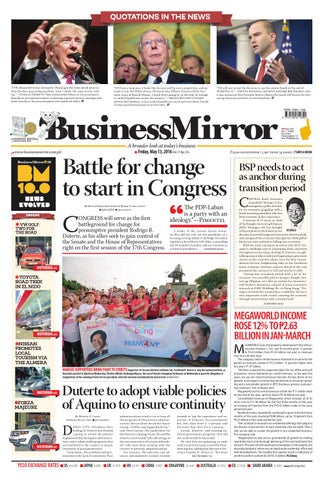
“I’VE always felt it was overrated. Obama got the votes much more so than his data-processing machine. And, I think, the same is true with me.”—Donald Trump to The Associated Press, as the presumptive Republican presidential nominee is planning a general election campaign that banks heavily on his personal appeal and trademark rallies. AP
MEDIA PARTNER OF THE YEAR
UNITED NATIONS
2015 ENVIRONMENTAL MEDIA AWARD LEADERSHIP AWARD 2008
“WE have a nominee, it looks like he may well be very competitive, and we want to win the White House. We know that Hillary Clinton will be four more years of Barack Obama. I think that’s going to, in the end, be enough to unify Republicans across the country.”—Senate Majority Leader Mitch McConnell, as key Senate Republicans voiced optimism about Donald Trump’s presidential prospects in November. AP
“HE will not revisit the decision to use the atomic bomb at the end of World War II.”—Deputy National Security Adviser Ben Rhodes, after it was announced that President Barack Obama this month will become the first sitting American president to visit Hiroshima. AP
BusinessMirror
www.businessmirror.com.ph
A broader look at today’s business n
Friday, May 13, 2016 Vol. 11 No. 216
Battle for change to start in Congress B B F J M N. C
C
INSIDE
@joveemarie
ONGRESS will serve as the first battleground for change for presumptive president Rodrigo R. Duterte, as his allies seek to gain control of the Senate and the House of Representatives right on the first session of the 17th Congress.
VW GOLF: TWO FOR THE ROAD
MOTORING
@butchfBM
The PDP-Laban is a party with an ideology.”—P A leader of the current Senate minority bloc did not rule out the possibility of a looming revamp likely to dislodge President Aquino’s Liberal Party (LP) allies, controlling the 24-member chamber, when it convenes in a Duterte presidency. C A
E1
TOYOTA ROAD TREK IN EL NIDO
P. | | 7 DAYS A WEEK
BSP needs to act as anchor during transition period
C
ENTRAL Bank Governor Amando M. Tetangco Jr. has emerged as a pillar of stability for investors grappling with a brash incoming president who has little economic-policy experience. A veteran of 11 years as chief of the Bangko Sentral ng Pilipinas (BSP), Tetangco, 63, has brought inflation down to the lowest in two TETANGCO decades, boosted foreign reserves more than fourfold, and navigated the economy through the 2008 global financial crisis without it falling into recession. With his term coming to an end in July 2017, Tetangco’s challenge now is sustaining those successes through uncertain times. Rodrigo R. Duterte, a toughtalking mayor who is only just beginning to give more clarity on his economic plans, won the May 9 presidential election, heightening risks in the Southeast Asian economy. Investor concern ahead of the vote prompted the currency to fall and stocks to slide. “During this transition period with a lot of uncertainty over possible policy changes, Bangko Sentral ng Pilipinas acts like an anchor for investors,” said Frederic Neumann, cohead of Asian economics research at HSBC Holdings Plc. in Hong Kong. “Tetangco certainly has tremendous credibility. He has a very impressive track record, steering the economy through uncertainties with a steady hand.” C A
MOTORING
MEGAWORLD INCOME ROSE 12% TO P2.63 BILLION IN JANMARCH
E4
M
NISSAN PROMOTES LOCAL TOURISM VIA THE ALMERA MARCOS SUPPORTERS BRING FIGHT TO STREETS Supporters of vice-presidential candidate Sen. Ferdinand R. Marcos Jr. sing the national anthem, as they hold a protest in Manila on Wednesday. Election officials challenged Marcos, the son of the late strongman Ferdinand, on Wednesday to prove his allegation of irregularities in the counting of votes for vice president, where he has been overtaken by his closest rival. AP/AARON FAVILA
MOTORING
E2
FORZA MAJEURE
Duterte to adopt viable policies of Aquino to ensure continuity B M T. C
Mindanao Bureau Chief
D MOTORING
E3
@awimailbox
AVAO CITY—President-elect Rodrigo R. Duterte has formed a group to review the policies implemented by the Aquino administration, and to adopt viable programs that are beneficial to the country to ensure continuity of good governance. “Sometimes, the problem with government is the lack of continuity. Past
PESO EXCHANGE RATES n US 46.6380
administrations tend to cut or stop all the programs of the previous administration. But you have heard the mayor saying, ‘I will be copying good policies,’” said Peter Laviña, the spokesman for the Duterte campaign team. He said the Duterte team would “take advantage of the vast experience of certain individuals” who have been working with the current or previous administrations. For instance, the selection and advisory subcommittee formed recently
intends to tap the experience and expertise of Duterte’s vice-presidential bet, Sen. Alan Peter S. Cayetano, and his sister, Rep.-elect Pia S. Cayetano. Laviña, however, said existing national government programs that did not work would be discarded. He said they are preparing to work with a transition team created by President Aquino, adding that Executive Secretary Paquito N. Ochoa Jr. “has been S “D,” A
EGAWORLD Corp., the property-development firm of businessman Andrew L. Tan, said its income grew 12 percent to P2.63 billion, from P2.35 billion last year, as revenues rose to an all-time high. The company said its rental business boosted its income for the period as revenues soared to P2.3 billion, 15 percent higher than last year’s P1.97 billion. “We have sustained the expansion plans for our office and mall businesses, which bolstered our rental revenues. In the next five years, we see our rental businesses become the key driver of our growth, as we expect a continuing momentum in consumer spending and a remarkable growth in BPO [business-process outsourcing] revenues,” the company said. Megaworld said its rental revenues will hit the P11-billion mark by the end of the year, up from about P9.16 billion last year. Consolidated revenues of Megaworld, which includes all of its units, rose to P11.46 billion for the first three months of the year, an increase of 9 percent from the P10.47 billion made in the same period last year. Residential sales, meanwhile, continued to grow in the first three months of the year, reaching P6.86 billion, up by 10 percent from P6.24 billion in the same period last year. “We continue to innovate our residential offerings that adapt to the diverse characteristics of each township that we build. That is why we are able to sustain the growth in our residential business,” the company said. “Megaworld has laid out its groundwork of growth by making sound decisions and thorough planning of the vast land bank that we have. This year we will continue to strengthen, if not expand, our township footprint, where we can build more residential, office and mall developments. Our healthy first-quarter result is indicative of another positive outlook for 2016,” it added. VG Cabuag
n JAPAN 0.4302 n UK 67.3919 n HK 6.0101 n CHINA 7.1839 n SINGAPORE 34.1645 n AUSTRALIA 34.3955 n EU 53.3026 n SAUDI ARABIA 12.4365
Source: BSP (12 May 2016 )
A2 Friday, May 13, 2016
BMReports BusinessMirror
Battle for change to start in Congress C A
Asked if the Nationalist People’s Coalition (NPC) is firming up an alliance with Duterte’s PDP-Laban to replace Senate President Frank Drilon’s LP-led bloc as the new dominant group in the Senate, Deputy Senate Minority Leader Vicente Sotto III, NPC stalwart, said it is still being considered. “Pinag-aaralan pa,” Sotto told the BusinessMirror. With President Aquino—the LP’s titular head—vacating the seat of power by the end of his term on June 30, the Liberals are not seen to retain control of the so-called upper chamber. Clarifying that “the LP does not dominate the Senate,” Sotto indicated a new majority grouping is likely to emerge when the next Congress convenes under the Duterte presidency. “A coalition we can form can be bigger [than the LP bloc],” Sotto added. Other senators, who spoke on condition of anonymity, confided that losing presidential aspirant Sen. Grace Poe and her running mate, Sen. Francis Escudero, who expect to return to their Senate seats, are likely to link up with the NPC—their former party which
supported them even when they ran in the last elections under a new group called “Galing at Puso.” They will join Sotto in the NPC bloc that will include a new NPC senator with the election of Sherwin Gatchalian, who will pad the ranks of the emerging new majority grouping. As of Thursday, the top 12 joining the next Senate are Drilon, Joel Villanueva, Sotto, Panfilo Lacson, Richard Gordon, Miguel Zubiri, Emmanuel Pacquiao, Risa Hontiveros, Francis Pangilinan, Gatchalian, Ralph Recto and Leila de Lima. But Sen. Aquilino “Koko” Pimentel III, PDP-Laban president, said the new ruling party is not rushing to take in turncoats looking to barge into a fresh alliance expected to be cobbled from various blocs in the upper chamber. Pimentel said the PDP-Laban, founded by his father, Aquilino Pimentel Jr. when he was a Cagayan de Oro mayor, had always been an “ideology-based party.” He said it is the PDP-Laban’s ideology that will filter the “mere opportunists and other turncoats” applying to join the new ruling alliance. “The PDP-Laban is a party with an ideology,” Pimentel said, adding
that “Duterte is a socialist, hence, someone with an ideology, too.” He said PDP-Laban prefers to enter into alliances with parties with an ideology or a vision for the country. “We abhor personality-based decision-making that is not going to lead to any change,” Pimentel said. He added that the party has never changed its rule about requiring aspiring recruits, no matter how highly placed, to undergo the basic membership seminar. Asked about the possibility of installing another “Aquilino Pimentel” as Senate president in the incoming Duterte administration, Pimentel said he was leaving it all up to his fellow senators when the 17th Congress convenes on July 26 to elect a new set of officers of the Senate. “It depends on the collective will of my colleagues. [I’m] open to it but not anxious about it,” Pimentel said. In a separate interview, Drilon sidestepped queries on the composition of the new Senate leadership in the 17th Congress. He begged off from discussing the matter with reporters on Wednesday, saying it is “premature at this point.”
House speakership
RETURNING Davao del Norte Rep.
Pantaleon Alvarez is expected to pose a challenge to Speaker Feliciano Belmonte Jr.—two of the top choices for the Speakership of the House of Representatives. Alvarez, who ran under PDPLaban, was preferred by Duterte after his nephew, National Unity Party Rep. Karlo Alexei Nograles of Davao City, decided to give way to Alvarez’s bid. Belmonte, who was the campaign manager of the LP, is eyeing a third and final term as speaker of the lower house. He claimed that he has the support of at least 100 LP lawmakers who will become members of the 17th Congress, while Alvarez said the presumptive president is behind his bid for the speakership. Alvarez was a former chief of the Department of Transportation and Communications during the term of former President Fidel V. Ramos. For his part, Belmonte said he will form a “super majority” bloc in the lower house, which will be capable of shielding Duterte from any impeachment attempt and will be supportive of his legislative agenda. “Under me, they will be supportive of Digong’s programs and can form the nucleus of his super
majority,” Belmonte said. Meanwhile, the head of the powerful Visayas bloc and reelected Negros Occidental Rep. Alfredo Benitez said his group remains noncommittal in backing a candidate for the speakership. The bloc, however, is already committed to support Duterte’s push for his legislative priorities, particularly on peace and order, poverty reduction, public health and education. Benitez said the 46-member Visayas bloc will meet next week to discuss a common stand on the speakership and will welcome its new members. “Expected to be at the center of discussion is the race for House leadership between incumbent Belmonte and Alvarez, the PDP-Laban secretary-general,” he said. “However, right now, we can only commit to the next president our cooperation in acting on measures that will help realize his programs for peace and order, poverty reduction, better public health and affordable education for our youth,” Benitez added. Benitez, chairman of the House Committee on Housing and Urban Development, is a dark horse in the speakership race.
BSP needs to act as anchor during transition period ‘Hot water’
DUTERTE’S comments about the central bank ahead of the election had already raised warning bells. He said the bank and antimoneylaundering unit that Tetangco heads will be in “ hot water” should he become president because they are suspected of having been the source of information that Duterte allegedly had hidden wealth. The central bank has denied it’s the source of that information and said it doesn’t engage in partisan politics. Duterte subsequently said
during a forum with Philippine Star editors on May 4 that the central bank is doing a good job. The peso closed 0.2 percent lower at 46.64 against the dollar on Thursday in Manila, after gaining in the previous three days. Stocks fell 1 percent. Duterte needs to convince investors he can build on the success of an economy that’s grown on average more than 6 percent annually in the past six years. He got some early help from the central bank, which held the benchmark interest rate at 4 percent on Thursday,
as forecast by 14 of the 15 economists surveyed by Bloomberg.
Cabinet appointments
THE incoming president this week hinted at possible Cabinet appointees, including former agriculture secretary and businessman Carlos Dominguez, who may be tapped to head the finance or transportation departments. Duterte will take office on June 30. “The people Duterte is surrounding himself with are experienced and know that central bank indepen-
dence is important,” said Jonathan Ravelas, chief market strategist at BDO Unibank Inc. in Manila. “I don’t think that is something to worry about. Why fix it if it ain’t broke?” Dominguez said in a televised briefing on Thursday that Duterte will continue with the current macroeconomic policy and accelerate infrastructure spending to address bottlenecks. He also plans to make the tax system more progressive and expand welfare payments to the poor, Dominguez said. An economics graduate from the
C
Ateneo de Manila University, Tetangco started his career with the central bank in 1974. He worked his way up from statistician at the bank’s economic research department to becoming one of three deputy governors and, eventually, the head of the bank. Tetangco was an adviser at the International Monetary Fund from 1992 to 1994. The central bank is in the process of transitioning to an interest-rate corridor by early June, a move it said will boost the effectiveness of its benchmark rate. Bloomberg News
news@businessmirror.com.ph
Duterte. . .
C A
trying to reach out to our transition team.” Communications Secretary Herminio B. Coloma Jr. earlier informed the Duterte transition team of the readiness of the Palace to welcome the incoming team. “Certain members of the Cabinet have been trying to reach out to our team, telling us that there was an order from the President to prepare all the departments and to welcome any member of the Duterte transition team so we will be able to go on with the smooth turnover of power,” Lavina said. Lavina said the policy review committee, one of four recently formed groups, “had been working for several days, identifying key policy issues and bottlenecks that would be addressed immediately once the new administration takes over.” Lavina also introduced Pia Cayetano as a volunteer adviser in the transition team “for her expertise and vast experience in women and gender issues.” Cayetano said the selection of Duterte’s advisers would factor in the gender-sensitivity criteria. “This may not be about trying to achieve the recommended number of women in top positions, but it’s about people, including women, who should be conscious of always considering the issues about women,” she said. She confirmed that Duterte has approved women equality in the appointments. “It’s not all about numbers, but how many women are in the executive decision-making positions,” she added. Aside from this committee and the selection and advisory committee, the Duterte team has also created the inaugural committee and the committee that would identify the personal representatives of the mayor “so that we will immediately send them out, bring the message of the mayor, extending the hand of friendship, calling for unity and cooperation, as well as opening direct lines to the new administration.” Lavina said Duterte’s personal representatives would be directed to go to the embassies, the various departments, Congress, Senate, the Judiciary, media outfits, civilsociety organizations, the various Churches and other key sectors to ask for their help and cooperation.
First foreign visit
MEANWHILE, Lavina said Duterte’s first foreign visit would be to a member-country of the Association of Southeast Asian Nations (Asean). “There’s a tacit agreement among members of the Asean, among the 10-member heads of state [that] once installed into office, to visit any one member of the Asean first, before visiting any other country,” Lavina said. This would likely send him to Brunei Darussalam by August, he said, although this “will not be a state visit.” “We were told that in the month of August, the Sultan of Brunei hosts a gathering, and normally the heads of states of Asean also converge,” he said. “But this is purely a social gathering, this is not a state visit.” He said Duterte may attend this gathering “considering that August also falls within the first three months of the new administration “and he might want to immediately meet his counterparts in Asean, if the invitation is so extended.” “This will be a good opportunity to meet everyone as soon as possible to immediately convey the new administration’s readiness to fully support the Asean integration,” he added. Duterte’s planned visit to the Vatican remained as top priority, but Lavina said the visit has been affected by the busy schedules of high-ranking officials of the Vatican who will arrange the courtesy call on Pope Francis. “The schedules of the high-ranking officials of Vatican are not easy to arrange,” he said. “That visit is not only to pay homage to Pope Francis, but he really need to explain [his published comments] to the Pope and to ask for his forgiveness,” he said.
BMReports
news@businessmirror.com.ph
BusinessMirror
Wednesday, May 13, 2016 A3
BSP can tap HLURB in monitoring shadow banking–Justice Chief B J R. S J
T
@jrsanjuan1573
HE Department of Justice (DOJ) has given the Housing and Land Use Regulatory Board (HLURB) the go-signal to compel subdivision and condominium developers to regularly submit information on their financial condition and other reports about projects to prevent fraudulent manipulation and shadow-banking abuses. In a four-page legal opinion, acting Justice Secretary Emmanuel L. Caparas affirmed the position of the Bangko Sentral ng Pilipinas (BSP) that the HLURB can impose such a requirement. BSP Deputy Governor Vicente S. Aquino sought DOJ’s legal opinion on whether the HLURB, under its existing powers and authority, can require project owners and developers to submit on a regular basis certain information relating to their financial condition and reports regarding their projects. The request was sought following the directive of the BSP, the government agency which has been monitoring the proliferation of shadow banking, to ensure a safe financial system by identifying and mitigating risks related to the said activity. Prior to this, Aquino told the justice department that the BSP had discussions with the HLURB on the possibility of requiring subdivision or condominium project owners and developers to regularly submit their financial statements for a given project. Based on the proposal, a data or report template will have to be accomplished by owners and
developers to capture possible shadow-banking activities. According to a report of The Economist, the term “shadow bank” was coined in 2007 by Paul McCulley of PIMCO, a big bond fund to describe risky offbalance-sheet vehicles hatched by banks to sell loans repackaged as bonds. “Today, the term is used more loosely to cover all financial intermediaries that perform bank-like activity but are not regulated as one. These include mobile-payment systems, pawnshops, peer-to-peer lending websites, hedge funds and bond-trading platforms set up by technology firms. Among the biggest are asset management companies.” The report will require details of the subdivision and condominium project owners’ or developers’ financial condition, borrowings from non-bank sources, and installment sales. The DOJ noted that Presidential Decree (PD) 957, or the Subdivision and Condominium Buyers Protective Decree, granted the National Housing Authority (NHA) the exclusive jurisdiction to regulate the real-estate industry.
On the other hand, under Executive Order 648, the NHA’s regulatory functions were transferred to the Human Settlements Regulatory Commission, now renamed as the HLURB. “The authority of the HLURB to require from project owners and developers the regular submission of financial reports for a given project can be implied from the express grant of power to regulate the real-estate trade and business,” the DOJ noted. Furthermore, the DOJ explained that PD 957 grants to NHA the power to suspend or revoke licenses, when the registration statement has become misleading, incorrect, inadequate or incomplete, carries the power to require regular submission of financial statements. In addition, PD 957 requires financial statements consisting of capitalization, balance sheet showing the amount and general character of its assets and liabilities and a copy of articles of either incorporation, partnership or association. Likewise, the implementing rules and regulations of PD 957 requires the submission of semestral reports on operations showing the sales status. “Thus, on the basis of these… provisions, HLURB may regularly require subdivisions/condominium project owners and developers to furnish it with financial information pertaining to the sale or offering for sale of subdivision or condominium project, the general character of their assets and liabilities, sales status, including the mode of acquisition, and the extent or development status of their projects,” the DOJ said. The DOJ said the HLURB must be able to justify that the information being sought has a connection to the prevention of undesirable activities, which include reneging of obligations, endangerment to health, swindling and fraudulent manipulation.
Govt wants accurate data on causes of death
T
HE Philippine Statistics Authority (PSA) and the Department of Health (DOH) are undertaking a project with a foreign foundation to gather more accurate data on the causes of death among Filipinos. In an interview with BusinessMirror on Thursday, National Statistician Lisa Grace Bersales said the project will significantly help in monitoring maternal deaths. The partnership of the PSA and DOH with Bloomberg Foundation is focused on determining causes of death and the crafting of a manual for health workers to guide them in accurate reporting. “The main concern now is maternal mortality ratio [MMR] because our MMR is based on our survey which is being done every three to five years but we want a more regular one so we [can rely on] causes of death in our death certifi-
cates,” Bersales said. The National Statistician said this is part of the PSA’s efforts to improve the use of the civil registration database for statistical purposes. The Civil Registration is part of the PSA. It’s the foremost agency tasked to provide official birth and death certificates for Filipinos. However, Bersales said civilregistration data can also be used to generate vital statistics, such as causes of death. “We will try to see how we can make use of our civil-registration database for statistical purposes because our civil registration is really for frontline services, like provision of birth certificates, death certificates, but there is a wealth of information there,” she said. The reduction of the maternal mortality ratio of the country is one of the Millennium Development Goal (MDG) targets that the country failed to achieve.
The target is to reduce by three-quarters, between 1990 and 2015, the maternal mortality ratio. In 1990 the country’s MMR was at 209 deaths per 100,000 live births. Based on this, the country should have been able to cut this to 52 deaths per 100,000 live births by 2015. However, PSA’s 2011 data showed that the number of maternal deaths even increased to 221 deaths per 100,000 live births. Reducing maternal deaths is also part of the Sustainable Development Goals (SDGs) under Goal 3 of ensuring healthy lives and promoting the well-being for all ages. The target for 2030 is to reduce the global maternal mortality ratio to less than 70 per 100,000 live births. The SDGs are composed of 17 goals with around 169 targets with 230 global indicators adopted in September 2015. Cai U. Ordinario
Stocks with Mindanao connection seen to become big winners
I
NVESTORS are betting one of the biggest winners from the post-election markets rally in the Philippines will be an island. They may have a long time to wait. With the Philippine Stock Exchange index capping the largest two-day gain since 2013 after the election of Rodrigo R. Duterte as president, the top performers are stocks that may benefit from investment and development plans for Mindanao. The country’s second-largest and southernmost island is home to 11 of the 20 poorest provinces and has suffered four decades of Islamic insurgency by Muslim extremist groups such as Abu Sayyaf. “Buying stocks with Mindanao exposure is a good trading strategy and will be a recurring theme under Duterte’s presidency,” said James Lago, head of research at PCCI Securities Brokers Corp. “Investors shouldn’t be throwing out valuations and fundamentals in chasing this theme. This won’t happen overnight.” Equities soared this week after earlier uncertainty over the election outcome and whether economic gains under outgoing President Aquino can be sustained, given Duterte’s lack of policy-making experience. The economy has posted average
annual growth of 6.2 percent over the past six years, the fastest pace since the 1970s. Philippine stocks surged 3.1 percent on Wednesday, adding to Tuesday’s 2.6-percent gain, after weeks of uncertainty over the elections that pressed on financial markets. Overseas investors bought a net $40.3 million of the nation’s equities on Wednesday, the most in more than a year, sending the stock measure to the highest level since August 14. The benchmark index gave back some gains on Thursday, dropping 1 percent at the close of trading in Manila. Mindanao is home to many of the Philippines’s 5 million Muslims, and has produced a separatist insurgency demanding autonomy in a nation where more than 80 percent of the population is Roman Catholic. Aquino hasn’t managed to get his signature peace deal with the separatist group Moro Islamic Liberation Front through Congress in his term that was aimed at ending a conflict that has killed more than 200,000 people. Kidnappers in the region, including the Abu Sayyaf Group, often take hostages for ransom. “Ma ny Fi l ipinos voted for Duterte because he plans to reduce Manila centrism,” Victor
Buying stocks with Mindanao exposure is a good trading strategy and will be a recurring theme under Duterte’s presidency.”—PCCI S
Felix, an analyst at AB Capital Securities Inc. in Manila, said in an interview. “While initial market reaction is positive, Duterte has yet to give a clear-cut indication of how he will reduce the poverty levels in Mindanao. The property and consumer sectors have also expressed interest to expand in the Mindanao region, but they don’t have any clear plans yet.” D uter te, t he presu mpt ive president after the May 9 vote, is mayor of Davao City in Mindanao, where a quarter of the Philippines’s more than 100 million people live. The island accounts for less than 15 percent of GDP, as a four-decade Muslim insurgency discouraged government and private-sector investments. In his campaign, he vowed to forge peace with Muslim and leftist rebels. Duterte, who will become the first president from Mindanao, will push for the southern region’s economic development, as “many
poor provinces are located in Mindanao,” Spokesman Pete Lavina said in a mobile-phone message on Wednesday. The island also serves as the nation’s gateway to the Association of Southeast Asian Nations, he said.
Record gains
SM Pr ime Hold ings Inc. and Aboitiz Equity Ventures Inc., which have investments in Mindanao, soared more than 8 percent over two days to records. SM Prime, the nation’s largest shopping-mall developer, may accelerate a P15-billion three-year plan to double its commercial center space in Mindanao should Duterte push forward with his plans for the region, said Alex Pomento, vice president at the Manila-based company. Robinsons Land Corp., which has four shopping malls in Mindanao, has climbed 9.4 percent in two days, while Robinsons
Retail Holdings Inc., which has grocers, department stores and convenience shops in Mindanao, posted its steepest two-day rally since February 2014. JG Summit Holdings Inc., which has investments in the Visayas and Mindanao, has surged 12 percent to an all-time high. San Miguel Corp., the nation’s largest company by sales, plans to increase its investments in the southern region with projects in power, steel and an industrial park, President Ramon S. Ang said in a mobile-phone text message. San Miguel shares rose 5.4 percent on Wednesday. Power producers, such as Alsons and First Gen Corp., also stand to benefit from Duterte’s victory. Mindanao, which has vast agricultural lands and mineral deposits worth $300 billion from nickel to copper, has a power deficit of 154 megawatts, or more than 10 percent of capacity. The island has suffered periodic power outages for years because of its aging power plants and hydroelectric facilities that can be crippled by droughts.
Sin stocks
WITH such problems facing the island, it’s unclear how quickly transformation may take hold.
“Investors are generously interpreting Duterte’s broad pronouncement of developing Mindanao and stimulating growth in the provinces. The devil is in the details,” said Jonathan Ravelas, chief market strategist at Manila-based BDO Unibank Inc., the nation’s biggest bank by asset. “Duterte has to come out with specifics and a timeline.” Meanwhile, some losers from the election could be so-called sin stocks. His campaign for harsher restrictions on cigarette smoking and shorter hours for bars to sell alcohol may weigh on LT Group Inc. and Emperador Inc. Both stocks slid at least 1.5 percent on Wednesday. Some investors expect more beneficiaries to be highlighted from Duterte’s policies in the coming weeks as greater clarity emerges. “ T here is a grow ing interest among investors for companies that could benefit from the changes in Mindanao with Duterte as president,” said Rafael Palma Gil, a trader at Rizal Commercial Banking Corp., which manages $1.8 billion in trust assets. “Duterte wants inclusive growth so it won’t only be Mindanao that stands to benefit but other areas.” Bloomberg News
BMReports BusinessMirror
A4 Friday, May 13, 2016
www.businessmirror.com.ph
GREAT EXPECTATIONS, THE PHILIPPINE VERSION
A ‘wish list’ for the Duterte administration B VG C, D C, B C, M G P, J C, L L, J M, R M, C O, C P J R. S J
Miners hopeful
MEANWHILE, with Mr. Aquino out of the picture, mining industry’s big players under the Chamber of Mines of the Philippines (COMP) are hopeful of better days ahead, starting with the repeal of Executive Order (EO) 79. Mining, a highly extractive industry facing stiff opposition from communities and environmental groups, continues to face an uphill climb, with mining investment experiencing sharp drops over the past few years because of EO 79. The Philippines is blessed with rich mineral resources and, despite its potential, its contribution to the country’s GDP is still less than 1 percent, because of existing policies that prevent minerals development to take off. The COMP is preparing for a more detailed “wish list” for the toughtalking Duterte, who promised to suppress crimes, fight graft and corruption, and “fix” the government. While at it, the COMP issued a list of recommendations drafted by Nelia Halcon, the group’s executive vice president. According to the COMP, EO 79 effectively suspended the issuance of new mining permits until a new law on the revenue-sharing scheme between the government and mining industry is enacted. It also established mining “nogo zones,” making 86 percent of the country’s total land area “off-limits” to mining, diminishing the right of exploration-permit holders from an “exclusive right to an MPSA or other mineral agreements or FTAA” (under RA 7942) to a “first option to develop and utilize the minerals in their exploration area.” Under the presidency of Duterte, the COMP is recycling its wish list, which it believes will boost the industry through the creation of a mineral resource-development policy to create a stable investment and regulatory environment, and ensure the responsible exploration, development and utilization of mineral resources to benefit the country and the people.
I
N 1861 Miss Havisham expected to be laid on a long table inside her house of old brick behind iron grills in London in Charles Dickens’s fictional work. In 2016 a long table of great expectations confronts Davao City Mayor Rodrigo R. Duterte. According to University of Asia and the Pacific School of Economics Vice Dean George Manzano, a pot is always filled to the brim with good-policy prescriptions. Manzano first pointed to increased investors’ confidence with policies that are investor-friendly as a desired outcome. He explained in an electronic mail to the BusinessMirror these policies and outcome include rule of law, sanctity of contracts, transparency of process, and liberalized investment regime. “Peace and order has been his [Duterte’s] battle cry from the beginning,” Liberal Party (LP) Rep. Alfred Vargas of Quezon City told the BusinessMirror. “I expect a lot of reforms in a Duterte administration.” LP Rep. Teddy Baguilat Jr. of Ifugao, citing Duterte’s strengths and talents, said he is expecting the next president to “focus his efforts on his own popular promise of fighting criminality—not even to eradicate it, but to minimize lawlessness.” “Then inasmuch as he said he’ll be bringing in the Reds and the Muslim separatists to the table and, being a Mindanaoan, I hope he really negotiates a lasting peace settlement that will end all internal wars in the Philippines,” added Baguilat, House Committee on Agrarian Reform chairman. Environmental activists, meanwhile, are calling for blood. Activists grouped by the Kalikasan-People’s Network for the Environment (Kalikasan-PNE) said they want the “Punisher,” presidentelect Duterte, to act with dispatch. The group, a vocal critic of the Aquino administration’s environmental programs and policies, wants Duterte to make good his campaign promises by going after environmental criminals and alleged corrupt government officials. The group said it wants Duterte to begin investigating and prosecuting Department of Environment and Natural Resources (DENR) officials led by Secretary Ramon J.P. Paje. The activists alleged the Aquino administration’s National Greening Program (NGP) is “anomalous.” Kalikasan-PNE also wants Duterte, who vowed to fight crime and corruption to ban aerial spraying (referring to the method used by large agricultural corporations in banana and pineapple plantations) and large-scale mining on all cities. The group also wants the prosecution and detention of suspected killers of environmental activists, like botanist Leonard Co. Greenpeace Philippines, meanwhile, expects a handful, beginning with helping the Commission on Human Rights (CHR) pursue cases against big corporate polluters. The group listed six other expectations. Other environmental groups are also asking Duterte to promote renewable energy, cancel all 27 coalfired power plant projects in the pipeline and phase out the 19 existing power plants that run on coal. “[President-elect] Duterte must review the current one’s commitment to reduce 70 percent of our country’s emissions by 2030,” said Ruel Cabile, national coordinator of Aksyon Klima Pilipinas. “His administration must also demand climate finance from devel-
oped countries, as well as mobilize its own resources, so it can implement a swift and just transition to clean and renewable energy.”
Energy mix
LOPEZ-LED First Gen Corp. officials are urging the new administration to come up with a clear policy on energy mix. “Right now, an energy mix is going to be an important policy. The government has got to be able to make strong moves toward making sure that it’s not just the cost that drives our fuel mix, because that is what’s happening today,” First Gen Chairman Frederico Lopez said in an interview. When asked what would be an ideal energy mix for the country, Lopez replied, “If we can head toward 50-percent renewable, for starters. I think, for me, if we are able to meet the commitments we made in Paris, which is a 70-percent reduction in carbon emission, then that’s going to be a good start.” The Department of Energy (DOE) is pushing for the industry to source 30 percent of its energy requirements from coal, 30 percent from renewable energy and another 30 percent from natural gas. The remaining 10 percent will come from oil-based power plants. Based on latest DOE data, the country’s total installed capacity stood at 18,695 megawatts (MW). Dependable capacity, meanwhile, stood at 16,451 MW. Of the installed capacity, coalpower plants make up 31.5 percent, while oil-based and natural gas-fired plants account for 19.3 percent and 15.3 percent, respectively. Data indicated that the share of renewable-energy sources, such as geothermal, hydro, wind, solar and biomass, stood at 10.3 percent, 19.3 percent, 2.3 percent, 0.9 percent and 1.2 percent, respectively.
Renewable energy
OFFICIALS still working under the administration of President Aquino appear to agree with some of the expectations of environmental activists. “Renewable energy is high on the agenda to maintain the country’s momentum,” Energy Secretary Zenaida Monsada said. She continued that “we have been working on inputs for a sound decision, so that the next administration has a solid basis for decision-making or direction with the updating of the Philippine Energy Plan, Power Development Plan, Transmission Development Plan and Distribution Development Plan.” Meanwhile, the Inter-Agency Task Force on Securing Energy Facilities, which is led by the DOE, is “strongly” pushing for the passage of a binding law that will prohibit any activity compromising the integrity of grid regarding the obstructions beneath the transmission facilities, such as vegetation and structures. Monsada said this will form part of the recommendations of the agency for the incoming administration. Other policy recommendations that will be provided for the next administration include matters pertaining to the Electric Power Industry Reform Act, such as the Retail Competition and Open Ac-
Foundation laid DAVAO City Mayor Rodrigo R. Duterte kisses the Philippine flag during his final campaign rally in Manila. AP/AARON FAVILA
‘WISH LIST’ OF NATIONAL RENEWABLE ENERGY BOARD NATIONAL Renewable Energy Board (NREB) Chairman Pedro Maniego, in a text message to the BUSINESSMIRROR, wants the new administration to focus on the following: n Set an energy policy based on distributed generation rather than centralized generation, which would lead to a more robust and resilient grid, as well as to lower transmission costs and losses; n Conduct a comprehensive study to determine the appropriate power mix to meet base-, midmerit- and peak-load demands; n Develop and implement the Philippine Energy and Power Development Plans according to the distributed generation policy and results of the power-mix study; n Level the playing field between fossil-fuel plants and indigenous renewableenergy resources by strictly implementing the Clean Air Act, Water Code and other environmental laws, and by removing the automatic pass-through of fuel costs to consumers (this provision ensures the profits of fossil-fuel plants by shielding them from price fluctuations); n Full implementation of the mechanisms and incentives under the RE Act of 2008; n Fast-tracking of the approval and permits for renewable-energy projects at all levels; and n Appointment of a Department of Energy secretary who has an in-depth knowledge of the energy sector, and has the right experience and educational background. n The NREB is the body tasked by the Renewable Energy Act of 2008 to recommend policies, rules and standards to govern the implementation of the law, which granted fiscal and nonfiscal incentives to renewable-energy projects.
cess, Competitive Selection Process for power-supply contracts, establishment of Wholesale Electricity Spot Market in Mindanao, Renewable Portfolio Standards, RE Market and the Green Energy Option. Furthermore, the DOE would also push for the 30-30-30 balanced energy mix (renewable energy, coal, and gas), wherein the remaining 10 would include an open option for nuclear energy and other alterna-
tive energy. For the fuel sector, Monsada said she hopes “to strengthen implementation of the retail rules to fully eliminate the bote-bote scheme, and illegal refilling of liquefied petroleum products to deliver an orderly competition.” Finally, the DOE would recommend energy-efficiency policies, starting with energy labeling for industries and transportation.
COMMUNICATIONS Secretary Herminio B. Coloma Jr. said aside from the anticorruption drive, the Aquino administration had also laid the foundation that will enable higher economic growth in the next six years under Duterte. Coloma said the continuity of these projects, especially those aimed at minimizing corruption, should be done to take advantage of the Aquino administration’s accomplishments in these areas. “In my opinion, if we look at it closely, in the main, the platforms being pushed by the Aquino administration were also identified as the focus of the next administration,” Coloma said. “We must admit the reality that not everything can be resolved or eliminated during just one six-year term.” Some of the anticorruption measures instituted during the Aquino administration are the establishment of the Governance Commission on Government-Owned and -Controlled Corporations (GOCCs), which scrutinizes the operations of GOCCs which have long been perceived to be a haven for corruption, inefficiency and nepotism, and the use of the annual General Appropriations Act as the actual release document for appropriations, obviating the need to secure a special allotment release order from the Department of Budget and Management, which is an additional red tape that also encourages corruption and political patronage. On the part of the Judiciary, the Supreme Court uprooted the deeply embedded practice of giving legislators their lump-sum pork barrel which, until recently, they were given the discretion to spend as they choose, often for pet projects chosen based on the political gain they would bring for their fu-
ture political plans. The Duterte administration could capitalize on the government’s achievements in fighting poverty and crime to gain headway “when they hit the ground running” on June 30, according to Coloma.
Warm welcome
THREE days after the elections on May 9, local markets gave the new administration a warm welcome after closing on a positive note. On Tuesday, a day after the national elections, the Philippines’s financial markets reacted positively, with both the stock index and the foreign-exchange market ending the day’s trade on a positive note. Data from the Philippine Dealing System (PDS) showed the peso appreciating on Tuesday to 46.76 to a dollar. The strength of the peso extended further on Wednesday as it hit 46.55 to a dollar, or 20 centavos stronger than the previous day’s close. Among the crucial developments investors are awaiting from the front-runner are his choices of Cabinet secretaries, as well as his fiscal plan for the country, according to ING Bank Manila senior economist Jose Cuyegkeng. “The Philippine peso’s postelection day strength could be sustained with further positive developments from President-elect Duterte,” Cuyegkeng said. “We expect Duterte to form his government in the next few weeks while focusing on key priority areas.” Cuyegkeng added that the selection of members of his Cabinet would be important developments. “Discussions about the 2017 budget would start by end of May or early June. This would help us assess Duterte’s fiscal stance. Market-friendly actions would help sustain Philippines’s strength or moderate the impact of challenging external developments,” Cuyegkeng added.
Close monitoring
ON the international front, major credit watchers remain cautious of the next president’s first steps in setting the tone for the economic environment. In a recent study on the sovereign risk of politics in Southeast Asia, Standard & Poor’s (S&P) Ratings Services said Duterte’s style posts risks to the country should changes in his administration become too aggressive. “Used to a hands-on approach in governing a city that is his political base, he could take some time getting used to the many compromises required in the national leadership position. Some measures he is considering could change the status quo, including liberalizing the telecom sector and constitutional amendments to strengthen the power of local governments,” S&P said. “He could face strong resistance if he pushes some of these changes aggressively,” the ratings agency added. Fitch Ratings, meanwhile, said it continues to “wait-and-see” developments on the ground before giving a full assessment of the administrative transition. “However, when the rating agency affirmed the rating at ‘BBB-’ with a positive outlook in April, the agency had pointed out that it would wait and see whether the improvement in governance standards achieved under the administration of Aquino can be sustained after the 2016 elections, in line with its rating sensitivities,” Fitch said. “If that were to occur, it could be positive for ratings. Fitch will monitor further developments closely,” it added. Manzano told the BusinessMirror these policy recommendations will all boil down on how Duterte would perform. “What is lacking is implementation of policies.”
AseanFriday
news@businessmirror.com.ph
BusinessMirror
Editor: Max V. de Leon • Friday, May 13, 2016 A5
‘Najib’s stepson used 1MDB funds to buy US properties’
T
HE stepson of Malaysian Prime Minister Najib Razak allegedly used funds diverted from a state investment company to buy properties in the United States, the Wall Street Journal reported.
Riza Aziz spent about $50 million on two properties in New York and Los Angeles deals, the US Federal Bureau of Investigation is investigating, the paper reported, citing documents and people it didn’t identify. The money was part of at least $238 million allegedly transferred via an intermediary to a company wholly owned by Riza, it said. The funds that went to Riza’s Red Granite Capital originated from 1Malaysia Development Bhd., the Wall Street Journal said. The troubled Malaysian investment
$50M The amount allegedly spent by Najib’s stepson on two properties in the US
company remains at the center of multiple global probes amid claims of money laundering and embezzlement. Its advisory board
has been chaired by Najib. Najib’s family has been entangled in various alleged links to 1MDB funds, alongside a separate donation scandal that has caused nearly a year of political tension in Malaysia. While Najib has so far retained the support of powerful divisional chiefs in his ruling party, the protracted investigations are a distraction, as economic growth slows and voters—including his key support base of ethnic Malays—face increased living costs.
Malaysian financier
THE New York Times reported in February 2015 on the same property purchases that took place through a shell company Riza controlled. The homes were bought from a company connected to Malaysian financier Jho Low, the paper said. Low has had ties to 1MDB, describing his role to the media as informal consulting work that didn’t break any law. An investigation by the US Justice Department is focused on properties purchased by the shell companies,
the New York Times further reported in September. Investigators believe that Red Granite Pictures, a Hollywood production company that backed “The Wolf of Wall Street” and is partly owned by Riza, received funds from Red Granite Capital, the Wall Street Journal said on Thursday. A spokesman for the film company told the paper “there has never been anything inappropriate about any of Red Granite Pictures or Riza Aziz’s business activities.” Calls by Bloomberg to the office of Red Granite Pictures in Los Angeles after working hours were unanswered, and the company didn’t immediately reply to e-mails. An attempt to reach Riza directly was unsuccessful. 1MDB didn’t immediately reply to an e-mail and call seeking comment. It said on April 3 it had “never invested in nor transferred funds to Red Granite Pictures, whether directly or via intermediaries,” and has denied wrongdoing more broadly over its finances. Najib’s office didn’t immediately reply to an e-mail and call. Bloomberg News
Colonial heritage, cool modern architecture, food
A
T 51, Singapore is shrugging off all symptoms of a midlife crisis and embracing travelers with more and better things to see, taste and experience than ever before. The tiny city-state with a living standard the envy of many nations recently celebrated 50 years of independence since being thrown out of the Malaysian federation. Back then there was no telling what the future held; the nation’s founder Lee Kuan Yew reportedly cried as he announced the split. But Singapore has emerged as one of Asia’s most prosperous, multicultural and stable countries. It’s also famously clean, with strict laws against littering. Travelers have long used Singapore as a stopover en route to more exotic Asian destinations. But there’s enough here for a longer stay. Attractions can be split into neat categories: colonial heritage, contemporary attractions, ethnic neighborhoods, food and shopping. Coupled with stunningly efficient transportation, it’s easy to plan an itinerary lasting several days. I started my visit with a walk exploring Singapore’s British colonial past along the city’s quays. Historic buildings here include the Gothic Saint Andrew’s Cathedral, Victoria Theatre and the Empress Place Building, which houses the intriguing Asian Civilisations Museum. The famous Raffles Hotel is a colonial gem that has hosted the likes of Rudyard Kipling and Michael Jackson, while the Fullerton Hotel was the main post office until 1996. Off the Fullerton, I took time to admire the intricate Cavenagh and Anderson bridges, landing conveniently on Boat Quay, a buzzy waterfront of bars and restaurants. As I walked, I snacked on a mango wafer-ice-cream sandwich, topping it off with a kopi, a traditional coffee drink made from beans roasted with butter and sugar, sometimes served with rich condensed milk. Finish off your heritage walk with some of Singapore’s striking contemporary architecture: the Norman Foster-designed Supreme Court, the Esplanade Theatres or the flower-shaped ArtScience Museum, reached via the quirky Helix Bridge, shaped like DNA’s double-helix. The backdrop for all this is the Marina Bay Sands Hotel, one of the
IN this August 18, 2012, file photo, silhouettes of people line the sky as they stand on a skyway suspension bridge through a Supertree grove at the Gardens by the Bay in Singapore. Travelers often use Singapore as a quick stopover on long flights but there are plenty of attractions here to justify a visit of several days. AP
Singapore is extremely clean. You’re not allowed to bring gum into the country, and the US State Department’s travel advisory warns about physical punishment for vandalism. world’s most photographed hotels. Designed to resemble three decks of cards, it’s joined together at the 57th floor by a stunning SkyPark with the world’s highest infinity pool, a lounge and bar. Anyone can visit the SkyPark Observation Deck for stunning 360-degree views of the harbor and skyline, but the pool is open only to hotel guests. Rooms are pricey—more than $250 a night even in low season (summer-early fall). Singapore is extremely clean. You’re not allowed to bring gum into the country, and the US State Department’s travel advisory warns about physical punishment for vandalism. (I unthinkingly popped a soda open on the subway, then quickly hid it in response to other passengers’ disparaging stares.) But ethnic and traditional neighborhoods are a little less sterile and more colorful than downtown streets. Chinatown is dotted with temples and buildings attesting
to the rich heritage of Malayborn Chinese who immigrated here in the 19th century. You’ll see fine art deco homes on streets like Ann Siang Road. At the Buddha Tooth Relic Temple, a tooth ostensibly belonging to the Buddha is encased in a 900-pound solid-gold stupa. Little India is a jolting feast for the senses: busy shops selling anything from cellphones to spices, hole-in-the-wall restaurants with flavorful cuisine, mosques and colorful Hindu temples. Singapore’s “hawker centres” are something of a foodie legend. You could spend days shuttling between the biggest ones, sampling from stalls of Singaporean, Indian, Chinese, Malay and Indonesian cuisine. Seating is usually outdoors on shared benches under a canopy. Walk up to a stall and look at the pictures. Then order, pay the cashier and wait for your food (sometimes it will be brought to your table). You can buy different plates from
different vendors. Don’t forget fresh juices (sugar cane is a must) and desserts (mango, please!). I ate satay every day. Also great: the ubiquitous, succulent stir-fried squid with onions, scallions and shallots in a spicy tomato sauce. Most dishes cost around $5. Food courts in malls charge a bit more for similar fare, but with air conditioning. Speaking of malls, Orchard Boulevard is lined with luxury shopping centers, worth a visit for people-watching if not for browsing. Istana, the presidential palace, is at Orchard Road’s southern end, while the Botanical Garden is at its northern tip. I skipped the Botanical Garden in favor of Singapore’s hippest attraction, Gardens by the Bay. Adjacent to Marina Bay Sands, the park is dotted with “Supertrees”—structures as tall as 15-story buildings that function as vertical gardens, loaded with exotic plants. A spectacular sound-and-light show plays here twice every evening, creating a sci-fi forest. At the Singapore Zoo, most animals live outdoors, cage-free, from penguins and crocodiles to white tigers and polar bears. A combined ticket to the zoo and nearby night safari by tram will save you some cash. Safaris sell out, so book ahead. All in all, the mix of cultures, food, colonial heritage and modern—even futuristic—infrastructure and amenities makes the country an ideal destination. Just be sure to leave your bubblegum home. AP
Singapore’s prime land exorbitant, to get more expensive–developer
S
INGAPORE’S second-largest developer has taken a potshot at the prices of prime land in the city-state, describing them as exorbitant and predicting that they’ll only get even more expensive in years to come. “In land-scarce Singapore, it is increasingly difficult to secure prime land of this scale and, even if available, the asking price for land alone is exorbitantly high,” City Developments Ltd. said in an earnings statement. The comments referred to the 170,000square -foot (16,000 square-meter) site the company bought for its Gramercy Park project, just off the Orchard Road shopping belt. While Singapore’s residential property prices have been on the slide for 10 quarters after the government imposed an unprecedented series of curbs to cool buyers’ enthusiasm starting in 2009, the country remains Asia’s second-most expensive housing market. City Developments, run by billionaire Kwek Leng Beng, said it was fortunate to have secured the freehold Gramercy Park site in the earlier years, which afforded it the ability to offer it at current market rates, according to the statement on Wednesday. “Future stock in this area is expected to be priced higher,” the company said in its results statement, referring to primeland prices. For Gramercy Park, “the group is in the midst of its regional overseas road shows to
promote the property, and interest has been positive,” it said.
Profit drops
CITY Developments put in the highest bid in 2006 and purchased the Gramercy Park plot on Grange Road for S$383 million ($278 million), according to an earlier company statement. Singapore is the most expensive place in the region to buy a luxury home after Hong Kong, according to a 2016 wealth report by estate agents Knight Frank Llp. The developer reported a 14-percent decline in profit to S$105.3 million for the quarter ended March 31, while revenue slid 11 percent to S$723.3 million, the company said on Wednesday. The government has repeatedly signaled it is reluctant to lift the property cooling measures for fear such a move will lead to overheating in the market again. Finance Minister Heng Swee Keat said in his budget speech on March 24 that it was “premature” to relax the curbs, reiterating a view expressed in February by National Development Minister Lawrence Wong. The residential curbs have included a cap on debt-repayment costs at 60 percent of a borrower’s monthly income and higher stamp duties on home purchases, after low interest rates and demand from foreign buyers raised concerns prices had risen too far too fast. Bloomberg News
Facebook tells Thai users their data not given to govt
F
ACEBOOK is seeking to reassure Thai users that it safeguards their private data, after a series of arrests raised concerns the social network had failed to protect personal information from Thailand’s military government. A statement by Facebook Asia-Pacific Spokesman Charlene Chian said the company has not given any account information to the Thai government and its systems remain secure. It said it publicly lists government requests for data or blocking sites and responds according to law. “Facebook uses advanced systems to keep people’s information secure and tools to keep their accounts safe, and we do not provide any government with direct access to people’s data,” said the statement received on Wednesday by e-mail. Thailand’s junta, which came to power in May 2014 after overthrowing an elected government, tries to tightly control dissent. Its guidelines for discussing an August referendum on a draft constitution make it virtually impossible to campaign for rejecting the draft without risking up to 10 years in jail. The junta has also vigorously enforced a long-standing law against defaming the monarchy, which is punishable by three to 15 years imprisonment. Most pros-
ecutions involve material posted on the Internet and the cases are tried by a military court. Late last month the authorities arrested eight people on charges of sedition and violation of the Computer Crime Act for material posted on Facebook that mocked Prime Minister Prayuth Chan-o-cha. Two also face charges on the more serious offense of defaming the monarchy. Evidence shown to some suspects reportedly indicated that police accessed some of their private messages. Police have not clarified the matter. According to New York-based Human Rights Watch, the military government has charged at least 46 people with sedition, and the latest cases “are part of the junta’s systematic repression of peaceful dissent and criticism” since the 2014 coup. “Slapping people with sedition charges for political satire on Facebook shows that no political discussion is safe in Thailand anymore,” said Brad Adams, Asia director at Human Rights Watch. Thai authorities, who previously declared that clicking “Like” on a potentially illegal Facebook post could be cause for arrest, last week charged a dissident’s mother for failing to rebut a Facebook message that allegedly defamed the royal family. AP
The World BusinessMirror
A6 Friday, May 13, 2016
Scientists give first direct proof Zika in Brazil causes birth defects
20
The number of days of gestation period of Zika virus in the mouse when researchers could see the virus’ behavior
MIRIAM ARAUJO (right) shares a moment with her son Lucas, 5 months, who was born with microcephaly, outside of Pedro 1 Municipal Hospital in Campina Grande, Brazil, as she and other mothers who have babies with microcephaly wait for a van to take them to an event put on by a researcher for mothers who have babies born with the birth defect. KATIE FALKENBERG/LOS ANGELES TIMES/TNS
U
NTIL now, most Zika research has chronicled damage to newborns who were inadvertently, and haphazardly, exposed to the virus. Now scientists have taken a different tack: They have deliberately infected developing mice pups and tiny clusters of lab-grown brain cells so they could observe and measure the damage that ensued. The results of these experiments nail down the causal link between Zika and the rash of birth defects seen over the past year in Brazil. And they begin to show how a virus thought to be little more than a pest crosses the placental barrier and makes a beeline for a fetus’ brain. In doing so, they give scientists some insight into why a mother’s infection with Zika early in pregnancy appears to result in far more extensive damage than when her infection occurs at a later stage. The new studies, published on Wednesday in the journals Nature, Cell and Cell Stem Cell, suggest that when the Zika virus takes hold in the first trimester, it makes its way quickly to the uterus and to cells that line and normally help protect the placenta.
While that firewall between mother and child is still immature, Zika attacks those cells and penetrates the placental barrier. As it does so, the virus also disrupts the growth of placental blood vessels, limiting blood flow to the baby and stunting fetal development. If the fetus survives the onslaught, the virus will make its way to its developing brain. There it will wreak destruction on the stem cells that are meant to develop into a mature organ. As Zika replicates madly, these stem cells and immature neurons die off in droves, the researchers found. The differentiation of tissues that normally produces a healthy brain goes awry—sometimes subtly, sometimes horribly. In humans, scientists have observed microcephaly, diffuse calcium
deposits and brain structures that are either abnormally large or small. In surviving mouse pups, researchers found that brains infected in utero were abnormal in a variety of ways, not all of them identical to effects seen in humans. But the relationship between Zika infection and fetal abnormality was direct and consistent, and that says something important about the virus, said Dr. Michael S. Diamond, who studies infectious diseases in Washington University in Saint Louis and was lead author of the report in Cell. “Zika alone is enough” to cause these effects, Diamond said. That collective finding puts to rest many scientists’ suspicions that Zika might need to interact with some other factor—say, a past infection with dengue fever—for brain damage to result in a fetus. “That’s not to say there aren’t other factors that may predispose people to get Zika,” Diamond said. “But you don’t need all those things” for brain damage to occur, he added. Mice are not naturally vulnerable to Zika and must be treated, bred or genetically altered to become so. Human and mouse fetal development happens on vastly different timescales and levels of complexity. “A mouse model is evolutionarily far removed from a human, so you have to be cautious when you extrapolate” findings to humans, said Dr. Anthony Fauci, director of the National Institute on Allergies and Infectious Diseases. But mice capable of contracting Zika provide researchers the chance to see the exact same virus’ behav-
ior in thousands of virtually identical animals—and all in a mouse’s roughly 20-day gestation period, Fauci said. Even more important, he added, pregnant mice that can be infected with Zika and reliably give birth to damaged babies offer scientists a vast and valuable experimental population. Unlike humans or other primates, mice can be used in large numbers to screen drugs that might confer protection against the virus’ effects. The researchers who conducted the Nature study infected mice with a cloned sample of a Zika virus harvested in 2015 from a feverish patient in the state of Paraiba, Brazil. The newborn pups “displayed clear evidence of whole-body growth delay or intra-uterine growth restriction,” the team wrote. Upon inspection of the pups’ brains, “we noticed cortical malformations in the surviving animals, with reduced cell number and cortical layer thickness, signs associated with microcephaly in humans,” they added. The researchers also took clumps of human cells captured at a very early stage of development and used them to grow brain “organoids,” allowing them to study a facsimile of a fetal brain in its first trimester. Within four days, organoids infected with Zika had significantly fewer neurons in the nascent cortex than their uninfected counterparts. In the Cell study, researchers infected pregnant mice around Day 7 of gestation with a Zika strain that circulated in French Polynesia in 2013. The resulting offspring were
abnormally small and had brains that were full of Zika virus. But they did not have microcephaly. Diamond said the absence of microcephaly did not undermine the value of the work. “We infected early and harvested early,” he said. In mice, whose brain development starts late and continues after birth, waiting a few extra days to infect a pregnant mother would probably have resulted in more obvious abnormalities, he said. The third study, in Cell Stem Cell, did just that. Researchers from the Chinese Academy of Sciences injected a strain of Zika isolated from a patient in Samoa into a mouse fetus on the 13th day of gestation. The virus was delivered directly to the developing brain’s fluid-filled ventricles. Three to five days later, the virus had replicated copiously and the scientists noticed structural abnormalities similar to those seen in human babies with microcephaly, including thinner cortical structures and larger fluid reservoirs. Their efforts to inspect the mouse pups’ brains after birth, however, ran afoul of nature. Within two days of birth, lactating mothers ate their infected newborn pups. Fauci cautioned that the new findings likely do not give an exact picture of how Zika infection affects pregnant humans, since all are based on observations of Zika-infected mice and of Zika’s behavior in laboratory tissues. The urgency among scientists to make and report their discoveries has resulted in a torrent of research that has drawn together virologists, neuroscientists, stem-cell biologists, obstetricians and child-health specialists to collaborate. Their work is motivated by the tragic outcomes in Brazil, the mysterious odyssey of this virus first identified in Uganda in 1947, and by the fact that Zika is easier and less deadly to work with than a virus like Ebola. “I know the public is anxious to have vaccines and therapeutics,” Diamond said. “But seeing research progress at this rate is very remarkable. This does not always happen.” Fauci concurred. “This is what happens when you get good people pursuing a new problem,” he said. But he warned that, without an infusion of $1.9 billion in emergency Zika funds proposed by the Obama administration, this pace of discovery can’t be sustained.
Los Angeles Times/TNS
EU’s east loses econ momentum as grants wane, surveys show
G
ROWTH in the European Union’s (EU) biggest eastern economies probably slowed last quarter, as household spending failed to offset ebbing aid funds and weakening export demand, surveys show. Romania will be alone in reporting faster annual growth in January-March among six countries in the region, preparing to release fresh statistics, according to Bloomberg surveys of economists for each. Even with the lost momentum, set to be the deepest in the Czech Republic, the former communist economies are set to outpace the 1.6-percent pace predicted for the euro area. The eastern EU nations need to grow faster than the bloc’s average to bring living standards closer to the levels of their richer Western neighbors. The fragile recovery in the euro zone, their largest
trading partner, is forcing them to rely on domestic demand, rather than exports. While public spending boosted growth last year as governments rushed to spend EU aid funds before an end-2015 deadline, diminished inflows this year have hurt investment, along with weaker sales abroad. “Strong consumer spending supports growth rates that, while slower than in 2015, will remain good, going by recent standards,” William Jackson, emerging markets economist at Capital Economics in London, said by e-mail. “I am a bit more concerned about the mediumterm outlook. Once the spare capacity is used up, the rate at which these economies can grow will be determined by how quickly the supply side of their economy can expand.” Estonia will release preliminary first-
quarter GDP data on Thursday, followed by Hungary, Slovakia, Poland and Bulgaria on Friday. The Czech Republic will issue a flash estimate on May 17.
Romania leads
CONSTRUCTION slumped across the region as less EU money arrived, leaving it up to consumers who are benefiting from record-low price growth to support their economies. Helped by fiscal easing before autumn general elections, Romania probably led the pack, with an estimated 3.9-percent expansion in the first quarter from a year earlier. That compares with 3.8-percent growth in the previous three months. Economic activity was also helped by a consumer boom spurred by public-sector wage increases and valueadded tax cuts.
“Romanian growth was heavily supported by unprecedented fiscal easing, estimated at 2.2 percent of GDP in structural terms,” Juraj Kotian, an economist at Erste Bank in Vienna, said by e-mail. “Romania will consume the full fiscal buffer that it built over past years to shore up growth well above 4 percent in this election year.”
Hungary slowest
HUNGARY probably posted the slowest growth, with GDP advancing 2.4 percent, down from 3.2 percent in the fourth quarter when the country benefited from a heavy inflow of EU funds. The slowdown has prompted Prime Minister Viktor Orban’s government to work with the central bank on growth-spurring measures, including tax cuts and lending incentives. In Poland construction has declined
every month since January, with March showing the biggest fall in almost three years. The slump caused growth to slow 3.5 percent, according to a Bloomberg survey, from a four-year high of 4.3 percent in the fourth quarter. Still, after approving a child benefit program aimed at boosting consumption by an extra 17 billion zloty ($3.8 billion), the government is keeping its target for full-year growth of 3.8 percent, up from 3.6 percent in 2015. “For the year as a whole, growth in central and eastern Europe will probably remain strong,” Jackson said. “We’ll probably see weaker growth in Hungary and the Czech Republic compared with 2015, as last year’s bumper EU structural fund inflows ease. But growth in Romania and Poland should be as strong as in 2015, perhaps, a little stronger even, due to looser fiscal policy.” Bloomberg News
news@businessmirror.com.ph
White House win could hurt Democrats
W
ASHINGTON—Some Democrats are downright giddy about facing Donald Trump and his sizable unfavorable ratings in November. But the party may need to lose the presidential election in order to have a chance of controlling the House at some point over the next decade. If Hillary Clinton is elected president this year, the 2018 midterm elections are likely to be terrible for the Democratic Party. It would be the third consecutive midterm for a Democratic president, and easy for Republicans to make a check-andbalance argument Over the last 80 years, the president’s party gained House seats just twice (1998 and 2002) and lost an average of 33 seats in the other 18 midterm elections going back to 1938. That means even if Democrats gain the House majority in November, they will be early underdogs to hold that majority just two years later. (The same thing can also be said for the Senate.) While most Democrats prioritize keeping the White House, a terrible 2018 for President Clinton’s party could have much longer consequences in the House. For the last four years, Democrats have complained about the most recent redistricting process, specifically about GOPdrawn congressional maps in Ohio, Pennsylvania, Texas, Florida, North Carolina and Virginia (to name a few), which were artistically drawn to narrow the universe of competitive congressional districts. The party has already begun preparations for the next round of electoral cartography scheduled for after the 2020 elections. Subsequent court rulings altered the maps in the latter three states, but Democrats still believe the maps are unfair because the partisan breakdown of the delegation doesn’t match the competitiveness of the states. Even though 2018 is not the election immediately preceding the next round of redistricting, it is the last large batch of gubernatorial races before the next census and reapportionment. Thirty-six states will elect a governor in 2018 and many of those governors will have veto power over congressional maps and won’t be up for reelection until after the redistricting is complete. Just 13 states will elect a governor in 2020, which could also be a challenging election for Democrats depending on President Clinton’s job approval rating after her first term. The bottom line is that if Republicans make gains in governorships and state legislatures in 2018 and 2020, or at least make up much of the ground they are expected to lose in 2016, the GOP could make it difficult for Democrats to regain the House for another decade. TNS
Sexism in French politics: Will new scandals prompt change?
P
ARIS—Grabbing breasts, tweaking thong underwear, hitting a female aide in the face—top French politicians stand accused of all this and more, in a wave of allegations emerging recently that have women asking: How do we make it stop? In 2011 Dominique Strauss-Kahn’s scandals exposed widespread sexism in French politics, prompting uproar and hope among feminists for a new era. And in 2016? Little has changed, activists say. On Wednesday they held a protest outside Parliament to say enough is enough. What prompted the renewed anger were recent media reports and a book, L’Elysee off, which allege misconduct by two government ministers and a deputy parliament speaker. The accusations pose yet another problem for President François Hollande’s embattled government. The most high-profile target is Finance Minister Michel Sapin, accused in the book of touching a journalist’s underwear during the World Economic Forum gathering of the global business elite in 2015. French media reported that Sapin issued a statement on Tuesday to Agence France-Presse acknowledging that he touched her back, and later apologized. Government Spokesman Stephane Le Foll said on Wednesday that Sapin acknowledged an inappropriate gesture. “Michel Sapin spoke out to say what he had to say, to say that he regretted it,” Le Foll told reporters after a Cabinet meeting. AP
The World BusinessMirror
news@businessmirror.com.ph
Pew study: Middle class shrinking in major US cities
W
ASHINGTON—In cities across America, the middle class is hollowing out. A widening wealth gap is moving more households into either higher- or lower-income groups in major metro areas, with fewer remaining in the middle, according to a report released on Wednesday by the Pew Research Center. In nearly one-quarter of metro areas, middle-class adults no longer make up a majority, the Pew analysis found. That’s up from fewerthan-10 percent of metro areas in 2000. Pew defines the middle class as households with incomes between two-thirds of median income and twice the median, adjusted for household size and the local cost of living. The median is midway between richest and poorest. By Pew’s definition, a three-person household was middle class in 2014 if its annual income fell between $42,000 and $125,000. Middle class adults now make up less than half the population in such cities as New York, Los Angeles, Boston and Houston. That sharp shift reflects a broader erosion that occurred from 2000 through 2014. Over that time, the middle class shrank in nine-out-of every-10 metro areas, Pew found. “The shrinking of the American middle class is a pervasive phenomenon,” said Rakesh Kochhar, associate research director for Pew and the lead author of the report. “It has increased the polarization in incomes.” The squeezing of the middle class has animated this year’s presidential campaign, lifting the insurgent candidacies of Donald Trump and
25
The percentage of metro areas where middle-class adults no longer make up a majority Bernie Sanders. Many experts warn that widening income inequality may slow economic growth and make social mobility more difficult. Academic research has found that, compared with children in more economically mixed communities, children raised in predominantly lower-income neighborhoods are less likely to move into the middle class. Wendell Nolen, 52, has experienced the slide from middle-class status firsthand. Eight years ago he was earning $28 an hour as a factory worker for Detroit’s American Axle and Manufacturing Holdings, assembling axles for pickup trucks and Sport utility vehicles. But early in 2008 the good life unraveled. After a three-month strike, Nolen took a buyout rather than a pay cut. Less-than-a-year later, the plant was closed and Ameri-
can Axle shipped much of its work to Mexico. Now Nolen makes $17 an hour in the shipping department of a Detroit steel fabricator, about 40-percent less than he made at the axle plant. “America is losing jobs because of the free-trade stuff,” Nolen said. “They’re selling America out.” Nationally, the proportion of middle class adults shrank to 51 percent in 2014 from 55 percent in 2000, Pew found. Upper-income adults now constitute 20 percent of the population, up from 17 percent. The lower-income share has risen to 29 percent, from 28 percent. Yet, the changes have been much more dramatic at the local level. There are now 79 metro areas in which the proportion of adults in upper-income households equals or exceeds the national average of 20 percent. That’s more than double the 37 cities in which that was true in 2000. The trend hasn’t been quite as pronounced in the other direction: In 103 metro areas, 29 percent, or more of adults, now live in poor households, up from 92 in 2000. The report studied 229 of the largest US metro areas, which constituted 76 percent of the US population. Overall, cities with the largest middle classes are more likely to be in the Midwest. Those with the biggest low-income populations are more often in the Southwest, particularly near the Mexico border. Metro areas with the highest proportions of upper-income households are more likely to be found in the Northeast, or along the West Coast. Even many of the cities with substantial middle-class populations are still under stress, according to Pew’s research. For example, Wausau, Wisconsin, and Youngstown-Warren, Ohio, are among the cities with the largest proportions of adults in middle-class homes, at 67.2 percent and 60.2 percent, respectively. Yet, median incomes have fallen sharply in both cities. They fell 8.5 percent in Wausau and 12.9 percent
WENDELL NOLEN said he has experienced the slide from middle-class status firsthand, in Hamtramck, Michigan. APTN VIA AP
in Youngstown, Pew found. That compares with an 8-percent drop from 2000 to 2014 nationwide. In addition, both cities have seen their lower-income population shares grow, while upperincomes shrank. That suggests their middle classes have been bolstered by downward mobility, as some richer households fell into the middle, and middle-income earners fell into lower brackets. In some cases, many former middle-class residents have moved up. In others, they have fallen lower. For example, middle-class adults now constitute just 48.6 percent of the population in Boston, down from nearly 56 percent in 2000. Nearly the entire change reflects an increase in upper-income earners, which jumped 7 percentage points to nearly 30 percent. The lowerincome proportion remained about 21.5 percent. In Atlanta the middle-income population has fallen to 50.5 percent of the total, from 56 percent. There are fewer higher-earners too: Their share fell about 1 percentage point to 22.6 percent. The gains occurred among lower-income adults, who jumped 7 points to 27 percent. The national figures reflect a broad divide: More people moved up than down in 119 communities, Pew found, while the reverse was true in 110. AP
Friday, May 13, 2016
A7
Most corrupt nations back Cameron’s fight on graft
W
HEN British Prime Minister David Cameron decided to host the first international summit focused exclusively on efforts to combat corruption, he couldn’t have imagined how uncomfortable the commitment would become. In April the Panama leaks forced Cameron to admit he’d invested in an offshore fund set up by his stockbroker father. While there was no suggestion of wrongdoing, the revelation was a political embarrassment. Then on Tuesday he was caught on camera telling Queen Elizabeth II that Nigeria and Afghanistan were “possibly the two most corrupt countries in the world,” days before their heads of state were due to attend the London meeting. While the prime minister’s personal finances and his candid remarks, have sparked interest in the build up to the event, they also highlight the awkward job Cameron has to claim the moral high ground given the tax policies of some UK jurisdictions, say campaigners. “By providing a safe haven for corrupt assets, the United Kingdom and its overseas territories and crown dependencies are a big part of the world’s corruption problem,” said Cobus de Swardt, managing director of Transparency International, the nongovernmental organization participating in the summit. “We should not forget that.” Representatives from more than 40 countries, as well as the International Monetary Fund and the World Bank are converging in London for the summit. US Secretary of State John F. Kerry is due to attend as is Colombian President Juan Manuel Santos, though Russia, has chosen to send a deputy foreign minister, Oleg Syromolotov, who spent more than a decade heading counter intelligence at the country’s Federal Security Service, the successor to the KGB.
Nigerian view
WHILE the hosts may have some work to do to smooth relations with their guests from Nigeria and Afghanistan, even those delegations may accept that Cameron had a point. Asked if his country was “fantastically corrupt” as Cameron had claimed, Nigerian President Muhammadu Buhari answered “yes” and said that he wasn’t demanding an apology for the comments. “What I am demanding is the return of assets” that are the product of corruption in Nigeria and lodged in the UK, Buhari said. “What would I do with an apology?” In a collection of articles on corruption that will come out on Thursday,
Afghan President Ashraf Ghani called his homeland “one of the most corrupt countries on earth.”
‘Remarkable steps’
“COUNTRIES like Nigeria and Afghanistan, their leaders are battling hard against very corrupt systems and countries and in both their cases they’ve made some remarkable steps forward,” Cameron told lawmakers in the House of Commons on Wednesday. “That’s why I’m so keen to welcome them to the anticorruption conference.” On Monday, a group of 300 leading economists called on the British government to use the anticorruption summit to crack down on offshore tax havens like the British Virgin Islands (BVI) and the Cayman Islands. The BVI, one of 14 British overseas territories, was thrown into the spotlight last month following the enormous leak of documents from Mossack Fonseca, the Panamanian law firm. About 113,000 out of 215,000 companies it exposed were set up on the tiny Caribbean island. BVI was not invited to the summit while the Cayman Islands is sending a three-person delegation headed by its premier, Alden McLaughlin.
Resisting transparency
SO far, both the Cayman Islands and the BVI have resisted pressure from Cameron to set up public records of beneficial owners of companies registered there. They agreed to share information with the UK on beneficial owners, but refused to make the information public. The UK will become the first group of 20 nation to publish the names of companies’ ultimate owners when a new register comes into effect in June. Perhaps more than any other world leader, Cameron has spoken out against corruption. At the Group of Seven summit in Germany last June, he called for an international effort to clean up governments and businesses. When he announced his plans for the anticorruption summit in Singapore in July, he went further. “My message to foreign fraudsters: London is not a place to stash your dodgy cash,” he said. “The challenge I’m laying down to every country today is to root out the root of corruption.”
Cameron’s risk
CAMERON’S thinking was influenced by Sarah Chayes, who wrote Thieves of State: Why Corruption Threatens Global Security, which came out in January 2015. After reading her book, Cameron wrote to Chayes in the spring of 2015 and invited her to meet his team to discuss ways to combat corruption. Bloomberg News
DEBATE ON FUTURE OF BRAZIL’S PREXY DRONES INTO 2ND DAY B
RASILIA, Brazil—A rancorous Senate debate on the fate of President Dilma Rousseff dragged into a new day on Thursday, with her critics arguing she caused deep damage to Latin America’s largest nation while supporters called the effort to impeach her a coup d’etat. The Senate’s march toward a historic vote on impeaching Rousseff began on Wednesday morning. The debate droned on through the day and into the wee hours of Thursday, with the vote possibly coming sometime around dawn. “I’m asking for everybody’s patience because we need to see this through to the end,” Senate President Renan Calheiros said at one point. Under the rules of the impeachment process, each senator was allowed up to 15 minutes to speak, and many made full use of their moment in the spotlight—despite admonishments by Calheiros for speakers to limit themselves to five to 10 minutes. That suggestion angered Rousseff’s supporters, who said it was a bid to curb their freedom of speech. Several thousand pro- and antigovernment demonstrators gathered outside the Senate, each group kept on opposite sides of a wall erected down the middle of the lawn. Small, but intense, clashes erupted between police and Rousseff supporters, with police using pepper spray and protesters throwing firecrackers. On the other side of the wall, a Carnival-esque spirit reigned, with proimpeachment
demonstrators sipping beer, while decked out in the yellow and green colors of the Brazilian flag. If a simple majority of the 81 senators voted in favor, Rousseff would be suspended from office and Vice President Michel Temer would take over for up to six months pending a Senate trial that could result in her permanent removal. That would require approval by two-third of the Senate, or 54 senators. Polling by major newspapers indicated at least 50 senators were likely to vote in favor of impeachment. Some proimpeachment senators said they expected as many as 60 such votes—a margin that would point to Rousseff facing a slim chance to emerge victorious from the trial and resume her mandate that ends in December 2018. The effort to remove Rousseff originated in the Congress’s lower house, which delivered a resounding 367-137 vote in favor of impeachment last month. While the impeachment measure was based on allegations that Brazil’s first female president broke fiscal laws, the process morphed into something of a referendum on Rousseff and her handling of the country over the past six years. Brazil is mired in the worst economic downturn in decades and a sprawling corruption scandal centered on the state-run Petrobras oil company has soured the national mood, even as the country gears up to host South America’s first Olympic Games in August. Supporters of impeachment blame
ANTIGOVERNMENT demonstrators set up a large inflatable doll in the likeness of Brazil’s President Dilma Rousseff wearing a presidential sash with the words in Portuguese “Goodbye dear” and “Mother of big oil” written on it, in São Paulo, Brazil, on Wednesday. Brazil’s Senate is nearing a historic vote on impeaching Rousseff, likely ending 13 years of government by her party amid a spate of crises besetting Latin America’s largest nation. AP/ANDRE PENNER
Rousseff and her Workers’ Party for the stalled economy and insist Temer, whose party has split from the governing coalition, represents the only hope of reviving it. “To improve the life of the nation we need to remove them [Rousseff’s Workers’ Party] at this time,” Sen. Magno Malta told a scrum of journalists outside the Senate floor. “We
will start to breathe again, and the doctor will say the nation has given signs of life and will be stable soon.” Polls have said a majority of Brazilians support impeaching Rousseff, though they also suggest the public is wary about those in the line of succession to take her place. Temer has been implicated in the Petrobras corruption scheme as has
Calheiros, the Senate head who is now No. 2 in the line of succession. Former House Speaker Eduardo Cunha, who had been second in line, was suspended from office this month over allegations of obstruction of justice and corruption. Rousseff has vehemently denied her administration’s financial sleight of hand moves constituted a
crime and argued that such maneuvers were used by prior presidents without repercussions. She has stressed that, unlike many of those who have pushed for impeachment, she does not face any allegations of personal corruption. The impeachment process, Rousseff says, amounts to a coup aimed at undoing social programs that have lifted an estimated 35 million Brazilians out of grinding poverty over the past years. Temer, of the centrist Democratic Movement Party, insists he would expand the popular social programs, though he has also signaled that fiscal rigor is needed to dig Brazil out of the current hole. Adding to Brazilians’ economic worries, the investigation into a multibillion-dollar kickback scheme at Petrobras has ensnared dozens of elite politicians and businessmen across the political spectrum. Although Rousseff herself hasn’t been implicated, top officials in her party were, and that tarnished her reputation. The president “is having to pay for everything,” Sen. Telmario Mota de Oliveira said, arguing that Brazil’s problems shouldn’t be all pinned on the president. Analysts have said Rousseff also got herself into trouble with a prickly manner and perceived reticence to work with legislators that alienated possible allies. Rousseff, however, has suggested that sexism in the male-dominated Congress played a role in the impeachment. AP
A8
BusinessMirror
Friday, May 13, 2016
In rare move, feds indict ex-officer in fatal shooting
C
The World
HARLESTON, South Carolina—Two things stand out about this week’s indictment of a white former South Carolina police officer on federal civilrights charges in the death of unarmed black motorist Walter Scott: Such charges from the feds against an officer are relatively rare, and they send a message. Michael Slager, 34, already faces state murder charges in Scott’s death. Some, including attorneys for Scott’s family, see the new indictment as a message from federal prosecutors that they’ve got their eye on law officers and are fed up with flagrant violence. “I think the Justice Department is tired of sitting on the sidelines, and they think this is one they can definitely win and send a message to police departments around the country,” Atty. Chris Stewart told The Associated Press. A former federal prosecutor offered a similar take. “Typically, these cases get tried in state court,” said Pete Strom, a former US attorney for South Carolina now in private practice. “The Department of Justice is interested in making this an impact case and sending a message to law enforcement that you can’t shoot somebody in the back.” Slager’s lawyer, Andy Savage, meanwhile, questioned the timing of the federal charges, called the penalties extreme and suggested the federal case is seeking to make amends for history. “It really feels as if Officer Slager is carrying the burden of many past cases that were handled differently,” Savage said in a release. Slager was arraigned on Wednesday on federal charges that include depriving Scott of his civil rights. The federal indictment also charges Slager with obstruction of justice and unlawful use of a weapon during the commission of a crime in Scott’s death. A bystander’s cell-phone video captured images of Slager, then a North Charleston police officer, firing eight times as Scott, 50, ran from an April 2015 traffic stop. The case inflamed a national debate about how blacks are treated by white police officers. The federal indictment says Slager, while acting as a law officer, deprived Scott of his civil rights. A second count says he used a weapon, a Glock Model 21 .45 caliber pistol, while doing so. The third count, charging obstruction of justice, alleges that Slager intentionally misled state investigators about the encounter, “falsely stating that he fired his weapon at Scott while Scott was coming forward at him with a Taser,” the indictment reads. “In truth and in fact, as defendant Michael Slager then well knew, he repeatedly fired his weapon at Scott when Scott was running away from him.” It’s uncommon for the Justice Department to bring federal civil rights charges against police officers in deadly shootings. Such cases require them to prove an officer willfully violated the victim’s civil-rights by knowingly using more force than the law allows. The Pittsburgh Tribune-Review reported this year that federal prosecutors have declined to pursue civil-rights allegations against law enforcement officers 96 percent of the time since 1995, with most experts blaming the low prosecution rate on the difficulty of winning such cases. The 12,703 potential civil-rights violations turned down nationwide from 1995 to 2015 include high-profile incidents in Chicago, New York and Ferguson, Missouri, but also thousands of lesser-known incidents. In this instance, Strom said the federal prosecution may be sending a powerful message about how police violence is to be handled across the nation, given the public fervor such cases has created. “If you try him in state court in South Carolina, that’s not a national story that will ring loudly in every police department in the country,” said Strom, whose father was a longtime chief of South Carolina’s state police force. “If he is indicted by the Justice Department and convicted, that’s going to send a much louder message nationwide.” There’s also a unique complication to Slager’s state case. The chief prosecutor in the Charleston area is also heading up the death-penalty case against Dylann Roof, the white man charged with gunning down nine people during Bible study at a historic black church last summer. The state’s Supreme Court has said Scarlett Wilson can prioritize that case over any other, and it’s been delayed until January. AP
news@businessmirror.com.ph
US grapples with renewed show of force by IS in Syria and Iraq
RUSSIAN soldiers (upper, center) check for mines inside the ancient town of Palmyra in the central Homs province, Syria, on April 14. Russian combat engineers are in Syria on a mission to clear mines in Palmyra, which has been recaptured from Islamic State militants in an offensive that has proven Russia’s military might in Syria despite a drawdown of its warplanes. AP/HASSAN AMMAR
W
ASHINGTON—The Obama administration is grappling with a renewed show of force by Islamic State (IS) militants, as they advanced again toward the ancient Syrian crossroads of Palmyra and exposed the Iraqi capital’s frailty through a series of deadly car-bomb attacks. American officials said on Wednesday the US wasn’t shifting its strategy for defeating the extremist group in either country. But the violence across the two central IS battlefields illustrated how the USled campaign remains dependent on weak allies and even sometimes
local leaders and forces that Washington opposes. The developments overseas contrasted with more positive news at home, as Federal Bureau of Investigation (FBI) Director James Comey declared that fewer Americans were now traveling to enlist with IS as its
KENYAN GOVT TO CLOSE DADAAB, WORLD’S BIGGEST REFUGEE CAMP
N
AIROBI, Kenya—The Kenyan government will close Dadaab refugee camp, which has hundreds of thousands of Somali refugees and is often referred to as the world’s largest camp, the East African country’s interior security minister said on Wednesday. The decision has been condemned by domestic and international rights groups and organizations dealing with refugees. Dadaab camp, with an estimated 328,000 refugees mostly from Somalia, compromises Kenya’s security because it harbors some of Somalia’s al-Shabab Islamic extremists and is a conduit for smuggling weapons, Joseph Nkaissery said. He said al-Shabab planned three largescale attacks from Dadaab. Last week the Kenyan government announced it intends to close Dadaab, as well as Kakuma, a refugee camp housing 190,000 people, mostly South Sudanese fleeing civil war. At the same time, the interior ministry said it had disbanded the department of refugee affairs, which oversees the registration and welfare of refugees. But on Wednesday Nkaissery said Kakuma would not be closed because it does not present a security risk. The UN has urged Kenya to reconsider
its decision to close Dadaab camp. Spokesman Stephane Dujarric said on Tuesday that the UN is calling on Kenya’s government to avoid any action that is at odds with its international obligations. US Secretary of State John Kerry in a statement late on Wednesday said he was concerned by the decision to close the camps. He urged Kenya to continue its “leadership role in protecting and sheltering victims of violence and trauma, consistent with its international obligations.” Eleven non-governmental organizations operating in Kenya issued a statement on Tuesday urging the government to reconsider the intended closure of the refugee camp. Those signing the statement include the International Rescue Committee, World Vision, the Danish Refugee Council, Jesuit Refugee Service, Action Africa, Help International, the Lutheran World Federation, Oxfam, the Refugee Consortium of Kenya, Save the Children, the Norwegian Refugee Council and Heshima Kenya. The group urged other countries to expand their resettlement quotas for refugees coming from the Horn of Africa in order to help Kenya and share the burden of hosting refugees. AP
brand suffers in the US. Whereas a couple of years ago investigators saw six to 10 Americans heading to the Mideast each month to join the fight, Comey said that number has averaged about one a month since last summer. “There’s no doubt that something has happened that is lasting,” he told reporters. But agents are still evaluating more than 1,000 cases to gauge levels of radicalization and potential for violence. The threat remains high after the IS-inspired attack in San Bernandino, California, in December that killed 14 people. In the broader war against IS, the most complicated situation is in Syria. There, the US hopes President Bashar al-Assad and his Russian backers can hold off a fresh offensive near Palmyra several weeks after they pushed IS out of its world-famous ruins and neighboring city. The militants on Wednesday seized a key rocket-launching site about 40 miles away, according to
1,000
The number of cases of radicalized Americans who went to the Middle East and who are being evaluated
media reports and activists, effectively isolating government forces in Palmyra from supply routes elsewhere in the country. “We certainly do not want to see ISIL [Islamic State in Iraq and the Levant] expand the territory that they control and we certainly do not want to see ISIL put at risk once again such a historically and culturally significant city,” White House Spokesman Josh Earnest told reporters. But Earnest said the US wouldn’t coordinate defense efforts with
Assad’s military or Russia in the event the city faces another capitulation. That leaves few other options for any intervention that might be deemed necessary. The US has a small contingent of special forces in Syria, but on the ground it primarily depends on Arab and Kurdish forces, several of which see Assad as a greater enemy than IS militants. Beyond its relics, Palmyra is important because of its location between the IS stronghold to the north and the capital of Damascus in the south. Losing the city again would thus provide IS a major logistical gain and propaganda coup. And it would add further evidence of the militants’ surprising capacity to inflict losses on its enemies, after killing a US Navy SEAL last week in Iraq. The special warfare operator, Charles Keating IV, was part of a quick reaction force that moved in to rescue US military advisers from a firefight started by about 100 IS fighters about 14 miles north of Mosul. In Iraq the US strategic thinking is more straightforward. The US is backing Prime Minister Haider alAbadi’s attempt to break months of political deadlock through government reforms and a Cabinet reshuffle. But three separate car bombings in the capital on Wednesday, killing more than 90 people and wounding at least 160, highlighted how weak his government’s control over security remains. IS claimed responsibility for all three attacks, claiming they targeted Shiite militiamen; it was the deadliest day in Baghdad this year. Earnest condemned the bombings, calling them “abominable.” But he said al-Abadi was determined to protect his people, and unite Iraq’s different factions against their common foe, and the US would help. “This is a problem that the Iraqi people are going to have to solve when it comes to addressing the challenges in their own country,” he said. “We’ve tried the path of the United States trying to impose a solution on these countries that are facing so much turmoil and violence. “That didn’t work out very well. It didn’t work out very well for the United States. It didn’t work out very well for the Iraqi people either. So we need to pursue a strategy where we are empowering the Iraqi government, the Iraqi security forces and the Iraqi people to confront successfully the problems that are plaguing their own nation.” AP
Ex-NY Senate leader, son face sentencing in corruption case
N
EW YORK—For the second time in less than two weeks, a once-powerful New York politician is facing sentencing in a spate of corruption cases that have roiled Albany. Former Senate Majority Leader Dean Skelos, 68, and his son, Adam, 33, are scheduled to appear in federal court in Manhattan on Thursday morning following convictions last year for extortion, fraud and bribery. On May 3 another Manhattan federal judge sentenced former New York Assembly Speaker Sheldon Silver, a Democrat, to 12 years in prison in his bribery case. At trial, the government had accused the elder Skelos, a Long Island Republican, of strong-arming three companies with a stake in state legislation—a major real estate developer, an environmental technology company and a medical malpractice insurer—into giving his son about $300,000 through consulting work, a no-show job and a payment of $20,000. The scheme unraveled when investigators be-
gan recording phone calls between the father and son. On one tape, jurors heard Adam Skelos, snapping at a supervisor on the no-show job, “Guys like you aren’t fit to shine my shoes.” In another, the senator coached his son about the need for discretion amid the state capital’s ongoing corruption scandal, saying, “Right now we’re in dangerous times, Adam.” Defense attorneys argued at trial that the tapes and other evidence showed only that Dean Skelos was a devoted father looking out for his son, and that overzealous prosecutors were overreaching. The defense has taken a similar position in court papers seeking probation instead of prison time for both defendants. Dean Skelos’s conviction “represents a complete aberration in an otherwise extraordinary and honorable record of service,” the papers say. “Tragically, the conduct which led to his conviction was fundamentally driven by Dean’s love and concern for his only son...a love that is the hallmark of his family life.”
A government filing demands a stiff sentence near or within advisory guidelines of roughly 12 to 15 years for Dean Skelos and 10 to 12 years for Adam. The father and son “have fed the public’s worst fears and suspicions about their government: that our elected officials are not looking out for the public good, but instead looking out only for ways to turn the immense power entrusted in them into personal profit,” prosecutors wrote. “At a time when the public’s trust in their government is at an all-time low, Dean and Adam Skelos, through their conduct and their words, have managed to lower the bar even further.” Skelos and Silver were among a group dubbed the “three men in a room” in Albany, a nod to the longstanding practice of legislative leaders and the governor negotiating key bills behind closed doors. They were the highest-ranking of the more than 30 lawmakers have left office facing criminal charges or allegations of ethical misconduct since 2000. AP
The World BusinessMirror
news@businessmirror.com.ph
‘Banks won’t be punished for lawful business in Iran’
EUROPEAN Union foreign Policy chief Federica Mogherini (left) speaks during a news conference with Iranian Foreign Minister Mohammad Javad Zarif after their talks in Tehran, Iran, on April 16. Iran says it will pressure the United States to ease its access to non-American banks as part of last year’s landmark nuclear deal. AP/EBRAHIM NOROOZI
L
ONDON—US Secretary of State John Kerry tried on Thursday to reassure European banks they won’t be penalized for conducting or facilitating business with Iran, as he worked to address Tehran’s grievance that businesses are still staying away despite the nascent nuclear deal.
At an unusual meeting in London, the top US diplomat joined Britain’s top commerce official to challenge what Kerry called “misinterpretations or mere rumors” about US sanctions on Iran, the most sweeping of which were lifted in exchange for Iran rolling back its nuclear program. The list of banks whose leaders attended was a Who’s Who of powerful financial institutions based in Europe, including HSBC, Deutsche Bank, Barclays and BNP Paribas. “We want to make it clear that legitimate business, which is clear under the definition of the agreement, is available to banks,” Kerry told reporters after the meeting. “As long as they do their normal due diligence and know who they’re dealing with, they’re not going to be held to some undefined and inappropriate standard here.”
American officials have been fanning out across the globe in recent weeks to address Iran’s complaints that it hasn’t received the sanctions relief it was promised in exchange for slowing down its nuclear program. Under the deal, broad US sanctions on Iran’s economy were removed, clearing the way for foreign companies to do business with most Iranian companies. Yet, some specific Iranian entities, including companies associated with Iran’s Revolutionary Guard, are still off-limits under sanctions punishing Iran for other behavior. And the US maintains a prohibition on Iran accessing the American financial system or directly conducting transactions in US dollars, fueling confusion and practical impediments given that international transactions routinely cross
through the US banking system. “In some cases, there has been a reluctance in some places to take risk—or what they think is a risk,” Kerry said. Hammond, Kerry’s British counterpart, said the goal was to bridge the disconnect between the political intentions of the countries that negotiated the nuclear deal and the “banking world reality.” He said if world powers are to ensure their objective of normalizing relations with Iran and ending its global isolation, they must succeed in persuading banks that it’s safe to invest in the Islamic Republic. “Essentially, it’s the first hurdle in the race,” Hammond said. “If we fall at this one, then we’ll never get the chance to demonstrate all the other benefits that can flow from this agreement that we spent so much time and energy delivering last year.” European and Asian governments and companies, primarily banks, have sought written clarification about what current US laws and financial regulations allow. Essentially, they want a promise that the US will not prosecute or punish them for transactions involving Iran—a step the US has so far been reluctant to take. Meanwhile, the US has suggested that some foreign companies have other reasons for avoiding Iran, including the country’s antiquated financial system that fails to meet modern international standards, as well as Iranian support for terror-
$9B
The amount French bank BNP Paribas agreed to pay in 2014 in penalties as it plead guilty to processing transactions for clients in Iran and other USsanctioned nations
ism and human-rights violations. While in London this week, Kerry said it was unfair that businesses were using the US as an “excuse” not to do business there. Yet, foreign companies have cited legitimate concerns about potential punishment from the US if they violate the remaining sanctions. In 2014, before the nuclear deal, French bank BNP Paribas agreed to pay almost $9 billion in penalties and pleaded guilty to processing transactions for clients in Iran and other US-sanctioned nations. What’s more, foreign companies are unsure whether President Barack Obama’s nuclear deal with Iran will survive. Although the Democratic candidates for president support the deal, Republicans have lambasted it and threatened to slap sanctions again after Obama leaves office. AP
Editor: Lyn Resurreccion • Friday, May 13, 2016
A9
2 PIECES OF DEBRIS FOUND ‘ALMOST CERTAINLY’ FROM MALAYSIA’S FLIGHT MH370
K
UALA LUMPUR, Malaysia—Malaysia’s government said on Thursday that two more pieces of debris, discovered in South Africa and Rodrigues Island off Mauritius, were “almost certainly” from Flight MH370, bringing the total number of pieces believed to have come from the missing Malaysian jet to five. The aircraft mysteriously disappeared more than two years ago with 239 people onboard, and so far an extensive underwater search of a vast area of the Indian Ocean off Australia’s west coast has turned up empty. Though the discovery of the debris has bolstered authorities’ assertion that the plane went down somewhere in the Indian Ocean, none of the parts have, thus far, yielded any clues into exactly where and why the aircraft crashed. Those elusive answers lie with the flight data recorders, or black boxes, which may never be found, said Geoff Dell, a specialist in accident investigation at Central Queensland University in Australia. “It shows they’re looking in the right ocean—that’s about it,” Dell said. The two newly identified pieces were found in March. Malaysian Transport Minister Liow Tiong Lai said one is an engine cowling piece with a partial Rolls-Royce logo, and the other is an interior panel piece from an aircraft cabin—the first interior part found from the missing plane. An international team of experts in Australia that examined the debris concluded that both pieces were consistent with panels found on a Malaysia Airlines Boeing 777 aircraft, Liow said. “As such, the team has confirmed that both pieces of debris from South Africa and Rodrigues Island are almost certainly from MH370,” he said in a statement. All five pieces have been found in various spots around the Indian Ocean. Last year a wing part from the plane washed ashore on France’s Reunion Island. In March investigators confirmed two pieces of debris found along Mozambique’s coast were almost certainly from the aircraft. The jet, which vanished on March 8, 2014, while flying from Kuala Lumpur to Beijing, is believed to have crashed somewhere in a remote stretch of the southern
Indian Ocean about 1,800 kilometers off Australia’s west coast. Authorities had predicted that any debris from the plane that isn’t on the ocean floor would eventually be carried by currents to the east coast of Africa. Investigators are examining marine life attached to the debris to see if it could somehow help them narrow down where it entered the ocean, but haven’t discovered anything useful yet. The interior part, identified by its decorative laminate, is a panel from the main cabin and believed to be part of a door closet, the Australian Transport Safety Bureau said in a technical report. But even this interior piece is also unlikely to prove very helpful to investigators, said Dell, the accident investigation expert. It won’t, for example, answer the question that some have raised about whether anyone was still at the controls of the plane at the end of its flight, or whether the plane spiraled uncontrollably into the water after running out of fuel. “I wouldn’t hang your hat too much on what it says, other than it’s got to come out of the airplane somehow and that suggests there was a structural failure in the fuselage that allowed it to get out,” he said. “But how, exactly—who knows?” That part was found by tourists on Rodrigues Island, while the piece with part of a Rolls-Royce logo was found by an archaeologist while walking along South Africa’s southern coast. Ron Bishop, head of aviation at Central Queensland University, said the debris might help the investigation in a less direct way: by leading to more debris discoveries. “The best part about it is, it makes it where now anytime anyone finds something on a beach that’s weird-looking... they’ll turn it in,” Bishop said. “I’m sure there’s tons of this lying on beaches— we’re just not noticing it that much. “Not all this stuff is going to look like a wing; it’s just going to look like garbage.” As for the underwater search, crews have combed more than 105,000 square kilometers of the Indian Ocean to no avail. They expect to complete their sweep of what they have determined to be the plane’s most likely location by the end of June. AP
US missile-defense site in Romania to become operational; angers Russia
D
EVESELU, Romania—A US missile defense site in Romania aimed at protecting Europe from ballistic missile threats becomes operational on Thursday, angering Russia, which opposes having the advanced military system in its former area of influence. North Atlantic Treaty Organization (Nato) Secretary-General Jens Stoltenberg is due to speak at a ceremony later attended by US, Nato and Romanian officials to mark the start of operations at a base established by the Soviet Union, 180 kilometers southwest of Bucharest. President Klaus Iohannis said Romania wanted Nato to have a “permanent naval presence” in the Black Sea that respected international conventions, and called for increased security for Nato members in the south and east, which border Russia and the Middle East. “It is important that a credible and predictable presence can be assured of the
Allied forces on the eastern flank, to balance the northern dimension with the southern and eastern flank,” Iohannis said, after meeting Stoltenberg early on Thursday in the Romanian capital Bucharest. US officials say the Romanian missile shield, which cost $800 million, is intended to fend off missile threats from Iran and is not aimed at Russia. However, Admiral Vladimir Komoyedov, chairman of the State Duma’s defense committee, called the missile defense site a threat to Russia, which will bolster its missile defense systems earlier than planned. “This is a direct threat to us,” Komoyedov, the former commander of the Russian Black Sea Fleet, told the Interfax news agency. “They are moving to the firing line. This is not just 100; it’s 200, 300, 1,000 percent aimed against us.” “This is not about Iran, but about Russia with its nuclear capabilities.” AP
FRANCE’S GOVERNMENT FACES VOTE OF NO CONFIDENCE OVER LABOR LAW
P
ARIS—France’s government is facing a major test as lawmakers hold a no-confidence vote, prompted by a deeply divisive labor law allowing longer workdays and easier layoffs. Facing legislative gridlock and daily protests around the country, the Socialist government decided to force the bill through Parliament without a vote. The conservative opposition objected, prompting a no-confidence vote on Thursday. The legislation is not technically adopted unless the government survives that vote.
Prime Minister Manuel Valls and his government are likely to survive, but labor standoff has torn apart the Socialists and further damaged their chances at keeping the presidency in next year’s elections. More street protests are planned on Thursday. The French government’s contested labor reform has brought tens of thousands of demonstrators to the streets in recent weeks. Here are some key measures in the text, from working hours to the right for employees to disconnect from e-mails and smartphones.
35-hour workweek
THE bill formally maintains the 35-hour workweek, but it allows companies to organize alternative working time. Workers would be able to put in a 48-hour workweek or 12-hour shifts during a temporary period. In case of “exceptional circumstances,” employees could work up to 60 hours a week. One measure would allow employees to work more than 35 hours without being paid overtime, for a limited period of time. In exchange, they would have more days off. This measure is aimed at allowing companies to
adapt to business booms and offpeak periods. THE reform would allow businesses not to follow industry-wide union agreements if they have their own specific company deal instead—as long as it is negotiated with union representatives. Workers’ unions opposed to the law fear the company deals could be less protective for employees.
nect.” Companies of more than 50 people would need to negotiate a “charter of good conduct” with union representatives. The text would detail the hours, usually in the evening and over the weekend, when employees are not expected to be connected to their “digital tools,” from e-mails to smartphones and laptops. In companies of less than 50 people, employers would have to release a document detailing the rules.
Right to disconnect
Ease layoffs
Weaken some union powers
THE law aims at helping employees apply their “right to discon-
THE government wants to “clarify” the motives allowing layoffs
in businesses of less than 300 employees in case of financial difficulties—such as a drop in orders, or lower revenue for several consecutive quarters. The idea is to limit lawsuits from fired employees and create more flexibility for employers, in the hope that makes businesses less afraid to hire.
Helping the young
FOR young people who have no financial resources, no work, are not students and are not in training, the state would provide a €461 ($527) monthly allowance and help them look for a job. AP
A10 Friday, May 13, 2016 • Editor: Angel R. Calso
Opinion BusinessMirror
editorial
No longer ‘business as usual’
W
AITING for the election official results is always as exciting as the voting itself. And, as usual, charges of cheating will have to be resolved to the satisfaction of the public, both on the winning and losing sides.
However, we all have to admit that we have come a long way from the time that ballots were mysteriously dropped from military helicopters into remote jungle areas on the way to be canvassed. Yet, there is still much to be accomplished to ensure the voice of the people is heard and counted properly. Commission on Elections Chairman Andres D. Bautista was correct when he said the country was better prepared for the automated vote counting than in 2010 and 2013. He was also correct in saying the Philippines has advanced its election procedures beyond many of our Southeast Asian neighbors. But it is not enough. A mere three years from now, we are going to do this all over again, even if the next election will not be for the president and vice president. It is unfortunate that election procedures were still being determined at the last moment, with the Supreme Court having to quickly decide about the issuance of paper-voting receipts. The last-minute decision not to hold voting in the shopping malls was also confusing, regardless of the reasoning. This is all totally unacceptable. Further, we are getting really tired and exasperated with any government agency using the phrase as Bautista did, “as well as we can.” We would strongly encourage President-elect Rodrigo R. Duterte to issue some sort of official memo that “as well as we can” is no longer tolerated. As the legendary Star Wars Jedi Master Yoda once said, “Do. Or do not. There is no try.” In case the point was missed, the people are no longer going to accept government trying and not succeeding. The election of Duterte (and Rep. Ma. Leonor Robredo or Sen. Ferdinand R. Marcos Jr., however, that race turns out) is a clear repudiation of the “business as usual” mentality. Looking at the results of the local elections shows large number of candidates who “should” have won being turned away by the voters. Also be very careful putting down the people’s voice. That famous quote —“Every nation gets the government it deserves”—to discredit the voters’ judgment was said by an ultimate trapo and member of the political elite. The author—Joseph-Marie de Maistre—was an 18th-century French Count, part of the Royal Courts of France and Italy. He also believed that an absolute monarchy was both a divinely sanctioned institution and the only stable form of government. Now, we must move on and get back to business, even if it is not “as usual.” Critical economic decisions will need to be made in the next few months, and we are all going to have to travel in the same direction to better succeed as a nation.
Since 2005
BusinessMirror A broader look at today’s business ✝ Ambassador Antonio L. Cabangon Chua Founder
Publisher Editor in Chief Managing Editor Associate Editor News Editor City & Assignments Editor Senior Editors
T. Anthony C. Cabangon Jun B. Vallecera Max V. de Leon Jennifer A. Ng Dionisio L. Pelayo Vittorio V. Vitug Lorenzo M. Lomibao Jr., Gerard S. Ramos Lyn B. Resurreccion, Efleda P. Campos
Online Editor Social Media Editor
Ruben M. Cruz Jr. Angel R. Calso
Creative Director Chief Photographer
Eduardo A. Davad Nonilon G. Reyes
Chairman of the Board & Ombudsman President VP-Finance VP-Corporate Affairs VP Advertising Sales Advertising Sales Manager Group Circulation Manager
Judge Pedro T. Santiago (Ret.) Benjamin V. Ramos Adebelo D. Gasmin Frederick M. Alegre Marvin Nisperos Estigoy Aldwin Maralit Tolosa Dante S. Castro
BusinessMirror is published daily by the Philippine Business Daily Mirror
HOM
Publishing, Inc., with offices on the 3rd floor of Dominga Building III 2113 Chino Roces Avenue corner De La Rosa Street, Makati City, Philippines. Tel. Nos. (Editorial) 817-9467; 813-0725. Fax line: 813-7025. (Advertising Sales) 893-2019; 817-1351, 817-2807. (Circulation) 893-1662; 814-0134 to 36. E-mail: news@businessmirror.com.ph.
www.businessmirror.com.ph
REGIONAL OFFICES n DXQR -93dot5 HOME RADIO CAGAYAN DE ORO E-MAIL ADDRESS: homecdo@yahoo.com ADDRESS: Archbishop Hayes corner Velez Street, Cagayan de Oro City CONTACT NOs.: (088) 227-2104/ 857-9350/ 0922-811-3997 n DYQC -106dot7 HOME RADIO CEBU E-MAIL ADDRESS: homecebu@yahoo.com ADDRESS: Ground Floor, Fortune Life Building, Jones Avenue, Cebu City CONTACT NOs.: (032) 253-2973/ 234-4252/ 416-1067/ 0922-811-3994 n DWQT -89dot3 HOME RADIO DAGUPAN E-MAIL ADDRESS: homeradiodagupan@ yahoo.com ADDRESS: 4th Floor, Orchids Hotel Building,
Rizal Street, Dagupan City CONTACT NOs.: (075) 522-8209/ 515-4663/ 0922-811-4001 n DXQM – 98dot7 HOME RADIO DAVAO E-MAIL ADDRESS: home98dot7@gmail.com ADDRESS: 4D 3rd Floor, ATU Plaza, Duterte Street, Davao City CONTACT NOs.: (082) 222-2337/ 221-7537/ 0922-811-3996 n DXQS -98dot3 HOME RADIO GENERAL SANTOS E-MAIL ADDRESS: homegensan@yahoo.com ADDRESS: 2nd Floor, Penamante Clinic Tiongson Street, General Santos City CONTACT NO.: 0922-811-3998 n DYQN -89dot5 HOME RADIO ILOILO E-MAIL ADDRESS: homeiloilo@yahoo.com
ADDRESS: 3rd Floor, Eternal Plans Building, Ortiz Street, Iloilo City CONTACT NOs.: (033) 337-2698/ 508-8102/ 0922-811-3995 n DWQA -92dot3 HOME RADIO LEGAZPI E-MAIL ADDRESS: homeradiolegazpi@ yahoo.com ADDRESS: 4th Floor, Fortune Building, Rizal Street, Brgy. Pigcale, Legazpi City CONTACT NOs.: (052) 480-4858/ 820-6880/ 0922-811-3992 n DWQJ -95dot1 HOME RADIO NAGA E-MAIL ADDRESS: homenaga@yahoo.com ADDRESS: Eternal Garden Compound, Balatas Road, Naga City CONTACT NOs.: (054) 473-3818/ 811-2951/ 0922-811-3993
Printed by BROWN MADONNA Press, Inc.–San Valley Drive KM-15, South Superhighway, Parañaque, Metro Manila
Latin America’s ‘pink tide’ is fading fast
I
T was around the time we were coping with Y2K paranoia that the swing to the left throughout Latin America began knocking down dominoes.
Hugo Chavez stampeded into power in Venezuela in 1999 and reassembled the oil-rich South American state into a leftist nightmare for America. Then came Luiz Inácio Lula da Silva and his brand of social welfare in Brazil in 2002, followed by the Kirchners—Nestor and Cristina—in Argentina, onetime coca farmer Evo Morales in Bolivia, Rafael Correa in Ecuador— the list goes on. Remember the vitriol? During a UN speech in 2006, Hugo Chavez stood before the world, and said he caught a whiff of sulfur, a day after President George W. Bush had stood at the same podium to speak to the General Assembly. “The devil came here yesterday, right here,” Chavez declared. The so-called pink tide worried Washington, in part, because Russia, China and Iran saw a chance to establish beachheads in the Western Hemisphere. Venezuela bought billions of dollars of arms from the Kremlin and conducted joint military exercises with Russia. Under Chavez, trade with China ballooned from less than $500 million to $10 billion. Both
Morales and Chavez cozied up to Iran and its president at the time, Mahmoud Ahmadinejad. Now the pendulum is swinging the other way. Venezuela teeters on the edge of economic and political implosion. The country is running out of everything—electricity, running water, eggs, milk, even toilet paper and beer. Inflation runs in the triple digits. Chavez’s embattled successor, Nicolas Maduro, is fighting for his political life, after opposition parties wrested control of parliament in elections last December and are now trying to set up a referendum to authorize early elections. With fewer than 100 days before the world comes to Rio for the Olympics, da Silva protégé Dilma Rousseff faces a vote in the Brazilian Senate, possibly as soon as Wednesday, on whether to move ahead with her impeachment— a proceeding that could lead to her ouster. The Brazilian economy, mired in its worst recession in 80 years, is slated to shrink for the second year in a row. Oh, yes, and the Zika
epidemic shows no signs of abating. In La Paz the luster of Morales is fading. His bid to change Bolivia’s constitution so he could run for a fourth consecutive term failed. Cristina Fernandez de K irchner, who succeeded her husband in 2007, lost her reelection bid to Argentine center-right leader Mauricio Macri last fall. And in Ecuador, President Rafael Correa has said he will not seek a fourth term in 2017. Reasons for leftist upheaval across the continent vary depending on the regime, but one common theme threads through the trend. The economies of these countries have been steadily slowing to a crawl. Flagging oil prices and drops in demand for other commodities have fueled the slowdown, but to varying degrees the leftist regimes have mismanaged their bids to put their countries back on track. That these backlashes have been fueled by populations fed up with failed leftist policies is music to Washington’s ears. And it has all happened with virtually no coddling or stoking from the US In fact, under President Barack Obama, Latin America has been a back-burner foreignpolicy priority. The only exception has been the
president’s historic rapprochement with Cuba. It would be a mistake, however, for the next Oval Office occupant to ignore Latin America. The failings of today’s South American leftist leaders do not necessarily mean a complete, sweeping repudiation of leftist populism. The gap between the impoverished masses and the few wealthy elite still defines life for much, if not all, of the continent, making those countries susceptible to leftist agendas. Even in Argentina, where voters chose the center-right candidate over the leftist incumbent, Macri’s margin of victory was less than 3 percentage points. And while Latin America isn’t the seedbed for terrorism that makes Middle East and South Asian hot spots top-tier foreignpolicy priorities for the US, it is no longer exclusively America’s backyard. China has dramatically ramped up its economic presence in Latin America, and economic presence almost always translates into political presence. The next president—whether it’s Hillary Clinton or, dare we say, Donald Trump—will need to engage Latin America with a lot more purpose and resolve. If we don’t, Russia, Iran and China will. TNS
Opinion BusinessMirror
opinion@businessmirror.com.ph
Friday, May 13, 2016 A11
When local interests Clarifying tax-free exchanges involving become national concerns transfers of property in exchange for stock Atty. Esther M. Weigand
Leonardo A. Lanzona
TAX LAW FOR BUSINESS
EAGLE WATCH
T
HE election of Davao City Mayor Rodrigo R. Duterte to the presidency only highlights the importance of local politics not only to the local communities themselves but to the whole country, as well. In the case of Duterte, most voters did not seem to mind the character bringing the message, especially his uncouth manner and distasteful pronouncements. What mattered the most was the sincerity of the person who conveyed the message.
Simply put, the message is that the national government must care about the local issues and problems. Through various governance reforms, the outgoing Aquino administration has succeeded in making the economy grow and financially stronger. However, it seems that the fruits of these reforms at the national level were not felt at the local level. If the whole country then wishes to elevate the local interests to its national goals, what then are the key issues we should confront? Not surprisingly, Duterte, who had been involved directly with these local concerns on a day-to-day basis, crystallized these for everyone. The first is the issue of drugs. As mayor, Duterte had firsthand experience of this malaise and how it affected families. Second is transportation. If the communities are to be integrated into the national, then mobility has to be improved. This pertains not just to the traffic, but the whole infrastructure system that links people together from one locality to the next. Third is local corruption and associated criminality. Among other things, this involves dealing with random violence and facing powerful dynasties that have the strongest influence at the local community. Private goons and armies constantly threaten security in the small communities. The interesting point here is that these are not new. My colleague, Alvin Ang, in his article last week in this column, pointed to a 2015 national survey conducted by the National Economic and Development Authority on the aspirations of the Filipino family. Among the issues raised in the survey include the constraint imposed by corruption in achieving a better future. The corruption that the people are concerned about is not the large-scale corruption, but the ordinary petty corruption that people face daily in their dealings with government. To many people, the administration did not do much to address these issues. The government seemed to have ignored them, expecting that these would be resolved eventually once the economy started to move, and employment increases along with household incomes. The reality, however, is that under the present government structure, the national government does not have the tools or the power to deal with specific local concerns either directly or indirectly. Hence, in cases where the national government did involve itself in local issues, it was blamed for everything that failed. The Aquino administration tried to intervene in many aspects of local life, starting from the traffic in Metro Manila, the disaster relief in Leyte, to the Mamasapano incident in Mindanao.
As we all know, its inability to control these events presaged the downfall of this administration and its daang matuwid program. The task of addressing local concerns at the national level, hence, requires no less than a change in the institutions and the way of doing government. Seen in this light, Duterte’s election can best be viewed not only as a protest vote, but also a call for further governance reforms. The incoming administration can formulate programs that build on the previous governance reforms in order to ensure that clear and tangible benefits are produced at the local level. In fact, during the campaign period, Duterte pointed out two institutional measures of linking national with local development. One is by imposing a strong authoritarian government, similar to the one imposed during the Marcos period. The alleged goal here is to make the local interests conform with the national concerns. Duterte refers here to individuals who do not see the value of national goals and must face the dire consequences of violating the rules and institutions. In the case of crime and drugs, the imposition and enforcement of the rule of law will be a significant factor. However, beyond certain limits, this can lead to sacrifices and injustices, including the infringement of basic human rights, and end possibly extra judicial killings. Of course, this option, through a system of incentives and penalties, can be moderated in a way that is consistent with our laws and our sense of human dignity. The other option is to promote federalism. The aim is to empower local governments and to reduce the power of the national government. In a country with so much geographic and cultural diversities, this system of government can enable the local governments to make their own decisions, and enforce a larger influence in their communities. This can promote democracy and encourage pluralism. Furthermore, by relieving the national government of responsibility over specific local concerns, greater political stability can be achieved. Unfortunately, under this system, we may end up with no coherent national policy and can diminish accountability because of unavoidable overlaps between local and national agencies. The challenge is for the next government to find the correct mix of these two options. Implementing only one option will be more divisive than the current situation. One should check and balance the other. Leonardo Lanzona Jr. is director of the Ateneo Center for Economic Research and Development and a senior fellow of Eagle Watch, the school’s macroeconomic research and forecasting unit.
S
ECTION 40(C)(2) of the 1997 Tax Code provides for tax-free exchanges of property, wherein no gain or loss is recognized from such transfer. Such transactions may involve transfers of property in exchange for shares of stock, transfers of shares of stock for other shares of stock and transfers of securities in exchange for shares of stock. And, in order for such exchanges to be considered as “tax-free,” they must comply with the requirements provided for by certain Bureau of Internal Revenue (BIR) issuances.
Section 40 (C)(2) of the 1997 Tax Code is implemented by Revenue Regulations (RR) 18-2001, which provides the guidelines for the monitoring of the basis of the property transferred and shares received, as a result of tax-free exchanges. The RR, likewise, provides for the penalties and imposition of fines for failure to comply with such guidelines. In relation thereto, Revenue Memorandum Order (RMO) 32-2001 was likewise issued, prescribing the guidelines on the monitoring of the basis of the property transferred and shares of stock received in a tax-free exchange transaction, as well as revised and updated the requirements and conditions precedent to the nonrecognition of gain or loss in said transactions. Both issuances specifically require that tax-free exchanges must be covered by a certification or ruling to be issued by the commissioner of Internal Revenue stating that the transaction
E
slowing, Europe can and should take a more long-term approach. For one thing, it would be difficult to enforce a quota system. Given the EU’s open internal borders, asylum seekers can travel wherever they wish—even if they don’t have the right to work or claim government benefits outside their country of asylum. More important, the goal of EU refugee policy should be to reduce migration, not micromanage it. The EU’s tentative deal with Turkey offers the beginnings of a solution,
shall be as follows: If the shares transferred are listed, the value is the closing price on the day when the shares are transferred or exchanged. In case no sales are made on the day of the transfer, the value will be the closing price on the day nearest to the date of transfer or exchange. If the shares transferred are not listed and traded in the local stock exchange, then its book value, as shown in its most recent AFS duly certified by an independent certified public accountant submitted to the BIR, with the assets therein adjusted to their fair market value, will be their value. If in case the assets stated in the AFS include shares in another corporation, the said shares will be adjusted to their fair market value as of a date not earlier than 90 days from the date of the transaction, which adjustment is to be made pursuant to RR 6-2013. The requirements set forth in RMO 17-2016 are better understood in light of the illustrations provided by the BIR therein.
The author is a junior associate of Du-Baladad and Associates Law Offices, a member-firm of World Tax Services. The article is for general information only and is not intended, nor should be construed as a substitute for tax, legal or financial advice on any specific matter. Applicability of this article to any actual or particular tax or legal issue should be supported therefore by a professional study or advice. If you have any comments or questions concerning the article, you may e-mail the author at esther.weigand@bdblaw.com.ph or call 4032001 local 340.
Europe needs a golden rule for spending
T
B J-M P | Bloomberg View
HE dilapidated state of infrastructure in Belgium, home to the European Union’s (EU) main institutions, has become emblematic of a lack of investment that blights the whole continent and, according to the EU itself, is creating “lasting bottlenecks that undermine productivity growth.” This problem can be fixed, but probably not without reforming the bloc’s destructive restrictions on government deficit and debt levels. The reason for the infrastructure deterioration is clear. To quote the European Commission (EC): “Public investment has been structurally low for several decades, as a result of policy choices within a context of prolonged fiscal consolidation. It reached 2.4 percent of GDP between 2008 and 2015, slightly up from a precrisis average of 2.1 percent of GDP. Sustained cutbacks in investment budgets are reflected in net public investment (i.e., the capital stock corrected for use and wear), which has averaged zero since the 1990s, eroding the quality of public infrastructure.” Anyone taking even a short trip to Brussels would see evidence of this. Due to lack of maintenance over the last 20 years, all the city’s major tunnels have been closed on public safety grounds, creating the biggest traffic jams the city has ever experienced. Those traveling from Brussels to Luxembourg, where the European Investment Bank and other European institutions are based, will find there is no fast train; the highway has been similarly neglected, with extensive potholes often leaving a single lane
Europe’s refugee opportunity
UROPEAN Union (EU) bureaucrats are too fond of sticks. When it comes to the continent’s refugee crisis, they might want to try some carrots. Under the European Commission’s (EC) latest proposal, EU countries would have to accept their quota of refugees or pay a €250,000 ($285,000) fine per refugee if they don’t. Quotas were a necessary emergency measure last year, when more than a million refugees were pouring into Europe. Now that the flow of refugees is
qualifies as a tax-free exchange under the 1997 Tax Code. Such certification or ruling was required for purposes of monitoring tax-free exchanges, and serves as confirmation that the subject transaction is indeed tax-free. The BIR issuances above-mentioned provide for general requirements for all tax-free exchanges. On May 5 the BIR issued RMO 17-2016, providing supplemental guidelines for the nonrecognition of gain or loss involved in tax-free exchanges involving transfers of property in exchange for shares of stock. Specifically, it prescribes the number of shares to be issued by a transferee corporation in exchange for property received from a transferor as a result of a tax-free exchange. Under the RMO, it is required that in a tax-free exchange, the value of shares to be issued in exchange for property should be equal to the fair market value of the property
transferred (value-for-value exchange). Consequently, the number of shares to be issued will be computed on the basis of the fair market value of the property transferred. The transferee corporation is then required to record the property received in its books at its fair market value, include a note in its audited financial statements indicating that the property was acquired pursuant to Section 40(C) of the Tax Code, with the date of the transaction, the substituted basis of the property, the number of shares exchanged for the property, and the name of the shareholder(s) and the breakdown of shares to each. The requirement of noting such tax-free exchange in one’s Audited Financial Statements (AFS) does not do away with the requirement of annotation of the said transaction in the certificate of title of ownership of properties. To do otherwise would result in the nullification of any tax-free exchange ruling covering such transaction, which, however, does not do away with the requirement of obtaining a ruling from the BIR as provided in RMO 32-2001 and RR 18-2001. Any gain or loss resulting from subsequent sales or transfers shall be computed based on the said property’s substituted basis. On the other hand, for the transferor, the shares it receives as a result of a tax-free exchange should be recorded in its books at its substituted value, as provided in RR 18-2001. It may also be that the property to be transferred in a tax-free exchange involves shares of stocks. In such a case, the value of the shares of stock
sharply reducing the number of refugees trying to reach Greece and launching a resettlement program to allow at least some refugees to claim asylum in the EU directly from Turkey. The EC should focus on making that deal stick and expanding it. That said, the agreement is not nearly enough. What else can Europe do? Better security along Europe’s external borders and a shared database of asylum-seekers, as the commission has proposed, are crucial. But the EU should also be using
to be shared by trucks and cars. According to Belgium’s leading newspaper, le Soir, one out of 4 kilometers of rail track, one electric substation out of five and a half of all railway crossings need to be replaced. It is important to understand the perverse impact the EU’s so-called Maastricht budget rules have had. The criteria take a blanket accounting approach to government spending. Budgets, Maastricht says, need to be balanced or at least not unbalanced beyond a certain point (3 percent of GDP for budget deficits and 60 percent of GDP for public debt). The principle, aimed at preventing snowballing debt, isn’t a bad one. But it has enhanced the baked-in tendency in politics to cut investment rather than expenses. Bridge repairs do not win the kinds of votes that social-security handouts do, even if they are a prerequisite for long term growth. The fatal flaw of the Maastricht criteria is that all expenditure is treated equally. As a result many European governments, like that of Belgium, cut new investment and skimped on maintenance. One exception that proves the rule is France,
where the roads are superb, but public debt has climbed to over 95 percent of GDP (the EC has mainly looked the other way). This is not a uniquely European phenomenon, of course. According to the International Monetary Fund, pubic investment in advanced economies has decreased to 3 percent of GDP in 2012 from 5 percent of GDP in the 1960s. Not surprisingly, the stock of public investment has steadily decreased, and ultimately growth has largely stalled. What is unique to Europe is that supranational rules implicitly encourage rather than discourage this behavior. The Belgian government has begun a program to shore up the country’s infrastructure, led largely by the country’s finance minister. A new plan for tunnel repairs over the next 15 years has finally been approved. Even the EC is starting to recognize the problem, qualifying its demand for spending cuts: “Safeguarding
productive public investment from the consolidation effort would avoid a negative impact on future economic growth.” These are good first steps, but bolder strides are needed. The Maastricht Treaty should be revised to incorporate a “golden rule” for investment spending. That is, investment in long-term projects should not be factored into the deficit calculations. The European Investment Bank and the EC would need to assume a watchdog role in order to ensure that this fiscal leeway is not abused. Treaty change would be difficult politically. It would require a qualified majority of states, and may trigger referenda. More fundamentally, it would constitute a paradigm change in the approach to public spending in Europe. That is muchneeded, but also a big ask. As the economist John Maynard Keynes once said, “The difficulty lies not so much in developing new ideas as in escaping from old ones.”
market forces to encourage its members to accept more refugees. One idea is to expand and reconfigure the EU’s refugee fund, creating a kind of voucher system for each asylum-seeker: Instead of being fined for failing to accept refugees, countries would get money for hosting them. It would be expensive— according to one estimate, some €35 billion per year, out of an annual EU budget of about €143 billion. The fund would reduce governments’ initial economic costs of accepting refu-
gees. But it would not help them deal with the politics—and for some governments, no amount of money would be enough to accept more refugees. These countries should be able to help resolve the crisis in different ways. The UK, for example, took just 3 percent of the EU’s asylum applicants last year— but it also provided nearly as much humanitarian aid for Syria as the other 27 EU nations combined. This kind of aid is also practical, as it could make some refugees less likely to flee camps in Turkey,
Lebanon and Jordan. In a similar way, countries could contribute by taking on more of the burden of peacekeeping in conflict zones, such as Syria, protecting camps there. The ubiquity of misery and technology—refugees now commonly use their smartphones to help them find a way out of their suffering—means that this crisis is not likely to end soon. As they struggle to meet the challenge, Europe’s leaders have to be more flexible and resourceful. Bloomberg View
WHO CAN NOMINATE? PROFESSIONAL LEVEL: Entries may be submitted by any person or organization wishing to direct the attention of the CMMA to a meritorious program, series, article, material and the like. A person or a company may submit more than one entry in each category. Entries need not be Christian and nominees need not be Catholics. All entries must be those media works released from May 2015 to April 2016. STUDENT LEVEL: All bona fide students enrolled in any of the participating schools, colleges and universities within the school year 2015-2016.
ati on
ercy: A M d
SUBMIT ENTRIES FOR CSCBA AT: CARDINAL SIN CATHOLIC BOOK AWARDS SECRETARIAT c/o Jesuit Communications Foundation, Inc. Sonolux Bldg., Ateneo de Manila University, Loyola Heights, Quezon City Tel. Nos.: (632) 426-5971 loc 121 (Ms. Dit Sablan) or 112 (Ms. Alice Alagos) (632) 927-9659 DEADLINE OF SUBMISSION: May 31, 2016 (With printing April 1, 2015-Mary 31, 2016)
nterÓ
✦ RADIO (AM or FM) Best Business News or Feature Best Counseling Program Best Public Service Program Best Drama Program (Episodic or Serial) Best Educational Program Best Entertainment Program Best News Commentary Best News Program
II. SPECIAL CATEGORIES 1. Lifetime Achievement Award
ncou
✦ PRINT Best Business Column Best Children’s Magazine Best Comic Strip Best Editorial Cartoon Best Entertainment Column Best Investigative Report Best Local Community/Parish Newspaper Best News Coverage Best News Photograph Best Opinion Column Best Short Story Best Special Feature Best Comic Story Best Children’s Short Story Best Youth Magazine Best Family-Oriented Magazine
n a
✦ POPE JOHN PAUL II AWARD
I. AWARDS CATEGORIES 1. Spirituality 5. Family Life 2. Ministry 6. Youth and Children 3. Theology 7. Homiletics 4. Liturgy 8. Inspirational
E ful
✦ INTERNET Best Website Best Blog
✦ STUDENT CMMA Best Student Organ-Grade School Best Student Organ-High School Best Student Organ-College Best Short Film (documentary or narrative) Best TV Production (documentary or narrative)
✦ SERVIAM AWARD Individual Corporate/Institutional
✦ 2016 JAIME CARDINAL SIN CATHOLIC BOOK AWARDS ✦
uit Fr
✦ TELEVISION Best Adult Educational/Cultural Program Best Children and Youth Program Best Comedy Program Best Drama Series/Program Best Entertainment Program Best News Magazine Best News Program Best Public Service Program Best Special Event Coverage Best Talk Show Best TV Special (One-time feature) Best Religious Program Best Station ID
Best Student Public Service-Radio AD Best Student Public Service-Print AD Best Student Public Service-TV AD Best Literary Publication
✦ MUSIC Best Song Inspirational Best Album Inspirational Best Album-Secular Best Song Secular Best Music Video
ÒComm unic
CATEGORIES ✦ ADVERTISING Best Print Ad-Branded Best Print Ad-Public Service Best Radio Ad-Branded Best Radio Ad-Public Service Best TV Ad-Branded Best TV Ad-Public Service
SUBMISSION OF ENTRIES FOR CMMA: STUDENT— FEBRUARY 15 TO MAY 27, 2016 PROFESSIONAL—MARCH 01-MAY 27, 2016
FOR INQUIRIES PLEASE WRITE OR CALL: The CMMA Secretariat Office: 5/F Dominga Building III, 2113 Chino Roces Ave., corner Dela Rosa Street, Makati City Tel. No.: 892-4779 g Telefax: 867-4026
E-mail: thecatholicmassmediaawards@yahoo.com | Website: www.cmmafoundation.org | Facebook: www.facebook.com/OfficialCMMA