OF ENERGY
APRIL 2019
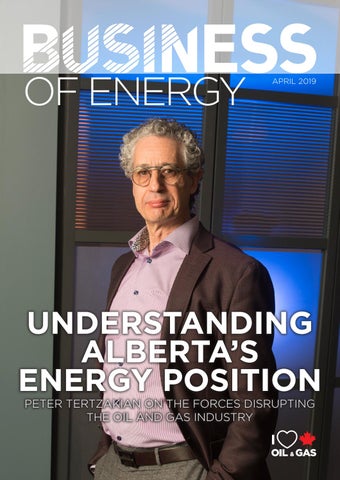
UNDERSTANDING ALBERTA’S ENERGY POSITION PETER TERTZAKIAN ON THE FORCES DISRUPTING THE OIL AND GAS INDUSTRY
EQUIPMENT AND SERVICES FOR OILFIELD DRILLING, COMPLETIONS AND PRODUCTION NEW, UNUSED, IN-STOCK AND READY TO GO TANK SIZES:
TANK TYPES:
AVAILABLE OPTIONS:
EQUIPMENT IN STOCK:
• • • • • • • •
• • • • • • •
• Single and Double • Internal and External Coatings and Insulation in Accordance with Industry Standards • Custom Skid or Anchor Chair Design for Pile Installations • Fire-Tube/Burner Heating Systems, Immersion Heaters, Electric Heat Coils, Glycol Heat Coils Etc. • Heated Vaults
• Well Site Separator Package, Skid-Mounted • Oil Treaters and Flare Knock Out Drums Free Water Knockout (FWKO) systems • Line Heaters • Dehydration Packages and Amine Packages
400 BBL 750 BBL 1000 BBL 1250 BBL 1500 BBL 2000 BBL 2500 BBL 4000 BBL
Storage Process Production Skim Pop De-Sand Rental Style
Inclusive Energy Ltd. is the fastest growing service company with a vast variety of high quality equipment and quick turnarounds to meet the demands of the growing energy industry. We offer all related services for turnkey projects to help customers execute projects from start, to finish - helping us to establish ourselves as an industry leader.
(403) 444 6897 | 1000, 888 3RD ST SW
INCLUSIVENERGY.COM
OF ENERGY VOL 1, ISSUE 2 | APRIL 2019
PUBLISHERS
It’s a Pivotal Year for Canadian Energy Policy by Cody Battershill
Understanding Alberta’s Energy Position by Melanie Darbyshire
05 06 11
Fluor Canada Ltd. 70 Years of Safety,FEBRUARY Integrity, 2019 Teamwork and Excellence by Nikki Gouthro
Some Really Good News About Alberta’s Oilsands by David Yager
Innovation, Do It Now, But Don’t Get Attached To It
by Chuck Bean
15 20
Pat Ottmann & Tim Ottmann
EDITOR
Melanie Darbyshire
COPY EDITORS
Lisa Johnston, Nikki Gouthro
ART DIRECTOR
Jessi Evetts jessi@businessincalgary.com
COVER PHOTO
BOOKSTRUCKER PHOTOGRAPHY
ADMINISTRATION
Nancy Bielecki nancy@businessincalgary.com
THIS ISSUE’S CONTRIBUTORS Melanie Darbyshire Cody Battershill David Yager Chuck Bean
ADVERTISING SALES
Evelyn Dehner evelyn@businessincalgary.com Chris Miller chris@businessincalgary.com Bobbi Joan O’Neil bobbi@businessincalgary.com
EDITORIAL, ADVERTISING & ADMINISTRATIVE OFFICES 1025, 101 6th Ave. SW Calgary, AB T2P 3P4 Tel: 403.264.3270 | Fax: 403.264.3276 Email: info@businessincalgary.com The publisher does not assume any responsibility for the contents of any advertisement, and all representations of warranties made in such advertising are those of the advertiser and not of the publisher. No portion of this publication may be reproduced, in all or in part, without the written permission of the publisher. Canadian publications mail sales product agreement No. 41126516.
COVER 4 • Business of Energy • April 2019
WWW.BUSINESSINCALGARY.COM Return undeliverable Canadian addresses to circulation dept. 1025 101 6th Ave. SW Calgary, AB T2P 3P4 info@businessincalgary.com
Cody Battershill | It’s a Pivotal Year for Canadian Energy Policy
IT’S A PIVOTAL YEAR FOR CANADIAN ENERGY POLICY by Cody Battershill
G
iven the rallies, petitions, media interviews and editorials produced so far for 2019, we’re well into another intense, actionpacked year as we advocate for energy workers and our national prosperity. Our organization can’t afford to slow our progress toward making the economic stability of Canadian families and the competitiveness of Canadian resource industries top of mind.
and we work hard to fill it with credible data and verifiable fact.
We’re challenging Canadian activist groups and their non-Canadian dollars – and we’re holding them to account. We’re asking them why they oppose every Canadian pipeline while they fail to discuss other oil tankers on the West Coast or the oil Canada imports in the East from countries without carbon regulations.
You’ll see more Canada Action rallies like the ones recently in Lac La Biche, Moosomin and Kindersley with other cities across the country joining the cause. And you’ll be seeing more of our petitions and letter-writing campaigns on issues that matter to Canadians.
Make no mistake; we still face real headwinds. Amid all the negative campaign rhetoric, we see Canadians working hard to keep their jobs and support their families, investors worrying about Canada’s competitiveness, and many First Nations leaders telling Ottawa that indigenous people rely on the energy economy to lift their communities out of poverty. That means our work is even more vital. And while our economy continues to come under fire from the “Tar Sands Campaign” of U.S. and Canadian activist opponents, we think we’re in a pivotal year. Since our genesis in 2010, we’ve taken up the challenge by addressing misinformation headon. We see a significant information vacuum,
It’s also worth repeating we’re focused on including the views of many indigenous communities in our vision, if only because they’ve told us again and again that full indigenous participation in the development of their resources is a key aspect of their future.
As a genuine grassroots organization built by volunteers, there’s even more you can do to help make our voices heard this year. Have you thought of hosting a rally, ordering a banner for your residence or workplace, or wrapping your vehicle in our pro-Canada message? Will you watch for future petitions on key issues affecting all of us or consider volunteering to write letters to your elected representatives locally, provincially and federally? There’s so much to do, but with your help we’re B committed to getting it done together. OE
Cody Battershill is a Calgary realtor and founder/ spokesperson for CanadaAction.ca, a volunteer organization that supports Canadian energy development and the environmental, social and economic benefits that come with it.
5 • Business of Energy • April 2019
Melanie Darbyshire | Understanding Alberta’s Energy Position
UNDERSTANDING ALBERTA’S ENERGY POSITION PETER TERTZAKIAN ON THE FORCES DISRUPTING THE OIL AND GAS INDUSTRY by Melanie Darbyshire
D
isruption. Defined as disturbance or problems which interrupt an event, activity or process, today the word is used to describe the state of many industries. Major technological advancements, globalization and morphing societal preferences have intersected in various ways to disrupt – the retail, taxi and print news media industries are just a few notable examples. Alberta’s oil and gas industry, too, is in a state of disruption. So says Peter Tertzakian, executive director at ARC Energy Research Institute. The well-known economist, investment strategist, author, podcaster and public speaker employs the “d” word purposively, noting this disruption is unlike anything we’ve seen. “While disruption is not unique to oil and gas, it is quite acute in oil and gas because it’s so large – the largest industry in Canada,” he explains. “This is the most impactful disruption in a hundred years. And because it’s on such a large scale, and because the province’s economy depends heavily upon it, the impact is severe.” Indeed, you don’t have to travel far from Tertzakian’s downtown Calgary office to feel the impact. A paucity of investment in the industry, high unemployment, empty office towers, a sagging real estate market, the flight of human capital to other markets, minimal drilling activity – the effects of the disruption are wide spread and
brutal and, Tertzakian says, rival if not surpass the turmoil experienced here in the 1980s. It’s the forces behind the disruption, he explains, which are critical to understand. They number six: environmental, societal, government policy, geopolitics, economy and capital markets, and technology. “Those six forces are acting on the energy business, globally and in North America,” Tertzakian says. “Canada is experiencing acute forces of change from all of those forces that, in some ways, make it unique in the world of energy, particularly oil and gas.” While they’ve existed for the last 10 years or so, within the last four the forces have come to a head. “Late last year, as the price differential widened and the various politics came into play, it became very chaotic to try to process things without any structure,” he says. “The impulse is to throw your hands up in frustration and anger, which is what’s happening.” Rather, he counsels, we need to understand the forces behind the chaos to move the industry into the 2020s. “That’s what I’m trying to do. And there is good news in terms of adaptation, though there’s frustration along the way too.” So what will society in the 2020s expect of their energy? “Obviously they’ll want it cheap,” Tertzakian says. “And they’ll want it clean. Those are the two big dimensions. They’ll also want it
6 • Business of Energy • April 2019
Understanding Alberta’s Energy Position Photo by BOOKSTRUCKER PHOTOGRAPHY
7• Business of Energy • April 2019
Melanie Darbyshire | Understanding Alberta’s Energy Position
safe, reliable and available 24-7. While the latter three are almost a given in our society, cheap and clean have historically not gone together.” The demand for clean energy – a notion, whether defined as low carbon or zero carbon, the oil and gas industry has done very little to facilitate debate around – and environmental sustainability will not abate into the next decade. Climate change, he affirms, will remain the dominant narrative. “And there are sustainability issues relating to water and air quality too. “The force of environment has historically been a major driver of change in the energy business, even going back a couple hundred years,” Tertzakian explains. “The realization has to set in – and it is setting in with the more progressive parts of the industry, globally and locally – that these environmental and societal forces are not going away.” While he understands the inclination of many in the industry to get angry, he warns against a purely defensive posture. “Finger pointing at the government, saying ‘fix the problem’ leads to greater and greater polarization. I actually see it getting worse before it gets better. “Let’s try and foster some kind of intelligent discussion and debate in the middle ground, rather than drive ourselves apart,” he urges. “Because the forces of environment and society are in western democracies. They’re very difficult to overcome with denial and finger pointing, or anger and frustration.” Societal forces within Canada include indigenous social issues. “It’s a very complicated social situation,” Tertzakian cautions. “There are many companies in the industry with a long, successful record of working with indigenous groups, and it’s been win-win. But often the good news doesn’t get out and the industry has a tendency to blame the media or others for that. But there really hasn’t been a concerted effort to get the good-news stories out.” When societal forces intersect with environmental ones, they often trigger the
third force of change Tertzakian highlights: government policy. To understand this force, he explains, one must examine another force: technology. “You can think of government policy [the National Energy Board and policies] as infrastructure,” he explains. “This infrastructure has evolved over the long history of our oil and gas industry and is tuned to the old paradigm of oil and gas extraction [vertical well conventional extraction]. Suddenly, in the last 10 years in Canada, we have two new paradigms of oil and gas extraction: the oilsands and horizontal extraction.” Multistage horizontal fracturing unleashed a sudden surge in productivity unlike anything seen before in the 150-year history of oil. “It’s a massive unprecedented technological step change in the way oil and gas is liberated,” Tertzakian marvels. “All of a sudden, generally speaking, policies that were designed for the old way of doing things have to adapt to the new world.” For example, Alberta’s royalty scheme needed overhaul and in 2015 the Alberta royalty review panel, which included Tertzakian, was struck. “It was a patchwork quilt of amendments to royalty schemes that was first introduced in 1937,” he says. “We started with a white sheet of paper to make it more in sync with new technologies and allow it to endure into the 2020s and beyond.” The panel’s work was done in close collaboration with industry. While the response to the royalty review was generally positive, other government policies have been less well received. Bill C-69, the federal government’s attempt to “update” the NEB framework by expanding the criteria (including gender and climate change commitments) for impact assessments of new infrastructure projects, has been met with fierce opposition in Alberta. “The federal government is doing a really poor job of explaining what they’re doing,” Tertzakian admits. “They’ve done it without much
8 • Business of Energy • April 2019
consultation with industry, because societal and environmental forces are calling for the end of fossil fuels. It was supposed to take us to the future but wasn’t done in the proper way, and has caused further polarization.” The tanker ban on the West Coast, federal Bill C-48, is worse. “I don’t support it. There are all sorts of other tankers going in and out of all coasts of Canada. Why is that one special?” Tertzakian believes geopolitical, environmental and social forces lie behind the bill. He notes Bill C-48 has yet to pass. “We’ll see what happens with the election, but if you want to reverse it, you have to start collaborating more and getting in the flow of communication in a proper way.” That communication includes between provinces, particularly Alberta, Quebec and B.C. “We’re talking in an echo chamber here,” he laments. “How many people actually go out to Quebec, to B.C., to talk to people, address their issues face to face. A lot of this is just done within Alberta.” Outside Canada, geopolitical forces have shifted, again because of technological advancements. “Technology is driving the cost of bringing a barrel of oil out of
9 • Business of Energy • April 2019
Understanding Alberta’s Energy Position
“
Outside Canada, geopolitical forces have shifted, again because of technological advancements. “Technology is driving the cost of bringing a barrel of oil out of the ground way down,” Tertzakian explains. “It’s completely shifted the power base of the global oil industry complex from Saudi Arabia to North America, predominantly the U.S. supported by Canada.”
Melanie Darbyshire | Understanding Alberta’s Energy Position
“
The shift to the West means we’re less likely to see the volatility of the past. “The industry has historically thrived on volatility,” he says.
the ground way down,” Tertzakian explains. “It’s completely shifted the power base of the global oil industry complex from Saudi Arabia to North America, predominantly the U.S. supported by Canada.” The shift to the West means we’re less likely to see the volatility of the past. “The industry has historically thrived on volatility,” he says. “Now companies have to make a go of it without the expectation that prices are going to spike up.” The relationship between Canada and the U.S. has changed too. Ten years since the shale gas revolution, the U.S. no longer needs Canada’s gas, after decades of needing more and more. Moreover, while Canada still supplies the U.S. with the majority of its imported oil, the U.S. no longer needs certain types of Canadian oil. Canadian heavy oil is still needed at Gulf Coast refineries, but delivery has been impeded with the delay of the Keystone XL pipeline. “In the last few months, the realization has set in that we may not even get that pipeline,” Tertzakian cautions, “so now rail comes into play. I think it’s healthy and adds flexibility of transportation. If we can catalyze more rail as a permanent fixture of infrastructure for moving hydrocarbons, rather than being reliant on one modality – pipelines – that optionality is a good thing. Though it’s going to take another couple years to build it out.” The prospects for other pipelines – including Trans Mountain – are dim. “Trans Mountain is going to be very difficult even though approved, because the resistance in Burnaby is so intense,” he says. “I still hold out some
hope for Keystone XL. The pipeline that made the most sense was Northern Gateway, though because of C-48 wouldn’t be possible. If C-48 doesn’t pass and there is enough indigenous support and industry collaboration, it could be revised after the election.” Though investment has flown from Alberta’s oil and gas industry, Tertzakian predicts it will return as we work our way through healing these distortions. “The differentials have already stabilized with government intervention. Once intervention is no longer needed, which I believe will happen this year, and once investors feel comfortable things have stabilized and some of the other big issues have been worked through, investment will return. It will take a couple of years though. “But there is good news,” he continues. “We have an industry that, as a consequence of these acute forces, has changed. Companies that progress through to the next era and generation will have high-quality, low-cost assets. The ability to generate profitability and deliver cleaner, lower-carbon intensity hydrocarbons into the 2020s puts us way ahead of a lot of other jurisdictions that have yet to go through these issues. “Alberta has an abundance of energy resources – oil, gas, sun, wind – and we can produce them at one of the lowest costs in the world,” he concludes. “As we enter the 2020s, we’ll start to see more secondary industries which will help diversify our economy. You add to that technology, manufacturing and process-oriented industries, and we could have a fairly robust B economy in the 2020s.” OE
10 • Business of Energy • April 2019
BUILDING A CANADIAN LEGACY Fluor Canada Ltd: 70 Years of Safety, Integrity, Teamwork and Excellence by Nikki Gouthro | Photos by Riverwood Photography
THE EARLY YEARS
While most things that began in 1949 have significantly slowed down or long since retired, the engineering, procurement, fabrication, construction and maintenance (EPFCM) company known as Fluor Canada Ltd. (Fluor) has done just the opposite. Celebrating its 70th year in business, the company has built a legacy and a reputation for successfully, ethically and safely completing capital projects. Since its humble beginnings in Canada 70 years ago, Fluor has played a significant role in some of the country’s most impressive engineering projects. From refinery expansions, repairs and improvements to designing and building worldclass projects right here on Canadian soil – Fluor has been leaving a positive footprint on the Canadian marketplace for decades.
In 1973, the company moved its head office from Toronto to Calgary in an effort to better serve the growing oil and gas industry in Western Canada. From that point in history, Fluor has continued to build its Canadian legacy by delivering a wide range of energy-related projects across the Canadian landscape.
THE DIFFERENCE
Today, Fluor provides innovative and integrated solutions to government and the private sector across diverse industries. Its approach is a full-service, holistic one that covers the work required from conceptualization to completion. That work includes things like economic evaluations, conceptual engineering, feasibility studies, program management, detailed engineering, procurement, transportation and logistics, modularization, fabrication, direct-hire
Fluor Canada Ltd. | 70 Years
THE HUB FOR INNOVATION
As client needs and demands have evolved over Fluor’s 70 years in Canada, the company has been challenged to continually deliver new and efficient solutions that meet and/or exceed clients’ expectations. Time and again, this has meant becoming more innovative in familiar spaces. As the company’s offering of integrated services has grown, Fluor has added things like drone technology and capabilities that give a bird’s-eye view of project sites and modular yards. It has implemented virtual reality technology that can be used for training purposes, and for project design (putting the user directly into a virtual plant or workspace to see how the pieces fit prior to delivery to the field for construction). There is even an internal business group called Business Transformation & Innovation (BT&I) which is tasked with constantly developing and enhancing Fluor’s innovative offering to the marketplace. Mark Brown, vice president and general manager for Fluor Canada
construction, construction management, commissioning, start-up, operations and maintenance. As one of the world’s largest EPFCM companies, a global execution platform provides Fluor with the reach and ability to pull resources and expertise from a wide array of execution centres around the world. Mark Brown, vice president and general manager for Fluor Canada, started in construction engineering with Fluor two decades ago. “Fluor’s value proposition is that we bring the certainty of project delivery. Backed up by our global expertise, we can tap into an enormous amount of capabilities and still keep it local,” he says. That scope of expertise continues to grow as the company evolves. In 2016, Fluor welcomed Dutch maintenance and service company, Stork, to the Fluor family. Its new director of Canadian operations, Paul Holah, has been with Fluor for 29 years. “The diversity of skills we can tap into without going outside the company is unique. Being able to offer both engineering and construction means there’s continuity of project management tools and a single schedule across the project phases.” With extensive experience in executing complex projects and its innovation capabilities in developing new processes with clients, the company consistently focuses on areas where it can share that added value.
The company’s commitment to innovation is not reserved solely for the field – it also resulted in a two-year multimillion-dollar renovation and optimization project in the Calgary office which not only increased occupant density, but also enhanced Fluor’s technological capabilities with the addition of model review rooms, tech tables, collaboration stations – even a centrally-located and dedicated innovation space called EPiCentre. “Though Fluor’s primary office is in Calgary, we have people across the province and the country. From petrochemical complexes here in Alberta, to power generation and the Gordie Howe International Bridge in Ontario,” says Brown. “We are advocates for transparency and ethics, for energy reform and the construction business. We provide innovative solutions and our clients trust us.”
THE CORE VALUES: SAFETY, INTEGRITY, TEAMWORK AND EXCELLENCE
Fluor’s core values are the base upon which all other corporate strategy is built. Being the first of the company’s core values, Fluor prides itself on achieving and maintaining a pristine safety record. It is committed to developing a caring, preventive safety culture across the organization and drives the actions of every employee at every location, every day. In alignment with this, the company recently launched a movement called Safer Together which serves to unite and empower employees under a common pledge to work safer and to be hazard aware at all times – in the office, at site or otherwise. That enduring commitment to safety operates in concert with other core values by which the company governs itself:
Fluor Canada Ltd. | 70 Years | 2
Mariki Mackenzie, manager of engineering, joined Fluor in South Africa in 1995. “Excellence to me is truly being the best I can be and it combines safety, teamwork and integrity,” she says. “We are committed to maximize the value we give to our clients.”
THE DIVERSITY OF SERVICES
“We have incredible resources, both locally and nationally/internationally,” says Adam MacKay, director of business development and a 17-year veteran at Fluor. “We are securing EPC project opportunities from across the country and executing from our Calgary talent pool and leadership.”
Mariki Mackenzie, manager of engineering for Fluor Canada
Fluor’s Canadian office provides cost-competitive solutions by leveraging local and global subject matter experts, innovative tools and data analytics. “Fluor has a legacy of big projects,” says Brown. “We are known as the people who can design and build large, complex projects anywhere in the world, but we can also help you build a greenhouse or develop a sustainability plan.” Fluor Canada has a long-standing history of excellence in the areas of gas processing, upgrading, refining and utilities and offsites. Over the years, the company has continued to expand its core competencies to include insitu, petrochemicals, LNG, pipelines and GHG emissions management. David Mercer is director, process technology, and the go-to on Fluor Canada’s market literacy effort. He just celebrated 20 years with the company. “There’s a tremendous number of assets in the country in oil and gas, power, infrastructure and they have to be maintained,” he says. “Fluor operates in this space and has demonstrated our capability through our 20year strategic alliance with Irving Oil in Saint John, New Brunswick and our relationship with Enbridge in Edmonton.”
Charles Gibney, project operations leader (POL) for energy and chemicals in Canada and a 24-year employee of Fluor
Integrity – A promise to conduct business with the highest standards of ethics. Teamwork – Treating all people with dignity and respect, as well as the sharing of knowledge and resources to achieve excellence, deliver value and grow (individually and as an organization). Excellence – Striving to deliver quality solutions that not only meet/exceed the needs of clients, but deliver unparalleled value.
Deepening the diversity of services at Fluor is a dedicated multi-project group that delivers solutions designed for clients with sustaining capital needs. “Our multi-projects group allows us to be flexible and nimble. We can execute a small EPC project, or we can take on a complex engineering study, or develop an economic model for a facility to help a client assess project viability,” says Charles Gibney, project operations leader (POL) for energy and chemicals in Canada and a 24-year employee of Fluor. “The beauty of it is that we can do all these things with just the right mix of specialized resources. And we can be pretty competitive in that space.” In 2018, Fluor Canada executed 240 sustaining capital projects for 15 different clients.
Fluor Canada Ltd. | 70 Years | 3
“We have a unified focus at Fluor. People are looking out for what’s good for the company – Fluor first and the business line second,” says Holah. “Our employees care about doing the right thing for the client and we are known for that.” Further to that, the company’s management team is known to lead by example and exemplify the core values of safety, integrity, teamwork and excellence. “I’ve always believed that one of the most important skills of a good leader is being a good listener, as it affects every element of your team’s productivity. Understand team members’ motivations and feelings,” says Mercer. “And always remember to focus on solutions, not problems.”
THE FUTURE
With exciting Canadian opportunities on the horizon, all signs point to a continued legacy of exciting projects and innovative solution delivery at Fluor.
David Mercer is director, process technology for Fluor Canada
THE CULTURE
The culture is driven largely by the core values. It’s one of safety, compliance and integrity; a positive working environment in which people are treated with dignity and respect. Professionals of all ages, from new grad to the most seasoned, can be found collaborating on the task floor or participating in any one of the company’s familyfriendly social events. “There’s a liveliness and diversity to our people – diversity of thoughts, of backgrounds, of culture. It creates this energy that is truly palpable,” says Brown. “We provide careers, challenges and excitement and we empower our people to achieve great things.” The values define how employees do their work, which fosters a cohesive and supportive environment where superior integrated solutions are born.
“I’m proud of the diversification of our business, and I’m excited to be a team member here in Calgary,” says MacKay. “We have incredible resources here and a wealth of technical expertise.” “As we go into new spaces, like the nuclear work or the LNG work that we’ve been engaged in, we know we have that experience we can tap into anywhere in the world and still execute the project with Calgary people,” says Gibney. “And our history, capability and personal and corporate resumés say, ‘we know what we’re doing here, and we will execute well.’” “The Calgary office is diverse, dynamic, vibrant and a hub for innovation. We are challenging boundaries to come up with better solutions and to expand our offerings,” says Mackenzie. “The office has a buzz and the passion is obvious. By bringing in and developing top talent, we are continuing to build our legacy.”
www.fluor.com Fluor Canada Ltd. | 70 Years | 4
David Yager | Some Really Good News About Alberta’s Oilsands
SOME REALLY GOOD NEWS ABOUT ALBERTA’S OILSANDS
“
by David Yager
T
here cannot be another resource that has created so much wealth and opportunity while generating so much dissent, controversy and regional polarization as Alberta’s massive Athabasca oilsands, the world’s third-largest oil deposit. Former premier Ralph Klein once called Alberta’s oilsands the “eighth wonder of the world.” This massive crude deposit helped make Canada the planet’s fifth-largest oil and gas producer while providing Canadians with enormous economic benefits. Meanwhile, critics have surely used every possible combination of derogatory nouns and adjectives in the English language to describe the oilsands. The discussion is patently absurd. Powered by fossil fuels and moral self-righteousness, famous people like Neil Young, Leonardo DiCaprio and Jane Fonda have travelled to Fort McMurray to trash everything in sight then leave behind a lasting legacy of disparaging quotes and dire predictions for the Earth’s future. All this was done with private jets and a carbon footprint equivalent to the lifetime emissions of billions of the world’s poorest people. For Justin Trudeau’s Liberals, sacrificing Alberta oil jobs attracts votes in Quebec. Cancel pipelines. Ban tankers. Gut the NEB.
Meanwhile, critics have surely used every possible combination of derogatory nouns and adjectives in the English language to describe the oilsands.
Tax carbon. These are all part of “phasing out of the oilsands” which has been underway since the last election. Oilsands jobs are clearly expendable. Quebec jobs are different, like the ones at risk if the Liberals don’t protect SNC-Lavalin. Recent events have proven the Liberals will do whatever it takes to protect certain segments of the economy, but only where people vote appropriately.
15 • Business of Energy • April 2019
David Yager | Some Really Good News About Alberta’s Oilsands
A study by the Canadian Energy Research Institute (CERI) and the Canadian Association of Petroleum Producers (CAPP) indicated that in 2014 and 2015 – which were still strong years for investment – the “oilsands supply chain” did business with 3,400 companies across the country spending $738 million in B.C., $462 million in Saskatchewan, $1.57 billion in Ontario, $385 million in Quebec, and $145 million in the four Maritime provinces. More recently CAPP stated, “In 2017, the oilsands supported and created more than 205,000 direct and indirect jobs across Canada.” SNC-Lavalin’s website reported on January 8, 2018 the company had 8,762 Canadian employees. Don’t chew your arm off. Capital expenditures in the oilsands are down but keeping the oil flowing is big business. ARC Energy Research Institute reported on February 26, 2019 that capital spending in the oilsands was $12.5 billion in 2018 and estimated at $12 billion for 2019. That’s only $2 billion less than the provincial budget for Saskatchewan. Oilsands production continues to grow. It reached three million barrels per day in 2018 and will stay there for 2019. This is more than double that of 2010. According to CAPP, oilsands operating costs alone in 2017 (the last year for which figures are available) were $18.6 billion. That’s big money in Canada. If oilsands operating costs were a company, it would be about the 20th largest in the country. SNC-Lavalin is, by comparison, insignificant. According to its financial statements for the nine months ended September 30, 2018, SNCLavalin’s Canadian revenue was $2.1 billion. Annualized this would be $2.8 billion – about the same as capital investment and operating costs for the oilsands in 1996, 23 years ago. While the challenges are understood and the debate is frustrating, one very positive aspect of the oilsands that gets no publicity is the increase in future provincial royalty income as more of the existing projects reach payout after capital recovery. The oilsands have a two-phase royalty regime. When production starts the royalty is about five per cent. But after costs have been recovered, it jumps to 25 per cent. So long as things don’t get worse or nobody stops producing, future
revenue for the provincial treasury and Alberta’s public services looks promising. For the full year 2017 (last figures available), the Alberta government reported the status of 119 oilsands operations of which 107 produced one billion barrels of bitumen. This averaged 2.75 million barrels per day (b/d). The royalty rate is stated on a project basis. Only 35 of the 107 on production paid the higher royalty rate, reported in most cases as 27.41 per cent. The numbers read that only 36.7 per cent of the production paid full royalties in 2017, about one million b/d. Many of these projects are relatively new. When they all reach payout, total bitumen royalties collected by the Crown should more than double, depending on the oil price of course. The data reports total royalties for 2017 of $2.48 billion. If all projects paid the full rate, this would be closer to $6 billion, a handsome lift for Alberta’s treasury. While lower oil prices will extend the time to capital recovery and full royalties, tough times have forced laser focus on operating costs. According to CAPP, the average production cost per barrel in 2014 was $31. By 2017, this was down to $19 – $12 or 39 per cent lower. This will contribute significantly to the longterm viability of investment and shorten the time to project payout. It gets better. Shale oil, the flavour of the day, has high decline rates requiring continual investment. Oilsands reserves are so enormous the decline rate is low or flat. Many projects will produce as much oil in 10 years as today. CAPP forecast in mid-2018 that based on planned investments, production could rise by another 1.4 million barrels per day by 2035. Teck Resources is pursuing a major new mining operation between Fort McMurray and Fort Chipewyan. Called Frontier, this will cost $20.8 billion and will add up to 260,000 barrels a day for 41 years after production begins in 2026. Imperial Oil is considering another 150,000 b/d project called Aspen. All this production growth needs is pipelines. Fortunately, they’re not all dead yet. Enbridge’s Line 3 replacement is intended to ship an additional 370,000 b/d sometime this year.
16 • Business of Energy • April 2019
On February 22, the National Energy Board re-approved Trans Mountain, although resumption of construction will again require federal cabinet approval. Whether this occurs prior to the October 2019 federal election is an open question considering the SNC-Lavalin debacle. Its capacity is an incremental 500,000 b/d. Keystone XL is still alive despite the interference of an activist Montana federal judge. It will carry 830,000 barrels daily if it is ever completed. The point is that forecast oilsands production growth is still being accompanied by enough pipe to underpin expansion’s economic viability. The reason Albertans should be at least somewhat optimistic about the future of the oilsands is if the private sector is left alone, in the next 10 years oilsands production could be 50 per cent higher than today and provincial royalties will be much greater than current levels. On February 27, Alberta’s NDP government issued an update for the 2018/19 fiscal year ended March 31. The government stated the forecast deficit has been reduced to $6.9 billion from $8.8 billion, the earlier estimate, despite the softness in crude prices in the fourth quarter of 2018. The main source of funds was higher-thanplanned bitumen royalties because of higher prices and lower differentials for most of the year. That’s it for good news. Total financial liabilities on the province’s balance sheet are now estimated at $105 billion on March 31, resulting in net financial assets of -$28
17 • Business of Energy • April 2019
Some Really Good News About Alberta’s Oilsands
“
The reason Albertans should be at least somewhat optimistic about the future of the oilsands is if the private sector is left alone, in the next 10 years oilsands production could be 50 per cent higher than today and provincial royalties will be much greater than current levels.
David Yager | Some Really Good News About Alberta’s Oilsands
billion (after deducting $77 billion in assets including the Heritage Fund). When the NDP took office in May of 2015, Alberta closed the 2014/15 fiscal year with net financial assets of +$13 billion. Under the NDP, the province’s balance sheet has seen a $41 billion decline. The government borrowed $15 billion in the past year. Regardless, the government assures Albertans the province will be deficit free by 2023/24, five years from now. Brian Jean knows all about the oilsands. He is an entrepreneur and native son from Fort McMurray who spent 10 years in Ottawa as a Conservative MP, three years in Edmonton as a Wildrose MLA, and was the leader of the Wildrose Party of Alberta from 2015 until it disappeared through a merger with Alberta’s Progressive Conservative party in 2017. An unabashed oilsands supporter, Jean offers the following comment on “black gold” and Alberta’s finances. “I have so much confidence
in the oilsands because there’s nothing else on God’s green earth that will get us out of this financial mess.” If Alberta could figure out how to cut spending by even a modest amount; if oil prices stay high; if all the new oil pipelines on the table were built so the province’s oilsands could fetch something near the world price; if the planned expansion projects proceed; if LNG exports could pull natural gas prices out of the dumpster; then the hydrocarbon resources that have paid the freight for Alberta since Leduc could work their monetary magic one more time. That’s a pile of “ifs.” But incredible as it may seem, the light at the end of Alberta’s economic tunnel may not be a train. It is, however, a very B long tunnel! OE
David Yager is an oil gas writer and energy policy analyst. His first book, From Miracle to Menace – Alberta, A Carbon Story, will be released in 2019.
18 • Business of Energy • April 2019
Chuck Bean | Innovation, Do It Now, But Don’t Get Attached To It
INNOVATION, DO IT NOW, BUT DON’T GET ATTACHED TO IT by Chuck Bean
C
algary and Alberta have been leading global innovators for decades. There is not an oil-producing region worldwide that isn’t benefiting from some innovation that was developed in the skunkworks and sandboxes of Alberta. We still own this space and should be thinking globally. Opportunities outside of Canada abound and are potentially 20 times greater than we have here at home. Let me sidestep for a moment. I just returned from my third year of participation at the World Strategy and Innovation Forum in the U.K. Attended over the years by C-suiters from Google, Twitter, BP and this year British Gas, Universal Pictures, Credit Karma, The Economist and YouTube, these strategists take innovation very seriously. In Fortune 500 corporations, innovation and strategy have a chair at the boardroom table. The title “chief innovation officer” is everywhere. Rather than hoping for or stumbling into innovation, these players see innovation and strategy as profit centres and focus on both game-changing and incremental innovation as an ongoing business function. Our oil and gas space requires regular innovation to stay relevant and world class, and one thing I
have learned over the years is that if you want to improve your position, start innovating. A pioneer is someone face down in the dirt with his back full of footprints. Inventing from scratch is difficult beyond belief. Marc Emmer, author and strategic thought leader, wrote recently that 95 per cent of the 30,000 new products introduced every year fail. I would add the reason is twofold. First the invention is just too difficult to bring to market from scratch and, more commonly, the idea is a solution looking for a problem, rather than a true solution. This is a defining challenge. To be clear, inventing is not innovating. Most failed products are inventions. Innovation on the other hand is taking already available offerings and recreating them to be better. This is the description of a game-changer. Want to create a game-changer, you need a game first. The best place to find your game is to look out in your market space and see what is trending. Stay close to home and start with what you know. Take your target, break it down and rebuild it with new innovations. This is the perfect strategy. Inventors often get stuck in a rut while an innovator surpasses them. It’s like
20 • Business of Energy • April 2019
owning a stock all the way to the bottom. The inventor invests and can’t let go. The innovator has no investment and can change on the fly. If your chosen path is to be an innovator, agree to keep going. When you have your new concept proven, immediately start anew. Version 2, 3 and 4 can stay in the locker until you need them; but get them. Feeling comfortable about your current state? That is a perfect time to get moving on the next version. Remember: if you have a good idea, don’t think in terms of “if” people will copy you, think in terms of “when.” When should you release the next version? When either the hype stops, the price drops or the growth stalls … or a combination of all three. Don’t get attached to it. It is yesterday’s news. But also, don’t release the next version too soon. If you are not seeing hype stall, price drop or growth interruptions, stay put. The oil and gas industry is notoriously bad at releasing new versions too early, often letting out new products well before the old ones have hit their prime. This creates excess inventory, price drops and waste. The rule of inventory is to respect capital. If you can’t think of anything to innovate with a trending product or service then time is up. Get out and move on to the next project. Remember, don’t invest too much. Finally, get the word out. If you have something disruptive, start disrupting. Think in these terms: if you have IP, you have five years. No IP, you have two or maybe three before you get copied or leapfrogged. Move fast! As Clayton M. Christensen, author of The Innovator’s Dilemma, states, “Disruptive technology should be framed as a marketing challenge, not a technological one.” We all know the rate of change in our oil and gas space is remarkable these days. B Get in, get going and get out are wise words. OE
21 • Business of Energy • April 2019
Innovation, Do It Now, But Don’t Get Attached To It
“
Feeling comfortable about your current state? That is a perfect time to get moving on the next version. Remember: if you have a good idea, don’t think in terms of “if” people will copy you, think in terms of “when.”
Directional Drilling, Redefined At Mostar, we’re redefining directional drilling with a full suite of measurementwhile-drilling, mud motor, and customizable solutions.
Your direction is our direction.
Calgary, AB
•
Midland, TX
•
Rifle, CO
www.mostardirectional.com
Zero Emission Solar Powered Chemical Injection Pump
Can you leverage emissions markets to lease Chemical Injection Pumps & Low Bleed pneumatic devices?
The answer is, Yes Hook-in seamlessly & Gain operational efficiencies over 15 year lifespan. Comply with methane reduction regulations. We finance eligible installations via a lease, paid for by offset credits, typically within 3 years WHY ACT NOW? A producers choices are: Work with Tricore to get equipment for no capital outlay Wait and pay for it yourself.
LET’S TALK 587.439.6677 or info@tricoresolutions.ca Tricore is a CCSI Group Company – Made in Alberta CCSI is a proven 10 year old company that reduces GHG emissions & saves producers $ doing it. Trido Pumps & Controller packages are known for robust reliability & offset generation. General Magnetic provide best in-class solar powered pumps & controllers