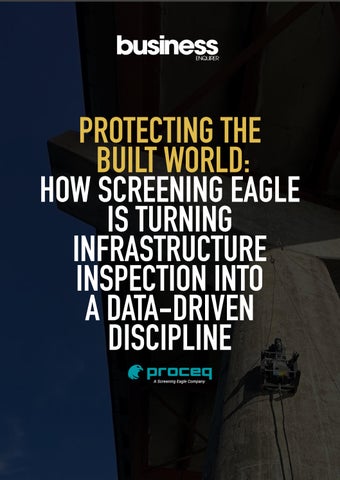
PROTECTING THE BUILT WORLD: HOW SCREENING EAGLE IS TURNING INFRASTRUCTURE INSPECTION INTO A DATA-DRIVEN DISCIPLINE
PROTECTING THE BUILT WORLD: HOW SCREENING EAGLE IS TURNING INFRASTRUCTURE INSPECTION INTO A DATA-DRIVEN DISCIPLINE Business Enquirer speaks with Daniel Broekhove of Screening Eagle about AI, digital twins, and the future of keeping bridges, roads and buildings safe.
2
Buisness Enquirer Magazine
S
creening Eagle's mission statement is a deceptively simple one: protect the built world. But behind that phrase lies a much bigger shift taking place across the infrastructure inspection industry — one that is moving from manual, one-off measurements towards connected, data-driven asset management. Business Enquirer sat down with Daniel Broekhove to unpack what that shift looks like in practice, and where the company is headed next.
SCREENING EAGLE TECHNOLOGY
Business Enquirer Magazine
3
From a Single Measurement to a Connected Ecosystem For Broekhove, "protecting the built world" starts with a practical problem: helping the owners of buildings, bridges, roads, tunnels and utilities make better decisions about assets that are ageing and enormously expensive to maintain or replace. "That infrastructure is ageing," he explains. "The challenge is really understanding the condition of all of those assets accurately, in order to maintain it safely and efficiently." That philosophy has shaped Screening Eagle's strategy in a very specific way. Rather than developing standalone measurement devices, the company has focused on bringing sensors, software and data together into a single inspection ecosystem. "We're increasingly focused on how data is captured, interpreted and visualised to help end users make informed decisions," Broekhove says, pointing to the company's long history in non-destructive testing (NDT) and its more recent investment in cloud, AI and robotics capabilities. This integration, he argues, is fundamental to moving customers away from fragmented, manual inspection workflows — where an inspector might collect data with one instrument, process it in separate software, and then compile a report in Word or Excel — towards a genuinely holistic approach. "The real opportunity comes when those pieces are connected," he says. "A sensor provides the measurement, our software turns that measurement into useful information, and our cloud-based data allows that information to become part of the asset's long-term digital record." The result, he says, is a shift in the fundamental question being asked — from "what did we find during this inspection?" to "how is this asset changing over time, and what should we do about it?"
4
Buisness Enquirer Magazine
SCREENING EAGLE TECHNOLOGY
Business Enquirer Magazine
5
CONCRETE EVIDENCE FOR DE-RISKING COMMERCIAL REAL ESTATE
I
n commercial real estate and infrastructure, value is traditionally measured in square footage, occupancy rates, and capitalization yields. Structures prime for repurposing like an office block or healthcare facilities may appear ready for reuse simply based on the visual appearance. However, some of the highest financial risks to an asset lie out of sight within the structure itself. Inside the concrete, there is an unknown matrix of post-tension cables, reinforcement, conduit, and utility lines. All this contributes to the number of unknown variables capable of sinking a project’s ROI. As the modern built environment undergoes a structural shift driven by renovations and conversions, visibility beneath the concrete surface is a core financial necessity.
6
Buisness Enquirer Magazine
Photo courtesy of Zac Goodspeed / SafeCore Systems. Business Enquirer Magazine
7
Photo courtesy of Zac Goodspeed / SafeCore Systems.
8
Buisness Enquirer Magazine
Finding what’s inside the concrete before building reuse
tension cables, and embedded conduits, in real time.
The push toward building reuse is reshaping commercial real estate. Converting underutilized office buildings into high-density residential apartments, boutique hotels, or life-science laboratories offers developers a faster route to market and a smaller carbon footprint than ground-up construction. However, these transformations inevitably run into a common obstacle: Decades-old structures rarely possess accurate as-built records.
By digitizing and documenting these scan results into verified as-built records before work begins, field teams gain immediate clarity on hidden hazards. Identifying structural elements before striking them eliminates catastrophic utility strikes, avoids field delays, and ensures layout decisions are made using true site conditions rather than educated guesses.
Unrecorded adjustments, and misplaced documentation force developers to rely on guesswork. Coring a concrete slab to route plumbing or installing HVAC shafts becomes a highstakes endeavor with costly accidental hits of post-tension cables or live electrical wires. To protect capital and keep timelines intact, developers must establish an accurate structural baseline before heavy equipment ever arrives on-site. The most effective way to find out what’s hidden in the concrete is with Ground Penetrating Radar (GPR) scans. GPR is a non-destructive testing technology used for concrete investigation. Save time & budget through accurate as-built records Construction rework accounts for a substantial percentage of budget overruns. The formula for avoiding rework is straightforward: using accurate data as concrete evidence to plan better, build better and manage better. Replacing outdated records with verified as-built documentation including GPR data is an effective way to prevent rework and protect margins. Unlike static, historical design drawings that rarely reflect field changes, high-resolution GPR scans map the exact layout and depth of subsurface elements, including rebar grids, post-
Safe coring and drilling in busy commercial buildings Executing complex renovations within operational facilities, such as active hospitals, data centers, corporate headquarters, warehouses, or highend retail environments, magnifies the operational stakes. In these settings, construction cannot interfere with daily business. Renovations in high-stakes environments often occur overnight or during tight operational windows. To maintain continuous operations, project managers rely on advanced, non-destructive testing technologies. Compact, wireless hardware, such as handheld GPR systems, enable technicians to silently scan concrete slabs in active spaces, without requiring floor evacuations or intrusive staging. The nationwide scanning service company, GPRS, provides professional, accurate, and efficient concrete scanning and utility locating services utilizing advanced technologies including a fleet of Proceq Ground Penetrating Radars. GPRS technicians map what’s below the concrete in a variety of occupied spaces, from busy medical facilities to active commercial centers, to identify safe coring and drilling locations, create as-builts, detect potential issues before they happen, and prevent delays. This enables contractors to drill with total confidence, ensuring operations proceed on schedule. Business Enquirer Magazine
9
Birth certificates and predictive maintenance for infrastructure As infrastructure becomes more complex, the industry's approach to asset lifecycle management is evolving. When new infrastructure is commissioned today, a critical question remains: Is anyone digitizing its initial structural baseline? Creating a dynamic "birth certificate" for newly constructed assets, mapping structural elements, conduit runs, and material baselines from day one, establishes a reference standard for the building's entire lifecycle. 1. Asset Birth Record - Digital baseline for tracking. 2. Regular Health Checks - Condition monitoring over time. 3. Targeted Repairs - Saving costs and unecessary demolition. This structural baseline opens the door to predictive maintenance. Rather than responding to structural distress or catastrophic utility failure after it occurs, asset managers can conduct regular physical check-ups to track condition trends over time. Early diagnosis of slab degradation, moisture intrusion, or structural shifts allows owners to perform targeted, lower-cost repairs before minor issues escalate into major capital expenditures. Screening Eagle solves these problems by manufacturing deeptech sensing with next generation intelligence capabilities. A unique ecosystem of IoT sensors delivering
10
Buisness Enquirer Magazine
extraordinary data quality, intuitive yet powerful software with real-time 3D visualization, augmented reality, and embedded AI algorithms for automatic data interpretation. This subsurface intelligence platform, including the Proceq GPRs and other NDT/Concrete assessment technologies, is Screening Eagle's solution to protect the built world, solve the challenges for de-risking commerical real estate, and assess critical infrastrucure around the globe. Protecting the Built World At its core, protecting the built world is about preserving both physical safety, longevity, and financial value. Capital markets, institutional investors, and municipal leaders all rely on the stability of the built environment to support economic activity. By taking the guesswork out of property acquisition, reuse, and renovation, structural data bridges the gap between old structures and new demands. As modern construction shifts to renovations over new builds, knowing the health of a building is crucial to accurately price future capital expenditures, negotiate acquisition terms, or walk away from assets burdened by hidden structural liabilities. Contact Screening Eagle Technologies for more information about Proceq GPRs.
www.ScreeningEagle.com
Photo courtesy of GPRS (gp-radar.com)
Business Enquirer Magazine
11
“The future of inspection will be built through ecosystems rather than isolated technologies.” Where AI and Digital Twins Fit In Modern inspection technology, particularly multi-channel sensing systems, is now generating vastly more data than in the past — by Broekhove's estimate, 50 to 100 times more than traditional methods. That volume is exactly where he sees artificial intelligence is delivering the greatest impact. "The objective isn't to replace the engineer or the inspector," he says. "It's to help them identify patterns, anomalies and areas of concern faster and more consistently." AI, for example, can assist in identifying defects within ground-penetrating radar (GPR) data, while digital twins provide a persistent representation of an asset's condition over time. Combined with repeat inspections, this allows Screening Eagle to move towards what Broekhove describes as "a 4D approach" — understanding not just an asset's condition at a single point in time, but how it is evolving. 12
Buisness Enquirer Magazine
Lessons From the National Highways Structures Moonshot Screening Eagle's recent involvement in National Highways' Structures Moonshot initiative — which combined NDT, AI and robotics for infrastructure inspection — offered a clear illustration of this thinking in practice. GPR, ultrasonic testing, electrical resistivity and robotics were deployed together, with Screening Eagle's Proceq technologies used alongside robotic systems to investigate hard-toaccess areas and identify issues such as voids within post-tensioned tendon ducts. The biggest takeaway, Broekhove says, is that no single technology can solve every inspection challenge — and that inspection itself needs to become more scalable. "There are simply too many ageing structures for every inspection to depend on highly manual processes," he notes. Robotics, in his view, is not about replacing inspectors but about extending their reach: "I don't see the future as robots
SCREENING EAGLE TECHNOLOGY
Business Enquirer Magazine
13
14
Buisness Enquirer Magazine
SCREENING EAGLE TECHNOLOGY
“We’re trying to become more of a digital infrastructure lifecycle company.” replacing inspectors. It's more inspectors becoming more capable because they have better tools, better data and better access to the information — and to the locations they need to inspect." Seventy Years of Heritage, Built for Innovation Screening Eagle's underlying NDT technology, Proceq, traces its roots back more than 70 years to 1954, and a lineage of industry-defining products — the Schmidt Hammer, EcoTip, the Profometer and the Pundit among them. Broekhove sees that heritage as a genuine advantage rather than a legacy to work around. "That experience gives us a really strong understanding of how inspectors actually operate and use the equipment — what measurements are usable and reliable, and what customers have come to expect," he says. But he's equally clear that hardware alone no longer defines competitiveness in the sector. "Customers are increasingly reliant on software, workflows, visualisation and cloud computing. Automation and AI are becoming just as important as the hardware." The company's strategy, he says, rests on combining its NDT heritage
with continued investment on the software and workflow side — bridging the physical and digital worlds to produce a usable output for the end customer. Extending Asset Life Instead of Replacing It As infrastructure ages worldwide and owners face mounting pressure on safety, sustainability and budgets, Broekhove argues that better inspection data is often the difference between unnecessary replacement and appropriate, well-timed repair. Without accurate condition data, he says, decisions tend to be based on assumptions — leading either to overly conservative (and costly) replacement, or intervention that comes too late. Non-destructive methods such as GPR, ultrasonics and corrosion measurement give engineers visibility beneath and inside a structure without damaging it, allowing owners to "tighten that window" between premature and overdue intervention. There's a sustainability dimension too. "The best sustainability strategy is often to make the infrastructure we already have last longer," Broekhove says, "as opposed to demolition and replacement." Business Enquirer Magazine
15
Sustainability, Circularity and Concrete Reuse That thinking extends directly into Screening Eagle's work on sustainable construction. The company has participated in projects such as SUM 4RE, where GPR, ultrasonics and eddy current testing were used to assess materials and feed information into BIM-compatible workflows — part of a broader push to support the direct reuse of structural concrete elements. "If a concrete element is going to be reused, engineers need confidence in its strength, reinforcement, uniformity and overall condition," Broekhove explains. "If we can measure and verify the condition of something accurately, we have a much better chance of safely keeping it in service rather than treating it as waste." For an industry with a significant carbon 16
Buisness Enquirer Magazine
footprint, he sees this as one of the more tangible contributions NDT can make to the circular economy. Partnerships as the Foundation for Growth Broekhove is emphatic that no single company — Screening Eagle included — can solve every part of the inspection challenge alone. Partnerships, he says, are core to the company's model, whether that means working with robotics specialist Flyability's peers such as Hovermap, collaborating with software partners, or drawing on the engineering knowledge of transportation authorities and municipalities. "The most successful partnerships aren't simply about distribution," he says. "They're about combining capabilities to solve a problem that neither organisation
SCREENING EAGLE TECHNOLOGY
could solve on its own." He points to the Structures Moonshot as a clear example of that ecosystem approach in action, alongside the company's network of regional distributors — who bring local expertise on everything from regional weather conditions to the chemicals used on roads and bridges in different markets, from Canada to Central and South America.
robotics-enabled access to hard-toreach structures — all in service of a broader goal of building richer digital twins and predictive maintenance workflows.
Looking Ahead
"We're trying to become more of a digital infrastructure lifecycle company," he says, "to give customers a full, startto-finish solution — sensors, software, training, and a complete digital twin." In an industry facing ageing infrastructure, tightening budgets and growing sustainability pressures, that shift from periodic, manual inspection to continuous, connected asset intelligence looks set to define the next phase of Screening Eagle's growth.
Asked about Screening Eagle's ambitions for the next five to ten years, Broekhove describes a company pushing further into GPR, AI-assisted subsurface mapping and
www.screeningeagle.com
"The future of inspection will be built through ecosystems rather than isolated technologies," he says. "Strong partnerships are going to be a major part of that."
Business Enquirer Magazine
17
SCREENING EAGLES www.screeningeagle.com
info@busenq.com www.busenq.com The editor and publishers do not guarantee the accuracy of statements made by contributers or advertisers, or accept responsibilty for any statement they express in this publication. The opinion of the contributors may not necessarily be the opinion of the editor or publishers. All content including the presentation therof in this magazine is the property of BE Media and protected by internation al copyright laws. You may not copy, reproduce, distribute, transmit, modify, create derivitave works, or in any other way exploit any part of copyrighted material without prior written permission from BE Media ©BE Media