OCTOBER 2026/ISSUE 153
WWW.BUSENQ.COM
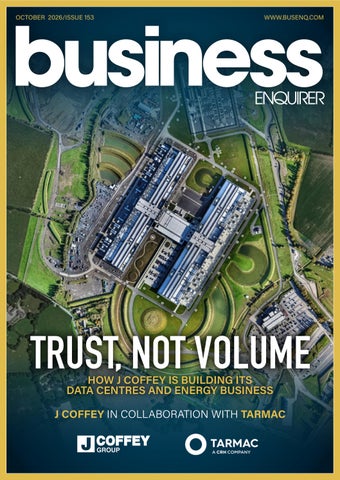
TRUST, NOT VOLUME HOW J COFFEY IS BUILDING ITS DATA CENTRES AND ENERGY BUSINESS
J COFFEY IN COLLABORATION WITH TARMAC
Future-Proof Your Business with AI-Powered Digital Engineering At Nagarro, we harness AI and cutting-edge digital engineering to drive transformation, resilience, and growth. With a forward-thinking and client-first mindset, we help businesses become digital-first, ensuring they stay ahead in an ever-evolving world. With 18,000+ experts across 38 countries, we are trusted by 1,000+ global clients to deliver innovation at scale. Our deep expertise in AI, cloud, and modern engineering accelerates success—today and for the future. Let’s build your future together.
Fluidic Enterprise nagarro.com
EXECUTIVE TEAM
FINANCE
EDITORIAL
Jamie Waite CEO, EMG | Enquirer Media Group jamie.waite@busenq.com
Claire Dunn Global Credit Controller claire.dunn@busenq.com
Zaakira Ebrahim Lead Journalist zaakira.ebrahim@busenq.com
MEDIA
Bethany Waite Credit Controller bethany.waite@busenq.com
Maizie Walsh Journalist maizie.walsh@busenq.com
Sophie Greenwood Finance Manager sophie.greenwood@busenq.com
PRODUCTION
Gary Smith Senior Project Director gary.smith@busenq.com Leroy Thompson Project Director leroy.thompson@busenq.com Adel Mhiri Project Director adel.m@busenq.com
Natoya Rimmer Global Head of Accounts natoya.rimmer@busenq.com
DATA ANALYSIS
Paris Cressy Branding & Marketing Executive paris.cressy@busenq.com
Dan Reeves Head of Data dan.reeves@busenq.com
Thomas Hardy Project Director thomas.hardy@busenq.com
Kumar Nil-Khan Senior Data Strategy kumar.nilkhan@busenq.com
Marcus Laing Project Director marcus.laing@busenq.com
Simon Ferrening Production Manager Commercial Performance Analysis
Paul Roberts Project Director paul.roberts@busenq.com
SOCIAL MEDIA TEAM
Nasa Raheem Project Director nasa.raheem@busenq.com Ben Beattie Project Director ben.beattie@busenq.com
Anita Terrell Social Media Manager anita.terrell@busenq.com Lee Dixon Social Media Manager lee.dixon@busenq.com
HR
Remo Savino Production Assistant remo.savino@busenq.com
DESIGN Jamie Bolton Head of Design jamie.bolton@busenq.com Didie Nturo Head of Video & Content Creation didie.nturo@busenq.com
WEBSITE Matt Hardwick Online Website Manager matt.hardwick@busenq.com
PHOTOGRAPHY Didie Nturo Lead Photographer didie.nturo@busenq.com
LEGAL Chloe Bird Birketts LLP Norwich
Susan Tumelty HR Partnered Company info@hrdept.co.uk
HOW TO FIND US WWW.BUSENQ.COM
INFO@BUSENQ.COM
A WORD FROM OUR TEAM Welcome to the October Edition of Business Enquirer Magazine – Issue 153
As 2026 moves into its final quarter, businesses are facing a familiar challenge in an unfamiliar environment: how to keep evolving without losing sight of what creates lasting value. Across technology, customer experience, infrastructure, tourism and investment, this issue looks at the organisations and leaders building for the future with a combination of innovation, expertise and long term thinking. Our cover feature turns to J Coffey in Trust, Not Volume: How J Coffey Is Building Its Data Centres and Energy Business. The feature explores how the company is growing its presence in two of the most strategically important areas of modern infrastructure, placing specialist knowledge, trusted relationships and quality of delivery ahead of scale for scale’s sake. At a time when data centre demand and energy investment are accelerating, J Coffey’s approach offers a compelling example of how sustainable growth can be built on credibility and consistency. Artificial intelligence continues to shape the wider business conversation, but this edition also looks beyond the hype. Our Q&A with Roman Korzh, CEO of Zfort, considers why introducing AI is only the first step, and why making it work effectively for the business remains the far greater challenge. Elsewhere, AI and Tailoring in CX to Watch in Q4 2026 examines how organisations are using intelligent technology to create more relevant and responsive customer experiences. Customer relationships remain another major theme. In Brand Loyalty and Retention Metrics to Watch in Q4 2026, we explore how businesses are rethinking what loyalty really means as customer behaviour becomes more fluid and traditional measures tell only part of the story. We also look at Retail Innovation to Watch in Q4 2026, highlighting the ideas and technologies influencing the next stage of the customer journey. Leadership and expertise feature strongly throughout the issue. Our latest Top 10 celebrates leading Customer Experience Experts, while The Creative Team Leaders to Watch in 2026 Q4 recognises the individuals helping businesses turn strategy, brand and ideas into meaningful commercial impact. Our company features span a wide range of industries. Vulcan International explores how Dr Mukesh Kumar is turning waste into wealth, demonstrating the growing commercial potential of circular thinking and resource efficiency. We also bring together Screening Eagle and GPRS in Understanding the Built World, looking at how structural inspection and subsurface intelligence are helping organisations better understand, manage and protect critical infrastructure. In tourism, St. Maarten’s Blueprint for the Future of Caribbean Tourism explores how the destination is building on its natural appeal while evolving its wider tourism proposition for a changing international market. Within our Business Partner Updates, we highlight IHG Hotels & Resorts’ appointment of Leanne Harwood as Senior Vice President, Global Sales, alongside IYC’s latest successful Monaco Yacht Show, reflecting continued momentum across both global hospitality and the luxury yachting sector. Finally, beLifestyle embraces the character of the new season. We explore Autumn Escapes: Travelling Out of Season, look at AW26’s most covetable fashion trends, and consider The Luxury of Autumn: The Season of Slow Living, celebrating a quieter, more considered approach to travel, style and everyday luxury. Across this edition, one message stands out. Whether the focus is infrastructure, artificial intelligence, customer experience or tourism, progress is rarely defined by volume alone. The businesses creating the strongest foundations are those combining ambition with expertise, innovation with purpose and growth with the trust required to sustain it. Enjoy the read.
If you have a business story you wish to share, please contact our Head of Production via production@busenq.com
FOLLOW US ON INSTAGRAM
@BUSINESS ENQUIRER
The editor and publishers do not guarantee the accuracy of statements made by contributors or advertisers, or accept responsibility for any statement they express in this publication. The opinions of the contributors may not necessarily be the opinions of the editor or publishers. All content, including the presentation thereof in this magazine, is the property of BE Media and protected by international copyright laws. You may not copy, reproduce, distribute, transmit, modify, create derivative works, or in any other way exploit any part of copyrighted material without prior written permission from BE Media. © BE Media
014 NEWS
008 BUSINESS PARTNER UPDATES
020 NEWS
AI AND TAILORING IN CX TO WATCH IN Q4 2026
INTERNATIONAL HOTEL GROUP IHG HOTELS & RESORTS APPOINTS LEANNE HARWOOD AS SENIOR VICE PRESIDENT, GLOBAL SALES IYC IYC WRAPS ANOTHER SUCCESSFUL MONACO YACHT SHOW
026 NEWS
038 Q&A ROMAN KORZH, CEO, ZFORT
032 NEWS
060 GPRS & SCREENING EAGLE
THE CREATIVE TEAM LEADERS TO WATCH IN 2026 Q4
BRAND LOYALTY AND RETENTION METRICS TO WATCH IN Q4 2026
AI IS THE EASY PART. MAKING IT WORK FOR THE BUSINESS IS HARDER.
RETAIL INNOVATION TO WATCH IN Q4 2026
084 VULCAN
HOW DR MUKESH KUMAR IS TURNING WASTE INTO WEALTH AT VULCAN INTERNATIONAL
046 THIS MONTH’S
UNDERSTANDING THE BUILT WORLD FROM STRUCTURAL INSPECTION TO SUBSURFACE INTELLIGENCE SCREENING EAGLE AND GPRS
098 ST. MAARTEN
ST. MAARTEN’S BLUEPRINT FOR THE FUTURE OF CARIBBEAN TOURISM
112 KAMOA COPPER
CTE EXPERTS
FROM RESOURCE TO REFINEMENT: KAMOA COPPER’S NEXT PHASE
CONTENTS
050 COVER FEATURE
TRUST, NOT VOLUME HOW J COFFEY IS BUILDING ITS DATA CENTRES AND ENERGY BUSINESS
138 Autumn Escapes Travelling Out of Season The Art of Autumn Dressing AW26’s Most Covetable Trends The Luxury of Autumn: The Season of Slow Living
PARTNER UPDATES
IHG HOTELS & RESORTS APPOINTS LEANNE HARWOOD AS SENIOR VICE PRESIDENT, GLOBAL SALES
I
HG Hotels & Resorts (IHG), one of the world’s leading hotel companies, announced the appointment of Leanne Harwood as Senior Vice President (SVP), Global Sales. Based in Atlanta, Harwood will lead IHG’s Global Sales organization, driving strategy, performance and customer engagement across the company’s global sales segments and regions. Harwood brings more than 30 years of hospitality experience to the role, including more than 20 years with IHG. Since March 2024, she has served as Senior Vice President and Managing Director, Luxury, Lifestyle & Managed Hotels, Americas, overseeing the operations and performance of IHG’s luxury & lifestyle hotel portfolio across the region. Harwood has also held IHG leadership roles across sales, commercial and operations functions throughout Southeast Asia, the Middle East, Japan and Australasia. Her experience leading teams across global markets gives her a deep understanding of customer needs and business priorities.
8
Business Enquirer Magazine
Experienced hospitality leader to accelerate commercial growth and strengthen customer relationships worldwide
In her new role, Harwood will lead IHG’s Global Sales organization, driving customer engagement and growth across corporate, group and meetings and events segments worldwide. Jolyon Bulley, CEO, Americas, IHG Hotels & Resorts, said: “Leanne’s deep commercial expertise and track record of building high-performing teams makes her the ideal person to lead our Global Sales organization. Her global experience, strategic perspective and passion for hospitality will be invaluable as we continue to strengthen and grow our customer partnerships across our business.”
www.ihgplc.com
Leanne Harwood, Senior Vice President, Global Sales
IHG NEWS
Business Enquirer Magazine
9
PARTNER UPDATES
IYC WRAPS ANOTHER SUCCESSFUL MONACO YACHT SHOW
T
he Monaco Yacht Show once again brought the global superyacht community together in Port Hercule, and for IYC, the 2026 edition was a week defined by an exceptional fleet, meaningful conversations, and a packed calendar of meetings, events, and experiences from morning through evening.
With more than 120 superyachts and 560 exhibitors gathered in Monaco for the show’s 35th edition, IYC welcomed clients, partners, yacht owners and industry colleagues across the week, with a premium lineup of yachts on display both in the harbor and at anchor.
An Exceptional Lineup IYC’s show fleet showcased the breadth of the company’s sales and charter offering, with some of the most distinctive yachts in the show on display. Among them was the 244’ (74.5m) ZEUS, an iconic yacht with a design pedigree spanning Martin Francis and François Zuretti, alongside the 162’ (49m) OCEANOS, 156’ (48m) ATLANTIS, 143’ (43.5m) THIS IS IT, and 123’ (37m) MOONEN 122 MARTINIQUE YN208. Further afield, clients had the opportunity to step aboard the 263’ (80m) BATELLO and 145’ (44m) HEEUS at anchor, with IYC’s Sales and Charter Consultants coordinating private viewings throughout the week. Together, the lineup reflected the diversity of yachts available through IYC, from established brokerage opportunities and charter favorites to new-build projects and the latest generation of superyachts. THE LOUNGE by IYC At the heart of IYC’s Monaco Yacht Show presence was THE LOUNGE by IYC, which once again proved a popular destination throughout the week. The invitation-only space offered clients and partners a more private setting away from the pace of the show floor, with meetings, conversations and gatherings taking place throughout the day. The Lounge also provided the setting for two SuperYacht Times seminars, bringing
10
Business Enquirer Magazine
IYC NEWS
Business Enquirer Magazine
11
together leading voices from across the industry. A dedicated wellness discussion explored the evolving role of wellbeing on board, while a market-focused session examined the current state of the superyacht market and key developments shaping the industry. The latter also provided an opportunity to introduce IYC’s new global partnership with INACE Superyachts, alongside the company’s new investment partnership with Peninsula Capital, marking two significant developments for IYC and its continued global growth. From Morning Meetings to Evening Events As always, Monaco Yacht Show week extended well beyond the show floor. IYC’s calendar began with its traditional pre-show gathering at THE LOUNGE, bringing together the wider IYC team and partners ahead of the official opening. From there, the week moved at full pace, with private banking events, yacht soirées, client gatherings, media engagements and partner events taking place across Monaco. Highlights included an evening aboard THIS IS IT, a private event aboard BATELLO, the daily Captain’s Breakfast, the launch of the SuperYachtFoodie Adventure TV Series, the Vripack press event and the Captain’s Soirée. The week also saw private bank cocktails aboard THIS IS IT and an evening hosted by SuperyachtOne aboard OCEANOS. A particularly special moment of the week was an intimate VVIP dinner aboard BATELLO, welcoming just 20 handselected guests. The evening featured a bespoke dining experience conceived and prepared by the team behind Delta, the two-Michelin-starred restaurant in Athens, creating an exceptional setting for conversation, connection and hospitality. Across the four days, IYC’s team moved continuously between the show, yachts, THE LOUNGE and events throughout 12
Business Enquirer Magazine
IYC NEWS
Monaco, creating opportunities to connect with clients and colleagues in a variety of settings. A Week Built Around Partnership
and industry colleagues who joined us throughout the week. Looking Beyond Monaco
The success of the week was also made possible through the continued support of IYC’s network of partners, whose expertise and hospitality helped bring the Monaco program to life.
For IYC, the Monaco Yacht Show is more than four days on the calendar. It is an opportunity to bring the company’s global network together, strengthen relationships, showcase an exceptional selection of yachts and engage with the conversations shaping the future of the industry.
IYC would like to thank Global Wine Solutions, Vripack, Vilebrequin, Jet Aviation, Lekker, J Craft, Kimberly Pucci, Star Edge, Stilla, Marine Pool, Med Yacht Services, The Macallan, SuperYachtFoodie, YachtEye, GF Entertainment, the Bahamas Tourism Board , Aultra Antipolis, and Pantaenius, alongside the many clients, friends,
From the first morning gathering to the final evening event, 2026 was another full, fast-paced Monaco Yacht Show for IYC, and a fitting reflection of the energy, expertise, and relationships that continue to drive the company forward.
www.iyc.com Business Enquirer Magazine
13
THE CREATIVE TEAM LEADERS TO WATCH IN 2026 Q4 A
s artificial intelligence, new technologies and changing audience expectations reshape the creative industries, the role of the creative leader is changing with them. The strongest creative teams are no longer built simply around a single visionary voice. They are being shaped by leaders who understand how to give talented people room to think, bring different disciplines together and use technology without allowing it to replace human judgement.
being felt not only through campaigns and visual identities, but through the cultures they are building around them.
For 2026, that makes creative leadership an increasingly important business story. From global agencies and major brands to independent studios and emerging creative businesses, a new generation of leaders is demonstrating that the best work often begins with the environment in which people are encouraged to make it.
Nils Leonard, founder of Uncommon, has become an influential voice around the relationship between leadership and creative culture. His approach places considerable emphasis on creating organisations where people can develop their own points of view rather than simply following instructions from the top. That philosophy is increasingly relevant as creative businesses look for ways to retain talented people and give them meaningful responsibility.
The leaders to watch are not defined by one particular discipline. They come from advertising, design, brand experience, technology, fashion and entertainment, but share an interest in how creative teams can work differently. Their influence is 14
Business Enquirer Magazine
Building cultures where creativity can thrive One of the clearest developments in creative leadership is a greater focus on culture. Creative teams need ambitious ideas, but they also need trust, clarity and the freedom to challenge established thinking.
Lisa Smith, Global Chief Design Officer at Uncommon, represents another
LEADERSHIP NEWS
Business Enquirer Magazine
15
ones who understand where technology can accelerate the creative process and where human experience, cultural understanding and judgement remain essential. There is also an important cultural question. As AI makes production faster, creative leaders have to ensure that speed does not come at the expense of originality. If everyone has access to similar tools, the difference increasingly lies in the quality of the thinking behind them. The new creative business leader Creative leadership is becoming increasingly connected to commercial leadership. For years, creative departments could operate somewhat separately from the wider business. Today, that separation is becoming harder to maintain. Clients want creative work that delivers measurable impact, while businesses increasingly recognise that strong creative thinking can influence everything from customer experience to product development. Cannes Lions highlighted this changing relationship when it introduced its Creative Brand Lion for 2026, recognising brands that build the systems, cultures and capabilities needed to make creativity a repeatable part of business. AB InBev Global Chief Marketing Officer Marcel Marcondes was named the inaugural jury president for the category. The development points towards a wider understanding of creativity. It is no longer simply the responsibility of an agency or a creative department. Increasingly, it is becoming part of how businesses compete, communicate and build relationships with their audiences.
important. Leaders are being asked to understand budgets, audiences, technology and growth while still protecting the space needed for experimentation. That requires a different kind of confidence. The creative leader of the future may not be the person who has the loudest voice in the room, but the person capable of bringing together people with very different expertise and giving them a shared direction. Leading the next generation The next generation of creative leadership is also being shaped by collaboration. Large creative organisations now bring together strategists, designers, writers, technologists, producers, data specialists and experience teams. The job of the leader is often to connect those perspectives rather than provide every answer themselves. The Creativepool Annual for 2026 reflects this increasingly broad definition of leadership, with its creative leadership community spanning chief creative officers, experience design specialists, executive creative directors, designers and emerging leaders across global markets. D&AD has similarly placed emphasis on leadership across disciplines, with its 2026 Creative Leaders Programme bringing together figures including Lisa Smith, Peter Semple, Nishma Robb, Steve Vranakis, Ajaz Ahmed and Rania Robinson. The breadth of the group reflects an industry where creative leadership can come from design, technology, entrepreneurship, media and brand building as much as traditional advertising.
That creates a different challenge for creative leaders. They need to understand the commercial environment without allowing commercial pressures to flatten original thinking.
That diversity of experience matters because creative teams increasingly operate across cultures, markets and disciplines. A leader who understands how to bring those perspectives together can create an environment where disagreement becomes part of the process rather than something to be avoided.
The ability to translate creative ambition into business value is becoming increasingly
There is also a growing emphasis on developing the leaders who come next.
16
Business Enquirer Magazine
LEADERSHIP NEWS
HOW TO LEAD CREATIVE TEAMS side of this evolving leadership model. Design leadership today reaches well beyond visual execution, with creative teams increasingly involved in brand strategy, experience and wider business transformation. Her position reflects the growing expectation that design leaders should help shape the direction of an organisation rather than simply respond to a brief. The shift is significant. Creative leadership is becoming less about controlling an output and more about establishing the conditions in which strong ideas can emerge. A successful creative culture is rarely created through one grand gesture. It is built through everyday decisions about who gets heard, how teams collaborate and how much space people have to experiment. Creativity meets technology Technology is another defining factor for creative leaders in 2026. Artificial intelligence is changing how ideas are developed, visualised and produced, but its arrival has also made human creativity more valuable in different ways.
The question facing creative leaders is no longer simply whether teams should use AI. It is how they should use it responsibly, creatively and strategically. Cristina Reina, Chief Creative Experience Officer at Droga5 New York and across the Americas, is working at the intersection of brand, experience, technology and culture. Her role reflects a broader movement towards creative leadership that crosses traditional agency boundaries, bringing together different disciplines to create experiences rather than isolated pieces of advertising. Dominik Heinrich, Global Head of Design Intelligence and AI Experiences at The Coca Cola Company, is another example of how technology is becoming part of the creative leadership conversation within major global organisations. His work sits at the intersection of design, intelligence and emerging technology, illustrating how large brands are developing new approaches to creative problem solving. The most effective leaders in this space are unlikely to be those who simply adopt every new tool. Instead, they will be the Business Enquirer Magazine
17
18
Business Enquirer Magazine
LEADERSHIP NEWS
“The creative leader of the future may not be the person who has the loudest voice in the room, but the person capable of bringing together people with very different expertise and giving them a shared direction.” Strong creative businesses need more than one generation of talent. They need experienced leaders who can give emerging voices responsibility, allow them to make decisions and help them develop their own creative perspective. For creative leaders, perhaps the greatest challenge in 2026 is maintaining a clear sense of purpose while the industry continues to move quickly. AI will continue to develop. Agencies will change their structures. Brands will bring more capabilities in house. New platforms will influence how audiences discover and interact with content. Yet the fundamentals of good creative leadership remain surprisingly familiar. People want to work with leaders who have a clear point of view. They want
opportunities to contribute rather than simply execute. They want to understand why their work matters, and they want enough freedom to make it their own. That is why leadership in creative industries cannot be reduced to awards, job titles or the size of an organisation. The more interesting measure is what happens around the leader. Do people feel able to challenge ideas? Are different disciplines genuinely heard? Does technology expand the possibilities available to the team? Does the culture encourage curiosity rather than fear? These questions are becoming increasingly important as creative businesses navigate a period of significant transformation. The creative leaders shaping 2026 are operating in an environment where the traditional boundaries between creativity, technology and business are becoming increasingly blurred. The strongest teams will need people who can understand all three. They will need creative ambition, commercial awareness and the confidence to experiment with new tools while protecting the qualities that make human creativity distinctive. That could ultimately make the creative leader’s role more important, rather than less. When technology can produce an image, write copy or generate an idea in moments, the ability to establish a meaningful direction becomes even more valuable. The leaders worth watching are therefore not simply the people producing the most visible work. They are the people building the teams behind it, creating cultures where ideas can develop and helping their organisations understand what creativity can contribute beyond the finished campaign. In 2026, creative leadership is becoming less about having all the answers and more about knowing how to create the conditions for better questions, stronger collaboration and more ambitious ideas. Business Enquirer Magazine
19
AI AND TAILORING IN CX TO WATCH IN Q4 2026 A
s artificial intelligence becomes more deeply embedded in the way businesses operate, customer experience is entering a new phase. Personalisation is no longer simply about using a customer’s name, remembering a previous purchase or recommending a product based on browsing history. Increasingly, AI is allowing brands to understand behaviour in real time, anticipate needs and shape interactions around individual customers.
For businesses, the opportunity is significant. AI can process vast amounts of information, identify patterns and respond at a speed that would be impossible to achieve through human teams alone. But as personalisation becomes more sophisticated, expectations are changing too. Customers want experiences that feel relevant and convenient, without feeling watched, manipulated or pushed towards decisions they have not made for themselves. The challenge for businesses in 2026 is therefore not simply how much AI they can introduce, but how intelligently and responsibly they use it. 20
Business Enquirer Magazine
From Personalisation to Anticipation Traditional personalisation has largely been built around what a customer has already done. A previous purchase might trigger a recommendation, while browsing activity might influence the content or offers shown next. AI is beginning to move this towards something more dynamic.
By combining customer data with real time signals, businesses can respond to changing circumstances rather than relying solely on historical behaviour. A customer who has repeatedly searched for a particular service, for example, may receive information that reflects where they are in their decision making process rather than another generic advertisement. Adobe’s latest research into customer engagement highlights personalisation as one of the major areas of AI investment, with businesses increasingly looking towards highly personalised experiences that can adapt in real time.
INNOVATION NEWS
Business Enquirer Magazine
21
HOW PERSONALISATION & AI CREATE BETTER CUSTOMER JOURNEYS This represents an important shift. Personalisation is becoming less about remembering customers and more about understanding context. The strongest applications of AI may not always be the most obvious. Instead of presenting a customer with endless recommendations, an effective system might simplify the journey, remove unnecessary steps or provide information at precisely the point it is needed. That requires businesses to think carefully about the difference between being helpful and being intrusive. Just because a company can use a particular piece of information does not necessarily mean that it should. The Rise of the AI Agent The next development could be even more significant. AI is increasingly moving beyond answering questions and generating content towards systems that can take action. Agentic AI can potentially handle tasks across multiple stages of a 22
Business Enquirer Magazine
customer journey, from finding information and comparing options to arranging services and resolving straightforward problems. Rather than waiting for customers to ask what comes next, an AI agent can potentially coordinate different parts of the experience on their behalf. For businesses, this could reduce friction considerably. Customers would spend less time repeating information, navigating complicated websites or moving between different channels. The experience could become more continuous, with an AI system carrying context from one interaction to another. Research from Adobe suggests that organisations are preparing for AI agents to take on a much greater role in customer engagement and support. McKinsey has similarly identified agentic AI as a technology capable of moving customer experience away from predefined journeys towards more dynamic interactions across channels. But this also raises a new set of responsibilities.
INNOVATION NEWS
Business Enquirer Magazine
23
When an AI agent is acting on behalf of a brand, its decisions become part of the customer experience. An incorrect recommendation, poorly handled request or inappropriate action can affect trust just as much as a mistake made by a human employee. Businesses will therefore need to consider not only what their AI systems can do, but what they should be permitted to do. Clear boundaries, reliable data, oversight and accountability will become increasingly important as AI moves from being an assistant to an active participant in the customer relationship. Keeping CX Human The growth of AI does not mean that human interaction is becoming irrelevant. In many cases, it makes the human element more important. Customers may be happy for AI to deal with routine questions, provide information or complete straightforward tasks. But when something goes wrong, when a decision is particularly important or when a situation requires empathy, many people still want the option of speaking to another person. Recent research from Verizon highlights the continuing importance of human interaction within customer experience, while concerns raised in the UK around excessive reliance on chatbots have also brought digital accessibility and the availability of human support into sharper focus. This points towards a more balanced model of customer service. AI can remove repetitive work and make everyday interactions faster, while human teams can focus on situations that require judgement, empathy and a deeper understanding of the customer. The most effective businesses may therefore be those that do not treat AI and human service as competing approaches. Instead, they can use each for what it does best. 24
Business Enquirer Magazine
The aim should be to remove friction rather than remove choice. Trust Will Define the Next Phase As AI becomes more capable of personalising experiences, trust is likely to become one of the defining issues in customer experience. Customers want brands to understand them, but there is a clear distinction between relevance and surveillance. A recommendation that saves time can feel useful. The same recommendation can feel uncomfortable if the customer does not understand why it appeared or how their information was used. This is particularly important as AI begins to influence more significant decisions. Research from Adobe shows that consumers are generally more comfortable with AI handling routine tasks than situations involving sensitive information or important personal decisions. The emergence of personal AI agents could make this relationship even more complicated. Accenture’s research suggests that consumers are increasingly open to delegating purchasing decisions to AI systems acting on their behalf. That means businesses may eventually need to build trust not only with individual customers, but with the AI agents representing them. Transparency will become increasingly valuable. Customers need to know when they are interacting with AI, what information is being used and when they can take control themselves. They also need confidence that an AI system will provide accurate information and act within clearly defined boundaries. Personalisation therefore has a paradox at its heart. Customers expect businesses to understand them, but they do not necessarily want businesses to demonstrate everything they know. The brands that navigate this successfully will be those that use data with restraint
INNOVATION NEWS
“The technology can provide the speed and scale. Data can provide the context. Personalisation can make the experience relevant. But trust will determine whether customers want to keep engaging.” and purpose. Personalisation should make an experience feel easier and more relevant, rather than making customers feel that every action is being monitored. Looking ahead, AI is likely to become less visible in the best customer experiences. The technology itself may not be what customers remember. Instead, they will remember that a service was easy to use, that information appeared when they needed it, that a problem was resolved quickly and that they were treated as an individual. For businesses, achieving that level of experience will require more than investing in the latest AI tools. It will depend on the quality of their data, the strength of their governance, the transparency of their systems and their ability to retain a human understanding of the customer. The future of CX is unlikely to be defined by personalisation alone. It will be defined by how intelligently businesses combine AI, context and human judgement. The technology can provide the speed and scale. Data can provide the context. Personalisation can make the experience relevant. But trust will determine whether customers want to keep engaging. Business Enquirer Magazine
25
BRAND LOYALTY AND RETENTION METRICS TO WATCH IN Q4 2026 B
rand loyalty is becoming harder to define. For years, businesses could look at repeat purchases, membership numbers or customer lifetime value as evidence that a relationship was strengthening. But in a market shaped by rising costs, changing expectations, greater choice and increasingly sophisticated AI, those measures tell only part of the story.
In 2026, customers have more ways to compare prices, discover alternatives and move between brands. Familiarity still matters, but it is no longer enough to guarantee loyalty. At the same time, loyalty programmes are becoming more widespread, while customers are becoming more selective about which ones they actually use. The result is a more complicated picture for businesses. Retention is no longer simply about keeping customers. It is about understanding why they stay, why they leave, how frequently they engage and whether their relationship with a brand is based on genuine preference or 26
Business Enquirer Magazine
convenience. For businesses looking to understand the health of their customer relationships, the metrics worth watching in 2026 are becoming increasingly nuanced. From Loyalty to Active Engagement One of the clearest shifts is the growing gap between loyalty programme membership and meaningful engagement.
Research from Mintel into UK customer loyalty in retailing found that many consumers belong to several loyalty schemes, while actively using a much smaller number. This suggests that membership alone can create an inflated impression of loyalty. A customer signing up to a programme does not necessarily mean they are emotionally or commercially committed to the brand. For businesses, active participation is therefore becoming a more valuable measure. Frequency of purchase, repeat purchase behaviour, redemption activity and engagement with personalised offers
MARKETS NEWS
Business Enquirer Magazine
27
28
Business Enquirer Magazine
MARKETS NEWS
DRIVE CUSTOMER LOYALTY WITH AGENTIC AI
can provide a clearer picture of whether a loyalty programme is actually influencing behaviour. This is particularly important as customers become increasingly comfortable moving between brands. The DMA’s Customer Engagement research for 2026 found that fewer consumers are sticking exclusively to familiar brands for everyday purchases than in previous years, highlighting how fragile everyday loyalty can become. Price remains part of the equation. Customers facing continued financial pressure may be willing to switch when another brand offers better value. But loyalty is not necessarily disappearing. Instead, it is becoming more conditional.
The Metrics Behind Retention Customer retention is often reduced to a simple calculation of how many customers remain over a particular period. In practice, businesses need a much broader view. Repeat purchase rate can show whether customers are returning after an initial transaction. Purchase frequency can reveal how often those customers come back, while customer lifetime value can help businesses understand the commercial value of maintaining the relationship over time.
Brands need to understand what makes customers return when there is a cheaper or more convenient alternative available.
Churn provides the other side of the picture. A rising churn rate can indicate dissatisfaction, changing customer needs, stronger competition or a disconnect between what the brand promises and what it delivers.
That makes retention rate an important headline metric, but the reasons behind retention matter just as much.
Looking at these measures together can reveal patterns that an individual metric might miss. Business Enquirer Magazine
29
A business could have a strong retention rate, for example, but see declining purchase frequency. Another might have a successful loyalty programme but relatively low redemption rates. A brand may also have high customer satisfaction while struggling to turn that satisfaction into repeat business.
programmes. Its findings also point to the challenge of keeping customers engaged when they belong to multiple schemes.
Customer satisfaction measures such as CSAT, customer effort and recommendation scores remain useful, but they should be viewed alongside behavioural data.
Businesses should be watching metrics such as loyalty programme activity, reward redemption, repeat purchase behaviour among members and the difference in retention between members and non members.
The distinction between what customers say and what they actually do is becoming increasingly important. Adobe’s latest research into customer behaviour found that customers respond strongly to experiences that are relevant, convenient and well timed, but can quickly disengage when communications become excessive or irrelevant. That places greater importance on metrics that connect engagement with actual behaviour rather than simply measuring activity. For marketers, the question is shifting from whether customers interacted with a campaign to whether that interaction contributed to a stronger relationship. The New Loyalty Economy Loyalty programmes themselves are also changing. Traditional schemes built around points and discounts remain widespread, but businesses are increasingly looking at loyalty as a broader exchange of value. Exclusive access, personalised experiences, recognition and useful services can all play a role alongside financial rewards. This matters because discounts can encourage customers to return without necessarily creating a deeper connection with the brand. Mintel’s 2026 research highlights the growing importance of progressive value, personalisation and simplicity within loyalty 30
Business Enquirer Magazine
The number of loyalty members a brand has may therefore become a less meaningful headline figure than the proportion who actively engage.
The quality of the relationship matters too. A customer who repeatedly buys, recommends a brand and chooses it despite competing offers represents a different form of loyalty from someone who returns only when a discount is available. That makes advocacy another important measure to watch. Referral activity, reviews, recommendations and organic customer engagement can provide useful signals of whether loyalty extends beyond transactions. Trust will also remain central. Capgemini’s 2026 consumer research found that transparency, quality, fairness and human interaction are increasingly important elements of perceived value. The research suggests that loyalty is not simply about offering the lowest price or the most rewards. Customers are also assessing whether a brand behaves consistently and whether the overall relationship feels worthwhile. AI and the Future of Retention Artificial intelligence is adding another layer to the loyalty equation. AI can help businesses analyse customer behaviour, identify customers at risk of leaving and personalise communications at a scale that would be difficult to achieve manually. It can also help brands identify patterns between purchasing behaviour, engagement and retention.
MARKETS NEWS
“In a market where switching is easier and choice is greater, loyalty will increasingly have to be earned at every stage of the customer relationship.”” But greater personalisation does not automatically create greater loyalty. Customers can become frustrated when communications are too frequent, poorly timed or based on information that does not feel relevant. Adobe’s research highlights this tension, showing that relevance can encourage engagement while excessive or inappropriate personalisation can have the opposite effect. The key metric may therefore become the incremental value created by personalisation. Are personalised experiences increasing repeat purchases? Are they improving retention? Are customers engaging more frequently because the communication is genuinely useful? Or are businesses simply generating more marketing activity? These questions will become increasingly important as AI becomes embedded across marketing and customer service. There is also a wider issue around trust and data. The DMA has highlighted
responsible data use and clear communication as fundamental to long term customer confidence, while Capgemini’s research points to growing consumer expectations around transparency when AI is involved. Businesses will therefore need to measure not only commercial outcomes, but customer sentiment around the way personalisation is being delivered. In 2026, the strongest loyalty strategies are likely to be built around a combination of behavioural, financial and emotional signals. Retention rate will still matter. So will churn, repeat purchase frequency and customer lifetime value. But businesses will need to look further, measuring active loyalty programme engagement, advocacy, customer effort, satisfaction and the effectiveness of personalised experiences. The bigger shift is that loyalty can no longer be treated as a single metric. A customer may be loyal because a brand offers better value, because its service is easier, because its products consistently deliver or because the relationship feels familiar and trustworthy. Often, it will be a combination of all of these things. For businesses, understanding those different motivations will be essential. The brands that succeed in retaining customers will not necessarily be those with the biggest loyalty programmes or the most sophisticated technology. They will be the ones that understand what customers value, recognise when that value is changing and use data to strengthen the relationship rather than simply increase the number of interactions. In a market where switching is easier and choice is greater, loyalty will increasingly have to be earned at every stage of the customer relationship. Business Enquirer Magazine
31
RETAIL INNOVATION TO WATCH IN Q4 2026
R
etail has always been an industry built around change. From the rise of the department store and the supermarket to online shopping, mobile commerce and social media, every major shift in consumer behaviour has forced retailers to rethink how they attract, serve and retain customers.
For retailers, the challenge is no longer simply adopting new technology. It is deciding where innovation can make a meaningful difference to the customer and the business.
In 2026, that transformation is accelerating again.
Artificial intelligence is becoming one of the defining forces in retail, moving beyond experimentation and into everyday operations.
Artificial intelligence is changing how products are discovered, recommended and purchased, while physical stores are being reconsidered as places for experience rather than simply transactions. At the same time, retailers are under pressure to deliver greater value, improve efficiency and build more resilient supply chains. The result is a retail landscape where technology is becoming less visible but increasingly influential. The most important innovations are not necessarily those that look futuristic. They are the systems working behind the scenes to make shopping more relevant, convenient and responsive. 32
Business Enquirer Magazine
AI Moves From Experiment to Everyday Retail
Deloitte’s 2026 Global Retail Industry Outlook describes a shift from AI pilots towards wider deployment across commerce, marketing and operations. Retailers are using AI to support areas including customer personalisation, merchandising, supply chain visibility and decision making. One of the most significant developments is the rise of agentic commerce. Rather than simply helping customers search for products, AI agents can increasingly search, compare and potentially complete purchases on
INNOVATION NEWS
Business Enquirer Magazine
33
34
Business Enquirer Magazine
INNOVATION NEWS
THE FUTURE OF RETAIL TECHNOLOGY: KEY SHIFTS AND TRENDS IN 2026 their behalf. Deloitte describes this as an emerging shopping channel in which consumers delegate parts of the purchasing journey to AI.
to customers, but to the systems helping customers make decisions.
This could fundamentally change how brands compete for attention.
The growth of digital commerce does not mean the physical shop is disappearing. Instead, its role is changing.
For years, retailers have invested heavily in websites, search rankings, advertising and visual merchandising to influence customers. As AI becomes an intermediary between the shopper and the retailer, product information itself becomes increasingly important. Prices, availability, specifications, reviews and delivery information need to be accurate, accessible and easy for AI systems to interpret. The shift could also challenge traditional ideas about brand loyalty. If an AI agent is comparing products based on price, suitability, availability and customer requirements, a familiar brand name may carry less weight than it once did. Retailers will therefore need to think about how their brands appear not only
The Store Becomes an Experience
McKinsey’s research into shopping in the age of AI suggests that stores will remain important, but visits could become less frequent and more valuable as routine purchases increasingly move online or towards AI assisted shopping. That creates an opportunity for retailers to rethink what a physical space is designed to achieve. A store can provide something an online transaction cannot easily reproduce. It can allow customers to touch products, speak to staff, try something before buying, discover new brands or simply enjoy the experience of being somewhere. This is already influencing the wider retail environment. Deloitte has highlighted the development of shopping centres into Business Enquirer Magazine
35
lifestyle destinations, with experience led tenants helping to generate reasons for people to visit beyond traditional retail. For some retailers, that could mean smaller and more focused stores. For others, it could mean creating spaces that combine retail with hospitality, entertainment, services or community. The key question is becoming what a particular store is for. A location might exist primarily for convenience, while another becomes a showroom, a place for discovery or a destination for events and experiences. Technology can support these different roles through mobile checkout, personalised recommendations, digital product information and connected customer accounts. The physical store is therefore not necessarily competing with digital retail. Increasingly, the two are becoming part of the same experience. Smarter Operations Behind the Scenes Some of the most important retail innovation will happen away from the shop floor. Retailers operate complex networks involving suppliers, warehouses, transport, inventory, pricing and thousands of individual products. Even small improvements can have a significant effect when applied across an entire business. AI is increasingly being used to help retailers make these systems more responsive. McKinsey research into agentic AI and retail merchandising highlights opportunities to automate repetitive tasks and support decisions around pricing, assortment and supplier information. Instead of spending large amounts of time producing reports and analysing 36
Business Enquirer Magazine
data manually, merchandising teams can increasingly use AI to identify patterns and flag potential issues. Supply chain innovation is also becoming increasingly important as retailers deal with uncertainty around costs, trade and availability. Deloitte’s 2026 retail outlook identifies supply chain transformation as one of the major areas shaping the industry, with retailers looking beyond small operational improvements towards more resilient supply chain models. This could mean greater use of predictive systems, automated replenishment and more sophisticated inventory management. The benefits are not simply financial. Better forecasting can reduce unnecessary stock, minimise shortages and help retailers respond more quickly when demand changes. For customers, much of this innovation may go unnoticed. That is arguably the point. The most effective retail technology should make products available when customers want them, reduce unnecessary waiting and create a smoother journey without demanding attention for the technology itself. Personalisation Without Losing the Human Touch As retailers gain access to more customer data, personalisation is becoming increasingly sophisticated. AI can help retailers understand purchasing patterns, preferences and behaviour, allowing them to tailor recommendations, marketing and promotions to individual customers. Deloitte’s research suggests that AI driven personalisation will become increasingly widespread across retail marketing and customer engagement.
INNOVATION NEWS
But better personalisation does not necessarily mean using more data. Customers still expect transparency and control over how their information is used. A recommendation that feels genuinely useful can strengthen the relationship with a brand, while one that feels intrusive can have the opposite effect. This makes trust an important part of retail innovation. The same principle applies to customer service. AI can handle routine questions and make information easier to access, but human interaction remains important when a customer has a complicated problem or needs reassurance. Retailers therefore face an interesting balancing act. They need to use technology to make the experience faster and more relevant without allowing automation to make the relationship feel impersonal. Looking ahead, the most successful retail innovation may be the technology customers barely notice. AI will increasingly sit behind product discovery, merchandising, inventory and
customer service. Physical stores will become more purposeful, while digital channels will become more intelligent. Supply chains will need to become more adaptable, and retailers will need to understand not only what customers buy but why they choose to return. Innovation in retail is consequently becoming less about introducing a single new feature and more about connecting the entire customer journey. The retailers shaping the next phase of the industry will be those that can combine technology with a clear understanding of human behaviour. They will know when to automate, when to personalise and when to put a person back into the experience. As shopping becomes increasingly intelligent, the fundamentals will remain surprisingly familiar. Customers still want value, convenience, choice, trust and a reason to come back. The technology may change how those expectations are delivered, but it is the quality of the experience that will continue to determine whether innovation actually matters. Business Enquirer Magazine
37
Q&A
ROMAN KORZH, CEO, ZFORT AI IS THE EASY PART. MAKING IT WORK FOR THE BUSINESS IS HARDER. Q
Zfort Group has been operating for more than 25 years, during which the technology landscape has changed dramatically. How has the company evolved, and what have been the most important milestones in that journey?
A
We have evolved from building individual applications to taking responsibility for how technology supports a business over time. Zfort was founded in Ukraine in 2000, with roots in web development. Our global expansion in 2014 was an important milestone. Mobile, cloud and enterprise projects broadened that foundation; today, AI is extending it again. One leadership lesson has stayed with me. Early in my career, I made a common mistake: I believed that brilliant code was enough to guarantee success. I was wrong. Software is only half the battle. Success relies entirely on the ecosystem around those engineers - the culture, the processes, the deep understanding of the client’s business.
38
Business Enquirer Magazine
ROMAN KORZH CEO, ZFORT Q&A
Business Enquirer Magazine
39
40
Business Enquirer Magazine
ROMAN KORZH CEO, ZFORT Q&A This exact rule applies to AI today. A worldclass model is useless without the right people and processes wrapped around it. Building that entire ecosystem is my ultimate responsibility.
Q
AI is now a major part of Zfort Group’s offering. What are businesses actually asking you to build with AI today, and how has that changed over the past couple of years?
A
Curiosity is over. Today, clients don't want magic; they want operational results. The conversation has shifted entirely from 'what if' to 'how exactly'. The requests fall into three broad areas: knowledge assistants that help employees find information in internal documents; agents that extract data and support workflows across existing systems; and computer vision or predictive models for tasks that are not primarily about language. In one automotive equipment engagement, for example, the brief included improving a vision system’s response times and its ability to cope with changing light and dirt. What links these requests is the need to work outside a demonstration. Clients want to know what a tool will do for an employee and how it will fit the systems they already use. That shifts our focus towards integration, testing and the conditions the technology will encounter in practice.
Q
There is enormous excitement around generative AI, LLMs and AI agents, but also a great deal of hype. How do you help clients identify where AI can deliver genuine commercial value rather than simply adopting technology for its own sake?
A
Everyone asks us: 'Which AI model should we use?' It’s the wrong question. The right question is: 'What business metric are we trying to fix?'
“A successful AI demo is not a business case.” We examine the workflow, available data and economics: how often the task occurs, where effort is being lost, and what improvement would matter. The benefit also has to justify the costs of integration, human review and ongoing operation. A successful AI demo is not a business case. A real-estate platform we developed combined AI functionality with blockchain-based transactions. In a public review, the client reported cutting transaction duration by at least half. That was a reported result of the integrated platform, not a model operating in isolation. We should measure the business process, not just the technology. Frankly, sometimes my recommendation is to use conventional automation, or no AI at all. We build solutions for ROI, not for the hype.
Q
Zfort has delivered more than 2,000 projects across a wide range of industries. Are there particular sectors where you are currently seeing the strongest demand for digital transformation and custom software development?
A
We don't just target industries; we target data-heavy bottlenecks. Healthcare, finance, real estate, and legal - they seem different on the surface, but the underlying problem is the same: highly paid professionals spending too much time navigating fragmented, disconnected systems. Healthcare teams need better access to clinical information and less administrative Business Enquirer Magazine
41
“I want clients to have clarity, not just frequent updates.” work. Financial organisations need to modernise transaction and risk systems. Property and legal businesses need to move through document-heavy processes with fewer delays.
Those requirements should shape the architecture from the beginning: how data is prepared, what the system can access, which outputs are checked and where approval is required.
What interests me is the overlap between modernisation and AI. A business may want a knowledge assistant, but first it needs its information connected and usable. Another may need a better transaction platform, with AI improving only one part of the process.
Our broader software background means we can work on both the AI capability and the systems it depends on.
That is a good fit for Zfort because we can work on the surrounding application, data and integrations, not just the AI layer.
Q
Your work increasingly combines AI with existing enterprise systems and workflows. What are some of the biggest challenges companies face when trying to integrate AI into established infrastructure?
A
You can't pause a business to rebuild its IT infrastructure. That’s the reality of enterprise AI. The real challenge isn't the AI model itself; it's making it work within the messy, fragmented reality of legacy systems without breaking operations.
42
Business Enquirer Magazine
Q
Healthcare appears to be an important area of expertise for Zfort, with projects ranging from clinical analytics to AI-assisted healthcare platforms. What opportunities do you see for AI to make the greatest impact in healthcare over the next few years?
A
Let's be clear: AI in healthcare isn't about replacing doctors. It's about giving them their time back. Our goal is to eliminate the administrative friction so that a clinician can focus entirely on the patient in front of them, not the screen beside them.
The recurring issues are fragmented data, older systems that are difficult to connect, access restrictions and the variability of AIgenerated outputs.
In our work on a musculoskeletal analytics platform, the challenges included manual reporting and inconsistent data. We integrated and standardised health-record data, bringing clinical and operational information together through dashboards and decision-support features. The goal was to make information more usable for the people delivering and managing care.
Take an internal knowledge assistant. Finding an answer is only part of the job. It must use information the employee is permitted to see, distinguish current guidance from outdated documents, and let the user check the source. If it can also update a record, the controls need to be stronger.
Looking ahead, I see potential in documentation support and tools that help clinicians identify patients who may need closer attention. I would judge them by practical questions: is the information useful, does it fit the care team’s workflow, and does it reduce unnecessary administration?
ROMAN KORZH CEO, ZFORT Q&A Clinical applications need to be evaluated for their intended use, with clinicians retaining responsibility for clinical decisions.
Q
With 250+ developers and clients across more than 40 countries, how do you maintain consistency, communication and technical quality while working with organisations across different markets and time zones?
A
I want clients to have clarity, not just frequent updates.
The foundations are agreed working-hour overlap, documented decisions, clear responsibilities, and technical checks such as code review and automated testing. These reduce dependence on any one person being available at a particular moment. The real test of communication is what happens when something changes. Suppose an integration is more difficult than expected. The client should hear about it while there are still choices: adjust the scope, change the approach or revisit the timing. That is the standard I would hold our teams to: make the work visible, explain the tradeoffs and bring risks forward early. A client should know who owns a problem and what happens next.
Q
Dedicated development teams remain an important part of Zfort’s business. What makes that model attractive to companies compared with
building an entirely in-house technology team?
A
Business leaders shouldn't be forced to choose between keeping strategic control and scaling their engineering capacity. We don’t just 'provide developers'—we integrate senior engineering pods that share the client's product vision. It brings top-tier AI and modernization expertise directly into their roadmap, ensuring continuity that you simply can't get by hiring randomly. A dedicated team works particularly well for an ongoing product roadmap that needs additional skills and continuity. The client controls priorities; we assemble and support the team, including recruitment, onboarding and retention. It can also complement a strong internal team. A business may want its own technical leaders to retain architectural direction while adding AI, application development or quality-assurance expertise. It is not the answer to every requirement. A small, clearly defined assignment may be better handled as a project. And when a capability is central to the client’s longterm strategy, I would encourage them to build internal knowledge alongside external support. The advantage is continuity: a team that understands the product, the reasons behind earlier decisions and the priorities it is working towards. That understanding is difficult to replace every time a new requirement appears.
“AI will make software radically faster to produce. But speed does not replace quality.” Business Enquirer Magazine
43
Q
When a client first approaches Zfort with an idea, what does the journey typically look like from initial discovery through to development, launch and ongoing support?
A
We begin with discovery: agreeing the problem, priorities, success measures and constraints. Architecture and design then show how the product should work, giving the client something concrete to assess before full development. For AI projects, an early proof of concept helps test the central assumption: can the proposed capability perform well enough on the relevant data to justify the next investment? Development is iterative. The client reviews working software and makes decisions about scope and priorities as the product takes shape. Before launch, we agree on acceptance criteria, complete the appropriate testing and prepare deployment and support. Afterwards, maintenance and improvement respond to actual usage. Each stage should give the client enough evidence to make the next decision with confidence.
Q
Looking ahead, which technologies or trends do you believe will have the biggest influence on Zfort Group and the wider software development industry over the next three to five years?
A
AI will make software radically faster to produce. But speed does not replace quality. It does not remove the responsibility of building it right. For Zfort, this speed is our lever. It allows us to test ideas faster and focus heavily on what actually matters: architecture, security, and seamless integration. My focus is simple: help clients make better decisions early, and build software they can actually operate and scale. Over the next three to five years, I expect three developments to matter most: agents that carry out defined tasks across business systems; more selective use of models suited to particular jobs; and AIassisted engineering that reduces routine development work. For Zfort, I see the opportunity in using that speed to test ideas earlier and give more attention to architecture, integration and quality. A shorter development cycle is valuable when it helps the client learn sooner and avoid spending heavily on the wrong approach. I want that to be the focus: better decisions about what to build, followed by software the client can operate, maintain and improve.
Zfort Group is a custom software and AI engineering company founded in 2000, serving clients across 40+ countries. Learn more at www.zfort.com.
44
Business Enquirer Magazine
ROMAN KORZH CEO, ZFORT Q&A
Business Enquirer Magazine
45
TOP 10
CTE EXPERTS C
ustomer experience has become a defining factor in how organisations build loyalty, strengthen their brands and drive long-term growth. From global corporations to specialist consultancies, today’s leading CX professionals are combining technology, insight and human understanding to reshape the way businesses connect with their customers. We highlight ten influential experts helping to set the standard for customer experience today.
46
Business Enquirer Magazine
TOP 10 CTE EXPERTS
SUZIE DIETH
Suzie Dieth is a leading customer experience executive and currently serves as Vice President and Chief Experience Officer at NRG. She has built her career around connecting customer experience, employee experience and business transformation, with a particular focus on using insight and technology to create more personalised experiences.
CONNY KALCHER
Conny Kalcher is Group Chief Customer Officer at Zurich Insurance, where she has played a central role in reshaping how the organisation approaches customer experience. Her work focuses on customer-centric culture, emotional connection, service standards and making CX a strategic priority across a global organisation.
CATHERINE KEHOE
Catherine Kehoe is Group Chief Customer Officer at Nationwide Building Society, where she leads the organisation’s customer and communications function. Her remit spans customer insight, experience, strategy, propositions and performance, alongside brand and communications. Previously, she spent 15 years at Lloyds Banking Group, including as Chief Customer Officer.
CLARE MUSCUTT
BECKY MOFFAT
Becky Moffat is Chief Customer and Marketing Officer at HSBC UK, bringing extensive experience across customer strategy, digital transformation, marketing and proposition development. Her career has focused on understanding customers and using technology and insight to create better experiences while delivering commercial impact.
Clare Muscutt is a customer experience entrepreneur, consultant and international keynote speaker, and the founder of CMX. With senior CX, marketing and retail experience, she works with organisations to design customer experiences and services that combine creativity, strategy and measurable business outcomes.
Business Enquirer Magazine
47
TOP 10
SIOBHAN FITZPATRICK
Siobhan Fitzpatrick is Chief Experience Officer at Virgin Atlantic, where she leads the airline’s customer experience strategy. Her work brings together customer insight, digital innovation and employee experience, with recent initiatives including personalised digital services, AI and new passenger-focused experiences.
JEANNIE WALTERS
Jeannie Walters is a certified customer experience expert, author, CEO and international keynote speaker, and founder of Experience Investigators. Her work focuses on helping organisations make CX more intentional and proactive, turning customer insight into practical strategies that improve both customer relationships and business performance.
ANNETTE FRANZ
Annette Franz is the founder and CEO of CX Journey and a long-standing voice in the customer experience industry. With more than 25 years of experience, she specialises in customer and employee understanding, journey management and helping organisations build genuinely customer-centric cultures.
COLIN SHAW
PEGGY ROE
Peggy Roe is Executive Vice President and Chief Customer Officer at Marriott International, where she oversees the company’s global consumer strategy, including customer engagement, loyalty, brand, marketing, data and personalisation. She has been instrumental in the evolution of Marriott Bonvoy and Marriott’s approach to creating more meaningful customer experiences.
48
Business Enquirer Magazine
Colin Shaw is the founder and CEO of Beyond Philosophy and one of the established voices in customer experience strategy. An author of multiple books on CX, Shaw focuses heavily on the emotional, psychological and behavioural elements of customer experience and how organisations can turn those insights into business value.
CTE EXPERTS
Business Business Enquirer Enquirer Magazine Magazine
49
TRUST, NOT VOLUME
HOW J COFFEY IS BUILDING ITS DATA CENTRES AND ENERGY BUSINESS Business Enquirer speaks with Eva Robson, Business Development Director at J Coffey, about the relationships behind the company’s work across the UK and Europe and what sustainable growth looks like at scale.
"O
ur growth has never been driven by chasing volume," says Eva Robson, Business Development Director at J Coffey. "It's been driven by building trust and then delivering on that trust." That principle runs through every stage of the company's expansion — from its roots as a UK civil engineering contractor to its current position at the centre of Europe's data centre and energy boom.
50
Business Enquirer Magazine
J COFFEY CONSTRUCTION PROJECT DIRECTED BY: THOMAS HARDY ARTICLE WRITTEN BY: ZAAKIRAH EBRAHIM
Business Enquirer Magazine
51
A Foundation Built on Repeat Business As Business Development Director, Robson's role is to build and maintain strategic client relationships while shaping the long-term growth of J Coffey's Data Centres & Energy division — working closely with clients, consultants and supply chain partners to anticipate where markets are heading. Founded by James Coffey in 1991, J Coffey Group has grown into a £185 million 52
Business Enquirer Magazine
turnover business operating across five specialist divisions: J Coffey Construction, J Coffey Infrastructure, J Coffey Data Centres & Energy, J Coffey Fire & Builderswork, and BethMar, all supported by J Coffey Plant, delivering projects throughout the UK and Europe. That growth, Robson says, has been built on repeat business, technical excellence and trusted relationships — recognised recently through a Best Specialist Contractor win at the Construction News Life Sciences Awards and a high
J COFFEY CONSTRUCTION
OUR INTERVIEW WITH EVA ROBSON, BUSINESS DEVELOPMENT DIRECTOR AT J COFFEY GROUP
commendation in the Concrete Society Awards for the UCL Student Centre project. "My role is less about selling projects," she says, "and more about creating long-term partnerships that allow us to grow sustainably alongside our clients." Following Clients Into Ireland and Europe J Coffey's move into Ireland in 2015 was, in Robson's words, entirely client-led. "We didn't expand into Europe for the sake of
expansion, we followed trusted clients and delivered where they needed us." Mace were expanding their presence in Ireland through the development of Meta's Data Centre Campus and brought J Coffey in as part of a trusted supply chain — a project Robson describes as a defining moment for the business. Delivered across multiple phases, the Meta project saw J Coffey take on extensive civil engineering, utility and structural concrete packages: hundreds of kilometres of ducting, major earthworks, Business Enquirer Magazine
53
54
Business Enquirer Magazine
J COFFEY CONSTRUCTION utility infrastructure, hard landscaping, and large structural concrete programmes. Across six phases over three years, the work was worth more than €200 million and gave the company extensive experience constructing hyperscale facilities. From there, J Coffey expanded into Denmark, delivering a hyperscale data centre near Copenhagen for Exyte. Today J Coffey’s footprint extends further into mainland Europe, with live projects in the Netherlands and Germany alongside continued growth across the UK. In House Expertise Robson is clear that J Coffey's move into hyperscale facilities did not require reinventing the business. "The data centre market didn't change who we were," she says. "It amplified capabilities we'd already spent decades developing." Before taking on hyperscale work, the company had already built significant expertise in complex civil engineering, utilities and structural alterations, along with smaller data centre packages — giving them strong technical foundations in programme certainty, quality assurance, Contractor’s Design Portion (CDP), and sequencing methodologies. What distinguishes J Coffey within the sector today, Robson says, is a selfdelivery model underpinned by an engineering-led culture. "We're engineers," she says simply. The company provides project management, pre-construction services, civil engineering, structural works, its own plant and workforce, temporary works design and BIM coordination under one roof, with site teams led by engineers who understand both design intent and buildability, enabling faster decisions and greater programme certainty. That extends to close collaboration with MEP contractors, reflecting the reality that power, cooling and operational resilience now drive modern data centre construction.
Reducing Interfaces, Increasing Certainty "Integration creates certainty, and certainty is incredibly valuable on a data centre project," Robson explains. With more interfaces on a project comes greater potential for delays and coordination issues, a risk J Coffey addresses through in-house BIM capability that supports design coordination and clash detection early in the process. The company regularly supports clients through Early Contractor Involvement (ECI) and Pre-Construction Services Agreements (PCSA), refining designs for buildability before construction begins. On the recently completed Park Royal data centre, Robson says this integrated BIM approach significantly reduced risk and improved programme certainty. The Shift Towards Power-Enabled Infrastructure “Power availability is now one of the defining challenges facing data centre growth,” Robson says, “and it’s reshaping what clients expect from their construction partners. The conversation, she explains, is no longer just about building data centres. It is about delivering the power-enabled infrastructure needed to support them. Substations, energy centres, battery storage and associated civil works are now critical parts of many projects. Clients want to understand not only how power will reach a site, but also how resilience and future expansion will be achieved. Clients are also seeking larger, more integrated packages with fewer interfaces and greater accountability, a shift that plays to J Coffey's combined data centre and energy capability. On their Park Royal project, for example, the company delivered both the data centre construction and the substation build, including basements, substructure works, steel frames, precast stair cores, and building envelope works. The growing complexity of power-integrated data Business Enquirer Magazine
55
Tarmac construction materials - partners to deliver the best... Our partnership with J Coffey is built on collaboration, trust, and a shared commitment to delivering successful projects. From the outset, the team creates an open and transparent working environment where challenges are addressed proactively, communication is clear, and everyone remains focused on achieving the best possible outcomes. What makes J Coffey stand out is their genuinely collaborative approach. They treat suppliers and partners as an extension of their own team, fostering strong relationships built on mutual respect, aligned goals, and a commitment to continuous improvement. This way of working enables us to deliver value through flexibility, responsiveness, and a shared focus on project success. J Coffey consistently demonstrates a strong understanding of project requirements and site
challenges, working closely with stakeholders to develop practical, effective solutions. Whether planning, adapting to changing requirements, or managing complex site conditions, their team brings professionalism, integrity, and a solutions-focused mindset to every project. We greatly value our relationship with J Coffey and the trust they place in us. Their commitment to partnership, collaboration, and long-term success makes them an outstanding organisation to work alongside, and we look forward to continuing to achieve great outcomes together. Together we will continue to help reinvent the way our world is built. www.tarmac.com
Delivering the best J Coffey and Tarmac Construction collaboration that targets sustainable outcomes, safe practice and effective design.
56
Buisness Enquirer Magazine
J COFFEY CONSTRUCTION
centres is driving greater emphasis on early contractor involvement. "The best problems are the ones you solve before construction begins," Robson says, describing how early engagement lets the company challenge assumptions, improve buildability and identify risks before they affect cost or programme. This gives clients greater certainty and contractors a clearer understanding of project objectives.
of UK data centre capacity. And third, the Nordic region, where renewable energy availability and supportive infrastructure are attracting major investment — a market J Coffey has already proven it can operate in through its Denmark delivery. Alongside data centres themselves, Robson points to substantial growth in substations and battery energy storage systems, sectors in which J Coffey has a proven delivery track record.
Where the Opportunities Lie
Making Sustainability Measurable
Robson sees the strongest Data Centre & Energy opportunities across three areas. First, she points to the UK Government’s AI Growth Zones, identified as strategic locations for AI and data centre investment as the UK looks to prioritise grid access, accelerate utility investment and streamline planning approvals for large-scale digital infrastructure. Within this emerging landscape, Robson specifically highlights the North East and Scotland as areas of opportunity. Second, London, which continues to account for more than 80%
"Sustainability has to work operationally, not just look good in a report," Robson says, noting that clients increasingly want measurable outcomes rather than high-level commitments. J Coffey has focused on practical innovations that cut carbon, waste and fuel use without compromising productivity or programme, including a significant increase in the use of lowercarbon, GGBS-based concrete mixes, which delivered a saving of more than 709 tonnes of CO2e between January and July 2025 alone. Business Enquirer Magazine
57
OUR INTERVIEW WITH EVA ROBSON, BUSINESS DEVELOPMENT DIRECTOR AT J COFFEY GROUP
58
Business Enquirer Magazine
J COFFEY CONSTRUCTION Through a partnership with Tarmac, the company has deployed CEVO digital concrete technology on projects including The Oxford Science Park. Small wireless sensors are placed on the reinforcement steel before the concrete is poured, continuously monitoring temperature and curing behaviour once embedded. That data feeds AI-driven maturity models that predict strength development in real time, replacing the traditional wait for cubetesting results. The result, Robson says, is far greater confidence in decision-making, with formwork and temporary supports including being able to strip formwork and remove temporary props sooner, in some cases up to 40% faster than traditional methods. It also gives the company confidence to use higher-GGBS, lowercarbon mixes while maintaining assurance around performance and programme. The company is also cutting emissions on site: last year, 56% of its fuel consumption was HVO, and 80% of its plant fleet was electric or hybrid. J Coffey has delivered 157 hours of sustainability training to its teams, and on one London data centre project incorporated a living wall to support biodiversity and local planning objectives. For data centre clients specifically, Robson notes that sustainability is increasingly tied to energy resilience, an area where J Coffey’s combined Data Centres & Energy capability, spanning substations, energy centres and battery storage, positions it well. Consistency Across Borders Entering new European markets brings challenges around local labour regulations, supply chains and compliance requirements — the biggest hurdle, in Robson’s view. J Coffey has built this capability organically through repeat work and experienced teams, including Irish colleagues who have worked with the company for more than a decade and can operate across multiple EU jurisdictions
with fewer barriers to entry. ”The advantage of following existing clients,” Robson says, “is established relationships, proven systems and trusted delivery practices.” Relationships as the Business Model For Robson, long-term client relationships aren’t just a nice-to-have, they’re the foundation of the business. “Projects start with contracts,” she says, “but careers and businesses are built on relationships.” Partnerships with clients, built over many years, have enabled J Coffey to deliver some of their largest and most complex projects. As a family business, the company takes a long-term view, prioritising trusted partnerships over any single project — and Robson notes that many of their opportunities in Ireland and Europe originated simply because clients already knew and trusted how J Coffey works. Looking Ahead Robson describes the next phase of growth, for the Data Centre and Energy Division, as sitting “at the intersection of digital infrastructure, power and trusted partnerships”. The ambition, she says, is “sustainable, controlled growth that maintains the culture and quality clients associate with the business, with continued investment in innovation, sustainability and modern methods of construction. Power infrastructure, substations and battery storage are expected to become increasingly central to the company’s work while they maintain their delivery of data centres, as AI continues to drive demand”. “Most importantly,” Robson says, “we’ll continue growing through trusted relationships.”
www.jcoffey.com
Business Enquirer Magazine
59
THE INTELLIGENCE BENEATH OUR FEET
How Matt Aston, GPRS and Screening Eagle are turning subsurface uncertainty into safer, smarter infrastructure decisions
F
ounded with a single radar unit and a determination to prevent avoidable damage, GPRS has grown into a nationwide infrastructure intelligence business. Its relationship with Screening Eagle Technologies demonstrates why the best results emerge when advanced equipment, disciplined training and clear digital workflows operate as one system. A Problem Worth Preventing
PROJECT DIRECTED BY: JAMIE WAITE
60
Buisness Enquirer Magazine
Some of the strongest businesses begin with a problem their founder cannot ignore. For Matt Aston, that problem was cutting into concrete without reliable knowledge of what lay inside it. Around his father’s concrete business, Aston saw how inaccurate drawings could place people, programmes and budgets at risk. A live electrical line was not where the plans said it should be. The incident was avoided, but the lesson remained.
GPRS CONSTRUCTION & INFRASTRUCTURE
Business Enquirer Magazine
61
Years later, an advertisement for ground penetrating radar gave Aston a way to revisit that experience. The technology could detect rebar, post-tension cables, conduits and other hidden objects without damaging the structure. In 2001, he founded Ground Penetrating Radar Systems, better known as GPRS, with one scanning unit in northwest Ohio. His guiding idea was preventative rather than reactive. As Aston later put it, he was interested in “fixing the flaw, instead of merely cleaning up the mess.” That distinction still defines the company. GPRS is not selling radar traces for their own sake. It is selling confidence before a contractor digs, drills, cuts or cores. The value lies in the incident avoided and the decision made with better evidence. From Scanning Service To Infrastructure Intelligence Over 25 years, GPRS has taken that proposition nationwide. Its project managers operate across all 50 states, supporting contractors, utilities, architects, engineers and facility owners. The portfolio now extends beyond utility locating and concrete scanning to video pipe inspection, leak detection, 3D laser scanning, drone imagery, and mapping and modelling. Together, these services reveal the condition of an asset above ground, below ground and within the structure itself. Scale would mean little without repeatability. GPRS therefore built its operating model around the Subsurface Investigation Methodology, or SIM. Project managers complete 80 hours of classroom education and 320 hours of mentored field training, while the methodology uses multiple technologies and a defined process to create redundancy in the investigation. According to GPRS, that approach has supported an accuracy rate above 99.8% across more than 500,000 utility-locating and concrete-scanning projects.
62
Buisness Enquirer Magazine
GPRS CONSTRUCTION & INFRASTRUCTURE
Matt Aston, Founder and Chief Executive
Business Enquirer Magazine
63
Equipment is never treated as a substitute for judgement. Radar data must be collected correctly, interpreted by trained people and tested against complementary information. This makes supplier relationships strategically important. A national service provider needs technology partners that improve fieldwork while making data easier to understand, share and retain. Why The Screening Eagle Relationship Works Screening Eagle Technologies is a natural fit because its philosophy mirrors the GPRS model. Created through the merger of Swiss non-destructive testing specialist Proceq and Singapore software company Dreamlab, Screening Eagle combines sensors, software and data to protect the built world. GPRS combines trained people, repeatable methodology and digital delivery to prevent damage. Both businesses believe infrastructure decisions improve when hidden conditions become visible. The Proceq GP8800 illustrates the practical value of the relationship. Used by GPRS for concrete scanning, the compact radar unit provides high-resolution structural imaging in difficult spaces, including close to walls, beneath pipes and across irregular surfaces. Its steppedfrequency continuous-wave technology helps operators examine shallow and deeper features in one scan. Threedimensional visualisation, augmented reality, digital annotations and shareable reporting turn a technical measurement into information the project team can use. That combination matters on a live job site. Portability improves access, data clarity supports interpretation and connected software reduces friction between capture, review and delivery. For GPRS, whose reputation depends on consistent performance across a national workforce, those benefits are operational rather than cosmetic.
64
Buisness Enquirer Magazine
GPRS CONSTRUCTION & INFRASTRUCTURE The relationship also works because each side contributes something the other cannot create alone. Screening Eagle develops specialist hardware and software; GPRS applies technology at extraordinary field scale. Every scan exposes equipment to different structures, materials, access constraints and customer requirements. That creates a valuable feedback loop between product innovation and practical use. GPRS benefits from a forwardlooking supplier, while Screening Eagle gains insight from experienced operators working in demanding real-world conditions. Turning Field Data Into A Lasting Asset Aston’s wider ambition is visible in SiteMap, GPRS’s cloud-based infrastructure management platform. Instead of allowing a locate or scan to become another isolated PDF, SiteMap brings georeferenced utility data, site photographs, video, CAD files and building information models into one accessible environment. In 2026, SiteMap 3.0 added further mobile and augmented-reality capabilities, helping users carry subsurface intelligence back into planning meetings and site walks. This shift changes the economic life of the information. A concrete scan may begin as a safety requirement for today’s core drilling. Properly captured and organised, however, it can also inform tomorrow’s refurbishment, maintenance or extension. The same is true of a utility map, pipe inspection or point cloud. GPRS is moving from one-time detection towards a living record of the built environment. Screening Eagle’s emphasis on connected inspection complements that direction. The partnership is strongest not because one company supplies a device to another, but because both recognise that the sensor is only the beginning. The real outcome is trusted data moving efficiently from the physical asset to the people responsible for it.
Business Enquirer Magazine
65
Leadership With Prevention At Its Core Aston’s achievement has been to scale a technical service without losing sight of its human purpose. GPRS has grown through new markets, services, acquisitions and software, yet the original question remains simple: what does the team need to know before work begins? That clarity gives the business a durable centre as technology changes around it. The next phase will bring more automation, artificial intelligence, robotics and immersive visualisation to construction and facilities management. Those tools will be valuable only if they increase trust rather than complexity. GPRS’s model offers a useful answer: combine advanced sensors with rigorous training, a repeatable methodology and a platform that keeps information available beyond the immediate job. That is also why Screening Eagle works as a partner. Its technology strengthens the moment of capture; GPRS supplies the field expertise, operating discipline and customer context that turn capture into action. Together, they demonstrate a more intelligent approach to the built world: see the risk earlier, share the evidence faster and prevent the problem before it becomes a cost, a delay or an injury.
www.gp-radar.com
66
Buisness Enquirer Magazine
GPRS CONSTRUCTION & INFRASTRUCTURE
Business Enquirer Magazine
67
PROTECTING THE BUILT WORLD: HOW SCREENING EAGLE IS TURNING INFRASTRUCTURE INSPECTION INTO A DATA-DRIVEN DISCIPLINE Business Enquirer speaks with Daniel Broekhove of Screening Eagle about AI, digital twins, and the future of keeping bridges, roads and buildings safe.
68
Buisness Enquirer Magazine
S
creening Eagle's mission statement is a deceptively simple one: protect the built world. But behind that phrase lies a much bigger shift taking place across the infrastructure inspection industry — one that is moving from manual, one-off measurements towards connected, data-driven asset management. Business Enquirer sat down with Daniel Broekhove to unpack what that shift looks like in practice, and where the company is headed next.
SCREENING EAGLE TECHNOLOGY
Business Enquirer Magazine
69
From a Single Measurement to a Connected Ecosystem For Broekhove, "protecting the built world" starts with a practical problem: helping the owners of buildings, bridges, roads, tunnels and utilities make better decisions about assets that are ageing and enormously expensive to maintain or replace. "That infrastructure is ageing," he explains. "The challenge is really understanding the condition of all of those assets accurately, in order to maintain it safely and efficiently." That philosophy has shaped Screening Eagle's strategy in a very specific way. Rather than developing standalone measurement devices, the company has focused on bringing sensors, software and data together into a single inspection ecosystem. "We're increasingly focused on how data is captured, interpreted and visualised to help end users make informed decisions," Broekhove says, pointing to the company's long history in non-destructive testing (NDT) and its more recent investment in cloud, AI and robotics capabilities. This integration, he argues, is fundamental to moving customers away from fragmented, manual inspection workflows — where an inspector might collect data with one instrument, process it in separate software, and then compile a report in Word or Excel — towards a genuinely holistic approach. "The real opportunity comes when those pieces are connected," he says. "A sensor provides the measurement, our software turns that measurement into useful information, and our cloud-based data allows that information to become part of the asset's long-term digital record." The result, he says, is a shift in the fundamental question being asked — from "what did we find during this inspection?" to "how is this asset changing over time, and what should we do about it?"
70
Buisness Enquirer Magazine
SCREENING EAGLE TECHNOLOGY
Business Enquirer Magazine
71
CONCRETE EVIDENCE FOR DE-RISKING COMMERCIAL REAL ESTATE
I
n commercial real estate and infrastructure, value is traditionally measured in square footage, occupancy rates, and capitalization yields. Structures prime for repurposing like an office block or healthcare facilities may appear ready for reuse simply based on the visual appearance. However, some of the highest financial risks to an asset lie out of sight within the structure itself. Inside the concrete, there is an unknown matrix of post-tension cables, reinforcement, conduit, and utility lines. All this contributes to the number of unknown variables capable of sinking a project’s ROI. As the modern built environment undergoes a structural shift driven by renovations and conversions, visibility beneath the concrete surface is a core financial necessity.
72
Buisness Enquirer Magazine
Photo courtesy of Zac Goodspeed / SafeCore Systems. Business Enquirer Magazine
73
Photo courtesy of Zac Goodspeed / SafeCore Systems.
74
Buisness Enquirer Magazine
Finding what’s inside the concrete before building reuse
tension cables, and embedded conduits, in real time.
The push toward building reuse is reshaping commercial real estate. Converting underutilized office buildings into high-density residential apartments, boutique hotels, or life-science laboratories offers developers a faster route to market and a smaller carbon footprint than ground-up construction. However, these transformations inevitably run into a common obstacle: Decades-old structures rarely possess accurate as-built records.
By digitizing and documenting these scan results into verified as-built records before work begins, field teams gain immediate clarity on hidden hazards. Identifying structural elements before striking them eliminates catastrophic utility strikes, avoids field delays, and ensures layout decisions are made using true site conditions rather than educated guesses.
Unrecorded adjustments, and misplaced documentation force developers to rely on guesswork. Coring a concrete slab to route plumbing or installing HVAC shafts becomes a highstakes endeavor with costly accidental hits of post-tension cables or live electrical wires. To protect capital and keep timelines intact, developers must establish an accurate structural baseline before heavy equipment ever arrives on-site. The most effective way to find out what’s hidden in the concrete is with Ground Penetrating Radar (GPR) scans. GPR is a non-destructive testing technology used for concrete investigation. Save time & budget through accurate as-built records Construction rework accounts for a substantial percentage of budget overruns. The formula for avoiding rework is straightforward: using accurate data as concrete evidence to plan better, build better and manage better. Replacing outdated records with verified as-built documentation including GPR data is an effective way to prevent rework and protect margins. Unlike static, historical design drawings that rarely reflect field changes, high-resolution GPR scans map the exact layout and depth of subsurface elements, including rebar grids, post-
Safe coring and drilling in busy commercial buildings Executing complex renovations within operational facilities, such as active hospitals, data centers, corporate headquarters, warehouses, or highend retail environments, magnifies the operational stakes. In these settings, construction cannot interfere with daily business. Renovations in high-stakes environments often occur overnight or during tight operational windows. To maintain continuous operations, project managers rely on advanced, non-destructive testing technologies. Compact, wireless hardware, such as handheld GPR systems, enable technicians to silently scan concrete slabs in active spaces, without requiring floor evacuations or intrusive staging. The nationwide scanning service company, GPRS, provides professional, accurate, and efficient concrete scanning and utility locating services utilizing advanced technologies including a fleet of Proceq Ground Penetrating Radars. GPRS technicians map what’s below the concrete in a variety of occupied spaces, from busy medical facilities to active commercial centers, to identify safe coring and drilling locations, create as-builts, detect potential issues before they happen, and prevent delays. This enables contractors to drill with total confidence, ensuring operations proceed on schedule. Business Enquirer Magazine
75
Birth certificates and predictive maintenance for infrastructure As infrastructure becomes more complex, the industry's approach to asset lifecycle management is evolving. When new infrastructure is commissioned today, a critical question remains: Is anyone digitizing its initial structural baseline? Creating a dynamic "birth certificate" for newly constructed assets, mapping structural elements, conduit runs, and material baselines from day one, establishes a reference standard for the building's entire lifecycle. 1. Asset Birth Record - Digital baseline for tracking. 2. Regular Health Checks - Condition monitoring over time. 3. Targeted Repairs - Saving costs and unecessary demolition. This structural baseline opens the door to predictive maintenance. Rather than responding to structural distress or catastrophic utility failure after it occurs, asset managers can conduct regular physical check-ups to track condition trends over time. Early diagnosis of slab degradation, moisture intrusion, or structural shifts allows owners to perform targeted, lower-cost repairs before minor issues escalate into major capital expenditures. Screening Eagle solves these problems by manufacturing deeptech sensing with next generation intelligence capabilities. A unique ecosystem of IoT sensors delivering
76
Buisness Enquirer Magazine
extraordinary data quality, intuitive yet powerful software with real-time 3D visualization, augmented reality, and embedded AI algorithms for automatic data interpretation. This subsurface intelligence platform, including the Proceq GPRs and other NDT/Concrete assessment technologies, is Screening Eagle's solution to protect the built world, solve the challenges for de-risking commerical real estate, and assess critical infrastrucure around the globe. Protecting the Built World At its core, protecting the built world is about preserving both physical safety, longevity, and financial value. Capital markets, institutional investors, and municipal leaders all rely on the stability of the built environment to support economic activity. By taking the guesswork out of property acquisition, reuse, and renovation, structural data bridges the gap between old structures and new demands. As modern construction shifts to renovations over new builds, knowing the health of a building is crucial to accurately price future capital expenditures, negotiate acquisition terms, or walk away from assets burdened by hidden structural liabilities. Contact Screening Eagle Technologies for more information about Proceq GPRs.
www.ScreeningEagle.com
Photo courtesy of GPRS (gp-radar.com)
Business Enquirer Magazine
77
“The future of inspection will be built through ecosystems rather than isolated technologies.” Where AI and Digital Twins Fit In Modern inspection technology, particularly multi-channel sensing systems, is now generating vastly more data than in the past — by Broekhove's estimate, 50 to 100 times more than traditional methods. That volume is exactly where he sees artificial intelligence is delivering the greatest impact. "The objective isn't to replace the engineer or the inspector," he says. "It's to help them identify patterns, anomalies and areas of concern faster and more consistently." AI, for example, can assist in identifying defects within ground-penetrating radar (GPR) data, while digital twins provide a persistent representation of an asset's condition over time. Combined with repeat inspections, this allows Screening Eagle to move towards what Broekhove describes as "a 4D approach" — understanding not just an asset's condition at a single point in time, but how it is evolving. 78
Buisness Enquirer Magazine
Lessons From the National Highways Structures Moonshot Screening Eagle's recent involvement in National Highways' Structures Moonshot initiative — which combined NDT, AI and robotics for infrastructure inspection — offered a clear illustration of this thinking in practice. GPR, ultrasonic testing, electrical resistivity and robotics were deployed together, with Screening Eagle's Proceq technologies used alongside robotic systems to investigate hard-toaccess areas and identify issues such as voids within post-tensioned tendon ducts. The biggest takeaway, Broekhove says, is that no single technology can solve every inspection challenge — and that inspection itself needs to become more scalable. "There are simply too many ageing structures for every inspection to depend on highly manual processes," he notes. Robotics, in his view, is not about replacing inspectors but about extending their reach: "I don't see the future as robots
SCREENING EAGLE TECHNOLOGY
Business Enquirer Magazine
79
80
Buisness Enquirer Magazine
SCREENING EAGLE TECHNOLOGY
“We’re trying to become more of a digital infrastructure lifecycle company.” replacing inspectors. It's more inspectors becoming more capable because they have better tools, better data and better access to the information — and to the locations they need to inspect." Seventy Years of Heritage, Built for Innovation Screening Eagle's underlying NDT technology, Proceq, traces its roots back more than 70 years to 1954, and a lineage of industry-defining products — the Schmidt Hammer, EcoTip, the Profometer and the Pundit among them. Broekhove sees that heritage as a genuine advantage rather than a legacy to work around. "That experience gives us a really strong understanding of how inspectors actually operate and use the equipment — what measurements are usable and reliable, and what customers have come to expect," he says. But he's equally clear that hardware alone no longer defines competitiveness in the sector. "Customers are increasingly reliant on software, workflows, visualisation and cloud computing. Automation and AI are becoming just as important as the hardware." The company's strategy, he says, rests on combining its NDT heritage
with continued investment on the software and workflow side — bridging the physical and digital worlds to produce a usable output for the end customer. Extending Asset Life Instead of Replacing It As infrastructure ages worldwide and owners face mounting pressure on safety, sustainability and budgets, Broekhove argues that better inspection data is often the difference between unnecessary replacement and appropriate, well-timed repair. Without accurate condition data, he says, decisions tend to be based on assumptions — leading either to overly conservative (and costly) replacement, or intervention that comes too late. Non-destructive methods such as GPR, ultrasonics and corrosion measurement give engineers visibility beneath and inside a structure without damaging it, allowing owners to "tighten that window" between premature and overdue intervention. There's a sustainability dimension too. "The best sustainability strategy is often to make the infrastructure we already have last longer," Broekhove says, "as opposed to demolition and replacement." Business Enquirer Magazine
81
Sustainability, Circularity and Concrete Reuse That thinking extends directly into Screening Eagle's work on sustainable construction. The company has participated in projects such as SUM 4RE, where GPR, ultrasonics and eddy current testing were used to assess materials and feed information into BIM-compatible workflows — part of a broader push to support the direct reuse of structural concrete elements. "If a concrete element is going to be reused, engineers need confidence in its strength, reinforcement, uniformity and overall condition," Broekhove explains. "If we can measure and verify the condition of something accurately, we have a much better chance of safely keeping it in service rather than treating it as waste." For an industry with a significant carbon 82
Buisness Enquirer Magazine
footprint, he sees this as one of the more tangible contributions NDT can make to the circular economy. Partnerships as the Foundation for Growth Broekhove is emphatic that no single company — Screening Eagle included — can solve every part of the inspection challenge alone. Partnerships, he says, are core to the company's model, whether that means working with robotics specialist Flyability's peers such as Hovermap, collaborating with software partners, or drawing on the engineering knowledge of transportation authorities and municipalities. "The most successful partnerships aren't simply about distribution," he says. "They're about combining capabilities to solve a problem that neither organisation
SCREENING EAGLE TECHNOLOGY
could solve on its own." He points to the Structures Moonshot as a clear example of that ecosystem approach in action, alongside the company's network of regional distributors — who bring local expertise on everything from regional weather conditions to the chemicals used on roads and bridges in different markets, from Canada to Central and South America.
robotics-enabled access to hard-toreach structures — all in service of a broader goal of building richer digital twins and predictive maintenance workflows.
Looking Ahead
"We're trying to become more of a digital infrastructure lifecycle company," he says, "to give customers a full, startto-finish solution — sensors, software, training, and a complete digital twin." In an industry facing ageing infrastructure, tightening budgets and growing sustainability pressures, that shift from periodic, manual inspection to continuous, connected asset intelligence looks set to define the next phase of Screening Eagle's growth.
Asked about Screening Eagle's ambitions for the next five to ten years, Broekhove describes a company pushing further into GPR, AI-assisted subsurface mapping and
www.screeningeagle.com
"The future of inspection will be built through ecosystems rather than isolated technologies," he says. "Strong partnerships are going to be a major part of that."
Business Enquirer Magazine
83
FROM PIT TO PORT TO POWER HOW DR MUKESH KUMAR IS TURNING WASTE INTO WEALTH AT VULCAN INTERNATIONAL
W
hen Dr Mukesh Kumar took the helm of Vulcan International in 2022, the Moatize coal mine in Tete province had been designed, built, and equipped for 52 million tonnes of annual production — yet had never managed more than roughly 22 million tonnes in over a decade of operation. Three years later, under Kumar's leadership, that figure has more than doubled. The story of how it happened, he told Business Enquirer, comes down to three fundamental failures the previous operator never solved — and the discipline required to fix them without slowing down.
84
Business Enquirer Magazine
Business Enquirer speaks with Dr Mukesh Kumar, CEO of Vulcan International, about doubling production at Moatize, building Africa's first fully electric mine, and why community trust is the foundation of a sustainable mining business.
PROJECT DIRECTED BY: ADEL MHIRI ARTICLE WRITTEN BY:
ZAAKIRAH EBRAHIM
VULCAN INTERNATIONAL MINING
Dr Mukesh Kumar, CEO of Vulcan International.
Business Enquirer Magazine
85
What Was Actually Broken "Right from day one, when the original company designed this plant, they designed it for 52 million tonnes of mining," Kumar explained. "This was one of the most modern plants — all the machinery, equipment, and human resources were there for 52 million tonnes — but they were operating at less than half of that capacity. Their fixed costs went very, very high." The core problem, he said, was logistics. Moatize's coal had to travel roughly 1,000 kilometres by rail to Nacala port, and the original evacuation infrastructure simply could not keep pace. "The port available was a shallow port — not having the depth to bring in vessels larger than 35,000 to 40,000 tonnes. For a plant of that scale, you require Capesize and Panamax vessels." Even after a dedicated rail line was commissioned in 2017, turnaround times between the mine and the port stretched to 130–140 hours, a bottleneck that choked the entire operation. The third issue, Kumar said, was more human than mechanical. "There was a lack of involvement of local people in decision-making. Our understanding is that they were being used as decisionfollowers or decision-implementers, but not as decision-makers." Vulcan International's turnaround rested on addressing all three. "Number one, on the human resource front: making every employee accountable and responsible for performing. Second, maximizing — or 'sweetening' — the assets we already had. And third, reducing that turnaround time between Moatize and Nacala from 131 hours to less than 60 hours, so the same railway logistics and locomotives could handle double the capacity." Advanced technologies, artificial intelligence tools, and significant investment in workforce skills followed. "We feel proud of our human resources," Kumar said. "They have demonstrated that if you have trust in your team, if you make them a partner in decision-making, your team can deliver wonderful things." 86
Business Enquirer Magazine
VULCAN INTERNATIONAL MINING
Business Enquirer Magazine
87
Holding the Line Through a Price Collapse That operational discipline was tested almost immediately. Between 2024 and 2025, global metallurgical coal prices fell by almost half. "It was really a challenge for us," Kumar said. "If we don't maintain our discipline, our quality, our commitment, then we'll be nowhere." Rather than retreat, Vulcan International leaned further into efficiency — including a deliberate push on workforce empowerment that extended to gender diversity. "We found women were one of the major torchbearers," Kumar said. "We believe in women's empowerment, and when we started empowering them at 88
Business Enquirer Magazine
every level, they came up." Combined with AI-driven optimization of consumables and a shift to OEM spare parts — replacing damaging duplicate parts that had been degrading plant performance — the results were measurable: plant uptime rose from roughly 380 hours per month to around 600 hours per month under Vulcan International's management. Kumar was candid about the scale of the underlying operational challenge. "We are operating one of the toughest mines in the world," he said, noting that Moatize's run-of-mine coal carries around 45% ash content, yet must be processed into steel-grade coking coal with less than 10% ash. "In other countries you get a yield of 60%, 70%, even 80%. Here we get only 20
VULCAN INTERNATIONAL MINING
to 25%. A company with 20% productivity has to compete with companies operating at 70 to 80%." Meeting that challenge, he said, required continuous training and a deliberate culture of humility. "We are not saying we are mature people. We are learning, and we will remain in a learning phase — that's what will help us improve every day."
electrification programme that will also power Africa's first fully electric mine.
Turning Waste Into Wealth
"We realized this waste could be converted into electricity," Kumar said. "We gave one principle to everybody: don't consider anything waste until you waste it. The choice is yours — whether you want to treat waste as your liability or your opportunity. We told them, let's convert waste into wealth."
Perhaps the most striking element of Vulcan International's strategy is its approach to the roughly 55–60% of mined material that yields no coking coal at all. Historically sent to landfill, that waste is now the feedstock for a 300-megawatt waste-to-energy plant — part of a broader
The commercial logic is significant. Vulcan International currently spends around $300 million a year on diesel. "If I can save that cost by utilizing my waste, it's a game-changer," Kumar said. Securing government approval took time, he acknowledged, as officials initially Business Enquirer Magazine
89
90
Business Enquirer Magazine
VULCAN INTERNATIONAL MINING assumed the project was simply another coal-fired plant. "We told them, it is not a coal-based plant — it is a waste-to-energy plant." Government ultimately approved a 300MW demonstration facility, which Kumar believes could scale significantly. "If this demonstration is successful, this waste stream could become a source for producing around 5,000 megawatts of electricity — enough for several countries around us: Mozambique, Zambia, Zimbabwe, Malawi. And we're not opening any new mines to do it. We're avoiding climate change while contributing to climate protection." That power will fuel a full transition away from diesel-powered mining equipment. "Let us go 100% electric — mining, drilling machines, excavators, dumpers, railway, vehicles, buses, everything electric," Kumar said. Beyond Vulcan International's own $300 million annual saving, he argues the shift carries national significance: "It will be a saving for government too — an exchange saving, because countries are importing diesel and petrol, and that dominates national budgets. If we can promote clean energy for mining, railway, e-mobility, dependence on imports will reduce drastically." The waste-to-energy plant is scheduled to come online in December 2025, with the ambition of positioning Tete province as an energy hub not just for Mozambique, but for the wider region. Responding to the 2024 Suspension Order Kumar also addressed a December 2024 court order that required Vulcan International to suspend extraction across parts of the mine, following pollution complaints filed by NGOs during a period of civil unrest in Mozambique. "The court passed an order that within 72 hours we should close two sections close to the community, without giving regulators — the Ministry of Mines, the Ministry of Energy, the environmental authorities — a chance to be heard," Kumar said. Vulcan International filed an appeal. "We are audited monthly and quarterly, and Business Enquirer Magazine
91
AABRA - Mineral Processing Technology AABRA provides advanced mineral processing solutions including vibrating screens and exciters, high-performance centrifuges, durable custom screen media, and sustainable dry processing technologies. Engineered for specific applications, AABRA’s equipment integrates smart features such as condition monitoring, predictive maintenance, and efficient lubrication systems to maximize uptime and performance. What sets AABRA apart is its advanced design philosophy, precision manufacturing, and ability to deliver fully customized solutions across mining, aggregates, and recycling. Backed by strong R&D, global reach, and responsive technical support. AABRA partners closely with customers to enhance productivity, reduce environmental impact, and deliver reliable, long-term value.
Advanced Mineral Processing Solutions Precision-built solutions with smart monitoring, predictive maintenance and reliable long-term performance.
Vibrating screens and exciters 92
Business Enquirer Magazine
High-performance centrifuges
Custom screen media
Sustainable dry processing
aabra.com.au
VULCAN INTERNATIONAL MINING
nothing was found in any investigation. You cannot pass an order based on old data — we have to look at the reality today." The Provincial Administrative Court ultimately suspended its own order after review, and Kumar says quarterly inspections have continued without incident since. "The court has never sought to reopen this case." Even so, he said Vulcan International requested the court formally close the matter roughly three months prior to this interview, given the case's continued appearance in media and social media despite the lack of an active opposing party. "We are a responsible corporate — we believe in ESG compliance, and this remains pending against every report we file. We are hopeful the case will be closed soon, because there is no evidence and no opposition able to justify the order."
An In-House Research Centre Built for a Uniquely Difficult Deposit Moatize's geology, Kumar explained, is markedly different from the continuous, horizontal coal seams found in Australia or elsewhere. "The African continent has a lot of earth faults — it's not a continuous deposit. It's a pit deposit, inclined at around 15 degrees, and impurity levels increase as we go down." That complexity led Vulcan International to build Africa's first Coal Research Centre, including a pilot coke oven facility of a kind normally found only at steelmaking companies, at a cost of more than $4–5 million. "We are the only mine in the world with a coke-oven plant inside a mine," Kumar said. "We are responsible for our coal — whatever properties we guarantee, we test in our own coke oven." The result, Business Enquirer Magazine
93
he said, has been a marked improvement in customer trust. "In the last year and a half to two years, we have not received a single complaint." The centre's mandate has since expanded well beyond quality assurance. "When we were doing analysis, we found our coal contains rare earth elements not found elsewhere in the world — and we were wasting them," Kumar said. Vulcan International is now researching recovery of those rare earth elements from waste-to-energy byproducts, alongside development of a green cement product made from mine waste without limestone. The centre also functions as a training ground, with staff periodically rotated through it to build technical knowledge before returning to operations. 94
Business Enquirer Magazine
Logistics as a Regional Growth Strategy Vulcan International's 912-kilometre rail corridor and access to Nacala — Southern Africa's deepest port — extend well beyond serving its own exports, Kumar said. Vulcan International's cargo division already provides freight services to Mozambique and Malawi, and the company has expressed formal interest in taking over operation of the underutilized government-run Nacala port, which currently handles only around 3 to 3.5 million tonnes of cargo annually. "We want to increase interconnectivity between Zambia, Malawi, and Mozambique," Kumar said. "Right now, material from Zambia goes via Dar es Salaam, a very long route. Via Malawi and Nacala, it becomes a much shorter route."
VULCAN INTERNATIONAL MINING
Business Enquirer Magazine
95
96
Business Enquirer Magazine
VULCAN INTERNATIONAL MINING He believes throughput at Nacala could realistically grow to 7–8 million tonnes with improved regional connectivity — resolving depth constraints that currently trouble operators using Maputo or Beira. "We are in railway, we are in power, we are in mines. Let us connect this route too, so our presence in the surrounding region is in place." The Case for Mozambique — and What's Holding It Back Asked what message he wants to deliver to investors and policymakers at African Mining Week, Kumar was direct about both the opportunity and the obstacles. "Mozambique is a place of opportunity — graphite, coal, gold, hydrocarbons, and other deposits. But the problem right now is poor infrastructure," he said. "If a mining company wants to export metal or concentrate, you need infrastructure — railways, ports. Building that takes time." He also pointed to a lack of governmentled exploration as a structural gap. "Government has no focus on exploration — it depends on external parties, and those parties feel that without adequate infrastructure, it's difficult to commit." Recent policy changes, he added, have made the investment case harder rather than easier, including a new requirement for a 15% free carry stake for government in mining projects, alongside changes to VAT exemption rules for exports. "These policy changes have not been well received by the international mining community, and that's why some are refraining from opening new mines here." Kumar noted that Mozambique's leadership has acknowledged the issue. "Our president has said, 'we are trying to understand the problems, and we will make policy reforms where required.'" He struck a cautiously optimistic tone about the trajectory under President Daniel Chapo, who took office roughly a year before this interview. "He is making changes and trying to look into every aspect — results are yet to be seen, but we may see sustainable progress in future."
Five Years Out: Power, People, and a Social License to Operate Asked what full realization of Vulcan International's ambition looks like within five years, Kumar returned first to the communities surrounding Moatize. "Community impact is one of the most important things, because unless you have a social license to operate from your adjoining community, you cannot run any business," he said. Vulcan International's approach centers on enabling entrepreneurship rather than dependency: skills training, support for local agriculture and agro-based businesses, and investment in modern schools, hospitals, and infrastructure. "We should not take undue advantage of their poverty. Let us contribute — this is your security for the future, not an expenditure." On the industrial side, Vulcan International's ambitions by 2030 include reaching approximately 2,000 megawatts of power generation, deeper connectivity into Zambia and Malawi, participation in dry port and port infrastructure, and continued rail electrification — all aimed at delivering more affordable, reliable energy across the region. "We feel we should become an example to other industries," Kumar said. "Please don't consider investment in communityrelated activities as an expenditure. It is value creation — it is your security for your future business, along with inclusive growth." Reflecting on the broader stakes, Kumar closed with a wider ambition for the company and the country it operates in. "I hope people will get the message out of this, and more investors will come to Mozambique by seeing us as an example," he said. "This Mozambique will be a different Mozambique."
www.vulcaninternational.com
Business Enquirer Magazine
97
TWO NATIONS, ONE ISLAND ST. MAARTEN ’S BLUEPRINT FOR THE FUTURE OF CARIBBEAN TOURISM 98
Business Enquirer Magazine
ST. MAARTEN TOURISM
T PROJECT DIRECTED BY: GARY SMITH ARTICLE WRITTEN BY: ZAAKIRAH EBRAHIM
here are few places in the world where a traveler can cross an international border on foot, without a checkpoint, and find themselves in an entirely different culture, language, and cuisine by lunchtime. St. Maarten/Saint-Martin has built its global identity around exactly that duality — and according to May-Ling Chun, Director of the Tourism Bureau, it remains the single biggest differentiator in an increasingly crowded Caribbean market. "Our unique position is our dual-nation product," Chun told Business Enquirer. "It's always promoted as Saint-Martin, Dutch and French, and there's nothing like it in the world. This isn't just how we identify ourselves — it comes from the guests, the
Business Enquirer speaks with May-Ling Chun, Director of the Tourism Bureau, about connectivity, culinary identity, and building a smarter, more sustainable destination visitors, and journalists who discover it and speak about it too." That dual identity is layered on top of another distinguishing feature: a resident population representing more than one hundred nationalities, living and working together across generations. Combined, Business Enquirer Magazine
99
You can always bank on Sint Maarten. Sint Maarten is the Caribbean’s gem, vibrant, welcoming, and full of opportunity. Whether visiting or investing, you’ll find strong potential here. With WIB ready to support you every step of the way. Scan the QR to find out more.
Your Partner in Progress | wib-bank.net 100
Business Enquirer Magazine
ST. MAARTEN TOURISM The Windward Islands Bank: Banking with Island Roots, Investing in the Future For more than 65 years, The Windward Islands Bank (WIB) has helped shape the growth of St Maarten’s economy, evolving alongside the island while remaining firmly rooted in the community it serves. Established in 1960, WIB is St Maarten’s oldest indigenous bank. As part of the MCB Group, the bank combines the strength and expertise of a regional financial institution with a deep understanding of the local market. That balance allows WIB to deliver internationally aligned banking services while maintaining the personal relationships and local insight that have defined its approach for generations. St Maarten’s economy is built on connectivity. As one of the Caribbean’s leading tourism and commercial hubs, the island welcomes visitors from around the world while serving as a center for regional business and entrepreneurship. Supporting that activity requires banking services that are accessible, reliable and responsive to the needs of residents, businesses and travelers alike. WIB contributes to that connectivity through an extensive island-wide ATM network and broad point-of-sale acceptance, helping customers access their finances and make everyday transactions with confidence. Whether shopping in Philipsburg, dining at a local restaurant or conducting business on the island, customers benefit from banking services designed to keep pace with daily life. For merchants, that same network supports efficient payment solutions backed by a financial institution that understands the demands of a tourismdriven economy.
Innovation continues to shape the bank’s future. WIB has invested in secure digital banking solutions that make it easier for customers to manage their finances wherever they are, while continuing to deliver the personalized service that remains central to its identity. By combining digital innovation with relationship banking, WIB continues to meet changing customer expectations while preserving the personal service that has long defined the institution. Equally important is WIB’s commitment to creating value beyond financial services. Environmental, Social and Governance (ESG) principles are embedded in the bank’s approach to business, guiding initiatives that support responsible lending, environmental awareness, financial literacy, cybersecurity education and community development. Through partnerships with local organizations and ongoing investment in education, culture and sport, WIB continues to contribute to the long-term resilience and wellbeing of St Maarten. More than six decades after opening its doors, The Windward Islands Bank continues to support the people, businesses and industries that drive the island’s economy. As St Maarten looks toward continued growth in tourism, investment and entrepreneurship, WIB remains committed to providing trusted financial services, local leadership and long-term partnerships that will support the island’s continued prosperity for generations to come. www.wib-bank.net
Business Enquirer Magazine
101
Chun says, these traits give St. Maarten a foundation that goes well beyond the traditional sun-sand-and-sea pitch. Beyond the Beach While the island's beaches remain central to its appeal, the Tourism Bureau is actively steering its proposition toward what Chun describes as culinary tourism, cultural experiences, wellness, and authentic community immersion. "The trend nowadays is that visitors are seeking a more cultural experience," she said. "These characteristics allow us to attract today's experience-driven traveler, while creating more opportunities for our local entrepreneurs." That entrepreneurial dimension is a deliberate policy focus. St. Maarten's tourism strategy leans heavily on its network of MSMEs — micro, small, and medium enterprises — which the Bureau is actively training and supporting to increase their role in the visitor economy. "The jobs, the product — it's there," Chun said. "Entrepreneurs are being trained and helped more and more to increase their involvement. That's definitely a positive trend moving forward." The Regional Gateway Connectivity remains the backbone of the island's tourism model — and Chun is quick to point out that St. Maarten's ambitions extend well beyond its own shorelines.
MAY-LING CHUN, DIRECTOR OF THE TOURISM BUREAU Central to this strategy is a close working relationship with Princess Juliana International Airport (PJIA). "They are our partners in this," Chun explained. "Together we basically decide on new airline partners, strategize on new routes, and always have ongoing talks with airlines from all over to see the opportunities we can create."
"Airlift is fundamental to us, and not solely as a destination — we are the regional gateway," she said. "We always say we are the northeast hub of the Caribbean, but we're really the regional gateway."
One current priority is smoothing out seasonal troughs. "We've been making the slow season smaller — trying to fill that gap so that in slower months we can get more frequency or new airline opportunities coming to the island," she said.
The Tourism Bureau's airlift strategy centers on strengthening its core North American and European markets while actively cultivating new demand from Canada and, this year in particular, South America — a market Chun says presents a clear opportunity given its geographic proximity. The wider Caribbean region is also part of that expansion push.
That gateway function is reinforced by Winair, St. Maarten's national carrier, which connects the island to more than 16 destinations across the region, along with regional partners such as InterCaribbean. "A lot of the surrounding islands use our gateway as the gateway to connect to their islands, or to make combination experiences," Chun noted.
102
Business Enquirer Magazine
ST. MAARTEN TOURISM
Investment With Intention With St. Maarten now a mature tourism market, Chun describes the island as "pretty congested" in places — which makes investment policy a matter of precision rather than volume. "We see the opportunities more in boutique and lifestyle hotels, branded resorts, luxury villas, wellness concepts, mixed-use developments, and the upgrading of existing properties," she said, pointing to incentive structures designed to encourage owners of existing hotels to elevate their offering rather than simply add new rooms to the market. The underlying philosophy is one of balance. "We're interested in investment that raises the quality of the visitor experience, but also incorporates sustainability and creates meaningful local employment," Chun said. "You can
bring tourism, but you have to balance it so the community benefits from it as well — job creation, economic development. With St. Maarten's strong connectivity and international appeal, we're in a good position to be very specific about what we want to attract." Dispersing the Crowds Yachting and cruise tourism remain pillars of the island's visitor economy, supported by close partnerships with the Port of St. Maarten and the island's marinas. But the Bureau's current focus is on spreading the benefits of that traffic more evenly across the island. "There's an important priority in dispersing visitors beyond the traditional areas, and bringing them more toward culinary, cultural, and community-based experiences," Chun said. The Bureau is examining which areas are already saturated with visitor activity and actively Business Enquirer Magazine
103
PRINCESS JULIANA INTERNATIONAL AIRPORT: THE GATEWAY REBUILT No conversation about St. Maarten’s tourism strategy is complete without Princess Juliana International Airport (SXM). Located in Simpson Bay on the Dutch side of the island, PJIA has spent much of the last decade rebuilding — both physically and reputationally — into what officials now describe as the Caribbean’s northeast aviation hub. The airport’s modern story is inseparable from Hurricane Irma, which devastated the terminal in 2017. Reconstruction has unfolded in careful phases, since the facility had to remain operational throughout. Temporary arrival and departure facilities opened in the terminal’s first level in December 2018, while the full upper floor and its four jet bridges — capable of accommodating wide-body aircraft — were not back in service until November 2023. The rebuilt check-in area opened in January 2024, followed by a newly reconstructed arrival hall in October 2024, featuring upgraded baggage handling and streamlined immigration and customs processing. The roughly 30,000-square-metre terminal reconstruction has been funded through loans from the World Bank and the European Investment Bank, with construction carried out by Ballast Nedam. That rebuilt capacity is now being matched by rising airline demand. American Airlines, Delta, United, and JetBlue all operate regular service from major U.S. hubs including Miami, Charlotte, Atlanta, Newark, Houston, New York-JFK, and Boston.
104
Business Enquirer Magazine
Air Canada and Air Transat add seasonal Canadian service from Toronto and Montréal, while Air France and KLM maintain direct European links from Paris and Amsterdam, respectively. Southwest Airlines entered the market as a notable recent addition, launching daily service from Orlando in April 2026 — its first new international destination since 2021 — followed by weekend flights from Baltimore/Washington. And in July 2026, Contour Airlines announced a new twice-weekly nonstop route linking St. Maarten with St. Thomas, U.S. Virgin Islands, beginning in October, alongside an expansion of its San Juan operations. “Every new route strengthens the connectivity that is so vital to island communities,” said PJIA Chief Executive Officer Michael Cleaver, commenting on the Contour announcement. “It strengthens regional ties, expands opportunities for business and tourism, enhances mobility for our residents, and gives travelers greater choice in how they connect across the Caribbean and beyond.” For inter-island travel, Winair remains the workhorse of the regional network, operating scheduled service from PJIA to Anguilla, St. Barths, Saba, Sint Eustatius, and Dominica — reinforcing the airport’s role not just as St. Maarten’s front door, but as the connective tissue for the wider northeast Caribbean, exactly as MayLing Chun describes it.
ST. MAARTEN TOURISM
Business Enquirer Magazine
105
Rent premium cars in Sint Maarten and over 105 countries on sixtsxm.com 106
Business Enquirer Magazine
ST. MAARTEN TOURISM
Raising the Standard for Mobility and Customer Service in Sint Maarten SIXT continues to strengthen its position as one of St. Martin’s premier car rental companies, combining the prestige of a globally recognized mobility brand with the personalized hospitality that has become synonymous with the island. As the local franchise of SIXT, SIXT Sint Maarten delivers reliable, premium transportation solutions for both leisure and business travelers while consistently exceeding customer expectations. Founded in Germany in 1912, the SIXT brand has grown into an international leader in mobility services, operating in more than 100 countries worldwide. Bringing this trusted brand to St. Martin has elevated the local car rental industry by offering visitors a seamless rental experience, a modern fleet, and service that reflects international standards with a distinctly Caribbean touch. SIXT SXM operates from three strategic locations, making it easy for travelers to begin their journey the moment they arrive. Customers can conveniently rent vehicles at Princess Juliana International Airport on the Dutch side, Grand Case-Espérance Airport on the French side, and the Dr. A.C. Wathey Cruise & Cargo Facilities (Port St. Maarten), providing seamless transportation solutions for cruise passengers exploring the island. Whether arriving by air or sea, visitors have immediate access to dependable transportation, allowing them to experience everything St. Martin has to offer with comfort and convenience. The company offers a diverse fleet tailored to every type of traveler. From economical compact cars and comfortable sedans to spacious SUVs, premium luxury vehicles, and the iconic Jeep Wrangler, SIXT Sint Maarten provides transportation solutions for solo travelers, couples, families, corporate clients, and adventure seekers alike. Every vehicle is meticulously maintained to ensure the highest standards of safety, reliability, and performance. What truly sets SIXT Sint Maarten apart is its unwavering commitment to exceptional customer service. Every reservation, vehicle handover, and return is handled with professionalism, efficiency, and genuine hospitality. The team’s dedication to creating a smooth and memorable rental experience has earned the company an
outstanding reputation among first-time visitors and loyal returning customers alike. That commitment to excellence has now received international recognition. For the year 2025, SIXT Sint Maarten proudly achieved the distinction of being ranked the #2 destination in the entire Caribbean region for Customer Service Excellence within the global SIXT Network. This prestigious recognition reflects the dedication of the local team and reinforces the company’s mission of delivering world-class service with every customer interaction. Reflecting on this remarkable achievement, SIXT shared: “We are absolutely thrilled and immensely proud to announce that for the year 2025, SIXT Sint Maarten has been distinguished as the #2 ranked destination in the entire Caribbean region for Customer Service Excellence in the SIXT Network. This remarkable achievement is not merely a ranking — it is a resounding reflection of the unwavering dedication, passion, and professionalism demonstrated by our exceptional local team each and every day. Their relentless commitment to delivering nothing short of an extraordinary customer experience continues to set the gold standard across the region and stands as a true embodiment of the elite service principles upon which the SIXT brand has proudly been built. Sint Maarten, you have not only raised the bar — you have redefined it. Bravo! As tourism continues to evolve, SIXT Sint Maarten remains committed to innovation, excellence, and customer satisfaction. Through its premium fleet, convenient locations, and award-winning service, the company continues to set the benchmark for mobility services in Sint Maarten. Whether visiting for business, a family vacation, or a cruise stopover, travelers can count on SIXT Sint Maarten to deliver quality vehicles, exceptional service, and an experience worthy of one of the world’s most respected mobility brands. Book your next vehicle by emailing reservations@sixtsxm.com or call us at +1 (721) 545-4822. Wherever your journey takes you, SIXT Sint Maarten is committed to delivering premium vehicles, award-winning service, and an exceptional rental experience from start to finish.
Business Enquirer Magazine
107
108
Business Enquirer Magazine
ST. MAARTEN TOURISM Beyond the Boardroom: Where Leadership Meets Legendary Sailing A World-Class Regatta Experience That Inspires Performance, Teamwork, and Achievement. In today’s business environment, the strongest teams are built through shared experiences that challenge assumptions, strengthen collaboration, and inspire exceptional performance. At 12-Metre, we have transformed one of sailing’s most iconic traditions into an unforgettable experience that brings people together in pursuit of a common goal. Set against the stunning backdrop of Sint Maarten, the 12-Metre Regatta Experience invites participants aboard authentic America’s Cup racing yachts to compete in a thrilling and immersive maritime adventure. More than a sailing excursion, it is a dynamic exercise in communication, leadership, strategy, and teamwork, where every crew member plays a critical role in achieving success on the water. Our flagship Regatta Experience combines the prestige of yacht racing with the excitement of hands-on participation,
creating memorable opportunities for corporate groups, incentive travel programs, leadership retreats, and discerning travelers seeking something truly extraordinary. Whether strengthening client relationships, rewarding top performers, or building stronger teams, participants leave with a renewed appreciation for collaboration, trust, and shared achievement. What sets 12-Metre apart is our ability to deliver a premium experience rooted in heritage, authenticity, and world-class hospitality. By combining legendary sailing traditions with modern event execution, we create meaningful moments that resonate long after the race is over. At 12-Metre, we believe great teams are not built in conference rooms alone. They are forged through challenge, connection, and the pursuit of excellence. Lead the Legend. Experience the Regatta. www.12metre.com Philipsburg, Sint Maarten
Business Enquirer Magazine
109
working to divert traffic toward inland areas and lesser-known experiences — from hiking trails to wellness offerings. "This way they get a much better experience," she said. Sustainability as a Long Game Asked about environmental responsibility, Chun framed sustainability as an ongoing balancing act rather than a finished initiative. "Sustainability means balancing economic growth with environmental protection in a way that benefits our residents," she said. The Bureau's current direction includes encouraging responsible business practices, reducing waste, protecting beaches and marina assets, and supporting local sourcing. "This doesn't happen overnight," Chun acknowledged. "It's continuous collaboration with government, the private sector, residents, and visitors." The Culinary Capital of the Caribbean
Thomas Transportation & Tours A Family-Owned Business Delivering Exceptional Island Experiences Since 2015 Founded in 2015, Thomas Transportation & Tours is a proud familyowned transportation and tour company based in St. Maarten. Built on the values of trust, reliability, and genuine Caribbean hospitality, we are committed to treating every guest like family while providing exceptional service and unforgettable island experiences. We offer a complete range of transportation services, including airport transfers, cruise port transfers, wedding transportation, restaurant transfers, private charters, and corporate transportation. Whether you're arriving by air or sea, our goal is to provide safe, comfortable, and stress-free travel from start to finish. Our specialty is creating personalized island experiences through private tours, sightseeing excursions, beach trips, and customized adventures for individuals, couples, families, cruise passengers, and groups of all sizes. Every tour is tailored to showcase the stunning beaches, vibrant culture, and unique attractions that make St. Maarten one of the Caribbean's premier destinations. With a strong commitment to exceptional customer service, professionalism, and attention to detail, we strive to make every journey enjoyable and memorable. Our mission is simple: to provide dependable transportation and deliver outstanding experiences that leave every guest with lasting memories of St. Maarten. For reservations or inquiries, call +1 (721) 523-7017 or WhatsApp +1 (721) 554-4527. Learn more about our services at www.thomastourssxm.com 110 Business Enquirer Magazine
If there is one identity St. Maarten wears most proudly, it is food. The island counts more than 360 restaurants — a figure Chun believes has grown as food trucks and community dining experiences have proliferated — and culinary tourism now sits at the center of the Bureau’s marketing strategy. Carnival, the island’s largest cultural festival, features more than 75 food booths representing St. Maarten’s ethnic communities. The Bureau has also built platforms such as St. Martin Flavors to spotlight the island’s food scene, alongside the French side’s annual Gastronomic Festival each November. “We centralize it into our marketing — from digital marketing to social media to the content creators and media trips we’ve created,” Chun said. “Whether you come for a date night or a full week, you’ll experience a variety of culinary offerings — farm-to-table dinners, farmers markets, private chefs, even catamaran tours where chefs cook for you while you’re sailing.”
ST. MAARTEN TOURISM
That strategy, she says, has generated significant organic promotion through visitor content on TikTok and Instagram — a channel Chun credits as central to the destination’s appeal. “People look at social media to see what others think of a destination. I think that’s the success of our marketing strategy as well.” A Destination Without Borders Asked for final thoughts, Chun returned to the theme that opened the conversation. “The uniqueness is the Dutch-French side. You’re not going to do only one side of the island — you’re going to come here to a place that has no borders but has history, and you’re going to have such a diverse experience. I think that’s the reason people return.” “You can have a very active, adventurous stay, or a very relaxing one — wellness, the outdoors — and come back totally revived,” she added. “That’s the beauty of coming to our destination.”
www.vacationstmaarten.com Business Enquirer Magazine
111
FROM RE TO REFIN KAMOA C NEXT P 112
Business Enquirer Magazine
KAMOA COPPER MINING
ESOURCE NEMENT: COPPER’S PHASE
Business Enquirer Magazine
113
114
Business Enquirer Magazine
KAMOA COPPER MINING
PROJECT DIRECTED BY: GARY SMITH
C
opper has become one of the defining materials of the modern economy. It sits at the centre of electrification, renewable energy, grid expansion, data infrastructure, electric vehicles and industrial growth. As the world races to secure reliable supplies of the metal, few operations carry the strategic weight of Kamoa Copper in the Democratic Republic of Congo. Located near Kolwezi in Lualaba Province, Kamoa Copper is not simply another mining project. It is one of the most important copper developments anywhere in the world, combining scale, grade, infrastructure investment and long term ambition in a way that places it firmly at the centre of Africa’s mining future. A Strategic Copper Asset in the Heart of the DRC The Kamoa Kakula Copper Complex is operated through the Kamoa Holding joint venture between Ivanhoe Mines and Zijin Mining, with the Government of the Democratic Republic of Congo holding a 20 percent interest. Ivanhoe Mines and Zijin Mining each hold an indirect 39.6 percent interest, while Crystal River holds an indirect 0.8 percent interest. That ownership structure reflects both the international significance of the asset and its national importance to the DRC. For a country already central to global copper and cobalt supply, Kamoa Copper represents a new level of industrial ambition. It is a project designed not only to mine copper, but to process more value in country, support local industry, invest in power infrastructure and build a platform capable of operating across decades. Performance Built on Scale and Resilience The figures explain why the project attracts such attention. In 2025, Kamoa Kakula produced 388,838 tonnes of copper in concentrate, achieving its revised guidance during a challenging year. That performance included Business Enquirer Magazine
115
ENGINEERED FOR PERFORMANCE. BUILT FOR THE DRC.
MINING | PUMPS | CONSTRUCTION | MAINTENANCE | ENERGY
INTEGRATED INDUSTRIAL, MINING AND INFRASTRUCTURE SOLUTIONS Africtech Pumps and Constructions Congo CD delivers practical, dependable solutions for demanding industrial environments. From the supply, installation and repair of industrial pumps to mining dewatering, drilling, civil engineering, fuel purification and specialist maintenance, our experienced teams support projects throughout their operational lifecycle.
Industrial Pump Supply and Repair
Submersible, surface, slurry and petroleum industry pumps, valves, accessories and spare parts.
Mining and Dewatering Solutions
Underground water evacuation, pumping systems, bypass solutions and technical support for mining operations.
Civil Engineering and Construction
Project planning, design support, construction works and coordinated project delivery.
Industrial Drilling
Engineering and drilling solutions for mining companies, public organisations and private utilities.
Repair and Maintenance
Maintenance and repair of pumps, motors, diesel engines, valves, transformers, conveyor belts, air conditioning systems and cold rooms.
Petroleum and Environmental Services
Fuel purification, tank calibration, tank cleaning and disinfection, and industrial waste management.
Solar Energy Solutions
Supply and installation of solar panels, autonomous solar kits, controllers and associated equipment.
CONTACT AFRICTECH 1212 Lumumba Avenue, Haut-Katanga, DRC
+243 995380784 +243 853 387 170 +243 990186808
www.africtech-drc.com info@africtech-drc.com
116
Buiness Enquirer Magazine
KAMOA COPPER MINING AFRICTECH PUMPS AND CONSTRUCTIONS Africtech Pumps And Constructions Congo Cd Sarl (Atpc) is a 100% Congolese Capital Company governed by OHADA law. It is the result of female entrepreneurship and has been established in 2017, ATPC delivers effective solutions for numerous projects across various sectors, leveraging the following key capabilities: • ENVIRONMENT (Industrial and domestic waste recycling, water treatment, and industrial cleaning) • DRILLING (Industrial and domestic) • METROLOGY (Calibration of meters and tanks, fuel purification, Cleaning of various tank types etc.) • SOLAR (Supply and installation of solar equipment) • Civil engineering • SUPPLY AND MAINTENANCE of fuel pumps, meters, and other industrial and domestic pumps.
VISION “Your Satisfaction is our objective”: this is our slogan. As a company governed by Congolese law, our vision is to promote the local workforce—whether skilled or unskilled—and to deliver quality work that meets international standards. We support motivated, talented, and adaptable young people; our employees, clients, suppliers, and partners operate in compliance with social and environmental regulations. We aim to strengthen our leadership position in the mining, oil, and environmental sectors. We focus on competitiveness through new technologies, high productivity, and cost-effective techniques, while building relationships with our clients and employees based on performance, competence, and trust. www.africtech-drc.com
Business Enquirer Magazine
117
Yasam Investments Limited Yasam Investments Limited is a trusted partner with over a decade of experience delivering integrated support and facilities management services. We help organizations optimize operations, improve efficiency, and maintain safe, productive environments through tailored solutions that combine local expertise with international best practices. Safety, quality, and sustainability are central to our operations. We are committed to the highest standards of health, safety, compliance, and Environmental, Social, and Governance (ESG) principles. By promoting responsible business practices, supporting local communities, and investing in our people, we create lasting value for our clients and stakeholders. We serve clients across the mining, healthcare, education, construction, manufacturing, and corporate sectors, providing flexible and scalable solutions to meet diverse operational requirements. Our services include facilities management; security solutions; preventive and corrective maintenance; catering services; camp management; accommodation
design; foodstuff trading and water deliveries; cleaning and laundry services; landscaping and grounds maintenance; pest control; waste management; and staff transport services. Through our integrated service model, clients benefit from a single, reliable partner capable of managing multiple support functions. This approach improves operational efficiency, reduces costs, enhances service quality, and allows organizations to focus on their core business activities. Whether managing a remote mining camp, healthcare facility, educational institution, construction project, manufacturing site, or corporate environment, we are committed to delivering practical, sustainable, and high-quality solutions that support our clients’ long-term success. One Partner. Complete Solutions. Sustainable Value.
www.yasam.work
EMPOWERING OPERATIONS ACROSS AFRICA Yasam Investments delivers integrated camp and facilities management for demanding operational environments, from remote mine sites to hospitals. Through catering, camp design & construction, soft maintenance, facilities security, cleaning, pest control, and waste management, we create safe, clean, and ESG-compliant spaces. Built on quality, reliability, and innovation, our tailored services support efficiency, sustainability, and workforce wellbeing. Integrated Services. Sustainable Solutions.
8+ YEARS OF INDUSTRY EXPERIENCE
7000+ 100% WORKFORCE SUPPORTED DAILY
LOCALLY OWNED
www.yasam.work +243 851 919 107 sales@yasam.work
KAMOA COPPER MINING From Knowledge to Action Gokinko Services SARL, also known as GNK, is building a strong reputation as a trusted provider of civil engineering, structural steel fabrication, erection and industrial construction services across the Democratic Republic of the Congo and the wider region. Headquartered in Lubumbashi, the company has supported mining, industrial and infrastructure clients since 2009, delivering practical solutions across demanding operational environments. Its capabilities include contractual and civil engineering, coded welding, heat exchanger and boiler services, black pipe and flange manufacturing, hardware supply and the development of workshop, office and container-based facilities. GNK’s project portfolio demonstrates the breadth of its experience. The company has completed and supported works including logistics offices, weighbridges, gatehouses, workshops, perimeter infrastructure, industrial plants and specialist steel structures. Its work also extends into social
infrastructure, including construction activity connected to the Musokatanda Hospital maternity block. Quality, safety and reliability remain central to the business. GNK places emphasis on structured quality management, project traceability, inspection procedures and workforce training. Safety awareness, daily toolbox talks and site-specific induction programmes help support responsible project delivery and protect employees, clients and surrounding communities. Guided by its slogan, “From Knowledge to Action,” GNK combines technical expertise with a practical, client-focused approach. By investing in its people, strengthening operational standards and expanding its project capabilities, the company is well positioned to support the continued growth of mining, industrial and infrastructure development across Central Africa.
www.gokinkodrc.com
FROM
KNOWLEDGE TO ACTION
Delivering practical, reliable and professional solutions to our clients.
OUR EXPERTISE Contractual & Civil Engineering Structural Steel Fabrication & Erection Heat Exchange & Boiler Specialist Coded Welding
Quality We are commited to delivering high quality work that exceeds expectations.
Safety We prioritise the safety of our people, clients and the environment.
Black Pipes & Flanges Manufacturing
Reliability
Hardware Suppliers
On time, every time. Building trust through performance.
Business Enquirer Magazine
119
record production from the Phase 3 concentrator, which produced 144,493 tonnes of copper and milled 6.4 million tonnes of ore, around 30 percent above its design capacity. Those numbers matter because they show the resilience of the operation. During 2025, Kamoa Copper had to manage operational disruption following seismic activity at the Kakula Mine. The company has since placed renewed emphasis on safety, stability and careful rehabilitation, with Ivanhoe Mines President and CEO Marna Cloete saying the team is focused on strengthening the technical foundation of the business for long term performance. Her message has been clear. Kamoa Copper is not chasing short term output at the expense of the mine’s future. As Cloete put it, the company “will not take shortcuts” in its rehabilitation programme. That approach may temper near term production, but it is intended to protect the asset’s multi decade potential. A Resource Base with Decades of Potential An updated independent technical report released in March 2026 reinforced that long term opportunity. The Kamoa Kakula Copper Complex now has an Indicated Mineral Resource estimate of 1.27 billion tonnes of ore at a grade of 2.65 percent copper, containing approximately 34 million tonnes of copper. Its updated Mineral Reserve stands at 466 million tonnes of ore at 2.82 percent copper, containing 13.1 million tonnes of copper. In practical terms, that supports a mine plan capable of ramping production above 500,000 tonnes of copper per year from 2028 onward. For 2026, guidance has been revised to between 290,000 and 330,000 tonnes of copper anodes, with 2027 guidance at between 380,000 and 420,000 tonnes. The shift reflects a more conservative mine plan in the near term, but the bigger story remains one of scale, longevity and future growth. 120
Business Enquirer Magazine
KAMOA COPPER MINING
Business Enquirer Magazine
121
Excellence in Human Resource Management Serving Since 2014. MD Services is a proudly 100% Congolese company redefining excellence in recruitment and human resource management across the Democratic Republic of Congo. Over the years, we have earned a reputation for reliability, professionalism, and results — becoming the trusted HR partner for some of the DRC’s leading companies in mining, cement, oil, and exploration industries. With deep local expertise and a commitment to quality, MD Services continues to power the workforce behind the nation’s most important sectors. Head Office KINSHASA (+243) 826 180 702 602, 6th level, Building Future Tower Boulevard du 30 Juin, Gombe Kinshasa/ DRC
www.md-drc.com info@md-drc.com
MD SERVICES SARL EXCELLENCE IN HUMAN RESOURCES MANAGEMENT, SERVING SINCE 2005. ‘MD SERVICES SARL is a 100% Congolese company specialized in staff recruitment and human resources management. Over the years, the company has built an excellent reputation throughout the DRC, establishing itself as the leading labour broker in the country.’ ______________________________ KAMOA PROJECT: A LANDMARK ACHIEVEMENT As a company specialized in the labour broking domain, MD SERVICES SARL had the privilege of recruiting some of the DRC’s most talented graduates for the KAMOA COPPER PROJECT. These “Young Talents”, as they were labelled, underwent advanced training in China with Zijin, as well as practical training at the Chambishi Copper Smelter in Zambia, where their technical and operational skills were further strengthened. In addition, they benefited from professional reinforcement training at the INPP (Institut National de Préparation Professionnelle). Through these various development programs, their skills were sharpened, offering them the opportunity to grow and work in the Kamoa Copper Smelter, the largest copper smelter in Africa. Being part of this groundbreaking and innovative project was a tremendous honor for MD SERVICES SARL and exemplifies its commitment to developing local talent and driving economic growth. PARTNERING WITH MD SERVICES: THE KEY ADVANTAGES • The company is in charge of good recruitment management by putting at the disposal of the client candidates (qualified and unskilled, local, national and expatriates) well selected, able and competent, complying to different profiles requested by the client: by supplying sufficient and necessary labor in quantity and quality at the time and place indicated • The company acts as a trusted advisor, guiding investors throughout the investment process. • The company can operate everywhere in the DRC, based on the client’s requests; It also highlights its precise knowledge of the regulations and standards applicable to Human Resources Management. • The company serves as an interface with the State institutions in order to avoid bureaucratic burden on the client. • The company supervises workers’ activities to ensure they effectively support clients in achieving their objectives. The company operates with equity to monitor employee productivity, punctuality, discipline, and overall performance while maintaining high professional standards. • The company supervises relations with the staff representative bodies (trade union delegations and their various offices) and the labour inspectorate in order to prevent possible labour disputes.
124
Buiness Enquirer Magazine
ESTABLISHED TRACK RECORDS
VISION AND MISSION
Over the years, MD SERVICES SARL has established itself as a major player among companies operating in the Democratic Republic of Congo, particularly in the mining, cement, logistics and construction sectors.
MD SERVICES SARL aims to promote a synergy between leading global investors and stimulate investment in the DRC, thereby creating business opportunities for local entrepreneurs and generate employment for Congolese citizens.
The company has developed strong relationships and lasting partnerships with industry leaders. MD SERVICES SARL has been providing comprehensive and worldclass support across all mining operations stages to major mining projects in the DRC, including: • Kibali Gold Mine (operated by Barrick Gold), • Tenke Fungurume Mining (TFM), • Kamoa Project (Ivanhoe Mines and Zijin Mining Group). • Boart Longyear • Orezone Drilling STRATEGIC OBJECTIVES To date, MD SERVICES SARL has set the following key priorities: • To attract and support investors in the DRC, particularly—but not exclusively—in the mining sector • To expand its operations into other countries, such as Uganda, South Africa, Mauritius, and Madagascar As part of this expansion strategy, MD SERVICES SARL has been participating for several years in international forums, including the Prospectors and Developers Association of Canada (PDAC). In recent years, the company organized a strategic business meeting in Toronto entitled ‘INVEST IN DRC’, which brought together global mining operators to discuss investment opportunities in the country and provide assurance regarding human resources support. This meeting attracted several senior officials and mining industry experts, including representatives from Kibali Gold and Ivanhoe Mines. According to Mr. Didi Mudogo, Managing Director of MD SERVICES SARL, the primary objective of this initiative – promoting the DRC as a premier investment destination – was successfully achieved.
In addressing the challenge of unemployment, MD SERVICES SARL is committed to providing practical HR solutions. The company focuses on aligning workforce capabilities with industry needs by: • identifying sector-specific requirements; • developing appropriate talent profiles; • selecting qualified candidates; • providing relevant training. Founded in 2005 under the leadership of Mr. Didi Mudogo, MD SERVICES SARL has evolved into a reputable company specializing in human resources outsourcing and management. The company maintains a re track record across multiple sectors and, through its commitment to quality service, has earned the trust of demanding clients managing large-scale projects. MD SERVICES SARL goes beyond simply connecting companies with workers; it delivers tailored HR solutions designed to meet specific operational needs. To strengthen its capabilities, the company has established partnerships with internationally recognized training organizations, enhancing workforce skills and delivering added value to its clients. It also provides advisory services and investor support, leveraging its deep knowledge of the business environment in the DRC. With its strong regional presence and representative offices in Kampala (Uganda), Johannesburg (South Africa), and Antananarivo (Madagascar), MD SERVICES SARL operates across the DRC while actively promoting local expertise and supporting job creation, particularly in underserved and remote areas. CONCLUSION In a country constantly evolving in the business sector, reaching for innovative change and focused on the future, MD SERVICES SARL is the practical and customized solution for staff management with a focus on measurable results. The company combines deep local knowledge with the best international practices to deliver exceptional HR outcomes for its partners.
www.md-drc.com Business Enquirer Magazine
125
STRENGTH
AT EVERY LEVEL FROM GROUND SUPPORT TO CONSTRUCTION TO EQUIPMENT RELIABILITY Mining Solution Group SARL (MSG) is a multidisciplinary engineering and mining services partner delivering performance critical solutions across the Democratic Republic of Congo.
ONE PARTNER. FIVE DIVISIONS. COMPLETE SOLUTIONS MINING DIVISION
CONSTRUCTION DIVISION
REFURBISHMENT DIVISION
MAINTENANCE DIVISION
SHAFT CONVEYANCE ENGINEERING & MANUFACTURING DIVISION
• Ground Support Installation
• Civil & Structural Works
• Heavy Mining Equipment (HME)
• HME Preventative & Corrective Maintenance
• Engineering Design & Drafting
• Longhole Drilling
• Building Construction
• Development & Production Support
• Plumbing & Sanitation
• Underground Hauling & Loading Equipment (HLE)
• Field Service & Breakdowns
• Reverse Engineering & 3D Scanning
• Systems Repairs
• Structural Verification & Crash Simulations
• Infrastructure Reinstatement • Drainage & Pumping Works
• Electrical & Solar Installations • Finishes & External Works
• Light Vehicle Services & Rebuilds
• Operational Readiness
• Furnishings & Fittings
CONTACT US
WWW.MININGSOLUTIONGROUP.COM
Willem Pretorius +27 83 737 5253 willem@miningsolutiongroup.com
126
• Local Manufacturing & Refurbishment
• Performance Management
Abe Pretorius +27 82 338 6009
Thomas +27 71 548 3026
20a Avenue Biano Quatier Plateau Commune Annexe Lubumbashi Democratic Republic Of Congo
“STRENGTH AT EVERY LEVEL - FROM GROUND SUPPORT TO CONSTRUCTION, TO EQUIPMENT RELIABILITY”
Buiness Enquirer Magazine
KAMOA COPPER MINING
Mining Solution Group SARL Mining Solution Group SARL (MSG) is a multidisciplinary engineering and mining services company delivering performance-critical solutions across the Democratic Republic of Congo. Built around a commitment to operational excellence, safety, and reliability, MSG supports mining operations through specialised expertise in mining services, construction, equipment refurbishment, maintenance, and shaft engineering solutions. Operating within one of Africa’s most demanding industrial sectors, MSG has established itself as a trusted partner capable of delivering practical, highquality solutions that keep mines productive, safe, and operationally efficient. With a strong focus on engineering precision and OEM-aligned technical standards, the company combines hands-on field experience with a proactive approach to project delivery and long-term asset performance. MSG’s Mining Division provides underground support and safe-making solutions designed to stabilise excavations and maintain safe production conditions. Services include ground support installation, longhole drilling, underground rehabilitation, roadway support systems, strike-face consolidation, shotcrete application, and mine infrastructure reinstatement. By prioritising quality control and adherence to Ground Control Management Plans (GCMP), MSG ensures underground operations remain stable, compliant, and production-ready. The Construction Division delivers turnkey civil and structural works for industrial, mining, and community infrastructure projects. From earthworks and reinforced concrete structures to offices, workshops, plumbing systems, solar installations, and external works, MSG provides complete construction solutions tailored to the operational demands of mining environments. The company’s ability to manage projects from groundwork through to final handover allows clients to benefit from streamlined delivery and consistent quality standards. MSG also specialises in Heavy and Light Equipment Refurbishment, restoring fleet reliability and extending
the operational lifespan of mining equipment. Services include engine rebuilds, transmission reconditioning, hydraulic repairs, structural welding, drivetrain overhauls, brake system repairs, and mine-spec upgrades for both surface and underground fleets. Through OEM-standard refurbishment processes, MSG helps clients maximise equipment availability while reducing downtime and replacement costs. Supporting ongoing operational performance, the Maintenance Division provides preventative and corrective maintenance services for heavy mining equipment. This includes scheduled servicing, field breakdown response, electrical diagnostics, hydraulic system repairs, compliance inspections, and performance reporting. By focusing on uptime, reliability, and rapid response capability, MSG supports clients in maintaining production continuity and operational readiness. A further area of expertise lies within MSG’s Shaft Conveyance Engineering and Manufacturing Division. The company provides engineering design, reverse engineering, structural verification, crash simulations, and local manufacturing of shaft conveyance systems and mining equipment within the DRC. From cages, skips, and shaft steelwork to rolling stock and structural components, MSG combines advanced engineering analysis with practical fabrication capability to deliver safe, compliant, and locally manufactured solutions. Safety remains central to every aspect of MSG’s operations. The company maintains a safety-first culture built around proactive hazard identification, rigorous compliance procedures, certified workforce training, and alignment with ISO 45001 principles and client HSE requirements. Through continuous improvement and strong operational discipline, MSG ensures every project is delivered with accountability, precision, and uncompromising quality. Driven by engineering strength, operational reliability, and long-term partnerships, MSG continues to play a critical role in supporting mining operations across the Democratic Republic of Congo.
Business Enquirer Magazine
127
ALWAYS WORKING IN EXCELLENCE
PROTECTING PROT ECTING CRITICAL MINING INFRASTRUCTURE
Professional security services tailored to business, event, industrial sites and high-value operations across the DRC.
ACCESS CONTROL
MOBILE PATROLS
UNARMED SECURITY
24/7 OPERATIONS
NEW GBC SARL is a Congolese-owned security company delivering integrated security services to mining, industrial and commercial clients across the Democratic Republic of Congo.
SINCE 2016
128
Buiness Enquirer Magazine
.
Our highly trained personnel, local expertise and disciplined operations make us a reliable parter for safe and sustainable mining.
100s OF TRAINED OFFICERS
.
PROVEN DEPENDIBILITY
KAMOA COPPER MINING New GBC SARL: Professional Security Built on Trust, Discipline and Excellence In today’s operating environment, security is no longer simply a protective service. It is a vital part of business continuity, operational confidence and long-term growth. For organisations working across commercial, industrial, public and private sectors, having the right security partner can make all the difference.
The company’s strength lies in its ability to combine visible protection with a tailored, service-led approach. Every assignment requires an understanding of the client’s environment, risks and operational priorities, allowing New GBC SARL to deliver security that is both practical and dependable.
New GBC SARL is a trusted security partner delivering reliable, client-focused protection through trained personnel and responsive service. From armed and unarmed guarding, VIP close protection and event security to access control, CCTV surveillance, armed response and site protection, the company provides solutions designed around each client’s needs.
Whether supporting high-value sites, protecting personnel, managing access points or securing events, New GBC SARL places reliability at the centre of its work. Its teams are trained to respond with focus, discretion and professionalism, helping clients operate with greater peace of mind.
Built on professionalism, discipline and attention to detail, New GBC SARL works to safeguard people, assets and operations while supporting the growth and confidence of the businesses it serves.
With a commitment to excellence and a clear understanding of modern security demands, New GBC SARL continues to position itself as a dependable partner for organisations that need protection they can trust.
www.gbc-sarl.com
Adding Value Through African Processing
Turning By Products into Industrial Opportunity
The most transformative recent development is the Kamoa Kakula copper smelter. First copper anodes were produced in December 2025, marking a major milestone for the operation and for African copper processing. With an annualised nameplate capacity of 500,000 tonnes of 99.7 percent pure copper anodes, the smelter is described as the largest copper smelter in Africa.
The smelter also creates another valuable product. High strength sulphuric acid, generated as a by product of copper smelting, is in strong demand across the DRC copper belt, where it is used by oxide copper producers. In early 2026, the smelter was already producing acid, and Reuters reported that Ivanhoe had produced just over 100,000 tonnes in the first quarter. Cloete described the local market as “more than sufficient” and said the company had a “captive audience” for distribution.
Its importance goes beyond production volume. By smelting concentrate on site, Kamoa Copper can reduce dependence on exporting unprocessed concentrate, improve margins, reduce logistics costs and capture more value within the DRC. Ivanhoe Mines has said logistics costs are expected to approximately halve as the copper content per truckload exported rises from around 45 percent contained copper in concentrate to 99.7 percent pure copper anodes.
At full capacity, the smelter is expected to produce between 600,000 and 700,000 tonnes of sulphuric acid annually. That gives Kamoa Copper an additional revenue stream while supporting a critical input requirement for the wider Congolese mining sector.
Business Enquirer Magazine
129
Keeping the Democratic Republic Keeping the Democratic Republic of Congo moving through reliable of Congo moving through reliable energy, industrial hydraulics and and energy, industrial hydraulics mechanical excellence. mechanical excellence.
10+10+
30+ 30+
100% 100%
NATIONWIDE NATIONWIDE
YEARS YEARS OF EXPERIENCE OF EXPERIENCE
SATISFIED SATISFIED CLIENTS CLIENTS
COMMITMENT TOTO COMMITMENT QUALITY & SAFETY QUALITY & SAFETY
SERVICE SERVICECOVERAGE COVERAGE ININ DR DRCONGO CONGO
OFFICIAL LEGAL DISTRIBUTOR IN IN THE DRC OFFICIAL LEGAL DISTRIBUTOR THE DRC
RELIABILITY. RELIABILITY.
BuinessEnquirer EnquirerMagazine Magazine 130 Buisness 10
PERFORMANCE. PERFORMANCE.
QUALITY. QUALITY.
KAMOA COPPEROILMINING EUROPUMP & GAS
Who we we are are SM (SMH)isisaaleading leading SM Hydraulics Hydraulics (SMH) Congolese companyspecialized specialized Congolese company in MechanicalEngineering Engineering in Energy, Mechanical and Hydraulicssolutions. solutions. and Industrial Industrial Hydraulics Since we have havebeen beenproviding providing Since 2013, we high-quality products,innovative innovative high-quality products, solutions and technical technicalexpertise expertisetoto solutions and industries, miningcompanies companiesand and industries, mining businesses acrossthe theDemocratic Democratic businesses across Republic of Congo. Congo. Republic of
Our solutions solutions DIESEL DIESEL GENERATORS GENERATORS SUPPLY SUPPLY
GENUINE GENUINE SPAREPARTS PARTS SPARE
Reliable power Reliable power for for all industries. industries.
Originalparts parts Original formaximum maximum for performance performance anddurability. durability. and
DIESEL ENGINE DIESEL ENGINE OVERHAUL OVERHAUL & & REFURBISHMENT REFURBISHMENT
INDUSTRIAL HYDRAULIC MECHANICAL & TECHNIC INDUSTRIAL HYDRAULIC MECHANICAL & TECHNICAL SOLUTIONS SERVICE SOLUTIONS SERVICE
Expert engine rebuilding Maintenance, Expert engine rebuilding Maintenance, Expert engine rebuilding andand reconditioning. repairs and technical Expert engine rebuilding reconditioning. repairs and technical and reconditioning. support youcount can count and reconditioning. support you can on. o
Why choose chooseSMH SMH CERTIFIED CERTIFIED EXPERTISE EXPERTISE
GENUINEOEM OEM GENUINE PARTS PARTS
RAPID TECHNICAL RAPID TECHNICAL SUPPORT SUPPORT
NATIONWIDE NATIONWIDE COVERAGE COVERAGE
Skilled engineers Skilled engineers and and technicians technicians with proven proven experience. experience.
Wesupply supplyonly only We originalparts parts original fromtrusted trusted from globalbrands. brands. global
Quick response serve clients Quick response to to WeWe serve ourour clients minimize downtime across across DRC minimize downtime thethe DRC withwith and maximize dedicated and maximize dedicated uptime. support. uptime. support.
OUR INCLUDE: OUR PARTNERS PARTNERS INCLUDE:
LET'S BUILD A STRONGER FUTURE TOGETHER LET'S BUILD A STRONGER FUTURE TOGETHER
.. KAMOA S.A: where wherewe weprovide providemaintenance maintenance KAMOA S.A:
enquiries, partnerships or technical assistance, ForFor enquiries, partnerships or technical assistance, contact today. contact us us today.
services MTUand andPerkins Perkinsindustrial industrialgenerator generator services for MTU sets, as sale saleof ofspare spareparts; parts; sets, as well as
.. KIPUSHICORP S.A.(KICO): (KICO):where wherewe weprovide provide KIPUSHICORP S.A.
maintenance servicesfor forPerkins Perkinsindustrial industrial generator maintenance services generator sets sale of of spare spareparts; parts; sets and sale
.. MUMI sale of ofspare spareparts, parts,as aswell wellasasengine engine MUMI S.A : sale reconditioning andrefurbishment refurbishmentservices. services. reconditioning and
www.sm-hydraulics.com www.sm-hydraulics.com info@sm-hydraulics.com info@sm-hydraulics.com +243 844 +243 844 534534 096096 Avenue Shangungu Q/Industriel, Avenue Shangungu N°5,N°5, Q/Industriel, Lubumbashi, Haut-Katanga, Lubumbashi, Haut-Katanga, DRCDRC
TO VISIT SCANSCAN TO VISIT OUR WEBSITE OUR WEBSITE
SM HYDRAULICS HYDRAULICS- -POWERING POWERING INDUSTRY - DRIVING PROGRESS. SM INDUSTRY - DRIVING PROGRESS.
Business Enquirer Magazine Business Enquirer Magazine
131 11
Solutions4Africa (S4A) Delivering Essential Infrastructure for Growth One of the flagship companies within the Vinmart Group, Solutions4Africa (S4A) plays a pivotal role in supporting the Group’s mining and infrastructure businesses. With Vinmart operating across more than a dozen sectors, including mining, renewable energy, construction, agriculture and logistics, S4A provides the specialised drilling, engineering and water infrastructure expertise that underpins industrial growth across the Democratic Republic of Congo. Mining remains one of the Democratic Republic of Congo’s most important economic drivers, creating a growing demand for specialised drilling, engineering and water management services. As industrial activity expands across the country, companies require partners capable of delivering safe, efficient and technically advanced solutions in some of Africa’s most demanding operating environments. For more than two decades, Solutions4Africa has been helping meet this demand through world-class drilling, mining support and water infrastructure services. Founded in 2005, S4A has established itself as one of the DRC’s leading drilling and mining engineering companies, serving the mining, agriculture, industrial, government and community sectors. Its success is built on a deep understanding of local conditions, modern equipment and a highly skilled workforce. Operating a fleet of more than 22 advanced drilling rigs, S4A specialises in blast hole drilling, diamond core drilling, borehole drilling, piling, aquifer testing and mine
132
Buiness Enquirer Magazine
dewatering. The company also designs and delivers water distribution systems and solar-powered water infrastructure where required. From mineral exploration and mine development to production support and groundwater management, S4A provides safe, efficient and cost-effective solutions tailored to each client’s operational needs. Through specialised drilling and water management services, S4A helps mining operators improve exploration accuracy, production efficiency and operational performance while maintaining the highest standards of quality and safety. Backed by a modern fleet and experienced crews, the company has earned the trust of leading mining companies and industrial clients by consistently delivering complex projects in some of the region’s most challenging environments. Beyond mining, S4A also applies its drilling expertise to community development. Its flagship water infrastructure projects are expected to improve access to potable water and sanitation for nearly two million people across the DRC. Initiatives in Kolwezi, Mbuji-Mayi and Kakanda, Lualaba Province, demonstrate how the company’s engineering capabilities can create lasting social impact alongside industrial development. Sustainability remains central to the company’s strategy. By adopting safer drilling practices, improving operational efficiency and delivering responsible water management solutions, S4A helps clients achieve their operational objectives while supporting environmentally
Rider Levett Bucknall At Rider Levett Bucknall, we help our clients make confident decisions across every stage of the built environment. As an independent global construction, property and management consultancy, we combine specialist expertise, local knowledge and international insight to maximise value, improve performance and deliver lasting outcomes. Our services span commercial success, project and programme management, built asset consultancy, sustainability, digital solutions, health and safety assurance and a range of specialist disciplines. By bringing these capabilities together, we support clients from initial strategy and feasibility through design, construction, operation and long term asset management. Today, RLB operates across 36 countries, bringing together more than 4,600 people worldwide. Across the UK and Europe, our approximately 1,500 colleagues work from an extensive network of offices, providing expertise across sectors including commercial property, data centres, education, energy, healthcare, hospitality, infrastructure, logistics and manufacturing, residential, retail, sport and the public sector. Our approach is built around what we call Connected Thinking. We combine lessons and expertise from across our global business with a detailed understanding of individual markets, projects and client objectives. This allows us to develop tailored solutions rather than one size fits all answers. As an employee owned business in the UK and Europe, independence remains central to the way we work. Our values of Truth, Trust, Together and Tomorrow guide our decisions, our relationships and our commitment to creating positive progress for our clients, our communities and the wider built environment. www.rlb.com
Lambano Full Services S.A.R.L At Lambano Full Services S.A.R.L., we provide reliable, efficient and competitive solutions across civil engineering, construction, engineering services, and the supply of goods and services. Based in Kolwezi, Lualaba Province, in the Democratic Republic of Congo, we work closely with our clients to support the successful delivery of projects within demanding industrial, mining and infrastructure environments. Our diverse capabilities enable us to provide practical support across every stage of a project. From civil engineering and construction works to technical engineering expertise and the supply of essential materials, equipment and services, our focus is always on providing solutions that respond directly to our clients’ operational requirements. Our philosophy is captured by our motto, “Quality, Cost & Quickness!” We believe successful partnerships are built on delivering high standards while remaining commercially competitive, responsive and committed to agreed timescales. Quality and excellence are supported by values including safety, integrity, professionalism, respect, teamwork and commitment. These principles guide the way we approach our projects, our relationships and the service we provide to every client.
QUALITY. COST. QUICKNESS.
YOUR TRUSTED PARTNER TO BUILD THE FUTURE Delivering reliable, sustainable and competitive solutions across the Democratic Republic of Congo.
CIVIL ENGINEERING & CONSTRUCTION
ENGINEERING SERVICES
SUPPLY OF GOODS & SERVICES
As a proudly Congolese business, we also recognise the wider role we can play in supporting sustainable development. Our ambition is not simply to complete projects, but to create lasting value for our customers, our communities and our country. At Lambano Full Services, we are committed to being your trusted partner to build the future.
Enquirer Magazine info@lambanofullservices.com Business +243 971 043 310 133 Kolwezi, Lualaba Province, DRC
Powering Growth with Long Term Infrastructure Power is another key part of the Kamoa Copper story. Large scale mining and processing require reliable energy, and the company has invested in solutions intended to strengthen both its own operations and the DRC grid. The completion of the Mwadingusha hydropower station in 2021, alongside work linked to the Inga 2 hydropower station, forms part of a clean power strategy that the company says contributes more than 250 megawatts to the national grid. More recently, Kamoa Kakula has advanced a 60 megawatt onsite solar facility with battery storage, designed to support continuous power supply. Once operational, it is expected to become one of the largest installations of its kind in Sub Saharan Africa. Alongside backup generation and grid investment, it reflects a broader reality facing modern mining. Production growth now depends as much on infrastructure resilience as it does on geology.
“
In an era defined by electrification and supply security, Kamoa Copper is becoming more than a mining operation
”
134
Business Enquirer Magazine
More Than a Mine That is what makes Kamoa Copper such an interesting business story. It is a high grade copper mine, but it is also an industrial ecosystem. It connects mining, processing, power, logistics, local supply chains and community development. The company’s own messaging places strong emphasis on education, healthcare, livelihood creation and infrastructure, positioning its work as being about people as well as copper. For Business Enquirer readers, the relevance is clear. The world needs copper, but it increasingly needs copper produced at scale, responsibly, efficiently and close to the source of value creation. Kamoa Copper sits at the intersection of those demands. Positioned for the Next Phase of Growth The next two years will be important. The company must complete rehabilitation work, ramp up the smelter, stabilise production and prepare for a return to higher output from 2028. Yet the foundations remain significant. Few copper operations combine Kamoa Kakula’s resource base, grade profile, processing ambition and strategic location. In an era defined by electrification and supply security, Kamoa Copper is becoming more than a mining operation. It is a marker of how Africa’s mineral wealth can move further up the value chain, supporting national development while supplying the metals the global economy cannot grow without.
www.kamoacopper.com
KAMOA COPPER MINING
Business Enquirer Magazine
135
Local Roots, Global Reach: IFS DRC’s 15-Year Journey with Kamoa Copper For more than 25 years, IFS Africa (International Facilities Services) has delivered integrated facilities management to global resource clients operating in some of Africa’s most remote and demanding locations. Headquartered in Mauritius, IFS has grown into the continent’s largest remote-site services provider, active across 14 African countries and supporting more than 50 managed sites with a workforce approaching 6,500 people. Its offering spans catering, cleaning, laundry, hygiene, maintenance, waste management and site services, underpinned by a simple promise to every client: to make remote operations feel “Closer to Home.” In the Democratic Republic of Congo, that promise is delivered through IFS DRC SARL, a proudly majority DRC-owned entity that reflects IFS’s long-standing commitment to local content, skills development and sustainable employment within the communities in which it operates.
Nowhere is this commitment clearer than at Kamoa Copper’s Kamoa-Kakula Mining Complex, where IFS has stood alongside Kamoa as a trusted subcontractor and service partner for more than 15 years. Through catering, camp management, housekeeping and hospitality services delivered daily to thousands of personnel, IFS has helped keep the Kamoa-Kakula workforce fed, housed and cared for as the complex has grown into one of the world’s most significant copper developments. “We are incredibly proud to have been Kamoa Copper’s services supplier of choice for the last 15 years and more,” says Henlo Webber, Group CEO of IFS. “This partnership reflects everything IFS stands for: reliability, local ownership, and a genuine commitment to the people and communities behind every operation we serve.” www.ifsafrica.com
97
%
LOCAL EMPLOYMENT
98
%
LOCAL PROCURMENT
For more than 15 years, IFS DRC has been, and continues to be a key partner of Kamoa Copper. ifsafrica.com
136
Buiness Enquirer Magazine
KAMOA COPPER MINING Metal Management Solutions One of the largest copper value chains on earth, every tonne accounted for from the mine face to the port of export. That single source of truth runs on WIRE, the operational platform built by Metal Management Solutions (MMS). MMS is proudly Kamoa’s long-term digitalisation partner, pit to port: 72 operational data pipelines integrated and monitored in WIRE across mine production, processing, smelting, logistics and sales, supporting 400,000+ tonnes of copper a year - and expanding. Mines run on dozens of disconnected systems - SCADA, laboratories, weighbridges, ERP, spreadsheets - each holding only a fragment of the truth. MMS connects them, converging IT and OT into one integrated data asset the whole operation can act on. We are process optimisation specialists for the mining value chain, pairing expert advisory www.gbc-sarl.com with the WIRE platform to turn fragmented data
into a single, trusted, auditable record of every tonne, assay and movement. That is how operational gains become measurable cash flow. Stable plants, defensible metal accounting, faster settlement, fewer unaccounted losses - the financial reward of finally trusting your numbers, measured where it counts, in EBITDA. WIRE scales from a single circuit to a multi-country chain, on-premise or cloud, proven across copper, gold, PGMs, uranium and molybdenum operations on four continents. Built on AMIRA P754-aligned metal accounting, it leverages the systems a mine already runs rather than replacing them. If your operation is carrying losses you cannot yet see, that is a conversation worth having. Talk to us - info@metalmanagementsolutions. com - metalmanagementsolutions.com
Business Enquirer Magazine
137
Autumn Escapes Travelling Out of Season The Art of Autumn Dressing AW26’s Most Covetable Trends The Luxury of Autumn: The Season of Slow Living
138
Business Enquirer Magazine
Autumn Escapes
Business Enquirer Magazine
139
Autumn Escapes Travelling Out of Season
G
olden landscapes, quieter shores and a more considered approach to travel reveal autumn as one of the most rewarding seasons to explore There is an understated luxury to travelling at the moment the world begins to slow down, when the intensity of summer recedes and destinations rediscover a gentler, more authentic rhythm. Beaches become quieter, restaurant terraces feel more intimate and familiar landscapes are transformed by softer light, richer colours and the subtle change of season. For travellers prepared to look beyond the traditional summer holiday, autumn offers an altogether different kind of escape, defined not by crowds or constant activity but by atmosphere, space and the freedom to experience somewhere at a more leisurely pace.
140
Business Enquirer Magazine
Across Europe, September, October and the opening weeks of November can be among the most rewarding months in which to travel, particularly as the Mediterranean retains much of its warmth, vineyards enter harvest season, country estates settle into their most atmospheric period and cities regain their cultural energy once the height of summer has passed. For the luxury traveller, this transition creates an opportunity to revisit familiar places through a different lens, replacing the urgency of peak season with something far more considered. The Mediterranean After Summer Few regions illustrate the appeal of autumn travel as beautifully as the Mediterranean, where the fierce heat of July and August gradually gives way to softer temperatures while coastlines retain much of the colour, warmth and unmistakable sense of escape associated with summer.
Autumn Escapes
Business Enquirer Magazine
141
142
Business Enquirer Magazine
Autumn Escapes In destinations such as Mallorca, the South of France, Puglia and the Greek islands, September often delivers long, sunlit days without the intensity of high season, while October introduces an increasingly relaxed atmosphere as beaches empty, roads become quieter and coastal restaurants return to a more natural rhythm. For those staying in a private villa or smaller boutique property, this period can be particularly appealing, allowing the days to unfold between swimming, exploring the coastline and lingering over lunch before cooler evenings invite long dinners accompanied by local wine. The real luxury, however, lies in the abundance of space and the absence of urgency, because a beach that might have felt impossibly busy in August can become the setting for a peaceful morning swim, while a coveted restaurant reservation can develop into an unhurried afternoon rather than another appointment squeezed into an already crowded itinerary. The destination itself may be unchanged, yet the experience of inhabiting it can feel entirely different. The Romance of the Italian Countryside Autumn reveals another side of Italy, particularly across Tuscany, Umbria and the wine regions of the north, where rolling landscapes deepen into shades of green, ochre, russet and gold as the season progresses. It is a time for vineyard visits, historic towns and long lunches beneath softer skies, when the absence of summer's intense heat makes even the simplest journey through the countryside feel more pleasurable and food and wine naturally become central to the experience. A restored farmhouse, historic estate or intimate country hotel provides an elegant alternative to the traditional city
break, particularly when mornings begin with coffee overlooking vineyards before giving way to private tastings, market visits or leisurely lunches built around seasonal produce. For those who travel through food, autumn adds another dimension to the Italian experience, as restaurant menus begin to celebrate mushrooms, truffles, pumpkin, chestnuts and the richer flavours associated with the harvest season. Rather than encouraging travellers to move quickly between landmarks, the Italian countryside in autumn rewards those prepared to remain in one place for a little longer, allowing the landscape, the food and the daily rituals of rural life to become part of the journey itself.
Business Enquirer Magazine
143
Harvest Season in the World’s Wine Regions Few travel experiences embody the spirit of autumn as completely as harvest season, when vineyards across France, Italy, Spain and Portugal become centres of activity as grapes are gathered and the process begins of creating the wines that will define future vintages. For visitors, this is a particularly evocative moment in the calendar, with vineyards transformed by colour, cellars alive with movement and the surrounding countryside taking on a character that feels inseparable from the season. A luxury wine escape can be both indulgent and deeply immersive, particularly when private tastings, cellar tours, vineyard lunches and stays within working estates offer an opportunity to understand the region beyond simply enjoying the finished bottle. Bordeaux, Burgundy, Champagne, Tuscany, Rioja and Portugal's Douro Valley each provide their own interpretation of wine-country travel, yet the most rewarding experiences rarely involve rushing between as many estates as possible; instead, there is considerably more pleasure in allowing enough time to understand one or two producers properly. There is something inherently elegant about moving slowly through wine country, pausing for lunch in a small village before returning to an estate or beautifully designed hotel as the afternoon light begins to soften over the vines. Country House Season Beyond the Mediterranean, autumn creates an entirely different expression of luxury, particularly across the British countryside, where historic houses, rural
144
Business Enquirer Magazine
retreats and country hotels seem to come fully into their own as the daylight shortens and the landscape begins to change. The attraction is no longer centred on sunshine but on atmosphere, with roaring fires, long lunches, seasonal menus and bedrooms overlooking gardens and woodland gradually turning shades of amber and gold. A countryside escape can remain beautifully simple, with a morning walk followed by afternoon tea, an evening beside the fire and dinner built around locally sourced ingredients providing a level of indulgence that has little to do with extravagance and everything to do with comfort. For travellers seeking respite from increasingly crowded schedules, there is also something deeply appealing about spending a weekend without a carefully constructed itinerary, allowing the house, the landscape and the weather to determine the pace of each day. The Quiet Luxury of Boutique Hotels Autumn is also an ideal moment to discover smaller hotels, because reduced visitor numbers in many destinations allow boutique properties to reveal a greater sense of intimacy and character, enabling their architecture, design, food and surroundings to become more fully integrated into the experience. A converted Italian palazzo, historic Mallorcan finca, English country estate or French vineyard retreat can provide a powerful sense of place that is often difficult to recreate within larger resorts, particularly when the property has been conceived as an extension of its surroundings rather than an escape from them. The most memorable examples are those that respond naturally to their
Autumn Escapes
Business Enquirer Magazine
145
146
Business Enquirer Magazine
Autumn Escapes location, where menus draw upon regional producers, interiors respect the architectural history of the building and experiences are shaped by the surrounding landscape. It is here that the contemporary idea of quiet luxury feels particularly relevant, because the greatest pleasures are rarely defined by overt extravagance but by thoughtful service, considered design, privacy, comfort and an authentic connection to place. A Different Kind of Luxury Perhaps the most compelling aspect of autumn travel is the way in which the season changes our relationship with a destination, encouraging a slower and more observant style of travel than the traditional summer holiday often allows. Where summer can revolve around making the most of every hour of sunshine, autumn creates room for longer breakfasts, extended lunches, afternoons spent in galleries or evenings in which the hotel itself becomes part of the experience rather than simply somewhere to sleep.
Embracing the Season Autumn does not attempt to replicate summer, and its distinction is precisely what gives the season its charm, balancing warm afternoons with cooler evenings, sunlit coastlines with misty countryside and the energy of harvest with the tranquillity of quieter hotels. It is a season that encourages travellers to look beyond the most obvious interpretation of a destination and discover a pace that feels more intimate, atmospheric and rewarding. Whether that means staying in a private villa above the Mediterranean, spending a weekend at a country estate, experiencing harvest season from a vineyard retreat or disappearing for several days into a beautifully designed boutique hotel, autumn offers a form of luxury that feels increasingly relevant. In a world where travel so often becomes another exercise in maximising time, perhaps the greatest indulgence is simply having nowhere else to be.
The season also rewards spontaneity, as a rainy afternoon can become an invitation to remain at the table over another glass of wine, while a cooler evening makes an intimate restaurant or beautifully appointed drawing room feel all the more appealing. Rather than treating a change in weather as an inconvenience, autumn allows it to become part of the atmosphere of the trip, adding texture and unpredictability in a way that can make a destination feel more memorable. For luxury travellers, the freedom to respond to the day rather than follow a rigid itinerary can ultimately prove more valuable than another carefully scheduled experience.
Business Enquirer Magazine
147
The Art of Autumn Dressing AW26’s Most Covetable Trends
148
Business Enquirer Magazine
Autumn Dressing
Business Enquirer Magazine
149
R
ich textures, confident tailoring and a sophisticated seasonal palette shape a more considered approach to dressing for autumn Autumn has always occupied a particularly expressive place in the fashion calendar, providing an opportunity to rediscover the pleasure of dressing as lighter summer wardrobes give way to layers, richer textures and silhouettes with a greater sense of structure. As temperatures begin to fall, coats return to prominence, knitwear becomes indispensable and the airy palette of summer is replaced by deeper, more luxurious shades that seem naturally suited to shorter days and softer light. For Autumn/Winter 2026, the mood feels particularly refined, with an emphasis on enduring materials, accomplished tailoring and garments that possess enough character to feel current without becoming dependent upon a fleeting trend. From tactile suede and polished leather to beautifully made knitwear, elegant tailoring and statement outerwear, AW26 celebrates the pleasure found in craftsmanship, proportion and the details that transform everyday dressing into something altogether more considered. The Statement Coat Few pieces have the ability to define an
150
Business Enquirer Magazine
autumn wardrobe quite like a beautifully made coat, and this season outerwear assumes an increasingly prominent role as designers embrace confident silhouettes designed to become the focal point of an outfit. Long, elegantly cut coats bring a sense of drama to even the simplest combination, while more structured styles introduce a sharper expression of seasonal tailoring without sacrificing ease or wearability. The emphasis is placed firmly on proportion and fabrication, whether expressed through a perfectly balanced wool overcoat, a softly belted silhouette or an oversized design whose impact lies more in its cut than in unnecessary embellishment.
Autumn Dressing Colour also plays an important role in the season's outerwear, with deep chocolate, burgundy, camel and warm neutrals providing sophisticated alternatives to the familiar dominance of black. A statement coat need not announce itself loudly, because some of the most luxurious examples are those whose appeal lies in exceptional cloth, beautifully judged proportions and a simplicity that allows them to remain relevant long after a particular season has passed. The Return of Rich Texture Autumn dressing has always been as much about touch as appearance, and AW26 embraces texture as one of the most effective ways to introduce depth, contrast and richness into an otherwise restrained wardrobe. Suede, leather, velvet, cashmere and substantial knits all contribute a tactile quality that feels inseparable from the season, particularly when combined thoughtfully rather than simply layered for warmth. Suede is especially compelling, offering a softer and more nuanced alternative to polished leather while pairing effortlessly with denim, tailoring and knitwear, whether introduced through a jacket, skirt, boot or beautifully made accessory. Leather, meanwhile, continues its evolution beyond the familiar biker jacket, appearing in tailored trousers, long coats, structured shirts and refined accessories that feel considerably more sophisticated than rebellious. The appeal lies in allowing one or two carefully selected materials to provide the visual interest, rather than relying upon overt embellishment or an excess of competing details.
Business Enquirer Magazine
151
152
Business Enquirer Magazine
Autumn Dressing
Burgundy and the New Autumn Palette Autumn's familiar colours return in 2026 with a deeper and more sophisticated sensibility, led by burgundy, chocolate brown, charcoal and softly muted neutrals that lend themselves naturally to tonal dressing. Burgundy remains particularly compelling because of its ability to feel both dramatic and restrained, appearing across knitwear, evening dresses, handbags, footwear and tailoring without ever losing its unmistakably autumnal character. Chocolate brown offers an equally elegant alternative to black, providing warmth while remaining sufficiently neutral to work alongside cream, camel, deep red and softer shades of beige. These colours can be layered together to create a confident tonal effect or introduced more sparingly through a bag, shoe or knit for those who prefer a subtler interpretation of the season. Their greatest strength is their longevity, because while each shade feels perfectly suited to autumn, none is so trend-led that it loses relevance once the season has passed. The Luxury of Beautiful Knitwear As the temperature falls, knitwear becomes one of the most important foundations of the everyday wardrobe, and AW26 places renewed emphasis on the craftsmanship behind the garments we return to most frequently. Cashmere retains its enduring appeal, while substantial wool, brushed finishes and textured yarns bring warmth and structure to pieces that can move effortlessly between casual and more polished settings.
Oversized cardigans, softly tailored jumpers and beautifully proportioned roll-necks all provide a foundation around which the rest of the autumn wardrobe can be built, particularly when their appeal comes from the quality of the yarn and the confidence of the cut rather than unnecessary detailing. The most successful knitwear combines comfort with a sense of refinement, allowing a fine cashmere jumper beneath a tailored coat to feel every bit as sophisticated as a formal blouse, while a heavier knit worn with a fluid skirt creates an appealing contrast between softness and structure. Tailoring With a Softer Edge Tailoring remains central to the AW26 wardrobe, although its expression is notably less rigid than the traditional language of suiting might suggest, with relaxed trousers, softly structured blazers and elongated waistcoats offering polish without formality. The result is a wardrobe capable of moving naturally between professional settings, evening plans and weekends, particularly when individual pieces can be separated and styled with knitwear, denim or more fluid fabrics. Neutral tailoring continues to provide a reliable foundation, although autumn's deeper palette introduces a more distinctive alternative through chocolate suits, burgundy blazers and charcoal trousers whose richness feels particularly appropriate for the season. The most valuable tailoring is ultimately the most adaptable, and a beautifully cut blazer that can be worn with denim during the day, layered over knitwear at the weekend or paired with silk for dinner will inevitably earn its place within a wardrobe. The New Approach to Leather
Business Enquirer Magazine
153
Leather has long been synonymous with autumn, although its role continues to broaden as designers incorporate the material across an increasingly varied range of silhouettes and styles. Tailored leather trousers provide an elegant alternative to denim, while a long leather coat can introduce a powerful sense of structure to evening dressing without requiring additional embellishment. Skirts, shirts and accessories offer more restrained ways to incorporate the material, particularly for those who prefer leather as a textural accent rather than the dominant element of an outfit. The most luxurious approach remains one of restraint, allowing a single beautifully made leather piece to provide sufficient impact while the rest of the look remains comparatively simple.
154
Business Enquirer Magazine
Autumn Dressing
Dressing for the Evening Autumn also creates an opportunity to reconsider evening dressing, particularly as shorter days, cultural events and a return to more intimate dinners allow richer fabrics and deeper colours to take centre stage. Velvet, silk and satin provide an elegant counterpoint to the heavier textures worn during the day, creating an interplay between softness, sheen and structure that feels naturally suited to the season. A burgundy velvet dress, chocolate satin skirt or silk blouse worn beneath a tailored jacket can create an evening look that feels luxurious without becoming overly elaborate, particularly when accessories are chosen with the same sense of restraint. A sculptural handbag, polished piece of jewellery or beautifully made shoe can provide the final point of interest without competing with the rest of the outfit, demonstrating once again that successful evening dressing often depends more upon balance than abundance. Building a Wardrobe Beyond the Season One of the most appealing aspects of AW26 is its emphasis on garments capable of surviving beyond the season in which they first appear, reflecting a broader desire for wardrobes assembled with greater intention. Trends will inevitably change, yet a beautifully cut coat, exceptional piece of knitwear, finely made leather jacket or perfectly tailored trouser can continue to earn its place year after year.
This approach also reflects an evolving attitude towards fashion consumption, in which the goal is less about replacing an entire wardrobe with every new season and more about investing selectively in pieces that introduce quality, character and versatility. The strongest wardrobes are rarely built around a single aesthetic, instead developing gradually through the combination of dependable foundations and carefully chosen additions that feel personal rather than prescribed. The Art of Autumn Dressing At its most successful, autumn dressing is an exercise in contrast, combining soft knitwear with sharp tailoring, supple suede with polished leather and deep burgundy with warm cream, while generous outerwear is balanced against more delicate silhouettes beneath. AW26 embraces these juxtapositions while placing craftsmanship, proportion and quality firmly at the centre of the wardrobe, creating a season that feels more interested in how clothes are worn than in the relentless pursuit of novelty. Autumn, perhaps more than any other season, encourages experimentation through layering and texture while still allowing individual pieces to retain their identity. The result is a wardrobe that feels expressive without becoming excessive and sophisticated without appearing overly considered, reminding us that one of fashion's enduring pleasures lies simply in the ritual of getting dressed well.
Business Enquirer Magazine
155
The Luxury of Autumn: The Season of Slow F Living
rom fireside dinners and long lunches to country house weekends and beautifully considered interiors, autumn invites us to rediscover the pleasure of taking our time. There is a particular kind of luxury that arrives with autumn, quieter and more introspective than the pleasures of summer, with less emphasis on being seen and considerably more attention paid to atmosphere, comfort and the way a moment feels. As daylight softens and evenings draw in, the rhythm of everyday life seems to shift instinctively. Windows glow against darker afternoons, dinners become longer and the prospect of a beautiful room, a good book and an excellent glass of wine becomes increasingly difficult to resist.
156
Business Enquirer Magazine
Luxury
Business Enquirer Magazine
157
158
Business Enquirer Magazine
Luxury In a culture often defined by constant movement and the pressure to fill every spare moment, autumn provides a timely reminder that luxury can be found as much in slowing down as in seeking something new. Its pleasures are rarely dependent upon excess. Instead, the richness of the season lies in warmth, texture, ritual and the increasingly valuable ability to enjoy time without feeling compelled to maximise it. The Pleasure of a Slower Morning Autumn changes the rhythm of the day in subtle ways, creating mornings that invite us to linger rather than immediately move towards whatever comes next. Breakfast becomes something to savour, with fresh coffee, warm pastries and the gradual emergence of seasonal colour beyond the window transforming an ordinary beginning into a small daily ritual. There is something particularly indulgent about a morning without a fixed agenda, whether it begins with a walk through changing countryside, a visit to a local market or an additional hour spent reading while the weather unfolds outside. Luxury, in this context, becomes less about possession and more about having command of one’s own time. The setting, the company and the ability to remain present are ultimately what give such moments their value. Fireside Dining As temperatures fall, food naturally becomes richer and more comforting, making autumn particularly well suited to long lunches and dinners that stretch effortlessly into the evening. Mushrooms, pumpkins, root vegetables, apples and pears begin to appear across menus, accompanied by deeper sauces, warming spices and wines selected to
complement the more generous flavours associated with the colder months. The setting can be every bit as important as the menu. Candlelight, a beautifully laid table and the glow of an open fire have the ability to transform a simple meal into something memorable without requiring unnecessary formality. At home, that might mean preparing a slow-cooked dish for friends and finally opening a bottle that has been waiting for the right evening. Away, it could involve settling into the dining room of a country house where the menu draws directly from the landscape beyond its windows. What matters most is the absence of urgency, allowing the meal to unfold naturally rather than becoming another experience governed by the clock. The Country House Escape Few settings capture the romance of autumn as effectively as the country house, particularly when historic estates and rural retreats begin to take on the colours and atmosphere of the season. Gardens turn from green to shades of amber and gold, fireplaces return to use and interiors designed for comfort suddenly feel perfectly matched to the shorter days outside. A country house weekend need not be defined by an ambitious schedule. A morning walk followed by lunch, an afternoon spent reading and an evening beside the fire can provide more restoration than an itinerary filled with carefully planned activities. For those seeking a more indulgent retreat, beautifully restored estates and boutique country hotels increasingly combine historic surroundings with contemporary comforts, bringing together thoughtful interiors, seasonal dining and a wider sense of escape.
Business Enquirer Magazine
159
The true appeal lies in being somewhere that removes the pressure to move on to the next experience. Creating Autumn at Home The desire for warmth and atmosphere does not necessarily require travel. Autumn can be introduced into the home through relatively subtle changes that make familiar spaces feel richer and more inviting.
It is less about redesigning a home for the season and more about adjusting its atmosphere in response to the changing world outside.
Textured cushions, soft throws, heavier fabrics and natural materials bring warmth and depth as the season changes, while candlelight introduces another layer of atmosphere as evenings begin noticeably earlier.
Autumn may be one of the finest seasons in which to rediscover the pleasure of the long lunch, particularly once the fierce heat of summer has passed.
The most sophisticated autumn interiors rarely depend upon overt seasonal decoration. Instead, small interventions subtly alter the mood of a room: a vase filled with branches, a beautifully made wool blanket, a carefully assembled stack of books or a fragrance chosen to reflect the season.
160
Business Enquirer Magazine
Deep greens, warm browns, muted golds, burgundy and earthy neutrals can introduce a sense of autumn without overwhelming the existing character of the space.
The Ritual of the Long Lunch
Earlier in the season, terraces remain inviting whenever the weather allows, while later months lend themselves beautifully to dining rooms overlooking changing countryside and kitchens filled with the aromas of seasonal cooking. The attraction lies largely in the lack of urgency. Several courses, good conversation and a carefully chosen bottle of wine can turn an ordinary afternoon into something memorable
Luxury
Business Enquirer Magazine
161
info@busenq.com www.busenq.com