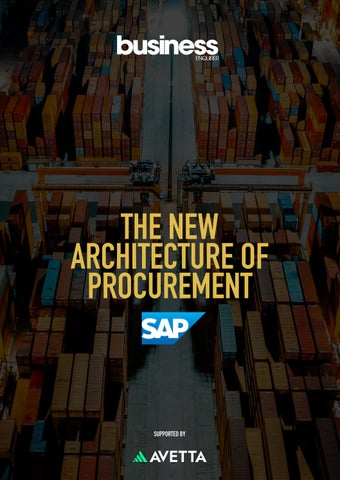

THE NEW ARCHITECTURE OF PROCUREMENT
THE NEW ARCHITECTURE OF PROCUREMENT


TPROJECT DIRECTED BY: JAMIE
WAITE
here is a moment in every transformation cycle where ambition gives way to accountability. By the end of 2025, procurement had reached that point. The language of strategy had largely been exhausted. What remained was execution, and more specifically, whether organisations could translate digital intent into systems that genuinely perform under pressure.
Across global markets, and particularly in regions moving with the urgency of national transformation agendas such as Saudi Arabia’s Vision 2030, procurement has become a proving ground. Not for technology in isolation, but for how effectively organisations can orchestrate data, decisions and relationships at scale. The question is no longer what platforms are capable of. It is whether they are connected, intelligent and responsive enough to operate in environments where complexity is the default.
SAP’s continued investment in sovereign infrastructure and unified procurement
architecture has already set a clear direction. By bringing applications, data and AI into a single operating environment, it has addressed one of the most persistent challenges in enterprise technology: fragmentation. Procurement, once distributed across disconnected tools and siloed datasets, is being reassembled into something more cohesive. Finance, supply chain, compliance and risk are no longer adjacent functions. They are part of the same conversation.
That shift matters because the pressures on procurement have fundamentally changed. Workloads continue to increase while budgets and headcount remain constrained. Expectations, however, have expanded. Procurement teams are now responsible not only for cost and efficiency, but for resilience, regulatory compliance, ESG performance and supplier accountability. The function has moved closer to the centre of organisational strategy, and with that comes a different standard of performance.



Yet even the most advanced platforms reveal a limitation when operating in isolation. Procurement does not exist within the boundaries of the enterprise. Its effectiveness is shaped by the quality, reliability and transparency of the supplier networks that sit beyond it. Historically, that external layer has been the least visible and the least integrated. Supplier qualification, compliance checks and risk assessments have often been managed through fragmented processes that introduce delay and uncertainty into what should be a continuous flow.
The consequence is not always immediately visible, but it is structural. Decisions are made on incomplete information. Risks are identified too late. Growth is constrained by the inability to scale supplier networks with confidence. In a global environment defined by disruption, that gap becomes harder to ignore.
What is emerging now is a more mature understanding of what connected procurement actually requires. Integration is no longer about linking systems at
a surface level. It is about embedding intelligence directly into workflows so that insight and action are inseparable. Procurement teams should not need to step outside their core environment to understand supplier risk or verify compliance. That context should exist within the decision itself.
This is where the strength of ecosystem thinking becomes evident. SAP’s platform strategy has increasingly moved towards enabling deeper collaboration with specialist providers that extend the reach of its core capabilities. The result is not a dilution of control, but an expansion of visibility. External intelligence can be brought into the same environment as transactional processes, creating a more complete and accurate view of the supply chain.
Within this evolving model, supplier risk and compliance intelligence have taken on a more central role. Organisations are placing greater emphasis on verified data, continuous monitoring and the ability to act on real time insights. This is where partners such as Avetta become increasingly relevant within the SAP ecosystem.
“The language of strategy has largely been exhausted. What remains is execution.”
EMBEDDING INTELLIGENCE INTO PROCUREMENT: THE SAP AND AVETTA PARTNERSHIP
STRATEGIC PARTNERSHIP
AQHow did the relationship between Avetta and SAP first develop, and why is it strategically important today?
The partnership between Avetta and SAP developed organically within SAP’s wider partner ecosystem, driven largely by mutual clients seeking deeper integration between procurement systems and supplier risk management.
As organisations increasingly relied on SAP platforms such as SAP Ariba, there was a clear demand to embed supplier compliance and risk intelligence directly into procurement workflows. This led to a formal integration between Avetta and SAP, enabling real-time visibility of supplier risk and compliance data within SAP environments.
Strategically, this partnership addresses a fundamental challenge in procurement. It allows organisations to move from managing suppliers through separate
AQTECHNOLOGY IMPACT
SAP is globally recognised for its enterprise platforms. How does Avetta leverage this environment to deliver measurable value?
Avetta enhances SAP’s procurement capabilities by embedding verified supplier data directly into core workflows. This removes the need for external checks, manual validation or disconnected systems.
Through this integration, organisations can automate supplier onboarding and qualification, continuously monitor risk, and maintain synchronised data across systems. Compliance, safety and ESG metrics are no longer static reports but live inputs into procurement decisions.
The impact is both operational and strategic. Teams reduce administrative effort while gaining a clearer, real-time view of supplier performance and exposure. At the same time, organisations benefit from improved reporting accuracy and stronger alignment with regulatory and sustainability requirements.



AQCLIENT BENEFITS
From a client perspective, what are the key advantages of using Avetta alongside SAP technologies?
QThe primary advantage lies in combining SAP’s transactional strength with Avetta’s risk and compliance intelligence within a single, connected environment.
Supplier onboarding, qualification and monitoring take place within the same workflow, significantly reducing friction and eliminating duplication. Processes that once took weeks can often be completed in a matter of days.
Beyond efficiency, the integration enables a more proactive approach to risk. Procurement teams gain access to real-time supplier data, including compliance status, safety records and risk indicators, allowing them to identify and address potential issues before they impact operations.
There are also clear gains in cost and scalability. Automation reduces administrative workload and allows teams to manage larger supplier bases without increasing headcount. At the same time, access to verified supplier data strengthens transparency, supports ESG reporting and improves audit readiness.
Taken together, these benefits enable organisations to operate faster, with greater confidence and far more visibility across their supply chain.

FUTURE VISION
How do you see the partnership evolving as organisations prioritise resilience and digital ecosystems?
AThe focus is shifting from supplier management to supplier intelligence.
As supply chains become more complex and exposed to external disruption, organisations need the ability to understand and anticipate risk at scale. The evolution of the Avetta and SAP partnership reflects this need, with a growing emphasis on real-time, decision-ready insight embedded directly into procurement processes.
Avetta’s global supplier network, combined with continuous data validation and monitoring, provides a dynamic layer of intelligence within SAP environments. This allows organisations to move beyond compliance and towards a more predictive, insight-driven model of procurement.
ENTERPRISE SCALE
How does the collaboration support organisations operating at global scale?
ADVICE FOR BUSINESSES
AQQ A
Scaling supplier networks introduces complexity, particularly when operating across multiple geographies, regulatory environments and risk profiles.
The integration between Avetta and SAP addresses this by embedding consistent standards of compliance and risk management directly into procurement workflows. Organisations gain real-time visibility across their entire supplier base, regardless of location, while maintaining control and consistency.
This enables faster onboarding, improved compliance oversight and a more proactive approach to managing supplier risk. Importantly, it allows organisations to scale their operations without introducing additional friction or exposure, turning supplier management into a connected, enterprise-wide capability.
What advice would you give to organisations earlier in their digital supply chain journey?
The most effective approach is to ensure that risk and compliance are built into procurement processes from the outset, rather than added later.
By integrating platforms such as SAP with solutions like Avetta, organisations can embed verified supplier data directly into sourcing and procurement workflows. This makes risk management part of everyday operations, not a separate exercise.
Access to a global, continuously monitored supplier network also accelerates onboarding and reduces exposure to high-risk suppliers. More broadly, it provides a foundation for building a supply chain that is not only efficient, but resilient and scalable.
Organisations that take this integrated approach early are better positioned to adapt, grow and respond to the increasing demands placed on procurement in today’s environment.
www.avetta.com


By integrating directly with SAP procurement environments, Avetta extends visibility beyond the enterprise and into the supply chain itself. Supplier onboarding, qualification and monitoring are no longer handled as separate, manual processes but become part of a connected workflow. Verified supplier data, including compliance, safety and ESG indicators, is surfaced in real time within the same systems where procurement decisions are made.
For procurement teams, the operational impact is immediate. Onboarding timelines compress from weeks to days. Administrative burden is reduced through automation and the removal of duplicate data entry. More importantly, decision making is strengthened. Instead of relying on static or self-reported information, organisations gain access to continuously updated, validated data that reflects actual supplier performance and risk exposure.
This becomes particularly critical in the context of regulatory scrutiny and ESG accountability. Integrated supplier intelligence supports stronger reporting, improved audit readiness and a more transparent approach to compliance across jurisdictions. It allows organisations to move beyond reactive governance and towards a model where risk is actively managed within day-to-day operations.
The broader implication is one of scale without compromise.
As organisations expand globally, the complexity of their supplier networks increases significantly. Managing that complexity requires both consistency and visibility. The combination of SAP’s unified platform and Avetta’s connected supplier network enables organisations to apply standardised risk and compliance frameworks across geographies while remaining responsive to local requirements. Procurement teams can manage larger and more diverse supplier bases without increasing overhead or exposure.
There is also a more structural benefit. Greater transparency and streamlined onboarding processes make it easier for a wider range of suppliers to participate. Smaller and emerging businesses, often excluded by administrative barriers, can be integrated more efficiently while still meeting the required standards. In this sense, connected procurement supports not only control, but resilience and inclusion across the supply chain.
The trajectory is clear. Procurement is moving towards an operating model defined by integration, intelligence and adaptability. Platforms provide the foundation, but it is the way those platforms interact with a wider ecosystem that determines their effectiveness. The distinction between internal systems and external networks is becoming less relevant. What matters is the continuity of information and the speed at which it can be translated into action.
SAP’s role in this evolution is both structural and strategic. Its investment in sovereign, AI enabled infrastructure aligns closely with the demands of markets that require both control and connectivity. Around that core, a network of partners is adding depth and specialisation. Within that ecosystem, Avetta represents a clear example of how embedded supplier intelligence is enhancing procurement’s ability to operate with confidence at scale.
For procurement leaders, the message is measured but unmistakable. The next phase of transformation will not be defined by individual technologies, but by how effectively they are brought together. Execution now depends on cohesion. Systems must operate as part of a unified whole, where data flows seamlessly and decisions are informed by a complete view of the landscape.
In that sense, procurement is no longer simply evolving. It is being re-architected.


“The question is no longer what platforms are capable of, but whether they are connected, intelligent and responsive.”
www.sap.com