businessday market monitor FMDQ Close Benchmark NTB* & CP*
NSE Biggest Gainer N44.05
Foreign Reserve $34.5bn
Biggest Loser
9.99pc N13.4 39,085.78
Cross Rates
GBP-$:1.37 YUANY - 58.31
-9.70 pc
+3.61 Gold
Cocoa
US$ 2,420.00 $ 1,730.43
news you can trust ** thursday 25 march 2021 I vol. 19, no 785
$62.76
I
Buy
Sell
$-N 475.00 485.00 £-N 667.00 675.00 €-N 569.00 576.00
Crude Oil
N300
Foreign Exchange
Market
₦37,507,318.80
Commodities
mrs
stanbic
BDC Exchange Rate
Bitcoin
g
ntb
Total Nigeria plc CP (Series 1)
Spot ($/N) 16-Sep-21 22-Jun-21
I&E FX Window 408.75 CBN Official Rate as at March 23, 2021
379.00
A
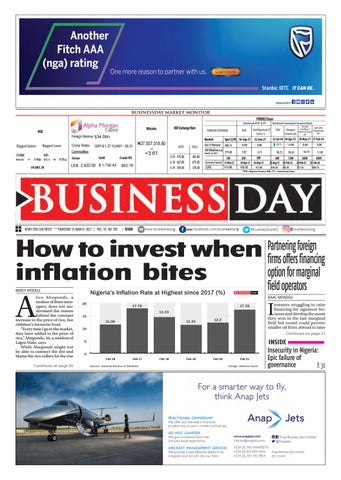
lice Abegunde, a mother of three teenagers, does not understand the reason behind the constant increase in the price of rice, her children’s favourite food. “Every time I go to the market, they have added to the price of rice,” Abegunde, 44, a resident of Lagos State, says. While Abegunde might not be able to connect the dot and blame the rice sellers for the rise
0.00
0.00
0.00
3.87
4.11
10.72
10.61
10.79
12.88
Continues on page 30
426.58
435.58
511.54
@
605.76
g
Partnering foreign firms offers financing option for marginal field operators ISAAC ANYAOGU
14.33 11.31
60m 6m 36m 12m 25-Aug-21 23-Feb-22 28-Feb-24 25- Feb-26
g
www.
17.33
11.38
23-Jul-30 30-Apr-25 20-May-27 27-Feb-34
*NTB - Nigerian Treasury Bills; *CP - Commercial Paper
17.78
15
Axxela Nsp-spv Funding 1 (Natural Gas) PowerCorp plc plc
0.13
Nigeria’s Inflation Rate at Highest since 2017 (%) 20
Dangote Cement plc
0.00
How to invest when inflation bites Mercy Ayodele
FGN
0.00
3m 2m 28-Apr-21 26-May-21 420.58 422.08
1m Currency Futures 31-Mar-21 ($/N) 419.08
Benchmark Sovereign & Corporate Bonds
12.2
10
I
nvestors struggling to raise financing for signature bonuses and develop the assets they won in the last marginal field bid round could partner smaller oil firms abroad to raise Continues on page 31
Inside
5 0 Feb 16
Feb 17
Source: National Bureau of Statistics
Feb 18
Feb 19
Feb 20
Feb 21 Design: Aderemi Ayeni
Insecurity in Nigeria: Epic failure of governance P. 30
2
Thursday 25 March 2021
BUSINESS DAY
www.businessday.ng
https://www.facebook.com/businessdayng
@Businessdayng
Thursday 25 March 2021
BUSINESS DAY
www.businessday.ng
https://www.facebook.com/businessdayng
@Businessdayng
3
4
Thursday 25 March 2021
BUSINESS DAY
www.businessday.ng
https://www.facebook.com/businessdayng
@Businessdayng
6
Thursday 25 March 2021
BUSINESS DAY
NEWS
Afreximbank, NEXIM to boost Nigeria’s trade export with $50m Chika Otuchikere, Abuja
T
he African Export-Import Bank (Afreximbank) and Nigeria Export-Import Bank (NEXIM) have signed a Memorandum of Understanding (MoU) to establish a Joint Project Preparation Fund for Nigeria’s export trade. The MoU targets $50 million which will provide early project preparation financing and technical support services to public and private sector entities trading in Nigeria. According to the terms of the MoU signed on February 20, 2021, Afreximbank and NEXIM will partner through the Joint Project Preparation Fund to unlock investments into sectors such as export manufacturing, agroprocessing, solid minerals development and beneficiation services, healthcare, information and communications technology, and creative industries. The Afreximbank which
released a statement on the partnership said the Joint Project Preparation Fund will support public and private sector investors by providing technical and financial support services that will result in a steady pipeline of wellstructured, bankable projects that Afreximbank, NEXIM and other financial institutions can readily finance. The Fund will assist the early development process of projects from concept stage to bankability by covering the preparation of feasibility studies, project development and advisory services and related costs. President of Afreximbank, Benedict Oramah said: “The execution of this MoU marks yet another significant milestone in our collaboration with NEXIM. I am particularly pleased that Afreximbank and NEXIM are boldly venturing upstream to help investors develop wellstructured projects that meet market standards. This intervention is timely as the Fund will play a catalytic role in accelerating the diversification of the Nigerian economy
www.businessday.ng
by ensuring a steady flow of bankable projects in priority tradable sectors in a timely manner. “In addition to enhancing bankability, the Fund will, on a case-by-case basis, undertake feasibility studies to assess the viability of accessing markets in the subregion, thereby promoting intra-African trade under the AfCFTA. We are pleased to be replicating a similar initiative we pioneered in Malawi in partnership with Malawi Export Development Fund (EDF) and look forward to more opportunities across the continent.” Managing director of NEXIM, Abubakar Abba Bello, said: “We are quite pleased by this opportunity to, once again, partner with Afreximbank in proffering a solution to one of the major challenges that have limited the flow of credit to the Nigerian export sector. The Fund is designed to mitigate the project selection challenges, particularly among the SMEs towards boosting their contribution to formal exports,” Bello said.
https://www.facebook.com/businessdayng
@Businessdayng
Thursday 25 March 2021
BUSINESS DAY
Mass abduction threatens girl-child education in Nigeria - experts Godsgift Onyedinefu, Abuja
T
he continued abductions of school children in Northern Nigeria could erode gains made to keep girls in school and force many more children to the streets leaving them vulnerable to societal ills, experts have said. At least 800 school children have been abducted by armed bandits since December 2020. The consequence of this is already being felt in the region as several schools have been shut down and parents are wary of sending their children back to school due to fear. While the North already occupies an unenviable position hosting the highest number of out-of-school children in Nigeria, data from the United Nation’s Children Fund (UNICEF) shows that over 5.3 million students in the region have had their education disrupted due to attacks
on schools. According to UNICEF, almost 13.2 million out-of school children in Nigeria also reside in the North. “This new unfortunate trend will no doubt compound education woes in the north which is already educationally disadvantaged, with schools for girls being the hardest hit, girl-child education in that region is under serious threat”, Anyalewechi Princewill, a retired director at the Federal Ministry of Education told BusinessDay. “Remember that core Northerners with strong traditional and religious beliefs do not value Western education in the first place, and in such societies, there are already roles mapped out for the girl-child other than education. These abductions are another point for them to keep their wards away from formal learning. “With this trend, the incidence of child marriage, out of school children, drug abuse, criminality and other social ills will worsen in the region
except urgent and deliberate measures are taken to improve security in the region”, he said. Despite advocacies to promote girl-child education by government and non-governmental organisations, records from UNESCO also show that southern states record 53 percent and 80 percent literacy, northern states record 14 percent to 48 percent literacy. At the zonal level by gender shows female literacy shows an abysmal 29 percent and 49.6 percent in the northern zones compared to an average 80 percent in the South. Experts are worried that insecurity and attack on schools in the North will worsen the statistics. “These incidences of mass abduction will directly impact on the girls themselves, who would have psycho-social needs. It means that they will resort to other means of survival, that means early marriage, so from a situation they were thriving and developing in a school, which gave them a clear direction to be able to as-
pire, to not having anything at all, they are the innocent victims of extortion of the worst kind”, UNICEF representative in Nigeria, Peter Hawkins had said. He noted that it is very difficult to advise parents of any child regarding schooling or security or insecurity, as it is a very personal decision. Experts have also raised concerns that these new attacks on schools will not only undermine efforts to keep girls in school, it will overall deepen illiteracy in the region. The trend also paints a grim picture for the regions development and could retard national development. “Illiteracy feeds poverty, poverty feeds insecurity. It is a vicious circle; the more children fall out of school, the more they become a ready pool for nonstate actors to recruit into terrorism and banditry and the circle continues. It will also deepen development gap between the North and South” an education analyst who spoke on the condition of anonymity said.
7
news
PPP vital for infrastructure development in Nigeria – Zubairu Gbemi Faminu
P
resident and CEO of the Africa Finance Corporation (AFC), Samaila Zubairu has public private partnership was a vital tool in achieving Nigeria’s infrastructure development goal. He stated this during a webinar hosted by Atlantic Council and the US-Nigeria Council, themed “Investing in infrastructure for economic recovery in Nigeria: the launch of InfraCorp” held on Tuesday. Infrastructure Corporation of Nigeria (InfraCorp) is an initiative that aims to develop Nigeria’s infrastructure for post- COVID economic recovery by raising not less than N15 trillion ($36.7 billion) from global and local investors. The project is being handled by the Central Bank of Nigeria (CBN), the Nigeria Sovereign Investment Authority (NSIA) and AFC. Speaking at the webinar, Zubairu said that infrastructure was essential in achieving economic recovery, adding that Nigeria’s infrastructure deficit requires annual investment of $13 billion to fix it. This, he noted, cannot be handled by the government alone, adding that they will provide policies and frameworks like the InfraCorp while the private sector can invest substantial funds. “Looking at investment efficiency in Nigeria, you see the need to encourage private sector participation, the idea behind InfraCorp is to figure how private sector capital can be mobilized to close the infrastructure deficit gap,” Zubairu said. Speaking on the InfraCorp, he said the project was aimed at improving the country’s infrastructure, focusing on
energy, transport and logistics, digital infrastructure and communication and other sectors of the economy that can drive investments and induce economic growth in Nigeria. He also mentioned that the committee setup to oversee the affairs of InfraCorp was working on providing policies and conditions that will attract local and global long term investors. Speaking on perceived risk of the initiative, Emmanuel Ukeje, the special adviser to the CBN governor on financial markets, said the InfraCorp was based in Nigeria and the financing arrangements available in naira and dollars. He said as a new entity, beyond the major handlers of the project, InfraCorp would be run by experts across relevant fields like asset managers, fund managers, project managers and developers, etc. According to him, the presence of all these experts was to effectively recognise and mitigate possible risk in order to encourage potential investors. He added that Nigeria’s high infrastructure deficit gap would, however, ensure impressive returns on investments. Uche Orji, managing director/CEO of the NSIA said investment returns were a function of investment type, adding that investors would make their choices based on balanced elements. He observed that investors may be sceptical, but transparency, accountability and good governance would help to establish investor’s confidence. Orji said processes were ongoing to select the best hands to handle the project. He added that KPMG has been selected as a transaction adviser with applications still on for other participants.
Eventful appoints new CEO as founder steps down Abba Bello, managing director/chief executive, NEXIM Bank, with Stella Okotete, executive director of business development, at the maiden loading of a chartered 7,000 Metric Tons Capacity Vessel by a NEXIM funded project, Starlink Global and Ideal Limited at Calabar Port in response to the traffic gridlock at Apapa port. NAN
TB kills over 162,000 Nigerians annually
T
he Nigerian Thoracic Society (NTS) has revealed that tuberculosis kills over 162, 000 people in the country annually. President of the society, Prince Ele who disclosed this in a statement issued to newsmen in Uyo, on Wednesday, added that no fewer than 430, 000 people also fall ill with the disease in the country. He said that Tuberculosis remained the world’s deadliest infectious killer and global efforts to combat the disease had saved millions of lives in Nigeria and globally since the year 2000. Ele lamented that in spite of strong commitments made by world leaders, all efforts
to end the disease had been overtaken as countries grappled with COVID-19 pandemic. He said that the theme of World TB Day 2021, “The Clock is ticking” was quite apt, considering the current global health and economic challenges. The NTS president urged government at all levels in the country and other world leaders to ensure that TB received the necessary attention as the world’s number one infectious killer disease. “We in the Nigerian Thoracic Society are not oblivious of the current challenges our health authorities are contending with due to COVID-19.” www.businessday.ng
FG to establish micro enterprises in 774 LGAs Gift Wada, Abuja
M
inister of Special Duties and Inter Governmental Affairs, George Akume, on Wednesday, said that micro enterprises will be established in the 774 Local Government Areas (LGAs) of the country. The minister disclosed this in Abuja at the Association of Local Governments of Nigeria (ALGON) General Assembly with the theme: Strategic Positioning for the Future: A New Era. “As a ministry, we have proposed the establishment of Micro, Small and Medium enterprises in the 774 lo-
cal governments in Nigeria based on economic corridors. “We believe that this will create jobs and ensure improvement in the wellbeing of the local populace,’’ Akume said. The minister, who was represented by Simon Tyungu, deputy director, office of the minister, said that the establishment of the micro enterprise was conceived to cushion the effect of the current economic situation. Akume also applauded the role played by ALGON during COVID-19 pandemic in bringing stimulus to the people at the grassroots in spite of their limited resources.
https://www.facebook.com/businessdayng
FRANK ELEANYA
E
ventful Limited, a pioneering event management company in Nigeria, is stepping into a new era of leadership as the founder Yewande Zaccheaus steps down after 19 years of leading the company. Zaccheaus is handing over to Fisayo Beecroft who has been with the company since 2011 and will now lead as the managing director/CEO. Founded in 2002, Eventful has continued to provide consultative high-touch services, assisting clients with venue sourcing, event management, incentive rewards, and luxury incentive experiences. “She has raised the bar on event management in Nigeria,” Babajide Sanwolu, governor of Lagos State, said of the founder of Eventful. The governor was speaking at an event tagged The Evolution, organised by Eventful to @Businessdayng
formally commemorate the handover of the leadership and the unveiling of a new book ‘An Eventful Life’. “I can confidently attest that professionalism is the foundation on which the company is built,” the governor who was the special guest of honour, said. Olugbenga Oyebode, cofounder of Aluko & Oyebode, who was the keynote speaker, noted that every successful company always has a succession plan. This is the only way to make the business sustainable and ensure that when the owner is not there, everything continues to work efficiently. “Legacy and institution building is why we plan for succession,” Oyebode said. Beecroft, the new MD, said being in the position was a responsibility to continue to maintain the high trust clients have placed on the Eventful brand.
8
Thursday 25 March 2021
BUSINESS DAY
www.businessday.ng
https://www.facebook.com/businessdayng
@Businessdayng
Thursday 25 March 2021
BUSINESS DAY
COMMENT
9
comment is free
Send 800word comments to comment@businessday.ng
The new normal and rise of gig economic platforms in Africa ADEDEJI OLOWE & OLUWATOYIN ASHIPA
W
ould you like to be a taxi driver? You know, using your vehicle to transport people around town and get paid? Many people would say no, preferring to work in full-time employment where career progression is possible. Today, there are thousands of educated Nigerians, including some with regular day jobs, working as on-demand drivers on platforms like Uber and Bolt. Some people have even quipped that driving for these platforms pays better than their day jobs. Ride-hailing platforms such as Uber and Bolt are the poster child of the gig economy—a catch-all term used to describe online marketplaces that have emerged over the last decade for shortterm and freelance work. These marketplaces typically focus on niche services such as transportation, food delivery, content writing, music production, graphics design or programming. These fully digital marketplaces try to create a market by matching people who need a service/ product (the buyer) with service providers/independent workers (the seller) who can provide these services on request; meanwhile, the platform handles everything from payments to ratings for the buyer and seller. A report by Staffing Industry Analysts (SIA) estimates that the global gig was worth $4.5 trillion in 2018, with the US unsurprisingly being the largest market with 53 million gig workers and total gig spending of $1.3 trillion. Across Africa, the gig economy platforms take different forms. For example,
there are Kobo360 and Lori Systems, two companies that have each raised at least $37 million to connect people with third-party truck drivers on-demand. Lori Systems estimates that the African haulage market is worth $180 billion annually. There’s also SweepSouth, which has raised $6 million from investors, and Eden Life, which provides on-demand home cleaning services, among many other things, in South Africa and Nigeria, respectively. But there are also other platforms for professional services like accounting, graphics design, programming, content writing, among others. One notable name is Andela, the Mark Zuckerberg-funded company valued at $700 million in 2019. Although it has tweaked its model significantly, Andela connects experienced African developer talent to international companies with salary opportunities above the local market rates. There are other platforms connecting skilled workers to international clients, including Toptal, UpWork, Paydesk and Fiverr, an $8.6 billion company listed on the New York Stock Exchange (NYSE) in 2019. Buoyed by these platforms, the number of gig workers in Africa has increased over the last few years. For unemployed skilled workers, freelancing is a crucial way to earn a living on the internet. Freelancing has become a vital side hustle with clients springing forth from developed countries and willing to pay in FX for professional services. However, with the outbreak of the pandemic in early 2020 and COVID-19 control measures, the global economy tumbled. The lockdowns, particularly full lockdowns, grounded mobility and forced many people to isolate themselves at home. Business temporarily shut down physical operations, and
employees started working from home. But not every job can be done from home, and that’s definitely the case for many gig workers offering ride-hailing services. Ride-hailing suffered as ride orders plummeted globally, affecting the earning power of many gig workers. For instance, in the second quarter of 2020, Uber’s gross booking volume declined by 35% compared to the previous year. Other platforms such as Kobo360 and Lori Systems worried about the impact of government lockdowns, with Kobo360 warning that 3,000 of its truck drivers in Nigeria stopped working until they got clarity on the mobility restrictions. In African countries such as Nigeria, Egypt, South Africa and Kenya, Uber and Bolt swiftly introduced logistics services—which were classified as essential services by the government—to keep these companies and their drivers in the business. But this was not enough. And because gig workers are not employees, they are not eligible for steady salary payments, paid leave, insurance and health benefits. The experience was scary for many, with several news reports early in the pandemic proclaiming the gig economy was dead. But they were wrong. The gig economy is more alive than ever. While Uber and Bolt suffered declines in the first half of 2020, ride orders soared again in the second half, and Uber could return to pre-pandemic growth levels by the first half of 2021. Logistics services such as Eden Life, OyaNow, Gokada and Jumia Food have recorded impressive growth since March 2020 as the food delivery industry reorganised amid the lockdown and gained traction in the months that followed. Outside food delivery, the number of independent riders working as logistics
‘
Freelancing has become a vital side hustle with clients springing forth from developed countries and willing to pay in FX for professional services
providers for other businesses, including Jumia, the pan-African retailer, is reportedly growing. At one point in mid-2020, the Nigerian government threatened to enforce stricter logistics regulations because the number of operators had increased within a short period. A crucial part of the resilience of the gig economy, particularly platforms and providers of physical services, is they are highly essential. When Kobo360 warned of disruptions to its truck activities, it predicted that supermarkets and major stores could run out of food items, medical supplies and other critical items within seven days. That warning was instructive, and within a few days, the government clarified the exemption for essential service workers to include truck drivers moving in and out of a state. Food delivery and other logistics operators have also benefited from their essential status, which has kept them in business. For venture builders and investors, the goal now is to identify startups and local platforms that are enabling this on the continent and support them. Because like it or not, Africa is the future. Its young population of digital natives represent an essential chance to leapfrog many of the continent’s challenges using creatively and using technology. While as a start-up, it is critical to make the right connections with a venture builder that not only provides the needed finance to grow your business but also guarantees a commitment to your success within the African business terrain and beyond.
Adedeji Olowe and Oluwatoyin Asipa work for Trium Networks, a venture capital firm with a focus on Africa startups.
Security situation in the southeast: The days we feared are here
W
e must accept emergent realities, the days we feared and warned about have come to the southeast. Years and years of marginalization (both real and imagined), a cap-in-hand and self-serving political leadership, nonchalant business, academic and even religious elite, episodes of ‘Python Dance,’ plus other ancillary military/ police operations, high youth unemployment rate and other factors gave birth to this pandemic of gun violence that is now upon the southeast. From Orlu to Nkpologwu, people, in Nigeria’s usual cloud of denialism, often referred to as “unknown gunmen” are on a spree. Killing police, military and naval resources, attacking police stations, police checkpoints, Nigeria Correctional Service convoys, etcetera. It should be clear by now, we are witnessing an aggressive social re-engineering campaign. These “unknown gunmen” are seeking to obtain the monopoly of violence or at least become a dominant force in the southeast. No thanks to President Muhammadu Buhari’s visibly biased handling of Fulani terrorism and southeast governors’ halting response to it, the activities of these “unknown gunmen,” for now, enjoy the sympathy of, or at least evokes little to no condemnation from, many south easterners. That a people hitherto known for their belief in the sacredness of life now excuse reprehensible acts like these goes on to show how badly Nigeria has damaged itself in the eyes of many. Gbadebo Rhodes-Vivour is right; “Nigeria waits for a problem to fester, then when the people react with violence, it now rewards them. And this sends a wrong message that it’s only when you get violent that the government listens to you.” The southeast, through these “unknown
gunmen” and other armed groups their activities will inspire, may be a late comer to this armsagainst-the-state game, but it will bring with it all the innovation, ingenuity and business acumen the region is known for. Those who are worried about commercialization of violence in the north should wait till this thing we collectively ordered from Jumia fully arrives in the southeast. But the issues are more nuanced and more explosive than that. As it is today, Nigeria has substantially lost and continues to lose critical elements of statehood. It is sad that current leadership neither has the motivation nor the depth required to address these issues. Times ahead will be interesting. Businesses down here should start empanelling ideas to survive this coming winter. Nkwo Nnewi and Ngbuka Obosi, for instance, should consider moving their spare parts businesses online to prepare for a time customers may be afraid or even find it practically impossible to physically shop from them. Members of the attentive public have taken what lawyers call “judicial notice” of southeast governors’ reactions to these security challenges. In Anambra, Gov. Willie Obiano’s address last Sunday was surprisingly magisterial. The governor substantially acknowledged all reported crimes - the killing of Police and Naval resources, attack on a Nigeria Correctional Service convoy, foiled attempt at razing a police station, kidnapping and indeed worrisome suspected herdsmen terrorism in some parts of Awka North, Ayamelum, and that stretch of Anambra peripheries. Obiano reassured Anambra residents of the steps his government is taking to reclaim charge.
www.businessday.ng
Nothing we already know about Obiano in the seven years he has governed Anambra state inspires optimism about the actions that will follow his beautiful speech. The state sounded as if it had a containment plan. Even if it does, the fear is that this ship has sailed far beyond what is seen on the surface. If the government is of the impression, as suggested, that a “police action” of just a few weeks will wipe off these “unknown gunmen,” they may have learnt nothing from 1967 and the intervening years. Government, both federal and state, but essentially the former, should be weary of highsounding military analysis and PowerPoint presentations that recommend an all-out military offensive. Nigeria tried it with Boko Haram at its embryonic stage. The catastrophic failure of that poorly-considered idea should inform today’s policymakers. Already there are reports of sporadic shooting into the air, and hassling of young people around Onitsha, Obosi and many parts of the southeast by security operatives in “retaliation” or in protest of their slain comrades. I sympathize with these soldiers. The bond they form with their colleagues, especially during highoctane training and missions is difficult to erase. But military commanders must not allow emotions of their “boys,” who may not have a full appreciation of what the issues are, to run afoul of the overall strategic goal. Public policy consultancy doesn’t come cheap. But this advice is freely offered because of the collective good that accrues when government’s actions are informed by wise counsel. To take out these “unknown gunmen,” the government must first neutralize their ideo-
https://www.facebook.com/businessdayng
CHIMA CHRISTIAN logical knockout punch. Southeasterners, and indeed many other Nigerians, are alarmed at the atrocious incursions of terrorists masquerading as herdsmen. The Buhari-led government’s condonation and seeming encouragement of their crimes gives rise to widespread speculations of a grand subjugation plan. Whether or not this plan exists is not the focus of this intervention. One thing is sure, southeasterners will never accept that imagined future or even the faintest idea of it. That these “unknown gunmen” enjoy significant public support despite their reprehensible acts, and the danger such acts pose to the society, is a testimony to the people’s radical protest to herdsmen terrorism and its often discussed wider goal. Repeated incidents in Plateau, Benue and other such places, including the recent attempt on Gov. Ortom’s life, lend credence to this radical protest. Until the government cuts down these marauding herdsmen terrorists and totally wipes off the fear of whatever grand plan that has occupied the minds of many people, it can try but it won’t win a war against an equally violent group that has anchored its operations on running those terrorists out of the land. Chima is a public policy analyst and a good governance advocate. He writes from Awka, Anambra State
@Businessdayng
B a P b o
10
Thursday 25 March 2021
BUSINESS DAY
COMMENT
comment is free
Send 800word comments to comment@businessday.ng
The consequences of supporting a genocidal army: Lessons from Myanmar CHRISTOPHER AKOR
I
n 2017, the Myanmar military stepped up its decades-old persecution of the Rohingya Muslim minority. Described by the United Nations as “among the world’s least wanted” and “one of the world’s most persecuted minorities,” the Rohingyas Muslims in Myanmar have not only been denied the rights to free movement and of higher education by the majority Buddhist country, but they have also been denied citizenship since 1982. Using the pretext of an attack on police at border posts in the Western coastal state of Rakhine, the Burmese military went all out to cleanse the Rohingyas. A study in 2018 estimated that the military and local Buddhist nationalists killed at least 24,000 Rohingyas and tortured around 116,000 including 36,000 who were thrown into fires. The military not only burnt down whole villages but was also accused of committing rape and other forms of sexual violence against 18,000 Rohingya women and girls. By the time what many agencies of the United Nations, the International Criminal Court, human rights groups and governments described as “ethnic cleansing” and “genocide” subsided, over 750,000 Rohingyas have fled to Bangladesh with no hope of ever
returning. Meanwhile, Nyanmar’s heroine of democracy, international human rights icon, celebrated Nobel peace laureate and de facto head of state, Daw Aung San Suu Kyi, remained silent and at a time, tried to create excuses for the military. The world was not only shocked but felt terribly let down by Suu Kyi, whom they had always thought was dedicated to the protection of the human rights of all people. But like New York Times Hannah Beech said in February, there is “a feeling [in Myanmar] that the Rohingyas are ultimately foreign interlopers in the country. And that in a Buddhist majority nation, there are certain people who don’t belong. And I think that Aung San Suu Kyi, as unpalatable as it might be to say, shares those beliefs.” It is understandable to see why Aung San Suu Kyi sided with the military against the Rohingyas, even at the risk of destroying her carefully cultivated international reputation. Myanmar has been under military rule for about 50 years until 2011 when the military introduced a sort of disciplined democracy – a hybrid civilian-military system with a democratic elected government, but also a powerful military that supervises the democracy and controlling major levers of power. Aung San Suu Kyi herself has been a major victim of the military. After her father’s (a military leader too) assassination when she was just two years old, she relocated abroad, studied and married in the UK and only returned in 1988 to champion the cause of democracy. Despite her military nobility background, she was clamped into
house arrest for fifteen (15) years and never gave up until the military finally blinked in 2011. What cemented her status in Myanmar was when she chose her country over her family. The military agreed to release her to go be with her husband who was dying of cancer on one condition – that it will be a one-way ticket, but she refused. She not only became a heroine in her country, she also won the Nobel peace prize and several international human rights awards to boot and became such a charismatic figure worldwide in the mould of Nelson Mandela. But her national and international status threatened the military’s continued control of the country. In deciding to side with the military, Aung San Suu Kyi may have reasoned that a condemnation of the genocide would jeopardise Myanmar’s nascent democracy. She was also mindful of the strong anti-Rohingya sentiments in the largely Buddhist nation. In her defence of the military action at The Hague in 2019, she did not even deem it fit to mention the word Rohingya– basically denying the humanity of the persecuted. She did cement her powers and status at home but her international reputation took a severe beating – a factor that may have played into the hands of the military. The last straw for the military was the November 2020 election where Suu Kyi’s National League for Democracy won a landslide. Fearing a total loss of control and with charges of genocide and ethnic cleansing hanging over their heads, the senior leaders of the military, on February 1, 2021, declared the results of the election illegitimate
‘
The military misread the mood of the country though and underestimated the god-like stature of Aung San Suu Kyi. Protests and resistance followed
Hoping on Biden’s climate leadership
I
t is 13 years since President Biden, then a Senator, supported clean coal technologies and declined to vote on the unsuccessful Climate Security Act of 2007. What has changed the former Senator from Delaware into a global political leader on climate action is arguably the intersection of a number of factors. To my mind, he feels a need to continue in Obama’s climate legacy, as increasing compelling scientific evidence calls for a decisive climate action to be taken sooner than later. Also, there is the issue of the socioeconomic benefits and transformation that a cleaner energy transition holds for America; and ultimately, the significance of US rejoining the 2015 Paris Accord - which will put the US back at the centre stage of global climate leadership and negotiations. We remember that the US under Trump, pulled out in 2017, a move which effectively took effect on November 4, 2020. Unlike Trump’s energy plan (zero climate change policy) that enabled and promoted investments in dirty fossil fuels, Biden’s campaign position on climate promised not only to make US to lead in global climate action, but also to spearhead the effort to get every major country to ramp up their national climate targets. Upon inauguration, President Biden started to make true his promise, first by appointing and swearing in John Kerry as the Special Presidential Envoy for Climate, and appointing Gina McCarthy, a former administrator of the Environmental Protection Agency (EPA) as National Climate Advisor. Kerry and McCarthy will ensure that Biden’s climate policy fully integrates climate change into US’s foreign policy, national security strategies, as well informs
US trade policy as a climate tool. Domestically, McCarthy will lead efforts that specifically commit to: bringing the US economy to net-zero emissions as 2050 comes round, by investing over $2 Trillion to achieve a carbon free electricity sector in or around 2035. There will be further leveraging of over $5 Trillion in private sector, state and local investments. McCarthy will use Executive Actions to aggressively reduce methane emissions, enforce stricter fueleconomy standards, drive up nationwide energy efficiency standards; and initiate and implement major reforms in transportation, agriculture and housing to reduce the carbon footprint. Importantly, the policy promises to create millions of new jobs and advance social and environmental justice for all Americans, particularly fence line communities that have been disproportionately impacted by coal, oil, gas and power plant operations. Internationally, Kerry will mobilize and drive a global effort to get every major country to increase their national climate targets, with the hope that this will support most climate vulnerable populations and increase collective climate resilience. How this will be achieved in reality is still uncertain, as the US is yet to provide specific numbers for its new ambitious climate plan. Currently, this is the work that McCarthy will have to lead and agree on with other government departments and agencies and announce to the world before Biden’s big Leaders Summit on Climate Change proposed to hold on this year’s Earth Day. Already, Bill Gates has urged the US government to increase her budget for climate and clean energy research to at least $35 Billion annually. More demands from other climate environmental
www.businessday.ng
and sacked the government in a coup d’état. The military misread the mood of the country though and underestimated the god-like stature of Aung San Suu Kyi. Protests and resistance followed. And like all genocidal armies do, Myanmar’s military has turned its guns on its people. Over 70 people have already been murdered since the February 1 coup. Total Marshall Law has been declared, internet and all forms of communication have been cut and a brutal regime of suppression has been launched to enable the military hang on to power. Myanmar is “controlled by a murderous, illegal regime” that is committing “crimes against humanity”, Thomas Andrews, the United Nation’s top expert on rights in Myanmar told the UN Human Rights Council in Geneva last week. Now Burmese, both home and abroad, are desperately calling on the UN and the international community to help save them from their own genocidal military. This holds lessons for Nigerians who always support genocides against groups they do not like. Myanmar’s largely Buddhist population never liked the Rohingya Muslim minorities and were overwhelmingly supportive of the military’s attempt to cleanse the group from Myanmar. What they never knew was that a genocidal military will kill anyone standing on its way. In 1999, Victor Malu was Nigeria’s army chief and oversaw the killings and destruction of Odi in Bayelsa state. Shortly after retiring in 2001, it was the turn of his village to be subjected to the brutal genocidal guns of the army. He never recovered till he died. Massacres, killings, genocides eventually go round.
OKAFOR AKACHUKWU campaigners or groups are most likely. One thing is certain, neither the Leaders Summit on Climate Change nor the US’s ambitious climate policy and plan has the potential to make up for the 4 years of US absence from the global climate stage as Secretary Kerry has tried to portray. While US climate leadership is key to directing global climate action and influencing other countries’ climate commitments, a simple re-emergence and proposed climate plan after 4 years of abandonment, which does not lead to domestic climate action, fulfilling of national targets and international financial obligations especially to Green Climate Fund (GCF) is not enough to undo the impact of the setbacks climate diplomacy and action suffered under the Trump administration. Today, the global climate community especially the Global South is looking forward to US climate policy and plan for a shift from business as usual, which I strongly believe will lead to the following: 1. US financial contributions to GCF and other climate finance commitments restored and increased, a move that has the potential to get other countries such as Russia and Australia to recommit to funding GCF; 2. In the spirit of supporting most vulnerable populations and increasing collective climate resilience just as President Biden envisions, the US may attune to ensure that the demands of the Global South, particularly African countries’ demands to borrow at reduced interest rates, and for the utilization of Africa’s unused special drawing rights (SDRs) to finance climate infrastructural projects are met; 3. The commitment and work of US development agencies such as United States
https://www.facebook.com/businessdayng
Agency for International Development (USAID), United States Africa Development Foundation (USADF) toward building more clean energy, socially, environmentally sustainable, just and climate resilient centered programmes will be increased; 4. Opportunities for learning, knowledge development and capacity building between the US and Global South institutions particularly collaborations on clean energy and climate research and innovation will likely be increased; and, 5. Approaches that the US may utilize in solving social, environmental challenges and injustices that exist in age long fossil fuel exploiting and processing communities may become useful for other countries that would be affected by the global energy transition. While these sound obvious and easily achievable, they may be out of the reach of the Global South if they fail to engage correctly, articulate our demands well, negotiate well, sustain our interests and commit to fulfilling our own side of the deal. As for now, the global climate community is waiting for the US to announce its new climate ambitions and the outcome of the Leaders Summit on Climate Change ahead of the COP26 Summit later this November in Glasgow. Just like other opportunities, we hope this chance for the world to make some real progress will not be squandered.
Okafor Akachukwu is a Science Policy Research Unit (SPRU), University of Sussex trained energy, environment, climate change and sustainability expert and Principal Partner, Change Partners International. aka@changepartnersintl.com.
@Businessdayng
Thursday 25 March 2021
BUSINESS DAY
COMMENT
11
comment is free
Send 800word comments to comment@businessday.ng
Flattened curve-2, vaccines, vaccination, and conspiracy theories
IK MUO
A
lot appears to be happening on the Coro front, the cheeriest of which is that we have flattened the curve for the second time. On 21/3/21, we had only 86 fresh cases with 131 on 22/3/21, and a 7-day average of 139. One can confidently say that things are looking up, (even though literarily, the figures are looking down). However, the total number tested as at 22/3/21 was 1,727,427 and this is not up to 1% of our guesstimate-based population. This casts a pale shadow on the statistical underpinning of flattened-curve 2, as well as other discussions and decisions based on the figures. The AstraZeneca vaccination programme has commenced, with Dr Nyong, whose father had earlier died of Coro, as the first recipient. The president, who has outsourced his role as the National Incident Commander to PTF et al, has been jabbed live on TV, just like other political and public figures have. Lagos State which started the program on 15/3/21 at 88 facilities across the 20 LGAs made the record of vaccinating 12,720 people within 48 hours (including 3442 healthcare workers, 3796 frontline workers, and 260 strategic leaders) and the total for Nigeria as at last week was 122410 jabs. And then, the conspiracy theories and theorists have taken over the discourse. People have even doubted whether there was ‘anything’ in the syringe with which the physically rejuvenated PMB
was jabbed. Since the onset of ‘coronisation’ in December 2019, the public have had to contend with assorted conspiracy theories: That there was nothing like Coro, that it was a medical warfare from China, that in Nigeria, it was and is an avenue for self-enrichment and that some people created the Coro myth so as to design a vaccine for money-making. When the vaccines were developed, sceptics across the globe queried the speed with which it was made as an evidence of a hidden agenda. They wondered why there had been no vaccines for oldies like Ebola and malaria while that of Coro was developed within a twinkling of an eye. It was also argued that the vaccines would be used to alter human DNA, implant some chips so as to monitor and manipulate people and that it was a strategy to depopulate the black world. Bill gates was particularly mentioned and maligned in this regard. There were then reports of various side effects, including those who died, who got shorter or fatter or grew more gray hairs after jabbing and that the AstraZeneca vaccine caused blood clots. As I layman, I know that different people react differently to different medicines. In Nigeria, it was argued that the FG went for AstraZeneca, which is the 4th in terms of efficiency because it did not care for the peoples’ welfare. Of course, Yahaya Bello who denied the reality of Coro also made a caricature of the vaccine and vaccination. And then, some countries across the world suspended the deployment of the AstraZeneca vaccines and that gave more flip to the conspiracy theories. Many people are confused, skeptical and are reluctant to jab due to these conspiracy theories. I just got a report that at a jabbing centre in Lagos was populated by Chinese and Indian nationals, while Nigerians have continued to stay away. Machiavelli (The Prince) had argued that one of the reasons why change was
(and continues to be) the most perilous undertaking was that those who opposed the change were very vociferous in its antagonistic antics while those who favoured the change did not make much positive noise. In this case, those who are against the vaccines are engaged in propaganda, subterfuge and sociopsychic warfare while those in support are not making serious efforts to market their support of the vaccine. As for me I have already registered for the vaccination online and I will take it one of these days. One of my children has also been jabbed and I also know some close friends who have gone through the process. I also believe that the ubiquitous Whiteman will not derive any benefit from decimating the black race and that if they wanted, there are many subtle ways of doing so. After all, those who can afford it take their Medicare overseas and in any case, we depend on them for almost everything, including basic medicines. If they wanted to insert microchips, why didn’t they do it through the GSM lines or the internet? However, I have just one question for the relevant authorities: What are the plans for vaccination sustainably after we must have finished this baba-dash-me doses? How many doses of which brands have we ordered firmly (apart from the 300,000 doses from MTN) and when are the expected arrival dates? Meanwhile, the EU drug regulator, the European Medicines Agency has affirmed that AstraZeneca is safe and effective thereby agreeing with WHO and our own NAFDAC, which has also given a thumbs up for the covid-shield vaccine, licensed by AstraZeneca. Re: A festival of oddities I receive diverse feedbacks on my writings: some serious, some jocular, some brief, some long, some eulogizing, some expanding the scope of the original piece and some neither here nor there. It is therefore difficult to share these
‘ When the vaccines were developed, sceptics across the globe queried the speed with which it was made as an evidence of a hidden agenda
Dr IK Muo is of the Department of Business Administration, OOU, Ago-Iwoye
In Defence of refineries’ rehabilitation
M
ixed reactions have continued to trail the move by the federal government to rehabilitate the Port-Harcourt Refining Company (PHRC). The Federal Executive Council (FEC) recently approved the sum of $1.5 billion for the immediate rehabilitation of the Port Harcourt refinery. This followed a memo by the Minister of State for Petroleum Resources, Timipre Sylva, on its rehabilitation, which was presented to FEC and its subsequent approval on March 17, 2021. Indeed, Nigeria’s refineries have suffered years of neglect. In particular, the PHRC has experienced decline in performance over the past two decades due to delays in conducting mandatory Turn Around Maintenance (TAM). The last time a TAM was conducted on the Refinery was 21 years ago (2000)! Isn’t it time the nation’s refineries are brought back to their optimal capacities? Some critics have argued that it is more economical to build a new refinery than, “just waste $1.5 billion” to rehabilitate the PHRC, which holds 210,000bpd out of Nigeria’s 445,000bpd refining capacity. On the contrary, a cursory look at brand new refineries built across the world reveals that building a refinery of similar capacity like PHRC is estimated at over $6 billion depending on a number of technical and non-technical factors. For example, $10 billion was spent on building Aramco Oil Refinery (250,000-300,000 bpd) in Pakistan, $12 billion was spent on building Abrue Lima Project (230,000) in Brazil; while
$27 billion was spent on building Pengerang Refinery and Petrochemical Integrated Development, RAPID (300,000 b/d + 3 mtpa) naptha steam cracker) in Indonesia. In Nigeria, $19 billion has been spent so far on Dangote Refinery (650,000bpd) prior to commissioning and start-up of the plant. It is interesting to note that despite the abundance of hydrocarbon resources, Nigeria is, sadly, the only oil producer in the world that does not refine petroleum products. Instead, the country relies heavily on importation for most of its petrol needs locally. This is not a good record to be proud of. Armchair critics also come up with a shallow argument that it is better to sell off these refineries since they can no longer meet up the nation’s refining needs. Which country sells off its strategic national assets, such as the refineries, to the highest bidder? Armchair critics usually think a mere mention of TAM means another round of business as usual, where resources are drained with nothing to show for it at the end of the day. While some of these arguments are genuine, it is instructive to note that this TAM is different because it will enable the replacement of aging/obsolete equipment as well as ensure that refinery operates at a minimum of 90% capacity utilization. On the flipside, Nigerians will benefit immensely as PMS and other petroleum products will be become available locally, jobs will be created from the value chain of activities and the current strain on Forex for importation of products will reduce. In addition, interested parties who benefited from the age-long importation largesse and have fleeced the nation dry
www.businessday.ng
feedbacks, more so when some people are already advising me to shorten my writings. However, once in a while, I break my own rule by sharing some of the feedback. On my latest intervention, (a festival of oddities) which Barr MCK Ubah had described as literary therapy for reducing stress, I received a feedback from Sir Chudi Illo and here it is; ‘The Spirit at his best! Please, in the subsequent edition, kindly confirm that the Soweto School (that gave a cow-prize to the best student) was not established and run by Myetti Allah. Of course it is clear that the MassCom dept of COOU (that gave a cock and yam) is an establishment of ‘ebe-ozo ihuowelle’ (my ozo-title kindred), just as I am sure that the teachers in Niger state (who could neither read nor write) were tested in ‘dogon turenci’ instead of Arabic education in which they were trained. That was the case of wrong parameter or the falcon not hearing the falconer. You may have forgotten to mention that the First Dog belonging to the POTUS, suffered from Trumps delayed handover process and due to the delay, nobody remembered to give the first dog a proper orientation on how to live in the white house. He was not informed that dogs in the White House do not bite! So he has been taken back to Delaware (his roots) for proper orientation. As for the UBE students in Makurdi (who were sent home for spiritual attack), they attempted to unearth the snake that swallowed the missing N28m and so, the god of snakes had to fight back. May I stop here so that the Benediction does not last longer than the Mass! Well, you can compare the original with the addendum and make up your mind!
ALEXANDER ADEJOH will potentially be out of business. This is the same for critics of the President Muhammadu Buhari administration. These detractors probably forgot that this was an administration that, from its inception, made clear its intention to bring back the refineries to their optimal capacities. The Buhari Presidency also threw its full weight and support behind the NNPC to execute the project. It is worthy to note that for African ExportImport Bank (Afreximbank), which is the reliable lender for the project to have raised $1billion towards the initiative, it goes to show that the multilateral institution understands how crucial the project is. In the same vein, the federal government will raise the sum of $550 million. Clearly, a credible and capable lender like Afreximbank would never agree to put such huge amount of money where there will be no value. Also, the right governance structures have been instituted around the project implementation to ensure success. Similarly, Tecnimont SpA, the Original Refinery Builder (ORB) which is also the Engineering, Procurement, Construction, Installation and Commissioning (EPCIC) Contractor, is globally reputable and capable, with requisite experience of similar jobs across the globe. There are still a number of other genuine reasons why the current refineries rehabilitation project is different. Firstly, Project implementation governance structure includes key independent external stakeholders: Ministry of Finance, NEITI, ICRC, the two labour unions in the oil and gas industry - PENGASSAN and
https://www.facebook.com/businessdayng
NUPENG. Secondly, it involves significant replacement of key equipment within the refinery’s major units and components. Thirdly, it is funded through part-loan and part-government, with the financiers actively monitoring the execution of the project. KBR and NETCO are also acting as NNPC Engineers who will be supervising the EPC contract to ensure the project is delivered in line on schedule, within budget and at the right quality. Sylva has urged Nigerians who are opposed to the project to hold him accountable for every dollar that will be spent on rehabilitating the refinery. “They (Nigerians) can hold me accountable and hold this government accountable for every dollar, every cent on this refinery and ensure that we deliver a refinery that works,” he said. Sylva has also explained that the rehabilitation will take 18 months and the first phase will get the refinery to 90 percent operational capacity, stressing that President Muhammadu Buhari was bent on leaving a legacy including making sure that the refineries are working. “It is not going to be all debts, we are not going to borrow all the monies that are going into the rehabilitation”. Furthermore, the minister explained that the project would be in three phases, adding that the first phase was going to be within the tenure of this administration. Adejoh writes from Lokoja, Kogi State.
@Businessdayng
12
Thursday 25 March 2021
BUSINESS DAY
EDITORIAL PUBLISHER/EDITOR-IN-CHIEF
Frank Aigbogun EDITOR Tayo Fagbule
DEPUTY EDITORS Lolade Akinmurele John Osadolor, Abuja NEWS EDITOR Osa Victor Obayagbona NEWS EDITOR (Online) Chuks Oluigbo MANAGING DIRECTOR Dr. Ogho Okiti EXECUTIVE DIRECTOR, OPERATIONS Fabian Akagha GM ADVERT Ijeoma Ude GM CONFERENCES Obiora Onyeaso GM BUSINESS DEVELOPMENT (North) Bashir Ibrahim Hassan GM BUSINESS DEVELOPMENT (South) Ignatius Chukwu GM DIGITAL SUBSCRIPTION SALES Rerhe Idonije BUSINESS DEVELOPMENT MANAGER (South East, South South) Patrick Ijegbai COPY SALES MANAGER Florence Kadiri
Making a case for returned Ibori loot
M
ore often than not, Nigeria and its high profile citizens are in the news for the wrong reasons. The country is adjudged the largest economy in Africa, yet poverty stands like a colossus here, bestriding many homes, emptying their bowels and shrinking already shrivelled flesh. The reason for this is simple. The commonwealth of the country is plundered by a few in privileged positions, mostly those of the political class who have unfettered access to ‘free’ public money. Nigerians thought that they had seen the last of treasury looters after Sani Abacha, the country’s maximum ruler who looted the country blind. But they were mistaken because, as Ayi Kwei Armah, the Ghanaian novelist, puts it, ‘The Beautiful Ones Are Not Yet Born’. The treasury still groans under the heavy weight of mindless looters. James Ibori, the young power broker who ‘served’ Delta State people as governor between 1999 and 2007, is one of them. Ibori was alleged to have stolen so much from the state’s treasury. Part of his enormous loot, stashed away in UK banks, was returned recently to Nigeria by the British government. And
the loot in question is a whooping £4.2million (about N2.2 billion), comprising funds recovered from friends and family members. The returned loot, like Ibori’s 2012 conviction by a court in the United Kingdom, has elicited mixed reactions from across the country. The Federal Government claims the money belongs to it, with Abubakar Malami, Attorney General of the Federation, saying that the money will be deployed to complete the second Niger Bridge among other projects. Delta State government thinks differently, insisting that the returned loot belongs to Delta and its citizens. Many prominent lawyers and human rights activists, including Itse Sagay, Femi Falana among others think along this line. Sagay, who is the chairman, Presidential Advisory Committee Against Corruption (PACAC), noted recently that “the money is Delta State money and must be returned to Delta State. Federal Government cannot appropriate it for any reason whatsoever.” We share the popular view that this money belongs to Delta State and its people and not the Federal Government. But we have a caveat. We do not support the idea of the money being used to complete any on-going project or being handed
over directly to Delta State government. We believe that if that money was not stolen, it would have been used for the development of the state in various areas of human development. One of such areas, which we consider very critical, is education. We are, therefore, calling for the returned loot to be used to set up an independent Education Trust Fund to give local and international scholarships to brilliant Delta state students. The fund should be managed by a credible board of trustees. It should be well managed just for the purpose of the scholarship. We advise that the scholarship board should not, in anyway, be linked or controlled by the Delta State government. The Federal Government must not be allowed to take that money. We disagree with Malami’s argument that “in consonance with existing framework engaged in the management of previous recoveries, the instant repatriated funds should be deployed towards the completion of the Second Niger Bridge, Abuja-Kano expressway and the Lagos-Ibadan expressway under the coordination of the Nigeria Social Investment Authority (NSIA).” If the AGF’s “previous recoveries” refers to Abacha loot, we do not see the basis for the comparison,
because the money looted by Abacha belonged to the Federal government. So, it is just normal for the federal government to recover the money and use it without recourse to any entity. The case is different with the Ibori loot. This is because the stolen money could be any or all of the following: Internally generated revenue by the state government, money allocated to it from the federation account or part of the 13 percent derivation fund for the oil bearing states. We believe that education, by its very nature, breaks ignorance and liberates the mind. If therefore this money is deployed to educating Delta children, it will, in the long run, produce citizens who will govern the state with open mind, bearing in mind that the state contributed to their training and development. Any action other than this, taken in respect of that returned loot, will in our view be counter-productive. The completion of the second Niger Bridge is a good thing to do, but money for that purpose could come from any other source. Delta State money, which is what the returned Ibori loot is, should be used for the development of Delta people who had suffered deprivation as a result of the loot.
DIGITAL ADVERT SALES MANAGER Linda Ochugbua HEAD, HUMAN RESOURCES Adeola Obisesan
EDITORIAL ADVISORY BOARD Imo Itsueli Mohammed Hayatudeen Afolabi Oladele Vincent Maduka Opeyemi Agbaje Amina Oyagbola Bolanle Onagoruwa Fola Laoye Chuka Mordi Mezuo Nwuneli Charles Anudu Tunji Adegbesan Eyo Ekpo Wiebe Boer Paul Arinze Boye Olusanya Ayo Gbeleyi Haruna Jalo-Waziri Clement Isong Konyin Ajayi
ENQUIRIES NEWS ROOM 08164361208 08116759816 08033160837
} Abuja
ADVERTISING 01-2799110 08033225506 SUBSCRIPTIONS 01-2799101 07032496069 07054563299 DIGITAL SERVICES 08026011296 www.businessday.ng The Brook, 6 Point Road, GRA, Apapa, Lagos, Nigeria. 01-2799100 LEGAL ADVISERS The Law Union
OUR CORE VALUES
MISSION STATEMENT To be a diversified provider of superior business, financial and management intelligence across platforms accessible to our customers anywhere in the world.
BusinessDay avidly thrives on the mainstay of our core values of being The Fourth Estate, Credible, Independent, Entrepreneurial and Purpose-Driven. • The Fourth Estate: We take pride in being guarantors of liberal economic thought • Credible: We believe in the principle of being objective, fair and fact-based • Independent: Our quest for liberal economic thought means that we are independent of private and public interests. • Entrepreneurial: We constantly search for new opportunities, maintaining the highest ethical standards in all we do • Purpose-Driven: We are committed to assembling a team of highly talented and motivated people that share our vision, while treating them with respect and fairness. www.businessday.ng
www.businessday.ng
https://www.facebook.com/businessdayng
@Businessdayng
Thursday 25 March 2021
BUSINESS DAY
RESEARCH&INSIGHT A WEEKLY PUBLICATION OF BUSINESSDAY RESEARCH & INTELLIGENCE UNIT(BRIU)
13
In association with briu@businessday.ng
08098710024
How voice, internet subscriptions benefited from COVID 19 TELIAT SULE
E
conomic activities in the 36 states and FCT appear to be picking up following a noticeable growth in voice and internet subscriptions in the last twelve months. The non-pharmaceutical measures such as lockdown and social distancing implemented last year pushed some individuals and firms online. Many private organisations and government agencies implemented work at home policy. While majority have resumed to their work places, some organisations are still implementing that policy. The above development reflected in Nigeria’s voice subscriptions which increased by 10.78 percent as of December 2020 to 204.6 million active lines from 184.69 million in corresponding period in 2019. Also, internet subscriptions rose by 22.38 percent in 2020. From 126.08 million active lines as of December 2019, the demand for data services across the country pushed the nation’s internet subscriptions to 154.30 million by December 2020. Generally, the surge in active voice and internet subscriptions has been attributed to Covid 19, but looking at the state by state growth, there are different underlying factors that best explain the unique growth pattern in each state. For instance, the highest growth in voice subscriptions among the states took place in Edo State in 2020 where voice subscriptions rose by 87.7 percent. Within twelve months in that state, 3.31 million new active lines came on stream to make the total active voice subscriptions by December 2020 in that state at 7.09 million from 3.78 million in December 2019. Are we surprised by this development? Not really. The current administration in Edo State has implemented programs aimed at boosting internet usage in the state. One of such programs is the Edo Jobs which is a portal for connecting unemployed youths in the state with employers of labour. As a digital platform, only those with active voice and data services could benefit from the information released on the portal. At the end of the first term in office, Edo Jobs facilitated the placement of 156,994 unemployed youths with different organisations. If you are an unemployed in Edo State, you will look for ways to get your active voice line so that you do not miss out when employment opportunities are announced on the platform. Another factor was the election
that took place in the state last year. The electioneering period was laced with tensions, brickbats, which made social media platforms the battle fields as information that was true, untrue and outright lies inundated the social media space. And no one wanted to be left out. ‘’The government of Edo State has done so much in connecting the rural communities. Consequently, everyone is now willing to have voice and data subscriptions. Again, election was held last year, in which every eligible voter actively participated through calls, sharing messages, videos and other information ensuring that the current administration was re-elelcted”, said Ukinebo Dare, head, Edo Jobs. The Federal Capital Territory (FCT) Abuja witnessed 58 percent
www.businessday.ng
growth in voice subscription from 5.70 million as of December 2019 to 9 million in December 2020. In other words, additional 3.30 million active lines came on board in 2020 in Abuja. A likely reason for this development is the migration of Nigerians from North West and North East to the FCT following renewed onslaught on people by bandits and insurgents. Benue State recorded 50.5 percent growth in voice subscription as 1.69 million active additional lines came on stream. This could be interpreted as the gradual restoration of peace in the food basket of the federation. Delta State was in the news for good as 2.21 million lines were added to 4.7 million lines as at December 2019 to have 6.91 million active lines as at December 2020, repre-
https://www.facebook.com/businessdayng
senting an increase of 47.14 percent. Others in the top ten highest growth states included Yobe, 34.7 percent; Zamfara, 34.7 percent; Sokoto, 28.2 percent; Anambra, 24.1 percent; Gombe, 21.4 percent and Katsina, 19.9 percent. In terms of concentration of active lines, 10 Nigerian states accounted for over half of the active voice subscriptions in Nigeria. They are Lagos, Kano, Ogun, Oyo and FCT. Others are Kaduna, Rivers, Edo, Delta and Niger states in that order. Out of 204.6 million active voice subscriptions in Nigeria, the top ten states accounted for 105.7 million lines representing 52 percent of the active lines in Nigeria. By December 2019, there were 90.6 million active lines among the aforementioned states representing 49 percent of the
@Businessdayng
184.7 million active lines in the country as at that time. The states that witnessed the least growth in voice subscription are Ekiti, Enugu, Cross River, Bayelsa and Ebonyi. Interestingly, no Nigerian state recorded a negative growth rate in internet subscription in 2020. The highest growth rates were in Yobe, Sokoto and Zamfara which grew by 49.12 percent, 45.93 percent and 37.93 percent respectively whereas the least growth states in internet subscription was in Rivers, Lagos and Abia at 15.54 percent, 13.68 percent and 12.59 percent in that order. When internet subscriptions are evaluated by concentration, the top ten states which are Lagos, Kano, Ogun, Oyo, FCT, Kaduna, Rivers, Delta, Edo and Niger cumulatively had 80.3 million lines in 2020 as against 66.6 million lines in 2019. Consequently, their share of the total internet subscriptions in the country fell to 52 percent in 2020 unlike in 2019 when they controlled 53 percent of the country’s total. The all-round positive growth explained the good runs telecoms companies had in 2020. MTN Nigeria got 12 million additional active lines in 2020. Airtel Africa got 5.45 million additional lines while Globacom Nigeria got 3.14 million extra lines. MTN Nigeria topped the telecoms’ growth chart as its active lines increased to 80.76 million in 2020 up from 68.76 million in the previous year. Airtel Africa witnessed a 10.9 percent growth in 2020 with 55.64 million active lines up from 50.19 million in 2019. Globacom recorded 6.1 percent growth as its internet subscriptions rose from 51.7 million active lines in 2019 to 54.8 million lines in 2020. Additionally, MTN Nigeria’s gross revenue in 2020 increased by 15 percent to N1.34 trillion up from N1.17 trillion in 2019. But profit after tax was flat at N205.2 billion in 2020 as against N203.3 billion in 2019. While voice revenue for 2020 was at N766.4 billion, representing a 6 percent growth over N725.4 billion in 2019, the data revenue surged by 51 percent to N332.4 billion in 2020 from N219.4 billion in 2019. The company’s interconnect and roaming services also grew by 6 percent during the same period. Airtel Africa’s nine month revenue ended December 31, 2020 was up by 14 percent to $1.13 billion from $995 million in the corresponding period in 2019. Voice revenue grew by 7 percent while data revenue rose by 25 percent. Other revenue increased by 17 percent during the period.
14
Thursday 25 March 2021
BUSINESS
COMPANIES&MARKETS
How MTN is helping MSMEs scale through COVID-19 headwinds MICHAEL ANI
I
n every economy, Micro, Small and Medium Enterprises are considered as an engine of growth, creating jobs and contributing to the broad development of the economy. Back home in Nigeria, the story appears no different as MSMEs contribute about half to Nigeria’s economic activities (GDP) and employ more than 80 percent of the country’s population, according to data from the National Bureau of Statistics. Considering the massive inputs of MSMEs to the national development, it is no longer news that the outbreak of COVID-19, including the accompanied lockdown, has resulted in an unprecedented economic tailspin which has led to a decline in business activities, consumer spending, and living standards. It is based on this backdrop, MTN Nigeria commenced the Revv Programme to address the critical needs of MSMEs. To achieve a greater impact, 200 MSMEs have been selected to be a part of MTN’s first accelerator programme, Y’ello 200. In fulfilment of the core mandates of the Revv Programme, MTN Nigeria hosted Y’ello Clinic, a virtual tell-it-all session, with the company’s top executives. This allowed MSME owners to learn from industry leaders like Modupe Kadri, chief finance officer; Lynda Saint-Nwafor, chief enterprise business officer; Adekunle Adebiyi, chief sales and distribution officer; Esther Akinnukawe, chief human resource officer; Tobechukwu Okigbo, chief corporate services officer; Cyril Illok, chief risk officer; Olubayo Adekanmbi, chief transformation officer; and Ugonwa Nwoye, chief customer relations officer, as they address the crucial challenges business owners may encounter in preparation for a post-COVID era. Olubayo Adekanmbi: Empowering SMEs with data science
Olubayo Adekanmbi, a man born with a tall vision is inclined to build an AI-first society where Artificial Intelli-
gence is effectively deployed to solve local problems, particularly the sustainable development goals. For him, Nigeria’s 180 million people with a median age of about 18 years is a strategic advantage- it positions the nation as one of the top 10 AI Knowledge centres in the world, with the opportunity to raise 1 million AI talents in 10 years, equipped with globally relevant skills that can drive increased employability. He believes AI will provide a springboard for Africa’s development by enhancing how we live, work and play. Indeed, Adekanmbi has started taking giant steps to match his words with action. As the chief transformation officer of MTN Nigeria, he deploys his global experience, creativity and data science strategies in leading a team shaping the future of Africa’s biggest mobile network through the proactive introduction of specific measures to help accelerate the company’s business performance and innovations. He also sits atop as the founder of Data Science Nigeria (DSN) a social initiative to promote business transformation, through the application of data science in business, policy, investment, and community planning. His intimidating credentials in Data Science, Strategy, Marketing and Analytics across the two largest economies in Africa - Nigeria and South Africa, made him a well sought-after resource person for The Revv Programme by MTN. The programme was created to help small business owners rethink and retool their operations to enable them to withstand the impact of the COVID-19 pandemic. From working as the strategy and business director at DDB and MTN’s chief marketing and strategy officer, the University of Reading and Columbia Business Schooltrained Data Scientist rose to become the chief transformation officer of MTN Nigeria. With a passion for continuous learning, Adekanmbi also has in his bag, a PhD from City University Cass Business School in London, as well as certificates from other institutions across the world. More than 200 participants at the Revv Programme masterclass with the theme “Redefining Customer Experience Through Effective Customer Relationship Management” drew real and practical technological lessons from Ad-
ekanmbi’s accomplishment. With nearly two decades of international experience in Data Science, Adekanmbi is a powerhouse of knowledge for SMEs in search of business lessons. This is especially as the world economy is gradually finding a balance after the COVID-19 pandemic which threatened the survival of many multinationals and sent world economies into recession. At the MTN Revv Programme masterclass, he told SME owners that “Even though we are in a new normal, we are still dealing with a person who can adjust to every environment.” “As SMEs, we have to observe the environment, learn from it and take actions accordingly,” Adekanmbi added. He left them with the OLA approach - Observation, Learning and Action, which, in his view, will help business owners observe prevailing circumstances to know what customers want, learn deliberate efforts to find patterns in the observations and take action based on this body of intelligence to service customers better and bundle the best product to them. As a denizen of the digital world, to drive sales, Adekanmbi strongly advised SMEs to make use of data available on social media to gain intelligence. For SMEs, Twitter, Facebook and Instagram analytics are basic tools that must be mastered, understood and applied in this emerging economy, but the fundamental principle, in the words of Adekanmbi, is not about the tools, “it’s about the principles of running a business like the ‘mama put’ who knows how to imagine the future, plan, own the customer and win the largest share of the future.” Ugonwa Nwoye: Grooming Streetwise SMEs
The business world could be likened to a large, wellstocked lake with many fishers waiting to get the best with their intimidating arsenal. In such an environment, what is left to small and emerging players is identifying and wise-
www.businessday.ng
ly choosing their fishing hole. Many Small and Medium Enterprises (SMEs) are faced with the challenge of how to win and retain customers in a business world dominated by multinationals and other big players. The solution to this, according to the chief customer relations officer, MTN Nigeria, Ugonwa Nwoye, is “fishing where the fish are”. At the Revv Programme masterclass themed “Redefining customer experience through effective customer relationship management and data analytics” which held recently, Nwoye and other industry experts showed more than 100 SME owners in attendance how to improve the customer experience while maximising data analytics to scale business growth. The Revv Programme is another initiative by MTN that brings SMEs together under the mentorship of top business executives and industry experts to relearn, rethink and retool their businesses for growth in the emerging digital economy. The programme which commenced in September aims to reach and support 10,000 small and medium scale enterprises (SMEs) across Nigeria. With a degree from the University of Nigeria Nsukka (UNN) and an MBA from the Harvard Business School, Nwoye possesses business development experience spanning over 20 years. Since ascending to her present position as the chief customer relations officer of MTN Nigeria in 2014, she has been leading wide-ranging customer operations and oversees the business development transformation of the telecom giant. Beyond the title, Ugonwa Nwoye brought to the Revv Programme panel over 25 years of experience in strategy and management consulting, oil & gas and the telecommunications industry, garnered from work at Bain & Company Inc., South Africa, Mercer Management Consulting, San Francisco and Schlumberger in their Gabon, Nigeria and Indonesia offices. Those are part of the experiences and skills she deployed in mentoring small and emerging business owners to help them decode the dynamics of changing attitudes of customers, develop innovative business and customer relations models, and make smarter strategic decisions. Nwoye’s proven strategy for keeping customers and mak-
https://www.facebook.com/businessdayng
ing them happy rests in what she describes as the ‘hands-on approach’. “Every member of the team that I lead understands this and is how we ensure that you continue to experience effective and high-quality service,” she revealed. As a panellist on the MTN Revv Programme in September, she summed up this strategy by remarking that there is a need for business owners to pay attention to diverse customer channels as they arise and identify tools to drive efficiency and win new customers. After identifying the right fishing hole, deploying the right strategies to win the customers is key. “You need to meet the customers where they are. To achieve this, a good customer database is essential. You need to know the kind of channels your customer wants to be reached,” Nwoye advised. To thrive in a market where customers are active, doing some research, checking on competitors before making up their minds, the MTN chief stressed the importance of choosing the right strategies to identify customers and how to sustain them. One of such strategies is knowing customers’ history which reduces the amount of efforts business owners make on customers. “When brands know their customers’ history, it helps to build the intimacy that customers have with every brand,” she said. “When customers go to different channels and they see consistency in the way they are treated, they begin to build a lot of confidence in the business and they begin to tilt towards loyalty. The amount of effort you make on such customers reduces over time because you have an omnichannel approach to serving those customers.” Adekunle Adebiyi: Nurturing customer-driven SMEs
Some business executives are great at the vision; others are very good at managing human and material resources while many are great at execution, effectively managing talents to drive the vision to @Businessdayng
reality. Adekunle Adebiyi may just have it all. Adebiyi leads the sales and distribution arm of MTN Nigeria and is responsible for ensuring that the more than 70 million subscribers of the telecommunication giant enjoy unlimited access to the benefits of modern, connected life, wherever they are, whether in Makoko, Lagos or Mararaba in Nasarawa, Mabushi in Abuja, or Otukpo in Benue, Port Harcourt in Rivers State, and everywhere they go. Since taking the reins as chief sales and distribution executive in 2018, the biggest contribution of the Animal Science graduate of Obafemi Awolowo University, Ile Ife, in the role is daily evaluation of MTN Nigeria’s performance to see if it has accomplished all its goals. “Whether we’re providing big city Nigeria with the services it needs to keep buzzing or ensuring a specific product is available even in the most remote part of the country; we are constantly dealing with vast distances and great diversity. It’s a big job, but someone has to do it,” Adebiyi said. The most crucial part of his job is to make the services available to those who need it even if it requires taking it to their doorsteps from his office in Victoria Island, Lagos to Sabon Gari in Kaduna. The customers must be able to access it with ease. The ease of accessing a product is exactly what the MTN Executive advised SME owners to start factoring into their business model when he spoke as a member of the virtual panel of the Revv Programme masterclass themed: “Smart Marketing & Sales – Your Customers are out there”. According to him, “apart from coming up with innovative ideas to make the product better, you need to expand your base by taking the product to where the customers are”. The Revv Programme is another initiative by MTN that brings SMEs together under the mentorship of top business executives and industry experts to relearn, rethink and retool their businesses for growth in the emerging digital economy. The programme which commenced in August aims to reach and support 10,000 small and medium scale enterprises (SMEs) across Nigeria. Adebiyi brought to the training his wealth of experience and expertise in sales
Thursday 25 March 2021
BUSINESS DAY
COMPANIES&MARKETS operation with Pfizer Products Plc., Livestock Feeds Plc., Econet Wireless Nigeria Limited, Vee Networks Ltd., Celtel (now Airtel) Nigeria Limited and Visafone Communications Limited. Since joining MTN Nigeria in 2012 as general manager, sales, Adebiyi has held the positions of general manager, regional operations – North (2014) and general manager, enterprise sales (2016) before assuming his current role in an acting capacity in 2016 and in 2018 he was confirmed chief sales and distribution officer (CSDO) The popular saying that people search for treasure even if it is hidden beneath the earth may no longer be true with the way business has evolved in the 21st Century. People now form an opinion about a product or service based on how it is presented and packaged, especially online. Looks now matter. Adebiyi said that asides from being innovative, there is a need for SMEs to make their products more attractive. Away from the pro-bono training and advisory SMEs get from business experts on how to grow their businesses, participants in the masterclass also qualify to be a part of the 200 SMEs selected to make up the “Y’ello 200” at the end of the nine masterclass sessions that will be delivered in the course of the programme. This will be further supported with empowerment tools and marketing opportunities. MTN’s Cyril Ilok - Guiding SMEs on risk and compliance to achieve business objectives
In a time when consumers are demanding transparency, integrity and accountability from businesses more than ever and regulatory policies are constantly changing, the place of risk management and compliance has become increasingly more important to the survival of any business - big, medium or small. Compliance and risk may sound like cliches to those in the business world, but they are issues everyone doing business must give utmost attention to if they want to remain profitable. This is important because, according to the Chief Risk and Compliance Officer of MTN Nigeria, Cyril Ilok, without the right behaviour and lack of understanding of the emerging business risks,
an organisation may never achieve its business objectives. As regulatory policies and obligations are constantly changing and becoming more complex, expectations are also shifting, making risk and compliance a multi-dimensional challenge to businesses, especially the Small and Medium Enterprises (SMEs) who believe they are too small to be seen by the preying eye of industry regulators. With this mindset, many SMEs fail to do the right things like paying taxes, investing in insurance, ensuring services and products are of high quality and meet the required standards stipulated by the regulators, thereby falling foul of the law and becoming endangered when crises come knocking at their doors Through the right training like the MTN Revv Programme masterclass, industry experts like Ilok with ample experience in risk and compliance are guiding SMEs aright in business and achieving their set goals. Ilok who was one of the panellists at the October Revv Masterclass brought to the panel more than 25 years of experience in the banking and telecom sectors working with Standard Trust Bank Ltd (now UBA Plc) between 1999 and October 2002, as Regional Manager, Internal Control for the Western Region. A Fellow of the Institute of Chartered Accountants of Nigeria (ICAN) and the Chartered Institute of Taxation of Nigeria (CITN), Ilok joined MTN Nigeria in 2002 as Senior Internal Auditor and rose through the ranks to become the Chief Risk and Compliance Executive on December 3, 2018. With a bachelor’s degree in accounting from the University of Calabar in 1992 and a master’s in business administration from the University of Benin in 2002, certifications from the Institute of Risk Management (UK), Ethics Institute, South Africa, among others, Ilok has equipped himself with the right skills and certifications needed to be a successful business executive in the present business environment and now he is passing on knowledge through the MTN Revv Programme. Introduced in August 2020 by telecom giant MTN Nigeria, the Revv Programme consists of a series of business-related masterclasses, advisory services, marketing and technology support targeted at over 10,000 SMEs. The goal of the initiative is to address the critical needs of SMEs and proffer solutions to their many challenges as they struggle for balance amid the COVID-19 induced storm threatening the survival of businesses across the world. According to accounting and auditing firm, KPMG, 94 www.businessday.ng
percent of the Fortune 1000 across the globe, and businesses in Nigeria have been impacted by COVID-19. With the alarming economic impact of the pandemic, MTN is showing leadership by looking out for SMEs and guiding them through the turbulence with the right mentorship. As Ilok sat on the panel, reeling out his points like a senior lecturer in the business class of a university, he highlighted the strategies needed to prepare for risk, overcome them and use them as a platform for profitability. The mood in the masterclass as Ilok spoke extensively on the topic: ‘The resilient small business: a stakeholder and crisis management perspective,’ could be likened to a classroom session. Inquisitive participants who showed keen interest in the topic perfectly dissected by the risk and compliance expert had a lot to ask. Taking the center stage were questions like - what are the benefits of risk investment? What do SMEs stand to gain or lose when they pay little or no attention to risk and compliance? Many SMEs do not consider risk management as an important factor in their business, a trend Ilok warned could threaten their value chain and hinder the actualisation of their business objectives. To prepare for risk, he advised SMEs to have a governance structure that guides their company’s activities and help them manage business risks. “You need to design a staff code of conduct to govern the operations of the company and state how the authority will be delegated. Set objectives, identify challenges that may stop you from achieving the objectives,” the MTN risk and compliance chief advised. “Brainstorm with your team and design a risk register - a compendium of challenges you have identified that threaten your objective then identify how to address the risks.” In his words, this is a constant exercise SMEs must engage in to remain relevant in business. Warning that many businesses may not return after the COVID-19 crises, he stressed the need for SMEs to put plans in practical and legal places to help them manage the risk and manage their business back to profitability. As some of the participants expressed concern about investing in risk without any crisis in sight, Ilok advised “see risk investment as an investment into the future of your business.” Drawing lessons from the COVID-19 pandemic which many businesses didn’t prepare for, he said risk does not always mean negativity, it comes with opportunities.
Business Event
15
L-R: Emmanuel Onyeje, geneXpert focal person, EL-Laboratory Diagnostics, Lagos state; Elochukwu Adibo, laboratory director, EL-LAB Diagnostics and National President, Guild of Private Medical Laboratory Directors, and Agbolagorite Olurotimi, director of disease control, Lagos State, representing the commission for health, Lagos State, at the unveiling of 16 modular GeneExpert Tuberculosis testing machine donated by USAID
Abdul-Rasheed Na’Allah (l), vice chancellor, University of Abuja, with Ben Langat, managing director, FrieslandCampina WAMCO Nigeria Plc and Chairman CNDDD holding up signed copies of their partnership agreement under the aegis of the Centre for Nigerian Dutch Dairy Development (CNDDD) Monday in Abuja
L-R: Ismaila AbdulSalam, head, business development North; Maryam Shehu Mohammed, president, Charity to Cheer Foundation; Faruk Garba, consultant Opthalmologist, and Aliyu Mohammed Aliyu, head, corporate communications, Premium Pension Limited, during the Company’s CSR sponsorship of a free eye cataract surgery to 75 aged and indigent persons in Zaria, Kaduna State.
L-R: Zubairu Dada, minister of state for foreign affairs; Geoffrey Onyeama, minister of foreign affairs, and Gabriel Aduda, permanent secretary ministry of foreign affairs, during the house of representatives committee on foreign affairs’ public hearing on incessant malpractices associated with diplomatic postings and deliberate draining of resources in the Ministry of Foreign Affairs, at the National Assembly Complex in Abuja.
https://www.facebook.com/businessdayng
@Businessdayng
16
Thursday 25 March 2021
BUSINESS DAY
www.businessday.ng
https://www.facebook.com/businessdayng
@Businessdayng
Thursday 25 March 2021
BUSINESS DAY
17
LegalBusiness BD Business Law Industry Report Practice Intelligence Partnerships
The cryptocurrency landscape in Nigeria ANITA PEREMOBOERE TUESDAY
C
r yptocurrency also referred to as crypto or digital currency, is a digital representation of value which functions as a medium of exchange. According to the Financial Action Task Force (FATF), cr yptocurrency is a math- based, decentralized convertible virtual currency that is protected by cryptography. Since the introduction of the first decentralized cryptocurrency, bitcoin, in 2009 by pseudonymous developer, Satoshi Nakamoto, the entire concept of investment and financial transactions has been redefined globally. This new medium of financial transaction is becoming a globally accepted way of transacting because it holds the promise of easy fund transfer without third party intervention or assistance. In modern cryptocurrency systems, a user’s “wallet,” or account address, has a public key, while the private key is known only to the owner and is used to sign transactions. Fund transfers are completed with minimal processing fees, allowing users to avoid the steep fees charged by banks and financial institution for wire transfer. It is almost impossible to discuss the operations of cryptocurrency without mentioning the blockchain technology. These distinct technologies are inherently intertwined with one another. The blockchain technology was introduced by Stuart Haber and W. Scott Stornetta who wanted to implement a system where document timestamp could not be tampered with. This technology did not receive any global acceptance and application until 2009 when bitcoin was launched. A blockchain is a decentralized ledger of all transaction across a peer-to-peer platform. Using this technology, transactions can be carried out by participants without an authorized central or clearing authority. Epitomizing the enormous possibilities that can be achieved with this technology, is the launch of the Tunisian National
INSIDE
Currency, the eDinar, on blockchain. It is further reported that, the Tunisia Economic City (TEC), which is currently the largest Mediterranean city project, will be partnering with the Locus Chain Foundation to apply blockchain technology as its settlement currency and service platform. Beyond its use as medium of exchange, we have seen the use of cryptocurrency as a mechanism of fund raising through Initial Coin Offerings prevalently in 2017 and 2018. Although industry players recognise bitcoin as the trendsetter and go to cryptocurrency, it is important to highlight that bitcoin is not the only cryptocurrency in the digital currency space. Identified as some of the largest digital currencies in the market, beside bitcoin are; Ethereum, Ripple, Compound, Litecoin, Binance Coin, Tether, Cardano, Polkadot, Stella, Chainlink, Monero. Recent survey ranks Nigeria amongst the top ten countries in the world with the highest number of Cryptocurrency transactions, with over 33% of the Nigerian population either using or owing cryptocurrency. Cryptocurrency has become ubiquitous in recent times, forcing national and global authorities to grapple with this new phenomenon. The legal status of cryptocurrencies varies substantially
3 common traits drive firms to the top of buyers’ minds, new Regional Brand Indexes reveal
18
from jurisdiction to jurisdiction. However, one common action across most jurisdiction is the issuance of government circular/statement warning its citizens of the pitfall of investing/ transacting in cryptocurrency owing to the high volatility of this currency and the fact that most of the organizations that facilitate these transactions are unregulated. Highlighted in some of these circulars as a reason for discouraging its citizenry from engaging in crypto based transactions, is the opportunities these cryptocurrencies provide for illegal activities like money laundering and the funding of terrorism. Whilst no country in the world has enacted any legislation recognizing cryptocurrency as legal tender, regulatory approaches to cryptocurrency dealing differ. Several developing and developed countries have recognized the potential in the technology behind Cryptocurrency and have adopted an approach aimed at developing a crypto-friendly regulatory regime, as a means of attracting investments in this sector. However, a few other countries, such as Algeria, Egypt, Iraq, Morocco have placed an “absolute ban” on all crypto based or related activities in their jurisdictions have been adopted. Another regulatory approach is the imposition of indirect restrictions by barring financial institutions within their jurisdiction from providing banking services
Sharing of content through online platforms – considering digital piracy in Nigeria (Part 2)
to Exchanges or facilitating crypto based transactions. Under this category are countries like, Kenya, Iran, China, Lesotho, Colombia and Bangladesh. A comparative analysis of the reception of cryptocurrency and blockchain technology in Africa by Baker Mckenzie reveals that this technology has enjoyed wide acceptance from the private sector in the African continent, although, the resounding language of government across the continent can be interpreted as apprehensive, reserved and in some instance unreceptive. Example of these unreceptive stance by government is the position by the Bank of Botswana, which has stated that it has no intention of regulating cryptocurrency. Similarly, the Central Bank of Kenya in 2015, also issued a notice prohibiting financial institutions from providing financial services to entities transacting in cryptocurrency. This position by the Central Bank of Kenya, has been adopted by the Central Bank of Nigeria in its circular dated 7th February 2021, directing Financial Institutions to withdraw banking services from Exchanges and entities transacting in Cryptocurrency in the Country and close such accounts. This stance by the Central Bank of Nigeria comes in months after the Securities and Exchange Commission (SEC), in a circular released on September 14, 2020, stated that cryptocurrency classes used for
19
investment purposes or traded for such purposes would be regulated by the Security and Exchange Commission and that it is working towards providing robust regulation for industry players in this sector. The CBN directive came amidst recent reports that the Bank of England in January 2020 resolved to assess how Britain could adopt a Bitcoin-style digital currency, statements that the United States currency regulator now allows banks to trade in stable coin, and the global movement geared towards Central Bank Digital Currencies. And various global discuss which reveals that the Cryptocurrency will likely be accepted as a means of payment by Central banks and global financial regulatory agencies in the nearest future. For instance, in Senegal a national digital currency - the eCFA - was launched as far back as 2016. The eCFA is projected to have the same value as the CFA franc and can be stored on mobile money and e-money wallets. Although built on the blockchain, the eCFA is actually regulated by the central bank, Banque Regionale de Marches (BRM) and eCurrency Mint. It is also important to highlight that in very recent times Countries like the USA, the UK, Germany, Switzerland, Singapore, India, Malta, Hong Kong, Japan, UAE, South Africa have taken a procryptocurrency position, by adopting various regulatory approaches aimed at building a more friendly economic environment to attract investors in this space. The German Finance Ministry, had since 2013, announced that bitcoin is an essential unit of account that can be used for trading and tax in the country. More recently, the German parliament passed a legislation allowing banks in the country to sell and store cryptocurrencies starting from 1st January 2020. Being one of the top ten largest Bitcoin markets in the world with over $500 (Five Hundred Million Dollars) worth of Bitcoin traded over the last five years. And in a country where the unemployment rate is currently at 33.3 percent and youth unemployment accounts for a large part of this number, cryptocurrency has created a new niche that the Nigerian labor force has
Continues on page 22
Nigerian Bar Association Section on Business Law holds training on Networking and Business Development
20
www.legal.businessday.ng legalbusiness@businessday.ng
18
Thursday 25 March 2021
BUSINESS DAY
GLOBAL INDUSTRY FILE
BD
LegalBusiness
3 common traits drive firms to the top of buyers’ minds, new Regional Brand Indexes reveal
W
hen Thomson Reuters Acritas released its Global Law Firm Brand Index back in January, two key themes emerged and were identified as successful factors in how firms have worked with their clients and reacted to the pandemic. First, in a disruptive year, clients had gravitated to their most trusted advisors and firms, doubling down on their strongest relationships; and second, in a year where travel has come to a stand-still for many organizations, clients sought those law firms that had a strong local presence. Thomson Reuters is now looking at the impact the pandemic has had locally on different markets. The Regional Law Firm Brand Indexes — released today for the U.S., Canada, the U.K. and Mainland Europe markets — measure the relative positioning of law firms in the eyes of their regional legal services buyers and tracks how the competitive landscape changes in these markets from year to year. This year, in particular, the Indexes analyzed how the COVID-19 pandemic is transforming buyers’ relationships with law firms — and which firms have risen to these evolving challenges to establish themselves as new market leaders. Although all the regions saw the two global themes as indicators of success at affirming law firms’ positions in the eyes of clients, each region also had its own differing trends underpinning the 2021 results. Making the “most-used firm” roster The U.S. Law Firm Brand Index, for example, saw that when firms were uniquely positioned to handle and
clients are now looking ahead to navigate what comes next. In the U.K., leading law firms gravitated towards those skills that help their clients understand what is coming around the corner and how to practically react to current legal challenges. Firms that can deliver practical, commercially driven, forward-looking expertise will have the advantage in this market. The practical approach and business understanding factors are also at play in driving brands across the U.S., Canada and Mainland Europe Indexes, and will become more important to clients this year, especially as the relative conservative outlook for legal spend becomes a reality.
align with a client’s most pressing, high-value needs, they saw substantial increases in the number of buyers considering these firms as their most-used firm for high-value work. In Canada, it was a slightly different story as clients wanted their firms to provide a holistic approach. By not asking questions about clients’ business challenges, partners put themselves and their firm at a disadvantage in this age of tailored content. This feat requires proactive, partner-driven outreach to clients that allows partners to share insight that goes beyond their specific practice area, but which covers the holistic business issues a client may be facing. Moving across the pond, the U.K. faced an even bigger share of
uncertainty with ongoing Brexit negotiations adding to the atmosphere which has hung over the continent for much of the last five years. However, at least one thing remained constant. U.K. businesses’ need for legal support overseas is a strong as ever, with clients seeking coordinated, cross-border partnerships that can combine a global platform with deep local knowledge. In the final region, Mainland Europe was also weighed down by the implications of Brexit, leaving an air of uncertainty under which law firms cannot be complacent with client relationships. In a year where business development and collaboration turned virtual, it was – and remains – crucial for firms to remain top-of-mind
when clients are considering which firm to hire for work. The direct contact lawyers have with clients is one of the most effective ways to build sustainable top-of-mind awareness, according to Acritas, part of Thomson Reuters’ Sharplegal research. The ability of firms to break through the noise of the pandemic and connect with clients in a way that resonated with the market was key here. Keeping an eye on what comes next Although history may be a good guide, in many ways the legal industry was in uncharted territory for much of last year. Across markets, mass vaccination roll outs and a possible return to office means that
A client-centric, value-adding partner Having looked at each of the regions individually, another overarching global theme emerges: Clients are looking to partner with their external law firms as they navigate financial uncertainty. The value conversation has evolved, and those firms that can add value to their client relationships — not only through the quality and practicality of their advice, but with how the partners approach the pricing conversation — will be best positioned. And those firms that avoid the conversation altogether, will see their value standing with clients erode. Looking at the value that clients seek, as reflected in these regional indices, shows that speaking in terms the client understands can build value, and innovation in pricing is also becoming more important. More than ever before, clients want certainty in how much things will cost.
This article written by Lizzy Duffy was sourced from Thomson Reuters
The cryptocurrency landscape... Continued from page 17
leverage on. However, the recent directive by the Central Bank will, without doubt, have an adverse effect on the Cryptocurrency market in Nigeria as it will essentially prevent traders from buying cryptocurrency with credit/debit cards issued by Nigerian banks and from receiving proceeds of cryptocurrency transactions through the exchanges which facilitate the buying and selling of cryptocurrency. Ultimately, the ability of these traders to earn income, will be impaired and invariably impact the economy. Sadly, the restriction may be ineffective in stopping the growing crypto market in Nigeria. Rather, it may only serve to open the gates for increased peer-to-peer transactions and further away from regulatory oversight, thereby expos-
ing the public to greater risks than the CBN seeks to prevent. Blockchain technology, decentralized finance, smart contract and indeed cryptocurrency will in the coming years challenge traditional banking and central banking, in ways that cannot be imagined. A peak into this future, is the services being offered by Nexo Finance, where instant loan is being offered with cryptocurrency as collateral. In the face of this inevitable wind of change that is bound to come, the approach that should be adopted by the Central Bank of Nigeria as stated by the Vice President, Professor Yemi Osibanjo, should be for the Central Bank to subject its current position to further reflection, acquire the requisite knowledge to provide a robust regulatory regime that addresses the unique concerns associated with this phenomenon,
instead of throwing away the baby and the bath water. Addressing the legality of the CBN directive, there is currently no law in Nigeria proscribing the use of or trade in Cryptocurrency. The question that begs to be answered then, is pursuant to what law was the said directive by the central bank issued. One may be tempted to say the Bank and Other Financial Institutions Act. However, there is nothing in the Bank and Other Financial Institutions Act that empowers the Central Bank to proscribe an act or activity that has not been criminalized by the legislature. Section 4(1) and Section 4(6) of the 1999 Constitution vest legislative powers in the National Assembly and State Houses of Assembly. Granted that the CBN directive does not proscribe cryptocurrency dealings, however the directive
mandating all financial institutions to withdraw banking services from cryptocurrency-based exchanges and further directing the financial institutions to close all accounts belonging to all such individuals or entities, is arguably discriminatory and repugnant to the tenets of the 1999 Constitution. Section 17(3) of the 1999 Constitution provides that National policy shall be directed towards ensuring that all citizens, without discrimination of any group whatsoever, have the opportunity for securing adequate means of livelihood as well as adequate opportunity to secure suitable employment. It therefore goes without saying that the act of the Central bank singling out cryptocurrency business for denial of banking services is without a legal justification (that is, justification recognized by law) and therefore, discriminatory, uncon-
stitutional and contrary to national policy. If the CBN acknowledges the legality/legitimacy of cryptocurrency business (which it tacitly acknowledges in its rejoinders), then goes without saying that the apex bank lacks the legal basis to deprive a person conducting a legitimate business access to banking services. It is against the above background that we advise that the Central bank subjects its current position to further reflection, liaise with the various industry stakeholders and prescribe a robust regulatory framework that will ultimately help the apex Bank in its mandate of ensuring stability in the financial system and promoting sustainable economic development. Anita Tuesday is an Associate at Lexavier Partners
Thursday 25 March 2021
BUSINESS DAY
BD
19
LegalBusiness
Sharing of content through online platforms – considering digital piracy in Nigeria (Part 2) DAVIDSON OTURU, FRANCES OBIAGO AND OLUWATOBI OLUWASANYA
I
n the first part of the article, we considered digital piracy and the different ways it could be harmful to national economies. We also examined international treaties and laws in other jurisdictions and looked at how they are used to curb digital piracy. In this concluding part, we examine the adequacy of Nigerian laws and what steps can be taken to save the creative industry and the Nigerian economy from the activities of digital pirates. Are Nigerian laws adequate? Copyright Act The Nigerian Copyright Act (‘the Act”) protects literary, musical or artistic works where sufficient efforts have been expended in creating the work to give it an original character and such work is fixed in a definite medium of expression (now known or later to be developed) from which it may be perceived, reproduced, or communicated either directly or by means of a machine or other device. This definition does not adequately cater for all the developments introduced by the digital era. Despite the inadequacy of the Act, section 21 provides for anti-piracy measures and empowers the NCC, with the consent of the minister to prescribe suitable marks, labels, designs or impressions or other anti-piracy devices in connection with any works over which copyright subsists. That section also proscribes the offer for sale, rental or hire, importation, possession, unauthorised replication or circumvention of anti-piracy devices. Further, while there is no obligation on Google, Bing and other similar search engines to stop access to these platforms in cases of copyright infringement, the intermediaries may be passively liable under the provisions of Section 14(1)g of the Act for allowing unfettered access and acting as a channel for copyrighted content without taking measures to stop unauthorised downloads. Measures have been taken to amend the Act in order to
bring it in conformity with modern realities, and as such, the NCC, in November 2012, formally launched a reform of the copyright system. The key objective of the reform was to reposition Nigeria’s creative industries for greater growth and to strengthen their capacity to compete more effectively in the global marketplace. The reform birthed the Copyright Bill 2015 which introduced salient provisions, particularly as it relates to copyright protection in the digital space. It also amended/ modified some existing provisions and expunged some of the provisions in the Act. Some of these provisions include anti-piracy measures, circumvention of copyright technology protection measures, liability of Internet Service Providers (ISPs) for online infringing material, issuance of Take-Down Notices, empowering the NCC to block access to infringing online content, among other laudable provisions. Cybercrimes (Prohibition, Prevention, etc,) Act, 2015 The Cybercrimes (Prohibition, Prevention, etc,) Act, 2015 (“the Cybercrimes Act”) contains certain provisions on liability of internet intermediaries. ‘Service providers’, as they are called under the Cybercrimes Act are required to provide assistance www.businessday.ng
towards the identification, apprehension and prosecution of offenders; the identification, tracking and tracing of proceeds of any offence or any property, equipment or device used in the commission of any offence; or the freezing, removal, erasure or cancellation of the services of the offender which enables the offender to either commit the offence, hide or preserve the proceeds of any offence or any property, equipment or device used in the commission of the offence. Some of such offences include, intentionally accessing in whole or in part, without authorisation, a computer system or network for fraudulent purposes and obtaining data that are vital to national security, intentionally and without authorisation, intercepting by technical means, non-public transmission of computer data, content, or traffic data, including electromagnetic emissions or signals from a computer, computer system or network carrying or emitting signals, to or from a computer, computer system or connected system or network. Any service provider who contravenes the provisions of the Cybercrimes Act will be liable on conviction to a fine of not more than N10,000,000.00. In addition, each director, manager or officer of the service pro-
https://www.facebook.com/businessdayng
vider shall be liable on conviction to imprisonment for a term of not more than 3 years or a fine of not more than N7,000,000.00 or to both such fine and imprisonment. Fair dealing and other exceptions The transferring and downloading of e-books on social media platforms such as Whatsapp, sharing of pictures and memes, on platforms such as Instagram or Facebook have become very common place. Such transfer and sharing will constitute copyright infringement if they do not come under any of the exceptions of fair dealing under the Second Schedule to the Copyright Act. The exceptions include criticism or review, research, private use, reporting of current events, parody or the use of the work in an approved educational institution. For example, sharing of an e-book on a Whatsapp group will constitute an infringement, being a public forum with the capacity to host more than 200 members, there is no control over how individual members of the group will use the e-book and such sharing will actually or potentially hurt the author’s pecuniary interest.
AELEX is a full service Commercial & Dispute Resolution law firm with offices in Nigeria and Ghana. Contact us: www. aelex.com; @aelexpartners on LinkedIn, Twitter. Instagram and Facebook; info@aelex.com
Conclusion It is clear that the Nigerian copyright space has insufficient mechanisms to curb the activi-
AELEX Notes is a dedicated column, managed by ǼLEX Legal Practitioners and Arbitrators, featuring legal developments and insights.
@Businessdayng
ties of online copyright infringers. The inaction of regulatory bodies and private enforcement efforts alike has increased the proliferation of digital piracy. To tackle the menace of online/digital piracy, a combined effort of regulatory bodies, right societies, copyright holders/ owners and internet intermediaries is required. Asides legislative intervention, Digital Rights Management (DRM) technologies can also be employed to prevent digital copyright infringement. DRMs consist of a set of technologies for the identification and protection of intellectual property in digital form. The technology avails right holders of control of access to their protected materials by removing the consumer’s control over their use of the file and ensuring that only those with valid permission can use it. This, ultimately, will result in right holders receiving payment for their investment.
20
Thursday 25 March 2021
BUSINESS DAY
INDUSTRYFILE
BD
LegalBusiness
Nigerian Bar Association Section on Business Law holds training on Networking and Business Development LB CORRESPONDENT
T
he Nigerian Bar Association Section on Business Law, in keeping with its commitment to increase the value provided to its members and constituents, held an exclusive training on Networking and Business Development. The training was divided into four teaching sessions, with time allotted at the end of each session for breakout rooms, where the participants could put in practice what they have learnt. The training was led by Pippa Blakemore, Strategic Business Partner at The PEP Partnership LLP UK, and author of “Law Firm Pitches & Tenders: Presenting to Win” and “Networking for Lawyers: a pocket guide to building business relationships”. Pippa, who has been advising law firms all over the world on the creation of strategy and its implementation since 1985 began by highlighting the goal of networking and sharing timetested strategies, skills and methods for successful networking. Below are highlights of the training. Tips for Networking i. Be proactive: Look for opportunities to network at events, conferences, Non-business-related gatherings etc. ii. Look out for Hooks: A hook is any word or ideas stated by the person you are in conversation with that can be used to maintain the conversation. To generate hooks, Pippa recommends that you ask open-ended questions that begin with “who, what, why, where, when, how and how much”. The response of the other party will serve as a clue for what they would like to discuss further. iii. Make a commitment: Offer to help with something, maybe the link to an interview or a show you both enjoyed. Or to make an introduction to an industry colleague. The idea here is to slowly begin to establish a relationship or connection instead of vying for business. iv. Have talking points and prepare questions: Most people find it difficult to attend networking events because they are unprepared. Preparing questions, especially, conversation starters will help. v. Keep complimentary cards: with you when you go for
conferences and keep a record of information of everyone you meet at the conference. iv. Have networking goals: Set short term, medium term and long-term networking goals for your business. This is helpful in identifying business opportunities when they arise. How to raise your profile in a Zoom conference/ networking situation i. Engage: write something in chat box. By writing in that chat box, especially sharing ideas and/or asking question, you raise your profile and become more visible. ii. Be attentive: Take note of conversations and questions in the chat box and get in touch with those whose questions sparked interest. This could serve as an opening line to a great business relationship or friendship. Networking for Business Opportunities- Where to Start i. Start with your current clients: It’s really important not to neglect current clients, as it is nine times more difficult to win a new client than it is to win new work from a current client. Stawww.businessday.ng
tistics show that 80% of clients stay, which means that a firm may lose up to 20% of current clients a year. So, it is important to keep current clients in mind; to be up to date on their problems and how you can be of help to them. In addition, listen to the feedback, look out for signs of dissatisfaction and attend to it promptly. ii. Stay in touch with past clients. Keep in touch with past clients. Find out how they are, what they’re doing, where they’re going. Also, be attentive and mindful of clients of other departments of your firm or organization so you can communicate effectively with the client at an opportune meeting. iii. Ask for referrals & refer others: When speaking to current and past clients ask for referrals. Also, recommend other firms or organisations where you have little expertise on an area of law. This generates a sense of dependability with the clients, especially where the referrals pan out. Converting Ideas and Actions into Fee-Income One of the consequences of
https://www.facebook.com/businessdayng
networking is the ability to create wealth or to generate work; and as lawyers this is mostly achieved through writing proposal letters, presentations etc. To do this effectively, it is necessary to communicate to the client or prospective client in a way that speaks to their needs. Pippa provides the following tips on effective pitching and tendering: i. Research the Client : It is important to thoroughly research the client or prospect. Understand the company, product or the service they’re selling, the leadership, industry trends, the market, their competition etc. and make your pitch more about meeting the needs of the clients than an explanation of the great things the law firm has done. This applies to General Counsel as well, who are providing legal services internally. Different departments within the organization really appreciate General Counsel, knowing something about the industry beyond the law, visiting the sites, factories and everywhere where the business is in operation. ii. Understand your ser@Businessdayng
vice and products: Understanding your firm’s services and products, skills, experience, capacity and track record to address the need of the client or prospect. “I have known lawyers who have gone in and potential clients sand you did this last week and that last week, and the lawyer is unaware. So, before you go to an event, or pitch to a client you need to research your own organization. Especially, if you’re a single lawyer or a very small firm. It’s very easy to forget what you’ve done. So, you need to remind yourself of what is demanded for that particular sector, and how.” iii. Write to be Read: It is open knowledge that we live in a time where many people’s attention span is decreasing and with the information overload, it is increasingly difficult to gain people’s attention. In fact, statistics show that on first reading, 4% percent of readers understand 27 words. 75% of readers understand 17 words and 95% of readers understand the sentence of eight words. Thus, “if you want people to read things you’ve got to generate interest, they got to open the email, and they’ve got to read it, and you’ve got to make it easy, and you’ve got to make it simple.” iv. Speak their Language: If you’re pitching to or speaking with an organization or individual in oil and gas for example, don’t use legalese, use vocabulary that is relevant and familiar to them. This is really important because it demonstrates that you understand their industry. v. Practice your presentation: Practice the presentation and where possible, film it, watch the film, and correct any missteps. It’s very important to practice the questions, answers and the follow up question that the client may have. In addition, when presenting as a team, identify beforehand which team member will address what part of the presentation and to know who will take which topic. vi. Be patient : Bear in mind that building a relationship with a prospect that generates business will take time. It could take several conversations before a profitable opportunity comes. “So don’t expect in any networking event to get work straightaway because the meeting, the courtship, the trust building, the proposal, the engagement the wedding the honeymoon and understanding relationships, takes years, not just one email that somebody hasn’t replied to.”
Thursday 25 March 2021
BUSINESS DAY
21
Investor Helping you to build wealth & make wise decisions
NSE All Share Index
Week open (12 -03–21)
38,648.48
Week close (19 -03–21)
38,382.39
Percentage change (WoW) Percentage change (YTD)
Market capitalisation
NSE Premium Index
The NSE-Main Board
N20.221 trillion
3,233.35
N20.082 trillion
3,250.21
-0.69 -4.69
0.52 -6.35
NSE ASeM Index
NSE 30 Index
NSE Banking Index
NSE Insurance Index NSE Consumer Goods Index
1,711.44
730.75
197.46
1,682.75
1,535.59 1,520.46
353.75
731.18
1,520.46
-1.68 -2.50
0.00 0.00
-0.99 -7.30
NSE Oil/Gas Index
NSE Lotus II
539.85
261.18
2,665.99
1,923.55
1,317.57
197.45
531.97
265.32
2,625.70
1,873.17
1,324.86
2.09
-0.01
-1.46
-8.11
4.20
1.59
-7.22
17.29
-1.51 -7.75
NSE Ind. Goods Index
-2.62 -8.73
NSE Pension Index
0.55 -4.59
Here’s what Ecobank says about its least full year profit since 2016 Iheanyi Nwachukwu
R
ecently, Ecobank Transnational In c o r p o rat e d ( E T I ) released to the investing public its audited consolidated financial statements for the year ended December 31, 2020. Ecobank’s 2020 scorecard shows it reported the least profit since after full year 2016 when it berthed with negative bottom-line figure, according to the Group’s five year
financial summary at the Nigerian Exchange (NGX) Limited. Ecobank Group gross earnings
w e n t d o w n by 5 p e rc e n t t o $2.20billion (N841.1 billion) from full year 2019 high of $2.328billion
(N842.490billion). In naira terms, the group’s gross earnings decreased by 0.2percent. The group revenue was also up
by 4percent to $1.679billion (up 9percent to N641.8billion), from 2019 position low of $1.622billion (N586.879billion). Ecobank said its revenue benefited from an increase in net interest income partially offset by a decrease in non-interest revenues. Net interest income (NII) increased by $157 million or 21 percent to $907 million, reflecting the benefit of deposit and funding mix. As a result, interest expense declined $179 million, partially offsetting a decrease of $22 million in interest income. “The decrease in interest income
was because of the net impact of lower interest rates. The net interest margin (NIM) improved to 5.5 per
cent compared with 4.7 percent in 2019. The cost of funds of 2.3 percent improved from 3.4 percent in 2019”,
Ecobank noted. Ecobank recorded non-interest revenue decline by $100million or 11percent to $773million, primarily www.businessday.ng
because consumer and business activities slowed down significantly due to the COVID-19 pandemic. As a result, net fees and commissions income fell by $31million to $389 million. “The decrease was driven by cash management and related fees, which declined by $11million to $187million. Moreover, lockdowns led to decreased spending. As a result, card management fees fell by $15 million to $65 million. Also, credit-related fees and commissions, and portfolio and management fees, declined by $7 million and $10 million, respectively. Net trading income decreased by $35 million to $346 million, driven by lower fees on client driven foreign-exchange sales as trading activities slowed”, it stated. Operating income before impairment losses was up 14percent to $625.7 million (up 20percent to N239.1 billion) as against a 2019 low of $548.878million (N198.565billion). Profit before tax (PBT) and goodwill impairment went down by 17percent to $337.9 million (down 12percent to N129.1 billion) as against 2019 high of $405.079million (N146.544billion). Ecobank Group profit before tax (PBT) in full year 2020 was down by 57percent to $174.3 million (down 55percent to N66.6 billion), from 2019 high of $405.079million (N146.544billion). Profit after tax was down by 68percent to $88.3 million (down 66percent to N33.7 billion) compared to 2019 high of $274.934million or N99.461billion. The bank said notable items that negatively impacted profit before tax were the $164 million of goodwill charge ($159 million related to Oceanic Bank acquired in 2011 and $4 million related to Ecobank’s microfinance entity SOFIPE in Burkina Faso acquired in 2014), and a net monetary loss of $61 million due to hyperinflation in Zimbabwe and South Sudan. Total assets went up by 10percent in 2020 to $25.9 billion (up 20percent to N10.384trillion), compared to total asset of $23.641billion in 2019 (N8.621trillion). Loans and advances to customers decreased slight by 0.4percent in 2020 to $9.239 billion (up 9percent to N3.699trillion), compared to
https://www.facebook.com/businessdayng
$9.276billion (N3.383trillion) reported in 2019. In full year 2020, deposits from customers went up by 13percent to $18.296 billion (up 24percent to N7.324trillion) compared to 2019 when it printed at $16.246billion (N5.924trillion).
cost-of-risk was 1.29 percent”, the bank stated. Incorporated in Lomé, Togo, Ecobank Transnational Incorporated (ETI) is the parent company of the leading independent pan-African banking Group, Ecobank, present in 35 African countries. The Ecobank Group is also represented in France through its subsidiary EBI SA in Paris. ETI also has representative offices in Dubai, United Arab Emirates, L o n d o n - U K , B e i j i n g - C h i n a, Johannesburg-South Africa, and Addis Ababa-Ethiopia. ETI is listed on the stock exchanges in Lagos, Accra, and the West African Economic and Monetary Union (UEMOA) – the BRVM – in Abidjan. On the Nigerian Bourse, ETI has 18,349,551,215 shares outstanding
“Impairment losses on loans (net) for 2020 were $182 million, up $72 million from 2019. The higher impairments expense for 2020
priced at N4.8per shares as at Monday March 22. ETI share price nears its 52week low of N3.90 as against 52-week high of N7.30.
reflected lower loan recoveries of $131 million in 2020 compared to $204 million in 2019. Gross provisions were down $2.1 million to $312 million, reflecting the reduction in non-performing loans. Extra management macrooverlays in reserves of $55 million were proactively taken as a buffer against what remains an uncertain economic outlook. Consequently, the cost-of-risk increased to 1.85 percent from 1.12 percent in 2019. Excluding the macro-overlay, the
The Group is owned by more than 600,000 local and international institutional and individual shareholders. It employs 14,023 people in 39 different countries in 700 branches and offices. Ecobank is a full-service bank, providing wholesale, retail, investment and transaction banking services and products to governments, financial institutions, multinationals, international organisations, medium, small and micro businesses and individuals.
@Businessdayng
22
Thursday 25 March 2021
BUSINESS DAY
BUSINESS TRAVEL
Nigeria is working for companies with the right principles - MD PrimePort Logistics Otunba Femi Adewunmi is the managing director/CEO of PrimePort Logistics, a cargo service company. In this interview with IFEOMA OKEKE, he speaks on how PrimePort has grown to become a globally recognized company in the space of six years, clinching multi-million dollar contracts; riding on virtues of integrity, transparency and professionalism. He also hints on how Nigeria is working.
F
practices eventually win. It might take time but eventually it will come, just be prepared and have the right mind set, structure and invest in best practise service. Honestly it’s that simple. Don’t cut corners, don’t use friends or “connections”, and don’t pay your way. Just build and it will come. Our successes are based on these simple principles. For example, this contract is with SHELL and we didn’t see (face to face), we didn’t consult anyone nor did we spend a dim or promised a dim. This contract was won purely on merit and by doing the right thing with verifiable evidence based documentation (over 60 companies bided via NIPEX) – they are not something you can acquire overnight through deception and shortcuts, you would have acquired them through your behaviour and mindset from day you started your business – So, please don’t tell me Nigeria is not working! (I am a Nigerian so are the people inside SHELL) And by the way, this is not the only contract we won clean. Exactly the same thing happened with TOTAL E&P and NNLG. This could be hard to believe but it is absolutely true. Port Harcourt is working, and so is Nigeria, trust me! Nigeria works the way you want it to work, I have so many examples and in every sphere of my life and business. What does this contract entail and did you see this coming? These are Logistics (clearing & forwarding) contracts. We had already built our capacity and all the structures on ground. We set up ourselves to make these things happen. We knew it was going to happen one day, so we made all the necessary investments in anticipation and as I said, it’s a mindset thing (Good and best practise always prevails). I can tell you what will happen to PrimePort in the next five years, because we have a simple pathway and we stick to it. We have all the relationships both locally and internationally. We have the right vehicles to ship these things once they are cleared; we have positioned our offices close to where we operate which are the airports and seaports. We are very proud of the belief we have in Nigeria and it is working. I lived in the UK for many years and moved to PH in 2008 and all I see are improvements on all the indices of standard of life, roads are better, water is better and electricity is better, you name it. In Nigeria, we have a culture of exaggeration and only see and concentrate on probwww.businessday.ng
Otunba Femi Adewunmi
lems. I have lived in PH for 12 years and I have never seen violence before. Your security involves how you behave to people around you, your mind-set, and your relationship with people and most especially how you treat and take care of them.
‘
Your mind-set is very important. For us, what we have experienced since we entered the industry six years ago is that things are working here in Port Harcourt and in Nigeria as a whole When we started, people kept talking about barriers and challenges in the industry but we never experienced those barriers
‘
The aviation industry is growing at a pace that people never expected, especially with the impacts of COVID-19. Private sectors are getting airport contracts and some allege that people getting some of these contracts are getting ‘under the table’ contract; in order words, giving something in exchange for another. What is your opinion as a key player in the private sector? or me, our own experience is very different and what we have discovered is that you can experience what you want to experience. Your mind-set is very important. For us, what we have experienced since we entered the industry six years ago is that things are working here in Port Harcourt and in Nigeria as a whole. When we started, people kept talking about barriers and challenges in the industry but we never experienced those barriers. We were focused on building our own structure and Journey by getting all the certifications necessary to be compliant and different from the rest. As an example, we were being advised to use so called consultants to register to get our DPR permit and be on NIPEX platform – we refused and decided to follow the online process, and guess what! We achieved them without spending a dime. We do things the right way and get results. So, for me, things are working. We don’t see this corruption that everybody is talking about and that is the honest truth. If we have all your documents, nobody challenges anything. We select the kind of jobs that we do. Some start up with good intent but eventually, societal and cultural thinking begins to start taking over mind and as a result, they start cutting corners and dropping their standards. For us, when we started, we saw PrimePort Logistics as a vehicle to become successful and this worked because we built value into the company by doing the right things, investing rightly and putting money back into the business. It is about building assets (value), rather than just building a business. These have guided our trajectory and the way we operate. All we did was to put all we needed to do in place so we can bid and win by ourselves. We work to win. You crawl, walk and then run. We do not win in a rush. Slow and steady, as they say, eventually prevails You recently signed a $30 million contract. Could you tell us about it? It’s very simple – good and best
https://www.facebook.com/businessdayng
Our progress and growth are visible to everyone around us. PrimePort has over 30 directly employed staff (all engaged locally) and over an additional 50 indirect people. The way you behave towards your staff and those around you, is a reflection of who you are. We all should play our own parts. If you want to be safe, be transparent. If people know you are legitimate and adding value to society, no one will kidnap you – simple! Some stakeholders are suggesting that for airlines to cushion the effect of reduced passenger traffic as a result of COVID-19, they will need to convert some passenger aircraft to cargo aircraft. What is your opinion on this? Every business proposition must be solving a problem. If an airline decides to do cargo instead of passenger flights, what problem are they trying to solve? Do they have excess cargo that they cannot carry? They are under utilisation and they are thinking of diverting to cargo – excuse me. They should focus on building passenger patronage instead of running from it – that’s where the problem is for now! Cargo will naturally follow passengers that needs optimising What role do you think the government can play in making our airports and ports better? It is not the government that is putting touts at the sea ports @Businessdayng
nor is it the government that is parading touts at our airports. Government is not the one extorting money from people and engaging in bribery and corruption, it is people, my neighbour, your neighbour, my friend, your friend. There is nothing else the government can do – Government is us. Governments are people. When people say government, it’s a diversion from people or us. For me, the problem with government is the same problem with people. We are going through a correction period, unfortunately things are catching up with people that have had it easy with nepotism, corruption, connections, lazy easy life – honestly, those are the majority that are being left behind Last year you were given an award by the Federal Airports Authority of Nigeria (FAAN) as ‘Best supporting Company at the Airport,’ how do you hope to sustain this award? We don’t do things because we want to win awards. We appreciate recognition, it shows we are doing our part as Nigerians and we will continue to do that, the whole idea is to see how we can make a difference to our customers and the industry as a whole. We are always trying to set standards by pursuing our business goals, which will invariably impact the sector and industry. Quite simple actually, take professionalism to where it is needed, for us it’s clearing and forwarding, the same way ABC brought professionalism to the transport industry. Same way the Lebanese brought professionalism to mechanics. Transparency, integrity and consistency are very simple things that set you apart. How has PrimePort Logistics been able to automate some of its systems to be able to suit the new normal brought about by COVID-19? Forwarding and clearing are basic processes. A lot of things have been automated. The documentation and face-to-face interface have been automated. We use more ICT to generate and send documents. So, things are now scanned rather than physically handing over documents. We see all these changing but for us, we just automated our interactions within our branches and at the head office. We attend a lot of meetings online. And our phones have now become our treasure – every single staff now has a smartphone on the company account.
Thursday 25 March 2021
BUSINESS DAY
23
Garden City Business Digest Poetry revival, war against ethnic intolerance:
It will take 260 years to eliminate gender inequality – Akpan
UNESCO NGO moves into Rivers in search of poetry talents • Cash prize galore Ignatius Chukwu
A
team of non-state actors representing the United Nations Educational, Scientific and Cultural Orgainisation (UNESCO) have arrived Rivers State in search of poetry talents needed to begin a revolution against ethnic intolerance. The talents are also to form a group of ambassadors for the promotion of culture through language and restoration of languages facing extinction. To attract students and pupils, cash prizes of over N300,000 have been lined up in three categories. It is believed that talents in the state would emerge from the hunt to help push for the poetry revival and language revolution. The group, Youth Orientation for Development (YOD) led by a UNESCO ambassador, Emmanuel Ejiogu, is to comb the rural and urban areas of Rivers State to fish out talents. The group, according to youth and programmes director, Euriel Momah, relies on schools in the state to get to the youth (students and pupils) of the state through its poetry competition. To flag off the talent hunt, YOD used the auspices of UNESCO’s World Poetry Day to stage the search in Rivers State for the first time ever. The team, including Tani Ifediora (UNESCO Book Director in Rivers State), and Badom Greatman, Team Lead of Maiden International Group
L-R: Euriel Momah and Emmanuel Ejiogu of Youth Orientation for Development (YOD)
involved in processing students for foreign admissions, disclosed that poetry can be used to communicate powerful messages to bring about changes in the society. It can also be used for entertainment and relaxation. In his briefing, Ejiogu said the themes of the three categories of the competitions have been designed to reflect the two broad areas of UNESCO focus. “To achieve this, we have put together a poetry competition for schools in Rivers State. The objective is to discover talented creative
children and provide them a platform to showcase and develop their talents. This competition which has three categories is going to be unveiled and flagged off in the main event for the day.” Speaking at the prelaunch briefing at ABEC Group of Schools at Woji, Port Harcourt, Ejiogu said it is part of its goals as a UNESCO NGO to use the World Poetry Day to meet some of UNESCO’s objectives of promoting culture, peace and unity in spite of Nigeria’s divergent inclinations. “Language and culture
are intrinsically bounded and as poetry gives opportunity to explore the power of language, we believe that this competition will help our pupils and students appreciate their languages and culture the more thereby helping to preserve our cultures, especially those that now face the danger of extinction.” The event was facilitated by Maiden International Group, a partner. The ambassador stated thus; “Poetry reaffirms our common humanity by revealing to us that individuals, everywhere in the world,
share the same questions and feelings. Poetry is the mainstay of oral tradition and, over centuries, can communicate the innermost values of diverse cultures. “UNESCO recognizes the unique ability of poetry to capture the creative spirit of the human mind. This is to support linguistic diversity through poetic expression and to offer endangered languages the opportunity to be heard within their communities. “It is also to encourage a return to the oral tradition of poetry recitals, to promote the teaching of poetry, to restore a dialogue between poetry and the other arts such as dance, music and painting, and to support small publishers and create an attractive image of poetry in the media, so that the art of poetry will no longer be considered an outdated form of art, but one which enables society as a whole to regain and assert its identity.” E x p l a i n i n g f u r t h e r, Momah said the group encourages students to speak their native languages at home to promote indigenous languages. “We fight for restoration of History as a subject in schools in Nigeria. We want the competition to go to all corners of Rivers State and we seek sponsors to push this campaign further.” Senior secondary students would write their poems around ‘Unity in Diversity’, the junior students would deal with ‘My Nation, My Pride’, while pupils would devour the topic, ‘We Are Strong as One’.
E
ducation investor and CEO of Showers Group of Schools, Ekama Emilia Akpan, has rejected the research finding that tends to give 260 years of efforts to end gender inequality. Speaking in a school in PH, Akpan, who is also a manufacturer and member of the board of SMEDAN, said time to stop inequality of the sexes is now. She spoke to mark the International Women’s Day, saying the challenges brought out in all the talks during the celebration, all over Nigeria,
Emilia Akpan
still remain with us. “I had promised to challenge the low enrollment of the girl child in education due to cultural bias. “One of the ways I figured was to start interactive sessions with the girl-children, the future mothers of tomorrow, by pointing to them their potentials, and their role in economic development. It was exciting to visit Whiz Kid High School in Azuabie-Okujagu for the first interaction.” She commended the school’s vision and mission, “To raise global citizens, to be 10 times better than their counter parts”, saying it is not only noble but inspirational for the kids from this environment.
Are FG meters for sale or not? The precarious position of the Discos Port Harcourt by Boat
IGNATIUS CHUKWU
T
wo meter installation schemes are said to be running at same time in most electricity distribution zones including the Port Harcourt zone of Rivers, Bayelsa, Akwa Ibom and Cross River managed by the Port Harcourt Electricity Distribution Company (PHED). One scheme, according to findings, is for a fee while the other is not. In the Port Harcourt zone (made up of four states), according to the PHED, the one paid for is the Meter Asset
Provider (MAP) which was initiated by the Disco when the issue of estimated billing got to a scandalous level and customers demanded for meters. The free one is said to be the National Mass Metering Programme (NMMP) which is a FG scheme involving six million meters starting however with a mere one million units. Both however run concurrently, meaning that a customer would either apply for meter under MAP or under NMMP. BusinessDay gathered that the Nigerian Electricity Regulatory Commission (NERC) recently informed the public that the two metering schemes (MAP and NMMP) were to run concurrently. PHED wondered why the notion of selling FG’s meters still persisted despite the clarifications by the regulatory agency. The company denied giving any secret account number to collect the unauthorised payments for the FG meters. Two snags stand out; One is that the meters are on loan to Discos from the CBN. Do the lenders not expect their money back, even if it’s from the back door? The other is that the delay by the FG before rolling their scheme out forced the Discos to roll out different schemes to solve the deteriorating problem earlier. Did the FG
www.businessday.ng
not realize that it would cause confusion? Why did the FG not do a buy-back by buying off the meters acquired by the Discos so that only one scheme would run? How come the NGO that accused the Discos of selling FG meters did not find out that two schemes were running and that the FG was liable? How was a customer going to wait for the free meter while the one for sale was starring him in the face? If anybody deserved some blaming, it’s the FG. Besides, the same FG has refused to disclose how they planned to recover the loans if not by charging for the meters. If it was intended to be truly free to the Discos, why was it not called a grant, but a loan? There is much the eye cannot meet in the MAP vs NMMP schemes. The FG needs to come clear on this and save hapless Discos that have been bearing the brunt of the nation’s collective failings in the power sector. Now, the management of PHED has come under fierce accusations of selling the NMMP meters but it has insisted that such meters were totally free. According to a statement by the Ag Manager, Corporate Communications, Chioma Aninwe, the PHED explained in Port Harcourt Monday, 22 March 2021, that whereas the MAP is to any applicant, the NMMP is done zone by
https://www.facebook.com/businessdayng
zone. The company moves to a zone in any of the four states and gives every household a FG prepaid meter. Individuals, however, who may not want to wait for the free issue may apply for the MAP meter issue and pay for it. The company said it flagged off the NMMP at its corporate headquarters on November 9, 2020 where the CEO, Henry Ajagbawa, a fellow of Chartered Institute of Accountants (FCA) publicly disclosed that 79,100 units of meter had been earmarked for PHED from the FG under the National Mass Metering Programme for Phase Zero. The PRO recalled at the ceremony, the CEO also revealed that the meters under the NNMP were free, but however, made it clear that given the number allotted to PHED, not everyone would benefit from the phase zero as the Disco had over 850,000 metering gap across its franchise areas. She stated that at present, unmetered customers in their zone were being metered under the FG metering scheme or NMMP in line with FG’s approved schedule. She said this in reaction to what she called unverified claims, and insisted that there was no single claim by any customer that fees were charged on NMMP units.
@Businessdayng
24
Thursday 25 March 2021
BUSINESS DAY
ANALYSIS
Revised PIB won’t guarantee Nigeria sustainable life beyond fossil fuels DIPO OLADEHINDE
A
toddler twenty years ago when Nigeria drafted its first comprehensive Petroleum Industry Bill would have become an adult, yet the bill remains stranded at the national assembly. Unfortunately, the version under consideration does not guarantee that the country will boast of a sustainable national life and economy after the dust settles on fossil fuels dominance in the global energy mix. Despite decades of sluggish progress, the revised Petroleum Industry Bill (PIB) like the ones that have preceded it ignores an open secret concerning how the world is undergoing an energy transition from fossil fuels to a system based on renewable energy sources. Faced with pandemic-driven demand destruction and a relentless call for climate-consciousness, most oil-producing countries are resigning themselves to the uncomfortable fact that a significant amount of their oil and gas reserves will end up totally worthless. “The revised PIB is good and must be passed, however issues concerning having strong reserves and preparing for the end of the oil era was not dealt with,” said Kelvin Atafiri, who runs Cavazanni Human Capital Limited, an investment firm exposed to the oil and gas sector. This message appears lost on Nigeria’s political elite as the country’s most important energy bill currently being debated by the National Assembly is not equipped for the monumental changes facing the sector. For instance, Norway’s National Oil Company (NOC) Equinor, is currently an investor in Oxford Photovoltaics, a device for generating electricity directly from sunlight via an electronic process that occurs naturally in certain types of material, called semiconductors. Equinor is also creating the world’s first fully decarbonised industrial cluster at an old chemical plant in Saltend, England. Saudi Arabia is investing $30 billion in the renewable energy sector by 2025 in order to diversify the energy mix while Sweden has an ambitious goal to eliminate fossil fuels from electricity generation by 2040. A prediction by Goldman Sachs estimated that investment in decarbonising the energy industryrenewables, carbon capture, hy-
drogen, and the upgrading of power infrastructure — will reach $16 trillion over the next 10 years. Whether the world is leaning towards renewable energy or not, the Department of Petroleum Resources (DPR) has also publicly admitted that Nigeria will completely run out of its prized oil reserves in the next 49 years. While other countries are consciously planning for life beyond fossil fuels, Nigeria’s PIB is obsessed with applying 10 percent of revenue from acreage rents to subsidise petroleum exploration in frontier basins for reserves that may not be worth much after 2030, a development some experts say is elevating sectional political agendas over compelling commercial and climate change priorities. Most experts say the current PIB tends to focus on solving past problems rather than meeting future challenges, or as the Columbia Centre for Sustainable Investment (CCSI) described it, “the PIB is a small step when Nigeria needs a leap.” “The PIB, ultimately, fails to account for climate change, acknowledge the Paris Agreement, and address the need for diversification to adequately prepare Nigeria for the energy transition that is already underway,” CCSI notes in its blog. The Paris Agreement, which was agreed in December 2015, sets the framework for immediate acwww.businessday.ng
tions for international wind-down of coal, oil, and gas while also having long term strategies to prevent dangerous climate change. CCSI notes titled ‘Nigeria’s Petroleum Industry Bill: A Missed Opportunity to Prepare for the Zero-Carbon Future’ also stated that “rather than locking more capital into projects and infrastructure that will soon be obsolete, Nigeria should be promoting the stewardship of assets that propel the energy transition forward, not those that will be left behind.” “The world is turning its back to oil and Nigeria seems docile,” Luqman Agboola, head of research at Sofidam Capital said. “We have absolutely nothing to fall back on, yet we act as if we are a rich country.” While Nigeria’s rainy day fund seems to stagnate even with rising oil prices, others are looking to take strategic positions despite the economic effect of the coronavirus pandemic. Among them is Saudi Arabia’s Public Investment Fund (PIF), which has transformed from a sleepy sovereign wealth fund into a global investment vehicle making multi-billion-dollar bets on hi-tech companies such as Uber as well as other equity investments and pledging tens of billions of dollars to funds run by Japan’s Softbank. Last month, Indonesia received investment commitments of up to
https://www.facebook.com/businessdayng
$10 billion from global firms for its ambitious sovereign wealth fund. “Oil has suffered near death several times. It is natural of human systems to be born, peak and die. Many thought the invention of the light bulbs would displace oil but then came internal combustion engines and the aviation industry,” Wummi Iledare, Ghana National Petroleum Corporation’s Chair of Petroleum Economics at Institute of Oil and Gas Studies, IOGS, at the University of Cape Coast, Ghana said in a phone interview. To compliment a progressive PIB, analysts say lawmakers would have to amend Section 162 (1) of 1999 Constitution that prescribes government income, apart from personal income tax should be placed in the Federation Account and shared among the federal, state, and local governments. Although Nigeria believed in the idea of oil savings funds; the country currently boasts of three ‘rainy day’ funds such as Stabilisation Fund, Excess Crude Account, and Nigeria Sovereign Investment Authority (NSIA). However, NEITI says “the funds are mostly not adequately ring-fenced, and are too tiny to adequately serve the intended purpose.” To assuage the impact of COVID-19 on government’s earning, Nigeria withdrew $150 million for a population of over 200 million people but a country with a similar @Businessdayng
oil production, Norway cashed $37 billion for its less than 6 million people. Also, Abu Dhabi withdrew $20 billion for its 9.70 million population while Oman withdrew $8 billion for its 4.90 million people. The Nigerian Extractive Industries Transparency Initiatives (NIETI) has consistently warned that constant oil price volatility exposes oil-dependent countries like Nigeria to regular economic crises. NEITI suggests the abolishment of the Oil Price-based Fiscal Rule (OPFR) where revenue in excess of oil price benchmark is saved and replaced with a mandatory saving of a percentage of daily oil production like Angola does, saving proceeds from 10 percent of its daily production. NEITI assured that this process will ensure savings at all times, whether prices are high or low which can allow Nigeria to save proceeds of between 5 percent and 20 percent of its daily oil production. With this, Nigeria could easily save between $1billion and $3billion every year even in periods of low oil prices. “This will need collaboration and consensus not only between the executive and legislative arms of government but also among the three tiers of government,” the extractives sector watchdog said. NEITI also recommended abolishing the 0.5 percent Stabilisation Fund and the ECA then transferring the balance in those accounts to the NSIA. The ECA is where Nigeria pays the difference between its budgeted benchmark oil price and actual receipts. It is supposed to help smooth out the cyclical nature of oil prices on the domestic budget. It has however become a kind of slush fund for the executive to appropriate funds as it wishes for largely opaque expenditures. When former president Olusegun Obasanjo left office on May 29, 2007, he left $25 billion dollars in the ECA. However, from 2007 and to date, there has been an upward trend in withdrawals as persistent demand by states to fund various programmes, and the inability of the Federal Government to generate adequate revenue to fund its own operations had put pressure on it to draw down the account.
Support for this report was provided by the Premium Times Centre for Investigative Journalism (PTCIJ) through its Natural Resource and Extractive Programme.
Thursday 25 March 2021
BUSINESS DAY
www.businessday.ng
https://www.facebook.com/businessdayng
@Businessdayng
25
26
Thursday 25 March 2021
BUSINESS DAY
BUSINESS INSIGHT
Your business questions & dilemmas answered by Akin Monehin email: akin.monehin@chicagobooth.edu
A better version of me: 3 ways to claim your seat at the table You finally got the keenly contested dream job. Congratulations!
A
Here are 3 top tactics I use to overcome Impostor Syndrome: I tell myself, “no one really cares” The 20-40-60 rule, recently popularised by Heidi Roizen, the Silicon Valley executive, venture capitalist, and entrepreneur, says, “At 20, you are constantly worrying about what other people think of you. At 40, you wake up and say, ‘I’m not going to give a damn what other people think anymore.’ And at 60,
and improving what is not going on well. Over the years, the urge to get better and better sometimes diminishes the achievements recorded and reinforces Impostor Syndrome. I update my Resume periodically, reflecting on roles I have delivered, challenges I have overcome, and value I have added throughout my career. It separates feelings from facts. It validates my competence, reinforcing that I am entitled to have a seat at the table.
you realise no one is thinking about you at all!” The key takeaway from this rule is that no one is thinking about you; therefore, go ahead and do what you have to do! Recent Neuroscience studies I have come across show the people do not even think about others. They think about themselves 60% - 80% of the time. I build confidence in a paradoxical manner; I tell myself that “I am important, but not that important.” I remind myself of my strengths and past successes Paul J. Meyer, the father of the self-improvement industry, once shared a life hack that I find very useful in combating Impostor Syndrome: “Enter every activity (or role) without giving mental recognition to the possibility of defeat. Concentrate on your strengths, instead of your weaknesses... on your powers, instead of your problems”.
Human nature is to focus on what is not going on well. This tendency is exacerbated amongst leaders since part of what brought many to the limelight is skill at focusing on
‘
While pursuing continuous improvement, many leaders disproportionately skew their focus on competence gaps, reinforcing Impostor Syndrome
‘
fter resuming on the job, however, you begin to feel inadequate. You feel undeserving. You feel you have (again) tricked this organisation into believing you can deliver the role. You feel the business will soon find out how incompetent you really are. You don’t feel you deserve a seat at the table. You feel like a fraud … and would soon be discovered. You feel like you are in a bubble … and it is about to burst. That is what psychologists call Impostor Syndrome. A Harvard Business Review publication, “What CEOs Are Afraid Of”, says the number one fear of over 100 CEO’s randomly interviewed is the fear of being discovered to be a fraud. Impostor Syndrome is not a “women of colour problem”. According to a Journal of Mental Health & Clinical Psychology publication titled, “Prevalence, Predictors, and Treatment of Impostor Syndrome: A Systematic Review”, Impostor Syndrome plagues as high as over 80% of high achieving individuals irrespective of gender or race.
I act my way out of the impostor feeling #1 New York Times bestselling author Rick Warren once said, “Feelings follow action. It is much easier to act your way into (or out of) a feeling than feel your way into (or out of) an action”. Once you act the Impostor feeling out, you begin your downward spiral journey. It becomes a self-fulfilling prophecy. I, therefore, act confident when I don’t feel confident. I ask if there are tough questions after my presentation, even when I don’t feel like answering any questions at all. I ask for feedback from the organisation’s most critical people, even though I don’t feel like being criticised. I own up when I do not understand something, even though I don’t feel like being vulnerable. You cannot shame the shameless, the saying goes. In conclusion, the attention Albert Einstein’s work received during his lifetime made him feel so much like an impostor that he said he thinks of himself “as an involuntary swindler”. You are, therefore, in good company if you feel like (or have ever felt like) a fraud. You, however, should overcome it.
About the Author: Apply three (3) tactics shared and reduce the likelihood of actually acting out the syndrome. A Better Version of Me, a series on some of the lessons I have learnt in my leadership journey, continues on 08 April 2021
Akin Monehin is a thought leader, speaker, and business strategist. A 2015 recipient of Choiseul Institut France’s Award of Top 100 African Business Leaders under 40 Years old, he hosts the thought leadership conversation on YouTube, “Make or Mar Moments with Monehin.” He is privileged to have worked in over 10 countries, including French and Arabic-speaking ones and leading organisations like British Airways, Virgin Atlantic & Nigeria LNG Ltd. He currently works for an International Oil Company (IOC). Views expressed in this article are personal and do not represent the views of any institution he is affiliated to
NEWS
FMN reaffirms resolve to tackle climate change, promote SDGs Josephine Okojie
F
lour Mills, Nigeria’s (FMN) leading integrated food business and agro-allied group has restated commitment to deploying resources and expertise towards global efforts at tackling climate change and managing the environment, social and governance (ESG) imperatives. FMN which launched its first sustainability report titled ‘Feeding the Nation and Enriching lives through Sustainable Operations’ at the (Nigerian Stock Exchange ) (NSE) says it is committed to driving operational excellence and
minimising negative impacts of its activities on the environment while making significant contributions towards the United Nations Sustainable Development Goals (SDGs). Omoboyede Olusanya, group managing director/CEO of FMN, speaking at the facts behind the sustainability report presentation to the Nigerian Stock exchange (NSE) in a virtual session, said the report shows the organisations commitment as a business to continue to engage in sustainable practices that directly impact the environment and social performance. “This report provides insight into our commitment as a busiwww.businessday.ng
ness to continue to engage in the most sustainable practices which directly impact our environment and social performance. We are incredibly happy with what we have achieved, and we are ready to increase our efforts in creating a resilient future for the nation,” he said. On Flour Mills’ response to climate change, he said the organisation was guided by its sustainability statement of contributing to the preservation of biodiversity, reducing water consumption, waste, and greenhouse gas emission. He said the business has invested more than N150 billion in the last 10 years on backward integration to execute its core business
https://www.facebook.com/businessdayng
strategy of aiding the agricultural sector. “Our backward Integration program acts as a strategic imperative to create value in our supply chain and reduce dependence on imported raw materials,” he said. “Our multi-faceted stakeholders’ engagement mechanism aids in the development of strong partnerships with our stakeholders as well as the deeper understanding and resolution of key concern and aspirations,” he added. He noted that the business leadership structures and procedures help it maintain strong corporate governance across its subsidiaries and translate strategy into action. He stated that FMN’s trade sus@Businessdayng
tainability strategy was based on an empowered workforce which it has achieved through diversity, inclusion, employee engagement, workplace protections, and adherence to all labour practices. Speaking also, Oscar Onyema, chief executive officer, Nigerian Exchange Group in his opening remarks, applauded Olusanya and the board of FMN for leading the charge to advance sustainability in the food and agro-allied sector. “We commend the board of FMN for leading the charge to advance sustainability in the food and agro-allied sector. In particular, we commend at the onset of his leadership as group managing director,” he said.
Thursday 25 March 2021
BUSINESS DAY
www.businessday.ng
https://www.facebook.com/businessdayng
@Businessdayng
27
28
Thursday 25 March 2021
BUSINESS DAY
Live @ The Exchanges Market Statistics as at Wednesday 24 March 2021
Top Gainers/Losers as at Wednesday 24 March 2021 LOSERS
GAINERS Company
Opening
Closing
Change
MRS
N13.4
N12.1
-1.3
0.17
WAPIC
N0.55
N0.5
-0.05
N0.61
0.05
WAPCO
N22.5
N20.9
-1.6
N25.1
N27.3
2.2
N5.5
N5.2
-0.3
N3.11
N3.38
0.27
N1.9
N1.81
-0.09
Opening
Closing
Change
N44.05
N48.45
4.4
NPFMCRFBK
N1.77
N1.94
CORNERST
N0.56
GUINNESS
OANDO
STANBIC
Company
AFRIPRUD LIVESTOCK
Stanbic IBTC, others drive over N190bn gain on Nigerian Bourse Iheanyi Nwachukwu
T
rading on the Nigerian Exchange (NGX) Limited closed in green on Wednesday March 24, thanks to investors who rushed to take position in Stanbic IBTC Holdings Plc to qualify for the proposed N39.98billion final dividend payout and bonus of 1 new share for every 6 held. This week, the market has rallied by 1.83percent due to increased bargain in favour of dividend paying stocks. With more corporate announcements likely to flood the stock market,
analysts expect Thursday’s trading session to close in green as investors continue to react to the various financial performances and dividend announcements. The market’s benchmark performance indicators – the All Share Index (ASI) and market capitalisation increased from 38,704.97 points and N20.250trillion to 39,085.78 points and N20.449trillion respectively. Investors gained over N199billion at the close of trading session. The benchmark performance indicator of the Bourse which increased by 0.98percent helped reduce the record negative return this year, now
at -2.94percent. St a n b i c I BTC ra l l i e d most on the Bourse, from N44.05 to N48.45, up by N4.4 or 9.99percent. It was followed by NPF Microfinance Bank which increased from N1.77 to N1.94, after adding 1 7 ko b o o r 9 . 6 0 p e rc e nt. Other to advancers include Cornerstone which moved from 56kobo to 61kobo, gaining 5kobo or 8.93percent, Guinness Nigeria which rose from N25.1 to N27.3, adding N2.2 or 8.76percent ; and Oando Plc which moved up from N3.11 to N3.38, adding 2 7 ko b o o r 8 . 6 8 p e rc e nt. Equity dealers in 4,018 deals exchanged 361,903,179 units valued at N5.701billion.
ASI (Points) DEALS (Numbers) VOLUME (Numbers) VALUE (N billion) MARKET CAP (N Trn)
39,085.78 4,018.00 361,903,179.00 5.701
Global market indicators FTSE 100 Index 6,720.22GBP +21.03+0.31%
Nikkei 225 28,405.52JPY -590.40-2.04%
S&P 500 INDEX 3,932.23USD+ 21.71+0.56%
Deutsche Boerse AG German Stock Index DAX 14,615.96EUR -46.06-0.31%
Generic 1st ‘DM’ Future 32,631.00USD +325.00+1.01%
Shanghai Stock Exchange Composite Index 3,367.06CNY -44.45-1.30%
20.449
Airtel to earn $108m from Madagascar, Malawi tower assets sales to Helios Towers … signs MoU for Chad, Gabon tower sales
A
irtel Africa, a leading provider of telecommunications and mobile money services, with a presence in 14 countries across Africa said it has signed agreements to sell its telecommunications tower companies in Madagascar and Malawi to Helios Towers plc, a leading independent telecommunications infrastructure company in Africa. T h e G r o u p ’s t o w e r portfolios in these two markets together comprise 1,229 towers which form part of the Group’s wireless telecommunications infrastructure network. The transactions, comprising two separate agreements, one in respect of each jurisdiction, are subject to customary closing conditions including required regulatory approvals and
are not interconditional on each other. The transactions are expected to close in or around fourth-quarter (Q4) 2021. The aggregate gross consideration for the transactions is expected to be approximately $108million. Under the terms of the Transactions, the Group’s Airtel Africa’s subsidiaries will continue to develop, maintain and operate their equipment on the towers under separate lease arrangements, largely made in local currencies, with the Purchaser. In addition, as
part of the Transactions, the Group has agreed to build to suit commitments with the Purchaser for an additional 195 sites across Madagascar and Malawi over the three years following completion, for which a further $11million of consideration is payable. In addition, Airtel Africa has entered into exclusive Memorandum of Understanding agreements for the potential sale of its tower assets in Chad and Gabon to the Purchaser. The Proposed Transactions are subject to the signing of definitive legal agreements for sale, including customary closing conditions such as required regulatory approvals. It is envisaged that the Proposed Transactions will also incorporate lease a r ra ng e m e nt s w i t h t h e Purchaser and build to suit commitments in Chad and Gabon.
United Capital pays N4.2bn dividend
U
nited Capital Plc held its Annual General Meeting on Tuesday, March 23, 2021. At the Annual General Meeting, which was held by proxy due to the COVID-19 pandemic, the Company presented its financial performance for 2020 which shows recorded revenue of N12.87billion, N7.95billion in Profit Before Tax and earnings per share of 130 kobo. Shareholders in attendance commended the company for its transparency in the published financial statements,
and its adherence to legal and ethical requirements as corroborated by the company’s auditors who were also present. A pivotal moment at the meeting was the shareholders’ approval for the board of directors to pay a dividend of 70 kobo per share, totaling N4.2billion. The Chairman of the Board of Directors, Chika Mordi, in his statement to shareholders noted that “Despite the macroeconomic pressure, United Capital Plc reported an outstanding financial
performance in 2020. Total revenue was up 50percent year on year to N12.87billion in 2020, from N8.59 billion earned in 2019. Profit Before Tax grew to N7.95billion in 2020, up 61percent from N4.95billion in 2019, signifying solid growth in the overall profitability of the Group. The Group’s Return on Average Equity for the 2020 financial year stood at 35percent, one of the highest among listed financial services institutions, highlighting strong value creation for our shareholders”.
in place and knowing what it means to get yourself prepared,” she said. “So, in a country like Nigeria, where I am (and I use that to extrapolate for most of subSaharan Africa) you find that women are disproportionately excluded. One, because they’re generally earning less, so when you try do a comparison and you’re trying to offer credit, in many cases women just don’t quite qualify. “You also find that a lot of the roles that women are
involved in are really at the micro-level. So then what happens is that they’re not a natural focus for financial institutions and that’s where the conversation around digital inclusion has been held and pushed for many years,” Ihyembe-Nwankwo, said. Moderating a session on “The Nigeria Pension Industry” at the Nigeria Finance Online conference organised in partnership with the Nigerian Investment Promotion
Commission (NIPC) and the ministry of finance, budget and national planning, Kemi Owonubi, head of corporate finance, Rand Merchant Bank, said, “We have quite a few pension funds in the industry today, if you look at other markets you can see only four or five large pension funds, but we have more than that in Nigeria (about twentytwo pension funds). We’ve seen a gradual move around consolidation but it’s still very early stages”.
RMB plans equity funding for businesses HOPE MOSES-ASHIKE
R
and Merchant Bank Nigeria is committed to providing equity funding for businesses that allows them to un-lend into some other segments. The bank is also, working with its clients and helping them to understand how they can intentionally create sustainability in their supply chains by infusing policies that specifically focus on women.
“As an investment bank, typically the micro-level, smallscale woman is not a target market. However, there’s lot of interesting businesses that we’re now finding that we can support, either by providing equity or providing debt that allows them to un-lend into some of these segments,” Ngover Ihyembe-Nwankwo, head coverage, RMB Nigeria said. Speaking on ‘Rise of the Low-Touch Economy: Financial and Digital Inclusion www.businessday.ng
in a Pandemic World’, at the Forbes Leading Women Summit, recently, she said the banking is incubating businesses, through a lot of capacity-building, educating, encouraging employees of the bank to volunteer for organizations. “Also, encouraging us to teach, to learn and to support businesses by providing pro bono services, helping them to do their accounting, understanding what it means to put a credit application
https://www.facebook.com/businessdayng
@Businessdayng
Thursday 25 March 2021
BUSINESS DAY
www.businessday.ng
https://www.facebook.com/businessdayng
@Businessdayng
29
30
Thursday 25 March 2021
BUSINESS DAY
news How to invest when inflation...
Continued from page 1
in price, Emeka Johnson
could, he knew times were going to be hard as inflation numbers kept rising and resolved to save more and spend less. What Johnson does not know is that he is constantly losing money because the value of his money drops as inflation rises. What is inflation? Inflation is the general rise in the prices of goods and services over time. The “inflation rate” is the rate at which the change in prices happens; this is usually expressed in percentages over time. For instance, if inflation goes up 10 percent than last year, it means purchases will cost 10 percent more than they did last year. Basically, inflation reduces the value or usefulness of money; the higher inflation rises, the less your money is worth, in real terms as time goes by. Therefore, inflation is about your purchasing power, that is, how much your money can buy. What causes inflation? There are reasons why prices rise. First, when everyone suddenly develops a taste for beef, the price of beef will rise. This follows a basic law in economics that, higher demand for a product will push up its price. This is also called demand-pull inflation. What this means is that when the demand for goods and services in the economy exceeds the economy’s ability to produce them, their short supply places upward pressure on prices and gives rise to inflation. Another reason prices rise is that the cost of producing goods and services increases. Companies would usually respond to higher cost of production by increasing the price they sell their products; they do this to cover the extra cost they incurred while producing. This is known as cost-push inflation. How is inflation measured in Nigeria? Every month we hear news about new inflation rate or data but have you ever wondered how it is calculated? Nigeria uses a wellknown indicator called the Consumer Price Index (CPI), which measures the average change over time in prices of goods and services consumed by people every day. In Nigeria, the CPI is calculated by the National Bureau of Statistics (NBS) and published every month. To calculate CPI, the NBS gets people to collect prices for thousands of items that an average Nigerian consumer buys such as food, prescription drugs, rent, petrol and many others. These items are grouped into categories called baskets. Every month, the NBS calculates the price changes of each item from the previous month and aggregates them to work out the inflation rate for the CPI
basket. Who controls inflation? The Central Bank of Nigeria (CBN) is in charge of controlling inflation in Nigeria, not the government. The CBN has an objective of price stability, which means keeping inflation at a rate that keeps prices stable. An acceptable rate of inflation is single-digit inflation, anything above that will increase hardship in the country. At the moment, Nigeria’s February inflation rate is at the highest in four years, at 17.33 percent. What inflation does to your money There are reasons to worry about inflation and this concerns how rising prices affect money or our standard of living. First, if expenses rise more rapidly than income as a result of inflation, it deteriorates the standard of living as that means it becomes difficult to afford as much as you used to, including the necessities. When inflation rises, your savings might be worth less with each passing year, especially when interest rate is lower. In Nigeria, the monetary policy rate (MPR) is currently at 11.5 percent. What this means is that the banks are to pay average interest rate of 1.15 percent to their customers for saving with them. If a depositor puts N100,000 in a savings account that pays 1.15 interest rate, after a year, you will have N101,150 in your account. But adjusted to inflation (17.3%), the N100,000 is only worth 82,700 in real terms. If inflation really gets out of control, it becomes what is called hyperinflation, when money is worth so little that it is more or less worthless. Why Nigeria’s inflation keeps rising? Nigeria has had the problem of inflation before the pandemic arrived. In August 2019, the Federal Government made a decision to shut the land borders to trade with neighbouring countries as a way to boost local production. However, this policy yielded little gains because the country could not produce enough to meet the demand of its huge population. Therefore, the gap the local production could not cover was passed on to the consumers in the form of high prices. In July 2019, before this border closure policy was initiated, Nigeria’s inflation rate stood at 11.08 percent but since that time, inflation has been rising to reach the recent 17.33 percent. The failed border closure pushed the cost of food upwards and this drove inflation during the period. Even though Nigeria opened up its borders in December 2020, but prices are
Continues on page 31 www.businessday.ng
Investors rush to Stanbic IBTC ahead N39.98bn dividend payout … to receive bonus of 1 new share for every 6 held Iheanyi Nwachukwu
S
tanbic IBTC Holdings plc has proposed a final dividend of 360 kobo per ordinary share that amounts to N39.981 billion for the year ended December 31, 2020, compared to final dividend payout of N21.010 billion in 2019. Stanbic IBTC Holdings is a member of the Standard Bank Group, which holds a 67.02 percent equity holding (through Stanbic Africa Holdings Limited) in the company. Its audited financial statements for the year ended December 31, 2020, released at the Nigerian Exchange (NGX) Limitedshowthegroup’sgrossearnings increased by 0.27 percent to N234.446 billion from N233.808 billion reported in 2019. Profit before tax (PBT)
increased by 4.17 percent to N94.717 billion from a low of N90.925 billion in 2019, while profit after tax (PAT) increased by 10.90 percent to N83.211 billion from 2019 low of N75.035 billion. In the review year 2020, Stanbic IBTC had paid interim dividend worth N4.442 billion against N10.474 billion interim dividend it paid in 2019. At N44.05, the share price closed on Tuesday, March 23, Stanbic IBTC Holdings has returned to its year-open level, thereby outperforming the Nigerian Bourse benchmark performance index with negative year-to-date (YtD) return at -3.89 percent as at that date. The stock price rallied by N4.2 or 9.53 percent to N48.25 per share on Wednesday, March 24, as investors moved to make list of those that will
qualify for the final dividend payment. On the Nigerian Exchange (NGX) Limited, Stanbic IBTC share price had reached a 52-week high of N48.45 and a corresponding week low of N23.50. The final dividend, which is subject to deduction of appropriate withholding tax and regulatory approval, will be paid to shareholders of Stanbic IBTC Holdings whose names appear in the Register of Members as at the close of business on Wednesday, April 7, 2021. The register of shareholders will be closed from Thursday, April 8, 2021, to Thursday, April 15, 2021, while the qualification dateisWednesday,April7,2021. On Friday, May 28, 2021, the final dividend will be paid electronically to shareholders whose names appear on the Register of Mem-
bers as at close of trading on Wednesday, April 7, 2021, and who have completed the e-dividend registration and mandated the Registrar to pay their dividends directly into their bank accounts. Also, the financial institution has proposed bonus of one (1) new ordinary share for every six (6) existing ordinary shares held by shareholders in the capital of the company as at close of business on Thursday, June 10, 2021, (subject to shareholders’ and regulatory approvals), according to a notice signed by Chidi Okezie, company secretary. The principal activity of the company is to carry on business as a financial holding company, to invest and hold controlling shares, in as well as manage equity in its subsidiary companies.
L-R: Mohammad Bello, FCT minister; Lai Mohammed, minister of information and culture, and Ibrahim Gambari, chief of staff to the president, during a virtual meeting of the Federal Executive Council at the Presidential Villa in Abuja, yesterday. NAN
COMMENTARY
Insecurity in Nigeria: Epic failure of governance Zebulon Agomuo
F
rom all corners of Nigeria, condemnation has continued to pour in over the escalating insecurity situation of the country. The country is hanging on tenterhooks. More worrisome is the seeming helplessness being exhibited by those expected to reassure the masses of their safety. The expression “OYO’ (on your own) appears to make a lot of sense in a country that prides itself as the giant of Africa. Nigeria is sitting on the brink, unemployment rate has soared to 33.3 percent and inflation rate is 17.3 percent, according to recent figures released by the National Bureau of Statistics. Both worsen insecurity. From the Presidential Villa to all the government houses, and from the military to the police headquarters, the fear is palpable that the government, indeed, has no clue as to how to tame the dragon called insecurity Boko Haram is on rampage
in the North East; bandits hold the North West to ransom; kidnappers lay siege to travellers on the nation’s highways, herdsmen take over forests and farmlands, dispossessing natives of their ancestral inheritance, and cultists rule the nation’s institutions of higher learning. When President Muhammadu Buhari announced the appointment of new service chiefs on January 26, 2021, Nigerians cheered, thinking that Daniel had eventually come to judgment. But they were wrong. Since the service chiefs assumed office, the wave of insecurity has raged stronger than before. What is their scorecard, meanwhile? They have moved from Borno to Oyo, to Zamfara and to Kaduna, but unable to move the needle. This puts a question mark on the essence of their appointment in the first place. If it were in climes where people take their work seriously or where people understand the link between their appointments and the general
https://www.facebook.com/businessdayng
wellbeing of their country, the new service chiefs would have voluntarily thrown in the towel after the abductions of school children repeatedly. Is the reward of past service chiefs, whose best the president said was not good enough for the country, with ambassadorial appointments an incentive to resign? The new service chiefs won’t feel any urge to throw in the towel, when President Buhari rewarded the Inspector-General of Police with a three-month extension of service despite the manifest failure of the police echelon in protecting lives and property of Nigerians. Come to think of it: How possibly would a police chief, whose failure at taming the officers under him resulted in the nationwide #EndSARS protest, the consequence of which the country is yet to recover from, continue to occupy his seat in a sane country? What we have heard all along from those who should protect us is endless moaning, buck-passing and throwing their hands resignedly. The Federal Government @Businessdayng
appears to be sounding like a brokenrecordonitsefforts.Today, a promise is made; tomorrow, another fresh promise will be made. Thecyclehascontinuedendlessly. The receding security situation in the country is affecting every aspect of the nation’s life. The socio-economic and political life of Nigeria has been brutally bruised. The herders-farmers crisis has continued to be a serious issue in the country. At the moment, there are concerns that Nigeria risks food insecurity as a result of the disruption caused by herders who chase away people from their farms. The warning on Monday, March 22, 2021, by a former political associate of President Buhari, Buba Galadima that bandits may take over the Nigerian government if the government fails to pay attention to their activities, is telling. Hakeem Baba Ahmed, spokesperson, Northern Elders Forum, the other day, berated the president over non-performance. Ahmed said: “One of
Continues on page 31
Thursday 25 March 2021
BUSINESS DAY
31
news
Partnering foreign firms offer financing... Continued from page 1
capital to fund their invest-
ment. The minister of state for petroleum resources, Temipre Sylva, has said about 50 percent of the companies that bid for the marginal fields have paid their signature bonuses. The Department of Petroleum Resources (DPR) had put 57 marginal oilfields up for bids and announced that 161 winners had emerged, with many merging for a single field. However, previous rounds have been unsuccessful. The 2003 licensing rounds took almost a year to complete with 24 fields offered but only 13 of the allocated licences are producing after several years of squabble in search of funding, representing a 54-percent success rate. The DPR has issued a 45-day deadline for bidders to pay their signature bonus, which could run out by early May, but many firms are struggling to raise financing to pay the signature bonus of $5 million and raise over $100 million required to develop the field. “Raising funding to pay signature bonus has been tough for my partners and me,” an operator that won a bid told BusinessDay. This is why some analysts are calling for creative funding solutions to raise capital. “Collaboration strategies for marginal field development, whether they are for capital deployment or technical service provision, are important,” noted Chijioke Mama, founder, and managing director at MeiraCopp Nigeria Limited. Mama told BusinessDay in an interview that such collaboration could be the Joint Ventures and partnerships commonly used by E&P companies. Iyior Abumere, director of London-based oil firm Carent Oil and Gas Limited, said the best bet for most companies was to partner foreign small to mediumsized oil companies already operating outside Nigeria and with established funds they can draw to develop the Nigerian fields. According to Abumere, getting these international oil
companies to buy out majority equity through their local partners in the Special Purpose Vehicle (SPV) containing forced partners will ensure that they have control of their funds, they can support the operatorship, transfer knowledge to the local companies, and funds can easily by raised for the capitalintensive developments. The DPR in a bid to ensure that all the fields are developed decided to merge bidders with some up to five on a field. However, the fusion of several bidders with different operational plans, financial resources, and development plans could result in a fractious relationship that may yet derail the plans. Raising capital to finance the fields is an uphill task in a world where funding for oil projects is drying up and major funds are exiting fossil fuel projects. This energy transition climate in a race to meet the 2050 net-zero target has led to reduced investment in the global upstream sector and will cause a vacuum in the industry over the next decade, as oil production continues to decline. Nigerian banks have little appetite to lend to the sector as many are still feeling a hangover from previous experience. Loans to the energy sector still constitute a significant chunk of non-performing loans of some banks. The relationship can easily go sour as seen in the recent $85.8 million dispute between Access Bank and Cardinal Drilling Services in connection of purchase of rigs that alleged benefited Seplat. International oil companies, who relinquished these fields, are looking to divest from troubled Nigerian assets and rather see renewables as a more viable investment. Many private equity funds have lost appetite for the African upstream market, even producing companies like Lekoil have struggled to raise funding from lending partners. The Federal Government is seeking to raise about $500 million in signature bonuses from the successful companies in the bid rounds that began on June 1, 2020.
Insecurity in Nigeria: Epic failure of... Continued from page 30 our prayer points is that either God shows the President the way, or shows him the way out!” Everyone believes, and rightly so, that the buck stops at Buhari’s table. In a recent interview, Wole Soyinka, Nobel Laureate, also sounded a note of warning, saying, “I think that we are on the brink. We are on the brink because we are being served a toxic brew; a toxic brew of ethnicity, greed and also distorted history.” The situation is creating political instability as governance is being affected while elected officers pretend to focus on fighting insecurity. The country is up against an existential problem that may destroy Nigeria if drastic measures are not taken now. Nigeria appears cursed by
the brand of politicians in the country who, for self-interest, sponsor thugs to assassinate opponents. The genesis of the current wave of insecurity has since been traced to the activities of politicians who wanted power by hook or crook. While the lamentation over increasing abductions and killings rage across the country, mindless politicians are busy talking about 2023. Even those who got the people’s mandate in 2019 have side-stepped today’s responsibility, setting eyes on something that is not guaranteed. Nigeria has been further torn apart on account of insecurity. There is no more unity of purpose, but a “we-versusthem” mentality. Government appears to have abdicated its role to non-state www.businessday.ng
L-R: Foluke Dada, council member, Nigerian Bar Association (NBA) Women Forum; Oluyemisi Bamgbose, chairperson, NBA Women Forum; Chinyere Okorocha, vice chairperson, NBA Women Forum, and Safiyah Balarabe, treasurer, NBA Women Forum, during the NBA Women Forum International Women’s Day conference 2021, with the theme ‘Pathways to Diversity: Challenging Blindspots and Powering Up for Inclusion’ in Lagos, yesterday. Pic by Olawale Amoo
How to invest when inflation... Continued from page 30 like insecurity in the North, where majority of food items are grown. There have also been a number of violent farm attacks, and clashes between herders and farmers in the North. This makes farmers apprehensive to go to their farmlands, and this would continue to weigh on food supply. Why has the CBN not managed inflation yet? If the CBN is responsible for keeping prices stable, you may wonder why they have not done anything about it. When high inflation occurs alongside high unemployment and low economic growth, the CBN finds itself in a dilemma. The CBN strategy for addressing inflation is to reduce the amount of money in circulation, called tightening. They do this by raising bank’s interest rate, this makes people borrow less as it is more costly to borrow. This reduces the money in circulation andbringsdowntheinflationrate. On the other hand, when there is high unemployment and low economic growth, the CBN pursues an expansionary policy, which means they reduce the cost of borrowing
for more people to borrow for investment, boosting employment and economy growth. The current dilemma of inflation is occurring at a time unemployment is high and economic growth is low. Unemployment rate expanded to 33 percent in the fourth quarter of 2020, up from 27.1 percent in the third quarter. The economy grew 0.11 percent in the fourth quarter of 2020 and -1.92 percent in the whole of 2020. Godwin Emefiele, governor, CBN, said in the last MPC meeting that since the country just crawled out of recession in Q4 2020, if the MPC tightens, it would make it difficult to access credit needed, as investment needed to drive growth and the economy could slip back into recession. “We would not lose sight of inflation. Inflation may move up in April but we expect inflation to begin to moderate from May. By that time we should have our Q1 GDP numbers and we hope it shows significant growth and then we begin to attack inflation,” Emefiele said. How inflation affects investment Since inflation makes it difficult to save as the value of
actors, who now call the shots in society. They boldly brag of being responsible for the attack on a sitting governor. The government is still busy deceiving itself with investigation. The Presidency is now overtly partisan; backing these non-state actors who grow bolder by the day. It behoves the politicians to do something drastic; history will hold them to account that they failed the nation. Manycitizensvoicetheirregret for being Nigerian. Little wonder an increasing number of people are leaving the country to ply their tradeselsewhere.ThebestofNigerian doctors, nurses, pharmacists, scientists, among others have either left or are leaving. But it is not as if Nigeria lacks the potential; it is a great country. This is evident in the number of her citizens that win laurels at home and abroad. The country lacks compe-
tent, visionary and focused leadership. There must be a rethink in the manner the Presidency is handling the affairs of the country. Something is wrong somewhere. The National Assembly must purge itself of the “rubber stamp” appellation, by putting the nation first above party and self. There must be that political will on the part of the Federal Government to fight the monster no matter whose ox is gored. Fingers are pointing to people within the government circles working to subvert the unity of the country. These enemies within must be fished out. We indeed, advise the powers that be to get cracking or leave the kitchen if they feel it is too hot; for it is of no use to continue to hang in there to the detriment of the entire nation. Time, indeed, is running out in Nigeria.
still rising as there are issues
https://www.facebook.com/businessdayng
money is eroded, investment is another option but this also is affected by inflation. Most investors aim to increase their long-term purchasing power. Inflation puts this goal at risk because investment returns must first keep up with the rate of inflation in order to increase real purchasing power. For instance, an investment that returns 10 percent before inflation might seem great but in an environment where inflation is 17 percent, the actual returns will produce a negative return of -7 percentwhenadjustedtoinflation. This is not a profitable investment. A profitable investment would always be one that can give a return on investment above inflation rate. How your investment can beat inflation Even when inflation hits savings and investment hard, it is still important to keep wealth growing. And there are ways to do this: Ayodeji Ebo, head, retail investment at Chapel Hill Denham, explains that there are not many investments that can give returns above Nigeria’s inflation rate, and where there are, they come with risks so investors will need to increase their risk appetite. Despite the economic uncertainties, it is not all bad news as there are ways to beat inflation. Eurobond “One way is investing in foreign currency denominated fixed income instrument like Eurobond, corporate Eurobonds, sovereign Eurobonds is one way to hedge your funds against inflation,” Johnson Chukwu, CEO, Cowry Asset Management, says. Eurobonds currently offer a yield of 7-8 percent on long-term investment as at March 18, 2021, according to data from Debt Management Office. “Once you can invest in an instrument that gives you a dollar value assurance, then you mitigate the loss as a result of inflation and devaluation of currency,” Chukwu states. Stocks This might also be a good time to invest in the stock market. The stock market has not been doing so well this year compared to how it ended last year. The market has dipped 3.37 percent, this is because the investors who initially trooped @Businessdayng
into the stock market as a result of the low yield environment experienced last year are moving out as the interest rate is gradually rising this year. This means they are seeking other investment that can give better returns. However, this presents an opportunity for investors to take position. “Share prices are falling and this provides an opportunity to enter the stock market at a cheaper price so you can ride it when it is going up. For smart investors, now can be a good time to start picking some of the strong names that are trading cheaply on the stock exchange,’’ notes Yinka Ademuwagun, a research analyst at United Capital. Berkshire Hathaway, CEO, Warren Buffett, said, “When investing in the stock you simply attempt to be fearful when others are greedy, and to be greedy only when others are fearful.” In other words, “buy when the price is low and sell when prices are high.” Another advice he gave was when planning to invest in individual stocks, don’t base your choice on which company is performing well right now. Instead, consider what business has staying power. Real estate Real estate in Nigeria, like in many parts of the world, is an ever-increasing-in-value investment. Investing in real estate helps to keep pace with inflation because as inflation rises, so do property value. This also means a landlord can charge for rent, therefore earning higher rental income over time. Treasury bills Treasury bills are short-term sovereign debt securities maturing in one year or less. They might not be able to deliver an investment return higher than inflation but they close the gap in real interest rate. The 364-day Federal Government less risky treasury bills is at 7 percent as analysed from Nigerian treasury bills primary market auction results for March 17, 2021. Although, with an inflation rate of 17.33 percent, the real return for the 7 percent interest rate is -10.33 percent, but investing in treasury bills helps to close the gap in negative real return.
Thursday 25 March 2021
BUSINESS DAY
HealthPlus repositions for growth
I
n a bid to enhance operational efficiency, improve service delivery and grow the business, leading pharmaceutical retailer HealthPlus Limited has begun a repositioning programme. The initiative will see the company optimise its operations, open new branches across the country, and retrain employees to improve their effectiveness in serving customers. Speaking at the opening of the Ozumba Mbadiwe branch, facilitated by new funding provided by the majority investors, Alta Semper Capital, Chidi Okoro, the chief transformation officer, noted that the repositioning plan would also provide an opportunity for employees who would like to exit and pursue other career aspirations. Okoro, a pharmacist and business executive, reiterated the importance of professional pharmacy services delivery as the first line of contact for patients in Nigeria, noting that HealthPlus would remain a leader in the sector. He assured of plans for more investment to continue to drive penetration of pharmacy services to smaller cities across Nigeria, which typically have less access to secure medications. “The vision of HealthPlus is to serve customers with excellence and uniqueness that is underscored by offering an integrative approach for total wellness through the use of both medicines and natural
remedies. The repositioning will provide an opportunity for us to expand our frontiers in order to provide excellent pharmaceutical care to all Nigerians,” he said. “We continue to aspire to provide the most outstanding essential pharmacy services in communities and have carved our niche by providing excellent counselling services aimed at educating people on the myriad of available options in obtaining holistic healthcare solutions,” he said. According to the chief transformation officer, “the repositioning programme will further provide an opportunity for us to maintain disciplined relationships with our valued suppliers, landlords, and service providers. “HealthPlus will distinguish itself as the Pharmacy of Choice through the provision of high-quality healthcare products such as medicines, nutritional supplements, natural remedies, home medical equipment, mobility aids and pharmacy services, by certified and well-informed healthcare professionals, in a friendly and hygienic environment. “With over 70 outlets manned about by 150 pharmacists, with at least one pharmacist dispensing medicines and providing counselling in each outlet, the restructuring programme will enable the company gain competitive advantage against its competitors as the healthcare industry moves slowly into the post-Covid period.”
COVID-19: VSF supports Bayelsa with N55m projects Samuel Ese, Yenagoa
A
non-governmental organisation, Victim Support Fund (VSF) has handed over projects worth N55 million to the Bayelsa State government for three select secondary schools. The VSF COVID-19 Emergency Inter vention programme is part of efforts to mitigate the effects of the pandemic. The schools, which cut across the three senatorial districts, are Community Secondary School, Otuoke, Kaiama Grammar School, Kaiama, and Community Secondary School, Sagbama. Each school received a solar-powered borehole, four hand wash stations, 2,000 pieces of reusable face masks, five pieces of four-litre hand sanitisers, 120 bottles of 500ml liquid hand wash and five cartons of bleach. Toyosi Akerele-Ogunsiji, chairperson of Victims Support Fund taskforce on COVID-19, made the presentation at Community Secondary School, Otuoke on behalf of Theophilus Danjuma, chairman of VSF. Akerele-Ogunsiji said the fund would continue to
provide relief to victims of insurgency and armed conflicts in the country as well as vulnerable Nigerians and provide institutional support to agencies involved in the fight against COVID-19. She said that VSF was concerned about the plight of students and teachers, especially those in rural communities in the core areas of livelihood and recovery, education and protection, infrastructural development and peace building. “The VSF taskforce on COVID-19 as part of its third phase commenced the handover of water, sanitation and hygiene (WASH) facilities to 54 schools in 18 states across the six geopolitical zones of Nigeria. “Three schools in each of the benefiting states have been carefully chosen for this intervention,” she said. Bayelsa State commissioner for health, Newton Igwele, commended the VSF for the gesture which he described as a welcome development. Igwele noted that the COVID-19 pandemic has challenged medical facilities even in developed countries, adding that the state government welcomed support from such stakeholders. www.businessday.ng
A1
news
NIN mandatory for 2021 UTME/DE registration- JAMB ...as exercise begins April 8 Godsgift Onyedinefu
T
he Joint Admissions a nd Ma triculation Board ( JAMB) has resolved that all persons registering for the 2021 Unified Tertiary Matriculation Examination (UTME) and Direct Entry (DE) must supply their National Identity Number (NIN). JAMB also announced that registration for the 2021 UTME/DE will begin on
Thursday, April 8, and end on Saturday, May 15, 2021. The board in a statement signed by Fabian Benjamin, head, public affairs and protocol, on Wednesday said the NIN was mandatory for participation in the 2021 registration exercise. According to the statement, registration will take place in 700 centres across the country and the list is available in all the state offices and JAMB’s website: www. jamb.gov.ng
“The approved schedule for registration and examination are as follows: (a.) Registration exercise will start on Thursday, April 8 to Saturday, May 15, 2021.” “Candidates are also to note that the registration for DE applicants would run concurrently with that of UTME candidates. There would be no extension of time for the sale of the UTME/DE application documents,” it said. The board informed that UTME would hold from Sat-
urday, June 5 to Saturday, June 19, 2021 and the venue of the examination will be at any of the centres in the candidate’s chosen examination town. It said the registration fee for the 2021 application documents is N3,500 and N500 for the recommended reading text. The board also informed that optional mock will be held on Friday, April 30, 2021 for those who indicate interest and registered before April 24, 2021.
Seyi Makinde (2nd r), governor, Oyo State receiving his jab of COVID-19 vaccine administered by Muideen Olatunji (r), executive secretary, Oyo State Primary Health Care Board, in Ibadan. With them are: Bashir Bello (l), commissioner for health, Oyo State, and Awoleye Dada (2nd l), executive chairman, Oyo State Primary Healthcare Board.
LCCI urges MPC to prioritise FX policies for economic growth …commends policy retention decision Gbemi Faminu
T
he Lagos Chamber of Commerce and Industry (LCCI) has urged the Monetary Policy Committee (MPC) of the Central Bank of Nigeria (CBN) to prioritise policies and conditions relating to foreign exchange (FX) for improved economic performance. In a statement reacting to the MPC’s recent meeting, the LCCI noted that the application of FX policies wields significant effect on economic performance and the confidence of investors. “The forex policies are as important as liquidity management concerns and the foreign
exchange framework is key to the price stability mandate of the CBN,” LCCI said in the statement signed by Muda Yusuf, the director-general of the LCCI. Yusuf also stated that the divergent position of the country’s fiscal and monetary authorities on foreign exchange policy framework was a cause for concern because it dampens investors’ confidence and stifles investment inflow. “This lack of coherence among policymakers sends a negative signal to the investment community aggravates uncertainty and undermine the confidence of investors,” Yusuf said. “It is important for the fis-
cal authorities, CBN and Economic Advisory Council to be on the same page as far as the country’s foreign exchange policy framework is concerned,” he said. The chamber commended the committee’s decision to retain policy parameters in its recently concluded meeting. According to the chamber, the policies of the committee are being influenced by the need to strike a balance between stimulating output growth and curbing intensifying inflationary pressures. “Considering recent macro developments in the economy, holding policy stance seems to be most appropriate decision at this moment, we believe
sustained intervention efforts of the bank would further enhance credit flows to the real economy, stimulate output growth and ultimately moderate inflationary pressures,” Yusuf said. In its second meeting of the year, the MPC of the Central Bank of Nigeria retained the Monetary Policy Rate (MPR) at 11.5 percent, the Cash Reserve Ratio (CRR) at 27.5 percent, and Liquidity Ratio at 30 percent. According to Godwin Emefiele, the CBN governor, the bank’s current policy focus anchors on boosting output growth given the fact that the domestic economy narrowly exited recession in the fourth quarter of 2020.
N5bn export development fund for SMEs ready - NEPC Ignatius Chukwu, Port Harcourt
T
he N5 billion budgeted to help small businesses participate in the export market has been released and now available. The Nigerian Export Promotion Council (NEPC) which announced this in Port Harcourt, Rivers State, said it was going round the country to sensitise Small and
Medium Scale Enterprises (SMEs) and potential exporters to access the fund. NEPC said the N5 billion was part of the N50 billion export-support fund created by the Federal Government to fund non-oil export drive. Taju McJaja, an official from the Export Development Fund (EDF) unit of NEPC, while making a presentation to business groups in the South-South, said that most
https://www.facebook.com/businessdayng
Nigerians were hardly aware of the various windows of support available at the NEPC and other government agencies to support the non-oil export business. He appealed to the South-South to take the matter with seriousness. He said the Federal Government decided to set aside N5 billion because it was discovered that only big corporations were the ones accessing the N50 billion support fund. @Businessdayng
He, however, insisted that certain terms must be fulfilled to access the N5 billion, saying a site would soon be open after sensitisation. Some of the conditions include being a limited liability company with a board, registration as an exporter with the NEPC, cost analysis of the area of support needed, a report showing how the support would help achieve export, and the outcome of the grant.
A2
Thursday 25 March 2021
BUSINESS DAY
www.businessday.ng
https://www.facebook.com/businessdayng
@Businessdayng
Thursday 25 March 2021
BUSINESS DAY
www.businessday.ng
https://www.facebook.com/businessdayng
@Businessdayng
A3
A4 BUSINESS DAY
Thursday 25 March 2021
NEWS
Affordable Housing targets low-income earners with new scheme CHUKA UROKO
O
Lucky Irabor (6th r), Nigeria’s chief of defence staff; Djimad Tiraina (5th l); Chad’s minister of defence; Zanna Bukar Koko (5th r), Nigeria’s ambassador to Chad, and others, during an operational visit to Chad.
NSE advances by N199bn on Dangote Cement, MTNN gains
T
he Nigerian stock market key indicators closed upbeat on Wednesday following gains posted by some blue chips to reverse previous trading loss. Specifically, the market capitalisation inched higher by N199 billion or 0.98 percent to close at N20.449 trillion against N20.250 trillion recorded on Tuesday. Also, the All-Share Index appreciated by 380.81 points or 0.98 per cent to close at 39,085.78 from 38,704.97 achieved on Tuesday. Market gain was driven by price appreciation in large
and medium capitalised stocks amongst which are; Dangote Cement, Stanbic IBTC Holdings, MTN Nigeria Communications (MTNN), Guinness and Unilever. Consequently, market sentiment was positive with 21 stocks against 17 losers. Stanbic IBTC Holdings dominated the gainers’ chart in percentage terms with 9.99 percent to close at N48.45 per share. NPF Microfinance Bank followed with a growth of 9.60 per cent to close at N1.94, while Cornerstone Insurance rose by 8.93 per cent to close at 61k per share. Guinness Nigeria appre-
ciated by 8.76 percent to close at N27.30, while Oando gained 8.68 percent to close at N3.38 per share. On the other hand, MRS Oil Nigeria led the losers’ chart in percentage terms by 9.70 per cent to close at N12.10 per share. Wapic Insurance followed with a loss of 9.09 per cent to close at 50k, while Lafarge Africa shed 7.11 percent to close at N20.90 per share. Africa Prudential dipped 5.45 per cent to close at N5.20, while Livestock Feeds depreciated by 4.74 percent to close at N1.81 per share. Meanwhile, the total volume of trades declined mar-
ginally by 11.8 percent to 361.90 million shares valued at N5.70 billion exchanged in 4,018 deals. This was in contrast with a turnover of 461.39 million shares worth N5.98 billion traded in 3,937 deals on Tuesday. Transactions in the shares of Union Bank of Nigeria topped the activity chart with 79.35 million shares valued at N420.53 million. Guaranty Tr ust Bank trailed with 72.62 million shares worth N2.26 billion, while Veritas Kapital Assurance sold 50.25 million shares valued at N10.53 million.
FG targets N1bn monthly revenue from National Game James Kwen, Abuja
T
he Federal Government is targeting to generate monthly revenue of N1billion from the proposed National Game, designed to compete with the popular Ghana Game which has over the years, proven to be an economic growth catalyst. Lanre Gbajabiamila, director-general, National Lottery Regulatory Commission (NLRC), who disclosed this while addressing journalists at a stakeholders’ meeting
in Abuja, said the National Game was a pragmatic approach to boost the country’s revenue in the face of dwindling oil prices. Gbajabiamila said the commission was working with relevant stakeholders to maximise the full revenue potential of the Nigerian lottery industry. He observed that the lottery industry has not supported the country’s economic growth drive as much as it should be because the system has been porous over the years. The DG said the stakeholders’ meeting was scheduled at the instance of George
Akume, Nigerian minister of Special Duties and Inter-governmental Affairs, to galvanise support for the smooth implementation of the Lottery Central Monitoring System. Gbajabiamila said the unified system would enable the government to monitor the activities of lottery operators and also collect appropriate revenue accruing from lottery business. According to him, Nigeria has more population than Ghana and could take advantage of its numbers to build the economy through lottery. “We are looking at a billion naira monthly revenue when
we have everybody hooked up to the Central Monitoring System, where we will be seeing transactions made online, real time, anywhere in Nigeria. “The national game is a game that we are trying to roll out. It would be made by Nigerians, and for Nigerians, in contrast to what we have in Ghana. Our operators in Nigeria also use the Ghana games. We want to replicate what the Ghanaians are doing with the Ghana game. We have 200 million Nigerians; that will enhance the revenue coming into the Nigerian lottery market”, Gbajabiamila said.
AfCFTA: Nigeria to establish trade remedies authority Daniel Obi
T
he Nigerian government says efforts are ongoing to establish trade remedies authority to enforce rules of origin and tighten borders against fraudulent invoicing that could arise from the implementation the African Continental Free Trade Area (AfCFTA). Minister of Industr y, Trade and Investment, Adeniyi Adebayo, disclosed this during a recent visit to Governor Babajide Sanwo-Olu of Lagos State, as part of the nationwide sensitisation by the National Action Commit-
tee on the AfCFTA. According to Adebayo, the Federal Government is committed to establishing a competent authority to administer the AfCFTA rules of origin as well as automating the process for managing exporter and product registration. The minister said the National Action Committee, which he chairs, is collaborating with the National Trade Facilitation Committee domiciled in the Federal Ministry of Industry, Trade and Investment to facilitate the execution of the regional trade facilitation roadmap. He highlighted the Afwww.businessday.ng
CFTA implementation plans to include domestication of the AfCFTA agreement, border enforcement and rules of origin enforcement, trade facilitation and ease of doing business, production and service capacity growth, power and trade logistics infrastructure, market access, skills and human capacity development, and quality infrastructure. Governor Sanwo-Olu on his part assured of Lagos’ willingness to domesticate the policies of the AfCFTA to accelerate the actualisation of the recently launched Lagos 30-year development plan.
According to the governor, the Lagos State government would explore all the opportunities in the AfCFTA agreement to grow its revenue and GDP and create employment for youth. Speaking with journalists shortly after the meeting with the governor, the secretary of the National Action Committee, Francis Anatogu said: “Our strategy is to work with states based on their areas of comparative advantages and Lagos State has been identified to have trade strength in ICT, telecommunication, transportation and financial services”.
https://www.facebook.com/businessdayng
pportunity to own homes is coming the way of low and middle income earners, informal and skilled professionals who are the main focus of a new housing scheme launched recently by Affordable Housing Cooperative Society Limited to tackle housing deficit in Nigeria. The new housing scheme is determined to ease the process of owning homes for all Nigerians by creating the capacity needed for homeownership in choice location across the country with minimal financial burden. “The target of this initiative is to address prospective homebuyers’ concerns which impede real estate investments in Nigeria,” Morola Babalola, the initiator of the Affordable Housing Cooperative, explained at the launch of the scheme in Lagos. She observed that despite the increase in private sector investments in the Nigerian real estate industry, the country’s housing deficit keeps getting worse. Babalola, who is also the chief executive officer, Townsead Property Investment Limited, explained that Affordable Housing Cooperative is the next step in the quest to enabling low and middle-income persons in Nigeria, irrespective of the location, to attain the freedom of becoming homeowners and gaining economic empowerment.
Housing deficit in Nigeria remains intractable despite initiatives by federal and Lagos State governments, blaming the persisting deficit on the perennial mismatch between the desired homes and what is available for low income and informal sector individuals. Gbenga Ashafa, managing director, Federal Housing Authority (FHA), said that, to deliver affordable homes, design specification and costing must be taken into consideration. Ashafa, represented by Hayatudden Atiku Awwal, managing director, FHA Mortgage Bank Limited, however, assured that the bank was committed to delivering affordable housing. “In the context of the National Housing Fund (NHF), which is being managed by the Federal Mortgage Bank of Nigeria (FMBN), the cap for affordability is N15 million,” he disclosed, noting that he was delighted to be among this pioneer affordable housing delivery through cooperatives. Ayodeji Amodu, senior special assistant to the governor of Lagos State on housing, noted that with the huge housing deficit in the state, the state government was still resolute on creating more innovative ways for supplying decent and affordable homes to the residents. He noted further that given the state’s limited landmass and the increased pressure on available land for housing and other development activities, the time was ripe for thinking outside the box.
NIMASA awaits FEC approval to deploy N50bn floating dockyard AMAKA ANAGOR- EWUZIE
T
he Nigerian Maritime Administrat i o n a n d Sa f e t y Agency (NIMASA), said it is awaiting the approval of the Federal Executive Council (FEC) to enable it deploy its long acquired N50 billion modular floating dock into operation. Before deploying the floating dockyard, the agency which has obtained the consent of the Nigerian Ports Authority (NPA) to house the dockyard within the NPA’s Continental Shipyard in the next few weeks, said it would soon begin to search for a managing partner by publishing an Expression of Interest. With the deployment of the floating dock, Nigeria would begin to save the estimated N36 billion annual losses in capital flight due to lack of dry-docking @Businessdayng
facilities as Nigerian ship owners depends on countries for dry-docking their vessels. When fully operational, the floating dock, which arrived Nigeria in 2018, is expected to provide a lot of benefits to the maritime industry, ranging from conserving foreign exchange, to providing employment and boosting indigenous capacity, developing shipping, and providing training exposure for students of the Maritime Academy of Nigeria, Oron, and the Maritime University, Okerenkoko. Bashir Jamoh, directorgeneral of NIMASA gave the update during a recent visit to Hadiza Bala-Usman, managing director of the NPA in the authority’s headquarters in Marina, Lagos. During the visit, BalaUsman stressed the need to promote the NIMASA’s dry-docking facility in order to the maximum capacity.
industry Insight
BUSINESS DAY Thursday 25 March 2021 www.businessday.ng
Manufacturing hope
African industry is doing better than previously thought A well-worn path to prosperity is still open
“T
HE F U T URE is here,” says Ibrahima Sarr, pointing to the factories he runs in Senegal. After working and studying for 18 years in Europe he returned home to help spark a manufacturing revolution. Now he is with Africa Development Solutions, a Malian conglomerate, managing plants that make electric bikes, pipes and, soon, clothing. Mr Sarr is not alone in his optimism for manufacturing in Africa. The Diamniadio industrial park he looks out over is the centrepiece of Senegal’s ambitious industrialisation plan. Elsewhere in the region, Ghana has attracted car-assembly plants from Nissan and Volkswagen. Ethiopia, too, has bet heavily on manufacturing. And the idea of making things is capturing the imagination of young Africans such as Yusuf Bilesanmi, who invented a cheap ventilator that can treat patients with covid-19 even in hospitals without electricity. His device has been shortlisted for the Royal Academy of Engineering’s Africa Prize. He wants to produce it in Nigeria after seeing how the pandemic disrupted the supply of medical gear to Africa. Doing so will also allow him to create jobs and distribute it more quickly. This optimism cuts against established wisdom. In 2015 Dani Rodrik of Harvard University published an influential paper showing that employment in manufacturing, and manufacturing’s share of GDP, were falling in sub-Saharan Africa. This “premature deindustrialisation” was deeply worrying. Factories transformed countries like South Korea and China into economic stars. Yet Mr Rodrik’s work suggested this elevator out of poverty was stalling. (Disclosure: Mr Rodrik wrote a favourable blurb for a book on an unrelated topic by the author of this article.) However, a handful of new studies suggests things are looking up. Start with a recent paper by Hagen Kruse, of the University of Groningen, and others. It reckons that the share of people working in manufacturing in sub-Saharan Africa has risen from 7.2% of the total in 2010 to 8.4%. Though starting at a lower level, that growth looks remarkably Asian, especially
after adjusting for income and population (see chart). A long decline in manufacturing’s share of GDP has bottomed out, and it is now about 11%. Output is up by 91% in real terms since 2000. Given numbers such as these, talk of deindustrialisation in Africa is “silly”, says Margaret McMillan of Tufts University. The World Bank, in a recent brief, says unequivocally that “industrialisation remains viable in sub-Saharan Africa.” Even Mr Rodrik is more hopeful, suggesting that in many African countries the share of workers in manufacturing could reach 20%. That would be more than double current levels, but not quite the peaks seen in Europe, when up to a third of the workforce was in manufacturing. There are still huge hurdles. Among the biggest is that the rise in factory employment has not been matched by expected improvements in productivity. Some reasons may be found by looking at which firms have improved, and which have not. In Tanzania and Ethiopia most of the new factory jobs were created by small, inefficient companies. Although a few big manufacturers have boosted productivity, they have not been hiring much, according to a new
paper by, among others, Xinshen Diao and Mia Ellis of the International Food Policy Research Institute, a think-tank based in Washington. One reason for the productivity gap may be that big African firms are tied into global value chains. In order to sell to companies in rich countries they have to use the latest machines to meet the highest standards. That may be helping them learn how to compete on global markets. But, in part because fancy machines require fewer workers, it is not yet creating the millions of jobs needed every year by the world’s youngest and fastestgrowing population. Even so, there are several paths African countries can take in order both to create many more jobs and to become more productive (which would make their people richer). The first is for big, productive players to increase their share of the market. That would boost productivity overall, but might slow hiring. Yet if they can go on to compete successfully in export markets, they could soon be producing so much that hiring picks up, too. Competing internationally will not be easy. Wages in most parts of Africa (with some exceptions, such as Ethiopia) are still higher
than in the poorest countries in Asia. So are living costs, not least because potholed roads make it expensive to move food from farms to urban markets. Governments could help attract investment from already successful foreign firms that are looking for places to build new factories by fixing infrastructure, snipping red tape and improving schools. These sorts of investments, as well as initiatives to improve access to loans, could help small firms to shape up, and new ones to start up. One model to emulate could be Vietnam, where firms have increased their productivity and expanded their workforce more quickly than those in Africa. Its small manufacturers invest even more intensively in machinery than its bigger ones, and are highly productive. Not every country can create its own version of Germany’s Mittelstand, with medium-sized firms that sell to the world. But they could have a throng of midsized companies supplying the big exporters that are competing in global markets. Governments can help by easing bottlenecks at borders to encourage trade within Africa. Eastern Congo may not be a tempting market for firms in China, but it is a
big prize for food processors in next-door Rwanda. The World Bank reckons the new continentwide free-trade area that came into force this year could more than double intra-African trade in manufactured products by 2035. This could help combine improvements in both productivity and employment, because firms selling to less competitive regional markets need not use the very latest machines. Given that most African countries have a lot of workers and not much capital, that would be a better fit. The pandemic has been tough on manufacturers in Africa. At another garment factory in Diamniadio, orders from America have collapsed. Yet much like manufacturing in Africa, the factory is more resilient than it appears: it has switched to making face masks. Since Mr Sarr returned to Senegal, the pandemic has only strengthened his determination to encourage industry in Africa. Covid-19 exposed Africa’s “extreme dependence” on imports and its vulnerability to shocks in supply chains around the world. “He who makes,” he says, “has the power.”
This article was culled from The Economist where it was first published
Published by BusinessDAY Media Ltd., The Brook, 6 Point Road, GRA, Apapa, Lagos. Advert Hotline: 08033225506. Subscriptions 01-2950687, 07045792677. Newsroom: 08164361208 Editor: Tayo Fagbule. All correspondence to BusinessDAY Media Ltd., Box 1002, Festac Lagos. ISSN 1595 - 8590.