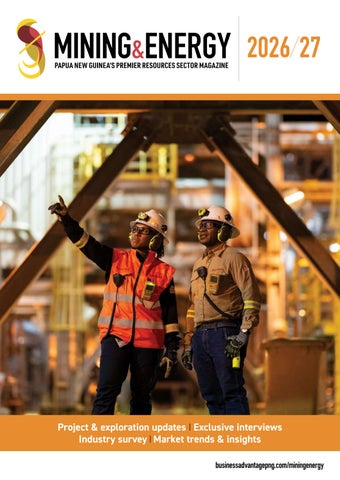
ENERGY 2026/27
Project & exploration updates Exclusive interviews Industry survey Market trends & insights businessadvantagepng.com/miningenergy
Celebrating 10 Years of Biodiversity Partnership in the PNG LNG Project
Dendrobium cuthbertsonii a high elevation orchid in Hides, Hela Province
On World Biodiversity Day, we’re proud to celebrate a decade of biodiversity partnership through the PNG LNG Project. Over the past ten years, ExxonMobil PNG has implemented one of Papua New Guinea’s most comprehensive Biodiversity Conservation and Monitoring programs. Delivered through long-term partnerships with government agencies, conservation NGOs, universities, research institutions, and local communities, the program has made a significant contribution to biodiversity science, conservation outcomes, and National Protected Area objectives. Through this work, we’ve expanded knowledge of priority species and ecosystems within the PNG LNG Upstream Project Area - including the discovery and documentation of species. The program identified over 20 new species and provided new data to the International Union of Conservation Network (IUCN) regarding PNG’s mammal and bird populations. The program also represents one of the country’s most sustained conservation-focused community engagement and capacity-building efforts, directly supporting the Government’s vision to protect habitats, species, and Papua New Guinea’s unique environmental and cultural heritage. In 2023 - 11 conservation deeds were signed by 100 clans in the lower Kikori area – the largest ever such initiative in PNG – demonstrating a strong, collaborative approach that integrates science and community participation with regulatory efforts. To learn more, visit pnglng.com to explore a decade of social and environmental reports, along with biodiversity monitoring study publications that showcase this incredible work.
FROM THE EDITOR
Welcome to the third annual edition of Mining & Energy, Papua New Guinea’s premier resources sector magazine. As this publication went to press, PNG was zeroing in on a final investment decision on its second major gas development, the estimated US$14.5 billion Papua LNG project. While this will represent one of the largest investments ever made in the Pacific’s largest economy (should FID go ahead as planned by 15 December 2026), it is by no means the only story to tell in PNG’s resources sector. Notably, as we report in this issue, exploration activity is on the rise, driven by higher global prices for the minerals PNG has in abundance. While some of this is classic greenfield exploration by “juniors,” much exploration activity is also taking place within existing mining and petroleum tenements, as operators seek to extend the life of PNG’s productive projects. PNG is also looking to extend beyond its traditional mineral-related activities, with new offshore gas and
limestone/cement projects advancing. Also notable are significant changes in the ownership structures of some key projects, which reflect both international trends and domestic moves to encourage more local participation in the sector. This publication considers the enabling environment for PNG’s resources sector, including infrastructure, skills development and transport/logistics. It also aims to place the industry’s activities within a broader economic context. Whether you’re involved directly in the sector locally or are viewing PNG from afar, we hope you find this annual snapshot informative and engaging. Business Advantage International has been covering business in Papua New Guinea, including its mining and energy sectors, since 2006 and is the most established and respected business media in PNG. We launched Mining & Energy in 2024 to provide PNG’s largest export sector with the quality journalistic coverage it deserves. It is distributed globally. In bringing it to you, we conduct dozens of face-to-face interviews each year, as well as plenty of in-country research. In addition to this annual, our coverage of the resources sector – and business more generally – continues year-round online at businessadvantagepng.com. I encourage you to visit there and sign up for our free regular email updates, which have become essential reading for PNG-focused executives. Nadav Shemer Shlezinger Editor Mining & Energy
MINING & ENERGY 2026/27 was made possible by the support of the following organisations:
STEAMSHIPS BRAND GUIDELINES
Primary Logo Our logo is the key building block of our identity; it’s the most visible element of our brand and the universal signature across all communications. The logo is a combination of a maritime flag and our company name, both of which nod towards our rich heritage and long history of operations in PNG.
Reversed Logo We can also reverse the logo into white for use over graphical patterns and dark backgrounds without sacrificing any legibility or recognition factor. However, this version should come secondary within the brand hierarchy structure.
Indus tries Lt d SEPTEMBER 2024 | P8
PROJECTS
High-Quality Gold-Copper Assets in PNG Positioned for Near-Term Cash Flow 2.5M oz Au
TSX VENTURE
ADY
OTC MARKETS
ADYRF
FSE
Feni Island
Inferred: 1.46 Moz Au
Fergusson Island Indicated: 441 Koz Au Inferred: 626 Koz Au
701GR
August 2026
Significant Copper Upside 1
MINING & ENERGY 2026/27
3
CONTENTS 9 Economic update We consider current business conditions and the outlook for 2027.
6 Industry update The latest on PNG’s key resources projects, as some move quickly towards FID while others hit roadblocks.
12 Perspectives Insights from business and government leaders. 14 Mining & Energy Survey Revealing the investment plans of PNG’s mining and petroleum companies. 16 Commodities outlook How will the Iran War impact the value of PNG’s LNG and gold exports? 22 Junior funding Exclusive data shows where PNG’s explorers are getting their capital. 24 Papua LNG A deep dive into the revised Papua LNG gas agreement – and what’s to come. 26 Oil & gas Exclusive interviews on Pasca A and exploration projects.
44 Electricity Insiders on PNG Power’s planned privatisation – and rural electrification. 48 Logistics Steamships’ marine logistics head and Air Niugini’s CEO explain major new investments. 50 Talent Business leaders discuss how the country can develop its future skills.
18 New era of exploration PNG’s mineral exploration sector has rarely been busier. We speak with the juniors leading the way. 30 Map of PNG’s resources sector 32 Gold & copper We find out why PNG’s largest mines are digging deeper, and report on a key ownership change.
Mining and Energy 2026/27 is published by Business Advantage International Pty Ltd Level 20, 31 Queen Street, Melbourne VIC, 3000 Australia Tel +61 3 8330 6081 Email info@businessadvantageinternational.com
38 Nickel We hear from two of the key players on PNG’s competitive advantage. 41 Cement & lime Pacific Lime and Cement’s MD on the countdown to first production.
52 Communications Update on PNG DataCo’s efforts to upgrade PNG’s digital backbone. 54 Hospitality Renovations are in full swing across the Coral Sea Hotels portfolio. 56 Property Exclusive update on Steamships’ Portside Business Park project. 57 Directory
Editor: Nadav Shemer Shlezinger (ns@businessadvantageinternational.com) Head of Sales and Partnerships: Robert Milne (rm@businessadvantageinternational.com) Publishing Director: Andrew Wilkins (aw@businessadvantageinternational.com)
Experts in publishing and marketing www.businessadvantageinternational.com A digital edition of this publication is available free online at businessadvantagepng.com. Additional printed copies can be purchased for A$50 (incl. GST and postage) from the above address. © Copyright 2026 Business Advantage International and contributors ISSN 1836-7895 (print)/1836-7909 (online) DISCLAIMER Mining & Energy is a general guide to some potential business opportunities in Papua New Guinea and is not designed as a comprehensive survey. The opinions expressed herein are not necessarily those of the publisher and the publisher does not endorse any of the business or investment opportunities featured, nor does it accept any liability for any costs or losses related to dealings with entities mentioned in this publication. Readers are strongly advised to pursue their own due diligence and seek expert advice before making any investment decisions.
4
Director: Robert Hamilton-Jones (rhj@businessadvantageinternational.com) Commercial: Charles Saldanha, Sally Milne Marketing: Flavie Sauve Editorial: Charlotte Armstrong Design: Alicia Freile Cover image: ExxonMobil PNG Operations Technicians Stephanie Wakma (left) and Ago Mano Joseph (right) conduct a routine inspection at the PNG LNG Project’s Hides Gas Conditioning Plant in Hela Province. Credit: ExxonMobil PNG Printed in Australia. Both printer and paper manufacturer for this publication are accredited to ISO14001, the internationally recognised standard for environmental management. This publication is printed using vegetable inks and the stock is elemental chlorine free and manufactured using sustainable forestry practices.
MINING & ENERGY 2026/27
Local knowledge.
Global expertise.
Whatever your business, whatever your goal, Kina Bank makes it possible.
We provide seamless access to a premier suite of financial solutions.
As a leading Partner Bank in Papua New Guinea, we offer more than just transaction banking for our global wholesale clients operating across Natural Resources, Commodity, and Diversified Industrial sectors.
• Foreign Exchange &
Multi Currency Accounts • Trade and Transaction Banking
Together it’s possible.
• Investment Banking
& Advisory • Wealth and Private Banking
kinabank.com.pg
Credit: ExxonMobil
INDUSTRY UPDATE
Defining year for PNG as project deadline looms
Japan’s JGC and South Korea’s Hyundai E&C were selected in early 2026 as the EPC contractors to build the Papua LNG project’s liquefied natural gas (LNG) production plant, using natural gas feedstock from the Elk-Antelope gas fields in Gulf Province. The plant is expected to be built at the site of ExxonMobil’s LNG plant (pictured), after a final investment decision is made on Papua LNG.
Papua LNG will continue to command the attention of PNG’s investment community in the coming year, after taking a major step towards a final investment decision, while other major resources projects continue to advance at their own pace. By Nadav Shemer Shlezinger
6
In last year’s edition of Mining & Energy, we began our industry update by noting the many positive signs for a final investment decision (FID) on the estimated US$14.5 billion Papua LNG project. At the time, key players from both sides of the negotiating table – including Prime Minister James Marape and Kevin Gallagher, CEO of minority project shareholder Santos – maintained that an FID could be achieved in early 2026. Most of 2026 is in the rearview mirror and an FID has still not been achieved. So, what has changed? Quite a lot, actually – following the signing of a revised gas agreement between the government and the project developers in August (see page 24), which included the introduction of a drop-dead deadline of 15 December 2026 for an FID to be reached. Shortly after the deal, TotalEnergies confirmed that it was transferring operatorship of Papua LNG to ExxonMobil, operator of PNG LNG.
Prime Minister Marape was bullish when he spoke at the 2026 Business Advantage PNG Investment Conference in Brisbane in August, which took place two weeks before the revised agreement, telling delegates that Papua LNG’s FID is “bound to happen later this year.” In a statement following the agreement, he noted the government was working towards an FID by 15 December, but added that the project shareholders “have indicated they will strive to reach that milestone even earlier.” While Papua LNG is easily the biggest project in PNG’s resources pipeline when measured in terms of its expected capital expenditure and export receipts, other greenfield resources projects are also progressing towards FIDs – including Twinza’s Pasca A offshore gas project (see page 26). Meanwhile, Santos, currently a 27.13 per cent shareholder in Papua LNG and a 39.90 per cent shareholder in the country’s first producing gas project, PNG LNG, reached FID on two projects in the second quarter of MINING & ENERGY 2026/27
Complete Business Solutions. Backed by one Group
Retail Technology
Office Solutions
Connectivity & Infrastructure
Service & Support
Our Business Units
Talk to our team today! 312 3400
sales@remington.com.pg
www.remingtongrouppng.com
2026: the Agogo Production Facility (APF) tie-in targeting first gas in the second quarter of 2028; and an infill drilling campaign at PNG LNG, which is due to start in the fourth quarter of 2026, with the wells convertible to gas once the APF tie-in comes online. Beyond this, ExxonMobil intends to commence its P’nyang gas project after Papua LNG’s four-year construction phase.
Wafi-Golpu falls back Not every project in PNG’s pipeline is progressing at the same speed: the estimated US$5.4 billion Wafi-Golpu copper-gold project, which was the subject of intense talks between the State Negotiating Team and the project’s joint venture partners, Newmont and Harmony Gold, appears to have stalled. The project is “fairly far out still for us to develop,” Natascha Viljoen, Newmont President and CEO, told a July earnings call, adding: “It’s on the outer end of our project pipeline.” Similarly, Harmony Gold CEO Beyers Kruger told an August earnings call that the company’s production
outlook for the next decade “excludes the tier 1 Wafi-Golpu project, which is in the permitting process.” Another copper project in the pipeline is the proposed restart of the Panguna mine in Bougainville, once one of the world’s largest copper mines – which was shut in 1989 due to militant activity. Bougainville Copper Limited (BCL) – which is majority owned by the Autonomous Bougainville Government (ABG) and is also traded on the Australian Securities Exchange – held the Panguna mining lease. However, in a surprise decision on 30 June, the ABG’s Executive Council approved the lease’s transfer from BCL to a separate company, Bougainville Minerals Limited, for a 25-year term.
Greylisting risk While the revised gas agreement is positive for Papua LNG, developments from outside of the sector – including PNG’s February 2026 greylisting by the Financial Action Task Force (FATF), the global anti-money laundering/ counter-terrorism financing body could pose risks to project financing, according to the World Bank.
Credit: Stefan Daniljchenko / BAI
INDUSTRY UPDATE
PNG’s Prime Minister, James Marape.
“Greylisting can increase due-diligence requirements for correspondent banks, potentially raising the cost and complexity of cross-border financial transactions,” the US-based multilateral institution noted in June. The PNG Government has endorsed a FATF Action Plan with reporting milestones running through to January 2028, the World Bank noted. “Addressing these gaps in a timely manner would help support investor confidence, particularly as large resource projects such as Papua LNG and Wafi-Golpu progress toward final investment decisions.”
PNG’S ACTIVE MINING AND GAS OPERATIONS MINE/PROJECT
TYPE
OWNERSHIP
PRODUCTION (2025) PRODUCTION (2024)
Hidden Valley [Morobe]
Open pit
Harmony Gold
190 koz Au, 164 koz Au, 3,014 koz 2,273 koz Ag (year-end Ag (year-end June 2025) June 2026)
Kainantu Underground [Eastern Highlands]
K92 Mining
174 koz AuEq
150 koz AuEq
Lihir [New Ireland]
Open pit
Newmont Corporation
585 koz Au
614 koz Au
PNG LNG [Hela, Southern Highlands, Western, Gulf, Central]
Integrated project including gas production and processing facilities
ExxonMobil (operator), 33.2%, Santos, 39.9%, Kumul Petroleum Holdings, 19.4%, Eneos Xplora, 4.7%, Mineral Resources Development Company, 2.8%
8.6 Mt LNG
8.1 Mt LNG
Porgera [Enga]
Open pit & underground
New Porgera Ltd: Barrick Niugini Ltd, a 50/50 JV between Barrick Mining and Zijin Mining, 49%; Kumul Minerals Holdings, 36%; Enga provincial government and local landowners, 15%
376 koz Au
188 koz Au
Ok Tedi [Western]
Open pit
Ok Tedi Mining Limited (Kumul Minerals Holdings, 67%, three Western Province landowners, 33%)
298 koz Au, 106 kt Cu, 1,008 koz Ag
266 koz Au, 103 kt Cu, 993 koz Ag
Ramu [Madang]
Open pit
Metallurgical Corp of China, 85%, Nickel 33,007t Ni, 3,099t Co 28, 8.56%, Mineral Resources Development Company, 4.47%, Kumul Minerals Holdings, 1.97%
28,669t Ni, 2,625 Co
Simberi [New Ireland]
Open pit
St Barbara, 50%, Lingbao Gold Company, 50% (will be Lingbao 80%, Kumul Minerals Holdings, 20%, pending regulatory approvals)
54 koz Au
49 koz Au
Commodities: LNG = liquefied natural gas; Au = gold; Cu = copper; Ag = silver; Ni = nickel; Co = cobalt; AuEq = gold equivalent (comprising mainly gold, plus secondary products such as copper or silver). Measurements: k = thousand; oz = ounces; t = tonnes
8
MINING & ENERGY 2026/27
Credit: Western Sandaun Media
ECONOMIC UPDATE El Niño is impacting the water levels of PNG’s key waterways, including the Fly River in Western Province (pictured here at Kiunga Port), which services one of PNG’s largest mines, Ok Tedi.
Upside/downside: a growing PNG strives for economic balance With elections coming in 2027, PNG is dealing with some unwanted and unexpected external shocks just as it looks to finalise one of the largest investments in its history. By Andrew Wilkins
On the surface, PNG’s economy would appear to be ticking over in a solid but unspectacular way. In its July 2026 Asian Economic Outlook, the Asian Development Bank predicted GDP growth of 3.6 per cent for 2026 – slightly ahead of the Pacific region as a whole – and 3.4 percent for 2027. The International Monetary Fund (IMF), which has extended a number of credit facilities to PNG since 2023, is
predicting similar growth in 2026: 3.8 per cent, ahead of medium-term growth of “just above three per cent.” What these figures don’t allow for, however, is the positive impact on GDP if the estimated US$14.5 billion Papua LNG project reaches a final investment decision (FID) before the ‘drop dead’ deadline of 15 December (see page 24). This single project would provide a significant boost to PNG’s US$33.7 billion economy.
THIS YEAR WE CELEBRATE A 60-YEAR JOURNEY DELIVERING PROFESSIONAL SERVICES IN PAPUA NEW GUINEA 2026 marks a significant milestone for KPMG PNG as we celebrate 60 years of serving organisations across Papua New Guinea. Over six decades, we have remained committed to delivering trusted professional services, supporting national growth, and contributing meaningfully to our local communities.
60
A key milestone for KPMG Papua New Guinea Since opening our doors on 23 September 1966, KPMG PNG has grown significantly in both capability and scale. Today, we are proud to employ more than 170 professional people and operate two offices in Port Moresby – and a new project site in Lae. With a long-standing presence in PNG’s business landscape, we continue to support organisations across a wide range of sectors and services. As we celebrate this milestone, we are excited about the future ahead and the role KPMG PNG will continue to play in shaping the next 60 years. Helping businesses succeed in Papua New Guinea since 1966. +675 321 2022 | +675 322 1300 PG-FMKPMGPNG@kpmg.com.au www.kpmg.com.pg
MINING & ENERGY 2026/27
years 9
“Once construction begins, the project could boost growth by around 2.5 to 3.5 percentage points for five years, with an additional uplift of 1.6 to 2.0 percentage points during the production phase,” wrote Shamal Chand, Senior Economist for Westpac Pacific Economics, in a June 2026 update. PNG has been here before, during the 2010–2014 construction phase of its first LNG project, PNG LNG. “We saw a 10 per cent uplift on GDP at construction peak and then GDP peaked ultimately at 13.0 per cent in 2015,” Daniel Faunt, Group General Manager Corporate & Institutional Bank, BSP Financial Group Limited told the 2026 Business Advantage PNG Investment Conference. “We consider that investors need to factor that into their forward planning, and consider the flow-on effects from Papua LNG and other projects.”
BECAUSE PNG IS A NET HYDROCARBON EXPORTER, ITS FUEL SUBSIDIES … HAVE MITIGATED ANY NEGATIVE SPILLOVER INTO THE ECONOMY. DR BRENDAN RYNNE KPMG Australia’s Senior Economist
External shocks While PNG awaits an FID on Papua LNG, it is having to contend with two unwelcome and unexpected external shocks. These led Treasurer Ian Ling-Stuckey to introduce a Supplementary Budget in September 2026, with an additional K1.33 billion in expenditure. First, the rise of global fuel prices due to the war in the Middle East led the government to introduce a K1.11 billion fuel subsidy in April 2026 which will run until at least December, aimed at keeping fuel prices at the pump to March 2026 levels. It also temporarily removed goods and sales tax from some essential household items. 10
The assistance package appears to be helping, albeit at the short-term cost of constraining some other government expenditures. “Because PNG is a net hydrocarbon exporter, its fuel subsidies… have mitigated any negative spillover into the economy as a consequence of this current conflict,” Dr Brendan Rynne, KPMG Australia’s Senior Economist, observed at the 2026 PNG Investment Conference in August. While KPMG’s baseline predictions suggest fuel prices should fall in 2027, prices are still likely to continue at heightened levels until a lasting peace is achieved. Also in the supplementary budget is K1.17 billion for the mitigation of the impact of a particularly severe El Niño climate event, which is already affecting PNG’s farmers, mining projects and hydro power plants. The El Niño spending could be partly underpinned by up to K300 million of concessional loans available to PNG through the World Bank. “Funding to respond to this current El Niño is certainly needed, both to provide relief particularly in the rural areas and to assist villagers to recover their food gardens,” notes Paul Barker, Executive Director of PNG’s industryfunded think-tank, the Institute of National Affairs.
Forex improves On the positive side, forex shortages in PNG have continued to ease, thanks to regular interventions by PNG’s central bank, the Bank of PNG, on the back of strong export receipts due to high commodity prices. In September 2023, PNG’s backlog of forex orders reached a five-year peak of US$500 million. By contrast, according to Bank of PNG figures, the backlog has been under US$100 million for all of 2026. This has been a considerable relief for businesses, with waiting times for forex orders ranging from “on demand to two weeks,” as of September, Rohan George, Group General Manager – Treasury and Markets at BSP Financial Group, tells Mining & Energy. Alongside the improved forex situation, the value of PNG’s kina has continued to slide against the US dollar, in a managed depreciation by the
Credit: Stefan Daniljchenko / BAI
ECONOMIC UPDATE
Bank of PNG Governor Elizabeth Genia.
Bank of PNG with IMF support that commenced in mid-2023. The kina fell from US$0.24 to US$0.22 in the 12 months to September 2026 but there is some evidence that the currency may finally be approaching its true value. “While we are not yet at full kina convertibility, we are moving in the right direction,” central bank Governor Elizabeth Genia told the PNG Investment Conference. “The central bank’s ability to prop the currency up is strong, given their significant reserve levels,” noted BSP’s Daniel Faunt at the same event. “Looking forward, we consider the kina will moderate some of its depreciation.” With commodity prices (and therefore PNG’s export receipts) now softening, “the key question in our view over the next 12 months is whether increasing investment flows into PNG can offset the reduction in the commodity-driven export flows to then be able to keep the market broadly in balance,” Andrew Betteridge, Country Manager – PNG at ANZ Bank, said at the conference. And that brings us back to Papua LNG. Papua New Guineans are set to vote in national general elections in mid-2027, when a new five-year electoral cycle will begin. There is understandable urgency in government and business circles, therefore, to advance key projects before the election period begins. MINING & ENERGY 2026/27
OPINION
and government leaders provide their Perspectives Business personal takes on PNG’s mining and petroleum sectors. We want Papua New Guinea to be a place where all investors – local and international – make a fair return on their investment. We are a low-tax rate environment. As our country moves towards the next 50 years, we want our country to be a place where businesses thrive and investors are prosperous; and, more importantly, my people must not be left behind. Hon. James Marape GCL MP Prime Minister of Papua New Guinea
We’ve seen an uptick in enquiries from smaller players and, with gold prices at current levels, an opportunity for these companies to accelerate their entry by partnering with landowner companies. We sometimes help align their interests to support these partnerships. We’re also seeing new entrants, beyond your traditional trading relations such as Australia and Canada, with particularly strong interest coming from Asia, especially China. Herbert Maguma
As an organisation that’s been in PNG for 116 years, we’ve supported the sector directly as well as indirectly through the supply chain – and we’re continuing to explore our capability and capacity in the sector. It’s also important to ensure we balance the sector and investor needs against the country’s needs, as well as the environmental and social aspects, including the creation of intergenerational value and societal assets. Andrew Cairns
Chief Executive, Westpac PNG
Managing Partner, Deloitte PNG
Just like the rivers that powered PNG’s past. We’re powering PNG’s future. 12
diriopower.com
MINING & ENERGY 2026/27
OPINION
We’re telling mining and exploration companies: come and partner with Kumul Minerals Holdings, because we will de-risk you. We’re not going to stand back and wait for you to do the hard work before we come in. We’ll start the exploration work ourselves, then you’ll come in, and we’ll partner with you. That’s the conversation we’re having to revive the exploration sector in this country, because without it, the industry dies.
People are still very excited and waiting for the next resources boom to get underway. Once Papua LNG happens, everybody knows that it will have a significant impact on the economy. A lot of organisations are starting to mobilise and get ready. We’ve seen a real increase over the last eight to 12 months in organisations reaching out and asking us to help them set up businesses in PNG. I think that’s really positive – it’s a precursor to what’s about to happen.
Our forward funding pipeline is the largest it’s been for a while, and that’s reflected in some of the optimism coming through on the resource project side. What you’re seeing now is a far more broad-based demand for credit than in the first LNG cycle, when it was mostly adjacent industries like transport and logistics that benefitted. These projects represent up to 37 per cent of total GDP output – a significant boost for the PNG economy.
Sarimu Kanu
Pieter Steyn
Daniel Faunt
Managing Director, Kumul Minerals Holdings
MINING & ENERGY 2026/27
Managing Partner, KPMG PNG
Group General Manager Corporate & Institutional Bank, BSP Financial Group Limited
13
INDUSTRY SURVEY
The 2026/27 Mining & Energy Survey For the first time, Mining & Energy has run a dedicated survey of executives from PNG’s extractive sectors to learn more about their exploration and broader investment plans – and to ask them about their operational challenges. Read on for the results. Since 2012, Mining & Energy’s sister publication, Business Advantage PNG, has published its annual PNG 100 CEO Survey – a survey of the country’s top executives that is now widely recognised as the country’s leading business confidence survey. This year, for the first time, Mining & Energy is introducing its own survey, which focuses exclusively on PNG’s resources sector. Drawing on responses from producers and exploration/ development companies across both mining and petroleum, the results of this inaugural survey point to a growing appetite for investment in exploration and production, despite some key challenges.
Exploration intentions The survey began by asking respondents how active they plan to be on the exploration front in PNG in 2027, compared to 2026. The responses were bullish, with 38 per cent of respondents planning to increase exploration expenditure in 2027 and 54 per cent expecting to hold spending at the same levels as 2026. None of the respondents had plans to reduce exploration spending, although eight per cent said their exploration activity was currently under review.
14
Investment intentions That appetite extended to broader investment plans, with 54 per cent of respondents planning a substantial increase in capital expenditure in 2027 compared to 2026. A further 15 per cent said they were planning a slight increase in capital expenditure in 2027, while 15 per cent expected to keep capex at similar levels in 2027. Just 15 per cent anticipated a slight decrease in capex in 2027.
Recruitment intentions Hiring plans followed a similar pattern. More than twothirds of industry executives said they plan to increase the size of their workforce in 2027 – with 38 per cent flagging a substantial increase in staff numbers and 31 per cent a slight increase. Twenty-three per cent of respondents expected to maintain current staffing levels, while eight per cent anticipated a substantial reduction.
Operational challenges We asked the executives to give a score of between 1 and 5 to the various challenges facing their operations in PNG right now. A high score of 5 indicated a “mission critical” challenge to their business, while a 1 indicated a challenge was “not relevant”.
MINING & ENERGY 2026/27
INDUSTRY SURVEY The respondents rated government capacity and high operational costs as the two biggest challenges, giving both an average score of 3.8. A shortage of expertise/skills and regulatory uncertainty both followed closely behind, with an average score of 3.5. Access to capital rounded out the top five with an average score of 3.2. Access to capital was the most polarising: 38 per cent of respondents said it was mission critical to their business, while an additional 38 per cent said it was either moderately relevant or not relevant at all. This reflects the fact that accessing capital is a key issue for smaller exploration-stage companies that are ramping up their activities in PNG, but less critical for producers or larger companies that are able to fund activities without the need to raise capital. Notably, telecommunications was rated as the least pressing of the 14 challenges nominated, with a weighted average of 2.4. Several respondents commented to Mining & Energy that their score would been higher had we run the survey prior to April 2026, when licenses were finally issued to low-earth orbit satellite connectivity providers Starlink and OneWeb, which followed the resolution of protracted legal proceedings about Starlink’s licence in PNG’s National Court.
In 2027, do you plan to be actively involved in exploration in Papua New Guinea? Exploration activity is currently under review
8%
38% Yes, with a greater exploration spend than last year
54% Yes, with a similar exploration spend to last year
How much investment (e.g. CAPEX in plant, equipment, land or other assets) are you planning in Papua New Guinea in 2027?
The Mining & Energy Survey was conducted by Business Advantage International between May and September 2026. The survey included senior executives from a representative sample of producers and exploration/ development firms in PNG’s mining and oil and gas sectors.
15% Slightly less than 2026
15%
54%
About the same as 2026
A substantial increase on 2026
15% A slight increase on 2026
What are the critical challenges facing your operations in PNG right now? (weighted average) Government capacity 3.8 Costs 3.8
What level of recruitment are you planning in PNG in 2027, compared to 2026?
Expertise/skills 3.5 Regulatory uncertainty 3.5
A substantial reduction in staff
Access to capital 3.2
8%
Logistics 3.1 Security/law and order 3.1 Fuel price and availability 2.9
23%
Work permits and visas 2.9
Enough to maintain current staffing levels
Corruption 2.9
38% A substantial increase in staff
Employment costs 2.9 Supply chain 2.7
31%
Utilities 2.7
A slight increase in staff
Telecommunications 2.4
0.0
0.5
1.0
MINING & ENERGY 2026/27
1.5
2.0
2.5
3.0
3.5
4.0 15
COMMODITIES OUTLOOK
Hormuz crisis puts premium on reliable LNG supply into Asia Credit: diy13/iStock
Daniel Hynes, Senior Commodity Strategist at ANZ Research, explains why the Iran War has raised the value of future LNG supply from Papua New Guinea – and shares where he sees gold heading next. By Nadav Shemer Shlezinger
The disruption in the Strait of Hormuz will put a lasting “premium for reliability” on LNG supply into Asia, according to Daniel Hynes, Senior Commodity Strategist at ANZ Research. More than 20 per cent of the world’s liquefied natural gas (LNG) travelled through the Strait of Hormuz before the Iran War began in February 2026. Qatar alone has a stated LNG export capacity of 77 million tonnes per year, roughly 19 per cent of the entire global LNG trade, according to ANZ Research. Iranian missile strikes on Qatar’s gas export terminals removed up to 13 million tonnes from its capacity, Hynes told the 2026 Business Advantage PNG Investment Conference in Brisbane, adding that operator QatarEnergy has indicated that it could take up to five years to repair the damage. “There would no doubt be some concern from a buyer approaching Qatar about whether it can be a reliable source of supply for the next 10 to 20 years, considering that could be cut off if Iran decides to do so,” Hynes said.
Reliability premium Unlike oil, LNG cannot sit in storage for long because it continuously generates boil-off gas as it evaporates, Hynes explained. “The inventory side is one of those levers that commodity markets lean on 16
Gas production facilities in Qatar, the world’s largest LNG exporter. An Iranian missile strike in March 2026 removed around 17 per cent of the country’s gas exporting capacity.
for these types of supply shocks, but that buffer is relatively small for the LNG market,” he said. Instead, “we see the market clear through that volatility,” with large price moves dictating demand rationing. “That really embeds a higher strategic value on reliable LNG supply, which I believe the PNG projects can deliver.” That premium is already showing up in the Asian spot price for LNG, which was trading at around US$24 per million British thermal units when Mining & Energy went to print – more than double the price a year earlier. Hynes expects the “new normal” – with structural tightness embedded into the LNG market – to run through to 2031. As term contracting rises and spot cargo availability thins, suppliers able to guarantee delivery stand to be rewarded, Hynes said. “Buyers are going to pay for certainty. Project developers who can provide a reliable source of supply – particularly here in Asia, where the LNG market is the biggest – will be at a significant advantage.”
Gold’s pause Gold, PNG’s other major export commodity, has also had a volatile year.
The precious metal’s sharp drop from its all-time highs of more than US$5,600 per ounce (oz) after the beginning of the Iran War initially wrongfooted expectations, Hynes said. “Normal convention would have suggested that we would have seen gold perform relatively well in that sort of heightened geopolitical environment,” he explained. However, he said, “Gold tends to perform well when it [geopolitical volatility] is not at heightened levels, but maybe at mid-levels. When it’s this extreme, money tends to flow into more-liquid sorts of risk-type assets, such as the US dollar.” Higher energy prices have also stoked fears of persistently high US interest rates, a “headwind” for nonyielding assets such as gold, he said. With the spot price bouncing back strongly from a year-low of around US$4,000/oz in August 2026, and softer US labour data easing rate-hike bets, gold appeared to have “found a bit of a floor,” Hynes said. He remains confident in its longer-term trajectory, citing a decade of central bank reservebuilding: “Once that energy/inflation story dies down, I think gold will benefit quite significantly.”
MINING & ENERGY 2026/27
Investing in Papua New Guinea has its rewards. We are Papua New Guinea’s pioneering business conglomerate. We have established partnerships in hotels, logistics and properties that directly contribute to building our nation. Our investment, community engagement and sustainability has endured since 1918, laying the solid, secure foundations we need to sustain another 100 years of growth. We don’t just do business in PNG. It’s our home. Level 2, @345, Stanley Esplanade, Port Moresby, National Capital District, Papua New Guinea P.O. Box 1, Port Moresby, National Capital District, 121, Papua New Guinea P: +675 3137400 | P: +675 7998 7000 | www.steamships.com.pg
Credit: Great Pacific Gold
MINERAL EXPLORATION
Digging in: junior miners ride the gold and copper rally into PNG
Exploration activity is continuing at pace at the The Wild Dog project in East New Britain, including at the Kasie Ridge target, pictured here.
PNG’s mineral exploration sector has rarely looked busier. Mining & Energy speaks with the juniors leading the charge. By Nadav Shemer Shlezinger
18
Just one year ago, Great Pacific Gold’s Wild Dog copper-gold project in East New Britain had very limited infrastructure, no established exploration camp and difficult site access. Callum Spink, Chief Operating Officer and Vice President Exploration, says the transformation over the past year has been significant, with the company establishing a fully equipped exploration camp, improving access and mobilising two drill rigs to site as exploration activity has ramped up. It’s the kind of transformation now playing out at numerous sites across Papua New Guinea, with gold prices holding near historic highs and a resurgent copper market giving junior explorers the capital – and the confidence – to move forward with exploration and development. On Fergusson Island in Milne Bay Province, Adyton Resources is preparing to restart the historical Wapolu gold mine by the end of 2026. The project has been fast-tracked by a May 2026 joint venture with East Vision International Holdings, a Singapore-based subsidiary of a Chinese
mining group that will cover all of the capital costs. “It’s funded, in fact most of the equipment is already on the ground in PNG, just waiting for the permits to drop,” says Adyton CEO and Managing Director Tim Crossley. About 200 kilometres away, on Woodlark Island, Geopacific Resources is aiming to begin construction on its own gold mine in early 2027, having completed a definitive feasibility study (DFS) in May 2026. Geopacific’s Managing Director Hamish Bohannan believes the race for skilled workers will heat up as more projects move towards development. “There’ll be a bit of competition,” he says. “But it’s fair competition, and it’s good and healthy.”
Racing to build At Woodlark, one village is located in the footprint of one of the three planned open pits. As a result, the families have agreed to be relocated into new steel-framed homes – with 196 of the 249 homes now complete. Bohannan says PNG’s Mineral MINING & ENERGY 2026/27
Resources Authority has been “quite impressed” with the houses, using them as a “showcard for other operations.” Once built, the DFS projects 100,000 ounces (oz) of gold production per year across an initial 12-year mine life. Financing the roughly A$535 million (K1.7 billion) total project cost is now Bohannan’s “absolute focus.” Geopacific is also seeking an amendment to its mining lease, which currently requires it to complete construction by October 2027 – a deadline that was set before the DFS was finalised. “One of the attractions here is you’ve got a government that’s very supportive of mining,” Bohannan says. “It’s a country where mining is well established. We’ve got big operations here and people who understand mining.” Adyton is moving at a similar pace on Fergusson Island – indeed, speed is the main reason it is prioritising Wapolu over its larger Gameta deposit on the same island. Wapolu produced gold under a previous owner between 1995 and 1997, before it was shut down due to the low gold prices at the time. But it has retained much of the old infrastructure, including an airstrip, port, warehouses and leach tanks. “The elders remember what it was like and the benefits it brought to the community,” Crossley says. Crossley argues that the island location allows development to move more quickly and less expensively than on the mainland, with supplies arriving by barge rather than road. Wapolu’s initial production will be modest – at roughly 12,500 oz of gold per year – with the potential “to double” that figure through exploration drilling. Gameta is the bigger prize: a newly updated resource estimate lifted its indicated gold resource by 131 per cent to 404,000 oz. Crossley is targeting a mining lease application by the end of 2026, with production “very conceivable” by the first half of 2028. Feni Island, in New Ireland Province, is the location of Adyton’s other exploration licence – and like Fergusson’s 40-strong workforce, the 90-strong Feni workforce is entirely Papua New Guinean, without a single expatriate on site. 20
Credit: Geopacific Resources
MINERAL EXPLORATION “My geologists are guys who are well seasoned,” Crossley says. “They’ve worked on exploration programs all over PNG – some have been at K92, some worked for Harmony, some at Ok Tedi.”
Copper’s pull Back on the mainland, Freeport Resources’ Yandera project in Madang Province sits within the same coppergold belt as the Ok Tedi mine and the Wafi-Golpu project. A 2017 pre-feasibility study projected around 100,000 tonnes of copper in average annual production over a 20-year mine life. This would put Yandera’s copper production on a similar scale to the 106,000 tonnes produced at Ok Tedi in 2025. The size of the Yandera resource, and its potential value in light of soaring copper prices, has attracted attention from the likes of PNG’s state-owned Kumul Minerals Holdings (KMHL). In January 2026, Freeport signed a non-binding memorandum of understanding with KMHL to cooperate on the advancement and strategic development of Yandera. “It’s in everybody’s best interest to see these projects move forward,” says Freeport’s Senior Vice-President of
Families from one village on Woodlark Island have agreed to be relocated into new steelframed homes, to allow for the development of three planned open pits.
Operations Nathan Chutas. Meanwhile, Freeport is also weighing whether to fund its own definitive feasibility study or bring in a partner to assist. “We’re in discussions with a lot of really interested parties,” Chutas says. “Copper’s a great space to be in right now.” Not only the dedicated exploration companies are eyeing copper: for example, Pacific Lime & Cement, developer of the Central Cement & Lime project (see page 41), is conducting a strategic review of its Star Mountains copper-gold project in Sandaun Province. Chief Executive Paul Mulder says historical exploration has returned “fantastic world-class intercepts” – including 596 metres at 0.61 per cent copper and 0.85 grams per tonne (g/t) of gold from just 24 metres depth. The company is now seeking a strategic partner “that’s got the ability and desire to get that asset developed in a short period of time.”
Balancing geology with investment climate
THERE’LL BE A BIT OF COMPETITION [FOR SKILLED WORKERS]. BUT IT’S FAIR COMPETITION, AND IT’S GOOD AND HEALTHY. HAMISH BOHANNAN Managing Director, Geopacific Resources
While many juniors are searching for partners to help advance their PNG projects, at least one is making an exit: Niuminco recently agreed to sell the century-old Edie Creek mine, subject to ministerial approval of the indirect mining lease transfer. Mining and processing continued to ramp up at time of writing as part of a restart of the mine, under a contract mining arrangement between Niuminco and the purchasers. Niuminco Managing Director Tracey Lake cites the current operating environment as a factor behind his firm’s divestment. “There seems to be more landowner activism going on, MINING & ENERGY 2026/27
MINERAL EXPLORATION geology. “I still believe there’s a lot more to be found,” he says. The exploration team at Wild Dog – which includes 14 Papua New Guinean geologists, in addition to Spink and two Australia-based senior geologists – is similarly bullish about the potential for big discoveries. “We’re not expat heavy,” Spink says, adding, “You’ve got this amazing
Credit: Adyton Resources
and that doesn’t encourage people to invest,” he says. While Niuminco has turned its attention to its assets in New Zealand and Australia, Lake says the company isn’t pulling out of PNG entirely: in fact, it is in discussions to acquire a new prospect in the Highlands. What keeps drawing Lake back to PNG is the price of gold – and the
talent pool of geologists from across the country who have been trained by the majors and know how to run drill programs.” Every hole drilled during a recent campaign at the main Sinivit deposit – which previously produced gold between 2008 and 2013 – intersected mineralisation, Spink says. The standout result to date was 8.4 metres at 50.1 g/t gold equivalent. Elsewhere in the licence area, the company is advancing targets including Kasie Ridge, where the first drill hole intersected an advanced argillic alteration system, a geological setting Spink says is commonly associated with the large epithermal and porphyry systems for which PNG is well known. “We’re seeing alteration minerals and geological features that suggest we may be close to a significant mineralised system,” he says. “The work currently being undertaken by university researchers across Australia will help us better understand what that system represents.”
Adyton Resources’ local workforce is made up entirely of Papua New Guineans.
Lae Morobe Province 411 • Papua New Guinea Landline: (+675) 472 1700, (+675) 472 1702, (+675) 472 1703 Mobile: (+675) 7092 2000 • Email : information@mapaigroup.com
MINING & ENERGY 2026/27
21
CAPITAL RAISING
Canada’s PNG gold rush Credit: Christopher Becke / Creative Commons licence
Exclusive data compiled by Mining & Energy reveals where Papua New Guinea’s junior gold and copper miners are getting their capital. By Nadav Shemer Shlezinger
Australia and Canada are the world’s two dominant sources of mining capital. But despite Papua New Guinea’s proximity to Australia, it is investors in Toronto and Vancouver that have backed the country’s junior mining companies the most aggressively in the past three years. Since 2024, PNG-focused juniors have raised more than C$91.3 million (US$65.7 million; K292 million) on Canada’s TSX Venture Exchange (TSXV), compared to the A$79.2 million (US$57.0 million; K253 million) on the Australian Securities Exchange (ASX), according to data compiled by Mining & Energy. Add debt funding and asset sales, and the total raised for exploration and earlystage development in PNG – all of it by TSXV- or ASX-listed companies – climbs past US$150 million. Mark Schipperheijn, Director at Vancouver-based Ventoux Capital and a founder of PNG-focused Freeport Resources, has watched that appetite build first-hand: Freeport’s most recent raise was a C$3.5 million private placement in January 2026. “There have been some substantial financings
The Toronto Stock Exchange has been the biggest source of capital for PNG-focused explorers in since 2024.
in Canada recently to fund projects in PNG,” he says. “A lot of that is [off the back of ] the success of K92 and other companies that have had tremendous success in the country.” Hamish Bohannan, Managing Director of ASX-listed Geopacific Resources, agrees: “I think the Toronto Exchange is very open for PNG developments,” he says. “Australia is as well. But I’d say Toronto is probably slightly ahead of it.” While Canada has proven lucrative for PNG juniors, Tim Crossley, CEO and Managing Director of TSXV-listed Adyton Resources, argues there’s still a gap between reality and perception. “Adyton hasn’t missed one milestone – in fact, we’ve nailed every one, probably exceeded them. And yet the
market’s still not rewarding us,” he says. “There’s still a very big PNG discount, just because of perception around jurisdictional risk, which in our view is not real.” That discount has not stopped investors from other countries buying into PNG-focused juniors. China’s Lingbao Gold Group and XXRT Power Investment both made strategic investments in Geopacific Resources in 2024, while Indonesian contractor Petrosea injected A$23.75 million into Tolu Minerals through a loan set to convert into shares in 2026. For a jurisdiction long considered too risky for anyone but the majors, the message from investors is increasingly hard to ignore: the money keeps finding its way to PNG.
WHERE ARE PNG JUNIORS RAISING FUNDS?
(ALL FIGURES IN US$ MILLIONS)
YEAR
EQUITY (TSXV)
EQUITY (ASX)
DEBT
ASSET SALES
TOTAL
2024
$11,005,492
$5,688,000
$1,245,600
$720,000
$18,659,092
2025
$37,759,921
$49,500,000
$0
$3,132,000
$90,391,921
2026 (YTD)
$16,944,372
$1,800,000
$17,100,000
$5,400,000
$41,244,372
$65,709,785
$56,988,000
$18,345,600
$9,252,000
$150,295,385
Total
Source: Mining & Energy, based on company filings. 2026 figures are year-to-date up to 27 August; all figures in US$ using CAD/USD and AUD/USD exchange rates on 27 August. N.B. All raisings were for exclusively PNG activities, except Augustus Minerals’ A$2.5 (US$1.8 million equity raising) in 2026, a majority of which was for its Australian projects, with a smaller portion for field work at its PNG projects at Vanapa River and Mt Kare.
22
MINING & ENERGY 2026/27
Boroko Motors is now the proud supplier of SANY equipment and machinery. When it comes to the mining, construction, port and agricultural industries, we have everything you need to build your business and PNG into the future.
Visit Boroko Motors to see how the SANY range can improve your business.
Credit: Malum Nalu
PETROLEUM & GAS
Could revised Papua LNG agreement pave the way to FID? Representatives of both the PNG Government and the shareholders of the Papua LNG project were present at the signing of the revised final gas agreement on 27 August.
A final investment decision on Papua LNG must be made by 15 December 2026, according to a revised agreement between the project developers and the PNG Government. Mining & Energy examines why the agreement was revised and what it means for the project. By Andrew Wilkins
Significant steps were taken towards a final investment decision (FID) on the estimated US$14.5 billion Papua LNG project in late August and early September of 2026, with the signing of a revised final gas agreement and a change in operatorship of the project from TotalEnergies to ExxonMobil (see box on page 25). The revised final gas agreement, signed between the State and the project partners on 27 August, amends the original gas agreement signed in 2019 between the State and TotalEnergies, ExxonMobil, Santos and ENEOS Xplora. It offers new benefits to the partners aimed at reducing project risk, in return for additional benefits to the State and a deadline of 15 December for an FID.
Why a revised agreement? The revised agreement followed eight months of negotiations between PNG’s State Negotiating Team and the developers, who were seeking to bring the total development cost down to between US$14 billion and US$15 billion. This followed original bids in 2023/24 that saw the cost blow out to more than US$18 billion.
24
While bids from Asian contractors in 2025 brought down the estimated costs, the developers still sought further concessions to improve the economics. With both TotalEnergies and ExxonMobil also developing substantially larger LNG projects in Mozambique, there was a risk that the smaller 5.6 Mtpa Papua LNG project might be postponed again unless the issue of costs could be addressed.
What’s been agreed? In the words of Kumul Petroleum Holdings’ (KPHL) Acting Managing Director Luke Liria, “the amendments strike a balance between attracting global investment and protecting PNG’s long-term national interests.” The State hasn’t relinquished its formal share in the project revenues. However, it has granted the developers conditional investment incentives which, according to Petroleum Minister Jimmy Maladina, are “temporary, reciprocal and appropriately capped arrangements linked to market conditions.” These incentives are worth US$1.95 billion (K8.1 billion), MINING & ENERGY 2026/27
PETROLEUM & GAS according to a reported statement by Prime Minister James Marape. The revised agreement reasserts the State’s right to acquire up to 22.5 per cent of the project – comprising up to 20.5 per cent for state-owned KPHL and two per cent for the Minerals Resources Development Company – as and when the project’s Petroleum Development Licence is issued. It also adds an option, which was not a part of the previous agreement, for KPHL to acquire an additional 2.5 per cent in the project at some stage in the future. As Dairi Vele, Chairman of PNG’s State Negotiating Team, tells Mining &
THE AMENDMENTS STRIKE A BALANCE BETWEEN ATTRACTING GLOBAL INVESTMENT AND PROTECTING PNG’S LONG-TERM NATIONAL INTERESTS. LUKE LIRIA Acting Managing Director, Kumul Petroleum
Energy, the incentives kick in to help the developers maintain their required internal rate of return from the project should LNG prices fall below a certain level in the future. “We have referenced the specific price of gas post-construction, in 2031/32,” he explains. “If LNG is below that price, then PNG can give the developers some assistance. This way, they get assistance only if they need it.”
Why a 15 December deadline? The existing five-year Petroleum Retention Licence (PRL15) over the Elk and Antelope gas fields in Gulf Province, which will supply Papua LNG, expires on 30 November 2026. Effectively, the 15 December deadline provides for a two-week extension of the lease to allow for arrangements to be finalised. “The final deadline for FID is a drop-dead deadline,” Maladina said after the signing. “The Government expects all parties to work towards meeting this deadline.” There is additional urgency for both sides, with PNG due to conduct national elections in mid-2027.
EXXONMOBIL TAKES OPERATORSHIP OF PAPUA LNG In September, TotalEnergies confirmed that it will transfer operatorship of Papua LNG to ExxonMobil, operator of PNG LNG. Meanwhile, ExxonMobil confirmed there would be “no change to existing project priorities.” As part of the arrangement, TotalEnergies will sell a 9.1 per cent interest in the project to its Papua LNG partners, in proportion to their existing participating interests, while maintaining its LNG offtake share of the project. Upon completion of the farmdown by TotalEnergies and the State’s exercise of its back-in right, TotalEnergies will hold a 20 per cent interest in Papua LNG, alongside ExxonMobil (34.1 percent), Santos (21.02 per cent), ENEOS Xplora (2.38 percent) and Kumul Petroleum Holdings Limited and MRDC (22.5 per cent).
What’s still to come? The next important milestone for the project is the successful completion of its Development Forum, which commenced in July and was still underway in Port Moresby at the time this publication went to print. The purpose of the forum is to agree on the allocation of project benefits to landowners and local governments. “We’re 100 per cent confident we can deliver a successful development
forum,” Vele tells Mining & Energy, pointing out the success of the 2009 PNG LNG development forum, which involved “75,000 people and five different provinces … [while] Papua LNG involves between 5,000 and 10,000 people.” Meanwhile, the developers are now working to finalise marketing arrangements for the project’s gas, as well as its financing.
Escape Explore Enjoy Discover island comfort on the shores of Kokopo beach. Stay in spacious beachfront bungalows, enjoy ocean-view dining, and experience warm local hospitality. Perfect for holidays, business, or a peaceful getaway by the sea.
T: +675 982 8788 . M: +675 7122 7688 . E: reservations@kbb.com.pg . kbb.com.pg
MINING & ENERGY 2026/27
25
Credit: Twinza
PETROLEUM & GAS
Twinza targeting FID for Pasca A before elections
The Pasca A project sits in the Gulf of Papua, about 95km off PNG’s southern coastline.
With its National Content Plan approved, Twinza is working to reach a final investment decision on Papua New Guinea’s first offshore gas project by mid-2027. Roppe Uyassi, Twinza’s CEO PNG, shares what’s ahead with Mining & Energy. By Nadav Shemer Shlezinger
26
With pre-construction engineering now complete and contractor bids received, the Pasca Joint Venture is targeting a final investment decision (FID) for the Pasca A gas project before PNG enters election mode in the second quarter of 2027. Roppe Uyassi, CEO PNG for operator Twinza, says financing is the last major piece to arrange before FID. The project will involve debt and equity from a likely combination of banks, credit agencies and development institutions. “Pasca is now a very well-advanced project in the Gulf of Papua – and represents the first offshore project in PNG,” Uyassi tells Mining & Energy. “With design engineering largely complete and contractor discussions advanced, financing is now the final leg on our pathway to FID.” Twinza checked off an important milestone in 2026 with the completion of front-end engineering and design. All bids for the major engineering, procurement and construction contracts were received by April, and a decision is now imminent. Uyassi says the Twinza team has engaged heavily with bidders, and is looking at securing contracts that incorporate on-site installation and commissioning.
Uyassi notes that the financing landscape has shifted since the PNG LNG gas project’s construction period in the early 2010s, with geopolitical considerations playing an increasingly important role. “While appetite for upstream hydrocarbon funding remains selective, we have noted broad interest for our project,” he says. “One of the key drivers is increasing desire from buyers, particularly following the US-Iran conflict, to diversify supply dependence from a single source or region. “People are more aggressively aware of the need to secure molecules. Carbon mitigation commitments remain important, and now people are also weighing up energy security.”
The LPG opportunity Pasca is structured as a two-phase development. The first phase, which is planned to enter production by 2030, will deliver around seven million barrels-equivalent of hydrocarbon liquids per year, primarily as condensate and liquefied petroleum gas (LPG). The second phase will add a floating liquefied natural gas facility, MINING & ENERGY 2026/27
PETROLEUM & GAS producing up to 750,000 tonnes of LNG per year. Uyassi says rising demand across East Asia for LPG and condensate has driven interest in Pasca’s first phase. He notes that LPG powers vehicles, homes and small businesses from Japan to Thailand, and condensate is an essential precursor for diesel and jet fuel.
“Not only has the price increased; the interest has also increased,” Uyassi says. LPG, he argues, is also the right product for PNG’s distributed market – it has smaller infrastructure requirements than piped gas, is widely used for household cooking and heating, and is a viable alternative to diesel for power generation in remote communities. “We’re a project of modest size, but we will have an outsized impact. For example, our project has the potential to massively increase PNG’s adoption of our domestically sourced LPG.”
Busy newsflow
PEOPLE ARE MORE AGGRESSIVELY AWARE OF THE NEED TO SECURE MOLECULES. ROPPE UYASSI, CEO PNG, Twinza
28
The project reached another major milestone on 13 August when PNG’s Minister for Petroleum, Jimmy Maladina, approved the Pasca National Content Plan. The approval satisfies a key requirement of the Pasca Gas Agreement signed between Twinza and the PNG Government in December 2024 and is a prerequisite to the award of a Petroleum Development Licence for the project.
This is the latest in a number of milestones Twinza has achieved this year. In February, the company signed a memorandum of understanding with state-owned Kumul Petroleum Holdings and Hevehe Petroleum (a special purpose vehicle of the Mineral Resources Development Company, which has agreed to acquire a 50 per cent stake in the Pasca joint venture) to jointly work on gas aggregation opportunities across the Gulf of Papua, including shared infrastructure for domestic use and export. In March, Twinza announced the completion of a capital restructuring, which saw senior lenders convert the majority of their debt into ordinary shares of the company. With PNG’s 2027 election cycle looming, Uyassi is hoping to bank additional milestones, including the all-important FID, while the political window is open. “I’m hoping we get things done this year. Fingers crossed,” he says.
MINING & ENERGY 2026/27
Credit: Heritage Oil
PETROLEUM & GAS
Charting PNG’s next petroleum frontier Heritage Oil staff, including Rachael Haslar (centre) with locals in their petroleum prospecting licence area.
From a landmark deepwater well to a proven onshore gas district, explorers are searching for Papua New Guinea’s next big oil and gas discovery. By Nadav Shemer Shlezinger
From Western Province to the offshore Papuan Plateau, investors are hopeful that Papua New Guinea holds some of the Asia-Pacific region’s largest undiscovered oil and gas resources. Drilling at PNG’s first deepwater exploration well, Mailu-1 in the Torres Basin, began in June 2026, with joint venture partners TotalEnergies and Petronas deploying a drillship with 180 crew members to the site. Results for the oil prospect were yet to be announced at time of writing. Nearby, at Petroleum Prospecting Licence 579, Larus Energy is planning to commence drilling of the Nanamarope oil prospect by the end of 2027. “Total is drilling the first well in this basin. We’re hoping to drill the MINING & ENERGY 2026/27
second,” Larus Managing Director John Chambers tells Mining & Energy. Despite their proximity, Mailu-1 is testing Eocene-age limestones, Chambers says, while Larus is chasing younger sandstones “that washed into the basin in the Miocene age.” The search for a farm-in partner has accelerated, with Larus open to offering an equity stake in exchange for funding the drilling campaign. “We’ve got companies now actually in commercial negotiations, not just technical evaluation,” Chambers says, noting the increased urgency around securing reliable supplies of oil and gas from outside of the Middle East. “It’s nice when you’ve got a competitive process going,” he says. “You can really try and understand exactly what other parties are offering and make sure that from our shareholders’ point of view – and from the Papua New Guinea Government’s point of view as well – that we end up getting the best deal.”
Onshore horizon Onshore in Western Province, Heritage Oil is targeting a farm-out for two licences, PPL 437 and PPL 676, where its neighbours include established gas discoveries P’nyang, Elevala, Ketu and
Stanley. Heritage is owned by Energy Investments Global, a subsidiary of a private investment vehicle owned by one of the members of Qatar’s ruling family. Interest in a farm-in partner has come chiefly from Asian companies, rather than the majors already operating in the country, Rachael Haslar, Heritage’s Head of Exploration PNG, tells Mining & Energy. Heritage’s flagship gas prospect, Malisa, situated within PPL 437, holds an estimated two trillion cubic feet (TCF) of gas, based on seismic mapping and analogue data from nearby discoveries. Production of gas condensate from Malisa is expected to support early cashflow ahead of larger-scale gas development. Across its two licences, Heritage has mapped 10 prospects containing an estimated 14 TCF. Haslar, whose career has taken her to East Africa, the Middle East and Europe, says the scale of PNG’s hydrocarbon structures still surprises her. “Often I go to a conference and I hear people have farmed into structures of 500 BCF (billion cubic feet), and I think, ‘Goodness, why? In PNG you’ve got proven wet gas structures just sitting around one TCF, ready for investment.” 29
KSCN-2 (2026) MANUS
JAYAPURA
KSCN-1 (2019)
VANIMO
MARCK S I B SEA
AITAPE
SANDAUN
WEWAK
MAPRIK
Sepik R ive
JIWAKA MADANG
OK TEDI
ELEVALA
WESTERN HIGHLANDS
WAPENAMANDA
INDONESIA STANLEY
r
EAST SEPIK
FRIEDA RIVER
TABUBIL
LORENGAU
PORGERA
P’NYANG KETU
HELA HIDES KOMO
Lake Murray PUKPUK
MORO
EASTERN HIGHLANDS
GUSAP KAINANTU
MOROBE KANDRIAN
YONKI
CRATER
LEHI MOUNT HAGEN
BARIKEWA KIKORI
WEST NEW BRITAIN
BWATA
CHIMBU
LAE
GULF
LF GU
EN
CENTRAL
OW
PASCA A
OROKOLO BAY KUMUL TERMINAL
HU HIDDEN VALLEY
WILDEBEEST KEREMA
URAMU
ve r
FINSCHHAFEN
WAFI GOLPU BULOLO ELK/ANTELOPE
ON
WESTERN
Ri
SOUTHERN HIGHLANDS
GOBE KIMU
DOUGLAS
KIMBE
RAMU
YANDERA BANZ TARI MENDI AGOGO/ PAUANDA KUNDIAWA GOROKA MORAN
KUTUBU
Fly
Mount Wilhelm
ENGA ANGORE
JUHA
KIUNGA
MADANG
WABAG MT. KARE
S
TA
CENTRAL CEMENT N L POPONDETTA EY & LIME TOLUKUMA ORO BAY MOTUKEA
PANDORA
NG
E
DARU
RA
OF PAPUA GULF
CO
RA
L
NATIONAL CAPITAL DISTRICT
SE
Hawa iki Nu i
AUSTRALIA
PORT MORESBY
ORO MILNE BAY
KWIKILA PPL 579
A
PPL 589
Cable 1 (202 7)
PPL 576
CSC S (2 019 )
© Copyright 2026 Business Advantage International
30
MINING & ENERGY 2026/27
SIMBERI KAVIENG LIHIR
NEW IRELAND
PAPUA NEW GUINEA’s Resources sector
RABAUL KOKOPO KERAVAT ULANGUNAN WARANGOI WILD DOG
Infrastructure
BUKA
O AUT
EAST NEW BRITAIN
HOSKINS
NOM
LAKE HARGY
Airport Port Thermal power station Hydro power station Power zone substation Transmission lines
OUS
Mining projects
REG
AI
N
ISL AN DS
ILL
E
Oil project Gas project Possible oil or gas project Oil export pipeline Gas export pipeline
Telecommunication cables
A
TROBRIAND
SE
NV
KIETA
Operating mine Mine under development Possible mine
Petroleum projects
UG
MO
BO
PPC-1 (200 9)
OF
LO
I ON
SO
ARAWA PANGUNA
WOODLARK
Kumul Submarine Cable Network-1 Kumul Submarine Cable Network-2 (planned) Coral Sea Cable System (2019) PIPE Pacific Cable-1 Hawaiki Nui Cable 1 (2027) Hawaiki Nui Cable to POM (proposed) PNG LNG Cable
FERGUSSON ISLAND
LOU ISIA DE
ALOTAU
SAMARAI
MISIMA
ENERGY 2026/27
AR CH IP E
GO LA Project & exploration updates Exclusive interviews Industry survey Market trends & insights businessadvantagepng.com/miningenergy
MINING & ENERGY 2026/27
www.businessadvantagepng.com
31
Targeting a depth dividend
Mining and processing operations were continuing at the Ok Tedi mine despite the El Niño-impacted dry weather conditions, operator Ok Tedi Mining confirmed in late August.
Key productive mines Ok Tedi, Porgera and Kainantu are pushing deeper under the Earth’s surface to extend mine life, even as the El Niño-driven drought tests operations. Sarimu Kanu, CEO of Kumul Minerals Holdings, and John Lewins, K92 Mining’s outgoing chief executive, share their plans with Mining & Energy. By Nadav Shemer Shlezinger
32
In Western Province, Enga and Eastern Highlands, three of PNG’s largest gold and copper mines are heading in the same direction: deeper under the Earth’s surface in an effort to increase production and extend mine life. At Ok Tedi, mining will push into “deep-seated orebodies” that have already generated three major new deposits, says Sarimu Kanu, CEO of state-owned Kumul Minerals Holdings (KMHL), which owns 67 per cent of mine operator Ok Tedi Mining Limited (OTML). Kanu says the recent discovery of these deposits underpinned the decision by the OTML board in early 2026 to extend Ok Tedi’s mine life from 2033 to 2084. “It’s now an open pit mine. It will eventually end up as an underground mine,” he tells Mining & Energy. Artificial intelligence is increasingly being used to model the Ok Tedi orebody, Kanu says, adding that AI-powered technology will drive “an intensive drilling program” to further define the resource. A parallel investment in a land-based tailings storage facility, targeted for completion by 2032, aims to end riverine tailings disposal into the Fly River – a practice that has drawn legal and community opposition for decades, and even a 2014 National Court order to temporarily suspend the process. Kanu says MINING & ENERGY 2026/27
Credit: Ok Tedi Mining Limited
GOLD & COPPER
GOLD & COPPER the switch away from riverine disposal was a condition of the mine’s life extension: “That’s ultimately what has driven us to go to 2084 – we must have a land-based residual tailings dam. You cannot keep disposing into the river systems.” Meanwhile, with El Niño leading to lower-than-normal water levels on the Fly River in 2026, an alternative supply route is being built in the form of a road from the Indonesian border, in coordination with Jakarta. “This means that if the Fly River is drying up, we’ll still be able to get fuel and cargo via Indonesia, and export concentrate by road,” Kanu says.
Porgera goes deeper too…
Credit: Stefan Daniljchenko/BAI
At Porgera, where KMHL holds a 36 per cent stake, deeper mineralisation is also being targeted. “Understanding the deep-seated orebody has allowed Porgera to expand,” Kanu says. El Niño has hit Porgera as well – operator New Porgera Ltd temporarily halted processing in August after water levels at
KMHL’s Sarimu Kanu speaking at the 2026 Business Advantage PNG Investment Conference.
the Waile Creek Dam fell critically low, although mining itself has continued. Kanu says the shortage has a silver lining: with processing paused, the operator is focusing its attention on developing new areas of the pit, meaning “high grade ore can be accessed when operations get back to normal.” Production has ramped up significantly since open pit mining resumed in December 2023, after four years on care and maintenance following stalled negotiations over the special mining licence. The mine produced 376,000 ounces (oz) of gold in 2025, double the previous year, according to Barrick Mining, partner with Zijin Mining in operator Barrick Niugini Ltd.
... And so does K92 At the Kainantu underground mine in the Eastern Highlands, operator K92 Mining also sees room for the operation to expand deeper below surface. During his long tenure as K92’s chief executive, John Lewins oversaw Kainantu’s growth from 47,000 oz in its first year of commercial production in 2018 to a record 174,000 oz in 2025. Kainantu’s new processing plant, with a capacity of 1.2 million tonnes per annum (Mtpa), became fully operational in December 2025. A further expansion to 1.8 Mtpa, with commissioning planned for late 2027, is set to enable production of more than 400,000 oz per year. “That’s an eight- to nine-fold increase in production,” Lewins, who transitioned from CEO to Non-Executive Chair of K92 on 1 October 2026, tells Mining & Energy. Kainantu currently has enough ore to mine until 2037. Lewins says an updated resource estimate for the mine’s two main deposits, Kora and Judd, is due to be completed in early 2027 – and he believes this will extend the mine’s life beyond 2040. Recent drilling below both deposits – at depths exceeding 1,200 metres below surface – has returned similar grades and thickness to the existing resource. “We expect to see the resource continue at depth,” Lewins says. “Right now, we don’t know how deep it goes.”
ICT Business Solutions Connecting Businesses to a World of Opportunity
Transform your vision into reality with our forward-thinking solutions
LET'S TALK LET'S TALK LET'S LET'S TALK TALK MINING & ENERGY 2026/27
(+675)81030123 Corporate.Sales@vodafone.com.pg
www.vodafone.com.pg/business
33
GOLD & COPPER
Simberi poised to quadruple production Credit: St Barbara
A new ownership structure is enabling a major expansion of the Simberi gold mine. Mining & Energy explores the multiple deals involved. By Nadav Shemer Shlezinger
China’s Lingbao Gold Group is poised to become the majority owner of the new joint venture (JV) that operates the Simberi gold mine, after Australia’s St Barbara agreed to sell its remaining share just before Mining & Energy went to print. St Barbara entered 2026 as the sole owner and operator of the mine, located in the Tabar group of islands in New Ireland Province. In April 2026, it completed the sale of a 50 per cent share in mine operator Tabar Islands Holdings to Hong Kong-listed Lingbao for A$389 million (K1.24 billion). That agreement cleared the way for the two parties to make a final investment decision on a US$333 million (K1.5 billion) project to quadruple the mine’s annual production. Then, on 10 September, St Barbara announced it had agreed to sell its remaining interest to Lingbao in return for a package including A$453 million in cash repayments and a 2.75 per cent net smelter return royalty on future gold and silver production from the mine. This second transaction is now subject to regulatory approvals from Papua New Guinea and the People’s Republic of China, and shareholder approvals. In a separate deal in December 2025, PNG’s state-owned Kumul Minerals Holdings agreed to pay A$100 million (K320 million) for a direct 20 per cent stake in the newly established New Simberi Gold JV. Execution of that deal was still pending regulatory approval when this publication went to print. 34
The Simberi mine’s open pit will extend into a high-grade sulphide ore zone by 2028, assisted by a new ownership arrangement.
“The government had a preference for ownership in the asset itself, rather than in the holding company,” Andrew Strelein, Managing Director and CEO of St Barbara, told Mining & Energy in an interview in July 2026. “There’s always talk about the government having missed opportunities to buy into some of these projects before, and Simberi was a case in point,” he said. Once these deals are approved, Lingbao will have an 80 per cent interest in the New Simberi Gold JV. This will make it the second Chinese company with a controlling interest in a Papua New Guinean mine, alongside Metallurgical Corp of China, which has an 85 per cent stake in the Ramu nickel-cobalt mine. A third Chinese company, Zijin Mining, has an effective 24.5 per cent interest in the Porgera gold mine through its 50 per cent share in operator Barrick Niugini Limited.
Expansion in full swing Under the expansion plan agreed to in April, operations will move from the lower-grade oxide ore deposit,
which has been mined since 2008, to the higher-grade sulphide ore deposit beneath. As a result, Simberi’s production is projected to rise from 49,000 ounces of gold (oz Au) in the 2025 calendar year to more than 200,000 oz Au per year – and its mine life will extend to at least 2038. Meanwhile, exploration drilling below the defined sulphide ore reserve has already returned encouraging results, including 7 metres at 5.8 grams per tonne of gold (g/t Au) from 86 metres below surface and 4 metres at 6.4 g/t Au from 47 metres below surface, pointing to further upside once the expansion is under way. According to a June 2026 update by St Barbara, engineering design for an upgraded grinding circuit was 50 per cent complete, with the circuit expected to be operational by mid-2027, while a new ball mill was due to arrive from China by October 2026. First sulphide concentrate is targeted for mid-2028 once the flotation plant needed to process the higher-grade ore is completed.
MINING & ENERGY 2026/27
Empowering Growth. Prosperity. With deep local knowledge and decades of experience, BSP partners with businesses to drive success and build
Your South Pacific Partner
bsp.com.pg
PNG | Solomon Islands | Vanuatu | Fiji | Samoa | Tonga | Cook Islands
GOLD & COPPER
THE INSIDE VIEW:
JOHN LEWINS, NON-EXECUTIVE CHAIR, K92 MINING K92’s Non-Executive Chair, John Lewins, shares his advice for the next wave of juniors. We’ve got some good junior explorers putting money into the drill bit, and that’s improved dramatically over the last few years. A stronger commodity price environment and greater investor appetite for high-risk exploration have helped juniors raise the capital needed to get drilling programs underway. Previously, we had a number of underfunded explorers that weren’t doing much drilling. PNG has an extraordinary mineral endowment,
36
but that endowment has not been reflected in exploration activity, and there’s good reason: this is a tough environment to be running a mine. We’ve got mountainous topography and very high rainfall, not to mention the seismicity, lack of infrastructure, including roads and power. Overcoming these challenges requires substantial capital investment, which is why primarily large projects, such as Ok Tedi, Porgera, Lihir and Ramu, have been successful. Success also depends on building strong relationships with landowners and communities. Wherever you are in PNG, you’re in someone’s garden, as they say. Most of the country is involved in subsistence
farming, so whether you’re exploring or at an operation, you’ve got that engagement with landowners and communities – and it’s a relationship that requires continuous work. The government has been stepping up recently. The mining minister attended PDAC, the world’s largest mineral exploration and mining convention, in Toronto in early 2026, where we organised a well-attended PNG Investor Briefing Event. The event received positive feedback from delegates from around the world whom we later met at the conference. My advice to juniors is to raise capital while commodity prices and investor appetite are supportive – this is a cyclical industry, and those conditions won’t last forever. Be bold and take considered risks with exploration: you need to drill to find a mine.
MINING & ENERGY 2026/27
www.kch.com.pg www.kch.com.pg www.kch.com.pg www.kch.com.pg www.kch.com.pg
www.kch.com.pg
www.kch.com.pg www.kch.com.pg www.kch.com.pg www.kch.com.pgwww.kch.com.pg
FINANCIAL SUSTAINABILITY FINANCIAL FINANCIAL SUSTAINABILITY FINANCIAL SUSTAINABILITY SUSTAINABILITY
CUSTOMER FINANCIAL FINANCIALCUSTOMER CUSTOMER GROWTH FINANCIAL FINANCIAL FINANCIAL CUSTOMER CUSTOMER CUSTOMER CUSTOMER GROWTH GROWTH GROWTH GROWTH GROWTH SUSTAINABILITY SUSTAINABILITY SUSTAINABILITY SUSTAINABILITY SUSTAINABILITY CUSTOMER GROWTH GROWTH CUSTOMER GROWTH
VISION VISION VISION VISION
FINANCIAL FINANCIAL FINANCIAL FINANCIAL FINANCIAL SUSTAINABILITY SUSTAINABILITY SUSTAINABILITY SUSTAINABILITY SUSTAINABILITY
VISION VISION VISION VISION
CUSTOMER CUSTOMER CUSTOMER CUSTOMER CUSTOMER Lead progressive transformation Lead Lead transformation progressive transformation Lead progressive progressive Lead progressive Lead transformation progressive transformation transformation Lead progressive transformation GROWTH GROWTH GROWTH GROWTH GROWTH acrossacross across our across of State-Owned porfolio State-Owned porfolio ofof State-Owned acrossacross our porfolio porfolio across our porfolio our ofour State-Owned porfolio of State-Owned ofofState-Owned ourour porfolio State-Owned Enterprises to generate strong economic progressive transformation WORKFORCE Lead DELIVERY Enterprises to Enterprises generate strong generate economic strongeconomic economic WORKFORCE WORKFORCE DELIVERY DELIVERY Enterprises Enterprises to Enterprises generate to DELIVERY generate strong totogenerate strong economic strong economic WORKFORCE WORKFORCE WORKFORCE DELIVERY DELIVERY DELIVERY Enterprises to generate strong economic WORKFORCE and social returns for the people of EXCELLENCE CULTURE across our porfolio of State-Owned and social returns and for social the returns people for of thepeople people of EXCELLENCE EXCELLENCE EXCELLENCE and social and social returns and returns social for the returns for people the for people of the of of EXCELLENCE EXCELLENCE CULTURE CULTURE Papua New Guinea CULTURE CULTURE CULTURE and social returns for the people of EXCELLENCE CULTURE Lead progressive transformation New Guinea Papua NewGuinea Guinea PapuaPapua New Guinea Papua New Guinea New Enterprises to generate strong economic Papua WORKFORCE DELIVERY Papua Newof Guinea across our porfolio State-Owned and social returns for the people of EXCELLENCE CULTURE EmpowerPapua our generate State-Owned Enterprises with to strong economic WORKFORCE DELIVERY New Guinea Lead progressive transformation Lead Lead Lead progressive Lead progressive progressive progressive transformation transformation transformation transformation Enterprises guidance, capabilities, and resources andthe social returns for the people of our across ourour porfolio ofState-Owned State-Owned across across across across our our porfolio our porfolio porfolio porfolio of of ofof State-Owned State-Owned State-Owned Empower State-Owned Empower ourState-Owned Enterprises State-Owned with Enterprises with CULTURE needed to sustainably grow and deliver Empower Empower ourEmpower State-Owned our EXCELLENCE State-Owned our Enterprises Enterprises with Enterprises with with Enterprises togenerate generate strong economic WORKFORCE DELIVERY high quality services the people the Papua NewtoGuinea Enterprises Enterprises Enterprises to to toto generate generate generate strong strong strong strong economic economic economic economic DELIVERY WORKFORCE WORKFORCE WORKFORCE WORKFORCE Enterprises DELIVERY DELIVERY DELIVERY guidance, capabilities, the guidance, and capabilities, resources andresources resources the guidance, the guidance, the capabilities, guidance, capabilities, and capabilities, resources and resources and Empower our State-Owned Enterprises with of Papua New Guinea andand social returns forthe the people of of EXCELLENCE and and social and social social social returns returns returns returns for for for for the people the the people people people of ofofPARTNER EXCELLENCE EXCELLENCE EXCELLENCE EXCELLENCE needed to needed grow sustainably and deliver grow anddeliver deliver CULTURE REGULATORY needed needed to sustainably sustainably needed to sustainably toto grow sustainably and grow deliver and grow deliver and CULTURE CULTURE CULTURE CULTURE & the guidance, capabilities, and resources Papua New Guinea Papua Papua Papua Papua New New New Guinea New Guinea Guinea Guinea ENGAGEMENT COMPLIANCE high quality services highquality quality to services people thepeople people highwith quality high quality services high services to the the services to people the people totothe Empower our State-Owned Enterprises PRIVATISATION needed to sustainably grow and deliver PARTNER PARTNER of New Guinea Papua NewGuinea Guinea PARTNER PARTNER PARTNER of Papua Papua of Papua New ofof Guinea Papua New Guinea New thehigh guidance, capabilities, andpeople resources REGULATORY REGULATORY REGULATORY REGULATORY REGULATORY quality services to the ENGAGEMENT ENGAGEMENT & & GOVERNANCE & ENGAGEMENT ENGAGEMENT ENGAGEMENT & & & Empower our State-Owned Enterprises with needed to sustainably grow and deliver COMPLIANCE COMPLIANCE COMPLIANCE COMPLIANCE COMPLIANCE PARTNER the of Papua New Guinea TRANSPARENCY PRIVATISATION PRIVATISATION guidance, and resourcesREGULATORY PRIVATISATION PRIVATISATION PRIVATISATION Empower ourour State-Owned Enterprises with Empower Empower Empower Empower our our State-Owned our State-Owned State-Owned State-Owned Enterprises Enterprises Enterprises Enterprises with with with with high qualitycapabilities, services to the people ENGAGEMENT & thethe guidance, capabilities, andPARTNER resources to and deliver COMPLIANCE the guidance, the the guidance, guidance, guidance, capabilities, capabilities, capabilities, capabilities, and and and resources and resources resources resourcesneeded ofsustainably Papua Newgrow Guinea needed tosustainably sustainably grow andand deliver REGULATORY needed needed needed needed to to toto sustainably sustainably sustainably grow grow grow and grow and deliver and deliver deliver deliver high quality services to the people GOVERNANCE GOVERNANCE & GOVERNANCE GOVERNANCE GOVERNANCE & & && PRIVATISATION ENGAGEMENT & high quality services to the people high high high quality high quality quality quality services services services services to the to toto the people the the people people people TRANSPARENCY TRANSPARENCY COMPLIANCE TRANSPARENCY TRANSPARENCY TRANSPARENCY PARTNER of Papua New Guinea PARTNER ofPapua Papua New Guinea PARTNER PARTNER PARTNER PARTNER of of ofof Papua Papua Papua New New New Guinea New Guinea Guinea Guinea PRIVATISATION REGULATORY REGULATORY REGULATORY REGULATORY REGULATORY REGULATORY ENGAGEMENT & GOVERNANCE & ENGAGEMENT ENGAGEMENT ENGAGEMENT ENGAGEMENT ENGAGEMENT && & && COMPLIANCE COMPLIANCE COMPLIANCE COMPLIANCE COMPLIANCE COMPLIANCE TRANSPARENCY PRIVATISATION PRIVATISATION PRIVATISATION PRIVATISATION PRIVATISATION PRIVATISATION GOVERNANCE &
VISION VISION VISION
MISSION
MISSION MISSION MISSION MISSION MISSION MISSION MISSION
MISSION MISSION MISSION
VALUES
GOVERNANCE GOVERNANCE GOVERNANCE GOVERNANCE GOVERNANCE && & && Instill Trust TRANSPARENCY TRANSPARENCY TRANSPARENCY TRANSPARENCY TRANSPARENCY
TRANSPARENCY GOVERNANCE & and Collaboration Teamwork TRANSPARENCY
VALUES VALUES VALUES VALUES
Cultivate Innovation
Everything with Respect
Celebrate Our Diversity
Lead by Example
VALUES VALUES VALUES
Teamwork Teamwork and andCollaboration Collaboratio Instill Trust Instill Trust Teamwork Teamwork Teamwork and Collaboration and Collaboration Collaboration and Instill Instill Trust Instill TrustTrust VALUES Everything with Respect withRespect Respect Cultivate Innovation Cultivate Innovation Everything VALUES Everything Everything Everything withwith Respect with Respect Cultivate Cultivate Cultivate Innovation Innovation Innovation VALUES Lead by Lead byExample Example Celebrate Celebrate Our Our Diversity LeadLead by Example Example Lead by Example by Celebrate Celebrate Celebrate Our Diversity Our Diversity Diversity Our Diversity Teamwork and Collaboration MOTOR VEHICLES
INSURANCE LTD
Instill Trust Teamwork and Collaboration Teamwork Teamwork Teamwork Teamwork and and and and Collaboration Collaboration Collaboration Collaboration Teamwork and Collaboration Instill Trust Everything with Respect Cultivate Innovation Everything with Respect Cultivate Innovation Everything Everything Everything Everything with with with with Respect Respect Respect Respect Cultivate Cultivate Cultivate Cultivate Innovation Innovation Innovation Innovation Teamwork Instill Trust Everything and withCollaboration Respect Cultivate Innovation Lead by Example Celebrate Our Diversity Lead by Example Celebrate Our Diversity Lead Lead Lead Lead byby by Example byExample Example Example Celebrate Celebrate Celebrate Celebrate Our Our Our Our Diversity Diversity Diversity Diversity Cultivate Everything with Respect Lead by Example CelebrateInnovation Our Diversity Lead by Example Celebrate Our Diversity Instill Trust Instill Instill Instill Instill Trust Trust Trust Trust
www.kch.com.pg MOTOR VEHICLES MOTOR MOTOR MOTOR VEHICLES MOTOR VEHICLES VEHICLES VEHICLES
INSURANCE LTD LTD INSURANCE INSURANCE INSURANCE INSURANCE LTD LTDLTD
MOTOR MOTOR VEHICLE MOTORVEHICLES VEHICLES MOTOR VEHICLES MOTOR VEHICLES
INSURANCE LTD INSURANCE LTD INSURANCE INSURANCE LTD INSURANCE LTD LTD
MOTOR VEHICLES
INSURANCE LTD
MOTOR VEHICLES
INSURANCE LTD
MOTOR VEHICLES
INSURANCE LTD
www.kch.com.pg www.kch.com.pg www.kch.com.pg www.kch.com.pg www.kch.com.pg
Building a ‘national nickel hub’
Ramu NiCo exports mixed hydroxide precipitate, a powder containing nickel and cobalt, from Basamuk on the Madang coast to customers overseas.
PNG is laying the groundwork to become a serious player in global nickel markets, as Kumul Minerals Holdings’ Sarimu Kanu shares with Mining & Energy. By Nadav Shemer Shlezinger PNG’s only nickel-cobalt mine has taken a concrete step towards doubling its nickel production capacity – an expansion that would underpin plans by majority owner Metallurgical Corporation of China (MCC) and PNG’s state-owned Kumul Minerals Holdings (KMHL) to build the country’s first nickel refinery. Ramu NiCo Management, which operates the Ramu mine on behalf of the MCC-led Ramu Nickel Joint Venture (JV), has lodged the expansion application with PNG’s Mineral 38
Resources Authority. The lodgement of the proposal, which is projected to cost around US$1.6 billion (K7.2 million), was disclosed in an April 2026 filing to Canada’s TSX Venture Exchange by minority joint venture partner Nickel 28. The proposed expansion would be conditional upon the grant of requisite mining leases and permits by the PNG Government, according to the filing. Ramu produced 33,007 tonnes of nickel – slightly above its design capacity of 32,600 tonnes of nickel – and 3,099 tonnes of cobalt in 2025.
National ambitions KMHL acquired a 1.97 per cent stake in the Ramu Nickel JV in the first half of 2026 and plans to increase its stake to up to 20 per cent, KMHL Managing Director Sarimu Kanu tells Mining & Energy. As for the downstream ambitions, KMHL and MCC plan to build their refinery in Basamuk, on the Madang Province coast, adjacent to the Ramu
mine’s existing processing plant – in what Kanu says will become a “national nickel hub.” “We want to aggregate all the nickel prospects in the country to create value,” Kanu tells Mining & Energy. “Nickel will be the first base metal exported by PNG in metal powder, with all the processing done in country.” The refinery would take mixed hydroxide precipitate (MHP) from the expanded Ramu processing plant and turn it into two products: nickel sulphate for battery manufacturing and a lower-purity nickel for stainless steel. Kanu says the partners are studying new hydropower sources around Basamuk to underpin the project. He believes the hub could also attract nickel producers from the Solomon Islands and New Caledonia. “It will still be your product,” is Kanu’s message to potential partners from outside the country. “You can bring it to PNG for processing but still market it as your own.” MINING & ENERGY 2026/27
Credit: Metallurgical Corporation of China
NICKEL
NICKEL
WHY PNG CAN PROSPER IN A VOLATILE NICKEL MARKET While neighbouring Indonesia may have the lion’s share of the nickel market, PNG has some notable advantages, according to Nickel 28’s Craig Lennon. Craig Lennon, Head of AsiaPacific for Nickel 28 – a minority partner in PNG’s Ramu Nickel Joint Venture – tells Mining & Energy that disruptions to shipping through the Strait of Hormuz – a chokepoint for about 22 per cent of the world’s sulphur production – are tightening supply. Sulphur is the key reagent in the process that produces Ramu’s nickel-rich Mixed Hydroxide Precipitate (MHP). Lennon puts the impact
in numbers: “A US$100-per-tonne increase in the sulphur price adds US$1,000 to US$1,200 per tonne to your cost of production.” On the positive side, he argues that Ramu can keep operating profitably long after higher-cost rivals in Indonesia and elsewhere are squeezed out. He points out that Ramu mines enough ore to supply its own processing plant, rather than having to source some from third parties. Moreover, he says, its use of deep-sea tailings disposal gives it a distinct advantage over the costlier filtering and dry-stacking method used in neighbouring Indonesia. That cost gap matters: Indonesia produces two-thirds of the world’s nickel, and Jakarta has capped its 2026 mining quota at 260–270 million
tonnes of ore – down nearly a third from 379 million tonnes in 2025, and well below what its smelters were built to process. Nickel has traded at US$17,000– 18,000 per tonne through much of 2026, recovering from lows near US$14,000 a tonne in late 2025, when years of Indonesian oversupply pushed prices to their weakest since 2020. Lennon’s interpretation is that Jakarta wants prices high enough to protect its own margins but not so high they draw rival projects into global nickel production. “Then other projects around the world would come online, and they’d lose some of their dominance.” For non-Indonesian producers such as Ramu NiCo, this means persevering with production and focusing on costs: “You’ve just got to try and stay in there for longer,” Lennon tells Mining & Energy.
TSX: KNT
Socially Responsible Mining for the Prosperity of Papua New Guinea The Stage 3 and 4 Expansions, together with exploration, will see a total investment of more than PGK 4.5 billion over the next 12 years, transforming Kainantu as a world-class +400,000 oz AuEq per annum producer.
OTCQX: KNTNF
BECOMING A TIER 1 MID-TIER P R ODUCE R
+400,000oz
AuEq per Annum Expansion Underway a Stage 3 Expansion Ramping Up a Stage 4 Expansion Advancing
At K92 Mining, we have a strong focus on the prosperity and sustainable development of PNG. At our underground Kainantu Gold Mine in Eastern Highlands Province, we are proud to:
� Contribute more than 7.1b PGK in local expenditures over the same period, strengthening businesses and livelihoods across PNG
� Be a major contributor to the tax base of Papua New Guinea (one of the largest mining corporate income taxpayers in PNG)
� Advance multiple long-term social and economic development initiatives, including: business development, education, health care, infrastructure and social programs
� Provide employment to +3,100 people across operational workforce, with ~91% of employees and permanent contractors PNG Nationals and majority from local communities � Have a strong commitment to environmental stewardship (low footprint, traditional tailings impoundment, no cyanide for processing)
� Be the largest mineral explorer in Papua New Guinea to develop the resource potential for future generations � Receive the prestigious 2021 Thayer Lindsley Award for Best Global Discovery, a first for PNG - Congratulations to all!
K92MINING.COM
40
MINING & ENERGY 2026/27
Credit: Pacific Lime and Cement
CEMENT & LIME
State takes a stake as PNG’s first lime and cement project nears production
Pacific Lime and Cement Managing Director Paul Mulder (third from left) and other dignitaries touring one of two new bridges connecting PLC’s project site to Port Moresby.
Pacific Lime and Cement has completed a number of construction milestones and locked in fresh backing during 2026. PLC Managing Director Paul Mulder tells Mining & Energy how these developments are shaping the countdown to first production. By Nadav Shemer Shlezinger
MINING & ENERGY 2026/27
For the 1,500 people of the Kido landowner community, Port Moresby was once unreachable by road. But two new bridges built by Pacific Lime and Cement (PLC) have changed that: trucks are now travelling between the capital and PLC’s project site, a clear sign that phase one of Papua New Guinea’s first integrated lime and cement development is nearing production. “The bridges and roads are completed,” PLC Managing Director Paul Mulder tells Mining & Energy. “There are two 60 tonne-capacity bridges – a 15-metre span bridge and a 51-metre span bridge that connect the Kido people to Port Moresby for the first time ever.” The phase-one Central Lime Project sits 35 kilometres northwest of Port Moresby, where first lime production remains on track for the first half of 2027. Foundations for the project’s first two kilns, which will together produce up to 1,200 tonnes per day of quicklime, were recently poured. Some 369 foundation
piles, each 40 metres long and weighing more than 20 tonnes each, were recently delivered to site, where they will be used to extend the project’s private international wharf by 180 metres with a minimum depth of 10.5 metres. A construction camp with beds for 300 workers is now fully operational. Moreover, PLC recently signed a memorandum of understanding with Dirio Power, a subsidiary of the stateowned Mineral Resources Development Company, to build a transmission line to Dirio’s nearby 45 MW gas-fired power station. “We’ve already fleshed out several design options with Dirio and are working through how we best deploy the infrastructure to support phase one and two of our project – because the power line will have the ability to service both,” Mulder says. Phase two, the Central Cement Project, will turn limestone into cement. Both phases sit within a Special Economic Zone that PNG’s government licensed in 2021 to 41
CEMENT & LIME
PAUL MULDER, Managing Director, Pacific Lime & Cement
Our Services:
42
FREE
Inspection Interior Design
www.theodist.com
Mulder has also observed an appetite from domestic investors. “Now that we’re dual-listed, we’re starting to see a fair amount of interest from the PNG market – participants backing the story of nation building,” he says.
/theodist
The institutional confidence in PLC’s project is mirrored in its performance on the stock market. The firm was already listed on the Australian Securities Exchange before adding a secondary listing on PNG’s national exchange, PNGX, in December 2025. David Lawrence, Chairman of PNGX Group, tells Mining & Energy that PLC is now the exchange’s second most-traded stock, behind BSP Financial Group. He notes the firm is planning a separate listing for the cement project, which he believes will further underpin its success: “Getting local ownership plays into that social licence to operate.”
NOW THAT WE’RE DUALLISTED, WE’RE STARTING TO SEE A FAIR AMOUNT OF INTEREST FROM THE PNG MARKET.
MT.HAGEN: 7590 5096 / 7377 4422 E-mail: saleshagen@theodist.com.pg
Local participation
Proudly serving you for over 50 years.
Cement is central to what Mulder calls a “nation-building” project. PLC is currently working with the government on a policy that he says is designed “to ensure that local, more cost-effective, equivalent or better-quality cement and lime manufactured domestically will displace 100 per cent of imports.” The importance of the integrated project to PNG is reflected in the 27 July decision by state-owned Kumul Mineral Holdings (KMHL) to exercise its right to a 13 per cent stake in the Central Lime Project for US$16.3 million (K72 million). KMHL has the right to obtain an additional 5 per cent stake in the lime project for US$6.8 million and can separately acquire up to 30 per cent of the Central Cement Project ahead of the phase two FID.
LAE: 472 5488 / 7054 4494 E-mail: saleslae@theodist.com.pg
PNG made
The International Finance Corporation has also been involved in the project as a strategic partner since late 2025. “They’ve been working with us on updating the bankable feasibility study, the construction bids, the market study, and finalisation of the environmental and social elements of the project,” Mulder says. “That’s been going extremely well.”
POM: 313 9800 / 7232 1300 E-mail: sales@theodist.com.pg
encourage downstream processing industries in the area. Mulder says a final investment decision on phase two is being targeted “by the end of this year,” to be followed by a two-year construction period.
Delivery Installation
MINING & ENERGY 2026/27
EXECUTIVE MEETINGS ELEVATED
Full catering, AV-equipped spaces and personalised service for 10–100 guests. From board meetings and training sessions to private workshops, every occasion is hosted with the same care as our guests. CAPACITY 10–100 guests
ACCOMMODATION On-site, moments from Jacksons International Airport
ENQUIRE NOW Reserve your meeting at airways.com.pg
www.airways.com.pg
Jacksons Parade, Jacksons International Airport Enquire: +675 324 5200 ext: 3400 Email: info@airways.com.pg
ELECTRICITY
Credit: Dirio Power
PNG Power’s sale advances as El Niño tests grids
Independent power producers Dirio Power and NiuPower recently hosted a group of key energy stakeholders – the National Energy Authority, the Asian Development Bank, BSP, ANZ, Deloitte, and the UK and Australian High Commissions – at their respective power stations in Central Province. Dirio’s Central Province Power Station exports around 30 MW to the PNG Power grid, playing an important role in meeting Port Moresby’s peak demand of 155 MW.
The managing director of Kumul Consolidated Holdings detailed the terms for PNG Power’s partial privatisation at the 2026 Business Advantage PNG Investment Conference. The sale takes place against a backdrop of continuing power outages – a situation that could intensify as El Niño hits PNG. By Nadav Shemer Shlezinger
44
The managing director of Kumul Consolidated Holdings (KCH), the holding company for most of PNG’s state-owned enterprises, has confirmed the proposed terms for selling down the State’s stake in PNG Power Limited (PPL). The State is aiming to retain majority ownership of the power utility in a 51/49 split, using the legal framework of the Public-Private Partnership Act 2022. PNG’s National Executive Council formally decided to partially privatise PPL back in 2024 and the utility was made the responsibility of Richard Maru, PNG’s Minister for International Investment and Trade, in mid-2026 with the goal of resolving PPL’s position before the 2027 national elections.
Paperwork KCH has already completed several steps towards the sale, including solvency and director liability assessments and an initial valuation, David Kavanamur said at the 2026 Business Advantage PNG Investment Conference in August 2026. “We are [now] at the scheme of arrangement stage,” he said, “while the proposal for market is being developed as well.” Kavanamur added that “one or two court cases” would still need to be resolved before the sale can proceed. This was in reference to a 7 July National Court ruling against PPL in a payment dispute with independent power producer Dirio Power – which PPL has said it will appeal. PPL currently has sizeable debts with several such producers. MINING & ENERGY 2026/27
ELECTRICITY Explaining the rationale for PPL’s sale, Kavanamur said the State had little choice but to bring in private capital. “For state-owned enterprises, you either restructure and further invest state funds or you privatise,” he said. “We’re getting maxed out on the loan book, so therefore the best way forward is to privatise.” PPL’s total revenue reached K1.05 billion in 2025, according to figures shared by Kavanamur, up from K960 million in 2023, its last audited figure. Those revenues would have been higher if not for the fact that the utility hasn’t had a tariff increase since 2013, he said, adding that this issue would need to be addressed before the utility’s sale.
El Niño strain The push to privatise PNG Power is unfolding against a strained operational backdrop. El Niño has produced the country’s most severe dry spells in years. It is forecast to intensify further, with the US Climate Prediction Center estimating more than an 80 per cent probability of a very strong El Niño
FOR STATE-OWNED ENTERPRISES, YOU EITHER RESTRUCTURE AND FURTHER INVEST STATE FUNDS OR YOU PRIVATISE. DAVID KAVANAMUR Managing Director, Kumul Consolidated Holdings
event in the final quarter of 2026. Its effects are already drying out the catchment feeding the Yonki power
station in Eastern Highlands Province, leading to outages on the Ramu grid, John Byrne, President of the Lae Chamber of Commerce and Industry, told the conference. “It’s a challenge for all businesses,” he said. “When the power’s out, the water’s out too, which affects the community as well.” Tim Madgwick, Managing Director of PNG Forest Products, says the drought is affecting the company’s four hydro stations in Morobe Province, which have a combined 26-megawatt capacity. “Our river flows are lower and we’re probably producing about 20 per cent less than normal because of that,” he tells Mining & Energy. Some relief may be on the way for the Highlands and Momase regions. PPL completed a 220-kilometre transmission line from Tari through Yonki to Lae in 2025, and it is now extending that line from Tari to Hides. Kavanamur said the extension will let PPL feed 5 to 10 megawatts of power from Hides onto the Ramu grid, relieving some of the pressure on Yonki stemming from El Niño.
Wanpla Iconic Ples
Six Restaurants & Bars
MINING & ENERGY 2026/27
45
ECONOMIC ELECTRICITY UPDATE
Solving the puzzle of rural electrification Credit: PNGFP
Rural electrification remains an urgent issue for PNG. The people at the forefront of powering the country tell Mining & Energy that mini-grids could form part of the solution – but only if the economics can be made to work. By Nadav Shemer Shlezinger PNG Forest Products’ 12 MW Sneath Hydro Power Station in Baime, Morobe Province, supplies power to a localised grid in addition to feeding into PPL’s main Ramu grid.
After an extensive search across three provinces, Dirio Power now has a shortlist of 18 sites where it plans to build solar mini-grids – with the first sites in Gulf Province to be confirmed soon. The tender process for the first mini-grid “went really well,” Dirio’s CEO James Nelson tells Mining & Energy, adding, “We’re close to being able to announce something more formally.” The independent power producer (IPP), a subsidiary of the state-owned
46
Mineral Resources Development Company, holds rural electrification licences across most of Gulf Province as well as several districts in Southern Highlands and Central provinces. Nelson says his team mapped every town and village in that footprint for potential mini-grid sites. For Dirio, the biggest challenge with building mini-grids anywhere in PNG is the level of funding support required. “Distribution networks, when well maintained, last 50 to 80 years – so you’re having to recover those costs
over a long period of time,” Nelson says. “The funding structure is the last piece of the puzzle. There are several grant programs available, and we’ve been having conversations with a few different parties.” Knowing how much to charge can be difficult, given that communities often have limited ability to pay. For this reason, Dirio conducts detailed household surveys in its licence areas to understand incomes and household sizes. “We know in each village we visit, how much money people are able to
MINING & ENERGY 2026/27
pay for electricity,” Nelson explains. “Finding that balance is what makes these projects viable in the long run.”
Low ROI Prior to Dirio, PNG Forest Products (PNGFP) was the only IPP in the country with a retail distribution licence. As a result, its 12 MW Sneath Hydro Power Station in Morobe Province not only feeds into PNG Power’s Ramu grid; it also supplies power directly to around 1,700 locals. As IPPs, Dirio and PNGFP can’t set their own price – they operate under PNG Power’s regulated tariff, which has been frozen since 2013.
DISTRIBUTION NETWORKS, WHEN WELL MAINTAINED, LAST 50 TO 80 YEARS – SO YOU’RE HAVING TO RECOVER THOSE COSTS OVER A LONG PERIOD OF TIME. JAMES NELSON CEO, Dirio Power
“It costs K800 to K1,000 to set a customer up,” Tim Madgwick, Managing Director of PNG Forest Products, tells Mining & Energy, adding that it takes around “two years of them buying power to regain that investment.” Supplying power directly to the locals impacts PNGFP’s bottom line like any other, Madgwick adds, “but it is effectively a community service – we’re making very little money from it.”
Partners step in In 2018, PNG’s government set a goal of achieving 70 per cent electrification by 2030. However, David Burbidge, former chair of IP3, the peak body representing the country’s IPPs, says numbers showing that PNG is making progress towards this goal are misleading. “The data shows who has a power pole within easy connection distance, not who is physically connected,” he tells Mining & Energy. Development partners have committed more than US$900 million (K4.05 billion) to PNG’s electricity sector since 2021, some of it specifically for rural electrification. For example, New Zealand’s Ministry of Foreign Affairs and Trade has committed NZ$41 million (K110 million) to rural grid extension and renewable generation, while the United States has funded off-grid and solar mini-grid pilot projects. The Australian Infrastructure Financing Facility for the Pacific (AIFFP) is another party invested in rural electrification in PNG: in addition to funding extensions of the Ramu and Gazelle power grids to homes,
Visit us & enquire today! MINING & ENERGY 2026/27
Credit: Stefan Daniljchenko/BAI
ECONOMIC ELECTRICITY UPDATE
AIFFP’s Dr Amit Chanan.
schools and clinics in Lae and East New Britain, it is funding solar mini-grids in Oro and Central provinces as part of its REnew Pacific renewable electricity program. “These often benefit small communities in rural areas, providing power to [facilities such as] health centres and schools,” Dr Amit Chanan, the AIFFP’s Chief Investment Officer, told the 2026 Business Advantage PNG Investment Conference. Noting the involvement of international donors in rural electrification efforts, Madgwick urges them to learn from PNGFP’s example before committing to specific projects. “We have one of the oldest relationships with landowners of any company in the country,” he says. “We’re drawing water from their land, paying them money – and they’re improving their lifestyles, their education and living conditions.”
7998 7200 | 1668
7000 6000
47
Credit: Steamships
LOGISTICS
Steamships positions for the next wave
Steamships has made a K100 million investment in Pacific Towing’s fleet renewal program and the continued development of PNG’s maritime workforce. The investment includes two new state-of-the-art tugs and upgrades to PacTow’s existing fleet.
Steamships’ new head of marine logistics tells Mining & Energy what’s behind the group’s ‘surprising’ double-digit growth in shipping volumes – and what’s next for PNG’s biggest logistics operator. Steamships’ marine logistics business saw its volume grow by 15 to 20 per cent in 2025 – and it expects to record similar growth for the 2026 calendar year, according to recently appointed General Manager Marine Logistics, Alistair Skingley. “We expected and predicted a drop-off in Q1 and Q2,” Skingley tells Mining & Energy. “We were very surprised to see that volumes continued to maintain growth. If they go at the same rate, we expect a similar doubledigit growth in volume in 2026.” The growth in shipping volumes has been driven largely by strong prices for cash crops, which are increasing spending power in areas known for agricultural production – such as Wewak, Kavieng, Rabaul and Bougainville. 48
“Because of those exports, the populations in those areas have got more money in their pockets. They’re spending more,” Skingley says. Anticipation of rising fuel prices has also driven demand, he says. In April, the government launched a K1 billion fuel subsidy program to cushion the impact of rising global oil prices – currently extended until the end of December 2026. “Let’s get our product into shops, into warehouses when we can,” is how he describes the mood among businesses.
Preparing for Papua LNG A big opportunity that the entire Steamships group is preparing for is Papua LNG (see page 24). For example, Skingley says the Portside Business Park is being developed with an eye to leveraging an anticipated increase in shipping volumes from the gas project. “If FID [a final investment decision on Papua LNG] goes ahead at the end of the year, we’re well prepared. We have the land,” he says. The company has also been deepening its joint ventures and landowner relationships – a deliberate strategy that reflects both its history in PNG and the government’s push around local content in tenders.
“We recognise that the way to do business in PNG is to partner with landowners and local interest groups,” Skingley says. “So this is really a continuation of that – it’s the operating model.”
‘Joining the dots’ Beyond Papua LNG, the Steamships Logistics Division is focused on Project One – a “transformation program” that began in mid-2025 to simplify the group’s offering to the market. “I think it’s appropriate to say that we don’t always make life as easy as it should be for our customers – especially on the logistics side,” Skingley says. “Project One is all about how we connect our products and services to give customers a single bundle whenever they need it – across shipping, cartage and storage – making it easier to get a quote, easier to book, and easier to manage shipments across all modes of transport with Steamships Logistics.” Retaining skilled staff is also front of mind. Skingley admits the PNG LNG construction phase in 2010-14 pulled talent away from businesses like Steamships. He says contingencies are now being put in place to avoid a similar exodus when the next major construction cycle gets underway. MINING & ENERGY 2026/27
LOGISTICS
THE INSIDE VIEW:
ALAN MILNE, CEO, AIR NIUGINI Alan Milne was appointed to his second term as CEO of Air Niugini in early 2026, following a previous stint in 2018–2020. To have the opportunity to come back has been fantastic. My focus is very much on the fleet and on the stabilisation of the operation. The A220s have arrived, and now we need to look at the other end of the fleet – the wide-body replacement and the turbo props. An airline network is never set in concrete. We’re always looking for opportunities, but also asking, if a route isn’t performing, what can we do to improve that? Japan
MINING & ENERGY 2026/27
is a great opportunity for us. It’s a sector we used to fly, and we’re looking forward to getting back. Our forward sales are good, we’ve got great engagement with the Japanese government, and they’re really keen for us to establish that. With the new Papua LNG project coming online, that’s also going to help connectivity between PNG and Japan. Perhaps unusually, with the fuel price change, people are still travelling. We haven’t raised our domestic pricing at all at the moment; we have put some additional pricing on international
flights, but not much. So, volumes are the same and we are getting just as many people travelling. We have a corporate plan pending that’s reasonably aggressive from a growth perspective, but it’s also about stabilisation – making sure we can fly the schedule we sell safely and reliably, and to the service standard our customers expect. Air Niugini is the national carrier, and we want every Papua New Guinean to be proud of that bird of paradise on the tail.
49
Credit: Dirio Power
TALENT
Closing PNG’s skills gap While specialist skills in the resources sector have improved, there are still acute shortages in some areas, says the Business Council of PNG’s Susil Nelson-Kongoi.
Business leaders discuss PNG’s skills shortages – and how the country can best develop its future talent as more major resources projects gather on the horizon.
50
Papua New Guinea doesn’t have a shortage of talent – what it lacks is sustained investment in that talent and “a pathway” for PNG nationals to progress their careers, according to Gregory Mataenge, Manager ICT and Cloud at Vodafone PNG. Mataenge made the comments during a panel discussion at the 2026 Business Advantage PNG Investment Conference, in which participants discussed how the country can address skills shortages ahead of major new projects, including Papua LNG. Susil Nelson-Kongoi, President of the Business Council of PNG, said the country is in a “considerably stronger” position than it was in 2010, when construction began on the PNG LNG project. More than 20 million hours of training were delivered across 13,000 programs during the four-year PNG LNG construction phase, she said, and the project has since employed more than 10,000 Papua New Guineans. “Today, in the LNG sector, the operating workforce is around 91 per
cent Papua New Guinean,” NelsonKongoi said. “It demonstrates that, when we have sustained investment in training, localisation is achievable. “More importantly, we now have a generation of Papua New Guineans who have accumulated over a decade of experience working on LNG facilities, mining operations, petroleum fields, power generation and other major infrastructure projects.” However, she noted that gaps remain in “specific competencies,” including those internationally recognised certifications that are required by EPC [engineering, procurement and construction] contractors. In addition, she said there are “acute” shortages in critical construction trades and in emerging technical skills such as automation, digital monitoring and process control.
Workforce development Turning to possible solutions, NelsonKongoi urged the PNG Government to focus on creating the “enabling environment” for businesses to train the next generation of skilled workers. MINING & ENERGY 2026/27
TALENT “We need to make workforce development a national economic priority,” she said, with government “working closely with industry to identify occupations and competencies that major projects and the wider economy will require.” She called for continued investment in PNG’s technical and vocational education and training (TVET) institutions, noting that the Australian government is already funding TVET institutions in PNG. A sustainable financing mechanism for workforce development is also needed, Nelson-Kongoi said. Lastly, Nelson-Kongoi said that, if projects are spending heavily to recruit and mobilise expatriate workers, “maybe we should ask how some of that investment can be redirected into national training assets like welding laboratories, simulators, instrumentation workshops, tradetesting facilities and other infrastructure that can actually develop our workforce for the future.”
WHEN WE HAVE SUSTAINED INVESTMENT IN TRAINING, LOCALISATION IS ACHIEVABLE. SUSIL NELSON-KONGOI President, Business Council of PNG
Retaining talent The Government is already ramping up investments in institutions such as the National Polytechnic Institute of PNG and Malahang Technical Secondary School in Lae, according to John Byrne, President of the Lae Chamber of
Commerce and Industry. Notable also is the August 2026 opening of the PNG University of Technology’s new School of Petroleum Engineering. Byrne warned, though, that PNG risks losing trained workers between project cycles without a steady pipeline of work to retain them. Retention of staff, he said, ultimately comes down to reward and culture: “We should be paying the right money for the right people to do the right job, and then empowering our people to train and teach and develop the skill sets of our people.”
Vodafone’s blueprint Outside the resources sector, Vodafone PNG offers a case study in what sustained investment in local talent could like in practice. A subsidiary of Fiji’s Amalgamated Telecom Holdings, Vodafone launched in PNG in 2022. Its workforce now numbers 1,400 employees, Mataenge said, “and we’re particularly proud that 97 per cent of that workforce are Papua New Guineans.”
p: (+675) 320 6000 | e: infor@nagl.com.pg | e: opi.loi@nagl.com.pg
MINING & ENERGY 2026/27
51
COMMUNICATIONS
Building the next digital layer State-owned PNG DataCo is building the next layer of the country’s digital backbone – from sovereign data centres to carrier-neutral mobile towers. Mining & Energy reports. Credit: PNG DataCo
PNG’s National Transmission Network (NTN) processed 487 gigabits of data per second in 2025, around a 1,300-fold increase from volumes prior to when the Coral Sea Cable came online in 2019/20. Yet only 24 in every 100 Papua New Guineans uses the internet, Une O’Ome, General Manager – Commercial at PNG DataCo, the state-owned enterprise that owns and operates the NTN, told the 2026 Business Advantage PNG Investment Conference.
Beyond the cable O’Ome described the “next phase” already under way at DataCo, which is “moving beyond cables and towers to increase reach, resilience and capability.” Its program for 2026 to 2028 – covering terrestrial fibre, cloud and AI infrastructure, fibre-to-the-home and carrierneutral mobile towers – is budgeted at K268 million. “In the 20th century, nations grew by building roads, ports, airports and electricity networks. But in the 21st century, the foundation is digital infrastructure,” O’Ome said. DataCo has data centres in Port Moresby and Madang providing capability to government and enterprise. It is now planning new sovereign data centres – facilities capable of hosting sensitive data from the likes of government and financial institutions onshore under PNG law – as part of its recent partnership agreement with Oracle. Port Moresby and Lae are the first two sites under consideration, according to O’Ome. Beyond those, he said, there are plans to roll out smaller ‘Edge’ data centres across the country. On the retail side, DataCo’s wholesale fibre-to-the-home rollout, Project Giga, is bringing fibre broadband into new districts. Retail prices offered by competing internet service providers through the DataCo network currently start at K150 per month for 100 Mbps and K400 per month for an unlimited 1 Gbps connection, according to O’Ome.
52
PNG DataCo data centre and satellite Earth station in Gerehu, Port Moresby.
Mobile and 5G Mobile penetration is currently more widespread than fixed broadband in PNG, with about 40 per cent of Papua New Guineans subscribing to a mobile service through carriers Vodafone PNG, Digicel PNG or Telikom PNG. PNG’s three mobile providers have each built and maintain hundreds of towers across the country. DataCo is in the process of building carrier-neutral host towers “to support cost sharing of infrastructure,” O’Ome said. Meanwhile, on 8 September, Digicel PNG and Vodafone PNG reached an agreement that will enable both telecommunications operators to share tower infrastructure across PNG. This follows a similar recent agreement between Vodafone PNG and Telikom. Moreover, PNG’s ICT regulator, the National Information and Communications Technology Authority, announced in September that it was ready to license 5G services in PNG, which would put the country among more than 150 nations that have launched or soft-launched 5G networks.
MINING & ENERGY 2026/27
LEADING THE CONVERSATION ON PACIFIC BUSINESS For over 20 years, Business Advantage International has been the trusted voice of business in the Pacific.
BLUE-CHIP PUBLICATIONS ENERGY 2026/27
Project & exploration updates Exclusive interviews Industry survey Market trends & insights businessadvantagepng.com/miningenergy
PREMIUM EVENTS
READY TO JOIN THE CONVERSATION? CONTACT
ROBBIE MILNE rm@businessadvantageinternational.com
PNG’s largest hotel chain prioritises major renovations
The new Executive King Seaview Room at the Grand Papua Hotel. The hotel is scheduled to reopen following renovations in February 2027.
Renovations are well underway across Steamships’ extensive hotels portfolio. The head of its hospitality division reveals the key changes to Mining & Energy. Three of Steamships Hospitality’s four Port Moresby hotels are in the thick of renovations, with regional expansion and a bet on long-stay demand to come, according to Damian Cooper, Head of Division at Steamships Hospitality. “It’s an exciting time. We’ve bitten off a lot, and we are slowly working our way through that,” says Cooper, who took the helm of the Coral Sea Hotelsbranded group in February 2026.
Strong progress At the Gateway Hotel near Jacksons International Airport, around 30 54
per cent of guest rooms have been renovated, with the rest due for completion by the end of this year. Its newly reopened lobby has drawn positive feedback from its guests, while its 64 apartments are drawing “quite a bit” of international interest. Downtown, the Ela Beach Hotel & Apartments has 42 renovated rooms in its West Wing. Work on its lobby, bar, tower and South Wing rooms will begin soon, with completion expected in early 2027. At the group’s flagship Grand Papua Hotel, renovations are proceeding floor by floor, with the entire refurbishment due for completion by February 2027. “What you will see is a totally new, renovated product,” Cooper says. Outside the capital, works are pencilled in at the 88-room Highlander Hotel in Mount Hagen in the first half of 2027. Cooper sees Lae as a bigger long-term opportunity, especially if international flights start up as envisioned at Nadzab Tomodachi International Airport.
Demand ahead Cooper isn’t fazed by the growing number of international hotel brands entering Port Moresby, noting Steamships has its own such tieup through the Marriott Executive Apartments at Harbourside South. “The rise of international brands is good for everybody. It drives quality, drives competition, keeps everybody on their toes,” he says. Looking further ahead, Cooper is bullish about the impact of PNG’s entry into Australia’s National Rugby League competition in 2028, as well as a potential final investment decision on the Papua LNG project. He expects Papua LNG to have a similar effect to the earlier PNG LNG project’s construction boom from 2010 to 2014 – when room rates sat around K1,000 a night. “Anything midscale and up will certainly be in high demand,” Cooper says.
MINING & ENERGY 2026/27
Credit: Steamships
HOSPITALITY
PROPERTY
Tenants ‘busy moving in’ to Portside ahead of Papua LNG Credit: Steamships
The Portside Business Park is quickly moving from blueprint to reality. Alan Heyns, CEO of Steamships Property Division, gives Mining & Energy an update on the major development outside Port Moresby.
The Portside Business Park in Motukea is quickly taking shape, with four warehouses completed, water and power installed, and the first tenants “tacking occupancy,” according to Alan Heyns, CEO of the park’s developer, Steamships Property. ““With the core infrastructure completed, we are well positioned to service the imminent extractives projects,” Heyns tells Mining & Energy. The early tenants include businesses from the fast-moving consumer goods sector, according to Heyns. Additionally, businesses serving the extractives sector are “taking up the well-positioned and highly secured laydown space,” he says. “We’ve designed Portside Business Park with EPC consultation to best cater for contractors project needs.”
Commercial centre awaits approval Construction will continue within the 38-hectare business park, with a commercial centre currently awaiting regulatory approvals. The blueprints include a small supermarket, food and wholesale outlets, and some office space. “We already have very strong interest in that offering,” Heyns says. There was a particularly strong investment case for the commercial centre, given Portside’s location in a population growth corridor. The park sits beside the Motukea international port, on the road between Port Moresby and ExxonMobil’s LNG plant at Caution Bay. “Napa Napa is an underserviced area,” Heyns says of the area, which is about a 20-minute drive northwest of central Port Moresby.
56
MINING & ENERGY 2026/27
DIRECTORY
DIRECTORY
Credit: Sheraton Port Moresby Stanley Hotel & Suites
Useful business contacts and information sources on PNG.
The Stanley Hotel & Suites in Port Moresby officially rebranded as the Sheraton Port Moresby Stanley Hotel & Suites on 3 August 2026.
BUSINESS ORGANISATIONS American Chamber of Commerce (AMCHAM) Coral Sea amchamcoralsea.org Australia–Papua New Guinea Business Council apngbc.org.au Business Coalition for Women pngbcfw.org Business Council of PNG bcpng.org.pg Employers Federation of PNG efpng.org.pg Lae Chamber of Commerce & Industry lcci.org.pg Manufacturers Council of PNG pngmade.com PNG Chamber of Commerce and Industry pngcci@global.net.pg PNG Chamber of Resources and Energy pngcore.org.pg PNG ICT Cluster Private sector tech and developer group ictcluster.org.pg
MINING & ENERGY 2026/27
PNG Institute of Directors pngid.org.pg PNG Institute of National Affairs Industry-funded think-tank inapng.com Port Moresby Chamber of Commerce & Industry pomcci.org.pg
GOVERNMENT ORGANISATIONS Bank of Papua New Guinea (central bank) Publishes up-to-date economic data. bankpng.gov.pg Internal Revenue Commission (IRC) irc.gov.pg Investment Promotion Authority (IPA) ipa.gov.pg
Asian Development Bank (ADB) adb.org/where-we-work/papua-new-guinea
Kumul Consolidated Holdings (KCH) The holding company for PNG’s state-owned enterprises. kch.com.pg
Australian Trade Commission (Austrade) www.austrade.gov.au
Mineral Resources Authority mra.gov.pg
Australian Infrastructure Financing Facility for the Pacific (AIFFP) aiffp.gov.au
National Energy Authority nea.gov.pg
INTERNATIONAL ORGANISATIONS
International Finance Corporation (IFC) ifc.org
National Petroleum Authority petroleum.gov.pg
International Monetary Fund (IMF) imf.org
National Trade Portal A new ‘one-stop shop’ for business. nto.gov.pg
World Bank worldbank.org
Special Economic Zone Authority (SEZA) pngseza.gov.pg
57
DIRECTORY
Doing Business in PNG The ultimate guide to doing business in PNG, produced by Business Advantage International and its content partners. Includes industry sector profiles, legal and tax guides, business guides to PNG’s provinces and more. businessadvantagepng.com/doingbusiness-in-papua-new-guinea
Paradise magazine The inflight magazine of national carrier Air Niugini, currently published quarterly. www.airniuginiparadise.com
Useful online resources Business Advantage PNG Business Advantage International’s online business magazine for PNG and the region. Sign up on the site for free email updates. businessadvantagepng.com PNG’s two daily newspapers, The National and the Post-Courier. thenational.com.pg postcourier.com.pg
Hotels
A selection of hotels for the business traveller
PORT MORESBY Airways Hotel: Airways is within a large, secure compound next to Jacksons International Airport. An inspiring setting, luxurious rooms, excellent service and very good food options. See airways.com. pg. Tel. +675 324 5200. Ela Beach Hotel and Apartments: On the fringe of the CBD, this constantly expanding hotel/apartment complex is part of the Coral Sea Hotels group. See coralseahotels.com.pg. Tel. +675 7998 6510. Grand Papua: This premium hotel is now part of the Radisson group and features 156 suite rooms (short and long stay), an executive floor, gym and conference facilities. The separate restaurant and bar areas are popular for business meetings. Centrally located. See coralseahotels. com.pg/grand-papua-hotel. Tel. +675 7999 0000. Hilton Port Moresby: The capital city’s newest luxury hotel opened in late 2018 and is in the government district 10 minutes from the airport. There are five restaurants, an executive lounge, six meeting rooms, a convention centre, swimming pool and fitness centre. All rooms in the 15-storey hotel include floorto-ceiling windows. The accommodation includes standard rooms, executive rooms and suites. See hiltonportmoresby.com. Tel. +675 7501 8000. Holiday Inn & Suites: Located in Waigani, the large grounds include a walking track in a tropical garden setting, outdoor restaurant and bar area, business centre and gym. Includes three-star Holiday Inn Express hotel. See ihg.com. Tel. +675 303 2000.
Lamana Hotel: In Waigani, the hotel has 24-hour free airport transfers, free in-room Wi-Fi, a conference centre, restaurants, and the famous Gold Club. See lamanahotel. com.pg. Tel. +675 323 2333. Loloata Island Resort: This island resort, 40 minutes from Port Moresby, opened in late 2019. There are 68 rooms (including some overwater suites and villas), a day spa and a restaurant. Day passes are available for visitors who aren’t staying overnight, and shuttles are provided from Port Moresby. The island is perfect for swimming, snorkelling, diving, walking or just lounging beside the pool. See loloataislandresort.com. Tel. +675 7108 8000. Sheraton Port Moresby Stanley Hotel & Suites: The Sheraton is the latest international hotel brand to open in Port Moresby, having taken over the Stanley Hotel and Suites in August 2026. It is a luxurious property in Waigani, close to government offices and embassies with 284 rooms, 15 suites and 95 apartments, gym, pool, cafe and restaurants. As part of the takeover, the lobby has been extensively renovated. Connected to Vision City Mega Mall. See marriott.com. Tel. +675 207 7888.
LAE Lae City Hotel: Located in the main Top Town area, this hotel has 24-hour concierge, gym and an excellent cafe and restaurant with Western and Asian cuisine. See laecityhotel.com. Tel. +675 472 0138. Lae International Hotel: The city’s premier hotel has a range of rooms, including deluxe executive suites, full bar service, conference and banquet halls, a gym and pool. See laeinterhotel.com. Tel. +675 472 2000.
EMTV PNG’s largest TV broadcaster. emtv.com.pg
58
MINING & ENERGY 2026/27
Westpac is here. For today. For tomorrow.