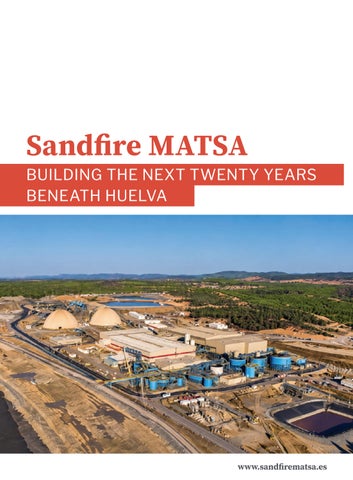
Sandfire MATSA
BUILDING THE NEXT TWENTY YEARS BENEATH HUELVA
www.sandfirematsa.es
Sandfire
BUILDING THE NEX BENEATH PRODUCED BY
2
[ SEPTEMBER 2026 ] BUSINESS EXCELLENCE
Jo
e MATSA
XT TWENTY YEARS H HUELVA
oseph Phillips BUSINESS EXCELLENCE [ SEPTEMBER 2026 ]
3
W
hen Benito Volante retired from Aguas Teñidas in 2025, he left behind a working life closely tied to the mining towns of
Huelva. Born in La Zarza in 1965, he followed his grandfather and father into mining, entering the historic La Zarza operation in the mid-1980s before eventually joining Aguas Teñidas. Looking back after retirement, Volante described mining as a way of life that had given him economic stability and a strong sense of discipline and
4
[ SEPTEMBER 2026 ] BUSINESS EXCELLENCE
companionship. What he said he missed most were the people he had worked alongside. His career also spans a period in which mining in this part of Andalucía changed considerably. Aguas Teñidas closed in 2001 after metal prices fell. Iberian Minerals acquired the mining rights in 2005, and a favourable environmental report in 2006 cleared the way for the modern project. Construction followed in 2007 and 2008; commercial production formally began in 2009 with the sale of the first concentrates. Sandfire
SANDFIRE MATSA
“For many families in Huelva, the mine is more than an industrial asset. It is a place to build a working life close to home.”
marks 2006 as the beginning of the current twenty-year chapter because that approval reopened the path to mining activity. What emerged from that restart is now a much larger system. Aguas Teñidas operates alongside Magdalena and Sotiel, with the three underground mines feeding a central processing plant rated at 4.7 million tonnes per year. Copper, zinc and lead concentrates, with silver as a by-product, move from the plant towards the Port of Huelva and international markets.
BUSINESS EXCELLENCE [ SEPTEMBER 2026 ]
5
The next phase is being shaped by a different set of pressures. Sandfire needs enough new ore to keep established infrastructure productive, while modernising the underground mines, replacing tailings capacity, reducing energy use and sustaining the economic relationships that have grown around MATSA.
Extending the life of an established mining hub
The scale of the resource base gives Sandfire room to work. Its August 2026 Mineral Resource and Ore Reserve update put MATSA’s Mineral Resources at approximately 190 million tonnes, grading 1.2% copper, 2.7% zinc, 1.0% lead and 37 grams per tonne silver. Ore Reserves stood at around 36 million tonnes. Resource tonnage increased by roughly 12% year on year, while reserves reflected mining depletion as well as new conversion work. Sotiel accounted for a large share of the recent resource growth. At Aguas Teñidas, development has already moved new mineralisation into the
6
[ SEPTEMBER 2026 ] BUSINESS EXCELLENCE
production plan through La Calañesa. Almost six kilometres of underground development were required to reach the deposit. The associated VR9 main ventilation shaft was completed in May 2025, followed by La Calañesa’s first production blast in September. It now provides another production area within the existing Aguas Teñidas mine rather than requiring a separate processing route. Exploration continues around the established workings. At La Juliana, about 700 metres southeast of Castillejitos, Sandfire reported a 14.4-metre intersection grading 0.4% copper, 14.5% zinc, 4.4% lead, 0.6 grams per tonne gold and 158 grams per tonne silver. At Magdalena West, drilling has extended mineralisation as much as 200 metres beyond the new FY26 resource boundary. Both areas remain exploration targets, although their proximity to existing infrastructure makes them particularly relevant to Sandfire’s mine-life strategy. That strategy is supported by a processing plant already capable of handling ore from several
SANDFIRE MATSA mining areas. New discoveries close to the current footprint can potentially use existing access, power, roads and treatment capacity, allowing Sandfire to concentrate investment on underground development and conversion rather than building another standalone operation.
A mine operated from farther away
The underground environment has changed considerably since the early years of Aguas Teñidas. More than 80 kilometres of connected galleries now run through Aguas Teñidas and Magdalena. IPH Ingeniería y Proyectos says it has installed around 750 wireless access points across the
two mines, creating part of the communications infrastructure used for equipment control, voice communications and real-time location systems. MATSA has publicly acknowledged IPH’s role in developing those networks. That connectivity supports tele-remote loading and autonomous drilling. Sandfire says around 20% of drilling during blast-clear periods is now completed autonomously, allowing production drills to keep working while personnel have been withdrawn from underground areas. At Magdalena, that technological shift sits alongside a workforce drawn heavily from the surrounding region. Blast operator Rafael joined MATSA in 2016 after first going underground at
“Sandfire is looking beyond replacing depletion towards establishing MATSA as a long-life mining hub.”
BUSINESS EXCELLENCE [ SEPTEMBER 2026 ]
7
“The new Migollas access is being developed with communications and control systems built into the mine from the outset.” the age of 19. His career is a small example of what local employment means in practical terms: skilled underground work without having to leave the area in which he grew up. Sotiel provided another step forward in July 2026. MATSA completed its first blasting operation controlled entirely from surface on the new access towards the Migollas orebody, working with underground contractor INSERSA and explosives specialist MAXAM. Remote communications and verification systems allowed underground conditions to be checked before the blast was authorised. The Migollas access is being developed with communications and operating systems
8
[ SEPTEMBER 2026 ] BUSINESS EXCELLENCE
alongside the excavation itself. That approach gives Sandfire greater scope to extend remote operation as the new area develops.
The engineering beneath the production figures
Remote operation has changed some of the work underground, although the mines still depend on substantial conventional infrastructure. Ventilation is a good example. SADIM Ingeniería has a long history at Aguas Teñidas, including a ventilation engineering project commissioned by MATSA in 2009 and later work on the exploitation project associated with extending the mining concession.
SANDFIRE MATSA Drillcon / Drillcon Iberia has also contributed specialist raiseboring capability. One major ventilation raise at Aguas Teñidas extended approximately 479 metres and was opened to a diameter of 4.1 metres to accommodate a new intake fan. MATSA has subsequently found sizeable savings within that ventilation system. A modification to the blade angle of a principal extraction fan reduced energy use by a verified 1,655 MWh per year, leading to MATSA becoming the first mining company in Spain to receive an Energy Savings Certificate.
Equipment availability creates another layer of work around the operation. EPOS España / EPOS S.A. secured a five-year contract to maintain heavy production equipment at Aguas Teñidas, deploying around 60 mechanical and electrical technicians supported by engineering and safety personnel. The arrangement followed an earlier contract of similar scope. Civil and industrial contractors are woven through the same system. TR Construya delivered a workshop of more than 2,000 square metres at Aguas Teñidas for the maintenance of heavy mining vehicles and has also carried out civil
“Behind every production tonne sits a much larger system of ventilation, maintenance, power and underground infrastructure.”
BUSINESS EXCELLENCE [ SEPTEMBER 2026 ]
9
has described MATSA as an example of modern mining in the Iberian Pyrite Belt. The value of the central plant is most apparent when new underground areas are brought into the mine plan. La Calañesa, future extensions at Magdalena and any eventual development around Sotiel can feed an established processing system rather than requiring a new concentrator for each deposit. That puts considerable emphasis on the less visible systems around the plant: water, pumps, electrical equipment, control systems and maintenance. ABB sits within that electrical and automation landscape, while Veolia Water Technologies brings expertise in industrial and mine-water treatment and AGQ Labs contributes analytical and environmental capability.
Tailings, backfill and the space to continue
MATSA’s existing tailings facility has been operating since 2007 and is approaching the limits of its available capacity. Its replacement is one of the most important works for the paste plant at Magdalena. Construcciones y Mantenimientos Mary S.L. adds another Huelva-based contractor to the mix, with civil, hydraulic, maintenance and auxiliary mining capabilities supporting the wider complex.
Where three mines become one operation
The processing plant brings the three mining areas together. Ore from Aguas Teñidas, Magdalena and Sotiel is crushed, ground and treated through flotation circuits producing copper, zinc and lead concentrates. Because the mineral characteristics vary between deposits, the plant must accommodate changes in feed while maintaining throughput and recovery. Metso has been part of MATSA’s processing story for years. Its technology has been used in the plant’s grinding circuit, and the company has also worked with MATSA on maintenance and plant-performance support. Metso itself
10
[ SEPTEMBER 2026 ] BUSINESS EXCELLENCE
SANDFIRE MATSA
“Building trust and demonstrating that mining can be an engine of economic, social and future development for Huelva.” — Dale Burgess, President, Sandfire MATSA Mining Operations pieces of infrastructure now being developed at the operation. The new facility is designed to hold approximately 15 million cubic metres of thickened tailings and provide at least another 15 years of capacity at current production rates. MATSA has placed the investment at more than €60 million, with the facility intended to support continued operations beyond 2040. Around half of MATSA’s processing tailings are reused underground as paste backfill, reducing the amount requiring permanent surface storage. The practice also provides support
within mined-out workings. TR Construya’s civil work at Magdalena’s paste plant is one example of the infrastructure sitting behind that system. Water management and environmental monitoring are closely connected to the tailings system, creating roles for specialist laboratory, treatment and engineering suppliers. The replacement facility also carries a restoration commitment: MATSA says more than 175 hectares of public land will be reforested with stone pine, alongside long-term ecological monitoring.
BUSINESS EXCELLENCE [ SEPTEMBER 2026 ]
11
Energy enters a new phase
MATSA is also adding renewable generation to its power mix. A dedicated 33 MW solar facility is being developed under Sandfire’s agreement with Endesa and is expected to supply approximately a quarter of the operation’s electricity requirements. Permitting is complete and Sandfire expects the facility to become operational during FY27. The solar plant sits alongside the quieter efficiency work already happening underground. Ventilation optimisation has reduced consumption at Aguas Teñidas, while autonomous drilling enables equipment to make productive use of periods that were previously unavailable. For a mine of MATSA’s age, much of the energy transition will come through this combination of new infrastructure and improvements to systems already in service.
12
[ SEPTEMBER 2026 ] BUSINESS EXCELLENCE
The network behind MATSA
The size of MATSA’s supplier base becomes clearer when the operation is followed from the working face to the port. Underground development draws on SADIM Ingeniería, INSERSA, Drillcon and MAXAM for engineering, development, specialist drilling and blasting. IPH Ingeniería y Proyectos provides part of the digital infrastructure that now makes remote operation possible, while the mobileequipment environment includes Volvo Group / Volvo Construction Equipment alongside other heavy fleet providers. Plant and asset reliability bring another set of companies into the picture. Metso contributes processing technology; EPOS supports heavyequipment maintenance; TR Construya and Construcciones y Mantenimientos Mary provide construction and industrial services. ABB, Veolia Water Technologies and AGQ Labs sit within the electrical, water and environmental disciplines
SANDFIRE MATSA required around a modern polymetallic operation. The supply chain continues after processing. Grusol Logística S.L., based around Huelva’s port environment, specialises in mineral and bulk logistics. Bergé Infraestructuras y Servicios Logísticos has an especially long connection with Aguas Teñidas concentrate: Port of Huelva records show Bergé receiving a concession in 2008 for a terminal designed to handle lead, zinc and copper concentrates arriving from the mine, and handling the first 5,000-tonne shipment of Aguas Teñidas zinc concentrate in January 2010. That network matters economically because mining expenditure circulates far beyond Sandfire’s own payroll. Engineering offices, workshops, laboratories, construction teams and transport businesses have all become part of the industrial base supporting MATSA and, in many cases, the wider mining sector in Andalucía.
Connected to Huelva
The relationship with the surrounding communities extends beyond employment and supplier spending. Programa Pueblos works directly with Almonaster la Real, Calañas, Cortegana, El Cerro de Andévalo and La Zarza-Perrunal. Its eighth edition, agreed in July 2026, will fund projects covering social development, education, culture and improvements to local infrastructure. Programa Alianza works through Huelva’s nonprofit sector. MATSA allocated €100,000 to the 2025-26 programme and has committed another €100,000 for 2026-27, supporting organisations involved in social welfare, education, health, environmental work and community development. Education has become another part of that relationship. More than 100 students undertook placements at MATSA during the 2024-25 academic year; around 95% were from Huelva and 40% were women. The company’s scholarship programme has also supported more than 40
BUSINESS EXCELLENCE [ SEPTEMBER 2026 ]
13
young people from local institutes. Environmental work is becoming more detailed as well. MATSA’s 2024-25 non-financial reporting records around 680 hours of biodiversity fieldwork, more than 1,320 survey routes and over 580 species identified around its properties. The findings have contributed to the company’s first Biodiversity Management Plan. Sandfire reported female representation at MATSA of 24.5% in 2026, well above the regional mining-industry benchmark cited by the company. For Financial Director Paz Curto, the business case is straightforward: “When we have diversity, we get different points of view which leads to greater innovation and better decisions.” The company’s newer Impulsando Huelva
“MATSA enters its third decade with a larger resource base and substantially more infrastructure than the operation that began taking shape in 2006.”
14
[ SEPTEMBER 2026 ] BUSINESS EXCELLENCE
SANDFIRE MATSA
Provincial Observatory adds a more formal mechanism for discussing socioeconomic development with public authorities, businesses, academia and local communities.
The next twenty years
MATSA enters its third decade with much more infrastructure than the operation that began taking shape after the 2006 environmental approval. La Calañesa is already part of the production story. The Migollas access is extending Sotiel. Exploration is testing new ground around all three mines. Replacement tailings capacity is being built for a longer operating horizon, and the solar project will add another source of electricity to the complex. At the same time, the operation remains tied closely to the communities that grew around mining long before Sandfire arrived. Benito Volante’s working life stretched from the old La Zarza mine to Aguas Teñidas; younger employees such as Rafael are building careers in a mine that now uses remote networks, autonomous drilling
and surface-controlled blasting. That continuity is part of what twenty years means in Huelva. The machinery has changed, the resource base has grown and the supplier network has become more specialised, but the future of MATSA will still be judged in familiar terms: whether the mines can keep producing safely, whether new ore can replace what has been extracted, and whether the economic activity around them continues to support the towns that have lived with mining for generations.
SANDFIRE MATSA - Ctra. HU-7104, Km. 12, 21330 Almonaster la Real, Huelva, Spain
+34 959 05 40 12 dpto.comunicacion@sandfire. com.au www.sandfirematsa.es
BUSINESS EXCELLENCE [ SEPTEMBER 2026 ]
15
Sandfire MATSA - Ctra. HU-7104, Km. 12, 21330 Almonaster la Real, Huelva, Spain
+34 959 05 40 12 dpto.comunicacion@sandfire.com.au www.sandfirematsa.es
Produced by: www.bus-ex.com