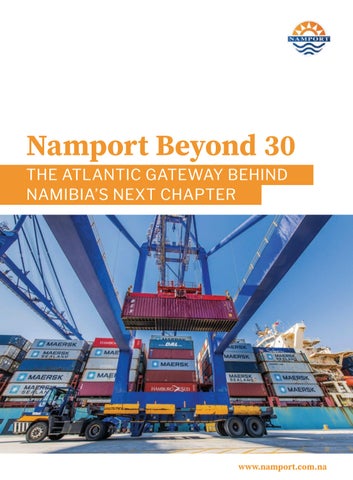
Namport Beyond 30 THE ATLANTIC GATEWAY BEHIND NAMIBIA’S NEXT CHAPTER
www.namport.com.na
Namport B
THE ATLANTIC G NAMIBIA’S NE PRODUCED BY
2
[ OCTOBER 2026 ] BUSINESS EXCELLENCE
Xoli
Beyond 30
GATEWAY BEHIND EXT CHAPTER
iswa Mhlaraza BUSINESS EXCELLENCE [ OCTOBER 2026 ]
3
I
n the financial year ended March 2025, Namibia’s ports handled 8.42 million tonnes of cargo. About 2.45 million tonnes of that cargo was cross-border trade, moving to or from neighbouring countries that depend on reliable routes to the sea. Behind those figures is a working economy: vessels, trucks, warehouses, agents, crane operators, marine crews, engineers, fuel
4
[ OCTOBER 2026 ] BUSINESS EXCELLENCE
“Namport runs infrastructure, but its influence reaches far beyond berths and quay walls.”
NAMPORT
suppliers, divers, repair teams and local businesses whose days are shaped by whether cargo moves on time. That is the real scale of the Namibian Ports Authority. Namport runs infrastructure, but its influence reaches far beyond berths and quay walls. It affects the cost of trade, the confidence of investors, the survival of suppliers, the competitiveness of landlocked neighbours and
the opportunities available to Namibians building careers in logistics, engineering, marine services and port operations. More than three decades after its establishment, Namport is entering a more demanding phase. Walvis Bay has new private-sector operating capacity at the container terminal. Lüderitz is being pulled into the national energy conversation. Northport remains a long-term planning reserve
BUSINESS EXCELLENCE [ OCTOBER 2026 ]
5
GATEWAY TO GLOBAL MARKETS
At Grindrod, movement is more than the transportation of goods. It is the connection between mines and markets, businesses and opportunities as well as communities and economic growth. With more than 120 years of experience and operations across Sub-Saharan Africa, Grindrod provides integrated logistics solutions spanning the entire value chain, from mine to port and onward to global markets. Through a comprehensive suite of services, including rail and road transportation, terminal operations, ships agency, container depots, freight forwarding and cross-border logistics, we provide a gateway to global markets. This capability is supported by a portfolio of strategically located terminals and logistics assets across the region. From the established trade routes of Maputo and South Africa’s major port gateways, including Durban and Richards Bay, to the growing opportunities presented by Walvis Bay and the Nacala Corridor, Grindrod enables cargo owners to access efficient and flexible routes to market. In Walvis Bay for example, Grindrod operates from a 50 000 m² facility located across berths seven and eight, including a modern 4 000 m² warehouse that supports cargo handling, storage and the seamless transfer of freight between sea, road and rail transport. This investment strengthens the Port of Walvis Bay’s position as a vital gateway for trade flowing from Zambia, Botswana, Zimbabwe, South Africa and the Democratic Republic of Congo. Grindrod is also supporting the development of key trade corridors, including the Nacala Corridor and Richards Bay. Through investments in logistic infrastructure and transport networks we help facilitate the movement of cargo while strengthening connectivity and improving market access for landlocked economies.
The importance of this role is expected to increase as mining investment, energy projects and industrial development continue to drive demand for export logistics. Growth in commodities such as copper, gold, iron ore and manganese, together with emerging energy opportunities, is creating a need for additional port capacity, storage facilities and specialised cargo handling solutions. Grindrod’s ongoing investments position the company to support these expanding requirements while contributing to the long-term development of Africa’s strategic trade corridors. Infrastructure alone does not guarantee supply chain success. Collaboration between port authorities, logistics providers, transport operators and customers remains essential. Grindrod’s investment in strategic infrastructure reflects its commitment to working alongside stakeholders to enhance operational efficiency, develop sustainable logistics solutions and support economic growth. As African trade continues to expand, resilient and integrated logistics networks will be central to unlocking future growth. Grindrod is helping to build the connections that enable Africa’s trade with the world while supporting the continued development of key logistics gateways.
+264 64 271 270 commercial@grindrod.com www.grindrod.com
BUSINESS EXCELLENCE [ OCTOBER 2026 ]
7
Bachmus supplies high-quality fuel and lubricants with reliable service, technical expertise and nationwide solutions you can trust. Service & Expertise you can trust: Proudly Namibian. More than 30 years of customer service excellence. Wholesale diesel and lubricant supplier. Marine Bunkering. Fuel Management Solutions. Certified Technical Lubricant support. Fuel Storage Solutions.
www.bachmus.com.na
8
[ OCTOBER 2026 ] BUSINESS EXCELLENCE
Erf 5738, Rossing Str., New Industrial Area, Walvis Bay +264 83 334 3600 sales@bachmus.com.na info@bachmus.com.na ops@bachmus.com.na
BACHMUS: FUELLING NAMIBIA’S PORT-TO-CORRIDOR ECONOMY
At anchorage outside Walvis Bay, a vessel may be waiting for a narrow operating window. Alongside in port, trucks are preparing to carry cargo inland. Both depend on services that rarely attract attention when they work well: fuel delivered on time, the correct lubricant available, secure storage in place and accurate information about consumption. When any one of those fails, schedules tighten and costs begin to rise.
Namibia, Bachmus supplies automotive, industrial and marine products for engines, transmissions, hydraulic systems and deck machinery. Its technical services include oil sampling, oil analysis, lubrication audits, fuel-system consultation and practical lubricant advice. Together, these services help customers identify wear earlier, improve maintenance planning, extend oil drain intervals, extend equipment life and reduce unplanned downtime.
Bachmus Oil & Fuel Supplies has built its business around preventing that disruption.
Bachmus also connects port activity with Namibia’s inland logistics network. Its own depots in Walvis Bay, Swakopmund, Karibib, Windhoek, Otjiwarongo, Ondangwa and Katima Mulilo are supported by partner refuelling sites across major transport corridors, border routes, mining regions and commercial centres.
Founded in 1994 and headquartered in Walvis Bay, Bachmus has developed from its marine roots into one of Namibia’s established fuel and lubrication partners. Its services span marine bunkering, wholesale diesel supply, lubricant distribution, fuel logistics, on-site storage, technical support and digital fuel management. That breadth allows the company to support customers at the port, on the road and across remote operating locations. For port, fleet and industrial customers, this means dealing with a supplier that can combine product availability with local knowledge, technical guidance and a national distribution network rather than relying on several disconnected service providers. Within the Port of Walvis Bay ecosystem, Bachmus supplies marine gas oil, Low sulphur fuel oil and vessel lubricants, both in port, and at anchorage. It supports fishing fleets, commercial shipping operators and offshore marine activities, where timing, safety and continuity are critical. The value lies not only in supplying the product, but in responding within demanding operating windows and helping customers avoid disruption. The company’s lubrication offer adds another layer of support. As a leading distributor of Caltex lubricants in
For customers requiring direct supply, Bachmus provides bulk diesel deliveries, scheduled contract deliveries, emergency fuel supply, fleet refuelling and remote-site support. It also offers bulk, selfbunded and mobile fuel-storage systems, supported by consumption monitoring, inventory management and dispensing controls. These solutions help reduce losses, improve accountability and give operators clearer oversight of fuel use. Technology strengthens that offer. Through its exclusive partnership with TFN, Bachmus provides secure app-based refuelling, real-time reporting, driver and vehicle controls, nationwide network access and cross-border capability across the SADC region. From vessel to vehicle, Bachmus brings marine fuel, wholesale diesel, premium lubricants, storage, technical expertise and fuel management together through one Namibian partner. In an economy built on movement, its role is simple but essential: keep operations supplied, controlled and moving.
BUSINESS EXCELLENCE [ OCTOBER 2026 ]
9
NAMIBIA DRYDOCK & SHIP REPAIR (PTY) LTD (NAMDOCK) When a vessel enters dock, the job is never just mechanical. Behind every repair is a crew waiting to sail, a client watching the clock, and an operation that needs to get back to work safely. That is the space Namdock understands. Based in Walvis Bay and trusted since 2003, Namdock is a wholly Namibian marine and industrial engineering company serving vessels across the West African coast. Its work covers offshore support vessels, tankers, rigs, fishing vessels, dredgers, drill ships and other specialised marine assets. For Namport and the wider Walvis Bay maritime ecosystem, Namdock adds something essential: the ability to keep ships close to the port, close to the customer, and close to the next assignment. With three floating docks, advanced workshops and a skilled workforce, the company provides ship repair, fabrication and maintenance services built around fast turnaround, safety and practical workmanship. Its teams work across project management, metal
10
[ OCTOBER 2026 ] BUSINESS EXCELLENCE
work, piping, electrical, propulsion, carpentry, mechanical, valves, rigging, coatings, machining, design and fabrication. These are not background services. They are the quiet, technical disciplines that keep vessels moving and help protect the reliability of the port economy. Beyond the port, Namdock plays a wider role in Namibia’s industrial story. Its shipyard supports local subcontractors, develops technical skills, and creates opportunities for Namibian tradespeople to work to international standards without leaving the country. In that sense, every vessel repaired at Walvis Bay is also part of a bigger story about local capability. Namdock’s strength is simple: it brings people, equipment and experience together when reliability matters most. For vessel owners, offshore operators and marine clients looking for a trusted repair partner in West Africa, Namdock is ready to help keep your operation moving.
NAMPORT
“The benefit of Namport’s growth is strongest when it reaches the people and companies around the infrastructure.” for future port-linked industries. The question now is how much value Namibia can keep from the cargo that moves through its coastline.
The gateway, the corridor and the country
Walvis Bay and Lüderitz are Namibia’s two commercial maritime gateways. Their importance is visible at the quay, but their real test sits inland, where cargo must move across borders, through customs, onto trucks and rail, and into the markets that depend on Namibia’s
Atlantic access. Walvis Bay connects to Botswana, Zambia, the DRC, Zimbabwe, Angola, South Africa and Malawi through corridors including the TransKalahari, Walvis Bay–Ndola–Lubumbashi, Trans-Cunene and Trans-Oranje routes. Lüderitz has traditionally served fishing, mining, offshore diamond activity, southern Namibia and South Africa’s Northern Cape, but its future is now tied to offshore oil and gas, green hydrogen, green ammonia, manganese, critical minerals and
BUSINESS EXCELLENCE [ OCTOBER 2026 ]
11
project cargo. For Namibia, the task is practical: keep the infrastructure strong, make the corridors more reliable, and create room for highervalue industries to grow around Walvis Bay and Lüderitz, so the country captures more than transit traffic. A faster gateway lowers costs. A stronger corridor gives exporters and importers more confidence. A deeper marine-services base creates work for engineers, welders, divers, technicians and local subcontractors. The benefit of Namport’s growth is strongest when it reaches the people and companies around the infrastructure.
Walvis Bay: from capacity to competitiveness
Walvis Bay remains the centre of Namport’s commercial network. It is Namibia’s principal harbour, its main container and general cargo gateway, and one of the most important Atlantic access points for landlocked economies in
12
[ OCTOBER 2026 ] BUSINESS EXCELLENCE
Southern Africa. The New Container Terminal remains its defining asset. Commissioned in 2019, it gave Walvis Bay annual capacity of 750,000 TEUs. Capacity, however, is only useful when it is matched by berth availability, equipment reliability, shippingline confidence, cargo visibility, gate flow and the cost of moving freight inland. The concessioning of the New Container Terminal to Terminal Investment Namibia is one of the most important changes in how Namport manages growth at Walvis Bay. The 25-year concession, effective from 1 October 2024, gives TiN responsibility for operating and managing the terminal, while Namport retains ownership and its role as authority. Namport has said the concession is intended to improve operational efficiencies, grow revenue and increase cargo throughput. At the handover, chief executive Andrew Kanime said the concession would allow Namport to attract private capital for upgrades such as dredging the entrance channel and acquiring new equipment. That logic is now visible in the numbers. Namport’s 2025 statistics record a 48 percent rise in container throughput to 253,996 TEUs and N$143 million in concession revenue, early evidence that the new operating model has begun to register in performance as well as policy. In recent public comments, Namport’s Executive: Finance, Kavin Harry, said publicprivate partnerships would play an increasingly important role as the Authority strengthens its PPP framework and places more emphasis on its landlord and regulatory responsibilities. The commercial reason is straightforward: modern maritime gateways require capital, equipment, technology and operating discipline, while the state still has to protect access, employment, tariffs and long-term national value.
The hard test of growth
Numbers can be cold, but logistics numbers carry consequences. A delayed vessel can mean overtime in a warehouse. A missing part can hold up a mine. A slow gate can turn a profitable trip
NAMPORT into a loss for a transporter. Namport’s latest full-year published performance gives the current strategy substance. For the financial year ended March 2025, total revenue increased to N$2.88 billion from N$2.56 billion in 2024. Operating profit for the Authority rose by 45 percent to N$793 million, while group operating profit reached N$967 million, supported by an EBITDA margin of 42 percent. Cargo volumes also strengthened. Total cargo throughput reached 8.42 million tonnes across Walvis Bay and Lüderitz. Container throughput rose to 253,996 TEUs, while general cargo reached 6.34 million tonnes. Cross-border cargo totalled approximately 2.45 million tonnes, with
South Africa contributing 35 percent and Zambia 34 percent. Those two markets accounted for almost 70 percent of Namport’s regional cargo. Vessel calls declined by 13 percent to 1,850, while gross tonnage increased slightly to 23.5 million. The increase in gross tonnage should not be overstated; it points less to a dramatic shift in vessel size than to a working environment where berth planning, terminal productivity and cargo concentration matter as much as the number of ships calling. Competition is also moving. The Lobito Corridor is being developed as a rail-linked Atlantic route for Copperbelt minerals. Lobito Atlantic Railway secured US$753 million in financing from the US
“The new operating model has begun to register in performance as well as policy.”
BUSINESS EXCELLENCE [ OCTOBER 2026 ]
13
That is why the Reload Namport Terminal matters. Reload Logistics launched the fully bonded facility inside the Port of Walvis Bay in June 2026. It covers 28,100 square metres and adds bonded storage and cargo-handling capacity within the harbour precinct, rather than in a separate back-of-port location. For cargo moving from Walvis Bay into Zambia, the DRC, Zimbabwe or Botswana, that positioning can reduce the number of times cargo is handled before it leaves Namibia. Reload’s own description points to covered warehousing, open warehousing and bonded yard space, weighing capability and specialised cargo-handling equipment, with the facility designed for cargo flows in sectors such as metals, minerals and dry bulk. This is not the kind of development that always dominates headlines. But for a freight forwarder trying to consolidate loads for more than one country, or a cargo owner watching working capital sit in transit, in-port storage can make the chain feel less fragile.
International Development Finance Corporation and the Development Bank of Southern Africa to accelerate rehabilitation of the 1,300km railway between Lobito and Angola’s border with the DRC. TAZARA is also receiving new attention, with Zambia, Tanzania and China signing a US$1.4 billion revitalisation agreement in September 2025. For Walvis Bay, the answer sits beyond the quay. Namibia must keep improving rail connectivity, border efficiency, cargo visibility, tariffs, customer service and inland reliability. The harbour can win a ship call and still lose the customer if the corridor behind it is slow. Ports compete at the quay. Corridors compete in the hinterland.
New capacity inside the harbour
Cargo moves more easily when storage, handling and customs processes sit close to the point of discharge.
14
[ OCTOBER 2026 ] BUSINESS EXCELLENCE
Operational strength, built piece by piece
Future growth is often discussed through masterplans. In daily life, it depends on equipment. In September 2025, Namport commissioned three Liebherr mobile harbour cranes: two LHM 550 models with lifting capacity of 154 tonnes each, and one LHM 280 crane with lifting capacity of 84 tonnes. Two of the machines were assigned to Walvis Bay, while the third was delivered to Lüderitz. At sea, Namport has also moved to reinforce towage capability. On 28 October 2025, MED MARINE and Namport signed a shipbuilding contract at Namport’s headquarters in Walvis Bay for a TRAktor tugboat with 80 tonnes of bollard pull. The vessel is expected to join Namport’s fleet at the Port of Walvis Bay once completed, supporting operational efficiency, safety and towage capability. For customers, investments like these are felt in practical ways: safer berthing, faster cargo handling, less waiting time and greater
NAMPORT
“Ports compete at the quay. Corridors compete in the hinterland.” confidence when volumes rise. For staff and local service providers, they create a higher operating standard, which is how skills deepen over time.
Lüderitz: promise, pressure and possibility
Lüderitz has always carried a different rhythm from Walvis Bay. It is smaller, more exposed and closely tied to the life of a coastal town. Fishing, mining, offshore diamond activity and southern Namibia have shaped its identity for decades. Now Lüderitz is preparing for a larger role. Offshore oil and gas, green hydrogen, green
ammonia, manganese, critical minerals, project cargo and future industrial exports are all pushing against a harbour that still faces hard constraints around berth space, depth, land availability, environmental approvals and specialised handling capacity. Kanime has acknowledged the scale of the physical constraint. In a recent comment on the proposed Lüderitz quay-wall extension, he said that extending the quay wall could double or even triple berth availability. The route to an oil and gas supply base has been uneven. In 2025, Namport cancelled an earlier
BUSINESS EXCELLENCE [ OCTOBER 2026 ]
15
procurement process. In 2026, the project drew further attention after Namport rejected a proposal from Alpha Nautical Services for a N$4 billion development, citing concerns around technical capability and track record. IPC MP Rodney Cloete later questioned why the project appeared to move through the Namibia Industrial Development Agency rather than returning through an open bidding process. At the time of writing, Namport’s procurement portal lists RFP/OIB/NAMPORT-3768/2026, an open international competitive selection for the Lüderitz Bay Integrated Oil and Gas Supply Base, with a closing date of 12 October 2026. The sensitivity around Lüderitz is understandable. The project touches the future of a town, the credibility of public-private delivery, the confidence of energy investors and the ability of local companies to see where they fit. A supply base can bring work, movement and skills, but it must be delivered in a way that earns public confidence.
16
[ OCTOBER 2026 ] BUSINESS EXCELLENCE
Handled well, Lüderitz can complement Walvis Bay. Walvis Bay can remain Namibia’s primary container, general cargo, marine services and regional logistics gateway. Lüderitz can become the specialised southern platform for energy, green ammonia, processed minerals and offshore support.
Angra Point and the industrial harbour
Angra Point is Lüderitz’s biggest opportunity. The European Union has signed a NAD 13 million partnership with the Port of Rotterdam and Namport to support planning for the Lüderitz expansion at Angra Point, as part of the EU– Namibia Strategic Partnership on Sustainable Raw Materials Value Chains and Renewable Hydrogen. The Port of Rotterdam has also confirmed EU-backed work on the design of a Green Minerals Terminal at the Angra Point Hydrogen Hub in Lüderitz. The importance of this work is not limited to hydrogen. Infrastructure designed for processed
NAMPORT minerals, green ammonia, energy logistics and multi-user industrial cargo gives Namibia a better chance of capturing value before commodities leave the country. That means more storage, more handling, more technical work, more service contracts and more room for Namibian suppliers to participate in the chain. Infrastructure alone does not create industrialisation. It makes it possible for industries to arrive, operate and export. In a country with long distances and a small population, that enabling role matters.
Northport and the next scale of ambition
The clearest picture of Namport’s long-term thinking sits north of the current Walvis Bay harbour. Namport’s port engineering material describes the North Port of Walvis Bay as a future SADC gateway development area on 1,330 hectares of new land. The concept includes an oil and gas supply base, ship and rig repair, logistics parks, dry bulk capacity, liquid bulk facilities and highcapacity rail, road, pipeline and conveyor links. Northport reserves space for industries Namibia expects to serve in future. It also reflects a wider
“Lüderitz can become the specialised southern platform for energy, green ammonia, processed minerals and offshore support.”
BUSINESS EXCELLENCE [ OCTOBER 2026 ]
17
truth about Walvis Bay: the country is planning for a maritime economy that may need much more land, energy capacity, industrial support and hinterland connectivity than the current footprint can provide. Capacity at the coast only matters when cargo can move inland reliably. When rail, road and coastal infrastructure are aligned, Walvis Bay becomes a practical route into the region.
Governance, transparency and the public interest Private participation can bring capital and expertise. It also raises questions about tariffs, access, employment and control. In September 2026, Independent Patriots for Change shadow minister of works and transport Nelson Kalangula asked works and transport minister Veikko Nekundi to provide details of active, awarded and pending concessions at Walvis Bay and Lüderitz, including concession periods, lease fees and targeted cargo volumes.
18
[ OCTOBER 2026 ] BUSINESS EXCELLENCE
He also asked which revenue-generating and marine services would remain under Namport’s direct management, including tugboat operations, pilotage, dredging and bulk-liquid handling, and how concession fees would help service Namport’s capital debt while still supporting dividends to the state. These are political questions, but they are also commercial questions. They affect tariff-setting, local logistics participation, job protection, concession monitoring and the way customers experience the gateway. For Namport, this is the harder test of the PPP model. The Authority has to attract private capital without losing public trust. It has to improve efficiency while keeping the national gateway connected to the companies, workers and communities that helped build its base.
The partner network behind the gateway
Every vessel call at Walvis Bay or Lüderitz depends on a chain of companies, skills and
NAMPORT
services that most readers never see. Terminal Investment Namibia now operates the New Container Terminal under a 25-year concession. Africa Global Logistics Namibia manages the Walvis Bay Multipurpose Bulk Terminal. Lithon Project Consultants contributes through condition survey work on Namport’s civil and marine infrastructure. B-4 Engineering & Diving has undertaken underwater and marine works within the Port of Walvis Bay, including subsea cutting at the Small Craft Harbour and work on the New Port Extension. Fuel and lubrication supply is part of the same chain. Bachmus Oil & Fuel Supplies supports marine, industrial, mining and transport customers through marine oils, lubricants, bunkering services and fuel products. Ship agents such as Sturrock Grindrod Maritime Namibia help coordinate vessel calls, documentation, port interfaces and cargo movement. Walvis Bay’s marine-engineering capability is anchored by Namdock — Namibia Drydock &
Ship Repair — where Namport remains a key shareholder. Namdock’s floating docks give Namibia an important platform for ship repair, maintenance and marine engineering. The cluster is strengthened by specialist providers including Dynamic Commercial Diving and Kongsberg Maritime, which bought Rolls-Royce’s Commercial Marine business in 2019 and has an office in Walvis Bay. Companies working in this environment must meet strict standards around safety, timing, documentation, access control, environmental compliance and emergency response. Over time, those standards build local industrial capability. For suppliers and subcontractors, Walvis Bay and Lüderitz become demanding but valuable places to learn.
Beyond the quay: technology, ESG and social value
Namport’s national role is clearest when maritime infrastructure touches daily life.
BUSINESS EXCELLENCE [ OCTOBER 2026 ]
19
“Namport’s next phase will be judged by how reliably cargo moves, how fairly opportunity is shared, and how much value Namibia keeps from the trade passing through its coastline.” Through the Namport Social Investment Fund, the Authority says it has invested more than N$78 million in projects across Namibia since 2006, with support reaching all 14 regions. Its focus areas include education, health, youth development and community wellbeing. In 2026, the Fund donated two fully equipped ambulances worth N$2.7 million to strengthen emergency healthcare delivery in the Otjozondjupa Region, with support directed to rural communities including Kalkfeld and Gam. That donation belongs in a Namport feature
20
[ OCTOBER 2026 ] BUSINESS EXCELLENCE
because it shows what commercial infrastructure is meant to support. A national gateway should move cargo, but it should also help build the country around it. The benefit can be a clinic ambulance, a school visit during Maritime Week, a football sponsorship, a small business gaining a contract or a young tradesperson learning to work to maritime standards. Technology sits in the same frame. Namport’s current procurement notices include consultancy services for a customer relationship management system, SAP S/4HANA governance, risk and
NAMPORT
compliance modules, and SAP environment, health and safety modules. These systems may sound administrative, but they affect how customers are served, how risks are monitored and how safety is managed. As Walvis Bay and Lüderitz take on more complex cargo — offshore energy, green ammonia, critical minerals, bunkering, ship repair and industrial logistics — growth will need to be matched by environmental discipline and community trust. The deeper Namibia moves into strategic maritime industries, the more important that social licence becomes.
The next 30 years
The first three decades of Namport can be counted in cargo handled, vessels served, terminals built, suppliers engaged, corridors promoted and infrastructure expanded. The next three decades will be tested by more specific measures: sustained container growth at Walvis Bay, delivery of the Lüderitz quay wall and supply-base capacity, progress at Angra Point, movement on Northport, stronger rail connections, fair concession governance and deeper participation by Namibian suppliers in the
technical core of the maritime economy. The human test is just as important. Logistics companies need fair opportunity. Port workers need skills growth. Communities near the harbours need to feel the benefit of national infrastructure. Landlocked customers need Namibia’s route to be reliable in practice, not just shorter on a map. Namport’s next phase will be judged by how reliably cargo moves, how fairly opportunity is shared, and how much value Namibia keeps from the trade passing through its coastline. If Walvis Bay and Lüderitz can keep cargo moving while building local capability, Namibia’s coast will help more Namibians take part in the value that moves through it.
NAMPORT - Nr 17, Rikumbi Kandanga Rd P O Box 361 Walvis Bay, Namibia
(+264 64) 208 2111 7 (+264 64) 208 232 www.namport.com.na
BUSINESS EXCELLENCE [ OCTOBER 2026 ]
21
Namport - Nr 17, Rikumbi Kandanga Rd P O Box 361 Walvis Bay, Namibia
(+264 64) 208 2111 7 (+264 64) 208 232 www.namport.com.na
Produced by: www.bus-ex.com