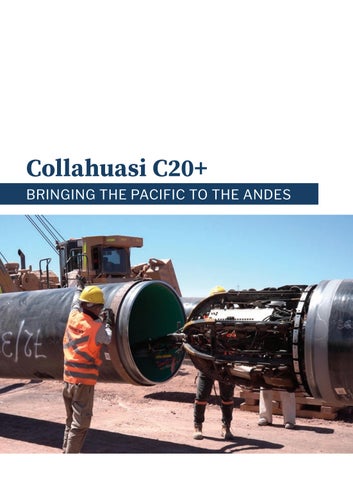
Collahuasi C20+
BRINGING THE PACIFIC TO THE ANDES
Collahua
BRINGING THE PACI PRODUCED BY
2
[ NOVEMBER 2026 ] BUSINESS EXCELLENCE
Jo
asi C20+
IFIC TO THE ANDES
oseph Philips BUSINESS EXCELLENCE [ NOVEMBER 2026 ]
3
A
cross 194 kilometres of Chilean desert and mountains, Collahuasi is building a new water supply for its copper operations. The US$3.2 billion programme brings together desalination, high-altitude engineering and improvements to mineral processing, with contractors and regional businesses helping deliver the infrastructure.
A 4,400-Metre Climb
At Puerto Patache, on Chile’s Pacific coast, a
4
[ NOVEMBER 2026 ] BUSINESS EXCELLENCE
desalination plant has been designed to produce 1,050 litres of water every second. Getting that water to Collahuasi’s copper operations means pumping it almost 200 kilometres inland and more than 4,400 metres uphill. The route crosses the Atacama Desert before rising into the Andes. Five pumping stations divide the climb, while a 44-inch steel pipeline connects the coast with the Ujina mining complex. At its highest sections, construction teams have worked above 4,000 metres, where
COLLAHUASI C20+
“Getting that water to Collahuasi’s copper operations means pumping it almost 200 kilometres inland and more than 4,400 metres uphill.”
freezing temperatures, thin air and steep terrain add to the difficulties of installing heavy industrial equipment. The infrastructure is part of Collahuasi C20+, formally the Infrastructure Development and Productive Capacity Improvement Project, a US$3.2 billion investment in the long-term operation of one of Chile’s major copper mines. Compañía Minera Doña Inés de Collahuasi, owned by Anglo American and Glencore with 44% each and Japan Collahuasi Resources with
BUSINESS EXCELLENCE [ NOVEMBER 2026 ]
5
COLLAHUASI C20+ 12%, is developing the programme to support another two decades of mining while reducing its use of continental water. The need is particularly acute in northern Chile, where the availability of freshwater has become an important consideration in mine planning. Collahuasi is addressing it through a new coastal supply system, alongside improvements to its mineral-processing facilities. At the ACADES Congress in March 2026, then Executive President Jorge Gómez described the engineering involved in lifting water from sea level to the mountains through a pipeline
measuring approximately 200 kilometres. He called the undertaking “una obra titánica” — a titanic undertaking. Gómez reported capital investment of US$3.5 billion, a peak construction workforce of 11,000 and overall project progress of 99.5% at that time. He also described the additional electrical infrastructure required to operate the system, including a 42-kilometre power connection. Behind those figures is an extensive programme of manufacturing, civil engineering, marine construction and logistics, involving companies from Chile and overseas.
“C20+ was conceived as a project for operational continuity rather than the establishment of an entirely new mine.”
BUSINESS EXCELLENCE [ NOVEMBER 2026 ]
7
Water and the Future of Collahuasi
Collahuasi operates in the Tarapacá Region, with mining and processing facilities in the Andes and concentrate-handling infrastructure near the Pacific coast. Its deposits and existing operations make continued investment in processing efficiency and water availability central to future production. The C20+ project is designed to replace much of the mine’s reliance on inland freshwater sources with desalinated seawater. The water will be produced at Puerto Patache and transported through a dedicated pumping system to the highaltitude operation. Collahuasi already recirculates approximately 80% of the water required for its operations, according to the company’s environmental reporting. The desalination investment addresses the additional water that must still be supplied. The programme also includes improvements intended to increase sulphide-ore processing capacity from approximately 170,000 to 210,000 tonnes per day. These changes involve new
8
[ NOVEMBER 2026 ] BUSINESS EXCELLENCE
and upgraded milling, flotation and supporting facilities. C20+ was conceived as a project for operational continuity rather than the establishment of an entirely new mine. Its planned benefits depend on maintaining existing production while adapting to changing ore characteristics and providing the water needed for future processing. During his ACADES presentation, Gómez discussed the constraints of developing the coastal facilities within an existing industrial environment. The desalination plant occupies a relatively restricted area near Collahuasi’s port, while the pipeline and electrical works extend across locations far removed from the company’s normal mining activities. The project’s two main geographical areas — the coastal facilities and the mine in the Cordillera — have required different construction methods, separate specialist teams and extensive coordination between contractors.
ENGINEERING THE WATER INFRASTRUCTURE BEHIND C20+ As mining companies face growing pressure to secure reliable water supplies while reducing their dependence on freshwater resources, infrastructure is becoming an increasingly important element of long-term operational resilience. In northern Chile, this challenge is at the heart of Collahuasi’s C20+ project, a major investment designed to support the mine’s operations for the next two decades. A central component of the project is a large-scale desalinated water transport system connecting the coast with Collahuasi’s high-altitude mining operations. The system will transport desalinated water to an operation located approximately 4,600 metres above sea level, supporting Collahuasi’s strategy to reduce its reliance on continental water resources. The wider project includes a desalination plant, pumping infrastructure and associated electrical systems. Corinth Pipeworks (CPW) was selected to supply a critical part of this infrastructure. Through its wholly owned subsidiary CPW America Co., the company was awarded a contract for approximately 201 kilometres of 44-inch LSAW steel linepipe, representing approximately 109,000 tonnes of pipe, together with external and internal coating and induction bends. The project reflects the demanding technical and logistical requirements of modern water infrastructure. The linepipe was manufactured at CPW’s state-of-the-art facility in Thisvi, Greece, before being transported to Saudi Arabia for internal and external coating and subsequently delivered to Chile for installation. The pipes feature a three-layer polyethylene external coating and internal fusionbonded epoxy lining, providing long-term corrosion protection for this critical water-transfer application. CPW produced the linepipe in grade X70 with ultraheavy wall thicknesses ranging from 13 mm up to 27 mm. The pipe was manufactured to extremely tight dimensional tolerances, allowing the installation contractor to expedite welding in the field. CPW also packaged the supply of more than 250 induction bends for the project.
C20+ demonstrates how CPW’s advanced linepipe expertise can be applied well beyond traditional energy infrastructure. While the company has extensive experience supporting oil and gas and energytransition projects, its engineering and manufacturing capabilities are equally relevant to water, mining and other critical infrastructure applications where reliability, durability and long-term performance are essential. A key strength of CPW is its ability to provide an integrated, one-stop-shop solution. Its operations combine multiple pipe-manufacturing technologies with downstream coating and lining capabilities, enabling the company to develop and deliver solutions tailored to the specific requirements of each project. This integrated approach covers the complete value chain from pipe manufacturing and finishing through to quality assurance, coating, logistics and project execution. CPW’s manufacturing footprint in Greece is complemented by its presence in the United Kingdom. Following the acquisition of the Hartlepool pipe mill in 2026, the company has further strengthened its European manufacturing platform and its ability to serve customers across international markets. The Hartlepool facility brings a long-established UK industrial heritage into CPW’s broader manufacturing network, complementing the company’s existing capabilities in Greece.
www.cpw.gr
BUSINESS EXCELLENCE [ NOVEMBER 2026 ]
9
COLLAHUASI C20+ Building the Water System
Techint Engineering & Construction secured the engineering, procurement and construction contract for the main water transportation package. The works included a 194-kilometre pipeline, five pumping stations, six drainage facilities and a transfer station with 49,000 cubic metres of storage capacity. Techint describes the system as having a design pumping capacity of approximately 1,110 litres per second, separate from the desalination plant’s initial production rating. Construction began in November 2021, with teams working along the coastal and mountain sections. The project required the installation of more than 13,000 large-diameter pipe sections, including welding, inspection and hydraulic testing across the route. At the fifth pumping station, approximately 3,600 metres above sea level, construction presented
an unusually difficult civil-engineering problem. The station had to be installed on a mountainside with limited access and restricted working space. Techint built a reinforced-earth platform, supported by slope-stabilisation measures, to accommodate the pumping equipment and electrical infrastructure. Work involved substantial earthmoving, retaining structures and rock protection. Pipeline welding presented another challenge. Thousands of joints had to be completed consistently across different sections of desert and mountain terrain. Automated welding systems supported installation, while hydraulic testing was undertaken in separate sections to check pipeline integrity and pressure resistance. Digital construction tools were also used to record quality inspections, monitor installation progress and coordinate equipment movements. By late 2024, Techint had completed the final major pipeline weld. Further work concentrated
BUSINESS EXCELLENCE [ NOVEMBER 2026 ]
11
“If we didn’t get the water flowing in May, we would all fail.” on testing, electrical installation and preparing the system for operation. In April 2026, the company announced completion of its principal pumping and transportation construction package, linking Puerto Patache with the mine through the new pipeline and associated infrastructure.
Ten Months at 4,600 Metres
While C20+ construction continued, Collahuasi faced a more immediate requirement: securing additional water for its existing operation. Techint was awarded a separate interconnection contract linking facilities at the nearby Quebrada Blanca mine with Collahuasi. The works included
12
[ NOVEMBER 2026 ] BUSINESS EXCELLENCE
a 15.2-kilometre pipeline, pumping stations and water-storage infrastructure. The team had approximately ten months to deliver the connection. Project Manager Marcelo Quezada explained the pressure in an interview published by Techint in June 2025: “If we didn’t get the water flowing in May, we would all fail.” At 4,600 metres above sea level, crews encountered temperatures as low as minus 10°C, difficult access and the effects of altitude. At one storage-pool excavation, more than 60% of the ground consisted of bedrock. Construction Manager Giorgio Gutiérrez recalled
COLLAHUASI C20+
that 18 excavators worked for three months to remove the material, with machinery operating throughout the working day. The project involved specialists from several countries and required close cooperation between engineering, construction and safety personnel. Techint reported almost 1.5 million working hours without a lost-time accident. Water began flowing on 9 May 2025.
Desalination at Puerto Patache
The water supplied through the main C20+ system is intended to come from a seawater reverse-osmosis desalination plant constructed by ACCIONA, approximately 70 kilometres south of Iquique. The plant has an initial design capacity of 1,050 litres per second, equivalent to 90,720 cubic metres per day. ACCIONA’s contract includes marine intake and
discharge works, pretreatment facilities, reverseosmosis equipment and post-treatment systems. It also provides for an initial two-year operating and maintenance period, with an option to extend the arrangement by three years. Seawater enters through the marine intake facilities before undergoing pretreatment to remove suspended material. Reverse-osmosis membranes separate dissolved salts, with the treated water subsequently prepared for industrial use. The project’s coastal construction has required marine installation work alongside the existing port facilities at Patache. In March 2026, the desalination development received recognition at the ACADES Congress for its contribution to water infrastructure in Chilean mining. ACCIONA highlighted the project as an example of the industry’s increasing use of desalination to address water requirements in
BUSINESS EXCELLENCE [ NOVEMBER 2026 ]
13
arid regions. Gómez also reported that the wider water programme had begun pumping approximately 800 litres per second during its commissioning activities. That reported flow should not be confused with sustained commercial output from the desalination plant, whose progress was subsequently affected by the environmental approval process.
Improving Copper Processing
At the mine, Collahuasi has been investing in the equipment needed to sustain production as ore characteristics change. The company commissioned a fifth ball mill in the final quarter of 2023, increasing installed mineral-treatment capacity to approximately 170,000 tonnes per day. Its wider processingimprovement plans target a further increase to 210,000 tonnes per day. The work includes changes to grinding and flotation facilities, with additional rougher
14
[ NOVEMBER 2026 ] BUSINESS EXCELLENCE
flotation cells and improvements to existing systems. Such investments are particularly relevant as ore grades decline and harder material places greater demands on processing equipment. Collahuasi’s own reporting identifies lower ore grades and reduced water availability among the operational difficulties it has faced. The additional milling and flotation capacity is intended to help maintain treatment volumes and copper recovery as mining progresses. The new coastal water supply is planned to serve those processing requirements over the longer term.
The Companies Behind C20+
More than 16,000 steel pipe sections arrived through Iquique during the construction programme. Before reaching Chile, the pipes had already passed through manufacturing and coating operations on two continents. Corinth Pipeworks, through its subsidiary CPW
COLLAHUASI C20+ America Co., secured a contract in March 2022 to supply approximately 109,000 tonnes of steel pipes for the complementary water supply system. The contract covered around 201 kilometres of 44-inch longitudinal submerged arc welded pipe, together with induction bends and protective coatings. The pipes were manufactured at Corinth Pipeworks’ facility in Greece and transported to Saudi Arabia for coating. External three-layer polyethylene and internal fusion-bonded epoxy systems formed part of the specification before shipment to Chile. At Iquique Terminal Internacional (ITI), receiving the materials required a dedicated port and inland distribution operation. ITI handled more than 94,000 tonnes of cargo arriving on five vessels. More than 5,500 truck movements were made between Iquique and storage facilities at Alto Hospicio, where the
pipes were prepared for onward transportation. The operation included approximately 420 induction bends and 16 prefabricated electricalroom modules, while the cargo-handling programme generated more than 4,200 work shifts. ITI Operations Manager Cristopher López described the need to establish additional storage and distribution areas outside the terminal to accommodate the cargo volumes. Transportes Valenzuela Silva Ltda. helped coordinate local carriers for the inland movements. General Manager Eduardo Valenzuela reported that the work involved an average of approximately 60 trucks and at least 150 people, including direct and indirect workers. The transport arrangements enabled regional companies to participate in an international supply chain that began with pipe manufacturing overseas and ended at construction sites in the Atacama and Andes.
BUSINESS EXCELLENCE [ NOVEMBER 2026 ]
15
Marine construction required a different group of specialists. AGUNSA secured a contract from ACCIONA in September 2023 to provide vessels, tugboats, port-crane services, berth access, land for construction facilities and other support for the desalination works. Its subsequent annual reporting recorded further contractual activity associated with the Collahuasi desalination project. Empresa Portuaria Iquique (EPI) also supported the movement of oversized electrical equipment and marine construction materials. Operations included the handling of intake and discharge pipe assemblies and rock used to protect subsea infrastructure. Away from the coast, workforce accommodation presented its own engineering requirements. Tecno Fast supplied modular camp infrastructure for C20+, with approximately 786,734 square feet of buildings completed over 394 days, according to the Modular Building Institute.
16
[ NOVEMBER 2026 ] BUSINESS EXCELLENCE
The accommodation and supporting facilities incorporated heating, electrical systems, sanitation, fire protection and insulation designed for the temperature variations and site conditions of northern Chile. The completed camp programme provided essential facilities for a construction workforce spread across remote locations.
Tarapacá’s Businesses Take Part
For regional suppliers, C20+ has generated contracts extending well beyond major engineering and equipment procurement. Collahuasi reports that more than US$230 million was directed into goods and services in Tarapacá, particularly transport, hospitality, logistics and construction support. At peak activity, more than 2,500 regional workers were employed across the project. One beneficiary was Incomec SpA – Áridos San Lorenzo, a business with approximately 25 years of experience in the region.
COLLAHUASI C20+ Its General Manager, Víctor Hugo Caballero, told Collahuasi that participation in C20+ provided three years of work and enabled the company to expand its workforce by approximately 50%. Incomec’s activities include machinery rental and earthmoving, making it part of the local construction-services network supporting the development. Ingsal Ingeniería y Construcción also expanded through its involvement. General Manager Rodrigo Salinas described how initial project participation led to further assignments and additional employment. From Collahuasi’s procurement team, Carlos
Machuca identified logistics, supporting services and local labour as the principal channels through which regional businesses benefited. His published comments also emphasised the technical expectations placed on local contractors. Mining clients require suppliers to meet stringent safety and operating standards, and Machuca credited participating regional businesses with adapting to those requirements. The project has also supported employability programmes for residents of Iquique, Alto Hospicio, Pica and Pozo Almonte. Training activities have covered welding, electrical work, construction trades and other technical
“The pipes were manufactured in Greece, coated in Saudi Arabia and supplied for installation in Chile.”
BUSINESS EXCELLENCE [ NOVEMBER 2026 ]
17
disciplines used in industrial projects. For Incomec, the immediate outcome was a larger workforce. For Ingsal, it was a succession of new contracts. Across Tarapacá, the broader investment has provided regional companies with experience of the procurement, safety and delivery requirements of a major mining project.
Measuring the Investment
By April 2026, Techint had completed the main water transportation construction package. The wider project’s operating timetable, however,
faced a further complication the following month. In May 2026, Chile’s Second Environmental Tribunal ordered renewed assessment of specified environmental matters involving coastal communities and marine impacts. Collahuasi subsequently confirmed that construction and testing of the desalination plant had stopped while the relevant approvals were addressed, although unaffected project works could continue. The company maintained that its original environmental assessment had followed the
“More than US$230 million was directed into goods and services in Tarapacá, particularly transport, hospitality, logistics and construction support.”
18
[ NOVEMBER 2026 ] BUSINESS EXCELLENCE
COLLAHUASI C20+
“The next measure is the volume of water delivered reliably to the mine, and the copper production that supply can sustain.” applicable regulations. Shareholders Anglo American and Glencore said at the time that they did not anticipate an immediate production impact because alternative water sources remained available. The infrastructure’s long-term performance will be measured against the design and operating objectives established for C20+: 1,050 litres per second of desalinated water, improved processing capacity towards 210,000 tonnes per day, and a sustained reduction in freshwater extraction from inland sources. For Collahuasi, the engineering achievement is already visible across the Atacama. The next
measure is the volume of water delivered reliably to the mine, and the copper production that supply can sustain.
COLLAHUASI C20+ - Avenida Andrés Bello 2457 Piso 39 Comuna de Providencia, Santiago, Región Metropolitana.
+56 2 2362 6435 redessociales@collahuasi.cl www.collahuasi.cl
BUSINESS EXCELLENCE [ NOVEMBER 2026 ]
19
Collahuasi C20+ - Avenida Andrés Bello 2457 Piso 39 Comuna de Providencia, Santiago, Región Metropolitana.
+56 2 2362 6435 redessociales@collahuasi.cl www.collahuasi.cl
Produced by: www.bus-ex.com