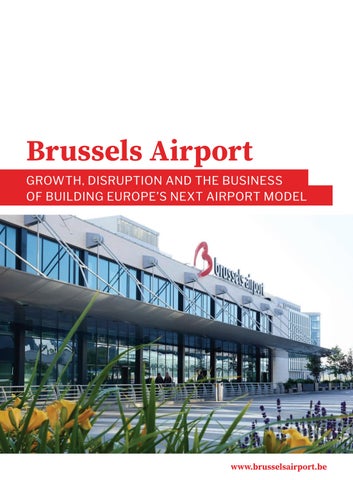
Brussels Airport GROWTH, DISRUPTION AND THE BUSINESS OF BUILDING EUROPE’S NEXT AIRPORT MODEL
www.brusselsairport.be
Brussels
GROWTH, DISRUPTIO OF BUILDING EUROPE’S PRODUCED BY
2
[ JULY 2026 ] BUSINESS EXCELLENCE
W
s Airport
N AND THE BUSINESS NEXT AIRPORT MODEL
Wenzile Ndlovu BUSINESS EXCELLENCE [ JULY 2026 ]
3
national day of industrial action. Flights cancelled. Middle East routes disrupted. Passenger queues. Weather pressure. Operational strain. At Brussels Airport, those moments are real. They affect passengers, airlines, handlers, cargo teams, public services and businesses that rely on the airport every day. But they are not the whole story. In many ways, they are only the visible edge of the more important one: how a major European airport continues to operate, invest and grow when disruption has become part of the operating environment. That is the story now unfolding at Brussels Airport.
A
4
[ JULY 2026 ] BUSINESS EXCELLENCE
In 2025, Brussels Airport handled 24.4 million passengers and 795,000 tonnes of cargo. Revenue reached a record €828 million. Investment in airport facilities reached a record €302 million. Net profit stood at €84 million. For the first time since 2019, dividends returned to shareholders. Those figures are not simply a recovery marker. They show an infrastructure company moving into its next phase with financial strength, operational demand and renewed strategic confidence. The airport is preparing for growth while facing the same pressures that now define European aviation: noise, permits, labour disruption, sustainability targets, cargo
BRUSSELS AIRPORT
“Brussels Airport is not simply recovering. It is entering its next phase with financial strength, operational demand and renewed strategic confidence.”
complexity, passenger expectations and the need to rebuild existing assets without stopping daily operations. Arnaud Feist, CEO of Brussels Airport, has described the point plainly: “Disruptions make headlines. But the real story is about people, teamwork and ambition. Success takes a team.” It is a useful line because it brings the airport back to what it really is. Not one building. Not one runway. Not one airline schedule. Brussels Airport is a system of people, assets, processes and partners working together under pressure. That system is now being asked to do more.
BUSINESS EXCELLENCE [ JULY 2026 ]
5
ISS FACILITY SERVICES(NV) At Brussels Airport, every journey is defined by movement, timing, and precision. In such an environment, performance is not created in isolation, but through the way spaces, people, and services come together in constant flow. At ISS, this is captured in a simple belief: creating spaces for people and businesses to thrive. From this perspective, environments are never static. They are living systems where every detail, seen or unseen, contributes to how people move, experience, and engage. Excellence emerges when everything within that system is aligned with intent, so that complexity is transformed into something effortless. This is where “hospitality in motion” becomes a way to describe how that belief takes shape in environments defined by continuous movement. It is about how experience is carried through space, not in isolated moments, but as a connected flow. At Brussels Airport, this is reflected in moments that shape the passenger journey: the calm of a well-orchestrated lounge experience, the continuity supported through trolley services, and the subtle sense of order that allows thousands of individual movements to feel coherent.
6
[ JULY 2026 ] BUSINESS EXCELLENCE
These are not standalone elements, but expressions of a broader system at work. Just as important are the layers that sit beneath immediate perception. The anticipation embedded in how spaces are prepared, the coordination between different functions, and the invisible structure that ensures everything is in the right place at the right time. It is here that environments quietly start to perform. “At ISS, we believe exceptional experiences happen when every seen and unseen element is intentionally designed and seamlessly executed.” This way of thinking extends far beyond any single location. Wherever people gather, work, travel, or connect, the same principle applies: when spaces are designed with intention and everything within them works in harmony, they enable people and organisations to move with ease, focus, and confidence. It is in that space, in between people, place, and movement, that ISS operates, meaningfully shaping environments that quietly support what matters most: flow, experience, and the ability to thrive. be.issworld.com
BRUSSELS AIRPORT A national asset with local weight
Brussels Airport’s importance is easy to measure but harder to fully describe. Its economic impact reaches well beyond the terminal. Recent economic-impact work has placed its contribution to Belgian prosperity at around €8.8 billion annually, supporting tens of thousands of direct and indirect jobs. More than 350 companies operate on or around the airport site, making it one of the country’s most concentrated business and logistics ecosystems. That is why the airport’s ownership story matters. In 2025, PMV, the Flemish investment company, reached an agreement to acquire Ontario Teachers’ Pension Plan’s indirect interest in Brussels Airport Company, giving PMV a 39% economic stake in the airport. The transaction did not change Brussels Airport Company’s direct shareholding or alter the execution of its strategy. But strategically, it sent a clear signal. Flanders wants to be closer to the airport’s future. Matthias Diependaele, Minister-President of Flanders, expressed it directly: “We want to be in the cockpit when it comes to the future of our airport.”
That is not only political language. It is infrastructure language. Airports are increasingly treated as critical national assets because they connect more than passengers. They connect labour markets, exports, tourism, corporate investment, diplomatic activity, medical supply chains and regional business ecosystems. For Brussels, this is particularly important. The airport is not just Belgium’s international gateway. It is also part of the daily mobility and business life of Flanders and the wider Brussels region. Companies locate around it because connectivity matters. For international institutions, logistics operators, exporters and service businesses, the airport is part of the reason the region works. That gives the airport’s next investment cycle significance far beyond aviation.
Hub 3.0: fixing the front door
The most visible expression of that next cycle is Hub 3.0. By 2032, Brussels Airport plans to transform its landside and terminal environment through a new intermodal transport hub, expanded departure and arrival halls, a redesigned drop-off zone,
BUSINESS EXCELLENCE [ JULY 2026 ]
7
a green boulevard and park, and a new hotel connected directly to the terminal. This is not just an expansion. It is a correction of how the airport receives people. Today, airports are no longer judged only from check-in onward. The passenger experience starts on the road, on the train, at the bus stop, in the car park, at the drop-off zone and on the walk into the terminal. If those parts feel fragmented, the airport feels strained before the passenger reaches security. Hub 3.0 is designed to make those movements work as one system. The modal target gives the project its practical backbone. Brussels Airport wants fewer passengers and employees to reach the airport by car. In 2022, around 70% came by car or taxi. The airport’s stated goal is to bring that below 60% by 2027, supported by better integration of rail, bus, taxi, bike, shuttle and future tram
connections. That is what “intermodal” means in business terms. It is not a design slogan. It is an attempt to shift behaviour. The five pillars of Hub 3.0 show the logic. The drop-off zone will move away from the terminal front, reducing pressure on the immediate entrance area. The new intermodal hub will bring different forms of transport into a more legible arrangement. The terminal extension will enlarge the departures and arrivals halls, improving passenger flow and comfort. The green boulevard and park will separate movement more intelligently and soften the airport’s landside environment. The new hotel will support early departures, late arrivals, crews, business travellers and conference activity. The project is attractive in renderings, but its real test will be phasing. Brussels Airport cannot close itself for rebuilding. Passengers still need to
Reliable partner for value-added logistic process automation
Vanderlande is the global market leader for value-added logistic process automation at airports. Its systems are active in 600 airports including 14 of the world’s top 20. Vanderlande’s extensive portfolio of integrated solutions – innovative systems, intelligent software and life-cycle services – results in the realisation of fast, reliable and efficient automation technology. > vanderlande.com
8
[ JULY 2026 ] BUSINESS EXCELLENCE
BRUSSELS AIRPORT
“Hub 3.0 is not just an expansion. It is a correction of how the airport receives people.” arrive. Cargo still has to move. Airlines still require punctuality. Ground handlers still need access. Security cannot pause. Every temporary route and every construction sequence will matter. That is why the airport’s recent runway renovation is a useful preview of the discipline required. Runway 07R/25L is not a glamorous asset. It is a working surface. But every take-off and landing depends on it. During its renovation, construction crews removed the old asphalt down to the original concrete dating back to 1958, then rebuilt the runway with four new asphalt layers. Around 90,000 tonnes of asphalt were used. New runway lighting was installed. Drainage was upgraded so rainwater can be removed quickly and safe
operating conditions restored efficiently. The timing was deliberate. Summer offered longer daylight, more stable weather and lower rain risk, allowing teams to work through an intensive programme. While Brussels Airport managed the ground infrastructure, skeyes supported the air traffic environment, helping maintain safe operations while the work continued. That is the kind of airport delivery that rarely makes headlines. It is also the kind that determines whether larger programmes succeed.
Growth under pressure
The demand case for investment is visible in the traffic figures. In February 2026, Brussels Airport welcomed
BUSINESS EXCELLENCE [ JULY 2026 ]
9
more than 1.6 million passengers, up 6.3% year on year, and handled 63,050 tonnes of cargo, up 6.5%. By May, passenger traffic reached 2,271,847 passengers, up 3.2% compared with May 2025. Cargo grew more sharply, rising 12% to 75,847 tonnes. Those May results came despite two material disruptions. The continuing war in the Middle East affected services to Tel Aviv, Doha, Dubai and Abu Dhabi. A national day of industrial action on 12 May prevented around 25,000 passengers from taking their scheduled flights. Even so, the airport grew. That matters. Brussels Airport is not building its next phase in quiet conditions. It is building in the operating environment airports actually face: disrupted, exposed, seasonal, politically sensitive and unforgiving of weakness. Network development adds further weight to the story.
10
[ JULY 2026 ] BUSINESS EXCELLENCE
In June 2026, LATAM Airlines launched a direct São Paulo-Brussels route, restoring Belgium’s direct passenger connection with Latin America for the first time since 2000. Operating three times weekly, the route opens access through São Paulo to more than 135 destinations across South America. The symbolism is clear. A corridor missing for more than 25 years is back on the map. But the business value is broader: corporate travel, leisure, visiting friends and relatives, tourism, trade and cargo flows between Europe and Latin America. Africa remains central to Brussels Airport’s identity. Brussels Airlines’ addition of Kilimanjaro brings its sub-Saharan Africa network to 18 destinations and strengthens Brussels’ position as one of Europe’s important gateways to the continent. TUI’s twice-weekly Brussels-Kayseri route adds another kind of connectivity: leisure,
BRUSSELS AIRPORT
“Cargo growth depends on proximity, coordination and quality control. At Brussels Airport, Brucargo Central turns that principle into infrastructure.” diaspora travel and regional demand that may not always make global headlines but often delivers strong commercial logic. The point is not that every route is strategic in the same way. It is that Brussels Airport is rebuilding connectivity across several layers at once: intercontinental, regional, leisure, diaspora, business and cargo.
Cargo moves to the centre
Passenger numbers give Brussels Airport public visibility. Cargo gives it strategic depth. That distinction matters because Brussels Airport’s cargo platform is becoming harder to treat as a secondary story. In 2025, the airport handled 795,000 tonnes of cargo, up 8.5% on the previous year. In May 2026, total cargo volumes rose 12%, driven by flown cargo and a 53.3% rise
in full freighter volumes linked to higher volumes with Asia and South America. The strongest cargo story is specialisation. Brussels Airport is one of Europe’s leading platforms for time-critical and temperaturesensitive logistics. Pharmaceuticals, life-science products, perishables and high-value goods do not tolerate weak handovers. A delayed suitcase irritates a passenger. A broken cold chain can destroy a shipment. That is why Brucargo Central matters. In 2025, Brussels Airport inaugurated Brucargo Central, an 83,500m² logistics site replacing eight older buildings from the 1980s with three modern buildings combining warehouses and offices. The development delivers 34,200m² of warehouse space and increases storage capacity by 30% on the same footprint. It also adds
BUSINESS EXCELLENCE [ JULY 2026 ]
11
10,000m² of temperature-controlled space, taking total cold storage capacity in the Brussels Airport cargo area to 45,000m². The project is more than a property upgrade. It is an operating statement. Cargo growth depends on proximity, coordination and quality control. Airlines, handlers, forwarders, truckers, customs teams, pharma specialists, packaging companies and warehouse operators all need to work quickly and accurately. When they sit close to one another and operate through clear processes, handovers improve and risk reduces. The digital layer is just as important. Brussels Airport, Liege Airport and Ostend-Bruges Airport are working together to digitise customs
procedures, with Air Cargo Belgium and LGG Connect coordinating the transition. The aim is to create a more uniform process for import, export and transit declarations. That may sound administrative. It is not. Customs friction is infrastructure friction. If declarations are slow, duplicated or inconsistent, the cargo chain loses time. A common digital process makes Belgium more competitive as an air cargo platform. Menzies Aviation’s arrival reinforces the operational shift. The company has been awarded a seven-year freighter handling licence at Brussels Airport and has launched operations supporting LATAM Cargo, including 15 weekly turns across three daily flights, five days a week.
“Brussels Airport is not one asset. It is a coordinated platform of systems, services and suppliers.”
12
[ JULY 2026 ] BUSINESS EXCELLENCE
BRUSSELS AIRPORT
For Brussels Airport, this connects three themes at once: cargo growth, Latin America connectivity and freighter-handling capability.
The airport behind the airport
The public sees terminals, gates and aircraft. The airport itself is held together by systems. That is why Brussels Airport’s suppliers and contractors are not an appendix to the story. They are part of the asset’s performance. Bruker Corporation announced in 2025 that Brussels Airport Company had awarded it a seven-year framework agreement for 80 explosive trace detection systems, including maintenance, training and centralised software integration. The equipment is technical, but the business requirement is simple: screening must become safer without becoming slower. The same is true of BRUce, Brussels Airport’s digital travel buddy. Available through the airport app, WhatsApp and Messenger, BRUce helps passengers with practical questions about security, luggage, directions, delays, gates and
airport services. Nearly half a million users rely on it each year. Its value is not novelty. Its value is pressure relief. A passenger who can find the right answer before becoming confused at the terminal is one less point of friction in the system. Vanderlande sits in the same operational logic. Its long-term framework agreement with Brussels Airport covers major baggage handling upgrades. Baggage is not background equipment. It is capacity infrastructure. A transfer airport cannot build credibility if bags fail to move reliably. Equans Belgium supports the airport through multi-technical services including building maintenance, security, baggage management systems and energy-related infrastructure. This is the hidden airport: electrical systems, HVAC, surveillance, access control, lighting and the maintenance discipline that keeps a major asset available every day. Ground handling is another pressure point. Current licence information lists Alyzia Belgium for passenger aircraft ramp handling and Menzies
BUSINESS EXCELLENCE [ JULY 2026 ]
13
Aviation Belgium, WFS Cargo and DNATA NV for full-freighter ramp handling during the 2025– 2032 licence period. Turnaround performance is capacity. Delay on the ramp becomes delay at the gate. Delay in freight handling becomes delay in the cargo chain. Other partners complete the operating fabric. DEUFOL Brussels supports air cargo consolidation, storage, packaging and shipping in BRUCARGO. SGS Belgium NV adds inspection, testing and compliance expertise in a cargo environment where dangerous goods, pharma quality and documentation matter. TCR International contributes to the ground support equipment ecosystem, increasingly relevant as airports electrify airside operations. Brussels Airfuels Services supports fuel operations. Aeroservices brings specialist airside support, including winter and de-icing capability. Altitude Global supports line maintenance. Aswebo has been associated with runway and civil works. ISS Facility Services belongs in the same system at the passenger-service interface. Its work at Brussels Airport includes trolley services and premium lounge catering. These are not capital projects, but they influence how the terminal absorbs demand. When trolley supply, lounge
14
[ JULY 2026 ] BUSINESS EXCELLENCE
operations and front-of-house service work properly, pressure is managed before it becomes visible. JCDecaux’s renewed exclusive advertising concession from 1 January 2026 adds the commercial media layer. The company will manage advertising displays inside, outside and around the airport, renewing furniture and digital spaces and developing formats such as activation podiums and immersive event devices. This supports non-aeronautical revenue, but it is also part of the passenger environment. Commercial infrastructure has to earn without cluttering the journey. Together, these partners show how Brussels Airport really works: not as one asset, but as a coordinated platform of systems, services and suppliers.
Cutting emissions, not corners
The hardest question for Brussels Airport is not whether demand exists. The figures suggest it does. The harder question is whether the airport can keep earning permission to grow. Noise is one part of that. Brussels Airport Company says that in 2025, 42% of flights were
BRUSSELS AIRPORT operated by the most noise-efficient aircraft, up from 32% in 2023 and more than double the level recorded ten years earlier. Since April 2023, the airport has applied strongly differentiated charges, with the quietest aircraft paying far less than the noisiest. Feist has framed the issue directly: “How we grow is just as important.” That sentence matters because it does not pretend growth has no cost. Differentiated charges can influence airline behaviour. They can encourage fleet renewal. They can improve the aircraft mix. But they do not erase the airport’s environmental and community challenge. Decarbonisation is now embedded in daily operations. Brussels Airport is targeting net-zero carbon for its own activities by 2030. Airport-site emissions are only a small share of aviation’s total climate impact, but they are the emissions the airport can most directly control. Heating is one of the biggest internal challenges. The airport’s fossil-fuel heating plants account for a significant share of its emissions. Electrification is therefore becoming central. By the end of 2025, most of Brussels Airport’s company cars were already fully electric, supported by hundreds of charging points. The airport purchases renewable electricity and has installed solar capacity on site. The next challenge is grid capacity, as heating, vehicles and ground operations all demand more electrical power. Ground operations are also changing. Renewed ground-handling licences require operators to commit to 100% electric ground support equipment by 2030. At contact stands, auxiliary power units must be switched off shortly after arrival and replaced by fixed electricity and preconditioned air where available, reducing fuel burn, ultrafine particles and noise. This is what decarbonisation looks like inside a working airport. Not one grand gesture, but a sequence of operational decisions that have to fit around safety, suppliers, passengers and daily traffic. The environmental permit debate gives this work its sharper edge. The Balanced Approach
BUSINESS EXCELLENCE [ JULY 2026 ]
15
procedure now underway will shape how noise reduction is achieved while weighing connectivity, economic value and proportionality. Authorities have set stringent targets, including a 30% reduction by 2032 in the number of people highly annoyed by noise and highly sleep-disturbed compared with 2019. This is the friction that makes the airport’s story serious. Growth is not only a commercial act. It is a negotiation with neighbours, regulators, airlines, cargo operators, investors and public authorities.
Community as infrastructure
Permission to grow is not built only in hearings and legal procedures. It is also built through repeated contact with the communities that live closest to the asset. Brussels Airport has been increasingly deliberate about that relationship. In 2025, the airport welcomed pupils from six primary schools for airport visits. In 2026, the programme is being expanded to all 22 primary schools in surrounding municipalities. Residents were also invited onto the renovated runway 07R/25L before it reopened, turning a piece of
16
[ JULY 2026 ] BUSINESS EXCELLENCE
critical infrastructure into something neighbours could see and understand rather than only hear overhead. The Brussels Airport Fund, supported through the King Baudouin Foundation, provides €100,000 in annual financial support for local initiatives. In 2026, 11 projects were selected, ranging from wellbeing and environmental work to mobilityrelated programmes. These initiatives do not remove the hard questions around noise, night operations or permits. They should not be presented as if they do. Their value is different. They show that Brussels Airport understands its licence to operate is relational as well as regulatory. For a major airport, community engagement is not soft work. It is infrastructure work.
The story now
The simplest version of the Brussels Airport story is that it is growing. That is true, but insufficient. The stronger version is that Brussels Airport is trying to grow under constraint: operational constraint, environmental constraint, political constraint, mobility constraint and community
BRUSSELS AIRPORT
“The future of European aviation will be built in the difficult space between ambition and permission. Brussels Airport is now operating in that space.” constraint. It is doing so with record investment, long-term public backing, a major intermodal programme, stronger cargo facilities, new global routes, digital passenger tools, customs modernisation and a supplier community that keeps the airport functioning when conditions are imperfect. This is why the airport matters beyond Belgium. Across Europe, infrastructure owners face the same dilemma. Existing assets must become more productive, but expansion is harder to permit. Passengers want better service, but communities expect lower impact. Cargo must move faster, but regulation must be tighter. Investors want long-term value, but public
authorities want strategic influence. Brussels Airport does not resolve those tensions. It concentrates them. The future of European aviation will be built in the difficult space between ambition and permission. Brussels Airport is now operating in that space.
BRUSSELS AIRPORT
Topos Merode, Priester Cuypersstraat 3 Rue Abbé Cuypers, 1040 Etterbeek, Belgium
32 2 620 91 40 www.brusselsairport.be
BUSINESS EXCELLENCE [ JULY 2026 ]
17
Brussels Airport Topos Merode, Priester Cuypersstraat 3 Rue Abbé Cuypers, 1040 Etterbeek, Belgium
32 2 620 91 40 www.brusselsairport.be
Produced by: www.bus-ex.com