ACHIEVING BUSINESS EXCELLENCE ONLINE INCLUDING
renĂŠ lagos: Walter energy: AMERICAS EDITION Issue No.53
minera el bocal:
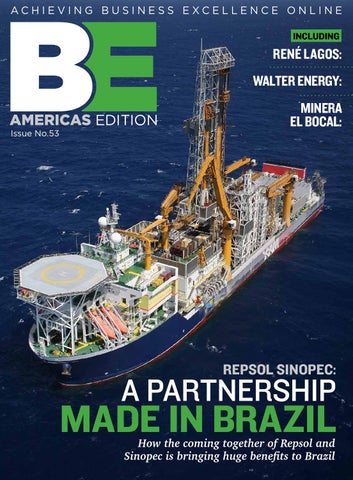
Repsol sinopec:
a partnership
made in brazil How the coming together of Repsol and Sinopec is bringing huge benefits to Brazil
WHERE THE WORLD’S MINERAL INDUSTRY MEETS
ONLY GOING TO ONE MINING INVESTMENT SHOW THIS YEAR? MAKE IT PDAC. March 2 – 5, 2014 International Convention, Trade Show & Investors Exchange Metro Toronto Convention Centre Toronto, Canada convention.pdac.ca/pdac/conv/
Prospectors & Developers Association of Canada
business excellence
Business John O’Hanlon Editor johanlon@bus-ex.com Will Daynes Editor wdaynes@bus-ex.com Matt Johnson Art Director mjohnson@bus-ex.com Louise Culling Production Designer lculling@bus-ex.com Richard Turner Director of Sales rturner@bus-ex.com Vince Kielty Director of Editorial Research vkielty@bus-ex.com
Business Excellence brings you content from leading business influencers and strategic thinkers providing inspiration and guidance to help you and your business grow. We showcase some of the best examples of successful organisations from around the world giving you a unique insight into how they operate.
Sharon Rooke Administration & Operations srooke@bus-ex.com Matt Day Head of Technology mday@bus-ex.com Andy Turner Chief Executive aturner@bus-ex.com
Contributors George F. Brown, Jr. Consultant & Author Robin Hafitz Open Mind Strategy
HINT: For the best experience, click the fullscreen icon
Allison O’Keefe Wright Open Mind Strategy Thomas R. Cutler TR Cutler, Inc Markus Christen Associate Professor of Marketing Tommy Arvinell Managing Partner
Subscriptions & Enquires info@bus-ex.com
Jacquard House, Queen Street, Norwich, NR2 4SX. England
Infinity Business Media Ltd
The content of this magazine is copyright of Infinity Business Media Ltd. Redistribution or reproduction of any content is prohibited. © Copyright 2014 Infinity Business Media Ltd.
BE Americas
|3
issue no.53
features: 8 top ten
automobile companies by market value
As the automotive industry continues its recovery following the global economic crisis, we identify the top ten companies who are leading the way.
16 operations
8
Sizing a sales force & setting its direction
24
Markets change, competitors react and your sales force can easily be left looking at yesterday’s needs: sizing and allocation are the key.
24 strategy
Focus is Good… If It’s the Right Focus How having a focused strategy can create considerable value.
34 marketing
42
Millennials: A Marketer’s Worst Nightmare?
How to reach a generation that likes to consume everything that’s out there but can spot faked passion at a glance.
42 manufacturing
The Role of Expert System Integrators for Best Practice Kaizen is continuous improvement, not something that is done once a week, so the philosophy has to be taken on board at all times.
4 | BE Americas
contents
48
58
oil & Gas: 48 Repsol Sinopec Brasil
A partnership made in Brazil
Country Manager, JosĂŠ MarĂa Moreno discusses how the coming together of Repsol and Sinopec is bringing huge benefits to Brazil, both economically and socially.
58 Range Resources
Wide-ranging potential
Trinidad Chief Operations Officer, Walter Cukavac discusses the incredible progress made by Range Resources in a little over two years.
mining & Minerals: 68 Walter Energy
Getting better all the time
68
Walter Energy Canada’s continuous improvement initiatives are implemented in its metallurgical coal mines and are helping the company navigate difficult market conditions.
BE Americas
|5
issue no.53
84
84 Alpha Minerals
Achieving high grades
Alpha Minerals’ strategically selected uranium and gold properties are producing the results required to take this junior exploration company to the next level.
92 New Millennium Iron Corp. (NML ) Producing the goods
In controlling the emerging Millennium Iron Range (MIR), New Millennium Iron Corp. (NML) is fast on its way to becoming a significant, low cost iron ore producer in North America.
102 Sociedad Minera El Brocal
Powering the growth of Peru
Sociedad Minera El Brocal’s activities and achievements are prime examples of what makes Peru such an exciting and important epicentre for mining in South America.
construction:
102
120 René Lagos
134
Our work is here to stay
René Lagos is recognised and respected for its expertise in realising the aspirations of architects to build tall in challenging environments.
134 DRS Construction & Project Management
Constructing Chile’s future
The construction industry in Chile has been booming in recent years as the country experiences remarkable economic growth.
6 | BE Americas
contents
144
160
144 Waterfront Toronto Looking over the Lake
Toronto never made full use of its geographic advantage till Waterfront Toronto was created: the makeover will make the city more competitive as well as more beautiful.
154 Industrias Correagua A proud Panamanian business
Industrias Correagua’s quality products and passionate approach to each project has made it one of Panama’s most important companies.
marine & shipping: 160 PortMiami
Welcome to America
Easily accessible to Caribbean and Latin American markets, as well as those of Asia and Europe by way of the Panama Canal.
168 Port Authority of Jamaica Ports in a storm
168
Jamaica, always in a strategic trading position in the Caribbean, stands to gain importance following the latest expansion of the Panama Canal.
BE Americas
|7
top ten automobile companies by market value
2013 has seen the automotive industry continue its recovery from the dark days following the global economic crisis. Here we identify the ten companies leading the way in terms of market value Edited by: Will Daynes
Top Ten
10 nikshor / Shutterstock.com
SAIC Motors $26.7 billion
Headquartered in Shanghai, SAIC Motor Corporation Limited is a Chinese state-owned automotive manufacturing company, with origins dating back to the 1940s. One of China’s socalled “Big Four” automakers, the company boasted the largest production volume of any of its rivals in 2012, producing more than 4.5 million units, 76 percent of which were passenger vehicles. Today, SAIC sells vehicles under a variety of brand names such as MG and Roewe, and share joint venture partnerships with Volkswagen and General Motors.
10 | BE Americas
9 General Motors $38.5 billion
For 77 consecutive years, from 1931 to 2007, General Motors led the way in global vehicle sales and remains to this day one of the world’s largest automakers by vehicle unit sales. Headquartered in Motor City itself, Detroit, Michigan, the company employs some 212,000 people and does business in approximately 157 countries worldwide. In 37 of these countries it produces vehicles under twelve distinct brands, including Chevrolet, Buick, GMC, Cadillac, Baojun, Holden, HSV, Jie Fang, Opel, Vauxhall, UzDaewoo, and Wuling.
auto companies
8 Hyundai Motor Company $41.5 billion
Founded in 1967, the Hyundai Motor Company is a South Korean multinational automaker, which, along with its 32.8 percent owned subsidiary, Kia Motors, together comprises the Hyundai Motor Group, the world’s fifth largest automaker based on annual vehicle sales in 2012. Hyundai operates the world’s largest integrated automobile manufacturing facility, located in Ulsan, South Korea, which boasts an annual production capacity of some 1.6 billion units. Hyundai’s vehicles are today sold in 193 countries through a network of more than 6,000 dealerships and showrooms.
7 Nissan Motors $43.4 billion
While the Nissan name has been in use since the 1930s its origins can be traced back several decades further giving the Japanese automaker a legacy that dates back more the a century. Today the company’s headquarters are situated in Nishi-ku, Yokohama and it is from here that its directors steer a business responsible for selling over 4.9 million vehicles in 2012 alone. In July 2013, the company announced the relaunch of its Datsun brand in an effort to target emerging markets, with initial results suggesting that its position on this list could well rise come next year. BE Americas
| 11
Top Ten
5 BMW Group $60 billion
6 Ford Motor Company $51.8 billion
Very much a part of American automotive history, the Ford Motor Company was of course founded by Henry Ford in 1903. Described by Forbes Magazine as “the most important industrial company in the history of the United States”, Ford was responsible for introducing to the world methods for large-scale manufacturing of cars and large-scale management of an industrial workforce using elaborately engineered manufacturing sequences typified by moving assembly lines. In 2012, the company sold 2.25 million vehicles in the US alone, and today has manufacturing operations throughout the world, from the UK and Germany, to China, Brazil, Australia and South Africa.
12 | BE Americas
Bayerische Motoren Werke AG, or BMW to you and me, was founded in 1916 and makes its home in Munich, Germany. BMW is part of the so called “German Big Three” luxury automakers, together with Audi and Mercedes-Benz, which make up the three bestselling luxury automakers in the world. The parent company of Rolls-Royce Motor Cars, BMW also owns and produces Mini cars, while its global operations are supplemented by overseas subsidiaries in the US, Canada, China, Japan, India, Egypt and South Africa. In June 2002, Forbes.com placed BMW at number one in its list of the most reputable companies in the world.
auto companies
3 Honda Motor Company $72.4 billion
4 Daimler AG $61.4 billion
Like BMW, Daimler calls Germany its home, specifically Stuttgart where its headquarters are based, and remains one of the most covered status symbol brands for the rich and powerful. By unit sales the company is the thirteenth largest car manufacturer and second largest truck manufacturer in the world. As of the beginning of 2013, the company provided employment for some 275,000 people and today owns or has shares in a number of marques including Mercedes-Benz, Smart, Beijing Automotive Group, Tesla Motors and Renault-Nissan Alliance.
With a global line-up of models that include the Civic, Accord, Insight, CR-V, CR-Z and two versions of the Odyssey, Honda’s automotive manufacturing legacy can be traced back to the early 1960s. In the decades since it has grown into Japan’s second largest manufacturer by volume, and the eight largest globally. Today its line-up varies from country to country, while its efforts in the field of producing hybrid electric vehicles has seen it emerge as a direct competitor to the Toyota Prius. As of this year the company continues to invest billions of dollars of its own revenues into research and development. BE Americas
| 13
Top Ten
2
Volkswagen Group $94.4 billion
In German, Volkswagen literally means “people’s car”, and the people of Germany have every right to be proud of a home grown enterprise that has become the largest automotive company in the world by revenue alone. For over two decades the company has maintained the largest market share in Europe and in 2012 it produced the third latest number of vehicles of any company in the world. Volkswagen Group sells passenger cars under the Audi, Bentley, Bugatti, Lamborghini, Porsche, SEAT, Škoda and Volkswagen marques, and commercial vehicles under the MAN, Scania and Volkswagen Commercial Vehicles marques. While the company remains fiercely proud of its European heritage, its operations in China have grown incredibly over the last decade making this its largest market.
14 | BE Americas
auto companies
1 Toyota Motor Corporation $167.2 billion
Founded in 1937 by Kiichiro Toyoda and headquartered in Toyota, Aichi, Japan, Toyota Motor Corporation was the largest automobile manufacturer by production in 2012, with the 200-millionth vehicle rolling off its production line in July of that year. The company, which today employs over 333,000 people, has factories across the globe from which it manufactures and assembles a range of vehicles, from a list of over 70 different models sold under its namesake brand, for local markets. Among the best known of Toyota’s brands one will today find Lexus, Scion, Daihatsu and Hino Motors. From hatchbacks and SUVs to sedans and hybrids, Toyota reach continues to expand making it every bit the definition of a multinational corporation.
BE Americas
| 15
Sizin & settin
Markets change looki
16 |
BE Americas
Operations
ng a sales force ng its direction
e, competitors react and your sales force can easily be left ing at yesterday’s needs: sizing and allocation are the key Words by
Markus Christen & Tommy Arvinell
BE Americas
| 17
A
too small sales force is a loss of income and a too large or incorrectly allocated one is a waste of resources. Many companies use their sales managers’ gut feelings to determine how many sales people they should have and how they should be allocated. This means that one of the most important decisions for growth and profitability is based on the hidden assumptions of a few people. A company we recently worked with discovered they were spending too much resources on segments with little potential and too little on segments with great potential – they were wasting resources in some markets while missing opportunities in others. A sizing and deployment analysis answers the questions: • H ow large should the sales organization be? • How are resources best allocated across geographies, segments and products? With the current dominance of financial management in most companies, sales executives need to learn to speak the language of finance – they need to be able to present fact-based evidence to effectively argue for and secure the resources necessary to capture the potential of their markets. That evidence has come within
easier reach as companies have much more data on markets, costs and sales force activities than they had just a few years ago. Today, most companies have a CRM system of some sort. The data in them are of varying quality but the quality gaps can usually be bridged fairly easily. We propose to use data on markets and profitability to find the best number and allocation of people, and if any assumptions have to be made, to make them explicit and clear so that they can be valued and so that any risks associated with them can be managed. Experienced sales managers’ instincts are valuable and should be used, but assumptions should be clear and used in a structured approach, as no single person can know all markets and customers and then balance that versus revenue and profit potential. Traditional approaches to sales force sizing and allocation The budget approach is based on the faulty argument that “we have as many sales people as we can afford”. This is counterproductive since sales spending should not be seen as a cost but an investment that provides a return. A sales manager in a company that uses the budget approach will likely need convincing arguments to gain support to change the sale force size, as budget levels tend to become anchored and stick over time.
“Sales executives need to learn to speak the language of finance – they need to be able to present fact-based evidence to effectively argue for and secure the resources necessary to capture the potential of their markets” 18 |
BE Americas
Operations
“The most commonly used approach is based on historical revenue and margins� The most commonly used approach is based on historical revenue and margins. A sales person is assigned an estimated target revenue or profitability and sales resources are allocated to segments and products so that each sales person’s territory meets that target. The strength of the approach is its simplicity. Simplicity is valuable as it makes it easier for people to understand and to motivate changes. But revenue and profitability are historical while sales resources should be invested where the future potential is. Therefore this approach is best in markets and for product and service offerings that change very little. A similar approach is to replace historical revenue and profitability with potential revenue and margins. This approach can be useful as it is forwardlooking and relatively simple. It does however not account for the threshold effect and decreasing return on sales (see below), and it requires almost as much data as the more comprehensive return on sales optimization. With a work build-up approach, companies estimate the amount of work needed to cover targeted segments and add that work up to get the number of people required. It is a good as a complement to other approaches and for new markets where potential cannot be estimated.
BE Americas
| 19
Scientific approaches to sales force sizing and allocation • Optimizing return on sales Return on sales optimization (ROS) utilizes basic optimization techniques to find the size and allocation of the sales force that provides the highest profit for the company. The return on sales optimization approach has been used for decades in industries with large sales forces like healthcare and pharma. The sales force however is a cost centre but also a means for revenue generation, and since ROS optimizes profits, as opposed to sales cost, it is a powerful tool to gain insights into profit and revenue management. The profit optimization is based on estimates of potential sales through an estimation of the sales response curve (see graph), data on segment and product profitability, and costs for sales resources. A strength of ROS is that it takes the threshold effect and the decreasing return on sales into account. The threshold effect is a consequence markets and customers requiring a certain amount of sales resources to start generating significant sales. There is no point for a sales rep to spend time to identify a customer’s needs if he does do not have time to finish the deal, and as the word spreads, within the customers’ organizations or between customers in a segment, companies typically spend less sales resources for additional euro of sales. Similarly, as the market potential becomes exhausted it takes an increasing amount of sales resources to secure each additional euro of sales, making it nearly impossible to capture 100 percent share of any market. Not accounting for these effects may lead to incorrect conclusions,
20 |
BE Americas
especially for large changes in sales force size or allocation. The weakness of ROS is that it requires estimates of return on sales that sales managers are not used to making explicit. They will feel uncomfortable doing so, at least the first time around, and there will be errors in their estimates. Therefore a ROS exercise should be iterative, to allow for testing and scenarios, and it should be used regularly to enable a feedback and learning process based on actual outcomes. An additional benefit of ROS is that it can generate not only sizing and allocation insights but also sales and call plans.
“A strength of ROS is that it takes the threshold effect and the decreasing return on sales into account”
Operations
“With the most efficient sales units identified, a company can identify best practices within the best-performing units and leverage those best practices to make the other sales units as efficient.” • Efficient frontier benchmarking Efficient frontier benchmarking (EFB), as a tool for operational improvement used to benchmark and improve operational efficiency in various industries, has been proven effective for sales force sizing and allocation. It has been used in industries like for example business equipment manufacturing and production equipment manufacturing. It utilizes the statistical techniques regressions and linear programming to determine the optimal size and allocation of the sales force. It can effectively account for differences in markets, competitive situation and market potential, and identify not only the optimal
size and allocation but also the efficiency frontier across a company’s sales units. Therefore it has the valuable additional benefit of providing data on the relative efficiency of the internal sales units. With the most efficient sales units identified, a company can identify best practices within the best-performing units and leverage those best practices to make the other sales units as efficient. The profitability impact of making all sales units as efficient as the most efficient one is likely as large as that of achieving the optimal size and allocation of the sales force. To be effective, EFB requires a number (typically more than 10) of fairly homogenous sales
BE Americas
| 21
districts, some knowledge of competitive activity, and data on sales, sales costs and sales activities that is readily available in most companies. • Considerations for implementation The scientific approaches ensure that the decision of sales force size and allocation is based on facts, that assumptions are made explicit and can be tested, and that the decision will have the highest quality possible. However as no approach is perfect it is advisable to use a combination of approaches to balance their respective strengths and weaknesses. For example a scientific approach combined with a simpler approach as a reality check. Balance number of sales representatives with number of people in sales supporting roles A sales person needs support to be effective. This is especially true in complex industrial sales where many companies have specialized roles for example for technical sales and pre-sales engineering. When managers change the number of sales representatives they also need to scale the number of people in supporting roles accordingly. Take caution as the optimal ratio of sales to sales support people can vary across segments depending on how customers buy.
“The scientific approaches ensure that the decision of sales force size and allocation is based on facts” 22 |
BE Americas
Where in the business cycle are you? Market potential is a key piece of information in several of the sizing approaches. The problem is that potential can vary greatly over the business cycle. To determine the optimal size of a sales force size based on potential at the top of the business cycle can greatly overestimate the optimal size and profit potential. Sales resources are expensive to attract and train and having to let go of them due to an error in estimated potential can be a costly mistake. This can vary depending on the economics of the business but as a conservative rule of thumb we recommend companies to size their sales forces using a potential at approximately 25 percent from the bottom level towards the top level of the business cycle. What is your time perspective? The optimal size of the sales force depends on which time perspective you adopt. This is simply because spending on sales resources is an investment that takes time to bear fruit – new or reallocated sales people will need time to develop business with their new customers and they will need time to learn. During that time they will not be as effective as the current sales people are, but the company will have the full cost (except bonuses) from day one. Manage risk A company we recently worked with discovered they were targeting too many new segments, running the risk of not gaining critical mass in any of them, and facing a great risk if their sales
Operations
“The most important consideration is probably the competencies of the current people” expectations were not met. There are great costs and risks involved in a large change in sales force size and allocation. The scientific approaches to sales force sizing and allocation can provide powerful insights with potential to greatly improve the performance of a company. The conclusions are however based on data that may contain errors. No market data is perfect, markets can change, competitors can react and expected returns may not materialize. Companies with long sales cycles need to take extra care, as they will need to spend more before they see the results of the changes. The best way to mitigate these
risks is to gradually transition towards the optimal size and allocation while collecting new data and reiterating the sizing and allocation exercise to confirm (or contradict) earlier results. Plan the transition carefully Besides risk, the most important consideration is probably the competencies of the current people, cost and time to train them, and availability of people to recruit. Managers need to have a structured approach to define the competencies required to sell and identify any gaps versus the competencies of their current or newly recruited sales people. Competence gaps can be for example lack of product or industry expertise, or lack of consultative selling skills. Managers also need to make sure sales people do not end up spending too much time on travelling. These considerations limit how quickly the targeted size and allocation can be achieved.
About the authors Markus Christen is Associate Professor of Marketing at INSEAD, the top-ranked business school in Paris, Singapore and Abu Dhabi. His work has appeared in Marketing Science, the Journal of Marketing Research, the Journal of Marketing, Management Science, the Harvard Business Review, and the Financial Times. Professor Christen consults with corporations and teaches courses on marketing and pricing strategy in INSEAD’s top-ranked MBA programs and in various executive seminars in Europe and Asia. He has also worked in industry for several years, as a production engineer, consultant and marketing manager. Tommy Arvinell is founding Partner of Wallhof Consulting, a management consultancy focusing on commercial strategy and operations. For 15 years, Tommy has worked with industrial and technology clients in Europe, Asia and the USA on strategy, commercial effectiveness and organization effectiveness. He holds an M.B.A. from INSEAD and a M.Sc. in Industrial Engineering and Management from Linköping University. arvinell@wallhof.com
BE Americas
| 23
Focus is
If It’s Right
How having a foc create consid Words by
24 |
BE Americas
George
Strategy
Good ‌
s the Focus
cused strategy can derable value
e F. Brown, Jr.
BE Americas
| 25
Strategy
S
ome years ago, I worked with a major equipment supplier whose products were relevant to virtually every vertical market. The president of this company had decided to define a new sales model, motivated by his observation that “As I spent time in the market, I learned that we had customers everywhere, but that we weren’t special to customers anywhere”. That’s a common issue for firms with broadly relevant products and services, and there are always good reasons and strong advocates for almost every possible opportunity to make a sale to a customer. The president of the firm mentioned above had worked with his sales team and defined a set of priority markets on which he wanted to focus. His questions were “How do we do that?” and “What actions do we have to take so that customers see our focus and reward it by seeing us as ‘special’, hopefully elevating us to preferred supplier position?” As we began to work with this organization on ways to achieve the goals they had defined, we first began to work to understand the selected markets on which they planned to focus. That yielded a surprising discovery. While all of these markets had scale, they were by and large mature markets, growing slowly (or not at all), and ones that offered margins that were minimal (and in some cases, non-existent). There were other vertical
markets that were far more attractive in terms of growth and profit potential, albeit few with the scale that seemed to dominate the initial set of selections. There was another issue with their choices. Reflecting the maturity of these markets, the customers within them largely selected products from the Good-Better position on the GoodBetter-Best scale, and with the breadth of competitive offerings available for GoodBetter products, typically made purchase decisions on the basis of price. This firm and its distributors often wailed about the “Three bids and a buy” mentality of these customers, and about failing to gain any traction with their innovations and upgraded offerings. In fact, this firm’s sweet spot clearly involved products in the Better-Best range, where it technology advantages had established a leadership position and a few instances in which its offerings were unique in the industry. The first step in achieving focus is making sure the focus is the right one. The case study above defines the two dimensions which I emphasize in evaluating choices for focus. First, it is necessary to determine if the potential market has the right characteristics – sufficient scale, reasonable growth, and decent profit potential. Without them, in some reasonable combination, you can be successful in achieving a focused approach to markets and customers, but
“First, it is necessary to determine if the potential market has the right characteristics – sufficient scale, reasonable growth, and decent profit potential” 26 |
BE Americas
fail to realize rewards from doing so. When someone advocates a focus on a market that doesn’t pass that test of reasonableness (and there will always be such advocates), ask them to finish a presentation to the Board of Directors that starts with a slide saying “We are dominating our targeted markets, but unfortunately, those markets are small, shrinking, and unprofitable”. That deck will never appear, and you can move on to look at markets that have attractive scale, growth, and profit potential. But that is not the only thing to consider in evaluating markets. As the example above suggested, it is very important to determine how well your firm’s competencies and position fit with the factors important to that market. In the case study, the fit was poor. Expertise in producing high-value Better-Best products was a poor fit for markets that were looking for highly-efficient, low-cost producers of rather standard Good-Better products. That was a serious problem for the firm in the case study. And while matching well to the factors that drive customers’ purchase decisions is critical, there are other business drivers of similar importance. Another firm with which I worked was considering targeting an industry that was moving much of its
“It is very important to determine how well your firm’s competencies and position fit with the factors important to that market” 28 |
BE Americas
R&D and design work to Asia, mostly to India and China, a region in which that firm had few resources and almost none that specialized in development or design. At minimum, that lack of fit ensured that the time frame for achieving success would be medium to long term, at best, and that a focus on the firms in that industry would require quite a bit of catch up. A similar consideration involves the existing relationships with firms across candidate markets. If you have strong existing relationships, that provides a head start for strategies involving focus. If not, it is certain that any strategy involving focus (or other elements) will take some time to achieve customer penetration and will require supplanting the existing major suppliers. Long term strategies can be good, but only if they are recognized as long term and the firm selecting them has the appetite and resources to stay the course. Still another firm with which I’ve worked had developed some strong competencies in energy efficiency in its products, a result of its own focus on sustainability. As it considered target markets on which to focus, it realized that some target markets had a similar business driver, and that their expertise would play well in those segments. A match in such business drivers is another good reason for considering a market for focus. A contrary example involved a firm that was considering a number of markets that were highly regulated. It recognized, fortunately early on, that it had no expertise or experience in working in a highly regulated industry, a factor that
Strategy
militated against selecting such targets for focus despite some other attractive characteristics of those segments. It is thus both the quality of the prospect market in terms of scale, growth, and profitability and the fit of the market with the company that determines if the focus is right. And making a careful assessment as to the quality of the focus strategy is a key first step in the process, one that becomes more and more obvious as some of the ideas about how to implement a strategy of focus, as described below, enter into the equation. Focus requires choices and investment. And it’s critical to remember that a decision to focus means that there will be some markets and customers on which the firm has to know and act from the perspective that “this isn’t our focus”. The latter is among the hardest elements of implementing a focus strategy, but unless that happens, the strategy is hollow and very unlikely to succeed. After helping the firm in the case study above make a mid-course correction in its selection of markets on which to focus, attention was turned to the original question, to define the steps required to “make focus real”. The insights that emerged from that process suggested three key themes that must be addressed and that can help other firms that are looking at strategies involving market focus. The first question that must be asked is “What are the things that customers in the selected markets care about, the things that they will notice if we focus on them and do them well, the things that they will say distinguishes us as a supplier?” The
“The most frequent failing I’ve seen in getting to an answer to this question involves firms that think they know the answer” examples given above suggest possibilities – expertise in producing products at the right points along the Good-Better-Best spectrum, insights into managing in a regulated environment, expertise in energy efficiency, the right resources in key country markets, etc. Almost every element of go-to-market strategy can potentially enter into the equation here – products, services, pricing, channels, global presence, etc. – and should be evaluated as part of the process to answer this first question. The most frequent failing I’ve seen in getting to an answer to this question involves firms that think they know the answer. My counsel is that wishing doesn’t make it happen, and far too often, the internal perspectives as to what will matter to customers in the selected industries are more wishes than reality. The real answer to this question must come from the market, from the customers in the industry on which focus is intended. And it takes a very strong, somewhat atypical voice of the customer program to get meaningful answers that contribute to decisions on how to implement a focus strategy. Most voice of the customer programs are retrospective, and emphasize elements of the current transactions between
BE Americas
| 29
“A successful focus strategy will emphasize unmet needs, as opposed to just raising the bar slightly on strategy elements about which customers are largely satisfied” suppliers and customers. A successful focus strategy will be very future focused, requiring insights as to what is keeping customers awake at night, the challenges on their own horizon that might define a supplier success story for the supplier that helps them to address them. A successful focus strategy will emphasize unmet needs, as opposed to just raising the bar slightly on strategy elements about which customers are largely satisfied. It is not only getting customer input, but getting customer input on hard and illdefined questions that allows firms to come up with a winning answer to the key questions outlined above. The second key theme that must be addressed in developing a focus strategy involves the question “Who in our firm must contribute, and how, if we are to succeed”? The firm in the case study had only involved the sales team in its first attempt to select targets for focus (and, to be fair, recognized that some other parts of their organization would have to make changes as the strategy was implemented). But it’s often not the sales team that will have to make the most significant changes in response to the decision made on focus. The examples above again provide illustrations. Had the firm in the case study gone forward with its initial choices, there would have had to be mega-changes in product development (to focus on the Good-Better
30 |
BE Americas
segments) and in manufacturing (to shift the focus to low-cost operations). Had the firm considering an industry shifting key activities to Asia selected that industry as one on which to focus, it would have required building competencies in that region that could make positive contributions to key relationships. For sure, the sales team in both of these firms would have had to make changes, but they alone had no chance of success unless other parts of the organization also made parallel changes. Change is a challenge, and requires very active leadership involvement if it to be successful. My earlier research on the obstacles to successfully implementing changes to a firm’s business model defined the two factors that most frequently stood in the way of successful change management: “Internal resistance to the new business model” and “The implementation process was poorly managed”. Moving to a focus strategy is a major change to most firm’s business model, and these two obstacles will rear their ugly heads and thwart the change unless executive-level leadership gets out in front of them, constantly selling the change and its importance, making sure that the right resources are in place, and underscoring the importance of the change through measurement, review, and rewards. Again, wishing doesn’t make it reality. Strong and ongoing leadership
Strategy
is required to implement a focus strategy. I note that it’s not just leadership that is required to address this second theme. Very often, the resources in place are not the right resources to deliver what is required to get customers to recognize and reward the firm for the contributions that it makes as part of its focus strategy. At a recent meeting of the Institute for the Study of Business Markets, one speaker addressed the emerging challenges in his industry with the comment that “If you learn that you now have to climb trees, you need to hire some squirrels rather than trying to retrain the horses”. For many firms, a focus strategy requires new competencies. Sometimes it requires new channel partners. Sometimes it requires new suppliers. A critical part of addressing this second theme involves an honest assessment as to whether the mix of squirrels and horses, distributors, suppliers, and other key resources is likely to yield success. The third question which I believe is critical to success with a focus strategy involves competitive response. It is critical to ask the questions “In the segments on which we’ve decided to focus, who are the key competitors? How will they respond to our decision to focus on the customers on whom they are also focused? Why will we win?” Unless the segments your firm
has selected for focus are ones in which you are already the market leader, there are competitors that are doing something right in those segments, firms that will not accept your hopes of gaining share without a response. In my experience, I’ve learned two key lessons about how to think about these questions. First, competitive response and competitive advantage are only meaningful when you successfully put yourselves into the customer’s shoes and look at purchase decisions and supplier relationships from their perspective. In the case study I’ve used in this article, several of the sales team members with
“Very often, the resources in place are not the right resources to deliver what is required to get customers to recognize and reward the firm for the contributions that it makes as part of its focus strategy” BE Americas
| 31
whom I spoke believed that customers in the initially-targeted segments would “love our products since they are clearly better than what they are buying”. The fact was that those customers knew that, had known it for a long time, and knew that the price points associated with those clearly-better products were outside their range. They were not going to change. Wishing, again, isn’t going to define reality. Understanding how customers evaluate competitors and their products, and determining whether a competitive strategy will respond to their priorities is critical to the success of a focus strategy. The second lesson relevant to this question is that this evaluation cannot be static. That involves bad news and good news. The bad news is that the competitors’ offerings will not be static. Especially when they have strong positions in the segment, they will respond to your firm’s decision to focus on their competitors (unless your strategy involves wishes that they already know will not
32 |
BE Americas
“The good news is that what is important to customers today may change in the future” fly with their customers). And they will probably start out in a better position to make changes than your firm is in, if they have good relationships with customers. Experience and research confirm that customers are usually unwilling to embrace innovations and changes unless they have great confidence in the supplier with whom they will be working. And even very strong firms are often surprised that their reputation is not enough to convince a prospect to risk a change from a supplier with whom they are familiar and comfortable. The same offering is much more likely to be embraced from a trusted supplier, and many customers will accept a partial measure when they have confidence in the supplier over a full measure from a supplier about which they are unsure. The good news is that what is important to customers today may change in the future, and some of the most successful focus strategies that I’ve observed have involved suppliers that understood and were positioned to respond to emerging challenges facing the customers in the targeted industries. You see that now in example after example. Customers placing a much greater emphasis on energy efficiency (e.g., the lightweighting initiatives in the automotive industry) are open to new suppliers with the right
Strategy
materials expertise. Customers entering new global markets are open to suppliers with expertise, presence, and the ability to help meet local content requirements. One of my clients in the telecommunications industry is an executive that has been in that industry “forever”, seeing the incredible changes that have taken place. He once told me that “The biggest change he had to confront was the dramatic change in the industry’s cycle times”. He went on to note that “Many of our traditional suppliers just couldn’t step up to that change, and we had to restructure more parts of our supply base than we had ever expected”. So, once again, a future focus is critical to the understanding of the ways in which a focus strategy can respond to emerging needs of customers. Focus can be a very good thing, and I’ve seen numerous success stories that were built on a decision to focus on a selected set of industries and customers, to move away from the philosophy of trying to be everything to everybody. But those success stories always had two important chapters, the first involving decisions about the industries and customers on which to focus, the second involving the actions that would ensure
“The focus strategy can create considerable value and allow the firm implementing the strategy to capture some of that value” that those industries and customers would applaud the effort. Good decisions along the first dimension involve assessing the relative quality of candidate segments and the match between your firm and those segments. The second dimension requires a customer-based understanding of what to do to make the focus strategy resonate with customers, a real and firmwide commitment to implementing the strategy by the firm’s leadership, and a careful assessment of the changes that are facing customers and the responses that are likely from competitors. With highquality insights and decisions along all of those dimensions, the focus strategy can create considerable value and allow the firm implementing the strategy to capture some of that value.
About the author George F. Brown, Jr. consults with industrial firms on growth strategy through his firm B-to-B Advisors, Inc. He is the coauthor of CoDestiny: Overcome Your Growth Challenges by Helping Your Customers Overcome Theirs and the cofounder of and a Senior Advisor to Blue Canyon Partners, Inc., which he served as CEO for fifteen years. George has published frequently on topics relating to strategy in business markets, including articles in Industry Week, Industrial Distribution, Chief Executive, Business Excellence, Employment Relations Today, iP Frontline, Industrial Engineer, Industry Today, and many others. gfb@BtoBAdvisors.com
BE Americas
| 33
Marketing
Millennials: A Marketer’s Worst Nightmare? How to reach a generation that likes to consume everything that’s out there but can spot faked passion at a glance Words by
Robin Hafitz & Allison O’Keefe Wright
BE Americas
| 35
M
illennials” (born between 1982 and 2000) are referred to in marketing and research circles as the largest and most elusive generation of all time. They are often painted as a group of self-obsessed, multi-tasking, digital natives with short-attention spans, limited brand loyalty and a sense of entitlement that knows no bounds. In other words, a generation that seems like a marketer’s worst nightmare. While many of the descriptions above may, in fact, be supported by data, they certainly don’t paint an accurate picture of this generation. But it’s hard to get a complete picture when much of the data appears contradictory. Focus on one data set and you’ll hear that they are a generation of activists, uniquely equipped to join forces as a community and mobilize, more dedicated to making a difference and leaving their mark than any generation before. Is this true? Yes. Does this mean that they don’t also spend endless hours playing mindnumbing video games, partying, and just having fun? Of course not – they’re young! Research continually shows that Millennials are a generation more likely to be friends with their parents and eschew the “Generation Gap.” True? Absolutely. Does this mean they never
“These are people who marathon full seasons of ‘Breaking Bad’ in two days and then find themselves in a cat video wormhole” 36 |
BE Americas
act out or rebel against their parents? No - that ‘s part of what young adults do as they grow as individuals. Probably most commonly, you hear that Millennials are a generation obsessed with authenticity, that they demand it from brands, from celebrities, and from content, and that without it you will never win their love. Is there truth in this? Absolutely. Does this mean that they hate studio created popstars, so-fake-you-can-smell-it reality TV shows, and fantasy fiction? Come on. Check your Twitter trends. Marketers need to decode Millennials as people So how do you make sense of this seemingly contradictory generation? We believe the reason marketers find Millennials so hard to decode is because they focus too much on Millennials as “a people,” and too little on realizing that they are in fact “people.” People with varied passions. People with personal and contradictory views. People, like us, influenced by their time and life stage and making the best of it. And, frankly,
Marketing
at over 80 million strong, they’re too big a cohort to pigeonhole. Are we saying that generational insights are useless? Given what we do for a living, of course not. We ARE saying is that as an industry, we need to learn not to obsess over such finite extremes. For example, just because Millennials watch and share a crazy amount of short form video online, doesn’t mean that TV and long form content is dead to them. These are people who marathon full seasons of ‘Breaking Bad’ in two days and then find themselves in a cat video wormhole. So much for short attention spans. Both a love of short-form and a passion for long-form can co-exist in the same person - this generation, and the world, do not operate with an either/or switch. It’s both/and. The both/and can come into focus, though, when one realizes that both their short form snacking and long form binging are driven by the same undercurrents: a desire for control, the immediate availability of amazing quantities of great content (and even more crappy content), and a love of
“For Millennials, that means they’re enjoying short-form and long-form content, just-made and re-discovered content, silly and deep content - as long as they like it” immersive entertainment experiences developed early on by their interaction with games. Ubertrends fuel contradictory behavioral trends To break these subcurrents down: the desire for control is an ubertrend not limited to Millennials. Give people DVRs and remote controls, Google search and immediate gratification capabilities, and you unleash the beast in us all: “I want what I want when I want it” (An ubertrend we call IWWIWWIWI). Short form video gives the sense of control provided by less commitment. Bingeing on long form allows people to refuse to participate in the cliffhanger syndrome. I WILL find out what happens next, and I will do it NOW. The availability of content is also something that affects us all. It means we have more to choose from, so our menu of stuff that we like tends to grow. For Millennials, that means they’re enjoying short-form and long-form content, just-made and re-discovered content, silly and deep content - as long as they like it. And bigger and better TVs, 3D movies, and – most of all – games spawned
BE Americas
| 37
their particular love of immersion in entertainment. The high quality long form created by networks like AMC, FX, HBO and Starz shares something with the short form wormhole facilitated by Reddit or YouTube - the sense of total immersion. The implication for marketers is to look not just at the behavioral trends, but also at the undercurrents that portend them. To think of Millennials not as some weird group with seemingly contradictory behaviors, but as a huge group of individuals affected by the subcurrents of their time, and embracing the both/and of multiple possibilities. Both short-form and long-form represent opportunity, if they are immersive, served up in a way that taps into consumers ‘ desire for control, and can rise to the top of the content heap for some group of people by speaking to their passions or hitting their hot buttons. We spend a lot of time talking to people about their viewing and consumption habits, their values and beliefs, their selfdefinitions and dreams. Though they are as diverse as - well - individual people, there are many common undercurrents that we’ve seen, the understanding of which can help marketers and
38 |
BE Americas
“Millennials are likely to keep shacking up at Mom and Dad’s home, to save cash. It’s a good thing they also tend to like Mom and Dad” programmers get smart about how to connect to this sometimes seemingly contradictory generation. “It’s the (passion) economy, stupid” Millennials are people, and people are, of course, deeply affected by their circumstances. After all, “The Greatest Generation” wouldn’t have been if they hadn’t had a war to fight. For Millennials, a key circumstance is that they are coming into their own in the workforce in a weird time (though it may be the New Normal). Income disparity is growing, global economic energy is moving away from the USA, diminished expectations are the norm, and money has shifted into just-invented, technology-centric sectors. The economy is slowly improving, but Millennials are stuck dealing with a world in which the “next generation” can no longer expect to out-earn the previous one. Their results are, again, seemingly contradictory behaviors that make sense given the undercurrent: Tech Entrepreneurialism lives side-by-side with anti-Wall Street activism. A person can actually admire celebrities who “sell out” and “get paid” and still buy into
Marketing
Russell Brand’s call to revolution against income disparity. Under a number of notable Millennial behavioral “trends” lays economic reality as an undercurrent - often in combination with several other undercurrents. For instance, Millennials are, in fact, likely to keep shacking up at Mom and Dad’s home, to save cash. It’s a good thing they also tend to like Mom and Dad (coming in Undercurrent 3). Millennials are buying fewer cars, which are expensive and less necessary than in the past, which is driven partly by simple economics. That, by the way, creates a market for other sorts of proofs of adulthood and rites of passage, such as learning to cook (Millennials are big foodies), or buying oneself a watch to reward a personal achievement. Millennials: The passion generation? One of the most interesting things that we’ve seen among Millennials as a result of the undercurrent of diminished economic expectations is what we call the rise of The Passion Economy. One might even call Millennials “The Passion Generation.” With less of a go-go economy (and a lot
“Millennials are far more likely to define themselves by their passions, whether completely individualistic and idiosyncratic or popular and trendy - or both”
of Millennials underemployed as baristas or Task Rabbits), career has become less important as a source of identity to Millennials than to previous generations - even for those tech entrepreneurs. Millennials are far more likely to define themselves by their passions, whether completely individualistic and idiosyncratic (that’s what the Long Tail is for) or popular and trendy - or both. They participate in, trade and barter in; both create and consume, a Passion Economy of products, services, ideas, and memes. From Kickstarter to Quirky to Reddit to Twitter to Etsy to Potterworld, and on and on - brands, platforms, and channels that “get” the Passion Economy will do well with Millennials. Geeking out for fun and profit In The Passion Economy, geeking out is cool. In fact, geeking out for fun and profit is one of Millennials favorite sports. People used to be generally smart, and specifically stupid. A competent adult couple could kill a deer and gut it, break it down and cook it, plant a garden, build a wall, school some kids, make some clothes, write letters, sing a song, and play
BE Americas
| 39
“Many Millennials would love to - and even expect to - make a living from their passion(s), if not soon, then down the road” the piano. Now we are generally stupid and specifically intelligent. (Thanks to Colin Collard for this idea) We “outsource” competence in killing and gutting and raising our food, educating our children, making our clothes, and our music. We focus on being specifically intelligent in whatever thing we make a living at, or get our jollies doing (which might be making or collecting music, of course). As the fire hose of Internet content has given us more and more opportunity to become more and more specifically intelligent, geeking out on passions has become a cool way to express one’s identity. You know more about sports drinks than anyone else? Great! Tell me about that! Whether geeking out about barbecue, ‘Breaking Bad,’ ‘ Big Data,’ or butterflies, it’s all-good, and gives you cred in The Passion Economy. Many Millennials would love to - and even expect to - make a living from their passion(s), if not soon, then down the road. Their make-up videos, cooking or nutrition blog, content creation, Kickstarter idea, Etsy store, etc., are what they “see themselves doing” down the road. Will they succeed? Well, certainly not all of them. But we can expect their infusion of passion into the corners of the world to result in some interesting
40 |
BE Americas
consequences over the next decade. And if they don’t make money, they still get the satisfaction of expressing expertise and creativity, achieving status and recognition, and having influence by cultivating and sharing their passion. Doing > Owning In The Passion Economy, experience is valued more than objects. Ben Hindman, a brilliant millennial tech entrepreneur, told us, “If someone posts a picture of themselves on Facebook standing by the car they just bought - that they OWN - I would think that was sick. But if they show me themselves driving it, or show how much expertise they have about it, that is cool.” Over and over, we see among Millennials that even though they can probably multi-task you under the table, they ‘re also striving more to actually focus (and even unplug) to dive deep into the things they really love. When something truly matters, they will both immerse themselves in it with focus, as well as explore all the fringes of it available in our long-tail world. For marketers and content-publishers, The Passion Economy invites you to tap
Marketing
“To think you can reach ‘Millennials at large’ with any message or idea is unrealistic - there are just too many of them, and they are just too diverse”
into organic communities of passion to sell your wares. It suggests that you connect Millennials to the content they need to Geek Out over your brand. It implies that you should invite them to express their passion through their own creativity - after all, we can thank passion for content phenomena like Fifty Shades of Grey and The Mortal Instruments, which started out in the Fan Fiction world - a Passion Economy if ever there was one. What’s your passion? Most importantly, as a marketer or brand-builder, if you want to connect with Millennials, focus on your own core meaning. We’re not talking about a meaning you’ve “created” to match some trendspotter’s idea of what Millennials
want, but a meaning that makes you feel passionate, and that your people are genuinely passionate about. Don’t worry obsessively about Millennials’ generational differences, but do study and embrace the passions and idiosyncrasies that can connect them as individuals with your unique offering. Make sure also to get to know the Millennials that really “get” you...they are uniquely equipped to spread a meaningful message to millions. To think you can reach “Millennials at large” with any message or idea is unrealistic - there are just too many of them, and they are just too diverse. But if you make sure you know whom YOU are and can express it authentically and with passion, you’re likely to make the connection. And don’t forget to thank each and every one of them, personally, later. Is that really too much to ask after everything they do for you?
About the authors Robin is CEO of Open Mind Strategy, LLC; Allison is SVP, Research and Strategy at OMS. Together they have conducted extensive qualitative and quantitative research with young consumers around the world, and have broad experience developing audience insights for a wide range of consumer brands and entertainment/content companies (MTV, AMC, Yahoo! Comedy Central, Amazon, EMI, and many others). Allison is technically a Millennial. Robin is not. www.openmindstrategy.com
BE Americas
| 41
The ro Expert Integrators for best
Kaizen is continuous imp that is done once a week to be taken on bo Words by
42 |
BE Americas
Thom
Manufacturing
ole of System rators practice
provement, not something k, so the philosophy has oard at all times
mas R. Cutler
BE Americas
| 43
Kaizen: Simply Tools with Lean Impacts Lightbox is just a tool to quickly generate design information that can create CNC produced part protection. This part protection considers part characteristics (Class A surface, odd appendages, weak/ strong points) and correct packaging materials to allow the part to flow and move through the facility with the least amount of risk.
44 |
BE Americas
Shadow Boards, Kit Trays, Dunnage, Rails and Partition Trays are other elements to improve a material handling and manufacturing operation process. Troligiq USA’s Luman Temby reported, “When parts are moved in the plant, damage can result from forklifts and transportation, people, other parts, or process. Custom packaging and part protection solutions provide answers to reduce risk in part movement and handling in all of those areas.” Creating customized visual I.D. tool boards, error-proofing shadow board and part protection trays on the LightBox all are quality driven considerations that eliminating part damage and process errors. Best practices are demonstrated in two specific areas of quality, part damage and process errors. Part damage results from parts not being sufficiently contained, protected, or packaged thus being subject to conditions that can impair quality (dents, scratches, and impacts). Process errors result from the wrong type or quantity of parts arriving to an operator that can cause process delays and losses. Temby strongly suggested, “Designing integrated material flow, material presentation, and material protection LightBox
©2014 Trilogiq
A
ny kaizen event will reveal how one small incremental process improvement can be worth significant bottomline impacts. Kaizen, Japanese for “improvement” or “change for the best,” refers to philosophy or practices that focus upon continuous improvement of processes in manufacturing, engineering, and business management. When used in the business sense and applied to the workplace, kaizen refers to activities that continually improve all functions, and involves all employees from the CEO to the assembly line workers. It also applies to processes, such as purchasing and logistics, which cross organizational boundaries into the supply chain. By improving standardized activities and processes, kaizen aims to eliminate waste (lean manufacturing). Kaizen was first implemented in several Japanese businesses after the Second World War, influenced in part by American business and quality management teachers who visited the country. It has since spread throughout the world and is now being implemented in environments driving productivity.
Manufacturing
“Designing integrated material flow, material presentation, and material protection systems using a variety of methods and materials is critical. The purpose of these systems is to consider how a part moves through a facility or value stream and reduce the risk of damage at each step” systems using a variety of methods and materials is critical. The purpose of these systems is to consider how a part moves through a facility or value stream and reduce the risk of damage at each step.” The Role of Expert System Integrators for Best Practice Integrated solutions often falls to the systems integrator with whom the customer has built a trusted relationship. The full gamut of services based in wisdom and experience of potential solutions options is critical. Sadly, the majority of system integrators in material handling can be described as order-takers. Rather than actively seeking all the possible integrated automation solutions for the enduser customer, products are ordered, delivered, and installed. Trilogiq USA, based in Livonia, Michigan, pioneered the holistic team consultative approach using an evaluation methodology. Lean manufacturing is an elevated concept, yet much of the waste to be eliminated and continued process improvement can be made in the very smallest incremental improvements. Strategically planning to work with a singular expert system integrator to analyze, assess, and acquire the best
overall integrated solutions may reveal something as simple as tubing selection to achieve lean best practice results. Tubing Selection Driving Productivity Bob Rechul, a sales engineer with Trilogiq USA, brings nearly two decades in the tube and joint field where he processed reviews to reduce waste, improved manufacturing quality, reduce cost, and improved operator ergonomics. “Tubing is one area that manufacturers can immediately realize increased productivity while lowering manufacturing costs. Simply using the best tubing solution often results in a 12-15 percent increase per year in productivity,” shared Rechul. Tubing expertise is one of the shortest paths toward lean results. Holistic material handling experts often define the elimination of poor choices and rapid identification of best options. Rechul worked to implement 5S and ran kaizen events at General Motors, Ford, and Chrysler as well as many aerospace, medical device and, food service industries. Any vendor can sell tubes and joints; tubing improvements must be combined with all of the elements of efficient material handling elements
BE Americas
| 45
©2014 Trilogiq
Triloqiq TUBES
for holistic process improvement; the product approach is not a lean bestpractice. A partnership approach with the customer from conception to long after the execution is required to ensure products and solutions surpass the needs of manufacturing customers. Quality Assurance is best achieved when tube fittings are designed, manufactured, quality controlled and distributed to be totally “interchangeable.” The precision manufacturing of products to stringent tolerances under rigid quality control procedures ensures the safety, performance and reliability of service. The extrusion process is the critical part of ensuring the integrity of a complete solution. The quality of this plastic coating (extrusion) is dependent on the raw plastic chosen for its durometer. The plastic must be suitable to the fittings used for the complete assembled
46 |
BE Americas
solution. If improper plastic material is to extrude the tubes, the fittings will not properly or safely adhere to the extrusion. The thermoplastic extrusion process to coat their steel tube must provide several strength improvements over powder coating and other coating alternatives. Damaged tubes cost big money, requiring diagnosis, replacement, and repair. This downtime is a huge waste that can be easily avoided. Tubing connectors with a non-slip nub, which grips the thermoplastic coating, is considerably better without marking or damaging the tube. Inspection is always an import job by tube and connector suppliers. Tube fittings are often manufactured in accordance to conform to the ISO 9001:2000 Quality Standard. From tubing, to CNC, to Lightboxes, a holistic approach can be observed, quantified, and measured in quality. In material handling, the three functional areas are material f low, material presentation, and material protection. Tube and joint solutions typically function in the first two areas where
“A partnership approach with the customer from conception to long after the execution is required to ensure products and solutions surpass the needs of manufacturing customers”
Manufacturing
CNC and Lightbox solutions work in the third. The impact on quality, specifically part quality, is different in each area. Material flow is measured when parts are moved in the plant; damage can result from forklifts and transportation, people, other parts, or process. Tube and joint solutions (along with Automated Guided Carts (AGCs), autonomous driverless mobile robots, and integrated part protection) help to address each of those causes of errors by right sizing the material flow and better containing the parts when moved. Material presentation is critical because when parts are not presented to the operator at the line in a safe, ergonomic fashion, damage can often result when the parts are moved awkwardly. Tube and joint structures provide the best ergonomic presentation of parts. They not only to improve environmental, health, and safety (EH&S) measures, but also to allow the operator to handle parts in the easiest way to respect the part’s quality integrity. Material protection is the most valuable area of part quality that holistic integrated lean solutions providers can implement. This discipline can exist independently, or work in
“Material protection is the most valuable area of part quality that holistic integrated lean solutions providers can implement” conjunction with material flow and material presentation. Experienced and thoughtful systems integrators consider how parts are best packaged, moved, and presented until they are finally used. Most of the damage to parts inside of a manufacturing facility occurs due to poor protection and packaging design at some point in the process. Kaizen is a daily process, the purpose of which goes beyond simple productivity improvement. It is also a process that, when done correctly, humanizes the workplace, eliminates overly hard work (“muri”), and teaches people how to perform experiments on their work using the scientific method and how to learn to spot and eliminate waste in business processes. The process suggests a humanized approach to workers and to increasing productivity.
About the author Thomas R. Cutler is the President & CEO of Fort Lauderdale, Florida-based, TR Cutler, Inc. Cutler is the founder of the Manufacturing Media Consortium including more than 5,000 journalists, editors, and economists writing about trends in manufacturing, industry, material handling, and process improvement. Cutler authors more than 500 feature articles annually regarding the manufacturing sector. Cutler is the most published freelance industrial journalist worldwide and can be contacted at trcutler@trcutlerinc.com and can be followed on Twitter @ThomasRCutler. www.trcutlerinc.com
BE Americas
| 47
48 | BE Americas
Repsol Sinopec Brasil
A partnership made in Brazil Country Manager, JosĂŠ MarĂa Moreno discusses how the coming together of Repsol and Sinopec is bringing huge benefits to Brazil, both economically and socially
written by: Will Daynes research by: David Brogan
BE Americas | 49
Platform Marcos Pinto
Repsol Sinopec Brasil
I
t was in December 2010 that two of the and came as a result of a strategic alliance world’s foremost oil and gas companies formed between the governments of Brazil came together in one of the globe’s and China, with Sinopec International most exciting locations for oil and gas Petroleum Service of Brazil Ltd formally development, Brazil. Repsol Sinopec Brasil established in February 2005. was born out of a capital increase, in which Since the coming together of the two Sinopec, the largest oil and petrochemical parties in late 2010 the capital invested by company in China, contributed more than Sinopec has begun to be used to develop $7.1 billion towards Repsol Brazil. The several upstream projects in the country, transaction gave rise to a company that today some of which are thought to be among the possesses a market value of some $17.8 billion. most important discoveries anywhere in Repsol’s own history in the country the world in recent years. These include the dates back to 1999, when Santos Basin, Campos Basin Repsol Spain purchased the and Espiritu Santo Basin Brazilian subsidiary of YPF. oil exploration projects. In the years that followed At the time of the two the company pioneered companies coming together the process of opening the Repsol Chairman, Antonio Brazilian energy sector and Brufau stated that the deal was the first private company was a “good reflection of The market value of to invest in domestic the value created by the the company refining by investing in the investment of technical, Manguinhos Refinery in Rio human and material means de Janeiro. Furthermore, by Repsol in exploration, Repsol also pioneered the development of particularly in Brazil’s pre-salt offshore in natural gas projects by importing gas from recent years. Together with Sinopec, an Bolivia and Argentina to the thermoelectric internationally renowned and experienced plants based in Uruguayana and Cuiabá. partner, we can do our part in expanding In addition to the above, an Asset Exchange business relations between Brazil and China.” Agreement with Petrobras in December 2001 “The relationship between Repsol and saw the company take a 30 percent stake in Sinopec in Brazil has been, and remains, the Alberto Pasqualini Refinery (Refap) in Rio nothing short of excellent,” states Country Grande do Sul, as well as a network of service Manager, José María Moreno. “The strength stations concentrated in Central, Southeast of this partnership can perhaps best be and South Brazil, plus a ten percent stake displayed by the fact that every three in the field Albacore Leste, one of the months we hold special committee meetings largest oil fields in the country. attended by senior board members of the Sinopec’s time in Brazil began in 2004 two companies. At these meetings there can
$17.8 Billion
BE Americas | 51
Repsol Sinopec Brasil be as many as ten different business proposals presented and not once to date has any such proposal been met with a negative vote. To me this reinforces the belief that we are a collective entity that shares the same vision for what we want to achieve in Brazil.” Repsol Sinopec’s already considerable portfolio was further strengthened in February 2012 by the discovery of the Pão de Açúcar well at the Campos Basin. With estimated reserves of more than 700 million barrels of extremely light oil and three million cubic feet of gas, the Pão de Açúcar well represents the biggest discovery
ever made on the Campos Basin pre-salt site. In addition to the Pão de Açúcar well, Repsol Sinopec Brasil’s assets today include two producing fields, the Albacora Leste and the Sapinhoá fields, and one field currently under
ocean rig Ocean Rig is proud to have been chosen as the preferred drilling contractor by Repsol Sinopec for its development of the ultra deepwater drilling campaign in Block BMC-33 in the Campos Basin offshore Brazil. Block BM-C-33 is one of the biggest offshore pre-salt discoveries in Brazil. Ocean Rig are confident it will successfully contribute to Repsol Sinopec’s drilling campaign by providing a highly efficient and incident free drilling campaign by utilizing the most advanced and sophisticated ultra deep water drilling unit (Ocean Rig Mylos), second to none engineering solutions, and a
highly motivated and competent workforce for the development of Repsol Sinopec’s important and strategic development offshore Brazil. Ocean Rig has a keen desire to build up long-term strategic relationship with key clients. We are very excited to include a major integrated oil and gas company as Repsol Sinocpec to our list of partners. We are convinced this partnership will create great value and optimal returns to the shareholders of both companies. www.ocean-rig.com
BE Americas | 53
Safety | Field Development Planning | Marine and Facilities Consulting Subsea and Pipeline Engineering | Flow Assurance
Deep Thinking n
n
n
n
New sources of hydrocarbons present new opportunities Deeper water and remote hostile locations present new challenges Creativity is required to unlock value from these opportunities New opportunities and challenges require new thinking
K13112 Š 2013 KBR. All Rights Reserved
For over 25 years, Granherne has found the right development solutions with creativity and efficiency – your consultant of choice.
Delivering Consulting Excellence www.granherne.com
Repsol Sinopec Brasil
2010 The year that Repsol Sinopec Brasil was established
development, that being the Piracucá fields. In addition to these the company also has one block under assessment, BM S-9 in Carioca, and a total of twelve exploratory blocks, five of which are operated by the company. Each of these possesses a great degree of potential lying as they are in one of the world’s largest growth areas for hydrocarbon reserves. With its roots so deeply entrenched in the growth of Brazil’s oil and gas sector it comes as little surprise when Moreno starts
to highlight the contributions that Repsol Sinopec Brasil has made, and is making, to the sustainable development of the country by investing in solutions to protect the environment, communities and people. “All KBR KBR and its subsidiaries GVA, Granherne and Energo of our social programmes provide innovative, cost-effective services for subsea and initiatives are continuous and pipelines, FPSOs, fixed platforms, topsides and undertakings that aim to semi-submersibles. For optimized oil and gas solutions, make a significant difference you can trust KBR to deliver. to the world around us.” KBR – Project Management, FEED, Detailed Engineering, Repsol Sinopec Brasil’s EPCm and EPC Delivery for Onshore and Offshore Fixed policy for corporate social and Floating Facilities. GVA – Hull and Marine Systems, Conversions, Drilling responsibility is based on the Rigs, Engineering Management, Construction Support. award winning guidelines of Granherne – Field Development Planning, Feasibility, its holding company, Repsol. Concept and Pre-Feed Studies for Fixed and Floating The social responsibility Facilities, Subsea Systems and Flow Assurance. projects in which Repsol Energo – Integrity Management for Fixed, Floating and Sinopec Brasil invests aims Subsea Systems, Risk-Based Inspection Planning. to enhance the quality of life www.kbr.com of communities and provide
BE Americas | 55
benefits to society in general. “As a company,” Moreno continues, “we believe wholeheartedly in Brazil and that is the fundamental reason why we have all made a commitment to work even harder towards successfully developing strong energy solutions for Brazilians in a transparent and responsible way.” One of the ways that the company has been giving back to people for some time now is through the Repsol Sinopec Education Platform. Working in partnership with the country’s Navy the company uses this
programme to train artisanal fishermen and provide them with professional qualifications. Having begun in July 2009 it has since been rolled out to 17 cities in Brazil to the benefit of more than 10,000 people. From an environmental perspective, Repsol Sinopec is the only oil company partner of the SOS Mata Atlântica foundation, with which it develops various fauna and flora conservation and recovery initiatives. The project Florestas do Futuro (Forests of the Future) is one of the widest spanning programmes of its kind
“We are very much focused on bringing our oil exploration projects to production over the next two year”
The Repsol Sinopec Education Platform
56 | BE Americas
Repsol Sinopec Brasil
The Repsol Sinopec Education Platform in transit
and involves the recovery of riparian forests in hydrographic basins, something which is vitally important for the production of water and biodiversity conservation. Its partnership with the SOS Mata Atlântica foundation has enable the company to plant two forests with a combined area that is equivalent to 22 soccer fields in the riparian forests of Paraíba do Sul river and on the Tietê river basin in the state of São Paulo. Repsol Sinopec also invests in the environmental protection of the coastal area of the country. The Costa Atlântica program has joined up with five Brazilian NGO projects that are contributing to maintaining sustainable development and the balance of the environment, including the conservation
of natural, biological, historical and cultural estates existing in those regions. “As we look to the future,” Moreno concludes, “we are very much focused on bringing our oil exploration projects to production over the next two years. Achieving our targets for these projects is of crucial importance to us. Meanwhile, as we develop our existing assets we will continue to look at the possibility of adding new ones accordingly, both within Brazil and further across the region.” For more information about Repsol Sinopec Brasil visit: www.repsolsinopec.com.br
BE Americas | 57
Wide-ranging
potential
58 | BE Americas
Range Resources
Trinidad Chief Operations Officer, Walter Cukavac discusses the incredible progress made by Range Resources in the little over two years that it has been present on the Caribbean island
written by: Will Daynes research by: Robert Hodgson
BE Americas | 59
Range Resources
I
t was in 2011 that Range Resources entered into the oil market of Trinidad. A listed oil and gas exploration, development and production company already boasting interests in Puntland, Somalia, Texas, USA and the Republic of Georgia, Range’s arrival on the Caribbean’s southernmost island nation was instigated through the acquisition of 100 percent interest in three production licences, Morne Diablo, South Quarry and Beach Marcelle. Each located within producing onshore oilfields, Range’s newly acquired assets were complemented by the acquisition of a local, fully operational drilling company possessing six drilling rigs and further completion and workover rigs, and operational personnel. The Morne Diablo onshore licence comprises 9,300 acres along the south coast of the island and is subject to a farm-in agreement with Trinidad’s national oil company, Petrotrin. Range has extended its existing FOA until 31 December 2021. The licence has 2D and 3D seismic coverage and features multi-productive horizons, all of which are currently being targeted. Of its 300 plus wells, 165 are currently producing with 33 new development wells having been added since its acquisition in 2011 and potential for a further 100 wells to be drilled over the coming years. Comprising of 3,700 acres of land, the South Quarry onshore licence is another of Range Resources’ three original acquisitions. Subject to the same type of farm-in agreement with Petrotrin as Morne Diablo, the licence also shares characteristics such as the fact that it been subject to 2D and 3D seismic and
BE Americas | 61
Gulf Engineering Services Limited
Gulf Group of Companies have been servicing the Oil and Gas Industry in our Twin Island Republic of Trinidad and Tobago, South America and the Caribbean for the past Thirty-Seven years on a twenty-four hour basis
with a combined working knowledge of over three hundred years. Our facility is API and ISO 9001 certified. The principal area of business includes Machine Shop Services, Sales and Supply and Rental of drilling and cleanout tools and associated equipment. We are pleased to be associated with Range Resources and welcome them to our shores and wish them every success in their future undertakings as we continue to provide our services to meet their specific needs. E. rgopeesingh@gulfengtt.com
SERVICING THE OIL & GAS INDUSTRY
GROUP OF COMPANIES
Email: rgopeesingh@gulfengtt.com | Telephone: 1 868 652 8447/8
Range Resources
is home to multiple horizons that are being Production Sharing Contract with Petrotrin, actively explored. The field was discovered which extends in ten year periods. The in 1938 and resulted in over 90 wells drilled licence contains four individual fault blocks to date, 14 of which are currently producing. that will be targeted using a waterflood EOR What makes South Quarry stand out however programme, while a technical study carried is the fact that there are numerous oil seeps out in 2012 also identified more than 50 infill present in areas yet to experience any well locations. In total, there are currently 230 significant appraisal work. This has led Range wells found on the Beach Marcelle licence. to mobilise one of it shallower rigs from “It was the availability of these licences Morne Diablo programme and the drilling company that really presented us with across to South Quarry to undertake appraisal of some the opportunity to come of the oil seeps along with the in and establish ourselves development of an inventory as a significant player in Trinidad,” explains Trinidad of up to 20 wells. Of Range Resources’ Beach Marcelle on the other Chief Operations Officer, wells are currently hand is a 3,900 acre licence Walter Cukavac. “In the producing oil in Trinidad subject to an Incremental time since we have made
142
BE Americas | 63
considerable strides, doubling our employee count to 240 people, adding a new technical administrative office which allows us to do more in house engineering and evaluation of projects, and increasing the operational capability of our drilling company.” This latter development has seen the company bring a further two drilling rigs online and complete the drilling of more than 30 wells. “There are very few independent operators in this market that possess the infrastructure that Range has to offer,” Cukavac continues. “Trinidad is a small market in relative terms and this naturally presents some limitations for companies when it comes to things like gaining access to rigs and equipment at short notice. Our capabilities allow us to execute our projects with our own equipment and better control the timing of our activities.” Boasting a stable economic and political climate, a judicial system based on English common law and solid infrastructure in the form of roads and transportation networks, Trinidad is clearly a great place to be for a business like Range Resources. “What we have established in the country is an experienced management team dedicated to the longer term outlook in Trinidad,” Cukavac says. “I think historically
the smaller operators in Trinidad have shared certain characteristics that have seen them collectively play a low risk game based on short term goals. What makes Range different is the fact that we are undertaking field development plans that are setting us up for years to come. We know it will take more than drilling one or two new wells to make a telling difference and we have a huge inventory of close to 200 wells to drill.
“What we have established in the country is an experienced management team dedicated to the longer term outlook in Trinidad” 64 | BE Americas
Range Resources
This is what will make a real as often as possible has also had a positive impact on difference over time.” The difference Cukavac Trinidad’s environment. speaks of doesn’t just come W hen it comes in the form of benefits for to suppor t i ng loc a l Trinidadians, it is important Range Resources. It also means positive developments to first consider the fact that for the areas around which some 98 percent of Range’s Range’s production the company operates and workforce are nationals target for the end of 2014 the communities who live of the island. “Almost all there. Aware of the sensitive of our technical staff call nature of Trinidad’s ecology, Trinidad home, while we it has always been the aim of the company to have also made great strides to bring optimise its operations in order to minimise in young engineering talent from local the footprint it leaves behind. Part of its schools that we train, mentor and help to efforts have seen Range focus on the drilling absorb the right culture that we line our of slimmer, six inch holes which utilise less business with from top to bottom,” Cukavac drilling fluids, while the reusing of water enthuses. “In addition to the work we do
4,000 barrels of oil per day
BE Americas | 65
onsite we also continue to support local businesses, endeavouring to maximise our local content of supporting items, and also provide capital and sponsorship of several local schools and charities.” As we speak, Range is in the process of ramping up its drilling activity in Trinidad, with the next ten wells scheduled to be
accessed by its production and work over rigs in the coming weeks. This is all part of its plans to lift and maintain the oil production to 4,000 barrels of oil per day by the end of 2014, before increasing this again to 9,000 by the end of 2015 through conventional and unconventional work programmes. Equally if not more significant is the fact
“To date we have ramped up our personnel levels and our internal infrastructure, now it is time to put that to use in order to increase our oil production levels and revenues”
66 | BE Americas
Range Resources
that Range now finds itself close to finalising a partnership with Niko Resources, a deal that will give it access to 280,000 acres of onshore and offshore acreage. “Access to this acreage, which itself has a huge upside in terms of reserve potential, will allow us to consolidate an even larger presence in Trinidad,” Cukavac says. “It also follows on from our participation in the recent onshore bidding round for the St. Mary’s Block. This is a 35,000 acre block, again with massive reserve potential, that really typifies the kind of long term projects that we want to target in Trinidad.” Consolidating acreage that will bring the long term opportunities it desires is clearly high on the list of the company’s priorities moving forward. Nevertheless, as Cukavac
concludes, Range remains conscious of its own need to press forward with the progress it has made across the business. “To date we have ramped up our personnel levels and our internal infrastructure, now it is time to put that to use in order to increase our oil production levels and revenues. As our work force matures technically and gains greater capabilities we will be able to take on increasingly complex types of drilling and production work that will ultimately allow us to further reduce costs and increase profitability.” For more information about Range Resources visit: www.rangeresources.com.au
BE Americas | 67
68 | BE Americas
Walter Energy
Getting better all the time Walter Energy Canada’s continuous improvement initiatives are implemented in its metallurgical coal mines and are helping the company navigate difficult market conditions
written by: John O’Hanlon research by: Peter Rowlston
BE Americas | 69
A
s reported last year, just a year in from its $3.3 billion purchase of Western Coal, Walter Energy had succeeded in dramatically increasing the output of the three Canadian mines. Wolverine, Willow Creek and Brule located near the towns of Tumbler Ridge and Chetwynd have all seen further rationalisation and improvement in the intervening year. Dan Cartwright, president of Walter Energy’s Canadian operations, though his brow may be knitted over global coal prices and a market over which he can have little influence, has plenty to be pleased about. Let’s start with the big one. Some really significant improvements in safety have been achieved over the last twelve months. “We have seen a rapid drop in the rate of reportable incidents at all three of our operations,” says Cartwright. “At the Wolverine mine for example, in September we celebrated a full year without a lost-time incident (LTI) for the first time in the facility’s history.” At the newer Brule mine too, a year has nearly passed with no reportable incidents at all, something that rarely happens in the endemically hazardous coal mining industry. “We are particularly proud of the Brule team and the results they have achieved,” he adds. These things don’t happen by luck – it takes the efforts of the entire team, he stresses. The approach of Walter Energy is to breakdown every activity and analyse it step by step. Safe Job Procedures have been developed for the majority of tasks within the company. You can’t hope to finish this process because jobs change and new jobs arise: this is part of a
70 | BE Americas
Walter Energy
Cheryl Franklin, Brule Training Coordinator
THE DUZ CHO GROUP OF COMPANIES Working together with other First Nations, Federal and Provincial Governments, industry and the communities in the areas in which they operate has been the hallmark of the Duz Cho group of companies. The companies provide a wide range of services to the mining, oil and gas, wind energy, and forest industries and are well recognized for their professional conduct.
The McLeod Lake Indian Band, the sole owner of the Duz Cho companies, is as innovative and progressive an Indian Band as you will find anywhere in All of the Duz Cho companies are presently North America. coming together under what will be known Much of this as the Duz Cho Group of Companies. credit must go to This includes Duz Cho Construction Ltd., their chief, Derek Duz Cho Logging Ltd., Mackenzie Wood Orr. He is young Processing, and a new joint venture-and vibrant and Northern Indigenous Crane. The Duz Cho knows very well what it takes to ensure a companies have earned the respect of future that is filled with opportunity for his both industry and government and are band members. Chief Orr has a vision for recognized as an organization that is his people. This includes development of approachable and open for business. The the natural resources we are all so blessed quality of the work performed by these with, while at the same time ensuring companies, as well as their understanding of that the footprint we leave on the land the need to be competitive in their pricing, base is minimized by adhering to sound has made them a company that industry environmental management of our land, looks to when a job needs to be done on air, and water. time and on budget. The Duz Cho companies are led by Jim and Although time and cost effectiveness is a Al Humphreys who have both helped turn cornerstone of what has earned the Duz these companies into the successes that Cho Group of Companies their reputation, they are. The key reason for their success is it is the safety of their workers and other teamwork and Jim and Al have built a team workers on the job sites that is their that is not only extremely competent but first priority. Duz Cho’s safety record is each one is focused on the success of the something the entire team is very proud of companies that they are part of. and is what drives each and every job to its successful completion. www.duzcho.com
Walter Energy
Walter Energy Brule haul truck
culture of continuous improvement that by how those hazards can be mitigated. This definition is never-ending. information is shared with the supervisor. The company is going the extra mile Nevertheless the process has had a great bearing on the success achieved. “We have in terms of personal protection too. High established a safety contact policy that visibility reflective clothing is now a requires each supervisor to make a certain requirement, and passing beyond industry number of safety contacts each week.� This safety standards employees are now required involves observing the person to wear metatarsal boots. This at work then taking time is being augmented currently by the issuing of metacarpal with them to compliment gloves – between them these work done well, challenge two initiatives will go a long where it could be better and discuss their individual way to protecting those risk evaluation. Before they vulnerable extremities. start any task, individuals Toes and fingers are the most commonly injured parts are asked to do their own Cost of Western of the body. It is important, inspections, walk around, Coal acquisition says Cartwright to address and note any hazards and
$3.3
Billion
BE Americas | 75
“Our results show in our operations one of the most dramatic cost transitions that I have been associated with in my entire career” the ‘routine’ hazards as well as the more infrequent but perhaps more serious ones. “We want to eliminate the cuts and bruises while not losing sight of the bigger picture. So we ask employees the question: ‘If you were away from work and heard there had been a fatality at the mine, what would you suspect?’ In other words, what would be the first thing that would come to mind without knowing the facts of the case?” Gut feelings are not always
76 | BE Americas
expressed but can provide valuable insight that could save a life, he acknowledges. The Canadian mines all started out being mined by mining contractors. That made sense for Western, a relatively new company, but Walter Energy’s policy is to bring what is after all its core activity in-house. The last of the Canadian mines to be shifted from contract to company mining was Brule, which has a production capacity of around
Walter Energy
Brule mine LeTourneau loader
two million tonnes per annum (tpa). The operation involves two big elements: people and equipment. The mining equipment had to be purchased from the contractor but the personnel could not be transferred so easily. Most of the management and a large proportion of the supervisory staff left, quite understandably, for reasons connected with continuity of employment and the fact that most of them were not locals, having been flown or driven to the remote site. “In some ways it was a bit like starting up a new operation, particularly from a personnel point of view,” says Dan Cartwright. “We didn’t want anybody to stay who didn’t want to be there. Part of the challenge at Brule is that it is our most remote mine. But it gave us the opportunity to convert to a more local workforce. We still have quite a
few drive ins though there are no longer many people who fly in.” Cost management, productivity and safety ideally go hand in hand. In the current climate, with coal prices well below where they need to be to sustain the higher cost operations, Walter Energy has been stepping up its program of cost reduction. One initiative that has been extended in the last year is its reliability centred maintenance, condition-based program. Reliability-centered maintenance (RCM) and condition-based maintenance practices can extend the duration between routine maintenance, improve unit availability, and eliminate some forced outages, he explains. “We also do sophisticated diagnostics and condition-based monitoring to determine the ‘health’ of key machines and to make sure that
BE Americas | 77
Walter Energy
CANADIAN NATIONAL RAILWAY CO CN is a true backbone of the economy, with access to over 75% of the North American population, we transport C$250B worth of goods annually. A key driver of our business is Western Canadian coal. We have been partners with Walter Energy since day one; collaborating and innovating together to form a fluid supply chain. Whether customers are shipping domestically or internationally, we are there to help them win in their market, wherever it may be. CN provides rail access to Walter Energy’s U.S. destinations, given that our network extends to three coasts. With nearly 20% of Canada’s exports moving over our rail network, CN has also given Walter Energy worldwide reach. We have been able to supply them with direct rail access to two West Coast ports and three bulk terminals, including Ridley at Prince Rupert, the closest port to Asia. One thing that CN and Walter Energy definitely have in common is the understanding that supply chain partnerships are just that,
partnerships. We work together to balance and align capacity, improving the coal supply chain from mine to mill. We have expanded our capabilities to synchronize our growth with the growth that our customers, as well as the ports, are planning. This collaboration is based on continuous communication. We have a bulk logistics team that is engaged with our customers, connecting with them on a daily basis. With this visibility and in-depth understanding of our customer’s business, we can remain nimble and adapt to their needs. We have a solid supply chain with Walter Energy, one where we share the same goals and work hard every day to keep getting better and gain efficiencies. CN is proud both to be their partner, and to be able to play a key role in keeping Canada at the forefront of the global economy. www.cn.ca
BE Americas | 79
ELECTRICAL CONTRACTORS
Customer focused and result driven Lakewood Electric Ltd. is a customer focused, results driven Canadian Electrical/Instrumentation contractor. The Company encompasses the full scope of electrical, instrumentation, power and control, project design, and turn-key installations from coast to coast in the following industries:
• Mining • Oil and Gas • Pulp and Paper • Chemical • Instrumentation • High Voltage Power Distribution • Fiber Optics/Data Networking
www.lakewoodelectric.ca
PRECIOUS RESOURCE DISCOVERED Click here to visit our dedicated homepage for the mining community
www.bus-ex.com/mining
80 | BE Americas
we are listening when the machine is telling us work is due.” As an example, oil changes are no longer just time based. OEMs and agents tend to stay on the safe side when specifying maintenance schedules, but components and fluids can often work far longer before needing to be replaced. Using things like vibration analysis and thermography the condition of the machine can be monitored very closely. The machine rather than just the manual will decide when it needs help! There was a lot of room for improvement when he took over the job 18 months ago, he admits, but that slack has been taken up. “Our results show in our operations one of the most dramatic cost transitions that I have been associated with in my entire career. We have
Walter Energy
Brule mine shovel loading haul truck
seen reductions in cost that range between 20 and 50 percent.” But make no mistake, this has been achieved primarily by the application of common sense on the part of the people who actually have to implement it, he insists. “It is our people who make us what we are.” While emphasising the role of teamwork in safety, productivity, maintenance and lean working, he does not forget those team members who don’t work for Walter. “One of the things we have been doing is to reach out to our partners in the supply and delivery
chain to see how we can work together better.” He singles out the Caterpillar dealer Finning, which has been working with Walter to make the RCM work, optimise performance and at the same time preserve its reputation by avoiding equipment failure. “The leadership of Finning in British Columbia has done a really good job in working with and helping us. I believe that our success will be their success in the long run and they recognise that.” Mines and railroads are sometimes viewed as natural enemies and there’s no doubt a
“The leadership of Finning in British Columbia has done a really good job in working with and helping us” BE Americas | 81
Walter Energy Brule Pit
Walter Energy coal mine can be a demanding customer for a railroad. There is tension between the mine’s need to have trains ready to take loads whenever the mine is ready and the rail operator’s need to not have trains waiting. But this can be overcome by better communication and Canadian National Railway (CN) and Walter’s transportation group have done a great job in sharing information. “Both sides are now kept informed so they know our mining plans and we know their plans and commitments too.” He says. “It has turned a good relationship into an exemplary relationship!” In the end, the steelmakers of Korea and Japan who take most of the BC coking and PCI coal do have other sources to turn to so, the mining companies, the logistics operators and the ports of western Canada need to sell themselves as a united supply chain. The good news is that the railroads and port authorities have been responding to this situation. Westshore, Neptune and Ridley Terminals have recently seen over $1 billion invested in improvements to the efficiency and capacity of their terminals. This includes the addition of more than 20 million tonnes in coal handling capacity. Of all the commodities carried by rail and handled by ports in Canada, coal ranks number one, and an efficient and inter-connected network of rail and port infrastructure is critical to get Canadian coal to market, Dan Cartwright believes. For more information about Walter Energy visit: www.walterenergy.com
BE Americas | 83
Alpha Minerals
Achieving high grades Alpha Minerals’ strategically selected uranium and gold properties are producing the results required to take this junior exploration company to the next level
written by: Will Daynes research by: Peter Rowlston
BE Americas | 85
L
ocated in the Canadian Shield of northern Saskatchewan and Alberta, Canada, the Athabasca Basin is the world’s leading source of high grade uranium and currently supplies approximately 20 percent of all that used across the planet. Covering some 100,000 square kilometres of Saskatchewan, and a small portion of Alberta, the surface of the basin consists of sandstone sediment varying from 100 to 1,000 metres in depth. It is at the base of this sandstone that uranium ore has been mostly found since it was first discovered in the region in the 1940s. Today a number of high-grade uranium mines are scattered across the basin. One company whose own activities are primarily focused on the discovery and delineation of deposits in the region is Alpha Minerals. A junior mineral exploration company with strategically selected uranium and gold properties in North America, it has a proven record for making high-grade discoveries, including the recent near-surface discovery at Patterson Lake South. The Patterson Lake South (PLS) property is the most advanced of Alpha Minerals’ projects in the Athabasca Basin, which collectively cover an area of over 170,000 acres. The project, which includes 17 claims that straddle the south-western margin of the basin, is a 50/50 joint venture between Alpha Minerals and Fisson Uranium Corporation. To date, a total of 156 boulders and 32 soil samples from the property have been submitted for assay. Of the 188 geochem samples, 33.5 percent were found to contain less than one percent of triuranium octoxide
86 | BE Americas
Alpha Minerals
Geovector Management GeoVector Management Inc. provides mineral exploration consulting and project management services worldwide. We provide comprehensive project evaluations that integrate the practical application of resource and reserve estimations with economic analyses, incorporating all disciplines, including environmental, community and aboriginal impacts. We manage all aspects of programs in all phases of the mineral exploration cycle, for a wide variety of deposit types. We manage multidisciplinary studies from metallurgy to environmental issues first hand. GeoVector implements
quality control programs to ensure your data is accurate and verifiable. We carry out work under the most stringent environmental, health and safety guidelines and within budget constraints. Work sites managed by GeoVector are safe, clean and cost efficient. www.geovector.ca
G E OV E C TOR M A NAG E M E N T I NC . P ROV I DE S M I N E R A L E X P L OR AT ION C ON SU LT I NG A N D P ROJ E C T M A NAG E M E N T SE RV IC E S WOR L DW I DE . With over 115 years of cumulative industry experience ranging from grass-roots exploration to advanced pre-development programs, we seamlessly integrate geological, geophysical and geochemical project databases for a complete multidisciplinary approach in the search for economic ore deposits. www.geovector.ca
Alpha Minerals
“The Patterson Lake South (PLS) property is the most advanced of Alpha Minerals’ projects” (U3O8), 26.6 percent contained between one and ten percent and 39.9 percent had over ten percent. The highest grade assayed at 40 percent U3O8. Since the autumn of 2012, the company has carried out regular drill assays, the latest of which were released in August 2013. This event involved the drilling of an additional five holes on the Properties R39OE zone, which returned 54 metres of 9.08 percent U3O8, which included 21.5 metres of 21.76 percent U3O8 and assays of up to 52.2 percent.
In addition to the PLS property, Alpha Minerals can also lay claim to both the Cluff Lake and Hook Lake assets within the Athabasca Basin. The former covers a collective area of 41,380 acres, within which the company operates under a joint venture with Rio Tinto. The project itself adjoins the former Cluff Lake open pit mine, which was responsible for producing 63 million pounds of U3O8 at a grade of 0.93 percent during its lifetime. Meanwhile, located northeast of the company’s PLS discoveries, Hook Lake
BE Americas | 89
covers some 32,000 acres of land within the basin. The area, known to be prospective for unconformity hosted uranium deposits, has been subject to comprehensive exploration in the past by the likes of UEM Inc., Cameco Corporation and Imperial Oil Limited. This has seen it subjected to airborne ground geophysical surveying, geochemical sampling and diamond drilling totalling over 2,400 metres. These tests have helped identify 17 electromagnetic conductors with a total strike length of 80 kilometres. Three of these conductors have been drill tested, with one intersecting 0.24 percent U3O8 over 2.5 metres. In addition to its uranium activities, the company holds two gold assets, the Donna Gold Property in British Columbia and the Mikwam Gold Property in Ontario. The former lies within one of the largest clusters of anomalous values in stream sediments for gold and its typical pathfinders found anywhere else. Alpha Minerals obtained and reviewed various reports concerning past exploration work conducted on the Donna property. These indicated a strong linear zone of gold values intersected by four trenches over a distance of 250 metres and open on both ends, to the North West and South East.
Corresponding soil samples ranging from trace to 4,200 parts per billion of gold were found covering and surrounding this area. Initial drilling of targets related to the known gold zones was completed by the company in 2010. The results indicate a strongly anomalous zone that extends west from the trenching and is as yet undrilled further to the west along the soils anomaly.
“There is much for Alpha Minerals to be positive about as we approach the New Year� 90 | BE Americas
Alpha Minerals
Understandably the company was and is very encouraged by this initial drill programme as it further identified the targets on the western side of earlier trenching and a gold anomaly in soils that extends more than 1,600 metres along the height of land between the Kettle River and Yeoward Creek, which are both historical gold placer producers. The Mikwam Gold property on the other hand lays North East of Timmins, on the Casa Berardi Deformation Zone. An area of historical gold and other precious metals mineralization, the zone has in the past played host to exploration work costing in excess of $12 million, carried out by companies such as Newmont. The property remains on trend with the nearby Casa Berardi gold mine,
operated by Hecla Mining, while recent drill programme highlights include identifying 4.10 g/t gold over 19.0 metres, 4.99 g/t gold over 13.0 metres and 6.32 g/t gold over 5.6 metres. With both its uranium and gold assets now producing sustained results, an event that at one point this year saw its shares hit a peak of $5 dollars per share, having previously been at a low of $0.20, there is much for Alpha Minerals to be positive about as we approach the New Year. For more information about Alpha Minerals visit: www.alphaminerals.ca
BE Americas | 91
Producing the goods In controlling the emerging Millennium Iron Range (MIR), New Millennium Iron Corp. (NML) is fast on its way to becoming a significant, low cost iron ore producer in North America
written by: Will Daynes research by: Peter Rowlston
92 | BE Americas
New Millennium Iron Corp. (NML)
BE Americas | 93
First shipment of DSO products September 14, 2013 - reclaiming ore
NML
H
aving been founded under that crosses the provinces of Newfoundland the name of New Millennium and Labrador and Québec in and around the Capital Corp, it was in June town of Schefferville, Québec. Here, NML 2011 that the company changed controls the vast Millennium Iron Range its name to emphasise its (MIR) and is presently active on three transition towards being a producer of iron projects. Said projects are the development ore. With that New Millennium Iron Corp. of DSO, a comprehensive, a comprehensive feasibility study of two taconite deposits, (NML) came into being. With a head office located in Calgary, KéMag in the Province of Québec and Alberta, and corporate offices in Montreal LabMag in the Province of Newfoundland and St. John’s, NML has evolved over and Labrador, called the Taconite Project, the course of the last decade, growing and a drilling program aimed at identifying deposits that could rival from being a capital pool company into an emerging KéMag and LabMag. producer controlling one Due to its smaller scale of the largest iron ore and relatively low capital resources in the world. cost the DSO Project is first Central to the company’s on NML’s agenda, and is one success is its dedicated that will see the company and experienced team, transition itself into an Tonnes of iron ore held in who together harness operating company and NML’s 25 deposits that generate near-term cash flow. the skills possessed by a make up the DSO Project The DSO Project is actually wealth of mining industry a brownfield site upon which professionals with years of experience in all aspects from mine discovery the Iron Ore Company of Canada (IOCC) and construction to mine operations, carried out operations between 1954 and including transportation and product sales. 1982, when work ceased due to adverse NML’s rapid rate of growth is expected to economic conditions and a restructuring of continue to accelerate as it works to meet its own the North American steel industry. What was strategic goals. These include bringing its two left behind was an estimated 250 million core projects, the direct shipping ore (DSO) and tonnes of ore in the ground, 120 million Taconite Projects, into production, evaluating tonnes of which NML would go on to acquire and exploiting other opportunities within through its purchase of 25 deposits. its vast holdings, and ultimately becoming a The DSO Project has been designed to significant, low cost iron ore producer in North consistently produce high quality products that meet or exceed customers’ requirements. America by the end of the decade. NML’s opportunity for value creation stems The plant design itself has been optimised from projects in the historic iron ore region to attain high recoveries in excess of 80
120
million
BE Americas | 95
BRASS Engineering International
Leading Edge Technology for Pipeline Systems
BRASS is a group of service companies specializing in the design and development of long-distance pipelines for the conveyance of mineral products (ore, concentrate, tailings). BRASS’ experts are well-experienced in the pipeline transport of water and hydrocarbons (coal, oil and gas) and petrochemical (e.g., diesel) products. It has highly qualified personnel with excellent experience in all aspects of pipeline engineering. Engineering and Design: long distance pipeline transport systems Water Management Pre-commissioning Operations Support Services
Concentrate Slurry
Tailings and Water Recovery
Engineering and Design of Filter Plant & Terminal Construction Management Commissioning and Startup Maintenance Support Services
Oil Products and Gas
Desalinated Seawater & Seawater`
Brass Engineering International
San Ramon, CA, USA
1-925-867-1000
www.BRASSEngineering.com
Brass Chile S.A.
Santiago, Chile
5-622-726-7100
www.BRASS.cl
Brass do Brasil Projetos de Engenharia Ltda. Belo Horizonte, MG, Brazil
55-313-779-0108
www.BRASSBrazil .com
Brass (Beijing) Pipeline Technologies
Beijing, Beijing, PRC
86-106-295-9380
www.BRASSChina.cn
Brass (Philippines) Technologies, Inc.
Quezon City, Phillippines
632-376-9431
www.BRASSPhilippines .com
NML percent, while the design also contains several innovative and productive features that allow it to achieve low operating costs on a sustained basis. Said features include the development of year round production methods instead of oversizing the plant for seasonal operation, blending of the ore to ensure consistent feed to the plant, and a longer economic life of the mine, the use of mineral sizers to treat soft or sticky ore, as well as the use of overhead storage silos and a rapid train loading system to reduce the cycle time. When it comes to NML’s other venture,
Erection of the process plant building
BRASS ENGINEERING INTERNATIONAL BRASS Engineering International (BEI) is a company with highly qualified personnel; and extensive experience in the development of pipeline transportation systems in the mining industry, covering all engineering fields: Hydraulics, Mechanical, Piping, Electrical, Instrumentation and Civil Engineering. BEI has served many of the top mining companies, including BHP Billiton, Anglo American, Falconbridge, Xstrata Copper, Phelps Dodge, Rio Tinto and CVRD. Also, has served many of the top engineers: Bechtel, Fluor, SNC-Lavalin, Hatch, AMEC, and Aker (purchased by Jacobs) and others. Also, BEI has directly served many other mining companies as well. BEI has performed important projects via conceptual, basic, detailed engineering, procurement and construction support, pre-commissioning, commissioning and startup. It has participated in operations support for majors such as: Minera
Escondida, Minera Los Pelambres, Minera Alumbrera, Samarco , as well as many others. BEI provides and shares technical programs with its professionals, to help develop and perfect new technologies. BEI has given numerous technical presentations to top organizations worldwide, and its professionals are internationally known in the industry as experts in slurry transportation systems. All professionals working for BEI have university degrees and its top members have post graduate degrees. BEI’s personnel have a long and extensive mining-related experience. BEI’s managers and leaders can boast of extensive engineering and field experience. BEI, through its experience and dynamic structure, aims at delivering safety, reliability, feasibility, innovation and above all client satisfaction. www.brassengineering.com
BE Americas | 97
We are proud to be patners in the New Millenium mining project
• Longlining capacity up to 3100lbs • Heli-Boreal provides helicopter support for remote area access, crew transpotation, geophysical exploration, mining and drill rigs etc... We operate ASTAR 350 BA / B2 / B3 + EC120 279, boul Vigneault, Po. Box 3, Sept-Iles, Qc, Canada G4R 4K3 Tel: 418 962-7256 | Fax: 418 962-7250 Cell: 418 961-5559 | Email: carol.soucy@heli-boreal.ca
PRECIOUS RESOURCE DISCOVERED Click here to visit our dedicated homepage for the mining community
www.bus-ex.com/mining
98 | BE Americas
the Taconite Project is made up of the aforementioned LabMag and KéMag properties. The former is 80 percent owned by NML, with the other 20 percent held by Naskapi Nation of Kawawachikamach (NNK), and was the first deposit to be acquired by the company. In 2004 NML would go on to purchase the KéMag deposit based on the initial work IOCC had performed during the 1970s. NML started drilling in 2006 and determined that KéMag was a major taconite ore body. This deposit is 100 percent owned by NML. It was then in March 2011 that the company and Tata Steel signed a binding agreement regarding the development of the asset. As
NML
Loading rail cars at silver yard
part of this agreement Tata Steel reserves the right to develop either or both of the LabMag and KéMag properties. Should it chose to develop only one of these deposits then NML will be free to develop the other, either by itself or with another partner. In advance of a decision being made both partners spent the
better part of 2012 carrying out a detailed feasibility study. Last, but certainly not least, NML is also continuing to undertake several important exploration projects. The company controls the emerging Millennium Iron Range (MIR), a 210 kilometre long taconite belt which it,
“NML’s rapid rate of growth is expected to continue to accelerate as it works to meet its own strategic goals” BE Americas | 99
and many others, believes has the potential to become one of the world’s leading iron producing regions. While IOCC undertook drilling and development work on the belt in the year between 1960 and 1980, the deposit resource potential was not fully delineated and thus
it is estimated that only around 20 percent of the range has been thoroughly explored to date. NML’s confidence in the range has only been solidified by the fact that, based on around 17,500 metres of drilling, some 5.5 billion tonnes of resource have been certified as NI 43-101 compliant. Following its
“The DSO Project is first on NML’s agenda, and is one that will see the company transition itself into an operating company”
LabMag in the province of Newfoundland
100 | BE Americas
NML
DSO project, construction of dome and process plant
encouraging results at LabMag, the company commenced with drilling at KĂŠMag in 2006. After drilling around 10,700 metres, a further 3.5 billion tonnes of resources were certified to the same standard. In addition to this, a further positive development has seen a recent magnetometer survey indicate a strong possibility of continuity between the two deposits. The same airborne survey also located and identified nine significant magnetic anomalies. In the time since NML has embarked upon a $5 million program to explore two of these. Trends in the global market in recent years have seen the demand for seaborne iron
ore grow strongly, particularly against the backdrop of increased urbanisation in Asian countries. The problem until now however has been the fact that with supply remaining tight, higher spot market prices have become the norm. The management of NML believes that with the high quality of its resources, its location and proven project development abilities, it can take advantage of this market opportunity by advancing its projects. For more information about New Millennium Iron Corp. (NML) visit: www.nmliron.com
BE Americas | 101
Powering the growth of Peru Sociedad Minera El Brocal’s activities and achievements are prime examples of what makes Peru such an exciting and important epicentre for mining in South America
written by: Will Daynes research by: Abi Abagun
102 | BE Americas
Sociedad Minera El Brocal
BE Americas | 103
Sociedad Minera El Brocal
P
eru’s rich mining history is well documented, with the roots of what has become a hugely attractive region for the industry dating back centuries. Such a legacy can be seen in the development of the Colquijirca mine, the origins of which predate the era of the Incas, when it has been documented that ancient tribes silver mined the surrounding foothills of Puntac-Marca. Located in the Cerro de Pasco region of the country, the Colquijirca mine, and the adjoining Huaraucaca concentration plant, is today managed by Sociedad Minera El Brocal, a Peru-based company primarily active in the extraction, concentration and commercialisation of polymetallic ores, including zinc, silver, lead and copper. In addition to the aforementioned activities the company conducts a number of other important operations including the open pit activities at the Tajo Norte mine and the running of the Marcapunta Norte underground mine. Furthermore, Sociedad Minera El Brocal is also engaged in exploration projects currently underway at the Marcapunta Oeste and San Gregorio mines. At the Tajo Norte mine the company is presently involved in the exploiting of polymetallic mineral content and sulphides consisting mainly of silver, lead, zinc and copper. The Marcapunta Norte mine on the other hand is an underground operation that exploits copper ores consisting mainly of enargite and minor amounts of chalcocite, chalcopyrite, tennantite, luzonita, colusita and bismuthinite, and the bargain includes mainly pyrite, quartz, alunite, kaolinite and
BE Americas | 105
SANDVIK Nowhere is the breadth and depth of Sandvik’s expertise more apparent than in bulk materials handling. Since our origins, we have developed into a global industry leader. Wherever bulk material is handled, Sandvik is present. In-Pit Crushing and Conveying IPCC is the use of fully mobile, semi-mobile or fixed in-pit crushers coupled with conveyors and spreaders or stackers to remove material from an open-pit mine. It can achieve full or partial replacement of trucks for material transport within and out of a mine. Although IPCC was conceived in the 1970’s, it is now that its evolution and flexibility are producing measurable and sizeable returns.
108 | BE Americas
Fully-mobile plants A newly developed fully-mobile crushing plant makes IPCC method a better alternative to traditional truck haulage due to lower operating costs, higher energy efficiency and reduced CO2 footprint. Sandvik improvements to IPCC help ensure higher production and profitability, while reducing dust, noise and pollution. With a unique and compact design, the new PF300 series is a big breakthrough as an essential part in IPCC and offers significant benefits for our customers’ mining applications. With capacities from 2000 to more than 12 000 mtph, the PF300 is designed for on-face mining applications which can be equipped with different Sandvik crusher types, for
Sociedad Minera El Brocal
any client’s uniquely varied demands. The stability concept allows loading of the crusher via hydraulic- or rope shovels without any temporary support, keeping the system fully mobile and rock solid under all conditions while machine oscillation is significantly reduced. This keeps availability at a high level, improving the positioning of the machine. Fixed and Semi-mobile plants In this method, trucks are used to transport material from the mine face to the in-pit crushing plant, just like the plant developed by Sandvik for Sociedad Minera El Brocal. As mining advances, the hauling distance to the
crusher plant increases, eventually requiring the crusher and shiftable conveyors to be relocated. Sandvik semi-mobile crushing plants consist of movable modules and can be shifted to follow the development of the mine site. Crushers represent the core of semi-mobile crushing plants, with various types of crushers that can be utilized: sizer, hybrid, double-roll-, gyratoryor jaw crusher. The throughput capacity can be more than 10 000 mtph, the maximum feed size up to 1500 mm and the crushing ratio up to 1:5. Feed materials include coal, ore, limestone, oil sands, gypsum, chalk and similar materials. www.mining.sandvik.com
BE Americas | 109
Sociedad Minera El Brocal
“In our role as neighbours we have worked hard to establish good relationships with the local communities that live close to our operations” clays. Mineralisation is housed in carbonate rocks and clay horizons, and the daily production level at this particular asset is approximately 4,000 tonnes per day. While important work across all of the aforementioned properties continues unabated, arguably the biggest current undertaking for the company involves the Huaraucaca concentration plant, an industrial facility where the company uses selective floatation processes to achieve the concentration of
economic mineralisation from the Marcapunta and Tajo Norte mines, and which currently boasts a treatment capacity level of 10,000 metric tonnes per day. “It is here,” explains Project Director, Jesus Humberto Montes Chavez, “that we are now developing a hugely ambitious project that will treble the capacity of the plant to a design treatment capacity of 18,000 metric tonnes per day. This represents a massive undertaking on our part and is one where we are focusing
BE Americas | 111
A single source for ensuring results Based in Zurich, Switzerland, ABB is a global leader in power and automation technologies, employing 145,000 people and operating in approximately 100 countries. The company in its current form was created in 1988, but its history dates back more than 120 years. ABB’s success has been driven particularly by a strong focus on research and development, with the company maintaining seven corporate research centers around the world, while continuing to invest in R&D throughout all market conditions. The result has been a long track record of
112 | BE Americas
innovation, with many of the technologies that underlie modern society, from high-voltage DC power transmission to a revolutionary approach to ship propulsion, being developed or commercialized by ABB. For its customers in the mining sector ABB offers comprehensive packages of competencies, products and services for the complete primary production chain in the mining and minerals processing. ABB’s experience is unmatched, with a track record of supplying complete electrification for more than 60 plants worldwide.
Sociedad Minera El Brocal
Power and productivity for a better worldTM
Having been present in Peru for more than 60 years, ABB has long been intimately linked with the development of the country’s mining sector, where the largest local and global companies have installed its power and automation technologies in every neural part of their processes. ABB covers the entire range of mining services, going from mine electrification at low, medium and high voltage in open pit or underground applications, all the way to the processing plant, where it has supplied Drive Systems for the highest power mills, both installed and to be installed, and Automation Systems that help control and optimize process variables, generating information in real time for business decision making, based upon transparent connectivity with company-wide IT systems. One of the many clients that ABB is currently engaged with is Sociedad Minera El Brocal. Two specific agreements underscore ABB’s role in Sociedad Minera El Brocal’s Huaraucaca concentration plant upgrade project, the first being its commitment to achieving an alignment between the scope of the project itself and the operational needs and capacities, while the second calls for ABB to effectively improve delivery times during the development process. Electrification and automation projects make up many of the most recently completed and ongoing tasks being carried out by ABB on behalf
of Sociedad Minera El Brocal. These include the delivery and/or installation of low-voltage power systems, medium-voltage switchgears, medium-voltage switchgear and control building equipment, and voltage and current transformers for high-voltage switchyards. From an automation perspective most of ABB’s recent work has involved the automation of the Huachuaccaja tailings plant and the automation, repowering and starting of the projects’ Osborn Mill. As is the case with Sociedad Minera El Brocal, ABB’s renewed organization, portfolio and corporate strategy will always be available to its clients, with whom the company will partner in their efforts to continue contributing to both the industry’s and Peru’s long-term development. E. mining@pe.abb.com carlos.mayhua@pe.abb.com www.abb.com.pe/mining
BE Americas | 113
Sociedad Minera El Brocal the majority of our efforts at present. This project equates to a $420 million investment and is one we hope to bring to a conclusion by the end of 2013.” While it is by no means immune to the global economic pressures that continue to beset mining companies throughout the world, Sociedad Minera El Brocal does possess the advantage of being the holder and operator of a host of impressive properties, each of which possesses excellent medium-to-long term prospects. In addition to its existing assets the company is also continuing to explore for other opportunities
in the areas surrounding its operations. The results of this exploration have so far proven very promising, with the company optimistic that several new developments could be set to take place in very near future. Being a Peru-based company with Peruvian values, it has always been the case that the concept of social responsibility runs through the heart of everything that Sociedad Minera El Brocal does as a business. Indeed it is the policy of the company that its own pursuit of development always aligns itself with the growth and development of the communities who live and
OHL INDUSTRIAL SOCIEDAD MINERA EL BROCAL SAA mining company has contracted the services of OHL Industrial for the design, supply, construction, commissioning and start-up of the bulk material (coarse mineral) transport system of an “Overland Belt Conveyor” and “Belt Conveyors for secondary and tertiary coarse material” as part of the “Expansion of Operations to 18000 TPD” project – Second Stage, which will be carried out in its facilities located in Cerro de Pasco, Peru. The OHL Industrial Mining & Cement line has been responsible for executing the contract, under the EPC system with high levels of compliance and professionalism demanded by the OHL Group in all of its projects. With our experience in the design of the solids handling material equipment, a speciality
of our subsidiary Sthim, Sociedad Minera El Brocal has achieved its aim of designing a facility which was needed to transport 18 000 TMD, to the client’s complete satisfaction. Based on the Projects Management, this has been developed in close collaboration with the client in order to optimise the time, cost and adaptation of the facility to the needs of Sociedad Mineral El Brocal, with the ultimate aim and objective of complete customer satisfaction. In accordance with our company policy, all the processes have been properly monitored and analysed in order to continue advancing in our objective of continuous improvement. E. info@ohlindustrial.com www.ohlindustrial.com
BE Americas | 115
PRECIOUS RESOURCE DISCOVERED Click here to visit our dedicated homepage for the mining community
www.bus-ex.com/mining
Sociedad Minera El Brocal work in the areas surrounding its operations. In working to We are part of one of the most important economic groups achieve this it runs a number of Peru. Our Core is to provide the correct diagnosis of social development and treatment of Risks on different industries, through programmes that benefit prevention strategies. neighbouring towns and Our strategy is based on the proper managing of risks, by villages. These programmes eliminating, reducing and retaining them. Nevertheless we are experts in the proper transfer of risk to fall into vital fields such as insurance companies. health, education, training, Our staff has significant experience not only as brokers, but sanitation and workforce also as insurers, which gives us a comprehensive view of development, each of which the risk and insurance management. contribute towards providing We have an important international support, from global a better quality of life local companies such as Arthur J. Gallager Co. inhabitants. www.contacto.com.pe This philosophy also extends to the company’s day-to-day operations where it has put into place specific requirements throughout its engineering design that highlight just how respectful it is of the environment and how conscious it is of its own footprint. One such requirement involves the regulating of all the water used across its operations to ensure sustainable usage is maintained at all times. Specific installations also exist amongst Sociedad Minera El Brocal’s infrastructure, such as sewage treatment plants that make sure that all waste is treated accordingly before leaving its facilities.
CONTACTO CORREDORES DE SEGUROS
$420 million Investment made towards the Huaraucaca concentration plant upgrade
BE Americas | 117
Sociedad Minera El Brocal “In our role as neighbours we have worked hard to establish good relationships with the local communities that live close to our operations,” Montes states. “One particular community for instance has worked so closely with us over the years that they are today the owners and operators of vital heavy machinery and equipment which we utilise across several of our key projects. We believe that this example also highlights how we are trying to create a legacy that will exist after the mine operations end. By providing the opportunity for communities to develop certain skills and expertise we are helping them to prepare, and be equipped, for whatever new challenges await in the future.” Speaking of the future, Montes is very much aware of what Sociedad Minera El Brocal needs to do in the short term to remain prosperous and why things look bright for the company as a whole. “We are focusing a great deal at the moment on reducing our costs. While this is never an easy thing to achieve, without doing so I believe we would find ourselves ill-prepared for other challenges that may lie ahead. It is therefore vital that we find ways of decreasing our unit consumption levels. Nevertheless, from an operational perspective we remain in a very good place, operating as we are with reserves that have set us up for the long-term and within an area rich in mineral prospects and potential.” For more information about Sociedad Minera El Brocal visit: www.elbrocal.pe
BE Americas | 119
Our work is
here to stay RenĂŠ Lagos is recognised and respected for its expertise in realising the aspirations of architects to build tall in challenging environments
written by: John O’Hanlon research by: Abi Abagun
120 | BE Americas
RenĂŠ Lagos
BE Americas | 121
The Santiago Justice Center under construction
René Lagos
W
hen René Lagos looks out from his 25th floor office in Santiago de Chile he gets a good view over the capital that now has so many high-rise buildings that part of it is known as Sanhattan. He is looking out over the history of the firm of structural engineers he founded in 1977 and it never fails to excite him. He likes to identify to his two small grandsons the many buildings in the panorama that he calls his ‘children’, so much work was put into their conception. Santiago has 75 entries on skyscraperpage. com which is good going for a city with a downtown population of fewer than 300,000 (though greater Santiago is home to 6.5 million). More to the point Chile lies along the destructive plate boundary between the Nazca Plate and the South American Plate. It has experienced 13 earthquakes in the last year: it stands to reason that in one of the world’s most active seismic countries you can’t be in construction and not know a lot about how to build a structure that will not fall down when shaken. Lagos has always had a passion for tall buildings. “Structural engineering became my passion from the earliest days as a student. After working for a few years in firms that specialised in structural design of high-rise building I started my own firm, focusing on high-rise buildings.” The firm of René Lagos started by designing mainly buildings of up to 15 storeys but in 1993 it had a breakthrough when it was commissioned as the structural engineer for the 22 storey headquarters of Camara Chilena
BE Americas | 123
Seismic hazard assessment for resilient and performance design of buildings in South America and Dubai
Forty years of leadership in seismic design and risk assessment for buildings, bridges, industrial facilities, mining projects, thermoelectric and hydroelectric power plants and large dams. Artificial accelerogram used in the seismic design of the tallest buildings in South America of 300 m and 200 m height in Santiago, Chile and Lima, PerĂş.
S & S CONSULTING ENGINEERS LTD.
Forecast of design spectra for Costanera Center and Titanium buildings, shown in the figure, coincided with measured spectra for Chile 2010 Mw = 8.8 earthquake.
Telephone: 56-2-22318406 | Email: info@sysingen.cl | www.sysingen.cl
René Lagos
Santiago Justice Center - Santiago, Chile
de la Construcción, the organisation that about how high buildings ought to go in a represents the largest construction companies seismically unstable country. Santiago after in the country. That project put the firm all was flattened in 1647’s 8.5 magnitude on the map and proved its competence by event, while Chile experienced the severest successfully withstanding at least two major earthquake ever recorded in 1960 at earthquakes as well as countless minor ones. 9.5 magnitude and the sixth largest at Three years later in 1996 René Lagos 8.8 on February 27 2010. The Telefónica building came through that landed, through a competition, what was then the tallest building in Santiago, the 132 without any damage but it was designed to do that. Lagos is proud of metre high Telefónica tower. this iconic structure for many It is shaped to look like a big cellphone (and from that reasons. “The client told us point of view is now clearly that the one thing they could dated) but the engineering be certain of was that they challenges were considerable would be changing their and in overcoming them it layout frequently and did not The year René Lagos attracted a lot of professional want to call in the structural founded his firm interest – as well as a debate engineer every time to decide
1997
BE Americas | 125
Al Bandar, Al Raha Beach - Abu Dhabi, United Arab Emirates
how to do that. We took on the challenge of giving them internal open space of 30 by 20 metres, with no intermediate columns – even today that would be a tall order,” he says proudly. The company today has in its portfolio many buildings over 200 metres high, so size is no longer the driver it once was. Nevertheless the Gran Torre Santiago, part of the spectacular $1 billion Costanera Center containing offices, hotels, shopping and entertainment, is today the tallest building in the southern hemisphere. At 300 metres it
is about the same height as the Shard or the Empire State (minus the latter’s pointy bits) and twice the height of the Telefónica tower. Seismic performance is not just about being able to make buildings that don’t fall down, he explains. “The question is, do we create buildings that are flexible, with long displacements, or do we make them stiff, with very little displacement? You could take the view that a building that is flexible and has what we call ductility will dissipate energy making the basic structure safer, at the cost of non-structural damage
“The client told us that the one thing they could be certain of was that they would be changing their layout frequently” 126 | BE Americas
René Lagos
300 Metres Height of the Gran Torre Santiago
to partitions and the like: if they are stiff there is more acceleration, which means that your fridge is more likely to fall over – but stiff buildings experience less non-structural damage and remain usable, without major repairs being needed.” Where in other seismic countries the ductility argument has won, there has been a social cost. The buildings remain standing, but their inhabitants are made homeless while they are repaired. “There has been a lot of discussion about this, but the only thing we can say from our experience here in Chile is that the type of design that we have used has proved very successful from a social point of view, with very little failure of buildings or need to evacuate them. We have to design for safety of course, but also for performance and usability.” This approach typifies his attitude to innovation – he loves it. Though he laughs when he recalls starting out with just a couple of scientific calculators, René Lagos has absorbed new technology as it has been developed. That is why he sets such store by the R&D group he has set up to do research on production tools such as software applied to engineering analysis and design and also in collaborative technologies such as building Telefonica Building - Santiago, Chile
BE Americas | 127
“There is another way to think about sustainability, and that is structural efficiency�
Corp Group Building - Santiago, Chile
128 | BE Americas
René Lagos information modelling (BIM). “We also research technical solutions for our clients,” he says, “which means things like the use of seismic protection techniques like isolation or energy dissipation in high rise buildings.” He was an early adopter of the BIM concept, and has been using model based software from Revit and Tekla for more than ten years. “We started to use it internally to collaborate with different disciplines – not too many other people were using it. Now that is changing. We have even been training clients and other firms.” BIM, he explains, enables you create much more than a 3D model and to factor in cost and time, making it effectively a 5D model of the project. Using BIM tools brings a project to life, René Lagos says: as well as making it better BIM makes his work a lot more fun to do! Growth in the company has been entirely organic, and very pragmatic. If there’s a market for the firm’s expertise René Lagos will follow it: if the market dries up the firm withdraws. The first venture outside of Chile was Argentina, however it was felt that the company would be more effective abroad if it engaged with more stable economies, so in 2006 an office was set up in Miami in
René Lagos head office
collaboration with a local partner – it was a very successful venture as construction was booming in the US at the time, and though things slowed down after 2008 and the average size of projects became smaller, that market is again looking up. “At that time we were looking for technologies that we could apply in the Costanera project,” he continues. “So we travelled round the world to the places where the tallest buildings were being built including Dubai. By the time we had made three trips out there we were already engaged in some projects in Abu Dhabi, teaming up
BE Americas | 129
with local operators on a project by project basis including one of more than a million square metres.” Always choosing the right business model for the market, René Lagos then started looking again at the South American market, and in particular the active economies of Perú and Colombia. After some market research, in December 2012 a branch office was set up in Lima,
employing Peruvian structural engineers and training them in the company’s culture. “Wherever we are in the world,” says Lagos, “we work together through cloud computing technology: it is just as if we were all in the same office. In Lima we have been active over those months, engaged on high-rise projects, many of them very challenging.” The experience has been a happy one. Growth has been
“Wherever we are in the world, we work together through cloud computing technology”
René Lagos (left) on site in the United Arab Emirates
130 | BE Americas
René Lagos
Residential property
steady and better than expected, and he sees a great future for the Peruvian market. Though neither Miami nor the Middle East are particularly prone to earthquakes, seismic performance remains a key core skill for the company. When a group of Chilean architects invited René Lagos to become involved in some projects in China, he jumped at the opportunity. René Lagos has been in a consortium with Seismic A&E of Beijing for the last two years and has provided consultancy services for many project, so far mainly in the mid-rise category, in China. “Once again it has been again very interesting to have the opportunity to work with different cultures and methods,” he says. “It fits with the spirit of innovation and fun that we all share in this firm.” Earthquakes do happen in China, and
there has been much loss of life. Where better for them to look for sustainable solutions than Chile, with its unique experience? That word, sustainable, sets Mr Lagos off on a new tack. “If you spoke about sustainability in structural engineering five years ago there was not that much to say: today it is becoming a very sophisticated issue with many variables involved.” Think of the structure of the building – its skeleton , he says – everything is hung on to that after it is built. The traditional way of thinking says it has to be built using recyclable materials like steel. “But there is another way to think about sustainability, and that is structural efficiency. When you design an efficient structure you need less material. And why always think of recyclability as only applying
BE Americas | 131
Workers on top of the Gran Torre Santiago (Costanera Tower)
René Lagos when the building is demolished when you hope it will never be demolished! Better surely to builds structures that can be upgraded every so many years while still occupying the same skeleton.” That, he says is an equally valid conceptual approach to structural sustainability. Either approach will need to take into consideration things like sourcing raw materials locally, but sustainable design does not end when the building is handed over. It is a whole life issue. Seismic performance is an obvious case – the ability of the building to stay standing and usable, without needing costly repairs – but sustainability is a never ending concern for René Lagos’ researchers. “If you always do the same thing you did before, you are dying! There is always a new perspective. That is what keeps you alive – fun and passion. We do it that way here, and incentivise younger engineers to feel it too. That is probably why people stay here and look on the firm as a place where it is worth spending a large chunk of their career.” After a good few years it is clear that René Lagos has lost none of his joie de vivre. “Never get so used to the things you do that you lose your ability to be amazed. You have to be able to be astonished – that gives you energy and tells you where you are – and how far you have come. I am still amazed when I look out across Santiago! It makes me emotional and proud.” For more information about René Lagos visit: www.renelagos.com
BE Americas | 133
134 | BE Americas
DRS Construction & Project Management
Constructing Chile’s future The construction industry in Chile has been booming in recent years as the country experiences remarkable economic growth. DRS Construction & Project Management is one of the main players within the construction sector in this South American nation
written by: Will Daynes research by: Louisa Adcock
BE Americas | 135
E
ver since it was founded in 1989, DRS have worked tirelessly to forge a level of trust between itself and its customers based on a combination of experience, technical capacity and reliability. From its headquarters in Santiago, Chile, the company delivers comprehensive building projects services and works that enables it to successfully manage a project from its initial design stages right through to commissioning. Specialising in construction projects, DRS has also become expert when it comes to ensuring energy efficiency and environmental protection. “Over the course of nearly 25 years,” explains Administration and Finance Manager, José Manuel del Río, “we have steadily increased our market share, primarily in the construction sector from which we originated. At the same time we have invested considerable effort into developing our service offering to cater for other major industries. This has led to a situation where today we have clients operating in fields including telecommunications and the energy sector, and where we are now ourselves looking at mining related opportunities.” For more than two decades DRS has married its technical capabilities and state-ofthe-art equipment in order to expertly advise its clients on ways of creating the utmost added value to their projects, whilst always remaining flexible to their changing needs. Such qualities have led to the company today being responsible for implementing more than 3,000 projects in a wide range of fields, which have been estimated as being worth a total value of some US$7,000 million.
136 | BE Americas
DRS Construction & Project Management
OUR WORK IS HERE TO STAY
Costanera Center, SantiagoChile 300 mts height
From the most seismically active nation, we provide world-class comprehensive seismic engineering expertise to design the future skyline Structural Engineering/Seismic Engineering/Wind Engineering/Value Engineering/Peer Review/ Design of Seismic Protection Systems/Complex Engineering Consultancy/ Non - Linear Modeling and Analisys/ Building Information Modeling Consultancy/ Structural Field Inspection/Early Structural Cost Estimate and Cost Monitoring
/www.renelagos.com
DRS Construction & Project Management During the course of every project DRS implements a total management strategy that focuses on controlling nu m e r o u s v a r i a bl e s throughout a project’s life, including budget, quality, timeliness and safety. Quality and innovation meanwhile remain central pillars of DRS’ culture, with the company’s quality management system certified under ISO 9001 regulations. “We believe that there are three main pillars to our business that have helped contribute to
Vineyard wineries
our success over the years,” del Río continues. “The first of these is innovation. It has always been the case that we are always looking for ways of using new technology and internal
RENE LAGOS ENGINEERS Rene Lagos Engineers is an international engineering consultancy firm with the head office in Santiago of Chile and regional offices in Miami, Lima, Dubai and Beijing. The firm provides a full range of design and engineering services for major projects internationally. Rene Lagos Engineers bases its business strategy in time responsiveness, design creativity and technical expertise in optimizing design in order to reduce costs and simplify construction procedures, as key factor building up a long term and trustful relationship with clients. We invest in our people in the same way that they invest in us, by providing opportunities
to learn, to research and develop in an outstanding work environment. Projects include: • Hotels • High-rise buildings • Residential buildings • Retail • Mixed-use developments • Convention centers • Entertainment facilities • Special structures • Schools and health care facilities With 36 years of experience the firm has grown steadily both in magnitude of projects designed and the ability to develop and maintain an outstanding staff. Our expert engineers provide our customers with value engineered solutions to meet individual structural requirements towards sustainable design on every project, following the firm’s permanent commitment to exceed expectations. www.renelagos.com
BE Americas | 139
processes to better our service offering and our productivity.” It is this attitude that contributed greatly to DRS being presented with the Innovation Prize by the Chilean Construction Association (CCHC) in 2012. “The second pillar,” del Río states, “is flexibility, and not just as it relates to our ability to successfully enter into new markets, but the way we can quickly and effectively cater for our customers’ changing needs. Last, but certainly not least, our success is a result of the work of our people. We realise they are our most important asset and as such we constantly put a great deal of focus on their development and training. One of the ways we do so is through an area of our business
Installation of antenna in the Andes Mountains
140 | BE Americas
we call the DRS University. It is here that our most experienced employees are able to pass on their knowledge and experience to others within the organisation.” Chile as a whole has been one of a select few countries to have experience relatively sustained growth in recent years, growing close to six percent in GDP terms in the last two years and with 2013 expected to see the country recording a further growth rate of more than four percent. These events have helped create a boom period for the construction sector, meanwhile, with interest rates now falling an economic climate is emerging that is steadily enticing foreign investment into the region.
DRS Construction & Project Management
“We have been supporting the country’s growth in our own way by contributing to a host of major projects in crucial economic areas” “For our part we have been supporting the country’s growth in our own way by contributing to a host of major projects in crucial economic areas, from hospitals and schools to data centres, the latter of which is a highly skilled area of expertise in which we have completed some 37,000 square metres of projects to date,” del Río says.
Indeed, across Chile examples of DRS’ work and expertise can be found throughout a number of industry sectors, from retail and educational buildings to industrial and health care facilities. The latter is obviously one area of great importance for Chile and its population, and DRS have played a hugely important role in taking numerous health care facilities from concept to creation. Among its projects in this field are the Avansalud Clinic and the Tabancura Clinic, both in Santiago. The former was an expansion project of considerable scale and involved adding a further five underground levels and eight stories to the buildings existing two underground floors and six stories. With the expansion increasing the total area of the complex by 8,665 square metres to 27,229 square metres, the company was also required to carry out remodelling work to the existing building. Elsewhere, DRS’ work is also helping contribute towards Chile’s future growth through the various services it provides to educational projects across the country. Beneficiaries of these services include the Catholic University of Chile, Institute Inacap, and schools such as San Benito and Mount Tabor. When it comes to projects in the retail sector, DRS’ multi-disciplined team has been
BE Americas | 141
“DRS has also ventured into another area of expertise, that being the restoration of historical buildings�
W Hotel in Santiago
142 | BE Americas
DRS Construction & Project Management credited with assisting in the development of more than 800 commercial undertakings. These include projects on behalf of major clients such as D-&-S Saitec (Walmart Chile), Cencosud, Ripley, Mall Plaza and Sodimac, among many others. Espacio Urbano Viña Centro, the shopping mall brand from Walmart, was a project that saw the company involved in the management of five levels of the building and the creation of two underground car parking facilities, which saw DRS’ team working across nearly 85,000 square metres of space. Aside from retail, residential, educational and health projects, DRS has also ventured into another area of expertise, that being the restoration of historical buildings, a line of work that is much newer to this part of the world than in Europe for instance. Nevertheless, it is one that is of increasing importance and one that DRS hopes to see continue to grow as a way of maintaining the past two-centuries of Chile’s architecture and its cultural patrimony. When asked for his take on Chile’s ability to continue its remarkable path of expansion in the coming years, del Río highlights the fact that he sees the country’s growth as now exceeding the infrastructure present to support it. “As the country has prospered immigration rates have risen and thus the
Magdalena building in Santiago
population of Chile is expanding. This is now driving the demand for all manner of services, from supermarkets to schools and hospitals. It also means that there are increasing opportunities for us to become involved in large infrastructure projects including airports, ports and highways. Meanwhile, we will continue to look beyond Chile into places where we feel we can develop our strengths and accomplish in other South American countries what we have here at home.” For more information about DRS Construction & Project Management visit: www.drs.cl
BE Americas | 143
144 | BE Americas
Waterfront Toronto
Looking over
the Lake
Toronto, Ontario’s capital and Canada’s largest city, looks across Lake Ontario but never made full use of its geographic advantage till Waterfront Toronto was created: the makeover will make the city more competitive as well as more beautiful
written by: John O’Hanlon research by: Adam Kalynuk
BE Americas | 145
Waterfront Toronto
A
Aerial view of the Port Lands
great city facing a broad stretch of water: as a description this could apply to thousands of places because mankind usually makes its first settlement where it first makes landfall. These settlements expand as trade makes use of the highways of the sea: hinterland cities are typically established later and take longer to grow. Toronto developed that way. In the 19th century, with much of the city’s major trade historically boat-borne, having manufacturing facilities adjacent to the waterfront made good business sense. Factories on the lakeshore allowed supplies to be easily received and finished products to be effectively transported. However, by the middle of that century, the lack of available land along the waterfront limited the growth of the shipping and industrial and railway infrastructure. So a massive campaign of lake filling was undertaken to expand the shore land. For the next hundred years, the shore was extended further and further south. The filling continued until the 1950s by which time the modern shoreline had been defined. But the way it developed did not focus on the waterfront as an asset and it became cut off from the city centre and run down. In the 1970s people started to wake up to the fact that Lake Ontario could do for Toronto what Lake Michigan does for Chicago, or indeed the Laguna Veneta for Venice. But it was not until 1999 that Prime Minister Jean ChrÊtien, Premier Mike Harris and Mayor Mel Lastman announced the formation of a task force to develop a business plan and
BE Americas | 147
• Coastal and Marine Engineering Services • Feasibility and Master Plan Studies • Shoreline Management • Numerical Modelling • Marina Design 1 416 487-4756 ext 222 Milo Sturm, Principal. msturm@shoreplan.com www.shoreplan.com
Seen
Contact us today and put your company in the spotlight!
vincent@bus-ex.com
Waterfront Toronto make recommendations for developing the waterfront as Shoreplan is a specialized coastal and marine engineering part of Toronto’s bid to host consulting firm offering expertise in shoreline management, the 2008 Summer Olympics. impact assessment of waterfront development, approval Toronto lost out to Beijing in process, marina design and the implementation the event but the waterfront of waterfront projects. Our services include site project progressed quickly investigations, feasibility and master planning studies, research, numerical modelling, expert testimony, detailed after that. design, preparation of construction drawings, project In 2001 the Canadian management and construction review. Our expertise government, the government extends to coasts, harbours, marinas, estuaries, rivers of Ontario and the City and canals. We are proud of our reputation for producing of Toronto established practical, functional and economically feasible designs for Waterfront Toronto (then our private and public sector clients.. known as the Toronto www.shoreplan.com Waterfront Revitalization Corporation) to oversee all aspects of the planning and development of Toronto’s central waterfront. The corporation’s Board of Directors began meeting in February 2002. In March, a small group of core staff was hired and an office set up. In April, the corporation hired a program manager, the Toronto Waterfront Joint Venture, to oversee implementation of waterfront projects. John W Campbell joined the corporation as president and CEO in April 2003. In May of the same year, the provincial government enacted the Toronto Waterfront Revitalization Corporation Act, creating a permanent independent organization to oversee and lead
SHOREPLAN ENGINEERING LIMITED
$34 billion All-in cost of the programme. Marilyn Bell Park
BE Americas | 149
the renewal of Toronto’s waterfront, with a 25-year mandate to deliver. Now, half way through, Waterfront Toronto and other government agencies have invested over $1.2 billion in capital projects. “These are revitalisation initiatives that the citizens of Toronto, Ontario and Canada will enjoy and benefit from for generations to come,” says Campbell. The cost of revitalising Toronto’s waterfront was originally estimated
(in 2001) at $17 billion, of which $4.3 billion would be funded from the public sector and the remaining $12.7 billion from the private sector. Due to escalation in construction costs, the cost of revitalization is now estimated to be over $34 billion. It really is one of the world’s largest urban renewal projects. But far from being a drain on the city, the nation and the Province of Ontario all this expenditure has delivered real value for
“These are revitalisation initiatives that the citizens of Toronto, Ontario and Canada will enjoy and benefit from for generations to come” 150 | BE Americas
Waterfront Toronto
Artist impression of Pan American Village
money, Campbell argues: “To date, our public investments have yielded more than twice their value in economic activity, generating $3.2-billion in output for the Canadian economy.” An economic study released recently also finds the $1.26 billion public investment over the past 12 years has generated about $620 million in government revenues, $36 million going to the City of Toronto. And the project is far from complete (if urban renewal can ever be said to be complete): “There are 44 recent or planned development projects on privately-owned lands across the waterfront and adjacent neighbourhoods,” he said. And that does not take into consideration the fact that the project has already created 9,700 full time years of employment. John Campbell is keen to see that
Toronto becomes not only a more delightful place to live and work in as a result of the developments he is overseeing, but more effective and competitive as a city. To attract businesses into Toronto in this connected age it is essential to have the best access to communications technology, which is why he wants it to become known as an intelligent city. “The intelligent community concept is one of the things that can bring Canada back into a leadership position and drive our competitive stature around the world,” he says. “At the Waterfront we are building in an open access ultra high speed broadband system that will compete with any place in the world.” With every home and business connected by fibre-optic technology the communities of
BE Americas | 151
Canada’s Sugar Beach at night
Waterfront Toronto the Waterfront are promised affordable and unlimited access to Internet speeds up to 500 times faster than typical North American residential networks. Built and operated by Toronto-based telecommunications firm Beanfield Metroconnect in partnership with Waterfront Toronto, the state-of-the-art network will deliver, at a competitive cost, internet connections starting at 100 megabits per second for residential customers and up to 10 gigabits per second for commercial customers. “We live in a time of acceleration,” says Campbell. “Cities that don’t adopt this kind of strategy are not standing still – they are dropping behind!” While it isn’t possible to talk about all the innovative concepts the Waterfront will embrace, it is hard to resist either the name or the concept of a woonerf. A Dutch word meaning ‘living street’, a woonerf is a thoroughfare that gives priority to pedestrian, then bicycles, and finally vehicles that heed to use it for access. Everywhere they have been tried since their introduction in the 1970s woonerfs have slashed accidents. Cars are limited to a speed that does not disrupt other uses of the streets (usually defined to be pedestrian speed). Toronto is going to have two woonerfs, the first of which is already under construction in West Don Lands, an 80 acre former industrial site that is being turned into a sustainable, mixed-use, pedestrianfriendly, riverside community. For more information about Waterfront Toronto visit: www.waterfrontoronto.ca
BE Americas | 153
Industrias Correagua
A proud Panamanian business Industrias Correagua’s quality products and passionate approach to each project has made it one of Panama’s most important companies
written by: Will Daynes research by: Vincent Kielty
BE Americas | 155
A
family owned and run business, Industrias Correagua was founded almost 60 years ago by one Juan Amado. From its inception the main activities of the company included the fabrication of steel products such as roofing material, gas tanks, and speciality projects such as silos, large tanks, flagpoles and bridges, as well as construction. What has remained consistent over the last six decades is the company’s on-going desire to be innovative, utilise new technologies,
156 | BE Americas
and identify and harness the potential of new and emerging products. Today the company is run by the second and third generations of the Zanetti and Amado family and under their leadership Industrias Correagua has branched out and diversified into new production lines such as steel structures, double wall underground tanks and storage racks. In keeping with the company’s heritage it continues to put the newest techniques available to use, particularly in the design and fabrication of speciality steel structure projects. These
Industrias Correagua
range from airports and hangars to large capacity tanks and high rise buildings. Industrias Correagua’s products and services include, but are not limited to, the fabrication and commercialisation of steel products such as roofing materials and steel products such as rebar and wide flanch beans, water storage tanks ranging from 500 to 1,000,000 gallons in capacity, above and below ground fuel tanks, and the exporting of double jacket underground tanks. Further to this, the company specialises in the design, fabrication and commercialisation of
storage rack systems, and possesses a range of additional products such as 25 pound residential gas tanks, 50 gallon drums, guard rails and wire mesh. Being a family owned and operated business, Industrias Correagua’s approach to each and every task is considered highly personal with special care taken with all of its clients, regardless of their size. These clients soon discover that their projects are safe in the hands of highly qualified design and construction engineers, working for a company that strives, wherever possible,
BE Americas | 157
“Industrias Correagua’s approach to each and every task is considered highly personal with special care taken with all of its clients, regardless of their size”
158 | BE Americas
Industrias Correagua to use environmentally conscious procedures. Without question one of the primary drivers of growth for the company today is the volume of projects currently underway across Panama. These include the well documented expansion of the Panama Canal, the introduction of a Metro line and the continued expansion of the mining sector. What links these vastly different areas of development is that each requires the support of qualified, reliable suppliers, and Industrias Correagua is working hard all the time to meet all the necessary qualifications needed to participate in such projects. With these projects in development, and many other in the pipeline, it is understandable why the company foresees considerable growth to come in the years ahead. Panama is currently in an enviable position whereby the construction industry is growing, major cities are expanding and there are large numbers of immigrants arriving in the country, bringing with them new skill sets and experiences. This latter trend is particularly important for Industrias Correagua, which believes that human resource is a vital component to its success, and as such is constantly looking to strengthen that aspect of the business. Meanwhile the company is continuing
to expand its sales reach and increasing its exportation capacity, all while providing a healthy working environment for all of its employees. A proud family business with a rich legacy, Industrias Correagua is similarly proud for being recognised as a leading company in what is a service orientated country, one that is committed to not only its own sustained growth and development, but also the wellbeing of its partners and clients. For more information about Industrias Correagua visit: www.correagua.com
BE Americas | 159
160 | BE Americas
PortMiami
Welcome to America It is easy to see why PortMiami has earned the nickname, the Cargo Gateway of the Americas
written by: Will Daynes research by: Adam Kalynuk
BE Americas | 161
Cruise ship at the port
PortMiami
M
other Nature has shown time and again that she possesses the power to both amaze and terrify in equal measure. Nevertheless, what we have also seen on numerous occasions in the past is that mankind has the ability to take the most disastrous of events and turn them into something positive. Such an event occurred in the early 1900s in the south-eastern United States, when a particularly powerful hurricane struck the city of Miami. Such was the devastating force of this storm that it split the southern end of Miami Beach, creating what would become known as the Government Cut shipping channel and Fisher Island. Shortly after the hurricane the cut was dredged creating new access to the mainland through what became known as the Main Channel. This ultimately led to a huge improvement in shipping access to the existing port. In the decades that followed the port grew in size as shipping access continued to improve and the South Florida community expanded in size and range. It was on 5 April, 1960, that the Dade County Board of Commissioners approved Resolution No. 4830, “Joint Resolution Providing for Construction of Modern Seaport Facilities at Dodge Island Site�, which was subsequently approved by the City of Miami the following day. It was this landmark event that gave way to the construction of the new Port of Miami. Construction of the new port, located on the artificially created Dodge Island, began shortly thereafter with the island itself also being expanded and linked to others in
BE Americas | 163
Stevedoring Company L.L.C.
• The largest stevedore equipment pool in South Florida • Dedicated, experienced and highly professional personnel • Totally committed to the Port of Miami and its users Eller-ITO Stevedoring Company L.L.C. 1007 North America Way, Suite 501, Miami, Florida 33132 (305) 379-3700 • fax: (305) 371-9969 www.ellerito.com
Seen
Contact us today and put your company in the spotlight!
vincent@bus-ex.com 164 | BE Americas
the general vicinity. The undertaking itself was a massive task, one that involved the construction of new seawalls, transit sheds, administrative buildings and a new vehicle and railroad bridge. Today, PortMiami, as it is now officially known, is recognised as one of the busiest container ports in the United States. Accounting for more than 207,000 jobs and with an annual economic impact in Miami of some $27 billion, the port is also referred to in the maritime sector as the “Cruise Capital of the World”, with one in seven of all the world’s cruise passengers starting their journeys at the port. Indeed, in 2010 a record 4.33 million passengers travelled through the port. For well over two decades the port has
PortMiami
Cranes and container terminal
retained its status as the number one cruise/ passenger port in the world, accommodating the largest cruise ships in the world and the operations of many of the world’s largest lines including Carnival, Royal Caribbean and Norwegian Cruise Line. In catering for such visitors the port currently operates eight passenger terminals, six gantry crane wharves, seven Ro-Ro docks, four refrigerated yards for containers, break bulk cargo warehouses
and nine gantry container handling cranes. Retaining its competitive edge as a world-class port has not been an easy task for PortMiami and has required considerable investment over the years. In 1997 the port underwent a comprehensive redevelopment programme at a cost of more than $250 million. As part of the programme, new ultramodern cruise terminals, roadways
“Construction on the Miami Port Tunnel, a $1 billion project that will connect the port to other major highway arteries began in May, 2010� BE Americas | 165
“the Port of Miami Deep Dredge project could double Miami’s cargo business in the next ten years as well as creating over 30,000 permanent jobs”
President Obama’s visit to PortMiami
166 | BE Americas
PortMiami and parking garages were constructed. Additionally, a new gantry crane dock and container storage yards were introduced along with the electrification of the gantry crane docks to include the conversion of several cranes. In addition, the Port acquired two state-of-the-art super post-panamax gantry cranes which are amongst the largest in the world and are able to load and unload 22 container (8 foot wide each), or nearly 200 foot, wide mega container ships. This development will contribute towards making it possible for PortMiami to facilitate even the future largest containerships in the world, the Maersk Triple E Class. As we look at PortMiami today there are several major infrastructure projects relating to the port which are all scheduled to be complete by 2014. These include the Port of Miami Tunnel, the Port of Miami Deep Dredge Project and the restoration of the bridge and rail line connecting the port to the mainland. Construction on the Miami Port Tunnel, a $1 billion project that will connect the port to other major highway arteries began in May, 2010. Meanwhile, the Port of Miami Deep Dredge project is one of considerable importance, seeing as its construction will allow Super Post-Panamax Megaships to
Aerial view of the Miami Port Tunnel
enter the United States after the completion of the Panama Canal expansion in 2014. With the correct funding, the Port of Miami estimates that it is capable of completing such a project by 2014. It is also estimated that this project could double Miami’s cargo business in the next ten years as well as creating over 30,000 permanent jobs for the city. For more information about PortMiami visit: www.miamidade.gov/portmiami
BE Americas | 167
168 | BE Americas
Port Authority of Jamaica
Ports in
a storm
We look at the work of the Port Authority of Jamaica (PAJ) and the implications for the strategically vital Kingston Container Terminal
written by: John O’Hanlon research by: Robert Hodgson
BE Americas | 169
Port Authority of Jamaica
W
ith limited natural resources and not much in the way of large manufacturing industries Jamaica is reliant on its tourist trade, the agricultural products, notably bananas, for which it has become famous, and its service industries. Its ports are naturally the focal point of the tourist industry, however the capital Kingston is also the main trading port of the country. It is home to the strategically important Kingston Container Terminal (KCT), a facility that is expected to boost Jamaica’s importance in the region at precisely the time the regional shipping trade is being transformed by major expansion of the Panama Canal. Within PAJ’s remit there are three major international ports - the Kingston Container Terminal, the Port of Montego Bay and the Port of Ocho Rios. The Port Authority of Jamaica acquired the Port of Montego Bay in 1986. It is the island’s second international port. Port Handlers Limited, a private company, manages the port through a management contract. This fiscal year the company is expected to turn over $108 million. Owned by the Authority itself and operated by its subsidiary Kingston Container Terminal Services Ltd, the Kingston Container Terminal has established an enviable position as the premier container transhipment hub in the Caribbean. It lies on the main shipping route for traffic entering and exiting the Panama Canal. Already a major contributor to GDP growth, KCT is the feather in the Port Authority’s cap. The Port of Kingston, as well as being
BE Americas | 171
Coloured Fin Limited In 1989 Coloured Fin Limited was established and registered as a limited liability company in accordance with the Laws of the Republic of Trinidad and Tobago, in recognition of the growing need for towage and other services in the shipping industry in Trinidad and Tobago in particular and the wider Caribbean in general. Coloured Fin Ltd was established with six employees headed by Chairman Capt. Stanley S. Mathurin a Master Mariner. The Company now has 300 permanent and 38 contracted employees consisting a cadre of qualified and highly experienced Masters, Navigating Officers, Engineers and Crew.
The Company, in addition to its towage, water delivery, passenger and Courier services (supplies etc.) to vessels outside the territorial waters of Trinidad and Tobago, provides line handling launches and crews at the LNG terminals at Point Fortin and Point Lisas. The Company’s goal is to be the foremost provider of ship management, towage, passenger, water delivery, courier and sale and purchase services in the Caribbean, with a fleet of well maintained, equipped and professionally operated vessels at competitive prices. E. info@colouredfin.com www.colouredfin.com
COLOURED FIN LIMITED Coloured Fin Limited’s services include the following: • Berthing and Unberthing • Towing and salvaging services • Line handling / Crew boats • Drill / potable water deliveries • Courier services- Charts, stores, spares etc delivered outside of territorial waters • Marine Management • Slops Removal Tel: 868 634-4834 Email: info@colouredfin.com www.colouredfin.com
Port Authority of Jamaica
the gateway to Jamaica’s capital city, is the seventh largest natural harbour in the world. Kingston Harbour consists of an almost completely landlocked area of water, roughly ten miles long and two miles wide. Much of this water, even close to shore, is deep enough to accommodate large ships. As a result of this, over the years following its establishment in the early 17th century very many wharves and finger piers – jetties built
at right angles to the shore - were constructed within the Port of Kingston. One of the great disadvantages of the old finger-piers was that they concentrated a large number of ships on a relatively small area of shoreline. This might have been advantageous in a harbour short of deep berths and adequate access routes, but it proved a crippling disadvantage to Kingston, whose roads leading to the harbour had not
“The widening of the Panama Canal will have a transformative effect on the regional port and shipping industry” BE Americas | 173
Cilect Engineering Ltd
Seen
Cilect Engineering Limited began trading in 1998. Our work today is primarily on behalf of Bauxite and Aluminia companies in Jamaica, however we have also completed work for various government agencies and private companies in the past. We specialise in the fields of building construction, civil engineering works, rail track maintenance and consultancy. Our skilled employees are experts in carrying out crane rail thermite welding and installation, as well as other welding and fabrication based tasks.
E: cilectengineering@gmail.com
Contact us today and put your company in the spotlight!
vincent@bus-ex.com
Port Authority of Jamaica
been designed to take this kind of traffic. of which was completed in 2009. With a By the mid-1950s it was obvious that some current capacity of 2.8 million TEUs (twenty solutions would have to be found for the foot equivalent container units) the port is problems of Kingston’s port, which was ready for expansion up to 3.2 million TEUs becoming increasingly inadequate for the in its current configuration by converting rising quantity of goods flowing through it. available land into further container storage Work on the new port began in 1964. space. The site has three operating terminals, Engineering work went on throughout 1965. each of them dredged to a depth of 13 metres The first ship docked at Newport West in and equipped with the latest materials 1966 and by 1971, the old piers had mostly handling gear as well as a computer-aided been abandoned. To open Newport West, the management system for both operations and SS United States, one of the maintenance. Equipment largest ships to visit Jamaica includes 19 ship-to-shore up to that time, docked there gantry cranes, with four on February 14 1966. super Post-Panamax KCT has gone through cranes among them; 30 a number of expansions stevedoring chassis; 28 Moves at KCT in FY 2011/12 and improvements, the last yard tractors; 30 yard
977,144
BE Americas | 175
trailers; two 4,000 horse-power tugboats; 73 straddle carriers; 24 trailer trains; four train tractors, and nine forklifts. In 2011/12 the terminal handled a total of 977,144 moves, around ten percent short of its target and of the previous year’s performance, and this brought the opportunities to be derived from the impending Panama Canal Expansion were brought into sharp focus, said PAJ chairman Noel Hylton. “The expansion is of seminal importance as it stands to change the characteristics of the regional containerised cargo trade.” It will result, he predicted, in realignment of trade routes serving key markets in the western hemisphere, as shipping lines consolidate operations to seize the benefits from economies of scale and shift operating capacity to all-water services as a means of serving the North American markets. “The widening of the Panama Canal will have a transformative effect on the regional port and shipping industry and will result in the introduction of ultra-large ships and the emergence of a regional mega-hub. The expansion project will enable large vessels of up to 12,000 TEUs to access the Central America and Caribbean Region from the Far East via the Panama Canal.” Hylton is convinced that this will result
in an increase in the average size of vessels operating across the region, with shipping lines calling at fewer ports so as to maximise the cost advantages from the enlarged ships. “The lines have already begun to undertake steps to rationalise their operations into a single hub,” he says. “Given the Port of Kingston’s strategic geographical position, there is an immense opportunity for it to become a mega hub.”
“Given the Port of Kingston’s strategic geographical position, there is an immense opportunity for the port to become a mega hub” 176 | BE Americas
Port Authority of Jamaica
The Port of Kingston has several strategic advantages. It is the only port in the Central American and Caribbean region that has experience in handling 10,000 TEU ships. Strategic investment over the years means that KCT in particular is now ahead of its regional competitors with larger terminal area, more ship-toshore gantry cranes and greater berthing capacity. “Kingston offers less deviation as it is ideally located on major shipping routes, specifically the North-South course from Panama to the US East Coast.” Hylton points out. “The Caribbean Transhipment Triangle – from Freeport in the North to Kingston in the West and Port of Spain in the East, indicates our strategic position for cargo exiting the Canal.”
All major works under the Fifth Phase Expansion project to lift KCT’s capacity from 1.5 million to 3.2 million TEUs have now been completed. And more land will be acquired as it is needed for operations. The expansion project that will double Panama Canal’s capacity from its current 300 million tonnes a year is due to be completed in the first half of 2015. It will boost not only PAJ’s container business but also its very important cruise market, which remained more profitable during the recession period than did its cargo volumes. For more information about Port Authority of Jamaica visit: www.portjam.com
BE Americas | 177
HERE’S WHY ONTARIO, CANADA
IS YOUR NEXT
BIG IDEA Opportunities for mineral exploration in Ontario abound. Powered by global leaders in innovation and safety standards, our mining practices are among the safest and most sustainable in the world. With business costs lower here than in most G7 countries, Ontario suppliers are more competitive – so you can depend on quality goods and services, delivered on time, on spec and on budget. Innovation is at our core. Make Ontario your next big idea.
YourNextBigIdea.ca/Mining
$2.9B
in non-metallic minerals, including diamonds, was produced in Ontario in 2012
$2.6B in gold
$1.5B in copper
$1.4B in nickel
$787M
in other metals such as platinum and silver
Paid for by the Government of Ontario.