ACHIEVING BUSINESS EXCELLENCE ONLINE
Energy&Utilities
ISSUE 2 | www.bus-ex.com
INCLUDING
ide technologies: hydro-Québec: exxaro resources: london array:
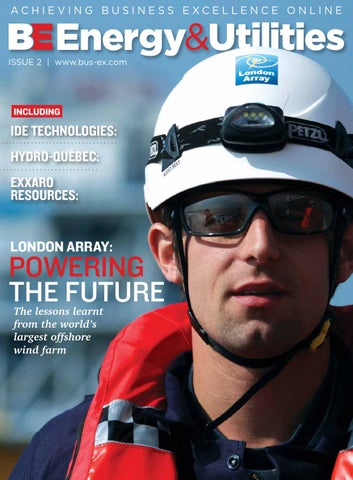
powering the future The lessons learnt from the world’s largest offshore wind farm
business excellence
Business John O’Hanlon Editor johanlon@bus-ex.com Will Daynes Editor wdaynes@bus-ex.com Matt Johnson Art Director mjohnson@bus-ex.com Louise Culling Production Designer lculling@bus-ex.com Richard Turner Director of Sales rturner@bus-ex.com Vince Kielty Director of Editorial Research vkielty@bus-ex.com
Business Excellence brings you content from leading business influencers and strategic thinkers providing inspiration and guidance to help you and your business grow. We showcase some of the best examples of successful organisations from around the world giving you a unique insight into how they operate.
Sharon Rooke Administration & Operations srooke@bus-ex.com Matt Day Head of Technology mday@bus-ex.com Andy Turner Chief Executive aturner@bus-ex.com
Subscriptions & Enquires info@bus-ex.com
HINT: For the best experience, click the fullscreen icon
Jacquard House, Queen Street, Norwich, NR2 4SX. England
Infinity Business Media Ltd
The content of this magazine is copyright of Infinity Business Media Ltd. Redistribution or reproduction of any content is prohibited. Š Copyright 2013 Infinity Business Media Ltd.
BE Energy & Utilities
|5
issue no.2
10 Sustainabilty
Energy alternatives in Africa South Africa’s outgoing Minister of Energy shared with us her passion for finding sustainable energy alternatives.
18 Executive insight
Lincoln Dahl, managing director, African Energy
Lincoln distrusts media hype and IPOs, but believes in creating opportunities for others.
20 Event preview
powering ideas
This November more than 300 industry leaders will congregate in Berlin for KPMG’s Global Power & Utilities Conference.
6 |
BE Energy & Utilities
20
contents
24 40
renewables: 24 London Array
Powering the future
Project Director Richard Rigg discusses the journey taken by and the lessons learnt from the London Array project, the world’s largest offshore wind farm.
40 Torresol Energy, Gemasolar THE HELIOSTAT FIELD
Torresol was established with the aim of becoming a world leader in the Concentrated Solar Power sector.
52
Water treatment: 52 Aqualogy
Transcending water into wellbeing
Aqualogy’s efforts throughout the world highlight precisely why it is positioned as a global benchmark when it comes to providing water solutions for sustainable development.
60 Tedagua
Water, water, everywhere
Tedagua is a significant player in Spain’s bid to lead the global desalination market: as its domestic market contracts the company is concentrating its efforts overseas.
BE Energy & Utilities
|7
issue no.2
70 Electricty provider: 70 Hydro-Québec
Energy for the future
The largest energy supplier in the Province of Québec: it harnesses Canada’s fast-flowing rivers to satisfy the demands of both domestic and export markets in North America.
82
82 Endesa
Seven decades of power
One of the world’s leading electric power companies, Endesa is doing more today than ever to provide for the present and future needs of its customers all around the world.
90 KenGen
Generating growth
KenGen is taking its role as the country’s leading electricity supplier extremely seriously by developing new long-term power solutions.
98 zesco
powering zambia
90 8 |
BE Energy & Utilities
Zesco, Zambia’s national power provider, has been beset by problems, but these are now being addressed head on and state of the art technology is the order of the day.
contents
coal: 106 Eskom Medupi
Medupi’s strategic power
The new coal-fired power station that is being built at Lephalale in South Africa’s Limpopo Province is a megaproject that has delivered great achievements despite being faced by many challenges.
106
116 Exxaro Resources Champion of change
An extraordinary South African resource company with a strategic vision to become a $20 billion company by 2020.
Service provider:
116
126 SPX – Marley Mexicana Mexico’s tower of strength
By combining over a century of experience with cutting-edge, environmentally friendly technology, Marley Mexicana has solidified itself as one of jewels in SPX Group’s crown.
134 MISTRAS Group
Enhancing life expectancy
MISTRAS Group Executive Vice President, Phillip T. Cole, discusses the group’s priceless contributions toward North Sea development over the last 20 years.
142 Filcon Filters
An ambitious target
126
This South Africa-based company has set an ambitious target of 25 percent annual growth over the next three years.
BE Energy & Utilities
|9
Energy alternati
Just before moving across to the Ministry of Tran shared with us her passion for weaning her countr alternatives: the record of the last four years ha Words by
10 |
BE Energy & Utilities
John O’Hanlon
Sustainability
ives in Africa
nsport, South Africa’s outgoing Minister of Energy ry off its addiction to coal and finding sustainable as been impressive but much remains to be done |
Research by
James Boyle BE Energy & Utilities
| 11
Sustainability
W
hen President Jacob Zuma appointed Elizabeth Dipuo Peters to the post of Energy Minister in 2009 one of the key performance areas he asked her to progress was getting greater private sector involvement in power generation. She very quickly perceived that some of the best opportunities to achieve this lay in the renewable energy sector, so as a passionate believer in sustainable energy policies, she targeted the exciting emerging technologies and the companies that could help South Africa’s achieve its ambitious target to dramatically cut its reliance and generate 42 percent clean energy by 2020 and cut carbon emissions by a similar figure by 2025. “I saw an opportunity to use renewable energy as an instrument to bring in the independent power producers,” she says. By 2011, the year South Africa hosted the international Climate Change Conference COP17, her ministry announced its target to obtain 3,725 MW of renewable energy in two bid rounds, called Window 1 and Window 2. “In Window 1 we managed to get 28 preferred bidders, I am happy to say, all of whom qualified for government financial incentives, and these are the companies building the first 28 plants.” This, she says, will feed into the National Development Plan, South Africa’s blueprint for development over the next
20 years, which aims to create a low carbon economy by 2030. A key factor in this strategy is the Integrated Resource Plan which sets out energy strategy from 2010 to 2030, which takes on board the 42 percent renewable power policy, she continues: “The biggest beneficiary of this 42 percent is photovoltaic (PV) solar and wind. Concentrated solar power (CSP) accounts for a smaller proportion, and of the 17,800 MW renewable we are committed to installing by 2030 most will come from wind and PV solar.” The original 28 bids, approved in November last year, will contribute 1,400 MW. To these have now been added a further 19 projects under the Window 2. They were given the go ahead in May 2013 and will contribute a further 1,200 MW of capacity. The present state of play, then, is that 47 private operators are now developing projects right across the country, to Mrs Peters’ great satisfaction and funded by the government to the turn of R75 billion ($7.6 billion). To this, she points out, should be added the national power generation company Eskom’s own 200MW renewable energy project, 50 percent generated from wind energy resources and the other 50 percent from CSP. Nearly half of current renewable power developments in the country in the country are located in the Northern Cape Province. Could that have something to do
“I saw an opportunity to use renewable energy as an instrument to bring in the independent power producers” 12 |
BE Energy & Utilities
The IDC is the biggest supporter of tenders awarded in the
Over the next five years, the IDC will make available R25 billion
Department of Energy’s Renewable Energy Independent
to fund projects related to green industries.
Power Producers (REIPP) programme. The IDC is identifying and providing funding for many projects In the first round of REIPP tenders, the IDC participated in
that will contribute to building South Africa’s industrial capacity
twelve successful bids, and seven more in the second round.
and creating jobs. Visit www.idc.co.za to find out more.
The green energy bids include wind power, concentrated solar power, photovoltaic and small hydro projects.
Chillibush10174IDC
The power behind renewable energy
Telephone: 086 069 3888 Email: callcentre@idc.co.za To apply online for funding of R1 million or more go to www.idc.co.za
Sustainability
with the fact that Elizabeth Dipuo Peters is a former president of the province? She says it is more likely to be because this is the province with the highest direct normal irradiance (DNI), a measure of solar radiation. It is also home to the Northern Cape Solar Corridor, which includes proposed sites near Upington, Groblershoop, Prieska and De Aar. Working with organisations such as the South African National Energy Association, the South African Independent Power Producers Association and the South African Wind Energy Association and SANEDI, the South African National Energy Development Institute, the Department of Energy is working flat out to promote renewable energy, she says. However this has to be done within the context of other national priorities, she adds. “We have built into our procurement processes the need for localisation. We want as many of the components as possible to be made here. That way the renewable programme will boost South Africa’s economic development and skills base.” This is new and exciting technology, she points out, giving a unique opportunity to the country’s research and development community as well as growing employment. She is hopeful that a real partnership can develop between local and global manufacturers. Another aspect of renewable power
generation that excites her lies in its potential social impact. “ At World Environment Day In June this year South Africa was invited to become part of a renewable energy club made up of ten committed countries. The Secretary General of the UN has identified renewable energy as one of those instruments that can actually unlock access particularly in parts of the world suffering from energy poverty.” As the German Environmental Minister Peter Altmaier said at the launch: “Renewable energy is not only a
“Renewable energy is not only a good way of combating climate change, it also contributes to prosperity and supply security throughout the world” BE Energy & Utilities
| 15
good way of combating climate change, it also contributes to prosperity and supply security throughout the world.” For South Africa this could mean bringing the potential for renewable microgeneration into the mix, enthuses Mrs Peters. “In a move towards decentralised generation we are looking at incentivising neighbourhood and community groups to use either wind or solar to generate their own power and create their own energy distribution networks. This is one space we are very excited about!” Local projects also contribute to the 42 percent target, she points out. Even a small component of society like a municipality landfill gas programme can use waste to generate power; waste vegetable matter from a school can go into a biodigester to generate gas that can be used to heat that school. Even at a household level there is huge potential, even if they can’t generate power at the grid level. In 2009 Peters announced a programme to install a million water heaters in homes and commercial buildings, and so great has been the uptake that this number is sure to rise. She particularly likes the fact that this initiative directly improves the lives of women, relieving them of the need to go out and collect wood for heating water. In more densely populated areas there is a different approach. For example in
“I have visited many factories in South Africa that are manufacturing key components” 16 |
BE Energy & Utilities
Gauteng Province, her ministry is working with the Department of Public Works as well as the Department of Infrastructure Development of Gauteng to retrofit the government buildings to renewable energy (normally solar panels). We believe that would also add to energy efficiency as well as introducing renewable energy. That is a double-barrelled type of project that is going to have dual benefits for us as a government and also as a country.” Biomass is another way to produce green energy on a localised basis. Bagasse may be a new term to many people, but there’s a lot of it in southern Africa. It is the fibre that is left when sugar cane or guinea corn stalks have been crushed. Nearly a third by weight of sugar cane ends up as bagasse, and despite its high moisture content it is very effective when combined with other forms of biomass such as timber shavings to generate electricity. Mrs Peters is keen to work with the producers in South Africa who between them produce nearly 20 million tonnes of sugar cane, as well as the timber and sugar cane industries of neighbouring countries like Mozambique and Swaziland.
Sustainability
If all these initiatives are co-ordinated and taken seriously demand on the national power grid could be lightened significantly. Street lighting, traffic lights, perimeter lights and security lighting are all examples of medium- to low-load areas that could be brought into sustainable local generation schemes – at the same time, she believes that encouraging this way of thinking could create the necessary critical mass to sustain local production of components and stimulate new industries and yet more employment. “I have visited many factories in South Africa that are manufacturing key components. They are even producing solar inverters that change DC from the PV panels to AC for the network. The geyser industry is also growing, as well as solar panel assembly. Energy policy can be a catalyst for job creation: it has the potential to reduce poverty, especially energy poverty.” As she mentioned before renewable energy is a job creator as well as an investment magnet. “We are told the number of jobs resulting from Windows 1 and 2 alone is around 13,000. In one small town in the Northern Cape one
“In the beginning the technology developers will have to make it possible for us to create the market” company now employs 500 people. For a small town that is massive. And it restores the dignity of those people.” The stumbling block is the cost of the technology and she is determined to tackle that. Another spin out from COP17 was the South Africa Renewable Initiative (SARi), launched as an International Partnership by South Africa together with Denmark, Germany, Norway and the UK, and the European Investment Bank. SARi is a funding mechanism, she explains, that will help South Africa unlock its green growth potential through the funding of large-scale renewable developments. The goal is to help cut technology costs. “But we are also calling on the technology developers because they are mostly international players. If they believe in the future of renewable energy they should be prepared to do more than just drive returns on their own investment. If this technology grows more and becomes available, especially in developing countries, in the long run they will get enough returns; but in the beginning they will have to make it possible for us to create the market.” The wind and sun, she says, come at no cost and are everyone’s birthright. It is in everyone’s interest to get the cost of converting these natural resources into usable energy.
BE Energy & Utilities
| 17
Nobody’s perfect. What quality or ability do you wish you had? There are lots of things I wish I could do better! Everything from eye-hand coordination to mathematics – the list is long. I often have a hard time being nice and it seems like I could be more patient with people. The ability to relax would be nice too…
What is the best business book you have ever read, and why? Probably something by Og Mandino, or The Wealth of Nations by Adam Smith. They lay out simple concepts that explain a lot of the world. I am a simple person and I can understand and apply simple concepts. I think that if you can’t explain something in a paragraph, you might not understand it or it might not be true.
Someone you would most like to have met, living or dead, and why?
Lincoln
Dahl
managing director, African Energy
In relation to business and economics, it would be Benjamin Franklin or Milton Friedman. Both were very practical men who seemed to know the difference between things that were fashionable and those that were sensible.
What do you consider to be your major achievement (in life or business)? That’s easy, being a successful husband and father (so far) means much more than anything I do at work. It takes a different
executive insi ht Don’t weaken! If this was easy, everyone would be doing it! set of skills and it can be a lot harder than running a business profitably.
Who or what do you think is overrated? So many things. Almost anything riding high in the news cycle at the moment. The media seems dissatisfied with mere good things and needs to make them better than they are. In our industry, IPOs and private equity usually disappoint, and get disappointed themselves, due to over-rating on both sides. Whenever a web site or presentation looks too slick in this industry, we have learned to watch out!
What mistakes have you made (professional or otherwise), and what did you learn from them? This could be a long list. I guess I have only learned if I changed my behaviour. I have learned to trust my instincts when I find a good deal, but paradoxically I have also learned not to trust people when it really seems easy and convenient to do so. Also, the older I get, the more I realize that we really can have an impact in the world – it just might not be immediately apparent.
Which one piece of wisdom would you pass on to your successor? Don’t weaken! If this was easy, everyone would be doing it!
Who has been your inspiration professionally? My dad – we are in totally different industries, but I spent a lot of time working with him as I grew up. Much of how I deal with people and situations is based on how I saw him do it. I hope to be as good as him someday.
How would you like to be remembered after your retirement? What’s retirement? I’ve heard it is surprising how much a person can accomplish if they don’t care who gets the credit. Even so, I’d like to be remembered as someone who created opportunities for others and encouraged them to grow.
Do you have a quote or motto you live (or work) by? “Men are that they might have joy.” If you are not enjoying life as you live it, then something is probably wrong.
Lincoln Dahl is managing director of African Energy. www.africanenergy.com
BE Energy & Utilities
| 19
events
POWERing ideas This November more than 300 industry leaders will congregate in Berlin for KPMG’s Global Power & Utilities Conference
KPMG Global power and utilities conference 2013 27-28 November 2013 Hotel Adlon Kempinski, Berlin, Germany The KPMG Global Power & Utilities Conference is KPMG’s premier event for CEOs, divisional heads and financial executives of the power and utilities sector, presented by KPMG`s Global Energy and Natural Resources Practice. The conference brings together 300 executives of power producers, developers, investors, regulators and other industry stakeholders (NGOs, Research Institutions etc.) from over 40 countries around the world in a series of interactive discussions. The goal of the conference is to provide participants with new insights, tools and strategies to help them manage industryrelated issues and challenges. Attendees also have the opportunity to join their peers from leading power and utilities companies to share effective practices and participate in networking activities.
20 |
BE Energy & Utilities
The conference agenda focuses on strategic, financial, environmental and risk related issues that are current and topical for power and utilities executives. The intensive day-and-a-half program consists of keynote presentations by distinguished leaders, issue-focused plenary roundtable discussions and interactive parallel sessions. KPMG’s inaugural conference held in Paris in 2011, and the second one in Vienna in 2012 brought together a vast number of executives from the industry. Building on the discussions fostered during last year’s conference in Vienna, and honing in on these issues, KPMG will look forward to driving constructive discussions to develop these vital themes. This year’s agenda will again span an intensive day-and-a-half program consisting of keynote presentations by distinguished leaders and experts, issue focused peer-to-peer roundtable discussions, and thematic parallel sessions.
>>>
preview
BE Energy & Utilities
| 21
events KEYNOTE SPEAKERS Michael Andrew
Chairman, KPMG International
Mr. Andrew was elected Chairman of KPMG International in 2011. Located in Hong Kong he is the first Chairman of one of the “big four” accounting firms to be based in the Asia-Pacific region, a key area of growth for KPMG member firms’ audit, tax and advisory services. Mr. Andrew is actively engaged in shaping the future direction of KPMG’s member firm network which employs 152,000 professionals in 156 countries. He has been a member of KPMG’s Global Board and Council since 2007, was involved in the development of KPMG’s Global Strategy and was a member of its Global Governance Review in 2008.
Alistair Buchanan
Chairman, KPMG’s Power & Utilities practice in the United Kingdom
Mr. Buchanan joined KPMG as a partner on 1st October 2013. Prior to joining the firm, he has been Chief Executive Officer of Ofgem since 2003. He is a Council member of Durham University and is Chair of the University’s Remuneration Committee. Previously he was a Non Executive Director for Scottish Water and was a member of the UK Energy Research Partnership (UKERP). Mr. Buchanan was appointed CBE in December 2008. He is a Fellow of the Institute of Chartered Accountants, training with KPMG. Before Ofgem his working career has been in the financial sector with leading investment banks, as both an award winning analyst and as Head of Research, in London and New York.
Günther Oettinger
Member of the European Commission, Commissioner for Energy
As Commissioner for Energy since 2010, Mr. Oettinger is responsible for developing and implementing a European energy policy by providing European citizens and businesses with competitive and technologically advanced energy services, making energy production, energy transport and consumption more sustainable and creating conditions which allow continuous and
22 |
BE Energy & Utilities
secure energy supply for the EU, including through international relations.
Dr. Fatih Birol
Chief Economist, International Energy Agency (IEA)
Dr. Birol is the Chief Economist at the International Energy Agency in Paris. He is responsible for the IEA’s flagship World Energy Outlook publication, which is recognised as the most authoritative source of strategic analysis of global energy markets. He is also the founder and chair of the IEA Energy Business Council, which provides a forum to enhance cooperation between the energy industry and energy policymakers.
Denis Vladmirovich Fedorov
Head, Directorate for the Development of the Power Sector and Marketing in Power Generation, Gazprom and Chief Executive Officer, Gazprom Energoholding
Mr. Fedorov, Head, Directorate for the Development of the Power Sector and Marketing in Power Generation, Gazprom, CEO, Gazprom Energoholding. Since 2007 Mr. Fedorov has been Head of the Directorate for the Development of the Power Sector and Marketing in Power Generation, Gazprom, which manages the electric power assets of Gazprom Group. In 2009 he was appointed CEO of Gazprom Energoholding, a 100% Gazprom subsidiary, which has controlling interests in major generating assets – Mosenergo, TGC-1, OGK-2 and MOEK, with installed capacity of more than 38 GW and employing more than 46,000 people. He is Chairman of the Board of Directors of OGK-2 and Tyumen Energy Sales Company and is a member of the Board of Directors of Mosenergo, TGC-1, FSK UES and INTER RAO UES.
Marcus Spickermann
Managing Director, car2go GmbH and Chief Financial Officer, Daimler Mobility Services GmbH
Mr. Spickermann, CFO of Daimler Mobility Services GmbH – a subsidiary of Daimler Financial Services AG
preview
– is responsible for Finance & Controlling, Legal and HR. Furthermore, he is in charge of the Communications and Brand Management activities of the Group. After completing his studies in International Business Administration in Hamburg, Mr. Spickermann joined debis AG in January 2001 as a Management Trainee. Following various positions in the field of Risk Management, Finance & Controlling, he took over responsibility for the corporate controlling activities of Daimler Financial Services (DFS) in North America.
Dipl.-Kfm. Klaus Becker
Chief Executive Officer of KPMG in Germany
Mr. Becker joined KPMG in 1993 and was elected to the partnership in 2001. After spending three years as partner in the financial services advisory practice, he transferred to the audit financial services practice, where he held several lead partner roles. Mr. Becker was elected to the Management Board of KPMG in Germany in 2006.
Dr. John E. Parsons
Executive Director, the MIT Center for Energy and Environmental Policy Research
Dr. Parsons is a financial economist specializing in risk management, corporate finance and valuation. His current research focuses on the problems of risk in emissions markets—including the design of a US carbon market—risk in oil, natural gas and wholesale electricity markets, the role of trading operations in an energy company, and the valuation and financing of investments in energy markets. At MIT’s Sloan School, he teaches the finance elective Advanced Corporate Risk Management. He holds a BA in Economics from Princeton University and a PhD in Economics from Northwestern University. He has taught on the finance faculty at MIT’s Sloan School of Management, the Zicklin School of Business at the City University of New York’s Baruch College and the Columbia Business School.
Paul van Son
Thomas Piquemal
Group Senior Executive Vice President, Finance, EDF Group
Mr. Piquemal, is Senior Executive Vice President in charge of finances of EDF Group; he is also responsible for EDF Group North American operations and a member of the Group Executive Committee. As Group CFO since February 2010, Mr. Piquemal’s responsibilities include financial controlling, Investor Relations, Corporate Finance, Investment and M&A but also purchasing, synergies deployment and property management. Since 2010, Mr. Piquemal has worked steadily on supporting the Group development and strategic initiatives through the deployment of an adequate investment and financing policy and by taking an active role in the major negotiations involving EDF in Germany, Italy, the US and in the renewable industry.
Chief Executive Officer, Dii (Desert Energy Industrial Initiative)
Mr. van Son’s career has prominently been marked by his activities in the framework of energy grid operation, the liberalisation of energy markets and the development of green energy in Europe and beyond. Presently Mr. van Son is CEO of Dii, a consortium of international industrial companies with the aim to bring the Desertec vision into reality in MENA i.e. to develop a market for large scale renewable energy from the deserts. He is co-founder of EFET, the European Federation of Energy Traders, where he was Chairman from 1999 till 2012. In addition he is Chairman of the Energy4All Foundation / NICE International, supplying decentralized energy, water and internet services for small communities in developing countries.
For more information about the KPMG Global Power and Utilities Conference 2013 visit: www.kpmg.com/powerconference
BE Energy & Utilities
| 23
24 | BE Energy & Utilities
London Array
Powering
the future Project Director Richard Rigg discusses the journey taken by and the lessons learnt from the London Array project, the world’s largest offshore wind farm
written by: Will Daynes research by: Louisa Adcock
BE Energy & Utilities | 25
London Array
I
t was in July 1887 that Scottish academic James Blyth installed the world’s first electricity-generating wind turbine. Although at the time considered uneconomical in the UK, electricity generating wind turbines proved to be far more cost effective in countries with widely scattered populations, a fact that saw American inventor Charles F Brush follow up Blyth’s work some months later by building the first automatically operated wind turbine for electricity production in Cleveland, Ohio. Fast forward to the 21st Century and the world finds itself in a situation where rising concerns over energy security, global warming, and eventual fossil fuel depletion have led to an expansion of interest in all available forms of renewable energy, including wind power. It was due to this interest that the fledgling commercial wind power industry began expanding at a robust growth rate of about 30 percent per year, driven by the ready availability of large wind resources, and falling costs due to improved technology and wind farm management. Today, London Array is arguably the most widely known UK offshore wind farm and the largest of its kind found anywhere in the world. Following confirmation of the suitability of the area for construction of a wind farm site, the London Array project was officially born in 2001, with the Crown Estate providing the consortium of operators at the time, Shell WindEnergy Ltd, E.ON UK Renewables and DONG Energy, a 50 year lease for the site and cable route to shore, which was entered into in 2004. Planning consent for the project’s 1GW
BE Energy & Utilities | 27
SPECIALISTS
We take part in the world’s largest offshore wind projects
LONDON ARRAY
Danish Per Aarsleff A/S and German Bilfinger Construction GmbH are cooperating in the joint venture Aarsleff BilfingerBerger Joint Venture. We have recently completed the installation of 177 foundations for the London Array Offshore Wind Farm located off the east coast of England. Currently, we are installing 80 monopile foundations for the DanTysk Offshore Wind Farm. Previously, the joint venture has installed 92 monopiles for the Horns Rev 2 Offshore Wind Farm, 91 gravity foundations for the Rødsand 2 Offshore Wind Farm, 7 gravity foundations for the Sprogø Offshore Wind Farm and 100 foundations for the Thanet Offshore Wind Farm.
AARHUS
HAMBURG
LONDON
Aarsleff Bilfinger Berger Joint Venture Aarsleff Bilfinger Berger Joint Venture is a Danish-German joint venture between two of the world’s leading contractors – Per Aarsleff A/S from Aarhus and Bilfinger Construction GmbH from Hamburg. Both companies have extensive experience in and knowledge of the execution of demanding marine construction work. The working relationship From 2004 to 2013, we have implemented huge offshore foundation structures in Denmark, Germany and the UK. The clients of these projects include major energy companies looking for a business partner capable of implementing giant contracts. We have handled everything from design and construction to installation of offshore steel and concrete foundations, just as we have handled the actual installation of wind turbines. The world’s largest offshore wind farms The JV has executed the foundations for half of the world’s largest operating offshore wind farms. Recently, it has completed the world’s largest offshore wind farm, the London Array Offshore Wind Farm, and it is currently executing the DanTysk Offshore Wind Farm which will be commissioned in 2014. By then, the JV will have executed the foundations for five of the world’s largest offshore wind farms. Specialists Every single project is unique and poses unique challenges. Therefore, we have always
30 | BE Energy & Utilities
focused on finding the right equipment and the right expertise for the specific infrastructure job – also when a job required us to develop new specialist equipment and new solutions. Staff Our staff has many years of experience and wide expertise within offshore activities, and they cover the whole spectrum from tendering to order acquisition, planning, design and execution. We attach great importance to being able to execute as much of each project as possible by means of our own staff in order to build up and maintain experience and know-how inhouse. This way, expertise gained is passed on from project to project thus contributing to enhancing our competitiveness. Our skilled and dedicated staff contributes to our success on the offshore wind market. Equipment Specialist equipment is required for the implementation of offshore wind projects. We spend many resources on development and investment in specialist equipment for our projects. Our purpose is to optimise the projects to the benefit of our customers. Our specialist equipment includes pile grippers, lifting yokes, upending devices, barges, sea fastenings, cage installation tools etc. All equipment is developed by in-house engineers and technicians. www.abjv.com
London Array
offshore wind farm was granted in 2006, with commissioned on 6 April, 2013,” states permission granted for the onshore works Project Director, Richard Rigg, “an event following in 2007. Work on Phase One started which effectively marked the culmination of in July 2009 when building commenced on the installation of the 630MW wind farm. the onshore substation at Cleve Hill in Kent, From that point on the complete wind farm whereas offshore construction started in has been generating and earning revenue.” March 2011 when the first foundation was Such is the sheer scale of London Array installed. The first turbine that it is estimated that its 175 turbines will be capable was installed in January of generating enough energy 2012, with first power achieved in October that year to power nearly half a million and the final turbine installed homes and reduce harmful in December 2012. CO2 emissions by over The number of turbines “We reached the key 900,000 tonnes a year. that make up the “When this project was first milestone of having the wind farm conceived,” Rigg continues, 175th and final turbine
175
BE Energy & Utilities | 31
“London Array is arguably the most widely known UK offshore wind farm and the largest of its kind found anywhere in the world�
Construction of a turbine
32 | BE Energy & Utilities
London Array “I think it is fair to say that it was felt by many that an undertaking of this size could simply not be carried out.” Indeed at the time there wasn’t even any legislation in place that allowed for the construction of a project the size of London Array. Nevertheless, it is with a great sense of pride that Rigg can declare that despite the considerable challenges that the consortium has encountered in the last decade or so, London Array looks set to deliver on the promises it made back at the time of its conception. Said challenges include Offshore substations boost the voltage to reduce transmission losses overcoming the obstacles that presented themselves due to the location than that anticipated and factored in by the of the project in the outer Thames Estuary. consortium. Regardless of these setbacks the Here the water depth can range at lowest project ended up having what Rigg describes atmospheric tide from 25 metres right down as a remarkable year in 2012. “By the end to minus one metre, meaning that at various of December 2012 we had installed in the points some areas of the site actually dry out. space of ten months all bar a few array cables, “As you can imagine,” Rigg highlights, three of the four export cables, and 90 of the “when you have to get a large vessel in to 177 foundations. That means that we finished install components weighing around 650 the year installing the last turbine within a tonnes you have to ensure that you get it in at few weeks of the date we actually set back high tide, jack it up and then await the return in May 2009, which I think is a fantastic of higher water levels before getting it back achievement.” The consortium, which now consists of out again. All of this adds an extra degree of DONG Energy, E.ON and Masdar, is very keen complexity to the work you are doing.” In addition to these logistical difficulties to stress that it sees London Array as being the project has been hampered by several the first real industrial scale offshore wind extensive periods of bad weather, worse farm, with its success being a precursor to
BE Energy & Utilities | 33
Seen
Contact us today and put your company in the spotlight!
vincent@bus-ex.com
London Array the next round of wind farms nexans due to appear off the coasts With energy at the basis of its development, Nexans, a of the UK. worldwide expert in the cable industry, offers an extensive Where it also hopes range of cables and cabling solutions. The Group is a global to see the project being player in the energy transmission and distribution, industry labelled an inspiration for and building markets. Nexans addresses a wide series of future developments is in its market segments: from energy and telecom networks to energy resources and transportation. efforts towards benefiting Continuous innovation in products, solutions and services, the environment and the employee development and commitment, customer orientation local communities who and the introduction of safe industrial processes with limited reside around the site. It has environmental impact are among the key initiatives that place long been the aim of the Nexans at the core of a sustainable future. consortium to see London www.nexans.no Array playing a key role in helping the UK to meet various renewable energy targets. By reducing carbon emissions by more than 900,000 tonnes a year the project will be playing a critical role in helping to tackle the effects of climate change and global warming, this providing significant, long term environmental benefits. “It is important to recognise that in addition to London Array there are a number of other large offshore wind farms that really are contributing to this shared goal,” Rigg explains. “The more this happens, the sooner people will recognise the scale of the contributions these projects are making. In turn they will hopefully then realise that Installing array cables these wind farms can generate industrial
“The lessons learnt from London Array will prove invaluable for those behind the creation of the next generation of wind farms” BE Energy & Utilities | 35
LIFTRIG CONSULTING Driven by a passion for safety in lifting operations, LiftRig Consulting’s team of experienced engineers are leading innovators of lifting and handling solutions, cable handling and storage systems, lifting assurance and lift planning services. At LiftRig, we strive to become the leading provider of lifting engineering services and personnel to the energy sector and beyond, and we treat every engineering requirement as a unique project. Producing innovative solutions requires unique talents which are not always available from many companies. The engineering team at LiftRig has a track record of creating such innovative
LiftRig are proud to be associated with the successful completion of the London Array Wind Farm.
solutions, which can be shown to include world-leading products and advanced solutions to modern challenges Combining over 25 years’ experience in on- and offshore engineering with the +44sales@LiftRig.com (0)1202 238718 www.LiftRig.com latest state-of-the-art design software, the LiftRig team is well-placed to provide solutions that are safe, practical, effective and cost-effective. Our unique design service will satisfy the needs of any organisation responsible for providing a safe system of work to its employees, installers or those of its customers. • Cable Storage & Handling Systems • Heavy Lifting Specialists • Appointed Persons
LiftRig – Creating Safe Solutions. www.liftrig.com
LiftRig are proud to be associated with the successful completion of the London Array Wind Farm. • Cable Storage & Handling Systems • Heavy Lifting Specialists • Appointed Persons
• Lifting Assurance • Lift Planning
sales@LiftRig.com +44 (0)1202 238718
www.LiftRig.com
• Lifting Assurance • Lift Planning
London Array
London Array operations & maintenance office
amounts of electricity and “The relationship we play an important role in the have built up with the local villages of Graveney and energy mix of the future.” While the wind turbines Goodnestone is nothing that make up London Array short of excellent and stand 20 kilometres out to have already proven to be Of CO2 emissions that sea, the project has still had mutually beneficial for all the wind farm will help a big impact of the onshore concerned,” Rigg enthuses. reduce per year communities in the Cleve Hill Examples of some of the and Ramsgate areas, a fact positive results to come from that has not been lost on the consortium. In these relationships include London Array’s the early days of the project it faced natural support of a university bursary scheme, the opposition to its plans for building its Cleve creation of a community fund managed by Hill substation. Respecting this opposition an independent trust, its donations to various the consortium embarked on a programme wildlife funds and the annual donations of engagement, working hard to involve local made to three local schools. people and keeping communities informed Equal effort has been made by the about the progress of the project at all times. consortium in Ramsgate where it has
900,000+ tonnes
BE Energy & Utilities | 37
London Array endeavoured, wherever possible, to employ local people to its construction and operations and maintenance teams, and to source from local suppliers, not only during the construction phase of the project but for all manner of activities related to the project, from hotels and taxis to bringing in a local company to supply the Cleve Hill substation with high speed internet access. Now that London Array is into its operational phase the focus of the consortium turns to ensuring that it works as effectively and efficiently as possible. In doing so it is expected to produce some hugely important performance figures that its owners hope can then be used to demonstrate that wind farms have indeed become serious players in terms of today’s energy mix. Looking ahead to the future, Rigg points out that while what has already been achieved is hugely significant, there is more work to be done if mankind is to get the most out of offshore wind power. “The aim for the industry as a whole is to bring down the costs associated with offshore wind and improve the overall reliability of wind power generation. While there is still much to be done if we are to reap the full rewards that wind power has to offer there can be no doubt that the lessons learnt from London Array will prove invaluable for those behind the creation of the next generation of wind farms.” For more information about London Array visit: www.londonarray.com
BE Energy & Utilities | 39
THE HELIOSTAT
Torresol Energy was established with the aim of becomin in the Concentrated Solar Power (CSP) sector and its mi the technological development of large CSP plants aroun
written by: john O’Hanlon research by: Louisa Adcock
40 | BE Energy & Utilities
Torresol Energy - Gemasolar
T FIELD
ng a world leader ission is to promote nd the world
BE Energy & Utilities | 41
The tower reflected in a heliostat
Torresol Energy - Gemasolar
S
olar power is a great idea, but it is no good at night or when the sun does not shine – right? Wrong! In southern Spain there’s now a solar power plant that can run constantly. We are used to seeing solar panels on houses and in solar arrays. These work by converting sunlight directly into electricity using photoelectric cells, but Torresol Energy was formed to introduce and test new technologies that make concentrated solar energy an economically competitive option and a real, viable, ecological and sustainable alternative to traditional energy sources. Conserving the environment for future generations is one of Torresol Energy’s main commitments. Gemasolar is an innovative 19.9 MW CSP plant, the first commercial experience in the world using molten salt thermal storage in a central tower configuration. The plant is located in Fuentes de Andalucía, Seville, and started commercial operations in May 2011. The plant consists of a 140 metre high solar power tower that derives its energy from an array of 2,650 heliostats, or mirrors circled around it, reflecting the sun’s rays onto the molten salt core. Spain has acquired global technology leadership in the field of solar energy over the last few decades. The work of SENER, which owns 60 percent of Torresol Energy, started in the 1980s. The firm focused on finding technology for large scale cost-efficient innovations for power generation, and by 2005 it was ready to undertake the design, manufacturing, installation, testing and validation of a CSP receiver prototype in collaboration with the
BE Energy & Utilities | 43
TORRESOL ENERGY Torresol Energy - Gemasolar Torresol Energy feature government research and Lorem ipsum dolor sit amet, text....Lorem ipsum dolor sit consectetur adipisicing elit, innovation organisation amet, consectetur adipisicing CIEMAT. At the same time it sed do eiusmod tempor elit, sed on do the eiusmod incididunt ut labore et dolore worked designtempor of the incididunt ut labore et magna aliqua. Ut enim ad 120 square metre heliostats, minim veniam, quis nostrud doloreorientation magna aliqua. Ut their mechanism enimheliostats ad minim track veniam, exercitation ullamco laboris (the in quis two nisi ut aliquip ex ea commodo nostrud exercitation axes – each has twoullamco motors laboris nisiinut aliquipthat ex consequat. Duis aute irure with a built controller ea commodo consequat. dolor in reprehenderit in recalculates and readjusts the position every fourdolor seconds Duis aute irure in voluptate velit esse cillum using SENSOL software) and This is a caption this is a caption Valle 1 anddolore Valle 2, Torresol’s earlier projects reprehenderit in voluptate eu fugiat nulla the storage system. velitmolten esse salt cillum dolore eu pariatur. Excepteur sint fugiat pariatur. occaecat occaecat Twonulla years later Excepteur with the sint technology with Masdar was formed, and construction cupidatat non proident, sunt in cupidatat non proident, sunt in to culpa qui culpa thoroughly tested SENER decided proceed startedqui theofficia following year. mollit The plant deserunt animhas id officiaGemasolar. deserunt mollit id est laborum. with The anim Torresol Energy JV est beenlaborum. operational since Maydolor 2011.sitItsamet, first Lorem ipsum
TECNICAS DEL CABLE S.A. Técnicas del Cable are experts in the production of specialized cable for specific markets including the chemical industry, refineries, the Aeolian parks, power stations and railroad networks. Today we are capable of making practically every form of cable and can do so based around the specifications given to us by our clients or by following national and international norms. Thanks to the incorporation of new machine and the development of new products, Técnicas del Cable can respond to almost any request from its clients. Employing more than 40 people at its 25,000m2 facility, Técnicas del Cable is capable of providing services to the whole of the European Union. While it has a particularly strong presence in Portugal, France, Italy and Belgium, almost 70 percent of its total output is installed and sold
in Spain through a team of installers, engineers and mounters who are experts in the electrical sector. The company’s philosophy is based on offering its clients the perfect conjugation of quality, downtime and price. In 1989, the company obtained ISO quality certification and ever since it has managed to fulfill its three core objectives, while remaining on a path of continuous improvement throughout all areas of the business. Looking to the future the company aims to maintain its strategy of investment in equipment and technology. In the short-term it will also continue to renovate its operations, incorporating new production lines as it looks to offer a greater range of products. E. info@tecnicable.com www.tecnicable.com
WEEKLY| |452 BE Energy & BE Utilities
19.9 mw Capacity of the power plant
Tower and heliostats
46 | BE Energy & Utilities
year of operation exceeded all expectations. It supplied more than 100 GWh of power provided to the grid. So what are the advantages of this unique plant, the first CSP unit in the world to include a molten salt thermal storage system? “Apart from opening the way to a new generation of solar power technology,” says Álvaro Lorente, General Manager of Torresol Energy. “The most obvious advantage is that it supplies continuous power in a flexible way. That is to say, the turbine can operate without stopping overnight or if there is a cloud. That prolongs the life of the turbine, and in addition we can manage its output according to demand according to peaks and troughs.” There are a host of other advantages, he enthuses. “Its very simplicity makes it a low risk operation. The fluid is concentrated in a small area, reducing thermal loss and keeping maintenance costs low, and the same fluid is used for both heat transfer and storage, resulting in less thermal exchange. Additionally the molten salts reach extremely high temperatures, which maximises thermodynamic efficiency.” Gemasolar’s 19.9 MW turbine is a strategically capable installation, he says, able to supply electricity to 27,500 households. “Eventually the plant
Torresol Energy - Gemasolar
The plant has the ability to provide a higher annual capacity factor than most baseload plants such as nuclear power plants
will be able to supply 24 hours of uninterrupted production per day on most summer days, providing a higher annual capacity factor than most baseload plants such as nuclear power plants. In this way, the reliability of solar energy becomes comparable to that of conventional fossil-fuel power plants, a decisive factor as the demand for renewable energy increases.” However another vital element for the Torresol partners is the amount of local input they have been able to achieve, says
Lorente. “Since the company was created in 2008 we’ve had a solid commitment to creating a network of local and national suppliers in order to generate wealth around the facilities. In all the installations we have done we have boosted local employment, with about 80 percent of supplies and 70 percent of the talent coming from local sources.” As befits an alternative energy enterprise, both Gemasolar and Torresol O&M were recently awarded ISO 14001 certification for environmental management and OHSAS
“Eventually the plant will be able to supply 24 hours of uninterrupted production per day on most summer days” BE Energy & Utilities | 47
IMECA Solutions and Services offers itself as the best
Phone: +34 949 208 917 | Fax : + 34 949 208 919 e-mail: imeca@imeca.net ISO 9001 & 14001
solution, in quality and commitment, to perform all services available for the energy industry. We are specialists in the renewable energy sector for the design and manufacture of fasteners and anchor bolts, both conventional and for metal structures. We provide our expertise to the energy industry (wind, solar thermal, photovoltaic, combined cycle ...), as well as to the railway, marine and petrochemical industries. IMECA Solutions and Services offers: • Anchor bolts. • Plates, nuts and washers. • Screws: conventional, special and for metal frames. • Special parts manufactured off-plan.
Torresol Energy - Gemasolar 18001 certification for EMbaffle B.V. workplace health and safety. EMbaffle B.V. is a dynamic technology company with Masdar is keen to be able broad operational knowledge across the Solar Power, to bring these principles as Oil & Gas Up- and Downstream and Petrochemical well as the technologies to the industries. We offer advanced heat transfer solutions Middle East. North Africa has based on our proprietary technology supported by sound plenty of sun, so has Chile for operational data. Our solutions provide significant added value to projects including capital and operating example. However with the cost enhancement as well as reductions in energy former being a desert and the consumption and CO2 emissions. latter subject to earthquakes, In the Concentrated Solar Power sector our technology has the technology will need proven itself as for the last seven CSP projects in Spain to be refined to suit local equipped with Thermal Storage possibilities all clients have conditions. Torresol Energy is chosen for EMbaffle Technology. studying weather conditions A Major Advance in Heat Transfer Technology. www.embaffle.com and working with a number of governments and entities around the world to increase its understanding of how local content, local talent and local supply chains can be optimised to bring the benefits of solar power where it is most needed. Solar thermal technology is a relatively new industry, hungry for investment at this early stage of development, says Álvaro Lorente, but with the ability to cut unit costs to a fraction of current levels as it supplants fossil fuels. Cost reduction can be achieved using different ‘levers’, he explains. “We can utilise R&D to gain economies of scale, for example constructing larger plants Heliostat field at dusk
“As the industry matures a supplier base will grow up and standardisation of components will cut costs further” BE Energy & Utilities | 49
A heliostat rotates to capture the sun’s rays
Torresol Energy - Gemasolar
80% Local supplier content at Gemasolar and developing the specific learning curve from each solar thermal technology. As the industry matures a supplier base will grow up and standardisation of components will cut costs further. At Torresol Energy we have a solar development programme: a number of central complexes will be built simultaneously with the twin objectives of creating a supplier industry and improving plant efficiency.� Really, research is the key. Torresol Energy’s current projects include; cloud location in collaboration with the University of Almeria; prediction of solar radiation in partnership with the Spanish Centre for Renewable Energies CENER; product development to improve reflectivity levels on the heliostat field, with Tekniker; and software optimisation to improve plant efficiency. A parabolic trough plant operation simulator will help training of operators on sites that use that technology, while mathematical models are being developed to accurately predict wind conditions. All these share the twin objectives of production growth and cost reduction in operation and maintenance. For more information about Torresol Energy - Gemasolar visit: www.torresolenergy.com
BE Energy & Utilities | 51
52 | BE Energy & Utilities
Aqualogy
Transcending water into wellbeing Aqualogy’s efforts throughout the world highlight precisely why it is positioned as a global benchmark when it comes to providing water solutions for sustainable development
written by: Will Daynes research by: David Brogan
BE Energy & Utilities | 53
View of La Farfana sewage treatment works in Chile
Aqualogy
A
chemical compound whose molecules are made up of one oxygen and two hydrogen atoms connected by covalent bonds, it covers 71 percent of the earth’s surface and is a vital ingredient to all known forms of life. I am of course referring to water, a commodity that can all too often be taken for granted for people living in developed societies The same however can certainly not be said about Aqualogy, the global brand of integrated water solutions for sustainable development. It understands that water is essential to achieving a higher quality of life and wellbeing in society, as well as being a basic resource for productive economies on all continents. It is for that reason that the company sets out to tackle the serious challenges posed by the lack of proper water management in parts of the world by providing intelligent and innovative solutions that also help facilitate sustainable development. It is the company’s mission to promote research based on knowledge and experience in order to respond to the current and future challenges of its customers and society, thus allowing it to become the leading figure in the development of water solutions and technologies. In striving to achieve this Aqualogy conducts itself under a strict set of values which include maintaining excellence in its performance, its commitment to innovation and the talent of its people, its ability to adapt to each individual customer’s needs, and its commitment to creating lasting value. Aqualogy is present anywhere in the world where it is able to provide solutions to improve
BE Energy & Utilities | 55
71% Of our planet’s surface is covered with water
Detail of one the installations at La Farfana sewage treatment works in Chile
56 | BE Energy & Utilities
water management. Indeed its global reach is impressive by any standards, what with 1,939 drinking water treatment plants, 264 desalination plants, 20 supply networks, 726 sewerage networks and more than 10,000 professionals based across the world. In locations subject to shortages, such as northern Africa, the company is helping to ensure water supplies, while in Europe it is working to develop integrated solutions for the urban water cycle and serve the demanding needs of the food, energy, healthcare, tourism and pharmaceuticals sectors. Meanwhile, in Turkey it is preparing innovative initiatives that it believes will open the door to new markets. Elsewhere, Aqualogy provides solutions tailored to the needs of its customers in the United States, Mexico and Brazil, while in Chile it has established a successful model for integrated water management. In rural Latin America it has also implemented several projects relating to water access and the promotion of efficiency in the use of water resources. All of Aqualogy’s activities are executed using its own resources, either through public-private partnerships or in collaboration with other companies. Its four main areas of activity involve providing solutions to companies within the water sector, developing
Aqualogy
One of the installations of La Farfana sewage treatment works in Chile
hydraulic engineering building projects, providing specialised services and solutions aimed at improving water management, and offering services based on knowledge and people management. Examples of Aqualogy’s work have their roots in all manner of industry sectors and global regions. For instance, in Oran, Algeria, the company has installed its iDROLOC system to search for leaks in the drinking water supply network. The system itself uses helium as a tracer gas to pipelines where conventional acoustic methods cannot be used to locate leaks.
Oran is familiar territory for Aqualogy with the company previously contributing to a number of important projects including meeting the challenge of providing the population of the entire province with water 24 hours a day and modernising its water analysis laboratories. Head west across the South Atlantic Ocean and across South America into Colombia and you will find yet more evidence of the diversified work of the company, this time in the form of its role of supervisor in the construction of a submarine outfall. Built over a period of 17 months in the city of
“Aqualogy understands that water is essential to achieving a higher quality of life and wellbeing in society� BE Energy & Utilities | 57
The Ice Pigging technological solution truck
Idroloc s
“Aqualogy aims to become a benchmark in each and every sector in which it operates and a key partner for water-related and environmental projects� Cartagena de Indias, this outfall is the third largest anywhere in the world and completes the city’s plan to install a network of aqueducts, sewerage systems and basic treatment facilities. The outfall constitutes the most important project within the water sector for the city and means that Cartagena de Indias will become the first city in Colombia to be able to treat 100 percent of its wastewater.
58 | BE Energy & Utilities
Aqualogy aims to become a benchmark in each and every sector in which it operates and a key partner for water-related and environmental projects. To do so Aqualogy offers its customers its solutions and technologies, in order to provide a highquality service, adapted to suit their needs. The company presently focus its efforts here on three important value drivers. They are the optimisation of the amount of
Aqualogy
system, centred on leak location
water required in a given process, in order to draw up contingency plans and water source studies; the quality of the water and the environmental impact, from the prior treatment of process water to wastewater treatment; and the optimisation of waterrelated operations, with the operation and maintenance of assets and the supply of materials and products. Come 2050, it is expected that the world’s population will have reached approximately nine billion people, the majority of whom will remain concentrated in large metropolises. Combine this with the effects of climate change and it appears inevitable that water will increasingly become one of the most valued and sought after assets on earth, when it comes to both domestic consumption and
View of La Farfana sewage treatment works in Chile
use in agriculture, industry and services. Aqualogy understands that in facing such a future it is imperative that sustainable water management models continue to be promoted. This will enable water to remain available to the entire population that encourages wellbeing and economic development. This has been Aqualogy’s fundamental aim since the day it was created, therefore it stands to reason that every decision it makes or project it takes on going forward will be designed to achieve a future where H2O continues to flow. For more information about Aqualogy visit: www.aqualogy.net
BE Energy & Utilities | 59
Water, water,
Tedagua is a significant player in Spain’s b as its domestic market contracts the comp
written by: John O’Hanlon |
60 | BE Energy & Utilities
Tedagua
, everywhere
bid to lead the global desalination market: pany is concentrating its efforts overseas
| research by: David Brogan
BE Energy & Utilities | 61
Tedagua
T
Tertiary Treatment of the WWTP of Altona (Melbourne, Australia)
he Ancient Mariner complained abut the lack of drinking water on his ship in 1798 but fails to mention (perhaps Coleridge didn’t know) that Samuel Pepys had requested one of his naval captains to carry out “… an Experiment of producing fresh water (at Sea) out of Salt” as early as 1684. The outcome of that is not known, but it can’t have been that successful as onboard desalination doesn’t seem to have progressed much until the invention of the multi-stage flash (MSV) distillation process in 1955. The desalination industry has grown exponentially: so has the water treatment industry, particularly in emerging markets But the technology and the market are constantly changing. One of the most agile players in this market since it was founded in the Canaries 1983 is Tedagua (Técnicas de Desalinización de Aguas SA). It started out as a small company but was acquired in 2001 by the leading Spanish infrastructure group ACS and was incorporated into the Cobra Group, which operates in the field of green energy. Tedagua was established due to the need for drinking water in the Canary Islands. Thanks to the support of Cobra, Tedagua has had the opportunity to grow substantially and is now one of the biggest and most respected water companies in Spain, and globally. The company now has permanent locations in all 5 continents, and is an international leader in the design, construction, operation, maintenance and engineering of desalination plants, systems for producing drinking water from brackish feedwater, and plants for recycling water
BE Energy & Utilities | 63
from sewerage feedwater. The company is also a leader in the design and construction of plants for treating and reusing urban and industrial waste for electricity generation. It has delivered more than 150 water treatment plants with a global capacity of 2,400,000 cubic metres per day. One of the main reasons for the company’s success is the support it has received from its collaboration with Cobra Group, as it has been
awarded projects it would not have been able to handle before the collaboration. An example of such a project is the water treatment plant in Lima, Peru, which we discuss below. Today Tedagua has the capacity to act as a global player, says its CEO Miguel Ángel Fernández. “This is why today, whenever the opportunity arises to bid for a new contract, in a new country, we rarely turn it down. And once we have worked in a new territory we like to
“Whenever the opportunity arises to bid for a new contract, in a new country, we rarely turn it down” 64 | BE Energy & Utilities
Tedagua
Installation of the submarine infall of the WWTP of Taboada (Lima, Peru)
set down a permanent base innumerable cities and there.” Because of different countries across the world – to name only a few it has legislation and regulations installed plants in Australia, it is always difficult to start Brazil, Mexico, Peru, Panama, a project in a new country, Year Tedagua Costa Rica, Central America, he adds, but the culture of was founded Tedagua is to be very proactive the Caribbean and Africa. rather than risk-averse when One really important it comes to expansion. current project is to build The success of this strategy is largely down the largest wastewater treatment plant in to the company’s greatest asset, its people, South America in Lima, Peru. Lima claims who show great personal commitment in Mr to be the world’s second biggest desert city Fernández’s opinion. “I think our excellent after Cairo. Operations began at he Taboada technicians are a really important element WWPT in February this year, and the plant in giving us an edge over our competitors.” will boost the treatment of sewage water in The can-do culture that they demonstrate Lima and the neighbouring city of Callao. has gone a long way to establish Tedagua Until now, most of the sewage water from as a truly global company, operating in Lima and Callao, with a population of over
1983
BE Energy & Utilities | 65
nine million, has been sent out to sea without any prior treatment or filtering — 20 cubic meters of raw sewage per second. The new plant will deal with an average flow of 14, and peaks of 20 cubic metres per second. No chemicals or disinfectants are used in the treatment process, and after several stages of treatment, the water will be sent out to sea along a 3.5 kilometre underground pipeline.
This year the company has also signed a contract to improve the drinking water systems in Dhaka, the capital of Bangladesh. These three projects alone demonstrate the global scale of the company, but this has been built up over a period of time with many small desalination plants executed for hotel complexes or small farms in the Canary Islands, the large sea water
“I think our excellent technicians are a really important element in giving us an edge over our competitors�
Beni Saf Desalination Plant (Algerie)
66 | BE Energy & Utilities
Tedagua
WWTP of the city of Escatrón (Spain) with the Combined Cycle constructed by Cobra Group at the end
desalination plants of Escombreras in Spain or Skikda and Beni Saf in Algeria and tertiary treatment plants such as the RWTP in Altona, a suburb of Melbourne, Australia or the WWTP at Taboada in Lima (Peru), the largest in South America. North African countries like Algeria have never had enough water for their people. The World Health Organization considers Algeria to be “water stressed” and desalination is a significant part of its water solution. The Beni Saf desalination plant went into operation in 2010, a facility designed to produce 200,000 cubic metres of quality water to cover the
needs of a population of 750,000 from the region of Oran and neighbouring areas. Tedagua was the main contractor for the design and construction stages of the plant and subsequently assumed responsibility for its current task of management and maintenance of the facility over a 25-year period. So the first decade of this century has been good for Tedagua, says Fernández. But the emphasis is now moving away from the domestic market. “From our point of view the AGUA programme has effectively come to an end, and the opportunities that arise in
BE Energy & Utilities | 67
Construction of one of the seven sand removals of the WWTP of Taboada (Lima, Peru)
Tedagua
2,400,000 Cubic metres of water delivered by Tedagua treatment plants per day our own backyard are more directed towards residential, service and industrial markets. Our big focus is now on the international market. India, China, Australia, Arab Emirates, America and North Africa, for example, are all investing in desalination and inviting tenders for large desalination plants.” Spanish companies, he adds, are very active in these international markets, and Tedagua itself has installed capacity in many of them. The forward strategy for Tedagua is to grow, and to be the strongest and most recognised company in its sector, says Miguel Ángel Fernández. “More specifically, we would like to grow within the industrial sector. For example, we have signed a very important industrial contract with a Colombian petroleum company – a plant of 80,000 cubic metres a day. The company will, however, also focus on other areas, such as food and mining. The mining sector, especially in countries such as Australia, Peru and Chile, has considerable requirements in the field of water management.” For more information about Tedagua visit: www.tedagua.com
BE Energy & Utilities | 69
70 | BE Energy & Utilities
Hydro-Québec
Energy for
the future Hydro-Québec is the largest energy supplier in the Province of Québec: it harnesses Canada’s fast-flowing rivers to satisfy the demands of both domestic and export markets in North America
written by: John O’Hanlon research by: David Brogan
BE Energy & Utilities | 71
A view of the dam as the ground work begins to take shape
Hydro-Québec
H
ydro-Québec owns and operates 60 power-generating facilities across the province. It was created in 1944. “At that time it was essentially an electricity distribution operation, with some generation in the greater Montreal region,” explains President and CEO Thierry Vandal, who has led the company since 2005, having joined it in 1996. “That was the situation until 1963 when, through a number of acquisitions, the corporation grew to develop a footprint which covers all the territory of Québec. HydroQuébec became a regional player.” Over several decades the company mainly expanded hydroelectric power, with 98 percent of its output today coming from hydroelectricity, a clean and renewable energy. Hydro-Québec built the 15,000MW La Grande River complex at James Bay in northern Québec between 1971 and 1996. The complex accounts for half the province’s installed capacity and is still today one the most important hydroelectric complex in the world. 1,000 kilometres north of Montreal, La Grande demonstrated the company’s ability to deliver huge capital projects, in challenging conditions with all the associated infrastructure of roads, campsites, transmission lines and airstrips. The most recent project to be completed was the $5 billion Eastmain 1A-SarcelleRupert project, in the James Bay area. It was launched in 2007 with approval to build the Eastmain-1-A and Sarcelle powerhouses and divert part of the Rupert River’s flow. The diversion began in 2009, two of the three generating units at Eastmain-1-A powerhouse
BE Energy & Utilities | 73
www.neilsonex.com
GIGANTIC IS WHAT WE DO BEST
NEILSON IS ONE OF THE LEADERS IN QUEBEC FOR MAJOR CIVIL ENGINEERING WORKS.
.. ..
Clients benefit from Neilson’s huge… Know-how Fleet of leading-edge equipment Multidisciplinary first-rate technical team Ability to carry out large-scale projects
Wuskwatim Generating Station Intake Powerhouse under Construction, Wuskwatim, MB
Hydro-Quebec, Péribonka Generating Station, Péribonka, QC
St. Lawrence Pipeline, QC
Hydro-Québec were commissioned in 2011, Neilson the third in January 2012. Neilson is a general contractor specialized in civil engineering The first generating unit at on a monumental scale. Since 1963 public and private sector Sarcelle powerhouse was partners in Quebec, and elsewhere in Canada, have counted commissioned in April 2013 on Neilson to break new ground, meeting the most extreme and the two other units have challenges while standing behind the quality of our work. now come on line. “From an Partnership with Hydro-Quebec on La Romaine project is an example of what we proudly realize. environmental and logistic www.neilsonex.com standpoint it was the most challenging project in the history of Hydro-Québec,” he says. “It covers an area the size of some European countries but we were able to bring it in on time and a little under budget so we are very proud of that result.” Hydro-Québec is unusual in that it manages these large construction projects by itself instead of outsourcing the engineering, procurement and construction. “We are an organisation with a strong culture of growth and project execution,” says Vandal. “That expertise has developed over the years as we went from one project to another and it’s taken us to a level where we can undertake very sophisticated large capex projects involving challenging infrastructure and logistics. That is an area in which we very much excel.” But it’s not all about delivery. Another Spillway construction significant factor has been the way the company has arrived EBC Inc. at a deeper understanding of EBC Inc., for over 30 years, has been a proud partner in the what he calls ‘the equilibrium success of Hydro Quebec projects. Besides hydro-electric of development’ – the works, EBC diversifies its achievements in sectors such as balance between finance, the building, civil engineering, earthworks, marine engineering, regional economy, and also, mining works (open pit and underground), wind farms and crucially, how to address pipelines, with its works being performed throughout Canada. environmental and social www.ebcinc.qc.ca aspects. “A very significant
BE Energy & Utilities | 75
“A very significant key to our success over the last 15 years has been the renewed partnerships with aboriginal communities” key to our success over the last 15 years has been the renewed partnerships and understanding of the importance of our relationships with aboriginal communities. We never tackle a new project without strong buy-in from local populations.” You can’t put a multi billion-dollar megaproject into the environment without some impact, but Hydro-Québec’s goal is to fit in with the ecosystems in a way that
76 | BE Energy & Utilities
guarantees that those ecosystems afterwards will be just as productive as they were before. That applies to natural habitats and wildlife, the way of life and the cultural expectations of the trappers and tallymen among the First Nations and other long-term inhabitants. “We take our ideas to the aboriginal communities before they are fully formed, then work together to develop it so it becomes their project as much as ours.”
Hydro-Québec
Hydro-Québec’s goal is to fit in with the ecosystem
This gives space to traditional knowledge, which any incomer ignores at peril. “There is more than science to these things, there is a traditional understanding of ecosystems that has been carried over the centuries.” It takes humility to put aside your scientific assumptions and listen to what the locals say, he recognises. The old ways of living and the associated wisdom do have to be preserved, but the First Nations live in the 21st century just as much as Montrealers. They want to see their share of the economic upside of development in their territory and Hydro-Québec always wants to make sure to maximise the business capacities in the communities. “We reserve a portion of contracts with these communities so at the end there remains a significant
business infrastructure and ecosystem that can go beyond and work in other areas whether it is mining or other infrastructure development,” Vandal observes. “We have been working in some of these communities for up to 40 years, and today they have very sophisticated capacities in terms of executing civil works and being present in the supply chains for things like catering, fuel supply, air transport, helicopters and the like.” The Eastmain 1A-Sarcelle-Rupert project was completing just as Hydro-Québec entered what is undoubtedly it flagship project today. The $8.5 billion Romaine Complex launched four years ago is one of the largest construction projects currently under way in Canada. It has two large components, Vandal explains: a $6.5 billion four-powerhouse complex on
BE Energy & Utilities | 77
the Romaine River in eastern Québec and a $2 billion new high voltage transmission lines to carry the 1,550 MW it will generate to markets further to the south. “We are now almost half way through the project,” he says. “The first power house, Romaine-2 will be commissioned by this time next year so it is very advanced and we are well under way
with RO-1, RO-3, and the fourth one, RO-4, which is way up north on the river, will be started in the coming year.” The entire project is scheduled to be delivered in 2020. That the terrain is difficult was recognised as long ago as the 1630s when the first Jesuits to arrive described the locals as Montagnais – mountain dwellers. For this, construction
“The way the markets work in North America, the border does not really exist!”
Camp Murailles
78 | BE Energy & Utilities
Hydro-Québec
Hydro-Québec works with local communities
camps for some 2,500 people had to be built, as well as 150 kilometres of road. “Before we went through the environmental review we made sure we had signed impact benefit agreements (IBAs) with both the aboriginal and non-aboriginal communities living within a perimeter of a couple of hundred kilometres from the river.” The Innu communities of Ekuanitshit, Nutashkuan, Unamen Shipu and Pakua Shipi participated in the environmental impact studies and will participate in the environmental follow-up monitoring until 2040. The estimated cost of the studies, mitigation measures and environmental monitoring is $320 million and covers fish habitats, wildlife and
archaeology which has shown evidence of settlements going back 2,000 years. In terms of local benefits, employment and contracts, Hydro-Québec typically tries to works with existing community organisations who will hire themselves. This works better according to Thierry Vandal: “We find that when the project is completed we leave an organisation that can take on other work.” The companies and institutions are made stronger and more sustainable. The supply chain for a large scale project like the Romaine is a global one. For example turbines are supplied by Alstom and Voith, the transmission grid will involve global suppliers like Alstom, ABB, Siemens. The assembly
BE Energy & Utilities | 79
A view of the dam as the ground work nears completion
Hydro-Québec
$8.5 Billion Cost of the Romaine Complex (generation and transmission) being made right on-site pulls in a lot of trades. Contracts and purchases of goods and services are estimated at $3.5 billion for all of Québec, with about $1.3 billion for the Côte-Nord region alone. About 40 percent of the workforce consists of people from the Côte-Nord, including a significant number of the Innu people. The Romaine Complex will secure Québec’s energy future and take advantage of opportunities to sell power outside the province. The USA’s demand for green Canadian hydropower is growing. In a project with Blackstone Group Hydro-Québec may take up 75 percent of the capacity of a new 333-mile transmission line being built by Blackstone Group from the Canadian border and running underground and under the Hudson River, into the heart of New York City. “We are also very active in the development of high-voltage DC transmission, which allows the interconnection of import and transmission systems in a very efficient and cost effective way,” he says. “The way the markets work in North America, the border does not really exist!” For more information about Hydro-Québec visit: www.hydroquebec.com
BE Energy & Utilities | 81
Seven decade
One of the world’s leading elec is doing more today than ev and future needs of its custo
written by: Will Daynes |
82 | BE Energy & Utilities
Endesa
des of power
ctric power companies, Endesa ver to provide for the present omers all around the world
research by: Dave Brogan
BE Energy & Utilities | 83
Endesa
E
stablished in November 1944, its top priority. This attitude also refers to with the construction of the the company’s commitment to economic and Compostilla thermal plan in social development in the countries in which Ponferrada, in the province of it does business. Its ability to stay true to its Leon in Spain, Endesa is today values is credited to the work of its 23,000 one of the largest electric power companies professionals located across the globe. in the world. As well as being Spain’s largest In addition to its strong market position in utility company, it is also the leading private the electricity and gas sectors, Endesa also multinational enterprise in Latin America holds a position in several other important and a major player in the gas sector. industries. In Spain it operates within both Over the course of almost 70 years the the regulated and deregulated natural gas company has steadily grown and evolved to sector segments, primarily in the distribution the point where it now boasts operations in of gas and the sale of natural gas and eight countries across Latin America, Europe integrated services. Endesa’s activities in this field, which also include and Africa. Throughout each of these operations Endesa storage, regasification and works diligently to identify LNG transport projects, are intelligent solutions that conducted by its subsidy, will help it develop realistic Endesa Gas which has proposals to address present interests in various transport and future energy challenges. and distribution companies. In total the company In Spain Endesa also Customers served by possesses four coal mining provides services to more Endesa across the world than 25 million customers, operations at As Ponte, with 141,434 GWh of power Andorra, Puertollano, generated and 162,490 GWh sold in 2012 and Peñarroya. In 2012 the company alone. In Spain, Portugal and Morocco extracted a total of 810,000 tonnes of coal its offerings include power generation, from these assets, a quantityequivalent to distribution and supply, while in Latin 2,787 million therms. As proof of Endesa taking its role as an America it provides power generation, transmission and distribution data to international energy company seriously, customers in Argentina, Brazil, Chile, the company aims to supply its clients with Colombia, Peru and Central America. high-quality services in a responsible and Endesa’s self-proclaimed “Blue Attitude” is efficient way. This means not only making a what it describes as its commitment to people. profit for its shareholders, but also building By listening to its customers and striving to up the professional training of its employees, establish constructive dialogue the company participating in the development of the social is able to ensure that their interests remain environments in which it operates, and using
25+
Million
BE Energy & Utilities | 85
Endesa
“Endesa works diligently to identify intelligent solutions that will help it develop realistic proposals to address present and future energy challenges” the natural resources it needs for its activities in a sustainable way. The company is equally as aware that in order to maintain its market-leading position and reinforce it going forward it is essential for it to perform its economic, social and environmental responsibilities on the basis of sustainability criteria. One example of the company’s efforts to deliver a sustainable future is through the
work of Enel Green Power, a subsidiary of its parent, the Enel Group. Enel Green Power is an entity fully dedicated to the development and management of renewable energy sources at an international level, with operations in Europe and the Americas. The company generated more than 25 billion kWh in 2012 from water, sun, wind and the Earth’s heat, enough to meet the energy needs of approximately ten million households and
BE Energy & Utilities | 87
avoid the emission of over 18 million tonnes of CO2 into the atmosphere. Enel Green Power is a world leader in the sector thanks to its well-balanced generation mix, providing generation volumes well over the sector average. As of today, the company
has an installed capacity of 8,700 MW from a mix of sources including wind, solar, hydroelectric, geothermal, and biomass. Currently, the company has around 740 operational plants in 16 countries in Europe and the Americas.
“Endesa’s ability to stay true to its values is credited to the work of its 23,000 professionals located across the globe”
88 | BE Energy & Utilities
Endesa
In Latin America, Enel Green Power runs renewable energy plants in Mexico, Costa Rica, Guatemala, Panama, Chile and Brazil for a total installed capacity of 990 MW. In the wind sector, the company is currently building wind farms in Brazil for a total capacity of around 283 MW and has 24 MW installed wind capacity in Costa Rica, 144 MW in Mexico and 90 MW installed in Chile, where the company is also constructing the 90 MW “Valle de los Vientos” and the 99 MW “Taltal” wind farms. Earlier this year, in March 2013, the company announced the outline for its
2013-2017 Strategic Plan. The strategic priorities for the business in Spain and Portugal will focus on dealing with the heightened regulatory framework by streamlining assets and cutting costs. Meanwhile, the 2013-2017 Strategic Plan for the business in Latin America will focus on reinforcing the company’s dominant position by exploiting growth opportunities. For more information about Endesa visit: www.endesa.com
BE Energy & Utilities | 89
Generating g
As Kenya’s energy demands continue to increase unabat is taking its role as the country’s leading electricity supp extremely seriously by developing new long-term power
written by: Will Daynes research by: Richard Halfhide
90 | BE Energy & Utilities
Kengen
growth
ted, KenGen plier r solutions
BE Energy & Utilities | 91
Wind turbine generator
Kengen
T
o say that Kenya Electricity Today KenGen possesses a workforce of Generating Company Limited, or approximately 1,829 staff distributed across KenGen as it is more commonly 20 different sites where its power plants are recognised, plays an important located. The company utilises various sources role in the economic development to generate electricity ranging from hydro, of the African nation is, to all intents and geothermal, thermal and wind. Of these purposes, a gross understatement. The reason hydro is the leading source, with an installed for this is that KenGen alone is responsible for capacity of 766.88MW, which is 65 percent of producing almost 80 percent of the electricity the company’s installed capacity. consumed in the country. Kenya is rightfully proud of having KenGen’s history dates back to 1954. It was a liberalised marketplace and it is here then that the Kenya Power Company (KPC) that KenGen competes directly with four was first registered and was commissioned independent power producers, who between to construct a transmission line between them produce the remaining 20 percent of the country’s electric power. the city of Nairobi and Tororo in Uganda, as well as It is with this competition to develop geothermal and in mind that KenGen strives to maintain its position as other generating facilities in the country. The Nairobi the market leader in the - Tororo line was to transmit provision of reliable, safe, Potential future power generated at the quality and competitively power capacity of the Owen Falls Dam. priced electric energy. “With Olkaria complex From its inception, KPC the wealth of experience we possess, our established sold its electricity in bulk at cost to the Kenya Power and Lighting corporate base and a clear vision, we Company (KPLC), which ran the company believe we are perfectly placed to retain our under a management contract. This remained leadership position with the sector,” explains the case until January 1997 when the Geoffrey Muchemi, KenGen Director of management of KPC was formally separated Geothermal Projects. from KPLC as a result of new reforms and “For the foreseeable future,” Muchemi legislation brought in to regulate Kenya’s continues, “we aim to efficiently generate energy sector. competitively priced electric energy using state Come October 1998 KPC had re-launched of the art technology, while also leveraging itself under the name and corporate skilled and motivated human resources to identity that we now know at KenGen. It ensure financial success. Meanwhile, we shall was this act that saw KenGen take charge achieve market leadership by undertaking of all publicly owned power generating least cost, environmentally friendly capacity plants in the country. expansion. Consistent with our corporate
560mw
BE Energy & Utilities | 93
Hyundai Engineering Co., Ltd. to Create the Sustainable Value With almost 40 years of experience, Hyundai Engineering Co., Ltd. has grown into a comprehensive engineering company which has the diverse business portfolio covering a number of areas including chemical plants, power plants, industrial plants, infrastructure and the environment, with a well accumulated level of high-quality technology expertise in design, procurement, commissioning and maintenance. Today the company is actively expanding into the renewable energy sector and expects the striving pace for the lasting value creation for humanity to allow it to secure future growth.
http://eng.hec.co.kr
FOR COST EFFECTIVE SOLUTIONS
Howard Humphreys is one of Eastern Africa’s leading consulting engineering and project management company and has been carrying out project management, engineering design and construction supervision of buildings, roads and transportation, water supply and sewerage projects in Eastern Africa since 1931. To date Howard Humphreys has carried out several major projects in the Eastern Africa region. The Company’s main fields of activity in East Africa can be classified under the following Service Lines: • Building and Structures • M&E Building Services • Project Management • Water and Sanitation • Safety, Health and Environment • Transportation and Roads & Bridges Telephone: (+254 20) 2063254/2660374 Cell Phones: 0724253431/0733625483 Email: info@howardhumphreys.co.ke www.howardhumphreys.com
Seen
Contact us today and put your company in the spotlight!
vincent@bus-ex.com
Kengen culture, our core values Hyundai Engineering Co., Ltd will be adhered to in all our Hyundai Engineering Co., Ltd. is the only company to have operations.” a performance reference from the geothermal power plant Despite Kenya’s economic in the Republic of Korea, “Kenya Olkaria geothermal power advances in recent times it plant unit I & IV Project”. This was awarded in recognition is still a widely shared belief of its skills and competencies in the field of geothermal that the country’s power power plants, a field which has long been led by Japan, U.S. and European companies. sector remains in need of In addition, Hyundai Engineering Co., Ltd. is now standing major investment. This is in a competitive position within the market of combined evidenced by the fact that cycle power generation, coal-fired power plants, it is still many thousands cogeneration, diesel power generation, and transmission of MW short of being able and substation projects. to deliver total national eng.hec.co.kr coverage. Thankfully Kenya’s government and its energy sector are not oblivious to this need and are taking active steps to meet the said challenge. One answer is the major investment that is being made in geothermal energy projects. It is these such projects that KenGen anticipates will become its primary source of energy by 2020, and the basis for this growth will be its Olkaria power station projects. As of now there are three Olkaria plants active today, with Olkaria I and II producing a combined 115 MW of power, a figure that is set to be increased to 150 MW in the coming months. Olkaria III on the other hand produces 48 MW and its running is outsourced to Ormat Technologies. Water turbine generator
“KenGen alone is responsible for producing almost 80 percent of the electricity consumed in the country” BE Energy & Utilities | 95
“KenGen strives to maintain its position as the market leader in the provision of reliable, safe, quality and competitively priced electric energy” In 2012 the company hosted the groundbreaking ceremony for the Olkaria IV construction, a new 280 MW geothermal plant that KenGen expects to be ready for generation capacity by 2014. “Olkaria IV is an extension of the existing Olkaria I and
96 | BE Energy & Utilities
II plants, and is expected to cost around $1.3 billion to complete,” Muchemi states. “The development itself will be built across two physical plants, each of which will boast two 70 MW units.” The steam wells for the Olkaria IV project
Kengen
The Olkaria III power plant
have already been successfully drilled, while the well head generators are expected to be installed and begin generating power as the construction phase of the undertaking continues. The Olkaria IV project is co-financed by the Kenyan government through KenGen and by a series of development partners, including KfW, World Bank, JICA, the French development agency, and the European Investment Bank. With the addition of Olkaria IV, the complete Olkaria complex will further cement itself as being the largest geothermal power project in Africa, with output estimated to
register at 430 MW in total by 2014. The good news doesn’t end here however. Recent studies on the field on which Olkaria stands have raised hopes that the overall capacity of the project could in fact be increased to 560 MW in total in the years ahead. Should this be achieved it would make KenGen even more of a vital contributor to Kenya’s growing power requirements. For more information about KenGen visit: www.kengen.co.ke
BE Energy & Utilities | 97
zesco
Powering Zambia Zesco, Zambia’s national power provider, has been beset by problems, many of them a legacy of under investment and piecemeal growth: but these are now being addressed head on and state of the art technology is the order of the day
written by: John O’Hanlon research by: Robert Hodgson
BE Energy & Utilities | 99
Cyprian Chitundu, Managing Director
zesco
T
he first mains electricity that Zambia Electricity Supply Corporation flowed in Zambia came from a Limited (ZESCO) is Zambia’s state-owned small coal fired station in the power company, a business that operates capital Livingstone, but even more like an independent company than a that did not cover the entire city. government department: adopting the model Zambia had to wait till 1938 to get its first commonly followed in Africa it is known as hydro-electric power from that mighty power a parastatal. So it is governed by a board of source, the Victoria Falls. Of course the copper directors that is appointed by the government, mines needed power, but up to the middle of with wider consultation with stakeholders, the last century they had to provide their own and with the participation of the private generation facilities. This meant that a number sector. It is Zambia’s largest power company of local authorities distributed electricity in producing about 95 percent of the electricity their own districts obtaining their supplies in consumed in the country. the main from existing power stations. For To act as a big corporation in a nearinstance, Livingstone local authorities bought monopolistic industry is a difficult task, admits power from the Victoria Zesco’s Managing Director Falls Electricity Board while Cyprian Chitundu. The only Kabwe and the Copperbelt time the customer really authorities purchased power notices their power supplier is from the mining companies when there’s a problem, and Zambia’s peak which they were often able Zambians are given plenty power demand of opportunity to notice that to sell local municipalities. there are frequent power But real consolidation did not take place until the early 1950s when outages. This, he says, is because the system at least four stations with a combined 120 is under stress. There is an under-capacity MW capacity were connected to a central within the country, and rationing has been switching station at Kitwe. necessary to ensure that every Zambian who With the construction of the Kariba is connected to the grid has a fair share of Dam and power station in 1962, and the the available power. To illustrate the situation, subsequent development of the 990 MW national demand for power, at peak times, is Kafue Gorge power station the copper mines more than 1,780 MW: Zesco’s total capacity finally had a source of hydroelectric power is 1,700 MW, leaving a deficit of around that was sufficient to supply Zambia’s major 165 MW, allowing for a safety margin. population centres as well. A power supply But that is no substitute for a reliable and network began to extend across the country continuous supply, he would be the first to and today this carries electric power to all acknowledge. “It is with this in mind that we but the most remote and inaccessible parts have adopted an action oriented strategy that of the country. will ensure that three years from now the
1,780 mw
BE Energy & Utilities | 101
Weekly Because a month is a long time to wait... Your weekly digest of business news and views www.bus-ex.com
zesco Zambian people will be well catered for and absolutely Two Rabbits Ltd is a proudly Zambia owned and operational free of power rationing.” Branding company. We specialize in all types of branding With the government backing and works are down in-house. Embroidery, screen printing, it by facilitating external Embossing, engraving, large format printing. investment partners, this Our Clients see us as an important resource and integral will, he hopes, get a number part of achieving their goals. Understanding our client specific goals is our top priority. We are extremely of projects moving that have committed and focused on this concept and continue to been stalled for up to ten tailor the way we do business in order to help you achieve years. After all, he points exceptional results. out, the very demand for With Two Rabbits Embroidery as your Branding partner, you electricity that is causing can be confident that you are building a solid affiliation with supply problems has only an organization you can trust and count on. come about through Zambia’s www.tworabbitsgifts.com economic boom. 2012 was a good year for Zambia’s economy. Growth was driven by expansion in agriculture, construction, manufacturing, transport and finance. Economic prospects for the future look positive so long as growth can be sustained and broadened to accelerate job creation and poverty reduction. After a slump in output, copper mining is expected to rebound in 2013, and is projected to reach 1.5 million tonnes by 2015. This is largely due to investment in new mines and the expansion of capacity at existing plants. Robust international copper prices will provide additional stimulus to mining. But that expansion very much depends on the availability of a robust power infrastructure, and that is Zesco’s challenge. Chitundu has identified eight key factors that need to be addressed as part of the action plan and number one on the list is to put an end to loadshedding, a polite name for sharing out blackouts as a way of keeping the lights on for most of the customers. Among Minister of Finance touring the KNBE project
TWO RABBITS EMBROIDERY LTD
BE Energy & Utilities | 103
the remaining objectives are to increase working capital, control costs and increase the customer base. But fairness to the customers is a thread running right through the policy, and one of the key perceived inequitable factors is the non-availability of power in some rural and remote parts of the country. To address this Zesco is working with the government of Zambia, the United Nations Industrial Development Organisation
(UNIDO) and the Global Environment Facility (GEF), and has embarked on a project to develop isolated mini-hydro power stations to mitigate the power deficit in rural areas. One such project is the one-megawatt Shiwang’andu mini-hydro power project which was commissioned in December 2012. An important objective of the project was to promote renewable energy based on mini grids for rural electrification in the country.
“The investment in the Fibrecom network is a great achievement by ZESCO with immense social, technological and economic benefits”
Work in progress at KNBE
104 | BE Energy & Utilities
zesco
Kariba dam
The Shiwang’andu project is not connected to the national grid – it is purely a local facility, so the buy-in from the people who will benefit is considerable. The project has created employment opportunities for 70 local general workers. The isolated mini grid will connect to the schools, clinics, lodges and farms which will bring economic development to Shiwang’andu area. While Zesco is implementing its large scale improvement programme, it is not all about fighting fires. The company recently launched the second phase of its fibre optic network after completing the installation of 5,300 kilometres of optic fibre cable on its high voltage lines. Phase one brought high capacity ICT to 46 towns in every one of Zambia’s ten provinces. “The investment in the Fibrecom
network is a great achievement by Zesco with immense social, technological and economic benefits,” said Cyprian Chitundu. Phase 2 extends coverage by a further 4,300 kilometres, with international connections to Tanzania and Namibia. The network is also being equipped with real-time remote surveillance systems, with access control at key installations on the Fibrecom (Zesco’s own brand) network. This, says Chitundu, will address the bane of vandalism, which is responsible for many of the outages that the customers currently blame on Zesco. For more information about Zesco visit: www.zesco.co.zm
BE Energy & Utilities | 105
Medupi’s stra
The new coal-fired power station South Africa’s Limpopo Province i great achievements despite be
written by: John O’Hanlon | research 106 | BE Energy & Utilities
Eskom Medupi
ategic power
that is being built at Lephalale in is a megaproject that has delivered eing faced by many challenges
h by: Vincent Kielty & Robert Hodgson BE Energy & Utilities | 107
Back of Boilers at different stages of construction
Eskom Medupi
S
ince we last spoke to Roman Crookes, project manager of the R105 billion Medupi power station, he has refereed a game of two halves. The press has had a field day throughout the three years since June 2010, and any observer could be forgiven for thinking the site has been a battlefield. However in every problem lies an opportunity, and it was good to get a chance to hear firstly about the achievements of the project, then about the good that has come from the setbacks that have been encountered. As Crookes puts it: “This year has been satisfying: we have seen a lot of progress on construction, though unfortunately that progress can get lost in the noise.” One of this year’s most significant milestones was the conclusion of an agreement between Eskom and Exxaro on a new schedule to supply the huge amounts of coal that will be needed from the Grootegeluk mine. This takes into account the delay in starting Unit 6, the first of the 800 MW units that was due to be completed by the end of this year but will now only be connected to the grid in the second half of 2014. “The infrastructure between us and the mine is now fully established and Eskom has 160,000 tonnes of coal on site,” says Crookes. The coal stockpile capacity on the 900-hectare site is 2.4 million tonnes, to keep all six units fed once they are all commissioned. Eskom now has the option to defer the commencement of coal deliveries to the Medupi power station from March 2013 to the first quarter of 2014. The subsequent rate of coal deliveries will then be increased to take the full volume of the deferred coal
BE Energy & Utilities | 109
Eskom Medupi over a period of 24 months prior to December 2016. A second achievement that pleased the project team as they saw plumes of smoke arising for the first time, was the commissioning of the auxiliary boiler, an oil fired plant that produces the steam needed for chemical cleaning and testing Unit 6. This was something of a landmark, the first new boiler commissioned on a construction site in South Africa in the last 20
years. In advance of this too, the bulk fuel oil plant that will be used for the ignition phase of the boiler units as well as running the auxiliary boiler was commissioned. The water treatment plant is nearing completion too, as are vital fire protection and auxiliary cooling systems. All that is needed now is for the number 6 boiler to be commissioned – the turbine for that unit has been rotated to test bearing clearances
EXXARO Exxaro Resources is one of the largest South African-based diversified resources groups, operating the Grootegeluk Mine near Lephalale in the Limpopo Province. The mine has been contracted to supply coal to Eskom’s Medupi Power Station which is currently under construction. A 40-year agreement requires Grootegeluk to deliver approximately 14,6 million tonnes of coal per annum to the power station. To enable this, significant expansion of the mine and development of the surrounding area were necessary. The project involved geology, mining, metallurgy, civil engineering and construction solutions which were planned and managed by Exxaro in conjunction with Eskom, the Lephalale Municipality and other stakeholders. The Grootegeluk Medupi Expansion Project involved five key elements: 1. Expansion of the pit.
2.Building two new coal processing plants (GG7 and GG8) and supporting infrastructure (such as two new additional blending beds and coal delivery conveyor systems) to deal with the increased volume of coal to be produced. 3.A backfill project to return overburden and discard material to the pit, which would previously have formed a surface ‘dump’. 4.A housing project to build 740 new houses in Lephalale to accommodate workers attracted to the region by the new power plant and mine expansion. 5.General infrastructure requirements in the region such as the development of local roads, stormwater drainage systems and electrical substations, the rehabilitation and expansion of the local Zeeland Water Treatment Plant and general warehousing requirements. www.exxaro.com
BE Energy & Utilities | 111
Mr Roman Crookes, General Manager
112 | BE Energy & Utilities
and the lubrication. The Unit 6 Generator Transformer has been back-energised, which means it is now connected to the grid. Very recently the turbine contractor Alstom installed its final stator. All the plant really needs now is a supply of steam. However it is well documented that the steam will take a little longer to flow than originally envisaged. Given the perfect storm of problems the plant has faced, a few months’ delay is not surprising. With the completion of some of the civil works the number of workers on site has come down from the original 18,000 to around 16,000, 95 percent of them South Africa nationals. Much of the delay has been caused by labour issues affecting the seven different unions that represent them. A lot has happened in the labour relations field over the last three years. A Project Labour Agreement (PLA) was entered into by contractors and unions, and worked well until at the back end of 2012 when some of the unions withdrew. This introduced a fracture among the unions themselves, says Crookes, and that forced Eskom to step in and intervene, working with the unions and contractors to forge a new agreement to replace the PLA, that this time included Eskom as a signatory and regulates labour relations at both Medupi and the other large plant under construction, Kusile. Among other things, the new Partnership Agreement (PA), signed on June 12 this year, prescribes a minimum wage for all hourlypaid contractor employees; standardised pay rates within each company, across companies and within the same industries; and allows parties to appoint a task team to address
Eskom Medupi
Segwate pre-school at Medupi, built as part of its corporate social responsibility efforts
skills development and training needs. “The PA irons out the kinks in the PLA that caused much of the tension,” Crookes says. The period that led up to the PA had seen some disruption, and that disruption has continued, with a wildcat strike on July 24 that resulted in property damage on site. This was caused by miscommunication around the question of pay for commuting time for the approximately 50 percent of workers who live within a 70 kilometre radius of the plant. Workers are affected differently depending on precisely how far from the site they live. The situation is now settling down well,
though, as the workers themselves appreciate that their new minimum wage is well above national levels in the construction industry. The new PA is nothing less than a game changer for the entire South African construction industry, Crookes claims. “Eskom, as a client, is now actively influencing the construction environment for the better. The new PA agreement we have struck is now being used as a reference point for the unions when they are negotiating other contracts.” On its own, the delay caused by labour disruption would account for much of the slippage in project delivery. However severe
“Eskom, as a client, is now actively influencing the construction environment for the better” BE Energy & Utilities | 113
technical problems have played their part too. One issue was where the boiler contractor Hitachi fell foul of an Inspectorate of Machinery code compliance issue and had to review 180 welds in the pressure parts circuit, four of which had to be retrofitted – all additional work that had not been planned for. A second more serious problem arose when it was discovered that the subcontractor responsible for post welding treatment, a critical process in which welds are de-stressed, had fraudulently created charts in a sophisticated scam that left uncertainty as to how thoroughly the weld had been checked. In short every weld – 9,000 of them – had to be re-checked. The sophisticated fraud led to a criminal investigation and further delays. These technical problems have all been identified and addressed using well understood procedures that are part of any project management process. Medupi is a critical national asset, and any delay is to be regretted. However the labour relations issues are less predictable and negotiations involving powerful unions are sensitive in the run-up to national elections. What cannot be disputed is the fact that the project has been a great boost to the local manufacturing and economy. The Medupi power station project created a lot of skills development within the
country. “Once we started building Medupi and Kusile we effectively introduced a lot of manufacturing capability back in to South Africa,” Roman Crookes points out. “For example for the first time in 20 years we now have the ability to build boilers here in South Africa. Technically we can now export boilers, which is a huge step in the right direction.” Medupi’s local sourcing and industry creation policy has undoubtedly had a big impact
“For the first time in 20 years we now have the ability to build boilers here in South Africa” 114 | BE Energy & Utilities
Eskom Medupi
High voltage yard, air cooled condenser columns with boiler units and two chimneys
in the Limpopo region and nationally. The decision to build a third large power station, recently announced by the South African cabinet, will probably be implemented once the Medupi and Kusile projects are complete in 2018, adding a combined 9,600MW to the national grid. This should finally put an end to the electricity supply challenges that have affected South Africa since 2008, costing the economy billions of Rand in lost production and economic growth. Thus the social impact has been significant, to Crookes’ great satisfaction. “People are becoming employed for the first time; given skills for the first time; paid for the first time! And to sustain the impetus once construction is complete we have the Medupi Leadership Initiative where we work closely with the
contractors to produce opportunities for post construction employment in different infrastructure-related projects.” The third power station will eventually mop up many of the newly-skilled people, and there are other important upcoming programmes in the pipeline, he says. “The government has said it wants to place a rail hub in the Lephalale region. That will need a lot of civil and mechanical trades to build it and lessen the impact of unemployment on the local community once all the Medupi units start supplying power to the national grid.” For more information about Eskom Medupi visit: www.eskom.co.za
BE Energy & Utilities | 115
Champion
of change
116 | BE Energy & Utilities
Exxaro Resources An extraordinary South African resource company with a strategic vision to become a $20 billion company by 2020
written by: Martin Ashcroft research by: Robert Hodgson & Jon Bradley
BE Energy & Utilities | 117
Trucks are driven out of the pit electrically to increase productivity and save diesel
Exxaro Resources
E
xxaro Resources is one of the railed directly to Mittal SA under a long-term largest South African diversified supply agreement. resource groups, with interests Such are the demands for power in South in coal, mineral sands, industrial Africa, however, that Grootegeluk’s capacity minerals and iron ore. The is being doubled in order to supply the new company is the second-largest South African Medupi power station that Eskom is building coal producer, and the third-largest global nearby. The $1.3 billion Grootegeluk Medupi producer of mineral sands, a class of ore Expansion Project (GMEP) will increase deposit which is an important source of throughput to 14,000 tonnes per hour, and zirconium, titanium, thorium, tungsten, and supply Medupi with 14.6 million tonnes per rare earth elements. annum of coal for 40 years. Exxaro’s eight managed coal mines produce Exxaro has a strategic target to become a over 40 million tonnes per annum (Mtpa) US$20-billion company by 2020—a global, of power station, steam and coking coal, as diversified company with top-quartile returns. To help achieve this it has well as char. The company is set targets for operational the largest supplier of power excellence, aiming to station coal to South Africa’s national power utility, Eskom. reduce its carbon footprint, Exxaro’s Grootegeluk improve on the safety and Tonnes per hour empowerment of its people, mine is one of the mostcapacity of Exxaro’s efficient mining operations and become an employer expanded Grootegeluk in the world, and operates of choice and an agent for beneficiation plant the world’s largest coal change in South Africa. Achievements have already beneficiation complex, where 9,000 tonnes per hour of run-of-mine been registered in this regard, with a Standard coal is upgraded in six different plants. of Excellence Award in the 2012 Deloitte Best Situated 25 km from Lephalale in South Company to Work For survey. CEO Sipho Africa’s Limpopo province, this open-pit Nkosi said the group is exceptionally proud mine has an estimated minable coal reserve of this achievement. “This is a target we set of 2800Mt and a total measured coal ourselves for 2016, and we have achieved it resource of 4600Mt, from which semi-soft in 2012. This is not an easy award to win – it coking coal, thermal coal and metallurgical is the result of concerted effort to achieve a coal can be produced. clear goal to continually improve our people Some 14,8Mt of annual production is power management capabilities and is therefore station coal, transported directly to Eskom’s more valued as a result.” Just a few weeks Matimba power station on a 7 km conveyor after this award, Nkosi himself emerged belt. Grootegeluk also produces 2,5Mtpa of victorious at the Southern Africa Chapter of semi-soft coking coal, the bulk of which is the Ernst & Young World Entrepreneur Awards
14,000
BE Energy & Utilities | 119
EXXARO Exxaro RESOURCES Resources tempor incididunt ut labore Lorem ipsum dolor 2012, winning the Master sit amet, category. consectetur et dolore magna aliqua. Ut Entrepreneur adipisicing elit, sed do enim ad minim veniam, In terms of operational quis nostrud exercitation eiusmod tempor incididunt excellence, in August this ullamco laboris nisi ut ut labore etbecame dolore the magna year Exxaro first aliquip ex ea commodo aliqua. Ut in enim ad minim company South Africa consequat. Duis aute irure veniam, nostrud to achieve quis Road Transport dolor in reprehenderit in exercitation ulla mco Management System (RTMS) voluptate velit esse cillum laboris nisiand ut aliquip ex consignor consignee dolore eu fugiat nulla ea commodoThe consequat. accreditation. RTMS is pariatur. Excepteur sint Duis aute irure voluntary dolor in an industry-led, non reprehenderit voluptate self-regulation in system that This is a caption this is a caption occaecat cupidatatIron-ore proident, sunt in culpa qui velit esse cillum dolore encourages consignees, eu fugiat nulla pariatur. Excepteur sint officia mollit anim id est laborum. consignors and hauliers engaged in the road value deserunt chain. Exxaro’s Grootegeluk and occaecat cupidatat proident,asunt in Lorem ipsumComplex dolor sit business amet, consectetur logistics value chain non to implement vehicle North Block units are culpa qui officia deserunt mollit anim id adipisicing elit, sedsites do to eiusmod management system that preserves road the first company receivetempor RTMS est laborum. Lorem ipsumroad dolor sit amet, ut labore dolore magnaby aliqua. infrastructure, improves safety and incididunt accreditation, whichet is supported The consectetur adipisicing elit, of sedthe do eiusmod enim ad minimand veniam, Chamber of Mines Eskom.quis nostrud increases the productivity logistics Ut
JOY GLOBAL One Joy Global – It Starts Here It starts with an unparalleled commitment to mining. Our business is focused solely on serving surface and underground mining operations with superior equipment and direct service that achieves the lowest cost per unit of production over the life cycle of the equipment. Our reach is global, with facilities and service centers that span six continents and more than twenty countries. But our focus remains local.
Our people and services are close to the mines to provide better decisions and solutions. Above ground and below, we strive to create a more seamless experience that raises the bar for the entire industry. And it starts with Joy Global. www.joyglobal.com Joy Global (Africa) 1 Steele Street, Steeledale, South Africa Tel: +27-(11)-406-6100 | E. info@joyglobal.com
2012| |1212 BE EnergyOCTOBER & Utilities
EXXARO Exxaro RESOURCES Resources When Exxaro was formed Resources in Exxaro 2006, it had a large coalfeature text: Lorem ipsum dolor amet, consectetur portfolio and was the sit world’s adipisicing elit,producer sed do eiusmod tempor third largest of incididunt ut labore et dolore magna aliqua. heavy minerals, principally Ut enimslag ad for minim veniam, quis nostrud chloride the pigment exercitation market. Butullamco rather laboris than nisi ut aliquip ex ea commodo consequat. allow the shape of theDuis aute irure dolor in business reprehenderit existing to leadin itsvoluptate velit esse cillum dolore eu fugiat development, it has taken nulla pariatur. Excepteur sintin occaecat nona a global view deciding cupidatat what sort of proident, intoculpa company itsunt aims be inqui theofficia future.deserunt mollit animatid the est laborum. Lorem power ipsum Looking way economic dolor sit amet, is shifting fromconsectetur the West toadipisicing the East, elit, the
company concluded that wouldutfall into sed do eiusmodcommodities tempor incididunt labore three tiers. would et dolore magna aliqua. Ut Tier enimone ad minim veniam, quis nostrud ullamco includeexercitation minerals such as laboris nisi utcoal, aliquip ex ea commodo iron ore, mineral sands consequat. Duis aute irure dolor in and copper, and these would reprehenderit in esse cillum bevoluptate the focusvelit for Exxaro over dolore eu fugiat nulla the nextpariatur. 10 years.Excepteur Tier two sint occaecat cupidatat non priority proident,10 sunt minerals—a to in Lorem ipsum15dolor sitdown amet,the consectetur years line—are adipisicing elit, sed do eiusmod those for which industrial demandtempor (from incididunt ut labore doloreindustries, magna aliqua. the aerospace and et energy for Ut enim ad veniam, quisincluding nostrud example) is minim increasing rapidly, exercitation nisiearths. ut aliquip titanium andullamco some oflaboris the rare But
SASFIN SECURITIES (PTY) LTD Sasfin Securities (Pty) Ltd has proudly been associated with Exxaro since its origin, and our relationship remains strong. One of the examples of the bespoke services that Sasfin is providing to Exxaro is the on-market trading of the company’s share incentive schemes. Sasfin Securities has been a member firm of the JSE for over 100 years. We are primarily a private client portfolio manager and stockbroker that specialises in various risk profiles, with branches across South Africa. Our investment management philosophy is best described as an adaptive, multi-faceted investment style that aims to remain most appropriate throughout the constantly changing market environment. This adaptive style aims to ensure a sustainable, consistent, compounding return. Sasfin Securities is particularly cognisant of the need to minimalize financial risk, price volatility and the depreciation of asset values
in real terms. As part of our mission to support our clients in global wealth creation, we are able to seamlessly invest in a range of carefully selected, globally listed stocks and securities. When conducting our research, we have both internal and external highly acclaimed investment analysts and strategists within our team. Our clients are of a high net worth orientation and we offer them bespoke tailor-made investment opportunities. The primary objective is to abide by the investment mandate of the portfolio, while taking the mandated risk into consideration. Our portfolio managers have an average experience of 25 years in the industry. We are passionate about creating, enhancing and preserving wealth for our clients through innovative, personalised solutions. E. info@sasin.com www.sasfinsecurities.co.za
2012| 123 |2 BE Energy &JANUARY Utilities
14.6 Million Tonnes of coal to be supplied annually to Eskom’s new Medupi power plant
Exxaro is already looking beyond that to its third tier—materials the world will require in 30 years’ time to enable industry to address economic megatrends like climate change and population growth. In June 2012 Exxaro consolidated its mineral sands operations with the finalisation of a transaction with Tronox Incorporated, in which Exxaro exchanged its mineral sands operations for a shareholding in the newly formed Tronox Limited—the world’s largest fully integrated producer of titanium ore and titanium dioxide. The long-term partnership is expected to enhance production capabilities and implement technical efficiencies in the integrated process, creating a truly global, vertically integrated titanium dioxide pigment producer, the company said. This is expected to result in a strong platform for future growth, uniquely positioned to capitalise on favourable market dynamics and to serve the needs of the ever-growing pigment and zircon customer base across the globe. Exxaro and its board of directors are committed to ensuring ethical and sustainable business practices—a commitment that has been rewarded again this year with continued inclusion on the 2012 JSE Social Responsibility (SRI) Index, announced at
124 | BE Energy & Utilities
Exxaro Resources
The Grootegeluk mine
the end of November. The group met the Index’ best practice criteria for environmental policy, environmental management systems and environmental reporting, as well as the best practice criteria set for training and development, employee relations, equal opportunities, black economic empowerment, health and safety, HIV/Aids, community relations, stakeholder engagement, board practice, indirect impacts, business value and risk management, broader economic issues, governance and related sustainability reporting and code of ethics/conduct. “Our aim is to integrate business, community and environmental needs and obligations to enable Exxaro to achieve its
founding goal of being a company that makes a positive social and economic contribution to South Africa,” said Nkosi. “The prosperity of South Africa is inseparably linked to the sustainability of our world-class and dynamic mining sector. It is our belief that if we implement our sustainability model successfully, and manage our sustainability issues correctly, we will automatically create more employment for all South Africans and uplift disadvantaged South Africans.” For more information about Exxaro Resources visit: www.exxaro.com
BE Energy & Utilities | 125
Mexico’s tower of strength
126 | BE Energy & Utilities
SPX - Marley Mexicana
By combining over a century of experience with cutting-edge, environmentally friendly technology, Marley Mexicana has solidified itself as one of jewels in SPX Group’s crown
written by: Will Daynes research by: Jeff Abbott
BE Energy & Utilities | 127
Marley Sigma Cooling Tower
SPX - Marley Mexicana
W
hile the name, SPX Cooling Technologies, has only been in use since 2005, the company that bears this title actually possesses over a century of experience, during which time it has become amalgamated with some the best known names within the cooling industry including Marley, Ceramic, Recold and Hamon Dry Cooling. This has resulted in the company possessing more than 250 global patents in the power generation, industrial, refrigeration and HVAC markets. Originally founded in Germany in 1894, Balcke & Co. as it was then known, quickly went about becoming a world leader in cooling towers during the early 1900s. Marley, meanwhile, was founded in the US in 1922, first as the Power Plant Equipment Company before becoming The Marley Company in 1926. Marley would go on to invent and patent most of the industrial cooling tower innovations and technologies that remain so vital to this day. It is this legacy that means that Marley Mexicana remains the only entity left within the SPX Group to retain its original name, that and the fact that the brand has been known in Mexico now for more than 50 years. Drawing its strength across its operations from the unmatched quality of its products, SPX Cooling Technologies today boasts more than 150 offices, subsidiaries and partners across the planet, providing it with both a global reach and local presence in core markets that allows in to deliver the solutions its customers require quickly.
BE Energy & Utilities | 129
The company first opened its Mexico office, from which Marley Mexicana continues to operate, in 1960. Ever since it has been the leading regional force when it comes to cooling tower technology and sales, and has been responsible for installing towers into many of the country’s most important power plants on behalf of Comision Federal de Electricidad and Petroleos Mexicanos. It is in Mexico that the company have noticed that in the last five years in particular there has been a considerable increase in interest from customers requesting access to material and equipment that doesn’t just exceed their expectations in terms of quality, but which also decreases pollution and toxic residues.
130 | BE Energy & Utilities
There is certainly a growing culture within the country of companies looking to be more sustainable and environmentally conscious, one that has increased as the Mexican energy sector has expanded in value. Fortunately for those in possession of such ethics, Marley Mexicana has long been known as a reliable supplier of cooling towers and air cooled condensers specifically designed to lower pollution and increase efficiency. Promoting sustainable energy production is a trait that the company has long striven to possess and is encapsulated in the fact that SPX Cooling Technologies is proud to be a member of the US Green Building Council and is an advocate of the LEED Program, a voluntary, consensus-based national
SPX - Marley Mexicana
Marley Series 600 Cooling Tower
“SPX Cooling Technologies is proud to be a member of the US Green Building Council and is an advocate of the LEED Program� standard for developing high-performance, sustainable buildings. Evaporative cooling is a central strategy for green building design due to its energy savings and low environmental impact. Also, water treatment strategies to minimise make-up and blowdown can offer the potential to gain water resource credits in LEED. The LEED Program in itself is linked
closely to the ASHRAE 90.1 Energy Standard for Buildings Except Low-Rise Residential Buildings, a US standard that provides minimum requirements for energy efficient designs for buildings. LEED sets the ASHRAE 90.1 efficiency as the threshold for compliance before a building can even be considered for receiving LEED credits. These credits are subsequently granted based on improvements
BE Energy & Utilities | 131
in overall building energy efficiency that are better than ASHRAE 90.1. Towers that are selected larger in physical size with energy efficiency in gallons per minute per horsepower above ASHRAE 90.1 can help a company to acquire LEED credits. The use of variable frequency drives (VFDs) can also enable significant annual energy savings in most climates, which also can help to enable LEED credits. Marley
Mexicana’s Tower Sizing and Selection tools are able to assist its clients by providing the ASHRAE efficiency calculation on the output of each selection. As part of the Green Building Council the company can also supply its customers with the Green Building water calculator. This solution easily allows a company to determine water usage values such as evaporation, drift, blow down, and total water usage by
“Rather than being fearful of change, Marley Mexicana are embracing the prospect of serious reforms being made to the energy industry”
Marley Quadraflow Cooling Tower
132 | BE Energy & Utilities
SPX - Marley Mexicana
Marley Series 400 Cooling Tower
simply adjusting operating conditions like total water flow, hot water temperature, cold water temperature, wet-bulb temperature, drift rate, and concentrations to match each individual scenario. The energy sector in Mexico finds itself at a key point in its evolution. This is perhaps best emphasised in the moves that have been made this year by the country’s President, Enrique Peùa Nieto to reform the energy sector. This culminated in early September when a bill of amendments calling for the overhaul of the sector was submitted to Mexico’s Congress. The bill itself is seen as the beginning of a series of changes to federal legislation governing the sector and sets out the basis for a new perspective on its operation. Rather than being fearful of change,
Marley Mexicana are embracing the prospect of serious reforms being made to the energy industry, recognising that they present the possibility of more opportunities for companies like it that are part funded by foreign capital. With a renewed focus on the industry being driven by government it stands to reason that investment will be made in new power plants and infrastructure within the country, and coupled with the increase in demand for environmentally friendly solutions, this will directly benefit the likes of Marley Mexicana. For more information about SPX - Marley Mexicana visit: www.spx.com
BE Energy & Utilities | 133
MISTRAS Group
Enhancing life expectancy MISTRAS Group Executive Vice President, Phillip T. Cole, discusses the group’s priceless contributions toward North Sea development over the last 20 years
written by: Will Daynes research by: Marcus Lewis
134 | BE Energy & Utilities
A robotic pipe scanner mapping internal corrosion in pipe-work
MISTRAS Group
I
n the last four decades no fewer than 698 offshore fields have been discovered in the UK Continental Shelf, producing in that time some 41 billion barrels of oil and gas. With another 20 billion barrels estimated to remain untapped it comes as little surprise that the North Sea continues to be a huge boon to the UK and other surrounding nations. One of the many companies fortunate enough to have been part of this continued prosperity is MISTRAS Group, who have been a consistent presence supplying a range of highly specialised products and services in the North Sea for almost 20 years. “We began our activities here supplying valve leak detection technology in the form of our VPAC solution, which we developed together with BP,” explains MISTRAS Executive Vice President, Phillip T. Cole. “An acoustic emission instrument, VPAC can estimate the quantity of material leaking through valves using its accompanying proprietary software and with more than 1,000 systems currently in use it is the instrument of choice for valve leak detection.” It was then in January 2002 that MISTRAS successfully completed its first installation of a structural monitoring system on an FPSO. “This system is designed to monitor eight critical areas of the FPSO, areas that have been identified by stress analysis as being the most prone to cracks,” Cole continues. “This is technology that we used in the past on bridges and pressure vessels before adapting it to offshore use. Similar technology also extends to our installations that monitor and detect any failures in the structural wire armour or carcass of flexible risers.”
BE Energy & Utilities | 137
In addition to its crack detection sensors, MISTRAS Group also possesses arrays of strain monitoring gauges which collect comprehensive data that can be used by engineering consultants to refine fatigue models and in some cases considerably extend the life of certain structures. A further service offered is what MISTRAS calls the on-stream inspection of process equipment. This service has been designed to
answer the question of how an operator can carry out inspections of pipework and vessels without the need to shut down production or place somebody in a potentially dangerous environment. “The non-invasive approach that our technology utilises,” Cole says, “involves using scanning systems around the outside of the pipes or vessels so that we can actually map the wall thickness at extremely high speeds
“MISTRAS can monitor clients’ equipment and infrastructure on a continuous basis to effectively manage its integrity over the course of its remaining life”
Working from ropes is the access method of choice for inspection work
138 | BE Energy & Utilities
MISTRAS Group
A robotic scanner operated via umbilical cable can map at rates of 15 – 150 square metres per day
“The key reason that there to an accuracy of around 0.25 millimetres. This allows is demand for our services,” us to see where coatings have Cole continues, “is simply failed or where corrosion that our approach to doing is taking place.” things, where we work What binds all of MISTRAS’ with end clients and their activities together is the fact engineering consultants to that they are specifically develop faster and more Number of barrels of oil and gas believed to geared towards improving efficient ways of providing remain untapped in the detailed information about an safety and productivity by North Sea helping structures and plants asset, makes sense.” to remain online rather than One of the reasons it does shutting down operations so is because MISTRAS has to carry out invasive inspections. The very spent considerable time and effort designing nature of its work means that MISTRAS can and manufacturing many of its mapping monitor clients’ equipment and infrastructure and monitoring systems in house, a trait on a continuous basis to effectively manage its that differentiates it greatly from much of its integrity over the course of its remaining life. competition in the marketplace. “A lot of the
20
Billion
BE Energy & Utilities | 139
Final adjustments prior to launching a mapping scanner
A weld scanner identifies
“The trust that the industry places in MISTRAS and its technology can be clearly seen in the host of tasks and projects it has been involved in over the years” technology we use is that which has been developed by ourselves with our more unique applications being the result of talking to clients and developing solutions to meet the issues they have discussed with us,” Cole enthuses. The trust that the industry places in MISTRAS and its technology can be clearly seen in the host of tasks and projects it has been involved in over the years. One of its more recent undertakings saw the
140 | BE Energy & Utilities
company carrying out an inspection on around a kilometre of structural weld using a combination of two ultrasonic techniques, TOFD and Phased Array. Traditionally competing techniques, they were brought together by MISTRAS and used on the same weld inspection. The result was the most detailed and conclusive batch of information possible, something which has and will prove invaluable for the client in question.
MISTRAS Group
s cracking and corrosion in welds
Of course, while the impressive quality of the technology itself is one thing, just as vital are the men and women tasked with using it. “Clearly, given the specialist nature of many of the operations we conduct,” Cole says, “it requires our staff members to carry with them several years of experience. For this reason we make it our priority to invest a lot in each employee, providing them with the training and apprenticeship opportunities that help them become proficient in carrying out their tasks on a daily basis.” As previously stated, the North Sea remains a vital source of international capital, with activity and investment continuing to increase. With this also comes added pressure to extend the life of existing assets and this is arguably the biggest
Under-deck inspection using rope access
present driver of MISTRAS’ business. “In the US onshore sector we are the largest service inspection company present and that is obviously what we would like to be here in the North Sea as well. The best way for us to achieve this is by continuing to introduce our technology to new clients and getting it put in place. While in some ways it is fair to say that we a relatively small player in the North Sea at present, we do remain at the top end of a technology spectrum that is in the midst of a continuous process of innovation.” Cole concludes. For more information about MISTRAS Group visit: www.mistrasgroup.com
BE Energy & Utilities | 141
An ambitious target South Africa-based Filcon Filters has set an ambitious target of 25 percent annual growth over the next three years. Directors Vernon Clarke, Tony Henfrey and George Canning talk about running a knowledge-based business
written by: Gay Sutton research by: Marcus Lewis
142 | BE Energy & Utilities
Filcon Filters
BE Energy & Utilities | 143
Trevor giving a piece of pipe the evil eye
Filcon Filters
M
anufacturing, water and waste water, oil and gas, food and beverage, petrochemical, paint—no matter what business you are in, continuity is essential. Downtime and quality issues cost money. So it’s small wonder that many companies prefer to stick with the brands and suppliers they know and trust. One company supplying top quality proprietary products, but also encouraging customers to break the cycle of inhibition when a custom-built product would be more effective, is Filcon Filters. Launched in 2000 by owners Tony Henfrey and Vernon Clarke, Filcon initially began trading as an importer and supplier of proprietary filtration products with a distribution licence for Hayward Filtration, now part of Eaton Filtration. From its base in Cape Town, the company quickly expanded and diversified, and today stocks a wide variety of products that include self-cleaning, back washing and centrifugal filters, market, basket and flushing strainers, filter cartridges and bags as well as filter media in the form of materials such as activated carbon. “We are still diversifying,” said sales director Vernon Clarke. “We’re always looking for new types of equipment and technology, and if a new product fits with us we will investigate it.” Vernon drives sales and Tony positions the Filcon brand through press releases and search engine optimisation. Filcon’s aim is to become South Africa’s leading filtration specialist. Over the past 13 years considerable progress has been made towards that goal. “Today, we provide not
BE Energy & Utilities | 145
25% Annual growth target from 2012 to 2015
PS250 Auto with brush
146 | BE Energy & Utilities
just products,” explained financial director Tony Henfrey, “but we also answer any questions our customers have on filtration, and we will even design filtration systems to solve specific application problems.” Through a combination of in-house technical expertise, reliability and integrity, the company has built a solid reputation for excellence. “Service levels are particularly important to us,” Clarke continued. “If we are able to service the customer to the level that meets with their satisfaction, price is not always the key. People will purchase from us because we have the stock levels, and we deliver on time.” As part of its strategy for growth, the company opened a second office in Johannesburg two years ago, close to South Africa’s industrial heartland. One of the key roles of the new technical centre is to diversify into a new gap in the market. “With the rand weakening against most currencies and imports therefore becoming far more expensive,” Henfrey said, “we realised that manufacturing our own range of products would give us an edge.” The manufacturing arm of Filcon is managed and run by design engineering director George Canning who brings some 30 years’ experience to the business.
Filcon Filters
200GTSSHP in duplex format
The economics of manufacturing custom products in South Africa are, he believes, very persuasive. “Because of the size of the market here and the sheer range of filters that are available on the global market, it’s impractical to hold stocks of them all. So if a customer requires a filter that is in any way non-standard, the freight costs of importing a one-off product are simply prohibitive,” he said. “In the past, plant engineers have had to modify their plant in order to accommodate a filter from the standard range. The service we’re offering means they don’t have to do
that. We will design non-standard filters from scratch to their specification. We then outsource the manufacture to one of three trusted fabricators here in Johannesburg.” With Filcon’s reputation for technical excellence, the service has proved very popular. It saves on freight costs, reduces the downtime, cost and risk associated with adapting production equipment. All Filcon filters are manufactured to ISO 9001:2008 quality standards, and the company retains control of the entire process by providing not only the detailed technical designs but also the raw materials and components.
“We’re always looking for new types of equipment and technology, and if a new product fits with us we will investigate it” BE Energy & Utilities | 147
Since launching the new service, Canning has continuously been refining the design and manufacturing process to increase efficiency and reduce lead time, therefore making custom manufacture even more attractive. For example, where there are components and materials common to several products, the company always holds significant quantities in stock. Custom manufacturing has been very successful, and the unit has made a name for itself with some of its products. Among the more significant is the Dirt Gobbla, a centrifugal filter that is currently unique in South Africa. “We’re also known for our centrifugal strainer, our automatic purging strainer and back washing strainer,” Canning said. “And we’ve developed a popular line of locally manufactured in-line basket strainers.” As Filcon is a knowledge-based enterprise, ensuring business continuity has become a high priority. “This is something we’re very conscious of, and have been planning for,” Clarke said. There are currently two young graduates employed under Canning at the Johannesburg office, and one under Clarke at Cape Town. All three are undergoing a mixture of formal training and continuous in-house coaching where they are learning
skills and gaining experience of the industry, absorbing knowledge almost through a process of osmosis. “One is a young African lady who has a BSc in geology with a chemistry background which should be an aid in water treatment. It’s her first job out of graduation,” Henfrey explained. “She is showing tremendous potential and is probably one of the first black women to
“At this stage, we see mining as a real growth area, and we’re also looking at the oil and gas industry, particularly in Namibia, Mozambique and Tanzania” 148 | BE Energy & Utilities
Filcon Filters
300GTSSLP Strainers
700mm Strainer 3
venture into the filtration industry, so we’re nurturing her.” Alongside this, the company has been working to improve its BEE (broadbased black economic empowerment) score, and has recently raised this to level 2, an achievement that delivers added benefits for the customer. With these achievements under its belt, Filcon has set a challenging target for growth. “We have set ourselves a target of increasing sales by 25 percent per annum from 2012 through to 2015, and we are on target to achieve that this year,” Henfrey continued. “Our next priority is to open an office in Durban as we believe there is a big market in South Africa that we have not yet tapped. But we are also looking into Africa as a whole.” The company has already begun to
make inroads into the wider African market through third party suppliers. “At this stage, we see mining as a real growth area, and we’re also looking at the oil and gas industry, particularly in Namibia, Mozambique and Tanzania. And of course with South Africa being the 20th most water deprived country in the world there is tremendous potential for recycling and reusing water.” With so many new opportunities in a rapidly expanding industry base, the target seems well within range. For more information about Filcon Filters visit: www.filconfilters.co.za
BE Energy & Utilities | 149
Mobile Read our latest magazines on your mobile devices iPhone
iPad
Wherever youiPadare, we are iPhone Most popular devices supported (no app download necessary)
BusinessExcellence