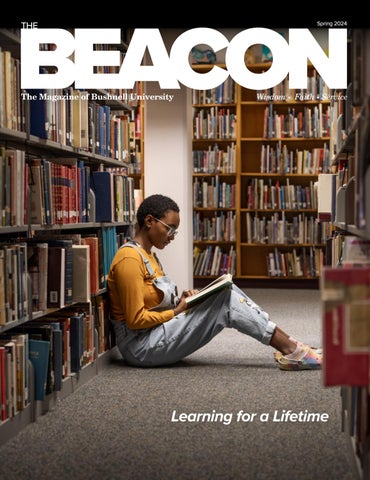
Spring 2024
Learning for a Lifetime
PRESIDENT’S LETTER
Dr. Joseph Womack, President
Dear friends, James A. Bushnell addressed the Board of Regents in 1898 with a bold vision: that the University would become an “institution of learning which shall not only be a blessing to our own time and generation, but the influence of which, like the river’s current, shall flow on in ever increasing volume, getting broader and deeper until time shall be lost in eternity.” As we reflect on this worthy goal 126 years later, this vision has come true – indeed, the ‘river’s flow’ is ever growing and expanding. Over the years, Bushnell University has saturated the whole of the learning experience with a mission of wisdom, faith, and service, believing that the integration of Christian faith can, and should, impact the whole of society. Our long history of educating students to answer the call to direct ministry continues to be foundational to who we are, as we also answer our call by preparing them with a breadth of academic subjects for robust lives of faithful service. This aim strives to provide students with the opportunity to gain knowledge and experience and is coupled with the hope that they will grow in the ability to think critically, evaluatively, and biblically. Bushnell’s mission is exercised, in a broad sense, within a model of the liberal arts and professional studies offering a broader spectrum of learning and practical application for a world that is ever changing. This educational goal is attained by requiring courses in the social sciences, the natural sciences, the humanities, and more. Doing so within a Christ-centered mission at its core also means introducing all our students to a foundation in Biblical studies, theology, church history, and Christian ministry. The result of this effort is that Bushnell prepares students for more than a job, or career, but for vocation – a life in pursuit of the wisdom of God and an active and genuine faith to hear and respond to His call to produce meaning, purpose, and justice in the world. As you will read in this issue of The Beacon, we are committed to our academic mission, helping students discover and answer God’s call in their lives. We believe that to do this well, students need to be exposed to many areas of inquiry and study so that they can uncover their strengths and interests, as they grow in their lives of faith. As you will see in the pages that follow, we are about the work of developing faithful and purpose driven graduates. Our students demonstrate for us that this effort is not only worthy, but it is working. Blessings,
Joseph D. Womack ’89, Ed.D. President
IN THIS ISSUE President Joseph Womack ’89, Ed.D. Vice Presidents Gene De Young, MBA Michael Fuller, M.A. Jocelyn Hubbs ’09, MBA ’14 Reed Mueller, Ph.D. Keith Potter ’84, D.Div.(hon) ’11 Editor Corynn Gilbert, Ph.D. Editorial Assistant Meredith Goehring, M.A. Contributors Stephen Andes, D.Phil. Nick Askew Corynn Gilbert, Ph.D. Meredith Goehring, M.A. Reed Mueller, Ph.D. Keith Potter ’84, D.Div.(hon) ’11 Whitney Shoun, M.S. Joseph Womack ’89, Ed.D.
8
Spring 2024
BUSTING THREE MYTHS OF A CHRISTIAN LIBERAL ARTS EDUCATION
14
UNDERGRADUATE RESEARCH
18
BUSHNELL'S THRIVING CULTURE FOR WOMEN IN STEM
An Anchor of Lifelong Learning
Female Faculty Members Lead The Way
26
MORE THAN A JOB BOARD
The Purposeful Graduate Model of Career Development
Photography Logan Adams, M.A. Tom Boyd, AHM Brands Lucas Pauly Art Direction, Design, and Production
The Beacon is published by Bushnell University as an information service and is posted on the Bushnell University website. For information, call 541-684-7318. Readers are encouraged to submit text for publication via email to alumni@bushnell.edu or via mail to: Office of Advancement Attn: Corynn Gilbert, Editor 828 E. 11th Avenue Eugene, OR 97401 Bushnell reserves the right to edit all copy. Articles should include names and class years (if applicable) for all individuals mentioned. Need to Update Your Information? Bushnell.edu/alumniupdate
2
President's Letter
4
The Home Stretch: Historic Campaign Needs You
32
From the Office of the President
36
Bushnell Student-Athletes Set High Academic Marks
38
Academic News
40
Admissions Insider
42
Advancement Insights
44
In Memoriam
46
From the Archives
From My Point of View – Inside Back Cover
4 The Beacon / Spring 2024
The Home Stretch
Historic Campaign Needs You
W
e’re in the home stretch. At the time of this writing, the Venture Forward campaign has reached $17,700,000 toward our goal of $18,000,000. With six months left in this three-year effort, we’ve had 204 families, businesses, and granting agencies come together with gifts and pledges toward accomplishing six campaign objectives. Womack Residence Hall is completed and full of students. The baseball stadium is fully operational. Goodrich Hall is in the midst of a massive renovation, including the addition of a bell tower with elevators, stairs, restrooms, and a cross. The Song Nai Rhee Honors program is almost fully funded. The School of Nursing is growing and expanding as you read this. And the plans for the new Duke Student Commons are well under way. God is using generous people to make dreams come true. As hopeful as these accomplishments are, there are over 9,000 living alumni who have not yet made gifts to this project. This magazine is mailed to 11,000 alumni and friends. Only a small percentage have yet to be involved. It’s not unusual for campaigns to be top heavy, with a fewer number of donors carrying a greater proportion. But this breakdown indicates an even greater than usual dependence on large gifts.
$1,000,000 to $5,000,000 = $400,000 to $999.999 = $100,000 to $399,999 = $40,000 to $99,999 = $20,000 to $39,999 = $5,000 to $9,999 = $1,000 to $4,999 = $50 to $999 =
4 7 9 11 12 29 42 70
Most thriving colleges and universities rely on donations from their alumni base for two primary reasons: scholarships/tuition subsidies and campus development.
All Bushnell graduates have benefited from the generosity of previous alumni and friends who have offset costs so that this transformative experience could be affordable and accessible, especially for students from low to middle income households. Even “earned” academic, athletic, and other co-curricular scholarships were funded by alumni and friends of the University.
So we encourage you to help us finish strong in this Venture. Here are some ways you can help: • Would you consider a one-time gift, or even a life gift, that expresses your gratitude and hope for Bushnell as a place where students find and answer God’s call on their lives? • Would you consider leading a mini-campaign among your classmates, teammates, choir mates or hall mates? • Would you consider making a matching gift or challenge gift to inspire other friends or alumni? • Would you consider hosting a Bushnell dinner, inviting friends to join you in this cause? • Would you consider becoming a Torchbearer, making a monthly gift that can add up to great things? • And would you please remember Bushnell in your will or living trust?
All to say, Venture Forward has been a catalyst for the engagement of both old and new donors, both for the current projects and for development yet to come. Momentum is a marvelous gift. We want to finish this campaign by August 2024, complete all six projects, and turn the corner into the next crucial steps in growing and improving the Bushnell experience. Please partner with us in the home stretch. God has been faithful. People have been generous. Beautiful things are happening. There’s much more to come.
Photo credit William Frohne Photography
Bushnell University 5
THE HOME STRETCH: EVERY GIFT COUNTS 1 gift at 300,000
=
$300,000
3 gifts at 100,000
=
$300,000
100 gifts at 3,000
=
$300,000
300 gifts at 1,000
=
$300,000
1000 gifts at 300
=
$300,000
3000 gifts at 100
=
$300,000
What can we count on you for?
WAYS TO GIVE TO VENTURE FORWARD Online by Using a Credit Card: Give.bushnell.edu/ventureforward
By Phone Using a Credit Card: Office of Advancement: 541-684-7318
By Check via Mail:
Bushnell University Attn: Venture Forward Campaign 828 E. 11th Avenue Eugene, OR 97401
Gifts of Stock or Securities:
Contact D.A. Davidson (Medford, Ore.): 541-608-4360
Donor Advised Fund (DAF):
Contact your DAF brokerage or administrator directly.
Qualified Charitable IRA Distribution (QCD):
Contact you IRA brokerage or administrator directly.
6 The Beacon / Spring 2024
Matching Gifts:
Contact your HR office to utilize your company’s matching gift program.
Wire Transfer:
Contact our office for wire instructions: 541-684-7318
Recurring Gifts:
Set up monthly automatic checks to the address on the left or monthly online gifts at: Give.bushnell.edu/ventureforward
Gift Pledges:
Did you know that if you are not ready to make your gift today, you can make a pledge commitment instead? Pledges can be paid in installments through any of the above means, and larger pledges can be fulfilled over several years. Contact the Office of Advancement to learn more: 541-684-7318
The renovation of Goodrich Hall and the construction of Goodrich Bell Tower is in the foreground of campus life this semester, and each day students, faculty, and staff watch its progress unfold. In January, the campus community gathered inside the unfinished ground floor to pray over the space and write on the studs before the drywall goes up. Once the construction is complete this summer, Goodrich Hall will resume its place at the heart of campus with the hopes, prayers, and the gratitude of our community inscribed inside each wall.
Bushnell University 7
Busting Three Myths of a Christian Liberal Arts Education WRITTEN BY STEPHEN ANDES, D.PHIL, PROFESSOR OF HISTORY
’m a true believer in the ideals of the liberal arts – even, I admit, a believer in their real-world value for today’s college student. But I have a confession to make: defending the liberal arts these days feels exceedingly idealistic, unrealistic, and downright impractical. It can feel quixotic, in other words, a term derived from Cervantes’s most famous knight, Don Quixote. Quixote the delusional, who believed windmills were giants, who thought the washbasin on his head was a handsome steel helmet, and who was convinced the nag he rode upon was a war stallion. Doubts assail me. The quest to preserve the liberal arts might be noble – even admirable – but it seems fated for failure. To defend the liberal arts in an era of rising student debt, climbing tuition costs, and plummeting job prospects can seem, as with Quixote, a mission that is out-of-touch, starry-eyed, and quaint. The liberal arts, in this economy?! What are you going to DO with THAT major? Many and manifold are the voices in culture (and in my head) that argue against the importance of a liberal arts education for today’s college student. Upholding the value of the liberal arts requires a defense, an apologia. And so, here presented, are three prominent myths about the liberal arts that need to be busted if the mission to preserve them is to succeed.
8 The Beacon / Spring 2024
Myth 1: The Liberal Arts Are Liberal Some definitions are in order. When we say the liberal arts, what do we mean? Words have meaning and the words conservative and liberal come loaded with partisan baggage in today’s political landscape. The liberal arts, however, have their origin in a time long before the words conservative and liberal were coopted by the Republican and Democratic parties. The liberal arts originated more than 1500 years ago. There were seven traditional subjects taught in universities in late antiquity and the medieval era. These were grammar, rhetoric, and logic (known collectively as the trivium), along with an additional four, the quadrivium, comprised of geometry, arithmetic, music, and astronomy. As they developed over time, the liberal arts evolved into the disciplines we’ve come to know as the humanities (literature, theology, philosophy, history, etc.), the physical and biological sciences, mathematics, and the social sciences. At Bushnell, these liberal arts disciplines exist within the College of Theology, Arts, and Sciences.
Myth 2: The Liberal Arts Are Not Christian So, if the liberal arts have nothing to do with current political ideologies, what makes them liberal? Perhaps, some may fear, although they didn’t begin as carriers of anti-religious thought, they’ve become so? Are the liberal arts a conduit for anti-Christian ideas? Again, let’s take a look at some definitions. The term “liberal arts” derives from the Latin artes liberales. The root word is liber, which means “free.” As scholar Michael Lind (2006) explains, “Artes means crafts or skills, and liberales comes from liber, or free man, an individual who is both politically free, a citizen with rights, and economically independent.” The liberal arts, therefore, is the education fitting to a free person, one who has the agency to contribute to building a free society. The liberal arts are not inherently anti-Christian. On the contrary, they have the power to help inform the Christian conscience and support a Christian worldview.
A perfect example of the importance of the liberal arts to Christian education is the career of the fourth century theologian Augustine of Hippo (354-430 AD), a key figure in both Christian history and Protestant theology. In his autobiography, Confessions, Augustine wrote about his career trajectory as a rhetorician. Though successful, lauded, and well on his way toward riches, he discovered it wasn’t enough. Augustine reflected that “publicly I was a teacher of the arts which they call liberal; privately I professed a false religion – in the former role arrogant, in the latter superstitious, in everything vain.”
Bushnell University 9
When Augustine became a Christian, he didn’t discard the things he learned in the “so-called liberal arts,” as he described them. Rather, he used the knowledge he had gained in service of God’s people. Augustine likened the truth he found in pagan philosophy (which he later used to refine his theological ideas) to the gold which the Egyptians gave to the Hebrews during the Exodus. All truth is God’s truth, Augustine explains. The Christian liberal arts enable students to mine truth wherever it can be found, because God is the source of it all.
Myth 3: The Liberal Arts Are Not Practical That’s all well and good, the doubts whisper, but does studying the liberal arts lead to a job after graduation? Are the liberal arts practical? Our current moment is an interesting inversion of history. Where once those with ambition studied the liberal arts to give them the skills to build society, today it is the technical, skill-specific STEM (short for science, technology, engineering, and mathematics) fields which are everywhere in demand. One reason for this is a cold cost-benefit analysis that guides the decision-making process of parents and their children in choosing a career path. Because the cost of a college education has skyrocketed, goes the logic, the benefits of that education – measured in salary – must pay off. The stakes involved in going to college are admittedly higher now than a generation ago. Over a thirty-year period, tuition
costs on average grew from $4,160 to $10,740 at public, four-year institutions; those numbers grew from $19,360 to $38,070 at private, four-year colleges. The belief is students who graduate with engineering and business degrees will make more – and therefore be happier – than their liberal arts and humanities counterparts. The salary calculus eclipses all other considerations of what makes a good life. And this is where my inner Quixote voice starts to swell, challenging the honey-tongued whispers of doubt. What if the cold, hard facts are wrong? What if graduates who leave college with skills gained in the liberal arts are actually as well prepared for the road ahead as say, business or engineering graduates? It is true that the road ahead is, indeed, difficult. There is an ever-changing job market. It requires versatile, flexible, and entrepreneurial skills that allow graduates to zig their way through the perils of automation in AI, even as they zag through the dangerous minefield of career change. Does a Christian liberal arts education prepare students for the zig-zag? Yes. The tradition of the liberal arts for over 1500 years has been to train leaders to have the very skills they need at present. The ability to research, write persuasively, organize information, manage teams of people, and think critically are hallmarks of education in the liberal arts and humanities. These are capacities which are considered invaluable to employers, as they seek employees who can take complicated ideas and make them accessible to others. Thus, the liberal arts is nothing if not practical. According to one study by the University of Queensland, Gen Z can expect to have 16-17 jobs across 5-7 careers. The successful zig-zag in a career beyond college means the ability to continually evolve with the changing marketplace. Liberal arts graduates learn just how to do that.
"The liberal arts are not inherently anti-Christian. On the contrary, they have the power to help inform the Christian conscience and support a Christian worldview."
The Metrics Are Wrong Beyond the myths of a liberal arts education – that it’s too liberal, not Christian, and not practical – there is a final monster to slay. And this, it turns out, is not a figment of the quixotic imagination. It’s the why of going to college. The metrics we assign to college-career success, I believe, are too narrow to encompass why we desire to go to college in the first place. A study produced by Gallup-Purdue in 2014 was one of the first of its kind in suggesting that getting “great jobs” and living “great lives” were at the root of why 10 The Beacon / Spring 2024
college remains attractive. Salary, for its part, was only one of the many factors cited. The study found that engaging work which promotes well-being (e.g., purpose, health, and social inclusion) gets at the meat and marrow of the why of going to college, rather than just the cold degree-equalssalary calculus. Put another way, the meaning and purpose of going to college is at risk of being sacrificed for just one small part of a much larger picture of a student’s life. At its core, the pursuit of Christian liberal arts truly helps students embark on their most important exploration famously defined by theologian Frederick Buechner: “Your calling is where your passions meet the world’s greatest needs.” This is what it means for us at Bushnell when we say it is our goal to help students “discover and answer God’s call on their lives.” We see this happening everywhere. Nationwide, programs in the liberal arts and humanities are shrinking. Their budgets are slashed. Majors are cut. Languages, literature, and humanities have been hit especially hard. It’s an irony not lost on me. I majored in Spanish language and literature and it was there where I first read about Don Quixote’s quest. Many students will no longer have that chance. At
Bushnell, we have the opportunity to support the liberal arts as foundational to our mission of wisdom, faith, and service. We care about what students do with their degree, but also what the Christian liberal arts here at Bushnell do for our students. So, in my noble quest, is it I who chase windmills and believe them to be giants? No, indeed. References: Lind, M. (2006), Why the liberal arts still matter. The Wilson Quarterly, pp. 52-56.
Illustration Attributions: Don Quixote raising his sword from Gustave Doré's illustrations to Miguel de Cervantes' Don Quixote (1863). Used under free public domain CC0 / Cropped from original, background removed; Fort tower illustration clipart vector. Used under free public domain CC0/ Background removed from original; Illustrations of Don Quixote from Don Quixote of The Mancha Retold by Judge Parry, Illustrated by Walter Crane (1919) under under PDM 1.0 / Background removed, cropped, and recolored; Roman consul from An illustration of the Egyptian, Grecian and Roman costumes by Thomas Baxter (1782-1821). Digitally enhanced by rawpixel, used under CC BY 2.0 / Cropped from original, background removed; Greek philosopher from An illustration of the Egyptian, Grecian and Roman costumes by Thomas Baxter (1782-1821).Digitally enhanced by rawpixel, used under CC BY 2.0 / Cropped from original, background removed; Windmill drawing, environment vintage illustration. Used under free public domain CC0 / Background removed from original.
Bushnell University 11
WRITTEN BY REED MUELLER, PH.D., VICE PRESIDENT FOR ACADEMIC AFFAIRS & DEAN OF THE FACULTY
Trained as a clinical psychologist, Dr. Mueller's research interests include psychotherapy outcome measurement, community-level prevention programs, and recently, metacognition and information literacy. On campus, Dr. Mueller teaches Neurodiverse Psychology, Theories of Personality, and Psychology of Religion.
ne of the classic elements of university life is a heavy reliance on the academic calendar. The subunits of the academic year (quarters or semesters) are themselves typically divided into many weeks of instruction. Then comes a week of final examinations where students provide evidence of what they have learned in their courses. Having demonstrated that learning has happened, students and faculty alike celebrate the culmination of academic efforts by posting grades and, ultimately, cheering on new graduates at commencement. Then, after a well-earned break, the cycle repeats until the next class of students reaches graduation day.
12 The Beacon / Spring 2024
Bushnell University 13
This cadenced calendar provides a framework that shapes learning objectives and outcomes just as it shapes the minds of learners. Less obvious, however, is that interspersed within this broad framework, at least at Bushnell, are orchestrated rhythms intended to move students – and faculty and staff for that matter – beyond the mere metabolization of discipline-specific information and into a life of wisdom, faith, and service. One such rhythm is Academic Creativity and Excellence Day (ACE Day), where faith is expressed as a discipleship of the mind (Sire, 1990) where students engage a world in need of God-honoring wisdom offered with clarity, conviction, and compassion. ACE Day was founded by professor emeritus Dr. Tim Bergquist to encourage students to share their intellectual passions with the Beacon community and beyond. It is an intentional rhythm practiced twice in each academic year during which students present their research to peers, staff, faculty, and the broader community. Many of the presentations are conducted via topic-specific poster displays. In this expression of scholarship, students prepare their posters and stand ready to engage questions asked of them by attendees at one of multiple poster sessions. Other students present their scholarly work in a formal presentation, wherein they investigate a question, present background information and a review of scholarly literature related to that question, and then explore the real-world implications of their research.
14 The Beacon / Spring 2024
Our most recent ACE Day illustrates the rich variety of intellectual work our students conduct. Students Brooklyn Brown, Bobby Byrd, Albert Jennings, and Ethan Stacy presented research out of their Critical University Studies course on the mental and emotional pressures that are increasingly prevalent in college student populations, along with beneficial coping strategies to enhance student learning. As part of their Theology and Practice of Business as Mission course, William Callahan, Davis Kyser, and Sayer Pescosolido presented their business plan to reimagine education. Their vision focused on career paths and self-directed learning opportunities intended to incorporate Christian values and formation. Following intellectual interests sparked by her History of Christianity course, Isabella Cameron explored the connections between historical and modern defenses of our faith. She argued that historical examples provide evidence that are effective in countering misunderstandings of Christian faith and practice. Senior capstone presentations included research into high-quality listening, fostering empathy across individuals, the therapeutic benefits of well-integrated faith, the practical influence of continuous glucose monitors in enhancing the lives of those with diabetes, and what it means to have an identity in Christ.
There is a common good being served as part of this scholarly endeavor. One key effect of well-conducted research is enhancement, even wellness, for both individuals and communities. Beyond this, however, there is another outcome that will ripple into the future from this research-focused rhythm: discipleship of the mind. Though James Sire (1990) popularized the phrase several decades ago, the consideration of the life of the mind is an historical imperative within the Christian faith. Paul, for example, exhorts the Roman believers to “renew their minds” (Romans 12:2) to know God’s will. Similarly, Saint Anselm of Canterbury articulated important arguments for the development of wisdom, informed by faith. For his part, Anselm noted the importance of a “faith seeking understanding.” To read this as the imposition of intellectual pursuits over and against faith (which is, of course, a concern in the secularization of higher education), represents a misunderstanding of the phrase. According to Williams (2001, 2023), Anselm’s intent here is to express one’s love of God and the things of God through the efforts commonly associated with the life of a scholar.
As embedded programmatically into our curriculum, undergraduate research experiences such as ACE Day are indeed aspects of the faithful life of a disciple. Being a student is a call to deepen one’s faith and its application in the world through the shaping of the mind. Engaging in faculty-directed, faculty-mentored, or self-selected research, students learn to dwell upon God-honoring curiosities (“I wonder if it's possible to rethink effective education and make a difference in the Kingdom?” or “How might faith benefit individuals suffering from high levels of stress?”). The fostering of such curiosities is part of the shaping of the mind that leads to disciples that ask essential questions for their own benefit and the benefit of their neighbors.
Bushnell University 15
As part of this discipleship of the mind, undergraduate chemistry) and others more (such as ethics and theology) researchers also learn to conduct their work with (Entwistle, 2023). Thus, both a humble stance regarding humility (“I could very well be wrong in what I think I the properties of one’s own mind and knowledge of know; there is and always will be more to discover about one’s need of God’s guidance as a scholar are essential God’s work in world”). Humility, in addition to inspired elements of intellectual formation for our students. curiosity, is God-honoring. As conveyed by Simmons (1998, p.33), Richard Hughes observes, “The sovereignty of God ACE Day is a powerful rhythm that fosters faith-informed means that I am not God, that my reason is inevitably wisdom, which in turn leads to lives of service through impaired, and that my knowledge is always fragmentary discipleship of the mind. In the lead up to this semiand incomplete. In the context of higher education, this annual research symposium, faculty work with their position means that every scholar must always confess students to shape them into burgeoning scholars who are that he or she could be wrong.” More colloquially, I have curious, humble, and rigorous. In other words, we strive to told my students: “Don’t believe everything you think; nurture a faith-informed wisdom that has “deep, accurate test it out!” As such, our students learn pathways of insight…expressed in benevolent responsiveness” to the inquiry that are consistent with the methods of academic needs it observes (Walsh, 2015, p. 5). This is the promise discipline being applied. This is a partial corrective to of Christian higher education at Bushnell: wisdom (James the consequences of the fall; yet, we must continue to 3:17) that is impartial, sincere, and peace-bringing, be careful, recognizing that these consequences of the offering good fruit to a world in need through the students fall affect some things less (such as mathematics or being shaped on our campus.
References Entwistle, D. N. (2021). Integrative approaches to psychology and Christianity: An introduction to worldview issues, philosophical foundations, and models of integration. Wipf and Stock Publishers. Simmons, E. L. (1998). Lutheran higher education: An introduction for faculty. Augsburg Fortress Publishing. Sire, J. W. (1990). Discipleship of the mind: Learning to think God’s thoughts after Him. InterVarsity Press. Walsh, R. (2015). What is wisdom? Cross-cultural and cross-disciplinary syntheses. Review of General Psychology, 19(3), 278-293. https://doi.org/10.1037/gpr0000045 Williams, T. (2001). Proslogion: with the Replies of Gaunilo and Anselm. Hackett Publishing. Williams, T. (2023). Anselm of Canterbury. In E. N. Zalta & U. Nodelman (Eds.) The Stanford encyclopedia of philosophy. https://plato.stanford.edu/archives/fall2023/entries/anselm/.
16 The Beacon / Spring 2024
f you were browsing the shelves of a home and garden store, would your interest be piqued by a heated snow shovel? Or maybe an automatic weed puller? These were some of the ideas that Christy Silverthorne’s Marketing 230 class (Introduction to Marketing) presented to a local business for ACE Day this year. Students spent the term creating a product idea and marketing campaign for a real-world client, designed to best position the client for success. This year the client was Haus and Garten – a Eugenebased manufacturer of garden and outdoor products. The owners, Maddy and Kevin Pellegrino, met with students earlier in the semester and then returned for ACE Day to hear five-minute pitches from the various groups. The students let their creative juices flow, and the Pellegrinos were impressed.
There were three winners:
Haus & Garten owners Kevin and Maddy Pellegrino with student Austin Wolfe.
Best Campaign: Candy He – Easy and Foldable Garden Stool Visitor’s Choice Award: Luke Smith and Amanda Sisul – Protective Sleeve for Pruning Shears Client’s Choice Award: Alec Gums – “GardenEase,” an all-in-one, space-efficient gardening kit specifically crafted for urban environments.
Assistant Professor of Marketing, Christy Silverthorne, M.A.
Haus & Garten™ is a leading manufacturer of premium home, garden & outdoor products. Originally founded by Greg Shultz, the company has come a long way from a small family-owned business based in Nevada, USA. From the beginning, providing quality products with old-fashioned customer service and support has been their main focus and what lies at the heart of the company's ethos. Their collective knowledge, experience, and attention to the customer's needs are what drive them to innovate. With this in mind, they work vigorously on these values that are at the core of their brand and key to their family business success. hausandgarten.com
WRITTEN BY MEREDITH GOEHRING, M.A., EDITORIAL ASSISTANT
18 The Beacon / Spring 2024
I
t’s a common story in higher education that women are underrepresented in the fields of science, technology, engineering, and math (commonly referred to as STEM).
The story is true. In 2023, women made up 28% of the STEM workforce worldwide, and just 24% of the STEM workforce in the United States. That’s up significantly from 8% in 1970, yet the gap remains.
Common explanations for this include a lack of female role models in STEM fields, particularly female STEM faculty at a university level, lack of knowledge for female students about what their career options are, and a lack of encouragement or confidence to pursue a STEM field. This is the story, and, in most places, an accurate one. Women at Bushnell just have a different story. “I’ve always liked science best,” says junior biology major Annika Poet. “I like having an answer, I like having things that make sense and have specific things to learn. I would probably be in the sciences no matter what.” Poet enjoyed science in high school, and she felt affirmed by her teachers and family to pursue science at the college level. She wants to be a veterinarian, and her gender never factored in this decision. “I don’t think that female students today see a barrier between themselves and a STEM field or career, regardless of gender,” says Tammy Bovee, M.S., assistant professor of exercise science. Bovee herself never felt any discouragement or discrimination as a woman in STEM. This input is evidence of a changing mindset among recent generations. As students like Poet progress, they will migrate into STEM fields and continue to close the gap. Bushnell is proud to draw so many women interested in pursuing careers in the sciences, as well as the professors who show them the way. Bushnell is also committed to practicing the kinds of methods that have been shown to rewrite the prevailing narrative. Bushnell University 19
Studies have shown that for female STEM students, having a female role model has a positive and significant effect on a female student’s enjoyment of the subject, her expectation of success in the subject, and her further aspirations in STEM. In 2023, only 28% of STEM professors and associate professors in the United States are women (despite women receiving 40% of STEM Ph.D.’s in the last decade). At Bushnell, however, over 50% of STEM faculty are female. This means that female STEM students get to see other women teaching and practicing successful STEM careers, from math to psychology. Exercise science graduate Emily Moon ’19 cites chemistry professor Heike McNeil, Ph.D. as a significant role model during her time at Bushnell. “Heike was a huge encourager to me to learn and pursue so much more,” Moon recalls. “She had gotten her doctorate and had such high expectations of us. I was going to put in all the effort I could so I could be like her.” This confidence bolstered Moon as she pursued (and recently graduated from) a Doctor of Physical Therapy program at University of Southern California (USC), one of the top DPT schools in the country.
One common culprit hindering the pipeline of female students pursuing STEM careers is a lack of awareness about the available options. Popular career paths such as engineering, accounting, or medicine may seem most obvious, but what about food science, 3D printing engineering, or zoology? If no one ever tells students about these unique options, they may never have the opportunity to explore all that STEM has to offer.
[Total Workforce Worldwide]
Bushnell’s female students and alumni eagerly cite the mentorship they received as one of the most transformative features of their education.
Professor Dr. Heike McNeil with student Annika Poet
28%
40%
28%
In 2023, women made up 28% of the STEM workforce worldwide, That’s up significwantly from 8% in 1970, but the gap remains.
8% 1970
2023
20 The Beacon / Spring 2024
Women in the US with STEM Ph.D.'s
Women STEM Professors & Associate Professors
Professor Dr. Connie Wilmarth
Alumna Brooke Davis ’12 (math/accounting) points to mathematics professor Connie Wilmarth, Ph.D., as a guiding light for her STEM journey at Bushnell. “I started out unsure of what I wanted to do, yet I knew I was a numbers person,” Davis reflects. “But Dr. Wilmarth was wonderful. She helped me understand what options were out there in math and helped me see how big the world was.” Davis has gone on to build a successful career in public accounting with a focus on agriculture. She says that the mentorship she received from professors such as Wilmarth significantly influenced her career trajectory. For her part, Wilmarth loves this aspect of what it means to be a professor. “Bushnell encourages meaningful mentorship and interpersonal interactions between students and faculty,” she explains. “That plays out especially well for students who are not sure of their direction when they arrive. No one is ever feeling lost or overlooked here.”
The final ingredient in student success – no matter their identity or major – is having the confidence to pursue their goals. “I’ve had a great experience so far at Bushnell,” Poet shares. “I can tell my professors are very invested in their different areas. That helps me feel encouraged that if they can understand and get excited about this then I can understand it too.”
“Heike was a huge encourager to me to learn and pursue so much more. She had gotten her doctorate and had such high expectations of us. I was going to put in all the effort I could so I could be like her.”
– Emily Moon '19, DPT (above) Bushnell University 21
“For my female students, I want them to have the confidence to compete with any other student that’s out there.” – Tammy Bovee, M.S. (left) However, what makes Bushnell remarkable is that our success in shepherding female students is a natural by-product of our unique educational model. We provide our students with a holistic education that inspires their whole being.
Assistant Professor Tammy Bovee, M.S.
Bushnell faculty are not focused on “getting women into STEM.” Rather, they are intent on awakening every student to God’s call for their lives. Paradoxically, the marvelous result is that many female students at Bushnell do choose to pursue and stick with science, technology, engineering, or math. They are empowered by our faculty and affirmed in their faith.
Moon felt similarly, and has seen the fruit of this encouragement. “I loved my experience with Dr. McNeil. She never settled for less than my best, and she was always pushing us all to excel. This really helped me when I got into graduate school.”
“Part of my role is to make sure that anyone who passes through my classroom knows that they can do it,” Wilmarth explains. “I’m so invested in Christian higher education as a holistic and appropriate way to view one’s education; faith is inseparable from learning.”
Providing students with this kind of encouragement is a major focus among Bushnell faculty. “For my female students, I want them to have the confidence to compete with any other student that’s out there,” says Bovee. “I think that sometimes men are encouraged more than women, so I want my female students to know that they are just as capable to move beyond their bachelor’s degree into graduate programs and eventually the workforce.”
We continue to create a thriving culture for female students. One in which they are free to grow unfettered as fiercely intelligent, capable, and resilient children of God, willing and able to follow God’s call towards whatever field quickens their heart.
McNeil, who primarily teaches chemistry, requires that her students do presentations in many of her courses. She admits that it mortifies them at first but helps to build their confidence. “I’m developing their confidence in what they’re doing and their ability to be the expert,” says McNeil. “They think I’m asking them questions just to ask, but I make it clear that I’m curious and I don’t always know the answers. Once they understand that, the more their confidence grows. I remind them that they know the material, and this is typically the best defense against intimidation.”
None of these strategies are unique, nor even particularly revolutionary. The literature surrounding the topic of women in STEM has routinely declared that to get more women into STEM fields you must provide them with role models and show them what career options are available to them.
“Bushnell is amazing to me because it’s not just about STEM or any other subject,” Wilmarth celebrates. “It’s a much grander and more beautiful approach to all of life. The students who graduate in STEM are not just STEM people, but they are informed and wise and wish to serve and heal through Jesus Christ.”
Called to Neuroscience Kaleb Miles ’20, B.S. in Biology At Bushnell During his four years on campus, Kaleb Miles ’20 may have been known around campus for his accolades on the soccer field, but it was the nagging questions of nature that motivated his future pursuits. After graduating with a degree in Biology in the midst of the Covid-19 pandemic, continuing his studies seemed like the most practical option while the world was shut down. He subsequently enrolled in master’s degree in biomedical sciences Kaleb Miles ’20 presents his research at the Mayo Clinic. and technology at the University of Colorado Miles cites his time at Bushnell as a key factor Anschutz Medical Campus where he studied in fostering his love for lifelong learning and neurodevelopment, specifically the developing his desire to pursue research. “Dr. Paul Allee spinal cord and myeloplasticity. While there, and Dr. Heike McNeil showed great interest he co-authored publications on the early in me as a student and were committed to my wiring of the spinal cord in embryonic human academic pursuits.” As he began to explore development and the relationship to Fragile X his calling while an undergraduate, it became Syndrome (an autism spectrum disorder). clear that his own life story was motivating his career interests. When Kaleb was 15, his twin After his degree, he worked for a year as a sister suffered a devastating spinal cord injury research assistant while applying to doctoral from gymnastics, leaving her a quadriplegic. programs. He is now pursuing a Ph.D. in the His curiosity about the spinal cord and its role regenerative sciences track at the Mayo Clinic in the central nervous system led to a desire Graduate School of Biomedical Sciences (MN). to understand why certain cells in the body He is currently working in a spinal cord injury have the propensity to regenerate while those research lab, which represents a full-circle in the spinal cord do not. “Bushnell gave me return to his calling. the chance to pursue my passion and develop the right tools to investigate my questions. My vocation and calling came together there... it became clear that this is where God was pushing me.”
Bushnell University 23
WISDOM FAI •
24 The Beacon / Spring 2024
TH SERVICE •
Bushnell University 25
BOARD a JOB THAN MORE The Purposeful Graduate Model of Career Development
26 The Beacon / Spring 2024
WRITTEN BY WHITNEY SHOUN, M.S., CAREER DEVELOPMENT COORDINATOR
I
n 2023, potential college students and their parents alike are asking institutions, and themselves, a very important question: “Is higher education worth it?” Students and their parents want to know that they will see a return on their investment, measured by one crucial metric: a better life for the graduate. But what is a “better life? How exactly does one attain that “better life?” And how do we quantify and qualify what a “better life” is from person to person? Here at Bushnell University, we believe that the definition of a “better life” is as unique as each student who sets foot on our campus. During their time at Bushnell, our goal is to coach students in cultivating a deeper understanding of what they value, who they were designed to be, and where they find meaning in the world of work. To achieve this, we have developed an approach to career development for our students that we call the Purposeful Graduate Model. It consists of five stages: Purpose, Participate, Prepare, Plan, and Pursue. Each stage incorporates specific activities and events designed to cultivate a better understanding of vocation and calling for our students. From a structured class to athletic participation to a formal internship, these diverse opportunities allow students to explore and identify who God uniquely designed them to be.
Purpose The foundation to becoming a purposeful graduate is understanding individual purpose or passion as it relates to life and career. The Purpose stage is the foundation of character and calling. It is continuous and ongoing, as students ask “the big questions” about who they are, who they want to become, and the contributions they want to make in the world. One of the key elements of the Purpose stage is participation in First Year Seminar (FYS) classes, where students have an opportunity to complete the Clifton StrengthsFinder assessment. This assessment provides students with their top five “Strengths” to consider as they transition out of high school and begin their collegiate experience.
Bushnell University 27
Participate Often associated with the first year of college, the theme of the Participate stage is engage and explore. Bushnell highly encourages students to try new things, step out of their comfort zone, and get involved in athletics, campus activities, and leadership opportunities. By participating in these ways, students can “test drive” or “try on” skills and abilities that help them connect with their calling and enhance their career development. One crucial aspect of Participate is self-exploration, or learning how one is uniquely wired and designed. In addition to the StrengthsFinder, the Career Development Office at Bushnell offers a variety of assessments to facilitate the self-exploration process. By taking an assessment and discussing the results with a career development professional, students can identify majors and career options that best align with their unique combination of strengths, preferences, skills, interests, and values. Such alignment is linked to increased job satisfaction, motivation, and productivity. Even if students already have a sense of what God is calling them to do, a career conversation with the career development staff can help them develop a strong plan for fulfilling it.
“The career development staff are very good at helping us apply our skills and find purpose in the things we are good at. None of my top strengths surprised me, but it wasn't until I took the Resident Assistant position that I saw all of them come together at once. My role in student life has been monumental in giving me a clear vision for how my strengths all work together.” – Hannah Beers, Junior
Competencies for a Career-Ready Workforce Career & Self Development
Critical Thinking
Proactively develop oneself and one’s career through continual personal and professional learning, awareness of one’s strengths and weaknesses, navigation of career opportunities, and networking to build relationships within and without one’s organization.
Identify and respond to needs based upon an understanding of situational context and logical analysis of relevant information.
Communication Clearly and effectively exchange information, ideas, facts, and perspectives with persons inside and outside of an organization.
28 The Beacon / Spring 2024
Equity & Inclusion Demonstrate the awareness, attitude, knowledge, and skills required to equitably engage and include people from different local and global cultures. Engage in anti-racist practices that actively challenge the systems, structures, and policies of racism.
Prepare The major components of the Prepare stage are research and reflection. In this stage, we advise students to gather information about potential career pathways by accessing online resources and interacting with professionals in the industries that interest them. Reflecting on the information they gather leads them to make an informed decision about their major and career goals. Reflection questions associated with the Prepare stage include: What can I do with this major? What are my career options? What do I need to be successful in this career? How do I know if it will be a good fit? The world of work is full of possibilities. By researching various majors and occupations, students can select one that best fits them. Occupational information helps them know what to expect in relation to educational requirements, job stability, day-to-day functions, and salary and wages. Students may also find it beneficial to have a career conversation at this stage, as well. Career coaching sessions are available to all current students at Bushnell, regardless of major or location (online or residential).
“All five steps of the model are important, but the “prepare” stage is where the action happens. Studying psychology here opened the door to so many opportunities that I didn’t even realize when I signed up to be a psychology student, so I leaned into the paths that interested me. Overall, preparing has been the most beneficial part of the model for me because it let me explore the options that I once thought were not available and discovering that they were!” – Matthew Wilhite, Senior
naceweb.org/career-readiness-competencies
Leadership
Teamwork
Recognize and capitalize on personal and team strengths to achieve organizational goals.
Build and maintain collaborative relationships to work effectively toward common goals, while appreciating diverse viewpoints and shared responsibilities.
Professionalism Knowing work environments differ greatly, understand and demonstrate effective work habits, and act in the interest of the larger community and workplace.
Technology Understand and leverage technologies ethically to enhance efficiencies, complete tasks, and accomplish goals.
What Is Career Readiness?
Career readiness is a foundation from which to demonstrate requisite core competencies that broadly prepare the college educated for success in the workplace and lifelong career management. Bushnell University 29
Plan In the Plan stage, students decide and develop. Typically, students in this stage decide what direction they want to go with their major and begin to explore internship possibilities. In addition, they may determine whether to pursue graduate school or full-time employment post-graduation. Throughout this stage, students develop a resume and cover letter and begin to build interviewing and networking skills in order to secure an internship. Internships are a hallmark of Bushnell’s curriculum. Every bachelor’s degree in the traditional undergraduate program includes a field experience component or an internship. Internships are designed to prepare students for a career in their chosen field by integrating academic coursework with practical application. It is also an opportunity for students to acquire knowledge, refine skills and abilities, obtain valuable work experience, and expand their professional network. The University partners with companies and organizations in the local community to provide quality internship experiences that equip our students to be competitive in their chosen field.
Pursue In the Pursue stage, students execute and evaluate the plans they have developed through the previous stage. Often this stage includes completing an internship experience, applying to graduate schools, and/or launching a job search. Bushnell students have access to Handshake, an online job search platform that connects them with hundreds of internships and job opportunities – locally, nationally, and internationally. For some, graduate school is a natural next step to achieving career aspirations. The career development office offers resources and assistance in identifying programs of study, preparing for tests, writing essays, and practicing for interviews. If an advanced degree is part of a student’s career development, we want to help him or her get there successfully Success in securing employment involves customized and targeted materials that showcase a person’s accomplishments. One size does not fit all when it comes to resumes and cover letters. Career specialists provide students with job search tips and strategies for how to present their qualifications effectively and confidently – online, on paper, and in person. Students may also choose to connect with potential employers through signature events like networking nights, career fairs, and Mock Interview Day.
“You can't overestimate the importance of mock interviews. I have heard from employers around the area that the students who have regularly participated in the interviews have been outstanding when the real interview happens. These experiences give you the chance to understand the rhythm and flow of questions and how to best represent yourself.” – Christy Silverthorne, M.A., Assistant Professor of Marketing
At Bushnell, the answer to the question that students and their parents are asking is a resounding YES. Higher education is worth it. A thoughtful educational experience prepares students for the world of professional employment, intentionally moving them through each stage of a healthy career development journey towards becoming a Purposeful Graduate.
85% of Bushnell graduates work in their field of study or attend graduate school within six months of receiving their diploma.
30 The Beacon / Spring 2024
85% of students work in their field of study or attend graduate school within six months of receiving their diploma.
the Purposeful Graduate Model PURSUE PLAN DECIDE & DEVELOP
PREPARE PARTICIPATE PURPOSE CHARACTER & CALLING • Enroll in calling and vocation courses • Attend a discernment retreat • Seek out a faculty or staff mentor
ENGAGE & EXPLORE • Engage in courses • Get involved in campus activities • Attend career development programs • Discover your own skills, interests, and gifts (assessments)
RESEARCH & REFLECT
• Research career paths and graduate schools
• Choose your major and faculty advisor
• Explore internship opportunities
• Job-shadow or volunteer off-campus
• Write your resume and a sample cover letter
• Talk to professionals in the workplace about their jobs • Learn what types of careers are related to your major
EXECUTE & EVALUATE • Practice your interviewing skills • Attend networking events • Complete your internship • Launch your job search or apply to graduate school
• Conduct informational interviews in your field
• Explore your own story
Who am I? What do I like/dislike? What are my values?
What can I do with this major? What are my options?
What do I want to do? What experience is needed?
How do I get there? Is my plan effective?
Bushnell University 31
Bushnell University Board of Trustees & the President Present:
Becoming Beloved Community
“...the end is reconciliation; the end is redemption; the end is the creation of the Beloved Community.” – Dr. Martin Luther King, Jr.
I
n early November, the University hosted “Becoming Beloved Community,” an initiative sponsored by the Bushnell Board of Trustees and the Office of the President to begin campus and community conversations about a Biblical perspective on racial reconciliation. Over a series of two days, a thoughtful and awardwinning panel of guest speakers guided members of the local and University community through experiences that informed our worldview, advised our advocacy, and inspired our passion for unity. The thoughtful and accomplished panel of featured guests included Rasool Berry, Lisa Fields, Dr. Mac Pier, and Bishop Claude Alexander. Berry and Fields are the creators of the documentary “Juneteenth: Faith & Freedom”. Alexander and Pier are the co-authors of Required: God’s Call to Justice, Mercy, and Humility to Overcome Racial Division (2021). Special events included a special screening of the documentary followed by a panel discussion on Juneteenth and the film’s creative journey as well as a joint choir performance by the Bushnell Chorale and the UO Gospel Choir. Additionally, several large-format panel discussions, led by the symposium guests, were held with local church and ministry leaders, business leaders, and members of the Bushnell community. Kim Williams, Chair of the Bushnell Board of Trustees and co-managing member of McKay Investment Company, LLC and Oak Leaf Property Management, said “We are hopeful this series of events will result in a lasting impact that helps our community to overcome racial division.” “We are learning to love our community the way God loves us,” said DeLeesa Meashintubby, Executive Director of Volunteers in Medicine and pastor of St. Mark’s CME Church in Eugene, Ore. Pastor Meashintubby serves on the Bushnell University Board of Trustees and was part of the genesis and planning of “Becoming Beloved Community.” Added Bushnell University President, Dr. Joseph Womack, “We feel blessed to be joined by such friends and consider together how we as a community might benefit from genuine reconciliation in unity.
32 The Beacon / Spring 2024
FROM THE OFFICE OF THE PRESIDENT
Community film screening of “Juneteenth: Faith & Freedom” with campus guests as moderators.
Joint performance of traditional spirituals with Bushnell Chorale and the University of Oregon Gospel Choir.
Event leadership team with campus guests during a community ministry lunch in the Morse Center. Bushnell University 33
Bishop Claude Alexander
is a dedicated servant of God, answering the call to ministry at age 17 in 1981. After leading Morning Star Baptist Church in West Mifflin, Pa., he became Senior Pastor of The Park Church in Charlotte, NC, transforming it into a global ministry. He’s an influential figure in Christian and civic spheres, addressing critical issues and co-authoring impactful books like Required: God’s Call to Justice, Mercy, and Humility to Overcome Racial Division. With degrees from Morehouse College, Pittsburgh Theological Seminary, and Gordon-Conwell Theological Seminary, he combines scholarship with leadership. He serves on numerous boards (including the Council of Christian Colleges and Universities) and provides leadership for various organizations, impacting both the church and society.
Rasool Berry
serves as teaching pastor at The Bridge Church in Brooklyn, New York. He also is the Director of Partnerships & Content Development with Our Daily Bread Ministries. Rasool graduated from the University of Pennsylvania with a bachelor’s degree in Africana Studies and Sociology. Rasool is a sought-after writer on the intersection of faith and culture. He’s the host of the “Where Ya From?” podcast (sponsored by Christianity Today) and the writer, producer, and host of the “Juneteenth: Faith & Freedom” feature-length documentary.
Lisa Fields,
one of the world’s most sought-after Christian apologists, combines her passion for biblical literacy with her heart for sharing God’s love to all those she meets. Lisa has received several honors, including recognition in Christianity Today for her work as an apologist in the African American community. She is the founder and President of the Jude 3 Project. Lisa is also a graduate of the University of North Florida with a Bachelor of Science in Communications and Religious Studies, and Liberty University with a Master of Divinity with a focus in Theology. She collaborated with Rasool Berry in the creation of the “Juneteenth: Faith & Freedom” documentary.
Dr. Mac Pier,
a South Dakota native who relocated to New York in 1984, is a prominent Christian leader with a rich history of ministry and authorship. He served 13 years with InterVarsity Christian Fellowship. In 1988, he co-founded Concerts of Prayer, engaging 250,000 people from 2,000 churches in the Metro NYC prayer movement. With Dr. Tim Keller, he co-founded the Church Multiplication Alliance in 2003. In 2008, he founded The New York City Leadership Center (now Movement.org), launching Movement Day in 2010, connecting leaders from 400 cities and 95 countries. Dr. Pier has authored ten books, including his latest book Required: God’s Call to Justice, Mercy, and Humility to Overcome Racial Division, co-authored with Bishop Claude Alexander.
FROM THE OFFICE OF THE PRESIDENT
Juneteenth: Faith & Freedom | Featuring Rasool Berry & Lisa Fields Film Summary: A Black American, troubled by the legacy of American slavery and the misuse of Christianity to justify it, travels throughout Texas to discover how Juneteenth reveals faith and a fight for freedom in an unjust society. This unscripted documentary invites viewers into the story of Juneteenth, the holiday recognizing the end of legalized slavery in Texas, through the eyes of a Black man learning about the holiday from the direct descendants of those liberated. The journey starts in Galveston, where the liberation was first announced, to the site of Freedman’s Town in Houston, and then to Dallas, all along including the voices of historians, artists, community organizers, and leaders of the Black Church. Learn how Scripture inspired the faith of the enslaved people and how newly liberated men and women credited God for their freedom. The story serves as a parable that offers hope and the insight that faith in Christ can be the greatest weapon against injustice. (summary adapted from www.imbd.com and Our Daily Bread Ministries).
To watch the documentary visit: https://www.pbs.org/show/juneteenth-faith-freedom Presented by the Our Daily Bread Voices Collection and Our Daily Bread Media
BOARD OF TRUSTEES RESTORES THE WALTER YORK SCHOLARSHIP In the early 1950s, Bushnell University welcomed its first African American student. James Covington studied and lived on campus until 1953, during the earliest stirrings of the civil rights movement in the United States. Our first African American graduate, Walter York ’56 from Hemet, Calif., completed his degree just one year later in 1956. York went on to attend Phillips Graduate Seminary in Oklahoma and became a Navy chaplain, but died tragically early while serving his country in Okinawa, Japan. Upon his death in 1964, the “Walter York Memorial Scholarship Fund” was established to help Effie and Joseph Blair from Bloomington, Ill. attend Bushnell university. In an appeal to donors, then-President Dr. Ross Griffith said, “All of the current interest in civil rights may be a beating of the air unless we provide adequately educated Christian leaders to share the gospel with those who have been so shamefully neglected by our Christian churches.”
Walter York ’56
It is not certain that this scholarship existed beyond its benefit to the Blairs. Though the University does maintain some endowed scholarships intended to encourage the educational experience of students of color on campus, it is our commitment today to revive the Walter York Memorial Scholarship in perpetuity to honor the memory of, and celebrate, our first African American graduate. Members of the Board of Trustees have committed to fuel the effort to reach the fund’s minimum corpus of $25,000. To date, the Board has committed $12,000.
Help us reach our goal for this endowed scholarship by making a gift to the Walter York Scholarship Fund at give.bushnell.edu/york. Bushnell University 35
Bushnell Student-Athletes Set High Academic Marks
T
he Tri-Athlete Model at Bushnell University reflects our desire to see student-athletes transformed in all facets of life: on the field of play as Champions of Character and in the classroom as Christ-centered scholars. Above all, we desire to give student-athletes the opportunity to pursue a maturing identity in Christ. Our studentathletes honor the gospel of Christ by chasing excellence in class and competition.
Aspen Slifka ’23
As one of the pillars of the Tri-Athlete Model, a strong focus on academic strength has always been a calling card of Bushnell Athletics. Over the years, Beacons have proven to be academic leaders on campus, in the Cascade Conference, and nationally.
Academic Leaders at Bushnell University Each year at commencement, a number of awards are bestowed upon graduates. The President’s Scholastic Award is given to the graduating senior who attained the highest cumulative GPA, with the most credits completed at Bushnell. This year there was a tie between two recipients, Aspen Slifka ’23 and Rebecca Kuskie ’23, both of whom were studentathletes. They became the seventh and eighth former athletes to receive the honor, seven of whom were from the last eight years.
Rebecca Kuskie ’23
The highest award bestowed by the University is the Kendall E. Burke Award. Determined by a vote of the student body and faculty, it is given on the basis of academic achievement, inspiration to students and faculty, high ideals of Christian character, and contribution to the mission of the University. Men's soccer player Preston Ferry ’23 became the 12th student-athlete to earn the prestigious honor in the 83-year history of the award. He is the third Bushnell men's soccer player to be selected in the last five years.
Academic Leaders in the Cascade Conference
Preston Ferry ’23 with President Womack
A major metric for academic health in the Cascade Collegiate Conference (CCC) has been the Presidents’ Cup for Academic Excellence. The President’s Cup is awarded each year to all schools in the CCC which achieve an overall combined GPA of 3.0 or better among their student athletes and have 60% of eligible student-athletes (at least sophomore standing with a 3.2 GPA) receive Academic All-Conference honors.
Academic Leaders Nationally
“Earning Presidents’ Academic Excellence designation represents the highest academic honor our departments can earn from the CCC,” stated CCC Commissioner Robert Cashell. “It is a great accomplishment and recognizes the outstanding efforts in the classroom.”
Each year the NAIA presents Scholar Team awards to all teams earning at least a 3.0 collective GPA for that year. In 2022-2023, Bushnell had 15 of our 16 NAIA teams earn the honor. Both beach volleyball (3.63) and indoor volleyball (3.72) posted top-ten GPAs in the nation for their sport, with beach coming in fourth.
Bushnell is proudly the only school in the Cascade Conference that has garnered the Presidents’ Cup in every year that it has been presented in its current format, a streak that has reached eight years and counting. This year, the Beacons ranked fourth among full-member schools (with a 3.34 GPA) and ranked third with 68% of eligible studentathletes earning Academic All-Conference honors.
Bushnell Athletics continues to earn an impressive number of awards nationally from the National Association of Intercollegiate Athletics (NAIA) and the Collegiate Sports Communicators (CSC).
Collegiate Sports Communicators (formerly CoSIDA) runs the nation’s preeminent Academic All-America program across all levels of collegiate athletics. Bushnell made a huge statement during the 2022-2023 campaign with a school-record of 36 players being selected for membership on the CSC Academic All-District teams.
Bushnell University 37
ACADEMIC NEWS
Faculty Scholarship and Service Research Publications and Presentations Jonathan Alfson, Ph.D. Dissertation (July, 2023). Supporting Learning and Thinking with Multiple Representations in Upper Division Physics Courses. Oregon State University. Angela Doty, M.A. Scholarly Review (2023). Cultivating mentors: Sharing wisdom in Christian higher education. Christian Higher Education. Agametochukwu Iheanyi-Igwe, Ph.D. Presented preliminary results from ongoing missionary re-entry and entrepreneurship study with coresearcher Timothy Veach, Ph.D.; Christian Scholars Conference (2023). Erin Mueller, Ph.D. Submitted empirical study (2023) for presentation at the Association for Psychological Science: Savoring and wellbeing in emerging adults: Enhancing emotion regulation on a college campus. Scholarly review (2023). Hope, C. (2023). Regulation from the inside out: Linking your body, brain, and behavior. Balboa Press. Latrissa Neiworth, Ed.D. Invited speaker (2023). Higher Education Adjuncts – Options and Opportunities. Doctoral Workshop, Graduate School of Education and Psychology, Pepperdine University (Calif.). M.Tip Phaovibul, Ph.D. Invited speaker (2023). Utah Math Circle. Nani Skaggs, Ph.D. NetVue Faculty Fellow and Presenter, Council of Independent Colleges (2023-2024). Doyle Srader, Ph.D. Invited speaker (2023). Building Kingdom Connections and Collaborative Research Networks for Public Ministry at the Christianity and Communications Studies Network conference (2023). A.J. Swoboda, Ph.D. Journal article (2023). Bringing out old treasures: The function of Christian history for a pedagogy of spiritual formation in the Journal of Spiritual Formation and Soul Care.
38 The Beacon / Spring 2024
A.J. Swoboda, Ph.D. (cont.) Authored academic chapter (2023) in a forthcoming academic volume titled Greening Hollenweger: Retrieving ecological dimensions from the dean of pentecostal studies. Plenary speaker (2023). The Society for Professional Christian Educators (Chicago, Ill.)
Service Jonathan Alfson, Ph.D. Accepted as NextGeneration Fellow for The Physicists Coalition for Nuclear Threat Reduction. Agametochukwu Iheanyi-Igwe, Ph.D. Professional Advisory Board member for the Clinical Pastoral Education (CPE) program at PeaceHealth Riverbend Sacred Heart Medical Center (Springfield, Ore.) M.Tip Phaovibul, Ph.D. Associate Editor, USA Math Olympiad. Suzanne Price, M.Ed. Legislative Committee Member (2023, ongoing). Oregon Department of Education Steering Committee member with committee work focused on the Education Workforce SB 283.1.(3)(d): Education Workforce Data System A.J. Swoboda, Ph.D. Theologian-in-Residence. Rose Church (Portland, Ore.).
Book Manuscripts Stephen Andes, D.Phil. Book manuscript (2023). Chasing Speedy: The Secret History of America's Fastest Cartoon Mouse. A.J. Swoboda, Ph.D. Book manuscript (2023). The Gift of Thorns: Jesus, theFlesh, and the War for our Wants. Zondervan.
BUSHNELL UNIVERSITY LAUNCHES DIGITAL MARKETING & MEDIA DEGREES
B
ushnell University is thrilled to announce the introduction of two cutting-edge degree programs under the School of Business, Leadership, and Technology. Starting in the fall of 2024, students can enroll in the Digital Marketing and Digital Media & Graphic Design programs, both of which offer a unique blend of theoretical knowledge and hands-on experience, preparing students for the dynamic and ever-evolving world of digital marketing and media.
What sets these programs apart is their unique focus: they emphasize social good and nonprofit elements. Students will engage with nonprofit organizations throughout their studies, working on real projects and implementing digital and graphic design elements for these organizations. Additionally, partnerships with local nonprofits allow students to create short projects and conduct sprint testing, providing valuable practical experience.
The Digital Marketing program equips students with the skills and expertise needed to excel in the digital landscape, focusing on strategic marketing, analytics, and campaign management. The Digital Media & Graphic Design program hones students’ creativity and technical proficiency in graphic design, multimedia storytelling, and digital communication.
Courses are led by industry professionals actively employed in the field, and the curriculum is tailored to incorporate the latest trends and technologies, ensuring students are at the forefront of the industry. Graduates will not only possess a wealth of theoretical knowledge but also hands-on experience, having been responsible for the outcomes of their campaigns and projects.
Christy Silverthorne, M.A., Assistant Professor of Marketing and program director of the two new degree programs, expressed her excitement about these innovative programs, stating, “It’s exciting to offer students the most up-to-date marketing skills and hands-on, real-world experience in the burgeoning fields of digital marketing and graphic design. The program will benefit the Bushnell and wider community with a focus on social good as we collaborate with nonprofits to put skills into meaningful practice. We’re looking forward to giving students the chance to excel in the field as well as make a difference in the community and around the world.”
Prospective students interested in these innovative degree programs can find more information on Bushnell University’s website at: bushnell.edu To learn more about the Digital Marketing program, visit bushnell.edu/digital-marketing For information about the Digital Media & Graphic Design program, please visit bushnell.edu/digital-media-graphic-design v
Bushnell University 39
ADMISSIONS INSIDER
What Can I Do With This Major?
S
tudents arrive on their college campus for freshman orientation with many ideas about how their education will prepare them for the future. Most students, however, have only just begun the journey of self-discovery that leads to clarity about their calling and vocation. Bushnell’s curriculum and mission align perfectly to provide the opportunity for students to truly “discover and answer God’s call in their life.” We give them the chance of a lifetime to embark on that journey. At Bushnell we ask: what if students were encouraged to start their education with an open hand? Perhaps “undeclared” or “undecided” aren't “un” anything? What if students could freely explore who they are as young adults and learn about who they are meant to become before foreclosing on their future? The truth is that many college students change their major at least once, with some studies reporting that number at over 50%. And while 82% of degree holders are satisfied with their degree overall, over 60% would change their major if they could go back (BestColleges.com). That 60% says that if they went back they would choose something they were more passionate about or that suited them better.
40 The Beacon / Spring 2024
Perhaps being “undeclared” or “undecided” is actually the best strategy to choose more wisely and not be among the twothirds who regret their choice of major after college? Perhaps the average 18 year-old undergraduate student still has much to learn before making such a monumental decision. From day one, Bushnell students are encouraged to engage in a developmental process of learning and selfawareness which helps them understand who God made them to be and what they should do about it. They learn how their gifts and passions align with what the world needs. Whether applying the results of assessments such as StrengthsFinder or meeting with a faculty member over lunch to explore a particular major, the experience of being a Bushnell student provides both guided opportunities and personal relationships which encourage thoughtful and informed decision-making. Faculty and staff engage in active prayer with and for students as they boldly and faithfully commit to a course of study. Better yet, the beauty of a liberal arts education informed by faith and bolstered by the study of Scripture and theology prepares students for a lifetime of faith and learning regardless of their major choice. So even as they ask “What can I do with this major?”, Bushnell students will graduate with both purpose and confidence to live out their calling in the world.
“Great Jobs, Great Lives” FOUR KEY MARKERS OF WELL-BEING AFTER COLLEGE: 1
Having a professor who cared about you as a person, made you excited about learning, and encouraged you to pursue your dreams
2
Having an internship where you were able to apply what you were learning in the classroom
3
Working on a research project that took a semester or more to complete
4
Being actively involved in extracurricular activities and organizations Adapted from Gallup-Purdue Index Report 2014
Bushnell University/ Northwest Christian University Alumni Scholarship Scholarships of $1,500 per year are given to full-time traditional daytime undergraduate students who are children or grandchildren of Bushnell University/Northwest Christian University alumni. bushnell.edu/admissions/undergraduate/scholarships-grants Bushnell University 41
The 2023 Beacon Awards: An Evening of Tribute
B
ushnell University hosted the 14th Annual Evening of Tribute: The Beacon Awards on November 16, 2023. Honorees included PeaceHealth, Christians as Family Advocates (CAFA), and alumnus Dan Hill (’74-’76). The event celebrates the ongoing commitment of Bushnell University to the mission of wisdom, faith, and service by honoring individuals and organizations who exemplify these values in our community. This annual fundraising event, presented by title sponsor Moss Adams, LLP, serves as a significant fundraiser for the Beacon Fund for Student Scholarships, providing scholarship aid to over 95% of traditional undergraduate students. PeaceHealth was celebrated for their long history of respect, stewardship, collaboration, and social justice in fulfillment of their healthcare mission, as well as their longstanding contributions
42 The Beacon / Spring 2024
to other nonprofit organizations in Eugene-Springfield, including the Bushnell University School of Nursing. CAFA was acknowledged for their efforts to bring holistic and faith-aligned mental healthcare services to the community, especially in the treatment of abuse, trauma, and neglect in breaking generational cycles of dysfunction. Their dedication to providing fair, just, and equitable services to all people is their reflection of the Christian mandate to serve others without judgment. Dan Hill was honored for his decades of service to the community through his work on multiple nonprofit boards, leadership in his church, advocacy for the unhoused, and his 30-year role as director of Mission to Mexico. He is the senior principal architect and co-founder of Arbor South Architecture, PC in Eugene, Ore.
ADVANCEMENT INSIGHTS
The Bushnell University Saga 128 Years of Wisdom, Faith & Service
W
isdom, Faith, and Service captures the essence of the institutional vocation and mission of Bushnell University from its founding in 1895. The Bushnell Saga– past, present, and future– is shaped and framed by the individual "wisdom, faith, and service sagas" of Bushnell People– women, men, professors, students, alumni, administrators, and countless friends– whose own vocational callings have contributed to and benefited from the saga of this institution. In this book, current Bushnell People reflect theologically and practically on the University's mission and share the stories of other Bushnell People whose lives embody the high calling of wisdom, faith, and service.
EDITORS Agam D. Iheanyi-Igwe, Ph.D., is associate professor and associate dean of Bible and World Christianity at Bushnell University Dennis R. Lindsay, Dr.Theol., professor emeritus of biblical studies and dean of the faculty at Bushnell University
Wisdom, Faith, and Service is the inspiring saga of Bushnell University, a Christian college founded in the nineteenth century whose administrators, faculty, and alumni have not abandoned their Christian roots during the past five generations. This is an enlightening story of how wisdom, faith, and service came to define and personify the institutional vocation and mission of a thriving Christian educational institution in the twenty-first century.” —Jerry Rushford, curator, Rushford Center and the Churches of Christ Heritage Collection University Libraries, Pepperdine University
This book is a ‘must-read’ for anyone who has been a part of this unique campus and who has there been empowered with a vision to serve.” —Alumnus Marvin Eckfeldt ’57, D.Div.(hon) ’86, Trustee Emeritus, Bushnell University
HOW TO GET YOUR COPY Wipfandstock.com | Bookshop.org | Amazon.com
OR…MAKE A NEW GIFT OF $128 OR MORE TO THE BEACON FUND BY JUNE 30 TO RECEIVE YOUR OWN COPY In celebration of our 128 years of Wisdom, Faith, and Service, donors who make a special gift of $128 (or more) to the Beacon Fund can opt to receive a copy as our thank you gift. Visit give.bushnell.edu/saga to make your gift by June 30.
Bushnell University 43
In Memoriam In Memoriam features departed friends and alumni who have shone bright in the world. Please contact the Office of Advancement to share obituaries of those from our Bushnell community who have passed on.
ADA O. L. LEE, D.HUM.(HON) ’06 passed away in
Eugene, Oregon on October 9, 2023 at the age of 91. She was born in 1931 in Hong Kong, attending a British Diocesan Girls School for elementary and high school. Ada worked as a Chinese-English interpreter for an Assembly of God Church with a Canadian missionary couple named Dr. and Mrs. Spencer, who helped send Ada to college with their daughter Dorothy at Western Bible College in Vancouver, B.C. Ada met her husband William Wah Ying Lee (Bill) in Corvallis, Oregon. She married William in 1954 and with the help of thenpresident Dr. Ross Griffith they moved to Eugene, Oregon for her to pursue a Master of Theology at Bushnell University (then NCC). Ada and Bill grew a successful restaurant and real estate business, managing successful, thriving Chinese restaurants that became fixtures in Eugene and Springfield, (Ming’s Restaurant, Trader Lees, England Grille, House of Lee, and Asian Garden). Ada and Bill were active business pioneers in the area. Ada was particularly dedicated to philanthropy and First Christian Church, being awarded the “Pastor’s Chalice Award” in 1998 for outstanding service to the church as an elder and board member. Bill died in 1977, leaving her with six children ages 18 months to 22 years old. Though devastated, Ada rallied and carried on her and Bill’s shared passion for philanthropy and community involvement. Ada started Eugene’s Annual Asian Celebration, which grew from one day with 50 attendees to three days with over 22,000 in attendance from all over the Pacific Northwest. Fully involved in community, Ada also served on Bushnell University’s Board of Trustees and on the leadership or advisory boards of nearly a dozen other local non-profit organizations. Ada is survived by all six of her children, eight grandchildren, and three great grandchildren. One of the four bells in the new campus bell tower will be named in honor of Ada, and donations towards this honorary gift can be made at give.bushnell.edu.
44 The Beacon / Spring 2024
DENNIS PAGE, SR. ’69 passed away on July 11, 2023 in
Eugene, Oregon at the age of 83. After Dennis graduated from Bushnell (then NCC), he served in the Air Force and worked as a plumber in Alaska during the Vietnam War. He pastored in several states before he and his wife Mary settled in Eugene, Oregon. Dennis drove a bus for Lane Transit District for 30 years to provide for his family, but his greatest passion was always ministry. He also loved volunteering for Boy Scouts of America with his kids, and all three of his sons became Eagle Scouts. Dennis is survived by his wife, Mary (Fulgroat) Page, children Dennis Jr., John, Tim, and Christy, as well as seven grandchildren, and one great grandchild.
TIMOTHY WENDLER passed away on September 7, 2023 at the age of 76. He attended Bushnell University (then NCC), where his hope was to become a minister, until he enlisted in the United States Army in 1965. He was honorably discharged in 1966. Tim loved to run marathons when he was young, including the Boston Marathon. He also had a lifelong love for books, chess, and the TV show Jeopardy. Tim is survived by his daughter Jennifer, who lives in Alaska, and two grandchildren. Friend of the University VIRGINIA "GINGIE" ANDERSON passed away at home on October 21, 2023. Gingie was born and raised in Lebanon, Illinois. She attended Smith College and Washington University. In 1965, Gingie married the “love of her life”, William S. Anderson, and the couple permanently settled in Eugene, Oregon. Gingie led a life devoted to her family, faith and the Eugene community. Gingie’s other loves included Bible study, needle point and knitting, bridge, backgammon, and golf. Her other interests included travel, literature, music, theater, politics and current events. Gingie is survived by her two sons Dwight and Edward, and two daughters, Sally and Mary, as well as three step-children, Scott, Leonard, and Gerry, ten grandchildren and two great grandchildren.
JOANNE (DOWNING) GOODWIN ’54 passed away on
November 4, 2023 at the age of 91. Joanne was a fourth generation Oregonian, born in Eugene in 1932. She graduated from Bushnell University (then NCC) in 1954, where she met her husband Frank Goodwin. After moving to Iowa for Frank to attend seminary at Drake University in Des Moines, the family moved back to Burns, Oregon in 1957 and then up to Lacey, Washington in 1970. Joanne worked for the Rainier School District teaching sixth grade, then kindergarten, then sixth grade, and finally as an elementary school principal. She earned two Master’s degrees, one in Education from the University of Oregon and another in Public Administration from Pacific Lutheran University. After a long career in education, Joanne retired to enjoy family and travel. She is survived by sons Douglas, Larry, and Gary, seven grandchildren, and eleven grandchildren.
EDNA “DENA” RINGEN ’64 passed away on December 13, 2023 at the age of 81. A typo in a church program prompted her to switch from Edna Lou to Dena when she went to college. She earned her bachelor’s degree from Bushnell University (then NCC) in 1964. During a work trip, she met Donald Ringen, a fellow Southern Pacific programmer. They married in San Francisco in 1969, honeymooning in Japan and Korea. Hewlett-Packard moved Don and their family to Switzerland, England, and Switzerland again before allowing them to return to California in 1982. Dena and Don moved to Penn Valley in 1996, where Don eventually retired as a financial advisor. Dena loved singing in the church choir,
genealogy, crafting, and travel. Dena is survived by her husband Don, two daughters Martina and Diana, and five grandchildren.
REV. PAUL FREEMAN ’77 passed away on December 19, 2023 at the age of 70. Paul graduated from Bushnell University (then NCC) in June 1977 with a Bachelor of Theology degree. Paul had a deep love for music. He played the sousaphone in the college pep band, and then in the University of Oregon’s concert band, and for two more years in the UO marching band. Paul also sang in the NCC Choir. Later, he received his Master of Divinity from Phillips University in 1982. He served in pastorates in Ogden, Utah, Oklahoma, Missouri, and California. Paul was preceded in death by his wife, Wilma, and he is survived by his daughter Suzanne Beasley, his sister Esther Freeman, and two grandchildren. ALVA GOOD ’58 passed away on January 1, 2024 at the age
of 87. Alva grew up in Fall Creek, Oregon and attended Lowell High School. Following high school, he attended both Bushnell University (then NCC) and the University of Oregon. He then joined and served in the Air Force for several years. After the military he gained an interest in the fire protection industry, which he worked in for the last 50 years. He finally settled and worked in Lane County Oregon, where he was a member of ORFED, helping to write Oregon Fire Codes. As a culmination of his work, he was awarded the Lifetime Achievement Award in 2018 by the Oregon Fire Equipment Distributors. Alva is survived by his wife of 36 years Shirley, His brother William & wife Mary, his sons Kyle and Daniel, and his daughter Lesliann, as well as a stepdaughter, five grandchildren, ten great grandchildren and nephews and nieces.
GERALD “JERRY” CARTER ’66 passed away on January 7, 2024 at the age of 83. Jerry attended Bushnell University (then NCC) where he met and married Marcia Lindstrom in 1958. As a young family the Carter’s settled in Eugene and then Veneta, while Jerry made a living as a gas station attendant and auto mechanic. He also had regular preaching engagements in the surrounding area. During this time he and Marcia’s three children were born. Jerry earned a Master of Ministry degree from Puget Sound College of the Bible, while he ministered at Dayton Christian Church in Dayton, Oregon. Jerry and Marcia moved to Turner, Oregon in 1990, where he worked as Administrator of Turner Retirement Homes until he retired in 2001. Jerry is survived by Maria and their three children, Elizabeth, Candise, and Bryan. He is also survived by six grandchildren and seven great-grandchildren, as well as several nieces and nephews. DONNA (PLYMALE) WOOD ’54 passed away on January
19, 2024 at the age of 91. Donna earned her first bachelor’s degree from Bushnell (then NCC) in 1954, and a second from the University of Oregon. She worked as a substitute schoolteacher, and then as the Director of Student Financial Aid at Northwest Christian College. Donna married Elijah Criswell “Joe” Vaughn in 1954, with whom she had 8 children that they raised in Junction City, Oregon. Joe passed away in 1987. Donna was an active member of the Daughters of the American Revolution and Daughter of Union Veterans of the Civil War. She loved genealogy and played more than five instruments. In 2014, Donna married Jay Wood. They lived in Fillmore, California until moving to a retirement community in Albany, Oregon. Jay predeceased Donna. Donna is survived by her sister Lydia, her stepdaughter Caren, and her children Cris, Christine, Daniel, Dudley and Carol, as well as grandchildren and great-grandchildren. Bushnell University 45
FROM THE ARCHIVES
The Bushnell University Library Through the Years
46 The Beacon / Spring 2024
FROM MY POINT OF VIEW WRITTEN BY MELVIN ARMSTRONG ’62
I
do not know if this letter will reach anyone but I have felt a burning need to write a letter to Bushnell (NCC).
I attended N.C.C. from 1958 to 1962. I cannot express my love for the school, its projects, programs, and outreach. Jesus speaks to us in many ways and my years there provided me the growth I needed personally, socially, and spiritually. When I received The Beacon, I read it and reread it. Over and over again I read the names of people I went to school with and it brings back such fond memories. Raymond G., Tom T., and myself were labeled the 3 Crusaders. I am astounded at the projects coming up and wish you the very best. Jim Stewart and I helped in the building of the east half of the girl's dorm and "Bus" P. was a personal family friend. I am not financially capable of donating much but the Lord provides a little extra once in a while. May the Lord provide for you all the things that are necessary for you to succeed! Your friend in Christ, Melvin Armstrong ’62 Lincoln, Nebraska
FIRST GENERATION COLLEGE STUDENTS
828 E. 11th Ave Eugene, OR 97401
NON-PROFIT ORG US POSTAGE PAID EUGENE, OR PERMIT NO. 921
bushnell.edu