ISSUE
41 OCT 2026
Impactful Research Insights for Business
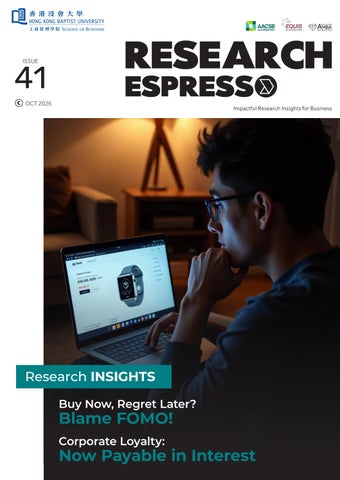
Research INSIGHTS Buy Now, Regret Later?
Blame FOMO! Corporate Loyalty:
Now Payable in Interest
04
Research INSIGHT Buy Now, Regret Later? Blame FOMO! Corporate Loyalty: Now Payable in Interest
12
NEWS
HKBU Business Scholars Secure RMB 1.1 Million in 2026 National Natural Science Foundation of China (NSFC) Funding Professor Zhang Jian Awarded Rising Star Grant for Research on Bank Accounting Standards
16
Research EXCELLENCE
17
Upcoming EVENTS
Research Espresso / OCT 2026
Research INSIGHT
Buy Now, Regret Later?!
Blame FOMO!
4
5
Research Insight
He, X., Li, M., & Liu, Y. (2026). Will I regret not buying? Unpacking the dual pathways of anticipated regret that influence online impulsive buying. Information & Management, 63(3), Article 104323. https://doi.org/10.1016/j.im.2026.104323
6
RESEARC INSIGHT
Research Espresso / OCT 2026
W
ho hasn’t felt a pang of regret after an impulsive online purchase, whether a stack of books on Amazon or kitchenware on Taobao? The gap between clicking “buy” and second thoughts can be vanishingly small. Yet, counterintuitively, it is not regret itself but the anticipation of it that shapes many online purchasing decisions. A new papersheds light on the forces behind this infuriating dynamic. Impulsive buying, a spontaneous purchase driven by emotion and context, now accounts for roughly 40% of online spending. Nearly 84% of consumers admit to it. Yet what drives these decisions remains poorly understood. Drawing on regret theory, the idea that people choose based on the regret they anticipate, not just outcomes, the authors show how reviews and scarcity cues pull consumers in opposite directions: the risk of a bad purchase versus, FOMO, the fear of missing out.
the perceived risk of a poor purchase, while high ratings raise the cost of hesitation. Scarcity cues, such as limited stock or time pressure, intensify this dynamic by amplifying FOMO.
In two online experiments with Chinese university students, participants were shown simulated e-commerce pages for a smartwatch. They were asked not only whether they would buy, but how much regret they would expect to feel if they did or did not. A clear pattern emerges. Ratings act as a proxy for quality. Low ratings increase
In practice, one force dominates. It is not the fear of making a mistake that drives impulsive buying, but the fear of missing out. Anticipated regret from not buying is what pushes consumers to act, particularly when scarcity is present. The risk of a bad purchase carries less weight. There is, however, a limit. When scarcity
7
cues feel artificial, particularly alongside weak ratings, they can backfire. Consumers read them as manipulation and resist.
Research Insight
So next time you are shopping online, remember one thing: FOMO is a poor guide, especially for items you can always buy another day!
The implications are straightforward. Scarcity works, but only when it is credible and aligned with quality. For retailers, the message is to match urgency with strength. Limited stock or time pressure is most effective when paired with strong ratings, where it amplifies the fear of missing out and accelerates decisions. Applied to weaker products, the same tactics erode trust and reduce engagement. Urgency cannot compensate for bad quality. For consumers, the risk runs in the opposite direction. Impulsive buying is less about misjudging quality than about overreacting to the prospect of missing out. Scarcity cues are designed to trigger urgency, not necessarily to reflect genuine demand. Recognizing this helps separate momentary pressure from underlying value. For platforms, credibility is the constraint. The effectiveness of ratings and scarcity cues depends on trust. If signals such as limited stock or time pressure are perceived as unreliable, their influence weakens. Ensuring accuracy and clarity is both a design choice and a commercial necessity.
Professor LI Mengxiang Associate Professor Department of Management, Marketing and Information Systems (MMIS)
Research Espresso / OCT 2026
Research INSIGHT
Corporate Loyalty:
Now Payable in Interest
8
9
Research Insight
Bu, L., Ng, J., Song, B. Y., & Yan, M. Y. (2026). Freedom is not free: Manager disloyalty and bank debt reliance. Journal of Corporate Finance, 96, Article 102914. https://doi.org/10.1016/j.jcorpfin.2025.102914
10
RESEARC INSIGHT
Research Espresso / OCT 2026
F
rom Japan’s vaunted salarymen and IBM lifers to Germany’s Mittelstand stalwarts, corporate loyalty has long been a building block of corporate identity. Yet in a world where receiving a gold watch or a set of golf clubs upon retirement is no longer an option, that foundation is giving way to a more transactional reality. Nowhere is this shift more consequential than at the top, where the loyalty of directors, officers, and controlling shareholders has long been defined in law through the corporate opportunities doctrine and fiduciary duties. But what happens when these constraints are softened? New research examines how this tilt toward flexibility over fidelity is reshaping firm behavior. For the past two centuries, directors, officers, and controlling shareholders have been restricted from appropriating business opportunities that could benefit their firms. The principle is straightforward: senior decision-makers are expected to place the interests of the firm ahead of their own. Beginning with Delaware in 2000, however, nine U.S. states have enacted corporate opportunity waiver (COW) laws, allowing firms to opt out of the doctrine and enabling managers to pursue opportunities without first offering them to the company. While these laws were intended to
help startups raise capital and attract talent, they apply broadly to firms of all sizes. But with this managerial duty of loyalty effectively waived, how can firms preserve effective governance? One answer, the authors suggest, lies in bank debt. The authors argue that firms affected by corporate opportunity waiver laws increase their reliance on bank debt, using creditor monitoring to offset weakened internal governance. As the waiver heightens concerns over managerial self-dealing and information asymmetry, and
11
shifts the balance between governance and managerial compensation, firms may turn to banks rather than public bondholders for their superior oversight, effectively bonding against potential misconduct. Yet entrenched managers may do the opposite, avoiding bank scrutiny by shifting toward public debt to preserve discretion.
Research Insight
including firms with lower disclosure quality. Taken together, the evidence suggests that firms use bank monitoring to offset the erosion of fiduciary constraints triggered by COW laws. The gold watch may be gone, but its replacement comes with a hefty interest bill!
Looking at firms before and after COW adoptions, the authors find a clear increase in bank debt reliance among affected firms, with no evidence of pre-existing trends. The shift is economically meaningful, with the share of bank debt rising by about 3% relative to the average firm. That discipline comes at a cost. Interest expenses also rise, increasing by roughly 1.8% of total debt, or nearly $24 million for the average firm. The effect is not uniform. Firms rely more heavily on bank debt when CEOs are younger, have shorter tenures, or face stronger outside opportunities. The effect weakens when CEOs are founders, hold larger equity stakes, or face tighter post-employment restrictions. The shift toward bank debt is less pronounced where external monitoring is already strong, such as in firms with greater analyst coverage or media scrutiny, and more so where oversight is weaker,
Professor Byron Y SONG Associate Professor Department of Accountancy, Economics and Finance (AEF)
Research Espresso / OCT 2026
12
NEWS HKBU Business Scholars Secure RMB 1.1 Million in 2026 National Natural Science Foundation of China (NSFC) Funding
HKBU School of Business is proud to announce that three faculty members have successfully secured a total of RMB 1.1 million in funding from the highly competitive National Natural Science Foundation of China (NSFC) for 2026. This achievement — comprising two General Project grants and one Young Scientists Fund grant — underscores the School’s growing strength in pioneering research that addresses critical business and societal challenges. The NSFC is a key national funding body known for its rigorous peer‑review process. Securing these grants reflects the faculty’s capacity for innovative, high-quality research.
13
NEWS
The funded projects are as follows: NSFC General Project •
Professor Deng Honglin, Associate Professor, Department of Management, Marketing and Information Systems (MMIS) Management of Subjective AI-Generated Content: A User Suspicion Perspective ( 主观性人工智能生成內容管理 : 基于用 户疑虑心理视角 ) The project investigates how users form suspicions about AI‑generated content such as creative images and videos, and how platforms can address these concerns. It will develop a multidimensional account of user suspicion, build an AI‑based quality assessment model (SAIA), and test transparency strategies. The findings aim to strengthen platform governance and improve user trust in AI content. Professor Zhao Liang of the same department is a collaborator of the project. • Professor Yuan Peixuan, Assistant Professor, Department of Accountancy, Economics and Finance (AEF) High-Dimensional Big Data and Binary Nonlinear Mechanisms in AssetPricing: Factor Identification, Risk Management, and State-Dependent Investment Strategies ( 基于高维大数据与“二元非线性”机制的资产定价因子动态识别、风险管理 与状态依存型投资策略研究 ) This research tackles why established investment factors often fail outside historical samples. Using high‑dimensional financial data and sparse machine‑learning methods, the project identifies when factors switch between “power‑on” and “power‑off” states, and explain the economic forces behind these transitions. The analysis spans U.S. equity and bond markets and China’s A‑share market, with the goal of improving portfolio risk management and systemic‑risk monitoring. Professor Wang Liyao of the same department is a collaborator of the research. NSFC Young Scientists Fund •
Dr Song Qingping, Research Assistant Professor, Department of Management, Marketing and Information Systems (MMIS) Customer Risk Preference Identification and Investment Portfolio Adjustment Mechanisms in a Digital Finance Environment ( 数字金融环境下顾客风险偏好识别与投资组合调整机制研究 ) The project examines how investors make risk‑related decisions in digital wealth management. Using machine learning and behavioural data, it explores the dynamic relationships among risk preferences, information search, and portfolio adjustments. The study aims to deepen understanding of investor behaviour in digital contexts and inform the responsible design of AI‑enabled financial tools. The School congratulates Professor Deng, Professor Yuan, and Dr Song on this distinguished recognition and looks forward to the impactful contributions their research will bring.
Research Espresso / OCT 2026
14
NEWS Professor Zhang Jian Awarded Rising Star Grant for Research on Bank Accounting Standards
Professor Zhang Jian, Associate Professor in the Department of Accountancy, Economics and Finance at HKBU School of Business, has received the “Rising Star Research Grant 2025-26” from Hong Kong Baptist University. The grant is designed to support early- to mid-career faculty members in their research endeavors. His project, “Bank Accounting, Financial Stability, and Sustainable Credit Markets”, tackles a question that affects everyone: how do new banking rules shape the way banks lend money, manage risk, and support economic growth? At the heart of his study are two major accounting standards — Current Expected Credit Loss (CECL) in the United States and IFRS 9 worldwide. These rules require banks to estimate potential loan losses earlier, rather than waiting until borrowers default. The idea is simple: by spotting trouble sooner, banks can be more transparent and better prepared for tough times.
15
NEWS
Professor Zhang’s research will explore whether this shift makes the financial system more stable and helps build healthier credit markets. He will also look at how these changes ripple out to businesses and everyday borrowers — influencing investment decisions, credit availability, and ultimately, economic growth. Building on his strong track record, Professor Zhang has already published in leading journals such as Review of Accounting Studies and Contemporary Accounting Research. His earlier studies examined issues ranging from policy uncertainty and its impact on loan loss provisions to how credit information sharing can drive firm innovation. The findings from this project are expected to shed light on how accounting rules connect to real‑world outcomes, offering valuable insights for both financial institutions and regulators.
16
Research Espresso / OCT 2026
Research EXCELLENCE
Professor CHEN Sihao
Professor Danny WANG
Associate Professor Department of Accountancy, Economics and Finance (AEF)
Associate Professor Department of Management, Marketing and Information Systems (MMIS)
The Shocks Matter: Labor Mobility and the Welfare Cost of a Currency Union
Price Incentives and Channel Cooperation
Journal of Economic Theory https://doi.org/10.1016/j.jet.2025.106132
Journal of the Academy of Marketing Science https://doi.org/10.1007/s11747-026-01149-1
17
Upcoming Events
Upcoming EVENTS Date
Speaker
Topic
Centre for Business Analytics and the Digital Economy 9 December 2026 09:00 -10:30
Prof. Andrew KOSENKO
Zoom
Marist University
Charitable Giving in Wartime: Evidence from Ukraine’s War Fundraising
Joint with CEIBS, NTU, NUS, and Sinica
11 November 2026 09:00 -10:30
Prof. Brett BENSON
Zoom
Vanderbilt University
Taiwan and the Politics of Buying Time
Joint with CEIBS, NTU, NUS, and Sinica
4 November 2026 16:00 -17:30
Zoom
Joint with CEIBS, NTU, NUS, and Sinica
Prof. Olivier STERCK University of Antwerp and University of Oxford
Humanizing Data: Representative Storytelling in a Refugee Camp
Subscribe
The Research Espresso, a bimonthly e-publication covering everything you need to know about the latest research developments at the HKBU School of Business, focuses on four key areas: Research Insights (the main research topic of the month), Research Excellence (recognition of faculty members’ research achievements), News (research-related updates), and Seminars (sharing research skills and knowledge). The idea is to provide business practitioners with the most recent research findings from the School‘s faculty members. We want to build links between research and practice and to ensure that the School's research has business and societal impact. Enjoy reading, and your feedback and input are always welcome!
hkbubusinessschool hkbubusinessschool HKBU School of Business 浸大工管 浸大商学院
hkbuschoolofbusiness bus.hkbu.edu.hk