ETRUSCAN
MAGIC & Occult Remedies Charles Godfrey Leland
VAMzzz
PUBLISHING
Etruscan Magic & Occult Remedies Author: Charles Godfrey Leland
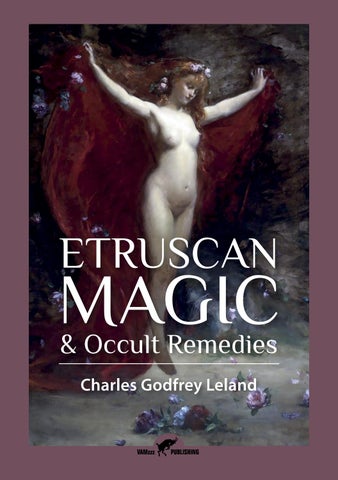
Original title: Etruscan Roman Remains in Popular Tradition (1892) Cover image: S pring (1883) by Carolus-Duran (Charles Emile Auguste Durand, 1837-1917) Lay-out: www.burokd.nl ISBN 978-94-92355-00-3 Š 2015 Revised publication by:
VAMzzz Publishing P.O. Box 3340 1001 AC Amsterdam The Netherlands www.vamzzz.com contactvamzzz@gmail.com
Turan, or Venus
ETRUSCAN
MAGIC & Occult Remedies Charles Godfrey Leland
VAMzzz
PUBLISHING
Charles Godfrey Leland August 15, 1824 – March 20, 1903
4
CONTENTS
PART ONE Gods and Goblins CHAPTER I Tinia—39 Buschet—53 Impusa della Morte—58 Siero—62 Norcia, The Goddess of Truffles—64 Aplu—68 Turanna—72 Pano—81 CHAPTER II Maso—87 Mania Della Notte —90 CHAPTER III Feronia—93 Silviano—100 Paló—104 Esta—106 Carmenta—107 Il Sentiero —109 CHAPTER IV Faflon—111 Lo Spirito Della Contentezza—118 Corredoio—120 Orco—125 Tesana—126 Spulviero—130 Urfia—132 CHAPTER V Lares, Lasa and Lassi —133 Losna—146 Laronda—151 Lemuri—155 Tago—156 Fanio—158 Querciola—166 Sethano—169 CHAPTER VI Carradora—171 Vira—175 Bergoia—179 Bughin—184 Ganzio—186 Alpena—189
5
CHAPTER VII Tituno—193 Albina—195 Verbio—198 Dusio—201 Remle—206 Jano, Meana, Montulga and Talena—207 Pico—215 CHAPTER VIII Floria—217 Ra—220 Bovo—222 Attilio—225 La Bella Marta—229 Diana and Herodias—239 Offerings to Spirits—250 CHAPTER IX Il Spirito del Scaldino—255 Artemisia—260 Red Cap—261 Of Sorcery in Ancient Art—266 The Goddess of the four winds - L’erba Rosolaccio —278 Madonna del Fuoco—284 La Cavalletta—287 CHAPTER X Cupra—293 Walnut witches—298 Witches and witchcraft—316 Zanchi—328 Hail and Cloud men—339 Stories of Witches and Goblins —353 Wizard Saints—383
PART TWO Incantation, Divination, Charms and Cures, Medicine and Amulets CHAPTER I La Stalla di Maiale—403 The spell of the ivy and the statue—411 The spell of the hare—415 The spell of the spider—419 The spell of the green lizard —426
6
CHAPTER II Birds and treasures—433 The spell of the falling star—437 The spell of the acorns —440 The spell of the swallow—446 Minor cures from Marcellus—452 The three wise men of the east and the witch medals—480 CHAPTER III The exorcism of death—487 The spell of the cradle—492 Divination with lead—494 Divination by oil—500 Pyromancy and incense—511 The spell of the lamp—521 CHAPTER IV Evil incantations—525 The spell of the Holy Stone and the Salagrana—536 The spell of the shell and the tone of the stone—543 The spell of the snail—548 Il canto del gallo—550 Divination with ashes—557 CHAPTER V The amethyst—563 The spell of the black hen—570 The spell of the bell—575 The spell of the boiling clothes—580 Ring sorcery—585 Amulets, omens and small sorceries—588 Lead and antimony—603 Post Scriptum
7
8
PART ONE Gods and Goblins
9
10
INTRODUCTION
Turms, or Mercury
THERE IS IN Northern Italy a mountain district known as La Romagna Toscana, the inhabitants of which speak a rude form of the Bolognese dialect. These Romagnoli are manifestly a very ancient race, and appear to have preserved traditions and observances little changed from an incredibly early time. It has been a question of late years whether the Bolognese are of Etrurian origin, and it seems to have been generally decided that they are not. With this I have nothing whatever to do. They were probably there before the Etruscans. But the latter at one time held all Italy, and it is very likely that they left in remote districts those traces of their culture to which this book refers. The name Romagna is applied to their district because it once formed part of the Papal or Roman dominion, and it is not to be confounded with La Romagna proper. Roughly speaking, the region to which I refer may be described as lying between Forli and 11
Ravenna. Among these people, stregeria, or witchcraft–or, as I have heard it called, “la vecchia religione” (or “the old religion”)–exists to a degree which would even astonish many Italians. This stregeria, or old religion, is something more than a sorcery, and something less than a faith. It consists in remains of a mythology of spirits, the principal of whom preserve the names and attributes of the old Etruscan gods, such as Tinia, or Jupiter, Faflon, or Bacchus, and Teramo (in Etruscan Turms), or Mercury. With these there still exist, in a few memories, the most ancient Roman rural deities, such as Silvanus, Palus, Pan, and the Fauns. To all of these invocations or prayers in rude metrical form are still addressed, or are at least preserved, and there are many stories current regarding them. All of these names, with their attributes, descriptions of spirits or gods, invocations and legends, will be found in this work. Closely allied to the belief in these old deities, is a vast mass of curious tradition, such as that there is a spirit of every element or thing created, as for instance of every plant and mineral, and a guardian or leading spirit of all animals; or, as in the case of silkworms, two–one good and one evil. Also that sorcerers and witches are sometimes born again in their descendants; that all kinds of goblins, brownies, red-caps and three-inch mannikins, haunt forests, rocks, ruined towers, firesides and kitchens, or cellars, where they alternately madden or delight the maids–in short, all of that quaint company of familiar spirits which are boldly claimed as being of Northern birth by German archæologists, but which investigation indicates to have been thoroughly at home in Italy while Rome was as yet young, or, 12
it may be, unbuilt. Whether this “lore” be Teutonic or Italian, or due to a common Aryan or Asian origin, or whether, as the new school teaches, it “growed” of itself, like Topsy, spontaneously and sporadically everywhere, I will not pretend to determine; suffice to say that I shall be satisfied should my collection prove to be of any value to those who take it on themselves to settle the higher question. Connected in turn with these beliefs in folletti, or minor spirits, and their attendant observances and traditions, are vast numbers of magical cures with appropriate incantations, spells, and ceremonies, to attract love, to remove all evil influences or bring certain things to pass; to win in gaming, to evoke spirits, to insure good crops or a traveller’s happy return, and to effect divination or deviltry in many curious ways–all being ancient, as shown by allusions in classical writers to whom these spells were known. And I believe that in some cases what I have gathered and given will possibly be found to supply much that is missing in earlier authors–sit verbo venia. Many peasants in the Romagna Toscana are familiar with scores of these spells, but the skilled repetition and execution of them is in the hands of certain cryptic witches, and a few obscure wizards who belong to mystic families, in which the occult art is preserved from generation to generation, under jealous fear of priests, cultured people, and all powers that be, just as gypsies and tramps deeply distrust everything that is not “on the road,” or all “honest folk,” so that it is no exaggeration to declare that “travellers” have no confidence or faith in the truth of any man, until they have caught him telling a few lies. As it indeed befell me myself once in Bath, where it was declared in a 13
T he Goddess of the four winds - L’erba Rosolaccio “Come from the four winds, O breath, and breathe upon these slain, that they may live” – Ezekiel xxxvii. 9
Among all primitive or superstitious people, the medicinal or other virtues of herbs are attributed to some deeply mysterious cause of a supernatural nature. In the Romagna, just as among the Red Indians of America, this faith is carried so far that certain plants are regarded as being in some strange way fairies or spirits in themselves. He who bears one of these about him–always in a red bag, as in old Etrusco-Roman times–carries a small guardian angel, or, if he plants it in a pot, he will be like the ancient Egyptians of whom Juvenal said they had gods growing in their gardens–in allusion to their reverence for onions or garlic. One of these plants which is an object of culture not only in a literal, but also in a religious and æsthetic sense, is the Rosolaccio which has also the curious double-meaning name of the rice (riso), also laughter, or the smile, of the Goddess of the Four Winds. I had the following account given to me with a specimen of the herb:– “’Rosolaccio is a plant the leaves of which, drawn up like a manyfingered little hand, look like grains of rice, whence it is called the rice (or the smile) of the Goddess of the Four Winds. It is also called the plant of good luck because it brings great good fortune. A sprig of it may be kept growing in a small pot, or, if this be impossible, in a red bag. If the former, it must always be in the window, if in a bag, the latter should be hung up
278
behind the window, and this done, no witches can enter, for there are so many grains (or grain-like leaves), or eyes, that the witches cannot count them and therefore cannot pass by. For they are so closed together that counting is impossible. And should it happen that in any family a child or grown person is bewitched, then we take this plant, either growing or else in the bag, and go to the sufferer who must be fasting, even from water, early in the morning, and say:– “’Dea, o dea dei quattri venti, Non ci e altra bella al par di te Un’ erba miracolosa l’hai fatta nascere, Perche la stregoneria passi . . .!’ (“’Goddess, O goddess of the four winds There is no one equal to thee in beauty, Thou bust made a miraculous plant to grow, That the bewitchment may pass from . . .’) Then let the sign of the cross be made three times with the herb, and this must be done for three mornings. “’But who was the Goddess of the Four Winds?’ “Well, I have heard that her mother was a beautiful girl who was of great rank, perhaps a princess however she loved a poor young man, and her parents would not hear of such a match. “How it came to pass, who knows? but the young man dwelt near her, and they found a subterranean passage which led to her room–some say she had it dug, for she was of fairy kind–but it came to a trap-door in her room, and under her bed. “And the end was that she was with child, and remained many months in her room, lest the world should know it. And she prepared a fine cradle all made of roses. And her mother, who was a fairy, kept her secret, and aided her, and when the time came for the princess to give birth to the child, the mother made a fire of laurel, so that in its crackling the cries of the babe should not be heard. “And when this happened, and while the mother burned the laurel, she said “’Figlia mia, amata, amata, A batta di lauro tu sei nata, 279
E di rose conbugigata, Figlia mia, amata, amata, Una fata di te pure ho fatta.’ (“’Darling daughter in the morn, To the sound of laurel thou wert born Wrapped in roses thou shalt be, Daughter, daughter, dear to me, A fairy I have made of thee.’) “And this child was the Goddess of the Four Winds. E questa fu la fata detta la dea dei quattro venti.”
This marvellous and mysterious story can hardly fail to suggest much to every folk-lorist. First of all the infant goddess of the wind is rocked in a cradle of roses. FRIEDRICH (Symbolik d. Natur) observes that in the Greek myth, the Wind, Æolos, has in his home six sons and six daughters–wohl die ælteste Andeutung einer Windrose–“the first indication of the wind-rose or anemone.” The real rosalaccio (rose-lace) is the red poppy or corn-flower, but the name rose refers to the colour. We have in it, however, a connection of roses with the wind, and of the dew-drop, “rocked by the wind in the cradle of a rose.” The anemone or wind-flower sprung from the blood of Adonis, that is, in the flower he lives again as a spirit of the wind. Adonis, the spirit of spring, is the same with Favonius, “the Greek zephyr, the sweet and fructifying south wind who comes with the swallow and the spring.” It can hardly be denied that all this seems to be indicated in this strange Tuscan tale. The burning of laurel twigs so that they shall make a noise is of ripe antiquity. “There was a special divination or foretelling the future by burning laurel leaves, and it was regarded as a good sign 280
if they crackled and made a loud noise” (TIBULLUS, Eleg., ii. 6, 81). Hence came a common proverb, Clamosior lauro ardente–“Noisier than burning laurel”. Or, as we are told by the author of the Trinum Magicum (A.D. 1611), “Et lauri quoque ramis divinatio sumebatur, and there was also divination by a branch of laurel, which if it made a loud sound was a good sign, and the contrary if it burned out quietly.” But the chief aim of this story is to show how it was that the babe was made to pass from a mere mortal into a fairy or goddess, as Ceres attempted to do with the infant Triptolemus. She also employed a fire, but I do not know that it was of laurel boughs. But the laurel, as FRIEDRICH declares, was not only consecrated to prophecy or magic, and, as an evergreen, to immortality, but it was peculiarly a symbol–of a new life–neues Leben im Tode. “Among the Romans the corpse in a funeral was sprinkled with water from laurel boughs; and in the early times of Christianity the dead were laid on laurel leaves to signify that those who died in Christ had not ceased to live. And the baptism, or the new life in CHRIST, was also symbolised by laurel” (WINCKELMANN, Versuch einer Allegorie, besonders für die Kunst, iii. c.; also HARTUNG, die Relig. der Römer, part i., p. 46). WINCKELMANN also mentions that on a rare medal, Lucilla, the wife of the Emperor Lucius Verus, is represented as holding a branch of laurel, near her kneels a woman drawing water, and there stands by her a half-naked child awaiting baptism. This has a special application to the Tuscan tale, with this difference–that in one case there is a baptism by fire, and in the other by water. In both the babe is to be prepared for a new life by means of the mystic laurel. There is some obscurity in this myth, but it may be remarked 281
that the zephyr, the dew-drop, and the rose, were mystically combined in ancient fable, and that they reappear in the birth of the Goddess of the Four Winds. Again, peasants usually retain, or relate, only fairy stories, whereas this is not a tale at all in the real sense of the word, but an explanation of the origin of a spirit who is, we may say, worshipped in a plant. In another Romagnolo legend the Wind appears as male and female. It is as follows:– “The Wind is a magician (mago) and Corina (Romagnolo, Curena) is his sister. “A youth had a sweetheart and believed she had been false to him while she was innocent. But the youth in his sorrow fled far, far away so that he might see her no more. “Then she went to a wise old woman, who consulted the cards (that is ‘divined’ in any way), to know if she would ever find her lover again, and the old woman bade her go to the Wind, and to his sister Curena.” (Here there is a manifest hiatus.) “And they departed with her; the morning had just dawned when they came to a city, they put her down before the window of her love, and she sang “’Love, thou hast been false to me, While I was ever true to thee, Thou for me didst leave thy home, Now unto thee I have come, In two hours’ time I travelled here, Yet ‘twas the journey of a year. The wild wind bore me like a cloud, And Curena whistled loud, They have put me on thy track, Thou from me wilt ne’er turn back; Now our sufferings are o’er, Thou shalt leave me nevermore.’ So they were united, and lived happily ever after.”
282
It is possible that in this Curena we have the Teutonic “Wind’s bride�, who is ever hunting, and who blows a horn which is indicated in cor or curen. Corinth, Corinna, and Curena seem to be certainly allied to Coronis, the wind: raven typical of the north-west wind, or Skiron. As regards the rosalaccio it is evident that the names and associations of the herb which I have described are confused and intermingled with those of the poppy or red corn-flower, which is the true rosalaccio, and the red anemone or wind-flower. And there are those in Ireland who maintain that the so-called wild wind-flower, which is white, and has a triple leaf, is the real Shamrock. Out of all which those who have better material wherewith to work than I, may make what they can. There are some also who assert that the red sorrel is the true Shamrock because the blood of the Saviour dropped upon it, even as the blood of Adonis dropped on the anemone. Of which confusion there is a great deal in all legends of a people in which old tradition has long since run into decay and new growth, and I beg the reader to pardon me if I cannot clear it up.
283
ost
PS criptum
Leland, witchcraft & more‌
About Charles Godfrey Leland 2. Short biography Leland 3. Other publications by Leland
About the book 4. The Etruscans: a complex origin 5. Index: Ancient Etruscan deities and mythological figures
VAMzzz Publishing 14. Paper books 15. Aradia, Gospel of the Witches 16. More Occult and Esoteric Books
1
VAMzzz
PUBLISHING
The gods, spirits and sorcery of Italian witches Etruscan Magic & Occult Remedies by Charles Godfrey Leland was first published as Etruscan Roman Remains in Popular Tradition, in 1892. Part One of the book offers a complete and detailed insight in the Etruscan and Roman rooted pantheon of the Tuscan Streghe (witches). Part Two describes many of their spells, incantations, sorcery and several lost divination methods. Leland found himself at the crossroads of the academic and the romantic and it is precisely this, which makes the reading of his work so enjoyable. His primary aim was to preserve this ancient traditional knowledge, as he feared, it would soon be wiped out by modernism. Much information in this book, Leland received first hand from the Tuscan witches Maddalena and Marietta. His second work on Stregheria: Aradia, or the Gospel of the Witches was published seven years later in 1899. One could state he reached his goal, as his books are still of invaluable importance to both the Italian folklore and the modern practitioner of witchcraft. One of Leland’s readers was the late Gerald Gardner, which makes one wonder who was the true godfather of modern witchcraft‌ Special revised edition with an index of ancient Etruscan gods and spirits.
9 789492 355003